EP2322517B1 - Methods of chemical synthesis and purification of diaminophenothiazinium compounds including methylthioninium chloride (mtc) - Google Patents
Methods of chemical synthesis and purification of diaminophenothiazinium compounds including methylthioninium chloride (mtc) Download PDFInfo
- Publication number
- EP2322517B1 EP2322517B1 EP10010049.4A EP10010049A EP2322517B1 EP 2322517 B1 EP2322517 B1 EP 2322517B1 EP 10010049 A EP10010049 A EP 10010049A EP 2322517 B1 EP2322517 B1 EP 2322517B1
- Authority
- EP
- European Patent Office
- Prior art keywords
- optionally substituted
- disubstituted
- reaction
- treatment
- chloride
- Prior art date
- Legal status (The legal status is an assumption and is not a legal conclusion. Google has not performed a legal analysis and makes no representation as to the accuracy of the status listed.)
- Expired - Lifetime
Links
- 0 *c1cc(N(*)*)cc2sc(cc(cc3*)N(*)*)c3nc12 Chemical compound *c1cc(N(*)*)cc2sc(cc(cc3*)N(*)*)c3nc12 0.000 description 7
- YWFSXFXMEXDVTH-UHFFFAOYSA-N CN(C)c(cc1)cc(SS(O)(=O)=O)c1N Chemical compound CN(C)c(cc1)cc(SS(O)(=O)=O)c1N YWFSXFXMEXDVTH-UHFFFAOYSA-N 0.000 description 2
- DAUCZFREPSTVCY-UHFFFAOYSA-N CN(C)C(C=C1)C=CC1=Nc(ccc(N(C)C)c1)c1SS(O)(=O)=O Chemical compound CN(C)C(C=C1)C=CC1=Nc(ccc(N(C)C)c1)c1SS(O)(=O)=O DAUCZFREPSTVCY-UHFFFAOYSA-N 0.000 description 1
- OYJZVEJRPALBSZ-UHFFFAOYSA-N CN(C)C(CC1)=CC(SS(O)(=O)=O)=C1N Chemical compound CN(C)C(CC1)=CC(SS(O)(=O)=O)=C1N OYJZVEJRPALBSZ-UHFFFAOYSA-N 0.000 description 1
- JLTDJTHDQAWBAV-UHFFFAOYSA-N CN(C)c1ccccc1 Chemical compound CN(C)c1ccccc1 JLTDJTHDQAWBAV-UHFFFAOYSA-N 0.000 description 1
Classifications
-
- A—HUMAN NECESSITIES
- A61—MEDICAL OR VETERINARY SCIENCE; HYGIENE
- A61K—PREPARATIONS FOR MEDICAL, DENTAL OR TOILETRY PURPOSES
- A61K31/00—Medicinal preparations containing organic active ingredients
- A61K31/33—Heterocyclic compounds
- A61K31/395—Heterocyclic compounds having nitrogen as a ring hetero atom, e.g. guanethidine or rifamycins
- A61K31/54—Heterocyclic compounds having nitrogen as a ring hetero atom, e.g. guanethidine or rifamycins having six-membered rings with at least one nitrogen and one sulfur as the ring hetero atoms, e.g. sulthiame
- A61K31/5415—Heterocyclic compounds having nitrogen as a ring hetero atom, e.g. guanethidine or rifamycins having six-membered rings with at least one nitrogen and one sulfur as the ring hetero atoms, e.g. sulthiame ortho- or peri-condensed with carbocyclic ring systems, e.g. phenothiazine, chlorpromazine, piroxicam
-
- A—HUMAN NECESSITIES
- A61—MEDICAL OR VETERINARY SCIENCE; HYGIENE
- A61K—PREPARATIONS FOR MEDICAL, DENTAL OR TOILETRY PURPOSES
- A61K49/00—Preparations for testing in vivo
- A61K49/001—Preparation for luminescence or biological staining
- A61K49/006—Biological staining of tissues in vivo, e.g. methylene blue or toluidine blue O administered in the buccal area to detect epithelial cancer cells, dyes used for delineating tissues during surgery
-
- A—HUMAN NECESSITIES
- A61—MEDICAL OR VETERINARY SCIENCE; HYGIENE
- A61K—PREPARATIONS FOR MEDICAL, DENTAL OR TOILETRY PURPOSES
- A61K9/00—Medicinal preparations characterised by special physical form
- A61K9/0012—Galenical forms characterised by the site of application
- A61K9/0019—Injectable compositions; Intramuscular, intravenous, arterial, subcutaneous administration; Compositions to be administered through the skin in an invasive manner
-
- A—HUMAN NECESSITIES
- A61—MEDICAL OR VETERINARY SCIENCE; HYGIENE
- A61P—SPECIFIC THERAPEUTIC ACTIVITY OF CHEMICAL COMPOUNDS OR MEDICINAL PREPARATIONS
- A61P1/00—Drugs for disorders of the alimentary tract or the digestive system
- A61P1/16—Drugs for disorders of the alimentary tract or the digestive system for liver or gallbladder disorders, e.g. hepatoprotective agents, cholagogues, litholytics
-
- A—HUMAN NECESSITIES
- A61—MEDICAL OR VETERINARY SCIENCE; HYGIENE
- A61P—SPECIFIC THERAPEUTIC ACTIVITY OF CHEMICAL COMPOUNDS OR MEDICINAL PREPARATIONS
- A61P25/00—Drugs for disorders of the nervous system
-
- A—HUMAN NECESSITIES
- A61—MEDICAL OR VETERINARY SCIENCE; HYGIENE
- A61P—SPECIFIC THERAPEUTIC ACTIVITY OF CHEMICAL COMPOUNDS OR MEDICINAL PREPARATIONS
- A61P25/00—Drugs for disorders of the nervous system
- A61P25/28—Drugs for disorders of the nervous system for treating neurodegenerative disorders of the central nervous system, e.g. nootropic agents, cognition enhancers, drugs for treating Alzheimer's disease or other forms of dementia
-
- A—HUMAN NECESSITIES
- A61—MEDICAL OR VETERINARY SCIENCE; HYGIENE
- A61P—SPECIFIC THERAPEUTIC ACTIVITY OF CHEMICAL COMPOUNDS OR MEDICINAL PREPARATIONS
- A61P31/00—Antiinfectives, i.e. antibiotics, antiseptics, chemotherapeutics
- A61P31/04—Antibacterial agents
-
- A—HUMAN NECESSITIES
- A61—MEDICAL OR VETERINARY SCIENCE; HYGIENE
- A61P—SPECIFIC THERAPEUTIC ACTIVITY OF CHEMICAL COMPOUNDS OR MEDICINAL PREPARATIONS
- A61P31/00—Antiinfectives, i.e. antibiotics, antiseptics, chemotherapeutics
- A61P31/12—Antivirals
-
- A—HUMAN NECESSITIES
- A61—MEDICAL OR VETERINARY SCIENCE; HYGIENE
- A61P—SPECIFIC THERAPEUTIC ACTIVITY OF CHEMICAL COMPOUNDS OR MEDICINAL PREPARATIONS
- A61P31/00—Antiinfectives, i.e. antibiotics, antiseptics, chemotherapeutics
- A61P31/12—Antivirals
- A61P31/14—Antivirals for RNA viruses
-
- A—HUMAN NECESSITIES
- A61—MEDICAL OR VETERINARY SCIENCE; HYGIENE
- A61P—SPECIFIC THERAPEUTIC ACTIVITY OF CHEMICAL COMPOUNDS OR MEDICINAL PREPARATIONS
- A61P31/00—Antiinfectives, i.e. antibiotics, antiseptics, chemotherapeutics
- A61P31/12—Antivirals
- A61P31/14—Antivirals for RNA viruses
- A61P31/18—Antivirals for RNA viruses for HIV
-
- A—HUMAN NECESSITIES
- A61—MEDICAL OR VETERINARY SCIENCE; HYGIENE
- A61P—SPECIFIC THERAPEUTIC ACTIVITY OF CHEMICAL COMPOUNDS OR MEDICINAL PREPARATIONS
- A61P33/00—Antiparasitic agents
- A61P33/02—Antiprotozoals, e.g. for leishmaniasis, trichomoniasis, toxoplasmosis
-
- A—HUMAN NECESSITIES
- A61—MEDICAL OR VETERINARY SCIENCE; HYGIENE
- A61P—SPECIFIC THERAPEUTIC ACTIVITY OF CHEMICAL COMPOUNDS OR MEDICINAL PREPARATIONS
- A61P35/00—Antineoplastic agents
-
- C—CHEMISTRY; METALLURGY
- C07—ORGANIC CHEMISTRY
- C07D—HETEROCYCLIC COMPOUNDS
- C07D279/00—Heterocyclic compounds containing six-membered rings having one nitrogen atom and one sulfur atom as the only ring hetero atoms
- C07D279/10—1,4-Thiazines; Hydrogenated 1,4-thiazines
- C07D279/14—1,4-Thiazines; Hydrogenated 1,4-thiazines condensed with carbocyclic rings or ring systems
- C07D279/18—[b, e]-condensed with two six-membered rings
-
- C—CHEMISTRY; METALLURGY
- C09—DYES; PAINTS; POLISHES; NATURAL RESINS; ADHESIVES; COMPOSITIONS NOT OTHERWISE PROVIDED FOR; APPLICATIONS OF MATERIALS NOT OTHERWISE PROVIDED FOR
- C09B—ORGANIC DYES OR CLOSELY-RELATED COMPOUNDS FOR PRODUCING DYES, e.g. PIGMENTS; MORDANTS; LAKES
- C09B19/00—Oxazine dyes
- C09B19/02—Bisoxazines prepared from aminoquinones
-
- G—PHYSICS
- G01—MEASURING; TESTING
- G01N—INVESTIGATING OR ANALYSING MATERIALS BY DETERMINING THEIR CHEMICAL OR PHYSICAL PROPERTIES
- G01N33/00—Investigating or analysing materials by specific methods not covered by groups G01N1/00 - G01N31/00
- G01N33/48—Biological material, e.g. blood, urine; Haemocytometers
- G01N33/50—Chemical analysis of biological material, e.g. blood, urine; Testing involving biospecific ligand binding methods; Immunological testing
- G01N33/52—Use of compounds or compositions for colorimetric, spectrophotometric or fluorometric investigation, e.g. use of reagent paper and including single- and multilayer analytical elements
-
- Y—GENERAL TAGGING OF NEW TECHNOLOGICAL DEVELOPMENTS; GENERAL TAGGING OF CROSS-SECTIONAL TECHNOLOGIES SPANNING OVER SEVERAL SECTIONS OF THE IPC; TECHNICAL SUBJECTS COVERED BY FORMER USPC CROSS-REFERENCE ART COLLECTIONS [XRACs] AND DIGESTS
- Y02—TECHNOLOGIES OR APPLICATIONS FOR MITIGATION OR ADAPTATION AGAINST CLIMATE CHANGE
- Y02A—TECHNOLOGIES FOR ADAPTATION TO CLIMATE CHANGE
- Y02A50/00—TECHNOLOGIES FOR ADAPTATION TO CLIMATE CHANGE in human health protection, e.g. against extreme weather
- Y02A50/30—Against vector-borne diseases, e.g. mosquito-borne, fly-borne, tick-borne or waterborne diseases whose impact is exacerbated by climate change
Definitions
- This disclosure pertains generally to the field of chemical synthesis and purification, and more specifically to methods of synthesizing and purifying certain 3,7-diamino-phenothiazin-5-ium compounds (referred to herein as “diaminophenothiazinium compounds”) including Methythioninium Chloride (MTC) (also known as Methylene Blue).
- MTC Methythioninium Chloride
- the present disclosure also pertains to the resulting (high purity) compounds, compositions comprising them (e.g., tablets, capsules), and their use in methods of inactivating pathogens, and methods of medical treatment and diagnosis, etc., for example, for tauopathies, Alzheimer's disease (AD), skin cancer, melanoma, viral diseases, bacterial diseases and protozoal diseases.
- Ranges are often expressed herein as from “about” one particular value, and/or to “about” another particular value. When such a range is expressed, another embodiment includes from the one particular value and/or to the other particular value. Similarly, when values are expressed as approximations, by the use of the antecedent "about,” it will be understood that the particular value forms another embodiment.
- Methythioninium Chloride (also known as Methylene Blue)
- Methythioninium Chloride (also known as Methylene blue (MB); methylthionine chloride; tetramethylthionine chloride; 3,7-bis(dimethylamino) phenothiazin-5-ium chloride; C.I. Basic Blue 9; tetramethylthionine chloride; 3,7-bis(dimethylamino) phenazathionium chloride; Swiss blue; C.I. 52015; C.I. Solvent Blue 8; aniline violet; and Urolene Blue®) is a low molecular weight (319.86), water soluble, tricyclic organic compound of the following formula:
- Methythioninium Chloride (also known as Methylene Blue), perhaps the most well known phenothiazine dye and redox indicator, has also been used as an optical probe of biophysical systems, as an intercalator in nanoporous materials, as a redox mediator, and in photoelectrochomic imaging.
- MTC was first described in a German Patent in 1877 (Badische Anilin- und Soda-Fabrik, 1877). In that patent, MTC was synthesized by nitrosylation of dimethylaniline, subsequent reduction to form N,N-dimethyl-1,4-diaminobenzene, and subsequent oxidative coupling in the presence of hydrogen sulphide (H 2 S) and iron(III) chloride (FeCl 3 ).
- H 2 S hydrogen sulphide
- FeCl 3 iron(III) chloride
- Bernthsen described subsequent studies of MTC and methods for its synthesis (see Bernthsen, 1885a, 1885b, 1889).
- nitrosodimethylaniline is prepared from dimethylaniline by treatment with nitrite (NaNO 2 ) in aqueous acid (HCl) solution.
- the nitroso compound is reduced to form p-aminodimethylaniline in aqueous acid (HCl) solution using zinc dust solution.
- steps (c), (d), and (e) the p-aminodimethylaniline is oxidized in aqueous acid solution with another molecule of dimethylaniline, and simultaneously a thiosulfonic acid group is introduced; the ring is then closed using manganese dioxide or copper sulfate.
- a clear neutral solution of p-aminodimethylaniline is acidified (H 2 SO 4 ), and a non-reducing zinc chloride solution is added (ZnCl 2 with Na 2 Cr 27 ).
- Aluminium thiosulfate (Al 2 (S 2 O 3 ) 3 ) and sodium thiosulfate (Na 2 S 2 O 3 ) are added.
- Sodium dichromate (Na 2 Cr 2 O 7 ) is added. The mixture is heated and aerated. Dimethylaniline is added.
- Sodium dichromate (Na 2 Cr 2 O 7 ) is added. The mixture is heated, and becomes dark greenish-blue in colour due to the formation of the thiosulfonic acid of Bindschedler green.
- Manganese dioxide or copper sulfate is added, and the mixture heated, and the dye precipitates from the concentrated zinc chloride solution.
- MTC is synthesized commercially by oxidation of N,N-dimethyl-p-phenylene diamine with Na 2 Cr 2 O 7 in the presence of Na 2 S 2 O 3 , followed by further oxidation in the presence of N,N-dimethylamine.
- MTC is currently used to treat methemoglobinemia (a condition that occurs when the blood cannot deliver oxygen where it is needed in the body). MTC is also used as a medical dye (for example, to stain certain parts of the body before or during surgery); a diagnostic (for example, as an indicator dye to detect certain compounds present in urine); a mild urinary antiseptic; a stimulant to mucous surfaces; a treatment and preventative for kidney stones; and in the diagnosis and treatment of melanoma.
- MTC has been used to treat malaria either singly (Guttmann & Ehrlich, 1891) or in combination with chloroquine (Schirmer et al. 2003; Rengelhausen et al. 2004).
- Malaria in humans is caused by one of four protozoan species of the genus Plasmodium: P. falciparum, P. vivax, P. ovale, or P. malariae. All species are transmitted by the bite of an infected female Anopheles mosquito. Occasionally, transmission occurs by blood transfusion, organ transplantation, needle-sharing, or congenitally from mother to fetus. Malaria causes 300-500 million infections worldwide and approximately 1 million deaths annually. Drug resistance, however is a major concern and is greatest for P.
- Drugs or drug combinations that are currently recommended for prophylaxis of malaria include chloroquine/proguanil hydrochloride, mefloquine, doxycycline and primaquine.
- MTC under the name Virostat, from Bioenvision Inc., New York
- Virostat is effective against viruses such as HIV and West Nile Virus in laboratory tests.
- West Nile virus (WNV) is a potentially serious illness affecting the central nervous system. The large majority of infected people will show no visible symptoms or mild flu-like symptoms such as fever and headache. About one in 150 will develop severe symptoms including tremors, convulsions, muscle weakness, vision loss, numbness, paralysis or coma.
- WNV is spread by the bite of an infected mosquito, but can also spread through blood transfusions, organ transplants, breastfeeding or during pregnancy from mother to child.
- Hepatitis C is a viral infection of the liver.
- the virus, HCV is a major cause of acute hepatitis and chronic liver disease, including cirrhosis and liver cancer.
- HCV is spread primarily by direct contact with human blood.
- the major causes of HCV infection worldwide are use of unscreened blood transfusions, and re-use of needles and syringes that have not been adequately sterilized.
- the World Health Organization has declared hepatitis C a global health problem, with approximately 3% of the world's population infected with HCV and it varies considerably by region. The prevalence in the US is estimated at 1.3% or approximately 3.5 million people.
- Egypt has a population of approximately 62 million and contains the highest prevalence of hepatitis C in the world, estimated at over 20% of the nation's approximately 62 million people.
- MTC when combined with light, can prevent the replication of nucleic acid (DNA or RNA).
- Plasma, platelets and red blood cells do not contain nuclear DNA or RNA.
- MTC When MTC is introduced into the blood components, it crosses bacterial cell walls or viral membrane then moves into the interior of the nucleic acid structure. When activated with light, the compounds then bind to the nucleic acid of the viral or bacterial pathogen, preventing replication of the DNA or RNA. Because MTC designed to inactivate pathogens, it has the potential to reduce the risk of transmission of pathogens that would remain undetected by testing.
- MTC and derivatives thereof have been found to be useful in the treatment of tauopathies (such as, for example, Alzheimer's disease) (see, for example, Wischik, C.M., et al., 1996, 2002).
- MTC MTC
- Urolene Blue® Oral and parenteral formulations of MTC are commercially available in the United States, usually under the name Urolene Blue®. However, these formulations contain substantial amounts of metal impurities. These impurities are highly undesirable, and many (e.g., including Al, Cr, Fe, Cu) exceed the safety limits set by European health agencies.
- diaminophenothiazinium compounds including MTC.
- the inventors have developed methods for the synthesis of diaminophenothiazinium compounds (including MTC), that yield products with extremely high purity and in particular, products with extremely low levels of undesired impurities (both organic and metal) that meet (and often exceed) the safety limits set by European health agencies (e.g., the European Pharmacopoeia).
- MTC prepared by the methods described herein is the purest available worldwide.
- One aspect of the invention pertains to a high purity diaminophenothiazinium compound as defined in claim 1.
- compositions e.g., a pharmaceutical composition, e.g., a tablet, a capsule
- a composition comprising said high purity diaminophenothiazinium compound.
- Another aspect of the invention pertains to said high purity diaminophenothiazinium compound for use in a method of treatment of the human or animal body by therapy, for example in respect of any of the diseases or indications discussed herein.
- Another aspect of the invention pertains to said high purity diaminophenothiazinium compound for use in a method of inactivating pathogens.
- Another aspect of the invention pertains to use of said high purity diaminophenothiazinium compound for the manufacture of a medicament for use in the treatment of, e.g., a tauopathy (e.g., Alzheimer's disease).
- a tauopathy e.g., Alzheimer's disease
- diaminophenothiazinium compounds wherein:
- the C 1-4 alkyl groups are selected from: linear C 1-4 alkyl groups, such as -Me, -Et, -nPr, -iPr, and -nBu; branched C 3-4 alkyl groups, such as -iPr, -iBu, -sBu, and -tBu; and cyclic C 3-4 alkyl groups, such as -cPr and -cBu.
- the halogenated C 1-4 alkyl groups are selected from: -CF 3 , -CH 2 CF 3 , and -CF 2 CF 3 .
- each of R 1 and R 9 is independently -H, -Me,-Et, or -CF 3 .
- each of R 1 and R 9 is independently -H, -Me, or -Et.
- each of R 1 and R 9 is independently -H.
- each of R 1 and R 9 is independently -Me.
- each of R 1 and R 9 is independently -Et.
- R 1 and R 9 are the same.
- R 1 and R 9 are different.
- each of R 3NA and R 3NB is independently -Me or -Et.
- each of R 3NA and R 3NB is independently -Me.
- each of R 3NA and R 3NB is independently -Et.
- R 3NA and R 3NB are the same.
- R 3NA and R 3NB are different.
- each of R 7NA and R 7NB is independently -Me or -Et.
- each of R 7NA and R 7NB is independently -Me.
- each of R 7NA and R 7NB is independently -Et.
- R 7NA and R 7NB are the same.
- R 7NA and R 7NB are different.
- R 3NA and R 3NB and R 7NA and R 7NB are the same.
- the groups -N(R 3NA )(R 3NB ) and -N(R 7NA )(R 7NB ) are the same.
- the groups -N(R 3NA )(R 3NB ) and -N(R 7NA )(R 7NB ) are the same, and are selected from: -NMe 2 and -NEt 2 .
- the groups -N(R 3NA )(R 3NB ) and -N(R 7NA )(R 7NB ) are other than -NMe 2 .
- one or more of the carbon atoms is 11 C or 13 C.
- one or more of the carbon atoms is 11 C.
- one or more of the carbon atoms is 13 C.
- one or more of the nitrogen atoms is 15 N.
- one or more or all of the carbon atoms of one or more or all of the groups R 3NA , R 3NB , R 7NA and R 7NB is 13 C.
- each of the groups -N(R 3NA )(R 3NB ) and-N(R 7NA )(R 7NB ) is -N( 13 CH 3 ) 2 .
- each of R 1 and R 9 is -H, and each of the groups -N(R 3NA )(R 3NB ) and -N(R 7NA )(R 7NB ) is -N( 13 CH 3 ) 2 .
- each of R 1 and R 9 is -H; each of the groups -N(R 3NA )(R 3NB ) and -N(R 7NA )(R 7NB ) is -N( 13 CH 3 ) 2 ; and X - is Cl - .
- X - is independently a halogen anion (i.e., halide).
- X - is independently Cl - , Br - , or I - .
- X - is independently Cl - .
- the compound is in the form of a mixed salt, for example, a ZnCl 2 mixed salt.
- Examples of such compounds include the following: MTC (Methylene Blue) ETC PTC BTC ATC EMTC PMTC 1,9-DMMTC 1,9-DMETC 1 ,9-DEETC 1,9-D(TFM)MTC 1,9-DM 13C MTC 13C MTC
- Method A One important difference between known methods and the presently disclosed Method A is the step of isolation and purification of the zwitterionic intermediate, 6 (IAPOZI). This step of isolation and purification gives rise to improved yield in the subsequent ring closure step (due to, inter alia, improved stability of the zwitterionic intermediate and reduced side reactions), as well as improved purity of the final diaminophenothiazinium compound.
- the zwitterionic intermediate is not isolated, and the reaction mixture is used, unchanged, in the subsequent step.
- chromium can more easily be removed when in the form of CR(III) than when in the form of Cr(VI). By reducing residual Cr(VI) to Cr(III), it is possible to obtain a product with very low levels of residual chromium.
- Treatment step that is, treatment of the chloride salt with one or more of sulphide (ST), dimethyldithiocarbamate (DT), carbonate (CT), ethylenediaminetetraacetic acid (EDTAT), or an organic solvent (OE).
- ST sulphide
- DT dimethyldithiocarbamate
- CT carbonate
- ETAT ethylenediaminetetraacetic acid
- OE organic solvent
- the method of synthesis disclosed herein comprises the steps of, in order:
- the method of synthesis comprises the steps of, in order:
- the method of synthesis additionally comprises the initial step of: thiosulfonic acid formation (TSAF).
- TSAF thiosulfonic acid formation
- the method of synthesis additionally comprises the initial steps of:
- the method of synthesis additionally comprises the initial steps of:
- the method of synthesis additionally comprises the subsequent step of: chloride salt formation (CSF).
- CSF chloride salt formation
- the method of synthesis additionally comprises a subsequent step selected from:
- the method of synthesis additionally comprises a subsequent step selected from:
- the method of synthesis additionally comprises a subsequent step selected from:
- the method of synthesis additionally comprises a subsequent step selected from: sulphide treatment (ST); followed by the subsequent step of: organic extraction (OE).
- ST sulphide treatment
- OE organic extraction
- the method of synthesis additionally comprises the subsequent step of: organic extraction (OE).
- OE organic extraction
- the method of synthesis additionally comprises the subsequent step of: recrystallisation (RX).
- the method of synthesis comprises the steps of, in order:
- the method of synthesis is a 2-pot method.
- the method of synthesis is a 3-pot method.
- MTC Methythioninium Chloride
- the method of purification is a method of purification of MTC.
- the method of purification is applied to a diaminophenothiazinium compound (e.g., MTC) in general, that is, that may or may not have been prepared by a method of synthesis as described herein.
- a diaminophenothiazinium compound e.g., MTC
- the method of purification may be applied to a commercially available diaminophenothiazinium compound (e.g., MTC), e.g., that is relatively impure or that contains undesirable or unacceptably high levels of certain impurities (e.g., organic impurities, metals, etc.).
- MTC diaminophenothiazinium compound
- impurities e.g., organic impurities, metals, etc.
- the method of purification is applied to commercially available MedexTM (e.g., to MTC initially provided by Medex Medical Export Co. Ltd.)
- the method of purification is applied to commercially available Urolene Blue® (e.g., to MTC initially provided as Urolene Blue®).
- the method of purification is applied to a diaminophenothiazinium compound (e.g., MTC) that has been prepared by a method of synthesis as described herein (e.g., to MTC initially provided as the product of a method of synthesis as described herein.
- MTC diaminophenothiazinium compound
- the method of purification comprises one or more steps, in order, selected from:
- the method of purification comprises a step of: a treatment step, selected from:
- the method of purification additionally comprises a step of: a treatment step, selected from:
- the method of purification comprises a step of: sulphide treatment (ST).
- the method of purification additionally comprises a step of: sulphide treatment (ST).
- the method of purification comprises a step of: organic extraction (OE).
- the method of purification additionally comprises a step of: organic extraction (OE).
- OE organic extraction
- the method of purification comprises a step of: recrystallisation (RX).
- the method of purification additionally comprises a step of: recrystallisation (RX).
- the method of purification comprises the steps of, in order:
- the method of purification comprises the steps of, in order:
- the method of purification comprises the steps of, in order:
- the method of purification comprises the steps of, in order:
- the method of purification comprises the steps of, in order:
- the method of purification comprises the steps of, in order:
- the method of purification comprises the steps of, in order:
- the method of purification comprises the steps of, in order:
- the method of purification comprises the steps of, in order:
- the method of purification comprises the steps of, in order:
- the method of purification comprises the steps of, in order:
- the method of purification comprises the steps of, in order:
- the method of purification comprises the steps of, in order:
- the method of purification comprises the steps of, in order:
- the organic extraction employs dichloromethane (DCM, CH 2 Cl 2 ).
- the recrystallisation (RX) step is a cool acidic recrystallisation (RX-CAR) step.
- an N,N-disubstituted-3-optionally substituted aniline, 1 is 4-nitrosylated to give an N,N-disubstituted-3-optionally substituted-4-nitrosyl aniline, 2, as illustrated in the following scheme:
- an N,N-dimethyl aniline, 1' is 4-nitrosylated to give an N,N-dimethyl-4-nitrosyl aniline, 2', as illustrated in the following scheme:
- the nitrosylation is performed using a nitrite.
- the nitrite is or comprises NO 2 - .
- the nitrite is or comprises alkali metal nitrite.
- the nitrite is or comprises sodium nitrite or potassium nitrite.
- the nitrite is sodium nitrite (NaNO 2 ).
- the molar ratio of nitrite to aniline, 1, is 0.8 to 1.5.
- the molar ratio is 1.0 to 1.5.
- the molar ratio is 1.1 to 1.5.
- the molar ratio is 1.1 to 1.3.
- the nitrosylation is performed under acidic conditions.
- the nitrosylation is performed at a pH of 1 or less.
- the nitrosylation is performed at a pH of 1 to -1.
- the nitrosylation is performed at a pH of 1 to 0. (Unless otherwise specified, all pH values are measured at room temperature.)
- the acidic conditions are obtained using a strong acid.
- the acidic conditions are obtained using HCI (which has one strong acid proton).
- the molar ratio of acid protons to aniline, 1, is 1 to 4.
- the range is 2 to 4.
- the range is 3 to 4.
- the ratio is about 3.2.
- the range is 2 to 3.
- the range is 2.25 to 2.75.
- the ratio is about 2.5.
- the reaction is performed in an aqueous medium.
- the reaction temperature is 2 to 25°C.
- the reaction temperature is 2 to 15°C.
- the reaction temperature is 2 to 10°C.
- the reaction temperature is about 5°C.
- the reaction time is 10 to 240 minutes.
- the reaction time is 30 to 120 minutes.
- the reaction time is about 60 minutes.
- reaction mixture is stirred during the reaction step.
- an N,N-disubstituted-3-optionally substituted-4-nitrosyl aniline, 2 is reduced to form a N,N-disubstituted-1,4-diamino-5-optionally substituted benzene, 3, as illustrated in the following scheme:
- an N,N-dimethyl-4-nitrosyl aniline, 2' is reduced to form a N,N-dimethyl-1,4-diamino-benzene, 3', as illustrated in the following scheme:
- the reduction is by reaction with a reducing agent.
- the reducing agent is or comprises Fe(0).
- the reducing agent is or comprises metallic iron.
- the reducing agent is metallic iron.
- Metallic iron may be obtained commercially, for example, as metal filings.
- the molar ratio of Fe(0) to aniline, 1, is 1.0 to 4.0.
- the range is 1.5 to 4.0.
- the range is 1.5 to 3.0.
- the range is 1.5 to 2.5.
- the range is 1.5 to 3.5.
- the range is 2.0 to 3.0.
- the ratio is about 2.4.
- the reaction is performed under acidic conditions.
- the reaction is performed at a pH of 1 or less.
- the reaction is performed at a pH of 1 to -1.
- the reaction is performed at a pH of 1 to 0.
- the acidic conditions are obtained using a strong acid.
- the acidic conditions are obtained using HCl (which has one strong acid proton).
- the molar ratio of acid protons to aniline, 1, is 1 to 4.
- the range is 2 to 4.
- the range is 3 to 4.
- the ratio is about 3.2.
- the range is 2 to 3.
- the range is 2.25 to 2.75.
- the ratio is about 2.5
- the reaction is performed in an aqueous medium.
- the reaction is performed at a temperature of 2 to 35°C.
- the reaction is performed at a temperature of 10 to 30°C.
- the reaction is performed at a temperature of about 10°C.
- the reaction is performed for a time of 10 to 240 minutes.
- the reaction is performed for a time of 30 to 180 minutes.
- the reaction is performed for a time of about 120 minutes.
- reaction mixture is stirred during the reaction step.
- the reducing agent is metallic iron
- excess metallic iron is removed from the reaction mixture after reaction completion, for example, by filtration.
- an N,N-disubstituted-1,4-diamino-5-optionally substituted benzene, 3 is oxidized in the presence of a thiosulfate to give a thiosulfuric acid S- ⁇ 2-(amino)-3-(optionally substituted)-5-(disubstituted-amino)-phenyl ⁇ ester, 4, as illustrated in the following scheme:
- an N,N-dimethyl-1,4-diamino-benzene, 3' is oxidized in the presence of a thiosulfate to give a thiosulfuric acid S- ⁇ 2-(amino)-5-(dimethylamino)-phenyl ⁇ ester, 4', as illustrated in the following scheme:
- the thiosulfate is or comprises S 2 O 3 -2 .
- the thiosulfate is or comprises Na 2 S 2 O 3 .
- the thiosulfate is Na 2 S 2 O 3 or a hydrate thereof.
- Na 2 S 2 O 3 may be obtained commercially, for example, as the anhydrous salt or as the pentahydrate.
- the molar ratio of thiosulfate to diamine, 3, is 0.8 to 1.5.
- the molar ratio is 1.0 to 1.5.
- the molar ratio is 1.1 to 1.5.
- the molar ratio is 1.1 to 1.3.
- the oxidation is by reaction with an oxidizing agent.
- the oxidizing agent is or comprises Cr(VI).
- the oxidizing agent is or comprises Cr 2 O 7 -2 .
- the oxidizing agent is or comprises Na 2 Cr 2 O 7 .
- the oxidizing agent is Na 2 Cr 2 O 7 or a hydrate thereof.
- Na 2 Cr 2 O 7 may be obtained commercially, for example, as a dihydrate.
- the molar ratio of Cr(VI) to diamine, 3, is 0.2 to 2.0.
- the molar ratio is 0.2 to 1.0.
- the molar ratio is 0.2 to 0.8.
- the molar ratio is 0.3 to 0.7.
- the reaction is performed in an aqueous medium.
- the reaction temperature is 2 to 25°C.
- the reaction temperature is 2 to 15°C.
- the reaction temperature is 2 to 10°C.
- the reaction temperature is about 5°C.
- the reaction time is 10 to 240 minutes.
- the reaction time is 30 to 120 minutes.
- the reaction time is about 60 minutes.
- reaction mixture is stirred during the reaction step.
- a thiosulfuric acid S- ⁇ 2-(amino)-3-(optionally substituted)-5-(disubstituted amino)-phenyl ⁇ ester, 4, is oxidatively coupled to an N,N-disubstituted-3-optionally substituted-aniline, 5, using an oxidizing agent that is or comprises Cr(VI), to give a [4- ⁇ 2-(thiosulfate)-4-(disubstituted amino)-6-(optionally substituted)-phenyl-imino ⁇ -3-(optionally substituted)-cyclohexa-2,5-dienylidene]-N,N-disubstituted ammonium, 6, as illustrated in the following scheme:
- a thiosulfuric acid S- ⁇ 2-(amino)-5-(dimethylamino)-phenyl ⁇ ester, 4' is oxidatively coupled to an N,N-dimethyl-aniline, 5', using an oxidizing agent that is or comprises Cr(VI), to give a [4- ⁇ 2-(thiosulfate)-4-(dimethylamino)-phenyl-imino ⁇ -cyclohexa-2,5-dienylidene]-N,N-dimethyl ammonium, 6', as illustrated in the following scheme:
- the ester, 4, is added first, before the aniline, 5, is added.
- the oxidizing agent is or comprises Cr 2 O 7 -2 .
- the oxidizing agent is or comprises Na 2 Cr 2 O 7 .
- the oxidizing agent is Na 2 Cr 2 O 7 .
- the molar ratio of ester, 4, to aniline, 5, is 0.5 to 1.5.
- the range is 0.8 to 1.2.
- the range is about 1.0.
- the molar ratio of Cr(VI) to aniline, 5, is 1.0 to 4.0.
- the range is 1.6 to 3.0.
- the range is 2.0 to 3.0.
- the range is about 2.2.
- the reaction is performed under acidic conditions.
- the reaction is performed at a pH of 1 or less.
- the reaction is performed at a pH of 1 to -1.
- the reaction is performed at a pH of 1 to 0.
- the pH at the end of the reaction step is 2 to 6.
- the pH at the end of the reaction step is 3 to 5.
- the pH at the end of the reaction step is about 4.
- the pH at the end of the reaction step is about 3.94.
- the acidic conditions are obtained using a strong acid.
- the acidic conditions are obtained using H 2 SO 4 (which has two strong acid protons).
- the molar ratio of acid protons to aniline, 5, is 1.0 to 4.0.
- the range is 1.5 to 2.5.
- the range is about 2.0.
- the reaction is performed in an aqueous medium.
- the reaction temperature is 2 to 20°C.
- the reaction temperature is 2 to 15°C.
- the reaction temperature is about 5°C.
- the reaction time is 10 minutes to 12 hours.
- the reaction time is 30 minutes to 4 hours.
- reaction time is about 2 hours.
- reaction mixture is stirred during the reaction step.
- aniline, 5 is the same as aniline, 1.
- the product of the oxidative coupling (OC) step is treated to convert residual Cr(VI) to Cr(III).
- At least 25% of residual Cr(VI) is converted to Cr(III).
- the range is at least 35% (i.e., 35 to 100%).
- the range is at least 50% (i.e., 50 to 100%).
- the range is at least 60% (i.e., 60 to 100%).
- the range is at least 70% (i.e., 70 to 100%).
- the range is at least 80% (i.e., 80 to 100%).
- the range is at least 90% (i.e., 90 to 100%).
- the range is at least 95% (i.e., 95 to 100%).
- substantially all of residual Cr(VI) is converted to Cr(III).
- the reaction time is selected so as to achieve conversion of a suitable proportion of Cr(VI) to Cr(III).
- reaction mixture is stirred during the reaction step.
- the reaction is performed in an aqueous medium.
- the treatment is treatment with a reducing agent.
- the reducing agent is a hydrosulfite (also known as dithionite).
- the hydrosulfite is or comprises S 2 O 4 -2 .
- the hydrosulfite is a metal hydrosulfite.
- the hydrosulfite is an alkali metal hydrosulfite.
- the hydrosulfite is or comprises Na 2 S 2 O 4 (also known as sodium hydrosulfite and sodium dithionite).
- the hydrosulfite is Na 2 S 2 O 4 or a hydrate thereof.
- Cr(VI) reacts with hydrosulfite to form CR(III) and sodium sulfate (e.g., Na 2 Cr 2 O 7 + Na 2 S 2 O 4 ⁇ Cr 2 O 3 + 2 Na 2 SO 4 ).
- the molar amount of hydrosulfite is from 0.02 to 1.0 times the total molar amount of Cr(VI) that was used in the thiosulfonic acid formation (TSAF) step (if performed, and if performed using Cr(VI)) and the oxidative coupling (OC) step.
- the range is 0.03 to 0.7.
- the range is 0.05 to 0.5.
- the range is 0.05 to 0.3.
- the range is 0.1 to 0.2.
- the molar amount is about 0.16 times.
- the hydrosulfite is aqueous hydrosulfite.
- the reaction time is 1 minute to 6 hours.
- the reaction time is 2 minutes to 1 hour.
- the reaction time is about 10 minutes.
- the reaction temperature is 2 to 50°C.
- the reaction temperature is 5 to 30°C.
- the reaction temperature is 10 to 25°C.
- the reaction temperature is room temperature.
- the reducing agent is an alkanol.
- the alkanol is or comprises a C 1-6 alkanol.
- the C 1-6 alkanol is a saturated aliphatic C 1-6 alkanol.
- the C 1-6 alkanol is ethanol.
- the molar amount of alkanol is from 0.02 to 1.0 times the total molar amount of Cr(VI) that was used in the thiosulfonic acid formation (TSAF) step (if performed, and if performed using Cr(VI)) and the oxidative coupling (OC) step.
- the range is 0.03 to 0.7.
- the range is 0.05 to 0.5.
- the range is 0.05 to 0.3.
- the range is 0.1 to 0.2.
- the molar amount is about 0.12 times.
- the reaction time is 1 hour to 48 hours.
- the reaction time is 2 hours to 24 hours.
- reaction time is about 16 hours.
- the reaction temperature is 2 to 50°C.
- the reaction temperature is 5 to 30°C.
- the reaction temperature is 10 to 25°C.
- the reaction temperature is room temperature.
- the reducing agent is an iodide.
- the iodide is or comprises alkali metal iodide.
- the iodide is or comprises sodium iodide or potassium iodide.
- the iodide is or comprises potassium iodide.
- the iodide is potassium iodide.
- the molar amount of iodide is from 0.02 to 1.0 times the total molar amount of Cr(VI) that was used in the thiosulfonic acid formation (TSAF) step (if performed, and if performed using Cr(VI)) and the oxidative coupling (OC) step.
- the range is 0.03 to 0.7.
- the range is 0.05 to 0.5.
- the range is 0.05 to 0.3.
- the range is 0.1 to 0.3.
- the molar amount is about 0.18 times.
- the iodide is aqueous iodide (e.g., aqueous sodium iodide).
- the reaction time is 1 hour to 24 hours.
- the reaction time is 2 hours to 18 hours.
- reaction time is about 12 hours.
- the reaction temperature is 2 to 50°C.
- the reaction temperature is 5 to 30°C.
- the reaction temperature is 10 to 25°C.
- the reaction temperature is 25°C or less.
- the reaction temperature is 15°C or less.
- the reaction temperature is 2 to 25°C.
- the reaction temperature is 2 to 15°C.
- the treatment is treatment with an acid or a base (e.g., a strong acid or a strong base) to achieve a pH of 5.70 to 6.35 (measured at room temperature).
- an acid or a base e.g., a strong acid or a strong base
- the pH range is 5.80 to 6.25.
- the pH range is 5.90 to 6.15.
- the pH range is 5.95 to 6.10.
- the pH is about 6.02.
- the treatment is with strong acid or strong base.
- the treatment is with strong base.
- the treatment is with aqueous NaOH (e.g., 10%).
- the reaction time is 1 hour to 48 hours.
- the reaction time is 2 hours to 24 hours.
- reaction time is about 16 hours.
- the reaction temperature is 2 to 25°C.
- the reaction temperature is 2 to 15°C.
- the reaction temperature is 5 to 10°C.
- the zwitterionic intermediate, 6, is isolated and purified.
- the isolation and purification is by filtration.
- the isolation and purification is by filtration followed by washing.
- the washing is washing with H 2 O.
- the washing is washing with H 2 O and tetrahydrofuran (THF).
- the volume ratio of H 2 O to THF is 1:1 to 10:1, preferably 4:1.
- the isolation and purification is by filtration followed by washing and drying.
- the drying is air-drying.
- the drying is air-drying for 2 to 72 hours.
- the drying is air-drying for 2 to 48 hours.
- the drying is air-drying for 2 to 24 hours.
- the drying is oven-drying.
- the drying is oven-drying for 2 to 72 hours.
- the drying is oven-drying for 2 to 48 hours.
- the drying is oven-drying for 2 to 24 hours.
- the drying is oven-drying at 30 to 60°C for 2 to 48 hours.
- the reaction mixture is filtered, and the residue (e.g., ⁇ 100 mmol crude product) is washed with H 2 O (e.g., 4 x 250 cm 3 ) and THF (e.g., 100 cm 3 ), and then air-dried overnight.
- H 2 O e.g., 4 x 250 cm 3
- THF e.g., 100 cm 3
- the reaction mixture is filtered (e.g., through a Buchner filter under vacuum), the solid removed, added to another vessel with fresh water, the mixture stirred vigorously, and filtered again.
- the "filter-recover-resuspend" process may be repeated a number of times.
- the finally obtained solid may be used in subsequent steps.
- a [4- ⁇ 2-(thiosulfate)-4-(disubstituted amino)-6-(optionally substituted)-phenyl-imino ⁇ -3-(optionally substituted)-cyclohexa-2,5-dienylidene]-N,N-disubstituted ammonium, 6, is subjected to ring closure to give a 3,7-bis(disubstituted-amino)-1,9-(optionally substituted)-phenothiazin-5-ium salt, 7, as illustrated in the following scheme:
- a [ ⁇ 2-(thiosulfate)-4-(dimethylamino)-phenyl-imino ⁇ -cyclohexa-2,5-dienylidene]-N,N-dimethyl ammonium, 6' is subjected to ring closure to give a 3,7-bis(dimethylamino)-phenothiazin-5-ium salt, 7', as illustrated in the following scheme:
- ring closure is achieved by treatment with an oxidizing agent.
- the oxidizing agent is or comprises Cu(II).
- the oxidizing agent is or comprises Cu(II) sulfate.
- the oxidizing agent is Cu(II) sulfate or a hydrate thereof.
- Cu(II) sulfate may be obtained commercially, for example, as a pentahydrate.
- ring closure is performed under acidic conditions.
- ring closure is performed at a pH of 1 to 5.
- ring closure is performed at a pH of 2 to 5.
- ring closure is performed at a pH of 3 to 4.5.
- ring closure is performed at a pH of 3.5 to 4.1.
- ring closure is performed at a pH of about 3.8.
- the desired pH is obtained by the addition of strong acid.
- the desired pH is obtained by the addition of HCl.
- the molar ratio of Cu(II) to ammonium, 6, is 0.02 to 0.10.
- the range is 0.03 to 0.07
- the range is about 0.05.
- the reaction is performed in an aqueous medium.
- the reaction temperature is 30 to 95°C.
- the reaction temperature is 50 to 90°C.
- the reaction temperature is 60 to 90°C.
- the reaction temperature is about 85°C.
- the reaction time is 10 to 120 minutes.
- reaction time is 20 to 90 minutes.
- the reaction time is about 60 minutes.
- the reaction is performed until the reaction mixture changes colour, e.g., becomes a deep blue colour.
- reaction mixture is stirred during the reaction step.
- the reaction mixture is filtered and the filtrate collected. (The filtrate contains the desired product in solution.)
- the filtration is performed at a temperature near to the reaction temperature, to give a "hot” filtrate.
- the reaction mixture is first cooled, and the filtration is performed at about room temperature, to give a "cool" filtrate.
- a 3,7-bis(disubstituted-amino)-1,9-(optionally substituted)-phenothiazin-5-ium salt, 7, is reacted with chloride, to give a 3,7-bis(disubstituted-amino)-1,9-(optionally substituted)-phenothiazin-5-ium chloride salt, 8, as illustrated in the following scheme:
- a 3,7-bis(dimethylamino)-phenothiazin-5-ium salt, 7' is reacted with chloride, to give a 3,7-bis(dimethylamino)-phenothiazin-5-ium chloride salt, 8' (i.e., MTC), as illustrated in the following scheme:
- the chloride is hydrochloric acid.
- the reaction is performed at a relatively low pH.
- the relatively low pH is -1 to 3.
- the relatively low pH is 0 to 3.
- the relatively low pH is 0 to 2.
- the relatively low pH is about 1.
- the pH is adjusted to the relatively low pH slowly.
- the pH is adjusted over a period of 5 to 120 minutes.
- the pH is adjusted over a period of 5 to 60 minutes.
- the pH is adjusted over a period of 5 to 30 minutes.
- the pH is adjusted over a period of about 10 minutes.
- the reaction is performed at a relatively cool temperature.
- the relatively cool temperature is 2 to 40°C.
- the relatively cool temperature is 2 to 30°C.
- the relatively cool temperature is 5 to 30°C.
- the relatively cool temperature is 10 to 30°C.
- the relatively cool temperature is 15 to 30°C.
- the relatively cool temperature is 20 to 30°C.
- the relatively cool temperature is about 25°C.
- the reaction is performed until the reaction mixture (initially, e.g., a deep blue colour) becomes light blue to colourless.
- reaction mixture is stirred during the reaction step.
- the chloride is chloride salt.
- the chloride is alkali metal chloride.
- the chloride is sodium chloride.
- the molar ratio of chloride to salt, 7, is 5 to 100.
- the molar ratio is 10 to 80.
- the molar ratio is 10 to 50.
- the molar ratio is about 20.
- the reaction is performed in an aqueous medium.
- the reaction temperature is 20 to 95°C.
- the reaction temperature is 30 to 95°C.
- the reaction temperature is 50 to 80°C.
- the reaction temperature is about 65°C.
- the reaction temperature is about room temperature.
- the reaction time is 10 to 30 minutes.
- the reaction is performed until the reaction mixture (initially, e.g., a deep blue colour) becomes light blue to colourless.
- reaction mixture is stirred during the reaction step.
- reaction mixture is allowed to cool following addition of the chloride, to yield the product as a precipitate.
- one or more additional treatment steps may be performed, as described next. If two or more of these treatment steps are performed, they may be performed in any order. These treatment steps give rise to improved purity, especially reduced metal content and reduced organic impurity content.
- one or more additional treatment steps selected from ST, DT, CT, and EDTAT are performed, followed by OE.
- a 3,7-bis(disubstituted-amino)-1,9-(optionally substituted)-phenothiazin-5-ium salt, 7, or a 3,7-bis(disubstituted-amino)-1,9-(optionally substituted)-phenothiazin-5-ium chloride salt, 8, is treated with a sulphide.
- the salt, 7, is treated with a sulphide.
- the chloride salt, 8, is treated with a sulphide.
- the sulphide is or comprises S 2- .
- the sulphide is a metal sulphide.
- the sulphide is an alkali metal sulphide.
- the sulphide is or comprises Na 2 S.
- the sulphide is Na 2 S.
- the sulphide is a transition metal sulphide.
- the sulphide is or comprises ZnS.
- the sulphide is ZnS.
- the amount of sulphide is 0.01 to 0.20 equivalents.
- the range is 0.05 to 0.15 equivalents.
- the range is about 0.1 equivalents.
- the (initial) concentration of salt 7 or 8 is 0.005 to 0.25 M.
- range is 0.02 to 0.30 M.
- range is 0.05 to 0.20 M.
- the (initial) concentration is about 0.10 M.
- the treatment is treatment with a sulphide and a chloride.
- the chloride is or comprises NaCl.
- the chloride is NaCl.
- the amount of chloride is 5 to 300 equivalents.
- the amount of chloride is 5 to 40 equivalents.
- the amount of chloride is 5 to 30 equivalents.
- the amount of chloride is about 20 equivalents.
- the amount of chloride is about 200 equivalents.
- the treatment is performed at a temperature of 2 to 20°C.
- the temperature range is 2 to 15°C.
- the temperature range is 5 to 15°C.
- the temperature is about 10°C (e.g., 10 ⁇ 2°C).
- the treatment is performed in an aqueous medium.
- the treatment is performed under basic conditions.
- the treatment is performed at a pH of 9 to 12.
- the treatment is performed at a pH of 10 to 11.
- the treatment is performed at a pH of about 10.5.
- the treatment is performed so that the pH of the reaction mixture reaches at least 9 to 12.
- the treatment is performed so that the pH of the reaction mixture reaches at least 10 to 11.
- the treatment is performed so that the pH of the reaction mixture reaches at least about 10.5.
- the treatment is performed at a temperature of about 10°C (e.g., 10 ⁇ 2°C) and at a pH of about 10.5, or is performed so that the pH of the reaction mixture reaches at least about 10.5.
- reaction mixture is stirred during the reaction step.
- crude MTC product is fully dissolved in water at a concentration of about 0.1 M at a temperature of about 65°C.
- the solution is cooled.
- the cooled solution is optionally filtered.
- the solution is treated with about 0.1 equivalents of aqueous sodium sulphide, or an amount sufficient to achieve a pH of about 10.5 (e.g., 10.5 ⁇ 0.5).
- the resulting mixture is stirred (e.g., for about 10 minutes), filtered, and the filtrate collected.
- a large excess of sodium chloride e.g., about 23 equivalents
- the pH of the cool (e.g., about 20°C) solution is adjusted to about pH 1 using HCl, and the resulting precipitate collected.
- the product e.g., in solution
- an organic solvent e.g., benzyl ether
- the organic solvent is selected from dichloromethane, 1,2-dichloroethane, chloroform, ethyl acetate, diethyl ether, chlorobenzene, petroleum ether (e.g., 40:60), benzene, toluene, and methyl acetate.
- the organic solvent is dichloromethane.
- the pH of the solution of the washed product is adjusted to about 4.5 to about 5.5, or about 5.0.
- the solution is (e.g., is additionally) heated/cooled to approximately 20°C and then subjected to cool acid recrystallisation (e.g., pH adjusted to about 1 using HCI, and the resulting precipitate collected).
- the solution is (e.g., is additionally) heated to approximately 65°C and subjected to hot salting out.
- crude MTC product is fully dissolved in water at a concentration of about 0.06 M at a temperature of about 60°C.
- the solution is cooled.
- the cooled solution is optionally filtered.
- the solution is treated with about 0.07 equivalents of aqueous sodium sulphide.
- the resulting mixture is stirred (e.g., for about 15 minutes), filtered, and the filtrate collected.
- the filtrate is washed with dichloromethane (e.g., several times).
- the washed filtrate is heated to about 60°C, and a large excess of sodium chloride (e.g., about 260 equivalents) is added to the (hot) filtrate with stirring.
- the hot solution is allowed to cool very slowly, and the (highly crystalline) precipitate is collected (e.g., "hot salting out”).
- the pH of the cool (e.g., about 20°C) washed filtrate is adjusted to about pH 1 using HCI, and the resulting precipitate collected.
- a 3,7-bis(disubstituted-amino)-1,9-(optionally substituted)-phenothiazin-5-ium salt, 7, or a 3,7-bis(disubstituted-amino)-1,9-(optionally substituted)-phenothiazin-5-ium chloride salt, 8, is treated with a dimethyldithiocarbamate.
- the salt, 7, is treated with a dimethyldithiocarbamate.
- the chloride salt, 8 is treated with a dimethyldithiocarbamate.
- the dimethyldithiocarbamate is or comprises (CH 3 ) 2 NCS 2 - .
- the dimethyldithiocarbamate is or comprises (CH 3 ) 2 NCS 2 Na.
- the dimethyldithiocarbamate is (CH 3 ) 2 NCS 2 Na.
- the amount of dimethyldithiocarbamate is 0.01 to 0.20 equivalents.
- the range is 0.05 to 0.15 equivalents.
- the range is about 0.1 equivalents.
- the (initial) concentration of salt 7 or 8 is 0.005 to 0.25 M.
- range is 0.02 to 0.30 M.
- range is 0.05 to 0.20 M.
- the (initial) concentration is about 0.10 M.
- the treatment is treatment with a dimethyldithiocarbamate and a chloride.
- the chloride is or comprises NaCl.
- the chloride is NaCl.
- the amount of chloride is 5 to 40 equivalents.
- the amount of chloride is 5 to 30 equivalents.
- the amount of chloride is about 20 equivalents.
- the treatment is performed in an aqueous medium.
- reaction mixture is stirred during the reaction step.
- crude MTC product is fully dissolved in water at a concentration of about 0.1 M at a temperature of about 65°C.
- the solution is cooled.
- the cooled solution is optionally filtered.
- the solution is treated with about 0.1 equivalents of aqueous dimethyldithiocarbamic acid, sodium salt.
- the resulting mixture is stirred (e.g., for about 10 minutes), filtered, and the filtrate collected.
- a large excess of sodium chloride e.g., about 23 equivalents
- the product e.g., in solution
- an organic solvent as described above for sulphide treatment.
- the pH of the solution of the washed product is adjusted to about 4.5 to about 5.5, or about 5.0, as described above for sulphide treatment.
- a 3,7-bis(disubstituted-amino)-1,9-(optionally substituted)-phenothiazin-5-ium salt, 7, or a 3,7-bis(disubstituted-amino)-1,9-(optionally substituted)-phenothiazin-5-ium chloride salt, 8, is treated with a carbonate.
- the salt, 7, is treated with a carbonate.
- the chloride salt, 8, is treated with a carbonate.
- the carbonate is or comprises CO 3 2- .
- the carbonate is or comprises alkali metal carbonate.
- the carbonate is or comprises sodium carbonate.
- the carbonate is sodium carbonate.
- the amount of sodium carbonate is 0.01 to 0.20 equivalents.
- the range is 0.05 to 0.15 equivalents.
- the amount is about 0.1 equivalents.
- the (initial) concentration of salt 7 or 8 is 0.005 to 0.25 M.
- range is 0.02 to 0.30 M.
- range is 0.05 to 0.20 M.
- the (initial) concentration is about 0.10 M.
- the treatment is treatment with a carbonate and a chloride.
- the chloride is or comprises NaCl.
- the chloride is NaCl.
- the amount of chloride is 5 to 40 equivalents.
- the amount of chloride is 5 to 30 equivalents.
- the amount of chloride is about 20 equivalents.
- the treatment is performed in an aqueous medium.
- reaction mixture is stirred during the reaction step.
- crude MTC product is fully dissolved in water at a concentration of about 0.1 M at a temperature of about 65°C.
- the solution is cooled.
- the cooled solution is optionally filtered.
- the solution is treated with about 0.1 equivalents of aqueous sodium carbonate.
- the resulting mixture is stirred (e.g., for about 10 minutes), filtered, and the filtrate collected.
- a large excess of sodium chloride e.g., about 23 equivalents
- the product e.g., in solution
- an organic solvent as described above for sulphide treatment.
- the pH of the solution of the washed product is adjusted to about 4.5 to about 5.5, or about 5.0, as described above for sulphide treatment.
- ETAT Ethylenediaminetetraacetic Acid Treatment
- a 3,7-bis(disubstituted-amino)-1,9-(optionally substituted)-phenothiazin-5-ium salt, 7, or a 3,7-bis(disubstituted-amino)-1,9-(optionally substituted)-phenothiazin-5-ium chloride salt, 8, is treated with ethylenediaminetetraacetic acid (EDTA) or an EDTA salt.
- EDTA ethylenediaminetetraacetic acid
- the salt, 7, is treated with EDTA or an EDTA salt.
- the chloride salt, 8, is treated with EDTA or an EDTA salt.
- the EDTA salt is or comprises EDTA alkali metal salt.
- the EDTA salt is or comprises EDTA disodium salt.
- the EDTA salt is EDTA disodium salt.
- the amount of EDTA is 0.01 to 0.20 equivalents.
- the range is 0.05 to 0.15 equivalents.
- the amount is about 0.1 equivalents.
- the (initial) concentration of salt 7 or 8 is 0.005 to 0.25 M.
- range is 0.02 to 0.30 M.
- range is 0.05 to 0.20 M.
- the (initial) concentration is about 0.10 M.
- the treatment is treatment with EDTA or an EDTA salt and a chloride.
- the chloride is or comprises NaCl.
- the chloride is NaCl.
- the amount of chloride is 5 to 40 equivalents.
- the amount of chloride is 5 to 30 equivalents.
- the amount of chloride is about 10 equivalents.
- the treatment is performed in an aqueous medium.
- reaction mixture is stirred during the reaction step.
- crude MTC product is fully dissolved in water at a concentration of about 0.1 M at a temperature of about 65°C.
- the solution is cooled to room temperature, and then the solution is treated with about 0.1 equivalents of aqueous EDTA disodium salt.
- the resulting mixture is stirred (e.g., for about 1 hour), filtered, and the filtrate collected.
- a large excess of sodium chloride e.g., about 10 equivalents
- the product e.g., in solution
- an organic solvent as described above for sulphide treatment.
- the pH of the solution of the washed product is adjusted to about 4.5 to about 5.5, or about 5.0, as described above for sulphide treatment.
- the salt, 7, in aqueous solution or suspension is treated with (e.g., washed with) an organic solvent.
- the chloride salt, 8, in aqueous solution or suspension is treated with (e.g., washed with) an organic solvent.
- the organic solvent is dichloromethane (CH 2 Cl 2 , DCM).
- DCM is a "class 2" chemical, with a permitted daily exposure (PDE) of 6 mg/day.
- the volume ratio of aqueous solution or suspension of salt, 7 or 8, to organic solvent is 0.1 to 10.
- the ratio is 0.5 to 5.
- the ration is 0.5 to 2.
- the treatment e.g., washing
- the organic solvent e.g., DCM
- 250 mL of aqueous solution of the salt, 7 or 8 is washed with 50 mL of DCM, five times, for a total volume of 250 mL DCM, and a volume ratio of 1.
- aqueous solution or suspension of salt, 7 or 8 has a pH of 8 to 12.
- the pH range is 9 to 12.
- the pH range is 9 to 11.
- the pH range is about 10.8.
- the treatment e.g., washing
- the treatment is performed at a temperature of 2 to 20°C.
- the temperature range is 2 to 15°C.
- the temperature is about 10°C.
- Treatment may be performed, for example, using a reaction vessel equipped with an overhead mechanical stirrer attached to a shaft with a paddle as well as a run-off tap at the bottom of the flask.
- Aqueous solution or suspension of salt, 7 or 8 is placed in the vessel, and an aliquot of organic solvent (e.g., DCM) is added and the heterogeneous mixture stirred for a suitable period.
- organic solvent e.g., DCM
- the layers are allowed to separate, and the lower (organic solvent) layer is discarded via the run-off tap.
- Another aliquot of organic solvent e.g., DCM
- Organic extraction is particularly effective at greatly reducing the organic impurity levels of the solid (e.g., crystalline) product ultimately obtained.
- one or more additional treatment steps selected from ST, DT, CT, and EDTAT are performed first, followed by organic extraction (OE).
- a 3,7-bis(disubstituted-amino)-1,9-(optionally substituted)-phenothiazin-5-ium salt, 7, or a 3,7-bis(disubstituted-amino)-1,9-(optionally substituted)-phenothiazin-5-ium chloride salt, 8, is recrystallised.
- the salt, 7, is recrystallised.
- the chloride salt, 8, is recrystallised.
- the recrystallisation step further improves purity and also provides a product with a suitable particle size, e.g., a particle size suitable for use in subsequent pharmaceutical formulation.
- crystallisation and recrystallisation are used interchangeably herein to mean the formation of a solid precipitate (e.g., crystals) from a solution or suspension, and that "re-" in the term “recrystallisation” does not require that the newly crystallised product was previously in a solid or crystalline form.
- the recrystallisation is recrystallisation from water (e.g., from an aqueous solution or aqueous suspension) at a relatively cool temperature by adjusting the pH to a relatively low pH (e.g., "cool acidic crystallisation").
- the pH is adjusted using HCI.
- the relatively cool temperature is 2 to 40°C.
- the relatively cool temperature is 2 to 30°C.
- the relatively cool temperature is 5 to 30°C.
- the relatively cool temperature is 10 to 30°C.
- the relatively cool temperature is 15 to 30°C.
- the relatively cool temperature is 20 to 30°C.
- the relatively cool temperature is about 25°C.
- the relatively low pH is -1 to 3.
- the relatively low pH is 0 to 3.
- the relatively low pH is 0 to 2.
- the relatively low pH is about 1.
- the pH is adjusted to the relatively low pH slowly.
- the pH is adjusted over a period of 5 to 120 minutes.
- the pH is adjusted over a period of 5 to 60 minutes.
- the pH is adjusted over a period of 5 to 30 minutes.
- the pH is adjusted over a period of about 10 minutes.
- Cool acidic recrystallisation is particularly effective at greatly reducing the metal content of the results solid (e.g., crystalline) product.
- the recrystallisation is recrystallisation from water (e.g., from an aqueous solution or aqueous suspension) at an initial elevated temperature, in the presence of a chloride, such as sodium chloride (e.g., "hot salting out").
- a chloride such as sodium chloride
- the (initial) concentration of salt 7 or 8 is 0.002 to 0.05 M.
- range is 0.005 to 0.04 M.
- range is 0.01 to 0.04 M.
- the (initial) concentration is about 0.03 M.
- the initial elevated temperature is 30 to 90°C.
- the range is 40 to 80°C.
- the range is 50 to 80°C.
- the initial elevated temperature is about 65°C.
- the (initial) concentration of (sodium) chloride is 0.1 to 3.0 M.
- the range is 0.5 to 2.5 M.
- the range is 1.0 to 2.2 M.
- the (initial) concentration is about 2.0 M.
- the molar ratio of (sodium) chloride to salt, 7 or 8, is 5 to 100.
- the molar ratio is 20 to 80.
- the molar ratio is 50 to 80.
- the molar ratio is about 65.
- the recrystallisation includes subsequent drying of the recrystallised (highly crystalline) precipitate, for example, in an oven at a suitable temperature (e.g., 50 to 120°C) for a suitable time (e.g., 1 to 24 hours).
- a suitable temperature e.g., 50 to 120°C
- a suitable time e.g., 1 to 24 hours
- crude MTC product or treated crude MTC product is dissolved in H 2 O at a concentration of about 0.03 M, and at approximately 65°C.
- the solution is filtered.
- Sodium chloride is added.
- the mixture is allowed to cool, for example, to about room temperature, slowly, for example, over 1 to 10 hours.
- the resulting (highly crystalline) precipitate is collected, and optionally dried, for example, in an oven (e.g., at about 75°C) for an appropriate time (e.g., about 16 hours).
- the recrystallisation is recrystallisation from water (e.g., from an aqueous solution or aqueous suspension) at an initial elevated temperature, in the presence of tetrahydrofuran (THF) (e.g., trituration).
- water e.g., from an aqueous solution or aqueous suspension
- THF tetrahydrofuran
- the (initial) concentration of salt 7 or 8 is 0.002 to 0.20 M.
- range is 0.01 to 0.20 M.
- range is 0.05 to 0.15 M.
- the (initial) concentration is about 0.13 M.
- the initial elevated temperature is 30 to 90°C.
- the range is 40 to 80°C.
- the range is 50 to 80°C.
- the initial elevated temperature is about 65°C.
- the ratio of water to THF is 20:1 to 2:1, by volume.
- the range is 10:1 to 2:1.
- the range is 7:1 to 3:1.
- the ratio is about 5:1.
- the recrystallisation includes subsequent drying of the recrystallised (highly crystalline) precipitate, for example, in an oven at a suitable temperature (e.g., 50 to 120°C) for a suitable time (e.g., 1 to 24 hours).
- a suitable temperature e.g., 50 to 120°C
- a suitable time e.g., 1 to 24 hours
- crude MTC product or treated crude MTC product is dissolved in water at a concentration of about 0.13 M, and at approximately 65°C.
- the solution is filtered.
- the mixture is allowed to cool slowly, and THF is added when the temperature reaches about 25°C, at a water:THF volume ratio of about 5:1.
- the mixture is again allowed to cool, for example, to about 5°C, slowly, for example, over 1 to 10 hours.
- the resulting (highly crystalline) precipitate is collected, and optionally dried, for example, in an oven (e.g., at about 100°C) for an appropriate time (e.g., about 2 hours).
- the method comprises the step of: ring fusion (RF-2).
- the method additionally comprises the subsequent step of: chloride salt formation (CSF-2).
- the method additionally comprises the initial step of: nitrosyl reduction (NR-2).
- the method additionally comprises the initial steps of:
- the method additionally comprises the initial steps of:
- the method comprises the steps of, in order:
- This method is particularly well suited for the synthesis of diaminophenothiazinium compounds wherein R 1 and R 9 are other than -H, as in, for example, 1,9-diethyl methylthioninium chloride (DEMTC).
- DEMTC 1,9-diethyl methylthioninium chloride
- a 3-optionally substituted-aniline, 9, is N,N-disubstituted using an alkyl halide, an alkenyl halide, or a haloalkyl halide, to give a N,N-disubstituted-3-optionally substituted-aniline, 10, as illustrated in the following scheme:
- a 3-ethyl-aniline, 9, is N,N-dimethylated using a methyl halide, to give a N,N-dimethyl-3-ethyl-aniline, 10, as illustrated in the following scheme:
- the reaction uses an alkyl halide.
- the reaction uses an alkenyl halide.
- the reaction uses a haloalkyl halide.
- the halide is a chloride, bromide, or iodide.
- the halide is a bromide or iodide.
- the halide is an iodide.
- the reaction uses methyl iodide.
- the molar ratio of alkyl halide, alkenyl halide, or haloalkyl halide, to aniline, 9, is 2.0 to 4.0. In one example, the molar ratio is 2.5 to 3.5.
- the reaction is performed under basic conditions.
- the reaction is performed at a pH of 8 or more.
- the reaction is performed at a pH of 8 to 14.
- the reaction is performed at a pH of 8 to 12.
- the reaction is performed at a pH of 8 to 10.
- the basic conditions are obtained using sodium carbonate.
- the molar ratio of alkyl halide, alkenyl halide, or haloalkyl halide to base is about 2.0.
- the reaction temperature is 25 to 65°C.
- the reaction temperature is 35 to 55°C.
- the reaction temperature is about 45°C.
- the reaction time is 1 to 24 hours.
- the reaction time is 2 to 18 hours.
- the reaction time is about 10 hours.
- reaction mixture is stirred during the reaction step.
- reaction is terminated by the addition of water.
- an N,N-disubstituted-3-optionally substituted aniline, 10 is 4-nitrosylated to give the corresponding N,N-disubstituted-3-optionally substituted-4-nitrosyl aniline, 11, as illustrated in the following scheme:
- an N,N-dimethyl-3-ethyl-aniline, 10' is 4-nitrosylated to form the corresponding N,N-dimethyl-3-ethyl-4-nitrosyl aniline, 11', as illustrated in the following scheme:
- the nitrosylation is performed using a nitrite.
- the nitrite is or comprises NO 2 - .
- the nitrite is or comprises alkali metal nitrite.
- the nitrite is or comprises sodium nitrite or potassium nitrite.
- the nitrite is or comprises sodium nitrite.
- the nitrite is sodium nitrite.
- the molar ratio of nitrite to aniline, 9, is 0.8 to 1.5.
- the molar ratio is 1.0 to 1.5.
- the molar ratio is 1.0 to 1.3.
- the molar ratio is 1.0 to 1.1.
- the molar ratio is 1.1 to 1.5.
- the molar ratio is 1.1 to 1.3.
- the reaction is performed under acidic conditions.
- the reaction is performed at a pH of 1 or less.
- the reaction is performed at a pH of 1 to -1.
- the reaction is performed at a pH of 1 to 0.
- the acidic conditions are obtained using a strong acid.
- the acidic conditions are obtained using HCI (which has one strong acid proton).
- the molar ratio of acid protons to aniline, 9, is 1 to 4.
- the range is 2 to 4.
- the range is 3 to 4.
- the ratio is about 3.2.
- the range is 2 to 3.
- the range is 2.25 to 2.75.
- the ratio is about 2.5.
- the reaction is performed in an aqueous medium.
- the reaction temperature is 2 to 25°C.
- the reaction temperature is 2 to 15°C.
- the reaction temperature is 2 to 10°C.
- the reaction temperature is about 5°C.
- the reaction time is 10 to 240 minutes.
- the reaction time is 30 to 120 minutes.
- the reaction time is about 60 minutes.
- reaction mixture is stirred during the reaction step.
- an N,N-disubstituted-3-optionally substituted-4-nitrosyl aniline, 11 is reduced to give an N,N-disubstituted-1,4-diamino-5-optionally substituted benzene, 12, as illustrated in the following scheme:
- an N,N-dimethyl-3-ethyl-4-nitrosyl-aniline, 11' is reduced to give an N,N-dimethyl-1,4-diamino-3-ethyl-benzene, 12', as illustrated in the following scheme:
- the reduction is by reaction with a reducing agent.
- the reducing agent is or comprises Fe(0).
- the reducing agent is or comprises metallic iron.
- the reducing agent is metallic iron.
- Metallic iron may be obtained commercially, for example, as metal filings.
- the molar ratio of Fe(0) to aniline, 9, is 1.0 to 4.0.
- the molar ratio is 1.5 to 4.0.
- the molar ratio is 1.5 to 3.0.
- the molar ratio is 1.5 to 2.5.
- the reaction is performed under acidic conditions.
- the reaction is performed at a pH of 1 or less.
- the reaction is performed at a pH of 1 to -1.
- the reaction is performed at a pH of 1 to 0.
- the acidic conditions are obtained using a strong acid.
- the acidic conditions are obtained using HCI (which has one strong acid proton).
- the molar ratio of acid protons to aniline, 9, is 1 to 4.
- the range is 2 to 4.
- the range is 3 to 4.
- the ratio is about 3.2.
- the range is 2 to 3.
- the range is 2.25 to 2.75.
- the ratio is about 2.5.
- the reaction is performed in an aqueous medium.
- the reaction is performed at a temperature of 2 to 35°C.
- the reaction is performed at a temperature of 10 to 30°C.
- the reaction is performed for a time of 10 minutes to 12 hours.
- the reaction is performed for a time of 30 minutes to 6 hours.
- the reaction is performed for a time of about 3 hours.
- reaction mixture is stirred during the reaction step.
- two molecules of N,N-dimethyl-1,4-diamino-5-ethyl-benzene, 12 are fused in the presence of alkali metal sulphide and iron(III) at a pH of 0.6 to 2.6, to give a 3,7-bis(dimethyl-amino)-1,9-(diethyl)-phenothiazin-5-ium salt, 13, as illustrated in the following scheme:
- the alkali metal sulphide is or comprises sodium sulphide or potassium sulphide.
- the alkali metal sulphide is or comprises sodium sulphide.
- the alkali metal sulphide is sodium sulphide.
- the iron(III) is or comprises iron(III) halide.
- the iron(III) is or comprises iron(III) chloride.
- the iron(III) is iron(III) chloride or a hydrate thereof.
- Iron(III) chloride may be obtained commercially, for example, as the anhydrous salt or as the hexahydrate.
- the reaction is performed under acidic conditions.
- the reaction is performed at a pH of 0.8 to 2.4.
- the range is 1.0 to 2.2.
- the range is 1.2 to 2.0.
- the range is 1.4 to 1.8.
- the pH is about 1.6.
- the molar ratio of sulphide to aniline, 12, is 0.5 to 2.0.
- the molar ratio is 0.8 to 1.5.
- the molar ratio is about 1.0.
- the molar ratio of Fe(III) to aniline, 12, is 2.0 to 6.0.
- the molar ratio is 2.6 to 4.0.
- the molar ratio is about 3.0.
- the reaction is performed in an aqueous medium.
- the Fe(III) reagent is added in a plurality of approximately equal portions.
- the Fe(III) reagent is added in two approximately equal portions.
- the pH is adjusted to the desired value (e.g., by the addition of strong acid or strong base), the alkali metal sulphide is added, and one-half of the Fe(III) reagent is added. The mixture is then aerated (for example, for 1 hour), and then the remainder of the Fe(III) reagent is added.
- the reaction is performed at a temperature of 2 to 35°C.
- the reaction is performed at a temperature of 10 to 30°C.
- the reaction is performed for a time of 10 minutes to 12 hours.
- the reaction is performed for a time of 30 minutes to 6 hours.
- the reaction is performed for a time of about 3 hours.
- reaction mixture is stirred during the reaction step.
- the reaction mixture is filtered and the filtrate collected.
- the filtration is performed at a temperature near to the reaction temperature, to give a "hot” filtrate.
- the reaction mixture is first cooled, and the filtration is performed at about room temperature, to give a "cool" filtrate.
- a 3,7-bis(disubstituted-amino)-1,9-(optionally substituted)-phenothiazin-5-ium salt, 13 is reacted with chloride, to give a 3,7-bis(disubstituted-amino)-1,9-(optionally substituted)-phenothiazin-5-ium chloride salt, 14, as illustrated in the following scheme:
- a 3,7-bis(dimethylamino)-phenothiazin-5-ium salt, 13' is reacted with chloride, to give a 3,7-bis(dimethylamino)-phenothiazin-5-ium chloride salt, 14' (i.e., DEMTC), as illustrated in the following scheme:
- the chloride is hydrochloric acid.
- the reaction is performed at a relatively low pH.
- the relatively low pH is -1 to 3.
- the relatively low pH is 0 to 3.
- the relatively low pH is 0 to 2.
- the relatively low pH is about 1.
- the pH is adjusted to the relatively low pH slowly.
- the pH is adjusted over a period of 5 to 120 minutes.
- the pH is adjusted over a period of 5 to 60 minutes.
- the pH is adjusted over a period of 5 to 30 minutes.
- the pH is adjusted over a period of about 10 minutes.
- the reaction is performed at a relatively cool temperature.
- the relatively cool temperature is 2 to 40°C.
- the relatively cool temperature is 2 to 30°C.
- the relatively cool temperature is 5 to 30°C.
- the relatively cool temperature is 10 to 30°C.
- the relatively cool temperature is 15 to 30°C.
- the relatively cool temperature is 20 to 30°C.
- the relatively cool temperature is about 25°C.
- the reaction is performed until the reaction mixture (initially, e.g., a deep blue colour) becomes light blue to colourless.
- reaction mixture is stirred during the reaction step.
- the chloride is chloride salt.
- the chloride is alkali metal chloride.
- the chloride is sodium chloride.
- the molar ratio of chloride to salt, 13, is 5 to 100.
- the molar ratio is 10 to 80.
- the molar ratio is 10 to 50.
- the molar ratio is about 20.
- the reaction is performed in an aqueous medium.
- the reaction temperature is 2 to 30°C.
- the reaction temperature is 2 to 20°C.
- the reaction temperature is about 5°C.
- the reaction time is 5 to 30 minutes.
- the reaction is performed until the reaction mixture changes colour, e.g., becomes red/purple as the product precipitates.
- reaction mixture is stirred during the reaction step.
- one or more of the treatment steps (ST, DT, CT, EDTAT, OE) described above, may additionally be performed.
- a recystallization step (RX), described above, may additionally be performed.
- This method is particularly well suited for the synthesis of diaminophenothiazinium compounds wherein the groups -N(R 3NA )(R 3NB ) and -N(R 7NA )(R 7NB ) are other than -N(CH 3 ) 2 , for example, wherein the groups -N(R 3NA )(R 3NB ) and -N(R 7NA )(R 7NB ) are the same and are -N(CH 3 CH 2 ) 2 .
- the method comprises the steps of, in order:
- the method additionally comprises the subsequent step of: chloride salt formation (CSF-3).
- the method comprises the steps of, in order:
- an N,N-diethyl-1,4-diamino-benzene, 15 is oxidized in the presence of a thiosulfate to give a thiosulfuric acid S-(2-amino-5-diethylamino-phenyl) ester, 16, as illustrated in the following scheme:
- the thiosulfate is or comprises S 2 O 3 -2 .
- the thiosulfate is or comprises Na 2 S 2 O 3 .
- the thiosulfate is Na 2 S 2 O 3 .
- Na 2 S 2 O 3 may be obtained commercially, for example, as the anhydrous salt or as the pentahydrate.
- the molar ratio of thiosulfate to diamine, 15, is 0.8 to 1.5.
- the molar ratio is 1.0 to 1.5.
- the molar ratio is 1.1 to 1.5.
- the molar ratio is 1.1 to 1.3.
- the oxidation is by reaction with an oxidizing agent.
- the oxidizing agent is or comprises Cr(VI).
- the oxidizing agent is or comprises Cr 2 O 7 -2 .
- the oxidizing agent is or comprises Na 2 Cr 2 O 7 .
- the oxidizing agent is Na 2 Cr 2 O 7 .
- the molar ratio of Cr(VI) to diamine, 15, is 0.2 to 2.0.
- the molar ratio is 0.2 to 1.0.
- the molar ratio is 0.2 to 0.8.
- the molar ratio is 0.3 to 0.7.
- the oxidizing agent additionally comprises AI(III).
- the oxidizing agent additionally comprises Al 2 (SO 4 ) 3 .
- the molar ratio of Al(III) to diamine, 15, is 0.2 to 2.0.
- the molar ratio is 0.2 to 1.0.
- the molar ratio is 0.2 to 0.8.
- the molar ratio is 0.3 to 0.7.
- the oxidizing agent further comprises a strong acid.
- the oxidizing agent further comprises sulfuric acid (H 2 SO 4 ) (which has two strong acid protons).
- the molar ratio of acid protons to diamine, 15, is 1.0 to 4.0.
- the range is 1.5 to 2.5.
- the range is about 2.0.
- the reaction is performed in an aqueous medium.
- the reaction is performed at a temperature of 15 to 50°C.
- the reaction is performed for a time of 10 minutes to 2 hours.
- reaction mixture is stirred during the reaction step.
- the reaction mixture is filtered and the filtrate collected.
- the filtration is performed at a temperature near to the reaction temperature.
- the reaction mixture is first cooled, and the filtration is performed at about room temperature.
- a thiosulfuric acid S-(2-amino-5-diethylamino-phenyl) ester, 16 is oxidatively coupled to an N,N-diethyl-aniline, 17, to give a [4- ⁇ 2-(thiosulfate)-4-(diethylamino)-phenyl-imino ⁇ -cyclohexa-2,5-dienylidene]-N,N-diethyl ammonium, 18, as illustrated in the following scheme:
- the oxidation is performed using an oxidizing agent.
- the oxidizing agent is or comprises Cr(VI).
- the oxidizing agent is or comprises Cr 2 O 7 -2
- the oxidizing agent is or comprises Na 2 Cr 2 O 7 .
- the oxidizing agent is Na 2 Cr 2 O 7 .
- the molar ratio of ester, 16, to aniline, 17, is 0.5 to 1.5.
- the range is 0.8 to 1.2.
- the molar ratio is about 1.0.
- the molar ratio of Cr(VI) to aniline, 17, is 1.0 to 4.0.
- the range is 1.6 to 3.0.
- the range is 2.0 to 3.0.
- the molar ratio is about 2.2.
- the reaction is performed under acidic conditions.
- the reaction is performed at a pH of 1 or less.
- the reaction is performed at a pH of 1 to -1.
- the reaction is performed at a pH of 1 to 0.
- the acidic conditions are obtained using a strong acid.
- the acidic conditions are obtained using HCI (which has one strong acid proton).
- the molar ratio of acid protons to aniline, 17, is 1.0 to 4.0.
- the range is 1.5 to 2.5.
- the molar ratio is about 2.0.
- the reaction is performed in an aqueous medium.
- the reaction temperature is 20 to 95°C.
- the reaction temperature is 30 to 80°C.
- the reaction time is 10 minutes to 12 hours.
- the reaction time is 10 minutes to 4 hours.
- the reaction time is about 30 minutes.
- reaction mixture is stirred during the reaction step.
- a [4- ⁇ 2-(thiosulfate)-4-(diethylamino)-phenyl-imino ⁇ -cyclohexa-2,5-dienylidene]-N,N-diethyl ammonium, 18, is reacted with activated manganese dioxide (MnO 2 ) to achieve ring closure to give a 3,7-bis(diethylamino)-phenothiazin-5-ium salt, 19, as illustrated in the following scheme:
- the molar ratio of MnO 2 to ammonium, 18, is 1.0 to 3.0.
- the molar ratio is 1.5 to 2.5.
- the molar ratio is about 2.0.
- the reaction is performed in an aqueous medium.
- the reaction temperature is 30 to 95°C.
- the reaction temperature is 60 to 90°C.
- the reaction temperature is about 85°C.
- the reaction time is 10 minutes to 12 hours.
- the reaction time is 10 minutes to 4 hours.
- the reaction time is about 30 minutes.
- reaction mixture is stirred during the reaction step.
- strong acid e.g., concentrated H 2 SO 4 .
- the strong acid dissolves the manganese salts and chromium oxide (and other salts, if present).
- the reaction mixture is filtered and the filtrate collected.
- the filtration is performed at a temperature near to the reaction temperature, to give a "hot” filtrate.
- the reaction mixture is first cooled, and the filtration is performed at about room temperature, to give a "cool" filtrate.
- the chloride is hydrochloric acid.
- the reaction is performed at a relatively low pH.
- the relatively low pH is -1 to 3.
- the relatively low pH is 0 to 3.
- the relatively low pH is 0 to 2.
- the relatively low pH is about 1.
- the pH is adjusted to the relatively low pH slowly.
- the pH is adjusted over a period of 5 to 120 minutes.
- the pH is adjusted over a period of 5 to 60 minutes.
- the pH is adjusted over a period of 5 to 30 minutes.
- the pH is adjusted over a period of about 10 minutes.
- the reaction is performed at a relatively cool temperature.
- the relatively cool temperature is 2 to 40°C.
- the relatively cool temperature is 2 to 30°C.
- the relatively cool temperature is 5 to 30°C.
- the relatively cool temperature is 10 to 30°C.
- the relatively cool temperature is 15 to 30°C.
- the relatively cool temperature is 20 to 30°C.
- the relatively cool temperature is about 25°C.
- the reaction is performed until the reaction mixture (initially, e.g., a deep blue colour) becomes light blue to colourless.
- reaction mixture is stirred during the reaction step.
- the chloride is chloride salt.
- the chloride is alkali metal chloride.
- the chloride is sodium chloride.
- the chloride is alkali metal chloride and zinc chloride.
- the chloride is sodium chloride and zinc chloride.
- the molar ratio of chloride to salt, 19, is 5 to 100.
- the molar ratio is 10 to 80.
- the molar ratio is 10 to 50.
- the molar ratio is about 20.
- the reaction is performed in an aqueous medium.
- the reaction temperature is 2 to 30°C.
- the reaction temperature is 2 to 20°C.
- the reaction temperature is about 5°C.
- the reaction time is 30 minutes to 24 hours.
- reaction mixture is stirred during the reaction step.
- one or more of the treatment steps (ST, DT, CT, EDTAT, OE) described above, may additionally be performed.
- a recystallization step (RX), described above, may additionally be performed.
- one aspect of the present invention pertains to a diaminophenothiazinium compound as described herein, obtained by, or obtainable by, a method as described herein.
- the present invention pertains to MTC obtained by, or obtainable by, a method as described herein.
- the compound (MTC) has a purity of greater than 98%.
- the compound has less than 2% Azure B as impurity.
- the compound has less than 0.13% MVB as impurity.
- the compound e.g., MTC
- has an elementals purity e.g., for Al, Cr, Zn, Cu, Fe, Mn, Ni, Mo, Cd, Sn, and Pb
- EP European Pharmacopoeia
- the term "elementals purity” referred to herein pertains to the amounts of the eleven (11) metals specified by the European Pharmacopoeia: Al, Cr, Zn, Cu, Fe, Mn, Ni, Mo, Cd, Sn, and Pb.
- the European Pharmacopoeia limits referred to herein are set out in the table below: Table 1 European Pharmacopoeia Limits ( ⁇ g/g) Aluminium (Al) 100 Chromium (Cr) 10 Zinc (Zn) 10 Copper (Cu) 10 Iron (Fe) 100 Manganese (Mn) 10 Nickle (Ni) 10 Molybdenum (Mo) 10 Cadmium (Cd) 1 Tin (Sn) 1 Lead (Pb) 10
- the compound e.g., MTC
- the compound has an elementals purity that is better than 0.9 times the European Pharmacopoeia (EP) limits.
- the compound e.g., MTC
- the compound has an elementals purity that is better than 0.5 times the European Pharmacopoeia (EP) limits.
- the compound e.g., MTC
- the compound has an elementals purity that is better than 0.2 times the European Pharmacopoeia (EP) limits.
- the compound e.g., MTC
- the compound has an elementals purity that is better than 0.1 times the European Pharmacopoeia (EP) limits.
- EP European Pharmacopoeia
- compositions comprising a diaminophenothiazinium compound, as described herein.
- compositions comprising a diaminophenothiazinium compound which is obtained by, or is obtainable by, a method as described herein.
- the composition further comprises a pharmaceutically acceptable carrier, diluent, or excipient.
- One aspect of the present invention pertains to use of a diaminophenothiazinium compound, as described herein, in a method of inactivating a pathogen in sample (for example a blood or plasma sample) the method comprising introducing the compound into the sample, and exposing the sample to light.
- a pathogen in sample for example a blood or plasma sample
- One aspect of the present invention pertains to use of a diaminophenothiazinium compound, which is obtained by, or is obtainable by, a method as described herein, in a method of inactivating a pathogen in sample (for example a blood or plasma sample) the method comprising introducing the compound into the sample, and exposing the sample to light.
- a pathogen in sample for example a blood or plasma sample
- One aspect of the present invention pertains to a diaminophenothiazinium compound, as described herein, for use in a method of treatment (e.g., of a disease condition) of the human or animal body by therapy.
- One aspect of the present invention pertains to a diaminophenothiazinium compound, which is obtained by, or is obtainable by, a method as described herein, for use in a method of treatment (e.g., of a disease condition) of the human or animal body by therapy.
- a method of treatment e.g., of a disease condition
- One aspect of the present invention pertains to use of a diaminophenothiazinium compound, as described herein, for the manufacture of a medicament for use in the treatment of a disease condition.
- One aspect of the present invention pertains to use of a diaminophenothiazinium compound, which is obtained by, or is obtainable by, a method as described herein, for the manufacture of a medicament for use in the treatment of a disease condition.
- Also described herein is a method of treatment of a disease condition in a patient, comprising administering to said patient a therapeutically-effective amount of a diaminophenothiazinium compound, as described herein.
- Also described herein is a method of treatment of a disease condition in a patient, comprising administering to said patient a therapeutically-effective amount of a diaminophenothiazinium compound, which is obtained by, or is obtainable by, a method as described herein.
Landscapes
- Health & Medical Sciences (AREA)
- Life Sciences & Earth Sciences (AREA)
- Chemical & Material Sciences (AREA)
- Organic Chemistry (AREA)
- General Health & Medical Sciences (AREA)
- Veterinary Medicine (AREA)
- Public Health (AREA)
- Animal Behavior & Ethology (AREA)
- Medicinal Chemistry (AREA)
- Pharmacology & Pharmacy (AREA)
- Nuclear Medicine, Radiotherapy & Molecular Imaging (AREA)
- Engineering & Computer Science (AREA)
- Chemical Kinetics & Catalysis (AREA)
- General Chemical & Material Sciences (AREA)
- Biomedical Technology (AREA)
- Oncology (AREA)
- Virology (AREA)
- Epidemiology (AREA)
- Molecular Biology (AREA)
- Communicable Diseases (AREA)
- Bioinformatics & Cheminformatics (AREA)
- Hematology (AREA)
- Immunology (AREA)
- Neurosurgery (AREA)
- Neurology (AREA)
- Urology & Nephrology (AREA)
- Physics & Mathematics (AREA)
- Tropical Medicine & Parasitology (AREA)
- Biotechnology (AREA)
- Pathology (AREA)
- Optics & Photonics (AREA)
- Dermatology (AREA)
- Biodiversity & Conservation Biology (AREA)
- General Physics & Mathematics (AREA)
- Cell Biology (AREA)
- Microbiology (AREA)
- Biochemistry (AREA)
- Food Science & Technology (AREA)
- Analytical Chemistry (AREA)
- AIDS & HIV (AREA)
Description
- This disclosure pertains generally to the field of chemical synthesis and purification, and more specifically to methods of synthesizing and purifying certain 3,7-diamino-phenothiazin-5-ium compounds (referred to herein as "diaminophenothiazinium compounds") including Methythioninium Chloride (MTC) (also known as Methylene Blue). The present disclosure also pertains to the resulting (high purity) compounds, compositions comprising them (e.g., tablets, capsules), and their use in methods of inactivating pathogens, and methods of medical treatment and diagnosis, etc., for example, for tauopathies, Alzheimer's disease (AD), skin cancer, melanoma, viral diseases, bacterial diseases and protozoal diseases.
- Throughout this specification, including any claims which follow, unless the context requires otherwise, the word "comprise," and variations such as "comprises" and "comprising," will be understood to imply the inclusion of a stated integer or step or group of integers or steps, but not the exclusion of any other integer or step or group of integers or steps.
- It must be noted that, as used in the specification and any appended claims, the singular forms "a," "an," and "the" include plural referents unless the context clearly dictates otherwise. Thus, for example, reference to "a pharmaceutical carrier" includes mixtures of two or more such carriers, and the like.
- Ranges are often expressed herein as from "about" one particular value, and/or to "about" another particular value. When such a range is expressed, another embodiment includes from the one particular value and/or to the other particular value. Similarly, when values are expressed as approximations, by the use of the antecedent "about," it will be understood that the particular value forms another embodiment.
- Methythioninium Chloride (MTC) (also known as Methylene blue (MB); methylthionine chloride; tetramethylthionine chloride; 3,7-bis(dimethylamino) phenothiazin-5-ium chloride; C.I. Basic Blue 9; tetramethylthionine chloride; 3,7-bis(dimethylamino) phenazathionium chloride; Swiss blue; C.I. 52015; C.I. Solvent Blue 8; aniline violet; and Urolene Blue®) is a low molecular weight (319.86), water soluble, tricyclic organic compound of the following formula:

- Methythioninium Chloride (MTC) (also known as Methylene Blue), perhaps the most well known phenothiazine dye and redox indicator, has also been used as an optical probe of biophysical systems, as an intercalator in nanoporous materials, as a redox mediator, and in photoelectrochomic imaging.
- See, for example, Colour Index (Vol. 4, 3rd edition, 1971) and Lillie et al., 1979, and references cited therein.
- MTC was first described in a German Patent in
1877 (Badische Anilin- und Soda-Fabrik, 1877). In that patent, MTC was synthesized by nitrosylation of dimethylaniline, subsequent reduction to form N,N-dimethyl-1,4-diaminobenzene, and subsequent oxidative coupling in the presence of hydrogen sulphide (H2S) and iron(III) chloride (FeCl3). - Bernthsen described subsequent studies of MTC and methods for its synthesis (see Bernthsen, 1885a, 1885b, 1889).
- Fierz-David and Blangley, 1949, also describes methods for the synthesis of MTC from dimethylaniline, as illustrated in the following scheme

- In step (a), nitrosodimethylaniline is prepared from dimethylaniline by treatment with nitrite (NaNO2) in aqueous acid (HCl) solution. In step (b), the nitroso compound is reduced to form p-aminodimethylaniline in aqueous acid (HCl) solution using zinc dust solution. In steps (c), (d), and (e), the p-aminodimethylaniline is oxidized in aqueous acid solution with another molecule of dimethylaniline, and simultaneously a thiosulfonic acid group is introduced; the ring is then closed using manganese dioxide or copper sulfate. More specifically, a clear neutral solution of p-aminodimethylaniline is acidified (H2SO4), and a non-reducing zinc chloride solution is added (ZnCl2 with Na2Cr27). Aluminium thiosulfate (Al2(S2O3)3) and sodium thiosulfate (Na2S2O3) are added. Sodium dichromate (Na2Cr2O7) is added. The mixture is heated and aerated. Dimethylaniline is added. Sodium dichromate (Na2Cr2O7) is added. The mixture is heated, and becomes dark greenish-blue in colour due to the formation of the thiosulfonic acid of Bindschedler green. Manganese dioxide or copper sulfate is added, and the mixture heated, and the dye precipitates from the concentrated zinc chloride solution.
- Very similar synthesis methods are described in the Colour Index (Vol. 4, 3rd edition, 1971), p. 4470.
- Masuya et al., 1992, describe certain phenothiazine derivatives, and methods for their preparation and use in photodynamic therapy of cancer and in immunoassays utilizing chemiluminescence. The compounds are prepared by routes similar to those discussed above.
- Leventis et al., 1997, describe methods for the synthesis of certain MTC analogs, which employ phenothiazine as a starting material and which add the desired 3,7-substituents by halogenation followed by amination. The authors assert that MTC is synthesized commercially by oxidation of N,N-dimethyl-p-phenylene diamine with Na2Cr2O7 in the presence of Na2S2O3, followed by further oxidation in the presence of N,N-dimethylamine.
- Marshall and Lewis, 1975a, describes the purification of commercial MTC and Azure B by solvent extraction and crystallisation. They assert that aqueous MTC/Azure B mixtures at a buffered pH of 9.5 can be separated by extraction with carbon tetrachloride. The carbon tetrachloride removes the Azure B while leaving the MTC in the aqueous layer. They further assert that low temperature crystallisation of MTC at a concentration of 0.25 N with hydrochloric acid removes metal contaminants. However, the organic purity analysis reported therein is based on thin-layer chromatography, which is not suitable for quantification. Also, the microanalysis for sulphated ash does not indicate a metal free sample. (The preferred technique in 1975 was atomic absorption.)
- Marshall and Lewis, 1975b, describes the analysis of metal contaminants in commercial thiazine dyes by atomic absorption spectrophotometry. They report 38 samples with metal concentrations that vary widely between 0.02% and 25.35% of individual samples; the metals examined were iron, potassium, sodium and zinc. They also report that other metals may be present which were not analysed. Aluminium, chromium, manganese, and copper, are all involved in synthetic procedures for MTC and are almost certain to be present. Importantly, they report large variations in the metal content of commercial samples of MTC.
- Lohr et al., 1975, describes the purification of Azure B by column chromatography, specifically by separation to isolate the desired product followed by ion exchange back to the chloride. They assert that other cationic dyes such as MTC can be purified by this method. However, column chromatography is not a suitable method for the purification of MTC on a large scale.
- Fierz-David et al., 1949, describes the synthesis of the zinc chloride double salt of MTC and the removal of zinc by chelation with sodium carbonate followed by filtration to generate zinc free methylene blue. However, the authors acknowledge that this technique cannot be used on a large scale, because the yields are poor.
- MTC is currently used to treat methemoglobinemia (a condition that occurs when the blood cannot deliver oxygen where it is needed in the body). MTC is also used as a medical dye (for example, to stain certain parts of the body before or during surgery); a diagnostic (for example, as an indicator dye to detect certain compounds present in urine); a mild urinary antiseptic; a stimulant to mucous surfaces; a treatment and preventative for kidney stones; and in the diagnosis and treatment of melanoma.
- MTC has been used to treat malaria either singly (Guttmann & Ehrlich, 1891) or in combination with chloroquine (Schirmer et al. 2003; Rengelhausen et al. 2004). Malaria in humans is caused by one of four protozoan species of the genus Plasmodium: P. falciparum, P. vivax, P. ovale, or P. malariae. All species are transmitted by the bite of an infected female Anopheles mosquito. Occasionally, transmission occurs by blood transfusion, organ transplantation, needle-sharing, or congenitally from mother to fetus. Malaria causes 300-500 million infections worldwide and approximately 1 million deaths annually. Drug resistance, however is a major concern and is greatest for P. falciparum, the species that accounts for almost all malaria-related deaths. Drugs or drug combinations that are currently recommended for prophylaxis of malaria include chloroquine/proguanil hydrochloride, mefloquine, doxycycline and primaquine.
- MTC (under the name Virostat, from Bioenvision Inc., New York) has shown potent viricidal activity in vitro. Specifically Virostat is effective against viruses such as HIV and West Nile Virus in laboratory tests. West Nile virus (WNV) is a potentially serious illness affecting the central nervous system. The large majority of infected people will show no visible symptoms or mild flu-like symptoms such as fever and headache. About one in 150 will develop severe symptoms including tremors, convulsions, muscle weakness, vision loss, numbness, paralysis or coma. Generally, WNV is spread by the bite of an infected mosquito, but can also spread through blood transfusions, organ transplants, breastfeeding or during pregnancy from mother to child. Virostat is also currently in clinical trials for the treatment of chronic Hepatitis C. Hepatitis C is a viral infection of the liver. The virus, HCV, is a major cause of acute hepatitis and chronic liver disease, including cirrhosis and liver cancer. HCV is spread primarily by direct contact with human blood. The major causes of HCV infection worldwide are use of unscreened blood transfusions, and re-use of needles and syringes that have not been adequately sterilized. The World Health Organization has declared hepatitis C a global health problem, with approximately 3% of the world's population infected with HCV and it varies considerably by region. The prevalence in the US is estimated at 1.3% or approximately 3.5 million people. Egypt has a population of approximately 62 million and contains the highest prevalence of hepatitis C in the world, estimated at over 20% of the nation's approximately 62 million people.
- MTC, when combined with light, can prevent the replication of nucleic acid (DNA or RNA). Plasma, platelets and red blood cells do not contain nuclear DNA or RNA. When MTC is introduced into the blood components, it crosses bacterial cell walls or viral membrane then moves into the interior of the nucleic acid structure. When activated with light, the compounds then bind to the nucleic acid of the viral or bacterial pathogen, preventing replication of the DNA or RNA. Because MTC designed to inactivate pathogens, it has the potential to reduce the risk of transmission of pathogens that would remain undetected by testing.
- MTC and derivatives thereof (e.g., "diaminophenothiazinium compounds") have been found to be useful in the treatment of tauopathies (such as, for example, Alzheimer's disease) (see, for example, Wischik, C.M., et al., 1996, 2002).
- Oral and parenteral formulations of MTC are commercially available in the United States, usually under the name Urolene Blue®. However, these formulations contain substantial amounts of metal impurities. These impurities are highly undesirable, and many (e.g., including Al, Cr, Fe, Cu) exceed the safety limits set by European health agencies.
- Consequently, there is a great need for higher purity (e.g., pharmaceutical grade purity, e.g., a purity safe for human consumption, e.g., with low or reduced metal content) diaminophenothiazinium compounds, including MTC.
- The inventors have developed methods for the synthesis of diaminophenothiazinium compounds (including MTC), that yield products with extremely high purity and in particular, products with extremely low levels of undesired impurities (both organic and metal) that meet (and often exceed) the safety limits set by European health agencies (e.g., the European Pharmacopoeia).
- Without exaggeration, MTC prepared by the methods described herein is the purest available worldwide.
- One aspect of the invention pertains to a high purity diaminophenothiazinium compound as defined in claim 1.
- Another aspect of the invention pertains to a composition (e.g., a pharmaceutical composition, e.g., a tablet, a capsule) comprising said high purity diaminophenothiazinium compound.
- Another aspect of the invention pertains to said high purity diaminophenothiazinium compound for use in a method of treatment of the human or animal body by therapy, for example in respect of any of the diseases or indications discussed herein.
- Another aspect of the invention pertains to said high purity diaminophenothiazinium compound for use in a method of inactivating pathogens.
- Another aspect of the invention pertains to use of said high purity diaminophenothiazinium compound for the manufacture of a medicament for use in the treatment of, e.g., a tauopathy (e.g., Alzheimer's disease).
- As will be appreciated by one of skill in the art, features and preferred embodiments of one aspect of the invention will also pertain to other aspects of the invention.
- In general, the present disclosure pertains to methods for the preparation of certain 3,7-diamino-phenothiazin-5-ium compounds of the following formula, collectively referred to herein as "diaminophenothiazinium compounds":

- each of R1 and R9 is independently selected from: -H; C1-4alkyl; C2-4alkenyl; and halogenated C1-4alkyl;
- each of R3NA and R3NB is independently selected from: C1-4alkyl; C2-4alkenyl; and halogenated C1-4alkyl;
- each of R7NA and R7NB is independently selected from: C1-4alkyl; C2-4alkenyl; and halogenated C1-4alkyl; and
- X is one or more anionic counter ions to achieve electrical neutrality.
- The above structure is only one of many equivalent resonance structures, some of which are shown below, and all of which are intended to be encompassed by the above structure:


- In some such compounds, the C1-4alkyl groups are selected from: linear C1-4alkyl groups, such as -Me, -Et, -nPr, -iPr, and -nBu; branched C3-4alkyl groups, such as -iPr, -iBu, -sBu, and -tBu; and cyclic C3-4alkyl groups, such as -cPr and -cBu.
- In some such compounds, the C2-4alkenyl groups are selected from linear C1-4alkenyl groups, such as -CH=CH2 (vinyl) and -CH2-CH=CH2 (allyl).
- In some such compounds, the halogenated C1-4alkyl groups are selected from: -CF3, -CH2CF3, and -CF2CF3.
- In some such compounds, each of R1 and R9 is independently -H, -Me,-Et, or -CF3.
- In some such compounds, each of R1 and R9 is independently -H, -Me, or -Et.
- In some such compounds, each of R1 and R9 is independently -H.
- In some such compounds, each of R1 and R9 is independently -Me.
- In some such compounds, each of R1 and R9 is independently -Et.
- In some such compounds, R1 and R9 are the same.
- In some such compounds, R1 and R9 are different.
- In some such compounds, each of R3NA and R3NB independently -Me, -Et, -nPr, -nBu, -CH2-CH=CH2, or -CF3.
- In some such compounds, each of R3NA and R3NB is independently -Me or -Et.
- In some such compounds, each of R3NA and R3NB is independently -Me.
- In some such compounds, each of R3NA and R3NB is independently -Et.
- In some such compounds, R3NA and R3NB are the same.
- In some such compounds, R3NA and R3NB are different.
- In some such compounds, each of R7NA and R7NB independently -Me, -Et, -nPr, -nBu, -CH2-CH=CH2, or -CF3.
- In some such compounds, each of R7NA and R7NB is independently -Me or -Et.
- In some such compounds, each of R7NA and R7NB is independently -Me.
- In some such compounds, each of R7NA and R7NB is independently -Et.
- In some such compounds, R7NA and R7NB are the same.
- In some such compounds, R7NA and R7NB are different.
- In some such compounds, R3NA and R3NB and R7NA and R7NB are the same.
- In some such compounds, the groups -N(R3NA)(R3NB) and -N(R7NA)(R7NB) are the same.
- In some such compounds, the groups -N(R3NA)(R3NB) and -N(R7NA)(R7NB) are the same, and are selected from: -NMe2, -NEt2, -N(nPr)2, -N(Bu)2, -NMeEt, -NMe(nPr), and -N(CH2CH=CH2)2.
- In some such compounds, the groups -N(R3NA)(R3NB) and -N(R7NA)(R7NB) are the same, and are selected from: -NMe2 and -NEt2.
- In some such compounds, the groups -N(R3NA)(R3NB) and -N(R7NA)(R7NB) are other than -NMe2.
- In some such compounds, one or more of the carbon atoms is 11C or 13C.
- In some such compounds, one or more of the carbon atoms is 11C.
- In some such compounds, one or more of the carbon atoms is 13C.
- In some such compounds, one or more of the nitrogen atoms is 15N.
- In some such compounds, one or more or all of the carbon atoms of one or more or all of the groups R3NA, R3NB, R7NA and R7NB is 13C.
- In some such compounds, each of the groups -N(R3NA)(R3NB) and-N(R7NA)(R7NB) is -N(13CH3)2.
- In some such compounds, each of R1 and R9 is -H, and each of the groups -N(R3NA)(R3NB) and -N(R7NA)(R7NB) is -N(13CH3)2.
- In some such compounds, each of R1 and R9 is -H; each of the groups -N(R3NA)(R3NB) and -N(R7NA)(R7NB) is -N(13CH3)2; and X- is Cl-.
- In some such compounds, X- is independently a halogen anion (i.e., halide).
- In some such compounds, X- is independently Cl-, Br-, or I-.
- In some such compounds, X- is independently Cl-.
- In some such compounds, the compound is in the form of a mixed salt, for example, a ZnCl2 mixed salt.
- Examples of such compounds include the following:

MTC (Methylene Blue) 
ETC 
PTC 
BTC 
ATC 
EMTC 
PMTC 
1,9-DMMTC 
1,9-DMETC 
1 ,9-DEETC 
1,9-D(TFM)MTC 
1,9-DM13CMTC 
13CMTC - One important difference between known methods and the presently disclosed Method A is the step of isolation and purification of the zwitterionic intermediate, 6 (IAPOZI). This step of isolation and purification gives rise to improved yield in the subsequent ring closure step (due to, inter alia, improved stability of the zwitterionic intermediate and reduced side reactions), as well as improved purity of the final diaminophenothiazinium compound. In conventional methods, the zwitterionic intermediate is not isolated, and the reaction mixture is used, unchanged, in the subsequent step.
- Another important difference between known methods and the presently disclosed Method A is the step of Cr(VI) reduction. Cr(VI) is used (at least) in the oxidative coupling step. Residual Cr(VI) presents several serious problems. First, high levels of highly toxic contaminants such as residual Cr(VI) are unacceptable in products destined for use in pharmacy. By reducing residual Cr(VI) to Cr(III), which is a much less toxic form, pharmaceutical standards can more easily be satisfied. Second, residual Cr(VI) destabilizes the zwitterionic intermediate and impedes the subsequent ring closure (RC) step, and thus reduces the yield of the final diaminophenothiazinium compound. By reducing residual Cr(VI) to Cr(III), the yield of the final diaminophenothiazinium compound is greatly increased.
- In addition, chromium can more easily be removed when in the form of CR(III) than when in the form of Cr(VI). By reducing residual Cr(VI) to Cr(III), it is possible to obtain a product with very low levels of residual chromium.
- Another important difference between known methods and the presently disclosed Method A is the treatment step, that is, treatment of the chloride salt with one or more of sulphide (ST), dimethyldithiocarbamate (DT), carbonate (CT), ethylenediaminetetraacetic acid (EDTAT), or an organic solvent (OE). This additional step (or these additional steps) greatly improves the purity of the diaminophenothiazinium compound.
- In one example, the method of synthesis disclosed herein comprises the steps of, in order:
- oxidative coupling (OC);
- isolation and purification of zwitterionic intermediate (IAPOZI);
- ring closure (RC).
- In one example, the method of synthesis comprises the steps of, in order:
- oxidative coupling (OC);
- Cr(VI) reduction (CR);
- isolation and purification of zwitterionic intermediate (IAPOZI);
- ring closure (RC).
- In one example, the method of synthesis additionally comprises the initial step of:
thiosulfonic acid formation (TSAF). - In one example, the method of synthesis additionally comprises the initial steps of:
- nitrosyl reduction (NR);
- thiosulfonic acid formation (TSAF);
- In one example, the method of synthesis additionally comprises the initial steps of:
- nitrosylation (NOS);
- nitrosyl reduction (NR);
- thiosulfonic acid formation (TSAF);
- In one example, the method of synthesis additionally comprises the subsequent step of:
chloride salt formation (CSF). - In one example, the method of synthesis additionally comprises a subsequent step selected from:
- sulphide treatment (ST);
- dimethyldithiocarbamate treatment (DT);
- carbonate treatment (CT); and
- ethylenediaminetetraacetic acid treatment (EDTAT).
- In one example, the method of synthesis additionally comprises a subsequent step selected from:
- sulphide treatment (ST);
- dimethyldithiocarbamate treatment (DT);
- carbonate treatment (CT);
- ethylenediaminetetraacetic acid treatment (EDTAT); and
- organic extraction (OE).
- In one example, the method of synthesis additionally comprises a subsequent step selected from:
- sulphide treatment (ST);
- dimethyldithiocarbamate treatment (DT);
- carbonate treatment (CT); and
- ethylenediaminetetraacetic acid treatment (EDTAT);
- In one example, the method of synthesis additionally comprises a subsequent step selected from:
sulphide treatment (ST);
followed by the subsequent step of:
organic extraction (OE). - In one example, the method of synthesis additionally comprises the subsequent step of:
organic extraction (OE). - In one example, the method of synthesis additionally comprises the subsequent step of:
recrystallisation (RX). - Thus, in one example, the method of synthesis comprises the steps of, in order:
- nitrosylation (NOS);
- nitrosyl reduction (NR);
- thiosulfonic acid formation (TSAF);
- oxidative coupling (OC);
- Cr(VI) reduction (CR);
- isolation and purification of zwitterionic intermediate (IAPOZI);
- ring closure (RC);
- chloride salt formation (CSF);
- one or more of:
- sulphide treatment (ST);
- dimethyldithiocarbamate treatment (DT);
- carbonate treatment (CT); and
- ethylenediaminetetraacetic acid treatment (EDTAT);
- organic extraction (OE);
- recrystallisation (RX).
- In one example, the method of synthesis is a 2-pot method.
- In one example, the method of synthesis is a 3-pot method.
- These methods are well suited for the synthesis of diaminophenothiazinium compounds wherein R1 and R9 are -H.
- These methods are especially well suited for the synthesis of Methythioninium Chloride (MTC) (also known as Methylene Blue).
- Also disclosed herein are methods of purification of certain 3,7-diamino-phenothiazin-5-ium compounds, specifically, the "diaminophenothiazinium compounds" described above under the heading "The Compounds".
- In one example, the method of purification is a method of purification of MTC.
- In one example, the method of purification is applied to a diaminophenothiazinium compound (e.g., MTC) in general, that is, that may or may not have been prepared by a method of synthesis as described herein.
- For example, the method of purification may be applied to a commercially available diaminophenothiazinium compound (e.g., MTC), e.g., that is relatively impure or that contains undesirable or unacceptably high levels of certain impurities (e.g., organic impurities, metals, etc.).
- For example, In one example the method of purification is applied to commercially available Medex™ (e.g., to MTC initially provided by Medex Medical Export Co. Ltd.)
- For example, In one example, the method of purification is applied to commercially available Urolene Blue® (e.g., to MTC initially provided as Urolene Blue®).
- In one example, the method of purification is applied to a diaminophenothiazinium compound (e.g., MTC) that has been prepared by a method of synthesis as described herein (e.g., to MTC initially provided as the product of a method of synthesis as described herein.
- In one example, the method of purification comprises one or more steps, in order, selected from:
- recrystallisation (RX);
- organic extraction (OE);
- recrystallisation (RX);
- a treatment step, selected from:
- sulphide treatment (ST);
- dimethyldithiocarbamate treatment (DT);
- carbonate treatment (CT); and
- ethylenediaminetetraacetic acid treatment (EDTAT);
- recrystallisation (RX);
- organic extraction (OE); and
- recrystallisation (RX).
- In one example, the method of purification comprises a step of:
a treatment step, selected from: - sulphide treatment (ST);
- dimethyldithiocarbamate treatment (DT);
- carbonate treatment (CT); and
- ethylenediaminetetraacetic acid treatment (EDTAT).
- In one example, the method of purification additionally comprises a step of:
a treatment step, selected from: - sulphide treatment (ST);
- dimethyldithiocarbamate treatment (DT);
- carbonate treatment (CT); and
- ethylenediaminetetraacetic acid treatment (EDTAT).
- In one example, the method of purification comprises a step of:
sulphide treatment (ST). - In one example, the method of purification additionally comprises a step of:
sulphide treatment (ST). - In one example, the method of purification comprises a step of:
organic extraction (OE). - In one example, the method of purification additionally comprises a step of:
organic extraction (OE). - In one example, the method of purification comprises a step of:
recrystallisation (RX). - In one example, the method of purification additionally comprises a step of:
recrystallisation (RX). - In one example, the method of purification comprises the steps of, in order:
- a treatment step, selected from:
- sulphide treatment (ST);
- dimethyldithiocarbamate treatment (DT);
- carbonate treatment (CT); and
- ethylenediaminetetraacetic acid treatment (EDTAT); and
- organic extraction (OE).
- In one example, the method of purification comprises the steps of, in order:
- sulphide treatment (ST); and
- organic extraction (OE).
- In one example, the method of purification comprises the steps of, in order:
- a treatment step, selected from:
- sulphide treatment (ST);
- dimethyldithiocarbamate treatment (DT);
- carbonate treatment (CT); and
- ethylenediaminetetraacetic acid treatment (EDTAT); and
- recrystallisation (RX).
- In one example, the method of purification comprises the steps of, in order:
- sulphide treatment (ST); and
- recrystallisation (RX).
- In one example, the method of purification comprises the steps of, in order:
- organic extraction (OE); and
- recrystallisation (RX).
- In one example, the method of purification comprises the steps of, in order:
- a treatment step, selected from:
- sulphide treatment (ST);
- dimethyldithiocarbamate treatment (DT);
- carbonate treatment (CT); and
- ethylenediaminetetraacetic acid treatment (EDTAT);
- organic extraction (OE); and
- recrystallisation (RX).
- In one example, the method of purification comprises the steps of, in order:
- sulphide treatment (ST);
- organic extraction (OE); and
- recrystallisation (RX).
- In one example, the method of purification comprises the steps of, in order:
- recrystallisation (RX); and
- a treatment step, selected from:
- sulphide treatment (ST);
- dimethyldithiocarbamate treatment (DT);
- carbonate treatment (CT); and
- ethylenediaminetetraacetic acid treatment (EDTAT).
- In one example, the method of purification comprises the steps of, in order:
- recrystallisation (RX); and
- sulphide treatment (ST).
- In one example, the method of purification comprises the steps of, in order:
- recrystallisation (RX); and
- organic extraction (OE).
- In one example, the method of purification comprises the steps of, in order:
- recrystallisation (RX);
- a treatment step, selected from:
- sulphide treatment (ST);
- dimethyldithiocarbamate treatment (DT);
- carbonate treatment (CT); and
- ethylenediaminetetraacetic acid treatment (EDTAT); and
- organic extraction (OE).
- In one example, the method of purification comprises the steps of, in order:
- recrystallisation (RX);
- sulphide treatment (ST); and
- organic extraction (OE).
- In one example, the method of purification comprises the steps of, in order:
- a treatment step, selected from:
- sulphide treatment (ST);
- dimethyldithiocarbamate treatment (DT);
- carbonate treatment (CT); and
- ethylenediaminetetraacetic acid treatment (EDTAT);
- recrystallisation (RX); and
- organic extraction (OE).
- In one example, the method of purification comprises the steps of, in order:
- sulphide treatment (ST);
- recrystallisation (RX); and
- organic extraction (OE).
- In one example, the organic extraction (OE) employs dichloromethane (DCM, CH2Cl2).
- In one example, the recrystallisation (RX) step is a cool acidic recrystallisation (RX-CAR) step.
- In this step, an N,N-disubstituted-3-optionally substituted aniline, 1, is 4-nitrosylated to give an N,N-disubstituted-3-optionally substituted-4-nitrosyl aniline, 2, as illustrated in the following scheme:

- In one example, an N,N-dimethyl aniline, 1', is 4-nitrosylated to give an N,N-dimethyl-4-nitrosyl aniline, 2', as illustrated in the following scheme:

- In one example, the nitrosylation is performed using a nitrite.
- In one example, the nitrite is or comprises NO2 -.
- In one example, the nitrite is or comprises alkali metal nitrite.
- In one example, the nitrite is or comprises sodium nitrite or potassium nitrite.
- In one example, the nitrite is sodium nitrite (NaNO2).
- In one example, the molar ratio of nitrite to aniline, 1, is 0.8 to 1.5.
- In one example, the molar ratio is 1.0 to 1.5.
- In one example, the molar ratio is 1.1 to 1.5.
- In one example, the molar ratio is 1.1 to 1.3.
- In one example, the nitrosylation is performed under acidic conditions.
- In one example, the nitrosylation is performed at a pH of 1 or less.
- In one example, the nitrosylation is performed at a pH of 1 to -1.
- In one example, the nitrosylation is performed at a pH of 1 to 0. (Unless otherwise specified, all pH values are measured at room temperature.)
- In one example, the acidic conditions are obtained using a strong acid.
- In one example, the acidic conditions are obtained using HCI (which has one strong acid proton).
- In one example, the molar ratio of acid protons to aniline, 1, is 1 to 4.
- In one example, the range is 2 to 4.
- In one example, the range is 3 to 4.
- In one example, the ratio is about 3.2.
- In one example, the range is 2 to 3.
- In one example, the range is 2.25 to 2.75.
- In one example, the ratio is about 2.5.
- In one example, the reaction is performed in an aqueous medium.
- In one example, the reaction temperature is 2 to 25°C.
- In one example, the reaction temperature is 2 to 15°C.
- In one example, the reaction temperature is 2 to 10°C.
- In one example, the reaction temperature is about 5°C.
- In one example, the reaction time is 10 to 240 minutes.
- In one example, the reaction time is 30 to 120 minutes.
- In one example, the reaction time is about 60 minutes.
- In one example, the reaction mixture is stirred during the reaction step.
- In this step, an N,N-disubstituted-3-optionally substituted-4-nitrosyl aniline, 2, is reduced to form a N,N-disubstituted-1,4-diamino-5-optionally substituted benzene, 3, as illustrated in the following scheme:

- In one example, an N,N-dimethyl-4-nitrosyl aniline, 2', is reduced to form a N,N-dimethyl-1,4-diamino-benzene, 3', as illustrated in the following scheme:

- In one example, the reduction is by reaction with a reducing agent.
- In one example, the reducing agent is or comprises Fe(0).
- In one example, the reducing agent is or comprises metallic iron.
- In one example, the reducing agent is metallic iron.
- Metallic iron may be obtained commercially, for example, as metal filings.
- In one example, the molar ratio of Fe(0) to aniline, 1, is 1.0 to 4.0.
- In one example, the range is 1.5 to 4.0.
- In one example, the range is 1.5 to 3.0.
- In one example, the range is 1.5 to 2.5.
- In one example, the range is 1.5 to 3.5.
- In one example, the range is 2.0 to 3.0.
- In one example, the ratio is about 2.4.
- In one example, the reaction is performed under acidic conditions.
- In one example, the reaction is performed at a pH of 1 or less.
- In one example, the reaction is performed at a pH of 1 to -1.
- In one example, the reaction is performed at a pH of 1 to 0.
- In one example, the acidic conditions are obtained using a strong acid.
- In one example, the acidic conditions are obtained using HCl (which has one strong acid proton).
- In one example, the molar ratio of acid protons to aniline, 1, is 1 to 4.
- In one example, the range is 2 to 4.
- In one example, the range is 3 to 4.
- In one example, the ratio is about 3.2.
- In one example, the range is 2 to 3.
- In one example, the range is 2.25 to 2.75.
- In one example, the ratio is about 2.5
- In one example, the reaction is performed in an aqueous medium.
- In one example, the reaction is performed at a temperature of 2 to 35°C.
- In one example, the reaction is performed at a temperature of 10 to 30°C.
- In one example, the reaction is performed at a temperature of about 10°C.
- In one example, the reaction is performed for a time of 10 to 240 minutes.
- In one example, the reaction is performed for a time of 30 to 180 minutes.
- In one example, the reaction is performed for a time of about 120 minutes.
- In one example, the reaction mixture is stirred during the reaction step.
- In one example, when the reducing agent is metallic iron, excess metallic iron is removed from the reaction mixture after reaction completion, for example, by filtration.
- In this step, an N,N-disubstituted-1,4-diamino-5-optionally substituted benzene, 3, is oxidized in the presence of a thiosulfate to give a thiosulfuric acid S-{2-(amino)-3-(optionally substituted)-5-(disubstituted-amino)-phenyl} ester, 4, as illustrated in the following scheme:
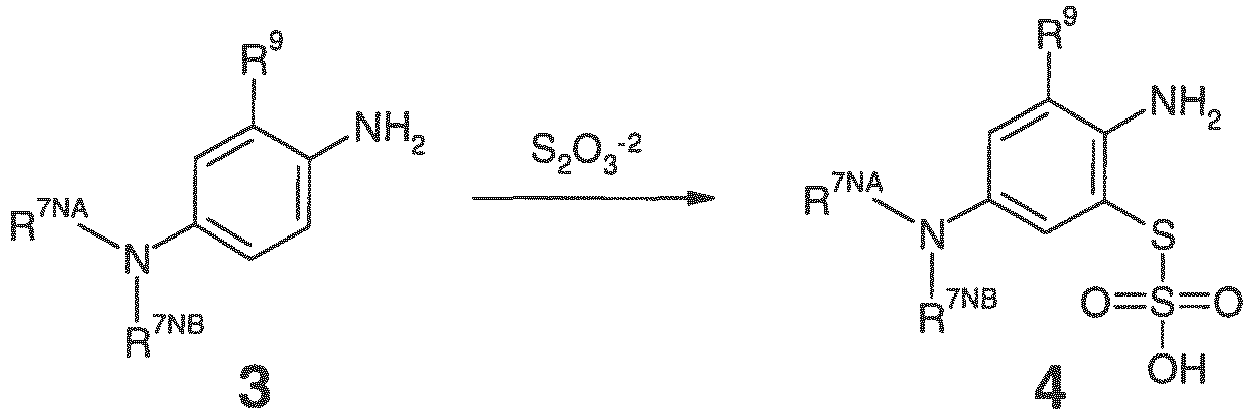
- In one example, an N,N-dimethyl-1,4-diamino-benzene, 3', is oxidized in the presence of a thiosulfate to give a thiosulfuric acid S-{2-(amino)-5-(dimethylamino)-phenyl} ester, 4', as illustrated in the following scheme:

- The thiosulfate is or comprises S2O3 -2.
- In one example, the thiosulfate is or comprises Na2S2O3.
- In one example, the thiosulfate is Na2S2O3 or a hydrate thereof.
- Na2S2O3 may be obtained commercially, for example, as the anhydrous salt or as the pentahydrate.
- In one example, the molar ratio of thiosulfate to diamine, 3, is 0.8 to 1.5.
- In one example, the molar ratio is 1.0 to 1.5.
- In one example, the molar ratio is 1.1 to 1.5.
- In one example, the molar ratio is 1.1 to 1.3.
- In one example, the oxidation is by reaction with an oxidizing agent.
- In one example, the oxidizing agent is or comprises Cr(VI).
- In one example, the oxidizing agent is or comprises Cr2O7 -2.
- In one example, the oxidizing agent is or comprises Na2Cr2O7.
- In one example, the oxidizing agent is Na2Cr2O7 or a hydrate thereof.
- Na2Cr2O7 may be obtained commercially, for example, as a dihydrate.
- In one example, the molar ratio of Cr(VI) to diamine, 3, is 0.2 to 2.0.
- In one example, the molar ratio is 0.2 to 1.0.
- In one example, the molar ratio is 0.2 to 0.8.
- In one example, the molar ratio is 0.3 to 0.7.
- In one example, the reaction is performed in an aqueous medium.
- In one example, the reaction temperature is 2 to 25°C.
- In one example, the reaction temperature is 2 to 15°C.
- In one example, the reaction temperature is 2 to 10°C.
- In one example, the reaction temperature is about 5°C.
- In one example, the reaction time is 10 to 240 minutes.
- In one example, the reaction time is 30 to 120 minutes.
- In one example, the reaction time is about 60 minutes.
- In one example, the reaction mixture is stirred during the reaction step.
- In this step, a thiosulfuric acid S-{2-(amino)-3-(optionally substituted)-5-(disubstituted amino)-phenyl} ester, 4, is oxidatively coupled to an N,N-disubstituted-3-optionally substituted-aniline, 5, using an oxidizing agent that is or comprises Cr(VI), to give a [4-{2-(thiosulfate)-4-(disubstituted amino)-6-(optionally substituted)-phenyl-imino}-3-(optionally substituted)-cyclohexa-2,5-dienylidene]-N,N-disubstituted ammonium, 6, as illustrated in the following scheme:

- In one example, a thiosulfuric acid S-{2-(amino)-5-(dimethylamino)-phenyl} ester, 4', is oxidatively coupled to an N,N-dimethyl-aniline, 5', using an oxidizing agent that is or comprises Cr(VI), to give a [4-{2-(thiosulfate)-4-(dimethylamino)-phenyl-imino}-cyclohexa-2,5-dienylidene]-N,N-dimethyl ammonium, 6', as illustrated in the following scheme:

- In one example, the ester, 4, is added first, before the aniline, 5, is added.
- In one example, the oxidizing agent is or comprises Cr2O7 -2.
- In one example, the oxidizing agent is or comprises Na2Cr2O7.
- In one example, the oxidizing agent is Na2Cr2O7.
- In one example, the molar ratio of ester, 4, to aniline, 5, is 0.5 to 1.5.
- In one example, the range is 0.8 to 1.2.
- In one example, the range is about 1.0.
- In one example, the molar ratio of Cr(VI) to aniline, 5, is 1.0 to 4.0.
- In one example, the range is 1.6 to 3.0.
- In one example, the range is 2.0 to 3.0.
- In one example, the range is about 2.2.
- In one example, the reaction is performed under acidic conditions.
- In one example, the reaction is performed at a pH of 1 or less.
- In one example, the reaction is performed at a pH of 1 to -1.
- In one example, the reaction is performed at a pH of 1 to 0.
- In one example, the pH at the end of the reaction step, is 2 to 6.
- In one example, the pH at the end of the reaction step, is 3 to 5.
- In one example, the pH at the end of the reaction step, is about 4.
- In one example, the pH at the end of the reaction step, is about 3.94.
- In one example, the acidic conditions are obtained using a strong acid.
- In one example, the acidic conditions are obtained using H2SO4 (which has two strong acid protons).
- In one example, the molar ratio of acid protons to aniline, 5, is 1.0 to 4.0.
- In one example, the range is 1.5 to 2.5.
- In one example, the range is about 2.0.
- In one example, the reaction is performed in an aqueous medium.
- In one example, the reaction temperature is 2 to 20°C.
- In one example, the reaction temperature is 2 to 15°C.
- In one example, the reaction temperature is about 5°C.
- In one example, the reaction time is 10 minutes to 12 hours.
- In one example, the reaction time is 30 minutes to 4 hours.
- In one example, the reaction time is about 2 hours.
- In one example, the reaction mixture is stirred during the reaction step.
- In one example, aniline, 5, is the same as aniline, 1.
- In this step, the product of the oxidative coupling (OC) step is treated to convert residual Cr(VI) to Cr(III).
- In one example, at least 25% of residual Cr(VI) is converted to Cr(III).
- In one example, the range is at least 35% (i.e., 35 to 100%).
- In one example, the range is at least 50% (i.e., 50 to 100%).
- In one example, the range is at least 60% (i.e., 60 to 100%).
- In one example, the range is at least 70% (i.e., 70 to 100%).
- In one example, the range is at least 80% (i.e., 80 to 100%).
- In one example, the range is at least 90% (i.e., 90 to 100%).
- In one example, the range is at least 95% (i.e., 95 to 100%).
- In one example, substantially all of residual Cr(VI) is converted to Cr(III).
- The reaction time is selected so as to achieve conversion of a suitable proportion of Cr(VI) to Cr(III).
- In one example, the reaction mixture is stirred during the reaction step.
- In one example, the reaction is performed in an aqueous medium.
- In one example, the treatment is treatment with a reducing agent.
- In one example, the reducing agent is a hydrosulfite (also known as dithionite).
- The hydrosulfite is or comprises S2O4 -2.
- In one example, the hydrosulfite is a metal hydrosulfite.
- In one example, the hydrosulfite is an alkali metal hydrosulfite.
- In one example, the hydrosulfite is or comprises Na2S2O4 (also known as sodium hydrosulfite and sodium dithionite).
- In one example, the hydrosulfite is Na2S2O4 or a hydrate thereof.
- Without wishing to be bound to any particular theory, it is believed that Cr(VI) reacts with hydrosulfite to form CR(III) and sodium sulfate (e.g., Na2Cr2O7 +
Na2S2O4 → Cr2O3 + 2 Na2SO4).
- In one example, the molar amount of hydrosulfite is from 0.02 to 1.0 times the total molar amount of Cr(VI) that was used in the thiosulfonic acid formation (TSAF) step (if performed, and if performed using Cr(VI)) and the oxidative coupling (OC) step.
- In one example, the range is 0.03 to 0.7.
- In one example, the range is 0.05 to 0.5.
- In one example, the range is 0.05 to 0.3.
- In one example, the range is 0.1 to 0.2.
- In one example, the molar amount is about 0.16 times.
- In one example, the hydrosulfite is aqueous hydrosulfite.
- In one example, the reaction time is 1 minute to 6 hours.
- In one example, the reaction time is 2 minutes to 1 hour.
- In one example, the reaction time is about 10 minutes.
- In one example, the reaction temperature is 2 to 50°C.
- In one example, the reaction temperature is 5 to 30°C.
- In one example, the reaction temperature is 10 to 25°C.
- In one example, the reaction temperature is room temperature.
- In one example, the reducing agent is an alkanol.
- In one example, the alkanol is or comprises a C1-6alkanol.
- In one example, the C1-6alkanol is a saturated aliphatic C1-6alkanol.
- In one example, the C1-6alkanol is ethanol.
- Without wishing to be bound to any particular theory, it is believed that Cr(VI) reacts with alkanol (e.g., ethanol) to form CR(III) and the corresponding aldehyde, i.e., alkanal (e.g., ethanal), which can easily be removed by evaporation.
- In one example, the molar amount of alkanol (e.g., ethanol) is from 0.02 to 1.0 times the total molar amount of Cr(VI) that was used in the thiosulfonic acid formation (TSAF) step (if performed, and if performed using Cr(VI)) and the oxidative coupling (OC) step.
- In one example, the range is 0.03 to 0.7.
- In one example, the range is 0.05 to 0.5.
- In one example, the range is 0.05 to 0.3.
- In one example, the range is 0.1 to 0.2.
- In one example, the molar amount is about 0.12 times.
- In one example, the reaction time is 1 hour to 48 hours.
- In one example, the reaction time is 2 hours to 24 hours.
- In one example, the reaction time is about 16 hours.
- In one example, the reaction temperature is 2 to 50°C.
- In one example, the reaction temperature is 5 to 30°C.
- In one example, the reaction temperature is 10 to 25°C.
- In one example, the reaction temperature is room temperature.
- In one example, the reducing agent is an iodide.
- Without wishing to be bound to any particular theory, it is believed that Cr(VI) reacts with iodide to form CR(III) and iodine.
- In one example, the iodide is or comprises alkali metal iodide.
- In one example, the iodide is or comprises sodium iodide or potassium iodide.
- In one example, the iodide is or comprises potassium iodide.
- In one example, the iodide is potassium iodide.
- In one example, the molar amount of iodide is from 0.02 to 1.0 times the total molar amount of Cr(VI) that was used in the thiosulfonic acid formation (TSAF) step (if performed, and if performed using Cr(VI)) and the oxidative coupling (OC) step.
- In one example, the range is 0.03 to 0.7.
- In one example, the range is 0.05 to 0.5.
- In one example, the range is 0.05 to 0.3.
- In one example, the range is 0.1 to 0.3.
- In one example, the molar amount is about 0.18 times.
- In one example, the iodide is aqueous iodide (e.g., aqueous sodium iodide).
- In one example, the reaction time is 1 hour to 24 hours.
- In one example, the reaction time is 2 hours to 18 hours.
- In one example, the reaction time is about 12 hours.
- In one example, the reaction temperature is 2 to 50°C.
- In one example, the reaction temperature is 5 to 30°C.
- In one example, the reaction temperature is 10 to 25°C.
- In one example, the reaction temperature is 25°C or less.
- In one example, the reaction temperature is 15°C or less.
- In one example, the reaction temperature is 2 to 25°C.
- In one example, the reaction temperature is 2 to 15°C.
- In one example, the treatment is treatment with an acid or a base (e.g., a strong acid or a strong base) to achieve a pH of 5.70 to 6.35 (measured at room temperature).
- Without wishing to be bound to any particular theory, it is believed that, at a pH in this range, Cr(VI) reacts to form Cr(III).
- In one example, the pH range is 5.80 to 6.25.
- In one example, the pH range is 5.90 to 6.15.
- In one example, the pH range is 5.95 to 6.10.
- In one example, the pH is about 6.02.
- In one example, the treatment is with strong acid or strong base.
- In one example, the treatment is with strong base.
- In one example, the treatment is with aqueous NaOH (e.g., 10%).
- In one example, the reaction time is 1 hour to 48 hours.
- In one example, the reaction time is 2 hours to 24 hours.
- In one example, the reaction time is about 16 hours.
- In one example, the reaction temperature is 2 to 25°C.
- In one example, the reaction temperature is 2 to 15°C.
- In one example, the reaction temperature is 5 to 10°C.
- In this step, the zwitterionic intermediate, 6, is isolated and purified.

- In one example, the isolation and purification is by filtration.
- In one example, the isolation and purification is by filtration followed by washing.
- In one example, the washing is washing with H2O.
- In one example, the washing is washing with H2O and tetrahydrofuran (THF).
- In one example, the volume ratio of H2O to THF is 1:1 to 10:1, preferably 4:1.
- In one example, the isolation and purification is by filtration followed by washing and drying.
- In one example, the drying is air-drying.
- In one example, the drying is air-drying for 2 to 72 hours.
- In one example, the drying is air-drying for 2 to 48 hours.
- In one example, the drying is air-drying for 2 to 24 hours.
- In one example, the drying is oven-drying.
- In one example, the drying is oven-drying for 2 to 72 hours.
- In one example, the drying is oven-drying for 2 to 48 hours.
- In one example, the drying is oven-drying for 2 to 24 hours.
- In one example, the drying is oven-drying at 30 to 60°C for 2 to 48 hours.
- For example, in one example, the reaction mixture is filtered, and the residue (e.g., ∼100 mmol crude product) is washed with H2O (e.g., 4 x 250 cm3) and THF (e.g., 100 cm3), and then air-dried overnight.
- For example, in one example, the reaction mixture is filtered (e.g., through a Buchner filter under vacuum), the solid removed, added to another vessel with fresh water, the mixture stirred vigorously, and filtered again. The "filter-recover-resuspend" process may be repeated a number of times. The finally obtained solid may be used in subsequent steps.
- In this step, a [4-{2-(thiosulfate)-4-(disubstituted amino)-6-(optionally substituted)-phenyl-imino}-3-(optionally substituted)-cyclohexa-2,5-dienylidene]-N,N-disubstituted ammonium, 6, is subjected to ring closure to give a 3,7-bis(disubstituted-amino)-1,9-(optionally substituted)-phenothiazin-5-ium salt, 7, as illustrated in the following scheme:

- In one example, a [{2-(thiosulfate)-4-(dimethylamino)-phenyl-imino}-cyclohexa-2,5-dienylidene]-N,N-dimethyl ammonium, 6', is subjected to ring closure to give a 3,7-bis(dimethylamino)-phenothiazin-5-ium salt, 7', as illustrated in the following scheme:

- In one example, ring closure is achieved by treatment with an oxidizing agent.
- In one example, the oxidizing agent is or comprises Cu(II).
- In one example, the oxidizing agent is or comprises Cu(II) sulfate.
- In one example, the oxidizing agent is Cu(II) sulfate or a hydrate thereof.
- Cu(II) sulfate may be obtained commercially, for example, as a pentahydrate.
- Without wishing to be bound by any particular theory, it is believed that the Cu(II) is converted to Cu(I) in the reaction, and precipitates as insoluble Cu2O.
- In one example, ring closure is performed under acidic conditions.
- In one example, ring closure is performed at a pH of 1 to 5.
- In one example, ring closure is performed at a pH of 2 to 5.
- In one example, ring closure is performed at a pH of 3 to 4.5.
- In one example, ring closure is performed at a pH of 3.5 to 4.1.
- In one example, ring closure is performed at a pH of about 3.8.
- In one example, the desired pH is obtained by the addition of strong acid.
- In one example, the desired pH is obtained by the addition of HCl.
- In one example, the molar ratio of Cu(II) to ammonium, 6, is 0.02 to 0.10.
- In one example, the range is 0.03 to 0.07
- In one example, the range is about 0.05.
- In one example, the reaction is performed in an aqueous medium.
- In one example, the reaction temperature is 30 to 95°C.
- In one example, the reaction temperature is 50 to 90°C.
- In one example, the reaction temperature is 60 to 90°C.
- In one example, the reaction temperature is about 85°C.
- In one example, the reaction time is 10 to 120 minutes.
- In one xample, the reaction time is 20 to 90 minutes.
- In one example, the reaction time is about 60 minutes.
- In one example, the reaction is performed until the reaction mixture changes colour, e.g., becomes a deep blue colour.
- In one example, the reaction mixture is stirred during the reaction step.
- In one example, after reaction, the reaction mixture is filtered and the filtrate collected. (The filtrate contains the desired product in solution.)
- In one example, the filtration is performed at a temperature near to the reaction temperature, to give a "hot" filtrate.
- In one example, the reaction mixture is first cooled, and the filtration is performed at about room temperature, to give a "cool" filtrate.
- In this step, a 3,7-bis(disubstituted-amino)-1,9-(optionally substituted)-phenothiazin-5-ium salt, 7, is reacted with chloride, to give a 3,7-bis(disubstituted-amino)-1,9-(optionally substituted)-phenothiazin-5-ium chloride salt, 8, as illustrated in the following scheme:

- In one example, a 3,7-bis(dimethylamino)-phenothiazin-5-ium salt, 7', is reacted with chloride, to give a 3,7-bis(dimethylamino)-phenothiazin-5-ium chloride salt, 8' (i.e., MTC), as illustrated in the following scheme:

- In one example, the chloride is hydrochloric acid.
- In one example, the reaction is performed at a relatively low pH.
- In one example, the relatively low pH is -1 to 3.
- In one example, the relatively low pH is 0 to 3.
- In one example, the relatively low pH is 0 to 2.
- In one example, the relatively low pH is about 1.
- In one example, the pH is adjusted to the relatively low pH slowly.
- In one example, the pH is adjusted over a period of 5 to 120 minutes.
- In one example, the pH is adjusted over a period of 5 to 60 minutes.
- In one example, the pH is adjusted over a period of 5 to 30 minutes.
- In one example, the pH is adjusted over a period of about 10 minutes.
- In one example, the reaction is performed at a relatively cool temperature.
- In one example, the relatively cool temperature is 2 to 40°C.
- In one example, the relatively cool temperature is 2 to 30°C.
- In one example, the relatively cool temperature is 5 to 30°C.
- In one example, the relatively cool temperature is 10 to 30°C.
- In one example, the relatively cool temperature is 15 to 30°C.
- In one example, the relatively cool temperature is 20 to 30°C.
- In one example, the relatively cool temperature is about 25°C.
- In one example, the reaction is performed until the reaction mixture (initially, e.g., a deep blue colour) becomes light blue to colourless.
- In one example, the reaction mixture is stirred during the reaction step.
- In one example, the chloride is chloride salt.
- In one example, the chloride is alkali metal chloride.
- In one example, the chloride is sodium chloride.
- In one example, there is a large molar excess of (sodium) chloride.
- In one example, the molar ratio of chloride to salt, 7, is 5 to 100.
- In one example, the molar ratio is 10 to 80.
- In one example, the molar ratio is 10 to 50.
- In one example, the molar ratio is about 20.
- In one example, the reaction is performed in an aqueous medium.
- In one example, the reaction temperature is 20 to 95°C.
- In one example, the reaction temperature is 30 to 95°C.
- In one example, the reaction temperature is 50 to 80°C.
- In one example, the reaction temperature is about 65°C.
- In one example, the reaction temperature is about room temperature.
- In one example, the reaction time is 10 to 30 minutes.
- In one example, the reaction is performed until the reaction mixture (initially, e.g., a deep blue colour) becomes light blue to colourless.
- In one example, the reaction mixture is stirred during the reaction step.
- In one example, the reaction mixture is allowed to cool following addition of the chloride, to yield the product as a precipitate.
- Following the chloride salt formation (CSF) step, one or more additional treatment steps (i.e., ST, DT, CT, EDTAT, OE) may be performed, as described next. If two or more of these treatment steps are performed, they may be performed in any order. These treatment steps give rise to improved purity, especially reduced metal content and reduced organic impurity content.
- In one example, one or more additional treatment steps selected from ST, DT, CT, and EDTAT are performed, followed by OE.
- In this step, a 3,7-bis(disubstituted-amino)-1,9-(optionally substituted)-phenothiazin-5-ium salt, 7, or a 3,7-bis(disubstituted-amino)-1,9-(optionally substituted)-phenothiazin-5-ium chloride salt, 8, is treated with a sulphide.
- In one example, the salt, 7, is treated with a sulphide.
- In one example, the chloride salt, 8, is treated with a sulphide.
- The sulphide is or comprises S2-.
- In one example, the sulphide is a metal sulphide.
- In one example, the sulphide is an alkali metal sulphide.
- In one example, the sulphide is or comprises Na2S.
- In one example, the sulphide is Na2S.
- In one example, the sulphide is a transition metal sulphide.
- In one example, the sulphide is or comprises ZnS.
- In one example, the sulphide is ZnS.
- In one example, the amount of sulphide is 0.01 to 0.20 equivalents.
- In one example, the range is 0.05 to 0.15 equivalents.
- In one example, the range is about 0.1 equivalents.
- In one example, the (initial) concentration of salt 7 or 8 is 0.005 to 0.25 M.
- In one example, range is 0.02 to 0.30 M.
- In one example, range is 0.05 to 0.20 M.
- In one example, the (initial) concentration is about 0.10 M.
- In one example, the treatment is treatment with a sulphide and a chloride.
- In one example, the chloride is or comprises NaCl.
- In one example, the chloride is NaCl.
- In one example, there is a molar excess of chloride.
- In one example, the amount of chloride is 5 to 300 equivalents.
- In one example, the amount of chloride is 5 to 40 equivalents.
- In one example, the amount of chloride is 5 to 30 equivalents.
- In one example, the amount of chloride is about 20 equivalents.
- In one example, the amount of chloride is about 200 equivalents.
- In one example, the treatment is performed at a temperature of 2 to 20°C.
- In one example, the temperature range is 2 to 15°C.
- In one example, the temperature range is 5 to 15°C.
- In one example, the temperature is about 10°C (e.g., 10 ± 2°C).
- In one example, the treatment is performed in an aqueous medium.
- In one example, the treatment is performed under basic conditions.
- In one example, the treatment is performed at a pH of 9 to 12.
- In one example, the treatment is performed at a pH of 10 to 11.
- In one example, the treatment is performed at a pH of about 10.5.
- In one example, the treatment is performed so that the pH of the reaction mixture reaches at least 9 to 12.
- In one example, the treatment is performed so that the pH of the reaction mixture reaches at least 10 to 11.
- In one example, the treatment is performed so that the pH of the reaction mixture reaches at least about 10.5.
- In one example, the treatment is performed at a temperature of about 10°C (e.g., 10 ± 2°C) and at a pH of about 10.5, or is performed so that the pH of the reaction mixture reaches at least about 10.5.
- In one example, the reaction mixture is stirred during the reaction step.
- For example, in one example, crude MTC product is fully dissolved in water at a concentration of about 0.1 M at a temperature of about 65°C. The solution is cooled. The cooled solution is optionally filtered. The solution is treated with about 0.1 equivalents of aqueous sodium sulphide, or an amount sufficient to achieve a pH of about 10.5 (e.g., 10.5 ± 0.5). The resulting mixture is stirred (e.g., for about 10 minutes), filtered, and the filtrate collected. In one example, a large excess of sodium chloride (e.g., about 23 equivalents) is added to the filtrate with stirring, and the resulting precipitate is collected. Alternatively, in another example, the pH of the cool (e.g., about 20°C) solution is adjusted to about pH 1 using HCl, and the resulting precipitate collected.
- In one example, following treatment with sulphide (e.g., and before treatment with chloride), the product (e.g., in solution) is additionally washed with an organic solvent.
- In one example, the organic solvent is selected from dichloromethane, 1,2-dichloroethane, chloroform, ethyl acetate, diethyl ether, chlorobenzene, petroleum ether (e.g., 40:60), benzene, toluene, and methyl acetate. In one example, the organic solvent is dichloromethane.
- In one example, e.g., following washing with an organic solvent, the pH of the solution of the washed product is adjusted to about 4.5 to about 5.5, or about 5.0. In one example, the solution is (e.g., is additionally) heated/cooled to approximately 20°C and then subjected to cool acid recrystallisation (e.g., pH adjusted to about 1 using HCI, and the resulting precipitate collected). In an alternative example, the solution is (e.g., is additionally) heated to approximately 65°C and subjected to hot salting out.
- For example, in one example, crude MTC product is fully dissolved in water at a concentration of about 0.06 M at a temperature of about 60°C. The solution is cooled. The cooled solution is optionally filtered. The solution is treated with about 0.07 equivalents of aqueous sodium sulphide. The resulting mixture is stirred (e.g., for about 15 minutes), filtered, and the filtrate collected. The filtrate is washed with dichloromethane (e.g., several times). In one example, the washed filtrate is heated to about 60°C, and a large excess of sodium chloride (e.g., about 260 equivalents) is added to the (hot) filtrate with stirring. The hot solution is allowed to cool very slowly, and the (highly crystalline) precipitate is collected (e.g., "hot salting out"). Alternatively, in another example, the pH of the cool (e.g., about 20°C) washed filtrate is adjusted to about pH 1 using HCI, and the resulting precipitate collected.
- In this step, a 3,7-bis(disubstituted-amino)-1,9-(optionally substituted)-phenothiazin-5-ium salt, 7, or a 3,7-bis(disubstituted-amino)-1,9-(optionally substituted)-phenothiazin-5-ium chloride salt, 8, is treated with a dimethyldithiocarbamate.
- In one example, the salt, 7, is treated with a dimethyldithiocarbamate.
- In one example, the chloride salt, 8, is treated with a dimethyldithiocarbamate.
- The dimethyldithiocarbamate is or comprises (CH3)2NCS2 -.
- In one example, the dimethyldithiocarbamate is or comprises (CH3)2NCS2Na.
- In one example, the dimethyldithiocarbamate is (CH3)2NCS2Na.
- In one example, the amount of dimethyldithiocarbamate is 0.01 to 0.20 equivalents.
- In one example, the range is 0.05 to 0.15 equivalents.
- In one example, the range is about 0.1 equivalents.
- In one example, the (initial) concentration of salt 7 or 8 is 0.005 to 0.25 M.
- In one example, range is 0.02 to 0.30 M.
- In one example, range is 0.05 to 0.20 M.
- In one example, the (initial) concentration is about 0.10 M.
- In one example, the treatment is treatment with a dimethyldithiocarbamate and a chloride.
- In one example, the chloride is or comprises NaCl.
- In one example, the chloride is NaCl.
- In one example, there is a molar excess of chloride.
- In one example, the amount of chloride is 5 to 40 equivalents.
- In one example, the amount of chloride is 5 to 30 equivalents.
- In one example, the amount of chloride is about 20 equivalents.
- In one example, the treatment is performed in an aqueous medium.
- In one example, the reaction mixture is stirred during the reaction step.
- For example, in one example, crude MTC product is fully dissolved in water at a concentration of about 0.1 M at a temperature of about 65°C. The solution is cooled. The cooled solution is optionally filtered. The solution is treated with about 0.1 equivalents of aqueous dimethyldithiocarbamic acid, sodium salt. The resulting mixture is stirred (e.g., for about 10 minutes), filtered, and the filtrate collected. A large excess of sodium chloride (e.g., about 23 equivalents) is added to the filtrate with stirring, and the resulting precipitate is collected.
- In one example, following treatment with dimethyldithiocarbamate (e.g., and before treatment with chloride), the product (e.g., in solution) is additionally washed with an organic solvent, as described above for sulphide treatment.
- In one example, e.g., following washing with an organic solvent, the pH of the solution of the washed product is adjusted to about 4.5 to about 5.5, or about 5.0, as described above for sulphide treatment.
- In this step, a 3,7-bis(disubstituted-amino)-1,9-(optionally substituted)-phenothiazin-5-ium salt, 7, or a 3,7-bis(disubstituted-amino)-1,9-(optionally substituted)-phenothiazin-5-ium chloride salt, 8, is treated with a carbonate.
- In one example, the salt, 7, is treated with a carbonate.
- In one example, the chloride salt, 8, is treated with a carbonate.
- The carbonate is or comprises CO3 2-.
- In one example, the carbonate is or comprises alkali metal carbonate.
- In one example, the carbonate is or comprises sodium carbonate.
- In one example, the carbonate is sodium carbonate.
- In one example, the amount of sodium carbonate is 0.01 to 0.20 equivalents.
- In one example, the range is 0.05 to 0.15 equivalents.
- In one example, the amount is about 0.1 equivalents.
- In one example, the (initial) concentration of salt 7 or 8 is 0.005 to 0.25 M.
- In one example, range is 0.02 to 0.30 M.
- In one example, range is 0.05 to 0.20 M.
- In one example, the (initial) concentration is about 0.10 M.
- In one example, the treatment is treatment with a carbonate and a chloride.
- In one example, the chloride is or comprises NaCl.
- In one example, the chloride is NaCl.
- In one example, there is a molar excess of chloride.
- In one example, the amount of chloride is 5 to 40 equivalents.
- In one example, the amount of chloride is 5 to 30 equivalents.
- In one example, the amount of chloride is about 20 equivalents.
- In one example, the treatment is performed in an aqueous medium.
- In one example, the reaction mixture is stirred during the reaction step.
- For example, in one example, crude MTC product is fully dissolved in water at a concentration of about 0.1 M at a temperature of about 65°C. The solution is cooled. The cooled solution is optionally filtered. The solution is treated with about 0.1 equivalents of aqueous sodium carbonate. The resulting mixture is stirred (e.g., for about 10 minutes), filtered, and the filtrate collected. A large excess of sodium chloride (e.g., about 23 equivalents) is added to the filtrate with stirring, and the resulting precipitate is collected.
- In one example, following treatment with carbonate (e.g., and before treatment with chloride), the product (e.g., in solution) is additionally washed with an organic solvent, as described above for sulphide treatment.
- In one example, e.g., following washing with an organic solvent, the pH of the solution of the washed product is adjusted to about 4.5 to about 5.5, or about 5.0, as described above for sulphide treatment.
- In this step, a 3,7-bis(disubstituted-amino)-1,9-(optionally substituted)-phenothiazin-5-ium salt, 7, or a 3,7-bis(disubstituted-amino)-1,9-(optionally substituted)-phenothiazin-5-ium chloride salt, 8, is treated with ethylenediaminetetraacetic acid (EDTA) or an EDTA salt.
- In one example, the salt, 7, is treated with EDTA or an EDTA salt.
- In one example, the chloride salt, 8, is treated with EDTA or an EDTA salt.
- In one example, the EDTA salt is or comprises EDTA alkali metal salt.
- In one example, the EDTA salt is or comprises EDTA disodium salt.
- In one example, the EDTA salt is EDTA disodium salt.
- In one example, the amount of EDTA is 0.01 to 0.20 equivalents.
- In one example, the range is 0.05 to 0.15 equivalents.
- In one example, the amount is about 0.1 equivalents.
- In one example, the (initial) concentration of salt 7 or 8 is 0.005 to 0.25 M.
- In one example, range is 0.02 to 0.30 M.
- In one example, range is 0.05 to 0.20 M.
- In one example, the (initial) concentration is about 0.10 M.
- In one example, the treatment is treatment with EDTA or an EDTA salt and a chloride.
- In one example, the chloride is or comprises NaCl.
- In one example, the chloride is NaCl.
- In one example, there is a molar excess of chloride.
- In one example, the amount of chloride is 5 to 40 equivalents.
- In one example, the amount of chloride is 5 to 30 equivalents.
- In one example, the amount of chloride is about 10 equivalents.
- In one example, the treatment is performed in an aqueous medium.
- In one example, the reaction mixture is stirred during the reaction step.
- For example, in one example, crude MTC product is fully dissolved in water at a concentration of about 0.1 M at a temperature of about 65°C. The solution is cooled to room temperature, and then the solution is treated with about 0.1 equivalents of aqueous EDTA disodium salt. The resulting mixture is stirred (e.g., for about 1 hour), filtered, and the filtrate collected. A large excess of sodium chloride (e.g., about 10 equivalents) is added to the filtrate with stirring, and the resulting precipitate is collected. In one example, following treatment with EDTA (e.g., and before treatment with chloride), the product (e.g., in solution) is additionally washed with an organic solvent, as described above for sulphide treatment.
- In one example, e.g., following washing with an organic solvent, the pH of the solution of the washed product is adjusted to about 4.5 to about 5.5, or about 5.0, as described above for sulphide treatment.
- In this step, a 3,7-bis(disubstituted-amino)-1,9-(optionally substituted)-phenothiazin-5-ium salt, 7, or a 3,7-bis(disubstituted-amino)-1,9-(optionally substituted)-phenothiazin-5-ium chloride salt, 8, in aqueous solution or suspension, is treated with (e.g., washed with) an organic solvent.
- In one example, the salt, 7, in aqueous solution or suspension, is treated with (e.g., washed with) an organic solvent.
- In one example, the chloride salt, 8, in aqueous solution or suspension, is treated with (e.g., washed with) an organic solvent.
- In one example, the organic solvent is dichloromethane (CH2Cl2, DCM). DCM is a "class 2" chemical, with a permitted daily exposure (PDE) of 6 mg/day.
- In one example, the volume ratio of aqueous solution or suspension of salt, 7 or 8, to organic solvent (e.g., DCM) is 0.1 to 10.
- In one example, the ratio is 0.5 to 5.
- In one example, the ration is 0.5 to 2.
- In one example, the treatment (e.g., washing) is performed iteratively using a plurality of aliquots of the organic solvent (e.g., DCM).
- For example, in one example, 250 mL of aqueous solution of the salt, 7 or 8, is washed with 50 mL of DCM, five times, for a total volume of 250 mL DCM, and a volume ratio of 1.
- In one example, aqueous solution or suspension of salt, 7 or 8, has a pH of 8 to 12.
- In one example, the pH range is 9 to 12.
- In one example, the pH range is 9 to 11.
- In one example, the pH range is about 10.8.
- In one example, the treatment (e.g., washing) is performed at a temperature of 2 to 20°C.
- In one example, the temperature range is 2 to 15°C.
- In one example, the temperature is about 10°C.
- Treatment (e.g., washing) may be performed, for example, using a reaction vessel equipped with an overhead mechanical stirrer attached to a shaft with a paddle as well as a run-off tap at the bottom of the flask. Aqueous solution or suspension of salt, 7 or 8, is placed in the vessel, and an aliquot of organic solvent (e.g., DCM) is added and the heterogeneous mixture stirred for a suitable period. The layers are allowed to separate, and the lower (organic solvent) layer is discarded via the run-off tap. Another aliquot of organic solvent (e.g., DCM) is added and the process repeated, e.g., several times.
- Organic extraction (OE) is particularly effective at greatly reducing the organic impurity levels of the solid (e.g., crystalline) product ultimately obtained.
- In one example, one or more additional treatment steps selected from ST, DT, CT, and EDTAT are performed first, followed by organic extraction (OE).
- In this step, a 3,7-bis(disubstituted-amino)-1,9-(optionally substituted)-phenothiazin-5-ium salt, 7, or a 3,7-bis(disubstituted-amino)-1,9-(optionally substituted)-phenothiazin-5-ium chloride salt, 8, is recrystallised.
- In one example, the salt, 7, is recrystallised.
- In one example, the chloride salt, 8, is recrystallised.
- The recrystallisation step further improves purity and also provides a product with a suitable particle size, e.g., a particle size suitable for use in subsequent pharmaceutical formulation.
- For the avoidance of doubt, note that "crystallisation" and "recrystallisation" are used interchangeably herein to mean the formation of a solid precipitate (e.g., crystals) from a solution or suspension, and that "re-" in the term "recrystallisation" does not require that the newly crystallised product was previously in a solid or crystalline form.
- In one example, the recrystallisation is recrystallisation from water (e.g., from an aqueous solution or aqueous suspension) at a relatively cool temperature by adjusting the pH to a relatively low pH (e.g., "cool acidic crystallisation").
- In one example, the pH is adjusted using HCI.
- In one example, the relatively cool temperature is 2 to 40°C.
- In one example, the relatively cool temperature is 2 to 30°C.
- In one example, the relatively cool temperature is 5 to 30°C.
- In one example, the relatively cool temperature is 10 to 30°C.
- In one example, the relatively cool temperature is 15 to 30°C.
- In one example, the relatively cool temperature is 20 to 30°C.
- In one example, the relatively cool temperature is about 25°C.
- In one example, the relatively low pH is -1 to 3.
- In one example, the relatively low pH is 0 to 3.
- In one example, the relatively low pH is 0 to 2.
- In one example, the relatively low pH is about 1.
- In one example, the pH is adjusted to the relatively low pH slowly.
- In one example, the pH is adjusted over a period of 5 to 120 minutes.
- In one example, the pH is adjusted over a period of 5 to 60 minutes.
- In one example, the pH is adjusted over a period of 5 to 30 minutes.
- In one example, the pH is adjusted over a period of about 10 minutes.
- Cool acidic recrystallisation (RX-CAR) is particularly effective at greatly reducing the metal content of the results solid (e.g., crystalline) product.
- In one example, the recrystallisation is recrystallisation from water (e.g., from an aqueous solution or aqueous suspension) at an initial elevated temperature, in the presence of a chloride, such as sodium chloride (e.g., "hot salting out").
- In one example, the (initial) concentration of salt 7 or 8 is 0.002 to 0.05 M.
- In one example, range is 0.005 to 0.04 M.
- In one example, range is 0.01 to 0.04 M.
- In one example, the (initial) concentration is about 0.03 M.
- In one example, the initial elevated temperature is 30 to 90°C.
- In one example, the range is 40 to 80°C.
- In one example, the range is 50 to 80°C.
- In one example, the initial elevated temperature is about 65°C.
- In one example, the (initial) concentration of (sodium) chloride is 0.1 to 3.0 M.
- In one example, the range is 0.5 to 2.5 M.
- In one example, the range is 1.0 to 2.2 M.
- In one example, the (initial) concentration is about 2.0 M.
- In one example, there is a large molar excess of (sodium) chloride.
- In one example, the molar ratio of (sodium) chloride to salt, 7 or 8, is 5 to 100.
- In one example, the molar ratio is 20 to 80.
- In one example, the molar ratio is 50 to 80.
- In one example, the molar ratio is about 65.
- In one example, the recrystallisation includes subsequent drying of the recrystallised (highly crystalline) precipitate, for example, in an oven at a suitable temperature (e.g., 50 to 120°C) for a suitable time (e.g., 1 to 24 hours).
- For example, in one example, crude MTC product or treated crude MTC product is dissolved in H2O at a concentration of about 0.03 M, and at approximately 65°C. Optionally, the solution is filtered. Sodium chloride is added. The mixture is allowed to cool, for example, to about room temperature, slowly, for example, over 1 to 10 hours. The resulting (highly crystalline) precipitate is collected, and optionally dried, for example, in an oven (e.g., at about 75°C) for an appropriate time (e.g., about 16 hours).
- In one example, the recrystallisation is recrystallisation from water (e.g., from an aqueous solution or aqueous suspension) at an initial elevated temperature, in the presence of tetrahydrofuran (THF) (e.g., trituration).
- In one example, the (initial) concentration of salt 7 or 8 is 0.002 to 0.20 M.
- In one example, range is 0.01 to 0.20 M.
- In one example, range is 0.05 to 0.15 M.
- In one example, the (initial) concentration is about 0.13 M.
- In one example, the initial elevated temperature is 30 to 90°C.
- In one example, the range is 40 to 80°C.
- In one example, the range is 50 to 80°C.
- In one example, the initial elevated temperature is about 65°C.
- In one example, the ratio of water to THF is 20:1 to 2:1, by volume.
- In one example, the range is 10:1 to 2:1.
- In one example, the range is 7:1 to 3:1.
- In one example, the ratio is about 5:1.
- In one example, the recrystallisation includes subsequent drying of the recrystallised (highly crystalline) precipitate, for example, in an oven at a suitable temperature (e.g., 50 to 120°C) for a suitable time (e.g., 1 to 24 hours).
- For example, in one example, crude MTC product or treated crude MTC product is dissolved in water at a concentration of about 0.13 M, and at approximately 65°C. Optionally, the solution is filtered. The mixture is allowed to cool slowly, and THF is added when the temperature reaches about 25°C, at a water:THF volume ratio of about 5:1. The mixture is again allowed to cool, for example, to about 5°C, slowly, for example, over 1 to 10 hours. The resulting (highly crystalline) precipitate is collected, and optionally dried, for example, in an oven (e.g., at about 100°C) for an appropriate time (e.g., about 2 hours).
- One important difference between the known methods and the presently disclosed Method B is the use of sodium sulphide (Na2S) instead of other sulphides, such as hydrogen sulphide (H2S) in the ring fusion (RF-2) step. See, for example, Michaelis et al., 1940. However, hydrogen sulphide is extremely dangerous and is both difficult and expensive to use in an industrial process. By using sodium sulphide, these disadvantages are overcome. In addition, sodium sulphide is a solid, is easier to handle, and can be weighed more easily and accurately; this permits better control of the reaction.
- In one example, the method comprises the step of:
ring fusion (RF-2). - In one example, the method additionally comprises the subsequent step of:
chloride salt formation (CSF-2). - In one example, the method additionally comprises the initial step of:
nitrosyl reduction (NR-2). - In one example, the method additionally comprises the initial steps of:
- nitrosylation (NOS-2);
- nitrosyl reduction (NR-2).
- In one example, the method additionally comprises the initial steps of:
- N,N-disubstitution (NNDS-2);
- nitrosylation (NOS-2);
- nitrosyl reduction (NR-2).
- Thus, in one example, the method comprises the steps of, in order:
- N,N-disubstitution (NNDS-2);
- nitrosylation (NOS-2);
- nitrosyl reduction (NR-2);
- ring fusion (RF-2);
- chloride salt formation (CSF-2).
- This method is particularly well suited for the synthesis of diaminophenothiazinium compounds wherein R1 and R9 are other than -H, as in, for example, 1,9-diethyl methylthioninium chloride (DEMTC).
- In this step, a 3-optionally substituted-aniline, 9, is N,N-disubstituted using an alkyl halide, an alkenyl halide, or a haloalkyl halide, to give a N,N-disubstituted-3-optionally substituted-aniline, 10, as illustrated in the following scheme:

- In one example, a 3-ethyl-aniline, 9, is N,N-dimethylated using a methyl halide, to give a N,N-dimethyl-3-ethyl-aniline, 10, as illustrated in the following scheme:

- In one example, the reaction uses an alkyl halide.
- In one example, the reaction uses an alkenyl halide.
- In one example, the reaction uses a haloalkyl halide.
- In one example, the halide is a chloride, bromide, or iodide.
- In one example, the halide is a bromide or iodide.
- In one example, the halide is an iodide.
- In one example, the reaction uses methyl iodide.
- In one example, the molar ratio of alkyl halide, alkenyl halide, or haloalkyl halide, to aniline, 9, is 2.0 to 4.0. In one example, the molar ratio is 2.5 to 3.5.
- In one example, the reaction is performed under basic conditions.
- In one example, the reaction is performed at a pH of 8 or more.
- In one example, the reaction is performed at a pH of 8 to 14.
- In one example, the reaction is performed at a pH of 8 to 12.
- In one example, the reaction is performed at a pH of 8 to 10.
- In one example, the basic conditions are obtained using sodium carbonate.
- In one example, the molar ratio of alkyl halide, alkenyl halide, or haloalkyl halide to base (e.g., sodium carbonate) is about 2.0.
- In one example, the reaction temperature is 25 to 65°C.
- In one example, the reaction temperature is 35 to 55°C.
- In one example, the reaction temperature is about 45°C.
- In one example, the reaction time is 1 to 24 hours.
- In one example, the reaction time is 2 to 18 hours.
- In one example, the reaction time is about 10 hours.
- In one example, the reaction mixture is stirred during the reaction step.
- In one example, the reaction is terminated by the addition of water.
- In this step, an N,N-disubstituted-3-optionally substituted aniline, 10, is 4-nitrosylated to give the corresponding N,N-disubstituted-3-optionally substituted-4-nitrosyl aniline, 11, as illustrated in the following scheme:

- In one example, an N,N-dimethyl-3-ethyl-aniline, 10', is 4-nitrosylated to form the corresponding N,N-dimethyl-3-ethyl-4-nitrosyl aniline, 11', as illustrated in the following scheme:

- In one example, the nitrosylation is performed using a nitrite.
- In one example, the nitrite is or comprises NO2 -.
- In one example, the nitrite is or comprises alkali metal nitrite.
- In one example, the nitrite is or comprises sodium nitrite or potassium nitrite.
- In one example, the nitrite is or comprises sodium nitrite.
- In one example, the nitrite is sodium nitrite.
- In one example, the molar ratio of nitrite to aniline, 9, is 0.8 to 1.5.
- In one example, the molar ratio is 1.0 to 1.5.
- In one example, the molar ratio is 1.0 to 1.3.
- In one example, the molar ratio is 1.0 to 1.1.
- In one example, the molar ratio is 1.1 to 1.5.
- In one example, the molar ratio is 1.1 to 1.3.
- In one example, the reaction is performed under acidic conditions.
- In one example, the reaction is performed at a pH of 1 or less.
- In one example, the reaction is performed at a pH of 1 to -1.
- In one example, the reaction is performed at a pH of 1 to 0.
- In one example, the acidic conditions are obtained using a strong acid.
- In one example, the acidic conditions are obtained using HCI (which has one strong acid proton).
- In one example, the molar ratio of acid protons to aniline, 9, is 1 to 4.
- In one example, the range is 2 to 4.
- In one example, the range is 3 to 4.
- In one example, the ratio is about 3.2.
- In one example, the range is 2 to 3.
- In one example, the range is 2.25 to 2.75.
- In one example, the ratio is about 2.5.
- In one example, the reaction is performed in an aqueous medium.
- In one example, the reaction temperature is 2 to 25°C.
- In one example, the reaction temperature is 2 to 15°C.
- In one example, the reaction temperature is 2 to 10°C.
- In one example, the reaction temperature is about 5°C.
- In one example, the reaction time is 10 to 240 minutes.
- In one example, the reaction time is 30 to 120 minutes.
- In one example, the reaction time is about 60 minutes.
- In one example, the reaction mixture is stirred during the reaction step.
- In this step, an N,N-disubstituted-3-optionally substituted-4-nitrosyl aniline, 11, is reduced to give an N,N-disubstituted-1,4-diamino-5-optionally substituted benzene, 12, as illustrated in the following scheme:

- In one example, an N,N-dimethyl-3-ethyl-4-nitrosyl-aniline, 11', is reduced to give an N,N-dimethyl-1,4-diamino-3-ethyl-benzene, 12', as illustrated in the following scheme:

- In one example, the reduction is by reaction with a reducing agent.
- In one example, the reducing agent is or comprises Fe(0).
- In one example, the reducing agent is or comprises metallic iron.
- In one example, the reducing agent is metallic iron.
- Metallic iron may be obtained commercially, for example, as metal filings.
- In one example, the molar ratio of Fe(0) to aniline, 9, is 1.0 to 4.0.
- In one example, the molar ratio is 1.5 to 4.0.
- In one example, the molar ratio is 1.5 to 3.0.
- In one example, the molar ratio is 1.5 to 2.5.
- In one example, the reaction is performed under acidic conditions.
- In one example, the reaction is performed at a pH of 1 or less.
- In one example, the reaction is performed at a pH of 1 to -1.
- In one example, the reaction is performed at a pH of 1 to 0.
- In one example, the acidic conditions are obtained using a strong acid.
- In one example, the acidic conditions are obtained using HCI (which has one strong acid proton).
- In one example, the molar ratio of acid protons to aniline, 9, is 1 to 4.
- In one example, the range is 2 to 4.
- In one example, the range is 3 to 4.
- In one example, the ratio is about 3.2.
- In one example, the range is 2 to 3.
- In one example, the range is 2.25 to 2.75.
- In one example, the ratio is about 2.5.
- In one example, the reaction is performed in an aqueous medium.
- In one example, the reaction is performed at a temperature of 2 to 35°C.
- In one example, the reaction is performed at a temperature of 10 to 30°C.
- In one example, the reaction is performed for a time of 10 minutes to 12 hours.
- In one example, the reaction is performed for a time of 30 minutes to 6 hours.
- In one example, the reaction is performed for a time of about 3 hours.
- In one example, the reaction mixture is stirred during the reaction step.
- In this step, two molecules of N,N-disubstituted-1,4-diamino-5-optionally substituted benzene, 12, are fused in the presence of alkali metal sulphide and iron(III), at a pH of 0.6 to 2.6, to give a 3,7-bis(disubstituted-amino)-1,9-(optionally substituted)-phenothiazin-5-ium salt, 13, as illustrated in the following scheme:

- In one example, two molecules of N,N-dimethyl-1,4-diamino-5-ethyl-benzene, 12, are fused in the presence of alkali metal sulphide and iron(III) at a pH of 0.6 to 2.6, to give a 3,7-bis(dimethyl-amino)-1,9-(diethyl)-phenothiazin-5-ium salt, 13, as illustrated in the following scheme:

- In one example, the alkali metal sulphide is or comprises sodium sulphide or potassium sulphide.
- In one example, the alkali metal sulphide is or comprises sodium sulphide.
- In one example, the alkali metal sulphide is sodium sulphide.
- In one example, the iron(III) is or comprises iron(III) halide.
- In one example, the iron(III) is or comprises iron(III) chloride.
- In one example, the iron(III) is iron(III) chloride or a hydrate thereof.
- Iron(III) chloride may be obtained commercially, for example, as the anhydrous salt or as the hexahydrate.
- In one example, the reaction is performed under acidic conditions.
- In one example, the reaction is performed at a pH of 0.8 to 2.4.
- In one examle, the range is 1.0 to 2.2.
- In one example, the range is 1.2 to 2.0.
- In one example, the range is 1.4 to 1.8.
- In one example, the pH is about 1.6.
- In one example, the molar ratio of sulphide to aniline, 12, is 0.5 to 2.0.
- In one example, the molar ratio is 0.8 to 1.5.
- In one example, the molar ratio is about 1.0.
- In one example, the molar ratio of Fe(III) to aniline, 12, is 2.0 to 6.0.
- In one example, the molar ratio is 2.6 to 4.0.
- In one example, the molar ratio is about 3.0.
- In one example, the reaction is performed in an aqueous medium.
- In one example, the Fe(III) reagent is added in a plurality of approximately equal portions.
- In one example, the Fe(III) reagent is added in two approximately equal portions.
- In one example, the pH is adjusted to the desired value (e.g., by the addition of strong acid or strong base), the alkali metal sulphide is added, and one-half of the Fe(III) reagent is added. The mixture is then aerated (for example, for 1 hour), and then the remainder of the Fe(III) reagent is added.
- In one example, the reaction is performed at a temperature of 2 to 35°C.
- In one example, the reaction is performed at a temperature of 10 to 30°C.
- In one example, the reaction is performed for a time of 10 minutes to 12 hours.
- In one example, the reaction is performed for a time of 30 minutes to 6 hours.
- In one example, the reaction is performed for a time of about 3 hours.
- In one example, the reaction mixture is stirred during the reaction step.
- In one example, after reaction, the reaction mixture is filtered and the filtrate collected.
- In one example, the filtration is performed at a temperature near to the reaction temperature, to give a "hot" filtrate.
- In one example, the reaction mixture is first cooled, and the filtration is performed at about room temperature, to give a "cool" filtrate.
- In this step, a 3,7-bis(disubstituted-amino)-1,9-(optionally substituted)-phenothiazin-5-ium salt, 13, is reacted with chloride, to give a 3,7-bis(disubstituted-amino)-1,9-(optionally substituted)-phenothiazin-5-ium chloride salt, 14, as illustrated in the following scheme:

- In one example, a 3,7-bis(dimethylamino)-phenothiazin-5-ium salt, 13', is reacted with chloride, to give a 3,7-bis(dimethylamino)-phenothiazin-5-ium chloride salt, 14' (i.e., DEMTC), as illustrated in the following scheme:

- In one example, the chloride is hydrochloric acid.
- In one example, the reaction is performed at a relatively low pH.
- In one example, the relatively low pH is -1 to 3.
- In one example, the relatively low pH is 0 to 3.
- In one example, the relatively low pH is 0 to 2.
- In one example, the relatively low pH is about 1.
- In one example, the pH is adjusted to the relatively low pH slowly.
- In one example, the pH is adjusted over a period of 5 to 120 minutes.
- In one example, the pH is adjusted over a period of 5 to 60 minutes.
- In one example, the pH is adjusted over a period of 5 to 30 minutes.
- In one example, the pH is adjusted over a period of about 10 minutes.
- In one example, the reaction is performed at a relatively cool temperature.
- In one example, the relatively cool temperature is 2 to 40°C.
- In one example, the relatively cool temperature is 2 to 30°C.
- In one example, the relatively cool temperature is 5 to 30°C.
- In one example, the relatively cool temperature is 10 to 30°C.
- In one example, the relatively cool temperature is 15 to 30°C.
- In one example, the relatively cool temperature is 20 to 30°C.
- In one example, the relatively cool temperature is about 25°C.
- In one example, the reaction is performed until the reaction mixture (initially, e.g., a deep blue colour) becomes light blue to colourless.
- In one example, the reaction mixture is stirred during the reaction step.
- In one example, the chloride is chloride salt.
- In one example, the chloride is alkali metal chloride.
- In one example, the chloride is sodium chloride.
- In one example, there is a large molar excess of (sodium) chloride.
- In one example, the molar ratio of chloride to salt, 13, is 5 to 100.
- In one example, the molar ratio is 10 to 80.
- In one example, the molar ratio is 10 to 50.
- In one example, the molar ratio is about 20.
- In one example, the reaction is performed in an aqueous medium.
- In one example, the reaction temperature is 2 to 30°C.
- In one example, the reaction temperature is 2 to 20°C.
- In one example, the reaction temperature is about 5°C.
- In one example, the reaction time is 5 to 30 minutes.
- In one example, the reaction is performed until the reaction mixture changes colour, e.g., becomes red/purple as the product precipitates.
- In one example, the reaction mixture is stirred during the reaction step.
- If desired, one or more of the treatment steps (ST, DT, CT, EDTAT, OE) described above, may additionally be performed.
- If desired, a recystallization step (RX), described above, may additionally be performed.
- This method is particularly well suited for the synthesis of diaminophenothiazinium compounds wherein the groups -N(R3NA)(R3NB) and -N(R7NA)(R7NB) are other than -N(CH3)2, for example, wherein the groups -N(R3NA)(R3NB) and -N(R7NA)(R7NB) are the same and are -N(CH3CH2)2.
- In one example, the method comprises the steps of, in order:
- thiosulfonic acid formation (TSAF-3);
- oxidative coupling (OC-3);
- ring closure (RC-3).
- In one example, the method additionally comprises the subsequent step of:
chloride salt formation (CSF-3). - Thus, in one example, the method comprises the steps of, in order:
- thiosulfonic acid formation (TSAF-3);
- oxidative coupling (OC-3);
- ring closure (RC-3);
- chloride salt formation (CSF-3).
- In this step, an N,N-diethyl-1,4-diamino-benzene, 15, is oxidized in the presence of a thiosulfate to give a thiosulfuric acid S-(2-amino-5-diethylamino-phenyl) ester, 16, as illustrated in the following scheme:

- The thiosulfate is or comprises S2O3 -2.
- In one example, the thiosulfate is or comprises Na2S2O3.
- In one example, the thiosulfate is Na2S2O3.
- Na2S2O3 may be obtained commercially, for example, as the anhydrous salt or as the pentahydrate.
- In one example, the molar ratio of thiosulfate to diamine, 15, is 0.8 to 1.5.
- In one example, the molar ratio is 1.0 to 1.5.
- In one example, the molar ratio is 1.1 to 1.5.
- In one example, the molar ratio is 1.1 to 1.3.
- In one example, the oxidation is by reaction with an oxidizing agent.
- In one example, the oxidizing agent is or comprises Cr(VI).
- In one example, the oxidizing agent is or comprises Cr2O7 -2.
- In one example, the oxidizing agent is or comprises Na2Cr2O7.
- In one example, the oxidizing agent is Na2Cr2O7.
- In one example, the molar ratio of Cr(VI) to diamine, 15, is 0.2 to 2.0.
- In one example, the molar ratio is 0.2 to 1.0.
- In one example, the molar ratio is 0.2 to 0.8.
- In one example, the molar ratio is 0.3 to 0.7.
- In one example, the oxidizing agent additionally comprises AI(III).
- In one example, the oxidizing agent additionally comprises Al2(SO4)3.
- In one example, the molar ratio of Al(III) to diamine, 15, is 0.2 to 2.0.
- In one example, the molar ratio is 0.2 to 1.0.
- In one example, the molar ratio is 0.2 to 0.8.
- In one example, the molar ratio is 0.3 to 0.7.
- In one example, the oxidizing agent further comprises a strong acid.
- In one example, the oxidizing agent further comprises sulfuric acid (H2SO4) (which has two strong acid protons).
- In one example, the molar ratio of acid protons to diamine, 15, is 1.0 to 4.0.
- In one example, the range is 1.5 to 2.5.
- In one example, the range is about 2.0.
- In one example, the reaction is performed in an aqueous medium.
- In one example, the reaction is performed at a temperature of 15 to 50°C.
- In one example, the reaction is performed for a time of 10 minutes to 2 hours.
- In one example, the reaction mixture is stirred during the reaction step.
- In one example, after reaction, the reaction mixture is filtered and the filtrate collected.
- In one example, the filtration is performed at a temperature near to the reaction temperature.
- In one example, the reaction mixture is first cooled, and the filtration is performed at about room temperature.
- In this step, a thiosulfuric acid S-(2-amino-5-diethylamino-phenyl) ester, 16, is oxidatively coupled to an N,N-diethyl-aniline, 17, to give a [4-{2-(thiosulfate)-4-(diethylamino)-phenyl-imino}-cyclohexa-2,5-dienylidene]-N,N-diethyl ammonium, 18, as illustrated in the following scheme:

- In one example, the oxidation is performed using an oxidizing agent.
- In one example, the oxidizing agent is or comprises Cr(VI).
- In one example, the oxidizing agent is or comprises Cr2O7 -2
- In one example, the oxidizing agent is or comprises Na2Cr2O7.
- In one example, the oxidizing agent is Na2Cr2O7.
- In one example, the molar ratio of ester, 16, to aniline, 17, is 0.5 to 1.5.
- In one example, the range is 0.8 to 1.2.
- In one example, the molar ratio is about 1.0.
- In one example, the molar ratio of Cr(VI) to aniline, 17, is 1.0 to 4.0.
- In one example, the range is 1.6 to 3.0.
- In one example, the range is 2.0 to 3.0.
- In one example, the molar ratio is about 2.2.
- In one example, the reaction is performed under acidic conditions.
- In one example, the reaction is performed at a pH of 1 or less.
- In one example, the reaction is performed at a pH of 1 to -1.
- In one example, the reaction is performed at a pH of 1 to 0.
- In one example, the acidic conditions are obtained using a strong acid.
- In one example, the acidic conditions are obtained using HCI (which has one strong acid proton).
- In one example, the molar ratio of acid protons to aniline, 17, is 1.0 to 4.0.
- In one example, the range is 1.5 to 2.5.
- In one example, the molar ratio is about 2.0.
- In one example, the reaction is performed in an aqueous medium.
- In one example, the reaction temperature is 20 to 95°C.
- In one example, the reaction temperature is 30 to 80°C.
- In one example, the reaction time is 10 minutes to 12 hours.
- In one example, the reaction time is 10 minutes to 4 hours.
- In one example, the reaction time is about 30 minutes.
- In one example, the reaction mixture is stirred during the reaction step.
- In this step, a [4-{2-(thiosulfate)-4-(diethylamino)-phenyl-imino}-cyclohexa-2,5-dienylidene]-N,N-diethyl ammonium, 18, is reacted with activated manganese dioxide (MnO2) to achieve ring closure to give a 3,7-bis(diethylamino)-phenothiazin-5-ium salt, 19, as illustrated in the following scheme:

- In one example, the molar ratio of MnO2 to ammonium, 18, is 1.0 to 3.0.
- In one example, the molar ratio is 1.5 to 2.5.
- In one example, the molar ratio is about 2.0.
- In one example, the reaction is performed in an aqueous medium.
- In one example, the reaction temperature is 30 to 95°C.
- In one example, the reaction temperature is 60 to 90°C.
- In one example, the reaction temperature is about 85°C.
- In one example, the reaction time is 10 minutes to 12 hours.
- In one example, the reaction time is 10 minutes to 4 hours.
- In one example, the reaction time is about 30 minutes.
- In one example, the reaction mixture is stirred during the reaction step.
- In one example, after completion of the reaction (a blue solution with precipitate is observed), strong acid (e.g., concentrated H2SO4) is added.
- Without wishing to be bound by any particular theory, it is believed that the strong acid dissolves the manganese salts and chromium oxide (and other salts, if present).
- In one example, after reaction, the reaction mixture is filtered and the filtrate collected.
- In one example, the filtration is performed at a temperature near to the reaction temperature, to give a "hot" filtrate.
- In one example, the reaction mixture is first cooled, and the filtration is performed at about room temperature, to give a "cool" filtrate.
- In this step, a 3,7-bis(diethylamino)-phenothiazin-5-ium salt, 19, is reacted with chloride, to give a 3,7-bis(diethylamino)-phenothiazin-5-ium chloride zinc chloride mixed salt, 20, as illustrated in the following scheme:

- In one example, the chloride is hydrochloric acid.
- In one example, the reaction is performed at a relatively low pH.
- In one example, the relatively low pH is -1 to 3.
- In one example, the relatively low pH is 0 to 3.
- In one example, the relatively low pH is 0 to 2.
- In one example, the relatively low pH is about 1.
- In one example, the pH is adjusted to the relatively low pH slowly.
- In one example, the pH is adjusted over a period of 5 to 120 minutes.
- In one example, the pH is adjusted over a period of 5 to 60 minutes.
- In one example, the pH is adjusted over a period of 5 to 30 minutes.
- In one example, the pH is adjusted over a period of about 10 minutes.
- In one example, the reaction is performed at a relatively cool temperature.
- In one example, the relatively cool temperature is 2 to 40°C.
- In one example, the relatively cool temperature is 2 to 30°C.
- In one example, the relatively cool temperature is 5 to 30°C.
- In one example, the relatively cool temperature is 10 to 30°C.
- In one example, the relatively cool temperature is 15 to 30°C.
- In one example, the relatively cool temperature is 20 to 30°C.
- In one example, the relatively cool temperature is about 25°C.
- In one example, the reaction is performed until the reaction mixture (initially, e.g., a deep blue colour) becomes light blue to colourless.
- In one example, the reaction mixture is stirred during the reaction step.
- In one example, the chloride is chloride salt.
- In one example, the chloride is alkali metal chloride.
- In one example, the chloride is sodium chloride.
- In one example, the chloride is alkali metal chloride and zinc chloride.
- In one example, the chloride is sodium chloride and zinc chloride.
- In one example, there is a large molar excess of (sodium and zinc) chloride.
- In one example, the molar ratio of chloride to salt, 19, is 5 to 100.
- In one example, the molar ratio is 10 to 80.
- In one example, the molar ratio is 10 to 50.
- In one example, the molar ratio is about 20.
- In one example, the reaction is performed in an aqueous medium.
- In one example, the reaction temperature is 2 to 30°C.
- In one example, the reaction temperature is 2 to 20°C.
- In one example, the reaction temperature is about 5°C.
- In one example, the reaction time is 30 minutes to 24 hours.
- In one example, the reaction mixture is stirred during the reaction step.
- If desired, one or more of the treatment steps (ST, DT, CT, EDTAT, OE) described above, may additionally be performed.
- If desired, a recystallization step (RX), described above, may additionally be performed.
- The methods described herein yield diaminophenothiazinium compounds at a purity that, until now, has been unavailable worldwide.
- For example, many of the methods described herein yield very high purity MTC with extremely low levels of both organic impurities (e.g., of Azure B and Methylene Violet Bernthsen (MVB)) and metal impurities (e.g., meeting or exceeding the European Pharmacopoeia limits).
- Thus, one aspect of the present invention pertains to a diaminophenothiazinium compound as described herein, obtained by, or obtainable by, a method as described herein.
- In one embodiment, the present invention pertains to MTC obtained by, or obtainable by, a method as described herein.
- The compound (MTC) has a purity of greater than 98%.
- In one embodiment, the compound has less than 2% Azure B as impurity.
- In one embodiment, the compound has less than 0.13% MVB as impurity.
- In one embodiment, the compound (e.g., MTC) has an elementals purity (e.g., for Al, Cr, Zn, Cu, Fe, Mn, Ni, Mo, Cd, Sn, and Pb) that is better than the European Pharmacopoeia (EP) limits.
- The term "elementals purity" referred to herein pertains to the amounts of the eleven (11) metals specified by the European Pharmacopoeia: Al, Cr, Zn, Cu, Fe, Mn, Ni, Mo, Cd, Sn, and Pb.
- The European Pharmacopoeia limits referred to herein are set out in the table below:
Table 1 European Pharmacopoeia Limits (µg/g) Aluminium (Al) 100 Chromium (Cr) 10 Zinc (Zn) 10 Copper (Cu) 10 Iron (Fe) 100 Manganese (Mn) 10 Nickle (Ni) 10 Molybdenum (Mo) 10 Cadmium (Cd) 1 Tin (Sn) 1 Lead (Pb) 10 - In one embodiment, the compound (e.g., MTC) has an elementals purity that is better than 0.9 times the European Pharmacopoeia (EP) limits.
- In one embodiment, the compound (e.g., MTC) has an elementals purity that is better than 0.5 times the European Pharmacopoeia (EP) limits.
- In one embodiment, the compound (e.g., MTC) has an elementals purity that is better than 0.2 times the European Pharmacopoeia (EP) limits.
- In one embodiment, the compound (e.g., MTC) has an elementals purity that is better than 0.1 times the European Pharmacopoeia (EP) limits.
- All plausible and compatible combinations of the above purity grades are disclosed herein as if each individual combination was specifically and explicitly recited.
- One aspect of the present invention pertains to compositions comprising a diaminophenothiazinium compound, as described herein.
- One aspect of the present invention pertains to compositions comprising a diaminophenothiazinium compound which is obtained by, or is obtainable by, a method as described herein.
- In one embodiment, the composition further comprises a pharmaceutically acceptable carrier, diluent, or excipient.
- One aspect of the present invention pertains to use of a diaminophenothiazinium compound, as described herein, in a method of inactivating a pathogen in sample (for example a blood or plasma sample) the method comprising introducing the compound into the sample, and exposing the sample to light.
- One aspect of the present invention pertains to use of a diaminophenothiazinium compound, which is obtained by, or is obtainable by, a method as described herein, in a method of inactivating a pathogen in sample (for example a blood or plasma sample) the method comprising introducing the compound into the sample, and exposing the sample to light.
- One aspect of the present invention pertains to a diaminophenothiazinium compound, as described herein, for use in a method of treatment (e.g., of a disease condition) of the human or animal body by therapy.
- One aspect of the present invention pertains to a diaminophenothiazinium compound, which is obtained by, or is obtainable by, a method as described herein, for use in a method of treatment (e.g., of a disease condition) of the human or animal body by therapy.
- One aspect of the present invention pertains to use of a diaminophenothiazinium compound, as described herein, for the manufacture of a medicament for use in the treatment of a disease condition.
- One aspect of the present invention pertains to use of a diaminophenothiazinium compound, which is obtained by, or is obtainable by, a method as described herein, for the manufacture of a medicament for use in the treatment of a disease condition.
- Also described herein is a method of treatment of a disease condition in a patient, comprising administering to said patient a therapeutically-effective amount of a diaminophenothiazinium compound, as described herein.
- Also described herein is a method of treatment of a disease condition in a patient, comprising administering to said patient a therapeutically-effective amount of a diaminophenothiazinium compound, which is obtained by, or is obtainable by, a method as described herein.
- In one embodiment, the disease condition is a tauopathy.
- A "tauopathy" is a condition in which tau protein (and aberrant function or processing thereof) plays a role. Alzheimer's Disease is an example of a tauopathy. The pathogenesis of neurodegenerative disorders such as Pick's disease and Progressive Supranuclear Palsy (PSP) appears to correlate with an accumulation of pathological truncated tau aggregates in the dentate gyrus and stellate pyramidal cells of the neocortex, respectively. Other dementias include fronto-temporal dementia (FTD); parkinsonism linked to chromosome 17 (FTDP-17); disinhibition-dementia-parkinsonism-amyotrophy complex (DDPAC); pallido-ponto-nigral degeneration (PPND); Guam-ALS syndrome; pallido-nigro-luysian degeneration (PNLD); cortico-basal degeneration (CBD) and others (see, e.g., Wischik et al., 2000, especially Table 5.1 therein). Each of these diseases, which is characterized primarily or partially by abnormal tau aggregation, is referred to herein as a "tauopathy."
- In one embodiment, the disease condition is Alzheimer's disease (AD).
- In one embodiment, the disease condition is skin cancer.
- In one embodiment, the disease condition is melanoma.
- In one embodiment, the disease condition is viral, bacterial or protozoal.
- In one embodiment, the protozoal disease condition is malaria. In this embodiment treatment may be in combination with another antimicrobial agent e.g. in combination with chloroquine or atovaquone.
- In one embodiment, the viral disease condition is caused by Hepatitis C, HIV or West Nile virus.
- The term "treatment," as used herein in the context of treating a condition, pertains generally to treatment and therapy, whether of a human or an animal (e.g., in veterinary applications), in which some desired therapeutic effect is achieved, for example, the inhibition of the progress of the condition, and includes a reduction in the rate of progress, a halt in the rate of progress, regression of the condition, amelioration of the condition, and cure of the condition. Treatment as a prophylactic measure (i.e., prophylaxis, prevention) is also included.
- The term "therapeutically-effective amount," as used herein, pertains to that amount of an active compound, or a material, composition or dosage from comprising an active compound, which is effective for producing some desired therapeutic effect, commensurate with a reasonable benefit/risk ratio, when administered in accordance with a desired treatment regimen.
- The term "treatment" includes combination treatments and therapies, in which two or more treatments or therapies are combined, for example, sequentially or simultaneously. Examples of treatments and therapies include, but are not limited to, chemotherapy (the administration of active agents, including, e.g., drugs, antibodies (e.g., as in immunotherapy), prodrugs (e.g., as in photodynamic therapy, GDEPT, ADEPT, etc.); surgery; radiation therapy; and gene therapy.
- The diaminophenothiazinium compound, or pharmaceutical composition comprising it, may be administered to a subject/patient by any convenient route of administration, whether systemically/peripherally or topically (i.e., at the site of desired action).
- Routes of administration include, but are not limited to, oral (e.g., by ingestion); buccal; sublingual; transdermal (including, e.g., by a patch, plaster, etc.); transmucosal (including, e.g., by a patch, plaster, etc.); intranasal (e.g., by nasal spray); ocular (e.g., by eyedrops); pulmonary (e.g., by inhalation or insufflation therapy using, e.g., via an aerosol, e.g., through the mouth or nose); rectal (e.g., by suppository or enema); vaginal (e.g., by pessary); parenteral, for example, by injection, including subcutaneous, intradermal, intramuscular, intravenous, intraarterial, intracardiac, intrathecal, intraspinal, intracapsular, subcapsular, intraorbital, intraperitoneal, intratracheal, subcuticular, intraarticular, subarachnoid, and intrasternal (including, e.g., intracatheter injection into the brain); by implant of a depot or reservoir, for example, subcutaneously or intramuscularly.
- The subject/patient may be an animal, mammal, a placental mammal, a marsupial (e.g., kangaroo, wombat), a monotreme (e.g., duckbilled platypus), a rodent (e.g., a guinea pig, a hamster, a rat, a mouse), murine (e.g., a mouse), a lagomorph (e.g., a rabbit), avian (e.g., a bird), canine (e.g., a dog), feline (e.g., a cat), equine (e.g., a horse), porcine (e.g., a pig), ovine (e.g., a sheep), bovine (e.g., a cow), a primate, simian (e.g., a monkey or ape), a monkey (e.g., marmoset, baboon), an ape (e.g., gorilla, chimpanzee, orangutang, gibbon), or a human.
- Furthermore, the subject/patient may be any of its forms of development, for example, a foetus.
- In one preferred embodiment, the subject/patient is a human.
- While it is possible for the diaminophenothiazinium compound to be used (e.g., administered) alone, it is often preferable to present it as a composition or formulation.
- In one embodiment, the composition is a pharmaceutical composition (e.g., formulation, preparation, medicament) comprising a diaminophenothiazinium compound, as described herein, and a pharmaceutically acceptable carrier, diluent, or excipient.
- In one embodiment, the composition is a pharmaceutical composition comprising at least one diaminophenothiazinium compound, as described herein, together with one or more other pharmaceutically acceptable ingredients well known to those skilled in the art, including, but not limited to, pharmaceutically acceptable carriers, diluents, excipients, adjuvants, fillers, buffers, preservatives, anti-oxidants, lubricants, stabilisers, solubilisers, surfactants (e.g., wetting agents), masking agents, colouring agents, flavouring agents, and sweetening agents.
- In one embodiment, the composition further comprises other active agents, for example, other therapeutic or prophylactic agents.
- Suitable carriers, diluents, excipients, etc. can be found in standard pharmaceutical texts. See, for example, Handbook of Pharmaceutical Additives, 2nd Edition (eds. M. Ash and I. Ash), 2001 (Synapse Information Resources, Inc., Endicott, New York, USA), Remington's Pharmaceutical Sciences, 20th edition, pub. Lippincott, Williams & Wilkins, 2000; and Handbook of Pharmaceutical Excipients, 2nd edition, 1994.
- Also described herein are methods of making a pharmaceutical composition comprising admixing at least one [11C]-radiolabelled phenothiazine or phenothiazine-like compound, as defined herein, together with one or more other pharmaceutically acceptable ingredients well known to those skilled in the art, e.g., carriers, diluents, excipients, etc. If formulated as discrete units (e.g., tablets, etc.), each unit contains a predetermined amount (dosage) of the active compound.
- The term "pharmaceutically acceptable," as used herein, pertains to compounds, ingredients, materials, compositions, dosage forms, etc., which are, within the scope of sound medical judgment, suitable for use in contact with the tissues of the subject in question (e.g., human) without excessive toxicity, irritation, allergic response, or other problem or complication, commensurate with a reasonable benefit/risk ratio. Each carrier, diluent, excipient, etc. must also be "acceptable" in the sense of being compatible with the other ingredients of the formulation.
- The formulations may be prepared by any methods well known in the art of pharmacy. Such methods include the step of bringing into association the active compound with a carrier which constitutes one or more accessory ingredients. In general, the formulations are prepared by uniformly and intimately bringing into association the active compound with carriers (e.g., liquid carriers, finely divided solid carrier, etc.), and then shaping the product, if necessary.
- The formulation may be prepared to provide for rapid or slow release; immediate, delayed, timed, or sustained release; or a combination thereof.
- Formulations suitable for parenteral administration (e.g., by injection), include aqueous or non-aqueous, isotonic, pyrogen-free, sterile liquids (e.g., solutions, suspensions), in which the active ingredient is dissolved, suspended, or otherwise provided (e.g., in a liposome or other microparticulate). Such liquids may additional contain other pharmaceutically acceptable ingredients, such as anti-oxidants, buffers, preservatives, stabilisers, bacteriostats, suspending agents, thickening agents, and solutes which render the formulation isotonic with the blood (or other relevant bodily fluid) of the intended recipient. Examples of excipients include, for example, water, alcohols, polyols, glycerol, vegetable oils, and the like. Examples of suitable isotonic carriers for use in such formulations include Sodium Chloride Injection, Ringer's Solution, or Lactated Ringer's Injection. Typically, the concentration of the active ingredient in the liquid is from about 1 ng/ml to about 10 µg/ml, for example from about 10 ng/ml to about 1 µg/ml. The formulations may be presented in unit-dose or multi-dose sealed containers, for example, ampoules and vials, and may be stored in a freeze-dried (lyophilised) condition requiring only the addition of the sterile liquid carrier, for example water for injections, immediately prior to use. Extemporaneous injection solutions and suspensions may be prepared from sterile powders, granules, and tablets.
- One aspect of the present invention pertains to a dosage unit (e.g., a pharmaceutical tablet or capsule) comprising 20 to 300 mg of a diaminophenothiazinium compound as described herein (e.g., obtained by, or obtainable by, a method as described herein; having a purity as described herein; etc.), and a pharmaceutically acceptable carrier, diluent, or excipient.
- In one embodiment, the dosage unit is a tablet.
- In one embodiment, the dosage unit is a capsule.
- In one embodiment, the amount is 30 to 200 mg.
- In one embodiment, the amount is about 30 mg.
- In one embodiment, the amount is about 60 mg.
- In one embodiment, the amount is about 100 mg.
- In one embodiment, the amount is about 150 mg.
- In one embodiment, the amount is about 200 mg.
- In one embodiment, the pharmaceutically acceptable carrier, diluent, or excipient is or comprises one or both of a glyceride (e.g., Gelucire 44/14 ®; lauroyl macrogol-32 glycerides PhEur, USP) and colloidal silicon dioxide (e.g., 2% Aerosil 200 ®; Colliodal Silicon Dioxide PhEur, USP).
- It will be appreciated by one of skill in the art that appropriate dosages of the diaminophenothiazinium compound, and compositions comprising the diaminophenothiazinium compound, can vary from patient to patient. Determining the optimal dosage will generally involve the balancing of the level of therapeutic benefit against any risk or deleterious side effects. The selected dosage level will depend on a variety of factors including, but not limited to, the activity of the particular compound, the route of administration, the time of administration, the rate of excretion of the compound, the duration of the treatment, other drugs, compounds, and/or materials used in combination, the severity of the condition, and the species, sex, age, weight, condition, general health, and prior medical history of the patient. The amount of compound and route of administration will ultimately be at the discretion of the physician, veterinarian, or clinician, although generally the dosage will be selected to achieve local concentrations at the site of action which achieve the desired effect without causing substantial harmful or deleterious side-effects.
- Administration can be effected in one dose, continuously or intermittently (e.g., in divided doses at appropriate intervals) throughout the course of treatment. Methods of determining the most effective means and dosage of administration are well known to those of skill in the art and will vary with the formulation used for therapy, the purpose of the therapy, the target cell(s) being treated, and the subject being treated. Single or multiple administrations can be carried out with the dose level and pattern being selected by the treating physician, veterinarian, or clinician.
- In general, a suitable dose of the active compound is in the range of about 100 ng to about 25 mg (more typically about 1 µg to about 10 mg) per kilogram body weight of the subject per day. Where the active compound is a salt, an ester, an amide, a prodrug, or the like, the amount administered is calculated on the basis of the parent compound and so the actual weight to be used is increased proportionately.
- In one embodiment, the active compound (e.g., MTC) is administered to a human patient according to the following dosage regime: about 100 mg, 3 times daily.
- In one embodiment, the active compound (e.g., MTC) is administered to a human patient according to the following dosage regime: about 150 mg, 2 times daily.
- In one embodiment, the active compound (e.g., MTC) is administered to a human patient according to the following dosage regime: about 200 mg, 2 times daily.
- The following are examples are provided solely to illustrate the present invention and are not intended to limit the scope of the invention, as described herein.
- To a round bottom flask (RBF) was added N,N-dimethylaniline (C6H5N(CH3)2, MW 121.2, 20 g, 0.165 mol), water (100 cm3), and HCl (37%, 44 cm3). The mixture was cooled to ∼5°C. To this mixture was added dropwise an aqueous solution of sodium nitrite (NaNO2, MW 69.0, 12.6 g, 0.183 mol) in water (100 cm3). The resulting suspension was stirred at a low temperature (5-10°C) for 1 hour. The mixture was cooled to approximately 5°C. Iron fillings (Fe, MW 55.85, 22.0 g, 0.40 mol) and HCl (37%, 44 cm3) were added in one aliquot portions. The mixture was stirred for 2 hours at a temperature below 30°C. The mixture was filtered, and the filtrate collected.
- The filtrate was cooled to approximately 5°C. The filtrate was treated with a solution of sodium thiosulfate pentahydrate (Na2S2O3•5H2O, MW 248.2, 45.0 g, 0.181 mol) in water (50 cm3). A solution of sodium dichromate dihydrate (Na2Cr2O7•2H2O, MW 298.0, 20.0 g, 67.1 mmol) in water (40 cm3) was added dropwise over a 40 minute period. The solution was then stirred at low temperature (about 5°C) for 1 hour. A homogenous solution of N,N-dimethylaniline (C6H5N(CH3)2, MW 121.2, 20 g, 0.165 mol), water (20 cm3) and H2SO4 (98%, 16 g) was then added to the chilled solution. Then, a solution of sodium dichromate dihydrate (Na2Cr2O7•2H2O, MW 298.0, 52.0 g, 0.174 mmol) in water (140 cm3) was added dropwise over a 90 minute period. The mixture was stirred at approximately 5°C for 2 hours. A solution of sodium hydrosulfite (Na2S2O4, MW 174.1, 15.2 g, 87.2 mmol) in H2O (20 cm3) was added to the mixture. The mixture was stirred for another 10 minutes (at about 5°C). The resulting green-brown suspension was filtered. The residue was washed with water (4 x 250 cm3) and tetrahydrofuran (THF) (200 cm3) to provide a green solid. The solid was air-dried overnight.
- The solid was added to an aqueous HCl solution (900 cm3, pH 2) of copper (II) sulfate pentahydrate (CuSO4•5H2O, MW 249.7, 2.06 g, 8.25 mmol). The temperature was increased to 85°C. The mixture was stirred at this temperature for 1 hour. A deep blue colour was formed. The mixture was cooled to room temperature. The mixture was filtered. The residue was washed with water (4 x 200 cm3). The filtrate was collected. The filtrate was treated with sodium chloride (NaCl, MW 57.96, 200 g, 3.45 mol). The mixture was stirred until the deep blue colour disappeared. The mixture was filtered to provide crude methylthioninium chloride (MTC) as a solid (18.1 g, 35%).
- The crude product was optionally subjected to further treatment (e.g., with sodium sulphide, etc.), as described in Examples 9 to 13, and then optionally (further) purified by recrystallisation, as described in Examples 14 and 15.
- To a round bottom flask (RBF) was added N,N-dimethylaniline (C6H5N(CH3)2, MW 121.2, 10 g, 82.15 mmol), water (100 cm3), and HCl (37%, 22 cm3). The mixture was cooled to ∼5°C. To this mixture was added dropwise an aqueous solution of sodium nitrite (NaNO2, MW 69.0, 6.3 g, 90.8 mmol) in water (50 cm3). The resulting suspension was stirred at a low temperature (about 5°C) for 1 hour. The mixture was cooled to approximately 5°C. Iron fillings (Fe, MW 55.85, 11.0 g, 197 mmol) and HCl (37%, 22 cm3) were added in one aliquot portions. The mixture was stirred for 2 hours at a temperature below 30°C. The mixture was filtered, and the filtrate collected.
- The filtrate was cooled to approximately 5°C. The filtrate was treated with a solution of sodium thiosulfate pentahydrate (Na2S2O3•5H2O, MW 248.2, 22.52 g, 90.75 mmol) in water (25 cm3). A solution of sodium dichromate dihydrate (Na2Cr2O7•2H2O, MW 298.0, 10.0 g, 33.6 mmol) in water (20 cm3) was added dropwise over a 20 minute period. The solution was then stirred at low temperature (about 5°C) for 1 hour. A homogenous solution of N,N-dimethylaniline (C6H5N(CH3)2, MW 121.2, 10 g, 82.15 mmol), water (10 cm3) and H2SO4 (98%, 8 g) was then added to the chilled solution. Then, a solution of sodium dichromate dihydrate (Na2Cr2O7•2H2O, MW 298.0, 26.15 g, 87.7 mmol) in water (35 cm3) was added dropwise over a 25 minute period. The mixture was stirred at approximately 5°C for 2 hours. Ethanol (C2H5OH, MW 46.07, 1 cm3, 2.4 g, 52 mmol) was added to the mixture. The mixture was stirred for another 16 hours (at 5-10°C). The resulting green-brown suspension was filtered. The residue was washed with water (4 x 250 cm3) and tetrahydrofuran (THF) (100 cm3) to provide a green solid. The solid was air-dried overnight.
- The solid was added to an aqueous HCl solution (450 cm3, pH 2) of copper (II) sulfate pentahydrate (CuSO4·5H2O, MW 249.7, 2.06 g, 8.25 mmol). The temperature was increased to 85°C. The mixture was stirred at this temperature for 1 hour. A deep blue colour was formed. The mixture was cooled to room temperature. The mixture was filtered. The residue was washed with water (4 x 100 cm3). The filtrate was collected. The filtrate was treated with sodium chloride (NaCI, MW 57.96, 100 g, 1.73 mol). The mixture was stirred until the deep blue colour disappeared. The mixture was filtered to provide crude methylthioninium chloride (MTC) as a solid.
- The crude product was optionally subjected to further treatment (e.g., with sodium sulphide, etc.), as described in Examples 9 to 13, and then optionally (further) purified by recrystallisation, as described in Examples 14 and 15.
- To a round bottom flask (RBF) was added N,N-dimethylaniline (C6H5N(CH3)2, MW 121.2, 10 g, 82.15 mmol), water (100 cm3), and HCl (37%, 22 cm3). The mixture was cooled to ∼5°C. To this mixture was added dropwise an aqueous solution of sodium nitrite (NaNO2, MW 69.0, 6.3 g, 90.8 mmol) in water (50 cm3). The resulting suspension was stirred at a low temperature (about 5-10°C) for 1 hour. The mixture was cooled to approximately 5°C. Iron fillings (Fe, MW 55.85, 11.0 g, 197 mmol) and HCl (37%, 22 cm3) were added in one aliquot portions. The mixture was stirred for 2 hours at a temperature below 30°C. The mixture was filtered, and the filtrate collected.
- The filtrate was cooled to approximately 5°C. The filtrate was treated with a solution of sodium thiosulfate pentahydrate (Na2S2O3•5H2O, MW 248.2, 22.52 g, 90.75 mmol) in water (25 cm3). A solution of sodium dichromate dihydrate (Na2Cr2O7•2H2O, MW 298.0, 10.0 g, 33.6 mmol) in water (20 cm3) was added dropwise over a 20 minute period. The solution was then stirred at low temperature (about 5°C) for 1 hour. A homogenous solution of N,N-dimethylaniline (C6H5N(CH3)2, MW 121.2, 10 g, 82.15 mmol), water (10 cm3) and H2SO4 (98%, 8 g) was then added to the chilled solution. Then, a solution of sodium dichromate dihydrate (Na2Cr2O7•2H2O, MW 298.0, 26.15 g, 87.7 mmol) in water (25 cm3) was added dropwise over a 25 minute period. The mixture was stirred at approximately 5°C for 2 hours. A solution of potassium iodide (KI, MW 166.01, 7.3 g, 43.6 mmol) in H2O (10 cm3) was added to the mixture. The mixture was stirred for another 12 hours (at room temperature). The resulting green-brown suspension was filtered. The residue was washed with water (4 x 250 cm3) and tetrahydrofuran (THF) (100 cm3) to provide a green solid. The solid was air-dried overnight.
- The solid was added to an aqueous HCI solution (450 cm3, pH 2) of copper (II) sulfate pentahydrate (CuSO4·5H2O, MW 249.7, 2.06 g, 8.25 mmol). The temperature was increased to 85°C. The mixture was stirred at this temperature for 1 hour. A deep blue colour was formed. The mixture was cooled to room temperature. The mixture was filtered. The residue was washed with water (4 x 100 cm3). The filtrate was collected. The filtrate was treated with sodium chloride (NaCl, MW 57.96, 100 g, 1.73 mol). The mixture was stirred until the deep blue colour disappeared. The mixture was filtered to provide crude methylthioninium chloride (MTC) as a solid (9.1 g).
- The crude product was optionally subjected to further treatment (e.g., with sodium sulphide, etc.), as described in Examples 9 to 13, and then (further) purified by recrystallisation, as described in Examples 14 and 15.
- To a round bottom flask (RBF) was added N,N-dimethylaniline (C6H5N(CH3)2, MW 121.2, 10 g, 82.15 mmol), water (100 cm3), and HCI (37%, 22 cm3). The mixture was cooled to ∼5°C. To this mixture was added dropwise an aqueous solution of sodium nitrite (NaNO2, MW 69.0, 6.3 g, 90.8 mmol) in water (50 cm3). The resulting suspension was stirred at a low temperature (about 5-10°C) for 1 hour. The mixture was cooled to approximately 5°C. Iron fillings (Fe, MW 55.85, 11.0 g, 197 mmol) and HCI (37%, 22 cm3) were added in one aliquot portions. The mixture was stirred for 2 hours at a temperature below 30°C. The mixture was filtered, and the filtrate collected.
- The filtrate was cooled to approximately 5°C. The filtrate was treated with a solution of sodium thiosulfate pentahydrate (Na2S2O3•5H2O, MW 248.2, 22.52 g, 90.75 mmol) in water (25 cm3). A solution of sodium dichromate dihydrate (Na2Cr2O7•2H2O, MW 298.0, 10.0 g, 33.6 mmol) in water (20 cm3) was added dropwise over a 20 minute period. The solution was then stirred at low temperature (about 5°C) for 1 hour. A homogenous solution of N,N-dimethylaniline (C6H5N(CH3)2, MW 121.2, 10 g, 82.15 mmol), water (10 cm3) and H2SO4 (98%, 8 g) was then added to the chilled solution. Then, a solution of sodium dichromate dihydrate (Na2Cr2O7•2H2O, MW 298.0, 26.15 g, 87.7 mmol) in water (25 cm3) was added dropwise over a 25 minute period. The mixture was stirred at approximately 5°C for 2 hours (final pH 4.02 at 18°C). The pH of the reaction mixture was adjusted to 6.0 at 8.6°C with aqueous NaOH (10%) while keeping the temperature below 10°C. The mixture was stirred for another 16 hours at room temperature. The resulting green-brown suspension was filtered. The residue was washed with water (4 x 250 cm3) and tetrahydrofuran (THF) (100 cm3) to provide a green solid. The solid was air-dried overnight.
- The solid was added to an aqueous HCI solution (450 cm3, pH 2) of copper (II) sulfate pentahydrate (CuSO4·5H2O, MW 249.7, 2.06 g, 8.25 mmol). The temperature was increased to 85°C. The mixture was stirred at this temperature for 1 hour. A deep blue colour was formed. The mixture was cooled to room temperature. The mixture was filtered. The residue was washed with water (4 x 100 cm3). The filtrate was collected. The filtrate was treated with sodium chloride (NaCI, MW 57.96, 100 g, 1.73 mol). The mixture was stirred until the deep blue colour disappeared. The mixture was filtered to provide crude methylthioninium chloride (MTC) as a solid (30%).
- The crude product was optionally subjected to further treatment (e.g., with sodium sulphide, etc.), as described in Examples 9 to 13, and then optionally (further) purified by recrystallisation, as described in Examples 14 and 15.
- To a round bottom flask (RBF) was added N,N-dimethylaniline (C6H5N(CH3)2, MW 121.2, 10 g, 82.15 mmol), water (100 cm3), and HCl (37%, 22 cm3). The mixture was cooled to ∼5°C. To this mixture was added dropwise an aqueous solution of sodium nitrite (NaNO2, MW 69.0, 6.3 g, 90.8 mmol) in water (50 cm3). The resulting suspension was stirred at a low temperature (5-10°C) for 1 hour. The mixture was cooled to approximately 5°C. Iron fillings (Fe, MW 55.85, 11.0 g, 197 mmol) and HCl (37%, 22 cm3) were added in one aliquot portions. The mixture was stirred for 2 hours at a temperature below 30°C. The mixture was filtered, and the filtrate collected.
- The filtrate was cooled to approximately 5°C. The filtrate was treated with a solution of sodium thiosulfate pentahydrate (Na2S2O3•5H2O, MW 248.2, 22.52 g, 90.75 mmol) in water (25 cm3). A solution of sodium dichromate dihydrate (Na2Cr2O7•2H2O, MW 298.0, 10.0 g, 33.6 mmol) in water (20 cm3) was added dropwise over a 20 minute period. The solution was then stirred at low temperature (5°C) for 1 hour. A homogenous solution of N,N-dimethylaniline (C6H5N(CH3)2, MW 121.2, 10 g, 82.15 mmol), water (10 cm3) and H2SO4 (98%, 8 g) was then added to the chilled solution. Then, a solution of sodium dichromate dihydrate (Na2Cr2O7•2H2O, MW 298.0, 26.15 g, 87.7 mmol) in water (25 cm3) was added dropwise over a 25 minute period. The mixture was stirred at approximately 5°C for 1 hour (final pH 4.51). The pH of the reaction mixture was adjusted to 6.02 at 8.6°C with aqueous NaOH (10%) while keeping the temperature below 10°C. The mixture was stirred for another 10 minutes at this temperature (8.6°C), before readjusting the pH to 3.80 with 10% aqueous HCl. Copper (II) sulfate pentahydrate (CuSO4·5H2O, MW 249.7, 2.06 g, 8.25 mmol). The temperature was increased to 85°C. The mixture was stirred at this temperature for 1 hour. A deep blue colour was formed. The mixture was cooled to 65°C. The mixture was filtered. The residue was washed with water (4 x 100 cm3). The filtrate was collected. The filtrate was treated with sodium chloride (NaCI, MW 57.96, 120 g, 2.07 mol). The mixture was stirred until the deep blue colour disappeared. The mixture was filtered to provide crude methylthioninium chloride (MTC) as a solid (7.48 g, 29%).
- The crude product was optionally subjected to further treatment (e.g., with sodium sulphide, etc.), as described in Examples 9 to 13, and then optionally (further) purified by recrystallisation, as described in Examples 14 and 15.
- To a round bottom flask (RBF) was added N,N-dimethylaniline (C6H5N(CH3)2, MW 121.2, 10 g, 82.15 mmol), water (100 cm3) and HCl (37%, 22 cm3). The mixture was cooled to ∼5°C. To this mixture was added dropwise an aqueous solution of sodium nitrite (NaNO2, MW 69.0, 6.3 g, 90.8 mmol) in water (50cm3). The resulting suspension was stirred at a low temperature (5-10°C) for 1 hour. The mixture was cooled to approximately 5°C. Iron fillings (Fe, MW 55.85, 11.0 g, 197 mmol) and HCl (37%, 22 cm3) were added in one aliquot portions. The mixture was stirred for 2 hours at a temperature below 30°C. The mixture was filtered, and the filtrate collected.
- The filtrate was cooled to approximately 5°C. The filtrate was treated with a solution of sodium thiosulfate pentahydrate (Na2S2O3•5H2O, MW 248.2, 22.52 g, 90.75 mmol) in water (25 cm3). A solution of sodium dichromate dihydrate (Na2Cr2O7•2H2O, MW 298.0, 10.0 g, 33.6 mmol) in water (20 cm3) was added dropwise over a 20 minute period. The solution was then stirred at low temperature (5°C) for 1 hour. A homogenous solution of N,N-dimethylaniline (C6H5N(CH3)2, MW 121.2, 10 g, 82.15 mmol), water (10 cm3) and H2SO4 (98%, 8 g) was then added to the chilled solution. Then a solution of sodium dichromate dihydrate (Na2Cr2O7•2H2O, MW 298.0, 26.15 g, 87.7 mmol) in water (25 cm3) was added dropwise over a 25 minute period. The mixture was stirred at approximately 5°C for 1 hour. The filtrate was treated with sodium hydrosulfite (Na2S2O4, MW 174.11, -83%, 9.2 g, 43.9 mmol) in water (10 cm3). The mixture was stirred for 10 minutes at ∼5°C (final pH = 3.05). The pH was adjusted to 3.85 using aqueous sodium hydroxide (NaOH, 10%). Copper (II) sulfate pentahydrate (CuSO4•5H2O, MW 249.7, 2.06 g, 8.25 mmol). The temperature was increased to 85°C. The mixture was stirred at this temperature for 1 hour. A deep blue colour was formed. The mixture was cooled to 65°C. The mixture was filtered. The residue was washed with water (4 x 100 cm3). The filtrate was collected. The filtrate was treated with sodium chloride (NaCI, MW 57.96, 120 g, 2.07 mol). The mixture was stirred until the deep blue colour disappeared. The mixture was filtered to provide crude methylthioninium chloride (MTC) as a solid (7.48 g, 29%).
- The crude product was optionally subjected to further treatment (e.g., with sodium sulphide, etc.), as described in Examples 9 to 13, and then optionally (further) purified by recrystallisation, as described in Examples 14 and 15.
- To a round bottom flask (RBF) was added N,N-dimethylaniline (C6H5N(CH3)2, MW 121.2, 20 g, 0.165 mol) and water (200 cm3) to form a heterogeneous mixture. The mixture was cooled to ∼5°C. To the cooled mixture was added HCI (37%, 44 cm3) over a 10-15 minute period. To this mixture was added dropwise an aqueous solution of sodium nitrite (NaNO2, MW 69.0, 12.6 g, 0.183 mol) in water (100 cm3) over a 20-30 minute period. The resulting suspension was stirred at a low temperature (∼5°C) for 1 hour. The mixture was maintained at -5°C and HCl (37%, 44 cm3) was added over a 5-10 minute period. After an additional 5 minutes of stirring, iron fillings (Fe, MW 55.85, 22.0 g, 0.40 mol) were added over a 15-20 minute periods, in order to maintain a reaction temperature below 30°C during the addition. The mixture was stirred for 2 hours at a temperature of -10°C. The mixture was filtered. The solid residue was washed with water (20 cm3) and the filtrate collected.
- The filtrate was cooled to approximately 5°C within a 10-15 minute period. The filtrate was treated with a solution of sodium thiosulphate (Na2S2O3•5H2O, MW 248.2, 45.0 g, 0.181 mol) in water (50 cm3) as one aliquot in a quick addition. A solution of sodium dichromate dihydrate (Na2Cr2O7•2H2O, MW 298.0, 20.0 g, 67.1 mmol) in water (80 cm3) was added dropwise over a 40 minute period. The solution was then stirred at low temperature (about 5°C) for 1 hour. A chilled (∼5°C) homogenous solution of N,N-dimethylaniline (C6H5N(CH3)2, MW 121.2, 20 g, 0.165 mol), water (20 cm3) and H2SO4 (98%, 16 g) was then added to the chilled reaction mixture as one aliquot, at once. (Preparation of the solution prior to addition: N,N-dimethylaniline and water were cooled in an ice bath to approximately 5°C, and then concentrated sulphuric acid was slowly added over a 15-25 minute period in order to prevent thermal run away of the exothermic reaction.) Then, a solution of sodium dichromate dihydrate (Na2Cr2O7•2H2O, MW 298.0, 52.0 g, 0.174 mmol) in water (140 cm3) was added dropwise over a 90 minute period. The reaction mixture was stirred at approximately 5°C for 2 hours. A solution of sodium hydrosulfite (Na2S2O4, MW 174.1, 15.2 g, 87.2 mmol) in H2O (20 cm3) was added to the mixture as one aliquot in one quick addition. The mixture was stirred for another 10 minutes (at about 5°C). The resulting green-brown suspension was filtered. The residue was washed with water (2 x 250 cm3) to provide a green solid. The solid was air-dried overnight.
- The solid was added to an aqueous HCI solution (900 cm3, pH 2) to form a suspension. Copper (II) sulfate pentahydrate (CuSO4·5H2O, MW 249.7, 4.12 g, 16.5 mmol) was added as one aliquot in a quick addition. The temperature was increased to 85°C over a 15-20 minute period. The mixture was stirred at this temperature for 1 hour. A deep blue colour was formed. The mixture was cooled to room temperature over a 30 minute period, and the mixture was filtered. (In an alternative example, the mixture was filtered at about 60°C; however, the filtrate can bump under the reduced vacuum.) The residue was washed with water (2 x 200 cm3). The filtrate was collected. The filtrate was heated to 65°C over a 25-30 minute period. The (hot) filtrate was treated with sodium chloride (NaCI, MW 57.96, 200 g, 3.45 mol), and allowed to cool to 22°C over a 3.5 hour period. Crystalline product was first observed after about 2.5 hours and at about 40°C. The mixture was filtered to provide crude methylthionium chloride (MTC) as a solid (On this scale: 18-24 g or 35%; on a 5 L scale: 60-65 g or >30%).
- The crude product was optionally subjected to further treatment (e.g., with sodium sulphide, etc.), as described in Examples 9 to 13, and then optionally (further) purified by recrystallisation, as described in Examples 14 and 15.
- To a round bottom flask (RBF) was added N,N-dimethylaniline (C6H5N(CH3)2, MW 121.2, 10 g, 82.15 mmol), water (100 cm3), and HCI (37%, 22 cm3). The mixture was cooled to ∼5°C. To this mixture was added dropwise an aqueous solution of sodium nitrite (NaNO2, MW 69.0, 6.3 g, 90.8 mmol) in water (50 cm3). The resulting suspension was stirred at a low temperature (5-10°C) for 1 hour. The mixture was cooled to approximately 5°C. Iron fillings (Fe, MW 55.85, 11.0 g, 197 mmol) and HCl (37%, 22 cm3) were added in one aliquot portions. The mixture was stirred for 2 hours at a temperature below 30°C. The mixture was filtered, and the filtrate collected.
- The filtrate was cooled to approximately 5°C. The filtrate was treated with a solution of sodium thiosulfate pentahydrate (Na2S2O3•5H2O, MW 248.2, 22.52 g, 90.75 mmol) in water (25 cm3). A solution of sodium dichromate dihydrate (Na2Cr2O7•2H2O, MW 298.0, 10.0 g, 33.6 mmol) in water (20 cm3) was added dropwise over a 20 minute period. The solution was then stirred at low temperature (about 5°C) for 1 hour. A homogenous solution of N,N-dimethylaniline (C6H5N(CH3)2, MW 121.2, 10 g, 82.15 mmol), water (10 cm3) and H2SO4 (98%, 8 g) was then added to the chilled solution. Then, a solution of sodium dichromate dihydrate (Na2Cr2O7•2H2O, MW 298.0, 26.15 g, 87.7 mmol) in water (35 cm3) was added dropwise over a 25 minute period. The mixture was stirred at approximately 5°C for 2 hours. The resulting green-brown suspension was filtered. The residue was washed with water (4 x 250 cm3) and tetrahydrofuran (THF) (100 cm3) to provide a green solid. The solid was air-dried overnight.
- The solid was added to an aqueous HCI solution (455 cm3, pH 2) of copper (II) sulfate pentahydrate (CuSO4·5H2O, MW 249.7, 2.06 g, 8.25 mmol). The temperature was increased to 85°C. The mixture was stirred at this temperature for 1 hour. A deep blue colour was formed. The mixture was cooled to room temperature. The mixture was filtered. The residue was washed with water (4 x 100 cm3). The filtrate was collected. The filtrate was treated with sodium chloride (NaCI, MW 57.96, 100 g, 1.73 mol). The mixture was stirred until the deep blue colour disappeared. The mixture was filtered to provide crude methylthioninium chloride (MTC) as a solid (15.3 g, 58%).
- The crude product was optionally subjected to further treatment (e.g., with sodium sulphide, etc.), as described in Examples 9 to 13, and then optionally (further) purified by recrystallisation, as described in Examples 14 and 15.
- Crude MTC product (MW 373.90, 4.5 g, -12.0 mmol) was fully dissolved in H2O (125 cm3) at 65°C. The solution was cooled to room temperature. The cooled solution was clarified by filtration to ensure complete dissolution. The solution was treated with a solution of sodium sulphide (Na2S, MW 78.04, >60%, 200 mg, 1.54 mmol, 0.1 equivalent) in H2O (10 cm3). The resulting mixture was stirred for 10 minutes. The mixture was filtered by vacuum filtration. The filtrate was collected. Sodium chloride (NaCI, MW 57.96, 16 g, 0.276 mol) was added to the filtrate while stirring. The resulting precipitate was collected by vacuum filtration.
- Crude MTC product (MW 373.90, 5 g, -13.3 mmol) was fully dissolved in H2O (230 cm3) at 60°C. The solution was cooled to room temperature. The solution was treated with a solution of sodium sulphide (Na2S, MW 78.04, >60%, 135 mg, -1.0 mmol, -0.07 equivalent) in H2O (20 cm3). The resulting mixture was stirred for 15 minutes. The mixture was filtered by vacuum filtration. The filtrate was collected. The pH of the filtrate was 10.5 ± 0.5. The filtrate was washed with dichloromethane (DCM) (5 x 100 cm3). The pH of the washed filtrate was adjusted from ∼9.5-10.2 to 5.0. The solution was then heated to 60°C. Sodium chloride (NaCI, MW 57.96, 200 g, 3.45 mol) was slowly added to the (hot) solution. (Caution must be exercised because residual DCM may cause the solution to bump.) Slow cooling (in excess of 3.5 hours) caused methylthioninium chloride (MTC) to precipitate in a highly crystalline form. The precipitate was collected by vacuum filtration and dried in an oven at 60°C.
- Crude MTC product (MW 373.90, 4.5 g, ∼12.0 mmol) was fully dissolved in H2O (125 cm3) at 65°C. The solution was cooled to room temperature. The cooled solution was clarified by filtration to ensure complete dissolution. The solution was treated with a solution of dimethyldithiocarbamic acid, sodium salt ((CH3)2NCS2Na, MW 143.21, 550 mg, 3.84 mmol, 0.1 equivalent) in H2O (10 cm3). The resulting mixture was stirred for 10 minutes. The mixture was filtered by vacuum filtration. The filtrate was collected. Sodium chloride (NaCI, MW 57.96,16 g, 0.276 mol) was added to the filtrate while stirring. The resulting precipitate was collected by vacuum filtration.
- Crude MTC product (MW 373.90, 4.5 g, ∼12.0 mmol) was fully dissolved in H2O (125 cm3) at 65°C. The solution was cooled to room temperature. The cooled solution was clarified by filtration to ensure complete dissolution. The solution was treated with a solution of sodium carbonate (Na2CO3, MW 105.99, 163 mg, 0.154 mmol, 0.1 equivalent) in H2O (10 cm3). The resulting mixture was stirred for 10 minutes. The mixture was filtered by vacuum filtration. The filtrate was collected. Sodium chloride (NaCl, MW 57.96, 16 g, 0.276 mol) was added to the filtrate while stirring. The resulting precipitate was collected by vacuum filtration.
- Crude MTC product (MW 373.90, 10.0 g, ∼26.7 mmol) was fully dissolved in H2O (270 cm3). Ethylenediaminetetraacetic acid (EDTA) disodium salt dihydrate (MW 372.24, 1 g, 2.68 mmol, 0.1 equivalents) was added. The mixture was stirred at 65°C for approximately 1 hour. The mixture was filtered by vacuum filtration. The filtrate was collected. Sodium chloride (NaCI, MW 57.96, 16 g, 0.276 mol, 10 equivalents) was added to the filtrate while stirring. The resulting precipitate was collected by vacuum filtration.
- Crude MTC product or treated crude MTC product (MW 373.90, 20 g, ∼53.4 mmol) was dissolved in H2O (1700 cm3) at 65°C. The mixture was allowed to cool to 22°C The pH was adjusted to pH 1 using aqueous HCl, generating a suspension which could be filtered. The resulting highly crystalline product was collected by vacuum filtration, and dried in an oven at 75°C for 16 hours.
- Crude MTC product or treated crude MTC product (MW 373.90, 20 g, ∼53.4 mmol) was dissolved in H2O (1700 cm3) at 65°C. Sodium chloride (NaCI, MW 57.96, 200 g, 3.45 mol) was added. The mixture was allowed to cool slowly to 22°C over 3.5 hours. The resulting highly crystalline product was collected by vacuum filtration, and dried in an oven at 75°C for 16 hours.
- Crude MTC product or treated crude MTC product (MW 373.90, 10 g, ∼26.7 mmol) was dissolved in H2O (200 cm3) at 65°C. The solution was cooled to approximately 22°C. Tetrahydrofuran (THF) (40 cm3) was added. The solution was allowed to cool slowly to approximately 5°C in an ice bath over several hours. The resulting highly crystalline product was collected by vacuum filtration, and dried in an oven at 100°C for 2 hours.
- N,N-Dimethylaniline (20.0 g, 165 mmol) was placed in the reaction vessel [V1] and stirred. To this vessel was added H2O (200 cm3) in one aliquot over 1 minute, and the heterogeneous mixture was cooled to 5°C (± 2°C) over a 15 minute period (± 5 minutes) using an ice/water bath. 37% Hydrochloric acid (44 cm3) was added over a 5 minute period (± 2 minutes) with an observable temperature rise from 4°C to 8°C (± 2°C). (Caution: exothermic reaction.) The reaction vessel was maintained at 5°C (± 2°C) for an additional 5 minutes period (± 2 minutes) to ensure a complete homogenous mixture. Stirring was continuous throughout this process.
- Separately the NaNO 2 solution was prepared. NaNO2 (12.6 g, 182.6 mmol) was quickly added over 1 minute to a separate flask containing stirred H2O (100 cm3). The resulting dissolving process is endothermic and a temperature drop from 20°C to 17°C (± 2°C) was observed. The complete dissolution took 5 minutes (± 2 minutes). An overall volume of approximately 110 cm3 resulted.
- The sodium nitrite solution was slowly added dropwise to the reaction vessel [V1] over a 20 minute period (± 5 minutes) and a rise in reaction temperature from 5° to 9°C was observed during the addition. (Caution: exothermic reaction.) An orange colour was observed once the addition began. The reaction mixture was stirred for an additional 60 minutes (± 5 minutes) whilst maintaining the temperature at 5°C (± 2°C) using the ice/water bath. At this stage in the reaction, an orange solution with a lighter coloured precipitate was observed. A small amount of foam was also formed.
- 37% Hydrochloric acid (44 cm3) was added to the reaction mixture [V1] over a 5 minute period (± 2 minutes) with an observable reaction temperature rise from 5°C to 8°C. (Caution: exothermic reaction.) The reaction mixture was stirred for another 5 minutes (± 2 minutes) once addition was complete. Iron fillings (22.0 g, 0.394 mol) were added to the reaction vessel in aliquots of approximately 2 g over a period of 15 minutes (± 5 minutes). A temperature rise from 8°C to 12°C was observed during the iron addition. (Caution: exothermic reaction.) (Caution: orange fumes are formed; gas is evolved.) The reaction mixture was stirred for an additional 120 minutes (± 10 minutes), whilst a reaction temperature of approximately 10°C (± 2°C) was maintained using the ice/water bath.
- The excess iron fillings were collected by vacuum filtration over Celite® over a 5 minute period (± 2 minutes), and the remaining solid in the filter funnel was washed with H2O (20 cm3).
- The filtrate (a clear brown liquid) was retained and contained the desired N,N-dimethyl-p-phenylenediamine dihydrochloride salt. The total volume of filtrate was approximately 400 cm3. The pH of the solution at this stage was 2.59 at 20°C. The solution was monitored using ultraviolet spectrophotometry throughout the reaction in order to confirm reaction completion and to calculate the final concentration of the N,N-dimethyl-p-phenylenediamine. Typical conversion was 82% ± 2%).
- The filtrate was placed in another reaction vessel [V2] and cooled to 5°C (± 2°C) over a period of 15 minutes (± 5 minutes) using an ice/water bath.
- Separately a solution of Na 2 S 2 O 3 .5H 2 O was prepared. Na2S2O3.5H2O (45.0 g, 181.4 mmol) was added in one aliquot to stirred H2O (50 cm3) over one minute. The resulting dissolution was endothermic and a temperature drop from 22°C to 10°C was observed. This mixture was then stirred for 15 minutes (± 5 minutes) to ensure complete dissolution. An overall volume of 76 cm3 resulted.
- The Na2S2O3.5H2O solution was added in one aliquot over a 1 minute period to the reaction mixture in [V2]. The reaction mixture was stirred for an additional 5 minutes (± 2 minutes) while maintaining the reaction temperature at 5°C (± 2°C).
- Separately a solution of Na 2 Cr 2 O 7 .2H 2 O was prepared. Na2Cr2O7.2H2O (20.0 g, 67.2 mmol) was added to stirred H2O (80 cm3) over one minute as one aliquot. The resulting dissolution was endothermic and a temperature drop from 22°C to 15°C. The mixture was then stirred for 15 minutes (± 5 minutes) to ensure complete dissolution. The Na2Cr2O7.2H2O solution was added slowly to the reaction mixture in [V2] over a 30 minute period (± 5 minutes), in order to maintain a reaction temperature of 5°C to 8°C (± 2°C). (Caution: exothermic reaction.) The reaction mixture was then stirred for 60 minutes whilst maintaining the reaction temperature at 5°C (± 2°C) using an ice/water bath.
- Separately a solution of N,N-dimethylaniline was prepared. N,N-Dimethylaniline (20.0 g, 165 mmol) was added in one aliquot over 1 minute to a flask containing stirred H2O (20 cm3). The heterogeneous mixture was cooled to 5°C (± 2°C) over 15 minutes (± 5 minutes) using an ice/water bath, and concentrated (98%) sulphuric acid (16.0 g) was slowly added over a 25 minute period (± 5 minutes) to prevent a rapid temperature rise. A temperature rise from 3°C to 21 °C was observed. (Caution: exothermic reaction.) Upon completion of the acid addition, the mixture was stirred for a further 10 minutes (± 5 minutes) to ensure a complete homogenous mixture. This mixture was maintained at 5°C (± 2°C) until addition to the main reaction vessel [V2]. The overall volume was approximately 48 cm3.
- The chilled acidified aqueous N,N-dimethylaniline mixture at 5°C (± 2°C) was added to the reaction mixture in [V2] as one aliquot over a 1 minute period. The reaction mixture was then stirred for another 5 minutes (± 2 minutes) whilst being maintained at 5°C (± 2°C). No temperature changes were observed with this addition to the main reaction mixture.
- Separately a Na 2 Cr 2 O 7 .2H 2 O solution was prepared. Na2Cr2O7.2H2O (52.0 g, 174.4 mmol) was added to a flask containing stirred H2O (140 cm3) over a 1 minute period.
- The Na2Cr2O7.2H2O solution was added dropwise to the reaction mixture in [V2] over a 90 minute period (± 2 minutes), resulting in a temperature rise in the reaction from 5°C to 10°C (± 2°C). (Caution: exothermic reaction.) A green precipitate was formed upon addition of the Na2Cr2O7.2H2O solution. The reaction mixture was stirred for 120 minutes whilst being maintained at 5°C (± 2°C). The reaction mixture now resembled a dark green slurry. The thiosulphonic acid of Bindschedler Green is the green precipitate in the solution at this stage. The waste effluent (filtrate) was monitored at this point to determine the levels of chromium(VI). By titration with ammonium iron(II) sulphate (0.1 M) in the presence of perchloric acid and sulphuric acid, the levels of Cr(VI) can be calculated so that the effluent can be treated appropriately.
- Separately a solution of Na 2 S 2 O 4 was prepared. Na2S2O4 (15.2 g, 87.2 mmol) was added to a flask containing stirred H2O (20 cm3) in one aliquot over a 1 minute period. This mixture was stirred for an additional 30 minutes (± 5 minutes) to ensure complete dissolution.
- The Na2S2O4 solution was added to the reaction mixture [V2] as one aliquot over a 1 minute period, during which no temperature changes were observed. After completion of this addition, the reaction mixture was left to stir for a further 5 minutes (± 2 minutes).
- The reaction mixture in [V2] was then filtered through a Büchner funnel under vacuum over a 30 minute period (± 5 minutes). The solid was removed from the filter funnel and placed in a new vessel with addition of fresh water (250 cm3). This mixture was vigorously stirred for 15 minutes and filtered. The solid was again removed from the filter funnel, placed in a separate vessel with fresh water (250 cm3), stirred, and filtered. All washings were discarded.
- The solid thiosulphonic acid of Bindschedler Green collected in the filter funnel was broken up into small pieces and placed in a new clean reaction vessel [V3].
- Separately H2O (900 cm3) was pH adjusted to pH 2.0 (± 0.2) using 5 cm3 (± 1 cm3) 5 M hydrochloric acid. This acidified water was then added to the reaction vessel containing the thiosulphonic acid of Bindschedler Green in [V3] over a 1 minute period. The content of this vessel [V3] was then stirred. The thiosulphonic acid of Bindschedler Green was suspended in the acidified water [V3]. To this suspension [V3] was added CuSO4.5H2O (4.0 g, 16.0 mmol) in one aliquot over a 1 minute period. No exothermic reaction was observed on this scale. The reaction vessel [V3] was then heated to 85°C (± 2°C) over a 25 minute period (± 5 minutes). A blue colour was first observed at 40°C (± 2°C). Once 85°C (± 2°C) had been achieved, the reaction vessel [V3], stirring was continued at this temperature for 60 minutes. The vessel [V3] was then cooled over a 20 minute period (± 5 minutes) to 60°C (± 2°C) and the contents were filtered through a Büchner funnel under vacuum over a 20 minute period (± 5 minutes). The solid was then washed with fresh water (200 cm3). The solid waste was discarded safely. Because approximately 68 g waste solid (dry weight of solid waste) was observed on a 10 g scale, approximately 146 g waste solid was anticipated. The water washing and filtrate were combined and were ready for purification. The filtrate and washing contain the desired MTC in solution.
- The deep blue aqueous filtrate containing the MTC was heated to 65°C (± 2°C) over a 25 minute period (± 5 minutes) and sodium chloride (200 g, 342 mmol) was added over a 10 minute period (± 2 minutes). The solution was cooled to 25°C (± 2°C) over a 360 minute period (± 5 minutes) to yield the product as a blue green solid. (Total crude mass of 24.1 g, approximately 40%.)
- Alternatively: Hydrochloric acid (15 cm3, 5 M) was added to the deep blue aqueous filtrate containing the MTC, currently at 25°C, over a 10 minute period (± 2 minutes) in order to reach pH 1; this generated a suspension. The suspension was heated to 65°C (± 2°C) over a 25 minute (± 5 minutes) and was cooled to 20°C (± 2°C) over a 360 minute period (± 5 minutes) to yield the product as a blue green solid. (Total crude mass of 24.1 g, approximately 40%.) Even this relatively crude product usually has a lower metal content purer than commercially available MTC.
- Alternatively: The MTC was then crystallised out of solution by the slow addition of hydrochloric acid (1 M) to reach pH 1. The solid MTC was collected by filtration. Any residual MTC in the filtrate can be recovered with the addition of NaCl.
- The product was then subjected to treatment and organic extraction.
- MTC (5 g, obtained from the procedure described above) was placed in a vessel, containing water (230 cm3), and heated to 65°C (± 5°C) over a 20 minute period (± 5 minutes) with stirring. Stirring was continued at this temperature for an additional 1 hour (± 10 minutes), and the reaction mixture was then cooled to 10°C (± 2°C) over a 30 minute period (± 5 minutes).
- Separately a solution of Na 2 S was prepared. Sodium sulphide (135 mg) was fully dissolved in water (20 cm3) over a 10 minute period (± 5 minutes) whilst being stirred. (Sodium sulphide has a strong repugnant smell.)
- The cooled MTC solution at 10°C (± 2°C) was treated with the prepared sodium sulphide solution in one aliquot, at once. The combined solutions were stirred for 15 minutes (± 5 minutes) while maintaining a temperature of 10°C (± 2°C) and then the resulting precipitate was removed by filtration. (This removes the complexed metals.) The metal-free MTC is now present in solution in the filtrate liquor.
- The pH of the MTC filtrate was approximately 10.8, and if not, it was adjusted to have a pH of approximately 10.8 using aqeous Na2S solution. The cool MTC solution at 10°C (± 2°C) was placed in a reaction vessel equipped with an overhead mechanical stirrer attached to a shaft with a paddle as well as a run-off tap at the bottom of the flask. Once the MTC solution (filtrate liquor) was in the vessel, dichloromethane (50 cm3) (Caution: Non-flammable,volatile) is also added to the same vessel and the heterogeneous mixture was stirred for 10 minutes. (The dichloromethane is immiscible in water and forms a separate layer below the water layer containing the MTC.) The lower dichloromethane layer was run-off once separated from the aqueous MTC layer. (The interface is impossible to see; however, the DCM layer is purple and once it has come out of the tap, a clear distinction can be made between that and the dark blue/black aqueous MTC layer.) This addition of dichloromethane, 10 minute stir, and run-off of the lower layer, was repeated four more times, and the temperature was maintained at 10°C (± 2°C) throughout this extraction process. (The Azure B is removed with the DCM.) The total volume of dichloromethane was 250 cm3.
- The deep blue top MTC aqueous layer was now pH adjusted from 9.9 to 5.0 using 10% hydrochloric acid. The MTC solution was then heated to 65°C (± 5°C) over a 20 minute period (± 5 minutes), whilst stirred. Sodium chloride (42 g) was added to the MTC solution, followed immediately by cooling to 25°C (± 2°C) over a 360 minute period (± 5 minutes). The metal-free highly pure MTC precipitated out of solution and was recovered by filtration to give a blue green solid (4.7-4.9 g, 96% ± 2%).
- Alternatively: Hydrochloric acid (15 cm3, 5 M) was added to the deep blue top MTC aqueous layer over a 10 minute period (± 2 minutes) in order to reach pH 1; this generated a suspension. The suspension was heated to 65°C (± 2°C) over a 25 minute period (± 5 minutes) and was cooled to 20°C (± 2°C) over a 360 minute period (± 5 minutes) to yield metal-free highly pure MTC as a blue green solid.
- Alternatively: The deep blue top MTC aqueous layer was pH adjusted to between pH 3.5-4.5 and the temperature allowed to rise to 25°C. The MTC was then crystallised out of solution by slow addition of hydrochloric acid (1 M) to reach pH 1. The solid MTC was collected by filtration to yield metal-free highly pure MTC as a blue green solid. Any residual MTC in the filtrate can be recovered with the addition of NaCl.
- An MTC sample was prepared using the method described in Example 1. The crude product (CM-pd-378) was then crystallised using cool acid re-crystallisation as described in Example 17. The material was then further purified by organic extraction and recrystallised using HCl at 25°C, also as described in Example 17. This yielded highly pure MTC with an organic purity of 98.53% based upon HPLC analyses. The purity data are summarised in the following Table.
Table 2 Organic Purity of Synthesized and Purified MTC as Determined by HPLC Analysis MTC Source MTC % Azure B % MVB % Others % Medex™ 94.22 5.24 0.10 0.44 CM-pd-378 96.60 2.89 0.33 0.06 CM-pd-378b 98.53 1.29 0.14 0.04 Notes:
Medex™: obtained from Medex Medical Export Co. Ltd. for comparison purposes. CM-pd-378: crude MTC prepared according to Example 1, then precipitated from H2O/HCl (pH 1); T = 25°C.
CM-pd-378b: pure MTC prepared from crude MTC (CM-pd-378 treated with Na2S and treated/washed/extracted with DCM at 10°C and then MTC recrystallised from the aqueous layer using HCl (pH 1); T = 10-25°C). - N,N-diethyl-p-phenylenediamine (H2NC6H4N(CH2CH3)2, MW 164.25, 40 g, 244 mmol) was dissolved in diethyl ether (200 cm3). Hydrochloric acid (40 cm3, 37%) was added. The resulting solution was concentrated by rotary evaporation to give N,N-diethyl-p-phenylenediamine dihydrochloride as a light brown solid (57.76 g, 100%). δH (250 MHz; D2O): 7.68 (2H, m, ArH), 3.45 (4H, q, 7.25, NCH2), 1.19 (6H, t, 7.25, CH3).
- N,N-diethyl-p-phenylenediamine dihydrochloride (H2NC6H4N(CH2CH3)•2HCl, MW 237.17, 57.76 g, 244 mmol) was dissolved in water (1200 cm3). The pH was adjusted to pH 1.6 using 10% aqueous HCl. A pink colour was formed. Sodium sulphide (Na2S, MW 78.04, 32 g, >60%, 244 mmol) was added. A light yellow solution with a green precipitate was formed. An aqueous solution of iron(III) chloride hexahydrate (FeCl3•6H2O, MW 270.30, 98.75 g, 365 mmol) in water (400 cm3) was added to the mixture. There was an immediate colour change to blue. The mixture was then aerated for 1 hour. A second aqueous solution of iron(III) chloride hexahydrate (FeCl3•6H2O, MW 270.30, 98.75 g, 365 mmol) in water (400 cm3) was added to the mixture. The solution was cooled to 5°C. The mixture was filtered. The residue was washed with water. The filtrate was collected. Sodium chloride (NaCI, MW 57.96, 400 g, 6.9 mol) was added to the filtrate. The mixture was stirred for 10 minutes. The colour changed to red/purple as a precipitate was formed. The mixture was filtered and the solid residue collected. The solid was dissolved in dichloromethane (CH2Cl2, 1000 cm3) and methanol (CH3OH, 100 cm3) and dried over magnesium sulfate (MgSO4). The mixture was filtered, and the filtrate concentrated to give the product, ethylthioninium chloride (ETC) (MW 375.96, 4.28 g, 11.4 mmol, 9.3%) as a green solid. δH(250 MHz; D2O): 7.35 (2H, d, ArH), 7.04 (2H, d, ArH), 6.86 (2H, s, ArH), 3.45 (8H, q, 7.25, NCH2), 1.19 (12H, t, 7.25, CH3).
- Flash column chromatography may be performed in order to remove residual iron chloride, using, for example, an eluent of 10% methanol: 90% dichloromethane with silica 40-63 µm 60Ǻ.
- To a 100 cm3 round bottom flask was added 3-ethylaniline (H2NC6H4CH2CH3, MW 121.18, 10 g, 82.5 mmol), ethanol (15 cm3), and sodium carbonate (Na2CO3, MW 105.99, 11.81 g, 111.4 mmol). Methyl iodide (CH3I, MW 141.94, 31.63 g, 222 mmol) was added dropwise. The mixture was then heated at 45°C for 10 hours. The mixture was then cooled to room temperature. Water (100cm3) was added. The mixture was extracted into diethyl ether (3 x 100 cm3) and the extracts were dried over magnesium sulfate (MgSO4). The mixture was filtered and the filtrate concentrated to give the product, N,N-dimethyl-m-ethylaniline ((CH3)2NC6H4CH2CH3, MW 149.23, 4.68 g, 31.3 mmol, 38%) as a light yellow oil. δH (250 MHz; CDCl3): 7.22 (1H, t, 7.75, ArH), 6.63 (3H, m, ArH), 2.97 (6H, s, NCH3), 2.63 (2H, q, 7.5, CH2), 1.27 (3H, t, 7.5, CH3); δC (62.9 MHz; CDCl3): 15.8 (CH3), 29.5 (NCH2), 40.8 (NCH3), 110.3 (ArC), 112.4 (ArC), 116.5 (ArC), 129.1 (ArC), 145.3 (ArC), 150.9 (ArC).
- To a 250 cm3 round bottom flask was added N,N-dimethyl-m-ethylaniline ((CH3)2NC6H4CH2CH3, MW 149.23, 4.68 g, 31.3 mmol), water (100 cm3), and hydrochloric acid (HCl, 8.5 cm3, 37%). The solution was cooled to 5°C. A solution of sodium nitrite (NaNO2, MW 69.0, 2.46 g, 35.7 mmol) in water (80 cm3) was then added dropwise. The mixture was stirred for 3 hours at room temperature. Iron fillings (Fe, MW 55.85, 5.24 g, 94 mmol) and hydrochloric acid (HCl, 8.5 cm3, 37%) were added. The mixture was stirred at room temperature for 3 hours. The mixture was filtered, and the filtrate collected. The pH of the filtrate was adjusted to pH 7 using sodium bicarbonate (NaHCO3) solution, and extracted into ethyl acetate (3 x 50 cm3). The combined extracts were dried over magnesium sulfate (MgSO4). The mixture was filtered and the filtrate concentrated to yield a brown oil. The oil was dissolved in diethyl ether/ethanol (1:1) (175 cm3). Hydrochloric acid (HCl, 5 cm3, 37%) was added. The solution was filtered to give the product, N,N-dimethyl-m-ethyl-p-phenylenediamine dihydrochloride ((CH3)2NC6H4(CH2CH3)NH2•2HCl, MW 237.17, 4.44 g, 1.87 mmol, 60%) as a light brown solid. δH (250 MHz; D2O): 7.66 (1H, s, ArH), 7.56 (2H, s, ArH), 3.29 (6H, s, NCH3), 2.74 (2H, q, 7.5, CH2), 1.25 (3H, t, 7.5, CH3); δC (62.9 MHz; CDCl3): 15.5 (CH3) 25.6 (NCH2), 48.9 (NCH3), 122.1 (ArC), 124.6 (ArC), 128.1 (ArC), 132.6 (ArC), 143.3 (ArC), 144.9 (ArC).
- N,N-dimethyl-m-ethyl-p-phenylenediamine dihydrochloride ((CH3)2NC6H4(CH2CH3)NH2•2HCl, MW 237.17, 1.3 g, 5.5 mmol) was dissolved in water (50 cm3). The pH was adjusted to pH 1.6 using 10% aqueous HCl. A pink colour was formed. Sodium sulphide (Na2S, MW 78.04, 0.71 g, >60%, 5.5 mmol) was added portionwise. An aqueous solution of iron(III) chloride hexahydrate (FeCl3•6H2O, MW 270.30, 2.23 g, 8.2 mmol) in water (50 cm3) was added to the mixture. There was an immediate colour change to purple. The mixture was then aerated for 1 hour. A second aqueous solution of iron(III) chloride hexahydrate (FeCl3•6H2O, MW 270.30, 2.23 g, 8.2 mmol) in water (50 cm3) was added to the mixture. The solution was cooled to 5°C. The mixture was filtered. The residue was washed with water. The filtrate was collected. Sodium chloride (NaCI, MW 57.96, 50 g, 0.86 mol) was added to the filtrate. The mixture was stirred for 10 minutes. The colour changed to red/purple as a precipitate was formed. The mixture was filtered and the solid residue collected. The solid was dissolved in dichloromethane (CH2CH2, 100 cm3) and methanol (CH3OH, 10 cm3) and dried over magnesium sulfate (MgSO4). The mixture was filtered, and the filtrate concentrated to give the product, 1,9-diethyl methylthioninium chloride (DEMTC) (MW 375.96, 0.15 g, 0.40 mmol, 15%) as a green solid. δH (250 MHz; D2O): 6.55 (2H, s, ArH), 6.23 (2H, s, ArH), 2.92 (12H, s, NCH3), 2.56 (4H, q, 7.5, CH2), 0.99 (6H, t, 7.5, CH3).
- Flash column chromatography may be performed in order to remove residual iron chloride, using, for example, an eluent of 10% methanol: 90% dichloromethane with silica 40-63 µm 60Ǻ.
- A stirred mixture of N,N-diethyl-p-phenylenediamine ((CH3CH2)NC6H4NH2, MW 164.25, 5.0 g, 30.4 mmol) in H2O (100 cm3) and sulfuric acid (H2SO4, concentrated, "98%", 1 cm3) was treated with non-reducing zinc chloride solution (ZnCl2, MW 136.29, 7.60 g, 55 mmol, in 15 cm3 of H2O with Na2Cr2O7•2H2O, MW 298.00, 100 mg, 0.3 mmol) to produce a reddish reaction mixture.
- Additions of a solution of Al2(SO4)3.16H2O (5.80 g, 9.2 mmol) in H2O (10 cm3); a solution of sodium thiosulfate pentahydrate (Na2S2O3•5H2O, MW 248.18, 8.0 g, 32.2 mmol) in H2O (10 cm3); and one-third of a solution of sodium dichromate dihydrate (Na2Cr2O7•2H2O, MW 298.00, 8.7 g, 29.2 mmol) in H2O (15 cm3) were followed by a rapid rise in temperature to 40°C.
- A solution of N,N-diethylaniline ((CH3CH2)2NC6H5, MW 149.24, 3.0 g, 20.1 mmol) in concentrated HCl (4 cm3) was added, followed by addition of the remaining sodium dichromate dihydrate solution. A dark green precipitate was formed. The temperature was rapidly increased to 75°C. A slurry of activated manganese dioxide (MnO2, MW 86.94, 3.80 g, 43.7 mmol) in H2O (5 cm3) was added. The temperature was increased to 85°C. The mixture was stirred at that temperature for 30 minutes. A blue solution with precipitate was observed.
- The mixture was cooled to 50°C and concentrated sulfuric acid (H2SO4, 11cm3) was slowly added. The mixture was cooled to 20 °C. The mixture was vacuum filtered. The residue was collected, and washed with brine (saturated aqueous sodium chloride, NaCl). The black residue was re-dissolved in H2O (250 cm3) at 100°C, cooled to room temperature and vacuum filtered to remove insolubles. The filtrate was treated with zinc chloride (ZnCl2, MW 136.28, 4 g, 29 mmol) and sodium chloride (NaCI, MW 58.44, 23 g, 0.4 mol) and left to stand in a refrigerator for 16 hours. The resulting precipitate was recovered by vacuum filtration, washed with brine (saturated aqueous sodium chloride, NaCl, 30 cm3) and dried in a vacuum oven for 3 hour to give the product, ethylthioninium chloride (ETC) zinc chloride (double salt) (MW 547.70, 5.7 g, 10 mmol, 71 %) as a rusty red powder. δH (250 MHz, D2O): 1.20 (12H, br t, CH3), 3.50 (8H, br q, CH2), 6.80 (2H, s, Ph), 7.05 (2H, br d, Ph) and 7.30 (2H, br d, Ph).
- Quantitative analysis was performed on a commercially obtained sample of Urolene Blue® as well as a sample of the high purity MTC product obtained using the methods described herein. MTC ("Obtained Product") was obtained by nitrosylation of N,N-dimethylaniline, followed by nitrosyl reduction, thiosulphonic acid formation, oxidative coupling, Cr(VI) reduction using hydrosulfite, ring closure, and chloride salt formation using cold NaCl. This gave crude MTC, which was further purified by sodium sulphide treatment, followed by chloride salt formation using cold NaCl. Analysis was performed using inductively coupled plasma-mass spectrometry (ICP-MS) (using an Agilent 7500® instrument, with and without reaction cell mode (H2)). Samples were prepared according to the standard sample preparation protocol. 10 ppb rhodium was used as an internal standard. The data are summarized in the following table.
Table 3 Metal Detection Limit (µg/g) Urolene Blue® (µg/g) Obtained Product (µg/g) European Safety Limits (µg/g) Mg 0.85 585 3.5 - Al 0.98 1939 5.0 100 Ti 0.13 1331 4.2 - V 0.08 0.5 <0.08 - Cr 0.59 10.2 2.6 10 Mn 0.06 5.2 <0.06 10 Fe 0.41 132 6.8 100 Cu 0.47 34.4 4.4 10 Zn 0.35 0.9 4.6 10 As 0.22 0.9 <0.22 - Sr 0.72 104 <0.72 - Sn 0.68 <0.68 <0.68 1 Pb 0.07 0.3 2.4 10 U 0.01 0.5 <0.01 - - In addition, the following elements were also detected in Urolene Blue®, but were not detected in the high purity MTC product obtained using the methods described herein: scandium, bromine, yttrium, niobium, palladium, lanthanum, neodymium, samarium, gadolinium, terbium, dysprosium, holmium, erbium, thulium, ytterbium, lutetium, hafnium, tantalum, thorium.
- As can be seen from the data, Urolene Blue® exceeds (and in some cases, greatly exceeds) the European safety limits for several metals, including Al, Cr, Fe, Cu, whereas the high purity MTC product obtained using the methods described herein not only meet these standards, but have substantially lower levels of these and other metals.
- MTC was synthesiezed and purified according to the methods described herein.
The resulting product was analysed for both organic and metal purity. The results are summarised in the following Tables.Table 4 Organic Purity of Synthesized and Purified MTC Determined by HPLC Analysis MTC Source Recrystallisation MTC % Azure B % MVB % Others % Medex™ n/a 94.22 5.20 0.11 0.47 Urolene Blue® n/a 94.27 5.23 0.09 0.41 NTP n/a 94.33 5.13 0.13 0.41 DJPS12a H2O/HCl, pH 1 96.37 3.07 0.15 0.07 DJPS13a H2O/HCl, pH 1 96.85 2.73 0.15 0.27 Notes:
(1) Medex™ obtained from Medex Medical Export Co. Ltd.
(2) Urolene Blue® (MTC formulated as sugar-coated tablets) obtained from Star Pharmaceuticals, Florida, USA.
(3) NTP is an MTC sample from the National Toxicology Program.
(4) DJPS12a & DJPS13a are MTC obtained by nitrosylation of N,N-dimethylaniline, followed by nitrosyl reduction, thiosulphonic acid formation, oxidative coupling, Cr(VI) reduction using hydrosulfite, ring closure, and chloride salt formation using hot NaCl. This gave the crude MTC, which was further purified by cold sodium sulphide treatment, followed by DCM wash, and then cool acidic recrystallisation. There was no residual MTC salted out by NaCl for the samples DJPS12a and DJPS13a.

- Note that, unlike the commercial products, the MTC synthesized and purified according to the methods described herein had substantially reduced organic impurity levels, and had metal levels that are less than the EP limits for each of the 11 EP metals.
- Purity data for a range of MTC products obtained from commercial sources are shown in the following tables. Even the Chemical Reference Substance, although relatively organically pure, is relatively impure in regard to metals, and fails to meet the European Pharmacopoeia (EP) standards for copper and chromium.
Table 6 HPLC Analysis of Organic Constituents of MTC Samples from Commercial Sources # MTC Source MTC % Azure B % MVB % Others % 1 Medex™ 94.22 5.20 0.11 0.47 2 Urolene Blue® 94.27 5.23 0.09 0.41 3 NTP 94.33 5.13 0.13 0.41 4 Simpson 95.22 4.38 0.15 0.06 5 Martindale 93.34 5.91 0.16 0.09 6 Garuda 93.72 5.74 0.12 0.09 7 Tianjin 91.15 7.52 0.21 0.28 8 Jonas 94.16 4.65 0.92 0.06 9 Amresco 94.69 4.73 0.10 0.11 10 MTC CRS 96.06 3.59 0.09 0.08 11 Aldrich 94.26 5.20 0.10 0.11 
- Note that all of the commercial products failed to meet the European Pharmacopoeia (EP) limits for copper. Most fail for Chromium. Many fail for aluminium, zinc, and iron. Several fail for other metals, such as nickel, tin, and lead. Many only just meet the EP limits for iron and manganese. Urolene Blue® failed to meet the EP limits for each of copper, chromium, aluminium, and iron.
- Note that, additionally, Medex™ contained both iodine and bromine above the detection limit; and that Urolene Blue® also contained high levels of magnesium, titanium, and strontium and levels above the detection limit for uranium, scandium, bromine, yttrium, niobium, palladium, iodine, caesium, lanthanum, cerium, neodymium, samarium, europium, gadolinium, terbium, dysprosium, holmium, thulium, ytterbium, lutetium, hafnium, tantalum, tungsten, and thorium.
- Details regarding the MTC Samples from Commercial Sources are set out in the following table.
Table 8 Sources of Commercial MTC Samples # Product Grade; Batch Source 1 Medex™ Methylene blue USP24; Batch No. 030928 Medex Medical Export Co., Naseby, Northants, UK 2 Urolene Blue® Star Pharmaceuticals formulation; NDC 0076-0501-03; Lot 033797 Star Pharmaceuticals Inc., Pompano Beach, Florida, USA 3 NTP Methylene blue trihydrate, Sample from the National Toxicology Program (NTP); Sigma Batch No. 68H3728 RTI International, Research Triangle Park, North Carolina, USA 4 Simpson Methylene blue BP73; Batch No. 092002 Simpsons UK Ltd., Caldicot, Gwent, UK 5 Martindale Injectable USP formulation (1 % w/v) ; Lot 507565 Martindale Pharmaceuticals, Romford, Essex, UK 6 Garuda Methylene blue(Table XX); Batch No. 021222 Garuda Chemicals, Andheri (East), Mumbai, India 7 Tianjin Methylene blue, zinc free Tianjin Sanhuan Chemical Co,.Ltd., Tianjin, China 8 Jonas Methylene blue, zinc free; Batch No. 17040 Jonas Chemical Corp., Brooklyn, NY, USA 9 Amresco Methylene blue, Reagent grade; Code 0722; Batch No. 0972B70 Amresco Inc., Ohio, USA 10 MTC CRS-EP Methylthioninium chloride Ph. Eur. CRS; Cat. M1800900; Batch 1 (Chemical Reference Substance) "European Directorate for the Quality of Medicines", (EDQM) Strasbourg, France 11 Aldrich Methylene blue trihydrate, Cat. M44907; Batch No. KU05126C Sigma-Aldrich Chemical Co., Poole, Dorset, UK - Gelatin capsules comprising MTC and suitable for pharmaceutical use were prepared.
- The drug product was Size 1 blue/blue gelatin capsules containing a greenish/blue waxy material, which is a mixture of the active substance, methylthioninium chloride (MTC) in a waxy suspension with Gelucire 44/14 ® (Lauroyl macrogol-32 glycerides PhEur, USP) as the suspension vehicle and 2% Aerosil 200 ® (Colliodal Silicon Dioxide PhEur, USP) as a thixotropic suspending agent.
- Three strengths of capsule are manufactured with target strengths of 30, 60 and 100 mg. A bulk mixture of 25% MTC (on anhydrous basis), 73% Gelucire, and 2% Aerosil 200 was prepared and the dose controlled by variation in fill weight with the formulation composition being constant for each dose.
Table 9 - Capsule Content Name of Ingredient Function Reference Quantity (per capsule) 30 mg 60 mg 100 mg Placebo MTC Active USP 30 60 100 0 Gelucire 44/14 ® Filler PhEur USP 117 mg* 234mg* 390mg* 300 mg Aerosil 200® Suspending agent PhEur USP 3 mg* 6 mg* 10mg* 0 * Nominally. - The capsules were manufactured to cGMP by MW Encap Ltd (also known as Encap Drug Delivery), West Lothian, UK. A typical batch formula is shown in the following Table.
Table 10 - Typical Batch Formula Raw Material Batch Quantity MTC 1.25 kg Gelucire 44/14 ® 5.00 kg Aerosil 200 ® 100 g Size 1 capsules opaque dark blue Min 20,000 Gelatin 1 kg (excess) Purified water 3 litres (excess) - The Gelucire was melted at approximately 65°C and held at approximately 65°C in the mixing vessel. The MTC (screened through a 600 µm sieve) and Aerosil 200 ® were added and mixed until the mixture was homogeneous. The mixture was degassed by applying a vacuum for approximately 15 minutes and then transferred to the hopper (set at a temperature of approximately 55°C) of a capsule-filling machine. Hard gelatin capsules (from Capsugel) were filled and the target fill weight checked at frequent intervals (approximately 30 minute intervals). The capsules were then transferred to a banding machine. A gelatin banding solution (gelatin in purified water) was prepared. The capsules were banded on the banding machine with inspection on-line for bubbles and incomplete seals. The capsules were then passed through a drying oven at 25 to 30°C.
- A number of patents and publications are cited above in order to more fully describe and disclose the invention and the state of the art to which the invention pertains. Full citations for these references are provided below.
- Badische Anilin- und Soda-Fabrik, 1877, "Verfahren Zur Darstellung Blauer Farbstoffe Aus Dimethyl-Anilin Und Anderen Tertiaren Aromatischen Monaminen," German Patent No.
1886 , published 15 December 1877. - Bernthsen, August, 1885a, "Studien in der Methylenblaugruppe," Justus Liebig's Annalen der Chemie, Band 230, pp. 73-136.
- Bernthsen, August, 1885b, "Studien in der Methylenblaugruppe," Justus Liebig's Annalen der Chemie, Band 230, pp. 137-211.
- Bernthsen, August, 1889, "Studien in der Methylenblaugruppe," Justus Liebig's Annalen der Chemie, Band 251, pp. 1-96.
- Colour Index, Vol. 4 (3rd Edition, 1971), p. 4470, Entry Number 52015.
- Fierz-David and Blangley, 1949, "F. Oxazine and Thiazine Dyes," in: Fundamental Processes of Dye Chemistry, published by Interscience (London, UK), pp. 308-314.
- Guttmann P, Ehrlich P. Uber die Wirkung des Methylenblau bei Malaria. Berl Klin Wochenschr 1891; 28: 953-956.
- Leventis,N., et al., 1997, "Synthesis of Substituted Phenothiazines Analogous to Methylene Blue by Electrophilic and Nucleophilic Aromatic Substitutions in Tandem. A Mechanistic Perspective," Tetrahedron, Vol. 53, No. 29, pp. 10083-10092.
- Lillie, R.D., et al., 1979, "Zinc Chloride Methylene Blue, I. Biological Stain History, Physical Characteristics and Approximation of Azure B Content of Commercial Samples," Stain Technology, Vol. 54, No. 1, pp. 33-39.
- Lohr, W., Grubhoffer, N., Sohmer, I., Wittekind,D., 1975, "The azure dyes: their purification and physiochemical properties. Purification of Azure B," Stain Technology, Vol. 50 (3), pp. 149-156.
- Marshall, P.N., Lewis, S.M., 1975a, "The purification of Methylene Blue and Azure B by solvent extraction and crystallisation," Stain Technology, Vol. 50(6), pp. 375-381.
- Marshall, P.N., Lewis, S.M., 1975b, "Metal contaminants in commercial dyes," Stain Technology, Vol. 50 (3), pp. 143-147.
- Masuya, Hirotomo, 1992, "Phenothiazine Derivatives, Their Production and Use," European Patent Publication No
0 510 668 A2, published 28 October 1992 . - Michaelis, L., et al. 1940, "Semiquinone Radicals of the Thiazines," Journal of the Americal Chemical Society, Vol. 62, pp. 204-211.
- Rengelshausen, J., Burhenne, J., Frohlich, M., Tayrouz, Y., Singh, S.K., Riedel, K.-D., Muller, O., Hoppe-Tichy, T., Haefeli, W.E., Mikus, G. & Walter-Sack, I. (2004) Pharmacokinetic interaction of chloroquine and methylene blue combination against malaria. European Journal of Clinical Pharmacology 60, 709-715.
- Schirmer, H., Coulibaly, B., Stich, A., Scheiwein, M., Merkle, H., Eubel, J., Becker, K., Becher, H., Müller, O., Zich, T., Schiek, W. & Kouyaté, B. (2003) Methylene blue as an antimalarial agent. Redox Report 8, 272-275.
- Wischik, C.M., et al., 1996, "Inhibition of Tau-Tau-Association," published international (PCT) patent application publication number
WO 96/30766 published 03 October 1996 - Wischik, C.M., et al., 2002, "Materials and Methods Relating to Protein Aggregation in Neurodegenerative Disease," published international (PCT) patent application publication number
WO 02/055720 published 18 July 2002
organic extraction (OE).
Claims (13)
- A high purity diaminophenothiazinium compound of the following formula:
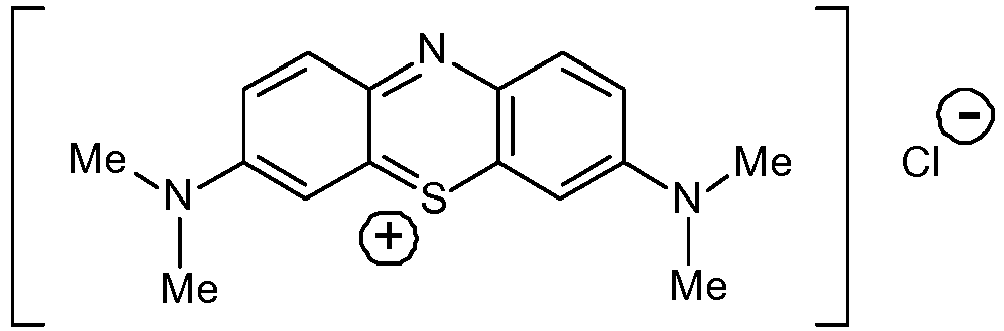
wherein high purity is characterised by a purity of greater than 98% and one or more of the following:less than 2% Azure B as impurity;less than 0.13% Methylene Violet Bernthsen (MVB) as impurity;an elementals purity better than the European Pharmacopoeia (EP) limits of 100 µg/g Aluminium (Al), 10 µg/g Chromium (Cr), 10 µg/g Zinc (Zn), 10 µg/g Copper (Cu), 100 µg/g Iron (Fe), 10 µg/g Manganese (Mn), 10 µg/g Nickel (Ni), 10 µg/g Molybdenum (Mo), 1 µg/g Cadmium (Cd), 1 µg/g Tin (Sn) and 10 µg/g Lead (Pb). - A high purity diaminophenothiazinium compound according to claim 1, which is obtainable by a method of synthesis comprising the steps of, in order:oxidative coupling (OC), in which a thiosulfuric acid S-{2-(amino)-3-(optionally substituted)-5-(disubstituted amino)-phenyl} ester, 4, is oxidatively coupled to an N,N-disubstituted-3-optionally substituted-aniline, 5, using an oxidizing agent that is or comprises Cr(VI), to give a [4-{2-(thiosulfate)-4-(disubstituted amino)-6-(optionally substituted)-phenyl-imino}-3-(optionally substituted)-cyclohexa-2,5-dienylidene]-N,N-disubstituted ammonium, 6:
 isolation and purification of zwitterionic intermediate (IAPOZI), in which said [4-{2-(thiosulfate)-4-(disubstituted amino)-6-(optionally substituted)-phenyl-imino}-3-(optionally substituted)-cyclohexa-2,5-dienylidene]-N,N-disubstituted ammonium, 6, is isolated and purified;ring closure (RC), in which said isolated and purified [4-{2-(thiosulfate)-4-(disubstituted amino)-6-(optionally substituted)-phenyl-imino}-3-(optionally substituted)-cyclohexa-2,5-dienylidene]-N,N-disubstituted ammonium, 6, is subjected to ring closure to give a 3,7-bis(disubstituted-amino)-1,9-(optionally substituted)-phenothiazin-5-ium salt, 7:
 chloride salt formation (CSF), in which said 3,7-bis(disubstituted-amino)-1,9-(optionally substituted)-phenothiazin-5-ium salt, 7, is reacted with chloride, to give a 3,7-bis(disubstituted-amino)-1,9-(optionally substituted)-phenothiazin-5-ium chloride salt, 8:
sulphide treatment (ST), in which said 3,7-bis(disubstituted-amino)-1,9-(optionally substituted)-phenothiazin-5-ium chloride salt, 8, is treated with a sulphide; further comprising the subsequent additional step of:organic extraction (OE), in which said 3,7-bis(disubstituted-amino)-1,9-(optionally substituted)-phenothiazin-5-ium chloride salt, 8, in aqueous solution or suspension, is treated with (e.g., washed with) an organic solvent;wherein said organic solvent used in said organic extraction (OE) is dichloromethane (CH2Cl2, DCM). - A high purity diaminophenothiazinium compound according to claim 2, wherein:said oxidizing agent for said oxidative coupling (OC) step is Na2Cr2O7;said oxidative coupling (OC) step is performed under acidic conditions;said ring closure (RC) step is achieved by treatment with Cu(II) sulfate; andring closure (RC) step is performed under acidic conditions.
- A high purity diaminophenothiazinium compound according to claim 2 or 3, which is obtainable by a method of synthesis comprising the steps of, in order:nitrosylation (NOS), in which an N,N-disubstituted-3-optionally substituted aniline, 1, is 4-nitrosylated to give said N,N-disubstituted-3-optionally substituted-4-nitrosyl aniline, 2:
 nitrosyl reduction (NR), in which an N,N-disubstituted-3-optionally substituted-4-nitrosyl aniline, 2, is reduced to form said N,N-disubstituted-1,4-diamino-5-optionally substituted benzene, 3:
 thiosulfonic acid formation (TSAF), in which an N,N-disubstituted-1,4-diamino-5-optionally substituted benzene, 3, is oxidized in the presence of a thiosulfate to give said thiosulfuric acid S-{2-(amino)-3-(optionally substituted)-5-(disubstituted-amino)-phenyl} ester, 4:
 oxidative coupling (OC), in which a thiosulfuric acid S-{2-(amino)-3-(optionally substituted)-5-(disubstituted amino)-phenyl} ester, 4, is oxidatively coupled to an N,N-disubstituted-3-optionally substituted-aniline, 5, using an oxidizing agent that is or comprises Cr(VI), to give a [4-{2-(thiosulfate)-4-(disubstituted amino)-6-(optionally substituted)-phenyl-imino}-3-(optionally substituted)-cyclohexa-2,5-dienylidene]-N,N-disubstituted ammonium, 6:
 Cr(VI) Reduction (CR), in which the product of the oxidative coupling (OC) step is treated to convert residual Cr(VI) to Cr(III).isolation and purification of zwitterionic intermediate (IAPOZI), in which said [4-{2-(thiosulfate)-4-(disubstituted amino)-6-(optionally substituted)-phenyl-imino}-3-(optionally substituted)-cyclohexa-2,5-dienylidene]-N,N-disubstituted ammonium, 6, is isolated and purified;ring closure (RC), in which said isolated and purified [4-{2-(thiosulfate)-4-(disubstituted amino)-6-(optionally substituted)-phenyl-imino}-3-(optionally substituted)-cyclohexa-2,5-dienylidene]-N,N-disubstituted ammonium, 6, is subjected to ring closure to give a 3,7-bis(disubstituted-amino)-1,9-(optionally substituted)-phenothiazin-5-ium salt, 7:
 chloride salt formation (CSF), in which said 3,7-bis(disubstituted-amino)-1,9-(optionally substituted)-phenothiazin-5-ium salt, 7, is reacted with chloride, to give a 3,7-bis(disubstituted-amino)-1,9-(optionally substituted)-phenothiazin-5-ium chloride salt, 8:
 sulphide treatment (ST), in which said 3,7-bis(disubstituted-amino)-1,9-(optionally substituted)-phenothiazin-5-ium chloride salt, 8, is treated with a sulphide;organic extraction (OE), in which said 3,7-bis(disubstituted-amino)-1,9-(optionally substituted)-phenothiazin-5-ium chloride salt, 8, in aqueous solution or suspension, is treated with (e.g., washed with) an organic solvent, wherein said organic solvent is dichloromethane (CH2Cl2, DCM);recrystallisation (RX), in which said 3,7-bis(disubstituted-amino)-1,9-(optionally substituted)-phenothiazin-5-ium chloride salt, 8, is recrystallised.
 - A high purity diaminophenothiazinium compound according to claim 4, wherein:said treatment to convert residual Cr(VI) to Cr(III) is treatment with a reducing agent selected from sodium hydrosulfite, ethanol, and sodium iodide;said thiosulfate is or comprises Na2S2O3;said oxidation in said thiosulfonic acid formation (TSAF) step is by reaction with an oxidizing agent that is or comprises Na2Cr2O7;said reduction in said nitrosyl reduction (NR) step is by reaction with a reducing agent that is or comprises metallic iron;said nitrosylation is performed using sodium nitrite;the chloride used in said chloride salt formation (CSF) is hydrochloric acid or sodium chloride; andsaid sulphide used in said sulphide treatment (ST) is sodium sulphide.
- A high purity diaminophenothiazinium compound according to any one of claims 1 to 5, having less than 2% Azure B as impurity.
- A high purity diaminophenothiazinium compound according to any one of claims 1 to 6, having less than 0.13% MVB as impurity.
- A high purity diaminophenothiazinium compound according to any one of claims 1 to 7, having an elementals purity better than the European Pharmacopoeia (EP) limits of 100 µg/g Aluminium (Al), 10 µg/g Chromium (Cr), 10 µg/g Zinc (Zn), 10 µg/g Copper (Cu), 100 µg/g Iron (Fe), 10 µg/g Manganese (Mn), 10 µg/g Nickel (Ni), 10 µg/g Molybdenum (Mo), 1 µg/g Cadmium (Cd), 1 µg/g Tin (Sn) and 10 µg/g Lead (Pb).
- A pharmaceutical tablet or capsule comprising 20 to 300 mg or 30 to 200 mg of a high purity diaminophenothiazinium compound according to any one of claims 1 to 8, and a pharmaceutically acceptable carrier, diluent, or excipient.
- A high purity diaminophenothiazinium compound according to any one of claims 1 to 8, for use in a method of treatment of the human or animal body by therapy.
- A high purity diaminophenothiazinium compound according to any one of claims 1 to 8, for use in the treatment of a viral, bacterial or protozoal disease, a tauopathy, Alzheimer's disease (AD), skin cancer, melanoma, Hepatitis C, HIV or West Nile virus.
- Use of a high purity diaminophenothiazinium compound according to any one of claims 1 to 8, for the manufacture of a medicament for the treatment of a viral, bacterial or protozoal disease, a tauopathy, Alzheimer's disease (AD), skin cancer, melanoma, Hepatitis C, HIV or West Nile virus.
- A method of inactivating a pathogen in sample comprising introducing into the sample a high purity diaminophenothiazinium compound according to any one of claims 1 to 8, and exposing the sample to light, optionally wherein the sample is blood or plasma.
Priority Applications (4)
| Application Number | Priority Date | Filing Date | Title |
|---|---|---|---|
| SI200532253T SI2322517T1 (en) | 2004-09-23 | 2005-09-21 | Methods of chemical synthesis and purification of diaminophenothiazinium compounds including methylthioninium chloride (mtc) |
| PL10010049T PL2322517T3 (en) | 2004-09-23 | 2005-09-21 | Methods of chemical synthesis and purification of diaminophenothiazinium compounds including methylthioninium chloride (mtc) |
| EP19168452.1A EP3564223A1 (en) | 2004-09-23 | 2005-09-21 | Methods of chemical synthesis and purification of diaminophenothiazinium compounds including methylthioninium chloride (mtc) |
| HRP20191100TT HRP20191100T1 (en) | 2004-09-23 | 2019-06-18 | Methods of chemical synthesis and purification of diaminophenothiazinium compounds including methylthioninium chloride (mtc) |
Applications Claiming Priority (5)
| Application Number | Priority Date | Filing Date | Title |
|---|---|---|---|
| GBGB0421234.6A GB0421234D0 (en) | 2004-09-23 | 2004-09-23 | Methods of chemical synthesis |
| GB0503343A GB0503343D0 (en) | 2005-02-17 | 2005-02-17 | Methods of chemical synthesis |
| GB2005003441 | 2005-09-07 | ||
| EP05783989.6A EP1799662B1 (en) | 2004-09-23 | 2005-09-21 | Methods of chemical synthesis and purification of diaminophenothiazinium compounds including methylthioninium chloride (mtc) |
| PCT/GB2005/003634 WO2006032879A2 (en) | 2004-09-23 | 2005-09-21 | Methods of chemical synthesis and purification of diaminophenothiazinium compounds including methylthioninium chloride (mtc) |
Related Parent Applications (2)
| Application Number | Title | Priority Date | Filing Date |
|---|---|---|---|
| EP05783989.6 Division | 2005-09-21 | ||
| EP05783989.6A Division EP1799662B1 (en) | 2004-09-23 | 2005-09-21 | Methods of chemical synthesis and purification of diaminophenothiazinium compounds including methylthioninium chloride (mtc) |
Related Child Applications (2)
| Application Number | Title | Priority Date | Filing Date |
|---|---|---|---|
| EP19168452.1A Division EP3564223A1 (en) | 2004-09-23 | 2005-09-21 | Methods of chemical synthesis and purification of diaminophenothiazinium compounds including methylthioninium chloride (mtc) |
| EP18202075.0 Division-Into | 2018-10-23 |
Publications (3)
| Publication Number | Publication Date |
|---|---|
| EP2322517A1 EP2322517A1 (en) | 2011-05-18 |
| EP2322517A8 EP2322517A8 (en) | 2011-07-13 |
| EP2322517B1 true EP2322517B1 (en) | 2019-04-24 |
Family
ID=35241172
Family Applications (3)
| Application Number | Title | Priority Date | Filing Date |
|---|---|---|---|
| EP05783989.6A Expired - Lifetime EP1799662B1 (en) | 2004-09-23 | 2005-09-21 | Methods of chemical synthesis and purification of diaminophenothiazinium compounds including methylthioninium chloride (mtc) |
| EP19168452.1A Pending EP3564223A1 (en) | 2004-09-23 | 2005-09-21 | Methods of chemical synthesis and purification of diaminophenothiazinium compounds including methylthioninium chloride (mtc) |
| EP10010049.4A Expired - Lifetime EP2322517B1 (en) | 2004-09-23 | 2005-09-21 | Methods of chemical synthesis and purification of diaminophenothiazinium compounds including methylthioninium chloride (mtc) |
Family Applications Before (2)
| Application Number | Title | Priority Date | Filing Date |
|---|---|---|---|
| EP05783989.6A Expired - Lifetime EP1799662B1 (en) | 2004-09-23 | 2005-09-21 | Methods of chemical synthesis and purification of diaminophenothiazinium compounds including methylthioninium chloride (mtc) |
| EP19168452.1A Pending EP3564223A1 (en) | 2004-09-23 | 2005-09-21 | Methods of chemical synthesis and purification of diaminophenothiazinium compounds including methylthioninium chloride (mtc) |
Country Status (15)
| Country | Link |
|---|---|
| US (5) | US9242946B2 (en) |
| EP (3) | EP1799662B1 (en) |
| JP (1) | JP2012184244A (en) |
| CN (1) | CN103012315A (en) |
| AU (1) | AU2005286235C1 (en) |
| CA (1) | CA2579169C (en) |
| DK (2) | DK1799662T3 (en) |
| ES (2) | ES2736160T3 (en) |
| HR (1) | HRP20191100T1 (en) |
| HU (1) | HUE044355T2 (en) |
| PL (2) | PL1799662T3 (en) |
| PT (2) | PT2322517T (en) |
| SI (2) | SI2322517T1 (en) |
| TR (1) | TR201910292T4 (en) |
| WO (1) | WO2006032879A2 (en) |
Families Citing this family (51)
| Publication number | Priority date | Publication date | Assignee | Title |
|---|---|---|---|---|
| GB9506197D0 (en) | 1995-03-27 | 1995-05-17 | Hoffmann La Roche | Inhibition of tau-tau association. |
| GB0100119D0 (en) | 2001-01-03 | 2001-02-14 | Univ Aberdeen | Materials and methods relating to protein aggregation in neurodegenerative disease |
| GB0101049D0 (en) | 2001-01-15 | 2001-02-28 | Univ Aberdeen | Materials and methods relating to protein aggregation in neurodegenerative disease |
| GB0106953D0 (en) | 2001-03-20 | 2001-05-09 | Univ Aberdeen | Neufofibrillary labels |
| GB0117326D0 (en) | 2001-07-16 | 2001-09-05 | Univ Aberdeen | Napthoquinone-type inhibitors of protein aggregation |
| SI2322517T1 (en) * | 2004-09-23 | 2019-06-28 | Wista Laboratories Ltd. | Methods of chemical synthesis and purification of diaminophenothiazinium compounds including methylthioninium chloride (mtc) |
| CN101084204B (en) | 2004-09-23 | 2012-12-05 | 卫思道制药有限公司 | Chemical synthesis and purification of diaminophenothiazinium compounds including methylene blue (MTC) |
| WO2006127482A1 (en) * | 2005-05-20 | 2006-11-30 | Bioenvision, Inc. | Methylene blue therapy of viral disease |
| DE602007008550D1 (en) | 2006-03-29 | 2010-09-30 | Wista Lab Ltd | 3,7-DIAMINO-10H-PHENOTHIAZINE SALT AND ITS USE |
| SI2001556T1 (en) | 2006-03-29 | 2014-12-31 | Wista Laboratories Ltd | Thioninium compounds and their use |
| US8263589B2 (en) | 2006-03-29 | 2012-09-11 | Wista Laboratories Ltd. | Inhibitors of protein aggregation |
| AU2013200264B2 (en) * | 2006-07-11 | 2014-11-13 | TauRx Therapeutics Management Ltd | Methods of synthesis and/or purification of diaminophenothiazinium compounds |
| AU2007274057B2 (en) | 2006-07-11 | 2012-12-13 | TauRx Therapeutics Management Ltd | Methods of synthesis and/or purification of diaminophenothiazinium compounds |
| FR2903696B1 (en) | 2006-07-12 | 2011-02-11 | Provence Technologies | PROCESS FOR PURIFYING DIAMINOPHENOTHIAZIUM COMPOUNDS |
| CN100436431C (en) * | 2006-12-15 | 2008-11-26 | 贵州同济堂制药有限公司 | Medicinal methylene blue synthesis method |
| JP2010523591A (en) * | 2007-04-03 | 2010-07-15 | プロセッタ バイオコンフォーマティクス インコーポレイテッド | Antiviral treatment |
| BRPI0813670A2 (en) | 2007-06-19 | 2014-12-30 | Wista Lab Ltd | TREATMENT COMPOUNDS |
| CN103319434A (en) * | 2007-09-10 | 2013-09-25 | 中国医学科学院药物研究所 | Preparation method of 3-amino-7-dialkylamino-substituted phenothiazine compounds |
| PL2430007T3 (en) | 2009-05-12 | 2014-07-31 | Wista Lab Ltd | Methods of chemical synthesis of diaminophenothiazinium compounds involving the use of persulfate oxidants |
| PL2480540T3 (en) * | 2009-09-24 | 2018-05-30 | Wista Laboratories Ltd. | Methylthioninium chloride pentahydrate, preparation and pharmaceutical use thereof |
| SI3792254T1 (en) | 2009-09-24 | 2023-11-30 | Wista Laboratories Ltd. | Crystalline methylthioninium chloride hydrates |
| CN102958525B (en) | 2010-04-30 | 2017-05-24 | 普罗瑟塔抗病毒股份有限公司 | Antiviral compounds |
| EP2645994B1 (en) | 2010-11-30 | 2017-11-01 | WisTa Laboratories Ltd. | Formulations comprising methylthioninium chloride |
| US8759336B2 (en) | 2011-03-17 | 2014-06-24 | Prosetta Antiviral Inc. | Antiviral compounds |
| AU2011358840B2 (en) | 2011-02-11 | 2017-05-04 | TauRx Therapeutics Management Ltd | Phenothiazine diaminium salts and their use |
| WO2012145567A1 (en) | 2011-04-20 | 2012-10-26 | Prosetta Antiviral Inc. | Antiviral compounds |
| US20120301904A1 (en) | 2011-04-26 | 2012-11-29 | Prosetta Antiviral, Inc | Multiprotein assemblies |
| JP5924187B2 (en) | 2012-08-23 | 2016-05-25 | スズキ株式会社 | In-vehicle battery pack cooling system |
| US9226038B2 (en) | 2012-11-12 | 2015-12-29 | Roger B. and Ann K. McNamee Trust U/T/A/D | Systems and methods for communicating a live event to users using the internet |
| US10160735B2 (en) | 2013-08-15 | 2018-12-25 | Eupharma Pty Ltd | Process for the purification of diaminophenothiazinium compounds |
| MX354492B (en) | 2013-08-15 | 2018-03-07 | Eupharma Pty Ltd | Process for the purification of diaminophenothiazinium compounds. |
| GB201317702D0 (en) | 2013-10-07 | 2013-11-20 | Wista Lab Ltd | Methods of chemical synthesis of diaminophenothiazinium compounds including methylthioninium chloride (MTC) |
| CN103923037B (en) * | 2014-04-24 | 2015-06-03 | 山东理工大学 | Method for reducing copper ions in methylene blue solution by using calcium phosphate |
| CN104586853A (en) * | 2014-12-31 | 2015-05-06 | 武汉联程生物科技有限公司 | Pharmaceutical composition for treating traumatic craniocerebral trauma and preparation method of pharmaceutical composition |
| CN105130926B (en) * | 2015-07-31 | 2018-02-13 | 江苏恒润制药有限公司 | A kind of preparation method of methylene blue |
| EP3397623A1 (en) | 2015-12-28 | 2018-11-07 | John V. Frangioni | Method of preparing diaminophenothiazinium |
| ITUA20163526A1 (en) | 2016-05-17 | 2017-11-17 | Icrom Spa | PROCEDURE FOR THE PREPARATION OF DIAMMINOFENOTIAZINIC COMPOUNDS WITH HIGH DEGREE OF PURITY |
| EP4335517B8 (en) | 2016-07-25 | 2025-10-22 | TauRx Therapeutics Management Ltd. | Administration and dosage of diaminophenothiazines |
| GB201614834D0 (en) | 2016-09-01 | 2016-10-19 | Wista Lab Ltd | Treatment of dementia |
| GB201621817D0 (en) | 2016-12-21 | 2017-02-01 | Wista Lab Ltd | Methods of chemical synthesis |
| FR3063495B1 (en) * | 2017-03-02 | 2019-04-05 | Provepharm Life Solutions | PROCESS FOR THE PREPARATION OF 3.7-BIS (DIMETHYLAMINO) PHENOTHIAZINE-5-YLIUM IODIDE |
| CN108658895B (en) * | 2018-04-24 | 2020-06-19 | 上海沃凯生物技术有限公司 | Purification method of methylene blue |
| US12280061B2 (en) | 2018-07-26 | 2025-04-22 | Wista Laboratories Ltd. | Optimised dosage of diaminophenothiazines in populations |
| US20220235019A1 (en) * | 2019-06-12 | 2022-07-28 | Achal Narendrakumar AGRAWAL | Novel improved method for synthesizing diaminophenothiazine compounds |
| US12215234B2 (en) | 2019-09-21 | 2025-02-04 | RK Pharma Solutions LLC | Process for the purification of methylene blue |
| US12441694B2 (en) | 2020-02-28 | 2025-10-14 | Dishman Carbogen Amcis Ltd. | Process for the preparation of methylene blue |
| WO2023232764A1 (en) | 2022-05-31 | 2023-12-07 | Wista Laboratories Ltd. | Treatment of neurodegenerative disorders utilising methylthioninium (mt)-containing compounds |
| CN114989113A (en) * | 2022-06-01 | 2022-09-02 | 山东科源制药股份有限公司 | Refining method of medicinal methylene blue |
| CN119947729A (en) | 2022-09-21 | 2025-05-06 | 罗颍诗 | Oral preparations of diaminophenothiazine and methods of preparing and using the same in treating and/or preventing diseases |
| EP4342451A1 (en) | 2022-09-22 | 2024-03-27 | Galenicum Health SLU | Pharmaceutical compositions and manufacturing methods thereof |
| US20240115579A1 (en) | 2022-09-22 | 2024-04-11 | Galenicum Health S.L.U. | Pharmaceutical compositions and manufacturing methods thereof |
Citations (12)
| Publication number | Priority date | Publication date | Assignee | Title |
|---|---|---|---|---|
| DE2516920A1 (en) | 1975-04-17 | 1976-10-21 | Walter Dr Med Loehr | PROCESS FOR THE OBTAINMENT OF THIAZINE DYES |
| GB1480576A (en) | 1975-04-11 | 1977-07-20 | Boehringer Mannheim Gmbh | Pre-coloured microscope slide for blood investigations |
| US4212971A (en) | 1979-03-08 | 1980-07-15 | American Cyanamid Company | Process for preparing methylene blue |
| WO1996030766A1 (en) | 1995-03-27 | 1996-10-03 | F. Hoffmann-La Roche Ag | Inhibition of tau-tau-association |
| JP2000344685A (en) | 1999-03-26 | 2000-12-12 | Bf Kenkyusho:Kk | Graphic diagnosis probe for disease accepting accumulating amyloid by azure a analog compound and composition for graphic diagnosis containing the same |
| EP1092978A1 (en) | 1999-10-12 | 2001-04-18 | DIDECO S.p.A. | Method and device for determining the concentration of heparin in a sample of fluid |
| GB2373787A (en) | 2001-03-08 | 2002-10-02 | Univ Central Lancashire | Phenothiazinium derivatives and their use to reduce pathogenic contaminants |
| WO2002096896A1 (en) | 2001-05-30 | 2002-12-05 | Photopharmica Limited | Biologically active methylene blue derivatives |
| WO2005054217A1 (en) | 2003-11-28 | 2005-06-16 | Photopharmica Limited | Developments in biologically active methylene blue derivatives (2) |
| EP2322517A1 (en) | 2004-09-23 | 2011-05-18 | Wista Laboratories Ltd. | Methods of chemical synthesis and purification of diaminophenothiazinium compounds including methylthioninium chloride (MTC) |
| EP2457905A1 (en) | 2006-07-11 | 2012-05-30 | Wista Laboratories Ltd. | Methods of synthesis and/or purification of diaminophenothiazinium compounds |
| EP2457915A1 (en) | 2009-07-21 | 2012-05-30 | Tokuyama Corporation | Chromene compound |
Family Cites Families (14)
| Publication number | Priority date | Publication date | Assignee | Title |
|---|---|---|---|---|
| DE1886C (en) | 1877-12-15 | 1877-12-15 | Basf Ag | Process for the preparation of blue dyes from dimethylaniline and other tertiary aromatic monamines |
| DE103147C (en) | 1898-06-07 | 1899-04-05 | Cohn Georg | METHOD FOR REPRESENTING ACETYL LEUKOMETHYLENE BLUE AND ETHYLENE BLUE. |
| DE113721C (en) | 1899-06-01 | 1900-09-28 | Process for the preparation of acidyl derivatives of leukothionine dyes | |
| US3641016A (en) * | 1968-02-16 | 1972-02-08 | Egyt Gyogyszervegyeszeti Gyar | Thionine derivatives |
| US5091385A (en) * | 1988-09-30 | 1992-02-25 | Baylor Research Institute | Pre-activated therapeutic agents derived from photoactive compounds |
| DE69028775T2 (en) * | 1989-05-11 | 1997-05-07 | Oklahoma Med Res Found | ANTIVIRAL THERAPY USING THIAZINE AND XANTHENE DYES |
| US5344928A (en) * | 1991-04-26 | 1994-09-06 | Takeda Chemical Industries, Ltd. | Phenothiazine derivatives, their production and use |
| US6238931B1 (en) | 1993-09-24 | 2001-05-29 | Biosite Diagnostics, Inc. | Fluorescence energy transfer in particles |
| JP2001514617A (en) | 1997-01-21 | 2001-09-11 | ジ・アメリカン・ナショナル・レッド・クロス | Intracellular and extracellular decontamination of whole blood and blood components by amphiphilic phenothiazine-5-ium dye and light |
| AU2001239835A1 (en) | 2000-02-26 | 2001-09-03 | Advanced Photodynamic Technologies, Inc. | Photodynamic cellular and acellular organism eradication utilizing a photosensitive material and surfactant |
| FR2810318B1 (en) | 2000-06-15 | 2005-09-23 | Laurent Galey | DIAMANO-PHENOTHIAZINE DERIVATIVES |
| GB0101049D0 (en) | 2001-01-15 | 2001-02-28 | Univ Aberdeen | Materials and methods relating to protein aggregation in neurodegenerative disease |
| GB0106953D0 (en) | 2001-03-20 | 2001-05-09 | Univ Aberdeen | Neufofibrillary labels |
| CN101084204B (en) * | 2004-09-23 | 2012-12-05 | 卫思道制药有限公司 | Chemical synthesis and purification of diaminophenothiazinium compounds including methylene blue (MTC) |
-
2005
- 2005-09-21 SI SI200532253T patent/SI2322517T1/en unknown
- 2005-09-21 PL PL05783989T patent/PL1799662T3/en unknown
- 2005-09-21 WO PCT/GB2005/003634 patent/WO2006032879A2/en not_active Ceased
- 2005-09-21 HU HUE10010049 patent/HUE044355T2/en unknown
- 2005-09-21 SI SI200531740T patent/SI1799662T1/en unknown
- 2005-09-21 CN CN2012103966522A patent/CN103012315A/en active Pending
- 2005-09-21 CA CA2579169A patent/CA2579169C/en not_active Expired - Lifetime
- 2005-09-21 EP EP05783989.6A patent/EP1799662B1/en not_active Expired - Lifetime
- 2005-09-21 ES ES10010049T patent/ES2736160T3/en not_active Expired - Lifetime
- 2005-09-21 DK DK05783989.6T patent/DK1799662T3/en active
- 2005-09-21 DK DK10010049.4T patent/DK2322517T3/en active
- 2005-09-21 PT PT10010049T patent/PT2322517T/en unknown
- 2005-09-21 EP EP19168452.1A patent/EP3564223A1/en active Pending
- 2005-09-21 ES ES05783989T patent/ES2409683T3/en not_active Expired - Lifetime
- 2005-09-21 PL PL10010049T patent/PL2322517T3/en unknown
- 2005-09-21 TR TR2019/10292T patent/TR201910292T4/en unknown
- 2005-09-21 AU AU2005286235A patent/AU2005286235C1/en not_active Expired
- 2005-09-21 EP EP10010049.4A patent/EP2322517B1/en not_active Expired - Lifetime
- 2005-09-21 PT PT57839896T patent/PT1799662E/en unknown
-
2010
- 2010-09-03 US US12/875,465 patent/US9242946B2/en active Active
-
2012
- 2012-05-08 JP JP2012106551A patent/JP2012184244A/en active Pending
-
2016
- 2016-01-19 US US15/000,723 patent/US9555043B2/en not_active Expired - Lifetime
-
2017
- 2017-01-30 US US15/419,763 patent/US9801890B2/en not_active Expired - Lifetime
- 2017-09-28 US US15/718,662 patent/US10537578B2/en not_active Expired - Lifetime
-
2019
- 2019-06-18 HR HRP20191100TT patent/HRP20191100T1/en unknown
- 2019-11-27 US US16/697,907 patent/US11116772B2/en not_active Expired - Lifetime
Patent Citations (14)
| Publication number | Priority date | Publication date | Assignee | Title |
|---|---|---|---|---|
| GB1480576A (en) | 1975-04-11 | 1977-07-20 | Boehringer Mannheim Gmbh | Pre-coloured microscope slide for blood investigations |
| DE2516920A1 (en) | 1975-04-17 | 1976-10-21 | Walter Dr Med Loehr | PROCESS FOR THE OBTAINMENT OF THIAZINE DYES |
| US4003892A (en) | 1975-04-17 | 1977-01-18 | Serva-Entwicklungslabor V. Grothe & Co. | Method of separating thionine and its N-methyl derivatives from each other |
| US4212971A (en) | 1979-03-08 | 1980-07-15 | American Cyanamid Company | Process for preparing methylene blue |
| WO1996030766A1 (en) | 1995-03-27 | 1996-10-03 | F. Hoffmann-La Roche Ag | Inhibition of tau-tau-association |
| JP2000344685A (en) | 1999-03-26 | 2000-12-12 | Bf Kenkyusho:Kk | Graphic diagnosis probe for disease accepting accumulating amyloid by azure a analog compound and composition for graphic diagnosis containing the same |
| EP1092978A1 (en) | 1999-10-12 | 2001-04-18 | DIDECO S.p.A. | Method and device for determining the concentration of heparin in a sample of fluid |
| US6630989B1 (en) | 1999-10-12 | 2003-10-07 | Dideco S.P.A. | Method and device for determining the concentration of heparin in a sample of fluid |
| GB2373787A (en) | 2001-03-08 | 2002-10-02 | Univ Central Lancashire | Phenothiazinium derivatives and their use to reduce pathogenic contaminants |
| WO2002096896A1 (en) | 2001-05-30 | 2002-12-05 | Photopharmica Limited | Biologically active methylene blue derivatives |
| WO2005054217A1 (en) | 2003-11-28 | 2005-06-16 | Photopharmica Limited | Developments in biologically active methylene blue derivatives (2) |
| EP2322517A1 (en) | 2004-09-23 | 2011-05-18 | Wista Laboratories Ltd. | Methods of chemical synthesis and purification of diaminophenothiazinium compounds including methylthioninium chloride (MTC) |
| EP2457905A1 (en) | 2006-07-11 | 2012-05-30 | Wista Laboratories Ltd. | Methods of synthesis and/or purification of diaminophenothiazinium compounds |
| EP2457915A1 (en) | 2009-07-21 | 2012-05-30 | Tokuyama Corporation | Chromene compound |
Non-Patent Citations (29)
| Title |
|---|
| "Council of Europe", EUROPEAN PHARMACOPEIA, 2001, Strasbourg, pages 1130 - 1133 |
| "Extrait de la pharmacopee europeenne", EUROPEAN PHARMACOPEIA, vol. 4, no. 6, July 2004 (2004-07-01), pages 391 - 393, XP055671739 |
| "Extrait de la pharmacopee europeenne", EUROPEAN PHARMACOPEIA, vol. 4, no. 6, July 2004 (2004-07-01), pages 4167 - 4171, XP055671754 |
| "Rapport d'etude realise pour la societe Daiichi Sankyo", FORMATION OF AZURE A AND AZURE B FROM DS-2207B IN VITRO USING RAT ISOLATED HEPATOCYTES, March 2014 (2014-03-01) |
| A. WARTH, VIRCHOWS ARCH, vol. 454, 2009, pages 341 - 344, XP019715690 |
| ANALYTICAL BIOCHEMICAL LABORATORY B.V. (ABL): "In vitro investigation of the metabolic stability of Methylene Blue using human, dog, rat and Mouse Hepatocytes", ANALYTICAL STUDY REPORT, pages 1 - 39, XP055374151, [retrieved on 20170518] |
| ANONYMUS: "Metabolism of DS-2207b (Methylthioninium chloride). Final Report", DAIICHI SANKYO EUROPE GMBH TISSUE AND CELL RESEARCH CENTER MUNICH, 1 January 2014 (2014-01-01), pages 1 - 12, XP055671833 |
| ANONYMUS: "Methylene blue", THERAPEUTIC DRUGS, , 1 January 1999 (1999-01-01), pages M117 - M118, XP055671830 |
| BONNEAU R,ET AL: "Purification des colorants thiaziniques, Azur A, Azur B, Azur C, par une m�thode de partage", TALANTA, ELMSFORD,NY, US, vol. 14, 1 January 1967 (1967-01-01), US, pages 121 - 122, XP002367753, DOI: 10.1016/0039-9140(67)80054-7 |
| C. NERENBERG ET AL., STAINTECHNOLOGY, vol. 38, no. 2, 1963, pages 75 - 84, XP009176224 |
| DANIEL LAPEN CYTOMETRY, vol. 2, no. 5, 1982, pages 309 - 315, XP055499262 |
| EXTRAIT DE LA PHARMACOPEE EUROPEENNE, vol. 8, no. 6, pages 5329 - 5331, XP055671761 |
| F.YANG ET AL., ELECTROPHORESIS, vol. 32, 2011, pages 659 - 664, XP055374149 |
| FIERZ DAVID ET AL.: "Fundamental Processes of Dye Chemistry", INTERSCIENCE, 1949, pages 311 - 314, XP055671762 |
| K.W. LOACH ET AL., JOURNAL OF CHROMATOGRAPHY, vol. 60, 1971, pages 119 - 126, XP025984366 |
| L. MICHAELIS ET AL., JOURNAL OF THE AMERICAN CHEMICAL SOCIETY, vol. 62, January 1940 (1940-01-01), pages 204 - 211, XP055671742 |
| LOACH, K: "Thin layer chromatographic separation of methylene blue and related thiazine dyes", JOURNAL OF CHROMATOGRAPHY, 1971, pages 119 - 126, XP025984366, DOI: 10.1016/S0021-9673(00)95535-3 |
| LOHR ET AL., STAIN TECHNOLOGY, vol. 50, no. 3, 1975, pages 149 - 156, XP009175680 |
| LOHR ET AL.: "The Azure Dyes: their purification and physicochemical properties. II. purification of Azure B", STAIN TECHNOLOGY, vol. 50, no. 3, 1975, pages 149 - 156, XP009175680, DOI: 10.3109/10520297509117051 |
| MARSHALL P N, LEWIS S M: "The Purification of Methylene Blue and Azure B by Solvent Extraction and Crystallization", STAIN TECHNOLOGY, WILLIAMS AND WILKINS, BALTIMORE,, US, vol. 50, no. 6, 1 January 1976 (1976-01-01), US, pages 375 - 381, XP009176225, ISSN: 0038-9153, DOI: 10.3109/10520297509117095 |
| N. LEVENTIS ET AL., TETRAHEDRON, vol. 53, no. 29, 1997, pages 10083 - 10092, XP004106125 |
| NERENBERG, C. ET AL.: "Purification of thionin, azure A, azure B and methylene blue", STAIN TECHNOLOGY, vol. 38, no. 2, 1963, pages 75 - 84, XP009176224, DOI: 10.3109/10520296309061168 |
| NORMAN F. GAUDETTE ET AL., ANALYTICAL TOXICOLOGY, vol. 29, January 2005 (2005-01-01), XP055499256 |
| P MARSHALL, LEWIS: "Batch variations in commercial dyes employed for Romanowsky-type staining: a thin layer chromatographic study", STAIN TECHNOLOGY, vol. 49, no. 6, 1 January 1974 (1974-01-01), pages 351 - 358, XP055675813 |
| P.N. MARSHALL ET AL., STAIN TECHNOLOGY, vol. 50, no. 6, 1976, pages 375 - 381, XP009176225 |
| PROVEPHARM PRESCRIBING INFORMATION. FDA 2016, April 2016 (2016-04-01), pages 1 - 10, XP055671783, Retrieved from the Internet <URL:http://www.accessdata.fda.gov/drugsatfda_docs/label/2016/204630s0001bl.pdf> |
| PUBLICATION A. PETZER, TOXICOLOGY AND APPLIED PHARMACOLOGY, vol. 258, 2012, pages 403 - 409, XP028445405 |
| TIMO RAGER ET AL.: "The crystalline state of methylene blue: a zoo of hydrates", PHYS. CHEM. CHEM. PHYS., vol. 14, 2012, pages 8074 - 8082, XP055141082 |
| W.W. DEAN ET AL., JOURNAL OF CHROMATOGRAPHY, vol. 124, 1976, pages 287 - 301, XP026483377 |
Also Published As
Similar Documents
| Publication | Publication Date | Title |
|---|---|---|
| US11116772B2 (en) | Medical methods utilising high purity diaminophenothiazinium compounds | |
| US7790881B2 (en) | Methods of chemical synthesis and purification of diaminophenothiazinium compounds including methylthioninium chloride (MTC) | |
| EP2457905B1 (en) | Methods of synthesis and/or purification of diaminophenothiazinium compounds | |
| US10421733B2 (en) | Methods of chemical synthesis of diaminophenothiazinium compounds including methylthioninium chloride (MTC) | |
| HK40014432A (en) | Methods of chemical synthesis and purification of diaminophenothiazinium compounds including methylthioninium chloride (mtc) | |
| HK1156316B (en) | Methods of chemical synthesis and purification of diaminophenothiazinium compounds including methylthioninium chloride (mtc) | |
| HK1156316A (en) | Methods of chemical synthesis and purification of diaminophenothiazinium compounds including methylthioninium chloride (mtc) | |
| HK1100001B (en) | Methods of chemical synthesis and purification of diaminophenothiazinium compounds including methylthioninium chloride (mtc) | |
| HK40075811A (en) | Methods of chemical synthesis of diaminophenothiazinium compounds including methylthioninium chloride (mtc) | |
| HK1261429A1 (en) | Methods of chemical synthesis of diaminophenothiazinium compounds including methylthioninium chloride (mtc) | |
| HK1261429B (en) | Methods of chemical synthesis of diaminophenothiazinium compounds including methylthioninium chloride (mtc) | |
| HK1222175B (en) | Methods of chemical synthesis of diaminophenothiazinium compounds including methylthioninium chloride (mtc) | |
| HK1129675B (en) | Methods of synthesis and/or purification of diaminophenothiazinium compounds |
Legal Events
| Date | Code | Title | Description |
|---|---|---|---|
| PUAI | Public reference made under article 153(3) epc to a published international application that has entered the european phase |
Free format text: ORIGINAL CODE: 0009012 |
|
| AC | Divisional application: reference to earlier application |
Ref document number: 1799662 Country of ref document: EP Kind code of ref document: P |
|
| AK | Designated contracting states |
Kind code of ref document: A1 Designated state(s): AT BE BG CH CY CZ DE DK EE ES FI FR GB GR HU IE IS IT LI LT LU LV MC NL PL PT RO SE SI SK TR |
|
| AX | Request for extension of the european patent |
Extension state: AL BA HR MK YU |
|
| 17P | Request for examination filed |
Effective date: 20111117 |
|
| REG | Reference to a national code |
Ref country code: HK Ref legal event code: DE Ref document number: 1156316 Country of ref document: HK |
|
| RAP1 | Party data changed (applicant data changed or rights of an application transferred) |
Owner name: WISTA LABORATORIES LTD. |
|
| 17Q | First examination report despatched |
Effective date: 20160201 |
|
| TPAC | Observations filed by third parties |
Free format text: ORIGINAL CODE: EPIDOSNTIPA |
|
| STAA | Information on the status of an ep patent application or granted ep patent |
Free format text: STATUS: EXAMINATION IS IN PROGRESS |
|
| TPAC | Observations filed by third parties |
Free format text: ORIGINAL CODE: EPIDOSNTIPA |
|
| TPAC | Observations filed by third parties |
Free format text: ORIGINAL CODE: EPIDOSNTIPA |
|
| GRAP | Despatch of communication of intention to grant a patent |
Free format text: ORIGINAL CODE: EPIDOSNIGR1 |
|
| STAA | Information on the status of an ep patent application or granted ep patent |
Free format text: STATUS: GRANT OF PATENT IS INTENDED |
|
| INTG | Intention to grant announced |
Effective date: 20181214 |
|
| GRAS | Grant fee paid |
Free format text: ORIGINAL CODE: EPIDOSNIGR3 |
|
| GRAA | (expected) grant |
Free format text: ORIGINAL CODE: 0009210 |
|
| STAA | Information on the status of an ep patent application or granted ep patent |
Free format text: STATUS: THE PATENT HAS BEEN GRANTED |
|
| AC | Divisional application: reference to earlier application |
Ref document number: 1799662 Country of ref document: EP Kind code of ref document: P |
|
| AK | Designated contracting states |
Kind code of ref document: B1 Designated state(s): AT BE BG CH CY CZ DE DK EE ES FI FR GB GR HU IE IS IT LI LT LU LV MC NL PL PT RO SE SI SK TR |
|
| AX | Request for extension of the european patent |
Extension state: BA HR MK YU |
|
| REG | Reference to a national code |
Ref country code: GB Ref legal event code: FG4D |
|
| REG | Reference to a national code |
Ref country code: CH Ref legal event code: EP |
|
| REG | Reference to a national code |
Ref country code: AT Ref legal event code: REF Ref document number: 1123984 Country of ref document: AT Kind code of ref document: T Effective date: 20190515 Ref country code: IE Ref legal event code: FG4D |
|
| REG | Reference to a national code |
Ref country code: DE Ref legal event code: R096 Ref document number: 602005055698 Country of ref document: DE |
|
| REG | Reference to a national code |
Ref country code: DK Ref legal event code: T3 Effective date: 20190607 |
|
| REG | Reference to a national code |
Ref country code: HR Ref legal event code: TUEP Ref document number: P20191100 Country of ref document: HR |
|
| REG | Reference to a national code |
Ref country code: NL Ref legal event code: FP |
|
| REG | Reference to a national code |
Ref country code: SE Ref legal event code: TRGR |
|
| REG | Reference to a national code |
Ref country code: PT Ref legal event code: SC4A Ref document number: 2322517 Country of ref document: PT Date of ref document: 20190730 Kind code of ref document: T Free format text: AVAILABILITY OF NATIONAL TRANSLATION Effective date: 20190723 |
|
| REG | Reference to a national code |
Ref country code: SK Ref legal event code: T3 Ref document number: E 31335 Country of ref document: SK |
|
| REG | Reference to a national code |
Ref country code: LT Ref legal event code: MG4D |
|
| REG | Reference to a national code |
Ref country code: HR Ref legal event code: T1PR Ref document number: P20191100 Country of ref document: HR |
|
| REG | Reference to a national code |
Ref country code: HR Ref legal event code: ODRP Ref document number: P20191100 Country of ref document: HR Payment date: 20190725 Year of fee payment: 15 |
|
| REG | Reference to a national code |
Ref country code: GR Ref legal event code: EP Ref document number: 20190402148 Country of ref document: GR Effective date: 20191016 |
|
| REG | Reference to a national code |
Ref country code: HU Ref legal event code: AG4A Ref document number: E044355 Country of ref document: HU |
|
| PG25 | Lapsed in a contracting state [announced via postgrant information from national office to epo] |
Ref country code: LT Free format text: LAPSE BECAUSE OF FAILURE TO SUBMIT A TRANSLATION OF THE DESCRIPTION OR TO PAY THE FEE WITHIN THE PRESCRIBED TIME-LIMIT Effective date: 20190424 |
|
| PG25 | Lapsed in a contracting state [announced via postgrant information from national office to epo] |
Ref country code: BG Free format text: LAPSE BECAUSE OF FAILURE TO SUBMIT A TRANSLATION OF THE DESCRIPTION OR TO PAY THE FEE WITHIN THE PRESCRIBED TIME-LIMIT Effective date: 20190724 Ref country code: LV Free format text: LAPSE BECAUSE OF FAILURE TO SUBMIT A TRANSLATION OF THE DESCRIPTION OR TO PAY THE FEE WITHIN THE PRESCRIBED TIME-LIMIT Effective date: 20190424 |
|
| REG | Reference to a national code |
Ref country code: DE Ref legal event code: R026 Ref document number: 602005055698 Country of ref document: DE |
|
| PLBI | Opposition filed |
Free format text: ORIGINAL CODE: 0009260 |
|
| PG25 | Lapsed in a contracting state [announced via postgrant information from national office to epo] |
Ref country code: RO Free format text: LAPSE BECAUSE OF FAILURE TO SUBMIT A TRANSLATION OF THE DESCRIPTION OR TO PAY THE FEE WITHIN THE PRESCRIBED TIME-LIMIT Effective date: 20190424 Ref country code: EE Free format text: LAPSE BECAUSE OF FAILURE TO SUBMIT A TRANSLATION OF THE DESCRIPTION OR TO PAY THE FEE WITHIN THE PRESCRIBED TIME-LIMIT Effective date: 20190424 |
|
| PLBI | Opposition filed |
Free format text: ORIGINAL CODE: 0009260 |
|
| PLAX | Notice of opposition and request to file observation + time limit sent |
Free format text: ORIGINAL CODE: EPIDOSNOBS2 |
|
| REG | Reference to a national code |
Ref country code: FI Ref legal event code: MDE Opponent name: PROVEPHARM LIFE SOLUTIONS/PROVEPHARM Ref country code: FI Ref legal event code: MDE Opponent name: GRA NECKER PATENT- UND RECHTSANWA LTE PARTG MBB |
|
| 26 | Opposition filed |
Opponent name: PROVEPHARM LIFE SOLUTIONS/PROVEPHARM Effective date: 20200110 |
|
| REG | Reference to a national code |
Ref country code: FI Ref legal event code: MDE Opponent name: PROVEPHARM LIFE SOLUTIONS/PROVEPHARM Ref country code: FI Ref legal event code: MDE Opponent name: GRA NECKER PATENT- UND RECHTSANWA LTE PARTG MBB |
|
| 26 | Opposition filed |
Opponent name: GRUENECKER PATENT- UND RECHTSANWAELTE PARTG MBB Effective date: 20200122 |
|
| PLAF | Information modified related to communication of a notice of opposition and request to file observations + time limit |
Free format text: ORIGINAL CODE: EPIDOSCOBS2 |
|
| PG25 | Lapsed in a contracting state [announced via postgrant information from national office to epo] |
Ref country code: MC Free format text: LAPSE BECAUSE OF FAILURE TO SUBMIT A TRANSLATION OF THE DESCRIPTION OR TO PAY THE FEE WITHIN THE PRESCRIBED TIME-LIMIT Effective date: 20190424 |
|
| REG | Reference to a national code |
Ref country code: AT Ref legal event code: UEP Ref document number: 1123984 Country of ref document: AT Kind code of ref document: T Effective date: 20190424 |
|
| PLAF | Information modified related to communication of a notice of opposition and request to file observations + time limit |
Free format text: ORIGINAL CODE: EPIDOSCOBS2 |
|
| REG | Reference to a national code |
Ref country code: HR Ref legal event code: ODRP Ref document number: P20191100 Country of ref document: HR Payment date: 20200703 Year of fee payment: 16 |
|
| PLBB | Reply of patent proprietor to notice(s) of opposition received |
Free format text: ORIGINAL CODE: EPIDOSNOBS3 |
|
| PG25 | Lapsed in a contracting state [announced via postgrant information from national office to epo] |
Ref country code: CY Free format text: LAPSE BECAUSE OF FAILURE TO SUBMIT A TRANSLATION OF THE DESCRIPTION OR TO PAY THE FEE WITHIN THE PRESCRIBED TIME-LIMIT Effective date: 20190424 |
|
| REG | Reference to a national code |
Ref country code: HR Ref legal event code: ODRP Ref document number: P20191100 Country of ref document: HR Payment date: 20210629 Year of fee payment: 17 |
|
| RDAF | Communication despatched that patent is revoked |
Free format text: ORIGINAL CODE: EPIDOSNREV1 |
|
| APBM | Appeal reference recorded |
Free format text: ORIGINAL CODE: EPIDOSNREFNO |
|
| APBP | Date of receipt of notice of appeal recorded |
Free format text: ORIGINAL CODE: EPIDOSNNOA2O |
|
| APAH | Appeal reference modified |
Free format text: ORIGINAL CODE: EPIDOSCREFNO |
|
| APBQ | Date of receipt of statement of grounds of appeal recorded |
Free format text: ORIGINAL CODE: EPIDOSNNOA3O |
|
| REG | Reference to a national code |
Ref country code: HR Ref legal event code: ODRP Ref document number: P20191100 Country of ref document: HR Payment date: 20220610 Year of fee payment: 18 |
|
| P01 | Opt-out of the competence of the unified patent court (upc) registered |
Effective date: 20230427 |
|
| REG | Reference to a national code |
Ref country code: HR Ref legal event code: ODRP Ref document number: P20191100 Country of ref document: HR Payment date: 20230829 Year of fee payment: 19 |
|
| PLAB | Opposition data, opponent's data or that of the opponent's representative modified |
Free format text: ORIGINAL CODE: 0009299OPPO |
|
| R26 | Opposition filed (corrected) |
Opponent name: PROVEPHARM LIFE SOLUTIONS/PROVEPHARM Effective date: 20200110 |
|
| PGFP | Annual fee paid to national office [announced via postgrant information from national office to epo] |
Ref country code: GR Payment date: 20240626 Year of fee payment: 20 |
|
| PGFP | Annual fee paid to national office [announced via postgrant information from national office to epo] |
Ref country code: SK Payment date: 20240701 Year of fee payment: 20 |
|
| PGFP | Annual fee paid to national office [announced via postgrant information from national office to epo] |
Ref country code: PL Payment date: 20240625 Year of fee payment: 20 Ref country code: PT Payment date: 20240625 Year of fee payment: 20 |
|
| PGFP | Annual fee paid to national office [announced via postgrant information from national office to epo] |
Ref country code: TR Payment date: 20240627 Year of fee payment: 20 |
|
| PGFP | Annual fee paid to national office [announced via postgrant information from national office to epo] |
Ref country code: LU Payment date: 20240823 Year of fee payment: 20 |
|
| PGFP | Annual fee paid to national office [announced via postgrant information from national office to epo] |
Ref country code: NL Payment date: 20240823 Year of fee payment: 20 |
|
| PGFP | Annual fee paid to national office [announced via postgrant information from national office to epo] |
Ref country code: IS Payment date: 20240924 Year of fee payment: 20 |
|
| PGFP | Annual fee paid to national office [announced via postgrant information from national office to epo] |
Ref country code: FI Payment date: 20240823 Year of fee payment: 20 Ref country code: DE Payment date: 20240823 Year of fee payment: 20 Ref country code: IE Payment date: 20240823 Year of fee payment: 20 |
|
| PGFP | Annual fee paid to national office [announced via postgrant information from national office to epo] |
Ref country code: DK Payment date: 20240823 Year of fee payment: 20 |
|
| PGFP | Annual fee paid to national office [announced via postgrant information from national office to epo] |
Ref country code: GB Payment date: 20240823 Year of fee payment: 20 |
|
| PGFP | Annual fee paid to national office [announced via postgrant information from national office to epo] |
Ref country code: BE Payment date: 20240902 Year of fee payment: 20 |
|
| PGFP | Annual fee paid to national office [announced via postgrant information from national office to epo] |
Ref country code: FR Payment date: 20240823 Year of fee payment: 20 |
|
| PGFP | Annual fee paid to national office [announced via postgrant information from national office to epo] |
Ref country code: CZ Payment date: 20240708 Year of fee payment: 20 |
|
| PGFP | Annual fee paid to national office [announced via postgrant information from national office to epo] |
Ref country code: AT Payment date: 20240830 Year of fee payment: 20 |
|
| REG | Reference to a national code |
Ref country code: HR Ref legal event code: ODRP Ref document number: P20191100 Country of ref document: HR Payment date: 20241014 Year of fee payment: 20 |
|
| PGFP | Annual fee paid to national office [announced via postgrant information from national office to epo] |
Ref country code: HU Payment date: 20240927 Year of fee payment: 20 Ref country code: SI Payment date: 20240703 Year of fee payment: 20 |
|
| PGFP | Annual fee paid to national office [announced via postgrant information from national office to epo] |
Ref country code: SE Payment date: 20240823 Year of fee payment: 20 Ref country code: IT Payment date: 20240925 Year of fee payment: 20 |
|
| PLAB | Opposition data, opponent's data or that of the opponent's representative modified |
Free format text: ORIGINAL CODE: 0009299OPPO |
|
| R26 | Opposition filed (corrected) |
Opponent name: PROVEPHARM LIFE SOLUTIONS/PROVEPHARM Effective date: 20200110 |
|
| APBU | Appeal procedure closed |
Free format text: ORIGINAL CODE: EPIDOSNNOA9O |
|
| PGFP | Annual fee paid to national office [announced via postgrant information from national office to epo] |
Ref country code: ES Payment date: 20241003 Year of fee payment: 20 |
|
| PGFP | Annual fee paid to national office [announced via postgrant information from national office to epo] |
Ref country code: CH Payment date: 20241001 Year of fee payment: 20 |
|
| REG | Reference to a national code |
Ref country code: DE Ref legal event code: R071 Ref document number: 602005055698 Country of ref document: DE |
|
| REG | Reference to a national code |
Ref country code: DK Ref legal event code: EUP Expiry date: 20250921 |
|
| REG | Reference to a national code |
Ref country code: NL Ref legal event code: MK Effective date: 20250920 |
|
| REG | Reference to a national code |
Ref country code: HR Ref legal event code: PB20 Ref document number: P20191100 Country of ref document: HR Effective date: 20250921 |
|
| REG | Reference to a national code |
Ref country code: CH Ref legal event code: PL |
|
| REG | Reference to a national code |
Ref country code: SK Ref legal event code: MK4A Ref document number: E 31335 Country of ref document: SK Expiry date: 20250921 Ref country code: GB Ref legal event code: PE20 Expiry date: 20250920 |
|
| PG25 | Lapsed in a contracting state [announced via postgrant information from national office to epo] |
Ref country code: CZ Free format text: LAPSE BECAUSE OF EXPIRATION OF PROTECTION Effective date: 20250921 |
|
| PG25 | Lapsed in a contracting state [announced via postgrant information from national office to epo] |
Ref country code: SK Free format text: LAPSE BECAUSE OF EXPIRATION OF PROTECTION Effective date: 20250921 |
|
| REG | Reference to a national code |
Ref country code: SE Ref legal event code: EUG |
|
| REG | Reference to a national code |
Ref country code: BE Ref legal event code: MK Effective date: 20250921 |
|
| REG | Reference to a national code |
Ref country code: IE Ref legal event code: MK9A |
|
| REG | Reference to a national code |
Ref country code: AT Ref legal event code: MK07 Ref document number: 1123984 Country of ref document: AT Kind code of ref document: T Effective date: 20250921 |
|
| PG25 | Lapsed in a contracting state [announced via postgrant information from national office to epo] |
Ref country code: PT Free format text: LAPSE BECAUSE OF EXPIRATION OF PROTECTION Effective date: 20251001 |
|
| PG25 | Lapsed in a contracting state [announced via postgrant information from national office to epo] |
Ref country code: IE Free format text: LAPSE BECAUSE OF EXPIRATION OF PROTECTION Effective date: 20250921 |