EP2322508A1 - Process for the manufacture of agomelatine and its intermediate - Google Patents
Process for the manufacture of agomelatine and its intermediate Download PDFInfo
- Publication number
- EP2322508A1 EP2322508A1 EP09802401A EP09802401A EP2322508A1 EP 2322508 A1 EP2322508 A1 EP 2322508A1 EP 09802401 A EP09802401 A EP 09802401A EP 09802401 A EP09802401 A EP 09802401A EP 2322508 A1 EP2322508 A1 EP 2322508A1
- Authority
- EP
- European Patent Office
- Prior art keywords
- methoxy
- naphthyl
- alkyl
- branched
- linear
- Prior art date
- Legal status (The legal status is an assumption and is not a legal conclusion. Google has not performed a legal analysis and makes no representation as to the accuracy of the status listed.)
- Granted
Links
- RGDNOAUQSNCJIE-UHFFFAOYSA-N COc1cc2c(CCN(C(c3c4cccc3)=O)C4=O)cccc2cc1 Chemical compound COc1cc2c(CCN(C(c3c4cccc3)=O)C4=O)cccc2cc1 RGDNOAUQSNCJIE-UHFFFAOYSA-N 0.000 description 1
- VDIFLYQCJAFOLQ-UHFFFAOYSA-N COc1cc2c(CCO)cccc2cc1 Chemical compound COc1cc2c(CCO)cccc2cc1 VDIFLYQCJAFOLQ-UHFFFAOYSA-N 0.000 description 1
- 0 COc1ccc(cccc2CCOS(*)(=O)=O)c2c1 Chemical compound COc1ccc(cccc2CCOS(*)(=O)=O)c2c1 0.000 description 1
Classifications
-
- C—CHEMISTRY; METALLURGY
- C07—ORGANIC CHEMISTRY
- C07D—HETEROCYCLIC COMPOUNDS
- C07D209/00—Heterocyclic compounds containing five-membered rings, condensed with other rings, with one nitrogen atom as the only ring hetero atom
- C07D209/02—Heterocyclic compounds containing five-membered rings, condensed with other rings, with one nitrogen atom as the only ring hetero atom condensed with one carbocyclic ring
- C07D209/44—Iso-indoles; Hydrogenated iso-indoles
- C07D209/48—Iso-indoles; Hydrogenated iso-indoles with oxygen atoms in positions 1 and 3, e.g. phthalimide
-
- A—HUMAN NECESSITIES
- A61—MEDICAL OR VETERINARY SCIENCE; HYGIENE
- A61P—SPECIFIC THERAPEUTIC ACTIVITY OF CHEMICAL COMPOUNDS OR MEDICINAL PREPARATIONS
- A61P25/00—Drugs for disorders of the nervous system
- A61P25/22—Anxiolytics
-
- A—HUMAN NECESSITIES
- A61—MEDICAL OR VETERINARY SCIENCE; HYGIENE
- A61P—SPECIFIC THERAPEUTIC ACTIVITY OF CHEMICAL COMPOUNDS OR MEDICINAL PREPARATIONS
- A61P25/00—Drugs for disorders of the nervous system
- A61P25/24—Antidepressants
Definitions
- the invention relates to a process for the manufacture of agomelatine, also to an intermediate used in the process and its manufacturing process.
- Agomelatine N-[2-(7-methoxy-1-naphthyl)ethyl] acetamide, is a melatonin receptor agonist, and is a new antidepressant and antianxiety drug.
- EP0447285 discloses the chemical structure of agomelatine, and the use of agomelatine as an antianxiety drug, an antidepressant, and an antipsychotic drug.
- Agomelatine has a chemical structure represented by formula (I).
- agomelatine A number of methods for the synthesis of agomelatine have been reported, and they can generally be divided into two types, which both use 7-methoxy-1-tetralone as a starting material.
- the first type of methods are described in the literatures such as EP0447285 , 1992. JMC, and 1994. JMC. (see reaction scheme I).
- the advantages of this type of methods lie in that two carbon atoms and one nitrogen atom of the target molecule are introduced in the first step, and transformed into a target functional group through hydrogenation, which is desirable from an economic viewpoint; the intermediates can be readily separated and purified, and a single recrystallization gives the target product with a purity of 99%.
- the methods have the disadvantage that the hydrogenation of a cyano group also requires a high pressure of 300atm, which is difficult to be generated in the industrial production.
- agomelatine In view of the above problems occurred in those methods for the synthesis of agomelatine, there remains a need for a new process for the manufacture of agomelatine, which uses easily available and inexpensive materials, is convenient and simple, and can be easily performed on an industrial scale.
- N-[2-(7-methoxy-1-naphthyl)ethyl] phthalimide of formula II there is provided.
- a process for the manufacture of N-[2-(7-methoxy-1-naphthyl)ethyl] phthalimide of the above formula II which comprises the step of reacting 7-methoxy-1-naphthylethyl alkyl- or aryl-sulfonate, where the alkyl is a linear or branched C 1 -C 6 alkyl, and the aryl is a C 5 -C 6 aryl unsubstituted or substituted by a linear or branched C 1 -C 6 alkyl or a linear or branched C 1 -C 6 alkoxy, with potassium phthalimide in a polar aprotic solvent.
- a process for the manufacture of 2-(7-methoxy-1-naphthyl)ethyl amine or its salts which comprises the steps of alkaline hydrolysis of N-[2-(7-methoxy-1-naphthyl)ethyl] phthalimide, and optionally conversion of the obtained amine into a salt with an acid such as a solution of hydrogen chloride in ethyl acetate.
- N-[2-(7-methoxy-1-naphthyl)ethyl] phthalimide of formula II is a critical intermediate in the manufacture of agomelatine.
- the process for the manufacture of N-[2-(7-methoxy-1-naphthyl)ethyl] phthalimide comprises the step of reacting 7-methoxy-1-naphthylethyl alkyl- or aryl-sulfonate, where the alkyl is a linear or branched C 1 -C 6 alkyl, and the aryl is a C 5 -C 6 aryl unsubstituted or substituted by a linear or branched C 1 -C 6 alkyl or a linear or branched C 1 -C 6 alkoxy, with potassium phthalimide in a polar aprotic solvent.
- the polar aprotic solvent may be, for example, dimethylformamide or acetonitrile.
- the 7-methoxy-1-naphthylethyl alkyl- or aryl-sulfonate is prepared by reacting 7-methoxy-1-naphthyl ethanol with a corresponding alkyl- or aryl-sulfonyl halide, where the alkyl is a linear or branched C 1 -C 6 alkyl, and the aryl is a C 5 -C 6 aryl unsubstituted or substituted by a linear or branched C 1 -C 6 alkyl or a linear or branched C 1 -C 6 alkoxy, in an aprotic solvent in the presence of a base.
- the aprotic solvent may be, for example, a partially or fully chlorinated C 1 -C 6 alkane, or pyridine, preference being given to dichloromethane, dichloroethane, chloroform, or carbon tetrachloride.
- the reaction temperature may be in the range from -10°C to room temperature.
- the alkyl is, for example, methyl, ethyl, n-propyl, isopropyl, n-butyl, tert-butyl, n-pentyl and n-hexyl, preferably C 1 -C 4 alkyl, and more preferably methyl and ethyl.
- the aryl is preferably phenyl unsubstituted or substituted by a linear or branched C 1 -C 4 alkyl or a linear or branched C 1 -C 4 alkoxy, and more preferably phenyl or p-tolyl.
- the sulfonyl halide used is a sulfonyl chloride, preferably C 1 -C 4 alkylsulfonyl chloride, or benzenesulfonyl chloride unsubstituted or substituted by a linear or branched C 1 -C 6 alkyl or a linear or branched C 1 -C 6 alkoxy, more preferably methylsulfonyl chloride, ethylsulfonyl chloride, benzenesulfonyl chloride unsubstituted or substituted by a linear or branched C 1 -C 4 alkyl or a linear or branched C 1 -C 4 alkoxy, and more particularly preferably benzenesulfonyl chloride or p-toluenesulfonyl
- the base is selected from NR 3 where R may be identical or different and represents H or a linear or branched C 1 -C 4 alkyl, with a proviso that all the R groups are not simultaneously H, or pyridine.
- the base is preferably selected from diethyl amine, dipropyl amine, dibutyl amine, triethyl amine, tripropyl amine, tributyl amine, or pyridine, and more preferably is diethyl amine, triethyl amine, or pyridine.
- N-[2-(7-methoxy-1-naphthyl)ethyl] phthalimide can take place according to the following scheme, starting with, for example, an alkyl- or aryl-sulfonyl chloride.
- R an alkyl, or an unsubstituted or substituted aryl
- 7-methoxy-1-naphthyl ethanol (III) is reacted with an alkyl- or aryl-sulfonyl chloride in a molar ratio of 1: 1-10, preferably 1: 2-6, more preferably 1: 2-5, in a lower alcohol such as methanol and/or ethanol, to obtain 7-methoxy-1-naphthylethyl alkyl- or aryl-sulfonate (IV).
- the reaction temperature is in the range from -10°C to room temperature, preferably from -10°C to 10°C, more preferably from -10°C to 0°C.
- the obtained 7-methoxy-1-naphthylethyl alkyl- or aryl-sulfonate (IV) is reacted with potassium phthalimide in a polar aprotic solvent, to produce N-[2-(7-methoxy-1-naphthyl)ethyl] phthalimide (II).
- the polar aprotic solvent is selected from dimethylformamide and acetonitrile, and is preferably dimethylformamide.
- the molar ratio of 7-methoxy-1-naphthylethyl alkyl- or aryl-sulfonate (IV) and potassium phthalimide is 1: 1-2, preferably 1: 1-1.6, more preferably 1: 1.1-1.5.
- the invention also provides a process for the manufacture of 2-(7-methoxy-1-naphthyl)ethylamine or its salt, comprising the steps of alkaline hydrolysis of N-[2-(7-methoxy-1-naphthyl)ethyl] phthalimide, and optionally conversion of the obtained amine into a salt with an acid such as a solution of hydrogen chloride in ethyl acetate.
- the process for the manufacture of agomelatine according to the invention comprises the following steps:
- the alkanol used is selected from methanol, ethanol, isopropanol, n-butanol, or a combination thereof.
- the alkali used in the alkaline hydrolysis is selected from alkali metal hydroxide, alkaline-earth metal hydroxide, or hydrazine hydrate, and is preferably sodium hydroxide, potassium hydroxide, or hydrazine hydrate.
- the obtained hydrolyzate is purified by extraction with a nonpolar organic solvent, the solvent being preferably a partially or fully chlorinated C 1 -C 6 alkane, or ethyl acetate, and more preferably selected from dichloromethane, dichloroethane, chloroform, carbon tetrachloride, and ethyl acetate.
- a nonpolar organic solvent the solvent being preferably a partially or fully chlorinated C 1 -C 6 alkane, or ethyl acetate, and more preferably selected from dichloromethane, dichloroethane, chloroform, carbon tetrachloride, and ethyl acetate.
- 2-(7-methoxy-1-naphthyl)ethylamine hydrochloride (V) is obtained by subjecting N-[2-(7-methoxy-1-naphthyl)ethyl] phthalimide to alkaline hydrolysis in a lower alcohol, followed by extraction with an acid, neutralization with a base, and extraction with a nonpolar solvent, and reacting with HCl/ethyl acetate.
- the acid used for the extraction is selected from a dilute inorganic acid, preferably dilute hydrochloric acid and dilute sulfuric acid, and more preferably dilute hydrochloric acid.
- the base used for the neutralization is selected from alkali metal hydroxide, preferably sodium hydroxide, potassium hydroxide, and more preferably sodium hydroxide.
- the nonpolar solvent used for the extraction is selected from chloroalkane or ethyl acetate, preferably dichloromethane, dichloroethane, chloroform, carbon tetrachloride, or ethyl acetate, and more preferably dichloromethane, dichloroethane, or ethyl acetate.
- the obtained 2-(7-methoxy-1-naphthyl)ethylamine hydrochloride (V) is then reacted with an acetylating agent.
- the reaction product is extracted with a nonpolar solvent, and the extract is dried and concentrated, thereby giving a crude agomelatine product, which is recrystallized in a mixed solvent of toluene and n-hexane with a certain ratio, to produce agomelatine.
- the nonpolar solvent used for the extraction is selected from chloroalkane or ethyl acetate, preferably dichloromethane, dichloroethane, chloroform, carbon tetrachloride, or ethyl acetate, and more preferably dichloromethane, dichloroethane, or ethyl acetate.
- the volume ratio of toluene and n-hexane for the recrystallization is 2:1.
- the process for the manufacture of agomelatine according to the invention provides for a number of advantages.
- the synthesis route is short, and a small number of reaction steps are involved in the process (a four-step reaction leads to a target product starting from 7-methoxy-1-naphthyl ethanol (III)).
- the process according to the invention is convenient and simple, while not requiring distillation and separation by column chromatography.
- the reaction condition for each step is mild, and no harsh conditions including high temperature, high pressure, high vacuum, are necessary. No special equipment (for example, a high-pressure hydrogenation reactor) needs to be used.
- the separation and purification of the intermediates are easy to perform, and the materials and reagents used in the process are commercially available. A final product with a good purity can be obtained by the process according to the invention.
- the process according to the invention is suitable for industrial use.
- the compound IV (14g, 0.041mol) produced as described above and potassium phthalimide (9.3g, 0.050mol) were added into a reaction vessel, and acetonitrile (150ml) was added. The mixture was heated and refluxed for 4 hours. After cooling it to room temperature, 200ml of water was added, and the mixture was stirred and filtered. The filter cake formed was washed with water and dried, to produce 11.5g of N-[2-(7-methoxy-1-naphthyl)ethyl] phthalimide (II). The yield was 85%. The melting point was 160-161°C.
- the compound IV (14g, 0.041mol) produced as described above and potassium phthalimide (10.8g, 0.0574mol) were added into a reaction vessel, and acetonitrile (150ml) was added. The mixture was heated and refluxed for 4 hours. After cooling it to room temperature, 200ml of water was added, and the mixture was stirred and filtered. The filter cake formed was washed with water and dried, to produce 12g of N-[2-(7-methoxy-1-naphthyl)ethyl] phthalimide (II). The yield was 90%. The melting point was 160-160.9°C.
- the compound IV (14g, 0.041mol) produced as described above and potassium phthalimide (12.3g, 0.0656mol) were added into a reaction vessel, and dimethylformamide (200ml) was added. The mixture was heated and refluxed for 2 hours. After cooling it to room temperature, 200ml of water was added, and the mixture was stirred and filtered. The filter cake formed was washed with water and dried, to produce 12.3g of N-[2-(7-methoxy-1-naphthyl)ethyl] phthalimide (II). The yield was 92.3%. The melting point was 160-161°C.
- the compound IV (14g, 0.041mol) produced as described above and potassium phthalimide (13g, 0.0738mol) were added into a reaction vessel, and dimethylformamide (200ml) was added. The mixture was heated and refluxed for 2 hours. After cooling it to room temperature, 200ml of water was added, and the mixture was stirred and filtered. The filter cake formed was washed with water and dried, to produce 11.9g of N-[2-(7-methoxy-1-naphthyl)ethyl] phthalimide (II). The yield was 88%. The melting point was 160-161°C.
- N-[2-(7-methoxy-1-naphthyl)ethyl] phthalimide (II) (12.5g, 0.038mol) was dissolved in 1000ml of ethanol, and 80% hydrazine hydrate (9.23ml) was added. The mixture was heated and refluxed for 2 hours. After cooling to room temperature, it was filtered to remove the precipitated solid. The filtrate was concentrated till dry under reduced pressure, and 150ml of dichloromethane was then added with stirring. The resulting solution was filtered to remove the undissolved substance and extracted with 3N HCl solution (100ml*3).
- the filtrate was adjust to a pH of 11-12 by addition of 4N NaOH, and extracted with ethyl acetate (200ml*3).
- the organic phases were combined, washed with water (100ml*2), dried with magnesium sulfate, and filtered to remove the drying agent.
- the filtrate was concentrated to about half of the initial volume, and HCl/ethyl acetate was added to precipitate a solid.
- the solid was filtered off and dried, to produce 7.5g of 2-(7-methoxy-1-naphthyl)ethylamine hydrochloride (V).
- the yield was 83.6%.
- the melting point was 214-215°C (in Literature [2], 215°C).
- N-[2-(7-methoxy-1-naphthyl)ethyl] phthalimide (II) (12.5g, 0.038mol) was dissolved in 1000ml of ethanol, and 2N aqueous NaOH solution (5ml) was added. The mixture was heated and refluxed for 2 hours. After cooling to room temperature, it was filtered to remove the precipitated solid. The filtrate was concentrated till dry under reduced pressure, and 150ml of dichloromethane was then added with stirring. The resulting solution was filtered to remove the undissolved substance and extracted with 3N HCl solution (100ml*3). The filtrate was adjust to a pH of 11-12 by addition of 4N NaOH, and extracted with dichloroethane (200ml*3).
- N-[2-(7-methoxy-1-naphthyl)ethyl] phthalimide (II) (12.5g, 0.038mol) was dissolved in 1000ml of ethanol, and 2N aqueous KOH solution (5ml) was added. The mixture was heated and refluxed for 2 hours. After cooling to room temperature, it was filtered to remove the precipitated solid. The filtrate was concentrated till dry under reduced pressure, and 150ml of dichloromethane was then added with stirring. The resulting solution was filtered to remove the undissolved substance and extracted with 2N sulfuric acid solution (100ml*3). The filtrate was adjust to a pH of 11-12 by addition of 4N KOH, and extracted with dichloromethane (150ml*3).
- the compound V (6.0g, 0.03mol) produced as described above and potassium carbonate (5g) were added to 20ml of water and 40ml of dichloromethane, and stirred for 30 minutes. The aqueous layer was removed. The organic layer was cooled to the temperature of 0°C, and acetyl chloride (7.8g, O.1mol) was added dropwise. A reaction was allowed to proceed at room temperature for 1 hour. 100ml water was then added, and the reaction solution was extracted with dichloromethane (50ml*3). The organic phases were combined, dried with anhydrous magnesium sulfate, and filtered to remove the drying agent. The filtrate was concentrated under reduced pressure, to give a solid.
- the solid was recrystallized in a 2:1 toluene/n-hexane mixture, to produce 4.8g of agomelatine.
- the yield was 78.5%.
- the melting point was 107-108°C (in Literature [2], 109°C).
Landscapes
- Chemical & Material Sciences (AREA)
- Organic Chemistry (AREA)
- Health & Medical Sciences (AREA)
- General Chemical & Material Sciences (AREA)
- Nuclear Medicine, Radiotherapy & Molecular Imaging (AREA)
- Biomedical Technology (AREA)
- Neurology (AREA)
- Neurosurgery (AREA)
- Engineering & Computer Science (AREA)
- Chemical Kinetics & Catalysis (AREA)
- Veterinary Medicine (AREA)
- Medicinal Chemistry (AREA)
- Bioinformatics & Cheminformatics (AREA)
- Public Health (AREA)
- Pharmacology & Pharmacy (AREA)
- Life Sciences & Earth Sciences (AREA)
- Animal Behavior & Ethology (AREA)
- General Health & Medical Sciences (AREA)
- Pain & Pain Management (AREA)
- Psychiatry (AREA)
- Organic Low-Molecular-Weight Compounds And Preparation Thereof (AREA)
- Indole Compounds (AREA)
Abstract
Description
- The invention relates to a process for the manufacture of agomelatine, also to an intermediate used in the process and its manufacturing process.
- Agomelatine, N-[2-(7-methoxy-1-naphthyl)ethyl] acetamide, is a melatonin receptor agonist, and is a new antidepressant and antianxiety drug.
EP0447285 discloses the chemical structure of agomelatine, and the use of agomelatine as an antianxiety drug, an antidepressant, and an antipsychotic drug. Agomelatine has a chemical structure represented by formula (I).
- A number of methods for the synthesis of agomelatine have been reported, and they can generally be divided into two types, which both use 7-methoxy-1-tetralone as a starting material. The first type of methods are described in the literatures such as
EP0447285 , 1992. JMC, and 1994. JMC. (see reaction scheme I).
- The disadvantages of this type of methods lie in that many steps are involved; the reaction in the first step is found to be poorly reproducible; compound (B) often goes through an incomplete aromatization in step (2) and the reactions in the subsequent steps do not usually go to complete either; purification of the mixture obtained in the saponification of step (3) is so difficult that column chromatography is necessitated; the hydrogenation pressure in step (7) is as high as 300atm, as reported in the relevant patents, and it is difficult to generate such a high pressure in the industrial production; and the average total yield is lower than 30%.
- The second type of methods are described in the literatures such as
US2005/0182276 and Synthetic Communication 2001, 31(4), 321-629 (see reaction scheme II).
- The advantages of this type of methods lie in that two carbon atoms and one nitrogen atom of the target molecule are introduced in the first step, and transformed into a target functional group through hydrogenation, which is desirable from an economic viewpoint; the intermediates can be readily separated and purified, and a single recrystallization gives the target product with a purity of 99%. However, the methods have the disadvantage that the hydrogenation of a cyano group also requires a high pressure of 300atm, which is difficult to be generated in the industrial production.
- Furthermore, 7-methoxy-1-tetralone used in those two types of methods as the starting material, is costly and not easily available.
- In view of the above problems occurred in those methods for the synthesis of agomelatine, there remains a need for a new process for the manufacture of agomelatine, which uses easily available and inexpensive materials, is convenient and simple, and can be easily performed on an industrial scale.
- It is an object of the invention to provide a new process for the manufacture of N-[2-(7-methoxy-1-naphthyl)ethyl] acetamide (also known as agomelatine), which overcomes the disadvantages of the prior art methods.
- According to one aspect of the invention, there is provided N-[2-(7-methoxy-1-naphthyl)ethyl] phthalimide of formula II.
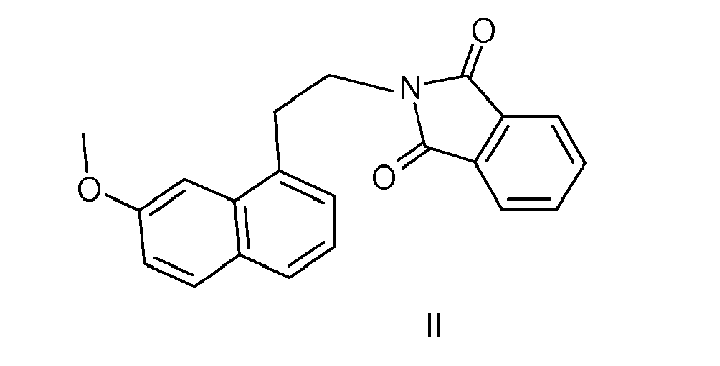
- According to another aspect of the invention, there is provided a process for the manufacture of N-[2-(7-methoxy-1-naphthyl)ethyl] phthalimide of the above formula II, which comprises the step of reacting 7-methoxy-1-naphthylethyl alkyl- or aryl-sulfonate, where the alkyl is a linear or branched C1-C6 alkyl, and the aryl is a C5-C6 aryl unsubstituted or substituted by a linear or branched C1-C6 alkyl or a linear or branched C1-C6 alkoxy, with potassium phthalimide in a polar aprotic solvent.
- According to still another aspect of the invention, there is provided a process for the manufacture of 2-(7-methoxy-1-naphthyl)ethyl amine or its salts, which comprises the steps of alkaline hydrolysis of N-[2-(7-methoxy-1-naphthyl)ethyl] phthalimide, and optionally conversion of the obtained amine into a salt with an acid such as a solution of hydrogen chloride in ethyl acetate.
- According to yet still another aspect of the invention, there is provided a process for the manufacture of agomelatine, which comprises the following steps:
- 1) N-[2-(7-methoxy-1-naphthyl)ethyl] phthalimide is subjected to alkaline hydrolysis in a linear or branched C1-C4 alkanol, to give 2-(7-methoxy-1-naphthyl)ethylamine, which is optionally converted into a salt with an acid;
- 2) 2-(7-methoxy-1-naphthyl)ethylamine or its salt is reacted with an acylating agent, to give agomelatine.
- In the present invention, N-[2-(7-methoxy-1-naphthyl)ethyl] phthalimide of formula II is a critical intermediate in the manufacture of agomelatine.

- The process for the manufacture of N-[2-(7-methoxy-1-naphthyl)ethyl] phthalimide according to the invention comprises the step of reacting 7-methoxy-1-naphthylethyl alkyl- or aryl-sulfonate, where the alkyl is a linear or branched C1-C6 alkyl, and the aryl is a C5-C6 aryl unsubstituted or substituted by a linear or branched C1-C6 alkyl or a linear or branched C1-C6 alkoxy, with potassium phthalimide in a polar aprotic solvent. In the process, the polar aprotic solvent may be, for example, dimethylformamide or acetonitrile.
- The 7-methoxy-1-naphthylethyl alkyl- or aryl-sulfonate is prepared by reacting 7-methoxy-1-naphthyl ethanol with a corresponding alkyl- or aryl-sulfonyl halide, where the alkyl is a linear or branched C1-C6 alkyl, and the aryl is a C5-C6 aryl unsubstituted or substituted by a linear or branched C1-C6 alkyl or a linear or branched C1-C6 alkoxy, in an aprotic solvent in the presence of a base. The aprotic solvent may be, for example, a partially or fully chlorinated C1-C6 alkane, or pyridine, preference being given to dichloromethane, dichloroethane, chloroform, or carbon tetrachloride. The reaction temperature may be in the range from -10°C to room temperature.
- The alkyl is, for example, methyl, ethyl, n-propyl, isopropyl, n-butyl, tert-butyl, n-pentyl and n-hexyl, preferably C1-C4 alkyl, and more preferably methyl and ethyl. The aryl is preferably phenyl unsubstituted or substituted by a linear or branched C1-C4 alkyl or a linear or branched C1-C4 alkoxy, and more preferably phenyl or p-tolyl.
- In the preparation of the 7-methoxy-1-naphthylethyl alkyl- or aryl-sulfonate, the sulfonyl halide used is a sulfonyl chloride, preferably C1-C4 alkylsulfonyl chloride, or benzenesulfonyl chloride unsubstituted or substituted by a linear or branched C1-C6 alkyl or a linear or branched C1-C6 alkoxy, more preferably methylsulfonyl chloride, ethylsulfonyl chloride, benzenesulfonyl chloride unsubstituted or substituted by a linear or branched C1-C4 alkyl or a linear or branched C1-C4 alkoxy, and more particularly preferably benzenesulfonyl chloride or p-toluenesulfonyl chloride.
- The base is selected from NR3 where R may be identical or different and represents H or a linear or branched C1-C4 alkyl, with a proviso that all the R groups are not simultaneously H, or pyridine. The base is preferably selected from diethyl amine, dipropyl amine, dibutyl amine, triethyl amine, tripropyl amine, tributyl amine, or pyridine, and more preferably is diethyl amine, triethyl amine, or pyridine.
- The process for the manufacture of N-[2-(7-methoxy-1-naphthyl)ethyl] phthalimide according to the invention can take place according to the following scheme, starting with, for example, an alkyl- or aryl-sulfonyl chloride.

- In the process, 7-methoxy-1-naphthyl ethanol (III) is reacted with an alkyl- or aryl-sulfonyl chloride in a molar ratio of 1: 1-10, preferably 1: 2-6, more preferably 1: 2-5, in a lower alcohol such as methanol and/or ethanol, to obtain 7-methoxy-1-naphthylethyl alkyl- or aryl-sulfonate (IV). The reaction temperature is in the range from -10°C to room temperature, preferably from -10°C to 10°C, more preferably from -10°C to 0°C.
- Subsequently, the obtained 7-methoxy-1-naphthylethyl alkyl- or aryl-sulfonate (IV) is reacted with potassium phthalimide in a polar aprotic solvent, to produce N-[2-(7-methoxy-1-naphthyl)ethyl] phthalimide (II). The polar aprotic solvent is selected from dimethylformamide and acetonitrile, and is preferably dimethylformamide. The molar ratio of 7-methoxy-1-naphthylethyl alkyl- or aryl-sulfonate (IV) and potassium phthalimide is 1: 1-2, preferably 1: 1-1.6, more preferably 1: 1.1-1.5.
- The invention also provides a process for the manufacture of 2-(7-methoxy-1-naphthyl)ethylamine or its salt, comprising the steps of alkaline hydrolysis of N-[2-(7-methoxy-1-naphthyl)ethyl] phthalimide, and optionally conversion of the obtained amine into a salt with an acid such as a solution of hydrogen chloride in ethyl acetate.
- The process for the manufacture of agomelatine according to the invention comprises the following steps:
- 1) N-[2-(7-methoxy-1-naphthyl)ethyl] phthalimide is subjected to alkaline hydrolysis in a linear or branched C1-C4 alkanol, to give 2-(7-methoxy-1-naphthyl)ethylamine, which is optionally converted into a salt with an acid;
- 2) 2-(7-methoxy-1-naphthyl)ethylamine or its salt is reacted with an acetylating agent such as acetic anhydride or acetyl chloride, to produce agomelatine.
- In the process for the manufacture of agomelatine according to the invention, the alkanol used is selected from methanol, ethanol, isopropanol, n-butanol, or a combination thereof. The alkali used in the alkaline hydrolysis is selected from alkali metal hydroxide, alkaline-earth metal hydroxide, or hydrazine hydrate, and is preferably sodium hydroxide, potassium hydroxide, or hydrazine hydrate.
- After the alkaline hydrolysis, the obtained hydrolyzate is purified by extraction with a nonpolar organic solvent, the solvent being preferably a partially or fully chlorinated C1-C6 alkane, or ethyl acetate, and more preferably selected from dichloromethane, dichloroethane, chloroform, carbon tetrachloride, and ethyl acetate.
- The process for the manufacture of agomelatine according to the invention can take place according to the following scheme.

- 2-(7-methoxy-1-naphthyl)ethylamine hydrochloride (V) is obtained by subjecting N-[2-(7-methoxy-1-naphthyl)ethyl] phthalimide to alkaline hydrolysis in a lower alcohol, followed by extraction with an acid, neutralization with a base, and extraction with a nonpolar solvent, and reacting with HCl/ethyl acetate. The acid used for the extraction is selected from a dilute inorganic acid, preferably dilute hydrochloric acid and dilute sulfuric acid, and more preferably dilute hydrochloric acid. The base used for the neutralization is selected from alkali metal hydroxide, preferably sodium hydroxide, potassium hydroxide, and more preferably sodium hydroxide. The nonpolar solvent used for the extraction is selected from chloroalkane or ethyl acetate, preferably dichloromethane, dichloroethane, chloroform, carbon tetrachloride, or ethyl acetate, and more preferably dichloromethane, dichloroethane, or ethyl acetate.
- The obtained 2-(7-methoxy-1-naphthyl)ethylamine hydrochloride (V) is then reacted with an acetylating agent. The reaction product is extracted with a nonpolar solvent, and the extract is dried and concentrated, thereby giving a crude agomelatine product, which is recrystallized in a mixed solvent of toluene and n-hexane with a certain ratio, to produce agomelatine. The nonpolar solvent used for the extraction is selected from chloroalkane or ethyl acetate, preferably dichloromethane, dichloroethane, chloroform, carbon tetrachloride, or ethyl acetate, and more preferably dichloromethane, dichloroethane, or ethyl acetate. The volume ratio of toluene and n-hexane for the recrystallization is 2:1.
- The process for the manufacture of agomelatine according to the invention provides for a number of advantages. The synthesis route is short, and a small number of reaction steps are involved in the process (a four-step reaction leads to a target product starting from 7-methoxy-1-naphthyl ethanol (III)). The process according to the invention is convenient and simple, while not requiring distillation and separation by column chromatography. The reaction condition for each step is mild, and no harsh conditions including high temperature, high pressure, high vacuum, are necessary. No special equipment (for example, a high-pressure hydrogenation reactor) needs to be used. The separation and purification of the intermediates are easy to perform, and the materials and reagents used in the process are commercially available. A final product with a good purity can be obtained by the process according to the invention. In addition, the process according to the invention is suitable for industrial use.
- The following examples are used to illustrate the invention, but are not intended to limit the invention in any way.
- All materials and reagents used in the invention are commercially available. Below are the sources of the main materials and reagents:
- 7-methoxy-1-naphthyl ethanol, available from Xuzhou Bestenchem Technology Company Ltd.;
- benzenesulfonyl chloride, available from Jiaxing Jinhe Chemical Corporation Ltd.;
- hydrazine hydrate, available from Shanghai Zhongsheng Chemical Corporation Ltd.;
- potassium phthalimide, available from Zibo Libang Fine Chemical Company Ltd.;
- acetic anhydride, available from Shanghai Lingfeng Chemical Reagent Company Ltd.;
- acetyl chloride, available from Xuzhou Bestenchem Technology Company Ltd.;
- diethyl amine, triethyl amine, and pyridine, available from Shanghai Chemical Reagent Company, China Pharmaceutical Group.
- 7.7g of 7-methoxy-1-naphthyl ethanol (III, 7.7g, 0.038mol) was dissolved in 80ml of pyridine, and a solution of benzenesulfonyl chloride (13.5g, 0.076mol) in pyridine was added dropwise over about one hour at -10°C. A reaction at a temperature of from -10°C to -5°C was allowed to proceed for 3 hours. The reaction solution was then poured into 150g of ice water with stirring, and extracted with toluene (80ml*3). The organic phases were combined, washed with water (200ml*3), dried with magnesium sulfate, filtered to remove the drying agent, and concentrated under reduced pressure, to give an oil residue. The residue was recrystallized in methanol (80ml), to produce 9.1g of 7-methoxy-1-naphthylethyl benzene sulfonate (IV). The yield was 70%. The melting point was 86-87°C.
IRv̅ cm-1: 1362, 1184.92, 1624.97, 1599, 1511, 1471 1HNMR (CDCl3) δ: 7.20 (d, 1H, J=2.4Hz), 7.14 (dd, 1H, J=8.8, 2.4Hz), 7.73 (d, 1H, J=8.8Hz), 7.66 (dd, 1H, J=7.6, 2.0Hz), 4.36 (t, 2H, J=7.6Hz), 3.92 (s, 3H), 3.44 (t, 2H, J=7.6Hz)
MS: m/z 342 (M+1) - The compound IV (14g, 0.041mol) produced as described above and potassium phthalimide (8.3g, 0.045mol) were added into a flask containing dimethylformamide (180ml) as a solvent, heated and refluxed for 2 hours. After cooling the content to room temperature, 200ml of water was added. The mixture was stirred and filtered. The filter cake formed was washed with water and dried, to produce 10.8g of N-[2-(7-methoxy-1-naphthyl)ethyl] phthalimide (II). The yield was 80%. The melting point was 159-160°C.
IRv̅ cm-1: 1766.90, 1701.51 (C=O), 1329.46 (C-N)
1HNMR (CDCl3) δ: 7.85-7.90 (br, 2H), 7.68-7.79 (br, 5H), 7.41 (d, 1H, J=7.2Hz), 7.28 (d, 1H, J=7.2Hz), 4.1 (s, 3H), 4.02 (t, 2H, J=8.8Hz), 3.38 (t, 2H, J=8.8Hz)
MS: m/z 331 (M+1) - 7-methoxy-1-naphthyl ethanol (III, 7.7g, 0.038mol) was dissolved in 100ml of dichloromethane, and diethyl amine (5ml) was added, and a solution of benzenesulfonyl chloride (33.6g, 0.19mol) in dichloromethane was added dropwise over about one hour at 0°C. A reaction at a temperature of from 0°C to 5°C was allowed to proceed for 3 hours. The reaction solution was then poured into 150g of ice water with stirring, and extracted with dichloromethane (20ml*3). The organic phases were combined, washed with water (100ml*3), dried with magnesium sulfate, filtered to remove the drying agent, and concentrated under reduced pressure, to give an oil residue. The residue was recrystallized in a 1:1 methanol/ethanol mixture (90ml), to produce 11g of 7-methoxy-1-naphthylethyl benzene sulfonate (IV). The yield was 85%. The melting point was 85-86°C.
- The data from IR, 1HNMR (CDCl3) and MS were the same as provided in Example 1.
- The compound IV (14g, 0.041mol) produced as described above and potassium phthalimide (9.3g, 0.050mol) were added into a reaction vessel, and acetonitrile (150ml) was added. The mixture was heated and refluxed for 4 hours. After cooling it to room temperature, 200ml of water was added, and the mixture was stirred and filtered. The filter cake formed was washed with water and dried, to produce 11.5g of N-[2-(7-methoxy-1-naphthyl)ethyl] phthalimide (II). The yield was 85%. The melting point was 160-161°C.
- The data from IR, 1HNMR (CDCl3) and MS were the same as provided in Example 1.
- 7-methoxy-1-naphthyl ethanol (III, 7.7g, 0.038mol) was dissolved in 80ml of pyridine, and a solution of benzenesulfonyl chloride (26.9g, 0.152mol) in pyridine was added dropwise over about one hour at 0°C (exothermic). A reaction at a temperature of from -5°C to 0°C was allowed to proceed for 2 hours. The reaction solution was then poured into 150g of ice water with stirring, and extracted with toluene (80ml*3). The organic phases were combined, washed with water (200ml*3), dried with magnesium sulfate, filtered to remove the drying agent, and concentrated under reduced pressure, to give an oil residue. The residue was recrystallized in 100ml of ethanol, to produce 12g of 7-methoxy-1-naphthylethyl benzene sulfonate (IV). The yield was 92%. The melting point was 85.5-87°C.
- The data from IR, 1HNMR (CDCl3) and MS were the same as provided in Example 1.
- The compound IV (14g, 0.041mol) produced as described above and potassium phthalimide (10.8g, 0.0574mol) were added into a reaction vessel, and acetonitrile (150ml) was added. The mixture was heated and refluxed for 4 hours. After cooling it to room temperature, 200ml of water was added, and the mixture was stirred and filtered. The filter cake formed was washed with water and dried, to produce 12g of N-[2-(7-methoxy-1-naphthyl)ethyl] phthalimide (II). The yield was 90%. The melting point was 160-160.9°C.
- The data from IR, 1HNMR (CDCl3) and MS were the same as provided in Example 1.
- 7-methoxy-1-naphthyl ethanol (III, 7.7g, 0.038mol) was dissolved in 100ml of dichloroethane, and triethyl amine (7ml) was added, and a solution of benzenesulfonyl chloride (40g, 0.228mol) in dichloroethane was added dropwise over about one hour at 0°C. A reaction at a temperature of from 10°C to 15°C was allowed to proceed for 1.5 hours. The reaction solution was then poured into 150g of ice water with stirring, and extracted with dichloroethane (20ml*3). The organic phases were combined, washed with water (100ml*3), dried with magnesium sulfate, filtered to remove the drying agent, and concentrated under reduced pressure, to give an oil residue. The residue was recrystallized in 80ml of methanol, to produce 11.8g of 7-methoxy-1-naphthylethyl benzene sulfonate (IV). The yield was 89%. The melting point was 86.5-87.5°C.
- The data from IR, 1HNMR (CDCl3) and MS were the same as provided in Example 1.
- The compound IV (14g, 0.041mol) produced as described above and potassium phthalimide (12.3g, 0.0656mol) were added into a reaction vessel, and dimethylformamide (200ml) was added. The mixture was heated and refluxed for 2 hours. After cooling it to room temperature, 200ml of water was added, and the mixture was stirred and filtered. The filter cake formed was washed with water and dried, to produce 12.3g of N-[2-(7-methoxy-1-naphthyl)ethyl] phthalimide (II). The yield was 92.3%. The melting point was 160-161°C.
- The data from IR, 1HNMR (CDCl3) and MS were the same as provided in Example 1.
- 7-methoxy-1-naphthyl ethanol (III, 7.7g, 0.038mol) was dissolved in 100ml of chloroform, and tripropyl amine (7ml) was added, and a solution of methanesulfonyl chloride (35g, 0.304mol) in chloroform was added dropwise over about one hour at 0°C. A reaction at a temperature of from -5°C to 0°C was allowed to proceed for 1.5 hours. The reaction solution was then poured into 150g of ice water with stirring, and extracted with dichloroethane (20ml*3). The organic phases were combined, washed with water (100ml*3), dried with magnesium sulfate, filtered to remove the drying agent, and concentrated under reduced pressure, to give an oil residue. The residue was recrystallized in 80ml of methanol, to produce 10.8g of 7-methoxy-1-naphthylethyl benzene sulfonate (IV). The yield was 83%. The melting point was 61.8-63°C (in Literature [1], 62-63°C).
- The data from 1HNMR (CDCl3) were the same as provided in Literature [1].
- The compound IV (14g, 0.041mol) produced as described above and potassium phthalimide (13g, 0.0738mol) were added into a reaction vessel, and dimethylformamide (200ml) was added. The mixture was heated and refluxed for 2 hours. After cooling it to room temperature, 200ml of water was added, and the mixture was stirred and filtered. The filter cake formed was washed with water and dried, to produce 11.9g of N-[2-(7-methoxy-1-naphthyl)ethyl] phthalimide (II). The yield was 88%. The melting point was 160-161°C.
- The data from IR, 1HNMR (CDCl3) and MS were the same as provided in Example 1.
- N-[2-(7-methoxy-1-naphthyl)ethyl] phthalimide (II) (12.5g, 0.038mol) was dissolved in 1000ml of ethanol, and 80% hydrazine hydrate (9.23ml) was added. The mixture was heated and refluxed for 2 hours. After cooling to room temperature, it was filtered to remove the precipitated solid. The filtrate was concentrated till dry under reduced pressure, and 150ml of dichloromethane was then added with stirring. The resulting solution was filtered to remove the undissolved substance and extracted with 3N HCl solution (100ml*3). The filtrate was adjust to a pH of 11-12 by addition of 4N NaOH, and extracted with ethyl acetate (200ml*3). The organic phases were combined, washed with water (100ml*2), dried with magnesium sulfate, and filtered to remove the drying agent. The filtrate was concentrated to about half of the initial volume, and HCl/ethyl acetate was added to precipitate a solid. The solid was filtered off and dried, to produce 7.5g of 2-(7-methoxy-1-naphthyl)ethylamine hydrochloride (V). The yield was 83.6%. The melting point was 214-215°C (in Literature [2], 215°C).
IRv̅ cm-1: 3424.90, 2665.73, 2620.00, 2540.06, 2464.52, 1526.51, 1601.34, 1576.24, 1510.09
1HNMR (DMSO-d6) δ: 8.18 (s, 3H), 7.21 (dd, 1H, J=8.8, 2.4Hz), 7.8 (d, 1H, J=9.2Hz), 7.77 (d, 1H, J=8.0Hz), 7.30 (t, 1H, J=8.4Hz), 3.95 (s, 3H), 3.38 (t, 2H, J=7.6Hz), 3.1 (t, 2H, J=7.6Hz)
MS: m/z 201 (M+1) - The compound V (6.0g, 0.03mol) produced as described above and sodium acetate (3.4g) were dissolved in 70ml of ethanol, and acetic anhydride (3.4g, 0.033mol) was added. The reaction solution was heated and refluxed for one hour. After cooling, about 100ml of water was added, and the mixture was extracted with ethyl acetate (50ml*3). The organic phases were combined, dried with anhydrous magnesium sulfate, and filtered to remove the drying agent. The filtrate was concentrated under reduced pressure, to give a solid. The solid was recrystallized in a 2:1 toluene/n-hexane mixture, to produce 5.3g of agomelatine. The yield was 86.7%. The melting point was 107-109°C (in Literature [2], 109°C).
IRv̅ cm-1: 3249.97, 1552.65, 1640.57
1HNMR (CDCl3) δ: 7.77 (d, 1H, J=8.8Hz), 7.16 (dd, 1H, J=8.8, 2.4Hz), 7.47 (d, 1H, J=2.4Hz), 5.55 (s, 1H), 3.99 (s, 3H), 3.65 (q, 2H, J=6.8Hz), 3.25 (t, 2H, CH2)
MS: m/z 243 (M+1) - N-[2-(7-methoxy-1-naphthyl)ethyl] phthalimide (II) (12.5g, 0.038mol) was dissolved in 1000ml of ethanol, and 2N aqueous NaOH solution (5ml) was added. The mixture was heated and refluxed for 2 hours. After cooling to room temperature, it was filtered to remove the precipitated solid. The filtrate was concentrated till dry under reduced pressure, and 150ml of dichloromethane was then added with stirring. The resulting solution was filtered to remove the undissolved substance and extracted with 3N HCl solution (100ml*3). The filtrate was adjust to a pH of 11-12 by addition of 4N NaOH, and extracted with dichloroethane (200ml*3). The organic phases were combined, washed with water (100ml*2), dried with magnesium sulfate, and filtered to remove the drying agent. The filtrate was concentrated to about half of the initial volume, and HCl/ethyl acetate was added to precipitate a solid. The solid was filtered off and dried, to produce 6.9g of 2-(7-methoxy-1-naphthyl)ethylamine hydrochloride (V). The yield was 76.9%. The melting point was 214-215°C (in Literature [2], 215°C).
- The data from IR, 1HNMR (CDCl3) and MS were the same as provided in Example 6.
- The compound V (6.0g, 0.03mol) produced as described above and sodium acetate (3.4g) were dissolved in 70ml of ethanol, and acetic anhydride (3.4g, 0.033mol) was added. The reaction solution was heated and refluxed for one hour. After cooling, about 100ml of water was added, and the mixture was extracted with ethyl acetate (50ml*3). The organic phases were combined, dried with anhydrous magnesium sulfate, and filtered to remove the drying agent. The filtrate was concentrated under reduced pressure, to give a solid. The solid was recrystallized in a 2:1 toluene/n-hexane mixture, to produce 5.3g of agomelatine. The yield was 86.7%. The melting point was 108-109°C (in Literature [2], 109°C).
- N-[2-(7-methoxy-1-naphthyl)ethyl] phthalimide (II) (12.5g, 0.038mol) was dissolved in 1000ml of ethanol, and 2N aqueous KOH solution (5ml) was added. The mixture was heated and refluxed for 2 hours. After cooling to room temperature, it was filtered to remove the precipitated solid. The filtrate was concentrated till dry under reduced pressure, and 150ml of dichloromethane was then added with stirring. The resulting solution was filtered to remove the undissolved substance and extracted with 2N sulfuric acid solution (100ml*3). The filtrate was adjust to a pH of 11-12 by addition of 4N KOH, and extracted with dichloromethane (150ml*3). The organic phases were combined, washed with water (100ml*2), dried with magnesium sulfate, and filtered to remove the drying agent. The filtrate was concentrated to about half of the initial volume, and HCl/ethyl acetate was added to precipitate a solid. The solid was filtered off and dried, to produce 6.7g of 2-(7-methoxy-1-naphthyl)ethylamine hydrochloride (V). The yield was 74.7%. The melting point was 214-215°C (in Literature [2], 215°C).
- The data from IR, 1HNMR (CDCl3) and MS were the same as provided in Example 6.
- The compound V (6.0g, 0.03mol) produced as described above and potassium carbonate (5g) were added to 20ml of water and 40ml of dichloromethane, and stirred for 30 minutes. The aqueous layer was removed. The organic layer was cooled to the temperature of 0°C, and acetyl chloride (7.8g, O.1mol) was added dropwise. A reaction was allowed to proceed at room temperature for 1 hour. 100ml water was then added, and the reaction solution was extracted with dichloromethane (50ml*3). The organic phases were combined, dried with anhydrous magnesium sulfate, and filtered to remove the drying agent. The filtrate was concentrated under reduced pressure, to give a solid. The solid was recrystallized in a 2:1 toluene/n-hexane mixture, to produce 4.8g of agomelatine. The yield was 78.5%. The melting point was 107-108°C (in Literature [2], 109°C).
- The data from IR, 1HNMR (CDCl3) and MS were the same as provided in Example 6.
-
- Literature [1]: Leclerc, Veronique; Fourmaintraux, Eric; Depreux, Patrick; Lesieur, Daniel; Morgan, Peter; et al.; BMECEP; Bioorganic & Medicinal Chemistry; English; 6; 10; 1998; 1875-1888
- Literature [2]: Patrick Depreux, Daniel Lesieur, Hamid At Mansour, et al, Synthesis and Structure-Activity Relationships of Novel Naphthalenic and Bioisosteric Related Amidic Derivatives as Melatonin Receptor Ligands, Journal of Medicinal Chemistry, 1994, Vol. 37, No. 20: 3236
Claims (13)
- N-[2-(7-methoxy-1-naphthyl)ethyl] phthalimide of formula II:

- A process for the manufacture of N-[2-(7-methoxy-1-naphthyl)ethyl] phthalimide of formula II,

- The process according to claim 2, wherein the 7-methoxy-1-naphthylethyl alkyl- or aryl-sulfonate is obtained by reacting 7-methoxy-1-naphthyl ethanol with an alkyl- or aryl-sulfonyl halide, wherein the alkyl is a linear or branched C1-C6 alkyl, and the aryl is a C5-C6 aryl unsubstituted or substituted by a linear or branched C1-C6 alkyl or a linear or branched C1-C6 alkoxy, in an aprotic solvent in the presence of a base.
- The process according to claim 3, wherein the sulfonyl halide is a sulfonyl chloride, preferably a C1-C4 alkylsulfonyl chloride, or benzenesulfonyl chloride unsubstituted or substituted by a linear or branched C1-C6 alkyl or a linear or branched C1-C6 alkoxy, more preferably benzenesulfonyl chloride unsubstituted or substituted by a linear or branched C1-C4 alkyl or a linear or branched C1-C4 alkoxy, and more particularly preferably benzenesulfonyl chloride or p-toluenesulfonyl chloride.
- The process according to claim 3, wherein the base is selected from NR3, wherein R may be identical or different and represents H or a linear or branched C1-C4 alkyl, with a proviso that all the R groups are not simultaneously H, or pyridine, and is preferably selected from diethyl amine, dipropyl amine, dibutyl amine, triethyl amine, tripropyl amine, tributyl amine, or pyridine.
- The process according to claim 3, wherein the aprotic solvent is selected from a partially or fully chlorinated C1-C6 alkane, or pyridine, and is preferably selected from dichloromethane, dichloroethane, chloroform, or carbon tetrachloride.
- The process according to claim 2, wherein the polar aprotic solvent is selected from dimethylformamide or acetonitrile.
- A process for the manufacture of 2-(7-methoxy-1-naphthyl)ethylamine or its salt, the process comprising the steps of alkaline hydrolysis of N-[2-(7-methoxy-1-naphthyl)ethyl] phthalimide, and optionally forming a salt with an acid such as a solution of hydrogen chloride in ethyl acetate.
- A process for the manufacture of agomelatine, the process comprising the following steps:1) N-[2-(7-methoxy-1-naphthyl)ethyl] phthalimide is subjected to alkaline hydrolysis in a linear or branched C1-C4 alkanol, and optionally forming a salt with an acid, to give 2-(7-methoxy-1-naphthyl)ethylamine or its salt;2) 2-(7-methoxy-1-naphthyl)ethylamine or its salt is reacted with an acylating agent, to produce agomelatine.
- The process according to claim 9, wherein the alkanol is selected from methanol, ethanol, isopropanol, n-butanol, or a combination thereof.
- The process according to claim 9, wherein the alkali used in the alkaline hydrolysis is selected from alkali metal hydroxide, alkaline-earth metal hydroxide, or hydrazine hydrate, and is preferably sodium hydroxide, potassium hydroxide, or hydrazine hydrate.
- The process according to claim 9, wherein, after alkaline hydrolysis, the obtained hydrolyzate is purified by extraction with a nonpolar organic solvent, the solvent being preferably a partially or fully chlorinated C1-C6 alkane, or ethyl acetate, and more preferably selected from dichloromethane, dichloroethane, chloroform, carbon tetrachloride, and ethyl acetate.
- The process according to claim 9, wherein the acylating agent is selected from acetic anhydride and acetyl chloride.
Applications Claiming Priority (2)
| Application Number | Priority Date | Filing Date | Title |
|---|---|---|---|
| CN2008100208273A CN101638376B (en) | 2008-07-29 | 2008-07-29 | Method for preparing agomelatine and intermediate of agomelatine |
| PCT/CN2009/072886 WO2010012208A1 (en) | 2008-07-29 | 2009-07-23 | Process for the manufacture of agomelatine and its intermediate |
Publications (3)
| Publication Number | Publication Date |
|---|---|
| EP2322508A1 true EP2322508A1 (en) | 2011-05-18 |
| EP2322508A4 EP2322508A4 (en) | 2012-01-18 |
| EP2322508B1 EP2322508B1 (en) | 2013-01-02 |
Family
ID=41609956
Family Applications (1)
| Application Number | Title | Priority Date | Filing Date |
|---|---|---|---|
| EP09802401A Active EP2322508B1 (en) | 2008-07-29 | 2009-07-23 | Process for the manufacture of agomelatine and its intermediate |
Country Status (4)
| Country | Link |
|---|---|
| US (1) | US8653281B2 (en) |
| EP (1) | EP2322508B1 (en) |
| CN (1) | CN101638376B (en) |
| WO (1) | WO2010012208A1 (en) |
Cited By (4)
| Publication number | Priority date | Publication date | Assignee | Title |
|---|---|---|---|---|
| WO2012130837A1 (en) * | 2011-03-28 | 2012-10-04 | Ratiopharm Gmbh | Solid agomelatine in non-crystalline form |
| EP2562151A1 (en) * | 2011-08-25 | 2013-02-27 | Dr. Reddy's Laboratories Ltd. | Processes for the preparation of agomelatine and its intermediates |
| ITMI20121444A1 (en) * | 2012-08-27 | 2014-02-28 | Procos Spa | PROCESS FOR AGOMELATINE PRODUCTION |
| WO2015082847A1 (en) * | 2013-12-05 | 2015-06-11 | Les Laboratoires Servier | Novel method for the synthesis of agomelatine |
Families Citing this family (15)
| Publication number | Priority date | Publication date | Assignee | Title |
|---|---|---|---|---|
| FR2934859B1 (en) * | 2008-08-05 | 2010-08-13 | Servier Lab | NEW PROCESS FOR THE SYNTHESIS OF AGOMELATIN |
| CN102050755B (en) * | 2009-10-29 | 2014-11-05 | 重庆医药工业研究院有限责任公司 | Novel agomelatine crystal forms and preparation methods of agomelatine crystal forms |
| CN102229541A (en) * | 2010-09-17 | 2011-11-02 | 福建广生堂药业有限公司 | Method for preparing Agomelatine N-[2-(7-methoxynaphthalene-1-yl)ethyl] acetamide |
| CN102452951B (en) * | 2010-10-25 | 2014-02-19 | 天津泰普药品科技发展有限公司 | Agomelatine and pharmaceutical composition thereof |
| WO2012070025A1 (en) * | 2010-11-26 | 2012-05-31 | Cadila Pharmaceuticals Ltd | Process for the preparation of agomelatine |
| CN102531956B (en) * | 2010-12-21 | 2014-07-09 | 浙江九洲药业股份有限公司 | Intermediates for preparing agomelatine and related preparation methods |
| CN103833553B (en) * | 2010-12-21 | 2015-06-10 | 浙江九洲药业股份有限公司 | Midbody for preparing agomelatine and preparation method thereof |
| ITMI20111078A1 (en) * | 2011-06-15 | 2012-12-16 | Laboratorio Chimico Int Spa | PROCEDURE FOR THE PREPARATION OF CRYSTALLINE FORMS OF AGOMELATIN AND NEW POLIMORFO |
| WO2013054273A2 (en) | 2011-10-11 | 2013-04-18 | Ranbaxy Laboratories Limited | Process for the preparation of agomelatine |
| US20140336380A1 (en) | 2011-12-01 | 2014-11-13 | Ranbaxy Laboratories Limited | Process for the preparation of agomelatine |
| CN102603545B (en) * | 2012-02-10 | 2014-03-12 | 武汉万知生物医药有限公司 | Preparation method of 7-methoxy-1-naphthylethylamine |
| CN102838504A (en) * | 2012-09-12 | 2012-12-26 | 福建广生堂药业股份有限公司 | Novel agomelatine crystal form L and preparation method thereof |
| CN102993040B (en) * | 2012-11-30 | 2015-09-30 | 中国药科大学 | A kind of novel method of synthesizing Agomelatine |
| CN104151265B (en) * | 2013-05-13 | 2016-10-05 | 上海医药工业研究院 | The preparation method of bazedoxifene acetate intermediate |
| FR3014434B1 (en) * | 2013-12-05 | 2015-12-25 | Servier Lab | NOVEL PROCESS FOR THE SYNTHESIS OF 7-METHOXY-NAPHTHALENE-1-CARBALDEHYDE AND APPLICATION TO THE SYNTHESIS OF AGOMELATIN |
Family Cites Families (5)
| Publication number | Priority date | Publication date | Assignee | Title |
|---|---|---|---|---|
| FR2658818B1 (en) * | 1990-02-27 | 1993-12-31 | Adir Cie | NOVEL DERIVATIVES WITH NAPHTHALENIC STRUCTURE, PROCESS FOR THEIR PREPARATION AND THE PHARMACEUTICAL COMPOSITIONS CONTAINING THEM. |
| DE19825454A1 (en) * | 1998-06-06 | 1999-12-16 | Aventis Res & Tech Gmbh & Co | Process for the preparation of aromatic olefins with catalysis by palladium catalysts with phosphite ligands |
| DE19926669A1 (en) * | 1999-06-08 | 2000-12-14 | Abb Alstom Power Ch Ag | Coating containing NiAl beta phase |
| FR2866336B1 (en) | 2004-02-13 | 2006-03-24 | Servier Lab | NOVEL PROCESS FOR THE SYNTHESIS OF (7-METHOXY-3,4-DIHYDRO-1-NAPHTHALENYL) ACETONITRILE AND APPLICATION TO THE SYNTHESIS OF AGOMELATIN |
| FR2866335B1 (en) * | 2004-02-13 | 2006-05-26 | Servier Lab | NEW PROCESS FOR THE SYNTHESIS OF AGOMELATIN |
-
2008
- 2008-07-29 CN CN2008100208273A patent/CN101638376B/en active Active
-
2009
- 2009-07-23 EP EP09802401A patent/EP2322508B1/en active Active
- 2009-07-23 WO PCT/CN2009/072886 patent/WO2010012208A1/en not_active Ceased
- 2009-07-23 US US13/056,032 patent/US8653281B2/en not_active Expired - Fee Related
Cited By (10)
| Publication number | Priority date | Publication date | Assignee | Title |
|---|---|---|---|---|
| WO2012130837A1 (en) * | 2011-03-28 | 2012-10-04 | Ratiopharm Gmbh | Solid agomelatine in non-crystalline form |
| EP2562151A1 (en) * | 2011-08-25 | 2013-02-27 | Dr. Reddy's Laboratories Ltd. | Processes for the preparation of agomelatine and its intermediates |
| ITMI20121444A1 (en) * | 2012-08-27 | 2014-02-28 | Procos Spa | PROCESS FOR AGOMELATINE PRODUCTION |
| EP2703383A1 (en) * | 2012-08-27 | 2014-03-05 | Procos S.p.A. | Process for the preparation of agomelatine |
| WO2015082847A1 (en) * | 2013-12-05 | 2015-06-11 | Les Laboratoires Servier | Novel method for the synthesis of agomelatine |
| FR3014437A1 (en) * | 2013-12-05 | 2015-06-12 | Servier Lab | NEW PROCESS FOR THE SYNTHESIS OF AGOMELATIN |
| US9604911B2 (en) | 2013-12-05 | 2017-03-28 | Les Laboratoires Servier | Process for the synthesis of agomelatine |
| AU2014358965B2 (en) * | 2013-12-05 | 2018-08-16 | Les Laboratoires Servier | Novel method for the synthesis of agomelatine |
| EA030800B1 (en) * | 2013-12-05 | 2018-09-28 | Ле Лаборатуар Сервье | Method for the synthesis of agomelatine |
| RU2683279C1 (en) * | 2013-12-05 | 2019-03-27 | Ле Лаборатуар Сервье | Novel method for synthesis of agomelatine |
Also Published As
| Publication number | Publication date |
|---|---|
| US20110130571A1 (en) | 2011-06-02 |
| CN101638376A (en) | 2010-02-03 |
| CN101638376B (en) | 2011-04-27 |
| EP2322508A4 (en) | 2012-01-18 |
| EP2322508B1 (en) | 2013-01-02 |
| WO2010012208A1 (en) | 2010-02-04 |
| US8653281B2 (en) | 2014-02-18 |
Similar Documents
| Publication | Publication Date | Title |
|---|---|---|
| EP2322508B1 (en) | Process for the manufacture of agomelatine and its intermediate | |
| WO2008144980A1 (en) | The preparation method and intermediates of capecitabine | |
| EP0257787A1 (en) | Process for producing optically active benzene-sulfonamide derivates | |
| KR20010023676A (en) | Method for Producing (Hetero)aromatic Hydroxylamines | |
| EP3450426A1 (en) | Method for synthesizing silodosin and intermediate thereof | |
| US6133454A (en) | Method for preparing a substituted perhydroisoindole | |
| WO2021169359A1 (en) | Benzodihydrofuro heterocyclic compound and preparation method therefor | |
| CN114736107A (en) | A kind of preparation method of alkynamide-mediated ketone compounds | |
| TW201332944A (en) | Process | |
| EP1852421B1 (en) | Process for production of 4-fluoroisoquinoline-5-sulfonyl halide or salt thereof | |
| CN101107228A (en) | Method for producing (Z)-1-phenyl-1-(N,N-diethylaminocarbonyl)-2-phthalimidomethylcyclopropane | |
| Keenan et al. | A convenient synthesis of 5-aryltropones | |
| CN112321467A (en) | Preparation method of (2S,3R) -p-methylsulfonylphenylserine ethyl ester | |
| CN118931983A (en) | A sacubitril intermediate and preparation method thereof | |
| JP7545696B2 (en) | Pyrrolinone compounds and synthesis methods thereof | |
| CN112028830B (en) | Synthetic method of 2-H indazole and derivatives thereof | |
| KR101856566B1 (en) | New preparation method of 4'-Hydroxy-4-biphenylcarboxylic acid | |
| EP2426105A1 (en) | Process for the preparation of 5-benzyloxy-2-(4-benzyloxyphenyl)-3-methyl-1h-indole | |
| CN112279849A (en) | A kind of N-difluoromethylazaindole compound and its synthetic method | |
| JPH0532612A (en) | Production of 4-alkylsulfonyl-2-chloro-m-xylene | |
| JP4432157B2 (en) | Method for producing indoline derivative | |
| JP2003212861A (en) | Method for producing pyrimidinyl alcohol derivative and synthetic intermediate thereof | |
| WO2013067669A1 (en) | Method for preparing zidovudine and intermediate thereof | |
| JP3511947B2 (en) | Method for producing 7-nitroindoles | |
| CN113185376A (en) | Synthesis method of (Z) -3-methylthio-2-bromoacrylate compound |
Legal Events
| Date | Code | Title | Description |
|---|---|---|---|
| PUAI | Public reference made under article 153(3) epc to a published international application that has entered the european phase |
Free format text: ORIGINAL CODE: 0009012 |
|
| 17P | Request for examination filed |
Effective date: 20110224 |
|
| AK | Designated contracting states |
Kind code of ref document: A1 Designated state(s): AT BE BG CH CY CZ DE DK EE ES FI FR GB GR HR HU IE IS IT LI LT LU LV MC MK MT NL NO PL PT RO SE SI SK SM TR |
|
| AX | Request for extension of the european patent |
Extension state: AL BA RS |
|
| DAX | Request for extension of the european patent (deleted) | ||
| A4 | Supplementary search report drawn up and despatched |
Effective date: 20111219 |
|
| RIC1 | Information provided on ipc code assigned before grant |
Ipc: C07D 209/48 20060101AFI20111213BHEP Ipc: C07C 231/02 20060101ALI20111213BHEP |
|
| GRAP | Despatch of communication of intention to grant a patent |
Free format text: ORIGINAL CODE: EPIDOSNIGR1 |
|
| GRAS | Grant fee paid |
Free format text: ORIGINAL CODE: EPIDOSNIGR3 |
|
| GRAA | (expected) grant |
Free format text: ORIGINAL CODE: 0009210 |
|
| AK | Designated contracting states |
Kind code of ref document: B1 Designated state(s): AT BE BG CH CY CZ DE DK EE ES FI FR GB GR HR HU IE IS IT LI LT LU LV MC MK MT NL NO PL PT RO SE SI SK SM TR |
|
| REG | Reference to a national code |
Ref country code: GB Ref legal event code: FG4D |
|
| REG | Reference to a national code |
Ref country code: AT Ref legal event code: REF Ref document number: 591542 Country of ref document: AT Kind code of ref document: T Effective date: 20130115 Ref country code: CH Ref legal event code: EP |
|
| REG | Reference to a national code |
Ref country code: IE Ref legal event code: FG4D |
|
| REG | Reference to a national code |
Ref country code: DE Ref legal event code: R096 Ref document number: 602009012562 Country of ref document: DE Effective date: 20130228 |
|
| REG | Reference to a national code |
Ref country code: AT Ref legal event code: MK05 Ref document number: 591542 Country of ref document: AT Kind code of ref document: T Effective date: 20130102 |
|
| REG | Reference to a national code |
Ref country code: NL Ref legal event code: VDEP Effective date: 20130102 |
|
| PG25 | Lapsed in a contracting state [announced via postgrant information from national office to epo] |
Ref country code: SI Free format text: LAPSE BECAUSE OF FAILURE TO SUBMIT A TRANSLATION OF THE DESCRIPTION OR TO PAY THE FEE WITHIN THE PRESCRIBED TIME-LIMIT Effective date: 20130102 |
|
| REG | Reference to a national code |
Ref country code: LT Ref legal event code: MG4D |
|
| PG25 | Lapsed in a contracting state [announced via postgrant information from national office to epo] |
Ref country code: SE Free format text: LAPSE BECAUSE OF FAILURE TO SUBMIT A TRANSLATION OF THE DESCRIPTION OR TO PAY THE FEE WITHIN THE PRESCRIBED TIME-LIMIT Effective date: 20130102 Ref country code: NO Free format text: LAPSE BECAUSE OF FAILURE TO SUBMIT A TRANSLATION OF THE DESCRIPTION OR TO PAY THE FEE WITHIN THE PRESCRIBED TIME-LIMIT Effective date: 20130402 Ref country code: AT Free format text: LAPSE BECAUSE OF FAILURE TO SUBMIT A TRANSLATION OF THE DESCRIPTION OR TO PAY THE FEE WITHIN THE PRESCRIBED TIME-LIMIT Effective date: 20130102 Ref country code: BG Free format text: LAPSE BECAUSE OF FAILURE TO SUBMIT A TRANSLATION OF THE DESCRIPTION OR TO PAY THE FEE WITHIN THE PRESCRIBED TIME-LIMIT Effective date: 20130402 Ref country code: IS Free format text: LAPSE BECAUSE OF FAILURE TO SUBMIT A TRANSLATION OF THE DESCRIPTION OR TO PAY THE FEE WITHIN THE PRESCRIBED TIME-LIMIT Effective date: 20130502 Ref country code: BE Free format text: LAPSE BECAUSE OF FAILURE TO SUBMIT A TRANSLATION OF THE DESCRIPTION OR TO PAY THE FEE WITHIN THE PRESCRIBED TIME-LIMIT Effective date: 20130102 Ref country code: LT Free format text: LAPSE BECAUSE OF FAILURE TO SUBMIT A TRANSLATION OF THE DESCRIPTION OR TO PAY THE FEE WITHIN THE PRESCRIBED TIME-LIMIT Effective date: 20130102 Ref country code: CZ Free format text: LAPSE BECAUSE OF FAILURE TO SUBMIT A TRANSLATION OF THE DESCRIPTION OR TO PAY THE FEE WITHIN THE PRESCRIBED TIME-LIMIT Effective date: 20130102 Ref country code: ES Free format text: LAPSE BECAUSE OF FAILURE TO SUBMIT A TRANSLATION OF THE DESCRIPTION OR TO PAY THE FEE WITHIN THE PRESCRIBED TIME-LIMIT Effective date: 20130413 |
|
| PG25 | Lapsed in a contracting state [announced via postgrant information from national office to epo] |
Ref country code: PL Free format text: LAPSE BECAUSE OF FAILURE TO SUBMIT A TRANSLATION OF THE DESCRIPTION OR TO PAY THE FEE WITHIN THE PRESCRIBED TIME-LIMIT Effective date: 20130102 Ref country code: NL Free format text: LAPSE BECAUSE OF FAILURE TO SUBMIT A TRANSLATION OF THE DESCRIPTION OR TO PAY THE FEE WITHIN THE PRESCRIBED TIME-LIMIT Effective date: 20130102 Ref country code: FI Free format text: LAPSE BECAUSE OF FAILURE TO SUBMIT A TRANSLATION OF THE DESCRIPTION OR TO PAY THE FEE WITHIN THE PRESCRIBED TIME-LIMIT Effective date: 20130102 Ref country code: LV Free format text: LAPSE BECAUSE OF FAILURE TO SUBMIT A TRANSLATION OF THE DESCRIPTION OR TO PAY THE FEE WITHIN THE PRESCRIBED TIME-LIMIT Effective date: 20130102 Ref country code: GR Free format text: LAPSE BECAUSE OF FAILURE TO SUBMIT A TRANSLATION OF THE DESCRIPTION OR TO PAY THE FEE WITHIN THE PRESCRIBED TIME-LIMIT Effective date: 20130403 Ref country code: PT Free format text: LAPSE BECAUSE OF FAILURE TO SUBMIT A TRANSLATION OF THE DESCRIPTION OR TO PAY THE FEE WITHIN THE PRESCRIBED TIME-LIMIT Effective date: 20130502 |
|
| PG25 | Lapsed in a contracting state [announced via postgrant information from national office to epo] |
Ref country code: HR Free format text: LAPSE BECAUSE OF FAILURE TO SUBMIT A TRANSLATION OF THE DESCRIPTION OR TO PAY THE FEE WITHIN THE PRESCRIBED TIME-LIMIT Effective date: 20130102 |
|
| PG25 | Lapsed in a contracting state [announced via postgrant information from national office to epo] |
Ref country code: RO Free format text: LAPSE BECAUSE OF FAILURE TO SUBMIT A TRANSLATION OF THE DESCRIPTION OR TO PAY THE FEE WITHIN THE PRESCRIBED TIME-LIMIT Effective date: 20130102 Ref country code: EE Free format text: LAPSE BECAUSE OF FAILURE TO SUBMIT A TRANSLATION OF THE DESCRIPTION OR TO PAY THE FEE WITHIN THE PRESCRIBED TIME-LIMIT Effective date: 20130102 Ref country code: SK Free format text: LAPSE BECAUSE OF FAILURE TO SUBMIT A TRANSLATION OF THE DESCRIPTION OR TO PAY THE FEE WITHIN THE PRESCRIBED TIME-LIMIT Effective date: 20130102 Ref country code: DK Free format text: LAPSE BECAUSE OF FAILURE TO SUBMIT A TRANSLATION OF THE DESCRIPTION OR TO PAY THE FEE WITHIN THE PRESCRIBED TIME-LIMIT Effective date: 20130102 |
|
| PLBE | No opposition filed within time limit |
Free format text: ORIGINAL CODE: 0009261 |
|
| STAA | Information on the status of an ep patent application or granted ep patent |
Free format text: STATUS: NO OPPOSITION FILED WITHIN TIME LIMIT |
|
| PG25 | Lapsed in a contracting state [announced via postgrant information from national office to epo] |
Ref country code: CY Free format text: LAPSE BECAUSE OF FAILURE TO SUBMIT A TRANSLATION OF THE DESCRIPTION OR TO PAY THE FEE WITHIN THE PRESCRIBED TIME-LIMIT Effective date: 20130102 |
|
| 26N | No opposition filed |
Effective date: 20131003 |
|
| PG25 | Lapsed in a contracting state [announced via postgrant information from national office to epo] |
Ref country code: IT Free format text: LAPSE BECAUSE OF FAILURE TO SUBMIT A TRANSLATION OF THE DESCRIPTION OR TO PAY THE FEE WITHIN THE PRESCRIBED TIME-LIMIT Effective date: 20130102 |
|
| REG | Reference to a national code |
Ref country code: DE Ref legal event code: R097 Ref document number: 602009012562 Country of ref document: DE Effective date: 20131003 |
|
| PG25 | Lapsed in a contracting state [announced via postgrant information from national office to epo] |
Ref country code: MC Free format text: LAPSE BECAUSE OF FAILURE TO SUBMIT A TRANSLATION OF THE DESCRIPTION OR TO PAY THE FEE WITHIN THE PRESCRIBED TIME-LIMIT Effective date: 20130102 |
|
| REG | Reference to a national code |
Ref country code: CH Ref legal event code: PL |
|
| REG | Reference to a national code |
Ref country code: IE Ref legal event code: MM4A |
|
| PG25 | Lapsed in a contracting state [announced via postgrant information from national office to epo] |
Ref country code: CH Free format text: LAPSE BECAUSE OF NON-PAYMENT OF DUE FEES Effective date: 20130731 Ref country code: LI Free format text: LAPSE BECAUSE OF NON-PAYMENT OF DUE FEES Effective date: 20130731 |
|
| PG25 | Lapsed in a contracting state [announced via postgrant information from national office to epo] |
Ref country code: IE Free format text: LAPSE BECAUSE OF NON-PAYMENT OF DUE FEES Effective date: 20130723 |
|
| PG25 | Lapsed in a contracting state [announced via postgrant information from national office to epo] |
Ref country code: SM Free format text: LAPSE BECAUSE OF FAILURE TO SUBMIT A TRANSLATION OF THE DESCRIPTION OR TO PAY THE FEE WITHIN THE PRESCRIBED TIME-LIMIT Effective date: 20130102 |
|
| PG25 | Lapsed in a contracting state [announced via postgrant information from national office to epo] |
Ref country code: MT Free format text: LAPSE BECAUSE OF FAILURE TO SUBMIT A TRANSLATION OF THE DESCRIPTION OR TO PAY THE FEE WITHIN THE PRESCRIBED TIME-LIMIT Effective date: 20130102 Ref country code: TR Free format text: LAPSE BECAUSE OF FAILURE TO SUBMIT A TRANSLATION OF THE DESCRIPTION OR TO PAY THE FEE WITHIN THE PRESCRIBED TIME-LIMIT Effective date: 20130102 |
|
| PG25 | Lapsed in a contracting state [announced via postgrant information from national office to epo] |
Ref country code: LU Free format text: LAPSE BECAUSE OF NON-PAYMENT OF DUE FEES Effective date: 20130723 Ref country code: HU Free format text: LAPSE BECAUSE OF FAILURE TO SUBMIT A TRANSLATION OF THE DESCRIPTION OR TO PAY THE FEE WITHIN THE PRESCRIBED TIME-LIMIT; INVALID AB INITIO Effective date: 20090723 Ref country code: MK Free format text: LAPSE BECAUSE OF FAILURE TO SUBMIT A TRANSLATION OF THE DESCRIPTION OR TO PAY THE FEE WITHIN THE PRESCRIBED TIME-LIMIT Effective date: 20130102 |
|
| REG | Reference to a national code |
Ref country code: FR Ref legal event code: PLFP Year of fee payment: 8 |
|
| REG | Reference to a national code |
Ref country code: FR Ref legal event code: PLFP Year of fee payment: 9 |
|
| REG | Reference to a national code |
Ref country code: FR Ref legal event code: PLFP Year of fee payment: 10 |
|
| PGFP | Annual fee paid to national office [announced via postgrant information from national office to epo] |
Ref country code: GB Payment date: 20250618 Year of fee payment: 17 |
|
| PGFP | Annual fee paid to national office [announced via postgrant information from national office to epo] |
Ref country code: FR Payment date: 20250612 Year of fee payment: 17 |
|
| PGFP | Annual fee paid to national office [announced via postgrant information from national office to epo] |
Ref country code: DE Payment date: 20250722 Year of fee payment: 17 |