EP2322500A1 - Fluoro-labeled homo-glutamate derivatives and precursors thereof - Google Patents
Fluoro-labeled homo-glutamate derivatives and precursors thereof Download PDFInfo
- Publication number
- EP2322500A1 EP2322500A1 EP09075500A EP09075500A EP2322500A1 EP 2322500 A1 EP2322500 A1 EP 2322500A1 EP 09075500 A EP09075500 A EP 09075500A EP 09075500 A EP09075500 A EP 09075500A EP 2322500 A1 EP2322500 A1 EP 2322500A1
- Authority
- EP
- European Patent Office
- Prior art keywords
- proviso
- group
- chain
- mono
- atoms
- Prior art date
- Legal status (The legal status is an assumption and is not a legal conclusion. Google has not performed a legal analysis and makes no representation as to the accuracy of the status listed.)
- Ceased
Links
- 125000001153 fluoro group Chemical group F* 0.000 title claims description 46
- 239000002243 precursor Substances 0.000 title description 9
- 150000001875 compounds Chemical class 0.000 claims abstract description 112
- 239000000203 mixture Substances 0.000 claims abstract description 52
- 238000000034 method Methods 0.000 claims abstract description 24
- -1 1,3-dioxo-1,3-dihydro-2H-isoindol-2-yl (phthalimido) Chemical group 0.000 claims description 109
- 125000004430 oxygen atom Chemical group O* 0.000 claims description 85
- 125000001570 methylene group Chemical group [H]C([H])([*:1])[*:2] 0.000 claims description 74
- 125000002619 bicyclic group Chemical group 0.000 claims description 73
- 125000006413 ring segment Chemical group 0.000 claims description 61
- 229910052739 hydrogen Inorganic materials 0.000 claims description 51
- 239000001257 hydrogen Substances 0.000 claims description 51
- 229910052731 fluorine Inorganic materials 0.000 claims description 47
- 125000001072 heteroaryl group Chemical group 0.000 claims description 39
- 125000002950 monocyclic group Chemical group 0.000 claims description 39
- 125000005842 heteroatom Chemical group 0.000 claims description 32
- 125000004435 hydrogen atom Chemical group [H]* 0.000 claims description 32
- 150000003839 salts Chemical class 0.000 claims description 30
- OKTJSMMVPCPJKN-UHFFFAOYSA-N Carbon Chemical group [C] OKTJSMMVPCPJKN-UHFFFAOYSA-N 0.000 claims description 29
- 125000000217 alkyl group Chemical group 0.000 claims description 27
- 150000001721 carbon Chemical group 0.000 claims description 23
- 229910052799 carbon Inorganic materials 0.000 claims description 23
- 125000003545 alkoxy group Chemical group 0.000 claims description 20
- UFHFLCQGNIYNRP-UHFFFAOYSA-N Hydrogen Chemical compound [H][H] UFHFLCQGNIYNRP-UHFFFAOYSA-N 0.000 claims description 19
- 238000003384 imaging method Methods 0.000 claims description 18
- 239000000126 substance Substances 0.000 claims description 18
- HBAQYPYDRFILMT-UHFFFAOYSA-N 8-[3-(1-cyclopropylpyrazol-4-yl)-1H-pyrazolo[4,3-d]pyrimidin-5-yl]-3-methyl-3,8-diazabicyclo[3.2.1]octan-2-one Chemical class C1(CC1)N1N=CC(=C1)C1=NNC2=C1N=C(N=C2)N1C2C(N(CC1CC2)C)=O HBAQYPYDRFILMT-UHFFFAOYSA-N 0.000 claims description 16
- 125000000852 azido group Chemical group *N=[N+]=[N-] 0.000 claims description 14
- 125000001797 benzyl group Chemical group [H]C1=C([H])C([H])=C(C([H])=C1[H])C([H])([H])* 0.000 claims description 13
- 125000001584 benzyloxycarbonyl group Chemical group C(=O)(OCC1=CC=CC=C1)* 0.000 claims description 12
- 208000037265 diseases, disorders, signs and symptoms Diseases 0.000 claims description 11
- 239000000700 radioactive tracer Substances 0.000 claims description 11
- 125000004172 4-methoxyphenyl group Chemical group [H]C1=C([H])C(OC([H])([H])[H])=C([H])C([H])=C1* 0.000 claims description 10
- 125000002496 methyl group Chemical group [H]C([H])([H])* 0.000 claims description 10
- 125000001495 ethyl group Chemical group [H]C([H])([H])C([H])([H])* 0.000 claims description 9
- 125000000999 tert-butyl group Chemical group [H]C([H])([H])C(*)(C([H])([H])[H])C([H])([H])[H] 0.000 claims description 9
- 125000003118 aryl group Chemical group 0.000 claims description 8
- 125000004429 atom Chemical group 0.000 claims description 8
- 238000003745 diagnosis Methods 0.000 claims description 8
- 150000001408 amides Chemical class 0.000 claims description 7
- 150000004677 hydrates Chemical class 0.000 claims description 7
- 230000002062 proliferating effect Effects 0.000 claims description 7
- 125000001424 substituent group Chemical group 0.000 claims description 7
- 125000005931 tert-butyloxycarbonyl group Chemical group [H]C([H])([H])C(OC(*)=O)(C([H])([H])[H])C([H])([H])[H] 0.000 claims description 7
- 201000010099 disease Diseases 0.000 claims description 6
- 150000002148 esters Chemical class 0.000 claims description 6
- 150000007522 mineralic acids Chemical class 0.000 claims description 6
- 150000007524 organic acids Chemical class 0.000 claims description 6
- 235000005985 organic acids Nutrition 0.000 claims description 6
- 239000012453 solvate Substances 0.000 claims description 6
- 241000124008 Mammalia Species 0.000 claims description 5
- 125000000484 butyl group Chemical group [H]C([*])([H])C([H])([H])C([H])([H])C([H])([H])[H] 0.000 claims description 5
- 125000001436 propyl group Chemical group [H]C([*])([H])C([H])([H])C([H])([H])[H] 0.000 claims description 5
- MGBLYDZYHGBHTF-ABLWVSNPSA-N (5s)-2-(3-fluoropropyl)-6-[(2-methylpropan-2-yl)oxy]-5-[(2-methylpropan-2-yl)oxycarbonylamino]-6-oxohexanoic acid Chemical compound CC(C)(C)OC(=O)N[C@H](C(=O)OC(C)(C)C)CCC(CCCF)C(O)=O MGBLYDZYHGBHTF-ABLWVSNPSA-N 0.000 claims description 4
- 125000003903 2-propenyl group Chemical group [H]C([*])([H])C([H])=C([H])[H] 0.000 claims description 4
- 125000002774 3,4-dimethoxybenzyl group Chemical group [H]C1=C([H])C(=C([H])C(OC([H])([H])[H])=C1OC([H])([H])[H])C([H])([H])* 0.000 claims description 4
- 125000004217 4-methoxybenzyl group Chemical group [H]C1=C([H])C(=C([H])C([H])=C1OC([H])([H])[H])C([H])([H])* 0.000 claims description 4
- 230000008878 coupling Effects 0.000 claims description 4
- 238000010168 coupling process Methods 0.000 claims description 4
- 238000005859 coupling reaction Methods 0.000 claims description 4
- 239000003085 diluting agent Substances 0.000 claims description 4
- 238000004519 manufacturing process Methods 0.000 claims description 4
- GPKUICFDWYEPTK-UHFFFAOYSA-N methoxycyclohexatriene Chemical compound COC1=CC=C=C[CH]1 GPKUICFDWYEPTK-UHFFFAOYSA-N 0.000 claims description 4
- QDNASCKEYRXYOD-MBACFSSFSA-N (z,5s)-2-(3-fluoropropyl)-5-[(2-methylpropan-2-yl)oxycarbonylamino]hex-2-enedioic acid Chemical compound CC(C)(C)OC(=O)N[C@H](C(O)=O)C\C=C(C(O)=O)\CCCF QDNASCKEYRXYOD-MBACFSSFSA-N 0.000 claims description 3
- 239000003937 drug carrier Substances 0.000 claims description 3
- WTVXIBRMWGUIMI-UHFFFAOYSA-N trifluoro($l^{1}-oxidanylsulfonyl)methane Chemical group [O]S(=O)(=O)C(F)(F)F WTVXIBRMWGUIMI-UHFFFAOYSA-N 0.000 claims description 3
- 125000002221 trityl group Chemical group [H]C1=C([H])C([H])=C([H])C([H])=C1C([*])(C1=C(C(=C(C(=C1[H])[H])[H])[H])[H])C1=C([H])C([H])=C([H])C([H])=C1[H] 0.000 claims description 3
- SYSZENVIJHPFNL-UHFFFAOYSA-N (alpha-D-mannosyl)7-beta-D-mannosyl-diacetylchitobiosyl-L-asparagine, isoform B (protein) Chemical compound COC1=CC=C(I)C=C1 SYSZENVIJHPFNL-UHFFFAOYSA-N 0.000 claims description 2
- ROIMNSWDOJCBFR-UHFFFAOYSA-N 2-iodothiophene Chemical compound IC1=CC=CS1 ROIMNSWDOJCBFR-UHFFFAOYSA-N 0.000 claims description 2
- 238000004166 bioassay Methods 0.000 claims description 2
- LGPRACMTSWEHAD-UHFFFAOYSA-N BrC([N+](C)(C)[N+](=O)[O-])I Chemical compound BrC([N+](C)(C)[N+](=O)[O-])I LGPRACMTSWEHAD-UHFFFAOYSA-N 0.000 claims 1
- 238000002372 labelling Methods 0.000 abstract description 15
- OYIFNHCXNCRBQI-BYPYZUCNSA-N L-2-aminoadipic acid Chemical class OC(=O)[C@@H](N)CCCC(O)=O OYIFNHCXNCRBQI-BYPYZUCNSA-N 0.000 abstract description 8
- 238000002059 diagnostic imaging Methods 0.000 abstract description 3
- XEKOWRVHYACXOJ-UHFFFAOYSA-N Ethyl acetate Chemical compound CCOC(C)=O XEKOWRVHYACXOJ-UHFFFAOYSA-N 0.000 description 30
- 206010028980 Neoplasm Diseases 0.000 description 23
- 238000003786 synthesis reaction Methods 0.000 description 19
- RIOQSEWOXXDEQQ-UHFFFAOYSA-N triphenylphosphine Chemical compound C1=CC=CC=C1P(C=1C=CC=CC=1)C1=CC=CC=C1 RIOQSEWOXXDEQQ-UHFFFAOYSA-N 0.000 description 16
- 230000015572 biosynthetic process Effects 0.000 description 15
- 238000006243 chemical reaction Methods 0.000 description 14
- WEVYAHXRMPXWCK-UHFFFAOYSA-N Acetonitrile Chemical compound CC#N WEVYAHXRMPXWCK-UHFFFAOYSA-N 0.000 description 13
- LFQSCWFLJHTTHZ-UHFFFAOYSA-N Ethanol Chemical compound CCO LFQSCWFLJHTTHZ-UHFFFAOYSA-N 0.000 description 13
- 239000000243 solution Substances 0.000 description 13
- PMZURENOXWZQFD-UHFFFAOYSA-L Sodium Sulfate Chemical compound [Na+].[Na+].[O-]S([O-])(=O)=O PMZURENOXWZQFD-UHFFFAOYSA-L 0.000 description 12
- VLKZOEOYAKHREP-UHFFFAOYSA-N n-Hexane Chemical class CCCCCC VLKZOEOYAKHREP-UHFFFAOYSA-N 0.000 description 11
- QMMFVYPAHWMCMS-UHFFFAOYSA-N Dimethyl sulfide Chemical compound CSC QMMFVYPAHWMCMS-UHFFFAOYSA-N 0.000 description 10
- VEXZGXHMUGYJMC-UHFFFAOYSA-N Hydrochloric acid Chemical class Cl VEXZGXHMUGYJMC-UHFFFAOYSA-N 0.000 description 10
- 238000005160 1H NMR spectroscopy Methods 0.000 description 9
- ZHWYWXJTWYDEHP-GOFCXVBSSA-N 6-o-tert-butyl 1-o-ethyl (e,5s)-2-(3-fluoropropyl)-5-[(2-methylpropan-2-yl)oxycarbonylamino]hex-2-enedioate Chemical compound CCOC(=O)C(\CCCF)=C\C[C@@H](C(=O)OC(C)(C)C)NC(=O)OC(C)(C)C ZHWYWXJTWYDEHP-GOFCXVBSSA-N 0.000 description 9
- ZHWYWXJTWYDEHP-SZGZABIGSA-N 6-o-tert-butyl 1-o-ethyl (z,5s)-2-(3-fluoropropyl)-5-[(2-methylpropan-2-yl)oxycarbonylamino]hex-2-enedioate Chemical compound CCOC(=O)C(\CCCF)=C/C[C@@H](C(=O)OC(C)(C)C)NC(=O)OC(C)(C)C ZHWYWXJTWYDEHP-SZGZABIGSA-N 0.000 description 9
- YMWUJEATGCHHMB-UHFFFAOYSA-N Dichloromethane Chemical compound ClCCl YMWUJEATGCHHMB-UHFFFAOYSA-N 0.000 description 9
- 125000000753 cycloalkyl group Chemical group 0.000 description 9
- 238000002600 positron emission tomography Methods 0.000 description 9
- 125000006239 protecting group Chemical group 0.000 description 9
- XLYOFNOQVPJJNP-UHFFFAOYSA-N water Substances O XLYOFNOQVPJJNP-UHFFFAOYSA-N 0.000 description 9
- IAZDPXIOMUYVGZ-UHFFFAOYSA-N Dimethylsulphoxide Chemical compound CS(C)=O IAZDPXIOMUYVGZ-UHFFFAOYSA-N 0.000 description 8
- DTQVDTLACAAQTR-UHFFFAOYSA-N Trifluoroacetic acid Chemical class OC(=O)C(F)(F)F DTQVDTLACAAQTR-UHFFFAOYSA-N 0.000 description 8
- 235000001014 amino acid Nutrition 0.000 description 8
- 229940024606 amino acid Drugs 0.000 description 8
- VYPSYNLAJGMNEJ-UHFFFAOYSA-N Silicium dioxide Chemical compound O=[Si]=O VYPSYNLAJGMNEJ-UHFFFAOYSA-N 0.000 description 7
- KRHYYFGTRYWZRS-BJUDXGSMSA-N ac1l2y5h Chemical compound [18FH] KRHYYFGTRYWZRS-BJUDXGSMSA-N 0.000 description 7
- 239000002253 acid Substances 0.000 description 7
- AOYNUTHNTBLRMT-SLPGGIOYSA-N 2-deoxy-2-fluoro-aldehydo-D-glucose Chemical compound OC[C@@H](O)[C@@H](O)[C@H](O)[C@@H](F)C=O AOYNUTHNTBLRMT-SLPGGIOYSA-N 0.000 description 6
- IAZDPXIOMUYVGZ-WFGJKAKNSA-N Dimethyl sulfoxide Chemical compound [2H]C([2H])([2H])S(=O)C([2H])([2H])[2H] IAZDPXIOMUYVGZ-WFGJKAKNSA-N 0.000 description 6
- WMFOQBRAJBCJND-UHFFFAOYSA-M Lithium hydroxide Chemical compound [Li+].[OH-] WMFOQBRAJBCJND-UHFFFAOYSA-M 0.000 description 6
- HEDRZPFGACZZDS-MICDWDOJSA-N Trichloro(2H)methane Chemical compound [2H]C(Cl)(Cl)Cl HEDRZPFGACZZDS-MICDWDOJSA-N 0.000 description 6
- 201000011510 cancer Diseases 0.000 description 6
- 210000004027 cell Anatomy 0.000 description 6
- 239000004220 glutamic acid Substances 0.000 description 6
- 239000012044 organic layer Substances 0.000 description 6
- 229910052938 sodium sulfate Inorganic materials 0.000 description 6
- 235000011152 sodium sulphate Nutrition 0.000 description 6
- 239000002904 solvent Substances 0.000 description 6
- 210000001519 tissue Anatomy 0.000 description 6
- WHUUTDBJXJRKMK-VKHMYHEASA-N L-glutamic acid Chemical compound OC(=O)[C@@H](N)CCC(O)=O WHUUTDBJXJRKMK-VKHMYHEASA-N 0.000 description 5
- ZMXDDKWLCZADIW-UHFFFAOYSA-N N,N-Dimethylformamide Chemical compound CN(C)C=O ZMXDDKWLCZADIW-UHFFFAOYSA-N 0.000 description 5
- SJRJJKPEHAURKC-UHFFFAOYSA-N N-Methylmorpholine Chemical compound CN1CCOCC1 SJRJJKPEHAURKC-UHFFFAOYSA-N 0.000 description 5
- 150000002440 hydroxy compounds Chemical class 0.000 description 5
- 239000008194 pharmaceutical composition Substances 0.000 description 5
- 238000002360 preparation method Methods 0.000 description 5
- 210000004881 tumor cell Anatomy 0.000 description 5
- 0 *C(C(*)C(C(O)=O)N)C(*)C(O)=O Chemical compound *C(C(*)C(C(O)=O)N)C(*)C(O)=O 0.000 description 4
- ZCXUVYAZINUVJD-AHXZWLDOSA-N 2-deoxy-2-((18)F)fluoro-alpha-D-glucose Chemical compound OC[C@H]1O[C@H](O)[C@H]([18F])[C@@H](O)[C@@H]1O ZCXUVYAZINUVJD-AHXZWLDOSA-N 0.000 description 4
- YYROPELSRYBVMQ-UHFFFAOYSA-N 4-toluenesulfonyl chloride Chemical compound CC1=CC=C(S(Cl)(=O)=O)C=C1 YYROPELSRYBVMQ-UHFFFAOYSA-N 0.000 description 4
- OVBWPKWGENQSRF-LOACHALJSA-N 6-o-tert-butyl 1-o-ethyl (5s)-2-(3-fluoropropyl)-5-[(2-methylpropan-2-yl)oxycarbonylamino]hexanedioate Chemical compound CCOC(=O)C(CCCF)CC[C@@H](C(=O)OC(C)(C)C)NC(=O)OC(C)(C)C OVBWPKWGENQSRF-LOACHALJSA-N 0.000 description 4
- XTHFKEDIFFGKHM-UHFFFAOYSA-N Dimethoxyethane Chemical compound COCCOC XTHFKEDIFFGKHM-UHFFFAOYSA-N 0.000 description 4
- WHUUTDBJXJRKMK-UHFFFAOYSA-N Glutamic acid Natural products OC(=O)C(N)CCC(O)=O WHUUTDBJXJRKMK-UHFFFAOYSA-N 0.000 description 4
- CPELXLSAUQHCOX-UHFFFAOYSA-N Hydrogen bromide Chemical compound Br CPELXLSAUQHCOX-UHFFFAOYSA-N 0.000 description 4
- 239000012359 Methanesulfonyl chloride Substances 0.000 description 4
- PCLIMKBDDGJMGD-UHFFFAOYSA-N N-bromosuccinimide Chemical compound BrN1C(=O)CCC1=O PCLIMKBDDGJMGD-UHFFFAOYSA-N 0.000 description 4
- JRNVZBWKYDBUCA-UHFFFAOYSA-N N-chlorosuccinimide Chemical compound ClN1C(=O)CCC1=O JRNVZBWKYDBUCA-UHFFFAOYSA-N 0.000 description 4
- 150000007513 acids Chemical class 0.000 description 4
- 239000002585 base Substances 0.000 description 4
- GDTBXPJZTBHREO-UHFFFAOYSA-N bromine Substances BrBr GDTBXPJZTBHREO-UHFFFAOYSA-N 0.000 description 4
- 238000004891 communication Methods 0.000 description 4
- 239000012043 crude product Substances 0.000 description 4
- 208000035475 disorder Diseases 0.000 description 4
- 238000003682 fluorination reaction Methods 0.000 description 4
- 239000011737 fluorine Substances 0.000 description 4
- 235000013922 glutamic acid Nutrition 0.000 description 4
- QARBMVPHQWIHKH-UHFFFAOYSA-N methanesulfonyl chloride Chemical compound CS(Cl)(=O)=O QARBMVPHQWIHKH-UHFFFAOYSA-N 0.000 description 4
- 238000003756 stirring Methods 0.000 description 4
- HJUGFYREWKUQJT-UHFFFAOYSA-N tetrabromomethane Chemical compound BrC(Br)(Br)Br HJUGFYREWKUQJT-UHFFFAOYSA-N 0.000 description 4
- VZGDMQKNWNREIO-UHFFFAOYSA-N tetrachloromethane Chemical compound ClC(Cl)(Cl)Cl VZGDMQKNWNREIO-UHFFFAOYSA-N 0.000 description 4
- FYSNRJHAOHDILO-UHFFFAOYSA-N thionyl chloride Chemical compound ClS(Cl)=O FYSNRJHAOHDILO-UHFFFAOYSA-N 0.000 description 4
- 230000009466 transformation Effects 0.000 description 4
- 238000000844 transformation Methods 0.000 description 4
- 125000006273 (C1-C3) alkyl group Chemical group 0.000 description 3
- 238000010176 18-FDG-positron emission tomography Methods 0.000 description 3
- QTBSBXVTEAMEQO-UHFFFAOYSA-N Acetic acid Chemical class CC(O)=O QTBSBXVTEAMEQO-UHFFFAOYSA-N 0.000 description 3
- 201000009030 Carcinoma Diseases 0.000 description 3
- YCKRFDGAMUMZLT-UHFFFAOYSA-N Fluorine atom Chemical compound [F] YCKRFDGAMUMZLT-UHFFFAOYSA-N 0.000 description 3
- KFZMGEQAYNKOFK-UHFFFAOYSA-N Isopropanol Chemical compound CC(C)O KFZMGEQAYNKOFK-UHFFFAOYSA-N 0.000 description 3
- 206010027476 Metastases Diseases 0.000 description 3
- AFVFQIVMOAPDHO-UHFFFAOYSA-N Methanesulfonic acid Chemical class CS(O)(=O)=O AFVFQIVMOAPDHO-UHFFFAOYSA-N 0.000 description 3
- 238000005481 NMR spectroscopy Methods 0.000 description 3
- ZMANZCXQSJIPKH-UHFFFAOYSA-N Triethylamine Chemical compound CCN(CC)CC ZMANZCXQSJIPKH-UHFFFAOYSA-N 0.000 description 3
- 238000009825 accumulation Methods 0.000 description 3
- 125000002777 acetyl group Chemical group [H]C([H])([H])C(*)=O 0.000 description 3
- 150000001413 amino acids Chemical class 0.000 description 3
- 239000012267 brine Substances 0.000 description 3
- 125000001246 bromo group Chemical group Br* 0.000 description 3
- 239000003795 chemical substances by application Substances 0.000 description 3
- KRKNYBCHXYNGOX-UHFFFAOYSA-N citric acid Chemical class OC(=O)CC(O)(C(O)=O)CC(O)=O KRKNYBCHXYNGOX-UHFFFAOYSA-N 0.000 description 3
- 238000004440 column chromatography Methods 0.000 description 3
- 238000005516 engineering process Methods 0.000 description 3
- 230000004153 glucose metabolism Effects 0.000 description 3
- 229910052736 halogen Inorganic materials 0.000 description 3
- 150000002367 halogens Chemical class 0.000 description 3
- 125000002887 hydroxy group Chemical group [H]O* 0.000 description 3
- 238000002953 preparative HPLC Methods 0.000 description 3
- 239000011541 reaction mixture Substances 0.000 description 3
- 239000000377 silicon dioxide Substances 0.000 description 3
- 208000000649 small cell carcinoma Diseases 0.000 description 3
- HPALAKNZSZLMCH-UHFFFAOYSA-M sodium;chloride;hydrate Chemical compound O.[Na+].[Cl-] HPALAKNZSZLMCH-UHFFFAOYSA-M 0.000 description 3
- 125000005490 tosylate group Chemical group 0.000 description 3
- 125000002023 trifluoromethyl group Chemical group FC(F)(F)* 0.000 description 3
- GAIGAIGFFONXBG-ZAXDUSRUSA-N (e,5s)-5-amino-2-(3-fluoropropyl)hex-2-enedioic acid Chemical compound OC(=O)[C@@H](N)C\C=C(C(O)=O)/CCCF GAIGAIGFFONXBG-ZAXDUSRUSA-N 0.000 description 2
- SKUNRRPDRRGPKO-DMKKNNNZSA-N (z,5s)-5-amino-2-(3-fluoropropyl)hex-2-enedioic acid;2,2,2-trifluoroacetic acid Chemical compound OC(=O)C(F)(F)F.OC(=O)[C@@H](N)C\C=C(C(O)=O)\CCCF SKUNRRPDRRGPKO-DMKKNNNZSA-N 0.000 description 2
- IRFCLLARAUQTNK-UHFFFAOYSA-N 1,1,2,2,3,3,4,4,4-nonafluorobutane-1-sulfonyl chloride Chemical compound FC(F)(F)C(F)(F)C(F)(F)C(F)(F)S(Cl)(=O)=O IRFCLLARAUQTNK-UHFFFAOYSA-N 0.000 description 2
- PAMIQIKDUOTOBW-UHFFFAOYSA-N 1-methylpiperidine Chemical compound CN1CCCCC1 PAMIQIKDUOTOBW-UHFFFAOYSA-N 0.000 description 2
- JAPYIBBSTJFDAK-UHFFFAOYSA-N 2,4,6-tri(propan-2-yl)benzenesulfonyl chloride Chemical compound CC(C)C1=CC(C(C)C)=C(S(Cl)(=O)=O)C(C(C)C)=C1 JAPYIBBSTJFDAK-UHFFFAOYSA-N 0.000 description 2
- PVJZBZSCGJAWNG-UHFFFAOYSA-N 2,4,6-trimethylbenzenesulfonyl chloride Chemical compound CC1=CC(C)=C(S(Cl)(=O)=O)C(C)=C1 PVJZBZSCGJAWNG-UHFFFAOYSA-N 0.000 description 2
- WPHUUIODWRNJLO-UHFFFAOYSA-N 2-nitrobenzenesulfonyl chloride Chemical compound [O-][N+](=O)C1=CC=CC=C1S(Cl)(=O)=O WPHUUIODWRNJLO-UHFFFAOYSA-N 0.000 description 2
- KMMHZIBWCXYAAH-UHFFFAOYSA-N 4-bromobenzenesulfonyl chloride Chemical compound ClS(=O)(=O)C1=CC=C(Br)C=C1 KMMHZIBWCXYAAH-UHFFFAOYSA-N 0.000 description 2
- 125000004800 4-bromophenyl group Chemical group [H]C1=C([H])C(*)=C([H])C([H])=C1Br 0.000 description 2
- 125000004861 4-isopropyl phenyl group Chemical group [H]C1=C([H])C(=C([H])C([H])=C1*)C([H])(C([H])([H])[H])C([H])([H])[H] 0.000 description 2
- DTJVECUKADWGMO-UHFFFAOYSA-N 4-methoxybenzenesulfonyl chloride Chemical compound COC1=CC=C(S(Cl)(=O)=O)C=C1 DTJVECUKADWGMO-UHFFFAOYSA-N 0.000 description 2
- JXRGUPLJCCDGKG-UHFFFAOYSA-N 4-nitrobenzenesulfonyl chloride Chemical compound [O-][N+](=O)C1=CC=C(S(Cl)(=O)=O)C=C1 JXRGUPLJCCDGKG-UHFFFAOYSA-N 0.000 description 2
- CETRNHJIXGITKR-UHFFFAOYSA-N 4-propan-2-ylbenzenesulfonyl chloride Chemical compound CC(C)C1=CC=C(S(Cl)(=O)=O)C=C1 CETRNHJIXGITKR-UHFFFAOYSA-N 0.000 description 2
- YEZADZMMVHWFIY-UHFFFAOYSA-N 4-tert-butylbenzenesulfonyl chloride Chemical compound CC(C)(C)C1=CC=C(S(Cl)(=O)=O)C=C1 YEZADZMMVHWFIY-UHFFFAOYSA-N 0.000 description 2
- QGZKDVFQNNGYKY-UHFFFAOYSA-N Ammonia Chemical compound N QGZKDVFQNNGYKY-UHFFFAOYSA-N 0.000 description 2
- NLXLAEXVIDQMFP-UHFFFAOYSA-N Ammonia chloride Chemical compound [NH4+].[Cl-] NLXLAEXVIDQMFP-UHFFFAOYSA-N 0.000 description 2
- 206010006187 Breast cancer Diseases 0.000 description 2
- 208000026310 Breast neoplasm Diseases 0.000 description 2
- WKBOTKDWSSQWDR-UHFFFAOYSA-N Bromine atom Chemical compound [Br] WKBOTKDWSSQWDR-UHFFFAOYSA-N 0.000 description 2
- 206010006417 Bronchial carcinoma Diseases 0.000 description 2
- QUSNBJAOOMFDIB-UHFFFAOYSA-N Ethylamine Chemical compound CCN QUSNBJAOOMFDIB-UHFFFAOYSA-N 0.000 description 2
- VZCYOOQTPOCHFL-OWOJBTEDSA-N Fumaric acid Chemical class OC(=O)\C=C\C(O)=O VZCYOOQTPOCHFL-OWOJBTEDSA-N 0.000 description 2
- WQZGKKKJIJFFOK-GASJEMHNSA-N Glucose Natural products OC[C@H]1OC(O)[C@H](O)[C@@H](O)[C@@H]1O WQZGKKKJIJFFOK-GASJEMHNSA-N 0.000 description 2
- XLYOFNOQVPJJNP-ZSJDYOACSA-N Heavy water Chemical compound [2H]O[2H] XLYOFNOQVPJJNP-ZSJDYOACSA-N 0.000 description 2
- ZDXPYRJPNDTMRX-VKHMYHEASA-N L-glutamine Chemical compound OC(=O)[C@@H](N)CCC(N)=O ZDXPYRJPNDTMRX-VKHMYHEASA-N 0.000 description 2
- PHSPJQZRQAJPPF-UHFFFAOYSA-N N-alpha-Methylhistamine Chemical compound CNCCC1=CN=CN1 PHSPJQZRQAJPPF-UHFFFAOYSA-N 0.000 description 2
- 238000012879 PET imaging Methods 0.000 description 2
- KDLHZDBZIXYQEI-UHFFFAOYSA-N Palladium Chemical compound [Pd] KDLHZDBZIXYQEI-UHFFFAOYSA-N 0.000 description 2
- NBIIXXVUZAFLBC-UHFFFAOYSA-N Phosphoric acid Chemical class OP(O)(O)=O NBIIXXVUZAFLBC-UHFFFAOYSA-N 0.000 description 2
- JUJWROOIHBZHMG-UHFFFAOYSA-N Pyridine Chemical compound C1=CC=NC=C1 JUJWROOIHBZHMG-UHFFFAOYSA-N 0.000 description 2
- KEAYESYHFKHZAL-UHFFFAOYSA-N Sodium Chemical compound [Na] KEAYESYHFKHZAL-UHFFFAOYSA-N 0.000 description 2
- UIIMBOGNXHQVGW-UHFFFAOYSA-M Sodium bicarbonate Chemical class [Na+].OC([O-])=O UIIMBOGNXHQVGW-UHFFFAOYSA-M 0.000 description 2
- 239000002671 adjuvant Substances 0.000 description 2
- 125000004453 alkoxycarbonyl group Chemical group 0.000 description 2
- 230000029936 alkylation Effects 0.000 description 2
- 238000005804 alkylation reaction Methods 0.000 description 2
- KSCDTTZDFQFVTD-JWOPXBRZSA-N azanium;(5s)-5-amino-2-(3-fluoropropyl)-6-hydroxy-6-oxohexanoate Chemical compound [NH4+].OC(=O)[C@@H](N)CCC(C([O-])=O)CCCF KSCDTTZDFQFVTD-JWOPXBRZSA-N 0.000 description 2
- WPYMKLBDIGXBTP-UHFFFAOYSA-N benzoic acid Chemical class OC(=O)C1=CC=CC=C1 WPYMKLBDIGXBTP-UHFFFAOYSA-N 0.000 description 2
- 229910052794 bromium Inorganic materials 0.000 description 2
- 208000003362 bronchogenic carcinoma Diseases 0.000 description 2
- 150000001728 carbonyl compounds Chemical class 0.000 description 2
- 125000001309 chloro group Chemical group Cl* 0.000 description 2
- NKLCNNUWBJBICK-UHFFFAOYSA-N dess–martin periodinane Chemical compound C1=CC=C2I(OC(=O)C)(OC(C)=O)(OC(C)=O)OC(=O)C2=C1 NKLCNNUWBJBICK-UHFFFAOYSA-N 0.000 description 2
- XBDQKXXYIPTUBI-UHFFFAOYSA-N dimethylselenoniopropionate Chemical class CCC(O)=O XBDQKXXYIPTUBI-UHFFFAOYSA-N 0.000 description 2
- ASINXCHHENUSKY-UHFFFAOYSA-N ethyl 2-diethoxyphosphoryl-5-fluoropentanoate Chemical compound CCOC(=O)C(CCCF)P(=O)(OCC)OCC ASINXCHHENUSKY-UHFFFAOYSA-N 0.000 description 2
- 238000002474 experimental method Methods 0.000 description 2
- 125000002485 formyl group Chemical group [H]C(*)=O 0.000 description 2
- 125000000524 functional group Chemical group 0.000 description 2
- 239000008103 glucose Substances 0.000 description 2
- ZDXPYRJPNDTMRX-UHFFFAOYSA-N glutamine Natural products OC(=O)C(N)CCC(N)=O ZDXPYRJPNDTMRX-UHFFFAOYSA-N 0.000 description 2
- 229940088597 hormone Drugs 0.000 description 2
- 239000005556 hormone Substances 0.000 description 2
- 229910000042 hydrogen bromide Inorganic materials 0.000 description 2
- IXCSERBJSXMMFS-UHFFFAOYSA-N hydrogen chloride Substances Cl.Cl IXCSERBJSXMMFS-UHFFFAOYSA-N 0.000 description 2
- 229910000041 hydrogen chloride Inorganic materials 0.000 description 2
- 150000004694 iodide salts Chemical class 0.000 description 2
- 125000002346 iodo group Chemical group I* 0.000 description 2
- JVTAAEKCZFNVCJ-UHFFFAOYSA-N lactic acid Chemical class CC(O)C(O)=O JVTAAEKCZFNVCJ-UHFFFAOYSA-N 0.000 description 2
- 239000010410 layer Substances 0.000 description 2
- ZCSHNCUQKCANBX-UHFFFAOYSA-N lithium diisopropylamide Chemical compound [Li+].CC(C)[N-]C(C)C ZCSHNCUQKCANBX-UHFFFAOYSA-N 0.000 description 2
- 230000004060 metabolic process Effects 0.000 description 2
- IZDROVVXIHRYMH-UHFFFAOYSA-N methanesulfonic anhydride Chemical compound CS(=O)(=O)OS(C)(=O)=O IZDROVVXIHRYMH-UHFFFAOYSA-N 0.000 description 2
- 125000004170 methylsulfonyl group Chemical group [H]C([H])([H])S(*)(=O)=O 0.000 description 2
- 239000002480 mineral oil Substances 0.000 description 2
- 235000010446 mineral oil Nutrition 0.000 description 2
- 125000000896 monocarboxylic acid group Chemical group 0.000 description 2
- 125000005492 nosylate group Chemical group 0.000 description 2
- 239000003921 oil Substances 0.000 description 2
- 125000000636 p-nitrophenyl group Chemical group [H]C1=C([H])C(=C([H])C([H])=C1*)[N+]([O-])=O 0.000 description 2
- 230000001575 pathological effect Effects 0.000 description 2
- 239000000546 pharmaceutical excipient Substances 0.000 description 2
- UHZYTMXLRWXGPK-UHFFFAOYSA-N phosphorus pentachloride Chemical compound ClP(Cl)(Cl)(Cl)Cl UHZYTMXLRWXGPK-UHFFFAOYSA-N 0.000 description 2
- BWHMMNNQKKPAPP-UHFFFAOYSA-L potassium carbonate Chemical compound [K+].[K+].[O-]C([O-])=O BWHMMNNQKKPAPP-UHFFFAOYSA-L 0.000 description 2
- 125000002924 primary amino group Chemical group [H]N([H])* 0.000 description 2
- 230000002285 radioactive effect Effects 0.000 description 2
- 239000012217 radiopharmaceutical Substances 0.000 description 2
- 229940121896 radiopharmaceutical Drugs 0.000 description 2
- 230000002799 radiopharmaceutical effect Effects 0.000 description 2
- 230000035484 reaction time Effects 0.000 description 2
- 238000010992 reflux Methods 0.000 description 2
- 238000012552 review Methods 0.000 description 2
- 230000035945 sensitivity Effects 0.000 description 2
- 239000012312 sodium hydride Substances 0.000 description 2
- 229910000104 sodium hydride Inorganic materials 0.000 description 2
- 239000007858 starting material Substances 0.000 description 2
- IDTQQOOKLSBNKR-VIFPVBQESA-N tert-butyl (2s)-2-[(2-methylpropan-2-yl)oxycarbonylamino]-4-oxobutanoate Chemical compound CC(C)(C)OC(=O)N[C@@H](CC=O)C(=O)OC(C)(C)C IDTQQOOKLSBNKR-VIFPVBQESA-N 0.000 description 2
- WFSWHDJTFHDJFE-VIFPVBQESA-N tert-butyl (2s)-4-hydroxy-2-[(2-methylpropan-2-yl)oxycarbonylamino]butanoate Chemical compound CC(C)(C)OC(=O)N[C@@H](CCO)C(=O)OC(C)(C)C WFSWHDJTFHDJFE-VIFPVBQESA-N 0.000 description 2
- 238000012360 testing method Methods 0.000 description 2
- FPGGTKZVZWFYPV-UHFFFAOYSA-M tetrabutylammonium fluoride Chemical compound [F-].CCCC[N+](CCCC)(CCCC)CCCC FPGGTKZVZWFYPV-UHFFFAOYSA-M 0.000 description 2
- 125000002088 tosyl group Chemical group [H]C1=C([H])C(=C([H])C([H])=C1C([H])([H])[H])S(*)(=O)=O 0.000 description 2
- VZCYOOQTPOCHFL-UHFFFAOYSA-N trans-butenedioic acid Chemical class OC(=O)C=CC(O)=O VZCYOOQTPOCHFL-UHFFFAOYSA-N 0.000 description 2
- 150000008648 triflates Chemical class 0.000 description 2
- CCVCHPXYORLBIQ-WUCPZUCCSA-N (2S)-2-amino-5-hydroxyhexanedioic acid Chemical class OC(CC[C@H](N)C(=O)O)C(=O)O CCVCHPXYORLBIQ-WUCPZUCCSA-N 0.000 description 1
- XJCLFCBUWUYJJF-SCEGOIHLSA-N (2s)-2-amino-5-(3-fluoranylpropyl)hexanedioic acid Chemical compound OC(=O)[C@@H](N)CCC(C(O)=O)CCC[18F] XJCLFCBUWUYJJF-SCEGOIHLSA-N 0.000 description 1
- HGQRFGSZINBJDG-AETPFIEOSA-N (2s)-2-amino-5-fluoranylhexanedioic acid Chemical compound OC(=O)[C@@H](N)CCC([18F])C(O)=O HGQRFGSZINBJDG-AETPFIEOSA-N 0.000 description 1
- HGQRFGSZINBJDG-BKLSDQPFSA-N (2s)-2-amino-5-fluorohexanedioic acid Chemical compound OC(=O)[C@@H](N)CCC(F)C(O)=O HGQRFGSZINBJDG-BKLSDQPFSA-N 0.000 description 1
- RAUQRYTYJIYLTF-QMMMGPOBSA-N (3s)-4-[(2-methylpropan-2-yl)oxy]-3-[(2-methylpropan-2-yl)oxycarbonylamino]-4-oxobutanoic acid Chemical compound CC(C)(C)OC(=O)N[C@@H](CC(O)=O)C(=O)OC(C)(C)C RAUQRYTYJIYLTF-QMMMGPOBSA-N 0.000 description 1
- 125000000027 (C1-C10) alkoxy group Chemical group 0.000 description 1
- 125000000008 (C1-C10) alkyl group Chemical group 0.000 description 1
- 125000006274 (C1-C3)alkoxy group Chemical group 0.000 description 1
- 125000004169 (C1-C6) alkyl group Chemical group 0.000 description 1
- 125000005913 (C3-C6) cycloalkyl group Chemical group 0.000 description 1
- BJEPYKJPYRNKOW-REOHCLBHSA-N (S)-malic acid Chemical class OC(=O)[C@@H](O)CC(O)=O BJEPYKJPYRNKOW-REOHCLBHSA-N 0.000 description 1
- GAIGAIGFFONXBG-YGYJSVDMSA-N (e,5s)-5-amino-2-(3-fluoranylpropyl)hex-2-enedioic acid Chemical compound OC(=O)[C@@H](N)C\C=C(C(O)=O)/CCC[18F] GAIGAIGFFONXBG-YGYJSVDMSA-N 0.000 description 1
- GAIGAIGFFONXBG-KFBQIBLDSA-N (z,5s)-5-amino-2-(3-fluoranylpropyl)hex-2-enedioic acid Chemical compound OC(=O)[C@@H](N)C\C=C(C(O)=O)\CCC[18F] GAIGAIGFFONXBG-KFBQIBLDSA-N 0.000 description 1
- AZUYLZMQTIKGSC-UHFFFAOYSA-N 1-[6-[4-(5-chloro-6-methyl-1H-indazol-4-yl)-5-methyl-3-(1-methylindazol-5-yl)pyrazol-1-yl]-2-azaspiro[3.3]heptan-2-yl]prop-2-en-1-one Chemical compound ClC=1C(=C2C=NNC2=CC=1C)C=1C(=NN(C=1C)C1CC2(CN(C2)C(C=C)=O)C1)C=1C=C2C=NN(C2=CC=1)C AZUYLZMQTIKGSC-UHFFFAOYSA-N 0.000 description 1
- VNHWPVLQRKKKRY-UHFFFAOYSA-N 1-bromo-3-fluoropropane Chemical compound FCCCBr VNHWPVLQRKKKRY-UHFFFAOYSA-N 0.000 description 1
- 125000001637 1-naphthyl group Chemical group [H]C1=C([H])C([H])=C2C(*)=C([H])C([H])=C([H])C2=C1[H] 0.000 description 1
- 238000004293 19F NMR spectroscopy Methods 0.000 description 1
- HZAXFHJVJLSVMW-UHFFFAOYSA-N 2-Aminoethan-1-ol Chemical compound NCCO HZAXFHJVJLSVMW-UHFFFAOYSA-N 0.000 description 1
- AOYNUTHNTBLRMT-MXWOLSILSA-N 2-Deoxy-2(F-18)fluoro-2-D-glucose Chemical compound OC[C@@H](O)[C@@H](O)[C@H](O)[C@@H]([18F])C=O AOYNUTHNTBLRMT-MXWOLSILSA-N 0.000 description 1
- LBLYYCQCTBFVLH-UHFFFAOYSA-N 2-Methylbenzenesulfonic acid Chemical class CC1=CC=CC=C1S(O)(=O)=O LBLYYCQCTBFVLH-UHFFFAOYSA-N 0.000 description 1
- HSBSUGYTMJWPAX-UHFFFAOYSA-N 2-hexenedioic acid Chemical compound OC(=O)CCC=CC(O)=O HSBSUGYTMJWPAX-UHFFFAOYSA-N 0.000 description 1
- 125000004493 2-methylbut-1-yl group Chemical group CC(C*)CC 0.000 description 1
- YOETUEMZNOLGDB-UHFFFAOYSA-N 2-methylpropyl carbonochloridate Chemical compound CC(C)COC(Cl)=O YOETUEMZNOLGDB-UHFFFAOYSA-N 0.000 description 1
- 125000001622 2-naphthyl group Chemical group [H]C1=C([H])C([H])=C2C([H])=C(*)C([H])=C([H])C2=C1[H] 0.000 description 1
- AUFVJZSDSXXFOI-UHFFFAOYSA-N 2.2.2-cryptand Chemical group C1COCCOCCN2CCOCCOCCN1CCOCCOCC2 AUFVJZSDSXXFOI-UHFFFAOYSA-N 0.000 description 1
- FFLUMYXAPXARJP-JBBNEOJLSA-N 3-[(2s,3r,4s,5r)-3,4-dihydroxy-5-(hydroxymethyl)oxolan-2-yl]pyrrole-2,5-dione Chemical compound O[C@@H]1[C@H](O)[C@@H](CO)O[C@H]1C1=CC(=O)NC1=O FFLUMYXAPXARJP-JBBNEOJLSA-N 0.000 description 1
- BMYNFMYTOJXKLE-UHFFFAOYSA-N 3-azaniumyl-2-hydroxypropanoate Chemical class NCC(O)C(O)=O BMYNFMYTOJXKLE-UHFFFAOYSA-N 0.000 description 1
- BTLSKPZHRKKBDD-UHFFFAOYSA-N 3-sulfonyloxaziridine Chemical class O=S(=O)=C1NO1 BTLSKPZHRKKBDD-UHFFFAOYSA-N 0.000 description 1
- VJGWCKZFYNQEDV-LYKKTTPLSA-N 6-o-tert-butyl 1-o-ethyl (5s)-5-[(2-methylpropan-2-yl)oxycarbonylamino]-2-(3-methylsulfonyloxypropyl)hexanedioate Chemical compound CS(=O)(=O)OCCCC(C(=O)OCC)CC[C@H](NC(=O)OC(C)(C)C)C(=O)OC(C)(C)C VJGWCKZFYNQEDV-LYKKTTPLSA-N 0.000 description 1
- GCUYTHPCDXIGHR-UEWDXFNNSA-N 6-o-tert-butyl 1-o-ethyl (5s)-5-[(2-methylpropan-2-yl)oxycarbonylamino]-2-methylsulfonyloxyhexanedioate Chemical compound CCOC(=O)C(OS(C)(=O)=O)CC[C@@H](C(=O)OC(C)(C)C)NC(=O)OC(C)(C)C GCUYTHPCDXIGHR-UEWDXFNNSA-N 0.000 description 1
- 239000004475 Arginine Substances 0.000 description 1
- DCXYFEDJOCDNAF-UHFFFAOYSA-N Asparagine Natural products OC(=O)C(N)CC(N)=O DCXYFEDJOCDNAF-UHFFFAOYSA-N 0.000 description 1
- 206010003571 Astrocytoma Diseases 0.000 description 1
- 239000005711 Benzoic acid Chemical class 0.000 description 1
- 206010005003 Bladder cancer Diseases 0.000 description 1
- 208000003174 Brain Neoplasms Diseases 0.000 description 1
- 208000010667 Carcinoma of liver and intrahepatic biliary tract Diseases 0.000 description 1
- FFLUMYXAPXARJP-UHFFFAOYSA-N D-showdomycin Natural products OC1C(O)C(CO)OC1C1=CC(=O)NC1=O FFLUMYXAPXARJP-UHFFFAOYSA-N 0.000 description 1
- GSNUFIFRDBKVIE-UHFFFAOYSA-N DMF Natural products CC1=CC=C(C)O1 GSNUFIFRDBKVIE-UHFFFAOYSA-N 0.000 description 1
- FEWJPZIEWOKRBE-JCYAYHJZSA-N Dextrotartaric acid Chemical class OC(=O)[C@H](O)[C@@H](O)C(O)=O FEWJPZIEWOKRBE-JCYAYHJZSA-N 0.000 description 1
- BWLUMTFWVZZZND-UHFFFAOYSA-N Dibenzylamine Chemical compound C=1C=CC=CC=1CNCC1=CC=CC=C1 BWLUMTFWVZZZND-UHFFFAOYSA-N 0.000 description 1
- XBPCUCUWBYBCDP-UHFFFAOYSA-N Dicyclohexylamine Chemical compound C1CCCCC1NC1CCCCC1 XBPCUCUWBYBCDP-UHFFFAOYSA-N 0.000 description 1
- 206010014733 Endometrial cancer Diseases 0.000 description 1
- 206010014759 Endometrial neoplasm Diseases 0.000 description 1
- 102000004190 Enzymes Human genes 0.000 description 1
- 108090000790 Enzymes Proteins 0.000 description 1
- 241001125671 Eretmochelys imbricata Species 0.000 description 1
- PIICEJLVQHRZGT-UHFFFAOYSA-N Ethylenediamine Chemical compound NCCN PIICEJLVQHRZGT-UHFFFAOYSA-N 0.000 description 1
- 238000005967 Finkelstein reaction Methods 0.000 description 1
- 208000032612 Glial tumor Diseases 0.000 description 1
- 206010018338 Glioma Diseases 0.000 description 1
- 206010073069 Hepatic cancer Diseases 0.000 description 1
- ODKSFYDXXFIFQN-BYPYZUCNSA-P L-argininium(2+) Chemical compound NC(=[NH2+])NCCC[C@H]([NH3+])C(O)=O ODKSFYDXXFIFQN-BYPYZUCNSA-P 0.000 description 1
- KDXKERNSBIXSRK-YFKPBYRVSA-N L-lysine Chemical compound NCCCC[C@H](N)C(O)=O KDXKERNSBIXSRK-YFKPBYRVSA-N 0.000 description 1
- 206010025323 Lymphomas Diseases 0.000 description 1
- KDXKERNSBIXSRK-UHFFFAOYSA-N Lysine Natural products NCCCCC(N)C(O)=O KDXKERNSBIXSRK-UHFFFAOYSA-N 0.000 description 1
- 239000004472 Lysine Substances 0.000 description 1
- 238000006751 Mitsunobu reaction Methods 0.000 description 1
- 208000003445 Mouth Neoplasms Diseases 0.000 description 1
- JGFZNNIVVJXRND-UHFFFAOYSA-N N,N-Diisopropylethylamine (DIPEA) Chemical compound CCN(C(C)C)C(C)C JGFZNNIVVJXRND-UHFFFAOYSA-N 0.000 description 1
- FXHOOIRPVKKKFG-UHFFFAOYSA-N N,N-Dimethylacetamide Chemical compound CN(C)C(C)=O FXHOOIRPVKKKFG-UHFFFAOYSA-N 0.000 description 1
- ZKGNPQKYVKXMGJ-UHFFFAOYSA-N N,N-dimethylacetamide Chemical compound CN(C)C(C)=O.CN(C)C(C)=O ZKGNPQKYVKXMGJ-UHFFFAOYSA-N 0.000 description 1
- MZRVEZGGRBJDDB-UHFFFAOYSA-N N-Butyllithium Chemical compound [Li]CCCC MZRVEZGGRBJDDB-UHFFFAOYSA-N 0.000 description 1
- UEEJHVSXFDXPFK-UHFFFAOYSA-N N-dimethylaminoethanol Chemical compound CN(C)CCO UEEJHVSXFDXPFK-UHFFFAOYSA-N 0.000 description 1
- 206010029260 Neuroblastoma Diseases 0.000 description 1
- 101100030361 Neurospora crassa (strain ATCC 24698 / 74-OR23-1A / CBS 708.71 / DSM 1257 / FGSC 987) pph-3 gene Proteins 0.000 description 1
- 206010033128 Ovarian cancer Diseases 0.000 description 1
- 206010061332 Paraganglion neoplasm Diseases 0.000 description 1
- 208000007913 Pituitary Neoplasms Diseases 0.000 description 1
- 201000005746 Pituitary adenoma Diseases 0.000 description 1
- 206010061538 Pituitary tumour benign Diseases 0.000 description 1
- ONIBWKKTOPOVIA-UHFFFAOYSA-N Proline Natural products OC(=O)C1CCCN1 ONIBWKKTOPOVIA-UHFFFAOYSA-N 0.000 description 1
- OFOBLEOULBTSOW-UHFFFAOYSA-N Propanedioic acid Chemical class OC(=O)CC(O)=O OFOBLEOULBTSOW-UHFFFAOYSA-N 0.000 description 1
- 206010060862 Prostate cancer Diseases 0.000 description 1
- 206010038389 Renal cancer Diseases 0.000 description 1
- 206010039491 Sarcoma Diseases 0.000 description 1
- 239000004133 Sodium thiosulphate Substances 0.000 description 1
- 208000021712 Soft tissue sarcoma Diseases 0.000 description 1
- QAOWNCQODCNURD-UHFFFAOYSA-N Sulfuric acid Chemical class OS(O)(=O)=O QAOWNCQODCNURD-UHFFFAOYSA-N 0.000 description 1
- FEWJPZIEWOKRBE-UHFFFAOYSA-N Tartaric acid Chemical class [H+].[H+].[O-]C(=O)C(O)C(O)C([O-])=O FEWJPZIEWOKRBE-UHFFFAOYSA-N 0.000 description 1
- 208000033781 Thyroid carcinoma Diseases 0.000 description 1
- 208000024770 Thyroid neoplasm Diseases 0.000 description 1
- GSEJCLTVZPLZKY-UHFFFAOYSA-N Triethanolamine Chemical compound OCCN(CCO)CCO GSEJCLTVZPLZKY-UHFFFAOYSA-N 0.000 description 1
- 230000006682 Warburg effect Effects 0.000 description 1
- 238000007239 Wittig reaction Methods 0.000 description 1
- SPEUIVXLLWOEMJ-UHFFFAOYSA-N acetaldehyde dimethyl acetal Natural products COC(C)OC SPEUIVXLLWOEMJ-UHFFFAOYSA-N 0.000 description 1
- 238000005903 acid hydrolysis reaction Methods 0.000 description 1
- 230000003213 activating effect Effects 0.000 description 1
- 238000005882 aldol condensation reaction Methods 0.000 description 1
- 229910052783 alkali metal Inorganic materials 0.000 description 1
- 229910052784 alkaline earth metal Inorganic materials 0.000 description 1
- 229940045714 alkyl sulfonate alkylating agent Drugs 0.000 description 1
- 150000008052 alkyl sulfonates Chemical class 0.000 description 1
- 239000002168 alkylating agent Substances 0.000 description 1
- 229940100198 alkylating agent Drugs 0.000 description 1
- BJEPYKJPYRNKOW-UHFFFAOYSA-N alpha-hydroxysuccinic acid Chemical class OC(=O)C(O)CC(O)=O BJEPYKJPYRNKOW-UHFFFAOYSA-N 0.000 description 1
- 229910000147 aluminium phosphate Inorganic materials 0.000 description 1
- 125000006242 amine protecting group Chemical group 0.000 description 1
- 150000001412 amines Chemical class 0.000 description 1
- 125000003277 amino group Chemical group 0.000 description 1
- 229910021529 ammonia Inorganic materials 0.000 description 1
- 235000019270 ammonium chloride Nutrition 0.000 description 1
- VZTDIZULWFCMLS-UHFFFAOYSA-N ammonium formate Chemical compound [NH4+].[O-]C=O VZTDIZULWFCMLS-UHFFFAOYSA-N 0.000 description 1
- 150000003863 ammonium salts Chemical class 0.000 description 1
- 239000007864 aqueous solution Substances 0.000 description 1
- ODKSFYDXXFIFQN-UHFFFAOYSA-N arginine Natural products OC(=O)C(N)CCCNC(N)=N ODKSFYDXXFIFQN-UHFFFAOYSA-N 0.000 description 1
- 125000005228 aryl sulfonate group Chemical group 0.000 description 1
- 235000009582 asparagine Nutrition 0.000 description 1
- 229960001230 asparagine Drugs 0.000 description 1
- 239000012298 atmosphere Substances 0.000 description 1
- SRSXLGNVWSONIS-UHFFFAOYSA-N benzenesulfonic acid Chemical class OS(=O)(=O)C1=CC=CC=C1 SRSXLGNVWSONIS-UHFFFAOYSA-N 0.000 description 1
- 125000003785 benzimidazolyl group Chemical group N1=C(NC2=C1C=CC=C2)* 0.000 description 1
- 125000000499 benzofuranyl group Chemical group O1C(=CC2=C1C=CC=C2)* 0.000 description 1
- 235000010233 benzoic acid Nutrition 0.000 description 1
- 125000001164 benzothiazolyl group Chemical group S1C(=NC2=C1C=CC=C2)* 0.000 description 1
- 125000004196 benzothienyl group Chemical group S1C(=CC2=C1C=CC=C2)* 0.000 description 1
- 125000004541 benzoxazolyl group Chemical group O1C(=NC2=C1C=CC=C2)* 0.000 description 1
- 230000004071 biological effect Effects 0.000 description 1
- 201000001531 bladder carcinoma Diseases 0.000 description 1
- 238000006664 bond formation reaction Methods 0.000 description 1
- UORVGPXVDQYIDP-UHFFFAOYSA-N borane Chemical class B UORVGPXVDQYIDP-UHFFFAOYSA-N 0.000 description 1
- 229910000085 borane Inorganic materials 0.000 description 1
- 210000004556 brain Anatomy 0.000 description 1
- 210000005013 brain tissue Anatomy 0.000 description 1
- 150000001649 bromium compounds Chemical class 0.000 description 1
- 239000000872 buffer Substances 0.000 description 1
- 159000000007 calcium salts Chemical class 0.000 description 1
- 150000004657 carbamic acid derivatives Chemical class 0.000 description 1
- 125000004432 carbon atom Chemical group C* 0.000 description 1
- 239000011203 carbon fibre reinforced carbon Substances 0.000 description 1
- 150000001735 carboxylic acids Chemical class 0.000 description 1
- 239000000969 carrier Substances 0.000 description 1
- 230000004700 cellular uptake Effects 0.000 description 1
- 239000003610 charcoal Substances 0.000 description 1
- 239000003153 chemical reaction reagent Substances 0.000 description 1
- 235000015165 citric acid Nutrition 0.000 description 1
- 239000006184 cosolvent Substances 0.000 description 1
- 150000003983 crown ethers Chemical class 0.000 description 1
- 125000001995 cyclobutyl group Chemical group [H]C1([H])C([H])([H])C([H])(*)C1([H])[H] 0.000 description 1
- 125000000113 cyclohexyl group Chemical group [H]C1([H])C([H])([H])C([H])([H])C([H])(*)C([H])([H])C1([H])[H] 0.000 description 1
- 125000001511 cyclopentyl group Chemical group [H]C1([H])C([H])([H])C([H])([H])C([H])(*)C1([H])[H] 0.000 description 1
- 125000001559 cyclopropyl group Chemical group [H]C1([H])C([H])([H])C1([H])* 0.000 description 1
- 229960002887 deanol Drugs 0.000 description 1
- 230000001419 dependent effect Effects 0.000 description 1
- 238000010511 deprotection reaction Methods 0.000 description 1
- 230000005595 deprotonation Effects 0.000 description 1
- 238000010537 deprotonation reaction Methods 0.000 description 1
- 238000001514 detection method Methods 0.000 description 1
- ZBCBWPMODOFKDW-UHFFFAOYSA-N diethanolamine Chemical compound OCCNCCO ZBCBWPMODOFKDW-UHFFFAOYSA-N 0.000 description 1
- HPNMFZURTQLUMO-UHFFFAOYSA-N diethylamine Chemical compound CCNCC HPNMFZURTQLUMO-UHFFFAOYSA-N 0.000 description 1
- 229960001760 dimethyl sulfoxide Drugs 0.000 description 1
- UXGNZZKBCMGWAZ-UHFFFAOYSA-N dimethylformamide dmf Chemical compound CN(C)C=O.CN(C)C=O UXGNZZKBCMGWAZ-UHFFFAOYSA-N 0.000 description 1
- CYMQRGKQAOPOAQ-UHFFFAOYSA-N diphosphanium;carbonate Chemical compound [PH4+].[PH4+].[O-]C([O-])=O CYMQRGKQAOPOAQ-UHFFFAOYSA-N 0.000 description 1
- 238000009826 distribution Methods 0.000 description 1
- CETRZFQIITUQQL-UHFFFAOYSA-N dmso dimethylsulfoxide Chemical compound CS(C)=O.CS(C)=O CETRZFQIITUQQL-UHFFFAOYSA-N 0.000 description 1
- 238000009509 drug development Methods 0.000 description 1
- 238000013399 early diagnosis Methods 0.000 description 1
- 230000000694 effects Effects 0.000 description 1
- 125000006575 electron-withdrawing group Chemical group 0.000 description 1
- 238000000132 electrospray ionisation Methods 0.000 description 1
- 150000002081 enamines Chemical class 0.000 description 1
- 230000002124 endocrine Effects 0.000 description 1
- 201000003914 endometrial carcinoma Diseases 0.000 description 1
- 150000002118 epoxides Chemical class 0.000 description 1
- CCIVGXIOQKPBKL-UHFFFAOYSA-N ethanesulfonic acid Chemical class CCS(O)(=O)=O CCIVGXIOQKPBKL-UHFFFAOYSA-N 0.000 description 1
- 238000001704 evaporation Methods 0.000 description 1
- 230000008020 evaporation Effects 0.000 description 1
- 208000021045 exocrine pancreatic carcinoma Diseases 0.000 description 1
- 239000000706 filtrate Substances 0.000 description 1
- 150000002222 fluorine compounds Chemical class 0.000 description 1
- 125000004785 fluoromethoxy group Chemical group [H]C([H])(F)O* 0.000 description 1
- 239000001530 fumaric acid Chemical class 0.000 description 1
- 235000011087 fumaric acid Nutrition 0.000 description 1
- 125000002541 furyl group Chemical group 0.000 description 1
- 230000002496 gastric effect Effects 0.000 description 1
- 150000002303 glucose derivatives Chemical class 0.000 description 1
- 229930195712 glutamate Natural products 0.000 description 1
- 238000010438 heat treatment Methods 0.000 description 1
- 201000011066 hemangioma Diseases 0.000 description 1
- 230000002489 hematologic effect Effects 0.000 description 1
- 206010073071 hepatocellular carcinoma Diseases 0.000 description 1
- 125000004051 hexyl group Chemical group [H]C([H])([H])C([H])([H])C([H])([H])C([H])([H])C([H])([H])C([H])([H])* 0.000 description 1
- 238000004128 high performance liquid chromatography Methods 0.000 description 1
- 238000006197 hydroboration reaction Methods 0.000 description 1
- 238000005984 hydrogenation reaction Methods 0.000 description 1
- 238000002013 hydrophilic interaction chromatography Methods 0.000 description 1
- 125000002883 imidazolyl group Chemical group 0.000 description 1
- 150000003949 imides Chemical class 0.000 description 1
- 150000002466 imines Chemical class 0.000 description 1
- 238000011534 incubation Methods 0.000 description 1
- 125000003453 indazolyl group Chemical group N1N=C(C2=C1C=CC=C2)* 0.000 description 1
- 125000001041 indolyl group Chemical group 0.000 description 1
- 208000015181 infectious disease Diseases 0.000 description 1
- 229910052500 inorganic mineral Inorganic materials 0.000 description 1
- 238000001990 intravenous administration Methods 0.000 description 1
- 125000000959 isobutyl group Chemical group [H]C([H])([H])C([H])(C([H])([H])[H])C([H])([H])* 0.000 description 1
- 125000001972 isopentyl group Chemical group [H]C([H])([H])C([H])(C([H])([H])[H])C([H])([H])C([H])([H])* 0.000 description 1
- 125000001449 isopropyl group Chemical group [H]C([H])([H])C([H])(*)C([H])([H])[H] 0.000 description 1
- 125000005956 isoquinolyl group Chemical group 0.000 description 1
- 125000001786 isothiazolyl group Chemical group 0.000 description 1
- 125000000842 isoxazolyl group Chemical group 0.000 description 1
- 150000003951 lactams Chemical class 0.000 description 1
- 239000004310 lactic acid Chemical class 0.000 description 1
- 235000014655 lactic acid Nutrition 0.000 description 1
- 230000003902 lesion Effects 0.000 description 1
- 208000032839 leukemia Diseases 0.000 description 1
- 208000012987 lip and oral cavity carcinoma Diseases 0.000 description 1
- YNESATAKKCNGOF-UHFFFAOYSA-N lithium bis(trimethylsilyl)amide Chemical compound [Li+].C[Si](C)(C)[N-][Si](C)(C)C YNESATAKKCNGOF-UHFFFAOYSA-N 0.000 description 1
- 201000002250 liver carcinoma Diseases 0.000 description 1
- 159000000003 magnesium salts Chemical class 0.000 description 1
- 230000014759 maintenance of location Effects 0.000 description 1
- VZCYOOQTPOCHFL-UPHRSURJSA-N maleic acid Chemical class OC(=O)\C=C/C(O)=O VZCYOOQTPOCHFL-UPHRSURJSA-N 0.000 description 1
- 239000011976 maleic acid Chemical class 0.000 description 1
- 239000001630 malic acid Chemical class 0.000 description 1
- 235000011090 malic acid Nutrition 0.000 description 1
- 238000007726 management method Methods 0.000 description 1
- 238000004949 mass spectrometry Methods 0.000 description 1
- 238000005259 measurement Methods 0.000 description 1
- BCVXHSPFUWZLGQ-UHFFFAOYSA-N mecn acetonitrile Chemical compound CC#N.CC#N BCVXHSPFUWZLGQ-UHFFFAOYSA-N 0.000 description 1
- 201000001441 melanoma Diseases 0.000 description 1
- 206010027191 meningioma Diseases 0.000 description 1
- 230000002503 metabolic effect Effects 0.000 description 1
- 238000005649 metathesis reaction Methods 0.000 description 1
- 239000011707 mineral Substances 0.000 description 1
- 235000010755 mineral Nutrition 0.000 description 1
- 238000012544 monitoring process Methods 0.000 description 1
- 210000002200 mouth mucosa Anatomy 0.000 description 1
- 125000004108 n-butyl group Chemical group [H]C([H])([H])C([H])([H])C([H])([H])C([H])([H])* 0.000 description 1
- 125000006610 n-decyloxy group Chemical group 0.000 description 1
- 125000003136 n-heptyl group Chemical group [H]C([H])([H])C([H])([H])C([H])([H])C([H])([H])C([H])([H])C([H])([H])C([H])([H])* 0.000 description 1
- 125000001298 n-hexoxy group Chemical group [H]C([H])([H])C([H])([H])C([H])([H])C([H])([H])C([H])([H])C([H])([H])O* 0.000 description 1
- 125000001280 n-hexyl group Chemical group C(CCCCC)* 0.000 description 1
- 125000000740 n-pentyl group Chemical group [H]C([H])([H])C([H])([H])C([H])([H])C([H])([H])C([H])([H])* 0.000 description 1
- 125000004123 n-propyl group Chemical group [H]C([H])([H])C([H])([H])C([H])([H])* 0.000 description 1
- YZMHQCWXYHARLS-UHFFFAOYSA-N naphthalene-1,2-disulfonic acid Chemical class C1=CC=CC2=C(S(O)(=O)=O)C(S(=O)(=O)O)=CC=C21 YZMHQCWXYHARLS-UHFFFAOYSA-N 0.000 description 1
- 125000001624 naphthyl group Chemical group 0.000 description 1
- 239000006225 natural substrate Substances 0.000 description 1
- 125000001971 neopentyl group Chemical group [H]C([*])([H])C(C([H])([H])[H])(C([H])([H])[H])C([H])([H])[H] 0.000 description 1
- 230000001613 neoplastic effect Effects 0.000 description 1
- 230000000926 neurological effect Effects 0.000 description 1
- 150000002828 nitro derivatives Chemical class 0.000 description 1
- 125000000449 nitro group Chemical group [O-][N+](*)=O 0.000 description 1
- 239000012299 nitrogen atmosphere Substances 0.000 description 1
- 208000002154 non-small cell lung carcinoma Diseases 0.000 description 1
- 150000007523 nucleic acids Chemical class 0.000 description 1
- 102000039446 nucleic acids Human genes 0.000 description 1
- 108020004707 nucleic acids Proteins 0.000 description 1
- 230000000269 nucleophilic effect Effects 0.000 description 1
- 235000015097 nutrients Nutrition 0.000 description 1
- 230000000771 oncological effect Effects 0.000 description 1
- 201000008968 osteosarcoma Diseases 0.000 description 1
- 125000002971 oxazolyl group Chemical group 0.000 description 1
- 238000007254 oxidation reaction Methods 0.000 description 1
- 229910052760 oxygen Inorganic materials 0.000 description 1
- 229910052763 palladium Inorganic materials 0.000 description 1
- 208000008443 pancreatic carcinoma Diseases 0.000 description 1
- 208000007312 paraganglioma Diseases 0.000 description 1
- 125000001147 pentyl group Chemical group C(CCCC)* 0.000 description 1
- 239000000825 pharmaceutical preparation Substances 0.000 description 1
- 238000005191 phase separation Methods 0.000 description 1
- 125000001997 phenyl group Chemical group [H]C1=C([H])C([H])=C(*)C([H])=C1[H] 0.000 description 1
- COLNVLDHVKWLRT-UHFFFAOYSA-N phenylalanine Natural products OC(=O)C(N)CC1=CC=CC=C1 COLNVLDHVKWLRT-UHFFFAOYSA-N 0.000 description 1
- 230000026731 phosphorylation Effects 0.000 description 1
- 238000006366 phosphorylation reaction Methods 0.000 description 1
- 230000004962 physiological condition Effects 0.000 description 1
- 208000021310 pituitary gland adenoma Diseases 0.000 description 1
- 238000012636 positron electron tomography Methods 0.000 description 1
- 229910000027 potassium carbonate Inorganic materials 0.000 description 1
- 159000000001 potassium salts Chemical class 0.000 description 1
- 239000002244 precipitate Substances 0.000 description 1
- MFDFERRIHVXMIY-UHFFFAOYSA-N procaine Chemical compound CCN(CC)CCOC(=O)C1=CC=C(N)C=C1 MFDFERRIHVXMIY-UHFFFAOYSA-N 0.000 description 1
- 229960004919 procaine Drugs 0.000 description 1
- 238000004393 prognosis Methods 0.000 description 1
- 235000019260 propionic acid Nutrition 0.000 description 1
- 201000001514 prostate carcinoma Diseases 0.000 description 1
- 238000001243 protein synthesis Methods 0.000 description 1
- 235000018102 proteins Nutrition 0.000 description 1
- 108090000623 proteins and genes Proteins 0.000 description 1
- 102000004169 proteins and genes Human genes 0.000 description 1
- 238000000746 purification Methods 0.000 description 1
- 125000003373 pyrazinyl group Chemical group 0.000 description 1
- 125000003226 pyrazolyl group Chemical group 0.000 description 1
- 125000002098 pyridazinyl group Chemical group 0.000 description 1
- UMJSCPRVCHMLSP-UHFFFAOYSA-N pyridine Natural products COC1=CC=CN=C1 UMJSCPRVCHMLSP-UHFFFAOYSA-N 0.000 description 1
- 125000004076 pyridyl group Chemical group 0.000 description 1
- 125000000714 pyrimidinyl group Chemical group 0.000 description 1
- 125000000168 pyrrolyl group Chemical group 0.000 description 1
- IUVKMZGDUIUOCP-BTNSXGMBSA-N quinbolone Chemical class O([C@H]1CC[C@H]2[C@H]3[C@@H]([C@]4(C=CC(=O)C=C4CC3)C)CC[C@@]21C)C1=CCCC1 IUVKMZGDUIUOCP-BTNSXGMBSA-N 0.000 description 1
- 125000005493 quinolyl group Chemical group 0.000 description 1
- 238000000163 radioactive labelling Methods 0.000 description 1
- 230000009467 reduction Effects 0.000 description 1
- 201000010174 renal carcinoma Diseases 0.000 description 1
- 238000007142 ring opening reaction Methods 0.000 description 1
- 239000011734 sodium Substances 0.000 description 1
- 239000012279 sodium borohydride Substances 0.000 description 1
- 229910000033 sodium borohydride Inorganic materials 0.000 description 1
- 159000000000 sodium salts Chemical class 0.000 description 1
- AKHNMLFCWUSKQB-UHFFFAOYSA-L sodium thiosulfate Chemical compound [Na+].[Na+].[O-]S([O-])(=O)=S AKHNMLFCWUSKQB-UHFFFAOYSA-L 0.000 description 1
- 235000019345 sodium thiosulphate Nutrition 0.000 description 1
- 206010041823 squamous cell carcinoma Diseases 0.000 description 1
- 125000001273 sulfonato group Chemical group [O-]S(*)(=O)=O 0.000 description 1
- 229910052717 sulfur Inorganic materials 0.000 description 1
- 239000001117 sulphuric acid Chemical class 0.000 description 1
- 235000011149 sulphuric acid Nutrition 0.000 description 1
- 230000004083 survival effect Effects 0.000 description 1
- 239000011975 tartaric acid Chemical class 0.000 description 1
- 235000002906 tartaric acid Nutrition 0.000 description 1
- 210000001550 testis Anatomy 0.000 description 1
- 125000005207 tetraalkylammonium group Chemical group 0.000 description 1
- 150000005621 tetraalkylammonium salts Chemical class 0.000 description 1
- WHRNULOCNSKMGB-UHFFFAOYSA-N tetrahydrofuran thf Chemical compound C1CCOC1.C1CCOC1 WHRNULOCNSKMGB-UHFFFAOYSA-N 0.000 description 1
- WROMPOXWARCANT-UHFFFAOYSA-N tfa trifluoroacetic acid Chemical compound OC(=O)C(F)(F)F.OC(=O)C(F)(F)F WROMPOXWARCANT-UHFFFAOYSA-N 0.000 description 1
- 125000000335 thiazolyl group Chemical group 0.000 description 1
- 125000001544 thienyl group Chemical group 0.000 description 1
- 201000002510 thyroid cancer Diseases 0.000 description 1
- 208000013077 thyroid gland carcinoma Diseases 0.000 description 1
- 238000003325 tomography Methods 0.000 description 1
- HSBSUGYTMJWPAX-HNQUOIGGSA-N trans-2-hexenedioic acid Chemical compound OC(=O)CC\C=C\C(O)=O HSBSUGYTMJWPAX-HNQUOIGGSA-N 0.000 description 1
- 230000014616 translation Effects 0.000 description 1
- 238000012384 transportation and delivery Methods 0.000 description 1
- 125000005208 trialkylammonium group Chemical group 0.000 description 1
- GGUBFICZYGKNTD-UHFFFAOYSA-N triethyl phosphonoacetate Chemical compound CCOC(=O)CP(=O)(OCC)OCC GGUBFICZYGKNTD-UHFFFAOYSA-N 0.000 description 1
- GETQZCLCWQTVFV-UHFFFAOYSA-N trimethylamine Chemical compound CN(C)C GETQZCLCWQTVFV-UHFFFAOYSA-N 0.000 description 1
- 208000029729 tumor suppressor gene on chromosome 11 Diseases 0.000 description 1
- OUYCCCASQSFEME-UHFFFAOYSA-N tyrosine Natural products OC(=O)C(N)CC1=CC=C(O)C=C1 OUYCCCASQSFEME-UHFFFAOYSA-N 0.000 description 1
- 208000010570 urinary bladder carcinoma Diseases 0.000 description 1
- 239000003981 vehicle Substances 0.000 description 1
- 125000002348 vinylic group Chemical group 0.000 description 1
- 230000029663 wound healing Effects 0.000 description 1
Images

Classifications
-
- C—CHEMISTRY; METALLURGY
- C07—ORGANIC CHEMISTRY
- C07C—ACYCLIC OR CARBOCYCLIC COMPOUNDS
- C07C271/00—Derivatives of carbamic acids, i.e. compounds containing any of the groups, the nitrogen atom not being part of nitro or nitroso groups
- C07C271/06—Esters of carbamic acids
- C07C271/08—Esters of carbamic acids having oxygen atoms of carbamate groups bound to acyclic carbon atoms
- C07C271/10—Esters of carbamic acids having oxygen atoms of carbamate groups bound to acyclic carbon atoms with the nitrogen atoms of the carbamate groups bound to hydrogen atoms or to acyclic carbon atoms
- C07C271/22—Esters of carbamic acids having oxygen atoms of carbamate groups bound to acyclic carbon atoms with the nitrogen atoms of the carbamate groups bound to hydrogen atoms or to acyclic carbon atoms to carbon atoms of hydrocarbon radicals substituted by carboxyl groups
-
- A—HUMAN NECESSITIES
- A61—MEDICAL OR VETERINARY SCIENCE; HYGIENE
- A61K—PREPARATIONS FOR MEDICAL, DENTAL OR TOILETRY PURPOSES
- A61K49/00—Preparations for testing in vivo
- A61K49/06—Nuclear magnetic resonance [NMR] contrast preparations; Magnetic resonance imaging [MRI] contrast preparations
- A61K49/08—Nuclear magnetic resonance [NMR] contrast preparations; Magnetic resonance imaging [MRI] contrast preparations characterised by the carrier
- A61K49/10—Organic compounds
-
- A—HUMAN NECESSITIES
- A61—MEDICAL OR VETERINARY SCIENCE; HYGIENE
- A61K—PREPARATIONS FOR MEDICAL, DENTAL OR TOILETRY PURPOSES
- A61K51/00—Preparations containing radioactive substances for use in therapy or testing in vivo
- A61K51/02—Preparations containing radioactive substances for use in therapy or testing in vivo characterised by the carrier, i.e. characterised by the agent or material covalently linked or complexing the radioactive nucleus
- A61K51/04—Organic compounds
-
- A—HUMAN NECESSITIES
- A61—MEDICAL OR VETERINARY SCIENCE; HYGIENE
- A61K—PREPARATIONS FOR MEDICAL, DENTAL OR TOILETRY PURPOSES
- A61K51/00—Preparations containing radioactive substances for use in therapy or testing in vivo
- A61K51/02—Preparations containing radioactive substances for use in therapy or testing in vivo characterised by the carrier, i.e. characterised by the agent or material covalently linked or complexing the radioactive nucleus
- A61K51/04—Organic compounds
- A61K51/0402—Organic compounds carboxylic acid carriers, fatty acids
-
- A—HUMAN NECESSITIES
- A61—MEDICAL OR VETERINARY SCIENCE; HYGIENE
- A61P—SPECIFIC THERAPEUTIC ACTIVITY OF CHEMICAL COMPOUNDS OR MEDICINAL PREPARATIONS
- A61P35/00—Antineoplastic agents
- A61P35/04—Antineoplastic agents specific for metastasis
-
- C—CHEMISTRY; METALLURGY
- C07—ORGANIC CHEMISTRY
- C07B—GENERAL METHODS OF ORGANIC CHEMISTRY; APPARATUS THEREFOR
- C07B59/00—Introduction of isotopes of elements into organic compounds ; Labelled organic compounds per se
- C07B59/001—Acyclic or carbocyclic compounds
-
- C—CHEMISTRY; METALLURGY
- C07—ORGANIC CHEMISTRY
- C07C—ACYCLIC OR CARBOCYCLIC COMPOUNDS
- C07C229/00—Compounds containing amino and carboxyl groups bound to the same carbon skeleton
- C07C229/02—Compounds containing amino and carboxyl groups bound to the same carbon skeleton having amino and carboxyl groups bound to acyclic carbon atoms of the same carbon skeleton
- C07C229/04—Compounds containing amino and carboxyl groups bound to the same carbon skeleton having amino and carboxyl groups bound to acyclic carbon atoms of the same carbon skeleton the carbon skeleton being acyclic and saturated
- C07C229/24—Compounds containing amino and carboxyl groups bound to the same carbon skeleton having amino and carboxyl groups bound to acyclic carbon atoms of the same carbon skeleton the carbon skeleton being acyclic and saturated having more than one carboxyl group bound to the carbon skeleton, e.g. aspartic acid
-
- C—CHEMISTRY; METALLURGY
- C07—ORGANIC CHEMISTRY
- C07C—ACYCLIC OR CARBOCYCLIC COMPOUNDS
- C07C229/00—Compounds containing amino and carboxyl groups bound to the same carbon skeleton
- C07C229/02—Compounds containing amino and carboxyl groups bound to the same carbon skeleton having amino and carboxyl groups bound to acyclic carbon atoms of the same carbon skeleton
- C07C229/30—Compounds containing amino and carboxyl groups bound to the same carbon skeleton having amino and carboxyl groups bound to acyclic carbon atoms of the same carbon skeleton the carbon skeleton being acyclic and unsaturated
-
- C—CHEMISTRY; METALLURGY
- C07—ORGANIC CHEMISTRY
- C07C—ACYCLIC OR CARBOCYCLIC COMPOUNDS
- C07C255/00—Carboxylic acid nitriles
- C07C255/49—Carboxylic acid nitriles having cyano groups bound to carbon atoms of six-membered aromatic rings of a carbon skeleton
- C07C255/58—Carboxylic acid nitriles having cyano groups bound to carbon atoms of six-membered aromatic rings of a carbon skeleton containing cyano groups and singly-bound nitrogen atoms, not being further bound to other hetero atoms, bound to the carbon skeleton
-
- C—CHEMISTRY; METALLURGY
- C07—ORGANIC CHEMISTRY
- C07B—GENERAL METHODS OF ORGANIC CHEMISTRY; APPARATUS THEREFOR
- C07B2200/00—Indexing scheme relating to specific properties of organic compounds
- C07B2200/05—Isotopically modified compounds, e.g. labelled
Definitions
- This invention relates to homoglutamic acid derivatives suitable for labeling or already labeled with 18 F or 19 F, methods of preparing such compounds, compositions comprising such compounds, kits comprising such compounds or compositions and uses of such compounds, compositions or kits for diagnostic imaging.
- the invention relates to the subject matter referred to in the claims,i.e. homoglutamic acid derivatives of the general formulas l and/or ll,their precursors of the formula III, their use and their preparation processes.
- This isotope does not allow for complicated long synthesis routes and purification procedures, since otherwise a considerable amount of the radioactivity of the isotope will already have faded away before the tracer can be used for diagnosis. Accordingly, it is frequently not possible to apply established synthesis routes for non-radioactive fluorinations to the synthesis of 18 F tracers. Furthermore, the high specific activity of 18 F (about 80 GBq/nmol) leads to very low substance amounts of [ 18 F]-fluoridefor the tracer synthesis, which in turn requires an extreme excess of precursor, making the result of a radio synthesis strategy based on a non-radioactive fluorination reaction unpredictable.
- FDG [ 18 F]-2- F luoro d eoxy g lucose
- PDT is a widely accepted and frequently used auxiliary in the diagnosis and further clinical monitoring of tumour disorders.
- Malignant tumours compete with the host organism for glucose as nutrient supply ( Warburg 0., Edit den Stoffmpruc [The metabolism of the carcinoma cell], Biochem.Zeitschrift 1924; 152: 309-339 ; Kellof G., Progress and Promise of FDG-PET Imagingfor Cancer Patient Management and Oncologic Drug Development, Clin.Cancer Res. 2005; 11 (8): 2785-2807 ).
- tumour cells usually have an increased glucose metabolism.
- FDG fluorodeoxyglucose
- 18 F-labelled FDG is an effective tracer for detecting tumour disorders in patients using the PET technology.
- amino acids have been employed increasingly for 18 F PET imaging (for example (review): Eur. J. Nucl. Med. Mol. Imaging May 2002; 29(5): 681-90 ).
- some of the 18 F-labelledamino acids are suitable for measuring the rate of protein synthesis, but most other derivatives are suitable for measuring the direct cellular uptake in the tumour.
- 18 F-labelled amino acids are derived, for example, from tyrosine amino acids, phenylalanine amino acids, proline amino acids, asparagine amino acids and unnatural amino acids (for example J. Nucl. Med. 1991; 32: 1338-1346 , J. Nucl. Med. 1996; 37: 320-325 , J. Nucl. Med. 2001; 42: 752-754 and J. Nucl. Med. 1999; 40: 331-338 ).
- 18 F-labelledhomoglutamic acid derivatives are not known up to date.
- FDG farnesoid derived neurotrophic factor
- the PET tracers currently used in tumour diagnosis have some undisputed disadvantages: thus, FDGis preferably accumulated in cells having an elevated glucose metabolism; however, under different pathological and physiological conditions, as also in elevated glucose metabolism in the cells and tissues involved, for example infection sites or wound healing (summarized in J. Nucl. Med. Technol. (2005), 33, 145-155 ).
- FDG-PET it is still difficult to ascertain whether a lesion detected via FDG-PET is really of neoplastic origin or is the result of other physiological or pathological conditions of the tissue.
- the diagnosis by FDG-PET in oncology has a sensitivity of 84% and a specificity of 88% ( Gambhir et al.,"A tabulated summary of the FDGPET literature", J. Nucl. Med. 2001, 42, 1-93S ).
- the imaging of brain tumours for example, is very difficult owing to the high accumulation of FDGin healthy brain tissue.
- the 18 F-labelledamino acid derivatives currently known are well suited for the detection of tumours in the brain ((review): Eur. J. Nucl. Med. Mol. Imaging. 2002 May; 29(5): 681-90 ); however, in the case of other tumours, they are not able to compete with the imaging properties of the "Goldstandard" [ 18 F]2-FDG.
- the metabolic accumulation and retention of the current F-18-labelledamino acids in tumour tissue is generally lower than of FDG.
- the preparation of isomerically pure F-18-labelled non-aromatic amino acids is chemically very demanding.
- the invention relates to the subject matter referred to in the claims,i.e. homoglutamic acid derivatives of the general formulas l and/or ll, their precursors of the formula III, their use and their preparation processes.
- the invention is directed to compounds of the general formula (1) wherein
- Formula I encompasses single isomers, E and Z-isomers, diastereomers and enantiomers, mixtures thereof and suitable salts thereof.
- the invention is directed to a compound of general formula (l) wherein the Fluorine atom (F) is 18 F isotope.
- the invention is directed to a compound of general formula (l) wherein the Fluorine atom (F) is 19 F isotope.
- the invention is directed to a compound of general formula (1) wherein
- Formula I encompasses single isomers, E and Z-isomers, diastereomers, enantiomers, mixtures thereof and suitable salts thereof.
- Fluorine atom (F) is an 18 F or 19 F isotope.
- compound of general formula (I) is a compound of general formula (IA) wherein
- Formula lA encompasses single isomers, diastereomers, enantiomers, mixtures thereof and suitable salts thereof.
- compound of general formula (I) is a compound of general formula (IB) wherein
- Formula IB encompasses single isomers, E- and Z-isomers, diastereomers, enantiomers, mixtures thereof and suitable salts thereof.
- R Z and R3 are Hydrogen and R 1 is X.
- Invention compounds are selected from but not limited to
- the invention is directed to compounds of the general formula (II) wherein
- Formula ll encompasses single isomers, E and Z-isomers, diastereomers, enantiomers, mixtures thereof and suitable salts thereof.
- the invention is directed to a compound of general formula (ll)wherein the Fluorine atom (F) is 18 F isotope.
- the invention is directed to a compound of general formula (ll) wherein the Fluorine atom (F) is 19 F isotope.
- the invention is directed to a compound of general formula (ll) wherein
- Formula ll encompasses single isomers, E and Z-isomers, diastereomers, enantiomers, mixtures thereof and suitable salts thereof.
- compound of general formula (ll) is a compound of general formula (IIA)
- Formula II Aencompasses single isomers, diastereomers, enantiomers, mixtures thereof and suitable salts thereof.
- compound of general formula (ll) is a compound of general formula (IIB) wherein
- Formula llB encompasses single isomers, E and Z-isomers, diastereomers, enantiomers, mixtures thereof and suitable salts thereof.
- the compounds of formula ll are Fluoro-labeled compounds wherein the functional group(s) such as OH and NH 2 are protected with suitable protecting group(s) defined as R 4 to R 7 , respectively.
- R 4 and R 5 are O-protecting groups selected from the group comprising
- N-protecting groups are selected from the group comprising
- Invention compounds are selected from but not limited to
- the invention is directed to compounds of the general formula (III) wherein
- Formula III encompasses single isomers, E and Z-isomers, diastereomers, enantiomers, mixtures thereof suitable salts thereof.
- the invention is directed to a compound of general formula (III) wherein
- Formula III encompasses single isomers, E and Z-isomers, diastereomers, enantiomers, mixtures thereof and suitable salts thereof.
- compound of general formula (III) is a compound of general formula (IIIA) wherein
- Formula IIIA encompasses single isomers, diastereomers, enantiomers, mixtures thereof and suitable salts thereof.
- compound of general formula (III) is a compound of general formula (IIIB) wherein
- Formula IIIB encompasses single isomers, E and Z-isomers, diastereomers, enantiomers, mixtures thereof and suitable salts thereof.
- the compounds of formula III,(IIIA)or (IIIB) are compounds suitable for fluorolabeling wherein the functional group(s) such as OH and NH 2 are protected with suitable protecting group(s) such as R 4 to R 7 ,respectively.
- R 9 and R 10 are Hydrogen and R 8 is Y,
- R 9 and R 10 are Hydrogen and R 8 is Y.
- Aryl can be substituted at any position with the Leaving Group (LG).
- Heteroaryl can be substituted at any carbon atom with the Leaving Group (LG).
- LG-C 3 -C 6 cycloalkyl is LG-C 3 cycloalkyl, LG-C 4 cycloalkyl, LG-C 5 cycloalkyl or LG-C 6 cycloalkyl.
- Cycloalkyl can be substituted at any position of the CH 2 groups of the ring with the Leaving Group (LG)
- Aryl can be substituted at any position with the Leaving Group (LG).
- Heteroaryl can be substituted at any carbon atom with the Leaving Group (LG).
- the Leaving Group (LG) if attached to an sp 3 -hybridized carbon atom, is selected from the group of
- the Leaving Group (LG), if attached to an sp 3 -hybridized carbon atom, is selected from the group of
- LG Leaving Group
- the Leaving Group (LG), if attached to aryl or heteroaryl, is selected from the group of
- R 4 or R 5 is an O-protecting group selected from the group comprising
- N-protecting groups are selected from the group comprising
- R 6 and R 7 are selected independently from each other from the group comprising Carbobenzyloxy (Cbz), p-Methoxybenzyl carbonyl (Moz or MeOZ),tert-Butyloxycarbonyl (BOC), 9-Fluorenylmethyloxycarbonyl (FMOC), Benzyl (Bn). More preferably, R 6 and R 7 are selected independently from each other from the group comprising tert-Butyloxycarbonyl (BOC) and 9-Fluorenylmethyloxycarbonyl (FMOC). Even more preferably, R 6 is N-protecting group and R 7 is Hydrogen or a N-protecting group.
- Invention compounds are selected from but not limited to
- the invention is directed to a composition
- a composition comprising compounds of the general formula (l), (ll), (lll), (lA), (lB), (llA), (llB), (lllA), (lllB) or mixture thereof and pharmaceutically acceptable carrier or diluent.
- pharmaceutically acceptable carrier or diluent The person skilled in the art is familiar with auxiliaries, vehicles, excipients, diluents, carriers or adjuvants which are suitable for the desired pharmaceutical formulations, preparations or compositions on account of his/her expert knowledge.
- the administration of the compounds, pharmaceutical compositions or combinations according to the invention is performed in any of the generally accepted modes of administration available in the art. Intravenous deliveries are preferred.
- the pharmaceutical compositions according to the invention can be administered such that the dose of the active compound is in the range of 37 MBq (1 mCi) to 740 MBq (20 mCi). In particular, a dose in the range from 150 MBq to 370 MBq will be used.
- the invention is directed to method for obtaining compound of formula (I),(IA), (lB), (l), (llA) or (llB) or mixture thereof.
- the method of the invention is a fluoro-labeling method.
- the fluoro-labeling method concerns a method for labeling invention compounds with Fluorine atom (F) containing moiety wherein the Fluorine atom (F) containing moiety preferably comprises 18 F or 19 F.
- Fluorine atom (F) containing moiety comprises 18 F.
- the Fluorine atom (F) containing moiety is 4,7,13,16,21,24-Hexaoxa-1,10-diazabicyclo[8.8.8]-hexacosane K 18F (crownether salt Kryptofix K18F), K 18 F, H 18 F, KH 18 F 2 , Cs 18 F, Na 18 F or tetraalkylammonium salt of 18 F (e.g.[F-18] tetrabutylammonium fluoride).
- the Fluorine atom (F) containing moiety is K 18 F, H 18 F, or KH 18 F 2.
- the fluoro-labeling method is a fluoro-radiolabeling method.
- the method is a direct labelling method for obtaining compound of formula (l), (lA), (lB), (ll), (llA) or (llB) or mixture thereof.
- the fluoro-labelingmethod comprises the steps
- the method is a direct labelling method for obtaining compound of formula (I),(IA), (lB), (ll), (llA) or (llB) or mixture thereof.
- the fluoro-labeling method comprises the steps
- the method is a direct labelling method for obtaining compound of formula (I),(IA), (lB), (ll), (llA) or (llB) or mixture thereof.
- the fluoro-labeling method comprises the steps
- the reagents, solvents and conditions which can be used for this fluorination are common and well-known to the skilled person in the field. See, e.g., J. Fluorine Chem., 27 (1985):177-191 .
- the solvents used in the present method is DMF, DMSO, acetonitrile, DMA, or mixture thereof, preferably the solvent is DMSO.
- the invention is directed to compounds of general formula (I) or (II)for the manufacture of an imaging tracer for imaging proliferative diseases.
- the invention is directed to the use of invention compounds of general formula (l) and (ll) for the manufacture of an imaging tracer for imaging proliferative diseases.
- the compounds of general formula (l) and (ll) are herein defined as above and encompass all embodiments and preferred features.
- the invention compounds are compounds of general formula (l) or (ll) wherein the Fluorine atom (F) is 18 F isotope.
- the imaging tracer is Positron Emission Tomography PET suitable imaging tracer.
- the invention is also directed to a method for imaging or diagnosis proliferative diseases comprising the steps:
- Proliferative diseases are cancer characterised by the presence of tumor and/or metastases.
- tumour are selected from the group of malignomas of the gastrointestinal or colorectal tract, liver carcinoma, pancreas carcinoma, kidney carcinoma, bladder carcinoma, thyroid carcinoma,.
- prostate carcinoma endometrial carcinoma, ovary carcinoma, testes carcinoma, melanoma, small-cell and non-small-cell bronchial carcinoma, dysplastic oral mucosa carcinoma, invasive oral cancer; breast cancer, including hormone-dependent and hormone-independent breast cancer, squamous cell carcinoma, neurological cancer disorders including neuroblastoma, glioma, astrocytoma, osteosarcoma, meningioma, soft tissue sarcoma; haemangioma and endocrine tumours, including pituitary adenoma, chromocytoma, paraganglioma, haematological tumour disorders including lymphoma and leukaemias;
- the tumor is bronchial carcinoma.
- metastases are metastases of one of the tumours mentioned above.
- the invention compounds and use is for manufacturing a PET imaging tracer for imaging tumor in a mammal wherein the tumor is preferably a non-small-cell carcinoma.
- the invention is directed to the use of compounds of general formula (l), (ll) or (lll) for conducting biological assays and chromatographic identification. More preferably, the use relates to compounds of general formula (l) or (ll) wherein the fluorine isotope is 18 For 19 F,more preferably 19 F. Compounds of general formula (l), (ll) or (lll) wherein the fluorine isotope is 19 F are useful as reference and/or measurement agent.
- the compounds of general formula (l), (ll) and (lll) are herein defined as above and encompass all embodiments and preferred features.
- the present invention provides a kit comprising a sealed vial containing a predetermined quantity of a compound having general chemical Formula (l), (ll) or (lll) and suitable salts of inorganic or organic acids thereof, hydrates, complexes, esters, amides, and solvates thereof.
- the kit comprises a pharmaceutically acceptable carrier, diluent, excipient or adjuvant.
- chiral centers or other forms of isomeric centers are present in a compound according to the present invention, all forms of such stereoisomers, including enantiomers and diastereoisomers, are intended to be covered herein.
- Compounds containing chiral centers may be used as racemic mixture or as an enantiomerically enriched mixture or as a diastereomeric mixture or as a diastereomerically enriched mixture, or these isomeric mixtures may be separated using well-known techniques, and an individual stereoisomer maybe used alone.
- both the (Z)-isomers and (E)-isomers as well as mixtures therof are within the scope of this invention.
- compounds may exist in tautomeric forms, such as keto-enol tautomers, each tautomeric form is contemplated as being included within this invention whether existing in equilibrium or predominantly in one form.
- preferred suitable salts are pharmaceutically acceptable salts of the compounds according to the invention.
- the invention also comprises salts which for their part are not suitable for pharmaceutical applications, but which can be used, for exam-ple,for isolating or purifying the compounds according to the invention.
- Pharmaceutically acceptable salts of the compounds according to the invention include acid addition salts of mineral acids, carboxylic acids and sulphonic acids, for example salts of hydrochloric acid, hydrobromic acid, sulphuric acid, phosphoric acid, methanesulphonic acid, ethanesulphonic acid, toluenesulphonic acid, benzenesulphonic acid, naphthalene disulphonic acid, acetic acid, trifluoroacetic acid, propionic acid, lactic acid, tartaric acid, malic acid, citric acid, fumaric acid, maleic acid and benzoic acid.
- hydrochloric acid hydrobromic acid, sulphuric acid, phosphoric acid, methanesulphonic acid, ethanesulphonic acid, toluenesulphonic acid, benzenesulphonic acid, naphthalene disulphonic acid, acetic acid, trifluoroacetic acid, propionic acid, lactic acid, tartaric acid,
- Pharmaceutically acceptable salts of the compounds according to the invention also include salts of customary bases, such as, by way of example and by way of preference, alkali metal salts (for example sodium salts and potassium salts), alkaline earth metal salts (for example calcium salts and magnesium salts) and ammonium salts, derived from ammonia or organic amines having 1 to 16 carbon atoms, such as, by way of example and by way of preference, ethylamine, diethylamine, triethylamine, ethyldiisopropylamine, monoethanolamine, diethanolamine, triethanolamine, dicyclohexylamine, dimethylaminoethanol, procaine, dibenzylamine, N methylmorpholine, arginine, lysine, ethylenediamine and N methylpiperidine.
- customary bases such as, by way of example and by way of preference, alkali metal salts (for example sodium salts and potassium salts), alkaline earth metal salts (
- C 1 -C 10 alkyl refers to saturated carbon chains which may be straight-chain or branched, in particular to methyl, ethyl, n-propyl, isopropyl, n-butyl, isobutyl, tert-butyl, methylpropyl, n-pentyl, 2,2-dimethylpropyl, 2-methylbutyl, 3-methylbutyl, n-hexyl, n-heptyl, n-octyl, n-nonyl or n-decyl groups.
- alkyl is methyl, ethyl, propyl, butyl, pentyl or hexyl.
- C 1 -C 10 -alkoxy refers to an 0-alkyl chain, in particular to methoxy, ethoxy, n-propoxy, n-butoxy, n-pentyloxy, n-hexyloxy, n-heptyloxy, n-octyloxy, n-nonyloxy or n-decyloxy group.
- alkoxy is methoxy, ethoxy, n-propoxy, n-butoxy, n-pentyloxy or n-hexyloxy.
- aryl refers to monocyclic or bicyclic C 6 -C 10 aromatic rings, in particular phenyl or naphthyl groups e.g. 1-naphthyl and 2-naphthyl, which themselves can be substituted with one or two substituents independently and individually selected from but not limited to the group comprising halogen, NO 2 , CN, COOH, (C 1 -C 3 ) alkyl, formyl, acetyl, alkoxycarbonyl or trifluoromethyl.
- heteroaryl as employed herein by itself or as part of another group refers to monocyclic or bicyclic heteroaromatic groups containing from 5 to 10 ring atoms, wherein 1 or 2 atoms of the ring portion are independently selected from N, O or S, e.g.
- thienyl furanyl, pyrrolyl, oxazolyl, thiazolyl, imidazolyl, pyrazolyl, isoxazolyl, isothiazolyl, benzofuranyl, benzothienyl, benzothiazolyl, benzoxazolyl, benzimidazolyl, indazolyl, indolyl, pyridyl, pyridazinyl, pyrimidinyl, pyrazinyl, quinolyl, isoquinolyl etc.; which themselves can be substituted with one or two substituents independently and individually selected from but not limited to the group comprising halogen, NO 2 , CN, COOH, (C 1 -C 3 ) alkyl, formyl, acetyl, alkoxycarbonyl or trifluoromethyl.
- C 3 -C 6 cycloalkyl used herein on its own or as part of another group, refers to cyclopropyl, cyclobutyl, cyclopentyl or cyclohexyl which can be substituted with one or two (C 1 -C 3 ) alkyl or (C 1 C 3 )alkoxy groups .
- Halogen as used herein refers to fluoro, chloro, bromo or iodo.
- amine-protecting group as employed herein by itself or as part of another group is known or obvious to someone skilled in the art, which is chosen from but not limited to a class of protecting groups namely carbamates, amides, imides, N-alkyl amines, N-aryl amines, imines, enamines, boranes, N-P protecting groups, N-sulfenyl, N-sulfonyl and N-silyl, and which is chosen from but not limited to those described in the textbook Greene and Wuts, Protecting groups in Organic Synthesis, third edition, page 494-653 , included herewith by reference.
- Amino protecting groups are selected from the group comprising
- O-protecting groups are selected from the group comprising
- leaving group as employed herein by itself or as part of another group is known or obvious to someone skilled in the art, and means that an atom or group of atoms is detachable from a chemical substance by a nucleophilic agent. Examples are given e.g. in Synthesis (1982), p. 85-125 , table 2 (p. 86; (the last entry of this table 2 needs to be corrected: "n-C 4 F 9 S(O) 2 -O- nonaflat” instead of "n-C 4 H 9 S(O) 2 -O- nonaflat”), Carey and Sundberg, Organische Synthese, (1995), page 279-281 , table 5.8; or Netscher, Recent Res. Dev. Org.
- the present invention includes all of the hydrates, salts, and complexes.
- the radiofluorination reaction can be carried out, for example in a typical reaction vessel (e.g. Wheaton vial) which is known to someone skilled in the art or in a microreactor.
- the reaction can be heated by typical methods, e.g. oil bath, heating block or microwave.
- the radiofluorination reactions are carried out in dimethylformamide with potassium carbonate as base and "kryptofix" as crown-ether.
- solvents can be used which are well known to experts. These possible conditions include, but are not limited to: dimethylsulfoxid and acetonitril as solvent and tetraalkyl ammonium and tertraalkyl phosphonium carbonate as base. Water and/or alcohol can be involved in such a reaction as co-solvent.
- the radiofluorination reactions are conducted for one to 60 minutes. Preferred reaction times are five to 50 minutes. Further preferred reaction times are 10 to 40 min. This and other conditions for such radiofluorination are known to experts ( Coenen, Fluorine-18 Labeling Methods: Features and Possibilities of Basic Reactions, (2006), in: Schubiger P.A., Friebe M., Lehmann L., (eds), PET-Chemistry - The Driving Force in Molecular Imaging. Springer, Berlin Heidelberg, pp.15-50 ).
- the radiofluorination can be carried out in a "hot-cell” and/or by use of a module (eview: Krasikowa, Synthesis Modules and Automation in F-18 labeling (2006), in: Schubiger P.A., Friebe M., Lehmann L., (eds), PET-Chemistry - The Driving Force in Molecular Imaging. Springer, Berlin Heidelberg, pp. 289-316 ) which allows an automated or semi-automated synthesis.
- a module eview: Krasikowa, Synthesis Modules and Automation in F-18 labeling (2006), in: Schubiger P.A., Friebe M., Lehmann L., (eds), PET-Chemistry - The Driving Force in Molecular Imaging. Springer, Berlin Heidelberg, pp. 289-316 .
- Precursors for alkyl-F-18 compounds of general formula l are e.g. tosylates, brosylates, nosylates, mesylates, triflates, nonaflates etc. (formula lll) which can be synthesized from the respective hydroxy compounds according to methods known in the art ( J. March, Advanced Organic Chemistry, 4th ed. 1992, John Wiley & Sons, pp 352ff ). More specifically, a hydroxy group being attached to a sp 3 hybridized carbon atom can be converted to a leaving group by an activating agent like thionyl chloride (e.g.
- An additional method which is applicable to the synthesis of those alkyl chains R 8 in formula III which are interrupted by 1 or 2 oxygen atoms comprises the alkylation of hydroxy compounds by suitable bis(arylsulfonates) or bis(alkylsulfonates) and the like, e.g. bis(tosylates) Ts0-(CH 2 ) n- OTs.
- F-18 compounds of general formula I are e.g. iodides and bromides and the like whose conversion to the respective fluorides is also known in the art (J. March, see above).
- Precursors for aryl-F-18 compounds of general formula I are e.g. aryl or heteroaryl bromides, iodides, nitro compounds, trialkyl ammonium, aryliodonium which can be converted to the respective F-18 compounds of this invention by methods known in the art ( L. Cai, S. Lu, V. Pike, Eur. J. Org. Chem 2008, 2853-2873 ). Starting materials for these precursors are commercially available or can be synthesized by methods known in the art ( R.C. Larock, Comprehensive Organic Transformations, VCH Publishers 1989 ).
- the hydroxy compounds can alternatively be synthesized directly by those skilled in the art by e.g. hydroboration of corresponding vinylic compounds, reduction of carbonyl compounds, or alkylation of deprotonated homoglutamate derivatives with epoxides ( R.C. Larock, Comprehensive Organic Transformations, VCH Publishers 1989, p. 479-582 ) or by direct ⁇ -oxidation of carbonyl compounds via sulfonyloxaziridines ( F. A. Davis et al., J. Org. Chem. 1984, 49(17), 3241-3243 ) or MoOPH ( J. Marin et al.,JOC 2002, 67, 8440-8449 ) e.g. at C5.
- the protected hydroxy compounds can be obtained by deprotonation of protected homoglutamate at C5 with suitable bases (e.g. lithium diisopropyl amide, lithium hexamethyldisilazide, nBuLi etc.) and reaction with an alkylating agent like oxy-substituted alkyl halides, sulphonates etc bearing a protected hydroxy group (e.g. Lunney et al.,J. Med. Chem. 1994, 37(17), 2664 .)
- suitable bases e.g. lithium diisopropyl amide, lithium hexamethyldisilazide, nBuLi etc.
- an alkylating agent like oxy-substituted alkyl halides, sulphonates etc bearing a protected hydroxy group
- alkoxy-homoglutamate derivates are accordingly accessible to those skilled in the art by etherfication of 5-hydroxyhomoglutamate derivatives e.g. by means of Finkelstein or Mitsunobu reactions ( R. C. Larock, Comprehensive Organic Transformations, VCH Publishers 1989, p. 443-453 .).
- the saturated homoglutamate derivatives substituted at C5 can be synthesized by hydrogenation of the corresponding unsaturated derivatives bearing a C-C-double bond between C4 and C5.
- Latter compounds are accessible by C-C-bond forming reaction between C4 and C5 by methods known to those skilled in the art like metathesis reactions ( K. C. Nicolaou et al., Angewandte Chemie Int. Ed. 2005, 44(29), 4490-4527 .), aldol condensation reactions, or Wittig reactions ( R.C. Larock, Comprehensive Organic Transformations, VCH Publishers 1989, p. 129-180 .). See also Example 1d and 1f, respectively.
- An alternative access to homoglutamic acids of this invention is the ring-opening of the respective 6-ring membered lactams e.g. via acidic hydrolysis and stepwise or parallel removal of protecting groups which gives the open-chain compounds of formula l.
- the 19 F-compounds can be synthesized according to the syntheses for the 18 F-compounds (see above), by deoxofluorination reactions ( M. Hudlicky, Org. React. 1988, 35, 513 ; H. Vorbrüggen, Synthesis 2008, 8, 1165-1174 .), by electrophilic fluorinations ( T. Suzuki et al., J. Org. Chem. 2007, 72, 246-250 .), or by employment of fluorine-bearing building block (see e.g. Example 1a).
- thionyl chloride e.g. Organic and Biomolecular Chemistry; 4; 22; (2006); 4101 - 4112
- phosphorus pentachloride e.g. Bioorganic and Medicinal Chemistry; 16; 6; (2008); 3309-3320
- methanesulfonyl chloride e.g. Organic and Biomolecular Chemistry; English; 4; 24; (2006); 4514 - 4525
- carbon tetrachloride / triphenylphosphine Tetrahedron: Asymmetry; English; 19; 5; 2008; 577 - 583
- hydrogen chloride e.g.
Landscapes
- Chemical & Material Sciences (AREA)
- Organic Chemistry (AREA)
- Health & Medical Sciences (AREA)
- Life Sciences & Earth Sciences (AREA)
- General Health & Medical Sciences (AREA)
- Public Health (AREA)
- Medicinal Chemistry (AREA)
- Animal Behavior & Ethology (AREA)
- Veterinary Medicine (AREA)
- Epidemiology (AREA)
- Pharmacology & Pharmacy (AREA)
- Proteomics, Peptides & Aminoacids (AREA)
- Physics & Mathematics (AREA)
- Optics & Photonics (AREA)
- Nuclear Medicine, Radiotherapy & Molecular Imaging (AREA)
- Radiology & Medical Imaging (AREA)
- Oncology (AREA)
- Chemical Kinetics & Catalysis (AREA)
- General Chemical & Material Sciences (AREA)
- Organic Low-Molecular-Weight Compounds And Preparation Thereof (AREA)
- Medicines Containing Antibodies Or Antigens For Use As Internal Diagnostic Agents (AREA)
- Pharmaceuticals Containing Other Organic And Inorganic Compounds (AREA)
Abstract
This invention relates to homoglutamic acid derivatives suitable for labeling or already labeled with 18F or 19F, methods of preparing such compounds, compositions comprising such compounds, kits comprising such compounds or compositions and uses of such compounds, compositions or kits for diagnostic imaging.
Description
- This invention relates to homoglutamic acid derivatives suitable for labeling or already labeled with 18F or 19F, methods of preparing such compounds, compositions comprising such compounds, kits comprising such compounds or compositions and uses of such compounds, compositions or kits for diagnostic imaging.
- The invention relates to the subject matter referred to in the claims,i.e. homoglutamic acid derivatives of the general formulas l and/or ll,their precursors of the formula III, their use and their preparation processes.
- The early diagnosis of malignant tumour diseases plays an important role in the survival prognosis of a tumour patient. For this diagnosis, non-invasive diagnostic imaging methods are an important aid. In the last years, in particular the PET (PositronEmissionTomography) technology has been found to be particularly useful. The sensitivity and specificity of the PET technology depends essentially on the signal-giving substance (tracer) used and on its distribution in the body. In the hunt for suitable tracers, one tries to make use of certain properties of tumours which differentiate tumour tissue from healthy surrounding tissue. The preferred commercial isotope used for PET applications is 18F. Owing to the short half-life of less than 2 hours, 18Fis particularly demanding when it comes to the preparation of suitable tracers. This isotope does not allow for complicated long synthesis routes and purification procedures, since otherwise a considerable amount of the radioactivity of the isotope will already have faded away before the tracer can be used for diagnosis. Accordingly, it is frequently not possible to apply established synthesis routes for non-radioactive fluorinations to the synthesis of 18 F tracers. Furthermore, the high specific activity of 18F (about 80 GBq/nmol) leads to very low substance amounts of [18F]-fluoridefor the tracer synthesis, which in turn requires an extreme excess of precursor, making the result of a radio synthesis strategy based on a non-radioactive fluorination reaction unpredictable.
- FDG ([18F]-2-Fluorodeoxyglucose)-PET is a widely accepted and frequently used auxiliary in the diagnosis and further clinical monitoring of tumour disorders. Malignant tumours compete with the host organism for glucose as nutrient supply (Warburg 0., Über den Stoffwechsel der Carcinomzelle [The metabolism of the carcinoma cell], Biochem.Zeitschrift 1924; 152: 309-339; Kellof G., Progress and Promise of FDG-PET Imagingfor Cancer Patient Management and Oncologic Drug Development, Clin.Cancer Res. 2005; 11 (8): 2785-2807). Compared to the surrounding cells of the normal tissue, tumour cells usually have an increased glucose metabolism. This is exploited when using fluorodeoxyglucose (FDG),a glucose derivative which is increasingly transported into the cells, where, however, it is metabolically captured as FDG 6-phosphateafter phosphorylation ("Warburgeffect"). Accordingly, 18F-labelled FDG is an effective tracer for detecting tumour disorders in patients using the PET technology. In the hunt for novel PET tracers, recently, amino acids have been employed increasingly for 18F PET imaging (for example (review): Eur. J. Nucl. Med. Mol. Imaging May 2002; 29(5): 681-90). Here, some of the 18F-labelledamino acids are suitable for measuring the rate of protein synthesis, but most other derivatives are suitable for measuring the direct cellular uptake in the tumour. Known 18F-labelled amino acids are derived, for example, from tyrosine amino acids, phenylalanine amino acids, proline amino acids, asparagine amino acids and unnatural amino acids (for example J. Nucl. Med. 1991; 32: 1338-1346, J. Nucl. Med. 1996; 37: 320-325, J. Nucl. Med. 2001; 42: 752-754 and J. Nucl. Med. 1999; 40: 331-338). 18F-labelledhomoglutamic acid derivatives are not known up to date.
- The PET tracers currently used in tumour diagnosis have some undisputed disadvantages: thus, FDGis preferably accumulated in cells having an elevated glucose metabolism; however, under different pathological and physiological conditions, as also in elevated glucose metabolism in the cells and tissues involved, for example infection sites or wound healing (summarized in J. Nucl. Med. Technol. (2005), 33, 145-155). Frequently, it is still difficult to ascertain whether a lesion detected via FDG-PET is really of neoplastic origin or is the result of other physiological or pathological conditions of the tissue. Overall, the diagnosis by FDG-PET in oncology has a sensitivity of 84% and a specificity of 88% (Gambhir et al.,"A tabulated summary of the FDGPET literature", J. Nucl. Med. 2001, 42, 1-93S). The imaging of brain tumours, for example, is very difficult owing to the high accumulation of FDGin healthy brain tissue.
- In some cases, the 18F-labelledamino acid derivatives currently known are well suited for the detection of tumours in the brain ((review): Eur. J. Nucl. Med. Mol. Imaging. 2002 May; 29(5): 681-90); however, in the case of other tumours, they are not able to compete with the imaging properties of the "Goldstandard" [18F]2-FDG.The metabolic accumulation and retention of the current F-18-labelledamino acids in tumour tissue is generally lower than of FDG.In addition, the preparation of isomerically pure F-18-labelled non-aromatic amino acids is chemically very demanding.
- Similarly to glucose, for glutamic acid and glutamine, too, an increased metabolism in proliferating tumour cells has been described (Medina, J. Nutr. 1131: 2539S-2542S, 2001; Souba, Ann Surg 218: 715-728, 1993). The increased rate of protein and nucleic acid syntheses and the energy generation per se are thought to be the reasons for an increased glutamine consumption of tumour cells. The synthesis of corresponding C-11- and C-14-labelled compounds, which are thus identical to the natural substrate, has already been described in the literature (for example Antoni, Enzyme Catalyzed Synthesis of L-[4-C-11]aspartateand L-[5-C-11]glutamate.J. Labelled Compd. Radiopharm. 44; (4) 2001: 287-294 and Buchanan, The biosynthesis of showdomycin: studies with stable isotopes and the determination of principal precursors, J. Chem. Soc. Chem. Commun.; EN; 22; 1984; 1515-1517). First tests with the C-11-labelledcompound indicate no significant accumulation in tumours.
- It is an object of the present invention to provide novel compounds which, in [18F]-labelled form, are suitable for PET-based diagnosis.
- The invention relates to the subject matter referred to in the claims,i.e. homoglutamic acid derivatives of the general formulas l and/or ll, their precursors of the formula III, their use and their preparation processes.
-
-
Figure 1 :- Examination of biological activity of compounds from the present invention in a cell-competition-experiment. (NCl-H460 non-small cell lung cancer cells, 10 min incubation with 1 µCi3H-Glutamic acid in PBS-Puffer, concentration of competitors 1 mM each).
- In a first aspect, the invention is directed to compounds of the general formula (1)

- R1, R2 and R3 are independently from each other selected from Hydrogen and X with the proviso that one of R1, R2 andR3 is X,
- Fluorine atom (F) with the proviso that F is not attached to a sp2 hybridized carbon atom,
- branched or straight-chain F-C1-C10 alkyl wherein the carbon chain is optionally interrupted by 1 or 2 oxygen atoms with the proviso that there are at least two methylene groups between two oxygen atoms,
- branched or straight-chain F-C1-C10 alkoxy with the proviso that X is not attached to a sp2 hybridized carbon atom and wherein the carbon chain is optionally interrupted by 1 additional oxygen atom with the proviso that there are at least two methylene groups between two oxygen atoms,
- F-C6-C10 mono- or bicyclic aryl-(CH2)n wherein n = 1 to 3, preferably n = 1,
- F-mono- or bicyclic heteroaryl-(CH2)n wherein n = 1 to 3, preferably n = 1,and wherein heteroaryl comprises 5 to 10 ring atoms wherein 1 or 2 ring atoms are hetero atoms,
- F-C3-C6 cycloalkyl with the proviso that F is attached to one of the CH2 groups of the ring,
- F-C3-C6 cycloalkyl-(CH2)n, wherein n = 1 to 3, preferably n = 1, with the proviso that F is attached to one of the CH2 groups of the ring,
- F-C6-C10 mono- or bicyclic aryl-(CH2)n-O, wherein n = 1 to 3 preferably n = 1 with the proviso that X is not attached to a sp2hybridized carbon atom or
- F-mono- or bicyclic heteroaryl-(CH2)n-Owherein n = 1 to 3, preferably n = 1 with the proviso that X is not attached to a sp2hybridized carbon atom and wherein heteroaryl comprises 5 to 10 ring atoms wherein 1 or 2 ring atoms are hetero-atoms.
- Formula I encompasses single isomers, E and Z-isomers, diastereomers and enantiomers, mixtures thereof and suitable salts thereof.
- In a first embodiment, the invention is directed to a compound of general formula (l) wherein the Fluorine atom (F) is 18F isotope.
- In a second embodiment, the invention is directed to a compound of general formula (l) wherein the Fluorine atom (F) is 19F isotope.
- In a third embodiment, the invention is directed to a compound of general formula (1)

- R2and R3 are Hydrogen;
- R1 is X,
- Fluorine atom (F) with the proviso that there is no double bond between C-4 and C-5, branched or straight-chain F-C1-C10 alkyl wherein the alkyl chain is optionally interrupted by 1 or 2 oxygen atoms with the proviso that there are at least two methylene groups between two oxygen atoms,
- branched or straight-chain F-C1-C10 alkoxy with the proviso that there is no double bond between C-4 and C-5 and wherein the carbon chain is optionally interrupted by 1 additional oxygen atom with the proviso that there are at least two methylene groups between two oxygen atoms,
- F-C6-C10 mono- or bicyclic aryl-(CH2)n wherein n = 1 to 3, preferably n = 1,
- F-mono- or bicyclic heteroaryl-(CH2)n wherein n = 1 to 3, preferably n = 1 and wherein heteroaryl comprises 5 to 10 ring atoms wherein 1 or 2 ring atoms are hetero-atoms,
- F-C3-C6 cycloalkyl with the proviso that F is attached to one of the CH2 groups of the ring,
- F-C3-C6 cycloalkyl-(CH2)n, wherein n = 1 to 3, preferably n = 1, with the proviso that F is attached to one of the CH2 groups of the ring,
- F-C6-C10 mono- or bicyclic aryl-(CH2)n-O, wherein n = 1 to 3 preferably n = 1 with the proviso that there is no double bond between C-4 and C-5 or
- F-mono- or bicyclic heteroaryl-(CH2)n-O wherein n = 1 to 3, preferably n = 1 with the proviso that there is no double bond between C-4 and C-5 and wherein heteroaryl comprises 5 to 10 ring atoms wherein 1 or 2 ring atoms are hetero-atoms.
- Formula I encompasses single isomers, E and Z-isomers, diastereomers, enantiomers, mixtures thereof and suitable salts thereof.
- Preferably, Fluorine atom (F) is an18F or 19F isotope.
- Preferably, compound of general formula (I) is a compound of general formula (IA)

- R2 and R3 are Hydrogen;
- R1 is X,
- Fluorine atom (F),
- branched or straight-chain F-C1-C10 alkyl wherein the alkyl chain is optionally interrupted by 1 or 2 oxygen atoms with the proviso that there are at least two methylene groups between two oxygen atoms,
- branched or straight-chain F-C1-C10 alkoxy wherein the carbon chain is optionally interrupted by 1 additional oxygen atom with the proviso that there are at least two methylene groups between two oxygen atoms,
- F-C6-C10 mono- or bicyclic aryl-(CH2) n wherein n = 1 to 3, preferably n = 1,
- F-mono- or bicyclic heteroaryl-(CH2)n wherein n =1 to 3, preferably n = 1 and heteroaryl comprises 5 to 10 ring atoms wherein 1 or 2 ring atoms are hetero-atoms,
- F-C3-C6 cycloalkyl with the proviso that F is attached to one of the CH2 groups of the ring,
- F-C3-C6 cycloalkyl-(CH2)n, wherein n = 1 to 3, preferably n = 1, with the proviso that F is attached to one of the CH2 groups of the ring,
- F-C6-C10 mono- or bicyclic aryl-(CH2)n-O, wherein n = 1 to 3 preferably n = 1 or
- F-mono- or bicyclic heteroaryl-(CH2)n-O wherein n = 1 to 3, preferably n = 1 with the proviso that there is no double bond between C-4 and C-5 and wherein heteroaryl comprises 5 to 10 ring atoms wherein 1 or 2 ring atoms are hetero-atoms.
- Formula lA encompasses single isomers, diastereomers, enantiomers, mixtures thereof and suitable salts thereof.
- Preferably, compound of general formula (I) is a compound of general formula (IB)

- R2 and R3 are Hydrogen;
- R1 is X,
- branched or straight-chain F-C1-C10 alkyl wherein the alkyl chain is optionally interrupted by 1 or 2 oxygen atoms with the proviso that there are at least two methylene groups between two oxygen atoms,
- F-C6-C10 mono- or bicyclic aryl-(CH2)n wherein n =1 to 3, preferably n = 1,
- F-mono- or bicyclic heteroaryl-(CH2), wherein n = 1 to 3, preferably n = 1 and wherein heteroaryl comprises 5 to 10 ring atoms wherein 1 or 2 ring atoms are hetero-atoms,
- F-C3-C6 cycloalkyl with the proviso that F is attached to one of the CH2 groups of the ring,
- F-C3-C6 cycloalkyl-(CH2)n, wherein n = 1 to 3, preferably n = 1, with the proviso that F is attached to one of the CH2 groups of the ring.
- Formula IB encompasses single isomers, E- and Z-isomers, diastereomers, enantiomers, mixtures thereof and suitable salts thereof.
- Preferably in (IA) and (IB), RZ and R3 are Hydrogen and R1 is X.
- Preferred features disclosed below apply to (IA):
- Preferably X is
- Fluorine atom (F),
- branched or straight-chain F-C1-C10 alkyl wherein the alkyl chain is optionally interrupted by 1 or 2 oxygen atoms with the proviso that there are at least two methylene groups between two oxygen atoms,
- branched or straight-chain F-C1-C10 alkoxy wherein the carbon chain is optionally interrupted by 1 additional oxygen atom with the proviso that there are at least two methylene groups between two oxygen atoms,
- F-C6-C10 mono- or bicyclic aryl-(CH2)n wherein n =1 to 3, preferably n = 1 or
- F-mono- or bicyclic heteroaryl-(CH2)n wherein n =1 to 3, preferably n = 1,and wherein heteroaryl comprises 5 to 10 ring atoms wherein 1 or 2 ring atoms are hetero-atoms.
- More preferably, X is
- Fluorine atom (F),
- branched or straight-chain F-C1-C10 alkyl wherein the alkyl chain is optionally interrupted by 1 or 2 oxygen atoms with the proviso that there are at least two methylene groups between two oxygen atoms,
- F-C6-C10 mono- or bicyclic aryl-(CH2)n wherein n = 1 to 3, preferably n = 1 or
- F-mono- or bicyclic heteroaryl-(CH2)n wherein n = 1 to 3, preferably n = 1,and wherein heteroaryl comprises 5 to 10 ring atoms wherein 1 or 2 ring atoms are heteroatoms.
- Even more preferably, X is
- Fluorine atom (F),
- branched or straight-chain F-C1-C10 alkyl.
- Even more preferably, X is Fluorine atom (F).
- Preferred features disclosed below apply to (IB):
- Preferably X is
- branched or straight-chain F-C1-C10 alkyl wherein the alkyl chain is optionally interrupted by 1 or 2 oxygen atoms with the proviso that there are at least two methylene groups between two oxygen atoms,
- F-C6-C10 mono- or bicyclic aryl-(CH2)n wherein n = 1 to 3, preferably n = 1 or
- F-mono- or bicyclic heteroaryl-(CH2)n wherein n = 1 to 3, preferably n = 1
- heteroaryl comprises 5 to 10 ring atoms wherein 1 or 2 ring atoms are hetero-atoms. More preferably, X is
- branched or straight-chain F-C1-C10 alkyl wherein the alkyl chain is optionally interrupted by 1 or 2 oxygen atoms with the proviso that there are at least two
- methylene groups between two oxygen atoms.
- Even more preferably, X is
- branched or straight-chain F-C1-C10 alkyl.
- Preferred features disclosed below apply to (IA)and (IB):
- Preferably, branched or straight-chain F-C1-C10 alkyl is F-C1-C6 alkyl or F-C7-C10 alkyl. More preferably, F-C1-C10 alkyl is F-C1-C3 alkyl, F-C1 alkyl (F-CH2),F-C2 alkyl (F-(CH2)2), F-C3 alkyl (e.g. F-(CH2)3), F-C4 alkyl (e.g. F-(CH2)4) or F-C5 alkyl (e.g. F-(CH2)5).
- Alkyl chain can be substituted at any position with the Fluorine atom (F). Preferably, alkyl chain is substituted with the Fluorine atom (F) at the terminal position of the chain. Preferably, branched or straight-chain F-C1-C10 alkyl wherein the alkyl chain is optionally interrupted by 1 or 2 oxygen atoms with the proviso that there are at least two methylene groups between two oxygen atoms is (2-fluoroethoxy)methyl, 2-(2-fluoroethoxy)ethyl, 3-(2-fluoroethoxy)propyl, [2-(2-fluoroethoxy)ethoxy]methyl, 3-(fluoromethoxy)propyl, 2-[2-(2-fluoroethoxy)ethoxy]ethyl.
- Preferably, branched or straight-chain F-C1-C10 alkoxy is F-C2-C6 alkoxy or F-C7-C10 alkoxy. More preferably, F-C2-C10 alkoxy is F-C2 alkoxy (F-(CH2)20), F-C3 alkoxy (e.g. F-(CH2)3 0),F-C4 alkoxy (e.g., F-(CH2)40) or F-C5 alkoxy (e.g. F-(CH2)50).
- The alkoxy chain can be substituted at any carbon atom with the Fluorine atom (F). Preferably, alkoxy chain is substituted with the Fluorine atom (F) at the terminal position of the chain.
- Preferably, branched or straight-chain F-C1-C10 alkoxy wherein the carbon chain is optionally interrupted by 1 additional oxygen atom with the proviso that there are at least two methylene groups between two oxygen atoms is fluoromethoxy, 2-fluoroethoxy, 3-fluoropropoxy, 2-(2-fluoroethoxy)ethoxy, 3-(fluoromethoxy)propan-1-oxy,3-(2-fluoroethoxy)propan-1-oxy.
- Preferably, F-C6-C,10 mono- or bicyclic aryl-(CH2)n is F- C6H4-(CH2)n wherein n = 1 to 3, preferably n = 1. Aryl can be substituted at any position with the Fluorine atom (F). The mono- or bicyclic aryl residue can optionally be substituted by electron withdrawing groups like CF3, CN and the like.
- Preferably, F-mono- or bicyclic heteroaryl-(CH2)n is F-pyridinyl-(CH2)n or F-pyrimidinyl-(CH2)n wherein n = 1 to 3, preferably n = 1. Heteroaryl can be substituted at any carbon atom with the Fluorine atom (F).
- Preferably, F-C3-C6 cycloalkyl is F-C3 cycloalkyl, F-C4 cycloalkyl, F-C5 cycloalkyl or F-C6 cycloalkyl. Cycloalkylcan be substituted at any position with the Fluorine atom (F).
- Preferably, F-C3-C6 cycloalkyl-(CH2)n is F- cyclopropyl-(CH2)n, F- cyclobutyl-(CH2)n, cyclopenty)-(CH2)n or F- cyclohexyl-(CH2)n wherein n = 1 to 3, preferably n = 1. Cycloalkylcan be substituted at any position with the Fluorine atom (F).
- Preferably, F-C6-C10 mono- or bicyclic aryl-(CH2)n-O is F- C6H4-(CH2)n-0 wherein n = 1 to 3 preferably n = 1. Aryl can be substituted at any position with the Fluorine atom (F).
- Preferably, F-mono- or bicyclic heteroaryl-(CH2)n-0 is F-pyridinyl-(CH2)n-0 or F-pyrimidinyl-(CH2)n-O wherein n = 1 to 3, preferably n = 1. Heteroaryl can be substituted at any carbon atom with the Fluorine atom (F).
- Embodiments and preferred features can be combined together and are within the scope of the invention.
- Invention compounds are selected from but not limited to
- Ammonium hydrogen (2S)-2-amino-5-(3-fluoropropyl)hexanedioate

- (2S)-2-Amino-5-(3-[18F]fluoropropyl)hexanedioic acid

- (2S)-2-Amino-5-fluorohexanedioic acid

- (2S)-2-Amino-5-[18F]fluorohexanedioicacid

- (E)-(S)-5-Amino-2-(3-fluoropropyl)hex-2-enedioic acid

- (E)-(S)-5-Amino-2-(3-[18F]fluoropropyl)hex-2-enedioic acid

- (Z)-(S)-5-Amino-2-(3-fluoropropyl)hex-2-enedioic acid - trifluoroacetate

- (Z)-(S)-5-Amino-2-(3-[18F]fluoropropyl)hex-2-enedioic acid

- In a second aspect, the invention is directed to compounds of the general formula (II)

- R1, R2 and R3 are independently from each other selected from Hydrogen and X with the proviso that one of R1 , R2 and R3 is X,
- Fluorine atom (F) with the proviso that F is not attached to a sp2hybridized carbon atom,
- branched or straight-chain F-C1-C10 alkyl wherein the carbon chain is optionally interrupted by 1 or 2 oxygen atoms with the proviso that there are at least two methylene groups between two oxygen atoms,
- branched or straight-chain F-C1-C10 alkoxy with the proviso that F is not attached to a sp2 hybridized carbon atom and wherein the carbon chain is optionally interrupted by 1 additional oxygen atom with the proviso that there are at least two methylene groups between two oxygen atoms,
- F-C6-C10 mono- or bicyclic aryl-(CH2)n wherein n =1 to 3, preferably n = 1,
- F-mono- or bicyclic heteroaryl-(CH2)n wherein n = 1 to 3, preferably n = 1 and wherein heteroaryl comprises 5 to 10 ring atoms wherein 1 or 2 atom are hetero-atoms,
- F-C3-C6 cycloalkyl with the proviso that F is attached to one of the CH2 groups of the ring,
- F-C3-C6 cycloalkyl-(CH2)n, wherein n = 1 to 3, preferably n = 1, with the proviso that F is attached to one of the CH2 groups of the ring,
- F-C6-C10 mono- or bicyclic aryl-(CH2)n-0, wherein n = 1 to 3 preferably n = 1 with the proviso that X is not attached to a sp2hybridized carbon atom or
- F-mono- or bicyclic heteroaryl-(CH2)n-O, wherein n = 1 to 3, preferably n = 1 with the proviso that X is not attached to a sp2hybridized carbon atom and wherein heteroaryl comprises 5 to 10 ring atoms wherein 1 or 2 ring atoms are hetero-atoms;
- R4= Hydrogen or O-protecting group;
- R5= Hydrogen or O-protecting group;
- R6= Hydrogen or N-protecting group;
- R7= Hydrogen or N-protecting group;
- or the group NR6R7is a 1,3-dioxo-1,3-dihydro-2H-isoindol-2-yl (phthalimido) or an azido group;
- with the proviso, that at least one of the substituents R4, R5, R6, or R7 is not Hydrogen.
- Formula ll encompasses single isomers, E and Z-isomers, diastereomers, enantiomers, mixtures thereof and suitable salts thereof.
- In a first embodiment, the invention is directed to a compound of general formula (ll)wherein the Fluorine atom (F) is 18F isotope.
- In a second embodiment, the invention is directed to a compound of general formula (ll) wherein the Fluorine atom (F) is 19F isotope.
- In a third embodiment, the invention is directed to a compound of general formula (ll)

- R2 and R3 are Hydrogen;
- R1 is X,
- Fluorine atom (F) with the proviso that there is no double bond between C-4 and C-5,
- branched or straight-chain F-C1-C10 alkyl wherein the carbon chain is optionally interrupted by 1 or 2 oxygen atoms with the proviso that there are at least two methylene groups between two oxygen atoms,
- branched or straight-chain F-C1-C10 alkoxy with the proviso that there is no double bond between C-4 and C-5 and wherein the carbon chain is optionally interrupted by 1 additional oxygen atom with the proviso that there are at least two methylene groups between two oxygen atoms,
- F-C6-C10 mono- or bicyclic aryl-(CH2)n wherein n = 1 to 3, preferably n = 1,
- F-mono- or bicyclic heteroaryl-(CH2)n wherein n = 1 to 3, preferably n = 1 and wherein heteroaryl comprises 5 to 10 ring atoms wherein 1 or 2 ring atoms are hetero-atoms,
- F-C3-C6 cycloalkyl with the proviso that F is attached to one of the CH2 groups of the ring,
- F-C3-C6 cycloalkyl-(CH2)n, wherein n = 1 to 3, preferably n = 1, with the proviso that F is attached to one of the CH2 groups of the ring,
- F-C6-C10 mono- or bicyclic aryl-(CH2)n-0, wherein n = 1 to 3 preferably n = 1 with the proviso that there is no double bond between C-4 and C-5 or
- F-mono- or bicyclic heteroaryl-(CH2)n-O wherein n = 1 to 3, preferably n = 1 with the proviso that there is no double bond between C-4 and C-5 and that heteroaryl comprises 5 to 10 ring atoms wherein 1 or 2 ring atoms are hetero-atoms;
- R4= Hydrogen or O-protecting group;
- R5= Hydrogen or O-protecting group;
- R6= Hydrogen or N-protecting group;
- R7= Hydrogen or N-protecting group;
- or the group NR6R7 is a 1,3-dioxo-1,3-dihydro-2H-isoindol-2-yl (phthalimido) or an azido group;
- with the proviso, that at least one of the substituents R4, R5, R6, or R7 is not Hydrogen.
- Formula ll encompasses single isomers, E and Z-isomers, diastereomers, enantiomers, mixtures thereof and suitable salts thereof.
- Preferably, compound of general formula (ll) is a compound of general formula (IIA)

- R2 and R3 are Hydrogen;
- R1 is X,
- Fluorine atom (F),
- branched or straight-chain F-C1-C10 alkyl wherein the carbon chain is optionally interrupted by 1 or 2 oxygen atoms with the proviso that there are at least two methylene groups between two oxygen atoms,
- branched or straight-chain F-C1-C10 alkoxy and wherein the carbon chain is optionally interrupted by 1 additional oxygen atom with the proviso that there are at least two methylene groups between two oxygen atoms,
- F-C6-C10 mono- or bicyclic aryl-(CH2)n wherein n = 1 to 3, preferably n = 1,
- F-mono- or bicyclic heteroaryl-(CH2) n wherein n =1 to 3, preferably n = 1 and wherein heteroaryl comprises 5 to 10 ring atoms wherein 1 or 2 ring atoms are hetero-atoms,
- F-C3-C6 cycloalkyl with the proviso that F is attached to one of the CH2 groups of the ring,
- F-C3-C6 cycloalkyl-(CH2)n, wherein n = 1 to 3, preferably n = 1, with the proviso that F is attached to one of the CH2 groups of the ring,
- F-C6-C10 mono- or bicyclic aryl-(CH2)n-O, wherein n = 1 to 3 preferably n =1 or
- F-mono- or bicyclic heteroaryl-(CH2)n-O wherein n = 1 to 3, preferably n = 1 heteroaryl comprises 5 to 10 ring atoms wherein 1 or 2 ring atoms are hetero-atoms;
- R4= Hydrogen or O-protecting group;
- R5= Hydrogen or O-protecting group;
- R6= Hydrogen or N-protecting group;
- R7= Hydrogen or N-protecting group;
- or the group NR6R7is a 1,3-dioxo-1,3-dihydro-2H-isoindol-2-yl (phthalimido) or an azido group;
- with the proviso, that at least one of the substituents R4, R5, R6, or R7 is not Hydrogen.
- Formula II Aencompasses single isomers, diastereomers, enantiomers, mixtures thereof and suitable salts thereof.
- Preferably, compound of general formula (ll) is a compound of general formula (IIB)

- R2and R3are Hydrogen;
- R1 is X,
- branched or straight-chain F-C1-C10 alkyl wherein the carbon chain is optionally interrupted by 1 or 2 oxygen atoms with the proviso that there are at least two methylene groups between two oxygen atoms,
- F-C6-C10 mono- or bicyclic aryl-(CH2)n wherein n =1 to 3, preferably n = 1,
- F-mono- or bicyclic heteroaryl-(CH2)n wherein n =1 to 3, preferably n = 1 and wherein heteroaryl comprises 5 to 10 ring atoms wherein 1 or 2 ring atoms are hetero-atoms,
- F-C3-C6 cycloalkyl with the proviso that F is attached to one of the CH2 groups of the ring,
- F-C3-C6 cycloalkyl-(CH2)n, wherein n = 1 to 3, preferably n = 1, with the proviso that F is attached to one of the CH2 groups of the ring,
- R4= Hydrogen or O-protecting group;
- R5= Hydrogen or O-protecting group;
- R6= Hydrogen or N-protecting group;
- R7= Hydrogen or N-protecting group;
- or the group NR6R7 is a 1,3-dioxo-1,3-dihydro-2H-isoindol-2-yl(phthalimido) or an azido group;
- with the proviso, that at least one of the substituents R4, R5, R6, or R7 is not Hydrogen.
- Formula llB encompasses single isomers, E and Z-isomers, diastereomers, enantiomers, mixtures thereof and suitable salts thereof.
- The compounds of formula ll are Fluoro-labeled compounds wherein the functional group(s) such as OH and NH2 are protected with suitable protecting group(s) defined as R4 to R7, respectively.
- The preferred features R1 to R3 disclosed for compound of general formula (ll) are incorporated herein.
- R4 and R5 are O-protecting groups selected from the group comprising
- Methyl, Ethyl, Propyl, Butyl, t-Butyl, Allyl, Benzyl, 4-Methoxybenzyl, 4-Methoxyphenyl. Preferably, R4 is an O-protecting group selected from the group comprising Methyl, Ethyl, t-Butyl, Benzyl.
- N-protecting groups are selected from the group comprising
- Carbobenzyloxy (Cbz), p-Methoxybenzyl carbonyl (Moz or MeOZ), tert-Butyloxycarbonyl (BOC), 9-Fluorenylmethyloxycarbonyl (FMOC), Benzyl (Bn), p-Methoxybenzyl (PMB), 3,4-Dimethoxybenzyl (DMPM), Triphenylmethyl and p-methoxyphenyl (PMP) or the group NR6R7 is a 1,3-dioxo-1,3-dihydro-2H-isoindol-2-yl (phthalimido) or an azido group.
- Preferably, R6 and R7 are selected independently from each other from the group comprising Carbobenzyloxy (Cbz), p-Methoxybenzyl carbonyl (Moz or MeOZ), tert-Butyloxycarbonyl (BOC), 9-Fluorenylmethyloxycarbonyl (FMOC), Benzyl (Bn).
- More preferably, R6 and R7 are selected independently from each other from the group comprising tert-Butyloxycarbonyl (BOC) and 9-Fluorenylmethyloxycarbonyl (FMOC).
- Even more preferably, R6 is an N-protecting group and R7 is Hydrogen or an N-protecting group.
- The preferred feature X disclosed for compound of general formula (I) is herein incorporated.
- Invention compounds are selected from but not limited to
- 6-tert Butyl 1-ethyl (Z)-(S)-5-[(tert butoxycarbonyl)amino]-2-(3-fluoropropyl)hex-2-enedioate (1d);
- 6-tert-Butyl1-ethyl (E)-(S)-5-[(tert-butoxycarbonyl)amino]-2-(3-fluoropropyl)hex-2-enedioate 1 e)


- 1-tert-Butyl 6-ethyl (2S)-2-[(tert-butoxycarbonyl)amino]-5-(3-fluoropropyl)hexanedioate

- 1-tert-Butyl 6-hydrogen (2S)-2-[(tert-butoxycarbonyl)amino]-5-(3-fluoropropyl)hexanedioate 1g)

- (Z)-(S)-5-[ (terl-Butoxycarbonyl)amino]-2-(3-fluoropropyl)hex-2-enedioic acid 2a)
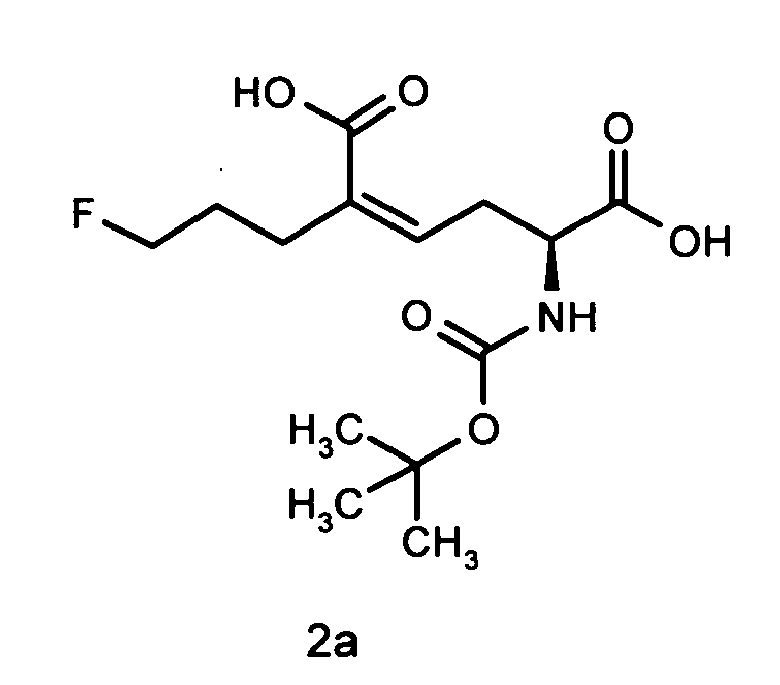
- In a third aspect, the invention is directed to compounds of the general formula (III)

- R8, R9 and R10 are independently from each other selected from Hydrogen and Y with the proviso that one of R8, R9 and R10 is Y,
- wherein Y is
- Leaving Group (LG) with the proviso that Y is not attached to a sp2 hybridized carbon atom,
- branched or straight-chain LG -C1-C10 alkyl wherein the carbon chain is optionally interrupted by 1 or 2 oxygen atoms with the proviso that there are at least two methylene groups between two oxygen atoms,
- branched or straight-chain LG -C1-C10 alkoxy with the proviso that Y is not attached to a sp2hybridized carbon atom and wherein the carbon chain is optionally interrupted by 1 additional oxygen atom with the proviso that there are at least two methylene groups between two oxygen atoms,
- LG -C6-C10 mono- or bicyclic aryl-(CH2)n wherein n = 1 to 3, preferably n = 1,
- LG -mono- or bicyclic heteroaryl-(CH2)n wherein n = 1 to 3, preferably n = 1,and wherein heteroaryl comprises 5 to 10 ring atoms wherein 1 or 2 ring atoms are hetero-atoms,
- LG -C3-C6 cycloalkyl with the proviso that LG is attached to one of the CH2 groups of the ring,
- LG -C3-C6 cycloalkyl-(CH2)n, wherein n = 1 to 3, preferably n = 1, with the proviso that LG is attached to one of the CH2 groups of the ring,
- LG -C6-C10 mono- or bicyclic aryl-(CH2)n-O, wherein n = 1 to 3 preferably n = 1 with the proviso that Y is not attached to a sp2 hybridized carbon atom or
- LG -mono- or bicyclic heteroaryl-(CH2)n-O wherein n = 1 to 3, preferably n = 1 with the proviso that Y is not attached to a sp2 hybridized carbon atom and wherein heteroaryl comprises 5 to 10 ring atoms wherein 1 or 2 ring atoms are hetero-atoms;
- R4= O-protecting group;
- R5= O-protecting group;
- R6= N-protecting group;
- R7= Hydrogen or N-protecting group or the group NR6R7is a 1,3-dioxo-1,3-dihydro-2H-isoindol-2-yl(phthalimido) or an azido group.
- Formula III encompasses single isomers, E and Z-isomers, diastereomers, enantiomers, mixtures thereof suitable salts thereof.
- In a first embodiment, the invention is directed to a compound of general formula (III)

- R9 and R10 are Hydrogen;
- R8 is Y,
- wherein Y is
- Leaving Group (LG) with the proviso that there is no double bond between C-4 and C-5,
- branched or straight-chain LG -C1-C10 alkyl wherein the carbon chain is optionally interrupted by 1 or 2 oxygen atoms with the proviso that there are at least two methylene groups between two oxygen atoms,
- branched or straight-chain LG -C1-C10 alkoxy with the proviso that there is no double bond between C-4 and C-5 and wherein the carbon chain is optionally interrupted by 1 additional oxygen atom with the proviso that there are at least two methylene groups between two oxygen atoms,
- LG -C6-C10 mono- or bicyclic aryl-(CH2)n wherein n = 1 to 3, preferably n = 1,
- LG -mono- or bicyclic heteroaryl-(CH2)n wherein n = 1 to 3, preferably n = 1 and wherein heteroaryl comprises 5 to 10 ring atoms wherein 1 or 2 ring atoms are hetero-atoms,
- LG -C3-C6 cycloalkyl with the proviso that LG is attached to one of the CH2 groups of the ring,
- LG -C3-C6 cycloalkyl-(CH2)n ,wherein n = 1 to 3, preferably n = 1, with the proviso that LG is attached to one of the CH2 groups of the ring,
- LG -C6-C10 mono- or bicyclic aryl-(CH2)n-O, wherein n = 1 to 3 preferably n = 1 with the proviso that there is no double bond between C-4 and C-5 or
- LG -mono- or bicyclic heteroaryl-(CH2)n-O wherein n = 1 to 3, preferably n = 1 with the proviso that there is no double bond between C-4 and C-5 and wherein heteroaryl comprises 5 to 10 ring atoms wherein 1 or 2 ring atoms are hetero-atoms;
- R4= O-protecting group;
- R5= O-protectinggroup;
- R6= N-protecting group;
- R7= Hydrogen or N-protecting group
- or the group NR6R7 is a 1,3-dioxo-1,3-dihydro-2H-isoindol-2-yl(phthalimido) or an azido group.
- Formula III encompasses single isomers, E and Z-isomers, diastereomers, enantiomers, mixtures thereof and suitable salts thereof.
- Preferably, compound of general formula (III) is a compound of general formula (IIIA)

- R9 and R10 are Hydrogen,
- R8 is Y,
- Leaving Group (LG),
- branched or straight-chain LG -C1-C10 alkyl wherein the carbon chain is optionally interrupted by 1 or 2 oxygen atoms with the proviso that there are at least two methylene groups between two oxygen atoms,
- branched or straight-chain LG -C1-C10 alkoxy wherein the carbon chain is optionally interrupted by 1 additional oxygen atom with the proviso that there are at least two methylene groups between two oxygen atoms,
- branched or straight-chain LG -C1-C10 alkoxy LG -C6-C10 mono- or bicyclic aryl-(CH2)n wherein n = 1 to 3, preferably n = 1,
- LG -mono- or bicyclic heteroaryl-(CH2)n wherein n = 1 to 3, preferably n = 1 and wherein heteroaryl comprises 5 to 10 ring atoms wherein 1 or 2 ring atoms are heteroatoms,
- LG -C3-C6 cycloalkyl with the proviso that LG is attached to one of the CH2 groups of the ring,
- LG -C3-C6 cycloalkyl-(CH2)n, wherein n = 1 to 3, preferably n = 1, with the proviso that LG is attached to one of the CH2 groups of the ring,
- LG -C6-C10 mono- or bicyclic aryl-(CH2)n-O, wherein n =1 to 3 preferably n =1 or
- LG -mono- or bicyclic heteroaryl-(CH2)n-O wherein n = 1 to 3, preferably n = 1 and wherein heteroaryl comprises 5 to 10 ring atoms wherein 1 or 2 ring atoms are heteroatoms;
- R4= o-protectinggroup;
- R5= O-protectinggroup;
- R6= N-protecting group;
- R7= Hydrogen or N-protecting group;
- or the group NR6R7 is a 1,3-dioxo-1,3-dihydro-2H-isoindol-2-yl(phthalimido) or an azido group.
- Formula IIIA encompasses single isomers, diastereomers, enantiomers, mixtures thereof and suitable salts thereof.
- Preferably, compound of general formula (III) is a compound of general formula (IIIB)

- R9 and R10 are Hydrogen,
- R8 is Y,
- branched or straight-chain LG -C1-C10 alkyl wherein the carbon chain is optionally interrupted by 1 or 2 oxygen atoms with the proviso that there are at least two methylene groups between two oxygen atoms,
- LG -C6-C10 mono- or bicyclic aryl-(CH2)n wherein n =1 to 3, preferably n = 1,
- LG -mono- or bicyclic heteroaryl-(CH2)n wherein n =1 to 3, preferably n = 1 and wherein heteroaryl comprises 5 to 10 ring atoms wherein 1 or 2 atom are hetero-atoms,
- LG -C3-C6 cycloalkyl with the proviso that LG is attached to one of the CH2 groups of the ring,
- LG -C3-C6 cycloalkyl-(CH2)n ,wherein n = 1 to 3, preferably n = 1, with the proviso that LG is attached to one of the CH2 groups of the ring;
- R4= 0-protecting group;
- R5= O-protecting group;
- R6= N-protecting group;
- R7= Hydrogen or N-protecting group;
- or the group NR6R7is a 1,3-dioxo-1,3-dihydro-2H-isoindol-2-yl (phthalimido) or an azido group.
- Formula IIIB encompasses single isomers, E and Z-isomers, diastereomers, enantiomers, mixtures thereof and suitable salts thereof.
- The compounds of formula III,(IIIA)or (IIIB)are compounds suitable for fluorolabeling wherein the functional group(s) such as OH and NH2are protected with suitable protecting group(s) such as R4to R7,respectively.
- Preferably, R9and R10are Hydrogen and R8 is Y,
- Preferably in (IIIA)and (IIIB), R9 and R10 are Hydrogen and R8 is Y.
- Preferred features disclosed below apply to (IIIA):
- Preferably Y is
- Leaving Group (LG),
- branched or straight-chain LG-C1-C10alkyl wherein the alkyl chain is optionally interrupted by 1 or 2 oxygen atoms with the proviso that there are at least two methylene groups between two oxygen atoms,
- branched or straight-chain LG-C1-C10 alkoxy wherein the carbon chain is optionally interrupted by 1 additional oxygen atom with the proviso that there are at least two methylene groups between two oxygen atoms,
- LG-C6-C10 mono- or bicyclic aryl-(CH2)n wherein n = 1 to 3, preferably n = 1 or
- LG-mono- or bicyclic heteroaryl-(CH2)n wherein n =1 to 3, preferably n = 1,and wherein heteroaryl comprises 5 to 10 ring atoms wherein 1 or 2 ring atoms are hetero-atoms.
- More preferably, Y is
- Leaving Group (LG),
- branched or straight-chain LG-C1-C10 alkyl wherein the alkyl chain is optionally interrupted by 1 or 2 oxygen atoms with the proviso that there are at least two methylene groups between two oxygen atoms, or
- branched or straight-chain LG-C1-C10 alkoxy wherein the carbon chain is optionally interrupted by 1 additional oxygen atom with the proviso that there are at least two methylene groups between two oxygen atoms.
- Even more preferably, Y is
- Leaving Group (LG),
- branched or straight-chain LG-C1-C10 alkyl or
- branched or straight-chain LG-C1-C10 alkoxy.
- Even more preferably, Y is Leaving Group (LG) or
- branched or straight-chain LG-C1-C10 alkyl.
- Preferred features disclosed below apply to (lllB):
- Preferably Y is
- branched or straight-chain LG-C1-C10 alkyl wherein the alkyl chain is optionally interrupted by 1 or 2 oxygen atoms with the proviso that there are at least two methylene groups between two oxygen atoms,
- LG-C6-C10 mono- or bicyclic aryl-(CH2)n wherein n = 1 to 3, preferably n = 1 or
- LG-mono- or bicyclic heteroaryl-(CH2)n wherein n = 1 to 3, preferably n = 1,and wherein heteroaryl comprises 5 to 10 ring atoms wherein 1 or 2 ring atoms are hetero-atoms.
- More preferably, Y is
- branched or straight-chain LG-C1-C10 alkyl wherein the alkyl chain is optionally interrupted by 1 or 2 oxygen atoms with the proviso that there are at least two methylene groups between two oxygen atoms.
- Even more preferably, Y is
- branched or straight-chain LG-C1-C10 alkyl.
- Preferred features disclosed below apply to (IIIA)and (IIIB):
- Preferably, branched or straight-chain LG-C1-C10 alkyl is LG-C1C6 alkyl or LG-C7-C10 alkyl.
- More preferably, LG-C1-C10 alkyl is LG-C1-C3 alkyl, LG-C1methyl (LG-CH2),LG-ethyl (LG-(CH2)2), LG- propyl (e.g. LG-(CH2)3), LG-butyl (e.g. LG-(CH2)4) or LG-pentyl (e.g. LG-(CH2)5). Alkyl chain can be substituted at any position with the Leaving Group (LG). Preferably, alkyl chain is substituted with the Leaving Group (LG) at the terminal position of the chain.
- Preferably, branched or straight-chain LG-C1-C10 alkyl wherein the alkyl chain is optionally interrupted by 1 or 2 oxygen atoms with the proviso that there are at least two methylene groups between two oxygen atoms is 3-[(methylsulfonyl)oxy]propyl, 3-{[(4-methylphenyl)sulfonyl]oxy}propyl, 3-{[(4-nitrophenyl)sulfonyl]oxy}propyl, 3-{[(trifluoromethyl)sulfonyl]oxy}propyl, (methylsulfonyl)oxymethyl, [(4-methylphenyl)sulfonyl]oxymethyl, [(4-nitrophenyl)sulfonyl]oxymethyl, [(trifluoromethyl)sulfonyl]oxymethyl, {2-[(methylsulfonyl)oxy]ethoxy}methyl, (2-{[(4-methylphenyl)sulfonyl]oxylethoxy)methyl, (2-{[(4-nitrophenyl)sulfonyl]oxy}ethoxy)methyl, (2-{[(trifluoromethyl)sulfonyl]oxy}ethoxy)methyl, 3-{2-[(methylsulfonyl)oxy]ethoxylpropyl, 3-(2-{[(4-methylphenyl)sulfonyl]oxy}ethoxy)propyl, 3-(2-{[(4-nitrophenyl)sulfonyl]oxy}ethoxy)propyl, 3-(2-{[(trifluoromethyl)sulfonyl]oxy)ethoxy)propyl.
- Preferably, branched or straight-chain LG-C1-C10 alkoxy is LG-C2-C6 alkoxy or LG-C7-C10 alkoxy. More preferably, LG-C2-C10 alkoxy is LG-C2 alkoxy (LG-(CH2)20), LG-C3 alkoxy (e.g. LG-(CH2)3O), LG-C4 alkoxy (e.g. LG-(CH2)40) or LG-C5 alkoxy (e.g. LG-(CH2)50).
- The alkoxy chain can be substituted at any carbon atom with the Leaving Group (LG). Preferably, alkoxy chain is substituted with the Leaving Group (LG) at the terminal position of the chain.
- Preferably, branched or straight-chain LG-C1-C10 alkoxy wherein the carbon chain is optionally interrupted by 1 additional oxygen atom with the proviso that there are at least two methylene groups between two oxygen atoms is 2-[(methylsulfonyl)oxy]ethoxy, 2-{[(4-methylphenyl)sulfonyl]oxylethoxy, 2-{[(4-nitrophenyl)sulfonyl]oxy}ethoxy, 2-{[(trifluoromethyl)sulfonyl]oxy}ethoxy, 3-[(methylsulfonyl)oxy]propan-l-oxy, 3-{[(4-methylphenyl)sulfonyl]oxy}propan-1-oxy, 3-{[(4-nitrophenyl)sulfonyl]oxy}propan-1-oxy, 3-{[(trifluoromethyl)sulfonyl]oxy}propan-1-oxy, 2-{2-[(methylsulfonyl)oxy]ethoxylethoxy, 2-(2-{[(4-methylphenyl)sulfonyl]oxy}ethoxy)ethoxy, 2-(2-{[(4-nitrophenyl)sulfonyl]oxy}ethoxy)ethoxy, 2-(2-{[(trifluoromethyl)sulfonyl]oxy}ethoxy)ethoxy.
- Preferably, LG-C6-C10 mono- or bicyclic aryl-(CH2)n is LG-C6H4-(CH2)n wherein n = 1 to 3, preferably n = 1. Aryl can be substituted at any position with the Leaving Group (LG).
- Preferably, LG-mono- or bicyclic heteroaryl-(CH2)n is LG-pyridinyl-(CH2)n or LG-pyrimidinyl-(CH2)n wherein n = 1 to 3, preferably n = 1. Heteroaryl can be substituted at any carbon atom with the Leaving Group (LG).
- Preferably, LG-C3-C6 cycloalkyl is LG-C3 cycloalkyl, LG-C4 cycloalkyl, LG-C5 cycloalkyl or LG-C6 cycloalkyl. Cycloalkyl can be substituted at any position of the CH2 groups of the ring with the Leaving Group (LG)
- Preferably, LG-C3-C6 cycloalkyl-(CH2)n is LG-C3 cycloalkyl-(CH2)n, LG-C4 cycloalkyl-(CH2)n, LG-C5 cycloalkyl-(CH2)n or LG-C6 cycloalkyl-(CH2)n wherein n = 1 to 3, preferably n = 1. Cycloalkylcan be substituted at any position of the CH2 groups of the ring with the Leaving Group (LG)
- Preferably, LG-C6-C10 mono- or bicyclic aryl-(CH2)n-O is LG-C6H4-(CH2)nO wherein n = 1 to 3, preferably n = 1. Aryl can be substituted at any position with the Leaving Group (LG).
- Preferably, LG-mono- or bicyclic heteroaryl-(CH2)n-O is LG-pyridinyl-(CH2)nO or LG-pyrimidinyl-(CH2)nO wherein n = 1 to 3, preferably n = 1. Heteroaryl can be substituted at any carbon atom with the Leaving Group (LG).
- Embodiments and preferred features can be combined together and are within the scope of the invention.
- Preferably, the Leaving Group (LG), if attached to an sp3-hybridized carbon atom, is selected from the group of
- Chloro,
- Bromo,
- Methylsulfonyloxy,
- Trifluoromethylsulfonyloxy,
- (4-Nitrophenyl)sulphonyloxy
- Nonafluorobutylsulfonyloxy,
- (4-Methylphenyl)sulfonyloxy, and
- lodo.
- More preferably, the Leaving Group (LG), if attached to an sp3-hybridized carbon atom, is selected from the group of
- Methylsulfonyloxy,
- Trifluoromethylsulfonyloxy,
- (4-Nitrophenyl)sulphonyloxy
- Nonafluorobutylsulfonyloxy, and
- (4-Methylphenyl)sulfonyloxy.
- Even more preferably, the Leaving Group (LG), if attached to an sp3-hybridizedcarbon atom, is
- (4-Nitrophenyl)sulphonyloxy or(4-Methylphenyl)sulfonyloxy.
- Preferably, the Leaving Group (LG), if attached to aryl or heteroaryl, is selected from the group of
- bromo,
- iodo,
- nitro,
- trimethyl ammonium,
- 4-methoxyphenyliodonium, and
- 2-thienyliodonium.
- R4 or R5is an O-protecting group selected from the group comprising
- Methyl, Ethyl, Propyl, Butyl, t-Butyl, Allyl, Benzyl, 4-Methoxybenzyl, 4-Methoxyphenyl. Preferably, R4 is an O-protecting group selected from the group comprising Methyl, Ethyl, t-Butyl, Benzyl .
- N-protecting groups are selected from the group comprising
- Carbobenzyloxy (Cbz), p-Methoxybenzyl carbonyl (Moz or MeOZ), tert-Butyloxycarbonyl (BOC), 9-Fluorenylmethyloxycarbonyl (FMOC), Benzyl (Bn), p-Methoxybenzyl (PMB), 3,4-Dimethoxybenzyl (DMPM), Triphenylmethyl and p-methoxyphenyl (PMP) or the group NR6R7 is a 1,3-dioxo-1,3-dihydro-2H-isoindol-2-yl (phthalimido) or an azido group.
- Preferably, R6 and R7 are selected independently from each other from the group comprising Carbobenzyloxy (Cbz), p-Methoxybenzyl carbonyl (Moz or MeOZ),tert-Butyloxycarbonyl (BOC), 9-Fluorenylmethyloxycarbonyl (FMOC), Benzyl (Bn).
More preferably, R6 and R7 are selected independently from each other from the group comprising tert-Butyloxycarbonyl (BOC) and 9-Fluorenylmethyloxycarbonyl (FMOC).
Even more preferably, R6 is N-protecting group and R7 is Hydrogen or a N-protecting group. - Invention compounds are selected from but not limited to
- 1-tert-butyl 6-ethyl (2S)-2-[(tert-butoxycarbonyl)amino]-5-[(methylsulfonyl)oxy]hexanedioate

- 1-tert-butyl 6-ethyl (2S)-2-[(tert-butoxycarbonyl)amino]-5-{3-[(methylsulfonyl)oxy]propyl}-hexanedioate

- In a fourth aspect, the invention is directed to a composition comprising compounds of the general formula (l), (ll), (lll), (lA), (lB), (llA), (llB), (lllA), (lllB) or mixture thereof and pharmaceutically acceptable carrier or diluent.
The person skilled in the art is familiar with auxiliaries, vehicles, excipients, diluents, carriers or adjuvants which are suitable for the desired pharmaceutical formulations, preparations or compositions on account of his/her expert knowledge.
The administration of the compounds, pharmaceutical compositions or combinations according to the invention is performed in any of the generally accepted modes of administration available in the art. Intravenous deliveries are preferred. - Generally, the pharmaceutical compositions according to the invention can be administered such that the dose of the active compound is in the range of 37 MBq (1 mCi) to 740 MBq (20 mCi). In particular, a dose in the range from 150 MBq to 370 MBq will be used.
- In a fifth aspect, the invention is directed to method for obtaining compound of formula (I),(IA), (lB), (l), (llA) or (llB) or mixture thereof.
The method of the invention is a fluoro-labeling method.
Preferably, the fluoro-labeling method concerns a method for labeling invention compounds with Fluorine atom (F) containing moiety wherein the Fluorine atom (F) containing moiety preferably comprises 18F or 19F. - More preferably, Fluorine atom (F) containing moiety comprises 18F. Even more preferably, the Fluorine atom (F) containing moiety is 4,7,13,16,21,24-Hexaoxa-1,10-diazabicyclo[8.8.8]-hexacosane K 18F (crownether salt Kryptofix K18F), K18F, H18F, KH18 F2, Cs18F, Na 18F or tetraalkylammonium salt of 18F (e.g.[F-18] tetrabutylammonium fluoride). Most preferably, the Fluorine atom (F) containing moiety is K18F, H18F, or KH18F2.
- Preferably, the fluoro-labeling method is a fluoro-radiolabeling method.
- Under the present invention, the method is a direct labelling method for obtaining compound of formula (l), (lA), (lB), (ll), (llA) or (llB) or mixture thereof.
The fluoro-labelingmethod comprises the steps - Coupling compound of general Formula (lll), (lllA) or (lllB) with Fluorine atom (F) containing moiety,
- Deprotecting compound of formula (ll), (llA) or (llB) and
- Optionally converting obtained compound into suitable salts of inorganic or organic acids thereof, hydrates, complexes, esters, amides, and solvates thereof.
- Preferably, the method is a direct labelling method for obtaining compound of formula (I),(IA), (lB), (ll), (llA) or (llB) or mixture thereof.
The fluoro-labeling method comprises the steps - Coupling compound of general Formula (lll), (lllA) or (lllB) with Fluorine atom (F) containing moiety wherein the Fluorine atom (F) containing moiety comprises 18F,
- Deprotecting compound of formula (ll), (llA) or (llB) and
- Optionally converting obtained compound into suitable salts of inorganic or organic acids thereof, hydrates, complexes, esters, amides, and solvates thereof.
- Preferably, the method is a direct labelling method for obtaining compound of formula (I),(IA), (lB), (ll), (llA) or (llB) or mixture thereof.
The fluoro-labeling method comprises the steps - Coupling compound of general Formula (lll), (lllA) or (lllB) with Fluorine atom (F) containing moiety wherein the Fluorine atom (F) containing moiety comprises 19F,
- Deprotecting compound of formula (ll), (llA) or (llB) and
- Optionally converting obtained compound into suitable salts of inorganic or organic acids thereof, hydrates, complexes, esters, amides, and solvates thereof.
- The reagents, solvents and conditions which can be used for this fluorination are common and well-known to the skilled person in the field. See, e.g., J. Fluorine Chem., 27 (1985):177-191. Preferably, the solvents used in the present method is DMF, DMSO, acetonitrile, DMA, or mixture thereof, preferably the solvent is DMSO.
- A method for obtaining a compound of formula (l), (lA), (lB), (ll), (llA) or (llB) or mixture thereof
- wherein the compound of formula (I) is as disclosed above.
- Compounds of formula (l), (lA), (lB), (ll), (llA), (llB), (lll), (lllA) and (lllB)are defined as above wherein embodiment and preferred features are herein enclosed.
- In a sixth aspect, the invention is directed to compounds of general formula (I) or (II)for the manufacture of an imaging tracer for imaging proliferative diseases.
In other word, the invention is directed to the use of invention compounds of general formula (l) and (ll) for the manufacture of an imaging tracer for imaging proliferative diseases.
The compounds of general formula (l) and (ll) are herein defined as above and encompass all embodiments and preferred features. Preferably, the invention compounds are compounds of general formula (l) or (ll) wherein the Fluorine atom (F) is 18F isotope. - The imaging tracer is Positron Emission Tomography PET suitable imaging tracer.
- The invention is also directed to a method for imaging or diagnosis proliferative diseases comprising the steps:
- Administrating to a mammal an effective amount of a compound comprising compounds of general formula (I) or (II),
- Obtaining images of the mammal and
- Assessing images.
- Proliferative diseases are cancer characterised by the presence of tumor and/or metastases. Preferably, tumour are selected from the group of malignomas of the gastrointestinal or colorectal tract, liver carcinoma, pancreas carcinoma, kidney carcinoma, bladder carcinoma, thyroid carcinoma,. prostate carcinoma, endometrial carcinoma, ovary carcinoma, testes carcinoma, melanoma, small-cell and non-small-cell bronchial carcinoma, dysplastic oral mucosa carcinoma, invasive oral cancer; breast cancer, including hormone-dependent and hormone-independent breast cancer, squamous cell carcinoma, neurological cancer disorders including neuroblastoma, glioma, astrocytoma, osteosarcoma, meningioma, soft tissue sarcoma; haemangioma and endocrine tumours, including pituitary adenoma, chromocytoma, paraganglioma, haematological tumour disorders including lymphoma and leukaemias; Preferably, the tumor is bronchial carcinoma.
Preferably, metastases are metastases of one of the tumours mentioned above. - Preferably, the invention compounds and use is for manufacturing a PET imaging tracer for imaging tumor in a mammal wherein the tumor is preferably a non-small-cell carcinoma.
- In a seventh aspect, the invention is directed to the use of compounds of general formula (l), (ll) or (lll) for conducting biological assays and chromatographic identification. More preferably, the use relates to compounds of general formula (l) or (ll) wherein the fluorine isotope is 18For 19F,more preferably 19F.
Compounds of general formula (l), (ll) or (lll) wherein the fluorine isotope is 19F are useful as reference and/or measurement agent.
The compounds of general formula (l), (ll) and (lll) are herein defined as above and encompass all embodiments and preferred features. - In a eighth aspect, the present invention provides a kit comprising a sealed vial containing a predetermined quantity of a compound having general chemical Formula (l), (ll) or (lll) and suitable salts of inorganic or organic acids thereof, hydrates, complexes, esters, amides, and solvates thereof. Optionally the kit comprises a pharmaceutically acceptable carrier, diluent, excipient or adjuvant.
- The terms used in the present invention are defined below but are not limiting the invention scope.
- If chiral centers or other forms of isomeric centers are present in a compound according to the present invention, all forms of such stereoisomers, including enantiomers and diastereoisomers, are intended to be covered herein. Compounds containing chiral centers may be used as racemic mixture or as an enantiomerically enriched mixture or as a diastereomeric mixture or as a diastereomerically enriched mixture, or these isomeric mixtures may be separated using well-known techniques, and an individual stereoisomer maybe used alone. In cases in which compounds have carbon-carbon double bonds, both the (Z)-isomers and (E)-isomers as well as mixtures therof are within the scope of this invention. In cases wherein compounds may exist in tautomeric forms, such as keto-enol tautomers, each tautomeric form is contemplated as being included within this invention whether existing in equilibrium or predominantly in one form.
- In the context of the present invention, preferred suitable salts are pharmaceutically acceptable salts of the compounds according to the invention. The invention also comprises salts which for their part are not suitable for pharmaceutical applications, but which can be used, for exam-ple,for isolating or purifying the compounds according to the invention. Pharmaceutically acceptable salts of the compounds according to the invention include acid addition salts of mineral acids, carboxylic acids and sulphonic acids, for example salts of hydrochloric acid, hydrobromic acid, sulphuric acid, phosphoric acid, methanesulphonic acid, ethanesulphonic acid, toluenesulphonic acid, benzenesulphonic acid, naphthalene disulphonic acid, acetic acid, trifluoroacetic acid, propionic acid, lactic acid, tartaric acid, malic acid, citric acid, fumaric acid, maleic acid and benzoic acid.
- Pharmaceutically acceptable salts of the compounds according to the invention also include salts of customary bases, such as, by way of example and by way of preference, alkali metal salts (for example sodium salts and potassium salts), alkaline earth metal salts (for example calcium salts and magnesium salts) and ammonium salts, derived from ammonia or organic amines having 1 to 16 carbon atoms, such as, by way of example and by way of preference, ethylamine, diethylamine, triethylamine, ethyldiisopropylamine, monoethanolamine, diethanolamine, triethanolamine, dicyclohexylamine, dimethylaminoethanol, procaine, dibenzylamine, N methylmorpholine, arginine, lysine, ethylenediamine and N methylpiperidine.
- The term "C1-C10 alkyl", used herein on its own or as part of another group,refers to saturated carbon chains which may be straight-chain or branched, in particular to methyl, ethyl, n-propyl, isopropyl, n-butyl, isobutyl, tert-butyl, methylpropyl, n-pentyl, 2,2-dimethylpropyl, 2-methylbutyl, 3-methylbutyl, n-hexyl, n-heptyl, n-octyl, n-nonyl or n-decyl groups. Preferably, alkyl is methyl, ethyl, propyl, butyl, pentyl or hexyl.
- The term "C1-C10-alkoxy"used herein on its own or as part of another group, refers to an 0-alkyl chain, in particular to methoxy, ethoxy, n-propoxy, n-butoxy, n-pentyloxy, n-hexyloxy, n-heptyloxy, n-octyloxy, n-nonyloxy or n-decyloxy group. Preferably, alkoxy is methoxy, ethoxy, n-propoxy, n-butoxy, n-pentyloxy or n-hexyloxy.
- The term "aryl" as employed herein by itself or as part of another group refers to monocyclic or bicyclic C6-C10aromatic rings, in particular phenyl or naphthyl groups e.g. 1-naphthyl and 2-naphthyl, which themselves can be substituted with one or two substituents independently and individually selected from but not limited to the group comprising halogen, NO2, CN, COOH, (C1-C3) alkyl, formyl, acetyl, alkoxycarbonyl or trifluoromethyl.
- The term "heteroaryl" as employed herein by itself or as part of another group refers to monocyclic or bicyclic heteroaromatic groups containing from 5 to 10 ring atoms, wherein 1 or 2 atoms of the ring portion are independently selected from N, O or S, e.g. thienyl, furanyl, pyrrolyl, oxazolyl, thiazolyl, imidazolyl, pyrazolyl, isoxazolyl, isothiazolyl, benzofuranyl, benzothienyl, benzothiazolyl, benzoxazolyl, benzimidazolyl, indazolyl, indolyl, pyridyl, pyridazinyl, pyrimidinyl, pyrazinyl, quinolyl, isoquinolyl etc.; which themselves can be substituted with one or two substituents independently and individually selected from but not limited to the group comprising halogen, NO2, CN, COOH, (C1-C3) alkyl, formyl, acetyl, alkoxycarbonyl or trifluoromethyl.
- The term "C3-C6 cycloalkyl" used herein on its own or as part of another group, refers to cyclopropyl, cyclobutyl, cyclopentyl or cyclohexyl which can be substituted with one or two (C1-C3) alkyl or (C1C3)alkoxy groups .
- Halogen as used herein refers to fluoro, chloro, bromo or iodo.
- The term "amine-protecting group" as employed herein by itself or as part of another group is known or obvious to someone skilled in the art, which is chosen from but not limited to a class of protecting groups namely carbamates, amides, imides, N-alkyl amines, N-aryl amines, imines, enamines, boranes, N-P protecting groups, N-sulfenyl, N-sulfonyl and N-silyl, and which is chosen from but not limited to those described in the textbook Greene and Wuts, Protecting groups in Organic Synthesis, third edition, page 494-653, included herewith by reference.
- Amino protecting groups are selected from the group comprising
- Carbobenzyloxy (Cbz), p-Methoxybenzyl carbonyl (Moz or MeOZ), tert-Butyloxycarbonyl (BOC), 9-Fluorenylmethyloxycarbonyl (FMOC), Benzyl (Bn), p-Methoxybenzyl (PMB), 3,4-Dimethoxybenzyl (DMPM), p-methoxyphenyl (PMP) or the protected amino group is a 1,3-dioxo-1,3-dihydro-2H-isoindol-2-yl (phthalimido) or an azido group.
- O-protecting groups are selected from the group comprising
- Methyl, Ethyl, Propyl, Butyl, t-Butyl, Allyl, Benzyl, 4-Methoxybenzyl, 4-Methoxyphenyl.
- The term "leaving group" as employed herein by itself or as part of another group is known or obvious to someone skilled in the art, and means that an atom or group of atoms is detachable from a chemical substance by a nucleophilic agent. Examples are given e.g. in Synthesis (1982), p. 85-125, table 2 (p. 86; (the last entry of this table 2 needs to be corrected: "n-C4F9S(O)2-O- nonaflat" instead of "n-C4H9S(O)2-O- nonaflat"), Carey and Sundberg, Organische Synthese, (1995), page 279-281, table 5.8; or Netscher, Recent Res. Dev. Org. Chem., 2003, 7, 71-83,
scheme 1, 2, 10 and 15 and others). (Coenen, Fluorine-18 Labeling Methods: Features and Possibilities of Basic Reactions, (2006), in: Schubiger P.A., Friebe M., Lehmann L., (eds), PET-Chemistry - The Driving Force in Molecular Imaging. Springer, Berlin Heidelberg, pp.15-50, explicitly: scheme 4 pp. 25,scheme 5 pp 28, table 4 pp 30, Fig 7 pp 33). - Unless otherwise specified, when referring to the compounds of formula the present invention per se as well as to any pharmaceutical composition thereof the present invention includes all of the hydrates, salts, and complexes.
- The radiofluorination reaction can be carried out, for example in a typical reaction vessel (e.g. Wheaton vial) which is known to someone skilled in the art or in a microreactor. The reaction can be heated by typical methods, e.g. oil bath, heating block or microwave. The radiofluorination reactions are carried out in dimethylformamide with potassium carbonate as base and "kryptofix" as crown-ether. But also other solvents can be used which are well known to experts. These possible conditions include, but are not limited to: dimethylsulfoxid and acetonitril as solvent and tetraalkyl ammonium and tertraalkyl phosphonium carbonate as base. Water and/or alcohol can be involved in such a reaction as co-solvent. The radiofluorination reactions are conducted for one to 60 minutes. Preferred reaction times are five to 50 minutes. Further preferred reaction times are 10 to 40 min. This and other conditions for such radiofluorination are known to experts (Coenen, Fluorine-18 Labeling Methods: Features and Possibilities of Basic Reactions, (2006), in: Schubiger P.A., Friebe M., Lehmann L., (eds), PET-Chemistry - The Driving Force in Molecular Imaging. Springer, Berlin Heidelberg, pp.15-50). The radiofluorination can be carried out in a "hot-cell" and/or by use of a module (eview: Krasikowa, Synthesis Modules and Automation in F-18 labeling (2006), in: Schubiger P.A., Friebe M., Lehmann L., (eds), PET-Chemistry - The Driving Force in Molecular Imaging. Springer, Berlin Heidelberg, pp. 289-316) which allows an automated or semi-automated synthesis.
- Precursors for alkyl-F-18 compounds of general formula l are e.g. tosylates, brosylates, nosylates, mesylates, triflates, nonaflates etc. (formula lll) which can be synthesized from the respective hydroxy compounds according to methods known in the art (J. March, Advanced Organic Chemistry, 4th ed. 1992, John Wiley & Sons, pp 352ff). More specifically, a hydroxy group being attached to a sp3hybridized carbon atom can be converted to a leaving group by an activating agent like thionyl chloride (e.g. Organic and Biomolecular Chemistry; 4; 22; (2006); 4101 - 4112), phosphorus pentachloride (e.g. Bioorganic and Medicinal Chemistry; 16; 6; (2008); 3309-3320),methanesulfonyl chloride (e.g. Organic and Biomolecular Chemistry; English; 4; 24; (2006); 4514 -4525), carbon tetrachloride / triphenylphosphine (Tetrahedron: Asymmetry; English; 19; 5; 2008; 577 -583), hydrogen chloride (e.g. Russian Chemical Bulletin; English; 56; 6; 2007; 1119 -1124), N-chloro-succinimide/ dimethylsulfide (e.g. Bioscience, Biotechnology, and Biochemistry 72; 3; (2008); 851 -855), hydrogen bromide (e.g. Journal of Labelled Compounds and Radiopharmaceuticals; 51; 1; (2008); 12 - 18), phosphorus tribromide (Journal of the American Chemical Society; 130; 12; (2008); 3726 - 3727), carbon tetrabromide / triphenylphosphine (e.g. Journal of the American Chemical Society; 130; 12; (2008); 4153 -4157), N-bromo-succimide/SMe2 (e.g. Chemical Communications (Cambridge, United Kingdom); 1; (2008); 120 - 122), bromine / triphenylphosphine (e.g. Journal of the American Chemical Society; 130; 12; (2008); 4153 - 4157), N-bromo-succimide/SMe2(e.g. Chemical Communications (Cambridge, United Kingdom); 1; (2008); 120 -122), Br2/PPh3 (e.g. European Journal of Organic Chemistry; 9; (2007); 1510 -1516), mesylchloride, tosylchloride, trifluormethylsulfonylchloride, nona-fluorobutylsulfonylchloride, (4-bromo-phenyl)sulfonylchloride, (4-nitro-phenyl)sulfonylchloride, (2-nitro-phenyl)sulfonylchloride, (4-isopropyl-phenyl)sulfonylchloride, (2,4,6-tri-isopropylphenyl)sulfonylchloride, (2,4,6-trimethyl-phenyl)sulfonylchloride, (4-tertbutyl-phenyl)sulfonylchloride, (4-methoxy-phenyl)sulfonylchloride, mesylanhydride, tosylanhydride, trifluormethylsulfonylanhydride, nona-fluorobutylsulfonylanhydride,(4-bromophenyl)sulfonylanhydride, (4-nitro-phenyl)sulfonylanhydride, (2-nitrophenyl)sulfonylanhydride, (4-isopropyl-phenyl)sulfonylanhydride,(2,4,6-tri-isopropylphenyl)sulfonylanhydride, (2,4,6-trimethyl-phenyl)sulfonylanhydride, (4-tertbutyl-phenyl)sulfonylanhydride, (4-methoxy-phenyl)sulfonylanhydride etc.
- An additional method which is applicable to the synthesis of those alkyl chains R8 in formula III which are interrupted by 1 or 2 oxygen atoms comprises the alkylation of hydroxy compounds by suitable bis(arylsulfonates) or bis(alkylsulfonates) and the like, e.g. bis(tosylates) Ts0-(CH2)n-OTs.
- Other precursors for F-18 compounds of general formula I are e.g. iodides and bromides and the like whose conversion to the respective fluorides is also known in the art (J. March, see above).
- Precursors for aryl-F-18 compounds of general formula I are e.g. aryl or heteroaryl bromides, iodides, nitro compounds, trialkyl ammonium, aryliodonium which can be converted to the respective F-18 compounds of this invention by methods known in the art (L. Cai, S. Lu, V. Pike, Eur. J. Org. Chem 2008, 2853-2873). Starting materials for these precursors are commercially available or can be synthesized by methods known in the art (R.C. Larock, Comprehensive Organic Transformations, VCH Publishers 1989).
- The synthesis of hydroxy compounds as starting materials for tosylates, brosylates, nosylates, mesylates, triflates, nonaflates etc. comprises the deprotection of OH-protecting groups. As one of the very versatile protecting groups might be mentioned the acetyl protecting group. Many others are known in the art, see e.g. T.W. Greene and P.G.M. Wuts, Protective Groups in Organic Synthesis, 3rd ed, 1999, John Wiley & Sons, pp 17ff).
- The hydroxy compounds can alternatively be synthesized directly by those skilled in the art by e.g. hydroboration of corresponding vinylic compounds, reduction of carbonyl compounds, or alkylation of deprotonated homoglutamate derivatives with epoxides (R.C. Larock, Comprehensive Organic Transformations, VCH Publishers 1989, p. 479-582) or by direct β-oxidation of carbonyl compounds via sulfonyloxaziridines (F. A. Davis et al., J. Org. Chem. 1984, 49(17), 3241-3243) or MoOPH (J. Marin et al.,JOC 2002, 67, 8440-8449) e.g. at C5.
- The protected hydroxy compounds can be obtained by deprotonation of protected homoglutamate at C5 with suitable bases (e.g. lithium diisopropyl amide, lithium hexamethyldisilazide, nBuLi etc.) and reaction with an alkylating agent like oxy-substituted alkyl halides, sulphonates etc bearing a protected hydroxy group (e.g. Lunney et al.,J. Med. Chem. 1994, 37(17), 2664.)
- The alkoxy-homoglutamate derivates are accordingly accessible to those skilled in the art by etherfication of 5-hydroxyhomoglutamate derivatives e.g. by means of Finkelstein or Mitsunobu reactions (R. C. Larock, Comprehensive Organic Transformations, VCH Publishers 1989, p. 443-453.).
- Alternatively, the saturated homoglutamate derivatives substituted at C5 can be synthesized by hydrogenation of the corresponding unsaturated derivatives bearing a C-C-double bond between C4 and C5. Latter compounds are accessible by C-C-bond forming reaction between C4 and C5 by methods known to those skilled in the art like metathesis reactions (K. C. Nicolaou et al., Angewandte Chemie Int. Ed. 2005, 44(29), 4490-4527.), aldol condensation reactions, or Wittig reactions (R.C. Larock, Comprehensive Organic Transformations, VCH Publishers 1989, p. 129-180.). See also Example 1d and 1f, respectively.
- An alternative access to homoglutamic acids of this invention is the ring-opening of the respective 6-ring membered lactams e.g. via acidic hydrolysis and stepwise or parallel removal of protecting groups which gives the open-chain compounds of formula l.

- The 19F-compounds can be synthesized according to the syntheses for the 18F-compounds (see above), by deoxofluorination reactions (M. Hudlicky, Org. React. 1988, 35, 513; H. Vorbrüggen, Synthesis 2008, 8, 1165-1174.), by electrophilic fluorinations (T. Suzuki et al., J. Org. Chem. 2007, 72, 246-250.), or by employment of fluorine-bearing building block (see e.g. Example 1a).
- The conversion of a hydroxy group being attached to a sp3 hybridized carbon atom to a leaving group is possible with thionyl chloride (e.g. Organic and Biomolecular Chemistry; 4; 22; (2006); 4101 - 4112), phosphorus pentachloride (e.g. Bioorganic and Medicinal Chemistry; 16; 6; (2008); 3309-3320), methanesulfonyl chloride (e.g. Organic and Biomolecular Chemistry; English; 4; 24; (2006); 4514 - 4525), carbon tetrachloride / triphenylphosphine (Tetrahedron: Asymmetry; English; 19; 5; 2008; 577 - 583), hydrogen chloride (e.g. Russian Chemical Bulletin; English; 56; 6; 2007; 1119 - 1124), N-chloro-succinimide/ dimethylsulfide (e.g. Bioscience, Biotechnology, and Biochemistry 72; 3; (2008); 851 - 855), hydrogen bromide (e.g. Journal of Labelled Compounds and Radiopharmaceuticals; 51; 1; (2008); 12 - 18), phosphorus tribromide (Journal of the American Chemical Society; 130; 12; (2008); 3726 - 3727), carbon tetrabromide / triphenylphosphine (e.g. Journal of the American Chemical Society; 130; 12; (2008); 4153 - 4157), N-bromo-succimide/SMe2 (e.g. Chemical Communications (Cambridge, United Kingdom); 1; (2008); 120 - 122), bromine / triphenylphosphine (e.g. Journal of the American Chemical Society; 130; 12; (2008); 4153 - 4157), N-bromo-succimide/SMe2 (e.g. Chemical Communications (Cambridge, United Kingdom); 1; (2008); 120 - 122), Br2/PPh3 (e.g. European Journal of Organic Chemistry; 9; (2007); 1510 - 1516), mesylchloride, tosylchloride, trifluormethylsulfonylchloride, nona-fluorobutylsulfonylchloride, (4-bromophenyl)sulfonylchloride, (4-nitro-phenyl)sulfonylchloride, (2-nitro-phenyl)sulfonylchloride, (4-isopropyl-phenyl)sulfonylchloride, (2,4,6-tri-isopropyl-phenyl)sulfonylchloride, (2,4,6-trimethylphenyl)sulfonylchloride, (4-tertbutyl-phenyl)sulfonylchloride, (4-methoxyphenyl)sulfonylchloride, mesylanhydride, tosylanhydride, trifluormethylsulfonylanhydride, nona-fluorobutylsulfonylanhydride, (4-bromo-phenyl)sulfonylanhydride, (4-nitrophenyl)sulfonylanhydride, (2-nitro-phenyl)sulfonylanhydride, (4-isopropylphenyl)sulfonylanhydride, (2,4,6-tri-isopropyl-phenyl)sulfonylanhydride, (2,4,6-trimethylphenyl)sulfonylanhydride, (4-tertbutyl-phenyl)sulfonylanhydride, (4-methoxyphenyl)sulfonylanhydride, etc.
-
br broad signal (in NMR) d doublet dd doublet of doublet DMA N,N-dimethylacetamide DMF N,N-dimethylformamide DMSO dimethylsulphoxide dt doublet of triplet ESI Electrospray ionisation MS Mass spectrometry m multiplet MeCN acetonitrile NMR Nuclear magnetic resonance spectroscopy : chemical shifts (δ) are given in ppm. r.t. room temperature s Singlet t Triplet THF Tetrahydrofurane TFA Trifluoro acetic acid -

- Sodium hydride (2.72 g, 60% on mineral oil, 68.0 mmol) was washed several times with hexanes under an nitrogen atmosphere and was then suspended in dry THF (60 mL). Ethyl (diethoxyphosphoryl)acetate (13.3 g, 59.1 mmol) was added dropwise within 20 min at r.t. as a solution in dry THF (20 mL). After stirring for 2 h at r.t. 1-bromo-3-fluoropropane (10.0 g, 70.9 mmol) was added and the mixture was heated to reflux for 14 h. The mixture was then cooled to r.t. and the reaction was quenched by addition of sat. aq. ammonium chloride solution (50 mL). The mixture was extracted with ethyl acetate (3 x 50 mL) and the combinded organic layers were washed with brine and dried over sodium sulphate. After evaporation of the solvent under reduced pressure the crude product was purified by column chromatography (silica, hexanes/ethyl acetate gradient).
- Yield: 3.90 g, 13.7 mmol, 19 %.
- MS (ESIpos): m/z = 285 (M+H]+
- 1H-NMR (400MHz, CHLOROFORM-d): δ [ppm]= 1.25 - 1.37 (m, 9H), 1.66 - 1.90 (m, 2H), 1.92 - 2.17 (m, 2H), 2.97 (ddd, 1H), 4.09 - 4.27 (m, 6H), 4.39 (td, 1H), 4.51 (td, 1H).
-

- Yield: 2.70 g, 9.81 mmol, 95 %.
- MS (ESIpos): m/z = 276 [M+H]+
- 1H-NMR (400MHz, CHLOROFORM-d): δ [ppm]= 1.46 (s, 9H), 1.48 (s, 9H), 1.51 - 1.58 (m, 1H), 2.09 - 2.20 (m, 1H), 3.45 (br. s., 1H), 3.55 - 3.76 (m, 2H), 4.31 - 4.40 (m, 1H), 5.35 (d, 1H).
-

- To a solution of tert-Butyl N-(tert-butoxycarbonyl)-L-homoserinate (1.00 g, 3.63 mmol) in dichloromethane (50 mL) was added at r.t. pyridine (0.88 mL, 10.9 mmol) and Dess-Martin-periodinane (2.31 g, 5.45 mmol). After 90 min the reaction mixture was diluted with ethyl acetate (40 mL), washed with 10% sodium thiosulphate solution (30 mL), saturated sodium bicarbonate solution (40 mL), and brine (40 mL). The combined aqueous layers were extracted with ethyl acetate (50 mL) and the combinded organic layers were dried over sodium sulphate and concentrated under reduced pressure.
- Yield: 0.95 g, 3.48 mmol, 96%.
- MS (ESIpos): m/z = 274 [M+H]+
- 1H-NMR (300MHz, CHLOROFORM-d): δ [ppm]= 1.45 (br. s., 9H), 1.46 (s, 9H), 2.84 - 3.08 (m, 2H), 4.37 - 4.54 (m, 1H), 5.37 (d, 1H), 9.74 (s, 1H).
-
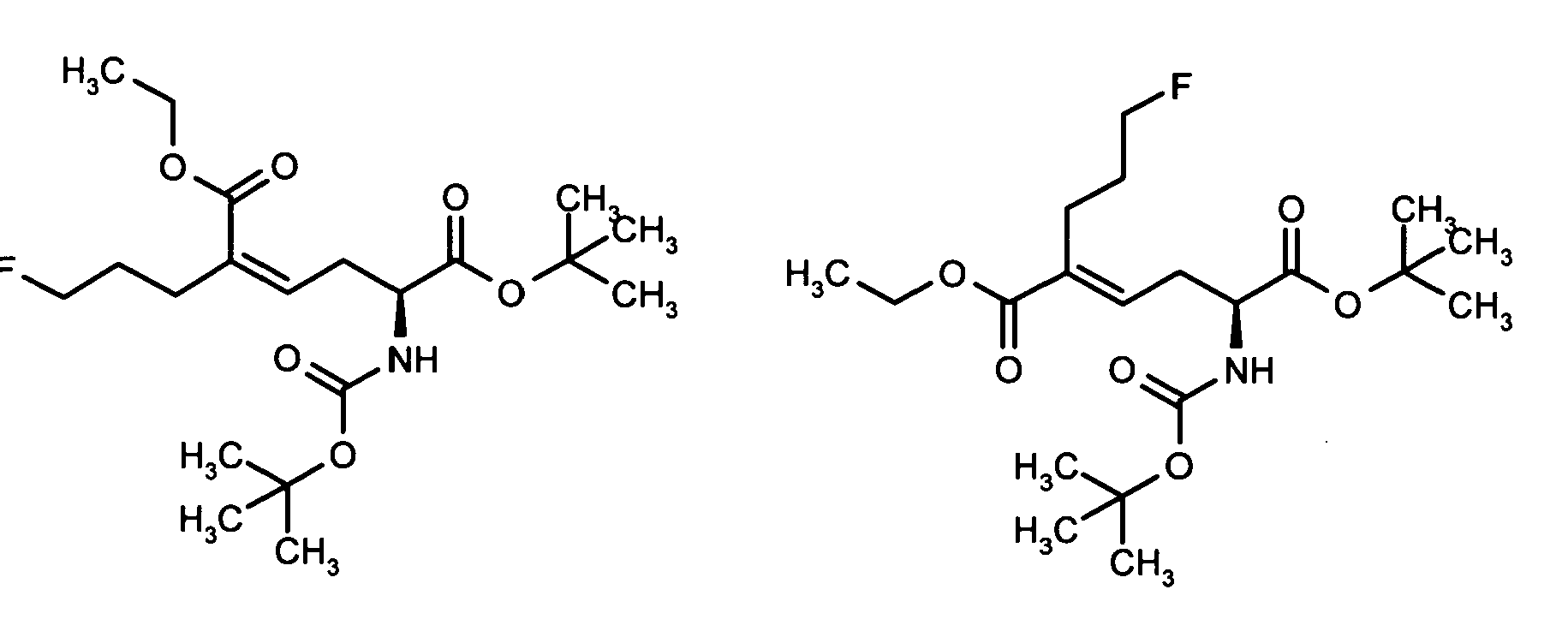
- A solution of ethyl 2-(diethoxyphosphoryl)-5-fluoropentanoate (1.30 g, 4.12 mmol) in dry THF (15 mL) was added dropwise at 0°C to a solution of sodium hydride (0.20 g, 60% on mineral oil, 4.94 mmol) in dry THF (35 mL). After stirring for 15 min tert-Butyl (S)-2-[(tert-butoxycarbonyl)amino]-4-oxobutanoate (1.13 g, 4.12 mmol) was added as a solution in dry THF (15 mL) dropwise to the reaction mixture. After stirring for 90 min at 0°C the reaction was quenched by addition of saturated sodium bicarbonate solution (50 mL). After phase separation the aqueous layer was extracted with ethyl acetate (3 x 50 mL) and the combined organic layers were dried over sodium sulphate, concentrated under reduced pressure and the residue was purified by column chromatography (silica, hexanes/ethyl acetate gradient) to give 6-tert-Butyl 1-ethyl (E)-(S)-5-[(tert-butoxycarbonyl)amino]-2-(3-fluoropropyl)hex-2-ene-dioate and 6-tert-Butyl 1-ethyl (Z)-(S)-5-[(tert-butoxycarbonyl)amino]-2-(3-fluoropropyl)hex-2-enedioate as a mixture of diastereomers which were separated by HPLC (Chiralpak IC 5µm 250x30 mm, hexane/2-propanol 90:10, 50 mL/min) to give 6-tert-Butyl 1-ethyl (E)-(S)-5-[(tert butoxycarbonyl)amino]-2-(3-fluoropropyl)hex-2-enedioate (1e) (0.75 g, 1.86 mmol, 45 %) and 6-tert-Butyl 1-ethyl (Z)-(S)-5-[(tert-butoxycarbonyl)amino]-2-(3-fluoropropyl)hex-2-enedioate (1d) (0.23 g, 0.56 mmol, 14 %).
-

- MS (ESIpos): m/z = 404 [M+H]+
- 1H-NMR (300MHz, CHLOROFORM-d): δ [ppm]= 1.32 (t, 3H), 1.44 (s, 9H), 1.46 (s, 9H), 1.61 (s, 4H), 1.74 - 1.92 (m, 2H), 2.33 - 2.45 (m, 2H), 2.87 (t, 2H), 4.15 - 4.31 (m, 2H), 4.36 (dt, 2H), 5.26 (d, 1H), 5.91 (t, 1H).
-

- MS (ESlpos): m/z = 404 [M+H]+
- 1H-NMR (300MHz, CHLOROFORM-d): δ [ppm]= 1.13 - 1.38 (m, 3H), 1.44 (s, 9H), 1.47 (s, 9H), 1.70 - 1.91 (m, 2H), 2.44 (t, 2H), 2.57 - 2.78 (m, 2H), 4.20 (q, 2H), 4.35 (t, 2H), 4.50 (t, 1H), 5.17 (d, 1H), 6.75 (t, 1H).
-

- A mixture of 6-tert-Butyl 1-ethyl (E)-(S)-5-[(tert-butoxyca rbonyl)amino]-2-(3-fluoropropyl)hex-2-enedioate and 6-tert-Butyl 1-ethyl (Z)-(S)-5-[(tert-butoxycarbonyl)amino]-2-(3-fluoropropyl)hex-2-enedioate (100 mg, 0.25 mmol) and palladium (20.0 mg, 10% on charcoal, 0.02 mmol) in ethanol (10 mL) were stirred for 2 h at r.t. under a hydrogen atmosphere. Then the mixture was filtered through Celite®and concentrated under reduced pressure. The crude product was purified by column chromatography (silica, hexanes/ethyl acetate gradient).
- Yield: 90 mg, 0.22 mmol, 90 %.
- MS (ESlpos): m/z = 406 [M+H]+
- 1H-NMR (300MHz, CHLOROFORM-d): δ [ppm]= 1.26 (td, 3H), 1.44 (s, 9H), 1.46 (s, 9H), 1.52 - 1.86 (m, 8H), 2.28 - 2.46 (m, 1H), 4.08 - 4.25 (m, 3H), 4.35 (dt, 2H), 5.04 (d, 1H).
-
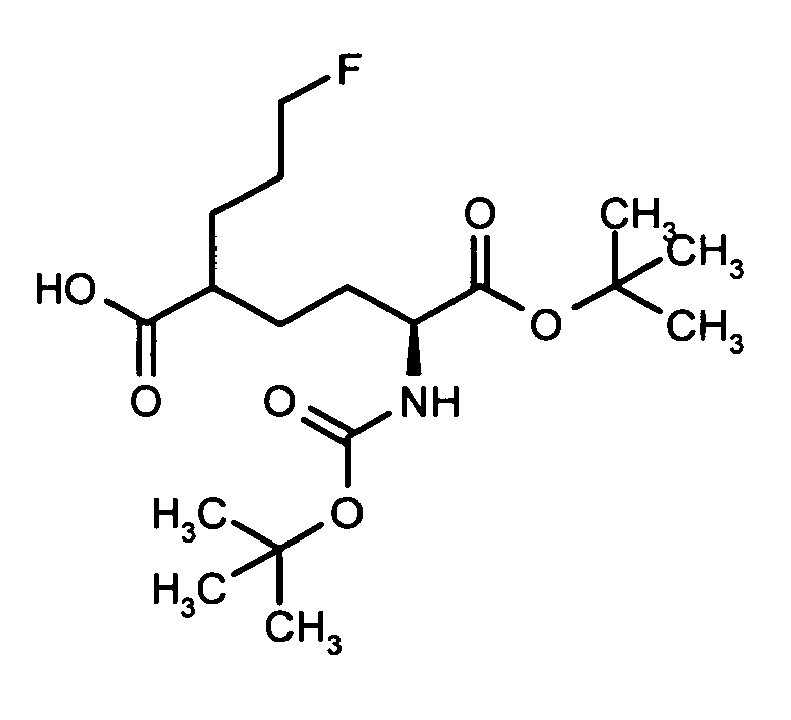
- A mixture of 1-tert-Butyl 6-ethyl (2S)-2-[(tert-butoxycarbonyl)amino]-5-(3-fluoropropyl)-hexanedioate (1f) (90.0 mg, 0.22 mmol) and lithium hydroxide (53.0 mg, 2.22 mmol) in 1 mL water/ethanol (1:1) was stirred for 14 h at r.t.. The mixture was acidified to
pH 2 by addition of 2 N aqueous hydrochloric acid and extracted with ethyl acetate (3 x 5 mL). The combined organic layers were dried over sodium sulphate and concentrated under reduced pressure. - Yield: 57.0 mg, 0.15 mmol, 68%.
-

- A mixture of 1-tert-Butyl 6-hydrogen (2S)-2-[(tert-butoxycarbonyl)amino]-5-(3-fluoropropyl)-hexanedioate (57.0 mg, 0.15 mmol) and trifluoroacetic acid (0.5 mL) and dichloromethane (0.5 mL) was stirred at r.t. for 30 min. Then the mixture was concentrated under reduced pressure and the residue was purified by preparative HPLC (ZIC HILIC, 5µm 100x4.6 mm, acetonitrile/0.1 M aqueous ammonium formate solution gradient, 10 mL/min).
- Yield: 10.0 mg, 0.04 mmol, 28 %.
- 1H-NMR (300MHz, DEUTERIUM OXIDE): δ [ppm]= 1.45 - 1.88 (m, 8H), 2.33 (br. s., 1H), 3.64 - 3.72 (m, 1H), 4.46 (dt, 2H), 8.35 (br. s., 1H).
-

- A mixture of 6-tert-Butyl 1-ethyl (Z)-(S)-5-[(tert-butoxycarbonyl)a m ino]-2-(3-fluoropropyl) hex-2-enedioate (50.0 mg, 0.12 mmol) and lithium hydroxide (29.7 mg, 1.24 mmol) in ethanol (0.5 mL) and water (0.5 mL) was stirred at r.t. for 24 h, 30 min at 60°C (microwave irradiation), and 14 h at 40°C (oil bath). The mixture was cooled down to r.t. and acidified to
pH 2 by addition of 2 N aqueous hydrochloric acid. The ethanol was then removed under reduced pressure and the aqueous solution extracted with ethyl acetate (3 x 10 mL). The combined organic layers were washed with brine, dried over sodium sulphate, and concentrated under reduced pressure. The crude product was purified by preparative HPLC (XBridge C18, 5µm 150x19 mm, acetonitrile/water (0.1% TFA) gradient, 21 mL/min). Yield: 10.0 mg, 0.03 mmol, 25%. - MS (ESlpos): m/z = 320 [M+H]+
-

- (Z)-(S)-5-[(tert-Butoxycarbonyl)amino]-2-(3-fluoropropyl)hex-2-enedioic acid (10.0 mg, 0.03 mmol) was stirred in a mixture of trifluoroacetic acid (1.0 mL) and dichloromethane (1.0 mL) at r.t. for 4 h. After that the mixture was concentrated under reduced pressure, the residue was taken up in water (10 mL) and the solution was lyophilised. Yield: 6.0 mg, 0.02 mmol, 56%.
- MS (ESlpos): m/z = 220 [M+H]+
- 1H-NMR (300MHz, DMSO-d6): δ [ppm]= 1.66 - 1.84 (m, 2H), 2.27 (t, 2H), 2.89 (t, 2H), 3.94 (t, 1H), 4.35 (dt, 2H), 5.92 (t, 1H), 8.13 (br. s, 1H).
-

- A mixure of 6-tert-Butyl 1-ethyl (E)-(S)-5-[(tert-butoxycarbonyl)amino]-2-(3-fluoropropyl)hex-2-enedioate (1e) (80.0 mg, 0.20 mmol) and 4 N aqueous hydrochloric acid (1 mL) was heated to reflux for 4 h. The mixture was then cooled to r.t., diluted with water (5 mL) and lyophilised. The crude product was purified by preparative HPLC (XBridge C18, 5µm 150x19 mm, acetonitrile/water (0.1 % TFA) gradient, 21 mL/min). Yield: 12.0 mg, 0.04 mmol, 19%.
- 1H-NMR (400MHz, DMSO-d6): δ [ppm]= 1.61 - 1.87 (m, 2H), 2.23 - 2.40 (m, 2H), 2.61 - 2.83 (m, 2H), 4.08 - 4.20 (m, 1H), 4.35 (t, 1H), 4.47 (t, 1H), 6.71 (t, 1H), 8.40 (br. s., 3H), 12.48 (br. s., 1H).
- 19F-NMR (376MHz, DMSO-d6): δ [ppm]= -232.03 (m, 1 F).
- The ability of compounds from the present invention to compete with uptake of glutamic acid into tumor cells was examined. Therefore, tumor cells were co-incubated with 3H-labeled glutamic acid and several compounds from the present invention. These compounds were used in excess (1mM) to the tracer 3H-glutamic acid. Interestingly, all tested compounds were able to reduce the uptake of glutamic acid, indicating that the same transport systems may be exploited by the test-compounds. See
figure 1 .
Claims (15)
- A compound of general formula (l)
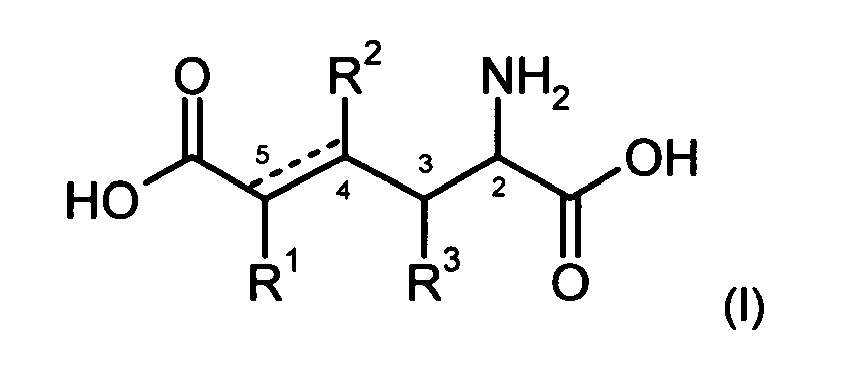 R2 and R3 are Hydrogen;R1is X,wherein X isFluorine atom (F) with the proviso that there is no double bond between C-4 and C-5, branched or straight-chain F-C1-C10 alkyl wherein the alkyl chain is optionally interrupted by 1 or 2 oxygen atoms with the proviso that there are at least two methylene groups between two oxygen atoms,branched or straight-chain F-C1-C10 alkoxy with the proviso that there is no double bond between C-4 and C-5 and wherein the carbon chain is optionally interrupted by 1 additional oxygen atom with the proviso that there are at least two methylene groups between two oxygen atoms,F-C6-C10 mono- or bicyclic aryl-(CH2)n wherein n = 1 to 3, preferably n = 1,F-mono- or bicyclic heteroaryl-(CH2)n wherein n = 1 to 3, preferably n = 1 and wherein heteroaryl comprises 5 to 10 ring atoms wherein 1 or 2 ring atom are hetero-atoms, F-C3-C6 cycloalkyl with the proviso that F is attached to one of the CH2 groups of the ring,F-C3-C6 cycloalkyl-(CH2)n, wherein n = 1 to 3, preferably n = 1, with the proviso that F is attached to one of the CH2 groups of the ring,F-C6-C10 mono- or bicyclic aryl-(CH2)n-O, wherein n = 1 to 3 preferably n = 1 with the proviso that there is no double bond between C-4 and C-5 orF-mono- or bicyclic heteroaryl-(CH2)n-O wherein n = 1 to 3, preferably n = 1 with the proviso that there is no double bond between C-4 and C-5 and wherein heteroaryl comprises 5 to 10 ring atoms wherein 1 or 2 ring atoms are heteroatoms and encompassing single isomers, E and Z-isomers, diastereomers, enantiomers, mixtures thereof and suitable salts thereof.
 - A compound of general formula (ii)
 R2 and R3 are Hydrogen;R1 is X,wherein X isFluorine atom (F) with the proviso that there is no double bond between C-4 and C-5, branched or straight-chain F-C1-C1O alkyl wherein the carbon chain is optionally interrupted by 1 or 2 oxygen atoms with the proviso that there are at least two methylene groups between two oxygen atoms,branched or straight-chain F-C1-C10 alkoxy with the proviso that there is no double bond between C-4 and C-5 and wherein the carbon chain is optionally interrupted by 1 additional oxygen atom with the proviso that there are at least two methylene groups between two oxygen atoms,F-C6-C10 mono- or bicyclic aryl-(CH2)n wherein n = 1 to 3, preferably n = 1,F-mono- or bicyclic heteroaryl-(CH2)n wherein n = 1 to 3, preferably n = 1 and wherein heteroaryl comprises 5 to 10 ring atoms wherein 1 or 2 ring atoms are hetero-atoms, F-C3-C6 cycloalkyl with the proviso that F is attached to one of the CH2 groups of the ring,F-C3-C6 cycloalkyl-(CH2)n, wherein n = 1 to 3, preferably n = 1, with the proviso that F is attached to one of the CH2 groups of the ring,F-C6-C10 mono- or bicyclic aryl-(CH2)n-O, wherein n = 1 to 3 preferably n = 1 with the proviso that there is no double bond between C-4 and C-5 orF-mono- or bicyclic heteroaryl-(CH2)n-O wherein n = 1 to 3, preferably n = 1 with the proviso that there is no double bond between C-4 and C-5 and wherein heteroaryl comprises 5 to 10 ring atoms wherein 1 or 2 atom is a hetero-atom;R4 = Hydrogen or O-protecting group;R5 = Hydrogen or O-protecting group;R6 = Hydrogen or N-protecting group;R7 = Hydrogen or N-protecting group;or the group NR6R7 is a 1,3-dioxo-1,3-dihydro-2H-isoindol-2-yl (phthalimido) or an azido group;with the proviso, that at least one of the substituents R4, R5, R6, or R7 is not Hydrogen andencompassing single isomers, E and Z-isomers, diastereomers, enantiomers, mixtures thereof and suitable salts thereof.
 - The compound according to claims 1 or 2 wherein X is a Fluorine atom (F) with the proviso that there is no double bond between C-4 and C-5 when the compound or branched or straight-chain F-C1-C10 alkyl, preferably F-C1-C3 alkyl.
- The compound according to claims 1, 2 or 3 wherein the Fluorine atom (F) is 18F or 19F isotope.
- The compound according to claim 1 selected from
Ammonium hydrogen (2S)-2-amino-5-(3-fluoropropyl)hexanedioate


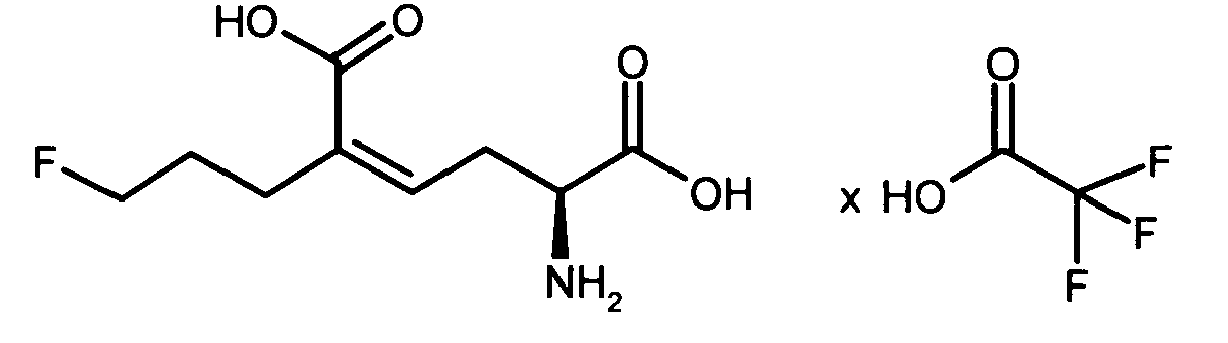

- A compound according to claim 2 selected from
6-tert-Butyl 1-ethyl (E)-(S)-5-[(tert-butoxycarbonyl)amino]-2-(3-fluoropropyl)hex-2-enedioate


- A compound of general formula (III)
 R9 and R10 are Hydrogen;R8 is Y,wherein Y isLeaving Group (LG) with the proviso that there is no double bond between C-4 and C-5,branched or straight-chain LG -C1-C10 alkyl wherein the carbon chain is optionally interrupted by 1 or 2 oxygen atoms with the proviso that there are at least two methylene groups between two oxygen atoms,branched or straight-chain LG -C1-C1O alkoxy with the proviso that there is no double bond between C-4 and C-5 and wherein the carbon chain is optionally interrupted by 1 additional oxygen atom with the proviso that there are at least two methylene groups between two oxygen atoms,LG -C6-C10 mono- or bicyclic aryl-(CH2)n wherein n = 1 to 3, preferably n = 1,LG -mono- or bicyclic heteroaryl-(CH2)n wherein n = 1 to 3, preferably n = 1 and wherein heteroaryl comprises 5 to 10 ring atoms wherein 1 or 2 ring atoms are hetero-atoms,LG -C3-C6 cycloalkyl with the proviso that LG is attached to one of the CH2 groups of the ring,LG -C3-C6 cycloalkyl-(CH2)n, wherein n = 1 to 3, preferably n = 1, with the proviso that LG is attached to one of the CH2 groups of the ring,LG -C6-C10 mono- or bicyclic aryl-(CH2)n-O, wherein n = 1 to 3 preferably n = 1 with the proviso that there is no double bond between C-4 and C-5 orLG -mono- or bicyclic heteroaryl-(CH2)n-O wherein n = 1 to 3, preferably n = 1 with the proviso that there is no double bond between C-4 and C-5 and wherein heteroaryl comprises 5 to 10 ring atoms wherein 1 or 2 atom is a hetero-atom;R4 = O-protecting group;R5 = O-protecting group;R6 = N-protecting group;R7 = Hydrogen or N-protecting groupor the group NR6R7 is a 1,3-dioxo-1,3-dihydro-2H-isoindol-2-yl (phthalimido) or an azido group andencompassing single isomers, E and Z-isomers, diastereomers, enantiomers, mixtures thereof and suitable salts thereof.
 - The compound according to claim 7 wherein
if LG is attached to an sp3-hybridized carbon atom then the Leaving Group (LG) is selected from the group ofChloro,Bromo,Methylsulfonyloxy,Trifluoromethylsulfonyloxy,(4-Nitrophenyl)sulphonyloxyNonafluorobutylsulfonyloxy,(4-Methylphenyl)sulfonyloxy, andlodoor
if LG is attached to aryl or heteroaryl,then the Leaving Group (LG) is selected from the group ofbromo,iodo,nitro,trimethyl ammonium,4-methoxyphenyliodonium, and2-thienyliodonium;R4 or R5 is an O-protecting group selected from the group comprisingMethyl, Ethyl, Propyl, Butyl, t-Butyl, Allyl, Benzyl, 4-Methoxybenzyl, 4-Methoxyphenyl. Preferably, R4 is O-protecting group selected from the group comprising Methyl, Ethyl, t-Butyl, Benzyland/or
N-protecting groups are selected from the group comprisingCarbobenzyloxy (Cbz), p-Methoxybenzyl carbonyl (Moz or MeOZ), tert-Butyloxycarbonyl (BOC), 9-Fluorenylmethyloxycarbonyl (FMOC), Benzyl (Bn), p-Methoxybenzyl (PMB), 3,4-Dimethoxybenzyl (DMPM), Triphenylmethyl and p-methoxyphenyl (PMP) or the group NR6 R7 is a 1,3-dioxo-1,3-dihydro-2H-isoindol-2-yl (phthalimido) or an azido group, preferably tert-Butyloxycarbonyl (BOC) or 9-Fluorenylmethyloxycarbonyl (FMOC). - A composition comprising compounds according to preceding claims of the general formula (I), (II), (III) or mixture thereof and pharmaceutically acceptable carrier or diluent.
- A method for obtaining compounds of formula (I) or (II).
- The method according to claim 10 wherein the method comprises the steps- Coupling compound of general Formula (III) with Fluorine atom (F) containing moiety,- Deprotecting compound of formula (II) and- Optionally converting obtained compound into a suitable salt of inorganic or organic acids thereof, hydrates, complexes, esters, amides, and solvates thereof.
- A compounds of general formula (I) or (II) for the manufacture of an imaging tracer for imaging proliferative diseases.
- A method for imaging or diagnosis proliferative diseases comprising the steps:- Administering to a mammal an effective amount of a compound comprising compounds of general formula (I)- Obtaining images of the mammal and- Assessing images.
- Use of compounds of general formula (I) , (II) or (III) for conducting biological assays and chromatographic identification.
- A kit comprising a sealed vial containing a predetermined quantity of a compound having general chemical Formula (I), (11) or (III) and suitable salts of inorganic or organic acids thereof, hydrates, complexes, esters, amides, and solvates thereof.
Priority Applications (10)
| Application Number | Priority Date | Filing Date | Title |
|---|---|---|---|
| EP09075500A EP2322500A1 (en) | 2009-11-11 | 2009-11-11 | Fluoro-labeled homo-glutamate derivatives and precursors thereof |
| KR1020127014801A KR20120099458A (en) | 2009-11-11 | 2010-11-08 | Homoglutamic acid derivatives |
| CN2010800611630A CN102712575A (en) | 2009-11-11 | 2010-11-08 | Homoglutamic acid derivatives |
| EP10773350A EP2499113A1 (en) | 2009-11-11 | 2010-11-08 | Homoglutamic acid derivatives |
| JP2012538298A JP5829613B2 (en) | 2009-11-11 | 2010-11-08 | Homoglutamic acid derivative |
| PCT/EP2010/067011 WO2011057986A1 (en) | 2009-11-11 | 2010-11-08 | Homoglutamic acid derivatives |
| CA2780282A CA2780282A1 (en) | 2009-11-11 | 2010-11-08 | Homoglutamic acid derivatives |
| US13/509,062 US9017645B2 (en) | 2009-11-11 | 2010-11-08 | Homoglutamic acid derivatives |
| ARP100104180A AR079293A1 (en) | 2009-11-11 | 2010-11-11 | HOMOGLUTAMIC ACID DERIVATIVES, PHARMACEUTICAL COMPOSITION, METHOD OF PREPARATION AND USE OF THE SAME |
| TW099138862A TW201121571A (en) | 2009-11-11 | 2010-11-11 | Homoglutamic acid derivatives |
Applications Claiming Priority (1)
| Application Number | Priority Date | Filing Date | Title |
|---|---|---|---|
| EP09075500A EP2322500A1 (en) | 2009-11-11 | 2009-11-11 | Fluoro-labeled homo-glutamate derivatives and precursors thereof |
Publications (1)
| Publication Number | Publication Date |
|---|---|
| EP2322500A1 true EP2322500A1 (en) | 2011-05-18 |
Family
ID=42026208
Family Applications (2)
| Application Number | Title | Priority Date | Filing Date |
|---|---|---|---|
| EP09075500A Ceased EP2322500A1 (en) | 2009-11-11 | 2009-11-11 | Fluoro-labeled homo-glutamate derivatives and precursors thereof |
| EP10773350A Withdrawn EP2499113A1 (en) | 2009-11-11 | 2010-11-08 | Homoglutamic acid derivatives |
Family Applications After (1)
| Application Number | Title | Priority Date | Filing Date |
|---|---|---|---|
| EP10773350A Withdrawn EP2499113A1 (en) | 2009-11-11 | 2010-11-08 | Homoglutamic acid derivatives |
Country Status (9)
| Country | Link |
|---|---|
| US (1) | US9017645B2 (en) |
| EP (2) | EP2322500A1 (en) |
| JP (1) | JP5829613B2 (en) |
| KR (1) | KR20120099458A (en) |
| CN (1) | CN102712575A (en) |
| AR (1) | AR079293A1 (en) |
| CA (1) | CA2780282A1 (en) |
| TW (1) | TW201121571A (en) |
| WO (1) | WO2011057986A1 (en) |
Families Citing this family (5)
| Publication number | Priority date | Publication date | Assignee | Title |
|---|---|---|---|---|
| CN107753962A (en) * | 2010-12-09 | 2018-03-06 | 通用电气健康护理有限公司 | radioactive tracer composition |
| EP2520556A1 (en) * | 2011-05-03 | 2012-11-07 | Bayer Pharma Aktiengesellschaft | Radiolabeled amino acids for diagnostic imaging |
| US8784774B2 (en) * | 2011-09-16 | 2014-07-22 | General Electric Company | Labeled molecular imaging agents and methods of use |
| US9468692B2 (en) | 2014-01-23 | 2016-10-18 | General Electric Company | Labeled molecular imaging agents and methods of use |
| US9468693B2 (en) | 2014-01-23 | 2016-10-18 | General Electric Company | Labeled molecular imaging agents and methods of use |
-
2009
- 2009-11-11 EP EP09075500A patent/EP2322500A1/en not_active Ceased
-
2010
- 2010-11-08 CN CN2010800611630A patent/CN102712575A/en active Pending
- 2010-11-08 JP JP2012538298A patent/JP5829613B2/en not_active Expired - Fee Related
- 2010-11-08 US US13/509,062 patent/US9017645B2/en not_active Expired - Fee Related
- 2010-11-08 KR KR1020127014801A patent/KR20120099458A/en not_active Withdrawn
- 2010-11-08 WO PCT/EP2010/067011 patent/WO2011057986A1/en not_active Ceased
- 2010-11-08 CA CA2780282A patent/CA2780282A1/en not_active Abandoned
- 2010-11-08 EP EP10773350A patent/EP2499113A1/en not_active Withdrawn
- 2010-11-11 TW TW099138862A patent/TW201121571A/en unknown
- 2010-11-11 AR ARP100104180A patent/AR079293A1/en unknown
Non-Patent Citations (51)
| Title |
|---|
| ANTONI: "Enzyme Catalyzed Synthesis of L-[4-C-11]aspartate and L-[5-C-11]glutamate", J. LABELLED COMPD. RADIOPHARM., vol. 44, no. 4, 2001, pages 287 - 294 |
| BARTON D H R ET AL: "SYNTHESIS OF NOVEL ALPHA-AMINO-ACIDS AND DERIVATIVES USING RADICAL CHEMISTRY: SYNTHESIS OF L- AND D-ALPHA-AMINO-ADIPIC ACIDS, L-ALPHA-AMINOPIMELIC ACID AND APPROPRIATE UNSATURATED DERIVATIVES", TETRAHEDRON, ELSEVIER SCIENCE PUBLISHERS, AMSTERDAM, NL, vol. 43, no. 19, 1 January 1987 (1987-01-01), pages 4297 - 4308, XP001008711, ISSN: 0040-4020 * |
| BIOORGANIC AND MEDICINAL CHEMISTRY, vol. 16, no. 6, 2008, pages 3309 - 3320 |
| BIOSCIENCE, BIOTECHNOLOGY, AND BIOCHEMISTRY, vol. 72, no. 3, 2008, pages 851 - 855 |
| BUCHANAN: "The biosynthesis of showdomycin: studies with stable isotopes and the determination of principal precursors", J. CHEM. SOC. CHEM. COMMUN., vol. 22, 1984, pages 1515 - 1517 |
| CAREY; SUNDBERG, ORGANISCHE SYNTHESE, 1995, pages 279 - 281 |
| CHEMICAL COMMUNICATIONS, vol. 1, 2008, pages 120 - 122 |
| COENEN: "PET-Chemistry - The Driving Force in Molecular Imaging", 2006, SPRINGER, article "Fluorine-18 Labeling Methods: Features and Possibilities of Basic Reactions", pages: 15 - 50 |
| COENEN: "PET-Chemistry - The Driving Force in Molecular Imaging", 2006, SPRINGER, article "Labeling Methods: Features and Possibilities of Basic Reactions", pages: 15 - 50 |
| EUR. J. NUCL. MED. MOL. IMAGING, vol. 29, no. 5, May 2002 (2002-05-01), pages 681 - 90 |
| EUR. J. NUCL. MED. MOL. IMAGING., vol. 29, no. 5, May 2002 (2002-05-01), pages 681 - 90 |
| EUROPEAN JOURNAL OF ORGANIC CHEMISTRY, vol. 9, 2007, pages 1510 - 1516 |
| F. A. DAVIS ET AL., J. ORG. CHEM., vol. 49, no. 17, 1984, pages 3241 - 3243 |
| GAMBHIR ET AL.: "A tabulated summary of the FDG PET literature", J. NUCL. MED., vol. 42, 2001, pages 1 - 93 |
| GREENE; WUTS: "Protecting groups in Organic Synthesis", pages: 494 - 653 |
| H. VORBRUGGEN, SYNTHESIS, vol. 8, 2008, pages 1165 - 1174 |
| J. FLUORINE CHEM., vol. 27, 1985, pages 177 - 191 |
| J. MARCH: "Advanced Organic Chemistry", 1992, JOHN WILEY & SONS, pages: 352FF |
| J. MARIN ET AL., JOC, vol. 67, 2002, pages 8440 - 8449 |
| J. NUCL. MED. TECHNOL., vol. 33, 2005, pages 145 - 155 |
| J. NUCL. MED., vol. 32, 1991, pages 1338 - 1346 |
| J. NUCL. MED., vol. 37, 1996, pages 320 - 325 |
| J. NUCL. MED., vol. 40, 1999, pages 331 - 338 |
| J. NUCL. MED., vol. 42, 2001, pages 752 - 754 |
| JOURNAL OF LABELLED COMPOUNDS AND RADIOPHARMACEUTICALS, vol. 51, no. 1, 2008, pages 12 - 18 |
| JOURNAL OF THE AMERICAN CHEMICAL SOCIETY, vol. 130, no. 12, 2008, pages 3726 - 3727 |
| JOURNAL OF THE AMERICAN CHEMICAL SOCIETY, vol. 130, no. 12, 2008, pages 4153 - 4157 |
| K. C. NICOLAOU ET AL., ANGEWANDTE CHEMIE INT. ED., vol. 44, no. 29, 2005, pages 4490 - 4527 |
| KELLOF G.: "Progress and Promise of FDG-PET Imaging for Cancer Patient Management and Oncologic Drug Development", CLIN. CANCER RES., vol. 11, no. 8, 2005, pages 2785 - 2807 |
| KRASIKOWA: "PET-Chemistry - The Driving Force in Molecular Imaging", 2006, SPRINGER, article "Synthesis Modules and Automation in F-18 labeling", pages: 289 - 316 |
| L. CAI; S. LU; V. PIKE, EUR. J. ORG. CHEM, 2008, pages 2853 - 2873 |
| LAVERMAN P ET AL: "Fluorinated amino acids for tumour imaging with positron emission tomography", EUROPEAN JOURNAL OF NUCLEAR MEDICINE, SPRINGER, BERLIN, HEIDELBERG, DE, vol. 29, no. 5, 1 January 2002 (2002-01-01), pages 681 - 690, XP002317618, ISSN: 0340-6997 * |
| LUNNEY ET AL., J. MED. CHEM., vol. 37, no. 17, 1994, pages 2664 |
| M. HUDLICKY, ORG. REACT., vol. 35, 1988, pages 513 |
| MEDINA, J. NUTR., vol. 1131, 2001, pages 2539S - 2542S |
| NETSCHER, RECENT RES. DEV. ORG. CHEM., vol. 7, 2003, pages 71 - 83 |
| ORGANIC AND BIOMOLECULAR CHEMISTRY, vol. 4, no. 22, 2006, pages 4101 - 4112 |
| ORGANIC AND BIOMOLECULAR CHEMISTRY, vol. 4, no. 24, 2006, pages 4514 - 4525 |
| R. C. LAROCK: "Comprehensive Organic Transformations", 1989, VCH PUBLISHERS, pages: 443 - 453 |
| R.C. LAROCK: "Comprehensive Organic Transformations", 1989, VCH PUBLISHERS |
| R.C. LAROCK: "Comprehensive Organic Transformations", 1989, VCH PUBLISHERS, pages: 129 - 180 |
| R.C. LAROCK: "Comprehensive Organic Transformations", 1989, VCH PUBLISHERS, pages: 479 - 582 |
| RUSSIAN CHEMICAL BULLETIN, vol. 56, no. 6, 2007, pages 1119 - 1124 |
| SOUBA, ANN SURG, vol. 218, 1993, pages 715 - 728 |
| SYNTHESIS, 1982, pages 85 - 125 |
| T. SUZUKI ET AL., J. ORG. CHEM., vol. 72, 2007, pages 246 - 250 |
| T.W. GREENE; P.G.M. WUTS: "Protective Groups in Organic Synthesis", 1999, JOHN WILEY & SONS, pages: 17FF |
| TETRAHEDRON: ASYMMETRY, vol. 19, no. 5, 2008, pages 577 - 583 |
| TOLMAN, VLADIMIR ET AL: "Monofluorinated analogs of amino acids", TETRAHEDRON LETTERS , (29-30), 1967-9 CODEN: TELEAY; ISSN: 0040-4039, 1964, XP002574470 * |
| WARBURG O.: "The metabolism of the carcinoma cell", BIOCHEM.ZEITSCHRIFT, vol. 152, 1924, pages 309 - 339 |
| ZHENG, GUO CHI ET AL: "Facile synthesis of L-5-fluorolysine from L-homoserine", CHEMISTRY EXPRESS , 5(8), 577-80 CODEN: CHEXEU; ISSN: 0911-9566, 1990, XP008120706 * |
Also Published As
| Publication number | Publication date |
|---|---|
| EP2499113A1 (en) | 2012-09-19 |
| TW201121571A (en) | 2011-07-01 |
| JP5829613B2 (en) | 2015-12-09 |
| CA2780282A1 (en) | 2011-05-19 |
| JP2013510816A (en) | 2013-03-28 |
| CN102712575A (en) | 2012-10-03 |
| KR20120099458A (en) | 2012-09-10 |
| AR079293A1 (en) | 2012-01-18 |
| US20130071327A1 (en) | 2013-03-21 |
| US9017645B2 (en) | 2015-04-28 |
| WO2011057986A1 (en) | 2011-05-19 |
Similar Documents
| Publication | Publication Date | Title |
|---|---|---|
| KR101636245B1 (en) | Novel [f-18]-labelled l-glutamic acid- and l-glutamine derivatives (i), use thereof and method for their production | |
| EP2322500A1 (en) | Fluoro-labeled homo-glutamate derivatives and precursors thereof | |
| US20130034497A1 (en) | Iodine-labeled homoglutamic acid and glutamic acid derivatives | |
| US20110104057A1 (en) | Novel [F-18]-labelled L-glutamic acid and L-glutamine derivatives (II), their use and processes for their preparation | |
| EP2322514A1 (en) | Homoglutamic acid and glutamic acid derivatives | |
| TW201023900A (en) | Radioisotope-labeled lysine and ornithine derivatives, their use and processes for their preparation | |
| EP2322171A2 (en) | Fluorine labeled L-glutamic acid derivatives | |
| HK1156297A (en) | Novel [f-18]-labelled l-glutamic acid and l-glutamine derivatives (ii), use thereof and method for their production | |
| HK1157735A (en) | Novel [f-18] -labelled l-glutamic acid- and l-glutamine derivatives (i), use thereof and method for their production |
Legal Events
| Date | Code | Title | Description |
|---|---|---|---|
| PUAI | Public reference made under article 153(3) epc to a published international application that has entered the european phase |
Free format text: ORIGINAL CODE: 0009012 |
|
| AK | Designated contracting states |
Kind code of ref document: A1 Designated state(s): AT BE BG CH CY CZ DE DK EE ES FI FR GB GR HR HU IE IS IT LI LT LU LV MC MK MT NL NO PL PT RO SE SI SK SM TR |
|
| AX | Request for extension of the european patent |
Extension state: AL BA RS |
|
| RAP1 | Party data changed (applicant data changed or rights of an application transferred) |
Owner name: BAYER PHARMA AKTIENGESELLSCHAFT |
|
| STAA | Information on the status of an ep patent application or granted ep patent |
Free format text: STATUS: THE APPLICATION HAS BEEN REFUSED |
|
| 18R | Application refused |
Effective date: 20110714 |