EP2319981A1 - Method for dyeing a plastic substrate of high refractive index and substrate obtained by this method - Google Patents
Method for dyeing a plastic substrate of high refractive index and substrate obtained by this method Download PDFInfo
- Publication number
- EP2319981A1 EP2319981A1 EP09306083A EP09306083A EP2319981A1 EP 2319981 A1 EP2319981 A1 EP 2319981A1 EP 09306083 A EP09306083 A EP 09306083A EP 09306083 A EP09306083 A EP 09306083A EP 2319981 A1 EP2319981 A1 EP 2319981A1
- Authority
- EP
- European Patent Office
- Prior art keywords
- group
- substrate
- carrier
- mercaptomethyl
- dye solution
- Prior art date
- Legal status (The legal status is an assumption and is not a legal conclusion. Google has not performed a legal analysis and makes no representation as to the accuracy of the status listed.)
- Granted
Links
Classifications
-
- D—TEXTILES; PAPER
- D06—TREATMENT OF TEXTILES OR THE LIKE; LAUNDERING; FLEXIBLE MATERIALS NOT OTHERWISE PROVIDED FOR
- D06P—DYEING OR PRINTING TEXTILES; DYEING LEATHER, FURS OR SOLID MACROMOLECULAR SUBSTANCES IN ANY FORM
- D06P1/00—General processes of dyeing or printing textiles, or general processes of dyeing leather, furs, or solid macromolecular substances in any form, classified according to the dyes, pigments, or auxiliary substances employed
- D06P1/44—General processes of dyeing or printing textiles, or general processes of dyeing leather, furs, or solid macromolecular substances in any form, classified according to the dyes, pigments, or auxiliary substances employed using insoluble pigments or auxiliary substances, e.g. binders
- D06P1/64—General processes of dyeing or printing textiles, or general processes of dyeing leather, furs, or solid macromolecular substances in any form, classified according to the dyes, pigments, or auxiliary substances employed using insoluble pigments or auxiliary substances, e.g. binders using compositions containing low-molecular-weight organic compounds without sulfate or sulfonate groups
- D06P1/651—Compounds without nitrogen
- D06P1/65168—Sulfur-containing compounds
-
- C—CHEMISTRY; METALLURGY
- C08—ORGANIC MACROMOLECULAR COMPOUNDS; THEIR PREPARATION OR CHEMICAL WORKING-UP; COMPOSITIONS BASED THEREON
- C08G—MACROMOLECULAR COMPOUNDS OBTAINED OTHERWISE THAN BY REACTIONS ONLY INVOLVING UNSATURATED CARBON-TO-CARBON BONDS
- C08G75/00—Macromolecular compounds obtained by reactions forming a linkage containing sulfur with or without nitrogen, oxygen, or carbon in the main chain of the macromolecule
- C08G75/02—Polythioethers
- C08G75/06—Polythioethers from cyclic thioethers
- C08G75/08—Polythioethers from cyclic thioethers from thiiranes
-
- C—CHEMISTRY; METALLURGY
- C08—ORGANIC MACROMOLECULAR COMPOUNDS; THEIR PREPARATION OR CHEMICAL WORKING-UP; COMPOSITIONS BASED THEREON
- C08J—WORKING-UP; GENERAL PROCESSES OF COMPOUNDING; AFTER-TREATMENT NOT COVERED BY SUBCLASSES C08B, C08C, C08F, C08G or C08H
- C08J7/00—Chemical treatment or coating of shaped articles made of macromolecular substances
- C08J7/04—Coating
- C08J7/0427—Coating with only one layer of a composition containing a polymer binder
-
- C—CHEMISTRY; METALLURGY
- C08—ORGANIC MACROMOLECULAR COMPOUNDS; THEIR PREPARATION OR CHEMICAL WORKING-UP; COMPOSITIONS BASED THEREON
- C08J—WORKING-UP; GENERAL PROCESSES OF COMPOUNDING; AFTER-TREATMENT NOT COVERED BY SUBCLASSES C08B, C08C, C08F, C08G or C08H
- C08J7/00—Chemical treatment or coating of shaped articles made of macromolecular substances
- C08J7/04—Coating
- C08J7/046—Forming abrasion-resistant coatings; Forming surface-hardening coatings
-
- G—PHYSICS
- G02—OPTICS
- G02B—OPTICAL ELEMENTS, SYSTEMS OR APPARATUS
- G02B1/00—Optical elements characterised by the material of which they are made; Optical coatings for optical elements
- G02B1/04—Optical elements characterised by the material of which they are made; Optical coatings for optical elements made of organic materials, e.g. plastics
- G02B1/041—Lenses
- G02B1/043—Contact lenses
-
- C—CHEMISTRY; METALLURGY
- C08—ORGANIC MACROMOLECULAR COMPOUNDS; THEIR PREPARATION OR CHEMICAL WORKING-UP; COMPOSITIONS BASED THEREON
- C08J—WORKING-UP; GENERAL PROCESSES OF COMPOUNDING; AFTER-TREATMENT NOT COVERED BY SUBCLASSES C08B, C08C, C08F, C08G or C08H
- C08J2481/00—Characterised by the use of macromolecular compounds obtained by reactions forming in the main chain of the macromolecule a linkage containing sulfur with or without nitrogen, oxygen, or carbon only; Polysulfones; Derivatives of such polymers
Definitions
- the present invention pertains to a method for dyeing substrates to obtain tinted substrates or articles, for example tinted optical or ophthalmic lenses.
- the invention particularly concerns articles obtained from substrates prepared by curing a polymerizable composition comprising at least one monomer containing at least one episulfide group and optionally at least one thiol group.
- the polymerization of said monomer leads to a polymer comprising at least one thioether group.
- Substrate prepared by curing a polymerizable composition comprising at least one monomer containing at least one episulfide group is herein after called "substrate of high refractive index comprising a thioether group”.
- Tinting / colouring an ophthalmic lens is an increasing need.
- substrates of high refractive index comprising a thioether group are difficult to tint with conventional processes such as conventional bath direct tinting.
- Water bath dyeing is not suitable because of its limited dye absorption amount, even during prolonged time.
- the present invention discloses a method that addresses the issues discussed above.
- the invention provides a solution for tinting substrates of high refractive index comprising a thioether group in a short time and achieving a higher tinting intensity with good uniformity.
- the invention discloses a method for dyeing a substrate prepared by curing a polymerizable composition comprising at least one monomer containing at least one episulfide group and optionally at least one thiol group, said method comprising the following successive steps:
- the immersion step can be carried out once, or can be repeated several times, in order to manufacture a tinted substrate of higher intensity.
- This step can be carried out by the use of a dyeing apparatus, in which the substrate is moved in the dye solution according to scheduled sequences.
- the substrate can be immersed totally, or partially. If the substrate is immersed partially, generally only the immersed part of the substrate is tinted.
- the substrate can be a commercially available product, or it can be manufactured just before the tinting.
- the substrate has generally the shape of an article.
- the method according to the invention is rapid, reproducible and easy to carry out. Moreover the tinting of the part of the substrate which is immersed is substantially uniform.
- this method allows the production of the whole range of coloration, from the lightest colour to the darkest colour.
- Substrate in the sense of the present invention, should be understood to mean an uncoated substrate.
- the substrate may in particular be an optically transparent material having the shape of an optical article.
- the substrate has a refractive index of at least 1.67, preferably from 1.67 to 1.79 and more preferably from 1.71 to 1.79.
- the monomer containing at least one episulfide group and optionally at least one thiol group according to the invention contains episulfide group(s), or episulfide group(s) and thiol group(s).
- the monomer does not comprise any other functional group than episulfide group(s) (and optionally thiol group(s)).
- the episulfide group has the structure of formula (3): wherein R 5 represents a hydrocarbon group having 1 to 10 carbon atoms, R 6 , R 7 and R 8 each represents a hydrogen atom or a hydrocarbon group having 1 to 10 carbon atoms, X represents S or O with the proviso that, in the molecule, the average number of S represented by X is about 50% of the total number of S and O in the three-member ring, and more preferably X is S.
- the episulfide group has the structure of formula (4): wherein R 9 , R 10 , R 11 , R 12 , R 13 and R 14 each represents a hydrogen atom or a hydrocarbon group having 1 to 10 carbon atoms, X represents S or O with the proviso that, in the molecule, the average number of S represented by X is about 50% of the total number of S and O in the three-member ring, m represents an integer from 0 to 6 and n represents an integer from 0 to 4, and more preferably X is S.
- the polymerizable composition further comprises one or more polythiols of formula R'(SH) n' , in which n' is an integer from 2 to 6 and R' is an organic group of valency equal to n'.
- the carrier is chosen from the group comprising straight-chain dimercaptan compounds such as bis(2-mercaptoethyl) sulfide, 1,2-[bis(2-mercaptoethylthio)]ethane; branched aliphatic polymercaptan compounds such as 2-mercaptomethyl-1,3-dimercaptopropane, 2-mercaptomethyl-1,4-dimercaptobutane, 2-(2-mercaptoethylthio)1,3-dimercaptopropane, 1,2-bis[(2-mercaptoethylthio)]-3-mercaptopropane, 1,1,1-tris(mercaptomethyl)propane and tetrakismercaptomethylmethane ; 4-mercaptomethyl-3,6-dithia-1,8-octanedithiol and 2-mercaptoethyl sulphide, preferably said carrier being mercaptomethyl-3,6-dithia-1,8-o
- the solvent is water or an organic solvent, and more preferably the solvent is water.
- the dye solution can contain a dye chosen from the group of azo type dyes, quinophtalones type dyes, and anthraquinone type dyes.
- the dye solutions which are suitable are commercially available disperse dye solutions, to be combined with at least one carrier according to the invention.
- the dyes sold as BPI® Molecular Catalytic Tints by Brain Power International are available in more than 180 colours.
- the dye solution contains 0.05% to 5%, preferably 0.05% to 1 %, and more preferably 0.08 to 0.5% by weight of the carrier.
- the amount of the dye is not critical but is ordinarily 0.5 to 30 g/ Liter in terms of concentration in the dye solution.
- the dye solution can comprise any other additive known to the one skilled in the art.
- the dye solution can contain an emulsifier, preferably chosen from the group of amine salts or alkali salts of carboxylic, sulfamic or phosphoric acids, acid salts of amines, ethoxylated or propoxylated alkyl or aryl phenolic compounds.
- the optional emulsifier may be used in an amount of 0 to 15 pbw, preferably 0.5 to 5 pbw, more preferably 3 to 4 pbw.
- Emulsifiers which may be used include ionic, non-ionic, or mixtures thereof.
- Typical ionic emulsifiers are anionic, including amine salts or alkali salts of carboxylic, sulfamic or phosphoric acids, for example sodium lauryl sulfate, ammonium lauryl sulfate, lignosulfonic acid salts, ethylene diamine tetra acetic acid (EDTA), sodium salts and acid salts of amines such as laurylamine, hydrochloride or poly(oxy-1,2-ethanediyl), alpha-sulfo-omega-hydroxy ether with phenol 1-(methylphenyl)ethyl derivative ammonium salts ; or amphoteric, that is compounds bearing both anionic and cationic groups, for example lauryl sulfobetaine ; dihydroxy ethylalkyl betaine ; amido betaine based on coconut acids ; disodium
- Typical non-ionic emulsifiers include ethoxylated or propoxylated alkyl or aryl phenolic compounds such as octylphenoxypolyethyleneoxyethanol or poly(oxy-1,2-ethanediyl), alpha-phenyl-omega-hydroxy, styrenated.
- the preferred emulsifier is a mixture of C 14 - C 18 and C 16 - C 18 ethoxylated unsaturated fatty acids and poly(oxy-1,2-ethanediyl), alpha-sulfo-omega-hydroxy ether with phenol 1-(methylphenyl) ethyl derivative ammonium salts and poly(oxy-1,2-ethanediyl), alpha-phenyl-omega-hydroxy, styrenated.
- the method of the invention provides tinted substrates in a short time and achieves a higher tinting intensity with good uniformity.
- the method of the invention enables tinting substrates to be provided of different luminous transmittance depending mainly on different tinting times and dye solutions of different dye concentration.
- the length of the immersion is within the range of from 3 to 100 minutes, preferably from 10 to 90 minutes, and more preferably from 30 to 96 minutes.
- the method can further comprise the heating of the dye solution at a temperature of from 90 to 100°C, preferably from 90 to 96°C, and more preferably from 93 to 96°C, during the immersion.
- the invention also concerns an article, preferably an ophthalmic lens, comprising a tinted substrate which is obtained by the method described above.
- the article is preferably such that the luminous transmittance of the article is lower than 20%, preferably lower than 15%, and more preferably lower than 10%.
- Said article is advantageously coated with coatings conventionally used in the ophthalmic optics field, such as anti abrasion coatings, scratch resistant coatings or anti-reflection coatings.
- the invention thus also concerns said article further comprising at least partially a coating.
- the substrate is a commercially available compound provided by the company Mitsubishi Gas Chemical and sold as having a refractive index n D of 1.74.
- This substrate has a density d of 1.45, and was obtained from the chemical curing of 2-mercaptoethyl sulfide (and metallic sulphur S ⁇ 20% by weight), and 2,3-episulfide propanyl sulfide.
- Each water bath solution comprises the carrier and a dye solution (which is a commercially available disperse dye formulation sold as BPI dye solution #46300) diluted in water.
- a dye solution which is a commercially available disperse dye formulation sold as BPI dye solution #46300
- the two tinted substrates so obtained are two ophthalmic lenses according to the invention.
- Tv is the luminous transmittance
- Hz is the haze.
- Tv Hz Conditions Homogeneity of the tinting (visual) 4-mercaptomethyl-3,6-dithia-1,8-octaned ith iol 32.5 0.45 Ambient pressure 94 °C 45 min Pass 2-Mercaptoethyl Sulfide 3.78 0.93 Ambient pressure 94 °C 1 hr Pass
- the haze value of the final ophthalmic lenses was measured by light transmission using the Haze-Guard Plus haze meter from BYK-Gardner (a color difference meter) according to the method of ASTM D1003-00, which is incorporated herein in its entirety by reference. All references to "haze" values in this application are by this standard.
- the instrument was first calibrated according to the manufacturer's instructions. Next, the sample was placed on the transmission light beam of the pre-calibrated meter and the haze value was recorded from three different specimen locations and averaged.
- Luminous transmittance also called “relative light transmission factor in the visible spectrum”
- Tv (or ⁇ v) is defined in the standard ISO 13666:1998 and is measured according to the standard ISO 8980-3 (from 380 to 780 nm), using the same device.
- Each water bath solution comprises the carrier 4-mercaptomethyl-3,6-dithia-1,8-octanedithiol, under 0.1% by volume concentration, and a dye solution (which is a commercially available disperse dye formulation sold as BPI lens dye solution #46300) diluted in water.
- the temperature during the immersion was equal to 94°C.
- the transmission of the so obtained ophthalmic lens may reach class 3 after 60 minutes immersion in the bath under 94°C.
- the haze level does not exhibit significant change before and after tinting.
- This example shows the possibility of varying the luminous transmittance of the ophthalmic lenses by adjusting tinting time.
Landscapes
- Chemical & Material Sciences (AREA)
- Health & Medical Sciences (AREA)
- Chemical Kinetics & Catalysis (AREA)
- Medicinal Chemistry (AREA)
- Polymers & Plastics (AREA)
- Organic Chemistry (AREA)
- Physics & Mathematics (AREA)
- General Physics & Mathematics (AREA)
- Optics & Photonics (AREA)
- Engineering & Computer Science (AREA)
- Textile Engineering (AREA)
- Coloring (AREA)
- Eyeglasses (AREA)
- Application Of Or Painting With Fluid Materials (AREA)
- Addition Polymer Or Copolymer, Post-Treatments, Or Chemical Modifications (AREA)
Abstract
- providing a dye solution comprising a dye and a carrier in a solvent, the carrier being chosen from the compounds represented by the following formulae (1) and (2):
* formula (1) :


formula (2) : (HSCH2)4-mC(CH2SCH2CH2SH)m (2)
wherein m denotes an integer from 1 to 3;
And
- at least partially immersing the substrate in the dye solution for a time sufficient to allow the effective tinting of the substrate.
Description
- The present invention pertains to a method for dyeing substrates to obtain tinted substrates or articles, for example tinted optical or ophthalmic lenses. The invention particularly concerns articles obtained from substrates prepared by curing a polymerizable composition comprising at least one monomer containing at least one episulfide group and optionally at least one thiol group.
- The polymerization of said monomer leads to a polymer comprising at least one thioether group.
- Substrate prepared by curing a polymerizable composition comprising at least one monomer containing at least one episulfide group, is herein after called "substrate of high refractive index comprising a thioether group".
- Tinting / colouring an ophthalmic lens is an increasing need.
- However, substrates of high refractive index comprising a thioether group are difficult to tint with conventional processes such as conventional bath direct tinting. Water bath dyeing is not suitable because of its limited dye absorption amount, even during prolonged time.
- Therefore there is a need for a process for tinting substrates of high refractive index comprising a thioether group, overcoming the limitations of the known processes, without compromising the tinting homogeneity. Advantageously the present invention discloses a method that addresses the issues discussed above.
- The invention provides a solution for tinting substrates of high refractive index comprising a thioether group in a short time and achieving a higher tinting intensity with good uniformity. These and other advantages are achieved in accordance with the present invention as described below.
- The invention discloses a method for dyeing a substrate prepared by curing a polymerizable composition comprising at least one monomer containing at least one episulfide group and optionally at least one thiol group, said method comprising the following successive steps:
- providing a dye solution comprising at least one dye, or dye precursor, and at least one carrier in at least one solvent, the carrier being chosen from the compounds represented by the following formulae (1) and (2):


*
formula (2) ; (HSCH2)4-mC(CH2SCH2CH2SH)m (2)
wherein m denotes an integer from 1 to 3;
And - at least partially immersing the substrate in the dye solution for a time sufficient to allow the effective tinting of the substrate.
- According to the invention, the immersion step can be carried out once, or can be repeated several times, in order to manufacture a tinted substrate of higher intensity. This step can be carried out by the use of a dyeing apparatus, in which the substrate is moved in the dye solution according to scheduled sequences.
- The substrate can be immersed totally, or partially. If the substrate is immersed partially, generally only the immersed part of the substrate is tinted.
- The substrate can be a commercially available product, or it can be manufactured just before the tinting.
- The substrate has generally the shape of an article.
- The method according to the invention is rapid, reproducible and easy to carry out. Moreover the tinting of the part of the substrate which is immersed is substantially uniform.
- In addition, this method allows the production of the whole range of coloration, from the lightest colour to the darkest colour.
- Substrate, in the sense of the present invention, should be understood to mean an uncoated substrate. The substrate may in particular be an optically transparent material having the shape of an optical article.
- According to a preferred embodiment, the substrate has a refractive index of at least 1.67, preferably from 1.67 to 1.79 and more preferably from 1.71 to 1.79.
- The monomer containing at least one episulfide group and optionally at least one thiol group according to the invention contains episulfide group(s), or episulfide group(s) and thiol group(s).
- In a preferred embodiment, the monomer does not comprise any other functional group than episulfide group(s) (and optionally thiol group(s)).
- Preferably the episulfide group has the structure of formula (3):

and more preferably X is S. - Preferably, the episulfide group has the structure of formula (4):

and more preferably X is S. - Preferably, the polymerizable composition further comprises one or more polythiols of formula R'(SH)n', in which n' is an integer from 2 to 6 and R' is an organic group of valency equal to n'.
- In a preferred manner the carrier is chosen from the group comprising straight-chain dimercaptan compounds such as bis(2-mercaptoethyl) sulfide, 1,2-[bis(2-mercaptoethylthio)]ethane; branched aliphatic polymercaptan compounds such as 2-mercaptomethyl-1,3-dimercaptopropane, 2-mercaptomethyl-1,4-dimercaptobutane, 2-(2-mercaptoethylthio)1,3-dimercaptopropane, 1,2-bis[(2-mercaptoethylthio)]-3-mercaptopropane, 1,1,1-tris(mercaptomethyl)propane and tetrakismercaptomethylmethane ; 4-mercaptomethyl-3,6-dithia-1,8-octanedithiol and 2-mercaptoethyl sulphide, preferably said carrier being mercaptomethyl-3,6-dithia-1,8-octanedithiol or 2-mercaptoethyl sulphide, and more preferably the carrier being 4-mercaptomethyl-3,6-dithia-1,8-octanedithiol.
- Preferably, the solvent is water or an organic solvent, and more preferably the solvent is water.
- According to the invention, the dye solution can contain a dye chosen from the group of azo type dyes, quinophtalones type dyes, and anthraquinone type dyes.
- However various known dyes mixture or dyes solutions used in dyeing can be used, as known to the one skilled in the art.
- The dye solutions which are suitable are commercially available disperse dye solutions, to be combined with at least one carrier according to the invention. For example, the dyes sold as BPI® Molecular Catalytic Tints by Brain Power International are available in more than 180 colours.
- In a variant, the dye solution contains 0.05% to 5%, preferably 0.05% to 1 %, and more preferably 0.08 to 0.5% by weight of the carrier.
- The amount of the dye is not critical but is ordinarily 0.5 to 30 g/ Liter in terms of concentration in the dye solution.
- The dye solution can comprise any other additive known to the one skilled in the art.According to the invention, the dye solution can contain an emulsifier, preferably chosen from the group of amine salts or alkali salts of carboxylic, sulfamic or phosphoric acids, acid salts of amines, ethoxylated or propoxylated alkyl or aryl phenolic compounds.
- The optional emulsifier (surfactant) may be used in an amount of 0 to 15 pbw, preferably 0.5 to 5 pbw, more preferably 3 to 4 pbw.
- Emulsifiers which may be used include ionic, non-ionic, or mixtures thereof. Typical ionic emulsifiers are anionic, including amine salts or alkali salts of carboxylic, sulfamic or phosphoric acids, for example sodium lauryl sulfate, ammonium lauryl sulfate, lignosulfonic acid salts, ethylene diamine tetra acetic acid (EDTA), sodium salts and acid salts of amines such as laurylamine, hydrochloride or poly(oxy-1,2-ethanediyl), alpha-sulfo-omega-hydroxy ether with phenol 1-(methylphenyl)ethyl derivative ammonium salts ; or amphoteric, that is compounds bearing both anionic and cationic groups, for example lauryl sulfobetaine ; dihydroxy ethylalkyl betaine ; amido betaine based on coconut acids ; disodium N-lauryl amino propionate ; or the sodium salts of dicarboxylic acid coconut derivatives. Typical non-ionic emulsifiers include ethoxylated or propoxylated alkyl or aryl phenolic compounds such as octylphenoxypolyethyleneoxyethanol or poly(oxy-1,2-ethanediyl), alpha-phenyl-omega-hydroxy, styrenated. The preferred emulsifier is a mixture of C14 - C18 and C16 - C18 ethoxylated unsaturated fatty acids and poly(oxy-1,2-ethanediyl), alpha-sulfo-omega-hydroxy ether with phenol 1-(methylphenyl) ethyl derivative ammonium salts and poly(oxy-1,2-ethanediyl), alpha-phenyl-omega-hydroxy, styrenated.
- The method of the invention provides tinted substrates in a short time and achieves a higher tinting intensity with good uniformity.
- The method of the invention enables tinting substrates to be provided of different luminous transmittance depending mainly on different tinting times and dye solutions of different dye concentration.
- Preferably, the length of the immersion is within the range of from 3 to 100 minutes, preferably from 10 to 90 minutes, and more preferably from 30 to 96 minutes.
- According to the invention, the method can further comprise the heating of the dye solution at a temperature of from 90 to 100°C, preferably from 90 to 96°C, and more preferably from 93 to 96°C, during the immersion.
- The invention also concerns an article, preferably an ophthalmic lens, comprising a tinted substrate which is obtained by the method described above.
- According to the invention, the article is preferably such that the luminous transmittance of the article is lower than 20%, preferably lower than 15%, and more preferably lower than 10%.
- Said article is advantageously coated with coatings conventionally used in the ophthalmic optics field, such as anti abrasion coatings, scratch resistant coatings or anti-reflection coatings.
- The invention thus also concerns said article further comprising at least partially a coating.
- The invention will be further illustrated by the following non-limiting examples which are given for illustrative purposes only.
- In all the examples, the substrate is a commercially available compound provided by the company Mitsubishi Gas Chemical and sold as having a refractive index nD of 1.74.
- This substrate has a density d of 1.45, and was obtained from the chemical curing of 2-mercaptoethyl sulfide

and
- Two compounds, 4-mercaptomethyl-3,6-dithia-1,8-octanedithiol and 2-mercaptoethyl sulfide, were used as a carrier for tinting two substrates, in two different water bath solutions, according to the conditions set forth in the Table below. Substrates as disclosed above were immersed in respective bath. The concentration of the carrier was 0.1 vol. % in each bath solution.
- Each water bath solution comprises the carrier and a dye solution (which is a commercially available disperse dye formulation sold as BPI dye solution #46300) diluted in water.
- The two tinted substrates so obtained are two ophthalmic lenses according to the invention.
- The results of the measurements on said ophthalmic lenses are given in the Table below, in which Tv is the luminous transmittance and Hz is the haze.
Tv Hz Conditions Homogeneity of the tinting (visual) 4-mercaptomethyl-3,6-dithia-1,8-octaned ith iol 32.5 0.45 Ambient pressure
94 °C
45 minPass 2-Mercaptoethyl Sulfide 3.78 0.93 Ambient pressure
94 °C
1 hrPass - Good quality tinting was obtained, and the haze level of the ophthalmic lenses using those two different carriers was acceptable. The effect of 4-mercaptomethyl-3,6-dithia-1,8-octanedithiol was better in terms of haze level .
- The haze value of the final ophthalmic lenses was measured by light transmission using the Haze-Guard Plus haze meter from BYK-Gardner (a color difference meter) according to the method of ASTM D1003-00, which is incorporated herein in its entirety by reference. All references to "haze" values in this application are by this standard. The instrument was first calibrated according to the manufacturer's instructions. Next, the sample was placed on the transmission light beam of the pre-calibrated meter and the haze value was recorded from three different specimen locations and averaged. Luminous transmittance (also called "relative light transmission factor in the visible spectrum") Tv (or ζv) is defined in the standard ISO 13666:1998 and is measured according to the standard ISO 8980-3 (from 380 to 780 nm), using the same device.
- Four pieces of the substrate disclosed above were tinted into lenses respectively for 15, 30, 45, 60 minutes in four different bath solutions. Each water bath solution comprises the carrier 4-mercaptomethyl-3,6-dithia-1,8-octanedithiol, under 0.1% by volume concentration, and a dye solution (which is a commercially available disperse dye formulation sold as BPI lens dye solution #46300) diluted in water.
- The temperature during the immersion was equal to 94°C.
- The results of the measurements of the luminous transmittance (T) and of the haze (Hz) on the four substrates respectively on the so obtained four ophthalmic lenses are given in the Table below, before respectively after the tinting.
Transmission, haze vs Tinting Time Before After Time (min) Tv Hz Tv Hz 0 87 15 87.0 0.37 72.5 0.38 30 87.0 0.38 48.7 0.42 45 87.1 0.32 32.5 0.47 60 87.1 0.39 12.3 0.51 - The transmission of the so obtained ophthalmic lens may reach class 3 after 60 minutes immersion in the bath under 94°C. The haze level does not exhibit significant change before and after tinting.
- Good quality tinting was obtained, and the haze level of the ophthalmic lenses was acceptable. This example shows the possibility of varying the luminous transmittance of the ophthalmic lenses by adjusting tinting time.
Claims (15)
- Method for dyeing a substrate prepared by curing a polymerizable composition comprising at least one monomer containing at least one episulfide group and optionally at least one thiol group, said method comprising the following successive steps:- providing a dye solution comprising at least one dye, or dye precursor, and at least one carrier in at least one solvent, the carrier being chosen from the compounds represented by the following formulae (1) and (2):


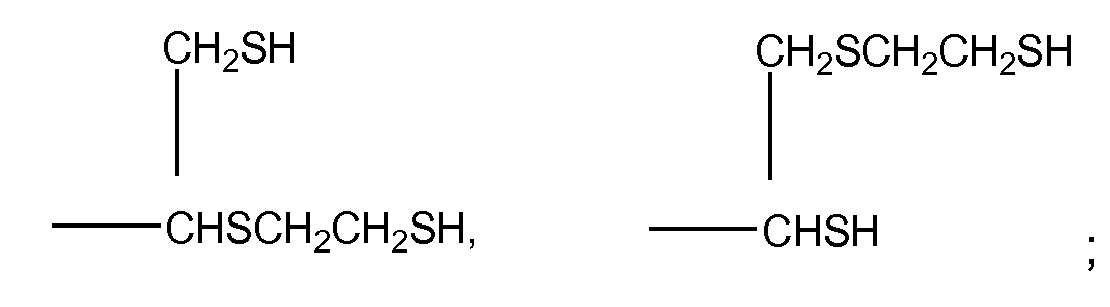
*
formula (2) : (HSCH2)4-mC(CH2SCH2CH2SH)m (2)
wherein m denotes an integer from 1 to 3;
And- at least partially immersing the substrate in the dye solution for a time sufficient to allow the effective tinting of the substrate. - Method according to the preceding claim, wherein the substrate has a refractive index of at least 1.67, preferably from 1.67 to 1.79 and more preferably from 1.71 to 1.79.
- Method according to any one of the preceding claims, wherein the episulfide group has the structure of formula (3):

and preferably X is S. - Method according to any one of the preceding claims, wherein the episulfide group has the structure of formula (4) :
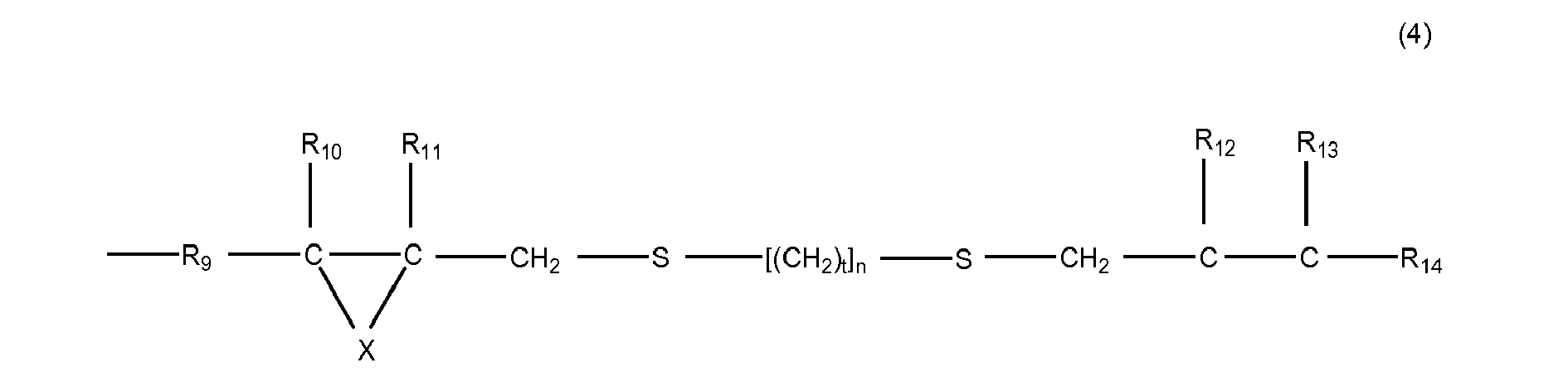
and preferably X is S. - Method according to any one of the preceding claims, wherein the polymerizable composition further comprises one or more polythiols of formula R'(SH)n', in which n' is an integer from 2 to 6 and R' is an organic group of valency equal to n'.
- Method according to any one of the preceding claims, wherein said carrier is chosen from the group comprising straight-chain dimercaptan compounds such as bis(2-mercaptoethyl) sulfide, 1,2-[bis(2-mercaptoethylthio)]ethane; branched aliphatic polymercaptan compounds such as 2-mercaptomethyl-1,3-dimercaptopropane, 2-mercaptomethyl-1,4-dimercaptobutane, 2-(2-mercaptoethylthio)1,3-dimercaptopropane, 1,2-bis[(2-mercaptoethylthio)]-3-mercaptopropane, 1,1,1-tris(mercaptomethyl)propane and tetrakismercaptomethylmethane ; 4-mercaptomethyl-3,6-dithia-1,8-octanedithiol and 2-mercaptoethyl sulphide, preferably said carrier being mercaptomethyl-3,6-dithia-1,8-octanedithiol or 2-mercaptoethyl sulphide, and more preferably the carrier being 4-mercaptomethyl-3,6-dithia-1,8-octanedithiol.
- Method according to one of the preceding claims, wherein the solvent is water or an organic solvent, and preferably the solvent is water.
- Method according to one of the preceding claims, wherein the dye solution contains a dye chosen from the group of azo type dyes, quinophtalones type dyes, and anthraquinone type dyes.
- Method according to any one of the preceding claims, wherein the dye solution contains 0.05% to 5%, preferably 0.05% to 1%, and more preferably 0.08 to 0.5% by weight of the carrier.
- Method according to one of the preceding claims, wherein the dye solution contains an emulsifier, preferably chosen from the group of amine salts or alkali salts of carboxylic, sulfamic or phosphoric acids, acid salts of amines, ethoxylated or propoxylated alkyl or aryl phenolic compounds.
- Method according to any one of the preceding claims, wherein the length of the immersion is within the range of from 3 to 100 minutes, preferably from 10 to 90 minutes, and more preferably from 30 to 96 minutes.
- Method according to any one of the preceding claims, wherein the method further comprises the heating of the dye solution at a temperature of from 90 to 100°C, preferably from 90 to 96°C, and more preferably from 93 to 96°C, during the immersion.
- Article, preferably an ophthalmic lens, comprising a tinted substrate which is obtained by the method of any one of the preceding claims.
- Article according to the preceding claim, wherein the luminous transmittance of the article is lower than 20%, preferably lower than 15%, and more preferably lower than 10%.
- Article according to any one of the claims 13 and 14, wherein said article further comprises at least partially a coating.
Priority Applications (7)
| Application Number | Priority Date | Filing Date | Title |
|---|---|---|---|
| EP09306083A EP2319981B1 (en) | 2009-11-10 | 2009-11-10 | Method for dyeing a plastic substrate of high refractive index |
| AT09306083T ATE547556T1 (en) | 2009-11-10 | 2009-11-10 | METHOD FOR COLORING A HIGH REFRACTIVE INDEX PLASTIC SUBSTRATE |
| PT09306083T PT2319981E (en) | 2009-11-10 | 2009-11-10 | Method for dyeing a plastic substrate of high refractive index |
| PCT/IB2010/054662 WO2011058460A1 (en) | 2009-11-10 | 2010-10-14 | Method for dyeing a plastic substrate of high refractive index and substrate obtained by this method |
| CN201080050582.4A CN102639784B (en) | 2009-11-10 | 2010-10-14 | Method for dyeing a plastic substrate of high refractive index and substrate obtained by this method |
| IN4933DEN2012 IN2012DN04933A (en) | 2009-11-10 | 2010-10-14 | |
| US13/508,757 US20120238660A1 (en) | 2009-11-10 | 2010-10-14 | Method for dyeing a plastic substrate of high refractive index and substrate obtained by this method |
Applications Claiming Priority (1)
| Application Number | Priority Date | Filing Date | Title |
|---|---|---|---|
| EP09306083A EP2319981B1 (en) | 2009-11-10 | 2009-11-10 | Method for dyeing a plastic substrate of high refractive index |
Publications (2)
| Publication Number | Publication Date |
|---|---|
| EP2319981A1 true EP2319981A1 (en) | 2011-05-11 |
| EP2319981B1 EP2319981B1 (en) | 2012-02-29 |
Family
ID=42731995
Family Applications (1)
| Application Number | Title | Priority Date | Filing Date |
|---|---|---|---|
| EP09306083A Active EP2319981B1 (en) | 2009-11-10 | 2009-11-10 | Method for dyeing a plastic substrate of high refractive index |
Country Status (7)
| Country | Link |
|---|---|
| US (1) | US20120238660A1 (en) |
| EP (1) | EP2319981B1 (en) |
| CN (1) | CN102639784B (en) |
| AT (1) | ATE547556T1 (en) |
| IN (1) | IN2012DN04933A (en) |
| PT (1) | PT2319981E (en) |
| WO (1) | WO2011058460A1 (en) |
Cited By (3)
| Publication number | Priority date | Publication date | Assignee | Title |
|---|---|---|---|---|
| WO2014135656A2 (en) | 2013-03-06 | 2014-09-12 | Essilor International (Compagnie Générale d'Optique) | Arylene carriers for enhanced polycarbonate tinting |
| DE102017000698B4 (en) | 2017-01-26 | 2019-05-29 | Rodenstock Gmbh | Method and dyeing system for coloring an optical glass |
| CN116355232A (en) * | 2023-04-18 | 2023-06-30 | 天津师范大学 | A kind of preparation method and application of anion functionalized metal organic framework |
Families Citing this family (2)
| Publication number | Priority date | Publication date | Assignee | Title |
|---|---|---|---|---|
| JP6098112B2 (en) * | 2012-10-26 | 2017-03-22 | 三菱瓦斯化学株式会社 | Method for producing episulfide resin cured product |
| CN114605605B (en) * | 2022-03-08 | 2023-03-24 | 益丰新材料股份有限公司 | Optical material composition containing polythiol composition |
Citations (1)
| Publication number | Priority date | Publication date | Assignee | Title |
|---|---|---|---|---|
| EP0921417A2 (en) * | 1997-12-03 | 1999-06-09 | Mitsubishi Gas Chemical Company, Inc. | Epoxy/episulfide resin compositions for optical materials |
Family Cites Families (1)
| Publication number | Priority date | Publication date | Assignee | Title |
|---|---|---|---|---|
| US6486298B1 (en) * | 2000-12-22 | 2002-11-26 | Essilor International Compagnie Generale D'optique | Diepisulfide based prepolymers and their use in the optical field |
-
2009
- 2009-11-10 EP EP09306083A patent/EP2319981B1/en active Active
- 2009-11-10 AT AT09306083T patent/ATE547556T1/en active
- 2009-11-10 PT PT09306083T patent/PT2319981E/en unknown
-
2010
- 2010-10-14 WO PCT/IB2010/054662 patent/WO2011058460A1/en not_active Ceased
- 2010-10-14 US US13/508,757 patent/US20120238660A1/en not_active Abandoned
- 2010-10-14 CN CN201080050582.4A patent/CN102639784B/en active Active
- 2010-10-14 IN IN4933DEN2012 patent/IN2012DN04933A/en unknown
Patent Citations (1)
| Publication number | Priority date | Publication date | Assignee | Title |
|---|---|---|---|---|
| EP0921417A2 (en) * | 1997-12-03 | 1999-06-09 | Mitsubishi Gas Chemical Company, Inc. | Epoxy/episulfide resin compositions for optical materials |
Cited By (4)
| Publication number | Priority date | Publication date | Assignee | Title |
|---|---|---|---|---|
| WO2014135656A2 (en) | 2013-03-06 | 2014-09-12 | Essilor International (Compagnie Générale d'Optique) | Arylene carriers for enhanced polycarbonate tinting |
| WO2014135656A3 (en) * | 2013-03-06 | 2014-11-27 | Essilor International (Compagnie Générale d'Optique) | Arylene carriers for enhanced polycarbonate tinting |
| DE102017000698B4 (en) | 2017-01-26 | 2019-05-29 | Rodenstock Gmbh | Method and dyeing system for coloring an optical glass |
| CN116355232A (en) * | 2023-04-18 | 2023-06-30 | 天津师范大学 | A kind of preparation method and application of anion functionalized metal organic framework |
Also Published As
| Publication number | Publication date |
|---|---|
| PT2319981E (en) | 2012-05-07 |
| US20120238660A1 (en) | 2012-09-20 |
| CN102639784A (en) | 2012-08-15 |
| ATE547556T1 (en) | 2012-03-15 |
| WO2011058460A8 (en) | 2012-04-26 |
| CN102639784B (en) | 2015-04-08 |
| WO2011058460A1 (en) | 2011-05-19 |
| EP2319981B1 (en) | 2012-02-29 |
| IN2012DN04933A (en) | 2015-09-25 |
Similar Documents
| Publication | Publication Date | Title |
|---|---|---|
| EP2319981B1 (en) | Method for dyeing a plastic substrate of high refractive index | |
| JP6042938B2 (en) | Plastic polarizing lens, manufacturing method thereof, and polarizing film | |
| CN1854386B (en) | Process for colouring, dyeing or doping molding elements of transparent (co)polyamide | |
| JP6228684B2 (en) | Polymerizable composition, molded article and use thereof | |
| KR0136698B1 (en) | Compositions and Lenses for High Index Plastic Lenses | |
| WO2008035457A1 (en) | Polymerization catalyst for polythiourethane optical material, polymerizable composition containing the catalyst, polythiourethane resin obtained from the composition, and method for producing the resin | |
| US6444146B2 (en) | Process for production of optical material | |
| ITMI20112102A1 (en) | POLYMERIZABLE COMPOSITION, OPTICAL ARTICLE OBTAINED FROM THE SAME AND METHOD FOR THE PRODUCTION OF THAT OPTICAL ITEM | |
| EP1726974A2 (en) | Plastic lens and method of manufacturing a plastic lens | |
| EP3351593A1 (en) | Method for manufacturing polymerizable composition for optical material, and method for manufacturing optical material | |
| JPWO2008136401A1 (en) | Manufacturing method of plastic lens | |
| JPWO2017022855A1 (en) | Method for producing polymerizable composition for optical material and polymerizable composition for optical material | |
| EP2692941A1 (en) | Composition and process for tinting organic glass | |
| JP6563534B2 (en) | Polythiol composition for plastic lens | |
| FR2765879A1 (en) | NOVEL POLYMERIZABLE COMPOSITIONS AND OPTICAL LENSES WITH HIGH REFRACTIVE INDEX OBTAINED FROM SUCH COMPOSITIONS | |
| CN105026642A (en) | Arylene carriers for enhanced polycarbonate tinting | |
| JP4329281B2 (en) | Plastic lens manufacturing method and plastic lens manufactured by the manufacturing method | |
| JPH11248901A (en) | Method for producing colored high refractive index plastic lens | |
| KR102035732B1 (en) | Plastic tinted lenses and manufacturing method thereof | |
| CN110446562A (en) | Method for producing laminated body, laminated body, and hard coating liquid | |
| KR102003056B1 (en) | Plastic tinted lenses and manufacturing method thereof | |
| CN105143372B (en) | Coloring reinforcing agent for hard conating coloring | |
| JPH0680090B2 (en) | Surface modification method of carbonate resin | |
| WO2021060563A1 (en) | Polymerizable composition for optical members, optical member, and colored optical member | |
| JPH10221650A (en) | Method for dyeing plastic lens |
Legal Events
| Date | Code | Title | Description |
|---|---|---|---|
| PUAI | Public reference made under article 153(3) epc to a published international application that has entered the european phase |
Free format text: ORIGINAL CODE: 0009012 |
|
| AK | Designated contracting states |
Kind code of ref document: A1 Designated state(s): AT BE BG CH CY CZ DE DK EE ES FI FR GB GR HR HU IE IS IT LI LT LU LV MC MK MT NL NO PL PT RO SE SI SK SM TR |
|
| AX | Request for extension of the european patent |
Extension state: AL BA RS |
|
| 17P | Request for examination filed |
Effective date: 20110603 |
|
| GRAP | Despatch of communication of intention to grant a patent |
Free format text: ORIGINAL CODE: EPIDOSNIGR1 |
|
| RTI1 | Title (correction) |
Free format text: METHOD FOR DYEING A PLASTIC SUBSTRATE OF HIGH REFRACTIVE INDEX |
|
| GRAS | Grant fee paid |
Free format text: ORIGINAL CODE: EPIDOSNIGR3 |
|
| GRAA | (expected) grant |
Free format text: ORIGINAL CODE: 0009210 |
|
| AK | Designated contracting states |
Kind code of ref document: B1 Designated state(s): AT BE BG CH CY CZ DE DK EE ES FI FR GB GR HR HU IE IS IT LI LT LU LV MC MK MT NL NO PL PT RO SE SI SK SM TR |
|
| REG | Reference to a national code |
Ref country code: GB Ref legal event code: FG4D Ref country code: CH Ref legal event code: EP |
|
| REG | Reference to a national code |
Ref country code: AT Ref legal event code: REF Ref document number: 547556 Country of ref document: AT Kind code of ref document: T Effective date: 20120315 |
|
| REG | Reference to a national code |
Ref country code: IE Ref legal event code: FG4D |
|
| REG | Reference to a national code |
Ref country code: DE Ref legal event code: R096 Ref document number: 602009005623 Country of ref document: DE Effective date: 20120426 |
|
| REG | Reference to a national code |
Ref country code: PT Ref legal event code: SC4A Free format text: AVAILABILITY OF NATIONAL TRANSLATION Effective date: 20120423 |
|
| REG | Reference to a national code |
Ref country code: NL Ref legal event code: VDEP Effective date: 20120229 |
|
| LTIE | Lt: invalidation of european patent or patent extension |
Effective date: 20120229 |
|
| PG25 | Lapsed in a contracting state [announced via postgrant information from national office to epo] |
Ref country code: NL Free format text: LAPSE BECAUSE OF FAILURE TO SUBMIT A TRANSLATION OF THE DESCRIPTION OR TO PAY THE FEE WITHIN THE PRESCRIBED TIME-LIMIT Effective date: 20120229 Ref country code: LT Free format text: LAPSE BECAUSE OF FAILURE TO SUBMIT A TRANSLATION OF THE DESCRIPTION OR TO PAY THE FEE WITHIN THE PRESCRIBED TIME-LIMIT Effective date: 20120229 Ref country code: NO Free format text: LAPSE BECAUSE OF FAILURE TO SUBMIT A TRANSLATION OF THE DESCRIPTION OR TO PAY THE FEE WITHIN THE PRESCRIBED TIME-LIMIT Effective date: 20120529 Ref country code: HR Free format text: LAPSE BECAUSE OF FAILURE TO SUBMIT A TRANSLATION OF THE DESCRIPTION OR TO PAY THE FEE WITHIN THE PRESCRIBED TIME-LIMIT Effective date: 20120229 Ref country code: IS Free format text: LAPSE BECAUSE OF FAILURE TO SUBMIT A TRANSLATION OF THE DESCRIPTION OR TO PAY THE FEE WITHIN THE PRESCRIBED TIME-LIMIT Effective date: 20120629 |
|
| PG25 | Lapsed in a contracting state [announced via postgrant information from national office to epo] |
Ref country code: BE Free format text: LAPSE BECAUSE OF FAILURE TO SUBMIT A TRANSLATION OF THE DESCRIPTION OR TO PAY THE FEE WITHIN THE PRESCRIBED TIME-LIMIT Effective date: 20120229 Ref country code: LV Free format text: LAPSE BECAUSE OF FAILURE TO SUBMIT A TRANSLATION OF THE DESCRIPTION OR TO PAY THE FEE WITHIN THE PRESCRIBED TIME-LIMIT Effective date: 20120229 Ref country code: GR Free format text: LAPSE BECAUSE OF FAILURE TO SUBMIT A TRANSLATION OF THE DESCRIPTION OR TO PAY THE FEE WITHIN THE PRESCRIBED TIME-LIMIT Effective date: 20120530 Ref country code: FI Free format text: LAPSE BECAUSE OF FAILURE TO SUBMIT A TRANSLATION OF THE DESCRIPTION OR TO PAY THE FEE WITHIN THE PRESCRIBED TIME-LIMIT Effective date: 20120229 |
|
| REG | Reference to a national code |
Ref country code: AT Ref legal event code: MK05 Ref document number: 547556 Country of ref document: AT Kind code of ref document: T Effective date: 20120229 |
|
| PG25 | Lapsed in a contracting state [announced via postgrant information from national office to epo] |
Ref country code: CY Free format text: LAPSE BECAUSE OF FAILURE TO SUBMIT A TRANSLATION OF THE DESCRIPTION OR TO PAY THE FEE WITHIN THE PRESCRIBED TIME-LIMIT Effective date: 20120229 |
|
| PG25 | Lapsed in a contracting state [announced via postgrant information from national office to epo] |
Ref country code: SE Free format text: LAPSE BECAUSE OF FAILURE TO SUBMIT A TRANSLATION OF THE DESCRIPTION OR TO PAY THE FEE WITHIN THE PRESCRIBED TIME-LIMIT Effective date: 20120229 Ref country code: EE Free format text: LAPSE BECAUSE OF FAILURE TO SUBMIT A TRANSLATION OF THE DESCRIPTION OR TO PAY THE FEE WITHIN THE PRESCRIBED TIME-LIMIT Effective date: 20120229 Ref country code: RO Free format text: LAPSE BECAUSE OF FAILURE TO SUBMIT A TRANSLATION OF THE DESCRIPTION OR TO PAY THE FEE WITHIN THE PRESCRIBED TIME-LIMIT Effective date: 20120229 Ref country code: PL Free format text: LAPSE BECAUSE OF FAILURE TO SUBMIT A TRANSLATION OF THE DESCRIPTION OR TO PAY THE FEE WITHIN THE PRESCRIBED TIME-LIMIT Effective date: 20120229 Ref country code: CZ Free format text: LAPSE BECAUSE OF FAILURE TO SUBMIT A TRANSLATION OF THE DESCRIPTION OR TO PAY THE FEE WITHIN THE PRESCRIBED TIME-LIMIT Effective date: 20120229 Ref country code: SI Free format text: LAPSE BECAUSE OF FAILURE TO SUBMIT A TRANSLATION OF THE DESCRIPTION OR TO PAY THE FEE WITHIN THE PRESCRIBED TIME-LIMIT Effective date: 20120229 Ref country code: DK Free format text: LAPSE BECAUSE OF FAILURE TO SUBMIT A TRANSLATION OF THE DESCRIPTION OR TO PAY THE FEE WITHIN THE PRESCRIBED TIME-LIMIT Effective date: 20120229 |
|
| PG25 | Lapsed in a contracting state [announced via postgrant information from national office to epo] |
Ref country code: SK Free format text: LAPSE BECAUSE OF FAILURE TO SUBMIT A TRANSLATION OF THE DESCRIPTION OR TO PAY THE FEE WITHIN THE PRESCRIBED TIME-LIMIT Effective date: 20120229 Ref country code: IT Free format text: LAPSE BECAUSE OF FAILURE TO SUBMIT A TRANSLATION OF THE DESCRIPTION OR TO PAY THE FEE WITHIN THE PRESCRIBED TIME-LIMIT Effective date: 20120229 |
|
| PLBE | No opposition filed within time limit |
Free format text: ORIGINAL CODE: 0009261 |
|
| STAA | Information on the status of an ep patent application or granted ep patent |
Free format text: STATUS: NO OPPOSITION FILED WITHIN TIME LIMIT |
|
| PG25 | Lapsed in a contracting state [announced via postgrant information from national office to epo] |
Ref country code: AT Free format text: LAPSE BECAUSE OF FAILURE TO SUBMIT A TRANSLATION OF THE DESCRIPTION OR TO PAY THE FEE WITHIN THE PRESCRIBED TIME-LIMIT Effective date: 20120229 |
|
| 26N | No opposition filed |
Effective date: 20121130 |
|
| REG | Reference to a national code |
Ref country code: DE Ref legal event code: R097 Ref document number: 602009005623 Country of ref document: DE Effective date: 20121130 |
|
| PG25 | Lapsed in a contracting state [announced via postgrant information from national office to epo] |
Ref country code: ES Free format text: LAPSE BECAUSE OF FAILURE TO SUBMIT A TRANSLATION OF THE DESCRIPTION OR TO PAY THE FEE WITHIN THE PRESCRIBED TIME-LIMIT Effective date: 20120609 |
|
| PG25 | Lapsed in a contracting state [announced via postgrant information from national office to epo] |
Ref country code: BG Free format text: LAPSE BECAUSE OF FAILURE TO SUBMIT A TRANSLATION OF THE DESCRIPTION OR TO PAY THE FEE WITHIN THE PRESCRIBED TIME-LIMIT Effective date: 20120529 |
|
| REG | Reference to a national code |
Ref country code: IE Ref legal event code: MM4A |
|
| PG25 | Lapsed in a contracting state [announced via postgrant information from national office to epo] |
Ref country code: IE Free format text: LAPSE BECAUSE OF NON-PAYMENT OF DUE FEES Effective date: 20121110 |
|
| PG25 | Lapsed in a contracting state [announced via postgrant information from national office to epo] |
Ref country code: MT Free format text: LAPSE BECAUSE OF FAILURE TO SUBMIT A TRANSLATION OF THE DESCRIPTION OR TO PAY THE FEE WITHIN THE PRESCRIBED TIME-LIMIT Effective date: 20120229 |
|
| PG25 | Lapsed in a contracting state [announced via postgrant information from national office to epo] |
Ref country code: TR Free format text: LAPSE BECAUSE OF FAILURE TO SUBMIT A TRANSLATION OF THE DESCRIPTION OR TO PAY THE FEE WITHIN THE PRESCRIBED TIME-LIMIT Effective date: 20120229 Ref country code: MC Free format text: LAPSE BECAUSE OF NON-PAYMENT OF DUE FEES Effective date: 20121130 |
|
| PG25 | Lapsed in a contracting state [announced via postgrant information from national office to epo] |
Ref country code: LU Free format text: LAPSE BECAUSE OF NON-PAYMENT OF DUE FEES Effective date: 20121110 Ref country code: SM Free format text: LAPSE BECAUSE OF FAILURE TO SUBMIT A TRANSLATION OF THE DESCRIPTION OR TO PAY THE FEE WITHIN THE PRESCRIBED TIME-LIMIT Effective date: 20120229 |
|
| REG | Reference to a national code |
Ref country code: CH Ref legal event code: PL |
|
| PG25 | Lapsed in a contracting state [announced via postgrant information from national office to epo] |
Ref country code: CH Free format text: LAPSE BECAUSE OF NON-PAYMENT OF DUE FEES Effective date: 20131130 Ref country code: LI Free format text: LAPSE BECAUSE OF NON-PAYMENT OF DUE FEES Effective date: 20131130 Ref country code: HU Free format text: LAPSE BECAUSE OF FAILURE TO SUBMIT A TRANSLATION OF THE DESCRIPTION OR TO PAY THE FEE WITHIN THE PRESCRIBED TIME-LIMIT Effective date: 20091110 |
|
| PG25 | Lapsed in a contracting state [announced via postgrant information from national office to epo] |
Ref country code: MK Free format text: LAPSE BECAUSE OF FAILURE TO SUBMIT A TRANSLATION OF THE DESCRIPTION OR TO PAY THE FEE WITHIN THE PRESCRIBED TIME-LIMIT Effective date: 20120229 |
|
| REG | Reference to a national code |
Ref country code: FR Ref legal event code: PLFP Year of fee payment: 7 |
|
| PGFP | Annual fee paid to national office [announced via postgrant information from national office to epo] |
Ref country code: PT Payment date: 20151026 Year of fee payment: 7 |
|
| REG | Reference to a national code |
Ref country code: FR Ref legal event code: PLFP Year of fee payment: 8 |
|
| PG25 | Lapsed in a contracting state [announced via postgrant information from national office to epo] |
Ref country code: PT Free format text: LAPSE BECAUSE OF NON-PAYMENT OF DUE FEES Effective date: 20170510 |
|
| REG | Reference to a national code |
Ref country code: FR Ref legal event code: PLFP Year of fee payment: 9 |
|
| REG | Reference to a national code |
Ref country code: DE Ref legal event code: R081 Ref document number: 602009005623 Country of ref document: DE Owner name: ESSILOR INTERNATIONAL, FR Free format text: FORMER OWNER: ESSILOR INTERNATIONAL (COMPAGNIE GENERALE D'OPTIQUE), CHARENTON-LE-PONT, FR |
|
| REG | Reference to a national code |
Ref country code: GB Ref legal event code: 732E Free format text: REGISTERED BETWEEN 20180517 AND 20180523 |
|
| REG | Reference to a national code |
Ref country code: FR Ref legal event code: TP Owner name: ESSILOR INTERNATIONAL, FR Effective date: 20180601 |
|
| P01 | Opt-out of the competence of the unified patent court (upc) registered |
Effective date: 20230525 |
|
| PGFP | Annual fee paid to national office [announced via postgrant information from national office to epo] |
Ref country code: DE Payment date: 20251128 Year of fee payment: 17 |
|
| PGFP | Annual fee paid to national office [announced via postgrant information from national office to epo] |
Ref country code: GB Payment date: 20251127 Year of fee payment: 17 |
|
| PGFP | Annual fee paid to national office [announced via postgrant information from national office to epo] |
Ref country code: FR Payment date: 20251125 Year of fee payment: 17 |