EP2319923A1 - Pyripyropene a biosynthetic gene - Google Patents
Pyripyropene a biosynthetic gene Download PDFInfo
- Publication number
- EP2319923A1 EP2319923A1 EP09800469A EP09800469A EP2319923A1 EP 2319923 A1 EP2319923 A1 EP 2319923A1 EP 09800469 A EP09800469 A EP 09800469A EP 09800469 A EP09800469 A EP 09800469A EP 2319923 A1 EP2319923 A1 EP 2319923A1
- Authority
- EP
- European Patent Office
- Prior art keywords
- pyripyropene
- nucleotide sequence
- seq
- polynucleotide
- activity
- Prior art date
- Legal status (The legal status is an assumption and is not a legal conclusion. Google has not performed a legal analysis and makes no representation as to the accuracy of the status listed.)
- Granted
Links
- 0 CC[C@@](CC([C@](C)(CC[C@@]1*)C2[C@]3*)[C@]1(*)C=COC(C)=O)[C@@]2(C)OC(C=C(c1cccnc1)O1)=C3C1=O Chemical compound CC[C@@](CC([C@](C)(CC[C@@]1*)C2[C@]3*)[C@]1(*)C=COC(C)=O)[C@@]2(C)OC(C=C(c1cccnc1)O1)=C3C1=O 0.000 description 1
Images


Classifications
-
- C—CHEMISTRY; METALLURGY
- C12—BIOCHEMISTRY; BEER; SPIRITS; WINE; VINEGAR; MICROBIOLOGY; ENZYMOLOGY; MUTATION OR GENETIC ENGINEERING
- C12N—MICROORGANISMS OR ENZYMES; COMPOSITIONS THEREOF; PROPAGATING, PRESERVING, OR MAINTAINING MICROORGANISMS; MUTATION OR GENETIC ENGINEERING; CULTURE MEDIA
- C12N9/00—Enzymes; Proenzymes; Compositions thereof; Processes for preparing, activating, inhibiting, separating or purifying enzymes
- C12N9/10—Transferases (2.)
- C12N9/1025—Acyltransferases (2.3)
- C12N9/1029—Acyltransferases (2.3) transferring groups other than amino-acyl groups (2.3.1)
-
- C—CHEMISTRY; METALLURGY
- C12—BIOCHEMISTRY; BEER; SPIRITS; WINE; VINEGAR; MICROBIOLOGY; ENZYMOLOGY; MUTATION OR GENETIC ENGINEERING
- C12N—MICROORGANISMS OR ENZYMES; COMPOSITIONS THEREOF; PROPAGATING, PRESERVING, OR MAINTAINING MICROORGANISMS; MUTATION OR GENETIC ENGINEERING; CULTURE MEDIA
- C12N15/00—Mutation or genetic engineering; DNA or RNA concerning genetic engineering, vectors, e.g. plasmids, or their isolation, preparation or purification; Use of hosts therefor
- C12N15/09—Recombinant DNA-technology
- C12N15/11—DNA or RNA fragments; Modified forms thereof; Non-coding nucleic acids having a biological activity
- C12N15/52—Genes encoding for enzymes or proenzymes
-
- C—CHEMISTRY; METALLURGY
- C12—BIOCHEMISTRY; BEER; SPIRITS; WINE; VINEGAR; MICROBIOLOGY; ENZYMOLOGY; MUTATION OR GENETIC ENGINEERING
- C12N—MICROORGANISMS OR ENZYMES; COMPOSITIONS THEREOF; PROPAGATING, PRESERVING, OR MAINTAINING MICROORGANISMS; MUTATION OR GENETIC ENGINEERING; CULTURE MEDIA
- C12N15/00—Mutation or genetic engineering; DNA or RNA concerning genetic engineering, vectors, e.g. plasmids, or their isolation, preparation or purification; Use of hosts therefor
- C12N15/09—Recombinant DNA-technology
- C12N15/63—Introduction of foreign genetic material using vectors; Vectors; Use of hosts therefor; Regulation of expression
- C12N15/74—Vectors or expression systems specially adapted for prokaryotic hosts other than E. coli, e.g. Lactobacillus, Micromonospora
-
- C—CHEMISTRY; METALLURGY
- C12—BIOCHEMISTRY; BEER; SPIRITS; WINE; VINEGAR; MICROBIOLOGY; ENZYMOLOGY; MUTATION OR GENETIC ENGINEERING
- C12N—MICROORGANISMS OR ENZYMES; COMPOSITIONS THEREOF; PROPAGATING, PRESERVING, OR MAINTAINING MICROORGANISMS; MUTATION OR GENETIC ENGINEERING; CULTURE MEDIA
- C12N9/00—Enzymes; Proenzymes; Compositions thereof; Processes for preparing, activating, inhibiting, separating or purifying enzymes
-
- C—CHEMISTRY; METALLURGY
- C12—BIOCHEMISTRY; BEER; SPIRITS; WINE; VINEGAR; MICROBIOLOGY; ENZYMOLOGY; MUTATION OR GENETIC ENGINEERING
- C12N—MICROORGANISMS OR ENZYMES; COMPOSITIONS THEREOF; PROPAGATING, PRESERVING, OR MAINTAINING MICROORGANISMS; MUTATION OR GENETIC ENGINEERING; CULTURE MEDIA
- C12N9/00—Enzymes; Proenzymes; Compositions thereof; Processes for preparing, activating, inhibiting, separating or purifying enzymes
- C12N9/10—Transferases (2.)
- C12N9/1085—Transferases (2.) transferring alkyl or aryl groups other than methyl groups (2.5)
-
- C—CHEMISTRY; METALLURGY
- C12—BIOCHEMISTRY; BEER; SPIRITS; WINE; VINEGAR; MICROBIOLOGY; ENZYMOLOGY; MUTATION OR GENETIC ENGINEERING
- C12P—FERMENTATION OR ENZYME-USING PROCESSES TO SYNTHESISE A DESIRED CHEMICAL COMPOUND OR COMPOSITION OR TO SEPARATE OPTICAL ISOMERS FROM A RACEMIC MIXTURE
- C12P17/00—Preparation of heterocyclic carbon compounds with only O, N, S, Se or Te as ring hetero atoms
- C12P17/18—Preparation of heterocyclic carbon compounds with only O, N, S, Se or Te as ring hetero atoms containing at least two hetero rings condensed among themselves or condensed with a common carbocyclic ring system, e.g. rifamycin
-
- C—CHEMISTRY; METALLURGY
- C12—BIOCHEMISTRY; BEER; SPIRITS; WINE; VINEGAR; MICROBIOLOGY; ENZYMOLOGY; MUTATION OR GENETIC ENGINEERING
- C12P—FERMENTATION OR ENZYME-USING PROCESSES TO SYNTHESISE A DESIRED CHEMICAL COMPOUND OR COMPOSITION OR TO SEPARATE OPTICAL ISOMERS FROM A RACEMIC MIXTURE
- C12P17/00—Preparation of heterocyclic carbon compounds with only O, N, S, Se or Te as ring hetero atoms
- C12P17/18—Preparation of heterocyclic carbon compounds with only O, N, S, Se or Te as ring hetero atoms containing at least two hetero rings condensed among themselves or condensed with a common carbocyclic ring system, e.g. rifamycin
- C12P17/181—Heterocyclic compounds containing oxygen atoms as the only ring heteroatoms in the condensed system, e.g. Salinomycin, Septamycin
-
- Y—GENERAL TAGGING OF NEW TECHNOLOGICAL DEVELOPMENTS; GENERAL TAGGING OF CROSS-SECTIONAL TECHNOLOGIES SPANNING OVER SEVERAL SECTIONS OF THE IPC; TECHNICAL SUBJECTS COVERED BY FORMER USPC CROSS-REFERENCE ART COLLECTIONS [XRACs] AND DIGESTS
- Y02—TECHNOLOGIES OR APPLICATIONS FOR MITIGATION OR ADAPTATION AGAINST CLIMATE CHANGE
- Y02P—CLIMATE CHANGE MITIGATION TECHNOLOGIES IN THE PRODUCTION OR PROCESSING OF GOODS
- Y02P20/00—Technologies relating to chemical industry
- Y02P20/50—Improvements relating to the production of bulk chemicals
- Y02P20/52—Improvements relating to the production of bulk chemicals using catalysts, e.g. selective catalysts
Definitions
- the present invention relates to a pyripyropene A biosynthetic gene.
- Non-patent Document 1 As disclosed in Japanese Patent Laid-Open Publication No. 360895/1992 (Patent Document 1) and Journal of Antibiotics (1993), 46(7), 1168-9 (Non-patent Document 1), pyripyropene A has an inhibitory activity against ACAT (acyl CoA cholesterol acyltransferase). Application thereof to treatment of diseases caused by cholesterol accumulation or the like is expected.
- ACAT acyl CoA cholesterol acyltransferase
- Patent Document 2 Japanese Patent Laid-Open Publication No. 184158/1994
- Patent Document 4 Japanese Patent Laid-Open Publication No. 239385/1996
- Patent Document 5 Japanese Patent Laid-Open Publication No. 269062/1996
- Patent Document 7 Japanese Patent Laid-Open Publication No.
- Patent Document 8 Japanese Patent Laid-Open Publication No. 269065/1996
- Patent Document 9 Japanese Patent Laid-Open Publication No. 269066/1996
- Patent Document 10 Japanese Patent Laid-Open Publication No. 291164/1996
- Non-patent Document 3 Journal of Antibiotics (1997), 50(3), 229-36
- pyripyropene analogs and derivatives, as well as ACAT inhibitory activities thereof have been disclosed.
- Non-patent Document 4 Applied and Environmental Microbiology (1995), 61(12), 4429-35 has disclosed that pyripyropene A has an insecticidal activity against Helicoverpa armigera larva. Still further, WO2004/060065 (Patent Document 12) has disclosed that pyripyropene A has insecticidal activities against Diamondback moth larva and Tenebrio molitor.
- Patent Document 13 WO2006/129714
- WO2008/066153 Patent Document 14
- pyripyropene analogs have insecticidal activities against aphids.
- Patent Document 1 Aspergillus fumigatus FO-1289 strain is disclosed in Japanese Patent Laid-Open Publication No. 360895/1992 (Patent Document 1); Eupenicillium reticulosporum NRRL-3446 strain is in Applied and Environmental Microbiology (1995), 61(12), 4429-35 (Non-patent Document 4); and Penicillium griseofulvum F1959 strain is in WO2004/060065 (Patent Document 12); and Penicillium coprobium PF1169 strain is in Journal of Technical Disclosure 500997/2008 (Patent Document 15).
- Non-patent Document 5 Journal of Organic Chemistry (1996), 61, 882-886 (Non-patent Document 5) and Chemical Review (2005), 105, 4559-4580 (Non-patent Document 6) have disclosed a putative biosynthetic route in Aspergillus fumigatus FO-1289 strain.
- Non-patent Document 6 has disclosed that, in Aspergillus fumigatus FO-1289 strain, partial structures individually synthesized by polyketide synthase and prenyltransferase are linked to synthesize pyripyropene A by a cyclase.
- the present inventors have now found out a nucleotide sequence encoding at least one polypeptide involved in biosynthesis of pyripyropene A.
- the present invention has been made based on such finding..
- an object of the present invention is to provide an isolated novel polynucleotide having a nucleotide sequence encoding at least one polypeptide involved in biosynthesis of pyripyropene A, a recombinant vector comprising the polynucleotide, and a transformant comprising the polynucleotide.
- an isolated polynucleotide which has at least one nucleotide sequence selected from the nucleotide sequence in any of (1) or (2) below:
- a polynucleotide encoding at least one polypeptide involved in biosynthesis of pyripyropene A is provided.
- a polynucleotide encoding a polypeptide having any one or more activities of polyketide synthase activity, prenyltransferase activity, hydroxylase activity, acetyltransferase activity or adenylate synthetase activity is provided.
- a polynucleotide which is derived from Penicillium coprobium PF1169 strain is provided.
- a recombinant vector comprising the above-mentioned polynucleotide is provided.
- a transformant comprising the above-mentioned polynucleotide is provided.
- a method for producing a pyripyropene A precursor characterized by culturing a transformant in which a polynucleotide having nucleotide sequence of the above-mentioned (c) or (d) is incorporated simultaneously or separately, and isolating the pyripyropene A precursor from pyripyropene E represented by the following formula is provided:
- a method for producing a pyripyropene A precursor characterized by culturing the above-mentioned transformant and isolating the pyripyropene A precursor from pyripyropene O represented by the following formula is provided:
- production of a novel pyripyropene analog improvement of productivity of a pyripyropene A-producing bacterium, production of a novel insecticidal agent for microorganisms, creation of a novel plant resistant to insect pests or the like are provided.
- Escherichia coli Escherichia coli EPI300 TM -T1 R transformed with plasmid pCC1-PP1 has been deposited with International Patent Organism Depositary, National Institute of Advanced Industrial Science and Technology (Address: AIST Tsukuba Central 6, 1-1-1 Higashi, Tsukuba, Ibaraki, Japan, 305-8566), under accession No. FERM BP-11133 (converted from domestic deposition under accession No. FERM P-21704) (identification reference by the depositors: Escherichia coli EPI300 TM -T1 R /pCC1-PP1) as of October 9, 2008 (original deposition date).
- Aspergillus oryzae transformed with plasmid pPP2 has been deposited with International Patent Organism Depositary, National Institute of Advanced Industrial Science and Technology (Address: AIST Tsukuba Central 6, 1-1-1 Higashi, Tsukuba, Ibaraki, Japan, 305-8566), under accession No. FERM BP-11137 (identification reference by the depositors: Aspergillus oryzae PP2-1) as of June 23, 2009.
- Aspergillus oryzae transformed with plasmid pPP3 has been deposited with International Patent Organism Depositary, National Institute of Advanced Industrial Science and Technology (Address: AIST Tsukuba Central 6, 1-1-1 Higashi, Tsukuba, Ibaraki, Japan, 305-8566), under accession No. FERM BP-11141 (identification reference by the depositors: Aspergillus oryzae PP3-2) as of July 3, 2009.
- the present invention is an isolated polynucleotide.
- the isolated polynucleotide according to the present invention is (a) a polynucleotide having the nucleotide sequence of SEQ ID NO:266; (b) a polynucleotide having a nucleotide sequence which is capable of hybridizing with the nucleotide sequence of SEQ ID NO:266 under stringent conditions, or (c) a polynucleotide having a polynucleotide sequence encoding at least one amino acid sequence selected from SEQ ID NOs:267 to 274 or a substantially equivalent amino acid sequence thereto.
- the above-mentioned isolated polynucleotide preferably has a nucleotide sequence encoding at least one polypeptide which has an enzyme activity involved in biosynthesis of pyripyropene A.
- a substantially equivalent amino acid sequence means an amino acid sequence which does not affect an activity of a polypeptide despite the fact that one or more amino acids are altered by substitution, deletion, addition or insertion.
- the number of the altered amino acid residues is preferably 1 to 40 residues, more preferably 1 to several residues, still more preferably 1 to 8 residues, most preferably 1 to 4 residues.
- an example of the alteration which does not affect the activity includes conservative substitution.
- conservative substitution means substitution of one or more amino acid residues with other chemically similar amino acid residues such that the activity of a polypeptide is not substantially altered. Examples thereof include cases where a certain hydrophobic amino acid residue is substituted with another hydrophobic amino acid residue and cases where a certain polar amino acid residue is substituted with another polar amino acid residue having the same charges.
- Functionally similar amino acids capable of such a substitution are known in the art for each amino acid.
- examples of non-polar (hydrophobic) amino acids include alanine, valine, isoleucine, leucine, proline, tryptophan, phenylalanine, methionine and the like.
- Examples of polar (neutral) amino acids include glycine, serine, threonine, tyrosine, glutamine, asparagine, cysteine and the like.
- Examples of positively charged (basic) amino acids include arginine, histidine, lysine and the like.
- Examples of negatively charged (acidic) amino acids include aspartic acid, glutamic acid and the like.
- the isolated polynucleotide of the present invention may be a polynucleotide having at least one nucleotide sequence selected from the nucleotide sequence in any of (1) or (2) below:
- stringent conditions in the present invention means conditions where a washing operation of membranes after hybridization is carried out at high temperatures in a solution with low salt concentrations, for example, conditions of washing in a solution with 2xSSC concentration (1 ⁇ SSC: 15 mM trisodium citrate, 150 mM sodium chloride) and 0.5% SDS at 60°C for 20 minutes.
- the polynucleotide having at least one nucleotide sequence selected from the nucleotide sequence in any of the above-mentioned (1) or (2) according to the present invention is one encoding a polypeptide having any one or more activities of polyketide synthase activity, prenyltransferase activity, hydroxylase activity, acetyltransferase activity or adenylate synthetase activity; and, in particular, one encoding a polypeptide having the hydroxylase activity.
- the above-mentioned polynucleotide is one encoding a polypeptide having an activity to hydroxylate the 7-position and/or 13-position of the above-mentioned pyripyropene E or O, or one encoding a polypeptide having an activity to hydroxylate the 11-position of the above-mentioned pyripyropene E.
- the method for obtaining the isolated polynucleotide of the present invention is not particularly restricted.
- the polynucleotide can be isolated from Penicillium coprobium PF1169 strain or filamentous bacterium by the following method.
- primers capable of specifically amplifying a polyketide synthase gene are synthesized. PCR is carried out for a fosmid genomic library of Penicillium coprobium PF1169 strain which is separately prepared, followed by colony hybridization. A recombinant vector is thereby obtained and the base sequence of an inserted DNA thereof is determined.
- primers capable of specifically amplifying a prenyltransferase gene are synthesized. Further, the base sequence of an inserted DNA is determined in the same manner as above.
- primers capable of specifically amplifying any one or both of a polyketide synthase gene and prenyltransferase gene are synthesized. Further, the base sequence of an inserted DNA is determined in the same manner as above.
- primers capable of specifically amplifying any one or more of a polyketide synthase gene, prenyltransferase gene, hydroxylase gene, acetyltransferase gene or adenylate synthetase gene, preferably the hydroxylase gene are synthesized. Further, the base sequence of an inserted DNA is determined in the same manner as above.
- examples of a method for improving productivity of a secondary metabolism product by gene recombination include improving expression of a gene encoding a protein catalyzing a biosynthetic reaction which is a rate limiting reaction, improving expression of or disrupting a gene regulating expression of a biosynthetic gene, blocking an unnecessary secondary metabolism system, and the like. Therefore, specifying the biosynthetic gene makes it possible to improve the productivity of the secondary metabolism product by ligating the gene to an appropriate vector and introducing the vector into a production bacterium.
- pyripyropene A can be produced or productivity thereof can be improved by ligating the isolated polynucleotide according to the present invention to the appropriate vector, introducing the vector into a host, expressing it, enhancing expression thereof, or carrying out gene disruption of part of the isolated polynucleotide using homologous recombination and impairing functions thereof.
- Gene disruption using homologous recombination can be carried out in accordance with a conventional method. Preparation of a vector used for the gene disruption and introduction of the vector into a host are apparent for those skilled in the art.
- the recombinant vector according to the present invention preferably comprises any one or more of polynucleotides having the nucleotide sequence in SEQ ID NO:266 and the above-mentioned (1); a polynucleotide having a nucleotide sequence which is capable of hybridizing with the nucleotide sequence in SEQ ID NO:266 and the above-mentioned (1) under stringent conditions, or a polynucleotide having a polynucleotide sequence encoding at least one amino acid sequence selected from SEQ ID NOs:267 to 274 or a substantially equivalent amino acid sequence thereto.
- the recombinant vector according to the present invention is one wherein the above-mentioned polypeptide comprises a polynucleotide hydroxylating the 7-position and/or 13-position of the pyripyropene E or O, and the above-mentioned polypeptide comprises a polynucleotide hydroxylating the 11-position of the pyripyropene E.
- a recombinant vector for gene introduction can be prepared by modifying the polynucleotide provided by the present invention into an appropriate form depending on an object and ligating it to a vector in accordance with a conventional method, for example, gene recombination techniques described in [ Sambrook, J. et al., "Molecular cloning: a laboratory manual”, (USA), 2nd Edition, Cold Spring Harbor Laboratory, 1989 ].
- the recombinant vector used in the present invention can be appropriately selected from virus, plasmid, fosmid, cosmid vectors or the like.
- a host cell is Escherichia coli
- examples thereof include ⁇ phage-based bacteriophage and pBR and pUC-based plasmids.
- examples include pUB-based plasmids.
- examples include YEp, YRp, YCp and YIp-based plasmids.
- At least one plasmid among the used plasmids comprise a selection marker for selecting a transformant.
- a selection marker a gene encoding drug resistance and gene complementing auxotrophy can be used. Concrete preferred examples thereof include when a host to be used is bacterium, ampicillin resistant genes, kanamycin resistant genes, tetracycline resistant gene and the like; in the case of yeast, tryptophan biosynthetic gene (TRP1), uracil biosynthetic gene (URA3), leucine biosynthetic gene (LEU2) and the like; in the case of a fungus, hygromycin resistant genes, bialaphos resistant genes, bleomycin resistant genes, aureobasidin resistant genes and the like; and in the case of a plant, kanamycin resistant genes, bialaphos resistant genes and the like.
- DNA molecules serving as an expression vector used in the present invention preferably has DNA sequences necessary to express each gene, transcription regulatory signals and translation regulatory signals such as promoters, transcription initiation signals, ribosome binding sites, translation stop signals, terminators.
- Preferred examples of the promoters include promoters of lactose operon, tryptophan operon and the like in Escherichia coli; promoters of alcohol dehydrogenase gene, acid phosphatase gene, galactose metabolizing gene, glyceraldehyde 3-phosphate dehydrogenase gene or the like in yeast; promoters of ⁇ -amylase gene, glucoamylase gene, cellobiohydrolase gene, glyceraldehyde 3-phosphate dehydrogenase gene, abp1 gene or the like in fungi; a CaMV 35S RNA promoter, a CaMV 19S RNA promoter or a nopaline synthetase gene promoter in plants.
- a host in which the isolated polynucleotide according to the present invention is introduced may be appropriately selected, depending on the type of the used vector, from actinomycetes, Escherichia coli , Bacillus subtilis, yeast, filamentous bacteria, plant cells or the like.
- a method of introducing a recombinant vector into a host may be selected, depending on a host cell under test, from conjugal transfer, transduction by phage, as well as methods of transformation such as a calcium ion method, a lithium ion method, an electroporation method, a PEG method, an Agrobacterium method or a particle gun method.
- the genes may be contained in a single DNA molecule or individually in different DNA molecules. Further, when a host cell is a bacterium, each gene can be designed so as to be expressed as polycistronic mRNA and made into one DNA molecule.
- the transformant according to the present invention preferably comprises any one or more of polynucleotides having the nucleotide sequence in SEQ ID NO:266 and the above-mentioned (1); a polynucleotide having a nucleotide sequence which is capable of hybridizing with the nucleotide sequence in SEQ ID NO:266 and the above-mentioned (1) under stringent conditions, or a polynucleotide having a polynucleotide sequence encoding at least one amino acid sequence selected from SEQ ID NOs:267 to 274 or a substantially equivalent amino acid sequence thereto.
- the transformant obtained can be cultured by a conventional method and newly characteristics obtained can be studied.
- the medium commonly used components, for example, as carbon sources, glucose, sucrose, starch syrup, dextrin, starch, glycerol, molasses, animal and vegetable oils or the like can be used.
- carbon sources glucose, sucrose, starch syrup, dextrin, starch, glycerol, molasses, animal and vegetable oils or the like
- nitrogen sources soybean flour, wheat germ, corn steep liquor, cotton seed meal, meat extract, polypeptone, malto extract, yeast extract, ammonium sulfate, sodium nitrate, urea or the like can be used.
- addition of sodium, potassium, calcium, magnesium, cobalt, chlorine, phosphoric acid (dipotassium hydrogen phosphate or the like), sulfuric acid (magnesium sulfate or the like) or inorganic salts which can generate other ions is effective.
- various vitamins such as thiamin (thiamine hydrochloride or the like), amino acids such as glutamic acid (sodium glutamate or the like) or asparagine (DL-asparagine or the like), trace nutrients such as nucleotides, or selection agents such as antibiotics can be added.
- organic substances or inorganic substances which help the growth of a bacterium and promote the production of pyripyropene A can be appropriately added.
- the pH of the medium is, for example, about pH 5.5 to pH 8.
- solid culturing under aerobic conditions shake culturing, culturing with bubbling under stirring or deep part aerobic culturing can be employed and, in particular, the deep part aerobic culturing is most appropriate.
- the appropriate temperature for the culturing is 15°C to 40°C and, in many cases, the growth takes place around 22°C to 30°C.
- the production of pyripyropene A varies depending on the medium and culturing conditions, or the used host. In any method for culturing, the accumulation usually reaches a peak in 2 days to 10 days. The culturing is terminated at the time when the accumulation of pyripyropene A in the culture reaches the peak and a desired substance is isolated and purified from the culture.
- pyripyropene A from the culture, it can be extracted and purified by a usual separation means using properties thereof, such as a solvent extraction method, an ion exchange resin method, an adsorption or distribution column chromatography method, a gel filtration method, dialysis, a precipitation method, a crystallization method, which may be individually used or appropriately used in combination.
- a solvent extraction method such as a solvent extraction method, an ion exchange resin method, an adsorption or distribution column chromatography method, a gel filtration method, dialysis, a precipitation method, a crystallization method, which may be individually used or appropriately used in combination.
- pyripyropene A can be isolated from a pyripyropene A precursor using a known method.
- An example of the known method includes the method of WO2009/022702 .
- the pyripyropene A precursor can be isolated from pyripyropene E.
- the pyripyropene A precursor may be, for example, the compound represented by the above-mentioned formula (I).
- the pyripyropene A precursor can be isolated from pyripyropene O.
- An example may be the compound represented by the above-mentioned formula (II).
- Sterilized NB medium 500 ml was placed in an Erlenmeyer flask (1 L).
- Penicillium coprobium PF1169 strain Journal of Technical Disclosure No. 500997/2008 (Patent Document 15) precultured in 1/2 CMMY agar medium at 28°C for 4 days was added to the above-mentioned medium and subjected to liquid culture at 28°C for 4 days. Filtration was carried out with Miracloth to obtain 5 g of bacterial cells. From these bacterial cells, 30 ⁇ g of genomic DNA was obtained in accordance with the manual attached to genomic DNA purification kit Genomic-tip 100/G (manufactured by Qiagen K.K.).
- the genomic DNA of Penicillium coprobium PF1169 strain obtained in Example 1 was subjected to large-scale sequencing and homology search for amino acid sequences. Specifically, part of 50 ⁇ g of genomic DNA was pretreated and thereafter subjected to Roche 454FLX DNA sequencer to obtain about 250 bp, 103 thousands of fragment sequences (in total, 49 Mb of sequence).
- sequences as known sequences among polyketide synthases and prenyltransferases, the following five sequences (sequences derived from polyketide synthases: Aspergillus(A.) fumigatus PKS 2146 a.a.
- Table 1 Enzyme Name Origin Number of Homology Sequences SEQ ID NO. Polyketide Synthases A. fumigatus PKS 2146 a.a. 89 4-92 P. griseofluvum 6-methylsalycilic acid synthase 1744 a.a. 86 93-178 A. fumigatus PKS 2146 a.a. 19 (Contig sequences) 179-197 P. griseofluvum 6-methylsalycilic acid synthase 1744 a.a. 23 (Contig sequences) 198-220 Prenyltransferases A. fumigatus Prenyltransferase 2 221, 222 A. fumigatus Prenyltransferase (4-hydroxybezoate octaprenyltransferase) 1 223 P. marneffei Prenyltransferase 3 224-226
- a ⁇ phage genomic library of Penicillium coprobium PF1169 strain was constructed using ⁇ BlueSTAR Xho I Half-site Arms Kit (manufactured by Takara Bio Inc., Cat. No. 69242-3) in accordance with the attached manual. That is, genomic DNA was partially digested using a restriction enzyme, Sau3A1. The DNA fragment with about 20 kb (0.5 ⁇ g) was ligated to 0.5 ⁇ g of ⁇ BlueSTAR DNA attached to the kit. This ligation solution was subjected to in vitro packaging using Lambda INN Packaging kit (manufactured by Nippon Gene Co., Ltd.) based on the manual attached to the kit to obtain 1 ml of a solution.
- Lambda INN Packaging kit manufactured by Nippon Gene Co., Ltd.
- This solution with packaged phages (10 ⁇ l) was infected into 100 ⁇ l of E. coli ER1647 strain and cultured on a plaque-forming medium at 37°C overnight, thereby obtaining about 500 clones of plaques.
- the genomic library composed of about 50000 clones of phages in which 10 to 20 kb genomic DNA of Penicillium coprobium PF1169 strain were introduced by infection was constructed.
- the primary screening was carried out by plaque hybridization using, as a probe, the PCR product amplified by LC1-LC2c primer pair prepared above.
- AlkPhos Direct Labelling and Detection System with CDP-Star manufactured by GE Healthcare, Cat. No. RPN3690 was used. The above-mentioned hybridization was carried out in accordance with the attached manual.
- a genomic library of Penicillium coprobium PF1169 strain was constructed using CopyControl Fosmid Library Production Kit (manufactured by EPICENTRE, Cat. No. CCFOS110) in accordance with the manual attached thereto. That is, 0.25 ⁇ g of DNA fragment of about 40 kb genomic DNA was blunt-ended and then incorporated into fosmid vector pCCFOS (manufactured by Epicentre). This ligation solution was subjected to in vitro packaging using MaxPlax Lambda Packaging Extract attached to the kit based on the manual attached to the kit. This solution with packaged virus (10 ⁇ l) was infected into 100 ⁇ l of E.
- plasmid DNAs were individually prepared from 96 pools of the library prepared in Example 7. Using the degenerate primers for polyketide synthase amplification synthesized in Example 2, PCR was carried out for 96 pools of these plasmid DNA samples. As a result, DNA fragments of about 700 bp were amplified from 9 pools. Further, a petri dish containing colonies of about 300 clones or more was prepared from the positive pools and re-screening was carried out by colony hybridization. As a result, using by LC1-LC2c primer pair, 9 types of fosmids were obtained from about 4800 clones.
- Genomic DNA of Penicillium coprobium PF1169 strain obtained in Example 1 was subjected to large-scale sequencing and homology search for amino acid sequences. Specifically, part of 50 ⁇ g of genomic DNA was pretreated and then subjected to Roche 454FLX DNA sequencer to obtain 1405 fragment sequences with an average contig length of 19.621 kb (sequence of a total base length of 27.568160 Mb). For these sequences, as known sequences among polyketide synthases and prenyltransferases, the following five sequences (sequences derived from polyketide synthases: Penicillium(P.) griseofluvum 6-methylsalycilic acid synthase 1744 a.a.
- Q0MRO8 Penicillium(P.) marneffei Prenyltransferase
- plasmid DNAs were individually prepared from 96 pools of the library prepared in Example 7. Based on base sequences determined by Roche 454FLX DNA sequencer, homology search for amino acid sequences was carried out to search regions adjacent to polyketide synthase and prenyltransferase. Based on the base sequence of prenyltransferase of the obtained region, a primer pair (No. 27) capable of amplifying 400 bp DNA fragment was synthesized. Using the primers, PCR was carried out for these 48 pools of plasmid DNA samples.
- expected DNA fragments of about 400 bp were amplified from 11 pools (see Figure 3 ). Further, a petri dish containing colonies of about 300 clones or more was prepared from 6 pools of the positive pools and re-screening was carried out by colony hybridization. As a result, by using 27F + 27R primer pair (27F primer: SEQ ID NO:264, 27R primer: SEQ ID NO:265), 4 types of fosmids were obtained from about 4800 clones. One of them was named pCC1-PP1 and the entire sequence of the inserted fragment was determined (SEQ ID NO:266).
- the obtained pCC1-PP1 was transformed into Escherichia coli EPI300 TM -T1 R strain (included in the fosmid kit), thereby obtaining Escherichia coli EPI300 TM -T1 R strain/pCC1-PP1.
- the nucleotides 3342 to 5158 of SEQ ID NO:266 encode Adenylate-forming enzyme and the corresponding polypeptide is shown with the amino acid sequence depicted in SEQ ID NO:267; the nucleotides 5382 to 12777 of SEQ ID NO:266 encode LovB-like polyketide synthase and the corresponding polypeptide is shown with the amino acid sequence depicted in SEQ ID NO:268; the nucleotides 13266 to 15144 of SEQ ID NO:266 (hereinafter, a protein encoded by this polynucleotide sequence (P450-1) is referred to as Cytochrome P450 monooxygenase (1)) and the nucleotides 16220 to 18018 (hereinafter, a protein encoded by this polynucleotide sequence (P450-2) is referred to as Cytochrome P450 monooxygenase (2)) encode Cytochrome P450 monooxygenases and the corresponding polypeptides are shown
- Pyripyropene E used below can be produced by, for example, a method for culturing a microorganism based on the method described in Japanese Patent Laid-Open Publication No. 239385/1996 (Patent Document 4), WO94/09147 or U.S. Patent No. 5597835, or the total synthesis method described in Tetrahedron Letters, vol. 37, No. 36, 6461-6464, 1996.
- pyripyropene O used below can be produced by, for example, a method for culturing a microorganism based on the method described in J. Antibiotics 49, 292-298, 1996 or WO94/09147 .
- the polynucleotide of the above-mentioned P450-1 was amplified using a primer pair P450-1 with Kpn F (SEQ ID NO:277)/P450-1 with Swa R (SEQ ID NO:278).
- the purified DNA fragment was cloned into pCR-Blunt (Invitorogen, Cat. No. K2700-20).
- the plasmid obtained was digested with Kpn I and SwaI.
- the above-mentioned P450-1 fragment was ligated to the above-described vector pUSA-HSG. thereby obtaining a plasmid pPP2 shown in Figure 5 .
- exons alone were first amplified using primer pairs F1(SEQ ID NO:279)/R1(SEQ ID NO:280), F2(SEQ ID NO:281)/R2(SEQ ID NO:282), F3(SEQ ID NO:283)/R3(SEQ ID NO:284), F4(SEQ ID NO:285)/R4(SEQ ID NO:286), F5(SEQ ID NO:287)/R5(SEQ ID NO:288) and F6(SEQ ID NO:289)/R6(SEQ ID NO:290), thereby obtaining six fragments.
- amplification was carried out with these fragments as templates using primer pairs of F1/R2, F3/R4 and F5/R6, thereby obtaining longer fragments. Further, by repeating amplification using primer pairs of F1/R4 and F1/R6, cDNA which did not contain introns of the polynucleotide of the above-mentioned P450-2 was prepared. This cDNA fragment was inserted into pCR-Blunt (Invitorogen, Cat. No. K2700-20) and the obtained plasmid was used as a template for amplification by a primer pair, infusion F of P450-2-cDNA (SEQ ID NO:291)/infusion R of P450-2-cDNA (SEQ ID NO:292). Based on the manual of the kit, a plasmid pPP3 shown in Figure 7 was obtained using In-Fusion Advantage PCR Cloning Kit (Clontech).
- A. oryzae (HL-1105 strain) was cultured at 30°C for one week. From this petri dish, conidia (>10 8 ) were collected and seeded in 100 ml of YPD liquid medium in a 500 ml-flask. After 20-hour culturing (30°C, 180 rpm), bacterial cells having a moss ball shape were obtained. The bacterial cells were collected with a 3G-1 glass filter, washed with 0.8 M NaCl, and water was removed well.
- TF solution I protoplast formation solution
- TF solution II protoplast formation solution
- plasmid DNA pPP2 or pPP3
- TF solution III 1 mL
- the resulting mixture was gently mixed and then left to stand at room temperature for 15 minutes. Thereafter, the plasmid DNA was introduced into the above-mentioned protoplasts.
- TF solution II 8 mL
- the resultant was mixed by turning a petri dish and then cultured at 30°C for 4 to 5 days. Generated clones were isolated in the regeneration medium (lower layer), subcultured and purified, thereby obtaining a transformant (Aspergillus oryzae PP2-1 and Aspergillus oryzae PP3-2).
- TF solution I protoplast formation solution
- TF solution I protoplast formation solution
- Filt sterilization was carried out.
- the above-mentioned TF solution III was prepared with the following compositions. Name of Compound 60% PEG4000 6 g 50 mM CaCl 2 500 ⁇ l 1 M CaCl 2 (1/20) 50 mM Tris-HCl 500 ⁇ l 1 M Tris-HCl (1/100) Up to total volume 10 ml After the above-mentioned compositions were prepared, filter sterilization was carried out.
- the Trace elements solution used above was prepared with the following composition. Name of Compound FeSO 4 ⁇ 7H 2 O 1.0 g ZnSO 4 ⁇ 7H 2 O 8.8 g CUS 4 ⁇ 5H 2 O 0.4 g Na 2 B 4 O 7 ⁇ 10H 2 O 0.1 g (NH 4 ) 6 MO 7 O 24 ⁇ 4H 2 O 0.05 g Up to the total volume 1 L After the above-mentioned compositions were prepared, autoclave sterilization was carried out.
- a YPD medium 1% (w/v) Yeast Extract, 2% (w/v) Peptone, 2% (w/v) Dextrose
- a 1/100 volume of 2 mg/mL dimethyl sulfoxide solution of pyripyropene E was added to provide medium A.
- a 1/100 volume of 2 mg/mL dimethyl sulfoxide solution of pyripyropene E was added to provide medium A.
- a 1/100 volume of 2 mg/mL dimethyl sulfoxide solution of pyripyropene E was added to provide medium A.
- flora of Aspergillus oryzae PP2-1 cultured in Czapek Dox agar medium conidia thereof were collected and suspended in sterilized water. This conidia suspension was adjusted to 10 4 spores/mL. Further, 100 ⁇ L of this adjusted conidia suspension was added to 10 mL of medium A and cultured with shaking at 25°C for 96 hours.
- a YPD medium 1% (w/v) Yeast Extract, 2% (w/v) Peptone, 2% (w/v) Dextrose
- medium B 1% (w/v) Yeast Extract, 2% (w/v) Peptone, 2% (w/v) Dextrose
- medium C a 1/100 volume of 2 mg/mL dimethyl sulfoxide solution of pyripyropene E was added to provide medium B, and similarly a 1/100 volume of 2 mg/mL dimethyl sulfoxide solution of pyripyropene O was added to provide medium C.
Landscapes
- Health & Medical Sciences (AREA)
- Life Sciences & Earth Sciences (AREA)
- Chemical & Material Sciences (AREA)
- Genetics & Genomics (AREA)
- Engineering & Computer Science (AREA)
- Organic Chemistry (AREA)
- Zoology (AREA)
- Wood Science & Technology (AREA)
- Bioinformatics & Cheminformatics (AREA)
- Biotechnology (AREA)
- Biomedical Technology (AREA)
- General Engineering & Computer Science (AREA)
- Microbiology (AREA)
- Molecular Biology (AREA)
- Biochemistry (AREA)
- General Health & Medical Sciences (AREA)
- Medicinal Chemistry (AREA)
- Plant Pathology (AREA)
- Physics & Mathematics (AREA)
- Biophysics (AREA)
- General Chemical & Material Sciences (AREA)
- Chemical Kinetics & Catalysis (AREA)
- Micro-Organisms Or Cultivation Processes Thereof (AREA)
- Preparation Of Compounds By Using Micro-Organisms (AREA)
- Enzymes And Modification Thereof (AREA)
Abstract
Description
- This patent application claims priority to Japanese Patent Application No.
190862/2008 that was filed on July 24, 2008 270294/2008 that was filed on October 20, 2008 20591/2009 that was filed on January 30, 2009 - The present invention relates to a pyripyropene A biosynthetic gene.
- As disclosed in Japanese Patent Laid-Open Publication No.
360895/1992 - Additionally, in Journal of Synthetic Organic Chemistry, Japan (1998), Vol. 56, No. 6, 478-488 (Non-patent Document 2),
WO94/09147 184158/1994 239385/1996 259569/1996 269062/1996 269063/1996 269064/1996 269065/1996 269066/1996 291164/1996 - Further, Applied and Environmental Microbiology (1995), 61(12), 4429-35 (Non-patent Document 4) has disclosed that pyripyropene A has an insecticidal activity against Helicoverpa armigera larva. Still further,
WO2004/060065 (Patent Document 12) has disclosed that pyripyropene A has insecticidal activities against Diamondback moth larva and Tenebrio molitor. - In addition,
WO2006/129714 (Patent Document 13) andWO2008/066153 (Patent Document 14) have disclosed that pyripyropene analogs have insecticidal activities against aphids. - Furthermore, as a pyripyropene A-producing bacterium, Aspergillus fumigatus FO-1289 strain is disclosed in Japanese Patent Laid-Open Publication No.
360895/1992 WO2004/060065 (Patent Document 12); and Penicillium coprobium PF1169 strain is in Journal of Technical Disclosure 500997/2008 (Patent Document 15). - Also, as a biosynthetic route of pyripyropene A, Journal of Organic Chemistry (1996), 61, 882-886 (Non-patent Document 5) and Chemical Review (2005), 105, 4559-4580 (Non-patent Document 6) have disclosed a putative biosynthetic route in Aspergillus fumigatus FO-1289 strain. These documents have disclosed that, in Aspergillus fumigatus FO-1289 strain, partial structures individually synthesized by polyketide synthase and prenyltransferase are linked to synthesize pyripyropene A by a cyclase.
-
- [Patent Document 1] Japanese Patent Laid-Open Publication No.
360895/1992 - [Patent Document 2]
WO94/09147 - [Patent Document 3] Japanese Patent Laid-Open Publication No.
184158/1994 - [Patent Document 4] Japanese Patent Laid-Open Publication No.
239385/1996 - [Patent Document 5] Japanese Patent Laid-Open Publication No.
259569/1996 - [Patent Document 6] Japanese Patent Laid-Open Publication No.
269062/1996 - [Patent Document 7] Japanese Patent Laid-Open Publication No.
269063/1996 - [Patent Document 8] Japanese Patent Laid-Open Publication No.
269064/1996 - [Patent Document 9] Japanese Patent Laid-Open Publication No.
269065/1996 - [Patent Document 10] Japanese Patent Laid-Open Publication No.
269066/1996 - [Patent Document 11] Japanese Patent Laid-Open Publication No.
291164/1996 - [Patent Document 12]
WO2004/060065 - [Patent Document 13]
WO2006/129714 - [Patent Document 14]
WO2008/066153 - [Patent Document 15] Journal of Technical Disclosure 500997/2008
-
- [Non-patent Document 1] Journal of Antibiotics (1993), 46(7), 1168-9
- [Non-patent Document 2] Journal of Synthetic Organic Chemistry, Japan (1998), Vol. 56, No. 6, 478-488
- [Non-patent Document 3] Journal of Antibiotics (1997), 50(3), 229-36
- [Non-patent Document 4] Applied and Environmental Microbiology (1995), 61(12), 4429-35
- [Non-patent Document 5] Journal of Organic Chemistry (1996), 61, 882-886
- [Non-patent Document 6] Chemical Review (2005), 105, 4559-4580
- The present inventors have now found out a nucleotide sequence encoding at least one polypeptide involved in biosynthesis of pyripyropene A. The present invention has been made based on such finding..
- Accordingly, an object of the present invention is to provide an isolated novel polynucleotide having a nucleotide sequence encoding at least one polypeptide involved in biosynthesis of pyripyropene A, a recombinant vector comprising the polynucleotide, and a transformant comprising the polynucleotide.
- Further, according to one embodiment of the present invention, an isolated polynucleotide which is
- (a) a polynucleotide having a nucleotide sequence of SEQ ID NO:266,
- (b) a polynucleotide having a nucleotide sequence which is capable of hybridizing with the nucleotide sequence of SEQ ID NO:266 under stringent conditions, or
- (c) a polynucleotide having a polynucleotide sequence encoding at least one amino acid sequence selected from SEQ ID NOs:267 to 274 or a substantially equivalent amino acid sequence thereto; is provided.
- Also, according to another embodiment of the present invention, an isolated polynucleotide which has at least one nucleotide sequence selected from the nucleotide sequence in any of (1) or (2) below:
- (1) a nucleotide sequence in any of (a) to (h) below:
- (a) a nucleotide sequence from 3342 to 5158 of a nucleotide sequence shown in SEQ ID NO:266,
- (b) a nucleotide sequence from 5382 to 12777 of a nucleotide sequence shown in SEQ ID NO:266,
- (c) a nucleotide sequence from 13266 to 15144 of a nucleotide sequence shown in SEQ ID NO:266,
- (d) a nucleotide sequence from 16220 to 18018 of a nucleotide sequence shown in SEQ ID NO:266,
- (e) a nucleotide sequence from 18506 to 19296 of a nucleotide sequence shown in SEQ ID NO:266,
- (f) a nucleotide sequence from 19779 to 21389 of a nucleotide sequence shown in SEQ ID NO:266,
- (g) a nucleotide sequence from 21793 to 22877 of a nucleotide sequence shown in SEQ ID NO:266,
- (h) a nucleotide sequence from 23205 to 24773 of a nucleotide sequence shown in SEQ ID NO:266;
- (2) a nucleotide sequence which is capable of hybridizing with a nucleotide sequence in (1) under stringent conditions; is provided.
- Further, according to another embodiment of the present invention, a polynucleotide encoding at least one polypeptide involved in biosynthesis of pyripyropene A is provided.
- In addition, according to another embodiment of the present invention, a polynucleotide encoding a polypeptide having any one or more activities of polyketide synthase activity, prenyltransferase activity, hydroxylase activity, acetyltransferase activity or adenylate synthetase activity is provided.
- Still further, according to another embodiment of the present invention, a polynucleotide which is derived from Penicillium coprobium PF1169 strain is provided.
- Additionally, according to another embodiment of the present invention, a recombinant vector comprising the above-mentioned polynucleotide is provided.
- Still further, according to another embodiment of the present invention, a transformant comprising the above-mentioned polynucleotide is provided.
- In addition, according to one embodiment of the present invention, a method for producing a pyripyropene A precursor, characterized by culturing a transformant in which a polynucleotide having nucleotide sequence of the above-mentioned (c) or (d) is incorporated simultaneously or separately, and isolating the pyripyropene A precursor from pyripyropene E represented by the following formula is provided:

- Still further, a production method wherein the above-mentioned pyripyropene A precursor is one represented by the following formula (I) is provided:

- Also, a method for producing a pyripyropene A precursor characterized by culturing the above-mentioned transformant and isolating the pyripyropene A precursor from pyripyropene O represented by the following formula is provided:

- Still further, a production method wherein the above-mentioned pyripyropene A precursor is a compound represented by the following formula (II) is provided:

- According to one embodiment of the present invention, production of a novel pyripyropene analog, improvement of productivity of a pyripyropene A-producing bacterium, production of a novel insecticidal agent for microorganisms, creation of a novel plant resistant to insect pests or the like are provided.
-
- [
Figure 1] Figure 1 shows an electrophoresis pattern of PCR products by agarose gel. For the electrophoresis, the PCR products amplified using the following primers were used: M: molecular weight marker (100 bp ladder), lane 1: primers of SEQ ID NOs:1 and 2, lane 2: primers of SEQ ID NOs:239 and 240, lane 3: primers of SEQ ID NOs:237 and 238, lane 4: primers of SEQ ID NOs:241 and 242, lane 5: primers of SEQ ID NOs:247 and 248, lane 6: primers of SEQ ID NOs:251 and 252, lane 7: primers of SEQ ID NOs:245 and 246, lane 8: primers of SEQ ID NOs:243 and 244, lane 9: primers of SEQ ID NOs:249 and 250, lane 10: primers of SEQ ID NOs:235 and 236, lane 11: primers of SEQ ID NOs:233 and 234, lane 12: primers of SEQ ID NOs:227 and 228, lane 13: primers of SEQ ID NOs:229 and 230, lane 14: primers of SEQ ID NOs:231 and 232. - [
Figure 2 ] Similarly toFigure 1, Figure 2 shows an electrophoresis pattern of PCR products by agarose gel. For the electrophoresis, the PCR products amplified using the following primers were used: M: molecular weight marker (100 bp ladder), lane 1: primers of SEQ ID NOs:253 and 254, lane 2: primers of SEQ ID NOs:257 and 258, lane 3: primers of SEQ ID NOs:259 and 260, lane 4: primers of SEQ ID NOs:255 and 256, lane 5: primers of SEQ ID NOs:261 and 262. - [
Figure 3 ] Similarly toFigure 1, Figure 3 shows an electrophoresis pattern of PCR products by agarose gel. For the electrophoresis, the PCR products amplified using the following primers were used: lane 1: molecular weight marker (100 bp ladder), lane 2: primers of SEQ ID NOs:264 and 265 (400 bp amplified fragment). - [
Figure 4] Figure 4 shows the plasmid map of pUSA. - [
Figure 5] Figure 5 shows the plasmid map of pPP2. - [
Figure 6] Figure 6 shows a scheme of P450-2 cDNA amplification. - [
Figure 7] Figure 7 shows the plasmid map of pPP3. - [
Figure 8] Figure 8 shows 1H-NMR spectrum of pyripyropene E in deuterated acetonitrile. - [
Figure 9] Figure 9 shows 1H-NMR spectrum in deuterated acetonitrile of a product of the culture of Aspergillus oryzae transformed with plasmid pPP2. - [
Figure 10] Figure 10 shows 1H-NMR spectrum of pyripyropene O in deuterated acetonitrile. - [
Figure 11] Figure 11 shows 1H-NMR spectrum in deuterated acetonitrile of a product of the culture of Aspergillus oryzae transformed with plasmid pPP3. - Escherichia coli (Escherichia coli EPI300™-T1R) transformed with plasmid pCC1-PP1 has been deposited with International Patent Organism Depositary, National Institute of Advanced Industrial Science and Technology (Address: AIST Tsukuba Central 6, 1-1-1 Higashi, Tsukuba, Ibaraki, Japan, 305-8566), under accession No. FERM BP-11133 (converted from domestic deposition under accession No. FERM P-21704) (identification reference by the depositors: Escherichia coli EPI300™-T1R/pCC1-PP1) as of October 9, 2008 (original deposition date).
- Aspergillus oryzae transformed with plasmid pPP2 has been deposited with International Patent Organism Depositary, National Institute of Advanced Industrial Science and Technology (Address: AIST Tsukuba Central 6, 1-1-1 Higashi, Tsukuba, Ibaraki, Japan, 305-8566), under accession No. FERM BP-11137 (identification reference by the depositors: Aspergillus oryzae PP2-1) as of June 23, 2009.
- Aspergillus oryzae transformed with plasmid pPP3 has been deposited with International Patent Organism Depositary, National Institute of Advanced Industrial Science and Technology (Address: AIST Tsukuba Central 6, 1-1-1 Higashi, Tsukuba, Ibaraki, Japan, 305-8566), under accession No. FERM BP-11141 (identification reference by the depositors: Aspergillus oryzae PP3-2) as of July 3, 2009.
- The present invention is an isolated polynucleotide. The isolated polynucleotide according to the present invention is (a) a polynucleotide having the nucleotide sequence of SEQ ID NO:266; (b) a polynucleotide having a nucleotide sequence which is capable of hybridizing with the nucleotide sequence of SEQ ID NO:266 under stringent conditions, or (c) a polynucleotide having a polynucleotide sequence encoding at least one amino acid sequence selected from SEQ ID NOs:267 to 274 or a substantially equivalent amino acid sequence thereto. The above-mentioned isolated polynucleotide preferably has a nucleotide sequence encoding at least one polypeptide which has an enzyme activity involved in biosynthesis of pyripyropene A.
- In the present invention, "a substantially equivalent amino acid sequence" means an amino acid sequence which does not affect an activity of a polypeptide despite the fact that one or more amino acids are altered by substitution, deletion, addition or insertion. The number of the altered amino acid residues is preferably 1 to 40 residues, more preferably 1 to several residues, still more preferably 1 to 8 residues, most preferably 1 to 4 residues.
- Further, an example of the alteration which does not affect the activity includes conservative substitution. The term, "conservative substitution" means substitution of one or more amino acid residues with other chemically similar amino acid residues such that the activity of a polypeptide is not substantially altered. Examples thereof include cases where a certain hydrophobic amino acid residue is substituted with another hydrophobic amino acid residue and cases where a certain polar amino acid residue is substituted with another polar amino acid residue having the same charges. Functionally similar amino acids capable of such a substitution are known in the art for each amino acid. Concretely, examples of non-polar (hydrophobic) amino acids include alanine, valine, isoleucine, leucine, proline, tryptophan, phenylalanine, methionine and the like. Examples of polar (neutral) amino acids include glycine, serine, threonine, tyrosine, glutamine, asparagine, cysteine and the like. Examples of positively charged (basic) amino acids include arginine, histidine, lysine and the like. Examples of negatively charged (acidic) amino acids include aspartic acid, glutamic acid and the like.
- Also, the isolated polynucleotide of the present invention may be a polynucleotide having at least one nucleotide sequence selected from the nucleotide sequence in any of (1) or (2) below:
- (1) a polynucleotide sequence in any of (a) to (h) below:
- (a) a nucleotide sequence from 3342 to 5158 of a nucleotide sequence shown in SEQ ID NO:266,
- (b) a nucleotide sequence from 5382 to 12777 of a nucleotide sequence shown in SEQ ID NO:266,
- (c) a nucleotide sequence from 13266 to 15144 of a nucleotide sequence shown in SEQ ID NO:266,
- (d) a nucleotide sequence from 16220 to 18018 of a nucleotide sequence shown in SEQ ID NO:266,
- (e) a nucleotide sequence from 18506 to 19296 of a nucleotide sequence shown in SEQ ID NO:266,
- (f) a nucleotide sequence from 19779 to 21389 of a nucleotide sequence shown in SEQ ID NO:266,
- (g) a nucleotide sequence from 21793 to 22877 of a nucleotide sequence shown in SEQ ID NO:266,
- (h) a nucleotide sequence from 23205 to 24773 of a nucleotide sequence shown in SEQ ID NO:266;
- (2) a nucleotide sequence which is capable of hybridizing with a nucleotide sequence in (1) under stringent conditions.
- A polynucleotide having at least one nucleotide sequence selected from the nucleotide sequence in any of the above-mentioned (1) or (2) preferably encodes at least one polypeptide having an enzyme activity involved in biosynthesis of pyripyropene A.
- The term, "stringent conditions" in the present invention means conditions where a washing operation of membranes after hybridization is carried out at high temperatures in a solution with low salt concentrations, for example, conditions of washing in a solution with 2xSSC concentration (1×SSC: 15 mM trisodium citrate, 150 mM sodium chloride) and 0.5% SDS at 60°C for 20 minutes.
- The polynucleotide having at least one nucleotide sequence selected from the nucleotide sequence in any of the above-mentioned (1) or (2) according to the present invention is one encoding a polypeptide having any one or more activities of polyketide synthase activity, prenyltransferase activity, hydroxylase activity, acetyltransferase activity or adenylate synthetase activity; and, in particular, one encoding a polypeptide having the hydroxylase activity.
- Further, according to one embodiment of the present invention, the above-mentioned polynucleotide is one encoding a polypeptide having an activity to hydroxylate the 7-position and/or 13-position of the above-mentioned pyripyropene E or O, or one encoding a polypeptide having an activity to hydroxylate the 11-position of the above-mentioned pyripyropene E.
- The method for obtaining the isolated polynucleotide of the present invention is not particularly restricted. For instance, the polynucleotide can be isolated from Penicillium coprobium PF1169 strain or filamentous bacterium by the following method.
- Based on a homology sequence obtained by the method of Example 9 below or the like, primers capable of specifically amplifying a polyketide synthase gene are synthesized. PCR is carried out for a fosmid genomic library of Penicillium coprobium PF1169 strain which is separately prepared, followed by colony hybridization. A recombinant vector is thereby obtained and the base sequence of an inserted DNA thereof is determined.
- Also, based on the homology sequence obtained by the method of Example 9 below or the like, primers capable of specifically amplifying a prenyltransferase gene are synthesized. Further, the base sequence of an inserted DNA is determined in the same manner as above.
- Further, based on the homology sequence obtained by the method of Example 9 below or the like, primers capable of specifically amplifying any one or both of a polyketide synthase gene and prenyltransferase gene are synthesized. Further, the base sequence of an inserted DNA is determined in the same manner as above.
- In addition, based on the homology sequence of at least one nucleotide sequence selected from SEQ ID NO:266 and the nucleotide sequence in any of the above-mentioned (1) or (2) according to the present invention, primers capable of specifically amplifying any one or more of a polyketide synthase gene, prenyltransferase gene, hydroxylase gene, acetyltransferase gene or adenylate synthetase gene, preferably the hydroxylase gene are synthesized. Further, the base sequence of an inserted DNA is determined in the same manner as above.
- Still further, based on an amino acid sequence conserved among various filamentous bacterium polyketide synthases, degenerate primers for amplification were synthesized and the base sequence of an inserted DNA is determined.
- In general, examples of a method for improving productivity of a secondary metabolism product by gene recombination include improving expression of a gene encoding a protein catalyzing a biosynthetic reaction which is a rate limiting reaction, improving expression of or disrupting a gene regulating expression of a biosynthetic gene, blocking an unnecessary secondary metabolism system, and the like. Therefore, specifying the biosynthetic gene makes it possible to improve the productivity of the secondary metabolism product by ligating the gene to an appropriate vector and introducing the vector into a production bacterium.
- Meanwhile, in order to create a novel active substance by gene recombination, domain alteration of polyketide synthase [Ikada and Ohmura, "PROTEIN, NUCLEIC ACID AND ENZYME" Vol. 43, p. 1265-1277, 1998], [Carreras, C.W. and Santi, D.V., "Current Opinion in Biotechnology", (UK), 1998, Vol. 9, p. 403-411], [Hutchinson, C. R., "Current Opinion in Microbiology", (UK), 1998, Vol. 1, p. 319-329], [Katz, L. and McDaniel, R., "Medicinal Research Reviews", (USA), 1999, Vol. 19, p. 543-558]; disruption of a biosynthetic gene; introduction of a modification enzyme gene from other organisms [Hutchinson, C. R., "Bio/Technology", (USA), 1994, Vol. 12, p. 375-380]; and the like are carried out. Thus, specifying the biosynthetic gene makes it possible to create the novel active substance by ligating the gene to an appropriate vector and introducing the vector into a bacterium producing a secondary metabolism product.
- Therefore, pyripyropene A can be produced or productivity thereof can be improved by ligating the isolated polynucleotide according to the present invention to the appropriate vector, introducing the vector into a host, expressing it, enhancing expression thereof, or carrying out gene disruption of part of the isolated polynucleotide using homologous recombination and impairing functions thereof.
- Gene disruption using homologous recombination can be carried out in accordance with a conventional method. Preparation of a vector used for the gene disruption and introduction of the vector into a host are apparent for those skilled in the art.
- The recombinant vector according to the present invention preferably comprises any one or more of polynucleotides having the nucleotide sequence in SEQ ID NO:266 and the above-mentioned (1); a polynucleotide having a nucleotide sequence which is capable of hybridizing with the nucleotide sequence in SEQ ID NO:266 and the above-mentioned (1) under stringent conditions, or a polynucleotide having a polynucleotide sequence encoding at least one amino acid sequence selected from SEQ ID NOs:267 to 274 or a substantially equivalent amino acid sequence thereto. More preferably, the recombinant vector according to the present invention is one wherein the above-mentioned polypeptide comprises a polynucleotide hydroxylating the 7-position and/or 13-position of the pyripyropene E or O, and the above-mentioned polypeptide comprises a polynucleotide hydroxylating the 11-position of the pyripyropene E.
- A recombinant vector for gene introduction can be prepared by modifying the polynucleotide provided by the present invention into an appropriate form depending on an object and ligating it to a vector in accordance with a conventional method, for example, gene recombination techniques described in [Sambrook, J. et al., "Molecular cloning: a laboratory manual", (USA), 2nd Edition, Cold Spring Harbor Laboratory, 1989].
- The recombinant vector used in the present invention can be appropriately selected from virus, plasmid, fosmid, cosmid vectors or the like. For instance, when a host cell is Escherichia coli, examples thereof include λ phage-based bacteriophage and pBR and pUC-based plasmids. In the case of a Bacillus subtilis, examples include pUB-based plasmids. In the case of yeast, examples include YEp, YRp, YCp and YIp-based plasmids.
- In addition, it is preferred that at least one plasmid among the used plasmids comprise a selection marker for selecting a transformant. As the selection marker, a gene encoding drug resistance and gene complementing auxotrophy can be used. Concrete preferred examples thereof include when a host to be used is bacterium, ampicillin resistant genes, kanamycin resistant genes, tetracycline resistant gene and the like; in the case of yeast, tryptophan biosynthetic gene (TRP1), uracil biosynthetic gene (URA3), leucine biosynthetic gene (LEU2) and the like; in the case of a fungus, hygromycin resistant genes, bialaphos resistant genes, bleomycin resistant genes, aureobasidin resistant genes and the like; and in the case of a plant, kanamycin resistant genes, bialaphos resistant genes and the like.
- Further, DNA molecules serving as an expression vector used in the present invention preferably has DNA sequences necessary to express each gene, transcription regulatory signals and translation regulatory signals such as promoters, transcription initiation signals, ribosome binding sites, translation stop signals, terminators. Preferred examples of the promoters include promoters of lactose operon, tryptophan operon and the like in Escherichia coli; promoters of alcohol dehydrogenase gene, acid phosphatase gene, galactose metabolizing gene, glyceraldehyde 3-phosphate dehydrogenase gene or the like in yeast; promoters of α-amylase gene, glucoamylase gene, cellobiohydrolase gene, glyceraldehyde 3-phosphate dehydrogenase gene, abp1 gene or the like in fungi; a CaMV 35S RNA promoter, a CaMV 19S RNA promoter or a nopaline synthetase gene promoter in plants.
- A host in which the isolated polynucleotide according to the present invention is introduced may be appropriately selected, depending on the type of the used vector, from actinomycetes, Escherichia coli, Bacillus subtilis, yeast, filamentous bacteria, plant cells or the like.
- A method of introducing a recombinant vector into a host may be selected, depending on a host cell under test, from conjugal transfer, transduction by phage, as well as methods of transformation such as a calcium ion method, a lithium ion method, an electroporation method, a PEG method, an Agrobacterium method or a particle gun method.
- In cases where a plurality of genes is introduced into host cells in the present invention, the genes may be contained in a single DNA molecule or individually in different DNA molecules. Further, when a host cell is a bacterium, each gene can be designed so as to be expressed as polycistronic mRNA and made into one DNA molecule.
- The transformant according to the present invention preferably comprises any one or more of polynucleotides having the nucleotide sequence in SEQ ID NO:266 and the above-mentioned (1); a polynucleotide having a nucleotide sequence which is capable of hybridizing with the nucleotide sequence in SEQ ID NO:266 and the above-mentioned (1) under stringent conditions, or a polynucleotide having a polynucleotide sequence encoding at least one amino acid sequence selected from SEQ ID NOs:267 to 274 or a substantially equivalent amino acid sequence thereto.
- The transformant obtained can be cultured by a conventional method and newly characteristics obtained can be studied. As the medium, commonly used components, for example, as carbon sources, glucose, sucrose, starch syrup, dextrin, starch, glycerol, molasses, animal and vegetable oils or the like can be used. Also, as nitrogen sources, soybean flour, wheat germ, corn steep liquor, cotton seed meal, meat extract, polypeptone, malto extract, yeast extract, ammonium sulfate, sodium nitrate, urea or the like can be used. Besides, as required, addition of sodium, potassium, calcium, magnesium, cobalt, chlorine, phosphoric acid (dipotassium hydrogen phosphate or the like), sulfuric acid (magnesium sulfate or the like) or inorganic salts which can generate other ions is effective. Also, as required, various vitamins such as thiamin (thiamine hydrochloride or the like), amino acids such as glutamic acid (sodium glutamate or the like) or asparagine (DL-asparagine or the like), trace nutrients such as nucleotides, or selection agents such as antibiotics can be added. Further, organic substances or inorganic substances which help the growth of a bacterium and promote the production of pyripyropene A can be appropriately added.
- The pH of the medium is, for example, about pH 5.5 to pH 8. As the method for culturing, solid culturing under aerobic conditions, shake culturing, culturing with bubbling under stirring or deep part aerobic culturing can be employed and, in particular, the deep part aerobic culturing is most appropriate. The appropriate temperature for the culturing is 15°C to 40°C and, in many cases, the growth takes place around 22°C to 30°C. The production of pyripyropene A varies depending on the medium and culturing conditions, or the used host. In any method for culturing, the accumulation usually reaches a peak in 2 days to 10 days. The culturing is terminated at the time when the accumulation of pyripyropene A in the culture reaches the peak and a desired substance is isolated and purified from the culture.
- To isolate pyripyropene A from the culture, it can be extracted and purified by a usual separation means using properties thereof, such as a solvent extraction method, an ion exchange resin method, an adsorption or distribution column chromatography method, a gel filtration method, dialysis, a precipitation method, a crystallization method, which may be individually used or appropriately used in combination.
- In order to isolate pyripyropene A, pyripyropene A can be isolated from a pyripyropene A precursor using a known method. An example of the known method includes the method of
WO2009/022702 . By culturing a microorganism containing a vector containing one or more of the above, the pyripyropene A precursor can be isolated from pyripyropene E. The pyripyropene A precursor may be, for example, the compound represented by the above-mentioned formula (I). - Also, by culturing a microorganism comprising a vector containing one or more, the pyripyropene A precursor can be isolated from pyripyropene O. An example may be the compound represented by the above-mentioned formula (II).
- The present invention will be further illustrated in detail by the following examples, which are not intended to restrict the present invention.
- Sterilized NB medium (500 ml) was placed in an Erlenmeyer flask (1 L). Penicillium coprobium PF1169 strain (Journal of Technical Disclosure No. 500997/2008 (Patent Document 15)) precultured in 1/2 CMMY agar medium at 28°C for 4 days was added to the above-mentioned medium and subjected to liquid culture at 28°C for 4 days. Filtration was carried out with Miracloth to obtain 5 g of bacterial cells. From these bacterial cells, 30 µg of genomic DNA was obtained in accordance with the manual attached to genomic DNA purification kit Genomic-tip 100/G (manufactured by Qiagen K.K.).
- Based on an amino acid sequence conserved among various filamentous bacterium polyketide synthases, the following primers were designed and synthesized as degenerate primers for amplification:
- LC1: GAYCCIMGITTYTTYAAYATG (SEQ ID NO:1)
- LC2c: GTICCIGTICCRTGCATYTC (SEQ ID NO:2)
- The genomic DNA of Penicillium coprobium PF1169 strain obtained in Example 1 was subjected to large-scale sequencing and homology search for amino acid sequences. Specifically, part of 50 µg of genomic DNA was pretreated and thereafter subjected to Roche 454FLX DNA sequencer to obtain about 250 bp, 103 thousands of fragment sequences (in total, 49 Mb of sequence).
- For theses sequences, as known sequences among polyketide synthases and prenyltransferases, the following five sequences (sequences derived from polyketide synthases: Aspergillus(A.) fumigatus PKS 2146 a.a. and Penicillium(P.) griseofluvum 6-methylsalycilic acid synthase 1744 a.a.; as well as prenyltransferases: Aspergillus (A.) fumigatus Prenyltransferase, Aspergillus(A.) fumigatus Prenyltransferase (4-hydroxybezoate octaprenyltransferase) and Penicillium(P.) marneffei Prenyltransferase) were selected and search by homology sequence search software blastx was carried out, thereby obtaining 89, 86, 2, 1 and 3 of homology sequences, respectively (see Table 1). Further, from the homology sequences of A. fumigatus PKS 2146 a.a. and P. griseofluvum 6-methylsalycilic acid synthase 1744 a.a., 19 and 23 of contig sequences were respectively obtained (the contig sequences of A. fumigatus PKS 2146 a.a.: SEQ ID NOs:179 to 197; the contig sequences of P. griseofluvum 6-methylsalycilic acid synthase 1744 a.a.: SEQ ID NOs:198 to 220) (see Table 1).
- [Table 1]
Table 1 Enzyme Name Origin Number of Homology Sequences SEQ ID NO. Polyketide Synthases A. fumigatus PKS 2146 a.a. 89 4-92 P. griseofluvum 6-methylsalycilic acid synthase 1744 a.a. 86 93-178 A. fumigatus PKS 2146 a.a. 19 (Contig sequences) 179-197 P. griseofluvum 6-methylsalycilic acid synthase 1744 a.a. 23 (Contig sequences) 198-220 Prenyltransferases A. fumigatus Prenyltransferase 2 221, 222 A. fumigatus Prenyltransferase (4-hydroxybezoate octaprenyltransferase) 1 223 P. marneffei Prenyltransferase 3 224-226 - From the search results of blastx obtained in Example 3, for polyketide synthases, 13 types of primer pairs shown in SEQ ID NOs:227 to 252 were synthesized. Similarly, for prenyltransferases, 5 types of primer pairs shown in SEQ ID NOs:253 to 262 were synthesized. When PCR was carried out for the genomic DNA using these primers, amplified fragments with the expected size were seen for all of the primer pairs (see
Figure 1 and Figure 2 ). - A λ phage genomic library of Penicillium coprobium PF1169 strain was constructed using λBlueSTAR Xho I Half-site Arms Kit (manufactured by Takara Bio Inc., Cat. No. 69242-3) in accordance with the attached manual. That is, genomic DNA was partially digested using a restriction enzyme, Sau3A1. The DNA fragment with about 20 kb (0.5 µg) was ligated to 0.5 µg of λBlueSTAR DNA attached to the kit. This ligation solution was subjected to in vitro packaging using Lambda INN Packaging kit (manufactured by Nippon Gene Co., Ltd.) based on the manual attached to the kit to obtain 1 ml of a solution. This solution with packaged phages (10 µl) was infected into 100 µl of E. coli ER1647 strain and cultured on a plaque-forming medium at 37°C overnight, thereby obtaining about 500 clones of plaques. Thus, the genomic library composed of about 50000 clones of phages in which 10 to 20 kb genomic DNA of Penicillium coprobium PF1169 strain were introduced by infection was constructed.
- For 10000 clones of the phage library prepared in Example 5, the primary screening was carried out by plaque hybridization using, as a probe, the PCR product amplified by LC1-LC2c primer pair prepared above. For labeling and detection of the probe, AlkPhos Direct Labelling and Detection System with CDP-Star (manufactured by GE Healthcare, Cat. No. RPN3690) was used. The above-mentioned hybridization was carried out in accordance with the attached manual.
- By the primary screening, 6 clones remained as candidates. Further, as the result of the secondary screening by plaque hybridization, 4 clones were obtained. These positive clones were infected into E. coli BM25.8 strain and the phages were converted to plasmids in accordance with the attached manual, thereby obtaining 4 types of plasmids containing a desired region.
- A genomic library of Penicillium coprobium PF1169 strain was constructed using CopyControl Fosmid Library Production Kit (manufactured by EPICENTRE, Cat. No. CCFOS110) in accordance with the manual attached thereto. That is, 0.25 µg of DNA fragment of about 40 kb genomic DNA was blunt-ended and then incorporated into fosmid vector pCCFOS (manufactured by Epicentre). This ligation solution was subjected to in vitro packaging using MaxPlax Lambda Packaging Extract attached to the kit based on the manual attached to the kit. This solution with packaged virus (10 µl) was infected into 100 µl of E. coli EPI300™-T1R strain and cultured on a medium containing chloramphenicol at 37°C overnight and selected" thereby obtaining about 300 clones of plaques. Thus, about 30000 clones of the fosmids in which 40 kb of the genomic DNA of Penicillium coprobium PF1169 strain were introduced by infection were obtained. They were aliquoted in a 96 well plate so as to be about 50 clones per well. Thus, the genomic library composed of 96 pools, about 4800 clones was constructed.
- In accordance with the manual attached to the fosmid, plasmid DNAs were individually prepared from 96 pools of the library prepared in Example 7. Using the degenerate primers for polyketide synthase amplification synthesized in Example 2, PCR was carried out for 96 pools of these plasmid DNA samples. As a result, DNA fragments of about 700 bp were amplified from 9 pools. Further, a petri dish containing colonies of about 300 clones or more was prepared from the positive pools and re-screening was carried out by colony hybridization. As a result, using by LC1-LC2c primer pair, 9 types of fosmids were obtained from about 4800 clones.
- Genomic DNA of Penicillium coprobium PF1169 strain obtained in Example 1 was subjected to large-scale sequencing and homology search for amino acid sequences. Specifically, part of 50 µg of genomic DNA was pretreated and then subjected to Roche 454FLX DNA sequencer to obtain 1405 fragment sequences with an average contig length of 19.621 kb (sequence of a total base length of 27.568160 Mb).
For these sequences, as known sequences among polyketide synthases and prenyltransferases, the following five sequences (sequences derived from polyketide synthases: Penicillium(P.) griseofluvum 6-methylsalycilic acid synthase 1744 a.a. (P22367) and Aspergillus(A.) fumigatus PKS 2146 a.a. (Q4WZA8); as well as prenyltransferases: Penicillium(P.) marneffei Prenyltransferase (Q0MRO8), Aspergillus (A.) fumigatus Prenyltransferase (Q4WBI5) and Aspergillus(A.) fumigatus Prenyltransferase (4-hydroxybezoate octaprenyltransferase) (Q4WLD0)) were selected and search by homology sequence search software blastx was carried out, thereby obtaining 22 (P22367), 21 (Q4WZA8), 2 (Q0MRO8), 3 (Q4WBI5) and 3 (Q4WLD0) of the homologous sequences, respectively. - In accordance with the manual attached to a fosmid kit (manufactured by EPICENTRE, CopyControl Fosmid Library Production Kit), plasmid DNAs were individually prepared from 96 pools of the library prepared in Example 7. Based on base sequences determined by Roche 454FLX DNA sequencer, homology search for amino acid sequences was carried out to search regions adjacent to polyketide synthase and prenyltransferase. Based on the base sequence of prenyltransferase of the obtained region, a primer pair (No. 27) capable of amplifying 400 bp DNA fragment was synthesized. Using the primers, PCR was carried out for these 48 pools of plasmid DNA samples. As a result, expected DNA fragments of about 400 bp (SEQ ID NO:263) were amplified from 11 pools (see
Figure 3 ). Further, a petri dish containing colonies of about 300 clones or more was prepared from 6 pools of the positive pools and re-screening was carried out by colony hybridization. As a result, by using 27F + 27R primer pair (27F primer: SEQ ID NO:264, 27R primer: SEQ ID NO:265), 4 types of fosmids were obtained from about 4800 clones. One of them was named pCC1-PP1 and the entire sequence of the inserted fragment was determined (SEQ ID NO:266).
The obtained pCC1-PP1 was transformed into Escherichia coli EPI300™-T1R strain (included in the fosmid kit), thereby obtaining Escherichia coli EPI300™-T1R strain/pCC1-PP1.
When a homology search was carried out between the above-mentioned sequence of SEQ ID NO:266 and each of Adenylate-forming enzyme; LovB-like polyketide synthase; Cytochrome P450 monooxygenase, Integral membrane protein, FAD-dependent monooxygenase, which are hydroxylases; UbiA-like prenyltransferase; Acetyltransferase, Toxin biosynthesis protein Tri7, which are acetyltransferases; and Cation transporting ATPase (the above-mentioned enzymes are all derived from Aspergillus fumigatus Af293 strain), a high homology of 70% or more was seen in any search.
The nucleotides 3342 to 5158 of SEQ ID NO:266 encode Adenylate-forming enzyme and the corresponding polypeptide is shown with the amino acid sequence depicted in SEQ ID NO:267; the nucleotides 5382 to 12777 of SEQ ID NO:266 encode LovB-like polyketide synthase and the corresponding polypeptide is shown with the amino acid sequence depicted in SEQ ID NO:268; the nucleotides 13266 to 15144 of SEQ ID NO:266 (hereinafter, a protein encoded by this polynucleotide sequence (P450-1) is referred to as Cytochrome P450 monooxygenase (1)) and the nucleotides 16220 to 18018 (hereinafter, a protein encoded by this polynucleotide sequence (P450-2) is referred to as Cytochrome P450 monooxygenase (2)) encode Cytochrome P450 monooxygenases and the corresponding polypeptides are shown with the amino acid sequences depicted in SEQ ID NOs:269 and 270, respectively; the nucleotides 18506 to 19296 of SEQ ID NO:266 encode Integral membrane protein and the corresponding polypeptide is shown with the amino acid sequence depicted in SEQ ID NO:271; the nucleotides 19779 to 21389 of SEQ ID NO:266 encode FAD-dependent monooxygenase and the corresponding polypeptide is shown with the amino acid sequence depicted in SEQ ID NO:272; the nucleotides 21793 to 22877 of SEQ ID NO:266 encode UbiA-like prenyltransferase and the corresponding polypeptide is shown with the amino acid sequence depicted in SEQ ID NO:273; the nucleotides 23205 to 24773 of SEQ ID NO:266 encode Acetyltransferase and the corresponding polypeptide is shown with the amino acid sequence depicted in SEQ ID NO:274; the nucleotides 25824 to 27178 of SEQ ID NO:266 encode Toxin biosynthesis protein Tri7 and the corresponding polypeptide is shown with the amino acid sequence depicted in SEQ ID NO:275; and the nucleotides 27798 to 31855 of SEQ ID NO:266 encode Cation transporting ATPase and the corresponding polypeptide is shown with the amino acid sequence depicted in SEQ ID NO:276. - Pyripyropene E used below can be produced by, for example, a method for culturing a microorganism based on the method described in Japanese Patent Laid-Open Publication No. 239385/1996 (Patent Document 4), WO94/09147 or U.S. Patent No. 5597835, or the total synthesis method described in Tetrahedron Letters, vol. 37, No. 36, 6461-6464, 1996. Also, pyripyropene O used below can be produced by, for example, a method for culturing a microorganism based on the method described in J. Antibiotics 49, 292-298, 1996 or
WO94/09147 - pUSA (
Figure 4 ) and pHSG399 (Takara Bio Inc.) were individually digested with KpnI and ligated, thereby obtaining pUSA-HSG. This plasmid was digested with SmaI and KpnI in the order mentioned, and subjected to gel purification, thereby obtaining a linear vector DNA having a KpnI cohesive end and SmaI blunt end. - With fosmid pCC1-PP1 as a template, the polynucleotide of the above-mentioned P450-1 was amplified using a primer pair P450-1 with Kpn F (SEQ ID NO:277)/P450-1 with Swa R (SEQ ID NO:278). The purified DNA fragment was cloned into pCR-Blunt (Invitorogen, Cat. No. K2700-20). The plasmid obtained was digested with KpnI and SwaI. The above-mentioned P450-1 fragment was ligated to the above-described vector pUSA-HSG. thereby obtaining a plasmid pPP2 shown in
Figure 5 . - With fosmid pCC1-PP1 as a template, in accordance with the flow shown in
Figure 6 , exons alone were first amplified using primer pairs F1(SEQ ID NO:279)/R1(SEQ ID NO:280), F2(SEQ ID NO:281)/R2(SEQ ID NO:282), F3(SEQ ID NO:283)/R3(SEQ ID NO:284), F4(SEQ ID NO:285)/R4(SEQ ID NO:286), F5(SEQ ID NO:287)/R5(SEQ ID NO:288) and F6(SEQ ID NO:289)/R6(SEQ ID NO:290), thereby obtaining six fragments. Next, amplification was carried out with these fragments as templates using primer pairs of F1/R2, F3/R4 and F5/R6, thereby obtaining longer fragments. Further, by repeating amplification using primer pairs of F1/R4 and F1/R6, cDNA which did not contain introns of the polynucleotide of the above-mentioned P450-2 was prepared. This cDNA fragment was inserted into pCR-Blunt (Invitorogen, Cat. No. K2700-20) and the obtained plasmid was used as a template for amplification by a primer pair, infusion F of P450-2-cDNA (SEQ ID NO:291)/infusion R of P450-2-cDNA (SEQ ID NO:292). Based on the manual of the kit, a plasmid pPP3 shown inFigure 7 was obtained using In-Fusion Advantage PCR Cloning Kit (Clontech). - In a CD-Met (containing L-Methionine 40µg/ml) agar medium, A. oryzae (HL-1105 strain) was cultured at 30°C for one week. From this petri dish, conidia (>108) were collected and seeded in 100 ml of YPD liquid medium in a 500 ml-flask. After 20-hour culturing (30°C, 180 rpm), bacterial cells having a moss ball shape were obtained. The bacterial cells were collected with a 3G-1 glass filter, washed with 0.8 M NaCl, and water was removed well. The resultant was suspended with TF solution I (protoplast formation solution) and then shook at 30°C, at 60 rpm for 2 hours. At a 30-minute interval, observation under the microscope was carried out and the presence of protoplasts was checked. Thereafter, the culture medium was filtered and subjected to centrifugation (2000 rpm, 5 minutes) to collect protoplasts, which were then washed with TF solution II. After washing, 0.8 volume of TF solution II and 0.2 volume of TF solution III were added and mixed, thereby obtaining a protoplast suspension.
- To 200 µl of this suspension, 10 µg of plasmid DNA (pPP2 or pPP3) was added. The mixture was left to stand on ice 30 minutes and added with TF solution III (1 mL). The resulting mixture was gently mixed and then left to stand at room temperature for 15 minutes. Thereafter, the plasmid DNA was introduced into the above-mentioned protoplasts. To this, TF solution II (8 mL) was added and subjected to centrifugation (at 2000 rpm for 5 minutes). Further, protoplasts were then recovered with 1 to 2 ml being left over. The recovered protoplast solution was dropped to a regeneration medium (lower layer) and a regeneration medium (upper layer) was poured. The resultant was mixed by turning a petri dish and then cultured at 30°C for 4 to 5 days. Generated clones were isolated in the regeneration medium (lower layer), subcultured and purified, thereby obtaining a transformant (Aspergillus oryzae PP2-1 and Aspergillus oryzae PP3-2).
- The above-mentioned TF solution I (protoplast formation solution) was prepared with the following compositions.
Name of Compound Concentration Yatalase (manufactured by Takara Bio Inc.) 20 mg/ml Ammonium sulfate 0.6 M Maleic acid-NaOH 50 mM - The above-mentioned TF solution II was prepared with the following compositions.
Name of Compound 1.2 M Sorbitol (MW=182.17) 43.72 g 50 mM CaCl2 10 ml 1 M CaCl2 (1/20) 35 mM NaCl 1.4 ml 5 M NaCl 10 mM Tris-HCl 2 ml 1 M Tris-HCl (1/100) Up to total volume 200 ml - The above-mentioned TF solution III was prepared with the following compositions.
Name of Compound 60% PEG4000 6 g 50 mM CaCl 2500 µl 1 M CaCl2 (1/20) 50 mM Tris- HCl 500 µl 1 M Tris-HCl (1/100) Up to total volume 10 ml - The above-mentioned regeneration medium was prepared with the following compositions.
Name of Compound Concentration Sorbitol (MW=182.17) 218.6 g 1.2 M NaNO3 3.0 g 0.3% (w/v) KCl 2.0 g 0.2% (w/v) KH2PO4 1.0 g 0.1% (w/v) MgSO4·7H2O 2 ml of 1 M MgSO4 0.05% 2 mM Trace elements solution 1 ml Glucose 20.0 g 2% (w/v) Up to the total volume 1 L - In addition, the Trace elements solution used above was prepared with the following composition.
Name of Compound FeSO4·7H2O 1.0 g ZnSO4·7H2O 8.8 g CUS4·5H2O 0.4 g Na2B4O7·10H2O 0.1 g (NH4)6MO7O24·4H2O 0.05 g Up to the total volume 1 L - To a YPD medium (1% (w/v) Yeast Extract, 2% (w/v) Peptone, 2% (w/v) Dextrose) containing 1% (w/v) maltose, a 1/100 volume of 2 mg/mL dimethyl sulfoxide solution of pyripyropene E was added to provide medium A. From flora of Aspergillus oryzae PP2-1 cultured in Czapek Dox agar medium, conidia thereof were collected and suspended in sterilized water. This conidia suspension was adjusted to 104 spores/mL. Further, 100 µL of this adjusted conidia suspension was added to 10 mL of medium A and cultured with shaking at 25°C for 96 hours. To this culture solution, 10 mL of acetone was added and the mixture was mixed well. Thereafter, acetone was removed using a centrifugal concentrator. To this, 10 mL of ethyl acetate was added and the resulting mixture was mixed well and then only the ethyl acetate layer was recovered. A dried product obtained by removing ethyl acetate using the centrifugal concentrator was dissolved in 1000 µL of methanol. This was used as a sample and analyzed by LC-MS (Waters, Micromass ZQ, 2996PDA, 2695 Separation module, Column: Waters XTerra C18 (φ4.5×50 mm, 5 µm)) and LC-NMR (Avance500 manufactured by Burker Daltonik).
- As the results of the above-mentioned LC-MS measurement, it was confirmed that the obtained compound was single compound A which increased by a molecular weight of 16 compared with pyripyropene E. In addition, as the results of the LC-NMR measurement, it was confirmed that this compound A was an 11-position hydroxide of pyripyropene E. It was confirmed that the above-mentioned Cytochrome P450 monooxygenase (1) was an enzyme hydroxylating the 11-position of pyripyropene E with pyripyropene E as a substrate.
- Physicochemical properties of the above-mentioned compound A are shown below:
- 1. Mass spectrum: ES-MS 468M/Z (M+H)+
- 2. Molecular formula: C27H33NO6
- 3. HPLC: Column: Waters XTerra Column C18 (5 µm, 4.6 mm×50 mm), 40°C, Mobile phase: From 20% aqueous acetonitrile solution to 100% acetonitrile in 10 minutes (linear gradient), Flow rate: 0.8 ml/min, Detection: Retention time 6.696 minutes at UV 323 nm
- 4. 1H-NMR spectrum (CD3CN, 2H: 3.134, 3.157 H-11)
- To a YPD medium (1% (w/v) Yeast Extract, 2% (w/v) Peptone, 2% (w/v) Dextrose) containing 1% (w/v) maltose, a 1/100 volume of 2 mg/mL dimethyl sulfoxide solution of pyripyropene E was added to provide medium B, and similarly a 1/100 volume of 2 mg/mL dimethyl sulfoxide solution of pyripyropene O was added to provide medium C. From flora of Aspergillus oryzae PP3-2 cultured in Czapek Dox agar medium, conidia thereof were collected and suspended in sterilized water. This conidia suspension was adjusted to 104 spores/mL. Further, 500 µL of the adjusted conidia suspension was added to 50 mL of medium B or medium C and cultured with shaking at 25°C for 96 hours. To this culture solution, 50 mL of acetone was added and the mixture was mixed well. Thereafter, acetone was removed using a centrifugal concentrator. To this, 50 mL of ethyl acetate was added and the resulting mixture was mixed well and then only the ethyl acetate layer was recovered. A dried product obtained by removing ethyl acetate using the centrifugal concentrator was dissolved in 1500 µL of methanol. This was used as a sample and analyzed by LC-MS (manufactured by Waters, Micromass ZQ, 2996PDA, 2695 Separation module, Column: Waters XTerra C18 (φ4.5×50 mm, 5 µm)) and LC-NMR (manufactured by Burker Daltonik, Avance500). As the results of the LC-MS measurement, from a sample obtained from the medium B, compound B which increased by a molecular weight of 32 compared with pyripyropene E was detected. Also, from a sample obtained from the medium C, compound C which increased by a molecular weight of 32 compared with pyripyropene O was detected. Further, as the results of the LC-NMR measurement, it was confirmed that the compound C was a 7-position and 13-position hydroxide of pyripyropene O. It was confirmed that the above-mentioned Cytochrome P450 monooxygenase (2) was an enzyme hydroxylating the 7-position and 13-position of each of pyripyropene E or pyripyropene O.
-
- 1. Mass spectrum: ES-MS 484M/Z (M+H)+
- 2. Molecular formula: C27H33NO7
- 3. HPLC: Column: Waters XTerra Column C18 (5 µm, 4.6 mm×50 mm), 40°C, Mobile phase: From 20% aqueous acetonitrile solution to 100% acetonitrile in 10 minutes (linear gradient), Flow rate: 0.8 ml/min, Detection: Retention time 5.614 minutes at UV 323 nm
- Physicochemical properties of the above-mentioned compound C are shown below:
- 1. Mass spectrum: ES-MS 542M/Z (M+H)+
- 2. Molecular formula: C29H35NO9
- 3. HPLC: Column: Waters XTerra Column C18 (5 µm, 4.6 mm×50 mm), 40°C, Mobile phase: From 20% aqueous acetonitrile solution to 100% acetonitrile in 10 minutes (linear gradient), Flow rate: 0.8 ml/min, Detection: Retention time 5.165 minutes at UV 323 nm
- 4. 1H-NMR spectrum (CD3CN, 1H 4.858 H-13), (CD3CN, 1H 3.65 H-7)
-
- FERM BP-11133
- FERM BP-11137
- FERM BP-11141
Using these degenerate primers, the genomic DNA prepared in Example 1 and ExTaq polymerase (manufactured by Takara Bio Inc.) were allowed to react in accordance with the attached manual. An amplified fragment of about 700 bp was detected (see


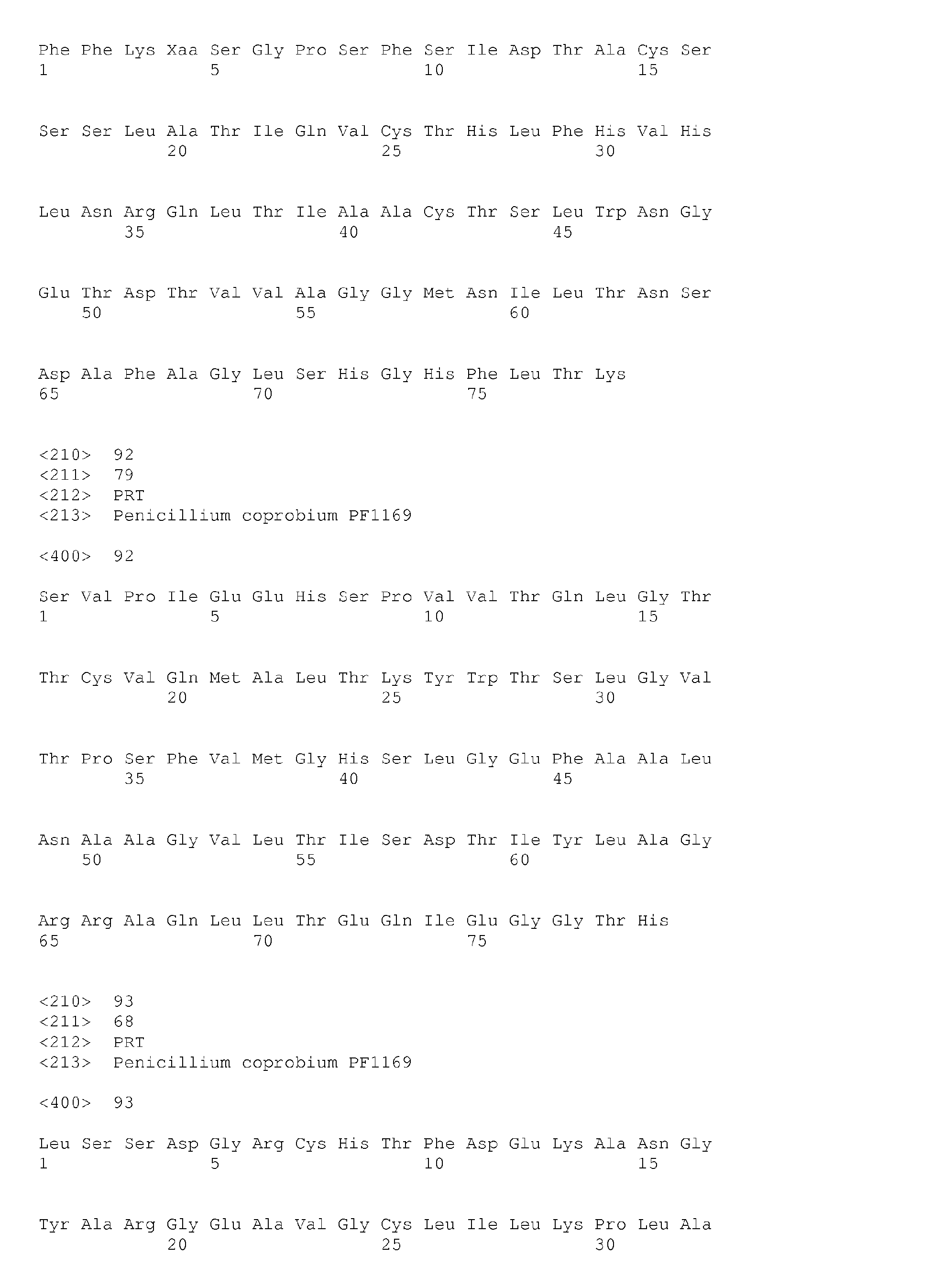

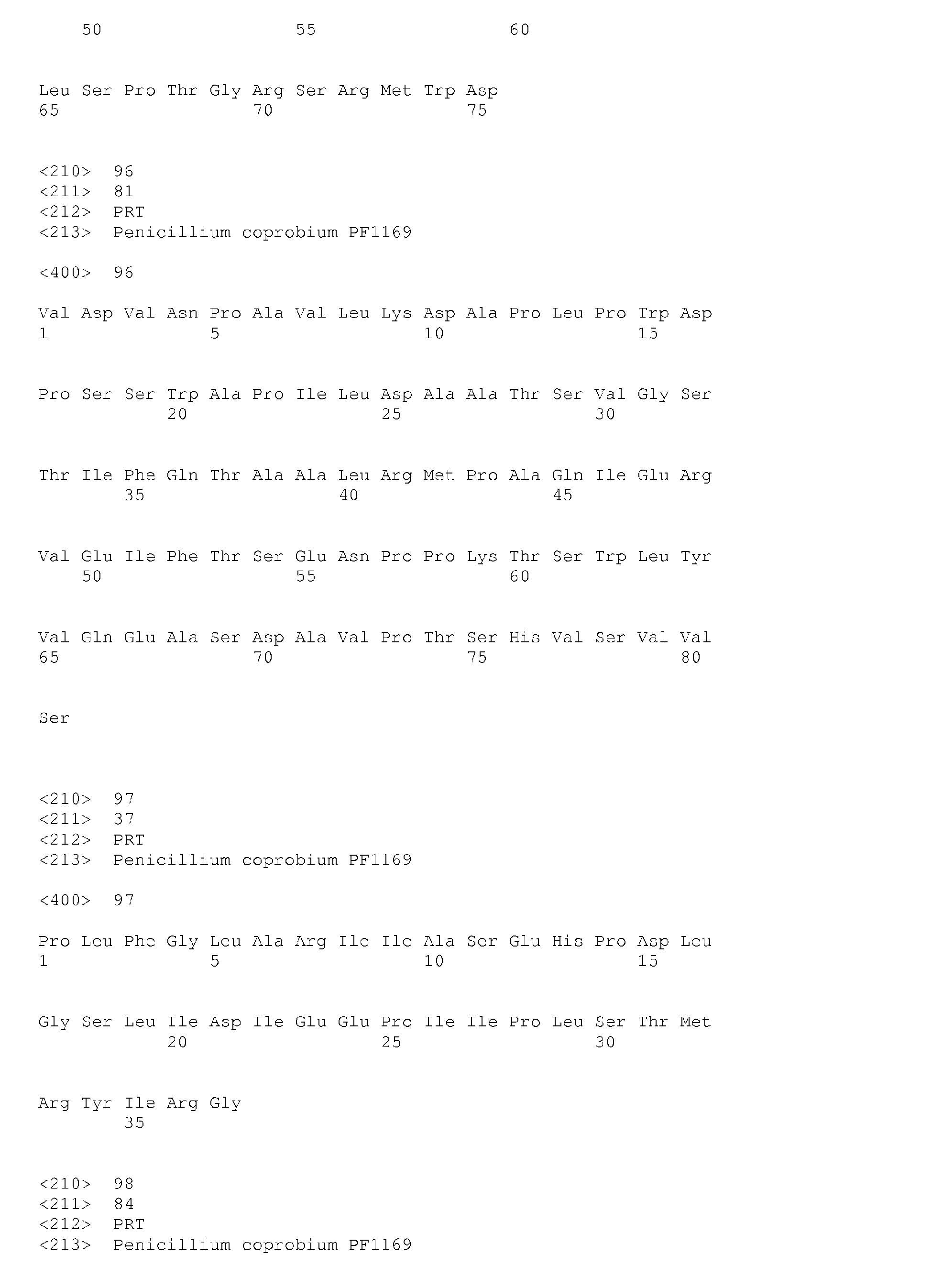


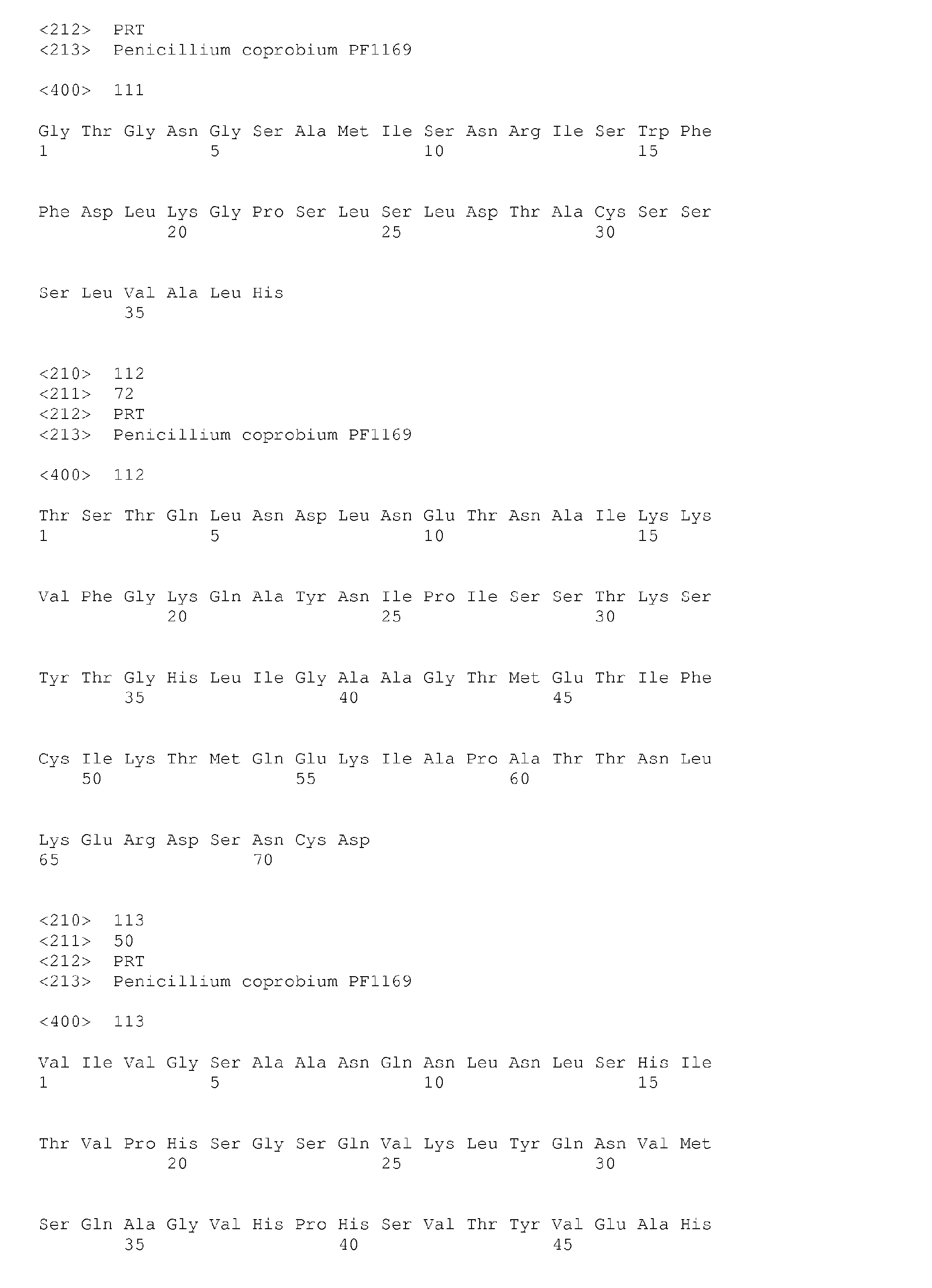

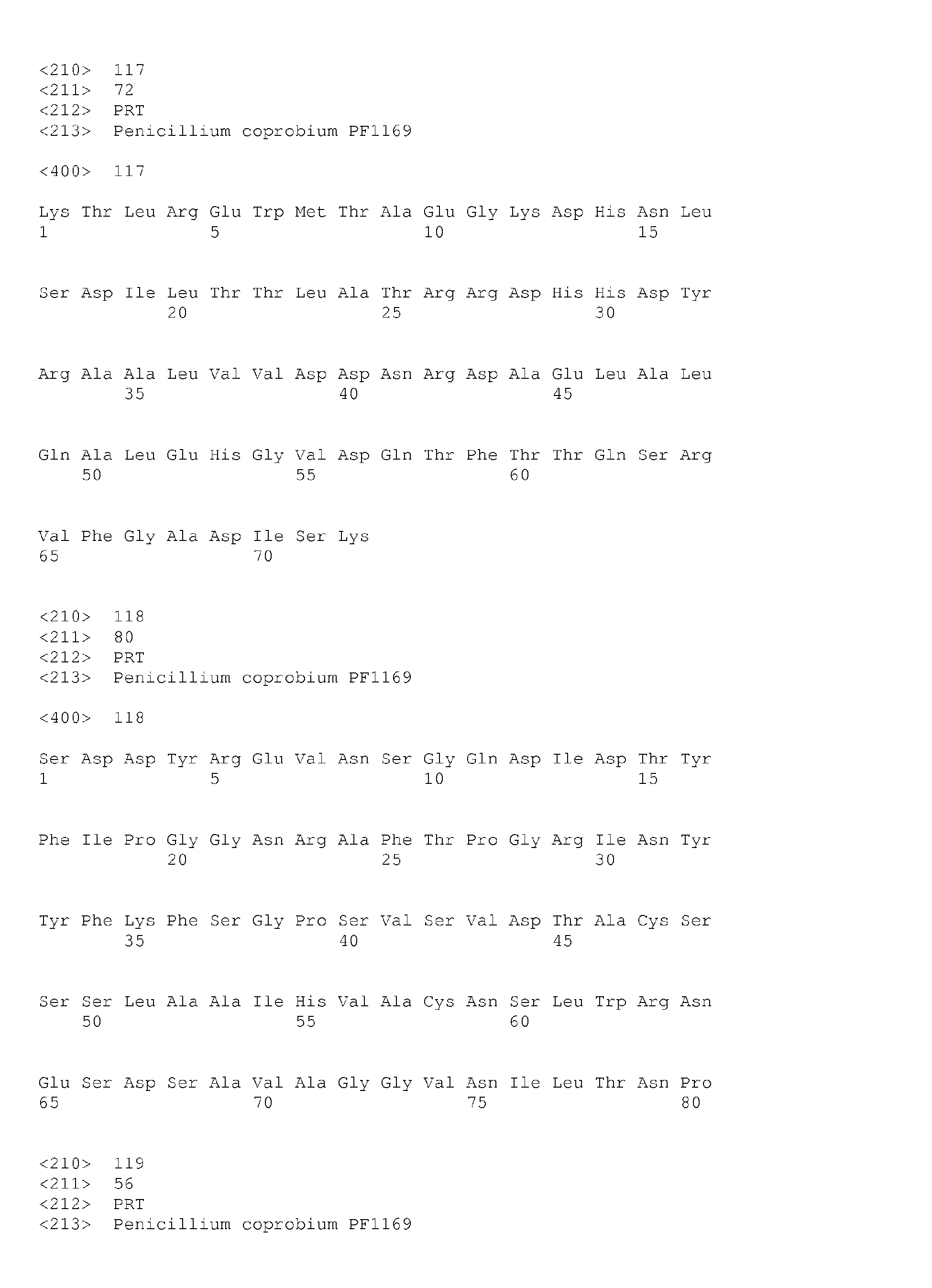


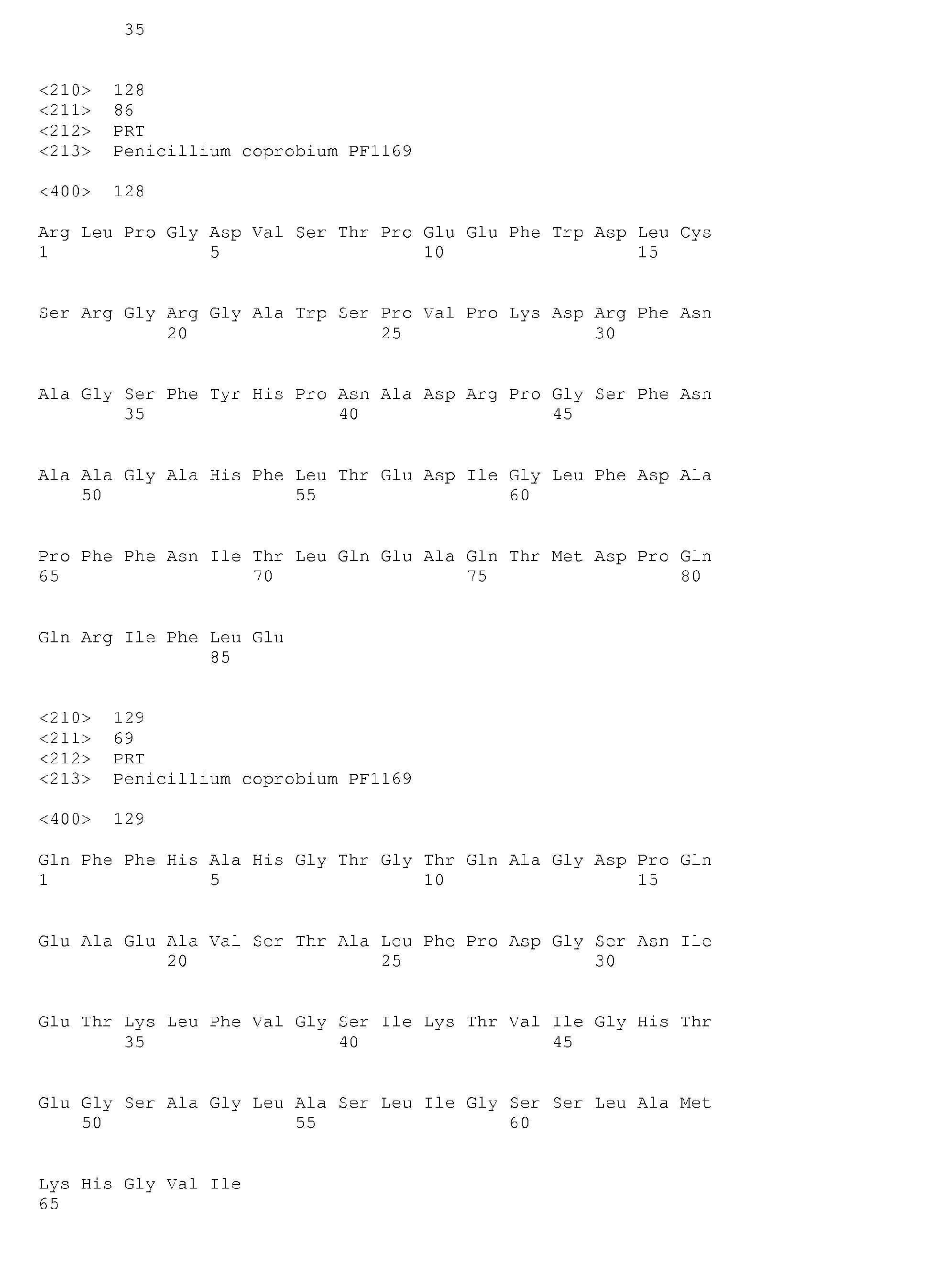
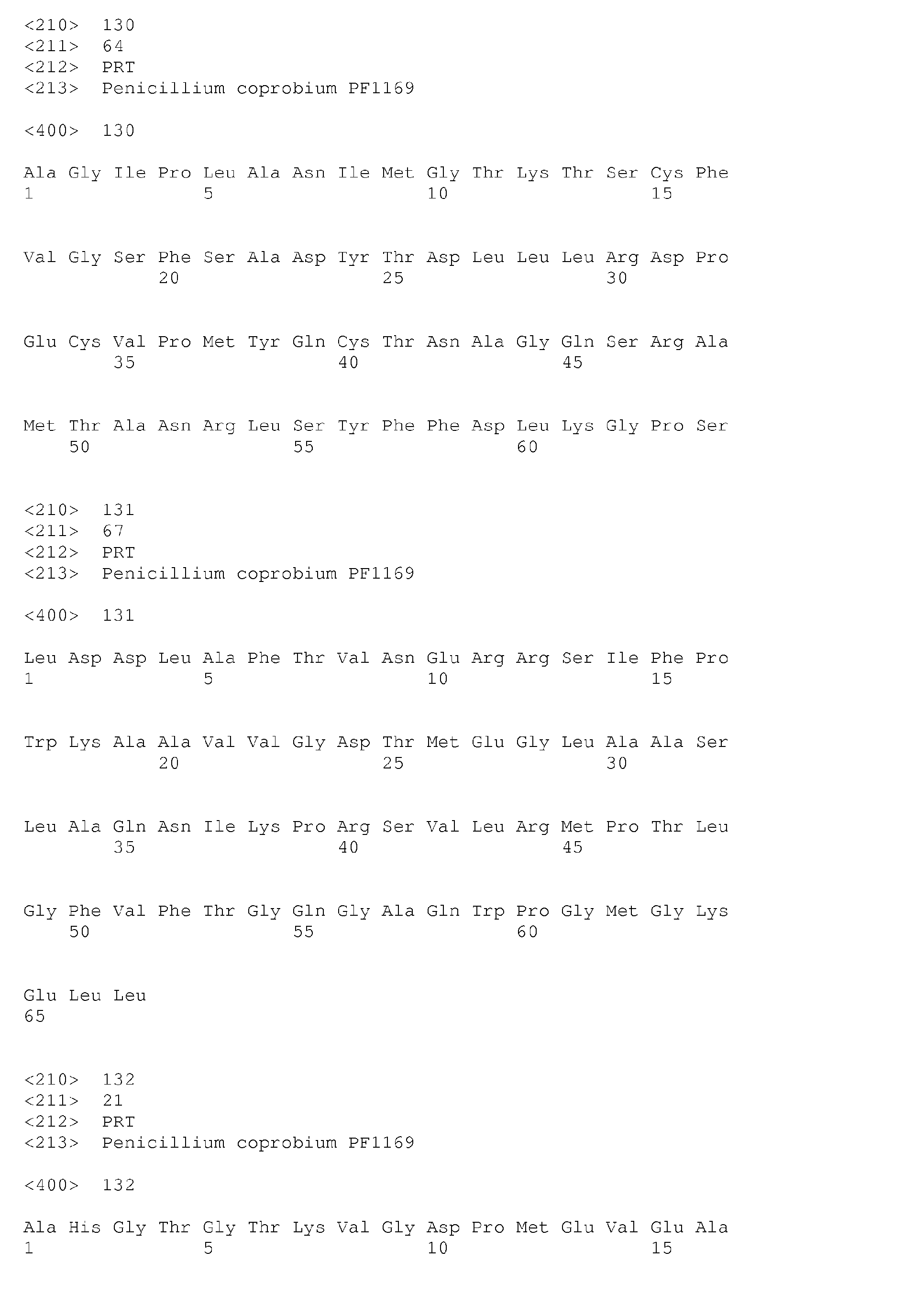

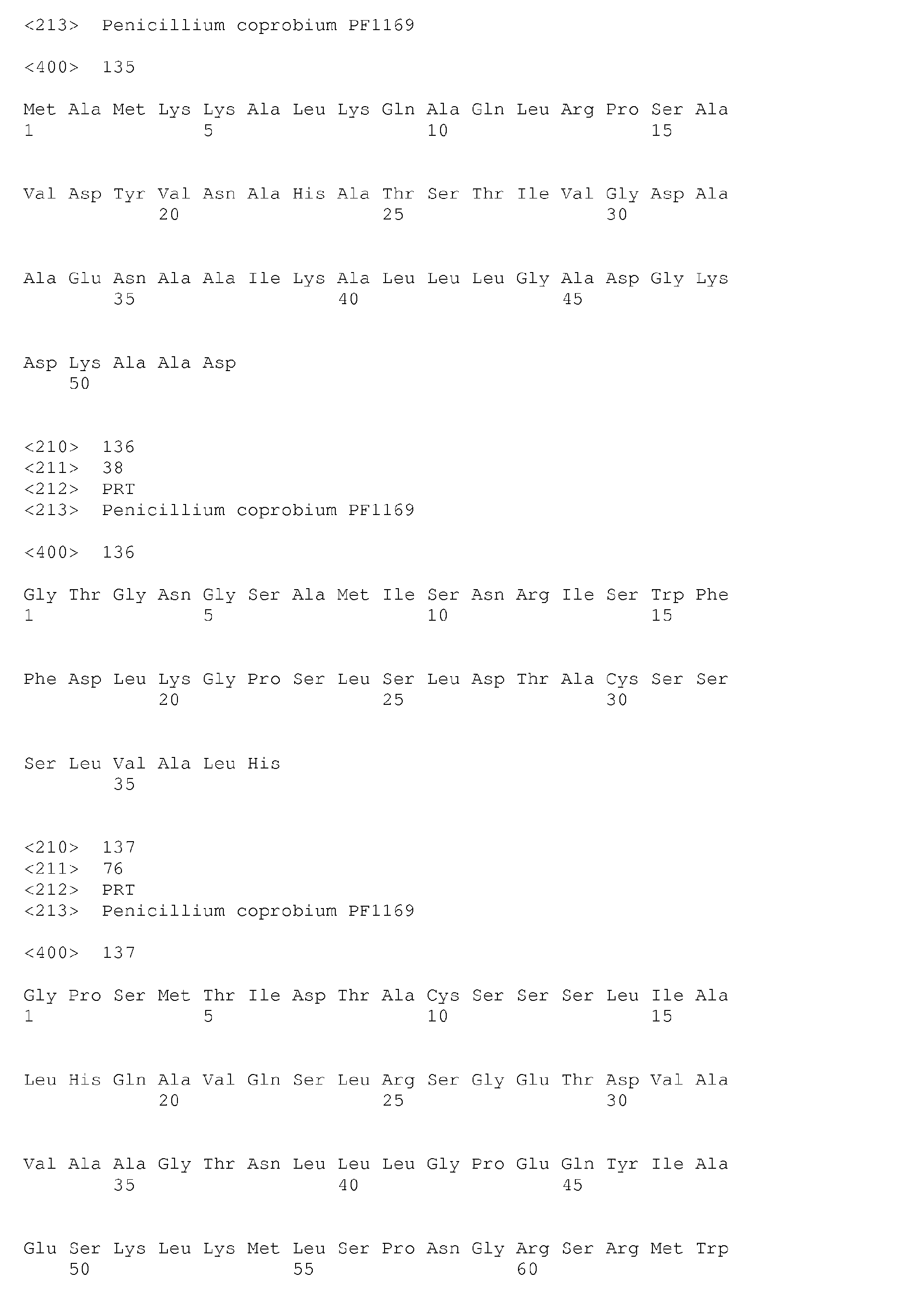


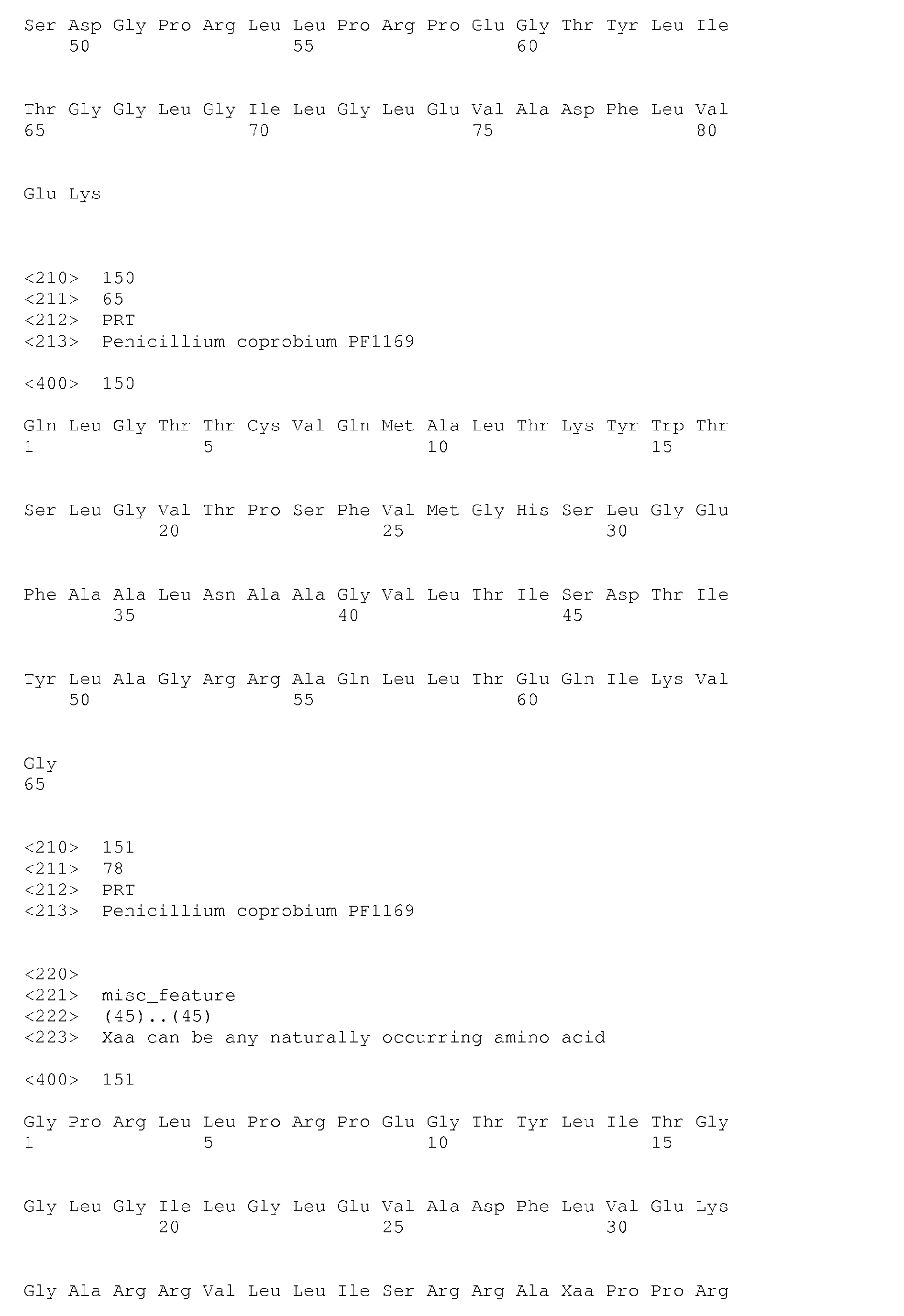


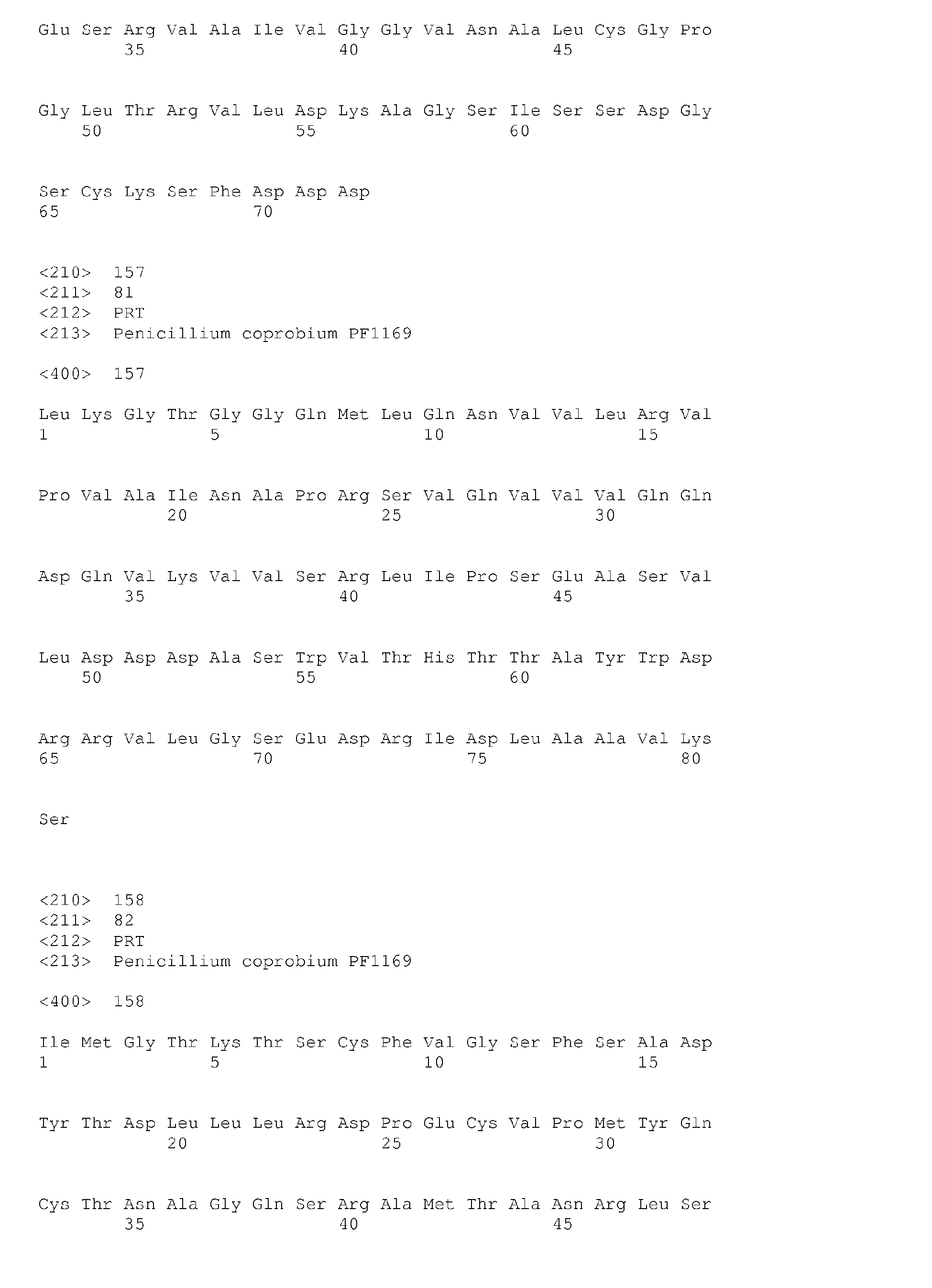


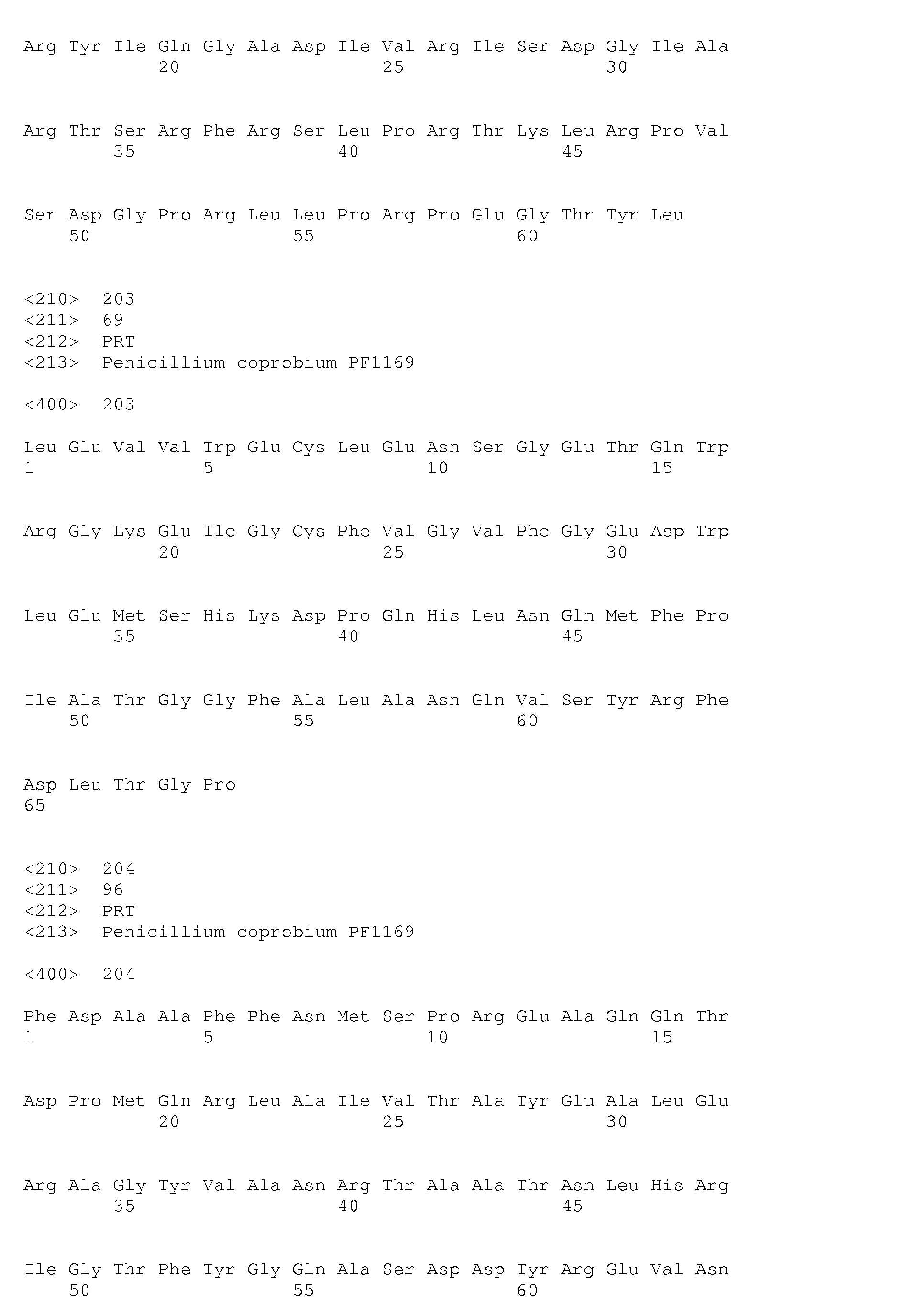


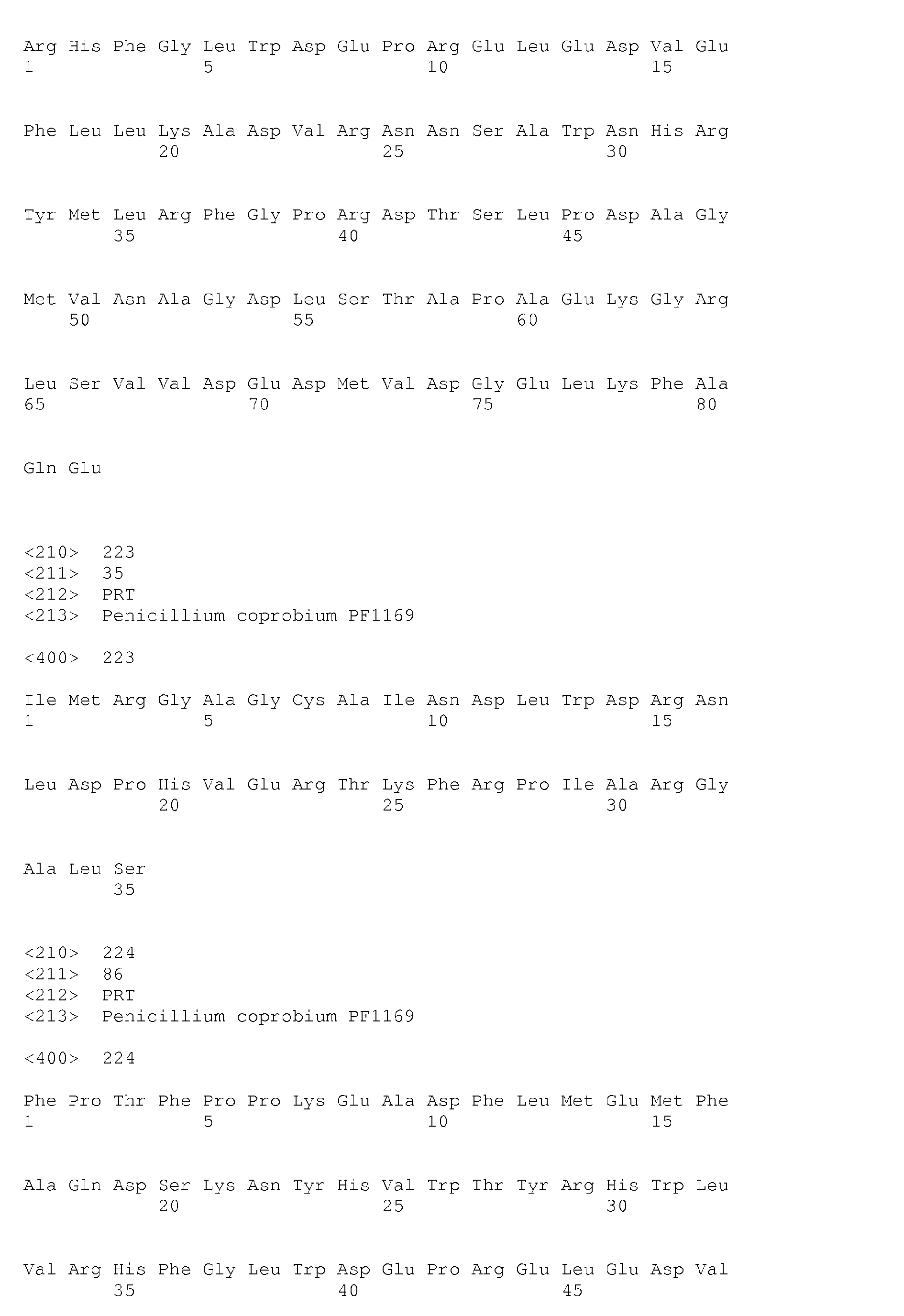


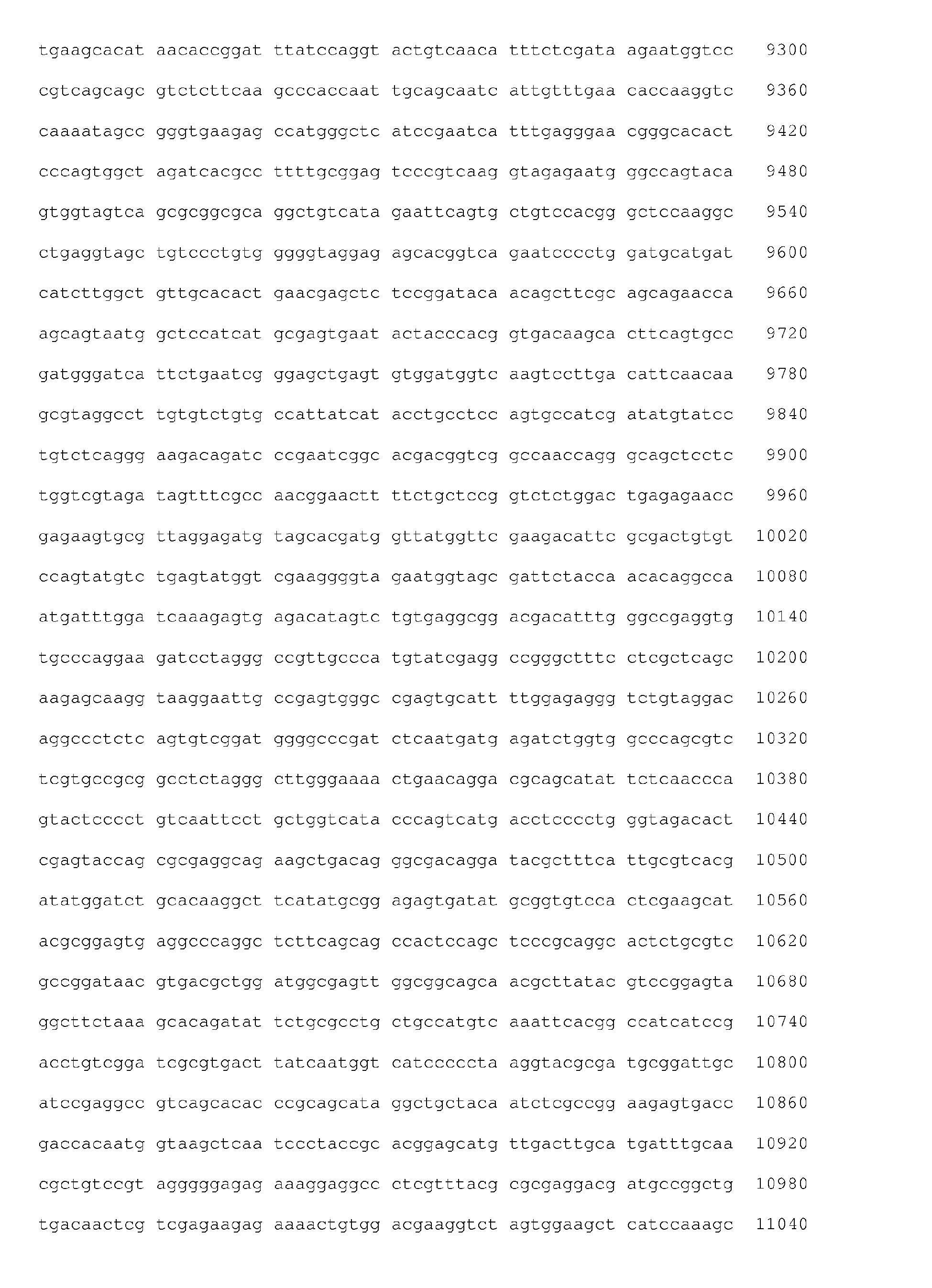


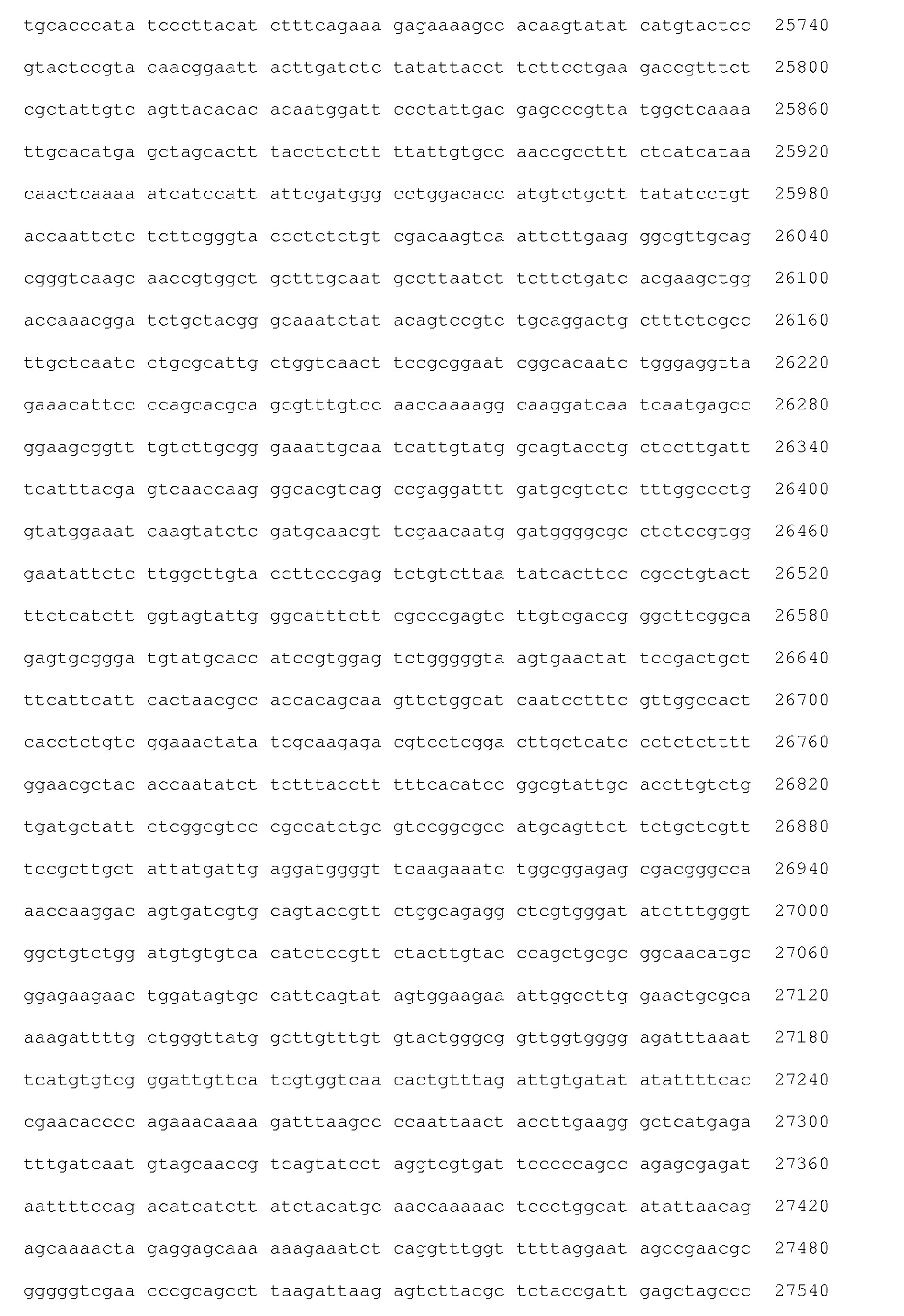


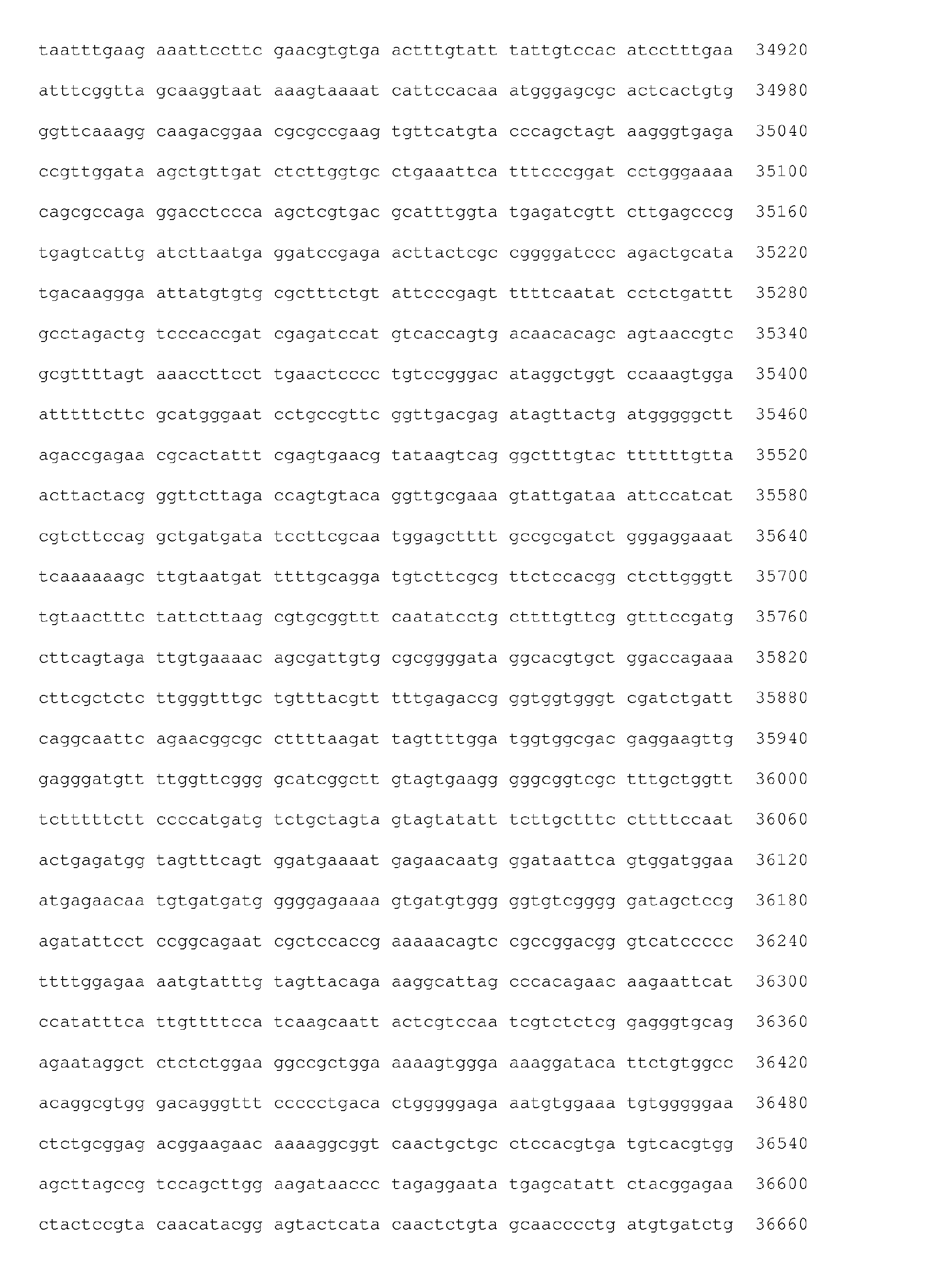


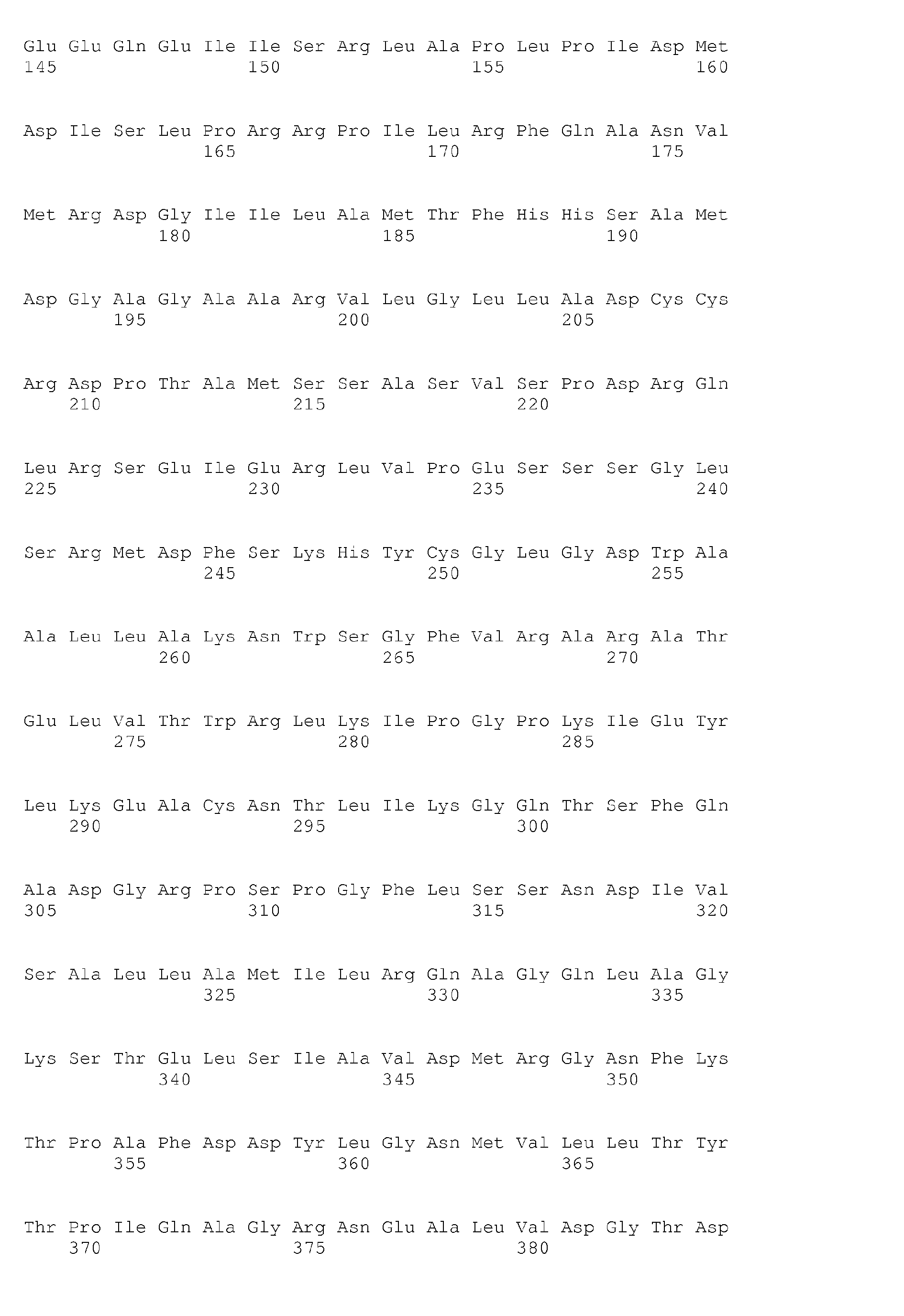
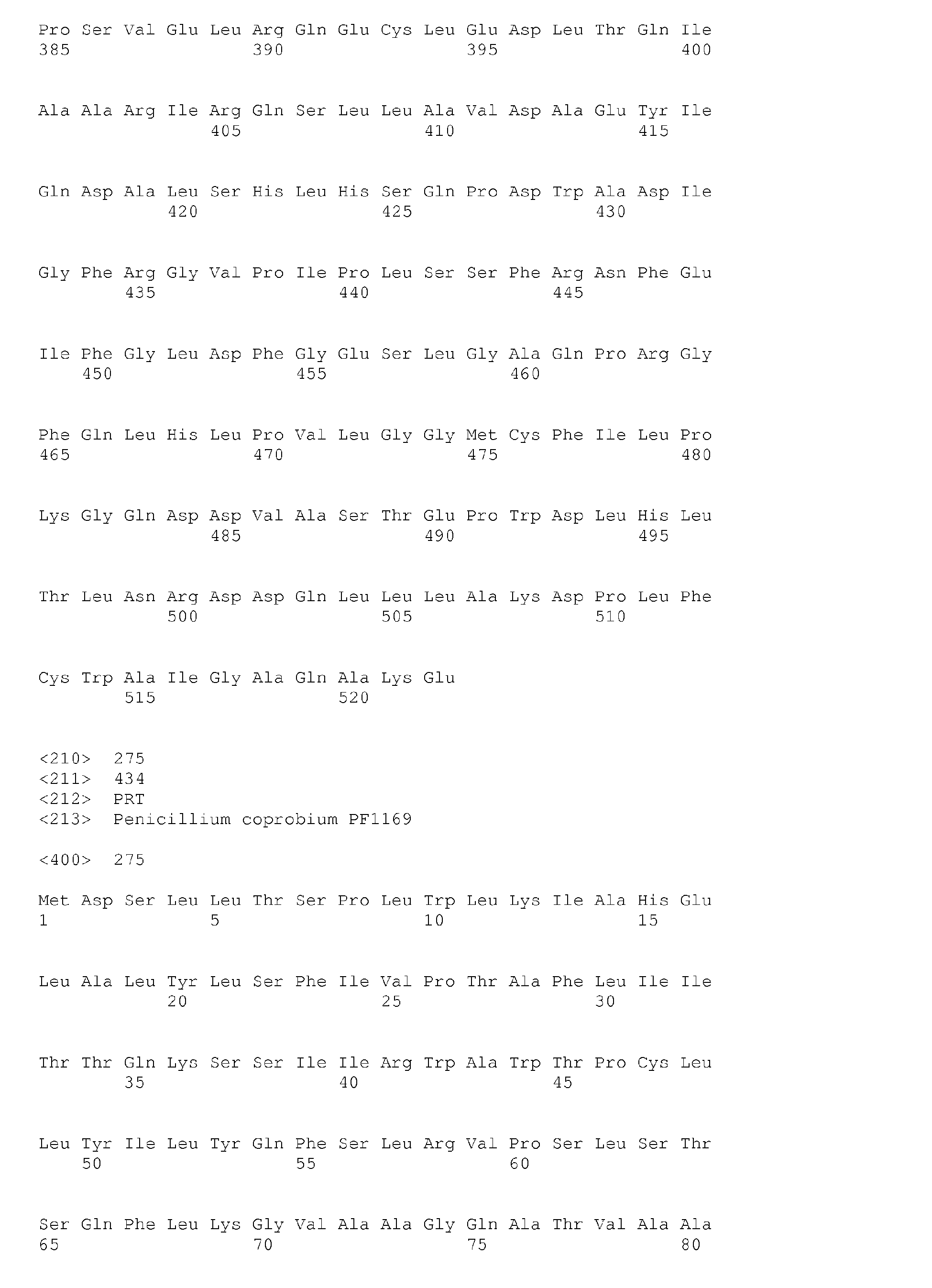
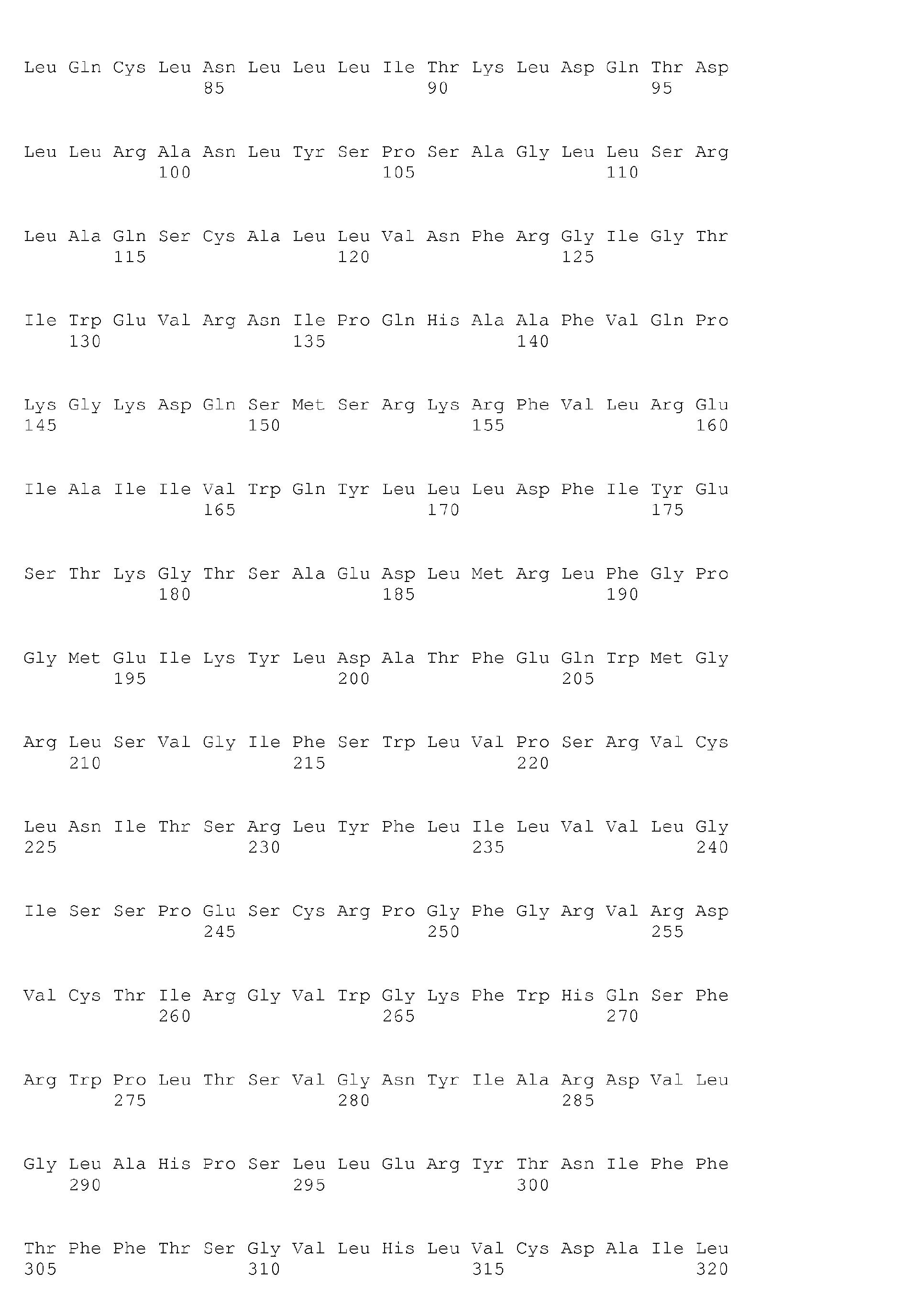
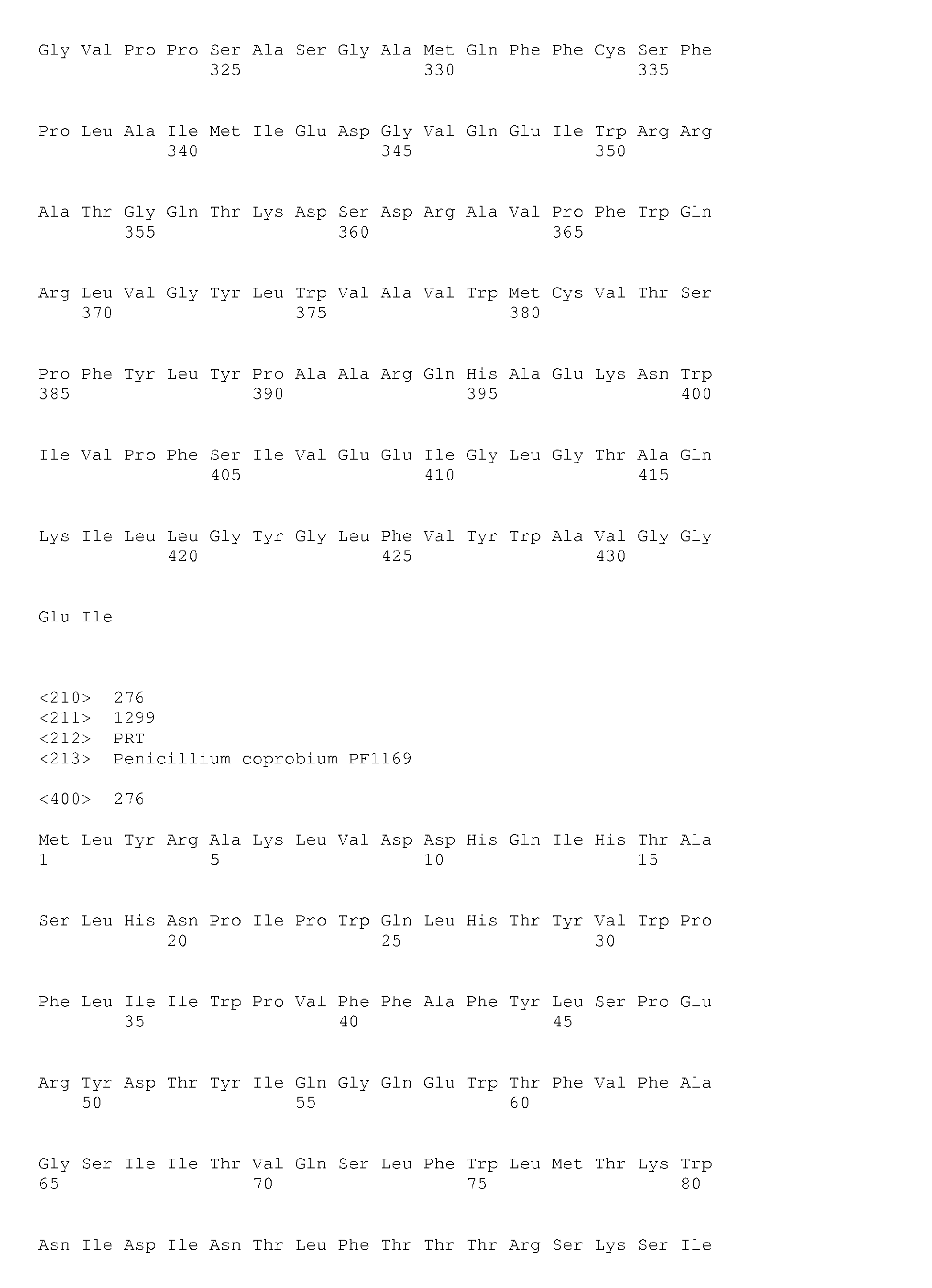


Claims (27)
- An isolated polynucleotide which is(a) a polynucleotide having a nucleotide sequence of SEQ ID NO:266,(b) a polynucleotide having a nucleotide sequence which is capable of hybridizing with the nucleotide sequence of SEQ ID NO:266 under stringent conditions, or(c) a polynucleotide having a polynucleotide sequence encoding at least one amino acid sequence selected from SEQ ID NOs:267 to 274 or a substantially equivalent amino acid sequence thereto.
- The polynucleotide according to claim 1, encoding at least one polypeptide involved in biosynthesis of pyripyropene A.
- The polynucleotide according to claim 1 or 2, encoding a polypeptide having any one or more activities of polyketide synthase activity, prenyltransferase activity, hydroxylase activity, acetyltransferase activity or adenylate synthetase activity.
- The polynucleotide according to any one of claims 1 to 3, which is derived from Penicillium coprobium PF1169 strain.
- An isolated polynucleotide, which has at least one nucleotide sequence selected from the nucleotide sequence in any of (1) or (2) below:(1) a nucleotide sequence in any of (a) to (h) below:(a) a nucleotide sequence from 3342 to 5158 of a nucleotide sequence shown in SEQ ID NO:266,(b) a nucleotide sequence from 5382 to 12777 of a nucleotide sequence shown in SEQ ID NO:266,(c) a nucleotide sequence from 13266 to 15144 of a nucleotide sequence shown in SEQ ID NO:266,(d) a nucleotide sequence from 16220 to 18018 of a nucleotide sequence shown in SEQ ID NO:266,(e) a nucleotide sequence from 18506 to 19296 of a nucleotide sequence shown in SEQ ID NO:266,(f) a nucleotide sequence from 19779 to 21389 of a nucleotide sequence shown in SEQ ID NO:266,(g) a nucleotide sequence from 21793 to 22877 of a nucleotide sequence shown in SEQ ID NO:266,(h) a nucleotide sequence from 23205 to 24773 of a nucleotide sequence shown in SEQ ID NO:266;(2) a nucleotide sequence which is capable of hybridizing with the nucleotide sequence in (1) under stringent conditions.
- The polynucleotide according to claim 5, encoding at least one polypeptide involved in biosynthesis of pyripyropene A.
- The polynucleotide according to claim 5 or 6, encoding a polypeptide having any one or more activities of polyketide synthase activity, prenyltransferase activity, hydroxylase activity, acetyltransferase activity or adenylate synthetase activity.
- The polynucleotide according to claim 5 or 6, encoding a polypeptide having hydroxylase activity.
- The polynucleotide according to any one of claims 5 to 8, which is derived from Penicillium coprobium PF1169 strain.
- The polynucleotide according to any one of claims 5 to 9, encoding a polypeptide having activity to hydroxylate the 7-position and/or 13-position of pyripyropene E or pyripyropene O.
- The polynucleotide according to any one of claims 5 to 9, encoding a polypeptide having activity to hydroxylate the 11-position of pyripyropene E.
- A recombinant vector comprising any one or more of said polynucleotide according to claim 1 or claim 5.
- The recombinant vector according to claim 12, comprising a polynucleotide encoding a polypeptide having activity to hydroxylate the 7-position and/or 13-position of pyripyropene E or pyripyropene O.
- The recombinant vector according to claim 12, comprising a polynucleotide encoding a polypeptide having activity to hydroxylate the 11-position of pyripyropene E.
- The recombinant vector according to claim 12, wherein said recombinant vector is plasmid pCC1-PP1.
- The recombinant vector according to claim 12, wherein said recombinant vector is plasmid pPP2.
- The recombinant vector according to claim 12, wherein said recombinant vector is plasmid pPP3.
- A transformant comprising any one or more of said polynucleotide according to claim 1 or claim 5.
- The transformant according to claim 18, wherein said transformant is Escherichia coli comprising plasmid pCC1-PP1.
- The transformant according to claim 18, wherein said transformant is Aspergillus oryzae comprising plasmid pPP2.
- The transformant according to claim 18, wherein said transformant is Aspergillus oryzae comprising plasmid pPP3.
- A method for producing a pyripyropene A precursor, which comprises culturing a microorganism comprising any one or more of said vectors according to claims 12 to 17 and isolating the pyripyropene A precursor from pyripyropene E.
- A method for producing a pyripyropene A precursor, which comprises culturing said transformant according to claim 20 and said transformant according to claim 21 simultaneously or separately, and isolating the pyripyropene A precursor from pyripyropene E.
- A production method according to claim 22 or 23, wherein said pyripyropene A precursor is represented by formula (I) below:

- A method for producing a pyripyropene A precursor, which comprises culturing a microorganism comprising any one or more of said vectors according to claims 12 to 17 and isolating the pyripyropene A precursor from pyripyropene O.
- A method for producing a pyripyropene A precursor, which comprises culturing said transformant according to claim 21 and isolating the pyripyropene A precursor from pyripyropene O.
- A production method according to claim 25 or 26, wherein said pyripyropene A precursor is represented by formula (II) below:
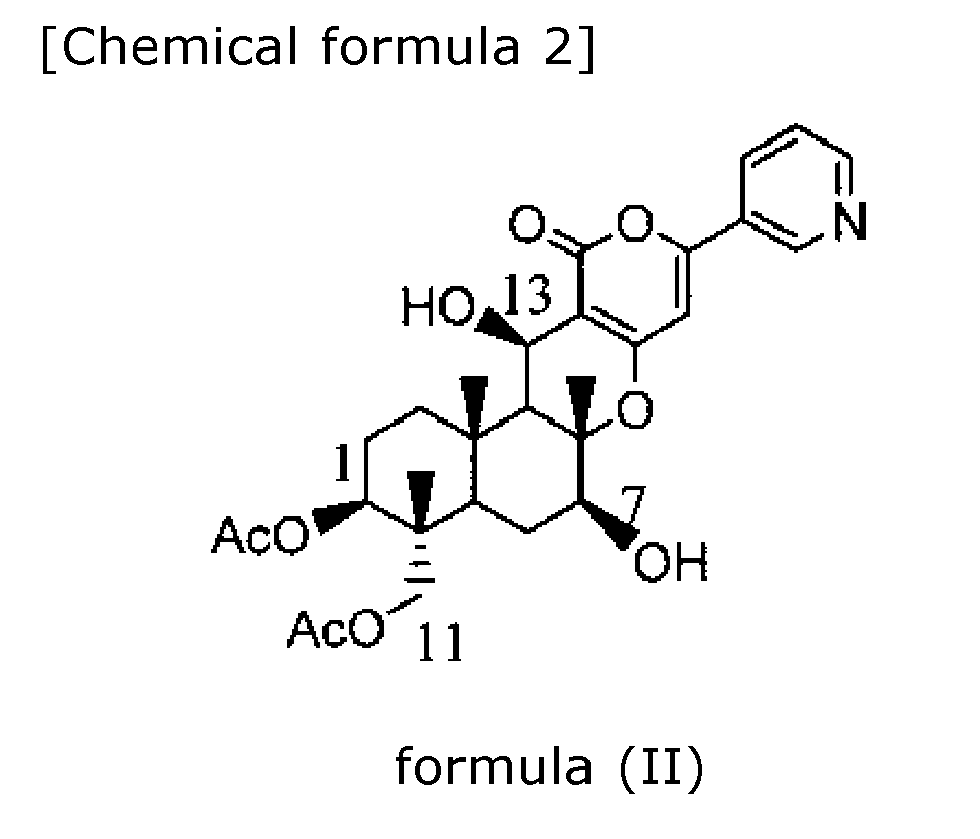
Priority Applications (1)
| Application Number | Priority Date | Filing Date | Title |
|---|---|---|---|
| PL09800469T PL2319923T3 (en) | 2008-07-24 | 2009-07-24 | Pyripyropene a biosynthetic genes |
Applications Claiming Priority (4)
| Application Number | Priority Date | Filing Date | Title |
|---|---|---|---|
| JP2008190862 | 2008-07-24 | ||
| JP2008270294 | 2008-10-20 | ||
| JP2009020591 | 2009-01-30 | ||
| PCT/JP2009/063293 WO2010010955A1 (en) | 2008-07-24 | 2009-07-24 | Pyripyropene a biosynthetic gene |
Publications (3)
| Publication Number | Publication Date |
|---|---|
| EP2319923A1 true EP2319923A1 (en) | 2011-05-11 |
| EP2319923A4 EP2319923A4 (en) | 2011-12-28 |
| EP2319923B1 EP2319923B1 (en) | 2013-12-25 |
Family
ID=41570415
Family Applications (1)
| Application Number | Title | Priority Date | Filing Date |
|---|---|---|---|
| EP09800469.0A Active EP2319923B1 (en) | 2008-07-24 | 2009-07-24 | Pyripyropene a biosynthetic genes |
Country Status (17)
| Country | Link |
|---|---|
| US (2) | US8557550B2 (en) |
| EP (1) | EP2319923B1 (en) |
| JP (2) | JP4642922B2 (en) |
| KR (1) | KR101690802B1 (en) |
| CN (1) | CN102144030B (en) |
| AU (1) | AU2009274832B2 (en) |
| BR (1) | BRPI0916355B8 (en) |
| CA (1) | CA2731760C (en) |
| DK (1) | DK2319923T3 (en) |
| ES (1) | ES2453665T3 (en) |
| IL (1) | IL210795A (en) |
| MX (1) | MX2011000023A (en) |
| NZ (1) | NZ590795A (en) |
| PL (1) | PL2319923T3 (en) |
| RU (1) | RU2540017C2 (en) |
| WO (1) | WO2010010955A1 (en) |
| ZA (1) | ZA201100709B (en) |
Cited By (2)
| Publication number | Priority date | Publication date | Assignee | Title |
|---|---|---|---|---|
| EP2530164A4 (en) * | 2010-01-26 | 2013-12-25 | Meiji Seika Pharma Co Ltd | PROCESS FOR THE PRODUCTION OF PYRIPYROPEN |
| EP2530165A4 (en) * | 2010-01-26 | 2013-12-25 | Meiji Seika Pharma Co Ltd | PROCESS FOR PRODUCING A PYRIPYROPENE DERIVATIVE BY AN ENZYMATIC PROCESS |
Families Citing this family (23)
| Publication number | Priority date | Publication date | Assignee | Title |
|---|---|---|---|---|
| JP4642922B2 (en) * | 2008-07-24 | 2011-03-02 | 明治製菓株式会社 | Pyripyropene A biosynthetic gene |
| BR112012019458B8 (en) * | 2010-01-26 | 2022-08-02 | Mmag Co Ltd | nucleic acid construction, transformant, and methods to produce pyripyropenes |
| MX355432B (en) | 2010-09-14 | 2018-04-18 | Basf Se | Composition containing a pyripyropene insecticide and a base. |
| ES2534745T3 (en) * | 2010-09-14 | 2015-04-28 | Basf Se | Composition containing a pyripyropene insecticide and an adjuvant |
| AU2012236099A1 (en) | 2011-03-31 | 2013-10-03 | Moderna Therapeutics, Inc. | Delivery and formulation of engineered nucleic acids |
| DE19216461T1 (en) * | 2011-10-03 | 2021-10-07 | Modernatx, Inc. | MODIFIED NUCLEOSIDES, NUCLEOTIDES AND NUCLEIC ACIDS AND USES THEREOF |
| WO2013073689A1 (en) * | 2011-11-17 | 2013-05-23 | Meiji Seikaファルマ株式会社 | Plant body expressing pyripyropene biosynthesis gene |
| JP6174057B2 (en) | 2012-03-12 | 2017-08-02 | ビーエーエスエフ ソシエタス・ヨーロピアBasf Se | Process for the preparation of concentrated aqueous suspension formulations of pyripyropene insecticides |
| MX360700B (en) | 2012-03-12 | 2018-11-14 | Basf Se | Liquid concentrate formulation containing a pyripyropene insecticide ii. |
| KR102055551B1 (en) | 2012-03-12 | 2019-12-13 | 바스프 에스이 | Liquid concentrate formulation containing a pyripyropene insecticide i |
| US10590161B2 (en) | 2013-03-15 | 2020-03-17 | Modernatx, Inc. | Ion exchange purification of mRNA |
| WO2014152031A1 (en) | 2013-03-15 | 2014-09-25 | Moderna Therapeutics, Inc. | Ribonucleic acid purification |
| EP2971165A4 (en) | 2013-03-15 | 2016-11-23 | Moderna Therapeutics Inc | ELIMINATING DNA FRAGMENTS IN METHODS OF PRODUCING MRNA |
| WO2014152027A1 (en) | 2013-03-15 | 2014-09-25 | Moderna Therapeutics, Inc. | Manufacturing methods for production of rna transcripts |
| CA2917348A1 (en) | 2013-07-11 | 2015-01-15 | Moderna Therapeutics, Inc. | Compositions comprising synthetic polynucleotides encoding crispr related proteins and synthetic sgrnas and methods of use |
| EP3052511A4 (en) | 2013-10-02 | 2017-05-31 | Moderna Therapeutics, Inc. | Polynucleotide molecules and uses thereof |
| WO2015196128A2 (en) | 2014-06-19 | 2015-12-23 | Moderna Therapeutics, Inc. | Alternative nucleic acid molecules and uses thereof |
| US10407683B2 (en) | 2014-07-16 | 2019-09-10 | Modernatx, Inc. | Circular polynucleotides |
| EP3350333B2 (en) | 2015-09-17 | 2025-08-06 | ModernaTX, Inc. | Polynucleotides containing a stabilizing tail region |
| WO2017049286A1 (en) | 2015-09-17 | 2017-03-23 | Moderna Therapeutics, Inc. | Polynucleotides containing a morpholino linker |
| US10148618B2 (en) | 2016-06-07 | 2018-12-04 | Abb Schweiz Ag | Network isolation |
| WO2017223176A1 (en) | 2016-06-24 | 2017-12-28 | Modernatx, Inc. | Methods and apparatus for filtration |
| KR102098018B1 (en) | 2017-12-22 | 2020-04-07 | 주식회사 포스코 | Pressure vessel |
Family Cites Families (25)
| Publication number | Priority date | Publication date | Assignee | Title |
|---|---|---|---|---|
| US500997A (en) | 1893-07-04 | Oar unloadee | ||
| JP2993767B2 (en) | 1991-06-06 | 1999-12-27 | 社団法人北里研究所 | FO-1289A substance and method for producing the same |
| JP3233476B2 (en) | 1992-10-22 | 2001-11-26 | 社団法人北里研究所 | FO-1289 substance and method for producing the same |
| KR0125129B1 (en) | 1993-10-08 | 1997-11-28 | 김은영 | Novel acyl-CoA: Cholesterol acyltransferase (ACAT) activity inhibitor and preparation method thereof |
| JPH08239385A (en) | 1995-03-03 | 1996-09-17 | Kitasato Inst:The | FO-1289 substance and its production method |
| JP3725198B2 (en) | 1995-03-27 | 2005-12-07 | 社団法人北里研究所 | Pyripyropene derivative |
| JPH08269063A (en) | 1995-03-28 | 1996-10-15 | Kitasato Inst:The | Pyripyropene derivative |
| JPH08269062A (en) | 1995-03-30 | 1996-10-15 | Kitasato Inst:The | Pyripyropene derivative |
| JPH08269064A (en) | 1995-04-03 | 1996-10-15 | Kitasato Inst:The | Pyripyropene derivative |
| JPH08269065A (en) | 1995-04-03 | 1996-10-15 | Kitasato Inst:The | Pyripyropene derivative |
| JPH08269066A (en) | 1995-04-03 | 1996-10-15 | Kitasato Inst:The | Pyripyropene derivative |
| JP3688337B2 (en) | 1995-04-18 | 2005-08-24 | 社団法人北里研究所 | Pyripyropene derivative |
| KR100522446B1 (en) | 2003-01-07 | 2005-10-18 | 한국생명공학연구원 | AGENT FOR KILLING INSECTS COMPRISING COMPOUNDS HAVING ACYL CoA:CHOLESTEROL ACYLTRANSFERASE INHIBITORY OR SALT THEREOF |
| JP4360895B2 (en) | 2003-12-11 | 2009-11-11 | 日立Geニュークリア・エナジー株式会社 | Neutron monitoring device |
| JP5179174B2 (en) * | 2004-05-28 | 2013-04-10 | ノバルティス ファーマ アーゲー | Tetrahydro-imidazo [1,5-A] pyridine derivatives as aldosterone synthase inhibitors |
| WO2006083411A2 (en) | 2004-12-17 | 2006-08-10 | David Glassel | Methods and compositions of matter for treatment of cellulose |
| TWI388282B (en) | 2005-06-01 | 2013-03-11 | Meiji Seika Pharma Co Ltd | Pest control agents |
| US7491738B2 (en) | 2005-06-01 | 2009-02-17 | Meiji Seika Kaisha, Ltd. | Pest control agents |
| US8202890B2 (en) | 2006-11-30 | 2012-06-19 | Meiji Seika Pharma Co., Ltd. | Pest control agent |
| JP2008270294A (en) | 2007-04-16 | 2008-11-06 | Sumitomo Electric Ind Ltd | Heat sink member and semiconductor device |
| JP2009020591A (en) | 2007-07-10 | 2009-01-29 | Canon Inc | Printer adapter device and control method |
| EP2186815A4 (en) | 2007-08-13 | 2012-01-25 | Meiji Seika Kaisha | PROCESS FOR PRODUCING PYRIPYROPENE DERIVATIVES AND INTERMEDIATE PRODUCTION PRODUCTS THEREOF |
| JP4267680B2 (en) | 2008-03-26 | 2009-05-27 | 株式会社東芝 | Cooker |
| JP4642922B2 (en) * | 2008-07-24 | 2011-03-02 | 明治製菓株式会社 | Pyripyropene A biosynthetic gene |
| EP2426124B1 (en) * | 2009-05-13 | 2013-08-07 | Meiji Seika Pharma Co., Ltd. | Process for producing pyripyropene derivative |
-
2009
- 2009-07-24 JP JP2009548252A patent/JP4642922B2/en active Active
- 2009-07-24 KR KR1020117001974A patent/KR101690802B1/en active Active
- 2009-07-24 AU AU2009274832A patent/AU2009274832B2/en active Active
- 2009-07-24 US US13/055,532 patent/US8557550B2/en active Active
- 2009-07-24 EP EP09800469.0A patent/EP2319923B1/en active Active
- 2009-07-24 DK DK09800469.0T patent/DK2319923T3/en active
- 2009-07-24 BR BRPI0916355A patent/BRPI0916355B8/en active IP Right Grant
- 2009-07-24 CA CA2731760A patent/CA2731760C/en active Active
- 2009-07-24 RU RU2011106496/10A patent/RU2540017C2/en active
- 2009-07-24 MX MX2011000023A patent/MX2011000023A/en active IP Right Grant
- 2009-07-24 PL PL09800469T patent/PL2319923T3/en unknown
- 2009-07-24 WO PCT/JP2009/063293 patent/WO2010010955A1/en not_active Ceased
- 2009-07-24 CN CN200980128891.6A patent/CN102144030B/en active Active
- 2009-07-24 ES ES09800469.0T patent/ES2453665T3/en active Active
- 2009-07-24 NZ NZ590795A patent/NZ590795A/en unknown
- 2009-11-25 JP JP2009267881A patent/JP2010193878A/en not_active Withdrawn
-
2011
- 2011-01-23 IL IL210795A patent/IL210795A/en active IP Right Grant
- 2011-01-27 ZA ZA2011/00709A patent/ZA201100709B/en unknown
-
2013
- 2013-09-10 US US14/022,778 patent/US9315785B2/en active Active
Non-Patent Citations (8)
| Title |
|---|
| DATABASE UNIPROT [Online] 23 January 2007 'SubName: Full=Putative uncharacterized protein;' Retrieved from EBI, accession no. UNIPROT:A1DC22 Database accession no. A1DC22 * |
| FEDOROVA NATALIE D ET AL: "Genomic islands in the pathogenic filamentous fungus Aspergillus fumigatus", PLOS GENETICS, PUBLIC LIBRARY OF SCIENCE, SAN FRANCISCO, CA, US, vol. 4, no. 4, 1 April 2008 (2008-04-01), XP002544950, ISSN: 1553-7390, DOI: 10.1371/JOURNAL.PGEN.1000046 * |
| JÁNOS VARGA ET AL: "Diversity of polyketide synthase gene sequences in Aspergillus species", RESEARCH IN MICROBIOLOGY, vol. 154, no. 8, 1 October 2003 (2003-10-01), pages 593-600, XP55012538, ISSN: 0923-2508, DOI: 10.1016/S0923-2508(03)00169-4 * |
| JIE HU ET AL: "Characterization of two cytochrome P450 monooxygenase genes of the pyripyropene biosynthetic gene cluster from Penicillium coprobium", THE JOURNAL OF ANTIBIOTICS, vol. 64, no. 3, 12 January 2011 (2011-01-12), pages 221-227, XP55012016, ISSN: 0021-8820, DOI: 10.1038/ja.2010.162 * |
| NIERMAN, W.C. ET AL.: "Genomic sequence of the pathogenic and allergenic filamentous fungus Aspergillus fumigatus", NATNATURE PUBLISHING GROUP, UNITED KINGDOM, vol. 438, no. 22/29, 31 December 2005 (2005-12-31), pages 1151-1155, XP008139207, ISSN: 0028-0836 * |
| RUSSELL J. COX: "Polyketides, proteins and genes in fungi: programmed nano-machines begin to reveal their secrets", ORGANIC & BIOMOLECULAR CHEMISTRY, vol. 5, no. 13, 1 January 2007 (2007-01-01), page 2010, XP55012154, ISSN: 1477-0520, DOI: 10.1039/b704420h * |
| See also references of WO2010010955A1 * |
| TAKAYUKI ITOH ET AL: "Reconstitution of a fungal meroterpenoid biosynthesis reveals the involvement of a novel family of terpene cyclases", NATURE CHEMISTRY,, vol. 2, no. 10, 1 August 2010 (2010-08-01) , pages 858-864, XP009154045, ISSN: 1755-4349, DOI: 10.1038/NCHEM.764 * |
Cited By (3)
| Publication number | Priority date | Publication date | Assignee | Title |
|---|---|---|---|---|
| EP2530164A4 (en) * | 2010-01-26 | 2013-12-25 | Meiji Seika Pharma Co Ltd | PROCESS FOR THE PRODUCTION OF PYRIPYROPEN |
| EP2530165A4 (en) * | 2010-01-26 | 2013-12-25 | Meiji Seika Pharma Co Ltd | PROCESS FOR PRODUCING A PYRIPYROPENE DERIVATIVE BY AN ENZYMATIC PROCESS |
| US9169504B2 (en) | 2010-01-26 | 2015-10-27 | Meiji Seika Pharma Co., Ltd. | Method for producing pyripyropene |
Also Published As
| Publication number | Publication date |
|---|---|
| RU2011106496A (en) | 2012-08-27 |
| CN102144030B (en) | 2016-05-04 |
| DK2319923T3 (en) | 2014-02-24 |
| US8557550B2 (en) | 2013-10-15 |
| AU2009274832B2 (en) | 2015-07-16 |
| WO2010010955A1 (en) | 2010-01-28 |
| US20140142289A1 (en) | 2014-05-22 |
| KR101690802B1 (en) | 2016-12-28 |
| BRPI0916355A2 (en) | 2020-08-18 |
| US9315785B2 (en) | 2016-04-19 |
| ZA201100709B (en) | 2012-05-01 |
| KR20110038678A (en) | 2011-04-14 |
| IL210795A0 (en) | 2011-04-28 |
| CA2731760C (en) | 2019-09-24 |
| PL2319923T3 (en) | 2014-05-30 |
| EP2319923A4 (en) | 2011-12-28 |
| NZ590795A (en) | 2012-11-30 |
| JPWO2010010955A1 (en) | 2012-01-05 |
| ES2453665T3 (en) | 2014-04-08 |
| MX2011000023A (en) | 2011-03-30 |
| AU2009274832A1 (en) | 2010-01-28 |
| CA2731760A1 (en) | 2010-01-28 |
| US20120015410A1 (en) | 2012-01-19 |
| IL210795A (en) | 2014-12-31 |
| BRPI0916355B1 (en) | 2021-11-09 |
| CN102144030A (en) | 2011-08-03 |
| BRPI0916355B8 (en) | 2022-12-13 |
| RU2540017C2 (en) | 2015-01-27 |
| JP4642922B2 (en) | 2011-03-02 |
| JP2010193878A (en) | 2010-09-09 |
| EP2319923B1 (en) | 2013-12-25 |
Similar Documents
| Publication | Publication Date | Title |
|---|---|---|
| US9315785B2 (en) | Pyripyropene a biosynthetic gene | |
| US9169504B2 (en) | Method for producing pyripyropene | |
| US20120330022A1 (en) | Method for producing pyripyropene derivatives by the enzymatic method |
Legal Events
| Date | Code | Title | Description |
|---|---|---|---|
| PUAI | Public reference made under article 153(3) epc to a published international application that has entered the european phase |
Free format text: ORIGINAL CODE: 0009012 |
|
| 17P | Request for examination filed |
Effective date: 20110128 |
|
| AK | Designated contracting states |
Kind code of ref document: A1 Designated state(s): AT BE BG CH CY CZ DE DK EE ES FI FR GB GR HR HU IE IS IT LI LT LU LV MC MK MT NL NO PL PT RO SE SI SK SM TR |
|
| AX | Request for extension of the european patent |
Extension state: AL BA RS |
|
| RIN1 | Information on inventor provided before grant (corrected) |
Inventor name: MITOMI, MASAAKI Inventor name: OYAMA, KAZUHIKO Inventor name: TSUCHIDA, MARIKO Inventor name: YAMAMOTO, KENTARO Inventor name: ANZAI, HIROYUKI |
|
| A4 | Supplementary search report drawn up and despatched |
Effective date: 20111129 |
|
| RIC1 | Information provided on ipc code assigned before grant |
Ipc: C12P 17/18 20060101ALI20111123BHEP Ipc: C12N 1/21 20060101ALI20111123BHEP Ipc: C12N 1/15 20060101ALI20111123BHEP Ipc: C12N 15/09 20060101AFI20111123BHEP |
|
| RAP1 | Party data changed (applicant data changed or rights of an application transferred) |
Owner name: MEIJI SEIKA PHARMA CO., LTD. |
|
| 17Q | First examination report despatched |
Effective date: 20121115 |
|
| GRAP | Despatch of communication of intention to grant a patent |
Free format text: ORIGINAL CODE: EPIDOSNIGR1 |
|
| INTG | Intention to grant announced |
Effective date: 20130705 |
|
| GRAS | Grant fee paid |
Free format text: ORIGINAL CODE: EPIDOSNIGR3 |
|
| GRAA | (expected) grant |
Free format text: ORIGINAL CODE: 0009210 |
|
| AK | Designated contracting states |
Kind code of ref document: B1 Designated state(s): AT BE BG CH CY CZ DE DK EE ES FI FR GB GR HR HU IE IS IT LI LT LU LV MC MK MT NL NO PL PT RO SE SI SK SM TR |
|
| AX | Request for extension of the european patent |
Extension state: AL BA RS |
|
| REG | Reference to a national code |
Ref country code: GB Ref legal event code: FG4D |
|
| REG | Reference to a national code |
Ref country code: CH Ref legal event code: EP |
|
| REG | Reference to a national code |
Ref country code: AT Ref legal event code: REF Ref document number: 646678 Country of ref document: AT Kind code of ref document: T Effective date: 20140115 |
|
| REG | Reference to a national code |
Ref country code: IE Ref legal event code: FG4D |
|
| REG | Reference to a national code |
Ref country code: CH Ref legal event code: NV Representative=s name: SCHNEIDER FELDMANN AG PATENT- UND MARKENANWAEL, CH |
|
| REG | Reference to a national code |
Ref country code: DE Ref legal event code: R096 Ref document number: 602009021041 Country of ref document: DE Effective date: 20140213 |
|
| REG | Reference to a national code |
Ref country code: NL Ref legal event code: T3 |
|
| REG | Reference to a national code |
Ref country code: DK Ref legal event code: T3 Effective date: 20140220 |
|
| REG | Reference to a national code |
Ref country code: SE Ref legal event code: TRGR |
|
| REG | Reference to a national code |
Ref country code: ES Ref legal event code: FG2A Ref document number: 2453665 Country of ref document: ES Kind code of ref document: T3 Effective date: 20140408 |
|
| PG25 | Lapsed in a contracting state [announced via postgrant information from national office to epo] |
Ref country code: LT Free format text: LAPSE BECAUSE OF FAILURE TO SUBMIT A TRANSLATION OF THE DESCRIPTION OR TO PAY THE FEE WITHIN THE PRESCRIBED TIME-LIMIT Effective date: 20131225 Ref country code: HR Free format text: LAPSE BECAUSE OF FAILURE TO SUBMIT A TRANSLATION OF THE DESCRIPTION OR TO PAY THE FEE WITHIN THE PRESCRIBED TIME-LIMIT Effective date: 20131225 |
|
| REG | Reference to a national code |
Ref country code: NO Ref legal event code: T2 Effective date: 20131225 Ref country code: LT Ref legal event code: MG4D |
|
| PG25 | Lapsed in a contracting state [announced via postgrant information from national office to epo] |
Ref country code: LV Free format text: LAPSE BECAUSE OF FAILURE TO SUBMIT A TRANSLATION OF THE DESCRIPTION OR TO PAY THE FEE WITHIN THE PRESCRIBED TIME-LIMIT Effective date: 20131225 |
|
| REG | Reference to a national code |
Ref country code: PL Ref legal event code: T3 |
|
| REG | Reference to a national code |
Ref country code: SK Ref legal event code: T3 Ref document number: E 15889 Country of ref document: SK |
|
| PG25 | Lapsed in a contracting state [announced via postgrant information from national office to epo] |
Ref country code: IS Free format text: LAPSE BECAUSE OF FAILURE TO SUBMIT A TRANSLATION OF THE DESCRIPTION OR TO PAY THE FEE WITHIN THE PRESCRIBED TIME-LIMIT Effective date: 20140425 Ref country code: EE Free format text: LAPSE BECAUSE OF FAILURE TO SUBMIT A TRANSLATION OF THE DESCRIPTION OR TO PAY THE FEE WITHIN THE PRESCRIBED TIME-LIMIT Effective date: 20131225 |
|
| PG25 | Lapsed in a contracting state [announced via postgrant information from national office to epo] |
Ref country code: RO Free format text: LAPSE BECAUSE OF FAILURE TO SUBMIT A TRANSLATION OF THE DESCRIPTION OR TO PAY THE FEE WITHIN THE PRESCRIBED TIME-LIMIT Effective date: 20131225 Ref country code: CY Free format text: LAPSE BECAUSE OF FAILURE TO SUBMIT A TRANSLATION OF THE DESCRIPTION OR TO PAY THE FEE WITHIN THE PRESCRIBED TIME-LIMIT Effective date: 20131225 Ref country code: PT Free format text: LAPSE BECAUSE OF FAILURE TO SUBMIT A TRANSLATION OF THE DESCRIPTION OR TO PAY THE FEE WITHIN THE PRESCRIBED TIME-LIMIT Effective date: 20140428 |
|
| REG | Reference to a national code |
Ref country code: DE Ref legal event code: R097 Ref document number: 602009021041 Country of ref document: DE |
|
| REG | Reference to a national code |
Ref country code: HU Ref legal event code: AG4A Ref document number: E020218 Country of ref document: HU |
|
| PLBE | No opposition filed within time limit |
Free format text: ORIGINAL CODE: 0009261 |
|
| STAA | Information on the status of an ep patent application or granted ep patent |
Free format text: STATUS: NO OPPOSITION FILED WITHIN TIME LIMIT |
|
| 26N | No opposition filed |
Effective date: 20140926 |
|
| REG | Reference to a national code |
Ref country code: DE Ref legal event code: R097 Ref document number: 602009021041 Country of ref document: DE Effective date: 20140926 |
|
| PG25 | Lapsed in a contracting state [announced via postgrant information from national office to epo] |
Ref country code: LU Free format text: LAPSE BECAUSE OF FAILURE TO SUBMIT A TRANSLATION OF THE DESCRIPTION OR TO PAY THE FEE WITHIN THE PRESCRIBED TIME-LIMIT Effective date: 20140724 |
|
| PG25 | Lapsed in a contracting state [announced via postgrant information from national office to epo] |
Ref country code: SI Free format text: LAPSE BECAUSE OF FAILURE TO SUBMIT A TRANSLATION OF THE DESCRIPTION OR TO PAY THE FEE WITHIN THE PRESCRIBED TIME-LIMIT Effective date: 20131225 |
|
| PG25 | Lapsed in a contracting state [announced via postgrant information from national office to epo] |
Ref country code: MC Free format text: LAPSE BECAUSE OF FAILURE TO SUBMIT A TRANSLATION OF THE DESCRIPTION OR TO PAY THE FEE WITHIN THE PRESCRIBED TIME-LIMIT Effective date: 20131225 Ref country code: SM Free format text: LAPSE BECAUSE OF FAILURE TO SUBMIT A TRANSLATION OF THE DESCRIPTION OR TO PAY THE FEE WITHIN THE PRESCRIBED TIME-LIMIT Effective date: 20131225 |
|
| PG25 | Lapsed in a contracting state [announced via postgrant information from national office to epo] |
Ref country code: GR Free format text: LAPSE BECAUSE OF FAILURE TO SUBMIT A TRANSLATION OF THE DESCRIPTION OR TO PAY THE FEE WITHIN THE PRESCRIBED TIME-LIMIT Effective date: 20140326 Ref country code: MT Free format text: LAPSE BECAUSE OF FAILURE TO SUBMIT A TRANSLATION OF THE DESCRIPTION OR TO PAY THE FEE WITHIN THE PRESCRIBED TIME-LIMIT Effective date: 20131225 Ref country code: BG Free format text: LAPSE BECAUSE OF FAILURE TO SUBMIT A TRANSLATION OF THE DESCRIPTION OR TO PAY THE FEE WITHIN THE PRESCRIBED TIME-LIMIT Effective date: 20131225 |
|
| REG | Reference to a national code |
Ref country code: FR Ref legal event code: PLFP Year of fee payment: 8 |
|
| PG25 | Lapsed in a contracting state [announced via postgrant information from national office to epo] |
Ref country code: TR Free format text: LAPSE BECAUSE OF FAILURE TO SUBMIT A TRANSLATION OF THE DESCRIPTION OR TO PAY THE FEE WITHIN THE PRESCRIBED TIME-LIMIT Effective date: 20131225 |
|
| REG | Reference to a national code |
Ref country code: FR Ref legal event code: PLFP Year of fee payment: 9 |
|
| PG25 | Lapsed in a contracting state [announced via postgrant information from national office to epo] |
Ref country code: MK Free format text: LAPSE BECAUSE OF FAILURE TO SUBMIT A TRANSLATION OF THE DESCRIPTION OR TO PAY THE FEE WITHIN THE PRESCRIBED TIME-LIMIT Effective date: 20131225 |
|
| REG | Reference to a national code |
Ref country code: FR Ref legal event code: PLFP Year of fee payment: 10 |
|
| REG | Reference to a national code |
Ref country code: CH Ref legal event code: PFA Owner name: MEIJI SEIKA PHARMA CO., LTD., JP Free format text: FORMER OWNER: MEIJI SEIKA PHARMA CO., LTD., JP |
|
| REG | Reference to a national code |
Ref country code: NO Ref legal event code: CREP Representative=s name: PLOUGMANN VINGTOFT, POSTBOKS 1003 SENTRUM, 0104 Ref country code: NO Ref legal event code: CHAD Owner name: MMAG CO., JP |
|
| REG | Reference to a national code |
Ref country code: SK Ref legal event code: TE4A Ref document number: E 15889 Country of ref document: SK Owner name: MMAG CO., LTD., TOKYO, JP Effective date: 20220823 Ref country code: SK Ref legal event code: PC4A Ref document number: E 15889 Country of ref document: SK Owner name: MMAG CO., LTD., TOKYO, JP Free format text: FORMER OWNER: MEIJI SEIKA PHARMA CO.,LTD., TOKYO, JP Effective date: 20220823 |
|
| REG | Reference to a national code |
Ref country code: HU Ref legal event code: GB9C Owner name: MMAG CO., LTD., JP Free format text: FORMER OWNER(S): MEIJI SEIKA PHARMA CO., LTD., JP |
|
| REG | Reference to a national code |
Ref country code: NL Ref legal event code: PD Owner name: MMAG CO., LTD.; JP Free format text: DETAILS ASSIGNMENT: CHANGE OF OWNER(S), DEMERGER; FORMER OWNER NAME: MEIJI SEIKA PHARMA CO., LTD. Effective date: 20220923 |
|
| REG | Reference to a national code |
Ref country code: FI Ref legal event code: PCE Owner name: MMAG CO., LTD. |
|
| REG | Reference to a national code |
Ref country code: ES Ref legal event code: PC2A Owner name: MMAG CO., LTD. Effective date: 20221018 |
|
| REG | Reference to a national code |
Ref country code: BE Ref legal event code: PD Owner name: MMAG CO., LTD.; JP Free format text: DETAILS ASSIGNMENT: CHANGE OF OWNER(S), OTHER; FORMER OWNER NAME: MEIJI SEIKA PHARMA CO., LTD. Effective date: 20221003 |
|
| REG | Reference to a national code |
Ref country code: AT Ref legal event code: PC Ref document number: 646678 Country of ref document: AT Kind code of ref document: T Owner name: MMAG CO., LTD., JP Effective date: 20221213 |
|
| REG | Reference to a national code |
Ref country code: DE Ref legal event code: R081 Ref document number: 602009021041 Country of ref document: DE Owner name: MMAG CO., LTD., JP Free format text: FORMER OWNER: MEIJI SEIKA PHARMA CO., LTD., TOKYO, JP Ref country code: DE Ref legal event code: R081 Ref document number: 602009021041 Country of ref document: DE Owner name: MITSUI CHEMICALS CROP & LIFE SOLUTIONS, INC., JP Free format text: FORMER OWNER: MEIJI SEIKA PHARMA CO., LTD., TOKYO, JP |
|
| REG | Reference to a national code |
Ref country code: NO Ref legal event code: CHAD Owner name: MITSUI CHEMICALS CROP & LIFE SOLUTIONS, JP |
|
| REG | Reference to a national code |
Ref country code: NL Ref legal event code: PD Owner name: MITSUI CHEMICALS AGRO, INC; JP Free format text: DETAILS ASSIGNMENT: CHANGE OF OWNER(S), MERGE; FORMER OWNER NAME: MMAG CO., LTD. Effective date: 20240124 Ref country code: NL Ref legal event code: HC Owner name: MITSUI CHEMICALS CROP & LIFE SOLUTIONS, INC.; JP Free format text: DETAILS ASSIGNMENT: CHANGE OF OWNER(S), CHANGE OF OWNER(S) NAME; FORMER OWNER NAME: MITSUI CHEMICALS AGRO, INC Effective date: 20240124 |
|
| REG | Reference to a national code |
Ref country code: SK Ref legal event code: TC4A Ref document number: E 15889 Country of ref document: SK Owner name: MITSUI CHEMICALS CROP & LIFE SOLUTIONS, INC., , JP Effective date: 20240209 Ref country code: SK Ref legal event code: PC4A Ref document number: E 15889 Country of ref document: SK Owner name: MITSUI CHEMICALS AGRO, INC., TOKYO, JP Free format text: FORMER OWNER: MMAG CO., LTD., TOKYO, JP Effective date: 20240209 |
|
| REG | Reference to a national code |
Ref country code: HU Ref legal event code: GB9C Owner name: MITSUI CHEMICALS CROP & LIFE SOLUTIONS, INC., JP Free format text: FORMER OWNER(S): MEIJI SEIKA PHARMA CO., LTD., JP; MMAG CO., LTD., JP |
|
| REG | Reference to a national code |
Ref country code: FI Ref legal event code: PCE Owner name: MITSUI CHEMICALS CROP & LIFE SOLUTIONS, INC. |
|
| REG | Reference to a national code |
Ref country code: DE Ref legal event code: R081 Ref document number: 602009021041 Country of ref document: DE Owner name: MITSUI CHEMICALS CROP & LIFE SOLUTIONS, INC., JP Free format text: FORMER OWNER: MMAG CO., LTD., TOKYO, JP |
|
| REG | Reference to a national code |
Ref country code: AT Ref legal event code: PC Ref document number: 646678 Country of ref document: AT Kind code of ref document: T Owner name: MITSUI CHEMICALS CROP & LIFE SOLUTIONS, INC., JP Effective date: 20240709 |
|
| REG | Reference to a national code |
Ref country code: ES Ref legal event code: PC2A Owner name: MITSUI CHEMICALS CROP & LIFE SOLUTIONS, INC. Effective date: 20240917 |
|
| REG | Reference to a national code |
Ref country code: BE Ref legal event code: PD Owner name: MMAG CO., LTD.; JP Free format text: DETAILS ASSIGNMENT: CHANGE OF OWNER(S), MERGE; FORMER OWNER NAME: MMAG CO., LTD. Effective date: 20241002 Ref country code: BE Ref legal event code: HC Owner name: MITSUI CHEMICALS CROP & LIFE SOLUTIONS, INC.; JP Free format text: DETAILS ASSIGNMENT: CHANGE OF OWNER(S), CHANGE OF OWNER(S) NAME; FORMER OWNER NAME: MITSUI CHEMICALS AGRO, INC. Effective date: 20241002 |
|
| PGFP | Annual fee paid to national office [announced via postgrant information from national office to epo] |
Ref country code: HU Payment date: 20250723 Year of fee payment: 17 |
|
| PGFP | Annual fee paid to national office [announced via postgrant information from national office to epo] |
Ref country code: NL Payment date: 20250721 Year of fee payment: 17 |
|
| PGFP | Annual fee paid to national office [announced via postgrant information from national office to epo] |
Ref country code: ES Payment date: 20250826 Year of fee payment: 17 Ref country code: FI Payment date: 20250725 Year of fee payment: 17 |
|
| PGFP | Annual fee paid to national office [announced via postgrant information from national office to epo] |
Ref country code: DK Payment date: 20250725 Year of fee payment: 17 Ref country code: DE Payment date: 20250722 Year of fee payment: 17 |
|
| PGFP | Annual fee paid to national office [announced via postgrant information from national office to epo] |
Ref country code: NO Payment date: 20250725 Year of fee payment: 17 |
|
| PGFP | Annual fee paid to national office [announced via postgrant information from national office to epo] |
Ref country code: IT Payment date: 20250724 Year of fee payment: 17 Ref country code: PL Payment date: 20250711 Year of fee payment: 17 |
|
| PGFP | Annual fee paid to national office [announced via postgrant information from national office to epo] |
Ref country code: BE Payment date: 20250718 Year of fee payment: 17 Ref country code: GB Payment date: 20250722 Year of fee payment: 17 |
|
| PGFP | Annual fee paid to national office [announced via postgrant information from national office to epo] |
Ref country code: FR Payment date: 20250725 Year of fee payment: 17 Ref country code: AT Payment date: 20250722 Year of fee payment: 17 |
|
| PGFP | Annual fee paid to national office [announced via postgrant information from national office to epo] |
Ref country code: SE Payment date: 20250722 Year of fee payment: 17 Ref country code: CH Payment date: 20250801 Year of fee payment: 17 |
|
| PGFP | Annual fee paid to national office [announced via postgrant information from national office to epo] |
Ref country code: IE Payment date: 20250723 Year of fee payment: 17 Ref country code: CZ Payment date: 20250715 Year of fee payment: 17 |
|
| PGFP | Annual fee paid to national office [announced via postgrant information from national office to epo] |
Ref country code: SK Payment date: 20250716 Year of fee payment: 17 |