EP2319504A1 - Pharmaceutical solid dosage form - Google Patents
Pharmaceutical solid dosage form Download PDFInfo
- Publication number
- EP2319504A1 EP2319504A1 EP09175339A EP09175339A EP2319504A1 EP 2319504 A1 EP2319504 A1 EP 2319504A1 EP 09175339 A EP09175339 A EP 09175339A EP 09175339 A EP09175339 A EP 09175339A EP 2319504 A1 EP2319504 A1 EP 2319504A1
- Authority
- EP
- European Patent Office
- Prior art keywords
- dosage form
- form according
- ulcer
- compound
- benzimidazole
- Prior art date
- Legal status (The legal status is an assumption and is not a legal conclusion. Google has not performed a legal analysis and makes no representation as to the accuracy of the status listed.)
- Withdrawn
Links
Classifications
-
- A—HUMAN NECESSITIES
- A61—MEDICAL OR VETERINARY SCIENCE; HYGIENE
- A61K—PREPARATIONS FOR MEDICAL, DENTAL OR TOILETRY PURPOSES
- A61K9/00—Medicinal preparations characterised by special physical form
- A61K9/20—Pills, tablets, discs, rods
- A61K9/28—Dragees; Coated pills or tablets, e.g. with film or compression coating
- A61K9/2806—Coating materials
- A61K9/2833—Organic macromolecular compounds
- A61K9/284—Organic macromolecular compounds obtained by reactions only involving carbon-to-carbon unsaturated bonds, e.g. polyvinyl pyrrolidone
-
- A—HUMAN NECESSITIES
- A61—MEDICAL OR VETERINARY SCIENCE; HYGIENE
- A61K—PREPARATIONS FOR MEDICAL, DENTAL OR TOILETRY PURPOSES
- A61K9/00—Medicinal preparations characterised by special physical form
- A61K9/20—Pills, tablets, discs, rods
- A61K9/2004—Excipients; Inactive ingredients
- A61K9/2022—Organic macromolecular compounds
- A61K9/205—Polysaccharides, e.g. alginate, gums; Cyclodextrin
- A61K9/2054—Cellulose; Cellulose derivatives, e.g. hydroxypropyl methylcellulose
-
- A—HUMAN NECESSITIES
- A61—MEDICAL OR VETERINARY SCIENCE; HYGIENE
- A61K—PREPARATIONS FOR MEDICAL, DENTAL OR TOILETRY PURPOSES
- A61K31/00—Medicinal preparations containing organic active ingredients
- A61K31/33—Heterocyclic compounds
- A61K31/395—Heterocyclic compounds having nitrogen as a ring hetero atom, e.g. guanethidine or rifamycins
- A61K31/435—Heterocyclic compounds having nitrogen as a ring hetero atom, e.g. guanethidine or rifamycins having six-membered rings with one nitrogen as the only ring hetero atom
- A61K31/44—Non condensed pyridines; Hydrogenated derivatives thereof
- A61K31/4427—Non condensed pyridines; Hydrogenated derivatives thereof containing further heterocyclic ring systems
- A61K31/4439—Non condensed pyridines; Hydrogenated derivatives thereof containing further heterocyclic ring systems containing a five-membered ring with nitrogen as a ring hetero atom, e.g. omeprazole
-
- A—HUMAN NECESSITIES
- A61—MEDICAL OR VETERINARY SCIENCE; HYGIENE
- A61K—PREPARATIONS FOR MEDICAL, DENTAL OR TOILETRY PURPOSES
- A61K9/00—Medicinal preparations characterised by special physical form
- A61K9/20—Pills, tablets, discs, rods
-
- A—HUMAN NECESSITIES
- A61—MEDICAL OR VETERINARY SCIENCE; HYGIENE
- A61K—PREPARATIONS FOR MEDICAL, DENTAL OR TOILETRY PURPOSES
- A61K9/00—Medicinal preparations characterised by special physical form
- A61K9/48—Preparations in capsules, e.g. of gelatin, of chocolate
- A61K9/50—Microcapsules having a gas, liquid or semi-solid filling; Solid microparticles or pellets surrounded by a distinct coating layer, e.g. coated microspheres, coated drug crystals
-
- A—HUMAN NECESSITIES
- A61—MEDICAL OR VETERINARY SCIENCE; HYGIENE
- A61K—PREPARATIONS FOR MEDICAL, DENTAL OR TOILETRY PURPOSES
- A61K9/00—Medicinal preparations characterised by special physical form
- A61K9/48—Preparations in capsules, e.g. of gelatin, of chocolate
- A61K9/50—Microcapsules having a gas, liquid or semi-solid filling; Solid microparticles or pellets surrounded by a distinct coating layer, e.g. coated microspheres, coated drug crystals
- A61K9/5073—Microcapsules having a gas, liquid or semi-solid filling; Solid microparticles or pellets surrounded by a distinct coating layer, e.g. coated microspheres, coated drug crystals having two or more different coatings optionally including drug-containing subcoatings
- A61K9/5078—Microcapsules having a gas, liquid or semi-solid filling; Solid microparticles or pellets surrounded by a distinct coating layer, e.g. coated microspheres, coated drug crystals having two or more different coatings optionally including drug-containing subcoatings with drug-free core
-
- A—HUMAN NECESSITIES
- A61—MEDICAL OR VETERINARY SCIENCE; HYGIENE
- A61P—SPECIFIC THERAPEUTIC ACTIVITY OF CHEMICAL COMPOUNDS OR MEDICINAL PREPARATIONS
- A61P1/00—Drugs for disorders of the alimentary tract or the digestive system
- A61P1/04—Drugs for disorders of the alimentary tract or the digestive system for ulcers, gastritis or reflux esophagitis, e.g. antacids, inhibitors of acid secretion, mucosal protectants
-
- A—HUMAN NECESSITIES
- A61—MEDICAL OR VETERINARY SCIENCE; HYGIENE
- A61P—SPECIFIC THERAPEUTIC ACTIVITY OF CHEMICAL COMPOUNDS OR MEDICINAL PREPARATIONS
- A61P31/00—Antiinfectives, i.e. antibiotics, antiseptics, chemotherapeutics
- A61P31/04—Antibacterial agents
Definitions
- the present invention relates to a pharmaceutical oral solid dosage form comprising a physiologically active compound, a separating layer and an enteric coating, to a method for preparing the same and uses thereof.
- a number of compounds used in the pharmaceutical industry including active pharmaceutical ingredients (APIs), are labile in acid media. This causes numerous problems when it comes to developing a pharmaceutical formulation for oral administration due to the fact that when said acid labile compounds come into contact with the stomach content, which is a strongly acidic environment, degradation occurs.
- solid pharmaceutical dosage forms have been developed that comprise a bead that contains the acid labile compound and an external layer that constitutes a gastro-resistant coating, also known as enteric coating. See, for example, chapters 45, 46, 47 of " Remington, the science and practice of pharmacy", 21st Edition, 2005, Ed.
- Benzimidazol compounds of biological interest also include pantoprazole, rabeprazole, lansoprazole or (-)-( S )-5-methoxy-2-[(4-methoxy-3,5-dimethylpyridin-2-yl) methylsulfinyl]-3H-benzoimidazole, also known as esomeprazol ( EP 652872 ), which is the levorotatory enantiomer of omeprazol.
- EP 1020460 B1 discloses a pellet of esomeprazole sodium having a separating layer with hydroxypropyl methylcellulose as unique ingredient and an enteric coating comprising hydroxypropyl methylcellulose phayhalate.
- EP 244380 , EP 733025 , EP 1086694 and EP1185254 disclose omeprazole formulations having a separating layer comprising hydroxypropyl methylcellulose.
- a different solution is to create an alkaline environment around the acid labile compound by, for example, using alkaline salts of the compound and/or incorporating a compound of alkaline reaction in the pharmaceutical solid dosage form (see, for example, EP 0 244 380 and US 4,786,505 ).
- An additional problem is to avoid the protonic transfer from the enteric coat, to the core that contains the acid labile compound.
- the separating layer should be readily soluble in water, as it has to be dissolved in the human body (once the enteric coat is dissolved, in the neutral or nearly neutral pH conditions of the intestine, the API has to be released fast), but at the same time it should effectively act as a barrier in order to stop proton transfer to the core and avoid API migration to the enteric coat. Either of these unwanted migrations will affect negatively to the API's stability.
- aqueous layering process frequently used to apply the separating layer, exposes it to water and relative high temperatures (usually up to 50°C) and, thus, makes it vulnerable to migration of water, dissolution or dispersion of the layer during the process. Also care should be taken when the enteric coat is applied over the separating layer, in order to avoid water migration through the same or into de core.
- separating layers have been tested (hydroxypropyl methylcellulose alone (HPMC), Polyvinyl Alcohol, etc%) in order to avoid the above mentioned problems.
- HPMC hydroxypropyl methylcellulose alone
- Polyvinyl Alcohol etc.
- the inventors have now found that the provision of a separating layer comprising a water soluble polymer and glyceryl monostearate is surprisingly effective in stabilizing physiologically active compounds. It has been found that the provision of such separating layers improves their stability during formation of the dosage form and its overall stability once formed.
- the dosage forms of the invention described below are especially useful for stabilizing acid labile and/or water soluble physiologically active compounds.
- the present invention is directed to a pharmaceutical oral solid dosage form (dosage form of the invention), preferably in the form of pellets or granules, comprising (i) a core comprising a physiologically active compound; (ii) a separating layer comprising a water soluble polymer and glyceryl monostearate; and (iii) an enteric coating.
- the invention is directed to a process for the preparation of the dosage form of the invention comprising an aqueous layering process.
- a third aspect is the dosage form of the invention for use as a medicament.
- a fourth aspect is a dosage form of the invention for use in the treatment and/or prevention of a disease or condition selected from the group consisting of digestive ulcer, gastritis, reflux esophagitis, eradication of H. pylori, suppression of gastrointestinal bleeding caused by digestive ulcer, acute stress ulcer and hemorrhagic gastritis, suppression of gastrointestinal bleeding caused by invasive stress, ulcer caused by non-steroidal anti-inflammatory agent, gastric hyperacidity and ulcer caused by postoperative stress.
- a disease or condition selected from the group consisting of digestive ulcer, gastritis, reflux esophagitis, eradication of H. pylori, suppression of gastrointestinal bleeding caused by digestive ulcer, acute stress ulcer and hemorrhagic gastritis, suppression of gastrointestinal bleeding caused by invasive stress, ulcer caused by non-steroidal anti-inflammatory agent, gastric hyperacidity and ulcer caused by postoperative stress.
- a fifth aspect is a tablet comprising one or more pharmaceutically acceptable excipients and one or more dosage forms of the invention.
- a sixth aspect is a capsule or sachet comprising one or more dosage forms of the invention.
- the core of the dosage forms of the invention contain a physiologically active compound, which is selected from active pharmaceutical ingredients (APIs).
- a physiologically active compound is an acid labile compound.
- said physiologically active compound is a water soluble compound.
- the physiologically active compound has a water solubility below 1000 ml/g, more particularly below 100 ml/g, and more particularly below 50 ml/g.
- the dosage form of the invention comprises an API.
- “acid labile compound” refers to a compound having a half-life under 10 minutes in an aqueous solution of pH less than 4, and/or a half-life between 10 minutes and 65 hours in an aqueous solution with a pH of 7.
- Half life is measured following standard methods which include dissolving the compound in water at a given pH to a concentration of 0.4 mg/ml (initial concentration of the sample), while maintaining a temperature of 20°C. Every 13 minutes the concentration of the sample is measured by UPLC analysis, determining the "concentration versus time" curve. Then the half-life for the compound is calculated for each pH by extrapolating from the curve the time at which concentration of the sample is 50% with respect of the initial concentration of the sample.
- UPLC analysis are performed using AcquityTM UPLC (Waters) equipped with a 5,0 cm x 0,21 cm 1.7 ⁇ m Acquity UPLC BEH C18.
- the operation conditions are: injection volume is 3.5 ⁇ l; mobile phase is a gradient with Acetonitrile and ammonium bicarbonate 5 mM; pH is 8.5; the flow rate is 0.6 ml/min; wavelength is 280 nm; column temperature is 40°C and sample temperature is 10°C.
- An API useful in the dosage form of the invention can be one or more substances selected from the group consisting of gastrointestinal function conditioning agents, anti-inflammatory agents, analgesics, anti-migraines, antihistaminic agents, cardiovascular agents, diuretics, anti-hypertensive agents, anti-hypolipidemic agents, anti-ulcer agents, anti-emetics agents, anti-asthmatic agents, anti-depressants, vitamins, anti-thrombic agents, chemotherapeutic agents, hormones, anthelmintic agents, anti-diabetic agents, anti-viral agents and mixtures thereof.
- the physiologically active compound is a benzimidazole compound labile in an acid medium.
- the physiologically active compound is a benzimidazole derivative of formula (I), salts or stereoisomers thereof wherein R 1 is hydrogen, methoxy or difluoromethoxy, R 2 is methyl or methoxy, R 3 is methoxy, 2,2,2-trifluoroethoxy or 3-methoxypropoxy, and R 4 is hydrogen or methyl.
- said benzimidazole derivative is lansoprazole, omeprazole, rabeprazole or pantoprazole, salts or stereosimers thereof.
- said physiologically active compound is esomeprazol sodium salt, i.e. the sodium salt of (-)-( S )-5-methoxy-2-[(4-methoxy-3,5-dimethylpyridin-2-yl) methylsulfinyl]-3H-benzoimidazole.
- the physiologically active compound is present in an amount between 10% and 90%, more particularly between 30% and 85%, more particularly between 40% and 80%, more particularly between 50% and 75%, by weight with respect to the total weight of the core.
- the core may additionally comprise further pharmaceutically acceptable excipients and/or inert beads (i.e. inert solid substance in the shape of a small ball) and/or an alkaline compound.
- the inert bead is a pharmaceutically inert substance in relation to the physiologically active compound. That is, it does not react with the physiologically active compound under the conditions used to cause its decomposition, and may consist of a sugar, such as saccharose, starch and the mixtures thereof.
- said inert bead consists of cellulose, and has an average grain size of between 0.08 and 0.3 mm.
- the inert bead is present in an amount between 1% and 50%, more particularly between 10% and 40%, more particularly between 20% and 30%, by weight with respect to the total weight of the core.
- the core is present in the dosage form of the invention in an amount between 5% and 35%, more particularly between 10% and 20%, by weight with respect to the total weight of the unit.
- the dosage form of the invention comprises enteric fine granules.
- This formulation is useful for the treatment and/or prevention of digestive ulcer (gastric ulcer, duodenal ulcer, anastomotic ulcer, etc%), gastritis, reflux esophagitis, eradication of H. pylori, suppression of gastrointestinal bleeding caused by digestive ulcer, acute stress ulcer and hemorrhagic gastritis, suppression of gastrointestinal bleeding caused by invasive stress, treatment and prevention of ulcer caused by non-steroidal anti-inflammatory agent, treatment and prevention of gastric hyperacidity and ulcer caused by postoperative stress.
- the dosage of the preparation per an adult is about 0.5 to 1.500 mg/day, preferably about 5 to 150 mg/day, as a benzimidazole compound, stereoisomer or salt thereof.
- dosage forms of the invention comprising said benzimidazole compounds are useful for the reduction of gastric acid secretions.
- An essential feature of the invention is the presence glyceryl monostearate in the separating layer.
- the water soluble polymer comprised in the separating layer is any polymer which readily dissolves in water in neutral or almost neutral conditions, e.g. in the range of pH between 6 and 8.
- algynic acid and its alkaline salts e.g. sodium or potassium salts
- polylisine e.g. sodium or potassium salts
- hyaluronic acid e.g. sodium carboxymethylcellulose
- carboxymethylcellulose and its alkaline salts e.g. sodium carboxymethylcellulose
- said water soluble polymer is a cellulose, such as hydroxypropyl cellulose, hydroxypropyl methylcellulose, or carboxymethylcellulose and its alkaline salts (e.g. sodium carboxymethylcellulose).
- said water soluble polymer is hydroxypropyl methylcellulose.
- the separating layer is present in the dosage form of the invention in an amount between 5% and 45%, more particularly between 5% and 30%, more particularly between 7% and 20%, by weight with respect to the total weight of the dosage form.
- Enteric coatings their compositions and methods of preparation thereof are known in the art.
- the skilled person has many reference books and handbooks available on the subject, and can use any enteric coating available. See for example chapter 46 of " Remington, the science and practice of pharmacy", 21st Edition, 2005, Ed. Lippincott Williams & Wilkins .
- said enteric coating is acidic.
- Enteric coatings comprise gastroresistant polymers, such as methacrylic copolymers, for example a copolymer formed by methacrylic acid and esters of methacrylic acid.
- plasticisers such as triethyl acetate or the like, and one or more further pharmaceutically acceptable inert excipients, such as talc, may be included.
- said enteric coating is present in the dosage form of the invention in an amount between 10% and 90%, more particularly between 20% and 85%, more particularly between 30% and 80%, more particularly between 50% and 75%, by weight with respect to the total weight of the dosage form.
- the dosage form of the invention may comprise at least one additional layer.
- the dosage form of the invention comprises a mechanical protective layer such as those described in WO2009/043926A2 .
- the dosage form of the invention comprises an additional layer which comprises a mixture of 2, 3 or 4 different polyethylenglycol polymers.
- said additional layer comprises a mixture of polyethylene glycol with an average molecular weight between 3,000 and 5,000, more preferably 4,000, polyethylene glycol with an average molecular weight between more than 5,000 and 7,000, more preferably 6,000 and polyethylene glycol with an average molecular weight between more than 7,000 and 9,000, more preferably 8,000.
- the dosage forms of the invention comprise an enteric coating which is a modified release composition.
- a "plasticizer” is a substance that is normally used to improve the mechanical properties of a film formed by a polymeric substance. It is a product which does not return to its original form after deformation. When added to a polymeric substance, plasticizers provide a material with improved resistance and flexibility. For the purposes of the present invention, plasticizers are preferably solid at room temperature and water soluble.
- Plasticizer agents can be selected from the group consisting of, a wax, linoline-type alcohols, a gelatine, a polyethylene glycol, a polypropylene glycol, triacetin, tributyl citrate, triethyl citrate, dibutyl sebacate, medium chain length triglyceride fatty acids, resin acid, long chain fatty acids (e.g. stearic acid, palmitic acid) or mixtures thereof.
- Other preferred plasticizer agents are those which also have lubricant characteristics such as glyceryl monostearate, stearic acid, glyceryl palmine stearate, glyceryl dibehenate and the like.
- the dosage forms and the tablets of the invention may comprise one or more excipents, including one or more plastizicers.
- excipient has the same meaning as that given in the US Pharmacopoeia and National Formulary, i.e. any component, other than the active substance(s) intentionally added to the formulation of a dosage form.
- excipients are disintegrants, which act by swelling and/or wicking, lubricants, colorants, flavour masking agents, flavouring agents, stabilizers, binders, fillers, foaming agents, sweeteners, sweeteners, pore-forming agents, acids (e.g. citric or tartaric acid), sodium chloride, a bicarbonate (e.g. sodium or potassium), sugars and alcohols.
- flavour masking agents water insoluble polymers such as ethyl cellulose, polymers insoluble in saliva and soluble in gastric fluid such as a copolymer of methyl methacrylate, butyl methacrylate, and diethylaminoethyl methacrylate, and the like can be used.
- 'disintegrant it is understood a substance which, upon addition to a solid preparation, facilitates its break-up or disintegration after administration and permits the release of an active ingredient as efficiently as possible to allow for its rapid dissolution.
- the disintegrating agent starches such as corn starch and potato starch, partial alpha starch, sodium carboxymethyl starch, carmellose, carmellose calcium, crosscarmellose sodium, polyvinyl alcohol, crospovidone, low-substituted hydroxypropyl cellulose, crystalline cellulose, hydroxypropyl starch and the like can be given. Also, hydroxypropyl cellulose may be used as a disintegrant.
- flavouring agents perfume, lemon, lemon-lime, orange, menthol, peppermint oil, vanillin or powders of these absorbed with dextrin or cyclodextrin, and the like can be used.
- magnesium stearate magnesium stearate, magnesium stearate, fumarate stearyl, talc, stearic acid, colloidal silicon dioxide (Aerosil 200®), and the like can be given.
- colorant examples include food dyes such as food yellow No. 5, food red No. 3, food blue No. 2, food lake dye, red iron oxide, and the like.
- antioxidants such as ascorbic acid and tocopherol, surfactants such as polysorbate 80 and the like can be given depending on the physiologically active component used.
- binder hydroxypropyl methyl cellulose, carboxyvinyl polymer, carmellose sodium, alpha starch, polyvinylpyrrolidone, gum Arabic, gelatin, pullulan and the like can be given.
- sucrose, glucose, lactose, mannitol, xylitol, dextrose, microcrystalline cellulose, maltose, sorbitol, calcium phosphate, calcium sulphate and the like can be given.
- sodium bicarbonate can be used as examples of the foaming agent.
- sodium saccharin dipotassium glycyrrhizin, aspartame, stevia, thaumatin and the like can be given.
- solid dosage form' i.e. 'dosage form of the invention'
- a preparation in solid state such as a tablet, granule, capsule, minitablets, fine granules, coated layers, pellets, etc...
- pharmaceutically solid dosage form it is understood a preparation in solid state such as a tablet, granule, capsule, minitablets, fine granules, coated layers, etc.., which comprises a pharmaceutically active ingredient.
- said dosage form is a pellet, a granule, a tablet or a mini-tablet.
- the dosage form of the invention may be produced following methods known in the art (see “ Remington, the science and practice of pharmacy", 21st Edition, 2005, Ed. Lippincott Williams & Wilkins ).
- the invention is directed to a process for the preparation of the dosage form of the invention, comprising an aqueous layering process, i.e. sequentially dispersing all the ingredients of a layer in water and then coating the dosage form with said dispersion.
- the dosage forms of the invention are obtained applying the different layers by means of conventional fluid bed coating techniques using aqueous solutions or suspensions of the components of such layers. Briefly, in a fluid bed apparatus inert nuclei are covered with a first layer that contains the physiologically active compound. Then, said layer is covered with the separating layer comprising a water soluble polymer and glyceryl monostearate, and then with the enteric coating. Any further coating is subsequently added in the same way.
- Example 1 separating layer comprising hydroxypropyl methylcellulose and glyceryl monostearate in esomeprazole sodium pellets comprising three layers
- Esomeprazole sodium pellets where prepared by spraying a suspension of each coat (FC) in the proportions shown in Table 1: Table 1 DESCRIPTION 40 mg dose CORE Inert bead Cellulose CP-102 23.1 FC1 (API layer) Esomeprazole sodium(*) 42.6 Hypromellose 10.3 Talc 6.7 FC 2 (separating layer according to invention) Hypromellose 24.4 Titanium dioxide 2.0 Titanium dioxide 2.0 Glyceryl monostearate 3.3 Polysorbate 80 1.3 FC 3 (Enteric layer) Eudragit L30D-55 157.8 Triethyl citrate 23.7 Glyceryl monostearate 7.9 Polysorbate 80 3.2 (*)Equivalent to 40 mg esomeprazole base
- Pellets were prepared by spraying a suspension of the components of Film Coating 1 (FC1) over the inert bead and drying in a fluid bed apparatus. That is, first the core was provided (inert bead + FC1). A dispersion with the components of the FC2 was prepared and sprayed over the core. Then, a dispersion of FC3 was sprayed over FC2. Each film coating (FC) was obtained by spraying the different aqueous suspension in a fluid bed apparatus at approximately 40 °C with further drying.
- FC1 Film Coating 1
- Example 2 Separating layer comprising hydroxypropyl methylcellulose (no glyceryl monostearate) in esomeprazole sodium pellets comprising three layers
- Esomeprazole sodium pellets where prepared as in example 1 by spraying a suspension of each coat (FC) in the proportions shown in Table 2: Table 2 DESCRIPTION 40 mg dose CORE Inert bead Cellulose CP-102 25.4 FC 1 (API layer) Esomeprazole sodium(*) 42.5 Hypromellose 10.3 Talc 6.7 FC 2 (separating layer) Hypromellose 4.1 Talc 28.9 Titanium dioxide 2.0 FC 3 (Enteric layer) Eudragit L30D-55 122.7 Triethyl citrate 12.3 Glyceryl monostearate 4.9 Polysorbate 80 2.0 (*)Equivalent to 40 mg esomeprazole base
- Example 3 (comparative) : Separating layer comprising partially hydrolyzed polyvinyl alcohol in esomeprazole sodium pellets comprising three layers
- Esomeprazole sodium pellets where prepared as in example 1 by spraying a suspension of each coat (FC) in the proportions shown in Table 3: Table 3 DESPRIPTION 40 mg dose CORE Inert bead Cellulose CP-102 25.4 FC 1 (API layer) Esomeprazole sodium(*) 42.5 Hypromellose 10.3 Talc 6.7 FC 2 (separating layer) Opadry II 85 F 32.7 Titanium dioxide 2.0 FC 3 (Enteric layer) Eudragit L30D-55 122.7 Triethyl citrate 18.4 Glyceryl monostearate 6.1 Polysorbate 80 2.5 (*)Equivalent to 40 mg esomeprazole base
- FC4 pellets DESCRIPTION 40 mg dose FC3 pellets Pellets of examples 1-3 306.7 FC 4 (over-coating layer) PEG 4000 46.9 PEG 6000 33.4 PEG 8000 86.1 Glyceryl monostearate 18.1
- Example 5 Stability comparative data of examples 1-3
Landscapes
- Health & Medical Sciences (AREA)
- Life Sciences & Earth Sciences (AREA)
- Chemical & Material Sciences (AREA)
- Veterinary Medicine (AREA)
- Public Health (AREA)
- Medicinal Chemistry (AREA)
- General Health & Medical Sciences (AREA)
- Animal Behavior & Ethology (AREA)
- Pharmacology & Pharmacy (AREA)
- Epidemiology (AREA)
- Engineering & Computer Science (AREA)
- Bioinformatics & Cheminformatics (AREA)
- Organic Chemistry (AREA)
- Nuclear Medicine, Radiotherapy & Molecular Imaging (AREA)
- General Chemical & Material Sciences (AREA)
- Chemical Kinetics & Catalysis (AREA)
- Oncology (AREA)
- Communicable Diseases (AREA)
- Medicinal Preparation (AREA)
- Pharmaceuticals Containing Other Organic And Inorganic Compounds (AREA)
Abstract
The present invention is directed to a solid dosage form comprising (i) a core comprising a benzimidazole; (ii) a separating layer comprising a water soluble polymer and glyceryl monostearate; and (iii) an enteric coating.
Description
- The present invention relates to a pharmaceutical oral solid dosage form comprising a physiologically active compound, a separating layer and an enteric coating, to a method for preparing the same and uses thereof.
- A number of compounds used in the pharmaceutical industry, including active pharmaceutical ingredients (APIs), are labile in acid media. This causes numerous problems when it comes to developing a pharmaceutical formulation for oral administration due to the fact that when said acid labile compounds come into contact with the stomach content, which is a strongly acidic environment, degradation occurs. To avoid contact between acid labile compounds and gastric juice after oral administration of said compounds, solid pharmaceutical dosage forms have been developed that comprise a bead that contains the acid labile compound and an external layer that constitutes a gastro-resistant coating, also known as enteric coating. See, for example, chapters 45, 46, 47 of "Remington, the science and practice of pharmacy", 21st Edition, 2005, Ed. Lippincott Williams & Wilkins, for a discussion on coatings, concretely, pages 932-933 regarding enteric coatings. However, said gastro-resistant coatings are frequently acid and therefore the acid labile compounds need to be protected. Examples of this situation are benzimidazole compounds, of which omeprazol [(±)-5-methoxy-2-[(4-methoxy-3,5-dimethylpyridin-2-yl) methylsulfinyl]-3H-benzoimidazole] is its most representative example, and which are APIs widely known as effective gastric acid secretion inhibitors. Benzimidazol compounds of biological interest also include pantoprazole, rabeprazole, lansoprazole or (-)-(S)-5-methoxy-2-[(4-methoxy-3,5-dimethylpyridin-2-yl) methylsulfinyl]-3H-benzoimidazole, also known as esomeprazol (
EP 652872 - A solution to the acid lability problem has been to introduce a separating layer between the acid labile compounds and the gastro-resistant coating. For example,
EP 1020460 B1 discloses a pellet of esomeprazole sodium having a separating layer with hydroxypropyl methylcellulose as unique ingredient and an enteric coating comprising hydroxypropyl methylcellulose phayhalate. -
EP 244380 EP 733025 EP 1086694 andEP1185254 disclose omeprazole formulations having a separating layer comprising hydroxypropyl methylcellulose. - A different solution is to create an alkaline environment around the acid labile compound by, for example, using alkaline salts of the compound and/or incorporating a compound of alkaline reaction in the pharmaceutical solid dosage form (see, for example,
EP 0 244 380 andUS 4,786,505 ). - Other documents also describe separating layers when formulating acid labile APIs.
- However, in addition to the stability problem in acid media, some compounds, e.g. esomeprazol sodium salt, are extremely soluble in water, which makes their formulation very difficult, especially when using the aqueous layering process. This process comprises dispersing/dissolving the API and the rest of the pharmaceutical ingredients in water and making a spray-dry process at 40° approximately. When preparing the dosage form, said compounds migrate to the separating layer, or even to the enteric coating, due to their solubility in the water used in the process. This is detrimental to the stability of the compounds as it places them in the acidic environment of the enteric coating.
- An additional problem is to avoid the protonic transfer from the enteric coat, to the core that contains the acid labile compound.
- Thus, in order to provide a suitable formulation of acid labile compounds, there is an existing need to avoid both, the migration of the acid labile compounds to outer coating layers, but also the proton transfer from said outer layers. In order to achieve this the separating layer should be readily soluble in water, as it has to be dissolved in the human body (once the enteric coat is dissolved, in the neutral or nearly neutral pH conditions of the intestine, the API has to be released fast), but at the same time it should effectively act as a barrier in order to stop proton transfer to the core and avoid API migration to the enteric coat. Either of these unwanted migrations will affect negatively to the API's stability.
- The aqueous layering process frequently used to apply the separating layer, exposes it to water and relative high temperatures (usually up to 50°C) and, thus, makes it vulnerable to migration of water, dissolution or dispersion of the layer during the process. Also care should be taken when the enteric coat is applied over the separating layer, in order to avoid water migration through the same or into de core.
- Many separating layers have been tested (hydroxypropyl methylcellulose alone (HPMC), Polyvinyl Alcohol, etc...) in order to avoid the above mentioned problems. However, no completely satisfactory configuration has been proposed. The inventors have now found that the provision of a separating layer comprising a water soluble polymer and glyceryl monostearate is surprisingly effective in stabilizing physiologically active compounds. It has been found that the provision of such separating layers improves their stability during formation of the dosage form and its overall stability once formed. The inventors have found that the dosage forms of the invention described below are especially useful for stabilizing acid labile and/or water soluble physiologically active compounds.
- According to one aspect, the present invention is directed to a pharmaceutical oral solid dosage form (dosage form of the invention), preferably in the form of pellets or granules, comprising (i) a core comprising a physiologically active compound; (ii) a separating layer comprising a water soluble polymer and glyceryl monostearate; and (iii) an enteric coating.
- According to a second aspect, the invention is directed to a process for the preparation of the dosage form of the invention comprising an aqueous layering process.
- A third aspect is the dosage form of the invention for use as a medicament.
- A fourth aspect is a dosage form of the invention for use in the treatment and/or prevention of a disease or condition selected from the group consisting of digestive ulcer, gastritis, reflux esophagitis, eradication of H. pylori, suppression of gastrointestinal bleeding caused by digestive ulcer, acute stress ulcer and hemorrhagic gastritis, suppression of gastrointestinal bleeding caused by invasive stress, ulcer caused by non-steroidal anti-inflammatory agent, gastric hyperacidity and ulcer caused by postoperative stress.
- A fifth aspect is a tablet comprising one or more pharmaceutically acceptable excipients and one or more dosage forms of the invention.
- A sixth aspect is a capsule or sachet comprising one or more dosage forms of the invention.
- The core of the dosage forms of the invention contain a physiologically active compound, which is selected from active pharmaceutical ingredients (APIs). In an embodiment of the invention said physiologically active compound is an acid labile compound. In a further embodiment said physiologically active compound is a water soluble compound. In order to determine the solubility of physiologically active compounds, standard solubility tests are performed, which include the steps of:
- 1.- weighting 10.0 mg of the compound and adding 1 ml of the solvent (water). Stirring for up to 10 minutes. If dissolution is not complete, applying ultrasounds for up to 10 minutes.
- 2.- If the compound does not dissolve after step 1.-, add 1ml portions of solvent (water), until 10 ml have been added. If dissolution is not complete, add 10 ml portions until a volume of 101 ml has been reached. If dissolution is not complete, stop the experiment and consider the compound "almost insoluble".
- 3.- If the compound has dissolved at some stage in step 2.-, start the experiment with 100.0 mg instead of 10.0 mg, and follow the same procedure of step 2.-.
- 4.- If the 100.0 mg of compound of step 3.-, dissolve in 1ml start the experiment with 1.0 g, instead of 100.0 mg, and follow the same procedure of step 2.-. If 1.0 g of the compound is dissolved in 1ml, stop the experiment and consider the compound "very soluble" (solubility below 1 ml/g).
- Every time solvent is added, stir for up to 10 minutes, further apply ultrasounds for up to 10 minutes, if necessary. The temperature is maintained at 20°C. The experiment is finished once total dissolution is observed. At such point the amount of compound is compared with the amount of solvent (water) which has been necessary for dissolution. In an embodiment of the invention the physiologically active compound has a water solubility below 1000 ml/g, more particularly below 100 ml/g, and more particularly below 50 ml/g.
- In a particular embodiment, the dosage form of the invention comprises an API.
- As understood in the present invention, "acid labile compound" refers to a compound having a half-life under 10 minutes in an aqueous solution of pH less than 4, and/or a half-life between 10 minutes and 65 hours in an aqueous solution with a pH of 7. Half life is measured following standard methods which include dissolving the compound in water at a given pH to a concentration of 0.4 mg/ml (initial concentration of the sample), while maintaining a temperature of 20°C. Every 13 minutes the concentration of the sample is measured by UPLC analysis, determining the "concentration versus time" curve. Then the half-life for the compound is calculated for each pH by extrapolating from the curve the time at which concentration of the sample is 50% with respect of the initial concentration of the sample. UPLC analysis are performed using Acquity™ UPLC (Waters) equipped with a 5,0 cm x 0,21 cm 1.7 µm Acquity UPLC BEH C18. The operation conditions are: injection volume is 3.5 µl; mobile phase is a gradient with Acetonitrile and ammonium bicarbonate 5 mM; pH is 8.5; the flow rate is 0.6 ml/min; wavelength is 280 nm; column temperature is 40°C and sample temperature is 10°C.
- An API useful in the dosage form of the invention can be one or more substances selected from the group consisting of gastrointestinal function conditioning agents, anti-inflammatory agents, analgesics, anti-migraines, antihistaminic agents, cardiovascular agents, diuretics, anti-hypertensive agents, anti-hypolipidemic agents, anti-ulcer agents, anti-emetics agents, anti-asthmatic agents, anti-depressants, vitamins, anti-thrombic agents, chemotherapeutic agents, hormones, anthelmintic agents, anti-diabetic agents, anti-viral agents and mixtures thereof.
- In a particular embodiment, the physiologically active compound is a benzimidazole compound labile in an acid medium. In a further embodiment, the physiologically active compound is a benzimidazole derivative of formula (I), salts or stereoisomers thereof

R1 is hydrogen, methoxy or difluoromethoxy,
R2 is methyl or methoxy,
R3 is methoxy, 2,2,2-trifluoroethoxy or 3-methoxypropoxy, and
R4 is hydrogen or methyl. - In a further embodiment, said benzimidazole derivative is lansoprazole, omeprazole, rabeprazole or pantoprazole, salts or stereosimers thereof. In yet a further embodiment, said physiologically active compound is esomeprazol sodium salt, i.e. the sodium salt of (-)-(S)-5-methoxy-2-[(4-methoxy-3,5-dimethylpyridin-2-yl) methylsulfinyl]-3H-benzoimidazole.
- In a particular embodiment the physiologically active compound is present in an amount between 10% and 90%, more particularly between 30% and 85%, more particularly between 40% and 80%, more particularly between 50% and 75%, by weight with respect to the total weight of the core.
- The core may additionally comprise further pharmaceutically acceptable excipients and/or inert beads (i.e. inert solid substance in the shape of a small ball) and/or an alkaline compound. The inert bead is a pharmaceutically inert substance in relation to the physiologically active compound. That is, it does not react with the physiologically active compound under the conditions used to cause its decomposition, and may consist of a sugar, such as saccharose, starch and the mixtures thereof. In a specific embodiment, said inert bead consists of cellulose, and has an average grain size of between 0.08 and 0.3 mm. In a particular embodiment the inert bead is present in an amount between 1% and 50%, more particularly between 10% and 40%, more particularly between 20% and 30%, by weight with respect to the total weight of the core.
- In a specific embodiment, the core is present in the dosage form of the invention in an amount between 5% and 35%, more particularly between 10% and 20%, by weight with respect to the total weight of the unit.
- In the particular case when a benzimidazole compound, stereoisomer or salt thereof such as esomeprazol is employed as an acid-labile API, the dosage form of the invention comprises enteric fine granules. This formulation is useful for the treatment and/or prevention of digestive ulcer (gastric ulcer, duodenal ulcer, anastomotic ulcer, etc...), gastritis, reflux esophagitis, eradication of H. pylori, suppression of gastrointestinal bleeding caused by digestive ulcer, acute stress ulcer and hemorrhagic gastritis, suppression of gastrointestinal bleeding caused by invasive stress, treatment and prevention of ulcer caused by non-steroidal anti-inflammatory agent, treatment and prevention of gastric hyperacidity and ulcer caused by postoperative stress. The dosage of the preparation per an adult is about 0.5 to 1.500 mg/day, preferably about 5 to 150 mg/day, as a benzimidazole compound, stereoisomer or salt thereof. Thus, dosage forms of the invention comprising said benzimidazole compounds are useful for the reduction of gastric acid secretions.
- An essential feature of the invention is the presence glyceryl monostearate in the separating layer.
- The water soluble polymer comprised in the separating layer is any polymer which readily dissolves in water in neutral or almost neutral conditions, e.g. in the range of pH between 6 and 8.
- The skilled person is aware of suitable water soluble polymers, and can easily find them in reference books and handbooks. For example, see pages 114-119 of "Encyclopedia of pharmaceutical technology, Volume I", Swarbrick, J.; Boylan, J.C.; Ed. Marcel Dekker, Inc., 2002, for a discussion on the general properties of water soluble polymers. Illustrative examples are Dextrans, pectin, carrageenan, guar gum, poly(beta-hydroxyethyl methacrylate), polyvinyl alcohol, polyacrylamide, hydroxyethyl cellulose, polyvinylpyrrolidone, polyethylene oxides (e.g. polyethylene glycol), soluble starchs (e.g. amylase), algynic acid and its alkaline salts (e.g. sodium or potassium salts), polylisine, hyaluronic acid, hydroxypropyl cellulose, hydroxypropyl methylcellulose, or carboxymethylcellulose and its alkaline salts (e.g. sodium carboxymethylcellulose). Also indication of the solubility of different polymers in water can be found in "Handbook of Pharmaceutical Excipients", Rowe, R.C.; Sheskey, P.J.; Quinn, M., Ed. Pharmaceutical Press and American Pharmacists Association, sixth edition, 2009.
- According to a particular embodiment of the invention, said water soluble polymer is a cellulose, such as hydroxypropyl cellulose, hydroxypropyl methylcellulose, or carboxymethylcellulose and its alkaline salts (e.g. sodium carboxymethylcellulose). In a further embodiment, said water soluble polymer is hydroxypropyl methylcellulose.
- In a particular embodiment, the separating layer is present in the dosage form of the invention in an amount between 5% and 45%, more particularly between 5% and 30%, more particularly between 7% and 20%, by weight with respect to the total weight of the dosage form.
- Enteric coatings, their compositions and methods of preparation thereof are known in the art. The skilled person has many reference books and handbooks available on the subject, and can use any enteric coating available. See for example chapter 46 of "Remington, the science and practice of pharmacy", 21st Edition, 2005, Ed. Lippincott Williams & Wilkins. According to an embodiment of the invention, said enteric coating is acidic. Enteric coatings comprise gastroresistant polymers, such as methacrylic copolymers, for example a copolymer formed by methacrylic acid and esters of methacrylic acid. Also, plasticisers such as triethyl acetate or the like, and one or more further pharmaceutically acceptable inert excipients, such as talc, may be included. In a specific embodiment, said enteric coating is present in the dosage form of the invention in an amount between 10% and 90%, more particularly between 20% and 85%, more particularly between 30% and 80%, more particularly between 50% and 75%, by weight with respect to the total weight of the dosage form.
- According to an embodiment of the invention, the dosage form of the invention may comprise at least one additional layer. In a further embodiment of the invention, the dosage form of the invention comprises a mechanical protective layer such as those described in
WO2009/043926A2 . In an embodiment of the invention, the dosage form of the invention comprises an additional layer which comprises a mixture of 2, 3 or 4 different polyethylenglycol polymers. According to an embodiment, said additional layer comprises a mixture of polyethylene glycol with an average molecular weight between 3,000 and 5,000, more preferably 4,000, polyethylene glycol with an average molecular weight between more than 5,000 and 7,000, more preferably 6,000 and polyethylene glycol with an average molecular weight between more than 7,000 and 9,000, more preferably 8,000. - According to a further embodiment, the dosage forms of the invention comprise an enteric coating which is a modified release composition.
- For the purposes of the invention, a "plasticizer" is a substance that is normally used to improve the mechanical properties of a film formed by a polymeric substance. It is a product which does not return to its original form after deformation. When added to a polymeric substance, plasticizers provide a material with improved resistance and flexibility. For the purposes of the present invention, plasticizers are preferably solid at room temperature and water soluble. Plasticizer agents can be selected from the group consisting of, a wax, linoline-type alcohols, a gelatine, a polyethylene glycol, a polypropylene glycol, triacetin, tributyl citrate, triethyl citrate, dibutyl sebacate, medium chain length triglyceride fatty acids, resin acid, long chain fatty acids (e.g. stearic acid, palmitic acid) or mixtures thereof. Other preferred plasticizer agents are those which also have lubricant characteristics such as glyceryl monostearate, stearic acid, glyceryl palmine stearate, glyceryl dibehenate and the like.
- The dosage forms and the tablets of the invention may comprise one or more excipents, including one or more plastizicers. The term "excipient" has the same meaning as that given in the US Pharmacopoeia and National Formulary, i.e. any component, other than the active substance(s) intentionally added to the formulation of a dosage form. Exemplary excipients are disintegrants, which act by swelling and/or wicking, lubricants, colorants, flavour masking agents, flavouring agents, stabilizers, binders, fillers, foaming agents, sweeteners, sweeteners, pore-forming agents, acids (e.g. citric or tartaric acid), sodium chloride, a bicarbonate (e.g. sodium or potassium), sugars and alcohols.
- As examples of flavour masking agents, water insoluble polymers such as ethyl cellulose, polymers insoluble in saliva and soluble in gastric fluid such as a copolymer of methyl methacrylate, butyl methacrylate, and diethylaminoethyl methacrylate, and the like can be used.
- By the term 'disintegrant' it is understood a substance which, upon addition to a solid preparation, facilitates its break-up or disintegration after administration and permits the release of an active ingredient as efficiently as possible to allow for its rapid dissolution. As examples of the disintegrating agent, starches such as corn starch and potato starch, partial alpha starch, sodium carboxymethyl starch, carmellose, carmellose calcium, crosscarmellose sodium, polyvinyl alcohol, crospovidone, low-substituted hydroxypropyl cellulose, crystalline cellulose, hydroxypropyl starch and the like can be given. Also, hydroxypropyl cellulose may be used as a disintegrant.
- As examples of flavouring agents, perfume, lemon, lemon-lime, orange, menthol, peppermint oil, vanillin or powders of these absorbed with dextrin or cyclodextrin, and the like can be used.
- As examples of the lubricant, magnesium stearate, magnesium stearate, fumarate stearyl, talc, stearic acid, colloidal silicon dioxide (Aerosil 200®), and the like can be given.
- As examples of the colorant, food dyes such as food yellow No. 5, food red No. 3, food blue No. 2, food lake dye, red iron oxide, and the like can be given.
- As examples of the stabilizer or solubilizer, antioxidants such as ascorbic acid and tocopherol, surfactants such as polysorbate 80 and the like can be given depending on the physiologically active component used.
- As examples of the binder, hydroxypropyl methyl cellulose, carboxyvinyl polymer, carmellose sodium, alpha starch, polyvinylpyrrolidone, gum Arabic, gelatin, pullulan and the like can be given.
- As examples of filler, sucrose, glucose, lactose, mannitol, xylitol, dextrose, microcrystalline cellulose, maltose, sorbitol, calcium phosphate, calcium sulphate and the like can be given.
- As examples of the foaming agent, sodium bicarbonate can be used.
- As examples of the sweetener, sodium saccharin, dipotassium glycyrrhizin, aspartame, stevia, thaumatin and the like can be given.
- By the term 'solid dosage form', i.e. 'dosage form of the invention', it is understood a preparation in solid state such as a tablet, granule, capsule, minitablets, fine granules, coated layers, pellets, etc...
- By the term "pharmaceutically solid dosage form" it is understood a preparation in solid state such as a tablet, granule, capsule, minitablets, fine granules, coated layers, etc.., which comprises a pharmaceutically active ingredient. According to a preferred embodiment, said dosage form is a pellet, a granule, a tablet or a mini-tablet.
- The dosage form of the invention may be produced following methods known in the art (see "Remington, the science and practice of pharmacy", 21st Edition, 2005, Ed. Lippincott Williams & Wilkins). According to a further aspect, the invention is directed to a process for the preparation of the dosage form of the invention, comprising an aqueous layering process, i.e. sequentially dispersing all the ingredients of a layer in water and then coating the dosage form with said dispersion.
- For example, a review of the different methods for obtaining pellets for pharmaceutical purposes can be found in the book Pharmaceutical Pelletization Technology, edited by Isaac Ghebre-Sellassie, Marcel Dekker, Inc., 1989. In a particular embodiment, the dosage forms of the invention are obtained applying the different layers by means of conventional fluid bed coating techniques using aqueous solutions or suspensions of the components of such layers. Briefly, in a fluid bed apparatus inert nuclei are covered with a first layer that contains the physiologically active compound. Then, said layer is covered with the separating layer comprising a water soluble polymer and glyceryl monostearate, and then with the enteric coating. Any further coating is subsequently added in the same way.
- The following abbreviations have been used:
- Hypromellose =
- hydroxypropyl methylcellulose (HPMC)
- PEG nnnn =
- polyethylene glycol nnnn
- Eudragit =
- methacrilic acid - ethyl acrylate copolymer (1:1)
- Opadry II 85 F=
- commercial name of a partially hydrolyzed polyvinyl alcohol containing polymer
- Esomeprazole sodium pellets where prepared by spraying a suspension of each coat (FC) in the proportions shown in Table 1:
Table 1 DESCRIPTION 40 mg dose CORE Inert bead Cellulose CP-102 23.1 FC1
(API layer)Esomeprazole sodium(*) 42.6 Hypromellose 10.3 Talc 6.7 FC 2
(separating layer
according to invention)Hypromellose 24.4 Titanium dioxide 2.0 Titanium dioxide 2.0 Glyceryl monostearate 3.3 Polysorbate 80 1.3 FC 3
(Enteric layer)Eudragit L30D-55 157.8 Triethyl citrate 23.7 Glyceryl monostearate 7.9 Polysorbate 80 3.2 (*)Equivalent to 40 mg esomeprazole base - Pellets were prepared by spraying a suspension of the components of Film Coating 1 (FC1) over the inert bead and drying in a fluid bed apparatus. That is, first the core was provided (inert bead + FC1). A dispersion with the components of the FC2 was prepared and sprayed over the core. Then, a dispersion of FC3 was sprayed over FC2. Each film coating (FC) was obtained by spraying the different aqueous suspension in a fluid bed apparatus at approximately 40 °C with further drying.
- Esomeprazole sodium pellets where prepared as in example 1 by spraying a suspension of each coat (FC) in the proportions shown in Table 2:
Table 2 DESCRIPTION 40 mg dose CORE Inert bead Cellulose CP-102 25.4 FC 1
(API layer)Esomeprazole sodium(*) 42.5 Hypromellose 10.3 Talc 6.7 FC 2
(separating layer)Hypromellose 4.1 Talc 28.9 Titanium dioxide 2.0 FC 3
(Enteric layer)Eudragit L30D-55 122.7 Triethyl citrate 12.3 Glyceryl monostearate 4.9 Polysorbate 80 2.0 (*)Equivalent to 40 mg esomeprazole base - Esomeprazole sodium pellets where prepared as in example 1 by spraying a suspension of each coat (FC) in the proportions shown in Table 3:
Table 3 DESPRIPTION 40 mg dose CORE Inert bead Cellulose CP-102 25.4 FC 1
(API layer)Esomeprazole sodium(*) 42.5 Hypromellose 10.3 Talc 6.7 FC 2
(separating layer)Opadry II 85 F 32.7 Titanium dioxide 2.0 FC 3
(Enteric layer)Eudragit L30D-55 122.7 Triethyl citrate 18.4 Glyceryl monostearate 6.1 Polysorbate 80 2.5 (*)Equivalent to 40 mg esomeprazole base - Esomeprazole sodium pellets of example 1-3 where further coated with a protection coat (FC4) as shown in table 4.
Table 4. FC4 pellets DESCRIPTION 40 mg dose FC3 pellets Pellets of examples 1-3 306.7 FC 4
(over-coating layer)PEG 4000 46.9 PEG 6000 33.4 PEG 8000 86.1 Glyceryl monostearate 18.1 - The resulting pellets were mixed with the compression base shown in Table 5 until a homogenous mixture was obtained. Then, the mixture was compressed to obtain a tablet which was coated with Opadry II. A hardness range between 5 and 8 kp was obtained and all tablets showed a friability less than 0.5% and having a disintegration time of about 10 minutes in water.
Table 5 Components 40 mg tablet(*) FC4 Pellets of Esomeprazole Sodium 491.9 Microcrystalline cellulose 245.9 Crospovidone 47.6 Sodium stearyl fumarate 7.9 Total 793.3 *Equivalent to esomeprazole base - After 6 days in open dish at 40°C and 75%RH, samples of the formulations of example 2 and 3 where black while at the same conditions formulating of example 1 retained its original aspect.
Claims (15)
- A pharmaceutical oral solid dosage form comprising (i) a core comprising a benzimidazole; (ii) a separating layer comprising a water soluble polymer and glyceryl monostearate; and (iii) an enteric coating.
- The dosage form according to claim 1, wherein the physiologically active compound is a benzimidazole derivative of formula (I), salts or stereoisomers thereof
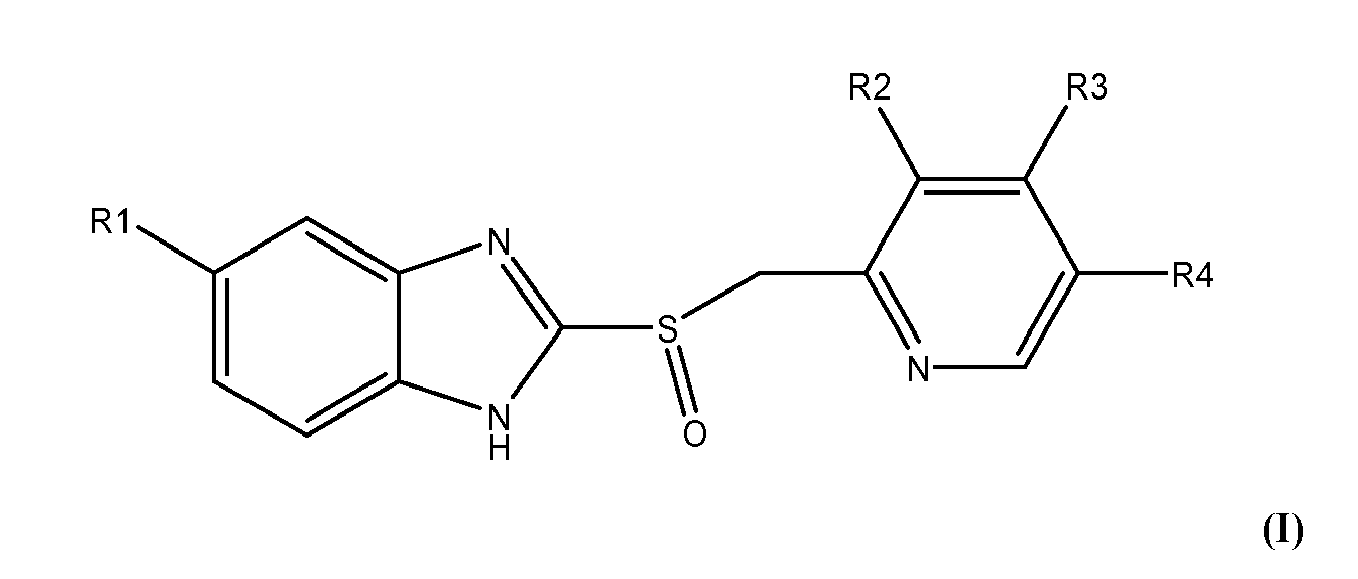
R1 is hydrogen, methoxy or difluoromethoxy,
R2 is methyl or methoxy,
R3 is methoxy, 2,2,2-trifluoroethoxy or 3-methoxypropoxy, and
R4 is hydrogen or methyl. - The dosage form according to any of claims 1 or 2, wherein said benzimidazole compound is selected from the group consisting of omeprazole, rabeprazole, lansoprazole and pantoprazole, salts or stereosimers thereof.
- The dosage form according to any of claims 2-3, wherein said benzimidazole compound is esomeprazole sodium salt.
- The dosage form according to any of claims 1-4, wherein said water soluble polymer is a cellulose.
- The dosage form according to claim 5, wherein said water soluble polymer is hydroxypropyl methylcellulose.
- The dosage form according to any of claims 1-6, comprising at least one additional layer.
- The dosage form according to claim 7, comprising an additional layer which comprises a mixture of 2, 3 or 4 different polyethylenglycol polymers.
- The dosage form according to any of claims 1-8, wherein said core comprises an inert bead and/or an alkaline compound.
- The dosage form according to any of claims 1-9 which is a pellet, a granule, a tablet or mini-tablet.
- Process for the preparation of a dosage form as defined in any of claims 1-10, comprising an aqueous layering process.
- The dosage form as defined in any of claims 1-10, for use as a medicament.
- The dosage form as defined in any of claims 1-10, for use in the treatment and/or prevention of a disease or condition selected from the group consisting of digestive ulcer, gastritis, reflux esophagitis, eradication of H. pylori, suppression of gastrointestinal bleeding caused by digestive ulcer, acute stress ulcer and hemorrhagic gastritis, suppression of gastrointestinal bleeding caused by invasive stress, ulcer caused by non-steroidal anti-inflammatory agent, gastric hyperacidity and ulcer caused by postoperative stress.
- Tablet comprising one or more pharmaceutically acceptable excipients and one or more dosage forms as defined in any of claims 1-10.
- Capsule or sachet comprising one or more dosage forms as defined in any of claims 1-10.
Priority Applications (15)
| Application Number | Priority Date | Filing Date | Title |
|---|---|---|---|
| EP09175339A EP2319504A1 (en) | 2009-11-07 | 2009-11-07 | Pharmaceutical solid dosage form |
| PCT/EP2010/066925 WO2011054930A2 (en) | 2009-11-07 | 2010-11-05 | Pharmaceutical solid dosage form |
| EP10776660A EP2496223A2 (en) | 2009-11-07 | 2010-11-05 | Pharmaceutical solid dosage form |
| BR112012010641A BR112012010641A2 (en) | 2009-11-07 | 2010-11-05 | pharmaceutical oral solid dosage form, process for its preparation and tablet, capsule and sachet comprising the same |
| CN2010800501842A CN102639123A (en) | 2009-11-07 | 2010-11-05 | Pharmaceutical solid dosage form |
| CA2779797A CA2779797A1 (en) | 2009-11-07 | 2010-11-05 | Pharmaceutical solid dosage form |
| MX2012005341A MX2012005341A (en) | 2009-11-07 | 2010-11-05 | Pharmaceutical solid dosage form. |
| JP2012537407A JP2013510128A (en) | 2009-11-07 | 2010-11-05 | Solid preparation |
| NZ599742A NZ599742A (en) | 2009-11-07 | 2010-11-05 | Improved oral pharmaceutical solid dosage form |
| US13/508,460 US8685448B2 (en) | 2009-11-07 | 2010-11-05 | Pharmaceutical solid dosage form |
| AU2010317013A AU2010317013A1 (en) | 2009-11-07 | 2010-11-05 | Pharmaceutical solid dosage form |
| IN4870DEN2012 IN2012DN04870A (en) | 2009-11-07 | 2010-11-05 | |
| KR1020127014534A KR20120104991A (en) | 2009-11-07 | 2010-11-05 | Pharmaceutical solid dosage form |
| RU2012123603/15A RU2012123603A (en) | 2009-11-07 | 2010-11-05 | PHARMACEUTICAL ORAL SOLID PREPARATION FORM, METHOD FOR PRODUCING IT, METHOD FOR TREATING OR PREVENTING THE DIGESTIVE SYSTEM WITH ITS HELP, TEMPORARY TABLE, TABLET |
| IL219617A IL219617A0 (en) | 2009-11-07 | 2012-05-06 | Pharmaceutical solid dosage form |
Applications Claiming Priority (1)
| Application Number | Priority Date | Filing Date | Title |
|---|---|---|---|
| EP09175339A EP2319504A1 (en) | 2009-11-07 | 2009-11-07 | Pharmaceutical solid dosage form |
Publications (1)
| Publication Number | Publication Date |
|---|---|
| EP2319504A1 true EP2319504A1 (en) | 2011-05-11 |
Family
ID=41606715
Family Applications (2)
| Application Number | Title | Priority Date | Filing Date |
|---|---|---|---|
| EP09175339A Withdrawn EP2319504A1 (en) | 2009-11-07 | 2009-11-07 | Pharmaceutical solid dosage form |
| EP10776660A Withdrawn EP2496223A2 (en) | 2009-11-07 | 2010-11-05 | Pharmaceutical solid dosage form |
Family Applications After (1)
| Application Number | Title | Priority Date | Filing Date |
|---|---|---|---|
| EP10776660A Withdrawn EP2496223A2 (en) | 2009-11-07 | 2010-11-05 | Pharmaceutical solid dosage form |
Country Status (14)
| Country | Link |
|---|---|
| US (1) | US8685448B2 (en) |
| EP (2) | EP2319504A1 (en) |
| JP (1) | JP2013510128A (en) |
| KR (1) | KR20120104991A (en) |
| CN (1) | CN102639123A (en) |
| AU (1) | AU2010317013A1 (en) |
| BR (1) | BR112012010641A2 (en) |
| CA (1) | CA2779797A1 (en) |
| IL (1) | IL219617A0 (en) |
| IN (1) | IN2012DN04870A (en) |
| MX (1) | MX2012005341A (en) |
| NZ (1) | NZ599742A (en) |
| RU (1) | RU2012123603A (en) |
| WO (1) | WO2011054930A2 (en) |
Cited By (1)
| Publication number | Priority date | Publication date | Assignee | Title |
|---|---|---|---|---|
| CN109890372A (en) * | 2016-10-28 | 2019-06-14 | 韩美药品株式会社 | Compound capsule containing esomeprazole and preparation method thereof |
Families Citing this family (7)
| Publication number | Priority date | Publication date | Assignee | Title |
|---|---|---|---|---|
| PL2773348T3 (en) * | 2011-11-02 | 2018-07-31 | Laboratorios Del. Dr. Esteve, S.A. | Pharmaceutical composition of omeprazole |
| JP2018505173A (en) * | 2015-01-29 | 2018-02-22 | ノヴォ ノルディスク アー/エス | Pharmaceutical composition for oral GLP-1 administration comprising a tablet core and an immediate release coating |
| US10265384B2 (en) | 2015-01-29 | 2019-04-23 | Novo Nordisk A/S | Tablets comprising GLP-1 agonist and enteric coating |
| US20170042806A1 (en) | 2015-04-29 | 2017-02-16 | Dexcel Pharma Technologies Ltd. | Orally disintegrating compositions |
| US10076494B2 (en) | 2016-06-16 | 2018-09-18 | Dexcel Pharma Technologies Ltd. | Stable orally disintegrating pharmaceutical compositions |
| KR101907116B1 (en) * | 2016-07-25 | 2018-10-11 | 한미약품 주식회사 | Pharmaceutical Formulation with Improved pH-Dependent Drug Release Properties, Comprising Esomeprazole, or Pharmaceutically Acceptable Salt thereof |
| JP7606825B2 (en) * | 2020-06-15 | 2024-12-26 | 東和薬品株式会社 | Esomeprazole granules and method for producing same and use thereof |
Citations (10)
| Publication number | Priority date | Publication date | Assignee | Title |
|---|---|---|---|---|
| EP0244380A2 (en) | 1986-04-30 | 1987-11-04 | Aktiebolaget Hässle | Pharmaceutical formulations of acid labile substances for oral use |
| US4786505A (en) | 1986-04-30 | 1988-11-22 | Aktiebolaget Hassle | Pharmaceutical preparation for oral use |
| EP0652872A1 (en) | 1993-05-28 | 1995-05-17 | Astra Aktiebolag | Optically pure salts of pyridinylmethyl sulfinyl-1h-benzimidazole compounds |
| EP0733025A1 (en) | 1993-12-09 | 1996-09-25 | Reckitt & Colman Inc. | Composition and method for sewage treatment using fungal and bacterial enzymes |
| WO1999048498A1 (en) * | 1998-03-20 | 1999-09-30 | A/S Gea Farmaceutisk Fabrik | Pharmaceutical formulation comprising a 2- [[(2- pyridinyl) methyl] sulfinyl] benzimidazole having anti-ulcer activity and a process for the preparation of such formulation |
| EP1086694A2 (en) | 1999-09-13 | 2001-03-28 | Laboratorios Del Dr. Esteve, S.A. | Solid oral pharmaceutical formulation of modified release that contains an acid labile benzimidazole compound |
| EP1185254A2 (en) | 2000-01-19 | 2002-03-13 | Carlsbad Technology Inc | Orally administered pharmaceutical formulations of benzimidazole derivatives and the method of preparing the same |
| WO2004016242A2 (en) * | 2002-08-16 | 2004-02-26 | Themis Laboratories Private Limited | A process for manufacture of stable oral multiple units pharamceutical composition containing benzimidazoles |
| US20060051421A1 (en) * | 2004-06-15 | 2006-03-09 | Nava Shterman | Stable pharmaceutical formulations of benzimidazole compounds |
| WO2009043926A2 (en) | 2007-10-04 | 2009-04-09 | Laboratorios Del Dr. Esteve, S.A. | Oral fast disintegrating tablets |
Family Cites Families (8)
| Publication number | Priority date | Publication date | Assignee | Title |
|---|---|---|---|---|
| KR100554924B1 (en) * | 1998-05-18 | 2006-03-03 | 다케다 야쿠힌 고교 가부시키가이샤 | Oral disintegration tablets |
| WO2001024780A2 (en) * | 1999-10-01 | 2001-04-12 | Natco Pharma Limited | Soft gel capsule resistant to gastric juices |
| US7732474B2 (en) * | 2002-08-02 | 2010-06-08 | Ratiopharm, Gmbh | Pharmaceutical preparation containing a benzimidazole compound mixed with microcrystalline cellulose and a method for its preparation |
| US20050042277A1 (en) * | 2003-07-17 | 2005-02-24 | Irukulla Srinivas | Pharmaceutical compositions having a swellable coating |
| MXPA06000577A (en) * | 2003-07-17 | 2006-07-03 | Reddy S Lab Ltd | Pharmaceutical compositions having a swellable coating. |
| EP1904064A4 (en) * | 2005-07-07 | 2009-12-02 | Reddys Lab Ltd Dr | Omeprazole form b |
| US20090004281A1 (en) * | 2007-06-26 | 2009-01-01 | Biovail Laboratories International S.R.L. | Multiparticulate osmotic delivery system |
| CA2717947C (en) * | 2008-03-11 | 2020-07-07 | Takeda Pharmaceutical Company Limited | Orally-disintegrating solid preparation |
-
2009
- 2009-11-07 EP EP09175339A patent/EP2319504A1/en not_active Withdrawn
-
2010
- 2010-11-05 CN CN2010800501842A patent/CN102639123A/en active Pending
- 2010-11-05 RU RU2012123603/15A patent/RU2012123603A/en not_active Application Discontinuation
- 2010-11-05 AU AU2010317013A patent/AU2010317013A1/en not_active Abandoned
- 2010-11-05 CA CA2779797A patent/CA2779797A1/en not_active Abandoned
- 2010-11-05 MX MX2012005341A patent/MX2012005341A/en active IP Right Grant
- 2010-11-05 JP JP2012537407A patent/JP2013510128A/en active Pending
- 2010-11-05 US US13/508,460 patent/US8685448B2/en not_active Expired - Fee Related
- 2010-11-05 EP EP10776660A patent/EP2496223A2/en not_active Withdrawn
- 2010-11-05 NZ NZ599742A patent/NZ599742A/en not_active IP Right Cessation
- 2010-11-05 IN IN4870DEN2012 patent/IN2012DN04870A/en unknown
- 2010-11-05 KR KR1020127014534A patent/KR20120104991A/en not_active Withdrawn
- 2010-11-05 WO PCT/EP2010/066925 patent/WO2011054930A2/en not_active Ceased
- 2010-11-05 BR BR112012010641A patent/BR112012010641A2/en not_active IP Right Cessation
-
2012
- 2012-05-06 IL IL219617A patent/IL219617A0/en unknown
Patent Citations (11)
| Publication number | Priority date | Publication date | Assignee | Title |
|---|---|---|---|---|
| EP0244380A2 (en) | 1986-04-30 | 1987-11-04 | Aktiebolaget Hässle | Pharmaceutical formulations of acid labile substances for oral use |
| US4786505A (en) | 1986-04-30 | 1988-11-22 | Aktiebolaget Hassle | Pharmaceutical preparation for oral use |
| EP0652872A1 (en) | 1993-05-28 | 1995-05-17 | Astra Aktiebolag | Optically pure salts of pyridinylmethyl sulfinyl-1h-benzimidazole compounds |
| EP1020460B1 (en) | 1993-05-28 | 2009-07-22 | AstraZeneca AB | The sodium salt of the (-)-enantiomer of omeprazole |
| EP0733025A1 (en) | 1993-12-09 | 1996-09-25 | Reckitt & Colman Inc. | Composition and method for sewage treatment using fungal and bacterial enzymes |
| WO1999048498A1 (en) * | 1998-03-20 | 1999-09-30 | A/S Gea Farmaceutisk Fabrik | Pharmaceutical formulation comprising a 2- [[(2- pyridinyl) methyl] sulfinyl] benzimidazole having anti-ulcer activity and a process for the preparation of such formulation |
| EP1086694A2 (en) | 1999-09-13 | 2001-03-28 | Laboratorios Del Dr. Esteve, S.A. | Solid oral pharmaceutical formulation of modified release that contains an acid labile benzimidazole compound |
| EP1185254A2 (en) | 2000-01-19 | 2002-03-13 | Carlsbad Technology Inc | Orally administered pharmaceutical formulations of benzimidazole derivatives and the method of preparing the same |
| WO2004016242A2 (en) * | 2002-08-16 | 2004-02-26 | Themis Laboratories Private Limited | A process for manufacture of stable oral multiple units pharamceutical composition containing benzimidazoles |
| US20060051421A1 (en) * | 2004-06-15 | 2006-03-09 | Nava Shterman | Stable pharmaceutical formulations of benzimidazole compounds |
| WO2009043926A2 (en) | 2007-10-04 | 2009-04-09 | Laboratorios Del Dr. Esteve, S.A. | Oral fast disintegrating tablets |
Non-Patent Citations (5)
| Title |
|---|
| "book Pharmaceutical Pelletization Technology", 1989, MARCEL DEKKER, INC. |
| "Encyclopedia of pharmaceutical technology", vol. I, 2002, MARCEL DEKKER, INC., pages: 114 - 119 |
| "Handbook of Pharmaceutical Excipients", 2009, PHARMACEUTICAL PRESS AND AMERICAN PHARMACISTS ASSOCIATION |
| "Remington, the science and practice of pharmacy", 2005, LIPPINCOTT WILLIAMS & WILKINS |
| "Remington, the science and practice of pharmacy", 2005, LIPPINCOTT WILLIAMS & WILKINS, pages: 932 - 933 |
Cited By (4)
| Publication number | Priority date | Publication date | Assignee | Title |
|---|---|---|---|---|
| CN109890372A (en) * | 2016-10-28 | 2019-06-14 | 韩美药品株式会社 | Compound capsule containing esomeprazole and preparation method thereof |
| EP3513784A4 (en) * | 2016-10-28 | 2020-06-03 | Hanmi Pharm. Co., Ltd. | COMPLEX CAPSULE CONTAINING ESOMEPRAZOLE AND PREPARATION METHOD THEREOF |
| US11052048B2 (en) | 2016-10-28 | 2021-07-06 | Hanmi Pharm. Co., Ltd. | Esomeprazole-containing complex capsule and preparation method therefor |
| CN109890372B (en) * | 2016-10-28 | 2022-06-24 | 韩美药品株式会社 | Compound capsule containing esomeprazole and preparation method thereof |
Also Published As
| Publication number | Publication date |
|---|---|
| US20120231074A1 (en) | 2012-09-13 |
| CA2779797A1 (en) | 2011-05-12 |
| KR20120104991A (en) | 2012-09-24 |
| NZ599742A (en) | 2013-11-29 |
| US8685448B2 (en) | 2014-04-01 |
| IL219617A0 (en) | 2012-07-31 |
| AU2010317013A1 (en) | 2012-05-24 |
| MX2012005341A (en) | 2012-06-08 |
| BR112012010641A2 (en) | 2016-04-05 |
| JP2013510128A (en) | 2013-03-21 |
| EP2496223A2 (en) | 2012-09-12 |
| WO2011054930A3 (en) | 2012-02-23 |
| RU2012123603A (en) | 2013-12-20 |
| WO2011054930A2 (en) | 2011-05-12 |
| CN102639123A (en) | 2012-08-15 |
| IN2012DN04870A (en) | 2015-09-25 |
Similar Documents
| Publication | Publication Date | Title |
|---|---|---|
| JP4638561B2 (en) | Multiple unit boiling dosage forms containing proton pump inhibitors | |
| JP5412021B2 (en) | Omeprazole-containing pharmaceutical preparation | |
| JP4649001B2 (en) | Omeprazole formulation | |
| EP2026768B1 (en) | Multiple unit pharmaceutical formulation | |
| US8685448B2 (en) | Pharmaceutical solid dosage form | |
| JPH09502739A (en) | Multiple unit tableted dosage forms ▲I▼ | |
| EP2658530A2 (en) | Orally disintegrating tablet | |
| JP2000514051A (en) | Stable pharmaceutical form for oral administration containing benzimidazole derivative as active ingredient and method for producing the same | |
| AU2011337549A1 (en) | Orally disintegrating tablet | |
| EP2773348B1 (en) | Pharmaceutical composition of omeprazole | |
| JP7541617B2 (en) | Enteric-coated pellets, their manufacturing method and preparations containing the same | |
| JP2010248106A (en) | Film coated tablets | |
| WO2011140446A2 (en) | Pharmaceutical formulations | |
| KR20080005575A (en) | Stabilizing composition | |
| EP3513784A1 (en) | Esomeprazole-containing complex capsule and preparation method therefor | |
| EP3881832A1 (en) | Pharmaceutical composition containing tamsulosin hydrochloride with excellent acid resistance and preparation method therefor | |
| CN106668018B (en) | Dexlansoprazole sodium sustained-release capsule and preparation method thereof | |
| HK1188127A (en) | Orally disintegrating tablet |
Legal Events
| Date | Code | Title | Description |
|---|---|---|---|
| PUAI | Public reference made under article 153(3) epc to a published international application that has entered the european phase |
Free format text: ORIGINAL CODE: 0009012 |
|
| AK | Designated contracting states |
Kind code of ref document: A1 Designated state(s): AT BE BG CH CY CZ DE DK EE ES FI FR GB GR HR HU IE IS IT LI LT LU LV MC MK MT NL NO PL PT RO SE SI SK SM TR |
|
| AX | Request for extension of the european patent |
Extension state: AL BA RS |
|
| STAA | Information on the status of an ep patent application or granted ep patent |
Free format text: STATUS: THE APPLICATION IS DEEMED TO BE WITHDRAWN |
|
| 18D | Application deemed to be withdrawn |
Effective date: 20111112 |