EP2318925B1 - Method and system for scheduling periodic processes - Google Patents
Method and system for scheduling periodic processes Download PDFInfo
- Publication number
- EP2318925B1 EP2318925B1 EP09778153.8A EP09778153A EP2318925B1 EP 2318925 B1 EP2318925 B1 EP 2318925B1 EP 09778153 A EP09778153 A EP 09778153A EP 2318925 B1 EP2318925 B1 EP 2318925B1
- Authority
- EP
- European Patent Office
- Prior art keywords
- processes
- additional process
- scheduled
- scheduling
- minimum time
- Prior art date
- Legal status (The legal status is an assumption and is not a legal conclusion. Google has not performed a legal analysis and makes no representation as to the accuracy of the status listed.)
- Not-in-force
Links
Images



Classifications
-
- G—PHYSICS
- G06—COMPUTING OR CALCULATING; COUNTING
- G06F—ELECTRIC DIGITAL DATA PROCESSING
- G06F9/00—Arrangements for program control, e.g. control units
- G06F9/06—Arrangements for program control, e.g. control units using stored programs, i.e. using an internal store of processing equipment to receive or retain programs
- G06F9/46—Multiprogramming arrangements
-
- G—PHYSICS
- G06—COMPUTING OR CALCULATING; COUNTING
- G06F—ELECTRIC DIGITAL DATA PROCESSING
- G06F9/00—Arrangements for program control, e.g. control units
- G06F9/06—Arrangements for program control, e.g. control units using stored programs, i.e. using an internal store of processing equipment to receive or retain programs
- G06F9/46—Multiprogramming arrangements
- G06F9/48—Program initiating; Program switching, e.g. by interrupt
- G06F9/4806—Task transfer initiation or dispatching
- G06F9/4843—Task transfer initiation or dispatching by program, e.g. task dispatcher, supervisor, operating system
- G06F9/4881—Scheduling strategies for dispatcher, e.g. round robin, multi-level priority queues
- G06F9/4887—Scheduling strategies for dispatcher, e.g. round robin, multi-level priority queues involving deadlines, e.g. rate based, periodic
-
- Y—GENERAL TAGGING OF NEW TECHNOLOGICAL DEVELOPMENTS; GENERAL TAGGING OF CROSS-SECTIONAL TECHNOLOGIES SPANNING OVER SEVERAL SECTIONS OF THE IPC; TECHNICAL SUBJECTS COVERED BY FORMER USPC CROSS-REFERENCE ART COLLECTIONS [XRACs] AND DIGESTS
- Y02—TECHNOLOGIES OR APPLICATIONS FOR MITIGATION OR ADAPTATION AGAINST CLIMATE CHANGE
- Y02D—CLIMATE CHANGE MITIGATION TECHNOLOGIES IN INFORMATION AND COMMUNICATION TECHNOLOGIES [ICT], I.E. INFORMATION AND COMMUNICATION TECHNOLOGIES AIMING AT THE REDUCTION OF THEIR OWN ENERGY USE
- Y02D10/00—Energy efficient computing, e.g. low power processors, power management or thermal management
Definitions
- the present invention relates to a method of scheduling periodic processes for execution in an electronic system, in particular in a network, in a data processor or in a communication device, wherein said electronic system includes a controller for performing said scheduling, wherein a number of N processes P i are already scheduled with each process P i having an individual service interval SI i , and wherein an additional process P N+1 is to be scheduled with a service interval SI N+1 , wherein an N-flows problem is broken into a number of N different 2-flow problems by scheduling said additional process P N+1 in such a way that at each scheduling stage the minimum time lag between the execution times of said additional process P N+1 being currently scheduled and the execution times of said number of N already scheduled processes P i is maximized by assigning an initial execution time t ie to said additional process P N+1 being currently scheduled.
- the present invention relates to a system for scheduling periodic processes for execution in an electronic system, in particular in a network, in a data processor or in a communication device, said system comprising a controller that is scheduling a number of N processes P i with each process P i having an individual service interval SI i , and that is configured to schedule an additional process P N+1 with a service interval SI N+1 , wherein said controller is configured to break an N-flows problem into a number of N different 2-flow problems by scheduling, at each of plural scheduling stages, said additional process P N+1 to maximize a minimum time lag between the execution times of said additional process P N+1 being currently scheduled and the execution times of said number of N already scheduled processes P i by assigning an initial execution time t ie to said additional process P N+1 being currently scheduled.
- Scheduling periodic processes is a common problem e.g. in computer science and networking.
- periodic processes can represent traffic generated by multimedia codecs (like Voice or Video) or jobs to be periodically executed in a real-time operating system.
- multimedia codecs like Voice or Video
- jobs to be periodically executed in a real-time operating system.
- scheduling plays a decisive role as for ensuring that all processes can meet their deadlines.
- QoS guarantees a high number of processes that have to be executed may cause, if not properly scheduled, a high peak load observed by the network/system and may thereby decrease the network/system capacity.
- the LCM of the processes' periods can exponentially grow depending on the service intervals of the different processes.
- the value of the LCM of the processes' periods can grow like:
- the aforementioned object is accomplished by a method comprising the features of claim 1.
- a method comprising the features of claim 1.
- said controller calculates the minimum time lag between the execution times of said additional process P N+1 to be currently scheduled and the execution times of each of said number of N already scheduled processes P i , and expresses each of these minimum time lags as a function of said initial execution time t ie to be assigned to said additional process P N+1 , and wherein an absolute minimum time lag, which is defined by a minimum of all the individual minimum time lags between said additional process P N+1 to be currently scheduled and each of said number of N already scheduled processes P i , is maximized by computing the period T of the function that represents the absolute minimum time lag as a function of the initial execution time t ie of the additional process P N+1 to be currently scheduled.
- a system comprising the features of independent claim 10.
- said controller is further configured to calculate the minimum time lag between the execution times of said additional process P N+1 to be currently scheduled and the execution times of each of said number of N already scheduled processes P i , and to express each calculated minimum time lag as a function of said initial execution time t ie to be assigned to said additional process P N+1 , and to maximize an absolute minimum time lag, which is defined by a minimum of all the individual minimum time lags between said additional process P N+1 to be currently scheduled and each of said number of N already scheduled processes P i , by computing a period T of a function that represents the absolute minimum time lag as a function of the initial execution time t ie of the additional process P N+1 to be currently scheduled.
- the present invention proposes to schedule an additional process in such a way that the minimum time lag between the execution times of the additional process and the execution times of the already scheduled processes is maximized.
- Maximizing the time lag between the execution times of different processes is beneficial in many environments for a variety of reasons. For instance, in a real-time operative system it minimizes the chance that different processes try to access a shared resource, e.g. a CPU or the wireless medium in wireless scheduling, at the same time. This behavior improves the capacity of the system, since the chance that all processes can meet their deadlines is increased. Maximizing the time distance between release times of different processes also reduces the peak rate observed by the network, which is beneficial e.g. with respect to provide strict QoS guarantees.
- the present invention minimizes the chances that when the terminal awakes it must wait while the terminal's serving base station is delivering traffic to another terminal. Thereby the terminal's battery life can be significantly increased.
- the proposed method outperforms existing prior art solutions in terms of time and space complexity because of two main reasons.
- the complexity of the present solution does not depend on the LCM (Least Common Multiple) of the different processes' service intervals which results in a significant speed up in scheduling time.
- the proposed method does not need to define a subset of candidate offset values, which can grow exponentially with the number of processes, but directly obtains the optimum offset value.
- the process to be scheduled may be a task, a flow or an operation.
- the processes to be scheduled may include many different types of processes, like for example, but not limited to, jobs to be periodically executed in a real time system, periodic traffic generated by multimedia codecs, frequency spread-spectrum, comb-filtered RF transmissions, start times of (synchronized) video downloads in a network, bus-access-times of multiprocessors in a distributed CPU, merging of automobile traffic streams in computer-controlled highways of the future, etc.
- an algorithm may be provided that orders said processes for sequential scheduling according to predefined policies.
- the policies may take into consideration deadlines of the processes that have to be met to fulfill QoS guarantees. In such case, processes with strict deadlines could be scheduled prior to processes with more flexible deadlines.
- the minimum time lag between the execution times of a currently scheduled process P N+1 and the execution times of said number of N already scheduled processes P i may be maximized by assigning an appropriate initial execution time t ie to the process being currently scheduled.
- the initial execution time t ie of a process P N+1 to be scheduled may be determined by way of breaking the N-flows problem into a number of N different 2-flow problems that consider the process to be currently scheduled and each of the already scheduled processes. Such approach enormously reduces the complexity of the problem to be solved and thus results in a considerable reduction of the computational resources in terms of time, power and capacity needed for the scheduling process.
- the N-flows problem may be broken into a number of N different 2-flow problems by calculating the minimum time lag between the execution times of the process P N+1 to be currently scheduled and the execution times of the number of N already scheduled processes P i .
- the minimum time lag between the execution times of the process P N+1 to be currently scheduled and the execution times of said number of N already scheduled processes P i may be expressed as a function of the initial execution time t ie to be assigned to said process P N+1 to be currently scheduled.
- the absolute minimum time lag may be defined as the minimum of all the individual minimum time lags between the process P N+1 to be currently scheduled and each of the number of N already scheduled processes P i . It is to be noted that the absolute minimum time lag is bounded and is periodic since all involved processes are periodic.
- the absolute minimum time lag is maximized by computing the period T of the function that represents the absolute minimum distance as a function of the initial execution time t ie of the process P N+1 to be currently scheduled.
- GCD Greatest Common Divisors
- T ⁇ SI N+1 The complexity is enormously reduced and bounded by T ⁇ SI N+1 .
- the absolute minimum time lag is expressed as a function of the initial execution time t ie . Then, according to a preferred embodiment, for each number of N already scheduled processes P i all zeros of above mentioned function contained within the period T will be generated.
- the absolute minimum time lag can be defined upon the function's zeros, because before and after each zero it decreases and increases with unitary slope. Therefore the absolute minimum time lag is a set of triangular shapes of unitary slope and different heights.
- a list of the zeros will be generated that contains the zeros in a sorted order.
- the highest gap between two consecutive elements may be located.
- the center of the largest gap is selected as the initial execution time t ie . It is to be noted that being the absolute minimum distance a train of triangular shapes of unitary slope between consecutive zeros, the maximum of such function is located in the middle of the two consecutive zeros having the highest gap between them.
- the method and the system according to the present invention can be generalized, in particular, to frequency intervals, to spatial intervals, or to timing intervals.
- DE 10 2005 040 027 A1 describes a method for controlling the communication with mobile stations over a wireless network, wherein the scheduling mechanism according to the present invention can be applied for determining the service starting times.
- Fig. 1 illustrates schematically a set of three periodic processes for execution in an electronic system.
- Each of the processes has a different service interval (SI 1 , SI 2 , SI 3 ) and a different starting time, wherein the starting times are assumed to be set randomly.
- SI 1 , SI 2 , SI 3 service interval
- Fig. 1 there are certain times at which the execution times of two or even all three processes quasi overlap.
- the system is not able to execute all three processes at the same time (e.g. due to limited available resources)
- at least one of the processes has to wait until the other process/processes is/are completely executed, or one of the processes has to be dropped if queuing is not possible.
- the left distances between flow 2 and flow 1 are defined as the time differences between a release time of flow 2 and the last release time of flow 1, denoted as dl(k).
- the right distances are defined as the time differences between a release time of flow 2 and the next release time of flow 1, denoted as dr(k).
- Both dl(k) and dr(k) are depicted in Fig. 2 .
- t ie ⁇ + k ⁇ gcd S I 1 , S I 2 / 2 .
- FIG. 4 schematically illustrates an embodiment with a total of 3 flows that can easily be generalized to an N flow case with N > 3.
- Fig. 4 represents the minimum left and right distances in a system where two flows were already scheduled and a new flow has requested access.
- dl min(N+1,i) and dr min(N+1i) are not depicted separately but instead min ⁇ dl min(N+1,i) , dr min(N+1,i ) ⁇ is directly plotted for each scheduled flow.
- the minimum distance for each possible t ie will correspond to the minimum among all min ⁇ dl min(N+1,i) , dr min(N+1,i) ⁇ distances. This distance is denoted as the absolute minimum distance.
- a fast method that finds the maximum of the absolute minimum distance can be defined based on the following observations:
- Fig. 5 illustrates the capacity of an Admission Control test in a real time operative system as mentioned before in connection with Fig. 4 . Given a set of tasks an Admission Control test decides on whether the delay constraints can be fulfilled.
- Fig. 5 illustrates the percentage of task sets that can be admitted in a system with hard QoS guarantees if the initial times of each task are spreaded pursuant to the method according to the present invention (red lines) or if the initial times of each task are randomly assigned (blue lines).
- maximizing the distance between the release times of the different flows reduces the peak capacity that has to be considered in admission control and hence significantly increases the number of tasks that can be scheduled in the system.
- the present invention can be applied in any of the areas where scheduling of real-time periodic tasks/flows is used, particularly (but not limited to) periodic/real-time multimedia packet streams.
- Some examples are:
Landscapes
- Engineering & Computer Science (AREA)
- Software Systems (AREA)
- Theoretical Computer Science (AREA)
- Physics & Mathematics (AREA)
- General Engineering & Computer Science (AREA)
- General Physics & Mathematics (AREA)
- Mobile Radio Communication Systems (AREA)
- Data Exchanges In Wide-Area Networks (AREA)
- Management, Administration, Business Operations System, And Electronic Commerce (AREA)
Description
- The present invention relates to a method of scheduling periodic processes for execution in an electronic system, in particular in a network, in a data processor or in a communication device, wherein said electronic system includes a controller for performing said scheduling, wherein a number of N processes Pi are already scheduled with each process Pi having an individual service interval SIi, and wherein an additional process PN+1 is to be scheduled with a service interval SIN+1, wherein an N-flows problem is broken into a number of N different 2-flow problems by scheduling said additional process PN+1 in such a way that at each scheduling stage the minimum time lag between the execution times of said additional process PN+1 being currently scheduled and the execution times of said number of N already scheduled processes Pi is maximized by assigning an initial execution time tie to said additional process PN+1 being currently scheduled.
- Furthermore, the present invention relates to a system for scheduling periodic processes for execution in an electronic system, in particular in a network, in a data processor or in a communication device, said system comprising a controller that is scheduling a number of N processes Pi with each process Pi having an individual service interval SIi, and that is configured to schedule an additional process PN+1 with a service interval SIN+1, wherein said controller is configured to break an N-flows problem into a number of N different 2-flow problems by scheduling, at each of plural scheduling stages, said additional process PN+1 to maximize a minimum time lag between the execution times of said additional process PN+1 being currently scheduled and the execution times of said number of N already scheduled processes Pi by assigning an initial execution time tie to said additional process PN+1 being currently scheduled.
- Scheduling periodic processes is a common problem e.g. in computer science and networking. For instance, periodic processes can represent traffic generated by multimedia codecs (like Voice or Video) or jobs to be periodically executed in a real-time operating system. In particular if a high number of processes try to access a shared resource, e.g. a CPU in real-time systems, or the wireless medium in wireless scheduling, scheduling plays a decisive role as for ensuring that all processes can meet their deadlines. Furthermore, in a system with strict QoS guarantees a high number of processes that have to be executed may cause, if not properly scheduled, a high peak load observed by the network/system and may thereby decrease the network/system capacity.
- It is also a common situation when dealing with periodic task sets that a scheduler entity that is responsible for scheduling the tasks can determine the initial scheduling time for each task. A problem opens up in this case that is how to determine the optimum starting time for each task to be scheduled in the system. Solutions have been proposed in the literature to handle this problem, for instance in: X. Perez-Costa, et al., "Overlapping Aware Scheduled Automatic Power Save Delivery Algorithm', in European Wireless 2007, , or in: J. Goossens, "Scheduling of offset free systems", in Journal of Real-Time Systems (2001). However, solutions existing so far are either non-optimal because they will rely on heuristics or are computationally expensive because they require the exploration of the LCM (Least Common Multiple) of the different processes' service intervals (i.e. their periods), which can grow exponentially, or they explore a set of candidate initial start times whose size can also grow exponentially.
- For clarity in illustrating this problem it may be helpful to consider how the LCM of the processes' periods can exponentially grow depending on the service intervals of the different processes. Considering a set of processes with integer periods multiple of 10 time units with a minimum value of 10 time units and maximum value of 100, 200 or 300 time units, the value of the LCM of the processes' periods can grow like:
- LCM(10, 20,..., 100) = 25200
- LCM(10, 20,..., 200) = 2.38·109
- LCM(10, 20,..., 300) = 2.39·1013.
- It is therefore an object of the present invention to improve and further develop a method and a system of the initially described type in such a way that, by employing mechanisms that are readily to implement, a reduction in the peak capacity that has to be considered in admission control and a reduction in delay and jitter is achieved. Furthermore, the number of processes that can be scheduled in the system shall be increased and power saving shall be improved.
- In accordance with the invention the aforementioned object is accomplished by a method comprising the features of
claim 1. According to this claim such a method is characterized in that said controller calculates the minimum time lag between the execution times of said additional process PN+1 to be currently scheduled and the execution times of each of said number of N already scheduled processes Pi, and expresses each of these minimum time lags as a function of said initial execution time tie to be assigned to said additional process PN+1, and wherein an absolute minimum time lag, which is defined by a minimum of all the individual minimum time lags between said additional process PN+1 to be currently scheduled and each of said number of N already scheduled processes Pi, is maximized by computing the period T of the function that represents the absolute minimum time lag as a function of the initial execution time tie of the additional process PN+1 to be currently scheduled. - Furthermore, the aforementioned object is accomplished by a system comprising the features of
independent claim 10. According to this claim, such a system is characterized in that said controller is further configured to calculate the minimum time lag between the execution times of said additional process PN+1 to be currently scheduled and the execution times of each of said number of N already scheduled processes Pi, and to express each calculated minimum time lag as a function of said initial execution time tie to be assigned to said additional process PN+1, and to maximize an absolute minimum time lag, which is defined by a minimum of all the individual minimum time lags between said additional process PN+1 to be currently scheduled and each of said number of N already scheduled processes Pi, by computing a period T of a function that represents the absolute minimum time lag as a function of the initial execution time tie of the additional process PN+1 to be currently scheduled. - According to the invention it has first been recognized that in many application scenarios best performance can be achieved when the execution times of several periodic processes are spread as far as possible. To this end the present invention proposes to schedule an additional process in such a way that the minimum time lag between the execution times of the additional process and the execution times of the already scheduled processes is maximized.
- Maximizing the time lag between the execution times of different processes is beneficial in many environments for a variety of reasons. For instance, in a real-time operative system it minimizes the chance that different processes try to access a shared resource, e.g. a CPU or the wireless medium in wireless scheduling, at the same time. This behavior improves the capacity of the system, since the chance that all processes can meet their deadlines is increased. Maximizing the time distance between release times of different processes also reduces the peak rate observed by the network, which is beneficial e.g. with respect to provide strict QoS guarantees.
- Applied to a networking system where a terminal turns to an energy saving doze mode between the execution times of its periodic processes, the present invention minimizes the chances that when the terminal awakes it must wait while the terminal's serving base station is delivering traffic to another terminal. Thereby the terminal's battery life can be significantly increased.
- The proposed method outperforms existing prior art solutions in terms of time and space complexity because of two main reasons. First, the complexity of the present solution does not depend on the LCM (Least Common Multiple) of the different processes' service intervals which results in a significant speed up in scheduling time. Second, the proposed method does not need to define a subset of candidate offset values, which can grow exponentially with the number of processes, but directly obtains the optimum offset value.
- It is to be noted that the assumption that a number of N processes are already scheduled does in no way limit the present invention and, besides the cases of N being a relatively large number, also includes for instance the case of N = 0 or N = 1. In particular, cases are covered in which several process requesting to be scheduled arrive at the controller all at the same time, or in which processes are already available in the system at t < 0, or in which requests arrive at the controller at different times.
- The process to be scheduled may be a task, a flow or an operation. Generally, the processes to be scheduled may include many different types of processes, like for example, but not limited to, jobs to be periodically executed in a real time system, periodic traffic generated by multimedia codecs, frequency spread-spectrum, comb-filtered RF transmissions, start times of (synchronized) video downloads in a network, bus-access-times of multiprocessors in a distributed CPU, merging of automobile traffic streams in computer-controlled highways of the future, etc.
- In case several processes arrive concurrently at the controller, an algorithm may be provided that orders said processes for sequential scheduling according to predefined policies. For instance, the policies may take into consideration deadlines of the processes that have to be met to fulfill QoS guarantees. In such case, processes with strict deadlines could be scheduled prior to processes with more flexible deadlines.
- At each scheduling stage the minimum time lag between the execution times of a currently scheduled process PN+1 and the execution times of said number of N already scheduled processes Pi may be maximized by assigning an appropriate initial execution time tie to the process being currently scheduled. According to a preferred embodiment, the initial execution time tie of a process PN+1 to be scheduled may be determined by way of breaking the N-flows problem into a number of N different 2-flow problems that consider the process to be currently scheduled and each of the already scheduled processes. Such approach enormously reduces the complexity of the problem to be solved and thus results in a considerable reduction of the computational resources in terms of time, power and capacity needed for the scheduling process. According to a specific embodiment, the N-flows problem may be broken into a number of N different 2-flow problems by calculating the minimum time lag between the execution times of the process PN+1 to be currently scheduled and the execution times of the number of N already scheduled processes Pi.
- The minimum time lag between the execution times of the process PN+1 to be currently scheduled and the execution times of said number of N already scheduled processes Pi may be expressed as a function of the initial execution time tie to be assigned to said process PN+1 to be currently scheduled. For instance, the minimum time lag could be defined as follows:

- Alternatively, if different processes had different durations, the minimum time lag can be re-defined as:

- In a next step, a concept of an "absolute minimum time lag" may be introduced. The absolute minimum time lag may be defined as the minimum of all the individual minimum time lags between the process PN+1 to be currently scheduled and each of the number of N already scheduled processes Pi. It is to be noted that the absolute minimum time lag is bounded and is periodic since all involved processes are periodic. Advantageously, the absolute minimum time lag is maximized by computing the period T of the function that represents the absolute minimum distance as a function of the initial execution time tie of the process PN+1 to be currently scheduled.
- Specifically, the period T of the absolute minimum time lag may be computed by calculating the Greatest Common Divisors (GCD) of the service interval SIN+1 of the process PN+1 to be currently scheduled with each of the service intervals SIi of the number of N already scheduled processes Pi,

- From all values thus obtained, the LCM can be computed in order to obtain the period

- The complexity is enormously reduced and bounded by T < SIN+1. For example, considering a set of processes with integer periods multiple of 10 time units, and with a minimum value of SImin =10 time units and a maximum value of SImax = 300 time units, state of the art search operations require lcm (10, 20, ..., 300) = 2.39·1013 operations, whereas the proposed method requires just 300 passes.
- Advantageously, the absolute minimum time lag is expressed as a function of the initial execution time tie. Then, according to a preferred embodiment, for each number of N already scheduled processes Pi all zeros of above mentioned function contained within the period T will be generated. The absolute minimum time lag can be defined upon the function's zeros, because before and after each zero it decreases and increases with unitary slope. Therefore the absolute minimum time lag is a set of triangular shapes of unitary slope and different heights.
- According to a preferred embodiment a list of the zeros will be generated that contains the zeros in a sorted order. In a next step, within the list of sorted zeros the highest gap between two consecutive elements may be located. Advantageously, the center of the largest gap is selected as the initial execution time tie. It is to be noted that being the absolute minimum distance a train of triangular shapes of unitary slope between consecutive zeros, the maximum of such function is located in the middle of the two consecutive zeros having the highest gap between them.
- According to preferred embodiments the method and the system according to the present invention can be generalized, in particular, to frequency intervals, to spatial intervals, or to timing intervals.
- For instance,
DE 10 2005 040 027 A1 - There are several ways how to design in further develop the teaching of the present invention in an advantageous way. To this end, it is to be referred to the patent claims subordinate to
patent claim 1 on the one hand and to the following explanation of preferred examples of embodiments of the invention illustrated by the drawing on the other hand. In connection with the explanation of the preferred examples of embodiments of the invention by the aid of drawing, generally preferred embodiments and further developments of the teaching will be explained. In the drawing - Fig. 1
- illustrates schematically a set of three periodic processes for execution in an electronic system,
- Fig. 2
- illustrates schematically an aspect of a scheduling procedure for two periodic processes according to a first embodiment of the method according to the invention,
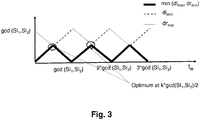
- Fig. 3
- illustrates schematically another aspect of the scheduling procedure of
Fig. 2 , - Fig. 4
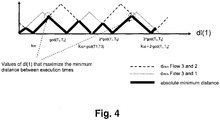
- illustrates schematically a scheduling procedure for three periodic processes according to a second embodiment of the method according to the invention, and
- Fig. 5
- illustrates the capacity of an Admission Control test in a real time operative system.
-
Fig. 1 illustrates schematically a set of three periodic processes for execution in an electronic system. Each of the processes has a different service interval (SI1, SI2, SI3) and a different starting time, wherein the starting times are assumed to be set randomly. As can be obtained fromFig. 1 , there are certain times at which the execution times of two or even all three processes quasi overlap. In a case, in which the system is not able to execute all three processes at the same time (e.g. due to limited available resources), at least one of the processes has to wait until the other process/processes is/are completely executed, or one of the processes has to be dropped if queuing is not possible. - This behavior might result in that not all processes will meet their deadlines. In real time operative systems this will cause an increase in the peak load observed by the CPU and hence decrease the capacity of the system. Considering a WLAN system based on polling where stations are sleeping between polls, power consumption will increase, when a station awakes and must wait while the base station is serving traffic to another station. If the processes illustrated in
Fig. 1 represent flows that carry bursty traffic a delay will be introduced in one stream due to the burstiness of another stream. -
Fig. 2 illustrates schematically an aspect of a scheduling procedure for two periodic processes according to a first embodiment of the method according to the invention. More specifically,Fig. 2 represents two different periodic flows that have to be scheduled. The first flow - flow 1 - is indicated by the solid line arrows and the second flow - flow 2 - is indicated by the dotted line arrows. It is assumed thatflow 1 with service interval SI1 is already scheduled with certain execution times. The regular instants where this flow is scheduled are referred to as the release times of this flow. At a certain point in time, that without lack of generality is considered to be t = 0,new flow 2 requests to be scheduled in the system with a service interval denoted by SI2. - The left distances between
flow 2 andflow 1 are defined as the time differences between a release time offlow 2 and the last release time offlow 1, denoted as dl(k). Similarly the right distances are defined as the time differences between a release time offlow 2 and the next release time offlow 1, denoted as dr(k). Both dl(k) and dr(k) are depicted inFig. 2 . Further,Fig. 2 depicts next_rel_time1 , being a variable defined from t = 0 that contains the next release time offlow 1. - In order to find an optimal initial execution time (denoted tie) of
flow 2, which maximizes the minimum distance between the release times offlows 

- In a next step the minimum value of dl (k) and dr (k) will be expressed as a function of the selected tie. Since
flows - By employing the linear congruence theorem, it can be proved that:


- A simple transformation can be used to define the minimum left and right distances as a function of the selected tie. If
flow 2 is granted a tie that equals next_rel_time1 the minimum left distance will be zero, hence:

-
Fig. 3 schematically illustrates further steps of the scheduling process ofFig. 2 . More specifically,Fig. 3 plots the minimum values of dl (k) and dr (k) as a function of the selected tie according to the explanations inFig. 2 . As can be easily obtained fromFig. 3 , the maximum value of both minimum distances equals gcd (SI1, SI2) and occurs when
- Both minimum distances though are never maximized at the same time.
- Considering again
Fig. 3 , the overall minimum distance, i.e. min {dlmin, drmin }, appears to be a set of consecutive triangular shapes of unitary slope. Therefore, the value of t ie that maximizes the minimum distances between any two release times offlow 1 andflow 2 is:
- The maximum minimum separation that can be achieved between any two periodical flows is hence gcd (SI1. SI2)/2.
- Whereas the foregoing embodiment described in connection with
Figs. 2 and3 with only 2 flows was mainly intended to illustrate the basic principles of the present invention,Fig. 4 schematically illustrates an embodiment with a total of 3 flows that can easily be generalized to an N flow case with N > 3. - In the following a scenario is assumed in which N periodic flows are already scheduled in a system with service intervals SIi, i = 1...N, and a new flow requires to be scheduled with service interval SIN+1. Here again the goal is to find the initial execution time tie for the new flow that maximizes the minimum distance between its release times and the release times of the flows already scheduled.
- Leveraging the results from the 2-flow case as described in connection with
Figs. 2 and3 , it is possible to break the N-flows problem into N different 2-flow problems that consider the new flow and each of the already scheduled flows. Defining as before the left and right distances of the new flow (N + 1) with each of the already scheduled flows (i, i = 1...N), it can be derived that:

-
Fig. 4 represents the minimum left and right distances in a system where two flows were already scheduled and a new flow has requested access. In the figure dlmin(N+1,i) and drmin(N+1i) are not depicted separately but instead min {dlmin(N+1,i), drmin(N+1,i)} is directly plotted for each scheduled flow. - In case of having N flows, the minimum distance for each possible tie will correspond to the minimum among all min {dlmin(N+1,i), drmin(N+1,i)} distances. This distance is denoted as the absolute minimum distance. Thus, a fast method that finds the maximum of the absolute minimum distance can be defined based on the following observations:
- The absolute minimum distance is periodic in tie with period T' = lcm (gcd (SIi, SIN+1), ..., gcd (SIN, SIN+1)).
- Each of the individual minimum distances, i.e. min {dlmin(N+1i), drmin(N+1,i)}, contain zeros at tie = φN+1,i + k · gcd (SIi, SIN+1), k ≥ 1. All zeros belong to the absolute minimum distance.
- The absolute minimum distance can be defined upon its zeros, because before and after each zero it decreases and increases with unitary slope. Therefore the absolute minimum distance is a set of triangular shapes of unitary slope and different heights.
- Finally, a method to find the optimum tie can be designed based on the following observation:
- Being the absolute minimum distance a train of triangular shapes of unitary slope between consecutive zeros, the maximum of such function is located in the middle of the two consecutive zeros having the highest gap between them. A method that locates the tie that maximizes the absolute minimum distance function can be described in the following way:
- 1. Compute gcd (SIN+1, SIN) for all the N already scheduled flows.
- 2. Compute the period of the absolute minimum distance,
T' = lcm (gcd (SIi, SIN+1), ..., gcd (SIN, SIN+1)). - 3. For each already scheduled flow generate all zeros at
φ N+ 1,i + k · gcd (Sli, SIN+1) contained within T'. - 4. Sort the list of zeros.
- 5. Locate within the list of sorted zeros the highest gap between two consecutive elements
-
Fig. 5 illustrates the capacity of an Admission Control test in a real time operative system as mentioned before in connection withFig. 4 . Given a set of tasks an Admission Control test decides on whether the delay constraints can be fulfilled.Fig. 5 illustrates the percentage of task sets that can be admitted in a system with hard QoS guarantees if the initial times of each task are spreaded pursuant to the method according to the present invention (red lines) or if the initial times of each task are randomly assigned (blue lines). - As can be seen in
Fig. 5 maximizing the distance between the release times of the different flows reduces the peak capacity that has to be considered in admission control and hence significantly increases the number of tasks that can be scheduled in the system. - To summarize, the main features of the method according to the present invention compared to existing prior art solutions are:
- The achieved offset assignment is optimal in the sense that the minimum distance between release times of different tasks/flows is maximized.
- The proposed method outperforms the solutions in the state of the art in terms of time and space complexity because of two main reasons:
- i) The complexity of the invented method does not depend on the LCM of the different tasks' periods which results in a significant speed up in scheduling time.
- ii) The proposed method does not need to define a subset of candidate offset values, which can grow exponentially with the number of processes to be scheduled, but directly obtains the optimum offset value tie·
- The actual advantages of the proposed method depend on the particular environment where it is being applied. Some examples are:
- Capacity: In real-time systems a task can only be scheduled if it is guaranteed that its delay bound will never be violated. Admission Control tests exist for these systems that decide on, given a set of tasks, whether the delay constraints can be fulfilled. Maximizing the distance between the release times of the different flows reduces the peak capacity that has to be considered in admission control and hence increases the number of tasks that can be scheduled in the system.
- Speed: Since admission control tests are usually computationally expensive it is very important to have fast methods to schedule the starting times of the different tasks in an optimum way. Another example of the same kind are Integrated Services networks implementing Guaranteed Service.
- Delay/jitter: In a communication system where periodic VBR (variable bit rate) flows have to be provided certain delay guarantees, scheduling these flows too close to each other can result in the burst of one flow delaying the traffic for other flows. Maximizing the distance between the schedule times of VBR flows minimizes the effect of one flow over the rest, hence reducing jitter. In technologies where this scheduling has to be done on-line fast methods are critical.
- Power Saving: In a communication system where stations running VBR flows are in power saving and only get up to receive/transmit their data at the scheduled time, maximizing the distance between flows increases the power saving.
- The present invention can be applied in any of the areas where scheduling of real-time periodic tasks/flows is used, particularly (but not limited to) periodic/real-time multimedia packet streams. Some examples are:
- any networking technology supporting centralized QoS and hence dealing with the scheduling of real time multimedia codecs, e.g:
- 1. The UGS (Unsolicited Grant Services) class of service in WiMAX Base Stations can be scheduled according to the proposed method to reduce the number of flows accessing in the same WiMAX frame.
- 2. The HCCA mode of the 802.11e standard is based on the periodic scheduling of flows and therefore the proposed method can be used.
- development of real-time operative systems, e.g. RT Linux, VxWorks, RT-11, eCos,
- industrial Control and Automation applications, e.g., control of automobile engine parameters, and polling of on-board systems,
- robotics,
- embedded systems (programmable thermostats, household appliance controllers, etc.).
- Many modifications and other embodiments of the invention set forth herein will come to mind the one skilled in the art to which the invention pertains having the benefit of the teachings presented in the foregoing description and the associated drawings. Therefore, it is to be understood that the invention is not to be limited to the specific embodiments disclosed and that modifications and other embodiments are intended to be included within the scope of the appended claims. Although specific terms are employed herein, they are used in a generic and descriptive sense only and not for purposes of limitation.
Claims (10)
- Method of scheduling periodic processes for execution in an electronic system, in particular in a network, in a data processor or in a communication device, wherein said electronic system includes a controller for performing said scheduling, wherein a number of N processes Pi are already scheduled with each process Pi having an individual service interval SIi, and wherein an additional process PN+1 is to be scheduled with a service interval SIN+1,
wherein an N-flows problem is broken into a number of N different 2-flow problems by scheduling said additional process PN+1 in such a way that at each scheduling stage the minimum time lag between the execution times of said additional process PN+1 being currently scheduled and the execution times of said number of N already scheduled processes Pi is maximized by assigning an initial execution time tie to said additional process PN+1 being currently scheduled, characterized in that said controller calculates the minimum time lag between the execution times of said additional process PN+1 to be currently scheduled and the execution times of each of said number of N already scheduled processes Pi, and expresses each of these minimum time lags as a function of said initial execution time tie to be assigned to said additional process PN+1, and
wherein an absolute minimum time lag, which is defined by a minimum of all the individual minimum time lags between said additional process PN+1 to be currently scheduled and each of said number of N already scheduled processes Pi, is maximized by computing the period T of the function that represents the absolute minimum time lag as a function of the initial execution time tie of the additional process PN+1 to be currently scheduled. - Method according to claim 1, wherein said process is a task, a flow or an operation.
- Method according to claim 1 or 2, wherein, in case several processes arrive concurrently at said controller, an algorithm is provided that orders said processes for sequential scheduling according to predefined policies.
- Method according to any of claims 1 to 3, wherein the period T of the function that represents said absolute minimum time lag is computed as the Least Common Multiple of the Greatest Common Divisors between the service interval SIN+1 of said additional process PN+1 to be currently scheduled and the service intervals SIi of each of said number of N already scheduled processes Pi.
- Method according to claim 4, wherein for each of said number of N already scheduled processes Pi all "zeros", defined as the, possibly shifted, multiples of the Greatest Common Divisor between the service interval SIN+1 of said additional process PN+1 to be currently scheduled and the service intervals SIi of each of said number of N already scheduled processes Pi, contained within said period T of said absolute minimum distance are generated.
- Method according to claim 5, wherein a list of said "zeros" is generated containing said "zeros" in a sorted order.
- Method according to claim 6, comprising the step of locating, within said list of sorted "zeros", the largest gap between two consecutive "zeros".
- Method according to claim 7, wherein the center of said largest gap is selected as said initial execution time tie.
- Method according to any of claims 1 to 8, wherein the scheduling mechanism is applied to frequency intervals, to spatial intervals, or to timing intervals.
- System for scheduling periodic processes for execution in an electronic system, in particular in a network, in a data processor or in a communication device, said system comprising a controller that is scheduling a number of N processes Pi with each process Pi having an individual service interval SIi and that is configured to schedule an additional process PN+1 with a service interval SIN+1,
wherein said controller is configured to break an N-flows problem into a number of N different 2-flow problems by scheduling, at each of plural scheduling stages, said additional process PN+1 to maximize a minimum time lag between the execution times of said additional process PN+1 being currently scheduled and the execution times of said number of N already scheduled processes Pi by assigning an initial execution time tie to said additional process PN+1 being currently scheduled,
characterized in said controller is further configured
to calculate the minimum time lag between the execution times of said additional process PN+1 to be currently scheduled and the execution times of each of said number of N already scheduled processes Pi, and to express each calculated minimum time lag as a function of said initial execution time tie to be assigned to said additional process PN+1, and
to maximize an absolute minimum time lag, which is defined by a minimum of all the individual minimum time lags between said additional process PN+1 to be currently scheduled and each of said number of N already scheduled processes Pi, by computing a period T of a function that represents the absolute minimum time lag as a function of the initial execution time tie of the additional process PN+1 to be currently scheduled.
Priority Applications (1)
| Application Number | Priority Date | Filing Date | Title |
|---|---|---|---|
| EP09778153.8A EP2318925B1 (en) | 2008-08-28 | 2009-08-27 | Method and system for scheduling periodic processes |
Applications Claiming Priority (3)
| Application Number | Priority Date | Filing Date | Title |
|---|---|---|---|
| EP08015186 | 2008-08-28 | ||
| PCT/EP2009/006215 WO2010022945A2 (en) | 2008-08-28 | 2009-08-27 | Method and system for scheduling periodic processes |
| EP09778153.8A EP2318925B1 (en) | 2008-08-28 | 2009-08-27 | Method and system for scheduling periodic processes |
Publications (2)
| Publication Number | Publication Date |
|---|---|
| EP2318925A2 EP2318925A2 (en) | 2011-05-11 |
| EP2318925B1 true EP2318925B1 (en) | 2018-02-28 |
Family
ID=41393607
Family Applications (1)
| Application Number | Title | Priority Date | Filing Date |
|---|---|---|---|
| EP09778153.8A Not-in-force EP2318925B1 (en) | 2008-08-28 | 2009-08-27 | Method and system for scheduling periodic processes |
Country Status (6)
| Country | Link |
|---|---|
| US (1) | US8819688B2 (en) |
| EP (1) | EP2318925B1 (en) |
| JP (1) | JP5209788B2 (en) |
| KR (1) | KR101299301B1 (en) |
| CN (1) | CN102132254B (en) |
| WO (1) | WO2010022945A2 (en) |
Families Citing this family (12)
| Publication number | Priority date | Publication date | Assignee | Title |
|---|---|---|---|---|
| US9098331B2 (en) * | 2011-06-29 | 2015-08-04 | Telefonaktiebolaget L M Ericsson (Publ) | Joint scheduling of multiple processes on a shared processor |
| KR101335038B1 (en) * | 2011-08-26 | 2013-11-29 | 강원대학교산학협력단 | Periodic and aperiodic task scheduling algorithm based on topological sort and residual time |
| US8924976B2 (en) | 2011-08-26 | 2014-12-30 | Knu-Industry Cooperation Foundation | Task scheduling method and apparatus |
| KR101828295B1 (en) | 2011-08-30 | 2018-02-13 | 삼성전자 주식회사 | Terminal and method for managing application thereof |
| US20130055273A1 (en) * | 2011-08-30 | 2013-02-28 | Samsung Electronics Co., Ltd. | Terminal and application management method thereof |
| JP5724772B2 (en) * | 2011-09-07 | 2015-05-27 | 富士通株式会社 | Test condition setting method, current fluctuation test method, and information processing apparatus |
| KR101349561B1 (en) * | 2011-11-02 | 2014-01-08 | 건국대학교 산학협력단 | Apparatus and method for scheduling partition based criticality |
| US10032136B1 (en) * | 2012-07-30 | 2018-07-24 | Verint Americas Inc. | System and method of scheduling work within a workflow with defined process goals |
| CN103793272B (en) * | 2013-12-27 | 2017-05-24 | 北京天融信软件有限公司 | Periodical task scheduling method and periodical task scheduling system |
| TWI584667B (en) | 2015-11-27 | 2017-05-21 | 財團法人工業技術研究院 | Method for request scheduling and scheduling device |
| JP2021043684A (en) | 2019-09-11 | 2021-03-18 | 富士通株式会社 | Information processing system, information processing method and information processing program |
| US12254351B2 (en) | 2021-05-31 | 2025-03-18 | Boe Technology Group Co., Ltd. | Computer-implemented method in a system comprising one or more processors for executing periodic tasks, system comprising one or more processors for executing periodic tasks, and computer-program product |
Family Cites Families (11)
| Publication number | Priority date | Publication date | Assignee | Title |
|---|---|---|---|---|
| US6012080A (en) * | 1996-03-27 | 2000-01-04 | Lucent Technologies Inc. | Method and apparatus for providing enhanced pay per view in a video server |
| DE69738832D1 (en) * | 1996-03-28 | 2008-08-28 | Hitachi Ltd | Method for planning periodical processes |
| JP2000322278A (en) | 2000-01-01 | 2000-11-24 | Hitachi Ltd | Process execution control method |
| US6918115B2 (en) * | 2001-02-16 | 2005-07-12 | Microsoft Corporation | Method and apparatus for synchronization of periodic processes |
| WO2004090683A2 (en) * | 2003-03-31 | 2004-10-21 | Avaya Technology Corp. | System and method for efficient scheduling of periodic phenomena |
| US7725896B2 (en) * | 2003-07-21 | 2010-05-25 | Adc Dsl Systems, Inc. | Periodic event execution control mechanism |
| FR2873830B1 (en) * | 2004-07-30 | 2008-02-22 | Commissariat Energie Atomique | TASK PROCESSING ORDERING METHOD AND DEVICE FOR CARRYING OUT THE METHOD |
| US7502358B1 (en) * | 2004-10-07 | 2009-03-10 | Marvell International Ltd. | Diffusion bucket scheduler for wireless network devices |
| DE102005040027B4 (en) | 2005-08-23 | 2012-10-25 | Nec Europe Ltd. | Method for controlling communication with mobile stations via a wireless network |
| TWI324747B (en) * | 2006-06-08 | 2010-05-11 | Wistron Corp | Method for preventing process collision of micro controller |
| US20110161963A1 (en) * | 2009-12-31 | 2011-06-30 | Nokia Corporation | Methods, apparatuses, and computer program products for generating a cyclostationary extension for scheduling of periodic software tasks |
-
2009
- 2009-08-27 EP EP09778153.8A patent/EP2318925B1/en not_active Not-in-force
- 2009-08-27 WO PCT/EP2009/006215 patent/WO2010022945A2/en not_active Ceased
- 2009-08-27 US US13/061,228 patent/US8819688B2/en not_active Expired - Fee Related
- 2009-08-27 CN CN2009801334702A patent/CN102132254B/en not_active Expired - Fee Related
- 2009-08-27 JP JP2011520393A patent/JP5209788B2/en not_active Expired - Fee Related
- 2009-08-27 KR KR1020117007036A patent/KR101299301B1/en not_active Expired - Fee Related
Non-Patent Citations (1)
| Title |
|---|
| DANIEL CAMPS MUR ET AL: "On centralized schedulers for 802.11e WLANs distribution versus grouping of resources allocation", WIRELESS COMMUNICATIONS AND MOBILE COMPUTING, vol. 12, no. 13, 28 December 2010 (2010-12-28), pages 1175 - 1190, XP055329440, ISSN: 1530-8669, DOI: 10.1002/wcm.1046 * |
Also Published As
| Publication number | Publication date |
|---|---|
| EP2318925A2 (en) | 2011-05-11 |
| JP2011529239A (en) | 2011-12-01 |
| CN102132254A (en) | 2011-07-20 |
| CN102132254B (en) | 2013-12-11 |
| WO2010022945A2 (en) | 2010-03-04 |
| US8819688B2 (en) | 2014-08-26 |
| KR101299301B1 (en) | 2013-08-26 |
| US20110209152A1 (en) | 2011-08-25 |
| JP5209788B2 (en) | 2013-06-12 |
| WO2010022945A3 (en) | 2010-04-22 |
| KR20110061587A (en) | 2011-06-09 |
Similar Documents
| Publication | Publication Date | Title |
|---|---|---|
| US8819688B2 (en) | Method and system for scheduling periodic processes | |
| Peoples et al. | Performance evaluation of green data centre management supporting sustainable growth of the internet of things | |
| US8830890B2 (en) | Terminal battery aware scheduling | |
| KR20140024291A (en) | Access Queuing for Shared Power Supplies | |
| Karim et al. | An efficient priority packet scheduling algorithm for wireless sensor network | |
| US7751317B2 (en) | Cost-aware networking over heterogeneous data channels | |
| Chen et al. | Energy-efficient scheduling for multiple latency-sensitive Bluetooth Low Energy nodes | |
| Shen et al. | QoS guaranteed resource allocation for coexisting eMBB and URLLC traffic in 5G industrial networks | |
| Semprebom et al. | (m, k)-firm pattern spinning to improve the GTS allocation of periodic messages in IEEE 802.15. 4 networks | |
| CN102573073B (en) | Resource allocation method and system for physical layer of terminal | |
| CN102043676B (en) | Virtualized data center scheduling method and system | |
| KR101349603B1 (en) | Method of updating software in real-time system and apparatus for the same | |
| KR100982333B1 (en) | Method and apparatus for scheduling operation modes based on probabiistic execution time | |
| Kluge et al. | Utility-Based Scheduling of-Firm Real-Time Task Sets | |
| Mao et al. | Optimal admission control of discrete event systems with real-time constraints | |
| Leung et al. | Exploiting dynamic workload variation in low energy preemptive task scheduling | |
| Yi et al. | Energy-conscious co-scheduling of tasks and packets in wireless real-time environments | |
| Queudet-Marchand et al. | Quality of service scheduling in the firm real-time systems | |
| Marchand et al. | Rlp: Enhanced qos support for real-time applications | |
| Semprebom et al. | Distributed DBP: A (m, k)-firm based distributed approach for QoS provision in IEEE 802.15. 4 networks | |
| Pentsos et al. | Energy-aware dnn task scheduling with dynamic batching and frequency adjustment | |
| CN104796994A (en) | Resource scheduling method for wireless communication system | |
| Teng et al. | Mobility-Aware Real-Time Task Allocation in the 5G-Enabled Embedded-Edge Compute Continuum | |
| Yi et al. | Minimum bandwidth reservations for periodic streams in wireless real-time systems | |
| Liu et al. | SMT-Based Traffic Scheduling Algorithm for TSN |
Legal Events
| Date | Code | Title | Description |
|---|---|---|---|
| PUAI | Public reference made under article 153(3) epc to a published international application that has entered the european phase |
Free format text: ORIGINAL CODE: 0009012 |
|
| 17P | Request for examination filed |
Effective date: 20101222 |
|
| AK | Designated contracting states |
Kind code of ref document: A2 Designated state(s): AT BE BG CH CY CZ DE DK EE ES FI FR GB GR HR HU IE IS IT LI LT LU LV MC MK MT NL NO PL PT RO SE SI SK SM TR |
|
| AX | Request for extension of the european patent |
Extension state: AL BA RS |
|
| RIN1 | Information on inventor provided before grant (corrected) |
Inventor name: CAMPS MUR, DANIEL Inventor name: PEREZ COSTA, XAVIER |
|
| DAX | Request for extension of the european patent (deleted) | ||
| 17Q | First examination report despatched |
Effective date: 20140124 |
|
| STAA | Information on the status of an ep patent application or granted ep patent |
Free format text: STATUS: EXAMINATION IS IN PROGRESS |
|
| GRAP | Despatch of communication of intention to grant a patent |
Free format text: ORIGINAL CODE: EPIDOSNIGR1 |
|
| STAA | Information on the status of an ep patent application or granted ep patent |
Free format text: STATUS: GRANT OF PATENT IS INTENDED |
|
| INTG | Intention to grant announced |
Effective date: 20170517 |
|
| GRAJ | Information related to disapproval of communication of intention to grant by the applicant or resumption of examination proceedings by the epo deleted |
Free format text: ORIGINAL CODE: EPIDOSDIGR1 |
|
| STAA | Information on the status of an ep patent application or granted ep patent |
Free format text: STATUS: EXAMINATION IS IN PROGRESS |
|
| INTC | Intention to grant announced (deleted) | ||
| GRAP | Despatch of communication of intention to grant a patent |
Free format text: ORIGINAL CODE: EPIDOSNIGR1 |
|
| STAA | Information on the status of an ep patent application or granted ep patent |
Free format text: STATUS: GRANT OF PATENT IS INTENDED |
|
| GRAJ | Information related to disapproval of communication of intention to grant by the applicant or resumption of examination proceedings by the epo deleted |
Free format text: ORIGINAL CODE: EPIDOSDIGR1 |
|
| GRAP | Despatch of communication of intention to grant a patent |
Free format text: ORIGINAL CODE: EPIDOSNIGR1 |
|
| GRAJ | Information related to disapproval of communication of intention to grant by the applicant or resumption of examination proceedings by the epo deleted |
Free format text: ORIGINAL CODE: EPIDOSDIGR1 |
|
| STAA | Information on the status of an ep patent application or granted ep patent |
Free format text: STATUS: EXAMINATION IS IN PROGRESS |
|
| INTG | Intention to grant announced |
Effective date: 20170928 |
|
| INTG | Intention to grant announced |
Effective date: 20170928 |
|
| INTG | Intention to grant announced |
Effective date: 20171010 |
|
| INTC | Intention to grant announced (deleted) | ||
| GRAP | Despatch of communication of intention to grant a patent |
Free format text: ORIGINAL CODE: EPIDOSNIGR1 |
|
| STAA | Information on the status of an ep patent application or granted ep patent |
Free format text: STATUS: GRANT OF PATENT IS INTENDED |
|
| INTG | Intention to grant announced |
Effective date: 20171129 |
|
| GRAS | Grant fee paid |
Free format text: ORIGINAL CODE: EPIDOSNIGR3 |
|
| GRAA | (expected) grant |
Free format text: ORIGINAL CODE: 0009210 |
|
| STAA | Information on the status of an ep patent application or granted ep patent |
Free format text: STATUS: THE PATENT HAS BEEN GRANTED |
|
| RAP1 | Party data changed (applicant data changed or rights of an application transferred) |
Owner name: NEC CORPORATION |
|
| AK | Designated contracting states |
Kind code of ref document: B1 Designated state(s): AT BE BG CH CY CZ DE DK EE ES FI FR GB GR HR HU IE IS IT LI LT LU LV MC MK MT NL NO PL PT RO SE SI SK SM TR |
|
| REG | Reference to a national code |
Ref country code: GB Ref legal event code: FG4D Ref country code: CH Ref legal event code: EP |
|
| REG | Reference to a national code |
Ref country code: AT Ref legal event code: REF Ref document number: 974862 Country of ref document: AT Kind code of ref document: T Effective date: 20180315 |
|
| REG | Reference to a national code |
Ref country code: IE Ref legal event code: FG4D |
|
| REG | Reference to a national code |
Ref country code: DE Ref legal event code: R096 Ref document number: 602009051000 Country of ref document: DE |
|
| REG | Reference to a national code |
Ref country code: NL Ref legal event code: MP Effective date: 20180228 |
|
| REG | Reference to a national code |
Ref country code: LT Ref legal event code: MG4D |
|
| REG | Reference to a national code |
Ref country code: AT Ref legal event code: MK05 Ref document number: 974862 Country of ref document: AT Kind code of ref document: T Effective date: 20180228 |
|
| PG25 | Lapsed in a contracting state [announced via postgrant information from national office to epo] |
Ref country code: LT Free format text: LAPSE BECAUSE OF FAILURE TO SUBMIT A TRANSLATION OF THE DESCRIPTION OR TO PAY THE FEE WITHIN THE PRESCRIBED TIME-LIMIT Effective date: 20180228 Ref country code: CY Free format text: LAPSE BECAUSE OF FAILURE TO SUBMIT A TRANSLATION OF THE DESCRIPTION OR TO PAY THE FEE WITHIN THE PRESCRIBED TIME-LIMIT Effective date: 20180228 Ref country code: HR Free format text: LAPSE BECAUSE OF FAILURE TO SUBMIT A TRANSLATION OF THE DESCRIPTION OR TO PAY THE FEE WITHIN THE PRESCRIBED TIME-LIMIT Effective date: 20180228 Ref country code: NL Free format text: LAPSE BECAUSE OF FAILURE TO SUBMIT A TRANSLATION OF THE DESCRIPTION OR TO PAY THE FEE WITHIN THE PRESCRIBED TIME-LIMIT Effective date: 20180228 Ref country code: NO Free format text: LAPSE BECAUSE OF FAILURE TO SUBMIT A TRANSLATION OF THE DESCRIPTION OR TO PAY THE FEE WITHIN THE PRESCRIBED TIME-LIMIT Effective date: 20180528 Ref country code: ES Free format text: LAPSE BECAUSE OF FAILURE TO SUBMIT A TRANSLATION OF THE DESCRIPTION OR TO PAY THE FEE WITHIN THE PRESCRIBED TIME-LIMIT Effective date: 20180228 Ref country code: FI Free format text: LAPSE BECAUSE OF FAILURE TO SUBMIT A TRANSLATION OF THE DESCRIPTION OR TO PAY THE FEE WITHIN THE PRESCRIBED TIME-LIMIT Effective date: 20180228 |
|
| REG | Reference to a national code |
Ref country code: FR Ref legal event code: PLFP Year of fee payment: 10 |
|
| PG25 | Lapsed in a contracting state [announced via postgrant information from national office to epo] |
Ref country code: AT Free format text: LAPSE BECAUSE OF FAILURE TO SUBMIT A TRANSLATION OF THE DESCRIPTION OR TO PAY THE FEE WITHIN THE PRESCRIBED TIME-LIMIT Effective date: 20180228 Ref country code: LV Free format text: LAPSE BECAUSE OF FAILURE TO SUBMIT A TRANSLATION OF THE DESCRIPTION OR TO PAY THE FEE WITHIN THE PRESCRIBED TIME-LIMIT Effective date: 20180228 Ref country code: SE Free format text: LAPSE BECAUSE OF FAILURE TO SUBMIT A TRANSLATION OF THE DESCRIPTION OR TO PAY THE FEE WITHIN THE PRESCRIBED TIME-LIMIT Effective date: 20180228 Ref country code: GR Free format text: LAPSE BECAUSE OF FAILURE TO SUBMIT A TRANSLATION OF THE DESCRIPTION OR TO PAY THE FEE WITHIN THE PRESCRIBED TIME-LIMIT Effective date: 20180529 Ref country code: BG Free format text: LAPSE BECAUSE OF FAILURE TO SUBMIT A TRANSLATION OF THE DESCRIPTION OR TO PAY THE FEE WITHIN THE PRESCRIBED TIME-LIMIT Effective date: 20180528 |
|
| PG25 | Lapsed in a contracting state [announced via postgrant information from national office to epo] |
Ref country code: IT Free format text: LAPSE BECAUSE OF FAILURE TO SUBMIT A TRANSLATION OF THE DESCRIPTION OR TO PAY THE FEE WITHIN THE PRESCRIBED TIME-LIMIT Effective date: 20180228 Ref country code: PL Free format text: LAPSE BECAUSE OF FAILURE TO SUBMIT A TRANSLATION OF THE DESCRIPTION OR TO PAY THE FEE WITHIN THE PRESCRIBED TIME-LIMIT Effective date: 20180228 Ref country code: EE Free format text: LAPSE BECAUSE OF FAILURE TO SUBMIT A TRANSLATION OF THE DESCRIPTION OR TO PAY THE FEE WITHIN THE PRESCRIBED TIME-LIMIT Effective date: 20180228 Ref country code: RO Free format text: LAPSE BECAUSE OF FAILURE TO SUBMIT A TRANSLATION OF THE DESCRIPTION OR TO PAY THE FEE WITHIN THE PRESCRIBED TIME-LIMIT Effective date: 20180228 |
|
| REG | Reference to a national code |
Ref country code: DE Ref legal event code: R097 Ref document number: 602009051000 Country of ref document: DE |
|
| PG25 | Lapsed in a contracting state [announced via postgrant information from national office to epo] |
Ref country code: SK Free format text: LAPSE BECAUSE OF FAILURE TO SUBMIT A TRANSLATION OF THE DESCRIPTION OR TO PAY THE FEE WITHIN THE PRESCRIBED TIME-LIMIT Effective date: 20180228 Ref country code: SM Free format text: LAPSE BECAUSE OF FAILURE TO SUBMIT A TRANSLATION OF THE DESCRIPTION OR TO PAY THE FEE WITHIN THE PRESCRIBED TIME-LIMIT Effective date: 20180228 Ref country code: CZ Free format text: LAPSE BECAUSE OF FAILURE TO SUBMIT A TRANSLATION OF THE DESCRIPTION OR TO PAY THE FEE WITHIN THE PRESCRIBED TIME-LIMIT Effective date: 20180228 Ref country code: DK Free format text: LAPSE BECAUSE OF FAILURE TO SUBMIT A TRANSLATION OF THE DESCRIPTION OR TO PAY THE FEE WITHIN THE PRESCRIBED TIME-LIMIT Effective date: 20180228 |
|
| PLBE | No opposition filed within time limit |
Free format text: ORIGINAL CODE: 0009261 |
|
| STAA | Information on the status of an ep patent application or granted ep patent |
Free format text: STATUS: NO OPPOSITION FILED WITHIN TIME LIMIT |
|
| 26N | No opposition filed |
Effective date: 20181129 |
|
| PG25 | Lapsed in a contracting state [announced via postgrant information from national office to epo] |
Ref country code: SI Free format text: LAPSE BECAUSE OF FAILURE TO SUBMIT A TRANSLATION OF THE DESCRIPTION OR TO PAY THE FEE WITHIN THE PRESCRIBED TIME-LIMIT Effective date: 20180228 |
|
| PG25 | Lapsed in a contracting state [announced via postgrant information from national office to epo] |
Ref country code: MC Free format text: LAPSE BECAUSE OF FAILURE TO SUBMIT A TRANSLATION OF THE DESCRIPTION OR TO PAY THE FEE WITHIN THE PRESCRIBED TIME-LIMIT Effective date: 20180228 |
|
| REG | Reference to a national code |
Ref country code: CH Ref legal event code: PL |
|
| PG25 | Lapsed in a contracting state [announced via postgrant information from national office to epo] |
Ref country code: CH Free format text: LAPSE BECAUSE OF NON-PAYMENT OF DUE FEES Effective date: 20180831 Ref country code: LU Free format text: LAPSE BECAUSE OF NON-PAYMENT OF DUE FEES Effective date: 20180827 Ref country code: LI Free format text: LAPSE BECAUSE OF NON-PAYMENT OF DUE FEES Effective date: 20180831 |
|
| REG | Reference to a national code |
Ref country code: BE Ref legal event code: MM Effective date: 20180831 |
|
| PG25 | Lapsed in a contracting state [announced via postgrant information from national office to epo] |
Ref country code: BE Free format text: LAPSE BECAUSE OF NON-PAYMENT OF DUE FEES Effective date: 20180831 |
|
| PG25 | Lapsed in a contracting state [announced via postgrant information from national office to epo] |
Ref country code: MT Free format text: LAPSE BECAUSE OF NON-PAYMENT OF DUE FEES Effective date: 20180827 |
|
| PG25 | Lapsed in a contracting state [announced via postgrant information from national office to epo] |
Ref country code: TR Free format text: LAPSE BECAUSE OF FAILURE TO SUBMIT A TRANSLATION OF THE DESCRIPTION OR TO PAY THE FEE WITHIN THE PRESCRIBED TIME-LIMIT Effective date: 20180228 |
|
| PG25 | Lapsed in a contracting state [announced via postgrant information from national office to epo] |
Ref country code: HU Free format text: LAPSE BECAUSE OF FAILURE TO SUBMIT A TRANSLATION OF THE DESCRIPTION OR TO PAY THE FEE WITHIN THE PRESCRIBED TIME-LIMIT; INVALID AB INITIO Effective date: 20090827 Ref country code: PT Free format text: LAPSE BECAUSE OF FAILURE TO SUBMIT A TRANSLATION OF THE DESCRIPTION OR TO PAY THE FEE WITHIN THE PRESCRIBED TIME-LIMIT Effective date: 20180228 |
|
| PG25 | Lapsed in a contracting state [announced via postgrant information from national office to epo] |
Ref country code: MK Free format text: LAPSE BECAUSE OF NON-PAYMENT OF DUE FEES Effective date: 20180228 Ref country code: IE Free format text: LAPSE BECAUSE OF NON-PAYMENT OF DUE FEES Effective date: 20180827 |
|
| PG25 | Lapsed in a contracting state [announced via postgrant information from national office to epo] |
Ref country code: IS Free format text: LAPSE BECAUSE OF FAILURE TO SUBMIT A TRANSLATION OF THE DESCRIPTION OR TO PAY THE FEE WITHIN THE PRESCRIBED TIME-LIMIT Effective date: 20180628 |
|
| PGFP | Annual fee paid to national office [announced via postgrant information from national office to epo] |
Ref country code: FR Payment date: 20200715 Year of fee payment: 12 Ref country code: GB Payment date: 20200819 Year of fee payment: 12 Ref country code: DE Payment date: 20200812 Year of fee payment: 12 |
|
| REG | Reference to a national code |
Ref country code: DE Ref legal event code: R119 Ref document number: 602009051000 Country of ref document: DE |
|
| GBPC | Gb: european patent ceased through non-payment of renewal fee |
Effective date: 20210827 |
|
| PG25 | Lapsed in a contracting state [announced via postgrant information from national office to epo] |
Ref country code: GB Free format text: LAPSE BECAUSE OF NON-PAYMENT OF DUE FEES Effective date: 20210827 Ref country code: FR Free format text: LAPSE BECAUSE OF NON-PAYMENT OF DUE FEES Effective date: 20210831 Ref country code: DE Free format text: LAPSE BECAUSE OF NON-PAYMENT OF DUE FEES Effective date: 20220301 |