EP2317787A1 - A method for sharing a radio frequency band among contending cells - Google Patents
A method for sharing a radio frequency band among contending cells Download PDFInfo
- Publication number
- EP2317787A1 EP2317787A1 EP09306030A EP09306030A EP2317787A1 EP 2317787 A1 EP2317787 A1 EP 2317787A1 EP 09306030 A EP09306030 A EP 09306030A EP 09306030 A EP09306030 A EP 09306030A EP 2317787 A1 EP2317787 A1 EP 2317787A1
- Authority
- EP
- European Patent Office
- Prior art keywords
- sub
- band
- value
- time
- variable
- Prior art date
- Legal status (The legal status is an assumption and is not a legal conclusion. Google has not performed a legal analysis and makes no representation as to the accuracy of the status listed.)
- Withdrawn
Links
- 238000000034 method Methods 0.000 title claims abstract description 34
- 230000001186 cumulative effect Effects 0.000 claims abstract description 11
- 230000003247 decreasing effect Effects 0.000 claims abstract description 9
- 238000005259 measurement Methods 0.000 description 14
- 230000008901 benefit Effects 0.000 description 7
- 238000004891 communication Methods 0.000 description 6
- 230000000694 effects Effects 0.000 description 4
- 238000010586 diagram Methods 0.000 description 3
- 101100172132 Mus musculus Eif3a gene Proteins 0.000 description 2
- 230000003044 adaptive effect Effects 0.000 description 2
- 230000005540 biological transmission Effects 0.000 description 2
- 230000008859 change Effects 0.000 description 2
- 238000009472 formulation Methods 0.000 description 2
- 239000000203 mixture Substances 0.000 description 2
- 230000008569 process Effects 0.000 description 2
- 238000012163 sequencing technique Methods 0.000 description 2
- 101100465000 Mus musculus Prag1 gene Proteins 0.000 description 1
- 230000008094 contradictory effect Effects 0.000 description 1
- 238000005516 engineering process Methods 0.000 description 1
- 238000007519 figuring Methods 0.000 description 1
- 230000006872 improvement Effects 0.000 description 1
- 230000007774 longterm Effects 0.000 description 1
- 230000007246 mechanism Effects 0.000 description 1
- 238000005192 partition Methods 0.000 description 1
- 230000003094 perturbing effect Effects 0.000 description 1
Images

Classifications
-
- H—ELECTRICITY
- H04—ELECTRIC COMMUNICATION TECHNIQUE
- H04W—WIRELESS COMMUNICATION NETWORKS
- H04W16/00—Network planning, e.g. coverage or traffic planning tools; Network deployment, e.g. resource partitioning or cells structures
- H04W16/02—Resource partitioning among network components, e.g. reuse partitioning
- H04W16/10—Dynamic resource partitioning
Definitions
- the technical domain of the invention is the domain of wireless radio access communication networks.
- the radio resources are limited comparing to the needs of the cells.
- a wholly available frequency band is parted into frequency sub-bands identified in frequency and time dimensions.
- a cell needs one such frequency sub-band to transmit on it.
- Said allocated frequency sub-band is then scheduled among users attached to said cell, in order to provide communication services to said users. It is primordial to efficiently share the frequency sub-bands among contending cells.
- the sharing procedure employed highly impacts the performances of the overall functioning of the network.
- DFC Carrier Sense Multiple Access with Collision Avoidance
- Each cell needs to make a decision on the more appropriate frequency sub-band to use. To this end, the cell makes its decision according to metrics that can be provided mainly through two means:
- the invention proposes a distributed method that steers a cell in the choice of the more appropriate frequency sub-bands to transmit on it.
- the object of the invention is a method, in a wireless network, for sharing a radio frequency band divided into N sub-bands SB i for i in [1,N], among contending cells, comprising the steps of:
- the reward value r i,t scored by said sub-band SB i at previous time t is null, if sub-band SB i has not been selected at previous time t , and is equal to a performance score obtained by said sub-band SB i at previous time t, being computed from experienced throughput, data rate, signal to interference and noise ratio, channel quality indicator, or any combination thereof, determined during previous time t, if sub-band SB i has been selected.
- exploration parameters ⁇ i,t +1 are constants.
- a first advantage of the invention is that it takes profit of transmission over a selected frequency sub-band to evaluate the resulting performances and thus to maintain availability and quality information.
- Another advantage of the invention is that it provides an optimized sharing of the whole available frequency band among contending cells, without the necessity of using a centralized referee.
- Another advantage of the invention is that it provides an optimized steering function, without the need of explicit sensing measurements over the frequency band.
- Another advantage of the proposed method is that it can also take into account and includes coordination information exchanged between cells, or even sensing information, when available.
- Another advantage of the invention is that it provides a global self adaptive solution to the problem of resource sharing, performed in a distributed manner.
- Another advantage of the invention is that it can be applied to heterogeneous systems, hosting different radio access technologies but sharing a same frequency band. Thus, the invention allows interoperability between these different systems.
- a wireless radio network space is parted in geographical area cells. As shown in figure 1 , two such area cells 3, 4 are figured. For each area cell 3, 4, a base station 1, 2 in is charge of providing radio communications to mobile terminals 6, 7, 8 present in the area cell 3, 4. Mobile terminal 6, present in area cell 3, can then establish a radio link with base station 1, in order to connect to the network.
- a base station 1, 2 is in charge of covering one area cell 3, 4. Since the radio range of a base station 1, 2, generally coincides with the area cell geographical boundary 3, 4, a base station 1, 2 is often, abusively, called a cell.
- the whole frequency band available to cells 1, 2, is parted in sub-bands.
- the number N of sub-bands 11 and their width characteristics are determined so that a cell 1, 2, can use said sub-band 11 to service mobile terminals 6, 7, 8 present in its range cell 3, 4.
- the diagram of figure 2 shows an illustrative allocation of sub bands 11 to the two said cells 1, 2, at four different times t 1 ..t 4 .
- the sub-band 12 allocated to cell 1 is figured hashed, while the sub-band 13 allocated to cell 2 is figured dotted.
- each cell 1, 2 has to decide which sub-band 11 to use at next time, without the need to communicate with other cells. Instead, each cell 1, 2, uses information gained from the transmission history about quality and availability of a given sub-band 11.
- the method is dynamic, always updating said information, and then adaptive. This is advantageous, since the radio environment may change, due e.g. to the settling of a new cell.
- Another important point of the invention is to avoid, or at least to limit, the use of sensing measurement, in order to increase the time during which a cell is functionally operational and transmitting.
- the invention proposes a method that uses reported measurements obtained from the mobile terminals 6, 7, 8, during utilization, and learns from the results of the past to derive a forecast for the future. In order to enrich and/or update the information about the different sub-bands 11, changing of sub-bands is thus encouraged.
- One goal of the ⁇ wqGTBinvention is to realize a trade-off between exploration and exploitation.
- the main idea of the invention is, the whole frequency band 10 being parted into N sub-bands SB i . 11, where the index i describes from 1 to N the different sub-bands SB i . 11, to compute, for a next time t +1 , for each sub-band SB i , 11, a decisional function value DF i,t +1 . Said value may be obtained using a function DF.
- DF i,t respectively DF i,t +1
- DF i,t +1 is the value of the DF function for the i th sub-band SB i for previous time t , respectively for next time t +1 .
- a first variable s is indicative of a cumulative reward previously scored by a given sub-band SB i , 11. s i,t , respectively s i,t +1 , is the value of variable s for the i th sub-band SB i , until time t , respectively until time t +1.
- a second variable n is indicative of a number of previous selections of a given sub-band SB i , 11. n i,t , respectively n i,t +1 , is the value of variable n for the i th sub-band SB i , until time t , respectively until time t +1.
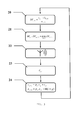
- Figure 3 shows an example of a possible sequencing of the method. Decisional functions values DF i,t +1 are computed in a first step 20.
- the index g represents, at each time, the selected sub-band SB g , that is the sub-band SB g that maximises the decisional function DF.
- Said selected sub-band SB g is then used during a step 22 to transmit between the cell 1 and its associated mobile terminals 6, 7, 8. During this step 22, measurements relative to said selected sub-band SB g are also made.
- variable s is indicative of the quality offered by a given frequency sub-band 11
- a high quality and thus a high value of s would tend to increase the value of DF, and thus would tend to have said sub-band 11 selected.
- this is tempered by the fact that the more a sub-band 11 is selected, the higher is the value of n, thus leading to decrease the value of DF, then offering opportunities for selecting among other sub-bands 11.
- a possible way of determining a value s i,t +1 of said variable s is by recurrence.
- the value s i,t +1 indicative of a cumulative reward scored by the i th sub-band SB i until time t +1, may then be determined, for each sub-band SB i , by adding a reward value r i,t scored by said sub-band SB i at previous time t to the value of variable s i,t indicative of a cumulative reward previously scored by said sub-band SB i until time t. So doing an exact cumulative reward value would be obtained.
- the method first multiplies by a first discount factor ⁇ s .
- the reward value r i,t scored by the i th sub-band SB i at previous time t is advantageously considered null, when said i th sub-band SB i has not been selected at previous time t.
- a non zero reward value r i,t is provided when the i th sub-band SB i has been selected at previous time t .
- Said reward value r i,t is taken equal to a performance score obtained by said sub-band SB i at previous time t , during use.
- Said performance score may be chosen among any indicator of the quality experienced on said sub-band 11. It can be e.g. an experienced throughput, or an experienced data rate, or an experienced signal to interference and noise ratio, or a channel quality indicator such as an ACK counter, etc. the performance score may also be obtained by any combination of said previously mentioned indicators. All of these indicators are determined at previous time t, during the use of said i th sub-band SB i , selected at previous time t. Said measurements are advantageously made without interrupting or perturbing in any way the normal functioning based on communications between the cell 1, 2, and its attached mobile terminals 6, 7, 8.
- the rewards r i,t are determined at step 23.
- a possible way of determining a value n i,t +1 of said variable n is by recurrence.
- the value n i,t +1 indicative of a number of selections of said i th sub-band SB i until time t +1, may then be determined, for each sub-band SB i , by adding one if sub-band SB i has been selected at previous time t to the value of variable n i,t indicative of the number of previous selections of said sub-band SB i until time t . If sub-band SB i has not been selected, nothing is added. So doing an exact number of selections value would be obtained.
- the method first multiplies by a second discount factor ⁇ n .
- both discount factors and ⁇ s , and ⁇ n may be chosen independently. Their values depend on the relative weight accorded to the past. The smaller the discount factor is, the lesser the relative weight is. A value of 0.9 has proven to give good results.
- the two recurrence formulae may be used to update the new values of s i,t +1 and n i,t +1 at step 24. Then the method considers the next time, by incrementing the time index, that is t is replaced by t +1, and branch back again to step 20 to determine a new set of decisional function values DF i .
- This function is an increasing function of the variable s, and a decreasing function of the variable n, and ⁇ is an exploration parameter. The higher is the value of ⁇ , the higher is the trend to change of sub-band 11.
- ⁇ i,t +1 may also vary in function of time.
- Said exploration parameter ⁇ allows including in the formulation either coordination or sensed information, as will be detailed later.
- all ⁇ are chosen constants.
- parameter b may be understood as a weight applied to the variable n, in function of the importance given to said variable.
- Parameter b is preferentially a constant. A value of 2 has proven to give good results.
- ⁇ and thus a when b is constant, may be constant.
- parameter a may be varying in function of other variables of the problem.
- parameter a may be recomputed at each time as a function of e.g. the reward value r.
- Said variance of the reward value r is determined over time. The effect so obtained is if the reward value r is very varying, then the reward value r is not stationary and more exploration of the sub-band is needed to get the right/correct information.
- each cell 1, 2, during its decision process, relies on its own and does not need any external information, e.g. exchanged with neighbouring contending cells.
- said information can be advantageously used.
- Said information may consist e.g. in a given sub-band SB i announced to be allocated to a neighbouring cell and thus unavailable.
- Such information is introduced in the method by adjusting the exploration parameters ⁇ i corresponding to said unavailable sub-band SB i, in order that the resulting decision function value DF i has lesser chance to be maximum. This is obtained by decreasing the ⁇ i corresponding to said busy sub-band SB i .
- the method does not need any sensing information.
- Said information can be obtained from sensing measurements operated by the cell 1 itself or from sensing measurements operated by another cell or another mean and then transmitted to the cell.
- Said information may consist e.g. in a given sub-band SB i announced to be either occupied or perturbed, and thus unavailable.
- such information is introduced in the method by decreasing the ⁇ i corresponding to said busy sub-band SB i .
Landscapes
- Engineering & Computer Science (AREA)
- Computer Networks & Wireless Communication (AREA)
- Signal Processing (AREA)
- Mobile Radio Communication Systems (AREA)
Abstract
- computing (20), for a next time t+1, for each sub-band SBi, a decisional function value DF i,t+1, using a function DF, where DF is an increasing function of a variable S i,t+1 indicative of a cumulative reward previously scored by said sub-band SBi, and a decreasing function of a variable n i,t+1 indicative of a number of previous selections of said sub-band SB¡,
- selecting (21) the sub-band SBg whose decisional function value DF g,t+1 is maximum among all DF i,t+1, that is
Description
- The technical domain of the invention is the domain of wireless radio access communication networks.
- In wireless radio access communication networks, the radio resources are limited comparing to the needs of the cells. A wholly available frequency band is parted into frequency sub-bands identified in frequency and time dimensions. At a given time a cell needs one such frequency sub-band to transmit on it. Said allocated frequency sub-band is then scheduled among users attached to said cell, in order to provide communication services to said users. It is primordial to efficiently share the frequency sub-bands among contending cells. The sharing procedure employed highly impacts the performances of the overall functioning of the network.
- This can be achieved, in an efficient manner, with a centralized decision making unit or referee that is in charge of allocating the frequency sub-bands among the different demanding users.
- Nevertheless, such a centralized unit is not always possible. In case of absence of such centralized unit, the sharing needs to be performed in a distributive manner between all the cells. Thus, each cell has to decide alone which frequency sub-band to select, in order to transmit on it. This selection must however ensure a globally good functioning for all contenting cells sharing the whole available frequency band.
- Another potential solution for distributed radio frequency band sharing is the use of the Carrier Sense Multiple Access with Collision Avoidance, CSMA/CA, known protocol. Said protocol guarantees an efficient sharing between different contending cells on the same radio frequency band, thanks to the use of an appropriate collision avoidance mechanism. The employed procedure makes use of specific messages between different contending cells that indicate the current usage of the channel. A distributed coordination function, DFC, is a MAC technique used in IEEE 802.11 standard with the CSMA/CA protocol. It can also use a virtual carrier sense with RTS/CTS control frames. But, this leads to a signalization overhead and also requires information exchange between cells. Such information exchange is not always possible.
- Each cell needs to make a decision on the more appropriate frequency sub-band to use. To this end, the cell makes its decision according to metrics that can be provided mainly through two means:
- Reported measurements from users attached to the cell. In this case, the reported measurements (eg: throughput, ack/nack counters, ...) are indicators of the performance of the frequency sub-band currently allocated to the cell.
Thus, the cell will have information limited to the already used band and will miss measurements on the other frequency sub-bands of the rest of the wholly available frequency band. - Sensing measurements. In this case, the cell makes sensing measurements in some or all of the frequency sub-bands, to evaluate their use ratio and the experienced interference on each of them. This sensing process can be made periodically or on demand. This solution allows getting the information needed for the decision. But complexity of sensing operation and inefficiency when sensing leads to traffic interruption. Another prejudicial effect is that collisions may occur when two cells simultaneously sense a same channel.
- Regarding these two alternatives, and the drawbacks exhibited by the prior art solution, there is a need to find out an efficient solution that optimises the use of the whole available frequency band, while avoiding the previous noted drawbacks. In other words, this stands for ensuring maximum frequency band availability to a cell with minimum costs linked to obtain information about the frequency band usage/availability.
- This could be traduced through a compromise between two objectives:
- Exploiting the maximum of available resources and ensuring the highest perceived QoS for end users,
- Exploring portions of the frequency band that are not yet used thus maintaining an up to date quality measurement of whole frequency band. This enables to permanently detect better opportunities in resources, which leads to performance improvement.
- To this end, the invention proposes a distributed method that steers a cell in the choice of the more appropriate frequency sub-bands to transmit on it.
- The object of the invention is a method, in a wireless network, for sharing a radio frequency band divided into N sub-bands SBi for i in [1,N], among contending cells, comprising the steps of:
- computing, for a next time t+1, for each sub-band SBi, a decisional function value DF i,t+1 , using a function DF, where DF is an increasing function of a variable s i,t+1 indicative of a cumulative reward previously scored by said sub-band SBi, and a decreasing function of a variable n i,t+1 indicative of a number of previous selections of said sub-band SBi,
- selecting the sub-band SBg whose decisional function value DFg, t+1 is maximum among all DF i,t+1 , that is

- According to another feature of the invention, the variable s i,t+1 indicative of a cumulative reward previously scored by said sub-band SBi until time t+1, is recursively determined, for each sub-band SBi. by adding a reward value ri,t scored by said sub-band SBi at previous time t to the value of variable si,t indicative of a cumulative reward previously scored by said sub-band SBi until time t multiplied by a first discount factor ρ s , with 0 < ρ s ≤ 1 , that is s i,t+1 = ρ s.si,t + ri,t, starting with a null initial value s i,0 = 0.
- According to another feature of the invention, the reward value ri,t scored by said sub-band SBi at previous time t is null, if sub-band SBi has not been selected at previous time t, and is equal to a performance score obtained by said sub-band SBi at previous time t, being computed from experienced throughput, data rate, signal to interference and noise ratio, channel quality indicator, or any combination thereof, determined during previous time t, if sub-band SBi has been selected.
- According to another feature of the invention, the variable n i,t+1 indicative of a number of previous selections of said sub-band SBi until time t+1 is recursively determined, for each sub-band SBi, by adding one if sub-band SBi has been selected at previous time t to the value of variable ni,t indicative of a number of previous selections of said sub-band SBi until time t multiplied by a second discount factor ρ n, with 0<ρ n ≤1, that is n i,t+1 = ρ n.ni,t +Π(i = g) with Π(i = g)=1 when i=g and Π(i = g) = 0 otherwise, g representing at each time the index of the selected sub-band, starting with a null initial value ni,0 =0.
- According to another feature of the invention, the decisional function value DF i,t+1 is computed by the formula:

where λ i,t+1 is an exploration parameter. - According to another feature of the invention, exploration parameters λ i,t+1 are constants.
- According to another feature of the invention, parameters λ i,t+1 are determined by a ratio of a first parameter a i,t+1 to a second parameters b i,t+1 , that is

- According to another feature of the invention, the first parameter a i,t+1 is computed at each time as the variance of the reward value ri, that is a i,t+1 = var(ri ).
- A first advantage of the invention is that it takes profit of transmission over a selected frequency sub-band to evaluate the resulting performances and thus to maintain availability and quality information.
- Another advantage of the invention is that it provides an optimized sharing of the whole available frequency band among contending cells, without the necessity of using a centralized referee.
- Another advantage of the invention is that it provides an optimized steering function, without the need of explicit sensing measurements over the frequency band.
- Another advantage of the proposed method is that it can also take into account and includes coordination information exchanged between cells, or even sensing information, when available.
- Another advantage of the invention is that it provides a global self adaptive solution to the problem of resource sharing, performed in a distributed manner.
- Another advantage of the invention is that it can be applied to heterogeneous systems, hosting different radio access technologies but sharing a same frequency band. Thus, the invention allows interoperability between these different systems.
- Others features, details and advantages of the invention will become more apparent from the detailed illustrating description given hereafter with respect to the drawings on which:
-
figure 1 shows two contending cells sharing access to a same frequency band, -
figure 2 shows a time diagram indicating allocation of sub-bands to these two cells, -
figure 3 show a typical sequencing diagram of the method. - In a wireless radio network space is parted in geographical area cells. As shown in
figure 1 , twosuch area cells area cell base station mobile terminals area cell Mobile terminal 6, present inarea cell 3, can then establish a radio link withbase station 1, in order to connect to the network. - A
base station area cell base station geographical boundary base station - In order to fully cover a given spatial area, there must be
overlap 5, in betweenarea cells overlap 5, two neighbouringcells overlap 5. It can then be serviced by any one of the twocells cells - In order to solve the allocation problem, the whole frequency band available to
cells figure 2 , thewhole frequency band 10 is figured by a horizontal line, figuring a frequency range. As shown, saidfrequency band 10 is parted in N sub-bands 11. Here N=5. Said partition does not necessarily provide sub-bands of equal widths. The number N of sub-bands 11 and their width characteristics are determined so that acell sub-band 11 to servicemobile terminals range cell figure 2 shows an illustrative allocation ofsub bands 11 to the two saidcells cell 1 is figured hashed, while the sub-band 13 allocated tocell 2 is figured dotted. - One important point of the invention is that it is distributed, in that each
cell cell sub-band 11. - Moreover, the method is dynamic, always updating said information, and then adaptive. This is advantageous, since the radio environment may change, due e.g. to the settling of a new cell.
- Another important point of the invention is to avoid, or at least to limit, the use of sensing measurement, in order to increase the time during which a cell is functionally operational and transmitting.
- For all these reasons, the invention proposes a method that uses reported measurements obtained from the
mobile terminals different sub-bands 11, changing of sub-bands is thus encouraged. One goal of the <wqGTBinvention is to realize a trade-off between exploration and exploitation. - The main idea of the invention is, the
whole frequency band 10 being parted into N sub-bands SBi. 11, where the index i describes from 1 to N the different sub-bands SBi. 11, to compute, for a nexttime t+ 1, for each sub-band SBi, 11, a decisional function value DF i,t+1 . Said value may be obtained using a function DF. DFi,t, respectively DF i,t+1 , is the value of the DF function for the ith sub-band SBi for previous time t, respectively for nexttime t+ 1. - Two variables are introduced in this computation, in order to realise a compromise between two contradictory objectives: to obtain the best immediate rewarding sub-band allocation, and to explore other unused sub-bands in order to reserve medium or long term solutions.
- A first variable s is indicative of a cumulative reward previously scored by a given sub-band SBi, 11. si,t, respectively s i,t+1 , is the value of variable s for the ith sub-band SBi, until time t, respectively until
time t+ 1. - A second variable n is indicative of a number of previous selections of a given sub-band SBi, 11. ni,t, respectively n i,t+1, is the value of variable n for the ith sub-band SBi, until time t, respectively until
time t+ 1. - The aforementioned compromise is reach when DF is an increasing function of the variable s, and a decreasing function of the variable n.
-
Figure 3 shows an example of a possible sequencing of the method. Decisional functions values DF i,t+1 are computed in afirst step 20. - In a
second step 21, among all the sub-bands SBi,0≤i≤N, the method selects one sub-band SBg whose decisional function value DFg, t+1 is maximum among all DF i,t+1, that is
- Said selected sub-band SBg is then used during a
step 22 to transmit between thecell 1 and its associatedmobile terminals step 22, measurements relative to said selected sub-band SBg are also made. - Since variable s is indicative of the quality offered by a given
frequency sub-band 11, a high quality and thus a high value of s would tend to increase the value of DF, and thus would tend to have saidsub-band 11 selected. However this is tempered by the fact that the more a sub-band 11 is selected, the higher is the value of n, thus leading to decrease the value of DF, then offering opportunities for selecting among other sub-bands 11. - A possible way of determining a value s i,t+1 of said variable s is by recurrence. The value s i,t+1 indicative of a cumulative reward scored by the ith sub-band SBi until
time t+ 1, may then be determined, for each sub-band SBi, by adding a reward value ri,t scored by said sub-band SBi at previous time t to the value of variable si,t indicative of a cumulative reward previously scored by said sub-band SBi until time t. So doing an exact cumulative reward value would be obtained. Advantageously, the method first multiplies by a first discount factor ρ s . Said first discount factor ρ s is chosen between 0 and 1, and has the effect of reducing the influence of passed rewards. This can mathematically be expressed by:
with 0 < ρ s ≤1 - The recurrence computation must start with a first term, whose value can be chosen equal to an arbitrary value, e.g. zero, that is si,0 = 0. At least, all the first terms s i,0 must be equal, whatever i.
- It has been said previously, that the reported measurements are made only during the use of a sub-band 11. Consequently no information is gained when a sub-band 11 is not selected. Thus the reward value ri,t scored by the ith sub-band SBi at previous time t is advantageously considered null, when said ith sub-band SBi has not been selected at previous time t.
- But, a non zero reward value ri,t is provided when the ith sub-band SBi has been selected at previous time t. Said reward value ri,t is taken equal to a performance score obtained by said sub-band SBi at previous time t, during use. Said performance score may be chosen among any indicator of the quality experienced on said
sub-band 11. It can be e.g. an experienced throughput, or an experienced data rate, or an experienced signal to interference and noise ratio, or a channel quality indicator such as an ACK counter, etc. the performance score may also be obtained by any combination of said previously mentioned indicators. All of these indicators are determined at previous time t, during the use of said ith sub-band SBi, selected at previous time t. Said measurements are advantageously made without interrupting or perturbing in any way the normal functioning based on communications between thecell mobile terminals - With reference to
figure 3 , the rewards ri,t are determined atstep 23. - A possible way of determining a value n i,t+1 of said variable n is by recurrence. The value n i,t+1 indicative of a number of selections of said ith sub-band SBi until
time t+ 1, may then be determined, for each sub-band SBi, by adding one if sub-band SBi has been selected at previous time t to the value of variable ni,t indicative of the number of previous selections of said sub-band SBi until time t. If sub-band SBi has not been selected, nothing is added. So doing an exact number of selections value would be obtained. Advantageously, the method first multiplies by a second discount factor ρ n. Said second discount factor ρ n is chosen between 0 and 1, and has the effect of reducing the influence of passed selections. This can mathematically be expressed by:
with Π(i = g) = 1 when i=g and Π(i = g) = 0 otherwise. - The recurrence computation must start with a first term, whose value can be chosen equal to an arbitrary value, e.g. zero, that is ni,0 =0 . At least, all the first terms ni,0 must be equal, whatever i.
- The value of both discount factors and ρ s , and ρ n, may be chosen independently. Their values depend on the relative weight accorded to the past. The smaller the discount factor is, the lesser the relative weight is. A value of 0.9 has proven to give good results.
- With reference to
figure 3 , rewards ri,t being determined, the two recurrence formulae may be used to update the new values of s i,t+1 and n i,t+1 atstep 24. Then the method considers the next time, by incrementing the time index, that is t is replaced by t+1, and branch back again to step 20 to determine a new set of decisional function values DFi. - A possible function DF that satisfies the aforementioned conditions on variations, is given by the formula

sub-band 11. According to said formula, the decisional function value DF i,t+1 is computed by the formula:
- Said exploration parameter λ allows including in the formulation either coordination or sensed information, as will be detailed later.
- According to a first embodiment, all λ are chosen constants.
- In order to provide a physical meaning to said exploration parameter λ, it may be determined out of a ratio of a first parameter a to a second parameter b, that is

time t+ 1,
- As already mentioned λ, and thus a when b is constant, may be constant.
- Alternately, parameter a may be varying in function of other variables of the problem. For instance, parameter a may be recomputed at each time as a function of e.g. the reward value r. A possibility is to compute said first parameter a, at each time, as the variance of the reward value r, that is a = var(r), or applied to the ith sub-band at
time t+ 1, a i,t+1 = var(ri ). Said variance of the reward value r is determined over time. The effect so obtained is if the reward value r is very varying, then the reward value r is not stationary and more exploration of the sub-band is needed to get the right/correct information. - As described until now, the method is distributed, and each
cell cells - However, in particular cases, when such coordination information is exchanged between cells and is available, said information can be advantageously used. Said information may consist e.g. in a given sub-band SBi announced to be allocated to a neighbouring cell and thus unavailable. Such information is introduced in the method by adjusting the exploration parameters λ i corresponding to said unavailable sub-band SBi, in order that the resulting decision function value DFi has lesser chance to be maximum. This is obtained by decreasing the λ i corresponding to said busy sub-band SBi.
- As described until now, the method does not need any sensing information.
- However, in particular cases, when such sensing information is available, said information can be advantageously used. Said information can be obtained from sensing measurements operated by the
cell 1 itself or from sensing measurements operated by another cell or another mean and then transmitted to the cell. Said information may consist e.g. in a given sub-band SBi announced to be either occupied or perturbed, and thus unavailable. Here again, such information is introduced in the method by decreasing the λ i corresponding to said busy sub-band SBi.
Claims (12)
- A method, in a wireless network, for sharing a radio frequency band (10) divided into N sub-bands SBi (11) for i in [1,N], among contending cells (1, 2), characterized in that it comprises the steps of:- computing (20), for a next time t+1, for each sub-band SBi (11), a decisional function value DF i,t+1 , using a function DF, where DF is an increasing function of a variable si,t +1 indicative of a cumulative reward previously scored by said sub-band SBi (11), and a decreasing function of a variable n i,t+1 indicative of a number of previous selections of said sub-band SBi (11),- selecting (21) the sub-band SBg whose decisional function value DF g,t+1 is maximum among all DF i,t+1 , that is

- The method of claim 1, where variable s i,t+1 indicative of a cumulative reward previously scored by said sub-band SBi (11) until time t+1, is recursively determined (24), for each sub-band SBi, by adding a reward value ri,t scored by said sub-band SBi at previous time t to the value of variable si,t indicative of a cumulative reward previously scored by said sub-band SBi until time t multiplied by a first discount factor ρ s , with 0<ρ s ≤1, that is s i,t+1 = ρ s.si,t +ri,t, starting with a null initial value s i,0 = 0.
- The method of claim 2, where the reward value ri,t scored by said sub-band SBi at previous time t is null, if sub-band SBi has not been selected at previous time t.
- The method of claim 2 or 3, where the reward value ri,t scored by said sub-band SBi (11) at previous time t is equal to a performance score obtained by said sub-band SBi at previous time t, said performance score being computed from experienced throughput, data rate, signal to interference and noise ratio, channel quality indicator, or any combination thereof, determined at previous time t, if sub-band SBi has been selected at previous time t.
- The method of any one of claims 1 to 4, where variable n i,t+1 indicative of a number of previous selections of said sub-band SBi (11) until time t+1 is recursively determined (24), for each sub-band SBi, by adding one if sub-band SBi has been selected at previous time t to the value of variable ni,t indicative of a number of previous selections of said sub-band SBi until time t multiplied by a second discount factor ρ n, with 0<ρ n ≤1, that is n i,t+1 = ρ n.ni,t + Π(i = g) with Π(i = g) = 1 when i=g and Π(i = g) = 0 otherwise, g representing at each time the index of the selected sub-band, starting with a null initial value ni,0 = 0.
- The method of any one of claims 1 to 5, where the decisional function value DF i,t+1 is computed by the formula:

where λ i,t+1 is an exploration parameter. - The method of claim 6, where exploration parameters λ i,t+1 are constants.
- The method of claim 6, where exploration parameters λ i,t+1 are determined by a ratio of a first parameter a i,t+1 to a second parameter b i,t+1, that is

- The method of claim 8, where first parameter a i,t+1 is computed at each time as the variance of the reward value ri , that is a i,t+1 = var(ri ).
- The method of claim 8 or 9, where second parameter b i,t+1 is equal to 2.
- The method of any one of claims 6 to 10, where coordination information is received from neighbouring contending cells, and where exploration parameters λ i,t+1 are adjusted in accordance with said coordination information, decreasing a λ i,t+1 corresponding to a sub-band SBi that is known from said coordination information to be busy.
- The method of any one of claims 6 to 11, where sensing information is available, and where exploration parameters λ i,t+1 are adjusted in accordance with said sensing information, decreasing a λ i,t+1 corresponding to a sub-band SBi that is known from said sensing information to be busy.
Priority Applications (1)
| Application Number | Priority Date | Filing Date | Title |
|---|---|---|---|
| EP09306030A EP2317787A1 (en) | 2009-10-29 | 2009-10-29 | A method for sharing a radio frequency band among contending cells |
Applications Claiming Priority (1)
| Application Number | Priority Date | Filing Date | Title |
|---|---|---|---|
| EP09306030A EP2317787A1 (en) | 2009-10-29 | 2009-10-29 | A method for sharing a radio frequency band among contending cells |
Publications (1)
| Publication Number | Publication Date |
|---|---|
| EP2317787A1 true EP2317787A1 (en) | 2011-05-04 |
Family
ID=42027791
Family Applications (1)
| Application Number | Title | Priority Date | Filing Date |
|---|---|---|---|
| EP09306030A Withdrawn EP2317787A1 (en) | 2009-10-29 | 2009-10-29 | A method for sharing a radio frequency band among contending cells |
Country Status (1)
| Country | Link |
|---|---|
| EP (1) | EP2317787A1 (en) |
Cited By (1)
| Publication number | Priority date | Publication date | Assignee | Title |
|---|---|---|---|---|
| CN104378189A (en) * | 2013-08-15 | 2015-02-25 | 普天信息技术有限公司 | Self-adaption adjusting method and system of number of sub bands in multi-sub-band service |
Citations (1)
| Publication number | Priority date | Publication date | Assignee | Title |
|---|---|---|---|---|
| WO2007036003A1 (en) * | 2005-09-30 | 2007-04-05 | University Of South Australia | Reinforcement learning for resource allocation in a communications system |
-
2009
- 2009-10-29 EP EP09306030A patent/EP2317787A1/en not_active Withdrawn
Patent Citations (1)
| Publication number | Priority date | Publication date | Assignee | Title |
|---|---|---|---|---|
| WO2007036003A1 (en) * | 2005-09-30 | 2007-04-05 | University Of South Australia | Reinforcement learning for resource allocation in a communications system |
Non-Patent Citations (1)
| Title |
|---|
| AFEF BEN HADJ ALAYA-FEKI ET AL: "Dynamic spectrum access with non-stationary Multi-Armed Bandit", 6 July 2008, SIGNAL PROCESSING ADVANCES IN WIRELESS COMMUNICATIONS, 2008. SPAWC 2008. IEEE 9TH WORKSHOP ON, IEEE, PISCATAWAY, NJ, USA, PAGE(S) 416 - 420, ISBN: 9781424420452, XP031345974 * |
Cited By (1)
| Publication number | Priority date | Publication date | Assignee | Title |
|---|---|---|---|---|
| CN104378189A (en) * | 2013-08-15 | 2015-02-25 | 普天信息技术有限公司 | Self-adaption adjusting method and system of number of sub bands in multi-sub-band service |
Similar Documents
| Publication | Publication Date | Title |
|---|---|---|
| US10104693B1 (en) | Enhanced channel access mechanisms for wide band operation on unlicensed bands | |
| US7877109B2 (en) | Method and apparatus for controlling transmission power of cognitive radio environment | |
| US7929432B2 (en) | Flexible starting time scheduling algorithm for bitmap coexistence protection | |
| EP2769517B1 (en) | Channel estimation using reference signals | |
| JP5670856B2 (en) | Wireless communication system and channel allocation method | |
| KR20080084750A (en) | Resource Allocation System and Method in Communication System | |
| US20130188576A1 (en) | Systems and Methods for Uplink Resource Allocation | |
| US20090310558A1 (en) | Wireless Communication System, Terminal Apparatus, And Communication Method | |
| EP2870712B1 (en) | Method and access point for assigning sounding resources | |
| WO2011099906A1 (en) | Method and arrangement for adapting semi-persistently configured, periodic resources in a wireless communications network | |
| Joshi et al. | Decentralized predictive MAC protocol for ad hoc cognitive radio networks | |
| Burbano-Abril et al. | Mcs adaptation within the cellular v2x sidelink | |
| EP3886514A1 (en) | Communication device and wireless communication system | |
| KR20140075958A (en) | Channel Information Providing Method and Channel Information Providing Database Server and Channel Information Providing System | |
| EP2317787A1 (en) | A method for sharing a radio frequency band among contending cells | |
| KR20150054055A (en) | Method and apparatus for allocating resource in cellular communication system | |
| US20170012759A1 (en) | Method for allocating resources and system implementing said method | |
| Chen et al. | Learning-based channel selection of vdsa networks in shared tv whitespace | |
| WO2010124729A1 (en) | Spectrum arrangement for co-channel interference reduction | |
| Mamadou et al. | Enhancing the CSMA/CA of IEEE 802.15. 4 for better coexistence with IEEE 802.11 | |
| US9913170B2 (en) | Wireless communication methods and apparatus | |
| KR101172420B1 (en) | Apparatus for resource allocation of basestation based on traffic pattern information and method thereof | |
| US20110211550A1 (en) | Spatial multiplexing slot assignment method and base station | |
| EP2871878B1 (en) | Communication management device and communication management method | |
| KR101338408B1 (en) | Method and equipment for inter channel interference decrease using reminder channel |
Legal Events
| Date | Code | Title | Description |
|---|---|---|---|
| PUAI | Public reference made under article 153(3) epc to a published international application that has entered the european phase |
Free format text: ORIGINAL CODE: 0009012 |
|
| AK | Designated contracting states |
Kind code of ref document: A1 Designated state(s): AT BE BG CH CY CZ DE DK EE ES FI FR GB GR HR HU IE IS IT LI LT LU LV MC MK MT NL NO PL PT RO SE SI SK SM TR |
|
| 17P | Request for examination filed |
Effective date: 20111104 |
|
| RAP1 | Party data changed (applicant data changed or rights of an application transferred) |
Owner name: ALCATEL LUCENT |
|
| 111Z | Information provided on other rights and legal means of execution |
Free format text: AT BE BG CH CY CZ DE DK EE ES FI FR GB GR HR HU IE IS IT LI LT LU LV MC MK MT NL NO PL PT RO SE SI SK SM TR Effective date: 20130410 |
|
| RAP1 | Party data changed (applicant data changed or rights of an application transferred) |
Owner name: ALCATEL LUCENT |
|
| STAA | Information on the status of an ep patent application or granted ep patent |
Free format text: STATUS: THE APPLICATION IS DEEMED TO BE WITHDRAWN |
|
| 18D | Application deemed to be withdrawn |
Effective date: 20140503 |