EP2316834A1 - Thiadiazoles or oxadiazoles and their use as inhibitors of JAK protein kinase - Google Patents
Thiadiazoles or oxadiazoles and their use as inhibitors of JAK protein kinase Download PDFInfo
- Publication number
- EP2316834A1 EP2316834A1 EP10182153A EP10182153A EP2316834A1 EP 2316834 A1 EP2316834 A1 EP 2316834A1 EP 10182153 A EP10182153 A EP 10182153A EP 10182153 A EP10182153 A EP 10182153A EP 2316834 A1 EP2316834 A1 EP 2316834A1
- Authority
- EP
- European Patent Office
- Prior art keywords
- nitrogen
- sulfur
- optionally substituted
- ring
- oxygen
- Prior art date
- Legal status (The legal status is an assumption and is not a legal conclusion. Google has not performed a legal analysis and makes no representation as to the accuracy of the status listed.)
- Withdrawn
Links
- 0 CC=CC1=NN=C(C)*1 Chemical compound CC=CC1=NN=C(C)*1 0.000 description 10
- YJTJVOYYZNHVDF-UHFFFAOYSA-N CC(C)(C)c1cc(C(Nc2nnc(Sc3ccnc4c3cccc4)[s]2)=O)c(C)[o]1 Chemical compound CC(C)(C)c1cc(C(Nc2nnc(Sc3ccnc4c3cccc4)[s]2)=O)c(C)[o]1 YJTJVOYYZNHVDF-UHFFFAOYSA-N 0.000 description 1
- ZFVDFEZPVKOREX-UHFFFAOYSA-N CC(C)C(Nc1nnc(Sc2c(ccc(Cl)c3)c3ncc2)[s]1)=O Chemical compound CC(C)C(Nc1nnc(Sc2c(ccc(Cl)c3)c3ncc2)[s]1)=O ZFVDFEZPVKOREX-UHFFFAOYSA-N 0.000 description 1
- WQBWFBWIJUURSG-UHFFFAOYSA-N CC(C)CC(Nc1nnc(Sc2c(ccc(Cl)c3)c3ncc2)[s]1)=O Chemical compound CC(C)CC(Nc1nnc(Sc2c(ccc(Cl)c3)c3ncc2)[s]1)=O WQBWFBWIJUURSG-UHFFFAOYSA-N 0.000 description 1
- WUNCHLRJERXLRO-OQFOIZHKSA-N CC/C=C\OCCNC(Nc1nnc(Sc2c(ccc(Cl)c3)c3ncc2)[s]1)=O Chemical compound CC/C=C\OCCNC(Nc1nnc(Sc2c(ccc(Cl)c3)c3ncc2)[s]1)=O WUNCHLRJERXLRO-OQFOIZHKSA-N 0.000 description 1
- YBAKGQBWUCBTCW-UHFFFAOYSA-N CC1NC2(C)C=CC=CC2N1 Chemical compound CC1NC2(C)C=CC=CC2N1 YBAKGQBWUCBTCW-UHFFFAOYSA-N 0.000 description 1
- MVJWYUZPIBXVOB-DAXSKMNVSA-O CCC(N=CCC1Sc2nnc(NC(NCc3cc(Cl)ccc3)=[OH+])[s]2)=C1/C=C\CCl Chemical compound CCC(N=CCC1Sc2nnc(NC(NCc3cc(Cl)ccc3)=[OH+])[s]2)=C1/C=C\CCl MVJWYUZPIBXVOB-DAXSKMNVSA-O 0.000 description 1
- YBMRYAUSYFXXIT-UHFFFAOYSA-N CCCC(Nc1nnc(Sc2c(ccc(Cl)c3)c3ncc2)[s]1)=O Chemical compound CCCC(Nc1nnc(Sc2c(ccc(Cl)c3)c3ncc2)[s]1)=O YBMRYAUSYFXXIT-UHFFFAOYSA-N 0.000 description 1
- YNUSJSUYCLROOL-UHFFFAOYSA-N CCOC(C(Nc1nnc(Sc2ccnc3c2ccc(Cl)c3)[s]1)=O)=O Chemical compound CCOC(C(Nc1nnc(Sc2ccnc3c2ccc(Cl)c3)[s]1)=O)=O YNUSJSUYCLROOL-UHFFFAOYSA-N 0.000 description 1
- IVJYDNXPMXWLEU-UHFFFAOYSA-N CN1N=C(NC(c2ccc[s]2)=O)SC1Sc1ccnc2c1cccc2 Chemical compound CN1N=C(NC(c2ccc[s]2)=O)SC1Sc1ccnc2c1cccc2 IVJYDNXPMXWLEU-UHFFFAOYSA-N 0.000 description 1
- ICSAAURLUXFUIE-UHFFFAOYSA-N CN1N=C(Sc2c(ccc(Cl)c3)c3ncc2)SC1Nc1ccccc1OC Chemical compound CN1N=C(Sc2c(ccc(Cl)c3)c3ncc2)SC1Nc1ccccc1OC ICSAAURLUXFUIE-UHFFFAOYSA-N 0.000 description 1
- KINKZIIFWGXRII-UHFFFAOYSA-N COc(c(OC)cc1ncn2)cc1c2Sc1nnc(NC(COc2ccccc2)=O)[s]1 Chemical compound COc(c(OC)cc1ncn2)cc1c2Sc1nnc(NC(COc2ccccc2)=O)[s]1 KINKZIIFWGXRII-UHFFFAOYSA-N 0.000 description 1
- OLTOEPPLZKHPLE-UHFFFAOYSA-N COc(cc1)ccc1OCC(Nc1nnc(Sc2c(ccc(Cl)c3)c3ncc2)[s]1)=O Chemical compound COc(cc1)ccc1OCC(Nc1nnc(Sc2c(ccc(Cl)c3)c3ncc2)[s]1)=O OLTOEPPLZKHPLE-UHFFFAOYSA-N 0.000 description 1
- WLSYZONXMFKAIW-UHFFFAOYSA-N COc1ccc(CC(Nc2nnc(SC3=CCNc4c3cccc4)[s]2)=O)cc1 Chemical compound COc1ccc(CC(Nc2nnc(SC3=CCNc4c3cccc4)[s]2)=O)cc1 WLSYZONXMFKAIW-UHFFFAOYSA-N 0.000 description 1
- BEMZJVJXZSPIJT-UHFFFAOYSA-N COc1ccccc1CC(Nc1nnc(Sc2c(ccc(Cl)c3)c3ncc2)[s]1)=O Chemical compound COc1ccccc1CC(Nc1nnc(Sc2c(ccc(Cl)c3)c3ncc2)[s]1)=O BEMZJVJXZSPIJT-UHFFFAOYSA-N 0.000 description 1
- FXZOOFNCILJCRG-UHFFFAOYSA-N Nc1nnc(SC2CCCCC2)[s]1 Chemical compound Nc1nnc(SC2CCCCC2)[s]1 FXZOOFNCILJCRG-UHFFFAOYSA-N 0.000 description 1
- MNKTUEGNYQUDNW-UHFFFAOYSA-N O=C(C(Nc1nnc(Sc2ccnc3c2ccc(Cl)c3)[s]1)=O)c1c[nH]c2ccccc12 Chemical compound O=C(C(Nc1nnc(Sc2ccnc3c2ccc(Cl)c3)[s]1)=O)c1c[nH]c2ccccc12 MNKTUEGNYQUDNW-UHFFFAOYSA-N 0.000 description 1
- AYEHIRPSYGBEMK-UHFFFAOYSA-N O=C(CNC(c1ccccc1)=O)Nc1nnc(Sc2ccnc3ccccc23)[s]1 Chemical compound O=C(CNC(c1ccccc1)=O)Nc1nnc(Sc2ccnc3ccccc23)[s]1 AYEHIRPSYGBEMK-UHFFFAOYSA-N 0.000 description 1
- LHIYEIAUPFKZJD-UHFFFAOYSA-N O=C(COc1ccccc1)Nc1nnc(Sc2ncnc3c2[s]cc3)[s]1 Chemical compound O=C(COc1ccccc1)Nc1nnc(Sc2ncnc3c2[s]cc3)[s]1 LHIYEIAUPFKZJD-UHFFFAOYSA-N 0.000 description 1
- IZVYSXNDFSDKBU-UHFFFAOYSA-N O=C(CSc1ccccc1)Nc1nnc(Sc2c(ccc(Cl)c3)c3ncc2)[s]1 Chemical compound O=C(CSc1ccccc1)Nc1nnc(Sc2c(ccc(Cl)c3)c3ncc2)[s]1 IZVYSXNDFSDKBU-UHFFFAOYSA-N 0.000 description 1
- FVQYYADGRVKFTN-UHFFFAOYSA-N O=C(NCCc1ccc[s]1)Nc1nnc(Sc2c(ccc(Cl)c3)c3ncc2)[s]1 Chemical compound O=C(NCCc1ccc[s]1)Nc1nnc(Sc2c(ccc(Cl)c3)c3ncc2)[s]1 FVQYYADGRVKFTN-UHFFFAOYSA-N 0.000 description 1
- VXKOHFYPDWLFMW-UHFFFAOYSA-N O=C(Nc1nnc(Sc2c(ccc(Cl)c3)c3ncc2)[s]1)Oc1ccccc1 Chemical compound O=C(Nc1nnc(Sc2c(ccc(Cl)c3)c3ncc2)[s]1)Oc1ccccc1 VXKOHFYPDWLFMW-UHFFFAOYSA-N 0.000 description 1
- FKUGOSVUOCCHCV-UHFFFAOYSA-N O=C(c1ccc(C(F)(F)F)cc1)Nc1nnc(Sc2c(ccc(Cl)c3)c3ncc2)[s]1 Chemical compound O=C(c1ccc(C(F)(F)F)cc1)Nc1nnc(Sc2c(ccc(Cl)c3)c3ncc2)[s]1 FKUGOSVUOCCHCV-UHFFFAOYSA-N 0.000 description 1
- LYTXNCDJXHSDEQ-UHFFFAOYSA-N O=C(c1ccc[s]1)Nc1nnc(Sc(c2c3)ccnc2ccc3F)[s]1 Chemical compound O=C(c1ccc[s]1)Nc1nnc(Sc(c2c3)ccnc2ccc3F)[s]1 LYTXNCDJXHSDEQ-UHFFFAOYSA-N 0.000 description 1
- GIUCUXMREOWFGX-UHFFFAOYSA-N O=C(c1ccc[s]1)Nc1nnc(Sc(c2ccc3)ccnc2c3F)[s]1 Chemical compound O=C(c1ccc[s]1)Nc1nnc(Sc(c2ccc3)ccnc2c3F)[s]1 GIUCUXMREOWFGX-UHFFFAOYSA-N 0.000 description 1
- BQLYCGBHTHSZAT-UHFFFAOYSA-N O=C(c1ccc[s]1)Nc1nnc(Sc2c(cc(cc3)Br)c3ncc2)[s]1 Chemical compound O=C(c1ccc[s]1)Nc1nnc(Sc2c(cc(cc3)Br)c3ncc2)[s]1 BQLYCGBHTHSZAT-UHFFFAOYSA-N 0.000 description 1
- HIVMPFDBLRTZEG-UHFFFAOYSA-N O=C(c1ccc[s]1)Nc1nnc(Sc2c(cccc3Cl)c3ncc2)[s]1 Chemical compound O=C(c1ccc[s]1)Nc1nnc(Sc2c(cccc3Cl)c3ncc2)[s]1 HIVMPFDBLRTZEG-UHFFFAOYSA-N 0.000 description 1
- UPHTVVTWYMHIPI-UHFFFAOYSA-N O=C(c1ccc[s]1)Nc1nnc(Sc2ccnc3ccc(C(F)(F)F)cc23)[s]1 Chemical compound O=C(c1ccc[s]1)Nc1nnc(Sc2ccnc3ccc(C(F)(F)F)cc23)[s]1 UPHTVVTWYMHIPI-UHFFFAOYSA-N 0.000 description 1
- LAPDMFNNIYGWNB-UHFFFAOYSA-N OC(c1ccc[s]1)Nc1nnc(Sc2c(ccc(C(F)(F)F)c3)c3ncc2)[s]1 Chemical compound OC(c1ccc[s]1)Nc1nnc(Sc2c(ccc(C(F)(F)F)c3)c3ncc2)[s]1 LAPDMFNNIYGWNB-UHFFFAOYSA-N 0.000 description 1
Classifications
-
- C—CHEMISTRY; METALLURGY
- C07—ORGANIC CHEMISTRY
- C07D—HETEROCYCLIC COMPOUNDS
- C07D409/00—Heterocyclic compounds containing two or more hetero rings, at least one ring having sulfur atoms as the only ring hetero atoms
- C07D409/02—Heterocyclic compounds containing two or more hetero rings, at least one ring having sulfur atoms as the only ring hetero atoms containing two hetero rings
- C07D409/12—Heterocyclic compounds containing two or more hetero rings, at least one ring having sulfur atoms as the only ring hetero atoms containing two hetero rings linked by a chain containing hetero atoms as chain links
-
- A—HUMAN NECESSITIES
- A61—MEDICAL OR VETERINARY SCIENCE; HYGIENE
- A61K—PREPARATIONS FOR MEDICAL, DENTAL OR TOILETRY PURPOSES
- A61K31/00—Medicinal preparations containing organic active ingredients
- A61K31/33—Heterocyclic compounds
- A61K31/395—Heterocyclic compounds having nitrogen as a ring hetero atom, e.g. guanethidine or rifamycins
- A61K31/435—Heterocyclic compounds having nitrogen as a ring hetero atom, e.g. guanethidine or rifamycins having six-membered rings with one nitrogen as the only ring hetero atom
- A61K31/47—Quinolines; Isoquinolines
- A61K31/4709—Non-condensed quinolines and containing further heterocyclic rings
-
- A—HUMAN NECESSITIES
- A61—MEDICAL OR VETERINARY SCIENCE; HYGIENE
- A61K—PREPARATIONS FOR MEDICAL, DENTAL OR TOILETRY PURPOSES
- A61K31/00—Medicinal preparations containing organic active ingredients
- A61K31/33—Heterocyclic compounds
- A61K31/395—Heterocyclic compounds having nitrogen as a ring hetero atom, e.g. guanethidine or rifamycins
- A61K31/495—Heterocyclic compounds having nitrogen as a ring hetero atom, e.g. guanethidine or rifamycins having six-membered rings with two or more nitrogen atoms as the only ring heteroatoms, e.g. piperazine or tetrazines
- A61K31/505—Pyrimidines; Hydrogenated pyrimidines, e.g. trimethoprim
- A61K31/517—Pyrimidines; Hydrogenated pyrimidines, e.g. trimethoprim ortho- or peri-condensed with carbocyclic ring systems, e.g. quinazoline, perimidine
-
- A—HUMAN NECESSITIES
- A61—MEDICAL OR VETERINARY SCIENCE; HYGIENE
- A61K—PREPARATIONS FOR MEDICAL, DENTAL OR TOILETRY PURPOSES
- A61K31/00—Medicinal preparations containing organic active ingredients
- A61K31/33—Heterocyclic compounds
- A61K31/395—Heterocyclic compounds having nitrogen as a ring hetero atom, e.g. guanethidine or rifamycins
- A61K31/495—Heterocyclic compounds having nitrogen as a ring hetero atom, e.g. guanethidine or rifamycins having six-membered rings with two or more nitrogen atoms as the only ring heteroatoms, e.g. piperazine or tetrazines
- A61K31/505—Pyrimidines; Hydrogenated pyrimidines, e.g. trimethoprim
- A61K31/519—Pyrimidines; Hydrogenated pyrimidines, e.g. trimethoprim ortho- or peri-condensed with heterocyclic rings
-
- A—HUMAN NECESSITIES
- A61—MEDICAL OR VETERINARY SCIENCE; HYGIENE
- A61P—SPECIFIC THERAPEUTIC ACTIVITY OF CHEMICAL COMPOUNDS OR MEDICINAL PREPARATIONS
- A61P11/00—Drugs for disorders of the respiratory system
- A61P11/06—Antiasthmatics
-
- A—HUMAN NECESSITIES
- A61—MEDICAL OR VETERINARY SCIENCE; HYGIENE
- A61P—SPECIFIC THERAPEUTIC ACTIVITY OF CHEMICAL COMPOUNDS OR MEDICINAL PREPARATIONS
- A61P19/00—Drugs for skeletal disorders
- A61P19/02—Drugs for skeletal disorders for joint disorders, e.g. arthritis, arthrosis
-
- A—HUMAN NECESSITIES
- A61—MEDICAL OR VETERINARY SCIENCE; HYGIENE
- A61P—SPECIFIC THERAPEUTIC ACTIVITY OF CHEMICAL COMPOUNDS OR MEDICINAL PREPARATIONS
- A61P21/00—Drugs for disorders of the muscular or neuromuscular system
-
- A—HUMAN NECESSITIES
- A61—MEDICAL OR VETERINARY SCIENCE; HYGIENE
- A61P—SPECIFIC THERAPEUTIC ACTIVITY OF CHEMICAL COMPOUNDS OR MEDICINAL PREPARATIONS
- A61P25/00—Drugs for disorders of the nervous system
- A61P25/28—Drugs for disorders of the nervous system for treating neurodegenerative disorders of the central nervous system, e.g. nootropic agents, cognition enhancers, drugs for treating Alzheimer's disease or other forms of dementia
-
- A—HUMAN NECESSITIES
- A61—MEDICAL OR VETERINARY SCIENCE; HYGIENE
- A61P—SPECIFIC THERAPEUTIC ACTIVITY OF CHEMICAL COMPOUNDS OR MEDICINAL PREPARATIONS
- A61P29/00—Non-central analgesic, antipyretic or antiinflammatory agents, e.g. antirheumatic agents; Non-steroidal antiinflammatory drugs [NSAID]
-
- A—HUMAN NECESSITIES
- A61—MEDICAL OR VETERINARY SCIENCE; HYGIENE
- A61P—SPECIFIC THERAPEUTIC ACTIVITY OF CHEMICAL COMPOUNDS OR MEDICINAL PREPARATIONS
- A61P35/00—Antineoplastic agents
-
- A—HUMAN NECESSITIES
- A61—MEDICAL OR VETERINARY SCIENCE; HYGIENE
- A61P—SPECIFIC THERAPEUTIC ACTIVITY OF CHEMICAL COMPOUNDS OR MEDICINAL PREPARATIONS
- A61P35/00—Antineoplastic agents
- A61P35/02—Antineoplastic agents specific for leukemia
-
- A—HUMAN NECESSITIES
- A61—MEDICAL OR VETERINARY SCIENCE; HYGIENE
- A61P—SPECIFIC THERAPEUTIC ACTIVITY OF CHEMICAL COMPOUNDS OR MEDICINAL PREPARATIONS
- A61P37/00—Drugs for immunological or allergic disorders
-
- A—HUMAN NECESSITIES
- A61—MEDICAL OR VETERINARY SCIENCE; HYGIENE
- A61P—SPECIFIC THERAPEUTIC ACTIVITY OF CHEMICAL COMPOUNDS OR MEDICINAL PREPARATIONS
- A61P37/00—Drugs for immunological or allergic disorders
- A61P37/02—Immunomodulators
-
- A—HUMAN NECESSITIES
- A61—MEDICAL OR VETERINARY SCIENCE; HYGIENE
- A61P—SPECIFIC THERAPEUTIC ACTIVITY OF CHEMICAL COMPOUNDS OR MEDICINAL PREPARATIONS
- A61P37/00—Drugs for immunological or allergic disorders
- A61P37/02—Immunomodulators
- A61P37/06—Immunosuppressants, e.g. drugs for graft rejection
-
- A—HUMAN NECESSITIES
- A61—MEDICAL OR VETERINARY SCIENCE; HYGIENE
- A61P—SPECIFIC THERAPEUTIC ACTIVITY OF CHEMICAL COMPOUNDS OR MEDICINAL PREPARATIONS
- A61P37/00—Drugs for immunological or allergic disorders
- A61P37/08—Antiallergic agents
-
- A—HUMAN NECESSITIES
- A61—MEDICAL OR VETERINARY SCIENCE; HYGIENE
- A61P—SPECIFIC THERAPEUTIC ACTIVITY OF CHEMICAL COMPOUNDS OR MEDICINAL PREPARATIONS
- A61P43/00—Drugs for specific purposes, not provided for in groups A61P1/00-A61P41/00
-
- C—CHEMISTRY; METALLURGY
- C07—ORGANIC CHEMISTRY
- C07D—HETEROCYCLIC COMPOUNDS
- C07D409/00—Heterocyclic compounds containing two or more hetero rings, at least one ring having sulfur atoms as the only ring hetero atoms
- C07D409/14—Heterocyclic compounds containing two or more hetero rings, at least one ring having sulfur atoms as the only ring hetero atoms containing three or more hetero rings
-
- C—CHEMISTRY; METALLURGY
- C07—ORGANIC CHEMISTRY
- C07D—HETEROCYCLIC COMPOUNDS
- C07D417/00—Heterocyclic compounds containing two or more hetero rings, at least one ring having nitrogen and sulfur atoms as the only ring hetero atoms, not provided for by group C07D415/00
- C07D417/02—Heterocyclic compounds containing two or more hetero rings, at least one ring having nitrogen and sulfur atoms as the only ring hetero atoms, not provided for by group C07D415/00 containing two hetero rings
- C07D417/12—Heterocyclic compounds containing two or more hetero rings, at least one ring having nitrogen and sulfur atoms as the only ring hetero atoms, not provided for by group C07D415/00 containing two hetero rings linked by a chain containing hetero atoms as chain links
-
- C—CHEMISTRY; METALLURGY
- C07—ORGANIC CHEMISTRY
- C07D—HETEROCYCLIC COMPOUNDS
- C07D417/00—Heterocyclic compounds containing two or more hetero rings, at least one ring having nitrogen and sulfur atoms as the only ring hetero atoms, not provided for by group C07D415/00
- C07D417/14—Heterocyclic compounds containing two or more hetero rings, at least one ring having nitrogen and sulfur atoms as the only ring hetero atoms, not provided for by group C07D415/00 containing three or more hetero rings
-
- C—CHEMISTRY; METALLURGY
- C07—ORGANIC CHEMISTRY
- C07D—HETEROCYCLIC COMPOUNDS
- C07D495/00—Heterocyclic compounds containing in the condensed system at least one hetero ring having sulfur atoms as the only ring hetero atoms
- C07D495/02—Heterocyclic compounds containing in the condensed system at least one hetero ring having sulfur atoms as the only ring hetero atoms in which the condensed system contains two hetero rings
- C07D495/04—Ortho-condensed systems
Definitions
- the present invention relates to compounds useful as inhibitors of protein kinases.
- the invention also provides pharmaceutically acceptable compositions comprising the compounds of the invention and methods of using the compositions in the treatment of various disorders.
- Protein kinases constitute a large family of structurally related enzymes that are responsible for the control of a variety of signal transduction processes within the cell. (See, Hardie, G. and Hanks, S. The Protein Kinase Facts Book, I and II, Academic Press, San Diego, CA: 1995 ). Protein kinases are thought to have evolved from a common ancestral gene due to the conservation of their structure and catalytic function. Almost all kinases contain a similar 250-300 amino acid catalytic domain. The kinases may be categorized into families by the substrates they phosphorylate (e.g., protein-tyrosine, protein-serine/threonine, lipids, etc.).
- phosphorylate e.g., protein-tyrosine, protein-serine/threonine, lipids, etc.
- protein kinases mediate intracellular signaling by effecting a phosphoryl transfer from a nucleoside triphosphate to a protein acceptor that is involved in a signaling pathway. These phosphorylation events act as molecular on/off switches that can modulate or regulate the target protein biological function. These phosphorylation events are ultimately triggered in response to a variety of extracellular and other stimuli.
- Examples of such stimuli include environmental and chemical stress signals (e.g., osmotic shock, heat shock, ultraviolet radiation, bacterial endotoxin, and H 2 O 2 ), cytokines (e.g., interleukin-1 (IL-1) and tumor necrosis factor ⁇ (TNF- ⁇ )), and growth factors (e.g., granulocyte macrophage-colony-stimulating factor (GM-CSF), and fibroblast growth factor (FGF)).
- IL-1 interleukin-1
- TNF- ⁇ tumor necrosis factor ⁇
- growth factors e.g., granulocyte macrophage-colony-stimulating factor (GM-CSF), and fibroblast growth factor (FGF)
- An extracellular stimulus may affect one or more cellular responses related to cell growth, migration, differentiation, secretion of hormones, activation of transcription factors, muscle contraction, glucose metabolism, control of protein synthesis, and regulation of the cell cycle.
- diseases are associated with abnormal cellular responses triggered by protein kinase-mediated events as described above. These diseases include, but are not limited to, autoimmune diseases, inflammatory diseases, bone diseases, metabolic diseases, neurological and neurodegenerative diseases, cancer, cardiovascular diseases, allergies and asthma, Alzheimer's disease, and hormone-related diseases. Accordingly, there has been a substantial effort in medicinal chemistry to find protein kinase inhibitors that are effective as therapeutic agents.
- the Janus kinases are a family of tyrosine kinases consisting of JAK1, JAK2, JAK3 and TYK2.
- the JAKs play a critical role in cytokine signaling.
- the downstream substrates of the JAK family of kinases include the signal transducer and activator of transcription (STAT) proteins.
- STAT signal transducer and activator of transcription
- JAK/STAT signaling has been implicated in the mediation of many abnormal immune responses such as allergies, asthma, autoimmune diseases such as transplant rejection, rheumatoid arthritis, amyotrophic lateral sclerosis and multiple sclerosis as well as in solid and hematologic malignancies such as leukemias and lymphomas.
- the pharmaceutical intervention in the JAK/STAT pathway has been reviewed [ Frank Mol. Med. 1999, 5, 432-456 and Seidel et al., Oncogene 2000,19, 2645-2656 ].
- JAK1, JAK2, and TYK2 are ubiquitously expressed, while JAK3 is predominantly expressed in hematopoietic cells.
- JAK3 binds exclusively to the common cytokine receptor gamma chain ( ⁇ c ) and is activated by IL-2, IL-4, IL-7, IL-9, and IL-15.
- ⁇ c common cytokine receptor gamma chain
- the proliferation and survival of murine mast cells induced by IL-4 and IL-9 have, in fact, been shown to be dependent on JAK3- and ⁇ c - signaling [ Suzuki et al., Blood 2000, 96, 2172-2180 ].
- IL-4-mediated STAT-phosphorylation has been implicated as the mechanism involved in early and late stages of rheumatoid arthritis (RA).
- RA rheumatoid arthritis
- Up-regulation of proinflammatory cytokines in RA synovium and synovial fluid is a characteristic of the disease. It has been demostrated that IL-4-mediated activation of IL-4/STAT pathway is mediated through the Janus Kinases (JAK 1 & 3) and that IL-4-associated JAK kinases are expressed in the RA synovium [ Muller-Ladner et al., J. Immunol. 2000, 164, 3894-3901 ].
- Familial amyotrophic lateral sclerosis is a fatal neurodegenerative disorder affecting about 10% of ALS patients.
- the survival rates of FALS mice were increased upon treatment with a JAK3 specific inhibitor. This suggested that JAK3 plays a role in FALS [ Trieu et al., Biochem. Biophys. Res. Commun. 2000, 267, 22-25 ].
- TEL/JAK2 fusion proteins have induced myeloproliferative disorders and in hematopoietic cell lines, and introduction of TEL/JAK2 resulted in activation of STAT1, STAT3, STAT5, and cytokine-independent growth [ Schwaller et al., EMBO J. 1998,17, 5321-5333 ].
- JAK3 and TYK2 abrogated tyrosine phosphorylation of STAT3, and inhibited cell growth of mycosis fungoides, a form of cutaneous T-cell lymphoma.
- STAT3, STAT5, JAK1 and JAK2 were demonstrated to be constitutively activated in mouse T-cell lymphoma characterized initially by LCK over-expression, thus further implicating the JAK/STAT pathway in abnormal cell growth [ Yu et al., J. Immunol. 1997, 159, 5206-5210 ].
- IL-6-mediated STAT3 activation was blocked by an inhibitor of JAK, leading to sensitization of myeloma cells to apoptosis [ Catlett-Falcone et al., Immunity 1999,10, 105-115 ].
- compounds of this invention are effective as inhibitors of protein kinases.
- these compounds are effective as inhibitors of JAK-3 protein kinases.
- These compounds have the general formula I : or a pharmaceutically acceptable derivative thereof, wherein A, Q, W, X, R 1 , R 2 , and R 3 are as defined below.
- These compounds, and pharmaceutically acceptable compositions thereof, are useful for treating or lessening the severity of a variety of disorders, including allergic disorders such as asthma and atopic dermatitis, autoimmune diseases such as SLE lupus and psoriasis, and conditions associated with organ transplantation.
- the compounds provided by this invention are also useful for the study of kinases in biological and pathological phenomena; the study of intracellular signal transduction pathways mediated by such kinases; and the comparative evaluation of new kinase inhibitors.
- the present invention relates to a compound of formula I : or a pharmaceutically acceptable salt thereof, wherein:
- compounds of the invention may optionally be substituted with one or more substituents, such as are illustrated generally above, or as exemplified by particular classes, subclasses, and species of the invention.
- substituents such as are illustrated generally above, or as exemplified by particular classes, subclasses, and species of the invention.
- phrase “optionally substituted” is used interchangeably with the phrase “substituted or unsubstituted.”
- substituted refers to the replacement of hydrogen radicals in a given structure with the radical of a specified substituent.
- an optionally substituted group may have a substituent at each substitutable position of the group, and when more than one position in any given structure may be substituted with more than one substituent selected from a specified group, the substituent may be either the same or different at every position.
- Combinations of substituents envisioned by this invention are preferably those that result in the formation of stable or chemically feasible compounds.
- stable refers to compounds that are not substantially altered when subjected to conditions to allow for their production, detection, and preferably their recovery, purification, and use for one or more of the purposes disclosed herein.
- a stable compound or chemically feasible compound is one that is not substantially altered when kept at a temperature of 40°C or less, in the absence of moisture or other chemically reactive conditions, for at least a week.
- aliphatic or "aliphatic group”, as used herein, means a straight-chain (i.e., unbranched) or branched, substituted or unsubstituted hydrocarbon chain that is completely saturated or that contains one or more units of unsaturation, or a monocyclic hydrocarbon or bicyclic hydrocarbon that is completely saturated or that contains one or more units of unsaturation, but which is not aromatic (also referred to herein as “carbocycle” "cycloaliphatic” or “cycloalkyl”), that has a single point of attachment to the rest of the molecule.
- aliphatic groups contain 1-20 aliphatic carbon atoms.
- aliphatic groups contain 1-10 aliphatic carbon atoms. In other embodiments, aliphatic groups contain 1-8 aliphatic carbon atoms. In still other embodiments, aliphatic groups contain 1-6 aliphatic carbon atoms, and in yet other embodiments aliphatic groups contain 1-4 aliphatic carbon atoms.
- cycloaliphatic refers to a monocyclic C 3 -C 8 hydrocarbon or bicyclic C 8 -C 12 hydrocarbon that is completely saturated or that contains one or more units of unsaturation, but which is not aromatic, that has a single point of attachment to the rest of the molecule wherein any individual ring in said bicyclic ring system has 3-7 members.
- Suitable aliphatic groups include, but are not limited to, linear or branched, substituted or unsubstituted alkyl, alkenyl, alkynyl groups and hybrids thereof such as (cycloalkyl)alkyl, (cycloalkenyl)alkyl or (cycloalkyl)alkenyl.
- heteroaliphatic means aliphatic groups wherein one or two carbon atoms are independently replaced by one or more of oxygen, sulfur, nitrogen, phosphorus, or silicon. Heteroaliphatic groups may be substituted or unsubstituted, branched or unbranched, cyclic or acyclic, and include "heterocycle”, “heterocyclyl”, “heterocycloaliphatic”, or “heterocyclic” groups.
- heterocycle means non-aromatic, monocyclic, bicyclic, or tricyclic ring systems in which one or more ring members are an independently selected heteroatom.
- the "heterocycle”, “heterocyclyl”, “heterocycloaliphatic”, or “heterocyclic” group has three to fourteen ring members in which one or more ring members is a heteroatom independently selected from oxygen, sulfur, nitrogen, or phosphorus, and each ring in the system contains 3 to 7 ring members.
- heteroatom means one or more of oxygen, sulfur, nitrogen, phosphorus, or silicon (including, any oxidized form of nitrogen, sulfur, phosphorus, or silicon; the quaternized form of any basic nitrogen or; a substitutable nitrogen of a heterocyclic ring, for example N (as in 3,4-dihydro-2H-pyrrolyl), NH (as in pyrrolidinyl) or NR + (as in N-substituted pyrrolidinyl)).
- unsaturated means that a moiety has one or more units of unsaturation.
- alkoxy refers to an alkyl group, as previously defined, attached to the principal carbon chain through an oxygen (“alkoxy”) or sulfur (“thioalkyl”) atom.
- haloalkyl means alkyl, alkenyl or alkoxy, as the case may be, substituted with one or more halogen atoms.
- halogen means F, Cl, Br, or I.
- aryl used alone or as part of a larger moiety as in “aralkyl”, “aralkoxy”, or “aryloxyalkyl”, refers to monocyclic, bicyclic, and tricyclic ring systems having a total of five to fourteen ring members, wherein at least one ring in the system is aromatic and wherein each ring in the system contains 3 to 7 ring members.
- aryl may be used interchangeably with the term “aryl ring”.
- aryl also refers to heteroaryl ring systems as defined hereinbelow.
- heteroaryl used alone or as part of a larger moiety as in “heteroaralkyl” or “heteroarylalkoxy”, refers to monocyclic, bicyclic, and tricyclic ring systems having a total of five to fourteen ring members, wherein at least one ring in the system is aromatic, at least one ring in the system contains one or more heteroatoms, and wherein each ring in the system contains 3 to 7 ring members.
- heteroaryl may be used interchangeably with the term “heteroaryl ring” or the term “heteroaromatic”.
- Optional substituents on the aliphatic group of R° are selected from NH 2 , NH(C 1-4 aliphatic), N(C 1-4 aliphatiC) 2 , halogen, C 1-4 aliphatic, OH, O(C 1-4 aliphatic), NO 2 , CN, CO 2 H, C0 2 (C 1-4 aliphatic), O(haloC, -4 aliphatic), or haloC 1-4 aliphatic, wherein each of the foregoing C 1-4 aliphatic groups of R° is unsubstituted.
- Optional substituents on the aliphatic group of R * are selected from NH 2 , NH(C 1-4 aliphatic), N(C 1-4 aliphatic) 2 , halogen, C 1-4 aliphatic, OH, O(C 1-4 aliphatic), NO 2 , CN, CO 2 H, CO 2 (C 1-4 aliphatic), O(halo C 1-4 aliphatic), or halo(C 1-4 aliphatic), wherein each of the foregoing C 1-4 aliphatic groups of R * is unsubstituted.
- Optional substituents on the aliphatic group or the phenyl ring of R + are selected from NH 2 , NH(C 1-4 aliphatic), N(C 1-4 aliphatic) 2 , halogen, C 1-4 aliphatic, OH, O(C 1-4 aliphatic), NO 2 , CN, CO 2 H, CO 2 (C 1-4 aliphatic), O(halo C 1-4 aliphatic), or halo(C 1-4 aliphatic), wherein each of the foregoing C 1-4 aliphatic groups of R + is unsubstituted.
- alkylidene chain refers to a straight or branched carbon chain that may be fully saturated or have one or more units of unsaturation and has two points of attachment to the rest of the molecule.
- two independent occurrences of R° are taken together with the atom(s) to which each variable is bound to form a 5-8-membered heterocyclyl, aryl, or heteroaryl ring or a 3-8-membered cycloalkyl ring having 0-3 heteroatoms independently selected from nitrogen, oxygen, or sulfur.
- Exemplary rings that are formed when two independent occurrences of R° (or R + , or any other variable similarly defined herein) are taken together with the atom(s) to which each variable is bound include, but are not limited to the following: a) two independent occurrences of R° (or R + , or any other variable similarly defined herein) that are bound to the same atom and are taken together with that atom to form a ring, for example, N(R°) 2 , where both occurrences of R° are taken together with the nitrogen atom to form a piperidin-1-yl, piperazin-1-yl, or morpholin-4-yl group; and b) two independent occurrences of R° (or R + , or any other variable similarly defined herein) that are bound to different atoms and are taken together with both of those atoms to form a ring, for example where a phenyl group is substituted with two occurrences of OR° these two occurrences of R° are taken together with the oxygen atoms to
- structures depicted herein are also meant to include all isomeric (e.g., enantiomeric, diastereomeric, and geometric (or conformational)) forms of the structure; for example, the R and S configurations for each asymmetric center, (Z) and (E) double bond isomers, and (Z) and (E) conformational isomers. Therefore, single stereochemical isomers as well as enantiomeric, diastereomeric, and geometric (or conformational) mixtures of the present compounds are within the scope of the invention. Unless otherwise stated, all tautomeric forms of the compounds of the invention are within the scope of the invention.
- structures depicted herein are also meant to include compounds that differ only in the presence of one or more isotopically enriched atoms.
- compounds having the present structures except for the replacement of hydrogen by deuterium or tritium, or the replacement of a carbon by a 13 C- or 14 C-enriched carbon are within the scope of this invention.
- Such compounds are useful, for example, as analytical tools or probes in biological assays.
- Preferred rings formed by R 1 and R 2 of formula I are selected from an optionally substituted 5-7 membered saturated, partially unsaturated, or fully unsaturated ring having 0-2 heteroatoms independently selected from nitrogen, oxygen, or sulfur. More preferred optionally substituted rings formed by R 1 and R 2 are selected from benzo, thieno, cyclohexo, pyrido, tetrahydropyrido, or pyrimido. Preferred substituents on the ring formed by R 1 and R 2 are selected from halogen, R°, OR°, N(R°) 2 , and SR°, wherein R° is defined generally and in subsets herein. More preferred substituents on the ring formed by R 1 and R 2 are selected from chloro, bromo, fluoro, Me, Et, CF 3 , OH, and OCH 3 .
- Preferred Q groups of formula I are selected from a valence bond, -C(O)-, - C(O)NR-, -CO 2 -, -C(O)CO 2 -, -SO 2 -, or a C 1-4 alkylidene chain wherein one or two non-adjacent methylene units of Q are optionally and independently replaced by -O-, -S-, -NR-, - C(O)-, -CO 2 - or -SO 2 - More preferred Q groups of formula I are selected from a valence bond, -C(O)-, -C(O)NH-, -CO 2 -, -C(O)CO 2 -, -SO 2 - -C(O)CH 2 O- -C(O)CH 2 S-, or - C(O)NHCH 2 -.
- R 3 groups of formula I are selected from an optionally substituted C 1-6 aliphatic group, or an optionally substituted ring selected from:
- R 3 groups of formula I are optionally substituted groups selected from methyl, ethyl, propyl, isopropyl, isobutyl, tert-butyl, cyclopropyl, cyclopentyl, cyclohexyl, phenyl, pyridyl, thienyl, furanyl, isoxazolyl, triazolyl, benzothienyl, or benzo[1,3]dioxolyl.
- Preferred substituents on R 3 when present, are selected from R°, halogen, N(R°) 2 , OR°, or SR°, wherein R° is defined generally and in subsets herein.
- the present invention relates to a compound of formula II: or a pharmaceutically acceptable salt thereof, wherein A, Q, X, R 1 , R 2 , and R 3 are as defined above.
- R 1 R 2 , and R 3 groups of formula II are as described above for compounds of formula I .
- the present invention relates to a compound of formula III : or a pharmaceutically acceptable salt thereof, wherein Q, X, R 1 , R 2 , and R 3 are as defined above.
- the present invention relates to a compound of formula IV : or a pharmaceutically acceptable derivative thereof, wherein Q, X, R 1 , R 2 , and R 3 are as defined above.
- the present invention relates to a compound of formula II , III , or IV , Name , wherein X is sulfur.
- the present invention relates to a compound of formula II , III , or IV , wherein R 1 and R 2 form a benzo ring.
- the compounds of this invention may be prepared in general by methods know to those skilled in the art for analogous compounds, as illustrated by the general scheme below, and the preparative examples that follow.
- Scheme I above shows a general method for preparing compounds of formula I where Q is a valence bond and R 3 is hydrogen ( 3 ).
- the leaving group L of compound 1 may be displaced by the sulfide compound 2 to form compound 3 .
- a variety of L leaving groups are useful for this synthesis, including but not limited to chloro and bromo.
- Compound 3 is a useful intermediate in forming a variety of compounds of formula I using methods known to one of skill in the art and as illustrated in the Synthetic Schemes below.
- Scheme II above shows a method for preparing compounds of formula I wherein Q is a carbonyl group.
- These compounds may be prepared by treating compound 3 with an acid chloride of the formula R 3 C(O)Cl to form the amide compound 4 .
- one may treat compound 3 with a carboxylic acid in the presence of a chloroformate as shown in step (b) above to form the amide compound 4 .
- a wide variety of aliphatic and aryl acid chloride reagents are amenable to this reaction to form a variety of compounds of formula I wherein R 3 is aliphatic, aryl, heterocyclyl, or heteroaryl.
- Scheme III above shows a method for preparing compounds of formula I wherein Q is a -CO 2 - group. These compounds may be prepared by treating compound 3 with a chloroformate compound of formula R 3 OC(O)Cl to form the carbamate compound 5 .
- R 3 is aliphatic, aryl, heterocyclyl, or heteroaryl.
- Scheme IV above shows a method for preparing compounds of formula I wherein Q is a -C(O)NH- group. These compounds may be prepared by treating compound 3 with an isocyanate compound of formula R 3 NCO to form the urea compound 6 .
- R 3 is aliphatic, aryl, heterocyclyl, or heteroaryl.
- Scheme V above shows a general method for preparing compounds of formula I wherein Q is -SO 2 -.
- Compound 3 may be treated with sodium nitrate in the presence of HCl-H 2 O to form the chloro compound 9 .
- the chloro substituent of compound 9 may then be displaced by a reagent having the formula R 3 SO 2 NH 2 in order to form the sulfonamide compound 10 .
- a wide variety of aliphatic and aryl sulfonamide reagents are amenable to this reaction to form a variety of compounds of formula I wherein R 3 is aliphatic, aryl, heterocyclyl, or heteroaryl.
- Scheme VI above shows an alternative method for preparing compounds of the present invention wherein Q is a valence bond ( 8 ).
- the leaving group L of compound 1 may be displaced by the sulfide compound 7 to form compound 8 .
- L leaving groups are useful for this synthesis, including but not limited to chloro and bromo.
- a wide variety of aliphatic and aryl sulfonamide reagents are amenable to this reaction to form a variety of compounds of formula I wherein R 3 is aliphatic, aryl, heterocyclyl, or heteroaryl.
- compositions are provided.
- the present invention provides compounds that are inhibitors of protein kinases, and thus the present compounds are useful for the treatment of diseases, disorders, and conditions including, but not limited to, allergic disorders such as asthma and atopic dermatitis, autoimmune diseases such as SLE lupus and psoriasis, and conditions associated with organ transplantation.
- compositions comprising any of the compounds as described herein, and optionally comprise a pharmaceutically acceptable carrier, adjuvant or vehicle.
- these compositions optionally further comprise one or more additional therapeutic agents.
- Certain compounds of the present invention are commercially available (Maybridge plc, Trevillett, Tintagel, Cornwall PL34 OHW, England). However, these compounds are not known as inhibitors of JAK kinase nor as having any pharmaceutical use or as a component of a pharmaceutically acceptable composition.
- Commercially available compounds of the present invention are selected from:
- a pharmaceutically acceptable derivative includes, but is not limited to, pharmaceutically acceptable salts, esters, salts of such esters, or any other adduct or derivative which upon administration to a patient in need is capable of providing, directly or indirectly, a compound as otherwise described herein, or a metabolite or residue thereof.
- the term “pharmaceutically acceptable salt” refers to those salts which are, within the scope of sound medical judgement, suitable for use in contact with the tissues of humans and lower animals without undue toxicity, irritation, allergic response and the like, and are commensurate with a reasonable benefit/risk ratio.
- a “pharmaceutically acceptable salt” means any non-toxic salt or salt of an ester of a compound of this invention that, upon administration to a recipient, is capable of providing, either directly or indirectly, a compound of this invention or an inhibitorily active metabolite or residue thereof.
- the term “inhibitorily active metabolite or residue thereof” means that a metabolite or residue thereof is also an inhibitor of a JAK-3 kinase.
- Pharmaceutically acceptable salts are well known in the art. For example, S. M. Berge et al., describe pharmaceutically acceptable salts in detail in J. Pharmaceutical Sciences, 1977, 66, 1-19 , incorporated herein by reference.
- Pharmaceutically acceptable salts of the compounds of this invention include those derived from suitable inorganic and organic acids and bases.
- Examples of pharmaceutically acceptable, nontoxic acid addition salts are salts of an amino group formed with inorganic acids such as hydrochloric acid, hydrobromic acid, phosphoric acid, sulfuric acid and perchloric acid or with organic acids such as acetic acid, oxalic acid, maleic acid, tartaric acid, citric acid, succinic acid or malonic acid or by using other methods used in the art such as ion exchange.
- salts include adipate, alginate, ascorbate, aspartate, benzenesulfonate, benzoate, bisulfate, borate, butyrate, camphorate, camphorsulfonate, citrate, cyclopentanepropionate, digluconate, dodecylsulfate, ethanesulfonate, formate, fumarate, glucoheptonate, glycerophosphate, gluconate, hemisulfate, heptanoate, hexanoate, hydroiodide, 2-hydroxy-ethanesulfonate, lactobionate, lactate, laurate, lauryl sulfate, malate, maleate, malonate, methanesulfonate, 2-naphthalenesulfonate, nicotinate, nitrate, oleate, oxalate, palmitate, pamoate, pectinate,
- Salts derived from appropriate bases include alkali metal, alkaline earth metal, ammonium and N + (C 1-4 alkyl) 4 salts. This invention also envisions the quaternization of any basic nitrogen-containing groups of the compounds disclosed herein. Water or oil-soluble or dispersable products may be obtained by such quaternization.
- Representative alkali or alkaline earth metal salts include sodium, lithium, potassium, calcium, magnesium, and the like. Further pharmaceutically acceptable salts include, when appropriate, nontoxic.
- ammonium, quaternary ammonium, and amine cations formed using counterions such as halide, hydroxide, carboxylate, sulfate, phosphate, nitrate, loweralkyl sulfonate and aryl sulfonate.
- the pharmaceutically acceptable compositions of the present invention additionally comprise a pharmaceutically acceptable carrier, adjuvant, or vehicle, which, as used herein, includes any and all solvents, diluents, or other liquid vehicle, dispersion or suspension aids, surface active agents, isotonic agents, thickening or emulsifying agents, preservatives, solid binders, lubricants and the like, as suited to the particular dosage form desired.
- a pharmaceutically acceptable carrier, adjuvant, or vehicle which, as used herein, includes any and all solvents, diluents, or other liquid vehicle, dispersion or suspension aids, surface active agents, isotonic agents, thickening or emulsifying agents, preservatives, solid binders, lubricants and the like, as suited to the particular dosage form desired.
- Remington's Pharmaceutical Sciences, Sixteenth Edition, E. W. Martin (Mack Publishing Co., Easton, Pa., 1980 ) discloses various carriers used in formulating pharmaceutically acceptable composition
- any conventional carrier medium is incompatible with the compounds of the invention, such as by producing any undesirable biological effect or otherwise interacting in a deleterious manner with any other component(s) of the pharmaceutically acceptable composition, its use is contemplated to be within the scope of this invention.
- materials which can serve as pharmaceutically acceptable carriers include, but are not limited to, ion exchangers, alumina, aluminum stearate, lecithin, serum proteins, such as human serum albumin, buffer substances such as phosphates, glycine, sorbic acid, or potassium sorbate, partial glyceride mixtures of saturated vegetable fatty acids, water, salts or electrolytes, such as protamine sulfate, disodium hydrogen phosphate, potassium hydrogen phosphate, sodium chloride, zinc salts, colloidal silica, magnesium trisilicate, polyvinyl pyrrolidone, polyacrylates, waxes, polyethylene-polyoxypropylene-block polymers, wool fat, sugars such as lactose, glucose and sucrose; starches such as corn starch and potato starch; cellulose and its derivatives such as sodium carboxymethyl cellulose, ethyl cellulose and cellulose acetate; powdered tragacanth; malt; gelatin; talc
- a method for the treatment or lessening the severity of allergic disorders such as asthma and atopic dermatitis, autoimmune diseases such as SLE lupus and psoriasis, and conditions associated with organ transplantation comprising administering an effective amount of a compound, or a pharmaceutically acceptable composition comprising a compound to a subject in need thereof.
- an "effective amount" of the compound or pharmaceutically acceptable composition is that amount effective for the treatment of allergic disorders such as asthma and atopic dermatitis, autoimmune diseases such as SLE lupus and psoriasis, and conditions associated with organ transplantation.
- the compounds and compositions, according to the method of the present invention may be administered using any amount and any route of administration effective for treating or lessening the severity of allergic disorders such as asthma and atopic dermatitis, autoimmune diseases such as SLE lupus and psoriasis, and conditions associated with organ transplantation.
- the exact amount required will vary from subject to subject, depending on the species, age, and general condition of the subject, the severity of the infection, the particular agent, its mode of administration, and the like.
- the compounds of the invention are preferably formulated in dosage unit form for ease of administration and uniformity of dosage.
- dosage unit form refers to a physically discrete unit of agent appropriate for the patient to be treated. It will be understood, however, that the total daily usage of the compounds and compositions of the present invention will be decided by the attending physician within the scope of sound medical judgment.
- the specific effective dose level for any particular patient or organism will depend upon a variety of factors including the disorder being treated and the severity of the disorder; the activity of the specific compound employed; the specific composition employed; the age, body weight, general health, sex and diet of the patient; the time of administration, route of administration, and rate of excretion of the specific compound employed; the duration of the treatment; drugs used in combination or coincidental with the specific compound employed, and like factors well known in the medical arts.
- patient means an animal, preferably a mammal, and most preferably a human.
- compositions of this invention can be administered to humans and other animals orally, rectally, parenterally, intracisternally, intravaginally, intraperitoneally, topically (as by powders, ointments, or drops), bucally, as an oral or nasal spray, or the like, depending on the severity of the infection being treated.
- the compounds of the invention may be administered orally or parenterally at dosage levels of about 0.01 mg/kg to about 50 mg/kg and preferably from about 1 mg/kg to about 25 mg/kg, of subject body weight per day, one or more times a day, to obtain the desired therapeutic effect.
- Liquid dosage forms for oral administration include, but are not limited to, pharmaceutically acceptable emulsions, microemulsions, solutions, suspensions, syrups and elixirs.
- the liquid dosage forms may contain inert diluents commonly used in the art such as, for example, water or other solvents, solubilizing agents and emulsifiers such as ethyl alcohol, isopropyl alcohol, ethyl carbonate, ethyl acetate, benzyl alcohol, benzyl benzoate, propylene glycol, 1,3-butylene glycol, dimethylformamide, oils (in particular, cottonseed, groundnut, corn, germ, olive, castor, and sesame oils), glycerol, tetrahydrofurfuryl alcohol, polyethylene glycols and fatty acid esters of sorbitan, and mixtures thereof.
- the oral compositions can also include adjuvants such as, for example, water or other solvents, solubil
- sterile injectable aqueous or oleaginous suspensions may be formulated according to the known art using suitable dispersing or wetting agents and suspending agents.
- the sterile injectable preparation may also be a sterile injectable solution, suspension or emulsion in a nontoxic parenterally acceptable diluent or solvent, for example, as a solution in 1,3-butanediol.
- acceptable vehicles and solvents that may be employed are water, Ringer's solution, U.S.P. and isotonic sodium chloride solution.
- sterile, fixed oils are conventionally employed as a solvent or suspending medium.
- any bland fixed oil can be employed including synthetic mono- or diglycerides.
- fatty acids such as oleic acid are used in the preparation of injectables.
- the injectable formulations can be sterilized, for example, by filtration through a bacterial-retaining filter, or by incorporating sterilizing agents in the form of sterile solid compositions which can be dissolved or dispersed in sterile water or other sterile injectable medium prior to use.
- the rate of compound release can be controlled.
- biodegradable polymers include poly(orthoesters) and poly(anhydrides).
- Depot injectable formulations are also prepared by entrapping the compound in liposomes or microemulsions that are compatible with body tissues.
- compositions for rectal or vaginal administration are preferably suppositories which can be prepared by mixing the compounds of this invention with suitable non-irritating excipients or carriers such as cocoa butter, polyethylene glycol or a suppository wax which are solid at ambient temperature but liquid at body temperature and therefore melt in the rectum or vaginal cavity and release the active compound.
- suitable non-irritating excipients or carriers such as cocoa butter, polyethylene glycol or a suppository wax which are solid at ambient temperature but liquid at body temperature and therefore melt in the rectum or vaginal cavity and release the active compound.
- Solid dosage forms for oral administration include capsules, tablets, pills, powders, and granules.
- the active compound is mixed with at least one inert, pharmaceutically acceptable excipient or carrier such as sodium citrate or dicalcium phosphate and/or a) fillers or extenders such as starches, lactose, sucrose, glucose, mannitol, and silicic acid, b) binders such as, for example, carboxymethylcellulose, alginates, gelatin, polyvinylpyrrolidinone, sucrose, and acacia, c) humectants such as glycerol, d) disintegrating agents such as agar--agar, calcium carbonate, potato or tapioca starch, alginic acid, certain silicates, and sodium carbonate, e) solution retarding agents such as paraffin, f) absorption accelerators such as quaternary ammonium compounds, g) wetting agents such as, for example, cetyl alcohol and g
- Solid compositions of a similar type may also be employed as fillers in soft and hard-filled gelatin capsules using such excipients as lactose or milk sugar as well as high molecular weight polyethylene glycols and the like.
- the solid dosage forms of tablets, dragees, capsules, pills, and granules can be prepared with coatings and shells such as enteric coatings and other coatings well known in the pharmaceutical formulating art. They may optionally contain opacifying agents and can also be of a composition that they release the active ingredient(s) only, or preferentially, in a certain part of the intestinal tract, optionally, in a delayed manner. Examples of embedding compositions that can be used include polymeric substances and waxes. Solid compositions of a similar type may also be employed as fillers in soft and hard-filled gelatin capsules using such excipients as lactose or milk sugar as well as high molecular weight polethylene glycols and the like.
- the active compounds can also be in micro-encapsulated form with one or more excipients as noted above.
- the solid dosage forms of tablets, dragees, capsules, pills, and granules can be prepared with coatings and shells such as enteric coatings, release controlling coatings and other coatings well known in the pharmaceutical formulating art.
- the active compound may be admixed with at least one inert diluent such as sucrose, lactose or starch.
- Such dosage forms may also comprise, as is normal practice, additional substances other than inert diluents, e.g., tableting lubricants and other tableting aids such a magnesium stearate and microcrystalline cellulose.
- the dosage forms may also comprise buffering agents. They may optionally contain opacifying agents and can also be of a composition that they release the active ingredient(s) only, or preferentially, in a certain part of the intestinal tract, optionally, in a delayed manner.
- buffering agents include polymeric substances and waxes.
- Dosage forms for topical or transdermal administration of a compound of this invention include ointments, pastes, creams, lotions, gels, powders, solutions, sprays, inhalants or patches.
- the active component is admixed under sterile conditions with a pharmaceutically acceptable carrier and any needed preservatives or buffers as may be required.
- Ophthalmic formulation, ear drops, and eye drops are also contemplated as being within the scope of this invention.
- the present invention contemplates the use of transdermal patches, which have the added advantage of providing controlled delivery of a compound to the body.
- Such dosage forms can be made by dissolving or dispensing the compound in the proper medium.
- Absorption enhancers can also be used to increase the flux of the compound across the skin. The rate can be controlled by either providing a rate controlling membrane or by dispersing the compound in a polymer matrix or gel.
- the compounds of the invention are useful as inhibitors of protein kinases.
- the compounds and compositions of the invention are inhibitors of JAK-3, and thus, without wishing to be bound by any particular theory, the compounds and compositions are particularly useful for treating or lessening the severity of a disease, condition, or disorder where activation of one or more of JAK-3 is implicated in the disease, condition, or disorder.
- the disease, condition, or disorder may also be referred to as "JAK-3-mediated disease" or disease symptom.
- the present invention provides a method for treating or lessening the severity of a disease, condition, or disorder where activation or one or more of JAK-3 is implicated in the disease state.
- the activity of a compound utilized in this invention as an inhibitor of JAK-3 may be assayed in vitro, in vivo or in a cell line.
- In vitro assays include assays that determine inhibition of either the phosphorylation activity or ATPase activity of activated JAK-3. Alternate in vitro assays quantitate the ability of the inhibitor to bind to JAK-3. Inhibitor binding may be measured by radiolabelling the inhibitor prior to binding, isolating the inhibitor/JAK-3, complex and determining the amount of radiolabel bound. Alternatively, inhibitor binding may be determined by running a competition experiment where new inhibitors are incubated with JAK-3 bound to known radioligands.
- the term "measurably inhibit”, as used herein means a measurable change in JAK-3 activity between a sample comprising said composition and a JAK-3 kinase and an equivalent sample comprising JAK-3 kinase in the absence of said composition.
- JAK-mediated disease means any disease or other deleterious condition in which a JAK family kinase, in particular JAK-3, is known to play a role.
- Such conditions include, without limitation, immune responses such as allergic or type I hypersensitivity reactions, asthma, autoimmune diseases such as transplant rejection, graft versus host disease, rheumatoid arthritis, amyotrophic lateral sclerosis, and multiple sclerosis, neurodegenerative disorders such as Familial amyotrophic lateral sclerosis (FALS), as well as in solid and hematologic malignancies such as leukemias and lymphomas.
- FALS Familial amyotrophic lateral sclerosis
- the compounds and pharmaceutically acceptable compositions of the present invention can be employed in combination therapies, that is, the compounds and pharmaceutically acceptable compositions can be administered concurrently with, prior to, or subsequent to, one or more other desired therapeutics or medical procedures.
- the particular combination of therapies (therapeutics or procedures) to employ in a combination regimen will take into account compatibility of the desired therapeutics and/or procedures and the desired therapeutic effect to be achieved.
- the therapies employed may achieve a desired effect for the same disorder (for example, an inventive compound may be administered concurrently with another agent used to treat the same disorder), or they may achieve different effects (e.g., control of any adverse effects).
- additional therapeutic agents that are normally administered to treat or prevent a particular disease, or condition are known as "appropriate for the disease, or condition, being treated".
- chemotherapeutic agents or other anti-proliferative agents may be combined with the compounds of this invention to treat proliferative diseases and cancer.
- known chemotherapeutic agents include, but are not limited to,
- other therapies or anticancer agents that may be used in combination with the inventive anticancer agents of the present invention include surgery, radiotherapy (in but a few examples, gamma.-radiation, neutron beam radiotherapy, electron beam radiotherapy, proton therapy, brachytherapy, and systemic radioactive isotopes, to name a few), endocrine therapy, biologic response modifiers (interferons, interleukins, and tumor necrosis factor (TNF) to name a few), hyperthermia and cryotherapy, agents to attenuate any adverse effects (e.g., antiemetics), and other approved chemotherapeutic drugs, including, but not limited to, alkylating drugs (mechlorethamine, chlorambucil, Cyclophosphamide, Melphalan, If
- agents the inhibitors of this invention may also be combined with include, without limitation: treatments for Alzheimer's Disease such as Aricept ® and Excelon ® ; treatments for Parkinson's Disease such as L-DOPA/carbidopa, entacapone, ropinrole, pramipexole, bromocriptine, pergolide, trihexephendyl, and amantadine; agents for treating Multiple Sclerosis (MS) such as beta interferon (e.g., Avonex ® and Rebif ® ), Copaxone ® , and mitoxantrone; treatments for asthma such as albuterol and Singular ® ; agents for treating schizophrenia such as zyprexa, risperdal, seroquel, and haloperidol; anti-inflammatory agents such as corticosteroids, TNF blockers, IL-1 RA, azathioprine, cyclophosphamide, and sulfasalazine; immunomodulatory and immunosup
- the amount of additional therapeutic agent present in the compositions of this invention will be no more than the amount that would normally be administered in a composition comprising that therapeutic agent as the only active agent.
- the amount of additional therapeutic agent in the presently disclosed compositions will range from about 50% to 100% of the amount normally present in a composition comprising that agent as the only therapeutically active agent.
- the present invention in another aspect, includes a composition for coating an implantable device comprising a compound of the present invention as described generally above, and in classes and subclasses herein, and a carrier suitable for coating said implantable device.
- the present invention includes an implantable device coated with a composition comprising a compound of the present invention as described generally above, and in classes and subclasses herein, and a carrier suitable for coating said implantable device.
- Vascular stents for example, have been used to overcome restenosis (re-narrowing of the vessel wall after injury).
- patients using stents or other implantable devices risk clot formation or platelet activation.
- a pharmaceutically acceptable composition comprising a kinase inhibitor.
- Suitable coatings and the general preparation of coated implantable devices are described in US Patents 6,099,562 ; 5,886,026 ; and 5,304,121 .
- the coatings are typically biocompatible polymeric materials such as a hydrogel polymer, polymethyldisiloxane, polycaprolactone, polyethylene glycol, polylactic acid, ethylene vinyl acetate, and mixtures thereof.
- the coatings may optionally be further covered by a suitable topcoat of fluorosilicone, polysaccarides, polyethylene glycol, phospholipids or combinations thereof to impart controlled release characteristics in the composition.
- Another aspect of the invention relates to inhibiting JAK-3 activity in a biological sample or a patient, which method comprises administering to the patient, or contacting said biological sample with a compound of formula I or a composition comprising said compound.
- biological sample includes, without limitation, cell cultures or extracts thereof; biopsied material obtained from a mammal or extracts thereof; and blood, saliva, urine, feces, semen, tears, or other body fluids or extracts thereof.
- Inhibition of JAK-3 kinase activity in a biological sample is useful for a variety of purposes that are known to one of skill in the art. Examples of such purposes include, but are not limited to, blood transfusion, organ-transplantation, biological specimen storage, and biological assays.
- the eluent mixture was then returned to the starting conditions and the column reequilibrated for 1 min. Detection was via a diode array detector, the chromatograms for 214 and 254 being extracted. In all cases the elution time was identical for the two wavelengths.
- R represents represents and R (as used in the general schemes below) represents R 3 as defined generally and in subsets herein. It will be appreciated that the rings described above may be substituted as generally described and exemplified herein.
- NEt 3 (0.45mmol) was added dropwise to a suspension of the amine (0.3mmol) in MeCN (9ml). The mixture was then cooled to 0°C and the acid chloride (0.36mmol) was added dropwise. After being stirred at 0°C for 20min, the mixture was allowed to warm to room temperature and then heated at 80°C (oil bath temperature) for 18h. The product crystallised during the reaction and was separated by filtration from the warm solution, washed with cold Et 2 O and dried. In cases where the product did not crystallize, the solvent was evaporated under reduced pressure and the solid residue suspended in water ( ⁇ 5ml). Undissolved material was separated by filtration, washed several times with water, then with Et 2 O and dried to afford the product (40-96% yield).
- the product was purified by the method described above using methylisocyanate polystyrene.
- Activated Fe (0.22g, 3.9mmol) was added to a solution of the 2-nitrothiophene derivative (0.1g, 0.3mmol) in AcOH (3ml). The mixture was heated at 80 °C (oil bath temperature) for 10 min, allowed to cool to room temperature and then filtered over celite. The celite cake was washed with H 2 O. The filtrate was extracted (EtOAc), the aqueous layer was basified (Na 2 CO 3 ) and extracted (EtOAc). The combined organic layers were washed with NaOH solution (2M), dried (Mg 2 SO 4 ) and the solvent removed under reduced pressure. The residue was purified by column chromatography (SiO 2 , Et 2 O) to afford the product.
- the plates were then washed with PBST, 100 ⁇ L HRP-Conjugated 4G10 antibody was added, and the plate incubated for 90 minutes at 30°C.
- the plate was again washed with PBST, 100 ⁇ L TMB solution is added, and the plates were incubated for another 30 minutes at 30°C.
- Sulfuric acid 100 ⁇ L of 1M was added to stop the reaction and the plate is read at 450 nm to obtain the optical densities for analysis to determine IC 50 values.
- Certain compounds of the present invention were tested in the above assay for JAK inhibition and were found to have an IC 50 of less than 2 ⁇ M.
- composition comprising an effective amount of a compound of formula I: or a pharmaceutically acceptable salt thereof, wherein:
- composition according to clause12 additionally comprising an additional therapeutic agent selected from an anti-proliferative agent, an anti-inflammatory agent, an immunomodulatory agent, a neurotrophic factor, or an agent for treating cardiovascular disease.
- an additional therapeutic agent selected from an anti-proliferative agent, an anti-inflammatory agent, an immunomodulatory agent, a neurotrophic factor, or an agent for treating cardiovascular disease.
- a method of treating or lessening the severity of an autoimmune disease, a neurodegenerative disorder, or a hematologic malignancy comprising the step of administering to said patient a composition according to clause12.
- said disease or condition is an allergic or type I hypersensitivity reaction, asthma, transplant rejection, graft versus host disease, rheumatoid arthritis, amyotrophic lateral sclerosis, multiple sclerosis, Familial amyotrophic lateral sclerosis (FALS), leukemia, or lymphoma.
- said disease or condition is an allergic or type I hypersensitivity reaction, asthma, transplant rejection, graft versus host disease, rheumatoid arthritis, amyotrophic lateral sclerosis, multiple sclerosis, Familial amyotrophic lateral sclerosis (FALS), leukemia, or lymphoma.
Landscapes
- Health & Medical Sciences (AREA)
- Chemical & Material Sciences (AREA)
- Organic Chemistry (AREA)
- Medicinal Chemistry (AREA)
- Public Health (AREA)
- Veterinary Medicine (AREA)
- Pharmacology & Pharmacy (AREA)
- Life Sciences & Earth Sciences (AREA)
- Animal Behavior & Ethology (AREA)
- General Health & Medical Sciences (AREA)
- Chemical Kinetics & Catalysis (AREA)
- General Chemical & Material Sciences (AREA)
- Nuclear Medicine, Radiotherapy & Molecular Imaging (AREA)
- Bioinformatics & Cheminformatics (AREA)
- Engineering & Computer Science (AREA)
- Immunology (AREA)
- Epidemiology (AREA)
- Pulmonology (AREA)
- Neurology (AREA)
- Rheumatology (AREA)
- Physical Education & Sports Medicine (AREA)
- Biomedical Technology (AREA)
- Orthopedic Medicine & Surgery (AREA)
- Neurosurgery (AREA)
- Transplantation (AREA)
- Pain & Pain Management (AREA)
- Psychiatry (AREA)
- Hospice & Palliative Care (AREA)
- Oncology (AREA)
- Hematology (AREA)
- Pharmaceuticals Containing Other Organic And Inorganic Compounds (AREA)
- Plural Heterocyclic Compounds (AREA)
- Medicines That Contain Protein Lipid Enzymes And Other Medicines (AREA)
- Heterocyclic Carbon Compounds Containing A Hetero Ring Having Oxygen Or Sulfur (AREA)
Abstract
Description
- The present application claims priority under 35 U.S.C. § 119(e) to
U.S. Provisional Application number 60/378,185, filed May 6, 2002 - The present invention relates to compounds useful as inhibitors of protein kinases. The invention also provides pharmaceutically acceptable compositions comprising the compounds of the invention and methods of using the compositions in the treatment of various disorders.
- The search for new therapeutic agents has been greatly aided in recent years by a better understanding of the structure of enzymes and other biomolecules associated with diseases. One important class of enzymes that has been the subject of extensive study is protein kinases.
- Protein kinases constitute a large family of structurally related enzymes that are responsible for the control of a variety of signal transduction processes within the cell. (See, Hardie, G. and Hanks, S. The Protein Kinase Facts Book, I and II, Academic Press, San Diego, CA: 1995). Protein kinases are thought to have evolved from a common ancestral gene due to the conservation of their structure and catalytic function. Almost all kinases contain a similar 250-300 amino acid catalytic domain. The kinases may be categorized into families by the substrates they phosphorylate (e.g., protein-tyrosine, protein-serine/threonine, lipids, etc.). Sequence motifs have been identified that generally correspond to each of these kinase families (See, for example, Hanks, S.K., Hunter, T., FASEB J. 1995, 9, 576-596; Knighton et al., Science 1991, 253, 407-414 ; Hiles et al., Cell 1992, 70, 419-429; Kunz et al., Cell 1993, 73, 585-596; Garcia-Bustos et al., EMBO J. 1994,13, 2352-2361).
- In general, protein kinases mediate intracellular signaling by effecting a phosphoryl transfer from a nucleoside triphosphate to a protein acceptor that is involved in a signaling pathway. These phosphorylation events act as molecular on/off switches that can modulate or regulate the target protein biological function. These phosphorylation events are ultimately triggered in response to a variety of extracellular and other stimuli. Examples of such stimuli include environmental and chemical stress signals (e.g., osmotic shock, heat shock, ultraviolet radiation, bacterial endotoxin, and H2O2), cytokines (e.g., interleukin-1 (IL-1) and tumor necrosis factor α (TNF-α)), and growth factors (e.g., granulocyte macrophage-colony-stimulating factor (GM-CSF), and fibroblast growth factor (FGF)). An extracellular stimulus may affect one or more cellular responses related to cell growth, migration, differentiation, secretion of hormones, activation of transcription factors, muscle contraction, glucose metabolism, control of protein synthesis, and regulation of the cell cycle.
- Many diseases are associated with abnormal cellular responses triggered by protein kinase-mediated events as described above. These diseases include, but are not limited to, autoimmune diseases, inflammatory diseases, bone diseases, metabolic diseases, neurological and neurodegenerative diseases, cancer, cardiovascular diseases, allergies and asthma, Alzheimer's disease, and hormone-related diseases. Accordingly, there has been a substantial effort in medicinal chemistry to find protein kinase inhibitors that are effective as therapeutic agents.
- The Janus kinases (JAK) are a family of tyrosine kinases consisting of JAK1, JAK2, JAK3 and TYK2. The JAKs play a critical role in cytokine signaling. The downstream substrates of the JAK family of kinases include the signal transducer and activator of transcription (STAT) proteins. JAK/STAT signaling has been implicated in the mediation of many abnormal immune responses such as allergies, asthma, autoimmune diseases such as transplant rejection, rheumatoid arthritis, amyotrophic lateral sclerosis and multiple sclerosis as well as in solid and hematologic malignancies such as leukemias and lymphomas. The pharmaceutical intervention in the JAK/STAT pathway has been reviewed [Frank Mol. Med. 1999, 5, 432-456 and Seidel et al., Oncogene 2000,19, 2645-2656].
- JAK1, JAK2, and TYK2 are ubiquitously expressed, while JAK3 is predominantly expressed in hematopoietic cells. JAK3 binds exclusively to the common cytokine receptor gamma chain (γc) and is activated by IL-2, IL-4, IL-7, IL-9, and IL-15. The proliferation and survival of murine mast cells induced by IL-4 and IL-9 have, in fact, been shown to be dependent on JAK3- and γc- signaling [Suzuki et al., Blood 2000, 96, 2172-2180].
- Cross-linking of the high-affinity immunoglobulin (Ig) E receptors of sensitized mast cells leads to a release of proinflammatory mediators, including a number of vasoactive cytokines resulting in acute allergic, or immediate (type I) hypersensitivity reactions [Gordon et al., Nature 1990, 346, 274-276 and Galli, N. Engl. J. Med. 1993, 328, 257-265]. A crucial role for JAK3 in IgE receptor-mediated mast cell responses in vitro and in vivo has been established [Malaviya et al., Biochem. Biophys. Res. Common. 1999, 257, 807-813]. In addition, the prevention of type I hypersensitivity reactions, including anaphylaxis, mediated by mast cell-activation through inhibition of JAK3 has also been reported [Malaviya et al., J. Biol. Chem. 1999 274, 27028-27038]. Targeting mast cells with JAK3 inhibitors modulated mast cell degranulation in vitro and prevented IgE receptor/antigen-mediated anaphylactic reactions in vivo.
- A recent study described the successful targeting of JAK3 for immunosuppression and allograft acceptance. The study demonstrated a dose-dependent survival of Buffalo heart allograft in Wistar Furth recipients upon administration of inhibitors of JAK3 indicating the possibility of regulating unwanted immune responses in graft versus host disease [Kirken, Transpl. Proc. 2001, 33, 3268-3270].
- IL-4-mediated STAT-phosphorylation has been implicated as the mechanism involved in early and late stages of rheumatoid arthritis (RA). Up-regulation of proinflammatory cytokines in RA synovium and synovial fluid is a characteristic of the disease. It has been demostrated that IL-4-mediated activation of IL-4/STAT pathway is mediated through the Janus Kinases (JAK 1 & 3) and that IL-4-associated JAK kinases are expressed in the RA synovium [Muller-Ladner et al., J. Immunol. 2000, 164, 3894-3901].
- Familial amyotrophic lateral sclerosis (FALS) is a fatal neurodegenerative disorder affecting about 10% of ALS patients. The survival rates of FALS mice were increased upon treatment with a JAK3 specific inhibitor. This suggested that JAK3 plays a role in FALS [Trieu et al., Biochem. Biophys. Res. Commun. 2000, 267, 22-25].
- Signal transducer and activator of transcription (STAT) proteins are activated by, among others, the JAK family kinases. Results from a recent study suggested the possibility of intervention in the JAK/STAT signaling pathway by targeting JAK family kinases with specific inhibitors for the treatment of leukemia [Sudbeck et al., Clin. Cancer Res. 1999, 5, 1569-1582]. JAK3 specific compounds were shown to inhibit the clonogenic growth of JAK3-expressing cell lines DAUDI, RAMOS, LC1-19, NALM-6, MOLT-3 and HL-60.
- In animal models, TEL/JAK2 fusion proteins have induced myeloproliferative disorders and in hematopoietic cell lines, and introduction of TEL/JAK2 resulted in activation of STAT1, STAT3, STAT5, and cytokine-independent growth [Schwaller et al., EMBO J. 1998,17, 5321-5333].
- Inhibition of JAK3 and TYK2 abrogated tyrosine phosphorylation of STAT3, and inhibited cell growth of mycosis fungoides, a form of cutaneous T-cell lymphoma. These results implicated JAK family kinases in the constitutively activated JAK/STAT pathway that is present in mycosis fungoides [Nielsen et al., Proc. Nat. Acad. Sci. U.S.A. 1997, 94, 6764-6769]. Similarly, STAT3, STAT5, JAK1 and JAK2 were demonstrated to be constitutively activated in mouse T-cell lymphoma characterized initially by LCK over-expression, thus further implicating the JAK/STAT pathway in abnormal cell growth [Yu et al., J. Immunol. 1997, 159, 5206-5210]. In addition, IL-6-mediated STAT3 activation was blocked by an inhibitor of JAK, leading to sensitization of myeloma cells to apoptosis [Catlett-Falcone et al., Immunity 1999,10, 105-115].
- Accordingly, there is a great need to develop compounds useful as inhibitors of protein kinases. In particular, it would be desirable to develop compounds that are useful as inhibitors of JAK-3, particularly given the inadequate treatments currently available for the majority of the disorders implicated in their activation.
- It has now been found that compounds of this invention, and pharmaceutically acceptable compositions thereof, are effective as inhibitors of protein kinases. In certain embodiments, these compounds are effective as inhibitors of JAK-3 protein kinases. These compounds have the general formula I:

- These compounds, and pharmaceutically acceptable compositions thereof, are useful for treating or lessening the severity of a variety of disorders, including allergic disorders such as asthma and atopic dermatitis, autoimmune diseases such as SLE lupus and psoriasis, and conditions associated with organ transplantation.
- The compounds provided by this invention are also useful for the study of kinases in biological and pathological phenomena; the study of intracellular signal transduction pathways mediated by such kinases; and the comparative evaluation of new kinase inhibitors.
- I. General Description of Compounds of the Invention:
- The present invention relates to a compound of formula I:

- W and X are each independently oxygen or sulfur;
- A is nitrogen, CH, C-CN, or C-(C1-3 aliphatic);
- R1 and R2 are taken together to form an optionally substituted 3-7 membered saturated, partially unsaturated, or fully unsaturated ring having 0-3 heteroatoms independently selected from nitrogen, oxygen, or sulfur;
- Q is a valence bond, -C(O)-, -C(O)NR-, -C(O)C(O)-, -CO2-, -C(O)CO2-, -SO2-, or an optionally substituted C1-6 alkylidene chain, wherein:
- one or two non-adjacent methylene units of Q are optionally and independently replaced by -O-, -S-, -NR-, -C(O)-, -CO2-, -C(O)NR-, -OC(O)NR-, -NRC(O)-, NRCO2-, -NRC(O)NR-, -S(O)-, -SO2-, -NRSO2-, -SO2NR-, or -NRSO2NR-;
- each R is independently hydrogen or an optionally substituted C1-6 aliphatic group, wherein:
- two R bound to the same nitrogen atom are optionally taken together with the nitrogen to form an optionally substituted 3-7 membered saturated, partially unsaturated, or fully unsaturated ring having 0-2 heteroatoms, in addition to the nitrogen bound thereto, independently selected from nitrogen, oxygen, or sulfur;
- R3 is R or Ar; and
- Ar is an optionally substituted ring selected from:
- (a) a 3-8 membered monocyclic or 8-10 membered bicyclic saturated, partially unsaturated, or aryl ring;
- (b) a 3-7 membered heterocyclic ring having 1-3 heteroatoms independently selected from nitrogen, oxygen, or sulfur; or
- (c) a 5-6 membered monocyclic or 8-10 membered bicyclic heteroaryl ring having 1-4 heteroatoms independently selected from nitrogen, oxygen, or sulfur.
- 2. Compounds and Definitions:
- Compounds of this invention include those described generally above, and are further illustrated by the classes, subclasses, and species disclosed herein. As used herein, the following definitions shall apply unless otherwise indicated. For purposes of this invention, the chemical elements are identified in accordance with the Periodic Table of the Elements, CAS version, Handbook of Chemistry and Physics, 75th Ed. Additionally, general principles of organic chemistry are described in "Organic Chemistry", Thomas Sorrell, University Science Books, Sausalito: 1999, and "March's Advanced Organic Chemistry", 5th Ed., Ed.: Smith, M.B. and March, J., John Wiley & Sons, New York: 2001, the entire contents of which are hereby incorporated by reference.
- As described herein, compounds of the invention may optionally be substituted with one or more substituents, such as are illustrated generally above, or as exemplified by particular classes, subclasses, and species of the invention. It will be appreciated that the phrase "optionally substituted" is used interchangeably with the phrase "substituted or unsubstituted." In general, the term "substituted", whether preceded by the term "optionally" or not, refers to the replacement of hydrogen radicals in a given structure with the radical of a specified substituent. Unless otherwise indicated, an optionally substituted group may have a substituent at each substitutable position of the group, and when more than one position in any given structure may be substituted with more than one substituent selected from a specified group, the substituent may be either the same or different at every position. Combinations of substituents envisioned by this invention are preferably those that result in the formation of stable or chemically feasible compounds. The term "stable", as used herein, refers to compounds that are not substantially altered when subjected to conditions to allow for their production, detection, and preferably their recovery, purification, and use for one or more of the purposes disclosed herein. In some embodiments, a stable compound or chemically feasible compound is one that is not substantially altered when kept at a temperature of 40°C or less, in the absence of moisture or other chemically reactive conditions, for at least a week.
- The term "aliphatic" or "aliphatic group", as used herein, means a straight-chain (i.e., unbranched) or branched, substituted or unsubstituted hydrocarbon chain that is completely saturated or that contains one or more units of unsaturation, or a monocyclic hydrocarbon or bicyclic hydrocarbon that is completely saturated or that contains one or more units of unsaturation, but which is not aromatic (also referred to herein as "carbocycle" "cycloaliphatic" or "cycloalkyl"), that has a single point of attachment to the rest of the molecule. Unless otherwise specified, aliphatic groups contain 1-20 aliphatic carbon atoms. In some embodiments, aliphatic groups contain 1-10 aliphatic carbon atoms. In other embodiments, aliphatic groups contain 1-8 aliphatic carbon atoms. In still other embodiments, aliphatic groups contain 1-6 aliphatic carbon atoms, and in yet other embodiments aliphatic groups contain 1-4 aliphatic carbon atoms. In some embodiments, "cycloaliphatic" (or "carbocycle" or "cycloalkyl") refers to a monocyclic C3-C8 hydrocarbon or bicyclic C8-C12 hydrocarbon that is completely saturated or that contains one or more units of unsaturation, but which is not aromatic, that has a single point of attachment to the rest of the molecule wherein any individual ring in said bicyclic ring system has 3-7 members. Suitable aliphatic groups include, but are not limited to, linear or branched, substituted or unsubstituted alkyl, alkenyl, alkynyl groups and hybrids thereof such as (cycloalkyl)alkyl, (cycloalkenyl)alkyl or (cycloalkyl)alkenyl.
- The term "heteroaliphatic", as used herein, means aliphatic groups wherein one or two carbon atoms are independently replaced by one or more of oxygen, sulfur, nitrogen, phosphorus, or silicon. Heteroaliphatic groups may be substituted or unsubstituted, branched or unbranched, cyclic or acyclic, and include "heterocycle", "heterocyclyl", "heterocycloaliphatic", or "heterocyclic" groups.
- The term "heterocycle", "heterocyclyl", "heterocycloaliphatic", or "heterocyclic" as used herein means non-aromatic, monocyclic, bicyclic, or tricyclic ring systems in which one or more ring members are an independently selected heteroatom. In some embodiments, the "heterocycle", "heterocyclyl", "heterocycloaliphatic", or "heterocyclic" group has three to fourteen ring members in which one or more ring members is a heteroatom independently selected from oxygen, sulfur, nitrogen, or phosphorus, and each ring in the system contains 3 to 7 ring members.
- The term "heteroatom" means one or more of oxygen, sulfur, nitrogen, phosphorus, or silicon (including, any oxidized form of nitrogen, sulfur, phosphorus, or silicon; the quaternized form of any basic nitrogen or; a substitutable nitrogen of a heterocyclic ring, for example N (as in 3,4-dihydro-2H-pyrrolyl), NH (as in pyrrolidinyl) or NR+ (as in N-substituted pyrrolidinyl)).
- The term "unsaturated", as used herein, means that a moiety has one or more units of unsaturation.
- The term "alkoxy", or "thioalkyl", as used herein, refers to an alkyl group, as previously defined, attached to the principal carbon chain through an oxygen ("alkoxy") or sulfur ("thioalkyl") atom.
- The terms "haloalkyl", "haloalkenyl" and "haloalkoxy" means alkyl, alkenyl or alkoxy, as the case may be, substituted with one or more halogen atoms. The term "halogen" means F, Cl, Br, or I.
- The term "aryl" used alone or as part of a larger moiety as in "aralkyl", "aralkoxy", or "aryloxyalkyl", refers to monocyclic, bicyclic, and tricyclic ring systems having a total of five to fourteen ring members, wherein at least one ring in the system is aromatic and wherein each ring in the system contains 3 to 7 ring members. The term "aryl" may be used interchangeably with the term "aryl ring". The term "aryl" also refers to heteroaryl ring systems as defined hereinbelow.
- The term "heteroaryl", used alone or as part of a larger moiety as in "heteroaralkyl" or "heteroarylalkoxy", refers to monocyclic, bicyclic, and tricyclic ring systems having a total of five to fourteen ring members, wherein at least one ring in the system is aromatic, at least one ring in the system contains one or more heteroatoms, and wherein each ring in the system contains 3 to 7 ring members. The term "heteroaryl" may be used interchangeably with the term "heteroaryl ring" or the term "heteroaromatic".
- An aryl (including aralkyl, aralkoxy, aryloxyalkyl and the like) or heteroaryl (including heteroaralkyl and heteroarylalkoxy and the like) group may contain one or more substituents. Suitable substituents on the unsaturated carbon atom of an aryl or heteroaryl group are selected from halogen; -R°; -OR°; -SR°; 1,2-methylenedioxy; 1,2-ethylenedioxy; phenyl (Ph) optionally substituted with R°; -O(Ph) optionally substituted with R°; -(CH2)1-2(Ph), optionally substituted with R°; -CH=CH(Ph), optionally substituted with R°; -NO2; -CN; -N(R°)2; -NR°C(O)R°; -NR°C(S)R°; -NR°C(O)N(R°)2; -NR°C(S)N(R°)2; -NR°C02R°; -NR°NR°C(O)R°; -NR°NR°C(O)N(R°)2; -NR°NR°CO2R°; -C(O)C(O)R°; -C(O)CH2C(O)R°; -CO2R°; -C(O)R°; -C(S)R°; -C(O)N(R°)2; -C(S)N(R°)2; -OC(O)N(R°)2; -OC(O)R°; -C(O)N(OR°) R°; -C(NOR°) R°; -S(O)2R°; -S(O)3R°; -SO2N(R°)2; -S(O)R°; - NR°SO2N(R°)2; -NR°SO2R°; -N(OR°)R°; -C(=NH)-N(R°)2; or -(CH2)0-2NHC(O)R° wherein each independent occurrence of R° is selected from hydrogen, optionally substituted C1-6 aliphatic, an unsubstituted 5-6 membered heteroaryl or heterocyclic ring, phenyl, -O(Ph), or -CH2(Ph), or, notwithstanding the definition above, two independent occurrences of R°, on the same substituent or different substituents, taken together with the atom(s) to which each R° group is bound, form a 5-8-membered heterocyclyl, aryl, or heteroaryl ring or a 3-8-membered cycloalkyl ring having 0-3 heteroatoms independently selected from nitrogen, oxygen, or sulfur. Optional substituents on the aliphatic group of R° are selected from NH2, NH(C1-4aliphatic), N(C1-4aliphatiC)2, halogen, C1-4aliphatic, OH, O(C1-4aliphatic), NO2, CN, CO2H, C02(C1-4aliphatic), O(haloC,-4 aliphatic), or haloC1-4aliphatic, wherein each of the foregoing C1-4aliphatic groups of R° is unsubstituted.
- An aliphatic or heteroaliphatic group, or a non-aromatic heterocyclic ring may contain one or more substituents. Suitable substituents on the saturated carbon of an aliphatic or heteroaliphatic group, or of a non-aromatic heterocyclic ring are selected from those listed above for the unsaturated carbon of an aryl or heteroaryl group and additionally include the following: =O, =S, =NNHR*, =NN(R*)2, =NNHC(O)R*, =NNHCO2(alkyl), =NNHSO2(alkyl), or =NR*, where each R* is independently selected from hydrogen or an optionally substituted C1-6 aliphatic. Optional substituents on the aliphatic group of R* are selected from NH2, NH(C1-4 aliphatic), N(C1-4 aliphatic)2, halogen, C1-4 aliphatic, OH, O(C1-4 aliphatic), NO2, CN, CO2H, CO2(C1-4 aliphatic), O(halo C1-4 aliphatic), or halo(C1-4 aliphatic), wherein each of the foregoing C1-4aliphatic groups of R* is unsubstituted.
- Optional substituents on the nitrogen of a non-aromatic heterocyclic ring are selected from ―R+, -N(R+)2, -C(O)R+, -CO2R+, -C(O)C(O)R+, -C(O)CH2C(O)R+, -SO2R+, -SO2N(R+)2, -C(=S)N(R+)2, -C(=NH)-N(R+)2, or -NR+SO2R+; wherein R+ is hydrogen, an optionally substituted C1-6 aliphatic, optionally substituted phenyl, optionally substituted -O(Ph), optionally substituted -CH2(Ph), optionally substituted -(CH2)1-2(Ph); optionally substituted -CH=CH(Ph); or an unsubstituted 5-6 membered heteroaryl or heterocyclic ring having one to four heteroatoms independently selected from oxygen, nitrogen, or sulfur, or, notwithstanding the definition above, two independent occurrences of R+, on the same substituent or different substituents, taken together with the atom(s) to which each R+ group is bound, form a 5-8-membered heterocyclyl, aryl, or heteroaryl ring or a 3-8-membered cycloalkyl ring having 0-3 heteroatoms independently selected from nitrogen, oxygen, or sulfur. Optional substituents on the aliphatic group or the phenyl ring of R+ are selected from NH2, NH(C1-4 aliphatic), N(C1-4 aliphatic)2, halogen, C1-4 aliphatic, OH, O(C1-4 aliphatic), NO2, CN, CO2H, CO2(C1-4 aliphatic), O(halo C1-4 aliphatic), or halo(C1-4 aliphatic), wherein each of the foregoing C1-4aliphatic groups of R+ is unsubstituted.
- The term "alkylidene chain" refers to a straight or branched carbon chain that may be fully saturated or have one or more units of unsaturation and has two points of attachment to the rest of the molecule.
- As detailed above, in some embodiments, two independent occurrences of R° (or R+, or any other variable similarly defined herein), are taken together with the atom(s) to which each variable is bound to form a 5-8-membered heterocyclyl, aryl, or heteroaryl ring or a 3-8-membered cycloalkyl ring having 0-3 heteroatoms independently selected from nitrogen, oxygen, or sulfur. Exemplary rings that are formed when two independent occurrences of R° (or R+, or any other variable similarly defined herein) are taken together with the atom(s) to which each variable is bound include, but are not limited to the following: a) two independent occurrences of R° (or R+, or any other variable similarly defined herein) that are bound to the same atom and are taken together with that atom to form a ring, for example, N(R°)2, where both occurrences of R° are taken together with the nitrogen atom to form a piperidin-1-yl, piperazin-1-yl, or morpholin-4-yl group; and b) two independent occurrences of R° (or R+, or any other variable similarly defined herein) that are bound to different atoms and are taken together with both of those atoms to form a ring, for example where a phenyl group is substituted with two occurrences of OR°

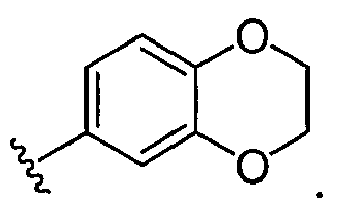
- Unless otherwise stated, structures depicted herein are also meant to include all isomeric (e.g., enantiomeric, diastereomeric, and geometric (or conformational)) forms of the structure; for example, the R and S configurations for each asymmetric center, (Z) and (E) double bond isomers, and (Z) and (E) conformational isomers. Therefore, single stereochemical isomers as well as enantiomeric, diastereomeric, and geometric (or conformational) mixtures of the present compounds are within the scope of the invention. Unless otherwise stated, all tautomeric forms of the compounds of the invention are within the scope of the invention. Additionally, unless otherwise stated, structures depicted herein are also meant to include compounds that differ only in the presence of one or more isotopically enriched atoms. For example, compounds having the present structures except for the replacement of hydrogen by deuterium or tritium, or the replacement of a carbon by a 13C- or 14C-enriched carbon are within the scope of this invention. Such compounds are useful, for example, as analytical tools or probes in biological assays.
- 3. Description of Exemplary Compounds:
- Preferred rings formed by R1 and R2 of formula I are selected from an optionally substituted 5-7 membered saturated, partially unsaturated, or fully unsaturated ring having 0-2 heteroatoms independently selected from nitrogen, oxygen, or sulfur. More preferred optionally substituted rings formed by R1 and R2 are selected from benzo, thieno, cyclohexo, pyrido, tetrahydropyrido, or pyrimido. Preferred substituents on the ring formed by R1 and R2 are selected from halogen, R°, OR°, N(R°)2, and SR°, wherein R° is defined generally and in subsets herein. More preferred substituents on the ring formed by R1 and R2 are selected from chloro, bromo, fluoro, Me, Et, CF3, OH, and OCH3.
- Preferred Q groups of formula I are selected from a valence bond, -C(O)-, - C(O)NR-, -CO2-, -C(O)CO2-, -SO2-, or a C1-4 alkylidene chain wherein one or two non-adjacent methylene units of Q are optionally and independently replaced by -O-, -S-, -NR-, - C(O)-, -CO2- or -SO2- More preferred Q groups of formula I are selected from a valence bond, -C(O)-, -C(O)NH-, -CO2-, -C(O)CO2-, -SO2- -C(O)CH2O- -C(O)CH2S-, or - C(O)NHCH2-.
- Preferred R3 groups of formula I are selected from an optionally substituted C1-6 aliphatic group, or an optionally substituted ring selected from:
- (a) a 3-6 membered monocyclic saturated or aryl ring;
- (b) a 5-6 membered heterocyclic ring having 1-2 heteroatoms independently selected from nitrogen, oxygen, or sulfur; or
- (c) a 5-6 membered monocyclic or a 9-10 membered bicyclic heteroaryl ring having 1-3 heteroatoms independently selected from nitrogen, oxygen, or sulfur.
- More preferred R3 groups of formula I are optionally substituted groups selected from methyl, ethyl, propyl, isopropyl, isobutyl, tert-butyl, cyclopropyl, cyclopentyl, cyclohexyl, phenyl, pyridyl, thienyl, furanyl, isoxazolyl, triazolyl, benzothienyl, or benzo[1,3]dioxolyl. Preferred substituents on R3, when present, are selected from R°, halogen, N(R°)2, OR°, or SR°, wherein R° is defined generally and in subsets herein.
- According to one embodiment, the present invention relates to a compound of formula II:

- Preferred Q, R1 R2, and R3 groups of formula II are as described above for compounds of formula I.
- According to another embodiment, the present invention relates to a compound of formula III:

- Preferred Q, R1, R2, and R3 groups of formula III are as described above for compounds of formula I.
- According to another embodiment, the present invention relates to a compound of formula IV:

- Preferred Q, R1, R2, and R3 groups of formula IV are as described above for compounds of formula I.
- According to another emobodiment, the present invention relates to a compound of formula II, III, or IV, Name , wherein X is sulfur.
- According to another emobodiment, the present invention relates to a compound of formula II, III, or IV, wherein R1 and R2 form a benzo ring.
- Representative examples of compounds of formula I are set forth below in Table 1.
-


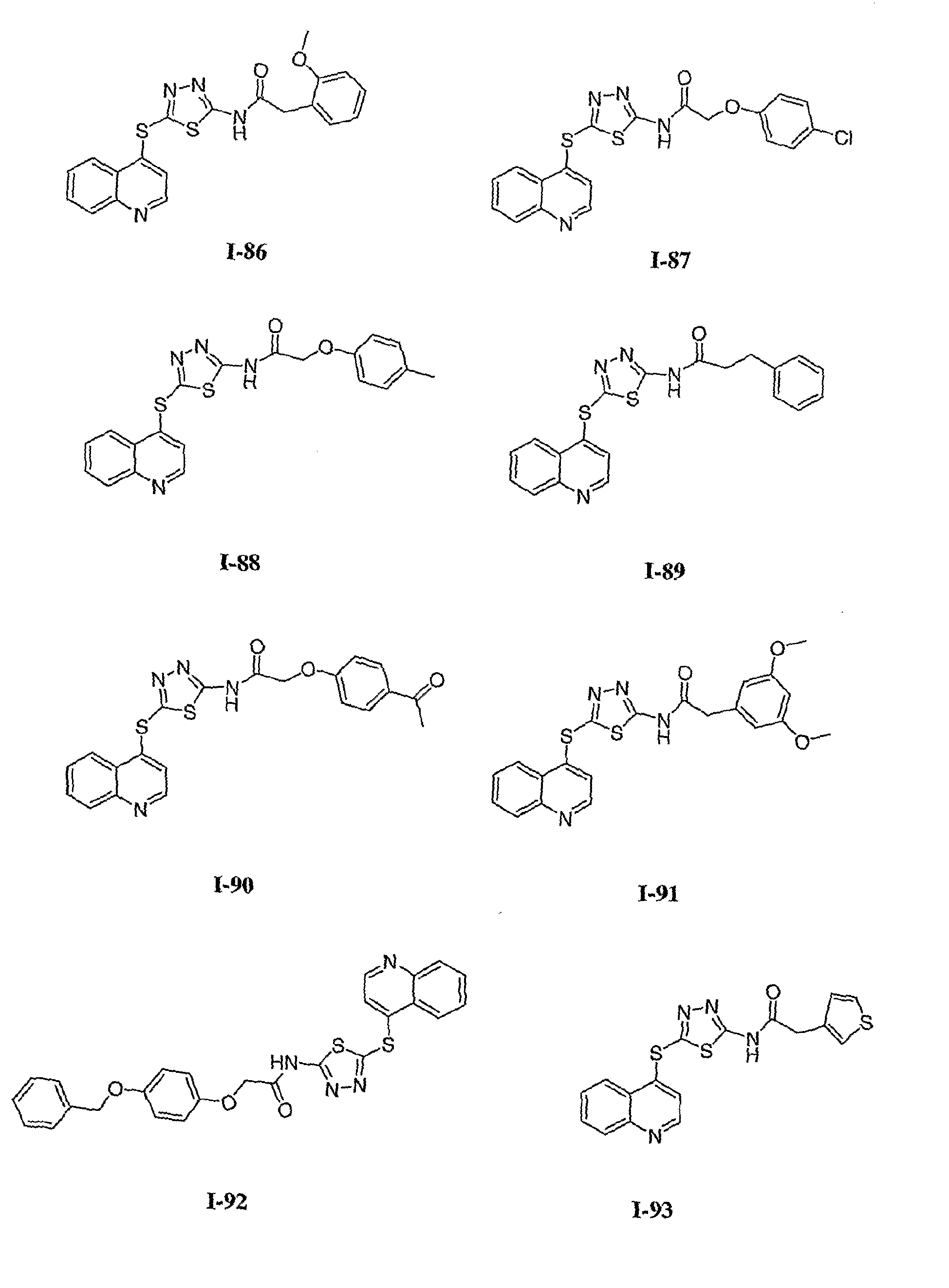


- 4. General Synthetic Methodology:
- The compounds of this invention may be prepared in general by methods know to those skilled in the art for analogous compounds, as illustrated by the general scheme below, and the preparative examples that follow.
-

- Scheme I above shows a general method for preparing compounds of formula I where Q is a valence bond and R3 is hydrogen (3). The leaving group L of compound 1 may be displaced by the sulfide compound 2 to form compound 3. A variety of L leaving groups are useful for this synthesis, including but not limited to chloro and bromo. Compound 3 is a useful intermediate in forming a variety of compounds of formula I using methods known to one of skill in the art and as illustrated in the Synthetic Schemes below.
-

- Scheme II above shows a method for preparing compounds of formula I wherein Q is a carbonyl group. These compounds may be prepared by treating compound 3 with an acid chloride of the formula R3C(O)Cl to form the amide compound 4. Alternatively, one may treat compound 3 with a carboxylic acid in the presence of a chloroformate as shown in step (b) above to form the amide compound 4. A wide variety of aliphatic and aryl acid chloride reagents are amenable to this reaction to form a variety of compounds of formula I wherein R3 is aliphatic, aryl, heterocyclyl, or heteroaryl.
-

- Scheme III above shows a method for preparing compounds of formula I wherein Q is a -CO2- group. These compounds may be prepared by treating compound 3 with a chloroformate compound of formula R3OC(O)Cl to form the carbamate compound 5. A wide variety of aliphatic and aryl chloroformate reagents are amenable to this reaction to form a variety of compounds of formula I wherein R3 is aliphatic, aryl, heterocyclyl, or heteroaryl.
-

- Scheme IV above shows a method for preparing compounds of formula I wherein Q is a -C(O)NH- group. These compounds may be prepared by treating compound 3 with an isocyanate compound of formula R3NCO to form the urea compound 6. A wide variety of aliphatic and aryl isocyanate reagents are amenable to this reaction to form a variety of compounds of formula I wherein R3 is aliphatic, aryl, heterocyclyl, or heteroaryl.
-


- Scheme V above shows a general method for preparing compounds of formula I wherein Q is -SO2-. Compound 3 may be treated with sodium nitrate in the presence of HCl-H2O to form the chloro compound 9. The chloro substituent of compound 9 may then be displaced by a reagent having the formula R3SO2NH2 in order to form the sulfonamide compound 10. A wide variety of aliphatic and aryl sulfonamide reagents are amenable to this reaction to form a variety of compounds of formula I wherein R3 is aliphatic, aryl, heterocyclyl, or heteroaryl.
-

- Scheme VI above shows an alternative method for preparing compounds of the present invention wherein Q is a valence bond (8). The leaving group L of compound 1 may be displaced by the sulfide compound 7 to form compound 8. A variety of L leaving groups are useful for this synthesis, including but not limited to chloro and bromo. A wide variety of aliphatic and aryl sulfonamide reagents are amenable to this reaction to form a variety of compounds of formula I wherein R3 is aliphatic, aryl, heterocyclyl, or heteroaryl.
- Although certain exemplary embodiments are depicted and described above and herein, it will be appreciated that a compounds of the invention can be prepared according to the methods described generally above using appropriate starting materials by methods generally available to one of ordinary skill in the art.
- 5. Uses, Formulation and Administration
- Pharmaceutically acceptable compositions
- As discussed above, the present invention provides compounds that are inhibitors of protein kinases, and thus the present compounds are useful for the treatment of diseases, disorders, and conditions including, but not limited to, allergic disorders such as asthma and atopic dermatitis, autoimmune diseases such as SLE lupus and psoriasis, and conditions associated with organ transplantation.
- Accordingly, in another aspect of the present invention, pharmaceutically acceptable compositions are provided, wherein these compositions comprise any of the compounds as described herein, and optionally comprise a pharmaceutically acceptable carrier, adjuvant or vehicle. In certain embodiments, these compositions optionally further comprise one or more additional therapeutic agents.
- Certain compounds of the present invention are commercially available (Maybridge plc, Trevillett, Tintagel, Cornwall PL34 OHW, England). However, these compounds are not known as inhibitors of JAK kinase nor as having any pharmaceutical use or as a component of a pharmaceutically acceptable composition. Commercially available compounds of the present invention are selected from:
- 3-Chloro-benzo[b]thiophene-2-carboxylic acid [5-(7-chloro-quinolin-4-ylsulfanyl)-[1,3,4]thiadiazol -2-yl]-amide;
- N-[5-(7-Chloro-quinolin-4-ylsulfanyl)-[1,3,4]thiadiazol-2-yl]-2-phenoxy-nicotinamide;
- 5-Methyl-2-phenyl-2H-[1,2,3]triazole-4-carboxylic acid [5-(7-chloro-quinolin-4-ylsulfanyl)-[1,3,4] thiadiazol-2-yl]-amide;
- Cyclopropanecarboxylic acid [5-(7-chloro-quinolin-4-ylsulfanyl)-[1,3,4]thiadiazol-2-yl]-amide;
- N-heptyl [5-(7-Chloro-quinolin-4-ylsulfanyl)-[1,3,4]thiadiazol-2-yl]-acetamide;
- Thiophene-2-carboxylic acid [5-(7-chloro-quinolin-4-ylsulfanyl)-[1,3,4]thiadiazol-2-yl]-amide;
- 5-(6-Ethyl-thieno[2,3-d]pyrimidin-4-ylsulfanyl)-[1,3,4]thiadiazol-2-ylamine;
- 5-(2-Chloro-thieno[2,3-b]pyridin-4-ylsulfanyl)-[1,3,4]thiadiazol-2-ylamine;
- 2-Chloro-N-[5-(7-chloro-quinolin-4-ylsulfanyl)-[1,3,4]thiadiazol-2-yl]-2-methylpropionamide;
- 2-Chloro-N-[5-(7-chloro-quinolin-4-ylsulfanyl)-[1,3,4]thiadiazol-2-yl]-2-methylpropionamide;
- 4-Hydroxy-2-oxo-2,3-dihydro-quinoline-3-carboxylic acid [5-(7-chloro-quinolin-4-ylsulfanyl)-[1,3,4]thiadiazol-2-yl]-amide;
- 1,3,4-thiadiazol-2-amine, 5-[(7-methylthieno [3,2-d] pyrimidin-4-yl) thio]-; and Acetamide, N[5-(1H-purin-6-ylthio)-1,3,4-thiadiazol-2-yl.
- It will also be appreciated that certain of the compounds of present invention can exist in free form for treatment, or where appropriate, as a pharmaceutically acceptable derivative thereof. According to the present invention, a pharmaceutically acceptable derivative includes, but is not limited to, pharmaceutically acceptable salts, esters, salts of such esters, or any other adduct or derivative which upon administration to a patient in need is capable of providing, directly or indirectly, a compound as otherwise described herein, or a metabolite or residue thereof.
- As used herein, the term "pharmaceutically acceptable salt" refers to those salts which are, within the scope of sound medical judgement, suitable for use in contact with the tissues of humans and lower animals without undue toxicity, irritation, allergic response and the like, and are commensurate with a reasonable benefit/risk ratio. A "pharmaceutically acceptable salt" means any non-toxic salt or salt of an ester of a compound of this invention that, upon administration to a recipient, is capable of providing, either directly or indirectly, a compound of this invention or an inhibitorily active metabolite or residue thereof. As used herein, the term "inhibitorily active metabolite or residue thereof" means that a metabolite or residue thereof is also an inhibitor of a JAK-3 kinase.
- Pharmaceutically acceptable salts are well known in the art. For example, S. M. Berge et al., describe pharmaceutically acceptable salts in detail in J. Pharmaceutical Sciences, 1977, 66, 1-19, incorporated herein by reference. Pharmaceutically acceptable salts of the compounds of this invention include those derived from suitable inorganic and organic acids and bases. Examples of pharmaceutically acceptable, nontoxic acid addition salts are salts of an amino group formed with inorganic acids such as hydrochloric acid, hydrobromic acid, phosphoric acid, sulfuric acid and perchloric acid or with organic acids such as acetic acid, oxalic acid, maleic acid, tartaric acid, citric acid, succinic acid or malonic acid or by using other methods used in the art such as ion exchange. Other pharmaceutically acceptable salts include adipate, alginate, ascorbate, aspartate, benzenesulfonate, benzoate, bisulfate, borate, butyrate, camphorate, camphorsulfonate, citrate, cyclopentanepropionate, digluconate, dodecylsulfate, ethanesulfonate, formate, fumarate, glucoheptonate, glycerophosphate, gluconate, hemisulfate, heptanoate, hexanoate, hydroiodide, 2-hydroxy-ethanesulfonate, lactobionate, lactate, laurate, lauryl sulfate, malate, maleate, malonate, methanesulfonate, 2-naphthalenesulfonate, nicotinate, nitrate, oleate, oxalate, palmitate, pamoate, pectinate, persulfate, 3-phenylpropionate, phosphate, picrate, pivalate, propionate, stearate, succinate, sulfate, tartrate, thiocyanate, p-toluenesulfonate, undecanoate, valerate salts, and the like. Salts derived from appropriate bases include alkali metal, alkaline earth metal, ammonium and N+(C1-4alkyl)4 salts. This invention also envisions the quaternization of any basic nitrogen-containing groups of the compounds disclosed herein. Water or oil-soluble or dispersable products may be obtained by such quaternization. Representative alkali or alkaline earth metal salts include sodium, lithium, potassium, calcium, magnesium, and the like. Further pharmaceutically acceptable salts include, when appropriate, nontoxic. ammonium, quaternary ammonium, and amine cations formed using counterions such as halide, hydroxide, carboxylate, sulfate, phosphate, nitrate, loweralkyl sulfonate and aryl sulfonate.
- As described above, the pharmaceutically acceptable compositions of the present invention additionally comprise a pharmaceutically acceptable carrier, adjuvant, or vehicle, which, as used herein, includes any and all solvents, diluents, or other liquid vehicle, dispersion or suspension aids, surface active agents, isotonic agents, thickening or emulsifying agents, preservatives, solid binders, lubricants and the like, as suited to the particular dosage form desired. Remington's Pharmaceutical Sciences, Sixteenth Edition, E. W. Martin (Mack Publishing Co., Easton, Pa., 1980) discloses various carriers used in formulating pharmaceutically acceptable compositions and known techniques for the preparation thereof. Except insofar as any conventional carrier medium is incompatible with the compounds of the invention, such as by producing any undesirable biological effect or otherwise interacting in a deleterious manner with any other component(s) of the pharmaceutically acceptable composition, its use is contemplated to be within the scope of this invention. Some examples of materials which can serve as pharmaceutically acceptable carriers include, but are not limited to, ion exchangers, alumina, aluminum stearate, lecithin, serum proteins, such as human serum albumin, buffer substances such as phosphates, glycine, sorbic acid, or potassium sorbate, partial glyceride mixtures of saturated vegetable fatty acids, water, salts or electrolytes, such as protamine sulfate, disodium hydrogen phosphate, potassium hydrogen phosphate, sodium chloride, zinc salts, colloidal silica, magnesium trisilicate, polyvinyl pyrrolidone, polyacrylates, waxes, polyethylene-polyoxypropylene-block polymers, wool fat, sugars such as lactose, glucose and sucrose; starches such as corn starch and potato starch; cellulose and its derivatives such as sodium carboxymethyl cellulose, ethyl cellulose and cellulose acetate; powdered tragacanth; malt; gelatin; talc; excipients such as cocoa butter and suppository waxes; oils such as peanut oil, cottonseed oil; safflower oil; sesame oil; olive oil; corn oil and soybean oil; glycols; such a propylene glycol or polyethylene glycol; esters such as ethyl oleate and ethyl laurate; agar; buffering agents such as magnesium hydroxide and aluminum hydroxide; alginic acid; pyrogen-free water; isotonic saline; Ringer's solution; ethyl alcohol, and phosphate buffer solutions, as well as other non-toxic compatible lubricants such as sodium lauryl sulfate and magnesium stearate, as well as coloring agents, releasing agents, coating agents, sweetening, flavoring and perfuming agents, preservatives and antioxidants can also be present in the composition, according to the judgment of the formulator.
- Uses of Compounds and Pharmaceutically acceptable compositions
- In yet another aspect, a method for the treatment or lessening the severity of allergic disorders such as asthma and atopic dermatitis, autoimmune diseases such as SLE lupus and psoriasis, and conditions associated with organ transplantation is provided comprising administering an effective amount of a compound, or a pharmaceutically acceptable composition comprising a compound to a subject in need thereof. In certain embodiments of the present invention an "effective amount" of the compound or pharmaceutically acceptable composition is that amount effective for the treatment of allergic disorders such as asthma and atopic dermatitis, autoimmune diseases such as SLE lupus and psoriasis, and conditions associated with organ transplantation.
- The compounds and compositions, according to the method of the present invention, may be administered using any amount and any route of administration effective for treating or lessening the severity of allergic disorders such as asthma and atopic dermatitis, autoimmune diseases such as SLE lupus and psoriasis, and conditions associated with organ transplantation.
- The exact amount required will vary from subject to subject, depending on the species, age, and general condition of the subject, the severity of the infection, the particular agent, its mode of administration, and the like. The compounds of the invention are preferably formulated in dosage unit form for ease of administration and uniformity of dosage. The expression "dosage unit form" as used herein refers to a physically discrete unit of agent appropriate for the patient to be treated. It will be understood, however, that the total daily usage of the compounds and compositions of the present invention will be decided by the attending physician within the scope of sound medical judgment. The specific effective dose level for any particular patient or organism will depend upon a variety of factors including the disorder being treated and the severity of the disorder; the activity of the specific compound employed; the specific composition employed; the age, body weight, general health, sex and diet of the patient; the time of administration, route of administration, and rate of excretion of the specific compound employed; the duration of the treatment; drugs used in combination or coincidental with the specific compound employed, and like factors well known in the medical arts. The term "patient", as used herein, means an animal, preferably a mammal, and most preferably a human.
- The pharmaceutically acceptable compositions of this invention can be administered to humans and other animals orally, rectally, parenterally, intracisternally, intravaginally, intraperitoneally, topically (as by powders, ointments, or drops), bucally, as an oral or nasal spray, or the like, depending on the severity of the infection being treated. In certain embodiments, the compounds of the invention may be administered orally or parenterally at dosage levels of about 0.01 mg/kg to about 50 mg/kg and preferably from about 1 mg/kg to about 25 mg/kg, of subject body weight per day, one or more times a day, to obtain the desired therapeutic effect.
- Liquid dosage forms for oral administration include, but are not limited to, pharmaceutically acceptable emulsions, microemulsions, solutions, suspensions, syrups and elixirs. In addition to the active compounds, the liquid dosage forms may contain inert diluents commonly used in the art such as, for example, water or other solvents, solubilizing agents and emulsifiers such as ethyl alcohol, isopropyl alcohol, ethyl carbonate, ethyl acetate, benzyl alcohol, benzyl benzoate, propylene glycol, 1,3-butylene glycol, dimethylformamide, oils (in particular, cottonseed, groundnut, corn, germ, olive, castor, and sesame oils), glycerol, tetrahydrofurfuryl alcohol, polyethylene glycols and fatty acid esters of sorbitan, and mixtures thereof. Besides inert diluents, the oral compositions can also include adjuvants such as wetting agents, emulsifying and suspending agents, sweetening, flavoring, and perfuming agents.
- Injectable preparations, for example, sterile injectable aqueous or oleaginous suspensions may be formulated according to the known art using suitable dispersing or wetting agents and suspending agents. The sterile injectable preparation may also be a sterile injectable solution, suspension or emulsion in a nontoxic parenterally acceptable diluent or solvent, for example, as a solution in 1,3-butanediol. Among the acceptable vehicles and solvents that may be employed are water, Ringer's solution, U.S.P. and isotonic sodium chloride solution. In addition, sterile, fixed oils are conventionally employed as a solvent or suspending medium. For this purpose any bland fixed oil can be employed including synthetic mono- or diglycerides. In addition, fatty acids such as oleic acid are used in the preparation of injectables.
- The injectable formulations can be sterilized, for example, by filtration through a bacterial-retaining filter, or by incorporating sterilizing agents in the form of sterile solid compositions which can be dissolved or dispersed in sterile water or other sterile injectable medium prior to use.
- In order to prolong the effect of a compound of the present invention, it is often desirable to slow the absorption of the compound from subcutaneous or intramuscular injection. This may be accomplished by the use of a liquid suspension of crystalline or amorphous material with poor water solubility. The rate of absorption of the compound then depends upon its rate of dissolution that, in turn, may depend upon crystal size and crystalline form. Alternatively, delayed absorption of a parenterally administered compound form is accomplished by dissolving or suspending the compound in an oil vehicle. Injectable depot forms are made by forming microencapsule matrices of the compound in biodegradable polymers such as polylactide-polyglycolide. Depending upon the ratio of compound to polymer and the nature of the particular polymer employed, the rate of compound release can be controlled. Examples of other biodegradable polymers include poly(orthoesters) and poly(anhydrides). Depot injectable formulations are also prepared by entrapping the compound in liposomes or microemulsions that are compatible with body tissues.
- Compositions for rectal or vaginal administration are preferably suppositories which can be prepared by mixing the compounds of this invention with suitable non-irritating excipients or carriers such as cocoa butter, polyethylene glycol or a suppository wax which are solid at ambient temperature but liquid at body temperature and therefore melt in the rectum or vaginal cavity and release the active compound.
- Solid dosage forms for oral administration include capsules, tablets, pills, powders, and granules. In such solid dosage forms, the active compound is mixed with at least one inert, pharmaceutically acceptable excipient or carrier such as sodium citrate or dicalcium phosphate and/or a) fillers or extenders such as starches, lactose, sucrose, glucose, mannitol, and silicic acid, b) binders such as, for example, carboxymethylcellulose, alginates, gelatin, polyvinylpyrrolidinone, sucrose, and acacia, c) humectants such as glycerol, d) disintegrating agents such as agar--agar, calcium carbonate, potato or tapioca starch, alginic acid, certain silicates, and sodium carbonate, e) solution retarding agents such as paraffin, f) absorption accelerators such as quaternary ammonium compounds, g) wetting agents such as, for example, cetyl alcohol and glycerol monostearate, h) absorbents such as kaolin and bentonite clay, and i) lubricants such as talc, calcium stearate, magnesium stearate, solid polyethylene glycols, sodium lauryl sulfate, and mixtures thereof. In the case of capsules, tablets and pills, the dosage form may also comprise buffering agents.
- Solid compositions of a similar type may also be employed as fillers in soft and hard-filled gelatin capsules using such excipients as lactose or milk sugar as well as high molecular weight polyethylene glycols and the like. The solid dosage forms of tablets, dragees, capsules, pills, and granules can be prepared with coatings and shells such as enteric coatings and other coatings well known in the pharmaceutical formulating art. They may optionally contain opacifying agents and can also be of a composition that they release the active ingredient(s) only, or preferentially, in a certain part of the intestinal tract, optionally, in a delayed manner. Examples of embedding compositions that can be used include polymeric substances and waxes. Solid compositions of a similar type may also be employed as fillers in soft and hard-filled gelatin capsules using such excipients as lactose or milk sugar as well as high molecular weight polethylene glycols and the like.
- The active compounds can also be in micro-encapsulated form with one or more excipients as noted above. The solid dosage forms of tablets, dragees, capsules, pills, and granules can be prepared with coatings and shells such as enteric coatings, release controlling coatings and other coatings well known in the pharmaceutical formulating art. In such solid dosage forms the active compound may be admixed with at least one inert diluent such as sucrose, lactose or starch. Such dosage forms may also comprise, as is normal practice, additional substances other than inert diluents, e.g., tableting lubricants and other tableting aids such a magnesium stearate and microcrystalline cellulose. In the case of capsules, tablets and pills, the dosage forms may also comprise buffering agents. They may optionally contain opacifying agents and can also be of a composition that they release the active ingredient(s) only, or preferentially, in a certain part of the intestinal tract, optionally, in a delayed manner. Examples of embedding compositions that can be used include polymeric substances and waxes.
- Dosage forms for topical or transdermal administration of a compound of this invention include ointments, pastes, creams, lotions, gels, powders, solutions, sprays, inhalants or patches. The active component is admixed under sterile conditions with a pharmaceutically acceptable carrier and any needed preservatives or buffers as may be required. Ophthalmic formulation, ear drops, and eye drops are also contemplated as being within the scope of this invention. Additionally, the present invention contemplates the use of transdermal patches, which have the added advantage of providing controlled delivery of a compound to the body. Such dosage forms can be made by dissolving or dispensing the compound in the proper medium. Absorption enhancers can also be used to increase the flux of the compound across the skin. The rate can be controlled by either providing a rate controlling membrane or by dispersing the compound in a polymer matrix or gel.
- As described generally above, the compounds of the invention are useful as inhibitors of protein kinases. In one embodiment, the compounds and compositions of the invention are inhibitors of JAK-3, and thus, without wishing to be bound by any particular theory, the compounds and compositions are particularly useful for treating or lessening the severity of a disease, condition, or disorder where activation of one or more of JAK-3 is implicated in the disease, condition, or disorder. When activation of JAK-3 is implicated in a particular disease, condition, or disorder, the disease, condition, or disorder may also be referred to as "JAK-3-mediated disease" or disease symptom. Accordingly, in another aspect, the present invention provides a method for treating or lessening the severity of a disease, condition, or disorder where activation or one or more of JAK-3 is implicated in the disease state.
- The activity of a compound utilized in this invention as an inhibitor of JAK-3, may be assayed in vitro, in vivo or in a cell line. In vitro assays include assays that determine inhibition of either the phosphorylation activity or ATPase activity of activated JAK-3. Alternate in vitro assays quantitate the ability of the inhibitor to bind to JAK-3. Inhibitor binding may be measured by radiolabelling the inhibitor prior to binding, isolating the inhibitor/JAK-3, complex and determining the amount of radiolabel bound. Alternatively, inhibitor binding may be determined by running a competition experiment where new inhibitors are incubated with JAK-3 bound to known radioligands.
- The term "measurably inhibit", as used herein means a measurable change in JAK-3 activity between a sample comprising said composition and a JAK-3 kinase and an equivalent sample comprising JAK-3 kinase in the absence of said composition.
- The term "JAK-mediated disease", as used herein means any disease or other deleterious condition in which a JAK family kinase, in particular JAK-3, is known to play a role. Such conditions include, without limitation, immune responses such as allergic or type I hypersensitivity reactions, asthma, autoimmune diseases such as transplant rejection, graft versus host disease, rheumatoid arthritis, amyotrophic lateral sclerosis, and multiple sclerosis, neurodegenerative disorders such as Familial amyotrophic lateral sclerosis (FALS), as well as in solid and hematologic malignancies such as leukemias and lymphomas.
- It will also be appreciated that the compounds and pharmaceutically acceptable compositions of the present invention can be employed in combination therapies, that is, the compounds and pharmaceutically acceptable compositions can be administered concurrently with, prior to, or subsequent to, one or more other desired therapeutics or medical procedures. The particular combination of therapies (therapeutics or procedures) to employ in a combination regimen will take into account compatibility of the desired therapeutics and/or procedures and the desired therapeutic effect to be achieved. It will also be appreciated that the therapies employed may achieve a desired effect for the same disorder (for example, an inventive compound may be administered concurrently with another agent used to treat the same disorder), or they may achieve different effects (e.g., control of any adverse effects). As used herein, additional therapeutic agents that are normally administered to treat or prevent a particular disease, or condition, are known as "appropriate for the disease, or condition, being treated".
- For example, chemotherapeutic agents or other anti-proliferative agents may be combined with the compounds of this invention to treat proliferative diseases and cancer. Examples of known chemotherapeutic agents include, but are not limited to, For example, other therapies or anticancer agents that may be used in combination with the inventive anticancer agents of the present invention include surgery, radiotherapy (in but a few examples, gamma.-radiation, neutron beam radiotherapy, electron beam radiotherapy, proton therapy, brachytherapy, and systemic radioactive isotopes, to name a few), endocrine therapy, biologic response modifiers (interferons, interleukins, and tumor necrosis factor (TNF) to name a few), hyperthermia and cryotherapy, agents to attenuate any adverse effects (e.g., antiemetics), and other approved chemotherapeutic drugs, including, but not limited to, alkylating drugs (mechlorethamine, chlorambucil, Cyclophosphamide, Melphalan, Ifosfamide), antimetabolites (Methotrexate), purine antagonists and pyrimidine antagonists (6-Mercaptopurine, 5-Fluorouracil, Cytarabile, Gemcitabine), spindle poisons (Vinblastine, Vincristine, Vinorelbine, Paclitaxel), podophyllotoxins (Etoposide, Irinotecan, Topotecan), antibiotics (Doxorubicin, Bleomycin, Mitomycin), nitrosoureas (Carmustine, Lomustine), inorganic ions (Cisplatin, Carboplatin), enzymes (Asparaginase), and hormones (Tamoxifen, Leuprolide, Flutamide, and Megestrol), Gleevec™, adriamycin, dexamethasone, and cyclophosphamide. For a more comprehensive discussion of updated cancer therapies see, http://www.nci.nih.gov/, a list of the FDA approved oncology drugs at http://www.fda.gov/cder/cancer/druglistframe.htm, and The Merck Manual, Seventeenth Ed. 1999, the entire contents of which are hereby incorporated by reference.
- Other examples of agents the inhibitors of this invention may also be combined with include, without limitation: treatments for Alzheimer's Disease such as Aricept® and Excelon®; treatments for Parkinson's Disease such as L-DOPA/carbidopa, entacapone, ropinrole, pramipexole, bromocriptine, pergolide, trihexephendyl, and amantadine; agents for treating Multiple Sclerosis (MS) such as beta interferon (e.g., Avonex® and Rebif®), Copaxone®, and mitoxantrone; treatments for asthma such as albuterol and Singular®; agents for treating schizophrenia such as zyprexa, risperdal, seroquel, and haloperidol; anti-inflammatory agents such as corticosteroids, TNF blockers, IL-1 RA, azathioprine, cyclophosphamide, and sulfasalazine; immunomodulatory and immunosuppressive agents such as cyclosporin, tacrolimus, rapamycin, mycophenolate mofetil, interferons, corticosteroids, cyclophosphamide, azathioprine, and sulfasalazine; neurotrophic factors such as acetylcholinesterase inhibitors, MAO inhibitors, interferons, anti-convulsants, ion channel blockers, riluzole, and anti-Parkinsonian agents; agents for treating cardiovascular disease such as beta-blockers, ACE inhibitors, diuretics, nitrates, calcium channel blockers, and statins; agents for treating liver disease such as corticosteroids, cholestyramine, interferons, and anti-viral agents; agents for treating blood disorders such as corticosteroids, anti-leukemic agents, and growth factors; and agents for treating immunodeficiency disorders such as gamma globulin.
- The amount of additional therapeutic agent present in the compositions of this invention will be no more than the amount that would normally be administered in a composition comprising that therapeutic agent as the only active agent. Preferably the amount of additional therapeutic agent in the presently disclosed compositions will range from about 50% to 100% of the amount normally present in a composition comprising that agent as the only therapeutically active agent.
- The compounds of this invention or pharmaceutically acceptable compositions thereof may also be incorporated into compositions for coating implantable medical devices, such as prostheses, artificial valves, vascular grafts, stents and catheters. Accordingly, the present invention, in another aspect, includes a composition for coating an implantable device comprising a compound of the present invention as described generally above, and in classes and subclasses herein, and a carrier suitable for coating said implantable device. In still another aspect, the present invention includes an implantable device coated with a composition comprising a compound of the present invention as described generally above, and in classes and subclasses herein, and a carrier suitable for coating said implantable device.
- Vascular stents, for example, have been used to overcome restenosis (re-narrowing of the vessel wall after injury). However, patients using stents or other implantable devices risk clot formation or platelet activation. These unwanted effects may be prevented or mitigated by pre-coating the device with a pharmaceutically acceptable composition comprising a kinase inhibitor. Suitable coatings and the general preparation of coated implantable devices are described in
US Patents 6,099,562 ;5,886,026 ; and5,304,121 . The coatings are typically biocompatible polymeric materials such as a hydrogel polymer, polymethyldisiloxane, polycaprolactone, polyethylene glycol, polylactic acid, ethylene vinyl acetate, and mixtures thereof. The coatings may optionally be further covered by a suitable topcoat of fluorosilicone, polysaccarides, polyethylene glycol, phospholipids or combinations thereof to impart controlled release characteristics in the composition. - Another aspect of the invention relates to inhibiting JAK-3 activity in a biological sample or a patient, which method comprises administering to the patient, or contacting said biological sample with a compound of formula I or a composition comprising said compound. The term "biological sample", as used herein, includes, without limitation, cell cultures or extracts thereof; biopsied material obtained from a mammal or extracts thereof; and blood, saliva, urine, feces, semen, tears, or other body fluids or extracts thereof.
- Inhibition of JAK-3 kinase activity in a biological sample is useful for a variety of purposes that are known to one of skill in the art. Examples of such purposes include, but are not limited to, blood transfusion, organ-transplantation, biological specimen storage, and biological assays.
- A) General
- 1H NMR spectra were recorded at 400MHz using a Bruker DPX 400 instrument. 13C NMR spectra were recorded at 100MHz using the same instrument. LC/MS data were obtained using a Micromass ZQ or platform instrument with atmospheric pressure chemical ionisation. HPLC analysis were performed on a Phenomenex C18(2) Luna column (30 x 4.6 mm) maintained at 40°C. Samples were prepared as solutions in acetonitrile with approximate concentration of 1mg/mL. 1-5 µL were injected into the system. The compound was eluted using the following gradient at a flow rate of 2 mL/min:
- 0 min, 80% H2O-20%MeCN,
- 2.5 min, 0% H2O-100%MeCN,
- 3.5 min, 0% H2O-100%MeCN
- The eluent mixture was then returned to the starting conditions and the column reequilibrated for 1 min. Detection was via a diode array detector, the chromatograms for 214 and 254 being extracted. In all cases the elution time was identical for the two wavelengths.
- All reagents were obtained commercially and used directly. DMF was dried over 4Å molecular sieves (Fisher Scientific). Column chromatography employed Silica Gel 60 (Fluka). TLC was carried out using pre-coated plastic sheets Polygram SIL GIUV254 (Macherey-Nagel).
- B) Synthesis of Exemplary Compounds:
- In general, as depicted in the examples below,


- General procedure for the condensation of 5-amino-[1,3,5]thiadiazole-2-thiole and chloroheterocyclic compound

- NaH (1.2mmol) was added in portions to a solution of 5-amino-thiadiazole-2-thiol (1.1mmol) in DMF (8ml) at room temperature. After the addition was completed, the mixture was stirred at room temperature for 20min. The chloroheterocyclic compound (1.1mmol) was then added in one portion and the mixture heated at 80-90°C (oil bath temperature) for 18h. The reaction mixture was allowed to cool to room temperature and water (20-40ml) was added. The precipitate was separated by filtration, washed several times with cold water, then with Et2O and dried to afford the product (25-96% yield).
- General procedure for the preparation of amides
- procedure A:

- NEt3 (0.45mmol) was added dropwise to a suspension of the amine (0.3mmol) in MeCN (9ml). The mixture was then cooled to 0°C and the acid chloride (0.36mmol) was added dropwise. After being stirred at 0°C for 20min, the mixture was allowed to warm to room temperature and then heated at 80°C (oil bath temperature) for 18h. The product crystallised during the reaction and was separated by filtration from the warm solution, washed with cold Et2O and dried. In cases where the product did not crystallize, the solvent was evaporated under reduced pressure and the solid residue suspended in water (∼5ml). Undissolved material was separated by filtration, washed several times with water, then with Et2O and dried to afford the product (40-96% yield).
- procedure B

- To a suspension of amine (0.34mmol) in THF (15ml), acid (0.37mmol) was added followed by NEt3 (0.41mmol). The mixture was then cooled to 0°C and HBTU (0.37mmol) was added in one portion. After being stirred for 40min at 0°C, the mixture was warmed to room temperature and then heated at 50-60°C (oil bath temperature) for 18h. The reaction mixture was allowed to cool to room temperature and water (∼40ml) was added. The precipitate was separated by filtration, washed several times with water, Et2O and then dried to afford the product (43-56% yield).
- procedure C

- To a suspension of acid (0.39mmol) in THF (15ml), amine was added (0.43mmol) followed by EDCI (0.78mmol). The mixture was heated at 60°C under nitrogen atmosphere for 18h. The reaction mixture was allowed to cool to room temperature and water (-40ml) was added. The precipitate was separated by filtration washed with a small amount of water, Et2O and dried to afford the product (58-69% yield).
- Purification of amides

- When the product is a mixture of the amide and the starting amine the following procedure was used for the further purification:
- The mixture (0.15mmol), (including ∼15% amine, based on 1H NMR), was dissolved in DMF (2ml). To this solution, methylisocyanate polystyrene (3eq) was added and the mixture was shaken at 50-60°C for 18h. After being cooled to room temperature, the mixture was filtered and the resin washed with warm DMF (3x-2ml). The solvent was evaporated under reduced pressure, and the solid residue was washed with Et2O and dried to afford the product.
- General procedure for the preparation of carbamate derivatives

- The chlorocarbamate (0.33mmol) was added dropwise to a mixture of the amine (0.26mmol) in dry pyridine cooled to 0°C. The mixture was allowed to warm to room temperature and stirred for an additional 48h. Water (5ml) was then added, the precipitate collected by filtration, washed with water and Et2O and dried to afford the product (41-72% yield).
- When the starting amine is present in the product, the product was purified by the method described above using methylisocyanate polystyrene.
- General procedures for the preparation of urea derivatives
- procedure A

- Isocyanate (0.29mmol) was added to a suspension of amine (0.22mmol) in MeCN (10ml) and the mixture was heated at 70-75°C (oil bath temperature) for 18h. The product precipitated during the reaction and was separated from the warm reaction mixture by filtration, washed with Et2O and dried (35-67% yield).
- procedure B

- Amine (0.19mmo1) was added to a suspension of carbamate (0.15mmol) in DME (10ml) and the mixture was then heated at ∼80°C (oil bath temperature) for 18h. The solvent was evaporated and the solid residue washed with Et2O several times to afford the product (14-63% yield).
- Synthesis of 4-(5-chloro-[1,3,4]thiadiazol-2-yl sulfanyl)quinoline

- To a solution of amine (4.93mmol) in conc. HCl (20ml) cooled to -10°C, NaNO2 (14.8mmol) dissolved in H2O (4ml) was added dropwise, keeping temperature below 0°C. The reaction mixture was stirred at the same temperature for an additional 3h and then allowed to warm to room temperature. H2O (20ml) was added, the mixture neutralised with solid K2CO3 and extracted (EtOAc). The extract was dried (MgSO4), the solvent evaporated under reduced pressure and the residue purified by column chromatography (SiO2, petroleum ether / ethyl acetate, 1:1 v/v) to afford the product (53-95% yield).
- General procedure for the preparation of 4-(5-amino-[1,3,4]thiadiazol-2-yl sulfanyl)quinoline derivatives

- To a solution of chloride (0.72mmol) in NMP (5ml), NEt3 (0.8mmol) was added followed by amine (0.72mmol). The mixture was heated at 70°C (stem block temperature) under nitrogen atmosphere for 72h. The solvent was then evaporated under reduced pressure and the residue partitioned between EtOAc/H2O (20ml, 1:1 v/v). The organic layer was separated and the water layer extracted (EtOAc). The combined organic layers were dried (MgSO4), the solvent evaporated under reduced pressure and the residue purified by column chromatography (SiO2, petroleum ether / EtOAc 1:1 v/v) to afford the product.
- General procedure for the preparation of sulfonamide derivatives

- To a solution of chloride (0.12mmol) in DMF (2ml), sulfonamide (0.14mmol) was added followed by K2CO3 (0.24mmol) and the mixture was heated at 70°C (oil bath temperature) for 72h. The solvent was evaporated under reduced pressure and the residue partitioned between EtOAc/H2O (20ml, 1:1 v/v). The water layer was separated, acidified (2M HC1) to pH2 and then extracted (EtOAc). The extract was dried (MgSO4) and the solvent evaporated under reduced pressure to afford the product (8-56% yield).
- General procedure for the condensation of N-substituted 5-amino-thiadiazole-2-thiole and 4,7-dichloro-quinoline

- NaH (1.2mmol) was added in portions to a solution of N-subtituted 5-amino-thiadiazole-2-thiole (1.1mmol) in DMF (8ml) at room temperature under nitrogen atmosphere and the mixture was then stirred for 20min. Chloroheterocyclic compound (1.1mmol) was then added in one portion and the mixture heated at 70°C (oil bath temperature) for 3-18h. The reaction mixture was allowed to cool to room temperature and water (20-40ml) was added. The precipitated product was separated by filtration, washed several times with cold water and then with Et2O and dried to afford the product (10-95% yield).
- Synthesis of 5-(7-Chloro-quinolin-4-yloxy)-[1,3,4]thiadiazole-2-carboxylic acid ethyl ester

- NaH (0.022mg, 0.5mmol) was added in portions to a solution of 7-chloro-4-hydroxyquinoline (0.093mg, 0.5mmol) in DMF (6ml) at room temperature and the mixture stirred at room temperature for 20min. 2-Chloro-[1,3,4]thiadiazole derivative (0.097mg, 0.5mmol) was then added in one portion and the mixture heated at 70-80°C (oil bath temperature) for 18h. The reaction mixture was allowed to cool to room temperature and water (15-30ml) was added. The precipitate was separated by filtration, washed several times with cold water, then with Et2O and dried to afford the product (0.081mg, 47% yield).
- Synthesis of (7-Chloro-quinolin-4-yloxy)-[1,3,4]thiadiazole-2-carboxylic acid (furan-2-ylmethyl)-amide

- Ester (0.042mg, 12.0mmol) was added to a solution of the amine (0.035mg, 0.36mmol) in DME (4ml). The mixture was heated at 80°C for 18h. The solvent was evaporated and the residue triturated with Et2O to afford the product (0.035mg, 75%).
- General procedure for the condensation of heterocyclic thiols and heterocyclic bromides

- NaOMe (19.2mmol) was added in portions to a suspension of the bromo derivative (16mmol) and the thiol (16mmol) in MeOH (15ml) under nitrogen atmosphere at 0°C. The mixture was stirred at 0°C for 10 min, warm to room temperature and then heated at 45-50°C for 4-18h. Reaction mixture was allowed to cool to room temperature, the solvent evaporated under reduced pressure and the residue purified by column chromatography (SiO2, Et2O) to afford the product.
- Synthesis of heterocyclic amines from heterocyclic nitro compounds

- Activated Fe (0.22g, 3.9mmol) was added to a solution of the 2-nitrothiophene derivative (0.1g, 0.3mmol) in AcOH (3ml). The mixture was heated at 80 °C (oil bath temperature) for 10 min, allowed to cool to room temperature and then filtered over celite. The celite cake was washed with H2O. The filtrate was extracted (EtOAc), the aqueous layer was basified (Na2CO3) and extracted (EtOAc). The combined organic layers were washed with NaOH solution (2M), dried (Mg2SO4) and the solvent removed under reduced pressure. The residue was purified by column chromatography (SiO2, Et2O) to afford the product.
- Synthesis of thiophene-2-carboxylic acid amides
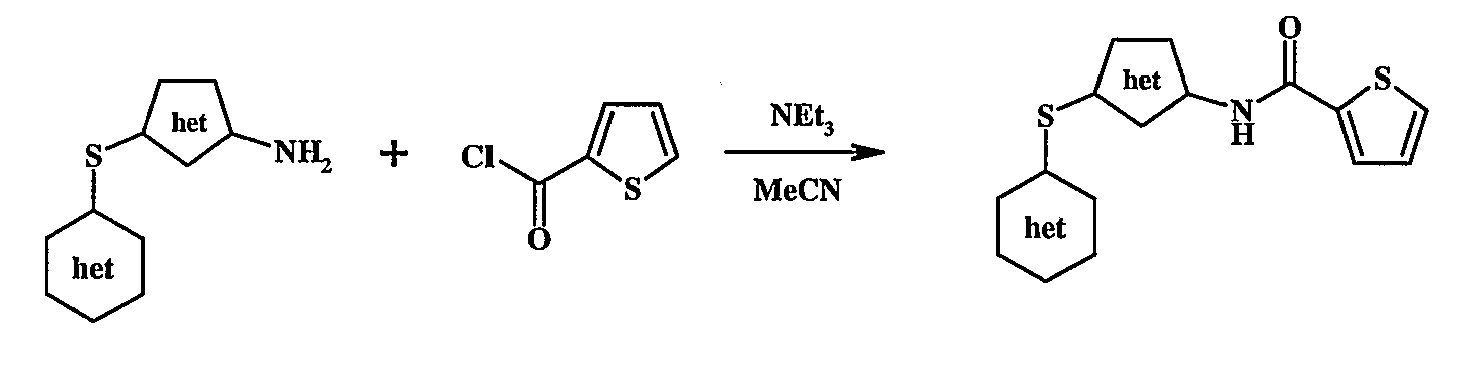
- These compounds have been made according to the general procedure (procedure A) for the preparation of amides. The crude reaction mixture was purified by column chromatography (SiO2 Et2O) to afford the product (18-62% yield).
- Synthesis of 5-Chloro-[1,3,4]thiadiazole-2-carboxylic acid (7-chloro-quinolin-4-yl)-amide

- NaH (0.023g, 0.58mmol) was added in portions to a solution of 4-amino-7-chloroquinoline (0.1g, 0.56mmol) in DMF (6ml) at room temperature and the mixture was stirred for 20 min. 5-Chloro-[1,3,4]thiadiazole derivative (0.108g, 0.56mmol) was then added in one portion and the mixture heated at 80°C (oil bath temperature) for 18h. The reaction mixture was allowed to cool to room temperature and water (15ml) was added. The precipitate was separated by filtration, washed with Et2O and dried to afford the product (0.08g, 60%yield).
- LCMS data are presented in Table 2 below for exemplary compounds of the invention:
-
Table 2 Structure (M+ H)+ 
355 
369 
370 
416 
346 
366 
422 
372 
409 
354 
459 
443 
384 
425 
355 
429 
409 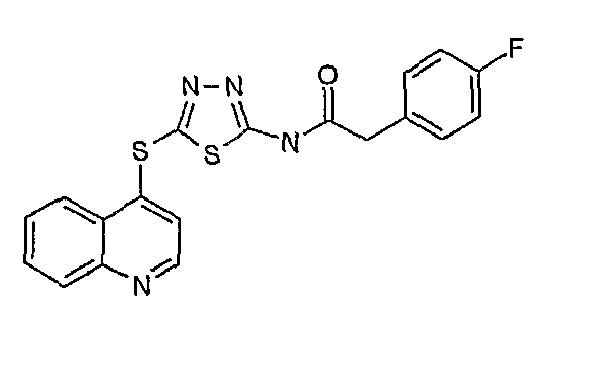
397 
385 
409 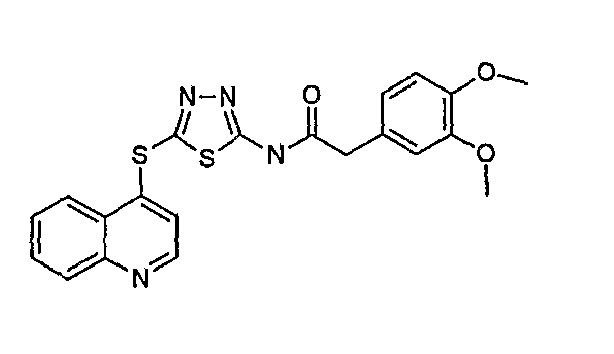
439 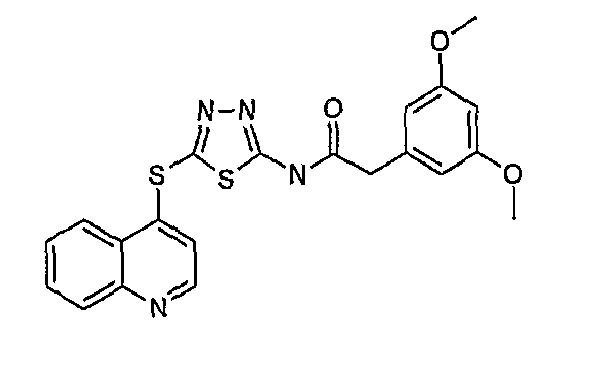
439 
404 
393 
407 
371 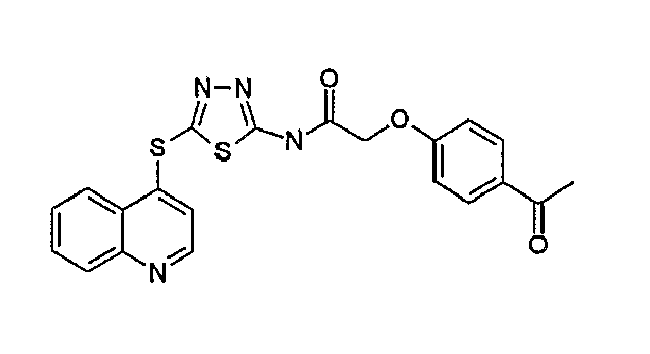
437 
413 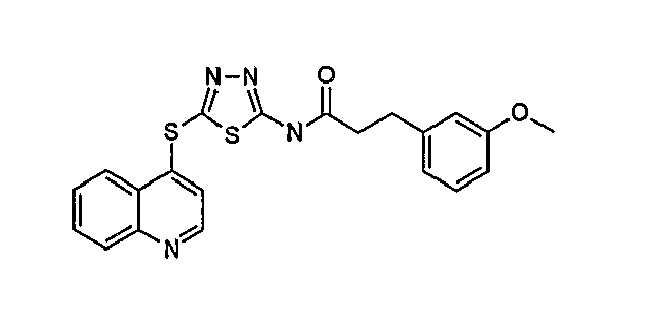
423 
445 
501 
409 
446 
456 
402 
392 
376 
378 
370 
432 
356 
385 
405 
383 
421 
405 
466 
401 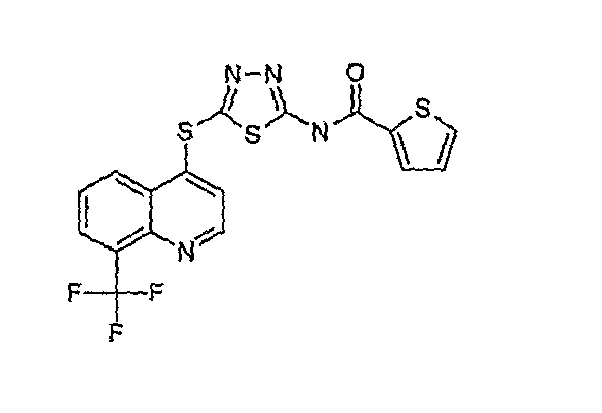
439 
365 
405 
429 
400 
371 
439 
550 
507 
443 
389 
389 
417 
446 
467 
365 
399 
417 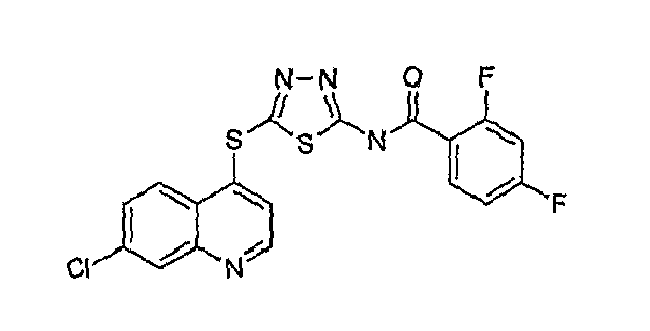
435 
417 
435 
443 
467 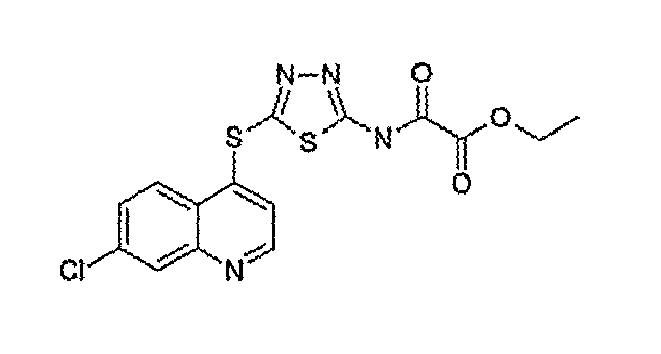
395 
379 
445 
389 
435 
459 
379 
405 
395 
415 
395 
448 
420 
448 
520 
481 
429 
472 
468 
462 
458 
471 
366 
428 
418 
435 
373 
309 
381 
3.71 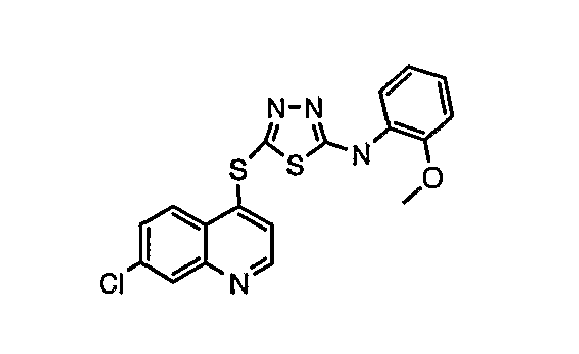
401 
401 - JAK Inhibition Assay
- Compound inhibition of JAK was assayed by the method described by G. R. Brown, et al, Bioorg. Med. Chem. Lett. 2000, vol. 10, pp 575-579 in the following manner. Into Maxisorb plates, previously coated at 4°C with Poly (Glu, Ala, Tyr) 6:3:1 then washed with phosphate buffered saline 0.05% and Tween (PBST), was added 2 µM ATP, 5 mM MgC12, and a solution of compound in DMSO. The reaction was started with JAK enzyme and the plates incubated for 60 minutes at 30°C. The plates were then washed with PBST, 100 µL HRP-Conjugated 4G10 antibody was added, and the plate incubated for 90 minutes at 30°C. The plate was again washed with PBST, 100 µL TMB solution is added, and the plates were incubated for another 30 minutes at 30°C. Sulfuric acid (100 µL of 1M) was added to stop the reaction and the plate is read at 450 nm to obtain the optical densities for analysis to determine IC50 values.
- Certain compounds of the present invention (including those depicted in Table 1) were tested in the above assay for JAK inhibition and were found to have an IC50 of less than 2 µM.
- Certain other compounds of the present invention (including those depicted in Table 1) were tested in the above assay for JAK inhibition and were found to have an IC50 of between 2 and 5 µM.
The present invention further comprises the aspects defined in the following clauses (which form part of the present description but are not considered as claims in accordance with decision J 15/88 of Legal Board of Appeal of the European Patent Office): - 1. A compound of formula I:

- W and X are each independently oxygen or sulfur;
- A is nitrogen, CH, C-CN, or C-(C1-3 aliphatic);
- R1 and R2 are taken together to form an optionally substituted 3-7 membered saturated,
partially unsaturated, or fully unsaturated ring having 0-3 heteroatoms independently selected from nitrogen, oxygen, or sulfur; - Q is a valence bond, -C(O)-, -C(O)NR-, -C(O)C(O)-, -CO2- -C(O)CO2-, -SO2-, or an
optionally substituted C1-6 alkylidene chain, wherein:- one or two non-adjacent methylene units of Q are optionally and independently
replaced by -O-, -S-, -NR-, -C(O)-, -CO2-, -C(O)NR-, -OC(O)NR-, -NRC(O)-, NRCO2-, -NRC(O)NR-, -S(O)-, -SO2-, -NRSO2-, -SO2NR-, or -NRSO2NR-;
- one or two non-adjacent methylene units of Q are optionally and independently
- each R is independently hydrogen or an optionally substituted C1-6 aliphatic group, wherein:
- two R bound to the same nitrogen atom are optionally taken together with the nitrogen
to form an optionally substituted 3-7 membered saturated, partially unsaturated, or fully unsaturated ring having 0-2 heteroatoms, in addition to the nitrogen bound thereto, independently selected from nitrogen, oxygen, or sulfur;
- two R bound to the same nitrogen atom are optionally taken together with the nitrogen
- R3 is R or Ar; and
- Ar is an optionally substituted ring selected from:
- (a) a 3-8 membered monocyclic or 8-10 membered bicyclic saturated, partially unsaturated, or aryl ring;
- (b) a 3-7 membered heterocyclic ring having 1-3 heteroatoms independently selected from nitrogen, oxygen, or sulfur; or
- (c) a 5-6 membered monocyclic or 8-10 membered bicyclic heteroaryl ring having 1-4
heteroatoms independently selected from nitrogen, oxygen, or sulfur, provided that said compound is not a compound selected from the group consisting of:- 3-Chloro-benzo[b]thiophene-2-carboxylic acid [5-(7-chloro-quinolin-4-ylsulfanyl)-[1,3,4]thiadiazol -2-yl]-amide;
- N-[5-(7-Chloro-quinolin-4-ylsulfanyl)-[1,3,4]thiadiazol-2-yl]-2-phenoxy-nicotinamide;
- 5-Methyl-2-phenyl-2H-[1,2,3]triazole-4-carboxylic acid [5-(7-chloro-quinolin-4-ylsulfanyl)-[1,3,4]
thiadiazol-2-yl]-amide; - Cyclopropanecarboxylic acid [5-(7-chloro-quinolin-4-ylsulfanyl)-[1,3,4]thiadiazol-2-yl]-amide;
- N-heptyl [5-(7-Chloro-quinolin-4-ylsulfanyl)-[1,3,4]thiadiazol-2-yl]-acetamide;
- Thiophene-2-carboxylic acid [5-(7-chloro-quinolin-4-ylsulfanyl)-[1,3,4]thiadiazol-2-yl]-amides;
- 5-(6-Ethyl-thieno[2,3-d]pyrimidin-4-ylsulfanyl)-[1,3,4]thiadiazol-2-ylamine;
- 5-(2-Chloro-thieno[2,3-b]pyridin-4-ylsulfanyl)-[1,3,4]thiadiazol-2-ylamine;
- 2-Chloro-N-[5-(7-chloro-quinolin-4-ylsulfanyl)-[1,3,4]thiadiazol-2-yl]-2-methylpropionamide;
- 2-Chloro-N-[5-(7-chloro-quinolin-4-ylsulfanyl)-[1,3,4]thiadiazol-2-yl]-2-methylpropionamide;
- 4-Hydroxy-2-oxo-2,3-dihydro-quinoline-3-carboxylic acid [5-(7-chloro-quinolin-4-ylsulfanyl)-[1,3,4]thiadiazol-2-yl]-amide;
- 1,3,4-thiadiazol-2-amine, 5-[(7-methylthieno [3,2-d] pyrimidin-4-yl) thio]-; and
- Acetamide, N[5-(1H-purin-6-ylthio)-1,3,4-thiadiazol-2-yl.
- 2. The compound according to clause1, wherein:
- R1 and R2 are taken together to form an optionally substituted 5-7 membered saturated, partially unsaturated, or fully unsaturated ring having 0-2 heteroatoms independently selected from nitrogen, oxygen, or sulfur.
- 3. The compound according to clause 2, wherein:
- R1 and R2 are taken together to form an optionally substituted benzo, thieno, cyclohexo, pyrido, tetrahydropyrido, or pyrimido ring.
- 4. The compound according to clause 1, wherein:
- Q is a valence bond, -C(O)-, -C(O)NR-, -CO2-, -C(O)CO2-, -SO2-, or an optionally substituted C1-4 alkylidene chain wherein:
- one or two non-adjacent methylene units of Q are optionally and independently
replaced by -O-, -S-, -NR-, -C(O)-, -CO2- or -SO2-.
- one or two non-adjacent methylene units of Q are optionally and independently
- 5. The compound according to clause1, wherein:
- R3 is an optionally substituted C1-6 aliphatic group, or an optionally substituted ring selected from:
- (a) a 3-6 membered monocyclic saturated or aryl ring;
- (b) a 5-6 membered heterocyclic ring having 1-2 heteroatoms independently selected from nitrogen, oxygen, or sulfur; or
- (c) a 5-6 membered monocyclic or a 9-10 membered bicyclic heteroaryl ring having 1-3 heteroatoms independently selected from nitrogen, oxygen, or sulfur.
- 6. The compound according to clause 5, wherein:
- R3 is an optionally substituted group selected from methyl, ethyl, propyl, isopropyl, isobutyl,
tert-butyl, cyclopropyl, cyclopentyl, cyclohexyl, phenyl, pyridyl, thienyl, furanyl, isoxazolyl, triazolyl, benzothienyl, or benzo[1,3]dioxolyl. - 7. The compound according to any one of clauses1-6, wherein W is sulfur.
- 8. The compound according to clause 7, wherein X is sulfur.
- 9. The compound according to clause 8, wherein A is nitrogen.
- 10. The compound according to clause 8, wherein A is CH.
- 11. A compound selected from the following compounds:


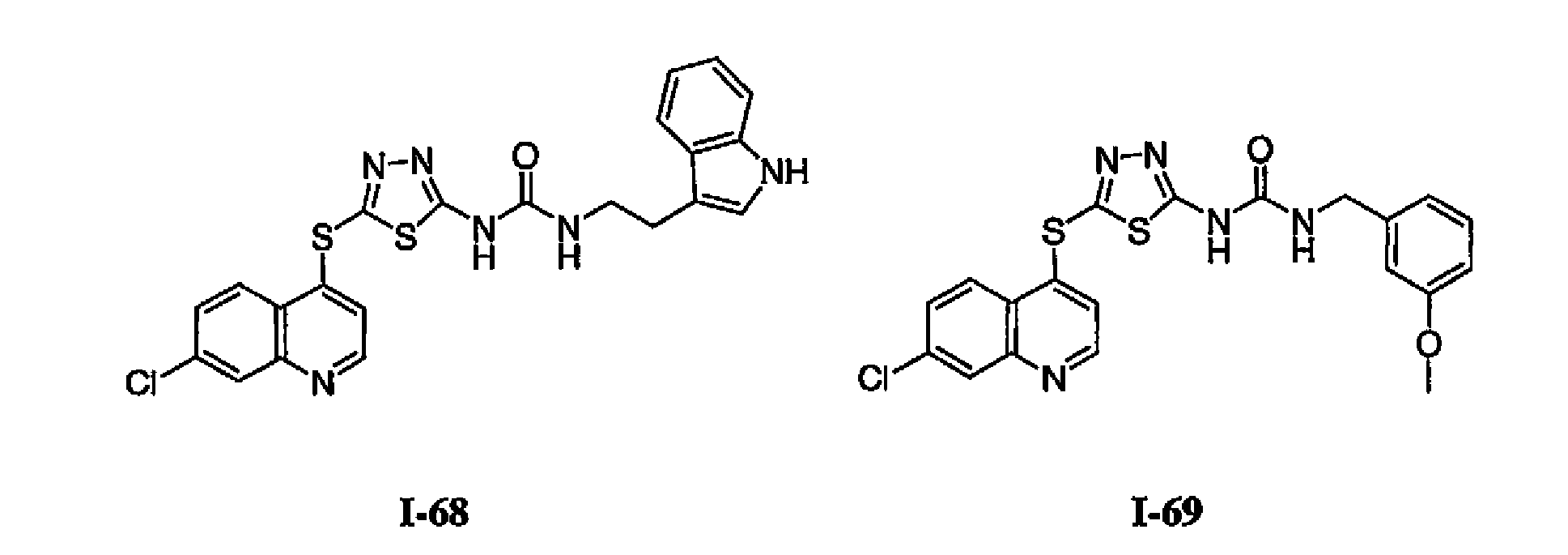


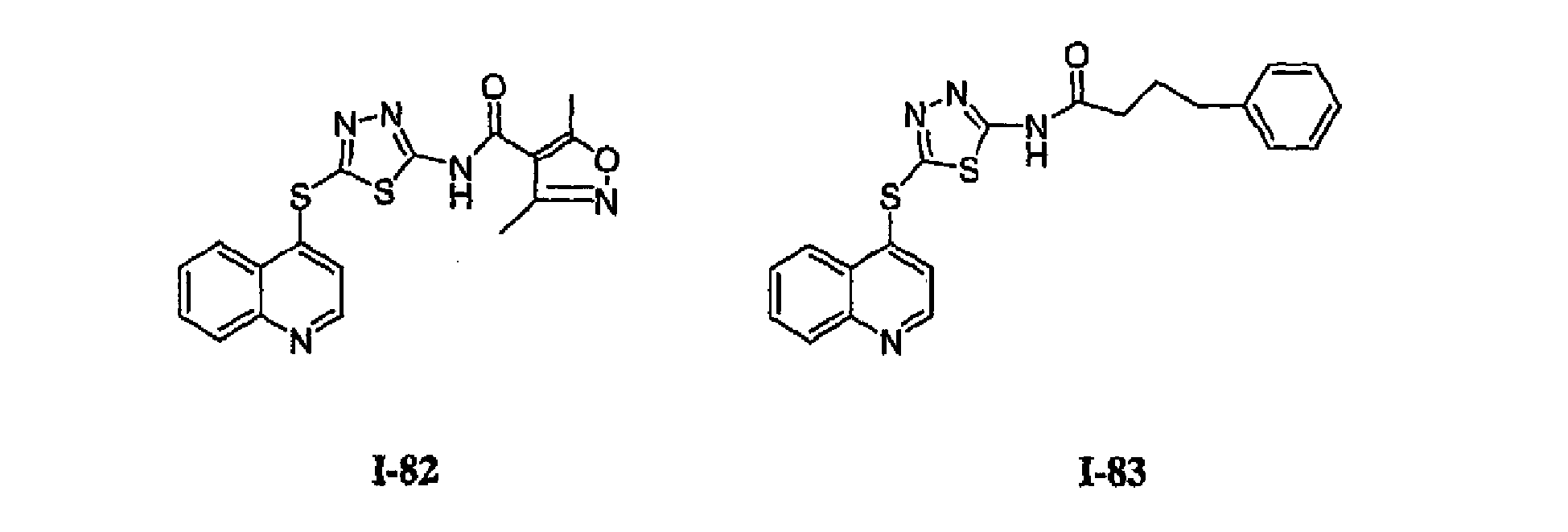





- 12. A composition comprising an effective amount of a compound of formula I:

wherein: - W and X are each independently oxygen or sulfur;
- A is nitrogen, CH, C-CN, or C-(C1-3 aliphatic);
- R1 and R2 are taken together to form an optionally substituted 3-7 membered saturated,
partially unsaturated, or fully unsaturated ring having 0-3 heteroatoms independently selected from nitrogen, oxygen, or sulfur; - Q is a valence bond, -C(O)-, -C(O)NR-, -C(O)C(O)-, -CO2-, -C(O)CO2-, -SO2-, or an
optionally substituted C1-6 alkylidene chain, wherein:- one or two non-adjacent methylene units of Q are optionally and independently
replaced by -O-, -S-, -NR-, -C(O)-, -CO2-, -C(O)NR-, -OC(O)NR-, -NRC(O)-, NRCO2-, -NRC(O)NR-, -S(O)-, -SO2-, -NRSO2-, -SO2NR-, or -NRSO2NR-;
- one or two non-adjacent methylene units of Q are optionally and independently
- each R is independently hydrogen or an optionally substituted C1-6 aliphatic group, wherein:
- two R bound to the same nitrogen atom are optionally taken together with the nitrogen
to form an optionally substituted 3-7 membered saturated, partially unsaturated, or fully unsaturated ring having 0-2 heteroatoms, in addition to the nitrogen bound thereto, independently selected from nitrogen, oxygen, or sulfur;
- two R bound to the same nitrogen atom are optionally taken together with the nitrogen
- R3 is selected from R or Ar; and
- Ar is an optionally substituted ring selected from:
- (a) a 3-8 membered monocyclic or 8-10 membered bicyclic saturated, partially unsaturated, or aryl ring;
- (b) a 3-7 membered heterocyclic ring having 1-3 heteroatoms independently selected from nitrogen, oxygen, or sulfur; or
- (c) a 5-6 membered monocyclic or 8-10 membered bicyclic heteroaryl ring having 1-4
heteroatoms independently selected from nitrogen, oxygen, or sulfur;
- 13. The composition according to clause12, wherein:
- R1 and R2 are taken together to form an optionally substituted 5-7 membered saturated, partially unsaturated, or fully unsaturated ring having 0-2 heteroatoms independently selected from nitrogen, oxygen, or sulfur.
- 14. The composition according to clause12, wherein:
- Q is a valence bond, -C(O)-, -C(O)NR-, -CO2-, -C(O)CO2-, -SO2-, or an optionally
substituted C1-4 alkylidene chain wherein:- one or two non-adjacent methylene units of Q are optionally and independently
replaced by -O-, -S-, -NR-, -C(O)-, -CO2-, or -SO2-.
- one or two non-adjacent methylene units of Q are optionally and independently
- 15. The composition according to clause12, wherein:
- R3 is an optionally substituted C1-6 aliphatic group, or an optionally substituted ring selected from:
- (a) a 3-6 membered monocyclic saturated or aryl ring;
- (b) a 5-6 membered heterocyclic ring having 1-2 heteroatoms independently selected from nitrogen, oxygen, or sulfur; or
- (c) a 5-6 membered monocyclic or a 9-10 membered bicyclic heteroaryl ring having 1-3 heteroatoms independently selected from nitrogen, oxygen, or sulfur. clauses
- 16. The composition according to any one of clauses12-15, wherein W is sulfur.
- 17. The composition according to clause16, wherein X is sulfur.
- 18. The composition according to clause16, wherein A is nitrogen.
- 19. The composition according to clause16, wherein A is CH.
- 20. The composition according to clause12, additionally comprising an additional therapeutic agent selected from an anti-proliferative agent, an anti-inflammatory agent, an immunomodulatory agent, a neurotrophic factor, or an agent for treating cardiovascular disease.
- 21. A method of inhibiting JAK-3 kinase activity in:
- (a) a patient; or
- (b) a biological sample;
which method comprises administering to said patient, or contacting said biological sample with a composition according to clause12, or a compound of formula I:
wherein:- W and X are each independently oxygen or sulfur;
- A is nitrogen, CH, C-CN, or C-(C1-3 aliphatic);
- R1 and R2 are taken together to form an optionally substituted 3-7 membered saturated,
partially unsaturated, or fully unsaturated ring having 0-3 heteroatoms independently selected from nitrogen, oxygen, or sulfur; - Q is a valence bond, -C(O)-, -C(O)NR-, -C(O)C(O)-, -CO2-, -C(O)CO2-, -SO2-, or an
optionally substituted C1-6 alkylidene chain, wherein:- one or two non-adjacent methylene units of Q are optionally and independently replaced by -O-, -S-, -NR-, -C(O)-, -CO2 -C(O)NR-, -OC(O)NR-, -NRC(O)-, NRCO2- -NRC(O)NR-, -S(O)-, -SO2-, -NRSO2-, -SO2NR-, or -NRSO2NR-;
- each R is independently hydrogen or an optionally substituted C1-6 aliphatic group, wherein:
- two R bound to the same nitrogen atom are optionally taken together with the nitrogen
to form an optionally substituted 3-7 membered saturated, partially unsaturated, or fully unsaturated ring having 0-2 heteroatoms, in addition to the nitrogen bound thereto, independently selected from nitrogen, oxygen, or sulfur;
- two R bound to the same nitrogen atom are optionally taken together with the nitrogen
- R3 is R or Ar; and
Ar is an optionally substituted ring selected from:- (a) a 3-8 membered monocyclic or 8-10 membered bicyclic saturated, partially unsaturated, or aryl ring;
- (b) a 3-7 membered heterocyclic ring having 1-3 heteroatoms independently selected from nitrogen, oxygen, or sulfur; or
- (c) a 5-6 membered monocyclic or 8-10 membered bicyclic heteroaryl ring having 1-4 heteroatoms independently selected from nitrogen, oxygen, or sulfur.
- 22. A method of treating or lessening the severity of an autoimmune disease, a neurodegenerative disorder, or a hematologic malignancy, comprising the step of administering to said patient a composition according to clause12.
- 23. The method according to clause 22, wherein said disease or condition is an allergic or type I hypersensitivity reaction, asthma, transplant rejection, graft versus host disease, rheumatoid arthritis, amyotrophic lateral sclerosis, multiple sclerosis, Familial amyotrophic lateral sclerosis (FALS), leukemia, or lymphoma.
- 24. The method according to clause 22, comprising the additional step of administering to said patient an additional therapeutic agent selected from an anti-proliferative agent, an anti-inflammatory agent, an immunomodulatory agent, a neurotrophic factor, or an agent for treating cardiovascular disease, wherein:
- said additional therapeutic agent is appropriate for the disease being treated; and said additional therapeutic agent is administered together with said composition as a single dosage form or separately from said composition as part of a multiple dosage form.
Claims (17)
- A compound of formula I:

wherein:W and X are each independently oxygen or sulfur;A is nitrogen, CH, C-CN, or C-(C1-3 aliphatic);R1 and R2 are taken together to form an optionally substituted 3-7 membered saturated, partially unsaturated, or fully unsaturated ring having 0-3 heteroatoms independently selected from nitrogen, oxygen, or sulfur;Q is a valence bond, -C(O)-, -C(O)NR-, -C(O)C(O)-, -CO2-, -C(O)CO2-, -SO2-, or an optionally substituted C1-6 alkylidene chain, wherein:one or two non-adjacent methylene units of Q are optionally and independently replaced by -O-, -S-, -NR-, -C(O)-, -CO2-, -C(O)NR-, -OC(O)NR-, -NRC(O)-, NRCO2-, -NRC(O)NR-, -S(O)-, -SO2-, -NRSO2-, -SO2NR-, or -NRSO2NR-;each R is independently hydrogen or an optionally substituted C1-6 aliphatic group, wherein:two R bound to the same nitrogen atom are optionally taken together with the nitrogen to form an optionally substituted 3-7 membered saturated, partially unsaturated, or fully unsaturated ring having 0-2 heteroatoms, in addition to the nitrogen bound thereto, independently selected from nitrogen, oxygen, or sulfur;R3 is R or Ar; andAr is an optionally substituted ring selected from:(a) a 3-8 membered monocyclic or 8-10 membered bicyclic saturated, partially unsaturated, or aryl ring;(b) a 3-7 membered heterocyclic ring having 1-3 heteroatoms independently selected from nitrogen, oxygen, or sulfur; or(c) a 5-6 membered monocyclic or 8-10 membered bicyclic heteroaryl ring having 1-4 heteroatoms independently selected from nitrogen, oxygen, or sulfur, provided that said compound is not a compound selected from the group consisting of:3-Chloro-benzo[b]thiophene-2-carboxylic acid [5-(7-chloro-quinolin-4-ylsulfanyl)-[1,3,4]thiadiazol-2-yl]-amide;N-[5-(7-Chloro-quinolin-4-ylsulfanyl)-[1,3,4]thiadiazol-2-yl]-2-phenoxy-nicotinamide;5-Methyl-2-phenyl-2H-[1,2,3]triazole-4-carboxylic acid [5-(7-chloro-quinolin-4-ylsulfanyl)-[1,3,4] thiadiazol-2-yl]-amide;Cyclopropanecarboxylic acid [5-(7-chloro-quinolin-4-ylsulfanyl)-[ 1,3,4]thiadiazol-2-yl]-amide;N-heptyl [5-(7-Chloro-quinolin-4-ylsulfanyl)-[1,3,4]thiadiazol-2-yl]-acetamide;Thiophene-2-carboxylic acid [5-(7-chloro-quinolin-4-ylsulfanyl)-[1,3,4]thiadiazol-2-yl]-amide;5-(6-Ethyl-thieno[2,3-d]pyrimidin-4-ylsulfanyl)-[1,3,4]thiadiazol-2-ylamine;5-(2-Chloro-thieno[2,3-b]pyridin-4-ylsulfanyl)-[1,3,4]thiadiazol-2-ylamine;2-Chloro-N-[5-(7-chloro-quinolin-4-ylsulfanyl)-[1,3,4]thiadiazol-2-yl]-2-methylpropionamide;2-Chloro-N-[5-(7-chloro-quinolin-4-ylsulfanyl)-[1,3,4]thiadiazol-2-yl]-2-methylpropionamide;4-Hydroxy-2-oxo-2,3-dihydro-quinoline-3-carboxylic acid [5-(7-chloro-quinolin-4-ylsulfanyl)-[1,3,4]thiadiazol-2-yl]-amide;1,3,4-thiadiazol-2-amine, 5-[(7-methylthieno [3,2-d] pyrimidin-4-yl) thio]-; andAcetamide, N[5-(1H-purin-6-ylthio)-1,3,4-thiadiazol-2-yl. - The compound according to claim 1, wherein:R1 and R2 are taken together to form an optionally substituted 5-7 membered saturated,
partially unsaturated, or fully unsaturated ring having 0-2 heteroatoms independently selected from nitrogen, oxygen, or sulfur. - The compound according to claim 2, wherein:R1 and R2 are taken together to form an optionally substituted benzo, thieno, cyclohexo,
pyrido, tetrahydropyrido, or pyrimido ring. - The compound according to claim 1, wherein:Q is a valence bond, -C(O)-, -C(O)NR-, -CO2-, -C(O)CO2-, -SO2-, or an optionally substituted C1-4 alkylidene chain wherein:one or two non-adjacent methylene units of Q are optionally and independently
replaced by -O-, -S-, -NR-, -C(O)-, -CO2- or -SO2- - The compound according to claim 1, wherein:R3 is an optionally substituted C1-6 aliphatic group, or an optionally substituted ring selected
from:(a) a 3-6 membered monocyclic saturated or aryl ring;(b) a 5-6 membered heterocyclic ring having 1-2 heteroatoms independently selected from nitrogen, oxygen, or sulfur; or(c) a 5-6 membered monocyclic or a 9-10 membered bicyclic heteroaryl ring having 1-3 heteroatoms independently selected from nitrogen, oxygen, or sulfur; or wherein:R3 is an optionally substituted group selected from methyl, ethyl, propyl, isopropyl, isobutyl,
tert-butyl, cyclopropyl, cyclopentyl, cyclohexyl, phenyl, pyridyl, thienyl, furanyl, isoxazolyl, triazolyl, benzothienyl, or benzo[1,3]dioxolyl. - The compound according to any one of claims 1-5, wherein W is sulfur; or wherein X is sulfur.
- The compound according to claim 6, wherein A is nitrogen; or wherein A is CH.
- A compound selected from the following compounds:


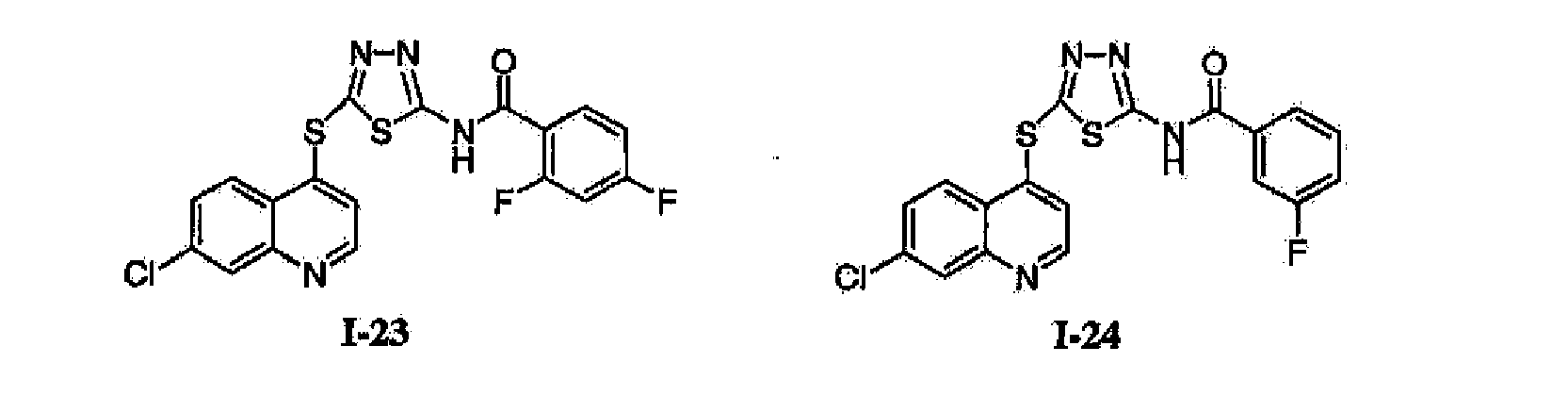


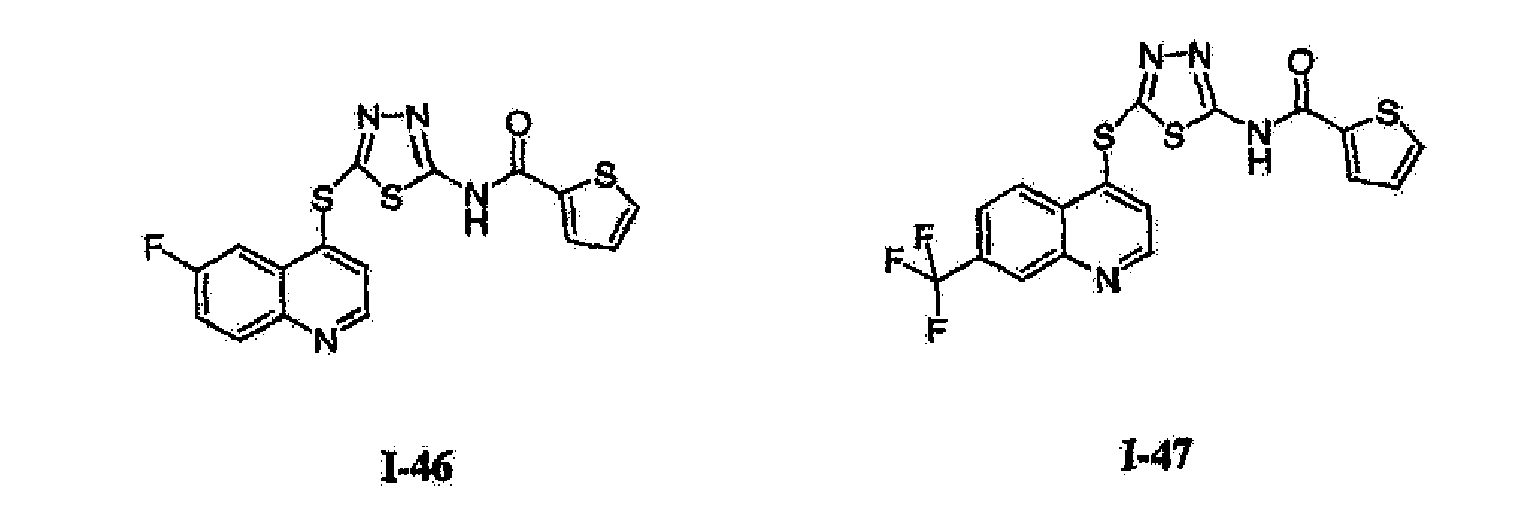


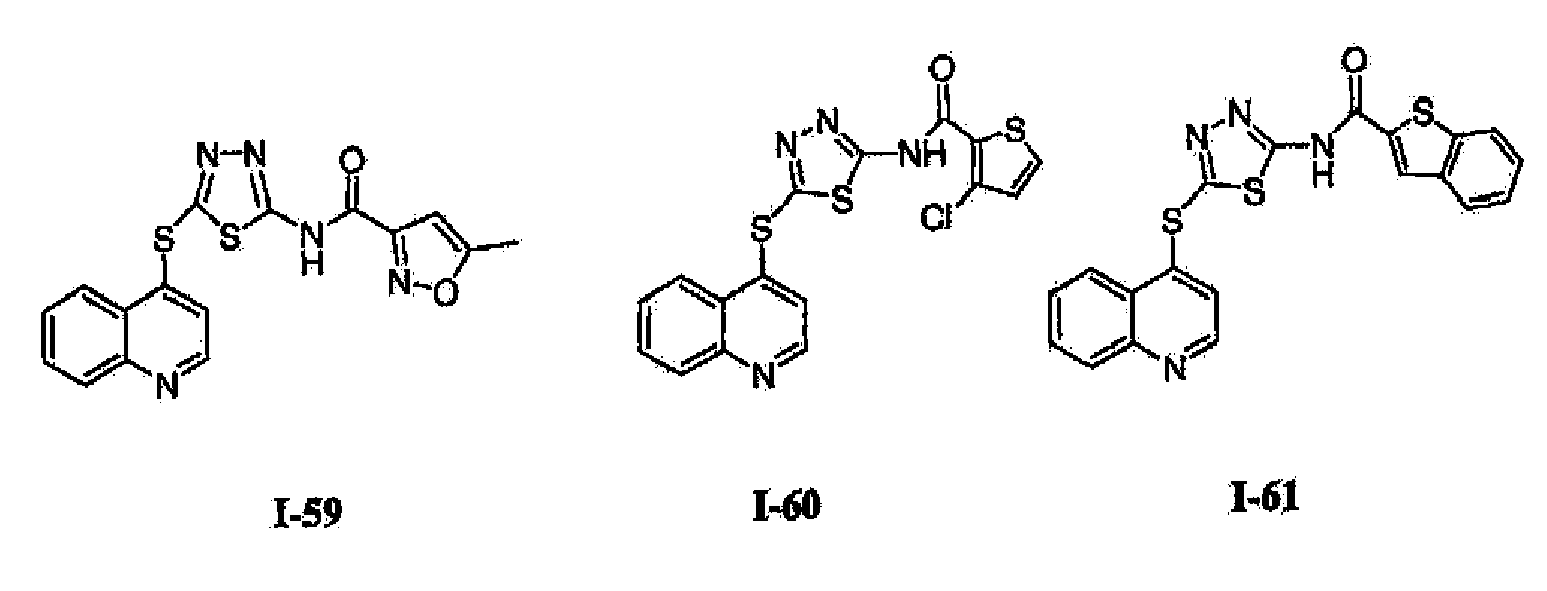




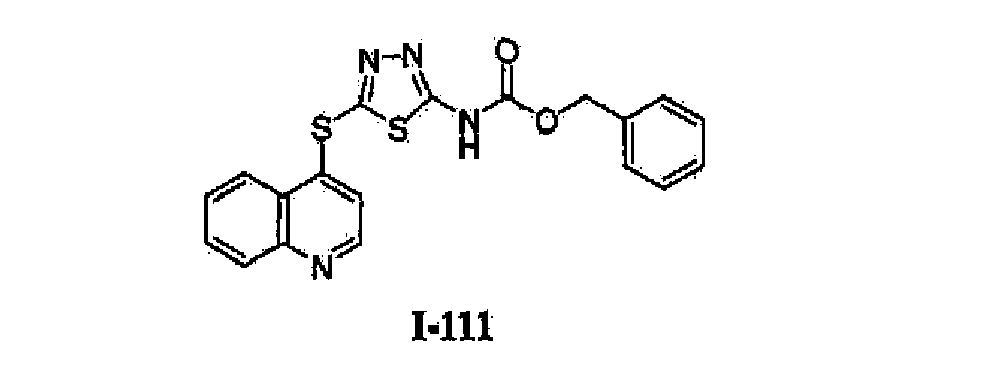
- A composition comprising an effective amount of a compound of formula I:

wherein:W and X are each independently oxygen or sulfur;A is nitrogen, CH, C-CN, or C-(C1-3 aliphatic);R1 and R2 are taken together to form an optionally substituted 3-7 membered saturated,partially unsaturated, or fully unsaturated ring having 0-3 heteroatoms independently selected from nitrogen, oxygen, or sulfur;Q is a valence bond, -C(O)-, -C(O)NR-, -C(O)C(O)-, -CO2-, -C(O)CO2-, -SO2-, or an optionally substituted C1-6 alkylidene chain, wherein:one or two non-adjacent methylene units of Q are optionally and independently replaced by -O-, -S-, -NR-, -C(O)-, -CO2-, -C(O)NR-, -OC(O)NR-, -NRC(O)-, NRCO2-, -NRC(O)NR-, -S(O)-, -SO2-, -NRSO2-, -SO2NR-, or -NRSO2NR-;each R is independently hydrogen or an optionally substituted C1-6 aliphatic group, wherein:two R bound to the same nitrogen atom are optionally taken together with the nitrogen
to form an optionally substituted 3-7 membered saturated, partially unsaturated, or fully unsaturated ring having 0-2 heteroatoms, in addition to the nitrogen bound thereto, independently selected from nitrogen, oxygen, or sulfur;R3 is selected from R or Ar; andAr is an optionally substituted ring selected from:(a) a 3-8 membered monocyclic or 8-10 membered bicyclic saturated, partially unsaturated, or aryl ring;(b) a 3-7 membered heterocyclic ring having 1-3 heteroatoms independently selected from nitrogen, oxygen, or sulfur; or(c) a 5-6 membered monocyclic or 8-10 membered bicyclic heteroaryl ring having 1-4and a pharmaceutically acceptable carrier, adjuvant, or vehicle.
heteroatoms independently selected from nitrogen, oxygen, or sulfur; - The composition according to claim 9, wherein:R'andR" are taken together to form an optionally substituted 5-7 membered saturated,
partially unsaturated, or fully unsaturated ring having 0-2 heteroatoms independently selected from nitrogen, oxygen, or sulfur. - The composition according to claim 9, wherein:Q is a valence bond, -C(O)-, -C(O)NR-, -CO2-, -C(O)CO2-, -SO2-, or an optionally
substituted C1-4 alkylidene chain wherein:one or two non-adjacent methylene units of Q are optionally and independently
replaced by -O-, -S-, -NR-, -C(O)-, -CO2- or -SO2-. - The composition according to claim 9, wherein:R is an optionally substituted C1-6 aliphatic group, or an optionally substituted ring selected
from:(a) a 3-6 membered monocyclic saturated or aryl ring;(b) a 5-6 membered heterocyclic ring having 1-2 heteroatoms independently selected from nitrogen, oxygen, or sulfur; or(c) a 5-6 membered monocyclic or a 9-10 membered bicyclic heteroaryl ring having1-3 heteroatoms independently selected from nitrogen, oxygen, or sulfur. - The composition according to any one of claims 9-12, wherein W is sulfur; or wherein X is sulfur.
- The composition according to claim 13, wherein A is nitrogen; or wherein A is CH.
- The composition according to claim 9, additionally comprising an additional therapeutic agent selected from an anti-proliferative agent, an anti-inflammatory agent, an immunomodulatory agent, a neurotrophic factor, or an agent for treating cardiovascular disease.
- A method of inhibiting JAK-3 kinase activity in:a biological sample in vitro;
which method comprises said biological sample with a composition according to claim 9, or a compound of formula I:
wherein:W and X are each independently oxygen or sulfur;A is nitrogen, CH, C-CN, or C-(C1-3 aliphatic);R1 and R2 are taken together to form an optionally substituted 3-7 membered saturated,
partially unsaturated, or fully unsaturated ring having 0-3 heteroatoms independently selected from nitrogen, oxygen, or sulfur;Q is a valence bond, -C(O)-, -C(O)NR-, -C(O)C(O)-, -CO2-, -C(O)CO2-, -SO2-, or an
optionally substituted C1-6 alkylidene chain, wherein:one or two non-adjacent methylene units of Q are optionally and independently replaced by -O-, -S-, -NR-, -C(O)-, -CO2-, -C(O)NR-, -OC(O)NR-, -NRC(O)-, NRCO2-, -NRC(O)NR-, -S(O)-, -SO2-, -NRSO2-, -SO2NR-, or -NRSO2NR-;each R is independently hydrogen or an optionally substituted C1-6 aliphatic group,
wherein: two R bound to the same nitrogen atom are optionally taken together with the nitrogen to form an optionally substituted 3-7 membered saturated, partially unsaturated, or fully unsaturated ring having 0-2 heteroatoms, in addition to the nitrogen bound thereto, independently selected from nitrogen, oxygen, or sulfur;R3 is R or Ar; andAr is an optionally substituted ring selected from:(a) a 3-8 membered monocyclic or 8-10 membered bicyclic saturated, partially unsaturated, or aryl ring;(b) a 3-7 membered heterocyclic ring having 1-3 heteroatoms independently selected
from nitrogen, oxygen, or sulfur; or(c) a 5-6 membered monocyclic or 8-10 membered bicyclic heteroaryl ring having 1-4
heteroatoms independently selected from nitrogen, oxygen, or sulfur. - A composition according to claim 9 for treating or lessening the severity of an autoimmune disease, a neurodegenerative disorder, a hematologic malignancy;
an allergic or type I hypersensitivity reaction, asthma, transplant rejection, graft versus host disease, rheumatoid arthritis, amyotrophic lateral sclerosis, multiple sclerosis, Familial amyotrophic lateral sclerosis (FALS), leukemia, or lymphoma.
Applications Claiming Priority (2)
| Application Number | Priority Date | Filing Date | Title |
|---|---|---|---|
| US37818502P | 2002-05-06 | 2002-05-06 | |
| EP03799762A EP1501829B1 (en) | 2002-05-06 | 2003-05-06 | Thiadiazoles or oxadiazoles and their use as inhibitors of jak protein kinase |
Related Parent Applications (1)
| Application Number | Title | Priority Date | Filing Date |
|---|---|---|---|
| EP03799762.4 Division | 2003-05-06 |
Publications (1)
| Publication Number | Publication Date |
|---|---|
| EP2316834A1 true EP2316834A1 (en) | 2011-05-04 |
Family
ID=32681783
Family Applications (2)
| Application Number | Title | Priority Date | Filing Date |
|---|---|---|---|
| EP10182153A Withdrawn EP2316834A1 (en) | 2002-05-06 | 2003-05-06 | Thiadiazoles or oxadiazoles and their use as inhibitors of JAK protein kinase |
| EP03799762A Expired - Lifetime EP1501829B1 (en) | 2002-05-06 | 2003-05-06 | Thiadiazoles or oxadiazoles and their use as inhibitors of jak protein kinase |
Family Applications After (1)
| Application Number | Title | Priority Date | Filing Date |
|---|---|---|---|
| EP03799762A Expired - Lifetime EP1501829B1 (en) | 2002-05-06 | 2003-05-06 | Thiadiazoles or oxadiazoles and their use as inhibitors of jak protein kinase |
Country Status (14)
| Country | Link |
|---|---|
| US (1) | US7271179B2 (en) |
| EP (2) | EP2316834A1 (en) |
| JP (2) | JP4681302B2 (en) |
| KR (1) | KR20050006237A (en) |
| CN (1) | CN1665808A (en) |
| AT (1) | ATE489384T1 (en) |
| AU (1) | AU2003299472A1 (en) |
| CA (1) | CA2485429A1 (en) |
| DE (1) | DE60335099D1 (en) |
| IL (1) | IL165067A0 (en) |
| MX (1) | MXPA04011048A (en) |
| NO (1) | NO20045282L (en) |
| RU (1) | RU2004135386A (en) |
| WO (1) | WO2004058753A1 (en) |
Cited By (1)
| Publication number | Priority date | Publication date | Assignee | Title |
|---|---|---|---|---|
| WO2023081441A1 (en) * | 2021-11-08 | 2023-05-11 | Ventus Therapeutics U.S., Inc. | Heterocyclic compounds and uses thereof |
Families Citing this family (59)
| Publication number | Priority date | Publication date | Assignee | Title |
|---|---|---|---|---|
| BR0313059B8 (en) | 2002-07-29 | 2021-07-27 | Rigel Pharmaceuticals | compound, and, pharmaceutical composition |
| DE102004009933A1 (en) * | 2004-02-26 | 2005-09-15 | Merck Patent Gmbh | Use of 1,3,4-thiadiazole derivatives to prepare medicaments for treating diseases in which the inhibition, regulation or modulation of kinase signal transduction plays a role |
| US7550499B2 (en) | 2004-05-12 | 2009-06-23 | Bristol-Myers Squibb Company | Urea antagonists of P2Y1 receptor useful in the treatment of thrombotic conditions |
| ATE460402T1 (en) * | 2004-05-12 | 2010-03-15 | Bristol Myers Squibb Co | UREA ANTAGONISTS OF THE P2Y1 RECEPTOR SUITABLE FOR THE TREATMENT OF THROMBOTIC DISEASES |
| WO2006014325A2 (en) * | 2004-07-02 | 2006-02-09 | Exelixis, Inc. | C-met modulators and method of use |
| MX2007003154A (en) * | 2004-09-17 | 2007-05-15 | Vertex Pharma | Diaminotriazole compounds useful as protein kinase inhibitors. |
| CN101389335A (en) * | 2004-10-18 | 2009-03-18 | 安姆根有限公司 | Thiadiazole compounds and methods of use |
| EP1828186A1 (en) * | 2004-12-13 | 2007-09-05 | Sunesis Pharmaceuticals, Inc. | Pyrido pyrimidinones, dihydro pyrimido pyrimidinones and pteridinones useful as raf kinase inhibitors |
| AU2006206611A1 (en) * | 2005-01-19 | 2006-07-27 | Bristol-Myers Squibb Company | 2-phenoxy-N- (1, 3 , 4-thiadizol-2-yl) pyridin-3-amine derivatives and related compounds as P2Y1 receptor inhibitors for the treatment of thromboembolic disorders |
| US20070203161A1 (en) | 2006-02-24 | 2007-08-30 | Rigel Pharmaceuticals, Inc. | Compositions and methods for inhibition of the jak pathway |
| EP1904457B1 (en) | 2005-06-08 | 2017-09-06 | Rigel Pharmaceuticals, Inc. | Compositions and methods for inhibition of the jak pathway |
| WO2007002635A2 (en) * | 2005-06-27 | 2007-01-04 | Bristol-Myers Squibb Company | C-linked cyclic antagonists of p2y1 receptor useful in the treatment of thrombotic conditions |
| US7728008B2 (en) * | 2005-06-27 | 2010-06-01 | Bristol-Myers Squibb Company | N-linked heterocyclic antagonists of P2Y1 receptor useful in the treatment of thrombotic conditions |
| US7714002B2 (en) * | 2005-06-27 | 2010-05-11 | Bristol-Myers Squibb Company | Carbocycle and heterocycle antagonists of P2Y1 receptor useful in the treatment of thrombotic conditions |
| DE602006020871D1 (en) | 2005-06-27 | 2011-05-05 | Bristol Myers Squibb Co | LINEAR UREA MIMETIC ANTAGONISTS OF THE P2Y1 RECEPTOR FOR THE TREATMENT OF THROMBOSELEIDES |
| CA2624294A1 (en) * | 2005-10-05 | 2007-04-12 | Merck Frosst Canada Ltd. | Substituted quinolines as inhibitors of leukotriene biosynthesis |
| JP2009528295A (en) | 2006-02-24 | 2009-08-06 | ライジェル ファーマシューティカルズ, インコーポレイテッド | Compositions and methods for inhibition of the JAK pathway |
| US20070213378A1 (en) * | 2006-03-10 | 2007-09-13 | Lymphosign Inc. | Compounds for modulating cell proliferation, compositions and methods related thereto |
| CA2663436A1 (en) | 2006-10-04 | 2008-04-10 | Pfizer Products Inc. | Pyrido[4,3-d]pyrimidin-4(3h)-one derivatives as calcium receptor antagonists |
| US7960569B2 (en) * | 2006-10-17 | 2011-06-14 | Bristol-Myers Squibb Company | Indole antagonists of P2Y1 receptor useful in the treatment of thrombotic conditions |
| WO2008139845A1 (en) * | 2007-04-24 | 2008-11-20 | Daiichi Sankyo Company, Limited | Novel amide derivative |
| HUE030912T2 (en) | 2008-02-15 | 2017-06-28 | Rigel Pharmaceuticals Inc | Pyrimidine-2-amine compounds and their use as inhibitors of jak kinases |
| US8138339B2 (en) | 2008-04-16 | 2012-03-20 | Portola Pharmaceuticals, Inc. | Inhibitors of protein kinases |
| MX2010011463A (en) | 2008-04-16 | 2011-06-03 | Portola Pharm Inc | 2, 6-diamino- pyrimidin- 5-yl-carboxamides as syk or jak kinases inhibitors. |
| JP2011518219A (en) | 2008-04-22 | 2011-06-23 | ポートラ ファーマシューティカルズ, インコーポレイテッド | Inhibitors of protein kinases |
| US8466290B2 (en) * | 2008-07-10 | 2013-06-18 | Pharma Ip General Incorporated Association | STAT3 inhibitor containing quinolinecarboxamide derivative as active ingredient |
| PL2401267T3 (en) * | 2009-02-27 | 2014-06-30 | Ambit Biosciences Corp | Jak kinase modulating quinazoline derivatives and their use in methods |
| US8361962B2 (en) * | 2009-07-27 | 2013-01-29 | Roche Palo Alto Llc | Tricyclic inhibitors of JAK |
| WO2011081205A1 (en) * | 2009-12-28 | 2011-07-07 | 一般社団法人ファルマIp | 1,3,4-oxadiazole-2-carboxamide compound |
| KR101483215B1 (en) * | 2010-01-29 | 2015-01-16 | 한미약품 주식회사 | Bicyclic heteroaryl derivatives having inhibitory activity for protein kinases |
| NZ604018A (en) | 2010-06-07 | 2015-02-27 | Novomedix Llc | Furanyl compounds and the use thereof |
| EP2397482A1 (en) * | 2010-06-15 | 2011-12-21 | Almirall, S.A. | Heteroaryl imidazolone derivatives as jak inhibitors |
| CN101891697B (en) * | 2010-07-02 | 2011-08-31 | 山东大学 | Alpha, beta-unsaturated ketone compound containing 1,2,4-oxadiazoles heterocycle |
| EP2635557A2 (en) | 2010-11-01 | 2013-09-11 | Portola Pharmaceuticals, Inc. | Nicotinamides as jak kinase modulators |
| SG11201402570QA (en) | 2011-11-23 | 2014-06-27 | Portola Pharm Inc | Pyrazine kinase inhibitors |
| KR101328126B1 (en) * | 2012-04-10 | 2013-11-08 | 연세대학교 원주산학협력단 | Novel oxadiazole derivatives and use thereof for preventing, improving or treating allergy |
| SI3459942T1 (en) | 2012-04-24 | 2021-05-31 | Vertex Pharmaceuticals Incorporated | Dna-pk inhibitors |
| CN103382206B (en) * | 2012-05-04 | 2016-09-28 | 上海恒瑞医药有限公司 | Quinoline or quinazoline derivative, its preparation method and in application pharmaceutically |
| WO2014013014A1 (en) | 2012-07-18 | 2014-01-23 | Fundació Privada Centre De Regulació Genòmica (Crg) | Jak inhibitors for activation of epidermal stem cell populations |
| US9676756B2 (en) | 2012-10-08 | 2017-06-13 | Portola Pharmaceuticals, Inc. | Substituted pyrimidinyl kinase inhibitors |
| WO2014079545A1 (en) * | 2012-11-20 | 2014-05-30 | Ktb Tumorforschungsgesellschaft Mbh | Thioether derivatives as protein kinase inhibitors |
| CL2012003253A1 (en) * | 2012-11-22 | 2013-01-11 | Univ Concepcion | Compounds derived from 1,3,4-thiadiazole alkylamides and chalconas, trpv-1 receptor antagonists; use of compounds to treat chronic pain. |
| HUE041544T2 (en) | 2013-03-12 | 2019-05-28 | Vertex Pharma | Dna-pk inhibitors |
| PT3424920T (en) | 2013-10-17 | 2020-07-07 | Vertex Pharma | Co-crystals of (s)-n-methyl-8-(1-((2'-methyl-[4,5'-bipyrimidin]-6-yl)amino)propan-2-yl)quinoline-4-carboxamide and deuterated derivatives thereof as dna-pk inhibitors |
| CN105916506B (en) | 2013-11-20 | 2020-01-07 | 圣诺康生命科学公司 | Quinazoline derivatives as TAM family kinase inhibitors |
| JP6269942B2 (en) * | 2014-02-20 | 2018-01-31 | 国立研究開発法人理化学研究所 | p38 MAP kinase γ and / or δ inhibitors |
| KR102894264B1 (en) * | 2015-03-10 | 2025-12-02 | 오리진 온콜로지 리미티드 | 1,2,4-oxadiazole and thiadiazole compounds as immunomodulators |
| WO2018041989A1 (en) | 2016-09-02 | 2018-03-08 | INSERM (Institut National de la Santé et de la Recherche Médicale) | Methods for diagnosing and treating refractory celiac disease type 2 |
| JP2019529475A (en) | 2016-09-27 | 2019-10-17 | バーテックス ファーマシューティカルズ インコーポレイテッドVertex Pharmaceuticals Incorporated | Method for treating cancer using a combination of a DNA damaging agent and a DNA-PK inhibitor |
| WO2018160944A1 (en) * | 2017-03-03 | 2018-09-07 | Progenra, Inc. | Azole compounds as ubiquitin-specific protease usp7 inhibitors |
| CN108148058B (en) * | 2018-02-08 | 2021-03-16 | 中国人民解放军第四军医大学 | 4- (2-mercaptothiadiazole) substituted pyrimidine derivative, and preparation method and application thereof |
| EP3942045A1 (en) | 2019-03-21 | 2022-01-26 | Onxeo | A dbait molecule in combination with kinase inhibitor for the treatment of cancer |
| US20220177978A1 (en) | 2019-04-02 | 2022-06-09 | INSERM (Institut National de la Santé et de la Recherche Médicale) | Methods of predicting and preventing cancer in patients having premalignant lesions |
| US20220202820A1 (en) | 2019-04-16 | 2022-06-30 | INSERM (Institut National de la Santé et de la Recherche Médicale) | Use of jak inhibitors for the treatment of painful conditions involving nav1.7 channels |
| EP4054579A1 (en) | 2019-11-08 | 2022-09-14 | Institut National de la Santé et de la Recherche Médicale (INSERM) | Methods for the treatment of cancers that have acquired resistance to kinase inhibitors |
| WO2021148581A1 (en) | 2020-01-22 | 2021-07-29 | Onxeo | Novel dbait molecule and its use |
| CN114380817B (en) * | 2020-10-21 | 2024-06-21 | 中国医学科学院药物研究所 | Benzimidazol 2-amino-1,3,4-thiadiazole compound and its preparation method and pharmaceutical use |
| EP4526469A1 (en) | 2022-05-16 | 2025-03-26 | Institut National de la Santé et de la Recherche Médicale | Methods for assessing the exhaustion of hematopoietic stems cells induced by chronic inflammation |
| WO2026093435A1 (en) | 2024-10-31 | 2026-05-07 | Institut National de la Santé et de la Recherche Médicale | Use of jak inhibitors for enhancing the potency of immunotherapy in the treament of cancer |
Citations (8)
| Publication number | Priority date | Publication date | Assignee | Title |
|---|---|---|---|---|
| US5304121A (en) | 1990-12-28 | 1994-04-19 | Boston Scientific Corporation | Drug delivery system making use of a hydrogel polymer coating |
| US5886026A (en) | 1993-07-19 | 1999-03-23 | Angiotech Pharmaceuticals Inc. | Anti-angiogenic compositions and methods of use |
| WO1999031096A1 (en) * | 1997-12-18 | 1999-06-24 | Shaman Pharmaceuticals, Inc. | Piperazine derivatives useful as hypoglycemic agents |
| WO1999062908A2 (en) * | 1998-06-04 | 1999-12-09 | Abbott Laboratories | Cell adhesion-inhibiting antinflammatory compounds |
| US6099562A (en) | 1996-06-13 | 2000-08-08 | Schneider (Usa) Inc. | Drug coating with topcoat |
| WO2000051587A2 (en) * | 1999-03-05 | 2000-09-08 | Parker Hughes Institute | Jak-3 inhibitors for treating allergic disorders |
| JP2001354658A (en) * | 2000-06-15 | 2001-12-25 | Taisho Pharmaceut Co Ltd | Hydroxyformamidine compounds and salts thereof and medicaments containing them |
| WO2002000649A1 (en) * | 2000-06-28 | 2002-01-03 | Astrazeneca Ab | Substituted quinazoline derivatives and their use as inhibitors |
Family Cites Families (3)
| Publication number | Priority date | Publication date | Assignee | Title |
|---|---|---|---|---|
| US6232320B1 (en) * | 1998-06-04 | 2001-05-15 | Abbott Laboratories | Cell adhesion-inhibiting antiinflammatory compounds |
| US6486158B1 (en) * | 1998-08-14 | 2002-11-26 | Cell Pathways, Inc. | [4,5]-fused-3,6-disubstituted-pyridazines with sulfur-containing substituents in position three for the treatment of neoplasia |
| HK1045306A1 (en) * | 1999-06-03 | 2002-11-22 | Abbott Laboratories | Cell adhesion-inhibiting antiinflammatory compounds |
-
2003
- 2003-05-06 US US10/430,805 patent/US7271179B2/en not_active Expired - Fee Related
- 2003-05-06 EP EP10182153A patent/EP2316834A1/en not_active Withdrawn
- 2003-05-06 CN CN038159546A patent/CN1665808A/en active Pending
- 2003-05-06 JP JP2004563181A patent/JP4681302B2/en not_active Expired - Fee Related
- 2003-05-06 KR KR10-2004-7017933A patent/KR20050006237A/en not_active Withdrawn
- 2003-05-06 DE DE60335099T patent/DE60335099D1/en not_active Expired - Lifetime
- 2003-05-06 AU AU2003299472A patent/AU2003299472A1/en not_active Withdrawn
- 2003-05-06 AT AT03799762T patent/ATE489384T1/en not_active IP Right Cessation
- 2003-05-06 MX MXPA04011048A patent/MXPA04011048A/en unknown
- 2003-05-06 RU RU2004135386/04A patent/RU2004135386A/en not_active Application Discontinuation
- 2003-05-06 CA CA002485429A patent/CA2485429A1/en not_active Abandoned
- 2003-05-06 WO PCT/US2003/014223 patent/WO2004058753A1/en not_active Ceased
- 2003-05-06 EP EP03799762A patent/EP1501829B1/en not_active Expired - Lifetime
-
2004
- 2004-11-07 IL IL16506704A patent/IL165067A0/en unknown
- 2004-12-02 NO NO20045282A patent/NO20045282L/en not_active Application Discontinuation
-
2010
- 2010-04-26 JP JP2010101525A patent/JP2010159306A/en active Pending
Patent Citations (8)
| Publication number | Priority date | Publication date | Assignee | Title |
|---|---|---|---|---|
| US5304121A (en) | 1990-12-28 | 1994-04-19 | Boston Scientific Corporation | Drug delivery system making use of a hydrogel polymer coating |
| US5886026A (en) | 1993-07-19 | 1999-03-23 | Angiotech Pharmaceuticals Inc. | Anti-angiogenic compositions and methods of use |
| US6099562A (en) | 1996-06-13 | 2000-08-08 | Schneider (Usa) Inc. | Drug coating with topcoat |
| WO1999031096A1 (en) * | 1997-12-18 | 1999-06-24 | Shaman Pharmaceuticals, Inc. | Piperazine derivatives useful as hypoglycemic agents |
| WO1999062908A2 (en) * | 1998-06-04 | 1999-12-09 | Abbott Laboratories | Cell adhesion-inhibiting antinflammatory compounds |
| WO2000051587A2 (en) * | 1999-03-05 | 2000-09-08 | Parker Hughes Institute | Jak-3 inhibitors for treating allergic disorders |
| JP2001354658A (en) * | 2000-06-15 | 2001-12-25 | Taisho Pharmaceut Co Ltd | Hydroxyformamidine compounds and salts thereof and medicaments containing them |
| WO2002000649A1 (en) * | 2000-06-28 | 2002-01-03 | Astrazeneca Ab | Substituted quinazoline derivatives and their use as inhibitors |
Non-Patent Citations (44)
| Title |
|---|
| "Catalog Maybridge CombiChem", 1 January 2000, MAYBRIDGE PLC, TINTAGEL (UK) * |
| "Catalog Maybridge HTS", 19 October 2000, MAYBRIDGE PLC, TINTAGEL (UK) * |
| "Catalog Maybridhe HTS", 17 October 2000, MAYBRIDGE PLC, TINTAGEL (UK) * |
| "Catalog Pharma Library Collection", 16 January 2001, NANOSYN COMBINATORIAL SYNTHESIS INC, MENLO PARK, CA, (US) * |
| "March's Advanced Organic Chemistry, 5th Ed.,", 2001, JOHN WILEY & SONS |
| BOBRANSKI B ET AL: "New purine derivatives", ARCHIVUM IMMUNOLOGIAE ET THERAPIAE EXPERIMENTALIS, vol. 22, no. 3, 1974, pages 419 - 432, XP001068421 * |
| CATLETT-FALCONE ET AL., IMMUNITY, vol. 10, 1999, pages 105 - 115 |
| DATABASE CHEMCATS [online] CHEMICAL ABSTRACTS SERVICE, COLUMBUS, OHIO, US; XP002279828, retrieved from STN Database accession no. 2002:743378 * |
| DATABASE CHEMCATS [online] CHEMICAL ABSTRACTS SERVICE, COLUMBUS, OHIO, US; XP002279829, retrieved from STN Database accession no. 2002:738386 * |
| DATABASE CHEMCATS [online] CHEMICAL ABSTRACTS SERVICE, COLUMBUS, OHIO, US; XP002279830, retrieved from STN Database accession no. 1998:618096 * |
| DATABASE CHEMCATS [online] CHEMICAL ABSTRACTS SERVICE, COLUMBUS, OHIO, US; XP002279831, retrieved from STN Database accession no. 2000:738391 * |
| DATABASE CHEMCATS [online] CHEMICAL ABSTRACTS SERVICE, COLUMBUS, OHIO, US; XP002279832, retrieved from STN Database accession no. 2002:738388 * |
| DATABASE CHEMCATS [online] CHEMICAL ABSTRACTS SERVICE, COLUMBUS, OHIO, US; XP002279833, retrieved from STN Database accession no. 2002:738387 * |
| DATABASE CHEMCATS [online] CHEMICAL ABSTRACTS SERVICE, COLUMBUS, OHIO, US; XP002279834, retrieved from STN Database accession no. 2002:738390 * |
| DATABASE CHEMCATS [online] CHEMICAL ABSTRACTS SERVICE, COLUMBUS, OHIO, US; XP002279835, retrieved from STN Database accession no. 2001:2445131 * |
| DATABASE REGISTRY CHEMICAL ABSTRACTS SERVICE, COLUMBUS, OHIO, US; * |
| DATABASE REGISTRY CHEMICAL ABSTRACTS SERVICE, COLUMBUS, OHIO, US; 19 October 2000 (2000-10-19) * |
| DATABASE WPI Section Ch Week 200228, Derwent World Patents Index; Class B03, AN 2002-221332, XP002279836 * |
| E. W. MARTIN: "Remington's Pharmaceutical Sciences, Sixteenth Edition,", 1980, MACK PUBLISHING CO. |
| FRANK, MOL. MED., vol. 5, 1999, pages 432 - 456 |
| G. R. BROWN ET AL., BIOORG. MED. CHEM. LETT., vol. 10, 2000, pages 575 - 579 |
| GALLI, N., ENGL. J. MED., vol. 328, 1993, pages 257 - 265 |
| GARCIA-BUSTOS ET AL., EMBO J., vol. 13, 1994, pages 2352 - 2361 |
| GORDON ET AL., NATURE, vol. 346, 1990, pages 274 - 276 |
| HANKS, S.K.; HUNTER, T., FASEB J., vol. 9, 1995, pages 576 - 596 |
| HARDIE, G.; HANKS, S.: "The Protein Kinase Facts Book, I and II", 1995, ACADEMIC PRESS |
| HILES ET AL., CELL, vol. 70, 1992, pages 419 - 429 |
| KIRKEN, TRANSPL. PROC., vol. 33, 2001, pages 3268 - 3270 |
| KNIGHTON ET AL., SCIENCE, vol. 253, 1991, pages 407 - 414 |
| KUNZ ET AL., CELL, vol. 73, 1993, pages 585 - 596 |
| LIDE,DAVID R.: "Handbook of Chemistry and Physics,75th Ed", 1995 |
| MALAVIYA ET AL., IOCHEM. BIOPHYS. RES. COMMUN., vol. 257, 1999, pages 807 - 813 |
| MALAVIYA ET AL., J. BIOL. CHEM., vol. 274, 1999, pages 27028 - 27038 |
| MULLER-LADNER ET AL., J. IMMUNOL., vol. 164, 2000, pages 3894 - 3901 |
| NIELSEN ET AL., PROC. NAT. ACAD. SCI. U.S.A., vol. 94, 1997, pages 6764 - 6769 |
| S. M. BERGE ET AL., J. PHARMACEUTICAL SCIENCES, vol. 66, 1977, pages 1 - 19 |
| SCHWALLER ET AL., EMBO J., vol. 17, 1998, pages 5321 - 5333 |
| SEIDEL ET AL., ONCOGENE, vol. 19, 2000, pages 2645 - 2656 |
| STEWART A O ET AL: "Discovery of inhibitors of cell adhesion molecule expression in human endothelial cells. 1. Selective inhibition of ICAM-1 and E-selectin expression", JOURNAL OF MEDICINAL CHEMISTRY, vol. 44, no. 6, 15 March 2001 (2001-03-15), pages 988 - 1002, XP002279827 * |
| SUDBECK ET AL., CLIN. CANCER RES., vol. 5, 1999, pages 1569 - 1582 |
| SUZUKI ET AL., BLOOD, vol. 96, 2000, pages 2172 - 2180 |
| THOMAS SORRELL: "Organic Chemistry", 1999, UNIVERSITY SCIENCE BOOKS |
| TRIEU ET AL., BIOCHEM. BIOPHYS. RES. COMMUN., vol. 267, 2000, pages 22 - 25 |
| YU ET AL., J. IMMUNOL., vol. 159, 1997, pages 5206 - 5210 |
Cited By (1)
| Publication number | Priority date | Publication date | Assignee | Title |
|---|---|---|---|---|
| WO2023081441A1 (en) * | 2021-11-08 | 2023-05-11 | Ventus Therapeutics U.S., Inc. | Heterocyclic compounds and uses thereof |
Also Published As
| Publication number | Publication date |
|---|---|
| JP4681302B2 (en) | 2011-05-11 |
| CN1665808A (en) | 2005-09-07 |
| ATE489384T1 (en) | 2010-12-15 |
| US7271179B2 (en) | 2007-09-18 |
| IL165067A0 (en) | 2005-12-18 |
| MXPA04011048A (en) | 2005-02-17 |
| WO2004058753A1 (en) | 2004-07-15 |
| JP2010159306A (en) | 2010-07-22 |
| JP2006513192A (en) | 2006-04-20 |
| CA2485429A1 (en) | 2004-07-15 |
| WO2004058753A8 (en) | 2005-06-16 |
| NO20045282L (en) | 2005-02-07 |
| DE60335099D1 (en) | 2011-01-05 |
| EP1501829B1 (en) | 2010-11-24 |
| US20040038992A1 (en) | 2004-02-26 |
| KR20050006237A (en) | 2005-01-15 |
| RU2004135386A (en) | 2005-07-20 |
| EP1501829A1 (en) | 2005-02-02 |
| AU2003299472A1 (en) | 2004-07-22 |
Similar Documents
| Publication | Publication Date | Title |
|---|---|---|
| US7271179B2 (en) | Inhibitors of JAK protein kinase | |
| US7122552B2 (en) | Inhibitors of JAK and CDK2 protein kinases | |
| EP1562938B1 (en) | Heteroaryl-pyrimidine derivatives as jak inhibitors | |
| EP1765819B1 (en) | Azaindoles useful as inhibitors of protein kinases | |
| CN1894258B (en) | Compositions useful as protein kinase inhibitors | |
| KR101075812B1 (en) | Triazolopyridazines as protein kinases inhibitors | |
| US7855214B2 (en) | Fused cyclic systems useful as inhibitors of TEC family protein kinases | |
| CA2507406A1 (en) | Compounds useful as inhibitors of jak and other protein kinases | |
| JP2007513172A (en) | Heterocyclic protein kinase inhibitors and uses thereof | |
| JP2012012417A (en) | Azaindole useful as inhibitor of protein kinase | |
| US20060122213A1 (en) | Azaindoles useful as inhibitors of protein kinases | |
| EP1603886B1 (en) | 4-substituted-5-cyano-1h-pyrimidin-6-(thi)ones as gsk-3 inhibitors | |
| EP2243781A1 (en) | Pyrazolopyridine derivatives as inhibitors of JAK and CDK2 protein kinases | |
| JP2013064015A (en) | Azaindole useful as inhibitor of protein kinase | |
| KR20070043813A (en) | Azaindoles Useful as Inhibitors of Protein Kinases |
Legal Events
| Date | Code | Title | Description |
|---|---|---|---|
| PUAI | Public reference made under article 153(3) epc to a published international application that has entered the european phase |
Free format text: ORIGINAL CODE: 0009012 |
|
| AC | Divisional application: reference to earlier application |
Ref document number: 1501829 Country of ref document: EP Kind code of ref document: P |
|
| AK | Designated contracting states |
Kind code of ref document: A1 Designated state(s): AT BE BG CH CY CZ DE DK EE ES FI FR GB GR HU IE IT LI LU MC NL PT RO SE SI SK TR |
|
| AX | Request for extension of the european patent |
Extension state: AL LT LV MK |
|
| 17P | Request for examination filed |
Effective date: 20111102 |
|
| STAA | Information on the status of an ep patent application or granted ep patent |
Free format text: STATUS: THE APPLICATION IS DEEMED TO BE WITHDRAWN |
|
| 18D | Application deemed to be withdrawn |
Effective date: 20111105 |