EP2315141A2 - Methods and systems for generating suitable meshes for hybrid rans/les modelling - Google Patents
Methods and systems for generating suitable meshes for hybrid rans/les modelling Download PDFInfo
- Publication number
- EP2315141A2 EP2315141A2 EP09761839A EP09761839A EP2315141A2 EP 2315141 A2 EP2315141 A2 EP 2315141A2 EP 09761839 A EP09761839 A EP 09761839A EP 09761839 A EP09761839 A EP 09761839A EP 2315141 A2 EP2315141 A2 EP 2315141A2
- Authority
- EP
- European Patent Office
- Prior art keywords
- topology
- les
- rans
- mesh
- separation region
- Prior art date
- Legal status (The legal status is an assumption and is not a legal conclusion. Google has not performed a legal analysis and makes no representation as to the accuracy of the status listed.)
- Granted
Links
Images
Classifications
-
- G—PHYSICS
- G06—COMPUTING OR CALCULATING; COUNTING
- G06F—ELECTRIC DIGITAL DATA PROCESSING
- G06F30/00—Computer-aided design [CAD]
- G06F30/20—Design optimisation, verification or simulation
- G06F30/23—Design optimisation, verification or simulation using finite element methods [FEM] or finite difference methods [FDM]
-
- G—PHYSICS
- G06—COMPUTING OR CALCULATING; COUNTING
- G06F—ELECTRIC DIGITAL DATA PROCESSING
- G06F2111/00—Details relating to CAD techniques
- G06F2111/10—Numerical modelling
Definitions
- the present invention refers to methods and systems for generating suitable meshes for hybrid RANS/LES modelling, particularly in the aeronautical field.
- CFD discretizes the physical domain into small cells where the Navier-Stokes equations or simplifications of them, for example the Reynolds Averaged Navier-Stokes, are computed. That implies that in order to perform a good computation one needs a good mesh.
- Mesh quality is usually defined by cell deformation or the growing ratio between cells. Also residuals computed in the equations give a good idea of the quality of the computation.
- Hybrid turbulence modelling simulations that use a combination of Reynolds-averaged Navier-Stokes (RANS) equations and large-eddy simulation (LES) are becoming increasingly popular to increase predictive accuracy in complex flow situations (specially in detached flows) without the cost of full large-eddy simulations.
- Hybrid methods that use RANS and LES need to adapt the mesh for the use of both methodologies in the same computations, so that a mesh with a RANS zone relatively coarse (compared with LES zone) is needed and a zone of high resolution without propagation to the RANS zone is also a need for the LES zone.
- LES demands to be non-stationary RANS is used in non-stationary mode (Unstationary RANS or URANS).
- LES is a turbulence modelling method with a subgrid scale model, that means that mesh resolution can have some influence on the final solution. There is no mesh convergence, there is a solution convergence as the more refinement generated the more scales are resolved. That implies that a good quality in a LES zone is defined by the mesh resolution.
- the meshes mainly used in CFD are of three types: entirely structured, totally unstructured or hybrid, that is a mixture of these two mesh types.
- Structured meshes are meshes whose connectivity is regular and fixed by the topology: each inner vertex is topologically connected to his neighbours inside the block. Also the number of cells are propagated inside the block and to the neighbour blocks. All nodes inside a structured mesh can be located using indexes (I,j,k), so that connectivity is explicit.
- Unstructured meshes have a completely arbitrary connectivity: a vertex of the mesh can belong to non obvious cells. The topological data therefore have to be permanently stored to explicitly know the neighbours of each node. The memory cost involved by the use of an unstructured mesh can therefore become very rapidly penalizing.
- structured meshes are divided in several blocks, creating multiblock-structured-meshes in which the actual geometry is formed by several structured blocks, having structurally ordered meshes inside them.
- the location and distribution of blocks in the physical domain i.e. the mesh topology, play a significant role for achieving a good description of the geometry.
- the connection between blocks is also important due to the node propagation, as block faces propagate the numbers of nodes between two blocks in contact.
- equations can define a special physics called Boundary Layer (BL) behaviour, this BL not only appears in CFD equations, also other equations can create this BL behaviour and will have similar treatment.
- This BL behaviour forces mesh topologies to create a "C” topology around the surfaces.
- "C” topology is defined as a topology that surrounds the airfoils (and the objects inside the flow) so that mesh refinement is not propagated upstream the airfoil and only located downstream.
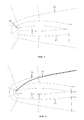
- Figure 1 shows an example of a "C" topology around an 2D airfoil.
- RANS hybrid methods
- a typical mesh quality requirement is that the cells are as close as possible to perfect cubes (3D) or squares (2D).
- 3D perfect cubes
- 2D squares
- Another criteria could be the angle formed by whatever diagonals of the cubes (or the squares) not lower to 20-30° too, or the determinant of the transformation is up to 0.2.
- LES computations also one must assure that the refinement is good enough for have a good description of eddies.
- All structured meshes have their blocks topologically connected at the interfaces, that means that interfaces must have exactly the same number of nodes (continuity).
- TNC total-non-coincident
- Their use can create problems in interpolations, however reduces the number of nodes.
- a good strategy is to use TNCs at low gradient zones, this zones are usually called “euler” zones as they are zone far from the wall boundaries and their flux is close to an euler flux. Generally is recommended to avoid TNC inside boundary layers.
- these and other objects are met by providing a method of generating a mesh of an object that moves through a fluid medium which is used in the design or analysis of said object in connection with a hybrid method combining RANS and LES, comprising the following steps:
- the above-mentioned objects are met by providing a system for generating a mesh of an object that moves through a fluid medium which is used in the design or analysis of said object in connection with a hybrid method combining RANS and LES that comprises a computer-implemented CFD model that allows the generation of said mesh in the following steps:
- Hybrid methods combining RANS and LES use a mixed CFD modelling.
- One of these methods known as DES, is disclosed in " Comments on the Feasibility of LES for Wings and on the Hybrid RANS/LES Approach". Spalart, P. R., Jou, W.-H., Stretlets, M., and Allmaras, S. R. Advances in DNS/LES, Proceedings of the First AFOSR International Conference on DNS/LES. 1997 .
- All structured meshes have the problem of propagation, making local refinements to be propagated in all the fluid domain. Isolation of zones with needed refinement is a must in order to assure reduction of number of nodes in not high required zones and so computational time saving, giving a cost reduction in execution.
- a mesh generated according to this invention assures that the BL is restricted and computed isolated and isolates the big separation zone in order to be refined independently reducing the total computational time needed for the computation.
- the inner "C” 21 is used for a better boundary layer description. All boundary layer must be described inside this topology part. In a hybrid model the RANS computation of the Boundary Layer must be done inside this layer (zonal models can, for example, define specifically which zone have only RANS or hybrid models).
- Hybrid models of RANS/LES have the idea of using URANS (non-stationary RANS) model inside the boundary layer (close to the wall boundaries) and LES models in the separation region, this region needs high definition in order to achieve a precise description of the eddies, on the other hand the regions far from the wall boundaries have a flux close to a euler kind flux so not high definition of the flow is needed.
- URANS non-stationary RANS
- the separated region can be defined using several approaches:
- the separation region is defined as the region where reverse flow is found due to adverse pressure gradient. All the space region with reverse flow must be included inside the outer "C" 23.
- streamlines will divide the region of separated flow and attached flow.
- the separation region is defined as the zone after the ice shape 25 and it is considered that the separation region is expected to be of half size of the airfoil 11 chord at the trailing edge, so that the outer "C” 23 is adapted to said consideration. If a CFD computation is used it must be assured that the outer "C” 23 contains the whole streamline 31 that divides the flow between separated and attached.
- the front part of the outer "C" 23 close to the leading edge of airfoil 11 can be reduced as the separated region is quite close to the airfoil surface.
- This step includes the following sub-steps:
- structured meshes propagate the number of nodes at the interfaces of the faces (3D) or edges (2D). For high performance computations (that could need several days) is important to reduce the propagation of nodes from the high definition zones (separated zones) and low definition zones (euler zones).
- a common technique in this respect is to define faces (3D) or edges (2D) where there is a jump of the number of cells (TNC, total non-coincident cells). This technique applied to the mesh can reduce the number of cells and consequently the time needed for a computation.
- the advantage obtained is that the cell propagation is redirected around the airfoil and it can be assured that any cell jump is done in an euler region (where the flow can be said not affected by viscous effects).
- the topology can be adapted to the size of the separated region in order to be able to direct the refinement in the required zone.
- Suitable locations for said cell jumps are the following:
- Solvers have a constrain that no huge jump of cells are allowed at the boundary of blocks, so that refinement and jump of cells are linked in only one step.
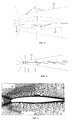
- Figure 5 shows a mesh in which a cell jump 51 to reduce the propagated nodes on the lower region where the flow is no separated and a cell jump 53 at the external boundary of the outer "C" are highlighted.
- a system for carrying out the above mentioned method can be implemented by means of a computer-implemented model DES using the commercial software package elsA.
- the methods and systems according to this invention are particularly applicable to the design or analysis of airplanes or any of its parts, i.e. fuselages, wings, tails or combinations (fuselage+wing, fuselage+tails).
Landscapes
- Engineering & Computer Science (AREA)
- Physics & Mathematics (AREA)
- Theoretical Computer Science (AREA)
- Computer Hardware Design (AREA)
- Evolutionary Computation (AREA)
- Geometry (AREA)
- General Engineering & Computer Science (AREA)
- General Physics & Mathematics (AREA)
- Management, Administration, Business Operations System, And Electronic Commerce (AREA)
- Testing Of Devices, Machine Parts, Or Other Structures Thereof (AREA)
Abstract
Description
- The present invention refers to methods and systems for generating suitable meshes for hybrid RANS/LES modelling, particularly in the aeronautical field.
- Nowadays use of Computational Fluid Dynamics (CFD) is extended in the aeronautical industry. In order to reduce investment in Wind Tunnel Tests simulation is increasingly used in design activities.
- CFD discretizes the physical domain into small cells where the Navier-Stokes equations or simplifications of them, for example the Reynolds Averaged Navier-Stokes, are computed. That implies that in order to perform a good computation one needs a good mesh. Mesh quality is usually defined by cell deformation or the growing ratio between cells. Also residuals computed in the equations give a good idea of the quality of the computation.
- Hybrid turbulence modelling simulations that use a combination of Reynolds-averaged Navier-Stokes (RANS) equations and large-eddy simulation (LES) are becoming increasingly popular to increase predictive accuracy in complex flow situations (specially in detached flows) without the cost of full large-eddy simulations. Hybrid methods that use RANS and LES need to adapt the mesh for the use of both methodologies in the same computations, so that a mesh with a RANS zone relatively coarse (compared with LES zone) is needed and a zone of high resolution without propagation to the RANS zone is also a need for the LES zone. As LES demands to be non-stationary RANS is used in non-stationary mode (Unstationary RANS or URANS). LES is a turbulence modelling method with a subgrid scale model, that means that mesh resolution can have some influence on the final solution. There is no mesh convergence, there is a solution convergence as the more refinement generated the more scales are resolved. That implies that a good quality in a LES zone is defined by the mesh resolution.
- The meshes mainly used in CFD are of three types: entirely structured, totally unstructured or hybrid, that is a mixture of these two mesh types.
- Structured meshes are meshes whose connectivity is regular and fixed by the topology: each inner vertex is topologically connected to his neighbours inside the block. Also the number of cells are propagated inside the block and to the neighbour blocks. All nodes inside a structured mesh can be located using indexes (I,j,k), so that connectivity is explicit.
- Unstructured meshes have a completely arbitrary connectivity: a vertex of the mesh can belong to non obvious cells. The topological data therefore have to be permanently stored to explicitly know the neighbours of each node. The memory cost involved by the use of an unstructured mesh can therefore become very rapidly penalizing.
- For complex geometries structured meshes are divided in several blocks, creating multiblock-structured-meshes in which the actual geometry is formed by several structured blocks, having structurally ordered meshes inside them.
- The location and distribution of blocks in the physical domain, i.e. the mesh topology, play a significant role for achieving a good description of the geometry. The connection between blocks is also important due to the node propagation, as block faces propagate the numbers of nodes between two blocks in contact.
- On the other hand, equations can define a special physics called Boundary Layer (BL) behaviour, this BL not only appears in CFD equations, also other equations can create this BL behaviour and will have similar treatment. This BL behaviour forces mesh topologies to create a "C" topology around the surfaces. "C" topology is defined as a topology that surrounds the airfoils (and the objects inside the flow) so that mesh refinement is not propagated upstream the airfoil and only located downstream.
Figure 1 shows an example of a "C" topology around an 2D airfoil. In hybrid methods (RANS/LES) the boundary layer zone must be described using RANS. - Several constrains are usually applied to mesh topology definitions, such as the following:
- The need that the topology must mark the limits of the surfaces.
- The need that the topology must take into account the geometrical discontinuities of the surfaces.
- The need to use a "C" topology around the surfaces caused by a Boundary Layer (BL) behaviour.
- A typical mesh quality requirement is that the cells are as close as possible to perfect cubes (3D) or squares (2D). In order to check that quality requirement there are several mathematical formulas, for example, assuring that no one of the planar angles is below 20-30°, also another criteria could be the angle formed by whatever diagonals of the cubes (or the squares) not lower to 20-30° too, or the determinant of the transformation is up to 0.2. For LES computations also one must assure that the refinement is good enough for have a good description of eddies.
- All structured meshes have their blocks topologically connected at the interfaces, that means that interfaces must have exactly the same number of nodes (continuity). There is a possibility of creating TNC (total-non-coincident) nodes interfaces where a jump in the number of cells and distribution can be found. Their use can create problems in interpolations, however reduces the number of nodes. A good strategy is to use TNCs at low gradient zones, this zones are usually called "euler" zones as they are zone far from the wall boundaries and their flux is close to an euler flux. Generally is recommended to avoid TNC inside boundary layers.
- Although hybrid methods have not been widely use in industry, some applications for airfoils have been disclosed.
- The use of a traditional "C" topology is disclosed in "Detached-Eddy Simulation of Three Airfoils with Different Stall Onset Mechanisms". Dong Li, Igor Men'shov and Yoshiaki Nakamura. Journal of Aircraft .
- The use of an "0" topology is disclosed in "Detached-Eddy Simulation for Iced Airfoils". Jianping Pan and Eric Loth. Journal of Aircraft Vol 42 No. 6 November-December 2005.
- The use of new topologies is disclosed in "Detached Eddy Simulations of an Iced-Airfoil". S.Kumar and E. Loth. 39th AIAA Aerospace Sciences Meeting and Exhibit. 8-11 January 2001. Reno.
- The increasing use of hybrid method demands optimized CFD models and the present invention is intended to attend this demand.
- It is an object of the present invention to provide methods and systems for generating optimized meshes for hybrid RANS/LES modelling using RANS inside the boundary layer and LES in the separated region allowing computational time savings.
- It is another object of the present invention to provide methods and systems for generating meshes for hybrid RANS/LES modelling that allow keeping the control on a "C" topology at the boundary layer to assure a good description of the RANS boundary layer behaviour mixed with a control on cell size along the LES separated region.
- In one aspect, these and other objects are met by providing a method of generating a mesh of an object that moves through a fluid medium which is used in the design or analysis of said object in connection with a hybrid method combining RANS and LES, comprising the following steps:
- a) Creating an inner "C" topology around said object for a boundary layer description.
- b) Creating an outer "C" topology around the inner "C" topology covering a space region including the separation region.
- c) Locating the separation region and adapting to it said inner and outer "C's" topologies so that the outer "C" topology is adapted to the size of the separated region and the inner "C" topology is adapted to the size of the boundary layer.
- d) Refining the mesh in the separation region according to the specifications of said RANS/LES method.
- In another aspect, the above-mentioned objects are met by providing a system for generating a mesh of an object that moves through a fluid medium which is used in the design or analysis of said object in connection with a hybrid method combining RANS and LES that comprises a computer-implemented CFD model that allows the generation of said mesh in the following steps:
- a) Creating an inner "C" topology around said object for a boundary layer description.
- b) Creating an outer "C" topology around the inner "C" topology covering a space region including the separation region.
- c) Locating the separation region and adapting to it said inner and outer "C's" topologies so that the outer "C" is adapted to the size of the separated region and the inner "C" topology is adapted to the size of the boundary layer.
- d) Refining the mesh in the separation region according to the specifications of said RANS/LES method.
- Other characteristics and advantages of the present invention will be clear from the following detailed description of embodiments illustrative of its object in relation to the attached figures.
-
-
Figure 1 shows a double "C" topology around an airfoil. -
Figure 2 shows a typical separated region streamline division. -
Figure 3 shows cell jump locations close to the airfoil. -
Figure 4 shows cell jump locations at downwash. -
Figure 5 shows a mesh generated according to the present invention. - Hybrid methods combining RANS and LES use a mixed CFD modelling. One of these methods, known as DES, is disclosed in "Comments on the Feasibility of LES for Wings and on the Hybrid RANS/LES Approach". Spalart, P. R., Jou, W.-H., Stretlets, M., and Allmaras, S. R. Advances in DNS/LES, Proceedings of the First AFOSR International Conference on DNS/LES. 1997.
- In order to have a good description the recommendation is to use RANS inside the BL and LES in the separated region. Further recommendations can be found at "Young-Person's Guide to Detached-Eddy Simulation Grids" Spalart, P.R. NASA/CR-2001-211032.
- All structured meshes have the problem of propagation, making local refinements to be propagated in all the fluid domain. Isolation of zones with needed refinement is a must in order to assure reduction of number of nodes in not high required zones and so computational time saving, giving a cost reduction in execution.
- A mesh generated according to this invention assures that the BL is restricted and computed isolated and isolates the big separation zone in order to be refined independently reducing the total computational time needed for the computation.
- In a preferred embodiment a method according to this invention to generate said mesh comprises the following steps:
- a) Creating a "C"
topology 21 around the object where an hybrid RANS/LES model will be used for simulation. In the preferred embodiment that we are describing said object is anairfoil 11 that creates a separated flow around it. - b) Creatinbg an outer "C"
topology 23 around the previous inner "C"topology 21. The exact situation of the outer "C"topology 23 will be defined in next steps. - The inner "C" 21 is used for a better boundary layer description. All boundary layer must be described inside this topology part. In a hybrid model the RANS computation of the Boundary Layer must be done inside this layer (zonal models can, for example, define specifically which zone have only RANS or hybrid models).
- c) Locating the separation region and adapting the mesh to its size.
- Hybrid models of RANS/LES have the idea of using URANS (non-stationary RANS) model inside the boundary layer (close to the wall boundaries) and LES models in the separation region, this region needs high definition in order to achieve a precise description of the eddies, on the other hand the regions far from the wall boundaries have a flux close to a euler kind flux so not high definition of the flow is needed.
- The separated region can be defined using several approaches:
- Know-how of the user, for example with respect to
Figure 1 , it can be said that the separation region begins after theice shape 25. - A more advanced CFD computation or Wind Tunnel data.
- Using separation criteria like, for example, Stratford's separation criteria.
- The separation region is defined as the region where reverse flow is found due to adverse pressure gradient. All the space region with reverse flow must be included inside the outer "C" 23. In a CFD computation streamlines will divide the region of separated flow and attached flow. In the embodiment illustrated in the Figures the separation region is defined as the zone after the
ice shape 25 and it is considered that the separation region is expected to be of half size of theairfoil 11 chord at the trailing edge, so that the outer "C" 23 is adapted to said consideration. If a CFD computation is used it must be assured that the outer "C" 23 contains thewhole streamline 31 that divides the flow between separated and attached. As it can be seen inFigure 2 the front part of the outer "C" 23, close to the leading edge ofairfoil 11 can be reduced as the separated region is quite close to the airfoil surface. - d) Refining the mesh. Once the mesh is adapted to the separation region a mesh refinement is performed to adapt the mesh to the previous declared constrains: increased mesh refinement for LES and avoiding huge quantity of nodes around the domain.
- This step includes the following sub-steps:
- d1) Inside the separation region the block must be refined according to the hybrid RANS/LES model used and its specifications.
- d2) Block interface cell jumps must be created In order to avoid high quantity of nodes propagated in the whole domain.
- As it is well known structured meshes propagate the number of nodes at the interfaces of the faces (3D) or edges (2D). For high performance computations (that could need several days) is important to reduce the propagation of nodes from the high definition zones (separated zones) and low definition zones (euler zones). A common technique in this respect is to define faces (3D) or edges (2D) where there is a jump of the number of cells (TNC, total non-coincident cells). This technique applied to the mesh can reduce the number of cells and consequently the time needed for a computation. With the previous defined topology the advantage obtained is that the cell propagation is redirected around the airfoil and it can be assured that any cell jump is done in an euler region (where the flow can be said not affected by viscous effects). Using previous topologies high number of cells in "euler" regions will be found increasing the computational time. On the other hand the topology can be adapted to the size of the separated region in order to be able to direct the refinement in the required zone.
- Suitable locations for said cell jumps are the following:
- In the outer "C" 23 in a
split 41 that transversally cuts the "C" zone located before the separation region. - At the
external boundary 43 of the outer "C" 23. - At the
airfoil side 45 opposite to the separation region. - At the
downwash 47 when there is no upstream influence (far from the airfoil, depending on the precision needed of this region). - Solvers have a constrain that no huge jump of cells are allowed at the boundary of blocks, so that refinement and jump of cells are linked in only one step.
-
Figure 5 shows a mesh in which acell jump 51 to reduce the propagated nodes on the lower region where the flow is no separated and acell jump 53 at the external boundary of the outer "C" are highlighted. - A system for carrying out the above mentioned method can be implemented by means of a computer-implemented model DES using the commercial software package elsA.
- The methods and systems according to this invention are particularly applicable to the design or analysis of airplanes or any of its parts, i.e. fuselages, wings, tails or combinations (fuselage+wing, fuselage+tails).
- Modifications may be introduced into the preferred embodiment just set forth, which are comprised within the scope defined by the following claims.
Claims (8)
- A method of generating a mesh of an object (11) that moves through a fluid medium which is used in the design or analysis of said object (11) in connection with a hybrid method combining RANS and LES, characterised in that it comprises the following steps:a) creating an inner "C" topology (21) around said object (11) for a boundary layer description;b) creating an outer "C" topology (23) around the inner "C" topology (21) covering a space region including the separation region;c) locating the separation region and adapting to it said inner and outer "C's" topologies (21, 23) so that the outer "C" topology (23) is adapted to the size of the separated region and the inner "C" topology (21) is adapted to the size of the boundary layer;d) refining the mesh in the separation region according to the specifications of said RANS/LES method.
- A method according to claim 1, characterised in that the step d) includes creating cell jumps in one or more of the following locations:- a split (41) cutting transversally the outer "C" topology (23) before the separation region;- the external boundary (43) of the outer "C" topology (23);- the object side (45) opposite to the separation region;- the downwash (47) without upstream influence.
- A method according to any of claims 1-2, characterised in that said object (11) is an airfoil and the flow is detached.
- A method according to claim 3, characterised in that said object (11) is an airplane or any of its parts.
- A system for generating a mesh of an object (11) that moves through a fluid medium which is used in the design or analysis of said object (11) in connection with a hybrid method combining RANS and LES, characterized in that it comprises a computer-implemented CFD model that allows the generation of said mesh in the following steps:a) creating an inner "C" topology (21) around said object (11) for a boundary layer description;b) creating an outer "C" topology (23) around the inner "C" topology (21) covering a space region including the separation region;c) locating the separation region and adapting to it said inner and outer "C's" topologies (21, 23) so that the outer "C" topology (23) is adapted to the size of the separated region and the inner "C" topology (21) is adapted to the size of the boundary layer;d) refining the mesh in the separation region according to the specifications of said RANS/LES method.
- A system according to claim 5, characterised in that the step d) includes creating cell jumps in one or more of the following locations:- a split (41) cutting transversally the outer "C" topology (23) before the separation region;- the external boundary (43) of the outer "C" topology (23);- the object side (45) opposite to the separation region;- the downwash (47) without upstream influence.
- A system according to any of claims 5-6, characterised in that said object (11) is an airfoil and the flow is detached.
- A method according to claim 3, characterised in that said object (11) is an airplane or any of its parts.
Applications Claiming Priority (2)
| Application Number | Priority Date | Filing Date | Title |
|---|---|---|---|
| ES200801787 | 2008-06-13 | ||
| PCT/ES2009/070221 WO2009150282A2 (en) | 2008-06-13 | 2009-06-12 | Methods and systems for generating suitable meshes for hybrid rans/les modelling |
Publications (2)
| Publication Number | Publication Date |
|---|---|
| EP2315141A2 true EP2315141A2 (en) | 2011-04-27 |
| EP2315141B1 EP2315141B1 (en) | 2017-05-03 |
Family
ID=41402272
Family Applications (1)
| Application Number | Title | Priority Date | Filing Date |
|---|---|---|---|
| EP09761839.1A Not-in-force EP2315141B1 (en) | 2008-06-13 | 2009-06-12 | Method and System for analyzing an airplane or any of its parts by hybid RANS/LES |
Country Status (4)
| Country | Link |
|---|---|
| US (1) | US8200459B2 (en) |
| EP (1) | EP2315141B1 (en) |
| ES (1) | ES2635987T3 (en) |
| WO (1) | WO2009150282A2 (en) |
Cited By (1)
| Publication number | Priority date | Publication date | Assignee | Title |
|---|---|---|---|---|
| CN103235878A (en) * | 2013-04-15 | 2013-08-07 | 大连理工大学 | A Simulation Method for the Effect of Flexible Netting on Wave Propagation |
Families Citing this family (12)
| Publication number | Priority date | Publication date | Assignee | Title |
|---|---|---|---|---|
| US8457939B2 (en) * | 2010-12-30 | 2013-06-04 | Aerion Corporation | Generating inviscid and viscous fluid-flow simulations over an aircraft surface using a fluid-flow mesh |
| US8437990B2 (en) * | 2011-03-11 | 2013-05-07 | Aerion Corporation | Generating a simulated fluid flow over an aircraft surface using anisotropic diffusion |
| US8909762B2 (en) * | 2011-03-17 | 2014-12-09 | Hewlett-Packard Development Company, L.P. | Network system management |
| US8538738B2 (en) | 2011-03-22 | 2013-09-17 | Aerion Corporation | Predicting transition from laminar to turbulent flow over a surface |
| US8892408B2 (en) | 2011-03-23 | 2014-11-18 | Aerion Corporation | Generating inviscid and viscous fluid flow simulations over a surface using a quasi-simultaneous technique |
| US8744812B2 (en) * | 2011-05-27 | 2014-06-03 | International Business Machines Corporation | Computational fluid dynamics modeling of a bounded domain |
| CN104834829B (en) * | 2015-06-02 | 2017-10-13 | 中国航天空气动力技术研究院 | Fluctuation pressure Numerical Predicting Method |
| GB201517187D0 (en) * | 2015-09-29 | 2015-11-11 | Rolls Royce Plc | Simulation of rotor-stator flow interaction |
| CN111222211B (en) * | 2019-12-12 | 2023-03-24 | 合肥通用机械研究院有限公司 | Micro-channel unit CFD fluid-solid coupling structured hexahedral mesh division method |
| WO2021236667A1 (en) * | 2020-05-19 | 2021-11-25 | University Of Washington | Predicting incipient separation in turbulent flows |
| US11763234B2 (en) * | 2020-09-16 | 2023-09-19 | International Business Machines Corporation | Location-based risk evaluation |
| CN115906709B (en) * | 2022-12-26 | 2025-08-22 | 北京云道智造科技有限公司 | A method and device for predicting fluid pressure field |
Family Cites Families (3)
| Publication number | Priority date | Publication date | Assignee | Title |
|---|---|---|---|---|
| US6356860B1 (en) * | 1998-10-08 | 2002-03-12 | Sandia Corporation | Method of grid generation |
| US7668705B2 (en) * | 2006-07-11 | 2010-02-23 | Georgi Kalitzin | Method for computing turbulent flow using a near-wall eddy-viscosity formulation |
| US7921002B2 (en) * | 2007-01-04 | 2011-04-05 | Honda Motor Co., Ltd. | Method and system for simulating flow of fluid around a body |
-
2008
- 2008-08-14 US US12/191,395 patent/US8200459B2/en not_active Expired - Fee Related
-
2009
- 2009-06-12 WO PCT/ES2009/070221 patent/WO2009150282A2/en not_active Ceased
- 2009-06-12 ES ES09761839.1T patent/ES2635987T3/en active Active
- 2009-06-12 EP EP09761839.1A patent/EP2315141B1/en not_active Not-in-force
Non-Patent Citations (1)
| Title |
|---|
| See references of WO2009150282A2 * |
Cited By (2)
| Publication number | Priority date | Publication date | Assignee | Title |
|---|---|---|---|---|
| CN103235878A (en) * | 2013-04-15 | 2013-08-07 | 大连理工大学 | A Simulation Method for the Effect of Flexible Netting on Wave Propagation |
| CN103235878B (en) * | 2013-04-15 | 2015-12-23 | 大连理工大学 | A Simulation Method for the Effect of Flexible Netting on Wave Propagation |
Also Published As
| Publication number | Publication date |
|---|---|
| US8200459B2 (en) | 2012-06-12 |
| WO2009150282A2 (en) | 2009-12-17 |
| EP2315141B1 (en) | 2017-05-03 |
| WO2009150282A3 (en) | 2010-03-18 |
| ES2635987T3 (en) | 2017-10-05 |
| US20090312990A1 (en) | 2009-12-17 |
Similar Documents
| Publication | Publication Date | Title |
|---|---|---|
| EP2315141B1 (en) | Method and System for analyzing an airplane or any of its parts by hybid RANS/LES | |
| Ito et al. | Improvements in the reliability and quality of unstructured hybrid mesh generation | |
| US8676544B2 (en) | Method of predicting the aerodynamic behavior of an aircraft element | |
| Cliquet et al. | Application of laminar-turbulent transition criteria in Navier-Stokes computations | |
| US20080221839A1 (en) | Annular sealing assembly for insertion between two mechanical members in relative motion, in particular a linear reciprocating motion, as a rod and the relative guiding seat of a mono-tube shock-adsorber | |
| Botero et al. | Aerodynamic verification and validation of SUAVE | |
| WO2012092502A1 (en) | Generating inviscid and viscous fluid-flow simulations over an aircraft surface | |
| Beaugendre et al. | ICE3D, FENSAP-ICE'S 3D in-flight ice accretion module | |
| Abras et al. | Comparison of CFD hover predictions on the S-76 rotor | |
| Michal et al. | Comparison of fixed and adaptive unstructured grid results for drag prediction workshop 6 | |
| US8473261B2 (en) | Methods and systems for improving meshes used in computational fluid simulations | |
| Wiberg et al. | Large-scale swept-wing icing simulations in the NASA glenn icing research tunnel using LEWICE3D | |
| Fujiwara et al. | Development of experimental icing simulation capability for full-scale swept wings: Hybrid design process, years 1 and 2 | |
| Ito et al. | Efficient computational fluid dynamics evaluation of small-device locations with automatic local remeshing | |
| Sclafani et al. | CFL3D/OVERFLOW results for DLR-F6 wing/body and drag prediction workshop wing | |
| Costa et al. | RBF-based aerodynamic optimization of an industrial glider | |
| Berkman et al. | Investigation of high-lift flowfield of an energy efficient transport wing | |
| Chan | Best practices on overset structured mesh generation for the high-lift crm geometry | |
| Bier et al. | Numerical maximum lift predictions of a realistic commercial aircraft in landing configuration | |
| Filippone et al. | Aerodynamic drag prediction of helicopter fuselage | |
| Bui | Analysis of low-speed stall aerodynamics of a swept wing with seamless flaps | |
| Stefanski et al. | Development of a predictive capability for laminar-turbulent transition in HPCMP CREATETM-AV kestrel component COFFE using the amplification factor transport model | |
| Petermann et al. | Validation of higher-order interactional aerodynamics simulations on full helicopter configurations | |
| Shum et al. | Numerical Investigation of the Effect of Trailing-Edge Morphing on Dynamic Stall Using Delayed Detached Eddy Simulations | |
| Tian et al. | Platform for transport aircraft wing–body parametric modeling and high-lift system design |
Legal Events
| Date | Code | Title | Description |
|---|---|---|---|
| PUAI | Public reference made under article 153(3) epc to a published international application that has entered the european phase |
Free format text: ORIGINAL CODE: 0009012 |
|
| 17P | Request for examination filed |
Effective date: 20110113 |
|
| AK | Designated contracting states |
Kind code of ref document: A2 Designated state(s): AT BE BG CH CY CZ DE DK EE ES FI FR GB GR HR HU IE IS IT LI LT LU LV MC MK MT NL NO PL PT RO SE SI SK TR |
|
| AX | Request for extension of the european patent |
Extension state: AL BA RS |
|
| RIN1 | Information on inventor provided before grant (corrected) |
Inventor name: DE PABLO FOUCE, VALENTIN Inventor name: CANALEJO BAUTISTA, JUAN MANUEL |
|
| DAX | Request for extension of the european patent (deleted) | ||
| GRAP | Despatch of communication of intention to grant a patent |
Free format text: ORIGINAL CODE: EPIDOSNIGR1 |
|
| INTG | Intention to grant announced |
Effective date: 20161128 |
|
| GRAS | Grant fee paid |
Free format text: ORIGINAL CODE: EPIDOSNIGR3 |
|
| GRAA | (expected) grant |
Free format text: ORIGINAL CODE: 0009210 |
|
| AK | Designated contracting states |
Kind code of ref document: B1 Designated state(s): AT BE BG CH CY CZ DE DK EE ES FI FR GB GR HR HU IE IS IT LI LT LU LV MC MK MT NL NO PL PT RO SE SI SK TR |
|
| REG | Reference to a national code |
Ref country code: GB Ref legal event code: FG4D |
|
| REG | Reference to a national code |
Ref country code: AT Ref legal event code: REF Ref document number: 890715 Country of ref document: AT Kind code of ref document: T Effective date: 20170515 Ref country code: CH Ref legal event code: EP |
|
| REG | Reference to a national code |
Ref country code: IE Ref legal event code: FG4D |
|
| REG | Reference to a national code |
Ref country code: DE Ref legal event code: R096 Ref document number: 602009045869 Country of ref document: DE |
|
| REG | Reference to a national code |
Ref country code: FR Ref legal event code: PLFP Year of fee payment: 9 |
|
| REG | Reference to a national code |
Ref country code: NL Ref legal event code: MP Effective date: 20170503 |
|
| REG | Reference to a national code |
Ref country code: AT Ref legal event code: MK05 Ref document number: 890715 Country of ref document: AT Kind code of ref document: T Effective date: 20170503 |
|
| REG | Reference to a national code |
Ref country code: LT Ref legal event code: MG4D |
|
| REG | Reference to a national code |
Ref country code: ES Ref legal event code: FG2A Ref document number: 2635987 Country of ref document: ES Kind code of ref document: T3 Effective date: 20171005 |
|
| PG25 | Lapsed in a contracting state [announced via postgrant information from national office to epo] |
Ref country code: NO Free format text: LAPSE BECAUSE OF FAILURE TO SUBMIT A TRANSLATION OF THE DESCRIPTION OR TO PAY THE FEE WITHIN THE PRESCRIBED TIME-LIMIT Effective date: 20170803 Ref country code: HR Free format text: LAPSE BECAUSE OF FAILURE TO SUBMIT A TRANSLATION OF THE DESCRIPTION OR TO PAY THE FEE WITHIN THE PRESCRIBED TIME-LIMIT Effective date: 20170503 Ref country code: GR Free format text: LAPSE BECAUSE OF FAILURE TO SUBMIT A TRANSLATION OF THE DESCRIPTION OR TO PAY THE FEE WITHIN THE PRESCRIBED TIME-LIMIT Effective date: 20170804 Ref country code: AT Free format text: LAPSE BECAUSE OF FAILURE TO SUBMIT A TRANSLATION OF THE DESCRIPTION OR TO PAY THE FEE WITHIN THE PRESCRIBED TIME-LIMIT Effective date: 20170503 Ref country code: FI Free format text: LAPSE BECAUSE OF FAILURE TO SUBMIT A TRANSLATION OF THE DESCRIPTION OR TO PAY THE FEE WITHIN THE PRESCRIBED TIME-LIMIT Effective date: 20170503 Ref country code: LT Free format text: LAPSE BECAUSE OF FAILURE TO SUBMIT A TRANSLATION OF THE DESCRIPTION OR TO PAY THE FEE WITHIN THE PRESCRIBED TIME-LIMIT Effective date: 20170503 |
|
| PGFP | Annual fee paid to national office [announced via postgrant information from national office to epo] |
Ref country code: FR Payment date: 20170811 Year of fee payment: 9 Ref country code: DE Payment date: 20170810 Year of fee payment: 9 Ref country code: GB Payment date: 20170822 Year of fee payment: 9 Ref country code: ES Payment date: 20170825 Year of fee payment: 9 |
|
| PG25 | Lapsed in a contracting state [announced via postgrant information from national office to epo] |
Ref country code: NL Free format text: LAPSE BECAUSE OF FAILURE TO SUBMIT A TRANSLATION OF THE DESCRIPTION OR TO PAY THE FEE WITHIN THE PRESCRIBED TIME-LIMIT Effective date: 20170503 Ref country code: LV Free format text: LAPSE BECAUSE OF FAILURE TO SUBMIT A TRANSLATION OF THE DESCRIPTION OR TO PAY THE FEE WITHIN THE PRESCRIBED TIME-LIMIT Effective date: 20170503 Ref country code: PL Free format text: LAPSE BECAUSE OF FAILURE TO SUBMIT A TRANSLATION OF THE DESCRIPTION OR TO PAY THE FEE WITHIN THE PRESCRIBED TIME-LIMIT Effective date: 20170503 Ref country code: SE Free format text: LAPSE BECAUSE OF FAILURE TO SUBMIT A TRANSLATION OF THE DESCRIPTION OR TO PAY THE FEE WITHIN THE PRESCRIBED TIME-LIMIT Effective date: 20170503 Ref country code: BG Free format text: LAPSE BECAUSE OF FAILURE TO SUBMIT A TRANSLATION OF THE DESCRIPTION OR TO PAY THE FEE WITHIN THE PRESCRIBED TIME-LIMIT Effective date: 20170803 Ref country code: IS Free format text: LAPSE BECAUSE OF FAILURE TO SUBMIT A TRANSLATION OF THE DESCRIPTION OR TO PAY THE FEE WITHIN THE PRESCRIBED TIME-LIMIT Effective date: 20170903 |
|
| PG25 | Lapsed in a contracting state [announced via postgrant information from national office to epo] |
Ref country code: DK Free format text: LAPSE BECAUSE OF FAILURE TO SUBMIT A TRANSLATION OF THE DESCRIPTION OR TO PAY THE FEE WITHIN THE PRESCRIBED TIME-LIMIT Effective date: 20170503 Ref country code: RO Free format text: LAPSE BECAUSE OF FAILURE TO SUBMIT A TRANSLATION OF THE DESCRIPTION OR TO PAY THE FEE WITHIN THE PRESCRIBED TIME-LIMIT Effective date: 20170503 Ref country code: EE Free format text: LAPSE BECAUSE OF FAILURE TO SUBMIT A TRANSLATION OF THE DESCRIPTION OR TO PAY THE FEE WITHIN THE PRESCRIBED TIME-LIMIT Effective date: 20170503 Ref country code: CZ Free format text: LAPSE BECAUSE OF FAILURE TO SUBMIT A TRANSLATION OF THE DESCRIPTION OR TO PAY THE FEE WITHIN THE PRESCRIBED TIME-LIMIT Effective date: 20170503 Ref country code: SK Free format text: LAPSE BECAUSE OF FAILURE TO SUBMIT A TRANSLATION OF THE DESCRIPTION OR TO PAY THE FEE WITHIN THE PRESCRIBED TIME-LIMIT Effective date: 20170503 |
|
| REG | Reference to a national code |
Ref country code: CH Ref legal event code: PL |
|
| REG | Reference to a national code |
Ref country code: DE Ref legal event code: R097 Ref document number: 602009045869 Country of ref document: DE |
|
| PG25 | Lapsed in a contracting state [announced via postgrant information from national office to epo] |
Ref country code: IT Free format text: LAPSE BECAUSE OF FAILURE TO SUBMIT A TRANSLATION OF THE DESCRIPTION OR TO PAY THE FEE WITHIN THE PRESCRIBED TIME-LIMIT Effective date: 20170503 |
|
| PLBE | No opposition filed within time limit |
Free format text: ORIGINAL CODE: 0009261 |
|
| STAA | Information on the status of an ep patent application or granted ep patent |
Free format text: STATUS: NO OPPOSITION FILED WITHIN TIME LIMIT |
|
| REG | Reference to a national code |
Ref country code: IE Ref legal event code: MM4A |
|
| 26N | No opposition filed |
Effective date: 20180206 |
|
| PG25 | Lapsed in a contracting state [announced via postgrant information from national office to epo] |
Ref country code: CH Free format text: LAPSE BECAUSE OF NON-PAYMENT OF DUE FEES Effective date: 20170630 Ref country code: LI Free format text: LAPSE BECAUSE OF NON-PAYMENT OF DUE FEES Effective date: 20170630 Ref country code: LU Free format text: LAPSE BECAUSE OF NON-PAYMENT OF DUE FEES Effective date: 20170612 Ref country code: IE Free format text: LAPSE BECAUSE OF NON-PAYMENT OF DUE FEES Effective date: 20170612 |
|
| REG | Reference to a national code |
Ref country code: BE Ref legal event code: MM Effective date: 20170630 |
|
| PG25 | Lapsed in a contracting state [announced via postgrant information from national office to epo] |
Ref country code: SI Free format text: LAPSE BECAUSE OF FAILURE TO SUBMIT A TRANSLATION OF THE DESCRIPTION OR TO PAY THE FEE WITHIN THE PRESCRIBED TIME-LIMIT Effective date: 20170503 |
|
| PG25 | Lapsed in a contracting state [announced via postgrant information from national office to epo] |
Ref country code: BE Free format text: LAPSE BECAUSE OF NON-PAYMENT OF DUE FEES Effective date: 20170630 |
|
| PG25 | Lapsed in a contracting state [announced via postgrant information from national office to epo] |
Ref country code: MT Free format text: LAPSE BECAUSE OF NON-PAYMENT OF DUE FEES Effective date: 20170612 |
|
| REG | Reference to a national code |
Ref country code: DE Ref legal event code: R119 Ref document number: 602009045869 Country of ref document: DE |
|
| GBPC | Gb: european patent ceased through non-payment of renewal fee |
Effective date: 20180612 |
|
| PG25 | Lapsed in a contracting state [announced via postgrant information from national office to epo] |
Ref country code: FR Free format text: LAPSE BECAUSE OF NON-PAYMENT OF DUE FEES Effective date: 20180630 Ref country code: GB Free format text: LAPSE BECAUSE OF NON-PAYMENT OF DUE FEES Effective date: 20180612 Ref country code: DE Free format text: LAPSE BECAUSE OF NON-PAYMENT OF DUE FEES Effective date: 20190101 |
|
| PG25 | Lapsed in a contracting state [announced via postgrant information from national office to epo] |
Ref country code: MC Free format text: LAPSE BECAUSE OF FAILURE TO SUBMIT A TRANSLATION OF THE DESCRIPTION OR TO PAY THE FEE WITHIN THE PRESCRIBED TIME-LIMIT Effective date: 20170503 Ref country code: HU Free format text: LAPSE BECAUSE OF FAILURE TO SUBMIT A TRANSLATION OF THE DESCRIPTION OR TO PAY THE FEE WITHIN THE PRESCRIBED TIME-LIMIT; INVALID AB INITIO Effective date: 20090612 |
|
| REG | Reference to a national code |
Ref country code: ES Ref legal event code: FD2A Effective date: 20190916 |
|
| PG25 | Lapsed in a contracting state [announced via postgrant information from national office to epo] |
Ref country code: ES Free format text: LAPSE BECAUSE OF NON-PAYMENT OF DUE FEES Effective date: 20180613 Ref country code: CY Free format text: LAPSE BECAUSE OF NON-PAYMENT OF DUE FEES Effective date: 20170503 |
|
| PG25 | Lapsed in a contracting state [announced via postgrant information from national office to epo] |
Ref country code: MK Free format text: LAPSE BECAUSE OF FAILURE TO SUBMIT A TRANSLATION OF THE DESCRIPTION OR TO PAY THE FEE WITHIN THE PRESCRIBED TIME-LIMIT Effective date: 20170503 |
|
| PG25 | Lapsed in a contracting state [announced via postgrant information from national office to epo] |
Ref country code: TR Free format text: LAPSE BECAUSE OF FAILURE TO SUBMIT A TRANSLATION OF THE DESCRIPTION OR TO PAY THE FEE WITHIN THE PRESCRIBED TIME-LIMIT Effective date: 20170503 |
|
| PG25 | Lapsed in a contracting state [announced via postgrant information from national office to epo] |
Ref country code: PT Free format text: LAPSE BECAUSE OF FAILURE TO SUBMIT A TRANSLATION OF THE DESCRIPTION OR TO PAY THE FEE WITHIN THE PRESCRIBED TIME-LIMIT Effective date: 20170503 |