EP2314278A1 - Hair treatment composition - Google Patents
Hair treatment composition Download PDFInfo
- Publication number
- EP2314278A1 EP2314278A1 EP09806564A EP09806564A EP2314278A1 EP 2314278 A1 EP2314278 A1 EP 2314278A1 EP 09806564 A EP09806564 A EP 09806564A EP 09806564 A EP09806564 A EP 09806564A EP 2314278 A1 EP2314278 A1 EP 2314278A1
- Authority
- EP
- European Patent Office
- Prior art keywords
- residue
- acid
- hair
- group
- salt
- Prior art date
- Legal status (The legal status is an assumption and is not a legal conclusion. Google has not performed a legal analysis and makes no representation as to the accuracy of the status listed.)
- Withdrawn
Links
- 0 CNCC(NCC(*O*)=*)=O Chemical compound CNCC(NCC(*O*)=*)=O 0.000 description 2
- NAIXSLZIEQKQJY-UHFFFAOYSA-N NCC(NCC(NCC(OCCO)=O)=O)=O Chemical compound NCC(NCC(NCC(OCCO)=O)=O)=O NAIXSLZIEQKQJY-UHFFFAOYSA-N 0.000 description 1
Images

Classifications
-
- A—HUMAN NECESSITIES
- A61—MEDICAL OR VETERINARY SCIENCE; HYGIENE
- A61K—PREPARATIONS FOR MEDICAL, DENTAL OR TOILETRY PURPOSES
- A61K8/00—Cosmetics or similar toiletry preparations
- A61K8/18—Cosmetics or similar toiletry preparations characterised by the composition
- A61K8/30—Cosmetics or similar toiletry preparations characterised by the composition containing organic compounds
- A61K8/40—Cosmetics or similar toiletry preparations characterised by the composition containing organic compounds containing nitrogen
- A61K8/44—Aminocarboxylic acids or derivatives thereof, e.g. aminocarboxylic acids containing sulfur; Salts; Esters or N-acylated derivatives thereof
- A61K8/442—Aminocarboxylic acids or derivatives thereof, e.g. aminocarboxylic acids containing sulfur; Salts; Esters or N-acylated derivatives thereof substituted by amido group(s)
-
- A—HUMAN NECESSITIES
- A61—MEDICAL OR VETERINARY SCIENCE; HYGIENE
- A61K—PREPARATIONS FOR MEDICAL, DENTAL OR TOILETRY PURPOSES
- A61K8/00—Cosmetics or similar toiletry preparations
- A61K8/18—Cosmetics or similar toiletry preparations characterised by the composition
- A61K8/30—Cosmetics or similar toiletry preparations characterised by the composition containing organic compounds
- A61K8/33—Cosmetics or similar toiletry preparations characterised by the composition containing organic compounds containing oxygen
- A61K8/36—Carboxylic acids; Salts or anhydrides thereof
- A61K8/365—Hydroxycarboxylic acids; Ketocarboxylic acids
-
- A—HUMAN NECESSITIES
- A61—MEDICAL OR VETERINARY SCIENCE; HYGIENE
- A61Q—SPECIFIC USE OF COSMETICS OR SIMILAR TOILETRY PREPARATIONS
- A61Q5/00—Preparations for care of the hair
-
- A—HUMAN NECESSITIES
- A61—MEDICAL OR VETERINARY SCIENCE; HYGIENE
- A61Q—SPECIFIC USE OF COSMETICS OR SIMILAR TOILETRY PREPARATIONS
- A61Q5/00—Preparations for care of the hair
- A61Q5/02—Preparations for cleaning the hair
-
- A—HUMAN NECESSITIES
- A61—MEDICAL OR VETERINARY SCIENCE; HYGIENE
- A61Q—SPECIFIC USE OF COSMETICS OR SIMILAR TOILETRY PREPARATIONS
- A61Q5/00—Preparations for care of the hair
- A61Q5/06—Preparations for styling the hair, e.g. by temporary shaping or colouring
-
- A—HUMAN NECESSITIES
- A61—MEDICAL OR VETERINARY SCIENCE; HYGIENE
- A61Q—SPECIFIC USE OF COSMETICS OR SIMILAR TOILETRY PREPARATIONS
- A61Q5/00—Preparations for care of the hair
- A61Q5/12—Preparations containing hair conditioners
Definitions
- the present invention relates to a hair treatment composition.
- 'Morning hair' is the phenomenon of head hair being formed into an undesirable shape by external forces applied to the hair from bedding and so on during sleep, and it is an inconvenient phenomenon that many people experience in daily life.
- When correcting morning hair once hair was humidified to break hydrogen bonds present within the hair, then reforming the hydrogen bonds in a more preferred shape while drying with a dryer and so on, and fixing between hairs by applying various setting polymers to the hair surface in order to maintain the shape are carried out. Such operations are complicated, and unless fixation between hairs by a setting polymer is carried out it is not satisfactory in terms of sustaining styling.
- Japanese Patent Application Laid-open No. 8-198725 proposes a cosmetic for head hair formed by formulating a protein hydrolysate called conchiolin and so on with trimethylglycine.
- this technique is a technique for enhancing moisture retention within hair so as to promote dissociation of hydrogen bonds within the hair and preventing hair from drying during sleep and being fixed in an undesirable shape, and hydrogen bond exchange within the hair continues even after finishing styling. Because of this, there is instead the problem that it is difficult to maintain the finished styling.
- patent document 2 proposes a hair treatment composition to give excellent luster and smoothness that contains at least two or more kinds of ⁇ -hydroxycarboxylic acid, a protein decomposition product, and a highly polymerized dimethylpolysiloxane.
- the present inventors have found that the use of a hair composition that contains a glycylglycine (a) as a moisturizing agent that retains water within hair, which is a substance that acts to widen the hydrogen bond network, and a specific aliphatic carboxylic acid (b) that acts to disturb the hydrogen bond network enables the mutually contradictory demands to be simultaneously satisfied, and it is possible to make the styling of hair easy while preventing the occurrence of morning hair and, moreover, to maintain the styling.
- a glycylglycine a
- b specific aliphatic carboxylic acid
- X denotes a divalent hydrocarbon group having 1 to 4 carbon atoms, which may be substituted with a hydroxy group, or an amino acid residue selected from an arginine residue, an alanine residue, a phenylalanine residue, a glycine residue, a glutamine residue, a glutamic acid residue, a serine residue, a proline residue, an N-methylproline residue, and a 4-hydroxyproline residue.
- Y denotes an amino acid residue selected from an arginine residue, an alanine residue, a glycine residue, a glutamine residue, a glutamic acid residue, a serine residue, a proline residue, and a 4-hydroxyproline residue, or a divalent group represented by chemical Formula (2).
- R denotes a hydrogen atom or a monovalent hydrocarbon group having 1 to 4 carbon atoms, which may be substituted with a hydroxy group.
- m and n denote 0 or 1. When m and n are simultaneously 1, X is not an amino acid residue.]; (b) an aliphatic carboxylic acid having no greater than 8 carbon atoms or a salt thereof.
- a hair treatment composition that simultaneously imparts softness, luster, and alignment to dry hair after treatment, prevents morning hair, makes styling easy and, moreover, sustains the styling.
- the hair treatment composition of the present invention contains component (a) and component (b) below.
- Component (a) is a compound represented by general Formula (1) or a salt thereof; it may be a free form, or may be a salt or an intramolecular salt (amphoteric iron).
- the salt of compound (a) include inorganic acid salts such as a hydrochloride and a sulfate; ammonium salts such as ammonium and an alkylammonium salt; alkali metal salts such as a sodium salt and a potassium salt; and alkaline earth metal salts such as a calcium salt and a magnesium salt.
- X denotes a divalent hydrocarbon group having 1 to 4 carbon atoms, which may be substituted with a hydroxy group, or an amino acid residue selected from an arginine residue, an alanine residue, a phenylalanine residue, a glycine residue, a glutamine residue, a glutamic acid residue, a serine residue, a proline residue, an N-methylproline residue, and a 4-hydroxyproline residue.
- n is 0 or 1.
- the divalent hydrocarbon group having 1 to 4 carbon atoms, which may be substituted with a hydroxy group may be a saturated or unsaturated, straight-chain or branched group. Among them, a divalent saturated hydrocarbon group or a divalent saturated hydrocarbon group that is substituted with a hydroxy group is preferable.
- divalent saturated hydrocarbon group examples include a methylene group, an ethylene group, an ethylidene group, a vinylene group, a trimethylene group, an isopropylidene group, a 1-propenylene group, a tetramethylene group, a 2-methyltrimethylene group, a 1-methyltrimethylene group, and a 1-butenylene group.
- Examples of the divalent saturated hydrocarbon group that is substituted with a hydroxy group include a 1-hydroxyethylene group, a 1-hydroxytrimethylene group, a 1,2-dihydroxytrimethylene group, a 1-hydroxytetramethylene group, a 1,2-dihydroxytetramethylene group, a 1,3-dihydroxytetramethylene group, and a 1,2,3-trihydroxytetramethylene group.
- Y denotes an amino acid residue selected from an arginine residue, an alanine residue, a glycine residue, a glutamine residue, a glutamic acid residue, a serine residue, a proline residue, and a 4-hydroxyproline residue, or a divalent group represented by chemical Formula (2) below.
- m is 0 or 1.
- m and n denote 0 or 1.
- R denotes a hydrogen atom or a monovalent hydrocarbon group having 1 to 4 carbon atoms, which may be substituted with a hydroxy group.
- the monovalent hydrocarbon group having 1 to 4 carbon atoms, which may be substituted with a hydroxy group may be a saturated or unsaturated, straight-chain or branched group.
- the monovalent hydrocarbon group having 1 to 4 carbon atoms is preferably an alkyl group, and examples thereof include a methyl group, an ethyl group, a propyl group, a butyl group, an isopropyl group, an isobutyl group, a sec-butyl group, and a tert-butyl group.
- the monovalent hydrocarbon group having 1 to 4 carbon atoms that is substituted with a hydroxy group is preferably a hydroxyalkyl group, and examples thereof include a 2-hydroxyethyl group, a 3-hydroxypropyl group, a 4-hydroxybutyl group, a 2,3-dihydroxypropyl group, a 2,3,4-trihydroxybutyl group, and a 2,4-dihydroxybutyl group.
- Compound examples suitable for component (a) include compounds represented by Formulae (G1) to (G9) below. Among them, (G2) to (G9) are more preferable, and glycylglycylglycine (G8) and glycylglycine (G9) are yet preferable. These compounds may be in a free form, may be an amphoteric ion, or may form a salt. Furthermore, they may be used singly or in a combination of at least two or more kinds.
- the content of component (a) in the composition is preferably 0.01 to 10 mass %, more preferably 0.03 to 5 mass %, and yet more preferably 0.05 to 3 mass %, from the viewpoint of preventing the composition from turning yellow.
- Component (b) is an aliphatic carboxylic acid having no greater than 8 carbon atoms or a salt thereof.
- the salt of compound (b) include ammonium salts such as ammonium salt and an alkylammonium salt; alkali metal salts such as a sodium salt and a potassium salt; and alkaline earth metal salts such as a calcium salt and a magnesium salt. Among them, an ammonium salt, a sodium salt, and a potassium salt are preferable.
- component (b) examples include malic acid, citric acid, lactic acid, glycolic acid, pyrrolidone carboxylic acid, malonic acid, maleic acid, nicotinic acid, benzoic acid, glyceric acid, and tartaric acid, and salts thereof. Malic acid, citric acid, lactic acid, glycolic acid, glyceric acid, or tartaric acid, or a salt thereof is preferable.
- component (b) may be formulated as a counterion of component (a).
- the content of component (b) in the composition is preferably 0.01 to 10 mass %, more preferably 0.03 to 5 mass %, and yet more preferably 0.05 to 3 mass %, from the viewpoint of preventing the composition from turning yellow. Furthermore, they may be used singly or in a combination of at least two or more kinds.
- the hair treatment composition of the present invention may contain as component (b') an aromatic sulfonic acid having no greater than 10 carbon atoms or a salt thereof.
- the salt of compound (b') include ammonium salts such as ammonium and an alkylammonium salt; alkali metal salts such as a sodium salt and a potassium salt; and alkaline earth metal salts such as a calcium salt and a magnesium salt. Among them, an ammonium salt, a sodium salt, and a potassium salt are preferable.
- component (b') examples include benzenesulfonic acid, p-toluenesulfonic acid, 2,4-dimethylbenzenesulfonic acid, 2,5-dimethylbenzenesulfonic acid, naphthalenesulfonic acid, and saccharin, and salts thereof. Among them, p-toluenesulfonic acid or naphthalenesulfonic acid, or a salt thereof is preferable.
- the content of component (b') in the composition is preferably 0.01 to 10 mass %, more preferably 0.03 to 5 mass %, and yet more preferably 0.05 to 3 mass %, from the viewpoint of preventing the composition from turning yellow.
- the hair treatment composition of the present invention may further contain an organic solvent as component (c).
- the organic solvent include lower alkanols such as ethanol and 2-propanol; aromatic alcohols such as benzyl alcohol and 2-benzyloxyethanol; polyols such as propylene glycol, 1,3-butanediol, diethylene glycol, and glycerol; CELLOSOLVES such as ethyl CELLOSOLVE and butyl CELLOSOLVE; and carbitols such as ethylcarbitol and butylcarbitol.
- the hair treatment composition of the present invention may further contain a surfactant as component (d).
- a surfactant any of a cationic surfactant, a nonionic surfactant, an amphoteric surfactant, and an anionic surfactant may be used. Among them, a cationic surfactant or an anionic surfactant is suitably used.
- Examples of the cationic surfactant include a mono-long-chain-alkyl quaternary ammonium salt, a di-long-chain-alkyl quaternary ammonium salt, a long-chain-alkoxyalkyl quaternary ammonium salt, a long-chain-alkylamide quaternary ammonium salt, a long-chain-alkyl tertiary amine and a salt thereof, a long-chain-alkoxyalkyl tertiary amine and a salt thereof, and a long-chain-alkylamide tertiary amine and a salt thereof.
- examples of the long-chain-alkoxyalkyl tertiary amine and a salt thereof include a long-chain-alkyl ether tertiary amine represented by general Formula (F1) and a salt thereof, and a hydroxy long-chain-alkyl ether tertiary amine represented by general Formula (F2) and a salt thereof.
- R1 denotes a straight-chain or branched alkyl or alkenyl group having 6 to 24 carbon atoms.
- R2 and R3 independently denote an alkyl group having 1 to 6 carbon atoms or an -(AO)mH group.
- A denotes an alkylene group having 2 to 4 carbon atoms
- m denotes a number from 1 to 6, the m AOs may be identical to or different from each other, and they may have any arrangement.
- R4 denotes a straight-chain or branched alkyl or alkenyl group having 6 to 24 carbon atoms.
- R5 and R6 independently denote an alkyl group having 1 to 6 carbon atoms or an -(AlO)bH group.
- A1 denotes an alkylene group having 2 to 4 carbon atoms
- b denotes a number from 1 to 6
- the b AlOs may be identical to or different from each other, and they may have any arrangement.
- i denotes a number from 1 to 5.
- cetyltrimethylammonium chloride stearyltrimethylammonium chloride, behenyltrimethylammonium chloride, stearyldimethylbenzylammonium chloride, a benzalkonium chloride, distearyldimethylammonium chloride, N,N-dimethyl-3-hexadecyloxypropylamine and a salt thereof, and N,N-dimethyl-3-octadecyloxypropylamine and a salt thereof.
- stearyltrimethylammonium chloride behenyltrimethylammonium chloride, distearyldimethylammonium chloride, and N,N-dimethyl-3-octadecyloxypropylamine and a salt thereof are preferable.
- anionic surfactant examples include an alkylbenzenesulfonic acid salt, an alkyl or alkenyl ether sulfate, an alkyl or alkenyl sulfate, an olefinsulfonic acid salt, an alkanesulfonic acid salt, a saturated or unsaturated fatty acid salt, an alkyl or alkenyl ether carboxylic acid salt, an ⁇ -sulfofatty acid salt, an N-acylamino acid salt, a phosphoric acid mono or diester salt, and a sulfosuccinic acid ester salt.
- an alkyl ether sulfate is preferable, and specific examples thereof include a polyoxyethylene alkyl ether sulfate.
- the counterion of the anionic group of these anionic surfactants include alkali metal ions such as sodium ion and potassium ion; alkaline earth metal ions such as calcium ion and magnesium ion; ammonium ion; and an alkanolamine having 1 to 3 alkanol groups having 2 or 3 carbon atoms (for example, monoethanolamine, diethanolamine, triethanolamine, or triisopropanolamine).
- nonionic surfactant examples include a polyoxyalkylene alkyl ether, a polyoxyalkylene alkenyl ether, a higher fatty acid sucrose ester, a polyglycerol fatty acid ester, a higher fatty acid mono- or di-ethanolamide, a polyoxyethylene hardened castor oil, a polyoxyethylene sorbitan fatty acid ester, a polyoxyethylene sorbit fatty acid ester, an alkyl saccharide, an alkylamine oxide, an alkylamidoamine oxide, an alkyl glyceryl ether, and an alkenyl glyceryl ether.
- a polyoxyalkylene alkyl ether, a higher fatty acid mono- or di-ethanolamide, a polyoxyethylene hardened castor oil, and an alkyl glyceryl ether are preferable, and a polyoxyethylene alkyl (average number of carbon atoms 12 to 14) ether, 2-ethylhexyl glyceryl ether, and isodecyl glyceryl ether are more preferable.
- amphoteric surfactant examples include an imidazoline type, a carbobetaine, an amidobetaine, a sulfobetaine, a hydroxysulfobetaine, and an amidosulfobetaine.
- the content of the surfactant depends on the intended application of the hair treatment agent and the function (improvement of feel, emulsifying ability, cleaning ability and so on) of each surfactant. For example, it is preferably 0.01 to 20 mass % in the composition, more preferably 0.1 to 15 mass %, and yet more preferably 0.5 to 10 mass %.
- the hair treatment composition of the present invention may further contain a conditioning component as component (e).
- a conditioning component as component (e).
- the conditioning component referred to here is selected from a cationic polymer, a silicones, and an oil agent.
- the cationic polymer is used for the purpose of improving the feel of hair during use.
- the cationic polymer referred to here means a polymer having a cationic group or a group that can be ionized to be cationic, and includes an amphoteric polymer that becomes cationic in its entirety. That is, examples of the cationic polymer include water-soluble polymers containing an amino group or an ammonium group in a side chain of the polymer chain, or a diallyl quaternary ammonium salt as a constituent unit.
- cationized cellulose examples thereof include cationized cellulose, cationized starch, cationized guar gum, cationized tara gum, cationized fenugreek gum, cationized locust bean gum, a polymer or copolymer of a diallyl quaternary ammonium salt, and a quaternized polyvinylpyrrolidone.
- a polymer containing a diallyl quaternary ammonium salt as a constituent unit, a quaternized polyvinylpyrrolidone, and a cationized cellulose are preferable, and a polymer or copolymer of a diallyl quaternary ammonium salt and a cationized cellulose are more preferable.
- the cationic polymer examples include a dimethyldiallylammonium chloride polymer (polyquaternium-6, for example, MERQUAT 100; Nalco Company), a dimethyldiallylammonium chloride/acrylic acid copolymer (polyquaternium-22, for example, MERQUAT 280 and 295; Nalco Company), a dimethyldiallylammonium chloride/acrylamide copolymer (polyquaternium-7, for example, MERQUAT 550; Nalco Company), a quaternized polyvinylpyrrolidone (GAFQUAT 734, 755, and 755N; ISP Japan Ltd.), a cationized cellulose (Leogard G and GP; Lion Corporation, polymer JR-125, JR-400, JR-30M, LR-400, and LR-30M; all from Union Carbide corporation), and cationized gums (Catinal CTR-100, CF-100, and CLB-100; TOHO Chemical
- cationic polymers may be used singly or in a combination of at least two or more kinds.
- the content of the cationic polymer is preferably 0.01 to 20 mass % in the composition, and more preferably 0.5 to 10 mass %, from the viewpoint of the effect in improving feel and stability toward separation of the composition.
- silicones examples include polydimethylsiloxanes, modified silicones (for example, amino-modified silicone, fluorine-modified silicone, alcohol-modified silicone, polyether-modified silicone, epoxy-modified silicone, alkyl-modified silicone or the like), a cyclic polydimethylsiloxane, an aminopolyether-modified silicone, and a highly polymerized methylpolysiloxane emulsion.
- modified silicones for example, amino-modified silicone, fluorine-modified silicone, alcohol-modified silicone, polyether-modified silicone, epoxy-modified silicone, alkyl-modified silicone or the like
- a cyclic polydimethylsiloxane an aminopolyether-modified silicone
- a highly polymerized methylpolysiloxane emulsion examples include polydimethylsiloxanes, modified silicones (for example, amino-modified silicone, fluorine-modified silicone, alcohol-modified silicone, polyether-modified silicone,
- a polydimethylsiloxane, a polyether-modified silicone, an amino-modified silicone, a cyclic polydimethylsiloxane, an aminopolyether-modified silicone, and a highly polymerized methylpolysiloxane emulsion are preferable.
- These silicones may be commercially available, and examples thereof include BY11-026, BY22-19, FZ-3125, and SH200-1,000,000cs (Dow Corning Toray Co., Ltd.), TSF451-100MA (Momentive Performance Materials Japan LLC), KM-9716 (Shin-Etsu Chemical Co., Ltd.) [the above are polydimethylsiloxanes], TSF4440 (Momentive Performance Materials Japan LLC), KF-6005, KF-6011, and KF-353A (Shin-Etsu Chemical Co., Ltd.) [the above are polyether-modified silicones], SF8451C, SF8452C, SF8457C, DC929, DC8500, SS-3551, SM8704C, and SM8904 (Dow Corning Toray Co., Ltd.), KF-867 (Shin-Etsu Chemical Co., Ltd.), KT1989 (Momentive Performance Materials Japan LLC) [the above are amino-modified
- the content of the silicone is preferably 0.1 to 20 mass % in the composition, and more preferably 0.5 to 15 mass %, from the viewpoint of a sufficient effect and suppression of tackiness.
- oils examples include hydrocarbons such as squalene, squalane, vaseline, paraffin, liquid paraffin, liquid isoparaffin, and cycloparaffin; glycerides such as castor oil, cocoa oil, mink oil, avocado oil, olive oil, and shea butter; waxes such as beeswax, spermaceti, lanolin, and carnauba wax; ester oils such as isopropyl palmitate, isopropyl myristate, octyldodecyl myristate, hexyl laurate, cetyl lactate, propylene glycol monostearate, oleyl oleate, hexadecyl 2-ethylhexanoate, isononyl isononanoate, and tridecyl isononanoate; higher fatty acids such as capric acid, lauric acid, myristic acid, palmitic acid, stearic acid, behe
- higher alcohols are preferable.
- These oil agents may be used singly or in a combination of at least two or more kinds.
- the content thereof is preferably 0.1 to 20 mass % in the composition, and more preferably 0.5 to 15 mass %, from the viewpoint of the effect in improving feel and stability toward separation of the composition.
- the hair treatment composition of the present invention may contain another component that is normally used as a cosmetic raw material in addition to the above components.
- an optional component include a thickener, a preservative, a chelating agent, a stabilizer, an antioxidant, a plant extract, a herbal extract, a protein hydrolysate, vitamins, a colorant such as a dye, a fragrance, a UV absorber, a pearlescent agent such as an ethylene glycol difatty acid ester, a setting polymer, and an amphiphilic amide lipid.
- an amphiphilic amide lipid include a diamide compound represented by general Formula (F3) and ceramides represented by general Formula (F4).
- R7 denotes a straight-chain or branched hydrocarbon group having 1 to 12 carbon atoms, which may be substituted with a hydroxy group and/or an alkoxy group.
- R8 denotes a straight-chain or branched divalent hydrocarbon group having 1 to 5 carbon atoms.
- R9 denotes a straight-chain or branched divalent hydrocarbon group having 1 to 22 carbon atoms.
- R10 denotes a straight-chain, branched, or cyclic, saturated or unsaturated hydrocarbon group having 4 to 30 carbon atoms, which may be substituted with a hydroxy group, an oxo group, or an amino group.
- W denotes a methylene group, a methine group, or an oxygen atom.
- X1 denotes a hydrogen atom, an acetyl group, or a glyceryl group, or together with the adjacent oxygen atom forms an oxo group.
- X2, X3, and X4 each independently denote a hydrogen atom, a hydroxy group, or an acetoxy group.
- R11 and R12 each independently denote a hydrogen atom, a hydroxy group, or an acetoxymethyl group.
- R13 denotes a straight-chain, branched, or cyclic, saturated hydrocarbon group having 5 to 35 carbon atoms, which may be substituted with a hydroxy group or an amino group, or a group in which ester-bonded to the ⁇ -position of the above hydrocarbon group is a straight-chain, branched, or cyclic, saturated or unsaturated fatty acid having 8 to 22 carbon atoms, which may be substituted with a hydroxy group.
- R14 denotes a hydrogen atom, or a straight-chain or branched, saturated or unsaturated hydrocarbon group having 1 to 8 carbon atoms in total, which may have a substituent selected from a hydroxy group, a hydroxyalkoxy group, an alkoxy group, and an acetoxy group.
- the setting polymer examples include polysilicone-9; a polyvinylpyrrolidone-based polymer (for example, polyvinylpyrrolidone, vinylpyrrolidone/vinyl acetate copolymer, vinylpyrrolidone/vinyl acetate/vinyl propionate ternary copolymer, vinylpyrrolidone/alkylaminoacrylate (quaternary chloride) copolymer, vinylpyrrolidone/acrylate/(meth)acrylic acid copolymer, vinylpyrrolidone/alkylaminoacrylate/vinylcaprolactam copolymer or the like); a methyl vinyl ether/maleic anhydride alkyl half ester copolymer; an acidic polyvinyl acetate-based polymer (for example, vinyl acetate/crotonic acid copolymer, vinyl acetate/crotonic acid/vinyl neodecanate copolymer, vinyl acetate/crotonic
- the hair treatment composition of the present invention has a pH at 25°C during use (during application) of 2 to 7, preferably 2.5 to 5.5, and more preferably 3 to 5, from the viewpoint of irritating properties of the composition and stability toward hydrolysis of component (a) in the composition.
- a pH adjusting agent may be used for adjusting this.
- ammonia or a salt thereof an alkanolamine such as monoethanolamine, isopropanolamine, 2-amino-2-methylpropanol, or 2-aminobutanol, or a salt thereof; an alkanediamine such as 1,3-propanediamine or a salt thereof; a carbonate such as guanidine carbonate, sodium carbonate, potassium carbonate, sodium hydrogen carbonate, or potassium hydrogen carbonate; a hydroxide such as sodium hydroxide or potassium hydroxide, and so on may be used as an alkali agent.
- an alkanolamine such as monoethanolamine, isopropanolamine, 2-amino-2-methylpropanol, or 2-aminobutanol, or a salt thereof
- an alkanediamine such as 1,3-propanediamine or a salt thereof
- a carbonate such as guanidine carbonate, sodium carbonate, potassium carbonate, sodium hydrogen carbonate, or potassium hydrogen carbonate
- a hydroxide such as sodium hydroxide
- an inorganic acid such as hydrochloric acid or phosphoric acid; a hydrochloride such as monoethanolamine hydrochloride; a phosphate such as monopotassium dihydrogen phosphate or disodium monohydrogen phosphate, and so on may be used as an acid agent.
- a hydrochloride such as monoethanolamine hydrochloride
- a phosphate such as monopotassium dihydrogen phosphate or disodium monohydrogen phosphate, and so on may be used as an acid agent.
- an acid agent on its own, an alkali agent on its own, or a combination of the two may be used.
- the content thereof in the composition is preferably 0.01 to 20 mass %, and more preferably 0.1 to 15 mass %, from the viewpoint of suppression of hair damage and irritation of the scalp.
- the form of the hair treatment composition of the present invention may be, for example, a liquid, an emulsion, a cream, a gel, a paste, a mousse, an aerosol or the like).
- the hair treatment composition of the present invention may suitably be used in an in-bath agent such as a shampoo, a rinse, a conditioner, or a treatment or an out-bath agent such as a hair mousse, a hair mist, a hair lotion, a hair oil, or a styling agent.
- an in-bath agent such as a shampoo, a rinse, a conditioner, or a treatment or an out-bath agent
- a hair mousse such as a hair mousse, a hair mist, a hair lotion, a hair oil, or a styling agent.
- a method for treating hair of the present invention is carried out by contacting the hair treatment agent explained above with hair directly or using an implement.
- the method of contact may employ a method that is generally and widely used for a hair treatment composition that is to be applied.
- a hair treatment composition that is to be applied.
- a shampoo composition there can be cited a method in which an appropriate amount thereof is contacted with the hair, massaging is carried out for a few minutes while foaming, and it is then washed away using running water.
- a rinse, a conditioner, a treatment, and so on there can be cited a method in which an appropriate amount thereof is contacted with the hair, it is allowed to stand for a few seconds to several tens of minutes, and it is then washed away with running water.
- a hair mousse, a hair oil, or a styling agent there can be cited such as a method in which an appropriate amount thereof is contacted with the hair, and it is left as it is.
- the appropriate amount referred to here is an amount that gives a liquor ratio relative to the weight of hair of on the order of 1:0.005 to 1:10.
- the hair that is to be treated may be the whole hair or part thereof.
- the temperature when applied to the hair is preferably from room temperature to on the order of body temperature, but in order to promote penetration it may be heated to on the order of 50°C.
- Shampoos were prepared in accordance with the formulations shown in Table 1 (Examples EA1 to EA8) and Table 2 (Comparative Examples CA1 to CA10). Hair bundles having a length of 10 cm and a width of 2 cm were washed with each of the shampoos, rinsed for 30 sec. with running water, dried with a towel, fixed via upper ends of the hair bundles, and dried naturally. A sensory test was carried out by 10 expert panelists with respect to hair softness, alignment, and luster after drying hair in accordance with the criteria below. The results are ranked by the average score of the 10 people and are shown in Table 3 and Table 4.
- Example shampoo formulation EA1 EA2 EA3 EA4 EA5 EA6 EA7 EA8 (a) Glycylglycine 0.5 0.5 0.5 0.5 0.5 0.5 0.5 0.5 0.5 0.5 (b) Malic acid 0.5 0.25 Citric acid 0.5 Lactic acid 0.5 0.25 0.5 Glycolic acid 0.5 0.25 0.25 0.5 (b') Toluenesulfonic acid 0.5 0.5 (d) Laureth-2 Na sulfate (25%) 62 62 62 62 62 62 62 62 62 Lauramide DEA 2.3 2.3 2.3 2.3 2.3 2.3 2.3 2.3 2.3 2.3 2.3 2.3 2.3 2.3 2.3 2.3 2.3 2.3 2.3 2.3 2.3 2.3 2.3 2.3 2.3 2.3 2.3 2.3 2.3 2.3 2.3 2.3 2.3 2.3 2.3 2.3 2.3 2.3 2.3 2.3 2.3 2.3 2.3 2.3 2.3 2.3 Others EDTA-2Na 0.15 0.
- Example shampoo formulation EA1 EA2 EA3 EA4 EA5 EA6 EA7 EA8 Evaluation Hair softness AA AA AA AA AA AA AA AA Hair alignment AA AA AA AA AA AA AA AA Hair luster AA AA AA AA AA AA AA AA AA AA AA AA
- Conditioning agents were prepared in accordance with the formulations shown in Table 5 (Examples EB1 to EB8) and Table 6 (Comparative Examples CB1 to CB10). Hair bundles having a length of 10 cm and a width of 2 cm were washed with a commercial shampoo, rinsed for 30 sec. with running water, and then dried with a towel. Subsequently, they were coated with an appropriate amount of each of the conditioning agents, rinsed for 30 sec with running water, dried with a towel, fixed via upper ends of the hair bundles, and dried naturally. A sensory test was carried out by 10 expert panelists with respect to softness, alignment, and luster after drying hair in accordance with the criteria bellow. The results are ranked by the average score of the 10 people and shown in Table 7 and Table 8.
- Example Conditioner formulation EB1 EB2 EB3 EB4 EB5 EB6 EB7 EB8 (a) Glycylglycine 0.5 0.5 0.5 0.5 0.5 0.5 0.5 0.5 0.5 0.5 (b) Malic acid 0.5 0.25 Citric acid 0.5 Lactic acid 0.5 0.25 0.5 Glycolic acid 0.5 0.25 0.25 0.5 (b') Toluenesulfonic acid 0.5 0.5 (c) PG 5.25 5.25 5.25 5.25 5.25 5.25 5.25 5.25 5.25 5.25 5.25 5.25 5.25 (d) Steartrimonium chloride (28%) 2.88 2.88 2.88 2.88 2.88 2.88 2.88 Disteardimonium chloride (75%) 3.78 3.78 3.78 3.78 3.78 3.78 3.78 3.78 3.78 3.78 3.78 3.78 (e) Cetanol 2.1 2.1 2.1 2.1 2.1 2.1 2.1 2.1 2.1 2.1 Others Water Balance Balance Balance Balance Balance Balance Balance Balance Na hydroxide Appropriate amount Appro
- Hair treatment compositions of Examples EC1 to EC7 and hair treatment compositions of Comparative Examples CC1 to CC4 shown in Table 9 were prepared. 0.1 g bundles of hair having a length of 20 cm and a width of 5 cm were made by aligning and binding the bases. The hair bundles were coated with 0.2 g of each of the hair treatment compositions, allowed to stand for 10 min, then rinsed with water at about 40°C for 30 sec, dried with a towel, fixed so that the bound part was uppermost, and dried naturally. After natural drying, the susceptibility to morning hair, ease of styling, and sustainability of styling were evaluated by the methods below.
- a hair bundle was placed on a towel base, which was assumed to be a pillow, in a folded-in-half state, a wig (No. 662DXLH, Beaulax Co., Ltd.) equipped with a weight so as to give an average human head weight of 6 kg was placed on the hair bundle as in a sleeping state, and it was left for 8 hours.
- the hair bundle was fixed so that the bound part was uppermost, and a bending angle ⁇ of the hair bundle when viewed side-on as shown in FIG. 1 was measured. It means that the larger the angle ⁇ , the more the susceptibility to morning hair, and the smaller the angle ⁇ , the more the resistance to morning hair.
- Table 9 the ⁇ of Examples EC1 to EC7 was clearly small compared with the ⁇ of Comparative Examples CC1 to CC4, and there was resistance to morning hair.
- the hair bundles for which susceptibility to morning hair had been evaluated were coated with 0.05 g of ion exchanged water as a mist, then wound around a rod having a diameter of 2.5 cm, and dried at 60°C.
- Table 9 As can be seen from Table 9, the S of Examples EC1 to EC7 was clearly large compared with the S of Comparative Examples CC1 to CC4, and styling was easy.
- a hair bundle for which ease of styling had been evaluated by the above-mentioned method was left at 20°C and 65%RH for 8 hours, and the curl diameter of the hair bundle was measured again.
- the curl diameter was defined after leaving.
- a styling sustain rate ⁇ (%) [ ⁇ S-(2.5/R1)*100 ⁇ /S]*100, was determined, and styling sustainability was evaluated. It means that the smaller the styling sustain rate ⁇ , the higher the styling sustainability.
- Table 1 As can be seen from Table 9, it is understood that the ⁇ of Examples EC1 to EC7 was clearly small compared with the ⁇ of Comparative Examples CC1 to CC4, and the sustainability of styling was excellent.
- Example E1 and the hair treatment composition of Comparative Example E1 shown in Table 10 were prepared.
- Five panelists replaced the conditioner that was normally used with a hair treatment composition such that the hair treatment composition of Example ED1 was used for the left-hand side of the head and the hair treatment composition of Comparative Example CD1 was used for the right-hand side of the head for one week.
- the hair treatment composition of Comparative Example CD1 was used for the left-hand side of the head and the hair treatment composition of Example ED1 was used for the right-hand side of the head for one week.
- resistance to morning hair and ease of styling the next morning and sustainability of styling the next day were examined by questionnaire in accordance with the criteria below. The results are collected in Table 10.
- the hair treatment composition of Example ED1 had better resistance to morning hair and simultaneously had ease of styling and, furthermore, the styling could be sustained.
- Formulation Example EE3 hair lotion (mass %) Glycylglycine 0.5 Lactic acid 2.0 Toluenesulfonic acid 0.5 Glycerol 2.0 Benzyl alcohol 1.0 Hydroxyethyl cellulose*5 2.0 Ethanol 10.0 Dimethicon*6 (polydimethylsiloxane) 1.3 Fragrance 0.05 Na hydroxide adjust to pH 3.7 Water Balance *5: HEC Daicel SE-850K, Daicel Chemical Industries, Ltd. *6: KM-9716, Shin-Etsu Chemical Co., Ltd.
- Formulation Example EE5 hair mousse (mass %) Glycylglycine 0.1 Glycylglycylglycine 0.1 Malic acid 2.0 Lactic acid 2.0 Laureth-16 (polyoxyethylene (16EO) lauryl ether) 1.0 Steartrimonium chloride (stearyltrimethylammonium chloride) 0.1 Glycerol 1.0 Benzyloxyethanol 2.5 Ethanol 4.5 Polysilicone-9*8 1.2 Dimethicon*9 (highly polymerized methypolylsiloxane emulsion) 0.3 Dimethicon copolyol*10 (polyoxyethylene ⁇ methypolylsiloxane copolymer) 0.2 Fragrance 0.02 Na hydroxide adjust to pH 4.0 Water Balance *8: OS-96E-E, Kao Corporation *9: BY22-060, Dow Corning Toray Co., Ltd. *10: KF-353A, Shin-Etsu Chemical Co., Ltd.
- Formulation Example EE7 (conditioner) (mass %) Glycylglycine 0.1 Lactic acid 0.7 Glycolic acid 0.7 Stearoxypropyldimethylamine (N,N-dimethyl-3-octadecyloxypropylamine) 1.0 Benzyl alcohol 0.5 Isostearic acid 0.25 Shea butter 0.25 Fatty acid (C14-28)/branched fatty acid (C14-28) mixture*15 0.25 Bismethoxypropylamido isodocosane*16 (amphiphilic amide lipid A) 0.5 Stearyl alcohol 3.0 Dimethicon*17 (polydimethylsiloxane) 2.0 Na hydroxide adjust to pH 3.7 Water Balance *15: CRODACID 18-MEA, Croda Japan KK *16: BRS-661C, Kao Corporation *17: SH200C, Dow Corning Toray Co., Ltd.
- a stock solution was first prepared in accordance with the formulation below, and subsequently the stock solution and a propellant were charged into a pressure-resistant sealed container, thus giving an aerosol hair spray.
- 'Stock solution' mass %) Glycylglycine 0.1 Lactic acid 0.2 Acrylate copolymer*18 5.0 Ethanol 33.5 PEG-10 Dimethicon*19 (polyoxyethylene-methylpolysiloxane copolymer) 0.2 Na hydroxide adjust to pH 6.5 Water Balance to adjust stock solution to 80% *18: BALANCE CR, National Starch & Chemical Company *19: KF-353A, Shin-Etsu Chemical Co., Ltd. 'Propellant' DME (dimethyl ether) 20.0
- a stock solution was first prepared in accordance with the formulation below, and subsequently the stock solution and a propellant were charged into a pressure-resistant sealed container, thus giving an aerosol foam.
- 'Stock solution' mass %) Glycylglycine 0.2 Malic acid 0.2 Acrylate copolymer*20 5.0 Ethanol 33.3 (C12-14)
- PARETH-9*21 polyoxyethylene monoalkyl ether
- 1.0 Na hydroxide adjust to pH 6.5 Water Balance to adjust stock solution to 80% *20: BALANCE CR, National Starch & Chemical Company *21: SOFTANOL 90, Nippon Shokubai CO., Ltd.
Landscapes
- Health & Medical Sciences (AREA)
- Life Sciences & Earth Sciences (AREA)
- Animal Behavior & Ethology (AREA)
- General Health & Medical Sciences (AREA)
- Public Health (AREA)
- Veterinary Medicine (AREA)
- Birds (AREA)
- Epidemiology (AREA)
- Emergency Medicine (AREA)
- Cosmetics (AREA)
Abstract


Description
- The present invention relates to a hair treatment composition.
- 'Morning hair' is the phenomenon of head hair being formed into an undesirable shape by external forces applied to the hair from bedding and so on during sleep, and it is an inconvenient phenomenon that many people experience in daily life.
When correcting morning hair, once hair was humidified to break hydrogen bonds present within the hair, then reforming the hydrogen bonds in a more preferred shape while drying with a dryer and so on, and fixing between hairs by applying various setting polymers to the hair surface in order to maintain the shape are carried out. Such operations are complicated, and unless fixation between hairs by a setting polymer is carried out it is not satisfactory in terms of sustaining styling. - On this point, as a technique for preventing the occurrence of morning hair, Japanese Patent Application Laid-open No.
8-198725 - In order to easily return head hair with morning hair to its original shape, that is, to easily carry out styling, some techniques for reforming the internal hair structure have been proposed. In all of these techniques, hydrogen bonds present within the hair are broken so as to make styling easy, and imparting and repairing a shape become easy. However, it can't be avoided the problem that undesirable dissociation/reformation of hydrogen bonds are continuing to proceed even after finishing styling, which makes it difficult to keep the finished style. For example, patent document 2 proposes a hair treatment composition to give excellent luster and smoothness that contains at least two or more kinds of α-hydroxycarboxylic acid, a protein decomposition product, and a highly polymerized dimethylpolysiloxane. Furthermore, patent document 3-proposes a hair treatment composition that contains an α-hydroxycarboxylic acid or a salt thereof and a specific plant extract and that provides luster and softness. However, none of these technical proposals can satisfactorily sustain styling.
-
- Patent document 1: Japanese Patent Application Laid-open No.
8-198725 - Patent document 2: Japanese Patent Application Laid-open No.
10-81614 - Patent document 3: Japanese Patent Application Laid-open No.
11-5719 - As described above, sustaining styling while preventing morning hair or making styling easy is mutually contradictory demands, and there is no conventional technique that can simultaneously achieve the above.
- It is an object of the present invention to provide a hair treatment composition that can simultaneously impart softness, luster, and alignment and can prevent morning hair, make styling easy, and also sustain the styling.
- The present inventors have found that the use of a hair composition that contains a glycylglycine (a) as a moisturizing agent that retains water within hair, which is a substance that acts to widen the hydrogen bond network, and a specific aliphatic carboxylic acid (b) that acts to disturb the hydrogen bond network enables the mutually contradictory demands to be simultaneously satisfied, and it is possible to make the styling of hair easy while preventing the occurrence of morning hair and, moreover, to maintain the styling.
- (a) A compound having 2 or 3 amino acid residues and represented by general Formula (1) or a salt thereof:
-

- Y denotes an amino acid residue selected from an arginine residue, an alanine residue, a glycine residue, a glutamine residue, a glutamic acid residue, a serine residue, a proline residue, and a 4-hydroxyproline residue, or a divalent group represented by chemical Formula (2).
-

- R denotes a hydrogen atom or a monovalent hydrocarbon group having 1 to 4 carbon atoms, which may be substituted with a hydroxy group. m and n denote 0 or 1. When m and n are simultaneously 1, X is not an amino acid residue.]; (b) an aliphatic carboxylic acid having no greater than 8 carbon atoms or a salt thereof.
- In accordance with the present invention, there can be provided a hair treatment composition that simultaneously imparts softness, luster, and alignment to dry hair after treatment, prevents morning hair, makes styling easy and, moreover, sustains the styling.
-
-
FIG. 1 schematically shows a bending angle θ of a hair bundle for evaluating susceptibility to morning hair, and -
FIG. 2 schematically shows a curl diameter of a hair bundle for evaluating ease of styling and sustainability of styling. - The present invention is explained below.
The hair treatment composition of the present invention contains component (a) and component (b) below. - (a) A compound having 2 or 3 amino acid residues and represented by general Formula (1) or a salt thereof; and.
- (b) an aliphatic carboxylic acid having no greater than 8 carbon atoms or a salt thereof.
-

- Component (a) is a compound represented by general Formula (1) or a salt thereof; it may be a free form, or may be a salt or an intramolecular salt (amphoteric iron).
Examples of the salt of compound (a) include inorganic acid salts such as a hydrochloride and a sulfate; ammonium salts such as ammonium and an alkylammonium salt; alkali metal salts such as a sodium salt and a potassium salt; and alkaline earth metal salts such as a calcium salt and a magnesium salt. - In general Formula (1), X denotes a divalent hydrocarbon group having 1 to 4 carbon atoms, which may be substituted with a hydroxy group, or an amino acid residue selected from an arginine residue, an alanine residue, a phenylalanine residue, a glycine residue, a glutamine residue, a glutamic acid residue, a serine residue, a proline residue, an N-methylproline residue, and a 4-hydroxyproline residue. n is 0 or 1.
The divalent hydrocarbon group having 1 to 4 carbon atoms, which may be substituted with a hydroxy group, may be a saturated or unsaturated, straight-chain or branched group. Among them, a divalent saturated hydrocarbon group or a divalent saturated hydrocarbon group that is substituted with a hydroxy group is preferable. - Examples of the divalent saturated hydrocarbon group include a methylene group, an ethylene group, an ethylidene group, a vinylene group, a trimethylene group, an isopropylidene group, a 1-propenylene group, a tetramethylene group, a 2-methyltrimethylene group, a 1-methyltrimethylene group, and a 1-butenylene group.
Examples of the divalent saturated hydrocarbon group that is substituted with a hydroxy group include a 1-hydroxyethylene group, a 1-hydroxytrimethylene group, a 1,2-dihydroxytrimethylene group, a 1-hydroxytetramethylene group, a 1,2-dihydroxytetramethylene group, a 1,3-dihydroxytetramethylene group, and a 1,2,3-trihydroxytetramethylene group. - In general Formula (1), Y denotes an amino acid residue selected from an arginine residue, an alanine residue, a glycine residue, a glutamine residue, a glutamic acid residue, a serine residue, a proline residue, and a 4-hydroxyproline residue, or a divalent group represented by chemical Formula (2) below. m is 0 or 1.
-

- Furthermore, in general Formula (1), m and
n denote 0 or 1. When m and n are simultaneously 1, X is not an amino acid residue. That is, when m = n = 1, X is a divalent hydrocarbon group having 1 to 4 carbon atoms, which may be substituted with a hydroxy group. - In general Formula (1), R denotes a hydrogen atom or a monovalent hydrocarbon group having 1 to 4 carbon atoms, which may be substituted with a hydroxy group.
The monovalent hydrocarbon group having 1 to 4 carbon atoms, which may be substituted with a hydroxy group, may be a saturated or unsaturated, straight-chain or branched group.
The monovalent hydrocarbon group having 1 to 4 carbon atoms is preferably an alkyl group, and examples thereof include a methyl group, an ethyl group, a propyl group, a butyl group, an isopropyl group, an isobutyl group, a sec-butyl group, and a tert-butyl group.
The monovalent hydrocarbon group having 1 to 4 carbon atoms that is substituted with a hydroxy group is preferably a hydroxyalkyl group, and examples thereof include a 2-hydroxyethyl group, a 3-hydroxypropyl group, a 4-hydroxybutyl group, a 2,3-dihydroxypropyl group, a 2,3,4-trihydroxybutyl group, and a 2,4-dihydroxybutyl group. - Compound examples suitable for component (a) include compounds represented by Formulae (G1) to (G9) below. Among them, (G2) to (G9) are more preferable, and glycylglycylglycine (G8) and glycylglycine (G9) are yet preferable. These compounds may be in a free form, may be an amphoteric ion, or may form a salt. Furthermore, they may be used singly or in a combination of at least two or more kinds.
-


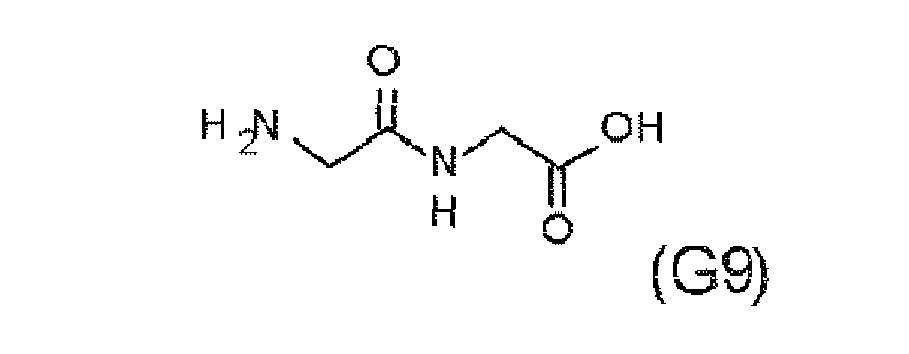
- The content of component (a) in the composition is preferably 0.01 to 10 mass %, more preferably 0.03 to 5 mass %, and yet more preferably 0.05 to 3 mass %, from the viewpoint of preventing the composition from turning yellow.
- Component (b) is an aliphatic carboxylic acid having no greater than 8 carbon atoms or a salt thereof. Examples of the salt of compound (b) include ammonium salts such as ammonium salt and an alkylammonium salt; alkali metal salts such as a sodium salt and a potassium salt; and alkaline earth metal salts such as a calcium salt and a magnesium salt. Among them, an ammonium salt, a sodium salt, and a potassium salt are preferable. Preferred examples of component (b) include malic acid, citric acid, lactic acid, glycolic acid, pyrrolidone carboxylic acid, malonic acid, maleic acid, nicotinic acid, benzoic acid, glyceric acid, and tartaric acid, and salts thereof. Malic acid, citric acid, lactic acid, glycolic acid, glyceric acid, or tartaric acid, or a salt thereof is preferable.
Furthermore, component (b) may be formulated as a counterion of component (a).
The content of component (b) in the composition is preferably 0.01 to 10 mass %, more preferably 0.03 to 5 mass %, and yet more preferably 0.05 to 3 mass %, from the viewpoint of preventing the composition from turning yellow. Furthermore, they may be used singly or in a combination of at least two or more kinds. - The hair treatment composition of the present invention may contain as component (b') an aromatic sulfonic acid having no greater than 10 carbon atoms or a salt thereof. Examples of the salt of compound (b') include ammonium salts such as ammonium and an alkylammonium salt; alkali metal salts such as a sodium salt and a potassium salt; and alkaline earth metal salts such as a calcium salt and a magnesium salt. Among them, an ammonium salt, a sodium salt, and a potassium salt are preferable. Preferred examples of component (b') include benzenesulfonic acid, p-toluenesulfonic acid, 2,4-dimethylbenzenesulfonic acid, 2,5-dimethylbenzenesulfonic acid, naphthalenesulfonic acid, and saccharin, and salts thereof. Among them, p-toluenesulfonic acid or naphthalenesulfonic acid, or a salt thereof is preferable.
The content of component (b') in the composition is preferably 0.01 to 10 mass %, more preferably 0.03 to 5 mass %, and yet more preferably 0.05 to 3 mass %, from the viewpoint of preventing the composition from turning yellow. Furthermore, they may be used singly or in a combination of at least two or more kinds.
The hair treatment composition of the present invention may further contain an organic solvent as component (c). Examples of the organic solvent include lower alkanols such as ethanol and 2-propanol; aromatic alcohols such as benzyl alcohol and 2-benzyloxyethanol; polyols such as propylene glycol, 1,3-butanediol, diethylene glycol, and glycerol; CELLOSOLVES such as ethyl CELLOSOLVE and butyl CELLOSOLVE; and carbitols such as ethylcarbitol and butylcarbitol. - Furthermore, the hair treatment composition of the present invention may further contain a surfactant as component (d). As such a surfactant, any of a cationic surfactant, a nonionic surfactant, an amphoteric surfactant, and an anionic surfactant may be used. Among them, a cationic surfactant or an anionic surfactant is suitably used.
- Examples of the cationic surfactant include a mono-long-chain-alkyl quaternary ammonium salt, a di-long-chain-alkyl quaternary ammonium salt, a long-chain-alkoxyalkyl quaternary ammonium salt, a long-chain-alkylamide quaternary ammonium salt, a long-chain-alkyl tertiary amine and a salt thereof, a long-chain-alkoxyalkyl tertiary amine and a salt thereof, and a long-chain-alkylamide tertiary amine and a salt thereof.
Among them, examples of the long-chain-alkoxyalkyl tertiary amine and a salt thereof include a long-chain-alkyl ether tertiary amine represented by general Formula (F1) and a salt thereof, and a hydroxy long-chain-alkyl ether tertiary amine represented by general Formula (F2) and a salt thereof. -

- In the formula, R1 denotes a straight-chain or branched alkyl or alkenyl group having 6 to 24 carbon atoms. R2 and R3 independently denote an alkyl group having 1 to 6 carbon atoms or an -(AO)mH group. In the -(AO)mH group, A denotes an alkylene group having 2 to 4 carbon atoms, m denotes a number from 1 to 6, the m AOs may be identical to or different from each other, and they may have any arrangement.
-


- In the formula, R4 denotes a straight-chain or branched alkyl or alkenyl group having 6 to 24 carbon atoms. R5 and R6 independently denote an alkyl group having 1 to 6 carbon atoms or an -(AlO)bH group. In the -(AlO)bH group, A1 denotes an alkylene group having 2 to 4 carbon atoms, b denotes a number from 1 to 6, the b AlOs may be identical to or different from each other, and they may have any arrangement. i denotes a number from 1 to 5.
- Specific examples thereof include cetyltrimethylammonium chloride, stearyltrimethylammonium chloride, behenyltrimethylammonium chloride, stearyldimethylbenzylammonium chloride, a benzalkonium chloride, distearyldimethylammonium chloride, N,N-dimethyl-3-hexadecyloxypropylamine and a salt thereof, and N,N-dimethyl-3-octadecyloxypropylamine and a salt thereof. Among them, stearyltrimethylammonium chloride, behenyltrimethylammonium chloride, distearyldimethylammonium chloride, and N,N-dimethyl-3-octadecyloxypropylamine and a salt thereof are preferable.
- Examples of the anionic surfactant include an alkylbenzenesulfonic acid salt, an alkyl or alkenyl ether sulfate, an alkyl or alkenyl sulfate, an olefinsulfonic acid salt, an alkanesulfonic acid salt, a saturated or unsaturated fatty acid salt, an alkyl or alkenyl ether carboxylic acid salt, an α-sulfofatty acid salt, an N-acylamino acid salt, a phosphoric acid mono or diester salt, and a sulfosuccinic acid ester salt. Among them, an alkyl ether sulfate is preferable, and specific examples thereof include a polyoxyethylene alkyl ether sulfate. Examples of the counterion of the anionic group of these anionic surfactants include alkali metal ions such as sodium ion and potassium ion; alkaline earth metal ions such as calcium ion and magnesium ion; ammonium ion; and an alkanolamine having 1 to 3 alkanol groups having 2 or 3 carbon atoms (for example, monoethanolamine, diethanolamine, triethanolamine, or triisopropanolamine).
- Examples of the nonionic surfactant include a polyoxyalkylene alkyl ether, a polyoxyalkylene alkenyl ether, a higher fatty acid sucrose ester, a polyglycerol fatty acid ester, a higher fatty acid mono- or di-ethanolamide, a polyoxyethylene hardened castor oil, a polyoxyethylene sorbitan fatty acid ester, a polyoxyethylene sorbit fatty acid ester, an alkyl saccharide, an alkylamine oxide, an alkylamidoamine oxide, an alkyl glyceryl ether, and an alkenyl glyceryl ether. Among them, a polyoxyalkylene alkyl ether, a higher fatty acid mono- or di-ethanolamide, a polyoxyethylene hardened castor oil, and an alkyl glyceryl ether are preferable, and a polyoxyethylene alkyl (average number of carbon atoms 12 to 14) ether, 2-ethylhexyl glyceryl ether, and isodecyl glyceryl ether are more preferable.
- Examples of the amphoteric surfactant include an imidazoline type, a carbobetaine, an amidobetaine, a sulfobetaine, a hydroxysulfobetaine, and an amidosulfobetaine.
- The content of the surfactant depends on the intended application of the hair treatment agent and the function (improvement of feel, emulsifying ability, cleaning ability and so on) of each surfactant. For example, it is preferably 0.01 to 20 mass % in the composition, more preferably 0.1 to 15 mass %, and yet more preferably 0.5 to 10 mass %.
- Furthermore, the hair treatment composition of the present invention may further contain a conditioning component as component (e). The conditioning component referred to here is selected from a cationic polymer, a silicones, and an oil agent.
- The cationic polymer is used for the purpose of improving the feel of hair during use. The cationic polymer referred to here means a polymer having a cationic group or a group that can be ionized to be cationic, and includes an amphoteric polymer that becomes cationic in its entirety. That is, examples of the cationic polymer include water-soluble polymers containing an amino group or an ammonium group in a side chain of the polymer chain, or a diallyl quaternary ammonium salt as a constituent unit. Specific examples thereof include cationized cellulose, cationized starch, cationized guar gum, cationized tara gum, cationized fenugreek gum, cationized locust bean gum, a polymer or copolymer of a diallyl quaternary ammonium salt, and a quaternized polyvinylpyrrolidone. Among them, from the viewpoint of softness, smoothness, and ease of running fingers through during rinsing and during drying, the effects of manageability and moisture retention during drying, and agent stability, a polymer containing a diallyl quaternary ammonium salt as a constituent unit, a quaternized polyvinylpyrrolidone, and a cationized cellulose are preferable, and a polymer or copolymer of a diallyl quaternary ammonium salt and a cationized cellulose are more preferable.
- Specific examples of the cationic polymer include a dimethyldiallylammonium chloride polymer (polyquaternium-6, for example, MERQUAT 100; Nalco Company), a dimethyldiallylammonium chloride/acrylic acid copolymer (polyquaternium-22, for example, MERQUAT 280 and 295; Nalco Company), a dimethyldiallylammonium chloride/acrylamide copolymer (polyquaternium-7, for example, MERQUAT 550; Nalco Company), a quaternized polyvinylpyrrolidone (GAFQUAT 734, 755, and 755N; ISP Japan Ltd.), a cationized cellulose (Leogard G and GP; Lion Corporation, polymer JR-125, JR-400, JR-30M, LR-400, and LR-30M; all from Union Carbide corporation), and cationized gums (Catinal CTR-100, CF-100, and CLB-100; TOHO Chemical Industry Co., Ltd.).
- These cationic polymers may be used singly or in a combination of at least two or more kinds. The content of the cationic polymer is preferably 0.01 to 20 mass % in the composition, and more preferably 0.5 to 10 mass %, from the viewpoint of the effect in improving feel and stability toward separation of the composition.
- Examples of the silicones include polydimethylsiloxanes, modified silicones (for example, amino-modified silicone, fluorine-modified silicone, alcohol-modified silicone, polyether-modified silicone, epoxy-modified silicone, alkyl-modified silicone or the like), a cyclic polydimethylsiloxane, an aminopolyether-modified silicone, and a highly polymerized methylpolysiloxane emulsion. Among them, a polydimethylsiloxane, a polyether-modified silicone, an amino-modified silicone, a cyclic polydimethylsiloxane, an aminopolyether-modified silicone, and a highly polymerized methylpolysiloxane emulsion are preferable.
- These silicones may be commercially available, and examples thereof include BY11-026, BY22-19, FZ-3125, and SH200-1,000,000cs (Dow Corning Toray Co., Ltd.), TSF451-100MA (Momentive Performance Materials Japan LLC), KM-9716 (Shin-Etsu Chemical Co., Ltd.) [the above are polydimethylsiloxanes], TSF4440 (Momentive Performance Materials Japan LLC), KF-6005, KF-6011, and KF-353A (Shin-Etsu Chemical Co., Ltd.) [the above are polyether-modified silicones], SF8451C, SF8452C, SF8457C, DC929, DC8500, SS-3551, SM8704C, and SM8904 (Dow Corning Toray Co., Ltd.), KF-867 (Shin-Etsu Chemical Co., Ltd.), KT1989 (Momentive Performance Materials Japan LLC) [the above are amino-modified silicones], SH244 and SH245 (Dow Corning Toray Co., Ltd.) [the above are cyclic polydimethylsiloxanes], SS-3588 (Dow Corning Toray Co., Ltd.) [the above is an aminopolyether-modified silicone], and BY22-060 (Dow Corning Toray Co., Ltd.) [the above is a highly polymerized methylpolysiloxane emulsion].
- The content of the silicone is preferably 0.1 to 20 mass % in the composition, and more preferably 0.5 to 15 mass %, from the viewpoint of a sufficient effect and suppression of tackiness.
- Examples of the oil include hydrocarbons such as squalene, squalane, vaseline, paraffin, liquid paraffin, liquid isoparaffin, and cycloparaffin; glycerides such as castor oil, cocoa oil, mink oil, avocado oil, olive oil, and shea butter; waxes such as beeswax, spermaceti, lanolin, and carnauba wax; ester oils such as isopropyl palmitate, isopropyl myristate, octyldodecyl myristate, hexyl laurate, cetyl lactate, propylene glycol monostearate, oleyl oleate, hexadecyl 2-ethylhexanoate, isononyl isononanoate, and tridecyl isononanoate; higher fatty acids such as capric acid, lauric acid, myristic acid, palmitic acid, stearic acid, behenic acid, oleic acid, lanolin fatty acid, iso fatty acid, anteiso fatty acid, coconut oil fatty acid, 18-methyleicosanoic acid, 16-methyloctadecanoic acid, and a mixture of these fatty acids/branched fatty acids; higher alcohols such as myristyl alcohol, cetyl alcohol, oleyl alcohol, stearyl alcohol, isostearyl alcohol, behenyl alcohol, 2-octyldodecanol, and cetostearyl alcohol; and others such as isostearyl glyceryl ether and polyoxypropylene butyl ether. Among them, higher alcohols are preferable.
These oil agents may be used singly or in a combination of at least two or more kinds. The content thereof is preferably 0.1 to 20 mass % in the composition, and more preferably 0.5 to 15 mass %, from the viewpoint of the effect in improving feel and stability toward separation of the composition. - Since such a conditioning component (e) remains in the hair to a moderate extent, a good conditioning effect can be imparted.
- The hair treatment composition of the present invention may contain another component that is normally used as a cosmetic raw material in addition to the above components. Examples of such an optional component include a thickener, a preservative, a chelating agent, a stabilizer, an antioxidant, a plant extract, a herbal extract, a protein hydrolysate, vitamins, a colorant such as a dye, a fragrance, a UV absorber, a pearlescent agent such as an ethylene glycol difatty acid ester, a setting polymer, and an amphiphilic amide lipid. Specific examples of the amphiphilic amide lipid include a diamide compound represented by general Formula (F3) and ceramides represented by general Formula (F4).
-

- In the formula, R7 denotes a straight-chain or branched hydrocarbon group having 1 to 12 carbon atoms, which may be substituted with a hydroxy group and/or an alkoxy group. R8 denotes a straight-chain or branched divalent hydrocarbon group having 1 to 5 carbon atoms. R9 denotes a straight-chain or branched divalent hydrocarbon group having 1 to 22 carbon atoms.
-

- In the formula, R10 denotes a straight-chain, branched, or cyclic, saturated or unsaturated hydrocarbon group having 4 to 30 carbon atoms, which may be substituted with a hydroxy group, an oxo group, or an amino group. W denotes a methylene group, a methine group, or an oxygen atom. X1 denotes a hydrogen atom, an acetyl group, or a glyceryl group, or together with the adjacent oxygen atom forms an oxo group. X2, X3, and X4 each independently denote a hydrogen atom, a hydroxy group, or an acetoxy group. When W is a methine group, one of X2 and X3 is a hydrogen atom and the other is not present, and when -O-X1 is an oxo group, X4 is not present. R11 and R12 each independently denote a hydrogen atom, a hydroxy group, or an acetoxymethyl group. R13 denotes a straight-chain, branched, or cyclic, saturated hydrocarbon group having 5 to 35 carbon atoms, which may be substituted with a hydroxy group or an amino group, or a group in which ester-bonded to the ω-position of the above hydrocarbon group is a straight-chain, branched, or cyclic, saturated or unsaturated fatty acid having 8 to 22 carbon atoms, which may be substituted with a hydroxy group. R14 denotes a hydrogen atom, or a straight-chain or branched, saturated or unsaturated hydrocarbon group having 1 to 8 carbon atoms in total, which may have a substituent selected from a hydroxy group, a hydroxyalkoxy group, an alkoxy group, and an acetoxy group.
- Examples of the setting polymer include polysilicone-9; a polyvinylpyrrolidone-based polymer (for example, polyvinylpyrrolidone, vinylpyrrolidone/vinyl acetate copolymer, vinylpyrrolidone/vinyl acetate/vinyl propionate ternary copolymer, vinylpyrrolidone/alkylaminoacrylate (quaternary chloride) copolymer, vinylpyrrolidone/acrylate/(meth)acrylic acid copolymer, vinylpyrrolidone/alkylaminoacrylate/vinylcaprolactam copolymer or the like); a methyl vinyl ether/maleic anhydride alkyl half ester copolymer; an acidic polyvinyl acetate-based polymer (for example, vinyl acetate/crotonic acid copolymer, vinyl acetate/crotonic acid/vinyl neodecanate copolymer, vinyl acetate/crotonic acid/vinyl propionate copolymer or the like); an acidic (meth)acrylic polymer (for example, (meth)acrylic acid/(meth)acrylic acid ester copolymer acrylic acid/alkyl acrylate ester/alkylacrylamide copolymer or the like); an amphoteric acrylic polymer (for example, N-methacryloylethyl-N,N-dimethylammonium·α-N-methylcarboxybetaine/butyl methacrylate copolymer, hydroxypropyl acrylate/butylaminoethyl methacrylate/acrylic acid octylamide copolymer or the like); an acrylamide·acrylic acid ester-based copolymer; and a chitin·chitosan compound (for example, hydroxypropylchitosan, carboxymethylchitin, carboxymethylchitosan or the like).
- The hair treatment composition of the present invention has a pH at 25°C during use (during application) of 2 to 7, preferably 2.5 to 5.5, and more preferably 3 to 5, from the viewpoint of irritating properties of the composition and stability toward hydrolysis of component (a) in the composition. For adjusting this, a pH adjusting agent may be used.
With regard to the pH adjusting agent, ammonia or a salt thereof; an alkanolamine such as monoethanolamine, isopropanolamine, 2-amino-2-methylpropanol, or 2-aminobutanol, or a salt thereof; an alkanediamine such as 1,3-propanediamine or a salt thereof; a carbonate such as guanidine carbonate, sodium carbonate, potassium carbonate, sodium hydrogen carbonate, or potassium hydrogen carbonate; a hydroxide such as sodium hydroxide or potassium hydroxide, and so on may be used as an alkali agent.
Furthermore, an inorganic acid such as hydrochloric acid or phosphoric acid; a hydrochloride such as monoethanolamine hydrochloride; a phosphate such as monopotassium dihydrogen phosphate or disodium monohydrogen phosphate, and so on may be used as an acid agent. - With regard to these pH adjusting agents, an acid agent on its own, an alkali agent on its own, or a combination of the two may be used. The content thereof in the composition is preferably 0.01 to 20 mass %, and more preferably 0.1 to 15 mass %, from the viewpoint of suppression of hair damage and irritation of the scalp.
- The form of the hair treatment composition of the present invention may be, for example, a liquid, an emulsion, a cream, a gel, a paste, a mousse, an aerosol or the like).
- The hair treatment composition of the present invention may suitably be used in an in-bath agent such as a shampoo, a rinse, a conditioner, or a treatment or an out-bath agent such as a hair mousse, a hair mist, a hair lotion, a hair oil, or a styling agent.
- A method for treating hair of the present invention is carried out by contacting the hair treatment agent explained above with hair directly or using an implement. The method of contact may employ a method that is generally and widely used for a hair treatment composition that is to be applied. Among them, in the case of a shampoo composition, there can be cited a method in which an appropriate amount thereof is contacted with the hair, massaging is carried out for a few minutes while foaming, and it is then washed away using running water. Furthermore, in the case of a rinse, a conditioner, a treatment, and so on, there can be cited a method in which an appropriate amount thereof is contacted with the hair, it is allowed to stand for a few seconds to several tens of minutes, and it is then washed away with running water.
In the case of a hair mousse, a hair oil, or a styling agent, there can be cited such as a method in which an appropriate amount thereof is contacted with the hair, and it is left as it is. The appropriate amount referred to here is an amount that gives a liquor ratio relative to the weight of hair of on the order of 1:0.005 to 1:10. The hair that is to be treated may be the whole hair or part thereof. The temperature when applied to the hair is preferably from room temperature to on the order of body temperature, but in order to promote penetration it may be heated to on the order of 50°C. - Shampoos were prepared in accordance with the formulations shown in Table 1 (Examples EA1 to EA8) and Table 2 (Comparative Examples CA1 to CA10). Hair bundles having a length of 10 cm and a width of 2 cm were washed with each of the shampoos, rinsed for 30 sec. with running water, dried with a towel, fixed via upper ends of the hair bundles, and dried naturally. A sensory test was carried out by 10 expert panelists with respect to hair softness, alignment, and luster after drying hair in accordance with the criteria below. The results are ranked by the average score of the 10 people and are shown in Table 3 and Table 4.
-
- 4
- Very soft.
- 3
- Soft.
- 2
- Could not say one way or the other.
- 1
- Springy.
- 0
- Very springy.
-
- 4
- Alignment was very good.
- 3
- Alignment was good.
- 2
- Could not say one way or the other.
- 1
- Alignment was poor.
- 0
- Alignment was very poor.
-
- 4
- There was outstanding improvement in luster.
- 3
- There was improvement in luster.
- 2
- There was some improvement in luster.
- 1
- There was no improvement in luster.
- 0
- Luster disappeared.
-
- AA
- Average score was at least 3.5.
- BB
- Average score was at least 2.5 but less than 3.5.
- CC
- Average score was at least 1.5 but less than 2.5.
- DD
- Average score was less than 1.5.
-
[Table 1] Example Shampoo formulation EA1 EA2 EA3 EA4 EA5 EA6 EA7 EA8 (a) Glycylglycine 0.5 0.5 0.5 0.5 0.5 0.5 0.5 0.5 (b) Malic acid 0.5 0.25 Citric acid 0.5 Lactic acid 0.5 0.25 0.5 Glycolic acid 0.5 0.25 0.25 0.5 (b') Toluenesulfonic acid 0.5 0.5 (d) Laureth-2 Na sulfate (25%) 62 62 62 62 62 62 62 62 Lauramide DEA 2.3 2.3 2.3 2.3 2.3 2.3 2.3 2.3 Others EDTA-2Na 0.15 0.15 0.15 0.15 0.15 0.15 0.15 0.15 Na chloride 0.8 0.8 0.8 0.8 0.8 0.8 0.8 0.8 Na hydroxide Appropriate amount Appropriate amount Appropriate amount Appropriate amount Appropriate amount Appropriate amount Appropriate amount Appropriate amount Water Balance Balance Balance Balance Balance Balance Balance Balance pH 3.7 3.7 3.7 3.7 3.7 3.7 3.7 3.7 -
[Table 2] Comparative Example Shampoo formulation CA1 CA2 CA3 CA4 CA5 CA6 CA7 CA8 CA9 CA10 (a) Glycylglycine 0.5 (b) Malic acid 0.5 0.25 Citric acid 0.5 Lactic acid 0.5 0.25 0.5 Glycolic acid 0.5 0.25 0.25 0.5 (b') Toluenesulfonic acid 0.5 0.5 (d) Laureth-2 Na sulfate (25%) 62 62 62 62 62 62 62 62 62 62 Lauramide DEA 2.3 2.3 2.3 2.3 2.3 2.3 2.3 2.3 2.3 2.3 Others EDTA-2Na 0.15 0.15 0.15 0.15 0.15 0.15 0.15 0.15 0.15 0.15 Na chloride 0.8 0.8 0.8 0.8 0.8 0.8 0.8 0.8 0.8 0.8 Na hydroxide Appropriate amount Appropriate amount Appropriate amount Appropriate amount Appropriate amount Appropriate amount Appropriate amount Appropriate amount Appropriate amount Appropriate amount Water Balance Balance Balance Balance Balance Balance Balance Balance Balance Balance pH 3.7 3.7 3.7 3.7 3.7 3.7 3.7 3.7 3.7 3.7 -
[Table 3] Example Shampoo formulation EA1 EA2 EA3 EA4 EA5 EA6 EA7 EA8 Evaluation Hair softness AA AA AA AA AA AA AA AA Hair alignment AA AA AA AA AA AA AA AA Hair luster AA AA AA AA AA AA AA AA -
[Table 4] Comparative Example Shampoo formulations CA1 CA2 CA3 CA4 CA5 CA6 CA7 CA8 CA9 CA10 Evaluation Hair softness CC DD DD DD BB BB BB CC DD DD Hair alignment DD BB BB BB CC CC CC CC BB BB Hair luster DD BB DD BB CC CC CC DD BB BB - As is clear from Tables 3 and 4, for a shampoo that did not contain at least one of component (a) and component (b), the score was low compared with the shampoos of the Examples with respect to improvements of all of hair softness, alignment, and luster after hair was dried.
- Conditioning agents were prepared in accordance with the formulations shown in Table 5 (Examples EB1 to EB8) and Table 6 (Comparative Examples CB1 to CB10). Hair bundles having a length of 10 cm and a width of 2 cm were washed with a commercial shampoo, rinsed for 30 sec. with running water, and then dried with a towel. Subsequently, they were coated with an appropriate amount of each of the conditioning agents, rinsed for 30 sec with running water, dried with a towel, fixed via upper ends of the hair bundles, and dried naturally. A sensory test was carried out by 10 expert panelists with respect to softness, alignment, and luster after drying hair in accordance with the criteria bellow. The results are ranked by the average score of the 10 people and shown in Table 7 and Table 8.
-
- 4
- Very soft.
- 3
- Soft.
- 2
- Could not say one way or the other.
- 1
- Sparing.
- 0
- Very springy.
-
- 4
- Alignment was very good.
- 3
- Alignment was good.
- 2
- Could not say one way or the other.
- 1
- Alignment was poor.
- 0
- Alignment was very poor.
-
- 4
- There was outstanding improvement in luster.
- 3
- There was improvement in luster.
- 2
- There was some improvement in luster.
- 1
- There was no improvement in luster.
- 0
- Luster disappeared.
-
- AA
- Average score was at least 3.5.
- BB
- Average score was at least 2.5 but less than 3.5.
- CC
- Average score was at least 1.5 but less than 2.5.
- DD
- Average score was less than 1.5.
-
[Table 5] Example Conditioner formulation EB1 EB2 EB3 EB4 EB5 EB6 EB7 EB8 (a) Glycylglycine 0.5 0.5 0.5 0.5 0.5 0.5 0.5 0.5 (b) Malic acid 0.5 0.25 Citric acid 0.5 Lactic acid 0.5 0.25 0.5 Glycolic acid 0.5 0.25 0.25 0.5 (b') Toluenesulfonic acid 0.5 0.5 (c) PG 5.25 5.25 5.25 5.25 5.25 5.25 5.25 5.25 (d) Steartrimonium chloride (28%) 2.88 2.88 2.88 2.88 2.88 2.88 2.88 2.88 Disteardimonium chloride (75%) 3.78 3.78 3.78 3.78 3.78 3.78 3.78 3.78 (e) Cetanol 2.1 2.1 2.1 2.1 2.1 2.1 2.1 2.1 Others Water Balance Balance Balance Balance Balance Balance Balance Balance Na hydroxide Appropriate amount Appropriate amount Appropriate amount Appropriate amount Appropriate amount Appropriate amount Appropriate amount Appropriate amount pH 3.7 3.7 3.7 3.7 3.7 3.7 3.7 3.7 -
[Table 6] Comparative Example Conditioner formulation CB1 CB2 CB3 CB4 CB5 CB6 CB7 CB8 CB9 CB10 (a) Glycylglycine 0.5 (b) Malic acid 0.5 0.25 Citric acid 0.5 Lactic acid 0.5 0.25 0.5 Glycolic acid 0.5 0.25 0.25 0.5 (b') Toluenesulfonic acid 0.5 0.5 (c) PG 5.25 5.25 5.25 5.25 5.25 5.25 5.25 5.25 5.25 5.25 (d) Steartrimonium chloride (28%) 2.88 2.88 2.88 2.88 2.88 2.88 2.88 2.88 2.88 2.88 Disteardimonium chloride (75%) 3.78 3.78 3.78 3.78 3.78 3.78 3.78 3.78 3.78 3.78 (e) Cetanol 2.1 2.1 2.1 2.1 2.1 2.1 2.1 2.1 2.1 2.1 Others Water Balance Balance Balance Balance Balance Balance Balance Balance Balance Balance Na hydroxide Appropriate amount Appropriate amount Appropriate amount Appropriate amount Appropriate amount Appropriate amount Appropriate amount Appropriate amount Appropriate amount Appropriate amount pH 3.7 3.7 3.7 3.7 3.7 3.7 3.7 3.7 3.7 3.7 -
[Table 7] Example Conditioner formulation EB1 EB2 EB3 EB4 EB5 EB6 EB7 EB8 Evaluation Hair softness AA AA AA AA AA AA AA AA Hair Alignment AA AA AA AA AA AA AA AA Hair luster AA AA AA AA AA AA AA AA -
[Table 8] Comparative Example Conditioner formulation CB1 CB2 CB3 CB4 CB5 CB6 CB7 CB8 CB9 CB10 Evaluation Hair softness CC DD DD DD BB BB BB CC DD DD Hair Alignment DD BB BB BB CC CC CC CC BB BB Hair luster DD BB BB BB CC CC CC CC BB BB - As is clear from Tables 7 and 8, for a conditioning agent that did not contain at least one of component (a) and component (b), in the same manner as for the above shampoos, the score was low compared with the conditioning agents of the Examples with respect to improvements of all of hair softness, alignment, and luster after hair was dried.
- As hereinbefore described, in accordance with the shampoos and the conditioning agents of the Examples, which employed the hair treatment composition of the present invention, it is possible to simultaneously impart softness, luster, and alignment.
- Hair treatment compositions of Examples EC1 to EC7 and hair treatment compositions of Comparative Examples CC1 to CC4 shown in Table 9 were prepared. 0.1 g bundles of hair having a length of 20 cm and a width of 5 cm were made by aligning and binding the bases. The hair bundles were coated with 0.2 g of each of the hair treatment compositions, allowed to stand for 10 min, then rinsed with water at about 40°C for 30 sec, dried with a towel, fixed so that the bound part was uppermost, and dried naturally. After natural drying, the susceptibility to morning hair, ease of styling, and sustainability of styling were evaluated by the methods below.
- A hair bundle was placed on a towel base, which was assumed to be a pillow, in a folded-in-half state, a wig (No. 662DXLH, Beaulax Co., Ltd.) equipped with a weight so as to give an average human head weight of 6 kg was placed on the hair bundle as in a sleeping state, and it was left for 8 hours. After leaving, the hair bundle was fixed so that the bound part was uppermost, and a bending angle θ of the hair bundle when viewed side-on as shown in
FIG. 1 was measured. It means that the larger the angle θ, the more the susceptibility to morning hair, and the smaller the angle θ, the more the resistance to morning hair. The results are collected in Table 9. As can be seen from Table 9 the θ of Examples EC1 to EC7 was clearly small compared with the θ of Comparative Examples CC1 to CC4, and there was resistance to morning hair. - The hair bundles for which susceptibility to morning hair had been evaluated were coated with 0.05 g of ion exchanged water as a mist, then wound around a rod having a diameter of 2.5 cm, and dried at 60°C. The hair bundles were removed from the rod, and with regard to curling, a curl diameter R0 of the hair bundle was measured as shown in
FIG. 2 , a styling rate S (%) = (2.5/R0)*100 was determined, and ease of styling was evaluated. It means that the larger the styling rate S, the more intense the curling, which means that styling is easy. The results are collected in Table 9. As can be seen from Table 9, the S of Examples EC1 to EC7 was clearly large compared with the S of Comparative Examples CC1 to CC4, and styling was easy. - A hair bundle for which ease of styling had been evaluated by the above-mentioned method was left at 20°C and 65%RH for 8 hours, and the curl diameter of the hair bundle was measured again. The curl diameter was defined after leaving. As the curl diameter R1, a styling sustain rate Δ (%) = [{S-(2.5/R1)*100}/S]*100, was determined, and styling sustainability was evaluated. It means that the smaller the styling sustain rate Δ, the higher the styling sustainability. The results are collected in Table 1. As can be seen from Table 9, it is understood that the Δ of Examples EC1 to EC7 was clearly small compared with the Δ of Comparative Examples CC1 to CC4, and the sustainability of styling was excellent.
-
[Table 9] Component (mass %) Example Comparative Example EC1 EC2 EC3 EC4 EC5 EC6 EC7 CC1 CC2 CC3 CC4 (a) Glycylglycine 0.2 - 1 2 - 0.5 0.5 0.5 - - - Glycylglycylglycine - 0.5 - - 0.5 - - - - - - (b) Malic acid 2 - - - 0.25 0.5 - - 2 0.5 - Citric acid - 1 - - - - - - - - - Lactic acid - - 0.5 - - - 0.5 - - - - Glycolic acid - - - 0.2 - - - - - - - (b') Toluenesulfonic acid - - - - - 0.5 - - - 0.5 - Naphthalenesulfonic acid - - - - - - 0.2 - - - - Others Na hydroxide Appropriate amount Appropriate amount Appropriate amount Appropriate amount Appropriate amount Appropriate amount Appropriate amount Appropriate amount Appropriate amount Appropriate amount Appropriate amount Water Balance Balance Balance Balance Balance Balance Balance Balance Balance Balance Balance pH 3.7 3.7 3.7 5 5 3.7 3.7 3.7 3.7 3.7 3.7 Susceptibility to morning hair(θ/deg) 16 18 14 13 16 12 11 40 35 34 47 Ease of styling(S/%) 92 92 93 93 93 96 93 87 86 83 78 Sustainability of styling(Δ/%) 14 9 12 9 14 13 8 22 21 20 17 - The hair treatment composition of Example E1 and the hair treatment composition of Comparative Example E1 shown in Table 10 were prepared. Five panelists replaced the conditioner that was normally used with a hair treatment composition such that the hair treatment composition of Example ED1 was used for the left-hand side of the head and the hair treatment composition of Comparative Example CD1 was used for the right-hand side of the head for one week. Subsequently, the hair treatment composition of Comparative Example CD1 was used for the left-hand side of the head and the hair treatment composition of Example ED1 was used for the right-hand side of the head for one week. Subsequently, resistance to morning hair and ease of styling the next morning and sustainability of styling the next day were examined by questionnaire in accordance with the criteria below. The results are collected in Table 10.
-
- 2 points: Example ED1 product showed more resistance to morning hair than Comparative Example CD1 product.
- 1 point: Example ED1 product showed slightly more resistance to morning hair than Comparative Example CD1 product.
- 0 points: Could not say one way or the other.
- -1 points: Comparative Example CD1 product showed slightly more resistance to morning hair than Example ED1 product.
- -2 points: Comparative Example CD1 product showed more resistance to morning hair than Example ED1 product.
-
- 2 points: Styling was easier with Example ED1 product than with Comparative Example CD1 product.
- 1 point: Styling was slightly easier with Example ED1 product than with Comparative Example CD1 product.
- 0 points: Could not say one way or the other.
- -1 points: Styling was slightly easier with Comparative Example CD1 product than with Example ED1 product.
- -2 points: Styling was easier with Comparative Example CD1 product than with Example ED1 product.
-
- 2 points: Styling was sustained better with Example ED1 product than with Comparative Example CD1 product.
- 1 point: Styling was sustained slightly better with Example ED1 product than with Comparative Example CD1 product.
- 0 points: Could not say one way or the other.
- -1 point: Styling was sustained slightly better with Comparative Example CD1 product than with Example ED1 product.
- -2 point: Styling was sustained better with Comparative Example CD1 product than with Example ED1 product.
- As can be seen from Table 10, it is understood that compared with the hair treatment composition of Comparative Example CD1, the hair treatment composition of Example ED1 had better resistance to morning hair and simultaneously had ease of styling and, furthermore, the styling could be sustained.
-
[Table 10] Component (mass %) Example Comparative Example ED1 CD1 (a) Glycylglycine 0.5 - (b) Malic acid 0.5 0.5 (c) Propylene glycol 5.25 5.25 (d) Steartrimonium chloride (28%) 2.88 2.88 Disteardimonium chloride (75%) 3.78 3.78 (e) Cetanol 2.1 2.1 Others Na hydroxide Appropriate amount Appropriate amount Water Balance Balance pH 3.7 3.7 Resistance to morning hair 9 Ease of styling 8 Styling sustainability 9 -
Formulation Example EE1 (hair mist) (mass %) Glycylglycine 0.1 Malic acid 4.0 Steartrimonium chloride (stearyltrimethylammonium chloride) 0.25 Glycerol 1.0 Benzyl alcohol 1.0 Ethanol 4.5 PEG-10 dimethicon*1 (polyether-modified silicone) 1.1 Decylpyridinium bromide 1.5 Fragrance 0.02 Na hydroxide adjust to pH 3.7 Water Balance *1: KF-353A, Shin-Etsu Chemical Co., Ltd. -
Formulation Example EE2 (hair mist) (mass %) Glycylglycine 0.2 Glycolic acid 2.5 Malonic acid 1.0 2-Benzyloxyethanol 2.5 PVP*2 (polyvinylpyrrolidone) 3.0 Ethanol 10.0 Polysilicone-9*3 1.0 (bisisobutyl PEG-15/amodimethicon)copolymerm*4 (aminopolyether-modified silicone) 0.5 Fragrance 0.05 Na hydroxide adjust to pH 3.7 Water Balance *2: PVPK-30, ISP Japan, Ltd.
*3: OS-88E-E, Kao Corporation
*4: SS-3588, Dow Corning Toray Co., Ltd. -
Formulation Example EE3 (hair lotion) (mass %) Glycylglycine 0.5 Lactic acid 2.0 Toluenesulfonic acid 0.5 Glycerol 2.0 Benzyl alcohol 1.0 Hydroxyethyl cellulose*5 2.0 Ethanol 10.0 Dimethicon*6 (polydimethylsiloxane) 1.3 Fragrance 0.05 Na hydroxide adjust to pH 3.7 Water Balance *5: HEC Daicel SE-850K, Daicel Chemical Industries, Ltd.
*6: KM-9716, Shin-Etsu Chemical Co., Ltd. -
Formulation Example EE4 (hair lotion) (mass %) Glycylglycylglycine 0.3 Malic acid 2.5 Naphthalenesulfonic acid 0.1 Glycerol 1.0 Benzyl alcohol 1.0 Ethanol 10.0 Polysilicone-9*7 1.0 Fragrance 0.02 Na hydroxide adjust to pH 5.0 Water Balance *7: OS-88E-E, Kao Corporation -
Formulation Example EE5 (hair mousse) (mass %) Glycylglycine 0.1 Glycylglycylglycine 0.1 Malic acid 2.0 Lactic acid 2.0 Laureth-16 (polyoxyethylene (16EO) lauryl ether) 1.0 Steartrimonium chloride (stearyltrimethylammonium chloride) 0.1 Glycerol 1.0 Benzyloxyethanol 2.5 Ethanol 4.5 Polysilicone-9*8 1.2 Dimethicon*9 (highly polymerized methypolylsiloxane emulsion) 0.3 Dimethicon copolyol*10 (polyoxyethylene·methypolylsiloxane copolymer) 0.2 Fragrance 0.02 Na hydroxide adjust to pH 4.0 Water Balance *8: OS-96E-E, Kao Corporation
*9: BY22-060, Dow Corning Toray Co., Ltd.
*10: KF-353A, Shin-Etsu Chemical Co., Ltd. -
Formulation Example EE6 (shampoo) (mass %) Glycylglycine 0.1 Lactic acid 0.5 Malic acid 0.5 Toluenesulfonic acid 0.3 Laureth-1 ammonium sulfate (ammonium polyoxyethylene (1EO) lauryl ether sulfate) 15.0 Lauramidopropyl betaine (lauric acid amide propyl betaine) 0.5 Cocamide MEA (cocoylmonoethanolamide) 0.3 Fatty acid (C14-28)/branched fatty acid (C14-28) mixture*11 0.5 Distearic acid PEG-250 (ethylene glycol distearate) 3.0 Isodecyl glyceryl ether 0.5 Caesalpinia spinosa hydroxypropyltrimonium chloride*12 (cationized tara gum) 0.1 Fenugreek hydroxypropyltrimonium chloride (cationized fenugreek gum) *13 0.1 Locust bean hydroxypropyltrimonium chloride *14 (cationized locust bean gum) 0.1 Na hydroxide adjust to pH 3.5 Water Balance *11: CRODACID 18-MEA, Croda Japan KK
*12: Catinal CTR-100, TOHO Chemical Industry Co., Ltd.
*13: Catinal CF-100, TOHO Chemical Industry Co., Ltd.
*14: Catinal CLB-100, TOHO Chemical Industry Co., Ltd. -
Formulation Example EE7 (conditioner) (mass %) Glycylglycine 0.1 Lactic acid 0.7 Glycolic acid 0.7 Stearoxypropyldimethylamine (N,N-dimethyl-3-octadecyloxypropylamine) 1.0 Benzyl alcohol 0.5 Isostearic acid 0.25 Shea butter 0.25 Fatty acid (C14-28)/branched fatty acid (C14-28) mixture*15 0.25 Bismethoxypropylamido isodocosane*16 (amphiphilic amide lipid A) 0.5 Stearyl alcohol 3.0 Dimethicon*17 (polydimethylsiloxane) 2.0 Na hydroxide adjust to pH 3.7 Water Balance *15: CRODACID 18-MEA, Croda Japan KK
*16: BRS-661C, Kao Corporation
*17: SH200C, Dow Corning Toray Co., Ltd. - A stock solution was first prepared in accordance with the formulation below, and subsequently the stock solution and a propellant were charged into a pressure-resistant sealed container, thus giving an aerosol hair spray.
'Stock solution' (mass %) Glycylglycine 0.1 Lactic acid 0.2 Acrylate copolymer*18 5.0 Ethanol 33.5 PEG-10 Dimethicon*19 (polyoxyethylene-methylpolysiloxane copolymer) 0.2 Na hydroxide adjust to pH 6.5 Water Balance to adjust stock solution to 80% *18: BALANCE CR, National Starch & Chemical Company
*19: KF-353A, Shin-Etsu Chemical Co., Ltd.'Propellant' DME (dimethyl ether) 20.0 - A stock solution was first prepared in accordance with the formulation below, and subsequently the stock solution and a propellant were charged into a pressure-resistant sealed container, thus giving an aerosol foam.
'Stock solution' (mass %) Glycylglycine 0.2 Malic acid 0.2 Acrylate copolymer*20 5.0 Ethanol 33.3 (C12-14) PARETH-9*21 (polyoxyethylene monoalkyl ether) 1.0 Na hydroxide adjust to pH 6.5 Water Balance to adjust stock solution to 80% *20: BALANCE CR, National Starch & Chemical Company
*21: SOFTANOL 90, Nippon Shokubai CO., Ltd.'Propellant' DME (dimethyl ether) 20.0 -
Formulation Example EE10 (styling agent) 'Stock solution' (mass %) Glycylglycine 0.1 Malic acid 0.1 Toluenesulfonic acid 0.2 Cetearyl alcohol (cetostearyl alcohol) 4.0 Paraffin 16.5 Vaseline 10.0 Mineral oil (liquid paraffin) 3.0 Ceteth-20 (polyoxyethylene cetyl ether (20 E.O.)) 5.0 Glyceryl stearate (glycerol monostearate) 3.0 Laureth-4 Na phosphate (sodium polyoxyethylene lauryl ether phosphate) 0.5 Propylparaben (propyl p-oxybenzoate) 0.1 Octyldodecyl myristate 3.0 Carbomer*22 (carboxyvinyl polymer) 0.1 PEG-32 (polyethylene glycol 1540) 5.0 Na stearoyl methyl taurate (sodium N-stearoyl-N-methyltaurate) 1.0 Methylparaben (methyl p-oxybenzoate) 0.2 BG (butylene glycol) 5.0 EDTA-2Na (disodium edetate) 0.1 PVP*23 (polyvinylpyrrolidone) 0.8 Na benzoate 0.2 Phenoxyethanol 0.2 Na hydroxide adjust to pH 6.5 Water Balance *22: Carbopol 980, Lubrizol Advanced Materials, Inc.
*23: PVP K-30, ISP Japan, Ltd.
Claims (7)
- A hair treatment composition, comprising components (a) and (b) :(a) a compound having 2 or 3 amino acid residues and represented by general Formula (1), or a salt thereof

Y denotes an amino acid residue selected from an arginine residue, an alanine residue, a glycine residue, a glutamine residue, a glutamic acid residue, a serine residue, a proline residue, and a 4-hydroxyproline residue or a divalent group represented by chemical Formula (2)

R denotes a hydrogen atom or a monovalent hydrocarbon group having 1 to 4 carbon atoms, which may be substituted with a hydroxy group, m and n denote 0 or 1, and when m and n are simultaneously 1, X is not an amino acid residue]; and(b) an aliphatic carboxylic acid having no greater than 8 carbon atoms or a salt thereof. - The composition according to claim 1, further comprising (b') an aromatic sulfonic acid having no greater than 10 carbon atoms or a salt thereof.
- The composition according to claim 1 or 2, wherein the compound as component (a) is glycylglycine or glycylglycylglycine.
- The composition according to any one of claims 1 to 3, wherein the aliphatic carboxylic acid having no greater than 8 carbon atoms or a salt thereof as component (b) is malic acid, citric acid, lactic acid, glycolic acid, glyceric acid, or tartaric acid.
- The composition according to any one of claims 1 to 4, wherein the aromatic sulfonic acid having no greater than 10 carbon atoms or a salt thereof as component (b') is p-toluenesulfonic acid or naphthalenesulfonic acid.
- The composition according to any one of claims 1 to 5, wherein it has a pH at 25°C of 2 to 7.
- A method for treating hair using the hair treatment composition according to any one of Claims 1 to 6.
Applications Claiming Priority (3)
| Application Number | Priority Date | Filing Date | Title |
|---|---|---|---|
| JP2008207985 | 2008-08-12 | ||
| JP2009150150A JP2010065022A (en) | 2008-08-12 | 2009-06-24 | Hair treatment composition |
| PCT/JP2009/003766 WO2010018668A1 (en) | 2008-08-12 | 2009-08-06 | Hair treatment composition |
Publications (2)
| Publication Number | Publication Date |
|---|---|
| EP2314278A1 true EP2314278A1 (en) | 2011-04-27 |
| EP2314278A4 EP2314278A4 (en) | 2014-07-02 |
Family
ID=41668819
Family Applications (1)
| Application Number | Title | Priority Date | Filing Date |
|---|---|---|---|
| EP09806564.2A Withdrawn EP2314278A4 (en) | 2008-08-12 | 2009-08-06 | Hair treatment composition |
Country Status (6)
| Country | Link |
|---|---|
| US (1) | US20110150804A1 (en) |
| EP (1) | EP2314278A4 (en) |
| JP (1) | JP2010065022A (en) |
| CN (1) | CN102119020B (en) |
| TW (1) | TW201006505A (en) |
| WO (1) | WO2010018668A1 (en) |
Cited By (4)
| Publication number | Priority date | Publication date | Assignee | Title |
|---|---|---|---|---|
| EP2520274A1 (en) * | 2011-05-02 | 2012-11-07 | KPSS-Kao Professional Salon Services GmbH | Composition for keratin fibers |
| TWI468186B (en) * | 2012-12-28 | 2015-01-11 | Kao Corp | Hair cosmetic composition |
| EP2666459A4 (en) * | 2011-01-19 | 2015-09-02 | Kao Corp | Process for producing vesicle composition |
| EP3578162A4 (en) * | 2017-01-31 | 2020-07-29 | Kao Corporation | HAIR TREATMENT PROCEDURE |
Families Citing this family (31)
| Publication number | Priority date | Publication date | Assignee | Title |
|---|---|---|---|---|
| JP5346662B2 (en) * | 2009-04-15 | 2013-11-20 | 花王株式会社 | Hair treatment method |
| JP5700751B2 (en) * | 2010-02-02 | 2015-04-15 | 花王株式会社 | Hair cosmetics |
| WO2011125713A1 (en) * | 2010-04-06 | 2011-10-13 | ライオン株式会社 | Hair cosmetic |
| JP5719229B2 (en) * | 2011-05-02 | 2015-05-13 | 花王株式会社 | Vesicle composition and use thereof |
| JP2012232932A (en) * | 2011-05-02 | 2012-11-29 | Kao Corp | Method for producing vesicle composition |
| JP6080374B2 (en) * | 2012-04-10 | 2017-02-15 | 花王株式会社 | Hair cosmetic composition |
| JP2014062088A (en) * | 2012-08-30 | 2014-04-10 | Kao Corp | Hair cosmetic |
| KR20210082277A (en) | 2015-05-01 | 2021-07-02 | 로레알 | Use of active agents during chemical treatments |
| US10828244B2 (en) | 2015-11-24 | 2020-11-10 | L'oreal | Compositions for treating the hair |
| CN108495687B (en) | 2015-11-24 | 2021-11-09 | 欧莱雅 | Composition for treating hair |
| BR112018010381B1 (en) * | 2015-11-24 | 2021-08-17 | L'oreal | HAIR TREATMENT COMPOSITION, HAIR TREATMENT SYSTEM, HAIR TREATMENT AND HAIR COLOR CHANGE METHODS, AND MULTI-COMPARTMENT KIT FOR HAIR COLOR OR SHAPE CHANGE |
| JP6769748B2 (en) * | 2016-06-16 | 2020-10-14 | 日本製紙株式会社 | Effervescent aerosol composition |
| US20180116942A1 (en) * | 2016-10-31 | 2018-05-03 | L'oreal | Compositions for chemically treated hair |
| US11135150B2 (en) | 2016-11-21 | 2021-10-05 | L'oreal | Compositions and methods for improving the quality of chemically treated hair |
| WO2018140541A1 (en) * | 2017-01-25 | 2018-08-02 | Parsons Camie | Chemical membrane complex repair solution and method of using the same |
| JP2018193366A (en) * | 2017-05-17 | 2018-12-06 | 花王株式会社 | Multi-agent hair treatment |
| US11433011B2 (en) | 2017-05-24 | 2022-09-06 | L'oreal | Methods for treating chemically relaxed hair |
| US11596588B2 (en) | 2017-12-29 | 2023-03-07 | L'oreal | Compositions for altering the color of hair |
| EP3741352B1 (en) * | 2018-01-16 | 2025-08-20 | Kao Corporation | Hair cosmetic composition |
| US11090249B2 (en) * | 2018-10-31 | 2021-08-17 | L'oreal | Hair treatment compositions, methods, and kits for treating hair |
| EP3689177B1 (en) * | 2019-02-01 | 2021-11-03 | Kao Corporation | Hair treatment method and hair holder |
| JP7458207B2 (en) * | 2019-05-10 | 2024-03-29 | 花王株式会社 | hair treatment method |
| US11419809B2 (en) | 2019-06-27 | 2022-08-23 | L'oreal | Hair treatment compositions and methods for treating hair |
| JP7381231B2 (en) | 2019-07-08 | 2023-11-15 | 花王株式会社 | hair cosmetics |
| US11826451B2 (en) | 2019-12-31 | 2023-11-28 | L'oreal | Compositions for treating hair |
| JP7524005B2 (en) * | 2020-09-16 | 2024-07-29 | クラシエ株式会社 | Conditioning Composition |
| US12109289B2 (en) | 2021-06-30 | 2024-10-08 | L'oreal | Compositions for imparting color and tone to the hair |
| US12036299B2 (en) | 2021-06-30 | 2024-07-16 | L'oreal | Compositions containing direct dyes for imparting color and tone to the hair |
| US12109287B2 (en) | 2022-07-31 | 2024-10-08 | L'oreal | Compositions and methods for altering the color of hair |
| US12144879B2 (en) | 2022-07-31 | 2024-11-19 | L'oreal | Compositions and methods for altering the color of hair |
| US12409123B2 (en) | 2022-07-31 | 2025-09-09 | L'oreal | Compositions and methods for altering the color of hair |
Family Cites Families (12)
| Publication number | Priority date | Publication date | Assignee | Title |
|---|---|---|---|---|
| US5091171B2 (en) * | 1986-12-23 | 1997-07-15 | Tristrata Inc | Amphoteric compositions and polymeric forms of alpha hydroxyacids and their therapeutic use |
| JPH08198725A (en) | 1995-01-27 | 1996-08-06 | Mikimoto Pharmaceut Co Ltd | Skin cosmetic and hair cosmetic |
| DE19533211B4 (en) * | 1995-09-08 | 2005-12-01 | Kpss-Kao Professional Salon Services Gmbh | Hair aftertreatment preparations |
| JPH1081614A (en) | 1996-09-06 | 1998-03-31 | Kao Corp | Hair cosmetics |
| JP3461442B2 (en) * | 1997-04-25 | 2003-10-27 | 花王株式会社 | Hair cosmetics |
| JP3024962B1 (en) * | 1998-11-17 | 2000-03-27 | 花王株式会社 | Hair treatment agent |
| JP3208381B2 (en) * | 1998-12-28 | 2001-09-10 | 花王株式会社 | Hair cosmetics |
| JP4185467B2 (en) * | 2004-03-25 | 2008-11-26 | 花王株式会社 | Hair cosmetics |
| BRPI0620701A2 (en) * | 2005-12-16 | 2011-11-22 | Unilever Nv | composition for hair treatment |
| JP4950580B2 (en) * | 2006-07-19 | 2012-06-13 | 花王株式会社 | Hair cosmetics |
| JP5448321B2 (en) * | 2007-10-12 | 2014-03-19 | 花王株式会社 | Non-oxidative hair dye composition |
| EP2201931B1 (en) * | 2007-10-12 | 2016-06-01 | Kao Corporation | Hair dye composition |
-
2009
- 2009-06-24 JP JP2009150150A patent/JP2010065022A/en active Pending
- 2009-08-06 CN CN200980131087.3A patent/CN102119020B/en not_active Expired - Fee Related
- 2009-08-06 WO PCT/JP2009/003766 patent/WO2010018668A1/en not_active Ceased
- 2009-08-06 EP EP09806564.2A patent/EP2314278A4/en not_active Withdrawn
- 2009-08-06 US US13/058,296 patent/US20110150804A1/en not_active Abandoned
- 2009-08-12 TW TW098127078A patent/TW201006505A/en unknown
Cited By (6)
| Publication number | Priority date | Publication date | Assignee | Title |
|---|---|---|---|---|
| EP2666459A4 (en) * | 2011-01-19 | 2015-09-02 | Kao Corp | Process for producing vesicle composition |
| EP2520274A1 (en) * | 2011-05-02 | 2012-11-07 | KPSS-Kao Professional Salon Services GmbH | Composition for keratin fibers |
| WO2012150098A3 (en) * | 2011-05-02 | 2013-06-20 | Kao Germany Gmbh | Composition for keratin fibers |
| US9351912B2 (en) | 2011-05-02 | 2016-05-31 | Kao Germany Gmbh | Composition for keratin fibers |
| TWI468186B (en) * | 2012-12-28 | 2015-01-11 | Kao Corp | Hair cosmetic composition |
| EP3578162A4 (en) * | 2017-01-31 | 2020-07-29 | Kao Corporation | HAIR TREATMENT PROCEDURE |
Also Published As
| Publication number | Publication date |
|---|---|
| JP2010065022A (en) | 2010-03-25 |
| WO2010018668A1 (en) | 2010-02-18 |
| US20110150804A1 (en) | 2011-06-23 |
| TW201006505A (en) | 2010-02-16 |
| CN102119020A (en) | 2011-07-06 |
| EP2314278A4 (en) | 2014-07-02 |
| CN102119020B (en) | 2014-10-08 |
Similar Documents
| Publication | Publication Date | Title |
|---|---|---|
| US20110150804A1 (en) | Hair treatment composition | |
| JP3229689B2 (en) | Hair cosmetics | |
| TWI442939B (en) | Aqueous hair cleansing agent | |
| US7892293B2 (en) | Hair dye composition | |
| US8114392B2 (en) | Method for smoothing fibers containing keratin | |
| EP3046534B1 (en) | Process for treating hair | |
| EP3046535B1 (en) | Process for semi-permanent hair straightening and aftercare of the hair | |
| EP2961376B1 (en) | Composition and process for semi-permanent straightening of hair | |
| JP2005239665A (en) | Hair cosmetics | |
| WO2005011623A1 (en) | Hair grooming preparation | |
| WO2010113447A1 (en) | Aqueous hair cleansing agent | |
| JP6514872B2 (en) | Hair cosmetics | |
| US10335358B2 (en) | Hair cosmetic | |
| JP2005272364A (en) | Hair cosmetics | |
| JPH0699285B2 (en) | Hair cosmetics | |
| JP2015013855A (en) | Hair cosmetic | |
| JP5426212B2 (en) | Aqueous hair cleanser | |
| EP3435967B1 (en) | Hair conditioning composition containing pentaerythritol ester and ppg alkyl ether | |
| JP4926371B2 (en) | Hair cosmetics | |
| JP6563643B2 (en) | Hair cosmetics | |
| JP6410337B2 (en) | Hair cosmetics | |
| JPH04230614A (en) | Hair cosmetic | |
| WO2000015181A1 (en) | Hair care compositions comprising ceramide and phytantriol | |
| KR20090071646A (en) | Hair treatment compositions | |
| JP2001524093A (en) | Hair treatment composition |
Legal Events
| Date | Code | Title | Description |
|---|---|---|---|
| PUAI | Public reference made under article 153(3) epc to a published international application that has entered the european phase |
Free format text: ORIGINAL CODE: 0009012 |
|
| 17P | Request for examination filed |
Effective date: 20110216 |
|
| AK | Designated contracting states |
Kind code of ref document: A1 Designated state(s): AT BE BG CH CY CZ DE DK EE ES FI FR GB GR HR HU IE IS IT LI LT LU LV MC MK MT NL NO PL PT RO SE SI SK SM TR |
|
| AX | Request for extension of the european patent |
Extension state: AL BA RS |
|
| DAX | Request for extension of the european patent (deleted) | ||
| A4 | Supplementary search report drawn up and despatched |
Effective date: 20140602 |
|
| RIC1 | Information provided on ipc code assigned before grant |
Ipc: C11D 3/34 20060101ALI20140526BHEP Ipc: A61Q 5/06 20060101ALI20140526BHEP Ipc: A61K 8/44 20060101ALI20140526BHEP Ipc: A61K 8/36 20060101ALI20140526BHEP Ipc: C11D 3/33 20060101ALI20140526BHEP Ipc: A61Q 5/00 20060101ALI20140526BHEP Ipc: A61Q 5/02 20060101ALI20140526BHEP Ipc: A61Q 5/12 20060101ALI20140526BHEP Ipc: A61K 8/64 20060101AFI20140526BHEP Ipc: A61K 8/365 20060101ALI20140526BHEP Ipc: C11D 3/20 20060101ALI20140526BHEP |
|
| STAA | Information on the status of an ep patent application or granted ep patent |
Free format text: STATUS: THE APPLICATION IS DEEMED TO BE WITHDRAWN |
|
| 18D | Application deemed to be withdrawn |
Effective date: 20150106 |