EP2311846A1 - Chiral iridium aqua complex and method for producing optically active hydroxy compound using the same - Google Patents
Chiral iridium aqua complex and method for producing optically active hydroxy compound using the same Download PDFInfo
- Publication number
- EP2311846A1 EP2311846A1 EP09794401A EP09794401A EP2311846A1 EP 2311846 A1 EP2311846 A1 EP 2311846A1 EP 09794401 A EP09794401 A EP 09794401A EP 09794401 A EP09794401 A EP 09794401A EP 2311846 A1 EP2311846 A1 EP 2311846A1
- Authority
- EP
- European Patent Office
- Prior art keywords
- substituent
- group optionally
- group
- aqua complex
- iridium aqua
- Prior art date
- Legal status (The legal status is an assumption and is not a legal conclusion. Google has not performed a legal analysis and makes no representation as to the accuracy of the status listed.)
- Withdrawn
Links
- 0 *[C@](Cc1cc(F)cc(F)c1)c1cc(F)cc(F)c1 Chemical compound *[C@](Cc1cc(F)cc(F)c1)c1cc(F)cc(F)c1 0.000 description 25
- UHFJOOBXDBMZSO-UHFFFAOYSA-N C(C1(CC1)c1ccccc1)c1ccccc1 Chemical compound C(C1(CC1)c1ccccc1)c1ccccc1 UHFJOOBXDBMZSO-UHFFFAOYSA-N 0.000 description 2
- LRLRAYMYEXQKID-UHFFFAOYSA-N Cc1ccc(C(F)(F)F)cc1 Chemical compound Cc1ccc(C(F)(F)F)cc1 LRLRAYMYEXQKID-UHFFFAOYSA-N 0.000 description 2
- ORWCQFGIBHONFH-QFIPXVFZSA-N N[C@@H](Cc1cc(cccc2)c2cc1)c1cc(cccc2)c2cc1 Chemical compound N[C@@H](Cc1cc(cccc2)c2cc1)c1cc(cccc2)c2cc1 ORWCQFGIBHONFH-QFIPXVFZSA-N 0.000 description 2
- TUBRKEQCAMAPRM-SFHVURJKSA-N COc1cc(C[C@@H](c2cc(OC)cc(OC)c2)N)cc(OC)c1 Chemical compound COc1cc(C[C@@H](c2cc(OC)cc(OC)c2)N)cc(OC)c1 TUBRKEQCAMAPRM-SFHVURJKSA-N 0.000 description 1
- ZPTVNYMJQHSSEA-UHFFFAOYSA-N Cc(cc1)ccc1[N+]([O-])=O Chemical compound Cc(cc1)ccc1[N+]([O-])=O ZPTVNYMJQHSSEA-UHFFFAOYSA-N 0.000 description 1
- LZGBQEYLZMLRSZ-AWEZNQCLSA-N N[C@@H](Cc1cc(OC(F)(F)F)cc(OC(F)(F)F)c1)c1cc(OC(F)(F)F)cc(OC(F)(F)F)c1 Chemical compound N[C@@H](Cc1cc(OC(F)(F)F)cc(OC(F)(F)F)c1)c1cc(OC(F)(F)F)cc(OC(F)(F)F)c1 LZGBQEYLZMLRSZ-AWEZNQCLSA-N 0.000 description 1
Classifications
-
- C—CHEMISTRY; METALLURGY
- C07—ORGANIC CHEMISTRY
- C07C—ACYCLIC OR CARBOCYCLIC COMPOUNDS
- C07C311/00—Amides of sulfonic acids, i.e. compounds having singly-bound oxygen atoms of sulfo groups replaced by nitrogen atoms, not being part of nitro or nitroso groups
- C07C311/15—Sulfonamides having sulfur atoms of sulfonamide groups bound to carbon atoms of six-membered aromatic rings
- C07C311/16—Sulfonamides having sulfur atoms of sulfonamide groups bound to carbon atoms of six-membered aromatic rings having the nitrogen atom of at least one of the sulfonamide groups bound to hydrogen atoms or to an acyclic carbon atom
- C07C311/18—Sulfonamides having sulfur atoms of sulfonamide groups bound to carbon atoms of six-membered aromatic rings having the nitrogen atom of at least one of the sulfonamide groups bound to hydrogen atoms or to an acyclic carbon atom to an acyclic carbon atom of a hydrocarbon radical substituted by nitrogen atoms, not being part of nitro or nitroso groups
-
- C—CHEMISTRY; METALLURGY
- C07—ORGANIC CHEMISTRY
- C07B—GENERAL METHODS OF ORGANIC CHEMISTRY; APPARATUS THEREFOR
- C07B53/00—Asymmetric syntheses
-
- C—CHEMISTRY; METALLURGY
- C07—ORGANIC CHEMISTRY
- C07C—ACYCLIC OR CARBOCYCLIC COMPOUNDS
- C07C201/00—Preparation of esters of nitric or nitrous acid or of compounds containing nitro or nitroso groups bound to a carbon skeleton
- C07C201/06—Preparation of nitro compounds
- C07C201/12—Preparation of nitro compounds by reactions not involving the formation of nitro groups
-
- C—CHEMISTRY; METALLURGY
- C07—ORGANIC CHEMISTRY
- C07C—ACYCLIC OR CARBOCYCLIC COMPOUNDS
- C07C247/00—Compounds containing azido groups
- C07C247/02—Compounds containing azido groups with azido groups bound to acyclic carbon atoms of a carbon skeleton
- C07C247/08—Compounds containing azido groups with azido groups bound to acyclic carbon atoms of a carbon skeleton being unsaturated
- C07C247/10—Compounds containing azido groups with azido groups bound to acyclic carbon atoms of a carbon skeleton being unsaturated and containing rings
-
- C—CHEMISTRY; METALLURGY
- C07—ORGANIC CHEMISTRY
- C07C—ACYCLIC OR CARBOCYCLIC COMPOUNDS
- C07C253/00—Preparation of carboxylic acid nitriles
- C07C253/30—Preparation of carboxylic acid nitriles by reactions not involving the formation of cyano groups
-
- C—CHEMISTRY; METALLURGY
- C07—ORGANIC CHEMISTRY
- C07C—ACYCLIC OR CARBOCYCLIC COMPOUNDS
- C07C29/00—Preparation of compounds having hydroxy or O-metal groups bound to a carbon atom not belonging to a six-membered aromatic ring
- C07C29/132—Preparation of compounds having hydroxy or O-metal groups bound to a carbon atom not belonging to a six-membered aromatic ring by reduction of an oxygen containing functional group
- C07C29/136—Preparation of compounds having hydroxy or O-metal groups bound to a carbon atom not belonging to a six-membered aromatic ring by reduction of an oxygen containing functional group of >C=O containing groups, e.g. —COOH
- C07C29/143—Preparation of compounds having hydroxy or O-metal groups bound to a carbon atom not belonging to a six-membered aromatic ring by reduction of an oxygen containing functional group of >C=O containing groups, e.g. —COOH of ketones
-
- C—CHEMISTRY; METALLURGY
- C07—ORGANIC CHEMISTRY
- C07C—ACYCLIC OR CARBOCYCLIC COMPOUNDS
- C07C311/00—Amides of sulfonic acids, i.e. compounds having singly-bound oxygen atoms of sulfo groups replaced by nitrogen atoms, not being part of nitro or nitroso groups
- C07C311/01—Sulfonamides having sulfur atoms of sulfonamide groups bound to acyclic carbon atoms
- C07C311/02—Sulfonamides having sulfur atoms of sulfonamide groups bound to acyclic carbon atoms of an acyclic saturated carbon skeleton
- C07C311/09—Sulfonamides having sulfur atoms of sulfonamide groups bound to acyclic carbon atoms of an acyclic saturated carbon skeleton the carbon skeleton being further substituted by at least two halogen atoms
-
- C—CHEMISTRY; METALLURGY
- C07—ORGANIC CHEMISTRY
- C07D—HETEROCYCLIC COMPOUNDS
- C07D307/00—Heterocyclic compounds containing five-membered rings having one oxygen atom as the only ring hetero atom
- C07D307/02—Heterocyclic compounds containing five-membered rings having one oxygen atom as the only ring hetero atom not condensed with other rings
- C07D307/34—Heterocyclic compounds containing five-membered rings having one oxygen atom as the only ring hetero atom not condensed with other rings having two or three double bonds between ring members or between ring members and non-ring members
- C07D307/38—Heterocyclic compounds containing five-membered rings having one oxygen atom as the only ring hetero atom not condensed with other rings having two or three double bonds between ring members or between ring members and non-ring members with substituted hydrocarbon radicals attached to ring carbon atoms
- C07D307/54—Radicals substituted by carbon atoms having three bonds to hetero atoms with at the most one bond to halogen, e.g. ester or nitrile radicals
-
- C—CHEMISTRY; METALLURGY
- C07—ORGANIC CHEMISTRY
- C07D—HETEROCYCLIC COMPOUNDS
- C07D333/00—Heterocyclic compounds containing five-membered rings having one sulfur atom as the only ring hetero atom
- C07D333/02—Heterocyclic compounds containing five-membered rings having one sulfur atom as the only ring hetero atom not condensed with other rings
- C07D333/04—Heterocyclic compounds containing five-membered rings having one sulfur atom as the only ring hetero atom not condensed with other rings not substituted on the ring sulphur atom
- C07D333/06—Heterocyclic compounds containing five-membered rings having one sulfur atom as the only ring hetero atom not condensed with other rings not substituted on the ring sulphur atom with only hydrogen atoms, hydrocarbon or substituted hydrocarbon radicals, directly attached to the ring carbon atoms
- C07D333/24—Radicals substituted by carbon atoms having three bonds to hetero atoms with at the most one bond to halogen, e.g. ester or nitrile radicals
-
- C—CHEMISTRY; METALLURGY
- C07—ORGANIC CHEMISTRY
- C07F—ACYCLIC, CARBOCYCLIC OR HETEROCYCLIC COMPOUNDS CONTAINING ELEMENTS OTHER THAN CARBON, HYDROGEN, HALOGEN, OXYGEN, NITROGEN, SULFUR, SELENIUM OR TELLURIUM
- C07F17/00—Metallocenes
- C07F17/02—Metallocenes of metals of Groups 8, 9 or 10 of the Periodic Table
-
- C—CHEMISTRY; METALLURGY
- C07—ORGANIC CHEMISTRY
- C07B—GENERAL METHODS OF ORGANIC CHEMISTRY; APPARATUS THEREFOR
- C07B2200/00—Indexing scheme relating to specific properties of organic compounds
- C07B2200/07—Optical isomers
Definitions
- the present invention relates to a novel chiral iridium aqua complex, a production method thereof and a production method of an optically active hydroxy compound or an optically active nitroalkane compound, which comprises asymmetric transfer hydrogenation using the complex.
- Patent document 1 describes reduction of ketone by using a complex prepared by reacting chiral N-substituted sulfonyl-ethylenediamine with [Cp * IrCl 2 ] 2 .
- non-patent document 4 describes exchange kinetics and mechanism of ligand in an aqueous solution of a chiral iridium aqua complex.
- patent document 2 and non-patent document 5 propose methods of producing an optically active nitroalkane compound by reducing the double bond of a nitroolefin compound using an organic silicon compound or a thiourea catalyst.
- the complexes described in the above-mentioned documents have the following problems. Since the complexes of non-patent documents 1 and 3 and patent document 1 are not aqua complexes, and are difficult to dissolve in water depending on the kind of amine, it is difficult to carry out a reaction in an aqueous solvent which is environmentally friendly and suitable for green chemistry desired in recent years. In addition, the ruthenium complex of non-patent document 1 shows problematically slow progress of the reaction as compared to an iridium catalyst. The complex of non-patent document 2 is associated with a problem of unapplicability to an asymmetric reaction since the ligand is not chiral. The complex of non-patent document 4 may explode since it is perchlorate, and it requires close attention in handling.
- non-patent document 4 does not teach at all reaction for which the complex is to be used.
- An asymmetric transfer hydrogenation is generally carried out in the presence of formic acid or a salt thereof as a hydrogen source.
- contact of the complex with perchlorate is presumed to be dangerous, and perchlorate cannot be applied to such a reaction.
- the present invention provides a chiral iridium aqua complex that can be produced easily and enables safe asymmetric transfer hydrogenation in an aqueous solvent.
- R a , R b , R c , R d and R e are the same or different and each is a hydrogen atom, a methyl group, an ethyl group or a phenyl group
- R 1 and R 2 are the same or different and each is an aryl group optionally having substituent(s)
- R 1 and R 2 in combination show a C 3-4 straight chain alkylene group optionally having substituent(s) to form a ring
- R 3 is an alkylsulfonyl group optionally having substituent(s) or an arylsulfonyl group optionally having substituent(s)
- R 4 is a hydrogen atom, an alkylsulfonyl group optionally having substituent(s) or an arylsulfonyl group optionally having substituent(s)
- X is a monovalent or divalent anion
- n is 2 when X is a monovalent anion, or n is 1 when X is
- R 1 and R 2 are the same or different and each is an aryl group optionally having substituent(s), or R 1 and R 2 in combination show a C 3-4 straight chain alkylene group optionally having substituent(s) to form a ring
- R 3 is an alkylsulfonyl group optionally having substituent(s) or an arylsulfonyl group optionally having substituent(s)
- R 4 is a hydrogen atom, an alkylsulfonyl group optionally having substituent(s) or an arylsulfonyl group optionally having substituent(s)
- X is a monovalent or divalent anion
- n is 2 when X is a monovalent anion, or n is 1 when X is a divalent anion, (hereinafter to be referred to as chiral iridium aqua complex (1)).
- R a , R b , R c , R d and R e are the same or different and each is a hydrogen atom, a methyl group, an ethyl group or a phenyl group
- R 1 and R 2 are the same or different and each is an aryl group optionally having substituent(s)
- R 1 and R 2 in combination show a C 3-4 straight chain alkylene group optionally having substituent(s) to form a ring
- R 3 is an alkylsulfonyl group optionally having substituent(s) or an arylsulfonyl group optionally having substituent(s)
- R 4 is a hydrogen atom, an alkylsulfonyl group optionally having substituent(s) or an arylsulfonyl group optionally having substituent(s)
- X is a monovalent or divalent anion
- n is 2 when X is a monovalent anion, or n is 1 when X is
- R 5 is an aryl group optionally having substituent(s), a heteroaryl group optionally having substituent(s), a cycloalkyl group optionally having substituent(s) or an aralkyl group optionally having substituent(s)
- R 6 is a carboxyl group, a carbamoyl group optionally having substituent(s) or an alkyl group optionally having substituent(s)
- the carbon atom marked with * is an asymmetric carbon atom.
- R 7 is an aryl group optionally having substituent(s) or a heteroaryl group optionally having substituent(s)
- R 8 is an alkyl group optionally having substituent(s)
- the carbon atom marked with * is an asymmetric carbon atom.
- Chiral iridium aqua complex (1A) of the present invention can be produced easily.
- the asymmetric transfer hydrogenation can be carried out in an aqueous solvent which is environmentally friendly and suitable for green chemistry. Even if the asymmetric transfer hydrogenation is carried out in the presence of formic acid or a salt thereof, it can be performed safely since the danger caused by hydrogen generation and the like is absent.
- the chiral iridium aqua complex (1A) of the present invention has good stability to the air and water.
- the asymmetric transfer hydrogenation using the chiral iridium aqua complex (1A) of the present invention can achieve higher stereoselectivity and higher yield, as compared to conventional iridium complexes.
- R a , R b , R c , R d and R e are preferably the same or different and each is a hydrogen atom or a methyl group. More preferably, three to five of R a , R b , R c , R d and R e are methyl groups, and the remaining group(s) is/are hydrogen atom(s). Particularly preferably, all of R a , R b , R c , R d and R e are methyl groups (i.e., chiral iridium aqua complex (1)) .
- the "aryl group" of the "aryl group optionally having substituent(s)" for R 1 or R 2 is preferably a C 6-14 aryl group, and examples thereof include phenyl, naphthyl, anthryl, phenanthryl, acenaphthyl, biphenylyl and the like. Among them, a C 6-10 aryl group is preferable, phenyl and naphthyl are more preferable, and phenyl is particularly preferable.
- Examples of the "substituent" of the "aryl group optionally having substituent(s)" include a halogen atom, a C 1-6 alkyl group, a C 1-6 haloalkyl group, a C 1-6 alkoxy group, a C 1-6 haloalkoxy group, a nitro group, a carboxyl group, a cyano group, an azido group and the like.
- halogen atom examples include fluorine, chlorine, bromine and iodine.
- the C 1-6 alkyl group may be straight chain or branched chain, and examples thereof include methyl, ethyl, propyl, isopropyl, butyl, isobutyl, sec-butyl, tert-butyl, pentyl, isopentyl, neopentyl, hexyl and the like.
- the C 1-6 haloalkyl group may be straight chain or branched chain, and examples thereof include fluoromethyl, difluoromethyl, trifluoromethyl, 2-fluoroethyl, 2,2-difluoroethyl, 2,2,2-trifluoroethyl, 3-fluoropropyl, 4-fluorobutyl, 5-fluoropentyl, 6-fluorohexyl and the like.
- the C 1-6 alkoxy group may be straight chain or branched chain, and examples thereof include methoxy, ethoxy, propoxy, isopropoxy, butoxy, isobutoxy, sec-butoxy, tert-butoxy, pentyloxy, isopentyloxy, neopentyloxy, hexyloxy and the like.
- the C 1-6 haloalkoxy group may be straight chain or branched chain, and examples thereof include fluoromethoxy, difluoromethoxy, trifluoromethoxy, 2-fluoroethoxy, 2,2-difluoroethoxy, 2,2,2-trifluoroethoxy, 3-fluoropropoxy, 4-fluorobutoxy, 5-fluoropentyloxy, 6-fluorohexyloxy and the like.
- substituents of the "aryl group optionally having substituent(s)" for R 1 or R 2 a halogen atom, a C 1-6 alkyl group, a C 1-6 haloalkyl group, a C 1-6 alkoxy group and a C 1-6 haloalkoxy group are preferable, a fluorine atom, methyl, trifluoromethyl, methoxy and trifluoromethoxy are more preferable, and a fluorine atom is particularly preferable. When two or more substituents are present, these substituents may be the same or different.
- Examples of the "C 3-4 straight chain alkylene group” of the “C 3-4 straight chain alkylene group optionally having substituent(s)" such that R 1 and R 2 in combination form a ring include trimethylene and tetramethylene. Examples of the ring formed by the C 3-4 straight chain alkylene group include cyclopentane and cyclohexane. Examples of the "substituent" of the "C 3-4 straight chain alkylene group optionally having substituent(s)” include the same group as the above-mentioned "substituent” of the "aryl group optionally having substituent(s)". When two or more substituents are present, these substituents may be the same or different.
- R 1 and R 2 are preferably the same or different and each is a C 6-10 aryl group optionally having substituent(s) selected from a halogen atom, a C 1-6 alkyl group, a C 1-6 haloalkyl group, a C 1-6 alkoxy group and a C 1-6 haloalkoxy group; or R 1 and R 2 in combination show a C 3-4 straight chain alkylene group optionally having substituent(s) to form a ring, more preferably a C 6-10 aryl group optionally having substituent(s) selected from a halogen atom, a C 1-6 alkyl group, a C 1-6 haloalkyl group, a C 1-6 alkoxy group and a C 1-6 haloalkoxy group, further more preferably phenyl or naphthyl, each of which optionally has substituent(s) selected from a fluorine atom, methyl, trifluoromethyl, methoxy and trifluoromethoxy
- substituents of the "alkylsulfonyl group optionally having substituent(s)” include a halogen atom, a C 1-6 haloalkyl group, a C 1-6 alkoxy group, a C 1-6 haloalkoxy group, a nitro group, a carboxyl group, a cyano group, an azido group and the like. When two or more substituents are present, these substituents may be the same or different.
- a halogen atom is preferable, and a fluorine atom is particularly preferable.
- Examples of the aryl moiety of the "arylsulfonyl group” of the “arylsulfonyl group optionally having substituent(s)" for R 3 or R 4 include the same group as the "aryl group” of the “aryl group optionally having substituent(s)” for R 1 or R 2 .
- Specific examples of the "arylsulfonyl group” include phenylsulfonyl, naphthylsulfonyl, anthrylsulfonyl, phenanthrylsulfonyl, acenaphthylsulfonyl, biphenylylsulfonyl and the like.
- a C 6-10 arylsulfonyl group is preferable, phenylsulfonyl and naphthylsulfonyl are more preferably, and phenylsulfonyl is particularly preferable.
- substituents of the "arylsulfonyl group optionally having substituent(s)” include the same group as the "substituent” of the "aryl group optionally having substituent(s)" for R 1 or R 2 . When two or more substituents are present, these substituents may be the same or different.
- a halogen atom, a C 1-6 alkyl group, a C 1-6 haloalkyl group and a nitro group are preferable, a fluorine atom, a chlorine atom, a C 1-4 alkyl group, trifluoromethyl and nitro are more preferable, a fluorine atom, trifluoromethyl and nitro are further more preferable, and a fluorine atom is particularly preferable.
- R 3 is preferably a C 6-10 arylsulfonyl group optionally having substituent(s) selected from a halogen atom, a C 1-6 alkyl group, a C 1-6 haloalkyl group and a nitro group; or a C 1-6 alkylsulfonyl group optionally having halogen atom(s), more preferably phenylsulfonyl or naphthylsulfonyl, each of which optionally has substituent(s) selected from a fluorine atom, a chlorine atom, a C 1-4 alkyl group, trifluoromethyl and nitro; or a C 1-4 alkylsulfonyl group optionally having fluorine atom(s), further more preferably phenylsulfonyl having substituent(s) selected from a fluorine atom, trifluoromethyl and nitro; or a C 1-4 alkylsulfonyl group having fluorine atom
- R 4 is preferably a hydrogen atom; or a C 6-10 arylsulfonyl group optionally having C 1-6 alkyl group(s), more preferably a hydrogen atom; or phenylsulfonyl optionally having methyl, further more preferably a hydrogen atom; or p-toluenesulfonyl, particularly preferably a hydrogen atom.
- the "aryl group” of the "aryl group optionally having substituent(s)” for R 5 is preferably phenyl or naphthyl.
- substituents of the "aryl group optionally having substituent(s)" a halogen atom, a C 1-6 alkyl group, a C 1-6 alkoxy group, a cyano group and a nitro group are preferable, and a halogen atom, a C 1-4 alkyl group, a C 1-4 alkoxy group, a cyano group and a nitro group are more preferable.
- furyl and thienyl are preferable.
- substituents of the "heteroaryl group optionally having substituent(s)” include the same group as the "substituent” of the "aryl group optionally having substituent(s)” for R 1 or R 2 . When two or more substituents are present, these substituents may be the same or different.
- a C 1-6 alkyl group is preferable, and a C 1-4 alkyl group is more preferable.
- Examples of the "cycloalkyl group” of the “cycloalkyl group optionally having substituent(s)" for R 5 include a C 3-8 cycloalkyl group such as cyclopropyl, cyclobutyl, cyclopentyl, cyclohexyl, cycloheptyl, cyclooctyl and the like. Among them, a C 5-6 cycloalkyl group is preferable, and cyclohexyl is particularly preferable.
- Examples of the "substituent" of the "cycloalkyl group optionally having substituent(s) include the same group as the "substituent” of the "aryl group optionally having substituent(s)" for R 1 or R 2 . When two or more substituents are present, these substituents may be the same or different.
- Examples of the aryl moiety of the "aralkyl group” of the “aralkyl group optionally having substituent(s)” for R 5 include the same group as the "aryl group” of the “aryl group optionally having substituent(s)” for R 1 or R 2 , and examples of the alkyl moiety include a C 1-10 straight chain or branched chain alkyl group such as methyl, ethyl, propyl, isopropyl, butyl, isobutyl, sec-butyl, tert-butyl, pentyl, isopentyl, neopentyl, hexyl, 2-ethylbutyl, heptyl, octyl, nonyl, decyl and the like.
- aralkyl group examples include benzyl, 1-phenylethyl, 2-phenylethyl, 1-(1-naphthyl)ethyl, 1-(2-naphthyl)ethyl, 2-(1-naphthyl)ethyl, 2-(2-naphthyl)ethyl, 1-phenylpropyl, 2-phenylpropyl, 3-phenylpropyl, 1-phenylbutyl, 2-phenylbutyl, 3-phenylbutyl, 4-phenylbutyl and the like.
- substituents of the "aralkyl group optionally having substituent(s)” include the same group as the “substituent” of the "aryl group optionally having substituent(s)” for R 1 or R 2 . When two or more substituents are present, these substituents may be the same or different.
- R 5 is preferably an aryl group optionally having substituent(s), a heteroaryl group optionally having substituent(s) or a cycloalkyl group optionally having substituent(s), more preferably an aryl group optionally having substituent(s), a heteroaryl group optionally having substituent(s) or a cycloalkyl group, further more preferably a C 6-10 aryl group optionally having substituent(s) selected from a halogen atom, a C 1-6 alkyl group, a C 1-6 alkoxy group, a cyano group and a nitro group; a C 3-8 cycloalkyl group; or a 5- or 6-membered heteroaryl group optionally having C 1-6 alkyl group(s), further more preferably a C 6-10 aryl group optionally having substituent(s) selected from a halogen atom, a C 1-4 alkyl group, a C 1-4 alkoxy group, a cyano group and a
- Examples of the "substituent" of the “carbamoyl group optionally having substituent(s)" for R 6 include a halogen atom, a C 1-6 alkyl group, a C 1-6 alkoxy group and the like.
- alkyl group of the “alkyl group optionally having substituent(s)" for R 6 examples include a C 1-10 straight chain or branched chain alkyl group such as methyl, ethyl, propyl, isopropyl, butyl, isobutyl, sec-butyl, tert-butyl, pentyl, isopentyl, neopentyl, hexyl, 2-ethylbutyl, heptyl, octyl, nonyl, decyl and the like.
- a C 1-6 alkyl group is preferable, a C 1-4 alkyl group is more preferable, and methyl is particularly preferable.
- Examples of the "substituent" of the "alkyl group optionally having substituent(s)” include a halogen atom, a C 1-6 haloalkyl group, a C 1-6 alkoxy group, a C 1-6 haloalkoxy group, a nitro group, a carboxyl group, a cyano group, an azido group and the like. Among them, a halogen atom, a cyano group, a nitro group and an azido group are preferable.
- R 6 is preferably a C 1-6 alkyl group optionally having substituent(s) selected from a halogen atom, a cyano group, a nitro group and an azido group, more preferably a C 1-4 alkyl group optionally having substituent(s) selected from a halogen atom, a cyano group, a nitro group and an azido group.
- aryl group optionally having substituent(s) for R 7 include the same group as the "aryl group optionally having substituent(s)" for R 1 or R 2 . When two or more substituents are present, these substituents may be the same or different.
- the "aryl group” of the "aryl group optionally having substituent(s)” for R 7 is preferably phenyl or naphthyl.
- substituent a halogen atom, a C 1-6 alkyl group, a C 1-6 haloalkyl group and a C 1-6 alkoxy group are preferable, and a halogen atom, a C 1-4 alkyl group, a C 1-4 haloalkyl group and a C 1-4 alkoxy group are more preferable.
- heteroaryl group optionally having substituent(s) for R 7 include the same group as the "heteroaryl group optionally having substituent(s)" for R 5 . When two or more substituents are present, these substituents may be the same or different.
- R 7 is preferably a C 6-10 aryl group optionally having substituent(s) selected from a halogen atom, a C 1-6 alkyl group, a C 1-6 haloalkyl group and a C 1-6 alkoxy group, more preferably phenyl or naphthyl, each of which optionally has substituent(s) selected from a halogen atom, a C 1-4 alkyl group, a C 1-4 haloalkyl group and a C 1-4 alkoxy group.
- alkyl group optionally having substituent(s) for R 8 include the same group as the "alkyl group optionally having substituent(s)" for R 6 . When two or more substituents are present, these substituents may be the same or different.
- alkyl group of the "alkyl group optionally having substituent(s)" for R 8 is preferably a C 1-6 alkyl group, more preferably a C 1-4 alkyl group, particularly preferably methyl.
- aryl group optionally having substituent(s) for R 8 include the same group as the "aryl group optionally having substituent(s)" for R 1 or R 2 . When two or more substituents are present, these substituents may be the same or different.
- heteroaryl group optionally having substituent(s) for R 8 include the same group as the "heteroaryl group optionally having substituent(s)" for R 7 . When two or more substituents are present, these substituents may be the same or different.
- R 8 is preferably a C 1-6 alkyl group, more preferably a C 1-4 alkyl group, particularly preferably methyl.
- anion for X examples include a chloride ion, a bromide ion, an iodide ion, a methanesulfonate ion, a trifluoromethanesulfonate ion, a formate ion, an acetate ion, a trichloroacetate ion, a nitrate ion, a sulfate ion, an acetylacetonate ion, a hexafluorophosphate ion, a tetrafluoroborate ion and the like.
- a sulfate ion is preferable.
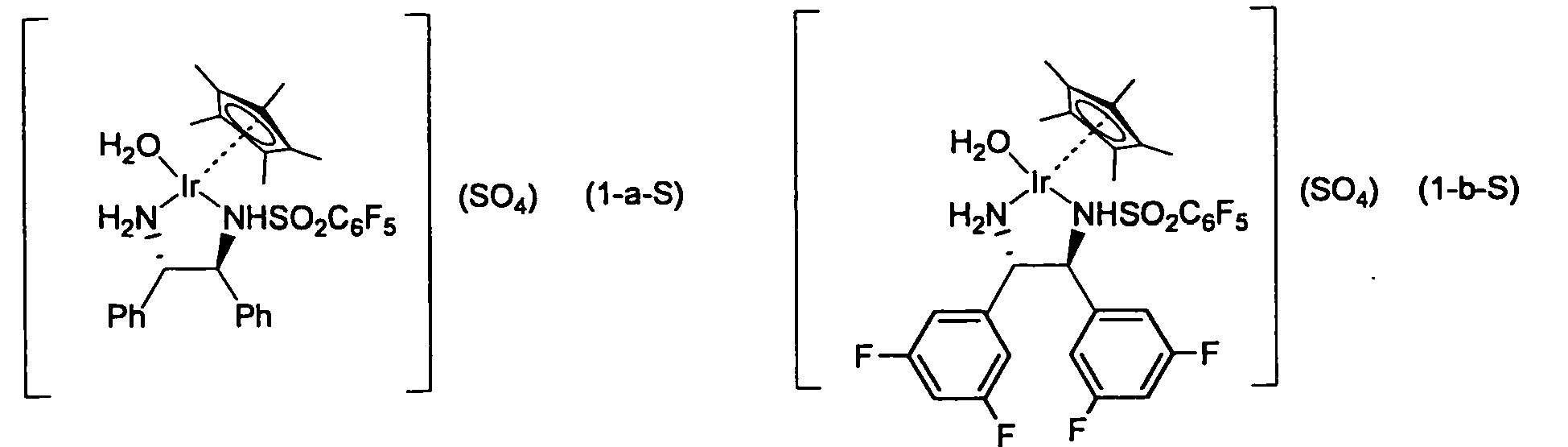
- chiral iridium aqua complex (1) is preferable, and preferable specific examples thereof include the following chiral iridium aqua complexes (1-a) to (1-h):
- chiral iridium aqua complexes (1-a-R), (1-b-R) and (1-h-R) :
- Chiral iridium aqua complex (1A) of the present invention can be produced by reacting iridium complex (2) with chiral diamine (3).
- Iridium complex (2) can be produced according to the method described in Organometallics 1999, 18, 5470-5474 .
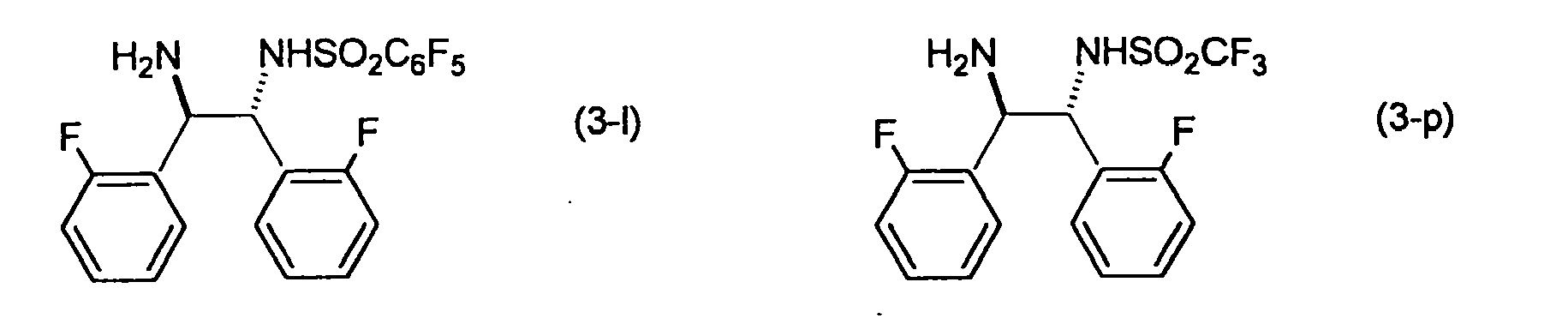
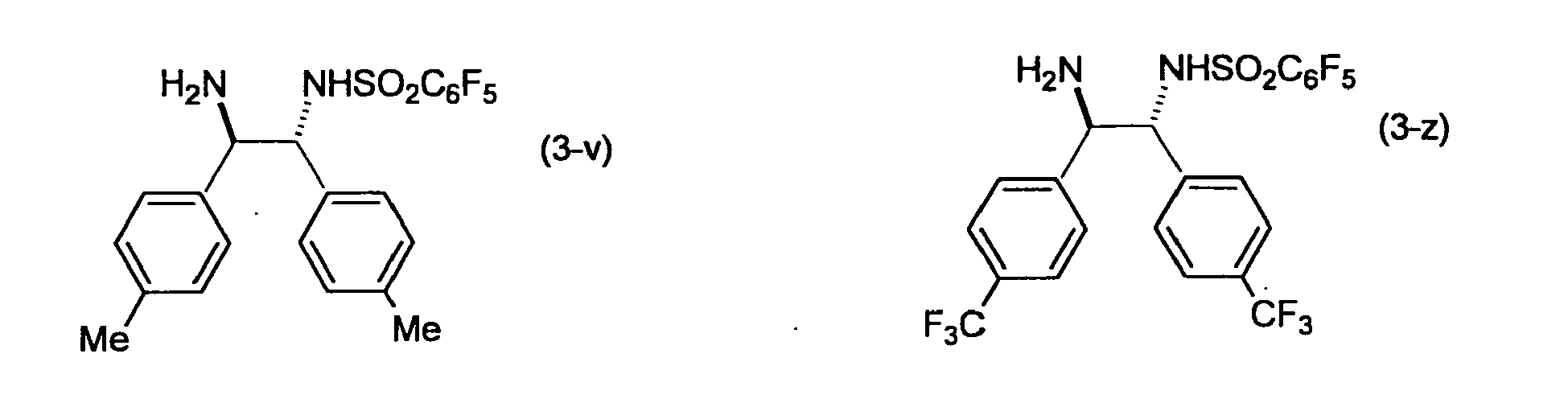
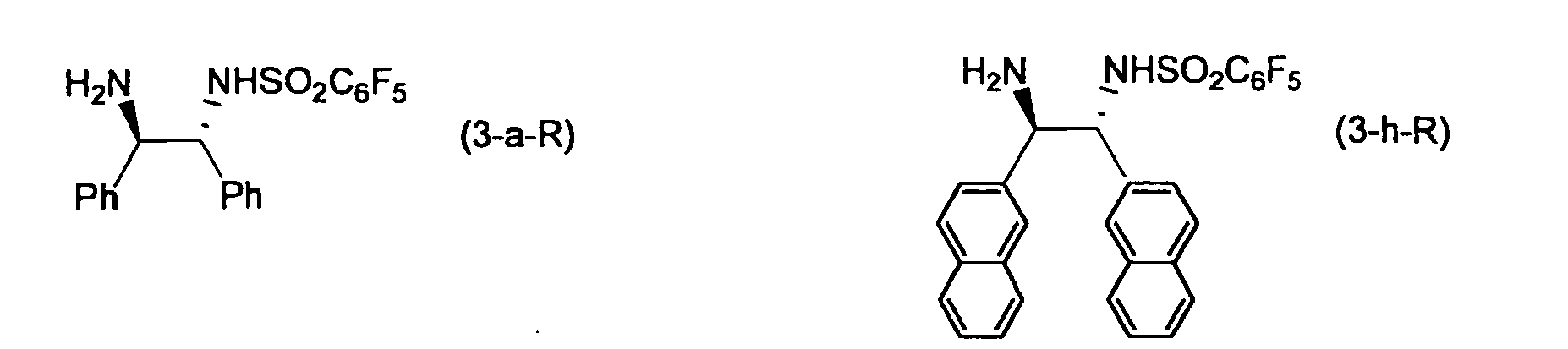
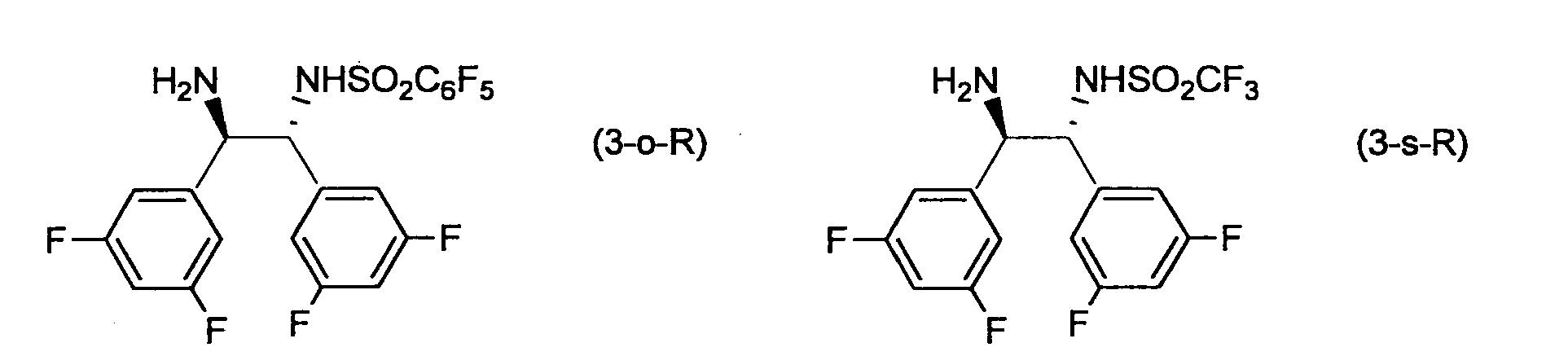
- chiral diamine (3) Preferable specific examples include
- the above-mentioned chiral diamine (3) is not a racemate (1:1 mixture of trans forms thereof).
- the enantiomer excess of chiral diamine (3) is any value of more than 0% ee and not more than 100% ee, preferably not less than 90% ee, particularly not less than95% ee.
- the amount of chiral diamine (3) to be used is generally 0.8 to 2.0 mol, preferably 0.9 to 1.2 mol from the aspects of economic efficiency, per 1 mol of iridium complex (2).
- the reaction is carried out according to the method described in Organometallics, 2001, 20, 4903 . To be specific, the reaction is carried out by mixing iridium complex (2) and chiral diamine (3) in a solvent as shown in the following.
- the solvent examples include water, alcohols such as methanol and the like, mixtures thereof and the like. Among them, water, and a mixed solvent of water-alcohol are preferable. While the content ratio (volume ratio) of water and the alcohol in the mixed solvent varies depending on the kind of chiral diamine, it is generally 1:1 to 10:1, preferably 1:1 to 5:1. The amount of the solvent to be used is generally 3 to 100 mL, preferably 10 to 65 mL from the aspects of operability and economic efficiency, per 1 g of iridium complex (2).
- the reaction temperature is generally 0 to 110°C, preferably 5 to 50°C. While the reaction time varies depending on the kind of chiral diamine (3), it is generally 1 to 50 hours, preferably 1 to 24 hours. After completion of the reaction, the reaction mixture is concentrated to give chiral iridium aqua complex (1A). Where necessary, chiral iridium aqua complex (1A) can be purified by operation such as recrystallization and the like.
- Chiral iridium aqua complex (1A) of the present invention has good stability to air and water.
- Chiral iridium aqua complex (1A) of the present invention is a catalyst suitable for an asymmetric transfer hydrogenation, particularly an asymmetric transfer hydrogenation of carbonyl compound (4).
- it can be preferably used for producing optically active hydroxy compound (5) by subjecting carbonyl compound (4) to an asymmetric transfer hydrogenation.
- chiral iridium aqua complex (1A) is also a catalyst suitable for an asymmetric transfer hydrogenation of nitroolefin compound (6).
- it can be preferably used for producing optically active nitroalkane compound (7) by subjecting nitroolefin compound (6) to an asymmetric transfer hydrogenation.
- the amount of chiral iridium aqua complex (1A) to be used is generally 0.001 to 0.1 mol, preferably 0.002 to 0.05 mol from the aspects of reactivity and economic efficiency, per 1 mol of carbonyl compound (4).
- the reaction is generally carried out in a solvent, in the presence of a hydrogen-donor compound.
- the reaction is carried out by adding carbonyl compound (4) to a solution of chiral iridium aqua complex (1A), and then stirring the mixture.
- the hydrogen-donor compound include formic acid or a salt thereof. From the aspects of conversion, formic acid is particularly preferable.
- the amount of the hydrogen-donor compound to be used is generally 1 to 100 mol, preferably 2 to 10 mol from the aspects of economic efficiency, per 1 mol of carbonyl compound (4).
- it may be a solvent.
- the solvent include water, alcohols such as methanol and the like, mixtures thereof and the like. Among them, water, and a mixed solvent of water-alcohol are preferable. While the content ratio (volume ratio) of water and the alcohol in the mixed solvent varies depending on the kind and amount of carbonyl compound (4) as a starting material and chiral iridium aqua complex (1A), it is generally 10:1 to 1:10, preferably 3:1 to 1:3.
- the amount of the solvent to be used is generally 1 to 100 mL, preferably 3 to 50 mL from the aspects of operability and economic efficiency, per lg of carbonyl compound (4).
- the reaction is preferably carried out under the condition of pH 2 to 5, more preferably pH 2.0 to 4.5, particularly preferably pH 2.0 to 3.5.
- the optimal range of the pH varies depending on the kind of carbonyl compound (4) (particularly R 6 ).
- the optimal pH for carbonyl compound (4) wherein R 6 is cyanomethyl, azidomethyl, chloromethyl group or the like is 3.5
- the optimal pH for carbonyl compound (4) wherein R 6 is nitromethyl group or the like is 2.
- the pH is mainly adjusted by addition of a base (e.g., sodium hydroxide etc.).
- the reaction temperature is generally 30 to 100°C, preferably 40 to 85°C. While the reaction time varies depending on the kind of carbonyl compound (4), it is generally 1 to 50 hours, preferably 1 to 24 hours.
- Chiral iridium aqua complex (1A) for the reaction is particularly preferably
- Optically active hydroxy compound (5) is obtained by the asymmetric transfer hydrogenation using chiral iridium aqua complex (1A) of the present invention.
- the steric configuration of the optically active hydroxy compound (5) depends on the steric configuration of the chiral iridium aqua complex (1A), and whether it is R-configuration or S-configuration depends on the kind of the chiral iridium aqua complex (1A).
- optically active hydroxy compound (5) can be isolated by subjecting the reaction mixture to a conventional posttreatment (e.g., neutralization, extraction, washing with water, distillation, crystallization etc.).
- optically active hydroxy compound (5) can be purified by a purification means such as recrystallization, extraction purification, distillation, adsorption treatment with activated carbon, silica, alumina and the like, chromatography method (e.g., silica gel column chromatography etc.). It can also be used for the next step without particular purification; for example, an extraction solution or a residue after solvent evaporation can be directly provided for the next step.
- the reaction using chiral iridium aqua complex (1A) of the present invention as a catalyst can achieve higher stereoselectivity (not less than 80% ee, particularly not less than 95% ee) and higher yield, as compared to conventional iridium complexes.
- carbonyl compound (4) wherein R 5 is phenyl, halogen-substituted phenyl, C 1-6 alkyl-substituted phenyl, C 1-6 alkoxy-substituted phenyl, cyano-substituted phenyl, naphthyl, furyl or thienyl, and R 6 is cyanomethyl, nitromethyl, chloromethyl or azidomethyl can be obtained with higher stereoselectivity (not less than 80% ee, particularly not less than 95% ee) in a higher yield, by the reduction reaction.
- the amount of chiral iridium aqua complex (1A) to be used is generally 0.001 to 0.1 mol, preferably 0.003 to 0.01 mol from the aspects of reactivity and economic efficiency, per 1 mol of nitroolefin compound (6).
- the reaction is generally carried out in a solvent, in the presence of a hydrogen-donor compound.
- the reaction is carried out by adding nitroolefin compound (6) to a solution of chiral iridium aqua complex (1A), and then stirring the mixture.
- the hydrogen-donor compound include formic acid or a salt thereof. From the aspects of conversion, formic acid is particularly preferable.
- the amount of the hydrogen-donor compound to be used is generally 1 to 100 mol, preferably 2 to 10 mol from the aspects of economic efficiency, per 1 mol of nitroolefin compound (6).
- it may be a solvent.
- the solvent include water, alcohols such as methanol and the like, mixtures thereof and the like. Among them, water, and a mixed solvent of water-alcohol are preferable. While the content ratio (volume ratio) of water and the alcohol in the mixed solvent varies depending on the kind and amount of nitroolefin compound (6) as a starting material and chiral iridium aqua complex (1A), it is generally 10:1 to 1:10, preferably 3:1 to 1:3.
- the amount of the solvent to be used is generally 1 to 100 mL, preferably 3 to 50 mL from the aspects of operability and economic efficiency, per lg of nitroolefin compound (6).
- the reaction is preferably carried out under the condition of pH 2 to 5, more preferably pH 2.0 to 4.5, particularly preferably pH 2.0 to 3.5.
- the pH is mainly adjusted by addition of a base (e.g., sodium hydroxide etc.).
- the reaction temperature is generally 30 to 100°C, preferably 40 to 85°C. While the reaction time varies depending on the kind of nitroolefin compound (6), it is generally 1 to 50 hours, preferably 1 to 24 hours.
- Chiral iridium aqua complex (1A) for the reaction is particularly preferably
- Optically active nitroalkane compound (7) is obtained by the asymmetric transfer hydrogenation using the chiral iridium aqua complex (1A) of the present invention.
- the steric configuration of the optically active nitroalkane compound (7) depends on the steric configuration of chiral iridium aqua complex (1A), and whether it is R-configuration or S-configuration depends on the kind of the chiral iridium aqua complex (1A).
- optically active nitroalkane compound (7) can be isolated by subjecting the reaction mixture to a conventional posttreatment (e.g., neutralization, extraction, washing with water, distillation, crystallization etc.).
- optically active nitroalkane compound (7) can be purified by a purification means such as recrystallization, extraction purification, distillation, adsorption treatment with activated carbon, silica, alumina and the like, chromatography method (e.g., silica gel column chromatography etc.). It can also be used for the next step without particular purification; for example, an extraction solution or a residue after solvent evaporation can be directly provided for the next step.
- the reaction using chiral iridium aqua complex (1A) of the present invention as a catalyst can achieve higher stereoselectivity (not less than 80% ee, particularly not less than 95% ee) and higher yield, as compared to conventional iridium complexes.
- nitroolefin compound (6) wherein R 7 is phenyl and R 8 is methyl can be obtained in a higher stereoselectivity (not less than 80% ee, particularly not less than 95% ee) in a higher yield, by the reduction reaction.
- chiral iridium aqua complex (1A) of the present invention has good solubility in water, the asymmetric transfer hydrogenation can be carried out in an aqueous solvent which is environmentally friendly and suitable for green chemistry. Even if the asymmetric transfer hydrogenation is carried out in the presence of formic acid or a salt thereof, it can be performed safely since the danger caused by hydrogen generation and the like is absent.
- Cp * means ⁇ 5 -pentamethylcyclopentadienyl anion.
- iridium aqua complex (1-b-S), iridium aqua complex (1-c-R), iridium aqua complex (1-d-R), iridium aqua complex (1-e-R), iridium aqua complex (1-f-R), iridium aqua complex (1-g-R) and iridium aqua complex (1-h-S) were obtained.
- the chiral iridium aqua complex (1A) of the present invention Since the chiral iridium aqua complex (1A) of the present invention has good solubility in water, the asymmetric transfer hydrogenation can be carried out in an aqueous solvent which is environmentally friendly and suitable for green chemistry. Even if the asymmetric transfer hydrogenation is carried out in the presence of formic acid or a salt thereof, it can be performed safely since the danger caused by hydrogen generation and the like is absent.
- the chiral iridium aqua complex (1A) of the present invention has good stability to the air and water.
- the asymmetric transfer hydrogenation using chiral iridium aqua complex (1A) of the present invention can achieve higher stereoselectivity and higher yield, as compared to conventional iridium complexes.
Landscapes
- Chemical & Material Sciences (AREA)
- Organic Chemistry (AREA)
- Chemical Kinetics & Catalysis (AREA)
- Organic Low-Molecular-Weight Compounds And Preparation Thereof (AREA)
- Catalysts (AREA)
Abstract
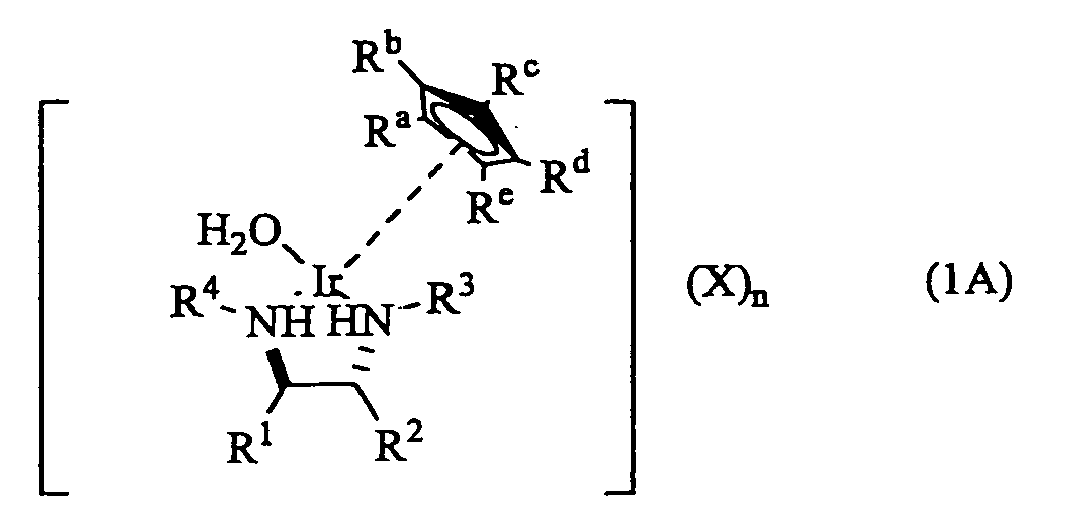
Ra, Rb, Rc, Rd and Re are the same or different and each is a hydrogen atom, a methyl group, an ethyl group or a phenyl group,
R1 and R2 are the same or different and each is an aryl group optionally having substituent(s), or
R1 and R2 in combination show a C3-4 straight chain alkylene group optionally having substituent(s) to form a ring,
R3 is an alkylsulfonyl group optionally having substituent(s) or an arylsulfonyl group optionally having substituent(s),
R4 is a hydrogen atom, an alkylsulfonyl group optionally having substituent(s) or an arylsulfonyl group optionally having substituent(s),
X is a monovalent or divalent anion, and
n is 2 when X is a monovalent anion, or n is 1 when X is a divalent anion,
and a production method of an optically active hydroxy compound using the complex.
Description
- The present invention relates to a novel chiral iridium aqua complex, a production method thereof and a production method of an optically active hydroxy compound or an optically active nitroalkane compound, which comprises asymmetric transfer hydrogenation using the complex.
- Conventionally, many methods of producing an optically active hydroxy compound from a carbonyl compound by an asymmetric transfer hydrogenation using a metal complex catalyst have been proposed. For example, non-patent document 1 describes production of an optically active alcohol from an acetophenone derivative by using Ru(II)-TsDPEN (TsDPEN = N-(p-toluenesulfonyl)-1,2-diphenylethylenediamine). Non-patent document 2 describes reduction of ketone by a pH-dependent process using a [Cp*Ir(bpy) (H2O)]SO4 (Cp*= h5-pentamethylcyclopentadienylanion, bpy =2,2'-bipyridine) complex capable of forming a hydride species in the presence of a formate ion. Recently, a method using a chiral iridium complex has also been proposed. For example, non-patent document 3 describes reduction of ketone by using a complex prepared by reacting CsDPEN (CsDPEN = N-(camphorsulfonyl)-1,2-diphenylethylenediamine) or TsDPEN with [Cp*IrCl2]2. Patent document 1 describes reduction of ketone by using a complex prepared by reacting chiral N-substituted sulfonyl-ethylenediamine with [Cp*IrCl2]2.
- On the other hand, non-patent document 4 describes exchange kinetics and mechanism of ligand in an aqueous solution of a chiral iridium aqua complex. In the document, the complex is exemplified by [Cp*Ir(R,R-DACH) (H2O)] (ClO4)2 (DACH = 1,2-diaminocyclohexane) and [Cp*Ir(R,R-DPEN) (H2O)] (ClO4)2 (DPEN = 1,2-diphenylethane-1,2-diamine).
- In addition, patent document 2 and non-patent document 5 propose methods of producing an optically active nitroalkane compound by reducing the double bond of a nitroolefin compound using an organic silicon compound or a thiourea catalyst.
-
- Patent document 1:
JP-A-11-335385 - Patent document 2:
JP-A-2006-524189 -
- Non-Patent document 1: J. Am. Chem. Soc. 1996, 118, 2521-2522
- Non-Patent document 2: J. Am. Chem. Soc. 2004, 126, 3020-3021
- Non-Patent document 3: Synllet, 2006, 1155-1160
- Non-Patent document 4: Eur. J. Inorg. Chem. 2001, 1361-1369
- Non-Patent document 5: J. Am. Chem. Soc. 2007, 129, 8976-8977
- The complexes described in the above-mentioned documents have the following problems. Since the complexes of non-patent documents 1 and 3 and patent document 1 are not aqua complexes, and are difficult to dissolve in water depending on the kind of amine, it is difficult to carry out a reaction in an aqueous solvent which is environmentally friendly and suitable for green chemistry desired in recent years. In addition, the ruthenium complex of non-patent document 1 shows problematically slow progress of the reaction as compared to an iridium catalyst. The complex of non-patent document 2 is associated with a problem of unapplicability to an asymmetric reaction since the ligand is not chiral. The complex of non-patent document 4 may explode since it is perchlorate, and it requires close attention in handling. Moreover, non-patent document 4 does not teach at all reaction for which the complex is to be used. An asymmetric transfer hydrogenation is generally carried out in the presence of formic acid or a salt thereof as a hydrogen source. However, contact of the complex with perchlorate is presumed to be dangerous, and perchlorate cannot be applied to such a reaction.
- As described above, a chiral iridium aqua complex suitable for an asymmetric transfer hydrogenation has not been proposed up to the present.
- The present invention provides a chiral iridium aqua complex that can be produced easily and enables safe asymmetric transfer hydrogenation in an aqueous solvent.
- The above-mentioned problems were intensively studied and, as a result, it has been found that chiral iridium aqua complexes of the following formulas (1A) and (1) can be produced easily, an asymmetric transfer hydrogenation using the complex can be carried out safely in an aqueous solvent, and the complexes have good preservation stability and achieve higher yield and higher stereoselectivity in an asymmetric transfer hydrogenation as compared to conventional iridium complexes, which resulted in the completion of the invention. Accordingly, the present invention provides the following.
-
- [1] A chiral iridium aqua complex represented by the formula (1A):
-

- wherein
Ra, Rb, Rc, Rd and Re are the same or different and each is a hydrogen atom, a methyl group, an ethyl group or a phenyl group,
R1 and R2 are the same or different and each is an aryl group optionally having substituent(s), or
R1 and R2 in combination show a C3-4 straight chain alkylene group optionally having substituent(s) to form a ring,
R3 is an alkylsulfonyl group optionally having substituent(s) or an arylsulfonyl group optionally having substituent(s),
R4 is a hydrogen atom, an alkylsulfonyl group optionally having substituent(s) or an arylsulfonyl group optionally having substituent(s),
X is a monovalent or divalent anion, and
n is 2 when X is a monovalent anion, or n is 1 when X is a divalent anion,
(hereinafter to be referred to as chiral iridium aqua complex (1A)). - [2] A chiral iridium aqua complex represented by the formula (1):
-

- wherein
R1 and R2 are the same or different and each is an aryl group optionally having substituent(s), or
R1 and R2 in combination show a C3-4 straight chain alkylene group optionally having substituent(s) to form a ring,
R3 is an alkylsulfonyl group optionally having substituent(s) or an arylsulfonyl group optionally having substituent(s),
R4 is a hydrogen atom, an alkylsulfonyl group optionally having substituent(s) or an arylsulfonyl group optionally having substituent(s),
X is a monovalent or divalent anion, and
n is 2 when X is a monovalent anion, or n is 1 when X is a divalent anion,
(hereinafter to be referred to as chiral iridium aqua complex (1)). - [3] The chiral iridium aqua complex of the above-mentioned [1] or [2], wherein
R1 and R2 are the same or different and each is a C6-10 aryl group optionally having'substituent(s) selected from a halogen atom, a C1-6 alkyl group, a C1-6 haloalkyl group, a C1-6 alkoxy group and a C1-6 haloalkoxy group; or
R1 and R2 in combination show a C3-4 straight chain alkylene group optionally having substituent(s) to form a ring. - [4] The chiral iridium aqua complex of the above-mentioned [1] or [2], wherein R1 and R2 are the same or different and each is a C6-10 aryl group optionally having substituent(s) selected from a halogen atom, a C1-6 alkyl group, a C1-6 haloalkyl group, a C1-6 alkoxy group and a C1-6 haloalkoxy group.
- [5] The chiral iridium aqua complex of the above-mentioned [1] or [2], wherein R1 and R2 are the same or different and each is phenyl optionally having fluorine atom(s).
- [6] The chiral iridium aqua complex of the above-mentioned [1] or [2], wherein R3 is a C6-10) arylsulfonyl group optionally having substituent(s) selected from a halogen atom, a C1-6 alkyl group, a C1-6 haloalkyl group and a nitro group; or a C1-6 alkylsulfonyl group optionally having halogen atom(s).
- [7] The chiral iridium aqua complex of the above-mentioned [1] or [2], wherein R3 is phenylsulfonyl having substituent(s) selected from a fluorine atom, trifluoromethyl and nitro; or a C1-4 alkylsulfonyl group having fluorine atom(s).
- [8] The chiral iridium aqua complex of the above-mentioned [1] or [2], wherein R4 is a hydrogen atom; or a C6-10 arylsulfonyl group optionally having C1-6 alkyl group (s) .
- [9] The chiral iridium aqua complex of the above-mentioned [1] or [2], wherein R4 is a hydrogen atom.
- [10] The chiral iridium aqua complex of the above-mentioned [1] or [2], wherein X is a sulfate ion.
- [11] A chiral iridium aqua complex represented by formula:
-


-
- [12] A chiral iridium aqua complex represented by formula:
-


-
- [13] A chiral iridium aqua complex represented by formula:
-


-
- [14] A chiral iridium aqua complex represented by formula:
-


-
- [15] A chiral iridium aqua complex represented by formula:
-


-
- [16] A chiral iridium aqua complex represented by formula:
-

-
- [17] A method of producing a chiral iridium aqua complex represented by the formula (1A), which comprises reacting an iridium complex represented by the formula (2) (hereinafter to be referred to as iridium complex (2)) with a chiral diamine represented by the formula (3) (hereinafter to be referred to as chiral diamine (3)):
-

- wherein
Ra, Rb, Rc, Rd and Re are the same or different and each is a hydrogen atom, a methyl group, an ethyl group or a phenyl group,
R1 and R2 are the same or different and each is an aryl group optionally having substituent(s), or
R1 and R2 in combination show a C3-4 straight chain alkylene group optionally having substituent(s) to form a ring,
R3 is an alkylsulfonyl group optionally having substituent(s) or an arylsulfonyl group optionally having substituent(s),
R4 is a hydrogen atom, an alkylsulfonyl group optionally having substituent(s) or an arylsulfonyl group optionally having substituent(s),
X is a monovalent or divalent anion, and
n is 2 when X is a monovalent anion, or n is 1 when X is a divalent anion. -
- [18] A method of producing an optically active hydroxy compound represented by the formula (5) (hereinafter to be referred to as optically active hydroxy compound (5)), which comprises subjecting a carbonyl compound represented by the formula (4) (hereinafter to be referred to as carbonyl compound (4)) to an asymmetric transfer hydrogenation in the presence of the chiral iridium aqua complex of any of the above-mentioned [1] to [16]:
-

- wherein
R5 is an aryl group optionally having substituent(s), a heteroaryl group optionally having substituent(s), a cycloalkyl group optionally having substituent(s) or an aralkyl group optionally having substituent(s),
R6 is a carboxyl group, a carbamoyl group optionally having substituent(s) or an alkyl group optionally having substituent(s), and
the carbon atom marked with * is an asymmetric carbon atom. - [19] The method of the above-mentioned [18], wherein the chiral iridium aqua complex is
-

-
- [20] The method of the above-mentioned [18], wherein the chiral iridium aqua complex is
-

-
- [21] The method of the above-mentioned [18], wherein the chiral iridium aqua complex is
-

-
- [22] The method of the above-mentioned [18], wherein R5 is a C6-10 aryl group optionally having substituent(s) selected from a halogen atom, a C1-6 alkyl group, a C1-6 alkoxy group, a cyano group and nitro group; a C3-8 cycloalkyl group; or a 5- or 6-membered heteroaryl group optionally having C1-6 alkyl group(s).
- [23] The method of the above-mentioned [18], wherein R6 is a C1-6 alkyl group optionally having substituent(s) selected from a halogen atom, a cyano group, a nitro group and an azido group.
- [24] The method of the above-mentioned [18], wherein the asymmetric transfer hydrogenation is carried out in the presence of formic acid or a salt thereof.
- [25] The method of the above-mentioned [18], wherein the asymmetric transfer hydrogenation is carried out in the presence of formic acid.
- [26] The method of the above-mentioned [18], wherein the asymmetric transfer hydrogenation is carried out under the condition of pH 2 to 5.
-
- [27] A method of producing an optically active nitroalkane compound represented by the formula (7) (hereinafter to be referred to as optically active nitroalkane compound (7)), which comprises subjecting a nitroolefin compound represented by the formula (6) (hereinafter to be referred to as nitroolefin compound (6)) to an asymmetric transfer hydrogenation in the presence of the chiral iridium aqua complex of any of the above-mentioned [1] to [16]:
-

- wherein
R7 is an aryl group optionally having substituent(s) or a heteroaryl group optionally having substituent(s),
R8 is an alkyl group optionally having substituent(s), an aryl group optionally having substituent(s) or a heteroaryl group optionally having substituent(s), and
the carbon atom marked with * is an asymmetric carbon atom. - [28] The method of the above-mentioned [27], wherein the chiral iridium aqua complex is
-

-
- [29] The method of the above-mentioned [27], wherein the chiral iridium aqua complex is
-

-
- [30] The method of the above-mentioned [27], wherein the chiral iridium aqua complex is
-

-
- [31] The method of the above-mentioned [27], wherein R7 is a C6-10 aryl group optionally having substituent(s) selected from a halogen atom, a C1-6 alkyl group, a C1-6 haloalkyl group and a C1-6 alkoxy group.
- [32] The method of the above-mentioned [27], wherein R8 is a C1-6 alkyl group.
- [33] The method of the above-mentioned [27], wherein the asymmetric transfer hydrogenation is carried out in the presence of formic acid or a salt thereof.
- [34] The method of the above-mentioned [27], wherein the asymmetric transfer hydrogenation is carried out in the presence of formic acid.
- [35] The method of the above-mentioned [27], wherein the asymmetric transfer hydrogenation is carried out under the condition of pH 2 to 5.
-
- [36] A chiral diamine represented by formula:
-

-
- [37] A chiral diamine represented by formula:
-

-
- [38] A chiral diamine represented by formula:
-
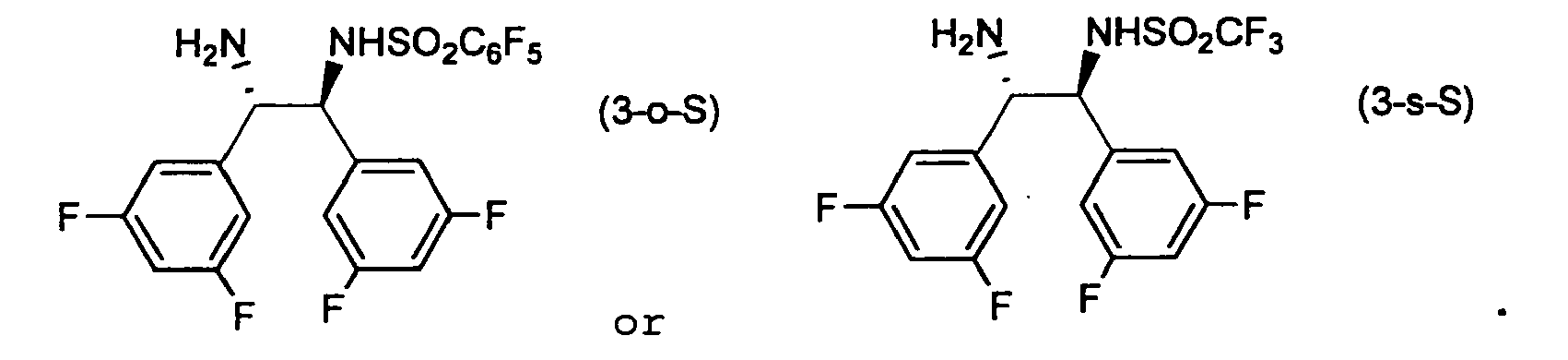
- Chiral iridium aqua complex (1A) of the present invention can be produced easily. In addition, since the complex has good solubility in water, the asymmetric transfer hydrogenation can be carried out in an aqueous solvent which is environmentally friendly and suitable for green chemistry. Even if the asymmetric transfer hydrogenation is carried out in the presence of formic acid or a salt thereof, it can be performed safely since the danger caused by hydrogen generation and the like is absent.
Moreover, the chiral iridium aqua complex (1A) of the present invention has good stability to the air and water. Moreover, the asymmetric transfer hydrogenation using the chiral iridium aqua complex (1A) of the present invention can achieve higher stereoselectivity and higher yield, as compared to conventional iridium complexes. - The present invention is explained in detail in the following.
Ra, Rb, Rc, Rd and Re are preferably the same or different and each is a hydrogen atom or a methyl group. More preferably, three to five of Ra, Rb, Rc, Rd and Re are methyl groups, and the remaining group(s) is/are hydrogen atom(s). Particularly preferably, all of Ra, Rb, Rc, Rd and Re are methyl groups (i.e., chiral iridium aqua complex (1)) . - The "aryl group" of the "aryl group optionally having substituent(s)" for R1 or R2 is preferably a C6-14 aryl group, and examples thereof include phenyl, naphthyl, anthryl, phenanthryl, acenaphthyl, biphenylyl and the like. Among them, a C6-10 aryl group is preferable, phenyl and naphthyl are more preferable, and phenyl is particularly preferable.
Examples of the "substituent" of the "aryl group optionally having substituent(s)" include a halogen atom, a C1-6 alkyl group, a C1-6 haloalkyl group, a C1-6 alkoxy group, a C1-6 haloalkoxy group, a nitro group, a carboxyl group, a cyano group, an azido group and the like. - Examples of the halogen atom include fluorine, chlorine, bromine and iodine.
The C1-6 alkyl group may be straight chain or branched chain, and examples thereof include methyl, ethyl, propyl, isopropyl, butyl, isobutyl, sec-butyl, tert-butyl, pentyl, isopentyl, neopentyl, hexyl and the like.
The C1-6 haloalkyl group may be straight chain or branched chain, and examples thereof include fluoromethyl, difluoromethyl, trifluoromethyl, 2-fluoroethyl, 2,2-difluoroethyl, 2,2,2-trifluoroethyl, 3-fluoropropyl, 4-fluorobutyl, 5-fluoropentyl, 6-fluorohexyl and the like.
The C1-6 alkoxy group may be straight chain or branched chain, and examples thereof include methoxy, ethoxy, propoxy, isopropoxy, butoxy, isobutoxy, sec-butoxy, tert-butoxy, pentyloxy, isopentyloxy, neopentyloxy, hexyloxy and the like.
The C1-6 haloalkoxy group may be straight chain or branched chain, and examples thereof include fluoromethoxy, difluoromethoxy, trifluoromethoxy, 2-fluoroethoxy, 2,2-difluoroethoxy, 2,2,2-trifluoroethoxy, 3-fluoropropoxy, 4-fluorobutoxy, 5-fluoropentyloxy, 6-fluorohexyloxy and the like. - As the "substituent" of the "aryl group optionally having substituent(s)" for R1 or R2, a halogen atom, a C1-6 alkyl group, a C1-6 haloalkyl group, a C1-6 alkoxy group and a C1-6 haloalkoxy group are preferable, a fluorine atom, methyl, trifluoromethyl, methoxy and trifluoromethoxy are more preferable, and a fluorine atom is particularly preferable. When two or more substituents are present, these substituents may be the same or different.
- Examples of the "C3-4 straight chain alkylene group" of the "C3-4 straight chain alkylene group optionally having substituent(s)" such that R1 and R2 in combination form a ring include trimethylene and tetramethylene. Examples of the ring formed by the C3-4 straight chain alkylene group include cyclopentane and cyclohexane. Examples of the "substituent" of the "C3-4 straight chain alkylene group optionally having substituent(s)" include the same group as the above-mentioned "substituent" of the "aryl group optionally having substituent(s)". When two or more substituents are present, these substituents may be the same or different.
- R1 and R2 are preferably the same or different and each is a C6-10 aryl group optionally having substituent(s) selected from a halogen atom, a C1-6 alkyl group, a C1-6 haloalkyl group, a C1-6 alkoxy group and a C1-6 haloalkoxy group; or R1 and R2 in combination show a C3-4 straight chain alkylene group optionally having substituent(s) to form a ring,
more preferably a C6-10 aryl group optionally having substituent(s) selected from a halogen atom, a C1-6 alkyl group, a C1-6 haloalkyl group, a C1-6 alkoxy group and a C1-6 haloalkoxy group,
further more preferably phenyl or naphthyl, each of which optionally has substituent(s) selected from a fluorine atom, methyl, trifluoromethyl, methoxy and trifluoromethoxy,
still more preferably phenyl optionally having substituent(s) selected from a fluorine atom, methyl, trifluoromethyl, methoxy and trifluoromethoxy,
particularly preferably phenyl optionally having fluorine atom(s).
Most preferably, both of R1 and R2 are unsubstituted phenyl or 3,5-difluorophenyl. - Examples of the "alkylsulfonyl group" of the "alkylsulfonyl group optionally having substituent(s)" for R3 or R4 include a straight chain or branched chain C1-10 alkylsulfonyl group such as methylsulfonyl, ethylsulfonyl, propylsulfonyl, isopropylsulfonyl, butylsulfonyl, isobutylsulfonyl, sec-butylsulfonyl, tert-butylsulfonyl, pentylsulfonyl, isopentylsulfonyl, neopentylsulfonyl, hexylsulfonyl, 2-ethylbutylsulfonyl, heptylsulfonyl, octylsulfonyl, nonylsulfonyl, decylsulfonyl and the like. Among them, a C1-6 alkylsulfonyl group is preferable, and a C1-4 alkylsulfonyl group is particularly preferable.
- Examples of the "substituent" of the "alkylsulfonyl group optionally having substituent(s)" include a halogen atom, a C1-6 haloalkyl group, a C1-6 alkoxy group, a C1-6 haloalkoxy group, a nitro group, a carboxyl group, a cyano group, an azido group and the like. When two or more substituents are present, these substituents may be the same or different.
- As the "substituent" of the "alkylsulfonyl group optionally having substituent(s)" for R3 or R4, a halogen atom is preferable, and a fluorine atom is particularly preferable.
- Examples of the aryl moiety of the "arylsulfonyl group" of the "arylsulfonyl group optionally having substituent(s)" for R3 or R4 include the same group as the "aryl group" of the "aryl group optionally having substituent(s)" for R1 or R2. Specific examples of the "arylsulfonyl group" include phenylsulfonyl, naphthylsulfonyl, anthrylsulfonyl, phenanthrylsulfonyl, acenaphthylsulfonyl, biphenylylsulfonyl and the like. Among them, a C6-10 arylsulfonyl group is preferable, phenylsulfonyl and naphthylsulfonyl are more preferably, and phenylsulfonyl is particularly preferable. Examples of the "substituent" of the "arylsulfonyl group optionally having substituent(s)" include the same group as the "substituent" of the "aryl group optionally having substituent(s)" for R1 or R2. When two or more substituents are present, these substituents may be the same or different.
- As the "substituent" of the "arylsulfonyl group optionally having substituent(s)" for R3 or R4, a halogen atom, a C1-6 alkyl group, a C1-6 haloalkyl group and a nitro group are preferable, a fluorine atom, a chlorine atom, a C1-4 alkyl group, trifluoromethyl and nitro are more preferable, a fluorine atom, trifluoromethyl and nitro are further more preferable, and a fluorine atom is particularly preferable.
- R3 is preferably a C6-10 arylsulfonyl group optionally having substituent(s) selected from a halogen atom, a C1-6 alkyl group, a C1-6 haloalkyl group and a nitro group; or a C1-6 alkylsulfonyl group optionally having halogen atom(s),
more preferably phenylsulfonyl or naphthylsulfonyl, each of which optionally has substituent(s) selected from a fluorine atom, a chlorine atom, a C1-4 alkyl group, trifluoromethyl and nitro; or a C1-4 alkylsulfonyl group optionally having fluorine atom(s),
further more preferably phenylsulfonyl having substituent(s) selected from a fluorine atom, trifluoromethyl and nitro; or a C1-4 alkylsulfonyl group having fluorine atom(s), still more preferably pentafluorophenylsulfonyl, 4-(trifluoromethyl)phenylsulfonyl, 3,5-bis(trifluoromethyl)phenylsulfonyl, 4-nitrophenylsulfonyl; or a perfluoro-substituted C1-4 alkylsulfonyl group,
particularly preferably pentafluorophenylsulfonyl. - R4. is preferably a hydrogen atom; or a C6-10 arylsulfonyl group optionally having C1-6 alkyl group(s),
more preferably a hydrogen atom; or phenylsulfonyl optionally having methyl,
further more preferably a hydrogen atom; or p-toluenesulfonyl, particularly preferably a hydrogen atom. - Examples of the "aryl group optionally having substituent(s)" for R5 include the same group as the "aryl group optionally having substituent(s)" for R1 or R2. When two or more substituents are present, these substituents may be the same or different.
- The "aryl group" of the "aryl group optionally having substituent(s)" for R5 is preferably phenyl or naphthyl. As the "substituent" of the "aryl group optionally having substituent(s)", a halogen atom, a C1-6 alkyl group, a C1-6 alkoxy group, a cyano group and a nitro group are preferable, and a halogen atom, a C1-4 alkyl group, a C1-4 alkoxy group, a cyano group and a nitro group are more preferable.
- Examples of the "heteroaryl group" of the "heteroaryl group optionally having substituent(s)" for R5 include furyl, thienyl, pyrrolyl, pyridyl, benzofuranyl, indolyl, benzothiophenyl, pyrimidyl, pyrazinyl, quinolyl, isoquinolyl, phthalazinyl, quinazolinyl, quinoxalinyl, cinnolinyl and the like. Among them, furyl and thienyl are preferable. Examples of the "substituent" of the "heteroaryl group optionally having substituent(s)" include the same group as the "substituent" of the "aryl group optionally having substituent(s)" for R1 or R2. When two or more substituents are present, these substituents may be the same or different.
- As the "substituent" of the "heteroaryl group optionally having substituent(s)", a C1-6 alkyl group is preferable, and a C1-4 alkyl group is more preferable.
- Examples of the "cycloalkyl group" of the "cycloalkyl group optionally having substituent(s)" for R5 include a C3-8 cycloalkyl group such as cyclopropyl, cyclobutyl, cyclopentyl, cyclohexyl, cycloheptyl, cyclooctyl and the like. Among them, a C5-6 cycloalkyl group is preferable, and cyclohexyl is particularly preferable. Examples of the "substituent" of the "cycloalkyl group optionally having substituent(s) include the same group as the "substituent" of the "aryl group optionally having substituent(s)" for R1 or R2. When two or more substituents are present, these substituents may be the same or different.
- Examples of the aryl moiety of the "aralkyl group" of the "aralkyl group optionally having substituent(s)" for R5 include the same group as the "aryl group" of the "aryl group optionally having substituent(s)" for R1 or R2, and examples of the alkyl moiety include a C1-10 straight chain or branched chain alkyl group such as methyl, ethyl, propyl, isopropyl, butyl, isobutyl, sec-butyl, tert-butyl, pentyl, isopentyl, neopentyl, hexyl, 2-ethylbutyl, heptyl, octyl, nonyl, decyl and the like. Specific examples of the "aralkyl group" include benzyl, 1-phenylethyl, 2-phenylethyl, 1-(1-naphthyl)ethyl, 1-(2-naphthyl)ethyl, 2-(1-naphthyl)ethyl, 2-(2-naphthyl)ethyl, 1-phenylpropyl, 2-phenylpropyl, 3-phenylpropyl, 1-phenylbutyl, 2-phenylbutyl, 3-phenylbutyl, 4-phenylbutyl and the like. Examples of the "substituent" of the "aralkyl group optionally having substituent(s)" include the same group as the "substituent" of the "aryl group optionally having substituent(s)" for R1 or R2. When two or more substituents are present, these substituents may be the same or different.
- R5 is preferably an aryl group optionally having substituent(s), a heteroaryl group optionally having substituent(s) or a cycloalkyl group optionally having substituent(s), more preferably an aryl group optionally having substituent(s), a heteroaryl group optionally having substituent(s) or a cycloalkyl group,
further more preferably a C6-10 aryl group optionally having substituent(s) selected from a halogen atom, a C1-6 alkyl group, a C1-6 alkoxy group, a cyano group and a nitro group; a C3-8 cycloalkyl group; or a 5- or 6-membered heteroaryl group optionally having C1-6 alkyl group(s),
further more preferably a C6-10 aryl group optionally having substituent(s) selected from a halogen atom, a C1-4 alkyl group, a C1-4 alkoxy group, a cyano group and a nitro group; a C5-6 cycloalkyl group; or a 5- or 6-membered heteroaryl group optionally having C1-4 alkyl group(s),
still more preferably a C6-10 aryl group optionally having substituent(s) selected from a halogen atom, a C1-4 alkyl group, a C1-4 alkoxy group, a cyano group and a nitro group; or a 5- or 6-membered heteroaryl group optionally having C1-4 alkyl group(s),
particularly preferably a C6-10 aryl group optionally having substituent(s) selected from a halogen atom, a C1-4 alkyl group, a C1-4 alkoxy group, a cyano group and a nitro group. - Examples of the "substituent" of the "carbamoyl group optionally having substituent(s)" for R6 include a halogen atom, a C1-6 alkyl group, a C1-6 alkoxy group and the like.
- Examples of the "alkyl group" of the "alkyl group optionally having substituent(s)" for R6 include a C1-10 straight chain or branched chain alkyl group such as methyl, ethyl, propyl, isopropyl, butyl, isobutyl, sec-butyl, tert-butyl, pentyl, isopentyl, neopentyl, hexyl, 2-ethylbutyl, heptyl, octyl, nonyl, decyl and the like. Among them, a C1-6 alkyl group is preferable, a C1-4 alkyl group is more preferable, and methyl is particularly preferable. Examples of the "substituent" of the "alkyl group optionally having substituent(s)" include a halogen atom, a C1-6 haloalkyl group, a C1-6 alkoxy group, a C1-6 haloalkoxy group, a nitro group, a carboxyl group, a cyano group, an azido group and the like. Among them, a halogen atom, a cyano group, a nitro group and an azido group are preferable.
- R6 is preferably a C1-6 alkyl group optionally having substituent(s) selected from a halogen atom, a cyano group, a nitro group and an azido group, more preferably a C1-4 alkyl group optionally having substituent(s) selected from a halogen atom, a cyano group, a nitro group and an azido group.
- Examples of the "aryl group optionally having substituent(s)" for R7 include the same group as the "aryl group optionally having substituent(s)" for R1 or R2. When two or more substituents are present, these substituents may be the same or different.
- The "aryl group" of the "aryl group optionally having substituent(s)" for R7 is preferably phenyl or naphthyl. As the "substituent" of the "aryl group optionally having substituent(s)", a halogen atom, a C1-6 alkyl group, a C1-6 haloalkyl group and a C1-6 alkoxy group are preferable, and a halogen atom, a C1-4 alkyl group, a C1-4 haloalkyl group and a C1-4 alkoxy group are more preferable.
- Examples of the "heteroaryl group optionally having substituent(s)" for R7 include the same group as the "heteroaryl group optionally having substituent(s)" for R5. When two or more substituents are present, these substituents may be the same or different.
- R7 is preferably a C6-10 aryl group optionally having substituent(s) selected from a halogen atom, a C1-6 alkyl group, a C1-6 haloalkyl group and a C1-6 alkoxy group, more preferably phenyl or naphthyl, each of which optionally has substituent(s) selected from a halogen atom, a C1-4 alkyl group, a C1-4 haloalkyl group and a C1-4 alkoxy group.
- Examples of the "alkyl group optionally having substituent(s)" for R8 include the same group as the "alkyl group optionally having substituent(s)" for R6. When two or more substituents are present, these substituents may be the same or different.
- The "alkyl group" of the "alkyl group optionally having substituent(s)" for R8 is preferably a C1-6 alkyl group, more preferably a C1-4 alkyl group, particularly preferably methyl.
- Examples of the "aryl group optionally having substituent(s)" for R8 include the same group as the "aryl group optionally having substituent(s)" for R1 or R2. When two or more substituents are present, these substituents may be the same or different.
- Examples of the "heteroaryl group optionally having substituent(s)" for R8 include the same group as the "heteroaryl group optionally having substituent(s)" for R7. When two or more substituents are present, these substituents may be the same or different.
- R8 is preferably a C1-6 alkyl group, more preferably a C1-4 alkyl group, particularly preferably methyl.
- Examples of the anion for X include a chloride ion, a bromide ion, an iodide ion, a methanesulfonate ion, a trifluoromethanesulfonate ion, a formate ion, an acetate ion, a trichloroacetate ion, a nitrate ion, a sulfate ion, an acetylacetonate ion, a hexafluorophosphate ion, a tetrafluoroborate ion and the like. Among them, a sulfate ion is preferable.
- * means that the carbon atom marked therewith is an asymmetric carbon atom, and the ratio of a compound wherein the configuration of the substituents on the asymmetric carbon atom is R-configuration and a compound wherein the configuration of the substituents bonded to the asymmetric carbon atom is S-configuration is any of 0:100 to 100:0 (excluding 50:50).
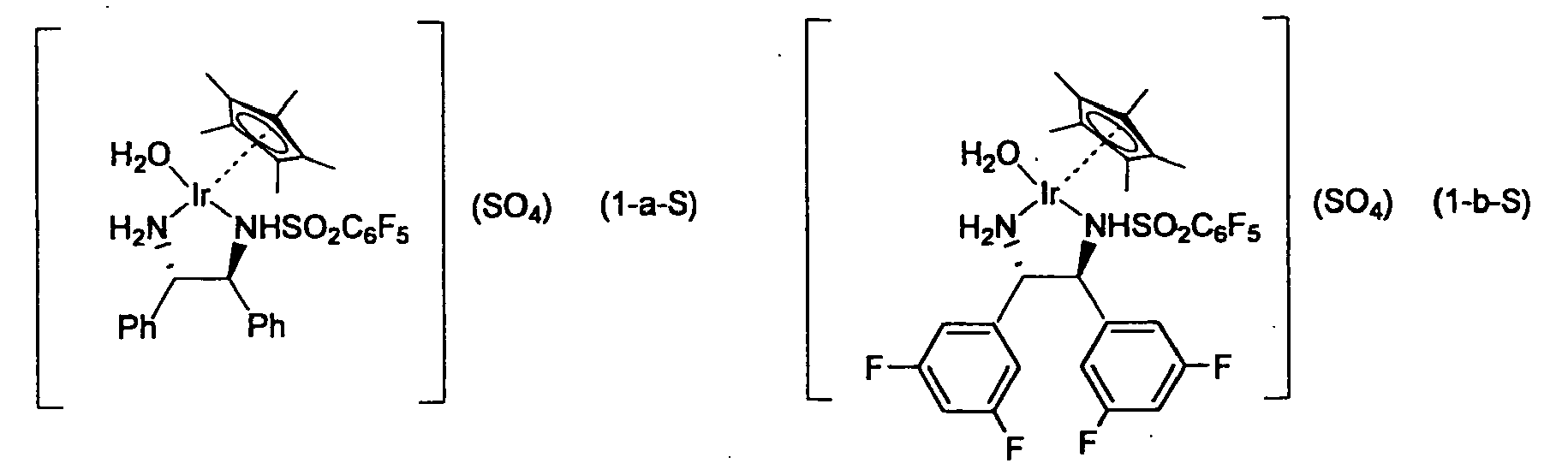
- Among chiral iridium aqua complex (1A) of the present invention, chiral iridium aqua complex (1) is preferable, and preferable specific examples thereof include the following chiral iridium aqua complexes (1-a) to (1-h):
-


- That is, the following chiral iridium aqua complexes (1-a-R) to (1-h-R):
-


- and (1-a-S) to (1-h-S):
-


- are preferable.
- Since the stereoselectivity in an asymmetric transfer hydrogenation is extremely high, chiral iridium aqua complexes (1-a), (1-b) and (1-h) :
-


- are preferable. That is, chiral iridium aqua complexes (1-a-R), (1-b-R) and (1-h-R) :
-


- and chiral iridium aqua complexes (1-a-S), (1-b-S) and (1-h-S):
-


- are preferable.
- Chiral iridium aqua complex (1A) of the present invention can be produced by reacting iridium complex (2) with chiral diamine (3).
- Iridium complex (2) can be produced according to the method described in Organometallics 1999, 18, 5470-5474.
- Preferable specific examples of chiral diamine (3) include
-


-


-



-


- and the like. That is, the following R-forms
-


-


-


-


- and the following S-forms
-


-


-


-


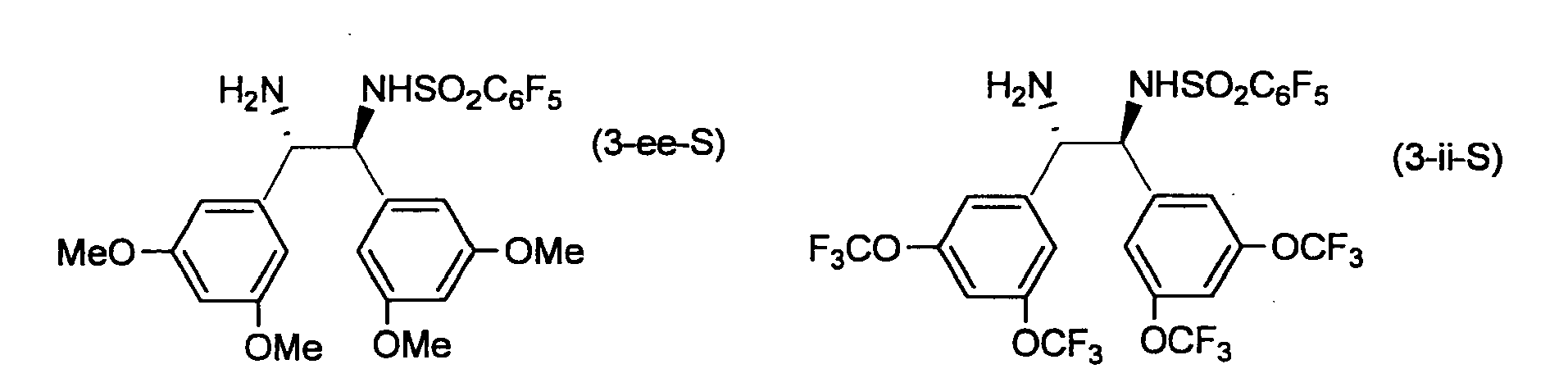
- and the like are preferable. Among them, the following
-


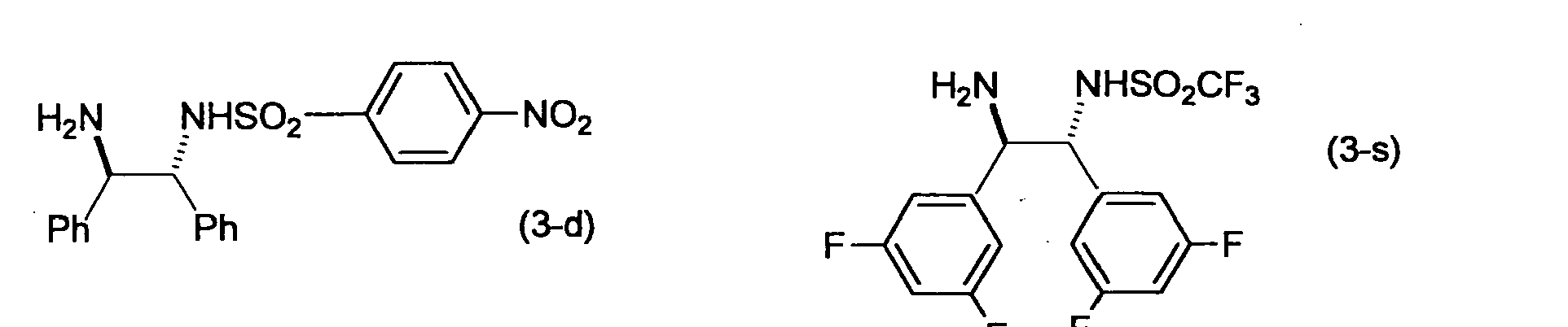


- are preferable from the aspects of obtaining a chiral iridium aqua complex having high stereoselectivity by an asymmetric transfer hydrogenation. That is, the following R-forms
-


- and the following S-forms
-


- are preferable. Among them,
-


- are particularly preferable. That is, the following R-forms[0132]

- and the following S-forms
-

- are particularly preferable.
- Among the above-mentioned chiral diamine,
-

- that is, the following R-forms
-

- and the following S-forms
-

- are novel.
- The above-mentioned chiral diamine (3) which is commercially available, or is produced according to a known method (e.g., Chem. Commun., 2001, 2572-2573; J. Org. Chem. 2004, 69, 5187-5195) or an analogous method thereto can be used.
- The above-mentioned chiral diamine (3) is not a racemate (1:1 mixture of trans forms thereof). The enantiomer excess of chiral diamine (3) is any value of more than 0% ee and not more than 100% ee, preferably not less than 90% ee, particularly not less than95% ee.
- In the above-mentioned reaction, the amount of chiral diamine (3) to be used is generally 0.8 to 2.0 mol, preferably 0.9 to 1.2 mol from the aspects of economic efficiency, per 1 mol of iridium complex (2).
- The reaction is carried out according to the method described in Organometallics, 2001, 20, 4903. To be specific, the reaction is carried out by mixing iridium complex (2) and chiral diamine (3) in a solvent as shown in the following.
-

- Examples of the solvent include water, alcohols such as methanol and the like, mixtures thereof and the like. Among them, water, and a mixed solvent of water-alcohol are preferable. While the content ratio (volume ratio) of water and the alcohol in the mixed solvent varies depending on the kind of chiral diamine, it is generally 1:1 to 10:1, preferably 1:1 to 5:1. The amount of the solvent to be used is generally 3 to 100 mL, preferably 10 to 65 mL from the aspects of operability and economic efficiency, per 1 g of iridium complex (2).
- The reaction temperature is generally 0 to 110°C, preferably 5 to 50°C. While the reaction time varies depending on the kind of chiral diamine (3), it is generally 1 to 50 hours, preferably 1 to 24 hours.
After completion of the reaction, the reaction mixture is concentrated to give chiral iridium aqua complex (1A). Where necessary, chiral iridium aqua complex (1A) can be purified by operation such as recrystallization and the like. - Chiral iridium aqua complex (1A) of the present invention has good stability to air and water.
- Chiral iridium aqua complex (1A) of the present invention is a catalyst suitable for an asymmetric transfer hydrogenation, particularly an asymmetric transfer hydrogenation of carbonyl compound (4). For example, it can be preferably used for producing optically active hydroxy compound (5) by subjecting carbonyl compound (4) to an asymmetric transfer hydrogenation. In addition, chiral iridium aqua complex (1A) is also a catalyst suitable for an asymmetric transfer hydrogenation of nitroolefin compound (6). For example, it can be preferably used for producing optically active nitroalkane compound (7) by subjecting nitroolefin compound (6) to an asymmetric transfer hydrogenation.
-

- In the reaction, the amount of chiral iridium aqua complex (1A) to be used is generally 0.001 to 0.1 mol, preferably 0.002 to 0.05 mol from the aspects of reactivity and economic efficiency, per 1 mol of carbonyl compound (4).
The reaction is generally carried out in a solvent, in the presence of a hydrogen-donor compound. The reaction is carried out by adding carbonyl compound (4) to a solution of chiral iridium aqua complex (1A), and then stirring the mixture.
Preferable examples of the hydrogen-donor compound include formic acid or a salt thereof. From the aspects of conversion, formic acid is particularly preferable. The amount of the hydrogen-donor compound to be used is generally 1 to 100 mol, preferably 2 to 10 mol from the aspects of economic efficiency, per 1 mol of carbonyl compound (4).
When formic acid is used as a hydrogen-donor compound, it may be a solvent.
Examples of the solvent include water, alcohols such as methanol and the like, mixtures thereof and the like. Among them, water, and a mixed solvent of water-alcohol are preferable.
While the content ratio (volume ratio) of water and the alcohol in the mixed solvent varies depending on the kind and amount of carbonyl compound (4) as a starting material and chiral iridium aqua complex (1A), it is generally 10:1 to 1:10, preferably 3:1 to 1:3. The amount of the solvent to be used is generally 1 to 100 mL, preferably 3 to 50 mL from the aspects of operability and economic efficiency, per lg of carbonyl compound (4). - From the aspects of reactivity, the reaction is preferably carried out under the condition of pH 2 to 5, more preferably pH 2.0 to 4.5, particularly preferably pH 2.0 to 3.5. The optimal range of the pH varies depending on the kind of carbonyl compound (4) (particularly R6). For example, the optimal pH for carbonyl compound (4) wherein R6 is cyanomethyl, azidomethyl, chloromethyl group or the like is 3.5, and the optimal pH for carbonyl compound (4) wherein R6 is nitromethyl group or the like is 2. The pH is mainly adjusted by addition of a base (e.g., sodium hydroxide etc.).
- The reaction temperature is generally 30 to 100°C, preferably 40 to 85°C. While the reaction time varies depending on the kind of carbonyl compound (4), it is generally 1 to 50 hours, preferably 1 to 24 hours.
- Chiral iridium aqua complex (1A) for the reaction is particularly preferably
-

- that is,
-

- or
-

- Optically active hydroxy compound (5) is obtained by the asymmetric transfer hydrogenation using chiral iridium aqua complex (1A) of the present invention. The steric configuration of the optically active hydroxy compound (5) depends on the steric configuration of the chiral iridium aqua complex (1A), and whether it is R-configuration or S-configuration depends on the kind of the chiral iridium aqua complex (1A).
- The thus-obtained optically active hydroxy compound (5) can be isolated by subjecting the reaction mixture to a conventional posttreatment (e.g., neutralization, extraction, washing with water, distillation, crystallization etc.). In addition, optically active hydroxy compound (5) can be purified by a purification means such as recrystallization, extraction purification, distillation, adsorption treatment with activated carbon, silica, alumina and the like, chromatography method (e.g., silica gel column chromatography etc.). It can also be used for the next step without particular purification; for example, an extraction solution or a residue after solvent evaporation can be directly provided for the next step.
- The reaction using chiral iridium aqua complex (1A) of the present invention as a catalyst can achieve higher stereoselectivity (not less than 80% ee, particularly not less than 95% ee) and higher yield, as compared to conventional iridium complexes. Particularly, carbonyl compound (4) wherein R5 is phenyl, halogen-substituted phenyl, C1-6 alkyl-substituted phenyl, C1-6 alkoxy-substituted phenyl, cyano-substituted phenyl, naphthyl, furyl or thienyl, and R6 is cyanomethyl, nitromethyl, chloromethyl or azidomethyl can be obtained with higher stereoselectivity (not less than 80% ee, particularly not less than 95% ee) in a higher yield, by the reduction reaction.
- Asymmetric transfer hydrogenation of nitroolefin compound (6)
-

- In the reaction, the amount of chiral iridium aqua complex (1A) to be used is generally 0.001 to 0.1 mol, preferably 0.003 to 0.01 mol from the aspects of reactivity and economic efficiency, per 1 mol of nitroolefin compound (6).
The reaction is generally carried out in a solvent, in the presence of a hydrogen-donor compound. The reaction is carried out by adding nitroolefin compound (6) to a solution of chiral iridium aqua complex (1A), and then stirring the mixture.
Preferable examples of the hydrogen-donor compound include formic acid or a salt thereof. From the aspects of conversion, formic acid is particularly preferable. The amount of the hydrogen-donor compound to be used is generally 1 to 100 mol, preferably 2 to 10 mol from the aspects of economic efficiency, per 1 mol of nitroolefin compound (6).
When formic acid is used as a hydrogen-donor compound, it may be a solvent.
Examples of the solvent include water, alcohols such as methanol and the like, mixtures thereof and the like. Among them, water, and a mixed solvent of water-alcohol are preferable. While the content ratio (volume ratio) of water and the alcohol in the mixed solvent varies depending on the kind and amount of nitroolefin compound (6) as a starting material and chiral iridium aqua complex (1A), it is generally 10:1 to 1:10, preferably 3:1 to 1:3. The amount of the solvent to be used is generally 1 to 100 mL, preferably 3 to 50 mL from the aspects of operability and economic efficiency, per lg of nitroolefin compound (6). - From the aspects of reactivity and selectivity, the reaction is preferably carried out under the condition of pH 2 to 5, more preferably pH 2.0 to 4.5, particularly preferably pH 2.0 to 3.5. The pH is mainly adjusted by addition of a base (e.g., sodium hydroxide etc.).
- The reaction temperature is generally 30 to 100°C, preferably 40 to 85°C. While the reaction time varies depending on the kind of nitroolefin compound (6), it is generally 1 to 50 hours, preferably 1 to 24 hours.
- Chiral iridium aqua complex (1A) for the reaction is particularly preferably
-

- that is,
-

- or
-

- Optically active nitroalkane compound (7) is obtained by the asymmetric transfer hydrogenation using the chiral iridium aqua complex (1A) of the present invention. The steric configuration of the optically active nitroalkane compound (7) depends on the steric configuration of chiral iridium aqua complex (1A), and whether it is R-configuration or S-configuration depends on the kind of the chiral iridium aqua complex (1A).
- Thus-obtained optically active nitroalkane compound (7) can be isolated by subjecting the reaction mixture to a conventional posttreatment (e.g., neutralization, extraction, washing with water, distillation, crystallization etc.). In addition, optically active nitroalkane compound (7) can be purified by a purification means such as recrystallization, extraction purification, distillation, adsorption treatment with activated carbon, silica, alumina and the like, chromatography method (e.g., silica gel column chromatography etc.). It can also be used for the next step without particular purification; for example, an extraction solution or a residue after solvent evaporation can be directly provided for the next step.
- The reaction using chiral iridium aqua complex (1A) of the present invention as a catalyst can achieve higher stereoselectivity (not less than 80% ee, particularly not less than 95% ee) and higher yield, as compared to conventional iridium complexes. Particularly, nitroolefin compound (6) wherein R7 is phenyl and R8 is methyl can be obtained in a higher stereoselectivity (not less than 80% ee, particularly not less than 95% ee) in a higher yield, by the reduction reaction.
- Since chiral iridium aqua complex (1A) of the present invention has good solubility in water, the asymmetric transfer hydrogenation can be carried out in an aqueous solvent which is environmentally friendly and suitable for green chemistry. Even if the asymmetric transfer hydrogenation is carried out in the presence of formic acid or a salt thereof, it can be performed safely since the danger caused by hydrogen generation and the like is absent.
- The present invention is explained more specifically in the following by referring to Examples, by which the invention is not to be limited. Cp* means η5-pentamethylcyclopentadienyl anion.
- According to the method described in Organometallics 1999, 18, 5470, a mixture of Ag2SO4 (3.36 mmol, 1.05 g) and [Cp*IrCl2]2 (1.68 mmol, 1.34 g) in water (12 mL) was stirred at room temperature for 12 hours, and filtered to remove AgCl. The solvent of the filtrate was evaporated under reduced pressure to give the object (1.55 g, 97%) as a yellow solid.
1H NMR (300 MHz, D2O δ: 1.59 (s, 15 H). - A solution of [Cp*Ir(H2O)3] (SO4) (0.11 mmol, 53 mg) and diamine (3-a-R) (0.11 mmol, 49 mg) in a mixed solvent of water:methanol (1:1 (volume ratio), 2 mL) was stirred at room temperature for 1 hour.
The solvent was evaporated under reduced pressure to give the object as red powder.
1H-NMR (300 MHz, CD3OD) δ: 1.89 (s, 15H), 4.22 (d, J = 3.9 Hz, 1H), 4.66 (d, d, J = 4.2 Hz, 1H), 7.16-7.31 (m, 10H).
13C-NMR (75 MHz, CD3OD) δ: 10.4, 69.2, 76.2, 92.2, 127.5, 128.3, 129.1, 129.2, 138.4, 140.2.
HR-MALDI calcd for C30H29IrN2O2S [M-SO4-H2O]+ 769.1499, found 769.1479.
[α]D 26 -242.22 (c 1.0, CHCl3). - In the same manner as in Example 1 and using the corresponding chiral diamine, iridium aqua complex (1-b-S), iridium aqua complex (1-c-R), iridium aqua complex (1-d-R), iridium aqua complex (1-e-R), iridium aqua complex (1-f-R), iridium aqua complex (1-g-R) and iridium aqua complex (1-h-S) were obtained.
- 1H-NMR (300 MHz, CD3OD) δ: 1.87 (s, 15H), 4.27-4.31 (m, 1H), 4.64-4.66 (m, 1H), 6.87-6.98 (m, 6H).
HR-MALDI calcd for C30H25IrN2O2S [M-SO4-H2O]+ 841.1122, found 841.1102.
[α]D 26 -206.25 (c 0.50, CHCl3). - 1H-NMR (300 MHz, CD3OD) δ: 1.80 (s, 15H), 4.15 (d, J = 6.9 Hz, 1H), 4.74 (d, J = 7.2 Hz, 1H), 7.06-7.27 (m, 10H).
13C-NMR (75 MHz, CD3OD) δ: 9.86, 71.0, 71.2, 90.5, 127.8, 128.2, 129.0, 129.3, 130.1.
HR-MALDI calcd for C25H29IrN2O2S [M-SO4-H2O]+ 671.1531, found 671.1514.
[α]D 28 -293.16 (c 0.25, CH3OH). - 1H-NMR (300 MHz, CD3OD) δ: 1.82 (s, 15H), 4.38 (d, J = 4.8 Hz), 4.86 (d, J = 4.8 Hz), 6.89-6.98 (m, 5H), 6.99-7.03 (m, 2H). HR-MALDI calcd for C25H25IrN2O2S [M-SO4-H2O]+ 743.1154, found 743.1147.
[α]D 26 18.8 (c 0.25, CH3OH). - Iridium aqua complex shown in Table 1 (the amount shown in Table 1 (mol%) relative to 2-cyanoacetophenone), 2-cyanoacetophenone (0.5 mmol) and 1.0 M formic acid aqueous solution (2.5 mL, 5 eq, adjusted to pH=3.5 with 4M sodium hydroxide) were mixed at room temperature, and the mixture was stirred. After confirming the disappearance of 2-cyanoacetophenone by TLC, the mixture was extracted with dichloromethane, and the organic layer was dried over anhydrous Na2SO4, and concentrated. The residue was purified by silica gel column chromatography to give (S)-3-phenyl-3-hydroxypropionitrile. The conversion and ee were shown in Table 1.
-
Table 1 iridium aqua complex amount of use [mol%] conversion [%] ee [%] 2-1 (1-a-R) 0.50 90 94 2-2 (1-a-R) 0.25 quantitative 94 2-3 (1-c-R) 0.25 quantitative 90 2-4 (1-d-R) 1 97 94 - The following reaction was carried out using iridium aqua complex (1-a-R).
-
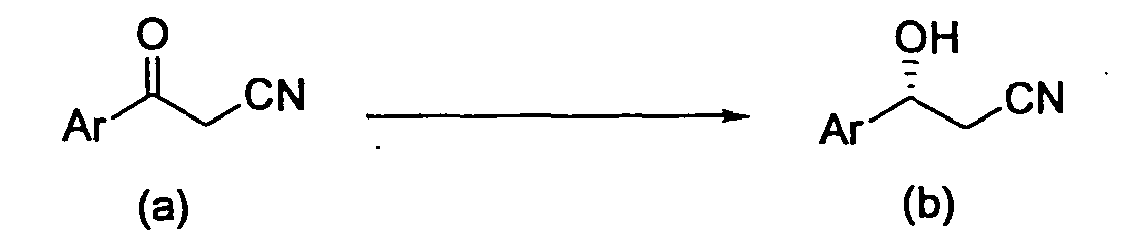
- Iridium aqua complex (1-a-R) shown in Table 2 (the amount shown in Table 2 (mol%) relative to compound (a)), compound (a) (0.5 mmol) and 1.0 M formic acid aqueous solution (2.5 mL, 5 eq, adjusted to pH=3.5 with 4M sodium hydroxide) were mixed at room temperature, and the mixture was stirred. After confirming the disappearance of compound (a) by TLC, the mixture was extracted with dichloromethane, and the organic layer was dried over anhydrous Na2SO4, and concentrated. The residue was purified by silica gel column chromatography to give the corresponding compound (b). The conversion and ee were shown in Table 2.
-
Table 2 Ar amount of use [mol%] conversion [%] ee [%] 3-1 Ph- 0.25 96 94 3-2 3-F-Ph- 0.50 95 91 3-3 3-Cl-Ph- 0.25 90 90 3-4 3-Me-Ph- 0.50 96 93 3-5 3-MeO-Ph- 0.25 96 95 3-6 4-MeO-Ph- 0.50 a) 80 - 3-7 4-CN-Ph- 0.25 97 86 3-8 2-naphthyl 0.50 b) 95 96 3-9 2-furyl 0.25 83 96 3-10 2-thienyl 0.50 94 92 a) The reaction temperature was 50°C
b) The solvent was water: (CF3)2CHOH=30:1 - The following reaction was carried out using iridium aqua complex (1-a-R).
-

- Iridium aqua complex (1-a-R) shown in Table 3 (the amount shown in Table 3 (mol%) relative to compound (c)), compound (c) (0.5 mmol) and 1.0 M formic acid aqueous solution (2.5 mL, 5 eq, adjusted with 4M sodium hydroxide in the case of pH=3.5, without adjustment in the case of pH=2.0) were mixed at room temperature, and the mixture was stirred. After confirming the disappearance of compound (c) by TLC, the mixture was extracted with dichloromethane, and the organic layer was dried over anhydrous Na2SO4, and concentrated. The residue was purified by silica gel column chromatography to give the corresponding compound (d). The conversion and ee were shown in Table 3.
-
Table 3 Ar X amount of use [mol%] pH conversion [%] ee [%] 4-1 Ph- NO2 0.50 2.0 94 93 4-2 2-Me-Ph- NO2 0.50 2.0 93 80 4-3 4-tBu-Ph- NO2 0.50 2.0 92 99 4-4 3-Cl-Ph- NO2 0.50 2.0 95 95 4-5 Ph- Cl 0.25 3.5 93 91 4-6 Ph- N3 0.25 3.5 50 87 - Example 5 Asymmetric transfer hydrogenation of nitroolefin compound
-

- Iridium aqua complex shown in Table 4 (1 mol% relative to nitroolefin compound (e)), nitroolefin compound (e) (0.5 mmol) and 1.0 M formic acid aqueous solution (2.5 mL, 5 eq, adjusted with 4M sodium hydroxide in the case of pH=3.5, without adjustment in the case of pH=2.0) were mixed at room temperature, and the mixture was stirred. After confirming the disappearance of nitroolefin compound (e) by TLC, the mixture was extracted with dichloromethane, and the organic layer was dried over anhydrous Na2SO4, and concentrated. The residue was purified by silica gel column chromatography to give optically active nitroalkane compound (f). The conversion and ee were shown in Table 4. (S)-Nitroalkane compound (f) was obtained in Example 5-1 to 5-7, and (R)-nitroalkane compound (f) was obtained in Example 5-8.
-
Table 4 iridium aqua complex pH conversion [%] ee [%] 5-1 (1-a-R) 3.5 100 82 5-2 (1-b-S) 3.5 93 85 5-3 (1-c-R) 3.5 91 86 5-4 (1-d-R) 2.0 91 82 5-5 (1-e-R) 3.5 98 78 5-6 (1-f-R) 3.5 95 76 5-7 (1-g-R) 2.0 96 71 5-8 (1-h-S) 2.0 93 89 - Since the chiral iridium aqua complex (1A) of the present invention has good solubility in water, the asymmetric transfer hydrogenation can be carried out in an aqueous solvent which is environmentally friendly and suitable for green chemistry. Even if the asymmetric transfer hydrogenation is carried out in the presence of formic acid or a salt thereof, it can be performed safely since the danger caused by hydrogen generation and the like is absent.
In addition, the chiral iridium aqua complex (1A) of the present invention has good stability to the air and water. Moreover, the asymmetric transfer hydrogenation using chiral iridium aqua complex (1A) of the present invention can achieve higher stereoselectivity and higher yield, as compared to conventional iridium complexes. - This application is based on patent application No. 2008-178040 filed in Japan, the contents of which are encompassed in full herein.
Claims (38)
- A chiral iridium aqua complex represented by the formula (1A):

Ra, Rb, Rc, Rd and Re are the same or different and each is a hydrogen atom, a methyl group, an ethyl group or a phenyl group,
R1 and R2 are the same or different and each is an aryl group optionally having substituent(s), or
R1 and R2 in combination show a C3-4 straight chain alkylene group optionally having substituent(s) to form a ring,
R3 is an alkylsulfonyl group optionally having substituent(s) or an arylsulfonyl group optionally having substituent(s),
R4 is a hydrogen atom, an alkylsulfonyl group optionally having substituent(s) or an arylsulfonyl group optionally having substituent(s),
X is a monovalent or divalent anion, and
n is 2 when X is a monovalent anion, or n is 1 when X is a divalent anion. - A chiral iridium aqua complex represented by the formula (1):
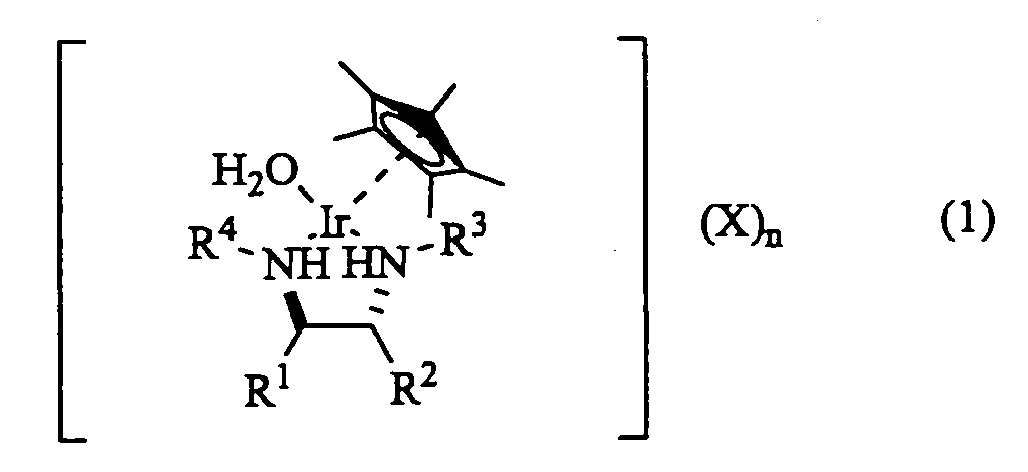
R1 and R2 are the same or different and each is an aryl group optionally having substituent(s), or
R1 and R2 in combination show a C3-4 straight chain alkylene group optionally having substituent(s) to form a ring,
R3 is an alkylsulfonyl group optionally having substituent(s) or an arylsulfonyl group optionally having substituent(s),
R4 is a hydrogen atom, an alkylsulfonyl group optionally having substituent(s) or an arylsulfonyl group optionally having substituent(s),
X is a monovalent or divalent anion, and
n is 2 when X is a monovalent anion, or n is 1 when X is a divalent anion. - The chiral iridium aqua complex of claim 1 or 2, wherein
R1 and R2 are the same or different and each is a C6-10 aryl group optionally having substituent(s) selected from a halogen atom, a C1-6 alkyl group, a C1-6 haloalkyl group, a C1-6 alkoxy group and a C1-6 haloalkoxy group; or
R1 and R2 in combination show a C3-4 straight chain alkylene group optionally having substituent(s) to form a ring. - The chiral iridium aqua complex of claim 1 or 2, wherein R1 and R2 are the same or different and each is a C6-10 aryl group optionally having substituent(s) selected from a halogen atom, a C1-6 alkyl group, a C1-6 haloalkyl group, a C1-6 alkoxy group and a C1-6 haloalkoxy group.
- The chiral iridium aqua complex of claim 1 or 2, wherein R1 and R2 are the same or different and each is phenyl optionally having fluorine atom(s).
- The chiral iridium aqua complex of claim 1 or 2, wherein R3 is a C6-10 arylsulfonyl group optionally having substituent(s) selected from a halogen atom, a C1-6 alkyl group, a C1-6 haloalkyl group and a nitro group; or a C1-6 alkylsulfonyl group optionally having halogen atom(s).
- The chiral iridium aqua complex of claim 1 or 2, wherein R3 is phenylsulfonyl having substituent(s) selected from a fluorine atom, trifluoromethyl and nitro; or a C1-4 alkylsulfonyl group having fluorine atom(s).
- The chiral iridium aqua complex of claim 1 or 2, wherein R4 is a hydrogen atom; or a C6-10 arylsulfonyl group optionally having C1-6 alkyl group(s).
- The chiral iridium aqua complex of claim 1 or 2, wherein R4 is a hydrogen atom.
- The chiral iridium aqua complex of claim 1 or 2, wherein X is a sulfate ion.
- A chiral iridium aqua complex represented by formula:


- A chiral iridium aqua complex represented by formula:
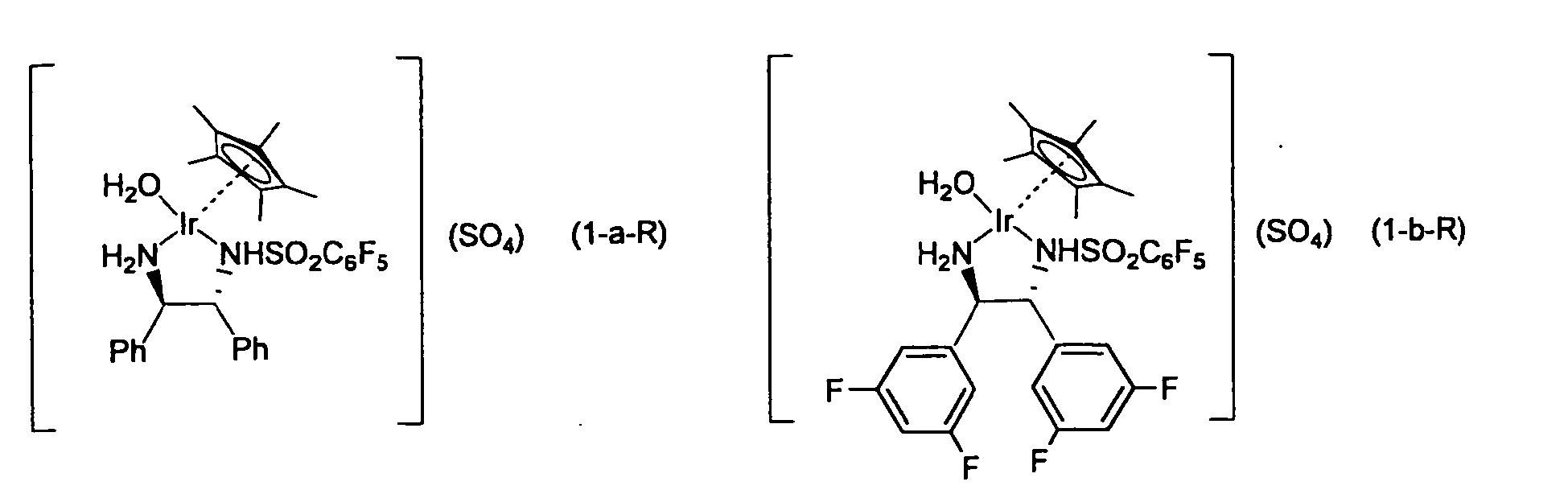


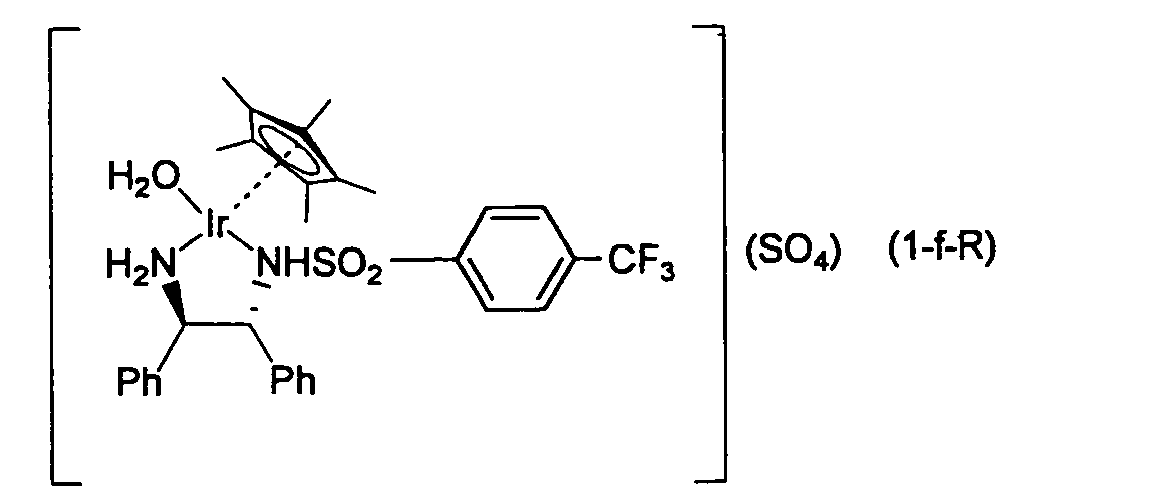
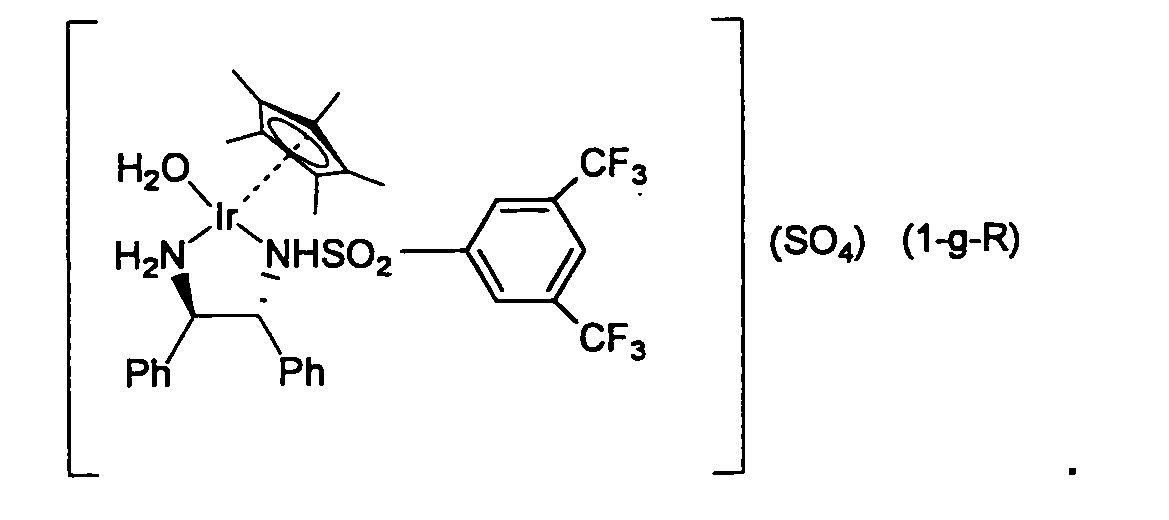
- A chiral iridium aqua complex represented by formula:


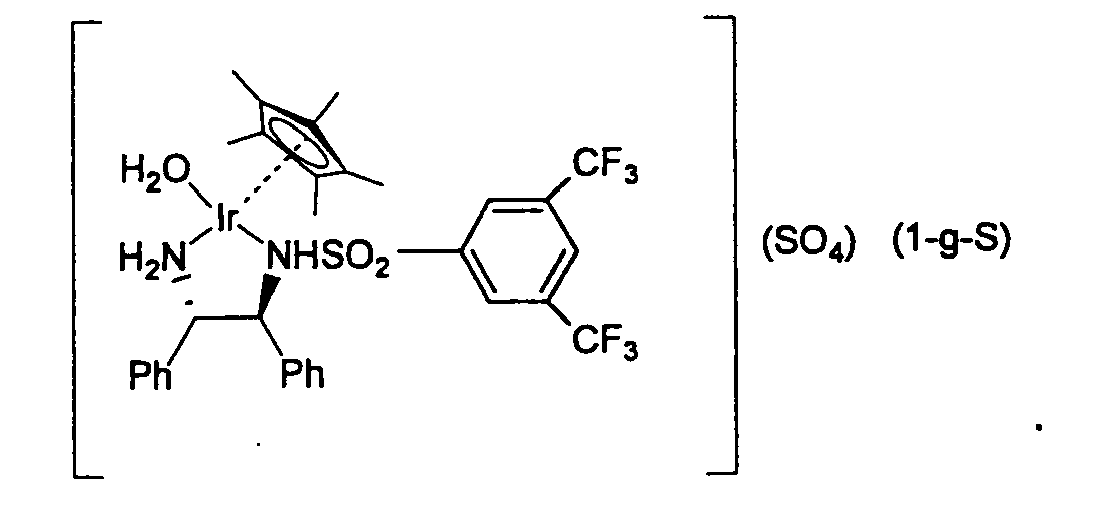
- A chiral iridium aqua complex represented by formula:


- A chiral iridium aqua complex represented by formula:


- A chiral iridium aqua complex represented by formula:


- A method of producing a chiral iridium aqua complex represented by the formula (1A), which comprises reacting an iridium complex represented by the formula (2) with a chiral diamine represented by the formula (3):

Ra, Rb, Rc, Rd and Re are the same or different and each is a hydrogen atom, a methyl group, an ethyl group or a phenyl group,
R1 and R2 are the same or different and each is an aryl group optionally having substituent(s), or
R1 and R2 in combination show a C3-4 straight chain alkylene group optionally having substituent(s) to form a ring,
R3 is an alkylsulfonyl group optionally having substituent(s) or an arylsulfonyl group optionally having substituent(s),
R4 is a hydrogen atom, an alkylsulfonyl group optionally having substituent(s) or an arylsulfonyl group optionally having substituent(s),
X is a monovalent or divalent anion, and
n is 2 when X is a monovalent anion, or n is 1 when X is a divalent anion. - A method of producing an optically active hydroxy compound represented by the formula (5), which comprises subjecting a carbonyl compound represented by the formula (4) to an asymmetric transfer hydrogenation in the presence of the chiral iridium aqua complex of any of claims 1 to 16:

R5 is an aryl group optionally having substituent(s), a heteroaryl group optionally having substituent(s), a cycloalkyl group optionally having substituent(s) or an aralkyl group optionally having substituent(s),
R6 is a carboxyl group, a carbamoyl group optionally having substituent(s) or an alkyl group optionally having substituent(s), and
the carbon atom marked with * is an asymmetric carbon atom. - The method of claim 18, wherein the chiral iridium aqua complex is

- The method of claim 18, wherein the chiral iridium aqua complex is

- The method of claim 18, wherein the chiral iridium aqua complex is

- The method of claim 18, wherein R5 is a C6-10 aryl group optionally having substituent(s) selected from a halogen atom, a C1-6 alkyl group, a C1-6 alkoxy group, a cyano group and nitro group; a C3-8 cycloalkyl group; or a 5- or 6-membered heteroaryl group optionally having C1-6 alkyl group(s).
- The method of claim 18, wherein R6 is a C1-6 alkyl group optionally having substituent(s) selected from a halogen atom, a cyano group, a nitro group and an azido group.
- The method of claim 18, wherein the asymmetric transfer hydrogenation is carried out in the presence of formic acid or a salt thereof.
- The method of claim 18, wherein the asymmetric transfer hydrogenation is carried out in the presence of formic acid.
- The method of claim 18, wherein the asymmetric transfer hydrogenation is carried out under the condition of pH 2 to 5.
- A method of producing an optically active nitroalkane compound represented by the formula (7), which comprises subjecting a nitroolefin compound represented by the formula (6) to an asymmetric transfer hydrogenation in the presence of the chiral iridium aqua complex of any of claims 1 to 16:

R7 is an aryl group optionally having substituent(s) or a heteroaryl group optionally having substituent(s),
R8 is an alkyl group optionally having substituent(s), an aryl group optionally having substituent(s) or a heteroaryl group optionally having substituent(s), and
the carbon atom marked with * is an asymmetric carbon atom. - The method of claim 27, wherein the chiral iridium aqua complex is

- The method of claim 27, wherein the chiral iridium aqua complex is

- The method of claim 27, wherein the chiral iridium aqua complex is

- The method of claim 27, wherein R7 is a C6-10 aryl group optionally having substituent(s) selected from a halogen atom, a C1-6 alkyl group, a C1-6 haloalkyl group and a C1-6 alkoxy group.
- The method of claim 27, wherein R8 is a C1-6 alkyl group.
- The method of claim 27, wherein the asymmetric transfer hydrogenation is carried out in the presence of formic acid or a salt thereof.
- The method of claim 27, wherein the asymmetric transfer hydrogenation is carried out in the presence of formic acid.
- The method of claim 27, wherein the asymmetric transfer hydrogenation is carried out under the condition of pH 2 to 5.
- A chiral diamine represented by formula:

- A chiral diamine represented by formula:

- A chiral diamine represented by formula:

Applications Claiming Priority (2)
| Application Number | Priority Date | Filing Date | Title |
|---|---|---|---|
| JP2008178040 | 2008-07-08 | ||
| PCT/JP2009/062289 WO2010004957A1 (en) | 2008-07-08 | 2009-07-06 | Chiral iridium aqua complex and method for producing optically active hydroxy compound using the same |
Publications (2)
| Publication Number | Publication Date |
|---|---|
| EP2311846A1 true EP2311846A1 (en) | 2011-04-20 |
| EP2311846A4 EP2311846A4 (en) | 2013-01-16 |
Family
ID=41507070
Family Applications (1)
| Application Number | Title | Priority Date | Filing Date |
|---|---|---|---|
| EP09794401A Withdrawn EP2311846A4 (en) | 2008-07-08 | 2009-07-06 | CHIRAL IRIDIUM AQUA COMPLEX AND PROCESS FOR PRODUCING OPTICALLY ACTIVE HYDROXY COMPOUND USING THE SAME |
Country Status (5)
| Country | Link |
|---|---|
| US (1) | US20110137049A1 (en) |
| EP (1) | EP2311846A4 (en) |
| JP (1) | JP2010037332A (en) |
| CN (1) | CN102119165A (en) |
| WO (1) | WO2010004957A1 (en) |
Families Citing this family (5)
| Publication number | Priority date | Publication date | Assignee | Title |
|---|---|---|---|---|
| JP5656474B2 (en) * | 2010-06-28 | 2015-01-21 | 関東化学株式会社 | Process for producing aliphatic optically active fluoroalcohol |
| NL2005512C2 (en) * | 2010-10-14 | 2012-04-17 | Univ Leiden | Metal complex and use as multi-electron catalyst. |
| CN105246873A (en) * | 2013-06-14 | 2016-01-13 | 日产化学工业株式会社 | Production method for optically active alcohol compound |
| CN109574797B (en) * | 2018-12-28 | 2021-09-17 | 上海彩迩文生化科技有限公司 | Preparation method of chiral benzyl alcohol |
| CN112679433B (en) * | 2019-10-18 | 2024-05-24 | 浙江九洲药业股份有限公司 | A preparation method of elixipine |
Family Cites Families (7)
| Publication number | Priority date | Publication date | Assignee | Title |
|---|---|---|---|---|
| JPH11335385A (en) * | 1998-05-20 | 1999-12-07 | Takasago Internatl Corp | Transition metal complex and production of optically active alcohol using the same |
| JP2003502296A (en) * | 1999-06-15 | 2003-01-21 | ロディア・シミ | Sulfonylamides and carboxamides and their use in asymmetric catalysis |
| ATE514665T1 (en) * | 2003-05-23 | 2011-07-15 | Sumitomo Chemical Co | METHOD FOR PRODUCING AN OPTICALLY ACTIVE NITRO COMPOUND |
| WO2006137165A1 (en) * | 2005-06-20 | 2006-12-28 | Kanto Kagaku Kabushiki Kaisha | Hydrogenation catalyst and process for producing alcohol compound therewith |
| WO2006137167A1 (en) * | 2005-06-20 | 2006-12-28 | Kanto Kagaku Kabushiki Kaisha | Sulfonate catalyst and process for producing alcohol compound therewith |
| JP5046371B2 (en) | 2007-01-22 | 2012-10-10 | 日本電波工業株式会社 | Oscillator |
| JP5006059B2 (en) * | 2007-01-29 | 2012-08-22 | エリック エム. カレイラ | Chiral iridium aqua complex and method for producing optically active hydroxy compound using the same |
-
2009
- 2009-07-06 WO PCT/JP2009/062289 patent/WO2010004957A1/en not_active Ceased
- 2009-07-06 EP EP09794401A patent/EP2311846A4/en not_active Withdrawn
- 2009-07-06 US US13/003,146 patent/US20110137049A1/en not_active Abandoned
- 2009-07-06 JP JP2009159617A patent/JP2010037332A/en not_active Withdrawn
- 2009-07-06 CN CN2009801265416A patent/CN102119165A/en active Pending
Also Published As
| Publication number | Publication date |
|---|---|
| WO2010004957A1 (en) | 2010-01-14 |
| JP2010037332A (en) | 2010-02-18 |
| US20110137049A1 (en) | 2011-06-09 |
| CN102119165A (en) | 2011-07-06 |
| EP2311846A4 (en) | 2013-01-16 |
Similar Documents
| Publication | Publication Date | Title |
|---|---|---|
| EP2123661B1 (en) | Chiral iridium aqua complex and method for producing optically active hydroxy compound by using the same | |
| EP1276745B1 (en) | Ruthenium-diphosphine complexes and their use as catalysts | |
| EP2311846A1 (en) | Chiral iridium aqua complex and method for producing optically active hydroxy compound using the same | |
| JP5372771B2 (en) | process | |
| JPWO2000041997A1 (en) | Method for producing optically active amino alcohols | |
| JP5001861B2 (en) | Asymmetric hydrosilylation of ketones | |
| JP7079696B2 (en) | Boron compounds and methods for producing hydrides, polymers and adducts using them. | |
| JP2912572B2 (en) | Method for producing optically active amines | |
| JP5042438B2 (en) | Process for producing β-aminoalcohols having a syn configuration | |
| EP4055025A1 (en) | New transition metal catalyst | |
| KR101199178B1 (en) | Method for the preparation of chiral beta-fluoroalkylated carbonyl compounds using chiral catalyst | |
| KR101818836B1 (en) | SYNTHESIZING METHOD OF α-ARYL-β-HYDROXY WEINREB AMIDES | |
| CN102046602A (en) | Method for preparing montelukast intermediate | |
| JP2020518576A (en) | Method for preparing deuterated ethanol from D2O | |
| JP4314602B2 (en) | Process for producing optically active 3-hydroxypyrrolidine derivative | |
| CN117567322A (en) | A method for synthesizing chiral diarylmethylamine derivatives | |
| JP2000212110A (en) | Method for producing optically active α-alkylbenzyl alcohols | |
| Lapitskaya et al. | Preparative synthesis of the Corey chiral controller for enantioselective dihydroxylation of olefins | |
| JP2001106664A (en) | Production of optically active imino alcohol compounds and amino alcohol compounds | |
| EP1978016A1 (en) | Asymmetric reduction method | |
| JPWO2005082861A1 (en) | Asymmetric reduction of 4- [5- (imidazol-1-yl) -2-methylbenzoyl] -3,5-dimethylbenzoic acid or its ester | |
| KR20040094154A (en) | Method for the preparation of ketone |
Legal Events
| Date | Code | Title | Description |
|---|---|---|---|
| PUAI | Public reference made under article 153(3) epc to a published international application that has entered the european phase |
Free format text: ORIGINAL CODE: 0009012 |
|
| 17P | Request for examination filed |
Effective date: 20110204 |
|
| AK | Designated contracting states |
Kind code of ref document: A1 Designated state(s): AT BE BG CH CY CZ DE DK EE ES FI FR GB GR HR HU IE IS IT LI LT LU LV MC MK MT NL NO PL PT RO SE SI SK SM TR |
|
| AX | Request for extension of the european patent |
Extension state: AL BA RS |
|
| DAX | Request for extension of the european patent (deleted) | ||
| A4 | Supplementary search report drawn up and despatched |
Effective date: 20121218 |
|
| RIC1 | Information provided on ipc code assigned before grant |
Ipc: C07D 333/24 20060101ALI20121212BHEP Ipc: C07C 201/12 20060101ALI20121212BHEP Ipc: C07C 205/16 20060101ALI20121212BHEP Ipc: C07C 311/18 20060101ALI20121212BHEP Ipc: C07C 205/09 20060101ALI20121212BHEP Ipc: C07C 247/10 20060101ALI20121212BHEP Ipc: C07C 33/46 20060101ALI20121212BHEP Ipc: C07C 311/09 20060101ALI20121212BHEP Ipc: C07F 17/02 20060101AFI20121212BHEP Ipc: C07C 255/13 20060101ALI20121212BHEP Ipc: C07D 307/54 20060101ALI20121212BHEP Ipc: C07B 61/00 20060101ALI20121212BHEP Ipc: C07C 29/143 20060101ALI20121212BHEP Ipc: C07C 255/12 20060101ALI20121212BHEP Ipc: C07C 253/30 20060101ALI20121212BHEP Ipc: C07B 53/00 20060101ALI20121212BHEP |
|
| STAA | Information on the status of an ep patent application or granted ep patent |
Free format text: STATUS: THE APPLICATION IS DEEMED TO BE WITHDRAWN |
|
| 18D | Application deemed to be withdrawn |
Effective date: 20130718 |