EP2310196B1 - Multilaminar wood block and veneers and method for the manufacture thereof - Google Patents
Multilaminar wood block and veneers and method for the manufacture thereof Download PDFInfo
- Publication number
- EP2310196B1 EP2310196B1 EP09797597.3A EP09797597A EP2310196B1 EP 2310196 B1 EP2310196 B1 EP 2310196B1 EP 09797597 A EP09797597 A EP 09797597A EP 2310196 B1 EP2310196 B1 EP 2310196B1
- Authority
- EP
- European Patent Office
- Prior art keywords
- veneers
- adhesive
- wood
- stage
- multilaminar
- Prior art date
- Legal status (The legal status is an assumption and is not a legal conclusion. Google has not performed a legal analysis and makes no representation as to the accuracy of the status listed.)
- Active
Links
Images
Classifications
-
- B—PERFORMING OPERATIONS; TRANSPORTING
- B32—LAYERED PRODUCTS
- B32B—LAYERED PRODUCTS, i.e. PRODUCTS BUILT-UP OF STRATA OF FLAT OR NON-FLAT, e.g. CELLULAR OR HONEYCOMB, FORM
- B32B7/00—Layered products characterised by the relation between layers; Layered products characterised by the relative orientation of features between layers, or by the relative values of a measurable parameter between layers, i.e. products comprising layers having different physical, chemical or physicochemical properties; Layered products characterised by the interconnection of layers
- B32B7/04—Interconnection of layers
- B32B7/12—Interconnection of layers using interposed adhesives or interposed materials with bonding properties
-
- B—PERFORMING OPERATIONS; TRANSPORTING
- B27—WORKING OR PRESERVING WOOD OR SIMILAR MATERIAL; NAILING OR STAPLING MACHINES IN GENERAL
- B27D—WORKING VENEER OR PLYWOOD
- B27D1/00—Joining wood veneer with any material; Forming articles thereby; Preparatory processing of surfaces to be joined, e.g. scoring
- B27D1/04—Joining wood veneer with any material; Forming articles thereby; Preparatory processing of surfaces to be joined, e.g. scoring to produce plywood or articles made therefrom; Plywood sheets
-
- B—PERFORMING OPERATIONS; TRANSPORTING
- B27—WORKING OR PRESERVING WOOD OR SIMILAR MATERIAL; NAILING OR STAPLING MACHINES IN GENERAL
- B27L—REMOVING BARK OR VESTIGES OF BRANCHES; SPLITTING WOOD; MANUFACTURE OF VENEER, WOODEN STICKS, WOOD SHAVINGS, WOOD FIBRES OR WOOD POWDER
- B27L5/00—Manufacture of veneer ; Preparatory processing therefor
-
- B—PERFORMING OPERATIONS; TRANSPORTING
- B32—LAYERED PRODUCTS
- B32B—LAYERED PRODUCTS, i.e. PRODUCTS BUILT-UP OF STRATA OF FLAT OR NON-FLAT, e.g. CELLULAR OR HONEYCOMB, FORM
- B32B21/00—Layered products comprising a layer of wood, e.g. wood board, veneer, wood particle board
- B32B21/04—Layered products comprising a layer of wood, e.g. wood board, veneer, wood particle board comprising wood as the main or only constituent of a layer, which is next to another layer of the same or of a different material
- B32B21/042—Layered products comprising a layer of wood, e.g. wood board, veneer, wood particle board comprising wood as the main or only constituent of a layer, which is next to another layer of the same or of a different material of wood
-
- B—PERFORMING OPERATIONS; TRANSPORTING
- B32—LAYERED PRODUCTS
- B32B—LAYERED PRODUCTS, i.e. PRODUCTS BUILT-UP OF STRATA OF FLAT OR NON-FLAT, e.g. CELLULAR OR HONEYCOMB, FORM
- B32B21/00—Layered products comprising a layer of wood, e.g. wood board, veneer, wood particle board
- B32B21/13—Layered products comprising a layer of wood, e.g. wood board, veneer, wood particle board all layers being exclusively wood
-
- B—PERFORMING OPERATIONS; TRANSPORTING
- B32—LAYERED PRODUCTS
- B32B—LAYERED PRODUCTS, i.e. PRODUCTS BUILT-UP OF STRATA OF FLAT OR NON-FLAT, e.g. CELLULAR OR HONEYCOMB, FORM
- B32B21/00—Layered products comprising a layer of wood, e.g. wood board, veneer, wood particle board
- B32B21/14—Layered products comprising a layer of wood, e.g. wood board, veneer, wood particle board comprising wood board or veneer
-
- B—PERFORMING OPERATIONS; TRANSPORTING
- B32—LAYERED PRODUCTS
- B32B—LAYERED PRODUCTS, i.e. PRODUCTS BUILT-UP OF STRATA OF FLAT OR NON-FLAT, e.g. CELLULAR OR HONEYCOMB, FORM
- B32B2255/00—Coating on the layer surface
- B32B2255/08—Coating on the layer surface on wood layer
-
- B—PERFORMING OPERATIONS; TRANSPORTING
- B32—LAYERED PRODUCTS
- B32B—LAYERED PRODUCTS, i.e. PRODUCTS BUILT-UP OF STRATA OF FLAT OR NON-FLAT, e.g. CELLULAR OR HONEYCOMB, FORM
- B32B2255/00—Coating on the layer surface
- B32B2255/26—Polymeric coating
-
- B—PERFORMING OPERATIONS; TRANSPORTING
- B32—LAYERED PRODUCTS
- B32B—LAYERED PRODUCTS, i.e. PRODUCTS BUILT-UP OF STRATA OF FLAT OR NON-FLAT, e.g. CELLULAR OR HONEYCOMB, FORM
- B32B2307/00—Properties of the layers or laminate
- B32B2307/40—Properties of the layers or laminate having particular optical properties
- B32B2307/402—Coloured
-
- B—PERFORMING OPERATIONS; TRANSPORTING
- B32—LAYERED PRODUCTS
- B32B—LAYERED PRODUCTS, i.e. PRODUCTS BUILT-UP OF STRATA OF FLAT OR NON-FLAT, e.g. CELLULAR OR HONEYCOMB, FORM
- B32B2307/00—Properties of the layers or laminate
- B32B2307/50—Properties of the layers or laminate having particular mechanical properties
- B32B2307/51—Elastic
-
- Y—GENERAL TAGGING OF NEW TECHNOLOGICAL DEVELOPMENTS; GENERAL TAGGING OF CROSS-SECTIONAL TECHNOLOGIES SPANNING OVER SEVERAL SECTIONS OF THE IPC; TECHNICAL SUBJECTS COVERED BY FORMER USPC CROSS-REFERENCE ART COLLECTIONS [XRACs] AND DIGESTS
- Y10—TECHNICAL SUBJECTS COVERED BY FORMER USPC
- Y10T—TECHNICAL SUBJECTS COVERED BY FORMER US CLASSIFICATION
- Y10T156/00—Adhesive bonding and miscellaneous chemical manufacture
- Y10T156/10—Methods of surface bonding and/or assembly therefor
-
- Y—GENERAL TAGGING OF NEW TECHNOLOGICAL DEVELOPMENTS; GENERAL TAGGING OF CROSS-SECTIONAL TECHNOLOGIES SPANNING OVER SEVERAL SECTIONS OF THE IPC; TECHNICAL SUBJECTS COVERED BY FORMER USPC CROSS-REFERENCE ART COLLECTIONS [XRACs] AND DIGESTS
- Y10—TECHNICAL SUBJECTS COVERED BY FORMER USPC
- Y10T—TECHNICAL SUBJECTS COVERED BY FORMER US CLASSIFICATION
- Y10T156/00—Adhesive bonding and miscellaneous chemical manufacture
- Y10T156/10—Methods of surface bonding and/or assembly therefor
- Y10T156/1052—Methods of surface bonding and/or assembly therefor with cutting, punching, tearing or severing
-
- Y—GENERAL TAGGING OF NEW TECHNOLOGICAL DEVELOPMENTS; GENERAL TAGGING OF CROSS-SECTIONAL TECHNOLOGIES SPANNING OVER SEVERAL SECTIONS OF THE IPC; TECHNICAL SUBJECTS COVERED BY FORMER USPC CROSS-REFERENCE ART COLLECTIONS [XRACs] AND DIGESTS
- Y10—TECHNICAL SUBJECTS COVERED BY FORMER USPC
- Y10T—TECHNICAL SUBJECTS COVERED BY FORMER US CLASSIFICATION
- Y10T428/00—Stock material or miscellaneous articles
- Y10T428/24—Structurally defined web or sheet [e.g., overall dimension, etc.]
- Y10T428/24942—Structurally defined web or sheet [e.g., overall dimension, etc.] including components having same physical characteristic in differing degree
- Y10T428/2495—Thickness [relative or absolute]
- Y10T428/24967—Absolute thicknesses specified
Definitions
- the present invention has as its subject blocks in multilaminar wood and veneers obtained from it by slicing, and a method for the manufacture thereof.
- the invention belongs in the sector of woodworking, and in more detail in the manufacture of wood veneers made starting from blocks (or boards, also hereinafter designated “blocks” or “block”) made up of a plurality of thin sheets (veneers) of wood glued together to form a single multilaminar body.
- the aforementioned body made up of sheets alternating with layers of glue is compacted by a pressing action which causes the body to assume a thickness equal to the final thickness.
- the adhesive usually employed for the manufacture of boards in multilaminar wood is a bonding mixture based on urea-formaldehyde resins.
- This type of additive has hitherto shown itself to be the only one capable of satisfying the requirements imposed by the production of multilaminar wood boards, and in particular:
- the composition is altered by means of suitable additives (formaldehyde sequestrants, melamine resins, hardeners etc.) so as to have available a bonding mixture capable of satisfying the specified requirement of low toxicity.
- suitable additives formaldehyde sequestrants, melamine resins, hardeners etc.
- Document EP 0 234 459 relates to formaldehyde-free, aqueous glue dispersions which contain polyisocyanates which is particularly suitable for gluing veneers and surface materials on wood and wood products. The mixture remains in a satisfactory working condition for 0.5 to 3 hours (pot life).
- Document WO 2007/084307 discloses a formaldehyde-free curable aqueous composition containing a hydroxy-containing polymer, a multi-functional crosslinking agent, and, optionally, a catalyst.
- the composition is used as a binder for lignocellulosic materials such as plywood, fiber particleboard, medium density fiberboard and oriented strand board.
- Document CN 101 045 307 discloses a technology for preparing the non-aldehyde plywood without release of free form-aldehyde which includes such steps as preparing adhesive, pouring it on a coating machine, coating the adhesive on the surface of veneers, criss-cross overlaying, cold pressing, hot pressing, curing and removing residual edges.
- Document DE 102 24 530 discloses a parquetry element with several layers bonded together, in which the adhesive joints are formed with a water- and formaldehyde-free, cold-working adhesive and a layer-slip inhibitor to improve interlayer adhesion before the adhesive hardens.
- the document discloses also a method for the production of a parquetry element by applying polyurethane (PUR) adhesive and a floating inhibitor in strips between the first and second layers, preferably with a 2-component PUR adhesive in one strip and a PUR hot-melt adhesive in another.
- PUR polyurethane
- one of the principal disadvantages is due to the excessive rapidity of setting of these bonding mixtures, which cure before the multilaminar wood block is completed, making it impossible to correctly carry out the compaction phase of the superimposed sheets.
- the technical task set as the basis of the present invention is to propose a multilaminar wood block, and a method for the manufacture thereof, capable of obviating the disadvantage mentioned above.
- the block 1 comprises a plurality of sheets 2 of wood, or veneers, each having a thickness certainly less than 5 millimetres and preferably between 0.1 and 2 millimetres.
- sheets 2 of wood, or veneers each having a thickness certainly less than 5 millimetres and preferably between 0.1 and 2 millimetres.
- the wood in order to be described as solid timber, according to UNI European standards, the wood must have a minimum thickness of 5 mm; if the thickness is below this, we speak of wood veneer (slices of wood).
- the veneers 2 are made integral with each other by means of layers 3 of adhesive alternating with the sheets 2 themselves.
- the adhesive is obtained from an aqueous dispersion based on polyurethane free from formaldehyde, with the addition of a catalyst comprising liquid isocyanate, free from solvents.
- This aqueous dispersion is mixed with the catalyst and then applied to the individual veneers 2 to form the block 1.
- the mixture is deposited by painting or by roller or by spraying on one or both faces of each veneer 2 which is immediately superimposed on the veneer which has previously been treated with the adhesive.
- the aforementioned aqueous dispersion has a viscosity of between 400 and 2000 mPa ⁇ s.
- the aforementioned dispersion has a pH of between 5 and 12.
- a sequence of wood veneers 2 is fed towards a processing station where on one face of each sheet 2 a layer 3 of the aforementioned adhesive is applied.
- each sheet 2 On each sheet 2 a quantity of adhesive is deposited of between 50 and 400 g/m 2 and preferably of between 100 and 230 g/m 2 .
- the veneers 2 are then superimposed in sequence to form a single stack consisting of an alternate succession of sheets 2 and layers 3 of adhesive.
- the stack thus created is subjected to compressive action by means of a press, for example a flat press, which compresses the sheets 2 one against another, bringing about a crushing of the stack and causing it to assume a thickness substantially corresponding to the thickness of the block 1 to be manufactured.
- a press for example a flat press
- the aforementioned compression stage is maintained for a time of between 2 and 20 hours, preferably between 4 and 12 hours, at a temperature of between 5 and 70 °C, preferably between 15 and 45 °C, in such a way as to allow optimal curing of the adhesive (this stage can also be carried out at room temperature).
- the block 1 is obtained by superimposition and gluing of 2 distinct stacks of veneers 2 (i.e. of two multilaminar wood blocks subsequently coupled together), each obtained with a plurality of veneers 2 in accordance with the procedure described above.
- Each of said stacks has a predetermined thickness, substantially equal for example to half the final thickness of the block 1 to be obtained. In this way the time necessary for the completion of each stack is halved, and the compression of each stack can be carried out immediately after its completion, thus reducing the risks of a premature curing of the adhesive which otherwise would make that stack of sheets 2 unusable.
- the two stacks are superimposed and a layer of adhesive, of the type described above, is interposed between them, and the stacks thus superimposed are subjected to a compression stage in order to glue the stacks together and thus obtain a block 1 with a thickness equal to the desired value.
- the manufacture of the block 1 can be performed starting from three or more stacks, each of them comprising a plurality of sheets 2.
- the stacks are subsequently superimposed to obtain the block 1 in accordance with the description given above.
- each multilaminar wood block comprises in general more than 200 superimposed veneers, and in particular their number, very high but able to vary widely, is between 400 and 1500 sheets of wood veneer.
- the present invention achieves the proposed objects, overcoming the disadvantages complained of in the prior art.
- the adhesive used for the production of the boards in accordance with the present invention is in fact free from formaldehyde and therefore has a very low if not non-existent toxicity, complying currently with all the regulations, including the most restrictive.
- the adhesive used in the invention satisfies the requirements previously listed.
- the viscosity of this adhesive has shown itself to be optimal in the field of the production of multilaminar blocks, and furthermore the working life of this adhesive proves to be 8-10 hours, sufficient therefore to allow it to be stored during processing without losing its adhesive properties.
- an adhesive in the form of an aqueous dispersion reduces the risks of premature curing of the adhesive, thus allowing the superimposition of all the sheets necessary for the manufacture of the board, and allowing a subsequent correct action of compacting the sheets.
- the finished block also has the necessary elasticity to allow the slicing operations.
- the adhesive can be coloured to ensure the possibility of varying the aesthetics of the finished product in a customized manner.
Landscapes
- Life Sciences & Earth Sciences (AREA)
- Engineering & Computer Science (AREA)
- Wood Science & Technology (AREA)
- Manufacturing & Machinery (AREA)
- Forests & Forestry (AREA)
- Mechanical Engineering (AREA)
- Adhesives Or Adhesive Processes (AREA)
- Veneer Processing And Manufacture Of Plywood (AREA)
- Chemical And Physical Treatments For Wood And The Like (AREA)
- Stringed Musical Instruments (AREA)
- Golf Clubs (AREA)
Description
- The present invention has as its subject blocks in multilaminar wood and veneers obtained from it by slicing, and a method for the manufacture thereof.
- The invention, in particular, belongs in the sector of woodworking, and in more detail in the manufacture of wood veneers made starting from blocks (or boards, also hereinafter designated "blocks" or "block") made up of a plurality of thin sheets (veneers) of wood glued together to form a single multilaminar body.
- It is known that the manufacture of blocks and of the relative veneers in multilaminar wood is performed by feeding in sequence a plurality of thin sheets of wood and stacking them, interposing between one sheet and another a layer of adhesive, until a single body having a desired thickness is formed.
- Subsequently, the aforementioned body made up of sheets alternating with layers of glue is compacted by a pressing action which causes the body to assume a thickness equal to the final thickness.
- The adhesive usually employed for the manufacture of boards in multilaminar wood is a bonding mixture based on urea-formaldehyde resins. This type of additive has hitherto shown itself to be the only one capable of satisfying the requirements imposed by the production of multilaminar wood boards, and in particular:
- chemical and physical stability in the storage phase;
- reactivity and viscosity suitable for the technology used for application to wood veneers;
- possibility of being coloured at the time of application;
- ease of washing at the end of processing;
- degree of elasticity such as to allow the multilaminar wood block to be subsequently sliced;
- bonding power such as to allow good workability of the block thus obtained;
- relatively low toxicity.
- With reference to the toxicity, it is due principally to the formaldehyde included in the bonding mixture, which is considered capable of causing damage to human health. Current legislation therefore specifies ever smaller quantities of formaldehyde, and frequently this entails studies carried out by companies in the sector to reduce the quantities of this compound while however maintaining unaltered all the other properties of the adhesive.
- In this connection, starting from glues based on urea-formaldehyde resin, the composition is altered by means of suitable additives (formaldehyde sequestrants, melamine resins, hardeners etc.) so as to have available a bonding mixture capable of satisfying the specified requirement of low toxicity. In the light of the above, the currently known bonding mixtures inevitably have an unavoidable minimum of formaldehyde, and this to a growing extent increases the problems relating to the use of these bonding mixtures for the manufacture of multilaminar wood blocks.
- Other types of adhesives or bonding mixtures are currently known which are free from formaldehyde; however, they are not suitable for use in the manufacture of multilaminar wood blocks because they have unsuitable properties for satisfying the above requirements.
- Document
EP 0 234 459 relates to formaldehyde-free, aqueous glue dispersions which contain polyisocyanates which is particularly suitable for gluing veneers and surface materials on wood and wood products. The mixture remains in a satisfactory working condition for 0.5 to 3 hours (pot life). - Document
WO 2007/084307 discloses a formaldehyde-free curable aqueous composition containing a hydroxy-containing polymer, a multi-functional crosslinking agent, and, optionally, a catalyst. The composition is used as a binder for lignocellulosic materials such as plywood, fiber particleboard, medium density fiberboard and oriented strand board. - Document
US 5 278 211 discloses formaldehyde free crosslinking emulsion polymers which are prepared by the addition of N-(2,2-dialkoxy-1-hydroxy)ethyl acrylamide to a vinyl ester based polymer. The resultant emulsions can be used as binders for nonwovens or fiberfill or as woodworking adhesives. - Document
CN 101 045 307 discloses a technology for preparing the non-aldehyde plywood without release of free form-aldehyde which includes such steps as preparing adhesive, pouring it on a coating machine, coating the adhesive on the surface of veneers, criss-cross overlaying, cold pressing, hot pressing, curing and removing residual edges. - Document
DE 102 24 530 discloses a parquetry element with several layers bonded together, in which the adhesive joints are formed with a water- and formaldehyde-free, cold-working adhesive and a layer-slip inhibitor to improve interlayer adhesion before the adhesive hardens. The document discloses also a method for the production of a parquetry element by applying polyurethane (PUR) adhesive and a floating inhibitor in strips between the first and second layers, preferably with a 2-component PUR adhesive in one strip and a PUR hot-melt adhesive in another. - In particular, one of the principal disadvantages is due to the excessive rapidity of setting of these bonding mixtures, which cure before the multilaminar wood block is completed, making it impossible to correctly carry out the compaction phase of the superimposed sheets.
- It should in fact be noted that the production of a multilaminar wood block requires the coupling together of 300-1500 veneers which must be spread with adhesive, joined together and then pressed before the adhesive cures.
- It is also necessary to ensure the satisfaction of all the other requirements of the finished product, referred to above, which depend heavily on the adhesive used, which will in fact be found interposed between the 300-1500 thin sheets (veneers) of wood.
- In general, then, adhesives which are not urea-formaldehyde based are not able to ensure, once curing is complete, the correct elasticity to allow the multilaminar wood to be sliced.
- In this situation, the technical task set as the basis of the present invention is to propose a multilaminar wood block, and a method for the manufacture thereof, capable of obviating the disadvantage mentioned above.
- Within the scope of this technical task it is an object of the present invention to make available a multilaminar wood block, and a method for the manufacture thereof, which achieve a very low level if not indeed a complete lack of toxicity.
- It is a further object of the invention to make available a multilaminar wood block, and a method for the manufacture thereof, which use a bonding mixture capable of satisfying the requirements listed above, and in particular which have a curing time sufficient to allow the stacking of a predetermined number of sheets.
- It is also an objective to make available a multilaminar wood block which can be correctly sliced without being ruined or ruining the cutting tools.
- These objects, and yet others, are substantially achieved by a multilaminar wood block and a method for the manufacture thereof, having respectively the technical characteristics set forth in the independent claims and/or in one or more of the claims dependent upon them.
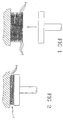
- The description is now set forth, by way of example but without exclusive effect, of a preferred embodiment of a multilaminar wood block, and a method for the manufacture thereof, in accordance with the attached drawings, in which:
-
figure 1 shows a frontal view of a block in accordance with the present invention and in a first stage of manufacture; -
figure 2 shows the block shown infigure 1 in a second stage of manufacture. - With reference to the attached figures, no. 1 comprehensively indicates a block in accordance with the present invention. The
block 1 comprises a plurality ofsheets 2 of wood, or veneers, each having a thickness certainly less than 5 millimetres and preferably between 0.1 and 2 millimetres. Reference will be made below to wood veneers which have dimensional characteristics, of thickness in particular, which are governed by regulations and are lower than clearly predefined values. - In fact, in order to be described as solid timber, according to UNI European standards, the wood must have a minimum thickness of 5 mm; if the thickness is below this, we speak of wood veneer (slices of wood).
- The
veneers 2 are made integral with each other by means oflayers 3 of adhesive alternating with thesheets 2 themselves. - Advantageously, the adhesive is obtained from an aqueous dispersion based on polyurethane free from formaldehyde, with the addition of a catalyst comprising liquid isocyanate, free from solvents. This aqueous dispersion is mixed with the catalyst and then applied to the
individual veneers 2 to form theblock 1. - In general, but not necessarily, the mixture is deposited by painting or by roller or by spraying on one or both faces of each
veneer 2 which is immediately superimposed on the veneer which has previously been treated with the adhesive. - Preferably, the aforementioned aqueous dispersion has a viscosity of between 400 and 2000 mPa·s. Preferably, furthermore, the aforementioned dispersion has a pH of between 5 and 12.
- In accordance with a preferred manufacturing procedure, a sequence of
wood veneers 2 is fed towards a processing station where on one face of each sheet 2 alayer 3 of the aforementioned adhesive is applied. - On each sheet 2 a quantity of adhesive is deposited of between 50 and 400 g/m2 and preferably of between 100 and 230 g/m2. The
veneers 2 are then superimposed in sequence to form a single stack consisting of an alternate succession ofsheets 2 andlayers 3 of adhesive. - The stack thus created is subjected to compressive action by means of a press, for example a flat press, which compresses the
sheets 2 one against another, bringing about a crushing of the stack and causing it to assume a thickness substantially corresponding to the thickness of theblock 1 to be manufactured. - The aforementioned compression stage is maintained for a time of between 2 and 20 hours, preferably between 4 and 12 hours, at a temperature of between 5 and 70 °C, preferably between 15 and 45 °C, in such a way as to allow optimal curing of the adhesive (this stage can also be carried out at room temperature).
- In accordance with a variant embodiment of this manufacturing procedure, the
block 1 is obtained by superimposition and gluing of 2 distinct stacks of veneers 2 (i.e. of two multilaminar wood blocks subsequently coupled together), each obtained with a plurality ofveneers 2 in accordance with the procedure described above. Each of said stacks has a predetermined thickness, substantially equal for example to half the final thickness of theblock 1 to be obtained. In this way the time necessary for the completion of each stack is halved, and the compression of each stack can be carried out immediately after its completion, thus reducing the risks of a premature curing of the adhesive which otherwise would make that stack ofsheets 2 unusable. Subsequently the two stacks are superimposed and a layer of adhesive, of the type described above, is interposed between them, and the stacks thus superimposed are subjected to a compression stage in order to glue the stacks together and thus obtain ablock 1 with a thickness equal to the desired value. - In accordance with further embodiments of this procedure, the manufacture of the
block 1 can be performed starting from three or more stacks, each of them comprising a plurality ofsheets 2. The stacks are subsequently superimposed to obtain theblock 1 in accordance with the description given above. - It should be noted in general that each multilaminar wood block comprises in general more than 200 superimposed veneers, and in particular their number, very high but able to vary widely, is between 400 and 1500 sheets of wood veneer.
- It should be noted that alternatively it would be possible to use a glue with a vinyl base, this too being preferably free from formaldehyde.
- The present invention achieves the proposed objects, overcoming the disadvantages complained of in the prior art.
- The adhesive used for the production of the boards in accordance with the present invention is in fact free from formaldehyde and therefore has a very low if not non-existent toxicity, complying currently with all the regulations, including the most restrictive.
- Furthermore, the adhesive used in the invention satisfies the requirements previously listed. In particular, the viscosity of this adhesive has shown itself to be optimal in the field of the production of multilaminar blocks, and furthermore the working life of this adhesive proves to be 8-10 hours, sufficient therefore to allow it to be stored during processing without losing its adhesive properties.
- In addition, the use of an adhesive in the form of an aqueous dispersion reduces the risks of premature curing of the adhesive, thus allowing the superimposition of all the sheets necessary for the manufacture of the board, and allowing a subsequent correct action of compacting the sheets.
- The finished block also has the necessary elasticity to allow the slicing operations.
- Potentially, too, the adhesive can be coloured to ensure the possibility of varying the aesthetics of the finished product in a customized manner.
Claims (11)
- Method for the production of multilaminar wood veneers from multilaminar wood blocks, comprising the stages of:- preparing a first plurality of wood veneers (2), said plurality of wood veneers comprising at least 200 veneers (2);- applying a layer (3) of adhesive to each of said veneers (2), said stage of applying a layer (2) of adhesive is performed by applying a polyurethane-based adhesive free from formaldehyde or applying a vinyl-based adhesive free from formaldehyde;- superimposing said veneers (2) until a predetermined thickness is reached and in such a way that the adhesive remains interposed between successive veneers (2);- subjecting said veneers (2) to a compression stage aimed at compacting said superimposition of adhesive and veneers (2) one against the other in order to achieve the gluing of said veneers (2) to obtain a multilaminar wood block;- subsequently obtaining multilaminar wood veneers from the multilaminar wood block by slicing;wherein the working life of the adhesive is 8-10 hours, suffcient to allow it to be stored during processing without losing its adhesive properties.
- Method according to claim 1, characterized in that said stage of applying a layer (3) of adhesive is performed by applying a polyurethane-based aqueous dispersion free from formaldehyde and having preferably a viscosity of between 400 and 2000 mPa·s and even more preferably a pH of between 5 and 12.
- Method according to claims 1 or 2, characterized in that said stage of subjecting said veneers (2) to a compression stage is maintained for a duration of between 2 and 20 hours, preferably between 4 and 12 hours, and is performed at a temperature of between 5 and 70 °C, preferably between 15 and 45 °C, in order to allow optimal curing of the adhesive.
- Method according to one or more of the preceding claims, characterized in that said stage of applying the layer (3) of adhesive comprises the stage of mixing said adhesive with a catalyst, preferably liquid isocyanate free from solvents.
- Method according to one or more of the preceding claims, characterized in that said stage of applying a layer (3) of adhesive to at least one of said veneers (2) is performed by depositing on said veneer (2) a quantity of adhesive of between 50 and 400 g/m2 and preferably of between 100 and 230 g/m2.
- Method according to one or more of the preceding claims, characterized in that said stage of preparing said veneers (2) is performed by preparing wood veneers (2) having a thickness of less than 5 millimetres and preferably of between 0.1 and 2 millimetres.
- Method according to one or more of the preceding claims, characterized by comprising the further stages of:- preparing a second plurality of wood veneers (2);- applying a layer (3) of adhesive to each of said veneers (2) of said second plurality of veneers (2);- superimposing said veneers (2) of said second plurality of veneers (2) until a predetermined thickness is reached and in such a way that the adhesive remains interposed between successive veneers (2);- subjecting said sheets (2) of said second plurality of veneers (2) to a compression stage aimed at compacting said veneers (2) one against the other in order to achieve the gluing of said veneers (2);- superimposing said first plurality of compacted veneers (2) and said second plurality of compacted sheets (2), interposing a layer of adhesive; and- subjecting said first and second pluralities of veneers (2) to a compression stage aimed at compacting said plurality of veneers (2) one against the other in order to achieve a board (1) having a desired final thickness.
- Method according to claim 1, characterized in that it comprises furthermore a stage of:- preparing a polyurethane-based adhesive free from formaldehyde;- possibly dispersing said polyurethane-based adhesive in water;- mixing said adhesive, possibly dispersed in water, with a catalyst in a percentage between 2% and 20%, and preferably between 4% and 6% by volume, said mixing stage being for example carried out slowly and homogeneously by means of a mechanical agitator.
- Multilaminar wood veneer obtained by slicing a multilaminar wood block, the multilaminar wood block comprising:- a plurality of superimposed wood veneers (2), each veneer having a thickness of between 0.1 and 2 millimetres;- a plurality of layers (3) of adhesive arranged between successive veneers (2) to connect a veneer (2) with an adjacent veneer (2);wherein said layer (3) of adhesive is formed from an adhesive cured on a basis of polyurethane free from formaldehyde; characterised in that the working life of the adhesive is 8-10 hours.
- Multilaminar wood veneer according to claim 9, characterized in that said adhesive comprises a catalyst, preferably isocyanate free from solvents; said adhesive being preferably in the form of an aqueous dispersion of polyurethane free from formaldehyde, having preferably a viscosity of between 400 and 2000 mPa·s and even more preferably a pH of between 5 and 12.
- Multilaminar wood veneer according to claim 10, characterized in that said plurality of veneers comprises at least 200 and preferably at least 400 superimposed and glued veneers (2).
Applications Claiming Priority (2)
| Application Number | Priority Date | Filing Date | Title |
|---|---|---|---|
| IT001307A ITMI20081307A1 (en) | 2008-07-18 | 2008-07-18 | BLOCK AND PLANERS IN MULTILAMINAR WOOD AND METHOD FOR THEIR REALIZATION |
| PCT/IB2009/006256 WO2010007510A1 (en) | 2008-07-18 | 2009-07-16 | Multilaminar wood block and veneers and method for the manufacture thereof |
Publications (2)
| Publication Number | Publication Date |
|---|---|
| EP2310196A1 EP2310196A1 (en) | 2011-04-20 |
| EP2310196B1 true EP2310196B1 (en) | 2016-07-06 |
Family
ID=40652216
Family Applications (1)
| Application Number | Title | Priority Date | Filing Date |
|---|---|---|---|
| EP09797597.3A Active EP2310196B1 (en) | 2008-07-18 | 2009-07-16 | Multilaminar wood block and veneers and method for the manufacture thereof |
Country Status (4)
| Country | Link |
|---|---|
| US (1) | US8608898B2 (en) |
| EP (1) | EP2310196B1 (en) |
| IT (1) | ITMI20081307A1 (en) |
| WO (1) | WO2010007510A1 (en) |
Cited By (3)
| Publication number | Priority date | Publication date | Assignee | Title |
|---|---|---|---|---|
| WO2021032626A1 (en) | 2019-08-16 | 2021-02-25 | Fritz Kohl Gmbh & Co.Kg | Multi-layer wood composite block, multi-layer wood veneer, and method for the production thereof |
| DE102020115706A1 (en) | 2020-06-15 | 2021-12-16 | Fritz Kohl GmbH + Co KG | Decorative element |
| WO2021254983A1 (en) | 2020-06-15 | 2021-12-23 | Fritz Kohl GmbH & Co. KG | Wood composite block, translucent wood veneer and method for producing the same |
Families Citing this family (4)
| Publication number | Priority date | Publication date | Assignee | Title |
|---|---|---|---|---|
| ITVA20110012A1 (en) * | 2011-05-11 | 2012-11-12 | Lamberti Spa | ADHESIVE WATER DISPERSIONS FOR MULTILAMINAR WOOD |
| US11292184B2 (en) | 2019-12-17 | 2022-04-05 | Goodrich Corporation | Extrusion additive manufacturing for veneer applications |
| US11305484B2 (en) | 2019-12-17 | 2022-04-19 | Goodrich Corporation | Laminated object additive manufacturing for veneer applications |
| US11534965B2 (en) | 2019-12-17 | 2022-12-27 | Goodrich Corporation | Binder jetting additive manufacturing for veneer applications |
Family Cites Families (8)
| Publication number | Priority date | Publication date | Assignee | Title |
|---|---|---|---|---|
| US4731145A (en) * | 1985-07-19 | 1988-03-15 | Giovanna Senzani | Method for producing sheets of wood with differentiated porosities |
| DE3606087A1 (en) * | 1986-02-26 | 1987-08-27 | Bayer Ag | METHOD FOR PRODUCING AQUEOUS, POLYISOCYANATE-CONTAINING ADHESIVE SYSTEMS, CORRESPONDING ADAPTER-CONTAINING ADHESIVE SYSTEMS AND THEIR USE |
| US5252663A (en) * | 1991-05-22 | 1993-10-12 | National Starch And Chemical Investment Holding Corporation | Formaldehyde-free crosslinking emulsion polymer systems based on vinyl ester dialkoxyhydroxyethyl acrylamide co- and terpolymers |
| JP2003082320A (en) * | 2001-09-12 | 2003-03-19 | Aica Kogyo Co Ltd | Aqueous adhesive composition |
| DE10224530B4 (en) * | 2002-05-31 | 2007-10-31 | Klebchemie M.G. Becker Gmbh & Co. Kg | A flooring element |
| US20070102108A1 (en) * | 2005-11-08 | 2007-05-10 | Jun Zheng | Process for making wood laminates using fast setting adhesives at ambient temperature |
| MX2008009018A (en) * | 2006-01-12 | 2008-09-25 | Dynea Oy | Polymer-aldehyde binding system for manufacture of wood products. |
| CN101045307A (en) * | 2006-03-27 | 2007-10-03 | 戴武兵 | Method for producing aldehyde-free by wood |
-
2008
- 2008-07-18 IT IT001307A patent/ITMI20081307A1/en unknown
-
2009
- 2009-07-16 US US12/999,874 patent/US8608898B2/en active Active
- 2009-07-16 EP EP09797597.3A patent/EP2310196B1/en active Active
- 2009-07-16 WO PCT/IB2009/006256 patent/WO2010007510A1/en not_active Ceased
Cited By (5)
| Publication number | Priority date | Publication date | Assignee | Title |
|---|---|---|---|---|
| WO2021032626A1 (en) | 2019-08-16 | 2021-02-25 | Fritz Kohl Gmbh & Co.Kg | Multi-layer wood composite block, multi-layer wood veneer, and method for the production thereof |
| DE102019122037B4 (en) | 2019-08-16 | 2022-03-03 | Fritz Kohl GmbH & Co. KG | LAYERED WOOD COMPOSITE BLOCK, LAYERED WOOD VENEER AND METHOD OF MAKING SAME |
| EP4292816A2 (en) | 2019-08-16 | 2023-12-20 | Fritz Kohl GmbH & Co. KG | Multi-layer wood composite block, multi-layer wood veneer, and method for the production thereof |
| DE102020115706A1 (en) | 2020-06-15 | 2021-12-16 | Fritz Kohl GmbH + Co KG | Decorative element |
| WO2021254983A1 (en) | 2020-06-15 | 2021-12-23 | Fritz Kohl GmbH & Co. KG | Wood composite block, translucent wood veneer and method for producing the same |
Also Published As
| Publication number | Publication date |
|---|---|
| EP2310196A1 (en) | 2011-04-20 |
| WO2010007510A1 (en) | 2010-01-21 |
| ITMI20081307A1 (en) | 2010-01-19 |
| US8608898B2 (en) | 2013-12-17 |
| US20110097565A1 (en) | 2011-04-28 |
Similar Documents
| Publication | Publication Date | Title |
|---|---|---|
| EP2310196B1 (en) | Multilaminar wood block and veneers and method for the manufacture thereof | |
| JP7328188B2 (en) | Processed wood products and their manufacturing methods | |
| US5346574A (en) | Process for manufacturing a laminate | |
| US7781501B2 (en) | Thermosetting adhesives comprising a resin having azetidinium functional groups | |
| US8245741B2 (en) | Method and system for glulam beams | |
| RU2606620C2 (en) | LOW pH SOYA FLOUR UREA-FREE DILUENT AND METHODS OF MAKING SAME | |
| RU2702591C1 (en) | Sandwiches from wood material with plywood medium layer | |
| TW294713B (en) | ||
| CN101934538A (en) | Formaldehyde-free bamboo glulam and manufacturing method thereof | |
| CN107363964A (en) | One kind is without aldehyde environmental protection particieboard and its manufacture method | |
| CN108884295B (en) | Formaldehyde-free wood adhesive | |
| CN101500800A (en) | Board containing bamboo | |
| AU731505B2 (en) | Steam pre-heating in oriented strand board production | |
| CN101277817A (en) | Wood panel containing inner culm flakes | |
| CN112157746A (en) | Process for pressing melamine impregnated paper veneer on surface of inorganic board | |
| CN107020670A (en) | A kind of production method of bamboo slab rubber for building | |
| JP7715416B2 (en) | Adhesive formulation for producing pressed material bodies | |
| CN108314982B (en) | A kind of preparation method of graft copolymerization adhesive and its preparation method and application, wood-based plate | |
| WO2016079124A1 (en) | Process for low temperature pressing | |
| JP7676050B2 (en) | Adhesive formulation for producing pressed material bodies | |
| JPH05116239A (en) | Laminated material and its manufacture | |
| JPS61192515A (en) | Manufacture of soundproof board | |
| RU2830892C2 (en) | Slab and floor panel based on such slab | |
| JP2012066449A (en) | Woody composite material | |
| EP0743961B1 (en) | Process for the preparation of lignocellulosic bodies |
Legal Events
| Date | Code | Title | Description |
|---|---|---|---|
| PUAI | Public reference made under article 153(3) epc to a published international application that has entered the european phase |
Free format text: ORIGINAL CODE: 0009012 |
|
| 17P | Request for examination filed |
Effective date: 20110218 |
|
| AK | Designated contracting states |
Kind code of ref document: A1 Designated state(s): AT BE BG CH CY CZ DE DK EE ES FI FR GB GR HR HU IE IS IT LI LT LU LV MC MK MT NL NO PL PT RO SE SI SK SM TR |
|
| AX | Request for extension of the european patent |
Extension state: AL BA RS |
|
| DAX | Request for extension of the european patent (deleted) | ||
| 17Q | First examination report despatched |
Effective date: 20130828 |
|
| REG | Reference to a national code |
Ref country code: DE Ref legal event code: R079 Ref document number: 602009039631 Country of ref document: DE Free format text: PREVIOUS MAIN CLASS: B32B0001080000 Ipc: B32B0021140000 |
|
| RIC1 | Information provided on ipc code assigned before grant |
Ipc: B32B 7/12 20060101ALI20151210BHEP Ipc: B27D 3/00 20060101ALI20151210BHEP Ipc: B27D 1/04 20060101ALI20151210BHEP Ipc: B32B 21/04 20060101ALI20151210BHEP Ipc: B32B 21/13 20060101ALI20151210BHEP Ipc: B32B 21/14 20060101AFI20151210BHEP Ipc: B27L 5/00 20060101ALI20151210BHEP |
|
| GRAP | Despatch of communication of intention to grant a patent |
Free format text: ORIGINAL CODE: EPIDOSNIGR1 |
|
| INTG | Intention to grant announced |
Effective date: 20160127 |
|
| GRAS | Grant fee paid |
Free format text: ORIGINAL CODE: EPIDOSNIGR3 |
|
| GRAA | (expected) grant |
Free format text: ORIGINAL CODE: 0009210 |
|
| AK | Designated contracting states |
Kind code of ref document: B1 Designated state(s): AT BE BG CH CY CZ DE DK EE ES FI FR GB GR HR HU IE IS IT LI LT LU LV MC MK MT NL NO PL PT RO SE SI SK SM TR |
|
| REG | Reference to a national code |
Ref country code: GB Ref legal event code: FG4D |
|
| REG | Reference to a national code |
Ref country code: AT Ref legal event code: REF Ref document number: 810403 Country of ref document: AT Kind code of ref document: T Effective date: 20160715 Ref country code: CH Ref legal event code: EP |
|
| REG | Reference to a national code |
Ref country code: IE Ref legal event code: FG4D |
|
| REG | Reference to a national code |
Ref country code: DE Ref legal event code: R096 Ref document number: 602009039631 Country of ref document: DE |
|
| REG | Reference to a national code |
Ref country code: CH Ref legal event code: NV Representative=s name: ING. ALESSANDRO GALASSI C/O PGA SRL, MILANO, S, CH |
|
| REG | Reference to a national code |
Ref country code: FR Ref legal event code: PLFP Year of fee payment: 8 |
|
| REG | Reference to a national code |
Ref country code: NL Ref legal event code: MP Effective date: 20160706 |
|
| REG | Reference to a national code |
Ref country code: LT Ref legal event code: MG4D |
|
| REG | Reference to a national code |
Ref country code: CH Ref legal event code: PFA Owner name: TABU S.P.A., IT Free format text: FORMER OWNER: TABU S.P.A., IT |
|
| REG | Reference to a national code |
Ref country code: AT Ref legal event code: MK05 Ref document number: 810403 Country of ref document: AT Kind code of ref document: T Effective date: 20160706 |
|
| PG25 | Lapsed in a contracting state [announced via postgrant information from national office to epo] |
Ref country code: BE Free format text: LAPSE BECAUSE OF NON-PAYMENT OF DUE FEES Effective date: 20160731 |
|
| PG25 | Lapsed in a contracting state [announced via postgrant information from national office to epo] |
Ref country code: NO Free format text: LAPSE BECAUSE OF FAILURE TO SUBMIT A TRANSLATION OF THE DESCRIPTION OR TO PAY THE FEE WITHIN THE PRESCRIBED TIME-LIMIT Effective date: 20161006 Ref country code: IS Free format text: LAPSE BECAUSE OF FAILURE TO SUBMIT A TRANSLATION OF THE DESCRIPTION OR TO PAY THE FEE WITHIN THE PRESCRIBED TIME-LIMIT Effective date: 20161106 Ref country code: FI Free format text: LAPSE BECAUSE OF FAILURE TO SUBMIT A TRANSLATION OF THE DESCRIPTION OR TO PAY THE FEE WITHIN THE PRESCRIBED TIME-LIMIT Effective date: 20160706 Ref country code: HR Free format text: LAPSE BECAUSE OF FAILURE TO SUBMIT A TRANSLATION OF THE DESCRIPTION OR TO PAY THE FEE WITHIN THE PRESCRIBED TIME-LIMIT Effective date: 20160706 Ref country code: NL Free format text: LAPSE BECAUSE OF FAILURE TO SUBMIT A TRANSLATION OF THE DESCRIPTION OR TO PAY THE FEE WITHIN THE PRESCRIBED TIME-LIMIT Effective date: 20160706 Ref country code: LT Free format text: LAPSE BECAUSE OF FAILURE TO SUBMIT A TRANSLATION OF THE DESCRIPTION OR TO PAY THE FEE WITHIN THE PRESCRIBED TIME-LIMIT Effective date: 20160706 |
|
| PG25 | Lapsed in a contracting state [announced via postgrant information from national office to epo] |
Ref country code: LV Free format text: LAPSE BECAUSE OF FAILURE TO SUBMIT A TRANSLATION OF THE DESCRIPTION OR TO PAY THE FEE WITHIN THE PRESCRIBED TIME-LIMIT Effective date: 20160706 Ref country code: GR Free format text: LAPSE BECAUSE OF FAILURE TO SUBMIT A TRANSLATION OF THE DESCRIPTION OR TO PAY THE FEE WITHIN THE PRESCRIBED TIME-LIMIT Effective date: 20161007 Ref country code: AT Free format text: LAPSE BECAUSE OF FAILURE TO SUBMIT A TRANSLATION OF THE DESCRIPTION OR TO PAY THE FEE WITHIN THE PRESCRIBED TIME-LIMIT Effective date: 20160706 Ref country code: SE Free format text: LAPSE BECAUSE OF FAILURE TO SUBMIT A TRANSLATION OF THE DESCRIPTION OR TO PAY THE FEE WITHIN THE PRESCRIBED TIME-LIMIT Effective date: 20160706 Ref country code: BE Free format text: LAPSE BECAUSE OF FAILURE TO SUBMIT A TRANSLATION OF THE DESCRIPTION OR TO PAY THE FEE WITHIN THE PRESCRIBED TIME-LIMIT Effective date: 20160706 Ref country code: PT Free format text: LAPSE BECAUSE OF FAILURE TO SUBMIT A TRANSLATION OF THE DESCRIPTION OR TO PAY THE FEE WITHIN THE PRESCRIBED TIME-LIMIT Effective date: 20161107 Ref country code: PL Free format text: LAPSE BECAUSE OF FAILURE TO SUBMIT A TRANSLATION OF THE DESCRIPTION OR TO PAY THE FEE WITHIN THE PRESCRIBED TIME-LIMIT Effective date: 20160706 Ref country code: ES Free format text: LAPSE BECAUSE OF FAILURE TO SUBMIT A TRANSLATION OF THE DESCRIPTION OR TO PAY THE FEE WITHIN THE PRESCRIBED TIME-LIMIT Effective date: 20160706 |
|
| REG | Reference to a national code |
Ref country code: DE Ref legal event code: R097 Ref document number: 602009039631 Country of ref document: DE |
|
| PG25 | Lapsed in a contracting state [announced via postgrant information from national office to epo] |
Ref country code: MC Free format text: LAPSE BECAUSE OF FAILURE TO SUBMIT A TRANSLATION OF THE DESCRIPTION OR TO PAY THE FEE WITHIN THE PRESCRIBED TIME-LIMIT Effective date: 20160706 Ref country code: EE Free format text: LAPSE BECAUSE OF FAILURE TO SUBMIT A TRANSLATION OF THE DESCRIPTION OR TO PAY THE FEE WITHIN THE PRESCRIBED TIME-LIMIT Effective date: 20160706 Ref country code: RO Free format text: LAPSE BECAUSE OF FAILURE TO SUBMIT A TRANSLATION OF THE DESCRIPTION OR TO PAY THE FEE WITHIN THE PRESCRIBED TIME-LIMIT Effective date: 20160706 |
|
| REG | Reference to a national code |
Ref country code: IE Ref legal event code: MM4A |
|
| PLBE | No opposition filed within time limit |
Free format text: ORIGINAL CODE: 0009261 |
|
| STAA | Information on the status of an ep patent application or granted ep patent |
Free format text: STATUS: NO OPPOSITION FILED WITHIN TIME LIMIT |
|
| PG25 | Lapsed in a contracting state [announced via postgrant information from national office to epo] |
Ref country code: CZ Free format text: LAPSE BECAUSE OF FAILURE TO SUBMIT A TRANSLATION OF THE DESCRIPTION OR TO PAY THE FEE WITHIN THE PRESCRIBED TIME-LIMIT Effective date: 20160706 Ref country code: SM Free format text: LAPSE BECAUSE OF FAILURE TO SUBMIT A TRANSLATION OF THE DESCRIPTION OR TO PAY THE FEE WITHIN THE PRESCRIBED TIME-LIMIT Effective date: 20160706 Ref country code: SK Free format text: LAPSE BECAUSE OF FAILURE TO SUBMIT A TRANSLATION OF THE DESCRIPTION OR TO PAY THE FEE WITHIN THE PRESCRIBED TIME-LIMIT Effective date: 20160706 Ref country code: DK Free format text: LAPSE BECAUSE OF FAILURE TO SUBMIT A TRANSLATION OF THE DESCRIPTION OR TO PAY THE FEE WITHIN THE PRESCRIBED TIME-LIMIT Effective date: 20160706 Ref country code: BG Free format text: LAPSE BECAUSE OF FAILURE TO SUBMIT A TRANSLATION OF THE DESCRIPTION OR TO PAY THE FEE WITHIN THE PRESCRIBED TIME-LIMIT Effective date: 20161006 |
|
| 26N | No opposition filed |
Effective date: 20170407 |
|
| REG | Reference to a national code |
Ref country code: FR Ref legal event code: PLFP Year of fee payment: 9 |
|
| PG25 | Lapsed in a contracting state [announced via postgrant information from national office to epo] |
Ref country code: IE Free format text: LAPSE BECAUSE OF NON-PAYMENT OF DUE FEES Effective date: 20160716 |
|
| PG25 | Lapsed in a contracting state [announced via postgrant information from national office to epo] |
Ref country code: SI Free format text: LAPSE BECAUSE OF FAILURE TO SUBMIT A TRANSLATION OF THE DESCRIPTION OR TO PAY THE FEE WITHIN THE PRESCRIBED TIME-LIMIT Effective date: 20160706 Ref country code: LU Free format text: LAPSE BECAUSE OF NON-PAYMENT OF DUE FEES Effective date: 20160716 |
|
| PG25 | Lapsed in a contracting state [announced via postgrant information from national office to epo] |
Ref country code: CY Free format text: LAPSE BECAUSE OF FAILURE TO SUBMIT A TRANSLATION OF THE DESCRIPTION OR TO PAY THE FEE WITHIN THE PRESCRIBED TIME-LIMIT Effective date: 20160706 Ref country code: HU Free format text: LAPSE BECAUSE OF FAILURE TO SUBMIT A TRANSLATION OF THE DESCRIPTION OR TO PAY THE FEE WITHIN THE PRESCRIBED TIME-LIMIT; INVALID AB INITIO Effective date: 20090716 |
|
| PG25 | Lapsed in a contracting state [announced via postgrant information from national office to epo] |
Ref country code: MK Free format text: LAPSE BECAUSE OF FAILURE TO SUBMIT A TRANSLATION OF THE DESCRIPTION OR TO PAY THE FEE WITHIN THE PRESCRIBED TIME-LIMIT Effective date: 20160706 Ref country code: TR Free format text: LAPSE BECAUSE OF FAILURE TO SUBMIT A TRANSLATION OF THE DESCRIPTION OR TO PAY THE FEE WITHIN THE PRESCRIBED TIME-LIMIT Effective date: 20160706 Ref country code: MT Free format text: LAPSE BECAUSE OF NON-PAYMENT OF DUE FEES Effective date: 20160731 |
|
| REG | Reference to a national code |
Ref country code: FR Ref legal event code: PLFP Year of fee payment: 10 |
|
| P01 | Opt-out of the competence of the unified patent court (upc) registered |
Effective date: 20230418 |
|
| PGFP | Annual fee paid to national office [announced via postgrant information from national office to epo] |
Ref country code: DE Payment date: 20250728 Year of fee payment: 17 |
|
| PGFP | Annual fee paid to national office [announced via postgrant information from national office to epo] |
Ref country code: IT Payment date: 20250718 Year of fee payment: 17 |
|
| PGFP | Annual fee paid to national office [announced via postgrant information from national office to epo] |
Ref country code: GB Payment date: 20250722 Year of fee payment: 17 |
|
| PGFP | Annual fee paid to national office [announced via postgrant information from national office to epo] |
Ref country code: FR Payment date: 20250725 Year of fee payment: 17 |
|
| PGFP | Annual fee paid to national office [announced via postgrant information from national office to epo] |
Ref country code: CH Payment date: 20250801 Year of fee payment: 17 |