EP2309957B1 - Tracheostomy dressing - Google Patents
Tracheostomy dressing Download PDFInfo
- Publication number
- EP2309957B1 EP2309957B1 EP09785424.4A EP09785424A EP2309957B1 EP 2309957 B1 EP2309957 B1 EP 2309957B1 EP 09785424 A EP09785424 A EP 09785424A EP 2309957 B1 EP2309957 B1 EP 2309957B1
- Authority
- EP
- European Patent Office
- Prior art keywords
- dressing
- wound
- tracheostomy
- locating device
- textured portion
- Prior art date
- Legal status (The legal status is an assumption and is not a legal conclusion. Google has not performed a legal analysis and makes no representation as to the accuracy of the status listed.)
- Active
Links
Images


Classifications
-
- A—HUMAN NECESSITIES
- A61—MEDICAL OR VETERINARY SCIENCE; HYGIENE
- A61F—FILTERS IMPLANTABLE INTO BLOOD VESSELS; PROSTHESES; DEVICES PROVIDING PATENCY TO, OR PREVENTING COLLAPSING OF, TUBULAR STRUCTURES OF THE BODY, e.g. STENTS; ORTHOPAEDIC, NURSING OR CONTRACEPTIVE DEVICES; FOMENTATION; TREATMENT OR PROTECTION OF EYES OR EARS; BANDAGES, DRESSINGS OR ABSORBENT PADS; FIRST-AID KITS
- A61F13/00—Bandages or dressings; Absorbent pads
- A61F13/12—Bandages or dressings; Absorbent pads specially adapted for the head or neck
-
- A—HUMAN NECESSITIES
- A61—MEDICAL OR VETERINARY SCIENCE; HYGIENE
- A61M—DEVICES FOR INTRODUCING MEDIA INTO, OR ONTO, THE BODY; DEVICES FOR TRANSDUCING BODY MEDIA OR FOR TAKING MEDIA FROM THE BODY; DEVICES FOR PRODUCING OR ENDING SLEEP OR STUPOR
- A61M16/00—Devices for influencing the respiratory system of patients by gas treatment, e.g. ventilators; Tracheal tubes
- A61M16/04—Tracheal tubes
- A61M16/0465—Tracheostomy tubes; Devices for performing a tracheostomy; Accessories therefor, e.g. masks, filters
- A61M16/047—Masks, filters, surgical pads, devices for absorbing secretions, specially adapted therefor
-
- A—HUMAN NECESSITIES
- A61—MEDICAL OR VETERINARY SCIENCE; HYGIENE
- A61F—FILTERS IMPLANTABLE INTO BLOOD VESSELS; PROSTHESES; DEVICES PROVIDING PATENCY TO, OR PREVENTING COLLAPSING OF, TUBULAR STRUCTURES OF THE BODY, e.g. STENTS; ORTHOPAEDIC, NURSING OR CONTRACEPTIVE DEVICES; FOMENTATION; TREATMENT OR PROTECTION OF EYES OR EARS; BANDAGES, DRESSINGS OR ABSORBENT PADS; FIRST-AID KITS
- A61F13/00—Bandages or dressings; Absorbent pads
- A61F2013/00089—Wound bandages
- A61F2013/0017—Wound bandages possibility of applying fluid
- A61F2013/00174—Wound bandages possibility of applying fluid possibility of applying pressure
-
- A—HUMAN NECESSITIES
- A61—MEDICAL OR VETERINARY SCIENCE; HYGIENE
- A61F—FILTERS IMPLANTABLE INTO BLOOD VESSELS; PROSTHESES; DEVICES PROVIDING PATENCY TO, OR PREVENTING COLLAPSING OF, TUBULAR STRUCTURES OF THE BODY, e.g. STENTS; ORTHOPAEDIC, NURSING OR CONTRACEPTIVE DEVICES; FOMENTATION; TREATMENT OR PROTECTION OF EYES OR EARS; BANDAGES, DRESSINGS OR ABSORBENT PADS; FIRST-AID KITS
- A61F13/00—Bandages or dressings; Absorbent pads
- A61F2013/00089—Wound bandages
- A61F2013/0028—Wound bandages applying of mechanical pressure; passive massage
Definitions
- This invention relates to a tracheostomy dressing which enables patients to easily locate a healing tracheostomy wound on the neck following decanulation (removal of a tracheostomy tube).
- Temporary tracheostomies are used in many areas of surgery and anaesthesia. They are removed (that is, the patient is decanulated) once their usefulness has passed. Following decanulation, it is desirable for the tracheostomy wound to heal as quickly as possible as delay in healing can be problematic for a patient. Delay may be caused by persistent passage of expired air via the tracheostomy wound rather than the larynx (voicebox). If this occurs, the healing wound is disrupted, literally blown open, necessarily slowing down the healing process.
- GB 2413767 discloses a toggle device for use in combination with existing dressings enabling a patient to locate and apply pressure to a healing tracheostomy wound.
- the invention relates to a tracheostomy dressing which comprises an integral wound locating device for locating and applying pressure to a healing tracheostomy wound. More particularly, the present invention provides a tracheostomy dressing which comprises an integral wound locating device having a textured portion that is (i) recessed or concave, and/or (ii) ribbed, wherein the integral wound locating device is adapted, in use, to allow for the location of a healing tracheostomy wound and the application of pressure thereto.
- the present invention and embodiments thereof are set out in the appended claims.
- the invention provides a dressing which can be simply applied to a patient without the need to combine a separate wound locating device with wound dressings.
- Such an integrated dressing provides a significant number of advantages primarily relating to patient comfort and optimised healing.
- the integrated dressing effectively prevents air and exudate from escaping through the tracheostomy wound during high-pressure expiration such as talking, coughing or sneezing (i.e. the integrated device provides a more effective seal or vacuum when pressure is applied). This will result in greater patient comfort because current tracheostomy patients experience pain and discomfort when air/exudate passes through the wound site.
- the integrated device provides a product which is less likely to cause ingress of pathogens and therefore reduces the likelihood of infection.
- the integrated device also results in faster speech restoration because air is correctly directed through the larynx/voicebox rather than through the wound site.
- the dressing of the invention is more easily and quickly applied to a patient by nursing staff which not only enhances the healing process but also reduces the amount of valuable time used by the nursing staff in this procedure.
- wound locating device shall be interpreted as meaning a device for locating and applying pressure to a healing tracheostomy wound.
- dressing include all 'medical products which are intended to be applied to a wound and aid in the healing of said wound and prevent further harm or damage.
- the dressing should be sterile, breathable, and encourage a moist healing environment.
- suitable dressings include bandages and plasters. Particular dressings which may be suitable for use with the integral wound locating device are described in www.dressings.org and include Acticoat, Actisorb Silver 220, Algisite M, Allevyn, Aquacel, Bactigras, Biatain, Bioclusive, Biofilm, Blenderm, Blue line webbing, Bordered Granuflex, Calaband, Carbonet, Cavi-care, Cellacast Xtra, Cellamin, Cellona, Chlorhexitulle, Cica-Care, Cliniflex, Clinisorb, Coban, Coltapaste, Comfeel, Contreet Non Adhesive, Crevic, Cutinova Hydro, Debrisan, Delta-Cast, Delta-Lite S, Duoderm extra thin, Duoderm signal, Durapore, Elastocrepe, Elset, Flamazine, Fucidin Intertulle, Geliperm, Granuflex (Improved formulation), Granuflex extra thin, Granugel, Gy
- the dressing comprises a gauze, a film, a gel, a foam, a hydrocolloid, an alginate, a hydrogel or a polysaccharide paste, granule or bead.
- the dressing comprises a hydrocolloid material.
- the dressing comprises a Granuflex dressing (e.g. Bordered Granuflex, Granuflex (Improved formulation) or G ranuflex extra thin) or Duoderm dressing (e.g. Duoderm signal or Duoderm extra thin).
- Granuflex dressing e.g. Bordered Granuflex, Granuflex (Improved formulation) or G ranuflex extra thin
- Duoderm dressing e.g. Duoderm signal or Duoderm extra thin.
- a hydrocolloid based dressing provides an advantageous vacuum over the tracheostomy wound. Such a vacuum prevents the flow of air and/or exudate through the wound during high-pressure expiration such as talking, coughing or sneezing.
- the dressing may be impregnated with an agent designed to enhance sterility and/or healing.
- the dressing may be impregnated with one or more antiseptic chemicals.
- references to "integral" include the sale of the dressing having the wound locating device attached rather than the wound locating device constituting a separate item of commerce. Therefore, in one embodiment, the dressing is constructed from a single piece together with the integral wound locating device.
- the wound locating device may be constructed separately from the dressing and bonded (e.g. via adhesive or otherwise) to the tracheostomy dressing.
- the wound locating device may be constructed by many methods such as injection moulding or lathe cutting.
- the wound locating device may be constructed from a single piece. Constructing the wound locating device from a single piece is advantageous because it simplifies the manufacturing process, reduces cost and may make the wound locating device more hygienic.
- the integral wound locating device is as described in GB 2413767 .
- the wound locating device consists of a shaped contact plate (e.g. having a substantially square outline and a curved cross section) onto which a short stalk is attached anteriorly, wherein the top of the stalk comprises a finger button.
- the integral wound locating device is substantially square, rectangular or circular in shape. In a yet further embodiment, the integral wound locating device is substantially circular in shape. In a further embodiment, the wound locating device is approximately 0.5 to 4cm in diameter. It will be appreciated that smaller sized devices would be envisaged for children (e.g. approximately 0.5 to 1 cm in diameter).
- the integral wound locating device additionally comprises a textured portion that is recessed or concave, and/or ribbed. It will be appreciated that the textured portion would have a surface feel which is distinct from the surrounding area.
- the textured portion of the wound locating device can be simply found by moving the tip of a finger over the dressing.
- the textured portion is more subtle than the toggle described in GB 2413767 which enhances patient compliance and acceptance.
- the toggle embodiment could easily be knocked and cause mis-alignment of the dressing with respect to the tracheostomy wound.
- the dressing of the invention is less likely to be dislodged because it is substantially flat.
- the textured portion provides a configuration which permits simple moulding from a single piece and is therefore suitable for integral construction within a dressing.
- the textured portion is a recessed or concave portion.
- Such an embodiment is advantageous because it makes the wound locating device easier to find due to the shape of the textured portion, and, once found, the tip of a patient's finger is less likely to slip off the wound locating device because the finger tip is located by the recessed or concave shape of the textured portion.
- a recessed or concave portion is even less likely to snag on for instance clothes and jewellery than the toggle described in GB 2413767 because it does not protrude significantly from the dressing and does not provide an upstanding feature to catch clothing or the like.
- the textured portion is a ribbed portion.
- Such an embodiment is also advantageous because it makes the wound locating device easier to find due to the shape of the textured portion, and, once found, the tip of a patient's finger is less likely to slip off the wound locating device because of the resistance created by the ribbed portion.
- a ribbed portion is less likely to snag on for instance clothes and jewellery than the toggle described in GB 2413767 because it does not protrude from the dressing to the extent that the toggle does.
- the textured portion is both recessed or concave and ribbed.
- the textured portion may be any geometric shape suitable to allow rapid sensory knowledge of the exact location of the wound locating device.
- the textured portion is substantially square, rectangular or circular in shape.
- the textured portion is substantially circular in shape.
- the wound locating device may be constructed from many materials. It should be firm but not necessarily rigid, indeed a slightly flexible material may be preferable for patient comfort and improved function. A slightly flexible material would conform better to the patients' surface anatomy and reduce the risk of air escaping from the edges of the wound locating device. In particular, it has been observed that many patients often present with severe malnourishment which results in fairly deep recesses within their neck regions.
- the wound locating device is constructed from a flexible material.
- the wound locating device is constructed from a polyurethane, polyethylene, thermoplastic elastomeric (TPE) material, thermoplastic rubber (TPR) material, a silicone material or a styrene ethylene butylene styrene (SEBS) material.
- TPE thermoplastic elastomeric
- TPR thermoplastic rubber
- SEBS styrene ethylene butylene styrene
- the wound locating device is transparent. This embodiment provides the advantage of being able to accurately position the dressing over the tracheostomy wound.
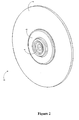
- a tracheostomy dressing shown generally as 1 comprises a dressing portion 2, a wound locating portion 3 and an adhesive layer 5 for attachment of the wound locating portion 3 to the dressing portion 2.
- the wound locating portion 3 comprises a series of circular ribs which create a recessed or concave portion 4.
- Figure 2 shows a perspective view of the embodiment shown in Figure 1
- Figure 3 shows the advantageous flattened profile of the device as hereinbefore discussed
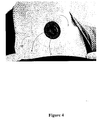
- Figure 4 shows a photographic image of the embodiment shown in Figure 1 in situ on a model patient 10.
- an integral tracheostomy dressing wherein the adhesive layer 5 is omitted and the wound locating portion 3 is moulded integrally with the dressing portion 2.
- the tracheostomy dressing is applied to the wound of a patient following decanulation.
- the patient readily feels the recessed portion 4 which is easily located in an integral position within the wound dressing. This enables firm pressure to be applied in the correct position (that is, directly over the wound) during times when air could preferentially pass via the healing wound rather than the larynx. This occurs during high-pressure expiration such as talking, coughing or sneezing.
- the pressure on the recessed portion 4 and the ribs means that the finger tip of the patient is less likely to slip off the wound locating portion 3 once it is located.
Landscapes
- Health & Medical Sciences (AREA)
- General Health & Medical Sciences (AREA)
- Pulmonology (AREA)
- Biomedical Technology (AREA)
- Heart & Thoracic Surgery (AREA)
- Animal Behavior & Ethology (AREA)
- Life Sciences & Earth Sciences (AREA)
- Engineering & Computer Science (AREA)
- Veterinary Medicine (AREA)
- Public Health (AREA)
- Otolaryngology (AREA)
- Vascular Medicine (AREA)
- Emergency Medicine (AREA)
- Anesthesiology (AREA)
- Hematology (AREA)
- Prostheses (AREA)
- Materials For Medical Uses (AREA)
Description
- This invention relates to a tracheostomy dressing which enables patients to easily locate a healing tracheostomy wound on the neck following decanulation (removal of a tracheostomy tube).
- Temporary tracheostomies are used in many areas of surgery and anaesthesia. They are removed (that is, the patient is decanulated) once their usefulness has passed. Following decanulation, it is desirable for the tracheostomy wound to heal as quickly as possible as delay in healing can be problematic for a patient. Delay may be caused by persistent passage of expired air via the tracheostomy wound rather than the larynx (voicebox). If this occurs, the healing wound is disrupted, literally blown open, necessarily slowing down the healing process.
- Traditionally, patients have been instructed to apply firm pressure with finger tips or knuckles over the tracheostomy wound to prevent the unwanted passage of air via the healing wound. Even with careful guidance, many patients find it very difficult to locate the wound easily, in particular because the patient cannot see the wound, thus reducing the effectiveness of this action. Dressings are placed over the healing wound which preclude exact location of the wound below by the patient. Such dressings may be bulky or the patients' manual dexterity or sensation may be impaired. In addition, the dressings often cause excoriation of the skin. Consequently, although the patient may attempt to comply with instructions, if pressure is not applied in the correct position the action is futile. If pressure is incorrectly applied by the patient, the dressing can be dislodged with the resultant passage of air and results in exudates passing through the wound. This situation is clearly disadvantageous and significantly impairs the healing process and increases the risk of infection.
-
GB 2413767 - The invention relates to a tracheostomy dressing which comprises an integral wound locating device for locating and applying pressure to a healing tracheostomy wound. More particularly, the present invention provides a tracheostomy dressing which comprises an integral wound locating device having a textured portion that is (i) recessed or concave, and/or (ii) ribbed, wherein the integral wound locating device is adapted, in use, to allow for the location of a healing tracheostomy wound and the application of pressure thereto. The present invention and embodiments thereof are set out in the appended claims.
- The invention provides a dressing which can be simply applied to a patient without the need to combine a separate wound locating device with wound dressings. Such an integrated dressing provides a significant number of advantages primarily relating to patient comfort and optimised healing. For example, the integrated dressing effectively prevents air and exudate from escaping through the tracheostomy wound during high-pressure expiration such as talking, coughing or sneezing (i.e. the integrated device provides a more effective seal or vacuum when pressure is applied). This will result in greater patient comfort because current tracheostomy patients experience pain and discomfort when air/exudate passes through the wound site. The integrated device provides a product which is less likely to cause ingress of pathogens and therefore reduces the likelihood of infection. The integrated device also results in faster speech restoration because air is correctly directed through the larynx/voicebox rather than through the wound site. Furthermore, the dressing of the invention is more easily and quickly applied to a patient by nursing staff which not only enhances the healing process but also reduces the amount of valuable time used by the nursing staff in this procedure.
- References herein to "wound locating device" shall be interpreted as meaning a device for locating and applying pressure to a healing tracheostomy wound.
- References herein to "dressing" include all 'medical products which are intended to be applied to a wound and aid in the healing of said wound and prevent further harm or damage. Typically, the dressing should be sterile, breathable, and encourage a moist healing environment.
- Examples of suitable dressings include bandages and plasters. Particular dressings which may be suitable for use with the integral wound locating device are described in www.dressings.org and include Acticoat, Actisorb Silver 220, Algisite M, Allevyn, Aquacel, Bactigras, Biatain, Bioclusive, Biofilm, Blenderm, Blue line webbing, Bordered Granuflex, Calaband, Carbonet, Cavi-care, Cellacast Xtra, Cellamin, Cellona, Chlorhexitulle, Cica-Care, Cliniflex, Clinisorb, Coban, Coltapaste, Comfeel, Contreet Non Adhesive, Crevic, Cutinova Hydro, Debrisan, Delta-Cast, Delta-Lite S, Duoderm extra thin, Duoderm signal, Durapore, Elastocrepe, Elset, Flamazine, Fucidin Intertulle, Geliperm, Granuflex (Improved formulation), Granuflex extra thin, Granugel, Gypsona, Hypafix, Icthaband, Icthopaste, Inadine, Intrasite Gel, Iodoflex, Iodosorb, Jelonet, K-Band, K-Lite, K-Plus, Kaltocarb, Kaltostat, LarvE, Lestreflex, Lyofoam, Mefix, Melolin, Mepiform, Mepilex, Mepitac, Mepitel, Mepore, Mesorb, Mesitran, Metrotop, Microfoam, Micropore, Opsite Flexigrid, Opsite IV 3000, Orthoflex, Oxyzyme, Paratulle, Polymem, Profore, ProGuide, Promogran, Quinaband, Release, Scotchcast Plus, Scotchcast Softcast, Serotulle, Setopress, Silastic foam, Silicone N-A, Sofra-Tulle, Sorbsan, Spenco 2nd Skin, Spyroflex, Spyrosorb, Tarband, Tegaderm, Tegagel, Tegapore, Tegasorb, Telfa, Tensopress, Tielle, Transpore, Unitulle, Veinoplast, Veinopress, Versiva, Vigilon, Viscopaste PB7, Xelma and Zincaband.
- In one embodiment, the dressing comprises a gauze, a film, a gel, a foam, a hydrocolloid, an alginate, a hydrogel or a polysaccharide paste, granule or bead. In a further embodiment, the dressing comprises a hydrocolloid material. In a yet further embodiment, the dressing comprises a Granuflex dressing (e.g. Bordered Granuflex, Granuflex (Improved formulation) or G ranuflex extra thin) or Duoderm dressing (e.g. Duoderm signal or Duoderm extra thin). Such dressings provide the advantage of adhering to the patient's skin but without causing abrasion or skin excoriation upon removal of the dressing. Additionally, the provision of a hydrocolloid based dressing provides an advantageous vacuum over the tracheostomy wound. Such a vacuum prevents the flow of air and/or exudate through the wound during high-pressure expiration such as talking, coughing or sneezing.
- In one embodiment, the dressing may be impregnated with an agent designed to enhance sterility and/or healing. In a further embodiment, the dressing may be impregnated with one or more antiseptic chemicals.
- It will be appreciated that references to "integral" include the sale of the dressing having the wound locating device attached rather than the wound locating device constituting a separate item of commerce. Therefore, in one embodiment, the dressing is constructed from a single piece together with the integral wound locating device. In an alternative embodiment, the wound locating device may be constructed separately from the dressing and bonded (e.g. via adhesive or otherwise) to the tracheostomy dressing. In such an embodiment, the wound locating device may be constructed by many methods such as injection moulding or lathe cutting. In such an embodiment the wound locating device may be constructed from a single piece. Constructing the wound locating device from a single piece is advantageous because it simplifies the manufacturing process, reduces cost and may make the wound locating device more hygienic.
- In one embodiment, the integral wound locating device is as described in
GB 2413767 - In an alternative embodiment, the integral wound locating device is substantially square, rectangular or circular in shape. In a yet further embodiment, the integral wound locating device is substantially circular in shape. In a further embodiment, the wound locating device is approximately 0.5 to 4cm in diameter. It will be appreciated that smaller sized devices would be envisaged for children (e.g. approximately 0.5 to 1 cm in diameter).
- The integral wound locating device additionally comprises a textured portion that is recessed or concave, and/or ribbed. It will be appreciated that the textured portion would have a surface feel which is distinct from the surrounding area.
- This embodiment, while being contrary to the protruding toggle described in
GB 2413767 GB 2413767 - In a further embodiment, the textured portion is a recessed or concave portion. Such an embodiment is advantageous because it makes the wound locating device easier to find due to the shape of the textured portion, and, once found, the tip of a patient's finger is less likely to slip off the wound locating device because the finger tip is located by the recessed or concave shape of the textured portion. Furthermore, a recessed or concave portion is even less likely to snag on for instance clothes and jewellery than the toggle described in
GB 2413767 - In a further embodiment, the textured portion is a ribbed portion. Such an embodiment is also advantageous because it makes the wound locating device easier to find due to the shape of the textured portion, and, once found, the tip of a patient's finger is less likely to slip off the wound locating device because of the resistance created by the ribbed portion. Furthermore, a ribbed portion is less likely to snag on for instance clothes and jewellery than the toggle described in
GB 2413767 - In a further embodiment, the textured portion is both recessed or concave and ribbed.
- It will be appreciated that the textured portion may be any geometric shape suitable to allow rapid sensory knowledge of the exact location of the wound locating device. In a further embodiment, the textured portion is substantially square, rectangular or circular in shape. In a yet further embodiment, the textured portion is substantially circular in shape.
- The wound locating device may be constructed from many materials. It should be firm but not necessarily rigid, indeed a slightly flexible material may be preferable for patient comfort and improved function. A slightly flexible material would conform better to the patients' surface anatomy and reduce the risk of air escaping from the edges of the wound locating device. In particular, it has been observed that many patients often present with severe malnourishment which results in fairly deep recesses within their neck regions. In one embodiment, the wound locating device is constructed from a flexible material. In a further embodiment, the wound locating device is constructed from a polyurethane, polyethylene, thermoplastic elastomeric (TPE) material, thermoplastic rubber (TPR) material, a silicone material or a styrene ethylene butylene styrene (SEBS) material.
- In one embodiment, the wound locating device is transparent. This embodiment provides the advantage of being able to accurately position the dressing over the tracheostomy wound.
- It will be appreciated that optional features applicable to one aspect of the invention can be used in any combination, and in any number. Moreover, they can also be used with any of the other aspects of the invention in any combination and in any number. This includes, but is not limited to, the dependent claims from any claim being used as dependent claims for any other claim in the claims of this application.
- The invention will now be described, by way of example only, with reference to the accompanying drawings, in which:
-
Figure 1 shows an exploded view of the components of the tracheostomy dressing according to one embodiment of the invention; -
Figure 2 shows a perspective view of the tracheostomy dressing according to one embodiment of the invention; -
Figure 3 shows a side view of the tracheostomy dressing according to one embodiment of the invention; and -
Figure 4 shows a photograph demonstrating an in situ position of the tracheostomy dressing according to one embodiment of the invention. - Referring first to
Figure 1 , a tracheostomy dressing shown generally as 1, comprises a dressingportion 2, awound locating portion 3 and anadhesive layer 5 for attachment of thewound locating portion 3 to the dressingportion 2. In the embodiment shown inFigure 1 , thewound locating portion 3 comprises a series of circular ribs which create a recessed or concave portion 4. -
Figure 2 shows a perspective view of the embodiment shown inFigure 1 ,Figure 3 shows the advantageous flattened profile of the device as hereinbefore discussed andFigure 4 shows a photographic image of the embodiment shown inFigure 1 in situ on amodel patient 10. - In an alternative embodiment to that described in
Figures 1 to 4 an integral tracheostomy dressing is provided wherein theadhesive layer 5 is omitted and thewound locating portion 3 is moulded integrally with the dressingportion 2. - In use, the tracheostomy dressing is applied to the wound of a patient following decanulation. During use, the patient readily feels the recessed portion 4 which is easily located in an integral position within the wound dressing. This enables firm pressure to be applied in the correct position (that is, directly over the wound) during times when air could preferentially pass via the healing wound rather than the larynx. This occurs during high-pressure expiration such as talking, coughing or sneezing. The pressure on the recessed portion 4 and the ribs means that the finger tip of the patient is less likely to slip off the
wound locating portion 3 once it is located. - It is expected that the tracheostomy dressing will be replaced everyday for 1-2 days following decanulation and every 2-3 days thereafter. Thus, it is expected that each patient will typically require approximately 10 dressings.
Claims (14)
- A tracheostomy dressing which comprises an integral wound locating device having a textured portion that is (i) recessed or concave, and/or (ii) ribbed, wherein the integral wound locating device is adapted, in use, to allow for the location of a healing tracheostomy wound and the application of pressure thereto.
- The tracheostomy dressing as defined in claim 1, wherein the tracheostomy dressing comprises a hydrocolloid material.
- The tracheostomy dressing as defined in claim 1 or claim 2, wherein the tracheostomy dressing is impregnated with one or more antiseptic chemicals.
- The tracheostomy dressing as defined in any preceding claim, wherein the textured portion has a surface feel that is distinct from the surrounding area.
- The tracheostomy dressing as defined in any preceding claim, wherein the textured portion is recessed.
- The tracheostomy dressing as defined in any one of claims 1-4, wherein the textured portion is concave.
- The tracheostomy dressing as defined in any one of claims 1-4, wherein the textured portion is ribbed.
- The tracheostomy dressing as defined in any one of claims 1-4, wherein the textured portion is recessed and ribbed.
- The tracheostomy dressing as defined in any one of claims 1-4, wherein the textured portion is concave and ribbed.
- The tracheostomy dressing as defined in any preceding claim, wherein the textured portion is substantially square, rectangular or circular in shape.
- The tracheostomy dressing as defined in claim 10, wherein the textured portion is substantially circular in shape.
- The tracheostomy dressing as defined in any preceding claim, wherein the wound locating device is constructed from a flexible material.
- The tracheostomy dressing as defined in claim 12, wherein the wound locating device is constructed from the group consisting of: polyurethane, polyethylene, thermoplastic elastomeric (TPE) material, thermoplastic rubber (TPR) material, a silicone material or a styrene ethylene butylene styrene (SEBS) material.
- The tracheostomy dressing as defined in any preceding claim, wherein the wound locating device is transparent.
Applications Claiming Priority (3)
| Application Number | Priority Date | Filing Date | Title |
|---|---|---|---|
| GBGB0814102.0A GB0814102D0 (en) | 2008-08-01 | 2008-08-01 | Tracheostomy dressing |
| US17623909P | 2009-05-07 | 2009-05-07 | |
| PCT/GB2009/050950 WO2010013057A1 (en) | 2008-08-01 | 2009-07-31 | Tracheostomy dressing |
Publications (2)
| Publication Number | Publication Date |
|---|---|
| EP2309957A1 EP2309957A1 (en) | 2011-04-20 |
| EP2309957B1 true EP2309957B1 (en) | 2014-04-16 |
Family
ID=39767371
Family Applications (1)
| Application Number | Title | Priority Date | Filing Date |
|---|---|---|---|
| EP09785424.4A Active EP2309957B1 (en) | 2008-08-01 | 2009-07-31 | Tracheostomy dressing |
Country Status (4)
| Country | Link |
|---|---|
| US (1) | US20110184327A1 (en) |
| EP (1) | EP2309957B1 (en) |
| GB (1) | GB0814102D0 (en) |
| WO (1) | WO2010013057A1 (en) |
Families Citing this family (3)
| Publication number | Priority date | Publication date | Assignee | Title |
|---|---|---|---|---|
| DE102011112433A1 (en) | 2011-09-06 | 2013-03-07 | Dr. Kenndoff GmbH & Co. KG | Use of a semi-occlusive flexible flat wound dressing for the treatment of wounds in animals |
| CN104822409B (en) * | 2012-12-11 | 2018-09-14 | 阿托斯医疗公司 | Tracheostoma device retainer |
| CN108601679B (en) * | 2016-02-04 | 2021-04-06 | 阿托斯医疗公司 | Tracheostoma device holder |
Family Cites Families (14)
| Publication number | Priority date | Publication date | Assignee | Title |
|---|---|---|---|---|
| US2344021A (en) * | 1942-09-05 | 1944-03-14 | Bouziane George | Surgical bandage |
| GB1090336A (en) * | 1965-01-26 | 1967-11-08 | William Buchanan | An improved respiratory pad |
| US3664410A (en) * | 1969-06-12 | 1972-05-23 | American Standard Inc | Die casting densifier and ejector apparatus |
| US3811436A (en) * | 1972-05-31 | 1974-05-21 | R Ferrell | Stoma filter guard |
| US4463757A (en) * | 1982-05-03 | 1984-08-07 | Schmidt Edward J | Covering device for tracheostomy stoma |
| DK149601C (en) * | 1984-01-23 | 1987-02-02 | Coloplast As | PRESSURELY BANDAGE |
| US5018515A (en) * | 1987-12-14 | 1991-05-28 | The Kendall Company | See through absorbent dressing |
| US5000741A (en) * | 1988-08-22 | 1991-03-19 | Kalt Medical Corporation | Transparent tracheostomy tube dressing |
| GB9411429D0 (en) * | 1994-06-08 | 1994-07-27 | Seton Healthcare Group Plc | Wound dressings |
| US6110197A (en) * | 1994-11-21 | 2000-08-29 | Augustine Medical, Inc. | Flexible non-contact wound treatment device with a single joint |
| US6919492B2 (en) * | 2001-06-13 | 2005-07-19 | Hollister Incorporated | Skin barrier strip having triangular cross section |
| US6779525B1 (en) * | 2001-09-24 | 2004-08-24 | Niko Oganesian | Tracheotomy stoma covering device |
| GB2413767B (en) | 2004-05-07 | 2008-07-23 | Malcolm Cameron | Tracheostomy wound location device |
| WO2007092289A2 (en) * | 2006-02-02 | 2007-08-16 | H.B. Fuller Licensing & Financing, Inc. | Ostomy article including hot melt superabsorbent polymer composition and method of using the same |
-
2008
- 2008-08-01 GB GBGB0814102.0A patent/GB0814102D0/en not_active Ceased
-
2009
- 2009-07-31 EP EP09785424.4A patent/EP2309957B1/en active Active
- 2009-07-31 WO PCT/GB2009/050950 patent/WO2010013057A1/en not_active Ceased
- 2009-07-31 US US13/056,722 patent/US20110184327A1/en not_active Abandoned
Also Published As
| Publication number | Publication date |
|---|---|
| US20110184327A1 (en) | 2011-07-28 |
| GB0814102D0 (en) | 2008-09-10 |
| WO2010013057A1 (en) | 2010-02-04 |
| EP2309957A1 (en) | 2011-04-20 |
Similar Documents
| Publication | Publication Date | Title |
|---|---|---|
| US6982359B1 (en) | Nasal epidermal lifting mechanism | |
| JP6953568B2 (en) | Wound bandage assembly | |
| NO324890B1 (en) | Bandage and epidermal positioning mechanism and method of using the same | |
| US20110209701A1 (en) | Nose pad cushion and applicator for respiratory mask | |
| US20020082567A1 (en) | Vacuum therapy and cleansing dressing for wounds | |
| CN112584802A (en) | Wound treatment device and kit | |
| EP2807994A2 (en) | Wound dressing formed with a two-sided adhesive band | |
| US8469024B2 (en) | Tracheostomy tube assembly and pad | |
| JPH04506011A (en) | Fluid connection device and method | |
| JPH01259860A (en) | Bandage holder | |
| US20160270968A1 (en) | Two-part bandage with replaceable wound covering portion | |
| CN106572921A (en) | Two-stage wound dressing assembly | |
| US6768039B1 (en) | Nasal epidermal lifting mechanism | |
| US20180250169A1 (en) | Two-part bandage with replaceable wound covering portion | |
| US20110184327A1 (en) | Tracheostomy dressing | |
| US7838719B2 (en) | Bandage for covering a wound with no adhesive-to-skin contact | |
| CN209347411U (en) | Disposable protective goggles after ophthalmic surgery | |
| CN217310410U (en) | Butterfly-shaped surgical wound retractor | |
| US11992391B2 (en) | Adhesive bandage | |
| CN210144862U (en) | Adhesive bandage containing Aloe and tea | |
| US20130269709A1 (en) | Wound dressing that can be adjusted to the wound site | |
| US20230240899A1 (en) | Umbilical Cord Stump Protector | |
| CN221013434U (en) | Anti-collision processor for tail part of Kirschner wire needle | |
| CN221654815U (en) | A hemostatic dressing | |
| CN220158557U (en) | Autogenous cutting patient wound applies ointment or plaster |
Legal Events
| Date | Code | Title | Description |
|---|---|---|---|
| PUAI | Public reference made under article 153(3) epc to a published international application that has entered the european phase |
Free format text: ORIGINAL CODE: 0009012 |
|
| 17P | Request for examination filed |
Effective date: 20110210 |
|
| AK | Designated contracting states |
Kind code of ref document: A1 Designated state(s): AT BE BG CH CY CZ DE DK EE ES FI FR GB GR HR HU IE IS IT LI LT LU LV MC MK MT NL NO PL PT RO SE SI SK SM TR |
|
| AX | Request for extension of the european patent |
Extension state: AL BA RS |
|
| RAP1 | Party data changed (applicant data changed or rights of an application transferred) |
Owner name: CAMBRIDGE UNIVERSITY HOSPITALS NHS FOUNDATION TRUS |
|
| 17Q | First examination report despatched |
Effective date: 20110620 |
|
| DAX | Request for extension of the european patent (deleted) | ||
| GRAP | Despatch of communication of intention to grant a patent |
Free format text: ORIGINAL CODE: EPIDOSNIGR1 |
|
| INTG | Intention to grant announced |
Effective date: 20131030 |
|
| GRAS | Grant fee paid |
Free format text: ORIGINAL CODE: EPIDOSNIGR3 |
|
| GRAA | (expected) grant |
Free format text: ORIGINAL CODE: 0009210 |
|
| AK | Designated contracting states |
Kind code of ref document: B1 Designated state(s): AT BE BG CH CY CZ DE DK EE ES FI FR GB GR HR HU IE IS IT LI LT LU LV MC MK MT NL NO PL PT RO SE SI SK SM TR |
|
| REG | Reference to a national code |
Ref country code: GB Ref legal event code: FG4D |
|
| REG | Reference to a national code |
Ref country code: CH Ref legal event code: EP |
|
| REG | Reference to a national code |
Ref country code: AT Ref legal event code: REF Ref document number: 662061 Country of ref document: AT Kind code of ref document: T Effective date: 20140515 |
|
| REG | Reference to a national code |
Ref country code: IE Ref legal event code: FG4D |
|
| REG | Reference to a national code |
Ref country code: DE Ref legal event code: R096 Ref document number: 602009023324 Country of ref document: DE Effective date: 20140605 |
|
| REG | Reference to a national code |
Ref country code: CH Ref legal event code: NV Representative=s name: SERVOPATENT GMBH, CH |
|
| REG | Reference to a national code |
Ref country code: NL Ref legal event code: VDEP Effective date: 20140416 |
|
| REG | Reference to a national code |
Ref country code: LT Ref legal event code: MG4D |
|
| PG25 | Lapsed in a contracting state [announced via postgrant information from national office to epo] |
Ref country code: NL Free format text: LAPSE BECAUSE OF FAILURE TO SUBMIT A TRANSLATION OF THE DESCRIPTION OR TO PAY THE FEE WITHIN THE PRESCRIBED TIME-LIMIT Effective date: 20140416 Ref country code: BG Free format text: LAPSE BECAUSE OF FAILURE TO SUBMIT A TRANSLATION OF THE DESCRIPTION OR TO PAY THE FEE WITHIN THE PRESCRIBED TIME-LIMIT Effective date: 20140716 Ref country code: IS Free format text: LAPSE BECAUSE OF FAILURE TO SUBMIT A TRANSLATION OF THE DESCRIPTION OR TO PAY THE FEE WITHIN THE PRESCRIBED TIME-LIMIT Effective date: 20140816 Ref country code: LT Free format text: LAPSE BECAUSE OF FAILURE TO SUBMIT A TRANSLATION OF THE DESCRIPTION OR TO PAY THE FEE WITHIN THE PRESCRIBED TIME-LIMIT Effective date: 20140416 Ref country code: NO Free format text: LAPSE BECAUSE OF FAILURE TO SUBMIT A TRANSLATION OF THE DESCRIPTION OR TO PAY THE FEE WITHIN THE PRESCRIBED TIME-LIMIT Effective date: 20140716 Ref country code: CY Free format text: LAPSE BECAUSE OF FAILURE TO SUBMIT A TRANSLATION OF THE DESCRIPTION OR TO PAY THE FEE WITHIN THE PRESCRIBED TIME-LIMIT Effective date: 20140416 Ref country code: FI Free format text: LAPSE BECAUSE OF FAILURE TO SUBMIT A TRANSLATION OF THE DESCRIPTION OR TO PAY THE FEE WITHIN THE PRESCRIBED TIME-LIMIT Effective date: 20140416 Ref country code: GR Free format text: LAPSE BECAUSE OF FAILURE TO SUBMIT A TRANSLATION OF THE DESCRIPTION OR TO PAY THE FEE WITHIN THE PRESCRIBED TIME-LIMIT Effective date: 20140717 |
|
| PG25 | Lapsed in a contracting state [announced via postgrant information from national office to epo] |
Ref country code: PL Free format text: LAPSE BECAUSE OF FAILURE TO SUBMIT A TRANSLATION OF THE DESCRIPTION OR TO PAY THE FEE WITHIN THE PRESCRIBED TIME-LIMIT Effective date: 20140416 Ref country code: ES Free format text: LAPSE BECAUSE OF FAILURE TO SUBMIT A TRANSLATION OF THE DESCRIPTION OR TO PAY THE FEE WITHIN THE PRESCRIBED TIME-LIMIT Effective date: 20140416 Ref country code: HR Free format text: LAPSE BECAUSE OF FAILURE TO SUBMIT A TRANSLATION OF THE DESCRIPTION OR TO PAY THE FEE WITHIN THE PRESCRIBED TIME-LIMIT Effective date: 20140416 Ref country code: SE Free format text: LAPSE BECAUSE OF FAILURE TO SUBMIT A TRANSLATION OF THE DESCRIPTION OR TO PAY THE FEE WITHIN THE PRESCRIBED TIME-LIMIT Effective date: 20140416 Ref country code: LV Free format text: LAPSE BECAUSE OF FAILURE TO SUBMIT A TRANSLATION OF THE DESCRIPTION OR TO PAY THE FEE WITHIN THE PRESCRIBED TIME-LIMIT Effective date: 20140416 |
|
| PG25 | Lapsed in a contracting state [announced via postgrant information from national office to epo] |
Ref country code: PT Free format text: LAPSE BECAUSE OF FAILURE TO SUBMIT A TRANSLATION OF THE DESCRIPTION OR TO PAY THE FEE WITHIN THE PRESCRIBED TIME-LIMIT Effective date: 20140818 |
|
| REG | Reference to a national code |
Ref country code: DE Ref legal event code: R097 Ref document number: 602009023324 Country of ref document: DE |
|
| PG25 | Lapsed in a contracting state [announced via postgrant information from national office to epo] |
Ref country code: DK Free format text: LAPSE BECAUSE OF FAILURE TO SUBMIT A TRANSLATION OF THE DESCRIPTION OR TO PAY THE FEE WITHIN THE PRESCRIBED TIME-LIMIT Effective date: 20140416 Ref country code: EE Free format text: LAPSE BECAUSE OF FAILURE TO SUBMIT A TRANSLATION OF THE DESCRIPTION OR TO PAY THE FEE WITHIN THE PRESCRIBED TIME-LIMIT Effective date: 20140416 Ref country code: RO Free format text: LAPSE BECAUSE OF FAILURE TO SUBMIT A TRANSLATION OF THE DESCRIPTION OR TO PAY THE FEE WITHIN THE PRESCRIBED TIME-LIMIT Effective date: 20140416 Ref country code: CZ Free format text: LAPSE BECAUSE OF FAILURE TO SUBMIT A TRANSLATION OF THE DESCRIPTION OR TO PAY THE FEE WITHIN THE PRESCRIBED TIME-LIMIT Effective date: 20140416 Ref country code: SK Free format text: LAPSE BECAUSE OF FAILURE TO SUBMIT A TRANSLATION OF THE DESCRIPTION OR TO PAY THE FEE WITHIN THE PRESCRIBED TIME-LIMIT Effective date: 20140416 |
|
| REG | Reference to a national code |
Ref country code: FR Ref legal event code: PLFP Year of fee payment: 6 |
|
| PLBE | No opposition filed within time limit |
Free format text: ORIGINAL CODE: 0009261 |
|
| STAA | Information on the status of an ep patent application or granted ep patent |
Free format text: STATUS: NO OPPOSITION FILED WITHIN TIME LIMIT |
|
| PG25 | Lapsed in a contracting state [announced via postgrant information from national office to epo] |
Ref country code: LU Free format text: LAPSE BECAUSE OF FAILURE TO SUBMIT A TRANSLATION OF THE DESCRIPTION OR TO PAY THE FEE WITHIN THE PRESCRIBED TIME-LIMIT Effective date: 20140731 |
|
| 26N | No opposition filed |
Effective date: 20150119 |
|
| PG25 | Lapsed in a contracting state [announced via postgrant information from national office to epo] |
Ref country code: IT Free format text: LAPSE BECAUSE OF FAILURE TO SUBMIT A TRANSLATION OF THE DESCRIPTION OR TO PAY THE FEE WITHIN THE PRESCRIBED TIME-LIMIT Effective date: 20140416 |
|
| REG | Reference to a national code |
Ref country code: DE Ref legal event code: R097 Ref document number: 602009023324 Country of ref document: DE Effective date: 20150119 |
|
| PG25 | Lapsed in a contracting state [announced via postgrant information from national office to epo] |
Ref country code: SI Free format text: LAPSE BECAUSE OF FAILURE TO SUBMIT A TRANSLATION OF THE DESCRIPTION OR TO PAY THE FEE WITHIN THE PRESCRIBED TIME-LIMIT Effective date: 20140416 |
|
| REG | Reference to a national code |
Ref country code: FR Ref legal event code: PLFP Year of fee payment: 7 |
|
| PG25 | Lapsed in a contracting state [announced via postgrant information from national office to epo] |
Ref country code: MC Free format text: LAPSE BECAUSE OF FAILURE TO SUBMIT A TRANSLATION OF THE DESCRIPTION OR TO PAY THE FEE WITHIN THE PRESCRIBED TIME-LIMIT Effective date: 20140416 Ref country code: SM Free format text: LAPSE BECAUSE OF FAILURE TO SUBMIT A TRANSLATION OF THE DESCRIPTION OR TO PAY THE FEE WITHIN THE PRESCRIBED TIME-LIMIT Effective date: 20140416 |
|
| PG25 | Lapsed in a contracting state [announced via postgrant information from national office to epo] |
Ref country code: MT Free format text: LAPSE BECAUSE OF FAILURE TO SUBMIT A TRANSLATION OF THE DESCRIPTION OR TO PAY THE FEE WITHIN THE PRESCRIBED TIME-LIMIT Effective date: 20140416 |
|
| PG25 | Lapsed in a contracting state [announced via postgrant information from national office to epo] |
Ref country code: HU Free format text: LAPSE BECAUSE OF FAILURE TO SUBMIT A TRANSLATION OF THE DESCRIPTION OR TO PAY THE FEE WITHIN THE PRESCRIBED TIME-LIMIT; INVALID AB INITIO Effective date: 20090731 Ref country code: TR Free format text: LAPSE BECAUSE OF FAILURE TO SUBMIT A TRANSLATION OF THE DESCRIPTION OR TO PAY THE FEE WITHIN THE PRESCRIBED TIME-LIMIT Effective date: 20140416 |
|
| REG | Reference to a national code |
Ref country code: FR Ref legal event code: PLFP Year of fee payment: 8 |
|
| REG | Reference to a national code |
Ref country code: FR Ref legal event code: PLFP Year of fee payment: 9 |
|
| PG25 | Lapsed in a contracting state [announced via postgrant information from national office to epo] |
Ref country code: MK Free format text: LAPSE BECAUSE OF FAILURE TO SUBMIT A TRANSLATION OF THE DESCRIPTION OR TO PAY THE FEE WITHIN THE PRESCRIBED TIME-LIMIT Effective date: 20140416 |
|
| REG | Reference to a national code |
Ref country code: FR Ref legal event code: PLFP Year of fee payment: 10 |
|
| REG | Reference to a national code |
Ref country code: CH Ref legal event code: PCAR Free format text: NEW ADDRESS: WANNERSTRASSE 9/1, 8045 ZUERICH (CH) |
|
| P01 | Opt-out of the competence of the unified patent court (upc) registered |
Effective date: 20230519 |
|
| PGFP | Annual fee paid to national office [announced via postgrant information from national office to epo] |
Ref country code: BE Payment date: 20250619 Year of fee payment: 17 |
|
| PGFP | Annual fee paid to national office [announced via postgrant information from national office to epo] |
Ref country code: FR Payment date: 20250626 Year of fee payment: 17 |
|
| PGFP | Annual fee paid to national office [announced via postgrant information from national office to epo] |
Ref country code: IE Payment date: 20250619 Year of fee payment: 17 |
|
| PGFP | Annual fee paid to national office [announced via postgrant information from national office to epo] |
Ref country code: DE Payment date: 20250619 Year of fee payment: 17 |
|
| PGFP | Annual fee paid to national office [announced via postgrant information from national office to epo] |
Ref country code: GB Payment date: 20250728 Year of fee payment: 17 |
|
| PGFP | Annual fee paid to national office [announced via postgrant information from national office to epo] |
Ref country code: AT Payment date: 20250618 Year of fee payment: 17 |
|
| PGFP | Annual fee paid to national office [announced via postgrant information from national office to epo] |
Ref country code: CH Payment date: 20250801 Year of fee payment: 17 |