EP2309706A1 - Mobile electronic device - Google Patents
Mobile electronic device Download PDFInfo
- Publication number
- EP2309706A1 EP2309706A1 EP09802938A EP09802938A EP2309706A1 EP 2309706 A1 EP2309706 A1 EP 2309706A1 EP 09802938 A EP09802938 A EP 09802938A EP 09802938 A EP09802938 A EP 09802938A EP 2309706 A1 EP2309706 A1 EP 2309706A1
- Authority
- EP
- European Patent Office
- Prior art keywords
- key
- type character
- character
- display area
- control unit
- Prior art date
- Legal status (The legal status is an assumption and is not a legal conclusion. Google has not performed a legal analysis and makes no representation as to the accuracy of the status listed.)
- Withdrawn
Links
Images




Classifications
-
- H—ELECTRICITY
- H04—ELECTRIC COMMUNICATION TECHNIQUE
- H04M—TELEPHONIC COMMUNICATION
- H04M1/00—Substation equipment, e.g. for use by subscribers
- H04M1/72—Mobile telephones; Cordless telephones, i.e. devices for establishing wireless links to base stations without route selection
- H04M1/724—User interfaces specially adapted for cordless or mobile telephones
-
- H—ELECTRICITY
- H04—ELECTRIC COMMUNICATION TECHNIQUE
- H04B—TRANSMISSION
- H04B1/00—Details of transmission systems, not covered by a single one of groups H04B3/00 - H04B13/00; Details of transmission systems not characterised by the medium used for transmission
- H04B1/38—Transceivers, i.e. devices in which transmitter and receiver form a structural unit and in which at least one part is used for functions of transmitting and receiving
- H04B1/40—Circuits
-
- G—PHYSICS
- G06—COMPUTING OR CALCULATING; COUNTING
- G06F—ELECTRIC DIGITAL DATA PROCESSING
- G06F3/00—Input arrangements for transferring data to be processed into a form capable of being handled by the computer; Output arrangements for transferring data from processing unit to output unit, e.g. interface arrangements
- G06F3/01—Input arrangements or combined input and output arrangements for interaction between user and computer
- G06F3/02—Input arrangements using manually operated switches, e.g. using keyboards or dials
-
- G—PHYSICS
- G06—COMPUTING OR CALCULATING; COUNTING
- G06F—ELECTRIC DIGITAL DATA PROCESSING
- G06F3/00—Input arrangements for transferring data to be processed into a form capable of being handled by the computer; Output arrangements for transferring data from processing unit to output unit, e.g. interface arrangements
- G06F3/14—Digital output to display device ; Cooperation and interconnection of the display device with other functional units
-
- H—ELECTRICITY
- H04—ELECTRIC COMMUNICATION TECHNIQUE
- H04M—TELEPHONIC COMMUNICATION
- H04M1/00—Substation equipment, e.g. for use by subscribers
- H04M1/56—Arrangements for indicating or recording the called number at the calling subscriber's set
-
- H—ELECTRICITY
- H04—ELECTRIC COMMUNICATION TECHNIQUE
- H04M—TELEPHONIC COMMUNICATION
- H04M1/00—Substation equipment, e.g. for use by subscribers
- H04M1/72—Mobile telephones; Cordless telephones, i.e. devices for establishing wireless links to base stations without route selection
- H04M1/724—User interfaces specially adapted for cordless or mobile telephones
- H04M1/72403—User interfaces specially adapted for cordless or mobile telephones with means for local support of applications that increase the functionality
- H04M1/72418—User interfaces specially adapted for cordless or mobile telephones with means for local support of applications that increase the functionality for supporting emergency services
-
- H—ELECTRICITY
- H04—ELECTRIC COMMUNICATION TECHNIQUE
- H04M—TELEPHONIC COMMUNICATION
- H04M2250/00—Details of telephonic subscriber devices
- H04M2250/70—Details of telephonic subscriber devices methods for entering alphabetical characters, e.g. multi-tap or dictionary disambiguation
Definitions
- the present invention relates to a portable electronic device having an operation unit, and particularly relates to a portable electronic device in which plural types of characters are assigned to an identical key.
- a portable electronic device includes: a display unit that displays a variety of information; and an operation unit that is configured with a plurality of keys.
- an initial screen is displayed on a display unit while waiting for an incoming call or while waiting for activation of other applications.
- an operation key assigned with a numeric character is depressed in this standby state, a numeric character corresponding to the operation key thus depressed is displayed on the display unit.
- a calculator application is activated in which the numeric characters that have been input are used as initial numeric values.
- Patent Document 1 a technique for a portable electronic device (for example, see Patent Document 1), in which, when a key operation is performed from an initial screen, a character corresponding to the key operation is displayed on a display unit, and when a predetermined operation (operation of depressing a key for displaying a list of applications) is performed, the list of applications corresponding to a displayed character string is displayed, and one application is selected from the list to activate the application.
- a predetermined operation operation of depressing a key for displaying a list of applications
- An object of the present invention is to provide a portable electronic device, in which, in a case in which a key operation is performed in a state where an initial screen is displayed, a plurality of characters (for example, a numeric character and non-numeric character) assigned to the key are displayed on a display unit in parallel, respectively, and one of the characters being displayed is activated by a subsequent operation, thereby making it possible to reflect the user's intention.
- a plurality of characters for example, a numeric character and non-numeric character
- a portable electronic device is characterized by including: a display unit; a key operation unit; and a control unit that performs control of the display unit and the key operation unit, in which the key operation unit is configured by including a plurality of first keys that are assigned with a first type character and a second type character, and when any one of the first keys is depressed in a state where an initial screen is displayed on the display unit, the control unit performs control such that the first type character assigned to the first key thus depressed and the second type character assigned to the first key thus depressed are displayed together on the display unit.
- the key operation unit is configured by including a second key, to which the first type character and the second type character are not assigned, and to which a plurality of functions are assigned, and a third key, to which the first type character and the second type character are not assigned, and to which a function different from the functions of the second key is assigned; when any one of the first keys is depressed in a state where an initial screen is displayed on the display unit, the control unit performs control such that the first type character assigned to the first key thus depressed and the second type character assigned to the first key thus depressed are displayed together on the display unit; while the control unit is performing control such that the first type character and the second type character are displayed together on the display unit, in a case in which the second key is depressed, the control unit performs first processing for the first type character, and performs control to suppress displaying of the second type character on the display unit; and while the control unit is performing control such that the first type character and the second type character are displayed together on the display unit
- the key operation unit is configured by including a second key, to which the first type character and the second type character are not assigned, and to which a plurality of functions are assigned, and a third key, to which the first type character and the second type character are not assigned, and to which a function different from the functions of the second key is assigned; when any one of the first keys is depressed in a state where an initial screen is displayed on the display unit, the control unit performs control such that the first type character assigned to the first key thus depressed and the second type character assigned to the first key thus depressed are displayed together on the display unit; while the control unit is performing control such that the first type character and the second type character are displayed on the display unit, in a case in which the second key is depressed, the control unit performs first processing for the first type character; while the control unit is performing control such that the first type character and the second type character are displayed on the display unit, in a case in which the third key is depressed, the control unit performs second processing
- a portable electronic device is characterized by including: a display unit; a key operation unit; and a control unit that performs control of the display unit and the key operation unit, in which the key operation unit is configured by including: a first key group composed of a plurality of keys that are assigned with a first type character and a second type character, and a specific key that is assigned with a function of cancelling the first type character and the second type character that have been input via a key of the first key group; in a state where an initial screen is displayed on the display unit, in a case in which a key of the first key group is depressed, the control unit performs control such that the first type character assigned to the key thus depressed is displayed on a first type character display area, and the second type character assigned to the key thus depressed is displayed on a second type character display area; and in a case in which the specific key is depressed, the control unit performs control to cancel a character(s) equivalent to a number
- the user's intention can be reflected in a key operation from a state where the initial screen is displayed.
- FIG. 1 is a perspective view showing an appearance of a cellular telephone device 1 as an example of the portable electronic device according to the present invention.
- the cellular telephone device according to the present invention is not particularly limited thereto.
- it may be a slider type in which one of the bodies slides to one direction in a state in which the bodies are mutually superimposed; a rotating (turning) type in which one of the bodies is rotated around an axis line along the direction of superimposing the bodies; and a type (straight type) in which an operation unit and a display unit are disposed in one body without having a connecting portion.
- the cellular telephone device 1 includes an operation unit side body 2 and a display unit side body 3.
- the operation unit side body 2 includes, on a front face portion 10 thereof, an operation unit 11 and a microphone 12 to which sound produced by a user of the cellular telephone device 1 during a phone call is input.
- the operation unit 11 is configured with: function setting operation keys 13 for operating various functions such as for various settings, a telephone number directory function and a mail function; input operation keys 14 for inputting digits of a telephone number and characters for mail, etc.; and a selection operation key 15 for performing selection of the various operations and scrolling, etc.
- the display unit side body 3 includes, on a front face portion 20, an LCD (Liquid Crystal Display) display unit 21 for displaying a variety of information, and a speaker 22 for outputting sound of the other party of the conversation.
- LCD Liquid Crystal Display
- an upper end portion of the operation unit side body 2 and a lower end portion of the display unit side body 3 are connected via a hinge mechanism 4. Furthermore, the cellular telephone device 1 can be in a state where the operation unit side body 2 and the display unit side body 3 are apart from each other (opened state), and in a state where the operation unit side body 2 and the display unit side body 3 are contacting each other (folded state), as the operation unit side body 2 and the display unit side body 3, connected via the hinge mechanism 4, pivot with respect to each other.
- FIG. 2 is a perspective view showing a state in which the cellular telephone device 1 is folded.
- the operation unit side body 2 includes, on its outer planar portion, a sub LCD display unit 30 that displays a clock, incoming notice of mail, etc.
- FIG. 3 is a functional block diagram showing functions of the cellular telephone device 1.
- the operation unit side body 2 includes the operation unit (key operation unit) 11, the microphone 12, a main antenna 40, an RF circuit unit 41, an LCD control unit 42, a sound processing unit 43, memory 44, and a control unit 45.
- the display unit side body 3 includes the LCD display unit (display unit) 21, the speaker 22, a driver IC 23, and a sub LCD display unit 30.
- the main antenna 40 communicates with a base station, etc. via a first usable frequency band (for example, 800 MHz), and is configured as a dual band compatible antenna that can be compatible with a second usable frequency band (for example, 1.5 GHz) for GPS communication.
- a first usable frequency band for example, 800 MHz
- a second usable frequency band for example, 1.5 GHz
- the main antenna 40 may communicate with an external device via the first usable frequency band, and another antenna that can be compatible with the second usable frequency band for GPS communication may be separately provided.
- the RF circuit unit 41 performs demodulation processing of a signal received via the main antenna 40, and transmits the processed signal to the control unit 45.
- the RF circuit unit 41 performs modulation processing of the signal transmitted from the control unit 45, and transmits the signal to external devices (base stations) via the main antenna 40. Furthermore, on the other hand, the RF circuit unit 41 notifies the control unit 45 of intensity of a signal received via the main antenna 40.
- the LCD control unit 42 performs predetermined image processing in accordance with control by the control unit 45, and outputs the processed image data to the driver IC 23.
- the driver IC 23 stores the image data, which is transmitted from the LCD control unit 42, in frame memory so as to be output to the LCD display unit 21 or the sub LCD display unit 30 at predetermined timing.
- the sound processing unit 43 performs predetermined sound processing in accordance with control by the control unit 45 for a signal transmitted from the RF circuit unit 41, and outputs the processed signal to the speaker 22.
- the speaker 22 externally outputs the signal that is transmitted from the sound processing unit 43.
- the sound processing unit 43 processes a signal, which is input from the microphone 12, in accordance with control by the control unit 45, and outputs the processed signal to the RF circuit unit 41.
- the RF circuit unit 41 performs predetermined processing for the signal transmitted from the sound processing unit 43, and outputs the processed signal to the main antenna 40.
- the memory 44 includes, for example, working memory, and is utilized for arithmetic processing by the control unit 45.
- the memory 44 stores a plurality of applications as well as various tables, etc. required by the applications.
- the memory 44 may also serve as detachable external memory.
- the control unit 45 controls the entirety of the cellular telephone device 1, and is configured by using a central processing unit (CPU), etc.
- CPU central processing unit
- the control unit 45 changes characters and functions to be assigned to each key (the function setting operation keys 13, the input operation keys 14 and the selection key 15) configuring the operation unit 11, essentially in accordance with an application that is currently activated.
- the operation unit 11 transmits position information of the key to the control unit 45 (for example, as shown in FIG. 4 (a) , in a case of depressing a key in the second line and the left row among the input operation keys 14 (a key with "1" and "a” printed on its surface; ("a” is a Japanese hiragana character pronounced as “a” in the Hepburn system; hereinafter simply referred to as "a"), position information of (X2, Y1) is transmitted).
- the control unit 45 accesses the memory 44, refers to a key assignment table corresponding to an application that is currently activated, and performs processing of a character and a function assigned thereto, based on the position information that has been transmitted from the operation unit 11.
- the memory 44 stores a plurality of key assignment tables.
- FIG. 4 (b) is a table that is utilized when an outgoing telephone call is made
- FIG. 4 (c) is a table that is utilized in a memo pad application and a mail application
- FIG. 4 (d) is a table that is utilized when changing a channel in a television application.
- execution of processing a character means that, for example, in a case in which the currently activated application is a memo pad, then "1" or "a” is displayed on the LCD display unit 21.
- execution of processing a function means that, for example, in a case in which the currently activated application is a television, the display channel is set to channel 1.
- the memory 44 stores a plurality of key assignment tables.
- the control unit 45 switches a key assignment table to be referred to, refers to a predetermined key assignment table based on position information of a key that has been transmitted from the operation unit 11, and performs predetermined processing.
- the cellular telephone device 1 with such a configuration has a function, in which, in a case in which a key operation is performed in a standby state for communication, etc., a plurality of characters (for example, a numeric character and non-numeric character) assigned to the key are displayed, for example, on separate screen areas in parallel, respectively, and in a case in which a predetermined key operation is performed, a screen displaying one of the characters is activated.
- the cellular telephone device 1 has a function, in which, in a case in which a predetermined key operation is performed, and when the screen displaying one of the characters is activated, a key assignment that was assigned in the screen displaying another character is changed.
- the control unit 45 performs control such that the LCD display unit 21 displays, in place of the initial screen 100, a first type character display area 101 that displays first type characters (for example, Japanese hiragana characters such as those pronounced as "a", "i” and "u") assigned to the first key thus depressed, and a second type character display area 102 that displays second type characters (for example, numeric characters such as " 1", "2” and "3") assigned to the first key thus depressed ( FIG. 5 (b) ).
- first type character display area 101 that displays first type characters (for example, Japanese hiragana characters such as those pronounced as "a", "i” and "u) assigned to the first key thus depressed
- second type character display area 102 that displays second type characters (for example, numeric characters such as " 1", "2” and "3") assigned to the first key thus depressed ( FIG. 5 (b) ).
- the cellular telephone device 1 can display a plurality of characters (for example, a numeric character and non-numeric character) assigned to the key, for example, on separate screen areas in parallel, respectively; and therefore, the user's intention can be reflected.
- a plurality of characters for example, a numeric character and non-numeric character
- the operation unit 11 is configured by including: a second key (for example, the selection operation key 15) to which the first type characters and the second type characters are not assigned, and to which a plurality of functions (for example, a function of converting kana characters into kanji characters) are assigned; and a third key (for example, an on-hook key provided to the top of the left row of the input operation keys 14), to which the first type characters and the second type characters are not assigned, and to which a function (for example, a function of making an outgoing telephone call) being different from the function of the second key is assigned.
- a second key for example, the selection operation key 15
- a plurality of functions for example, a function of converting kana characters into kanji characters
- a third key for example, an on-hook key provided to the top of the left row of the input operation keys 14
- control unit 45 While the control unit 45 is performing control such that the first type character display area 101 and the second type character display area 102 are displayed on the LCD display unit 21, in a case in which the second key is depressed, the control unit 45 performs first processing (for example, processing to convert kana characters into kanji characters) for the first type character that has been input, and in a case in which the third key is depressed, the control unit 45 performs second processing (for example, processing related to an outgoing telephone call) for the second type character that has been input.
- first processing for example, processing to convert kana characters into kanji characters
- second processing for example, processing related to an outgoing telephone call
- the cellular telephone device 1 can display a plurality of characters (for example, a numeric character and non-numeric character) assigned to the key, for example, on separate screen areas in parallel, respectively. Furthermore, when a predetermined key is depressed, processing in accordance with one screen area is performed, and thus the user's intention can be reflected. Therefore, in the cellular telephone device 1, in a standby state for communication, without causing a user to select an application in advance, a key input is enabled, the user can activate a desired application after inputting the key, and the operability can be improved.
- a key input in a standby state for communication, without causing a user to select an application in advance, a key input is enabled, the user can activate a desired application after inputting the key, and the operability can be improved.
- control unit 45 while the control unit 45 is performing control such that the first type character display area 101 and the second type character display area 102 are displayed on the LCD display unit 21, and in a case in which the second key is depressed, the control unit 45 performs control to notify what kind of processing is to be performed for the first type character that has been input (for example, as indicated by A in FIG. 5 (b) , control is performed to notify that conversion is possible by depressing an up-down key of the selection operation key 15, while showing an image printed on the surface of the selection operation key 15).
- control is performed to notify what kind of processing is to be performed for the second type character that has been input (for example, as indicated by B in FIG. 5 (b) , control is performed to notify that an outgoing telephone call is made by depressing the on-hook key, while showing an image printed on the surface of the on-hook key).
- the cellular telephone device 1 can display a plurality of characters (for example, a numeric character and non-numeric character) assigned to the key, for example, on separate screen areas in parallel, respectively. Furthermore, since notification is performed as to which key should be depressed to perform what kind of processing, it is possible to improve the convenience in the operations.
- a numeric character and non-numeric character for example, on separate screen areas in parallel, respectively.
- the function that is assigned to the second key is a function of editing characters related to the first type characters displayed on the first type character display area 101 (converting a character by depressing the up-down key, determining an input character by depressing the central key, and moving the cursor by depressing the right-left key).
- the first processing is processing of selecting and determining, by depressing the second key, a specific character from among conversion candidates related to the first type characters displayed on the first type character display area 101.
- a function assigned to the third key is a function of making an outgoing telephone call based on characters related to the second type characters displayed on the second type character display area 102.
- the second processing is processing for making an outgoing telephone call, using, as a telephone number, characters related to the second type characters displayed on the second type character display area 102 by depressing the third key.
- the hiragana character "wa” is displayed on the first type character display area 101 that displays the first type characters.
- the numeric character "0” is displayed on the second type character display area 102 that displays the second type characters ( FIG. 5 (b) ).
- hiragana characters spelling "watanabe” are displayed on the first type character display area 101, and numeric characters "0456666*" are displayed on the second type character display area 102 ( FIG. 5 (c) ).
- the control unit 45 performs processing to convert kana characters into kanji characters, and the first type character display area 101 is displayed on the entirety of the display screen ( FIG. 5 (d) ). Furthermore, in a case in which a key (a so-called on-hook key) provided to the top of the left row of the input operation keys 14 is depressed in a state of FIG. 5(d) , the control unit 45 performs processing of enlargement or the like of the displayed characters ( FIG. 5 (e) ).
- control unit 45 performs processing of making an outgoing telephone call based on a numeric character string displayed on the second type character display area 102.
- control unit 45 performs control such that a different function is assigned to the on-hook key depending on whether the selection operation key 15 is depressed. Therefore, since the number of keys configuring the cellular telephone device 1 is small, the utilization efficiency of each key can be improved.
- a control procedure of assigning a function to the on-hook key by way of the control unit 45 is described with reference to a flowchart shown in FIG. 6 .
- a state where the first type character display area 101 and the second type character display area 102 are displayed is referred to as a state of displaying a double screen, and a state where only one screen of the first type character display area 101 or the second type character display area 102 is displayed is referred to as a state of displaying a single screen.
- the on-hook key is a key that is disposed to the top of the left row of the input operation keys 14.
- the control unit 45 determines whether the current operating state is the state of displaying the single screen (Step S1), and in a case in which the current operating state is the state of displaying the single screen, the control unit 45 performs control such that a function of enlarging characters displayed on the first type character display area 101 is assigned to the on-hook key (Step S2). Furthermore, in a case in which the current operating state is the state of displaying the double screen, the control unit 45 performs control such that the on-hook key is assigned with a function of making an outgoing telephone call based on the numeric characters displayed on the second type character display area 102 (Step S3).
- the cellular telephone device 1 performs control such that the first type character display area 101 and the second type character display area 102 are displayed, and notifies processing based on the character that has been input, by using an image that is the same as the image printed on the actual key. Therefore, the user's intention can be reflected, and the operability can be improved. Moreover, since the cellular telephone device 1 changes the function to be assigned to the keys in accordance with the display state of the LCD display unit 21, the utilization efficiency of the keys can be improved.
- the operation unit 11 is configured by including: the first keys (for example, keys positioned from the second line to the fifth line of the input operation keys 14 indicated by C in FIG. 1 ); the second key (for example, the selection operation key 15); and the third key (for example, the on-hook key positioned at the top of the left row of the input operation keys 14 indicated by B in FIG. 1 ).
- the first keys are configured with a plurality of keys, to which the first type characters (for example, hiragana characters such as "a", "i” and “u") and the second type characters (for example, numeric characters such as "1", "2" and "3") are assigned.
- the second key is a key, to which the first type characters and the second type characters are not assigned, and to which a plurality of functions (for example, a function of converting kana characters into kanji characters, etc.) are assigned.
- the third key is a key, to which the first type characters and the second type characters are not assigned, and to which a function (for example, a function of making an outgoing telephone call, etc.) being different from the function of the second key is assigned.
- the control unit 45 performs control such that a first type character (for example, a hiragana character such as "a", "i” or “u”) assigned to the depressed first key and a second type character (a numeric character such as "1", "2” or "3") assigned to the depressed first key are displayed together on the LCD display unit 21 ( FIG. 7 (b) ). More specifically, the control unit 45 performs control such that, in place of the initial screen 100, the first type character is displayed on the first type character display area 101, and the second type character is displayed on the second type character display area 102.
- a first type character for example, a hiragana character such as "a”, "i” or “u” assigned to the depressed first key
- a second type character a numeric character such as "1", "2” or "3
- control unit 45 while the control unit 45 is performing control such that the first type character display area 101 and the second type character display area 102 are displayed on the LCD display unit 21, and in a case in which the second key is depressed, the control unit 45 performs the first processing (for example, processing to convert kana characters into kanji characters) for the first type character.
- the control unit 45 suppresses displaying the second type characters.
- such suppression refers to, for example, controlling the state such that the second type character display area 102 is cancelled from the LCD display unit 21, or the first type character is visually highlighted as compared to the second type character, and in addition, processing (editing process) for the second type character is prohibited, and only processing (editing process) for the first type character is allowed.
- control unit 45 is performing control such that the first type character display area 101 and the second type character display area 102 are displayed on the LCD display unit 21, and in a case in which the third key is depressed, the control unit 45 performs the second processing (for example, processing related to making an outgoing telephone call) for the second type character that has been input on the second type character display area 102.
- the control unit 45 suppresses displaying the first type characters.
- such suppression refers to, for example, controlling the state such that the first type character display area 101 is cancelled from the LCD display unit 21, or the second type character is visually highlighted as compared to the first type character, and in addition, processing (editing process) for the first type character is prohibited, and only processing (editing process) for the second type character is allowed.
- the cellular telephone device 1 performs control such that the first type character display area 101 and the second type character display area 102 are displayed. Therefore, in the cellular telephone device 1, both of the first type characters and the second type characters can be easily input. Furthermore, in the cellular telephone device 1, by depressing a specific key (the second key or the third key), any one of the first type character display area 101 and the second type character display area 102 is selected, predetermined processing (the first processing or the second processing) is performed, and the first type character display area 101 or the second type character display area 102, which was not selected, is cancelled from the display screen of the LCD display unit 21. Therefore, in the cellular telephone device 1, the user's operation for cancelling an unnecessary display area can be eliminated, and the user's intention can be reflected while securing the visibility.
- a specific key the second key or the third key
- control unit 45 while the control unit 45 is performing control such that the first type character and the second type character are displayed on the LCD display unit 21, and in a case in which the second key (for example, the up-down key (character-conversion key) of the selection operation key 15) is depressed, the control unit 45 performs the first processing for the first type characters. In addition, the control unit 45 suppresses displaying the second type characters.
- suppression refers to, for example, controlling the state such that the second type character display area 102 is cancelled from the LCD display unit 21, or the first type character is visually highlighted as compared to the second type character, and in addition, processing (editing process) for the second type character is prohibited, and only processing (editing process) for the first type character is allowed.
- control unit 45 changes the function assigned to the third key (for example, the function of making an outgoing telephone call based on the numeric characters displayed on the second type character display area 102) to the function of performing the third processing related to the first type characters (for example, the function of enlarging or reducing the characters displayed on the first type character display area 101).
- control unit 45 performs processing of making an outgoing telephone call based on the numeric characters displayed on the second type character display area 102 (see FIGS 7 (b) and (c) ); and in a case in which the third key is depressed after the second type character display area 102 is cancelled from the LCD display unit 21, the control unit 45 performs processing of enlargement or reduction of the characters displayed on the first type character display area 101 (see FIG. 7 (d) ).
- the control unit 45 performs control such that a different function is assigned to the third key (on-hook key) depending on whether the selection operation key 15 is depressed. Therefore, since the number of keys configuring the cellular telephone device 1 is small, the utilization efficiency of the keys can be improved without increasing the number of keys.
- control unit 45 performs control such that the first type character display area 101 and the second type character display area 102 are displayed on the LCD display unit 21. Subsequently, in a case in which the second key (for example, the up-down key (character-conversion key) of the selection operation key 15) is depressed, the control unit 45 performs the first processing for the first type character that has been input on the first type character display area 101. At this time, in a case in which the third key is depressed while the display of the second type character is suppressed, the control unit 45 performs control to notify what kind of processing is to be performed for the first type character that has been input.
- the second key for example, the up-down key (character-conversion key) of the selection operation key 15
- such suppression refers to, for example, controlling the state such that the second type character display area 102 is cancelled from the LCD display unit 21, or the first type character is visually highlighted as compared to the second type character, and in addition, processing (editing process) for the second type character is prohibited (inactive), and only processing (editing process) for the first type character is allowed (active).
- notification control refers to, for example, performing control to notify that the characters displayed on the first type character display area 101 can be enlarged or reduced by depressing the on-hook key, while showing an image printed on the surface of the on-hook key.
- the cellular telephone device 1 in a case in which the third key is depressed after the second type character display area 102 is cancelled from the LCD display unit 21, the cellular telephone device 1 notifies what kind of processing is to be performed. Therefore, the cellular telephone device 1 can improve the convenience in operations.
- the function assigned to the second key is a function of editing characters related to the first type characters (that are displayed on the first type character display area 101) (in which characters are converted by depressing the up-down key, the input characters are determined by depressing the central key, and the cursor is moved by depressing the right-left key).
- the first processing is processing for selecting and determining a particular character from among conversion candidates of characters related to the first type characters (that are displayed on the first type character display area 101) by depressing the second key.
- the function assigned to the third key is a function of making an outgoing telephone call based on characters related to the second type characters (that are displayed on the second type character display area 102).
- the second processing is processing for making an outgoing telephone call, using, as a telephone number, characters related to the second type characters (that are displayed on the second type character display area 102) by depressing the third key.
- hiragana characters spelling "watanabe” are displayed on the first type character display area 101, and numeric characters "0456666*" are displayed on the second type character display area 102 ( FIG. 7 (c) ).
- the control unit 45 performs processing to convert kana characters into kanji characters. Furthermore, the first type character display area 101 is displayed on the entirety of the display screen ( FIG. 7 (d) ). Moreover, in a case in which the key (the so-called on-hook key) provided to the top of the left row of the input operation keys 14 is depressed in a state of FIG. 7 (d) , the control unit 45 performs processing of enlargement or the like of the displayed characters ( FIG. 7(e) ).
- control unit 45 performs processing of making an outgoing telephone call based on the numeric character string displayed on the second type character display area 102.
- the numeric character "5, the hiragana "na”, the katakana “na” or the like are displayed as a conversion candidate on the first type character display area 101; however, rather than continuing to treat such conversion candidate display as effective information (or as being active), it is more preferable to make determination at an early stage to limit to information that is necessary for the user, i.e. to make determination of whether the display screen on which the user is intentionally inputting is the first type character display area 101 or the second type character display area 102. In this way, it is more preferable to cancel the display area on which the user is not intentionally inputting, thereby removing the processing load imposed on the control unit 45 at an early stage.
- control unit 45 for setting a state of the display screen and reflecting such setting, is described in detail with reference to a flowchart shown in FIG. 8 . It should be noted that the following assumes that an input has been made by way of any key(s) configuring the operation unit 11.
- Step S11 the control unit 45 determines whether any of the first keys (keys positioned from the second to fifth lines of the input operation keys 14 indicated by C in FIG. 1 ) of the operation unit 11 was depressed. In a case in which it is determined that the first key is depressed (YES), the processing advances to Step 12, and in a case in which it is determined that the first key is not depressed (NO), the processing advances to Step 15.
- Step S12 the control unit 45 determines whether an input is a first character. In a case in which it is determined that the input is the first character (YES), the processing advances to Step S13, and in a case in which it is determined that the input is not the first character (NO), the processing advances to Step S14.
- Step S13 the control unit 45 performs setting of the display screen into the double screen display including the first type character display area 101 and the second type character display area 102 (setting of the double screen display).
- Step S14 the control unit 45 performs setting to maintain the display screen to be similar to the previous screen.
- Step S15 the control unit 45 determines whether a conversion operation (depressing the second key (selection operation key 15) in the up-down direction) is performed. In a case in which it is determined that the conversion operation is performed (YES), the processing advances to Step S18, and in a case in which it is determined that the conversion operation is not performed (NO), the processing advances to Step S16.
- Step S16 the control unit 45 determines whether a leftward shift operation or a rightward shift operation (depressing the second key (selection operation key 15) in the right-left direction) is performed for an input character string. In a case in which it is determined that the leftward shift operation or the rightward shift operation is performed (YES), the processing advances to Step S18, and in a case in which it is determined that the leftward shift operation or the rightward shift operation is not performed (NO), the processing advances to Step S17.
- Step S17 the control unit 45 determines whether the function setting operation key 13 is depressed to switch the type of input characters (kanji, hiragana, katakana, alphanumeric characters, etc.). In a case in which it is determined that the type of input characters is switched (YES), the processing advances to Step S18, and in a case in which it is determined that the type of input characters is not switched (NO), the processing advances to Step S19.
- the type of input characters kanji, hiragana, katakana, alphanumeric characters, etc.
- Step S18 the control unit 45 performs setting of the display screen into the single screen display including only the first type character display area 101 (setting of the single screen display).
- Step S19 the control unit 45 performs setting to maintain the display screen to be similar to the previous screen.
- Step S20 the control unit 45 determines whether the set state of the display screen is the single screen display via the setting through Steps S13, S14, S18 or S19. In a case in which the set state of the display screen is the single screen setting (YES), the processing advances to Step 21, and in a case in which the set state of the display screen is not the single screen setting (NO), the processing advances to Step 22.
- Step S21 the control unit 45 performs control such that display in accordance with the input key is performed by way of the single screen display of the first type character display area 101.
- Step S22 the control unit 45 performs control such that the double screen display of the first type character display area 101 and the second type character display area 102 is displayed in accordance with the input key.
- Steps S15 to S17 particularly determines whether a conversion operation is performed (Step S31); then, in a case in which the conversion operation is performed (YES), whether a converted character should be determined is judged (Step S32), and in a case in which the converted character should be determined (YES), the processing advances to Step S18.
- the processing may be replaced with a procedure that advances to Step S19.
- the cellular telephone device 1 in response to the key operation, performs control to display the first type character display area 101 and the second type character display area 102, and in response to a subsequent key input in the operation unit 11, the cellular telephone device 1 determines whether the display screen, on which the user is intentionally inputting, is the first type character display area 101 or the second type character display area 102, and cancels the display screen on which the user is not intentionally inputting. Therefore, since only a display screen on which the user is intentionally inputting is displayed, the visibility on the LCD display unit 21 can be improved, and the load on the control unit 45 can be alleviated.
- the operation unit 11 is configured by including: the first keys (for example, keys positioned from the second line to the fifth line of the input operation keys 14 indicated by C in FIG. 1 ); the second key (for example, the selection operation key 15); and the third key (for example, the on-hook key positioned at the top of the left row line of the input operation keys 14 indicated by B in FIG. 1 ) .
- the first keys are configured with a plurality of keys, to which the first type characters (for example, hiragana characters such as "a", "i” and “u") and the second type characters (for example, numeric characters such as "1", "2" and "3") are assigned.
- the second key is a key, to which the first type characters and the second type characters are not assigned, and to which a single or plurality of functions (for example, a function of converting kana characters into kanji characters, etc.) are assigned.
- the third key is a key, to which the first type characters and the second type characters are not assigned, and to which a function (for example, a function of making an outgoing telephone call, etc.) being different from the function of the second key is assigned.
- the control unit 45 performs control such that a first type character assigned to the depressed key and a second type character assigned to the depressed key are displayed on the LCD display unit 21 ( FIGS. 10 (b),10 (c) , 11(b) and 11(c) ). More specifically, the control unit 45 performs control such that the first type character is displayed on the first type character display area 101, and the second type character is displayed on the second type character display area 102.
- the first type character is a character corresponding to, for example, a hiragana character such as "a”, "i” and "u”.
- the second type character is a character corresponding to, for example, a numeric character such as "1", "2" and "3".
- control unit 45 while the control unit 45 is performing control such that the first type character and the second type character are displayed on the LCD display unit 21, and in a case in which the second key is depressed, the control unit 45 performs the first processing (for example, processing related to converting a kana character into a kanji character) for the first type character (that has been input on the first type character display area 101).
- first processing for example, processing related to converting a kana character into a kanji character
- control unit 45 is performing control to display the first type character and the second type character on the LCD display unit 21, and in a case in which the third key is depressed, the control unit 45 performs the second processing (for example, processing related to making an outgoing telephone call) for the second type character (that has been input on the second type character display area 102).
- the second processing for example, processing related to making an outgoing telephone call
- the control unit 45 performs outgoing call processing using the character string as a telephone number, and in a case in which the character string is not a predetermined character string, the control unit 45 confirms whether outgoing call processing should be performed by using the character string as a telephone number (for example, confirmation is made by displaying a confirmation display screen 104 as shown in FIG. 11 (d) ), and performs outgoing call processing after such confirmation.
- a predetermined character string is a character string (telephone number) that is registered in advance, or a character string (telephone number) for an emergency call.
- an arbitrary contact person which is registered in an address book stored in the memory 44, may be registered as a predetermined character string.
- the control unit 45 refers to the memory 44 as appropriate to determine whether the character string that has been input on the second type character display area 102 is a predetermined character string.
- the cellular telephone device 1 immediately makes an outgoing telephone call without performing confirmation processing.
- the cellular telephone device 1 performs confirmation processing before making an outgoing telephone call for a telephone number other than such a predetermined numeric character string.
- the cellular telephone device 1 determines whether priority should be given to outgoing call processing or reducing erroneous outgoing calls, and in a case in which priority is given to the outgoing call processing, an outgoing telephone call is immediately made without performing confirmation processing. Therefore, the cellular telephone device 1 can promptly make an outgoing call in emergencies, etc.
- the cellular telephone device 1 makes an outgoing telephone call after performing confirmation processing. Therefore, the cellular telephone device 1 can reduce erroneous outgoing calls.
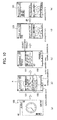
- the hiragana character "was” is displayed on the first type character display area 101 that displays the first type characters, and at the same time, the numeric character "0" is displayed on the second type character display area 102 that displays the second type characters ( FIG. 10 (b) ).
- hiragana characters spelling "watanabe” are displayed on the first type character display area 101, and numeric characters "0456666*" are displayed on the second type character display area 102 ( FIG. 10 (c) ).
- the control unit 45 performs processing to convert kana characters into kanji characters, and the first type character display area 101 is displayed in an enlarged manner on the display screen ( FIG. 10 (d) ).
- the control unit 45 performs processing of enlargement or the like of the displayed characters ( FIG. 10 (e) ).
- control unit 45 performs processing of making an outgoing telephone call based on the numeric character string displayed on the second type character display area 102.
- control unit 45 operations of the control unit 45 are described in detail, in a case in which an operation of an outgoing telephone call is made by depressing the third key, based on a telephone number that has been input on the second type character display area 102. It should be noted that the following assumes that an arbitrary telephone number has already been input on the second type character display area 102, and the third key has been depressed.
- Step S41 the control unit 45 determines whether a telephone number that has been input on second type character display area 102 is a predetermined telephone number (emergency call). In a case in which the telephone number that has been input on the second type character display area 102 is an emergency call (YES), the processing advances to Step S44, and in a case in which the telephone number that has been input on the second type character display area 102 is not an emergency call (NO), the processing advances to Step S42.
- a predetermined telephone number is an emergency call in the present embodiment, it is not limited thereto, and a predetermined telephone number may be a telephone number that is arbitrarily registered by the user.
- the control unit 45 refers to an address book stored in the memory 44 to determine whether the telephone number that has been input on the second type character display area 102 is an emergency call.
- Step S42 the control unit 45 performs control such that a confirmation screen (confirmation display screen 104) is displayed on the LCD display unit 21 for confirming whether an outgoing call should be made based on a telephone number that has been input on the second type character display area 102 (see FIG. 11 (d) ).
- Step S43 based on the confirmation display screen 104, the control unit 45 determines whether an operation of an outgoing call has been performed. More specifically, in a case in which "1. YES" is selected on the confirmation display screen 104 shown in FIG. 11 (d) , the control unit 45 determines that an operation of an outgoing call has been performed, and in a case in which "2. NO" is selected on the confirmation display screen 104, the control unit 45 determines that an operation of an outgoing call has not been performed. In a case in which it is determined that an operation of an outgoing call has been performed (YES), the processing advances to Step S44, and in a case in which it is determined that an operation of an outgoing call has not been performed (NO), the processing advances to Step S45.
- Step S44 the control unit 45 performs an outgoing call operation.
- a telephone call with another cellular telephone device is enabled via a base station.
- Step 545 the control unit 45 returns to a previous state (for example, a state in which the first type character display area 101 and the second type character display area 102 are displayed, as shown in FIG. 10 (c) ) without performing an outgoing call operation.
- a previous state for example, a state in which the first type character display area 101 and the second type character display area 102 are displayed, as shown in FIG. 10 (c) .
- the cellular telephone device 1 displays the confirmation display screen 104 as shown in FIG. 11 (d) , and does not allow an outgoing telephone call to be made unless "1. YES" is selected or "OK” is depressed. Therefore, the cellular telephone device 1 can reduce erroneous actions due to operating without watching the display screen. Moreover, the cellular telephone device 1 makes it possible to transition to a previous screen by interposing the confirmation display screen 104 as shown in FIG. 11 (d) .
- the cellular telephone device 1 can reduce a possibility of losing data due to erroneous outgoing operations.
- the cellular telephone device 1 makes an outgoing call without displaying the confirmation display screen 104 as shown in FIG. 11 (d) by considering the degree of emergency being high. Therefore, the cellular telephone device 1 can quickly cope with emergencies.
- the cellular telephone device 1 with such a configuration has a function, in which, in a case in which a key operation is performed in the standby state for communication, a plurality of characters (for example, a numeric character and non-numeric character) assigned to the key are displayed, for example, on separate screen areas in parallel, respectively, and in a case in which a predetermined key operation is performed, a screen displaying one of the characters is activated.
- a key operation for example, a numeric character and non-numeric character assigned to the key are displayed, for example, on separate screen areas in parallel, respectively, and in a case in which a predetermined key operation is performed, a screen displaying one of the characters is activated.
- the number of the characters may be different in some cases.
- the cellular telephone device 1 has a function, in which, in a case in which a key input operation is performed in the standby state, a plurality of characters (for example, a numeric character and non-numeric character) assigned to the key are displayed, for example, on separate areas in parallel, respectively, and when a cancellation operation is subsequently performed, characters displayed on the display areas are cancelled one by one.
- the cellular telephone device 1 does not have history information for non-numeric character information, and has a function in which non-numeric character information is treated only as non-numeric character information, and numeric character information is treated only as numeric character information.
- the operation unit 11 is configured by including: the first key group (for example, keys positioned from the second line to the fifth line of the input operation keys 14 indicated by C in FIG. 1 ); a specific key 14a (for example, a clear key in the center of the first line of the input operation keys 14 indicated by D in FIG. 1 ); the second key (for example, the selection operation key 15); and the third key (for example, the on-hook key positioned at the top of the left row line of the input operation keys 14 indicated by B in FIG. 1 ).
- the first key group for example, keys positioned from the second line to the fifth line of the input operation keys 14 indicated by C in FIG. 1
- a specific key 14a for example, a clear key in the center of the first line of the input operation keys 14 indicated by D in FIG. 1
- the second key for example, the selection operation key 15
- the third key for example, the on-hook key positioned at the top of the left row line of the input operation keys 14 indicated by B in FIG. 1 ).
- the first key group is configured with a plurality of keys, to which the first type characters (for example, hiragana characters such as "a", “i” and “u") and the second type characters (for example, numeric characters such as "1", "2" and "3") are assigned.
- the specific key 14a is a key that is assigned with a function of cancelling the first type character and the second type character that have been input via a key included in the first key group.
- the second key is a key, to which the first type characters and the second type characters are not assigned, and to which a plurality of functions (for example, a function of converting kana characters into kanji characters, etc.) are assigned.
- the third key is a key, to which the first type characters and the second type characters are not assigned, and to which a function (for example, a function of making an outgoing telephone call, etc.) being different from the function of the second key is assigned.
- the control unit 45 performs control such that the LCD display unit 21 displays, in place of the initial screen 100, the first type character display area 101 that displays the first type characters (for example, hiragana characters "a", "i” and "u") assigned to the depressed key, and the second type character display area 102 that displays the second type characters (for example, numeric characters such as "1", "2" and "3") assigned to the depressed key ( FIG. 13(b) ).
- the control unit 45 performs control to cancel characters by a number corresponding to the number of times the specific key 14a is depressed, from a character at the end of a string of the characters displayed on the first type character display area 101, and from a character at the end of a string of the characters displayed on the second type character display area 102 ( FIG. 14 ).
- FIG. 14 in a state where "watanabe" is displayed on the first type character display area 101, and "045666*" is displayed on the second type character display area 102 by key operations ( FIG.
- the control unit 45 continues to display the first type character display area 101 and the second type character display area 102.
- the control unit 45 displays a first type character assigned to the depressed key on the first type character display area 101, and displays a second type character assigned to the depressed key on the second type character display area 102.
- the first type character display area 101 continues to be displayed, and in a case in which a key of the first key group is newly depressed, a first type character assigned to the depressed key is displayed on the first type character display area 101, and a second type character assigned to the depressed key is continuously displayed on the second type character display area 102. Therefore, in the cellular telephone device 1, even if characters are overly cancelled against the user's intention, characters can be input again on both of the display areas.
- the control unit 45 cancels the display area with all the characters cancelled, and displays the display area with remaining characters on the entirety of the LCD display unit 21 in an enlarged manner.
- the cellular telephone device 1 cancels the display area with all the characters cancelled from the LCD display unit 21, and displays the display area with remaining characters in an enlarged manner on the entirety of the LCD display unit 21.
- the cellular telephone device 1 can improve the visibility and alleviate the processing load on the control unit 45.
- the control unit 45 performs processing to convert the kana characters into kanji characters.
- the first type character display area 101 is displayed on the entirety of the display area ( FIG. 13 (d) ).
- the control unit 45 performs processing of enlargement or the like of the displayed characters ( FIG. 13 (e) ).
- control unit 45 performs processing of making an outgoing telephone call based on the numeric character string displayed on the second type character display area 102.
- Step S51 the control unit 45 determines whether there is numeric character information. More specifically, the control unit 45 determines whether a numeric character is displayed on the second type character display area 102. In a case in which it is determined that there is numeric character information (YES), the processing advances to Step S52, and in a case in which it is determined that there is no numeric character information (NO), the processing advances to Step S53.
- Step S52 the control unit 45 cancels one piece of the numeric character information. More specifically, the control unit 45 cancels one character from the end of the character string displayed on the second type character display area 102.
- Step S53 the control unit 45 performs setting such that there is no numeric character information.
- Step S54 the control unit 45 determines whether there is non-numeric character information. More specifically, the control unit 45 determines whether a character is displayed on the first type character display area 101. In a case in which it is determined that there is non-numeric character information (YES), the processing advances to Step S55, and in a case in which it is determined that there is no non-numeric character information (NO), the processing advances to Step S56.
- Step S55 the control unit 45 cancels one piece of the non-numeric character information. More specifically, the control unit 45 cancels one character from the end of the character string displayed on the first type character display area 101.
- Step S56 the control unit 45 performs setting such that there is no non-numeric character information.
- Step S57 the control unit 45 refers to the states that have been set in Steps S53 and S56 to determine whether it is set that there are no numeric character information and non-numeric character information.
- the processing advances to Step S58, and in a case in which the setting is that there are no numeric character information and/or non-numeric character information (NO), the processing is terminated.
- Step S58 the control unit 45 performs control such that an application is terminated, i.e. the first type character display area 101 and the second type character display area are cancelled to be switched to the initial screen 100.
- the control unit 45 displays a first type character assigned to the depressed key on the first type character display area 101, and displays a second type character assigned to the depressed key on the second type character display area 102. Therefore, since the cellular telephone device 1 does not retain history information for non-numeric character information, the load on the memory can be alleviated.
- the present invention is not limited to the aforementioned embodiments, and can be altered as appropriate.
- the method of key assignment shown in FIG. 4 is an example, and a method thereof is not limited to the present method.
- the cellular telephone device 1 is described as a portable electronic device in the aforementioned embodiments, the present invention is not limited thereto, and the portable electronic device may be a PHS (Personal Handyphone System), a PDA (Personal Digital Assistant), a portable navigation device, a notebook PC, a mobile gaming device or the like.
- PHS Personal Handyphone System
- PDA Personal Digital Assistant
- portable navigation device a notebook PC
- notebook PC Portable gaming device
Landscapes
- Engineering & Computer Science (AREA)
- Human Computer Interaction (AREA)
- Theoretical Computer Science (AREA)
- General Engineering & Computer Science (AREA)
- Computer Networks & Wireless Communication (AREA)
- Signal Processing (AREA)
- Physics & Mathematics (AREA)
- General Physics & Mathematics (AREA)
- Input From Keyboards Or The Like (AREA)
- Telephone Function (AREA)
Abstract
Description
- The present invention relates to a portable electronic device having an operation unit, and particularly relates to a portable electronic device in which plural types of characters are assigned to an identical key.
- A portable electronic device includes: a display unit that displays a variety of information; and an operation unit that is configured with a plurality of keys.
- Here, in a portable electronic device such as a cellular telephone device, an initial screen is displayed on a display unit while waiting for an incoming call or while waiting for activation of other applications. When an operation key assigned with a numeric character is depressed in this standby state, a numeric character corresponding to the operation key thus depressed is displayed on the display unit. In addition, in the portable electronic device, for example, in a case in which an on-hook key is depressed in a state where numeric characters are displayed on the display unit, processing of an outgoing telephone call is performed based on the numeric characters that have been input, and in a case in which a key for activating a calculator (desk calculator) is depressed, a calculator application is activated in which the numeric characters that have been input are used as initial numeric values.
- Moreover, a technique is proposed for a portable electronic device (for example, see Patent Document 1), in which, when a key operation is performed from an initial screen, a character corresponding to the key operation is displayed on a display unit, and when a predetermined operation (operation of depressing a key for displaying a list of applications) is performed, the list of applications corresponding to a displayed character string is displayed, and one application is selected from the list to activate the application.
- Patent Document 1: Japanese Unexamined Patent Application, Publication No.
2007-200243 - Incidentally, in the initial screen state, in a case in which the user has depressed a key that is assigned with a numeric character and non-numeric character, it is not possible to determine at an initial stage of such a key operation as to which type of character is intended by the user thus operating. As in the case of the technique of
Patent Document 1, if priority is given to an input of non-numeric character, an input of a numeric character will be ignored. On the other hand, if priority is given to an input of a numeric character, an input of non-numeric character will be ignored, and there is a possibility that the user's intention is not reflected. - An object of the present invention is to provide a portable electronic device, in which, in a case in which a key operation is performed in a state where an initial screen is displayed, a plurality of characters (for example, a numeric character and non-numeric character) assigned to the key are displayed on a display unit in parallel, respectively, and one of the characters being displayed is activated by a subsequent operation, thereby making it possible to reflect the user's intention.
- In order to solve the abovementioned problems, a portable electronic device according to the present invention is characterized by including: a display unit; a key operation unit; and a control unit that performs control of the display unit and the key operation unit, in which the key operation unit is configured by including a plurality of first keys that are assigned with a first type character and a second type character, and when any one of the first keys is depressed in a state where an initial screen is displayed on the display unit, the control unit performs control such that the first type character assigned to the first key thus depressed and the second type character assigned to the first key thus depressed are displayed together on the display unit.
- Moreover, in the portable electronic device, it is preferable that: the key operation unit is configured by including a second key, to which the first type character and the second type character are not assigned, and to which a plurality of functions are assigned, and a third key, to which the first type character and the second type character are not assigned, and to which a function different from the functions of the second key is assigned; when any one of the first keys is depressed in a state where an initial screen is displayed on the display unit, the control unit performs control such that the first type character assigned to the first key thus depressed and the second type character assigned to the first key thus depressed are displayed together on the display unit; while the control unit is performing control such that the first type character and the second type character are displayed together on the display unit, in a case in which the second key is depressed, the control unit performs first processing for the first type character, and performs control to suppress displaying of the second type character on the display unit; and while the control unit is performing control such that the first type character and the second type character are displayed together on the display unit, in a case in which the third key is depressed, the control unit performs second processing for the second type character, and performs control to suppress displaying of the first type character on the display unit.
- In addition, in the portable electronic device, it is preferable that: the key operation unit is configured by including a second key, to which the first type character and the second type character are not assigned, and to which a plurality of functions are assigned, and a third key, to which the first type character and the second type character are not assigned, and to which a function different from the functions of the second key is assigned; when any one of the first keys is depressed in a state where an initial screen is displayed on the display unit, the control unit performs control such that the first type character assigned to the first key thus depressed and the second type character assigned to the first key thus depressed are displayed together on the display unit; while the control unit is performing control such that the first type character and the second type character are displayed on the display unit, in a case in which the second key is depressed, the control unit performs first processing for the first type character; while the control unit is performing control such that the first type character and the second type character are displayed on the display unit, in a case in which the third key is depressed, the control unit performs second processing for the second type character; and in the second processing, in a case in which a character string related to the second type character is a predetermined character string, the control unit performs outgoing call processing using the character string as a telephone number, and in a case in which the character string is not the predetermined character string, the control unit confirms whether outgoing call processing should be performed by using the character string as a telephone number, and performs outgoing call processing after such confirmation.
- In order to solve the abovementioned problems, a portable electronic device according to the present invention is characterized by including: a display unit; a key operation unit; and a control unit that performs control of the display unit and the key operation unit, in which the key operation unit is configured by including: a first key group composed of a plurality of keys that are assigned with a first type character and a second type character, and a specific key that is assigned with a function of cancelling the first type character and the second type character that have been input via a key of the first key group; in a state where an initial screen is displayed on the display unit, in a case in which a key of the first key group is depressed, the control unit performs control such that the first type character assigned to the key thus depressed is displayed on a first type character display area, and the second type character assigned to the key thus depressed is displayed on a second type character display area; and in a case in which the specific key is depressed, the control unit performs control to cancel a character(s) equivalent to a number of times of depressing the specific key, from a character at an end of a string of the first type character, and from a character at an end of a string of the second type character.
- According to the present invention, the user's intention can be reflected in a key operation from a state where the initial screen is displayed.
-
-
FIG. 1 is a perspective view showing an appearance of acellular telephone device 1; -
FIG. 2 is a perspective view showing a state in which thecellular telephone device 1 is folded; -
FIG. 3 is a functional block diagram showing functions of thecellular telephone device 1; -
FIG. 4 is a diagram illustrating key assignment; -
FIG. 5 is a diagram illustrating an aspect of a display state that changes from an initial screen to a split screen including a first type character display area and a second type character display area, and subsequently changes to a single screen of the first type character display area; -
FIG. 6 is a flowchart illustrating an operation processing method performed by a control unit; -
FIG. 7 is a diagram illustrating an aspect of a display state that changes from the initial screen to the split screen including the first type character display area and the second type character display area, and subsequently changes to the single screen of the first type character display area; -
FIG. 8 is a flowchart illustrating a first operation processing method performed by the control unit; -
FIG. 9 is a flowchart illustrating the first operation processing method performed by the control unit; -
FIG. 10 is a diagram illustrating an aspect of a display state that changes from the initial screen to the split screen including the first type character display area and the second type character display area, and subsequently changes to the single screen of the first type character display area; -
FIG. 11 is a diagram illustrating an aspect of a display state that changes from the initial screen to the split screen including the first type character display area and the second type character display area, and subsequently changes to the single screen of the second type character display area to display a confirmation display screen; -
FIG. 12 is a flowchart illustrating an operation processing method performed by the control unit; -
FIG. 13 is a diagram illustrating an aspect of a display state that changes from the initial screen to split areas including the first type character display area and the second type character display area, and subsequently changes to the single screen of the first type character display area; -
FIG. 14 is a diagram illustrating an aspect of changes of the first type character display area and the second type character display area when cancelling characters; and -
FIG. 15 is a flowchart illustrating an operation processing method performed by the control unit. - A description is provided hereinafter regarding an embodiment of the present invention.
FIG. 1 is a perspective view showing an appearance of acellular telephone device 1 as an example of the portable electronic device according to the present invention. It should be noted that, althoughFIG. 1 shows a so-called folder-type cellular telephone device, the cellular telephone device according to the present invention is not particularly limited thereto. For example, it may be a slider type in which one of the bodies slides to one direction in a state in which the bodies are mutually superimposed; a rotating (turning) type in which one of the bodies is rotated around an axis line along the direction of superimposing the bodies; and a type (straight type) in which an operation unit and a display unit are disposed in one body without having a connecting portion. - The
cellular telephone device 1 includes an operationunit side body 2 and a displayunit side body 3. The operationunit side body 2 includes, on afront face portion 10 thereof, anoperation unit 11 and amicrophone 12 to which sound produced by a user of thecellular telephone device 1 during a phone call is input. Theoperation unit 11 is configured with: function settingoperation keys 13 for operating various functions such as for various settings, a telephone number directory function and a mail function;input operation keys 14 for inputting digits of a telephone number and characters for mail, etc.; and aselection operation key 15 for performing selection of the various operations and scrolling, etc. - Moreover, the display
unit side body 3 includes, on afront face portion 20, an LCD (Liquid Crystal Display)display unit 21 for displaying a variety of information, and aspeaker 22 for outputting sound of the other party of the conversation. - In addition, an upper end portion of the operation
unit side body 2 and a lower end portion of the displayunit side body 3 are connected via ahinge mechanism 4. Furthermore, thecellular telephone device 1 can be in a state where the operationunit side body 2 and the displayunit side body 3 are apart from each other (opened state), and in a state where the operationunit side body 2 and the displayunit side body 3 are contacting each other (folded state), as the operationunit side body 2 and the displayunit side body 3, connected via thehinge mechanism 4, pivot with respect to each other. - Moreover,
FIG. 2 is a perspective view showing a state in which thecellular telephone device 1 is folded. The operationunit side body 2 includes, on its outer planar portion, a subLCD display unit 30 that displays a clock, incoming notice of mail, etc. -
FIG. 3 is a functional block diagram showing functions of thecellular telephone device 1. In thecellular telephone device 1, as shown inFIG. 3 , the operationunit side body 2 includes the operation unit (key operation unit) 11, themicrophone 12, amain antenna 40, anRF circuit unit 41, anLCD control unit 42, asound processing unit 43,memory 44, and acontrol unit 45. In thecellular telephone device 1, the displayunit side body 3 includes the LCD display unit (display unit) 21, thespeaker 22, adriver IC 23, and a subLCD display unit 30. - The
main antenna 40 communicates with a base station, etc. via a first usable frequency band (for example, 800 MHz), and is configured as a dual band compatible antenna that can be compatible with a second usable frequency band (for example, 1.5 GHz) for GPS communication. It should be noted that, although 800 MHz is set as the first usable frequency band in the present embodiment, other frequency bands can also be used. In addition, themain antenna 40 may communicate with an external device via the first usable frequency band, and another antenna that can be compatible with the second usable frequency band for GPS communication may be separately provided. - The
RF circuit unit 41 performs demodulation processing of a signal received via themain antenna 40, and transmits the processed signal to thecontrol unit 45. TheRF circuit unit 41 performs modulation processing of the signal transmitted from thecontrol unit 45, and transmits the signal to external devices (base stations) via themain antenna 40. Furthermore, on the other hand, theRF circuit unit 41 notifies thecontrol unit 45 of intensity of a signal received via themain antenna 40. - The
LCD control unit 42 performs predetermined image processing in accordance with control by thecontrol unit 45, and outputs the processed image data to thedriver IC 23. Thedriver IC 23 stores the image data, which is transmitted from theLCD control unit 42, in frame memory so as to be output to theLCD display unit 21 or the subLCD display unit 30 at predetermined timing. - The
sound processing unit 43 performs predetermined sound processing in accordance with control by thecontrol unit 45 for a signal transmitted from theRF circuit unit 41, and outputs the processed signal to thespeaker 22. Thespeaker 22 externally outputs the signal that is transmitted from thesound processing unit 43. - Moreover, the
sound processing unit 43 processes a signal, which is input from themicrophone 12, in accordance with control by thecontrol unit 45, and outputs the processed signal to theRF circuit unit 41. TheRF circuit unit 41 performs predetermined processing for the signal transmitted from thesound processing unit 43, and outputs the processed signal to themain antenna 40. - The
memory 44 includes, for example, working memory, and is utilized for arithmetic processing by thecontrol unit 45. In addition, thememory 44 stores a plurality of applications as well as various tables, etc. required by the applications. Furthermore, thememory 44 may also serve as detachable external memory. - The
control unit 45 controls the entirety of thecellular telephone device 1, and is configured by using a central processing unit (CPU), etc. Here, a description is provided for control operations of thecontrol unit 45 in accordance with a key operation via theoperation unit 11. Thecontrol unit 45 changes characters and functions to be assigned to each key (the functionsetting operation keys 13, theinput operation keys 14 and the selection key 15) configuring theoperation unit 11, essentially in accordance with an application that is currently activated. - More specifically, when any key is depressed, the
operation unit 11 transmits position information of the key to the control unit 45 (for example, as shown inFIG. 4 (a) , in a case of depressing a key in the second line and the left row among the input operation keys 14 (a key with "1" and "a" printed on its surface; ("a" is a Japanese hiragana character pronounced as "a" in the Hepburn system; hereinafter simply referred to as "a"), position information of (X2, Y1) is transmitted). Thecontrol unit 45 accesses thememory 44, refers to a key assignment table corresponding to an application that is currently activated, and performs processing of a character and a function assigned thereto, based on the position information that has been transmitted from theoperation unit 11. For example, as shown inFIGS. 4(b) to 4 (d) , thememory 44 stores a plurality of key assignment tables. It should be noted thatFIG. 4 (b) is a table that is utilized when an outgoing telephone call is made;FIG. 4 (c) is a table that is utilized in a memo pad application and a mail application; andFIG. 4 (d) is a table that is utilized when changing a channel in a television application. - It should be noted that execution of processing a character means that, for example, in a case in which the currently activated application is a memo pad, then "1" or "a" is displayed on the
LCD display unit 21. Moreover, execution of processing a function means that, for example, in a case in which the currently activated application is a television, the display channel is set tochannel 1. - In this way, the
memory 44 stores a plurality of key assignment tables. Depending on the application, thecontrol unit 45 switches a key assignment table to be referred to, refers to a predetermined key assignment table based on position information of a key that has been transmitted from theoperation unit 11, and performs predetermined processing. - The
cellular telephone device 1 with such a configuration has a function, in which, in a case in which a key operation is performed in a standby state for communication, etc., a plurality of characters (for example, a numeric character and non-numeric character) assigned to the key are displayed, for example, on separate screen areas in parallel, respectively, and in a case in which a predetermined key operation is performed, a screen displaying one of the characters is activated. Moreover, thecellular telephone device 1 has a function, in which, in a case in which a predetermined key operation is performed, and when the screen displaying one of the characters is activated, a key assignment that was assigned in the screen displaying another character is changed. - Here, operations of the
control unit 45 for exercising the aforementioned functions are described. In a state in which theLCD display unit 21 displays aninitial screen 100 that waits for an incoming call (FIG. 5 (a) ), and when any of the first keys is depressed, thecontrol unit 45 performs control such that theLCD display unit 21 displays, in place of theinitial screen 100, a first typecharacter display area 101 that displays first type characters (for example, Japanese hiragana characters such as those pronounced as "a", "i" and "u") assigned to the first key thus depressed, and a second typecharacter display area 102 that displays second type characters (for example, numeric characters such as "1", "2" and "3") assigned to the first key thus depressed (FIG. 5 (b) ). - With such a configuration, in a case in which a key operation is performed in the standby state for communication, etc., the
cellular telephone device 1 can display a plurality of characters (for example, a numeric character and non-numeric character) assigned to the key, for example, on separate screen areas in parallel, respectively; and therefore, the user's intention can be reflected. - Furthermore, the
operation unit 11 is configured by including: a second key (for example, the selection operation key 15) to which the first type characters and the second type characters are not assigned, and to which a plurality of functions (for example, a function of converting kana characters into kanji characters) are assigned; and a third key (for example, an on-hook key provided to the top of the left row of the input operation keys 14), to which the first type characters and the second type characters are not assigned, and to which a function (for example, a function of making an outgoing telephone call) being different from the function of the second key is assigned. While thecontrol unit 45 is performing control such that the first typecharacter display area 101 and the second typecharacter display area 102 are displayed on theLCD display unit 21, in a case in which the second key is depressed, thecontrol unit 45 performs first processing (for example, processing to convert kana characters into kanji characters) for the first type character that has been input, and in a case in which the third key is depressed, thecontrol unit 45 performs second processing (for example, processing related to an outgoing telephone call) for the second type character that has been input. - With such a configuration, in a case in which a key operation is performed in the standby state for communication, the
cellular telephone device 1 can display a plurality of characters (for example, a numeric character and non-numeric character) assigned to the key, for example, on separate screen areas in parallel, respectively. Furthermore, when a predetermined key is depressed, processing in accordance with one screen area is performed, and thus the user's intention can be reflected. Therefore, in thecellular telephone device 1, in a standby state for communication, without causing a user to select an application in advance, a key input is enabled, the user can activate a desired application after inputting the key, and the operability can be improved. - Moreover, while the
control unit 45 is performing control such that the first typecharacter display area 101 and the second typecharacter display area 102 are displayed on theLCD display unit 21, and in a case in which the second key is depressed, thecontrol unit 45 performs control to notify what kind of processing is to be performed for the first type character that has been input (for example, as indicated by A inFIG. 5 (b) , control is performed to notify that conversion is possible by depressing an up-down key of theselection operation key 15, while showing an image printed on the surface of the selection operation key 15). In addition, in a case in which the third key is depressed, control is performed to notify what kind of processing is to be performed for the second type character that has been input (for example, as indicated by B inFIG. 5 (b) , control is performed to notify that an outgoing telephone call is made by depressing the on-hook key, while showing an image printed on the surface of the on-hook key). - With such a configuration, in a case in which a key operation is performed in the standby state for communication, the
cellular telephone device 1 can display a plurality of characters (for example, a numeric character and non-numeric character) assigned to the key, for example, on separate screen areas in parallel, respectively. Furthermore, since notification is performed as to which key should be depressed to perform what kind of processing, it is possible to improve the convenience in the operations. - Moreover, the function that is assigned to the second key is a function of editing characters related to the first type characters displayed on the first type character display area 101 (converting a character by depressing the up-down key, determining an input character by depressing the central key, and moving the cursor by depressing the right-left key). In addition, the first processing is processing of selecting and determining, by depressing the second key, a specific character from among conversion candidates related to the first type characters displayed on the first type
character display area 101. Furthermore, a function assigned to the third key is a function of making an outgoing telephone call based on characters related to the second type characters displayed on the second typecharacter display area 102. Moreover, the second processing is processing for making an outgoing telephone call, using, as a telephone number, characters related to the second type characters displayed on the second typecharacter display area 102 by depressing the third key. - Here, in an example shown in
FIG. 5 , on the initial screen 100 (FIG. 5 (a) ), in a case in which a key operation is performed (a key with a numeric character "0" and hiragana characters "wa, o, n" printed on its surface), the hiragana character "wa" is displayed on the first typecharacter display area 101 that displays the first type characters. At the same time, the numeric character "0" is displayed on the second typecharacter display area 102 that displays the second type characters (FIG. 5 (b) ). As a result of sequentially performing a plurality of key operations in this way, hiragana characters spelling "watanabe" are displayed on the first typecharacter display area 101, and numeric characters "0456666*" are displayed on the second type character display area 102 (FIG. 5 (c) ). - In addition, in a case in which the
selection operation key 15 is operated in the up-down direction when the display screen is in a state shown inFIGS. 5 (b), 5 (c) or the like, thecontrol unit 45 performs processing to convert kana characters into kanji characters, and the first typecharacter display area 101 is displayed on the entirety of the display screen (FIG. 5 (d) ). Furthermore, in a case in which a key (a so-called on-hook key) provided to the top of the left row of theinput operation keys 14 is depressed in a state ofFIG. 5(d) , thecontrol unit 45 performs processing of enlargement or the like of the displayed characters (FIG. 5 (e) ). - Moreover, in a case in which the key (on-hook key) provided to the top of the left row of the
input operation keys 14 is depressed when the display screen is in a state ofFIGS. 5 (b), 5 (c) or the like, thecontrol unit 45 performs processing of making an outgoing telephone call based on a numeric character string displayed on the second typecharacter display area 102. - In this way, from a standby state for communication, after a key operation is performed to input an arbitrary character, the
control unit 45 performs control such that a different function is assigned to the on-hook key depending on whether theselection operation key 15 is depressed. Therefore, since the number of keys configuring thecellular telephone device 1 is small, the utilization efficiency of each key can be improved. - Next, a control procedure of assigning a function to the on-hook key by way of the
control unit 45 is described with reference to a flowchart shown inFIG. 6 . It should be noted that, in the following, a state where the first typecharacter display area 101 and the second typecharacter display area 102 are displayed is referred to as a state of displaying a double screen, and a state where only one screen of the first typecharacter display area 101 or the second typecharacter display area 102 is displayed is referred to as a state of displaying a single screen. In addition, the on-hook key is a key that is disposed to the top of the left row of theinput operation keys 14. - The
control unit 45 determines whether the current operating state is the state of displaying the single screen (Step S1), and in a case in which the current operating state is the state of displaying the single screen, thecontrol unit 45 performs control such that a function of enlarging characters displayed on the first typecharacter display area 101 is assigned to the on-hook key (Step S2). Furthermore, in a case in which the current operating state is the state of displaying the double screen, thecontrol unit 45 performs control such that the on-hook key is assigned with a function of making an outgoing telephone call based on the numeric characters displayed on the second type character display area 102 (Step S3). - With such a configuration, in a case in which a key operation is performed in a standby state for communication, in accordance with the key operation, the
cellular telephone device 1 performs control such that the first typecharacter display area 101 and the second typecharacter display area 102 are displayed, and notifies processing based on the character that has been input, by using an image that is the same as the image printed on the actual key. Therefore, the user's intention can be reflected, and the operability can be improved. Moreover, since thecellular telephone device 1 changes the function to be assigned to the keys in accordance with the display state of theLCD display unit 21, the utilization efficiency of the keys can be improved. - Next, operations of the
control unit 45 in thecellular telephone device 1 of a second embodiment are described. It should be noted that, in describing the second embodiment, constituent elements that are the same as those of the first embodiment are assigned with the same reference symbols, and descriptions thereof are omitted or simplified. Theoperation unit 11 is configured by including: the first keys (for example, keys positioned from the second line to the fifth line of theinput operation keys 14 indicated by C inFIG. 1 ); the second key (for example, the selection operation key 15); and the third key (for example, the on-hook key positioned at the top of the left row of theinput operation keys 14 indicated by B inFIG. 1 ). - The first keys are configured with a plurality of keys, to which the first type characters (for example, hiragana characters such as "a", "i" and "u") and the second type characters (for example, numeric characters such as "1", "2" and "3") are assigned. The second key is a key, to which the first type characters and the second type characters are not assigned, and to which a plurality of functions (for example, a function of converting kana characters into kanji characters, etc.) are assigned. The third key is a key, to which the first type characters and the second type characters are not assigned, and to which a function (for example, a function of making an outgoing telephone call, etc.) being different from the function of the second key is assigned.
- In a state where the
LCD display unit 21 is displaying theinitial screen 100 that waits for an incoming call (FIG. 7(a) ), and in a case in which any one of the first keys is depressed, thecontrol unit 45 performs control such that a first type character (for example, a hiragana character such as "a", "i" or "u") assigned to the depressed first key and a second type character (a numeric character such as "1", "2" or "3") assigned to the depressed first key are displayed together on the LCD display unit 21 (FIG. 7 (b) ). More specifically, thecontrol unit 45 performs control such that, in place of theinitial screen 100, the first type character is displayed on the first typecharacter display area 101, and the second type character is displayed on the second typecharacter display area 102. - Moreover, while the
control unit 45 is performing control such that the first typecharacter display area 101 and the second typecharacter display area 102 are displayed on theLCD display unit 21, and in a case in which the second key is depressed, thecontrol unit 45 performs the first processing (for example, processing to convert kana characters into kanji characters) for the first type character. In addition, thecontrol unit 45 suppresses displaying the second type characters. Here, such suppression refers to, for example, controlling the state such that the second typecharacter display area 102 is cancelled from theLCD display unit 21, or the first type character is visually highlighted as compared to the second type character, and in addition, processing (editing process) for the second type character is prohibited, and only processing (editing process) for the first type character is allowed. - Furthermore, while the
control unit 45 is performing control such that the first typecharacter display area 101 and the second typecharacter display area 102 are displayed on theLCD display unit 21, and in a case in which the third key is depressed, thecontrol unit 45 performs the second processing (for example, processing related to making an outgoing telephone call) for the second type character that has been input on the second typecharacter display area 102. In addition, thecontrol unit 45 suppresses displaying the first type characters. Here, such suppression refers to, for example, controlling the state such that the first typecharacter display area 101 is cancelled from theLCD display unit 21, or the second type character is visually highlighted as compared to the first type character, and in addition, processing (editing process) for the first type character is prohibited, and only processing (editing process) for the second type character is allowed. - With such a configuration, in a case in which a key operation is performed in a standby state for communication, the
cellular telephone device 1 performs control such that the first typecharacter display area 101 and the second typecharacter display area 102 are displayed. Therefore, in thecellular telephone device 1, both of the first type characters and the second type characters can be easily input. Furthermore, in thecellular telephone device 1, by depressing a specific key (the second key or the third key), any one of the first typecharacter display area 101 and the second typecharacter display area 102 is selected, predetermined processing (the first processing or the second processing) is performed, and the first typecharacter display area 101 or the second typecharacter display area 102, which was not selected, is cancelled from the display screen of theLCD display unit 21. Therefore, in thecellular telephone device 1, the user's operation for cancelling an unnecessary display area can be eliminated, and the user's intention can be reflected while securing the visibility. - Moreover, while the
control unit 45 is performing control such that the first type character and the second type character are displayed on theLCD display unit 21, and in a case in which the second key (for example, the up-down key (character-conversion key) of the selection operation key 15) is depressed, thecontrol unit 45 performs the first processing for the first type characters. In addition, thecontrol unit 45 suppresses displaying the second type characters. Here, such suppression refers to, for example, controlling the state such that the second typecharacter display area 102 is cancelled from theLCD display unit 21, or the first type character is visually highlighted as compared to the second type character, and in addition, processing (editing process) for the second type character is prohibited, and only processing (editing process) for the first type character is allowed. - Moreover, the
control unit 45 changes the function assigned to the third key (for example, the function of making an outgoing telephone call based on the numeric characters displayed on the second type character display area 102) to the function of performing the third processing related to the first type characters (for example, the function of enlarging or reducing the characters displayed on the first type character display area 101). - More specifically, in a state where a key operation is performed from the standby state for communication, in a case in which the third key is depressed while the first type
character display area 101 and the second typecharacter display area 102 are being displayed on theLCD display unit 21, thecontrol unit 45 performs processing of making an outgoing telephone call based on the numeric characters displayed on the second type character display area 102 (seeFIGS 7 (b) and (c) ); and in a case in which the third key is depressed after the second typecharacter display area 102 is cancelled from theLCD display unit 21, thecontrol unit 45 performs processing of enlargement or reduction of the characters displayed on the first type character display area 101 (seeFIG. 7 (d) ). - In this way, from a standby state for communication, after a key operation is performed to input an arbitrary character, the
control unit 45 performs control such that a different function is assigned to the third key (on-hook key) depending on whether theselection operation key 15 is depressed. Therefore, since the number of keys configuring thecellular telephone device 1 is small, the utilization efficiency of the keys can be improved without increasing the number of keys. - In addition, the
control unit 45 performs control such that the first typecharacter display area 101 and the second typecharacter display area 102 are displayed on theLCD display unit 21. Subsequently, in a case in which the second key (for example, the up-down key (character-conversion key) of the selection operation key 15) is depressed, thecontrol unit 45 performs the first processing for the first type character that has been input on the first typecharacter display area 101. At this time, in a case in which the third key is depressed while the display of the second type character is suppressed, thecontrol unit 45 performs control to notify what kind of processing is to be performed for the first type character that has been input. Here, such suppression refers to, for example, controlling the state such that the second typecharacter display area 102 is cancelled from theLCD display unit 21, or the first type character is visually highlighted as compared to the second type character, and in addition, processing (editing process) for the second type character is prohibited (inactive), and only processing (editing process) for the first type character is allowed (active). Furthermore, as indicated by C inFIG. 7 (d) , such notification control refers to, for example, performing control to notify that the characters displayed on the first typecharacter display area 101 can be enlarged or reduced by depressing the on-hook key, while showing an image printed on the surface of the on-hook key. - With such a configuration, in a case in which the third key is depressed after the second type
character display area 102 is cancelled from theLCD display unit 21, thecellular telephone device 1 notifies what kind of processing is to be performed. Therefore, thecellular telephone device 1 can improve the convenience in operations. - Moreover, the function assigned to the second key is a function of editing characters related to the first type characters (that are displayed on the first type character display area 101) (in which characters are converted by depressing the up-down key, the input characters are determined by depressing the central key, and the cursor is moved by depressing the right-left key). In addition, the first processing is processing for selecting and determining a particular character from among conversion candidates of characters related to the first type characters (that are displayed on the first type character display area 101) by depressing the second key. Furthermore, the function assigned to the third key is a function of making an outgoing telephone call based on characters related to the second type characters (that are displayed on the second type character display area 102). Moreover, the second processing is processing for making an outgoing telephone call, using, as a telephone number, characters related to the second type characters (that are displayed on the second type character display area 102) by depressing the third key.
- Here, in an example shown in
FIG. 7 , on the initial screen (FIG. 7 (a) ), in a case in which a key (a key with a numeric character "0" and hiragana characters "wa, wo, n" printed on its surface) is operated, the hiragana character "wa" is displayed on the first typecharacter display area 101 that displays the first type characters, and at the same time, the numeric character "0" is displayed on the second typecharacter display area 102 that displays the second type characters (FIG. 7(b) . As a result of sequentially performing a plurality of key operations in this way, hiragana characters spelling "watanabe" are displayed on the first typecharacter display area 101, and numeric characters "0456666*" are displayed on the second type character display area 102 (FIG. 7 (c) ). - In addition, in a case in which the
selection operation key 15 is operated in the up-down direction when the display screen is in a state shown inFIGS. 7 (b), 7 (c) or the like, thecontrol unit 45 performs processing to convert kana characters into kanji characters. Furthermore, the first typecharacter display area 101 is displayed on the entirety of the display screen (FIG. 7 (d) ). Moreover, in a case in which the key (the so-called on-hook key) provided to the top of the left row of theinput operation keys 14 is depressed in a state ofFIG. 7 (d) , thecontrol unit 45 performs processing of enlargement or the like of the displayed characters (FIG. 7(e) ). - In addition, in a case in which the key (on-hook key) provided to the top of the left row of the
input operation keys 14 is depressed when the display screen is in a state ofFIGS. 7 (b), 7 (c) or the like, thecontrol unit 45 performs processing of making an outgoing telephone call based on the numeric character string displayed on the second typecharacter display area 102. - In this way, a key operation is performed from the standby state for communication, and an arbitrary character is input; thereafter, the
control unit 45 performs control to assign a different function to the on-hook key depending on whether theselection operation key 15 is depressed. Therefore, since the number of keys configuring thecellular telephone device 1 is small, the utilization efficiency of each key can be improved. - Here, in the
cellular telephone device 1, in a case in which a key of theoperation unit 11 with a numeric character "5" and a hiragana "na" printed on its surface is depressed once, the numeric character "5, the hiragana "na", the katakana "na" or the like are displayed as a conversion candidate on the first typecharacter display area 101; however, rather than continuing to treat such conversion candidate display as effective information (or as being active), it is more preferable to make determination at an early stage to limit to information that is necessary for the user, i.e. to make determination of whether the display screen on which the user is intentionally inputting is the first typecharacter display area 101 or the second typecharacter display area 102. In this way, it is more preferable to cancel the display area on which the user is not intentionally inputting, thereby removing the processing load imposed on thecontrol unit 45 at an early stage. - For example, in cases in which:
- 1. a conversion operation (depressing the second key (selection operation key 15) in the up-down direction) is performed;
- 2. a leftward shift or a rightward shift (depressing the second key (selection operation key 15) in the right-left direction) is performed for the input character string; or
- 3. the input character type is switched during the input, the
cellular telephone device 1 determines that the display screen on which the user is intentionally inputting is the first typecharacter display area 101. Moreover, the second typecharacter display area 102 is cancelled. - In addition, an operation procedure of the
control unit 45 for setting a state of the display screen and reflecting such setting, is described in detail with reference to a flowchart shown inFIG. 8 . It should be noted that the following assumes that an input has been made by way of any key(s) configuring theoperation unit 11. - In Step S11, the
control unit 45 determines whether any of the first keys (keys positioned from the second to fifth lines of theinput operation keys 14 indicated by C inFIG. 1 ) of theoperation unit 11 was depressed. In a case in which it is determined that the first key is depressed (YES), the processing advances to Step 12, and in a case in which it is determined that the first key is not depressed (NO), the processing advances to Step 15. - In Step S12, the
control unit 45 determines whether an input is a first character. In a case in which it is determined that the input is the first character (YES), the processing advances to Step S13, and in a case in which it is determined that the input is not the first character (NO), the processing advances to Step S14. - In Step S13, the
control unit 45 performs setting of the display screen into the double screen display including the first typecharacter display area 101 and the second type character display area 102 (setting of the double screen display). - In Step S14, the
control unit 45 performs setting to maintain the display screen to be similar to the previous screen. - In Step S15, the
control unit 45 determines whether a conversion operation (depressing the second key (selection operation key 15) in the up-down direction) is performed. In a case in which it is determined that the conversion operation is performed (YES), the processing advances to Step S18, and in a case in which it is determined that the conversion operation is not performed (NO), the processing advances to Step S16. - In Step S16, the
control unit 45 determines whether a leftward shift operation or a rightward shift operation (depressing the second key (selection operation key 15) in the right-left direction) is performed for an input character string. In a case in which it is determined that the leftward shift operation or the rightward shift operation is performed (YES), the processing advances to Step S18, and in a case in which it is determined that the leftward shift operation or the rightward shift operation is not performed (NO), the processing advances to Step S17. - In Step S17, the
control unit 45 determines whether the functionsetting operation key 13 is depressed to switch the type of input characters (kanji, hiragana, katakana, alphanumeric characters, etc.). In a case in which it is determined that the type of input characters is switched (YES), the processing advances to Step S18, and in a case in which it is determined that the type of input characters is not switched (NO), the processing advances to Step S19. - In Step S18, the
control unit 45 performs setting of the display screen into the single screen display including only the first type character display area 101 (setting of the single screen display). - In Step S19, the
control unit 45 performs setting to maintain the display screen to be similar to the previous screen. - In Step S20, the
control unit 45 determines whether the set state of the display screen is the single screen display via the setting through Steps S13, S14, S18 or S19. In a case in which the set state of the display screen is the single screen setting (YES), the processing advances to Step 21, and in a case in which the set state of the display screen is not the single screen setting (NO), the processing advances to Step 22. - In Step S21, the
control unit 45 performs control such that display in accordance with the input key is performed by way of the single screen display of the first typecharacter display area 101. - Moreover, in Step S22, the
control unit 45 performs control such that the double screen display of the first typecharacter display area 101 and the second typecharacter display area 102 is displayed in accordance with the input key. - Moreover, the procedure by way of each step is an example, and it is not limited thereto; and as shown in
FIG. 9 , Steps S15 to S17 particularly determines whether a conversion operation is performed (Step S31); then, in a case in which the conversion operation is performed (YES), whether a converted character should be determined is judged (Step S32), and in a case in which the converted character should be determined (YES), the processing advances to Step S18. Moreover, in a case in which the conversion operation is not performed in Step S31 (NO), or in a case in which the converted character is not determined in Step S32 (NO), the processing may be replaced with a procedure that advances to Step S19. - With such a configuration, in a case in which a key operation is performed in the standby state for communication, in response to the key operation, the
cellular telephone device 1 performs control to display the first typecharacter display area 101 and the second typecharacter display area 102, and in response to a subsequent key input in theoperation unit 11, thecellular telephone device 1 determines whether the display screen, on which the user is intentionally inputting, is the first typecharacter display area 101 or the second typecharacter display area 102, and cancels the display screen on which the user is not intentionally inputting. Therefore, since only a display screen on which the user is intentionally inputting is displayed, the visibility on theLCD display unit 21 can be improved, and the load on thecontrol unit 45 can be alleviated. - In addition, in a case in which a character string is input on the first type
character display area 101 and the second typecharacter display area 102, it was necessary to continue updating all the data serving as candidates displayed on the first typecharacter display area 101 and the second typecharacter display area 102, until determining which display screen should be effective. However, since the determination method as described above is performed in thecellular telephone device 1, a display screen to be effective is determined at an early stage, and the double screen display is switched to the single screen display. Therefore, the visibility on theLCD display unit 21 can be improved, and the load on thecontrol unit 45 can be alleviated. - Next, operations of the
control unit 45 in thecellular telephone device 1 of a third embodiment are described. It should be noted that, in describing the third embodiment, constituent elements that are the same as those of the first and second embodiments are assigned with the same reference symbols, and descriptions thereof are omitted or simplified. Theoperation unit 11 is configured by including: the first keys (for example, keys positioned from the second line to the fifth line of theinput operation keys 14 indicated by C inFIG. 1 ); the second key (for example, the selection operation key 15); and the third key (for example, the on-hook key positioned at the top of the left row line of theinput operation keys 14 indicated by B inFIG. 1 ) . - The first keys are configured with a plurality of keys, to which the first type characters (for example, hiragana characters such as "a", "i" and "u") and the second type characters (for example, numeric characters such as "1", "2" and "3") are assigned. The second key is a key, to which the first type characters and the second type characters are not assigned, and to which a single or plurality of functions (for example, a function of converting kana characters into kanji characters, etc.) are assigned. The third key is a key, to which the first type characters and the second type characters are not assigned, and to which a function (for example, a function of making an outgoing telephone call, etc.) being different from the function of the second key is assigned.
- In a state where the
LCD display unit 21 is displaying theinitial screen 100 that waits for an incoming call (FIGS. 10 (a) and11(a) ), and in a case in which any one of the first keys is depressed, thecontrol unit 45 performs control such that a first type character assigned to the depressed key and a second type character assigned to the depressed key are displayed on the LCD display unit 21 (FIGS. 10 (b),10 (c) ,11(b) and 11(c) ). More specifically, thecontrol unit 45 performs control such that the first type character is displayed on the first typecharacter display area 101, and the second type character is displayed on the second typecharacter display area 102. Moreover, the first type character is a character corresponding to, for example, a hiragana character such as "a", "i" and "u". The second type character is a character corresponding to, for example, a numeric character such as "1", "2" and "3". - In addition, while the
control unit 45 is performing control such that the first type character and the second type character are displayed on theLCD display unit 21, and in a case in which the second key is depressed, thecontrol unit 45 performs the first processing (for example, processing related to converting a kana character into a kanji character) for the first type character (that has been input on the first type character display area 101). - Furthermore, while the
control unit 45 is performing control to display the first type character and the second type character on theLCD display unit 21, and in a case in which the third key is depressed, thecontrol unit 45 performs the second processing (for example, processing related to making an outgoing telephone call) for the second type character (that has been input on the second type character display area 102). - Moreover, in the second processing, in a case in which a character string related to the second type character (telephone number) (that has been input on the second type character display area 102) is a predetermined character string (telephone number), the
control unit 45 performs outgoing call processing using the character string as a telephone number, and in a case in which the character string is not a predetermined character string, thecontrol unit 45 confirms whether outgoing call processing should be performed by using the character string as a telephone number (for example, confirmation is made by displaying aconfirmation display screen 104 as shown inFIG. 11 (d) ), and performs outgoing call processing after such confirmation. It should be noted that, in theconfirmation display screen 104 shown inFIG. 11 (d) , in a case in which "YES" is selected, an outgoing telephone call is made based on a numeric character string "0459430000" that is being displayed, and in a case in which "NO" is selected, the screen may return to theinitial screen 100, or may return to an immediately previous screen (a screen that displays the second typecharacter display area 102 in an enlarged manner). - In addition, it is preferable that a predetermined character string is a character string (telephone number) that is registered in advance, or a character string (telephone number) for an emergency call. Furthermore, an arbitrary contact person, which is registered in an address book stored in the
memory 44, may be registered as a predetermined character string. Thecontrol unit 45 refers to thememory 44 as appropriate to determine whether the character string that has been input on the second typecharacter display area 102 is a predetermined character string. - With such a configuration, for example, in a case in which a predetermined numeric character string (telephone number) is a telephone number of your family, your close friend, etc. that is registered in advance, or is a telephone number for emergency calls (for police, fire station, emergency services, etc.), the
cellular telephone device 1 immediately makes an outgoing telephone call without performing confirmation processing. On the other hand, thecellular telephone device 1 performs confirmation processing before making an outgoing telephone call for a telephone number other than such a predetermined numeric character string. - Therefore, based on an outgoing telephone number, the
cellular telephone device 1 determines whether priority should be given to outgoing call processing or reducing erroneous outgoing calls, and in a case in which priority is given to the outgoing call processing, an outgoing telephone call is immediately made without performing confirmation processing. Therefore, thecellular telephone device 1 can promptly make an outgoing call in emergencies, etc. On the other hand, in a case in which priority is given to reducing erroneous outgoing calls, thecellular telephone device 1 makes an outgoing telephone call after performing confirmation processing. Therefore, thecellular telephone device 1 can reduce erroneous outgoing calls. - Here, in an example shown in
FIG. 10 , on the initial screen 100 (FIG. 10 (a) ), in a case in which a key (a key with a numeric character "0" and hiragana characters "wa, wo, n" printed on its surface) is operated, the hiragana character "was" is displayed on the first typecharacter display area 101 that displays the first type characters, and at the same time, the numeric character "0" is displayed on the second typecharacter display area 102 that displays the second type characters (FIG. 10 (b) ). As a result of sequentially performing a plurality of key operations in this way, hiragana characters spelling "watanabe" are displayed on the first typecharacter display area 101, and numeric characters "0456666*" are displayed on the second type character display area 102 (FIG. 10 (c) ). - Moreover, in a case in which the
selection operation key 15 is operated in the up-down direction when the display screen is in a state shown inFIGS. 10 (b), 10 (c) or the like, thecontrol unit 45 performs processing to convert kana characters into kanji characters, and the first typecharacter display area 101 is displayed in an enlarged manner on the display screen (FIG. 10 (d) ). In addition, in a case in which the key (the on-hook key) provided to the top of the left row of theinput operation keys 14 is depressed in a state ofFIG. 10 (d) , thecontrol unit 45 performs processing of enlargement or the like of the displayed characters (FIG. 10 (e) ). - In addition, in a case in which the key (on-hook key) provided to the top of the left row of the
input operation keys 14 is depressed when the display screen is in a state ofFIGS. 10 (b), 10 (c) or the like, thecontrol unit 45 performs processing of making an outgoing telephone call based on the numeric character string displayed on the second typecharacter display area 102. - In this way, a key operation is performed from the standby state for communication, and an arbitrary key is input; thereafter, the
control unit 45 performs control to assign a different function to the on-hook key depending on whether theselection operation key 15 is depressed. Therefore, since the number of keys configuring thecellular telephone device 1 is small, the utilization efficiency of each key can be improved. - Here, with reference to a flowchart shown in
FIG. 12 , operations of thecontrol unit 45 are described in detail, in a case in which an operation of an outgoing telephone call is made by depressing the third key, based on a telephone number that has been input on the second typecharacter display area 102. It should be noted that the following assumes that an arbitrary telephone number has already been input on the second typecharacter display area 102, and the third key has been depressed. - In Step S41, the
control unit 45 determines whether a telephone number that has been input on second typecharacter display area 102 is a predetermined telephone number (emergency call). In a case in which the telephone number that has been input on the second typecharacter display area 102 is an emergency call (YES), the processing advances to Step S44, and in a case in which the telephone number that has been input on the second typecharacter display area 102 is not an emergency call (NO), the processing advances to Step S42. It should be noted that, although a predetermined telephone number is an emergency call in the present embodiment, it is not limited thereto, and a predetermined telephone number may be a telephone number that is arbitrarily registered by the user. Furthermore, for example, thecontrol unit 45 refers to an address book stored in thememory 44 to determine whether the telephone number that has been input on the second typecharacter display area 102 is an emergency call. - In Step S42, the
control unit 45 performs control such that a confirmation screen (confirmation display screen 104) is displayed on theLCD display unit 21 for confirming whether an outgoing call should be made based on a telephone number that has been input on the second type character display area 102 (seeFIG. 11 (d) ). - In Step S43, based on the
confirmation display screen 104, thecontrol unit 45 determines whether an operation of an outgoing call has been performed. More specifically, in a case in which "1. YES" is selected on theconfirmation display screen 104 shown inFIG. 11 (d) , thecontrol unit 45 determines that an operation of an outgoing call has been performed, and in a case in which "2. NO" is selected on theconfirmation display screen 104, thecontrol unit 45 determines that an operation of an outgoing call has not been performed. In a case in which it is determined that an operation of an outgoing call has been performed (YES), the processing advances to Step S44, and in a case in which it is determined that an operation of an outgoing call has not been performed (NO), the processing advances to Step S45. - In Step S44, the
control unit 45 performs an outgoing call operation. By way of the outgoing call operation in this step, a telephone call with another cellular telephone device is enabled via a base station. - In Step 545, the
control unit 45 returns to a previous state (for example, a state in which the first typecharacter display area 101 and the second typecharacter display area 102 are displayed, as shown inFIG. 10 (c) ) without performing an outgoing call operation. - With such a configuration, in a case in which a general telephone number is input for making an outgoing telephone call, and in a case in which the third key (on-hook key) is depressed, the
cellular telephone device 1 displays theconfirmation display screen 104 as shown inFIG. 11 (d) , and does not allow an outgoing telephone call to be made unless "1. YES" is selected or "OK" is depressed. Therefore, thecellular telephone device 1 can reduce erroneous actions due to operating without watching the display screen. Moreover, thecellular telephone device 1 makes it possible to transition to a previous screen by interposing theconfirmation display screen 104 as shown inFIG. 11 (d) . Therefore, thecellular telephone device 1 can reduce a possibility of losing data due to erroneous outgoing operations. In addition, for emergency calls (telephone numbers such as 110, 119 and 118 in Japan), thecellular telephone device 1 makes an outgoing call without displaying theconfirmation display screen 104 as shown inFIG. 11 (d) by considering the degree of emergency being high. Therefore, thecellular telephone device 1 can quickly cope with emergencies. - Next, operations of the
control unit 45 in thecellular telephone device 1 of a fourth embodiment are described. It should be noted that, in describing the fourth embodiment, constituent elements that are the same as those of the first, second and third embodiments are assigned with the same reference symbols, and descriptions thereof are omitted or simplified. Thecellular telephone device 1 with such a configuration has a function, in which, in a case in which a key operation is performed in the standby state for communication, a plurality of characters (for example, a numeric character and non-numeric character) assigned to the key are displayed, for example, on separate screen areas in parallel, respectively, and in a case in which a predetermined key operation is performed, a screen displaying one of the characters is activated. Moreover, in thecellular telephone device 1, when displaying different characters in separate screen areas in accordance with a key operation, the number of the characters may be different in some cases. - For example, when a key with "0" and "wa" printed on its surface is depressed, "0" is displayed on one display area, and "wa" is displayed on another display area. Subsequently, when a key with "4" and "ta" printed on its surface is depressed, "04" is displayed on one display area, and "wata" is displayed on another display area. Subsequently, when a key with "5" and "na" printed on its surface is depressed, "045" is displayed on one display area, and "watana" is displayed on another display area. Subsequently, when a key with "6" and "ha" printed on its surface is depressed four times, "0456666" is displayed on one display area, and "watanahe" is displayed on another display area. Furthermore, when a key with "*" and "* (voiced sound symbol)" printed on its surface is depressed, "0456666*" (in eight numeric characters) is displayed on one display area, and "watanabe" (in four hiragana characters) is displayed on another display area.
- Moreover, in a case in which the number of displayed characters is different between the display areas in this way, and historical information "0456666*" for the non-numeric character information "watanabe" displayed on another display area is stored in the memory, and when an operation to cancel (clear) "*" displayed on one display area is performed, the display on another display area is changed into "watanahe". Here, in a case in which the user performs a cancellation operation for the non-numeric character information, cancelling only the voiced sound symbol is considered to be rare.
- Therefore, the
cellular telephone device 1 has a function, in which, in a case in which a key input operation is performed in the standby state, a plurality of characters (for example, a numeric character and non-numeric character) assigned to the key are displayed, for example, on separate areas in parallel, respectively, and when a cancellation operation is subsequently performed, characters displayed on the display areas are cancelled one by one. In addition, thecellular telephone device 1 does not have history information for non-numeric character information, and has a function in which non-numeric character information is treated only as non-numeric character information, and numeric character information is treated only as numeric character information. - Here, operations of the
control unit 45 for exercising the aforementioned function are described. It should be noted that theoperation unit 11 is configured by including: the first key group (for example, keys positioned from the second line to the fifth line of theinput operation keys 14 indicated by C inFIG. 1 ); a specific key 14a (for example, a clear key in the center of the first line of theinput operation keys 14 indicated by D inFIG. 1 ); the second key (for example, the selection operation key 15); and the third key (for example, the on-hook key positioned at the top of the left row line of theinput operation keys 14 indicated by B inFIG. 1 ). - The first key group is configured with a plurality of keys, to which the first type characters (for example, hiragana characters such as "a", "i" and "u") and the second type characters (for example, numeric characters such as "1", "2" and "3") are assigned. The specific key 14a is a key that is assigned with a function of cancelling the first type character and the second type character that have been input via a key included in the first key group. The second key is a key, to which the first type characters and the second type characters are not assigned, and to which a plurality of functions (for example, a function of converting kana characters into kanji characters, etc.) are assigned. The third key is a key, to which the first type characters and the second type characters are not assigned, and to which a function (for example, a function of making an outgoing telephone call, etc.) being different from the function of the second key is assigned.
- In a state in which the
LCD display unit 21 displays aninitial screen 100 that waits for an incoming call, etc. (FIG. 13 (a) ), and when a key included in the first key group is depressed, thecontrol unit 45 performs control such that theLCD display unit 21 displays, in place of theinitial screen 100, the first typecharacter display area 101 that displays the first type characters (for example, hiragana characters "a", "i" and "u") assigned to the depressed key, and the second typecharacter display area 102 that displays the second type characters (for example, numeric characters such as "1", "2" and "3") assigned to the depressed key (FIG. 13(b) ). - Furthermore, when the specific key 14a is depressed, the
control unit 45 performs control to cancel characters by a number corresponding to the number of times the specific key 14a is depressed, from a character at the end of a string of the characters displayed on the first typecharacter display area 101, and from a character at the end of a string of the characters displayed on the second type character display area 102 (FIG. 14 ). Here, inFIG. 14 , in a state where "watanabe" is displayed on the first typecharacter display area 101, and "045666*" is displayed on the second typecharacter display area 102 by key operations (FIG. 14 (a) ), by depressing the specific key 14a once, "be" on the first typecharacter display area 101 is cancelled where "watana" remains being displayed, and "*" on the second typecharacter display area 102 is cancelled where "045666" remains being displayed(FIG. 14 (b) ). Next, by consecutively depressing the specific key 14a three times, "watana" is cancelled to return to a state where no character is input on the first typecharacter display area 101, and "66*" is cancelled where "0456" remains being displayed on the second type character display area 102 (FIG. 14 (c) ). Furthermore, by depressing the specific key 14a once, an un-input state is maintained on the first typecharacter display area 101, and "6" is cancelled where "045" remains being displayed on the second type character display area 102 (FIG. 14 (d) ). Moreover, although not illustrated, when the specific key 14a is consecutively depressed for a predetermined period of time, all the characters displayed on the first typecharacter display area 101 and the second typecharacter display area 102 are cancelled. - With such a configuration, in the
cellular telephone device 1, for example, when the specific key 14a is depressed only once, "be", which is at the end of the character string "watanabe" displayed on the first typecharacter display area 101, is cancelled, and "*", which is at the end of the character string "0456666*" displayed on the second typecharacter display area 102, is cancelled. Therefore, in thecellular telephone device 1, input characters can be easily edited, and the user's intention can be reflected without imposing operational load on the user. - In addition, when characters have been input on the first type
character display area 101 and the second typecharacter display area 102 by depressing keys of the first key group, and the number of the characters that have been input on the first typecharacter display area 101 is different from the number of the characters that have been input on the second typecharacter display area 102, and in a case in which all the characters that have been input on any one display area of the first typecharacter display area 101 and the second typecharacter display area 102 are cancelled by depressing the specific key 14a, and characters still remain on another display area, thecontrol unit 45 continues to display the first typecharacter display area 101 and the second typecharacter display area 102. Subsequently, in a case in which a key of the first key group is depressed, thecontrol unit 45 displays a first type character assigned to the depressed key on the first typecharacter display area 101, and displays a second type character assigned to the depressed key on the second typecharacter display area 102. - With such a configuration, in the
cellular telephone device 1, for example, even if the character string displayed on the first typecharacter display area 101 is completely cancelled, as long as the numeric character string displayed on the second typecharacter display area 102 still remains, the first typecharacter display area 101 continues to be displayed, and in a case in which a key of the first key group is newly depressed, a first type character assigned to the depressed key is displayed on the first typecharacter display area 101, and a second type character assigned to the depressed key is continuously displayed on the second typecharacter display area 102. Therefore, in thecellular telephone device 1, even if characters are overly cancelled against the user's intention, characters can be input again on both of the display areas. - Furthermore, when characters have been input on the first type
character display area 101 and the second typecharacter display area 102, respectively, by depressing keys of the first key group, and the number of the characters that have been input on the first typecharacter display area 101 is different from the number of the characters that have been input on the second typecharacter display area 102, and in a case in which all the characters that have been input on any one display area of the first typecharacter display area 101 and the second typecharacter display area 102 are cancelled by depressing the specific key 14a, thecontrol unit 45 cancels the display area with all the characters cancelled, and displays the display area with remaining characters on the entirety of theLCD display unit 21 in an enlarged manner. - With such a configuration, the
cellular telephone device 1 cancels the display area with all the characters cancelled from theLCD display unit 21, and displays the display area with remaining characters in an enlarged manner on the entirety of theLCD display unit 21. Thecellular telephone device 1 can improve the visibility and alleviate the processing load on thecontrol unit 45. - Here, in an example shown in
FIG. 13 , on the initial screen (FIG. 13 (a) ), in a case in which a key (a key with "0" and "wa, o, n" printed on its surface) is operated, "wa" is displayed on the first typecharacter display area 101 that displays the first type characters, and at the same time, "0" is displayed on the second typecharacter display area 102 that displays the second type characters (FIG. 13 (b) ). As a result of sequentially performing a plurality of key operations in this way, "watanabe" is displayed on the first typecharacter display area 101, and "0456666*" is displayed on the second type character display area 102 (FIG. 13 (c) ). - Moreover, in a case in which the
selection operation key 15 is operated in the up-down direction when the display area is in a state shown inFIGS. 13 (b), 13 (c) or the like, thecontrol unit 45 performs processing to convert the kana characters into kanji characters. In addiction, the first typecharacter display area 101 is displayed on the entirety of the display area (FIG. 13 (d) ). Furthermore, in a case in which the key (the so-called on-hook key) provided to the top of the left row of theinput operation keys 14 is depressed in a state ofFIG. 13 (d) , thecontrol unit 45 performs processing of enlargement or the like of the displayed characters (FIG. 13 (e) ). - In addition, in a case in which the key (on-hook key) provided to the top of the left row of the
input operation keys 14 is depressed when the display area is in a state ofFIGS. 13 (b), 13 (c) or the like, thecontrol unit 45 performs processing of making an outgoing telephone call based on the numeric character string displayed on the second typecharacter display area 102. - In this way, a key operation is performed from the standby state for communication, and an arbitrary character is input; and thereafter, the
control unit 45 performs control to assign a different function to the on-hook key depending on whether theselection operation key 15 is depressed. Therefore, since the number of keys configuring thecellular telephone device 1 is small, the utilization efficiency of each key can be improved. - Here, a control procedure of clearing a character by way of the
control unit 45 is described with reference to a flowchart shown inFIG. 15 . It should be noted that the following assumes that characters have already been input on the first typecharacter display area 101 and the second typecharacter display area 102, and the specific key 14a has been depressed only once. - In Step S51, the
control unit 45 determines whether there is numeric character information. More specifically, thecontrol unit 45 determines whether a numeric character is displayed on the second typecharacter display area 102. In a case in which it is determined that there is numeric character information (YES), the processing advances to Step S52, and in a case in which it is determined that there is no numeric character information (NO), the processing advances to Step S53. - In Step S52, the
control unit 45 cancels one piece of the numeric character information. More specifically, thecontrol unit 45 cancels one character from the end of the character string displayed on the second typecharacter display area 102. - In Step S53, the
control unit 45 performs setting such that there is no numeric character information. - In Step S54, the
control unit 45 determines whether there is non-numeric character information. More specifically, thecontrol unit 45 determines whether a character is displayed on the first typecharacter display area 101. In a case in which it is determined that there is non-numeric character information (YES), the processing advances to Step S55, and in a case in which it is determined that there is no non-numeric character information (NO), the processing advances to Step S56. - In Step S55, the
control unit 45 cancels one piece of the non-numeric character information. More specifically, thecontrol unit 45 cancels one character from the end of the character string displayed on the first typecharacter display area 101. - In Step S56, the
control unit 45 performs setting such that there is no non-numeric character information. - In Step S57, the
control unit 45 refers to the states that have been set in Steps S53 and S56 to determine whether it is set that there are no numeric character information and non-numeric character information. In a case in which the setting is that there are no numeric character information and non-numeric character information (YES), the processing advances to Step S58, and in a case in which the setting is that there are no numeric character information and/or non-numeric character information (NO), the processing is terminated. - In Step S58, the
control unit 45 performs control such that an application is terminated, i.e. the first typecharacter display area 101 and the second type character display area are cancelled to be switched to theinitial screen 100. - With such a configuration, in the
cellular telephone device 1, for example, even if the character string displayed on the first typecharacter display area 101 is completely cancelled, as long as the numeric character string displayed on the second typecharacter display area 102 still remains, the first typecharacter display area 101 continues to be displayed. Moreover, in thecellular telephone device 1, in a case in which a key of the first key group is newly depressed, thecontrol unit 45 displays a first type character assigned to the depressed key on the first typecharacter display area 101, and displays a second type character assigned to the depressed key on the second typecharacter display area 102. Therefore, since thecellular telephone device 1 does not retain history information for non-numeric character information, the load on the memory can be alleviated. - Although the embodiments of the present invention have been described above, the present invention is not limited to the aforementioned embodiments, and can be altered as appropriate. For example, the method of key assignment shown in
FIG. 4 is an example, and a method thereof is not limited to the present method. - It should be noted that, although the
cellular telephone device 1 is described as a portable electronic device in the aforementioned embodiments, the present invention is not limited thereto, and the portable electronic device may be a PHS (Personal Handyphone System), a PDA (Personal Digital Assistant), a portable navigation device, a notebook PC, a mobile gaming device or the like. -
- 1
- cellular telephone device
- 11
- operation unit (key operation unit)
- 21
- LCD display unit (display unit)
- 44
- memory
- 45
- control unit
- 100
- initial screen
- 101
- first type character display area
- 102
- second type character display area
Claims (14)
- A portable electronic device, comprising:a display unit;a key operation unit; anda control unit that performs control of the display unit and the key operation unit,wherein the key operation unit is configured by including a plurality of first keys that are assigned with a first type character and a second type character, andwherein, when any one of the first keys is depressed in a state where an initial screen is displayed on the display unit, the control unit performs control such that the first type character assigned to the first key thus depressed and the second type character assigned to the first key thus depressed are displayed together on the display unit.
- The portable electronic device according to claim 1, wherein the key operation unit is configured by including: a second key, to which the first type character and the second type character are not assigned, and a plurality of functions are assigned; and a third key, to which the first type character and the second type character are not assigned, and a function different from the functions of the second key is assigned.
- The portable electronic device according to claim 2, wherein, while the control unit is performing control such that the first type character and the second type character are displayed on the display unit, in a case in which the second key is depressed, the control unit performs first processing for the first type character, and in a case in which the third key is depressed, the control unit performs second processing for the second type character.
- The portable electronic device according to claim 2, wherein, while the control unit is performing control such that the first type character and the second type character are displayed together on the display unit, in a case in which the second key is depressed, the control unit performs control to notify what kind of processing is to be performed for the first type character, and in a case in which the third key is depressed, the control unit performs control to notify what kind of processing is to be performed for the second type character.
- The portable electronic device according to claim 2,
wherein, while the control unit is performing control such that the first type character and the second type character are displayed together on the display unit, in a case in which the second key is depressed, the control unit performs first processing for the first type character, and performs control to suppress displaying of the second type character on the display unit, and
wherein, while the control unit is performing control such that the first type character and the second type character are displayed together on the display unit, in a case in which the third key is depressed, the control unit performs second processing for the second type character, and performs control to suppress displaying of the first type character on the display unit. - The portable electronic device according to claim 2, wherein, while the control unit is performing control such that the first type character and the second type character are displayed together on the display unit, in a case in which the second key is depressed, the control unit performs first processing for the first type character, performs control to suppress displaying of the second type character on the display unit, and changes a function assigned to the third key to a function of performing third processing related to the first type character.
- The portable electronic device according to claim 6, wherein, in a case in which the third key is depressed when the control unit performs control such that first processing is performed for the first type character, and displaying of the second type character on the display unit is suppressed, the control unit performs control to notify what kind of processing is to be performed for the first type character on which the first processing has been performed.
- The portable electronic device according to claim 3 or 5,
wherein a function assigned to the second key is a function of editing a character related to the first type character,
wherein the first processing is processing for selecting and determining a specific character from among conversion candidates related to the first type character by way of the second key being depressed,
wherein a function assigned to the third key is a function of making an outgoing telephone call based on characters related to the second type character, and
wherein the second processing is processing for making an outgoing telephone call using characters related to the second type character as a telephone number. - The portable electronic device according to claim 2,
wherein, while the control unit is performing control such that the first type character and the second type character are displayed on the display unit, in a case in which the second key is depressed, the control unit performs first processing for the first type character,
wherein, while the control unit is performing control such that the first type character and the second type character are displayed on the display unit, in a case in which the third key is depressed, the control unit performs second processing for the second type character, and
wherein, in the second processing, in a case in which a character string related to the second type character is a predetermined character string, the control unit performs outgoing call processing using the character string as a telephone number, and in a case in which the character string is not the predetermined character string, the control unit confirms whether outgoing call processing should be performed by using the character string as a telephone number, and performs outgoing call processing after such confirmation. - The portable electronic device according to claim 9, wherein the predetermined character string is a character string that has been registered in advance.
- The portable electronic device according to claim 10, wherein the predetermined character string is a character string for an emergency call.
- A portable electronic device, comprising:a display unit;a key operation unit; anda control unit that performs control of the display unit and the key operation unit,wherein the key operation unit is configured by including: a first key group composed of a plurality of keys that are assigned with a first type character and a second type character, and a specific key that is assigned with a function of cancelling the first type character and the second type character that have been input via a key of the first key group,wherein, in a state where an initial screen is displayed on the display unit, in a case in which a key of the first key group is depressed, the control unit performs control such that the first type character assigned to the key thus depressed is displayed on a first type character display area, and the second type character assigned to the key thus depressed is displayed on a second type character display area, andwherein, in a case in which the specific key is depressed, the control unit performs control to cancel a character by a number corresponding to a number of times the specific key is depressed, from a character at an end of a string of the first type character, and from a character at an end of a string of the second type character.
- The portable electronic device according to claim 12, wherein, when characters are input on the first type character display area and the second type character display area by depressing a key of the first key group, and a number of the characters that have been input on the first type character display area is different from a number of the characters that have been input on the second type character display area, in a case in which all the characters that have been input on any one of the first type character display area or the second type character display area are cancelled by way of the specific key being depressed, and characters still remain on another display area, the control unit continues to display the first type character display area and the second type character display area with/without characters displayed thereon, and subsequently, in a case in which a key of the first key group is depressed, the control unit performs control to display the first type character assigned to the key thus depressed on the first type character display area, and to display the second type character assigned to the key thus depressed on the second type character display area.
- The portable electronic device according to claim 12, wherein, when characters are input on the first type character display area and the second type character display area by depressing a key of the first key group, and a number of the characters that have been input on the first type character display area is different from a number of the characters that have been input on the second type character display area, in a case in which all the characters that have been input on any one display area of the first type character display area or the second type character display area are cancelled by way of the specific key being depressed, the control unit cancels the one display area on which all the characters have been cancelled, and displays another display area, on which characters still remain, on the display unit in an enlarged manner.
Applications Claiming Priority (5)
| Application Number | Priority Date | Filing Date | Title |
|---|---|---|---|
| JP2008196452A JP5216464B2 (en) | 2008-07-30 | 2008-07-30 | Portable electronic devices |
| JP2008196455A JP5053199B2 (en) | 2008-07-30 | 2008-07-30 | Portable electronic devices |
| JP2008196453A JP4988663B2 (en) | 2008-07-30 | 2008-07-30 | Portable electronic devices |
| JP2008196454A JP4986947B2 (en) | 2008-07-30 | 2008-07-30 | Portable electronic devices |
| PCT/JP2009/063397 WO2010013695A1 (en) | 2008-07-30 | 2009-07-28 | Mobile electronic device |
Publications (2)
| Publication Number | Publication Date |
|---|---|
| EP2309706A1 true EP2309706A1 (en) | 2011-04-13 |
| EP2309706A4 EP2309706A4 (en) | 2014-01-22 |
Family
ID=41610395
Family Applications (1)
| Application Number | Title | Priority Date | Filing Date |
|---|---|---|---|
| EP09802938.2A Withdrawn EP2309706A4 (en) | 2008-07-30 | 2009-07-28 | MOBILE ELECTRONIC DEVICE |
Country Status (5)
| Country | Link |
|---|---|
| US (1) | US8723802B2 (en) |
| EP (1) | EP2309706A4 (en) |
| KR (1) | KR101211548B1 (en) |
| CN (1) | CN102106141A (en) |
| WO (1) | WO2010013695A1 (en) |
Families Citing this family (5)
| Publication number | Priority date | Publication date | Assignee | Title |
|---|---|---|---|---|
| JP5197531B2 (en) * | 2009-08-27 | 2013-05-15 | 京セラ株式会社 | Portable electronic device and display method of portable electronic device |
| US20110145741A1 (en) * | 2009-12-16 | 2011-06-16 | Siemens Medical Solutions Usa, Inc. | Context Specific X-ray Imaging User Guidance System |
| US9690532B2 (en) | 2011-05-27 | 2017-06-27 | Kyocera Corporation | Mobile electronic device and character input method |
| JP5894499B2 (en) | 2011-05-27 | 2016-03-30 | 京セラ株式会社 | Portable electronic device and input method |
| FR3051884A1 (en) * | 2016-05-27 | 2017-12-01 | Koito Mfg Co Ltd | VEHICLE LAMP |
Family Cites Families (20)
| Publication number | Priority date | Publication date | Assignee | Title |
|---|---|---|---|---|
| JPH0216851A (en) | 1988-07-05 | 1990-01-19 | Fujitsu Ltd | Misdialing prevention system for multifunction telephone set |
| JPH1042027A (en) | 1996-07-19 | 1998-02-13 | Nec Corp | Wrong dialing prevention device |
| EP1672886A3 (en) | 1998-03-05 | 2014-08-13 | Cliff Island LLC | Portable terminal |
| JP3331176B2 (en) | 1998-07-22 | 2002-10-07 | 沖電気工業株式会社 | Telephone number transmitting device and method |
| JP2002300261A (en) | 2001-03-30 | 2002-10-11 | Hitachi Kokusai Electric Inc | Portable telephone system |
| JP2002366288A (en) | 2001-06-04 | 2002-12-20 | Kyocera Corp | Mobile terminal and its character input method |
| US7065385B2 (en) * | 2002-09-12 | 2006-06-20 | Sony Ericsson Mobile Communications Ab | Apparatus, methods, and computer program products for dialing telephone numbers using alphabetic selections |
| JP2004112418A (en) * | 2002-09-19 | 2004-04-08 | Fujitsu Ltd | Terminal device and transmission control program |
| US20040095327A1 (en) * | 2002-11-14 | 2004-05-20 | Lo Fook Loong | Alphanumeric data input system and method |
| JP4381156B2 (en) | 2004-01-27 | 2009-12-09 | 俊司 加藤 | Character input system, character input method, character input program, and recording medium recording this character input program |
| JP2005311898A (en) * | 2004-04-23 | 2005-11-04 | Sharp Corp | Character input method for mobile phones |
| JP2005346462A (en) | 2004-06-03 | 2005-12-15 | Sanyo Electric Co Ltd | Character input device and program |
| JP2006099449A (en) | 2004-09-29 | 2006-04-13 | Matsushita Electric Ind Co Ltd | Portable information terminal device |
| KR100588623B1 (en) | 2004-11-12 | 2006-06-14 | 주식회사 케이티프리텔 | Method and system for providing selection service through simultaneous input of numbers and strings |
| KR100713368B1 (en) * | 2005-04-08 | 2007-05-04 | 삼성전자주식회사 | Calling method using speed dial number in mobile communication terminal |
| JP4503516B2 (en) * | 2005-09-09 | 2010-07-14 | 株式会社ジェイデータ | mobile phone |
| EP1978507A4 (en) * | 2006-01-27 | 2012-06-20 | Brother Ind Ltd | DISPLAY DEVICE |
| JP2007200243A (en) | 2006-01-30 | 2007-08-09 | Kyocera Corp | Mobile terminal device, control method and program for mobile terminal device |
| JP2008118268A (en) | 2006-11-01 | 2008-05-22 | Sharp Corp | Mobile phone |
| JP5184008B2 (en) | 2007-09-03 | 2013-04-17 | ソニーモバイルコミュニケーションズ, エービー | Information processing apparatus and mobile phone terminal |
-
2009
- 2009-07-28 US US13/056,642 patent/US8723802B2/en active Active
- 2009-07-28 CN CN2009801291302A patent/CN102106141A/en active Pending
- 2009-07-28 WO PCT/JP2009/063397 patent/WO2010013695A1/en not_active Ceased
- 2009-07-28 KR KR1020117004370A patent/KR101211548B1/en not_active Expired - Fee Related
- 2009-07-28 EP EP09802938.2A patent/EP2309706A4/en not_active Withdrawn
Also Published As
| Publication number | Publication date |
|---|---|
| CN102106141A (en) | 2011-06-22 |
| US20110175818A1 (en) | 2011-07-21 |
| EP2309706A4 (en) | 2014-01-22 |
| KR20110044259A (en) | 2011-04-28 |
| US8723802B2 (en) | 2014-05-13 |
| WO2010013695A1 (en) | 2010-02-04 |
| KR101211548B1 (en) | 2012-12-12 |
Similar Documents
| Publication | Publication Date | Title |
|---|---|---|
| US8730173B2 (en) | Electronic device with predictive candidate selection based on character input | |
| US8723802B2 (en) | Mobile electronic device | |
| JP4988663B2 (en) | Portable electronic devices | |
| JP3782659B2 (en) | Mobile communication equipment | |
| JP5537198B2 (en) | Portable electronic devices | |
| JP2002368842A (en) | Incoming call response device | |
| JP5261590B2 (en) | Portable electronic devices | |
| JP2003015805A (en) | Mobile terminal and its character input method | |
| JP4161561B2 (en) | Mobile terminal, pointer control method thereof, and program thereof | |
| JP5116755B2 (en) | Portable electronic devices | |
| US20070106498A1 (en) | Mobile communication terminal and method therefor | |
| US20120119878A1 (en) | Portable electronic device, and control method and control program for the same | |
| JP5216464B2 (en) | Portable electronic devices | |
| US20130088496A1 (en) | Electronic device and control method therefor | |
| JP5364690B2 (en) | Portable electronic devices | |
| JP5197531B2 (en) | Portable electronic device and display method of portable electronic device | |
| JP4986947B2 (en) | Portable electronic devices | |
| JP5231976B2 (en) | Portable electronic devices | |
| JP5398865B2 (en) | Portable electronic devices | |
| JP2011146891A (en) | Portable electronic equipment, and character input method for the same | |
| JP5053199B2 (en) | Portable electronic devices | |
| JP5352417B2 (en) | Electronic device and application startup method | |
| JP5132273B2 (en) | Character input device, character input program and portable terminal | |
| JP5700925B2 (en) | Portable electronic device and display method of portable electronic device | |
| JP5475580B2 (en) | Portable electronic device and control method thereof |
Legal Events
| Date | Code | Title | Description |
|---|---|---|---|
| PUAI | Public reference made under article 153(3) epc to a published international application that has entered the european phase |
Free format text: ORIGINAL CODE: 0009012 |
|
| 17P | Request for examination filed |
Effective date: 20110131 |
|
| AK | Designated contracting states |
Kind code of ref document: A1 Designated state(s): AT BE BG CH CY CZ DE DK EE ES FI FR GB GR HR HU IE IS IT LI LT LU LV MC MK MT NL NO PL PT RO SE SI SK SM TR |
|
| AX | Request for extension of the european patent |
Extension state: AL BA RS |
|
| DAX | Request for extension of the european patent (deleted) | ||
| A4 | Supplementary search report drawn up and despatched |
Effective date: 20140102 |
|
| RIC1 | Information provided on ipc code assigned before grant |
Ipc: H04M 1/725 20060101AFI20131217BHEP Ipc: H04M 1/56 20060101ALN20131217BHEP |
|
| STAA | Information on the status of an ep patent application or granted ep patent |
Free format text: STATUS: THE APPLICATION IS DEEMED TO BE WITHDRAWN |
|
| 18D | Application deemed to be withdrawn |
Effective date: 20140201 |