EP2307407B1 - Fxa inhibitors with cyclic amidoxime or cyclic amidrazone as p4 subunit, processes for their preparations, and pharmaceutical compositions and derivatives thereof - Google Patents
Fxa inhibitors with cyclic amidoxime or cyclic amidrazone as p4 subunit, processes for their preparations, and pharmaceutical compositions and derivatives thereof Download PDFInfo
- Publication number
- EP2307407B1 EP2307407B1 EP09773651.6A EP09773651A EP2307407B1 EP 2307407 B1 EP2307407 B1 EP 2307407B1 EP 09773651 A EP09773651 A EP 09773651A EP 2307407 B1 EP2307407 B1 EP 2307407B1
- Authority
- EP
- European Patent Office
- Prior art keywords
- compound
- mmol
- cyclic
- followed
- pharmaceutically acceptable
- Prior art date
- Legal status (The legal status is an assumption and is not a legal conclusion. Google has not performed a legal analysis and makes no representation as to the accuracy of the status listed.)
- Active
Links
- 0 CN(*)CCN(c(cc1)ccc1N(C[C@](CNC(c([s]1)ccc1Cl)=O)O1)C1=O)N Chemical compound CN(*)CCN(c(cc1)ccc1N(C[C@](CNC(c([s]1)ccc1Cl)=O)O1)C1=O)N 0.000 description 9
- HMWLMVTYEFGYQO-HNNXBMFYSA-N CC1=NNCCN1c(cc1)ccc1N(C[C@H](CNC(c([s]1)ccc1Cl)=O)O1)C1=O Chemical compound CC1=NNCCN1c(cc1)ccc1N(C[C@H](CNC(c([s]1)ccc1Cl)=O)O1)C1=O HMWLMVTYEFGYQO-HNNXBMFYSA-N 0.000 description 2
- JUNHJHPLQPSGQZ-INIZCTEOSA-N O=C(c([s]1)ccc1Cl)NC[C@@H](CN1c(cc2)ccc2N2C(C3CC3)=NOCC2)OC1=O Chemical compound O=C(c([s]1)ccc1Cl)NC[C@@H](CN1c(cc2)ccc2N2C(C3CC3)=NOCC2)OC1=O JUNHJHPLQPSGQZ-INIZCTEOSA-N 0.000 description 2
- GKFMCKDMHYBFDS-AWEZNQCLSA-N O=C(c([s]1)ccc1Cl)NC[C@@H](CN1c(cc2)ccc2N2C=NNCC2)OC1=O Chemical compound O=C(c([s]1)ccc1Cl)NC[C@@H](CN1c(cc2)ccc2N2C=NNCC2)OC1=O GKFMCKDMHYBFDS-AWEZNQCLSA-N 0.000 description 2
- MGOCNQVAZLGRGR-UHFFFAOYSA-N C/C(/Nc(cc1)ccc1N(CC(CNC(c([s]1)ccc1Cl)=O)O1)C1=O)=N/NC=O Chemical compound C/C(/Nc(cc1)ccc1N(CC(CNC(c([s]1)ccc1Cl)=O)O1)C1=O)=N/NC=O MGOCNQVAZLGRGR-UHFFFAOYSA-N 0.000 description 1
- JGUSLGICWPTSFB-SFHVURJKSA-N CC(N(CC1)C2CC2)=NN1c(cc1)ccc1N(C[C@H](CNC(c([s]1)ccc1Cl)=O)O1)C1=O Chemical compound CC(N(CC1)C2CC2)=NN1c(cc1)ccc1N(C[C@H](CNC(c([s]1)ccc1Cl)=O)O1)C1=O JGUSLGICWPTSFB-SFHVURJKSA-N 0.000 description 1
- KSESLAVEVAZVOD-INIZCTEOSA-N CC(N(CC1)c(cc2)ccc2N(C[C@H](CNC(c([s]2)ccc2Cl)=O)O2)C2=O)=NN1C=O Chemical compound CC(N(CC1)c(cc2)ccc2N(C[C@H](CNC(c([s]2)ccc2Cl)=O)O2)C2=O)=NN1C=O KSESLAVEVAZVOD-INIZCTEOSA-N 0.000 description 1
- KWKQASKYYLMQHI-ZDUSSCGKSA-N CC/C(/Nc(cc1)ccc1N(C[C@H](CNC(c([s]1)ccc1Cl)=O)O1)C1=O)=N/O Chemical compound CC/C(/Nc(cc1)ccc1N(C[C@H](CNC(c([s]1)ccc1Cl)=O)O1)C1=O)=N/O KWKQASKYYLMQHI-ZDUSSCGKSA-N 0.000 description 1
- DIFDLHAWLLTIJM-INIZCTEOSA-N CC1=NN(C)CCN1c(cc1)ccc1N(C[C@H](CNC(c([s]1)ccc1Cl)=O)O1)C1=O Chemical compound CC1=NN(C)CCN1c(cc1)ccc1N(C[C@H](CNC(c([s]1)ccc1Cl)=O)O1)C1=O DIFDLHAWLLTIJM-INIZCTEOSA-N 0.000 description 1
- VELQVRCQMBYWKJ-HNNXBMFYSA-N CC1=NOCCN1c(cc1)ccc1N(C[C@H](CNC(c([s]1)ccc1Cl)=O)O1)C1=O Chemical compound CC1=NOCCN1c(cc1)ccc1N(C[C@H](CNC(c([s]1)ccc1Cl)=O)O1)C1=O VELQVRCQMBYWKJ-HNNXBMFYSA-N 0.000 description 1
- HOKHJGQMRPLERW-HNNXBMFYSA-N CCC1=NOCCN1c(cc1)ccc1N(C[C@H](CNC(c([s]1)ccc1Cl)=O)O1)C1=O Chemical compound CCC1=NOCCN1c(cc1)ccc1N(C[C@H](CNC(c([s]1)ccc1Cl)=O)O1)C1=O HOKHJGQMRPLERW-HNNXBMFYSA-N 0.000 description 1
- IKFQKSYQXXWPBH-MYJWUSKBSA-N CCN1C(c(cc2)ccc2N(C[C@H](CNC(C(S2)=CCC2Cl)=O)O2)C2=O)=NOCC1 Chemical compound CCN1C(c(cc2)ccc2N(C[C@H](CNC(C(S2)=CCC2Cl)=O)O2)C2=O)=NOCC1 IKFQKSYQXXWPBH-MYJWUSKBSA-N 0.000 description 1
- AJVPQVQJXKJCQM-ZDUSSCGKSA-N CN/C=N\Nc(cc1)ccc1N(C[C@H](CNC(c([s]1)ccc1Cl)=O)O1)C1=O Chemical compound CN/C=N\Nc(cc1)ccc1N(C[C@H](CNC(c([s]1)ccc1Cl)=O)O1)C1=O AJVPQVQJXKJCQM-ZDUSSCGKSA-N 0.000 description 1
- VCDFSTWKYBGQLR-PSIUFMSWSA-N C[C@@H]([C@@H](C)NN)C(C=C)N(C[C@H](CNC(c([s]1)ccc1Cl)=O)O1)C1=O Chemical compound C[C@@H]([C@@H](C)NN)C(C=C)N(C[C@H](CNC(c([s]1)ccc1Cl)=O)O1)C1=O VCDFSTWKYBGQLR-PSIUFMSWSA-N 0.000 description 1
- YRJOKWZLDLRLRF-HNNXBMFYSA-N N=CN(CCNC=O)c(cc1)ccc1N(C[C@H](CNC(c([s]1)ccc1Cl)=O)O1)C1=O Chemical compound N=CN(CCNC=O)c(cc1)ccc1N(C[C@H](CNC(c([s]1)ccc1Cl)=O)O1)C1=O YRJOKWZLDLRLRF-HNNXBMFYSA-N 0.000 description 1
- FTAPBMVJHIWSKA-LBPRGKRZSA-N O/N=C\Nc(cc1)ccc1N(C[C@H](CNC(c([s]1)ccc1Cl)=O)O1)C1=O Chemical compound O/N=C\Nc(cc1)ccc1N(C[C@H](CNC(c([s]1)ccc1Cl)=O)O1)C1=O FTAPBMVJHIWSKA-LBPRGKRZSA-N 0.000 description 1
- AONMPICLPXXLNR-INIZCTEOSA-N O=C(c([s]1)ccc1Cl)NC[C@@H](CN1c(cc2)ccc2C2=NOCCN2C2CC2)OC1=O Chemical compound O=C(c([s]1)ccc1Cl)NC[C@@H](CN1c(cc2)ccc2C2=NOCCN2C2CC2)OC1=O AONMPICLPXXLNR-INIZCTEOSA-N 0.000 description 1
- MQNMWBDNAMKCAB-KRWDZBQOSA-N O=C(c([s]1)ccc1Cl)NC[C@@H](CN1c(cc2)ccc2N(CC2)N=CN2C2CC2)OC1=O Chemical compound O=C(c([s]1)ccc1Cl)NC[C@@H](CN1c(cc2)ccc2N(CC2)N=CN2C2CC2)OC1=O MQNMWBDNAMKCAB-KRWDZBQOSA-N 0.000 description 1
- CWWBRQSAIVQXPS-AWEZNQCLSA-N O=C(c([s]1)ccc1Cl)NC[C@@H](CN1c(cc2)ccc2N2C=NOCC2)OC1=O Chemical compound O=C(c([s]1)ccc1Cl)NC[C@@H](CN1c(cc2)ccc2N2C=NOCC2)OC1=O CWWBRQSAIVQXPS-AWEZNQCLSA-N 0.000 description 1
- ZFDKSINSDZTWFU-AWEZNQCLSA-N O=C(c([s]1)ccc1Cl)NC[C@@H](CN1c(cc2)ccc2N2N=CNCC2)OC1=O Chemical compound O=C(c([s]1)ccc1Cl)NC[C@@H](CN1c(cc2)ccc2N2N=CNCC2)OC1=O ZFDKSINSDZTWFU-AWEZNQCLSA-N 0.000 description 1
- CNEYFNQJDSJWPP-HNNXBMFYSA-N O=CN(CC1)N=CN1c(cc1)ccc1N(C[C@H](CNC(c([s]1)ccc1Cl)=O)O1)C1=O Chemical compound O=CN(CC1)N=CN1c(cc1)ccc1N(C[C@H](CNC(c([s]1)ccc1Cl)=O)O1)C1=O CNEYFNQJDSJWPP-HNNXBMFYSA-N 0.000 description 1
Images

Classifications
-
- C—CHEMISTRY; METALLURGY
- C07—ORGANIC CHEMISTRY
- C07D—HETEROCYCLIC COMPOUNDS
- C07D413/00—Heterocyclic compounds containing two or more hetero rings, at least one ring having nitrogen and oxygen atoms as the only ring hetero atoms
- C07D413/02—Heterocyclic compounds containing two or more hetero rings, at least one ring having nitrogen and oxygen atoms as the only ring hetero atoms containing two hetero rings
- C07D413/12—Heterocyclic compounds containing two or more hetero rings, at least one ring having nitrogen and oxygen atoms as the only ring hetero atoms containing two hetero rings linked by a chain containing hetero atoms as chain links
-
- C—CHEMISTRY; METALLURGY
- C07—ORGANIC CHEMISTRY
- C07D—HETEROCYCLIC COMPOUNDS
- C07D413/00—Heterocyclic compounds containing two or more hetero rings, at least one ring having nitrogen and oxygen atoms as the only ring hetero atoms
- C07D413/14—Heterocyclic compounds containing two or more hetero rings, at least one ring having nitrogen and oxygen atoms as the only ring hetero atoms containing three or more hetero rings
-
- A—HUMAN NECESSITIES
- A61—MEDICAL OR VETERINARY SCIENCE; HYGIENE
- A61P—SPECIFIC THERAPEUTIC ACTIVITY OF CHEMICAL COMPOUNDS OR MEDICINAL PREPARATIONS
- A61P11/00—Drugs for disorders of the respiratory system
-
- A—HUMAN NECESSITIES
- A61—MEDICAL OR VETERINARY SCIENCE; HYGIENE
- A61P—SPECIFIC THERAPEUTIC ACTIVITY OF CHEMICAL COMPOUNDS OR MEDICINAL PREPARATIONS
- A61P25/00—Drugs for disorders of the nervous system
-
- A—HUMAN NECESSITIES
- A61—MEDICAL OR VETERINARY SCIENCE; HYGIENE
- A61P—SPECIFIC THERAPEUTIC ACTIVITY OF CHEMICAL COMPOUNDS OR MEDICINAL PREPARATIONS
- A61P29/00—Non-central analgesic, antipyretic or antiinflammatory agents, e.g. antirheumatic agents; Non-steroidal antiinflammatory drugs [NSAID]
-
- A—HUMAN NECESSITIES
- A61—MEDICAL OR VETERINARY SCIENCE; HYGIENE
- A61P—SPECIFIC THERAPEUTIC ACTIVITY OF CHEMICAL COMPOUNDS OR MEDICINAL PREPARATIONS
- A61P43/00—Drugs for specific purposes, not provided for in groups A61P1/00-A61P41/00
-
- A—HUMAN NECESSITIES
- A61—MEDICAL OR VETERINARY SCIENCE; HYGIENE
- A61P—SPECIFIC THERAPEUTIC ACTIVITY OF CHEMICAL COMPOUNDS OR MEDICINAL PREPARATIONS
- A61P7/00—Drugs for disorders of the blood or the extracellular fluid
-
- A—HUMAN NECESSITIES
- A61—MEDICAL OR VETERINARY SCIENCE; HYGIENE
- A61P—SPECIFIC THERAPEUTIC ACTIVITY OF CHEMICAL COMPOUNDS OR MEDICINAL PREPARATIONS
- A61P7/00—Drugs for disorders of the blood or the extracellular fluid
- A61P7/02—Antithrombotic agents; Anticoagulants; Platelet aggregation inhibitors
-
- A—HUMAN NECESSITIES
- A61—MEDICAL OR VETERINARY SCIENCE; HYGIENE
- A61P—SPECIFIC THERAPEUTIC ACTIVITY OF CHEMICAL COMPOUNDS OR MEDICINAL PREPARATIONS
- A61P9/00—Drugs for disorders of the cardiovascular system
-
- A—HUMAN NECESSITIES
- A61—MEDICAL OR VETERINARY SCIENCE; HYGIENE
- A61P—SPECIFIC THERAPEUTIC ACTIVITY OF CHEMICAL COMPOUNDS OR MEDICINAL PREPARATIONS
- A61P9/00—Drugs for disorders of the cardiovascular system
- A61P9/10—Drugs for disorders of the cardiovascular system for treating ischaemic or atherosclerotic diseases, e.g. antianginal drugs, coronary vasodilators, drugs for myocardial infarction, retinopathy, cerebrovascula insufficiency, renal arteriosclerosis
-
- C—CHEMISTRY; METALLURGY
- C07—ORGANIC CHEMISTRY
- C07D—HETEROCYCLIC COMPOUNDS
- C07D487/00—Heterocyclic compounds containing nitrogen atoms as the only ring hetero atoms in the condensed system, not provided for by groups C07D451/00 - C07D477/00
- C07D487/02—Heterocyclic compounds containing nitrogen atoms as the only ring hetero atoms in the condensed system, not provided for by groups C07D451/00 - C07D477/00 in which the condensed system contains two hetero rings
- C07D487/04—Ortho-condensed systems
Definitions
- the present invention relates to a novel oxazolidinone derivatives with cyclic amidoxime or cyclic amidrazone group represented by formula I, pharmaceutically acceptable salts thereof, preparing methods thereof and pharmaceutical compositions containing the same.
- ring A is a residue selected from the group consisting of following structures;
- the antithrombotic and anticoagulant effect of the novel oxazolidinone derivatives with cyclic amidoxime or cyclic amidrazone group of the present invention represented by formula I is attributed to the inhibition of active clotting protease known as factor Xa or other active serine proteases such as factor VIIa, factor IXa or thrombin.
- the blood coagulation factors are distributed in plasma, with various types of factors from 1 st coagulation factor to 13 th coagulation factor working in cascades fashion to result in blood coagulation.
- the mechanism wherein individual blood coagulation factors participate in blood coagulation is shown in Fig. 1 .
- blood coagulation is accomplished by a series of reactions which are very sophisticated and complicated.
- inactivated precursors are activated by specific active blood coagulation factors (indicated by "a” attached to the end of coagulation factor).
- a attached to the end of coagulation factor
- next blood coagulation factors are activated.
- Most of those activated blood coagulation factors are enzymes of serine protease family. They adhere on the surface of activated platelet at wound site and activate blood coagulation factors stepwise and finally produce fibrin clot, leading to hemostasis.
- Thrombin is a multi-functional coagulation factor that is involved in the final stages of the coagulation cascades.
- Prothrombin the precursor of thrombin, is activated by prothrombinase complex composed of factor Va, factor Xa, Ca++, and phospholipids (PL) to yield thrombin, which converts fibrinogen to fibrin.
- the generated fibrins cover the aggregated platelet to induce blood coagulation.
- fibrins are crosslinked by factor XIIIa to produce stable fibrin clot.
- factor X has to be activated to factor Xa, which is mainly mediated by Xase complex.
- Factor VIIIa, factor IXa, Ca++ and phospholipids (PL) generated via intrinsic pathway or factor VIIa, tissue factor(TF) and Ca++ generated via extrinsic pathway work as Xase complex.
- Thrombin also activates factor V and factor VIII.
- blood vessel itself may be clogged.
- thrombin triggers blood coagulation inhibition action. That is, thrombin is binding to thrombomodulin to activate protein C.
- the activated protein C (APC) complexed with protein S, inactivates the factor Va and factor VIIIa.
- factor Xa itself is a serine protease, and involved in the complicated blood coagulation process.
- Factor Xa as an essential member of prothrombinase complex, is acting as a catalyst for conversion of prothrombin to thrombin.
- Thrombin converts fibrinogen into fibrin monomers and the fibrin monomers thus generated is involved in the generation and the stabilization of thrombus.
- over or inappropriate production of thrombin might result in thromboembolism. Therefore, the inhibition of thrombin itself or thrombin generation may result in the reduction of fibrin production involved in thrombus formation, leading to the prevention of thromboembolism.
- factor Xa results in the inhibition of thrombin production, by which thromboembolism can be prevented or alleviated.
- the compound represented by formula I in the present invention and the pharmaceutically acceptable salt thereof can inhibit factor Xa, which eventually, according to the above logic, leads to the prevention of thromboembolic diseases (MI, stroke, PE, etc.).
- antistasin ATS
- tick anticoagulant peptide TAP
- ATS is a natural peptide isolated from leech, having Ki value of 0.05 nM against factor Xa.
- TAP is also a peptide isolated from tick which is composed of 60 amino acids and has Ki value of 0.5 nM against factor Xa.
- these inhibitors are in limited clinical use; only heparin or its sulfated polysaccharide analogues are in clinical use with some limitation.
- a low molecular compound was developed as a blood coagulation inhibitor, particularly factor Xa inhibitor which is described in WO9529189 .
- WO9933800 describes factor Xa inhibitor having indole moieties.
- diverse factor Xa inhibitors are discovered and in the process of development.
- heterocyclic compound having nitrogen atom WO2004058743
- imidazole derivatives WO2004050636
- pyrazole derivatives WO2004056815
- indole-2-carboxamide derivatives WO2003044014
- oxybenzamide derivatives WO2002051831
- guanidine/amidine derivatives WO2002046159
- amino-bicyclic pyrazinone/pyridinone derivatives WO2004002405
- FXa inhibitors these molecules should have high antithrombotic effect, high stability in both plasma and liver, proper selectivity to other related serine proteases (thrombin, trypsin, cathepsin G, etc), low toxicity, and satisfactory bioavailability.
- Rivaroxaban (formula A), which is now at phase III clinical evaluation.
- Some oxazolidinone derivatives represented by formula 2 are described in WO 01/47919 .
- Some of these compounds are reported to have limited solubility; a specific example of the problem is Rivaroxaban.
- the solubility of Rivaroxaban is only 8 mg/L.
- the poor solubility may give rise to a lot of practical limitations including variability, and slow dissolution.
- WO 2004/83174 describes the use of pyrazole derivatives including Apixaban. Some of these inhibitors are cyclic amidine and sulfonyl amidine derivatives represented by formula C.
- amidine function so called P1 group
- P1 group is designed to bind Asp 189 located on the bottom of S1 pocket.
- Both FXa and thrombin recognize arginine residue in natural substrate as the P1 site.
- Amidine group (including guanidine derivatives) replacing guanidine in arginine is highly hydrophilic.
- inhibitors with amidine function are generally not well absorbed, and even if they are absorbed, they are cleared too fast due to the intrinsic high polarity of the amidine ( Drugs of the Future, 1999, 24(7), 771 ).
- Ximelagatran is another example of the same type of prodrug. This trend is seen not only in the study of FXa inhibitor but also in the study of thrombin inhibitor. However, most of these attempts turned out to be not as good as expected.
- neutral P1 groups are introduced. Unlike other class of drugs, FXa and thrombin inhibitors tend to show good efficacy when they are at high concentrations in blood. Moreover, the concentration of free drug, unbound to serum proteins in blood, is very important. In the case of neutral P1 group inhibitor, protein binding tends to be high, resulting in poorer efficacy than expected.
- the present inventors introduced relatively polar group at other positions than P1 site, with a neutral group fixed at P1 site.
- S4 site of FXa has U-shaped binding site, surrounded by three faces with Tyr99, Phe174, and Trp215.
- the binding site is composed of only aromatic amino acid side chains, which is different from thrombin surrounded by Leu99, lle174, and Trp215. The difference is exploited in the drug design.
- S4 pocket of FXa is good at interaction with cationic residue, which is generally called " ⁇ -cation interaction".
- some inhibitors are designed and synthesized to have positive charge in P4 sites.
- cyclic amidoxime or amidrazone is introduced in P4 site, in order to improve water-solubility and increase drug effect by reducing protein binding, as mentioned above.
- the reason of selection cyclic form is that the inventors believed that absorption could be improved by reducing number of NH bonds which generally shows negative effect on absorption. According to recent studies, it is more advantageous for a drug to have less hydrogen bond donor (HBD) than hydrogen bond acceptor (HBA).
- HBD is limited only up to 5 ( Adv. Drug Delivery Rev., 2001, 46, 3-26 ) and particularly in the case of new drug the number of average HBDs is approximately 2, suggesting that HBD is more strictly restricted ( J. Med. Chem. 2004, 47, 6338-48 ).
- Amidoxime or amidrazone group itself has basic character, which enables easier separation-purification-storage as a salt form, and as a result, water-solubility is expected to be increased.
- amidoxime or amidrazone at P4 site.
- cyclic form of the function to make more drug-like inhibitors.
- the present inventors synthesized novel oxazolidinone derivatives with cyclic amidoxime or cyclic amidrazone group having useful properties, which can be applied to preparations of pharmaceutical formulations.
- the oxazolidinone derivatives with cyclic amidoxime or cyclic amidrazone group demonstrate FXa inhibiting effect, so that they can be used for treating or preventing of thrombosis, myocardial infarction, arteriosclerosis, inflammatory, apoplexy, angina pectoris, recurrent stricture after angioplasty, and thromboembolism such as intermittent claudication.
- oxazolidinone derivatives with the cyclic amidoxime or cyclic amidrazone according to the present invention can serve as the inhibitor against factor VIIa, factor IXa, and thrombin which are coagulant factors in blood coagulation cascade.
- It is another object of the present invention to provide a pharmaceutical composition for anticoagulation comprising oxazolidinone derivatives with cyclic amidoxime or cyclic amidrazone group or the pharmaceutically acceptable salts thereof as an active ingredient.
- It is also an object of the present invention to provide a pharmaceutical composition comprising oxazolidinone derivatives with cyclic amidoxime or cyclic amidrazone group or the pharmaceutically acceptable salts thereof as an active ingredient for use in treating or preventing of thrombosis, myocardial infarction, arteriosclerosis, inflammation, stroke, angina pectoris, restenosis, intermittent claudication, phlebothrombosis, pulmonary embolism, arterial thrombosis, myocardial ischemia or thromboembolism.
- the present invention relates to a novel oxazolidinone derivatives with cyclic amidoxime or cyclic amidrazone group represented by formula I or the pharmaceutically acceptable salts thereof, preparing methods of the same and pharmaceutical compositions comprising the same.
- ring A is a residue selected from the group consisting of following structures;
- R 1 through R 12 are independently H, (C 1 -C 7 ) alkyl, (C 3 -C 7 ) cycloalkyl, (C 6 -C 12 ) aryl or (C 4 -C 12 ) heteroaryl containing one to four heteroatom(s) selected from the group consisting of O, S and N,
- R 3 and R 4 form a ring by connecting with (C 3 -C 5 ) alkylene, carbon atom of the alkylene can be substituted with carbonyl, and the alkyl, cycloalkyl, aryl or heteroaryl of the R 1 through R 12 may be substituted with any one selected from the group consisting of
- the ⁇ aryl ⁇ in this invention is an organic radical derived from aromatic hydrocarbon by eliminating one H, in which each ring of single or fused ring system contains 6-12, preferably 6-10 cyclic atoms. Precisely, it includes phenyl, naphthyl, biphenyl, and indenyl, but not always limited thereto.
- the ⁇ heteroaryl ⁇ in this invention indicates an aryl group which contains 1 4 hetero atoms selected from the group consisting of N, O and S as aromatic ring structural atoms and the remaining aromatic ring structural atom is C, which is exemplified by 5-6 monocyclic heteroaryl and polycyclic heteroaryl condensed with one or more benzene rings that can be partially saturated.
- oxazolidinone derivatives with cyclic amidoxime or cyclic amidrazone group of the present invention are selected from the following formula II to formula XI.
- R 1 through R 12 are independently H, (C 1 -C 7 ) alkyl or (C 3 -C 7 ) cycloalkyl;
- R 12 is H, (C 1 -C 7 ) alkyl, (C 3 -C 7 ) cycloalkyl, formyl or (C 1 -C 7 ) alkylcarbonyl; and
- m is an integer from 1 to 3.
- R1 through R12 are independently H, methyl, ethyl, n-propyl, i-propyl, n-butyl, i-butyl, t-butyl, cyclopropyl, cyclobutyl, cyclopentyl or cyclohexyl;
- R13 is H, methyl, ethyl, n-propyl, i-propyl, n-butyl, i-butyl, t-butyl, cyclopropyl, cyclobutyl, cyclopentyl, cyclohexyl, formyl or acetyl; and
- m is an integer of 1.
- oxazolidinone derivatives with cyclic amidoxime or cyclic amidrazone group of the present invention can be exemplified by the following compounds, but not always limited thereto.
- reaction Scheme 1 the preparing methods for oxazolidinone derivatives with cyclic amidoxime or cyclic amidrazone group represented by formula I are exemplified by reaction Scheme 1 to reaction Scheme 5.
- the following method cannot limit the preparing method for oxazolidinone derivatives with cyclic amidoxime or cyclic amidrazone group represented by formula I of the present invention and it is well understood by those in the art that modification of the method below is allowed and also included in the criteria of the present invention.
- the substituents in the reaction Schemes are as defined in formula I.
- reaction Scheme 1 to reaction Scheme 5 the preparing method for oxazolidinone derivatives with cyclic amidoxime or cyclic amidrazone group represented by formula I is modified according to the structure of cyclic compound A in formula I.
- cyclic amidoxime compounds were synthesized as compounds B1 and B2 of reaction Scheme 1 and compound E of reaction Scheme 4.
- cyclic amidrazone compounds were synthesized as compounds C1 and C2 of reaction Scheme 1, compound D1 of reaction Scheme 2 and compound F of reaction Scheme 5.
- reaction Scheme 1 synthesis of cyclic amidoxime compounds B1 and B2 of formula I and cyclic amidrazone compounds C1 and C2 was performed by reacting 4-cyanoaniline (1) and 2-(((S)- oxirane-2-nyl)methyl)tery-butyloxycarbonyl (2) to give compound 3. Then, oxazolidinone cyclic compound 4 was synthesized by using 1,1-carbonyldiimidazole and DMAP, which was treated with HCl to eliminate boc protection group. Condensation was performed with 5-chlorothiophene-2-carboxylic acid, followed by treatment with HCl. Finally, the reactant was reacted with diamine compound to give cyclic amidoxime compounds B1 and B2 of formula I and cyclic amidrazone compounds C1 and C2.
- amine compound protected by phthalimide can be produced by using 2-(((S)-oxirane-2-yl)methyl)isoindoline-1,3-dione (9) of reaction Scheme 2 instead of 2-(((S)-oxirane-2-nyl)methyl)tert-butyloxycarbonyl (2), similarly with the process of reaction Scheme 2.
- reaction Scheme 1 process using 2-(((S)-oxirane-2-nyl)methyl)tert-butyloxycarbonyl (2) is described and in reaction Scheme 2, process using 2-(((S)-oxirane-2-yl)methyl)isoindoline-1,3-dione (9) is described.
- Cyclic amidrazone compounds D1 and D2 of formula I can be divided by the location of double bond and are synthesized by reaction Scheme 2 and reaction Scheme 3.
- the oxazolidinone derivatives with cyclic amidoxime or cyclic amidrazone group represented by formula I of the present invention can be used as a pharmaceutically active ingredient for the prevention and treatment of, in particular, thrombosis, myocardial infarction, arteriosclerosis, inflammatory, apoplexy, angina pectoris, recurrent stricture after angioplasty, intermittent claudication.
- thrombosis myocardial infarction
- arteriosclerosis inflammatory
- apoplexy angina pectoris
- recurrent stricture after angioplasty intermittent claudication.
- phlebothrombosis, pulmonary embolism, arterial thrombosis, myocardial ischemia, unstable angina based on thrombosis, and thromboembolism such as crisis in a medicine
- the oxazolidinone derivatives with cyclic amidoxime or cyclic amidrazone group represented by formula I of the present invention or the pharmaceutically acceptable salts thereof can be used for the prevention or treatment of atherosclerotic disease including coronary artery disease, cerebral artery disease or peripheral artery disease.
- the oxazolidinone derivatives with cyclic amidoxime or cyclic amidrazone group can be co-used with a thrombolytic agent (for example, alteplase, tenecteplase, etc).
- a thrombolytic agent for example, alteplase, tenecteplase, etc.
- the said compounds can also be used for the prevention of reocclusion after thrombolysis, percutaneous transluminal coronary angioplasty (PTCA) and coronary artery bypass.
- PTCA percutaneous transluminal coronary angioplasty
- the oxazolidinone derivatives with cyclic amidoxime or cyclic amidrazone group represented by formula of the present invention or the pharmaceutically acceptable salts thereof can be used for the prevention of post-surgery thrombus reformation. It can also be used as an anticoagulant in relation to artificial organ or hemodialysis. The said compound can be used for washing catheter and medical assist device used in vivo . In addition, it can also be used as an anticoagulant composition for ex vivo storage of blood, plasma and other types of blood products. The said compounds of the present invention are also effective in the treatment of blood coagulation related disease or disease causing secondary lesion such as cancer (including metastatic cancer), inflammatory disease including arthritis and diabetes.
- cancer including metastatic cancer
- inflammatory disease including arthritis and diabetes.
- the oxazolidinone derivatives with cyclic amidoxime or cyclic amidrazone group represented by formula I of the present invention can be used in the form of pharmaceutically acceptable salts.
- the pharmaceutically acceptable salts it is preferably an acid addition salt prepared by using a pharmaceutically acceptable free acid. Whether it is inorganic or organic, a free acid can be used if it is pharmaceutically acceptable. Examples of the inorganic free acid include hydrochloric acid, hydrobromic acid, sulfuric acid, and phosphoric acid.
- oxazolidinone derivatives of the present invention can contain hydrate of the salt.
- the said salt has hygroscopicity, it is preferably used in the form of crystalline hydrate.
- the oxazolidinone derivatives with cyclic amidoxime or cyclic amidrazone group represented by formula I of the present invention can be formulated as a prodrug (not claimed) designed to increase in vivo absorptiveness or solubility and can be used in the form of hydrate or solvate.
- a prodrug not claimed
- a group that can be easily separated after in vivo absorption is attached or the compound is prepared in the form of salt, precisely in the form of one or more hydrates or solvates.
- the hydrate or solvate of the salt are also included in the criteria of the present invention
- the effective dosage of the oxazolidinone derivatives represented by formula I, its hydrates, its solvates or its pharmaceutically acceptable salts can be determined by considering specific compounds used, administration method, target subject, target disease, etc, to bring treatment effect, but 0.1-20 mg/kg (body weight) per day is preferred dose of the oxazolidinone derivative compound represented by formula I.
- the daily dose can be administered once a day (at a time) or a few times a day as divided properly within a daily effective dose. According to formulation, oral administration, parenteral administration (injection) or local administration can be allowed.
- the pharmaceutical composition of the present invention can be formulated for oral administration such as tablets, powders, dry syrups, chewable tablets, granules, capsules, soft capsules, pills, drinks, sublinguals, etc.
- the composition of the invention formulated as tablets can be administered to a subject by any method or pathway that delivers the effective dose of the tablet with bioavailability, which can be oral pathway. Also the administration method or pathway can be determined according to the characteristics, stages of the target disease and other conditions.
- the composition of the invention is formed as tablets, it can additionally include pharmaceutically acceptable excipients. The content and characteristics of the excipient can be determined by solubility and chemical properties of the selected tablet, administration pathway and standard pharmaceutical practice.
- the amine compound (4.60 g, 18.13 mmol), HOBt (2.75 g, 19.94 mmol), EDC (4.17 g, 21.75mmol), 5-chlorothiophene-2-carboxylic acid (3.20 g, 19.04 mmol), and triethylamine (5.70 mL, 39.88 mmol) were added to N , N -dimethylformamide (50 mL) stepwise, followed by stirring at room temperature for 12 hours. The reactant was slowly added to distilled water (800 mL) and the generated solid was filtered under reduced pressure.
- reaction solution was concentrated under reduced pressure, followed by re-crystallization in n-hexane/diethylether solution (1/1, 200 mL) to give the titled compound 13 as a white solid (5.0 g, 11.1 mmol, 94 %).
- reaction solution was concentrated under reduced pressure, dissolved in ethyl acetate, and washed with saturated NaHCO 3 solution, followed by separation using column chromatography to give the titled compound 100 as a white solid (1.85 g, 4.3 mmol, 31 %).
- Compound 101 was prepared as a white solid (17 mg, 0.04 mmol, 14%) by the same manner as described in Example 1 by using compound 5 (0.1 g, 0.27 mmol) obtained in Manufacturing Example 1 and (aminoethyl)hydroxylamine (62 mg, 0.8 mmol).
- Compound 102 was prepared as a white solid (30 mg, 48%) by the same manner as described in Example 1 by using compound 5 (100 mg, 0.27 mmol) obtained in Manufacturing Example 1 and O-[2-(2-ethylamino)-ethyl]-hydroxylamine (15 mg, 0.139 mmol).
- Compound 103 was prepared as a white solid (31 mg, 29%) by the same manner as described in Example 1 by using compound 5 (100 mg, 0.27 mmol) obtained in Manufacturing Example 1 and O-[2-(2-cyclopropylamino)-ethyl]-hydroxylamine (27 mg, 0.23 mmol).
- Compound 104 was prepared as a white solid (63.7 mg, 0.146 mmol, 58%) by the same manner as described in Example 1 by using compound 5 (100 mg, 0.27 mmol) obtained in Manufacturing Example 1 and N -methyl- O -(2-aminoethyl)hydroxylamine dihydrochloride (180.0 mg, 1.104 mmol).
- Compound 105 was prepared as a light yellow solid (9.1 mg, 0.020 mmol, 9%) by the same manner as described in Example 1 by using compound 5 (80.0 g, 0.221 mmol) obtained in Manufacturing Example 1 and N -ethyl- O- (2-aminoethyl)hydroxylamine dihydrochloride (300.0 mg, 1.69 mmol).
- Compound 106 was prepared as a white solid (20 mg, 0.04 mmol, 16%) by the same manner as described in Example 1 by using compound 5 (100 mg, 0.27 mmol) obtained in Manufacturing Example 1 and 2-(1-methylhydrazinyl)-N-ethylethaneamine (93 mg, 0.8 mmol).
- Compound 108 was prepared as a white solid (26 mg, 0.05 mmol, 19%) by the same manner as described in Example 1 by using compound 5 (0.1 g, 0.27 mmol) obtained in Manufacturing Example 1 and compound 108c (103 mg, 0.64 mmol).
- S-2765 N-Z-D-Arg-Gly-Arg-pNA ⁇ 2HCl
- Human FXa was purchased from Enzyme Research Laboratories.
- 96-well microplate was purchased from Corning Life Sciences.
- the activity of the compounds against purified human FXa was measured using chromogenic substrate S-2765 (Z-D-Arg-Gly-Arg-pNA ⁇ 2HCl) in 96-well microplates at 37°C. Enzymatic activity was assayed in 100 mM Tris-HCl buffer (pH 7.8) containing human FXa (2.6 nM), NaCl (150 mM), PEG 8000 (0.1 %), test compound dilutions (1% DMSO), and S-2765 (300 uM). The reaction was initiated by the addition of the substrate, and the absorbance was monitored continuously at 405 nm for 5 min using SpectraMax 190 (Molecular Devices, USA).
- the IC 50 was the amount of inhibitor required to decrease the initial velocity of the control by 50%. IC 50 values were calculated using GraFit software version 5.0.12 (Erithacus Software Ltd., UK).
- Km value used for the calculation is 125 ⁇ M, which is obtained by changing the substrate concentration at a constant enzyme concentration.
- Antithrombotic effect of the oxazolidinone derivatives with cyclic amidoxime or cyclic amidrazone group represented by formula I of the present invention was evaluated using arteriovenous (AV) shunt in rats. Fasted, male Sprague-Dawley rats, weighed 200-240 g and aged approximately 7 weeks, were anesthetized by intraperitoneal injection of urethane (1.25g/kg) or chloral hydrate.An arteriovenous (AV) shunt in anesthetized rats was performed as described previously, with minor modification [Journal of Thrombosis and Haemostasis (2004) 3, 514].
- the left common carotid artery and the right jugular vein were cannulated with two 200-mm-long, saline filled tubes (PE-50, Becton Dickinson, USA).
- the polyethylene tubes were connected through 8-mm-long silicone tubing (L/S ® 13, MasterFlex, USA) with a 50-mm-long silicone tube (L/S ® 16, MasterFlex, USA) containing a 75-mm-long-cotton thread.
- the compound or vehicle was given orally 60 min before shunt was opened for 15min.
- the cotton thread was then withdrawn and weighed.
- ED 50 values were calculated by linear regression analysis using Excel 2003 (Microsoft ® .
- the oxazolidinone derivatives with cyclic amidoxime or cyclic amidrazone group represented by formula I of the present invention had similar Ki value and PT value to those of the comparison drug Rivaroxaban.
- antithrombotic effect was comparable to that of Rivaroxban, even though a little variation in antithrombotic effect was found depending on anesthetics used.
- the most serious side effect of Rivaroxaban is bleeding.
- Tail bleeding time was evaluated at the multiple doses to investigate bleeding effect of the representative compounds presented by formula I. Effect of Compound 100, 109 and the comparison drug Rivaroxaban on rat tail transection bleeding time is summarized in Table 2.
- the oxazolidinone derivative with cyclic amidoxime (100) or cyclic amidrazone (109) group of formula 1 of the present invention has a great advantage of being prepared in the form of salt, and therefore it can have excellent aqueous solubility 200 fold as high as that of Rivaroxaban, the control material.
- This result indicates that the oxazolidinone derivatives with cyclic amidoxime or cyclic amidrazone group of formula I of the present invention has high usability as a composition for oral administration and injection.
- the oxazolidinone derivatives with cyclic amidoxime or cyclic amidrazone group of formula I of the present invention shows almost no bleeding, one of the serious side effects of the conventional drug such as Rivaroxaban, but has similar inhibition activity to Rivaroxaban, and has excellent solubility, so that it can have excellent usability as a composition for oral administration and injection.
- novel oxazolidinone derivatives with cyclic amidoxime or cyclic amidrazone group represented by formula I of the present invention can be a very safe drug which does not increase bleeding, the serious side effect of Rivaroxaban which is the control material in this invention, and has higher aqueous solubility than Rivaroxaban, so that it can be easily developed as a composition for oral administration or injection.
Landscapes
- Health & Medical Sciences (AREA)
- Chemical & Material Sciences (AREA)
- Organic Chemistry (AREA)
- General Health & Medical Sciences (AREA)
- Veterinary Medicine (AREA)
- Public Health (AREA)
- Chemical Kinetics & Catalysis (AREA)
- General Chemical & Material Sciences (AREA)
- Medicinal Chemistry (AREA)
- Nuclear Medicine, Radiotherapy & Molecular Imaging (AREA)
- Bioinformatics & Cheminformatics (AREA)
- Pharmacology & Pharmacy (AREA)
- Life Sciences & Earth Sciences (AREA)
- Animal Behavior & Ethology (AREA)
- Engineering & Computer Science (AREA)
- Cardiology (AREA)
- Hematology (AREA)
- Diabetes (AREA)
- Heart & Thoracic Surgery (AREA)
- Pain & Pain Management (AREA)
- Vascular Medicine (AREA)
- Urology & Nephrology (AREA)
- Rheumatology (AREA)
- Biomedical Technology (AREA)
- Neurology (AREA)
- Neurosurgery (AREA)
- Pulmonology (AREA)
- Pharmaceuticals Containing Other Organic And Inorganic Compounds (AREA)
- Plural Heterocyclic Compounds (AREA)
- Nitrogen Condensed Heterocyclic Rings (AREA)
Description
- The present invention relates to a novel oxazolidinone derivatives with cyclic amidoxime or cyclic amidrazone group represented by formula I, pharmaceutically acceptable salts thereof, preparing methods thereof and pharmaceutical compositions containing the same.

ring A is a residue selected from the group consisting of following structures;

- The antithrombotic and anticoagulant effect of the novel oxazolidinone derivatives with cyclic amidoxime or cyclic amidrazone group of the present invention represented by formula I is attributed to the inhibition of active clotting protease known as factor Xa or other active serine proteases such as factor VIIa, factor IXa or thrombin.
- The blood coagulation factors are distributed in plasma, with various types of factors from 1st coagulation factor to 13th coagulation factor working in cascades fashion to result in blood coagulation. The mechanism wherein individual blood coagulation factors participate in blood coagulation is shown in
Fig. 1 . - As shown in
Figure 1 , blood coagulation is accomplished by a series of reactions which are very sophisticated and complicated. In general, inactivated precursors are activated by specific active blood coagulation factors (indicated by "a" attached to the end of coagulation factor). Then, next blood coagulation factors are activated. Most of those activated blood coagulation factors are enzymes of serine protease family. They adhere on the surface of activated platelet at wound site and activate blood coagulation factors stepwise and finally produce fibrin clot, leading to hemostasis. - Thrombin is a multi-functional coagulation factor that is involved in the final stages of the coagulation cascades. Prothrombin, the precursor of thrombin, is activated by prothrombinase complex composed of factor Va, factor Xa, Ca++, and phospholipids (PL) to yield thrombin, which converts fibrinogen to fibrin. The generated fibrins cover the aggregated platelet to induce blood coagulation. Finally, fibrins are crosslinked by factor XIIIa to produce stable fibrin clot.
- To produce prothrombinase complex, factor X has to be activated to factor Xa, which is mainly mediated by Xase complex. Factor VIIIa, factor IXa, Ca++ and phospholipids (PL) generated via intrinsic pathway or factor VIIa, tissue factor(TF) and Ca++ generated via extrinsic pathway work as Xase complex.
- Thrombin also activates factor V and factor VIII. When thrombin is over-produced, blood vessel itself may be clogged. To avoid the clogging, thrombin triggers blood coagulation inhibition action. That is, thrombin is binding to thrombomodulin to activate protein C. The activated protein C (APC), complexed with protein S, inactivates the factor Va and factor VIIIa.
- In fact, factor Xa itself is a serine protease, and involved in the complicated blood coagulation process. Factor Xa, as an essential member of prothrombinase complex, is acting as a catalyst for conversion of prothrombin to thrombin. Thrombin converts fibrinogen into fibrin monomers and the fibrin monomers thus generated is involved in the generation and the stabilization of thrombus. Thus, over or inappropriate production of thrombin might result in thromboembolism. Therefore, the inhibition of thrombin itself or thrombin generation may result in the reduction of fibrin production involved in thrombus formation, leading to the prevention of thromboembolism.
- In brief, the inhibition of factor Xa results in the inhibition of thrombin production, by which thromboembolism can be prevented or alleviated. The compound represented by formula I in the present invention and the pharmaceutically acceptable salt thereof can inhibit factor Xa, which eventually, according to the above logic, leads to the prevention of thromboembolic diseases (MI, stroke, PE, etc.).
- Among compounds known as factor Xa inhibitors, antistasin (ATS) and tick anticoagulant peptide (TAP) are representative protein inhibitors. ATS (composed of 119 amino acids) is a natural peptide isolated from leech, having Ki value of 0.05 nM against factor Xa. TAP is also a peptide isolated from tick which is composed of 60 amino acids and has Ki value of 0.5 nM against factor Xa. However, these inhibitors are in limited clinical use; only heparin or its sulfated polysaccharide analogues are in clinical use with some limitation.
- A low molecular compound was developed as a blood coagulation inhibitor, particularly factor Xa inhibitor which is described in
WO9529189 WO9933800 WO2004058743 ), imidazole derivatives (WO2004050636 ), pyrazole derivatives (WO2004056815 ), indole-2-carboxamide derivatives (WO2003044014 ), oxybenzamide derivatives (WO2002051831 ), guanidine/amidine derivatives (WO2002046159 ), amino-bicyclic pyrazinone/pyridinone derivatives (WO2004002405 ), etc. - To be clinically useful, as FXa inhibitors, these molecules should have high antithrombotic effect, high stability in both plasma and liver, proper selectivity to other related serine proteases (thrombin, trypsin, cathepsin G, etc), low toxicity, and satisfactory bioavailability.
- The most advanced compound having oxazolidinone, similar to that of the present invention, is Rivaroxaban (formula A), which is now at phase III clinical evaluation. Some oxazolidinone derivatives represented by formula 2 are described in
WO 01/47919 

-
WO 2004/83174 - However, there is no precedent similar to the present invention which describes the specific introduction of cyclic amidoxime or cyclic amidrazone in oxazolidinone scaffold as factor Xa inhibitors. In fact, little is known about the substantiation of cyclic amidoxime or cyclic amidrazone in drug design.

- The major trend of recent studies on FXa and thrombin inhibitor is the implementation of amidine functions. The amidine function, so called P1 group, is designed to bind Asp189 located on the bottom of S1 pocket. Both FXa and thrombin recognize arginine residue in natural substrate as the P1 site. Amidine group (including guanidine derivatives) replacing guanidine in arginine is highly hydrophilic. Thus, inhibitors with amidine function are generally not well absorbed, and even if they are absorbed, they are cleared too fast due to the intrinsic high polarity of the amidine (Drugs of the Future, 1999, 24(7), 771).
- Amidine itself has a strongly basic character (PKa: approximately 12.5). Due to a formal positive charge at physiological condition, the amidine inhibitor generally shows poor absorption. Therefore, it needs to be changed to less basic alternatives. Representative examples of these are pyridine derivative, amidrazone, cyclic amine, alkylamine derivative, aminobenzisoxazole, etc (
US 6958356 ). There are also fundamentally different approaches to circumvent these problems, including amidoximes. Amidoxime is easily synthesized by adding hydroxyl group to amidine structure, which is a prodrug based on that weak N-O bond is easily reduced to amidine in vivo. This approach takes advantage of that PKa of amidoxime is remarkably lower (8-9) than that of amidine. Ximelagatran is another example of the same type of prodrug. This trend is seen not only in the study of FXa inhibitor but also in the study of thrombin inhibitor. However, most of these attempts turned out to be not as good as expected. As a third class of attempt, neutral P1 groups are introduced. Unlike other class of drugs, FXa and thrombin inhibitors tend to show good efficacy when they are at high concentrations in blood. Moreover, the concentration of free drug, unbound to serum proteins in blood, is very important. In the case of neutral P1 group inhibitor, protein binding tends to be high, resulting in poorer efficacy than expected. - To overcome these problems, the present inventors introduced relatively polar group at other positions than P1 site, with a neutral group fixed at P1 site. Parallel to the logic, some other important factors to improve pharmaceutical effect are included, which are as follows: 1) Substantial improvement of water-solubility; 2) Low plasma protein binding; when free concentration of the drug is high, the efficacy in PT assay increased likewise even though FXa binding affinity is somewhat compromised.
- The site selected for the introduction of polar group in this invention is P4 sub-site of inhibitor, and the logic behind the selection is as follows. S4 site of FXa has U-shaped binding site, surrounded by three faces with Tyr99, Phe174, and Trp215. The binding site is composed of only aromatic amino acid side chains, which is different from thrombin surrounded by Leu99, lle174, and Trp215. The difference is exploited in the drug design.
- S4 pocket of FXa is good at interaction with cationic residue, which is generally called "π-cation interaction". In fact, some inhibitors are designed and synthesized to have positive charge in P4 sites. In this invention, cyclic amidoxime or amidrazone is introduced in P4 site, in order to improve water-solubility and increase drug effect by reducing protein binding, as mentioned above. The reason of selection cyclic form is that the inventors believed that absorption could be improved by reducing number of NH bonds which generally shows negative effect on absorption. According to recent studies, it is more advantageous for a drug to have less hydrogen bond donor (HBD) than hydrogen bond acceptor (HBA). According to Lipinski's Rule, up to 10 HBAs are possibly accepted but HBD is limited only up to 5 (Adv. Drug Delivery Rev., 2001, 46, 3-26) and particularly in the case of new drug the number of average HBDs is approximately 2, suggesting that HBD is more strictly restricted (J. Med. Chem. 2004, 47, 6338-48). Amidoxime or amidrazone group itself has basic character, which enables easier separation-purification-storage as a salt form, and as a result, water-solubility is expected to be increased.
- In short, we introduced amidoxime or amidrazone at P4 site. To reduce number of HBD, we used cyclic form of the function to make more drug-like inhibitors.
- The compounds of formula I of the present invention were in fact confirmed to have the aforementioned advantages. Water-solubility and protein binding level are presented, together with 2x PT value and Ki.
- The present inventors synthesized novel oxazolidinone derivatives with cyclic amidoxime or cyclic amidrazone group having useful properties, which can be applied to preparations of pharmaceutical formulations. Particularly, the oxazolidinone derivatives with cyclic amidoxime or cyclic amidrazone group demonstrate FXa inhibiting effect, so that they can be used for treating or preventing of thrombosis, myocardial infarction, arteriosclerosis, inflammatory, apoplexy, angina pectoris, recurrent stricture after angioplasty, and thromboembolism such as intermittent claudication. Further, the oxazolidinone derivatives with the cyclic amidoxime or cyclic amidrazone according to the present invention can serve as the inhibitor against factor VIIa, factor IXa, and thrombin which are coagulant factors in blood coagulation cascade.
- It is an object of the present invention to provide novel oxazolidinone derivatives with cyclic amidoxime or cyclic amidrazone group exhibiting factor Xa-inhibiting property or pharmaceutically acceptable salts thereof.
- It is another object of the present invention to provide a pharmaceutical composition for anticoagulation comprising oxazolidinone derivatives with cyclic amidoxime or cyclic amidrazone group or the pharmaceutically acceptable salts thereof as an active ingredient.
- It is also an object of the present invention to provide a pharmaceutical composition comprising oxazolidinone derivatives with cyclic amidoxime or cyclic amidrazone group or the pharmaceutically acceptable salts thereof as an active ingredient for use in treating or preventing of thrombosis, myocardial infarction, arteriosclerosis, inflammation, stroke, angina pectoris, restenosis, intermittent claudication, phlebothrombosis, pulmonary embolism, arterial thrombosis, myocardial ischemia or thromboembolism.
- It is further an object of the present invention to provide a pharmaceutical composition for use in treating or preventing treatment of coronary artery disease, cerebral artery disease and peripheral artery disease, characteristically co-treated with oxazolidinone derivatives with cyclic amidoxime or cyclic amidrazone group or the pharmaceutically acceptable salts thereof and a thrombolytic agent.
- It is also an object of the present invention to provide oxazolidinone derivatives with cyclic amidoxime or cyclic amidrazone group or the pharmaceutically acceptable salts thereof for use as an anticoagulant for preserving blood, plasma or blood products in vitro.
- The present invention relates to a novel oxazolidinone derivatives with cyclic amidoxime or cyclic amidrazone group represented by formula I or the pharmaceutically acceptable salts thereof, preparing methods of the same and pharmaceutical compositions comprising the same.


R13 is H, (C1-C7) alkyl, (C3-C7) cycloalkyl, formyl, (C1-C7) alkylcarbonyl, (C1-C7) alkoxycarbonyl or (C6-C12) aryl. - The ┌aryl┘ in this invention is an organic radical derived from aromatic hydrocarbon by eliminating one H, in which each ring of single or fused ring system contains 6-12, preferably 6-10 cyclic atoms. Precisely, it includes phenyl, naphthyl, biphenyl, and indenyl, but not always limited thereto.
- The ┌heteroaryl┘ in this invention indicates an aryl group which contains 1 4 hetero atoms selected from the group consisting of N, O and S as aromatic ring structural atoms and the remaining aromatic ring structural atom is C, which is exemplified by 5-6 monocyclic heteroaryl and polycyclic heteroaryl condensed with one or more benzene rings that can be partially saturated.
- The oxazolidinone derivatives with cyclic amidoxime or cyclic amidrazone group of the present invention are selected from the following formula II to formula XI.


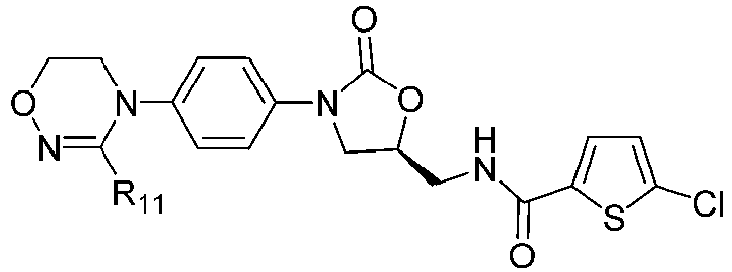

- wherein, R1 through R12 are independently H, (C1-C7) alkyl or (C3-C7) cycloalkyl; R12 is H, (C1-C7) alkyl, (C3-C7) cycloalkyl, formyl or (C1-C7) alkylcarbonyl; and m is an integer from 1 to 3.
- As an example of the oxazolidinone derivatives with cyclic amidoxime or cyclic amidrazone group of the present invention, in the above formula II to formula XI, R1 through R12 are independently H, methyl, ethyl, n-propyl, i-propyl, n-butyl, i-butyl, t-butyl, cyclopropyl, cyclobutyl, cyclopentyl or cyclohexyl; R13 is H, methyl, ethyl, n-propyl, i-propyl, n-butyl, i-butyl, t-butyl, cyclopropyl, cyclobutyl, cyclopentyl, cyclohexyl, formyl or acetyl; and m is an integer of 1.
- The oxazolidinone derivatives with cyclic amidoxime or cyclic amidrazone group of the present invention can be exemplified by the following compounds, but not always limited thereto.


- In this invention, the preparing methods for oxazolidinone derivatives with cyclic amidoxime or cyclic amidrazone group represented by formula I are exemplified by reaction Scheme 1 to reaction Scheme 5. However, the following method cannot limit the preparing method for oxazolidinone derivatives with cyclic amidoxime or cyclic amidrazone group represented by formula I of the present invention and it is well understood by those in the art that modification of the method below is allowed and also included in the criteria of the present invention. Unless stated otherwise, the substituents in the reaction Schemes are as defined in formula I.
- As shown in reaction Scheme 1 to reaction Scheme 5, the preparing method for oxazolidinone derivatives with cyclic amidoxime or cyclic amidrazone group represented by formula I is modified according to the structure of cyclic compound A in formula I. First, cyclic amidoxime compounds were synthesized as compounds B1 and B2 of reaction Scheme 1 and compound E of reaction Scheme 4. Also cyclic amidrazone compounds were synthesized as compounds C1 and C2 of reaction Scheme 1, compound D1 of reaction Scheme 2 and compound F of reaction Scheme 5.

- As shown in reaction Scheme 1, synthesis of cyclic amidoxime compounds B1 and B2 of formula I and cyclic amidrazone compounds C1 and C2 was performed by reacting 4-cyanoaniline (1) and 2-(((S)- oxirane-2-nyl)methyl)tery-butyloxycarbonyl (2) to give compound 3. Then, oxazolidinone cyclic compound 4 was synthesized by using 1,1-carbonyldiimidazole and DMAP, which was treated with HCl to eliminate boc protection group. Condensation was performed with 5-chlorothiophene-2-carboxylic acid, followed by treatment with HCl. Finally, the reactant was reacted with diamine compound to give cyclic amidoxime compounds B1 and B2 of formula I and cyclic amidrazone compounds C1 and C2.
- In synthesis of compound 3, amine compound protected by phthalimide can be produced by using 2-(((S)-oxirane-2-yl)methyl)isoindoline-1,3-dione (9) of reaction Scheme 2 instead of 2-(((S)-oxirane-2-nyl)methyl)tert-butyloxycarbonyl (2), similarly with the process of reaction Scheme 2. In reaction Scheme 1, process using 2-(((S)-oxirane-2-nyl)methyl)tert-butyloxycarbonyl (2) is described and in reaction Scheme 2, process using 2-(((S)-oxirane-2-yl)methyl)isoindoline-1,3-dione (9) is described.
- Cyclic amidrazone compounds D1 and D2 of formula I can be divided by the location of double bond and are synthesized by reaction Scheme 2 and reaction Scheme 3.

- First, 4-nitroaniline (6) was protected with boc group, followed by hydrogenation using palladium catalyst. Then, aminoalcohol compound 10 was synthesized by using 2-(((S)-oxirane-2-yl)methyl)isoindoline-1,3-dione (9). Oxazolidinone ring was made by using carbonyldiimidazole to give compound 11. Phthalimide protection group was eliminated by hydrazine, followed by condensation with 5-chlorothiophene-2-carboxylic acid to give compound 13. Compound 13 was treated with HCl to eliminate boc protection group, followed by reaction with boc protected aminal to give compound 14. Nitroso group was introduced using NaNO2, followed by reduction with Zn to give hydrazine compound 15. Compound 15 was reacted with ortho-formate to give cyclic amidrazone compound D1.
- Another cyclic amidrazone compound D2 was synthesized by reaction Scheme 3.

- From the compound 14 shown in reaction Scheme 2, compound 14a in which R7 was H was synthesized, to which amino group was introduced (15a) and then alkyl group was introduced stepwise (16). Cyclization was induced using ortho-formate to give cyclic amidrazone compound D2.
- Cyclic amidoxime compound E of formula I was synthesized by reaction Scheme 4.


- Compound 17 produced from 4-fluoronitrobenzene was reacted with methanesulfonyl chloride to give compound 18, followed by reaction with hydroxyphthalimide to give compound 19. Phthalimide protection group was eliminated by hydrazine, but boc group was used to protect instead, resulting in compound 21. Nitro group of compound 21 was reduced using Zn to give compound 22, followed by reaction with 2-(((S)-oxirane-2-yl)methyl)isoindoline-1,3-dione (9) by the process shown in reaction Scheme 2 to give compound 26. Compound 26 was treated with HCl, followed by reaction with ortho-ester to give compound E.
- Cyclic amidrazone compound F of formula I was synthesized by reaction Scheme 5.


- Compound 17 produced from 4-fluoronitrobenzene was protected with tbs (tert-butyldimethylsilyl) group and then amine region was protected with boc, resulting in compound 27. Amine was prepared by using palladium catalyst, which was reacted with Cbz-Cl to give compound 28. Compound 28 was reacted with glycidylbutylate to give compound 29. Alcohol group was replaced with amine to give compound 30. This compound was reacted with chlorothiophene carboxylic acid to give compound 31, followed by reaction with methanesulfonyl chloride. The reactant was treated with hydrazine to give compound 33. Compound 33 was reacted with ortho-ester to give compound F.
- The oxazolidinone derivatives with cyclic amidoxime or cyclic amidrazone group represented by formula I of the present invention can be used as a pharmaceutically active ingredient for the prevention and treatment of, in particular, thrombosis, myocardial infarction, arteriosclerosis, inflammatory, apoplexy, angina pectoris, recurrent stricture after angioplasty, intermittent claudication. phlebothrombosis, pulmonary embolism, arterial thrombosis, myocardial ischemia, unstable angina based on thrombosis, and thromboembolism such as crisis in a medicine
- The oxazolidinone derivatives with cyclic amidoxime or cyclic amidrazone group represented by formula I of the present invention or the pharmaceutically acceptable salts thereof can be used for the prevention or treatment of atherosclerotic disease including coronary artery disease, cerebral artery disease or peripheral artery disease. To treat myocardial infarction, the oxazolidinone derivatives with cyclic amidoxime or cyclic amidrazone group can be co-used with a thrombolytic agent (for example, alteplase, tenecteplase, etc). The said compounds can also be used for the prevention of reocclusion after thrombolysis, percutaneous transluminal coronary angioplasty (PTCA) and coronary artery bypass.
- The oxazolidinone derivatives with cyclic amidoxime or cyclic amidrazone group represented by formula of the present invention or the pharmaceutically acceptable salts thereof can be used for the prevention of post-surgery thrombus reformation. It can also be used as an anticoagulant in relation to artificial organ or hemodialysis. The said compound can be used for washing catheter and medical assist device used in vivo. In addition, it can also be used as an anticoagulant composition for ex vivo storage of blood, plasma and other types of blood products. The said compounds of the present invention are also effective in the treatment of blood coagulation related disease or disease causing secondary lesion such as cancer (including metastatic cancer), inflammatory disease including arthritis and diabetes.
- The oxazolidinone derivatives with cyclic amidoxime or cyclic amidrazone group represented by formula I of the present invention can be used in the form of pharmaceutically acceptable salts. As for the pharmaceutically acceptable salts, it is preferably an acid addition salt prepared by using a pharmaceutically acceptable free acid. Whether it is inorganic or organic, a free acid can be used if it is pharmaceutically acceptable. Examples of the inorganic free acid include hydrochloric acid, hydrobromic acid, sulfuric acid, and phosphoric acid. Available organic free acids are exemplified by citric acid, acetic acid, lactic acid, maleic acid, fumaric acid, gluconic acid, methanesulfonic acid, glycolic acid, succinic acid, 4-toluenesulfonic acid, trifluo- roacetic acid, galacturonic acid, embonic acid, glutamic acid and aspartic acid. The oxazolidinone derivatives of the present invention can contain hydrate of the salt. In particular, if the said salt has hygroscopicity, it is preferably used in the form of crystalline hydrate.
- The oxazolidinone derivatives with cyclic amidoxime or cyclic amidrazone group represented by formula I of the present invention can be formulated as a prodrug (not claimed) designed to increase in vivo absorptiveness or solubility and can be used in the form of hydrate or solvate. For example, as explained below, a group that can be easily separated after in vivo absorption is attached or the compound is prepared in the form of salt, precisely in the form of one or more hydrates or solvates. The hydrate or solvate of the salt are also included in the criteria of the present invention

- The effective dosage of the oxazolidinone derivatives represented by formula I, its hydrates, its solvates or its pharmaceutically acceptable salts can be determined by considering specific compounds used, administration method, target subject, target disease, etc, to bring treatment effect, but 0.1-20 mg/kg (body weight) per day is preferred dose of the oxazolidinone derivative compound represented by formula I. The daily dose can be administered once a day (at a time) or a few times a day as divided properly within a daily effective dose. According to formulation, oral administration, parenteral administration (injection) or local administration can be allowed. The pharmaceutical composition of the present invention can be formulated for oral administration such as tablets, powders, dry syrups, chewable tablets, granules, capsules, soft capsules, pills, drinks, sublinguals, etc. The composition of the invention formulated as tablets can be administered to a subject by any method or pathway that delivers the effective dose of the tablet with bioavailability, which can be oral pathway. Also the administration method or pathway can be determined according to the characteristics, stages of the target disease and other conditions. When the composition of the invention is formed as tablets, it can additionally include pharmaceutically acceptable excipients. The content and characteristics of the excipient can be determined by solubility and chemical properties of the selected tablet, administration pathway and standard pharmaceutical practice.
- The above and other objects, features and advantages of the present invention will become apparent from the following description of preferred embodiments given in conjunction with the accompanying drawings, in which:
-
Fig. 1 is a diagram showing the mechanism of blood coagulation. - Practical and presently preferred embodiments of the present invention are illustrative as shown in the following Examples.
-

- 4-aminobenzonitrile(l) (5 g, 42.30 mmol) and 2-(((S)-oxirane-2-nyl)methyl)tert-butyloxycarbonyl (2) (8.79 g, 50.78 mmol) were added to 2-isopropylalcohol (20 mL), followed by reflux with stirring for 12 hours. The reactant was concentrated under reduced pressure, and then proceeded to column to give the titled compound 3 as a white solid (7.30 g, 25.1 mmol, 59 %).
1H NMR (400MHz, chloroform-d,) 0= 7.41(d, y=8.4Hz, 4H), 6.59(d, y=8.4Hz, 1H), 4.95(br s, IH), 4.80(br s. 1H), 3.97-3.93(m, 1H), 3.31-3.15(m, 5H), 1.46(s,9H) - Compound 3 obtained above (7.30 g, 25.05 mmol), 1,1-carbonyldiimidazole (4.87 g, 30.06 mmol) and dimethylaminopyridine (1.53 g, 12.52 mmol) were added to tetrahydrofurane (70 mL) stepwise, followed by reflux with stirring for 12 hours. The reactant was concentrated under reduced pressure, which was then dissolved in ethyl acetate (300 mL). After washing with IN HCI solution (50 mL) and sodium bicarbonate solution (50 mL) stepwise, the reactant was dried over sodium sulfate, followed by concentration under reduced pressure. The reactant was washed with diethylether (100 mL) to give compound 4 as a white solid (6.60 g, 20.8 mmol, 83 %).
1H NMR (400MHz, chloroform-d,) 0= 7.67(s, 4H), 4.95(br s, 1H), 4.82-4.79(m, IH), 4.07(dd, y =8.8, 8.8Hz, IH),3.94(dd, J=8.8,6.8Hz, IH), 3.56-3.54(m, 2H), L38(s, 9H) - The compound 4 obtained above (6 g, 18.90 mmol) was added to ethyl acetate (IOmL), which was added to 4N-HCl dissolved in 1,4-dioxane (60 mL), followed by stirring at room temperature for one hour. The generated solid was filtered under reduced pressure and then washed with ethyl acetate (20 mL) and diethylether (30 mL) stepwise. As a result, hydrochloride of amine compound excluding boc was obtained as a white solid (4.60 g, 18.1 mmol, 95.9 %).
1H NMR (400MHz, chloroform-d1) δ= 8.36(br s, 3H), 7.90(d, J =8.8Hz, 2H), 7.73(d, J =8.8Hz, 2H), 5.03-4.96(m, H), 4.25(dd, J =9.2, 9.2Hz, 1H), 3.92(dd, J =9.2, 6.4Hz, 1H), 3.28-3.25(m, 2H) - The amine compound (4.60 g, 18.13 mmol), HOBt (2.75 g, 19.94 mmol), EDC (4.17 g, 21.75mmol), 5-chlorothiophene-2-carboxylic acid (3.20 g, 19.04 mmol), and triethylamine (5.70 mL, 39.88 mmol) were added to N,N-dimethylformamide (50 mL) stepwise, followed by stirring at room temperature for 12 hours. The reactant was slowly added to distilled water (800 mL) and the generated solid was filtered under reduced pressure. The reactant was washed with diethylether (100 mL) to give compound 5 as a white solid (5.70 g, 15.8 mmol, 87 %).
1H NMR (400MHz, DMSO-d6) δ= 8.93(t, J =5.2Hz, 1H), 7.81(d, J =9.2Hz, 2H), 7.69(d, J =9.2Hz, 2H), 7.63(d, J =40Hz, 1H), 7.15(d, J =4.0Hz, 1H), 4.86-4.81(m, 1H), 4.17(dd, J =9.2, 9.2Hz, 1H), 3.83(dd, J =9.2, 5.2Hz, 1H), 3.57(dd, J =5.2, 5.2Hz, 2H); LCMS: 362(M+H+) to C16H12ClN3O3S -

- 4-nitroaniline (20 g, 145 mmol) was dissolved in acetonitrile (200 mL), to which di t-butyl dicarbonate (63.2 g, 290 mmol) and 4-dimethylaminopyridine (3.54 g, 29 mmol) were added, followed by reflux with stirring for 16 hours. The reaction solution was cooled down at room temperature, followed by concentration under reduced pressure to give brown solid compound having two boc groups (49 g, 145 mmol, 100 %).
1H NMR (600 MHz, CDCl3) δ= 8.25 (d, J = 9 Hz, 2H), 7.36 (d, J = 9 Hz, 2H), 1.45 (s, 18H) - The obtained compound (49 g, 145 mmol) was dissolved in methanol (200 mL), to which potassium carbonate (60 g, 434 mmol) was added, followed by reflux with stirring for 16 hours. The reaction solution was cooled down at room temperature, followed by concentration under reduced pressure. Column chromatography (n-hexane/ethyl acetate, 6/1) with the reaction solution was performed to give the title compound 7 as a light yellow solid (17.6 g, 73.9 mmol, 51 %).
1H NMR (600 MHz, CDCl3) δ= 8.18 (d, J = 9 Hz, 2H), 7.53 (d, J = 9 Hz, 2H), 6.93 (br s, 1H), 1.54 (s, 9H) - Compound 7 (17.6 g, 73.9 mmol) was dissolved in ethyl acetate (200 mL), to which palladium/charcoal (10 wt%, 3.9 g) was added, followed by stirring in hydrogen balloon. 16 hours later, the reaction solution was filtered through sellaite, followed by concentration under reduced pressure to give the title compound 8 as a light pink solid (15.4 g, 73.9 mmol, 100 %).
1H NMR (600 MHz, CDCl3) δ= 7.12 (br s, 2H), 6.62 (d, J = 9 Hz, 2H), 6.31 (br s, 1H), 3.53 (br s, 2H), 1.50 (s, 9H) - Compound 8 (13.5 g, 65.1 mmol) was dissolved in 2-propanol (170 mL), to which (S)-glycidyl phthalimide (9) (14.6 g, 71.9 mmol) was added, followed by reaction for 12 hours. Then, (S)-glycidyl phthalimide (9) (2.65 g, 13.0 mmol) was additionally added, followed by reflux with stirring for 4 hours. The reaction solution was cooled down at room temperature and then concentrated under reduced pressure. Re-crystallization was performed with n-hexane (500 mL) to give the title compound 10 as a yellow solid (26.8 g, 65.1 mmol, 100 %).
1H NMR (600 MHz, CDCl3) δ= 7.89-7.84 (m, 2H), 7.78-7.73 (m, 2H), 7.15 (br, 2H), 6.63 (d, J = 8 Hz, 2H), 6.26 (br, 1H), 4.18-4.12 (m, 1H), 4.05 (br, 1H), 3.94-3.86 (m, 2H), 3.25 (dd, J = 13, 4.5 Hz, 1H), 3.15 (dd, J = 13, 6.6 Hz, 1H), 2.84 (d, J = 4.8 Hz, 1H), 1.50 (s, 9H) - Compound 10 (26.8 g, 65.1 mmol) was dissolved in tetrahydrofurane (200 mL), to which 1,1-carbonyldiimidazole (15.9 g, 98.1 mmol) and 4-dimethylaminopyridine (1.59 g, 13.0 mmol) were added, followed by reflux with stirring for 16 hours. The reaction solution was cooled down and concentrated under reduced pressure. Saturated ammonium chloride solution (200 mL) was added thereto, followed by extraction with ethyl acetate (250 mL x 2). The collected organic layer was dried over anhydrous sodium sulfate, filtered, concentrated under reduced pressure and then proceeded to column chromatography (n-hexane/ethyl acetate/dichloromethane, 1/1/1) to give the titled compound 11 as a light yellow solid (20.0 g, 45.7 mmol, 70 %).
1H NMR (600 MHz, CDCl3) δ= 7.91-7.87 (m, 2H), 7.79-7.74 (m, 2H), 7.43 (d, J = 9 Hz, 2H), 7.36 (d, J = 9 Hz, 2H), 6.48 (br s, 1H), 5.00-4.95 (m, 1H), 4.15 (dd, J = 14, 7 Hz, 1H), 4.11 (t, J = 9 Hz, 1H), 3.97 (dd, J = 14, 6 Hz, 1H), 3.89 (dd, J = 9, 6 Hz, 1H), 1.52 (s, 9H) - Compound 11 (15.3 g, 35.0 mmol) was dissolved in ethanol (200 mL), to which hydrazine hydrate (3.40 mL, 70.0 mmol) was added, followed by reflux with stirring for 3 hours. The reaction solution was cooled down at room temperature. The generated white solid was filtered out and the filtrate was concentrated under reduced pressure. Dichloromethane (100 mL) was added thereto and then the generated solid was eliminated by filtration. The filtrate was concentrated under reduced pressure. This process was repeated twice more and then the reactant was dried to give the title compound 12 as a white solid (10.0 g, 32.5 mmol, 93 %).
1H NMR (600 MHz, CDCl3) δ= 7.45 (d, J = 9 Hz, 2H), 7.37 (d, J = 9 Hz, 2H), 6.65 (br s, 1H), 4.67-4.63 (m, 1H), 4.03 (t, J = 9 Hz, 1H), 3.82 (dd, J = 9, 7 Hz, 1H), 3.09 (dd, J = 14, 4 Hz, 1H), 2.98 (dd, J = 14, 6 Hz, 1H), 1.52 (s, 9H) - Compound 12 (3.63 g, 11.8 mmol) was dissolved in chloroform (50 mL), to which 5-chlorothiophenecarboxylic acid (2.30 g, 14.1 mmol) and 4-dimethylaminopyridine (0.30 g, 13.0 mmol) were added. Temperature was lowered to 0°C. N,N'- diisopropylcarbodiimide (2.20 mL, 14.1 mmol) was added thereto, followed by stirring at room temperature for 2 hours. The reaction solution was concentrated under reduced pressure, followed by re-crystallization in n-hexane/diethylether solution (1/1, 200 mL) to give the titled compound 13 as a white solid (5.0 g, 11.1 mmol, 94 %).
1H NMR (400 MHz, DMSO-d6) δ= 9.30 (s, 1H), 8.95 (t, J = 6 Hz, 1H), 7.67 (d, J = 4 Hz, 1H), 7.45-7.36 (m, 4H), 7.17 (d, J = 4 Hz, 1H), 4.82-4.74 (m, 1H), 4.11 (t, J = 9 Hz, 1H), 3.77 (dd, J = 9, 6 Hz, 1H), 3.57 (t, J = 5.6 Hz, 2H), 1.45 (s, 9H) -

- Compound 13 (16.5 g, 36.5 mmol) was dissolved in dichloromethane (150 mL), to which HCl (150 mL, 4 M 1,4-dioxane solution) was added, followed by stirring at room temperature for 1 hour. The reaction solution was concentrated under reduced pressure and dried to give white solid compound (14.1 g, 36.3 mmol, 99 %).
1H NMR (600 MHz, DMSO-d6) δ= 9.07 (t, J = 6 Hz, 1H), 7.73 (d, J = 3.6 Hz, 1H), 7.63 (d, J = 9 Hz, 2H), 7.37 (d, J = 9 Hz, 2H), 7.20 (d, J = 3.6 Hz, 1H), 4.88-4.83 (m, 1H), 4.18 (t, J = 9 Hz, 1H), 3.87 (dd, J = 9, 6 Hz, 1H), 3.61 (t, J = 5.4 Hz, 2H) - Methanol (40 mL) and N,N-dimethylformamide (15 mL) were added to the compound obtained above (3.0 g, 7.73 mmol), to which N-Boc-2-aminoacetaldehyde (1.48 g, 9.30 mmol) and sodium cyanoborohydride (486 mg, 7.73 mmol) were added, followed by stirring at room temperature for 16 hours. Saturated ammonium chloride solution (20 mL) was added thereto, and then the solvent was concentrated under reduced pressure. Saturated ammonium chloride solution (50 mL) was added thereto again, followed by extraction with ethyl acetate (250 mL x 2). The collected organic layer was dried over anhydrous sodium sulfate, filtered, concentrated under reduced pressure and then proceeded to column chromatography (n-hexane/ethyl acetate, 1/2 → 1/4) to give the titled compound 14a as a white solid (2.76 g, 5.58 mmol, 72 %).
1H NMR (400 MHz, CDCl3) δ= 7.30 (d, J = 4 Hz, 1H), 7.18 (d, J = 9 Hz, 2H), 7.00 (t, J = 6 Hz, 1H), 6.80 (d, J = 4 Hz, 1H), 6.53 (d, J = 9 Hz, 2H), 4.84-4.74 (m, 2H), 4.04 (br, 1H), 3.98 (t, J = 9 Hz, 1H), 3.81 (ddd, J = 14.4, 6, 3 Hz, 1H), 3.74 (dd, J = 9, 6 Hz, 1H), 3.66 (dt, J = 14.8, 9 Hz, 1H), 3.36-3.26 (m, 2H), 3.18 (t, J = 6 Hz, 2H), 1.41 (s, 9H) - Compound 14a (1.0 g, 2.0 mmol) was dissolved in acetic acid (10 mL), to which sodium nitrate (NaNO2) (170 mg, 2.46 mmol) dissolved in distilled water (2 mL) was slowly loaded at 0°C, followed by stirring for 30 minutes. Then, zinc amalgam (650 mg of zinc was washed with 0.5% mercury (II) acetate solution and then washed with distilled water, which was used rightly) was loaded thereto, followed by stirring at 0°C for 5 hours. Saturated sodium carbonate solution (50 mL) was slowly added thereto, followed by extraction with ethyl acetate (250 mL x 2). The collected organic layer was dried over anhydrous sodium sulfate, filtered, concentrated under reduced pressure and then proceeded to column chromatography (n-hexane/ethyl acetate, 1/2 → 1/4) to give the titled compound 15a as a light yellow solid (450 mg, 0.88 mmol, 45 %).
1H NMR (600 MHz, CDCl3) δ= 7.34 (d, J = 3.6 Hz, 1H), 7.32 (d, J = 8.4 Hz, 2H), 6.96 (d, J = 8.4 Hz, 2H), 6.90 (br, 1H), 6.87 (d, J = 3.6 Hz, 1H), 4.94 (br s, 1H), 4.87-4.81 (m, 1H), 4.05 (t, J = 9 Hz, 1H), 3.90-3.83 (m, 1H), 3.80 (dd, J = 9, 6 Hz, 1H), 3.75-3.67 (m, 1H), 3.68 (br s, 2H), 3.44 (br, 4H), 1.41 (s, 9H) - Compound 15a (150 mg, 0.29 mmol) was dissolved in methanol (3 mL), to which formalin (0.10 mL, 37 wt% aqueous solution) was added, followed by stirring at room temperature for 1 hour. The reaction solution was concentrated under reduced pressure and diluted with distilled water (15 mL), followed by extraction with dichloromethane (15 mL x 2). The collected organic layer was dried over anhydrous sodium sulfate, filtered, and concentrated under reduced pressure to give 110 mg of light yellow solid. This solid was dissolved in methanol (3 mL) and tetrahydrofurane (1 mL), and then temperature was lowered to 0°C. Sodium borohydride (160 mg, 4.22 mmol) was added thereto. pH was regulated as 5 using acetic acid and reaction temperature was slowly raised to 50°C. 10 hours later, the reaction solution was concentrated under reduced pressure and diluted with 2N HCl solution (30 mL), followed by extraction with dichloromethane (25 mL x 2). The collected organic layer was dried over anhydrous sodium sulfate, filtered, concentrated under reduced pressure and then proceeded to column chromatography (n-hexane/ethyl acetate, 1/1 → 1/3) to give the titled compound 16a as a white solid (15 mg, 0.029 mmol).
-

- As explained in the synthesis of compound 14a in Manufacturing Example 3, compound 13 was dissolved in dichloromethane, to which HCl (4 M 1,4-dioxane solution) was added, followed by stirring at room temperature for 1 hour. The reaction solution was concentrated under reduced pressure and dried to give white solid compound (500 mg, 1.29 mmol). Methanol (10 mL) and N,N-dimethylformamide (2 mL) were added thereto, to which N-Boc-N-methyl-2-aminoacetaldehyde (268 mg, 1.55 mmol) and sodium cyanoborohydride (81 mg, 1.29 mmol) were added, followed by stirring at room temperature for 16 hours. Saturated ammonium chloride solution (3 mL) was added thereto, and then the solvent was concentrated under reduced pressure. Saturated ammonium chloride solution (30 mL) was added thereto again, followed by extraction with ethyl acetate (30 mL x 2). The collected organic layer was dried over anhydrous sodium sulfate, filtered, concentrated under reduced pressure and then proceeded to column chromatography (n-hexane/ethyl acetate, 1/2 → 1/4) to give the titled compound 14b as a white solid (544 mg, 1.07 mmol, 83 %).
1H NMR (600 MHz, CDCl3) δ= 7.31 (d, J = 4 Hz, 1H), 7.24 (d, J = 9 Hz, 2H), 6.89 (d, J = 4 Hz, 2H), 6.65 (br, 1H), 6.59 (d, J = 9 Hz, 1H), 4.85-4.79 (m, 1H), 4.04 (t, J = 9 Hz, 1H), 3.90 (ddd, J = 16.6, 7, 3 Hz, 1H), 3.79 (dd, J = 9, 6 Hz, 1H), 3.74-3.67 (m, 1H), 3.54-3.39 (m, 2H), 3.26 (t, J= 6 Hz, 2H), 2.88 (s, 3H), 1.46 (s, 9H) - Compound 14b (405 mg, 0.80 mmol) was dissolved in acetic acid (3 mL), to which sodium nitrate (NaNO2) (66 mg, 0.96 mmol) dissolved in distilled water (0.5 mL) was slowly loaded at 0°C, followed by stirring for 30 minutes. Then, zinc (130 mg, 1.99 mmol) was loaded thereto, followed by stirring at 0°C for 3 hours. Saturated sodium carbonate solution (30 mL) was slowly added thereto, followed by extraction with ethyl acetate (30 mL x 2). The collected organic layer was dried over anhydrous sodium sulfate, filtered, concentrated under reduced pressure and then proceeded to column chromatography (n-hexane/ethyl acetate, 1/2 → 1/4) to give the titled compound 15b as a light brown solid (81 mg, 0.15 mmol, 19 %).
-

- 4-fluoronitrobenzene (5.2 g, 37 mmol) was dissolved in acetonitrile (40mL), to which 2-aminoethanol (5.2 g, 85 mmol) was added, followed by reflux with stirring for overnight. The reaction solution was cooled down at room temperature, concentrated under reduced pressure, dissolved in ethyl acetate, washed with water, 1N HCl and salt water stepwise. The reactant was dried over anhydrous sodium sulfate, filtered and distillated under reduced pressure to give compound 17. Compound 17 (15 g, 82.33 mmol) and diisopropylethylamine (27 mL, 164 mmol) were dissolved in dichloromethane (150 mL), to which methanesulfonylchloride (9.5 mL) was slowly loaded at 0°C, followed by stirring at room temperature for 2 hours. Upon completion of the reaction, dichloromethane (800 mL) was added to the reaction solution. The reactant was washed with sodium bicarbonate solution (500 mL) and concentrated under reduced pressure to give yellow solid compound 18 (22 g, 82.00 mmol, 99%).
1H NMR (400MHz, chloroform-d1) δ 8.12(d, J = 9.2Hz, 2H), 6.60(d, J = 9.2Hz, 2H), 4.45(t, J = 5.6Hz, 2H), 3.63(t, J = 5.6Hz, 2H), 3.06(s, 3H); LCMS: 183(M+H+) to C8H 10N2O3S - Compound 18 (22 g, 82.00 mmol), hydroxyphthalimide (17.4 g, 107.04 mmol) and triethylamine (17.3 mL, 123.5 mmol) were added to acetonitrile (300 mL), followed by reflux with stirring for 6 hours. Upon completion of the reaction, dichloromethane (1000 mL) was added to the reaction solution. The reactant was washed with 0.5N-HCl solution (500 mL) and saturated sodium bicarbonate solution (500 mL), and concentrated under reduced pressure to give yellow solid compound 19 (26 g, 79.44 mmol, 97%).
1H NMR (400MHz, chloroform-d1) δ 8.12(d, J = 9.2Hz, 2H), 7.88(m, 2H), 7.87(m, 2H), 6.65(d, J = 9.2Hz, 2H), 5.83(br s, 1H), 4.45(t, J = 4.8Hz, 2H), 3.56(m, 2H); LCMS: 328(M+H+) to C16H13N3O5 - Compound 19 (79.44 mmol) and hydrazine (20 mL) were added to ethanol, followed by reflux with stirring for 2 hours. The reactant was cooled down at room temperature, filtered, and concentrated under reduced pressure to give compound 20 (19 g, crude). This compound was not purified and used for the next reaction.
1H NMR (400MHz, DMSO-d6) δ 7.94(d, J = 9.6Hz, 2H), 7.34(t, J=5.6Hz, 1H), 6.69(d, J=9.5Hz, 2H), 3.68(t, J = 5.2Hz, 2H), 3.37(m, 2H); LCMS: 198(M+H+) to C8H 11N3O3 - Compound 20 (19 g) and sodium carbonate (21 g, 198 mmol) were dissolvedin dioxane (200 mL) and distilled water (200 mL), to which ditertbutoxycarbonyl (26 g, 119 mmol) was slowly added, followed by stirring at room temperature for 4 hours. Upon completion of the reaction, the reactant was filtered under reduced pressure, washed with distilled water (1000 mL) and dried to give yellow solid compound 21 (26 g, crude).
1H NMR (400MHz, chloroform-d1) δ 8.10(d, J = 9.2Hz, 2H), 6.54(d, J=9.2Hz, 2H), 5.50(s, 1H), 5.04(s, 1H), 3.91(t, J=5.2Hz, 2H), 3.45(m, 2H), 1.43(s, 9H); LCMS: 298(M+H+) to C13H19N3O5 - Compound 21 (13 g, 40 mmol), acetic acid (132 mL) and concentrated HCl (10 mL, 300 mmol) were dissolved in tetrahydrofurane (200 mL), to which zinc (26g, 400mmol) was added at 0°C, followed by stirring for 2 hours. 20% ammonia solution (200 mL) was slowly added at 0°C and then dimethylenechloride (500 mL) was added thereto. Organic layer was separated, followed by concentration under reduced pressure to give white solid compound 22 (6.5 g, 24.31 mmol, 61%).
1H NMR (400MHz, chloroform-d1) δ 7.17(s, 1H), 6.60(d, J=8.4Hz, 2H), 6.60(d, J =8.4Hz, 2H), 4.03(t, J=4.8Hz, 2H), 3.30(t, J=4.8Hz, 2H), 1.47(s, 9H); LCMS: 268(M+H+) to C13H21N3O3 - Compound 22 (6.5 g, 24.31 mmol) and (S)-glycidylphthalimide (3.95 g, 19.45 mmol) were added to isopropyl alcohol (100 mL), followed by reflux with stirring for 6 hours. Upon completion of the reaction, the reactant was concentrated under reduced pressure, followed by column chromatography to give white solid compound 23 (9 g, crude).
1H NMR (400MHz, chloroform-d1) δ 7.85(m, 2H), 7.79(m, 2H), 6.33(d, J = 9.2Hz, 2H), 6.21(d, J=9.2Hz, 2H), 4.07(m, 3H), 3.58-3.31(m, 6H), 1.46(s, 9H); LCMS: 471(M+H+) to C24H30N4O6 - Compound 23 (9 g, crude) and carbodiimidazole (3.5 g, 29.16 mmol) were added to tetrahydrofurane (150 mL), followed by stirring for 12 hours. Upon completion of the reaction, the reactant was concentrated under reduced pressure, followed by column chromatography to give white solid compound 24 (1.6 g, 3.22 mmol).
1H NMR (400MHz, chloroform-d1) δ 7.88(m, 2H), 7.75(m, 2H), 7.28(d, J = 8.8Hz, 2H), 6.55(d, J=8.8Hz, 2H), 4.95(m, 1H), 4.17-3.82(m, 6H), 3.37(t, J=5.2Hz, 2H), 1.46(s, 9H); LCMS: 497(M+H+) to C25H28N4O7 - Compound 24 (1.6 g, 3.22 mmol) and hydrazine (1.6 mL, 32.20 mmol) were added to ethyl alcohol (30 mL), followed by reflux with stirring for 2 hours. The reactant was cool down at room temperature, filtered and concentrated under reduced pressure to give compound 25 (1.3 g, crude). This compound was not purified and used for the next reaction.
1H NMR (400MHz, chloroform-d1) δ 7.33(d, J = 9.2Hz, 2H), 6.66(d, J=9.2Hz, 2H), 4.63(m, 1H), 4.03(m, 3H), 3.77(dd, J=6.4 2.0Hz, 1H), 3.34(t, J=5.2Hz, 2H), 3.03(m, 2H), 1.49(s, 9H); LCMS: 367(M+H+) to C17H26N4O5 - Compound 25 (1.3 g, 3.22 mmol), 5-chlorothiophene-2-carboxylic acid (0.68 g, 4.19 mmol) and PyBOP [(Benzotriazol-1-yloxy)tripyrrolidinophosphonium hexafluorophosphate] (2.5 g, 4.83 mmol) were added to N,N-dimethylformamide (20 mL), to which diisopropylethylamine (1.06 mL, 6.44 mmol) was slowly added at 0°C, followed by stirring for 1 hour. Upon completion of the reaction, ethylacetate (300 mL) was added to the reaction solution. The reactant was washed with distilled water (200 mL) twice, and concentrated under reduced pressure to give white solid compound 26 (1.6 g, 3.13 mmol).
1H NMR (400MHz, DMSO-d6) δ 10.05(s, 1H), 8.97(t, J=5.6Hz, 1H), 7.70(d, J =4.0Hz, 1H), 7.20(m, 3H), 6.60(d, J=8.4Hz, 2H), 4.76(m, 1H), 4.07(t, J=8.8Hz, 1H), 3.83(t, J=5.6Hz, 2H), 3.74(m, 1H), 3.57(t, J=5.2Hz, 2H), 3.21(t, J=5.6Hz, 2H), 1.40(s, 9H); LCMS: 511(M+H+) to C22H27ClN4O6S -

- Compound 5 (5.0 g, 13.8 mmol) obtained in Manufacturing Example 1 was added to anhydrous methanol (200 mL), followed by bubbling HCl gas at 0°C for 30 minutes. Methanol (100 mL) was added thereto, followed by bubbling HCl gas again for 30 more minutes, followed by stirring at room temperature for 2 hours. The reactant was concentrated under reduced pressure to eliminate remaining HCl. Acetic acid (120 mL) and 2-(N-methylamino)ethyl-hydroxylamine hydrochloride (3.5 g, 27.6 mmol) were added thereto, followed by reflux for overnight. The reaction solution was concentrated under reduced pressure, dissolved in ethyl acetate, and washed with saturated NaHCO3 solution, followed by separation using column chromatography to give the titled compound 100 as a white solid (1.85 g, 4.3 mmol, 31 %).
1H NMR (400MHz, CDCl3) δ 7.54 (d, J = 9.0Hz, 2H), 7.44 (d, J = 9.0Hz, 2H), 7.34 (d, J = 4.2Hz, 1H), 6.89 (br t, 1H), 4.80 (m, 1H), 4.12 (t, J =4.8Hz, 2H), 4.04 (t, J = 9.0Hz, 1H), 3.85-3.80 (m, 2H), 3.69-3.64 (m, 1H), 3.45 (t, J=4.8Hz, 2H), 2.76 (s, 3H); LCMS: 435(M+H+) to C19H19ClN4O4S -

- Compound 101 was prepared as a white solid (17 mg, 0.04 mmol, 14%) by the same manner as described in Example 1 by using compound 5 (0.1 g, 0.27 mmol) obtained in Manufacturing Example 1 and (aminoethyl)hydroxylamine (62 mg, 0.8 mmol).
1H NMR (400MHz, DMSO-d6) δ 8.98(t, J = 6.0Hz, 1H), 7.68(d, J = 4.0Hz, 1H), 7.63(d, J = 8.8Hz, 2H), 7.57(d, J = 8.8Hz, 2H), 7.19(d, J = 4.0Hz, 1H), 7.07(s, 1H), 4.85(m, 1H), 4.19(t, J =8.8Hz, 1H), 3.86-3.81(m, 3H), 3.61(t, J = 5.2Hz, 2H), 3.38(m, 2H); LCMS: 421(M+H+) to C18H17ClN4O4S -

- Compound 102 was prepared as a white solid (30 mg, 48%) by the same manner as described in Example 1 by using compound 5 (100 mg, 0.27 mmol) obtained in Manufacturing Example 1 and O-[2-(2-ethylamino)-ethyl]-hydroxylamine (15 mg, 0.139 mmol).
1H NMR (400MHz, CDCl3) δ 7.52(d, J =8.4Hz, 2H), 7.42(d, J =8.4Hz, 2H), 7.37(d, J =3.6Hz, 1H), 7.28-7.22(m, 1H), 6.85(d, J =3.6Hz, 1H), 4.82-4.71(m, 1H), 4.11(t, J =4.4Hz, 2H), 3.98(t, J =8.8Hz, 1H), 3.83-3.72(m, 2H), 3.66-3.56(m, 1H), 3.43(t, J =4.4Hz, 2H), 3.01(q, J =7.2Hz, 2H), 1.03(t, J =4.4Hz, 3H); LCMS: 449(M+H+) to C20 H21ClN4O4S -

- Compound 103 was prepared as a white solid (31 mg, 29%) by the same manner as described in Example 1 by using compound 5 (100 mg, 0.27 mmol) obtained in Manufacturing Example 1 and O-[2-(2-cyclopropylamino)-ethyl]-hydroxylamine (27 mg, 0.23 mmol).
1H NMR (400MHz, CDCl3) δ 7.52(d, J =7.6Hz, 2H), 7.46(d, J =7.6Hz, 2H), 7.38(d, J=3.6Hz, 1H), 7.23-7.18(m, 1H), 6.87(d, J=3.6Hz, 1H), 4.85-4.72(m, 1H), 4.06(t, J =4.4Hz, 2H), 4.02(t, J=8.4Hz, 1H), 3.85-3.74(m, 2H), 3.68-3.55(m, 1H), 3.53(t, J =4.4Hz, 2H), 2.62-2.51(m, 1H), 0.51-0.32(m, 4H); LCMS: 461(M+H+) to C21H21ClN4 O4S -

- Compound 104 was prepared as a white solid (63.7 mg, 0.146 mmol, 58%) by the same manner as described in Example 1 by using compound 5 (100 mg, 0.27 mmol) obtained in Manufacturing Example 1 and N-methyl-O-(2-aminoethyl)hydroxylamine dihydrochloride (180.0 mg, 1.104 mmol).
1H NMR (400MHz, DMSO-d6) δ 9.07 (t, J = 6.4 Hz, 1H), 7.70 (d, J = 4.4 Hz, 1H), 7.54 (m, 4H), 7.14 (d, J = 4.4 Hz, 1H), 4.80 (m, 1H), 4.15 (t, J = 8.8 Hz, 1H), 3.86 (dd, J = 8.8 Hz, 8.8 Hz, 1H), 3.81 (t, J = 4.8 Hz, 2H), 3.55-3.48 (m, 4H), 2.82 (s, 3H); LCMS: 435 (M+H+) to C19H19ClN4O4S -

- Compound 105 was prepared as a light yellow solid (9.1 mg, 0.020 mmol, 9%) by the same manner as described in Example 1 by using compound 5 (80.0 g, 0.221 mmol) obtained in Manufacturing Example 1 and N-ethyl-O-(2-aminoethyl)hydroxylamine dihydrochloride (300.0 mg, 1.69 mmol).
1H NMR (600MHz, DMSO-d6) δ 9.37 (br, 1H), 7.88 (m, 1H), 7.79 (d, J = 6.0 Hz, 2H), 7.73 (d, J = 5.6 Hz, 2H), 7.20 (d, J = 4.2 Hz, 1H), 4.91 (m, 1H), 4.24 (t, J = 8.7 Hz, 1H), 4.05 (dd, J = 8.7 Hz, 8.7 Hz, 1H), 3.66 (t, J = 4.8 Hz, 2H), 3.63-3.54 (m, 4H), 2.81 (q, J = 7.2 Hz, 2H), 1.24 (t, J = 7.2 Hz, 3H); LCMS: 449 (M+H+) to C20H21ClN4O4 S -

- Compound 106 was prepared as a white solid (20 mg, 0.04 mmol, 16%) by the same manner as described in Example 1 by using compound 5 (100 mg, 0.27 mmol) obtained in Manufacturing Example 1 and 2-(1-methylhydrazinyl)-N-ethylethaneamine (93 mg, 0.8 mmol).
1H NMR (600MHz, DMSO-d6) δ 8.99(t, J = 5.4Hz, 1H), 7.69(d, J =3.6Hz, 1H), 7.53(d, J = 8.4Hz, 2H), 7.36(t, J = 8.4Hz, 2H), 7.19(d, J =3.6Hz, 1H), 4.84(m, 1H), 4.19(t, J =9.6Hz, 1H), 3.86(dd, J =8.4 6.6Hz, 1H), 3.61(t, J =5.4Hz, 2H), 3.31 (m, 2H), 2.92(m, 2H), 2.80(br s, 2H), 2.59(s, 3H), 0.94(t, J = 7.2Hz, 1H) (2 equivalent acetic acid by NMR); LCMS: 462(M+H+) to C21H24ClN5O3S -

- NaH (3.3 g, 87.01 mmol) was added to N,N-dimethylformanide (30 mL), followed by stirring for 15 minutes. Tertbutylchabazite (5 g, 37.83 mmol) was dissolved in N,N-dimethylformamide (10 mL), which was slowly added thereto at 0°C. Dibromopropane (7.6 g, 37.83 mmol) was also added thereto at 0°C, followed by stirring at room temperature for 3 hours. The reactant was cooled down at 0°C and washed with distilled water (50 mL). Upon completion of the reaction, the reactant was dissolved in ethyl acetate (500 mL), followed by washing with sodium bicarbonate solution (50 mL) three times. Column chromatography was performed to give oil type compound 107a (2.4 g, 13.93 mmol, 36.7%).
1H NMR (400MHz, chloroform-d1) δ 3.85(s, 1H), 3.45(t, J =7.2Hz, 2H), 3.04(t, J =6.4Hz, 2H), 2.03(m, 2H), 1.49(s, 9H); LCMS: 173(M+H+) to C8H16N2O2 - Compound 107a (1.5 g, 8.71 mmol), N-2-bromophthalimide (2.33 g, 8.71 mmol) and potassium carbonate (1.32 g, 9.58 mmol) were added to N,N-dimethylformamide (10 mL), followed by stirring at 100°C for 12 hours. The reactant was dissolved in ethyl acetate (200 mL), followed by washing with sodium bicarbonate solution (30 mL) three times. Column chromatography was performed to give oil type compound 107b (1.7g, 4.92mmol, 56.2%).
1H NMR (400MHz, chloroform-d1) δ 7.89(m, 2H), 7.74(m, 2H), 3.94(t J = 4.4Hz, 2H), 3.90(t, J =5.2Hz, 2H), 3.11(t, J =6.0Hz, 2H), 3.06(t, J =4.4Hz, 2H), 2.01 (m, 2H), 1.48(s, 9H); LCMS: 346(M+H+) to C18H23N3O4 - Compound 107b (0.5 g, 1.45 mmol) was added to 4M-HCl (in dioxane) (5 mL), followed by stirring for 0.5 hour. The reaction mixture was concentrated under reduced pressure, to which methyl alcohol (5 mL) and methyl amine (4 mL) were added, followed by reflux with stirring for 1 hour. The reactant was concentrated under reduced pressure to give compound 107c, which was not purified any more and used for the next reaction.
LCMS: 116(M+H+) to C5H13N3 - Compound 5 (100 mg, 0.27 mmol) obtained in Manufacturing Example 1 was added to anhydrous methyl alcohol (10 mL), followed by bubbling HCl gas at 0°C for 30 minutes and stirring at room temperature for 2 hours. The reactant was concentrated under reduced pressure to eliminate remaining HCl. Anhydrous methyl alcohol (10 mL) and compound 107c (300 mg, 0.8 mmol) were added thereto stepwise, followed by stirring at room temperature for 12 hours and concentration under reduced pressure. Then, prep TLC was performed to give the title compound 107 as a white solid (60 mg, 0.13 mmol, 48%).
1H NMR (400MHz, DMSO-d6) δ 9.12(t J = 5.6Hz, 1H), 7.77-7.64(m, 5H), 7.14(d, J =4.4Hz, 1H), 4.84(m, 1H), 4.18(t, J =8.8Hz, 1H), 3.90(dd J =8.8, 6.0Hz, 1H), 3.70(t, J =6.8Hz, 1H), 3.65(t, J = 6.8Hz, 1H), 3.59-3.52(m, 3H), 3.25(m, 1H), 3.11(m, 1H), 2.95(m, 1H), 2.65(m, 1H), 2.55(m, 1H), 2.08(m, 2H); LCMS: 460(M+H+) to C21H22 ClN5O3S -

- Tertbutylchabazite (t-butyl carbazate) (2.5 g, 18.91 mmol), N-(bromoethyl)phthalimide (5.25 g, 20.80 mmol) and potassium carbonate (3.14 g, 22.70 mmol) were added to N,N-dimethylformamide (30 mL), followed by stirring at 90°C for 12 hours. Upon completion of the reaction, the reactant was dissolved in ethyl acetate (250 mL), followed by washing with sodium bicarbonate solution (150 mL) three times. After concentration under reduced pressure, column chromatography was performed to give white solid compound 108a (1 g, 3.2 mmol, 19%).
1H NMR (400MHz, chloroform-d1) δ 7.85(m, 2H), 7.73(m, 2H), 6.49(s, 1H), 4.12(s, 1H), 3.83(t, J = 3.6Hz, 2H), 3.05(m, 2H), 1.46(s, 9H); LCMS: 306(M+H+) to C15H19N3 O4 - Compound 108a (0.9 g, 2.95 mmol) and potassium carbonate (1.03 g, 7.4 mmol) were dissolved in N,N-dimethylformamide (10 mL), to which 3-bromopropanoyl chloride (0.7 g, 3.6 mmol) was added, followed by stirring at 90°C for 5 hours. Ethyl acetate (100 mL) was added thereto, followed by washing with sodium bicarbonate solution (30 mL). After concentration under reduced pressure, column chromatography was performed to give oil type compound 108b (230 mg, 0.64 mmol, 22%).
1H NMR (400MHz, chloroform-d1) δ 7.85(m, 2H), 7.73(m, 2H), 6.49(s, 1H), 4.12(s, 1H), 3.83(t, J = 3.6Hz, 2H), 3.05(m, 2H), 1.46(s, 9H); LCMS: 360(M+H+) to C18H21N3 O5 - Compound 108b (230 mg, 0.64 mmol) was added to 4M-HCl (in dioxane) (2mL), followed by stirring for 1 hour. The reactant was concentrated under reduced pressure, to which methyl alcohol (5 mL) and methyl amine (2 mL) were added, followed by stirring for 1 hour. The reactant was concentrated under reduced pressure to give compound 108c (103 mg, 0.64 mmol), which was not purified any more and used for the next reaction.
LCMS: 130(M+H+) to C5H11N3O - Compound 108 was prepared as a white solid (26 mg, 0.05 mmol, 19%) by the same manner as described in Example 1 by using compound 5 (0.1 g, 0.27 mmol) obtained in Manufacturing Example 1 and compound 108c (103 mg, 0.64 mmol).
1H NMR (600MHz, DMSO-d6) δ 9.09(t, J = 4.8Hz, 1H), 7.79(d, J =8.4Hz, 2H), 7.72-7.71(m, 3H), 7.19(d, J =4.2Hz, 1H), 4.89(m, 1H), 4.24(t, J =9.0Hz, 1H), 4.12(t, J = 7.8Hz, 2H), 3.94-3.89(m, 3H), 3.62(m, 2H), 3.53(t, J =4.8Hz, 2H), 2.80(t, J = 8.4Hz, 2H), 3.59-3.52(m, 3H), 3.25(m, 1H), 3.11(m, 1H), 2.95(m, 1H), 2.65(m, 1H), 2.55(m, 1H), 2.08(m, 2H); LCMS: 474(M+H+) to C21H20ClN5O4S -

- Compound 15a (450 mg, 0.88 mmol) obtained in Manufacturing Example 3 was dissolved in dichloromethane (10 mL), to which HCl (4 M 1,4-dioxane solution) (10 mL) was added, followed by stirring at room temperature for 1 hour. The reactant was concentrated under reduced pressure and dried to give light yellow solid compound (425 mg, 0.88 mmol, 100%). This compound (392 mg, 0.81 mmol) was dissolved in acetic acid (4 mL), to which trimethylorthoformate (2 mL) was added, followed by reflux with stirring. 10 hours later, after solvent was evaporated all, column chromatography (dichloromethane/methanol(v/v) 20/1 → 12/1) was performed to give the title compound 109 as a light yellow solid (215 mg, 5.12 mmol, 63 %).
1H NMR (400 MHz, CDCl3) δ 7.35 (d, J = 9.2 Hz, 2H), 7.33 (d, J = 4.4 Hz, 1H), 7.14 (d, J = 9.2 Hz, 2H), 7.01 (t, J = 6.4 Hz, 1H), 6.88 (s, 1H), 6.85 (d, J = 4.4 Hz, 1H), 4.87-4.79 (m, 1H), 4.06 (t, J = 9 Hz, 1H), 3.86 (ddd, J = 14.4 ,6, 3 Hz, 1H), 3.81 (dd, J = 9, 6.4 Hz, 1H), 3.69 (dt, J = 14.4, 6 Hz, 1H), 3.62-3.58 (m, 2H), 3.55-3.51 (m, 2H); LCMS: 420 (M+H+) to C18H18ClN5O3S -

- Compound 15a obtained in Manufacturing Example 3 was used to give the title compound 110 by the similar manner as described in Example 10 by using triethy-lorthoacetate instead of trimethylorthoformate of Example 10.
1H NMR (600 MHz, CDCl3) δ 7.36 (d, J = 9 Hz, 2H), 7.30 (d, J = 4 Hz, 1H), 7.17 (d, J = 9 Hz, 2H), 6.90 (d, J = 4.2 Hz, 1H), 6.49 (br t, 1H), 4.85-4.80 (m, 1H), 4.28 (br, 1H), 4.08 (t, J = 9 Hz, 1H), 3.95-3.90 (m, 1H), 3.79 (t, J = 7.8 Hz, 1H), 3.72-3.67 (m, 1H), 3.62-3.57 (m, 2H), 3.49-3.44 (m, 2H), 1.98 (s, 3H); LCMS: 434 (M+H+) to C19H20 ClN5O3S -

- Compound 15a obtained in Manufacturing Example 3 was used to give the title compound 111 by the similar manner as described in Example 10 by using triethylorthopropionate instead of trimethylorthoformate of Example 10.
1H NMR (600 MHz, CDCl3) δ 7.35 (d, J = 9 Hz, 2H), 7.30 (d, J = 4.2 Hz, 1H), 7.18 (d, J = 9 Hz, 2H), 6.90 (d, J = 4.2 Hz, 1H), 6.53 (br t, 1H), 4.85-4.80 (m, 1H), 4.27 (br, 1H), 4.08 (t, J = 9 Hz, 1H), 3.92 (ddd, J = 14.4 ,6.6, 3 Hz, 1H), 3.79 (t, J = 7.8 Hz, 1H), 3.72-3.67 (m, 1H), 3.62-3.57 (m, 2H), 3.50-3.44 (m, 2H), 2.26 (q, J = 7.8 Hz, 2H), 1.20 (t, J = 7.8 Hz, 3H); LCMS: 448 (M+H+) to C20H22ClN5O3S -

- Compound 15b obtained in Manufacturing Example 4 was used to give the title compound 112 by the similar manner as described in Example 10.
1H NMR (600 MHz, CDCl3) δ 7.35 (d, J = 9 Hz, 2H), 7.33 (d, J = 4.5 Hz, 1H), 7.13 (d, J = 9 Hz, 2H), 6.93 (t, J = 6 Hz, 1H), 6.85 (d, J = 4.5 Hz, 1H), 6.64 (s, 1H), 4.86-4.80 (m, 1H), 4.06 (t, J = 9 Hz, 1H), 3.91-3.85 (m, 1H), 3.80 (dd, J = 9, 7 Hz, 1H), 3.71-3.65 (m, 1H), 3.54 (t, J = 4.8 Hz, 2H), 3.43 (t, J = 4.8 Hz, 2H), 2.90 (s, 3H); LCMS: 434 (M+H+) to C19H20ClN5O3S -

- Compound 15b obtained in Manufacturing Example 4 was used to give the title compound 113 by the similar manner as described in Example 10 by using triethylorthoacetate instead of trimethylorthoformate of Example 10.
1H NMR (600 MHz, CDCl3) δ 7.34 (d, J = 9 Hz, 2H), 7.31 (d, J = 4 Hz, 1H), 7.15 (d, J = 9 Hz, 2H), 6.88 (d, J = 4 Hz, 1H), 6.69 (t, J = 6 Hz, 1H), 4.84-4.78 (m, 1H), 4.06 (t, J = 9 Hz, 1H), 3.90 (ddd, J = 11, 7, 3 Hz, 1H), 3.79 (dd, J = 9, 6.6 Hz, 1H), 3.68 (dt, J = 14.4, 6.6 Hz, 1H), 3.52 (t, J = 5 Hz, 2H), 3.44 (t, J = 5 Hz, 2H), 2.93 (s, 3H), 2.05 (s, 3H); LCMS: 448 (M+H+) to C20H22ClN5O3S -

- Compound 16a obtained in Manufacturing Example 3 was used to give the title compound 114 as a white solid (7.4 mg, 0.014 mmol, 47 %) by the similar manner as described in Example 10.
1H NMR (600 MHz, DMSO-d6) δ 9.03 (t, J = 5.4 Hz, 1H), 8.65 (s, 1H), 7.68 (d, J = 3.6 Hz, 1H), 7.55 (d, J = 8.4 Hz, 2H), 7.19 (d, J = 3.6 Hz, 1H), 7.14 (d, J = 8.4 Hz, 2H), 4.88-4.81 (m, 1H), 4.17 (t, J = 9 Hz, 1H), 3.85-3.81 (m, 1H), 3.70-3.50 (m, 4H), 3.29 (s, 3H), 3.13-3.05 (m, 2H); LCMS: 434 (M+H+) to C19H20ClN5O3S -

- Compound 26 obtained in Manufacturing Example 5 was added to 4 M HCl (2 mL), followed by stirring for one hour. The reactant was concentrated under reduced pressure, to which trimethylorthoformate (2 mL) and acetic acid (4 mL) were added, followed by reflux with stirring for 12 hours. Column chromatography was performed with the reactant to give the title compound 115 as a white solid (11 mg, 0.03 mmol, 8%).
1H NMR (400MHz, chloroform-d1) δ 7.55(s, 1H), 7.50(d, J= 9.2Hz, 2H), 7.42(br s, 1H), 7.39(d, J = 4.0Hz, 1H), 7.03(d, J = 9.2Hz, 2H), 6.89(d, J = 4.0Hz, 1H), 4.86(m, 1H), 4.20(t, J =4.8Hz, 2H), 4.12(m, 1H), 3.87(m, 1H), 3.83-3.74(m, 4H); LCMS: 421(M+H+) to C18H17ClN4O4S -

- Compound 116 was prepared as a white solid by the similar manner as described in Example 14 by using compound 26 obtained in Manufacturing Example 5.
1H NMR (400MHz, DMSO-d6) δ 8.93 (t, J = 5.6Hz, 1H), 7.63 (d, J = 4.2Hz, 1H), 7.50 (d, J = 8.8Hz, 2H), 7.25 (d, J = 8.8Hz, 2H), 7.14 (d, J = 4.2Hz, 1H), 4.79 (m, 1H), 4.13 (t, J =8.8Hz, 1H), 3.94 (t, J = 4.6Hz, 2H), 3.79 3.56-3.51 (m, 4H), 1.56 (s, 3H); LCMS: 435(M+H+) to C19H19ClN4O4S -

- Compound 26 (0.20 mg, 0.39 mmol) obtained in Manufacturing Example 5, cyclo-propanecarbonylchloride (50 mg, 0.47 mmol), pyridine (61 mg, 0.78 mmol) and 4-dimethylaminopyridine (5 mg) were added to methylenechloride (5 mL), followed by stirring for 2 hours. Upon completion of the reaction, methylenechloride (50 mL) was added thereto, followed by washing with distilled water (10 mL) twice. After concentration under reduced pressure, column chromatography was performed to give amide compound as a white solid (150 mg, 0.29 mmol, 74%).
1H NMR (400MHz, DMSO-d6) δ 9.90(s, 1H), 8.98(t, J = 6.0Hz, 1H), 7.69(d, J = 4.0Hz, 1H), 7.62(d, J = 8.8Hz, 2H), 7.42(d, J = 8.8Hz, 2H), 7.19(d, J = 4.0Hz, 1H), 4.84(m, 1H), 4.21(t, J = 8.8Hz), 3.87(dd, J = 9.2, 6.4Hz, 1H), 3.78-3.74(m, 4H), 3.61(t, J = 5.6Hz, 2H), 1.22(m, 1H), 0.78(m, 2H), 0.59(m, 2H) - The compound obtained above (0.15 g, 0.29 mmol) was added to 4N HCl (in dioxane) (2 mL), followed by stirring at room temperature for one hour. The reactant was concentrated under reduced pressure. Toluene (5 mL) and phosphorousoxy-chloride (45 mg, 0.29 mmol) were added thereto, followed by reflux with stirring for 12 hours. Column chromatography was performed to give the title compound 117 as a white solid (11 mg, 0.03 mmol, 10%).
1H NMR (400MHz, chloroform-d1) δ 7.54(d, J = 8.8Hz, 2H), 7.31(d, J = 4.4Hz, 1H), 7.25(d, J = 8.8Hz, 2H), 6.90(d, J = 4.4Hz, 1H), 6.55(t, J = 4.8Hz, 1H), 4.88 (m, 1H), 4.10(t, J = 4.8Hz, 2H), 3.89(m, 2H), 3.79(m, 1H), 3.67(t, J =4.8Hz, 2H), 1.06(m, 1H), 0.93(m, 2H), 0.58(m, 2H); LCMS: 461(M+H+) to C21H21ClN4O4S -

- Compound 118 was prepared as a white solid by the similar manner as described in Example 10 by using compound 33 synthesized by the method of reaction formula 5.
1H NMR (400MHz, chloroform-d1) δ 8.55 (s, 1H), 7.52 (d, J = 8.8Hz, 2H), 7.33 (d, J = 4.4Hz, 1H), 7.10 (s, 1H), 7.05 (d, J = 8.8Hz, 2H), 6.89 (d, J = 4.4Hz, 1H), 6.76(t, J = 4.8Hz, 1H), 4.88 (m, 1H), 4.11(t, J = 8.8Hz, 1H), 4.00 (t, J = 4.8Hz, 2H), 3.91-3.77 (m, 3H), 3.74 (t, J =4.8Hz, 2H); LCMS: 448(M+H+) to C19H18ClN5O4S -

- Compound 119 was prepared as a white solid by the similar manner as described in Example 14 by using compound 33 synthesized by the method of reaction formula 5.
1H NMR (400MHz, DMSO-d6) δ 8.94 (br t, 1H), 8.35 (s, 1H), 7.64 (d, J = 4.4Hz, 1H), 7.52 (d, J = 8.8Hz, 2H), 7.26 (d, J = 8.8Hz, 2H), 7.14 (d, J = 4.4Hz, 1H), 4.80 (m, 1H), 4.15(t, J = 8.4Hz, 1H), 3.81-3.75 (m, 3H), 3.58-3.51 (m, 4H), 1.75 (s, 3H); LCMS: 462(M+H+) to C20H20ClN5O4S -

- Compound 119 synthesized in Example 20 was dissolved in methanol, followed by deformylation with HCl to give the title compound 120 as a white solid.
1H NMR (400MHz, DMSO-d6) δ 8.98 (br t, 1H), 7.69 (d, J = 4.4Hz, 1H), 7.52 (d, J = 8.8Hz, 2H), 7.23-7.19 (m, 3H), 4.83 (m, 1H), 4.18(t, J = 8.4Hz, 1H), 3.84 (m, 1H), 3.61-3.55 (m, 4H), 3.06 (t, J = 4.8Hz, 2H), 1.64 (s, 3H); LCMS: 434(M+H+) to C19H20 ClN5O3S -

- Compound 120 synthesized in Example 21 was reacted with iodomethane to give the title compound 121 as a white solid.
1H NMR (400MHz, DMSO-d6) δ 8.98 (br t, 1H), 7.69 (d, J = 4.4Hz, 1H), 7.55 (d, J = 8.8Hz, 2H), 7.28 (d, J = 8.8Hz, 2H), 7.19 (d, J = 4.4Hz, 1H), 4.84 (m, 1H), 4.18(t, J = 8.4Hz, 1H), 3.84 (m, 1H), 3.65-2.92 (m, 6H), 2.60 (s, 3H), 1.67 (s, 3H); LCMS: 448(M+H+) to C20H22ClN5O3S - S-2765 (N-Z-D-Arg-Gly-Arg-pNA·2HCl), the chromogenic substrate necessary for measuring factor Xa activity, was purchased from Chromogenix. Human FXa was purchased from Enzyme Research Laboratories. 96-well microplate was purchased from Corning Life Sciences.
- Inhibitory activity of the oxazolidinone derivatives with cyclic amidoxime or cyclic amidrazone group represented by formula I of the present invention against FXa was measured as follow.
- The activity of the compounds against purified human FXa was measured using chromogenic substrate S-2765 (Z-D-Arg-Gly-Arg-pNA·2HCl) in 96-well microplates at 37°C. Enzymatic activity was assayed in 100 mM Tris-HCl buffer (pH 7.8) containing human FXa (2.6 nM), NaCl (150 mM), PEG 8000 (0.1 %), test compound dilutions (1% DMSO), and S-2765 (300 uM). The reaction was initiated by the addition of the substrate, and the absorbance was monitored continuously at 405 nm for 5 min using SpectraMax 190 (Molecular Devices, USA). The inhibitory constant (Ki) against human FXa was calculated according to the Cheng-Prusoff equation (Ki = IC50/1+[S]/Km), where [S] is the substrate concentration, and Km is the Michalis-Menten constant. Km was determined from a Lineweaver-Burk plot. The IC50 was the amount of inhibitor required to decrease the initial velocity of the control by 50%. IC50 values were calculated using GraFit software version 5.0.12 (Erithacus Software Ltd., UK).
- Km value used for the calculation is 125µM, which is obtained by changing the substrate concentration at a constant enzyme concentration.
- Effect of the oxazolidinone derivatives with cyclic amidoxime or cyclic amidrazone group represented by formula I of the present invention on blood coagulation was investigated by measuring prothrombin time(PT).
-
- a) Method using coagulometer: Prothrombin time (PT) was measured with a Thrombotimer 4 - channel coagulometer (Behnk Elektronik, Germany). Citrated human and rat plasma were used in the assays. For the PT measurement, 100 uL of freshly thawed plasma was mixed with 3 uL of serial dilution of test compound or DMSO. After 5 min incubation at 37°C, 200uL of STA-Neoplastine (Diagnostica Stago, France) was added to start clot formation. Anticoagulant activity of the compounds was defined as the concentration required to double the plasma clotting times [2x PT (uM)]. Human plasma was obtained from Daejeon Red Cross Blood Center. Rat blood was withdrawn from the carotid artery or superior vena cava under anesthesia. Blood was collected into plastic tubes containing 1/10 volume of 3.8% sodium citrate. Plasma was obtained by immediate centrifugation at 2500 g for 10 min at 4°C, and stored at -70°C.
- b) Method using spectramax: The compound solution of serial dilution (5uL) according to the present invention was mixed with citrated plasma(45uL) followed by addition of STA-Neoplastine (Diagnostica Stago, France) after 5min at 37°C. Absorbance at 340nm was continuously monitored and the PT was determined as time(in seconds) when the absorbance at 340 nm reached 0.1. Anticoagulant activity of the compounds was defined as the concentration required to double the plasma clotting times [2x PT (uM)]. Anticoagulant activity of the compounds was defined as the concentration required to double the plasma clotting times [2x PT (uM)]. Human plasma was obtained from Daejeon Red Cross Blood Center. Rat blood was withdrawn from the carotid artery or superior vena cava under anesthesia. Blood was collected into plastic tubes containing 1/10 volume of 3.8% sodium citrate. Plasma was obtained by immediate centrifugation at 2500 g for 10 min at 4°C, and stored at -70°C.
- Antithrombotic effect of the oxazolidinone derivatives with cyclic amidoxime or cyclic amidrazone group represented by formula I of the present invention was evaluated using arteriovenous (AV) shunt in rats. Fasted, male Sprague-Dawley rats, weighed 200-240 g and aged approximately 7 weeks, were anesthetized by intraperitoneal injection of urethane (1.25g/kg) or chloral hydrate.An arteriovenous (AV) shunt in anesthetized rats was performed as described previously, with minor modification [Journal of Thrombosis and Haemostasis (2004) 3, 514]. The left common carotid artery and the right jugular vein were cannulated with two 200-mm-long, saline filled tubes (PE-50, Becton Dickinson, USA). The polyethylene tubes were connected through 8-mm-long silicone tubing (L/S®13, MasterFlex, USA) with a 50-mm-long silicone tube (L/S®16, MasterFlex, USA) containing a 75-mm-long-cotton thread. The compound or vehicle was given orally 60 min before shunt was opened for 15min. The cotton thread was then withdrawn and weighed. ED50 values were calculated by linear regression analysis using Excel 2003 (Microsoft®.
- Fasted, male Sprague-Dawley rats, weighed 200-240 g and aged approximately 7 weeks, were anesthetized by intraperitoneal injection of pentobarbital-Na (60 mg/kg). The FXa inhibitors or vehicle was given orally 60 min before the tails of anethesized rats were transected 2 mm from the tip and vertically immersed in saline at 37°C. The time until continuous blood flow ceased for >30 s was measured, with a maximum observation time of 30 min (longer bleeding time were assigned a value of 30 min).
- Inhibition constant against human FXa, anticoagulant effect(expressed as 2xPT) and antithrombotic effect in rat AV-shunt(expressed as % inhibition of thrombus formation) measured by above experimentals are shown in Table 1. Effect of compounds on rat tail-transection bleeding time is summarized in Table 2. Rivaroxaban represented by formula A was used as the comparison drug.

-
[Table 1] Inhibition constant against human FXa, anticoagulant effect(expressed as 2xPT) and antithrombotic effect(expressed as % inhibition of thrombus formation) in rat AV-shunt of the compounds of formula I Compounds Ki (nM) 2xPT(uM) Inhibition of thrombus formation(%) Coagulometer Spectramax Rivaroxaban 0.76 0.19 ± 0.03 0.09 75, 75* 100 7.11 0.69 ± 0.07 0.25 65, 58* 101 109.75 - 1.39 45 102 8.91 1.76 0.77 61 103 53.32 - 1.10 24 104 10.01 - 0.05 21 105 3.62 0.16 0.04 80 106 >30 - 0.33 - 107 15.96 - 0.16 37 108 15.84 1.00 0.35 52 109 4.37 0.44 0.21 78, 73* 110 2.07 0.31 - 45* 111 18.9 0.40 - 17* 112 120.13 4.26 - 44* 113 29.34 0.62 - 12* 114 2.86 0.50 - 5* 115 83.97 - 1.49 29 116 23.22 3.51 0.71 74 117 101 - 2.2 - 118 132.05 9.38 4.88 74 119 64.43 4.77 2.53 72 120 645.19 - 3.75 43 121 95.60 2.90 0.54 51 * Urethane was used as an anestheic. For asterisked compounds, chloral hydrate was used instead. - As shown in Table 1, the oxazolidinone derivatives with cyclic amidoxime or cyclic amidrazone group represented by formula I of the present invention had similar Ki value and PT value to those of the comparison drug Rivaroxaban. In rat AV-shunt model, antithrombotic effect was comparable to that of Rivaroxban, even though a little variation in antithrombotic effect was found depending on anesthetics used. The most serious side effect of Rivaroxaban is bleeding. Tail bleeding time was evaluated at the multiple doses to investigate bleeding effect of the representative compounds presented by formula I. Effect of Compound 100, 109 and the comparison drug Rivaroxaban on rat tail transection bleeding time is summarized in Table 2.
[Table 2] Effect of compound 100 and 109 on rat tail bleeding time (n = 13) Compounds Prolongation of bleeding time(X-fold) Dose (mg/kg, po) 1.25 2.5 5 10 20 Rivaroxaban 3.5 5.0 7.0 100 0.9 100 (HCl salt) 1.2 0.9 100 (MSA salt) 1.1 1.8 5.1 109 2.5 4.0 4.1 109 (MSA salt) 2.1 3.8 5.7 - In rat tail bleeding model, the compound 100 did not prolonged bleeding time even at 10 mg/kg compared to the vehicle control. On the other hand, Rivaroxaban caused prolongation of bleeding time three to four fold even at 1.25 mg/kg. Compounds of formula I were, therefore, confirmed to lower the side effect (bleeding) significantly. Besides, compounds of formula I can be formulated as a salt using an acid such as methanesulfonic acid or HCl so that aqueous solubility can be improved. Aqueous solubility was measured by the following experiment.
- Compound 100 and 109, the representative oxazolidinone derivative with cyclic amidoxime group (100) and cyclic amidrazone group (109) of formula I of the present invention, in the form of hydrochloride or methanesulfonate (MSA) were tested for aqueous solubility and the results are shown in Table 3. Rivaroxaban represented by formula A was used as the comparison drug.
[Table 3] Aqueous solubility of compound 100 and 109 in the form of hydrochloride and methanesulfonate Compounds Aqueous Solubility (mM) Rivaroxaban < 0.05 100-HCl 12 100-MSA > 20 109-HCl 6 109-MSA > 20 - As shown in Table 3, the oxazolidinone derivative with cyclic amidoxime (100) or cyclic amidrazone (109) group of formula 1 of the present invention has a great advantage of being prepared in the form of salt, and therefore it can have excellent aqueous solubility 200 fold as high as that of Rivaroxaban, the control material. This result indicates that the oxazolidinone derivatives with cyclic amidoxime or cyclic amidrazone group of formula I of the present invention has high usability as a composition for oral administration and injection.
- As explained hereinbefore, the oxazolidinone derivatives with cyclic amidoxime or cyclic amidrazone group of formula I of the present invention shows almost no bleeding, one of the serious side effects of the conventional drug such as Rivaroxaban, but has similar inhibition activity to Rivaroxaban, and has excellent solubility, so that it can have excellent usability as a composition for oral administration and injection.
- The novel oxazolidinone derivatives with cyclic amidoxime or cyclic amidrazone group represented by formula I of the present invention can be a very safe drug which does not increase bleeding, the serious side effect of Rivaroxaban which is the control material in this invention, and has higher aqueous solubility than Rivaroxaban, so that it can be easily developed as a composition for oral administration or injection.
Claims (8)
- An oxazolidinone derivative with cyclic amidoxime or cyclic amidrazone group represented by formula 1, hydrate, solvate, or pharmaceutically acceptable salt thereof.



R13 is H, (C1-C7) alkyl, (C3-C7) cycloalkyl, formyl, (C1-C7) alkylcarbonyl, (C1-C7) alkoxycarbonyl or (C6-C12) aryl. - The oxazolidinone derivative, hydrate, solvate, or pharmaceutically acceptable salt thereof according to claim 1, wherein the oxazolidinone derivative is selected from the following formula II to formula XI.


R1 through R12, independently of one another, represent hydrogen, (C1-C7) alkyl or (C3-C7) cycloalkyl; R13 is H, (C1-C7) alkyl, (C3-C7) cycloalkyl, formyl or (C1-C7) alkylcarbonyl; and m is an integer from 1 to 3. - The oxazolidinone derivative, hydrate, solvate, or pharmaceutically acceptable salt thereof according to claim 2, wherein the R1 through R12, independently of one another, represent hydrogen, methyl, ethyl, n-propyl, i-propyl, n-butyl, i-butyl, t-butyl, cyclopropyl, cyclobutyl, cyclopentyl or cyclohexyl; the R13 is H, methyl, ethyl, n-propyl, i-propyl, n-butyl, i-butyl, t-butyl, cyclopropyl, cyclobutyl, cyclopentyl, cyclohexyl, formyl or acetyl; and the m is an integer of 1.
- The oxazolidinone derivative, hydrate, solvate, or pharmaceutically acceptable salt thereof according to claim 3, wherein said the oxazolidinone derivative is selected from the following compounds.


- A pharmaceutical composition comprising an oxazolidinone derivative, hydrate, solvate, or pharmaceutically acceptable salt thereof according to any one of claim 1 to claim 4 for use as anticoagulant.
- A pharmaceutical composition comprising an oxazolidinone derivative hydrate, solvate, or pharmaceutically acceptable salt thereof according to any one of claim 1 to claim 4, for use as anticoagulant for preventing or treating of thrombosis, myocardial infarction, arteriosclerosis, inflammation, stroke, angina pectoris, restenosis, intermittent claudication, phlebothrombosis, pulmonary embolism, arterial thrombosis, myocardial ischemia or thromboembolism.
- A pharmaceutical composition comprising an oxazolidinone derivative, hydrate, solvate, or pharmaceutically acceptable salt thereof according to any one of claim 1 to claim 4, in combination with a thrombolytic drug, for use as anticoagulant for preventing or treating of coronary artery disease, cerebral artery disease or peripheral artery disease.
- A pharmaceutical composition comprising an oxazolidinone derivative, hydrate, solvate, or pharmaceutically acceptable salt thereof according to any one of claim 1 to claim 4, for use as anticoagulant for preserving blood, plasma or blood products in vitro.
Applications Claiming Priority (2)
| Application Number | Priority Date | Filing Date | Title |
|---|---|---|---|
| KR1020080064178A KR100898361B1 (en) | 2008-07-03 | 2008-07-03 | FFA inhibitor having a cyclic amidoxime or cyclic amidrazon group at the P4 position, derivatives thereof, preparation method and pharmaceutical composition containing the same |
| PCT/KR2009/003008 WO2010002115A2 (en) | 2008-07-03 | 2009-06-05 | Fxa inhibitors with cyclic amidoxime or cyclic amidrazone as p4 subunit, processes for their preparations, and pharmaceutical compositions and derivatives thereof |
Publications (3)
| Publication Number | Publication Date |
|---|---|
| EP2307407A2 EP2307407A2 (en) | 2011-04-13 |
| EP2307407A4 EP2307407A4 (en) | 2011-08-24 |
| EP2307407B1 true EP2307407B1 (en) | 2016-03-16 |
Family
ID=40862256
Family Applications (1)
| Application Number | Title | Priority Date | Filing Date |
|---|---|---|---|
| EP09773651.6A Active EP2307407B1 (en) | 2008-07-03 | 2009-06-05 | Fxa inhibitors with cyclic amidoxime or cyclic amidrazone as p4 subunit, processes for their preparations, and pharmaceutical compositions and derivatives thereof |
Country Status (17)
| Country | Link |
|---|---|
| US (1) | US8178525B2 (en) |
| EP (1) | EP2307407B1 (en) |
| JP (1) | JP5325289B2 (en) |
| KR (1) | KR100898361B1 (en) |
| CN (1) | CN102083825B (en) |
| AU (1) | AU2009266631B2 (en) |
| BR (1) | BRPI0915326B8 (en) |
| CA (1) | CA2728350C (en) |
| CL (1) | CL2010001618A1 (en) |
| ES (1) | ES2566755T3 (en) |
| IL (1) | IL210384A (en) |
| MX (1) | MX2010013969A (en) |
| MY (1) | MY165573A (en) |
| NZ (1) | NZ590315A (en) |
| RU (1) | RU2468024C2 (en) |
| UA (1) | UA97598C2 (en) |
| WO (1) | WO2010002115A2 (en) |
Families Citing this family (7)
| Publication number | Priority date | Publication date | Assignee | Title |
|---|---|---|---|---|
| KR101023174B1 (en) * | 2008-09-24 | 2011-03-18 | 주식회사 레고켐 바이오사이언스 | Novel oxazolidinone derivatives having cyclic amidoxime or cyclic amidrazon groups and pharmaceutical compositions containing the same |
| KR101037051B1 (en) | 2009-07-08 | 2011-05-26 | 주식회사 레고켐 바이오사이언스 | (S) -5-chloro-N-((3- (4- (5,6-dihydro-4H-1,2,4-oxadiazin-3-yl) phenyl) -2-oxooxazolidine -5-yl) methyl) thiophene-2-carboxamide derivative |
| KR101037052B1 (en) * | 2009-07-08 | 2011-05-26 | 주식회사 레고켐 바이오사이언스 | 5-chloro-N-(((5S) -2-oxo-3- (4- (5,6-dihydro-1,2,4-triazine-1 (4H) -yl) phenyl) -1, Method for preparing 3-oxazolidin-5-yl) methyl) thiophene-2-carboxamide derivative and its intermediate |
| GEP20156397B (en) * | 2011-05-06 | 2015-11-10 | Egis Gyógyszergyár Nyilvánosan Működő Részvénytársaság | Process for the preparation of a rivaroxaban and intermediates formed in said process |
| US8877628B2 (en) | 2012-07-12 | 2014-11-04 | Micron Technologies, Inc. | Methods of forming nano-scale pores, nano-scale electrical contacts, and memory devices including nano-scale electrical contacts, and related structures and devices |
| CN110407827B (en) * | 2014-07-18 | 2023-05-23 | 株式会社绿十字 | Crystal form of GCC-4401C and pharmaceutical composition comprising said crystal form |
| CN114591337A (en) * | 2022-03-31 | 2022-06-07 | 武汉工程大学 | A pyrazolo[1,2-a][1,2,4]triazine-3,6-dione derivative and preparation method thereof |
Family Cites Families (5)
| Publication number | Priority date | Publication date | Assignee | Title |
|---|---|---|---|---|
| DE19962924A1 (en) * | 1999-12-24 | 2001-07-05 | Bayer Ag | Substituted oxazolidinones and their use |
| DE10129725A1 (en) * | 2001-06-20 | 2003-01-02 | Bayer Ag | Combination therapy of substituted oxazolidinones |
| DE10342570A1 (en) | 2003-09-15 | 2005-04-14 | Bayer Healthcare Ag | Process for the preparation of 4- (4-aminophenyl) -3-morpholinone |
| US20080051578A1 (en) * | 2006-08-24 | 2008-02-28 | Georg Dahmann | Substituted biaryls, process for their manufacture and use thereof as medicaments |
| WO2008140220A1 (en) * | 2007-05-09 | 2008-11-20 | Legochem Bioscience Ltd. | Fxa inhibitors with cyclic amidines as p4 subunit, processes for their preparations, and pharmaceutical compositions and derivatives thereof |
-
2008
- 2008-07-03 KR KR1020080064178A patent/KR100898361B1/en active Active
-
2009
- 2009-06-05 JP JP2011516114A patent/JP5325289B2/en active Active
- 2009-06-05 AU AU2009266631A patent/AU2009266631B2/en active Active
- 2009-06-05 US US13/002,271 patent/US8178525B2/en active Active
- 2009-06-05 WO PCT/KR2009/003008 patent/WO2010002115A2/en not_active Ceased
- 2009-06-05 NZ NZ590315A patent/NZ590315A/en unknown
- 2009-06-05 BR BRPI0915326A patent/BRPI0915326B8/en active IP Right Grant
- 2009-06-05 ES ES09773651.6T patent/ES2566755T3/en active Active
- 2009-06-05 MY MYPI2010006218A patent/MY165573A/en unknown
- 2009-06-05 RU RU2011103766/04A patent/RU2468024C2/en active
- 2009-06-05 CA CA2728350A patent/CA2728350C/en active Active
- 2009-06-05 EP EP09773651.6A patent/EP2307407B1/en active Active
- 2009-06-05 UA UAA201101142A patent/UA97598C2/en unknown
- 2009-06-05 CN CN200980125825.3A patent/CN102083825B/en active Active
- 2009-06-05 MX MX2010013969A patent/MX2010013969A/en active IP Right Grant
-
2010
- 2010-12-29 CL CL2010001618A patent/CL2010001618A1/en unknown
- 2010-12-30 IL IL210384A patent/IL210384A/en active IP Right Grant
Also Published As
| Publication number | Publication date |
|---|---|
| NZ590315A (en) | 2012-11-30 |
| BRPI0915326A2 (en) | 2015-08-04 |
| RU2011103766A (en) | 2012-08-10 |
| CA2728350C (en) | 2013-09-24 |
| WO2010002115A2 (en) | 2010-01-07 |
| BRPI0915326B8 (en) | 2021-05-25 |
| RU2468024C2 (en) | 2012-11-27 |
| UA97598C2 (en) | 2012-02-27 |
| AU2009266631A1 (en) | 2010-01-07 |
| CN102083825B (en) | 2014-07-30 |
| JP2011526624A (en) | 2011-10-13 |
| ES2566755T3 (en) | 2016-04-15 |
| AU2009266631B2 (en) | 2012-03-15 |
| CN102083825A (en) | 2011-06-01 |
| MY165573A (en) | 2018-04-05 |
| CA2728350A1 (en) | 2010-01-07 |
| US8178525B2 (en) | 2012-05-15 |
| US20110112083A1 (en) | 2011-05-12 |
| KR100898361B1 (en) | 2009-05-20 |
| WO2010002115A3 (en) | 2010-03-11 |
| EP2307407A2 (en) | 2011-04-13 |
| IL210384A (en) | 2014-09-30 |
| CL2010001618A1 (en) | 2011-10-28 |
| IL210384A0 (en) | 2011-03-31 |
| BRPI0915326B1 (en) | 2021-04-06 |
| JP5325289B2 (en) | 2013-10-23 |
| EP2307407A4 (en) | 2011-08-24 |
| MX2010013969A (en) | 2011-05-02 |
Similar Documents
| Publication | Publication Date | Title |
|---|---|---|
| EP2872509B1 (en) | Inhibition of enzymes | |
| EP3368529B1 (en) | Heteroarylcarboxamide derivatives as plasma kallikrein inhibitors | |
| US8178525B2 (en) | FXA inhibitors with cyclic amidoxime or cyclic amidrazone as P4 subunit, processes for their preparations, and pharmaceutical compositions and derivatives thereof | |
| AU2001268711A1 (en) | Heteroaryl-phenyl substituted factor xa inhibitors | |
| JP5178712B2 (en) | Aryl substituted heterocycles and their use | |
| KR20060122950A (en) | Beta-amino acid-derivatives as factor Jaa inhibitors | |
| CZ301855B6 (en) | N-guanidinoalkylamides, process of their preparation, use and pharmaceutical mixtures in which they are comprised | |
| WO2008140220A1 (en) | Fxa inhibitors with cyclic amidines as p4 subunit, processes for their preparations, and pharmaceutical compositions and derivatives thereof | |
| JP4608495B2 (en) | Triazole derivatives as factor Xa inhibitors | |
| WO1999005124A1 (en) | Novel hexahydro-1,4-diazepine derivatives or salts thereof | |
| JP5266053B2 (en) | Imidazole derivatives as inhibitors of TAFIa | |
| JP2008521844A (en) | Cyclic iminocarbamates and their use | |
| US7482374B2 (en) | Pyrrolidine-2-ones as Factor Xa inhibitors | |
| JP2005521641A (en) | 2- (3-sulfonylamino-2-oxopyrrolidin-1-yl) propanamide as a factor XA inhibitor | |
| ES2355765T3 (en) | DERIVATIVES OF ISOINDOLIN-1-ONA, ISOINDOLIN-3-ONA AND ISOINDOLIN-1,3-DIONA AND ITS USE. | |
| HK1155455A (en) | Fxa inhibitors with cyclic amidoxime or cyclic amidrazone as p4 subunit, processes for their preparations, and pharmaceutical compositions and derivatives thereof | |
| KR101373533B1 (en) | Heteroaryl-carboxylic acid(sulfamoyl alkyl)amide-derivatives as factor Xa inhibitors | |
| US8288423B2 (en) | FXa inhibitors with cyclic amidines as P4 subunit, processes for their preparations, and pharmaceutical compositions and derivatives thereof | |
| JP2006527729A (en) | 1-Phenyl-2-oxo-3-sulfonylamino-pyrrolidine derivatives and related compounds as factor XA inhibitors for the treatment of acute vascular disease | |
| JP2008546683A (en) | New compounds | |
| US20070203206A1 (en) | 2-Pyrrolidone Derivatives And Use Thereof As Factor Xa Inhibitors |
Legal Events
| Date | Code | Title | Description |
|---|---|---|---|
| PUAI | Public reference made under article 153(3) epc to a published international application that has entered the european phase |
Free format text: ORIGINAL CODE: 0009012 |
|
| 17P | Request for examination filed |
Effective date: 20110128 |
|
| AK | Designated contracting states |
Kind code of ref document: A2 Designated state(s): AT BE BG CH CY CZ DE DK EE ES FI FR GB GR HR HU IE IS IT LI LT LU LV MC MK MT NL NO PL PT RO SE SI SK TR |
|
| AX | Request for extension of the european patent |
Extension state: AL BA RS |
|
| A4 | Supplementary search report drawn up and despatched |
Effective date: 20110727 |
|
| RIC1 | Information provided on ipc code assigned before grant |
Ipc: C07D 487/04 20060101ALI20110721BHEP Ipc: A61P 7/00 20060101ALI20110721BHEP Ipc: A61K 31/42 20060101ALI20110721BHEP Ipc: C07D 413/12 20060101AFI20110721BHEP Ipc: C07D 413/14 20060101ALI20110721BHEP |
|
| DAX | Request for extension of the european patent (deleted) | ||
| 17Q | First examination report despatched |
Effective date: 20120327 |
|
| GRAP | Despatch of communication of intention to grant a patent |
Free format text: ORIGINAL CODE: EPIDOSNIGR1 |
|
| INTG | Intention to grant announced |
Effective date: 20150916 |
|
| GRAS | Grant fee paid |
Free format text: ORIGINAL CODE: EPIDOSNIGR3 |
|
| GRAA | (expected) grant |
Free format text: ORIGINAL CODE: 0009210 |
|
| AK | Designated contracting states |
Kind code of ref document: B1 Designated state(s): AT BE BG CH CY CZ DE DK EE ES FI FR GB GR HR HU IE IS IT LI LT LU LV MC MK MT NL NO PL PT RO SE SI SK TR |
|
| REG | Reference to a national code |
Ref country code: GB Ref legal event code: FG4D |
|
| REG | Reference to a national code |
Ref country code: CH Ref legal event code: EP |
|
| REG | Reference to a national code |
Ref country code: IE Ref legal event code: FG4D |
|
| REG | Reference to a national code |
Ref country code: AT Ref legal event code: REF Ref document number: 781117 Country of ref document: AT Kind code of ref document: T Effective date: 20160415 Ref country code: ES Ref legal event code: FG2A Ref document number: 2566755 Country of ref document: ES Kind code of ref document: T3 Effective date: 20160415 |
|
| REG | Reference to a national code |
Ref country code: DE Ref legal event code: R096 Ref document number: 602009036838 Country of ref document: DE |
|
| REG | Reference to a national code |
Ref country code: NL Ref legal event code: FP |
|
| REG | Reference to a national code |
Ref country code: FR Ref legal event code: PLFP Year of fee payment: 8 |
|
| REG | Reference to a national code |
Ref country code: LT Ref legal event code: MG4D |
|
| PG25 | Lapsed in a contracting state [announced via postgrant information from national office to epo] |
Ref country code: NO Free format text: LAPSE BECAUSE OF FAILURE TO SUBMIT A TRANSLATION OF THE DESCRIPTION OR TO PAY THE FEE WITHIN THE PRESCRIBED TIME-LIMIT Effective date: 20160616 Ref country code: GR Free format text: LAPSE BECAUSE OF FAILURE TO SUBMIT A TRANSLATION OF THE DESCRIPTION OR TO PAY THE FEE WITHIN THE PRESCRIBED TIME-LIMIT Effective date: 20160617 Ref country code: FI Free format text: LAPSE BECAUSE OF FAILURE TO SUBMIT A TRANSLATION OF THE DESCRIPTION OR TO PAY THE FEE WITHIN THE PRESCRIBED TIME-LIMIT Effective date: 20160316 Ref country code: HR Free format text: LAPSE BECAUSE OF FAILURE TO SUBMIT A TRANSLATION OF THE DESCRIPTION OR TO PAY THE FEE WITHIN THE PRESCRIBED TIME-LIMIT Effective date: 20160316 |
|
| PG25 | Lapsed in a contracting state [announced via postgrant information from national office to epo] |
Ref country code: LT Free format text: LAPSE BECAUSE OF FAILURE TO SUBMIT A TRANSLATION OF THE DESCRIPTION OR TO PAY THE FEE WITHIN THE PRESCRIBED TIME-LIMIT Effective date: 20160316 Ref country code: SE Free format text: LAPSE BECAUSE OF FAILURE TO SUBMIT A TRANSLATION OF THE DESCRIPTION OR TO PAY THE FEE WITHIN THE PRESCRIBED TIME-LIMIT Effective date: 20160316 Ref country code: LV Free format text: LAPSE BECAUSE OF FAILURE TO SUBMIT A TRANSLATION OF THE DESCRIPTION OR TO PAY THE FEE WITHIN THE PRESCRIBED TIME-LIMIT Effective date: 20160316 |
|
| PG25 | Lapsed in a contracting state [announced via postgrant information from national office to epo] |
Ref country code: PL Free format text: LAPSE BECAUSE OF FAILURE TO SUBMIT A TRANSLATION OF THE DESCRIPTION OR TO PAY THE FEE WITHIN THE PRESCRIBED TIME-LIMIT Effective date: 20160316 Ref country code: EE Free format text: LAPSE BECAUSE OF FAILURE TO SUBMIT A TRANSLATION OF THE DESCRIPTION OR TO PAY THE FEE WITHIN THE PRESCRIBED TIME-LIMIT Effective date: 20160316 Ref country code: IS Free format text: LAPSE BECAUSE OF FAILURE TO SUBMIT A TRANSLATION OF THE DESCRIPTION OR TO PAY THE FEE WITHIN THE PRESCRIBED TIME-LIMIT Effective date: 20160716 |
|
| PG25 | Lapsed in a contracting state [announced via postgrant information from national office to epo] |
Ref country code: RO Free format text: LAPSE BECAUSE OF FAILURE TO SUBMIT A TRANSLATION OF THE DESCRIPTION OR TO PAY THE FEE WITHIN THE PRESCRIBED TIME-LIMIT Effective date: 20160316 Ref country code: CZ Free format text: LAPSE BECAUSE OF FAILURE TO SUBMIT A TRANSLATION OF THE DESCRIPTION OR TO PAY THE FEE WITHIN THE PRESCRIBED TIME-LIMIT Effective date: 20160316 Ref country code: PT Free format text: LAPSE BECAUSE OF FAILURE TO SUBMIT A TRANSLATION OF THE DESCRIPTION OR TO PAY THE FEE WITHIN THE PRESCRIBED TIME-LIMIT Effective date: 20160718 Ref country code: SK Free format text: LAPSE BECAUSE OF FAILURE TO SUBMIT A TRANSLATION OF THE DESCRIPTION OR TO PAY THE FEE WITHIN THE PRESCRIBED TIME-LIMIT Effective date: 20160316 |
|
| REG | Reference to a national code |
Ref country code: DE Ref legal event code: R097 Ref document number: 602009036838 Country of ref document: DE |
|
| PG25 | Lapsed in a contracting state [announced via postgrant information from national office to epo] |
Ref country code: BE Free format text: LAPSE BECAUSE OF FAILURE TO SUBMIT A TRANSLATION OF THE DESCRIPTION OR TO PAY THE FEE WITHIN THE PRESCRIBED TIME-LIMIT Effective date: 20160316 |
|
| PLBE | No opposition filed within time limit |
Free format text: ORIGINAL CODE: 0009261 |
|
| STAA | Information on the status of an ep patent application or granted ep patent |
Free format text: STATUS: NO OPPOSITION FILED WITHIN TIME LIMIT |
|
| PG25 | Lapsed in a contracting state [announced via postgrant information from national office to epo] |
Ref country code: DK Free format text: LAPSE BECAUSE OF FAILURE TO SUBMIT A TRANSLATION OF THE DESCRIPTION OR TO PAY THE FEE WITHIN THE PRESCRIBED TIME-LIMIT Effective date: 20160316 Ref country code: MC Free format text: LAPSE BECAUSE OF FAILURE TO SUBMIT A TRANSLATION OF THE DESCRIPTION OR TO PAY THE FEE WITHIN THE PRESCRIBED TIME-LIMIT Effective date: 20160316 |
|
| REG | Reference to a national code |
Ref country code: CH Ref legal event code: PL |
|
| 26N | No opposition filed |
Effective date: 20161219 |
|
| PG25 | Lapsed in a contracting state [announced via postgrant information from national office to epo] |
Ref country code: BG Free format text: LAPSE BECAUSE OF FAILURE TO SUBMIT A TRANSLATION OF THE DESCRIPTION OR TO PAY THE FEE WITHIN THE PRESCRIBED TIME-LIMIT Effective date: 20160616 |
|
| REG | Reference to a national code |
Ref country code: FR Ref legal event code: PLFP Year of fee payment: 9 |
|
| REG | Reference to a national code |
Ref country code: IE Ref legal event code: MM4A |
|
| PG25 | Lapsed in a contracting state [announced via postgrant information from national office to epo] |
Ref country code: LI Free format text: LAPSE BECAUSE OF NON-PAYMENT OF DUE FEES Effective date: 20160630 Ref country code: CH Free format text: LAPSE BECAUSE OF NON-PAYMENT OF DUE FEES Effective date: 20160630 |
|
| PG25 | Lapsed in a contracting state [announced via postgrant information from national office to epo] |
Ref country code: SI Free format text: LAPSE BECAUSE OF FAILURE TO SUBMIT A TRANSLATION OF THE DESCRIPTION OR TO PAY THE FEE WITHIN THE PRESCRIBED TIME-LIMIT Effective date: 20160316 Ref country code: IE Free format text: LAPSE BECAUSE OF NON-PAYMENT OF DUE FEES Effective date: 20160605 |
|
| REG | Reference to a national code |
Ref country code: FR Ref legal event code: PLFP Year of fee payment: 10 |
|
| PG25 | Lapsed in a contracting state [announced via postgrant information from national office to epo] |
Ref country code: HU Free format text: LAPSE BECAUSE OF FAILURE TO SUBMIT A TRANSLATION OF THE DESCRIPTION OR TO PAY THE FEE WITHIN THE PRESCRIBED TIME-LIMIT; INVALID AB INITIO Effective date: 20090605 Ref country code: CY Free format text: LAPSE BECAUSE OF FAILURE TO SUBMIT A TRANSLATION OF THE DESCRIPTION OR TO PAY THE FEE WITHIN THE PRESCRIBED TIME-LIMIT Effective date: 20160316 |
|
| PG25 | Lapsed in a contracting state [announced via postgrant information from national office to epo] |
Ref country code: LU Free format text: LAPSE BECAUSE OF NON-PAYMENT OF DUE FEES Effective date: 20160605 Ref country code: TR Free format text: LAPSE BECAUSE OF FAILURE TO SUBMIT A TRANSLATION OF THE DESCRIPTION OR TO PAY THE FEE WITHIN THE PRESCRIBED TIME-LIMIT Effective date: 20160316 Ref country code: MK Free format text: LAPSE BECAUSE OF FAILURE TO SUBMIT A TRANSLATION OF THE DESCRIPTION OR TO PAY THE FEE WITHIN THE PRESCRIBED TIME-LIMIT Effective date: 20160316 Ref country code: MT Free format text: LAPSE BECAUSE OF NON-PAYMENT OF DUE FEES Effective date: 20160630 |
|
| REG | Reference to a national code |
Ref country code: AT Ref legal event code: UEP Ref document number: 781117 Country of ref document: AT Kind code of ref document: T Effective date: 20160316 |
|
| P01 | Opt-out of the competence of the unified patent court (upc) registered |
Effective date: 20230529 |
|
| PGFP | Annual fee paid to national office [announced via postgrant information from national office to epo] |
Ref country code: DE Payment date: 20250305 Year of fee payment: 17 |
|
| PGFP | Annual fee paid to national office [announced via postgrant information from national office to epo] |
Ref country code: GB Payment date: 20250407 Year of fee payment: 17 |
|
| PGFP | Annual fee paid to national office [announced via postgrant information from national office to epo] |
Ref country code: AT Payment date: 20250407 Year of fee payment: 17 |
|
| PGFP | Annual fee paid to national office [announced via postgrant information from national office to epo] |
Ref country code: ES Payment date: 20250714 Year of fee payment: 17 |
|
| PGFP | Annual fee paid to national office [announced via postgrant information from national office to epo] |
Ref country code: IT Payment date: 20260306 Year of fee payment: 18 |
|
| PGFP | Annual fee paid to national office [announced via postgrant information from national office to epo] |
Ref country code: NL Payment date: 20260305 Year of fee payment: 18 |
|
| PGFP | Annual fee paid to national office [announced via postgrant information from national office to epo] |
Ref country code: FR Payment date: 20260309 Year of fee payment: 18 |