EP2302132A1 - Disulfo-type fluorescent whitening agents - Google Patents
Disulfo-type fluorescent whitening agents Download PDFInfo
- Publication number
- EP2302132A1 EP2302132A1 EP20090170579 EP09170579A EP2302132A1 EP 2302132 A1 EP2302132 A1 EP 2302132A1 EP 20090170579 EP20090170579 EP 20090170579 EP 09170579 A EP09170579 A EP 09170579A EP 2302132 A1 EP2302132 A1 EP 2302132A1
- Authority
- EP
- European Patent Office
- Prior art keywords
- fluorescent whitening
- whitening agent
- aqueous
- aqueous fluorescent
- preparations according
- Prior art date
- Legal status (The legal status is an assumption and is not a legal conclusion. Google has not performed a legal analysis and makes no representation as to the accuracy of the status listed.)
- Granted
Links
- 0 *C([C@](C=Cc(cc1)c(*)cc1Nc1nc(N(CCO)CCO)nc(Nc2ccc(*)cc2)n1)C=C1)C=C1Nc1nc(N(CCO)CCO)nc(Nc2ccc(*)cc2)n1 Chemical compound *C([C@](C=Cc(cc1)c(*)cc1Nc1nc(N(CCO)CCO)nc(Nc2ccc(*)cc2)n1)C=C1)C=C1Nc1nc(N(CCO)CCO)nc(Nc2ccc(*)cc2)n1 0.000 description 1
Images


Classifications
-
- D—TEXTILES; PAPER
- D21—PAPER-MAKING; PRODUCTION OF CELLULOSE
- D21H—PULP COMPOSITIONS; PREPARATION THEREOF NOT COVERED BY SUBCLASSES D21C OR D21D; IMPREGNATING OR COATING OF PAPER; TREATMENT OF FINISHED PAPER NOT COVERED BY CLASS B31 OR SUBCLASS D21G; PAPER NOT OTHERWISE PROVIDED FOR
- D21H21/00—Non-fibrous material added to the pulp, characterised by its function, form or properties; Paper-impregnating or coating material, characterised by its function, form or properties
- D21H21/14—Non-fibrous material added to the pulp, characterised by its function, form or properties; Paper-impregnating or coating material, characterised by its function, form or properties characterised by function or properties in or on the paper
- D21H21/30—Luminescent or fluorescent substances, e.g. for optical bleaching
-
- C—CHEMISTRY; METALLURGY
- C07—ORGANIC CHEMISTRY
- C07D—HETEROCYCLIC COMPOUNDS
- C07D251/00—Heterocyclic compounds containing 1,3,5-triazine rings
- C07D251/02—Heterocyclic compounds containing 1,3,5-triazine rings not condensed with other rings
- C07D251/12—Heterocyclic compounds containing 1,3,5-triazine rings not condensed with other rings having three double bonds between ring members or between ring members and non-ring members
- C07D251/26—Heterocyclic compounds containing 1,3,5-triazine rings not condensed with other rings having three double bonds between ring members or between ring members and non-ring members with only hetero atoms directly attached to ring carbon atoms
- C07D251/40—Nitrogen atoms
- C07D251/54—Three nitrogen atoms
- C07D251/68—Triazinylamino stilbenes
-
- Y—GENERAL TAGGING OF NEW TECHNOLOGICAL DEVELOPMENTS; GENERAL TAGGING OF CROSS-SECTIONAL TECHNOLOGIES SPANNING OVER SEVERAL SECTIONS OF THE IPC; TECHNICAL SUBJECTS COVERED BY FORMER USPC CROSS-REFERENCE ART COLLECTIONS [XRACs] AND DIGESTS
- Y10—TECHNICAL SUBJECTS COVERED BY FORMER USPC
- Y10T—TECHNICAL SUBJECTS COVERED BY FORMER US CLASSIFICATION
- Y10T428/00—Stock material or miscellaneous articles
- Y10T428/31504—Composite [nonstructural laminate]
- Y10T428/31971—Of carbohydrate
- Y10T428/31993—Of paper
Definitions
- the present invention relates to the use of specific disulfo-type fluorescent whitening agents for whitening paper or board.
- FWAs fluorescent whitening agents
- the most important FWAs used in the paper and board industry are anilino-substituted bistriazinyl derivatives of 4,4'-diaminostilbene-2,2'-disulfonic acid (flavonic acid). From these FWAs disulfo-, tetrasulfo- and hexasulfo-types are known.
- the disulfo-type FWAs with no sulfonic acid groups at the aniline rings have a low solubility in water and a high affinity for cellulose fibres. They are especially suitable for use at the wet-end of paper making process.
- the hexasulfo-type FWAs with two sulfonic acid groups at each aniline ring have a high solubility in water and a low affinity for cellulose fibres. They are more specialty products when very high whiteness is desired.
- the tetrasulfo-type FWAs with one sulfonic acid group at each aniline ring exhibit a behaviour between the disulfo- and hexasulfo-type FWAs and are most commonly used for whitening paper or board.
- FWAs For ease of handling and metering, the paper and board industry demands FWAs to be supplied in a liquid form, preferably as a concentrated aqueous solution, which should be stable to prolonged storage over a wide temperature range. Due to the low solubility of disulfo-type FWAs in water, currently solubilising auxiliaries such as urea, triethanolamine or diethylene glycol are added in amounts of up to 30% to provide storage stability for concentrated aqueous solutions of disulfo-type FWAs. These solubilising agents have no affinity to cellulose and contaminate the effluent from the paper mill, thus being undesired.
- auxiliaries such as urea, triethanolamine or diethylene glycol
- EP-A-1 752 453 teaches storage stable solutions of disulfo-type FWAs which contain specific counter-ions for the sulfonic acid groups, which counter-ions are derived from specific aminoalkanols.
- WO 02/055646 Al discloses concentrated aqueous solutions containing a mixture of two specific disulfo-type FWAs.
- disulfo-type FWAs in water are known, e.g. from EP 0 884 312 B1 .
- stirring is required in order to enable the metering of homogenous preparations into the papermaking process.
- the present invention relates to the use of aqueous fluorescent whitening agent (FWA) preparations for optically whitening paper or board, wherein the fluorescent whitening agent preparation contains
- the invention also refers to the use of the aqueous fluorescent whitening agent (FWA) preparations for whitening paper in the pulp or at the surface. Further, the invention relates to a process for whitening paper and to paper obtainable by this process. Preferred embodiments of the invention are described in the description hereinafter, the figures and the claims.
- FWA fluorescent whitening agent
- component (a) of the aqueous FWA preparation contains at least one FWA of the above defined formula (I).
- X represents NR'.
- n is 1.
- R 1 , R 2 , R 3 and R 4 represent, independently of each other, C 2 - C 4 hydroxyalkyl, or C 1 - C 4 alkoxyalkyl, wherein alkyl is linear or branched
- Preferred embodiments of M are hydrogen, Na, K, Ca, Mg, in particular M is Na, K or hydrogen, most preferred is Na.
- Preferred FWAs are the FWAs of following formula (Ia) and formula (Ib), wherein the carboxylic acid residues are, independently of each other, in ortho- or para -position, preferably in para-position:
- the FWAs of formula (I) can be prepared by known procedures, and are used as free acids or as salts thereof, preferably alkali metal salts. Generally, the compounds are prepared by reacting cyanuric chloride with 4,4'-diaminostilbene-2,2'-disulfonic acid or a salt thereof, and an appropriate carboxyl acid group containing derivative, e.g. amino benzoic acid.
- PL patent 61710 discloses the preparation of some specific FWAs of the above defined formula (I) with one carboxylic acid group in p-position of each aniline ring.
- GDR (DDR) patent 55 668 discloses a further process for preparing some specific FWAs of the above defined formula (I) with one or two carboxylic acid groups at each aniline ring.
- the purification of the FWAs of formula (I) is easier and thus more cost-effective than for commonly used disulfo-type FWAs, since isolation steps can be avoided.
- the purification could be carried out by, for example, membrane filtration.
- the purification of the FWAs of formula (I) can be achieved by membrane filtration and the product obtained can be used as such. This is due to the surprisingly higher solubility of FWA of formula (I).
- the aqueous FWA preparation used according to the invention can contain one or more FWAs of the formula (I). In a preferred embodiment, the preparation contains one FWA of the formula (I). In another preferred embodiment, the preparation contains two or three FWAs of the formula (I). It is also possible that other known FWAs are additionally used.
- the aqueous FWA preparation used according to the invention contains 6 to 80 % by weight, preferably 7 to 80 % by weight, in particular 8 to 75 % by weight, more preferably 9 to 70 % by weight, most preferably 10 to 65 % by weight, of component (a).
- the water (component (b)) is preferably contained in an amount of 94 to 20 % by weight, preferably 93 to 20 % by weight, in particular 92 to 25 % by weight, more preferably 91 to 30 % by weight, most preferably 90 to 35 % by weight.
- the aqueous FWA preparation contains 12 to 60 % by weight, preferably 15 to 55 % by weight, in particular 20 to 50 % by weight, of component (a), and 88 to 40 % by weight, preferably 85 to 45 % by weight, in particular 80 to 50 % by weight, of component (b). Unless otherwise indicated, the weight percentages herein are based on 100 % by weight of the aqueous FWA preparation.
- the aqueous FWA preparations are free of crystalline whitener particles, in particular their hydrate forms.
- the amount of component (a) in the aqueous FWA preparation may depend on the temperature of the preparation.
- the aqueous FWA preparation used according to the invention may contain a small amount of auxiliaries. This might be particularly relevant for FWA preparations used in cold regions to enhance preparations' cold stability.
- the aqueous FWA preparation contains less than 25 % by weight, preferably less than 20 % by weight, more preferably less than 15 % by weight, in particular less than 10 % by weight of components other than components (a) and (b).
- formulation auxiliaries such as standardizing agents, surface-active compositions, antifoams, organic thickeners, preservatives, and /or electrolytes may be used.
- the aqueous FWA preparation preferably contains only very small amounts of components other than components (a) and (b), e.g. organic additives or auxiliaries, particularly altogether less than 3 % by weight, in particular less than 1 % by weight, based on 100 % by weight of aqueous FWA preparation.
- the FWA preparation contains no organic co-solvents, and/or urea.
- the FWA preparation consists or consists essentially of components (a) and (b).
- the aqueous FWA preparation is present in liquid form, in particular as a solution.
- the aqueous FWA preparation is preferably prepared by introducing the at least one FWA of formula (I) in form of a powder or a concentrated solution thereof into water. Any auxiliaries can optionally be added during the preparation of the aqueous FWA preparation.
- the aqueous FWA preparations can be used for whitening paper or board in the pulp suspension (stock) or pulp, in particular in the wet-end, or for applications to the surface.
- the preparations can be added at any point of the pulp circuit, e.g. chests or pipes, before sheet forming.
- the preparations can be added to the papermaking process also in diluted form, wherein the preparation has been diluted to a desired concentration by addition of water and/or auxiliaries.
- the aqueous FWA preparation is introduced, optionally after dilution with water, to the pulp or pulp suspension.
- the preparations can be added continuously or discontinuously. The application is beneficial for both wood-containing pulps and wood-free pulps.
- the aqueous FWA preparations exhibit high storage stability and ease of application. Simultaneously, they provide high affinity (substantivity) to fibres and high whitening performance.
- the invention also refers to a process for whitening paper, which comprises providing a pulp or pulp suspension; adding the aqueous FWA preparation to the pulp or pulp suspension, preferably in an amount of 0.01 to 5 % by weight, more preferably 0.02 to 2 % by weight, based on dry pulp; producing a paper sheet from the pulp; and drying the sheet.
- the aqueous FWA preparation used in this process is the same aqueous FWA preparation as described above.
- the aqueous FWA preparation is added, after dilution with water and/or auxiliaries, in particular dilution with water, to the pulp or pulp suspension.
- Paper produced by using the aqueous FWA preparations exhibits higher whiteness and higher greening limit compared to typically used disulfo-type FWAs.
- the whiteness of the papers produced can be characterized by the CIE whiteness.
- Different FWAs can be compared to each other with respect to the saturation behaviour when determined according to CIE whiteness. In other words, if a larger amount of FWA is used and no further increase in whiteness is found, there is saturation behaviour and there may even be adverse effects on the whiteness when using higher amounts.
- the effect of saturation is also referred to as greening.
- the greening limit i.e. the point at which increasing amounts of FWA used results in virtually no further increase in whiteness, can be derived, for example, from the a*-b* diagram, where a* and b* are the colour coordinates in the CIE-L*a*b* system.
- the tested fluorescent whitening agents of the invention were the following:
- the solubility of the fluorescent whitening agents was determined as follows: a dry powder of fluorescent whitening agent was added to 50 ml of distilled water until the saturation point was reached. The thus obtained saturated solution was filtered, dried and the dried residue was weighted.
- the stability behavior was studied by storing an approximately 20% solution of FWA 1 and FWA 2, respectively, at ambient temperature and at 4° C, each without stirring.
- the aqueous brightener preparations have a shelf-life of more than 30 days both at ambient and low temperature. They showed no crystalline precipitates.
- FWA 1 and 2 exhibit a much higher solubility than Comparative 1. Simultaneously, concentrated solutions thereof exhibit high stability.
- the wood-free furnish (pulp suspension) was composed of 70 pts (parts, based on weight) of short fibres and 30 pts of long fibres with a grinding degree of 30-35°SR (Schopper-Riegler).
- the wood-containing furnish was composed of 50 pts of mechanical pulp, 35 pts of long fibres and 15 pts of short fibres with a grinding degree of 40 °SR.
- a wet filter paper was positioned on the wire of the sheet former, the stock is put on the sheet former and sucked dry.
- the formed hand sheet was protected by an additional dry filter, pressed and dried on a calender at 100°C. Thereafter, the obtained hand sheets were equilibrated in a climate room under standard conditions overnight and then measured with a Datacolor spectrometer (ISO246) by determining CIE, L*, a* and b*, the light source used based on ISO2469 standard.
- ISO246 Datacolor spectrometer
- Fig. 1 shows the results for the wood-free pulp and Fig. 2 for the wood-containingpulp.
- Table 1 FWA Amount (wt %) FWA CIE whiteness L* a* b* Wood-free pulp
- FWA 1 0.04 118.59 97.15 1.89 -5.83 0.08 129.29 97.48 2.41 -8.10 0.16 138.27 97.76 2.69 -10.03 0.24 142.39 97.86 2.71 -10.92 0.32 143.96 97.93 2.57 -11.25
- FWA 2 0.04 117.27 97.22 1.86 -5.49 0.08 127.23 97.46 2.36 -7.64 0.16 136.69 97.68 2.74 -9.70 0.24 141.11 97.80 2.87 -10.66 0.32 143.91 97.74 2.86 -11.33
- Comparative 1 0.04 115.09 97.13 1.71 -5
- the FWAs used according to the invention exhibit same or even better whitening performance than a commonly used disulfo-type FWA while simultaneously having higher solubility in water, thus allowing the preparation of stable, concentrated aqueous preparations for whitening paper or board.
Landscapes
- Chemical & Material Sciences (AREA)
- Organic Chemistry (AREA)
- Paper (AREA)
- Detergent Compositions (AREA)
- Luminescent Compositions (AREA)
Abstract
Description
- The present invention relates to the use of specific disulfo-type fluorescent whitening agents for whitening paper or board.
- It is well known that the whiteness of paper and board can be improved by the addition of fluorescent whitening agents (FWAs). The most important FWAs used in the paper and board industry are anilino-substituted bistriazinyl derivatives of 4,4'-diaminostilbene-2,2'-disulfonic acid (flavonic acid). From these FWAs disulfo-, tetrasulfo- and hexasulfo-types are known. The disulfo-type FWAs with no sulfonic acid groups at the aniline rings have a low solubility in water and a high affinity for cellulose fibres. They are especially suitable for use at the wet-end of paper making process. The hexasulfo-type FWAs with two sulfonic acid groups at each aniline ring have a high solubility in water and a low affinity for cellulose fibres. They are more specialty products when very high whiteness is desired. The tetrasulfo-type FWAs with one sulfonic acid group at each aniline ring exhibit a behaviour between the disulfo- and hexasulfo-type FWAs and are most commonly used for whitening paper or board.
- For ease of handling and metering, the paper and board industry demands FWAs to be supplied in a liquid form, preferably as a concentrated aqueous solution, which should be stable to prolonged storage over a wide temperature range. Due to the low solubility of disulfo-type FWAs in water, currently solubilising auxiliaries such as urea, triethanolamine or diethylene glycol are added in amounts of up to 30% to provide storage stability for concentrated aqueous solutions of disulfo-type FWAs. These solubilising agents have no affinity to cellulose and contaminate the effluent from the paper mill, thus being undesired.
EP-A-1 752 453 teaches storage stable solutions of disulfo-type FWAs which contain specific counter-ions for the sulfonic acid groups, which counter-ions are derived from specific aminoalkanols.WO 02/055646 Al - Alternatively, slurries or dispersions of disulfo-type FWAs in water are known, e.g. from
EP 0 884 312 B1 - Surprisingly, it has been found that problems of the prior art can be overcome by using concentrated aqueous preparations of specific disulfo-type fluorescent whitening agents having carboxylic acid groups at the aniline rings for whitening paper or board. These disulfo-type fluorescent whitening agents enable stable concentrated aqueous preparations or solutions to be formed, without addition of solubilising auxiliaries. Moreover, the production process of those fluorescent whitening agents is more cost-effective, compared to that of the commonly used disulfo-type fluorescent whitening agents, since it dispenses with laborious isolation and filtration steps.
- Therefore, the present invention relates to the use of aqueous fluorescent whitening agent (FWA) preparations for optically whitening paper or board, wherein the fluorescent whitening agent preparation contains
- (a) 5 to 80 % by weight of at least one fluorescent whitening agent (FWA) selected from the bis(triazinylamino) stilbene derivatives of the general formula (I )

X represents independently of each other O or NR', where R' is hydrogen or C1-C3 alkyl;
n is 1 or 2;
R1, R2, R3 and R4 represent, independently of each other, hydrogen, cyano, C1- C4 alkyl, C2 - C4 hydroxyalkyl, or C1 - C4 alkoxyalkyl, wherein alkyl is linear or branched; or R2 and R1 or R3 and R4 independently of each other together with N atom form morpholine, piperidine or pyrrolidine ring; or -(CH2)1-SO3M, where 1 is 1, 2 or 3; or -(CH2)i-COOR, -(CH2)i-CONHR, -(CH2)i-COR, where i is an integer from 1 to 4, R is C1-C3 alkyl or has the same meaning as M;
M represents hydrogen, or one equivalent of a cation, in particular Li, Na, K, Ca, Mg, ammonium, or ammonium which is mono-, di-, tri- or tetra-substituted by C1 - C4 alkyl or C2 - C4 hydroxyalkyl; and - (b) 95 to 20 % by weight of water.
- The invention also refers to the use of the aqueous fluorescent whitening agent (FWA) preparations for whitening paper in the pulp or at the surface. Further, the invention relates to a process for whitening paper and to paper obtainable by this process. Preferred embodiments of the invention are described in the description hereinafter, the figures and the claims.
-
Fig. 1 is a diagram showing the whitening performance of different fluorescent whitening agents in wood-free pulp. -
Fig. 2 is a diagram showing the whitening performance of different fluorescent whitening agents in wood-containing pulp. - According to the invention component (a) of the aqueous FWA preparation contains at least one FWA of the above defined formula (I). In a preferred embodiment, X represents NR'. In another preferred embodiment, n is 1. In a further preferred embodiment, R1, R2, R3 and R4 represent, independently of each other, C2 - C4 hydroxyalkyl, or C1 - C4 alkoxyalkyl, wherein alkyl is linear or branched Preferred embodiments of M are hydrogen, Na, K, Ca, Mg, in particular M is Na, K or hydrogen, most preferred is Na.
- Preferred FWAs are the FWAs of following formula (Ia) and formula (Ib), wherein the carboxylic acid residues are, independently of each other, in ortho- or para-position, preferably in para-position:


- The FWAs of formula (I) can be prepared by known procedures, and are used as free acids or as salts thereof, preferably alkali metal salts. Generally, the compounds are prepared by reacting cyanuric chloride with 4,4'-diaminostilbene-2,2'-disulfonic acid or a salt thereof, and an appropriate carboxyl acid group containing derivative, e.g. amino benzoic acid.
PL patent 61710 55 668 - The purification of the FWAs of formula (I) is easier and thus more cost-effective than for commonly used disulfo-type FWAs, since isolation steps can be avoided. The purification could be carried out by, for example, membrane filtration. In contrast to the water evaporation or salt precipitation steps disclosed in
PL patent 61710 - The aqueous FWA preparation used according to the invention can contain one or more FWAs of the formula (I). In a preferred embodiment, the preparation contains one FWA of the formula (I). In another preferred embodiment, the preparation contains two or three FWAs of the formula (I). It is also possible that other known FWAs are additionally used.
- In a preferred embodiment, the aqueous FWA preparation used according to the invention contains 6 to 80 % by weight, preferably 7 to 80 % by weight, in particular 8 to 75 % by weight, more preferably 9 to 70 % by weight, most preferably 10 to 65 % by weight, of component (a). The water (component (b)) is preferably contained in an amount of 94 to 20 % by weight, preferably 93 to 20 % by weight, in particular 92 to 25 % by weight, more preferably 91 to 30 % by weight, most preferably 90 to 35 % by weight. In other preferred embodiments, the aqueous FWA preparation contains 12 to 60 % by weight, preferably 15 to 55 % by weight, in particular 20 to 50 % by weight, of component (a), and 88 to 40 % by weight, preferably 85 to 45 % by weight, in particular 80 to 50 % by weight, of component (b). Unless otherwise indicated, the weight percentages herein are based on 100 % by weight of the aqueous FWA preparation.
- In a preferred embodiment, the aqueous FWA preparations are free of crystalline whitener particles, in particular their hydrate forms.
- The amount of component (a) in the aqueous FWA preparation may depend on the temperature of the preparation. Optionally, the aqueous FWA preparation used according to the invention may contain a small amount of auxiliaries. This might be particularly relevant for FWA preparations used in cold regions to enhance preparations' cold stability. In a preferred embodiment, the aqueous FWA preparation contains less than 25 % by weight, preferably less than 20 % by weight, more preferably less than 15 % by weight, in particular less than 10 % by weight of components other than components (a) and (b). For example, formulation auxiliaries, such as standardizing agents, surface-active compositions, antifoams, organic thickeners, preservatives, and /or electrolytes may be used. However, for ecological reasons, the aqueous FWA preparation preferably contains only very small amounts of components other than components (a) and (b), e.g. organic additives or auxiliaries, particularly altogether less than 3 % by weight, in particular less than 1 % by weight, based on 100 % by weight of aqueous FWA preparation. Particularly preferably, the FWA preparation contains no organic co-solvents, and/or urea. In a further preferred embodiment, the FWA preparation consists or consists essentially of components (a) and (b).
- The aqueous FWA preparation is present in liquid form, in particular as a solution.
- The aqueous FWA preparation is preferably prepared by introducing the at least one FWA of formula (I) in form of a powder or a concentrated solution thereof into water. Any auxiliaries can optionally be added during the preparation of the aqueous FWA preparation.
- The aqueous FWA preparations can be used for whitening paper or board in the pulp suspension (stock) or pulp, in particular in the wet-end, or for applications to the surface. In wet-end applications the preparations can be added at any point of the pulp circuit, e.g. chests or pipes, before sheet forming. Depending on the papermaking process used, the preparations can be added to the papermaking process also in diluted form, wherein the preparation has been diluted to a desired concentration by addition of water and/or auxiliaries. In a preferred embodiment, the aqueous FWA preparation is introduced, optionally after dilution with water, to the pulp or pulp suspension. The preparations can be added continuously or discontinuously. The application is beneficial for both wood-containing pulps and wood-free pulps.
- The aqueous FWA preparations exhibit high storage stability and ease of application. Simultaneously, they provide high affinity (substantivity) to fibres and high whitening performance.
- The invention also refers to a process for whitening paper, which comprises providing a pulp or pulp suspension; adding the aqueous FWA preparation to the pulp or pulp suspension, preferably in an amount of 0.01 to 5 % by weight, more preferably 0.02 to 2 % by weight, based on dry pulp; producing a paper sheet from the pulp; and drying the sheet. The aqueous FWA preparation used in this process is the same aqueous FWA preparation as described above. In one embodiment of this process, the aqueous FWA preparation is added, after dilution with water and/or auxiliaries, in particular dilution with water, to the pulp or pulp suspension.
- Paper produced by using the aqueous FWA preparations exhibits higher whiteness and higher greening limit compared to typically used disulfo-type FWAs.
- The whiteness of the papers produced can be characterized by the CIE whiteness. Different FWAs can be compared to each other with respect to the saturation behaviour when determined according to CIE whiteness. In other words, if a larger amount of FWA is used and no further increase in whiteness is found, there is saturation behaviour and there may even be adverse effects on the whiteness when using higher amounts. The effect of saturation is also referred to as greening. The greening limit, i.e. the point at which increasing amounts of FWA used results in virtually no further increase in whiteness, can be derived, for example, from the a*-b* diagram, where a* and b* are the colour coordinates in the CIE-L*a*b* system.
- The following examples illustrate the invention and show preferred embodiments without limiting the scope of protection.
- The solubility behaviour of two fluorescent whitening agents used according to the invention and of a commonly used fluorescent whitening agent of the disulfo-type was studied. Further, the stability behavior of a concentrated aqueous solution was tested.
- The tested fluorescent whitening agents of the invention were the following:


- For comparison, the following, commonly used fluorescent whitening agent of the disulfo-type was used:
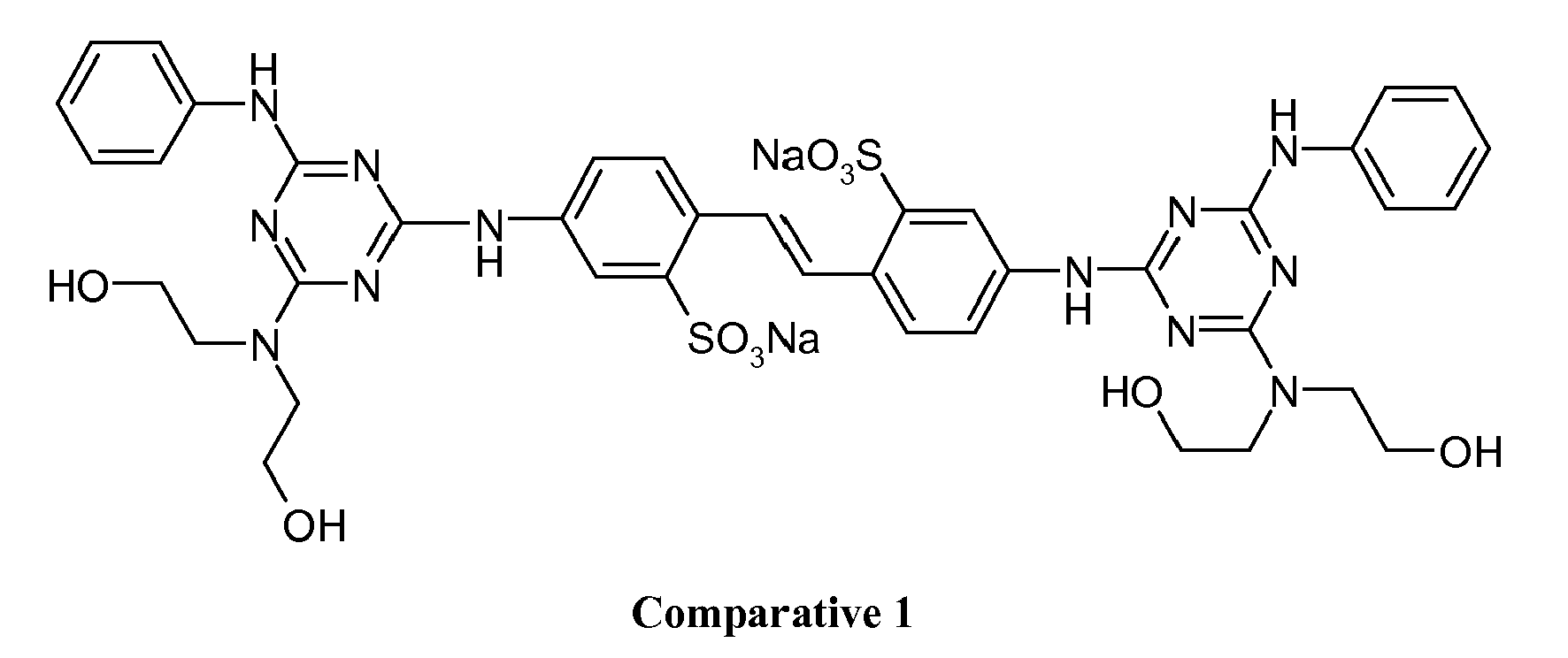
- The solubility of the fluorescent whitening agents was determined as follows: a dry powder of fluorescent whitening agent was added to 50 ml of distilled water until the saturation point was reached. The thus obtained saturated solution was filtered, dried and the dried residue was weighted.
- The following results were obtained: 27.8 % for
FWA 1; 24.2 % forFWA 2; and 6.9 % forComparative 1, all at ambient temperature (about 22 °C). The indicated percentages are based on the amount of grams of fluorescent whitening agent dissolved in 100 g of the corresponding saturated FWA solution. - The stability behavior was studied by storing an approximately 20% solution of
FWA 1 andFWA 2, respectively, at ambient temperature and at 4° C, each without stirring. The aqueous brightener preparations have a shelf-life of more than 30 days both at ambient and low temperature. They showed no crystalline precipitates. - Thus,
FWA Comparative 1. Simultaneously, concentrated solutions thereof exhibit high stability. - The whitening performance of the FWAs of Example 1 was studied using the following test procedure.
- The wood-free furnish (pulp suspension) was composed of 70 pts (parts, based on weight) of short fibres and 30 pts of long fibres with a grinding degree of 30-35°SR (Schopper-Riegler). The wood-containing furnish was composed of 50 pts of mechanical pulp, 35 pts of long fibres and 15 pts of short fibres with a grinding degree of 40 °SR.
- 800ml of a 0.625% of corresponding furnish were weighted in a beaker to prepare a 5g hand sheet of ∼120g/m2 for each experimental series. A 0.1 wt % FWA solution was prepared using distilled water. The amounts of FWA as indicated in Table 1 below were achieved by adding a corresponding amount of the 0.1 wt % FWA solution by a pipette to the stirred pulp suspension which was allowed to stir for 10 minutes after FWA addition. The amounts of FWA in Table 1 are calculated as active ingredient on 100 wt % of dry pulp.
- A wet filter paper was positioned on the wire of the sheet former, the stock is put on the sheet former and sucked dry. The formed hand sheet was protected by an additional dry filter, pressed and dried on a calender at 100°C. Thereafter, the obtained hand sheets were equilibrated in a climate room under standard conditions overnight and then measured with a Datacolor spectrometer (ISO246) by determining CIE, L*, a* and b*, the light source used based on ISO2469 standard.
- The results obtained are summarized in Table 1 and further shown in the Figures.
Fig. 1 shows the results for the wood-free pulp andFig. 2 for the wood-containingpulp.Table 1 FWA Amount (wt %) FWA CIE whiteness L* a* b* Wood- free pulp FWA 1 0.04 118.59 97.15 1.89 -5.83 0.08 129.29 97.48 2.41 -8.10 0.16 138.27 97.76 2.69 -10.03 0.24 142.39 97.86 2.71 -10.92 0.32 143.96 97.93 2.57 -11.25 FWA 20.04 117.27 97.22 1.86 -5.49 0.08 127.23 97.46 2.36 -7.64 0.16 136.69 97.68 2.74 -9.70 0.24 141.11 97.80 2.87 -10.66 0.32 143.91 97.74 2.86 -11.33 Comparative 1 0.04 115.09 97.13 1.71 -5.04 0.08 124.22 97.30 2.18 -7.03 0.16 134.02 97.61 2.54 -9.12 0.24 138.27 97.81 2.58 -10.00 0.32 140.10 97.89 2.51 -10.38 Wood-containing pulp FWA 1 0.04 52.12 93.83 -0.08 7.14 0.08 59.30 94.08 0.22 5.72 0.16 65.61 94.20 0.30 4.41 0.24 68.43 94.31 0.22 3.85 0.32 69.74 94.45 0.18 3.64 FWA 20.04 50.86 93.84 -0.10 7.42 0.08 57.77 94.02 0.17 6.02 0.16 64.23 94.09 0.33 4.65 0.24 67.19 94.12 0.36 4.02 0.32 68.76 94.31 0.35 3.78 Comparative 1 0.04 50.01 93.85 -0.11 7.61 0.08 56.60 94.01 0.16 6.27 0.16 62.58 94.18 0.26 5.06 0.24 65.75 94.24 0.30 4.40 0.32 67.23 94.32 0.29 4.12 - Thus, the FWAs used according to the invention exhibit same or even better whitening performance than a commonly used disulfo-type FWA while simultaneously having higher solubility in water, thus allowing the preparation of stable, concentrated aqueous preparations for whitening paper or board.
Claims (16)
- Use of aqueous fluorescent whitening agent preparations for optically whitening paper or board, wherein the aqueous fluorescent whitening agent preparation contains(a) 5 to 80 % by weight of at least one fluorescent whitening agent (FWA) selected from the bis(triazinylamino) stilbene derivatives of the formula (I)

X represents independently of each other O or NR', where R' is hydrogen or C1-C3 alkyl;
n is 1 or 2;
R1, R2, R3 and R4 represent, independently of each other, hydrogen, cyano, C1- C4 alkyl, C2 - C4 hydroxyalkyl, or C1- C4 alkoxyalkyl, wherein alkyl is linear or branched; or R2 and R1 or R3 and R4 independently of each other together with N atom form morpholine, piperidine or pyrrolidine ring; or -(CH2)l-SO3M, where 1 is 1, 2 or 3; or -(CH2)i-COOR, -(CH2)i-CONHR, -(CH2)i-COR, where i is an integer from 1 to 4, R is C1-C3 alkyl or has the same meaning as M;
M represents hydrogen, or one equivalent of a cation, in particular Li, Na, K, Ca, Mg, ammonium, or ammonium which is mono-, di-, tri- or tetra-substituted by C1- C4 alkyl or C2- C4 hydroxyalkyl; and.(b) 95 to 20% by weight of water. - The use of aqueous fluorescent whitening agent preparations according to claim 1, characterized in that the preparation contains 10 to 65 % by weight of component (a).
- The use of the aqueous fluorescent whitening agent preparations according to claim 1 or 2, characterized in that in the fluorescent whitening agent of formula (I) X represents NR'.
- The use of the aqueous fluorescent whitening agent preparations according to any of claims 1 to 3, characterized in that in the fluorescent whitening agent of formula (I) n is 1.
- The use of the aqueous fluorescent whitening agent preparations according to any of the preceding claims, characterized in that R1, R2, R3 and R4 represent, independently of each other, C2 - C4 hydroxyalkyl, or C1 - C4 alkoxyalkyl.
- The use of the aqueous fluorescent whitening agent preparations according to any of the preceding claims, characterized in that the aqueous fluorescent whitening agent preparation contains less than 10 % by weight, in particular less than 5 % by weight, of components other than components (a) and (b).
- The use of the aqueous fluorescent whitening agent preparations according to any of the preceding claims, characterized in that the fluorescent whitening agent has the following formula (Ia), wherein the carboxylic acid residues are, independently of each another, in ortho- or para-position.

- The use of the aqueous fluorescent whitening agent preparations according to any of claims 1 to 6, characterized in that the fluorescent whitening agent has the following formula (Ib), wherein the carboxylic acid residues are, independently of each another, in ortho- or para-position.

- The use of the aqueous fluorescent whitening agent preparations according to any of the preceding claims, characterized in that the aqueous fluorescent whitening agent preparation contains one fluorescent whitening agent of formula (I).
- The use of the aqueous fluorescent whitening agent preparations according to any of claims 1 to 8, characterized in that the aqueous fluorescent whitening agent preparation contains two or three fluorescent whitening agents of formula (I).
- The use of the aqueous fluorescent whitening agent preparations according to any of the preceding claims for optically whitening paper or board in the pulp suspension (stock) or pulp.
- The use of the aqueous fluorescent whitening agent preparations according to claim 11 in wood-free pulp or wood-containing pulp.
- The use of the aqueous fluorescent whitening agent preparations according to any of claims 1 to 10, for optically whitening paper at the surface.
- A process for whitening paper comprising adding an aqueous fluorescent whitening agent preparation as defined in any of claims 1 to 10 to a pulp or pulp suspension, producing a paper sheet, and drying the sheet.
- The process according to claim 14, characterized in that the aqueous fluorescent whitening agent preparation is added, after dilution with water, to the pulp or pulp suspension.
- Paper obtainable by the process according to claim 15.
Priority Applications (38)
| Application Number | Priority Date | Filing Date | Title |
|---|---|---|---|
| SI200930385T SI2302132T1 (en) | 2009-09-17 | 2009-09-17 | Disulfo-type fluorescent whitening agents |
| PL09170579T PL2302132T3 (en) | 2009-09-17 | 2009-09-17 | Disulfo-type fluorescent whitening agents |
| PT09170579T PT2302132E (en) | 2009-09-17 | 2009-09-17 | Disulfo-type fluorescent whitening agents |
| EP20090170579 EP2302132B1 (en) | 2009-09-17 | 2009-09-17 | Disulfo-type fluorescent whitening agents |
| ES09170579T ES2394545T3 (en) | 2009-09-17 | 2009-09-17 | Disulfo type fluorescent bleaching agent |
| EP20100754929 EP2478152B1 (en) | 2009-09-17 | 2010-09-17 | Disulfo-type fluorescent whitening agents in coating applications |
| ES10755153.3T ES2532864T3 (en) | 2009-09-17 | 2010-09-17 | Disulfo type fluorescent bleaching agent compositions |
| US13/496,682 US8696868B2 (en) | 2009-09-17 | 2010-09-17 | Disulfo-type fluorescent whitening agent compositions |
| CA2773768A CA2773768C (en) | 2009-09-17 | 2010-09-17 | Disulfo-type fluorescent whitening agent compositions |
| CN201080041882.6A CN102597372B (en) | 2009-09-17 | 2010-09-17 | Disulfo-based optical brighteners for coating applications |
| TW099131692A TWI484083B (en) | 2009-09-17 | 2010-09-17 | Disulfo-type fluorescent whitening agent compositions |
| RU2012111199/05A RU2550833C2 (en) | 2009-09-17 | 2010-09-17 | Application of disulphonic fluorescent bleaching agents in coatings |
| PT10755153T PT2478153E (en) | 2009-09-17 | 2010-09-17 | Disulfo-type fluorescent whitening agent compositions |
| BR112012005961A BR112012005961A2 (en) | 2009-09-17 | 2010-09-17 | fluorescent disulfide bleaching agents in coating applications |
| PCT/EP2010/063699 WO2011033062A2 (en) | 2009-09-17 | 2010-09-17 | Disulfo-type fluorescent whitening agents |
| US13/496,684 US20120214011A1 (en) | 2009-09-17 | 2010-09-17 | Disulfo-type fluorescent whitening agents in coating applications |
| RU2012111201/05A RU2549855C2 (en) | 2009-09-17 | 2010-09-17 | Compositions of disulphonic fluorescent whitening agents |
| BR112012005889-4A BR112012005889B1 (en) | 2009-09-17 | 2010-09-17 | USE OF FLUORESCENT BLEACHING AGENTS OF THE DISSULPHUS, PAPER, AND ITS BLEACHING PROCESS |
| US13/496,678 US8696867B2 (en) | 2009-09-17 | 2010-09-17 | Disulfo-type fluorescent whitening agents |
| CA2773767A CA2773767C (en) | 2009-09-17 | 2010-09-17 | Disulfo-type fluorescent whitening agents |
| SI201030887T SI2478153T1 (en) | 2009-09-17 | 2010-09-17 | Disulfo-type fluorescent whitening agent compositions |
| BR112012005953-0A BR112012005953B1 (en) | 2009-09-17 | 2010-09-17 | Composition of fluorescent bleaching agent to optically bleach paper or cardboard, its use and its preparation process, paper and its bleaching process |
| PCT/EP2010/063702 WO2011033064A2 (en) | 2009-09-17 | 2010-09-17 | Disulfo-type fluorescent whitening agent compositions |
| RU2012111209/05A RU2552447C2 (en) | 2009-09-17 | 2010-09-17 | Disulphonic fluorescent bleaching agents |
| JP2012529285A JP5784020B2 (en) | 2009-09-17 | 2010-09-17 | Disulfo-type optical brightener for coating applications |
| JP2012529284A JP5840129B2 (en) | 2009-09-17 | 2010-09-17 | Disulfo type optical brightener |
| CN201080042040.2A CN102597374B (en) | 2009-09-17 | 2010-09-17 | Disulfo-type fluorescent whitening agents |
| TW99131701A TW201116664A (en) | 2009-09-17 | 2010-09-17 | Disulfo-type fluorescent whitening agents |
| CN201080042030.9A CN102597373B (en) | 2009-09-17 | 2010-09-17 | Disulfo-type fluorescent whitening agent compositions |
| ES10754929.7T ES2534089T3 (en) | 2009-09-17 | 2010-09-17 | Disulfo fluorescent bleaching agents in coating applications |
| TW099131803A TWI554503B (en) | 2009-09-17 | 2010-09-17 | Disulfo-type fluorescent whitening agents in coating applications |
| CA2773823A CA2773823C (en) | 2009-09-17 | 2010-09-17 | Disulfo-type fluorescent whitening agents in coating applications |
| PCT/EP2010/063705 WO2011033066A2 (en) | 2009-09-17 | 2010-09-17 | Disulfo-type fluorescent whitening agents in coating applications |
| EP20100755153 EP2478153B1 (en) | 2009-09-17 | 2010-09-17 | Disulfo-type fluorescent whitening agent compositions |
| PL10755153T PL2478153T3 (en) | 2009-09-17 | 2010-09-17 | Disulfo-type fluorescent whitening agent compositions |
| ZA2012/02689A ZA201202689B (en) | 2009-09-17 | 2012-04-13 | Disulfo-type fluorescent whitening agents |
| ZA2012/02691A ZA201202691B (en) | 2009-09-17 | 2012-04-13 | Disulfo-type fluorescent whitening agent compositions |
| ZA2012/02690A ZA201202690B (en) | 2009-09-17 | 2012-04-13 | Disulfo-type fluorescent whitening agents in coating applications |
Applications Claiming Priority (1)
| Application Number | Priority Date | Filing Date | Title |
|---|---|---|---|
| EP20090170579 EP2302132B1 (en) | 2009-09-17 | 2009-09-17 | Disulfo-type fluorescent whitening agents |
Publications (2)
| Publication Number | Publication Date |
|---|---|
| EP2302132A1 true EP2302132A1 (en) | 2011-03-30 |
| EP2302132B1 EP2302132B1 (en) | 2012-08-29 |
Family
ID=41522950
Family Applications (3)
| Application Number | Title | Priority Date | Filing Date |
|---|---|---|---|
| EP20090170579 Active EP2302132B1 (en) | 2009-09-17 | 2009-09-17 | Disulfo-type fluorescent whitening agents |
| EP20100754929 Active EP2478152B1 (en) | 2009-09-17 | 2010-09-17 | Disulfo-type fluorescent whitening agents in coating applications |
| EP20100755153 Active EP2478153B1 (en) | 2009-09-17 | 2010-09-17 | Disulfo-type fluorescent whitening agent compositions |
Family Applications After (2)
| Application Number | Title | Priority Date | Filing Date |
|---|---|---|---|
| EP20100754929 Active EP2478152B1 (en) | 2009-09-17 | 2010-09-17 | Disulfo-type fluorescent whitening agents in coating applications |
| EP20100755153 Active EP2478153B1 (en) | 2009-09-17 | 2010-09-17 | Disulfo-type fluorescent whitening agent compositions |
Country Status (14)
| Country | Link |
|---|---|
| US (3) | US8696868B2 (en) |
| EP (3) | EP2302132B1 (en) |
| JP (2) | JP5784020B2 (en) |
| CN (3) | CN102597374B (en) |
| BR (3) | BR112012005889B1 (en) |
| CA (3) | CA2773823C (en) |
| ES (3) | ES2394545T3 (en) |
| PL (2) | PL2302132T3 (en) |
| PT (2) | PT2302132E (en) |
| RU (3) | RU2549855C2 (en) |
| SI (2) | SI2302132T1 (en) |
| TW (3) | TWI554503B (en) |
| WO (3) | WO2011033064A2 (en) |
| ZA (3) | ZA201202690B (en) |
Cited By (3)
| Publication number | Priority date | Publication date | Assignee | Title |
|---|---|---|---|---|
| EP2557128A1 (en) * | 2011-08-11 | 2013-02-13 | Clariant International Ltd. | Improved aqueous compositions for whitening and shading in coating applications |
| US8696868B2 (en) | 2009-09-17 | 2014-04-15 | Blankophor Gmbh & Co. Kg | Disulfo-type fluorescent whitening agent compositions |
| EP3246321A1 (en) * | 2016-05-17 | 2017-11-22 | Blankophor GmbH & Co. KG | Fluorescent whitening agents and mixtures thereof |
Families Citing this family (11)
| Publication number | Priority date | Publication date | Assignee | Title |
|---|---|---|---|---|
| FI20085345L (en) * | 2008-04-22 | 2009-10-23 | Kemira Oyj | Method for reducing light-induced yellowing in lignin-containing material |
| WO2012010326A1 (en) | 2010-07-23 | 2012-01-26 | Clariant International Ltd | Method for preparing white paper |
| EP2716466B1 (en) * | 2012-10-05 | 2016-09-14 | Ricoh Industrie France SAS | Thermal recording material containing stilbene disulphonic acid fluorescent whitening agent |
| CN103205134B (en) * | 2013-03-14 | 2014-04-23 | 浙江传化华洋化工有限公司 | Method for synthesizing DSD (4, 4'-diaminostilbene-2, 2'-disulfonic) acid-triazine fluorescent brightening agents |
| EP2781648B1 (en) * | 2013-03-21 | 2016-01-06 | Clariant International Ltd. | Optical brightening agents for high quality ink-jet printing |
| PL2799618T3 (en) * | 2013-04-29 | 2016-12-30 | The use of micronized cellulose and fluorescent bleaching agent for surface treatment of cellulosic materials | |
| CN107012732A (en) * | 2016-01-28 | 2017-08-04 | 德丰铭国际股份有限公司 | Fluorescent whitening agent composition |
| CN106632116B (en) * | 2016-12-20 | 2019-08-13 | 贺州学院 | A kind of water solubility heavy calcium carbonate powder fluorescent whitening agent and its preparation method and application |
| CN106588801B (en) * | 2016-12-20 | 2019-08-13 | 贺州学院 | Dicarboxylic acids heavy calcium carbonate powder fluorescent whitening agent and its preparation method and application |
| AU2018387075B2 (en) * | 2017-12-22 | 2022-09-29 | Archroma Ip Gmbh | Optical brightener for whitening paper |
| RU2708580C1 (en) * | 2019-06-28 | 2019-12-09 | Сергей Борисович Врублевский | Method of producing a composite bleach |
Citations (7)
| Publication number | Priority date | Publication date | Assignee | Title |
|---|---|---|---|---|
| DD55668A (en) | ||||
| IS2469A7 (en) | 1977-12-16 | 1979-06-17 | Schweizerische Aluminium Ag | Aluminum protective capsules |
| EP0884312A1 (en) * | 1997-05-23 | 1998-12-16 | Ciba SC Holding AG | Triazinylaminostilbene compounds |
| WO2001019804A1 (en) * | 1999-09-10 | 2001-03-22 | Ciba Specialty Chemicals Holding Inc. | Triazinylaminostilbene derivative as fluorescent whitening agents |
| WO2002055646A1 (en) | 2001-01-10 | 2002-07-18 | Clariant International Ltd | Optical brighteners compositions, their production and their use |
| PL61710Y1 (en) | 2001-05-10 | 2005-11-30 | Krzysztof Rogoda | Protective edging member |
| EP1752453A1 (en) | 2005-08-04 | 2007-02-14 | Clariant International Ltd. | Storage stable solutions of optical brighteners |
Family Cites Families (17)
| Publication number | Priority date | Publication date | Assignee | Title |
|---|---|---|---|---|
| DE3502038A1 (en) * | 1985-01-23 | 1986-07-24 | Sandoz-Patent-GmbH, 7850 Lörrach | AQUEOUS BRIGHTENING DEVICES AND THEIR USE IN THE PAPER LINE |
| GB9503474D0 (en) * | 1995-02-22 | 1995-04-12 | Ciba Geigy Ag | Compounds and their use |
| DE19633609A1 (en) | 1996-08-21 | 1998-02-26 | Bayer Ag | Process for the production of carbazole |
| EP1123929B1 (en) * | 1997-03-25 | 2003-07-02 | Ciba SC Holding AG | 4,4'-Diaminostilbene-2,2'-disulfonic acid derivatives |
| GB9726365D0 (en) * | 1997-12-13 | 1998-02-11 | Ciba Sc Holding Ag | Compounds |
| DE19806745A1 (en) | 1998-02-18 | 1999-08-19 | Bayer Ag | Aqueous polymer dispersion useful as surface sizing agent for paper, cardboard etc. |
| EP1342745A1 (en) * | 2002-03-05 | 2003-09-10 | Lofo High Tech Film GmbH | Process for production of polyolefin films |
| ES2377961T3 (en) * | 2002-03-18 | 2012-04-03 | Basf Se | Procedure to improve the sun protection factor of a cellulosic fiber material |
| DE10217677A1 (en) | 2002-04-19 | 2003-11-06 | Bayer Ag | Use of brighteners for the production of coating slips |
| CA2486589A1 (en) * | 2002-06-11 | 2003-12-18 | Ciba Specialty Chemicals Holding Inc. | Whitening pigments |
| RU2356898C2 (en) * | 2002-11-19 | 2009-05-27 | Циба Спешиалти Кемикэлз Холдинг Инк. | Amphoteric fluorescent whitening agent |
| CA2562910A1 (en) * | 2004-05-03 | 2005-11-10 | Ciba Specialty Chemicals Holding Inc. | Optical brighteners for inkjetrinting substrates |
| PL1805361T3 (en) * | 2004-10-27 | 2010-01-29 | Basf Se | Compositions of fluorescent whitening agents |
| JP5883206B2 (en) * | 2005-02-17 | 2016-03-09 | ハーキュリーズ・インコーポレーテッドHercules Incorporated | Uneven hydroxyethyl cellulose, their derivatives, their preparation and use |
| EP1712677A1 (en) * | 2005-04-08 | 2006-10-18 | Clariant International Ltd. | Aqueous solutions of optical brighteners |
| RU2505535C2 (en) * | 2007-12-12 | 2014-01-27 | Клариант Финанс (Бви) Лимитед | Solutions of optic bleaches, stable in storage |
| PT2302132E (en) | 2009-09-17 | 2012-09-10 | Blankophor Gmbh & Co Kg | Disulfo-type fluorescent whitening agents |
-
2009
- 2009-09-17 PT PT09170579T patent/PT2302132E/en unknown
- 2009-09-17 EP EP20090170579 patent/EP2302132B1/en active Active
- 2009-09-17 SI SI200930385T patent/SI2302132T1/en unknown
- 2009-09-17 PL PL09170579T patent/PL2302132T3/en unknown
- 2009-09-17 ES ES09170579T patent/ES2394545T3/en active Active
-
2010
- 2010-09-17 US US13/496,682 patent/US8696868B2/en not_active Expired - Fee Related
- 2010-09-17 JP JP2012529285A patent/JP5784020B2/en not_active Expired - Fee Related
- 2010-09-17 US US13/496,678 patent/US8696867B2/en not_active Expired - Fee Related
- 2010-09-17 RU RU2012111201/05A patent/RU2549855C2/en active
- 2010-09-17 PL PL10755153T patent/PL2478153T3/en unknown
- 2010-09-17 CN CN201080042040.2A patent/CN102597374B/en active Active
- 2010-09-17 JP JP2012529284A patent/JP5840129B2/en not_active Expired - Fee Related
- 2010-09-17 BR BR112012005889-4A patent/BR112012005889B1/en not_active IP Right Cessation
- 2010-09-17 US US13/496,684 patent/US20120214011A1/en not_active Abandoned
- 2010-09-17 TW TW099131803A patent/TWI554503B/en not_active IP Right Cessation
- 2010-09-17 WO PCT/EP2010/063702 patent/WO2011033064A2/en not_active Ceased
- 2010-09-17 WO PCT/EP2010/063699 patent/WO2011033062A2/en not_active Ceased
- 2010-09-17 CA CA2773823A patent/CA2773823C/en not_active Expired - Fee Related
- 2010-09-17 CN CN201080041882.6A patent/CN102597372B/en active Active
- 2010-09-17 EP EP20100754929 patent/EP2478152B1/en active Active
- 2010-09-17 RU RU2012111199/05A patent/RU2550833C2/en active
- 2010-09-17 CA CA2773767A patent/CA2773767C/en not_active Expired - Fee Related
- 2010-09-17 TW TW099131692A patent/TWI484083B/en active
- 2010-09-17 TW TW99131701A patent/TW201116664A/en unknown
- 2010-09-17 BR BR112012005961A patent/BR112012005961A2/en not_active Application Discontinuation
- 2010-09-17 ES ES10755153.3T patent/ES2532864T3/en active Active
- 2010-09-17 CA CA2773768A patent/CA2773768C/en not_active Expired - Fee Related
- 2010-09-17 RU RU2012111209/05A patent/RU2552447C2/en active
- 2010-09-17 SI SI201030887T patent/SI2478153T1/en unknown
- 2010-09-17 ES ES10754929.7T patent/ES2534089T3/en active Active
- 2010-09-17 BR BR112012005953-0A patent/BR112012005953B1/en not_active IP Right Cessation
- 2010-09-17 CN CN201080042030.9A patent/CN102597373B/en active Active
- 2010-09-17 EP EP20100755153 patent/EP2478153B1/en active Active
- 2010-09-17 PT PT10755153T patent/PT2478153E/en unknown
- 2010-09-17 WO PCT/EP2010/063705 patent/WO2011033066A2/en not_active Ceased
-
2012
- 2012-04-13 ZA ZA2012/02690A patent/ZA201202690B/en unknown
- 2012-04-13 ZA ZA2012/02689A patent/ZA201202689B/en unknown
- 2012-04-13 ZA ZA2012/02691A patent/ZA201202691B/en unknown
Patent Citations (8)
| Publication number | Priority date | Publication date | Assignee | Title |
|---|---|---|---|---|
| DD55668A (en) | ||||
| IS2469A7 (en) | 1977-12-16 | 1979-06-17 | Schweizerische Aluminium Ag | Aluminum protective capsules |
| EP0884312A1 (en) * | 1997-05-23 | 1998-12-16 | Ciba SC Holding AG | Triazinylaminostilbene compounds |
| EP0884312B1 (en) | 1997-05-23 | 2002-08-28 | Ciba SC Holding AG | Triazinylaminostilbene compounds |
| WO2001019804A1 (en) * | 1999-09-10 | 2001-03-22 | Ciba Specialty Chemicals Holding Inc. | Triazinylaminostilbene derivative as fluorescent whitening agents |
| WO2002055646A1 (en) | 2001-01-10 | 2002-07-18 | Clariant International Ltd | Optical brighteners compositions, their production and their use |
| PL61710Y1 (en) | 2001-05-10 | 2005-11-30 | Krzysztof Rogoda | Protective edging member |
| EP1752453A1 (en) | 2005-08-04 | 2007-02-14 | Clariant International Ltd. | Storage stable solutions of optical brighteners |
Cited By (8)
| Publication number | Priority date | Publication date | Assignee | Title |
|---|---|---|---|---|
| US8696868B2 (en) | 2009-09-17 | 2014-04-15 | Blankophor Gmbh & Co. Kg | Disulfo-type fluorescent whitening agent compositions |
| US8696867B2 (en) | 2009-09-17 | 2014-04-15 | Blankophor Gmbh & Co. Kg | Disulfo-type fluorescent whitening agents |
| EP2557128A1 (en) * | 2011-08-11 | 2013-02-13 | Clariant International Ltd. | Improved aqueous compositions for whitening and shading in coating applications |
| WO2013020693A1 (en) * | 2011-08-11 | 2013-02-14 | Clariant International Ltd | Improved aqueous compositions for whitening and shading in coating applications |
| CN103732691A (en) * | 2011-08-11 | 2014-04-16 | 克拉里安特国际有限公司 | Improved aqueous compositions for whitening and shading in coating applications |
| EP3246321A1 (en) * | 2016-05-17 | 2017-11-22 | Blankophor GmbH & Co. KG | Fluorescent whitening agents and mixtures thereof |
| WO2017198694A1 (en) * | 2016-05-17 | 2017-11-23 | Blankophor Gmbh & Co. Kg | Fluorescent whitening agents and mixtures thereof |
| US10787769B2 (en) | 2016-05-17 | 2020-09-29 | Blankophor Gmbh & Co. Kg | Fluorescent whitening agents and mixtures thereof |
Also Published As
Similar Documents
| Publication | Publication Date | Title |
|---|---|---|
| EP2302132B1 (en) | Disulfo-type fluorescent whitening agents | |
| US8221588B2 (en) | Storage stable solutions of optical brighteners | |
| EP2431519B1 (en) | Fluorescent whitening agent compositions | |
| EP2222652B1 (en) | Storage stable solutions of optical brighteners | |
| HK1147756B (en) | Storage stable solutions of optical brighteners |
Legal Events
| Date | Code | Title | Description |
|---|---|---|---|
| PUAI | Public reference made under article 153(3) epc to a published international application that has entered the european phase |
Free format text: ORIGINAL CODE: 0009012 |
|
| 17P | Request for examination filed |
Effective date: 20090917 |
|
| AK | Designated contracting states |
Kind code of ref document: A1 Designated state(s): AT BE BG CH CY CZ DE DK EE ES FI FR GB GR HR HU IE IS IT LI LT LU LV MC MK MT NL NO PL PT RO SE SI SK SM TR |
|
| AX | Request for extension of the european patent |
Extension state: AL BA RS |
|
| RAP1 | Party data changed (applicant data changed or rights of an application transferred) |
Owner name: BLANKOPHOR GMBH & CO. KG |
|
| RAP1 | Party data changed (applicant data changed or rights of an application transferred) |
Owner name: BLANKOPHOR GMBH & CO. KG |
|
| GRAP | Despatch of communication of intention to grant a patent |
Free format text: ORIGINAL CODE: EPIDOSNIGR1 |
|
| GRAS | Grant fee paid |
Free format text: ORIGINAL CODE: EPIDOSNIGR3 |
|
| GRAA | (expected) grant |
Free format text: ORIGINAL CODE: 0009210 |
|
| AK | Designated contracting states |
Kind code of ref document: B1 Designated state(s): AT BE BG CH CY CZ DE DK EE ES FI FR GB GR HR HU IE IS IT LI LT LU LV MC MK MT NL NO PL PT RO SE SI SK SM TR |
|
| REG | Reference to a national code |
Ref country code: GB Ref legal event code: FG4D |
|
| REG | Reference to a national code |
Ref country code: CH Ref legal event code: EP |
|
| REG | Reference to a national code |
Ref country code: PT Ref legal event code: SC4A Free format text: AVAILABILITY OF NATIONAL TRANSLATION Effective date: 20120903 |
|
| REG | Reference to a national code |
Ref country code: CH Ref legal event code: NV Representative=s name: ING. MARCO ZARDI C/O M. ZARDI & CO. S.A. |
|
| REG | Reference to a national code |
Ref country code: AT Ref legal event code: REF Ref document number: 573180 Country of ref document: AT Kind code of ref document: T Effective date: 20120915 |
|
| REG | Reference to a national code |
Ref country code: IE Ref legal event code: FG4D |
|
| REG | Reference to a national code |
Ref country code: SE Ref legal event code: TRGR |
|
| REG | Reference to a national code |
Ref country code: DE Ref legal event code: R096 Ref document number: 602009009217 Country of ref document: DE Effective date: 20121025 |
|
| REG | Reference to a national code |
Ref country code: NL Ref legal event code: T3 |
|
| REG | Reference to a national code |
Ref country code: NO Ref legal event code: T2 Effective date: 20120829 |
|
| REG | Reference to a national code |
Ref country code: LT Ref legal event code: MG4D Effective date: 20120829 |
|
| PG25 | Lapsed in a contracting state [announced via postgrant information from national office to epo] |
Ref country code: HR Free format text: LAPSE BECAUSE OF FAILURE TO SUBMIT A TRANSLATION OF THE DESCRIPTION OR TO PAY THE FEE WITHIN THE PRESCRIBED TIME-LIMIT Effective date: 20120829 Ref country code: IS Free format text: LAPSE BECAUSE OF FAILURE TO SUBMIT A TRANSLATION OF THE DESCRIPTION OR TO PAY THE FEE WITHIN THE PRESCRIBED TIME-LIMIT Effective date: 20121229 Ref country code: LT Free format text: LAPSE BECAUSE OF FAILURE TO SUBMIT A TRANSLATION OF THE DESCRIPTION OR TO PAY THE FEE WITHIN THE PRESCRIBED TIME-LIMIT Effective date: 20120829 |
|
| REG | Reference to a national code |
Ref country code: PL Ref legal event code: T3 |
|
| REG | Reference to a national code |
Ref country code: ES Ref legal event code: FG2A Ref document number: 2394545 Country of ref document: ES Kind code of ref document: T3 Effective date: 20130201 |
|
| PG25 | Lapsed in a contracting state [announced via postgrant information from national office to epo] |
Ref country code: GR Free format text: LAPSE BECAUSE OF FAILURE TO SUBMIT A TRANSLATION OF THE DESCRIPTION OR TO PAY THE FEE WITHIN THE PRESCRIBED TIME-LIMIT Effective date: 20121130 Ref country code: LV Free format text: LAPSE BECAUSE OF FAILURE TO SUBMIT A TRANSLATION OF THE DESCRIPTION OR TO PAY THE FEE WITHIN THE PRESCRIBED TIME-LIMIT Effective date: 20120829 |
|
| REG | Reference to a national code |
Ref country code: SK Ref legal event code: T3 Ref document number: E 13160 Country of ref document: SK |
|
| PG25 | Lapsed in a contracting state [announced via postgrant information from national office to epo] |
Ref country code: MC Free format text: LAPSE BECAUSE OF NON-PAYMENT OF DUE FEES Effective date: 20120930 Ref country code: RO Free format text: LAPSE BECAUSE OF FAILURE TO SUBMIT A TRANSLATION OF THE DESCRIPTION OR TO PAY THE FEE WITHIN THE PRESCRIBED TIME-LIMIT Effective date: 20120829 Ref country code: CZ Free format text: LAPSE BECAUSE OF FAILURE TO SUBMIT A TRANSLATION OF THE DESCRIPTION OR TO PAY THE FEE WITHIN THE PRESCRIBED TIME-LIMIT Effective date: 20120829 Ref country code: EE Free format text: LAPSE BECAUSE OF FAILURE TO SUBMIT A TRANSLATION OF THE DESCRIPTION OR TO PAY THE FEE WITHIN THE PRESCRIBED TIME-LIMIT Effective date: 20120829 Ref country code: DK Free format text: LAPSE BECAUSE OF FAILURE TO SUBMIT A TRANSLATION OF THE DESCRIPTION OR TO PAY THE FEE WITHIN THE PRESCRIBED TIME-LIMIT Effective date: 20120829 |
|
| REG | Reference to a national code |
Ref country code: IE Ref legal event code: MM4A |
|
| PLBE | No opposition filed within time limit |
Free format text: ORIGINAL CODE: 0009261 |
|
| STAA | Information on the status of an ep patent application or granted ep patent |
Free format text: STATUS: NO OPPOSITION FILED WITHIN TIME LIMIT |
|
| PG25 | Lapsed in a contracting state [announced via postgrant information from national office to epo] |
Ref country code: BG Free format text: LAPSE BECAUSE OF FAILURE TO SUBMIT A TRANSLATION OF THE DESCRIPTION OR TO PAY THE FEE WITHIN THE PRESCRIBED TIME-LIMIT Effective date: 20121129 Ref country code: IE Free format text: LAPSE BECAUSE OF NON-PAYMENT OF DUE FEES Effective date: 20120917 |
|
| 26N | No opposition filed |
Effective date: 20130530 |
|
| REG | Reference to a national code |
Ref country code: DE Ref legal event code: R097 Ref document number: 602009009217 Country of ref document: DE Effective date: 20130530 |
|
| PG25 | Lapsed in a contracting state [announced via postgrant information from national office to epo] |
Ref country code: MT Free format text: LAPSE BECAUSE OF FAILURE TO SUBMIT A TRANSLATION OF THE DESCRIPTION OR TO PAY THE FEE WITHIN THE PRESCRIBED TIME-LIMIT Effective date: 20120829 Ref country code: CY Free format text: LAPSE BECAUSE OF FAILURE TO SUBMIT A TRANSLATION OF THE DESCRIPTION OR TO PAY THE FEE WITHIN THE PRESCRIBED TIME-LIMIT Effective date: 20120829 |
|
| PG25 | Lapsed in a contracting state [announced via postgrant information from national office to epo] |
Ref country code: TR Free format text: LAPSE BECAUSE OF FAILURE TO SUBMIT A TRANSLATION OF THE DESCRIPTION OR TO PAY THE FEE WITHIN THE PRESCRIBED TIME-LIMIT Effective date: 20120829 |
|
| PG25 | Lapsed in a contracting state [announced via postgrant information from national office to epo] |
Ref country code: LU Free format text: LAPSE BECAUSE OF NON-PAYMENT OF DUE FEES Effective date: 20120917 Ref country code: SM Free format text: LAPSE BECAUSE OF FAILURE TO SUBMIT A TRANSLATION OF THE DESCRIPTION OR TO PAY THE FEE WITHIN THE PRESCRIBED TIME-LIMIT Effective date: 20120829 |
|
| PG25 | Lapsed in a contracting state [announced via postgrant information from national office to epo] |
Ref country code: HU Free format text: LAPSE BECAUSE OF FAILURE TO SUBMIT A TRANSLATION OF THE DESCRIPTION OR TO PAY THE FEE WITHIN THE PRESCRIBED TIME-LIMIT Effective date: 20090917 |
|
| PG25 | Lapsed in a contracting state [announced via postgrant information from national office to epo] |
Ref country code: MK Free format text: LAPSE BECAUSE OF FAILURE TO SUBMIT A TRANSLATION OF THE DESCRIPTION OR TO PAY THE FEE WITHIN THE PRESCRIBED TIME-LIMIT Effective date: 20120829 |
|
| PGFP | Annual fee paid to national office [announced via postgrant information from national office to epo] |
Ref country code: CH Payment date: 20150922 Year of fee payment: 7 |
|
| REG | Reference to a national code |
Ref country code: FR Ref legal event code: PLFP Year of fee payment: 8 |
|
| REG | Reference to a national code |
Ref country code: CH Ref legal event code: PL |
|
| PG25 | Lapsed in a contracting state [announced via postgrant information from national office to epo] |
Ref country code: CH Free format text: LAPSE BECAUSE OF NON-PAYMENT OF DUE FEES Effective date: 20160930 Ref country code: LI Free format text: LAPSE BECAUSE OF NON-PAYMENT OF DUE FEES Effective date: 20160930 |
|
| REG | Reference to a national code |
Ref country code: FR Ref legal event code: PLFP Year of fee payment: 9 |
|
| REG | Reference to a national code |
Ref country code: FR Ref legal event code: PLFP Year of fee payment: 10 |
|
| PGFP | Annual fee paid to national office [announced via postgrant information from national office to epo] |
Ref country code: IT Payment date: 20210930 Year of fee payment: 13 |
|
| PGFP | Annual fee paid to national office [announced via postgrant information from national office to epo] |
Ref country code: BE Payment date: 20210921 Year of fee payment: 13 Ref country code: SK Payment date: 20210907 Year of fee payment: 13 Ref country code: SI Payment date: 20210906 Year of fee payment: 13 Ref country code: GB Payment date: 20210923 Year of fee payment: 13 |
|
| PGFP | Annual fee paid to national office [announced via postgrant information from national office to epo] |
Ref country code: PT Payment date: 20210909 Year of fee payment: 13 |
|
| REG | Reference to a national code |
Ref country code: SK Ref legal event code: MM4A Ref document number: E 13160 Country of ref document: SK Effective date: 20220917 |
|
| PG25 | Lapsed in a contracting state [announced via postgrant information from national office to epo] |
Ref country code: PT Free format text: LAPSE BECAUSE OF NON-PAYMENT OF DUE FEES Effective date: 20230317 |
|
| GBPC | Gb: european patent ceased through non-payment of renewal fee |
Effective date: 20220917 |
|
| REG | Reference to a national code |
Ref country code: BE Ref legal event code: MM Effective date: 20220930 |
|
| P01 | Opt-out of the competence of the unified patent court (upc) registered |
Effective date: 20230519 |
|
| REG | Reference to a national code |
Ref country code: SI Ref legal event code: KO00 Effective date: 20230518 |
|
| PG25 | Lapsed in a contracting state [announced via postgrant information from national office to epo] |
Ref country code: SK Free format text: LAPSE BECAUSE OF NON-PAYMENT OF DUE FEES Effective date: 20220917 Ref country code: SI Free format text: LAPSE BECAUSE OF NON-PAYMENT OF DUE FEES Effective date: 20220918 |
|
| PG25 | Lapsed in a contracting state [announced via postgrant information from national office to epo] |
Ref country code: BE Free format text: LAPSE BECAUSE OF NON-PAYMENT OF DUE FEES Effective date: 20220930 |
|
| PG25 | Lapsed in a contracting state [announced via postgrant information from national office to epo] |
Ref country code: IT Free format text: LAPSE BECAUSE OF NON-PAYMENT OF DUE FEES Effective date: 20220917 Ref country code: GB Free format text: LAPSE BECAUSE OF NON-PAYMENT OF DUE FEES Effective date: 20220917 |
|
| PGFP | Annual fee paid to national office [announced via postgrant information from national office to epo] |
Ref country code: FI Payment date: 20250922 Year of fee payment: 17 |
|
| PGFP | Annual fee paid to national office [announced via postgrant information from national office to epo] |
Ref country code: DE Payment date: 20250923 Year of fee payment: 17 |
|
| PGFP | Annual fee paid to national office [announced via postgrant information from national office to epo] |
Ref country code: NO Payment date: 20250919 Year of fee payment: 17 |
|
| PGFP | Annual fee paid to national office [announced via postgrant information from national office to epo] |
Ref country code: NL Payment date: 20250922 Year of fee payment: 17 Ref country code: PL Payment date: 20250904 Year of fee payment: 17 |
|
| PGFP | Annual fee paid to national office [announced via postgrant information from national office to epo] |
Ref country code: FR Payment date: 20250922 Year of fee payment: 17 Ref country code: AT Payment date: 20250918 Year of fee payment: 17 |
|
| PGFP | Annual fee paid to national office [announced via postgrant information from national office to epo] |
Ref country code: SE Payment date: 20250922 Year of fee payment: 17 |
|
| PGFP | Annual fee paid to national office [announced via postgrant information from national office to epo] |
Ref country code: ES Payment date: 20251020 Year of fee payment: 17 |