EP2299641A1 - Process for estimating the channel in a OFDM communication system, and receiver for doing the same - Google Patents
Process for estimating the channel in a OFDM communication system, and receiver for doing the same Download PDFInfo
- Publication number
- EP2299641A1 EP2299641A1 EP09368030A EP09368030A EP2299641A1 EP 2299641 A1 EP2299641 A1 EP 2299641A1 EP 09368030 A EP09368030 A EP 09368030A EP 09368030 A EP09368030 A EP 09368030A EP 2299641 A1 EP2299641 A1 EP 2299641A1
- Authority
- EP
- European Patent Office
- Prior art keywords
- channel
- instant
- matrix
- variance
- ofdm
- Prior art date
- Legal status (The legal status is an assumption and is not a legal conclusion. Google has not performed a legal analysis and makes no representation as to the accuracy of the status listed.)
- Granted
Links
- 238000000034 method Methods 0.000 title claims abstract description 60
- 230000008569 process Effects 0.000 title claims abstract description 53
- 238000004891 communication Methods 0.000 title claims abstract description 20
- 238000009826 distribution Methods 0.000 claims abstract description 26
- 239000011159 matrix material Substances 0.000 claims description 49
- 239000000969 carrier Substances 0.000 claims description 4
- 238000009472 formulation Methods 0.000 claims description 3
- 230000007774 longterm Effects 0.000 claims description 3
- 239000000203 mixture Substances 0.000 claims description 3
- 230000001373 regressive effect Effects 0.000 claims description 2
- 238000010295 mobile communication Methods 0.000 claims 1
- 239000013598 vector Substances 0.000 description 10
- 230000006870 function Effects 0.000 description 7
- 230000007246 mechanism Effects 0.000 description 6
- 238000012545 processing Methods 0.000 description 5
- 238000004088 simulation Methods 0.000 description 4
- 238000013459 approach Methods 0.000 description 2
- 230000008901 benefit Effects 0.000 description 2
- 230000005540 biological transmission Effects 0.000 description 2
- 238000009795 derivation Methods 0.000 description 2
- 238000012552 review Methods 0.000 description 2
- 238000007476 Maximum Likelihood Methods 0.000 description 1
- 239000000654 additive Substances 0.000 description 1
- 230000000996 additive effect Effects 0.000 description 1
- 230000001143 conditioned effect Effects 0.000 description 1
- 125000004122 cyclic group Chemical group 0.000 description 1
- 230000006735 deficit Effects 0.000 description 1
- 238000005562 fading Methods 0.000 description 1
- 230000009467 reduction Effects 0.000 description 1
- 238000012360 testing method Methods 0.000 description 1
- 230000017105 transposition Effects 0.000 description 1
Images


Classifications
-
- H—ELECTRICITY
- H04—ELECTRIC COMMUNICATION TECHNIQUE
- H04L—TRANSMISSION OF DIGITAL INFORMATION, e.g. TELEGRAPHIC COMMUNICATION
- H04L25/00—Baseband systems
- H04L25/02—Details ; arrangements for supplying electrical power along data transmission lines
- H04L25/0202—Channel estimation
- H04L25/022—Channel estimation of frequency response
-
- H—ELECTRICITY
- H04—ELECTRIC COMMUNICATION TECHNIQUE
- H04L—TRANSMISSION OF DIGITAL INFORMATION, e.g. TELEGRAPHIC COMMUNICATION
- H04L25/00—Baseband systems
- H04L25/02—Details ; arrangements for supplying electrical power along data transmission lines
- H04L25/0202—Channel estimation
- H04L25/0224—Channel estimation using sounding signals
-
- H—ELECTRICITY
- H04—ELECTRIC COMMUNICATION TECHNIQUE
- H04L—TRANSMISSION OF DIGITAL INFORMATION, e.g. TELEGRAPHIC COMMUNICATION
- H04L25/00—Baseband systems
- H04L25/02—Details ; arrangements for supplying electrical power along data transmission lines
- H04L25/0202—Channel estimation
- H04L25/024—Channel estimation channel estimation algorithms
- H04L25/0242—Channel estimation channel estimation algorithms using matrix methods
- H04L25/0244—Channel estimation channel estimation algorithms using matrix methods with inversion
Definitions
- the invention relates to telecommunications and more particularly to a method for estimating the transmission channel vector in an Orthogonal Frequency Division Multiplexing (OFDM) communication system, and receiver for doing the same.
- OFDM Orthogonal Frequency Division Multiplexing
- Orthogonal Frequency Division Multiplexing (OFDM) communication systems is a widely developed technique in the field of wireless digital communications thanks to the high possibilities offered by digital signal processing and Discrete Fourier Transform computations.
- Figure 1 illustrates the particular structure of the time-frequency OFDM grid, corresponding to a sub-frame, with the location of the pilots.
- the channel estimation is much more effective when one knows the law of variation of the channel - its time correlation - and when one may store the high volume of data derived from the received pilots so as to elaborate the most comprehensive knowledge of the channel estimation.
- channel estimation processes are based on an iterative mechanism for computing the estimate ⁇ k of the vector channel only based on the preceding estimate ⁇ k-1 and the newly received information.
- Such iterative mechanisms show clear limitations particularly when the channel shows a large delay spread prohibiting accurate interpolation between the OFDM subcarriers.
- the process involves the steps of:
- N being the number of subcarriers in the OFDM symbol
- k k being the estimated channel at instant k
- M k being an NxN matrix representative of the variance of the estimated channel at instant k
- Q being a matrix initialized to a predetermined value
- P k is an NxN diagonal matrix comprising a "1" at the location corresponding to a subcar
- the time correlation factor ( ⁇ ) corresponds to the correlation factor in the auto regressive model of the first order for the time series h k .
- the parameter M k is forwarded to the base station as an information representative of the quality of the channel estimation.
- the process is used for the Long Term Evolution (LTE) standard.
- LTE Long Term Evolution
- a process is also provided, which can be used even without the knowledge of the time correlation variable ⁇ .
- the invention encompasses a receiver for an OFDM communication system comprising :
- MaxEnt does not allow to perform updates of probability when new information, such as new pilots in the channel estimation problem, is available.
- the complete set of past symbols along with a prior distribution for the channel h 0 at time t 0.
- MaxEnt provides channel estimates minimizing the estimate mean square error (MMSE estimates) that outperform classical estimates which use empirical (often erroneous) models.
- MMSE estimates estimate mean square error
- Recent contributions in the Bayesian probability field enable one to perform probability updates, in particular based minimum cross entropy considerations [See A. Caticha, "Lectures on Probability, Entropy and Statistical Physics", arXiv:0808.0012v1 [physics.data-an], 2008 ].
- the transmission channel is denoted h t ⁇ C N in the frequency-domain with entries of variance E[
- 2 ] 1.
- the additive noise is denoted n t ⁇ C N with entries of variance E[
- 2 ] ⁇ 2 .
- the noise process is modeled as Gaussian with independent and identically distributed (i.i.d.) entries, n ⁇ CN(0, ⁇ 2 I N )
- the time-domain representation of h t is denoted ⁇ t ⁇ C L with L the channel length, i.e. the channel delay spread expressed in OFDM-sample unit.
- This work aims at providing MMSE estimates ⁇ t ⁇ C N of the vector ht when the receiver, at time t is only aware of:
- Jaynes introduces the maximum entropy principle in the reference E. T. Jaynes, "Information Theory and Statistical Mechanics", Physical Review, APS, vol. 106, no. 4, pp. 620-630, 1957 .
- Caticha proposes an extension of the maximum entropy principle, namely the minimum cross entropy principle (ME) in A. Caticha, "Lectures on Probability, Entropy and Statistical Physics", arXiv:0808.0012v1 [physics.data-an], 2008 .
- ME minimum cross entropy principle
- the ME principle consists in assigning to p( h t
- I 2 arg min q S q , p h t
- Channel estimation is performed at different time instants t k , k ⁇ N.
- I k the knowledge at time t k . Since memory restrictions impose to discard past, we decide here only to consider at time t k the last received pilot data symbols, the last assigned probability p( h k
- I k -1 ), h k h tk and the supposedly known time correlation ⁇ between time t and the past channel h k-1 . Assume prior assigned distribution p( h k - 1
- I k ) is Gaussian with mean k k and variance M k , and ⁇ k k k . Note that, while regularized inverses of Q were used along the derivations, the final formulas are properly conditioned with respect to Q
- Equation (17) The probability p(h k
- h ⁇ k ⁇ p ⁇
- a step 21 the process starts with an initialization step.
- the values of M 0 and k 0 are respectively set to Q and 0.
- a step 22 the process enters into a loop
- the process receives an OFDM symbol and may extract the received signal and the pilots therein contained.
- a step 24 the process computes an estimate value of the variance of the probability distribution of p( h k
- M k ⁇ 2 ⁇ M k - 1 + 1 - ⁇ 2 ⁇ 2 ⁇ Q ⁇ ⁇ 2 ⁇ 2 ⁇ P k ⁇ M k - 1 + 1 - ⁇ 2 ⁇ 2 ⁇ Q + I N - 1
- N being the number of sub carriers in the OFDM symbol
- k k being the estimated channel at instant k
- M k being a NxN matrix representative of the variance of the estimated channel at instant k
- Q being a matrix initialized to a predetermined value
- P k is an NxN diagonal matrix comprising a "1" at the location of a pilot symbol and a "0" elsewhere; I N being the
- step 27 the process loops back to step 22 in order to process the next OFDM symbol.
- step 31 the process starts with an initialization step similar to step 21 above.
- a step 32 the process enters a loop.
- the process receives an OFDM sample.
- ⁇ n one associates a couple ( M k ( ⁇ ) , k k ( ⁇ ) ), which will be calculated in accordance with the same formula as above.
- N being the number of sub carriers in the OFDM symbol
- k k being the estimated channel at instant k
- M k being a NxN matrix representative of the variance of the estimated channel at instant k
- Q being a matrix initialized to a predetermined value
- P k is an NxN diagonal matrix comprising a "1" at the location of
- a test is considered in order to determine whether a subsequent value ⁇ n+1 is to be processed.
- step 39 loops back to step 32 for the purpose of processing a new OFDM symbol.
- the channel time correlation model is a K-order autoregressive model following the reference K. E. Baddour and , N. C. Beaulieu, "Autoregressive modeling for fading channel simulation," IEEE Transaction on Wireless Communications, July 2005 .
Landscapes
- Engineering & Computer Science (AREA)
- Power Engineering (AREA)
- Computer Networks & Wireless Communication (AREA)
- Signal Processing (AREA)
- Physics & Mathematics (AREA)
- Mathematical Physics (AREA)
- Mobile Radio Communication Systems (AREA)
Abstract
- receiving a OFDM sample based subframes comprising a set of pilots signals;
- performing an iterative loop for the purpose of computing (Mk , kk ) respectively corresponding to the variance and the mean of the probability distribution of p( hk | yk , Ik ) at time instant k, yk , and Ik respectively corresponding to the received signal and to a priori known information;
said value of (Mk , kk) being computed as a function of (Mk-1 , kk-1), λ being the time correlation between channel estimate ĥk and ĥ k-1, as well as the values of the pilots received at instant k.
Description
- The invention relates to telecommunications and more particularly to a method for estimating the transmission channel vector in an Orthogonal Frequency Division Multiplexing (OFDM) communication system, and receiver for doing the same.
- Orthogonal Frequency Division Multiplexing (OFDM) communication systems is a widely developed technique in the field of wireless digital communications thanks to the high possibilities offered by digital signal processing and Discrete Fourier Transform computations.
- However, the efficiency of the process strongly depends on the estimation of the channel, which is achieved thanks to the communication of pilot signals within the subframe.
-
Figure 1 illustrates the particular structure of the time-frequency OFDM grid, corresponding to a sub-frame, with the location of the pilots. - Many mechanisms are known in the art for computing an estimation of the channel vector hk (k corresponding to the discrete instant k), including iterative algorithms deriving the particular knowledge of hk from the knowledge of hk-1 and the new information brought be the pilots received at the instant k.
- Generally speaking, the channel estimation is much more effective when one knows the law of variation of the channel - its time correlation - and when one may store the high volume of data derived from the received pilots so as to elaborate the most comprehensive knowledge of the channel estimation.
- However, it is clear that the storage of a high volume of data increases the amount of storage required for the estimation process and moreover the amount of digital processing resources for processing such information.
- For those reasons, many channel estimation processes are based on an iterative mechanism for computing the estimate ĥk of the vector channel only based on the preceding estimate ĥk-1 and the newly received information. Such iterative mechanisms show clear limitations particularly when the channel shows a large delay spread prohibiting accurate interpolation between the OFDM subcarriers.
- In such an environment, but not exclusively, there is a need for an effective iterative mechanism, which takes advantage of all the information being available at a given instant k-1 for computing the estimated channel ĥk at the instant k.
- Such is the technical problem to be solved by the present invention
- It is an object of the present invention to provide a process estimating a channel for an OFDM communication system which can be used in particular in a mobile handset.
- It is a further object of the present invention to provide a process of channel estimation for an OFDM communication system which reduces the amount of data to be stored for computing an accurate estimate of the channel.
- It is another object of the present invention to provide a channel estimation method, using the Maximum Entropy principle, which allows one to assign probability distributions for the channel, when the estimator only knows the last past inferred channel distribution and the new received pilot symbols.
- Those and other objects are achieved by means of a process for estimating the channel in an OFDM communication system, with OFDM samples formed of a time-frequency grid comprising a set of pilots.
- The process involves the steps of:
- receiving OFDM subframes comprising a set of pilot signals;
- performing an iterative loop for the purpose of computing (M k , k k) respectively corresponding to the covariance matrix and the mean of the probability distribution of p(hk | yk, Ik ) at time instant k, y k , and Ik respectively corresponding to the received signal vector and to a priori known information;
said value of (M k , k k) being computed as a function of (Mk-1 , k k-1), λ being the time correlation (left to be defined) between the true channels hk and hk-1 as well as the values of the pilots received at instant k. - More particularly, the process performs an estimation of the channel based on the mean k k and variance M k of the distribution of the channel estimation in accordance with the following formulation:

With
N being the number of subcarriers in the OFDM symbol;
k k being the estimated channel at instant k;
M k being an NxN matrix representative of the variance of the estimated channel at instant k;
Q being a matrix initialized to a predetermined value;
P k is an NxN diagonal matrix comprising a "1" at the location corresponding to a subcarrier at pilot position and a "0" elsewhere;
I N being the NxN identity matrix;
σ 2 being the variance of the noise process;
h'k being equal to the received signal y k divided pointwise by the corresponding signal vector s k;
λ corresponding to the channel time correlation between instant k-1 and k. - In one embodiment, the matrix Q is an a priori frequency covariance matrix for an L-tap uniform channel, i.e. Q=F L F L H, with F L the matrix formed by the L first columns of the NxN DFT matrix
- Preferably, the time correlation factor (λ) corresponds to the correlation factor in the auto regressive model of the first order for the time series h k.
- In one embodiment, the parameter M k is forwarded to the base station as an information representative of the quality of the channel estimation.
- Preferably, the process is used for the Long Term Evolution (LTE) standard.
- A process is also provided, which can be used even without the knowledge of the time correlation variable λ.
- In that case the process involves the following steps:
- performing an iterative loop for the purpose of computing (M k (λ ) , k k (λ ) ) respectively corresponding to the variance and the mean of the probability distribution of p(hk | y k , I k ) at time instant k, y k , and Ik respectively corresponding to the received signal and to a priori known information;
said value of (M k (λ) , k k (λ)) being computed as a function of (M k-1 (λ) , k k-1 (λ) ) for a predetermined set of values of time correlation λ ∈ {λn} with n=1 to M, for some positive integer M, between the true channel hk and hk-1 , as well as the values of the pilots received at instant k,
With
And
With k k (λ) being the estimated channel at instant k depending on λ,
M k (λ) being a matrix representative of the variance of the estimated channel at instant k; depending on λ,
Q being a matrix initialized to a predetermined value;
P k is a diagonal NxN matrix comprising a "1" at the location of a pilot symbol ;
I N being the NxN identity matrix;
σ 2 being the variance of the noise;
h'k being equal to the received signal y k pointwise divided by the corresponding pilot s k. - At last, the invention encompasses a receiver for an OFDM communication system comprising :
- a means for receiving a OFDM subframes comprising a set of pilots signals;
- a means for performing an iterative loop for the purpose of computing (M k , k k ) respectively corresponding to the variance and the mean of the probability distribution of p(h k| y k , I k) at time instant k, y k , and Ik respectively corresponding to the received signal and to a priori known information;
said value of (M k , k k ) being computed as a function of (M k-1 , k k-1), λ being the known time correlation between the true channel estimate hk and hk-1 , as well as the values of the pilots received at instant k. - Other features of one or more embodiments of the invention will best be understood by reference to the following detailed description when read in conjunction with the accompanying drawings.
-
Figure 1 illustrates a well known time-frequency grid of an OFDM subframe comprising pilot signals. -
Figure 2 illustrates a first embodiment of a process of channel estimation in accordance with the present invention. -
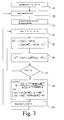
Figure 3 illustrates a second embodiment which does not require the knowledge of the channel time correlation factor. -
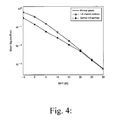
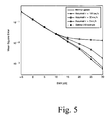
Figures 4 and5 illustrate simulation of the results obtained with the process. - Some preliminary theoretical considerations (I) show to be appropriate before describing one embodiment of a channel estimation process (II)
- Channel estimation, along with most synchronization procedures, is an intricate information theoretic problem. Indeed, while Shannon (C. E. Shannon, "A mathematical theory of communications", Bell System Technical Journal, vol. 27, no. 7, pp. 379-423, 1948) allows us to derive the capacity of a channel for which all synchronization parameters, plus the noise variance, are perfectly known, no such theory exists when the knowledge of some of these parameters is missing.
- More precisely, for a scalar communication y = hx+n, x ∈ X, for some codebook X, if h is unknown, then the maximum a posteriori estimate for x is

- which requires to have an a priori p(h) for h. But this a priori is too impractical to obtain and would require to know all possible channel realizations and their respective probability. As a consequence to this strong difficulty, most contributions in the synchronization field have provided various empirical models based on field observations in order either to give an expression to p(h) or, more practically, to propose good channel estimators ĥ to h.
- The difficulty of handling estimation problems when little side information is available is treated by Jaynes, through the Bayesian probability field, thanks to the maximum entropy principle (MaxEnt) (E. T. Jaynes, "Information Theory and Statistical Mechanics", Physical Review, APS, vol. 106, no. 4, pp. 620-630, 1957).
- However MaxEnt does not allow to perform updates of probability when new information, such as new pilots in the channel estimation problem, is available. In this case, the complete set of past symbols along with a prior distribution for the channel h0 at time t = 0.
- The inventors have discussed such question fro the OFDM framework in the article "A maximum entropy approach to OFDM channel estimation", arxiv Preprint http://arxiv.org/pdf/0811.0778 when the channel delay spread, the channel time correlation and the signal-to noise ratio (SNR) are alternatively known or unknown. When these parameters are not perfectly known, MaxEnt provides channel estimates minimizing the estimate mean square error (MMSE estimates) that outperform classical estimates which use empirical (often erroneous) models. Recent contributions in the Bayesian probability field enable one to perform probability updates, in particular based minimum cross entropy considerations [See A. Caticha, "Lectures on Probability, Entropy and Statistical Physics", arXiv:0808.0012v1 [physics.data-an], 2008].
- Preliminary notations: in the following boldface lower case represent vectors, capital boldface characters denote matrices (IN is the N ×N identity matrix). The transposition operation is denoted (·)T. The Hermitian transpose is denoted (·)H. The operator diag(x) turns the vector x into a diagonal matrix. The symbol det(X) is the determinant of matrix X. The symbol E[·] denotes expectation. The Kronecker delta function is denoted δ x that equals 1 if x = 0 and equals 0 otherwise.
- Consider a single cell OFDM system with N subcarriers. The cyclic prefix (CP) length is NCP samples. In the timefrequency OFDM symbol grid, pilots are found in the symbol positions indexed by the function φt(n) ∈ {0, 1} which equals 1 if a pilot symbol is present at subcarrier n, at symbol time index t, and 0 otherwise. The time-frequency grid is depicted in
Figure 1 . Both data and pilots at time t are modeled by the frequency-domain vector st ∈ CN with pilot entries of amplitude |st,k|2 = 1. The transmission channel is denoted h t ∈ CN in the frequency-domain with entries of variance E[|ht,k|2] = 1. The additive noise is denoted nt ∈ CN with entries of variance E[|nt,k|2] = σ2. The noise process is modeled as Gaussian with independent and identically distributed (i.i.d.) entries, n ~ CN(0, σ2 I N ) - The time-domain representation of h t is denoted νt ∈ C L with L the channel length, i.e. the channel delay spread expressed in OFDM-sample unit. The frequency-domain received signal yt ∈ CN is then:

- We will also denote,


and h' = (h'1, ... , h'N)T (here, the time index t is implicit). - The channel ht evolves in time with coherence time function λ(τ) such that, independently of the channel delay spread index

- This model is justified by maximum entropy considerations (see e.g. the reference R. Couillet, M. Debbah, "A maximum entropy approach to OFDM
- channel estimation", arxiv Preprint http://arxiv.org/pdf/0811.0778) and leads for p(h t |h t+τ) to be assigned a Gaussian distribution of mean λ(τ)h t+τ and variance

With
- This work aims at providing MMSE estimates ĥt ∈ CN of the vector ht when the receiver, at time t is only aware of:
- (i) the last stream of pilots received at some time tp ≤ t,
- (ii) the last density function p(ht0 ) assigned to ht0 . All other system parameters, e.g. channel delay spread, channel coherence time, SNR, are either known or unknown. This will be clearly stated in the following and will be denoted I.
- The fundamental difference between orthodox and Bayesian probabilities lies in the existence of prior distributions in the Bayesian realm. In the present situation, when estimating h t from the observation y t, orthodox probabilists decide for a maximum likelihood estimator ĥ t = arg max ht p(ht |h't ), following a given model linking h't to ht . Bayesian probabilists would note that


where I is the side information of the estimator. The probability p(h t|I) is the subjective prior distribution for h t, which is immaterial in orthodox probability. - To derive p(h t|I) based on prior statistical knowledge on h t, e.g. first order moments, Jaynes introduces the maximum entropy principle in the reference E. T. Jaynes, "Information Theory and Statistical Mechanics", Physical Review, APS, vol. 106, no. 4, pp. 620-630, 1957.
- The latter allows to assign a distribution to p(h t|I) which satisfies the statistical constraints given by I and which minimizes the risk of making unwanted assumptions, by maximizing the entropy of p(h t|I).
- When it comes to update probability assignments, Caticha proposes an extension of the maximum entropy principle, namely the minimum cross entropy principle (ME) in A. Caticha, "Lectures on Probability, Entropy and Statistical Physics", arXiv:0808.0012v1 [physics.data-an], 2008.
- When p(h t|I1 ) has been assigned for some side information l1, and new cogent information l2 is later available, then the ME principle consists in assigning to p(h t|l 2) the distribution

- Where

- It can therefore be derived a method based on a minimal update requirement, which in essence assigns to p(h t|I 2) the unique distribution which minimizes the changes brought to p(h t|I 1) while satisfying the new constraints given by l2.
- In the following, additional side information on h t (which possibly varies over time) will come from new available pilots at later time positions.
- Channel estimation is performed at different time instants tk , k ∈ N.
- Denote I k the knowledge at time t k . Since memory restrictions impose to discard past, we decide here only to consider at time tk the last received pilot data symbols, the last assigned probability p(h k|I k-1), h k = h tk and the supposedly known time correlation λ between time t and the past channel h k-1. Assume prior assigned distribution p(h k-1|I k-1) at time index k - 1. We have in general

- Using Caticha's ME principle and set p(h k-1|I k) to the previous p(h k-1|y k-1, I k-1). The reason lies in the minimal update principle: if no additional information is given in I k, compared to I k-1, then p(h k-1|y k-1, I k-1) is the distribution q that minimizes the cross-entropy S[q, p(h k-1|y k-1, I k-1)]2
- Let us now perform a recursive reasoning over the channel estimates at time indexes k ∈ N.. Assume that p(h k-1|y k-1, I k-1) is Gaussian CN(k k-1, M k-1).
- One may show that this implies p(h k|y k, I k) is still Gaussian. This will therefore be denoted

- We have

where the Q̃'s are taken from a set of invertible matrices in the neighborhood of Q, and the αi's are constants. - First we need to write the exponents of the Gaussian products in the integrand in a single Gaussian exponent form of the vector h k-1 times a constant independent of h k-1. By expansion and simplification, this is

- With

- The integral (13) is then a constant times eC, which depends on h k. The term C must then be written again into a quadratic expression of h k. This is

with
- Together with the term outside the integral (13), this is

With
- Finally, after some arithmetic derivation, in the limit Q̃ → Q,

- And the MMSE estimator ĥ k for the channel at time index k is the first order moment of a Gaussian distribution centered in kk which is ĥ k = kk. At initial time instant t0, if nothing but the channel delay spread L is known, M0 = Q from MaxEnt, , and k0 = 0. Therefore, we prove by the above recursion that, under this state of initial knowledge, for all k ∈ N, p(h k | I k ) is Gaussian with mean kk and variance M k, and ĥ k = kk. Note that, while regularized inverses of Q were used along the derivations, the final formulas are properly conditioned with respect to Q
- The process which will be described hereafter will take advantage of this particular observation, and will achieve an iterative mechanism of channel estimation, based on an iterative update of both the mean k k and variance M k of the distribution of the channel estimation.
- Before entering into the particular detail of the process, the inventors have further discovered that the channel estimation can even be achieved without perfect system parameter knowledge
- In practical applications, contrary to what was stated above, , the different parameters λ, σ2 and L especially, might not be perfectly known. For simplicity we assume those parameters are constant over the duration of the channel estimation process. Following the MaxEnt principle, these parameters must be assigned an a priori distribution. Let us focus on the time correlation λ, which is typically the most difficult parameter to track. In this respect, one has

- Since yk cannot bring alone any cogent information on λ, p(λ |yk, Ik) = p(λ|Ik). The probability p(hk|yk, λ, Ik) was computed above and is given by the right-hand side of Equation (17), in which α depends on λ and must therefore be made explicit.
- Further computation leads to

with M k (λ) and kk (λ) given by Equation (18) above for the λ in question and
With
And
- The MMSE estimate ĥ k is then the weighted sum:

- This integral is however very involved. In practice, it must be broken into a finite sum over a set of potential values for λ. Denoting S this set and |S| its cardinality, the recursive algorithm that provides the successive estimates ĥ k k = 1, . ..,K, requires that at every step, the values for M k (λ) and k k (λ) , λ ∈ S are kept in memory.
- One may then describe the preferred embodiment of a channel estimation process which is based on the underlying above described principle.
- It has been demonstrated how the knowledge of the variance and estimate M k (λ) and k k (λ) at k-1 can be advantageously used for achieving an iterative estimation method based on the update mechanism shown in formulas (18). With the hypothesis of a Gaussian channel, the information collected by the estimate at instant k-1 and the variance shows to be minimal and, therefore, allows to reduce the quantity of data to be stored within the memory since the variance will only need to be represented by an NxN matrix.
- Furthermore, while the processes described below will be discussed in the frequency domain, where a matrix shows to be an NxN matrix which might have a significant size, the computations below may also be performed in the time domain what will result in a significant reduction of the size of the matrix.
- With respect to
Figure 2 , there is now described one embodiment of a process which assumes the knowledge of the value of λ - In a
step 21, the process starts with an initialization step. At time t=0, the values of M 0 and k 0 are respectively set to Q and 0. - Then, in a
step 22, the process enters into a loop; - Then, in a
step 23, the process receives an OFDM symbol and may extract the received signal and the pilots therein contained. - Then, in a
step 24, the process computes an estimate value of the variance of the probability distribution of p( h k | y k, Ik ) at time instant k, y k , and I k respectively corresponding to the received signal and to a priori known information, in accordance with the following formula :
With
N being the number of sub carriers in the OFDM symbol;
k k being the estimated channel at instant k;
M k being a NxN matrix representative of the variance of the estimated channel at instant k;
Q being a matrix initialized to a predetermined value;
P k is an NxN diagonal matrix comprising a "1" at the location of a pilot symbol and a "0" elsewhere;
I N being the NxN identity matrix;
λ corresponding to the known channel time correlation between instant k-1 and k. - Then, in a
step 25, the process computes an estimate value of the channel k k in accordance with the formula:
With
σ 2 being the variance of the noise;
h'k being equal to the received signal y k pointwise divided by the corresponding pilot S k; - Then, in a
step 26, the process issues the estimate value ĥ k = k k - Then, in a
step 27, the process loops back to step 22 in order to process the next OFDM symbol. - With respect to
figure 3 , there is illustrated a second embodiment of a process of channel estimation which takes no assumption on the value of λ. - In a
step 31, the process starts with an initialization step similar to step 21 above. - In a
step 32 the process enters a loop. - In a
step 33, the process receives an OFDM sample. - Then, in
step 34, the process enters a new loop for processing a predetermined set of possible coefficients number of values (λ1 λ2 λ3 .... λn ..... λM) with n=1 to M. To each value λn one associates a couple (M k (λ) , k k (λ) ), which will be calculated in accordance with the same formula as above. - Indeed, in
steps 
With
N being the number of sub carriers in the OFDM symbol;
k k being the estimated channel at instant k;
M k being a NxN matrix representative of the variance of the estimated channel at instant k;
Q being a matrix initialized to a predetermined value;
P k is an NxN diagonal matrix comprising a "1" at the location of a pilot symbol and a "0" elsewhere;
I N being the NxN identity matrix;
λ corresponding to the known channel time correlation between instant k-1 and k. - Then, in a
step 37, a test is considered in order to determine whether a subsequent value λn+1 is to be processed. - If so, the process returns to step 34 above for the purpose of computing that new value and, conversely, if all the values of (λ1 λ2 λ3 .... λn ...... λM) have been processed, then the process proceeds to step 38 where it computes the estimate ĥ k of the channel from a weighted sum of the latter, as follows:

With
With k k (λ) being the estimated channel at instant k depending on λ,
M k (λ) being a matrix representative of the variance of the estimated channel at instant k assuming λ time correlation. - The process then proceeds to step 39 which loops back to step 32 for the purpose of processing a new OFDM symbol.
- In this section, we provide simulation plots to compare, at time t, the minimal channel estimation update method against (i) the one-dimensional MMSE, taken at time t, which takes only into account the last past pilot symbols and uses a fixed empirical covariance matrix, (ii) an typical optimum two-dimensional MMSE, with K = 4 pilot time indexes. The OFDM DFT size is N = 64, the channel length L = 6 is known to the receiver, the vehicular speed is v = 120 km/h, pilot sequences are transmitted every 0.29 ms (as in 3GPPLTE [7]), and the induced Jake's time correlation λ between t and the past pilot sequence arrival time is known to the receiver. In scenario (ii), all K past received pilot sequences and time correlations are perfectly known. The channel time correlation model is a K-order autoregressive model following the reference K. E. Baddour and , N. C. Beaulieu, "Autoregressive modeling for fading channel simulation," IEEE Transaction on Wireless Communications, July 2005.
- A performance comparison is proposed in
Figure 5 . We notice here that the minimal update algorithm does not show significant performance decay compared to the optimal two-dimensional MMSE estimator, while the one-dimensional MMSE estimator, also relying on the last past pilot sequence, shows large performance impairment. - In
Figure 3 , with the same assumptions as previously, we consider the hypothesis where the vehicular speed v is a priori
known to be (with equal probabilities) either 5, 50, 120 km/h. The performance is compared against the optimal 2-D algorithm where v is known but erroneously estimated (v = 5, 50, 100 km/h). It is observed that, again, even when λ, or equivalently v, is a priori unknown, the Bayesian minimal update framework manages to ideally recover the channel with no performance decay. On the opposite, when λ is erroneously estimated, the performance decay of the optimal estimator might be dramatic.
Claims (15)
- Process for estimating the channel in an OFDM communication system, said OFDM sample being based on a time-frequency grid comprising a set of pilots.- receiving OFDM sample based subframes comprising a set of pilot signals;- performing an iterative loop for the purpose of computing (M k , k k ) respectively corresponding to the covariance matrix and the mean of the probability distribution of p( h k | y k , Ik ) at time instant k, yk, and Ik respectively corresponding to the received signal and to a priori known information;
said value of (M k , k k ) being computed as a function of (M k-1 , k k-1 ), λ being the time correlation between the true channel hk and hk-1 , as well as the values of the pilots received at instant k. - Process for estimating the channel in an OFDM communication system according to claim 1 characterized in that it further comprises the steps of:- receiving OFDM sample based subframes comprising a set of pilots signals;- performing an estimation of the channel based on the mean k k and variance M k of the distribution of the true channel in accordance with the following formulation:

With
N being the number of sub carriers in the OFDM symbol; k k being the estimated channel at instant k;
M k being a NxN matrix representative of the variance of the estimated channel at instant k;
Q being a matrix initialized to a predetermined value;
P k is an NxN diagonal matrix comprising a "1" at the location of a pilot symbol and a "0" elsewhere;
I N being the NxN identity matrix;
λ corresponding to the known channel time correlation between instant k-1 and k. - Process according to claim 1 characterized in that Q is an a priori frequency covariance matrix for an L-tap uniform channel.
- Process according to claim 1 characterized in that the time correlation factor (λ) corresponds to the correlation factor in the auto regressive model of the first order of h k.
- Process according to claims 1 to 3 characterized in that said parameter M k is forwarded to the base station as an information representative of the quality of the channel estimation.
- Process according to anyone of claims 1 to 4 characterized in that it is adapted to the 3GPP Long Term Evolution (LTE) standard.
- Process for estimating the channel in an OFDM communication system, said OFDM sample being based on a time-frequency grid comprising a set of pilots.- receiving a OFDM sample based subframes comprising a set of pilots signals;- performing an iterative loop for the purpose of computing (M k (λ) , k k (λ) ) respectively corresponding to the variance and the mean of the probability distribution of p( h k | y k , Ik ) at time instant k, y k , and Ik respectively corresponding to the received signal and to a priori known information;
said value of (M k (λ) , k k (λ)) being computed as a function of (M k-1 (λ) , k k-1 (λ) ) for λ spanning a predetermined set of values {λn} with n=1 to M between true channel hk and hk-1 , as well as the values of the pilots received at instant k,
With
And
With k k (λ) being the estimated channel at instant k assuming λ,
k k being the estimated channel at instant k;
With k k (λ) being the estimated channel at instant k depending on λ,
M k (λ) being a matrix representative of the variance of the estimated channel at instant k; depending on λ,
Q being a matrix initialized to a predetermined value;
P k is a diagonal NxN matrix comprising a "1" at the location of a pilot symbol;
I N being the NxN identity matrix;
σ 2 being the variance of the noise;
h'k being equal to the received signal y k pointwise divided by the corresponding pilot s k. - Process according to claim 7 characterized in that Q is an a priori frequency correlation matrix for an L-tap uniform channel.
- Process according to claim 7 characterized in that the set of time correlation factors {λn} corresponds to hypothetical values for the time correlation parameter λ.
- Process according to claims 7 to 9 characterized in that said parameter M k is forwarded to the base station as an information representative of the quality of the channel estimation.
- Process according to any of claims 7 to 10 characterized in that it is adapted to the Long Term Evolution (LTE) standard.
- Receiver for an OFDM communication system comprising:- a means for receiving a OFDM sample based subframes comprising a set of pilots signals;- a means for performing an iterative loop for the purpose of computing (M k , k k ) respectively corresponding to the variance and the mean of the probability distribution of p(h k | y k , Ik ) at time instant k, y k, and Ik respectively corresponding to the received signal and to a priori known information;
said value of (M k , k k ) being computed as a function of (M k-1 , k k-1 ), λ being the time correlation between the true channel hk and hk-1 , as well as the values of the pilots received at instant k. - Receiver according to claim 12, characterized in that it further comprises:- a means for performing an estimation of the channel based on the mean k k and variance M k of the distribution of the channel estimation in accordance with the following formulation:

With
N being the number of sub carriers in the OFDM symbol;
k k being the estimated channel at instant k;
M k being a NxN matrix representative of the variance of the estimated channel at instant k;
Q being a matrix initialized to a predetermined value;
P k is an NxN diagonal matrix comprising a "1" at the location of a pilot symbol and a "0" elsewhere;
I N being the NxN identity matrix;
λ corresponding to the known channel time correlation between instant k-1 and k. - Receiver for an OFDM communication system comprising a means for estimating the channel and characterized in that it further comprises:- a means for receiving a OFDM sample based subframes comprising a set of pilots signals;- a means for performing an iterative loop for the purpose of computing (M k (λ) , k k (λ) ) respectively corresponding to the variance and the mean of the probability distribution of p(h k | y k , Ik ) at time instant k, y k , and Ik respectively corresponding to the received signal and to a priori known information;
said value of (M k (λ ) , k k (λ )) being computed as a function of (M k-1 k k-1 ) for a predetermined set of values of time correlation (λn) with n=1 to M between the true channels hk and hk-1 , as well as the values of the pilots received at instant k,
With
And
With k k (λ) being the estimated channel at instant k depending on λ,
M k (λ) being a matrix representative of the variance of the estimated channel at instant k; depending on λ,
Q being a matrix initialized to a predetermined value;
P k is a diagonal NxN matrix comprising a "1" at the location of a pilot symbol ;
I N being the NxN identity matrix;
σ 2 being the variance of the noise;
h'k being equal to the received signal y k pointwise divided by the corresponding pilot s k. - Mobile communication for a LTE communication system characterized in that it comprises the receiver as defined in claims 12-14.
Priority Applications (4)
| Application Number | Priority Date | Filing Date | Title |
|---|---|---|---|
| EP09368030.4A EP2299641B1 (en) | 2009-09-17 | 2009-09-17 | Process for estimating the channel in a OFDM communication system, and receiver for doing the same |
| JP2012529156A JP5723371B2 (en) | 2009-09-17 | 2010-09-16 | Process for estimating a channel in an OFDM communication system and receiver therefor |
| PCT/EP2010/005694 WO2011032700A1 (en) | 2009-09-17 | 2010-09-16 | Process for estimating the channel in an ofdm communication system, and receiver for doing the same |
| US13/395,975 US8842754B2 (en) | 2009-09-17 | 2010-09-16 | Process for estimating the channel in a OFDM communication system, and receiver for doing the same |
Applications Claiming Priority (1)
| Application Number | Priority Date | Filing Date | Title |
|---|---|---|---|
| EP09368030.4A EP2299641B1 (en) | 2009-09-17 | 2009-09-17 | Process for estimating the channel in a OFDM communication system, and receiver for doing the same |
Publications (2)
| Publication Number | Publication Date |
|---|---|
| EP2299641A1 true EP2299641A1 (en) | 2011-03-23 |
| EP2299641B1 EP2299641B1 (en) | 2016-02-10 |
Family
ID=41796543
Family Applications (1)
| Application Number | Title | Priority Date | Filing Date |
|---|---|---|---|
| EP09368030.4A Not-in-force EP2299641B1 (en) | 2009-09-17 | 2009-09-17 | Process for estimating the channel in a OFDM communication system, and receiver for doing the same |
Country Status (4)
| Country | Link |
|---|---|
| US (1) | US8842754B2 (en) |
| EP (1) | EP2299641B1 (en) |
| JP (1) | JP5723371B2 (en) |
| WO (1) | WO2011032700A1 (en) |
Cited By (1)
| Publication number | Priority date | Publication date | Assignee | Title |
|---|---|---|---|---|
| TWI456409B (en) * | 2011-10-18 | 2014-10-11 | Univ Nat Sun Yat Sen | Calculation method for ofdm system with papr reduction function |
Families Citing this family (5)
| Publication number | Priority date | Publication date | Assignee | Title |
|---|---|---|---|---|
| US20120224498A1 (en) * | 2011-03-04 | 2012-09-06 | Qualcomm Incorporated | Bayesian platform for channel estimation |
| US9270494B2 (en) * | 2014-06-08 | 2016-02-23 | Mediatek Singapore Pte. Ltd. | Channel estimation method and associated device for estimating channel for OFDM system |
| US9716536B2 (en) * | 2015-03-19 | 2017-07-25 | Mitsubishi Electric Research Laboratories, Inc. | System and method for wireless communications over fading channels |
| CN106911443B (en) * | 2017-02-23 | 2019-11-26 | 北京交通大学 | Pilot tone optimum design method in compressed sensing based M2M communication system |
| CN107359899B (en) * | 2017-06-24 | 2019-07-26 | 苏州桑泰海洋仪器研发有限责任公司 | Orthogonal frequency division multiplexing spread-spectrum underwater sound communication is without pilot tone judgment feedback channel estimation method under the conditions of condition of sparse channel |
Family Cites Families (3)
| Publication number | Priority date | Publication date | Assignee | Title |
|---|---|---|---|---|
| GB2392065B (en) * | 2002-08-15 | 2004-12-29 | Toshiba Res Europ Ltd | Signal decoding methods and apparatus |
| ATE447802T1 (en) * | 2005-09-08 | 2009-11-15 | Huawei Tech Co Ltd | DETECTION METHOD FOR ACK/NACK SIGNALS AND DETECTOR THEREFOR |
| US8363536B2 (en) * | 2006-08-28 | 2013-01-29 | Qualcomm Incorporated | OFDM channel estimation |
-
2009
- 2009-09-17 EP EP09368030.4A patent/EP2299641B1/en not_active Not-in-force
-
2010
- 2010-09-16 WO PCT/EP2010/005694 patent/WO2011032700A1/en not_active Ceased
- 2010-09-16 US US13/395,975 patent/US8842754B2/en not_active Expired - Fee Related
- 2010-09-16 JP JP2012529156A patent/JP5723371B2/en not_active Expired - Fee Related
Non-Patent Citations (4)
| Title |
|---|
| C. E. SHANNON: "A mathematical theory of communications", BELL SYSTEM TECHNICAL JOURNAL, vol. 27, no. 7, 1948, pages 379 - 423 |
| COUILLET R ET AL: "A maximum entropy approach to OFDM channel estimation", 5 November 2008 (2008-11-05), XP002573433, Retrieved from the Internet <URL:http://arxiv4.library.cornell.edu/PS_cache/arxiv/pdf/0811/0811.0778v1.pdf> [retrieved on 20100314] * |
| E. T. JAYNES: "Information Theory and Statistical Mechanics", PHYSICAL REVIEW, vol. 106, no. 4, 1957, pages 620 - 630 |
| K. E. BADDOUR; N. C. BEAULIEU: "Autoregressive modeling for fading channel simulation", IEEE TRANSACTION ON WIRELESS COMMUNICATIONS, July 2005 (2005-07-01) |
Cited By (1)
| Publication number | Priority date | Publication date | Assignee | Title |
|---|---|---|---|---|
| TWI456409B (en) * | 2011-10-18 | 2014-10-11 | Univ Nat Sun Yat Sen | Calculation method for ofdm system with papr reduction function |
Also Published As
| Publication number | Publication date |
|---|---|
| JP2013505611A (en) | 2013-02-14 |
| JP5723371B2 (en) | 2015-05-27 |
| EP2299641B1 (en) | 2016-02-10 |
| WO2011032700A1 (en) | 2011-03-24 |
| US20120213315A1 (en) | 2012-08-23 |
| US8842754B2 (en) | 2014-09-23 |
Similar Documents
| Publication | Publication Date | Title |
|---|---|---|
| EP3679493B1 (en) | Lattice reduction in orthogonal time frequency space modulation | |
| CN115412416B (en) | Low-complexity OTFS signal detection method for high-speed moving scene | |
| DE102014008347B4 (en) | METHOD AND DEVICE FOR CHANNEL ESTIMATION AND OFDM RECEIVER | |
| US8054917B2 (en) | Method and apparatus for advanced inter-carrier interference cancellation in orthogonal frequency division multiplexing (OFDM) channels | |
| US20100074358A1 (en) | Sparse Channel Estimation for MIMO OFDM Systems | |
| EP2299641B1 (en) | Process for estimating the channel in a OFDM communication system, and receiver for doing the same | |
| Pedersen et al. | Application of Bayesian hierarchical prior modeling to sparse channel estimation | |
| CN105337906B (en) | Channel estimation method and device | |
| EP2442507B1 (en) | Channel estimation method using an improved Expectation Maximization (EM-)Algorithm | |
| GB2392065A (en) | Trellis decoding using estimates of transmitted codewords and channel responses in a MIMO-OFDM system | |
| CN111478753A (en) | NR non-correlated combined PBCH DMRS blind detection method | |
| EP1901505A2 (en) | Wireless communication apparatus | |
| CN109729035A (en) | An Impulse Noise Suppression Method in Orthogonal Frequency Division Multiplexing Technology Communication System | |
| EP2495885B1 (en) | Channel estimation method and device in a multi-antenna system | |
| CN113055318B (en) | Channel estimation method | |
| Shen et al. | Time-domain zero-padding (TZP) AFDM with two-stage iterative mmse detection | |
| EP2204959B1 (en) | Process and apparatus for estimating an initial carrier frequency offset in an OFDM communication system | |
| KR102001107B1 (en) | Mimo systems with independent oscillators and phase noise mitigation method thereof | |
| CN118631612A (en) | A conjugate gradient based OTFS cross-domain iterative signal detection method | |
| Halder et al. | Channel estimation and data detection in DS-spread channels: A unified framework, novel algorithms, and waveform comparison | |
| US20260089032A1 (en) | Apparatus and method for channel estimation using demodulation reference signal | |
| CN120811829A (en) | High-reliability OTFS channel estimation method based on unscented particle filter | |
| EP3874604B1 (en) | Channel state information reporting in wireless communications | |
| CN102217222A (en) | Signal processing method and apparatus | |
| CN100518150C (en) | Channel estimation method based on structural matrix and realization apparatus |
Legal Events
| Date | Code | Title | Description |
|---|---|---|---|
| PUAI | Public reference made under article 153(3) epc to a published international application that has entered the european phase |
Free format text: ORIGINAL CODE: 0009012 |
|
| AK | Designated contracting states |
Kind code of ref document: A1 Designated state(s): AT BE BG CH CY CZ DE DK EE ES FI FR GB GR HR HU IE IS IT LI LT LU LV MC MK MT NL NO PL PT RO SE SI SK SM TR |
|
| AX | Request for extension of the european patent |
Extension state: AL BA RS |
|
| 17P | Request for examination filed |
Effective date: 20110923 |
|
| 17Q | First examination report despatched |
Effective date: 20111017 |
|
| GRAP | Despatch of communication of intention to grant a patent |
Free format text: ORIGINAL CODE: EPIDOSNIGR1 |
|
| INTG | Intention to grant announced |
Effective date: 20150720 |
|
| GRAS | Grant fee paid |
Free format text: ORIGINAL CODE: EPIDOSNIGR3 |
|
| GRAA | (expected) grant |
Free format text: ORIGINAL CODE: 0009210 |
|
| AK | Designated contracting states |
Kind code of ref document: B1 Designated state(s): AT BE BG CH CY CZ DE DK EE ES FI FR GB GR HR HU IE IS IT LI LT LU LV MC MK MT NL NO PL PT RO SE SI SK SM TR |
|
| REG | Reference to a national code |
Ref country code: GB Ref legal event code: FG4D |
|
| REG | Reference to a national code |
Ref country code: AT Ref legal event code: REF Ref document number: 775124 Country of ref document: AT Kind code of ref document: T Effective date: 20160215 Ref country code: CH Ref legal event code: EP |
|
| REG | Reference to a national code |
Ref country code: IE Ref legal event code: FG4D |
|
| REG | Reference to a national code |
Ref country code: DE Ref legal event code: R096 Ref document number: 602009036165 Country of ref document: DE |
|
| REG | Reference to a national code |
Ref country code: LT Ref legal event code: MG4D |
|
| REG | Reference to a national code |
Ref country code: NL Ref legal event code: MP Effective date: 20160210 |
|
| REG | Reference to a national code |
Ref country code: AT Ref legal event code: MK05 Ref document number: 775124 Country of ref document: AT Kind code of ref document: T Effective date: 20160210 |
|
| PG25 | Lapsed in a contracting state [announced via postgrant information from national office to epo] |
Ref country code: IT Free format text: LAPSE BECAUSE OF FAILURE TO SUBMIT A TRANSLATION OF THE DESCRIPTION OR TO PAY THE FEE WITHIN THE PRESCRIBED TIME-LIMIT Effective date: 20160210 Ref country code: NO Free format text: LAPSE BECAUSE OF FAILURE TO SUBMIT A TRANSLATION OF THE DESCRIPTION OR TO PAY THE FEE WITHIN THE PRESCRIBED TIME-LIMIT Effective date: 20160510 Ref country code: ES Free format text: LAPSE BECAUSE OF FAILURE TO SUBMIT A TRANSLATION OF THE DESCRIPTION OR TO PAY THE FEE WITHIN THE PRESCRIBED TIME-LIMIT Effective date: 20160210 Ref country code: HR Free format text: LAPSE BECAUSE OF FAILURE TO SUBMIT A TRANSLATION OF THE DESCRIPTION OR TO PAY THE FEE WITHIN THE PRESCRIBED TIME-LIMIT Effective date: 20160210 Ref country code: FI Free format text: LAPSE BECAUSE OF FAILURE TO SUBMIT A TRANSLATION OF THE DESCRIPTION OR TO PAY THE FEE WITHIN THE PRESCRIBED TIME-LIMIT Effective date: 20160210 Ref country code: GR Free format text: LAPSE BECAUSE OF FAILURE TO SUBMIT A TRANSLATION OF THE DESCRIPTION OR TO PAY THE FEE WITHIN THE PRESCRIBED TIME-LIMIT Effective date: 20160511 |
|
| REG | Reference to a national code |
Ref country code: FR Ref legal event code: PLFP Year of fee payment: 8 |
|
| PG25 | Lapsed in a contracting state [announced via postgrant information from national office to epo] |
Ref country code: IS Free format text: LAPSE BECAUSE OF FAILURE TO SUBMIT A TRANSLATION OF THE DESCRIPTION OR TO PAY THE FEE WITHIN THE PRESCRIBED TIME-LIMIT Effective date: 20160610 Ref country code: SE Free format text: LAPSE BECAUSE OF FAILURE TO SUBMIT A TRANSLATION OF THE DESCRIPTION OR TO PAY THE FEE WITHIN THE PRESCRIBED TIME-LIMIT Effective date: 20160210 Ref country code: LV Free format text: LAPSE BECAUSE OF FAILURE TO SUBMIT A TRANSLATION OF THE DESCRIPTION OR TO PAY THE FEE WITHIN THE PRESCRIBED TIME-LIMIT Effective date: 20160210 Ref country code: PL Free format text: LAPSE BECAUSE OF FAILURE TO SUBMIT A TRANSLATION OF THE DESCRIPTION OR TO PAY THE FEE WITHIN THE PRESCRIBED TIME-LIMIT Effective date: 20160210 Ref country code: AT Free format text: LAPSE BECAUSE OF FAILURE TO SUBMIT A TRANSLATION OF THE DESCRIPTION OR TO PAY THE FEE WITHIN THE PRESCRIBED TIME-LIMIT Effective date: 20160210 Ref country code: NL Free format text: LAPSE BECAUSE OF FAILURE TO SUBMIT A TRANSLATION OF THE DESCRIPTION OR TO PAY THE FEE WITHIN THE PRESCRIBED TIME-LIMIT Effective date: 20160210 Ref country code: PT Free format text: LAPSE BECAUSE OF FAILURE TO SUBMIT A TRANSLATION OF THE DESCRIPTION OR TO PAY THE FEE WITHIN THE PRESCRIBED TIME-LIMIT Effective date: 20160613 Ref country code: LT Free format text: LAPSE BECAUSE OF FAILURE TO SUBMIT A TRANSLATION OF THE DESCRIPTION OR TO PAY THE FEE WITHIN THE PRESCRIBED TIME-LIMIT Effective date: 20160210 |
|
| RAP2 | Party data changed (patent owner data changed or rights of a patent transferred) |
Owner name: ST-ERICSSON SA |
|
| PG25 | Lapsed in a contracting state [announced via postgrant information from national office to epo] |
Ref country code: DK Free format text: LAPSE BECAUSE OF FAILURE TO SUBMIT A TRANSLATION OF THE DESCRIPTION OR TO PAY THE FEE WITHIN THE PRESCRIBED TIME-LIMIT Effective date: 20160210 Ref country code: EE Free format text: LAPSE BECAUSE OF FAILURE TO SUBMIT A TRANSLATION OF THE DESCRIPTION OR TO PAY THE FEE WITHIN THE PRESCRIBED TIME-LIMIT Effective date: 20160210 |
|
| REG | Reference to a national code |
Ref country code: DE Ref legal event code: R097 Ref document number: 602009036165 Country of ref document: DE |
|
| PG25 | Lapsed in a contracting state [announced via postgrant information from national office to epo] |
Ref country code: RO Free format text: LAPSE BECAUSE OF FAILURE TO SUBMIT A TRANSLATION OF THE DESCRIPTION OR TO PAY THE FEE WITHIN THE PRESCRIBED TIME-LIMIT Effective date: 20160210 Ref country code: SM Free format text: LAPSE BECAUSE OF FAILURE TO SUBMIT A TRANSLATION OF THE DESCRIPTION OR TO PAY THE FEE WITHIN THE PRESCRIBED TIME-LIMIT Effective date: 20160210 Ref country code: CZ Free format text: LAPSE BECAUSE OF FAILURE TO SUBMIT A TRANSLATION OF THE DESCRIPTION OR TO PAY THE FEE WITHIN THE PRESCRIBED TIME-LIMIT Effective date: 20160210 Ref country code: SK Free format text: LAPSE BECAUSE OF FAILURE TO SUBMIT A TRANSLATION OF THE DESCRIPTION OR TO PAY THE FEE WITHIN THE PRESCRIBED TIME-LIMIT Effective date: 20160210 |
|
| PLBE | No opposition filed within time limit |
Free format text: ORIGINAL CODE: 0009261 |
|
| STAA | Information on the status of an ep patent application or granted ep patent |
Free format text: STATUS: NO OPPOSITION FILED WITHIN TIME LIMIT |
|
| PG25 | Lapsed in a contracting state [announced via postgrant information from national office to epo] |
Ref country code: BE Free format text: LAPSE BECAUSE OF FAILURE TO SUBMIT A TRANSLATION OF THE DESCRIPTION OR TO PAY THE FEE WITHIN THE PRESCRIBED TIME-LIMIT Effective date: 20160210 |
|
| 26N | No opposition filed |
Effective date: 20161111 |
|
| PG25 | Lapsed in a contracting state [announced via postgrant information from national office to epo] |
Ref country code: SI Free format text: LAPSE BECAUSE OF FAILURE TO SUBMIT A TRANSLATION OF THE DESCRIPTION OR TO PAY THE FEE WITHIN THE PRESCRIBED TIME-LIMIT Effective date: 20160210 Ref country code: BG Free format text: LAPSE BECAUSE OF FAILURE TO SUBMIT A TRANSLATION OF THE DESCRIPTION OR TO PAY THE FEE WITHIN THE PRESCRIBED TIME-LIMIT Effective date: 20160510 |
|
| PG25 | Lapsed in a contracting state [announced via postgrant information from national office to epo] |
Ref country code: MC Free format text: LAPSE BECAUSE OF FAILURE TO SUBMIT A TRANSLATION OF THE DESCRIPTION OR TO PAY THE FEE WITHIN THE PRESCRIBED TIME-LIMIT Effective date: 20160210 |
|
| REG | Reference to a national code |
Ref country code: CH Ref legal event code: PL |
|
| REG | Reference to a national code |
Ref country code: IE Ref legal event code: MM4A |
|
| PG25 | Lapsed in a contracting state [announced via postgrant information from national office to epo] |
Ref country code: LI Free format text: LAPSE BECAUSE OF NON-PAYMENT OF DUE FEES Effective date: 20160930 Ref country code: IE Free format text: LAPSE BECAUSE OF NON-PAYMENT OF DUE FEES Effective date: 20160917 Ref country code: CH Free format text: LAPSE BECAUSE OF NON-PAYMENT OF DUE FEES Effective date: 20160930 |
|
| REG | Reference to a national code |
Ref country code: FR Ref legal event code: PLFP Year of fee payment: 9 |
|
| PG25 | Lapsed in a contracting state [announced via postgrant information from national office to epo] |
Ref country code: LU Free format text: LAPSE BECAUSE OF NON-PAYMENT OF DUE FEES Effective date: 20160917 |
|
| REG | Reference to a national code |
Ref country code: DE Ref legal event code: R082 Ref document number: 602009036165 Country of ref document: DE Representative=s name: GRUENECKER PATENT- UND RECHTSANWAELTE PARTG MB, DE |
|
| PGFP | Annual fee paid to national office [announced via postgrant information from national office to epo] |
Ref country code: DE Payment date: 20170821 Year of fee payment: 9 Ref country code: FR Payment date: 20170822 Year of fee payment: 9 Ref country code: GB Payment date: 20170821 Year of fee payment: 9 |
|
| REG | Reference to a national code |
Ref country code: FR Ref legal event code: TP Owner name: OCT CIRCUIT TECHNOLOGIES INTERNATIONAL LIMITED, IE Effective date: 20180116 |
|
| PG25 | Lapsed in a contracting state [announced via postgrant information from national office to epo] |
Ref country code: CY Free format text: LAPSE BECAUSE OF FAILURE TO SUBMIT A TRANSLATION OF THE DESCRIPTION OR TO PAY THE FEE WITHIN THE PRESCRIBED TIME-LIMIT Effective date: 20160210 Ref country code: HU Free format text: LAPSE BECAUSE OF FAILURE TO SUBMIT A TRANSLATION OF THE DESCRIPTION OR TO PAY THE FEE WITHIN THE PRESCRIBED TIME-LIMIT; INVALID AB INITIO Effective date: 20090917 |
|
| PG25 | Lapsed in a contracting state [announced via postgrant information from national office to epo] |
Ref country code: MK Free format text: LAPSE BECAUSE OF FAILURE TO SUBMIT A TRANSLATION OF THE DESCRIPTION OR TO PAY THE FEE WITHIN THE PRESCRIBED TIME-LIMIT Effective date: 20160210 Ref country code: TR Free format text: LAPSE BECAUSE OF FAILURE TO SUBMIT A TRANSLATION OF THE DESCRIPTION OR TO PAY THE FEE WITHIN THE PRESCRIBED TIME-LIMIT Effective date: 20160210 Ref country code: MT Free format text: LAPSE BECAUSE OF NON-PAYMENT OF DUE FEES Effective date: 20160930 |
|
| REG | Reference to a national code |
Ref country code: DE Ref legal event code: R119 Ref document number: 602009036165 Country of ref document: DE |
|
| GBPC | Gb: european patent ceased through non-payment of renewal fee |
Effective date: 20180917 |
|
| PG25 | Lapsed in a contracting state [announced via postgrant information from national office to epo] |
Ref country code: DE Free format text: LAPSE BECAUSE OF NON-PAYMENT OF DUE FEES Effective date: 20190402 |
|
| PG25 | Lapsed in a contracting state [announced via postgrant information from national office to epo] |
Ref country code: FR Free format text: LAPSE BECAUSE OF NON-PAYMENT OF DUE FEES Effective date: 20180930 |
|
| PG25 | Lapsed in a contracting state [announced via postgrant information from national office to epo] |
Ref country code: GB Free format text: LAPSE BECAUSE OF NON-PAYMENT OF DUE FEES Effective date: 20180917 |