EP2299261A1 - A food probe and a method for recognising the type of a food and monitoring a cooking process of a food stuff - Google Patents
A food probe and a method for recognising the type of a food and monitoring a cooking process of a food stuff Download PDFInfo
- Publication number
- EP2299261A1 EP2299261A1 EP09011896A EP09011896A EP2299261A1 EP 2299261 A1 EP2299261 A1 EP 2299261A1 EP 09011896 A EP09011896 A EP 09011896A EP 09011896 A EP09011896 A EP 09011896A EP 2299261 A1 EP2299261 A1 EP 2299261A1
- Authority
- EP
- European Patent Office
- Prior art keywords
- food
- electrode
- probe
- food stuff
- rod
- Prior art date
- Legal status (The legal status is an assumption and is not a legal conclusion. Google has not performed a legal analysis and makes no representation as to the accuracy of the status listed.)
- Granted
Links
Images


Classifications
-
- G—PHYSICS
- G01—MEASURING; TESTING
- G01N—INVESTIGATING OR ANALYSING MATERIALS BY DETERMINING THEIR CHEMICAL OR PHYSICAL PROPERTIES
- G01N33/00—Investigating or analysing materials by specific methods not covered by groups G01N1/00 - G01N31/00
- G01N33/02—Food
Definitions
- the present invention relates to a food probe for recognizing the type of a food and monitoring a cooking process of a food stuff. Further, the present invention relates to a method for recognizing the type of a food and monitoring a cooking process of a food stuff.
- the cooking process of substantially homogenous food stuffs like meat, potatoes and other vegetables, pies and some casseroles is monitored mainly by detecting the core temperature of the food stuff.
- the user has to know at which core temperatures the food stuff has certain desired properties like colour, tenderness or degree of cooking.
- cooking functions are available. Said cooking functions base on an information input from the user and/or measurements of different sensors like a temperature probe. The determination of food properties by measurements allows a reduction of the information input from the user.
- the detection of the electrical impedance of the food stuff can provide a lot of information for the automatic cooking functions.
- US 2006/0174775 Al discloses a method and an apparatus for tracing a cooking process. At least two separated electrodes are inserted into the food stuff. The electrical impedance is measure at a certain frequency in order to monitor the cooking process. However, the type of food stuff cannot be recognized.
- the food probe is provided for invading into a food stuff and comprises:
- the main idea of the invention is the food probe with two serially arranged electrodes at the one rod. Said serially arranged electrodes at the food probe allow the generation of an electrical field in the core of the food stuff.
- the food probe is a compact tool and easy to handle.
- the food probe comprises a spike arranged at a front end of the rod.
- the spike allows an easy invading of the food probe into the food stuff.
- the food probe may be connected or connectable to voltage supply and a control circuit of a cooking oven.
- the food probe is provided recognizing the type of the food stuff and monitoring a cooking process of said food stuff.
- the object of the present invention is further achieved by the method according to claim 5.
- the inventive method for recognizing the type of a food and monitoring a cooking process of a food stuff comprises the steps of:
- the main idea of the inventive method is the detection of the electrical impedance of the food stuff at two or more frequencies.
- this additional information allows recognizing the type of a food.
- the food probe with two arranged electrodes at the one rod is used. Said arranged electrodes at the food probe allow the generation of an electrical field in the core of the food stuff.
- the food probe is a compact tool and easy to handle.
- the food probe is invaded into the food stuff in such a way, that the front portion of the rod and the at least two electrodes are arranged within a core of the food stuff.
- further electrical parameters of the food stuff may be calculated from the electrical impedance.
- the phase angle, the ohmic resistance and/or the capacity of the food stuff are calculated from the electrical impedance.
- the ratio of phase angle of the electrical impedance at two different frequencies is calculated as a function of the temperature of the food stuff.
- one of the different frequencies is 50 kHz or 5 kHz.
- the two different frequencies are 50 kHz and 5 kHz.
- first and/or second derivations of the detected and/or calculated parameters may be determined.
- the data base may comprise the frequency spectra of the phase angle of the electrical impedance for a plurality of types of food stuff.
- the data base can be supplemented by the user.
- the user can adapt the data base to individual recipes.
- Such a teach-in function allows the user a possibility to train the cooking oven for recognizing individual recipes, which are not yet in the data base.
- FIG. 1 illustrates a schematic view of a food probe 10 according to a preferred embodiment of the present invention.
- the food probe 10 is provided for recognizing the type of a food and monitoring a cooking process of a food stuff.
- the food probe 10 comprises an elongated rod 12, a first electrode 14, a second electrode 16 and a spike 18. A front portion of the food probe 10 is invaded in a food stuff 20.
- the rod 12 is made of a non-conductive material.
- the first electrode 14 and the second electrode 16 are made of a conductive material.
- the spike 18 is made of a non-conductive material again.
- the spike 18 is arranged at a front end of the rod 10.
- the spike 18 allows that the food probe 10 can easily be invaded into the food stuff 20.
- the first electrode 14 and the second electrode 16 are also arranged within the front portion of the rod 12.
- the first electrode 14 is arranged besides the spike 18.
- the second electrode 16 is also arranged within the front portion of the rod 12, but in a predetermined distance from the first electrode 14. Thus, the first electrode 14 and the second electrode 16 are electrically isolated from each other.
- the first electrode 14 and the second electrode 16 are also arranged within the food stuff 20.
- the front portion of the food probe 10 is invaded into the food stuff 20 in such a way, that the electric field 22 is generated within the central portion of the food stuff 20.
- the serially arranged electrodes at the food probe 10 allow the generation of the electrical field 22 in the core of the food stuff 20.
- the food probe 10 is a compact tool and easy to handle.
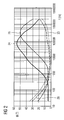
- FIG. 2 illustrates a schematic diagram of a phase angle ⁇ as a function of the frequency f for several types of food according to the preferred embodiment of the invention.
- a first curve 24 shows the frequency spectrum of the phase angle ⁇ for potatoes.
- a second curve 26 shows the frequency spectrum of the phase angle ⁇ for cauliflower.
- a third curve 28 shows the frequency spectrum of the phase angle ⁇ for pork.
- a fourth curve 30 shows the frequency spectrum of the phase angle ⁇ for the breast of a turkey hen.
- the spectra of the frequencies in FIG 2 extend from about 10 Hz to about 1 MHz.
- FIG. 2 clarifies that different types of food have their own characteristic phase angles ⁇ as function of the frequency f.
- the frequency spectrum of the phase angle ⁇ can be detected and compared with a data base.
- the type of food can be automatically recognized.
- FIG. 3 illustrates a schematic diagram of a ratio of two phase angles ⁇ at different frequencies as a function of the temperature according to the preferred embodiment of the invention.
- the curve 32 relates to the ratio of the phase angles ⁇ at the frequencies of 50 kHz and 5 kHz.
- the curve 32 relates to meat.
- the spectrum of the temperature in FIG 3 extends from about 10 °C to about 90 °C.
- the curve 32 has a minimum.
- all proteins of the food stuff are denaturated, i.e. the meat is fully cooked.
- the point 34 corresponds with a temperature between 70 °C and 80 °C.
- Further parameters like resistances, capacities and specific dielectric constants can be calculated from the detected parameters. Additionally, the first and second derivations of the detected and/or calculated parameters can be determined.
- the temperature of the food stuff 20 can be detected additionally.
- a teach-in function can be implemented. Such a teach-in function allows the user a possibility to train the cooking oven for recognizing individual recipes, which are not yet in the data base.
- the present invention can also be embedded in a computer program product, which comprises all the features enabling the implementation of the method described herein. Further, when loaded in a computer system, said computer program product is able to carry out these methods.
Landscapes
- Engineering & Computer Science (AREA)
- Food Science & Technology (AREA)
- Health & Medical Sciences (AREA)
- Life Sciences & Earth Sciences (AREA)
- Chemical & Material Sciences (AREA)
- Biochemistry (AREA)
- Physics & Mathematics (AREA)
- Analytical Chemistry (AREA)
- Medicinal Chemistry (AREA)
- General Health & Medical Sciences (AREA)
- General Physics & Mathematics (AREA)
- Immunology (AREA)
- Pathology (AREA)
- Electric Ovens (AREA)
- General Preparation And Processing Of Foods (AREA)
- Investigating Or Analyzing Materials By The Use Of Electric Means (AREA)
Abstract
Description
- The present invention relates to a food probe for recognizing the type of a food and monitoring a cooking process of a food stuff. Further, the present invention relates to a method for recognizing the type of a food and monitoring a cooking process of a food stuff.
- The cooking process of substantially homogenous food stuffs like meat, potatoes and other vegetables, pies and some casseroles is monitored mainly by detecting the core temperature of the food stuff. The user has to know at which core temperatures the food stuff has certain desired properties like colour, tenderness or degree of cooking.
- In order to simplify the cooking process for the user, automatic cooking functions are available. Said cooking functions base on an information input from the user and/or measurements of different sensors like a temperature probe. The determination of food properties by measurements allows a reduction of the information input from the user.
- The detection of the electrical impedance of the food stuff can provide a lot of information for the automatic cooking functions.
-
US 2006/0174775 Al discloses a method and an apparatus for tracing a cooking process. At least two separated electrodes are inserted into the food stuff. The electrical impedance is measure at a certain frequency in order to monitor the cooking process. However, the type of food stuff cannot be recognized. - It is an object of the present invention to provide a food probe and a method for recognizing the type of the food as well as for monitoring the cooking process of the food stuff.
- This object is achieved by the food probe according to claim 1.
- According to the present invention the food probe is provided for invading into a food stuff and comprises:
- an elongated rod made of a non-conductive material,
- a front portion of the elongated rod, which front portion is provided for invading into the food stuff,
- a first electrode made of a conductive material and arranged at the front portion of the rod, and
- a second electrode made of a conductive material and arranged at the front portion of the rod in a predetermined distance from the first electrode, wherein
- the first electrode and the second electrode are arranged serially along the longitudinal axis of the rod, and wherein
- a voltage can be applied between the first electrode and the second electrode, so that an electrical field is generated between and in the environment of the first electrode and the second electrode.
- The main idea of the invention is the food probe with two serially arranged electrodes at the one rod. Said serially arranged electrodes at the food probe allow the generation of an electrical field in the core of the food stuff. The food probe is a compact tool and easy to handle.
- In a preferred embodiment of the present invention the food probe comprises a spike arranged at a front end of the rod. The spike allows an easy invading of the food probe into the food stuff.
- Further, the food probe may be connected or connectable to voltage supply and a control circuit of a cooking oven.
- In particular, the food probe is provided recognizing the type of the food stuff and monitoring a cooking process of said food stuff.
- The object of the present invention is further achieved by the method according to
claim 5. - The inventive method for recognizing the type of a food and monitoring a cooking process of a food stuff comprises the steps of:
- invading an elongated food probe into the food stuff,
- detecting an electrical impedance of the food stuff at two or more frequencies in the beginning of the cooking process,
- detecting the electrical impedance of the food stuff at two or more frequencies during the further cooking process, and
- comparing the detected values of the electrical impedance with a data base, wherein
- the food probe is formed as an elongated rod with at least two electrodes in the front portion of said rod.
- The main idea of the inventive method is the detection of the electrical impedance of the food stuff at two or more frequencies. In particular, this additional information allows recognizing the type of a food. The food probe with two arranged electrodes at the one rod is used. Said arranged electrodes at the food probe allow the generation of an electrical field in the core of the food stuff. The food probe is a compact tool and easy to handle.
- Preferably, the food probe is invaded into the food stuff in such a way, that the front portion of the rod and the at least two electrodes are arranged within a core of the food stuff.
- Additionally, further electrical parameters of the food stuff may be calculated from the electrical impedance. For example, the phase angle, the ohmic resistance and/or the capacity of the food stuff are calculated from the electrical impedance.
- In particular, the ratio of phase angle of the electrical impedance at two different frequencies is calculated as a function of the temperature of the food stuff.
- For example, one of the different frequencies is 50 kHz or 5 kHz. Preferably, the two different frequencies are 50 kHz and 5 kHz.
- Further, the first and/or second derivations of the detected and/or calculated parameters may be determined.
- The data base may comprise the frequency spectra of the phase angle of the electrical impedance for a plurality of types of food stuff.
- Preferably, the data base can be supplemented by the user. Thus, the user can adapt the data base to individual recipes. Such a teach-in function allows the user a possibility to train the cooking oven for recognizing individual recipes, which are not yet in the data base.
- The novel and inventive features believed to be the characteristic of the present invention are set forth in the appended claims.
- The invention will be described in further detail with reference to the drawings, in which
- FIG. 1
- illustrates a schematic view of a food probe according to a preferred embodiment of the present invention,
- FIG. 2
- illustrates a schematic diagram of a phase angle as a function of the frequency for several types of food according to the preferred embodiment of the invention, and
- FIG. 3
- illustrates a schematic diagram of a ratio of two phase angles at different frequencies as a function of the temperature according to the preferred embodiment of the invention.
-
FIG. 1 illustrates a schematic view of afood probe 10 according to a preferred embodiment of the present invention. Thefood probe 10 is provided for recognizing the type of a food and monitoring a cooking process of a food stuff. - The
food probe 10 comprises anelongated rod 12, afirst electrode 14, asecond electrode 16 and aspike 18. A front portion of thefood probe 10 is invaded in afood stuff 20. - The
rod 12 is made of a non-conductive material. Thefirst electrode 14 and thesecond electrode 16 are made of a conductive material. Thespike 18 is made of a non-conductive material again. - The
spike 18 is arranged at a front end of therod 10. Thespike 18 allows that thefood probe 10 can easily be invaded into thefood stuff 20. - The
first electrode 14 and thesecond electrode 16 are also arranged within the front portion of therod 12. Thefirst electrode 14 is arranged besides thespike 18. Thesecond electrode 16 is also arranged within the front portion of therod 12, but in a predetermined distance from thefirst electrode 14. Thus, thefirst electrode 14 and thesecond electrode 16 are electrically isolated from each other. - When the front portion of the
food probe 10 is invaded in thefood stuff 20, then thefirst electrode 14 and thesecond electrode 16 are also arranged within thefood stuff 20. - When a voltage is applied between the
first electrode 14 and thesecond electrode 16, then anelectric field 22 is generated within thefood stuff 20. Saidelectric field 22 extends between and in the environment of thefirst electrode 14 and thesecond electrode 16. - Preferably, the front portion of the
food probe 10 is invaded into thefood stuff 20 in such a way, that theelectric field 22 is generated within the central portion of thefood stuff 20. - The serially arranged electrodes at the
food probe 10 allow the generation of theelectrical field 22 in the core of thefood stuff 20. Thefood probe 10 is a compact tool and easy to handle. -
FIG. 2 illustrates a schematic diagram of a phase angle φ as a function of the frequency f for several types of food according to the preferred embodiment of the invention. - A
first curve 24 shows the frequency spectrum of the phase angle φ for potatoes. Asecond curve 26 shows the frequency spectrum of the phase angle φ for cauliflower. Athird curve 28 shows the frequency spectrum of the phase angle φ for pork. Afourth curve 30 shows the frequency spectrum of the phase angle φ for the breast of a turkey hen. The spectra of the frequencies inFIG 2 extend from about 10 Hz to about 1 MHz. -
FIG. 2 clarifies that different types of food have their own characteristic phase angles φ as function of the frequency f. The frequency spectrum of the phase angle φ can be detected and compared with a data base. Thus, the type of food can be automatically recognized. -
FIG. 3 illustrates a schematic diagram of a ratio of two phase angles φ at different frequencies as a function of the temperature according to the preferred embodiment of the invention. Thecurve 32 relates to the ratio of the phase angles φ at the frequencies of 50 kHz and 5 kHz. Thecurve 32 relates to meat. - The spectrum of the temperature in
FIG 3 extends from about 10 °C to about 90 °C. At apoint 34 thecurve 32 has a minimum. At thepoint 34 all proteins of the food stuff are denaturated, i.e. the meat is fully cooked. Thepoint 34 corresponds with a temperature between 70 °C and 80 °C. - Further parameters like resistances, capacities and specific dielectric constants can be calculated from the detected parameters. Additionally, the first and second derivations of the detected and/or calculated parameters can be determined.
- In order to obtain more information the temperature of the
food stuff 20 can be detected additionally. - A teach-in function can be implemented. Such a teach-in function allows the user a possibility to train the cooking oven for recognizing individual recipes, which are not yet in the data base.
- The present invention can also be embedded in a computer program product, which comprises all the features enabling the implementation of the method described herein. Further, when loaded in a computer system, said computer program product is able to carry out these methods.
- Although illustrative embodiments of the present invention have been described herein with reference to the accompanying drawing, it is to be understood that the present invention is not limited to those precise embodiments, and that various other changes and modifications may be affected therein by one skilled in the art without departing from the scope or spirit of the invention. All such changes and modifications are intended to be included within the scope of the invention as defined by the appended claims.
-
- 10
- food probe
- 12
- rod
- 14
- first electrode
- 16
- second electrode
- 18
- spike
- 20
- food stuff
- 22
- electric field
- 24
- frequency spectrum of phase angle for potatoes
- 26
- frequency spectrum of phase angle for cauliflowers
- 28
- frequency spectrum of phase angle for pork
- 30
- frequency spectrum of phase angle for turkey
- 32
- ratio of phase angle as function of temperature
- 34
- point where all proteins are denaturated
- φ
- phase angle
- f
- frequency
- T
- temperature
Claims (14)
- A food probe (10) for invading into a food stuff (20) comprising:- an elongated rod (12) made of a non-conductive material,- a front portion of the elongated rod (12), which front portion is provided for invading into the food stuff (20),- a first electrode (14) made of a conductive material and arranged at the front portion of the rod (12), and- a second electrode (16) made of a conductive material and arranged at the front portion of the rod (12) in a predetermined distance from the first electrode (14), wherein- the first electrode (14) and the second electrode (16) are arranged serially along the longitudinal axis of the rod (12), and wherein- a voltage can be applied between the first electrode (14) and the second electrode (16), so that an electrical field (22) is generated between and in the environment of the first electrode (14) and the second electrode (16).
- The food probe according to claim 1,
characterized in, that
the food probe (10) comprises a spike (18) arranged at a front end of the rod (12). - The food probe according to claim 1 or 2,
characterized in, that
the food probe (10) is connected or connectable to voltage supply and a control circuit of a cooking oven. - The food probe according to anyone of the preceding claims,
characterized in, that
the food probe (10) is provided recognizing the type of the food stuff and monitoring a cooking process of said food stuff (20). - A method for recognizing the type of a food and monitoring a cooking process of a food stuff (20) comprising the steps of:- invading an elongated food probe (10) into the food stuff (20),- detecting an electrical impedance of the food stuff (20) at two or more frequencies (f) in the beginning of the cooking process,- detecting the electrical impedance of the food stuff (20) at two or more frequencies (f) during the further cooking process, and- comparing the detected values of the electrical impedance with a data base, wherein- the food probe (10) is formed as an elongated rod (12) with at least two electrodes (14, 16) in the front portion of said rod (12).
- The method according to claim 5,
characterized in, that
the food probe (10) is invaded into the food stuff (20) in such a way, that the front portion of the rod (12) and the at least two electrodes (14, 16) are arranged within a core of the food stuff (20). - The method according to claim 5 or 6,
characterized in, that
further electrical parameters of the food stuff (20)are calculated from the electrical impedance. - The method according to claim 7,
characterized in, that
the phase angle (φ), the ohmic resistance and/or the capacity of the food stuff (20) are calculated from the electrical impedance. - The method according to any one of the claims 5 to 8,
characterized in, that
the ratio of phase angle (φ) of the electrical impedance at two different frequencies is calculated as a function of the temperature of the food stuff (20). - The method according to claim 9,
characterized in, that
one of the two different frequencies is 50 kHz. - The method according to claim 9 or 10,
characterized in, that
one of the two different frequencies is 5 kHz. - The method according to any one of the claims 5 to 11,
characterized in, that
the first and/or second derivations of the detected and/or calculated parameters are determined. - The method according to anyone of the claims 5 to 12,
characterized in, that
the data base comprises frequency spectra of the phase angle (φ) of the electrical impedance for a plurality of types of food stuff (20). - The method according to anyone of the claims 5 to 13,
characterized in, that
the data base can be supplemented by the user.
Priority Applications (7)
| Application Number | Priority Date | Filing Date | Title |
|---|---|---|---|
| EP09011896.9A EP2299261B1 (en) | 2009-09-18 | 2009-09-18 | Use of a food probe and a method for recognising the type of a food and monitoring a cooking process of a food stuff |
| CN201080041250XA CN102498389A (en) | 2009-09-18 | 2010-08-16 | A food probe and a method for recognizing the type of a food and monitoring a cooking process of a food stuff |
| EP10744537A EP2478349A1 (en) | 2009-09-18 | 2010-08-16 | A food probe and a method for recognizing the type of a food and monitoring a cooking process of a food stuff |
| CA2770043A CA2770043A1 (en) | 2009-09-18 | 2010-08-16 | A food probe and a method for recognizing the type of a food and monitoring a cooking process of a food stuff |
| US13/395,500 US20120169354A1 (en) | 2009-09-18 | 2010-08-16 | Food probe and a method for recognizing the type of a food and monitoring a cooking process of a food stuff |
| AU2010294895A AU2010294895B8 (en) | 2009-09-18 | 2010-08-16 | Method for monitoring a cooking process of a food stuff |
| PCT/EP2010/005017 WO2011032623A1 (en) | 2009-09-18 | 2010-08-16 | A food probe and a method for recognizing the type of a food and monitoring a cooking process of a food stuff |
Applications Claiming Priority (1)
| Application Number | Priority Date | Filing Date | Title |
|---|---|---|---|
| EP09011896.9A EP2299261B1 (en) | 2009-09-18 | 2009-09-18 | Use of a food probe and a method for recognising the type of a food and monitoring a cooking process of a food stuff |
Publications (2)
| Publication Number | Publication Date |
|---|---|
| EP2299261A1 true EP2299261A1 (en) | 2011-03-23 |
| EP2299261B1 EP2299261B1 (en) | 2016-02-10 |
Family
ID=41722900
Family Applications (2)
| Application Number | Title | Priority Date | Filing Date |
|---|---|---|---|
| EP09011896.9A Active EP2299261B1 (en) | 2009-09-18 | 2009-09-18 | Use of a food probe and a method for recognising the type of a food and monitoring a cooking process of a food stuff |
| EP10744537A Withdrawn EP2478349A1 (en) | 2009-09-18 | 2010-08-16 | A food probe and a method for recognizing the type of a food and monitoring a cooking process of a food stuff |
Family Applications After (1)
| Application Number | Title | Priority Date | Filing Date |
|---|---|---|---|
| EP10744537A Withdrawn EP2478349A1 (en) | 2009-09-18 | 2010-08-16 | A food probe and a method for recognizing the type of a food and monitoring a cooking process of a food stuff |
Country Status (6)
| Country | Link |
|---|---|
| US (1) | US20120169354A1 (en) |
| EP (2) | EP2299261B1 (en) |
| CN (1) | CN102498389A (en) |
| AU (1) | AU2010294895B8 (en) |
| CA (1) | CA2770043A1 (en) |
| WO (1) | WO2011032623A1 (en) |
Cited By (3)
| Publication number | Priority date | Publication date | Assignee | Title |
|---|---|---|---|---|
| US20120237644A1 (en) * | 2011-03-17 | 2012-09-20 | Electrolux Home Products Corporation N.V. | Method for obtaining information on food stuff in or for a cooking process |
| EP2890218A1 (en) * | 2013-12-30 | 2015-07-01 | Samsung Electronics Co., Ltd | Cooking apparatus and method of controlling the same |
| CN113812845A (en) * | 2021-09-23 | 2021-12-21 | 华帝股份有限公司 | Cooking equipment and control method thereof |
Families Citing this family (11)
| Publication number | Priority date | Publication date | Assignee | Title |
|---|---|---|---|---|
| ITMI20111313A1 (en) * | 2011-07-14 | 2013-01-15 | Carpigiani Group Ali Spa | ICE CREAM PREPARATION MACHINE |
| US8556502B2 (en) * | 2011-11-22 | 2013-10-15 | Electronic Controls Design, Inc. | Food temperature probe |
| DE102012222154A1 (en) * | 2012-12-04 | 2014-06-05 | BSH Bosch und Siemens Hausgeräte GmbH | Core temperature sensor for cooking and temperature measuring system of cooking appliance, has sensing tube with sensor, where sensor is impedance sensor, which has electrically conductive contact surfaces |
| CN108415313A (en) * | 2017-02-09 | 2018-08-17 | 佛山市顺德区美的电热电器制造有限公司 | A kind of control method and system |
| US20200281391A1 (en) | 2019-03-07 | 2020-09-10 | Electrolux Home Products, Inc. | Sous-vide oven mode with probe |
| US11480458B2 (en) * | 2019-03-21 | 2022-10-25 | Board Of Trustees Of Southern Illinois University | Pathogen transport modelled biomimetic sensor, sensing method, and fresh food sanitization |
| CN211856431U (en) * | 2020-03-02 | 2020-11-03 | 北京他山科技有限公司 | Barbecue maturity detection device |
| CN111141786A (en) * | 2020-03-02 | 2020-05-12 | 北京他山科技有限公司 | A method for real-time detection of roast maturity |
| CN111141787A (en) * | 2020-03-02 | 2020-05-12 | 北京他山科技有限公司 | Method for detecting maturity of roasted meat |
| CN111366262B (en) * | 2020-03-31 | 2025-06-13 | 惠而浦(中国)股份有限公司 | Probe, smart oven with probe, and cooking method |
| CN116831445A (en) * | 2022-03-23 | 2023-10-03 | 深圳市和生创新技术有限公司 | Cooking control methods and cooking equipment |
Citations (7)
| Publication number | Priority date | Publication date | Assignee | Title |
|---|---|---|---|---|
| DE3621999A1 (en) | 1985-07-01 | 1987-01-22 | Suhl Elektrogeraete Veb K | METHOD AND DEVICE FOR DETERMINING THE OPTIMAL COOKING OF MEAT FOOD |
| DE3938823A1 (en) * | 1989-11-23 | 1991-05-29 | Miele & Cie | Control device for baking - in which baking is stopped when residual moisture content of item being baked falls to specific predetermined level |
| GB2298923A (en) * | 1995-03-11 | 1996-09-18 | Central Research Lab Ltd | Sensing the condition of a sample of food |
| US6274850B1 (en) * | 1999-07-27 | 2001-08-14 | Henny Penny Corporation | Apparatus and method for identifying subject medium within cooking device |
| EP1253423A2 (en) * | 2001-04-27 | 2002-10-30 | Nte, S.A. | Method and apparatus for obtaining physical and/or chemical characteristics of a biological medium |
| US6875958B2 (en) * | 2002-04-04 | 2005-04-05 | Angelo Po Grandi Cucine S.P.A. | Method and an apparatus for monitoring the cooking or roasting process of food |
| US20060174775A1 (en) | 2005-02-08 | 2006-08-10 | Yitzchak Mor | Apparatus and method for tracing cooking process |
Family Cites Families (15)
| Publication number | Priority date | Publication date | Assignee | Title |
|---|---|---|---|---|
| US3966973A (en) * | 1974-08-26 | 1976-06-29 | The Pillsbury Company | Process for determining and controlling the moisture of food products |
| US3988930A (en) * | 1975-12-22 | 1976-11-02 | General Electric Company | Microwave oven food temperature-sensing probe |
| US4260261A (en) * | 1979-07-23 | 1981-04-07 | Qed | Optical food probe |
| ES2030684T3 (en) * | 1986-08-12 | 1992-11-16 | Vaporina Back- Und Gefriergerate Gmbh | PROCEDURE AND DEVICE FOR REHEATING AND FINISHING COOKING FOOD, ESPECIALLY BAKERY, PASTRY AND GRILLING PRODUCTS. |
| GB8829617D0 (en) * | 1988-12-20 | 1989-02-15 | Loma Group Ltd | Method and apparatus using a varying electromagnetic field for determining the nature,or a property of a material |
| ITPN20000054A1 (en) * | 2000-09-13 | 2002-03-13 | Electrolux Professional Spa | COOKING OVEN WITH STERILIZATION CONTROL |
| US20060161073A1 (en) * | 2001-05-03 | 2006-07-20 | Singer Michael G | In vitro and in vivo assessment of organs and tissue and use, transplant, freshness and tissue conditions |
| US20050157775A1 (en) * | 2003-11-17 | 2005-07-21 | Maverick Industries, Inc. | Temperature probe and use thereof |
| US7776373B2 (en) * | 2004-11-19 | 2010-08-17 | Eteka Llc | Apparatus and method for the enhancement of food properties and food prepared therefrom |
| CN100343659C (en) * | 2005-12-14 | 2007-10-17 | 重庆大学 | Method and apparatus for quickly detecting spoilage of fresh meat |
| US20100086655A1 (en) * | 2007-05-23 | 2010-04-08 | Michaeal G Singer | Process of selecting a preparation method, a packaging and shipping method, or other dispostion of a foodstuff, and process of determining if a foodstuff is fresh or has previously been frozen |
| US20100237850A1 (en) * | 2009-03-19 | 2010-09-23 | Ahmed Abdullah Salem Al-Ghamdi | Device and method for testing food quality |
| EP2500724B1 (en) * | 2011-03-17 | 2014-04-30 | Electrolux Home Products Corporation N.V. | A method for obtaining information on food stuff in or for a cooking process |
| EP2500725A1 (en) * | 2011-03-17 | 2012-09-19 | Electrolux Home Products Corporation N.V. | A method for controlling a cooking process of food stuff |
| US8556502B2 (en) * | 2011-11-22 | 2013-10-15 | Electronic Controls Design, Inc. | Food temperature probe |
-
2009
- 2009-09-18 EP EP09011896.9A patent/EP2299261B1/en active Active
-
2010
- 2010-08-16 AU AU2010294895A patent/AU2010294895B8/en not_active Ceased
- 2010-08-16 WO PCT/EP2010/005017 patent/WO2011032623A1/en not_active Ceased
- 2010-08-16 US US13/395,500 patent/US20120169354A1/en not_active Abandoned
- 2010-08-16 EP EP10744537A patent/EP2478349A1/en not_active Withdrawn
- 2010-08-16 CA CA2770043A patent/CA2770043A1/en not_active Abandoned
- 2010-08-16 CN CN201080041250XA patent/CN102498389A/en active Pending
Patent Citations (7)
| Publication number | Priority date | Publication date | Assignee | Title |
|---|---|---|---|---|
| DE3621999A1 (en) | 1985-07-01 | 1987-01-22 | Suhl Elektrogeraete Veb K | METHOD AND DEVICE FOR DETERMINING THE OPTIMAL COOKING OF MEAT FOOD |
| DE3938823A1 (en) * | 1989-11-23 | 1991-05-29 | Miele & Cie | Control device for baking - in which baking is stopped when residual moisture content of item being baked falls to specific predetermined level |
| GB2298923A (en) * | 1995-03-11 | 1996-09-18 | Central Research Lab Ltd | Sensing the condition of a sample of food |
| US6274850B1 (en) * | 1999-07-27 | 2001-08-14 | Henny Penny Corporation | Apparatus and method for identifying subject medium within cooking device |
| EP1253423A2 (en) * | 2001-04-27 | 2002-10-30 | Nte, S.A. | Method and apparatus for obtaining physical and/or chemical characteristics of a biological medium |
| US6875958B2 (en) * | 2002-04-04 | 2005-04-05 | Angelo Po Grandi Cucine S.P.A. | Method and an apparatus for monitoring the cooking or roasting process of food |
| US20060174775A1 (en) | 2005-02-08 | 2006-08-10 | Yitzchak Mor | Apparatus and method for tracing cooking process |
Cited By (4)
| Publication number | Priority date | Publication date | Assignee | Title |
|---|---|---|---|---|
| US20120237644A1 (en) * | 2011-03-17 | 2012-09-20 | Electrolux Home Products Corporation N.V. | Method for obtaining information on food stuff in or for a cooking process |
| EP2890218A1 (en) * | 2013-12-30 | 2015-07-01 | Samsung Electronics Co., Ltd | Cooking apparatus and method of controlling the same |
| US9474404B2 (en) | 2013-12-30 | 2016-10-25 | Samsung Electronics Co., Ltd. | Cooking apparatus and method of controlling the same |
| CN113812845A (en) * | 2021-09-23 | 2021-12-21 | 华帝股份有限公司 | Cooking equipment and control method thereof |
Also Published As
| Publication number | Publication date |
|---|---|
| CA2770043A1 (en) | 2011-03-24 |
| AU2010294895A1 (en) | 2012-03-01 |
| WO2011032623A1 (en) | 2011-03-24 |
| EP2299261B1 (en) | 2016-02-10 |
| CN102498389A (en) | 2012-06-13 |
| US20120169354A1 (en) | 2012-07-05 |
| EP2478349A1 (en) | 2012-07-25 |
| AU2010294895B2 (en) | 2015-01-29 |
| AU2010294895B8 (en) | 2015-03-26 |
Similar Documents
| Publication | Publication Date | Title |
|---|---|---|
| EP2299261B1 (en) | Use of a food probe and a method for recognising the type of a food and monitoring a cooking process of a food stuff | |
| EP2500724B1 (en) | A method for obtaining information on food stuff in or for a cooking process | |
| CN106102480B (en) | Method and device for controlling the cooking process of food | |
| AU2012228234B2 (en) | A method for controlling a cooking process of food stuff | |
| JP2017529977A5 (en) | ||
| EP3184978B1 (en) | Food probe for determining the temperature in the interior of food stuff | |
| CN111787849A (en) | Techniques for predicting cancer cell recurrence using impedance detection | |
| WO2016038039A1 (en) | Controlling a cooking process of food | |
| WO2019211572A1 (en) | Detecting irregularities in breast tissue | |
| JPH0372840A (en) | Device for detecting thawing degree | |
| WO2021174641A1 (en) | Method for detecting cooked degree of roast meat in real time | |
| US20060174775A1 (en) | Apparatus and method for tracing cooking process | |
| CN105652096B (en) | Electrical conductivity test device and electrical equipment | |
| US10801983B2 (en) | Examining objects with electric fields | |
| CN211856431U (en) | Barbecue maturity detection device | |
| DE102012222154A1 (en) | Core temperature sensor for cooking and temperature measuring system of cooking appliance, has sensing tube with sensor, where sensor is impedance sensor, which has electrically conductive contact surfaces | |
| CN111141787A (en) | Method for detecting maturity of roasted meat | |
| CN109213016A (en) | A kind of intelligent cooking furnace and its intelligent cooking method | |
| EP3734270B1 (en) | System and method for determining information related to a food product | |
| CN108309088B (en) | Food processor and concentration detection method for food processor | |
| CN111487458A (en) | Measuring method and circuit of alternating current voltage and cooking appliance | |
| DE102009029147A1 (en) | Household appliance e.g. baking oven, for preparing e.g. cake, has processor stimulating sensor unit with predetermined carrier frequency, where information of sensor unit in frequency region is evaluated by processor | |
| JP2017146889A (en) | Eating detection system, eating detection method and program |
Legal Events
| Date | Code | Title | Description |
|---|---|---|---|
| PUAI | Public reference made under article 153(3) epc to a published international application that has entered the european phase |
Free format text: ORIGINAL CODE: 0009012 |
|
| 17P | Request for examination filed |
Effective date: 20100521 |
|
| AK | Designated contracting states |
Kind code of ref document: A1 Designated state(s): AT BE BG CH CY CZ DE DK EE ES FI FR GB GR HR HU IE IS IT LI LT LU LV MC MK MT NL NO PL PT RO SE SI SK SM TR |
|
| AX | Request for extension of the european patent |
Extension state: AL BA RS |
|
| RAP1 | Party data changed (applicant data changed or rights of an application transferred) |
Owner name: ELECTROLUX HOME PRODUCTS CORPORATION N.V. |
|
| GRAP | Despatch of communication of intention to grant a patent |
Free format text: ORIGINAL CODE: EPIDOSNIGR1 |
|
| RIC1 | Information provided on ipc code assigned before grant |
Ipc: G01N 33/02 20060101ALI20150526BHEP Ipc: G01N 27/02 20060101AFI20150526BHEP Ipc: F24C 7/08 20060101ALI20150526BHEP |
|
| INTG | Intention to grant announced |
Effective date: 20150625 |
|
| GRAS | Grant fee paid |
Free format text: ORIGINAL CODE: EPIDOSNIGR3 |
|
| INTG | Intention to grant announced |
Effective date: 20151125 |
|
| GRAA | (expected) grant |
Free format text: ORIGINAL CODE: 0009210 |
|
| AK | Designated contracting states |
Kind code of ref document: B1 Designated state(s): AT BE BG CH CY CZ DE DK EE ES FI FR GB GR HR HU IE IS IT LI LT LU LV MC MK MT NL NO PL PT RO SE SI SK SM TR |
|
| REG | Reference to a national code |
Ref country code: GB Ref legal event code: FG4D |
|
| REG | Reference to a national code |
Ref country code: AT Ref legal event code: REF Ref document number: 774887 Country of ref document: AT Kind code of ref document: T Effective date: 20160215 Ref country code: CH Ref legal event code: EP |
|
| REG | Reference to a national code |
Ref country code: IE Ref legal event code: FG4D |
|
| REG | Reference to a national code |
Ref country code: DE Ref legal event code: R096 Ref document number: 602009036142 Country of ref document: DE |
|
| REG | Reference to a national code |
Ref country code: LT Ref legal event code: MG4D |
|
| REG | Reference to a national code |
Ref country code: NL Ref legal event code: MP Effective date: 20160210 |
|
| REG | Reference to a national code |
Ref country code: AT Ref legal event code: MK05 Ref document number: 774887 Country of ref document: AT Kind code of ref document: T Effective date: 20160210 |
|
| PG25 | Lapsed in a contracting state [announced via postgrant information from national office to epo] |
Ref country code: NO Free format text: LAPSE BECAUSE OF FAILURE TO SUBMIT A TRANSLATION OF THE DESCRIPTION OR TO PAY THE FEE WITHIN THE PRESCRIBED TIME-LIMIT Effective date: 20160510 Ref country code: FI Free format text: LAPSE BECAUSE OF FAILURE TO SUBMIT A TRANSLATION OF THE DESCRIPTION OR TO PAY THE FEE WITHIN THE PRESCRIBED TIME-LIMIT Effective date: 20160210 Ref country code: HR Free format text: LAPSE BECAUSE OF FAILURE TO SUBMIT A TRANSLATION OF THE DESCRIPTION OR TO PAY THE FEE WITHIN THE PRESCRIBED TIME-LIMIT Effective date: 20160210 Ref country code: GR Free format text: LAPSE BECAUSE OF FAILURE TO SUBMIT A TRANSLATION OF THE DESCRIPTION OR TO PAY THE FEE WITHIN THE PRESCRIBED TIME-LIMIT Effective date: 20160511 Ref country code: ES Free format text: LAPSE BECAUSE OF FAILURE TO SUBMIT A TRANSLATION OF THE DESCRIPTION OR TO PAY THE FEE WITHIN THE PRESCRIBED TIME-LIMIT Effective date: 20160210 |
|
| PG25 | Lapsed in a contracting state [announced via postgrant information from national office to epo] |
Ref country code: PT Free format text: LAPSE BECAUSE OF FAILURE TO SUBMIT A TRANSLATION OF THE DESCRIPTION OR TO PAY THE FEE WITHIN THE PRESCRIBED TIME-LIMIT Effective date: 20160613 Ref country code: LT Free format text: LAPSE BECAUSE OF FAILURE TO SUBMIT A TRANSLATION OF THE DESCRIPTION OR TO PAY THE FEE WITHIN THE PRESCRIBED TIME-LIMIT Effective date: 20160210 Ref country code: NL Free format text: LAPSE BECAUSE OF FAILURE TO SUBMIT A TRANSLATION OF THE DESCRIPTION OR TO PAY THE FEE WITHIN THE PRESCRIBED TIME-LIMIT Effective date: 20160210 Ref country code: IS Free format text: LAPSE BECAUSE OF FAILURE TO SUBMIT A TRANSLATION OF THE DESCRIPTION OR TO PAY THE FEE WITHIN THE PRESCRIBED TIME-LIMIT Effective date: 20160610 Ref country code: SE Free format text: LAPSE BECAUSE OF FAILURE TO SUBMIT A TRANSLATION OF THE DESCRIPTION OR TO PAY THE FEE WITHIN THE PRESCRIBED TIME-LIMIT Effective date: 20160210 Ref country code: PL Free format text: LAPSE BECAUSE OF FAILURE TO SUBMIT A TRANSLATION OF THE DESCRIPTION OR TO PAY THE FEE WITHIN THE PRESCRIBED TIME-LIMIT Effective date: 20160210 Ref country code: AT Free format text: LAPSE BECAUSE OF FAILURE TO SUBMIT A TRANSLATION OF THE DESCRIPTION OR TO PAY THE FEE WITHIN THE PRESCRIBED TIME-LIMIT Effective date: 20160210 Ref country code: LV Free format text: LAPSE BECAUSE OF FAILURE TO SUBMIT A TRANSLATION OF THE DESCRIPTION OR TO PAY THE FEE WITHIN THE PRESCRIBED TIME-LIMIT Effective date: 20160210 |
|
| REG | Reference to a national code |
Ref country code: FR Ref legal event code: PLFP Year of fee payment: 8 |
|
| PG25 | Lapsed in a contracting state [announced via postgrant information from national office to epo] |
Ref country code: EE Free format text: LAPSE BECAUSE OF FAILURE TO SUBMIT A TRANSLATION OF THE DESCRIPTION OR TO PAY THE FEE WITHIN THE PRESCRIBED TIME-LIMIT Effective date: 20160210 Ref country code: DK Free format text: LAPSE BECAUSE OF FAILURE TO SUBMIT A TRANSLATION OF THE DESCRIPTION OR TO PAY THE FEE WITHIN THE PRESCRIBED TIME-LIMIT Effective date: 20160210 |
|
| REG | Reference to a national code |
Ref country code: DE Ref legal event code: R097 Ref document number: 602009036142 Country of ref document: DE |
|
| PG25 | Lapsed in a contracting state [announced via postgrant information from national office to epo] |
Ref country code: RO Free format text: LAPSE BECAUSE OF FAILURE TO SUBMIT A TRANSLATION OF THE DESCRIPTION OR TO PAY THE FEE WITHIN THE PRESCRIBED TIME-LIMIT Effective date: 20160210 Ref country code: SK Free format text: LAPSE BECAUSE OF FAILURE TO SUBMIT A TRANSLATION OF THE DESCRIPTION OR TO PAY THE FEE WITHIN THE PRESCRIBED TIME-LIMIT Effective date: 20160210 Ref country code: SM Free format text: LAPSE BECAUSE OF FAILURE TO SUBMIT A TRANSLATION OF THE DESCRIPTION OR TO PAY THE FEE WITHIN THE PRESCRIBED TIME-LIMIT Effective date: 20160210 Ref country code: CZ Free format text: LAPSE BECAUSE OF FAILURE TO SUBMIT A TRANSLATION OF THE DESCRIPTION OR TO PAY THE FEE WITHIN THE PRESCRIBED TIME-LIMIT Effective date: 20160210 |
|
| PLBE | No opposition filed within time limit |
Free format text: ORIGINAL CODE: 0009261 |
|
| STAA | Information on the status of an ep patent application or granted ep patent |
Free format text: STATUS: NO OPPOSITION FILED WITHIN TIME LIMIT |
|
| PG25 | Lapsed in a contracting state [announced via postgrant information from national office to epo] |
Ref country code: BE Free format text: LAPSE BECAUSE OF FAILURE TO SUBMIT A TRANSLATION OF THE DESCRIPTION OR TO PAY THE FEE WITHIN THE PRESCRIBED TIME-LIMIT Effective date: 20160210 |
|
| 26N | No opposition filed |
Effective date: 20161111 |
|
| PG25 | Lapsed in a contracting state [announced via postgrant information from national office to epo] |
Ref country code: BG Free format text: LAPSE BECAUSE OF FAILURE TO SUBMIT A TRANSLATION OF THE DESCRIPTION OR TO PAY THE FEE WITHIN THE PRESCRIBED TIME-LIMIT Effective date: 20160510 Ref country code: SI Free format text: LAPSE BECAUSE OF FAILURE TO SUBMIT A TRANSLATION OF THE DESCRIPTION OR TO PAY THE FEE WITHIN THE PRESCRIBED TIME-LIMIT Effective date: 20160210 |
|
| PG25 | Lapsed in a contracting state [announced via postgrant information from national office to epo] |
Ref country code: MC Free format text: LAPSE BECAUSE OF FAILURE TO SUBMIT A TRANSLATION OF THE DESCRIPTION OR TO PAY THE FEE WITHIN THE PRESCRIBED TIME-LIMIT Effective date: 20160210 |
|
| REG | Reference to a national code |
Ref country code: CH Ref legal event code: PL |
|
| GBPC | Gb: european patent ceased through non-payment of renewal fee |
Effective date: 20160918 |
|
| REG | Reference to a national code |
Ref country code: IE Ref legal event code: MM4A |
|
| PG25 | Lapsed in a contracting state [announced via postgrant information from national office to epo] |
Ref country code: CH Free format text: LAPSE BECAUSE OF NON-PAYMENT OF DUE FEES Effective date: 20160930 Ref country code: GB Free format text: LAPSE BECAUSE OF NON-PAYMENT OF DUE FEES Effective date: 20160918 Ref country code: IE Free format text: LAPSE BECAUSE OF NON-PAYMENT OF DUE FEES Effective date: 20160918 Ref country code: LI Free format text: LAPSE BECAUSE OF NON-PAYMENT OF DUE FEES Effective date: 20160930 |
|
| PG25 | Lapsed in a contracting state [announced via postgrant information from national office to epo] |
Ref country code: LU Free format text: LAPSE BECAUSE OF NON-PAYMENT OF DUE FEES Effective date: 20160918 |
|
| REG | Reference to a national code |
Ref country code: FR Ref legal event code: PLFP Year of fee payment: 9 |
|
| PG25 | Lapsed in a contracting state [announced via postgrant information from national office to epo] |
Ref country code: CY Free format text: LAPSE BECAUSE OF FAILURE TO SUBMIT A TRANSLATION OF THE DESCRIPTION OR TO PAY THE FEE WITHIN THE PRESCRIBED TIME-LIMIT Effective date: 20160210 Ref country code: HU Free format text: LAPSE BECAUSE OF FAILURE TO SUBMIT A TRANSLATION OF THE DESCRIPTION OR TO PAY THE FEE WITHIN THE PRESCRIBED TIME-LIMIT; INVALID AB INITIO Effective date: 20090918 |
|
| PG25 | Lapsed in a contracting state [announced via postgrant information from national office to epo] |
Ref country code: TR Free format text: LAPSE BECAUSE OF FAILURE TO SUBMIT A TRANSLATION OF THE DESCRIPTION OR TO PAY THE FEE WITHIN THE PRESCRIBED TIME-LIMIT Effective date: 20160210 Ref country code: MK Free format text: LAPSE BECAUSE OF FAILURE TO SUBMIT A TRANSLATION OF THE DESCRIPTION OR TO PAY THE FEE WITHIN THE PRESCRIBED TIME-LIMIT Effective date: 20160210 Ref country code: MT Free format text: LAPSE BECAUSE OF NON-PAYMENT OF DUE FEES Effective date: 20160930 |
|
| REG | Reference to a national code |
Ref country code: FR Ref legal event code: PLFP Year of fee payment: 10 |
|
| P01 | Opt-out of the competence of the unified patent court (upc) registered |
Effective date: 20230625 |
|
| PGFP | Annual fee paid to national office [announced via postgrant information from national office to epo] |
Ref country code: DE Payment date: 20250926 Year of fee payment: 17 |
|
| PGFP | Annual fee paid to national office [announced via postgrant information from national office to epo] |
Ref country code: IT Payment date: 20250922 Year of fee payment: 17 |
|
| PGFP | Annual fee paid to national office [announced via postgrant information from national office to epo] |
Ref country code: FR Payment date: 20250925 Year of fee payment: 17 |