EP2299067A2 - Turbomachine core coupling assembly - Google Patents
Turbomachine core coupling assembly Download PDFInfo
- Publication number
- EP2299067A2 EP2299067A2 EP10173135A EP10173135A EP2299067A2 EP 2299067 A2 EP2299067 A2 EP 2299067A2 EP 10173135 A EP10173135 A EP 10173135A EP 10173135 A EP10173135 A EP 10173135A EP 2299067 A2 EP2299067 A2 EP 2299067A2
- Authority
- EP
- European Patent Office
- Prior art keywords
- coupling
- engine
- engine core
- struts
- core
- Prior art date
- Legal status (The legal status is an assumption and is not a legal conclusion. Google has not performed a legal analysis and makes no representation as to the accuracy of the status listed.)
- Granted
Links
Images





Classifications
-
- F—MECHANICAL ENGINEERING; LIGHTING; HEATING; WEAPONS; BLASTING
- F01—MACHINES OR ENGINES IN GENERAL; ENGINE PLANTS IN GENERAL; STEAM ENGINES
- F01D—NON-POSITIVE DISPLACEMENT MACHINES OR ENGINES, e.g. STEAM TURBINES
- F01D25/00—Component parts, details, or accessories, not provided for in, or of interest apart from, other groups
- F01D25/28—Supporting or mounting arrangements, e.g. for turbine casing
-
- F—MECHANICAL ENGINEERING; LIGHTING; HEATING; WEAPONS; BLASTING
- F02—COMBUSTION ENGINES; HOT-GAS OR COMBUSTION-PRODUCT ENGINE PLANTS
- F02C—GAS-TURBINE PLANTS; AIR INTAKES FOR JET-PROPULSION PLANTS; CONTROLLING FUEL SUPPLY IN AIR-BREATHING JET-PROPULSION PLANTS
- F02C7/00—Features, components parts, details or accessories, not provided for in, or of interest apart form groups F02C1/00 - F02C6/00; Air intakes for jet-propulsion plants
- F02C7/20—Mounting or supporting of plant; Accommodating heat expansion or creep
-
- F—MECHANICAL ENGINEERING; LIGHTING; HEATING; WEAPONS; BLASTING
- F02—COMBUSTION ENGINES; HOT-GAS OR COMBUSTION-PRODUCT ENGINE PLANTS
- F02K—JET-PROPULSION PLANTS
- F02K3/00—Plants including a gas turbine driving a compressor or a ducted fan
- F02K3/02—Plants including a gas turbine driving a compressor or a ducted fan in which part of the working fluid by-passes the turbine and combustion chamber
- F02K3/04—Plants including a gas turbine driving a compressor or a ducted fan in which part of the working fluid by-passes the turbine and combustion chamber the plant including ducted fans, i.e. fans with high volume, low pressure outputs, for augmenting the jet thrust, e.g. of double-flow type
- F02K3/06—Plants including a gas turbine driving a compressor or a ducted fan in which part of the working fluid by-passes the turbine and combustion chamber the plant including ducted fans, i.e. fans with high volume, low pressure outputs, for augmenting the jet thrust, e.g. of double-flow type with front fan
-
- F—MECHANICAL ENGINEERING; LIGHTING; HEATING; WEAPONS; BLASTING
- F05—INDEXING SCHEMES RELATING TO ENGINES OR PUMPS IN VARIOUS SUBCLASSES OF CLASSES F01-F04
- F05D—INDEXING SCHEME FOR ASPECTS RELATING TO NON-POSITIVE-DISPLACEMENT MACHINES OR ENGINES, GAS-TURBINES OR JET-PROPULSION PLANTS
- F05D2240/00—Components
- F05D2240/90—Mounting on supporting structures or systems
Definitions
- Embodiments of the subject matter described herein relate generally to turbomachinery, such as turbofan engines. More particularly, embodiments of the subject matter relate to coupling assemblies connecting the core of such a turbomachine to a surrounding housing.
- Turbomachines such as those in turbofan, turbojet, and other turbine engines often experience forces during operation which can affect the clearances between operating components.
- an aircraft can perform maneuvers during flight which cause bending in the components due to their inertia.
- components of the aircraft engine have spacing between them.
- an engine core having a rotating shaft with radial airfoils may be enclosed by a housing.
- a space may be present between the airfoil tips and the housing. The components may be spaced apart further than they would otherwise to permit bending of the housing.
- This spacing also known as a clearance or tolerance, has the disadvantage of reducing the efficiency of the engine, or other turbomachine.
- air can travel around the airfoils by passing between the airfoils and the housing, rather than travelling over an airfoil, as desired. Accordingly, the efficiency of the engine is reduced as less work is extracted from the passing air by the airfoils.
- a typical approach to reducing the required clearances between components is to couple the ends of the housing of the core of the engine to surrounding components, such as a bypass duct.
- rotating elements within the core are not supported in the same way as the housing of the core.
- restraining the housing of the engine core can cause the housing of the engine core to bend around the central rotating shaft, which remains relatively straight.
- the airfoils will approach undesirably close to the interior of the housing.
- a coupling assembly for an engine core of a turbomachine comprises a duct having a substantially circular shape and surrounding the engine core, and a plurality of coupling struts, each coupling strut extending only in a substantially vertical direction relative to the direction of gravity when the engine core is at a rest position with zero pitch and zero roll, each of the plurality of coupling struts coupling the engine core to the duct.
- a coupling assembly for an engine core surrounded by a duct is also provided.
- the coupling assembly comprises a plurality of coupling struts, the plurality of coupling struts extending only in a substantially vertical direction relative to the direction of gravity when the engine core is at a rest position with zero pitch and zero roll, each of the plurality of coupling struts coupling the engine core to the duct.
- the coupling assembly for an engine core of a turbomachine is provided.
- the engine core is at least partially surrounded by a duct.
- the coupling assembly comprises a plurality of coupling struts extending only in a direction substantially parallel to a downward direction of gravity when the engine core is at a rest position with zero pitch and zero roll, each of the plurality of coupling struts coupled to the engine core and to the duct and adapted to inhibit vertical movement of the engine core.
- FIG. 1 is a perspective view of an aircraft with an embodiment of a turbine engine
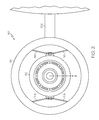
- FIG. 2 is a rear view of the turbine engine of the aircraft of FIG. 1 ;
- FIGS. 3-5 are perspective rear views of the turbine engine of the aircraft of FIG. 1 in different states;
- FIGS. 6-10 are cross-sectional side and top views of the turbine engine of the aircraft of FIG. 1 in different states;
- FIG. 11 is a rear perspective view of embodiments of a turbine engine and of a coupling assembly for the turbine engine;
- FIG. 12 is a detailed view of the embodiments of the turbine engine and of the coupling assembly of FIG. 11 ;
- FIG. 13 is another detailed view of the embodiments of the turbine engine and of the coupling assembly of FIG. 11 ;
- FIG. 14 is rear view of the embodiments of FIG. 11 ;
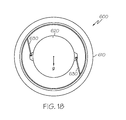
- FIGS. 15-18 are various other embodiment of coupling assemblies for a turbine engine with an engine core.
- Coupled means that one element/node/feature is directly or indirectly joined to (or directly or indirectly communicates with) another element/node/feature, and not necessarily mechanically.
- Adjust - Some elements, components, and/or features are described as being adjustable or adjusted. As used herein, unless expressly stated otherwise, “adjust” means to position, modify, alter, or dispose an element or component or portion thereof as suitable to the circumstance and embodiment. In certain cases, the element or component, or portion thereof, can remain in an unchanged position, state, and/or condition as a result of adjustment, if appropriate or desirable for the embodiment under the circumstances. In some cases, the element or component can be altered, changed, or modified to a new position, state, and/or condition as a result of adjustment, if appropriate or desired.
- inhibit is used to describe a reducing or minimizing effect. When a component or feature is described as inhibiting an action, motion, or condition it may completely prevent the result or outcome or future state completely. Additionally, “inhibit” can also refer to a reduction or lessening of the outcome, performance, and/or effect which might otherwise occur. Accordingly, when a component, element, or feature is referred to as inhibiting a result or state, it need not completely prevent or eliminate the result or state.
- FIG. 1 illustrates an embodiment of an aircraft 100 with a turbofan engine 110.
- a turbofan engine 110 Although described in the context of the aircraft 100, various features and characteristics provided can be used in other contexts and with a variety of equipment.
- the engine 110 is particular to the aircraft 100, various engines, as well as different types of turbomachinery, can benefit from the features described below.
- no particular feature or characteristic is constrained to an aircraft or turbofan engine, and the principles could be equally embodied in other vehicles, such as automobiles, or equipment, such as power generators or compressors, and so on.
- the aircraft 100 is powered by the engine 110, which can provide both a motive force as well as electrical and hydraulic power generation. Additionally, the engine 110 can supply high pressure and/or high temperature air to various other components and system of the aircraft 100, if desired. As shown, the engine 110 can be coupled to the aircraft 100 on the side of the aircraft 100. Thus, the engine 110 can provide a motive force alongside the aircraft 100 which can be transmitted to the aircraft 100 through a mounting 102.
- FIG. 2 illustrates a rear view of the aircraft 100 and engine 110, wherein the mounting 102 is visible. Rear mounting 104 is present, although not shown for clarity.
- the engine 110 typically contains a number of components and systems, some of which will be described in greater detail below. Although illustrated as the sole component surrounding and enclosing the engine core 112, the bypass duct 114 can itself be partially or entirely surrounded and/or enclosed and/or shrouded by additional components. Such additional elements are omitted for clarity of depiction and description.
- the engine core 112 can comprise a number of systems and/or components, including one or more rotors and/or shafts, including those supporting airfoils, support assemblies, such as bearing assemblies, coupling components, fuel and combustion components and systems, one or more exterior mixer lobes, and so on.
- the engine core 112 can have different components in different embodiments.
- the engine core 112 can perform various functions involved with power and motive force generation, including the compression, combustion, and expansion operations of a turbine engine.
- the engine core 112 can include a rotating shaft with a plurality of radial airfoils over which compressed and/or heated air can flow.
- the engine core 112 can be rigidly and/or pivotally coupled to the bypass duct 114 and/or a mounting frame at the front of the engine core 112. Accordingly, in certain embodiments, the engine core 112 can be cantilevered from the front of the engine 110 as it extends toward the rear of the engine 110. Thus, without further coupling members, the engine core 112 can be free to deflect and bend, similar to a cantilevered beam.
- bypass duct 114 can enclose and surround the engine core 112.
- the bypass duct 114 can provide structural support for the engine core 112, including coupling locations for the plurality of coupling struts 116.
- the bypass duct 114 can perform additional operations or have other beneficial features, such as confining and/or directing a flow of air or compressed air useful in other operations of the engine 110.
- FIGS. 3-5 illustrate the engine 110 wherein the engine core 112 is in several different positions as a result of various forces acting on the engine 110. In each, the downward direction of gravity acting on the engine core 112 is shown and indicated with a g. It should be understood that the deflection of the engine core 112 shown in FIGS. 4 and 5 is greatly exaggerated for illustrative clarity and that, relative to the size of the components, deflection of the engine core 112 is in actuality much smaller, and in some cases may not be visible to the unaided eye. Additionally, for purposes of describing the effects of various forces on the engine 110, including deflection of the engine core 112, the coupling struts 116 are omitted.
- FIG. 3 illustrates the engine 110 with the engine core 112 in an unloaded position.
- the bypass duct 114 is shown substantially concentric around, and co-axial with, the engine core 112.
- FIG. 4 illustrates the engine 110 undergoing vertical, or maneuver-induced, bending.
- maneuver-induced bending occurs when the aircraft 100 executes a maneuver, such as an altitude increase or decrease.
- FIG. 4 illustrates such a maneuver, that of an altitude decrease.
- the bypass duct 114 remains substantially rigid relative to the aircraft 100 because the connections to the aircraft body by the mounting 102 and rear mounting 104 are rigid, as well as the overall stiffness of the bypass duct 114.
- the inertia of the engine core 112 causes it to tend to remain at a higher altitude than the rest of the engine 110. Relative to the bypass duct 114, this results in an apparent rise in the engine core 112 from its undeflected position.
- FIG. 5 illustrates the engine 110 undergoing horizontal, or thrust-induced bending. Because the engine 110 generates a forward force, the force is resisted at the front by the mounting 102, which is coupled to the forward frame, as shown in FIGS. 6-10 , and described in greater detail below. Because the mounting 102 reacts the forward force of thrust out of plane with the application of engine thrust, a moment is generated. The moment results in an outward bowing of the engine 110, away from the body of the aircraft 100, as described in greater detail below.
- the engine core 112 is cantilevered from the forward frame. As the forward frame bends at an angle to the aircraft 100, the engine core 112 correspondingly is moved to angle away from the aircraft 100, as shown in FIG. 5 .
- the rear mounting 104 constrains the outward bowing of the bypass duct 114, however, resulting in an offset of the rear of the engine core 112 relative to the center of the bypass duct 114, as shown.
- FIG. 6 illustrates a cross-sectional top view of the engine 110 depicting the relationship of certain components for descriptive purposes. It is should be understood to be simplified and omitting various systems and components unrelated to the descriptive purpose, and is not a true and exact depiction of an engine 110.
- the engine core 112 is coupled to the forward frame 118, as shown, and can extend as a cantilever therefrom.
- the forward frame 118 can be coupled to the bypass duct 114 and to the mounting 102, which can couple the engine 110 to the aircraft 100.
- the bypass duct 114 can additionally be coupled to the aircraft 100 by the rear mounting 104.
- the engine core 112 can include a core housing 120, a rotating shaft 122, and bearing mounts 124 supporting the shaft 122.
- the shaft 122 can have an airfoil section 130 including numerous airfoils extending radially outward from the shaft 122.
- the bearing mounts 124 preferably support the shaft 122 such that it is free to rotate.
- the bearing mounts 124 can support the shaft 122, which is not directly supported by the bypass duct 114 and/or mounting 102.
- the components can have a different configuration, size, and so on.
- the shaft 122 can be a hollow cylinder, or tube, rather than the solid cylinder depicted.
- the airfoil section 130 can extend outside the core housing 120 and have a clearance with the interior of the bypass duct 114.
- the distance between the airfoil section 130 and the core housing 120 is preferably small.
- air can travel through the engine core 112, within the core housing 120, across the airfoil section 130.
- the air can travel over the airfoil section 130, causing it to turn, resulting in turning of the shaft 122.
- the efficiency of this operation increases as the clearance between the airfoil section 130 and core housing 120 is reduced, causing as much air to pass over the airfoil section 130 as possible.
- FIG. 7 illustrates a cross-sectional side view of an embodiment of an engine 110 experiencing maneuver-induced bending in a downward direction, such as would be associated with an altitude increase of the aircraft 100.
- maneuver-induced bending in a downward direction such as would be associated with an altitude increase of the aircraft 100.
- FIGS. 7-10 illustrate the bending of components illustrated in FIGS. 7-10 is greatly exaggerated for ease of viewing. In practice, the bending and deflections experienced by the illustrated components may be much smaller, relative to their size and shape, and may not be visible to the unaided eye.
- the bypass duct 114 may exhibit some bending during the maneuver. This bending of the bypass duct 114 is omitted for clarity.
- the engine core 112 can be seen to bend in a downward direction under its inertia during a maneuver. As the engine core 112 bends downward, the rear bearing 124 is deflected downward. The forward bearing 124, however, remains relatively stationary. As a result, the bearings 124 are no longer co-axial with the undeflected center of the engine 110 or engine core 112. Because the shaft 122 is supported only by the bearings 124 and relatively stiffer than the engine core 112 as a whole, the shaft 122 does not experience bending to the same degree, and maintains a substantially straight shape. Therefore, the core housing 120 is being deflected downward, whereas the shaft 122 is maintaining a relatively straight shape.
- the airfoil section 130 is moved closer to the core housing 120 on one side, and farther from the core housing 120 on the other side. To accommodate this movement, additional clearance may be required in the undeflected, unloaded configuration. Consequently, efficiency may be reduced. Moreover, where the airfoil section 130 moves away from the core housing 120, the larger clearance allows passage around the airfoil section 130, rather than across the airfoils, which is less desirable.
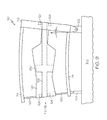
- FIG. 8 illustrates the cross-sectional side view of FIG. 7 , except that the vertically-extending coupling struts 116 are shown in the proper position to support the rear of the engine core 112.
- the coupling struts 116 can experience compression in the lower struts and tension in the upper struts, thereby inhibiting downward bending of the rear of the engine core 112.
- the engine core 112 can remain relatively straight and unbent. Consequently, the shaft 122 can maintain a relatively co-axial position with the center of the engine core 112. Therefore, the airfoil section 130 will maintain its position relative to the interior of the core housing 120, and the required clearance can be reduced, thereby improving the efficiency of the engine 110.
- FIG. 9 illustrates a cross-sectional top view of the engine 110 operating under a thrust-induced load.
- the forward frame 118 is coupled to the mounting 102, which is in turn coupled to the aircraft 100.
- the bypass duct 114 is coupled to the forward frame 118, but also coupled to the aircraft 100 by the rear mounting 104.
- the engine 110 can produce thrust in a forward direction, to the right of the illustrated engine 110.
- the thrust of the engine 110 can provide the motive force for the aircraft 100.
- the thrust is resisted by the forward frame 118, to which the bypass duct 114 and engine core 112 are coupled. Resisting the thrust of the engine 110 through the forward frame 118 is the mounting 102.
- the mounting 102 resists the force in a position off-axis from the thrust, a movement around the mounting 102 is generated, in addition to a shear force.
- the moment causes the forward frame 118 to bend towards the right relative to its unloaded state, by the angle ⁇ , as shown.
- the bypass duct 114 will bend away from the body of the aircraft 100.
- FIG. 9 illustrates several coupling struts 190 coupling the rear of the engine core 112 to the bypass duct 114 in a horizontal direction. Coupling struts 190 are not present in earlier illustrations and are used solely to illustrate the effect of horizontal struts on thrust-induced loads.
- Coupling struts 190 extend from the bypass duct 114 to the engine core 112 and support tension and compression to maintain the position of the engine core 112 relative to the bypass duct 114. Because the front of the engine core 112 is bending outward, however, the result is an arc-shaped engine core 112, as shown. Consequently, the location of the core housing 120 relative to the airfoil section 130 is altered. The inboard side of the airfoil section 130 is closer to the core housing 120 than the outboard side. To prevent the airfoil section 130 from impinging on the interior surface of the core housing 120, additional clearance may be required between the airfoil section 130 and the core housing 120. Disadvantageously, this increased clearance can reduce the efficiency of the engine 110.
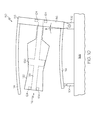
- FIG. 10 illustrates a cross-sectional top view of the engine 110 of FIG. 9 , in the thrust-loaded state, with the coupling struts 190 removed.
- the bypass duct 114 continues to bend, and the forward frame 118 remains at an angle ⁇ relative to its unloaded position, removal of the coupling struts 190 permits the engine core 112 to maintain a straight shape. Consequently, the bearings 124 support the shaft 122 along a straight line through the central axis of the engine core 112. Therefore, no additional clearance is required between the airfoil section 130 and the bypass duct 114. Accordingly, the efficiency of the engine 110 is not decreased by additional clearance.
- an engine coupling assembly which provides tension and compression to resist displacement of the engine core in a vertical direction, such as maneuver-induced bending, while permitting the engine core to displace in a horizontal direction, such as when experiencing thrust-induced bending.
- a coupling assembly comprising a plurality of coupling struts 116 extending only in a substantially vertical direction is shown.
- Such a configuration provides the desired reaction characteristics to minimize clearances between the airfoil section 130, or other rotating component, and core housing 120, or other surrounding component.
- the vertical direction is relative to the direction of gravity.
- FIG. 11 illustrates a perspective view of the rear of an engine 200 having an engine coupling assembly comprising a plurality of coupling struts 230 embodying certain features described below.
- an engine coupling assembly comprising a plurality of coupling struts 230 embodying certain features described below.
- four coupling struts 230 are used in the exemplary embodiment, more or fewer struts can be present in various embodiments, as later shown and described.
- the engine 200 can have features and properties similar to those described above with regard to FIGS. 1-10 and engine 110.
- the engine 200 comprises a bypass duct 210 and an engine core 220, among other components and systems. As explained above, such additional components and systems are omitted for clarity. Certain embodiments of the engine 200 can have more or different components and features without departing from the spirit of the embodiments described herein.
- the coupling struts 230 are provided for coupling the engine core 220 to the bypass duct 210 by transmitting force only in a substantially vertical direction.
- the coupling struts 230 are rigid members.
- the coupling struts 230 can be composed of any appropriate material, including metals of various types, such as high-strength metals which retain their strength at high temperatures.
- a nickel- or cobalt-based superalloy can be used, along with other metals, as desired for the embodiment.
- the coupling struts 230 can be coupled to the engine core 220 on a lateral side.
- a lateral side can be approximately 90° in either direction around the engine core 220 from the downward direction of gravity, g.
- the coupling sites on the engine core 220 do not have to be at exactly 90° to either side, and can be offset to either side, as desired for the embodiment.
- the coupling struts 230 are coupled to the engine core 220 at a mounting bracket or other such assembly designed to receive the coupling struts 230.
- FIG. 12 illustrates a detailed view of a portion of FIG. 11 in which such a mounting bracket 222 is shown.
- the coupling struts 230 can be coupled to the engine core 220 with a fastener or fasteners, such as a pin, nut and bolt assembly, threaded member, or other desired coupling technique.
- the coupling struts 230 can be coupled directly to the engine core 220 or to an intermediary coupling device, if desired.
- the coupling struts 230 can have an adjustable length, while in other embodiments, they can be rigid, fixed members which cannot be adjusted.
- FIG. 13 illustrates a detailed view of a portion of FIG. 11 showing the connection between a coupling strut 230 and the bypass duct 210.
- the bypass duct 210 can have an interior surface 212 which faces the engine core 220.
- the interior surface 212 can have one or more ports 214, through which at least a portion of the coupling strut 230 can extend. It can be desirable to avoid protruding any portion of a coupling connection between the coupling strut 230 and bypass duct 210 inward toward the engine core 220 beyond the interior surface 212.
- High-temperature and/or high-pressure air can travel along the interior surface 212, which can have deleterious effects on such the physical components of couplings, as well as reducing efficiency.
- the coupling struts 230 can have cross-sectional shapes selected to affect their aerodynamic response to air traveling within the bypass duct 210.
- some coupling struts 230 can have a cross-sectional shape similar to an airfoil, while others can have a teardrop shaped cross-section, or a circular cross-section, or an oblong or oval cross-section, and so on.
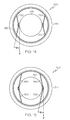
- FIG. 14 illustrates an exemplary configuration of coupling struts 230 from a rear view of the engine 200.
- each coupling strut 230 extends only in a substantially vertical direction relative to the direction of gravity, g, when the engine 200 is at a rest position.
- each coupling strut 230 is substantially parallel to the direction of gravity, such that the angle ⁇ formed between a coupling strut 230 and the downward direction of gravity is equal to or less than 30°.
- the angle ⁇ can be 0°, where a coupling strut 230 runs in an exactly vertical direction.
- the angle ⁇ can be anywhere between 0° and 30°, inclusive, as desired.
- no coupling strut 230 extends in a horizontal or substantially horizontal direction.
- references to a vertical direction or horizontal direction are to be understood to in the context of a stationary aircraft at a rest position of zero pitch and zero roll and otherwise level relative to the surface of the Earth. Additionally, such references applying to components of an engine or engine core or other component thereof are also to be understood to be in reference to a rest position wherein the engine, engine core, other component, or aircraft or other vehicle to which the engine or sub-component is coupled is flat and level relative to the surface of the Earth. Although vehicles may experience gravity in different directions relative to the components during operation, references for directions are made only in the rest position, flat and level on the Earth.
- the engines including subcomponents, are illustrated separated from the body of any aircraft. It should be understood that, when mounted, the downward direction of gravity can be in a different direction.
- an engine such as the one shown in FIG. 14 , can be mounted substantially horizontally from the aircraft body. In such a mounted position, the direction of gravity, g, will be substantially the same.
- the engine can be mounted at an angle to the substantially horizontal direction, resulting in an angle between the illustrated downward direction of gravity in FIG. 14 and the actual downward direction of gravity when mounted.
- Such mounting angles are contemplated with any of the embodiments disclosed herein.
- FIGS. 15-18 illustrate various alternative embodiments of engines having a coupling assembly comprising a plurality of coupling struts in various configurations. Unless described otherwise, each described engine can have features and properties similar to those described above with regard to FIGS. 1-10 and engine 110.
- the coupling struts 330 can also extend at a different angle from the downward direction of gravity, g. Preferably, however, the angle formed with the downward direction of gravity, ⁇ , is less than 30°, regardless of the direction of extension of the struts 330.
- the engine 300 operates, the engine core 320 and bypass duct 310 will undergo thermal expansion. Because the engine core 320 experiences a higher operating temperature than the bypass duct 310, the engine core 320 undergoes a larger thermal expansion than the bypass duct 310.
- the struts 330, as with the struts of FIGS. 14, and 16-18 are positioned such that radial expansion of the engine core 320, 220 does not cause direct compressive loading of the struts 330, 230.
- FIG. 16 illustrates an embodiment of an engine 400 wherein two coupling struts 430 couple the engine core 420 to the bypass duct 410.
- the coupling struts 430 extend only in the upward direction from the lateral sides of the engine core 420.
- FIG. 17 illustrates an embodiment of the engine 500 wherein two coupling struts 530 couple the engine core 520 to the bypass duct 510.
- the coupling struts 530 in FIG. 17 extend only downwards, relative to the direction of gravity, in a substantially vertical direction.
- the angle formed between the coupling struts 430, 530 and the engine core 420, 520 can vary as desired for the embodiment.
- coupling struts 630 used to couple an engine core 620 to a bypass duct 610 can be asymmetrical around one or more axes passing through the center of the engine 600.
- one coupling strut 630 can extend downward, relative to the direction of gravity, from a lateral side of the engine core 620, while another extends upwards from the other lateral side.
Landscapes
- Engineering & Computer Science (AREA)
- Chemical & Material Sciences (AREA)
- Combustion & Propulsion (AREA)
- Mechanical Engineering (AREA)
- General Engineering & Computer Science (AREA)
- Structures Of Non-Positive Displacement Pumps (AREA)
- Molds, Cores, And Manufacturing Methods Thereof (AREA)
Abstract
Description
- Embodiments of the subject matter described herein relate generally to turbomachinery, such as turbofan engines. More particularly, embodiments of the subject matter relate to coupling assemblies connecting the core of such a turbomachine to a surrounding housing.
- Turbomachines, such as those in turbofan, turbojet, and other turbine engines often experience forces during operation which can affect the clearances between operating components. For example, an aircraft can perform maneuvers during flight which cause bending in the components due to their inertia. To accommodate bending from normal operations, components of the aircraft engine have spacing between them. For example, an engine core having a rotating shaft with radial airfoils may be enclosed by a housing. To accommodate bending in the housing of the core, a space may be present between the airfoil tips and the housing. The components may be spaced apart further than they would otherwise to permit bending of the housing.
- This spacing, also known as a clearance or tolerance, has the disadvantage of reducing the efficiency of the engine, or other turbomachine. In the example of the rotating shaft, air can travel around the airfoils by passing between the airfoils and the housing, rather than travelling over an airfoil, as desired. Accordingly, the efficiency of the engine is reduced as less work is extracted from the passing air by the airfoils.
- A typical approach to reducing the required clearances between components is to couple the ends of the housing of the core of the engine to surrounding components, such as a bypass duct. Unfortunately, rotating elements within the core are not supported in the same way as the housing of the core. Thus, restraining the housing of the engine core can cause the housing of the engine core to bend around the central rotating shaft, which remains relatively straight. As a result, the airfoils will approach undesirably close to the interior of the housing.
- A coupling assembly for an engine core of a turbomachine is provided. The coupling assembly comprises a duct having a substantially circular shape and surrounding the engine core, and a plurality of coupling struts, each coupling strut extending only in a substantially vertical direction relative to the direction of gravity when the engine core is at a rest position with zero pitch and zero roll, each of the plurality of coupling struts coupling the engine core to the duct.
- A coupling assembly for an engine core surrounded by a duct is also provided. The coupling assembly comprises a plurality of coupling struts, the plurality of coupling struts extending only in a substantially vertical direction relative to the direction of gravity when the engine core is at a rest position with zero pitch and zero roll, each of the plurality of coupling struts coupling the engine core to the duct.
- Another coupling assembly for an engine core of a turbomachine is provided. The engine core is at least partially surrounded by a duct. The coupling assembly comprises a plurality of coupling struts extending only in a direction substantially parallel to a downward direction of gravity when the engine core is at a rest position with zero pitch and zero roll, each of the plurality of coupling struts coupled to the engine core and to the duct and adapted to inhibit vertical movement of the engine core.
- This summary is provided to introduce a selection of concepts in a simplified form that are further described below in the detailed description. This summary is not intended to identify key features or essential features of the claimed subject matter, nor is it intended to be used as an aid in determining the scope of the claimed subject matter.
- A more complete understanding of the subject matter may be derived by referring to the detailed description and claims when considered in conjunction with the following figures, wherein like reference numbers refer to similar elements throughout the figures.
-
FIG. 1 is a perspective view of an aircraft with an embodiment of a turbine engine; -
FIG. 2 is a rear view of the turbine engine of the aircraft ofFIG. 1 ; -
FIGS. 3-5 are perspective rear views of the turbine engine of the aircraft ofFIG. 1 in different states; -
FIGS. 6-10 are cross-sectional side and top views of the turbine engine of the aircraft ofFIG. 1 in different states; -
FIG. 11 is a rear perspective view of embodiments of a turbine engine and of a coupling assembly for the turbine engine; -
FIG. 12 is a detailed view of the embodiments of the turbine engine and of the coupling assembly ofFIG. 11 ; -
FIG. 13 is another detailed view of the embodiments of the turbine engine and of the coupling assembly ofFIG. 11 ; -
FIG. 14 is rear view of the embodiments ofFIG. 11 ; and -
FIGS. 15-18 are various other embodiment of coupling assemblies for a turbine engine with an engine core. - The following detailed description is merely illustrative in nature and is not intended to limit the embodiments of the subject matter or the application and uses of such embodiments. As used herein, the word "exemplary" means "serving as an example, instance, or illustration." Any implementation described herein as exemplary is not necessarily to be construed as preferred or advantageous over other implementations. Furthermore, there is no intention to be bound by any expressed or implied theory presented in the preceding technical field, background, brief summary or the following detailed description.
- "Coupled" - The following description refers to elements or nodes or features being "coupled" together. As used herein, unless expressly stated otherwise, "coupled" means that one element/node/feature is directly or indirectly joined to (or directly or indirectly communicates with) another element/node/feature, and not necessarily mechanically. Thus, although the schematics shown in the figures depict exemplary arrangements of elements, additional intervening elements, devices, features, or components may be present in an embodiment of the depicted subject matter.
- "Adjust" - Some elements, components, and/or features are described as being adjustable or adjusted. As used herein, unless expressly stated otherwise, "adjust" means to position, modify, alter, or dispose an element or component or portion thereof as suitable to the circumstance and embodiment. In certain cases, the element or component, or portion thereof, can remain in an unchanged position, state, and/or condition as a result of adjustment, if appropriate or desirable for the embodiment under the circumstances. In some cases, the element or component can be altered, changed, or modified to a new position, state, and/or condition as a result of adjustment, if appropriate or desired.
- "Inhibit" - As used herein, inhibit is used to describe a reducing or minimizing effect. When a component or feature is described as inhibiting an action, motion, or condition it may completely prevent the result or outcome or future state completely. Additionally, "inhibit" can also refer to a reduction or lessening of the outcome, performance, and/or effect which might otherwise occur. Accordingly, when a component, element, or feature is referred to as inhibiting a result or state, it need not completely prevent or eliminate the result or state.
- In addition, certain terminology may also be used in the following description for the purpose of reference only, and thus are not intended to be limiting. For example, terms such as "upper", "lower", "above", and "below" refer to directions in the drawings to which reference is made. Terms such as "front", "back", "rear", "side", "outboard", and "inboard" describe the orientation and/or location of portions of the component within a consistent but arbitrary frame of reference which is made clear by reference to the text and the associated drawings describing the component under discussion. Such terminology may include the words specifically mentioned above, derivatives thereof, and words of similar import. Similarly, the terms "first", "second", and other such numerical terms referring to structures do not imply a sequence or order unless clearly indicated by the context.
-
FIG. 1 illustrates an embodiment of anaircraft 100 with aturbofan engine 110. Although described in the context of theaircraft 100, various features and characteristics provided can be used in other contexts and with a variety of equipment. For example, although theengine 110 is particular to theaircraft 100, various engines, as well as different types of turbomachinery, can benefit from the features described below. Thus, no particular feature or characteristic is constrained to an aircraft or turbofan engine, and the principles could be equally embodied in other vehicles, such as automobiles, or equipment, such as power generators or compressors, and so on. - The
aircraft 100 is powered by theengine 110, which can provide both a motive force as well as electrical and hydraulic power generation. Additionally, theengine 110 can supply high pressure and/or high temperature air to various other components and system of theaircraft 100, if desired. As shown, theengine 110 can be coupled to theaircraft 100 on the side of theaircraft 100. Thus, theengine 110 can provide a motive force alongside theaircraft 100 which can be transmitted to theaircraft 100 through a mounting 102.FIG. 2 illustrates a rear view of theaircraft 100 andengine 110, wherein the mounting 102 is visible. Rear mounting 104 is present, although not shown for clarity. - Also visible in
FIG. 2 are various features of theengine 110, such as theengine core 112 andbypass duct 114, as well as a mounting assembly comprised of a number of coupling struts 116. Theengine core 112 typically contains a number of components and systems, some of which will be described in greater detail below. Although illustrated as the sole component surrounding and enclosing theengine core 112, thebypass duct 114 can itself be partially or entirely surrounded and/or enclosed and/or shrouded by additional components. Such additional elements are omitted for clarity of depiction and description. - The
engine core 112 can comprise a number of systems and/or components, including one or more rotors and/or shafts, including those supporting airfoils, support assemblies, such as bearing assemblies, coupling components, fuel and combustion components and systems, one or more exterior mixer lobes, and so on. Theengine core 112 can have different components in different embodiments. Theengine core 112 can perform various functions involved with power and motive force generation, including the compression, combustion, and expansion operations of a turbine engine. Thus, for example, theengine core 112 can include a rotating shaft with a plurality of radial airfoils over which compressed and/or heated air can flow. - The
engine core 112 can be rigidly and/or pivotally coupled to thebypass duct 114 and/or a mounting frame at the front of theengine core 112. Accordingly, in certain embodiments, theengine core 112 can be cantilevered from the front of theengine 110 as it extends toward the rear of theengine 110. Thus, without further coupling members, theengine core 112 can be free to deflect and bend, similar to a cantilevered beam. - As mentioned, the
bypass duct 114 can enclose and surround theengine core 112. Thebypass duct 114 can provide structural support for theengine core 112, including coupling locations for the plurality of coupling struts 116. Thebypass duct 114 can perform additional operations or have other beneficial features, such as confining and/or directing a flow of air or compressed air useful in other operations of theengine 110. -
FIGS. 3-5 illustrate theengine 110 wherein theengine core 112 is in several different positions as a result of various forces acting on theengine 110. In each, the downward direction of gravity acting on theengine core 112 is shown and indicated with a g. It should be understood that the deflection of theengine core 112 shown inFIGS. 4 and 5 is greatly exaggerated for illustrative clarity and that, relative to the size of the components, deflection of theengine core 112 is in actuality much smaller, and in some cases may not be visible to the unaided eye. Additionally, for purposes of describing the effects of various forces on theengine 110, including deflection of theengine core 112, the coupling struts 116 are omitted. -
FIG. 3 illustrates theengine 110 with theengine core 112 in an unloaded position. Thebypass duct 114 is shown substantially concentric around, and co-axial with, theengine core 112. -
FIG. 4 illustrates theengine 110 undergoing vertical, or maneuver-induced, bending. In the context of theaircraft 100, maneuver-induced bending occurs when theaircraft 100 executes a maneuver, such as an altitude increase or decrease.FIG. 4 illustrates such a maneuver, that of an altitude decrease. Thebypass duct 114 remains substantially rigid relative to theaircraft 100 because the connections to the aircraft body by the mounting 102 and rear mounting 104 are rigid, as well as the overall stiffness of thebypass duct 114. The inertia of theengine core 112, however, causes it to tend to remain at a higher altitude than the rest of theengine 110. Relative to thebypass duct 114, this results in an apparent rise in theengine core 112 from its undeflected position. -
FIG. 5 illustrates theengine 110 undergoing horizontal, or thrust-induced bending. Because theengine 110 generates a forward force, the force is resisted at the front by the mounting 102, which is coupled to the forward frame, as shown inFIGS. 6-10 , and described in greater detail below. Because the mounting 102 reacts the forward force of thrust out of plane with the application of engine thrust, a moment is generated. The moment results in an outward bowing of theengine 110, away from the body of theaircraft 100, as described in greater detail below. - The
engine core 112, however, is cantilevered from the forward frame. As the forward frame bends at an angle to theaircraft 100, theengine core 112 correspondingly is moved to angle away from theaircraft 100, as shown inFIG. 5 . The rear mounting 104 constrains the outward bowing of thebypass duct 114, however, resulting in an offset of the rear of theengine core 112 relative to the center of thebypass duct 114, as shown. -
FIG. 6 illustrates a cross-sectional top view of theengine 110 depicting the relationship of certain components for descriptive purposes. It is should be understood to be simplified and omitting various systems and components unrelated to the descriptive purpose, and is not a true and exact depiction of anengine 110. - The
engine core 112 is coupled to theforward frame 118, as shown, and can extend as a cantilever therefrom. Theforward frame 118 can be coupled to thebypass duct 114 and to the mounting 102, which can couple theengine 110 to theaircraft 100. Thebypass duct 114 can additionally be coupled to theaircraft 100 by the rear mounting 104. - Among other components, the
engine core 112 can include acore housing 120, arotating shaft 122, and bearing mounts 124 supporting theshaft 122. Theshaft 122 can have anairfoil section 130 including numerous airfoils extending radially outward from theshaft 122. The bearing mounts 124 preferably support theshaft 122 such that it is free to rotate. The bearing mounts 124 can support theshaft 122, which is not directly supported by thebypass duct 114 and/or mounting 102. In anactual engine 110, the components can have a different configuration, size, and so on. For example, theshaft 122 can be a hollow cylinder, or tube, rather than the solid cylinder depicted. Alternatively, or additionally, in some embodiments, theairfoil section 130 can extend outside thecore housing 120 and have a clearance with the interior of thebypass duct 114. - As can be seen, the distance between the
airfoil section 130 and thecore housing 120 is preferably small. During operation, air can travel through theengine core 112, within thecore housing 120, across theairfoil section 130. The air can travel over theairfoil section 130, causing it to turn, resulting in turning of theshaft 122. The efficiency of this operation increases as the clearance between theairfoil section 130 andcore housing 120 is reduced, causing as much air to pass over theairfoil section 130 as possible. -
FIG. 7 illustrates a cross-sectional side view of an embodiment of anengine 110 experiencing maneuver-induced bending in a downward direction, such as would be associated with an altitude increase of theaircraft 100. It should be understood that the bending of components illustrated inFIGS. 7-10 is greatly exaggerated for ease of viewing. In practice, the bending and deflections experienced by the illustrated components may be much smaller, relative to their size and shape, and may not be visible to the unaided eye. Although illustrated as straight, thebypass duct 114 may exhibit some bending during the maneuver. This bending of thebypass duct 114 is omitted for clarity. - The
engine core 112 can be seen to bend in a downward direction under its inertia during a maneuver. As theengine core 112 bends downward, therear bearing 124 is deflected downward. Theforward bearing 124, however, remains relatively stationary. As a result, thebearings 124 are no longer co-axial with the undeflected center of theengine 110 orengine core 112. Because theshaft 122 is supported only by thebearings 124 and relatively stiffer than theengine core 112 as a whole, theshaft 122 does not experience bending to the same degree, and maintains a substantially straight shape. Therefore, thecore housing 120 is being deflected downward, whereas theshaft 122 is maintaining a relatively straight shape. Accordingly, theairfoil section 130 is moved closer to thecore housing 120 on one side, and farther from thecore housing 120 on the other side. To accommodate this movement, additional clearance may be required in the undeflected, unloaded configuration. Consequently, efficiency may be reduced. Moreover, where theairfoil section 130 moves away from thecore housing 120, the larger clearance allows passage around theairfoil section 130, rather than across the airfoils, which is less desirable. -
FIG. 8 illustrates the cross-sectional side view ofFIG. 7 , except that the vertically-extending coupling struts 116 are shown in the proper position to support the rear of theengine core 112. The coupling struts 116 can experience compression in the lower struts and tension in the upper struts, thereby inhibiting downward bending of the rear of theengine core 112. As a result, theengine core 112 can remain relatively straight and unbent. Consequently, theshaft 122 can maintain a relatively co-axial position with the center of theengine core 112. Therefore, theairfoil section 130 will maintain its position relative to the interior of thecore housing 120, and the required clearance can be reduced, thereby improving the efficiency of theengine 110. -
FIG. 9 illustrates a cross-sectional top view of theengine 110 operating under a thrust-induced load. Theforward frame 118 is coupled to the mounting 102, which is in turn coupled to theaircraft 100. Thebypass duct 114 is coupled to theforward frame 118, but also coupled to theaircraft 100 by the rear mounting 104. During operation, theengine 110 can produce thrust in a forward direction, to the right of the illustratedengine 110. The thrust of theengine 110 can provide the motive force for theaircraft 100. The thrust is resisted by theforward frame 118, to which thebypass duct 114 andengine core 112 are coupled. Resisting the thrust of theengine 110 through theforward frame 118 is the mounting 102. Because the mounting 102 resists the force in a position off-axis from the thrust, a movement around the mounting 102 is generated, in addition to a shear force. The moment causes theforward frame 118 to bend towards the right relative to its unloaded state, by the angle θ, as shown. Similarly, thebypass duct 114 will bend away from the body of theaircraft 100. - The
engine core 112, however, is coupled to theforward frame 118 by a cantilever coupling. Accordingly, the central axis of theengine core 112 is angled away from the aircraft towards the front of theengine core 112.FIG. 9 illustrates several coupling struts 190 coupling the rear of theengine core 112 to thebypass duct 114 in a horizontal direction. Coupling struts 190 are not present in earlier illustrations and are used solely to illustrate the effect of horizontal struts on thrust-induced loads. - Coupling struts 190 extend from the
bypass duct 114 to theengine core 112 and support tension and compression to maintain the position of theengine core 112 relative to thebypass duct 114. Because the front of theengine core 112 is bending outward, however, the result is an arc-shapedengine core 112, as shown. Consequently, the location of thecore housing 120 relative to theairfoil section 130 is altered. The inboard side of theairfoil section 130 is closer to thecore housing 120 than the outboard side. To prevent theairfoil section 130 from impinging on the interior surface of thecore housing 120, additional clearance may be required between theairfoil section 130 and thecore housing 120. Disadvantageously, this increased clearance can reduce the efficiency of theengine 110. -
FIG. 10 illustrates a cross-sectional top view of theengine 110 ofFIG. 9 , in the thrust-loaded state, with the coupling struts 190 removed. As can be seen, although thebypass duct 114 continues to bend, and theforward frame 118 remains at an angle θ relative to its unloaded position, removal of the coupling struts 190 permits theengine core 112 to maintain a straight shape. Consequently, thebearings 124 support theshaft 122 along a straight line through the central axis of theengine core 112. Therefore, no additional clearance is required between theairfoil section 130 and thebypass duct 114. Accordingly, the efficiency of theengine 110 is not decreased by additional clearance. - As can be seen in
FIGS. 6-10 , it is desirable to have an engine coupling assembly which provides tension and compression to resist displacement of the engine core in a vertical direction, such as maneuver-induced bending, while permitting the engine core to displace in a horizontal direction, such as when experiencing thrust-induced bending. With reference back toFIG. 2 , a coupling assembly comprising a plurality of coupling struts 116 extending only in a substantially vertical direction is shown. Such a configuration provides the desired reaction characteristics to minimize clearances between theairfoil section 130, or other rotating component, andcore housing 120, or other surrounding component. The vertical direction is relative to the direction of gravity. -
FIG. 11 illustrates a perspective view of the rear of anengine 200 having an engine coupling assembly comprising a plurality of coupling struts 230 embodying certain features described below. Although four coupling struts 230 are used in the exemplary embodiment, more or fewer struts can be present in various embodiments, as later shown and described. Unless described otherwise, theengine 200 can have features and properties similar to those described above with regard toFIGS. 1-10 andengine 110. Theengine 200 comprises abypass duct 210 and anengine core 220, among other components and systems. As explained above, such additional components and systems are omitted for clarity. Certain embodiments of theengine 200 can have more or different components and features without departing from the spirit of the embodiments described herein. - Four coupling struts 230 are provided for coupling the
engine core 220 to thebypass duct 210 by transmitting force only in a substantially vertical direction. Preferably, the coupling struts 230 are rigid members. The coupling struts 230 can be composed of any appropriate material, including metals of various types, such as high-strength metals which retain their strength at high temperatures. For example, a nickel- or cobalt-based superalloy can be used, along with other metals, as desired for the embodiment. - The coupling struts 230 can be coupled to the
engine core 220 on a lateral side. Such a lateral side can be approximately 90° in either direction around theengine core 220 from the downward direction of gravity, g. The coupling sites on theengine core 220 do not have to be at exactly 90° to either side, and can be offset to either side, as desired for the embodiment. - Preferably, the coupling struts 230 are coupled to the
engine core 220 at a mounting bracket or other such assembly designed to receive the coupling struts 230.FIG. 12 illustrates a detailed view of a portion ofFIG. 11 in which such amounting bracket 222 is shown. In some embodiments, the coupling struts 230 can be coupled to theengine core 220 with a fastener or fasteners, such as a pin, nut and bolt assembly, threaded member, or other desired coupling technique. The coupling struts 230 can be coupled directly to theengine core 220 or to an intermediary coupling device, if desired. - In certain embodiments, the coupling struts 230 can have an adjustable length, while in other embodiments, they can be rigid, fixed members which cannot be adjusted.
-
FIG. 13 illustrates a detailed view of a portion ofFIG. 11 showing the connection between acoupling strut 230 and thebypass duct 210. In at least some embodiments, thebypass duct 210 can have aninterior surface 212 which faces theengine core 220. Theinterior surface 212 can have one ormore ports 214, through which at least a portion of thecoupling strut 230 can extend. It can be desirable to avoid protruding any portion of a coupling connection between thecoupling strut 230 andbypass duct 210 inward toward theengine core 220 beyond theinterior surface 212. High-temperature and/or high-pressure air can travel along theinterior surface 212, which can have deleterious effects on such the physical components of couplings, as well as reducing efficiency. Additionally, in certain embodiments, at least some of the coupling struts 230 can have cross-sectional shapes selected to affect their aerodynamic response to air traveling within thebypass duct 210. For example, some coupling struts 230 can have a cross-sectional shape similar to an airfoil, while others can have a teardrop shaped cross-section, or a circular cross-section, or an oblong or oval cross-section, and so on. -
FIG. 14 illustrates an exemplary configuration of coupling struts 230 from a rear view of theengine 200. As can be seen, eachcoupling strut 230 extends only in a substantially vertical direction relative to the direction of gravity, g, when theengine 200 is at a rest position. Preferably, eachcoupling strut 230 is substantially parallel to the direction of gravity, such that the angle θ formed between acoupling strut 230 and the downward direction of gravity is equal to or less than 30°. In certain embodiments, the angle θ can be 0°, where acoupling strut 230 runs in an exactly vertical direction. In other embodiments, the angle θ can be anywhere between 0° and 30°, inclusive, as desired. Preferably, nocoupling strut 230 extends in a horizontal or substantially horizontal direction. - All references to a vertical direction or horizontal direction are to be understood to in the context of a stationary aircraft at a rest position of zero pitch and zero roll and otherwise level relative to the surface of the Earth. Additionally, such references applying to components of an engine or engine core or other component thereof are also to be understood to be in reference to a rest position wherein the engine, engine core, other component, or aircraft or other vehicle to which the engine or sub-component is coupled is flat and level relative to the surface of the Earth. Although vehicles may experience gravity in different directions relative to the components during operation, references for directions are made only in the rest position, flat and level on the Earth.
- Moreover, the engines, including subcomponents, are illustrated separated from the body of any aircraft. It should be understood that, when mounted, the downward direction of gravity can be in a different direction. For example, an engine, such as the one shown in
FIG. 14 , can be mounted substantially horizontally from the aircraft body. In such a mounted position, the direction of gravity, g, will be substantially the same. As another example, the engine can be mounted at an angle to the substantially horizontal direction, resulting in an angle between the illustrated downward direction of gravity inFIG. 14 and the actual downward direction of gravity when mounted. Such mounting angles are contemplated with any of the embodiments disclosed herein. -
FIGS. 15-18 illustrate various alternative embodiments of engines having a coupling assembly comprising a plurality of coupling struts in various configurations. Unless described otherwise, each described engine can have features and properties similar to those described above with regard toFIGS. 1-10 andengine 110. - As can be see in
FIG. 15 , in addition to the four coupling struts previously illustrated, the coupling struts 330 can also extend at a different angle from the downward direction of gravity, g. Preferably, however, the angle formed with the downward direction of gravity, θ, is less than 30°, regardless of the direction of extension of thestruts 330. As theengine 300 operates, theengine core 320 andbypass duct 310 will undergo thermal expansion. Because theengine core 320 experiences a higher operating temperature than thebypass duct 310, theengine core 320 undergoes a larger thermal expansion than thebypass duct 310. Advantageously, thestruts 330, as with the struts ofFIGS. 14, and 16-18 are positioned such that radial expansion of theengine core struts -
FIG. 16 illustrates an embodiment of anengine 400 wherein two coupling struts 430 couple theengine core 420 to thebypass duct 410. The coupling struts 430 extend only in the upward direction from the lateral sides of theengine core 420. -
FIG. 17 illustrates an embodiment of theengine 500 wherein two coupling struts 530 couple theengine core 520 to thebypass duct 510. Unlike theengine 400 ofFIG. 16 , the coupling struts 530 inFIG. 17 extend only downwards, relative to the direction of gravity, in a substantially vertical direction. In either embodiment ofFIG. 16 or FIG. 17 , as with other embodiments, the angle formed between the coupling struts 430, 530 and theengine core - As shown in
FIG. 18 , coupling struts 630 used to couple anengine core 620 to a bypass duct 610 can be asymmetrical around one or more axes passing through the center of theengine 600. Thus, as shown, onecoupling strut 630 can extend downward, relative to the direction of gravity, from a lateral side of theengine core 620, while another extends upwards from the other lateral side. - While at least one exemplary embodiment has been presented in the foregoing detailed description, it should be appreciated that a vast number of variations exist. It should also be appreciated that the exemplary embodiment or embodiments described herein are not intended to limit the scope, applicability, or configuration of the claimed subject matter in any way. Rather, the foregoing detailed description will provide those skilled in the art with a convenient road map for implementing the described embodiment or embodiments. It should be understood that various changes can be made in the function and arrangement of elements without departing from the scope defined by the claims, which includes known equivalents and foreseeable equivalents at the time of filing this patent application.
Claims (9)
- A coupling assembly for an engine core of a turbomachine, the coupling assembly comprising:a duct (114) having a substantially circular shape and surrounding the engine core; anda plurality of coupling struts (116), each coupling strut extending only in a substantially vertical direction relative to the direction of gravity when the engine core is at a rest position with zero pitch and zero roll, each of the plurality of coupling struts coupling the engine core to the duct.
- The coupling assembly of Claim 1, wherein the plurality of coupling struts comprises four coupling struts.
- The coupling assembly of Claim 2, wherein the engine core has two lateral sides approximately ninety degrees from a downward direction of gravity and each of the two lateral sides couples to two of the plurality of coupling struts.
- The coupling assembly of Claim 1, wherein the plurality of coupling struts comprises two coupling struts.
- The coupling assembly of Claim 4, wherein the engine core has two lateral sides approximately ninety degrees from the downward direction of gravity, and one coupling strut of the plurality of coupling struts is coupled to each of two lateral sides.
- The coupling assembly of Claim 1, wherein the duct comprises a plurality of coupling brackets, and each of the plurality of coupling struts extends from the engine core to a coupling bracket.
- The coupling assembly of Claim 1, wherein each of the plurality of coupling struts has a cross-section having an airfoil shape.
- The coupling assembly of Claim 1, wherein each of the plurality of coupling struts is composed of a nickel-based superalloy.
- A coupling assembly for an engine core surrounded by a duct, the coupling assembly comprising a plurality of coupling struts, the plurality of coupling struts extending only in a substantially vertical direction relative to the direction of gravity when the engine core is at a rest position with zero pitch and zero roll, each of the plurality of coupling struts coupling the engine core to the duct.
Applications Claiming Priority (1)
| Application Number | Priority Date | Filing Date | Title |
|---|---|---|---|
| US12/547,313 US8621874B2 (en) | 2009-08-25 | 2009-08-25 | Turbomachine core coupling assembly |
Publications (3)
| Publication Number | Publication Date |
|---|---|
| EP2299067A2 true EP2299067A2 (en) | 2011-03-23 |
| EP2299067A3 EP2299067A3 (en) | 2014-05-14 |
| EP2299067B1 EP2299067B1 (en) | 2018-03-07 |
Family
ID=43221934
Family Applications (1)
| Application Number | Title | Priority Date | Filing Date |
|---|---|---|---|
| EP10173135.4A Active EP2299067B1 (en) | 2009-08-25 | 2010-08-17 | Turbomachine core coupling assembly |
Country Status (2)
| Country | Link |
|---|---|
| US (1) | US8621874B2 (en) |
| EP (1) | EP2299067B1 (en) |
Cited By (3)
| Publication number | Priority date | Publication date | Assignee | Title |
|---|---|---|---|---|
| WO2015028747A1 (en) * | 2013-08-28 | 2015-03-05 | Snecma | Isostatic suspension of a turbojet by rear double support |
| US10054007B2 (en) | 2013-12-13 | 2018-08-21 | Rolls-Royce Deutschland Ltd & Co Kg | Joint between components |
| EP4180638A1 (en) * | 2021-11-12 | 2023-05-17 | Raytheon Technologies Corporation | H-frame connection between fan case and core housing in a gas turbine engine |
Families Citing this family (7)
| Publication number | Priority date | Publication date | Assignee | Title |
|---|---|---|---|---|
| FR2928180B1 (en) * | 2008-02-28 | 2010-04-02 | Airbus France | AIRCRAFT ENGINE ASSEMBLY COMPRISING AN ANNULAR EFFORTS TRANSFER STRUCTURE SURROUNDING THE CENTRAL HOUSING OF A TURBOJET ENGINE. |
| US20130084174A1 (en) * | 2011-10-03 | 2013-04-04 | United Technologies Corporation | Strut rods for structural guide vanes |
| US9555871B2 (en) * | 2012-03-05 | 2017-01-31 | The Boeing Company | Two-surface sandwich structure for accommodating in-plane expansion of one of the surfaces relative to the opposing surface |
| US9714583B2 (en) * | 2014-08-21 | 2017-07-25 | Honeywell International Inc. | Fan containment cases for fan casings in gas turbine engines, fan blade containment systems, and methods for producing the same |
| WO2019140437A1 (en) | 2018-01-15 | 2019-07-18 | Lord Corporation | Engine mount system and elements for reduced force transmission and reduced static motion and associated methods |
| US10926885B2 (en) | 2018-01-17 | 2021-02-23 | Honeywell International Inc. | Hybrid motion mount system |
| FR3095471B1 (en) * | 2019-04-26 | 2021-04-02 | Safran Aircraft Engines | Turbomachine for an aircraft |
Family Cites Families (16)
| Publication number | Priority date | Publication date | Assignee | Title |
|---|---|---|---|---|
| US3007308A (en) * | 1959-08-31 | 1961-11-07 | Westinghouse Electric Corp | Turbine apparatus |
| US3952973A (en) | 1974-12-20 | 1976-04-27 | The Boeing Company | Engine mounting assembly |
| US4022018A (en) * | 1975-04-29 | 1977-05-10 | General Electric Company | Mounting system for a thrust generating engine |
| GB2044358B (en) | 1979-03-10 | 1983-01-19 | Rolls Royce | Gas turbine jet engine mounting |
| FR2560854B1 (en) | 1984-03-07 | 1986-09-12 | Snecma | STRUCTURAL HOODS PARTICIPATING IN THE ASSEMBLY RIGIDITY OF A TURBO-JET |
| GB2188987B (en) * | 1986-04-09 | 1990-02-14 | Rolls Royce | A turbofan gas turbine engine and mountings therefor |
| US4922711A (en) * | 1988-06-10 | 1990-05-08 | The Boeing Company | Thrust reversing system for high bypass fan engines |
| US5088279A (en) * | 1990-03-30 | 1992-02-18 | General Electric Company | Duct support assembly |
| US5226288A (en) | 1991-06-21 | 1993-07-13 | Rohr, Inc. | Torque link fan jet engine support for reducing engine bending |
| US5176339A (en) | 1991-09-30 | 1993-01-05 | Lord Corporation | Resilient pivot type aircraft mounting |
| US5452575A (en) | 1993-09-07 | 1995-09-26 | General Electric Company | Aircraft gas turbine engine thrust mount |
| US6134880A (en) * | 1997-12-31 | 2000-10-24 | Concepts Eti, Inc. | Turbine engine with intercooler in bypass air passage |
| US6401448B1 (en) | 2000-08-31 | 2002-06-11 | General Electric Company | System for mounting aircraft engines |
| GB2375513B (en) * | 2001-05-19 | 2005-03-23 | Rolls Royce Plc | A mounting arrangement for a gas turbine engine |
| GB2402717B (en) * | 2003-06-10 | 2006-05-10 | Rolls Royce Plc | A vane assembly for a gas turbine engine |
| GB0622405D0 (en) | 2006-11-10 | 2006-12-20 | Rolls Royce Plc | A turbine engine mounting arrangement |
-
2009
- 2009-08-25 US US12/547,313 patent/US8621874B2/en active Active
-
2010
- 2010-08-17 EP EP10173135.4A patent/EP2299067B1/en active Active
Non-Patent Citations (1)
| Title |
|---|
| None |
Cited By (6)
| Publication number | Priority date | Publication date | Assignee | Title |
|---|---|---|---|---|
| WO2015028747A1 (en) * | 2013-08-28 | 2015-03-05 | Snecma | Isostatic suspension of a turbojet by rear double support |
| FR3010147A1 (en) * | 2013-08-28 | 2015-03-06 | Snecma | ISOSTATICAL SUSPENSION OF A TURBOREACTOR BY DOUBLE REAR SUPPORT |
| US9863273B2 (en) | 2013-08-28 | 2018-01-09 | Snecma | Isostatic suspension of a turbojet by rear double support |
| US10054007B2 (en) | 2013-12-13 | 2018-08-21 | Rolls-Royce Deutschland Ltd & Co Kg | Joint between components |
| EP4180638A1 (en) * | 2021-11-12 | 2023-05-17 | Raytheon Technologies Corporation | H-frame connection between fan case and core housing in a gas turbine engine |
| US11686220B2 (en) | 2021-11-12 | 2023-06-27 | Raytheon Technologies Corporation | H-frame connection between fan case and core housing in a gas turbine engine |
Also Published As
| Publication number | Publication date |
|---|---|
| EP2299067B1 (en) | 2018-03-07 |
| US8621874B2 (en) | 2014-01-07 |
| US20110048029A1 (en) | 2011-03-03 |
| EP2299067A3 (en) | 2014-05-14 |
Similar Documents
| Publication | Publication Date | Title |
|---|---|---|
| EP2299067B1 (en) | Turbomachine core coupling assembly | |
| EP2080879B1 (en) | Mounting system for a gas turbine engine | |
| EP3497017B1 (en) | Mounting systems for aircraft engines | |
| US8256707B2 (en) | Engine mounting configuration for a turbofan gas turbine engine | |
| US8128021B2 (en) | Engine mount system for a turbofan gas turbine engine | |
| RU2424949C2 (en) | Aircraft power plant comprising engine and attachment of said engine | |
| EP2718185B1 (en) | System and method for mounting an aircraft engine | |
| US7775049B2 (en) | Integrated strut design for mid-turbine frames with U-base | |
| US12214891B2 (en) | Engine backbone bending reduction | |
| US8141817B2 (en) | Turbojet suspended from an aircraft mast | |
| US11560840B2 (en) | Damper engine mount links | |
| JP2000177697A (en) | Gearbox mounting structure for gas turbine engine | |
| US12296967B2 (en) | Assembly comprising an aircraft turbine engine and mounting pylon thereof | |
| US11970280B2 (en) | Assembly between an aircraft pylon and a turbomachine | |
| US20110290934A1 (en) | Aircraft engine assembly comprising an annular load-transfer structure surrounding the central casing of a turbojet engine | |
| US10094393B2 (en) | Mounting systems for gas turbine engines | |
| US5028001A (en) | Method of vibration isolating an aircraft engine | |
| US20140183297A1 (en) | Boomerang link with vibration filtering ability and aircraft engine mount provided with such link | |
| US12129767B1 (en) | Gas turbine mounting configurations for bending mitigation | |
| EP3336333B1 (en) | Mount structure | |
| CN100548802C (en) | Engine assembly for aircraft | |
| US20250256858A1 (en) | Methods and Apparatus for Mounting a Gas Turbine Engine to a Pylon | |
| US20230235679A1 (en) | Curved beams stacked structures-compliant shrouds | |
| US20250153854A1 (en) | Engine mount system for improved propeller whirl stability | |
| CN116498392A (en) | A New Arrangement and Configuration of Two-Stage Low-Pressure Turbine Rotor |
Legal Events
| Date | Code | Title | Description |
|---|---|---|---|
| PUAI | Public reference made under article 153(3) epc to a published international application that has entered the european phase |
Free format text: ORIGINAL CODE: 0009012 |
|
| 17P | Request for examination filed |
Effective date: 20100817 |
|
| AK | Designated contracting states |
Kind code of ref document: A2 Designated state(s): AL AT BE BG CH CY CZ DE DK EE ES FI FR GB GR HR HU IE IS IT LI LT LU LV MC MK MT NL NO PL PT RO SE SI SK SM TR |
|
| AX | Request for extension of the european patent |
Extension state: BA ME RS |
|
| PUAL | Search report despatched |
Free format text: ORIGINAL CODE: 0009013 |
|
| AK | Designated contracting states |
Kind code of ref document: A3 Designated state(s): AL AT BE BG CH CY CZ DE DK EE ES FI FR GB GR HR HU IE IS IT LI LT LU LV MC MK MT NL NO PL PT RO SE SI SK SM TR |
|
| AX | Request for extension of the european patent |
Extension state: BA ME RS |
|
| RIC1 | Information provided on ipc code assigned before grant |
Ipc: F02K 3/06 20060101ALI20140404BHEP Ipc: F01D 25/28 20060101AFI20140404BHEP Ipc: F02C 7/20 20060101ALI20140404BHEP |
|
| 17Q | First examination report despatched |
Effective date: 20140425 |
|
| RAP1 | Party data changed (applicant data changed or rights of an application transferred) |
Owner name: HONEYWELL INTERNATIONAL INC. |
|
| GRAP | Despatch of communication of intention to grant a patent |
Free format text: ORIGINAL CODE: EPIDOSNIGR1 |
|
| INTG | Intention to grant announced |
Effective date: 20171023 |
|
| GRAS | Grant fee paid |
Free format text: ORIGINAL CODE: EPIDOSNIGR3 |
|
| GRAA | (expected) grant |
Free format text: ORIGINAL CODE: 0009210 |
|
| AK | Designated contracting states |
Kind code of ref document: B1 Designated state(s): AL AT BE BG CH CY CZ DE DK EE ES FI FR GB GR HR HU IE IS IT LI LT LU LV MC MK MT NL NO PL PT RO SE SI SK SM TR |
|
| REG | Reference to a national code |
Ref country code: GB Ref legal event code: FG4D |
|
| REG | Reference to a national code |
Ref country code: CH Ref legal event code: EP Ref country code: AT Ref legal event code: REF Ref document number: 976776 Country of ref document: AT Kind code of ref document: T Effective date: 20180315 |
|
| REG | Reference to a national code |
Ref country code: IE Ref legal event code: FG4D |
|
| REG | Reference to a national code |
Ref country code: DE Ref legal event code: R096 Ref document number: 602010048964 Country of ref document: DE |
|
| REG | Reference to a national code |
Ref country code: NL Ref legal event code: MP Effective date: 20180307 |
|
| REG | Reference to a national code |
Ref country code: LT Ref legal event code: MG4D |
|
| PG25 | Lapsed in a contracting state [announced via postgrant information from national office to epo] |
Ref country code: NO Free format text: LAPSE BECAUSE OF FAILURE TO SUBMIT A TRANSLATION OF THE DESCRIPTION OR TO PAY THE FEE WITHIN THE PRESCRIBED TIME-LIMIT Effective date: 20180607 Ref country code: ES Free format text: LAPSE BECAUSE OF FAILURE TO SUBMIT A TRANSLATION OF THE DESCRIPTION OR TO PAY THE FEE WITHIN THE PRESCRIBED TIME-LIMIT Effective date: 20180307 Ref country code: HR Free format text: LAPSE BECAUSE OF FAILURE TO SUBMIT A TRANSLATION OF THE DESCRIPTION OR TO PAY THE FEE WITHIN THE PRESCRIBED TIME-LIMIT Effective date: 20180307 Ref country code: LT Free format text: LAPSE BECAUSE OF FAILURE TO SUBMIT A TRANSLATION OF THE DESCRIPTION OR TO PAY THE FEE WITHIN THE PRESCRIBED TIME-LIMIT Effective date: 20180307 Ref country code: CY Free format text: LAPSE BECAUSE OF FAILURE TO SUBMIT A TRANSLATION OF THE DESCRIPTION OR TO PAY THE FEE WITHIN THE PRESCRIBED TIME-LIMIT Effective date: 20180307 Ref country code: FI Free format text: LAPSE BECAUSE OF FAILURE TO SUBMIT A TRANSLATION OF THE DESCRIPTION OR TO PAY THE FEE WITHIN THE PRESCRIBED TIME-LIMIT Effective date: 20180307 |
|
| REG | Reference to a national code |
Ref country code: AT Ref legal event code: MK05 Ref document number: 976776 Country of ref document: AT Kind code of ref document: T Effective date: 20180307 |
|
| PG25 | Lapsed in a contracting state [announced via postgrant information from national office to epo] |
Ref country code: GR Free format text: LAPSE BECAUSE OF FAILURE TO SUBMIT A TRANSLATION OF THE DESCRIPTION OR TO PAY THE FEE WITHIN THE PRESCRIBED TIME-LIMIT Effective date: 20180608 Ref country code: SE Free format text: LAPSE BECAUSE OF FAILURE TO SUBMIT A TRANSLATION OF THE DESCRIPTION OR TO PAY THE FEE WITHIN THE PRESCRIBED TIME-LIMIT Effective date: 20180307 Ref country code: LV Free format text: LAPSE BECAUSE OF FAILURE TO SUBMIT A TRANSLATION OF THE DESCRIPTION OR TO PAY THE FEE WITHIN THE PRESCRIBED TIME-LIMIT Effective date: 20180307 Ref country code: BG Free format text: LAPSE BECAUSE OF FAILURE TO SUBMIT A TRANSLATION OF THE DESCRIPTION OR TO PAY THE FEE WITHIN THE PRESCRIBED TIME-LIMIT Effective date: 20180607 |
|
| PG25 | Lapsed in a contracting state [announced via postgrant information from national office to epo] |
Ref country code: EE Free format text: LAPSE BECAUSE OF FAILURE TO SUBMIT A TRANSLATION OF THE DESCRIPTION OR TO PAY THE FEE WITHIN THE PRESCRIBED TIME-LIMIT Effective date: 20180307 Ref country code: IT Free format text: LAPSE BECAUSE OF FAILURE TO SUBMIT A TRANSLATION OF THE DESCRIPTION OR TO PAY THE FEE WITHIN THE PRESCRIBED TIME-LIMIT Effective date: 20180307 Ref country code: PL Free format text: LAPSE BECAUSE OF FAILURE TO SUBMIT A TRANSLATION OF THE DESCRIPTION OR TO PAY THE FEE WITHIN THE PRESCRIBED TIME-LIMIT Effective date: 20180307 Ref country code: AL Free format text: LAPSE BECAUSE OF FAILURE TO SUBMIT A TRANSLATION OF THE DESCRIPTION OR TO PAY THE FEE WITHIN THE PRESCRIBED TIME-LIMIT Effective date: 20180307 Ref country code: RO Free format text: LAPSE BECAUSE OF FAILURE TO SUBMIT A TRANSLATION OF THE DESCRIPTION OR TO PAY THE FEE WITHIN THE PRESCRIBED TIME-LIMIT Effective date: 20180307 Ref country code: NL Free format text: LAPSE BECAUSE OF FAILURE TO SUBMIT A TRANSLATION OF THE DESCRIPTION OR TO PAY THE FEE WITHIN THE PRESCRIBED TIME-LIMIT Effective date: 20180307 |
|
| PG25 | Lapsed in a contracting state [announced via postgrant information from national office to epo] |
Ref country code: AT Free format text: LAPSE BECAUSE OF FAILURE TO SUBMIT A TRANSLATION OF THE DESCRIPTION OR TO PAY THE FEE WITHIN THE PRESCRIBED TIME-LIMIT Effective date: 20180307 Ref country code: CZ Free format text: LAPSE BECAUSE OF FAILURE TO SUBMIT A TRANSLATION OF THE DESCRIPTION OR TO PAY THE FEE WITHIN THE PRESCRIBED TIME-LIMIT Effective date: 20180307 Ref country code: SK Free format text: LAPSE BECAUSE OF FAILURE TO SUBMIT A TRANSLATION OF THE DESCRIPTION OR TO PAY THE FEE WITHIN THE PRESCRIBED TIME-LIMIT Effective date: 20180307 Ref country code: SM Free format text: LAPSE BECAUSE OF FAILURE TO SUBMIT A TRANSLATION OF THE DESCRIPTION OR TO PAY THE FEE WITHIN THE PRESCRIBED TIME-LIMIT Effective date: 20180307 |
|
| REG | Reference to a national code |
Ref country code: DE Ref legal event code: R097 Ref document number: 602010048964 Country of ref document: DE |
|
| PG25 | Lapsed in a contracting state [announced via postgrant information from national office to epo] |
Ref country code: PT Free format text: LAPSE BECAUSE OF FAILURE TO SUBMIT A TRANSLATION OF THE DESCRIPTION OR TO PAY THE FEE WITHIN THE PRESCRIBED TIME-LIMIT Effective date: 20180709 |
|
| PLBE | No opposition filed within time limit |
Free format text: ORIGINAL CODE: 0009261 |
|
| STAA | Information on the status of an ep patent application or granted ep patent |
Free format text: STATUS: NO OPPOSITION FILED WITHIN TIME LIMIT |
|
| PG25 | Lapsed in a contracting state [announced via postgrant information from national office to epo] |
Ref country code: DK Free format text: LAPSE BECAUSE OF FAILURE TO SUBMIT A TRANSLATION OF THE DESCRIPTION OR TO PAY THE FEE WITHIN THE PRESCRIBED TIME-LIMIT Effective date: 20180307 |
|
| 26N | No opposition filed |
Effective date: 20181210 |
|
| PG25 | Lapsed in a contracting state [announced via postgrant information from national office to epo] |
Ref country code: SI Free format text: LAPSE BECAUSE OF FAILURE TO SUBMIT A TRANSLATION OF THE DESCRIPTION OR TO PAY THE FEE WITHIN THE PRESCRIBED TIME-LIMIT Effective date: 20180307 |
|
| PG25 | Lapsed in a contracting state [announced via postgrant information from national office to epo] |
Ref country code: MC Free format text: LAPSE BECAUSE OF FAILURE TO SUBMIT A TRANSLATION OF THE DESCRIPTION OR TO PAY THE FEE WITHIN THE PRESCRIBED TIME-LIMIT Effective date: 20180307 |
|
| REG | Reference to a national code |
Ref country code: CH Ref legal event code: PL |
|
| GBPC | Gb: european patent ceased through non-payment of renewal fee |
Effective date: 20180817 |
|
| PG25 | Lapsed in a contracting state [announced via postgrant information from national office to epo] |
Ref country code: LU Free format text: LAPSE BECAUSE OF NON-PAYMENT OF DUE FEES Effective date: 20180817 Ref country code: CH Free format text: LAPSE BECAUSE OF NON-PAYMENT OF DUE FEES Effective date: 20180831 Ref country code: LI Free format text: LAPSE BECAUSE OF NON-PAYMENT OF DUE FEES Effective date: 20180831 |
|
| REG | Reference to a national code |
Ref country code: BE Ref legal event code: MM Effective date: 20180831 |
|
| REG | Reference to a national code |
Ref country code: IE Ref legal event code: MM4A |
|
| PG25 | Lapsed in a contracting state [announced via postgrant information from national office to epo] |
Ref country code: IE Free format text: LAPSE BECAUSE OF NON-PAYMENT OF DUE FEES Effective date: 20180817 |
|
| PG25 | Lapsed in a contracting state [announced via postgrant information from national office to epo] |
Ref country code: FR Free format text: LAPSE BECAUSE OF NON-PAYMENT OF DUE FEES Effective date: 20180831 Ref country code: BE Free format text: LAPSE BECAUSE OF NON-PAYMENT OF DUE FEES Effective date: 20180831 |
|
| PG25 | Lapsed in a contracting state [announced via postgrant information from national office to epo] |
Ref country code: GB Free format text: LAPSE BECAUSE OF NON-PAYMENT OF DUE FEES Effective date: 20180817 |
|
| PG25 | Lapsed in a contracting state [announced via postgrant information from national office to epo] |
Ref country code: MT Free format text: LAPSE BECAUSE OF NON-PAYMENT OF DUE FEES Effective date: 20180817 |
|
| PG25 | Lapsed in a contracting state [announced via postgrant information from national office to epo] |
Ref country code: TR Free format text: LAPSE BECAUSE OF FAILURE TO SUBMIT A TRANSLATION OF THE DESCRIPTION OR TO PAY THE FEE WITHIN THE PRESCRIBED TIME-LIMIT Effective date: 20180307 |
|
| PG25 | Lapsed in a contracting state [announced via postgrant information from national office to epo] |
Ref country code: HU Free format text: LAPSE BECAUSE OF FAILURE TO SUBMIT A TRANSLATION OF THE DESCRIPTION OR TO PAY THE FEE WITHIN THE PRESCRIBED TIME-LIMIT; INVALID AB INITIO Effective date: 20100817 |
|
| PG25 | Lapsed in a contracting state [announced via postgrant information from national office to epo] |
Ref country code: MK Free format text: LAPSE BECAUSE OF NON-PAYMENT OF DUE FEES Effective date: 20180307 |
|
| PG25 | Lapsed in a contracting state [announced via postgrant information from national office to epo] |
Ref country code: IS Free format text: LAPSE BECAUSE OF FAILURE TO SUBMIT A TRANSLATION OF THE DESCRIPTION OR TO PAY THE FEE WITHIN THE PRESCRIBED TIME-LIMIT Effective date: 20180707 |
|
| P01 | Opt-out of the competence of the unified patent court (upc) registered |
Effective date: 20230525 |
|
| PGFP | Annual fee paid to national office [announced via postgrant information from national office to epo] |
Ref country code: DE Payment date: 20250827 Year of fee payment: 16 |