EP2297585B1 - Detection of cannabis use - Google Patents
Detection of cannabis use Download PDFInfo
- Publication number
- EP2297585B1 EP2297585B1 EP09761850.8A EP09761850A EP2297585B1 EP 2297585 B1 EP2297585 B1 EP 2297585B1 EP 09761850 A EP09761850 A EP 09761850A EP 2297585 B1 EP2297585 B1 EP 2297585B1
- Authority
- EP
- European Patent Office
- Prior art keywords
- seq
- thc
- antibody fragment
- amino acid
- acid sequences
- Prior art date
- Legal status (The legal status is an assumption and is not a legal conclusion. Google has not performed a legal analysis and makes no representation as to the accuracy of the status listed.)
- Active
Links
Images


Classifications
-
- G—PHYSICS
- G01—MEASURING; TESTING
- G01N—INVESTIGATING OR ANALYSING MATERIALS BY DETERMINING THEIR CHEMICAL OR PHYSICAL PROPERTIES
- G01N33/00—Investigating or analysing materials by specific methods not covered by groups G01N1/00 - G01N31/00
- G01N33/48—Biological material, e.g. blood, urine; Haemocytometers
- G01N33/50—Chemical analysis of biological material, e.g. blood, urine; Testing involving biospecific ligand binding methods; Immunological testing
- G01N33/94—Chemical analysis of biological material, e.g. blood, urine; Testing involving biospecific ligand binding methods; Immunological testing involving narcotics or drugs or pharmaceuticals, neurotransmitters or associated receptors
- G01N33/948—Sedatives, e.g. cannabinoids, barbiturates
-
- C—CHEMISTRY; METALLURGY
- C07—ORGANIC CHEMISTRY
- C07K—PEPTIDES
- C07K16/00—Immunoglobulins [IG], e.g. monoclonal or polyclonal antibodies
- C07K16/16—Immunoglobulins [IG], e.g. monoclonal or polyclonal antibodies against material from plants
-
- C—CHEMISTRY; METALLURGY
- C07—ORGANIC CHEMISTRY
- C07K—PEPTIDES
- C07K2317/00—Immunoglobulins specific features
- C07K2317/20—Immunoglobulins specific features characterized by taxonomic origin
- C07K2317/21—Immunoglobulins specific features characterized by taxonomic origin from primates, e.g. man
-
- C—CHEMISTRY; METALLURGY
- C07—ORGANIC CHEMISTRY
- C07K—PEPTIDES
- C07K2317/00—Immunoglobulins specific features
- C07K2317/50—Immunoglobulins specific features characterized by immunoglobulin fragments
- C07K2317/55—Fab or Fab'
-
- C—CHEMISTRY; METALLURGY
- C07—ORGANIC CHEMISTRY
- C07K—PEPTIDES
- C07K2317/00—Immunoglobulins specific features
- C07K2317/50—Immunoglobulins specific features characterized by immunoglobulin fragments
- C07K2317/56—Immunoglobulins specific features characterized by immunoglobulin fragments variable (Fv) region, i.e. VH and/or VL
- C07K2317/565—Complementarity determining region [CDR]
-
- C—CHEMISTRY; METALLURGY
- C07—ORGANIC CHEMISTRY
- C07K—PEPTIDES
- C07K2317/00—Immunoglobulins specific features
- C07K2317/60—Immunoglobulins specific features characterized by non-natural combinations of immunoglobulin fragments
- C07K2317/62—Immunoglobulins specific features characterized by non-natural combinations of immunoglobulin fragments comprising only variable region components
- C07K2317/622—Single chain antibody (scFv)
Definitions
- the invention provides means for enhancing immunoassays for detecting cannabis use.
- a binding partner which is an antibody fragment that is capable of binding an immune complex between tetrahydrocannabinol (THC) and an anti-THC-antibody.
- THC tetrahydrocannabinol
- the invention is also directed to a test-kit comprising the binding partner, and the use of said binding partner for detecting cannabis use.
- an immunoassay wherein said binding partner is used.
- the invention is directed to a polynucleotide encoding said binding partner, and a host cell capable of expressing it.
- Drugs of abuse may be assayed not only from blood or urine, but also from saliva, which is the test matrix of choice for roadside testing.
- Lo Muzio et al. tested a commercial rapid immunological screening test for detecting drugs in urine, and compared two biological matrixes: a nonconventional one, saliva, and a traditional one, urine. They found that saliva specimens were negative in the immunological test for cannabis, THC, benzodiazepines, and tricyclic antidepressants although gas-chromatography-mass-spectrometry (GC-MS) analysis revealed low concentrations thereof, and concluded that the test kit must be improved before being used with saliva ( Lo Muzio L., et al., 2005, Int J Immunopathol Pharmacol. 18(3):567-573 ).
- GC-MS gas-chromatography-mass-spectrometry
- WO 2004/046733 discloses a non-competitive immunoassay for assaying small analytes such as drugs of abuse.
- the assay uses a first antibody specific for the analyte, and a second antibody specific for an immune complex (IC) between the first antibody and the analyte to improve the sensitivity and specificity of an assay.
- IC immune complex
- the anti-IC antibody used was obtained from a naive human antibody fragment phage display library by preincubating the display phages with bound first antibody to sort out those binding to the first antibody as such, whereafter unbound phages were separated and incubated with a mixture of analyte and immobilized first antibody to select phages that bind to the immune complex formed between the immobilized first antibody and analyte, but not to the antibody as such. Very good results for determining morphine in saliva were obtained.
- ⁇ 9-tetrahydrocannabinol is the parental drug of cannabis, and it is rapidly metabolized to 11-nor- ⁇ 9-THC-COOH or 11-OH- ⁇ 9-THC that may be determined in urine.
- the use of cannabis is preferably detected by assaying ⁇ 9-THC in saliva, which is a better indication of recent use than when the metabolites are detected in urine.
- saliva is a better indication of recent use than when the metabolites are detected in urine.
- Kintz P. et al. tested a commercial drug device for testing drugs in saliva, and compared the results with GC-MC analysis results, and found that the test device identified only one driver exposed to THC, whereas 18 drivers tested positive with GC-MC. They concluded that a current limitation of the use of this specimen for roadside testing is the absence of a suitable immunoassay that detects the parent compound (THC) in sufficiently low concentrations ( Kintz P., et al., 2005. J Anal Toxicol. 29(7):724-727 ).
- the current immunoassays for determining cannabis use are not satisfactory i.a. due to low specificity and sensitivity.
- an easy, rapid and reliable drug test for cannabis use which may be used e.g. for roadside testing and preferably for analyzing oral fluid samples, which are non-invasive, easy to perform, and may be achieved under close supervision.
- the present invention meets at least part of these needs.
- the present invention provides a novel reagent, which facilitates rapid and reliable detection of cannabis use.
- the reagent is a protein capable of specifically recognizing an immune complex formed between cannabinoid and anti-cannabinoid. More specifically the present invention provides a binding partner, which is an antibody fragment specifically recognizing an immune complex between tetrahydrocannabinol (THC) and anti-THC, and comprising the complementary determining regions (CDRs) of an antibody light chain and heavy chain, wherein said light chain regions have the amino acid sequences of amino acids 23-35, 51-57, and 93-100 of SEQ ID NO:3, and said heavy chain regions have the amino acid sequences of amino acids 29-35, 50-60 and 99-109 of SEQ ID NO:4.
- THC tetrahydrocannabinol
- CDRs complementary determining regions
- the invention further provides a test-kit comprising the above-mentioned antibody fragment, and another antibody fragment specifically binding to THC, and comprising the amino acid sequences of SEQ ID NO:1 and SEQ ID NO:2, and the use of said two antibody fragments for detecting THC in a body fluid sample taken from a person to be tested for having used cannabis. Due to high specificity and sensitivity and preferably small size the binding partner is especially suitable for a non-competitive homogenous immunoassay that may be used e.g. by the road for testing saliva of drivers suspected of cannabis use.
- the invention provides an immunoassay for detecting an analyte in a body fluid sample taken from a person, whereby the sample is reacted with a reagent pair comprising a first antibody fragment that specifically binds to the analyte, and a second antibody fragment that specifically binds to the complex of the analyte and the first antibody fragment, and determining the binding of the second antibody fragment to said complex, thus indicating the presence of the analyte in the sample, wherein said analyte is THC, and said first antibody fragment specifically binding to THC comprises the amino acid sequences of SEQ ID NO:1 and SEQ ID NO:2, and said second antibody fragment comprises the complementary determining regions (CDRs) of an antibody light chain and heavy chain, wherein said light chain regions have the amino acid sequences of amino acids 23-35, 51-57, and 93-100 of SEQ ID NO:3, and said heavy chain regions have the amino acid sequences of amino acids 29-35, 50-60 and 99-109 of SEQ ID NO:
- the invention provides a polynucleotide encoding the antibody fragment, and a host cell capable of expressing the antibody fragment of the invention.
- the polynucleotide is DNA or RNA.
- Cannabinoid is a general name of terpenphenolic molecules found in cannabis plants Cannabis sativa. More generally it encompasses a group of molecules, which are structurally related to tetrahydrocannabinol (THC) and which bind to the cannabinoid receptor.
- THC is the major psychoactive cannabinoid of cannabis, and it is synonymous with ⁇ 9-tetrahydrocannabinol ( ⁇ 9-THC) and D9-tetrahydrocannabinol (D9-THC), which all may be used interchangeably herein.
- THC is metabolized in the body to i.a.
- 11-nor-D9-THC-COOH and 11-OH-D9-THC which are examples of other cannabinoids.
- the binding partner of the invention recognizes specifically an immune complex between THC and anti-THC, whereby the reaction with the metabolites is significantly lower.
- the binding partner of the invention may be used in a sandwich assay for detecting THC in a sample, whereby the sample is reacted with a reagent pair comprising a first binding partner that specifically binds to THC, and a second binding partner, which is capable of specifically recognizing an immune complex between THC and anti-THC, and which is the binding partner of the invention. Binding of the second binding partner to the immune complex between the first binding partner and THC indicates the presence of THC in the sample.
- Binding partner refers to antibody fragments that have the desired binding properties.
- An antibody is an immunoglobulin molecule and it can belong to any of classes IgG, IgM, IgE, IgA or IgD; IgG and IgM being the most frequently used.
- the antibody fragments comprise the ligand-binding site, such as Fab, or scFv fragments.
- the fragment known as the Fab fragment fragment antigen binding
- Fab fragment fragment antigen binding
- Fv variable domain
- ScFv single chain Fv
- the variable regions of an immunoglobulin heavy chain and light chain are together responsible for the ligand binding.
- Ligand is the substance to which the binding partner binds, in connection with antibodies it is an antigen or a hapten.
- the binding partners are conveniently prepared using a recombinant phage display binding partner library e.g. as described in WO 2004/046733 .
- first binding partner When the first binding partner has been selected for, it is complexed with its ligand and this complex is used to select for the second binding partner from a recombinant library.
- the first binding partner without the ligand is used as contraselection.
- the second binding partner should only recognise complexes, not free first binding partner nor free antigen to any significant extent.
- a phage display antibody library may be constructed by cloning immunoglobulin domains coding cDNAs into an appropriate phage display vector.
- DNA encoding for millions of variants of antibody fragments is batch-cloned into the vector as part of the phage coat protein.
- Large libraries containing millions of antibody fragments with different specificities can be obtained by transforming the vectors in bacteria. Cultivation of the bacteria leads to the expression of phages displaying antibody fragments on their surface.
- the gene for the displayed antibody is carried in the phage genome, thus linking genotype with phenotype.
- the physical linkage between the displayed protein and its DNA allows screening of vast numbers of variants of the protein, each linked to its corresponding DNA, by a simple in vitro selection procedure called panning.
- panning is carried out by incubating the pool of phage-displayed variants with the ligand of interest that has been immobilized on a carrier, washing away unbound phage, and eluting specifically bound phage by disrupting the binding to the ligand.
- the eluted phage is then amplified in vivo. The process is repeated several times, resulting in stepwise enrichment of the phage pool in favour of the tightest binding sequences.
- the best clones are sequenced and transformed into a host cell for further expression.
- the host cell may be a eucaryotic or procaryotic cell e.g. a yeast, animal, plant or insect cell or bacterial cell. It may even be a hybridoma cell, which after transformation produces a recombinant monoclonal antibody.
- the recombinant binding partner or at least part of it may also be produced synthetically.
- the reagent pair comprising a first binding partner recognizing THC, and a second binding partner recognizing an immune complex between THC and said first binding partner makes a non-competitive sandwich assay for THC feasible.
- the sandwich can be detected by all the standard immunoassays.
- One partner may be immobilized on a carrier, such as a microtiter well or a bead.
- a sandwich is formed in the presence of analyte and the other binding partner.
- the sandwich may be detected e.g. by using secondary antibodies or by labeling at least one of the binding partners.
- the label can be any conventional label, such as a radioactive label, an enzyme, or a fluorescent compound.
- the assay can be e.g. ELISA or FIA.
- a great advantage of a reagent pair comprising the binding partner of the present invention is that it enables a homogenous immunoassay, i.e. an immunoassay that is carried out in solution.
- the avoidance of immobilizing and washing steps makes the assay extremely simple.
- the homogenous assay provides an excellent and convenient tool for on-side tests e.g. to be used by the police in raiding drivers etc.
- the immunoassay provided by the invention is up to ten times more sensitive than the competitive assays presently on the market.
- the sample to be analysed is any body fluid sample such as blood, serum or urine, but preferably it is an oral fluid such as saliva.
- the analyte is THC.
- a preferred homogenous immunoassay is one based on fluorescence resonance energy transfer (FRET), for review see Szollosi J. et al., 1998, Communications in Clinical Cytometry, 34:159-179 .
- FRET fluorescence resonance energy transfer
- donor molecular fluorophore
- acceptor another fluorophore
- This is possible only if the distance between the donor and the acceptor is short (10-100 A) and the fluorescence spectrum of the donor and the absorption spectrum of the acceptor partially overlap.
- the energy transfer is then detected as a change in fluorescence. Often time-resolved fluorescence is utilized ( Hemmila I. et al., 1988, Clin. Chem. 34:2320-2322 ).
- FRET may be applied to the present invention by labeling the two binding partners, which are antibody fragments, with fluorophores that form a FRET donor-acceptor pair.
- binding partners and the analyte are small the fluorophores come into very close proximity, and a measurable FRET signal is obtained.
- the immunoassay for cannabis use may be for example a conventional sandwich test in microtiter wells or a lateral flow-test.
- the antibody fragment of the invention may be included in a test-kit, which may further contain any other reagents needed for the assay together with instructions for use.
- the test-kit of the invention contains also a first antibody fragment, which comprises the amino acid sequences of SEQ ID NO:1 and SEQ ID NO:2 for binding THC.
- the test-kit comprises reagents for carrying out a non-competitive, homogenous assay such as e.g. reagents needed for a TR-FRET test.
- the kit may further comprise reaction solutions, buffers, washing solutions and detecting means, such as labels and optionally a fluorometer.
- the performance of the test may be such that the reagents are in the well of a microtiter plate and dilution series of sample is added.
- the reagents are in dry form in a vessel. Saliva is added, which dissolves the reagents and the result can be read without further processes.
- the test kit comprises reagents for assaying multiple drugs of abuse, such as reagents for assaying e.g. morphine, codeine, heroin, amphetamine, metamphetamine, cocaine, barbiturates and benzodiazepines.
- the test-kit may comprise multiple reagent pairs physically separated from each other e.g. in the form of a microarray, whereby the multiple drugs may be tested simultaneously from a single saliva sample.
- the antibody fragment of the invention comprises three CDRs of an antibody light chain having the sequence of SEQ ID NO:3, and three CDRs of an antibody heavy chain having the sequence of SEQ ID NO:4.
- the binding partner comprises the whole variable region i.e. the ligand-binding portion of said light chain (VL) and heavy chain (VH). It may thus contain amino acids 1-111 of SEQ ID NO:3 and amino acids 1-120 of SEQ ID NO:4.
- said binding partner comprises the amino acid sequences of SEQ ID NO:3 and NO:4.
- mice were immunized with THC conjugated BSA (Fitzgerald) in Freund's adjuvant, and serum samples were tested after second booster, and the mouse showing the best response against the antigen in direct ELISA was selected to be the source of an antibody phage display library.
- An antibody fragment phage display library was constructed, THC-specific phages were enriched, and the Fab gene fragment of individual clones were isolated, expressed and characterized as described in WO 2004/046733 .
- Anti-THC T3 Fab was chosen for further assay.
- the amino acid sequence of anti-THC T3 Fab light chain is set forth as SEQ ID NO:1, and anti-THC T3 Fab VH-CH1 chain is set forth as SEQ ID NO:2.
- CDR1, CDR2, and CDR3 of the Fab light chain correspond to amino acids 24-35, 51-57 and 90-98 of SEQ ID NO:1.
- CDR1, CDR2 and CDR3 of the Fab heavy chain correspond to amino acids 27-36, 51-66 and 99-107 of SEQ ID NO:2.
- Amino acids no 1-108 of SEQ ID NO:1 represent the variable region of the light chain
- amino acids no 1-118 of SEQ ID NO:2 represent the variable region of the heavy chain.
- Amino acids no 109-215 of SEQ ID NO:1 represent the constant region of the mouse kappa light chain
- amino acids no 119-221 of SEQ ID NO:2 represent the mouse constant CH 1 region of the heavy chain.
- the amino acid sequences of anti-THC T3 Fab are also shown in Figure 1 .
- T3 Fab fragment was biotinylated with ImmunoPure Sulfo-NHS-LC-Biotin Kit (Pierce). Biotinylated antibody was purified and buffer was changed to PBS with Econo-Pac 10DG Columns (Bio-Rad, CA, USA). 200 ⁇ l of a naive human scFv phage display library (Kappa or Lambda light chain) in BSA/PBS was preincubated with 10 ⁇ l of streptavidin coated magnetic beads (Dynal, M-280) and 0.5 ⁇ g of biotinylated T3 Fab for over night at +4°C.
- the naive human scFv phage display library was constructed from pooled lymphocytes of 50 healthy individuals. The size of the library was estimated to be 1x10 8 clones.
- the naive human scFv phage display library contains the IgM specific V H -genes combined either with the kappa or lambda specific V L -genes. Unbound phages were separated from the beads and 100 ⁇ l of them was incubated with 100 ng of THC, 500 ng of biotinylated T3 Fab, and 5 ⁇ l of streptavidin coated magnetic beads for 1 h at RT on a shaker.
- the background for the selection procedure was implemented in a similar way but omitting the THC from the binding reaction. Magnetic beads were washed five times with 0.5 ml of PBS and bound phages were eluted with 100 ⁇ l of HCl (pH 2.2) for 30 min. The eluted phages were neutralized with 1M Tris and E. coli XL1-Blue cells were infected. Cells were grown and phages were purified as described in WO 2004/046733 . After three panning rounds enrichment was seen, when the amount of eluted phages was compared to the amount of eluted phages from the background control well.
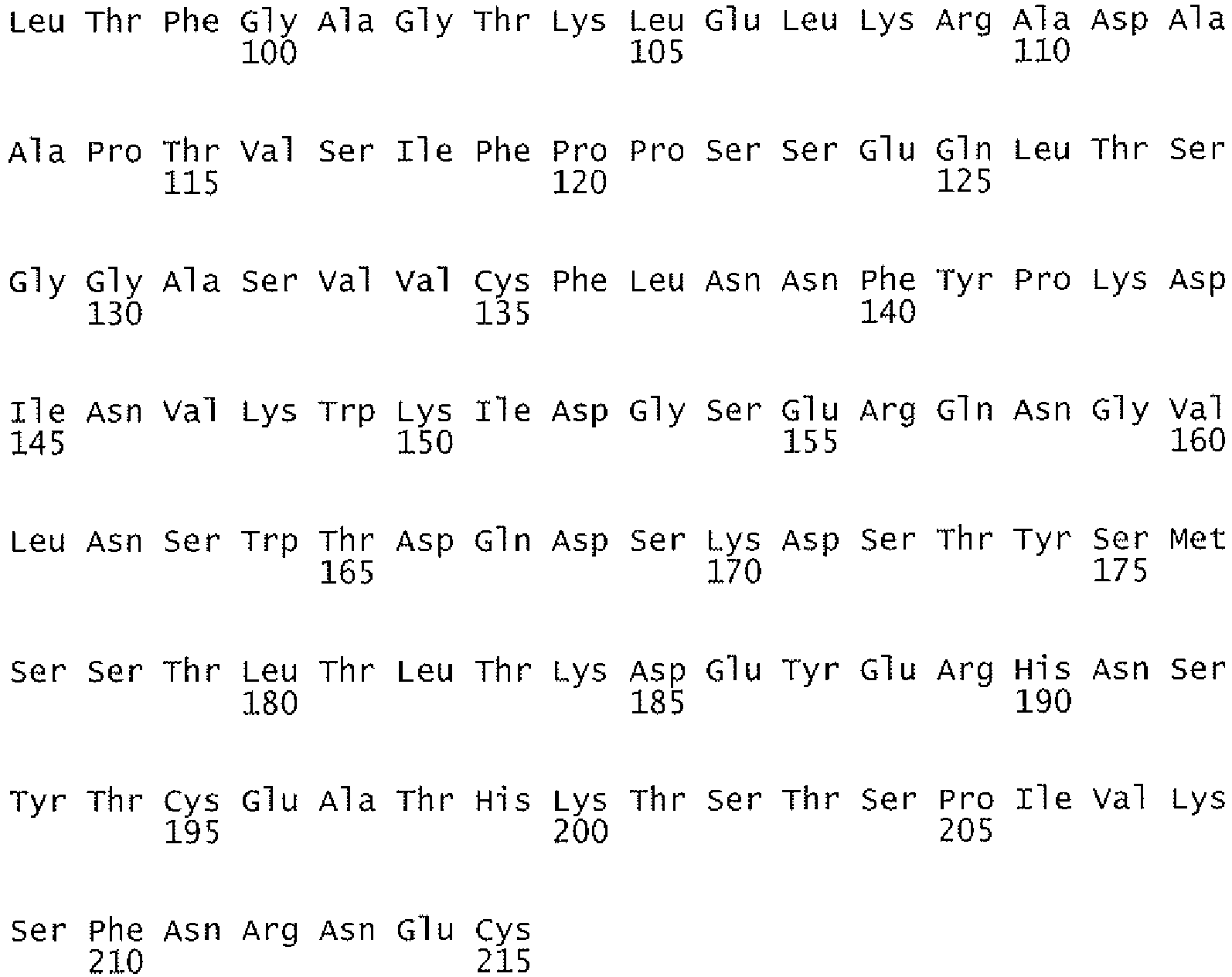
- amino acid sequence of anti-T3+THC immune complex Fab 104 light chain is set forth as SEQ ID NO:3 and of the Fab VH-CH1-6His-Tag region as SEQ ID NO:4.
- Amino acids no 1-111 of SEQ ID NO:3 represent the variable region of the light chain
- amino acids no 1-120 of SEQ ID NO:4 represent the variable region of the heavy chain.
- Amino acids no 112-216 of SEQ ID NO:3 represent the constant region of the human lambda light chain
- amino acids no 121-223 of SEQ ID NO:4 represent the constant region of the human heavy chain CH 1 region.
- the six histidine residues at the C-terminus of the heavy chain constant region facilitate the purification of the Fab fragment by immobilized metal affinity chromatography (IMAC).
- IMAC immobilized metal affinity chromatography
- the expression vector of the 104 Fab fragment was transformed into the E.coli production strain RV308.
- Cells were inoculated into 25 ml of TB medium (yeast extract 12 g/l, Soy peptone 24 g/l, KH2PO4 2.31 g/l, K2HPO4 12.54 g/l, glycerol 5 g/l, pH 7.1) with 100 ⁇ g/ml ampicillin and 2% glucose and were incubated over night at +37°C on a shaker. From the overnight culture a 6 ml inoculate was added into two erlenmeyer bottles containing 300 ml of TB with 100 ⁇ g/ml of ampicillin.
- the expressed Fab 104 has a 6xHis-tag in its C-terminus, it could be purified by immobilized metal affinity chromatography (IMAC).
- IMAC immobilized metal affinity chromatography
- the Fab 104 was purified by Ni 2+ Chelating Sepharose (Amersham Pharmacia Biotech). The purity of Fab 104 was checked with SDS-PAGE.
- TR-FRET time resolved fluorescent resonance energy transfer
- the anti-THC Fab fragment T3 was labeled with europium by LANCE Eu-W1024 ITC chelate Kit (Wallac). The buffer of the labeled T3 was changed to 50 mM Tris, pH 7.8, 0.9% NaCl.
- the anti-T3 + THC immune complex Fab fragment 104 was labeled with Alexa Fluor 647 by Alexa Fluor Protein Labeling kit (Molecular Probes, Inc.).
- THC Saliva sample spiked with THC is giving a high fluorescent value, whereas the THC metabolites are giving significantly lower fluorescence values, and heroin and morphine gave fluorescent values close to the background fluorescence detected from the control (labelled T3 and 104 fragments without any added drug).
- Fab 104 binds the immune complex formed between T3 and THC with extremely high specificity and sensitivity. The test is capable of detecting THC far below the cut-off level (20 ng/ml in saliva) of the quick tests currently in the market.
Landscapes
- Health & Medical Sciences (AREA)
- Life Sciences & Earth Sciences (AREA)
- Chemical & Material Sciences (AREA)
- Engineering & Computer Science (AREA)
- Molecular Biology (AREA)
- Immunology (AREA)
- Hematology (AREA)
- General Health & Medical Sciences (AREA)
- Biomedical Technology (AREA)
- Medicinal Chemistry (AREA)
- Biochemistry (AREA)
- Urology & Nephrology (AREA)
- Organic Chemistry (AREA)
- Pharmacology & Pharmacy (AREA)
- Botany (AREA)
- Bioinformatics & Cheminformatics (AREA)
- Proteomics, Peptides & Aminoacids (AREA)
- Genetics & Genomics (AREA)
- Biotechnology (AREA)
- Cell Biology (AREA)
- Biophysics (AREA)
- Microbiology (AREA)
- Anesthesiology (AREA)
- Food Science & Technology (AREA)
- Physics & Mathematics (AREA)
- Analytical Chemistry (AREA)
- General Physics & Mathematics (AREA)
- Pathology (AREA)
- Peptides Or Proteins (AREA)
- Investigating Or Analysing Biological Materials (AREA)
- Micro-Organisms Or Cultivation Processes Thereof (AREA)
- Geophysics And Detection Of Objects (AREA)
Description
- The invention provides means for enhancing immunoassays for detecting cannabis use. In particular the invention relates to a binding partner, which is an antibody fragment that is capable of binding an immune complex between tetrahydrocannabinol (THC) and an anti-THC-antibody. The invention is also directed to a test-kit comprising the binding partner, and the use of said binding partner for detecting cannabis use. Further the invention relates to an immunoassay, wherein said binding partner is used. Still further the invention is directed to a polynucleotide encoding said binding partner, and a host cell capable of expressing it.
- Drug abuse is a severe threat especially to traffic safety, and therefore a number of assays have been developed for convenient testing of drugs of abuse. Many of the tests are immunoassays, and they are mostly competitive immunoassays, which generally are less specific than non-competitive ones. Kerrigan and Phillips have e.g. compared 12 commercially available ELISAs (enzyme linked immunosorbent assays) for opiates, methamphetamine, benzodiazepines, cocaine metabolite, phencyclidine and cannabinoids in whole blood and urine. (Kerrigan S., & Phillips, W., 2001 Clinical Chemistry 47(3):540-547). The test format was competitive immunoassay, and the results were not fully satisfying giving some false results and undesired cross-reactivity.
- Drugs of abuse may be assayed not only from blood or urine, but also from saliva, which is the test matrix of choice for roadside testing. Lo Muzio et al. tested a commercial rapid immunological screening test for detecting drugs in urine, and compared two biological matrixes: a nonconventional one, saliva, and a traditional one, urine. They found that saliva specimens were negative in the immunological test for cannabis, THC, benzodiazepines, and tricyclic antidepressants although gas-chromatography-mass-spectrometry (GC-MS) analysis revealed low concentrations thereof, and concluded that the test kit must be improved before being used with saliva (Lo Muzio L., et al., 2005, Int J Immunopathol Pharmacol. 18(3):567-573).
-
WO 2004/046733 discloses a non-competitive immunoassay for assaying small analytes such as drugs of abuse. The assay uses a first antibody specific for the analyte, and a second antibody specific for an immune complex (IC) between the first antibody and the analyte to improve the sensitivity and specificity of an assay. The anti-IC antibody used was obtained from a naive human antibody fragment phage display library by preincubating the display phages with bound first antibody to sort out those binding to the first antibody as such, whereafter unbound phages were separated and incubated with a mixture of analyte and immobilized first antibody to select phages that bind to the immune complex formed between the immobilized first antibody and analyte, but not to the antibody as such. Very good results for determining morphine in saliva were obtained. - Δ9-tetrahydrocannabinol (Δ9-THC) is the parental drug of cannabis, and it is rapidly metabolized to 11-nor-Δ9-THC-COOH or 11-OH-Δ9-THC that may be determined in urine. Thus the use of cannabis is preferably detected by assaying Δ9-THC in saliva, which is a better indication of recent use than when the metabolites are detected in urine. However, it has turned out to be difficult to develop a quick-test for this analyte, and the test kits on the market are not sensitive enough.
-
US 6,326,159 and Ullman et al., 1993. Proc. Natl. Acad. Sci 90:1184-1189 describe an immunoassay using anti-IC-antibodies for enhancing the affinity and specificity of primary antibodies. In these papers, a secondary anti-IC antibody, which binds primary anti-analyte antibody that is combined with the analyte, but which does not bind the primary antibody or the analyte alone, has been developed. An antibody that recognizes an immune complex of an antibody to tetrahydrocannabinol (THC) is disclosed. The anti-IC antibody was obtained using an affinity labeled anti-THC antibody as immunogen and selecting an anti-IC antibody the binding of which was enhanced by the presence of Δ9THC. Some cross-reactivity with e.g. THC-metabolites was observed, which is undesirable in forensic drug analysis. The antibodies were prepared by conventional hybridoma technique, which render them too big for application in homogenous immunoassays. - Kintz P. et al. tested a commercial drug device for testing drugs in saliva, and compared the results with GC-MC analysis results, and found that the test device identified only one driver exposed to THC, whereas 18 drivers tested positive with GC-MC. They concluded that a current limitation of the use of this specimen for roadside testing is the absence of a suitable immunoassay that detects the parent compound (THC) in sufficiently low concentrations (Kintz P., et al., 2005. J Anal Toxicol. 29(7):724-727).
- The current immunoassays for determining cannabis use are not satisfactory i.a. due to low specificity and sensitivity. Thus there is still a need for an easy, rapid and reliable drug test for cannabis use, which may be used e.g. for roadside testing and preferably for analyzing oral fluid samples, which are non-invasive, easy to perform, and may be achieved under close supervision. The present invention meets at least part of these needs.
- The present invention provides a novel reagent, which facilitates rapid and reliable detection of cannabis use. The reagent is a protein capable of specifically recognizing an immune complex formed between cannabinoid and anti-cannabinoid. More specifically the present invention provides a binding partner, which is an antibody fragment specifically recognizing an immune complex between tetrahydrocannabinol (THC) and anti-THC, and comprising the complementary determining regions (CDRs) of an antibody light chain and heavy chain, wherein said light chain regions have the amino acid sequences of amino acids 23-35, 51-57, and 93-100 of SEQ ID NO:3, and said heavy chain regions have the amino acid sequences of amino acids 29-35, 50-60 and 99-109 of SEQ ID NO:4.
- The invention further provides a test-kit comprising the above-mentioned antibody fragment, and another antibody fragment specifically binding to THC, and comprising the amino acid sequences of SEQ ID NO:1 and SEQ ID NO:2, and the use of said two antibody fragments for detecting THC in a body fluid sample taken from a person to be tested for having used cannabis. Due to high specificity and sensitivity and preferably small size the binding partner is especially suitable for a non-competitive homogenous immunoassay that may be used e.g. by the road for testing saliva of drivers suspected of cannabis use.
- Still further the invention provides an immunoassay for detecting an analyte in a body fluid sample taken from a person, whereby the sample is reacted with a reagent pair comprising a first antibody fragment that specifically binds to the analyte, and a second antibody fragment that specifically binds to the complex of the analyte and the first antibody fragment, and determining the binding of the second antibody fragment to said complex, thus indicating the presence of the analyte in the sample, wherein said analyte is THC, and said first antibody fragment specifically binding to THC comprises the amino acid sequences of SEQ ID NO:1 and SEQ ID NO:2, and said second antibody fragment comprises the complementary determining regions (CDRs) of an antibody light chain and heavy chain, wherein said light chain regions have the amino acid sequences of amino acids 23-35, 51-57, and 93-100 of SEQ ID NO:3, and said heavy chain regions have the amino acid sequences of amino acids 29-35, 50-60 and 99-109 of SEQ ID NO:4.
- Yet in addition the invention provides a polynucleotide encoding the antibody fragment, and a host cell capable of expressing the antibody fragment of the invention. The polynucleotide is DNA or RNA.
- Advantageous embodiments of the invention are set forth in the dependent claims.
-
-
Figure 1 shows the amino acid sequences of the anti-THC T3 Fab light chain (SEQ ID NO:1), and anti-THC T3 Fab VH-CH1 heavy chain (SEQ ID NO:2). The three complementary determining regions CDR1, CDR2 and CDR3 of each of said immunoglobulin chains are indicated. -
Figure 2 shows the amino acid sequences of the anti-T3+THCimmune complex Fab 104 light chain (SEQ ID NO:3), and anti-T3+THCimmune complex Fab 104 heavy chain (SEQ ID NO:4). The three complementary determining regions CDR1, CDR2 and CDR3 of each of said immunoglobulin chains are indicated. -
Figure 3 shows THC TR-FRET test results obtained with the combination of anti-THC T3 Fab and anti-T3+THCimmune complex Fab 104 for various drugs and drug metabolites. - Cannabinoid is a general name of terpenphenolic molecules found in cannabis plants Cannabis sativa. More generally it encompasses a group of molecules, which are structurally related to tetrahydrocannabinol (THC) and which bind to the cannabinoid receptor. THC is the major psychoactive cannabinoid of cannabis, and it is synonymous with Δ9-tetrahydrocannabinol (Δ9-THC) and D9-tetrahydrocannabinol (D9-THC), which all may be used interchangeably herein. THC is metabolized in the body to i.a. 11-nor-D9-THC-COOH and 11-OH-D9-THC, which are examples of other cannabinoids. The binding partner of the invention recognizes specifically an immune complex between THC and anti-THC, whereby the reaction with the metabolites is significantly lower.
- The binding partner of the invention may be used in a sandwich assay for detecting THC in a sample, whereby the sample is reacted with a reagent pair comprising a first binding partner that specifically binds to THC, and a second binding partner, which is capable of specifically recognizing an immune complex between THC and anti-THC, and which is the binding partner of the invention. Binding of the second binding partner to the immune complex between the first binding partner and THC indicates the presence of THC in the sample.
- "Binding partner" as used herein refers to antibody fragments that have the desired binding properties. An antibody is an immunoglobulin molecule and it can belong to any of classes IgG, IgM, IgE, IgA or IgD; IgG and IgM being the most frequently used. Preferably the antibody fragments comprise the ligand-binding site, such as Fab, or scFv fragments. The fragment known as the Fab fragment (fragment antigen binding) consists of the variable and constant domain of an immunoglobulin light chain covalently attached by a disulfide bridge to the variable and first constant domain of an immunoglobulin heavy chain. Fv (variable domain) means the variable regions of the immunoglobulin molecule that are responsible for the ligand binding. ScFv (single chain Fv) means a molecule wherein the variable domains of the heavy and light chain of an antibody are linked by a peptide to form a single polypeptide chain synthesized from a single mRNA molecule. The variable regions of an immunoglobulin heavy chain and light chain are together responsible for the ligand binding. Ligand is the substance to which the binding partner binds, in connection with antibodies it is an antigen or a hapten.
- The binding partners are conveniently prepared using a recombinant phage display binding partner library e.g. as described in
WO 2004/046733 . When the first binding partner has been selected for, it is complexed with its ligand and this complex is used to select for the second binding partner from a recombinant library. The first binding partner without the ligand is used as contraselection. The second binding partner should only recognise complexes, not free first binding partner nor free antigen to any significant extent. - A phage display antibody library may be constructed by cloning immunoglobulin domains coding cDNAs into an appropriate phage display vector. DNA encoding for millions of variants of antibody fragments is batch-cloned into the vector as part of the phage coat protein. Large libraries containing millions of antibody fragments with different specificities can be obtained by transforming the vectors in bacteria. Cultivation of the bacteria leads to the expression of phages displaying antibody fragments on their surface. The gene for the displayed antibody is carried in the phage genome, thus linking genotype with phenotype. The physical linkage between the displayed protein and its DNA allows screening of vast numbers of variants of the protein, each linked to its corresponding DNA, by a simple in vitro selection procedure called panning. In its simplest form, panning is carried out by incubating the pool of phage-displayed variants with the ligand of interest that has been immobilized on a carrier, washing away unbound phage, and eluting specifically bound phage by disrupting the binding to the ligand. The eluted phage is then amplified in vivo. The process is repeated several times, resulting in stepwise enrichment of the phage pool in favour of the tightest binding sequences. After about 3 to 6 rounds of selection and amplification, the best clones are sequenced and transformed into a host cell for further expression. The host cell may be a eucaryotic or procaryotic cell e.g. a yeast, animal, plant or insect cell or bacterial cell. It may even be a hybridoma cell, which after transformation produces a recombinant monoclonal antibody. The recombinant binding partner or at least part of it may also be produced synthetically.
- The reagent pair comprising a first binding partner recognizing THC, and a second binding partner recognizing an immune complex between THC and said first binding partner makes a non-competitive sandwich assay for THC feasible. The sandwich can be detected by all the standard immunoassays. One partner may be immobilized on a carrier, such as a microtiter well or a bead. A sandwich is formed in the presence of analyte and the other binding partner. The sandwich may be detected e.g. by using secondary antibodies or by labeling at least one of the binding partners. The label can be any conventional label, such as a radioactive label, an enzyme, or a fluorescent compound. The assay can be e.g. ELISA or FIA.
- A great advantage of a reagent pair comprising the binding partner of the present invention is that it enables a homogenous immunoassay, i.e. an immunoassay that is carried out in solution. The avoidance of immobilizing and washing steps makes the assay extremely simple. The homogenous assay provides an excellent and convenient tool for on-side tests e.g. to be used by the police in raiding drivers etc. The immunoassay provided by the invention is up to ten times more sensitive than the competitive assays presently on the market. The sample to be analysed is any body fluid sample such as blood, serum or urine, but preferably it is an oral fluid such as saliva. The analyte is THC.
- A preferred homogenous immunoassay is one based on fluorescence resonance energy transfer (FRET), for review see Szollosi J. et al., 1998, Communications in Clinical Cytometry, 34:159-179. In FRET, energy from a molecular fluorophore (donor) is excited to a high-energy state and transferred to another fluorophore (acceptor) via intermolecular dipole-dipole coupling. This is possible only if the distance between the donor and the acceptor is short (10-100 A) and the fluorescence spectrum of the donor and the absorption spectrum of the acceptor partially overlap. The energy transfer is then detected as a change in fluorescence. Often time-resolved fluorescence is utilized (Hemmila I. et al., 1988, Clin. Chem. 34:2320-2322).
- FRET may be applied to the present invention by labeling the two binding partners, which are antibody fragments, with fluorophores that form a FRET donor-acceptor pair. When the binding partners and the analyte are small the fluorophores come into very close proximity, and a measurable FRET signal is obtained.
- Alternatively the immunoassay for cannabis use may be for example a conventional sandwich test in microtiter wells or a lateral flow-test.
- The antibody fragment of the invention may be included in a test-kit, which may further contain any other reagents needed for the assay together with instructions for use. The test-kit of the invention contains also a first antibody fragment, which comprises the amino acid sequences of SEQ ID NO:1 and SEQ ID NO:2 for binding THC. Preferably the test-kit comprises reagents for carrying out a non-competitive, homogenous assay such as e.g. reagents needed for a TR-FRET test. The kit may further comprise reaction solutions, buffers, washing solutions and detecting means, such as labels and optionally a fluorometer.
- The performance of the test may be such that the reagents are in the well of a microtiter plate and dilution series of sample is added. In a preferred mode for e.g. police field use, the reagents are in dry form in a vessel. Saliva is added, which dissolves the reagents and the result can be read without further processes.
- Preferably the test kit comprises reagents for assaying multiple drugs of abuse, such as reagents for assaying e.g. morphine, codeine, heroin, amphetamine, metamphetamine, cocaine, barbiturates and benzodiazepines. In that case the test-kit may comprise multiple reagent pairs physically separated from each other e.g. in the form of a microarray, whereby the multiple drugs may be tested simultaneously from a single saliva sample.
- The antibody fragment of the invention comprises three CDRs of an antibody light chain having the sequence of SEQ ID NO:3, and three CDRs of an antibody heavy chain having the sequence of SEQ ID NO:4. According to one embodiment of the invention the binding partner comprises the whole variable region i.e. the ligand-binding portion of said light chain (VL) and heavy chain (VH). It may thus contain amino acids 1-111 of SEQ ID NO:3 and amino acids 1-120 of SEQ ID NO:4. In particular said binding partner comprises the amino acid sequences of SEQ ID NO:3 and NO:4.
- The invention is illustrated by the following non-limiting examples.
- Mice were immunized with THC conjugated BSA (Fitzgerald) in Freund's adjuvant, and serum samples were tested after second booster, and the mouse showing the best response against the antigen in direct ELISA was selected to be the source of an antibody phage display library. An antibody fragment phage display library was constructed, THC-specific phages were enriched, and the Fab gene fragment of individual clones were isolated, expressed and characterized as described in
WO 2004/046733 . Anti-THC T3 Fab was chosen for further assay. - The amino acid sequence of anti-THC T3 Fab light chain is set forth as SEQ ID NO:1, and anti-THC T3 Fab VH-CH1 chain is set forth as SEQ ID NO:2. CDR1, CDR2, and CDR3 of the Fab light chain correspond to amino acids 24-35, 51-57 and 90-98 of SEQ ID NO:1. CDR1, CDR2 and CDR3 of the Fab heavy chain correspond to amino acids 27-36, 51-66 and 99-107 of SEQ ID NO:2. Amino acids no 1-108 of SEQ ID NO:1 represent the variable region of the light chain, and amino acids no 1-118 of SEQ ID NO:2 represent the variable region of the heavy chain. Amino acids no 109-215 of SEQ ID NO:1 represent the constant region of the mouse kappa light chain, and amino acids no 119-221 of SEQ ID NO:2 represent the mouse constant CH1 region of the heavy chain. The amino acid sequences of anti-THC T3 Fab are also shown in
Figure 1 . - T3 Fab fragment was biotinylated with ImmunoPure Sulfo-NHS-LC-Biotin Kit (Pierce). Biotinylated antibody was purified and buffer was changed to PBS with Econo-Pac 10DG Columns (Bio-Rad, CA, USA). 200 µl of a naive human scFv phage display library (Kappa or Lambda light chain) in BSA/PBS was preincubated with 10 µl of streptavidin coated magnetic beads (Dynal, M-280) and 0.5 µg of biotinylated T3 Fab for over night at +4°C. The naive human scFv phage display library was constructed from pooled lymphocytes of 50 healthy individuals. The size of the library was estimated to be 1x10⁸ clones. The naive human scFv phage display library contains the IgM specific VH-genes combined either with the kappa or lambda specific VL-genes. Unbound phages were separated from the beads and 100 µl of them was incubated with 100 ng of THC, 500 ng of biotinylated T3 Fab, and 5 µl of streptavidin coated magnetic beads for 1 h at RT on a shaker. The background for the selection procedure was implemented in a similar way but omitting the THC from the binding reaction. Magnetic beads were washed five times with 0.5 ml of PBS and bound phages were eluted with 100 µl of HCl (pH 2.2) for 30 min. The eluted phages were neutralized with 1M Tris and E. coli XL1-Blue cells were infected. Cells were grown and phages were purified as described in
WO 2004/046733 . After three panning rounds enrichment was seen, when the amount of eluted phages was compared to the amount of eluted phages from the background control well. The enrichment of specific binders to the immune complex, formed by T3 Fab and THC, was also clearly seen in a phage ELISA when the eluted phage pools from the selection rounds were tested and by analyzing individual scFv phage clones. - Individual scFv phage clones binding specifically to T3+THC complex were picked, sequenced, expressed and tested.
Clone 104 was chosen for further examination. Since scFvs are prone to aggregation during expression and purification, the immune complexspecific clone 104 was converted to a Fab fragment by cloning the gene regions of human lambda light chain and IgG1 CH1 constant regions to the VL and VH genes, respectively. A C-terminal tag containing six histidine residues was inserted into the C-terminus of the CH1 for immobilized metal affinity chromatography (IMAC) purification. 104 Fab fragment was cloned into the expression vector pKKtac and the sequence was verified. The amino acid sequence of anti-T3+THC immunecomplex Fab 104 light chain is set forth as SEQ ID NO:3 and of the Fab VH-CH1-6His-Tag region as SEQ ID NO:4. Amino acids no 1-111 of SEQ ID NO:3 represent the variable region of the light chain, and amino acids no 1-120 of SEQ ID NO:4 represent the variable region of the heavy chain. Amino acids no 112-216 of SEQ ID NO:3 represent the constant region of the human lambda light chain, and amino acids no 121-223 of SEQ ID NO:4 represent the constant region of the human heavy chain CH1 region. The six histidine residues at the C-terminus of the heavy chain constant region facilitate the purification of the Fab fragment by immobilized metal affinity chromatography (IMAC). - The expression vector of the 104 Fab fragment was transformed into the E.coli production strain RV308. Cells were inoculated into 25 ml of TB medium (yeast extract 12 g/l, Soy peptone 24 g/l, KH2PO4 2.31 g/l, K2HPO4 12.54 g/l, glycerol 5 g/l, pH 7.1) with 100 µg/ml ampicillin and 2% glucose and were incubated over night at +37°C on a shaker. From the overnight culture a 6 ml inoculate was added into two erlenmeyer bottles containing 300 ml of TB with 100 µg/ml of ampicillin. Cells were incubated at +37°C on a shaker until the OD600 was 4 after which 0.3 ml of 1 M IPTG and 100 µg/ml of ampicillin were added into the culture and the incubation was continued over night at +30°C on a shaker. The supernatant of the culture medium was used for the purification of the 104 Fab fragment. Cells were centrifuged at 4000 g for 20 min at 4° and the supernatant was poured into a clean flask. The supernatant was treated with 2 mg/ml of DNasel to remove residual chromosomal DNA for one hour at +37°C. Since the expressed
Fab 104 has a 6xHis-tag in its C-terminus, it could be purified by immobilized metal affinity chromatography (IMAC). TheFab 104 was purified by Ni2+ Chelating Sepharose (Amersham Pharmacia Biotech). The purity ofFab 104 was checked with SDS-PAGE. - The anti-THC Fab fragment T3 was labeled with europium by LANCE Eu-W1024 ITC chelate Kit (Wallac). The buffer of the labeled T3 was changed to 50 mM Tris, pH 7.8, 0.9% NaCl. The anti-T3 + THC immune complex
Fab fragment 104 was labeled with Alexa Fluor 647 by Alexa Fluor Protein Labeling kit (Molecular Probes, Inc.). - 1 µg of Eu labeled anti-THC T3 Fab and 1.5 µg of Alexa Fluor 647 labeled anti-immune
complex Fab 104 were added to microtiter wells in 60 µl of saliva. 40 µl saliva samples spiked with 0, 3.75, 7.5, 15, 30, 60 and 120 ng/ml of the following drugs: D9-THC, 11-OH-D9-THC, 11-nor-D9-THC-COOH, heroin and amphetamine were added to the wells. After short mixing, the time resolved fluorescence resonance energy transfer (TR-FRET) was measured by Victor V fluorometer (Perkin Elmer Wallac). The results are shown inFigure 3 . - Saliva sample spiked with THC is giving a high fluorescent value, whereas the THC metabolites are giving significantly lower fluorescence values, and heroin and morphine gave fluorescent values close to the background fluorescence detected from the control (labelled T3 and 104 fragments without any added drug).
Fab 104 binds the immune complex formed between T3 and THC with extremely high specificity and sensitivity. The test is capable of detecting THC far below the cut-off level (20 ng/ml in saliva) of the quick tests currently in the market. -
- <110> valtion teknillinen tutkimuskeskus
- <120> Detection of cannabis use
- <130> 2080700PC
- <160> 4
- <170> PatentIn version 3.3
- <210> 1
<211> 215
<212> PRT
<213> Murinae gen. sp. - <220>
<221> DOMAIN
<222> (1)..(108)
<223> VL - <220>
<221> MISC_FEATURE
<222> (24)..(35)
<223> CDR1 - <220>
<221> MISC_FEATURE
<222> (51)..(57)
<223> CDR2 - <220>
<221> MISC_FEATURE
<222> (90)..(98)
<223> CDR3 - <220>
<221> DOMAIN
<222> (109)..(215)
<223> CL - <400> 1

- <210> 2
<211> 221
<212> PRT
<213> Murinae gen. sp. - <220>
<221> DOMAIN
<222> (1)..(118)
<223> VH - <220>
<221> MISC_FEATURE
<222> (27)..(36)
<223> CDR1 - <220>
<221> MISC_FEATURE
<222> (51)..(66)
<223> CDR2 - <220>
<221> MISC_FEATURE
<222> (99)..(107)
<223> CDR3 - <220>
<221> DOMAIN
<222> (119)..(221)
<223> CH - <400> 2


- <210> 3
<211> 216
<212> PRT
<213> Homo sapiens - <220>
<221> DOMAIN
<222> (1)..(111)
<223> VL - <220>
<221> MISC_FEATURE
<222> (23)..(35)
<223> CDR1 - <220>
<221> MISC_FEATURE
<222> (51)..(57)
<223> CDR2 - <220>
<221> MISC_FEATURE
<222> (93)..(100)
<223> CDR3 - <220>
<221> DOMAIN
<222> (112)..(216)
<223> CL - <400> 3


- <210> 4
<211> 229
<212> PRT
<213> Homo sapiens - <220>
<221> DOMAIN
<222> (1)..(120)
<223> VH - <220>
<221> MISC_FEATURE
<222> (29)..(35)
<223> CDR1 - <220>
<221> MISC_FEATURE
<222> (50)..(60)
<223> CDR2 - <220>
<221> MISC_FEATURE
<222> (99)..(109)
<223> CDR3 - <220>
<221> DOMAIN
<222> (121)..(223)
<223> CH - <220>
<221> MISC_FEATURE
<222> (224)..(229)
<223> 6His-Tag - <400> 4


Claims (14)
- An antibody fragment specifically recognizing an immune complex between tetrahydrocannabinol (THC) and anti-THC, and comprising the complementary determining regions (CDRs) of an antibody light chain and heavy chain, wherein said light chain regions have the amino acid sequences of amino acids 23-35, 51-57, and 93-100 of SEQ ID NO:3, and said heavy chain regions have the amino acid sequences of amino acids 29-35, 50-60 and 99-109 of SEQ ID NO:4.
- The antibody fragment according to claim 1, comprising amino acids 1-111 of SEQ ID NO:3, and amino acids 1-120 of SEQ ID NO:4.
- The antibody fragment according to claim 2, wherein the fragment comprises the amino acid sequences of SEQ ID NO:3 and SEQ ID NO:4.
- A test-kit comprising the antibody fragment of anyone of claims 1 to 3, and another antibody fragment specifically binding to THC, and comprising the amino acid sequences of SEQ ID NO:1 and SEQ ID NO:2.
- The test-kit according to claim 4, comprising reagents for a non-competitive homogenous immunoassay.
- The test-kit according to claim 5, comprising reagents for time resolved fluorescent resonance energy transfer (TR-FRET).
- The test-kit according to anyone of claims 4 to 6, comprising reagents for assaying multiple drugs of abuse.
- Use of the antibody fragment of anyone of claims 1 to 3 together with an antibody fragment, which specifically binds to THC, and which comprises the amino acid sequences of SEQ ID NO:1 and SEQ ID NO:2 for detecting THC in a body fluid sample taken from a person to be tested for having used cannabis.
- An immunoassay for detecting an analyte in a body fluid sample taken from a person, whereby the sample is reacted with a reagent pair comprising a first antibody fragment that specifically binds to the analyte, and a second antibody fragment that specifically binds to the complex of the analyte and the first antibody fragment, and determining the binding of the second antibody fragment to said complex, thus indicating the presence of the analyte in the sample, characterized in that said analyte is THC, and said first antibody fragment specifically binding to THC comprises the amino acid sequences of SEQ ID NO:1 and SEQ ID NO:2, and said second antibody fragment comprises the complementary determining regions (CDRs) of an antibody light chain and heavy chain, wherein said light chain regions have the amino acid sequences of amino acids 23-35, 51-57, and 93-100 of SEQ ID NO:3, and said heavy chain regions have the amino acid sequences of amino acids 29-35, 50-60 and 99-109 of SEQ ID NO:4.
- The immunoassay of claim 9, comprising using a non-competitive, homogenous immunoassay, preferably TR-FRET.
- The immunoassay of anyone of claim 9 or 10, wherein the sample to be analyzed is selected from the group consisting of blood, urine, and oral fluid.
- The immunoassay of claim 9, wherein THC is determined from saliva.
- A polynucleotide encoding the antibody fragment of anyone of claims 1 to 3.
- A host cell expressing the antibody fragment of anyone of claims 1 to 3.
Priority Applications (3)
| Application Number | Priority Date | Filing Date | Title |
|---|---|---|---|
| HRP20160237TT HRP20160237T1 (en) | 2008-06-12 | 2009-06-05 | Detection of cannabis use |
| SI200931395A SI2297585T1 (en) | 2008-06-12 | 2009-06-05 | Detection of cannabis use |
| CY20161100251T CY1117631T1 (en) | 2008-06-12 | 2016-03-24 | DETECTION OF HUMAN USE |
Applications Claiming Priority (2)
| Application Number | Priority Date | Filing Date | Title |
|---|---|---|---|
| FI20085579A FI20085579A0 (en) | 2008-06-12 | 2008-06-12 | Detection of cannabis use |
| PCT/FI2009/050481 WO2009150295A1 (en) | 2008-06-12 | 2009-06-05 | Detection of cannabis use |
Publications (3)
| Publication Number | Publication Date |
|---|---|
| EP2297585A1 EP2297585A1 (en) | 2011-03-23 |
| EP2297585A4 EP2297585A4 (en) | 2012-05-02 |
| EP2297585B1 true EP2297585B1 (en) | 2016-03-02 |
Family
ID=39589343
Family Applications (1)
| Application Number | Title | Priority Date | Filing Date |
|---|---|---|---|
| EP09761850.8A Active EP2297585B1 (en) | 2008-06-12 | 2009-06-05 | Detection of cannabis use |
Country Status (20)
| Country | Link |
|---|---|
| US (1) | US8518653B2 (en) |
| EP (1) | EP2297585B1 (en) |
| JP (1) | JP5675597B2 (en) |
| CN (1) | CN102057277B (en) |
| AU (1) | AU2009256482B2 (en) |
| BR (1) | BRPI0915086B8 (en) |
| CA (1) | CA2724660C (en) |
| CY (1) | CY1117631T1 (en) |
| DK (1) | DK2297585T3 (en) |
| EA (1) | EA019664B1 (en) |
| ES (1) | ES2566501T3 (en) |
| FI (1) | FI20085579A0 (en) |
| HR (1) | HRP20160237T1 (en) |
| HU (1) | HUE028677T2 (en) |
| MX (1) | MX2010013692A (en) |
| NZ (1) | NZ589300A (en) |
| PL (1) | PL2297585T3 (en) |
| SI (1) | SI2297585T1 (en) |
| WO (1) | WO2009150295A1 (en) |
| ZA (1) | ZA201008491B (en) |
Families Citing this family (24)
| Publication number | Priority date | Publication date | Assignee | Title |
|---|---|---|---|---|
| US11062795B2 (en) | 2007-03-02 | 2021-07-13 | Enigami Systems, Inc. | Healthcare data system |
| EP2673635A4 (en) | 2011-02-07 | 2015-08-12 | Neotope Biosciences Ltd | Apoe immunotherapy |
| BR112014006405A2 (en) * | 2011-09-21 | 2017-04-04 | Fujirebio Kk | antibody, pool, and method for measuring an affinity complex |
| US9970950B1 (en) | 2014-03-09 | 2018-05-15 | Hound Labs, Inc. | Method and apparatus for detecting acute use of target substance(s) |
| US10307446B2 (en) | 2014-03-21 | 2019-06-04 | St&T International, Inc. | Cannabis extraction method and compositions |
| MX2016012403A (en) | 2014-03-27 | 2017-06-14 | Bird Rock Bio Inc | Antibodies that bind human cannabinoid 1 (cb1) receptor. |
| US10319475B1 (en) | 2014-06-13 | 2019-06-11 | Enigami Systems, Inc. | Method and apparatus for determining relationships between medications and symptoms |
| US9726684B1 (en) | 2015-01-18 | 2017-08-08 | Hound Labs, Inc. | Compositions for target substance detection and measurement |
| US9585867B2 (en) | 2015-08-06 | 2017-03-07 | Charles Everett Ankner | Cannabinod formulation for the sedation of a human or animal |
| PE20181199A1 (en) | 2015-09-30 | 2018-07-23 | Bird Rock Bio Inc | ANTIBODIES THAT BIND THE HUMAN CANNABINOID RECEPTOR 1 (CB1) |
| US9823259B1 (en) | 2016-04-08 | 2017-11-21 | Walter Nichols | Detection device for cannabinoid use |
| US9933445B1 (en) | 2016-05-16 | 2018-04-03 | Hound Labs, Inc. | System and method for target substance identification |
| US9921234B1 (en) | 2016-06-17 | 2018-03-20 | Hound Labs, Inc. | Compositions and methods for detection of target constituent in exhaled breath |
| US11026596B1 (en) | 2017-05-19 | 2021-06-08 | Hound Labs, Inc. | Detection and measurement of target substance in exhaled breath |
| US11187711B1 (en) | 2017-09-11 | 2021-11-30 | Hound Labs, Inc. | Analyte detection from breath samples |
| WO2019118831A1 (en) * | 2017-12-15 | 2019-06-20 | Bomi, Llc | Anti-cannabidiol antibody and uses thereof |
| US20200035118A1 (en) | 2018-07-27 | 2020-01-30 | Joseph Pandolfino | Methods and products to facilitate smokers switching to a tobacco heating product or e-cigarettes |
| US10897925B2 (en) | 2018-07-27 | 2021-01-26 | Joseph Pandolfino | Articles and formulations for smoking products and vaporizers |
| US11426097B1 (en) * | 2018-10-17 | 2022-08-30 | Hound Labs, Inc. | Rotary valve assemblies and methods of use for breath sample cartridge systems |
| US20200245899A1 (en) | 2019-01-31 | 2020-08-06 | Hound Labs, Inc. | Mechanical Breath Collection Device |
| US11977086B2 (en) | 2019-03-21 | 2024-05-07 | Hound Labs, Inc. | Biomarker detection from breath samples |
| US11933731B1 (en) | 2020-05-13 | 2024-03-19 | Hound Labs, Inc. | Systems and methods using Surface-Enhanced Raman Spectroscopy for detecting tetrahydrocannabinol |
| US12392769B1 (en) | 2021-01-12 | 2025-08-19 | Hound Labs, Inc. | Ambient contamination in breath analyte detection and measurement |
| CA3239050A1 (en) * | 2021-11-24 | 2023-06-01 | Alexei Leonidovich Beresnev | System and method for determining intoxicant impairment |
Citations (1)
| Publication number | Priority date | Publication date | Assignee | Title |
|---|---|---|---|---|
| WO2004046733A1 (en) * | 2002-11-18 | 2004-06-03 | Valtion Teknillinen Tutkimuskeskus | Non-competitive immunoassay for small analytes |
Family Cites Families (6)
| Publication number | Priority date | Publication date | Assignee | Title |
|---|---|---|---|---|
| US3996345A (en) * | 1974-08-12 | 1976-12-07 | Syva Company | Fluorescence quenching with immunological pairs in immunoassays |
| DE3433652A1 (en) * | 1984-09-13 | 1986-03-20 | Boehringer Mannheim Gmbh, 6800 Mannheim | IMMUNCHEMICAL MEASUREMENT METHOD FOR HAPTENES AND PROTEINS |
| WO1987007147A1 (en) * | 1986-05-28 | 1987-12-03 | Murex Corporation | Method for producing monoclonal antibodies to an immunogenic antibody-antigen conjunction |
| US5223441A (en) * | 1986-10-09 | 1993-06-29 | Syntex (U.S.A.) Inc. | Receptors for immune complexes |
| CA2072758A1 (en) * | 1990-09-14 | 1992-03-15 | Kenneth Francis Buechler | Antibodies to complexes of ligand receptors and ligands and their utility in ligand-receptor assays |
| MX2008014978A (en) | 2006-06-06 | 2008-12-09 | Crucell Holland Bv | Human binding molecules having killing activity against enterococci and staphylococcus aureus and uses thereof. |
-
2008
- 2008-06-12 FI FI20085579A patent/FI20085579A0/en not_active Application Discontinuation
-
2009
- 2009-06-05 BR BRPI0915086A patent/BRPI0915086B8/en active IP Right Grant
- 2009-06-05 WO PCT/FI2009/050481 patent/WO2009150295A1/en not_active Ceased
- 2009-06-05 SI SI200931395A patent/SI2297585T1/en unknown
- 2009-06-05 HR HRP20160237TT patent/HRP20160237T1/en unknown
- 2009-06-05 ES ES09761850.8T patent/ES2566501T3/en active Active
- 2009-06-05 EA EA201071435A patent/EA019664B1/en not_active IP Right Cessation
- 2009-06-05 CA CA2724660A patent/CA2724660C/en active Active
- 2009-06-05 EP EP09761850.8A patent/EP2297585B1/en active Active
- 2009-06-05 MX MX2010013692A patent/MX2010013692A/en active IP Right Grant
- 2009-06-05 AU AU2009256482A patent/AU2009256482B2/en active Active
- 2009-06-05 NZ NZ589300A patent/NZ589300A/en unknown
- 2009-06-05 HU HUE09761850A patent/HUE028677T2/en unknown
- 2009-06-05 US US12/994,805 patent/US8518653B2/en active Active
- 2009-06-05 PL PL09761850.8T patent/PL2297585T3/en unknown
- 2009-06-05 DK DK09761850.8T patent/DK2297585T3/en active
- 2009-06-05 JP JP2011513012A patent/JP5675597B2/en active Active
- 2009-06-05 CN CN200980121568.6A patent/CN102057277B/en active Active
-
2010
- 2010-11-25 ZA ZA2010/08491A patent/ZA201008491B/en unknown
-
2016
- 2016-03-24 CY CY20161100251T patent/CY1117631T1/en unknown
Patent Citations (1)
| Publication number | Priority date | Publication date | Assignee | Title |
|---|---|---|---|---|
| WO2004046733A1 (en) * | 2002-11-18 | 2004-06-03 | Valtion Teknillinen Tutkimuskeskus | Non-competitive immunoassay for small analytes |
Non-Patent Citations (1)
| Title |
|---|
| TIMO PULLI ET AL: "One-step homogeneous immunoassay for small analytes", ANALYTICAL CHEMISTRY 15 APR 2005 LNKD- PUBMED:15828804,, vol. 77, no. 8, 15 April 2005 (2005-04-15), pages 2637 - 2642, XP002602617, DOI: 10.1021/AC048379L * |
Also Published As
| Publication number | Publication date |
|---|---|
| ZA201008491B (en) | 2011-08-31 |
| ES2566501T3 (en) | 2016-04-13 |
| CN102057277B (en) | 2014-12-24 |
| NZ589300A (en) | 2011-11-25 |
| BRPI0915086A2 (en) | 2016-07-26 |
| US8518653B2 (en) | 2013-08-27 |
| FI20085579A0 (en) | 2008-06-12 |
| HUE028677T2 (en) | 2016-12-28 |
| BRPI0915086B8 (en) | 2021-07-27 |
| EP2297585A4 (en) | 2012-05-02 |
| PL2297585T3 (en) | 2016-09-30 |
| EP2297585A1 (en) | 2011-03-23 |
| MX2010013692A (en) | 2011-03-04 |
| EA019664B1 (en) | 2014-05-30 |
| AU2009256482A1 (en) | 2009-12-17 |
| JP2011524013A (en) | 2011-08-25 |
| WO2009150295A1 (en) | 2009-12-17 |
| JP5675597B2 (en) | 2015-02-25 |
| EA201071435A1 (en) | 2011-08-30 |
| BRPI0915086B1 (en) | 2020-05-12 |
| CA2724660C (en) | 2019-07-09 |
| AU2009256482B2 (en) | 2014-11-13 |
| SI2297585T1 (en) | 2016-06-30 |
| CN102057277A (en) | 2011-05-11 |
| DK2297585T3 (en) | 2016-03-29 |
| HRP20160237T1 (en) | 2016-04-22 |
| US20110086364A1 (en) | 2011-04-14 |
| CY1117631T1 (en) | 2017-04-26 |
| CA2724660A1 (en) | 2009-12-17 |
Similar Documents
| Publication | Publication Date | Title |
|---|---|---|
| US8518653B2 (en) | Detection of cannabis use | |
| EP1579222B1 (en) | Non-competitive immunoassay for small analytes | |
| EP3394097B1 (en) | Antibodies against immunocomplexes comprising cyanobacterial cyclic peptide hepatotoxins | |
| US20080305559A1 (en) | Non-Competitive Immunoassays to Detect Small Molecules | |
| JP2020506395A (en) | Sample detection immunoassay | |
| EP3129403B1 (en) | Antibody against ht-2 toxin-ht-2 toxin antibody complex | |
| AU2003282143B2 (en) | Non-competitive immunoassay for small analytes | |
| Ball et al. | B-245 Novel monoclonal antibodies validated specifically for immunohistochemistry by performance assessment on tissue microarrays |
Legal Events
| Date | Code | Title | Description |
|---|---|---|---|
| PUAI | Public reference made under article 153(3) epc to a published international application that has entered the european phase |
Free format text: ORIGINAL CODE: 0009012 |
|
| 17P | Request for examination filed |
Effective date: 20101223 |
|
| AK | Designated contracting states |
Kind code of ref document: A1 Designated state(s): AT BE BG CH CY CZ DE DK EE ES FI FR GB GR HR HU IE IS IT LI LT LU LV MC MK MT NL NO PL PT RO SE SI SK TR |
|
| AX | Request for extension of the european patent |
Extension state: AL BA RS |
|
| DAX | Request for extension of the european patent (deleted) | ||
| A4 | Supplementary search report drawn up and despatched |
Effective date: 20120329 |
|
| RIC1 | Information provided on ipc code assigned before grant |
Ipc: C07K 16/16 20060101ALI20120323BHEP Ipc: G01N 33/94 20060101AFI20120323BHEP |
|
| 17Q | First examination report despatched |
Effective date: 20130403 |
|
| GRAP | Despatch of communication of intention to grant a patent |
Free format text: ORIGINAL CODE: EPIDOSNIGR1 |
|
| INTG | Intention to grant announced |
Effective date: 20150710 |
|
| GRAS | Grant fee paid |
Free format text: ORIGINAL CODE: EPIDOSNIGR3 |
|
| RAP1 | Party data changed (applicant data changed or rights of an application transferred) |
Owner name: TEKNOLOGIAN TUTKIMUSKESKUS VTT OY |
|
| GRAA | (expected) grant |
Free format text: ORIGINAL CODE: 0009210 |
|
| AK | Designated contracting states |
Kind code of ref document: B1 Designated state(s): AT BE BG CH CY CZ DE DK EE ES FI FR GB GR HR HU IE IS IT LI LT LU LV MC MK MT NL NO PL PT RO SE SI SK TR |
|
| REG | Reference to a national code |
Ref country code: NL Ref legal event code: FP Ref country code: GB Ref legal event code: FG4D |
|
| REG | Reference to a national code |
Ref country code: HR Ref legal event code: TUEP Ref document number: P20160237 Country of ref document: HR |
|
| REG | Reference to a national code |
Ref country code: AT Ref legal event code: REF Ref document number: 778405 Country of ref document: AT Kind code of ref document: T Effective date: 20160315 Ref country code: RO Ref legal event code: EPE Ref country code: CH Ref legal event code: EP |
|
| REG | Reference to a national code |
Ref country code: IE Ref legal event code: FG4D |
|
| REG | Reference to a national code |
Ref country code: DK Ref legal event code: T3 Effective date: 20160321 |
|
| REG | Reference to a national code |
Ref country code: PT Ref legal event code: SC4A Free format text: AVAILABILITY OF NATIONAL TRANSLATION Effective date: 20160329 |
|
| REG | Reference to a national code |
Ref country code: ES Ref legal event code: FG2A Ref document number: 2566501 Country of ref document: ES Kind code of ref document: T3 Effective date: 20160413 |
|
| REG | Reference to a national code |
Ref country code: DE Ref legal event code: R096 Ref document number: 602009036588 Country of ref document: DE |
|
| REG | Reference to a national code |
Ref country code: HR Ref legal event code: T1PR Ref document number: P20160237 Country of ref document: HR |
|
| REG | Reference to a national code |
Ref country code: NO Ref legal event code: T2 Effective date: 20160302 |
|
| REG | Reference to a national code |
Ref country code: SE Ref legal event code: TRGR |
|
| REG | Reference to a national code |
Ref country code: FR Ref legal event code: PLFP Year of fee payment: 8 |
|
| REG | Reference to a national code |
Ref country code: EE Ref legal event code: FG4A Ref document number: E011983 Country of ref document: EE Effective date: 20160517 Ref country code: GR Ref legal event code: EP Ref document number: 20160400562 Country of ref document: GR Effective date: 20160505 |
|
| REG | Reference to a national code |
Ref country code: SK Ref legal event code: T3 Ref document number: E 20688 Country of ref document: SK |
|
| REG | Reference to a national code |
Ref country code: DE Ref legal event code: R097 Ref document number: 602009036588 Country of ref document: DE |
|
| REG | Reference to a national code |
Ref country code: HU Ref legal event code: AG4A Ref document number: E028677 Country of ref document: HU |
|
| PLBE | No opposition filed within time limit |
Free format text: ORIGINAL CODE: 0009261 |
|
| STAA | Information on the status of an ep patent application or granted ep patent |
Free format text: STATUS: NO OPPOSITION FILED WITHIN TIME LIMIT |
|
| 26N | No opposition filed |
Effective date: 20161205 |
|
| REG | Reference to a national code |
Ref country code: FR Ref legal event code: PLFP Year of fee payment: 9 |
|
| REG | Reference to a national code |
Ref country code: AT Ref legal event code: UEP Ref document number: 778405 Country of ref document: AT Kind code of ref document: T Effective date: 20160302 |
|
| REG | Reference to a national code |
Ref country code: FR Ref legal event code: PLFP Year of fee payment: 10 |
|
| PG25 | Lapsed in a contracting state [announced via postgrant information from national office to epo] |
Ref country code: MT Free format text: LAPSE BECAUSE OF NON-PAYMENT OF DUE FEES Effective date: 20160630 Ref country code: TR Free format text: LAPSE BECAUSE OF FAILURE TO SUBMIT A TRANSLATION OF THE DESCRIPTION OR TO PAY THE FEE WITHIN THE PRESCRIBED TIME-LIMIT Effective date: 20160302 Ref country code: MK Free format text: LAPSE BECAUSE OF FAILURE TO SUBMIT A TRANSLATION OF THE DESCRIPTION OR TO PAY THE FEE WITHIN THE PRESCRIBED TIME-LIMIT Effective date: 20160302 |
|
| REG | Reference to a national code |
Ref country code: HR Ref legal event code: ODRP Ref document number: P20160237 Country of ref document: HR Payment date: 20190527 Year of fee payment: 11 |
|
| REG | Reference to a national code |
Ref country code: HR Ref legal event code: ODRP Ref document number: P20160237 Country of ref document: HR Payment date: 20200528 Year of fee payment: 12 |
|
| REG | Reference to a national code |
Ref country code: HR Ref legal event code: ODRP Ref document number: P20160237 Country of ref document: HR Payment date: 20210601 Year of fee payment: 13 |
|
| REG | Reference to a national code |
Ref country code: HR Ref legal event code: ODRP Ref document number: P20160237 Country of ref document: HR Payment date: 20220601 Year of fee payment: 14 |
|
| REG | Reference to a national code |
Ref country code: HR Ref legal event code: ODRP Ref document number: P20160237 Country of ref document: HR Payment date: 20230531 Year of fee payment: 15 |
|
| P01 | Opt-out of the competence of the unified patent court (upc) registered |
Effective date: 20230613 |
|
| REG | Reference to a national code |
Ref country code: HR Ref legal event code: ODRP Ref document number: P20160237 Country of ref document: HR Payment date: 20240523 Year of fee payment: 16 |
|
| REG | Reference to a national code |
Ref country code: HR Ref legal event code: ODRP Ref document number: P20160237 Country of ref document: HR Payment date: 20250522 Year of fee payment: 17 |
|
| PGFP | Annual fee paid to national office [announced via postgrant information from national office to epo] |
Ref country code: MC Payment date: 20250624 Year of fee payment: 17 |
|
| PGFP | Annual fee paid to national office [announced via postgrant information from national office to epo] |
Ref country code: FI Payment date: 20250627 Year of fee payment: 17 |
|
| PGFP | Annual fee paid to national office [announced via postgrant information from national office to epo] |
Ref country code: PL Payment date: 20250526 Year of fee payment: 17 Ref country code: DE Payment date: 20250618 Year of fee payment: 17 |
|
| PGFP | Annual fee paid to national office [announced via postgrant information from national office to epo] |
Ref country code: GB Payment date: 20250618 Year of fee payment: 17 Ref country code: DK Payment date: 20250625 Year of fee payment: 17 |
|
| PGFP | Annual fee paid to national office [announced via postgrant information from national office to epo] |
Ref country code: LT Payment date: 20250523 Year of fee payment: 17 |
|
| PGFP | Annual fee paid to national office [announced via postgrant information from national office to epo] |
Ref country code: IS Payment date: 20250610 Year of fee payment: 17 Ref country code: NO Payment date: 20250624 Year of fee payment: 17 |
|
| PGFP | Annual fee paid to national office [announced via postgrant information from national office to epo] |
Ref country code: NL Payment date: 20250618 Year of fee payment: 17 Ref country code: LU Payment date: 20250627 Year of fee payment: 17 Ref country code: BE Payment date: 20250618 Year of fee payment: 17 |
|
| PGFP | Annual fee paid to national office [announced via postgrant information from national office to epo] |
Ref country code: HR Payment date: 20250522 Year of fee payment: 17 |
|
| PGFP | Annual fee paid to national office [announced via postgrant information from national office to epo] |
Ref country code: LV Payment date: 20250612 Year of fee payment: 17 Ref country code: PT Payment date: 20250522 Year of fee payment: 17 |
|
| PGFP | Annual fee paid to national office [announced via postgrant information from national office to epo] |
Ref country code: HU Payment date: 20250620 Year of fee payment: 17 Ref country code: FR Payment date: 20250624 Year of fee payment: 17 Ref country code: EE Payment date: 20250617 Year of fee payment: 17 |
|
| PGFP | Annual fee paid to national office [announced via postgrant information from national office to epo] |
Ref country code: BG Payment date: 20250619 Year of fee payment: 17 Ref country code: GR Payment date: 20250620 Year of fee payment: 17 |
|
| PGFP | Annual fee paid to national office [announced via postgrant information from national office to epo] |
Ref country code: RO Payment date: 20250527 Year of fee payment: 17 Ref country code: AT Payment date: 20250620 Year of fee payment: 17 |
|
| PGFP | Annual fee paid to national office [announced via postgrant information from national office to epo] |
Ref country code: SK Payment date: 20250527 Year of fee payment: 17 |
|
| PGFP | Annual fee paid to national office [announced via postgrant information from national office to epo] |
Ref country code: CZ Payment date: 20250528 Year of fee payment: 17 |
|
| PGFP | Annual fee paid to national office [announced via postgrant information from national office to epo] |
Ref country code: IE Payment date: 20250618 Year of fee payment: 17 |
|
| PGFP | Annual fee paid to national office [announced via postgrant information from national office to epo] |
Ref country code: SI Payment date: 20250522 Year of fee payment: 17 Ref country code: SE Payment date: 20250618 Year of fee payment: 17 |
|
| PGFP | Annual fee paid to national office [announced via postgrant information from national office to epo] |
Ref country code: ES Payment date: 20250728 Year of fee payment: 17 |
|
| PGFP | Annual fee paid to national office [announced via postgrant information from national office to epo] |
Ref country code: IT Payment date: 20250619 Year of fee payment: 17 |
|
| PGFP | Annual fee paid to national office [announced via postgrant information from national office to epo] |
Ref country code: CH Payment date: 20250701 Year of fee payment: 17 |
|
| PGFP | Annual fee paid to national office [announced via postgrant information from national office to epo] |
Ref country code: CY Payment date: 20250528 Year of fee payment: 17 |