EP2297159B1 - Substituted quinazolines - Google Patents
Substituted quinazolines Download PDFInfo
- Publication number
- EP2297159B1 EP2297159B1 EP09746113A EP09746113A EP2297159B1 EP 2297159 B1 EP2297159 B1 EP 2297159B1 EP 09746113 A EP09746113 A EP 09746113A EP 09746113 A EP09746113 A EP 09746113A EP 2297159 B1 EP2297159 B1 EP 2297159B1
- Authority
- EP
- European Patent Office
- Prior art keywords
- compound
- alkyl
- hydrogen
- halo
- pharmaceutically acceptable
- Prior art date
- Legal status (The legal status is an assumption and is not a legal conclusion. Google has not performed a legal analysis and makes no representation as to the accuracy of the status listed.)
- Active
Links
- 150000003246 quinazolines Chemical class 0.000 title 1
- 150000001875 compounds Chemical class 0.000 claims abstract description 99
- 238000011282 treatment Methods 0.000 claims abstract description 20
- -1 cyano, amino, hydroxy Chemical group 0.000 claims description 54
- 150000003839 salts Chemical class 0.000 claims description 35
- 125000004169 (C1-C6) alkyl group Chemical group 0.000 claims description 33
- 229910052739 hydrogen Inorganic materials 0.000 claims description 32
- 239000001257 hydrogen Substances 0.000 claims description 32
- 125000000449 nitro group Chemical group [O-][N+](*)=O 0.000 claims description 29
- 239000012453 solvate Substances 0.000 claims description 26
- 125000002023 trifluoromethyl group Chemical group FC(F)(F)* 0.000 claims description 24
- 125000004093 cyano group Chemical group *C#N 0.000 claims description 22
- 125000004435 hydrogen atom Chemical group [H]* 0.000 claims description 22
- 208000037265 diseases, disorders, signs and symptoms Diseases 0.000 claims description 16
- 239000003814 drug Substances 0.000 claims description 15
- 125000001424 substituent group Chemical group 0.000 claims description 14
- 125000004191 (C1-C6) alkoxy group Chemical group 0.000 claims description 12
- 201000010099 disease Diseases 0.000 claims description 10
- 125000004432 carbon atom Chemical group C* 0.000 claims description 9
- 125000002496 methyl group Chemical group [H]C([H])([H])* 0.000 claims description 8
- 239000008194 pharmaceutical composition Substances 0.000 claims description 7
- 125000000882 C2-C6 alkenyl group Chemical group 0.000 claims description 5
- UFHFLCQGNIYNRP-UHFFFAOYSA-N Hydrogen Chemical compound [H][H] UFHFLCQGNIYNRP-UHFFFAOYSA-N 0.000 claims description 5
- 208000007536 Thrombosis Diseases 0.000 claims description 5
- 229910052799 carbon Inorganic materials 0.000 claims description 5
- 125000001559 cyclopropyl group Chemical group [H]C1([H])C([H])([H])C1([H])* 0.000 claims description 5
- 238000007911 parenteral administration Methods 0.000 claims description 4
- DGAQECJNVWCQMB-PUAWFVPOSA-M Ilexoside XXIX Chemical group C[C@@H]1CC[C@@]2(CC[C@@]3(C(=CC[C@H]4[C@]3(CC[C@@H]5[C@@]4(CC[C@@H](C5(C)C)OS(=O)(=O)[O-])C)C)[C@@H]2[C@]1(C)O)C)C(=O)O[C@H]6[C@@H]([C@H]([C@@H]([C@H](O6)CO)O)O)O.[Na+] DGAQECJNVWCQMB-PUAWFVPOSA-M 0.000 claims description 3
- 125000000325 methylidene group Chemical group [H]C([H])=* 0.000 claims description 3
- 230000009467 reduction Effects 0.000 claims description 3
- 229910052708 sodium Chemical group 0.000 claims description 3
- 239000011734 sodium Chemical group 0.000 claims description 3
- 229910052784 alkaline earth metal Inorganic materials 0.000 claims description 2
- 239000003085 diluting agent Substances 0.000 claims description 2
- 150000002500 ions Chemical class 0.000 claims description 2
- 238000011200 topical administration Methods 0.000 claims description 2
- 150000002431 hydrogen Chemical class 0.000 claims 5
- 125000001475 halogen functional group Chemical group 0.000 claims 4
- OTBXOEAOVRKTNQ-UHFFFAOYSA-N anagrelide Chemical compound N1=C2NC(=O)CN2CC2=C(Cl)C(Cl)=CC=C21 OTBXOEAOVRKTNQ-UHFFFAOYSA-N 0.000 abstract description 39
- 229960001694 anagrelide Drugs 0.000 abstract description 35
- 230000000694 effects Effects 0.000 abstract description 21
- 210000001772 blood platelet Anatomy 0.000 abstract description 20
- 230000002401 inhibitory effect Effects 0.000 abstract description 12
- 230000002526 effect on cardiovascular system Effects 0.000 abstract description 11
- 230000002829 reductive effect Effects 0.000 abstract description 9
- 208000014767 Myeloproliferative disease Diseases 0.000 abstract description 8
- 230000015572 biosynthetic process Effects 0.000 abstract description 7
- KJMFQJFNQYWQAV-UHFFFAOYSA-N 3h-imidazo[4,5-h]quinazoline Chemical class C1=NC=NC2=C(NC=N3)C3=CC=C21 KJMFQJFNQYWQAV-UHFFFAOYSA-N 0.000 abstract description 3
- 125000005843 halogen group Chemical group 0.000 description 23
- 125000004178 (C1-C4) alkyl group Chemical group 0.000 description 22
- 125000001153 fluoro group Chemical group F* 0.000 description 22
- 125000000229 (C1-C4)alkoxy group Chemical group 0.000 description 12
- 229940079593 drug Drugs 0.000 description 11
- 239000000203 mixture Substances 0.000 description 11
- 125000004202 aminomethyl group Chemical group [H]N([H])C([H])([H])* 0.000 description 10
- 125000005997 bromomethyl group Chemical group 0.000 description 10
- 125000004218 chloromethyl group Chemical group [H]C([H])(Cl)* 0.000 description 10
- 125000006371 dihalo methyl group Chemical group 0.000 description 10
- 125000004216 fluoromethyl group Chemical group [H]C([H])(F)* 0.000 description 10
- 230000005764 inhibitory process Effects 0.000 description 10
- 238000000034 method Methods 0.000 description 10
- 125000000956 methoxy group Chemical group [H]C([H])([H])O* 0.000 description 10
- QSPSCCUUGYIQCI-UHFFFAOYSA-N trifluoromethyl hydrogen carbonate Chemical group OC(=O)OC(F)(F)F QSPSCCUUGYIQCI-UHFFFAOYSA-N 0.000 description 9
- 208000032027 Essential Thrombocythemia Diseases 0.000 description 8
- 238000009472 formulation Methods 0.000 description 8
- 0 CC(C)(C(N1*)=O)N2C1=Nc1c(*)ccc(*)c1C2 Chemical compound CC(C)(C(N1*)=O)N2C1=Nc1c(*)ccc(*)c1C2 0.000 description 7
- 239000003795 chemical substances by application Substances 0.000 description 7
- 230000037396 body weight Effects 0.000 description 6
- 208000035475 disorder Diseases 0.000 description 6
- 230000003389 potentiating effect Effects 0.000 description 6
- 238000003786 synthesis reaction Methods 0.000 description 6
- 125000000217 alkyl group Chemical group 0.000 description 5
- 239000002552 dosage form Substances 0.000 description 5
- 208000024891 symptom Diseases 0.000 description 5
- KAXTUTDKZVOONF-UHFFFAOYSA-N 6,7-Dichloro-3-hydroxy-1,5 dihydro-imidazo[2,1-b]quinazolin-2-one Chemical compound N1=C2NC(=O)C(O)N2CC2=C1C=CC(Cl)=C2Cl KAXTUTDKZVOONF-UHFFFAOYSA-N 0.000 description 4
- 241000282412 Homo Species 0.000 description 4
- 102000028649 Ribonucleoside-diphosphate reductase Human genes 0.000 description 4
- 108010038105 Ribonucleoside-diphosphate reductase Proteins 0.000 description 4
- 230000009471 action Effects 0.000 description 4
- 230000002744 anti-aggregatory effect Effects 0.000 description 4
- 238000006243 chemical reaction Methods 0.000 description 4
- 230000001965 increasing effect Effects 0.000 description 4
- 230000004060 metabolic process Effects 0.000 description 4
- 239000002207 metabolite Substances 0.000 description 4
- 239000002570 phosphodiesterase III inhibitor Substances 0.000 description 4
- 238000002360 preparation method Methods 0.000 description 4
- 230000001732 thrombotic effect Effects 0.000 description 4
- HBAQYPYDRFILMT-UHFFFAOYSA-N 8-[3-(1-cyclopropylpyrazol-4-yl)-1H-pyrazolo[4,3-d]pyrimidin-5-yl]-3-methyl-3,8-diazabicyclo[3.2.1]octan-2-one Chemical class C1(CC1)N1N=CC(=C1)C1=NNC2=C1N=C(N=C2)N1C2C(N(CC1CC2)C)=O HBAQYPYDRFILMT-UHFFFAOYSA-N 0.000 description 3
- OKTJSMMVPCPJKN-UHFFFAOYSA-N Carbon Chemical group [C] OKTJSMMVPCPJKN-UHFFFAOYSA-N 0.000 description 3
- VSNHCAURESNICA-UHFFFAOYSA-N Hydroxyurea Chemical compound NC(=O)NO VSNHCAURESNICA-UHFFFAOYSA-N 0.000 description 3
- 206010033557 Palpitations Diseases 0.000 description 3
- DNIAPMSPPWPWGF-UHFFFAOYSA-N Propylene glycol Chemical compound CC(O)CO DNIAPMSPPWPWGF-UHFFFAOYSA-N 0.000 description 3
- 208000005485 Thrombocytosis Diseases 0.000 description 3
- 125000003342 alkenyl group Chemical group 0.000 description 3
- 125000003545 alkoxy group Chemical group 0.000 description 3
- 230000009286 beneficial effect Effects 0.000 description 3
- 238000007796 conventional method Methods 0.000 description 3
- 125000001495 ethyl group Chemical group [H]C([H])([H])C([H])([H])* 0.000 description 3
- 125000001183 hydrocarbyl group Chemical group 0.000 description 3
- 229960001330 hydroxycarbamide Drugs 0.000 description 3
- 238000001727 in vivo Methods 0.000 description 3
- 229910052751 metal Inorganic materials 0.000 description 3
- 239000002184 metal Substances 0.000 description 3
- 229910021645 metal ion Inorganic materials 0.000 description 3
- 239000000843 powder Substances 0.000 description 3
- 239000000243 solution Substances 0.000 description 3
- 239000003826 tablet Substances 0.000 description 3
- 230000009466 transformation Effects 0.000 description 3
- XLYOFNOQVPJJNP-UHFFFAOYSA-N water Substances O XLYOFNOQVPJJNP-UHFFFAOYSA-N 0.000 description 3
- ULNVBRUIKLYGDF-UHFFFAOYSA-N 1,3-bis(4-methylphenyl)thiourea Chemical compound C1=CC(C)=CC=C1NC(=S)NC1=CC=C(C)C=C1 ULNVBRUIKLYGDF-UHFFFAOYSA-N 0.000 description 2
- 230000006820 DNA synthesis Effects 0.000 description 2
- LFQSCWFLJHTTHZ-UHFFFAOYSA-N Ethanol Chemical compound CCO LFQSCWFLJHTTHZ-UHFFFAOYSA-N 0.000 description 2
- 206010019233 Headaches Diseases 0.000 description 2
- 208000006011 Stroke Diseases 0.000 description 2
- 102000010861 Type 3 Cyclic Nucleotide Phosphodiesterases Human genes 0.000 description 2
- 108010037543 Type 3 Cyclic Nucleotide Phosphodiesterases Proteins 0.000 description 2
- 239000002253 acid Substances 0.000 description 2
- 239000004480 active ingredient Substances 0.000 description 2
- 230000006978 adaptation Effects 0.000 description 2
- 229960003555 anagrelide hydrochloride Drugs 0.000 description 2
- QVGXLLKOCUKJST-UHFFFAOYSA-N atomic oxygen Chemical compound [O] QVGXLLKOCUKJST-UHFFFAOYSA-N 0.000 description 2
- 238000013270 controlled release Methods 0.000 description 2
- 230000001419 dependent effect Effects 0.000 description 2
- 208000002173 dizziness Diseases 0.000 description 2
- 238000001035 drying Methods 0.000 description 2
- 239000010408 film Substances 0.000 description 2
- 125000000524 functional group Chemical group 0.000 description 2
- 239000000499 gel Substances 0.000 description 2
- 231100000869 headache Toxicity 0.000 description 2
- 230000002008 hemorrhagic effect Effects 0.000 description 2
- 238000000338 in vitro Methods 0.000 description 2
- 125000000959 isobutyl group Chemical group [H]C([H])([H])C([H])(C([H])([H])[H])C([H])([H])* 0.000 description 2
- 125000001449 isopropyl group Chemical group [H]C([H])([H])C([H])(*)C([H])([H])[H] 0.000 description 2
- 239000012669 liquid formulation Substances 0.000 description 2
- 238000004519 manufacturing process Methods 0.000 description 2
- 230000001404 mediated effect Effects 0.000 description 2
- 229960003574 milrinone Drugs 0.000 description 2
- PZRHRDRVRGEVNW-UHFFFAOYSA-N milrinone Chemical compound N1C(=O)C(C#N)=CC(C=2C=CN=CC=2)=C1C PZRHRDRVRGEVNW-UHFFFAOYSA-N 0.000 description 2
- 208000010125 myocardial infarction Diseases 0.000 description 2
- 125000004108 n-butyl group Chemical group [H]C([H])([H])C([H])([H])C([H])([H])C([H])([H])* 0.000 description 2
- 125000004123 n-propyl group Chemical group [H]C([H])([H])C([H])([H])C([H])([H])* 0.000 description 2
- 229910052760 oxygen Inorganic materials 0.000 description 2
- 239000001301 oxygen Substances 0.000 description 2
- 239000000546 pharmaceutical excipient Substances 0.000 description 2
- 230000008569 process Effects 0.000 description 2
- 230000004044 response Effects 0.000 description 2
- 239000007787 solid Substances 0.000 description 2
- 239000007921 spray Substances 0.000 description 2
- 239000000126 substance Substances 0.000 description 2
- 238000006467 substitution reaction Methods 0.000 description 2
- 238000001356 surgical procedure Methods 0.000 description 2
- 125000000999 tert-butyl group Chemical group [H]C([H])([H])C(*)(C([H])([H])[H])C([H])([H])[H] 0.000 description 2
- 238000002560 therapeutic procedure Methods 0.000 description 2
- 238000000844 transformation Methods 0.000 description 2
- LNAZSHAWQACDHT-XIYTZBAFSA-N (2r,3r,4s,5r,6s)-4,5-dimethoxy-2-(methoxymethyl)-3-[(2s,3r,4s,5r,6r)-3,4,5-trimethoxy-6-(methoxymethyl)oxan-2-yl]oxy-6-[(2r,3r,4s,5r,6r)-4,5,6-trimethoxy-2-(methoxymethyl)oxan-3-yl]oxyoxane Chemical compound CO[C@@H]1[C@@H](OC)[C@H](OC)[C@@H](COC)O[C@H]1O[C@H]1[C@H](OC)[C@@H](OC)[C@H](O[C@H]2[C@@H]([C@@H](OC)[C@H](OC)O[C@@H]2COC)OC)O[C@@H]1COC LNAZSHAWQACDHT-XIYTZBAFSA-N 0.000 description 1
- 125000000008 (C1-C10) alkyl group Chemical group 0.000 description 1
- 125000004974 2-butenyl group Chemical group C(C=CC)* 0.000 description 1
- 125000006024 2-pentenyl group Chemical group 0.000 description 1
- 125000003903 2-propenyl group Chemical group [H]C([*])([H])C([H])=C([H])[H] 0.000 description 1
- 125000004975 3-butenyl group Chemical group C(CC=C)* 0.000 description 1
- 125000006041 3-hexenyl group Chemical group 0.000 description 1
- WYQHLULFNFNASP-UHFFFAOYSA-N 3h-imidazo[2,1-b]quinazolin-2-one Chemical class C1=CC=CC2=NC3=NC(=O)CN3C=C21 WYQHLULFNFNASP-UHFFFAOYSA-N 0.000 description 1
- QAXDVKBGZRMSHF-UHFFFAOYSA-N 6-acetyl-5-hydroxy-4-methoxy-7,8-dihydro-3h-pyrrolo[3,2-e]indole-2-carboxylic acid Chemical compound C1=2C=C(C(O)=O)NC=2C(OC)=C(O)C2=C1CCN2C(C)=O QAXDVKBGZRMSHF-UHFFFAOYSA-N 0.000 description 1
- 208000004998 Abdominal Pain Diseases 0.000 description 1
- 208000004476 Acute Coronary Syndrome Diseases 0.000 description 1
- 206010002388 Angina unstable Diseases 0.000 description 1
- BSYNRYMUTXBXSQ-UHFFFAOYSA-N Aspirin Chemical compound CC(=O)OC1=CC=CC=C1C(O)=O BSYNRYMUTXBXSQ-UHFFFAOYSA-N 0.000 description 1
- CDVNLTNQAMWQRA-UHFFFAOYSA-N CC(C)(C(N1)=O)N(C2)C1=Nc1c2c(C)ccc1 Chemical compound CC(C)(C(N1)=O)N(C2)C1=Nc1c2c(C)ccc1 CDVNLTNQAMWQRA-UHFFFAOYSA-N 0.000 description 1
- 206010007559 Cardiac failure congestive Diseases 0.000 description 1
- 208000024172 Cardiovascular disease Diseases 0.000 description 1
- 208000010833 Chronic myeloid leukaemia Diseases 0.000 description 1
- 206010012735 Diarrhoea Diseases 0.000 description 1
- 102000004190 Enzymes Human genes 0.000 description 1
- 108090000790 Enzymes Proteins 0.000 description 1
- 102000003951 Erythropoietin Human genes 0.000 description 1
- 108090000394 Erythropoietin Proteins 0.000 description 1
- 206010016807 Fluid retention Diseases 0.000 description 1
- 102000004457 Granulocyte-Macrophage Colony-Stimulating Factor Human genes 0.000 description 1
- 108010017213 Granulocyte-Macrophage Colony-Stimulating Factor Proteins 0.000 description 1
- 206010019280 Heart failures Diseases 0.000 description 1
- 208000005230 Leg Ulcer Diseases 0.000 description 1
- 206010028400 Mutagenic effect Diseases 0.000 description 1
- 201000007224 Myeloproliferative neoplasm Diseases 0.000 description 1
- 206010028813 Nausea Diseases 0.000 description 1
- 206010028817 Nausea and vomiting symptoms Diseases 0.000 description 1
- 206010030113 Oedema Diseases 0.000 description 1
- 208000005764 Peripheral Arterial Disease Diseases 0.000 description 1
- 208000030831 Peripheral arterial occlusive disease Diseases 0.000 description 1
- 239000002202 Polyethylene glycol Substances 0.000 description 1
- 208000001871 Tachycardia Diseases 0.000 description 1
- 102100034195 Thrombopoietin Human genes 0.000 description 1
- 206010043647 Thrombotic Stroke Diseases 0.000 description 1
- 208000007814 Unstable Angina Diseases 0.000 description 1
- 206010047141 Vasodilatation Diseases 0.000 description 1
- 238000010521 absorption reaction Methods 0.000 description 1
- 229960001138 acetylsalicylic acid Drugs 0.000 description 1
- 230000001154 acute effect Effects 0.000 description 1
- 230000002411 adverse Effects 0.000 description 1
- 229940060238 agrylin Drugs 0.000 description 1
- 230000000340 anti-metabolite Effects 0.000 description 1
- 229940100197 antimetabolite Drugs 0.000 description 1
- 239000002256 antimetabolite Substances 0.000 description 1
- 239000003963 antioxidant agent Substances 0.000 description 1
- 235000006708 antioxidants Nutrition 0.000 description 1
- 230000006502 antiplatelets effects Effects 0.000 description 1
- 238000013459 approach Methods 0.000 description 1
- 230000007214 atherothrombosis Effects 0.000 description 1
- 230000008901 benefit Effects 0.000 description 1
- 210000004369 blood Anatomy 0.000 description 1
- 239000008280 blood Substances 0.000 description 1
- 125000001246 bromo group Chemical group Br* 0.000 description 1
- 239000002775 capsule Substances 0.000 description 1
- 150000001732 carboxylic acid derivatives Chemical class 0.000 description 1
- 230000007681 cardiovascular toxicity Effects 0.000 description 1
- 231100000060 cardiovascular toxicity Toxicity 0.000 description 1
- 239000007810 chemical reaction solvent Substances 0.000 description 1
- 235000015111 chews Nutrition 0.000 description 1
- 125000001309 chloro group Chemical group Cl* 0.000 description 1
- 238000004587 chromatography analysis Methods 0.000 description 1
- 235000019504 cigarettes Nutrition 0.000 description 1
- 230000008602 contraction Effects 0.000 description 1
- 239000006071 cream Substances 0.000 description 1
- 238000002425 crystallisation Methods 0.000 description 1
- 230000008025 crystallization Effects 0.000 description 1
- 101150055214 cyp1a1 gene Proteins 0.000 description 1
- 230000002435 cytoreductive effect Effects 0.000 description 1
- 125000002704 decyl group Chemical group [H]C([H])([H])C([H])([H])C([H])([H])C([H])([H])C([H])([H])C([H])([H])C([H])([H])C([H])([H])C([H])([H])C([H])([H])* 0.000 description 1
- 239000005549 deoxyribonucleoside Substances 0.000 description 1
- 230000005595 deprotonation Effects 0.000 description 1
- 238000010537 deprotonation reaction Methods 0.000 description 1
- 238000011161 development Methods 0.000 description 1
- 230000037213 diet Effects 0.000 description 1
- 235000005911 diet Nutrition 0.000 description 1
- 230000004069 differentiation Effects 0.000 description 1
- 238000004090 dissolution Methods 0.000 description 1
- 231100000673 dose–response relationship Toxicity 0.000 description 1
- 238000001647 drug administration Methods 0.000 description 1
- 239000003937 drug carrier Substances 0.000 description 1
- 239000000890 drug combination Substances 0.000 description 1
- 239000003995 emulsifying agent Substances 0.000 description 1
- 229960000972 enoximone Drugs 0.000 description 1
- ZJKNESGOIKRXQY-UHFFFAOYSA-N enoximone Chemical compound C1=CC(SC)=CC=C1C(=O)C1=C(C)NC(=O)N1 ZJKNESGOIKRXQY-UHFFFAOYSA-N 0.000 description 1
- 230000000925 erythroid effect Effects 0.000 description 1
- 229940105423 erythropoietin Drugs 0.000 description 1
- 238000001704 evaporation Methods 0.000 description 1
- 230000008020 evaporation Effects 0.000 description 1
- 230000029142 excretion Effects 0.000 description 1
- 230000001747 exhibiting effect Effects 0.000 description 1
- 238000013265 extended release Methods 0.000 description 1
- 230000002349 favourable effect Effects 0.000 description 1
- 239000000945 filler Substances 0.000 description 1
- 238000001914 filtration Methods 0.000 description 1
- 238000010579 first pass effect Methods 0.000 description 1
- 239000000796 flavoring agent Substances 0.000 description 1
- 235000013355 food flavoring agent Nutrition 0.000 description 1
- 238000001640 fractional crystallisation Methods 0.000 description 1
- 239000012458 free base Substances 0.000 description 1
- 238000004108 freeze drying Methods 0.000 description 1
- 239000007902 hard capsule Substances 0.000 description 1
- 230000036541 health Effects 0.000 description 1
- 125000003187 heptyl group Chemical group [H]C([*])([H])C([H])([H])C([H])([H])C([H])([H])C([H])([H])C([H])([H])C([H])([H])[H] 0.000 description 1
- 125000004051 hexyl group Chemical group [H]C([H])([H])C([H])([H])C([H])([H])C([H])([H])C([H])([H])C([H])([H])* 0.000 description 1
- 125000003707 hexyloxy group Chemical group [H]C([H])([H])C([H])([H])C([H])([H])C([H])([H])C([H])([H])C([H])([H])O* 0.000 description 1
- 231100000003 human carcinogen Toxicity 0.000 description 1
- DKAGJZJALZXOOV-UHFFFAOYSA-N hydrate;hydrochloride Chemical compound O.Cl DKAGJZJALZXOOV-UHFFFAOYSA-N 0.000 description 1
- 239000000017 hydrogel Substances 0.000 description 1
- 239000007943 implant Substances 0.000 description 1
- 230000006698 induction Effects 0.000 description 1
- 230000001939 inductive effect Effects 0.000 description 1
- 238000001802 infusion Methods 0.000 description 1
- 239000003112 inhibitor Substances 0.000 description 1
- 238000002347 injection Methods 0.000 description 1
- 239000007924 injection Substances 0.000 description 1
- 201000004332 intermediate coronary syndrome Diseases 0.000 description 1
- 238000001361 intraarterial administration Methods 0.000 description 1
- 238000007917 intracranial administration Methods 0.000 description 1
- 238000007918 intramuscular administration Methods 0.000 description 1
- 238000007912 intraperitoneal administration Methods 0.000 description 1
- 238000007913 intrathecal administration Methods 0.000 description 1
- 238000007915 intraurethral administration Methods 0.000 description 1
- 238000001990 intravenous administration Methods 0.000 description 1
- 238000007914 intraventricular administration Methods 0.000 description 1
- 125000002346 iodo group Chemical group I* 0.000 description 1
- 208000028867 ischemia Diseases 0.000 description 1
- 239000007788 liquid Substances 0.000 description 1
- 238000011866 long-term treatment Methods 0.000 description 1
- 239000006210 lotion Substances 0.000 description 1
- 239000007937 lozenge Substances 0.000 description 1
- 238000011418 maintenance treatment Methods 0.000 description 1
- 230000035800 maturation Effects 0.000 description 1
- 230000007246 mechanism Effects 0.000 description 1
- 230000010534 mechanism of action Effects 0.000 description 1
- 210000003593 megakaryocyte Anatomy 0.000 description 1
- 230000002503 metabolic effect Effects 0.000 description 1
- 229920000609 methyl cellulose Polymers 0.000 description 1
- 239000001923 methylcellulose Substances 0.000 description 1
- 210000004877 mucosa Anatomy 0.000 description 1
- 210000003205 muscle Anatomy 0.000 description 1
- 231100000243 mutagenic effect Toxicity 0.000 description 1
- 230000003505 mutagenic effect Effects 0.000 description 1
- 230000002107 myocardial effect Effects 0.000 description 1
- 125000000740 n-pentyl group Chemical group [H]C([H])([H])C([H])([H])C([H])([H])C([H])([H])C([H])([H])* 0.000 description 1
- 230000008693 nausea Effects 0.000 description 1
- 125000001400 nonyl group Chemical group [H]C([*])([H])C([H])([H])C([H])([H])C([H])([H])C([H])([H])C([H])([H])C([H])([H])C([H])([H])C([H])([H])[H] 0.000 description 1
- 125000002347 octyl group Chemical group [H]C([*])([H])C([H])([H])C([H])([H])C([H])([H])C([H])([H])C([H])([H])C([H])([H])C([H])([H])[H] 0.000 description 1
- 239000002674 ointment Substances 0.000 description 1
- 230000003287 optical effect Effects 0.000 description 1
- 150000002894 organic compounds Chemical class 0.000 description 1
- 230000000144 pharmacologic effect Effects 0.000 description 1
- 230000036470 plasma concentration Effects 0.000 description 1
- 239000000106 platelet aggregation inhibitor Substances 0.000 description 1
- 229920001223 polyethylene glycol Polymers 0.000 description 1
- 230000002980 postoperative effect Effects 0.000 description 1
- 230000001144 postural effect Effects 0.000 description 1
- 159000000001 potassium salts Chemical class 0.000 description 1
- OXCMYAYHXIHQOA-UHFFFAOYSA-N potassium;[2-butyl-5-chloro-3-[[4-[2-(1,2,4-triaza-3-azanidacyclopenta-1,4-dien-5-yl)phenyl]phenyl]methyl]imidazol-4-yl]methanol Chemical compound [K+].CCCCC1=NC(Cl)=C(CO)N1CC1=CC=C(C=2C(=CC=CC=2)C2=N[N-]N=N2)C=C1 OXCMYAYHXIHQOA-UHFFFAOYSA-N 0.000 description 1
- 239000004540 pour-on Substances 0.000 description 1
- 238000001556 precipitation Methods 0.000 description 1
- 125000001844 prenyl group Chemical group [H]C([*])([H])C([H])=C(C([H])([H])[H])C([H])([H])[H] 0.000 description 1
- 239000003755 preservative agent Substances 0.000 description 1
- 208000003476 primary myelofibrosis Diseases 0.000 description 1
- 238000011321 prophylaxis Methods 0.000 description 1
- 125000006239 protecting group Chemical group 0.000 description 1
- 125000002294 quinazolinyl group Chemical group N1=C(N=CC2=CC=CC=C12)* 0.000 description 1
- 208000012284 reactive thrombocytosis Diseases 0.000 description 1
- 230000008439 repair process Effects 0.000 description 1
- 238000012552 review Methods 0.000 description 1
- 239000002342 ribonucleoside Substances 0.000 description 1
- 239000000779 smoke Substances 0.000 description 1
- 239000007901 soft capsule Substances 0.000 description 1
- 239000006104 solid solution Substances 0.000 description 1
- 239000002904 solvent Substances 0.000 description 1
- 238000001228 spectrum Methods 0.000 description 1
- 208000010110 spontaneous platelet aggregation Diseases 0.000 description 1
- 238000001694 spray drying Methods 0.000 description 1
- 238000007920 subcutaneous administration Methods 0.000 description 1
- 239000000375 suspending agent Substances 0.000 description 1
- 239000000725 suspension Substances 0.000 description 1
- 230000009044 synergistic interaction Effects 0.000 description 1
- 239000006188 syrup Substances 0.000 description 1
- 235000020357 syrup Nutrition 0.000 description 1
- 230000006794 tachycardia Effects 0.000 description 1
- 239000006068 taste-masking agent Substances 0.000 description 1
- 230000001225 therapeutic effect Effects 0.000 description 1
- 230000004797 therapeutic response Effects 0.000 description 1
- 230000003582 thrombocytopenic effect Effects 0.000 description 1
- 208000014754 thrombocytosis disease Diseases 0.000 description 1
- 238000004448 titration Methods 0.000 description 1
- 125000000391 vinyl group Chemical group [H]C([*])=C([H])[H] 0.000 description 1
- 210000001835 viscera Anatomy 0.000 description 1
Classifications
-
- C—CHEMISTRY; METALLURGY
- C07—ORGANIC CHEMISTRY
- C07D—HETEROCYCLIC COMPOUNDS
- C07D487/00—Heterocyclic compounds containing nitrogen atoms as the only ring hetero atoms in the condensed system, not provided for by groups C07D451/00 - C07D477/00
- C07D487/02—Heterocyclic compounds containing nitrogen atoms as the only ring hetero atoms in the condensed system, not provided for by groups C07D451/00 - C07D477/00 in which the condensed system contains two hetero rings
- C07D487/04—Ortho-condensed systems
-
- A—HUMAN NECESSITIES
- A61—MEDICAL OR VETERINARY SCIENCE; HYGIENE
- A61P—SPECIFIC THERAPEUTIC ACTIVITY OF CHEMICAL COMPOUNDS OR MEDICINAL PREPARATIONS
- A61P19/00—Drugs for skeletal disorders
- A61P19/08—Drugs for skeletal disorders for bone diseases, e.g. rachitism, Paget's disease
-
- A—HUMAN NECESSITIES
- A61—MEDICAL OR VETERINARY SCIENCE; HYGIENE
- A61P—SPECIFIC THERAPEUTIC ACTIVITY OF CHEMICAL COMPOUNDS OR MEDICINAL PREPARATIONS
- A61P35/00—Antineoplastic agents
- A61P35/02—Antineoplastic agents specific for leukemia
-
- A—HUMAN NECESSITIES
- A61—MEDICAL OR VETERINARY SCIENCE; HYGIENE
- A61P—SPECIFIC THERAPEUTIC ACTIVITY OF CHEMICAL COMPOUNDS OR MEDICINAL PREPARATIONS
- A61P7/00—Drugs for disorders of the blood or the extracellular fluid
- A61P7/02—Antithrombotic agents; Anticoagulants; Platelet aggregation inhibitors
Definitions
- This invention relates to the discovery of substituted analogues of the selective platelet lowering agent anagrelide with reduced potential for cardiovascular side-effects which should lead to improved patient compliance and safety in the treatment of myeloproliferative diseases. More specifically, the present invention relates to certain imidazoquinazoline derivatives which have utility as platelet lowering agents in humans.
- the compounds of the present invention function by inhibiting megakaryocytopoeisis and hence the formation of blood platelets.
- Anagrelide hydrochloride (Agrylin®, Xagrid®) is a novel orally administered imidazoquinazoline which selectively reduces platelet count in humans and is used for such purposes in the treatment of myeloproliferative diseases (MPDs), such as essential thrombocythemia (ET), where an elevated platelet count may put the patient at increased thrombotic risk.
- MPDs myeloproliferative diseases
- ET essential thrombocythemia
- the chemical structure of anagrelide, 6,7-dichloro-1,5-dihydroimidazo[2,1- b ]-quinazolin-2(3 H )-one is shown as the hydrochloride monohydrate in the following formula:
- Anagrelide is a unique, highly selective platelet lowering agent. In vitro studies of human megakaryocytopoiesis suggested that, in vivo, its thrombocytopenic activity results primarily from an inhibitory effect on megakaryocyte maturation. Anagrelide inhibited TPO-induced megakaryocytopoiesis in a dose-dependent manner with an estimated IC 50 of ⁇ 26 nM, showing it to be a highly potent agent. Anagrelide does not affect erythroid or myelomonocytic differentiation stimulated by erythropoietin or granulocyte-macrophage colony-stimulating factor, demonstrating the selectivity of this compound against the megakaryocytic lineage.
- the drug which is available in both the U.S. and Europe, has proven to be of considerable clinical value in the treatment of myeloproliferative diseases, such as essential thrombocythemia.
- Anagrelide was shown to be effective and selective in reducing and maintaining platelet count close to or within the physiological range in patients with thrombocythemia secondary to a myeloproliferative disorder.
- the time to complete response defined as a platelet count ⁇ 600x10 9 /L, ranged from 4 to 12 weeks. In the majority of patients, the platelet count can be reduced and maintained at a dose of 1 to 3mg/day.
- Inhibition of myocardial PDE III leads to positive inotropy (increasing of the force of contractions of the heart), increased chronotropy (increase in heart rate), and peripheral vasodilatation.
- Such cardiovascular manifestations of this inhibition are typically seen with the classical positive inotropes, milrinone and enoximone, and exploited in the short-term acute treatment of congestive heart failure.
- a so-called silent disease i.e ., asymptomatic
- ET the cardiovascular side-effects of palpitations and tachycardia associated with anagrelide limit its utility and a significant proportion of patients - reportedly between 25 and 50% - fail to tolerate the drug during long term treatment.
- the PDE III inhibitory properties of anagrelide are quite distinct from its platelet lowering antimegakaryocytic effects. Indeed studies have shown no correlation between potency as a PDE III inhibitor and anti-megakaryocytic effects for anagrelide and its principal pharmacologically active metabolite, 3-hydroxyanagrelide (3-OH anagrelide or 3-HA, formerly known as SPD604 or BCH24426). Surprisingly the latter was found to be over 40-fold more potent than anagrelide as a PDE III inhibitor. With respect to inhibition of megakaryocytopoiesis (and therefore platelet lowering potential) it was however no more potent than the parent drug.
- the PDE III mediated cardiovascular side-effects associated with anagrelide treatment mean that many patients have to be switched to the only significant alternative therapy, namely that with hydroxyurea.
- this drug is a simple chemical anti-metabolite which inhibits ribonucleoside diphosphate reductase (RNR) with resultant profound effects on DNA synthesis.
- RNR ribonucleoside diphosphate reductase
- Ribonucleoside diphosphate reductase catalyzes the conversion of ribonucleosides into deoxyribonucleosides, which are the building blocks of DNA synthesis and repair.
- hydroxyurea is thus officially classified as a "presumed human carcinogen.” As well as possessing the potential to induce leukemic transformation, hydroxyurea is associated with the induction of difficult-to-treat leg ulcers.
- anagrelide generally proceeds extremely rapidly, resulting in a less than ideal pharmacokinetic profile of the drug.
- the typical half-life of anagrelide is just 1.5 hr (2.5 hr for the metabolite) necessitating frequent drug administration (up to 4 times per day). This, combined with the side-effects profile, can lead to poor patient compliance.
- anagrelide undergoes a large first pass effect (>50%) leading to considerable intersubject variation in achieved exposures and, therefore, potentially variable drug response.
- exposure to the pharmacologically active metabolite varies dramatically between patients since its formation is dependent on CYP1A, an enzyme whose expression is highly dependent on exposure to inducing agents such as cigarette smoke. Overall, this may result in the need for careful dose titration in patients being treated with anagrelide.
- US4256748 discloses a number of imidazo[2,1-b]quinazolin-2(3H)-ones which have an analogous structure to anagrelide and which are said to be effective in the treatment of thromboses resulting from their anti-aggregatory effects on blood platelets mediated by PDE III inhibition.
- this disclosure does not appreciate the entirely separate antimegakaryocytic potential (reducing platelet numbers) which could be associated with some analogues.
- Kienzle et al (Eur. J. Med. Chem., 17, 1982, 547-556 ) describe the use of 1,5-dihydroimidazoquinazolinones as blood platelet aggregation inhibitors.
- the compounds of the present invention are especially beneficial because they display less inhibitory activity towards phosphodiesterase III (PDE III) and yet surprisingly still retain their anti-megakarycocytic and hence platelet lowering properties.
- PDE III phosphodiesterase III
- the compounds of the present invention should have an improved pharmacokinetic profile to aid patient compliance and ensure consistency of therapeutic response. It is thus a further aim to provide compounds with a good duration of action i.e. long half-life in vivo. Additionally it is a further aim to provide compounds that are available via relatively convenient synthetic processes.
- analogues of anagrelide in which the principal site of metabolism is blocked by an appropriate group are likely not only to have improved pharmacokinetics but also a better side effect profile. This would be expected to lead to better tolerability and improved patient compliance enabling a broader spectrum of patients to be effectively treated.
- the compounds of the present invention are surprisingly beneficial for two reasons: they have a dramatically lower PDE III inhibitory activity than 3-hydroxyanagrelide, yet still retain potent anti-megakaryocytic activity. Indeed these compounds have therapeutic indices which are likely to be much more favorable than that for anagrelide itself.
- R 1 and R 2 are each methyl or together form methylene; or R 1 and R 2 , taken together with the carbon to which they are attached, form cyclopropyl.
- R 1 and R 2 are each methyl or R 1 and R 2 , taken together with the carbon to which they are attached, form cyclopropyl.
- the compound is of the following Formula: or a pharmaceutically acceptable salt or solvate thereof.
- the compound is of the following Formula: or a pharmaceutically acceptable salt or solvate thereof.
- the compound is of the following Formula: or a pharmaceutically acceptable salt or solvate thereof.
- R 9 is H.
- R 9 is hydrogen, C 1-6 alkyl or a Group I metal ion.
- R 9 is C 1-6 alkyl and, in this case, the PDE III inhibiting activity is effectively eliminated.
- Me represents a particularly preferred alkyl substituent.
- R 9 is a Group I metal ion and, in this case the compounds show significantly improved water solubility.
- Sodium represents a particularly preferred Group I metal.
- R 5 , R 6 , R 7 and R 8 are hydrogen, and the remainder selected from R a and R b .
- R a is C 1-6 alkyl optionally substituted with 1, 2, 3, 4 or 5 R b .
- R a is C 1 , C 2 , C 3 or C 4 alkyl, any of which is optionally substituted with 1, 2 or 3 R b .
- R b is selected from halo, trifluoromethyl, cyano, nitro, -OR c , -C(O)R c , -C(O)OR c , -OC(O)R c , -S(O) 1 R c , -N(R c )R d , -C(O)N(R c )R d , -N(R c )C(O)R d , -S(O) 1 N(R c )R d and -N(R c )S(O) 1 R d ; wherein R c and R d are each independently hydrogen or C 1-6 alkyl optionally substituted with 1, 2, 3, 4 or 5 substituents independently selected from halo, cyano, amino, hydroxy, nitro and C 1-6 alkoxy.
- R b is selected from fluoro, chloro, bromo, iodo, trifluoromethyl, cyano, nitro, -OR c , -C(O)R c , -C(O)OR c , -OC(O)R c , -S(O) 1 R c and -N(R c )R d ; wherein R c and R d are each independently hydrogen or C 1-4 alkyl optionally substituted with 1, 2 or 3 substituents independently selected from halo, cyano, amino, hydroxy, nitro and C 1-4 alkoxy.
- R 5 , R 6 , R 7 and R 8 are hydrogen, and the other is selected from R a and R b .
- R 7 and R 8 are each hydrogen.
- the compound is of one of the following Formulae: wherein R 5 is selected from R a and R b ; or, in each case, a pharmaceutically acceptable salt or solvate thereof.
- R 5 may be, for example, selected from R a and R b ; wherein R a is C 1-4 alkyl optionally substituted with 1, 2 or 3 R b ; and R b is selected from fluoro, chloro, bromo, iodo, trifluoromethyl, cyano, nitro, -OR c , -C(O)R c , -C(O)OR c , -OC(O)R c , -S(O) 1 R c and -N(R c )R d ; wherein R c and R d are each independently hydrogen or C 1-4 alkyl optionally substituted with 1, 2 or 3 substituents independently selected from halo, cyano, amino, hydroxy, nitro and C 1-4 alkoxy.
- R 5 is selected from fluoro, chloro, bromo, iodo, cyano, nitro, methyl, methoxy, trifluoromethyl, trifluoromethoxy, carboxylic acid, aminomethyl, fluoromethyl, chloromethyl, bromomethyl, dihalomethyl and methylsulphonyl.
- the compound is of one of the following Formulae: wherein R 6 is selected from R a and R b ; or, in each case, a pharmaceutically acceptable salt or solvate thereof.
- R 6 may be, for example, selected from R a and R b ; wherein R 3 is C 1-4 alkyl optionally substituted with 1, 2 or 3 R b ; and R b is selected from fluoro, chloro, bromo, iodo, trifluoromethyl, cyano, nitro, -OR c , -C(O)R c , -C(O)OR c , -OC(O)R c , -S(O) 1 R c and -N(R c )R d ; wherein R c and R d are each independently hydrogen or C 1-4 alkyl optionally substituted with 1, 2 or 3 substituents independently selected from halo, cyano, amino, hydroxy, nitro and C 1-4 alkoxy.
- R 6 is selected from fluoro, chloro, bromo, iodo, cyano, nitro, methyl, methoxy, trifluoromethyl, tiifluoromethoxy, carboxylic acid, aminomethyl, fluoromethyl, chloromethyl, bromomethyl, dihalomethyl and methylsulphonyl.
- the compound is of one of the following Formulae: wherein R 7 is selected from R a and R b ; or, in each case, a pharmaceutically acceptable salt or solvate thereof.
- R 7 may be, for example, selected from R a and R b ; wherein R a is C 1-4 alkyl optionally substituted with 1, 2 or 3 R b ; and R b is selected from fluoro, chloro, bromo, iodo, trifluoromethyl, cyano, nitro, -OR c , -C(O)R c , -C(O)OR c , -OC(O)R c , -S(O) 1 R c and -N(R c )R d ; wherein R c and R d are each independently hydrogen or C 1-4 alkyl optionally substituted with 1, 2 or 3 substituents independently selected from halo, cyano, amino, hydroxy, nitro and C 1-4 alkoxy.
- R 7 is selected from fluoro, chloro, bromo, iodo, cyano, nitro, methyl, methoxy, trifluoromethyl, trifluoromethoxy, carboxylic acid, aminomethyl, fluoromethyl, chloromethyl, bromomethyl, dihalomethyl and methylsulphonyl.
- the compound is of one of the following Formulae: wherein R 8 is selected from R a and R b ; or, in each case, a pharmaceutically acceptable salt or solvate thereof.
- R 8 may be, for example, selected from R a and R b ; wherein R a is C 1-4 alkyl optionally substituted with 1, 2 or 3 R b ; and R b is selected from fluoro, chloro, bromo, iodo, trifluoromethyl, cyano, nitro, -OR c , -C(O)R c , -C(O)OR e , -OC(O)R c , -S(O) 1 R c and -N(R c )R d ; wherein R c and R d are each independently hydrogen or C 1-4 alkyl optionally substituted with 1, 2 or 3 substituents independently selected from halo, cyano, amino, hydroxy, nitro and C 1-4 alkoxy.
- R 8 is selected from fluoro, chloro, bromo, iodo, cyano, nitro, methyl, methoxy, trifluoromethyl, trifluoromethoxy, carboxylic acid, aminomethyl, fluoromethyl, chloromethyl, bromomethyl, dihalomethyl and methylsulphonyl.
- two of R 5 , R 6 , R 7 and R 8 are hydrogen, and the other two are independently selected from R a and R b .
- R 7 and R 8 are each hydrogen.
- the compound is of one of the following Formulae: wherein R 5 and R 6 are each independently selected from R a and R b ; or, in each case, a pharmaceutically acceptable salt or solvate thereof.
- R 5 and R 6 may each be, for example, independently selected from R a and R b ; wherein R a is C 1-4 alkyl optionally substituted with 1, 2 or 3 R b ; and R b is selected from fluoro, chloro, bromo, iodo, trifluoromethyl, cyano, nitro, -OR c , -C(O)R c , -C(O)OR c , -OC(O)R c , -S(O) 1 R c and -N(R c )R d ; wherein R c and R d are each independently hydrogen or C 1-4 alkyl optionally substituted with 1, 2 or 3 substituents independently selected from halo, cyano, amino, hydroxy, nitro and C 1-4 alkoxy.
- R 5 and R 6 are each independently selected from fluoro, chloro, bromo, iodo, cyano, nitro, methyl, methoxy, trifluoromethyl, trifluoromethoxy, carboxylic acid, aminomethyl, fluoromethyl, chloromethyl, bromomethyl, dihalomethyl and methylsulphonyl.
- R 5 is R f and R 6 is R g , wherein R f and R g are as defined in the Table below: R f R g -CN Halo -OH Halo -N(O) 2 Halo C 1-6 alkyl Halo C 1-6 alkoxy Halo -C(O)OH Halo -S(O) 2 -C 1-6 alkyl Halo Halo -CN -CN -OH -CN -N(O) 2 -CN C 1-6 alkyl -CN C 1-6 alkoxy -CN -C(O)OH -CN -S(O) 2 -C 1-6 alkyl -CN Halo -OH -CN -OH -OH -OH -N(O) 2 -OH C 1-6 alkyl -OH C 1-6 alkoxy -OH -C(O)OH -OH -S(O) 2 -C 1-6 alkyl -OH Halo -N(O) 2 -OH
- the compound is of one of the following Formulae: wherein R 5 and R 7 are each independently selected from R a and R b ; or, in each case, a pharmaceutically acceptable salt or solvate thereof.
- R 5 and R 7 may each be, for example, independently selected from R a and R b ; wherein R a is C 1-4 alkyl optionally substituted with 1, 2 or 3 R b ; and R b is selected from fluoro, chloro, bromo, iodo, trifluoromethyl, cyano, nitro, -OR c , -C(O)R c , -C(O)OR c , -OC(O)R c , -S(O) 1 R c and -N(R c )R d ; wherein R c and R d are each independently hydrogen or C 1-4 alkyl optionally substituted with 1, 2 or 3 substituents independently selected from halo, cyano, amino, hydroxy, nitro and C 1-4 alkoxy.
- R 5 and R 7 are each independently selected from fluoro, chloro, bromo, iodo, cyano, nitro, methyl, methoxy, trifluoromethyl, trifluoromethoxy, carboxylic acid, aminomethyl, fluoromethyl, chloromethyl, bromomethyl, dihalomethyl and methylsulphonyl.
- R 5 is R f and R 7 is R g , wherein R f and R g are as defined in the Table above or are each halo.
- the compound is of one of the following Formulae: wherein R 5 and R 8 are each independently selected from R a and R b ; or, in each case, a pharmaceutically acceptable salt or solvate thereof.
- R 5 and R 8 may each be, for example, independently selected from R a and R b ; wherein R a is C 1-4 alkyl optionally substituted with 1, 2 or 3 R b ; and R b is selected from fluoro, chloro, bromo, iodo, trifluoromethyl, cyano, nitro, -OR c , -C(O)R c , -C(O)OR c , -OC(O)R c , -S(O) 1 R c and -N(R c )R d ; wherein R c and R d are each independently hydrogen or C 1-4 alkyl optionally substituted with 1, 2 or 3 substituents independently selected from halo, cyano, amino, hydroxy, nitro and C 1-4 alkoxy.
- R 5 and R 8 are each independently selected from fluoro, chloro, bromo, iodo, cyano, nitro, methyl, methoxy, trifluoromethyl, trifluoromethoxy, carboxylic acid, aminomethyl, fluoromethyl, chloromethyl, bromomethyl, dihalomethyl and methylsulphonyl.
- R 5 is R f and R 8 is R 8 , wherein R f and R g are as defined in the Table above or are each halo.
- the compound is of one of the following Formulae: wherein R 6 and R 7 are each independently selected from R a and R b ; or, in each case, a pharmaceutically acceptable salt or solvate thereof.
- R 6 and R 7 may each be, for example, independently selected from R a and R b ; wherein R a is C 1-4 alkyl optionally substituted with 1, 2 or 3 R b ; and R b is selected from fluoro, chloro, bromo, iodo, trifluoromethyl, cyano, nitro, -OR c , -C(O)R c , -C(O)OR c , -OC(O)R c , -S(O) 1 R c and -N(R c )R d ; wherein R c and R d are each independently hydrogen or C 1-4 alkyl optionally substituted with 1, 2 or 3 substituents independently selected from halo, cyano, amino, hydroxy, nitro and C 1-4 alkoxy.
- R 6 and R 7 are each independently selected from fluoro, chloro, bromo, iodo, cyano, nitro, methyl, methoxy, trifluoromethyl, trifluoromethoxy, carboxylic acid, aminomethyl, fluoromethyl, chloromethyl, bromomethyl, dihalomethyl and methylsulphonyl.
- R 6 is R f and R 7 is R g , wherein R f and R g are as defined in the Table above or are each halo.
- the compound is of one of the following Formulae: wherein R 6 and R 8 are each independently selected from R a and R b ; or, in each case, a pharmaceutically acceptable salt or solvate thereof.
- R 6 and R 8 may each be, for example, independently selected from R a and R b ; wherein R a is C 1-4 alkyl optionally substituted with 1, 2 or 3 R b ; and R b is selected from fluoro, chloro, bromo, iodo, trifluoromethyl, cyano, nitro, -OR c , -C(O)R c , -C(O)OR c , -OC(O)R c , -S(O) 1 R c and -N(R c )R d ; wherein R c and R d are each independently hydrogen or C 1-4 alkyl optionally substituted with 1, 2 or 3 substituents independently selected from halo, cyano, amino, hydroxy, nitro and C 1-4 alkoxy.
- R 6 and R 8 are each independently selected from fluoro, chloro, bromo, iodo, cyano, nitro, methyl, methoxy, trifluoromethyl, trifluoromethoxy, carboxylic acid, aminomethyl, fluoromethyl, chloromethyl, bromomethyl, dihalomethyl and methylsulphonyl.
- R 6 is R f and R 8 is R g , wherein R f and R g are as defined in the Table above or are each halo.
- the compound is of one of the following Formulae: wherein R 7 and R 8 are each independently selected from R a and R b ; or, in each case, a pharmaceutically acceptable salt or solvate thereof.
- R 7 and R 8 may each be, for example, independently selected from R a and R b ; wherein R a is C 1-4 alkyl optionally substituted with 1, 2 or 3 R b ; and R b is selected from fluoro, chloro, bromo, iodo, trifluoromethyl, cyano, nitro, -OR c , -C(O)R c , -C(O)OR c , -OC(O)R c , -S(O) 1 R c and -N(R c )R d ; wherein R c and R d are each independently hydrogen or C 1-4 alkyl optionally substituted with 1, 2 or 3 substituents independently selected from halo, cyano, amino, hydroxy, nitro and C 1-4 alkoxy.
- R 7 and R 8 are each independently selected from fluoro, chloro, bromo, iodo, cyano, nitro, methyl, methoxy, trifluoromethyl, trifluoromethoxy, carboxylic acid, aminomethyl, fluoromethyl, chloromethyl, bromomethyl, dihalomethyl and methylsulphonyl.
- R 7 is R f and R 8 is R g , wherein R f and R g are as defined in the Table above or are each halo.
- the compound is of the following Formula: or a pharmaceutically acceptable salt or solvate thereof.
- the compound is of the following Formula: or a pharmaceutically acceptable salt or solvate thereof.
- the compound is of the following Formula: or a pharmaceutically acceptable salt or solvate thereof.
- the compound is of the following Formula: or a pharmaceutically acceptable salt or solvate thereof.
- the compound is selected from the following compounds:
- R 9 is hydrogen, C 1-6 alkyl or a Group I metal ion.
- the present invention therefore also relates to both the resolved optical isomers of such compounds as well as mixtures of enantiomers.
- the correct comparison is that made with the PDE III inhibitory activity of the 3-hydroxy metabolite of anagrelide since this is the predominant component in plasma after anagrelide treatment.
- the invention also includes the use of a compound of the invention, or a pharmaceutically acceptable salt or solvate thereof in the manufacture of a medicament for the treatment of myeloprolific diseases.
- the present invention also encompasses pharmaceutical compositions comprising a compound or pharmaceutically acceptable salt of a compound of the present invention and a pharmaceutically acceptable carrier.
- the present invention is directed to 3-substituted analogues of the established platelet lowering agent anagrelide. Substitution at the 3-position of the anagrelide molecule would be expected to block or hinder the principal site of metabolism and potentially preclude the formation of the highly potent PDE II inhibitor 3-OH anagrelide while substitution at the 1-position has surprisingly been found to abolish PDE III inhibition.
- the compounds of the present invention retain the anti-megakaryocytic properties (hence platelet lowering activity) of the parent drug molecule but have reduced PDE III inhibitory properties and hence lower potential for unwanted cardiovascular and anti-aggregatory side-effects. They also have the potential for improved pharmacokinetic characteristics as the result of inhibition of metabolism.
- the pharmaceutically acceptable acid addition salts of certain of the compounds of formula (I) may also be prepared in a conventional manner. For example, a solution of the free base is treated with the appropriate acid, either neat or in a suitable solvent, and the resulting salt isolated either by filtration or by evaporation under reduced pressure of the reaction solvent.
- suitable salts see " Handbook of Pharmaceutical Salts: Properties, Selection, and Use” by Stahl and Wermuth (Wiley-VCH, Weinheim, Germany, 2002 ).
- Halo means a group selected from: fluoro, chloro, bromo or iodo.
- alkyl as used herein as a group or a part of a group refers to a straight or branched hydrocarbon chain containing the specified number of carbon atoms.
- C 1-10 alkyl means a straight or branched alkyl containing at least 1 and at most 10 carbon atoms.
- alkyl as used herein include, but are not limited to, methyl, ethyl, n-propyl, n-butyl, n-pentyl, isobutyl, isopropyl, t-butyl, hexyl, heptyl, octyl, nonyl and decyl.
- a C 1-4 alkyl group is one embodiment, for example methyl, ethyl, n-propyl, isopropyl, n-butyl, isobutyl or t-butyl.
- alkoxy refers to a straight or branched hydrocarbon chain group containing oxygen and the specified number of carbon atoms.
- C 1-6 alkoxy means a straight or branched alkoxy containing at least 1 and at most 6 carbon atoms.
- alkoxy examples include, but are not limited to, methoxy, ethoxy, propoxy, prop-2-oxy, butoxy, but-2-oxy, 2-methylprop-1-oxy, 2-methylprop-2-oxy, pentoxy and hexyloxy.
- a C 1-4 alkoxy group is one embodiment, for example methoxy, ethoxy, propoxy, prop-2-oxy, butoxy, but-2-oxy or 2-methylprop-2-oxy.
- alkenyl as used herein as a group or a part of a group refers to a straight or branched hydrocarbon chain containing the specified number of carbon atoms and containing at least one double bond.
- C 2-6 alkenyl means a straight or branched alkenyl containing at least 2 and at most 6 carbon atoms and containing at least one double bond.
- alkenyl examples include, but are not limited to, ethenyl, 2-propenyl, 3-butenyl, 2-butenyl, 2-pentenyl, 3-pentenyl, 3-methyl-2-butenyl, 3-methylbut-2-enyl, 3-hexenyl and 1,1-dimethylbut-2-enyl. It will be appreciated that in groups of the form -O-C 2-6 alkenyl, the double bond is preferably not adjacent to the oxygen.
- the compounds of the invention i.e. those of formula (I), possess antimegakaryocytic activity in humans. They may be particularly useful in the treatment of myeloprolific diseases. The compounds may also find utility in the treatment of generalised thrombotic diseases.
- references to treatment include prophylaxis as well as the alleviation of established symptoms of a condition.
- Treating or “treatment” of a state, disorder or condition includes: (1) preventing or delaying the appearance of clinical symptoms of the state, disorder or condition developing in a human that may be afflicted with or predisposed to the state, disorder or condition but does not yet experience or display clinical or subclinical symptoms of the state, disorder or condition, (2) inhibiting the state, disorder or condition, i.e., arresting, reducing or delaying the development of the disease or a relapse thereof (in case of maintenance treatment) or at least one clinical or subclinical symptom thereof, or (3) relieving or attenuating the disease, i.e., causing regression of the state, disorder or condition or at least one of its clinical or subclinical symptoms.
- Myeloproliferative diseases which may be treatable with the compounds of the present invention include: essential thrombocythemia, polycythema vera, chronic idiopathic myelofibrosis, chronic myeloid leukaemia with residual thrombocytosis, reactive thrombocytosis immediately preceding a surgical procedure, as an immediate or post operative preventative measures to minimise the risk of thrombus formation during or post surgery.
- Thrombotic cardiovascular diseases i.e. patients at increased generalised thrombotic risk
- TCVD Thrombotic cardiovascular diseases
- myocardial infarct heart attack
- thrombotic stroke patients having undergone coronary stent placement.
- the compounds of the present invention may find utility for the reduction of atherothrombotic events as follows: recent MI, recent stroke or established peripheral arterial disease, acute coronary syndrome (unstable angina/non-Qwave MI), cardiovascular death, MI, stroke, and refractory ischemia.
- compounds of formula (I) may contain one or more asymmetric carbon atoms, thus compounds of the invention can exist as two or more stereoisomers.
- stereoisomers such as enantiomers and diastereomers, all geometric isomers and tautomeric forms of the compounds of formula (I), including compounds exhibiting more than one type of isomerism, and mixtures of one or more thereof.
- Geometric isomers may be separated by conventional techniques well known to those skilled in the art, for example, by chromatography and fractional crystallisation.
- Stereoisomers may be separated by conventional techniques known to those skilled in the art - see, for example, " Stereochemistry of Organic Compounds” by E L Eliel (Wiley, New York, 1994 ).
- Compounds of the invention intended for pharmaceutical use may be administered as crystalline or amorphous products. They may be obtained, for example, as solid plugs, powders, or films by methods such as precipitation, crystallization, freeze drying, or spray drying, or evaporative drying. Microwave or radio frequency drying may be used for this purpose.
- compositions of the invention may be administered alone or in combination with one or more other compounds of the invention or in combination with one or more other drugs. Generally, they will be administered as a formulation in association with one or more pharmaceutically acceptable excipients.
- Pharmaceutically acceptable excipients include one or more of: anti-oxidants, colourants, flavouring agents, preservatives and taste-masking agents.
- compositions suitable for the delivery of compounds of the present invention and methods for their preparation will be readily apparent to those skilled in the art. Such compositions and methods for their preparation may be found, for example, in 'Remington's Pharmaceutical Sciences', 19th Edition (Mack Publishing Company, 1995 ). The formulation of tablets is discussed in " Pharmaceutical Dosage Forms: Tablets, Vol. 1", by H. Lieberman and L. Lachman, Marcel Dekker, N.Y., N.Y., 1980 (ISBN 0-8247-6918-X ).
- the methods by which the compounds may be administered include oral administration by capsule, bolus, tablet, powders, lozenges, chews, multi and nanoparticulates, gels, solid solution, films, sprays, or liquid formulation.
- Liquid forms include suspensions, solutions, and syrups. Such formulations may be employed as fillers in soft or hard capsules and typically comprise a carrier, for example, water, ethanol, polyethylene glycol, propylene glycol, methylcellulose, or a suitable oil, and one or more emulsifying agents and/or suspending agents. Liquid formulations may also be prepared by the reconstitution of a solid preparation, for example, from a sachet.
- the compounds may also be administered topically to the skin or mucosa, that is dermally or transdermally.
- Typical formulations for this purpose include pour-on solutions, sprays, powder formulations, gels, hydrogels, lotions, creams, ointments, films and patches, and implants.
- the compounds can also be administered parenterally, or by injection directly into the blood stream, muscle or into an internal organ.
- Suitable means for parenteral administration include intravenous, intraarterial, intraperitoneal, intrathecal, intraventricular, intraurethral, intrasternal, intracranial, intramuscular and subcutaneous.
- Suitable devices for parenteral administration include needle (including microneedle) injectors, needle-free injectors and infusion techniques.
- Formulations may be immediate and/or modified controlled release.
- Controlled release formulations include Modified release formulations include: delayed-, sustained-, and pulsed-release.
- a physician will determine the actual dosage which will be most suitable for an individual subject.
- the specific dose level and frequency of dosage for any particular individual may be varied and will depend upon a variety of factors including the activity of the specific compound employed, the metabolic stability and length of action of that compound, the age, body weight, general health, sex, diet, mode and time of administration, rate of excretion, drug combination, the severity of the particular condition, and the individual undergoing therapy.
- a suitable dose will be in the range of from about 0.001 to about 50 mg/kg of body weight per day, in a further embodiment, of from about 0.001 to about 5 mg/kg of body weight per day; in a further embodiment of from about 0.001 to about 0.5 mg/kg of body weight per day and in yet a further embodiment of from about 0.001 to about 0.1mg/kg of body weight per day.
- the ranges can be of from about 0.1 to about 750 mg/kg of body weight per day, in the range of 0.5 to 60 mg/kg/day, and in the range of 1 to 20 mg/kg/day.
- the desired dose may conveniently be presented in a single dose or as divided doses administered at appropriate intervals, for example as one, two, three, four or more doses per day. If the compounds are administered transdermally or in extended release form, the compounds could be dosed once a day or less.
- the compound is conveniently administered in unit dosage form; for example containing 0.1 to 50 mg, conveniently 0.1 to 5 mg, most conveniently 0.1 to 5 mg of active ingredient per unit dosage form.
- the compound can conveniently administered in unit dosage form; for example containing 10 to 1500 mg, 20 to 1000 mg, or 50 to 700 mg of active ingredient per unit dosage form.
Landscapes
- Health & Medical Sciences (AREA)
- Organic Chemistry (AREA)
- Chemical & Material Sciences (AREA)
- Life Sciences & Earth Sciences (AREA)
- Veterinary Medicine (AREA)
- General Health & Medical Sciences (AREA)
- Chemical Kinetics & Catalysis (AREA)
- General Chemical & Material Sciences (AREA)
- Medicinal Chemistry (AREA)
- Nuclear Medicine, Radiotherapy & Molecular Imaging (AREA)
- Animal Behavior & Ethology (AREA)
- Pharmacology & Pharmacy (AREA)
- Public Health (AREA)
- Hematology (AREA)
- Engineering & Computer Science (AREA)
- Bioinformatics & Cheminformatics (AREA)
- Physical Education & Sports Medicine (AREA)
- Diabetes (AREA)
- Oncology (AREA)
- Orthopedic Medicine & Surgery (AREA)
- Rheumatology (AREA)
- Pharmaceuticals Containing Other Organic And Inorganic Compounds (AREA)
- Nitrogen Condensed Heterocyclic Rings (AREA)
Abstract
Description
- This invention relates to the discovery of substituted analogues of the selective platelet lowering agent anagrelide with reduced potential for cardiovascular side-effects which should lead to improved patient compliance and safety in the treatment of myeloproliferative diseases. More specifically, the present invention relates to certain imidazoquinazoline derivatives which have utility as platelet lowering agents in humans. The compounds of the present invention function by inhibiting megakaryocytopoeisis and hence the formation of blood platelets.
- Anagrelide hydrochloride (Agrylin®, Xagrid®) is a novel orally administered imidazoquinazoline which selectively reduces platelet count in humans and is used for such purposes in the treatment of myeloproliferative diseases (MPDs), such as essential thrombocythemia (ET), where an elevated platelet count may put the patient at increased thrombotic risk. The chemical structure of anagrelide, 6,7-dichloro-1,5-dihydroimidazo[2,1-b]-quinazolin-2(3H)-one is shown as the hydrochloride monohydrate in the following formula:

- Preparation of anagrelide hydrochloride was referred to in
U.S. Patent Nos. 3,932,407 ;RE31,617 and4,146,718 . - Anagrelide is a unique, highly selective platelet lowering agent. In vitro studies of human megakaryocytopoiesis suggested that, in vivo, its thrombocytopenic activity results primarily from an inhibitory effect on megakaryocyte maturation. Anagrelide inhibited TPO-induced megakaryocytopoiesis in a dose-dependent manner with an estimated IC50 of ~26 nM, showing it to be a highly potent agent. Anagrelide does not affect erythroid or myelomonocytic differentiation stimulated by erythropoietin or granulocyte-macrophage colony-stimulating factor, demonstrating the selectivity of this compound against the megakaryocytic lineage.
- The drug, which is available in both the U.S. and Europe, has proven to be of considerable clinical value in the treatment of myeloproliferative diseases, such as essential thrombocythemia. Anagrelide was shown to be effective and selective in reducing and maintaining platelet count close to or within the physiological range in patients with thrombocythemia secondary to a myeloproliferative disorder. The time to complete response, defined as a platelet count ≤ 600x109/L, ranged from 4 to 12 weeks. In the majority of patients, the platelet count can be reduced and maintained at a dose of 1 to 3mg/day.
- In early volunteer trials, the most frequently reported adverse effects AEs other than headache were palpitations, postural dizziness and nausea. During patient studies, the most frequently reported drug-related AEs were headache, palpitations, oedema/fluid retention, nausea/vomiting, diarrhea, dizziness and abdominal pain. These effects are all likely to arise from the secondary, cardiovascular pharmacology associated with anagrelide resulting from its inhibitory effects on human phosphodiesterase III (PDE III). Anagrelide is a potent PDE III inhibitor with an IC50 value of ~29 nM (cf. milrinone, a classical PDE III inhibitor, IC50 = 170-350 nM). Inhibition of myocardial PDE III leads to positive inotropy (increasing of the force of contractions of the heart), increased chronotropy (increase in heart rate), and peripheral vasodilatation. Such cardiovascular manifestations of this inhibition are typically seen with the classical positive inotropes, milrinone and enoximone, and exploited in the short-term acute treatment of congestive heart failure. However, in the treatment of a so-called silent disease (i.e., asymptomatic) such as ET, the cardiovascular side-effects of palpitations and tachycardia associated with anagrelide limit its utility and a significant proportion of patients - reportedly between 25 and 50% - fail to tolerate the drug during long term treatment.
- The PDE III inhibitory properties of anagrelide are quite distinct from its platelet lowering antimegakaryocytic effects. Indeed studies have shown no correlation between potency as a PDE III inhibitor and anti-megakaryocytic effects for anagrelide and its principal pharmacologically active metabolite, 3-hydroxyanagrelide (3-OH anagrelide or 3-HA, formerly known as SPD604 or BCH24426). Surprisingly the latter was found to be over 40-fold more potent than anagrelide as a PDE III inhibitor. With respect to inhibition of megakaryocytopoiesis (and therefore platelet lowering potential) it was however no more potent than the parent drug. Anagrelide's active metabolite, 3-HA, is present in vivo in amounts greatly exceeding those of the parent drug with typical exposures being 2-3 fold greater. Thus by implication 3-OH anagrelide is likely to be a major contributor to the pharmacological actions of the drug.
- In addition to the unwanted cardiovascular effects associated with PDE III inhibition, the consequent elevation of cAMP can result in an anti-aggregatory effect. While initially this property may appear to be beneficial in essential thrombocythemia patients predisposed to greater thrombotic risk, such anti-platelet effects, in excess, could have haemorrhagic consequences and on balance may not be desirable. Indeed the haemorrhagic events occasionally seen in ET patients treated with anagrelide might be due to a combination of the anti-aggregatory effects contributed largely by 3-OH anagrelide and an overshooting of platelet reduction, compounded by a synergistic interaction with aspirin that is frequently concomitantly administered. (In some ET patients, plasma concentrations of 3-OH anagrelide have been shown likely to exceed the in vitro IC50 values for inhibition of platelet aggregation by a factor of 3).
- The PDE III mediated cardiovascular side-effects associated with anagrelide treatment mean that many patients have to be switched to the only significant alternative therapy, namely that with hydroxyurea. However, this drug is a simple chemical anti-metabolite which inhibits ribonucleoside diphosphate reductase (RNR) with resultant profound effects on DNA synthesis. Ribonucleoside diphosphate reductase catalyzes the conversion of ribonucleosides into deoxyribonucleosides, which are the building blocks of DNA synthesis and repair. Inhibition of ribonucleoside diphosphate reductase explains the cytoreductive and - most importantly - the mutagenic effects of this compound as well as its platelet lowering action. Hydroxyurea is thus officially classified as a "presumed human carcinogen." As well as possessing the potential to induce leukemic transformation, hydroxyurea is associated with the induction of difficult-to-treat leg ulcers.
- Faced with this dilemma in treatment options, there is a clear need for a new agent in the treatment of thrombocythemia which is selective in its effects on megakaryocytopoiesis but with reduced or minimal side effects. While anagrelide offers some selectivity in its mechanism of action, the limitations to its use are those associated with cardiovascular effects resulting from its secondary pharmacology and contributed largely by the active metabolite of anagrelide, 3-hydroxyanagrel ide.
- The metabolism of anagrelide generally proceeds extremely rapidly, resulting in a less than ideal pharmacokinetic profile of the drug.. The typical half-life of anagrelide is just 1.5 hr (2.5 hr for the metabolite) necessitating frequent drug administration (up to 4 times per day). This, combined with the side-effects profile, can lead to poor patient compliance. Furthermore, anagrelide undergoes a large first pass effect (>50%) leading to considerable intersubject variation in achieved exposures and, therefore, potentially variable drug response. Also, exposure to the pharmacologically active metabolite varies dramatically between patients since its formation is dependent on CYP1A, an enzyme whose expression is highly dependent on exposure to inducing agents such as cigarette smoke. Overall, this may result in the need for careful dose titration in patients being treated with anagrelide.
-
US4256748 discloses a number of imidazo[2,1-b]quinazolin-2(3H)-ones which have an analogous structure to anagrelide and which are said to be effective in the treatment of thromboses resulting from their anti-aggregatory effects on blood platelets mediated by PDE III inhibition. However, this disclosure does not appreciate the entirely separate antimegakaryocytic potential (reducing platelet numbers) which could be associated with some analogues. - Similarly, Kienzle et al (Eur. J. Med. Chem., 17, 1982, 547-556) describe the use of 1,5-dihydroimidazoquinazolinones as blood platelet aggregation inhibitors.
- Ideally there is a need for compounds which possess anti-megakaryocytic activity whilst at the same time having a reduced level of PDE III inhibitory activity and therefore unwanted cardiovascular effects.
- It is an aim of the present invention to overcome various disadvantages of or to improve on the properties of prior art compounds. Thus it is an aim of the invention to provide an anagrelide derivative which has improved activity and / or reduced cardiovascular toxicity relative to prior art compounds in the treatment of diseases for which modulation of megakaryocytopoeisis provides an efficacious treatment. The compounds of the present invention are especially beneficial because they display less inhibitory activity towards phosphodiesterase III (PDE III) and yet surprisingly still retain their anti-megakarycocytic and hence platelet lowering properties.
- It is also desirable that the compounds of the present invention should have an improved pharmacokinetic profile to aid patient compliance and ensure consistency of therapeutic response. It is thus a further aim to provide compounds with a good duration of action i.e. long half-life in vivo. Additionally it is a further aim to provide compounds that are available via relatively convenient synthetic processes.
- The compounds described in relation to the present invention satisfy some or all of the above aims.
- We have found that analogues of anagrelide in which the principal site of metabolism is blocked by an appropriate group are likely not only to have improved pharmacokinetics but also a better side effect profile. This would be expected to lead to better tolerability and improved patient compliance enabling a broader spectrum of patients to be effectively treated.
- The compounds of the present invention are surprisingly beneficial for two reasons: they have a dramatically lower PDE III inhibitory activity than 3-hydroxyanagrelide, yet still retain potent anti-megakaryocytic activity. Indeed these compounds have therapeutic indices which are likely to be much more favorable than that for anagrelide itself.
- According to one aspect of the present invention, there is provided a compound of Formula (I) or a pharmaceutically acceptable salt or solvate thereof:
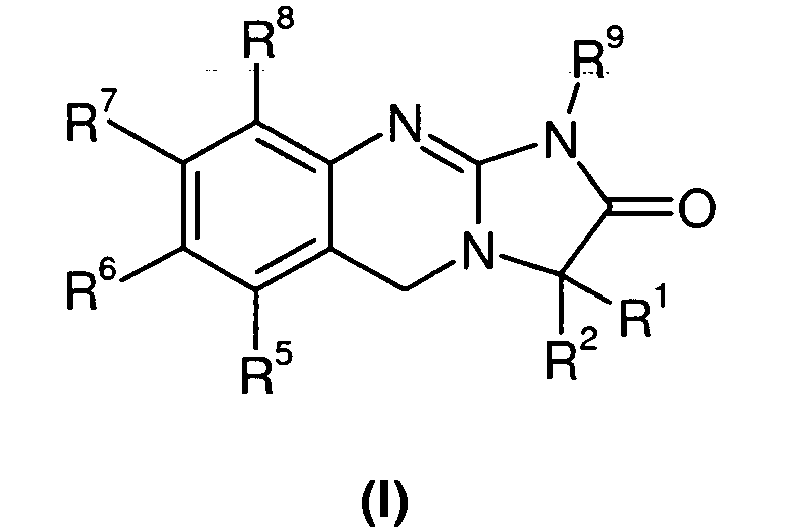
- R1 and R2 are each methyl or together form methylene; or R1 and R2, taken together with the carbon to which they are attached, form cyclopropyl;
- two, three or four of R5, R6, R7 and R8 are hydrogen, and the remainder selected from Ra and Rb;
- R9 is hydrogen, C1-6 alkyl or a Group I or Group II metal ion;
- Ra is selected from C1-6 alkyl and C2-6 alkenyl, either of which is optionally substituted with 1, 2, 3, 4 or 5 Rb;
- Rb is selected from halo, trifluoromethyl, cyano, nitro, -ORc, -C(O)Rc, -C(O)ORc, -OC(O)Rc, -S(O)1Rc, -N(Rc)Rd, -C(O)N(Rc)R d, -N(Rc)C(O)Rd, -S(O)1N(Rc)Rd and -N(Rc)S(O)1Rd;
- Rc and Rd are each independently hydrogen or Re;
- Re is selected from C1-6 alkyl and C2-6 alkenyl, either of which is optionally substituted with 1, 2, 3, 4 or 5 substituents independently selected from halo, cyano, amino, hydroxy, nitro and C1-6 alkoxy; and
- 1 is 0, 1 or 2.
- In an embodiment, R1 and R2 are each methyl or together form methylene; or R1 and R2, taken together with the carbon to which they are attached, form cyclopropyl.
- In another embodiment, R1 and R2 are each methyl or R1 and R2, taken together with the carbon to which they are attached, form cyclopropyl.
- In an embodiment one or more of the following provisos apply:
- (i) when the compound is of the following formula:

- (ii) the compound is not one of the following compounds:

- In an embodiment the compound is of the following Formula:

- In an embodiment the compound is of the following Formula:

- In an embodiment the compound is of the following Formula:

- In an embodiment R9 is H. In another embodiment, R9 is hydrogen, C1-6 alkyl or a Group I metal ion. In an alternative embodiment, R9 is C1-6 alkyl and, in this case, the PDE III inhibiting activity is effectively eliminated. Me represents a particularly preferred alkyl substituent. In another alternative embodiment, R9 is a Group I metal ion and, in this case the compounds show significantly improved water solubility. Sodium represents a particularly preferred Group I metal.
- According to Formula (I), two or three of R5, R6, R7 and R8 are hydrogen, and the remainder selected from Ra and Rb.
- In an embodiment Ra is C1-6 alkyl optionally substituted with 1, 2, 3, 4 or 5 Rb.
- In an embodiment Ra is C1, C2, C3 or C4 alkyl, any of which is optionally substituted with 1, 2 or 3 Rb.
- In an embodiment Rb is selected from halo, trifluoromethyl, cyano, nitro, -ORc, -C(O)Rc, -C(O)ORc, -OC(O)Rc, -S(O)1Rc, -N(Rc)Rd, -C(O)N(Rc)Rd, -N(Rc)C(O)Rd, -S(O)1N(Rc)Rd and -N(Rc)S(O)1Rd; wherein Rc and Rd are each independently hydrogen or C1-6 alkyl optionally substituted with 1, 2, 3, 4 or 5 substituents independently selected from halo, cyano, amino, hydroxy, nitro and C1-6 alkoxy.
- In an embodiment Rb is selected from fluoro, chloro, bromo, iodo, trifluoromethyl, cyano, nitro, -ORc, -C(O)Rc, -C(O)ORc, -OC(O)Rc, -S(O)1Rc and -N(Rc)Rd; wherein Rc and Rd are each independently hydrogen or C1-4 alkyl optionally substituted with 1, 2 or 3 substituents independently selected from halo, cyano, amino, hydroxy, nitro and C1-4 alkoxy.
- In an embodiment, three of R5, R6, R7 and R8 are hydrogen, and the other is selected from Ra and Rb. Of mention are compounds in which R7 and R8 are each hydrogen.
- In an embodiment the compound is of one of the following Formulae:


or, in each case, a pharmaceutically acceptable salt or solvate thereof. - With regard to each of the above Formulae, R5 may be, for example, selected from Ra and Rb; wherein Ra is C1-4 alkyl optionally substituted with 1, 2 or 3 Rb; and Rb is selected from fluoro, chloro, bromo, iodo, trifluoromethyl, cyano, nitro, -ORc, -C(O)Rc, -C(O)ORc, -OC(O)Rc, -S(O)1Rc and -N(Rc)Rd; wherein Rc and Rd are each independently hydrogen or C1-4 alkyl optionally substituted with 1, 2 or 3 substituents independently selected from halo, cyano, amino, hydroxy, nitro and C1-4 alkoxy. In an embodiment R5 is selected from fluoro, chloro, bromo, iodo, cyano, nitro, methyl, methoxy, trifluoromethyl, trifluoromethoxy, carboxylic acid, aminomethyl, fluoromethyl, chloromethyl, bromomethyl, dihalomethyl and methylsulphonyl.
- In an embodiment the compound is of one of the following Formulae:


or, in each case, a pharmaceutically acceptable salt or solvate thereof. - With regard to each of the above Formulae, R6 may be, for example, selected from Ra and Rb; wherein R3 is C1-4 alkyl optionally substituted with 1, 2 or 3 Rb; and Rb is selected from fluoro, chloro, bromo, iodo, trifluoromethyl, cyano, nitro, -ORc, -C(O)Rc, -C(O)ORc, -OC(O)Rc, -S(O)1Rc and -N(Rc)Rd; wherein Rc and Rd are each independently hydrogen or C1-4 alkyl optionally substituted with 1, 2 or 3 substituents independently selected from halo, cyano, amino, hydroxy, nitro and C1-4 alkoxy. In an embodiment R6 is selected from fluoro, chloro, bromo, iodo, cyano, nitro, methyl, methoxy, trifluoromethyl, tiifluoromethoxy, carboxylic acid, aminomethyl, fluoromethyl, chloromethyl, bromomethyl, dihalomethyl and methylsulphonyl.
- In an embodiment the compound is of one of the following Formulae:


or, in each case, a pharmaceutically acceptable salt or solvate thereof. - With regard to each of the above Formulae, R 7 may be, for example, selected from Ra and Rb; wherein Ra is C1-4 alkyl optionally substituted with 1, 2 or 3 Rb; and Rb is selected from fluoro, chloro, bromo, iodo, trifluoromethyl, cyano, nitro, -ORc, -C(O)Rc, -C(O)ORc, -OC(O)Rc, -S(O)1Rc and -N(Rc)Rd; wherein Rc and Rd are each independently hydrogen or C1-4 alkyl optionally substituted with 1, 2 or 3 substituents independently selected from halo, cyano, amino, hydroxy, nitro and C1-4 alkoxy. In an embodiment R7 is selected from fluoro, chloro, bromo, iodo, cyano, nitro, methyl, methoxy, trifluoromethyl, trifluoromethoxy, carboxylic acid, aminomethyl, fluoromethyl, chloromethyl, bromomethyl, dihalomethyl and methylsulphonyl.
- In an embodiment the compound is of one of the following Formulae:


or, in each case, a pharmaceutically acceptable salt or solvate thereof. - With regard to each of the above Formulae, R8 may be, for example, selected from Ra and Rb; wherein Ra is C1-4 alkyl optionally substituted with 1, 2 or 3 Rb; and Rb is selected from fluoro, chloro, bromo, iodo, trifluoromethyl, cyano, nitro, -ORc, -C(O)Rc, -C(O)ORe, -OC(O)Rc, -S(O)1Rc and -N(Rc)Rd; wherein Rc and Rd are each independently hydrogen or C1-4 alkyl optionally substituted with 1, 2 or 3 substituents independently selected from halo, cyano, amino, hydroxy, nitro and C1-4 alkoxy. In an embodiment R8 is selected from fluoro, chloro, bromo, iodo, cyano, nitro, methyl, methoxy, trifluoromethyl, trifluoromethoxy, carboxylic acid, aminomethyl, fluoromethyl, chloromethyl, bromomethyl, dihalomethyl and methylsulphonyl.
- In an embodiment, two of R5, R6, R7 and R8 are hydrogen, and the other two are independently selected from Ra and Rb. Of mention are compounds in which R7 and R8 are each hydrogen.
- In an embodiment the compound is of one of the following Formulae:


or, in each case, a pharmaceutically acceptable salt or solvate thereof. - With regard to each of said Formulae, R5 and R6 may each be, for example, independently selected from Ra and Rb; wherein Ra is C1-4 alkyl optionally substituted with 1, 2 or 3 Rb; and Rb is selected from fluoro, chloro, bromo, iodo, trifluoromethyl, cyano, nitro, -ORc, -C(O)Rc, -C(O)ORc, -OC(O)Rc, -S(O)1Rc and -N(Rc)Rd; wherein Rc and Rd are each independently hydrogen or C1-4 alkyl optionally substituted with 1, 2 or 3 substituents independently selected from halo, cyano, amino, hydroxy, nitro and C1-4 alkoxy. In an embodiment R5 and R6 are each independently selected from fluoro, chloro, bromo, iodo, cyano, nitro, methyl, methoxy, trifluoromethyl, trifluoromethoxy, carboxylic acid, aminomethyl, fluoromethyl, chloromethyl, bromomethyl, dihalomethyl and methylsulphonyl.
- In an embodiment, R5 is Rf and R6 is Rg, wherein Rf and Rg are as defined in the Table below:
Rf Rg -CN Halo -OH Halo -N(O)2 Halo C1-6 alkyl Halo C1-6 alkoxy Halo -C(O)OH Halo -S(O)2-C1-6 alkyl Halo Halo -CN -CN -CN -OH -CN -N(O)2 -CN C1-6 alkyl -CN C1-6 alkoxy -CN -C(O)OH -CN -S(O)2-C1-6 alkyl -CN Halo -OH -CN -OH -OH -OH -N(O)2 -OH C1-6 alkyl -OH C1-6 alkoxy -OH -C(O)OH -OH -S(O)2-C1-6 alkyl -OH Halo -N(O)2 -CN -N(O)2 -OH -N(O)2 -N(O)2 -N(O)2 C1-6 alkyl -N(O)2 C1-6 alkoxy -N(O)2 -C(O)OH -N(O)2 -S(O)2-C1-6 alkyl -N(O)2 Halo C1-6 alkyl -CN C1-6 alkyl -OH C1-6 alkyl -N(O)2 C1-6 alkyl C1-6alkyl C1-6 alkyl C1-6 alkoxy C1-6 alkyl -C(O)OH C1-6 alkyl -S(O)2-C1-6 alkyl C1-6 alkyl Halo C1-6alkoxy -CN C1-6 alkoxy -OH C1-6 alkoxy -N(O)2 C1-6 alkoxy C1-6 alkyl C1-6 alkoxy C1-6 alkoxy C1-6 alkoxy -C(O)OH C1-6 alkoxy -S(O)2-C1-6 alkyl C1-6 alkoxy Halo -C(O)OH -CN -C(O)OH -OH -C(O)OH -N(O)2 -C(O)OH C1-6 alkyl -C(O)OH C1-6 alkoxy -C(O)OH -C(O)OH -C(O)OH -S(O)2-C1-6 alkyl -C(O)OH Halo -S(O)2-C1-6 alkyl -CN -S(O)2-C1-6 alkyl -OH -S(O)2-C1-6 alkyl -N(O)2 -S(O)2-C1-6 alkyl C1-6 alkyl -S(O)2-C1-6 alkyl C1-6 alkoxy -S(O)2-C1-6 alkyl -C(O)OH -S(O)2-C1-6 alkyl -S(O)2-C1-6 alkyl -S(O)2-C1-6 alkyl - In an embodiment the compound is of one of the following Formulae:


or, in each case, a pharmaceutically acceptable salt or solvate thereof. - With regard to each of said Formulae, R5 and R7 may each be, for example, independently selected from Ra and Rb; wherein Ra is C1-4 alkyl optionally substituted with 1, 2 or 3 Rb; and Rb is selected from fluoro, chloro, bromo, iodo, trifluoromethyl, cyano, nitro, -ORc, -C(O)Rc, -C(O)ORc, -OC(O)Rc, -S(O)1Rc and -N(Rc)Rd; wherein Rc and Rd are each independently hydrogen or C1-4 alkyl optionally substituted with 1, 2 or 3 substituents independently selected from halo, cyano, amino, hydroxy, nitro and C1-4 alkoxy. In an embodiment R5 and R7 are each independently selected from fluoro, chloro, bromo, iodo, cyano, nitro, methyl, methoxy, trifluoromethyl, trifluoromethoxy, carboxylic acid, aminomethyl, fluoromethyl, chloromethyl, bromomethyl, dihalomethyl and methylsulphonyl.
- In an embodiment, R5 is Rf and R7 is Rg, wherein Rf and Rg are as defined in the Table above or are each halo.
- In an embodiment the compound is of one of the following Formulae:


or, in each case, a pharmaceutically acceptable salt or solvate thereof. - With regard to each of said Formulae, R5 and R8 may each be, for example, independently selected from Ra and Rb; wherein Ra is C1-4 alkyl optionally substituted with 1, 2 or 3 Rb; and Rb is selected from fluoro, chloro, bromo, iodo, trifluoromethyl, cyano, nitro, -ORc, -C(O)Rc, -C(O)ORc, -OC(O)Rc, -S(O)1Rc and -N(Rc)Rd; wherein Rc and Rd are each independently hydrogen or C1-4 alkyl optionally substituted with 1, 2 or 3 substituents independently selected from halo, cyano, amino, hydroxy, nitro and C1-4 alkoxy. In an embodiment R5 and R8 are each independently selected from fluoro, chloro, bromo, iodo, cyano, nitro, methyl, methoxy, trifluoromethyl, trifluoromethoxy, carboxylic acid, aminomethyl, fluoromethyl, chloromethyl, bromomethyl, dihalomethyl and methylsulphonyl.
- In an embodiment, R5 is Rf and R8 is R8, wherein Rf and Rg are as defined in the Table above or are each halo.
- In an embodiment the compound is of one of the following Formulae:


or, in each case, a pharmaceutically acceptable salt or solvate thereof. - With regard to each of said Formulae, R6 and R7 may each be, for example, independently selected from Ra and Rb; wherein Ra is C1-4 alkyl optionally substituted with 1, 2 or 3 Rb; and Rb is selected from fluoro, chloro, bromo, iodo, trifluoromethyl, cyano, nitro, -ORc, -C(O)Rc, -C(O)ORc, -OC(O)Rc, -S(O)1Rc and -N(Rc)Rd; wherein Rc and Rd are each independently hydrogen or C1-4 alkyl optionally substituted with 1, 2 or 3 substituents independently selected from halo, cyano, amino, hydroxy, nitro and C1-4 alkoxy. In an embodiment R6 and R7 are each independently selected from fluoro, chloro, bromo, iodo, cyano, nitro, methyl, methoxy, trifluoromethyl, trifluoromethoxy, carboxylic acid, aminomethyl, fluoromethyl, chloromethyl, bromomethyl, dihalomethyl and methylsulphonyl.
- In an embodiment, R6 is Rf and R7 is Rg, wherein Rf and Rg are as defined in the Table above or are each halo.
- In an embodiment the compound is of one of the following Formulae:


or, in each case, a pharmaceutically acceptable salt or solvate thereof. - With regard to each of said Formulae, R6 and R8 may each be, for example, independently selected from Ra and Rb; wherein Ra is C1-4 alkyl optionally substituted with 1, 2 or 3 Rb; and Rb is selected from fluoro, chloro, bromo, iodo, trifluoromethyl, cyano, nitro, -ORc, -C(O)Rc, -C(O)ORc, -OC(O)Rc, -S(O)1Rc and -N(Rc)Rd; wherein Rc and Rd are each independently hydrogen or C1-4 alkyl optionally substituted with 1, 2 or 3 substituents independently selected from halo, cyano, amino, hydroxy, nitro and C1-4 alkoxy. In an embodiment R6 and R8 are each independently selected from fluoro, chloro, bromo, iodo, cyano, nitro, methyl, methoxy, trifluoromethyl, trifluoromethoxy, carboxylic acid, aminomethyl, fluoromethyl, chloromethyl, bromomethyl, dihalomethyl and methylsulphonyl.
- In an embodiment, R6 is Rf and R8 is Rg, wherein Rf and Rg are as defined in the Table above or are each halo.
- In an embodiment the compound is of one of the following Formulae:


or, in each case, a pharmaceutically acceptable salt or solvate thereof. - With regard to each of said Formulae, R7 and R8 may each be, for example, independently selected from Ra and Rb; wherein Ra is C1-4 alkyl optionally substituted with 1, 2 or 3 Rb; and Rb is selected from fluoro, chloro, bromo, iodo, trifluoromethyl, cyano, nitro, -ORc, -C(O)Rc, -C(O)ORc, -OC(O)Rc, -S(O)1Rc and -N(Rc)Rd; wherein Rc and Rd are each independently hydrogen or C1-4 alkyl optionally substituted with 1, 2 or 3 substituents independently selected from halo, cyano, amino, hydroxy, nitro and C1-4 alkoxy. In an embodiment R7 and R8 are each independently selected from fluoro, chloro, bromo, iodo, cyano, nitro, methyl, methoxy, trifluoromethyl, trifluoromethoxy, carboxylic acid, aminomethyl, fluoromethyl, chloromethyl, bromomethyl, dihalomethyl and methylsulphonyl.
- In an embodiment, R7 is Rf and R8 is Rg, wherein Rf and Rg are as defined in the Table above or are each halo.
- In an embodiment, the compound is of the following Formula:

- In an embodiment the compound is of the following Formula:

- In an embodiment the compound is of the following Formula:

- In an embodiment the compound is of the following Formula:

- In a particular embodiment, the compound is selected from the following compounds:


- In an embodiment R9 is hydrogen, C1-6 alkyl or a Group I metal ion.
- It has also been found that the individual enantiomers of the present compounds show efficacy. The present invention therefore also relates to both the resolved optical isomers of such compounds as well as mixtures of enantiomers. For the purposes of comparison of the compounds of the present invention with anagrelide, the correct comparison is that made with the PDE III inhibitory activity of the 3-hydroxy metabolite of anagrelide since this is the predominant component in plasma after anagrelide treatment.
- Regarding the use of the compounds of the invention in humans, there is provided:
- a pharmaceutical composition comprising a compound of formula (I), or a pharmaceutically acceptable salt or solvate thereof, together with a pharmaceutically acceptable diluent or carrier, which may be adapted for oral, parenteral or topical administration;
- a compound of formula (I), or a pharmaceutically acceptable salt or solvate thereof, or a pharmaceutical composition containing any of the foregoing, for use as a medicament;
- the use of a compound of formula (I), or a pharmaceutically acceptable salt or solvate thereof in the manufacture of a medicament for the treatment of a disease selected from: myeloprolific diseases and/or generalised thrombotic diseases;
- Separately, we have found that both (R) and (S) compounds show good anti-megakaryocytic activity whilst showing significantly reduced PDE III inhibition relative to 3-OH anagrelide. We thus expect that the compounds will have utility in treating myeloproliferative diseases.
- Accordingly, the invention also includes the use of a compound of the invention, or a pharmaceutically acceptable salt or solvate thereof in the manufacture of a medicament for the treatment of myeloprolific diseases.
- The present invention also encompasses pharmaceutical compositions comprising a compound or pharmaceutically acceptable salt of a compound of the present invention and a pharmaceutically acceptable carrier.
- The present invention is directed to 3-substituted analogues of the established platelet lowering agent anagrelide. Substitution at the 3-position of the anagrelide molecule would be expected to block or hinder the principal site of metabolism and potentially preclude the formation of the highly potent PDE II inhibitor 3-OH anagrelide while substitution at the 1-position has surprisingly been found to abolish PDE III inhibition. The compounds of the present invention retain the anti-megakaryocytic properties (hence platelet lowering activity) of the parent drug molecule but have reduced PDE III inhibitory properties and hence lower potential for unwanted cardiovascular and anti-aggregatory side-effects. They also have the potential for improved pharmacokinetic characteristics as the result of inhibition of metabolism.
- The pharmaceutically acceptable acid addition salts of certain of the compounds of formula (I) may also be prepared in a conventional manner. For example, a solution of the free base is treated with the appropriate acid, either neat or in a suitable solvent, and the resulting salt isolated either by filtration or by evaporation under reduced pressure of the reaction solvent. For a review on suitable salts, see "Handbook of Pharmaceutical Salts: Properties, Selection, and Use" by Stahl and Wermuth (Wiley-VCH, Weinheim, Germany, 2002).
- Halo means a group selected from: fluoro, chloro, bromo or iodo.
- The term "alkyl" as used herein as a group or a part of a group refers to a straight or branched hydrocarbon chain containing the specified number of carbon atoms. For example, C1-10 alkyl means a straight or branched alkyl containing at least 1 and at most 10 carbon atoms. Examples of "alkyl" as used herein include, but are not limited to, methyl, ethyl, n-propyl, n-butyl, n-pentyl, isobutyl, isopropyl, t-butyl, hexyl, heptyl, octyl, nonyl and decyl. A C1-4 alkyl group is one embodiment, for example methyl, ethyl, n-propyl, isopropyl, n-butyl, isobutyl or t-butyl. The term "alkoxy" as used herein refers to a straight or branched hydrocarbon chain group containing oxygen and the specified number of carbon atoms. For example, C1-6 alkoxy means a straight or branched alkoxy containing at least 1 and at most 6 carbon atoms. Examples of "alkoxy" as used herein include, but are not limited to, methoxy, ethoxy, propoxy, prop-2-oxy, butoxy, but-2-oxy, 2-methylprop-1-oxy, 2-methylprop-2-oxy, pentoxy and hexyloxy. A C1-4 alkoxy group is one embodiment, for example methoxy, ethoxy, propoxy, prop-2-oxy, butoxy, but-2-oxy or 2-methylprop-2-oxy.
- The term "alkenyl" as used herein as a group or a part of a group refers to a straight or branched hydrocarbon chain containing the specified number of carbon atoms and containing at least one double bond. For example, the term "C2-6 alkenyl" means a straight or branched alkenyl containing at least 2 and at most 6 carbon atoms and containing at least one double bond. Examples of "alkenyl" as used herein include, but are not limited to, ethenyl, 2-propenyl, 3-butenyl, 2-butenyl, 2-pentenyl, 3-pentenyl, 3-methyl-2-butenyl, 3-methylbut-2-enyl, 3-hexenyl and 1,1-dimethylbut-2-enyl. It will be appreciated that in groups of the form -O-C2-6 alkenyl, the double bond is preferably not adjacent to the oxygen.
- The compounds of the invention, i.e. those of formula (I), possess antimegakaryocytic activity in humans. They may be particularly useful in the treatment of myeloprolific diseases. The compounds may also find utility in the treatment of generalised thrombotic diseases.
- It is to be appreciated that references to treatment include prophylaxis as well as the alleviation of established symptoms of a condition. "Treating" or "treatment" of a state, disorder or condition includes: (1) preventing or delaying the appearance of clinical symptoms of the state, disorder or condition developing in a human that may be afflicted with or predisposed to the state, disorder or condition but does not yet experience or display clinical or subclinical symptoms of the state, disorder or condition, (2) inhibiting the state, disorder or condition, i.e., arresting, reducing or delaying the development of the disease or a relapse thereof (in case of maintenance treatment) or at least one clinical or subclinical symptom thereof, or (3) relieving or attenuating the disease, i.e., causing regression of the state, disorder or condition or at least one of its clinical or subclinical symptoms.
- Myeloproliferative diseases which may be treatable with the compounds of the present invention include: essential thrombocythemia, polycythema vera, chronic idiopathic myelofibrosis, chronic myeloid leukaemia with residual thrombocytosis, reactive thrombocytosis immediately preceding a surgical procedure, as an immediate or post operative preventative measures to minimise the risk of thrombus formation during or post surgery.
- Thrombotic cardiovascular diseases (TCVD) (i.e. patients at increased generalised thrombotic risk) which may also be treatable with the compounds of the present invention include: myocardial infarct (heart attack), thrombotic stroke, patients having undergone coronary stent placement.
- The compounds of the present invention may find utility for the reduction of atherothrombotic events as follows: recent MI, recent stroke or established peripheral arterial disease, acute coronary syndrome (unstable angina/non-Qwave MI), cardiovascular death, MI, stroke, and refractory ischemia.
- It is to be understood that compounds of formula (I) may contain one or more asymmetric carbon atoms, thus compounds of the invention can exist as two or more stereoisomers.
- Included within the scope of the present invention are all stereoisomers such as enantiomers and diastereomers, all geometric isomers and tautomeric forms of the compounds of formula (I), including compounds exhibiting more than one type of isomerism, and mixtures of one or more thereof.
- Unexpectedly it has been found that stable metal salts can be prepared following deprotonation at the 1-position of the quinazoline ring structure. The value of such salts is seen in their relatively much greater aqueous solubility than the corresponding HBr salts. This is likely to facilitate the rapid dissolution and quantitative absorption of these generally poorly water soluble compounds and so represent a major clinical advantage. These salts are Group 1 metal salts and most usually are sodium or potassium salts.
- Geometric isomers may be separated by conventional techniques well known to those skilled in the art, for example, by chromatography and fractional crystallisation.
- Stereoisomers may be separated by conventional techniques known to those skilled in the art - see, for example, "Stereochemistry of Organic Compounds" by E L Eliel (Wiley, New York, 1994).
- The compounds of formula I can be prepared using literature techniques and in an analogous manner to those described in Formula Scheme I and Formula Scheme II in
US 4256748 . By way of illustration, and without limitation, a compound of the invention may be obtained according to the following reaction scheme (in which R is, for example, ethyl or other alkyl):
- A person skilled in the art will be aware of variations of, and alternatives to, the process referred to above and to those in
US 4256748 which allow the individual compounds defined by formula (I) to be obtained. - It will also be appreciated by a person skilled in the art that the compounds of the invention could be made by adaptation of the methods herein described and/or adaptation of methods known in the art, for example the art described herein, or using standard textbooks such as "Comprehensive Organic Transformations - A Guide to Functional Group Transformations", RC Larock, Wiley-VCH (1999 or later editions), "March's Advanced Organic Chemistry - Reactions, Mechanisms and Structure", MB Smith, J. March, Wiley, (5th edition or later) "Advanced Organic Chemistry, Part B, Reactions and Synthesis", FA Carey, RJ Sundberg, Kluwer Academic/Plenum Publications, (2001 or later editions), "Organic Synthesis - The Disconnection Approach", S Warren (Wiley), (1982 or later editions), "Designing Organic Syntheses" S Warren (Wiley) (1983 or later editions), "Guidebook To Organic Synthesis" RK Mackie and DM Smith (Longman) (1982 or later editions), etc.,and the references therein as a guide.
- It will also be apparent to a person skilled in the art that sensitive functional groups may need to be protected and deprotected during synthesis of a compound of the invention. This may be achieved by conventional methods, for example as described in "Protective Groups in Organic Synthesis" by TW Greene and PGM Wuts, John Wiley & Sons Inc (1999), and references therein.
- Compounds of the invention intended for pharmaceutical use may be administered as crystalline or amorphous products. They may be obtained, for example, as solid plugs, powders, or films by methods such as precipitation, crystallization, freeze drying, or spray drying, or evaporative drying. Microwave or radio frequency drying may be used for this purpose.
- They may be administered alone or in combination with one or more other compounds of the invention or in combination with one or more other drugs. Generally, they will be administered as a formulation in association with one or more pharmaceutically acceptable excipients. Pharmaceutically acceptable excipients include one or more of: anti-oxidants, colourants, flavouring agents, preservatives and taste-masking agents.
- Pharmaceutical compositions suitable for the delivery of compounds of the present invention and methods for their preparation will be readily apparent to those skilled in the art. Such compositions and methods for their preparation may be found, for example, in 'Remington's Pharmaceutical Sciences', 19th Edition (Mack Publishing Company, 1995). The formulation of tablets is discussed in "Pharmaceutical Dosage Forms: Tablets, Vol. 1", by H. Lieberman and L. Lachman, Marcel Dekker, N.Y., N.Y., 1980 (ISBN 0-8247-6918-X).
- The methods by which the compounds may be administered include oral administration by capsule, bolus, tablet, powders, lozenges, chews, multi and nanoparticulates, gels, solid solution, films, sprays, or liquid formulation. Liquid forms include suspensions, solutions, and syrups. Such formulations may be employed as fillers in soft or hard capsules and typically comprise a carrier, for example, water, ethanol, polyethylene glycol, propylene glycol, methylcellulose, or a suitable oil, and one or more emulsifying agents and/or suspending agents. Liquid formulations may also be prepared by the reconstitution of a solid preparation, for example, from a sachet.
- The compounds may also be administered topically to the skin or mucosa, that is dermally or transdermally. Typical formulations for this purpose include pour-on solutions, sprays, powder formulations, gels, hydrogels, lotions, creams, ointments, films and patches, and implants.
- The compounds can also be administered parenterally, or by injection directly into the blood stream, muscle or into an internal organ. Suitable means for parenteral administration include intravenous, intraarterial, intraperitoneal, intrathecal, intraventricular, intraurethral, intrasternal, intracranial, intramuscular and subcutaneous. Suitable devices for parenteral administration include needle (including microneedle) injectors, needle-free injectors and infusion techniques.
- Formulations may be immediate and/or modified controlled release. Controlled release formulations include Modified release formulations include: delayed-, sustained-, and pulsed-release.
- Typically, a physician will determine the actual dosage which will be most suitable for an individual subject. The specific dose level and frequency of dosage for any particular individual may be varied and will depend upon a variety of factors including the activity of the specific compound employed, the metabolic stability and length of action of that compound, the age, body weight, general health, sex, diet, mode and time of administration, rate of excretion, drug combination, the severity of the particular condition, and the individual undergoing therapy.
- In general however a suitable dose will be in the range of from about 0.001 to about 50 mg/kg of body weight per day, in a further embodiment, of from about 0.001 to about 5 mg/kg of body weight per day; in a further embodiment of from about 0.001 to about 0.5 mg/kg of body weight per day and in yet a further embodiment of from about 0.001 to about 0.1mg/kg of body weight per day. In further embodiments, the ranges can be of from about 0.1 to about 750 mg/kg of body weight per day, in the range of 0.5 to 60 mg/kg/day, and in the range of 1 to 20 mg/kg/day.
- The desired dose may conveniently be presented in a single dose or as divided doses administered at appropriate intervals, for example as one, two, three, four or more doses per day. If the compounds are administered transdermally or in extended release form, the compounds could be dosed once a day or less.
- The compound is conveniently administered in unit dosage form; for example containing 0.1 to 50 mg, conveniently 0.1 to 5 mg, most conveniently 0.1 to 5 mg of active ingredient per unit dosage form. In yet a further embodiment, the compound can conveniently administered in unit dosage form; for example containing 10 to 1500 mg, 20 to 1000 mg, or 50 to 700 mg of active ingredient per unit dosage form.

Claims (15)
- A compound of Formula (I) or a pharmaceutically acceptable salt or solvate thereof:
 R1 and R2 are each methyl or together form methylene; or R1 and R2, taken together with the carbon atom to which they are attached, form cyclopropyl;two, three or four of R5, R6, R7 and R8 are hydrogen, and the remainder selected from Ra and Rb;R9 is hydrogen, C1-6 alkyl or a Group I or Group II metal ion;Ra is selected from C1-6 alkyl and C2-6 alkenyl, either of which is optionally substituted with 1, 2, 3, 4 or 5 Rb;Rb is selected from halo, trifluoromethyl, cyano, nitro, -ORc, -C(O)Rc, -C(O)ORc, -OC(O)Rc, -S(O)IRc, -N(Rc)Rd, -C(O)N(Rc)Rd, -N(Rc)C(O)Rd, -S(O)IN(Rc)Rd and -N(Rc)S(O)IRd;Rc and Rd are each independently hydrogen or Re;Re is selected from C1-6 alkyl and C2-6 alkenyl, either of which is optionally substituted with 1, 2, 3, 4 or 5 substituents independently selected from halo, cyano, amino, hydroxy, nitro and C1-6 alkoxy; andI is 0, 1 or 2;and wherein each of the following provisos applies:(i) when the compound is of the following formula:
 (ii) the compound is not one of the following compounds:

- A compound according to claim 1, wherein R1 and R2 are each methyl.
- A compound according to claim 1, wherein R1 and R2 taken together with the carbon atom to which they are attached, form cyclopropyl.
- A compound according to any preceding claim, wherein two of R5, R6, R7 and R8 are hydrogen, and the other two are independently selected from Ra and Rb.
- A compound according to claim 4, wherein R7 and R8 are each hydrogen.
- A compound according to any of claims 1 to 3, wherein three of R5, R6, R7 and R8 are hydrogen, and the other is selected from Ra and Rb;
- A compound according to claim 6, wherein R7 and R8 are each hydrogen.
- A compound according to any of claims 1 to 3, wherein R5, R6, R7 and R8 are each hydrogen.
- A compound according to any preceding claim, wherein R9 is hydrogen, methyl or sodium.
- A compound according to claim 9, wherein R9 is hydrogen.
- A compound according to any preceding claim, wherein Ra is C1-6 alkyl optionally substituted with 1, 2, 3, 4 or 5 Rb; and Rb is selected from halo, cyano, nitro, -OH, C1-6 alkoxy, -C(O)OH and -S(O)2-C1-6 alkyl.
- A pharmaceutical composition comprising a compound of any of claims 1 to 11, or a pharmaceutically acceptable salt or solvate thereof, together with a pharmaceutically acceptable diluent or carrier, which may be adapted for oral, parenteral or topical administration.
- A compound of formula (I) as defined in any of claims 1 to 11, or a pharmaceutically acceptable salt or solvate thereof, or a pharmaceutical composition containing any of the foregoing, for use as a medicament.
- A compound of formula (I) as defined in any of claims 1 to 11, or a pharmaceutically acceptable salt or solvate thereof, or a pharmaceutical composition containing any of the foregoing, for use in the treatment of a disease selected from: myeloprolific diseases and generalised thrombotic diseases.
- Use of a compound of formula (I) as defined in any of claims 1 to 11 for the reduction of platelet count.
Applications Claiming Priority (2)
| Application Number | Priority Date | Filing Date | Title |
|---|---|---|---|
| GBGB0808947.6A GB0808947D0 (en) | 2008-05-16 | 2008-05-16 | Substituted quinazolines |
| PCT/GB2009/050517 WO2009138796A2 (en) | 2008-05-16 | 2009-05-13 | Substituted quinazolines |
Publications (2)
| Publication Number | Publication Date |
|---|---|
| EP2297159A2 EP2297159A2 (en) | 2011-03-23 |
| EP2297159B1 true EP2297159B1 (en) | 2012-08-15 |
Family
ID=39596026
Family Applications (1)
| Application Number | Title | Priority Date | Filing Date |
|---|---|---|---|
| EP09746113A Active EP2297159B1 (en) | 2008-05-16 | 2009-05-13 | Substituted quinazolines |
Country Status (15)
| Country | Link |
|---|---|
| US (1) | US20110152298A1 (en) |
| EP (1) | EP2297159B1 (en) |
| JP (1) | JP2011521910A (en) |
| KR (1) | KR20110017873A (en) |
| CN (1) | CN102066379A (en) |
| AU (1) | AU2009247797A1 (en) |
| BR (1) | BRPI0911968A2 (en) |
| CA (1) | CA2723858A1 (en) |
| GB (1) | GB0808947D0 (en) |
| IL (1) | IL209179A0 (en) |
| MX (1) | MX2010012540A (en) |
| NZ (1) | NZ589108A (en) |
| RU (1) | RU2010151143A (en) |
| WO (1) | WO2009138796A2 (en) |
| ZA (1) | ZA201008178B (en) |
Cited By (1)
| Publication number | Priority date | Publication date | Assignee | Title |
|---|---|---|---|---|
| WO2016175668A1 (en) | 2015-04-28 | 2016-11-03 | Politechnika Rzeszowska | Preparation method for 1-phenyl-2,6-bis(2-hydroxyethyl)imidazo[1,5-c]quinazoline-3,5-dione and 1-phenyl-2,6-bis(2-hydroxypropyl)imidazo[1,5-c]quinazoline-3,5-dione |
Families Citing this family (5)
| Publication number | Priority date | Publication date | Assignee | Title |
|---|---|---|---|---|
| US7910597B2 (en) * | 2006-11-28 | 2011-03-22 | Shire Llc | Substituted quinazolines |
| US8304420B2 (en) * | 2006-11-28 | 2012-11-06 | Shire Llc | Substituted quinazolines for reducing platelet count |
| GB201017783D0 (en) * | 2010-10-21 | 2010-12-01 | Shire Llc | Process for the preparation of anagrelide and analogues thereof |
| WO2022013684A1 (en) | 2020-07-11 | 2022-01-20 | Pfizer Inc. | Antiviral heteroaryl ketone derivatives |
| US11351149B2 (en) | 2020-09-03 | 2022-06-07 | Pfizer Inc. | Nitrile-containing antiviral compounds |
Family Cites Families (12)
| Publication number | Priority date | Publication date | Assignee | Title |
|---|---|---|---|---|
| US3932407A (en) * | 1973-11-19 | 1976-01-13 | Bristol-Myers Company | Optionally substituted 1,2,3,5-tetrahydroimidezo(2,1-b)-quinazolin-2-ones and 6(H)-1,2,3,4-tetrahydropyimido(2,1-b)quinazolin-2-ones |
| BE794964A (en) * | 1972-02-04 | 1973-08-02 | Bristol Myers Co | NEW HYPOTENSING AGENTS AND METHOD FOR PREPARING THEM |
| US3983120A (en) * | 1974-11-06 | 1976-09-28 | Bristol-Myers Company | Process for the preparation of optionally substituted 1,2,3,5-tetrahydroimidazo[2,1-b]quinazolin-2-ones |
| NL7807507A (en) * | 1977-07-25 | 1979-01-29 | Hoffmann La Roche | TRICYCLICAL CONNECTIONS. |
| US4146718A (en) * | 1978-04-10 | 1979-03-27 | Bristol-Myers Company | Alkyl 5,6-dichloro-3,4-dihydro-2(1h)-iminoquinazoline-3-acetate hydrohalides |
| US4943573A (en) * | 1989-11-01 | 1990-07-24 | Bristol-Myers Squibb Company | Imidazo[4,5-b]quinolinyloxyalkanoic acid amides with enhanced water solubility |
| DK0571253T3 (en) * | 1992-05-19 | 1999-07-19 | Adir | Benzimidazole derivatives with antidiabetic and anti-platelet coagulant effect |
| JP2004051594A (en) * | 2002-07-23 | 2004-02-19 | Dai Ichi Seiyaku Co Ltd | Vascularization inhibitor |
| US20070066619A1 (en) * | 2002-10-07 | 2007-03-22 | Artesian Therapeutics, Inc. | Compounds having simultaneous ability to block L-type calcium channels and to inhibit phosphodiesterase type 3 activity |
| US20060030574A1 (en) * | 2004-08-04 | 2006-02-09 | Shire Holdings Ag | Quinazoline derivatives useful for the treatment of peripheral arterial disease and as phosphodiesterase inhibitors |
| US7700608B2 (en) * | 2004-08-04 | 2010-04-20 | Shire Holdings Ag | Quinazoline derivatives and their use in the treatment of thrombocythemia |
| US8304420B2 (en) * | 2006-11-28 | 2012-11-06 | Shire Llc | Substituted quinazolines for reducing platelet count |
-
2008
- 2008-05-16 GB GBGB0808947.6A patent/GB0808947D0/en not_active Ceased
-
2009
- 2009-05-13 JP JP2011509020A patent/JP2011521910A/en active Pending
- 2009-05-13 EP EP09746113A patent/EP2297159B1/en active Active
- 2009-05-13 CN CN2009801235514A patent/CN102066379A/en active Pending
- 2009-05-13 AU AU2009247797A patent/AU2009247797A1/en not_active Abandoned
- 2009-05-13 US US12/993,072 patent/US20110152298A1/en not_active Abandoned
- 2009-05-13 NZ NZ589108A patent/NZ589108A/en not_active IP Right Cessation
- 2009-05-13 CA CA2723858A patent/CA2723858A1/en not_active Abandoned
- 2009-05-13 RU RU2010151143/04A patent/RU2010151143A/en not_active Application Discontinuation
- 2009-05-13 MX MX2010012540A patent/MX2010012540A/en not_active Application Discontinuation
- 2009-05-13 KR KR1020107027408A patent/KR20110017873A/en not_active Withdrawn
- 2009-05-13 WO PCT/GB2009/050517 patent/WO2009138796A2/en not_active Ceased
- 2009-05-13 BR BRPI0911968A patent/BRPI0911968A2/en not_active IP Right Cessation
-
2010
- 2010-11-07 IL IL209179A patent/IL209179A0/en unknown
- 2010-11-15 ZA ZA2010/08178A patent/ZA201008178B/en unknown
Cited By (1)
| Publication number | Priority date | Publication date | Assignee | Title |
|---|---|---|---|---|
| WO2016175668A1 (en) | 2015-04-28 | 2016-11-03 | Politechnika Rzeszowska | Preparation method for 1-phenyl-2,6-bis(2-hydroxyethyl)imidazo[1,5-c]quinazoline-3,5-dione and 1-phenyl-2,6-bis(2-hydroxypropyl)imidazo[1,5-c]quinazoline-3,5-dione |
Also Published As
| Publication number | Publication date |
|---|---|
| EP2297159A2 (en) | 2011-03-23 |
| IL209179A0 (en) | 2011-01-31 |
| ZA201008178B (en) | 2013-04-24 |
| MX2010012540A (en) | 2011-02-25 |
| NZ589108A (en) | 2012-08-31 |
| RU2010151143A (en) | 2012-06-27 |
| GB0808947D0 (en) | 2008-06-25 |
| BRPI0911968A2 (en) | 2015-10-20 |
| AU2009247797A1 (en) | 2009-11-19 |
| WO2009138796A3 (en) | 2010-01-07 |
| KR20110017873A (en) | 2011-02-22 |
| CN102066379A (en) | 2011-05-18 |
| US20110152298A1 (en) | 2011-06-23 |
| WO2009138796A2 (en) | 2009-11-19 |
| CA2723858A1 (en) | 2009-11-19 |
| JP2011521910A (en) | 2011-07-28 |
Similar Documents
| Publication | Publication Date | Title |
|---|---|---|
| WO2009138794A1 (en) | Imidazoquinazoline derivatives as anagrelide analogues for the treatment of myeloprolific diseases and thrombotic diseases | |
| WO2009138796A2 (en) | Substituted quinazolines | |
| US20110071171A1 (en) | 2h- pyrimido [2, 1-b] quinazolin-2-one derivatives and their use as platelet anti-aggregative agents | |
| AU2007327047B2 (en) | Substituted quinazolines | |
| US20110130405A1 (en) | Substituted quinazolines as blood platelet lowering agents | |
| US20110065714A1 (en) | Substituted quinazolines | |
| US20110086851A1 (en) | Substituted quinazolines and their uses for myeoloprolific and thrombotic diseases | |
| US20110071174A1 (en) | Substituted quinazolines | |
| AU2009254988A1 (en) | Substituted quinazolines | |
| US20110071172A1 (en) | Substituted quinazolines as blood platelet lowering agents | |
| US20100137343A1 (en) | Substituted quinazolines |
Legal Events
| Date | Code | Title | Description |
|---|---|---|---|
| PUAI | Public reference made under article 153(3) epc to a published international application that has entered the european phase |
Free format text: ORIGINAL CODE: 0009012 |
|
| 17P | Request for examination filed |
Effective date: 20101209 |
|
| AK | Designated contracting states |
Kind code of ref document: A2 Designated state(s): AT BE BG CH CY CZ DE DK EE ES FI FR GB GR HR HU IE IS IT LI LT LU LV MC MK MT NL NO PL PT RO SE SI SK TR |
|
| AX | Request for extension of the european patent |
Extension state: AL BA RS |
|
| REG | Reference to a national code |
Ref country code: HK Ref legal event code: DE Ref document number: 1155155 Country of ref document: HK |
|
| GRAP | Despatch of communication of intention to grant a patent |
Free format text: ORIGINAL CODE: EPIDOSNIGR1 |
|
| GRAS | Grant fee paid |
Free format text: ORIGINAL CODE: EPIDOSNIGR3 |
|
| GRAA | (expected) grant |
Free format text: ORIGINAL CODE: 0009210 |
|
| AK | Designated contracting states |
Kind code of ref document: B1 Designated state(s): AT BE BG CH CY CZ DE DK EE ES FI FR GB GR HR HU IE IS IT LI LT LU LV MC MK MT NL NO PL PT RO SE SI SK TR |
|
| AX | Request for extension of the european patent |
Extension state: AL BA RS |
|
| REG | Reference to a national code |
Ref country code: AT Ref legal event code: REF Ref document number: 570773 Country of ref document: AT Kind code of ref document: T Effective date: 20120815 Ref country code: GB Ref legal event code: FG4D Ref country code: CH Ref legal event code: EP |
|
| REG | Reference to a national code |
Ref country code: IE Ref legal event code: FG4D |
|
| REG | Reference to a national code |
Ref country code: DE Ref legal event code: R096 Ref document number: 602009009021 Country of ref document: DE Effective date: 20121011 |
|
| REG | Reference to a national code |
Ref country code: NL Ref legal event code: VDEP Effective date: 20120815 |
|
| REG | Reference to a national code |
Ref country code: AT Ref legal event code: MK05 Ref document number: 570773 Country of ref document: AT Kind code of ref document: T Effective date: 20120815 |
|
| PG25 | Lapsed in a contracting state [announced via postgrant information from national office to epo] |
Ref country code: FI Free format text: LAPSE BECAUSE OF FAILURE TO SUBMIT A TRANSLATION OF THE DESCRIPTION OR TO PAY THE FEE WITHIN THE PRESCRIBED TIME-LIMIT Effective date: 20120815 Ref country code: LT Free format text: LAPSE BECAUSE OF FAILURE TO SUBMIT A TRANSLATION OF THE DESCRIPTION OR TO PAY THE FEE WITHIN THE PRESCRIBED TIME-LIMIT Effective date: 20120815 Ref country code: NO Free format text: LAPSE BECAUSE OF FAILURE TO SUBMIT A TRANSLATION OF THE DESCRIPTION OR TO PAY THE FEE WITHIN THE PRESCRIBED TIME-LIMIT Effective date: 20121115 Ref country code: HR Free format text: LAPSE BECAUSE OF FAILURE TO SUBMIT A TRANSLATION OF THE DESCRIPTION OR TO PAY THE FEE WITHIN THE PRESCRIBED TIME-LIMIT Effective date: 20120815 Ref country code: AT Free format text: LAPSE BECAUSE OF FAILURE TO SUBMIT A TRANSLATION OF THE DESCRIPTION OR TO PAY THE FEE WITHIN THE PRESCRIBED TIME-LIMIT Effective date: 20120815 Ref country code: IS Free format text: LAPSE BECAUSE OF FAILURE TO SUBMIT A TRANSLATION OF THE DESCRIPTION OR TO PAY THE FEE WITHIN THE PRESCRIBED TIME-LIMIT Effective date: 20121215 |
|
| PG25 | Lapsed in a contracting state [announced via postgrant information from national office to epo] |
Ref country code: PL Free format text: LAPSE BECAUSE OF FAILURE TO SUBMIT A TRANSLATION OF THE DESCRIPTION OR TO PAY THE FEE WITHIN THE PRESCRIBED TIME-LIMIT Effective date: 20120815 Ref country code: PT Free format text: LAPSE BECAUSE OF FAILURE TO SUBMIT A TRANSLATION OF THE DESCRIPTION OR TO PAY THE FEE WITHIN THE PRESCRIBED TIME-LIMIT Effective date: 20121217 Ref country code: LV Free format text: LAPSE BECAUSE OF FAILURE TO SUBMIT A TRANSLATION OF THE DESCRIPTION OR TO PAY THE FEE WITHIN THE PRESCRIBED TIME-LIMIT Effective date: 20120815 Ref country code: SI Free format text: LAPSE BECAUSE OF FAILURE TO SUBMIT A TRANSLATION OF THE DESCRIPTION OR TO PAY THE FEE WITHIN THE PRESCRIBED TIME-LIMIT Effective date: 20120815 Ref country code: GR Free format text: LAPSE BECAUSE OF FAILURE TO SUBMIT A TRANSLATION OF THE DESCRIPTION OR TO PAY THE FEE WITHIN THE PRESCRIBED TIME-LIMIT Effective date: 20121116 Ref country code: SE Free format text: LAPSE BECAUSE OF FAILURE TO SUBMIT A TRANSLATION OF THE DESCRIPTION OR TO PAY THE FEE WITHIN THE PRESCRIBED TIME-LIMIT Effective date: 20120815 Ref country code: BE Free format text: LAPSE BECAUSE OF FAILURE TO SUBMIT A TRANSLATION OF THE DESCRIPTION OR TO PAY THE FEE WITHIN THE PRESCRIBED TIME-LIMIT Effective date: 20120815 |
|
| PG25 | Lapsed in a contracting state [announced via postgrant information from national office to epo] |
Ref country code: NL Free format text: LAPSE BECAUSE OF FAILURE TO SUBMIT A TRANSLATION OF THE DESCRIPTION OR TO PAY THE FEE WITHIN THE PRESCRIBED TIME-LIMIT Effective date: 20120815 |
|
| PG25 | Lapsed in a contracting state [announced via postgrant information from national office to epo] |
Ref country code: CZ Free format text: LAPSE BECAUSE OF FAILURE TO SUBMIT A TRANSLATION OF THE DESCRIPTION OR TO PAY THE FEE WITHIN THE PRESCRIBED TIME-LIMIT Effective date: 20120815 Ref country code: DK Free format text: LAPSE BECAUSE OF FAILURE TO SUBMIT A TRANSLATION OF THE DESCRIPTION OR TO PAY THE FEE WITHIN THE PRESCRIBED TIME-LIMIT Effective date: 20120815 Ref country code: EE Free format text: LAPSE BECAUSE OF FAILURE TO SUBMIT A TRANSLATION OF THE DESCRIPTION OR TO PAY THE FEE WITHIN THE PRESCRIBED TIME-LIMIT Effective date: 20120815 Ref country code: ES Free format text: LAPSE BECAUSE OF FAILURE TO SUBMIT A TRANSLATION OF THE DESCRIPTION OR TO PAY THE FEE WITHIN THE PRESCRIBED TIME-LIMIT Effective date: 20121126 Ref country code: RO Free format text: LAPSE BECAUSE OF FAILURE TO SUBMIT A TRANSLATION OF THE DESCRIPTION OR TO PAY THE FEE WITHIN THE PRESCRIBED TIME-LIMIT Effective date: 20120815 |
|
| PG25 | Lapsed in a contracting state [announced via postgrant information from national office to epo] |
Ref country code: IT Free format text: LAPSE BECAUSE OF FAILURE TO SUBMIT A TRANSLATION OF THE DESCRIPTION OR TO PAY THE FEE WITHIN THE PRESCRIBED TIME-LIMIT Effective date: 20120815 Ref country code: SK Free format text: LAPSE BECAUSE OF FAILURE TO SUBMIT A TRANSLATION OF THE DESCRIPTION OR TO PAY THE FEE WITHIN THE PRESCRIBED TIME-LIMIT Effective date: 20120815 |
|
| PLBE | No opposition filed within time limit |
Free format text: ORIGINAL CODE: 0009261 |
|
| STAA | Information on the status of an ep patent application or granted ep patent |
Free format text: STATUS: NO OPPOSITION FILED WITHIN TIME LIMIT |
|
| 26N | No opposition filed |
Effective date: 20130516 |
|
| PG25 | Lapsed in a contracting state [announced via postgrant information from national office to epo] |
Ref country code: BG Free format text: LAPSE BECAUSE OF FAILURE TO SUBMIT A TRANSLATION OF THE DESCRIPTION OR TO PAY THE FEE WITHIN THE PRESCRIBED TIME-LIMIT Effective date: 20121115 |
|
| REG | Reference to a national code |
Ref country code: DE Ref legal event code: R097 Ref document number: 602009009021 Country of ref document: DE Effective date: 20130516 |
|
| PG25 | Lapsed in a contracting state [announced via postgrant information from national office to epo] |
Ref country code: CY Free format text: LAPSE BECAUSE OF FAILURE TO SUBMIT A TRANSLATION OF THE DESCRIPTION OR TO PAY THE FEE WITHIN THE PRESCRIBED TIME-LIMIT Effective date: 20120815 |
|
| PG25 | Lapsed in a contracting state [announced via postgrant information from national office to epo] |
Ref country code: MC Free format text: LAPSE BECAUSE OF FAILURE TO SUBMIT A TRANSLATION OF THE DESCRIPTION OR TO PAY THE FEE WITHIN THE PRESCRIBED TIME-LIMIT Effective date: 20120815 |
|
| REG | Reference to a national code |
Ref country code: CH Ref legal event code: PL |
|
| GBPC | Gb: european patent ceased through non-payment of renewal fee |
Effective date: 20130513 |
|
| PG25 | Lapsed in a contracting state [announced via postgrant information from national office to epo] |
Ref country code: CH Free format text: LAPSE BECAUSE OF NON-PAYMENT OF DUE FEES Effective date: 20130531 Ref country code: LI Free format text: LAPSE BECAUSE OF NON-PAYMENT OF DUE FEES Effective date: 20130531 Ref country code: DE Free format text: LAPSE BECAUSE OF NON-PAYMENT OF DUE FEES Effective date: 20131203 |
|
| REG | Reference to a national code |
Ref country code: IE Ref legal event code: MM4A |
|
| REG | Reference to a national code |
Ref country code: DE Ref legal event code: R119 Ref document number: 602009009021 Country of ref document: DE Effective date: 20131203 |
|
| REG | Reference to a national code |
Ref country code: FR Ref legal event code: ST Effective date: 20140131 |
|
| PG25 | Lapsed in a contracting state [announced via postgrant information from national office to epo] |
Ref country code: IE Free format text: LAPSE BECAUSE OF NON-PAYMENT OF DUE FEES Effective date: 20130513 Ref country code: GB Free format text: LAPSE BECAUSE OF NON-PAYMENT OF DUE FEES Effective date: 20130513 |
|
| PG25 | Lapsed in a contracting state [announced via postgrant information from national office to epo] |
Ref country code: FR Free format text: LAPSE BECAUSE OF NON-PAYMENT OF DUE FEES Effective date: 20130531 |
|
| PG25 | Lapsed in a contracting state [announced via postgrant information from national office to epo] |
Ref country code: MT Free format text: LAPSE BECAUSE OF FAILURE TO SUBMIT A TRANSLATION OF THE DESCRIPTION OR TO PAY THE FEE WITHIN THE PRESCRIBED TIME-LIMIT Effective date: 20120815 |
|
| PG25 | Lapsed in a contracting state [announced via postgrant information from national office to epo] |
Ref country code: TR Free format text: LAPSE BECAUSE OF FAILURE TO SUBMIT A TRANSLATION OF THE DESCRIPTION OR TO PAY THE FEE WITHIN THE PRESCRIBED TIME-LIMIT Effective date: 20120815 |
|
| PG25 | Lapsed in a contracting state [announced via postgrant information from national office to epo] |
Ref country code: HU Free format text: LAPSE BECAUSE OF FAILURE TO SUBMIT A TRANSLATION OF THE DESCRIPTION OR TO PAY THE FEE WITHIN THE PRESCRIBED TIME-LIMIT; INVALID AB INITIO Effective date: 20090513 Ref country code: MK Free format text: LAPSE BECAUSE OF FAILURE TO SUBMIT A TRANSLATION OF THE DESCRIPTION OR TO PAY THE FEE WITHIN THE PRESCRIBED TIME-LIMIT Effective date: 20120815 Ref country code: LU Free format text: LAPSE BECAUSE OF NON-PAYMENT OF DUE FEES Effective date: 20130513 |
|
| REG | Reference to a national code |
Ref country code: HK Ref legal event code: WD Ref document number: 1155155 Country of ref document: HK |