EP2295760A2 - Twin-charged boosting system for internal combustion engines - Google Patents
Twin-charged boosting system for internal combustion engines Download PDFInfo
- Publication number
- EP2295760A2 EP2295760A2 EP10174024A EP10174024A EP2295760A2 EP 2295760 A2 EP2295760 A2 EP 2295760A2 EP 10174024 A EP10174024 A EP 10174024A EP 10174024 A EP10174024 A EP 10174024A EP 2295760 A2 EP2295760 A2 EP 2295760A2
- Authority
- EP
- European Patent Office
- Prior art keywords
- engine
- supercharger
- air
- turbocharger
- charge
- Prior art date
- Legal status (The legal status is an assumption and is not a legal conclusion. Google has not performed a legal analysis and makes no representation as to the accuracy of the status listed.)
- Withdrawn
Links
- 238000002485 combustion reaction Methods 0.000 title claims abstract description 22
- 238000001816 cooling Methods 0.000 claims abstract description 19
- 239000007858 starting material Substances 0.000 claims abstract description 12
- 238000000034 method Methods 0.000 claims description 6
- 238000005496 tempering Methods 0.000 claims 2
- 238000010438 heat treatment Methods 0.000 claims 1
- 238000010792 warming Methods 0.000 claims 1
- 101150041731 CAC2 gene Proteins 0.000 abstract 3
- 101000983944 Homo sapiens CDK2-associated and cullin domain-containing protein 1 Proteins 0.000 abstract 1
- 102100022241 Transmembrane protein 54 Human genes 0.000 abstract 1
- 239000003507 refrigerant Substances 0.000 description 7
- 230000008901 benefit Effects 0.000 description 6
- 239000000446 fuel Substances 0.000 description 5
- 238000011084 recovery Methods 0.000 description 5
- 239000002699 waste material Substances 0.000 description 5
- 238000004378 air conditioning Methods 0.000 description 4
- 239000002826 coolant Substances 0.000 description 4
- 230000006870 function Effects 0.000 description 4
- 230000003071 parasitic effect Effects 0.000 description 4
- 239000012782 phase change material Substances 0.000 description 4
- 230000001052 transient effect Effects 0.000 description 3
- 238000004146 energy storage Methods 0.000 description 2
- 238000005516 engineering process Methods 0.000 description 2
- 238000002347 injection Methods 0.000 description 2
- 239000007924 injection Substances 0.000 description 2
- 239000013589 supplement Substances 0.000 description 2
- XLYOFNOQVPJJNP-UHFFFAOYSA-N water Substances O XLYOFNOQVPJJNP-UHFFFAOYSA-N 0.000 description 2
- 230000001133 acceleration Effects 0.000 description 1
- 230000009471 action Effects 0.000 description 1
- 239000000654 additive Substances 0.000 description 1
- 230000000996 additive effect Effects 0.000 description 1
- 230000006835 compression Effects 0.000 description 1
- 238000007906 compression Methods 0.000 description 1
- 238000009833 condensation Methods 0.000 description 1
- 230000005494 condensation Effects 0.000 description 1
- 230000008878 coupling Effects 0.000 description 1
- 238000010168 coupling process Methods 0.000 description 1
- 238000005859 coupling reaction Methods 0.000 description 1
- 238000006073 displacement reaction Methods 0.000 description 1
- 238000004519 manufacturing process Methods 0.000 description 1
- 239000000463 material Substances 0.000 description 1
- 238000004806 packaging method and process Methods 0.000 description 1
- 230000035515 penetration Effects 0.000 description 1
- 230000001172 regenerating effect Effects 0.000 description 1
- 230000002441 reversible effect Effects 0.000 description 1
- 230000001360 synchronised effect Effects 0.000 description 1
- 230000007704 transition Effects 0.000 description 1
Images


Classifications
-
- F—MECHANICAL ENGINEERING; LIGHTING; HEATING; WEAPONS; BLASTING
- F02—COMBUSTION ENGINES; HOT-GAS OR COMBUSTION-PRODUCT ENGINE PLANTS
- F02B—INTERNAL-COMBUSTION PISTON ENGINES; COMBUSTION ENGINES IN GENERAL
- F02B33/00—Engines characterised by provision of pumps for charging or scavenging
- F02B33/32—Engines with pumps other than of reciprocating-piston type
- F02B33/34—Engines with pumps other than of reciprocating-piston type with rotary pumps
- F02B33/40—Engines with pumps other than of reciprocating-piston type with rotary pumps of non-positive-displacement type
-
- F—MECHANICAL ENGINEERING; LIGHTING; HEATING; WEAPONS; BLASTING
- F02—COMBUSTION ENGINES; HOT-GAS OR COMBUSTION-PRODUCT ENGINE PLANTS
- F02B—INTERNAL-COMBUSTION PISTON ENGINES; COMBUSTION ENGINES IN GENERAL
- F02B29/00—Engines characterised by provision for charging or scavenging not provided for in groups F02B25/00, F02B27/00 or F02B33/00 - F02B39/00; Details thereof
- F02B29/04—Cooling of air intake supply
- F02B29/0406—Layout of the intake air cooling or coolant circuit
- F02B29/0412—Multiple heat exchangers arranged in parallel or in series
-
- F—MECHANICAL ENGINEERING; LIGHTING; HEATING; WEAPONS; BLASTING
- F02—COMBUSTION ENGINES; HOT-GAS OR COMBUSTION-PRODUCT ENGINE PLANTS
- F02B—INTERNAL-COMBUSTION PISTON ENGINES; COMBUSTION ENGINES IN GENERAL
- F02B29/00—Engines characterised by provision for charging or scavenging not provided for in groups F02B25/00, F02B27/00 or F02B33/00 - F02B39/00; Details thereof
- F02B29/04—Cooling of air intake supply
- F02B29/0406—Layout of the intake air cooling or coolant circuit
- F02B29/0418—Layout of the intake air cooling or coolant circuit the intake air cooler having a bypass or multiple flow paths within the heat exchanger to vary the effective heat transfer surface
-
- F—MECHANICAL ENGINEERING; LIGHTING; HEATING; WEAPONS; BLASTING
- F02—COMBUSTION ENGINES; HOT-GAS OR COMBUSTION-PRODUCT ENGINE PLANTS
- F02B—INTERNAL-COMBUSTION PISTON ENGINES; COMBUSTION ENGINES IN GENERAL
- F02B37/00—Engines characterised by provision of pumps driven at least for part of the time by exhaust
- F02B37/04—Engines with exhaust drive and other drive of pumps, e.g. with exhaust-driven pump and mechanically-driven second pump
-
- F—MECHANICAL ENGINEERING; LIGHTING; HEATING; WEAPONS; BLASTING
- F02—COMBUSTION ENGINES; HOT-GAS OR COMBUSTION-PRODUCT ENGINE PLANTS
- F02B—INTERNAL-COMBUSTION PISTON ENGINES; COMBUSTION ENGINES IN GENERAL
- F02B39/00—Component parts, details, or accessories relating to, driven charging or scavenging pumps, not provided for in groups F02B33/00 - F02B37/00
- F02B39/02—Drives of pumps; Varying pump drive gear ratio
- F02B39/12—Drives characterised by use of couplings or clutches therein
-
- F—MECHANICAL ENGINEERING; LIGHTING; HEATING; WEAPONS; BLASTING
- F02—COMBUSTION ENGINES; HOT-GAS OR COMBUSTION-PRODUCT ENGINE PLANTS
- F02D—CONTROLLING COMBUSTION ENGINES
- F02D29/00—Controlling engines, such controlling being peculiar to the devices driven thereby, the devices being other than parts or accessories essential to engine operation, e.g. controlling of engines by signals external thereto
- F02D29/06—Controlling engines, such controlling being peculiar to the devices driven thereby, the devices being other than parts or accessories essential to engine operation, e.g. controlling of engines by signals external thereto peculiar to engines driving electric generators
-
- F—MECHANICAL ENGINEERING; LIGHTING; HEATING; WEAPONS; BLASTING
- F02—COMBUSTION ENGINES; HOT-GAS OR COMBUSTION-PRODUCT ENGINE PLANTS
- F02B—INTERNAL-COMBUSTION PISTON ENGINES; COMBUSTION ENGINES IN GENERAL
- F02B29/00—Engines characterised by provision for charging or scavenging not provided for in groups F02B25/00, F02B27/00 or F02B33/00 - F02B39/00; Details thereof
- F02B29/04—Cooling of air intake supply
- F02B29/0406—Layout of the intake air cooling or coolant circuit
- F02B29/0437—Liquid cooled heat exchangers
-
- F—MECHANICAL ENGINEERING; LIGHTING; HEATING; WEAPONS; BLASTING
- F02—COMBUSTION ENGINES; HOT-GAS OR COMBUSTION-PRODUCT ENGINE PLANTS
- F02M—SUPPLYING COMBUSTION ENGINES IN GENERAL WITH COMBUSTIBLE MIXTURES OR CONSTITUENTS THEREOF
- F02M26/00—Engine-pertinent apparatus for adding exhaust gases to combustion-air, main fuel or fuel-air mixture, e.g. by exhaust gas recirculation [EGR] systems
- F02M26/02—EGR systems specially adapted for supercharged engines
- F02M26/08—EGR systems specially adapted for supercharged engines for engines having two or more intake charge compressors or exhaust gas turbines, e.g. a turbocharger combined with an additional compressor
-
- Y—GENERAL TAGGING OF NEW TECHNOLOGICAL DEVELOPMENTS; GENERAL TAGGING OF CROSS-SECTIONAL TECHNOLOGIES SPANNING OVER SEVERAL SECTIONS OF THE IPC; TECHNICAL SUBJECTS COVERED BY FORMER USPC CROSS-REFERENCE ART COLLECTIONS [XRACs] AND DIGESTS
- Y02—TECHNOLOGIES OR APPLICATIONS FOR MITIGATION OR ADAPTATION AGAINST CLIMATE CHANGE
- Y02T—CLIMATE CHANGE MITIGATION TECHNOLOGIES RELATED TO TRANSPORTATION
- Y02T10/00—Road transport of goods or passengers
- Y02T10/10—Internal combustion engine [ICE] based vehicles
- Y02T10/12—Improving ICE efficiencies
Definitions
- the present invention relates to systems for boosting air flow into an internal combustion engine; more particularly, to boosting systems comprising both a turbocharger and a supercharger; and most particularly, to a combined turbocharger/supercharger boosting system to provide high-performance, high-efficiency engine operation over the full range of engine operating conditions and speeds.
- boost turbocharge
- turbocharger is unable to boost an engine well at low RPM, the amount of available exhaust energy at high engine speed and load is often substantially above the level needed for boosting the engine. Therefore, a "waste gate”, as the name implies, is often used at high engine speed and load to waste part of the exhaust energy by diverting a portion of the flow around the turbocharger turbine.
- a variable geometry turbine is somewhat more efficient, because it can modulate the kinetic energy of the exhaust at the turbine inlet; however, a variable geometry turbine tends to be more expensive and still suffers from some flow losses and thus still involves some level of parasitic energy loss in the system.
- a turbo-compressor or supercharger Due to adiabatic compression, the compressed air temperature after a turbo-compressor or supercharger is significantly higher than ambient.
- CAC charge air cooler
- Air-to-air CACs wherein compressed air is ducted to a heat exchanger at the very front of a vehicle, are widely used. Such an arrangement can offer low compressed air temperatures at the expense of some complexity in packaging and flow losses.
- Coolant-to-air CACs tend be smaller and can be packaged more conveniently in or adjacent to the engine intake manifold to use the engine's coolant.
- the air temperature can approach only the coolant temperature of the engine, which normally is about 90°C and in extreme conditions may be as high as 125°C.
- One coolant-based approach is to use a secondary radiator only for the CAC, with a reservoir, pump and radiator separate from the normal engine cooling loop. This arrangement can produce intercooled charge temperatures of perhaps 40°C to 70°C under normal ambient conditions.
- a boost system for an internal combustion in accordance with the present invention comprises a turbocharger driven conventionally by engine exhaust; a supercharger driven by the engine and capable of variable speed operation as either a compressor or an expander; an optional first charge air cooler (CAC1); and a second charge air cooler (CAC2). Combustion air enters the turbocharger, then flows in sequence through optional CAC1, the supercharger, CAC2, and thence into the engine.
- a turbocharger driven conventionally by engine exhaust
- a supercharger driven by the engine and capable of variable speed operation as either a compressor or an expander
- CAC1 optional first charge air cooler
- CAC2 second charge air cooler
- the supercharger At low engine and vehicle speeds, when additional boosting is needed, the supercharger is rotated at a high speed relative to the engine. It draws and compresses air, which then is tempered by CAC2 before passing into the engine.
- the turbocharger contributes relatively little at very low RPM, the engine boosting coming from action of the supercharger.
- the turbocharger begins to significantly compress the incoming air.
- the air is tempered principally by CAC1, and the supercharger and CAC2 contribute only modestly to the engine boosting and intercooling.
- the turbocharger capacity may substantially exceed the compressed air requirement, and engine boosting comes exclusively from the turbocharger.
- the excess capacity is dumped and thereby wasted as via a waste gate. This results in unnecessary backpressure in the engine exhaust.
- this extra compressive capacity is recovered and stored as follows.
- the speed of the supercharger is reduced such that the supercharger operates as an adiabatic expander to cool the air stream and reduce the intake air pressure to a desired level.
- the air temperature is reduced to a level below that desired for combustion.
- CAC2 then serves to rewarm the air by its heat capacity or optionally by the condensation of a refrigerant, thereby storing cooling capacity in CAC2 for use during the next period of supercharger boosting, and thus improving the cooling of the supercharger output.
- the invention is also useful in an embodiment incorporating a turbocharger with a prior art hybrid gas/electric or diesel/electric engine arrangement wherein a supercharger and a starter/generator/motor are disposed on a disconnectable secondary drive means powered by the engine.
- This embodiment overcomes efficiency penalties of the prior art arrangement wherein the supercharger alone is responsible for engine boosting at high speed and load.
- the present invention moves the energy recovery to the air intake, thereby reducing the overall cost of components and sharing components with the supercharger and charge air cooling functions. Additional value is received in improved charge cooling, which improves knock-limited power, and/or reduced power parasitics for accessories such as air conditioning. Cooling of the CAC2 thermal storage mass in normal driving allows subsequent excellent transient cooling performance because the CAC2 thermal mass and, optionally, the refrigerant or phase-change material (PCM) keeps air charge temperature low in temporary high-boost supercharged conditions.
- PCM phase-change material
- the option of active cooling using a refrigerant, fuel, or low-temperature loop coolant with a secondary radiator can be useful for extreme hot weather conditions.
- the charge cooling benefits make the present system attractive for clean diesel engines of the future because very low air charge temperature allows for a desirably very high level of exhaust gas recirculation (EGR).
- EGR exhaust gas recirculation
- a twin-charged engine boost system in accordance with the present invention allows extreme downsizing of an engine, either gasoline or diesel, without compromising performance and efficiency over the entire range of engine load and operating conditions.
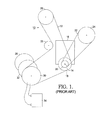
- FIG. 1 a prior art supercharger system 10 is shown, for stop/start hybrid operation of an internal combustion engine, substantially as disclosed in incorporated reference PCT/US09/02364 .
- System 10 comprises a secondary drive means 12 such as a belt, chain, or direct coupling that is operationally connected to the crankshaft 14 of an internal combustion engine 16.
- Secondary drive means 12 may be driven directly via a clutch 18 to permit automatic selective drive of the secondary drive means 12 by the engine control system (not shown).
- clutch 18 comprises at least an active (on/off) clutch, and preferably also a passive (so-called “over-running") clutch.
- Clutch 18 is mounted directly on the end of crankshaft 14, along with a pulley damper 20 for driving a primary drive means 22 such as a primary belt or chain at a fixed ratio to engine speed.
- An “over-running” clutch refers to a clutch between two rotatable elements that latches and unlatches with relative rotation of the input and output elements. If the input element, in the present case connected to engine 16, is at the speed of the output element, connected to supercharger secondary drive means 12, the clutch latches. If the engine is turning slower than secondary drive means 12, the clutch freewheels, allowing secondary drive means 12 to run faster than synchronous with engine 16. Thus, for engine 16 to be driven by system 10 as in starting mode, an additional, on/off clutch is required (also referred to herein as an "active" clutch).
- the two clutches are not in series but may be on different elements of a planetary gear set, as is known in the prior art.
- the term "primary” should be taken to mean comprising an apparatus 24 either necessary to the functioning of the engine or which needs to rotate at a fixed ratio to the engine speed, e.g., a water pump.
- "Secondary” should be taken to mean comprising an apparatus either non-essential to the functioning of the engine or which needs to rotate at a speed independent of engine speed, e.g., supercharger 26, HVAC compressor 28, or power steering (not shown) and power brakes (not shown) which may be optionally included in system 10.
- a belt tensioner 25 and one or more idler pulleys may be used (as in the prior art).
- System 10 further includes a low-inertia starter/motor/generator 30 having a wide speed range, driven by the secondary drive means 12.
- Supercharger 26 is driven by starter/motor/generator 30, either directly (preferred) or via an intermediate linkage such as an additional belt (not shown).
- the starter/motor/generator may be electric, hydraulic, or pneumatic or combinations thereof.
- the system also includes an energy storage device 34, such as a battery, ultracapacitor, hydraulic or pneumatic accumulator, or combinations thereof.
- Two-speed (active, plus passive over-running) clutch 18 allows system 10 to turn in three modes:
- the supercharger device 26 may be a turbo-compressor (centrifugal, axial, or mixed flow, i.e. the cold side of a turbocharger) or a Roots® blower, or scroll or Lysholm® compressor.
- a turbo-compressor centrifugal, axial, or mixed flow, i.e. the cold side of a turbocharger
- a Roots® blower or scroll or Lysholm® compressor.
- a high ratio drive 32 is required to spin the compressor at a very high speed (compared to the secondary belt drive 12). This may be with a gear set or a roller traction drive.
- a more moderate step up drive may be used or the device may run at the same speed as its secondary drive.
- the system has a large cost benefit, by using a single starter/motor/generator device 30 (and associated controls) to do multiple functions.
- this starter/motor/generator can do:
- a first embodiment 110 of a high-performance, high-efficiency twin-charged boosting system in accordance with the present invention for a hybrid-operated engine incorporates all the elements of system 10, shown in FIG. 1 .
- system 110 comprises a turbocharger 140 driven conventionally by engine exhaust 142 which is then discharged 143; a first charge air cooler (CAC1) 144; and a second charge air cooler (CAC2) 146.
- Combustion intake air 148 enters turbocharger 140 and is compressed and heated, then flows 150 in sequence through CAC1 144, supercharger 26, CAC2 146, and thence into engine 16.
- supercharger 26 By switching or modulating the speed of supercharger 26 and optionally (depending on the type of supercharger) by switching the direction of flow or porting of the supercharger, the function can be switched between operation as a compressor or expander.
- supercharger 26 In system 10 ( FIG. 1 ), for example, supercharger 26 is arranged with an on/off or variable speed accessory drive or clutch 18.
- the high speed is defined by operation in highly boosted modes, whereas the freewheeling speed (declutched from the engine) or low speed can be set to have the supercharger act as an expander.
- the operation as an expander is useful in unboosted conditions (for recovering intake throttling losses) or when the capacity of the turbocharger exceeds the engine flow requirement (for reducing wastegate losses).
- a non-hybrid, high-performance, high-efficiency twin-charged boosting system 210 in accordance with the present invention for boosting an internal combustion engine 16 comprises a turbocharger 140 driven conventionally by engine exhaust 142 which is then exhausted 143; a supercharger 26 driven by engine 16 via at least a two-speed variable drive 220 and capable of variable speed operation, such that supercharger 26 is capable of acting as either a compressor or an expander as described below (appropriate valving not shown); a first charge air cooler (CAC1) 144; and a second charge air cooler (CAC2) 146.
- Combustion intake air 148 enters turbocharger 140, then compressed air 150 flows in sequence through CAC1 144, supercharger 26, CAC2 146, and thence into engine 16.
- Roots® blower should be considered a preferred technology, because it tends to have high efficiency at modest pressures ratios (where it would normally be used) both as a compressor and expander and the flow direction and porting can remain unchanged.
- the Roots® blower In normal boost operation, the Roots® blower is turned much faster than the engine, forcing air into the intake manifold and thus increasing the manifold pressure.
- a pressure drop across the Roots® blower causes a reverse to normal torque which may be used to power accessories (not shown), turn the generator (not shown) or to provide a small power increase to the engine (via the accessory belt or a similar chain or gears, not shown).
- turbocharger 140 compresses filtered intake air 148; and CAC1 144, which typically is an air/air CAC, drops the charge air temperature as low as possible. In cruise conditions, for example, with system 210 operating in mid-boost, cruise, or light acceleration modes, turbocharger 140 may compress air 148 to as much as about 3.0 bar. Supercharger 26 then partly expands the charge air to, for example, 2.032 bar, resulting in a lower temperature.
- the resulting temperature can be precisely controlled to match the level required to condense a refrigerant or freeze a phase change material (or both) in CAC2 146, thereby storing capacity for future cooling in CAC2 146 or to supplement vehicle cabin air conditioning.
- This level can also be chosen so as to not condense water from the ambient humidity, and especially from EGR 154 which may be mixed into the charge air.
- CAC2 146 may be needed to maintain a low charge temperature to the engine. This can be useful, for example, in certain ambients where active cooling can be achieved with a very low parasitic by circulating refrigerant 152.
- supercharger 26 as an expander allows very low temperatures of the air charge as admitted to engine 16, which is attractive for knock-limited power and efficiency, and which helps to match the turbine power and compressor load in the turbocharger, thereby reducing or eliminating the losses associated with a waste gate or VGT.
- accessory drive 220 can switch back to normal supercharger operation. Because vaporized refrigerant 152 has been condensed and/or phase change material has solidified 152' in the preceding low-load operation, the very low charge air temperatures can be maintained with minimal parasitic losses. If continuous cooling is required, a small amount of refrigerant from a vehicle air conditioning compressor (not shown) can be metered into CAC2 146, acting then as an evaporative heat exchanger.
- system 110, 210 allows enhanced energy recovery from the turbocharger without the need for extensive additional hardware in the exhaust system.
- the resulting fuel economy benefits are relatively small but are additive to the more substantial baseline benefits achieved in the highly downsized twin-charger architecture.
- the fuel economy gains can be achieved with simple hardware changes, such as accessory drive 220, and thus have an attractive cost/benefit.
- the improved charge air cooling and flexibility to manage hot and cold ambient conditions is another advantage, allowing the present novel system to be responsive and efficient in different climatic conditions and with varying fuels.
- CAC2 146 The ability to control efficiently CAC2 146 to near the dew point will be useful in future engine systems employing very high EGR flow, needed for both diesel and gasoline engines, with improved ability to material solidified meet future extremely low emissions standards without compromising engine efficiency.
Landscapes
- Engineering & Computer Science (AREA)
- Chemical & Material Sciences (AREA)
- Combustion & Propulsion (AREA)
- Mechanical Engineering (AREA)
- General Engineering & Computer Science (AREA)
- Physics & Mathematics (AREA)
- Thermal Sciences (AREA)
- Supercharger (AREA)
Abstract
Description
- The present invention relates to systems for boosting air flow into an internal combustion engine; more particularly, to boosting systems comprising both a turbocharger and a supercharger; and most particularly, to a combined turbocharger/supercharger boosting system to provide high-performance, high-efficiency engine operation over the full range of engine operating conditions and speeds.
- In the effort to improve vehicle fuel economy while maintaining or improving vehicle power to weight ratios, many automotive OEMs are opting to downsize and turbocharge ("boost") their new direct injection gasoline engines. This is a continuation of a trend which has already led to nearly 100% penetration of turbocharger systems on automotive diesel engines. As used herein, the terms "boost" and "boosting" should be taken to mean an apparatus and/or method for providing combustion air to an internal combustion engine at a supra-atmospheric pressure.
- One disadvantage of downsized, turbocharged engines is that the available torque at or near idle is very low (sometimes even lower than a naturally-aspirated engine of the same displacement). This leads to the well-known "turbo lag" and to the trend to waste gate, variable geometry turbine, and even two-stage series/sequential turbocharger systems to mitigate such poor low-RPM and transient performance.
- One prior art engine system that overcomes low-RPM and transient performance has been put into volume production by Volkswagen® in a 1.4L "twin-charged" direct injection gasoline engine offered in several of their European models. This engine system uses a high speed ratio supercharger to supplement the turbocharger at low RPM as needed. The system then transitions to turbocharger-only operation, with the supercharger declutched, at high RPM.
- Although, as noted above, the turbocharger is unable to boost an engine well at low RPM, the amount of available exhaust energy at high engine speed and load is often substantially above the level needed for boosting the engine. Therefore, a "waste gate", as the name implies, is often used at high engine speed and load to waste part of the exhaust energy by diverting a portion of the flow around the turbocharger turbine. A variable geometry turbine is somewhat more efficient, because it can modulate the kinetic energy of the exhaust at the turbine inlet; however, a variable geometry turbine tends to be more expensive and still suffers from some flow losses and thus still involves some level of parasitic energy loss in the system.
- Another important aspect of engine boosting for both gasoline and diesel engines is charge-air cooling. Due to adiabatic compression, the compressed air temperature after a turbo-compressor or supercharger is significantly higher than ambient. An "intercooler", also known as a charge air cooler (CAC), typically is used to lower the temperature as much as possible to improve the volumetric efficiency and to reduce the propensity of engine "knock".
- Air-to-air CACs, wherein compressed air is ducted to a heat exchanger at the very front of a vehicle, are widely used. Such an arrangement can offer low compressed air temperatures at the expense of some complexity in packaging and flow losses.
- Coolant-to-air CACs tend be smaller and can be packaged more conveniently in or adjacent to the engine intake manifold to use the engine's coolant. However, the air temperature can approach only the coolant temperature of the engine, which normally is about 90°C and in extreme conditions may be as high as 125°C. One coolant-based approach is to use a secondary radiator only for the CAC, with a reservoir, pump and radiator separate from the normal engine cooling loop. This arrangement can produce intercooled charge temperatures of perhaps 40°C to 70°C under normal ambient conditions.
- Future engine systems, both gasoline and diesel, will undoubtedly required even higher levels of boost than can be delivered by today's prior art systems. Staged, twin-turbo systems are known, and even three-turbomachine systems have been proposed for heavy duty vehicles, two for boost and one for energy recovery.
- What is needed in the art is a more efficient "twin-charged" engine boosting system that can have the performance attributes of the aforementioned twin-charger system but with improved exhaust energy recovery, to mitigate the obvious high cost of such a system, and with improved charge cooling, to maintain performance in hot weather conditions and to facilitate the use of elevated levels of exhaust gas recirculation (EGR), consistent with future lower emission standards.
- It is a principal object of the present invention to increase both the performance and the efficiency of an internal combustion engine.
- Briefly described, a boost system for an internal combustion in accordance with the present invention comprises a turbocharger driven conventionally by engine exhaust; a supercharger driven by the engine and capable of variable speed operation as either a compressor or an expander; an optional first charge air cooler (CAC1); and a second charge air cooler (CAC2). Combustion air enters the turbocharger, then flows in sequence through optional CAC1, the supercharger, CAC2, and thence into the engine.
- At low engine and vehicle speeds, when additional boosting is needed, the supercharger is rotated at a high speed relative to the engine. It draws and compresses air, which then is tempered by CAC2 before passing into the engine. The turbocharger contributes relatively little at very low RPM, the engine boosting coming from action of the supercharger.
- As engine speed and exhaust volume increase, the turbocharger begins to significantly compress the incoming air. The air is tempered principally by CAC1, and the supercharger and CAC2 contribute only modestly to the engine boosting and intercooling.
- At high engine speeds and high exhaust volume, such as when cruising on an interstate highway, the turbocharger capacity may substantially exceed the compressed air requirement, and engine boosting comes exclusively from the turbocharger. In the prior art, the excess capacity is dumped and thereby wasted as via a waste gate. This results in unnecessary backpressure in the engine exhaust. In the present invention, this extra compressive capacity is recovered and stored as follows.
- The speed of the supercharger is reduced such that the supercharger operates as an adiabatic expander to cool the air stream and reduce the intake air pressure to a desired level. Preferably, the air temperature is reduced to a level below that desired for combustion. CAC2 then serves to rewarm the air by its heat capacity or optionally by the condensation of a refrigerant, thereby storing cooling capacity in CAC2 for use during the next period of supercharger boosting, and thus improving the cooling of the supercharger output.
- The invention is also useful in an embodiment incorporating a turbocharger with a prior art hybrid gas/electric or diesel/electric engine arrangement wherein a supercharger and a starter/generator/motor are disposed on a disconnectable secondary drive means powered by the engine. This embodiment overcomes efficiency penalties of the prior art arrangement wherein the supercharger alone is responsible for engine boosting at high speed and load.
- The present invention will now be described, by way of example, with reference to the accompanying drawings, in which:
-
FIG. 1 is a schematic drawing of a prior art supercharger system, without turbocharger, for stop/start hybrid operation of an internal combustion engine, substantially as disclosed in incorporated referencePCT/US09/02364 ; -
FIG. 2 is a schematic drawing showing the prior art system inFIG. 1 adapted as a first embodiment of a twin-charged boosting system in accordance with the present invention; and -
FIG. 3 is a schematic drawing of a generic twin-charged boosting system in accordance with the present invention. - Corresponding reference characters indicate corresponding parts throughout the several views. The exemplifications set out herein illustrate currently preferred embodiments of the invention, and such exemplifications are not to be construed as limiting the scope of the invention in any manner.
- Various concepts are known in the prior art for recovering energy from engine exhaust. The present invention moves the energy recovery to the air intake, thereby reducing the overall cost of components and sharing components with the supercharger and charge air cooling functions. Additional value is received in improved charge cooling, which improves knock-limited power, and/or reduced power parasitics for accessories such as air conditioning. Cooling of the CAC2 thermal storage mass in normal driving allows subsequent excellent transient cooling performance because the CAC2 thermal mass and, optionally, the refrigerant or phase-change material (PCM) keeps air charge temperature low in temporary high-boost supercharged conditions. The option of active cooling using a refrigerant, fuel, or low-temperature loop coolant with a secondary radiator can be useful for extreme hot weather conditions. The charge cooling benefits make the present system attractive for clean diesel engines of the future because very low air charge temperature allows for a desirably very high level of exhaust gas recirculation (EGR).
- A twin-charged engine boost system in accordance with the present invention allows extreme downsizing of an engine, either gasoline or diesel, without compromising performance and efficiency over the entire range of engine load and operating conditions.
- Referring to
FIG. 1 , a priorart supercharger system 10 is shown, for stop/start hybrid operation of an internal combustion engine, substantially as disclosed in incorporated referencePCT/US09/02364 . -
System 10 comprises a secondary drive means 12 such as a belt, chain, or direct coupling that is operationally connected to thecrankshaft 14 of aninternal combustion engine 16. Secondary drive means 12 may be driven directly via aclutch 18 to permit automatic selective drive of the secondary drive means 12 by the engine control system (not shown). Preferablyclutch 18 comprises at least an active (on/off) clutch, and preferably also a passive (so-called "over-running") clutch. Clutch 18 is mounted directly on the end ofcrankshaft 14, along with apulley damper 20 for driving a primary drive means 22 such as a primary belt or chain at a fixed ratio to engine speed. - An "over-running" clutch refers to a clutch between two rotatable elements that latches and unlatches with relative rotation of the input and output elements. If the input element, in the present case connected to
engine 16, is at the speed of the output element, connected to supercharger secondary drive means 12, the clutch latches. If the engine is turning slower than secondary drive means 12, the clutch freewheels, allowing secondary drive means 12 to run faster than synchronous withengine 16. Thus, forengine 16 to be driven bysystem 10 as in starting mode, an additional, on/off clutch is required (also referred to herein as an "active" clutch). The two clutches are not in series but may be on different elements of a planetary gear set, as is known in the prior art. - In the present discussion, the term "primary" should be taken to mean comprising an
apparatus 24 either necessary to the functioning of the engine or which needs to rotate at a fixed ratio to the engine speed, e.g., a water pump. "Secondary" should be taken to mean comprising an apparatus either non-essential to the functioning of the engine or which needs to rotate at a speed independent of engine speed, e.g.,supercharger 26,HVAC compressor 28, or power steering (not shown) and power brakes (not shown) which may be optionally included insystem 10. Also abelt tensioner 25 and one or more idler pulleys (not shown) may be used (as in the prior art). -
System 10 further includes a low-inertia starter/motor/generator 30 having a wide speed range, driven by the secondary drive means 12.Supercharger 26 is driven by starter/motor/generator 30, either directly (preferred) or via an intermediate linkage such as an additional belt (not shown). The starter/motor/generator may be electric, hydraulic, or pneumatic or combinations thereof. The system also includes anenergy storage device 34, such as a battery, ultracapacitor, hydraulic or pneumatic accumulator, or combinations thereof. - Two-speed (active, plus passive over-running)
clutch 18 allowssystem 10 to turn in three modes: - 1. at a fixed multiple of engine speed (when the engine is "ON" and the overrunning clutch latches), for example when the engine is in "cruise" mode.
- 2. at a fixed higher multiple of engine speed (when the active clutch is "ON"), for example, when the engine is being supercharged.
- 3. at a variable speed, independent of the engine, when the active clutch is "OFF" and the engine is "OFF" or running at a lower speed than the supercharger system.
- The
supercharger device 26 may be a turbo-compressor (centrifugal, axial, or mixed flow, i.e. the cold side of a turbocharger) or a Roots® blower, or scroll or Lysholm® compressor. In the case of a turbo-compressor, ahigh ratio drive 32 is required to spin the compressor at a very high speed (compared to the secondary belt drive 12). This may be with a gear set or a roller traction drive. In the case of the other supercharger technologies, a more moderate step up drive may be used or the device may run at the same speed as its secondary drive. - The system has a large cost benefit, by using a single starter/motor/generator device 30 (and associated controls) to do multiple functions. For example, in the case of an electric starter/motor/generator, this starter/motor/generator can do:
- engine starting (both for initial cold start and subsequent stopstart cycles),
- steady state (low power) generating to run accessories and keep a SLI battery
charged,
hybrid electric functions (torque assist and regenerative braking) using the ultracapacitor or other highpower energy storage 34 to source or sink the required power, - engine independent boosting, and
- engine independent air conditioning.
- Referring to
FIG. 2 , afirst embodiment 110 of a high-performance, high-efficiency twin-charged boosting system in accordance with the present invention for a hybrid-operated engine incorporates all the elements ofsystem 10, shown inFIG. 1 . In addition,system 110 comprises aturbocharger 140 driven conventionally byengine exhaust 142 which is then discharged 143; a first charge air cooler (CAC1) 144; and a second charge air cooler (CAC2) 146.Combustion intake air 148 entersturbocharger 140 and is compressed and heated, then flows 150 in sequence throughCAC1 144,supercharger 26,CAC2 146, and thence intoengine 16. - By switching or modulating the speed of
supercharger 26 and optionally (depending on the type of supercharger) by switching the direction of flow or porting of the supercharger, the function can be switched between operation as a compressor or expander. In system 10 (FIG. 1 ), for example,supercharger 26 is arranged with an on/off or variable speed accessory drive or clutch 18. The high speed is defined by operation in highly boosted modes, whereas the freewheeling speed (declutched from the engine) or low speed can be set to have the supercharger act as an expander. The operation as an expander is useful in unboosted conditions (for recovering intake throttling losses) or when the capacity of the turbocharger exceeds the engine flow requirement (for reducing wastegate losses). - Referring to
FIG. 3 , a non-hybrid, high-performance, high-efficiency twin-charged boostingsystem 210 in accordance with the present invention for boosting aninternal combustion engine 16 comprises aturbocharger 140 driven conventionally byengine exhaust 142 which is then exhausted 143; asupercharger 26 driven byengine 16 via at least a two-speed variable drive 220 and capable of variable speed operation, such thatsupercharger 26 is capable of acting as either a compressor or an expander as described below (appropriate valving not shown); a first charge air cooler (CAC1) 144; and a second charge air cooler (CAC2) 146.Combustion intake air 148 entersturbocharger 140, then compressedair 150 flows in sequence throughCAC1 144,supercharger 26,CAC2 146, and thence intoengine 16. - Although several types of supercharger devices and valving strategies can be used, a Roots® blower should be considered a preferred technology, because it tends to have high efficiency at modest pressures ratios (where it would normally be used) both as a compressor and expander and the flow direction and porting can remain unchanged. In normal boost operation, the Roots® blower is turned much faster than the engine, forcing air into the intake manifold and thus increasing the manifold pressure. By operating the Roots® blower much slower than the engine, a pressure drop across the Roots® blower causes a reverse to normal torque which may be used to power accessories (not shown), turn the generator (not shown) or to provide a small power increase to the engine (via the accessory belt or a similar chain or gears, not shown).
- A variety of layouts and charge air cooling strategies may be used in accordance with the present invention, but in one aspect of the invention,
turbocharger 140 compresses filteredintake air 148; andCAC1 144, which typically is an air/air CAC, drops the charge air temperature as low as possible. In cruise conditions, for example, withsystem 210 operating in mid-boost, cruise, or light acceleration modes,turbocharger 140 may compressair 148 to as much as about 3.0 bar.Supercharger 26 then partly expands the charge air to, for example, 2.032 bar, resulting in a lower temperature. By modulating the level of bypass 148' aroundCAC1 144, the resulting temperature can be precisely controlled to match the level required to condense a refrigerant or freeze a phase change material (or both) inCAC2 146, thereby storing capacity for future cooling inCAC2 146 or to supplement vehicle cabin air conditioning. This level can also be chosen so as to not condense water from the ambient humidity, and especially fromEGR 154 which may be mixed into the charge air. - By bypassing 148' all of the flow around
CAC1 144, hotter gas fromturbocharger 140 is expand throughsupercharger 26, resulting in somewhat higher energy recovery. Then active cooling ofCAC2 146 may be needed to maintain a low charge temperature to the engine. This can be useful, for example, in certain ambients where active cooling can be achieved with a very low parasitic by circulatingrefrigerant 152. - The use of
supercharger 26 as an expander allows very low temperatures of the air charge as admitted toengine 16, which is attractive for knock-limited power and efficiency, and which helps to match the turbine power and compressor load in the turbocharger, thereby reducing or eliminating the losses associated with a waste gate or VGT. - When a high level of boost is required, especially at low engine RPM where the turbocharger is inherently inefficient and underpowered,
accessory drive 220 can switch back to normal supercharger operation. Because vaporizedrefrigerant 152 has been condensed and/or phase change material has solidified 152' in the preceding low-load operation, the very low charge air temperatures can be maintained with minimal parasitic losses. If continuous cooling is required, a small amount of refrigerant from a vehicle air conditioning compressor (not shown) can be metered intoCAC2 146, acting then as an evaporative heat exchanger. - It will be seen that
system accessory drive 220, and thus have an attractive cost/benefit. The improved charge air cooling and flexibility to manage hot and cold ambient conditions is another advantage, allowing the present novel system to be responsive and efficient in different climatic conditions and with varying fuels. - The ability to control efficiently CAC2 146 to near the dew point will be useful in future engine systems employing very high EGR flow, needed for both diesel and gasoline engines, with improved ability to material solidified
meet future extremely low emissions standards without compromising engine efficiency. - While the invention has been described by reference to various specific embodiments, it should be understood that numerous changes may be made within the spirit and scope of the inventive concepts described. Accordingly, it is intended that the invention not be limited to the described embodiments, but will have full scope defined by the language of the following claims.
Claims (14)
- A twin-charged boosting system (110, 210) for boosting an internal combustion engine (16), the system (110, 210) comprising a supercharger (26) and being characterized in that it further comprises:a turbocharger (140) driven by exhaust (142) from said engine (16) and capable of taking in combustion air to form an air charge for said engine (16);a variable-speed drive operationally connecting said supercharger (26) to said engine (16) such that said supercharger (26) is driven by said engine (16) as either a compressor or an expander; andone charge air cooler (146) disposed between said supercharger (26) and an inlet to said engine (16).
- A system (110, 210) in accordance with Claim 1 further comprising another charge air cooler (144) disposed between said turbocharger (140) and said supercharger (26).
- A system (110, 210) in accordance with Claim 2 wherein at least a portion (148') of said air charge (150) passing from said turbocharger (140) to said supercharger (26) bypasses said another charge air cooler (144).
- A system (110, 210) in accordance with any of the preceding claim wherein said supercharger (26) is operated as a compressor (28) when said engine (16) requires additional boosting beyond the capacity of said turbocharger (140).
- A system (110, 210) in accordance with any of the preceding claim wherein said supercharger (26) is operated as an expander when said engine (16) is running at less than boosted conditions or at torque level that is less than the capacity of said turbocharger (140).
- A system (110, 210) in accordance with Claim 5 wherein the temperature of said air charge when exiting said supercharger (26) is lower than desired for combustion in said engine (16).
- A system (110, 210) in accordance with any of the preceding claim wherein supercharger (26) is selected from the group consisting of turbo-compressor, centrifugal, axial, or mixed flow, scroll.
- A twin-charged boosting system (110, 210) in accordance with Claim 1 further comprising:a clutch operationally connected to said engine (16), said clutch including an active clutch portion that can be selectively opened or closed;a starter/motor/generator operationally connected to said supercharger;a drive element connecting said supercharger, said clutch, and said starter/motor/generator (220); andwherein said clutch is disposed in a position selected from the group consisting of directly on the crankshaft of said engine (16), on an accessory drive element of said engine, and on a rotating element in the drive line which is normally connected to the output shaft of said engine,wherein said system (210) is coupled mechanically to said engine (16) when said active clutch portion is closed, andwherein said system (210) is decoupled mechanically from said engine (16) and may be driven by said starter/motor/generator when said active clutch portion is open,and so the twin-charged boosting system (210) is able to boost a hybrid-operating internal combustion engine (16),
- A system (110, 210) in accordance with Claim 8 further comprising another charge air cooler (144) disposed between said turbocharger (140) and said supercharger (26).
- A system (110, 210) in accordance with Claim 8 wherein said system (110, 210) further comprises an energy source (34) operationally connected to said starter/motor/generator device (30).
- A method for operating a system (110, 210) including the elements of Claim 1, comprising the steps of:a) compressing and heating a combustion air charge in said turbocharger (140) to a pressure and temperature above ambient;b) passing said air charge through said supercharger (26); andc) passing said air charge through said one charge air cooler (146) to temper said air charge for entry into said engine (16).
- A method in accordance with Claim 11 wherein said supercharger (26) is operated as a compressor, and wherein the temperature of said air charge at exit from said supercharger (26) is higher than the intended combustion air temperature for said engine (16), and wherein said air tempering in passing through said one charge air cooler (146) is a cooling operation.
- A method in accordance any of the claim 11 or 12 wherein said twin-charged boosting system (210) includes another charge air cooler (144) disposed between said turbocharger (140) and said supercharger (26), said method comprising the further step of :passing at least part of said air charge through said one charge air cooler (144) after exit from said turbocharger (140) and before entry into said supercharger (26).
- A method in accordance any of the claim 11 to 13 wherein said supercharger (26) is operated as an expander, and wherein the temperature of said air charge at exit from said supercharger (26) is lower than the intended combustion air temperature for said engine (16), and wherein said air tempering in passing through said one charge air cooler (146) is a warming operation.
Applications Claiming Priority (1)
| Application Number | Priority Date | Filing Date | Title |
|---|---|---|---|
| US12/557,913 US20100263375A1 (en) | 2009-04-15 | 2009-09-11 | Twin-Charged Boosting System for Internal Combustion Engines |
Publications (2)
| Publication Number | Publication Date |
|---|---|
| EP2295760A2 true EP2295760A2 (en) | 2011-03-16 |
| EP2295760A3 EP2295760A3 (en) | 2013-05-22 |
Family
ID=42979942
Family Applications (1)
| Application Number | Title | Priority Date | Filing Date |
|---|---|---|---|
| EP10174024.9A Withdrawn EP2295760A3 (en) | 2009-09-11 | 2010-08-25 | Twin-charged boosting system for internal combustion engines |
Country Status (2)
| Country | Link |
|---|---|
| US (1) | US20100263375A1 (en) |
| EP (1) | EP2295760A3 (en) |
Cited By (1)
| Publication number | Priority date | Publication date | Assignee | Title |
|---|---|---|---|---|
| GB2502806A (en) * | 2012-06-07 | 2013-12-11 | Jaguar Land Rover Ltd | Intercooler arrangement for a vehicle engine having a turbocharger and a supercharger |
Families Citing this family (26)
| Publication number | Priority date | Publication date | Assignee | Title |
|---|---|---|---|---|
| US7765805B2 (en) * | 2007-07-24 | 2010-08-03 | Kasi Forvaltning I Goteborg Ab | Enhanced supercharging system and an internal combustion engine having such a system |
| US8561403B2 (en) * | 2008-08-05 | 2013-10-22 | Vandyne Super Turbo, Inc. | Super-turbocharger having a high speed traction drive and a continuously variable transmission |
| DE102010011372A1 (en) * | 2009-04-17 | 2010-10-21 | Behr Gmbh & Co. Kg | Charge air duct for an internal combustion engine |
| US8122986B2 (en) * | 2009-07-07 | 2012-02-28 | Ford Global Technologies, Llc | Powertrain and method for controlling a powertrain in a vehicle |
| US20140208745A1 (en) * | 2009-10-28 | 2014-07-31 | Eaton Corporation | Control strategy for an engine |
| BR112012013742A2 (en) | 2009-12-08 | 2018-04-03 | Hydracharge Llc | hydraulic turbo throttle |
| US9284919B2 (en) * | 2010-03-31 | 2016-03-15 | Denso International America, Inc. | Fluid temperature stabilization system |
| US10082070B2 (en) * | 2010-12-08 | 2018-09-25 | Hydracharge Llc | High performance turbo-hydraulic compressor |
| DE102011005496A1 (en) * | 2011-03-14 | 2012-09-20 | Ford Global Technologies, Llc | Lubrication system for an internal combustion engine and method of lubrication |
| WO2012125963A2 (en) * | 2011-03-16 | 2012-09-20 | Johnson Controls Technology Company | Energy source devices and systems having a battery and an ultracapacitor |
| WO2013049438A2 (en) | 2011-09-30 | 2013-04-04 | Eaton Corporation | Supercharger assembly with independent superchargers and motor/generator |
| FR2982906A1 (en) * | 2011-11-22 | 2013-05-24 | Valeo Systemes Thermiques | THERMAL MANAGEMENT SYSTEM OF A SUPPLY AIR CIRCUIT. |
| JP2015514624A (en) | 2012-03-29 | 2015-05-21 | イートン コーポレーションEaton Corporation | Electric energy generation using a variable speed hybrid electric supercharger assembly |
| US11591952B2 (en) | 2012-05-21 | 2023-02-28 | Hydracharge Llc | High performance turbo-hydraulic compressor |
| US9157363B2 (en) | 2012-08-21 | 2015-10-13 | Ford Global Technologies, Llc | Twin independent boosted I4 engine |
| FR2995354B1 (en) * | 2012-09-11 | 2014-09-12 | IFP Energies Nouvelles | METHOD FOR DETERMINING A PRESSURE UPSTREAM OF A COMPRESSOR FOR A MOTOR EQUIPPED WITH A DOUBLE SUPER-POWER |
| US9523537B2 (en) * | 2013-03-11 | 2016-12-20 | General Electric Company | Desiccant based chilling system |
| CN105209731A (en) | 2013-03-12 | 2015-12-30 | 伊顿公司 | Adaptive state of charge regulation and control of variable speed hybrid electric supercharger assembly for efficient vehicle operation |
| DE202014002039U1 (en) | 2013-03-13 | 2014-06-17 | Eaton Corporation | Torque management unit with integrated hydraulic actuator |
| WO2015066060A1 (en) * | 2013-10-28 | 2015-05-07 | Eaton Corporation | Boost system including turbo and hybrid drive supercharger |
| KR101588761B1 (en) * | 2014-05-02 | 2016-01-26 | 현대자동차 주식회사 | Control system of flowing air into vehicle engine room |
| US10711729B2 (en) | 2017-07-19 | 2020-07-14 | Ford Global Technologies, Llc | Diesel engine dual fuel injection strategy |
| US10422289B2 (en) * | 2017-08-31 | 2019-09-24 | Ford Global Technologies, Llc | Method and system for a boosted engine |
| US10627167B2 (en) | 2017-09-12 | 2020-04-21 | General Electric Company | Gas turbine engine having a heat absorption device utilizing phase change material |
| CN110543715B (en) * | 2019-08-28 | 2021-04-27 | 东风汽车集团有限公司 | Two-stage supercharging system matching method based on simulation calculation |
| US11674396B2 (en) | 2021-07-30 | 2023-06-13 | General Electric Company | Cooling air delivery assembly |
Citations (1)
| Publication number | Priority date | Publication date | Assignee | Title |
|---|---|---|---|---|
| US20050198957A1 (en) * | 2004-03-15 | 2005-09-15 | Kim Bryan H.J. | Turbocompound forced induction system for small engines |
Family Cites Families (30)
| Publication number | Priority date | Publication date | Assignee | Title |
|---|---|---|---|---|
| FR1406600A (en) * | 1964-06-09 | 1965-07-23 | Hispano Suiza Sa | Improvements made to turbocooled refrigerated diesel engines |
| FR2050848A5 (en) * | 1969-06-26 | 1971-04-02 | Saviem | |
| US4354807A (en) * | 1977-12-08 | 1982-10-19 | The Rovac Corporation | Compressor-expander of the vane type having canted vane cavity |
| US4384833A (en) * | 1980-01-28 | 1983-05-24 | The Rovac Corporation | Rotary machine of canted vane type having centering ball |
| SE428043C (en) * | 1981-09-15 | 1989-12-14 | Stal Refrigeration Ab | COMPRESSOR WITH RADIAL INPUT TO A SCREW ROTOR |
| JPS6119935A (en) * | 1984-07-06 | 1986-01-28 | Toyota Motor Corp | Supercharger bypass control valve in internal-combustion engine |
| US4667646A (en) * | 1986-01-02 | 1987-05-26 | Shaw David N | Expansion compression system for efficient power output regulation of internal combustion engines |
| US4843821A (en) * | 1987-12-14 | 1989-07-04 | Paul Marius A | Multicylinder compound engine |
| EP0369189A1 (en) * | 1988-11-02 | 1990-05-23 | Volkswagen Aktiengesellschaft | Driving system for vehicles, especially passenger cars |
| US5239960A (en) * | 1991-07-30 | 1993-08-31 | Mazda Motor Corporation | Engine induction system provided with a mechanical supercharger |
| JPH07145740A (en) * | 1993-09-30 | 1995-06-06 | Mazda Motor Corp | Powertrain with engine with mechanical supercharger |
| US5590528A (en) * | 1993-10-19 | 1997-01-07 | Viteri; Fermin | Turbocharged reciprocation engine for power and refrigeration using the modified Ericsson cycle |
| WO1997013061A1 (en) * | 1995-10-02 | 1997-04-10 | Komatsu Ltd. | Apparatus and method for controlling a mechanical supercharger for a diesel engine |
| JPH10238354A (en) * | 1996-12-27 | 1998-09-08 | Kanesaka Gijutsu Kenkyusho:Kk | Hybrid supercharged engine |
| US6125801A (en) * | 1997-11-25 | 2000-10-03 | Mendler; Edward Charles | Lean-burn variable compression ratio engine |
| US7608011B2 (en) * | 2003-01-04 | 2009-10-27 | Ford Global Technologies, Llc | Hydrogen fuelled hybrid powertrain and vehicle |
| SE525219C2 (en) * | 2003-05-15 | 2004-12-28 | Volvo Lastvagnar Ab | Turbocharger system for an internal combustion engine where both compressor stages are of radial type with compressor wheels fitted with reverse swept blades |
| US20060030450A1 (en) * | 2004-08-09 | 2006-02-09 | Kyle Ronald L | Hybrid vehicle formed by converting a conventional IC engine powered vehicle and method of such conversion |
| DE102004061613A1 (en) * | 2004-12-17 | 2006-07-06 | Volkswagen Ag | Method for operating an internal combustion engine with charge air charging and internal combustion engine |
| DE102005004122A1 (en) * | 2005-01-28 | 2006-08-03 | Volkswagen Ag | Dual-charged internal combustion engine, especially for vehicle, has charger pressure outlet connected to intake inlet and to intake pipe via butterfly valves; charge cooler is integrated into intake pipe to give intake/charge cooler module |
| DE102005012837A1 (en) * | 2005-03-19 | 2006-09-21 | Daimlerchrysler Ag | Internal combustion engine e.g. diesel or petrol engine, for motor vehicle, has additional compressor that is provided downstream or upstream of compressor of turbocharger, bypassed over bypass, and propelled by centrifugal mass |
| US7287521B2 (en) * | 2005-09-21 | 2007-10-30 | Ford Global Technologies Llc | System and method for improved engine starting using heated intake air |
| DE102005047653B4 (en) * | 2005-10-05 | 2021-08-19 | Volkswagen Ag | Hybrid drive unit with low temperature circuit |
| US7788923B2 (en) * | 2006-02-02 | 2010-09-07 | International Engine Intellectual Property Company, Llc | Constant EGR rate engine and method |
| EP1989418B1 (en) * | 2006-02-23 | 2015-12-02 | Mack Trucks, Inc. | Charge air cooler arrangement with cooler bypass and method |
| DE102006022493A1 (en) * | 2006-05-13 | 2007-11-15 | Volkswagen Ag | Combustion air intake system for an internal combustion engine |
| US7484368B2 (en) * | 2006-08-11 | 2009-02-03 | Eaton Corporation | Clutched super turbo control strategy |
| SE532709C2 (en) * | 2008-03-06 | 2010-03-23 | Scania Cv Ab | Cooling arrangement of a supercharged internal combustion engine |
| CN101983281B (en) * | 2008-04-08 | 2015-04-22 | 沃尔沃拉斯特瓦格纳公司 | Compressor |
| US8196686B2 (en) * | 2008-12-18 | 2012-06-12 | Delphi Technologies, Inc. | Supercharged hybrid input differential engine system |
-
2009
- 2009-09-11 US US12/557,913 patent/US20100263375A1/en not_active Abandoned
-
2010
- 2010-08-25 EP EP10174024.9A patent/EP2295760A3/en not_active Withdrawn
Patent Citations (1)
| Publication number | Priority date | Publication date | Assignee | Title |
|---|---|---|---|---|
| US20050198957A1 (en) * | 2004-03-15 | 2005-09-15 | Kim Bryan H.J. | Turbocompound forced induction system for small engines |
Cited By (2)
| Publication number | Priority date | Publication date | Assignee | Title |
|---|---|---|---|---|
| GB2502806A (en) * | 2012-06-07 | 2013-12-11 | Jaguar Land Rover Ltd | Intercooler arrangement for a vehicle engine having a turbocharger and a supercharger |
| GB2502806B (en) * | 2012-06-07 | 2014-08-20 | Jaguar Land Rover Ltd | Intercooler arrangement for a vehicle engine |
Also Published As
| Publication number | Publication date |
|---|---|
| US20100263375A1 (en) | 2010-10-21 |
| EP2295760A3 (en) | 2013-05-22 |
Similar Documents
| Publication | Publication Date | Title |
|---|---|---|
| EP2295760A2 (en) | Twin-charged boosting system for internal combustion engines | |
| US7490594B2 (en) | Super-turbocharger | |
| US20140208745A1 (en) | Control strategy for an engine | |
| US9840972B2 (en) | Supercharger-based twin charging system for an engine | |
| US8671682B2 (en) | Multi-stage turbocharging system utilizing VTG turbine stage(s) | |
| US10731577B2 (en) | Method and system for a boosted engine | |
| US20100155157A1 (en) | Supercharged hybrid input differential engine system | |
| US20070119168A1 (en) | Turbocharged internal combustion engine | |
| US20130232972A1 (en) | Internal combustion engine | |
| WO1998029647A1 (en) | Hybrid supercharged engine | |
| WO2009136994A1 (en) | Supercharger system for stop/start hybrid operation of an internal combustion engine | |
| CN102207038B (en) | Control apparatus for turbocharged diesel engine | |
| US11007998B1 (en) | Hybrid vehicle | |
| CN102549248A (en) | Improving fuel efficiency for a piston engine using a super-turbocharger | |
| CN102421999A (en) | Internal combustion engine with sequential supercharging | |
| CN103061872A (en) | Supercharged internal combustion engine having exhaust-gas recirculation arrangement and method for operating internal combustion engine of said type | |
| KR101776312B1 (en) | Exhaust Gas Recirculation Apparatus for Engine and Control Method thereof | |
| EP2341225A1 (en) | Method for controlling a turbocompound engine apparatus | |
| CN111648880A (en) | Engine with electric compressor supercharging and special exhaust gas recirculation system | |
| JP2005009314A (en) | Supercharger for engine | |
| CN108223107B (en) | Flexible supercharged engine of electromechanical complex | |
| GB2435902A (en) | Air-cycle refrigerated boosted intercooling of i.c. engines | |
| KR20120006239A (en) | Vehicle hybrid supercharging system and its control method | |
| JP2011214419A (en) | Start control device of engine with turbo supercharger | |
| GB2400138A (en) | Cooling an i.c. engine turbocharger using an electrically driven supercharger |
Legal Events
| Date | Code | Title | Description |
|---|---|---|---|
| PUAI | Public reference made under article 153(3) epc to a published international application that has entered the european phase |
Free format text: ORIGINAL CODE: 0009012 |
|
| AK | Designated contracting states |
Kind code of ref document: A2 Designated state(s): AL AT BE BG CH CY CZ DE DK EE ES FI FR GB GR HR HU IE IS IT LI LT LU LV MC MK MT NL NO PL PT RO SE SI SK SM TR |
|
| AX | Request for extension of the european patent |
Extension state: BA ME RS |
|
| PUAL | Search report despatched |
Free format text: ORIGINAL CODE: 0009013 |
|
| AK | Designated contracting states |
Kind code of ref document: A3 Designated state(s): AL AT BE BG CH CY CZ DE DK EE ES FI FR GB GR HR HU IE IS IT LI LT LU LV MC MK MT NL NO PL PT RO SE SI SK SM TR |
|
| AX | Request for extension of the european patent |
Extension state: BA ME RS |
|
| RIC1 | Information provided on ipc code assigned before grant |
Ipc: F02M 25/07 20060101ALI20130418BHEP Ipc: F02B 37/04 20060101AFI20130418BHEP Ipc: F02D 29/06 20060101ALI20130418BHEP Ipc: F02B 39/12 20060101ALI20130418BHEP Ipc: F02B 29/04 20060101ALI20130418BHEP Ipc: F02B 33/40 20060101ALI20130418BHEP |
|
| 17P | Request for examination filed |
Effective date: 20131122 |
|
| RBV | Designated contracting states (corrected) |
Designated state(s): AL AT BE BG CH CY CZ DE DK EE ES FI FR GB GR HR HU IE IS IT LI LT LU LV MC MK MT NL NO PL PT RO SE SI SK SM TR |
|
| 17Q | First examination report despatched |
Effective date: 20161117 |
|
| GRAP | Despatch of communication of intention to grant a patent |
Free format text: ORIGINAL CODE: EPIDOSNIGR1 |
|
| RIC1 | Information provided on ipc code assigned before grant |
Ipc: F02B 29/04 20060101ALI20181008BHEP Ipc: F02D 29/06 20060101ALI20181008BHEP Ipc: F02B 33/40 20060101ALI20181008BHEP Ipc: F02B 39/12 20060101ALI20181008BHEP Ipc: F02B 37/04 20060101AFI20181008BHEP |
|
| INTG | Intention to grant announced |
Effective date: 20181025 |
|
| STAA | Information on the status of an ep patent application or granted ep patent |
Free format text: STATUS: THE APPLICATION IS DEEMED TO BE WITHDRAWN |
|
| 18D | Application deemed to be withdrawn |
Effective date: 20190305 |