EP2295480A1 - Implantable bio-resorbable polymer - Google Patents
Implantable bio-resorbable polymer Download PDFInfo
- Publication number
- EP2295480A1 EP2295480A1 EP09305830A EP09305830A EP2295480A1 EP 2295480 A1 EP2295480 A1 EP 2295480A1 EP 09305830 A EP09305830 A EP 09305830A EP 09305830 A EP09305830 A EP 09305830A EP 2295480 A1 EP2295480 A1 EP 2295480A1
- Authority
- EP
- European Patent Office
- Prior art keywords
- monomer
- polymer according
- linker
- acrylate
- peg
- Prior art date
- Legal status (The legal status is an assumption and is not a legal conclusion. Google has not performed a legal analysis and makes no representation as to the accuracy of the status listed.)
- Withdrawn
Links
- BRUAANZCGUNISH-UHFFFAOYSA-N CC(C)Cc1ccc(C(C)C(OCCOC(C(C)=C)=O)=O)cc1 Chemical compound CC(C)Cc1ccc(C(C)C(OCCOC(C(C)=C)=O)=O)cc1 BRUAANZCGUNISH-UHFFFAOYSA-N 0.000 description 1
- 0 CCC(C)(CC(C)(CC(C)(C)*OCCOC(C(C)O*C(C)(*)C*C)=O)*OCCOC)*OCCOC(C(C)c1ccc(CC(C)C)cc1)=O Chemical compound CCC(C)(CC(C)(CC(C)(C)*OCCOC(C(C)O*C(C)(*)C*C)=O)*OCCOC)*OCCOC(C(C)c1ccc(CC(C)C)cc1)=O 0.000 description 1
Classifications
-
- A—HUMAN NECESSITIES
- A61—MEDICAL OR VETERINARY SCIENCE; HYGIENE
- A61K—PREPARATIONS FOR MEDICAL, DENTAL OR TOILETRY PURPOSES
- A61K47/00—Medicinal preparations characterised by the non-active ingredients used, e.g. carriers or inert additives; Targeting or modifying agents chemically bound to the active ingredient
- A61K47/50—Medicinal preparations characterised by the non-active ingredients used, e.g. carriers or inert additives; Targeting or modifying agents chemically bound to the active ingredient the non-active ingredient being chemically bound to the active ingredient, e.g. polymer-drug conjugates
- A61K47/51—Medicinal preparations characterised by the non-active ingredients used, e.g. carriers or inert additives; Targeting or modifying agents chemically bound to the active ingredient the non-active ingredient being chemically bound to the active ingredient, e.g. polymer-drug conjugates the non-active ingredient being a modifying agent
- A61K47/56—Medicinal preparations characterised by the non-active ingredients used, e.g. carriers or inert additives; Targeting or modifying agents chemically bound to the active ingredient the non-active ingredient being chemically bound to the active ingredient, e.g. polymer-drug conjugates the non-active ingredient being a modifying agent the modifying agent being an organic macromolecular compound, e.g. an oligomeric, polymeric or dendrimeric molecule
- A61K47/58—Medicinal preparations characterised by the non-active ingredients used, e.g. carriers or inert additives; Targeting or modifying agents chemically bound to the active ingredient the non-active ingredient being chemically bound to the active ingredient, e.g. polymer-drug conjugates the non-active ingredient being a modifying agent the modifying agent being an organic macromolecular compound, e.g. an oligomeric, polymeric or dendrimeric molecule obtained by reactions only involving carbon-to-carbon unsaturated bonds, e.g. poly[meth]acrylate, polyacrylamide, polystyrene, polyvinylpyrrolidone, polyvinylalcohol or polystyrene sulfonic acid resin
-
- C—CHEMISTRY; METALLURGY
- C08—ORGANIC MACROMOLECULAR COMPOUNDS; THEIR PREPARATION OR CHEMICAL WORKING-UP; COMPOSITIONS BASED THEREON
- C08F—MACROMOLECULAR COMPOUNDS OBTAINED BY REACTIONS ONLY INVOLVING CARBON-TO-CARBON UNSATURATED BONDS
- C08F290/00—Macromolecular compounds obtained by polymerising monomers on to polymers modified by introduction of aliphatic unsaturated end or side groups
- C08F290/02—Macromolecular compounds obtained by polymerising monomers on to polymers modified by introduction of aliphatic unsaturated end or side groups on to polymers modified by introduction of unsaturated end groups
- C08F290/06—Polymers provided for in subclass C08G
-
- A—HUMAN NECESSITIES
- A61—MEDICAL OR VETERINARY SCIENCE; HYGIENE
- A61K—PREPARATIONS FOR MEDICAL, DENTAL OR TOILETRY PURPOSES
- A61K47/00—Medicinal preparations characterised by the non-active ingredients used, e.g. carriers or inert additives; Targeting or modifying agents chemically bound to the active ingredient
- A61K47/50—Medicinal preparations characterised by the non-active ingredients used, e.g. carriers or inert additives; Targeting or modifying agents chemically bound to the active ingredient the non-active ingredient being chemically bound to the active ingredient, e.g. polymer-drug conjugates
-
- A—HUMAN NECESSITIES
- A61—MEDICAL OR VETERINARY SCIENCE; HYGIENE
- A61K—PREPARATIONS FOR MEDICAL, DENTAL OR TOILETRY PURPOSES
- A61K47/00—Medicinal preparations characterised by the non-active ingredients used, e.g. carriers or inert additives; Targeting or modifying agents chemically bound to the active ingredient
- A61K47/50—Medicinal preparations characterised by the non-active ingredients used, e.g. carriers or inert additives; Targeting or modifying agents chemically bound to the active ingredient the non-active ingredient being chemically bound to the active ingredient, e.g. polymer-drug conjugates
- A61K47/69—Medicinal preparations characterised by the non-active ingredients used, e.g. carriers or inert additives; Targeting or modifying agents chemically bound to the active ingredient the non-active ingredient being chemically bound to the active ingredient, e.g. polymer-drug conjugates the conjugate being characterised by physical or galenical forms, e.g. emulsion, particle, inclusion complex, stent or kit
- A61K47/6921—Medicinal preparations characterised by the non-active ingredients used, e.g. carriers or inert additives; Targeting or modifying agents chemically bound to the active ingredient the non-active ingredient being chemically bound to the active ingredient, e.g. polymer-drug conjugates the conjugate being characterised by physical or galenical forms, e.g. emulsion, particle, inclusion complex, stent or kit the form being a particulate, a powder, an adsorbate, a bead or a sphere
- A61K47/6925—Medicinal preparations characterised by the non-active ingredients used, e.g. carriers or inert additives; Targeting or modifying agents chemically bound to the active ingredient the non-active ingredient being chemically bound to the active ingredient, e.g. polymer-drug conjugates the conjugate being characterised by physical or galenical forms, e.g. emulsion, particle, inclusion complex, stent or kit the form being a particulate, a powder, an adsorbate, a bead or a sphere the form being a microcapsule, nanocapsule, microbubble or nanobubble
-
- A—HUMAN NECESSITIES
- A61—MEDICAL OR VETERINARY SCIENCE; HYGIENE
- A61P—SPECIFIC THERAPEUTIC ACTIVITY OF CHEMICAL COMPOUNDS OR MEDICINAL PREPARATIONS
- A61P29/00—Non-central analgesic, antipyretic or antiinflammatory agents, e.g. antirheumatic agents; Non-steroidal antiinflammatory drugs [NSAID]
-
- A—HUMAN NECESSITIES
- A61—MEDICAL OR VETERINARY SCIENCE; HYGIENE
- A61P—SPECIFIC THERAPEUTIC ACTIVITY OF CHEMICAL COMPOUNDS OR MEDICINAL PREPARATIONS
- A61P35/00—Antineoplastic agents
-
- A—HUMAN NECESSITIES
- A61—MEDICAL OR VETERINARY SCIENCE; HYGIENE
- A61P—SPECIFIC THERAPEUTIC ACTIVITY OF CHEMICAL COMPOUNDS OR MEDICINAL PREPARATIONS
- A61P9/00—Drugs for disorders of the cardiovascular system
-
- C—CHEMISTRY; METALLURGY
- C08—ORGANIC MACROMOLECULAR COMPOUNDS; THEIR PREPARATION OR CHEMICAL WORKING-UP; COMPOSITIONS BASED THEREON
- C08F—MACROMOLECULAR COMPOUNDS OBTAINED BY REACTIONS ONLY INVOLVING CARBON-TO-CARBON UNSATURATED BONDS
- C08F290/00—Macromolecular compounds obtained by polymerising monomers on to polymers modified by introduction of aliphatic unsaturated end or side groups
- C08F290/02—Macromolecular compounds obtained by polymerising monomers on to polymers modified by introduction of aliphatic unsaturated end or side groups on to polymers modified by introduction of unsaturated end groups
- C08F290/06—Polymers provided for in subclass C08G
- C08F290/061—Polyesters; Polycarbonates
-
- C—CHEMISTRY; METALLURGY
- C08—ORGANIC MACROMOLECULAR COMPOUNDS; THEIR PREPARATION OR CHEMICAL WORKING-UP; COMPOSITIONS BASED THEREON
- C08F—MACROMOLECULAR COMPOUNDS OBTAINED BY REACTIONS ONLY INVOLVING CARBON-TO-CARBON UNSATURATED BONDS
- C08F290/00—Macromolecular compounds obtained by polymerising monomers on to polymers modified by introduction of aliphatic unsaturated end or side groups
- C08F290/02—Macromolecular compounds obtained by polymerising monomers on to polymers modified by introduction of aliphatic unsaturated end or side groups on to polymers modified by introduction of unsaturated end groups
- C08F290/06—Polymers provided for in subclass C08G
- C08F290/062—Polyethers
-
- C—CHEMISTRY; METALLURGY
- C08—ORGANIC MACROMOLECULAR COMPOUNDS; THEIR PREPARATION OR CHEMICAL WORKING-UP; COMPOSITIONS BASED THEREON
- C08F—MACROMOLECULAR COMPOUNDS OBTAINED BY REACTIONS ONLY INVOLVING CARBON-TO-CARBON UNSATURATED BONDS
- C08F299/00—Macromolecular compounds obtained by interreacting polymers involving only carbon-to-carbon unsaturated bond reactions, in the absence of non-macromolecular monomers
- C08F299/02—Macromolecular compounds obtained by interreacting polymers involving only carbon-to-carbon unsaturated bond reactions, in the absence of non-macromolecular monomers from unsaturated polycondensates
-
- C—CHEMISTRY; METALLURGY
- C08—ORGANIC MACROMOLECULAR COMPOUNDS; THEIR PREPARATION OR CHEMICAL WORKING-UP; COMPOSITIONS BASED THEREON
- C08G—MACROMOLECULAR COMPOUNDS OBTAINED OTHERWISE THAN BY REACTIONS ONLY INVOLVING UNSATURATED CARBON-TO-CARBON BONDS
- C08G81/00—Macromolecular compounds obtained by interreacting polymers in the absence of monomers, e.g. block polymers
-
- C—CHEMISTRY; METALLURGY
- C08—ORGANIC MACROMOLECULAR COMPOUNDS; THEIR PREPARATION OR CHEMICAL WORKING-UP; COMPOSITIONS BASED THEREON
- C08L—COMPOSITIONS OF MACROMOLECULAR COMPOUNDS
- C08L55/00—Compositions of homopolymers or copolymers, obtained by polymerisation reactions only involving carbon-to-carbon unsaturated bonds, not provided for in groups C08L23/00 - C08L53/00
- C08L55/005—Homopolymers or copolymers obtained by polymerisation of macromolecular compounds terminated by a carbon-to-carbon double bond
-
- C—CHEMISTRY; METALLURGY
- C08—ORGANIC MACROMOLECULAR COMPOUNDS; THEIR PREPARATION OR CHEMICAL WORKING-UP; COMPOSITIONS BASED THEREON
- C08L—COMPOSITIONS OF MACROMOLECULAR COMPOUNDS
- C08L2205/00—Polymer mixtures characterised by other features
- C08L2205/02—Polymer mixtures characterised by other features containing two or more polymers of the same C08L -group
Definitions
- the present invention relates to swellable and bio-resorbable cross-linked polymers liable to be implanted in an individual and optionally to deliver drugs to the individual.
- gelatin sponges are biodegradable after implantation in tissues or injection in cavities, ducts or vessels. They can be impregnated with physiological saline and/or contrast media.
- dextran starch microspheres Spherex® from Pharmacia; Embocept® from Pharmacept
- these dextran starch microspheres which are non-toxic, are readily degradable and are notably used to provide temporary vascular occlusion, mainly for the treatment of tumor when co-administered with chemotherapeutic drugs.
- dextran starch microspheres suffer from several limitations. First of all, these microsphers are available only in small sizes, with diameters below 100 ⁇ m. Such a small diameter does not allow targeted embolization, particularly for proximal occlusion. Besides, resorption is fast, with a usual half life below 1 hour, and cannot be accurately predicted since depends on the enzymatic capability to resorb a given microspheres volume.
- Water-absorbent dry microspheres based on acrylic and PVA copolymers have also been proposed as swellable implants (Osuga et al. (2002) J Vasc Interv Radiol. 13 :929-34).
- these microspheres are under a dry form.
- physiological saline, and/or iodinated contrast media are mixed with physiological saline, and/or iodinated contrast media.
- their final size after water uptake varies according to the ionic charge of the medium (x2 or x4 in saline and contrast medium respectively).
- the present invention arises from the unexpected finding, by the inventors, that the presence of neutral (meth)acrylates in a polymer cross-linked by bio-resorbable PLGA-, PEG- and/or PLA-based block copolymers can influence the rate of degradation of such a polymer while also allowing to control the swelling of the polymer.
- the polymer is provided as a spherical particle, sphericity can be maintained even upon swelling.
- the present invention thus relates to a polymer obtained from the polymerization of:
- the above-defined polymer is obtained from the polymerization of the at least one monomer, the at least one bio-resorbable block copolymer cross-linker, and at least one further monomer selected from the list comprising:
- the above-defined polymer is obtained from the polymerization of the at least one monomer, the at least one bio-resorbable block copolymer cross-linker, and the drug-carrying monomer.
- the above-defined polymer is obtained from the polymerization of the at least one monomer, the at least one bio-resorbable block copolymer cross-linker, and the at least one charged, ionisable" hydrophilic, or hydrophobic monomer.
- the polymer of the invention is polymerized from a drug-carrying monomer as defined above, the polymer can be used as a drug delivery system.
- the polymer of the invention may present with various physico-chemical surface characteristics enabling loading, i.e. non-covalently adsorbing, drugs to be delivered.
- the above defined polymer is loaded with a drug or a prodrug.
- incorporation into the polymer of the invention of the above-defined hydrophilic monomer is advantageous in that it allows modulating the release of the drug by the polymer of the invention.
- the present invention also relates to at least one polymer as defined above for use as a medicament.
- the present invention also to a pharmaceutical composition
- a pharmaceutical composition comprising at least one polymer as defined above, in association with a pharmaceutically acceptable carrier.
- bio-resorbable means that the block copolymer is degraded or cleaved when administered into a living organism, preferably a mammal, in particular a human, organism.
- bio-resorbable indicates that the block copolymer may be hydrolyzed.
- the bio-resorbable block copolymer cross-linker is a diblock or a triblock copolymer.
- the block of the bio-resorbable block copolymer cross-linker as defined above is selected from the groups consisting of polyethylene glycol (PEG), poly-lactic acid (also named poly-lactide) (PLA), poly-glycolic acid (also named poly-glycolide) (PGA) and poly-lactic-glycolic acid (PLGA).
- PEG polyethylene glycol
- PLA poly-lactic acid
- PGA poly-glycolic acid
- PLGA poly-lactic-glycolic acid
- PEG, PLA and PGA may be represented as follows, n representing their degree of polymerization:
- the degree of polymerizaton is the sum of the number of lactide and glycolide units.
- bio-resorbable block copolymer cross-linker as defined above is of a formula selected from the group consisting of:
- the polymer of the invention is a bio-resorbable (i.e. hydrolizable) cross-linked polymer.
- the polymer of the invention is constituted of at least one chain of polymerized monomers as defined above, which at least one chain is cross-linked by bio-resorbable block copolymer cross-linkers as defined above.
- the polymer of the invention is swellable, i.e. has the capacity to absorb liquids, in particular water.
- the monomers of the invention may also be represented as follows:
- the monomer of formula (I) as defined above is selected from the group consisting of sec-butyl acrylate, n-butyl acrylate, t-butyl acrylate, t-butyl methacrylate, methylmethacrylate, Ndimethyl-aminoethyl(methyl)acrylate, N,N-dimethylaminopropyl-(meth)acrylate, t-butylaminoethyl (methyl)acrylate, N,N-diethylaminoacrylate, acrylate terminated poly(ethylene oxide), methacrylate terminated poly(ethylene oxide), methoxy poly(ethylene oxide) methacrylate, butoxy poly(ethylene oxide) methacrylate, acrylate terminated poly(ethylene glycol), methacrylate terminated poly(ethylene glycol), methoxy poly(ethylene glycol) methacrylate, butoxy poly(ethylene glycol) methacrylate.
- the monomer of formula (I) as defined above is methoxy poly(ethylene glycol) methacrylate.
- hydrophilic monomer as defined above is selected from the group consisting of (meth)acrylamide, 2-hydroxyethyl (meth)acrylate, N-vinyl-2-pyrrolidone, butyl (meth)acrylate, acrylic acid, acrylic anhydride, N-trishydroxymethyl methacrylamide, glycerol mono(meth)acrylate, hydroxypropyl (meth)acrylate, 4-hydroxybutyl (meth)acrylate.
- F is selected from the group constituted of COOH, COO - , SO 3 H, SO 3 - , PO 4 H 2 , PO 4 H - , PO 4 2- , NR 11 R 12 , NR 11 R 12 R 13 + , R 11 , R 12 and R 13 independently representing H or a C1-C6 alkyl, a linear or branched alkyl group having from 1 to 20 carbon atoms, an aryl group having from 5 to 20 carbon atoms, a crown ether, and a cyclodextrin.
- L and M are of the following formula: O-T-(U) q -T' or NH-T-(U) q -T' wherein T and T', identical or different, represent a C1-C6 alkyl chain optionally substituted by one or more hydroxyl, oxo, or amino group, U represents an hydrolysable function, such as an ester, amide or anhydride function, and q represents an integer from 0 to 2 for M and from 1 to 2 for L.
- the polymer of the invention can be readily synthesized by numerous methods well-known to one of skill in the art.
- the polymers of the invention can be obtained by suspension polymerization using either a direct or an inverse process as described below and in the Examples.
- a direct suspension may proceed as follows: (a) stirring or agitating a mixture comprising (i) at least one monomer as defined above, and at least one bio-resorbable block copolymer cross-linker; (ii) a polymerization initiator present in amounts ranging from 0.1 to approximately 2 parts per weight per 100 parts by weight of the monomers; (iii) a surfactant in an amount no greater than about 5 parts by weight per 100 parts by weight of the monomers, preferably no greater than about 3 parts by weight and most preferably in the range of 0.5 to 1.5 parts by weight; and (iv) water to form an oil in water suspension; and (b) polymerizing the monomer(s) and the bio-resorbable block copolymer cross-linker.
- An inverse suspension may proceed as follows: (a) stirring or agitating a mixture comprising: (i) at least one monomer as defined above, and at least one bio-resorbable block copolymer cross-linker; (ii) a polymerization initiator present in amounts ranging from 0.1 to approximately 2 parts per weight per 100 parts by weight of the monomers; (iii) a surfactant in an amount no greater than about 5 parts by weight per 100 parts by weight of the monomers, preferably no greater than about 3 parts by weight and most preferably in the range of 0.5 to 1.5 parts by weight; and (iv) oil to form a water in oil suspension; and (b) polymerizing the monomers and the bio-resorbable block copolymer cross-linker.
- the drug or prodrug as defined above can be of any type and intended for the prevention or treatment of any disease or impairment.
- the drug should be such that is carries a reactive function, such as a carboxyl, a hydroxyl, or an amino group.
- the drug may comprise an acidic functionality (propionic acid, carboxylic group, or an acetic acid carboxylic group) with a lipophilic tail composed by aryl derivatives
- the drug may also be loaded onto the polymer, that is be adsorbed on the polymer by non-covalent interactions. No particular requirement are then imposed on the drug or prodrug to be loaded.
- Loading may proceed by numerous methods well-known to one of skill in the art. For instance, the polymer in a dry form is made to swell in a solution containing a predetermined amount of the drug or the prodrug for 1 h to 24h depending on the drug; the loaded polymer is then washed twice with a 0.9% (w/v) sodium chloride solution.
- the drug as defined above is an anti-cancer drug or an NSAID.
- Suitable NSAIDs according to the invention encompass ibuprofen, ketoprofen, diclofenac, indomethacin or naproxen.
- Suitable anti-cancer drugs according to the invention encompass mitomycin, melphalan, methotrexate, raltirexed, gemcitabine, doxorubicine, or irinotecan.
- the polymer of the invention is in the form of a film, a foam, a particle, a lump, a thread, or a sponge, and most preferably is in the form of a spherical particle.
- the spherical particle is preferably a microsphere, i.e. has a diameter upon swelling ( i.e. upon hydration), ranging from 1 to 5000 ⁇ m, more preferably ranging from 100 to 600 ⁇ m.
- the polymer of the invention may absorb, preferably in a controlled way, liquids, such as water, in particular from solutions commonly used in embolization procedures, such as physiological saline, glucose solution, plasma, ionic or non ionic iodinated contrast media, iron oxide based contrast media for magnetic resonance imaging, drug solutions, or any sterile apyrogen liquid that is injectable in the human or animal body.
- solutions commonly used in embolization procedures such as physiological saline, glucose solution, plasma, ionic or non ionic iodinated contrast media, iron oxide based contrast media for magnetic resonance imaging, drug solutions, or any sterile apyrogen liquid that is injectable in the human or animal body.
- a defined and limited quantity of water is absorbed by the polymer of the invention, thereby enabling, where the polymer is a spherical particle, to anticipate the diameter upon swelling..
- the range which may be obtained for the polymer of the invention in the form of spherical particles makes it particularly suitable to block arterioles that are detectable by angiography and accessible by navigation to catheter and micro-catheters.
- the ability of the polymer of the invention to absorb contrast media, such as barium sulphate, tungsten or tantalum, renders it particularly useful as a radio-opaque microsphere.
- resorption of the polymer of the invention depends on hydrolysis and not on an enzymatic mechanism. Resorption speed may thus be readily controlled by modulating the type and amount of bio-resorbable cross-linker and monomer as defined above.
- resorption of the polymer of the invention may range from a few hours to a few weeks depending on the type and amount of bio-resorbable cross-linker and monomer as defined above.
- the polymer of the invention develops only a limited local inflammatory response upon implantation, since the degradation products of the polymer are non toxic and quickly eliminated.
- the pharmaceutical composition as defined above is preferably for use as an implant, in particular for implantation into tissues, internal anatomical spaces, such as peritoneum and meningeal spaces, body cavities, ducts and vessels.
- the pharmaceutical composition as defined above is preferably in an injectable form.
- the pharmaceutical composition comprises the polymer of the invention in a dry form, such as a lyophilized form.
- the pharmaceutical composition of the invention will be preferably used in the frame of embolization, in particular for uterine artery embolization (UAE), or for haemostasis.
- UAE uterine artery embolization
- the polymer of the invention need not comprise drugs or be loaded with drugs.
- the pharmaceutical composition of the invention is also preferably used for treating cancer.
- treatment may occur by embolization, in particular by repeated embolization, and/or by delivery of anti-cancer drugs or predrugs comprised in the polymer of the invention or loaded on the polymer of the invention.
- the pharmaceutical composition of the invention may be preferably used for preventing or treating inflammation.
- the polymer of the invention comprises NSAIDs or be loaded by NSAIDs.
- the pharmaceutical composition of the invention is particularly suited for preventing or treating inflammation associated with:
- a 0.5% of aqueous solution of 88% hydrolyzed polyvinylalcohol (90ml) was introduced into a 100ml reactor and allowed to stand under a nitrogen atmosphere for 15min.
- the monomer phase containing polyethylene glycol methacrylate (2.77g), PLA cross-linker (0.7g) and 1wt% AIBN solubilized in 4.3ml of xylene was degassed by bubbling nitrogen through the solution for 15min.
- the monomer phase was added to the aqueous phase at 50°C and agitated by means of a propeller type stirrer at an appropriate velocity so as to obtain monomer droplets of desired diameter.
- the temperature was increased to 80°C and stirred for 5h.
- the mixture was filtered hot and washed with water and acetone. Then, beads were freeze dry. Size 390 ⁇ 100 ⁇ m.
- a 0.75% of aqueous solution of 88% hydrolyzed polyvinylalcohol (220ml) was introduced into a 1000ml reactor and allowed to stand under a nitrogen atmosphere for 15min.
- the monomer phase was added to the aqueous phase at 50°C and agitated by means of a propeller type stirrer at an appropriate velocity so as to obtain monomer droplets of desired diameter.
- the temperature was increased to 80°C and stirred for 5h.
- a 0.5% of aqueous solution of 88% hydrolyzed polyvinylalcohol (90ml) was introduced into a 100ml reactor and allowed to stand under a nitrogen atmosphere for 15min.
- the monomer phase containing polyethylene glycol methacrylate (3.252g), PLA cross-linker (0.36g) and 1wt% AIBN solubilized in 4.3ml of xylene was degassed by bubbling nitrogen through the solution for 15min.
- the monomer phase was added to the aqueous phase at 50°C and agitated by means of a propeller type stirrer at an appropriate velocity so as to obtain monomer droplets of desired diameter.
- the temperature was increased to 80°C and stirred for 5h.
- the mixture was filtered hot and washed with water and acetone. Then, beads were freeze dry. Size 450 ⁇ 100 ⁇ m.
- microspheres 50mg of dried microspheres were weighed and immersed in 10ml of PBS solution in individual vials kept at 37°C or 70°C. Samples were removed at designed times and immediately freezed to stop the degradation process. 6 samples were removed at each time point to gauge the variability in the degrading samples. The pH of each sample solution was measured and the mechanical properties of microspheres were determined using a compression method with a TAX-T2 apparatus. The results are presented in the following table. Microspheres Cross-linker Size ( ⁇ m) Degradation time (days) P1 HEMA-PGA (4%) 100-300 8 P2 HEMA-PLGA (4%) 300-500 35 P3 HEMA-PLGA (4%) 100-300 14 P4 HEMA-PLGA (6%) 100-300 28
- Rigidity and elasticity are dominant parameters for injectability and repartition of embolization microsphere in a given vascular network.
- the microspheres of the invention upon swelling in an appropriate medium, such as such as saline, glucose solution, contrast media and mixtures of them, present mechanical performances of rigidity and elasticity which are adapted to the technical conditions of embolization and which compare to current commercialized microspheres: rigid to resist to the compression during the injection in syringes and catheters (microcatheters with an internal diameter mini 0.7 mm) and an elastic to regain its shape quickly after a deformation.
- an appropriate medium such as such as saline, glucose solution, contrast media and mixtures of them
- Embosphere® Embozene® Hepasphere® Microspheres of the invention P2 Young modulus (MPa) 3.79 ⁇ 0.6 1.93 ⁇ 0.8 2.6 3.64 ⁇ 0.87 Yield strength (MPa) 1.28 ⁇ 0.4 0.1 ⁇ 0.06 0.22 ⁇ 0.13 0.33 ⁇ 0.18
- Microspheres prepared as indicated above (P1, cross-linker HEMA-PGA, 200 ⁇ m, 2g sterilised, size 100-300 ⁇ m) were sterilized at 120°C 20 min and were suspended in a mixture of saline and iodinated contrast medium (250 mg in 4 ml) and injected by a 1 mL syringe slowly in the renal flow with a microcatheter which tip was prealably positioned in the ostium of renal arteries in a pig. There was no blockade of the microcatheter and no resistance during manual injection of the microspheres suspension. At the end of embolisation an occlusion of the arteries in the embolised segment was observed on the angiographic control.
- ibuprofen (0.34g; 1.65mmol) and 4-Dimethylaminopyridine (0.01 g; 0.09mmol) were solubilized in dry CH 2 Cl 2 (4ml) under nitrogen atmosphere.
- Hydroxyethyl methacrylate (0.21g; 1.65mmol) and a mixture of dicyclohexylcarbodiimide (0.34g; 1.65mmol) dissolved in 2ml of dry CH 2 Cl 2 were sequentially added at 0°C. After reacting 24h at 0°C, the mixture was filtrate and the crude product was purified on silica gel column (cyclohexane/ethyl acetate: 2/1).
- a 0.75% of aqueous solution of 88% hydrolyzed polyvinylalcohol (220ml) was introduced into a 1000ml reactor and allowed to stand under a nitrogen atmosphere for 15min.
- the monomer phase containing HEMA-iBu (1.6g; 5mmol), polyethylene glycol methacrylate (5.9g; 19.6mmol), PLGA cross-linker (1g; 1.7mmol) and 1wt% AIBN solubilized in 10ml of toluene was degassed by bubbling nitrogen through the solution for 15min.
- the monomer phase was added to the aqueous phase at 50°C and agitated by means of a propeller type stirrer at an appropriate velocity so as to obtain monomer droplets of desired diameter.
- the temperature was increased to 80°C and stirred for 5h.
- the mixture was filtered hot and washed with water and acetone. Then, beads were freeze dry.
- microspheres Cross-linker iBu size P5 HEMA-PLGA(8%) 20 40-100 P6 TEG-PLGA (5%) 20 40-100 P7 TEG-PLGA (3%) 43 40-100
- ibuprofen loaded microspheres (P6) was suspended in a vial containing 30ml of PBS (pH7.4). The vial was incubated at 37 °C with constant shaking. At time intervals, the vial was centrifugated for 10s and sample (100 ⁇ l) from the releasing medium was withdrawn for UV and HPLC analyses. The withdraw volume was replaced with fresh buffer followed by resuspending before continuing incubation. Microspheres % iBu released Day30 Day60 Day90 P6 TEG-PLGA (5%)-20% iBu 6 8 14 P7 TEG-PLGA (3%) 43% iBu 1 1.5 2
- microspheres were suspended in physiological serum. Then, 1 mL sterile sringes were loaded with a volume of microphere pellet corresponding to 50 mg of dry microspheres. Under general anesthesia, synovial fluid ponction was perfomed on the right souhlder from 6 adult sheeps (3 - 4 years old), then the syringe containing microspheres was placed on the needle located in the joint cavity. MS were injected slowly in the articular space.
- mice (3 per group) were sacrified and synovial fluid from shoulder was recovered. The whole shoulder joints were removed and fixed in formalin 10 %. Then, synovial tissues were cut and stained with haematoxylin/eosin for microscopic observation.
- the injected microspheres were located either into the synovial fluid or in the synovial lining of joint. Migration of microspheres to the synovial lining of capsule did not induce cell proliferation.
- the inflammatory response of synovial tissue to the resorbable MS was compared to inflammation induced by non-resorbable MS.
- Cells surrounding the MS incorporated into the synovial lining was numbered (0.1 mm 2 field). After one week, 253+/-57 cells were observed around non-resorbable MS, whereas only 83 +/- 15 cells were observed around resorbable MS (p ⁇ 0.0001).
- microspheres fragments which are absent at one week, indicated that uncomplete microsphere resorption had occurred.
- Microspheres with a HEMA-PLGA cross-linker and an acid function are provided.
- a 0.5% of aqueous solution of 88% hydrolyzed polyvinylalcohol (300ml) was introduced into a 500ml reactor and allowed to stand under a nitrogen atmosphere for 15min.
- the monomer phase was added to the aqueous phase at 50°C and agitated by means of a propeller type stirrer at an appropriate velocity so as to obtain monomer droplets of desired diameter.
- the temperature was increased to 80°C and stirred for 5h.
- the mixture was filtered hot and washed with water and acetone. Then, beads were freeze dry.
- Microspheres with PEG1500-PLGA cross-linker and acid function are identical to Microspheres with PEG1500-PLGA cross-linker and acid function:
- a solution of Span80® (1 %) dissolved in 200ml of cyclohexane was introduced into a 2000ml reactor and allowed to stand under a nitrogen atmosphere for 15min.
- the monomer phase containing acrylic acid (2.4g ; 33.3 mmol), N,N-dim6thylacrylamide (4g ; 40.35 mmol), PEG-PLGA cross-linker (3 g) and 1wt% ammonium peroxyde disulfate solubilized in 28ml of water was degassed by bubbling nitrogen through the solution for 15min.
- the monomer phase was added to the organic phase at ambient temperature and agitated by means of a propeller type stirrer at an appropriate velocity so as to obtain monomer droplets of desired diameter.
- the temperature was increased to 70°C and stirred for 2h.
- the mixture was filtered hot and washed with water and acetone. Then, beads were freeze dry.
Landscapes
- Health & Medical Sciences (AREA)
- Chemical & Material Sciences (AREA)
- Medicinal Chemistry (AREA)
- Organic Chemistry (AREA)
- Chemical Kinetics & Catalysis (AREA)
- Polymers & Plastics (AREA)
- Pharmacology & Pharmacy (AREA)
- Life Sciences & Earth Sciences (AREA)
- Animal Behavior & Ethology (AREA)
- General Health & Medical Sciences (AREA)
- Public Health (AREA)
- Veterinary Medicine (AREA)
- Engineering & Computer Science (AREA)
- Bioinformatics & Cheminformatics (AREA)
- Epidemiology (AREA)
- General Chemical & Material Sciences (AREA)
- Nuclear Medicine, Radiotherapy & Molecular Imaging (AREA)
- Nanotechnology (AREA)
- Pain & Pain Management (AREA)
- Rheumatology (AREA)
- Heart & Thoracic Surgery (AREA)
- Cardiology (AREA)
- Medicinal Preparation (AREA)
- Graft Or Block Polymers (AREA)
- Materials For Medical Uses (AREA)
- Pharmaceuticals Containing Other Organic And Inorganic Compounds (AREA)
- Macromonomer-Based Addition Polymer (AREA)
- Other Resins Obtained By Reactions Not Involving Carbon-To-Carbon Unsaturated Bonds (AREA)
Abstract
Description
- The present invention relates to swellable and bio-resorbable cross-linked polymers liable to be implanted in an individual and optionally to deliver drugs to the individual.
- There is a need, in the field of biomaterial implantation, for resorbable and swellable particles. However, only incomplete solutions have been devised thus far.
- Thus, gelatin sponges are biodegradable after implantation in tissues or injection in cavities, ducts or vessels. They can be impregnated with physiological saline and/or contrast media.
- However, after their hydration they loose their shape and resistance. In addition, there is a great variability in resorption speed, which is influenced by many factors such as nature, homogeneity, size, enzymatic potential, and local inflammatory response. Moreover, since the mass of resorbable gelatin may vary in large proportions, the resorbtion time of the plug will consequently also take a variable time.
- Another attempt consists of dextran starch microspheres (Spherex® from Pharmacia; Embocept® from Pharmacept) which have been devised to provide for resorbable implants. Indeed these dextran starch microspheres, which are non-toxic, are readily degradable and are notably used to provide temporary vascular occlusion, mainly for the treatment of tumor when co-administered with chemotherapeutic drugs.
- However, dextran starch microspheres suffer from several limitations. First of all, these microsphers are available only in small sizes, with diameters below 100 µm. Such a small diameter does not allow targeted embolization, particularly for proximal occlusion. Besides, resorption is fast, with a usual half life below 1 hour, and cannot be accurately predicted since depends on the enzymatic capability to resorb a given microspheres volume.
- Water-absorbent dry microspheres based on acrylic and PVA copolymers have also been proposed as swellable implants (Osuga et al. (2002) J Vasc Interv Radiol. 13:929-34). In a commercial presentation (Quadrasphere®, Biosphere Medical), these microspheres are under a dry form. For their use they are mixed with physiological saline, and/or iodinated contrast media. Compared to their initial size, their final size after water uptake varies according to the ionic charge of the medium (x2 or x4 in saline and contrast medium respectively).
- However the final size varies too much to allow for their controlled final volume after implantation, which is a serious limitation for their use. Besides, these microspheres are not resorbable.
- It is therefore a goal of the present invention to solve the above problems.
- The present invention arises from the unexpected finding, by the inventors, that the presence of neutral (meth)acrylates in a polymer cross-linked by bio-resorbable PLGA-, PEG- and/or PLA-based block copolymers can influence the rate of degradation of such a polymer while also allowing to control the swelling of the polymer. In addition, where the polymer is provided as a spherical particle, sphericity can be maintained even upon swelling.
- Besides, it was further evidenced by the present inventors that in animal experiments performed in sheep shoulder joints, unlike microspheres of the prior art, polymer of the invention-based microspheres were quickly incorporated into the synovial tissue and that their residency time in synovium was at least of several weeks (1 month), making the microspheres of the invention suitable for delivering drug in the synovium for several weeks or months.
- The present invention thus relates to a polymer obtained from the polymerization of:
- (i) at least one monomer of formula (1)
(CH2=CR1)CO-K (I)
wherein:- K represents O-Z or NH-Z, Z representing (CR2R3)m-CH3, (CH2-CH2-O)m-OH,
(CH2-CH2-O)m-OCH3, (CH2)m-NR4R5 with m representing an integer from 1 to 30; - R1, R2, R3, R4 and R5 independently represent H or a C1-C6 alkyl;
- K represents O-Z or NH-Z, Z representing (CR2R3)m-CH3, (CH2-CH2-O)m-OH,
- (ii) at least one bio-resorbable block copolymer cross-linker.
- In an embodiment of the invention, the above-defined polymer is obtained from the polymerization of the at least one monomer, the at least one bio-resorbable block copolymer cross-linker, and at least one further monomer selected from the list comprising:
- (i) a drug-carrying monomer of the following formula (III):
(CH2=CR9)CO-L-D (III)
wherein:- R9 represents H or a C1-C6 alkyl;
- L represents a linker moiety having from 1 to 20 carbon atoms comprising a hydrolyzable function linked to the D group;
- the D group represents a drug or a prodrug; and
- (ii) a charged, ionisable" hydrophilic, or hydrophobic monomer of the following formula (V):
(CH2=CR11)CO-M-F (V)
wherein:- R11 represents H or a C1-C6 alkyl;
- M represents a single bond or a linker moiety having from 1 to 20 carbon atoms;
- F represents a charged, ionisable" hydrophilic, or hydrophobic group having 100 atoms at the most.
- In another embodiment of the invention, the above-defined polymer is obtained from the polymerization of the at least one monomer, the at least one bio-resorbable block copolymer cross-linker, and the drug-carrying monomer.
- In yet another embodiment of the invention, the above-defined polymer is obtained from the polymerization of the at least one monomer, the at least one bio-resorbable block copolymer cross-linker, and the at least one charged, ionisable" hydrophilic, or hydrophobic monomer.
- These embodiments are advantageous in that where the polymer of the invention is polymerized from a drug-carrying monomer as defined above, the polymer can be used as a drug delivery system. Besides, where the polymer of the invention is polymerized from a charged, ionisable" hydrophilic, or hydrophobic monomer as defined above, the polymer may present with various physico-chemical surface characteristics enabling loading, i.e. non-covalently adsorbing, drugs to be delivered.
- Thus, in a further embodiment of the invention, the above defined polymer is loaded with a drug or a prodrug.
- In another embodiment of the invention, the above-defined polymer is obtained from the polymerization of the at least one monomer, the at least one block copolymer cross-linker, the at least one drug-carrying monomer, optionally the at least one charged, ionisable, hydrophilic, or hydrophobic monomer, and at least one hydrophilic monomer of the following formula (IV):
(CH2=CR10)CO-Q (IV)
wherein: - R10 represents H or a C1-C6 alkyl;
- Q represents a C1-C100 alkyl optionally substituted by at least one substituent selected from the group consisting of an hydroxyl, an oxo or an amino function.
- The incorporation into the polymer of the invention of the above-defined hydrophilic monomer is advantageous in that it allows modulating the release of the drug by the polymer of the invention.
- The present invention also relates to at least one polymer as defined above for use as a medicament.
- The present invention also to a pharmaceutical composition comprising at least one polymer as defined above, in association with a pharmaceutically acceptable carrier.
- As intended herein, the expression "bio-resorbable" means that the block copolymer is degraded or cleaved when administered into a living organism, preferably a mammal, in particular a human, organism. As intended herein "bio-resorbable" indicates that the block copolymer may be hydrolyzed.
- Preferably, the bio-resorbable block copolymer cross-linker as defined above is linear and presents (CH2=(CR6))- groups at both its extremities, wherein R6 independently represents H or a C1-C6 alkyl. Preferably also, the bio-resorbable block copolymer cross-linker is a diblock or a triblock copolymer.
- It also preferred that the block of the bio-resorbable block copolymer cross-linker as defined above is selected from the groups consisting of polyethylene glycol (PEG), poly-lactic acid (also named poly-lactide) (PLA), poly-glycolic acid (also named poly-glycolide) (PGA) and poly-lactic-glycolic acid (PLGA).
- As is well known to one of skill in the art, PEG, PLA and PGA may be represented as follows, n representing their degree of polymerization:

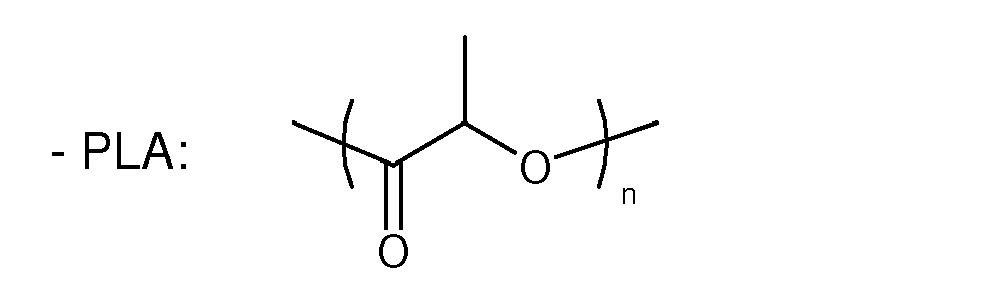

- For PLGA which comprises both lactide and glycolide units, the degree of polymerizaton is the sum of the number of lactide and glycolide units.
- More preferably, the bio-resorbable block copolymer cross-linker as defined above is of the following formula (II):
(CH2=CR7)CO-(Xn)j-PEGp-Yk-CO-(CR8=CH2) (II)
wherein: - R7 and R8 independently represent H or a C1-C6 alkyl;
- X and Y independently represent PLA, PGA or PLGA;
- n, p, and k respectively represent the degree of polymerization of X, PEG, and Y, n and k independently being integers from 1 to 150, and p being an integer from 1 to 100;
- j represents 0 or 1.
- Most preferably, the bio-resorbable block copolymer cross-linker as defined above is of a formula selected from the group consisting of:
- (CH2=CR7)CO-PLAn-PEGp-PLAk-CO-(CR8=CH2),
- (CH2=CR7)CO-PGAn-PEGp-PGAk-CO-(CR8=CH2),
- (CH2=CR7)CO-PLGAn-PEGp-PLGAk-CO-(CR8=CH2),
- (CH2=CR7)CO-PEGp-PLAk-CO-(CR8=CH2),
- (CH2=CR7)CO-PEGp-PGAk-CO-(CR8=CH2), and
- (CH2=CR7)CO-PEGp-PLGAk-CO-(CR8=CH2);
- As will be clear to one of skill in the art the polymer of the invention is a bio-resorbable (i.e. hydrolizable) cross-linked polymer. In particular the polymer of the invention is constituted of at least one chain of polymerized monomers as defined above, which at least one chain is cross-linked by bio-resorbable block copolymer cross-linkers as defined above.
- Advantageously, the polymer of the invention is swellable, i.e. has the capacity to absorb liquids, in particular water.
- As will also be clear to one of skill in the art, and by way of example, the monomers of the invention may also be represented as follows:

- Upon polymerization the monomers of the invention may then be represented as follows:

- Preferably, the monomer of formula (I) as defined above is selected from the group consisting of sec-butyl acrylate, n-butyl acrylate, t-butyl acrylate, t-butyl methacrylate, methylmethacrylate, Ndimethyl-aminoethyl(methyl)acrylate, N,N-dimethylaminopropyl-(meth)acrylate, t-butylaminoethyl (methyl)acrylate, N,N-diethylaminoacrylate, acrylate terminated poly(ethylene oxide), methacrylate terminated poly(ethylene oxide), methoxy poly(ethylene oxide) methacrylate, butoxy poly(ethylene oxide) methacrylate, acrylate terminated poly(ethylene glycol), methacrylate terminated poly(ethylene glycol), methoxy poly(ethylene glycol) methacrylate, butoxy poly(ethylene glycol) methacrylate.
- Most preferably, the monomer of formula (I) as defined above is methoxy poly(ethylene glycol) methacrylate.
- It is also preferred that the hydrophilic monomer as defined above is selected from the group consisting of (meth)acrylamide, 2-hydroxyethyl (meth)acrylate, N-vinyl-2-pyrrolidone, butyl (meth)acrylate, acrylic acid, acrylic anhydride, N-trishydroxymethyl methacrylamide, glycerol mono(meth)acrylate, hydroxypropyl (meth)acrylate, 4-hydroxybutyl (meth)acrylate.
- Besides, it is preferred that F is selected from the group constituted of COOH, COO-, SO3H, SO3 -, PO4H2, PO4H-, PO4 2-, NR11R12, NR11R12R13 +, R11, R12 and R13 independently representing H or a C1-C6 alkyl, a linear or branched alkyl group having from 1 to 20 carbon atoms, an aryl group having from 5 to 20 carbon atoms, a crown ether, and a cyclodextrin.
- It is also preferred that L and M are of the following formula:
O-T-(U)q-T' or NH-T-(U)q-T'
wherein T and T', identical or different, represent a C1-C6 alkyl chain optionally substituted by one or more hydroxyl, oxo, or amino group, U represents an hydrolysable function, such as an ester, amide or anhydride function, and q represents an integer from 0 to 2 for M and from 1 to 2 for L. - The polymer of the invention can be readily synthesized by numerous methods well-known to one of skill in the art. By way of example, the polymers of the invention can be obtained by suspension polymerization using either a direct or an inverse process as described below and in the Examples.
- A direct suspension may proceed as follows: (a) stirring or agitating a mixture comprising (i) at least one monomer as defined above, and at least one bio-resorbable block copolymer cross-linker; (ii) a polymerization initiator present in amounts ranging from 0.1 to approximately 2 parts per weight per 100 parts by weight of the monomers; (iii) a surfactant in an amount no greater than about 5 parts by weight per 100 parts by weight of the monomers, preferably no greater than about 3 parts by weight and most preferably in the range of 0.5 to 1.5 parts by weight; and (iv) water to form an oil in water suspension; and (b) polymerizing the monomer(s) and the bio-resorbable block copolymer cross-linker.
- An inverse suspension may proceed as follows: (a) stirring or agitating a mixture comprising: (i) at least one monomer as defined above, and at least one bio-resorbable block copolymer cross-linker; (ii) a polymerization initiator present in amounts ranging from 0.1 to approximately 2 parts per weight per 100 parts by weight of the monomers; (iii) a surfactant in an amount no greater than about 5 parts by weight per 100 parts by weight of the monomers, preferably no greater than about 3 parts by weight and most preferably in the range of 0.5 to 1.5 parts by weight; and (iv) oil to form a water in oil suspension; and (b) polymerizing the monomers and the bio-resorbable block copolymer cross-linker.
- As intended here the drug or prodrug as defined above can be of any type and intended for the prevention or treatment of any disease or impairment.
- Preferably, where a covalent interaction with the polymer of the invention is sought, the drug should be such that is carries a reactive function, such as a carboxyl, a hydroxyl, or an amino group. For instance, the drug may comprise an acidic functionality (propionic acid, carboxylic group, or an acetic acid carboxylic group) with a lipophilic tail composed by aryl derivatives
- As indicated above, in particular where the polymer of the invention is obtained from the polymerization at least one charged, ionisable, hydrophilic, or hydrophobic monomer, the drug may also be loaded onto the polymer, that is be adsorbed on the polymer by non-covalent interactions. No particular requirement are then imposed on the drug or prodrug to be loaded.
- Loading may proceed by numerous methods well-known to one of skill in the art. For instance, the polymer in a dry form is made to swell in a solution containing a predetermined amount of the drug or the prodrug for 1 h to 24h depending on the drug; the loaded polymer is then washed twice with a 0.9% (w/v) sodium chloride solution.
- Besides, it is preferred that the drug as defined above is an anti-cancer drug or an NSAID.
- Examples of suitable NSAIDs according to the invention encompass ibuprofen, ketoprofen, diclofenac, indomethacin or naproxen.
- Examples of suitable anti-cancer drugs according to the invention encompass mitomycin, melphalan, methotrexate, raltirexed, gemcitabine, doxorubicine, or irinotecan.
- Preferably, the polymer of the invention is in the form of a film, a foam, a particle, a lump, a thread, or a sponge, and most preferably is in the form of a spherical particle. The spherical particle is preferably a microsphere, i.e. has a diameter upon swelling (i.e. upon hydration), ranging from 1 to 5000 µm, more preferably ranging from 100 to 600 µm.
- In order to swell, the polymer of the invention may absorb, preferably in a controlled way, liquids, such as water, in particular from solutions commonly used in embolization procedures, such as physiological saline, glucose solution, plasma, ionic or non ionic iodinated contrast media, iron oxide based contrast media for magnetic resonance imaging, drug solutions, or any sterile apyrogen liquid that is injectable in the human or animal body. A defined and limited quantity of water is absorbed by the polymer of the invention, thereby enabling, where the polymer is a spherical particle, to anticipate the diameter upon swelling..
- Advantageously, the range which may be obtained for the polymer of the invention in the form of spherical particles makes it particularly suitable to block arterioles that are detectable by angiography and accessible by navigation to catheter and micro-catheters. Besides, the ability of the polymer of the invention to absorb contrast media, such as barium sulphate, tungsten or tantalum, renders it particularly useful as a radio-opaque microsphere.
- Advantageously also, resorption of the polymer of the invention depends on hydrolysis and not on an enzymatic mechanism. Resorption speed may thus be readily controlled by modulating the type and amount of bio-resorbable cross-linker and monomer as defined above.
- Equally advantageous, resorption of the polymer of the invention may range from a few hours to a few weeks depending on the type and amount of bio-resorbable cross-linker and monomer as defined above. In addition, the polymer of the invention develops only a limited local inflammatory response upon implantation, since the degradation products of the polymer are non toxic and quickly eliminated.
- Accordingly, the pharmaceutical composition as defined above is preferably for use as an implant, in particular for implantation into tissues, internal anatomical spaces, such as peritoneum and meningeal spaces, body cavities, ducts and vessels.
- Besides, the pharmaceutical composition as defined above is preferably in an injectable form.
- Preferably also, the pharmaceutical composition comprises the polymer of the invention in a dry form, such as a lyophilized form.
- The pharmaceutical composition of the invention will be preferably used in the frame of embolization, in particular for uterine artery embolization (UAE), or for haemostasis. In embolization, the polymer of the invention need not comprise drugs or be loaded with drugs.
- The pharmaceutical composition of the invention is also preferably used for treating cancer. In this case, treatment may occur by embolization, in particular by repeated embolization, and/or by delivery of anti-cancer drugs or predrugs comprised in the polymer of the invention or loaded on the polymer of the invention.
- Besides, the pharmaceutical composition of the invention may be preferably used for preventing or treating inflammation. In this case, it is preferred that the polymer of the invention comprises NSAIDs or be loaded by NSAIDs. In particular, the pharmaceutical composition of the invention is particularly suited for preventing or treating inflammation associated with:
- joints cavities, tendons, cartilage, and bone defects;
- operative cavities after surgery of brain, in maxillar bone after teeth extraction, in bone after resections, in liver or kidney after surgical tumor resection;
- muscles, in particular in cases of myositis or rupture;
- cerebrospinal fluid cavities in the central nervous system;
- joint surgery, arthroscopy, intrarticular lavage, menisectomy, osteotomy.
-
- First step:
- In a dry schlenk containing a magnetic stirring bar, lactide (2.2232 g ; 0.0154 mol) and hydroxyethyl methacrylate (0.75 mL; 0.0062 mol) were dissolved in 5ml of toluene under nitrogen. The reaction was initiated by introducing a toluene solution of Sn(Oct)2 (8mg) into the above system. After 20h at 90°C, 5ml of chloroform was added to dilute the reaction mixture and the formed polymer was purified by precipitating in a large volume of petroleum ether. Yield 94%.
- Characterization by 1H NMR in CD3COCD3: 1.53 (m, CH3, PLA), 1.91 (s, CH3, methacrylate), 4.38 (m, CH2, HEMA), 5.17 (m, CH, PLA), 5.65-6.10 (m, CH2=C)
- Second step:
- The polymer formed in the first step was further modified through the hydroxyl group at the end of PLA chain by reacting with methacryloyl chloride. The preformed polymer (1.07mmol of OH group, 1 eq.) was dissolved in anhydrous CH2Cl2 (2.5ml) in a three necked flask equipped with magnetic stirrer and a dropping funnel. The content of the flask was cooled to 0°C and triethylamine (1.5eq.; 0.0016 mol) was added. The solution was stirred and then methacryloyl chloride (1.5eq.; 0.0016 mol) in CH2Cl2 (2.5ml) was added dropwise to the solution. The stirring was continued 1 h at 0°C and then one night at room temperature. The triethylamine salt was removed by filtration and the polymer was precipitated in a large volume of petroleum ether. Yield: 95%.
- Characterization by 1H NMR in CD3COCD3: 1.53 (m, CH3, PLA), 1.91 (m, CH3, methacrylate), 4.39 (m, CH2, HEMA), 5.17 (m, CH, PLA), 5.65-6.16 (m, CH2=C)
-
- First step:
- In a dry schlenk containing a magnetic stirring bar, glycolide (0.6 g ; 0.005 mol) and hydroxyethyl methacrylate (21 mg ; 0.0016 mol) were dissolved in 2ml of toluene under nitrogen. The reaction was initiated by introducing a toluene solution of Sn(Oct)2 (5mg) into the above system. After 20h at 90°C, 5ml of chloroform was added to dilute the reaction mixture and the formed polymer was purified by precipitating in a large volume of petroleum ether. Yield 96%.
- Characterization by 1H NMR in CD3COCD3: 1.91 (s, CH3, methacrylate), 4.38 (m, CH2, HEMA), 4.80 (m, CH2, PGA), 5.65-6.09 (s, CH2=C)
- Second step:
- The polymer formed in the first step was further modified through the hydroxyl group at the end of PGA chain by reacting with methacryloyl chloride. The preformed polymer (1 mmol of OH group, 1 eq.) was dissolved in anhydrous CH2Cl2 (2 ml) in a three necked flask equipped with magnetic stirrer and a dropping funnel. The content of the flask was cooled to 0°C and triethylamine (1.5eq.; 0.0015 mol) was added. The solution was stirred and then methacryloyl chloride (1.5eq.; 0.0015 mol) in CH2Cl2 (2 ml) was added dropwise to the solution. The stirring was continued 1h at 0°C and then one night at room temperature. The triethylamine salt was removed by filtration and the polymer was precipitated in a large volume of petroleum ether. Yield: 50%.
- Characterization by 1H NMR in CD3COCD3: 1.90 (m, CH3, methacrylates), 4.40 (m, CH2, HEMA), 4.81 (m, CH2, PGA), 5.65-6.16 (m, CH2=C)
-
- First step:
- In a dry schlenk containing a magnetic stirring bar, lactide (1.18g; 8.23mmol), glycolide (0.95g; 8.23mmol) and hydroxyethyl methacrylate (0.53g; 4.1 mmol) were dissolved in 5ml of toluene under nitrogen. The reaction was initiated by introducing a toluene solution of Sn(Oct)2 (8mg) into the above system. After 20h at 90°C, 5ml of chloroform was added to dilute the reaction mixture and the formed polymer was purified by precipitating in a large volume of petroleum ether.
- Characterization by 1H NMR in CD3COCD3: 1.49 (m, CH3, PLA), 1.92 (s, CH3, methacrylate), 4.44 (m, CH2, HEMA), 4.83 (m, CH2, PGA), 5.25 (m, CH, PLA), 5.65-6.10 (s, CH2=C)
- Second step:
- The polymer formed in the first step was further modified through the hydroxyl group at the end of PLGA chain by reacting with methacryloyl chloride. In a typical reaction, the preformed polymer (8.23mmol of OH group, 1eq.) was dissolved in anhydrous CH2Cl2 (20ml) in a three necked flask equipped with magnetic stirrer and a dropping funnel. The content of the flask was cooled to 0°C and triethylamine (1.5eq.; 12.34mmol) was added. The solution was stirred and then methacryloyl chloride (1.5eq.; 12.34mmol) in CH2C12 (10ml) was added dropwise to the solution. The stirring was continued 1 h at 0°C and then one night at room temperature. The triethylamine salt was removed by filtration and the polymer was precipitated in a large volume of petroleum ether.
- Characterization by 1H NMR in CD3COCD3: 1.51 (m, CH3, PLA), 1.92 (s, CH3, methacrylates), 4.44 (m, CH2, HEMA), 4.83 (m, CH2, PGA), 5.25 (m, CH, PLA), 5.65-6.16 (m, CH2=C)
- Synthesis reactions are summarized in the following scheme:


-
- First step:
- In a dry schlenk containing a magnetic stirring bar, the tetraethyleneglycol (0.139g ; 0.0007 mol) was reacted with d,I-lactide (1.032 g ; 0.0072 mol) for 20h at 115°C using stannous octoate as catalyst (5 mg) under nitrogen. Then, the polymer was dissolved in chloroform, precipitated in a large volume of petroleum ether.
- Characterization by 1H NMR in CD3COCD3: 1.54 (m, CH3, PLA), 3.64 (m, CH2, PEG), 4.26 (m, CH2, PEG), 5.16 (m, CH, PLA)
- Second step:
- The polymer formed in the first step was further modified through the hydroxyl groups at the end of PLA chNSAID by reacting with methacryloyl chloride. In a typical reaction, the preformed polymer was dissolved in anhydrous CH2Cl2 (10ml) in a three necked flask equipped with magnetic stirrer and a dropping funnel. The content of the flask was cooled to 0°C and triethylamine (1.5eq.; 0,0018 mol) was added. The solution was stirred and then methacryloyl chloride (1.5eq.; 0,0018 mol) in CH2Cl2 (5ml) was added dropwise to the solution. The stirring was continued 1h at 0°C and then one night at room temperature. The triethylamine salt was removed by filtration and the polymer was precipitated in a large volume of petroleum ether.
- Characterization by 1H NMR in CD3COCD3: 1.56 (m, CH3, PLA), 1.97 (m, CH3, methacrylate), 3.65 (m, CH2, PEG), 4.29 (m, CH2, PEG), 5.17 (m, CH, PLA), 5.64-6.20 (m, CH2=C).
-
- First step:
- In a dry schlenk containing a magnetic stirring bar, the PEG1500 (2.25 g; 0.0015 mol) was reacted with d,l-lactide (0.865 g ; 0.006 mol) and glycolide (0.697 g; 0.006 mol) for 20h at 115°C using stannous octoate as catalyst (10 mg) under nitrogen. Then, the polymer was dissolved in chloroform, precipitated in a large volume of petroleum ether.
- Characterization by 1H NMR in CD3COCD3: 1.55 (m, CH3, PLA), 3.64 (m, CH2, PEG), 4.25 (m, CH2, PEG), 4.84 (m, CH2, PGA), 5.20 (m, CH, PLA)
- Second step:
- The polymer formed in the first step was further modified through the hydroxyl groups at the end of PLA chNSAID by reacting with methacryloyl chloride. In a typical reaction, the preformed polymer was dissolved in anhydrous CH2Cl2 (20ml) in a three necked flask equipped with magnetic stirrer and a dropping funnel. The content of the flask was cooled to 0°C and triethylamine (1.5eq.; 0.0045 mol) was added. The solution was stirred and then methacryloyl chloride (1.5eq.; 0.0045 mol) was added dropwise to the solution. The stirring was continued 1 h at 0°C and then one night at room temperature. The triethylamine salt was removed by filtration and the polymer was precipitated in a large volume of petroleum ether/diethylether.
- Characterization by 1H NMR in CD3COCD3: 1.56 (m, CH3, PLA), 1.94 (m, CH3, methacrylate), 3.63 (m, CH2, PEG), 4.29 (m, CH2, PEG), 4.86 (m, CH2, PGA), 5.23 (m, CH, PLA), 5.64-6.15 (m, CH2=C)
- Synthesis reactions are summarized in the following scheme:


- A 0.5% of aqueous solution of 88% hydrolyzed polyvinylalcohol (90ml) was introduced into a 100ml reactor and allowed to stand under a nitrogen atmosphere for 15min. The monomer phase containing polyethylene glycol methacrylate (2.77g), PLA cross-linker (0.7g) and 1wt% AIBN solubilized in 4.3ml of xylene was degassed by bubbling nitrogen through the solution for 15min. The monomer phase was added to the aqueous phase at 50°C and agitated by means of a propeller type stirrer at an appropriate velocity so as to obtain monomer droplets of desired diameter. The temperature was increased to 80°C and stirred for 5h. The mixture was filtered hot and washed with water and acetone. Then, beads were freeze dry. Size 390±100µm.
- A 0.75% of aqueous solution of 88% hydrolyzed polyvinylalcohol (220ml) was introduced into a 1000ml reactor and allowed to stand under a nitrogen atmosphere for 15min. The monomer phase containing polyethylene glycol methacrylate (5.9g; 19.6mmol), PLGA cross-linker (1g; 1.7mmol) and 1wt% AIBN solubilized in 10ml of toluene was degassed by bubbling nitrogen through the solution for 15min. The monomer phase was added to the aqueous phase at 50°C and agitated by means of a propeller type stirrer at an appropriate velocity so as to obtain monomer droplets of desired diameter. The temperature was increased to 80°C and stirred for 5h. The mixture was filtered hot and washed with water and acetone. Then, beads were freeze dry. Size = 246 ± 150 µm.
- A 0.5% of aqueous solution of 88% hydrolyzed polyvinylalcohol (90ml) was introduced into a 100ml reactor and allowed to stand under a nitrogen atmosphere for 15min. The monomer phase containing polyethylene glycol methacrylate (3.252g), PLA cross-linker (0.36g) and 1wt% AIBN solubilized in 4.3ml of xylene was degassed by bubbling nitrogen through the solution for 15min. The monomer phase was added to the aqueous phase at 50°C and agitated by means of a propeller type stirrer at an appropriate velocity so as to obtain monomer droplets of desired diameter. The temperature was increased to 80°C and stirred for 5h. The mixture was filtered hot and washed with water and acetone. Then, beads were freeze dry. Size 450±100µm.
- Synthesis reactions are summarized in the following scheme:

- 50mg of dried microspheres were weighed and immersed in 10ml of PBS solution in individual vials kept at 37°C or 70°C. Samples were removed at designed times and immediately freezed to stop the degradation process. 6 samples were removed at each time point to gauge the variability in the degrading samples. The pH of each sample solution was measured and the mechanical properties of microspheres were determined using a compression method with a TAX-T2 apparatus. The results are presented in the following table.
Microspheres Cross-linker Size (µm) Degradation time (days) P1 HEMA-PGA (4%) 100-300 8 P2 HEMA-PLGA (4%) 300-500 35 P3 HEMA-PLGA (4%) 100-300 14 P4 HEMA-PLGA (6%) 100-300 28 - Rigidity and elasticity are dominant parameters for injectability and repartition of embolization microsphere in a given vascular network.
- As illustrated in the following table, the microspheres of the invention, upon swelling in an appropriate medium, such as such as saline, glucose solution, contrast media and mixtures of them, present mechanical performances of rigidity and elasticity which are adapted to the technical conditions of embolization and which compare to current commercialized microspheres: rigid to resist to the compression during the injection in syringes and catheters (microcatheters with an internal diameter mini 0.7 mm) and an elastic to regain its shape quickly after a deformation.
Embosphere® Embozene® Hepasphere® Microspheres of the invention (P2) Young modulus (MPa) 3.79±0.6 1.93±0.8 2.6 3.64±0.87 Yield strength (MPa) 1.28±0.4 0.1±0.06 0.22±0.13 0.33±0.18 - Microspheres prepared as indicated above (P1, cross-linker HEMA-PGA, 200µm, 2g sterilised, size 100-300µm) were sterilized at 120°C 20 min and were suspended in a mixture of saline and iodinated contrast medium (250 mg in 4 ml) and injected by a 1 mL syringe slowly in the renal flow with a microcatheter which tip was prealably positioned in the ostium of renal arteries in a pig. There was no blockade of the microcatheter and no resistance during manual injection of the microspheres suspension. At the end of embolisation an occlusion of the arteries in the embolised segment was observed on the angiographic control. Animal was sacrificed at 48H and kidneys sampled. Under pathologic microscopical examination microsphere were visible in kidneys. They occluded completely the vessel lumens of several interlobular arteries. They looked as clear spheres. Some inflammatory cells were present on the microspheres.
- The following reaction was performed:

- In a round bottom flask containing a magnetic stirring bar, ibuprofen (0.34g; 1.65mmol) and 4-Dimethylaminopyridine (0.01 g; 0.09mmol) were solubilized in dry CH2Cl2 (4ml) under nitrogen atmosphere. Hydroxyethyl methacrylate (0.21g; 1.65mmol) and a mixture of dicyclohexylcarbodiimide (0.34g; 1.65mmol) dissolved in 2ml of dry CH2Cl2 were sequentially added at 0°C. After reacting 24h at 0°C, the mixture was filtrate and the crude product was purified on silica gel column (cyclohexane/ethyl acetate: 2/1).
- Characterization by 1H NMR in CD3COCD3: 0.88 (d, CH3, isopropyl), 1.43 (d, CH3 -CH, ibuprofen), 1.85 (m, CH3, methacrylate + CH-iPr, ibuprofen), 2.44 (d, CH2-phenyl, ibuprofen), 3.75 (q, phenyl-CH-COO-, ibuprofen), 4.31 (m, CH2, HEMA), 5.59-5.98 (m, CH2=C), 7.16 (dd, C6H4)
- The following reaction was performed:

- Glycidyl methacrylate (1.348 g ; 9.5 mmol), ibuprofen (1.955 g ;9.5 mmol), hydroquinone (0.2g) and pyridine (2ml) were dissolved in 5ml of DMF. The mixture was shaken under vacuum at 40°C for 6h. Then, the mixture was cooled and poured in aqueous saturated NaHCO3 solution (20ml). The organic phase was extracted three times by ethyl acetate, washed with saturated NaCl solution, dried on MgSO4 and the solvent evaporated under reduced pressure. The residue was purified by chromatography (ethyl acetate / cyclohexane: 1/5). Yield : 40%.
- Characterization by 1H NMR in CDCl3: 0.89 (d, CH3, isopropyl), 1.51 (d, CH 3-CH, ibuprofen), 1.85 (m, CH-iPr, ibuprofen), 1.94 (s, CH3, methacrylate), 2.45 (d, CH2 -phenyl, ibuprofen), 3.75 (q, phenyl-CH-COO-, ibuprofen), 4.08-4.19 (m, CH2-CH(OH)-CH2 ), 5.60-6.12 (m, CH2=C), 7.16 (dd, C6H4)
- The following reaction was performed:

- A 0.75% of aqueous solution of 88% hydrolyzed polyvinylalcohol (220ml) was introduced into a 1000ml reactor and allowed to stand under a nitrogen atmosphere for 15min. The monomer phase containing HEMA-iBu (1.6g; 5mmol), polyethylene glycol methacrylate (5.9g; 19.6mmol), PLGA cross-linker (1g; 1.7mmol) and 1wt% AIBN solubilized in 10ml of toluene was degassed by bubbling nitrogen through the solution for 15min. The monomer phase was added to the aqueous phase at 50°C and agitated by means of a propeller type stirrer at an appropriate velocity so as to obtain monomer droplets of desired diameter. The temperature was increased to 80°C and stirred for 5h. The mixture was filtered hot and washed with water and acetone. Then, beads were freeze dry.
- The characteristics of the prepared microspheres are summarized in the following table:
Microspheres Cross-linker iBu size P5 HEMA-PLGA(8%) 20 40-100 P6 TEG-PLGA (5%) 20 40-100 P7 TEG-PLGA (3%) 43 40-100 - 220mg of ibuprofen loaded microspheres (P6) was suspended in a vial containing 30ml of PBS (pH7.4). The vial was incubated at 37 °C with constant shaking. At time intervals, the vial was centrifugated for 10s and sample (100µl) from the releasing medium was withdrawn for UV and HPLC analyses. The withdraw volume was replaced with fresh buffer followed by resuspending before continuing incubation.
Microspheres % iBu released Day30 Day60 Day90 P6 TEG-PLGA (5%)-20% iBu 6 8 14 P7 TEG-PLGA (3%) 43% iBu 1 1.5 2 - An implantation study of microspheres was performed in sheep shoulder joints (gleno-humeral joint). Two species of microspheres (40 - 100 µm) were injected: resorbable micospheres (P8-TEG-PLGA 6% with PEGMMA 300) and non-resorbable MS (P9-PEGdiacrylate (M=575) 6% with PEGMMA 300) which are inflammatory. One week and one month after intra-articular injection, the synovial inflammatory reaction induced by resorbable microspheres was compared to inflammation triggered with non-resorbable microspheres.
- In sterile conditions, depyrogenised and sterilized microspheres were suspended in physiological serum. Then, 1 mL sterile sringes were loaded with a volume of microphere pellet corresponding to 50 mg of dry microspheres. Under general anesthesia, synovial fluid ponction was perfomed on the right souhlder from 6 adult sheeps (3 - 4 years old), then the syringe containing microspheres was placed on the needle located in the joint cavity. MS were injected slowly in the articular space.
- After one and four weeks, animals (3 per group) were sacrified and synovial fluid from shoulder was recovered. The whole shoulder joints were removed and fixed in formalin 10 %. Then, synovial tissues were cut and stained with haematoxylin/eosin for microscopic observation.
- In the joint, the injected microspheres were located either into the synovial fluid or in the synovial lining of joint. Migration of microspheres to the synovial lining of capsule did not induce cell proliferation. The inflammatory response of synovial tissue to the resorbable MS was compared to inflammation induced by non-resorbable MS. Cells surrounding the MS incorporated into the synovial lining was numbered (0.1 mm2 field). After one week, 253+/-57 cells were observed around non-resorbable MS, whereas only 83 +/- 15 cells were observed around resorbable MS (p < 0.0001). One month after injection, 172 +/-34 cells surround non-resorbable MS compared to 98 +/-36 cells for resorbable MS (p = 0.0005)., The absence of giant cells around the resorbable MS confirmed the low level of inflammation induce in joint with these resorbables particles, by opposition to what was observed on non-resorbable microspheres.
- In the synovial fluid, at one month after injection, microspheres fragments, which are absent at one week, indicated that uncomplete microsphere resorption had occurred.
- Histology showed that resorbable MS migrate into the synovial lining and these immobilized MS are well tolerated by the synovial tissues of shoulder joint without significant cell proliferation. Furthermore, resorption of microspheres did not induce an inflammatory response.
- A 0.5% of aqueous solution of 88% hydrolyzed polyvinylalcohol (300ml) was introduced into a 500ml reactor and allowed to stand under a nitrogen atmosphere for 15min. The monomer phase containing methacrylic acid (2.33g ; 27.07 mmol), polyethylene glycol methacrylate (8.05g ; 26.83 mmol), PLGA cross-linker (1.32 g ; 2.24 mmol) and 1wt% AIBN solubilized in 14ml of toluene was degassed by bubbling nitrogen through the solution for 15min. The monomer phase was added to the aqueous phase at 50°C and agitated by means of a propeller type stirrer at an appropriate velocity so as to obtain monomer droplets of desired diameter. The temperature was increased to 80°C and stirred for 5h. The mixture was filtered hot and washed with water and acetone. Then, beads were freeze dry.
- A solution of Span80® (1 %) dissolved in 200ml of cyclohexane was introduced into a 2000ml reactor and allowed to stand under a nitrogen atmosphere for 15min. The monomer phase containing acrylic acid (2.4g ; 33.3 mmol), N,N-dim6thylacrylamide (4g ; 40.35 mmol), PEG-PLGA cross-linker (3 g) and 1wt% ammonium peroxyde disulfate solubilized in 28ml of water was degassed by bubbling nitrogen through the solution for 15min. The monomer phase was added to the organic phase at ambient temperature and agitated by means of a propeller type stirrer at an appropriate velocity so as to obtain monomer droplets of desired diameter. The temperature was increased to 70°C and stirred for 2h. The mixture was filtered hot and washed with water and acetone. Then, beads were freeze dry.
Claims (22)
- A polymer obtained from the polymerization of:(i) at least one monomer of formula (1)
(CH2=CR1)CO-K (I)
wherein:- K represents O-Z or NH-Z, Z representing (CR2R3)m-CH3, (CH2-CH2-O)m-OH,
(CH2-CH2-O)m-OCH3, (CH2)m-NR4R5 with m representing an integer from 1 to 30;- R1, R2, R3, R4 and R5 independently represent H or a C1-C6 alkyl;and(ii) at least one bio-resorbable block copolymer cross-linker. - The polymer according to claim 1, wherein the bio-resorbable block copolymer cross-linker is linear and presents (CH2=(CR6))- groups at both its extremities, wherein R6 independently represents H or a C1-C6 alkyl.
- The polymer according to claim 1 or 2, wherein the block of the bio-resorbable block copolymer cross-linker is selected from the groups consisting of polyethylene glycol (PEG), poly-lactic acid (PLA), poly-glycolic acid (PGA) and poly-lactic-glycolic acid (PLGA).
- The polymer according to any of claims 1 to 3, wherein the bio-resorbable block copolymer cross-linker is of the following formula (II):
(CH2=CR7)CO-(Xn)j-PEGp-Yk-CO-(CR8=CH2) (II)
wherein:- R7 and R8 independently represent H or a C1-C6 alkyl;- X and Y independently represent PLA, PGA or PLGA;- n, p, and k respectively represent the degree of polymerization of X, PEG, and Y, n and k independently being integers from 1 to 150, and p being an integer from 1 to 100;- j represents 0 or 1. - The polymer according to any of claims 1 to 4, wherein the bio-resorbable block copolymer cross-linker is of a formula selected from the group consisting of:(CH2=CR7)CO-PLAn-PEGp-PLAk-CO-(CR8=CH2),(CH2=CR7)CO-PGAn-PEGp-PGAk-CO-(CR8=CH2),(CH2=CR7)CO-PLGAn-PEGp-PLGAk-CO-(CR8=CH2),(CH2=CR7)CO-PEGp-PLAk-CO-(CR8=CH2),(CH2=CR7)CO-PEGp-PGAk-CO-(CR8=CH2), and(CH2=CR7)CO-PEGp-PLGAk-CO-(CR8=CH2);
wherein R7, R8, n, p and k are as defined in claim 4. - The polymer according to any of claims 1 to 5, wherein the monomer of formula (I) is selected from the group consisting of sec-butyl acrylate, n-butyl acrylate, t-butyl acrylate, t-butyl methacrylate, methylmethacrylate, Ndimethyl-aminoethyl(methyl)acrylate, N,N-dimethylaminopropyl-(meth)acrylate, t-butylaminoethyl (methyl)acrylate, N,N-diethylaminoacrylate, acrylate terminated poly(ethylene oxide), methacrylate terminated poly(ethylene oxide), methoxy poly(ethylene oxide) methacrylate, butoxy poly(ethylene oxide) methacrylate, acrylate terminated poly(ethylene glycol), methacrylate terminated poly(ethylene glycol), methoxy poly(ethylene glycol) methacrylate, butoxy poly(ethylene glycol) methacrylate.
- The polymer according to any of claims 1 to 6, wherein the monomer of formula (I) is methoxy poly(ethylene glycol) methacrylate.
- The polymer according to any of claims 1 to 7, obtained from the polymerization of the at least one monomer, the at least one bio-resorbable block copolymer cross-linker, and at least one further monomer selected from the list comprising:(i) a drug-carrying monomer of the following formula (III):
(CH2=CR9)CO-L-D (III)
wherein:- R9 represents H or a C1-C6 alkyl;- L represents a linker moiety having from 1 to 20 carbon atoms comprising a hydrolyzable function linked to the D group;- the D group represents a drug or a prodrug; and(ii) a charged, ionisable" hydrophilic, or hydrophobic monomer of the following formula (V):
(CH2=CR11)CO-M-F (V)
wherein:- R11 represents H or a C1-C6 alkyl;- M represents a single bond or a linker moiety having from 1 to 20 carbon atoms;- F represents a charged, ionisable" hydrophilic, or hydrophobic group having 100 atoms at the most. - The polymer according to claim 8, obtained from the polymerization of the at least one monomer, the at least one bio-resorbable block copolymer cross-linker, and the drug-carrying monomer.
- The polymer according to claim 8 or 9, obtained from the polymerization of the at least one monomer, the at least one bio-resorbable block copolymer cross-linker, the at least one drug-carrying monomer, optionally the at least one charged, ionisable, hydrophilic, or hydrophobic monomer, and at least one hydrophilic monomer of the following formula (IV):
(CH2=CR10)CO-Q (IV)
wherein:- R10 represents H or a C1-C6 alkyl;- Q represents a C1-C100 alkyl optionally substituted by at least one substituent selected from the group consisting of an hydroxyl, an oxo or an amino function. - The polymer according to claim 10, wherein the hydrophilic monomer is selected from the group consisting of (meth)acrylamide, 2-hydroxyethyl (meth)acrylate, N-vinyl-2-pyrrolidone, butyl (meth)acrylate, acrylic acid, acrylic anhydride, N-trishydroxymethyl methacrylamide, glycerol mono(meth)acrylate, hydroxypropyl (meth)acrylate, 4-hydroxybutyl (meth)acrylate.
- The polymer according to claim 8, obtained from the polymerization of the at least one monomer, the at least one block copolymer cross-linker, and the at least one charged, ionisable" hydrophilic, or hydrophobic monomer.
- The polymer according to any of claims 8, and 10 to 12, wherein F is selected from the group constituted of COOH, COO-, SO3H, SO3 -, PO4H2, PO4H-, PO4 2-, NR11R12, NR11R12R13 +, R11, R12 and R13 independently representing H or a C1-C6 alkyl, a linear or branched alkyl group having from 1 to 20 carbon atoms, an aryl group having from 5 to 20 carbon atoms, a crown ether, and a cyclodextrin.
- The polymer according to any of claims 8, and 10 to 12, loaded with a drug or a prodrug.
- The polymer according to any of claim 8 to 11 and 14, wherein the drug or the prodrug is an anti-cancer drug.
- The polymer according to any of claims 8 to 11 and 14, wherein the drug or the prodrug is an NSAID.
- The polymer according to any of claims 1 to 16, which is in the form of a film, a foam, a particle, in particular a spherical particle, a lump, a thread, or a sponge.
- A pharmaceutical composition comprising at least one polymer according to any of claim 1 to 17, in association with a pharmaceutically acceptable carrier.
- The pharmaceutical composition according to claim 18, for use as an implant.
- The pharmaceutical composition according to claim 18 or 19, in an injectable form.
- The pharmaceutical composition according to any of claims 18 to 20, for implantation into tissues, internal anatomical spaces, body cavities, ducts and vessels.
- The pharmaceutical composition according to any of claims 18 to 21, for treating inflammation or cancer.
Priority Applications (14)
| Application Number | Priority Date | Filing Date | Title |
|---|---|---|---|
| EP09305830A EP2295480A1 (en) | 2009-09-10 | 2009-09-10 | Implantable bio-resorbable polymer |
| PCT/EP2010/063227 WO2011029867A1 (en) | 2009-09-10 | 2010-09-09 | Implantable bio-resorbable polymer |
| CN2010800456866A CN102597030B (en) | 2009-09-10 | 2010-09-09 | Implantable Bioabsorbable Polymers |
| CA2773499A CA2773499C (en) | 2009-09-10 | 2010-09-09 | Implantable bio-resorbable polymer |
| BR112012005280A BR112012005280B8 (en) | 2009-09-10 | 2010-09-09 | Polymer and pharmaceutical composition |
| KR1020127009158A KR101585588B1 (en) | 2009-09-10 | 2010-09-09 | Implantable bio-resorbable polymer |
| US13/395,610 US9320804B2 (en) | 2009-09-10 | 2010-09-09 | Implantable bio-resorbable polymer |
| EP10750132.2A EP2475695B1 (en) | 2009-09-10 | 2010-09-09 | Implantable bio-resorbable polymer |
| IN2064DEN2012 IN2012DN02064A (en) | 2009-09-10 | 2010-09-09 | |
| JP2012528358A JP5792729B2 (en) | 2009-09-10 | 2010-09-09 | Implantable bioabsorbable polymer |
| AU2010294246A AU2010294246B2 (en) | 2009-09-10 | 2010-09-09 | Implantable bio-resorbable polymer |
| SG2012016515A SG179057A1 (en) | 2009-09-10 | 2010-09-09 | Implantable bio-resorbable polymer |
| ES10750132.2T ES2472426T3 (en) | 2009-09-10 | 2010-09-09 | Implantable bioabsorbable polymer |
| ZA2012/01752A ZA201201752B (en) | 2009-09-10 | 2012-03-09 | Implantable bio-resorbable polymer |
Applications Claiming Priority (1)
| Application Number | Priority Date | Filing Date | Title |
|---|---|---|---|
| EP09305830A EP2295480A1 (en) | 2009-09-10 | 2009-09-10 | Implantable bio-resorbable polymer |
Publications (1)
| Publication Number | Publication Date |
|---|---|
| EP2295480A1 true EP2295480A1 (en) | 2011-03-16 |
Family
ID=41531626
Family Applications (2)
| Application Number | Title | Priority Date | Filing Date |
|---|---|---|---|
| EP09305830A Withdrawn EP2295480A1 (en) | 2009-09-10 | 2009-09-10 | Implantable bio-resorbable polymer |
| EP10750132.2A Active EP2475695B1 (en) | 2009-09-10 | 2010-09-09 | Implantable bio-resorbable polymer |
Family Applications After (1)
| Application Number | Title | Priority Date | Filing Date |
|---|---|---|---|
| EP10750132.2A Active EP2475695B1 (en) | 2009-09-10 | 2010-09-09 | Implantable bio-resorbable polymer |
Country Status (13)
| Country | Link |
|---|---|
| US (1) | US9320804B2 (en) |
| EP (2) | EP2295480A1 (en) |
| JP (1) | JP5792729B2 (en) |
| KR (1) | KR101585588B1 (en) |
| CN (1) | CN102597030B (en) |
| AU (1) | AU2010294246B2 (en) |
| BR (1) | BR112012005280B8 (en) |
| CA (1) | CA2773499C (en) |
| ES (1) | ES2472426T3 (en) |
| IN (1) | IN2012DN02064A (en) |
| SG (1) | SG179057A1 (en) |
| WO (1) | WO2011029867A1 (en) |
| ZA (1) | ZA201201752B (en) |
Cited By (14)
| Publication number | Priority date | Publication date | Assignee | Title |
|---|---|---|---|---|
| CN102304200A (en) * | 2011-05-27 | 2012-01-04 | 中国海洋石油总公司 | Crosslinked polymer microspheres and preparation method thereof |
| CN103113533A (en) * | 2013-02-01 | 2013-05-22 | 中国科学院长春应用化学研究所 | Polylactic acid copolymer and preparation method thereof, and modified polylactic acid |
| WO2015042461A1 (en) | 2013-09-19 | 2015-03-26 | Microvention, Inc. | Polymer particles |
| WO2015196984A1 (en) * | 2014-06-23 | 2015-12-30 | 李茂全 | Use of polylactic acid microsphere for hemorrhagic diseases |
| CN106543992A (en) * | 2016-09-30 | 2017-03-29 | 成都西油华巍科技有限公司 | A kind of polymer for drilling fluid microsphere sealing agent and preparation method thereof |
| CN106573997A (en) * | 2014-08-08 | 2017-04-19 | S.P.C.M.股份公司 | Water-soluble hydroxyalkyl polymer obtained by a method of inverse suspension or inverse emulsion polymerisation |
| EP2643382A4 (en) * | 2010-11-23 | 2017-10-04 | Howard University | Biodegradable stealth polymeric particles fabricated using the macromonomer approach by free radical dispersion polymerization |
| CN109843941A (en) * | 2016-06-23 | 2019-06-04 | 科罗拉多大学董事会,法人团体 | Polymer network structure is controlled by nanogel |
| CN111150879A (en) * | 2019-12-31 | 2020-05-15 | 华中科技大学鄂州工业技术研究院 | A kind of embolizing agent for promoting coagulation and X-ray imaging and its preparation method and application |
| US10729805B2 (en) | 2016-09-28 | 2020-08-04 | Terumo Corporation | Drug delivery polymer particles with hydrolytically degradable linkages |
| US10792390B2 (en) | 2015-03-26 | 2020-10-06 | Microvention, Inc. | Particles |
| CN112934198A (en) * | 2021-01-29 | 2021-06-11 | 浙江理工大学 | Cyclodextrin porous adsorption material and preparation method and application thereof |
| US11104772B2 (en) | 2013-09-19 | 2021-08-31 | Microvention, Inc. | Polymer films |
| US11261274B2 (en) | 2013-11-08 | 2022-03-01 | Terumo Corporation | Polymer particles |
Families Citing this family (8)
| Publication number | Priority date | Publication date | Assignee | Title |
|---|---|---|---|---|
| AU2012224525B2 (en) | 2011-03-09 | 2016-05-05 | Assistance Publique - Hopitaux De Paris | Implantable bio-resorbable polymer charged with fragile macromolecules |
| AU2012224524B2 (en) | 2011-03-09 | 2016-03-31 | Assistance Publique - Hopitaux De Paris | Implantable swellable bio-resorbable polymer |
| CN103709386B (en) * | 2012-10-09 | 2016-03-30 | 上海微创医疗器械(集团)有限公司 | Polydactyl acid biodegradable stent and preparation method thereof |
| CN104558419B (en) * | 2014-09-27 | 2017-07-11 | 温州大学 | A kind of preparation method of environment sensitive type cyclodextrine derivatives hydrogel |
| EP3411422A1 (en) | 2016-02-05 | 2018-12-12 | The General Hospital Corporation | Drug eluting polymer composed of biodegradable polymers applied to surface of medical device |
| US10376469B2 (en) | 2016-02-17 | 2019-08-13 | Biosphere Medical, Inc. | Microspheres containing therapeutic agents and related methods of use |
| WO2019035975A1 (en) * | 2017-08-16 | 2019-02-21 | Biosphere Medical, Inc. | Microspheres containing therapeutic agents and related methods of use |
| WO2022047544A1 (en) * | 2020-09-04 | 2022-03-10 | IP Cornerstone Pty Ltd | Minimally invasive treatment of osteoarthritis and other conditions |
Citations (6)
| Publication number | Priority date | Publication date | Assignee | Title |
|---|---|---|---|---|
| WO2005079856A1 (en) * | 2004-02-23 | 2005-09-01 | The University Of British Columbia | Drug delivery compositions comprising hydrophobic polymers and amphipathic molecules |
| JP2005330246A (en) * | 2004-05-21 | 2005-12-02 | Toray Ind Inc | Pharmaceutical composition comprising a swellable hydrogel matrix |
| WO2006045183A1 (en) * | 2004-10-25 | 2006-05-04 | The University Of British Columbia | Polymer barrier compositions for surgical wounds |
| WO2007024323A2 (en) * | 2005-06-17 | 2007-03-01 | The University Of North Carolina At Chapel Hill | Nanoparticle fabrication methods, systems, and materials |
| CN101265311A (en) * | 2008-05-07 | 2008-09-17 | 天津大学 | Preparation method of PVP-PEG-PLA shell cross-linked nano micelles |
| WO2009132206A1 (en) * | 2008-04-25 | 2009-10-29 | Liquidia Technologies, Inc. | Compositions and methods for intracellular delivery and release of cargo |
Family Cites Families (2)
| Publication number | Priority date | Publication date | Assignee | Title |
|---|---|---|---|---|
| GB0131112D0 (en) * | 2001-12-31 | 2002-02-13 | Univ London Pharmacy | Block copolymers |
| FI20060077A7 (en) * | 2006-01-26 | 2007-07-27 | Jvs Polymers Oy | Use of biodegradable polymers |
-
2009
- 2009-09-10 EP EP09305830A patent/EP2295480A1/en not_active Withdrawn
-
2010
- 2010-09-09 SG SG2012016515A patent/SG179057A1/en unknown
- 2010-09-09 WO PCT/EP2010/063227 patent/WO2011029867A1/en not_active Ceased
- 2010-09-09 US US13/395,610 patent/US9320804B2/en active Active
- 2010-09-09 AU AU2010294246A patent/AU2010294246B2/en not_active Ceased
- 2010-09-09 CA CA2773499A patent/CA2773499C/en active Active
- 2010-09-09 KR KR1020127009158A patent/KR101585588B1/en active Active
- 2010-09-09 IN IN2064DEN2012 patent/IN2012DN02064A/en unknown
- 2010-09-09 BR BR112012005280A patent/BR112012005280B8/en not_active IP Right Cessation
- 2010-09-09 ES ES10750132.2T patent/ES2472426T3/en active Active
- 2010-09-09 EP EP10750132.2A patent/EP2475695B1/en active Active
- 2010-09-09 JP JP2012528358A patent/JP5792729B2/en active Active
- 2010-09-09 CN CN2010800456866A patent/CN102597030B/en active Active
-
2012
- 2012-03-09 ZA ZA2012/01752A patent/ZA201201752B/en unknown
Patent Citations (6)
| Publication number | Priority date | Publication date | Assignee | Title |
|---|---|---|---|---|
| WO2005079856A1 (en) * | 2004-02-23 | 2005-09-01 | The University Of British Columbia | Drug delivery compositions comprising hydrophobic polymers and amphipathic molecules |
| JP2005330246A (en) * | 2004-05-21 | 2005-12-02 | Toray Ind Inc | Pharmaceutical composition comprising a swellable hydrogel matrix |
| WO2006045183A1 (en) * | 2004-10-25 | 2006-05-04 | The University Of British Columbia | Polymer barrier compositions for surgical wounds |
| WO2007024323A2 (en) * | 2005-06-17 | 2007-03-01 | The University Of North Carolina At Chapel Hill | Nanoparticle fabrication methods, systems, and materials |
| WO2009132206A1 (en) * | 2008-04-25 | 2009-10-29 | Liquidia Technologies, Inc. | Compositions and methods for intracellular delivery and release of cargo |
| CN101265311A (en) * | 2008-05-07 | 2008-09-17 | 天津大学 | Preparation method of PVP-PEG-PLA shell cross-linked nano micelles |
Non-Patent Citations (6)
| Title |
|---|
| DATABASE WPI Week 200606, Derwent World Patents Index; AN 2006-050001, XP002565330 * |
| DATABASE WPI Week 200919, Derwent World Patents Index; AN 2009-B48288, XP002565331 * |
| OSUGA ET AL., J VASC INTERV RADIOL., vol. 13, 2002, pages 929 - 34 |
| SAEED A O ET AL: "One-pot controlled synthesis of biodegradable and biocompatible co-polymer micelles", JOURNAL OF MATERIALS CHEMISTRY 2009 ROYAL SOCIETY OF CHEMISTRY GBR, vol. 19, no. 26, 15 May 2009 (2009-05-15), pages 4529 - 4535, XP002565230, ISSN: 0959-9428, DOI: 10.1039/b821736j * |
| YOO HYUK SANG ET AL: "Biodegradable polymeric micelles composed of doxorubicin conjugated PLGA-PEG block copolymer", JOURNAL OF CONTROLLED RELEASE, ELSEVIER, AMSTERDAM, NL, vol. 70, no. 1-2, 29 January 2001 (2001-01-29), pages 63 - 70, XP002473697, ISSN: 0168-3659 * |
| ZHU J-L ET AL: "Novel polycationic micelles for drug delivery and gene transfer", JOURNAL OF MATERIALS CHEMISTRY 2008 ROYAL SOCIETY OF CHEMISTRY; THOMAS GRAHAM HOUSE; SCIENCE PARK GB, vol. 18, no. 37, 6 August 2008 (2008-08-06), pages 4433 - 4441, XP002565277, ISSN: 1364-5501 * |
Cited By (30)
| Publication number | Priority date | Publication date | Assignee | Title |
|---|---|---|---|---|
| EP2643382A4 (en) * | 2010-11-23 | 2017-10-04 | Howard University | Biodegradable stealth polymeric particles fabricated using the macromonomer approach by free radical dispersion polymerization |
| CN102304200A (en) * | 2011-05-27 | 2012-01-04 | 中国海洋石油总公司 | Crosslinked polymer microspheres and preparation method thereof |
| CN102304200B (en) * | 2011-05-27 | 2013-08-21 | 中国海洋石油总公司 | Crosslinked polymer microspheres and preparation method thereof |
| CN103113533A (en) * | 2013-02-01 | 2013-05-22 | 中国科学院长春应用化学研究所 | Polylactic acid copolymer and preparation method thereof, and modified polylactic acid |
| CN103113533B (en) * | 2013-02-01 | 2015-08-05 | 中国科学院长春应用化学研究所 | Copolymer of poly lactic acid and preparation method thereof, polydactyl acid |
| WO2015042461A1 (en) | 2013-09-19 | 2015-03-26 | Microvention, Inc. | Polymer particles |
| EP3046952A4 (en) * | 2013-09-19 | 2017-05-10 | Terumo Corporation | Polymer particles |
| US11104772B2 (en) | 2013-09-19 | 2021-08-31 | Microvention, Inc. | Polymer films |
| US11786630B2 (en) | 2013-09-19 | 2023-10-17 | Terumo Corporation | Polymer particles |
| US20210401749A1 (en) * | 2013-09-19 | 2021-12-30 | Terumo Corporation | Polymer particles |
| US11135167B2 (en) | 2013-09-19 | 2021-10-05 | Terumo Corporation | Polymer particles |
| US12077622B2 (en) | 2013-11-08 | 2024-09-03 | Terumo Corporation | Polymer particles |
| US11261274B2 (en) | 2013-11-08 | 2022-03-01 | Terumo Corporation | Polymer particles |
| WO2015196984A1 (en) * | 2014-06-23 | 2015-12-30 | 李茂全 | Use of polylactic acid microsphere for hemorrhagic diseases |
| CN106573997A (en) * | 2014-08-08 | 2017-04-19 | S.P.C.M.股份公司 | Water-soluble hydroxyalkyl polymer obtained by a method of inverse suspension or inverse emulsion polymerisation |
| CN106573997B (en) * | 2014-08-08 | 2019-03-08 | S.P.C.M.股份公司 | Water-soluble hydroxyalkyl polymers obtained by inverse suspension or inverse emulsion polymerization |
| US10792390B2 (en) | 2015-03-26 | 2020-10-06 | Microvention, Inc. | Particles |
| US11857694B2 (en) | 2015-03-26 | 2024-01-02 | Microvention, Inc. | Particles |
| CN109843941A (en) * | 2016-06-23 | 2019-06-04 | 科罗拉多大学董事会,法人团体 | Polymer network structure is controlled by nanogel |
| CN109843941B (en) * | 2016-06-23 | 2021-11-26 | 科罗拉多大学董事会,法人团体 | Control of polymer network structure by nanogels |
| US10729805B2 (en) | 2016-09-28 | 2020-08-04 | Terumo Corporation | Drug delivery polymer particles with hydrolytically degradable linkages |
| US11617814B2 (en) | 2016-09-28 | 2023-04-04 | Terumo Corporation | Methods of treatment comprising administering polymer particles configured for intravascular delivery of pharmaceutical agents |
| US11759545B2 (en) | 2016-09-28 | 2023-09-19 | Terumo Corporation | Polymer particles |
| US11110198B2 (en) | 2016-09-28 | 2021-09-07 | Terumo Corporation | Polymer particles |
| US12364786B2 (en) | 2016-09-28 | 2025-07-22 | Terumo Corporation | Polymer particles |
| US12447228B2 (en) | 2016-09-28 | 2025-10-21 | Terumo Corporation | Polymer particles |
| CN106543992A (en) * | 2016-09-30 | 2017-03-29 | 成都西油华巍科技有限公司 | A kind of polymer for drilling fluid microsphere sealing agent and preparation method thereof |
| CN111150879A (en) * | 2019-12-31 | 2020-05-15 | 华中科技大学鄂州工业技术研究院 | A kind of embolizing agent for promoting coagulation and X-ray imaging and its preparation method and application |
| CN111150879B (en) * | 2019-12-31 | 2022-06-17 | 华中科技大学鄂州工业技术研究院 | Thrombus-promoting and X-ray developing suppository and preparation method and application thereof |
| CN112934198A (en) * | 2021-01-29 | 2021-06-11 | 浙江理工大学 | Cyclodextrin porous adsorption material and preparation method and application thereof |
Also Published As
| Publication number | Publication date |
|---|---|
| AU2010294246A1 (en) | 2012-04-05 |
| JP5792729B2 (en) | 2015-10-14 |
| ZA201201752B (en) | 2012-11-28 |
| CA2773499C (en) | 2017-12-05 |
| CN102597030A (en) | 2012-07-18 |
| EP2475695A1 (en) | 2012-07-18 |
| US9320804B2 (en) | 2016-04-26 |
| KR20120099006A (en) | 2012-09-06 |
| EP2475695B1 (en) | 2014-04-02 |
| BR112012005280B1 (en) | 2021-10-05 |
| US20120230937A1 (en) | 2012-09-13 |
| SG179057A1 (en) | 2012-04-27 |
| BR112012005280B8 (en) | 2021-10-26 |
| AU2010294246B2 (en) | 2014-12-04 |
| ES2472426T3 (en) | 2014-07-01 |
| JP2013504538A (en) | 2013-02-07 |
| IN2012DN02064A (en) | 2015-08-21 |
| WO2011029867A1 (en) | 2011-03-17 |
| CN102597030B (en) | 2013-11-06 |
| KR101585588B1 (en) | 2016-01-14 |
| CA2773499A1 (en) | 2011-03-17 |
| BR112012005280A2 (en) | 2020-10-27 |
Similar Documents
| Publication | Publication Date | Title |
|---|---|---|
| EP2475695B1 (en) | Implantable bio-resorbable polymer | |
| US20240108781A1 (en) | Polymeric treatment compositions | |
| EP2683750B1 (en) | Implantable swellable bio-resorbable polymer | |
| US11986571B2 (en) | Radiopaque polymeric liquid embolic system | |
| CN114555139A (en) | Non-degradable embolic microspheres | |
| CN116496475B (en) | Degradable cross-linking agent for embolic microspheres, degradable embolic microspheres, preparation method of degradable embolic microspheres and pharmaceutical composition | |
| AU2023298072A1 (en) | Radiopaque monomer and embolisation microspheres comprising same | |
| HK40120249A (en) | Radiopaque monomer and embolisation microspheres comprising same |
Legal Events
| Date | Code | Title | Description |
|---|---|---|---|
| PUAI | Public reference made under article 153(3) epc to a published international application that has entered the european phase |
Free format text: ORIGINAL CODE: 0009012 |
|
| AK | Designated contracting states |
Kind code of ref document: A1 Designated state(s): AT BE BG CH CY CZ DE DK EE ES FI FR GB GR HR HU IE IS IT LI LT LU LV MC MK MT NL NO PL PT RO SE SI SK SM TR |
|
| AX | Request for extension of the european patent |
Extension state: AL BA RS |
|
| RAP1 | Party data changed (applicant data changed or rights of an application transferred) |
Owner name: UNIVERSITE PARIS DIDEROT - PARIS 7 Owner name: ASSISTANCE PUBLIQUE HOPITAUX DE PARIS Owner name: UNIVERSITE PARIS-SUD 11 Owner name: CENTRE NATIONAL DE LA RECHERCHE SCIENTIFIQUE Owner name: OCCLUGEL |
|
| STAA | Information on the status of an ep patent application or granted ep patent |
Free format text: STATUS: THE APPLICATION IS DEEMED TO BE WITHDRAWN |
|
| 18D | Application deemed to be withdrawn |
Effective date: 20110917 |