EP2295403A1 - Compound with carboxyl acid group and amide group and application thereof - Google Patents
Compound with carboxyl acid group and amide group and application thereof Download PDFInfo
- Publication number
- EP2295403A1 EP2295403A1 EP20100005460 EP10005460A EP2295403A1 EP 2295403 A1 EP2295403 A1 EP 2295403A1 EP 20100005460 EP20100005460 EP 20100005460 EP 10005460 A EP10005460 A EP 10005460A EP 2295403 A1 EP2295403 A1 EP 2295403A1
- Authority
- EP
- European Patent Office
- Prior art keywords
- compound
- group
- carboxyl acid
- amide group
- acid group
- Prior art date
- Legal status (The legal status is an assumption and is not a legal conclusion. Google has not performed a legal analysis and makes no representation as to the accuracy of the status listed.)
- Granted
Links
- LAOKJSWBEZVBIK-UHFFFAOYSA-N CC(C)N(CCNC(CCCCCCCC(O)=O)=O)C(C)C Chemical compound CC(C)N(CCNC(CCCCCCCC(O)=O)=O)C(C)C LAOKJSWBEZVBIK-UHFFFAOYSA-N 0.000 description 2
- CBEDVGXSRVRHDA-UHFFFAOYSA-N CC(C)N(CCNC(CCCCCCCCC(O)=O)=O)C(C)C Chemical compound CC(C)N(CCNC(CCCCCCCCC(O)=O)=O)C(C)C CBEDVGXSRVRHDA-UHFFFAOYSA-N 0.000 description 1
- RGOJAAXJOLYDHR-UHFFFAOYSA-N CN(C)CCNC(CCCCCCCCC(O)=O)=O Chemical compound CN(C)CCNC(CCCCCCCCC(O)=O)=O RGOJAAXJOLYDHR-UHFFFAOYSA-N 0.000 description 1
Images

Classifications
-
- C—CHEMISTRY; METALLURGY
- C07—ORGANIC CHEMISTRY
- C07C—ACYCLIC OR CARBOCYCLIC COMPOUNDS
- C07C233/00—Carboxylic acid amides
- C07C233/01—Carboxylic acid amides having carbon atoms of carboxamide groups bound to hydrogen atoms or to acyclic carbon atoms
- C07C233/34—Carboxylic acid amides having carbon atoms of carboxamide groups bound to hydrogen atoms or to acyclic carbon atoms having the nitrogen atom of at least one of the carboxamide groups bound to a carbon atom of a hydrocarbon radical substituted by amino groups
- C07C233/35—Carboxylic acid amides having carbon atoms of carboxamide groups bound to hydrogen atoms or to acyclic carbon atoms having the nitrogen atom of at least one of the carboxamide groups bound to a carbon atom of a hydrocarbon radical substituted by amino groups with the substituted hydrocarbon radical bound to the nitrogen atom of the carboxamide group by an acyclic carbon atom
- C07C233/36—Carboxylic acid amides having carbon atoms of carboxamide groups bound to hydrogen atoms or to acyclic carbon atoms having the nitrogen atom of at least one of the carboxamide groups bound to a carbon atom of a hydrocarbon radical substituted by amino groups with the substituted hydrocarbon radical bound to the nitrogen atom of the carboxamide group by an acyclic carbon atom having the carbon atom of the carboxamide group bound to a hydrogen atom or to a carbon atom of an acyclic saturated carbon skeleton
-
- A—HUMAN NECESSITIES
- A61—MEDICAL OR VETERINARY SCIENCE; HYGIENE
- A61K—PREPARATIONS FOR MEDICAL, DENTAL OR TOILETRY PURPOSES
- A61K8/00—Cosmetics or similar toiletry preparations
- A61K8/18—Cosmetics or similar toiletry preparations characterised by the composition
- A61K8/30—Cosmetics or similar toiletry preparations characterised by the composition containing organic compounds
- A61K8/40—Cosmetics or similar toiletry preparations characterised by the composition containing organic compounds containing nitrogen
- A61K8/42—Amides
-
- A—HUMAN NECESSITIES
- A61—MEDICAL OR VETERINARY SCIENCE; HYGIENE
- A61P—SPECIFIC THERAPEUTIC ACTIVITY OF CHEMICAL COMPOUNDS OR MEDICINAL PREPARATIONS
- A61P17/00—Drugs for dermatological disorders
-
- A—HUMAN NECESSITIES
- A61—MEDICAL OR VETERINARY SCIENCE; HYGIENE
- A61P—SPECIFIC THERAPEUTIC ACTIVITY OF CHEMICAL COMPOUNDS OR MEDICINAL PREPARATIONS
- A61P17/00—Drugs for dermatological disorders
- A61P17/16—Emollients or protectives, e.g. against radiation
-
- A—HUMAN NECESSITIES
- A61—MEDICAL OR VETERINARY SCIENCE; HYGIENE
- A61Q—SPECIFIC USE OF COSMETICS OR SIMILAR TOILETRY PREPARATIONS
- A61Q19/00—Preparations for care of the skin
- A61Q19/02—Preparations for care of the skin for chemically bleaching or whitening the skin
Definitions
- the present invention is generally related to a compound with a carboxyl acid group and an amide group, and more particularly to a water-soluble compound with a carboxyl acid group and an amide group.
- azelaic acid is a common cosmetic raw material and has anti-acne and whitening effect.
- it has poor solubility to cosmetic base materials and this affects skin penetration and thereby results in formulation difficulties.
- the patent WO2006/010590A1 disclosed a compound with carboxyl acid salts, comprising a structure of alpha-amino acid and non-toxic cation, where its water solubility is from ion dissociation. That is, while in use, solid raw materials should dissolve in solvent and then be blended with other cosmetic raw materials. Thus, solid raw materials can not be blended with other materials directly to thereby result in inconvenience.
- the invention provides a novel compound with a carboxyl acid group and an amide group.
- the present invention discloses a compound with a carboxyl acid group and an amide group that is solid.
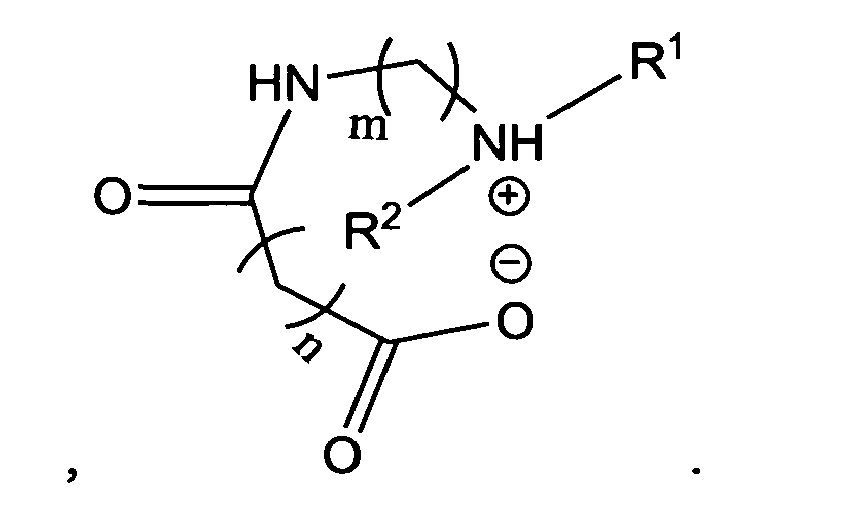
- the compound with a carboxyl acid group and an amide group has the following general equation: wherein n and m are both integers, n is 6 ⁇ 10, m is 2 ⁇ 4; R 1 and R 2 are the same, R 1 and R 2 are C1 ⁇ C6 alkyl groups where the C1 ⁇ C6 alkyl groups comprise C1 ⁇ C6 linear alkyl groups and C1 ⁇ C6 branched alkyl groups; the carboxyl acid group with a partial negative charge ( ⁇ -) attracts the tertiary amino group to form a quaternary ammonium salt structure so that the compound is easily dissolved in water; and the carboxyl acid group and the amide group attracting to each other is shown in the following:
- the compound with a carboxyl acid group and an amide group disclosed by the invention has good water solubility and thus is applicable to a variety of fields, compared to the conventional solid salt materials.
- Fig. 1 shows a Mushroom Tyrosinase test (Dopa base) for the compound with a carboxyl acid group and an amide group of
- Fig. 2 shows a Mushroom Tyrosinase test (Tyrosine base) for the compound with a carboxyl acid group and an amide group of
- a compound with a carboxyl acid group and an amide group is disclosed.
- the compound with a carboxyl acid group and an amide group has the following general equation: where n and m are both integers, n is 6 ⁇ 10, m is 2 ⁇ 4; R 1 and R 2 are the same, and R 1 and R 2 are C1 ⁇ C6 alkyl groups.
- the C1 ⁇ C6 alkyl groups comprise C1 ⁇ C6 linear alkyl groups and C1 ⁇ C6 branched alkyl groups.
- the above mentioned C1 ⁇ C6 linear alkyl group comprises one group selected from the following: methyl, ethyl, n-propyl, n-butyl, n-pentyl, and n-hexyl.
- the above mentioned C1 ⁇ C6 branched alkyl group comprises one group selected from the following: iso-propyl, iso-butyl, and iso-pentyl.
- the carboxyl acid group attracting the amino group at the tail of the amide group with each other occurs between two compounds while for the second case it occurs within one compound.
- the above mentioned compound is easy to dissolve in water and can be used to easily form an aqueous solution or oil-water mixture solution (w/o or o/w), such as emulsion or oil-water separated solution.
- the above mentioned compound does not require a dissolution procedure in advance and can be used directly but certainly can also undergo a dissolution procedure in advance.
- the compound with a carboxyl acid group and an amide group can be independently selected from the group consisting of the following:
- the above mentioned compound with a carboxyl acid group and an amide group can be applied in cosmetics, skin care products, skin whitening products, sun-blocking products, cleansing products, as well as pharmaceutical and dermatological uses, etc.
- a compound with a carboxyl acid group and an amide group is disclosed.
- the above mentioned compound with a carboxyl acid group and an amide group is formed by a reaction of and having the following general equation: where n and m are both integers, n is 6 ⁇ 0, m is 2 ⁇ 4; R 1 and R 2 are the same, and R 1 and R 2 are C1 ⁇ C6 alkyl groups.
- the C1 ⁇ C6 alkyl groups comprise C1 ⁇ C6 linear alkyl groups and C1 ⁇ C6 branched alkyl groups.
- R 3 is a hydrogen atom or C1 ⁇ C6 alkyl group.
- the carboxyl acid group has a partial negative charge ( ⁇ -) and attracts the tertiary amino group to form a quaternary ammonium salt structure so that the compound is easy to dissolve in water.
- the carboxyl acid group and the amide group attracting to each other is shown in the following:
- the above mentioned compound is easy to dissolve in water and can be used solely as one single raw material or blended with other raw materials.
- the above mentioned compound can be used to easily form an aqueous solution or oil-water mixture solution (w/o or o/w).
- the above mentioned compound does not require dissolving in solvent before use, that is, does not require a dissolution procedure which is required for a conventional salt raw material and thus simplifies the process.
- the compound according to the invention is in use, it can be (1) directly added into the solution of raw materials or (2) dissolved to become a solution before blended with other raw materials.
- the above mentioned compound with a carboxyl acid group and an amide group can be applied in cosmetics, skin care products, whitening products, sun-blocking products, and cleansing products.
- the above mentioned compound with a carboxyl acid group and an amide group can be applied in pharmaceutical and dermatological uses, etc.
- a synthetic reaction to form the above mentioned compound with a carboxyl acid group and an amide group is shown in the following: where the above reaction can further comprise a blending procedure and furthermore can comprise a heating procedure.
- n and m are both integers, n is 6 ⁇ 10, m is 2 ⁇ 4; R 1 and R 2 are the same, and R 1 and R 2 are independently selected from the group consisting of the following: C1 ⁇ C6 alkyl groups.
- the C1 ⁇ C6 alkyl groups comprise C1 ⁇ C6 linear alkyl groups and C1 ⁇ C6 branched alkyl groups.
- R 3 is a hydrogen atom or C1 ⁇ C6 alkyl group.
- the carboxyl acid group has a partial negative charge ( ⁇ -) and attracts the amino group at the tail of the amide group with each other to form a quaternary ammonium salt structure so that the compound is easy to dissolve in water.
- a cosmetic comprising a compound with a carboxyl acid group and an amide group.
- the above mentioned compound with a carboxyl acid group and an amide group has the following general equation: where n and m are both integers, n is 6 ⁇ 10, m is 2 ⁇ 4; R 1 and R 2 are the same, and R 1 and R 2 are C1 ⁇ C6 alkyl groups.
- the C1 ⁇ C6 alkyl groups comprise C1 ⁇ C6 linear alkyl groups and C1 ⁇ C6 branched alkyl groups.
- the carboxyl acid group has a partial negative charge ( ⁇ -) and attracts the amino group at the tail of the amide group with each other to form a quaternary ammonium salt structure so that the compound is easy to dissolve in water.
- the carboxyl acid group and the amide group attracting to each other is shown in the following: and
- the above mentioned compound is water soluble and is easier to dissolve in water. It can be used by way of an aqueous solution or oil-water mixture solution (w/o or o/w).
- the above mentioned compound can be used solely as one single raw material or blended with other raw materials. While the compound according to the invention is in use, it can be directly added into a mixture of liquid raw materials or can be dissolved in solvent and then blended with other raw materials. Either way can be used for the above mentioned compound.
- the compound with a carboxyl acid group and an amide group can be independently selected from the group consisting of the following:
- Azelaic acid (100g, 0.532mole) was dissolved in Methanol(100mL) and then H 2 SO 4 was added into reacted vessel. Reacted at reflux temperature for 3hours. After reaction, Methanol was removed by evaporation. The crude mixture was extracted with Ethyl acetate /H 2 O and then evaporated to obtain di-methyl azelate. Di-methyl azelate (100g, 0.462mole) was dissolved in Methanol (100mL), and then Ba(OH) 2 .8H 2 O (58.5g, 0.185mole) was poured into vessel. The mixture was reacted at 45°C overnight. After reaction, Ba-salt was washed with Methanol and then acidified by HCl to get mono-methyl azelate.
- 8-(3-Dimethylamino-propylcarbamoyl)-octanoic acid methyl ester was obtained.
- 8-(3-Dimethylamino-propylcarbamoyl)-octanoic acid methyl ester was dissolved in Methanol and added NaOH/Methanol (1N, 50ml). The mixture was stirred at room temperature for 3 ⁇ 6 hours and concentrated under vacuum. The residue was acidified with HCl/ Ethyl acetate (1N 55ml). The crude was purified by column chromatography Ethyl acetate / Methanol to obtain [8-(3-Dimethylamino-propylcarbamoyl)-octanoic acid . hydrochloride].
- Tyrosine (5mg/mL) were dissolved in pH 6.5 buffer solution. Samples were dissolved in water and prepared the concentration at 2%.
Landscapes
- Health & Medical Sciences (AREA)
- Life Sciences & Earth Sciences (AREA)
- Chemical & Material Sciences (AREA)
- Organic Chemistry (AREA)
- Animal Behavior & Ethology (AREA)
- General Health & Medical Sciences (AREA)
- Public Health (AREA)
- Veterinary Medicine (AREA)
- Dermatology (AREA)
- Bioinformatics & Cheminformatics (AREA)
- Engineering & Computer Science (AREA)
- Chemical Kinetics & Catalysis (AREA)
- General Chemical & Material Sciences (AREA)
- Medicinal Chemistry (AREA)
- Nuclear Medicine, Radiotherapy & Molecular Imaging (AREA)
- Pharmacology & Pharmacy (AREA)
- Birds (AREA)
- Epidemiology (AREA)
- Toxicology (AREA)
- Organic Low-Molecular-Weight Compounds And Preparation Thereof (AREA)
- Acyclic And Carbocyclic Compounds In Medicinal Compositions (AREA)
- Cosmetics (AREA)
Abstract
Description
- The present invention is generally related to a compound with a carboxyl acid group and an amide group, and more particularly to a water-soluble compound with a carboxyl acid group and an amide group.
- Recently, compounds with carboxyl acid group(s) having skin whitening effect are often applied in cosmetic products. For example, azelaic acid is a common cosmetic raw material and has anti-acne and whitening effect. However, it has poor solubility to cosmetic base materials and this affects skin penetration and thereby results in formulation difficulties.
- In order to develop better cosmetic materials, the skin whitening effect and the solubility to cosmetic base materials should be considered simultaneously. Thus, many compounds with carboxyl acid group(s) are synthesized successively. However, their water solubility is still not satisfied while generally commercial whitening products are aqueous solutions. For example, it is not easy to use non-salt solid compound with carboxyl acid group(s) together with an aqueous solution. Therefore, non-salt solid materials have limited application fields and lack of convenience.
- In order to resolve such a problem, solid salts become very important in development. For example, the patent
WO2006/010590A1 disclosed a compound with carboxyl acid salts, comprising a structure of alpha-amino acid and non-toxic cation, where its water solubility is from ion dissociation. That is, while in use, solid raw materials should dissolve in solvent and then be blended with other cosmetic raw materials. Thus, solid raw materials can not be blended with other materials directly to thereby result in inconvenience. - At present, compounds with carboxyl acid group(s) are still under development since their water solubility is still not satisfied. In view of the above description, a novel water-soluble compound with carboxyl acid group(s) is urgently needed.
- In light of the above background, in order to fulfill the industrial requirements, the invention provides a novel compound with a carboxyl acid group and an amide group.
- The present invention discloses a compound with a carboxyl acid group and an amide group that is solid. The compound with a carboxyl acid group and an amide group has the following general equation:


- Therefore, the compound with a carboxyl acid group and an amide group disclosed by the invention has good water solubility and thus is applicable to a variety of fields, compared to the conventional solid salt materials.
-
Fig. 1 shows a Mushroom Tyrosinase test (Dopa base) for the compound with a carboxyl acid group and an amide group of - (I)8-(2-Dimethylamino-ethylcarbamoyl)-octanoic acid,
- (II)8-(2-Diisopropylamino-ethylcarbamoyl)-octanoic acid,
- (III)8-(3-Dimethylamino-propylcarbamoyl)-octanoic acid,
- (IV)9-(2-Dimethylamino-ethylcarbamoyl)-nonanoic acid, and
- (V)9-(3-Dimethylamino-propylcarbamoyl)-nonanoic acid; and
-
Fig. 2 shows a Mushroom Tyrosinase test (Tyrosine base) for the compound with a carboxyl acid group and an amide group of - (I)8-(2-Dimethylamino-ethylcarbamoyl)-octanoic acid,
- (II)8-(2-Diisopropylamino-ethylcarbamoyl)-octanoic acid,
- (III)8-(3-Dimethylamino-propylcarbamoyl)-octanoic acid,
- (IV)9-(2-Dimethylamino-ethylcarbamoyl)-nonanoic acid, and
- (V)9-(3-Dimethylamino-propylcarbamoyl)-nonanoic acid.
- What is probed into the invention is a compound with a carboxyl acid group and an amide group. Detail descriptions of the steps and compositions will be provided in the following in order to make the invention thoroughly understood. Obviously, the application of the invention is not confined to specific details familiar to those who are skilled in the art. On the other hand, the common compositions or steps that are known to everyone are not described in details to avoid unnecessary limits of the invention. Some preferred embodiments of the present invention will now be described in greater detail in the following. However, it should be recognized that the present invention can be practiced in a wide range of other embodiments besides those explicitly described, that is, this invention can also be applied extensively to other embodiments, and the scope of the present invention is expressly not limited except as specified in the accompanying claims.
- In a first embodiment of the present invention, a compound with a carboxyl acid group and an amide group is disclosed. The compound with a carboxyl acid group and an amide group has the following general equation:


- The compound with a carboxyl acid group and an amide group can be independently selected from the group consisting of the following:
- 9-(3-dimethylamino-propylcarbamoyl) nonanoic acid having the following structure:

- 9-(2-dimethylamino-ethylcarbamoyl) nonanoic acid having the following structure:

- 9-(2-diisopropylamino-ethylcarbamoyl) nonanoic acid having the following structure:
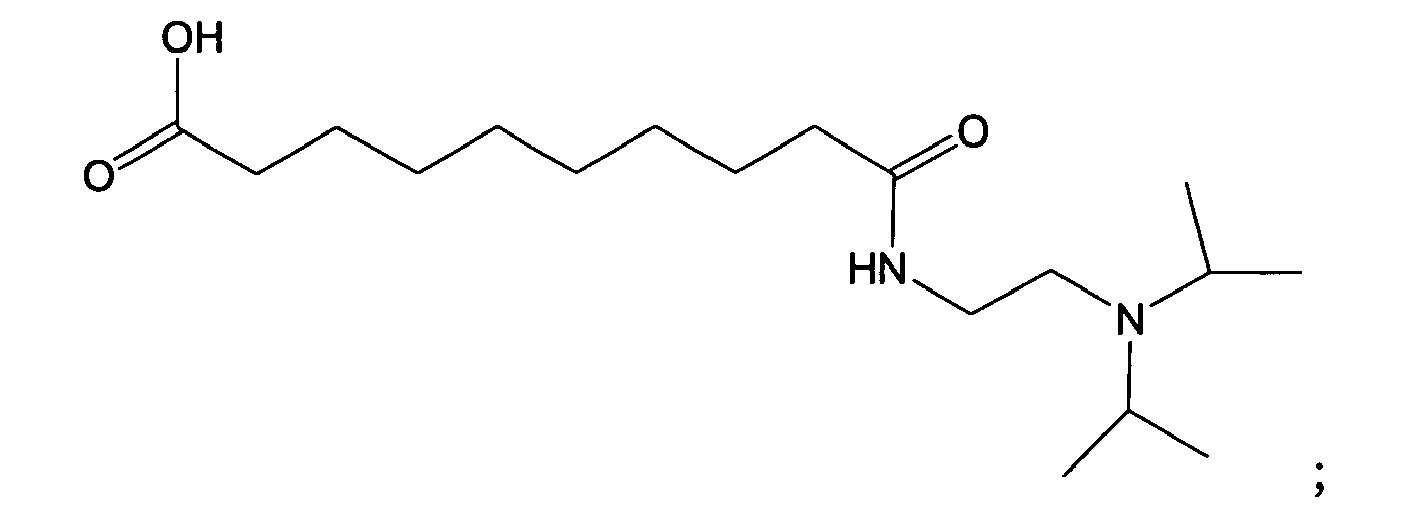
- 8-(3-dimethylamino-propylcarbamoyl)-octanoic acid having the following structure:

- 8-(2-dimethylamino-ethylcarbamoyl) octanoic acid having the following structure:

- 8-(2-diisopropylamino-ethylcarbamoyl) octanoic acid having the following structure:

- In a preferred example of this embodiment, the above mentioned compound with a carboxyl acid group and an amide group can be applied in cosmetics, skin care products, skin whitening products, sun-blocking products, cleansing products, as well as pharmaceutical and dermatological uses, etc.
- In a second embodiment of the present invention, a compound with a carboxyl acid group and an amide group is disclosed. The above mentioned compound with a carboxyl acid group and an amide group is formed by a reaction of


- The above mentioned compound is easy to dissolve in water and can be used solely as one single raw material or blended with other raw materials. The above mentioned compound can be used to easily form an aqueous solution or oil-water mixture solution (w/o or o/w). Compared to other solid salt raw materials, the above mentioned compound does not require dissolving in solvent before use, that is, does not require a dissolution procedure which is required for a conventional salt raw material and thus simplifies the process. While the compound according to the invention is in use, it can be (1) directly added into the solution of raw materials or (2) dissolved to become a solution before blended with other raw materials.
- In a preferred example of this embodiment, the above mentioned compound with a carboxyl acid group and an amide group can be applied in cosmetics, skin care products, whitening products, sun-blocking products, and cleansing products.
- In another preferred example of this embodiment, the above mentioned compound with a carboxyl acid group and an amide group can be applied in pharmaceutical and dermatological uses, etc.
- In a third embodiment of the present invention, a synthetic method for a compound with a carboxyl acid group and an amide group, having the following general equation:

- A synthetic reaction to form the above mentioned compound with a carboxyl acid group and an amide group is shown in the following:

- In the above, n and m are both integers, n is 6∼10, m is 2∼4; R1 and R2 are the same, and R1 and R2 are independently selected from the group consisting of the following: C1∼C6 alkyl groups. The C1∼C6 alkyl groups comprise C1∼C6 linear alkyl groups and C1∼C6 branched alkyl groups. R3 is a hydrogen atom or C1∼C6 alkyl group. The carboxyl acid group has a partial negative charge (δ-) and attracts the amino group at the tail of the amide group with each other to form a quaternary ammonium salt structure so that the compound is easy to dissolve in water.
- In a fourth embodiment of the present invention, a cosmetic comprising a compound with a carboxyl acid group and an amide group is disclosed. The above mentioned compound with a carboxyl acid group and an amide group has the following general equation:


- Compared to azelaic acid, the above mentioned compound is water soluble and is easier to dissolve in water. It can be used by way of an aqueous solution or oil-water mixture solution (w/o or o/w). Compared to other conventional solid salt cosmetic raw materials, the above mentioned compound can be used solely as one single raw material or blended with other raw materials. While the compound according to the invention is in use, it can be directly added into a mixture of liquid raw materials or can be dissolved in solvent and then blended with other raw materials. Either way can be used for the above mentioned compound.
- The compound with a carboxyl acid group and an amide group can be independently selected from the group consisting of the following:
- 9-(3-dimethylamino-propylcarbamoyl) nonanoic acid having the following structure:

- 9-(2-dimethylamino-ethylcarbamoyl) nonanoic acid having the following structure:

- 9-(2-diisopropylamino-ethylcarbamoyl) nonanoic acid having the following structure:

- 8-(3-dimethylamino-propylcarbamoyl)-octanoic acid having the following structure:

- 8-(2-dimethylamino-ethylcarbamoyl) octanoic acid having the following structure:

- 8-(2-diisopropylamino-ethylcarbamoyl) octanoic acid having the following structure:

- Example:
- Synthesis of 8-(3-Dimethylamino-propylcarbamoyl)-octanoic acid
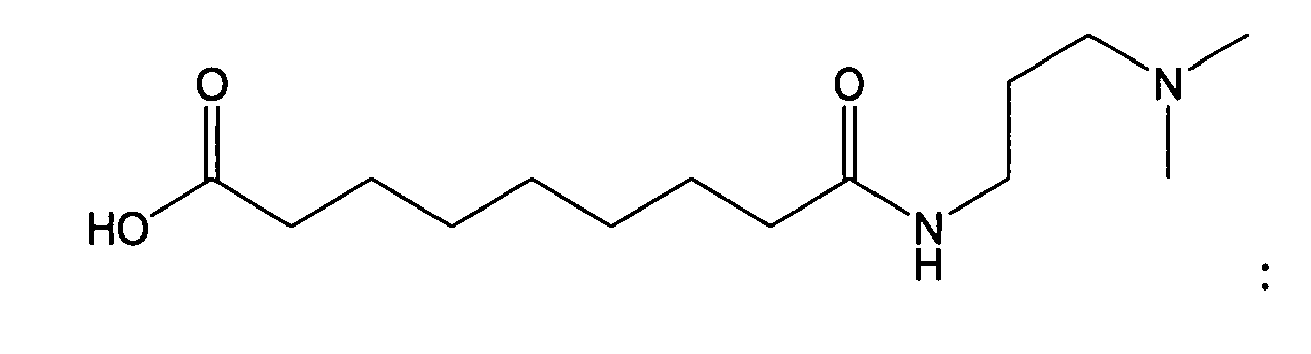
- Azelaic acid (100g, 0.532mole) was dissolved in Methanol(100mL) and then H2SO4 was added into reacted vessel. Reacted at reflux temperature for 3hours. After reaction, Methanol was removed by evaporation. The crude mixture was extracted with Ethyl acetate /H2O and then evaporated to obtain di-methyl azelate. Di-methyl azelate (100g, 0.462mole) was dissolved in Methanol (100mL), and then Ba(OH)2.8H2O (58.5g, 0.185mole) was poured into vessel. The mixture was reacted at 45°C overnight. After reaction, Ba-salt was washed with Methanol and then acidified by HCl to get mono-methyl azelate.
- Then, Mono-methyl azelate (10g, 0.0495mole) and N-Hydroxysuccinimide (6.26g, 0.0544mole) were dissolved in THF. A solution of Dicyclohexylcarbodiimide (12.24g, 0.0592mole) and THF was poured into the reacted vessel. Reacted at room temperature overnight, the DCU was removed by filter. Dimethylaminopropylamine (5.5g, 0.0544mole) was added into and reacted for overnight. Removed the solvent and extracted with Ethyl acetate/H2O. After evaporation, 8-(3-Dimethylamino-propylcarbamoyl)-octanoic acid methyl ester was obtain. 8-(3-Dimethylamino-propylcarbamoyl)-octanoic acid methyl ester was dissolved in Methanol and added NaOH/Methanol (1N, 50ml). The mixture was stirred at room temperature for 3∼6 hours and concentrated under vacuum. The residue was acidified with HCl/ Ethyl acetate (1N 55ml). The crude was purified by column chromatography Ethyl acetate / Methanol to obtain [8-(3-Dimethylamino-propylcarbamoyl)-octanoic acid . hydrochloride].
- Identification analysis:
- The basic data of 8-(2-Dimethylamino-ethylcarbamoyl)-octanoic acid (I) is shown as follows:

- The basic data of 8-(2-Diisopropylamino-ethylcarbamoyl)-octanoic acid (II) is shown as follows:

- The basic data of 8-(3-Dimethylamino-propylcarbamoyl)-octanoic acid (III) is shown as follows:

- The basic data of 9-(2-Dimethylamino-ethylcarbamoyl)-nonanoic acid (IV) is shown as follows:

- The basic data of 9-(3-Dimethylamino-propylcarbamoyl) nonanoic acid (V) is shown as follows:

- The basic data of 9-(2-Diisopropylamino-ethylcarbamoyl)-nonanoic acid (VI) is shown as follows:

- Mushroom Tyrosinase inhibition test (Dopa base):
- Preparation: L-Dopa (L-3,4-dihydroxyphenylalanine; 1mg/mL) was dissolved in pH 6.5 buffer solution. Samples were dissolved in water and prepared the concentration at 2%.
- Method: 900µL of L-Dopa solution was added into 100µL of sample solution (or blank solution) and measured by thermo spectronic 475nm (Aso or Ab0). 15µl of mushroom tyrosine buffer solution was added into mixture. After reaction for 3 min, mixture was measured by thermo spectronic (As3 or Ab3) (
Fig 1 ). Calculation :
-
Table 1 Mushroom Tyrosinase Inhibition (Dopa base) Sample Mushroom Tyrosinase Inhibition (I)8-(2-Dimethylamino-ethylcarbamoyl)-octanoic acid 74.3% (II)8-(2-Diisopropylamino-ethylcarbamoyl)-octanoic acid 45.7% (III)8-(3-Dimethylamino-propylcarbamoyl)-octanoic acid 56.3% (IV)9-(2-Dimethylamino-ethylcarbamoyl)-nonanoic acid 50.6% (V)9-(3-Dimethylamino-propylcarbamoyl)-nonanoic acid 60.0% - Mushroom Tyrosinase inhibition test (Tyrosine base):
- Preparation: Tyrosine (5mg/mL) were dissolved in pH 6.5 buffer solution. Samples were dissolved in water and prepared the concentration at 2%.
- Method: 900µL of Tyrosine solution was added into 100µL of sample solution (or blank solution) and measured by thermo spectronic 492nm (Aso or Ab0). 40µL of mushroom tyrosinase buffer solution was added into mixture. After reaction for 60minutes, the mixture was measured by thermo spectronic (As60 or Ab60) (
Fig 2 ). Calculation :
-
Table 2 Mushroom Tyrosinase inhibition test (Tyrosine base) Sample Mushroom Tyrosinase Inhibition (I)8-(2-Dimethylamino-ethylcarbamoyl)-octanoic acid 82.9% (II)8-(2-Diisopropylamino-ethylcarbamoyl)-octanoic acid 77.2% (III)8-(3-Dimethylamino-propylcarbamoyl)-octanoic acid 78.4% (IV)9-(2-Dimethylamino-ethylcarbamoyl)-nonanoic acid 84.1% (V)9-(3-Dimethylamino-propylcarbamoyl)-nonanoic acid 99.3% -
Table 3 Water Solubility Sample Water Solubility Azelaic acid <0.5% Sebacic acid <0.1% (II)8-(2-Diisopropylamino-ethylcarbamoyl)-octanoic acid 22% (III)8-(3-Dimethylamino-propylcarbamoyl)-octanoic acid 33% (IV)9-(2-Dimethylamino-ethylcarban'ioyl)-nonanoic acid 17% (V)9-(3-Dimethylamino-propylcarbamoyl)-nonanoic acid 29% - Obviously many modifications and variations are possible in light of the above teachings. It is therefore to be understood that within the scope of the appended claims the present invention can be practiced otherwise than as specifically described herein. Although specific embodiments have been illustrated and described herein, it is obvious to those skilled in the art that many modifications of the present invention may be made without departing from what is intended to be limited solely by the appended claims.
Claims (19)
- A compound with a carboxyl acid group and an amide group, having the following general equation:
 wherein n and m are both integers, n is 6∼10, m is 2∼4;R1 and R2 are the same, R1 and R2 are C1∼C6 alkyl groups where the C1∼C6 alkyl groups comprise C1∼C6 linear alkyl groups and C1∼C6 branched alkyl groups;the carboxyl acid group with a partial negative charge (δ-) attracts the tertiary amino group to form a quaternary ammonium salt structure so that the compound is easy to dissolve in water; andthe carboxyl acid group and the amide group attracting to each other is shown in the following:

- The compound according to claim 1, applicable to cosmetics, skin care products, whitening products, sun-blocking products, cleansing products, pharmaceutical and dermatological uses.
- The compound according to claim 1, wherein the compound with a carboxyl acid group and an amide group is 9-(3-dimethylamino-propylcarbamoyl) nonanoic acid having the following structure:

- The compound according to claim 1, wherein the compound with a carboxyl acid group and an amide group is 9-(2-dimethylamino-ethylcarbamoyl) nonanoic acid having the following structure:

- The compound according to claim 1, wherein the compound with a carboxyl acid group and an amide group is 9-(2-diisopropylamino-ethylcarbamoyl) nonanoic acid having the following structure:

- The compound according to claim 1, wherein the compound with a carboxyl acid group and an amide group is 8-(3-dimethylamino-propylcarbamoyl)-octanoic acid having the following structure:

- The compound according to claim 1, wherein the compound with a carboxyl acid group and an amide group is 8-(2-dimethylamino-ethylcarbamoyl) octanoic acid having the following structure:

- The compound according to claim 1, wherein the compound with a carboxyl acid group and an amide group is 8-(2-diisopropylamino-ethylcarbamoyl) octanoic acid having the following structure:

- The compound according to claim 1, wherein the carboxyl acid group has a partial negative charge (δ-) and attracts the amino group at the tail of the amide group with each other so that the solubility of the compound is more than or equal to 5%.
- The compound according to claim 1, wherein the inhibition of the compound is more than 30 % in a mushroom tyrosinase test (Dopa base).
- The compound according to claim 1, wherein the inhibition of the compound is more than 60 % in a mushroom tyrosinase test (tyrosine base).
- A cosmetic, comprising a compound with a carboxyl acid group and an amide group having the following general equation:
 wherein n and m are both integers, n is 6∼10, m is 2∼4;R1 and R2 are the same, R1 and R2 are C1∼C6 alkyl groups;the carboxyl acid group with a partial negative charge (δ-) attracts the tertiary amino group to form a quaternary ammonium salt structure so that the compound is easy to dissolve in water.
 - The cosmetic according to claim 12, wherein the compound with a carboxyl acid group and an amide group is 9-(3-dimethylamino-propylcarbamoyl) nonanoic acid having the following structure:

- The cosmetic according to claim 12, wherein the compound with a carboxyl acid group and an amide group is 9-(2-dimethylamino-ethylcarbamoyl) nonanoic acid having the following structure:

- The cosmetic according to claim 12, wherein the compound with a carboxyl acid group and an amide group is 9-(2-diisopropylamino-ethylcarbamoyl) nonanoic acid having the following structure:

- The cosmetic according to claim 12, wherein the compound with a carboxyl acid group and an amide group is 8-(3-dimethylamino-propylcarbamoyl)-octanoic acid having the following structure:

- The cosmetic according to claim 12, wherein the compound with a carboxyl acid group and an amide group is 8-(2-dimethylamino-ethylcarbamoyl) octanoic acid having the following structure:

- The cosmetic according to claim 12, wherein the compound with a carboxyl acid group and an amide group is 8-(2-diisopropylamino-ethylcarbamoyl) octanoic acid having the following structure:

- The cosmetic according to claim 12, wherein the carboxyl acid group has a partial negative charge (δ-) and attracts the amino group at the tail of the amide group with each other so that the solubility of the cosmetic is more than or equal to 5%.
Applications Claiming Priority (1)
| Application Number | Priority Date | Filing Date | Title |
|---|---|---|---|
| TW098130652A TWI387578B (en) | 2009-09-11 | 2009-09-11 | Compounds with carboxyl acid group and amide group and application thereof |
Publications (2)
| Publication Number | Publication Date |
|---|---|
| EP2295403A1 true EP2295403A1 (en) | 2011-03-16 |
| EP2295403B1 EP2295403B1 (en) | 2015-11-25 |
Family
ID=43296975
Family Applications (1)
| Application Number | Title | Priority Date | Filing Date |
|---|---|---|---|
| EP10005460.0A Active EP2295403B1 (en) | 2009-09-11 | 2010-05-26 | Compound with carboxyl acid group and amide group and application thereof |
Country Status (5)
| Country | Link |
|---|---|
| US (1) | US8053474B2 (en) |
| EP (1) | EP2295403B1 (en) |
| JP (1) | JP5498862B2 (en) |
| ES (1) | ES2565099T3 (en) |
| TW (1) | TWI387578B (en) |
Cited By (1)
| Publication number | Priority date | Publication date | Assignee | Title |
|---|---|---|---|---|
| WO2017108316A1 (en) | 2015-12-24 | 2017-06-29 | Unilever N.V. | Tyrosinase inhibitors |
Citations (2)
| Publication number | Priority date | Publication date | Assignee | Title |
|---|---|---|---|---|
| US3653452A (en) * | 1970-06-08 | 1972-04-04 | Paul W Fischer | Method for reducing erosion and corrosion of metal surfaces during gas drilling |
| WO2006010590A1 (en) | 2004-07-30 | 2006-02-02 | Maycos Italiana Di Comini Miro & C. S.A.S. | N-acylated derivatives of dicarboxylic acids with amino acids and vegetable protein hydrolysates and their use in cosmetics and pharmaceuticals |
Family Cites Families (3)
| Publication number | Priority date | Publication date | Assignee | Title |
|---|---|---|---|---|
| US2653898A (en) * | 1949-12-23 | 1953-09-29 | Burroughs Wellcome Co | Curarizing composition |
| DE50104477D1 (en) * | 2001-04-30 | 2004-12-16 | Cognis Iberia Sl | Use of ester quats |
| FR2867068B1 (en) * | 2004-03-02 | 2006-07-07 | Oreal | PERMANENT DEFORMATION COMPOSITION OF HAIR CONTAINING AT LEAST ONE DICARBOXYDITHIOL. |
-
2009
- 2009-09-11 TW TW098130652A patent/TWI387578B/en active
- 2009-12-29 US US12/648,626 patent/US8053474B2/en active Active
-
2010
- 2010-05-26 ES ES10005460.0T patent/ES2565099T3/en active Active
- 2010-05-26 EP EP10005460.0A patent/EP2295403B1/en active Active
- 2010-06-02 JP JP2010127120A patent/JP5498862B2/en active Active
Patent Citations (2)
| Publication number | Priority date | Publication date | Assignee | Title |
|---|---|---|---|---|
| US3653452A (en) * | 1970-06-08 | 1972-04-04 | Paul W Fischer | Method for reducing erosion and corrosion of metal surfaces during gas drilling |
| WO2006010590A1 (en) | 2004-07-30 | 2006-02-02 | Maycos Italiana Di Comini Miro & C. S.A.S. | N-acylated derivatives of dicarboxylic acids with amino acids and vegetable protein hydrolysates and their use in cosmetics and pharmaceuticals |
Cited By (4)
| Publication number | Priority date | Publication date | Assignee | Title |
|---|---|---|---|---|
| WO2017108316A1 (en) | 2015-12-24 | 2017-06-29 | Unilever N.V. | Tyrosinase inhibitors |
| CN108472516A (en) * | 2015-12-24 | 2018-08-31 | 荷兰联合利华有限公司 | Tyrosinase inhibitor |
| US10729628B2 (en) | 2015-12-24 | 2020-08-04 | Conopco, Inc. | Tyrosinase inhibitors |
| CN108472516B (en) * | 2015-12-24 | 2021-10-26 | 联合利华知识产权控股有限公司 | Tyrosinase inhibitors |
Also Published As
| Publication number | Publication date |
|---|---|
| EP2295403B1 (en) | 2015-11-25 |
| JP5498862B2 (en) | 2014-05-21 |
| JP2011057662A (en) | 2011-03-24 |
| TWI387578B (en) | 2013-03-01 |
| US8053474B2 (en) | 2011-11-08 |
| TW201109295A (en) | 2011-03-16 |
| ES2565099T3 (en) | 2016-03-31 |
| US20110065954A1 (en) | 2011-03-17 |
Similar Documents
| Publication | Publication Date | Title |
|---|---|---|
| EP3350160B1 (en) | Mixtures of amphoteric betaine compounds and an enzymic process for their production | |
| EP3496764B1 (en) | Bitter principle derivatives | |
| CN1997729B (en) | Surfactant composition, method for production thereof and cosmetic comprising said composition | |
| US11000816B2 (en) | Amphoteric ester sulfonates | |
| EP3279188A1 (en) | Axially chiral isomers, and preparation methods therefor and pharmaceutical uses thereof | |
| CN102256936A (en) | Arginine derivative and cosmetic comprising same | |
| JP2008508215A (en) | N-acylated derivatives of dicarboxylic acids in amino acid and plant protein hydrolysates and their use in cosmetics and medicine | |
| EP3209644B1 (en) | Heterocyclic amphoteric compounds as surfactants | |
| CN105524055A (en) | Preparation and application of fluorescent probe capable of being used for distinguishing cysteine/homocysteine and glutathione | |
| CN102388017A (en) | A method of synthesising an amino acid derivative of azelaic acid | |
| CN106478602B (en) | A kind of colorimetric probe and the preparation method and application thereof based on naphthalimide derivative | |
| EP0731785B1 (en) | Ceramide 3 derivatives based on monounsaturated fatty acids | |
| EP2295403B1 (en) | Compound with carboxyl acid group and amide group and application thereof | |
| CN108864422A (en) | A kind of preparation method for the polyethylene glycol that high-purity both ends are amino-terminated | |
| CN116444393A (en) | Anti-glycation amino acid derivative and synthesis method and application thereof | |
| US9243075B2 (en) | N-acylamino acid derivatives of cellulose or starch based polysaccharides and emulsified products containing the same | |
| Dutta et al. | Some new DTPA-N, N ″-bis (amides) functionalized by alkyl carboxylates: Synthesis, complexation and stability properties | |
| WO1994000425A1 (en) | Sulphoethyl carbonate wetting agents and composition comprising the same | |
| TATSUTA et al. | Argvalin, a new microbial metabolite: isolation and structure | |
| CN102276494B (en) | Compounds with carboxylic acid groups and amido groups and applications thereof | |
| US20250076265A1 (en) | Method for detecting amine compound, detection agent for amine compound, and thiazole derivative | |
| KR102124912B1 (en) | Novel Oligopeptide Derivatives and Use therof | |
| JP3923688B2 (en) | Skin anti-aging agent | |
| EP0164205A1 (en) | Process for the preparation of monoacyl (poly)alkylene polyamines | |
| KR100528387B1 (en) | A Vitamin C derivatives used the Sphingolipids and a process for preparing it |
Legal Events
| Date | Code | Title | Description |
|---|---|---|---|
| PUAI | Public reference made under article 153(3) epc to a published international application that has entered the european phase |
Free format text: ORIGINAL CODE: 0009012 |
|
| AK | Designated contracting states |
Kind code of ref document: A1 Designated state(s): AL AT BE BG CH CY CZ DE DK EE ES FI FR GB GR HR HU IE IS IT LI LT LU LV MC MK MT NL NO PL PT RO SE SI SK SM TR |
|
| AX | Request for extension of the european patent |
Extension state: BA ME RS |
|
| 17P | Request for examination filed |
Effective date: 20110608 |
|
| 17Q | First examination report despatched |
Effective date: 20130606 |
|
| GRAP | Despatch of communication of intention to grant a patent |
Free format text: ORIGINAL CODE: EPIDOSNIGR1 |
|
| INTG | Intention to grant announced |
Effective date: 20150616 |
|
| GRAS | Grant fee paid |
Free format text: ORIGINAL CODE: EPIDOSNIGR3 |
|
| GRAA | (expected) grant |
Free format text: ORIGINAL CODE: 0009210 |
|
| AK | Designated contracting states |
Kind code of ref document: B1 Designated state(s): AL AT BE BG CH CY CZ DE DK EE ES FI FR GB GR HR HU IE IS IT LI LT LU LV MC MK MT NL NO PL PT RO SE SI SK SM TR |
|
| REG | Reference to a national code |
Ref country code: GB Ref legal event code: FG4D |
|
| REG | Reference to a national code |
Ref country code: CH Ref legal event code: EP |
|
| REG | Reference to a national code |
Ref country code: AT Ref legal event code: REF Ref document number: 762507 Country of ref document: AT Kind code of ref document: T Effective date: 20151215 |
|
| REG | Reference to a national code |
Ref country code: IE Ref legal event code: FG4D |
|
| REG | Reference to a national code |
Ref country code: DE Ref legal event code: R096 Ref document number: 602010029111 Country of ref document: DE |
|
| REG | Reference to a national code |
Ref country code: LT Ref legal event code: MG4D |
|
| REG | Reference to a national code |
Ref country code: NL Ref legal event code: MP Effective date: 20160225 |
|
| REG | Reference to a national code |
Ref country code: ES Ref legal event code: FG2A Ref document number: 2565099 Country of ref document: ES Kind code of ref document: T3 Effective date: 20160331 |
|
| REG | Reference to a national code |
Ref country code: AT Ref legal event code: MK05 Ref document number: 762507 Country of ref document: AT Kind code of ref document: T Effective date: 20151125 |
|
| PG25 | Lapsed in a contracting state [announced via postgrant information from national office to epo] |
Ref country code: LT Free format text: LAPSE BECAUSE OF FAILURE TO SUBMIT A TRANSLATION OF THE DESCRIPTION OR TO PAY THE FEE WITHIN THE PRESCRIBED TIME-LIMIT Effective date: 20151125 Ref country code: NO Free format text: LAPSE BECAUSE OF FAILURE TO SUBMIT A TRANSLATION OF THE DESCRIPTION OR TO PAY THE FEE WITHIN THE PRESCRIBED TIME-LIMIT Effective date: 20160225 Ref country code: NL Free format text: LAPSE BECAUSE OF FAILURE TO SUBMIT A TRANSLATION OF THE DESCRIPTION OR TO PAY THE FEE WITHIN THE PRESCRIBED TIME-LIMIT Effective date: 20151125 Ref country code: HR Free format text: LAPSE BECAUSE OF FAILURE TO SUBMIT A TRANSLATION OF THE DESCRIPTION OR TO PAY THE FEE WITHIN THE PRESCRIBED TIME-LIMIT Effective date: 20151125 Ref country code: IS Free format text: LAPSE BECAUSE OF FAILURE TO SUBMIT A TRANSLATION OF THE DESCRIPTION OR TO PAY THE FEE WITHIN THE PRESCRIBED TIME-LIMIT Effective date: 20160325 |
|
| REG | Reference to a national code |
Ref country code: FR Ref legal event code: PLFP Year of fee payment: 7 |
|
| PG25 | Lapsed in a contracting state [announced via postgrant information from national office to epo] |
Ref country code: PL Free format text: LAPSE BECAUSE OF FAILURE TO SUBMIT A TRANSLATION OF THE DESCRIPTION OR TO PAY THE FEE WITHIN THE PRESCRIBED TIME-LIMIT Effective date: 20151125 Ref country code: PT Free format text: LAPSE BECAUSE OF FAILURE TO SUBMIT A TRANSLATION OF THE DESCRIPTION OR TO PAY THE FEE WITHIN THE PRESCRIBED TIME-LIMIT Effective date: 20160325 Ref country code: AT Free format text: LAPSE BECAUSE OF FAILURE TO SUBMIT A TRANSLATION OF THE DESCRIPTION OR TO PAY THE FEE WITHIN THE PRESCRIBED TIME-LIMIT Effective date: 20151125 Ref country code: GR Free format text: LAPSE BECAUSE OF FAILURE TO SUBMIT A TRANSLATION OF THE DESCRIPTION OR TO PAY THE FEE WITHIN THE PRESCRIBED TIME-LIMIT Effective date: 20160226 Ref country code: FI Free format text: LAPSE BECAUSE OF FAILURE TO SUBMIT A TRANSLATION OF THE DESCRIPTION OR TO PAY THE FEE WITHIN THE PRESCRIBED TIME-LIMIT Effective date: 20151125 Ref country code: LV Free format text: LAPSE BECAUSE OF FAILURE TO SUBMIT A TRANSLATION OF THE DESCRIPTION OR TO PAY THE FEE WITHIN THE PRESCRIBED TIME-LIMIT Effective date: 20151125 Ref country code: SE Free format text: LAPSE BECAUSE OF FAILURE TO SUBMIT A TRANSLATION OF THE DESCRIPTION OR TO PAY THE FEE WITHIN THE PRESCRIBED TIME-LIMIT Effective date: 20151125 |
|
| PG25 | Lapsed in a contracting state [announced via postgrant information from national office to epo] |
Ref country code: CZ Free format text: LAPSE BECAUSE OF FAILURE TO SUBMIT A TRANSLATION OF THE DESCRIPTION OR TO PAY THE FEE WITHIN THE PRESCRIBED TIME-LIMIT Effective date: 20151125 |
|
| REG | Reference to a national code |
Ref country code: DE Ref legal event code: R097 Ref document number: 602010029111 Country of ref document: DE |
|
| PG25 | Lapsed in a contracting state [announced via postgrant information from national office to epo] |
Ref country code: SK Free format text: LAPSE BECAUSE OF FAILURE TO SUBMIT A TRANSLATION OF THE DESCRIPTION OR TO PAY THE FEE WITHIN THE PRESCRIBED TIME-LIMIT Effective date: 20151125 Ref country code: SM Free format text: LAPSE BECAUSE OF FAILURE TO SUBMIT A TRANSLATION OF THE DESCRIPTION OR TO PAY THE FEE WITHIN THE PRESCRIBED TIME-LIMIT Effective date: 20151125 Ref country code: EE Free format text: LAPSE BECAUSE OF FAILURE TO SUBMIT A TRANSLATION OF THE DESCRIPTION OR TO PAY THE FEE WITHIN THE PRESCRIBED TIME-LIMIT Effective date: 20151125 Ref country code: RO Free format text: LAPSE BECAUSE OF FAILURE TO SUBMIT A TRANSLATION OF THE DESCRIPTION OR TO PAY THE FEE WITHIN THE PRESCRIBED TIME-LIMIT Effective date: 20151125 Ref country code: DK Free format text: LAPSE BECAUSE OF FAILURE TO SUBMIT A TRANSLATION OF THE DESCRIPTION OR TO PAY THE FEE WITHIN THE PRESCRIBED TIME-LIMIT Effective date: 20151125 Ref country code: BE Free format text: LAPSE BECAUSE OF NON-PAYMENT OF DUE FEES Effective date: 20160531 |
|
| PLBE | No opposition filed within time limit |
Free format text: ORIGINAL CODE: 0009261 |
|
| STAA | Information on the status of an ep patent application or granted ep patent |
Free format text: STATUS: NO OPPOSITION FILED WITHIN TIME LIMIT |
|
| 26N | No opposition filed |
Effective date: 20160826 |
|
| PG25 | Lapsed in a contracting state [announced via postgrant information from national office to epo] |
Ref country code: SI Free format text: LAPSE BECAUSE OF FAILURE TO SUBMIT A TRANSLATION OF THE DESCRIPTION OR TO PAY THE FEE WITHIN THE PRESCRIBED TIME-LIMIT Effective date: 20151125 |
|
| PG25 | Lapsed in a contracting state [announced via postgrant information from national office to epo] |
Ref country code: BE Free format text: LAPSE BECAUSE OF FAILURE TO SUBMIT A TRANSLATION OF THE DESCRIPTION OR TO PAY THE FEE WITHIN THE PRESCRIBED TIME-LIMIT Effective date: 20151125 Ref country code: LU Free format text: LAPSE BECAUSE OF FAILURE TO SUBMIT A TRANSLATION OF THE DESCRIPTION OR TO PAY THE FEE WITHIN THE PRESCRIBED TIME-LIMIT Effective date: 20160526 |
|
| REG | Reference to a national code |
Ref country code: CH Ref legal event code: PL |
|
| PG25 | Lapsed in a contracting state [announced via postgrant information from national office to epo] |
Ref country code: LI Free format text: LAPSE BECAUSE OF NON-PAYMENT OF DUE FEES Effective date: 20160531 Ref country code: CH Free format text: LAPSE BECAUSE OF NON-PAYMENT OF DUE FEES Effective date: 20160531 |
|
| REG | Reference to a national code |
Ref country code: IE Ref legal event code: MM4A |
|
| REG | Reference to a national code |
Ref country code: FR Ref legal event code: PLFP Year of fee payment: 8 |
|
| PG25 | Lapsed in a contracting state [announced via postgrant information from national office to epo] |
Ref country code: IE Free format text: LAPSE BECAUSE OF NON-PAYMENT OF DUE FEES Effective date: 20160526 |
|
| REG | Reference to a national code |
Ref country code: FR Ref legal event code: PLFP Year of fee payment: 9 |
|
| PG25 | Lapsed in a contracting state [announced via postgrant information from national office to epo] |
Ref country code: HU Free format text: LAPSE BECAUSE OF FAILURE TO SUBMIT A TRANSLATION OF THE DESCRIPTION OR TO PAY THE FEE WITHIN THE PRESCRIBED TIME-LIMIT; INVALID AB INITIO Effective date: 20100526 Ref country code: CY Free format text: LAPSE BECAUSE OF FAILURE TO SUBMIT A TRANSLATION OF THE DESCRIPTION OR TO PAY THE FEE WITHIN THE PRESCRIBED TIME-LIMIT Effective date: 20151125 |
|
| PG25 | Lapsed in a contracting state [announced via postgrant information from national office to epo] |
Ref country code: MT Free format text: LAPSE BECAUSE OF NON-PAYMENT OF DUE FEES Effective date: 20160531 Ref country code: MC Free format text: LAPSE BECAUSE OF FAILURE TO SUBMIT A TRANSLATION OF THE DESCRIPTION OR TO PAY THE FEE WITHIN THE PRESCRIBED TIME-LIMIT Effective date: 20151125 Ref country code: MK Free format text: LAPSE BECAUSE OF FAILURE TO SUBMIT A TRANSLATION OF THE DESCRIPTION OR TO PAY THE FEE WITHIN THE PRESCRIBED TIME-LIMIT Effective date: 20151125 Ref country code: TR Free format text: LAPSE BECAUSE OF FAILURE TO SUBMIT A TRANSLATION OF THE DESCRIPTION OR TO PAY THE FEE WITHIN THE PRESCRIBED TIME-LIMIT Effective date: 20151125 |
|
| PG25 | Lapsed in a contracting state [announced via postgrant information from national office to epo] |
Ref country code: BG Free format text: LAPSE BECAUSE OF FAILURE TO SUBMIT A TRANSLATION OF THE DESCRIPTION OR TO PAY THE FEE WITHIN THE PRESCRIBED TIME-LIMIT Effective date: 20151125 |
|
| PG25 | Lapsed in a contracting state [announced via postgrant information from national office to epo] |
Ref country code: AL Free format text: LAPSE BECAUSE OF FAILURE TO SUBMIT A TRANSLATION OF THE DESCRIPTION OR TO PAY THE FEE WITHIN THE PRESCRIBED TIME-LIMIT Effective date: 20151125 |
|
| REG | Reference to a national code |
Ref country code: DE Ref legal event code: R082 Ref document number: 602010029111 Country of ref document: DE Representative=s name: KANDLBINDER, MARKUS, DIPL.-PHYS., DE |
|
| PGFP | Annual fee paid to national office [announced via postgrant information from national office to epo] |
Ref country code: DE Payment date: 20250501 Year of fee payment: 16 |
|
| PGFP | Annual fee paid to national office [announced via postgrant information from national office to epo] |
Ref country code: ES Payment date: 20250612 Year of fee payment: 16 |
|
| PGFP | Annual fee paid to national office [announced via postgrant information from national office to epo] |
Ref country code: IT Payment date: 20250519 Year of fee payment: 16 |
|
| PGFP | Annual fee paid to national office [announced via postgrant information from national office to epo] |
Ref country code: FR Payment date: 20250501 Year of fee payment: 16 |
|
| PGFP | Annual fee paid to national office [announced via postgrant information from national office to epo] |
Ref country code: GB Payment date: 20260331 Year of fee payment: 17 |