EP2295056A1 - Use of SNS-595 for treating leukemia - Google Patents
Use of SNS-595 for treating leukemia Download PDFInfo
- Publication number
- EP2295056A1 EP2295056A1 EP10177951A EP10177951A EP2295056A1 EP 2295056 A1 EP2295056 A1 EP 2295056A1 EP 10177951 A EP10177951 A EP 10177951A EP 10177951 A EP10177951 A EP 10177951A EP 2295056 A1 EP2295056 A1 EP 2295056A1
- Authority
- EP
- European Patent Office
- Prior art keywords
- dose
- another embodiment
- compound
- sns
- days
- Prior art date
- Legal status (The legal status is an assumption and is not a legal conclusion. Google has not performed a legal analysis and makes no representation as to the accuracy of the status listed.)
- Granted
Links
Classifications
-
- A—HUMAN NECESSITIES
- A61—MEDICAL OR VETERINARY SCIENCE; HYGIENE
- A61K—PREPARATIONS FOR MEDICAL, DENTAL OR TOILETRY PURPOSES
- A61K31/00—Medicinal preparations containing organic active ingredients
- A61K31/33—Heterocyclic compounds
- A61K31/395—Heterocyclic compounds having nitrogen as a ring hetero atom, e.g. guanethidine or rifamycins
- A61K31/435—Heterocyclic compounds having nitrogen as a ring hetero atom, e.g. guanethidine or rifamycins having six-membered rings with one nitrogen as the only ring hetero atom
- A61K31/4353—Heterocyclic compounds having nitrogen as a ring hetero atom, e.g. guanethidine or rifamycins having six-membered rings with one nitrogen as the only ring hetero atom ortho- or peri-condensed with heterocyclic ring systems
- A61K31/4375—Heterocyclic compounds having nitrogen as a ring hetero atom, e.g. guanethidine or rifamycins having six-membered rings with one nitrogen as the only ring hetero atom ortho- or peri-condensed with heterocyclic ring systems the heterocyclic ring system containing a six-membered ring having nitrogen as a ring heteroatom, e.g. quinolizines, naphthyridines, berberine, vincamine
-
- A—HUMAN NECESSITIES
- A61—MEDICAL OR VETERINARY SCIENCE; HYGIENE
- A61K—PREPARATIONS FOR MEDICAL, DENTAL OR TOILETRY PURPOSES
- A61K9/00—Medicinal preparations characterised by special physical form
- A61K9/0012—Galenical forms characterised by the site of application
- A61K9/0019—Injectable compositions; Intramuscular, intravenous, arterial, subcutaneous administration; Compositions to be administered through the skin in an invasive manner
-
- A—HUMAN NECESSITIES
- A61—MEDICAL OR VETERINARY SCIENCE; HYGIENE
- A61K—PREPARATIONS FOR MEDICAL, DENTAL OR TOILETRY PURPOSES
- A61K31/00—Medicinal preparations containing organic active ingredients
- A61K31/33—Heterocyclic compounds
- A61K31/395—Heterocyclic compounds having nitrogen as a ring hetero atom, e.g. guanethidine or rifamycins
- A61K31/435—Heterocyclic compounds having nitrogen as a ring hetero atom, e.g. guanethidine or rifamycins having six-membered rings with one nitrogen as the only ring hetero atom
- A61K31/44—Non condensed pyridines; Hydrogenated derivatives thereof
-
- A—HUMAN NECESSITIES
- A61—MEDICAL OR VETERINARY SCIENCE; HYGIENE
- A61K—PREPARATIONS FOR MEDICAL, DENTAL OR TOILETRY PURPOSES
- A61K31/00—Medicinal preparations containing organic active ingredients
- A61K31/28—Compounds containing heavy metals
- A61K31/282—Platinum compounds
-
- A—HUMAN NECESSITIES
- A61—MEDICAL OR VETERINARY SCIENCE; HYGIENE
- A61K—PREPARATIONS FOR MEDICAL, DENTAL OR TOILETRY PURPOSES
- A61K31/00—Medicinal preparations containing organic active ingredients
- A61K31/33—Heterocyclic compounds
- A61K31/335—Heterocyclic compounds having oxygen as the only ring hetero atom, e.g. fungichromin
- A61K31/337—Heterocyclic compounds having oxygen as the only ring hetero atom, e.g. fungichromin having four-membered rings, e.g. taxol
-
- A—HUMAN NECESSITIES
- A61—MEDICAL OR VETERINARY SCIENCE; HYGIENE
- A61K—PREPARATIONS FOR MEDICAL, DENTAL OR TOILETRY PURPOSES
- A61K31/00—Medicinal preparations containing organic active ingredients
- A61K31/33—Heterocyclic compounds
- A61K31/395—Heterocyclic compounds having nitrogen as a ring hetero atom, e.g. guanethidine or rifamycins
-
- A—HUMAN NECESSITIES
- A61—MEDICAL OR VETERINARY SCIENCE; HYGIENE
- A61K—PREPARATIONS FOR MEDICAL, DENTAL OR TOILETRY PURPOSES
- A61K31/00—Medicinal preparations containing organic active ingredients
- A61K31/33—Heterocyclic compounds
- A61K31/395—Heterocyclic compounds having nitrogen as a ring hetero atom, e.g. guanethidine or rifamycins
- A61K31/40—Heterocyclic compounds having nitrogen as a ring hetero atom, e.g. guanethidine or rifamycins having five-membered rings with one nitrogen as the only ring hetero atom, e.g. sulpiride, succinimide, tolmetin, buflomedil
- A61K31/407—Heterocyclic compounds having nitrogen as a ring hetero atom, e.g. guanethidine or rifamycins having five-membered rings with one nitrogen as the only ring hetero atom, e.g. sulpiride, succinimide, tolmetin, buflomedil condensed with other heterocyclic ring systems, e.g. ketorolac, physostigmine
-
- A—HUMAN NECESSITIES
- A61—MEDICAL OR VETERINARY SCIENCE; HYGIENE
- A61K—PREPARATIONS FOR MEDICAL, DENTAL OR TOILETRY PURPOSES
- A61K31/00—Medicinal preparations containing organic active ingredients
- A61K31/33—Heterocyclic compounds
- A61K31/395—Heterocyclic compounds having nitrogen as a ring hetero atom, e.g. guanethidine or rifamycins
- A61K31/435—Heterocyclic compounds having nitrogen as a ring hetero atom, e.g. guanethidine or rifamycins having six-membered rings with one nitrogen as the only ring hetero atom
- A61K31/47—Quinolines; Isoquinolines
- A61K31/4738—Quinolines; Isoquinolines ortho- or peri-condensed with heterocyclic ring systems
- A61K31/4745—Quinolines; Isoquinolines ortho- or peri-condensed with heterocyclic ring systems condensed with ring systems having nitrogen as a ring hetero atom, e.g. phenantrolines
-
- A—HUMAN NECESSITIES
- A61—MEDICAL OR VETERINARY SCIENCE; HYGIENE
- A61K—PREPARATIONS FOR MEDICAL, DENTAL OR TOILETRY PURPOSES
- A61K31/00—Medicinal preparations containing organic active ingredients
- A61K31/33—Heterocyclic compounds
- A61K31/395—Heterocyclic compounds having nitrogen as a ring hetero atom, e.g. guanethidine or rifamycins
- A61K31/495—Heterocyclic compounds having nitrogen as a ring hetero atom, e.g. guanethidine or rifamycins having six-membered rings with two or more nitrogen atoms as the only ring heteroatoms, e.g. piperazine or tetrazines
- A61K31/505—Pyrimidines; Hydrogenated pyrimidines, e.g. trimethoprim
- A61K31/513—Pyrimidines; Hydrogenated pyrimidines, e.g. trimethoprim having oxo groups directly attached to the heterocyclic ring, e.g. cytosine
-
- A—HUMAN NECESSITIES
- A61—MEDICAL OR VETERINARY SCIENCE; HYGIENE
- A61K—PREPARATIONS FOR MEDICAL, DENTAL OR TOILETRY PURPOSES
- A61K31/00—Medicinal preparations containing organic active ingredients
- A61K31/33—Heterocyclic compounds
- A61K31/395—Heterocyclic compounds having nitrogen as a ring hetero atom, e.g. guanethidine or rifamycins
- A61K31/495—Heterocyclic compounds having nitrogen as a ring hetero atom, e.g. guanethidine or rifamycins having six-membered rings with two or more nitrogen atoms as the only ring heteroatoms, e.g. piperazine or tetrazines
- A61K31/505—Pyrimidines; Hydrogenated pyrimidines, e.g. trimethoprim
- A61K31/519—Pyrimidines; Hydrogenated pyrimidines, e.g. trimethoprim ortho- or peri-condensed with heterocyclic rings
-
- A—HUMAN NECESSITIES
- A61—MEDICAL OR VETERINARY SCIENCE; HYGIENE
- A61K—PREPARATIONS FOR MEDICAL, DENTAL OR TOILETRY PURPOSES
- A61K31/00—Medicinal preparations containing organic active ingredients
- A61K31/33—Heterocyclic compounds
- A61K31/395—Heterocyclic compounds having nitrogen as a ring hetero atom, e.g. guanethidine or rifamycins
- A61K31/495—Heterocyclic compounds having nitrogen as a ring hetero atom, e.g. guanethidine or rifamycins having six-membered rings with two or more nitrogen atoms as the only ring heteroatoms, e.g. piperazine or tetrazines
- A61K31/505—Pyrimidines; Hydrogenated pyrimidines, e.g. trimethoprim
- A61K31/519—Pyrimidines; Hydrogenated pyrimidines, e.g. trimethoprim ortho- or peri-condensed with heterocyclic rings
- A61K31/52—Purines, e.g. adenine
-
- A—HUMAN NECESSITIES
- A61—MEDICAL OR VETERINARY SCIENCE; HYGIENE
- A61K—PREPARATIONS FOR MEDICAL, DENTAL OR TOILETRY PURPOSES
- A61K31/00—Medicinal preparations containing organic active ingredients
- A61K31/33—Heterocyclic compounds
- A61K31/555—Heterocyclic compounds containing heavy metals, e.g. hemin, hematin, melarsoprol
-
- A—HUMAN NECESSITIES
- A61—MEDICAL OR VETERINARY SCIENCE; HYGIENE
- A61K—PREPARATIONS FOR MEDICAL, DENTAL OR TOILETRY PURPOSES
- A61K31/00—Medicinal preparations containing organic active ingredients
- A61K31/56—Compounds containing cyclopenta[a]hydrophenanthrene ring systems; Derivatives thereof, e.g. steroids
- A61K31/58—Compounds containing cyclopenta[a]hydrophenanthrene ring systems; Derivatives thereof, e.g. steroids containing heterocyclic rings, e.g. danazol, stanozolol, pancuronium or digitogenin
- A61K31/585—Compounds containing cyclopenta[a]hydrophenanthrene ring systems; Derivatives thereof, e.g. steroids containing heterocyclic rings, e.g. danazol, stanozolol, pancuronium or digitogenin containing lactone rings, e.g. oxandrolone, bufalin
-
- A—HUMAN NECESSITIES
- A61—MEDICAL OR VETERINARY SCIENCE; HYGIENE
- A61K—PREPARATIONS FOR MEDICAL, DENTAL OR TOILETRY PURPOSES
- A61K31/00—Medicinal preparations containing organic active ingredients
- A61K31/70—Carbohydrates; Sugars; Derivatives thereof
- A61K31/7028—Compounds having saccharide radicals attached to non-saccharide compounds by glycosidic linkages
- A61K31/7034—Compounds having saccharide radicals attached to non-saccharide compounds by glycosidic linkages attached to a carbocyclic compound, e.g. phloridzin
- A61K31/704—Compounds having saccharide radicals attached to non-saccharide compounds by glycosidic linkages attached to a carbocyclic compound, e.g. phloridzin attached to a condensed carbocyclic ring system, e.g. sennosides, thiocolchicosides, escin, daunorubicin
-
- A—HUMAN NECESSITIES
- A61—MEDICAL OR VETERINARY SCIENCE; HYGIENE
- A61K—PREPARATIONS FOR MEDICAL, DENTAL OR TOILETRY PURPOSES
- A61K31/00—Medicinal preparations containing organic active ingredients
- A61K31/70—Carbohydrates; Sugars; Derivatives thereof
- A61K31/7042—Compounds having saccharide radicals and heterocyclic rings
- A61K31/7048—Compounds having saccharide radicals and heterocyclic rings having oxygen as a ring hetero atom, e.g. leucoglucosan, hesperidin, erythromycin, nystatin, digitoxin or digoxin
-
- A—HUMAN NECESSITIES
- A61—MEDICAL OR VETERINARY SCIENCE; HYGIENE
- A61K—PREPARATIONS FOR MEDICAL, DENTAL OR TOILETRY PURPOSES
- A61K31/00—Medicinal preparations containing organic active ingredients
- A61K31/70—Carbohydrates; Sugars; Derivatives thereof
- A61K31/7042—Compounds having saccharide radicals and heterocyclic rings
- A61K31/7052—Compounds having saccharide radicals and heterocyclic rings having nitrogen as a ring hetero atom, e.g. nucleosides, nucleotides
- A61K31/706—Compounds having saccharide radicals and heterocyclic rings having nitrogen as a ring hetero atom, e.g. nucleosides, nucleotides containing six-membered rings with nitrogen as a ring hetero atom
- A61K31/7064—Compounds having saccharide radicals and heterocyclic rings having nitrogen as a ring hetero atom, e.g. nucleosides, nucleotides containing six-membered rings with nitrogen as a ring hetero atom containing condensed or non-condensed pyrimidines
- A61K31/7068—Compounds having saccharide radicals and heterocyclic rings having nitrogen as a ring hetero atom, e.g. nucleosides, nucleotides containing six-membered rings with nitrogen as a ring hetero atom containing condensed or non-condensed pyrimidines having oxo groups directly attached to the pyrimidine ring, e.g. cytidine, cytidylic acid
-
- A—HUMAN NECESSITIES
- A61—MEDICAL OR VETERINARY SCIENCE; HYGIENE
- A61K—PREPARATIONS FOR MEDICAL, DENTAL OR TOILETRY PURPOSES
- A61K38/00—Medicinal preparations containing peptides
- A61K38/04—Peptides having up to 20 amino acids in a fully defined sequence; Derivatives thereof
- A61K38/15—Depsipeptides; Derivatives thereof
-
- A—HUMAN NECESSITIES
- A61—MEDICAL OR VETERINARY SCIENCE; HYGIENE
- A61K—PREPARATIONS FOR MEDICAL, DENTAL OR TOILETRY PURPOSES
- A61K38/00—Medicinal preparations containing peptides
- A61K38/16—Peptides having more than 20 amino acids; Gastrins; Somatostatins; Melanotropins; Derivatives thereof
- A61K38/17—Peptides having more than 20 amino acids; Gastrins; Somatostatins; Melanotropins; Derivatives thereof from animals; from humans
- A61K38/18—Growth factors; Growth regulators
- A61K38/1816—Erythropoietin [EPO]
-
- A—HUMAN NECESSITIES
- A61—MEDICAL OR VETERINARY SCIENCE; HYGIENE
- A61K—PREPARATIONS FOR MEDICAL, DENTAL OR TOILETRY PURPOSES
- A61K41/00—Medicinal preparations obtained by treating materials with wave energy or particle radiation ; Therapies using these preparations
-
- A—HUMAN NECESSITIES
- A61—MEDICAL OR VETERINARY SCIENCE; HYGIENE
- A61K—PREPARATIONS FOR MEDICAL, DENTAL OR TOILETRY PURPOSES
- A61K45/00—Medicinal preparations containing active ingredients not provided for in groups A61K31/00 - A61K41/00
- A61K45/06—Mixtures of active ingredients without chemical characterisation, e.g. antiphlogistics and cardiaca
-
- A—HUMAN NECESSITIES
- A61—MEDICAL OR VETERINARY SCIENCE; HYGIENE
- A61K—PREPARATIONS FOR MEDICAL, DENTAL OR TOILETRY PURPOSES
- A61K47/00—Medicinal preparations characterised by the non-active ingredients used, e.g. carriers or inert additives; Targeting or modifying agents chemically bound to the active ingredient
- A61K47/06—Organic compounds, e.g. natural or synthetic hydrocarbons, polyolefins, mineral oil, petrolatum or ozokerite
- A61K47/08—Organic compounds, e.g. natural or synthetic hydrocarbons, polyolefins, mineral oil, petrolatum or ozokerite containing oxygen, e.g. ethers, acetals, ketones, quinones, aldehydes, peroxides
- A61K47/12—Carboxylic acids; Salts or anhydrides thereof
-
- A—HUMAN NECESSITIES
- A61—MEDICAL OR VETERINARY SCIENCE; HYGIENE
- A61P—SPECIFIC THERAPEUTIC ACTIVITY OF CHEMICAL COMPOUNDS OR MEDICINAL PREPARATIONS
- A61P1/00—Drugs for disorders of the alimentary tract or the digestive system
- A61P1/08—Drugs for disorders of the alimentary tract or the digestive system for nausea, cinetosis or vertigo; Antiemetics
-
- A—HUMAN NECESSITIES
- A61—MEDICAL OR VETERINARY SCIENCE; HYGIENE
- A61P—SPECIFIC THERAPEUTIC ACTIVITY OF CHEMICAL COMPOUNDS OR MEDICINAL PREPARATIONS
- A61P13/00—Drugs for disorders of the urinary system
- A61P13/08—Drugs for disorders of the urinary system of the prostate
-
- A—HUMAN NECESSITIES
- A61—MEDICAL OR VETERINARY SCIENCE; HYGIENE
- A61P—SPECIFIC THERAPEUTIC ACTIVITY OF CHEMICAL COMPOUNDS OR MEDICINAL PREPARATIONS
- A61P35/00—Antineoplastic agents
-
- A—HUMAN NECESSITIES
- A61—MEDICAL OR VETERINARY SCIENCE; HYGIENE
- A61P—SPECIFIC THERAPEUTIC ACTIVITY OF CHEMICAL COMPOUNDS OR MEDICINAL PREPARATIONS
- A61P35/00—Antineoplastic agents
- A61P35/02—Antineoplastic agents specific for leukemia
-
- A—HUMAN NECESSITIES
- A61—MEDICAL OR VETERINARY SCIENCE; HYGIENE
- A61P—SPECIFIC THERAPEUTIC ACTIVITY OF CHEMICAL COMPOUNDS OR MEDICINAL PREPARATIONS
- A61P43/00—Drugs for specific purposes, not provided for in groups A61P1/00-A61P41/00
-
- A—HUMAN NECESSITIES
- A61—MEDICAL OR VETERINARY SCIENCE; HYGIENE
- A61P—SPECIFIC THERAPEUTIC ACTIVITY OF CHEMICAL COMPOUNDS OR MEDICINAL PREPARATIONS
- A61P7/00—Drugs for disorders of the blood or the extracellular fluid
- A61P7/06—Antianaemics
-
- C—CHEMISTRY; METALLURGY
- C07—ORGANIC CHEMISTRY
- C07D—HETEROCYCLIC COMPOUNDS
- C07D471/00—Heterocyclic compounds containing nitrogen atoms as the only ring hetero atoms in the condensed system, at least one ring being a six-membered ring with one nitrogen atom, not provided for by groups C07D451/00 - C07D463/00
- C07D471/02—Heterocyclic compounds containing nitrogen atoms as the only ring hetero atoms in the condensed system, at least one ring being a six-membered ring with one nitrogen atom, not provided for by groups C07D451/00 - C07D463/00 in which the condensed system contains two hetero rings
- C07D471/04—Ortho-condensed systems
-
- F—MECHANICAL ENGINEERING; LIGHTING; HEATING; WEAPONS; BLASTING
- F24—HEATING; RANGES; VENTILATING
- F24S—SOLAR HEAT COLLECTORS; SOLAR HEAT SYSTEMS
- F24S10/00—Solar heat collectors using working fluids
- F24S10/70—Solar heat collectors using working fluids the working fluids being conveyed through tubular absorbing conduits
-
- F—MECHANICAL ENGINEERING; LIGHTING; HEATING; WEAPONS; BLASTING
- F24—HEATING; RANGES; VENTILATING
- F24S—SOLAR HEAT COLLECTORS; SOLAR HEAT SYSTEMS
- F24S50/00—Arrangements for controlling solar heat collectors
- F24S50/40—Arrangements for controlling solar heat collectors responsive to temperature
-
- F—MECHANICAL ENGINEERING; LIGHTING; HEATING; WEAPONS; BLASTING
- F24—HEATING; RANGES; VENTILATING
- F24S—SOLAR HEAT COLLECTORS; SOLAR HEAT SYSTEMS
- F24S80/00—Details, accessories or component parts of solar heat collectors not provided for in groups F24S10/00-F24S70/00
- F24S80/60—Thermal insulation
-
- H—ELECTRICITY
- H02—GENERATION; CONVERSION OR DISTRIBUTION OF ELECTRIC POWER
- H02S—GENERATION OF ELECTRIC POWER BY CONVERSION OF INFRARED RADIATION, VISIBLE LIGHT OR ULTRAVIOLET LIGHT, e.g. USING PHOTOVOLTAIC [PV] MODULES
- H02S40/00—Components or accessories in combination with PV modules, not provided for in groups H02S10/00 - H02S30/00
- H02S40/30—Electrical components
- H02S40/38—Energy storage means, e.g. batteries, structurally associated with PV modules
-
- H—ELECTRICITY
- H02—GENERATION; CONVERSION OR DISTRIBUTION OF ELECTRIC POWER
- H02S—GENERATION OF ELECTRIC POWER BY CONVERSION OF INFRARED RADIATION, VISIBLE LIGHT OR ULTRAVIOLET LIGHT, e.g. USING PHOTOVOLTAIC [PV] MODULES
- H02S40/00—Components or accessories in combination with PV modules, not provided for in groups H02S10/00 - H02S30/00
- H02S40/40—Thermal components
- H02S40/44—Means to utilise heat energy, e.g. hybrid systems producing warm water and electricity at the same time
-
- H—ELECTRICITY
- H10—SEMICONDUCTOR DEVICES; ELECTRIC SOLID-STATE DEVICES NOT OTHERWISE PROVIDED FOR
- H10F—INORGANIC SEMICONDUCTOR DEVICES SENSITIVE TO INFRARED RADIATION, LIGHT, ELECTROMAGNETIC RADIATION OF SHORTER WAVELENGTH OR CORPUSCULAR RADIATION
- H10F77/00—Constructional details of devices covered by this subclass
- H10F77/40—Optical elements or arrangements
- H10F77/42—Optical elements or arrangements directly associated or integrated with photovoltaic cells, e.g. light-reflecting means or light-concentrating means
- H10F77/488—Reflecting light-concentrating means, e.g. parabolic mirrors or concentrators using total internal reflection
-
- H—ELECTRICITY
- H10—SEMICONDUCTOR DEVICES; ELECTRIC SOLID-STATE DEVICES NOT OTHERWISE PROVIDED FOR
- H10F—INORGANIC SEMICONDUCTOR DEVICES SENSITIVE TO INFRARED RADIATION, LIGHT, ELECTROMAGNETIC RADIATION OF SHORTER WAVELENGTH OR CORPUSCULAR RADIATION
- H10F77/00—Constructional details of devices covered by this subclass
- H10F77/60—Arrangements for cooling, heating, ventilating or compensating for temperature fluctuations
- H10F77/63—Arrangements for cooling directly associated or integrated with photovoltaic cells, e.g. heat sinks directly associated with the photovoltaic cells or integrated Peltier elements for active cooling
-
- Y—GENERAL TAGGING OF NEW TECHNOLOGICAL DEVELOPMENTS; GENERAL TAGGING OF CROSS-SECTIONAL TECHNOLOGIES SPANNING OVER SEVERAL SECTIONS OF THE IPC; TECHNICAL SUBJECTS COVERED BY FORMER USPC CROSS-REFERENCE ART COLLECTIONS [XRACs] AND DIGESTS
- Y02—TECHNOLOGIES OR APPLICATIONS FOR MITIGATION OR ADAPTATION AGAINST CLIMATE CHANGE
- Y02E—REDUCTION OF GREENHOUSE GAS [GHG] EMISSIONS, RELATED TO ENERGY GENERATION, TRANSMISSION OR DISTRIBUTION
- Y02E10/00—Energy generation through renewable energy sources
- Y02E10/40—Solar thermal energy, e.g. solar towers
-
- Y—GENERAL TAGGING OF NEW TECHNOLOGICAL DEVELOPMENTS; GENERAL TAGGING OF CROSS-SECTIONAL TECHNOLOGIES SPANNING OVER SEVERAL SECTIONS OF THE IPC; TECHNICAL SUBJECTS COVERED BY FORMER USPC CROSS-REFERENCE ART COLLECTIONS [XRACs] AND DIGESTS
- Y02—TECHNOLOGIES OR APPLICATIONS FOR MITIGATION OR ADAPTATION AGAINST CLIMATE CHANGE
- Y02E—REDUCTION OF GREENHOUSE GAS [GHG] EMISSIONS, RELATED TO ENERGY GENERATION, TRANSMISSION OR DISTRIBUTION
- Y02E10/00—Energy generation through renewable energy sources
- Y02E10/40—Solar thermal energy, e.g. solar towers
- Y02E10/44—Heat exchange systems
-
- Y—GENERAL TAGGING OF NEW TECHNOLOGICAL DEVELOPMENTS; GENERAL TAGGING OF CROSS-SECTIONAL TECHNOLOGIES SPANNING OVER SEVERAL SECTIONS OF THE IPC; TECHNICAL SUBJECTS COVERED BY FORMER USPC CROSS-REFERENCE ART COLLECTIONS [XRACs] AND DIGESTS
- Y02—TECHNOLOGIES OR APPLICATIONS FOR MITIGATION OR ADAPTATION AGAINST CLIMATE CHANGE
- Y02E—REDUCTION OF GREENHOUSE GAS [GHG] EMISSIONS, RELATED TO ENERGY GENERATION, TRANSMISSION OR DISTRIBUTION
- Y02E10/00—Energy generation through renewable energy sources
- Y02E10/50—Photovoltaic [PV] energy
- Y02E10/52—PV systems with concentrators
-
- Y—GENERAL TAGGING OF NEW TECHNOLOGICAL DEVELOPMENTS; GENERAL TAGGING OF CROSS-SECTIONAL TECHNOLOGIES SPANNING OVER SEVERAL SECTIONS OF THE IPC; TECHNICAL SUBJECTS COVERED BY FORMER USPC CROSS-REFERENCE ART COLLECTIONS [XRACs] AND DIGESTS
- Y02—TECHNOLOGIES OR APPLICATIONS FOR MITIGATION OR ADAPTATION AGAINST CLIMATE CHANGE
- Y02E—REDUCTION OF GREENHOUSE GAS [GHG] EMISSIONS, RELATED TO ENERGY GENERATION, TRANSMISSION OR DISTRIBUTION
- Y02E10/00—Energy generation through renewable energy sources
- Y02E10/60—Thermal-PV hybrids
-
- Y—GENERAL TAGGING OF NEW TECHNOLOGICAL DEVELOPMENTS; GENERAL TAGGING OF CROSS-SECTIONAL TECHNOLOGIES SPANNING OVER SEVERAL SECTIONS OF THE IPC; TECHNICAL SUBJECTS COVERED BY FORMER USPC CROSS-REFERENCE ART COLLECTIONS [XRACs] AND DIGESTS
- Y02—TECHNOLOGIES OR APPLICATIONS FOR MITIGATION OR ADAPTATION AGAINST CLIMATE CHANGE
- Y02E—REDUCTION OF GREENHOUSE GAS [GHG] EMISSIONS, RELATED TO ENERGY GENERATION, TRANSMISSION OR DISTRIBUTION
- Y02E70/00—Other energy conversion or management systems reducing GHG emissions
- Y02E70/30—Systems combining energy storage with energy generation of non-fossil origin
Definitions
- SNS-595 is novel naphthyridine cytotoxic agent that was previously known as AG-7352 (see e.g., Tsuzuki et al, Tetrahedron-Asymmetry 12: 1793-1799 (2001 ) and U.S. Patent No. 5,817,669 ).
- the chemical name of SNS-595 is (+)-1,4-dihydro-7-[(3S,4S)-3-methoxy-4-(methylamino)-1-pyrrolidinyl]-4-oxo-1-(2-thiazoyl)-1,8-naphthyridine-3-carboxylic acid and has the structure shown below
- the present invention relates to pharmaceutical compositions and methods of using SNS-595 to treat cancer.
- Figure 1 depicts the plasma concentrations of SNS-595 over time among the various patient cohorts.
- composition comprising:
- an aqueous solution is a liquid comprising water.
- acids include both organic and inorganic acids such as acetic acid, ascorbic acid, benzene-sulfonic acid, ethanesulfonic acid, glycolic acid, hydrogen chloride, hydrogen bromide, hydroxyethanesulfonic acid, lactic acid, maleic acid, methanesulfonic acid, proprionic acid, succinic acid, sulfuric acid, trifluoroacetic acid, and toluenesulfonic acid.
- the acid is hydrochloric acid, methanesulfonic acid or lactic acid.
- the acid is methanesulfonic acid.
- the pharmaceutical composition further comprises a tonicity agent.
- a tonicity agent include amino acids (e.g., alanine and glycine), electrolytes (e.g., sodium chloride and potassium chloride), monosaccharides (e.g. glucose or galactose), disaccharides (e.g. sucrose) and hexahydric alcohols (e.g., mannitol and sorbitol).
- the tonicity agent is sodium chloride, glucose, mannitol, or sorbitol.
- the tonicity agent is a hexahydric alcohol.
- the tonicity agent is sorbitol.
- SNS-595 is a cytotoxic agent for the treatment of cancer.
- the types of cancers that can be treated using the inventive methods include but are not limited to: bladder cancer, breast cancer, cervical cancer, colon cancer (including colorectal cancer), esophageal cancer, head and neck cancer, leukemia, liver cancer, lung cancer (both small cell and non-small cell), lymphoma, melanoma, myeloma, neuroblastoma, ovarian cancer, pancreatic cancer, prostate cancer, renal cancer, sarcoma (including osteosarcoma), skin cancer (including squamous cell carcinoma), stomach cancer, testicular cancer, thyroid cancer, and uterine cancer.
- a method of using SNS-595 to treat a human cancer comprises administering to a patient on the basis of body surface area, a dose of 10 mg/m 2 -150 mg/m 2 of SNS-595.
- the dose is 10 mg/m 2 -100 mg/m 2 . In another embodiment, the dose is 30 mg/m 2 -75 mg/m 2 . In another embodiment, the dose is 40 mg/m 2 -80 mg/m 2 . In another embodiment, the dose is 50 mg/m 2 -90 mg/m 2 .
- the dose is 20 mg/m 2 -30 mg/m 2 . In another embodiment the dose is 25 mg/m 2 -35 mg/m 2 . In another embodiment the dose is 40 mg/m 2 -50 mg/m 2 . In another embodiment the dose is 45 mg/m 2 -55 mg/m 2 . In another embodiment the dose is 50 mg/m 2 -60 mg/m 2 . In another embodiment the dose is 55 mg/m 2 -65 mg/m 2 . In another embodiment the dose is 60 mg/m 2 -70 mg/m 2 . In another embodiment the dose is 65 mg/m 2 -75 mg/m 2 . In another embodiment the dose is 70 mg/m 2 -80 mg/m 2 .
- the dose is 75 mg/m 2 - 85mg/m 2 . In another embodiment the dose is 80 mg/m 2 -90 mg/m 2 . In another embodiment the dose is 85 mg/m 2 -95 mg/m 2 . In another embodiment the dose is 90 mg/m 2 -100 mg/m 2 .
- the dose is 95 mg/ m 2 -105 mg/ m 2 . In another embodiment the dose is 100 mg/ m 2 -1 10 mg/ m 2 . In another embodiment the dose is 105 mg/ m 2 -115 mg/m 2 . In another embodiment the dose is 110 mg/m 2 -120 mg/m 2 . In another embodiment the dose is 115 mg/m 2 - 125 mg/m 2 . In another embodiment the dose is 120 mg/m 2 -130 mg/m 2 . In another embodiment the dose is 125 mg/m 2 -135 mg/m 2 . In another embodiment the dose is 130 mg/m 2 - 140 mg/m 2 . In another embodiment the dose is 135 mg/m 2 -145 mg/m 2 . In another embodiment the dose is 140 mg/m 2 -150 mg/m 2 .
- the administered dose of SNS-595 can be delivered simultaneously (e.g. a single bolus injection) or over a 24-hour period (e.g., continuous infusion over time or divided bolus doses over time) and is repeated until the patient experiences stable disease or regression, or until the patient experiences disease progression or unacceptable toxicity.
- stable disease for solid tumors generally means that the perpendicular diameter of measurable lesions has not increased by 25% or more from the last measurement. See e.g., Response Evaluation Criteria in Solid Tumors (RECIST) Guidelines, Journal of the National Cancer Institute 92(3): 205-216 (2000 ).
- Stable disease or lack thereof is determined by methods known in the art such as evaluation of patient symptoms, physical examination, visualization of the tumor that has been imaged using X-ray, CAT, PET, or MRI scan and other commonly accepted evaluation modalities.
- the administered dose of SNS-595 can be expressed in units other than as mg/m 2 .
- doses can be expressed as mg/kg.
- One of ordinary skill in the art would readily know how to convert doses from mg/m 2 to mg/kg to given either the height or weight of a subject or both (see e.g., http:///www.fda.gov/cder/cancer/animalframe.htm ).
- a dose of 10 mg/m 2 -150 mg/m 2 for a 65 kg human is approximately equal to 0.26 mg/kg-3.95 mg/kg.
- SNS-595 is administered according to a dosing schedule.
- the method comprises:
- the waiting period For example, if the waiting period were 6 days, then the initial dose of SNS-595 is administered on Day 1 (step i); the waiting period is six days (step ii); and the following dose of SNS-595 is administered on Day 8 (step iii).
- Other exemplary time periods include 2 days, 3 days, 13 days, 20 days, and 27 days.
- the waiting period is at least 2 days and steps ii) through iii) are repeated at least three times.
- the waiting period is at least 3 days and steps ii) through iii) are repeated at least five times.
- the waiting period is at least 3 days and steps ii) through iii) are repeated at least three times.
- the waiting period is at least 3 days and steps ii) through iii) are repeated at least five times. In another embodiment, the waiting period is at least 6 days and steps ii) through iii) are repeated at least three times. In another embodiment, the waiting period is at least 6 days and steps ii) through iii) are repeated at least five times. In another embodiment, the waiting period is at least 20 days and steps ii) through iii) are repeated at least three times. In another embodiment, the waiting period is at least 20 days and steps ii) through iii) are repeated at least five times. In another embodiment, the waiting period is at least 27 days and steps ii) through iii) are repeated at least three times. In another embodiment, the waiting period is at least 27 days and steps ii) through iii) are repeated at least five times.
- the dosing method comprises administering a weekly dose of SNS-595 to a subject. In another embodiment, the dosing method comprises administering a dose of SNS-595 to a subject every two weeks. In another embodiment, the dosing method comprises administering a dose of SNS-595 to a subject every three weeks. In another embodiment, the dosing method comprises administering a dose of SNS-595 to a subject every four weeks.
- the dosing method comprises a cycle wherein the cycle comprises administering a dose of SNS-595 to a subject every week for three weeks followed by a period of at least two weeks where no SNS-595 is administered to said subject and wherein the cycle is repeated a plurality of times.
- the period where no SNS-595 is administered is two weeks.
- the period where no SNS-595 is administered is three weeks.
- a method of treating a solid tumor comprises:
- a method of treating a hematologic cancer such as leukemias and lymphomas comprises:
- a method is provided supportive care to patients being treated with SNS-595.
- the method comprises:
- the supportive care agent is any substance that prevents or manages an adverse effect from SNS-595 treatment and is administered according to the appropriate dosing regimen for that substance.
- different supportive care agents for treating nausea have different dosing regimen. While some are administered prophylactically, others are co-administered with SNS-595 while still others are administered after the administration of SNS-595.
- Illustrative examples of supportive care agents their doses and dosing regimens are found in The Physician's Desk Reference.
- the supportive care agent is an antiemetic.
- antiemetics include but are not limited to phenothiazines, butyrophenones, benzodiazapines, corticosteroids, serotonin antagonists, cannabinoids, and NK 1 receptor antagonists.
- phenothiazine antiemetics include prochlorperazine and trimethobenzamide.
- An example of a butyrophenone antiemetic is haloperidol.
- An example of a benzodiazapine antiemetic is lorazepam.
- An example of a corticosteroid antiemetic is dexamethasone.
- Examples of a serotonin antagonist antiemetic include ondansetron, granisetron, and dolasetron.
- An example of a cannabinoid antiemetic is dronabinol.
- An example of an NKI receptor antagonist is aprepitant.
- the antiemetic is prochlorperazine. In another embodiment, the antiemetic is prochlorperazine and the therapeutically effective amount is 10 mg. In another embodiment, the antiemetic is prochlorperazine and the therapeutically effective amount is an oral dose of 10 mg before the administration of SNS-595. In another embodiment, the antiemetic is prochlorperazine and the therapeutically effective amount is an oral dose of 10 mg every four to six hours as needed after the administration of SNS-595.
- the antiemetic is dexamethasone. In another embodiment, the antiemetic is dexamethasone and the therapeutically effective amount is at least 4 mg. In another embodiment, the antiemetic is dexamethasone and the therapeutically effective amount is an oral dose of 4 mg before the administration of SNS-595. In another embodiment, the antiemetic is dexamethasone and the therapeutically effective amount is an oral dose of 8 mg before the administration of SNS-595. In another embodiment, the antiemetic is dexamethasone and the therapeutically effective amount is an intravenous dose of between about 10 mg and about 20 mg before the administration of SNS-595. In another embodiment, the antiemetic is dexamethasone and the therapeutically effective amount is an oral dose of 4 mg every six to twelve hours as needed after the administration of SNS-595.
- the antiemetic is lorazepam. In another embodiment, the antiemetic is lorazepam and the therapeutically effective amount is 1 mg. In another embodiment, the antiemetic is lorazepam and the therapeutically effective amount is an oral dose of 1 mg before the administration of SNS-595. In another embodiment, the antiemetic is lorazepam and the therapeutically effective amount is an intravenous dose of 1 mg before the administration of SNS-595. In another embodiment, the antiemetic is lorazepam and the therapeutically effective amount is an oral dose of 1 mg every four to six hours as needed after the administration of SNS-595.
- the antiemetic is dolasetron. In another embodiment, the antiemetic is dolasetron and the therapeutically effective amount is 100 mg. In another embodiment, the antiemetic is dolasetron and the therapeutically effective amount is an oral dose of 100 mg before the administration of SNS-595. In another embodiment, the antiemetic is dolasetron and the therapeutically effective amount is an intravenous dose of 100 mg before the administration of SNS-595.
- the antiemetic is ondansetron. In another embodiment, the antiemetic is ondansetron and the therapeutically effective amount is at least 10 mg. In another embodiment, the antiemetic is ondansetron and the therapeutically effective amount is an intravenous dose of 10 mg before the administration of SNS-595. In another embodiment, the antiemetic is ondansetron and the therapeutically effective amount is an intravenous dose of 32 mg before the administration of SNS-595.
- the antiemetic is granisetron. In another embodiment, the antiemetic is granisetron and the therapeutically effective amount is 10 ⁇ g/kg. In another embodiment, the antiemetic is granisetron and the therapeutically effective amount is an intravenous dose of 10 ⁇ g/kg before the administration of SNS-595. In another embodiment, the antiemetic is granisetron and the therapeutically effective amount is at least 1 mg. In another embodiment, the antiemetic is granisetron and the therapeutically effective amount is an oral dose of 1 mg before the administration of SNS-595. In another embodiment, the antiemetic is granisetron and the therapeutically effective amount is an oral dose of 2 mg before the administration of SNS-595.
- the antiemetic is aprepitant. In another embodiment, the antiemetic is aprepitant and the therapeutically effective amount is at least 80 mg. In another embodiment, the antiemetic is aprepitant and the therapeutically effective amount is an oral dose of 125 mg before the administration of SNS-595. In another embodiment, the antiemetic is aprepitant and the therapeutically effective amount is a daily oral dose of 80 mg for at least two days after the administration of SNS-595.
- the supportive care agent is a hematopoietic agent.
- a hematopoietic agent is a molecule that stimulates hematopoiesis.
- Illustrative examples of hematopoietic agents include but are not limited to granulocyte colony stimulating factor (G-CSF), granulocyte macrophage colony stimulating factor (GM-CSF), erythropoietin and erythropoiesis stimulating protein, and derivatives thereof.
- G-CSF include but are not limited to filgrastim and its derivatives including pegfilgrastim.
- An example of GM-CSF includes sargramostim.
- An example of erythropoietin is epoetin alfa.
- An example of erythropoiesis stimulating protein is darbepoetin alfa.
- the hematopoietic agent is G-CSF. In another embodiment, the hematopoietic agent is filgrastim. In another embodiment, the hematopoietic agent is filgrastim and the therapeutically effective amount is at least 4 ⁇ g/kg. In another embodiment, the hematopoietic agent is filgrastim and the therapeutically effective amount is a daily dose of at least 4 ⁇ g/kg for at least 7 days after the administration of SNS-595. In another embodiment, the hematopoietic agent is filgrastim and the therapeutically effective amount is a daily subcutaneous dose of between about 4 ⁇ g/kg and about 8 ⁇ g/kg for at least 7 days starting from the third day after the administration of SNS-595.
- the hematopoietic agent is filgrastim and the therapeutically effective amount is a daily subcutaneous dose of between about 4 ⁇ g/kg and about 10 ⁇ g/kg for at least 14 days starting from the third day after the administration of SNS-595.
- the hematopoietic agent is pegfilgrastim. In another embodiment, the hematopoietic agent is pegfilgrastim and the therapeutically effective amount is 6 mg. In another embodiment, the hematopoietic agent is pegfilgrastim and the therapeutically effective amount is a daily subcutaneous dose of 6 mg after the administration of SNS-595. In another embodiment, the hematopoietic agent is pegfilgrastim and the therapeutically effective amount is 100 ⁇ g/kg. In another embodiment, the hematopoietic agent is pegfilgrastim and the therapeutically effective amount is a daily dose of 100 ⁇ g/kg after the administration of SNS- 595.
- the hematopoietic agent is GM-CSF. In another embodiment, the hematopoietic agent is sargramostim. In another embodiment, the hematopoietic agent is sargramostim and the therapeutically effective amount is 250 ⁇ g/m 2 . In another embodiment, the hematopoietic agent is sargramostim and the therapeutically effective amount is a daily intravenous or subcutaneous dose of 250 ⁇ g/m 2 . In another embodiment, the hematopoietic agent is sargramostim and the therapeutically effective amount is a daily intravenous or subcutaneous dose of 250 ⁇ g/m 2 as needed starting from the third day after the administration of SNS-595. In another embodiment, the hematopoietic agent is sargramostim and the therapeutically effective amount is a daily intravenous or subcutaneous dose of 250 ⁇ g/m 2 as needed starting from the tenth day after the administration of SNS-595.
- the hematopoietic agent is erythropoietin. In another embodiment, the hematopoietic agent is epoetin alfa. In another embodiment, the hematopoietic agent is epoetin alfa and the therapeutically effective amount is at least 150 units/kg. In another embodiment, the hematopoietic agent is epoetin alfa and the therapeutically effective amount is an intravenous or subcutaneous dose of 150 units/kg three times a week after the administration of SNS-595.
- the hematopoietic agent is epoetin alfa and the therapeutically effective amount is an intravenous or subcutaneous dose of 300 units/kg three times a week after the administration of SNS-595. In another embodiment, the hematopoietic agent is epoetin alfa and the therapeutically effective amount is 40,000 units. In another embodiment, the hematopoietic agent is epoetin alfa and the therapeutically effective amount is a weekly dose of 40,000 units after the administration of SNS-595.
- the hematopoietic agent is erytliropoiesis stimulating protein. In another embodiment, the hematopoietic agent is darbepoetin alfa. In another embodiment, the hematopoietic agent is darbepoetin alfa and the therapeutically effective amount is between about 1.5 ⁇ g/kg and about 4.5 ⁇ g/kg. In another embodiment, the hematopoietic agent is darbepoetin alfa and the therapeutically effective amount is a weekly dose of between about 1.5 ⁇ g/kg and about 4.5 ⁇ g/kg.
- composition suitable for injection or intravenous infusion
- Acidic compositions provided the appropriate balance of increased solubility of SNS-595 and desirable pharmaceutical properties (e.g. increased patient comfort by causing less irritation at the delivery site).
- An illustrative example of a suitable composition comprises: 10 mg SNS-595 per mL of aqueous solution of 4.5% sorbitol that is adjusted to pH 2.5 with methanesulfonic acid.
- One protocol for making such a solution includes the following for making a 100mg/10mL presentation: 100 mg of SNS-595 and 450 mg D-sorbitol are added to distilled water; the volume is brought up to a volume of 10 mL; and the pH of the resulting solution is adjusted to 2.5 with methanesulfonic acid.
- the resulting composition is also suitable for lyophilization. The lyophilized form is then reconstituted with sterile water to the appropriate concentration prior to use.
- SNS-595 was administered to enrolled patients for up to six cycles.
- a cycle is defined as a three-week period, with SNS-595 administered on the first day of each cycle (day 0), followed by at least 21 days of observation.
- SNS-595 was administered to cohorts of at least 3 patients and dose escalation occurred by sequential cohort.
- Doses of SNS-595 were linear with AUC°° and its pharmacokinetic properties were remarkably consistent among patients in the same cohort.
- Figure 1 depicts the plasma concentrations of SNS-595 over time among the various patient cohorts and Table 1 shows the pharmacokinetic parameters derived there from.
Landscapes
- Health & Medical Sciences (AREA)
- Life Sciences & Earth Sciences (AREA)
- Chemical & Material Sciences (AREA)
- Medicinal Chemistry (AREA)
- Pharmacology & Pharmacy (AREA)
- Animal Behavior & Ethology (AREA)
- General Health & Medical Sciences (AREA)
- Public Health (AREA)
- Veterinary Medicine (AREA)
- Epidemiology (AREA)
- Engineering & Computer Science (AREA)
- Organic Chemistry (AREA)
- Bioinformatics & Cheminformatics (AREA)
- General Chemical & Material Sciences (AREA)
- Chemical Kinetics & Catalysis (AREA)
- Molecular Biology (AREA)
- Sustainable Energy (AREA)
- Thermal Sciences (AREA)
- General Engineering & Computer Science (AREA)
- Mechanical Engineering (AREA)
- Combustion & Propulsion (AREA)
- Physics & Mathematics (AREA)
- Sustainable Development (AREA)
- Nuclear Medicine, Radiotherapy & Molecular Imaging (AREA)
- Proteomics, Peptides & Aminoacids (AREA)
- Gastroenterology & Hepatology (AREA)
- Immunology (AREA)
- Zoology (AREA)
- Dermatology (AREA)
- Hematology (AREA)
- Oil, Petroleum & Natural Gas (AREA)
- Oncology (AREA)
- Urology & Nephrology (AREA)
- Otolaryngology (AREA)
- Hospice & Palliative Care (AREA)
- Diabetes (AREA)
- Pharmaceuticals Containing Other Organic And Inorganic Compounds (AREA)
- Medicines That Contain Protein Lipid Enzymes And Other Medicines (AREA)
- Medicinal Preparation (AREA)
- Luminescent Compositions (AREA)
Abstract
Description
- SNS-595 is novel naphthyridine cytotoxic agent that was previously known as AG-7352 (see e.g., Tsuzuki et al, Tetrahedron-Asymmetry 12: 1793-1799 (2001) and
U.S. Patent No. 5,817,669 ). The chemical name of SNS-595 is (+)-1,4-dihydro-7-[(3S,4S)-3-methoxy-4-(methylamino)-1-pyrrolidinyl]-4-oxo-1-(2-thiazoyl)-1,8-naphthyridine-3-carboxylic acid and has the structure shown below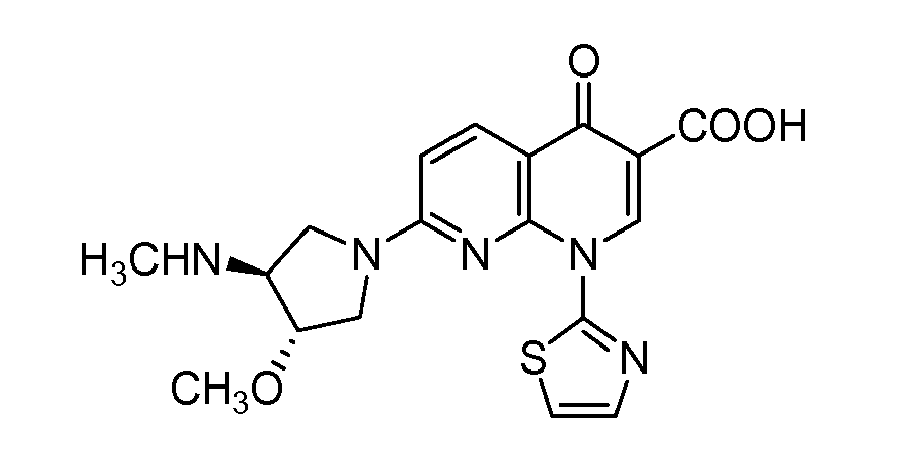
- The present invention relates to pharmaceutical compositions and methods of using SNS-595 to treat cancer.
- Figure 1 depicts the plasma concentrations of SNS-595 over time among the various patient cohorts.
- In one aspect of the present invention, pharmaceutical composition is provided comprising:
- a) SNS-595 and
- b) an acid
- in an aqueous solution wherein the pH of the solution is 2-3.5. As used herein, a numerical range is intended to be inclusive. For example, the range of pH 2-3.5 includes both pH 2 and pH 3.5. In one embodiment, the pH of the composition is 2-3. In another embodiment, the pH of the composition is 2.3-2.7. As used herein, an aqueous solution is a liquid comprising water.
- Suitable examples of acids include both organic and inorganic acids such as acetic acid, ascorbic acid, benzene-sulfonic acid, ethanesulfonic acid, glycolic acid, hydrogen chloride, hydrogen bromide, hydroxyethanesulfonic acid, lactic acid, maleic acid, methanesulfonic acid, proprionic acid, succinic acid, sulfuric acid, trifluoroacetic acid, and toluenesulfonic acid. In one embodiment, the acid is hydrochloric acid, methanesulfonic acid or lactic acid. In another embodiment, the acid is methanesulfonic acid.
- In another embodiment, the pharmaceutical composition further comprises a tonicity agent. Suitable examples of a tonicity agent include amino acids (e.g., alanine and glycine), electrolytes (e.g., sodium chloride and potassium chloride), monosaccharides (e.g. glucose or galactose), disaccharides (e.g. sucrose) and hexahydric alcohols (e.g., mannitol and sorbitol). In another embodiment, the tonicity agent is sodium chloride, glucose, mannitol, or sorbitol. In another embodiment, the tonicity agent is a hexahydric alcohol. In another embodiment, the tonicity agent is sorbitol.
- SNS-595 is a cytotoxic agent for the treatment of cancer. The types of cancers that can be treated using the inventive methods include but are not limited to: bladder cancer, breast cancer, cervical cancer, colon cancer (including colorectal cancer), esophageal cancer, head and neck cancer, leukemia, liver cancer, lung cancer (both small cell and non-small cell), lymphoma, melanoma, myeloma, neuroblastoma, ovarian cancer, pancreatic cancer, prostate cancer, renal cancer, sarcoma (including osteosarcoma), skin cancer (including squamous cell carcinoma), stomach cancer, testicular cancer, thyroid cancer, and uterine cancer.
- In another aspect of the invention, a method of using SNS-595 to treat a human cancer is provided. The method comprises administering to a patient on the basis of body surface area, a dose of 10 mg/m2-150 mg/m2 of SNS-595. Body surface area calculations can be calculated for example, with the Mosteller formula wherein:

- In another embodiment, the dose is 10 mg/m2-100 mg/m2. In another embodiment, the dose is 30 mg/m2-75 mg/m2. In another embodiment, the dose is 40 mg/m2-80 mg/m2. In another embodiment, the dose is 50 mg/m2-90 mg/m2.
- In another embodiment the dose is 20 mg/m2-30 mg/m2. In another embodiment the dose is 25 mg/m2-35 mg/m2. In another embodiment the dose is 40 mg/m2-50 mg/m2. In another embodiment the dose is 45 mg/m2-55 mg/m2. In another embodiment the dose is 50 mg/m2-60 mg/m2. In another embodiment the dose is 55 mg/m2-65 mg/m2. In another embodiment the dose is 60 mg/m2-70 mg/m2. In another embodiment the dose is 65 mg/m2-75 mg/m2. In another embodiment the dose is 70 mg/m2-80 mg/m2. In another embodiment the dose is 75 mg/m2- 85mg/m2. In another embodiment the dose is 80 mg/m2-90 mg/m2. In another embodiment the dose is 85 mg/m2-95 mg/m2. In another embodiment the dose is 90 mg/m2-100 mg/m2.
- In another embodiment the dose is 95 mg/ m2-105 mg/ m2. In another embodiment the dose is 100 mg/ m2-1 10 mg/ m2. In another embodiment the dose is 105 mg/ m2-115 mg/m2. In another embodiment the dose is 110 mg/m2-120 mg/m2. In another embodiment the dose is 115 mg/m2- 125 mg/m2. In another embodiment the dose is 120 mg/m2-130 mg/m2. In another embodiment the dose is 125 mg/m2-135 mg/m2. In another embodiment the dose is 130 mg/m2- 140 mg/m2. In another embodiment the dose is 135 mg/m2-145 mg/m2. In another embodiment the dose is 140 mg/m2-150 mg/m2.
- The administered dose of SNS-595 can be delivered simultaneously (e.g. a single bolus injection) or over a 24-hour period (e.g., continuous infusion over time or divided bolus doses over time) and is repeated until the patient experiences stable disease or regression, or until the patient experiences disease progression or unacceptable toxicity. For example, stable disease for solid tumors generally means that the perpendicular diameter of measurable lesions has not increased by 25% or more from the last measurement. See e.g., Response Evaluation Criteria in Solid Tumors (RECIST) Guidelines, Journal of the National Cancer Institute 92(3): 205-216 (2000). Stable disease or lack thereof is determined by methods known in the art such as evaluation of patient symptoms, physical examination, visualization of the tumor that has been imaged using X-ray, CAT, PET, or MRI scan and other commonly accepted evaluation modalities.
- The administered dose of SNS-595 can be expressed in units other than as mg/m2. For example, doses can be expressed as mg/kg. One of ordinary skill in the art would readily know how to convert doses from mg/m2 to mg/kg to given either the height or weight of a subject or both (see e.g., http:///www.fda.gov/cder/cancer/animalframe.htm). For example, a dose of 10 mg/m2-150 mg/m2 for a 65 kg human is approximately equal to 0.26 mg/kg-3.95 mg/kg.
- In another aspect of the present invention, SNS-595 is administered according to a dosing schedule. In one embodiment, the method comprises:
- i) administering a dose of 10 mg/m2-150 mg/m2 of SNS-595 to a patient;
- ii) waiting a period of at least one day where the subject is not administered any SNS-595;
- iii) administering another dose of 10 mg/m2-150 mg/m2 of SNS-595 to the patient; and,
- For example, if the waiting period were 6 days, then the initial dose of SNS-595 is administered on Day 1 (step i); the waiting period is six days (step ii); and the following dose of SNS-595 is administered on Day 8 (step iii). Other exemplary time periods include 2 days, 3 days, 13 days, 20 days, and 27 days. In another embodiment, the waiting period is at least 2 days and steps ii) through iii) are repeated at least three times. In another embodiment, the waiting period is at least 3 days and steps ii) through iii) are repeated at least five times. In another embodiment, the waiting period is at least 3 days and steps ii) through iii) are repeated at least three times. In another embodiment, the waiting period is at least 3 days and steps ii) through iii) are repeated at least five times. In another embodiment, the waiting period is at least 6 days and steps ii) through iii) are repeated at least three times. In another embodiment, the waiting period is at least 6 days and steps ii) through iii) are repeated at least five times. In another embodiment, the waiting period is at least 20 days and steps ii) through iii) are repeated at least three times. In another embodiment, the waiting period is at least 20 days and steps ii) through iii) are repeated at least five times. In another embodiment, the waiting period is at least 27 days and steps ii) through iii) are repeated at least three times. In another embodiment, the waiting period is at least 27 days and steps ii) through iii) are repeated at least five times.
- In another embodiment, the dosing method comprises administering a weekly dose of SNS-595 to a subject. In another embodiment, the dosing method comprises administering a dose of SNS-595 to a subject every two weeks. In another embodiment, the dosing method comprises administering a dose of SNS-595 to a subject every three weeks. In another embodiment, the dosing method comprises administering a dose of SNS-595 to a subject every four weeks.
- In another embodiment, the dosing method comprises a cycle wherein the cycle comprises administering a dose of SNS-595 to a subject every week for three weeks followed by a period of at least two weeks where no SNS-595 is administered to said subject and wherein the cycle is repeated a plurality of times. In another embodiment, the period where no SNS-595 is administered is two weeks. In another embodiment, the period where no SNS-595 is administered is three weeks.
- In another aspect of the invention, a method of treating a solid tumor is provided. The method comprises:
- i) administering a dose of 10 mg/m2-100 mg/m2 of SNS-595 to a patient;
- ii) waiting a period of at least six days where the subject is not administered any SNS-595;
- iii) administering another dose of 10 mg/m2-100 mg/m2 of SNS-595 to the patient; and,
- iv) repeating steps ii)-iii) a plurality of times.
- In another aspect of the invention, a method of treating a hematologic cancer such as leukemias and lymphomas is provided. The method comprises:
- i) administering a dose of 60 mg/m2-150 mg/m2 of SNS-595 to a patient;
- i) waiting a period of at least two days where the subject is not administered any SNS-595;
- iii) administering another dose of 60 mg/m2-150 mg/m2 of SNS-595 to the patient; and,
- iv) repeating steps ii)-iii) a plurality of times.
- In another aspect of the present invention, a method is provided supportive care to patients being treated with SNS-595. The method comprises:
- a) administering to a patient a dose of 10 mg/m2-150 mg/m2 of SNS-595 and
- b) administering a therapeutically effective amount of a supportive care agent.
- The supportive care agent is any substance that prevents or manages an adverse effect from SNS-595 treatment and is administered according to the appropriate dosing regimen for that substance. For example, different supportive care agents for treating nausea have different dosing regimen. While some are administered prophylactically, others are co-administered with SNS-595 while still others are administered after the administration of SNS-595. Illustrative examples of supportive care agents their doses and dosing regimens are found in The Physician's Desk Reference.
- In one embodiment, the supportive care agent is an antiemetic. Illustrative examples of antiemetics include but are not limited to phenothiazines, butyrophenones, benzodiazapines, corticosteroids, serotonin antagonists, cannabinoids, and NK1 receptor antagonists. Examples of phenothiazine antiemetics include prochlorperazine and trimethobenzamide. An example of a butyrophenone antiemetic is haloperidol. An example of a benzodiazapine antiemetic is lorazepam. An example of a corticosteroid antiemetic is dexamethasone. Examples of a serotonin antagonist antiemetic include ondansetron, granisetron, and dolasetron. An example of a cannabinoid antiemetic is dronabinol. An example of an NKI receptor antagonist is aprepitant.
- In another embodiment, the antiemetic is prochlorperazine. In another embodiment, the antiemetic is prochlorperazine and the therapeutically effective amount is 10 mg. In another embodiment, the antiemetic is prochlorperazine and the therapeutically effective amount is an oral dose of 10 mg before the administration of SNS-595. In another embodiment, the antiemetic is prochlorperazine and the therapeutically effective amount is an oral dose of 10 mg every four to six hours as needed after the administration of SNS-595.
- In another embodiment, the antiemetic is dexamethasone. In another embodiment, the antiemetic is dexamethasone and the therapeutically effective amount is at least 4 mg. In another embodiment, the antiemetic is dexamethasone and the therapeutically effective amount is an oral dose of 4 mg before the administration of SNS-595. In another embodiment, the antiemetic is dexamethasone and the therapeutically effective amount is an oral dose of 8 mg before the administration of SNS-595. In another embodiment, the antiemetic is dexamethasone and the therapeutically effective amount is an intravenous dose of between about 10 mg and about 20 mg before the administration of SNS-595. In another embodiment, the antiemetic is dexamethasone and the therapeutically effective amount is an oral dose of 4 mg every six to twelve hours as needed after the administration of SNS-595.
- In another embodiment, the antiemetic is lorazepam. In another embodiment, the antiemetic is lorazepam and the therapeutically effective amount is 1 mg. In another embodiment, the antiemetic is lorazepam and the therapeutically effective amount is an oral dose of 1 mg before the administration of SNS-595. In another embodiment, the antiemetic is lorazepam and the therapeutically effective amount is an intravenous dose of 1 mg before the administration of SNS-595. In another embodiment, the antiemetic is lorazepam and the therapeutically effective amount is an oral dose of 1 mg every four to six hours as needed after the administration of SNS-595.
- In another embodiment, the antiemetic is dolasetron. In another embodiment, the antiemetic is dolasetron and the therapeutically effective amount is 100 mg. In another embodiment, the antiemetic is dolasetron and the therapeutically effective amount is an oral dose of 100 mg before the administration of SNS-595. In another embodiment, the antiemetic is dolasetron and the therapeutically effective amount is an intravenous dose of 100 mg before the administration of SNS-595.
- In another embodiment, the antiemetic is ondansetron. In another embodiment, the antiemetic is ondansetron and the therapeutically effective amount is at least 10 mg. In another embodiment, the antiemetic is ondansetron and the therapeutically effective amount is an intravenous dose of 10 mg before the administration of SNS-595. In another embodiment, the antiemetic is ondansetron and the therapeutically effective amount is an intravenous dose of 32 mg before the administration of SNS-595.
- In another embodiment, the antiemetic is granisetron. In another embodiment, the antiemetic is granisetron and the therapeutically effective amount is 10 µg/kg. In another embodiment, the antiemetic is granisetron and the therapeutically effective amount is an intravenous dose of 10 µg/kg before the administration of SNS-595. In another embodiment, the antiemetic is granisetron and the therapeutically effective amount is at least 1 mg. In another embodiment, the antiemetic is granisetron and the therapeutically effective amount is an oral dose of 1 mg before the administration of SNS-595. In another embodiment, the antiemetic is granisetron and the therapeutically effective amount is an oral dose of 2 mg before the administration of SNS-595.
- In another embodiment, the antiemetic is aprepitant. In another embodiment, the antiemetic is aprepitant and the therapeutically effective amount is at least 80 mg. In another embodiment, the antiemetic is aprepitant and the therapeutically effective amount is an oral dose of 125 mg before the administration of SNS-595. In another embodiment, the antiemetic is aprepitant and the therapeutically effective amount is a daily oral dose of 80 mg for at least two days after the administration of SNS-595.
- In another embodiment, the supportive care agent is a hematopoietic agent. A hematopoietic agent is a molecule that stimulates hematopoiesis. Illustrative examples of hematopoietic agents include but are not limited to granulocyte colony stimulating factor (G-CSF), granulocyte macrophage colony stimulating factor (GM-CSF), erythropoietin and erythropoiesis stimulating protein, and derivatives thereof. Examples of G-CSF include but are not limited to filgrastim and its derivatives including pegfilgrastim. An example of GM-CSF includes sargramostim. An example of erythropoietin is epoetin alfa. An example of erythropoiesis stimulating protein is darbepoetin alfa.
- In another embodiment, the hematopoietic agent is G-CSF. In another embodiment, the hematopoietic agent is filgrastim. In another embodiment, the hematopoietic agent is filgrastim and the therapeutically effective amount is at least 4 µg/kg. In another embodiment, the hematopoietic agent is filgrastim and the therapeutically effective amount is a daily dose of at least 4 µg/kg for at least 7 days after the administration of SNS-595. In another embodiment, the hematopoietic agent is filgrastim and the therapeutically effective amount is a daily subcutaneous dose of between about 4 µg/kg and about 8 µg/kg for at least 7 days starting from the third day after the administration of SNS-595. In another embodiment, the hematopoietic agent is filgrastim and the therapeutically effective amount is a daily subcutaneous dose of between about 4 µg/kg and about 10 µg/kg for at least 14 days starting from the third day after the administration of SNS-595.
- In another embodiment, the hematopoietic agent is pegfilgrastim. In another embodiment, the hematopoietic agent is pegfilgrastim and the therapeutically effective amount is 6 mg. In another embodiment, the hematopoietic agent is pegfilgrastim and the therapeutically effective amount is a daily subcutaneous dose of 6 mg after the administration of SNS-595. In another embodiment, the hematopoietic agent is pegfilgrastim and the therapeutically effective amount is 100 µg/kg. In another embodiment, the hematopoietic agent is pegfilgrastim and the therapeutically effective amount is a daily dose of 100 µg/kg after the administration of SNS- 595.
- In another embodiment, the hematopoietic agent is GM-CSF. In another embodiment, the hematopoietic agent is sargramostim. In another embodiment, the hematopoietic agent is sargramostim and the therapeutically effective amount is 250 µg/m2. In another embodiment, the hematopoietic agent is sargramostim and the therapeutically effective amount is a daily intravenous or subcutaneous dose of 250 µg/m2. In another embodiment, the hematopoietic agent is sargramostim and the therapeutically effective amount is a daily intravenous or subcutaneous dose of 250 µg/m2 as needed starting from the third day after the administration of SNS-595. In another embodiment, the hematopoietic agent is sargramostim and the therapeutically effective amount is a daily intravenous or subcutaneous dose of 250 µg/m2 as needed starting from the tenth day after the administration of SNS-595.
- In another embodiment, the hematopoietic agent is erythropoietin. In another embodiment, the hematopoietic agent is epoetin alfa. In another embodiment, the hematopoietic agent is epoetin alfa and the therapeutically effective amount is at least 150 units/kg. In another embodiment, the hematopoietic agent is epoetin alfa and the therapeutically effective amount is an intravenous or subcutaneous dose of 150 units/kg three times a week after the administration of SNS-595. In another embodiment, the hematopoietic agent is epoetin alfa and the therapeutically effective amount is an intravenous or subcutaneous dose of 300 units/kg three times a week after the administration of SNS-595. In another embodiment, the hematopoietic agent is epoetin alfa and the therapeutically effective amount is 40,000 units. In another embodiment, the hematopoietic agent is epoetin alfa and the therapeutically effective amount is a weekly dose of 40,000 units after the administration of SNS-595.
- In another embodiment, the hematopoietic agent is erytliropoiesis stimulating protein. In another embodiment, the hematopoietic agent is darbepoetin alfa. In another embodiment, the hematopoietic agent is darbepoetin alfa and the therapeutically effective amount is between about 1.5 µg/kg and about 4.5 µg/kg. In another embodiment, the hematopoietic agent is darbepoetin alfa and the therapeutically effective amount is a weekly dose of between about 1.5 µg/kg and about 4.5 µg/kg.
- All cited references are incorporated herein by reference.
- The invention can be summarized by the following items:
- 1. A method for treating cancer comprising administering to a patient a dose of 10 mg/m2-150 mg/m2 of SNS-595.
- 2. The method of item 1 wherein the dose is 10 mg/m2- 100 mg/m2.
- 3. The method of item 1 wherein the dose is 30 mg/m2-75 mg/m2.
- 4. The method of item 1 wherein the dose is 40 mg/m2-80 mg/m2.
- 5. The method of item 1 wherein the dose is 50 mg/m2-90 mg/m2.
- 6. The method of item 1 wherein the cancer being treated is selected from the group consisting of bladder cancer, breast cancer, cervical cancer, colon cancer, esophageal cancer, head and neck cancer, leukemia, liver cancer, lung cancer, lymphoma, melanoma, myeloma, neuroblastoma, ovarian cancer, pancreatic cancer, prostate cancer, renal cancer, sarcoma, skin cancer, stomach cancer, testicular cancer, thyroid cancer, and uterine cancer.
- 7. The method of item 1 wherein the dose is 10 mg/m2- 100 mg/m2 and the cancer being treated is a solid tumor.
- 8. The method of item 1 wherein the dose is 60 mg/m2-150 mg/m2 and the cancer being treated is a hematologic cancer.
- 9. The method of item 1 additionally comprising administering to a patient a therapeutically effective dose of a supportive care agent.
- 10. The method of item 9 wherein the supportive care agent is an antiemetic.
- 11. The method of item 9 wherein the supportive care agent is a hematopoietic agent.
- 12. A method comprising: i) administering a dose of 10 mg/m2-150 mg/m2 of SNS-595 to a patient; ii) waiting a period of at least one day where the subject is not administered any SNS-595; iii) administering another dose of 10 mg/m2 -150 mg/m2 of SNS-595 to the patient; and, iv) repeating steps ii)-iii) a plurality of times.
- 13. The method of item 12 wherein the waiting period is at least 2 days.
- 14. The method of item 12 wherein the waiting period is at least 3 days.
- 15. The method of item 12 wherein the waiting period is at least 6 days.
- 16. The method of item 12 wherein the waiting period is at least 13 days.
- 17. The method of item 10 wherein the waiting period is at least 20 days.
- 18. The method of item 10 wherein the waiting period is at least 27 days
- 19. A method comprising administering a weekly dose of SNS-595 to a patient.
- 20. A method comprising administering a dose of SNS-595 to a patient every three weeks.
- 21. A method comprising a cycle wherein the cycle comprises administering a dose of SNS-595 to a subject every week for three weeks followed by a period of at least two weeks where no SNS-595 is administered to said subject and wherein the cycle is repeated a plurality of times.
- 22. A method for treating cancer comprising administering to a patient a dose of 10 mg/m2-150 mg/m2 of SNS-595 and administering a patient a therapeutically effective dose of a hematopoietic agent.
- 23. The method of item 22 wherein the hematopoietic agent is G-CSF.
- 24. The method of item 22 wherein the hematopoietic agent is GM-CSF.
- 25. The method of item 22 wherein the hematopoietic agent is erythropoietin.
- 26. The method of item 22 wherein the hematopoietic agent is erythropoiesis stimulating protein.
- Acidic compositions (< pH 4) provided the appropriate balance of increased solubility of SNS-595 and desirable pharmaceutical properties (e.g. increased patient comfort by causing less irritation at the delivery site). An illustrative example of a suitable composition comprises: 10 mg SNS-595 per mL of aqueous solution of 4.5% sorbitol that is adjusted to pH 2.5 with methanesulfonic acid. One protocol for making such a solution includes the following for making a 100mg/10mL presentation: 100 mg of SNS-595 and 450 mg D-sorbitol are added to distilled water; the volume is brought up to a volume of 10 mL; and the pH of the resulting solution is adjusted to 2.5 with methanesulfonic acid. The resulting composition is also suitable for lyophilization. The lyophilized form is then reconstituted with sterile water to the appropriate concentration prior to use.
- SNS-595 was administered to enrolled patients for up to six cycles. A cycle is defined as a three-week period, with SNS-595 administered on the first day of each cycle (day 0), followed by at least 21 days of observation. SNS-595 was administered to cohorts of at least 3 patients and dose escalation occurred by sequential cohort. Doses of SNS-595 were linear with AUC°° and its pharmacokinetic properties were remarkably consistent among patients in the same cohort. Figure 1 depicts the plasma concentrations of SNS-595 over time among the various patient cohorts and Table 1 shows the pharmacokinetic parameters derived there from.
Table 1 Dose (mg/m2) HL (hr) CO (ng/mL) Cmax (ng/mL) AUClast (hr*ng/mL) AUCINF_obs (hr*ng/mL) CL_obs (mL/min/kg) Vz_obs (L/kg) Vss_obs (L/kg) MRTINF_obs (hr) 3 16.27 152.25 138,80 750.08 1139.55 1.14 1.55 1.44 21.96 SD 4.871 82.282 80.566 87.622 263 0.318 0.297 0.277 6.836 6 20.69 379.69 347.00 2400.00 2990.29 0.71 1.28 1.24 29.05 SD 0.327 243.598 214.96 170.556 245.64 0.153 0.295 0.218 1.15 12 17.81 2888.66 2246.67 5395.53 6329.15 0.76 1.17 1.07 23.67 SD 3.896 1302.71 1065.145 292.281 181.804 0.126 0.258 0.184 5.021 24 16.14 2924.46 2703.33 11133.03 12655.32 0.83 1.15 1.06 21.65 SD 2.601 2884.702 2573.02 468.453 851.458 0.108 0.124 0.165 5.261 48 21.32 1984.52 2868.00 21098.53 27347.36 0.99 1.57 1.46 28.90 SD 6.32 189.677 2379.899 9405.346 14382.787 0.616 0.567 0.47 8.91 60 17.63 4797.47 4537.50 28112.17 33616.18 0.83 1.20 1.08 23.71 SD 4.15 2215.20 1947.89 9127.12 13081.44 0.352 0.37 0.218 6.93
Claims (13)
- A compound which is (+)-1,4-dihydro-7-[(3S,4S)-3-methoxy-4-(methylamino)-1-pyrrolidinyl]-4-oxo-1-(2-thiazolyl)-1,8-naphthyridine-3-carboxylic acid for use in treating a hematologic cancer, wherein the compound is prepared to be administered in a dose of 60 mg/m2 - 110 mg/m2.
- The compound for use of claim 1, wherein the hematologic cancer is leukemia.
- The compound for use of claim 1, wherein the compound is prepared to be administered in combination with a supportive care agent.
- The compound for use of claim 3, wherein the supportive care agent is an antiemetic or a hematopoietic agent.
- The compound for use of claim 4, wherein the hematopoietic agent is a G-CSF, GM-CSF, erythropoietin, erythropoiesis stimulating protein, or a derivative thereof.
- The compound for use of claim 5, wherein the erythropoiesis stimulating protein is darbepoietin alfa.
- The compound for use of claim 1, wherein the compound is prepared to be administered as follows:i) administering a dose of 60 mg/m2 - 110 mg/m2;ii) waiting a period of at least one day where the compound is not administered;iii) administering another dose of 60 mg/m2 - 110 mg/m2; andiv) repeating steps ii)-iii) a plurality of times.
- The compound for use of claim 7, wherein the waiting period is at least 2 days, at least 3 days, at least 6 days, at least 13 days, at least 20 days, or at least 27 days.
- The compound for use of claim 1, wherein the dose of 60 mg/m2 - 110 mg/m2 is a weekly dose.
- The compound for use of claim 1, wherein the dose of 60 mg/m2 - 110 mg/m2 is to be administered every three weeks.
- The compound for use of claim 1, wherein the compound is prepared to be administered in a cycle, wherein the cycle comprises administering the dose of 60 mg/m2 - 110 mg/m2 every week for three weeks followed by a period of at least two weeks where the compound is not administered, and wherein the cycle is repeated a plurality of times.
- The compound for use of claim 1, wherein the dose is 60 mg/m2 - 90 mg/m2, 90 mg/m2 - 100 mg/m2, or 100 mg/m2 - 110 mg/m2.
- The compound for use of claim 1, wherein the dose is 60 mg/m2 - 70 mg/m2, or 65 mg/m2 - 75 mg/m2.
Priority Applications (2)
| Application Number | Priority Date | Filing Date | Title |
|---|---|---|---|
| PL10177951T PL2295056T3 (en) | 2004-03-15 | 2005-03-14 | Use of SNS-595 for the treatment of leukemia |
| EP15202939.3A EP3053579A1 (en) | 2004-03-15 | 2005-03-14 | Use of sns-595 for treating ovarian cancer |
Applications Claiming Priority (2)
| Application Number | Priority Date | Filing Date | Title |
|---|---|---|---|
| US55357804P | 2004-03-15 | 2004-03-15 | |
| EP05731600A EP1725233B1 (en) | 2004-03-15 | 2005-03-14 | Pharmaceutical composition comprising sns-595 and uses thereof |
Related Parent Applications (2)
| Application Number | Title | Priority Date | Filing Date |
|---|---|---|---|
| EP05731600.2 Division | 2005-03-14 | ||
| EP05731600A Division EP1725233B1 (en) | 2004-03-15 | 2005-03-14 | Pharmaceutical composition comprising sns-595 and uses thereof |
Related Child Applications (2)
| Application Number | Title | Priority Date | Filing Date |
|---|---|---|---|
| EP15202939.3A Division-Into EP3053579A1 (en) | 2004-03-15 | 2005-03-14 | Use of sns-595 for treating ovarian cancer |
| EP15202939.3A Division EP3053579A1 (en) | 2004-03-15 | 2005-03-14 | Use of sns-595 for treating ovarian cancer |
Publications (3)
| Publication Number | Publication Date |
|---|---|
| EP2295056A1 true EP2295056A1 (en) | 2011-03-16 |
| EP2295056B1 EP2295056B1 (en) | 2016-01-06 |
| EP2295056B9 EP2295056B9 (en) | 2016-09-28 |
Family
ID=34993432
Family Applications (4)
| Application Number | Title | Priority Date | Filing Date |
|---|---|---|---|
| EP10177951.0A Expired - Lifetime EP2295056B9 (en) | 2004-03-15 | 2005-03-14 | Use of SNS-595 for treating leukemia |
| EP05731600A Expired - Lifetime EP1725233B1 (en) | 2004-03-15 | 2005-03-14 | Pharmaceutical composition comprising sns-595 and uses thereof |
| EP05732554A Expired - Lifetime EP1729770B1 (en) | 2004-03-15 | 2005-03-14 | Sns-595 and methods of using the same |
| EP15202939.3A Withdrawn EP3053579A1 (en) | 2004-03-15 | 2005-03-14 | Use of sns-595 for treating ovarian cancer |
Family Applications After (3)
| Application Number | Title | Priority Date | Filing Date |
|---|---|---|---|
| EP05731600A Expired - Lifetime EP1725233B1 (en) | 2004-03-15 | 2005-03-14 | Pharmaceutical composition comprising sns-595 and uses thereof |
| EP05732554A Expired - Lifetime EP1729770B1 (en) | 2004-03-15 | 2005-03-14 | Sns-595 and methods of using the same |
| EP15202939.3A Withdrawn EP3053579A1 (en) | 2004-03-15 | 2005-03-14 | Use of sns-595 for treating ovarian cancer |
Country Status (23)
| Country | Link |
|---|---|
| US (12) | US7968565B2 (en) |
| EP (4) | EP2295056B9 (en) |
| JP (9) | JP5317472B2 (en) |
| KR (1) | KR101169825B1 (en) |
| CN (5) | CN103251589B (en) |
| AT (2) | ATE493982T1 (en) |
| AU (3) | AU2005222622B2 (en) |
| BR (1) | BRPI0508700A (en) |
| CA (3) | CA2559652C (en) |
| CY (2) | CY1109741T1 (en) |
| DE (2) | DE602005018333D1 (en) |
| DK (3) | DK1725233T3 (en) |
| ES (3) | ES2334802T3 (en) |
| HU (1) | HUE027266T2 (en) |
| IL (2) | IL177946A (en) |
| MX (2) | MXPA06010382A (en) |
| NO (3) | NO338058B1 (en) |
| NZ (2) | NZ549557A (en) |
| PL (3) | PL1725233T3 (en) |
| PT (2) | PT1729770E (en) |
| SI (2) | SI1729770T1 (en) |
| WO (2) | WO2005089756A1 (en) |
| ZA (1) | ZA200607248B (en) |
Families Citing this family (27)
| Publication number | Priority date | Publication date | Assignee | Title |
|---|---|---|---|---|
| DE602005018333D1 (en) * | 2004-03-15 | 2010-01-28 | Sunesis Pharmaceuticals Inc | SNS-595 AND METHOD OF USE |
| US7652134B2 (en) * | 2004-09-17 | 2010-01-26 | Cylene Pharmaceuticals, Inc. | Methods for converting quinolone esters into quinolone amides |
| EP1802306A2 (en) * | 2004-09-17 | 2007-07-04 | Cylene Pharmaceuticals, Inc. | Quinolone analog as cell proliferation inhibitors |
| US20070117770A1 (en) * | 2005-08-19 | 2007-05-24 | Cylene Pharmaceuticals, Inc. | Human ribosomal DNA (rDNA) and ribosomal RNA (rRNA) nucleic acids and uses thereof |
| KR20080041298A (en) * | 2005-09-02 | 2008-05-09 | 선에시스 파마슈티컬스 인코포레이티드 | (+)-1,4-dihydro-7-[(3S, 4S) -3-methoxy-4- (methylamino) -1-pyrrolidinyl] -4-oxo-1- (for treating cancer How to use 2-thiazolyl) -1,8-naphthyridine-3-carboxylic acid |
| US8580814B2 (en) * | 2006-04-03 | 2013-11-12 | Sunesis Pharmaceuticals, Inc. | Methods of using (+)-1,4-dihydro-7-[(3S,4S)-3-methoxy-4-(methylamino)-1-pyrrolidinyl]-4- oxo-1-(2-thiazolyl)-1,8-naphthyridine-3-carboxylic acid for treatment of cancer |
| CA2845095A1 (en) * | 2005-09-02 | 2007-03-08 | Sunesis Pharmaceuticals, Inc. | Methods of using (+)-1,4-dihydro-7-[(3s,4s)-3-methoxy-4-(methylamino)-1-pyrrolidinyl]-4-oxo-1-(2-thiazolyl)-1,8-naphthyridine-3-carboxylic acid for treatment of cancer |
| CN104027333B (en) * | 2006-06-12 | 2017-05-17 | 逊尼希思制药公司 | Compounds And Compositions For Treatment Of Cancer |
| US20100048609A1 (en) * | 2006-08-01 | 2010-02-25 | Jacobs Jeffrey W | Pharmaceutical dosage forms for (+)-1,4-dihydro-7-[(3s,4s)-3-methoxy-4-(methylamino)-1-pyrrolidinyl]-4-oxo-1-(2-thiazolyl)-1,8-naphthyridine-3-carboxylic acid |
| EP2049109B1 (en) | 2006-08-02 | 2015-11-18 | Sunesis Pharmaceuticals, Inc. | Combined use of (+)-1,4-dihydro-7-[(3s,4s)-3-methoxy-4-(methylamino)-1-pyrrolidinyl]-4-oxo-1-(2-thiazolyl)-1,8-naphthyridine-3-carboxylic acid and cytarabine (ara-c) for the treatment of leukemia |
| WO2009049030A1 (en) * | 2007-10-09 | 2009-04-16 | Triton Biopharma, Llc | Method to use compositions having antidepressant anxiolytic and other neurological activity and compositions of matter |
| MX2010004350A (en) * | 2007-10-22 | 2010-05-19 | Sunesis Pharmaceuticals Inc | Methods of using (+)-1,4-dihydro-7-[(3s,4s)-3-methoxy-4-(methylam ino)-1-pyrrolidinyl]-4-oxo-1-(2-thiazolyl)-1,8-naphthyridine-3-c arboxylic acid in combination therapy. |
| AU2014277779B2 (en) * | 2007-10-22 | 2016-05-19 | Sunesis Pharmaceuticals, Inc. | METHODS OF USING (+)-1,4-DIHYDRO-7-[(3s,4s)-3-METHOXY-4-(METHYLAMINO)-1-PYRROLIDINYL]-4-OXO-1-(2-THIAZOLYL)-1,8-NAPHTHYRIDINE-3-CARBOXYLIC ACID IN COMBINATION THERAPY |
| EP2249831A2 (en) | 2007-12-10 | 2010-11-17 | Sunesis Pharmaceuticals, Inc. | Methods of using (+)-1,4-dihydro-7-ý(3s,4s)-3-methoxy-4-(methylamino)-1-pyrrolidinyl¨-4-oxo-1-(2-thiazolyl)-1,8-naphthyridine-3-carboxylic acid for treatment of antecedent hematologic disorders |
| CA2748066C (en) * | 2008-12-31 | 2017-06-27 | Anantha Sudhakar | Method of preparing (+)-1,4-dihydro-7-[(3s,4s)-3-methoxy-4-(methylamino)-1-pyrrolidinyl]-4-oxo-1-(2-thiazolyl)-1,8-naphthyridine-3-carboxylic acid |
| SG173855A1 (en) * | 2009-02-27 | 2011-09-29 | Sunesis Pharmaceuticals Inc | Methods of using sns-595 for treatment of cancer subjects with reduced brca2 activity |
| UA110465C2 (en) | 2009-09-04 | 2016-01-12 | Sunesis Pharmaceutecals Inc | Stable sns-595 composition |
| TW201120037A (en) * | 2009-10-26 | 2011-06-16 | Sunesis Pharmaceuticals Inc | Compounds and methods for treatment of cancer |
| MA37359B1 (en) | 2012-02-27 | 2018-06-29 | Agq Tech Corporate S A | Monitoring and control of soil conditions |
| SI3459942T1 (en) | 2012-04-24 | 2021-05-31 | Vertex Pharmaceuticals Incorporated | Dna-pk inhibitors |
| HUE041544T2 (en) | 2013-03-12 | 2019-05-28 | Vertex Pharma | Dna-pk inhibitors |
| WO2014169067A1 (en) * | 2013-04-09 | 2014-10-16 | Merrimack Pharmaceuticals, Inc. | Compositions for improving outcomes of liposomal chemotherapy |
| US20160136173A1 (en) * | 2013-07-02 | 2016-05-19 | Eustralis Pharmaceuticals Limited (Trading As Pressura Neuro) | Method for Preventing and/or Treating Chronic Traumatic Encephalopathy - III |
| PT3424920T (en) | 2013-10-17 | 2020-07-07 | Vertex Pharma | Co-crystals of (s)-n-methyl-8-(1-((2'-methyl-[4,5'-bipyrimidin]-6-yl)amino)propan-2-yl)quinoline-4-carboxamide and deuterated derivatives thereof as dna-pk inhibitors |
| KR101775356B1 (en) * | 2015-07-06 | 2017-09-06 | 재단법인 아산사회복지재단 | Method for Determining Susceptibility to Dual Inhibitor against PARP and Tankyrase |
| JP2019529475A (en) | 2016-09-27 | 2019-10-17 | バーテックス ファーマシューティカルズ インコーポレイテッドVertex Pharmaceuticals Incorporated | Method for treating cancer using a combination of a DNA damaging agent and a DNA-PK inhibitor |
| WO2025033367A1 (en) * | 2023-08-04 | 2025-02-13 | 湧永製薬株式会社 | Combination therapy for antitumor agent |
Citations (4)
| Publication number | Priority date | Publication date | Assignee | Title |
|---|---|---|---|---|
| US5078996A (en) * | 1985-08-16 | 1992-01-07 | Immunex Corporation | Activation of macrophage tumoricidal activity by granulocyte-macrophage colony stimulating factor |
| US5817669A (en) * | 1994-06-14 | 1998-10-06 | Dainippon Pharmaceutical Co., Ltd. | Compounds, processes for the preparation thereof and anti-tumor agents |
| WO2001074395A2 (en) * | 2000-03-30 | 2001-10-11 | Baxter International Inc | Amiodarone-containing parenteral solution |
| US20030216316A1 (en) * | 1998-04-08 | 2003-11-20 | Yeda Research And Development Co. Ltd. | Pharmaceutical compositions comprising erythropoietin for treatment of cancer |
Family Cites Families (33)
| Publication number | Priority date | Publication date | Assignee | Title |
|---|---|---|---|---|
| US216316A (en) * | 1879-06-10 | Improvement in latches | ||
| US3021A (en) * | 1843-03-30 | Stove with elevated ovejst | ||
| US4261989A (en) | 1979-02-19 | 1981-04-14 | Kaken Chemical Co. Ltd. | Geldanamycin derivatives and antitumor drug |
| JP4323574B2 (en) | 1995-12-13 | 2009-09-02 | 大日本住友製薬株式会社 | Antitumor agent |
| CA2277481A1 (en) * | 1997-01-13 | 1998-07-16 | Kudos Pharmaceuticals Limited | Assays, agents, therapy and diagnosis relating to modulation of cellular dna repair activity |
| US20020032216A1 (en) * | 1997-03-21 | 2002-03-14 | Lg Chemical Ltd. | Salt of naphthyridine carboxylic acid derivative |
| EP1003856A1 (en) | 1997-06-05 | 2000-05-31 | Board of Regents, The University of Texas System | Apaf-1, the ced-4 human homolog, an activator of caspase-3 |
| US6171857B1 (en) * | 1997-10-17 | 2001-01-09 | Brown University Research Foundatiion | Leucine zipper protein, KARP-1 and methods of regulating DNA dependent protein kinase activity |
| US5968921A (en) | 1997-10-24 | 1999-10-19 | Orgegon Health Sciences University | Compositions and methods for promoting nerve regeneration |
| JP4294121B2 (en) | 1998-06-05 | 2009-07-08 | 大日本住友製薬株式会社 | Process for producing pyridonecarboxylic acid derivatives and intermediates thereof |
| AU5206899A (en) * | 1998-06-30 | 2000-01-17 | Sloan-Kettering Institute For Cancer Research | Uses of dna-pk |
| MXPA01008626A (en) | 1999-02-26 | 2002-04-24 | Univ Johns Hopkins | A novel inhibitor of programmed cell death. |
| US6670144B1 (en) * | 1999-02-26 | 2003-12-30 | Cyclacel, Ltd. | Compositions and methods for monitoring the phosphorylation of natural binding partners |
| US7163801B2 (en) * | 1999-09-01 | 2007-01-16 | The Burnham Institute | Methods for determining the prognosis for cancer patients using tucan |
| EP1283903A1 (en) * | 2000-05-20 | 2003-02-19 | Cancer Research Technology Limited | Drug screening systems and assays |
| EP1351946A2 (en) * | 2000-09-01 | 2003-10-15 | Icos Corporation | Materials and methods to potentiate cancer treatment |
| AU2001296558A1 (en) * | 2000-10-03 | 2002-04-15 | Oncopharmaceutical, Inc. | Inhibitors of angiogenesis and tumor growth for local and systemic administration |
| EP1337275A4 (en) * | 2000-11-02 | 2007-05-09 | Sloan Kettering Inst Cancer | METHOD FOR IMPROVING THE EFFICACY OF CYTOTOXIC AGENTS BY USING HSP90 INHIBITORS |
| CA2480437A1 (en) * | 2002-04-05 | 2003-10-30 | Richard A. Fishel | Methods of identifying compounds that modulate a dna repair pathway and/or retroviral infectivity, the compounds, and uses thereof |
| WO2004085418A2 (en) | 2003-03-24 | 2004-10-07 | Luitpold Pharmaceuticals, Inc. | Xanthones, thioxanthones and acridinones as dna-pk inhibitors |
| DE602005018333D1 (en) | 2004-03-15 | 2010-01-28 | Sunesis Pharmaceuticals Inc | SNS-595 AND METHOD OF USE |
| US8580814B2 (en) | 2006-04-03 | 2013-11-12 | Sunesis Pharmaceuticals, Inc. | Methods of using (+)-1,4-dihydro-7-[(3S,4S)-3-methoxy-4-(methylamino)-1-pyrrolidinyl]-4- oxo-1-(2-thiazolyl)-1,8-naphthyridine-3-carboxylic acid for treatment of cancer |
| KR20080041298A (en) | 2005-09-02 | 2008-05-09 | 선에시스 파마슈티컬스 인코포레이티드 | (+)-1,4-dihydro-7-[(3S, 4S) -3-methoxy-4- (methylamino) -1-pyrrolidinyl] -4-oxo-1- (for treating cancer How to use 2-thiazolyl) -1,8-naphthyridine-3-carboxylic acid |
| CN104027333B (en) | 2006-06-12 | 2017-05-17 | 逊尼希思制药公司 | Compounds And Compositions For Treatment Of Cancer |
| US20100048609A1 (en) | 2006-08-01 | 2010-02-25 | Jacobs Jeffrey W | Pharmaceutical dosage forms for (+)-1,4-dihydro-7-[(3s,4s)-3-methoxy-4-(methylamino)-1-pyrrolidinyl]-4-oxo-1-(2-thiazolyl)-1,8-naphthyridine-3-carboxylic acid |
| EP2049109B1 (en) * | 2006-08-02 | 2015-11-18 | Sunesis Pharmaceuticals, Inc. | Combined use of (+)-1,4-dihydro-7-[(3s,4s)-3-methoxy-4-(methylamino)-1-pyrrolidinyl]-4-oxo-1-(2-thiazolyl)-1,8-naphthyridine-3-carboxylic acid and cytarabine (ara-c) for the treatment of leukemia |
| MX2010004350A (en) | 2007-10-22 | 2010-05-19 | Sunesis Pharmaceuticals Inc | Methods of using (+)-1,4-dihydro-7-[(3s,4s)-3-methoxy-4-(methylam ino)-1-pyrrolidinyl]-4-oxo-1-(2-thiazolyl)-1,8-naphthyridine-3-c arboxylic acid in combination therapy. |
| EP2249831A2 (en) | 2007-12-10 | 2010-11-17 | Sunesis Pharmaceuticals, Inc. | Methods of using (+)-1,4-dihydro-7-ý(3s,4s)-3-methoxy-4-(methylamino)-1-pyrrolidinyl¨-4-oxo-1-(2-thiazolyl)-1,8-naphthyridine-3-carboxylic acid for treatment of antecedent hematologic disorders |
| CA2748066C (en) | 2008-12-31 | 2017-06-27 | Anantha Sudhakar | Method of preparing (+)-1,4-dihydro-7-[(3s,4s)-3-methoxy-4-(methylamino)-1-pyrrolidinyl]-4-oxo-1-(2-thiazolyl)-1,8-naphthyridine-3-carboxylic acid |
| SG173855A1 (en) | 2009-02-27 | 2011-09-29 | Sunesis Pharmaceuticals Inc | Methods of using sns-595 for treatment of cancer subjects with reduced brca2 activity |
| CN101631081B (en) | 2009-08-12 | 2011-06-08 | 华为技术有限公司 | Multistage switched network |
| UA110465C2 (en) | 2009-09-04 | 2016-01-12 | Sunesis Pharmaceutecals Inc | Stable sns-595 composition |
| TW201120037A (en) | 2009-10-26 | 2011-06-16 | Sunesis Pharmaceuticals Inc | Compounds and methods for treatment of cancer |
-
2005
- 2005-03-14 DE DE602005018333T patent/DE602005018333D1/en not_active Expired - Lifetime
- 2005-03-14 CN CN201210307785.8A patent/CN103251589B/en not_active Expired - Fee Related
- 2005-03-14 AT AT05731600T patent/ATE493982T1/en active
- 2005-03-14 PL PL05731600T patent/PL1725233T3/en unknown
- 2005-03-14 ZA ZA200607248A patent/ZA200607248B/en unknown
- 2005-03-14 DK DK05731600.2T patent/DK1725233T3/en active
- 2005-03-14 CN CN200580015456.4A patent/CN1997368B/en not_active Expired - Fee Related
- 2005-03-14 EP EP10177951.0A patent/EP2295056B9/en not_active Expired - Lifetime
- 2005-03-14 PT PT05732554T patent/PT1729770E/en unknown
- 2005-03-14 JP JP2007503987A patent/JP5317472B2/en not_active Expired - Fee Related
- 2005-03-14 ES ES05732554T patent/ES2334802T3/en not_active Expired - Lifetime
- 2005-03-14 PT PT05731600T patent/PT1725233E/en unknown
- 2005-03-14 MX MXPA06010382A patent/MXPA06010382A/en active IP Right Grant
- 2005-03-14 CA CA2559652A patent/CA2559652C/en not_active Expired - Fee Related
- 2005-03-14 NZ NZ549557A patent/NZ549557A/en not_active IP Right Cessation
- 2005-03-14 SI SI200530890T patent/SI1729770T1/en unknown
- 2005-03-14 KR KR1020067021270A patent/KR101169825B1/en not_active Expired - Fee Related
- 2005-03-14 JP JP2007503972A patent/JP5096913B2/en not_active Expired - Fee Related
- 2005-03-14 CN CN200910221540A patent/CN101703508A/en active Pending
- 2005-03-14 WO PCT/US2005/008036 patent/WO2005089756A1/en not_active Ceased
- 2005-03-14 US US11/080,102 patent/US7968565B2/en not_active Expired - Fee Related
- 2005-03-14 AU AU2005222622A patent/AU2005222622B2/en not_active Ceased
- 2005-03-14 EP EP05731600A patent/EP1725233B1/en not_active Expired - Lifetime
- 2005-03-14 US US11/080,283 patent/US7989468B2/en not_active Expired - Fee Related
- 2005-03-14 DK DK05732554.0T patent/DK1729770T3/en active
- 2005-03-14 EP EP05732554A patent/EP1729770B1/en not_active Expired - Lifetime
- 2005-03-14 CN CN201210307920.9A patent/CN103083316B/en not_active Expired - Fee Related
- 2005-03-14 BR BRPI0508700-7A patent/BRPI0508700A/en not_active IP Right Cessation
- 2005-03-14 PL PL05732554T patent/PL1729770T3/en unknown
- 2005-03-14 WO PCT/US2005/008346 patent/WO2005089757A1/en not_active Ceased
- 2005-03-14 CA CA2559650A patent/CA2559650C/en not_active Expired - Fee Related
- 2005-03-14 CN CN201410477839.4A patent/CN104324029A/en active Pending
- 2005-03-14 SI SI200531244T patent/SI1725233T1/en unknown
- 2005-03-14 MX MX2011011851A patent/MX349188B/en unknown
- 2005-03-14 AT AT05732554T patent/ATE451924T1/en active
- 2005-03-14 EP EP15202939.3A patent/EP3053579A1/en not_active Withdrawn
- 2005-03-14 CA CA2954578A patent/CA2954578A1/en not_active Abandoned
- 2005-03-14 ES ES10177951.0T patent/ES2566973T3/en not_active Expired - Lifetime
- 2005-03-14 HU HUE10177951A patent/HUE027266T2/en unknown
- 2005-03-14 DK DK10177951.0T patent/DK2295056T5/en active
- 2005-03-14 AU AU2005222607A patent/AU2005222607B2/en not_active Ceased
- 2005-03-14 ES ES05731600T patent/ES2358267T3/en not_active Expired - Lifetime
- 2005-03-14 PL PL10177951T patent/PL2295056T3/en unknown
- 2005-03-14 DE DE602005025738T patent/DE602005025738D1/en not_active Expired - Lifetime
- 2005-04-14 NZ NZ588060A patent/NZ588060A/en not_active IP Right Cessation
- 2005-09-02 US US11/218,653 patent/US20060063795A1/en active Pending
- 2005-09-02 US US11/218,387 patent/US20060025437A1/en active Pending
-
2006
- 2006-06-29 US US11/478,765 patent/US7829577B2/en not_active Expired - Fee Related
- 2006-09-07 IL IL177946A patent/IL177946A/en not_active IP Right Cessation
- 2006-10-12 NO NO20064647A patent/NO338058B1/en not_active IP Right Cessation
-
2010
- 2010-01-21 CY CY20101100063T patent/CY1109741T1/en unknown
-
2011
- 2011-02-03 CY CY20111100114T patent/CY1111263T1/en unknown
- 2011-03-22 AU AU2011201277A patent/AU2011201277B2/en not_active Ceased
- 2011-04-27 US US13/095,111 patent/US20110263524A1/en not_active Abandoned
- 2011-06-13 US US13/159,258 patent/US8669270B2/en not_active Expired - Fee Related
- 2011-06-17 JP JP2011135675A patent/JP2011225590A/en active Pending
-
2012
- 2012-02-23 JP JP2012036919A patent/JP2012140442A/en active Pending
-
2013
- 2013-03-11 US US13/794,583 patent/US8822493B2/en not_active Expired - Fee Related
-
2014
- 2014-02-03 US US14/171,673 patent/US20140378505A1/en not_active Abandoned
- 2014-04-25 JP JP2014091125A patent/JP5856644B2/en not_active Expired - Fee Related
- 2014-08-18 US US14/462,439 patent/US9980949B2/en not_active Expired - Fee Related
- 2014-09-05 JP JP2014180862A patent/JP6261477B2/en not_active Expired - Fee Related
-
2015
- 2015-04-17 NO NO20150466A patent/NO339613B1/en not_active IP Right Cessation
- 2015-07-14 JP JP2015140309A patent/JP6352863B2/en not_active Expired - Fee Related
-
2016
- 2016-01-14 US US14/996,025 patent/US9757363B2/en not_active Expired - Fee Related
- 2016-09-26 IL IL248049A patent/IL248049A0/en unknown
- 2016-11-24 NO NO20161867A patent/NO20161867A1/en not_active Application Discontinuation
- 2016-12-21 JP JP2016248041A patent/JP2017095471A/en active Pending
-
2018
- 2018-03-05 JP JP2018038834A patent/JP2018119977A/en active Pending
- 2018-04-27 US US15/965,741 patent/US20180316309A1/en not_active Abandoned
Patent Citations (4)
| Publication number | Priority date | Publication date | Assignee | Title |
|---|---|---|---|---|
| US5078996A (en) * | 1985-08-16 | 1992-01-07 | Immunex Corporation | Activation of macrophage tumoricidal activity by granulocyte-macrophage colony stimulating factor |
| US5817669A (en) * | 1994-06-14 | 1998-10-06 | Dainippon Pharmaceutical Co., Ltd. | Compounds, processes for the preparation thereof and anti-tumor agents |
| US20030216316A1 (en) * | 1998-04-08 | 2003-11-20 | Yeda Research And Development Co. Ltd. | Pharmaceutical compositions comprising erythropoietin for treatment of cancer |
| WO2001074395A2 (en) * | 2000-03-30 | 2001-10-11 | Baxter International Inc | Amiodarone-containing parenteral solution |
Non-Patent Citations (2)
| Title |
|---|
| HERMAN T ET AL: "Nabilone: a potent antiemetic cannabinol with minimal euphoria", MEDLINE,, 1 December 1977 (1977-12-01), XP003022271 * |
| TSUZUKI ET AL: "Synthesis and Structure-Activity Relationships of Novel 7-Substituted 1,4-Dihydro-4-oxo-1-(2-thiazolyl)-1,8-naphthyridine-3-carboxylic Acids as Antitumor Agents. Part 2", 1 January 2004, JOURNAL OF MEDICINAL CHEMISTRY, AMERICAN CHEMICAL SOCIETY, WASHINGTON., US, PAGE(S) 2097 - 2109, ISSN: 0022-2623, XP002352356 * |
Also Published As
Similar Documents
| Publication | Publication Date | Title |
|---|---|---|
| EP2295056B1 (en) | Use of SNS-595 for treating leukemia | |
| HK1227699A (en) | Use of sns-595 for treating ovarian cancer | |
| HK1227699A1 (en) | Use of sns-595 for treating ovarian cancer | |
| HK1149893A (en) | Use of sns-595 for treating leukemia | |
| HK1149893B (en) | Use of sns-595 for treating leukemia | |
| HK1097196B (en) | Pharmaceutical composition comprising sns-595 and uses thereof | |
| AU2013201203C1 (en) | Sns-595 and methods of using the same | |
| AU2016253544A1 (en) | Sns-595 and methods of using the same | |
| AU2015200100A1 (en) | Sns-595 and methods of using the same |
Legal Events
| Date | Code | Title | Description |
|---|---|---|---|
| PUAI | Public reference made under article 153(3) epc to a published international application that has entered the european phase |
Free format text: ORIGINAL CODE: 0009012 |
|
| AC | Divisional application: reference to earlier application |
Ref document number: 1725233 Country of ref document: EP Kind code of ref document: P |
|
| AK | Designated contracting states |
Kind code of ref document: A1 Designated state(s): AT BE BG CH CY CZ DE DK EE ES FI FR GB GR HU IE IS IT LI LT LU MC NL PL PT RO SE SI SK TR |
|
| RAP1 | Party data changed (applicant data changed or rights of an application transferred) |
Owner name: DAINIPPON SUMITOMO PHARMA CO., LTD. Owner name: SUNESIS PHARMACEUTICALS, INC. |
|
| RIN1 | Information on inventor provided before grant (corrected) |
Inventor name: SILVERMAN, JEFFREY A. Inventor name: ADELMAN, DANIEL, C. |
|
| REG | Reference to a national code |
Ref country code: HK Ref legal event code: DE Ref document number: 1149893 Country of ref document: HK |
|
| 17P | Request for examination filed |
Effective date: 20110914 |
|
| 17Q | First examination report despatched |
Effective date: 20120306 |
|
| RIN1 | Information on inventor provided before grant (corrected) |
Inventor name: SILVERMAN, JEFFREY A. Inventor name: SATOSHI, NAKAO Inventor name: MASARU, HIGAKI Inventor name: ADELMAN, DANIEL, C. |
|
| RIC1 | Information provided on ipc code assigned before grant |
Ipc: A61K 38/18 20060101ALI20141215BHEP Ipc: A61K 47/12 20060101ALI20141215BHEP Ipc: A61K 45/06 20060101ALI20141215BHEP Ipc: A61K 31/44 20060101AFI20141215BHEP Ipc: C07D 471/04 20060101ALI20141215BHEP Ipc: A61K 31/4375 20060101ALI20141215BHEP Ipc: A61P 35/00 20060101ALI20141215BHEP Ipc: A61P 35/02 20060101ALI20141215BHEP Ipc: A61K 31/7068 20060101ALI20141215BHEP Ipc: A61K 41/00 20060101ALI20141215BHEP Ipc: A61K 31/555 20060101ALI20141215BHEP Ipc: A61K 9/00 20060101ALI20141215BHEP Ipc: A61K 31/4745 20060101ALI20141215BHEP |
|
| GRAP | Despatch of communication of intention to grant a patent |
Free format text: ORIGINAL CODE: EPIDOSNIGR1 |
|
| INTG | Intention to grant announced |
Effective date: 20150211 |
|
| RAP1 | Party data changed (applicant data changed or rights of an application transferred) |
Owner name: SUNESIS PHARMACEUTICALS, INC. Owner name: DAINIPPON SUMITOMO PHARMA CO., LTD. |
|
| RAP1 | Party data changed (applicant data changed or rights of an application transferred) |
Owner name: SUMITOMO DAINIPPON PHARMA CO., LTD. Owner name: SUNESIS PHARMACEUTICALS, INC. |
|
| GRAP | Despatch of communication of intention to grant a patent |
Free format text: ORIGINAL CODE: EPIDOSNIGR1 |
|
| INTG | Intention to grant announced |
Effective date: 20150624 |
|
| GRAS | Grant fee paid |
Free format text: ORIGINAL CODE: EPIDOSNIGR3 |
|
| GRAR | Information related to intention to grant a patent recorded |
Free format text: ORIGINAL CODE: EPIDOSNIGR71 |
|
| GRAA | (expected) grant |
Free format text: ORIGINAL CODE: 0009210 |
|
| INTG | Intention to grant announced |
Effective date: 20151105 |
|
| AC | Divisional application: reference to earlier application |
Ref document number: 1725233 Country of ref document: EP Kind code of ref document: P |
|
| AK | Designated contracting states |
Kind code of ref document: B1 Designated state(s): AT BE BG CH CY CZ DE DK EE ES FI FR GB GR HU IE IS IT LI LT LU MC NL PL PT RO SE SI SK TR |
|
| REG | Reference to a national code |
Ref country code: GB Ref legal event code: FG4D |
|
| REG | Reference to a national code |
Ref country code: CH Ref legal event code: EP |
|
| RIN2 | Information on inventor provided after grant (corrected) |
Inventor name: MASARU, HIGAKI Inventor name: SILVERMAN, JEFFREY A. Inventor name: ADELMAN, DANIEL, C. Inventor name: SATOSHI, NAKAO |
|
| REG | Reference to a national code |
Ref country code: IE Ref legal event code: FG4D |
|
| REG | Reference to a national code |
Ref country code: AT Ref legal event code: REF Ref document number: 768253 Country of ref document: AT Kind code of ref document: T Effective date: 20160215 |
|
| REG | Reference to a national code |
Ref country code: DE Ref legal event code: R096 Ref document number: 602005048268 Country of ref document: DE |
|
| GRAT | Correction requested after decision to grant or after decision to maintain patent in amended form |
Free format text: ORIGINAL CODE: EPIDOSNCDEC |
|
| REG | Reference to a national code |
Ref country code: DK Ref legal event code: T3 Effective date: 20160407 |
|
| REG | Reference to a national code |
Ref country code: PT Ref legal event code: SC4A Free format text: AVAILABILITY OF NATIONAL TRANSLATION Effective date: 20160405 |
|
| REG | Reference to a national code |
Ref country code: CH Ref legal event code: NV Representative=s name: KIRKER AND CIE S.A., CH |
|
| REG | Reference to a national code |
Ref country code: ES Ref legal event code: FG2A Ref document number: 2566973 Country of ref document: ES Kind code of ref document: T3 Effective date: 20160418 |
|
| REG | Reference to a national code |
Ref country code: FR Ref legal event code: PLFP Year of fee payment: 12 |
|
| REG | Reference to a national code |
Ref country code: SE Ref legal event code: TRGR |
|
| REG | Reference to a national code |
Ref country code: NL Ref legal event code: FP |
|
| REG | Reference to a national code |
Ref country code: LT Ref legal event code: MG4D |
|
| PG25 | Lapsed in a contracting state [announced via postgrant information from national office to epo] |
Ref country code: FI Free format text: LAPSE BECAUSE OF FAILURE TO SUBMIT A TRANSLATION OF THE DESCRIPTION OR TO PAY THE FEE WITHIN THE PRESCRIBED TIME-LIMIT Effective date: 20160106 |
|
| PG25 | Lapsed in a contracting state [announced via postgrant information from national office to epo] |
Ref country code: IS Free format text: LAPSE BECAUSE OF FAILURE TO SUBMIT A TRANSLATION OF THE DESCRIPTION OR TO PAY THE FEE WITHIN THE PRESCRIBED TIME-LIMIT Effective date: 20160506 Ref country code: LT Free format text: LAPSE BECAUSE OF FAILURE TO SUBMIT A TRANSLATION OF THE DESCRIPTION OR TO PAY THE FEE WITHIN THE PRESCRIBED TIME-LIMIT Effective date: 20160106 |
|
| REG | Reference to a national code |
Ref country code: GR Ref legal event code: EP Ref document number: 20160400646 Country of ref document: GR Effective date: 20160601 |
|
| REG | Reference to a national code |
Ref country code: DE Ref legal event code: R097 Ref document number: 602005048268 Country of ref document: DE |
|
| REG | Reference to a national code |
Ref country code: HU Ref legal event code: AG4A Ref document number: E027266 Country of ref document: HU |
|
| PG25 | Lapsed in a contracting state [announced via postgrant information from national office to epo] |
Ref country code: EE Free format text: LAPSE BECAUSE OF FAILURE TO SUBMIT A TRANSLATION OF THE DESCRIPTION OR TO PAY THE FEE WITHIN THE PRESCRIBED TIME-LIMIT Effective date: 20160106 |
|
| PLBE | No opposition filed within time limit |
Free format text: ORIGINAL CODE: 0009261 |
|
| STAA | Information on the status of an ep patent application or granted ep patent |
Free format text: STATUS: NO OPPOSITION FILED WITHIN TIME LIMIT |
|
| REG | Reference to a national code |
Ref country code: DK Ref legal event code: T5 Effective date: 20161124 |
|
| PG25 | Lapsed in a contracting state [announced via postgrant information from national office to epo] |
Ref country code: RO Free format text: LAPSE BECAUSE OF FAILURE TO SUBMIT A TRANSLATION OF THE DESCRIPTION OR TO PAY THE FEE WITHIN THE PRESCRIBED TIME-LIMIT Effective date: 20160106 Ref country code: SK Free format text: LAPSE BECAUSE OF FAILURE TO SUBMIT A TRANSLATION OF THE DESCRIPTION OR TO PAY THE FEE WITHIN THE PRESCRIBED TIME-LIMIT Effective date: 20160106 |
|
| 26N | No opposition filed |
Effective date: 20161007 |
|
| REG | Reference to a national code |
Ref country code: FR Ref legal event code: PLFP Year of fee payment: 13 |
|
| PG25 | Lapsed in a contracting state [announced via postgrant information from national office to epo] |
Ref country code: BG Free format text: LAPSE BECAUSE OF FAILURE TO SUBMIT A TRANSLATION OF THE DESCRIPTION OR TO PAY THE FEE WITHIN THE PRESCRIBED TIME-LIMIT Effective date: 20160406 Ref country code: SI Free format text: LAPSE BECAUSE OF FAILURE TO SUBMIT A TRANSLATION OF THE DESCRIPTION OR TO PAY THE FEE WITHIN THE PRESCRIBED TIME-LIMIT Effective date: 20160106 |
|
| REG | Reference to a national code |
Ref country code: FR Ref legal event code: PLFP Year of fee payment: 14 |
|
| PGFP | Annual fee paid to national office [announced via postgrant information from national office to epo] |
Ref country code: BE Payment date: 20171227 Year of fee payment: 14 |
|
| PGFP | Annual fee paid to national office [announced via postgrant information from national office to epo] |
Ref country code: GB Payment date: 20180314 Year of fee payment: 14 Ref country code: CZ Payment date: 20180214 Year of fee payment: 14 Ref country code: CH Payment date: 20180314 Year of fee payment: 14 Ref country code: DE Payment date: 20180227 Year of fee payment: 14 Ref country code: LU Payment date: 20180226 Year of fee payment: 14 Ref country code: NL Payment date: 20180314 Year of fee payment: 14 Ref country code: DK Payment date: 20180312 Year of fee payment: 14 |
|
| REG | Reference to a national code |
Ref country code: HK Ref legal event code: GR Ref document number: 1149893 Country of ref document: HK |
|
| PG25 | Lapsed in a contracting state [announced via postgrant information from national office to epo] |
Ref country code: CY Free format text: LAPSE BECAUSE OF FAILURE TO SUBMIT A TRANSLATION OF THE DESCRIPTION OR TO PAY THE FEE WITHIN THE PRESCRIBED TIME-LIMIT Effective date: 20160106 |
|
| PGFP | Annual fee paid to national office [announced via postgrant information from national office to epo] |
Ref country code: AT Payment date: 20180226 Year of fee payment: 14 Ref country code: FR Payment date: 20180223 Year of fee payment: 14 Ref country code: PL Payment date: 20180112 Year of fee payment: 14 Ref country code: HU Payment date: 20180130 Year of fee payment: 14 Ref country code: IE Payment date: 20180312 Year of fee payment: 14 Ref country code: PT Payment date: 20180314 Year of fee payment: 14 Ref country code: IT Payment date: 20180321 Year of fee payment: 14 Ref country code: MC Payment date: 20180228 Year of fee payment: 14 Ref country code: SE Payment date: 20180313 Year of fee payment: 14 Ref country code: GR Payment date: 20180214 Year of fee payment: 14 |
|
| PG25 | Lapsed in a contracting state [announced via postgrant information from national office to epo] |
Ref country code: TR Free format text: LAPSE BECAUSE OF FAILURE TO SUBMIT A TRANSLATION OF THE DESCRIPTION OR TO PAY THE FEE WITHIN THE PRESCRIBED TIME-LIMIT Effective date: 20160106 |
|
| PGFP | Annual fee paid to national office [announced via postgrant information from national office to epo] |
Ref country code: ES Payment date: 20180402 Year of fee payment: 14 |
|
| REG | Reference to a national code |
Ref country code: AT Ref legal event code: UEP Ref document number: 768253 Country of ref document: AT Kind code of ref document: T Effective date: 20160106 |
|
| REG | Reference to a national code |
Ref country code: DE Ref legal event code: R119 Ref document number: 602005048268 Country of ref document: DE |
|
| REG | Reference to a national code |
Ref country code: DK Ref legal event code: EBP Effective date: 20190331 |
|
| REG | Reference to a national code |
Ref country code: SE Ref legal event code: EUG |
|
| PG25 | Lapsed in a contracting state [announced via postgrant information from national office to epo] |
Ref country code: PT Free format text: LAPSE BECAUSE OF NON-PAYMENT OF DUE FEES Effective date: 20190916 Ref country code: MC Free format text: LAPSE BECAUSE OF NON-PAYMENT OF DUE FEES Effective date: 20190401 Ref country code: CZ Free format text: LAPSE BECAUSE OF NON-PAYMENT OF DUE FEES Effective date: 20190314 Ref country code: SE Free format text: LAPSE BECAUSE OF NON-PAYMENT OF DUE FEES Effective date: 20190315 |
|
| REG | Reference to a national code |
Ref country code: CH Ref legal event code: PL |
|
| REG | Reference to a national code |
Ref country code: NL Ref legal event code: MM Effective date: 20190401 |
|
| REG | Reference to a national code |
Ref country code: AT Ref legal event code: MM01 Ref document number: 768253 Country of ref document: AT Kind code of ref document: T Effective date: 20190314 |
|
| GBPC | Gb: european patent ceased through non-payment of renewal fee |
Effective date: 20190314 |
|
| PG25 | Lapsed in a contracting state [announced via postgrant information from national office to epo] |
Ref country code: LU Free format text: LAPSE BECAUSE OF NON-PAYMENT OF DUE FEES Effective date: 20190314 |
|
| REG | Reference to a national code |
Ref country code: BE Ref legal event code: MM Effective date: 20190331 |
|
| PG25 | Lapsed in a contracting state [announced via postgrant information from national office to epo] |
Ref country code: IE Free format text: LAPSE BECAUSE OF NON-PAYMENT OF DUE FEES Effective date: 20190314 Ref country code: NL Free format text: LAPSE BECAUSE OF NON-PAYMENT OF DUE FEES Effective date: 20190401 Ref country code: GB Free format text: LAPSE BECAUSE OF NON-PAYMENT OF DUE FEES Effective date: 20190314 Ref country code: CH Free format text: LAPSE BECAUSE OF NON-PAYMENT OF DUE FEES Effective date: 20190331 Ref country code: HU Free format text: LAPSE BECAUSE OF NON-PAYMENT OF DUE FEES Effective date: 20190315 Ref country code: LI Free format text: LAPSE BECAUSE OF NON-PAYMENT OF DUE FEES Effective date: 20190331 Ref country code: DE Free format text: LAPSE BECAUSE OF NON-PAYMENT OF DUE FEES Effective date: 20191001 Ref country code: AT Free format text: LAPSE BECAUSE OF NON-PAYMENT OF DUE FEES Effective date: 20190314 |
|
| PG25 | Lapsed in a contracting state [announced via postgrant information from national office to epo] |
Ref country code: IT Free format text: LAPSE BECAUSE OF NON-PAYMENT OF DUE FEES Effective date: 20190314 Ref country code: FR Free format text: LAPSE BECAUSE OF NON-PAYMENT OF DUE FEES Effective date: 20190331 Ref country code: BE Free format text: LAPSE BECAUSE OF NON-PAYMENT OF DUE FEES Effective date: 20190331 Ref country code: GR Free format text: LAPSE BECAUSE OF NON-PAYMENT OF DUE FEES Effective date: 20191007 |
|
| PG25 | Lapsed in a contracting state [announced via postgrant information from national office to epo] |
Ref country code: DK Free format text: LAPSE BECAUSE OF NON-PAYMENT OF DUE FEES Effective date: 20190331 |
|
| REG | Reference to a national code |
Ref country code: ES Ref legal event code: FD2A Effective date: 20200724 |
|
| PG25 | Lapsed in a contracting state [announced via postgrant information from national office to epo] |
Ref country code: ES Free format text: LAPSE BECAUSE OF NON-PAYMENT OF DUE FEES Effective date: 20190315 |
|
| PG25 | Lapsed in a contracting state [announced via postgrant information from national office to epo] |
Ref country code: PL Free format text: LAPSE BECAUSE OF NON-PAYMENT OF DUE FEES Effective date: 20190314 |