EP2294065B1 - Indolyl-pyridone derivatives having checkpoint kinase 1 inhibitory activity - Google Patents
Indolyl-pyridone derivatives having checkpoint kinase 1 inhibitory activity Download PDFInfo
- Publication number
- EP2294065B1 EP2294065B1 EP20090704645 EP09704645A EP2294065B1 EP 2294065 B1 EP2294065 B1 EP 2294065B1 EP 20090704645 EP20090704645 EP 20090704645 EP 09704645 A EP09704645 A EP 09704645A EP 2294065 B1 EP2294065 B1 EP 2294065B1
- Authority
- EP
- European Patent Office
- Prior art keywords
- title compound
- carboxylic acid
- oxo
- dihydro
- pyrazole
- Prior art date
- Legal status (The legal status is an assumption and is not a legal conclusion. Google has not performed a legal analysis and makes no representation as to the accuracy of the status listed.)
- Not-in-force
Links
- 108010019244 Checkpoint Kinase 1 Proteins 0.000 title description 28
- 102000006459 Checkpoint Kinase 1 Human genes 0.000 title description 28
- NRGVEGWSRITVOR-UHFFFAOYSA-N 3-(1h-indol-2-yl)-1h-pyridin-2-one Chemical class OC1=NC=CC=C1C1=CC2=CC=CC=C2N1 NRGVEGWSRITVOR-UHFFFAOYSA-N 0.000 title description 5
- 230000002401 inhibitory effect Effects 0.000 title description 3
- 150000001875 compounds Chemical class 0.000 claims description 507
- -1 hydroxy, methyl Chemical group 0.000 claims description 53
- 229910052739 hydrogen Inorganic materials 0.000 claims description 48
- 239000001257 hydrogen Substances 0.000 claims description 47
- IJGRMHOSHXDMSA-UHFFFAOYSA-N Atomic nitrogen Chemical group N#N IJGRMHOSHXDMSA-UHFFFAOYSA-N 0.000 claims description 45
- 229910052757 nitrogen Inorganic materials 0.000 claims description 39
- 125000006273 (C1-C3) alkyl group Chemical group 0.000 claims description 29
- 125000004435 hydrogen atom Chemical group [H]* 0.000 claims description 26
- 125000002496 methyl group Chemical group [H]C([H])([H])* 0.000 claims description 25
- 206010028980 Neoplasm Diseases 0.000 claims description 17
- 125000001997 phenyl group Chemical group [H]C1=C([H])C([H])=C(*)C([H])=C1[H] 0.000 claims description 17
- 125000001424 substituent group Chemical group 0.000 claims description 16
- 150000003839 salts Chemical class 0.000 claims description 15
- 238000011282 treatment Methods 0.000 claims description 15
- 125000006274 (C1-C3)alkoxy group Chemical group 0.000 claims description 14
- 125000004356 hydroxy functional group Chemical group O* 0.000 claims description 13
- 125000001495 ethyl group Chemical group [H]C([H])([H])C([H])([H])* 0.000 claims description 12
- 125000004433 nitrogen atom Chemical group N* 0.000 claims description 12
- 125000001153 fluoro group Chemical group F* 0.000 claims description 11
- 125000005842 heteroatom Chemical group 0.000 claims description 11
- UFHFLCQGNIYNRP-UHFFFAOYSA-N Hydrogen Chemical compound [H][H] UFHFLCQGNIYNRP-UHFFFAOYSA-N 0.000 claims description 10
- QVGXLLKOCUKJST-UHFFFAOYSA-N atomic oxygen Chemical group [O] QVGXLLKOCUKJST-UHFFFAOYSA-N 0.000 claims description 10
- 125000000623 heterocyclic group Chemical group 0.000 claims description 10
- 229910052760 oxygen Inorganic materials 0.000 claims description 10
- 239000001301 oxygen Substances 0.000 claims description 10
- 201000011510 cancer Diseases 0.000 claims description 9
- YNAVUWVOSKDBBP-UHFFFAOYSA-N Morpholine Chemical compound C1COCCN1 YNAVUWVOSKDBBP-UHFFFAOYSA-N 0.000 claims description 8
- NQRYJNQNLNOLGT-UHFFFAOYSA-N Piperidine Chemical compound C1CCNCC1 NQRYJNQNLNOLGT-UHFFFAOYSA-N 0.000 claims description 8
- 125000005843 halogen group Chemical group 0.000 claims description 8
- 125000002950 monocyclic group Chemical group 0.000 claims description 8
- 125000002023 trifluoromethyl group Chemical group FC(F)(F)* 0.000 claims description 8
- 125000004169 (C1-C6) alkyl group Chemical group 0.000 claims description 7
- NINIDFKCEFEMDL-UHFFFAOYSA-N Sulfur Chemical group [S] NINIDFKCEFEMDL-UHFFFAOYSA-N 0.000 claims description 7
- 239000005864 Sulphur Chemical group 0.000 claims description 7
- 125000000113 cyclohexyl group Chemical group [H]C1([H])C([H])([H])C([H])([H])C([H])(*)C([H])([H])C1([H])[H] 0.000 claims description 6
- 125000004193 piperazinyl group Chemical group 0.000 claims description 6
- 125000003226 pyrazolyl group Chemical group 0.000 claims description 6
- 125000004093 cyano group Chemical group *C#N 0.000 claims description 5
- 238000001959 radiotherapy Methods 0.000 claims description 5
- 125000002915 carbonyl group Chemical group [*:2]C([*:1])=O 0.000 claims description 4
- 231100000433 cytotoxic Toxicity 0.000 claims description 4
- 230000001472 cytotoxic effect Effects 0.000 claims description 4
- PXBRQCKWGAHEHS-UHFFFAOYSA-N dichlorodifluoromethane Chemical group FC(F)(Cl)Cl PXBRQCKWGAHEHS-UHFFFAOYSA-N 0.000 claims description 4
- 125000000956 methoxy group Chemical group [H]C([H])([H])O* 0.000 claims description 4
- 239000008194 pharmaceutical composition Substances 0.000 claims description 4
- YRNZHBVRTDDGNB-UHFFFAOYSA-N 1-benzyl-n-[5-(1h-indol-2-yl)-6-oxo-1h-pyridin-3-yl]pyrazole-4-carboxamide Chemical compound C=1NC(=O)C(C=2NC3=CC=CC=C3C=2)=CC=1NC(=O)C(=C1)C=NN1CC1=CC=CC=C1 YRNZHBVRTDDGNB-UHFFFAOYSA-N 0.000 claims description 3
- ZSYVTFSMHIZBJT-UHFFFAOYSA-N 1-benzyl-n-[5-[5-(2,2-dimethyl-3-pyrrolidin-1-ylpropoxy)-1h-indol-2-yl]-6-oxo-1h-pyridin-3-yl]pyrazole-4-carboxamide Chemical compound C1CCCN1CC(C)(C)COC(C=C1C=2)=CC=C1NC=2C(C(NC=1)=O)=CC=1NC(=O)C(=C1)C=NN1CC1=CC=CC=C1 ZSYVTFSMHIZBJT-UHFFFAOYSA-N 0.000 claims description 3
- NOMVGDXJBPVSOA-UHFFFAOYSA-N 1-benzyl-n-[5-[5-[[[3-(dimethylamino)-2,2-dimethylpropyl]-ethylamino]methyl]-1h-indol-2-yl]-6-oxo-1h-pyridin-3-yl]pyrazole-4-carboxamide Chemical compound C=1C2=CC(CN(CC)CC(C)(C)CN(C)C)=CC=C2NC=1C(C(NC=1)=O)=CC=1NC(=O)C(=C1)C=NN1CC1=CC=CC=C1 NOMVGDXJBPVSOA-UHFFFAOYSA-N 0.000 claims description 3
- 125000000217 alkyl group Chemical group 0.000 claims description 3
- 238000002512 chemotherapy Methods 0.000 claims description 3
- 125000001309 chloro group Chemical group Cl* 0.000 claims description 3
- 125000002147 dimethylamino group Chemical group [H]C([H])([H])N(*)C([H])([H])[H] 0.000 claims description 3
- 125000004029 hydroxymethyl group Chemical group [H]OC([H])([H])* 0.000 claims description 3
- 125000004178 (C1-C4) alkyl group Chemical group 0.000 claims description 2
- 125000005913 (C3-C6) cycloalkyl group Chemical group 0.000 claims description 2
- DISCGKGWZKLOSH-UHFFFAOYSA-N 1-benzyl-n-[5-[5-(2,2-dimethyl-3-piperidin-1-ylpropoxy)-1h-indol-2-yl]-6-oxo-1h-pyridin-3-yl]pyrazole-4-carboxamide Chemical compound C1CCCCN1CC(C)(C)COC(C=C1C=2)=CC=C1NC=2C(C(NC=1)=O)=CC=1NC(=O)C(=C1)C=NN1CC1=CC=CC=C1 DISCGKGWZKLOSH-UHFFFAOYSA-N 0.000 claims description 2
- DKDWHPAIWPQMDV-UHFFFAOYSA-N 1-benzyl-n-[5-[5-[(4-fluoropiperidin-1-yl)methyl]-1h-indol-2-yl]-6-oxo-1h-pyridin-3-yl]pyrazole-4-carboxamide Chemical compound C1CC(F)CCN1CC1=CC=C(NC(=C2)C=3C(NC=C(NC(=O)C4=CN(CC=5C=CC=CC=5)N=C4)C=3)=O)C2=C1 DKDWHPAIWPQMDV-UHFFFAOYSA-N 0.000 claims description 2
- QENZBLJVRSQXHR-UHFFFAOYSA-N 1-benzyl-n-[5-[5-[(4-methylpiperidin-1-yl)methyl]-1h-indol-2-yl]-6-oxo-1h-pyridin-3-yl]pyrazole-4-carboxamide Chemical compound C1CC(C)CCN1CC1=CC=C(NC(=C2)C=3C(NC=C(NC(=O)C4=CN(CC=5C=CC=CC=5)N=C4)C=3)=O)C2=C1 QENZBLJVRSQXHR-UHFFFAOYSA-N 0.000 claims description 2
- OUZSVHBSAIWGAB-UHFFFAOYSA-N 1-benzyl-n-[5-[5-[1-(dimethylamino)-2-methylpropan-2-yl]oxy-1h-indol-2-yl]-6-oxo-1h-pyridin-3-yl]pyrazole-4-carboxamide Chemical compound C=1C2=CC(OC(C)(C)CN(C)C)=CC=C2NC=1C(C(NC=1)=O)=CC=1NC(=O)C(=C1)C=NN1CC1=CC=CC=C1 OUZSVHBSAIWGAB-UHFFFAOYSA-N 0.000 claims description 2
- WMBKHLMCZPQUSY-UHFFFAOYSA-N 1-benzyl-n-[5-[5-[3-(diethylamino)-2,2-dimethylpropoxy]-1h-indol-2-yl]-6-oxo-1h-pyridin-3-yl]pyrazole-4-carboxamide Chemical compound C=1C2=CC(OCC(C)(C)CN(CC)CC)=CC=C2NC=1C(C(NC=1)=O)=CC=1NC(=O)C(=C1)C=NN1CC1=CC=CC=C1 WMBKHLMCZPQUSY-UHFFFAOYSA-N 0.000 claims description 2
- PZNCUDMYMQBNPI-OAQYLSRUSA-N 1-benzyl-n-[5-[5-[[(2r)-2-methylpiperidin-1-yl]methyl]-1h-indol-2-yl]-6-oxo-1h-pyridin-3-yl]pyrazole-4-carboxamide Chemical compound C[C@@H]1CCCCN1CC1=CC=C(NC(=C2)C=3C(NC=C(NC(=O)C4=CN(CC=5C=CC=CC=5)N=C4)C=3)=O)C2=C1 PZNCUDMYMQBNPI-OAQYLSRUSA-N 0.000 claims description 2
- ITWISLBDFHAZFK-OYRHEFFESA-N 1-benzyl-n-[5-[5-[[(2r,6s)-2,6-dimethylmorpholin-4-yl]methyl]-1h-indol-2-yl]-6-oxo-1h-pyridin-3-yl]pyrazole-4-carboxamide Chemical compound C1[C@@H](C)O[C@@H](C)CN1CC1=CC=C(NC(=C2)C=3C(NC=C(NC(=O)C4=CN(CC=5C=CC=CC=5)N=C4)C=3)=O)C2=C1 ITWISLBDFHAZFK-OYRHEFFESA-N 0.000 claims description 2
- KIBWTTYZBWVWLR-SZPZYZBQSA-N 1-benzyl-n-[5-[5-[[(2r,6s)-2,6-dimethylpiperidin-1-yl]methyl]-1h-indol-2-yl]-6-oxo-1h-pyridin-3-yl]pyrazole-4-carboxamide Chemical compound C[C@H]1CCC[C@@H](C)N1CC1=CC=C(NC(=C2)C=3C(NC=C(NC(=O)C4=CN(CC=5C=CC=CC=5)N=C4)C=3)=O)C2=C1 KIBWTTYZBWVWLR-SZPZYZBQSA-N 0.000 claims description 2
- PZNCUDMYMQBNPI-NRFANRHFSA-N 1-benzyl-n-[5-[5-[[(2s)-2-methylpiperidin-1-yl]methyl]-1h-indol-2-yl]-6-oxo-1h-pyridin-3-yl]pyrazole-4-carboxamide Chemical compound C[C@H]1CCCCN1CC1=CC=C(NC(=C2)C=3C(NC=C(NC(=O)C4=CN(CC=5C=CC=CC=5)N=C4)C=3)=O)C2=C1 PZNCUDMYMQBNPI-NRFANRHFSA-N 0.000 claims description 2
- MHLUPVPNKGOJPG-UHFFFAOYSA-N 1-benzyl-n-[5-[5-[[1-(diethylaminomethyl)cyclopropyl]methoxy]-1h-indol-2-yl]-6-oxo-1h-pyridin-3-yl]pyrazole-4-carboxamide Chemical compound C=1C=C2NC(C=3C(NC=C(NC(=O)C4=CN(CC=5C=CC=CC=5)N=C4)C=3)=O)=CC2=CC=1OCC1(CN(CC)CC)CC1 MHLUPVPNKGOJPG-UHFFFAOYSA-N 0.000 claims description 2
- OEKPFDMUKNSTBS-UHFFFAOYSA-N 1-benzyl-n-[6-oxo-5-[5-(piperidin-1-ylmethyl)-1h-indol-2-yl]-1h-pyridin-3-yl]pyrazole-4-carboxamide Chemical compound C1=NN(CC=2C=CC=CC=2)C=C1C(=O)NC(C=1)=CNC(=O)C=1C(NC1=CC=2)=CC1=CC=2CN1CCCCC1 OEKPFDMUKNSTBS-UHFFFAOYSA-N 0.000 claims description 2
- 125000003349 3-pyridyl group Chemical group N1=C([H])C([*])=C([H])C([H])=C1[H] 0.000 claims description 2
- 208000023275 Autoimmune disease Diseases 0.000 claims description 2
- 239000000824 cytostatic agent Substances 0.000 claims description 2
- 239000003937 drug carrier Substances 0.000 claims description 2
- 239000000546 pharmaceutical excipient Substances 0.000 claims description 2
- 150000002431 hydrogen Chemical group 0.000 claims 10
- REQMZUHAMVOEON-UHFFFAOYSA-N 1-benzyl-n-[5-[5-[3-(dimethylamino)-2,2-dimethylpropoxy]-1h-indol-2-yl]-6-oxo-1h-pyridin-3-yl]pyrazole-4-carboxamide Chemical compound C=1C2=CC(OCC(C)(C)CN(C)C)=CC=C2NC=1C(C(NC=1)=O)=CC=1NC(=O)C(=C1)C=NN1CC1=CC=CC=C1 REQMZUHAMVOEON-UHFFFAOYSA-N 0.000 claims 1
- SCQQENZFGAHTRF-BETUJISGSA-N 5-amino-3-[5-[[(2S,6R)-2,6-dimethylmorpholin-4-yl]methyl]-1H-indol-2-yl]-1H-pyridin-2-one Chemical compound C1[C@@H](C)O[C@@H](C)CN1CC1=CC=C(NC(=C2)C=3C(NC=C(N)C=3)=O)C2=C1 SCQQENZFGAHTRF-BETUJISGSA-N 0.000 claims 1
- 239000002254 cytotoxic agent Substances 0.000 claims 1
- IAZDPXIOMUYVGZ-UHFFFAOYSA-N Dimethylsulphoxide Chemical compound CS(C)=O IAZDPXIOMUYVGZ-UHFFFAOYSA-N 0.000 description 543
- WEVYAHXRMPXWCK-UHFFFAOYSA-N Acetonitrile Chemical compound CC#N WEVYAHXRMPXWCK-UHFFFAOYSA-N 0.000 description 369
- XEKOWRVHYACXOJ-UHFFFAOYSA-N Ethyl acetate Chemical compound CCOC(C)=O XEKOWRVHYACXOJ-UHFFFAOYSA-N 0.000 description 255
- YMWUJEATGCHHMB-UHFFFAOYSA-N Dichloromethane Chemical compound ClCCl YMWUJEATGCHHMB-UHFFFAOYSA-N 0.000 description 240
- 239000007787 solid Substances 0.000 description 220
- VLKZOEOYAKHREP-UHFFFAOYSA-N n-Hexane Chemical compound CCCCCC VLKZOEOYAKHREP-UHFFFAOYSA-N 0.000 description 209
- 238000005160 1H NMR spectroscopy Methods 0.000 description 188
- 238000004895 liquid chromatography mass spectrometry Methods 0.000 description 188
- 238000002474 experimental method Methods 0.000 description 156
- OKKJLVBELUTLKV-UHFFFAOYSA-N Methanol Chemical compound OC OKKJLVBELUTLKV-UHFFFAOYSA-N 0.000 description 141
- 238000001665 trituration Methods 0.000 description 139
- VYPSYNLAJGMNEJ-UHFFFAOYSA-N Silicium dioxide Chemical compound O=[Si]=O VYPSYNLAJGMNEJ-UHFFFAOYSA-N 0.000 description 127
- 239000000243 solution Substances 0.000 description 87
- 238000002360 preparation method Methods 0.000 description 80
- RTZKZFJDLAIYFH-UHFFFAOYSA-N Diethyl ether Chemical compound CCOCC RTZKZFJDLAIYFH-UHFFFAOYSA-N 0.000 description 77
- WYURNTSHIVDZCO-UHFFFAOYSA-N Tetrahydrofuran Chemical compound C1CCOC1 WYURNTSHIVDZCO-UHFFFAOYSA-N 0.000 description 68
- 239000012043 crude product Substances 0.000 description 61
- 238000003818 flash chromatography Methods 0.000 description 58
- 239000000377 silicon dioxide Substances 0.000 description 58
- 239000011541 reaction mixture Substances 0.000 description 57
- 229910052681 coesite Inorganic materials 0.000 description 55
- 229910052906 cristobalite Inorganic materials 0.000 description 55
- 229910052682 stishovite Inorganic materials 0.000 description 55
- 229910052905 tridymite Inorganic materials 0.000 description 55
- XLYOFNOQVPJJNP-UHFFFAOYSA-N water Substances O XLYOFNOQVPJJNP-UHFFFAOYSA-N 0.000 description 53
- 238000000034 method Methods 0.000 description 43
- 238000006243 chemical reaction Methods 0.000 description 41
- YXFVVABEGXRONW-UHFFFAOYSA-N Toluene Chemical compound CC1=CC=CC=C1 YXFVVABEGXRONW-UHFFFAOYSA-N 0.000 description 39
- 239000000203 mixture Substances 0.000 description 35
- YLQBMQCUIZJEEH-UHFFFAOYSA-N tetrahydrofuran Natural products C=1C=COC=1 YLQBMQCUIZJEEH-UHFFFAOYSA-N 0.000 description 29
- 239000007832 Na2SO4 Substances 0.000 description 28
- PMZURENOXWZQFD-UHFFFAOYSA-L Sodium Sulfate Chemical compound [Na+].[Na+].[O-]S([O-])(=O)=O PMZURENOXWZQFD-UHFFFAOYSA-L 0.000 description 28
- 238000002953 preparative HPLC Methods 0.000 description 28
- 229910052938 sodium sulfate Inorganic materials 0.000 description 28
- ZMXDDKWLCZADIW-UHFFFAOYSA-N N,N-Dimethylformamide Chemical compound CN(C)C=O ZMXDDKWLCZADIW-UHFFFAOYSA-N 0.000 description 26
- 229960004132 diethyl ether Drugs 0.000 description 25
- VEXZGXHMUGYJMC-UHFFFAOYSA-N Hydrochloric acid Chemical compound Cl VEXZGXHMUGYJMC-UHFFFAOYSA-N 0.000 description 21
- 239000012267 brine Substances 0.000 description 21
- 239000003921 oil Substances 0.000 description 21
- 235000019198 oils Nutrition 0.000 description 21
- HPALAKNZSZLMCH-UHFFFAOYSA-M sodium;chloride;hydrate Chemical compound O.[Na+].[Cl-] HPALAKNZSZLMCH-UHFFFAOYSA-M 0.000 description 21
- 239000012044 organic layer Substances 0.000 description 18
- 239000000725 suspension Substances 0.000 description 18
- LFQSCWFLJHTTHZ-UHFFFAOYSA-N Ethanol Chemical compound CCO LFQSCWFLJHTTHZ-UHFFFAOYSA-N 0.000 description 17
- 238000007792 addition Methods 0.000 description 17
- 229960005277 gemcitabine Drugs 0.000 description 17
- SDUQYLNIPVEERB-QPPQHZFASA-N gemcitabine Chemical compound O=C1N=C(N)C=CN1[C@H]1C(F)(F)[C@H](O)[C@@H](CO)O1 SDUQYLNIPVEERB-QPPQHZFASA-N 0.000 description 17
- 239000003112 inhibitor Substances 0.000 description 17
- 238000010626 work up procedure Methods 0.000 description 17
- ZMANZCXQSJIPKH-UHFFFAOYSA-N Triethylamine Chemical compound CCN(CC)CC ZMANZCXQSJIPKH-UHFFFAOYSA-N 0.000 description 15
- 238000001816 cooling Methods 0.000 description 15
- 239000010410 layer Substances 0.000 description 15
- 239000000047 product Substances 0.000 description 15
- 239000002904 solvent Substances 0.000 description 15
- CSNNHWWHGAXBCP-UHFFFAOYSA-L Magnesium sulfate Chemical compound [Mg+2].[O-][S+2]([O-])([O-])[O-] CSNNHWWHGAXBCP-UHFFFAOYSA-L 0.000 description 14
- UIIMBOGNXHQVGW-UHFFFAOYSA-M Sodium bicarbonate Chemical compound [Na+].OC([O-])=O UIIMBOGNXHQVGW-UHFFFAOYSA-M 0.000 description 14
- 230000000694 effects Effects 0.000 description 14
- 239000000706 filtrate Substances 0.000 description 13
- RWRDLPDLKQPQOW-UHFFFAOYSA-N Pyrrolidine Chemical compound C1CCNC1 RWRDLPDLKQPQOW-UHFFFAOYSA-N 0.000 description 12
- 239000006260 foam Substances 0.000 description 12
- BWHMMNNQKKPAPP-UHFFFAOYSA-L potassium carbonate Chemical compound [K+].[K+].[O-]C([O-])=O BWHMMNNQKKPAPP-UHFFFAOYSA-L 0.000 description 12
- 238000000746 purification Methods 0.000 description 12
- AGBUHNSJFSPPNR-UHFFFAOYSA-N tert-butyl 5-(2-tert-butylsilyloxypropan-2-yl)indole-1-carboxylate Chemical compound C(C)(C)(C)OC(=O)N1C=CC2=CC(=CC=C12)C(O[SiH2]C(C)(C)C)(C)C AGBUHNSJFSPPNR-UHFFFAOYSA-N 0.000 description 12
- OKTJSMMVPCPJKN-UHFFFAOYSA-N Carbon Chemical compound [C] OKTJSMMVPCPJKN-UHFFFAOYSA-N 0.000 description 11
- 238000001914 filtration Methods 0.000 description 11
- KGDOHXYALMXHLF-UHFFFAOYSA-N 1-benzylpyrazole-4-carboxylic acid Chemical compound C1=C(C(=O)O)C=NN1CC1=CC=CC=C1 KGDOHXYALMXHLF-UHFFFAOYSA-N 0.000 description 10
- AFABGHUZZDYHJO-UHFFFAOYSA-N 2-Methylpentane Chemical compound CCCC(C)C AFABGHUZZDYHJO-UHFFFAOYSA-N 0.000 description 10
- VHYFNPMBLIVWCW-UHFFFAOYSA-N 4-Dimethylaminopyridine Chemical compound CN(C)C1=CC=NC=C1 VHYFNPMBLIVWCW-UHFFFAOYSA-N 0.000 description 10
- NLXLAEXVIDQMFP-UHFFFAOYSA-N Ammonium chloride Substances [NH4+].[Cl-] NLXLAEXVIDQMFP-UHFFFAOYSA-N 0.000 description 10
- VHUUQVKOLVNVRT-UHFFFAOYSA-N Ammonium hydroxide Chemical compound [NH4+].[OH-] VHUUQVKOLVNVRT-UHFFFAOYSA-N 0.000 description 10
- JGFZNNIVVJXRND-UHFFFAOYSA-N N,N-Diisopropylethylamine (DIPEA) Chemical compound CCN(C(C)C)C(C)C JGFZNNIVVJXRND-UHFFFAOYSA-N 0.000 description 10
- 235000011114 ammonium hydroxide Nutrition 0.000 description 10
- 125000004965 chloroalkyl group Chemical group 0.000 description 10
- FYSNRJHAOHDILO-UHFFFAOYSA-N thionyl chloride Chemical compound ClS(Cl)=O FYSNRJHAOHDILO-UHFFFAOYSA-N 0.000 description 10
- QTBSBXVTEAMEQO-UHFFFAOYSA-N Acetic acid Chemical compound CC(O)=O QTBSBXVTEAMEQO-UHFFFAOYSA-N 0.000 description 9
- HEMHJVSKTPXQMS-UHFFFAOYSA-M Sodium hydroxide Chemical compound [OH-].[Na+] HEMHJVSKTPXQMS-UHFFFAOYSA-M 0.000 description 9
- 238000003556 assay Methods 0.000 description 9
- KDLHZDBZIXYQEI-UHFFFAOYSA-N Palladium Chemical compound [Pd] KDLHZDBZIXYQEI-UHFFFAOYSA-N 0.000 description 8
- ZCSHNCUQKCANBX-UHFFFAOYSA-N lithium diisopropylamide Chemical compound [Li+].CC(C)[N-]C(C)C ZCSHNCUQKCANBX-UHFFFAOYSA-N 0.000 description 8
- BDAGIHXWWSANSR-UHFFFAOYSA-N methanoic acid Natural products OC=O BDAGIHXWWSANSR-UHFFFAOYSA-N 0.000 description 8
- OKKJLVBELUTLKV-VMNATFBRSA-N methanol-d1 Chemical compound [2H]OC OKKJLVBELUTLKV-VMNATFBRSA-N 0.000 description 8
- 239000000843 powder Substances 0.000 description 8
- DYHSDKLCOJIUFX-UHFFFAOYSA-N tert-butoxycarbonyl anhydride Chemical compound CC(C)(C)OC(=O)OC(=O)OC(C)(C)C DYHSDKLCOJIUFX-UHFFFAOYSA-N 0.000 description 8
- FPGGTKZVZWFYPV-UHFFFAOYSA-M tetrabutylammonium fluoride Chemical compound [F-].CCCC[N+](CCCC)(CCCC)CCCC FPGGTKZVZWFYPV-UHFFFAOYSA-M 0.000 description 8
- 239000002253 acid Substances 0.000 description 7
- 238000010511 deprotection reaction Methods 0.000 description 7
- 229910052943 magnesium sulfate Inorganic materials 0.000 description 7
- 150000003254 radicals Chemical class 0.000 description 7
- 238000005406 washing Methods 0.000 description 7
- CSCPPACGZOOCGX-UHFFFAOYSA-N Acetone Chemical compound CC(C)=O CSCPPACGZOOCGX-UHFFFAOYSA-N 0.000 description 6
- WMFOQBRAJBCJND-UHFFFAOYSA-M Lithium hydroxide Chemical compound [Li+].[OH-] WMFOQBRAJBCJND-UHFFFAOYSA-M 0.000 description 6
- NBIIXXVUZAFLBC-UHFFFAOYSA-N Phosphoric acid Chemical compound OP(O)(O)=O NBIIXXVUZAFLBC-UHFFFAOYSA-N 0.000 description 6
- YNHIGQDRGKUECZ-UHFFFAOYSA-L bis(triphenylphosphine)palladium(ii) dichloride Chemical compound [Cl-].[Cl-].[Pd+2].C1=CC=CC=C1P(C=1C=CC=CC=1)C1=CC=CC=C1.C1=CC=CC=C1P(C=1C=CC=CC=1)C1=CC=CC=C1 YNHIGQDRGKUECZ-UHFFFAOYSA-L 0.000 description 6
- 239000003814 drug Substances 0.000 description 6
- 235000019441 ethanol Nutrition 0.000 description 6
- 239000012065 filter cake Substances 0.000 description 6
- 239000012634 fragment Substances 0.000 description 6
- SCVFZCLFOSHCOH-UHFFFAOYSA-M potassium acetate Chemical compound [K+].CC([O-])=O SCVFZCLFOSHCOH-UHFFFAOYSA-M 0.000 description 6
- 229910000027 potassium carbonate Inorganic materials 0.000 description 6
- 239000002244 precipitate Substances 0.000 description 6
- 239000003981 vehicle Substances 0.000 description 6
- HYBRAUPLUXQZEG-UHFFFAOYSA-N 1-[(4-methylphenyl)methyl]pyrazole-4-carboxylic acid Chemical compound C1=CC(C)=CC=C1CN1N=CC(C(O)=O)=C1 HYBRAUPLUXQZEG-UHFFFAOYSA-N 0.000 description 5
- QFWNGKUOMKSMAO-UHFFFAOYSA-N 1-[(4-propan-2-ylphenyl)methyl]pyrazole-4-carboxylic acid Chemical compound C1=CC(C(C)C)=CC=C1CN1N=CC(C(O)=O)=C1 QFWNGKUOMKSMAO-UHFFFAOYSA-N 0.000 description 5
- BVIVIYHTBNPNTF-UHFFFAOYSA-N 3-iodo-5-nitro-1-(2-trimethylsilylethoxymethyl)pyridin-2-one Chemical compound C[Si](C)(C)CCOCN1C=C([N+]([O-])=O)C=C(I)C1=O BVIVIYHTBNPNTF-UHFFFAOYSA-N 0.000 description 5
- 241001465754 Metazoa Species 0.000 description 5
- 239000003795 chemical substances by application Substances 0.000 description 5
- 230000004048 modification Effects 0.000 description 5
- 238000012986 modification Methods 0.000 description 5
- 230000005855 radiation Effects 0.000 description 5
- 238000010992 reflux Methods 0.000 description 5
- BJDLHSPLQVQKLC-VIFPVBQESA-N 1-[(1s)-1-phenylethyl]pyrazole-4-carbonyl chloride Chemical compound C1([C@H](C)N2N=CC(=C2)C(Cl)=O)=CC=CC=C1 BJDLHSPLQVQKLC-VIFPVBQESA-N 0.000 description 4
- BVSGXWCTWBZFEV-UHFFFAOYSA-N 1h-indol-4-ylmethanol Chemical compound OCC1=CC=CC2=C1C=CN2 BVSGXWCTWBZFEV-UHFFFAOYSA-N 0.000 description 4
- SRVXSISGYBMIHR-UHFFFAOYSA-N 3-[3-[3-(2-amino-2-oxoethyl)phenyl]-5-chlorophenyl]-3-(5-methyl-1,3-thiazol-2-yl)propanoic acid Chemical compound S1C(C)=CN=C1C(CC(O)=O)C1=CC(Cl)=CC(C=2C=C(CC(N)=O)C=CC=2)=C1 SRVXSISGYBMIHR-UHFFFAOYSA-N 0.000 description 4
- OSWFIVFLDKOXQC-UHFFFAOYSA-N 4-(3-methoxyphenyl)aniline Chemical compound COC1=CC=CC(C=2C=CC(N)=CC=2)=C1 OSWFIVFLDKOXQC-UHFFFAOYSA-N 0.000 description 4
- XYJLPRCPTPKKBH-UHFFFAOYSA-N C(C)(C)(C)[SiH2]OC(C=1C=C2C=C(N(C2=CC=1)C(=O)O)C=1C(N(C=C(C=1)NC(=O)C=1C=NN(C=1)CC1=CC=C(C=C1)C)COCC[Si](C)(C)C)=O)(C)C Chemical compound C(C)(C)(C)[SiH2]OC(C=1C=C2C=C(N(C2=CC=1)C(=O)O)C=1C(N(C=C(C=1)NC(=O)C=1C=NN(C=1)CC1=CC=C(C=C1)C)COCC[Si](C)(C)C)=O)(C)C XYJLPRCPTPKKBH-UHFFFAOYSA-N 0.000 description 4
- 229910014455 Ca-Cb Inorganic materials 0.000 description 4
- KWYUFKZDYYNOTN-UHFFFAOYSA-M Potassium hydroxide Chemical class [OH-].[K+] KWYUFKZDYYNOTN-UHFFFAOYSA-M 0.000 description 4
- 125000004432 carbon atom Chemical group C* 0.000 description 4
- 230000008878 coupling Effects 0.000 description 4
- 238000010168 coupling process Methods 0.000 description 4
- 238000005859 coupling reaction Methods 0.000 description 4
- 229940079593 drug Drugs 0.000 description 4
- 235000019253 formic acid Nutrition 0.000 description 4
- 238000009472 formulation Methods 0.000 description 4
- 238000010438 heat treatment Methods 0.000 description 4
- 238000004128 high performance liquid chromatography Methods 0.000 description 4
- 230000005764 inhibitory process Effects 0.000 description 4
- 229910052763 palladium Inorganic materials 0.000 description 4
- BASFCYQUMIYNBI-UHFFFAOYSA-N platinum Chemical compound [Pt] BASFCYQUMIYNBI-UHFFFAOYSA-N 0.000 description 4
- NROKBHXJSPEDAR-UHFFFAOYSA-M potassium fluoride Chemical compound [F-].[K+] NROKBHXJSPEDAR-UHFFFAOYSA-M 0.000 description 4
- XGVXKJKTISMIOW-ZDUSSCGKSA-N simurosertib Chemical compound N1N=CC(C=2SC=3C(=O)NC(=NC=3C=2)[C@H]2N3CCC(CC3)C2)=C1C XGVXKJKTISMIOW-ZDUSSCGKSA-N 0.000 description 4
- 238000003756 stirring Methods 0.000 description 4
- 239000000126 substance Substances 0.000 description 4
- 239000006188 syrup Substances 0.000 description 4
- 235000020357 syrup Nutrition 0.000 description 4
- RIOQSEWOXXDEQQ-UHFFFAOYSA-N triphenylphosphine Chemical compound C1=CC=CC=C1P(C=1C=CC=CC=1)C1=CC=CC=C1 RIOQSEWOXXDEQQ-UHFFFAOYSA-N 0.000 description 4
- VCGRFBXVSFAGGA-UHFFFAOYSA-N (1,1-dioxo-1,4-thiazinan-4-yl)-[6-[[3-(4-fluorophenyl)-5-methyl-1,2-oxazol-4-yl]methoxy]pyridin-3-yl]methanone Chemical compound CC=1ON=C(C=2C=CC(F)=CC=2)C=1COC(N=C1)=CC=C1C(=O)N1CCS(=O)(=O)CC1 VCGRFBXVSFAGGA-UHFFFAOYSA-N 0.000 description 3
- BJDLHSPLQVQKLC-SECBINFHSA-N 1-[(1r)-1-phenylethyl]pyrazole-4-carbonyl chloride Chemical compound C1([C@@H](C)N2N=CC(=C2)C(Cl)=O)=CC=CC=C1 BJDLHSPLQVQKLC-SECBINFHSA-N 0.000 description 3
- WVCLHEZVXQDETM-UHFFFAOYSA-N 1-[(3-ethylphenyl)methyl]pyrazole-4-carboxylic acid Chemical compound CCC1=CC=CC(CN2N=CC(=C2)C(O)=O)=C1 WVCLHEZVXQDETM-UHFFFAOYSA-N 0.000 description 3
- NAIULCJIOKEMOQ-UHFFFAOYSA-N 1-[(4-methylphenyl)methyl]pyrazole-4-carbonyl chloride Chemical compound C1=CC(C)=CC=C1CN1N=CC(C(Cl)=O)=C1 NAIULCJIOKEMOQ-UHFFFAOYSA-N 0.000 description 3
- OFMNKZCRARRBQL-UHFFFAOYSA-N 1-[(4-tert-butylphenyl)methyl]pyrazole-4-carboxylic acid Chemical compound C1=CC(C(C)(C)C)=CC=C1CN1N=CC(C(O)=O)=C1 OFMNKZCRARRBQL-UHFFFAOYSA-N 0.000 description 3
- CHIIOTYEHGJSPQ-UHFFFAOYSA-N 1-[[1-(chloromethyl)cyclopropyl]methyl]pyrrolidine;hydrochloride Chemical compound Cl.C1CCCN1CC1(CCl)CC1 CHIIOTYEHGJSPQ-UHFFFAOYSA-N 0.000 description 3
- PJUPKRYGDFTMTM-UHFFFAOYSA-N 1-hydroxybenzotriazole;hydrate Chemical compound O.C1=CC=C2N(O)N=NC2=C1 PJUPKRYGDFTMTM-UHFFFAOYSA-N 0.000 description 3
- FPQQSJJWHUJYPU-UHFFFAOYSA-N 3-(dimethylamino)propyliminomethylidene-ethylazanium;chloride Chemical compound Cl.CCN=C=NCCCN(C)C FPQQSJJWHUJYPU-UHFFFAOYSA-N 0.000 description 3
- XORHNJQEWQGXCN-UHFFFAOYSA-N 4-nitro-1h-pyrazole Chemical compound [O-][N+](=O)C=1C=NNC=1 XORHNJQEWQGXCN-UHFFFAOYSA-N 0.000 description 3
- CVSCZHRLZBWRKP-UHFFFAOYSA-N 5-[1-[(2-methylpropan-2-yl)oxycarbonyl]indol-2-yl]-6-oxo-1-(2-trimethylsilylethoxymethyl)pyridine-3-carboxylic acid Chemical compound C=1C2=CC=CC=C2N(C(=O)OC(C)(C)C)C=1C1=CC(C(O)=O)=CN(COCC[Si](C)(C)C)C1=O CVSCZHRLZBWRKP-UHFFFAOYSA-N 0.000 description 3
- XVLDIGMWUPZQJD-UHFFFAOYSA-N C(C)(C)(C)OC(=O)N1C(=CC2=CC(=CC=C12)C(O[SiH2]C(C)(C)C)(C)C)C=1C(N(C=C(C1)N)COCC[Si](C)(C)C)=O Chemical compound C(C)(C)(C)OC(=O)N1C(=CC2=CC(=CC=C12)C(O[SiH2]C(C)(C)C)(C)C)C=1C(N(C=C(C1)N)COCC[Si](C)(C)C)=O XVLDIGMWUPZQJD-UHFFFAOYSA-N 0.000 description 3
- 102100025064 Cellular tumor antigen p53 Human genes 0.000 description 3
- PTOAARAWEBMLNO-KVQBGUIXSA-N Cladribine Chemical compound C1=NC=2C(N)=NC(Cl)=NC=2N1[C@H]1C[C@H](O)[C@@H](CO)O1 PTOAARAWEBMLNO-KVQBGUIXSA-N 0.000 description 3
- FBPFZTCFMRRESA-FSIIMWSLSA-N D-Glucitol Natural products OC[C@H](O)[C@H](O)[C@@H](O)[C@H](O)CO FBPFZTCFMRRESA-FSIIMWSLSA-N 0.000 description 3
- 230000005778 DNA damage Effects 0.000 description 3
- 231100000277 DNA damage Toxicity 0.000 description 3
- 101000721661 Homo sapiens Cellular tumor antigen p53 Proteins 0.000 description 3
- 238000005481 NMR spectroscopy Methods 0.000 description 3
- DNIAPMSPPWPWGF-UHFFFAOYSA-N Propylene glycol Chemical compound CC(O)CO DNIAPMSPPWPWGF-UHFFFAOYSA-N 0.000 description 3
- 102100031075 Serine/threonine-protein kinase Chk2 Human genes 0.000 description 3
- 239000004480 active ingredient Substances 0.000 description 3
- 229910000147 aluminium phosphate Inorganic materials 0.000 description 3
- 239000002246 antineoplastic agent Substances 0.000 description 3
- FJDQFPXHSGXQBY-UHFFFAOYSA-L caesium carbonate Chemical compound [Cs+].[Cs+].[O-]C([O-])=O FJDQFPXHSGXQBY-UHFFFAOYSA-L 0.000 description 3
- 229910052799 carbon Inorganic materials 0.000 description 3
- 239000006071 cream Substances 0.000 description 3
- 125000000753 cycloalkyl group Chemical group 0.000 description 3
- UAOMVDZJSHZZME-UHFFFAOYSA-N diisopropylamine Chemical compound CC(C)NC(C)C UAOMVDZJSHZZME-UHFFFAOYSA-N 0.000 description 3
- 239000003480 eluent Substances 0.000 description 3
- NPZTUJOABDZTLV-UHFFFAOYSA-N hydroxybenzotriazole Substances O=C1C=CC=C2NNN=C12 NPZTUJOABDZTLV-UHFFFAOYSA-N 0.000 description 3
- 125000000842 isoxazolyl group Chemical group 0.000 description 3
- 239000007788 liquid Substances 0.000 description 3
- 239000012280 lithium aluminium hydride Substances 0.000 description 3
- 125000002757 morpholinyl group Chemical group 0.000 description 3
- ZVJAJKQSONIWBD-UHFFFAOYSA-N n-(1-benzylpyrazol-4-yl)-5-(1h-indol-2-yl)-2-methyl-6-oxo-1h-pyridine-3-carboxamide Chemical compound CC=1NC(=O)C(C=2NC3=CC=CC=C3C=2)=CC=1C(=O)NC(=C1)C=NN1CC1=CC=CC=C1 ZVJAJKQSONIWBD-UHFFFAOYSA-N 0.000 description 3
- 239000012299 nitrogen atmosphere Substances 0.000 description 3
- QJGQUHMNIGDVPM-UHFFFAOYSA-N nitrogen group Chemical group [N] QJGQUHMNIGDVPM-UHFFFAOYSA-N 0.000 description 3
- 125000003854 p-chlorophenyl group Chemical group [H]C1=C([H])C(*)=C([H])C([H])=C1Cl 0.000 description 3
- 125000001037 p-tolyl group Chemical group [H]C1=C([H])C(=C([H])C([H])=C1*)C([H])([H])[H] 0.000 description 3
- 235000011056 potassium acetate Nutrition 0.000 description 3
- 125000004076 pyridyl group Chemical group 0.000 description 3
- 230000002829 reductive effect Effects 0.000 description 3
- 235000011121 sodium hydroxide Nutrition 0.000 description 3
- 239000012453 solvate Substances 0.000 description 3
- 239000000600 sorbitol Substances 0.000 description 3
- 235000010356 sorbitol Nutrition 0.000 description 3
- 229910052717 sulfur Inorganic materials 0.000 description 3
- 239000003826 tablet Substances 0.000 description 3
- OGZRHBYJEFMZTC-UHFFFAOYSA-N tert-butyl 2-[2-oxo-5-(1h-pyrazol-4-ylcarbamoyl)-1-(2-trimethylsilylethoxymethyl)pyridin-3-yl]indole-1-carboxylate Chemical compound C=1C2=CC=CC=C2N(C(=O)OC(C)(C)C)C=1C(C(N(COCC[Si](C)(C)C)C=1)=O)=CC=1C(=O)NC=1C=NNC=1 OGZRHBYJEFMZTC-UHFFFAOYSA-N 0.000 description 3
- GAGPYLAYBBVWPJ-UHFFFAOYSA-N tert-butyl 2-[5-[[1-[(2-methylphenyl)methyl]pyrazol-4-yl]carbamoyl]-2-oxo-1-(2-trimethylsilylethoxymethyl)pyridin-3-yl]indole-1-carboxylate Chemical compound CC1=CC=CC=C1CN1N=CC(NC(=O)C2=CN(COCC[Si](C)(C)C)C(=O)C(C=3N(C4=CC=CC=C4C=3)C(=O)OC(C)(C)C)=C2)=C1 GAGPYLAYBBVWPJ-UHFFFAOYSA-N 0.000 description 3
- NLKKBZCWASPCKI-UHFFFAOYSA-N tert-butyl 2-[5-[[1-[(4-methylphenyl)methyl]pyrazole-4-carbonyl]amino]-2-oxo-1-(2-trimethylsilylethoxymethyl)pyridin-3-yl]-5-(2-piperidin-1-ylethoxy)indole-1-carboxylate Chemical compound C1=CC(C)=CC=C1CN1N=CC(C(=O)NC2=CN(COCC[Si](C)(C)C)C(=O)C(C=3N(C4=CC=C(OCCN5CCCCC5)C=C4C=3)C(=O)OC(C)(C)C)=C2)=C1 NLKKBZCWASPCKI-UHFFFAOYSA-N 0.000 description 3
- PFFSBXRWAUJSMP-UHFFFAOYSA-N tert-butyl 2-[5-amino-2-oxo-1-(2-trimethylsilylethoxymethyl)pyridin-3-yl]indole-1-carboxylate Chemical compound C=1C2=CC=CC=C2N(C(=O)OC(C)(C)C)C=1C1=CC(N)=CN(COCC[Si](C)(C)C)C1=O PFFSBXRWAUJSMP-UHFFFAOYSA-N 0.000 description 3
- PHUNNIDFZDINBP-UHFFFAOYSA-N tert-butyl 5-[tert-butyl(dimethyl)silyl]oxyindole-1-carboxylate Chemical compound CC(C)(C)[Si](C)(C)OC1=CC=C2N(C(=O)OC(C)(C)C)C=CC2=C1 PHUNNIDFZDINBP-UHFFFAOYSA-N 0.000 description 3
- 125000000999 tert-butyl group Chemical group [H]C([H])([H])C(*)(C([H])([H])[H])C([H])([H])[H] 0.000 description 3
- NHDIQVFFNDKAQU-UHFFFAOYSA-N tripropan-2-yl borate Chemical compound CC(C)OB(OC(C)C)OC(C)C NHDIQVFFNDKAQU-UHFFFAOYSA-N 0.000 description 3
- FPVKHBSQESCIEP-UHFFFAOYSA-N (8S)-3-(2-deoxy-beta-D-erythro-pentofuranosyl)-3,6,7,8-tetrahydroimidazo[4,5-d][1,3]diazepin-8-ol Natural products C1C(O)C(CO)OC1N1C(NC=NCC2O)=C2N=C1 FPVKHBSQESCIEP-UHFFFAOYSA-N 0.000 description 2
- FDKXTQMXEQVLRF-ZHACJKMWSA-N (E)-dacarbazine Chemical compound CN(C)\N=N\c1[nH]cnc1C(N)=O FDKXTQMXEQVLRF-ZHACJKMWSA-N 0.000 description 2
- ZGYIXVSQHOKQRZ-COIATFDQSA-N (e)-n-[4-[3-chloro-4-(pyridin-2-ylmethoxy)anilino]-3-cyano-7-[(3s)-oxolan-3-yl]oxyquinolin-6-yl]-4-(dimethylamino)but-2-enamide Chemical compound N#CC1=CN=C2C=C(O[C@@H]3COCC3)C(NC(=O)/C=C/CN(C)C)=CC2=C1NC(C=C1Cl)=CC=C1OCC1=CC=CC=N1 ZGYIXVSQHOKQRZ-COIATFDQSA-N 0.000 description 2
- KZPYGQFFRCFCPP-UHFFFAOYSA-N 1,1'-bis(diphenylphosphino)ferrocene Chemical compound [Fe+2].C1=CC=C[C-]1P(C=1C=CC=CC=1)C1=CC=CC=C1.C1=CC=C[C-]1P(C=1C=CC=CC=1)C1=CC=CC=C1 KZPYGQFFRCFCPP-UHFFFAOYSA-N 0.000 description 2
- MMNDQGJZVUTPLU-UHFFFAOYSA-N 1-(3-chloro-2,2-dimethylpropyl)pyrrolidine Chemical compound ClCC(C)(C)CN1CCCC1 MMNDQGJZVUTPLU-UHFFFAOYSA-N 0.000 description 2
- NVNPLEPBDPJYRZ-UHFFFAOYSA-N 1-(bromomethyl)-4-fluorobenzene Chemical compound FC1=CC=C(CBr)C=C1 NVNPLEPBDPJYRZ-UHFFFAOYSA-N 0.000 description 2
- ZHIONVHFUBBCKL-VIFPVBQESA-N 1-[(1s)-1-phenylethyl]pyrazole-4-carboxylic acid Chemical compound C1([C@H](C)N2N=CC(=C2)C(O)=O)=CC=CC=C1 ZHIONVHFUBBCKL-VIFPVBQESA-N 0.000 description 2
- QEWHWAAVOPACOX-UHFFFAOYSA-N 1-[(3-chlorophenyl)methyl]-n-[5-(1h-indol-2-yl)-6-oxo-1h-pyridin-3-yl]pyrazole-4-carboxamide Chemical compound ClC1=CC=CC(CN2N=CC(=C2)C(=O)NC=2C=C(C(=O)NC=2)C=2NC3=CC=CC=C3C=2)=C1 QEWHWAAVOPACOX-UHFFFAOYSA-N 0.000 description 2
- LDISTQAAKPKPQD-UHFFFAOYSA-N 1-[(3-fluorophenyl)methyl]-n-[5-(1h-indol-2-yl)-2-methyl-6-oxo-1h-pyridin-3-yl]pyrazole-4-carboxamide Chemical compound CC=1NC(=O)C(C=2NC3=CC=CC=C3C=2)=CC=1NC(=O)C(=C1)C=NN1CC1=CC=CC(F)=C1 LDISTQAAKPKPQD-UHFFFAOYSA-N 0.000 description 2
- ADVYDERRECELIN-UHFFFAOYSA-N 1-[(4-fluorophenyl)methyl]-n-[5-[5-[(4-methylpiperidin-1-yl)methyl]-1h-indol-2-yl]-6-oxo-1h-pyridin-3-yl]pyrazole-4-carboxamide Chemical compound C1CC(C)CCN1CC1=CC=C(NC(=C2)C=3C(NC=C(NC(=O)C4=CN(CC=5C=CC(F)=CC=5)N=C4)C=3)=O)C2=C1 ADVYDERRECELIN-UHFFFAOYSA-N 0.000 description 2
- AKKPGUPOFLAXRN-UHFFFAOYSA-N 1-[(4-fluorophenyl)methyl]pyrazole-4-carboxylic acid Chemical compound C1=C(C(=O)O)C=NN1CC1=CC=C(F)C=C1 AKKPGUPOFLAXRN-UHFFFAOYSA-N 0.000 description 2
- FKVVXBHSZYLFBY-UHFFFAOYSA-N 1-[(4-methoxyphenyl)methyl]-4-nitropyrazole Chemical compound C1=CC(OC)=CC=C1CN1N=CC([N+]([O-])=O)=C1 FKVVXBHSZYLFBY-UHFFFAOYSA-N 0.000 description 2
- FDECMPHXYDYHEZ-UHFFFAOYSA-N 1-[(4-methoxyphenyl)methyl]pyrazol-4-amine Chemical compound C1=CC(OC)=CC=C1CN1N=CC(N)=C1 FDECMPHXYDYHEZ-UHFFFAOYSA-N 0.000 description 2
- XPOCFJQCEPWHKD-UHFFFAOYSA-N 1-[(4-methylphenyl)methyl]-n-[5-[5-(4-methylpiperazin-1-yl)-1h-indol-2-yl]-6-oxo-1h-pyridin-3-yl]pyrazole-4-carboxamide Chemical compound C1CN(C)CCN1C1=CC=C(NC(=C2)C=3C(NC=C(NC(=O)C4=CN(CC=5C=CC(C)=CC=5)N=C4)C=3)=O)C2=C1 XPOCFJQCEPWHKD-UHFFFAOYSA-N 0.000 description 2
- SLOIPDOSYGBJMJ-UHFFFAOYSA-N 1-[(4-methylphenyl)methyl]-n-[6-oxo-5-[5-(2-piperidin-1-ylethoxy)-1h-indol-2-yl]-1h-pyridin-3-yl]pyrazole-4-carboxamide Chemical compound C1=CC(C)=CC=C1CN1N=CC(C(=O)NC=2C=C(C(=O)NC=2)C=2NC3=CC=C(OCCN4CCCCC4)C=C3C=2)=C1 SLOIPDOSYGBJMJ-UHFFFAOYSA-N 0.000 description 2
- GEBXRQMORXJPGN-UHFFFAOYSA-N 1-[(4-methylphenyl)methyl]-n-[6-oxo-5-[5-(piperidin-1-ylmethyl)-1h-indol-2-yl]-1h-pyridin-3-yl]pyrazole-4-carboxamide Chemical compound C1=CC(C)=CC=C1CN1N=CC(C(=O)NC=2C=C(C(=O)NC=2)C=2NC3=CC=C(CN4CCCCC4)C=C3C=2)=C1 GEBXRQMORXJPGN-UHFFFAOYSA-N 0.000 description 2
- HFUDFWBXRAAGGK-UHFFFAOYSA-N 1-benzyl-n-[5-(1h-indol-2-yl)-2-methyl-6-oxo-1h-pyridin-3-yl]pyrazole-4-carboxamide Chemical compound CC=1NC(=O)C(C=2NC3=CC=CC=C3C=2)=CC=1NC(=O)C(=C1)C=NN1CC1=CC=CC=C1 HFUDFWBXRAAGGK-UHFFFAOYSA-N 0.000 description 2
- KYLBTYWNTMYAJP-UHFFFAOYSA-N 1-benzyl-n-[5-[4-[(4-methylpiperazin-1-yl)methyl]-1h-indol-2-yl]-6-oxo-1h-pyridin-3-yl]pyrazole-4-carboxamide Chemical compound C1CN(C)CCN1CC1=CC=CC2=C1C=C(C=1C(NC=C(NC(=O)C3=CN(CC=4C=CC=CC=4)N=C3)C=1)=O)N2 KYLBTYWNTMYAJP-UHFFFAOYSA-N 0.000 description 2
- GDIUFSCHKIPJDL-UHFFFAOYSA-N 1-benzyl-n-[5-[5-(2,2-dimethyl-3-morpholin-4-ylpropoxy)-1h-indol-2-yl]-6-oxo-1h-pyridin-3-yl]pyrazole-4-carboxamide Chemical compound C1COCCN1CC(C)(C)COC(C=C1C=2)=CC=C1NC=2C(C(NC=1)=O)=CC=1NC(=O)C(=C1)C=NN1CC1=CC=CC=C1 GDIUFSCHKIPJDL-UHFFFAOYSA-N 0.000 description 2
- HAVMEBRPRGBULC-UHFFFAOYSA-N 1-benzyl-n-[6-oxo-5-[4-(piperidin-1-ylmethyl)-1h-indol-2-yl]-1h-pyridin-3-yl]pyrazole-4-carboxamide Chemical compound C1=NN(CC=2C=CC=CC=2)C=C1C(=O)NC(C=1)=CNC(=O)C=1C(NC1=CC=C2)=CC1=C2CN1CCCCC1 HAVMEBRPRGBULC-UHFFFAOYSA-N 0.000 description 2
- YVVZWEJZESFFDB-UHFFFAOYSA-N 1-methyl-4-(3-methyl-4-nitrophenyl)piperazine Chemical compound C1CN(C)CCN1C1=CC=C([N+]([O-])=O)C(C)=C1 YVVZWEJZESFFDB-UHFFFAOYSA-N 0.000 description 2
- USASUEYARBQNBM-UHFFFAOYSA-N 1h-indol-2-ylboronic acid Chemical compound C1=CC=C2NC(B(O)O)=CC2=C1 USASUEYARBQNBM-UHFFFAOYSA-N 0.000 description 2
- ZSHFWQNPJMUBQU-UHFFFAOYSA-N 1h-indol-5-ylmethanol Chemical compound OCC1=CC=C2NC=CC2=C1 ZSHFWQNPJMUBQU-UHFFFAOYSA-N 0.000 description 2
- ADZUEEUKBYCSEY-UHFFFAOYSA-N 1h-indole-5-carbaldehyde Chemical compound O=CC1=CC=C2NC=CC2=C1 ADZUEEUKBYCSEY-UHFFFAOYSA-N 0.000 description 2
- AXINVSXSGNSVLV-UHFFFAOYSA-N 1h-pyrazol-4-amine Chemical compound NC=1C=NNC=1 AXINVSXSGNSVLV-UHFFFAOYSA-N 0.000 description 2
- KZTWONRVIPPDKH-UHFFFAOYSA-N 2-(piperidin-1-yl)ethanol Chemical compound OCCN1CCCCC1 KZTWONRVIPPDKH-UHFFFAOYSA-N 0.000 description 2
- IDUPXZYEECZVCE-UHFFFAOYSA-N 2-[5-methoxycarbonyl-2-oxo-1-(2-trimethylsilylethoxymethyl)pyridin-3-yl]-1-[(2-methylpropan-2-yl)oxycarbonyl]indole-5-carboxylic acid Chemical compound O=C1N(COCC[Si](C)(C)C)C=C(C(=O)OC)C=C1C1=CC2=CC(C(O)=O)=CC=C2N1C(=O)OC(C)(C)C IDUPXZYEECZVCE-UHFFFAOYSA-N 0.000 description 2
- IOOMXAQUNPWDLL-UHFFFAOYSA-N 2-[6-(diethylamino)-3-(diethyliminiumyl)-3h-xanthen-9-yl]-5-sulfobenzene-1-sulfonate Chemical compound C=12C=CC(=[N+](CC)CC)C=C2OC2=CC(N(CC)CC)=CC=C2C=1C1=CC=C(S(O)(=O)=O)C=C1S([O-])(=O)=O IOOMXAQUNPWDLL-UHFFFAOYSA-N 0.000 description 2
- YKWMYIJUNIPWHC-UHFFFAOYSA-N 2-chloro-n,n,2-trimethylpropan-1-amine;hydrochloride Chemical compound Cl.CN(C)CC(C)(C)Cl YKWMYIJUNIPWHC-UHFFFAOYSA-N 0.000 description 2
- DTUDCVHOFJGKLC-UHFFFAOYSA-N 2-methyl-5-(1-methylindol-2-yl)-6-oxo-1-(2-trimethylsilylethoxymethyl)pyridine-3-carboxylic acid Chemical compound O=C1N(COCC[Si](C)(C)C)C(C)=C(C(O)=O)C=C1C1=CC2=CC=CC=C2N1C DTUDCVHOFJGKLC-UHFFFAOYSA-N 0.000 description 2
- 125000004211 3,5-difluorophenyl group Chemical group [H]C1=C(F)C([H])=C(*)C([H])=C1F 0.000 description 2
- IAYGCINLNONXHY-LBPRGKRZSA-N 3-(carbamoylamino)-5-(3-fluorophenyl)-N-[(3S)-3-piperidinyl]-2-thiophenecarboxamide Chemical compound NC(=O)NC=1C=C(C=2C=C(F)C=CC=2)SC=1C(=O)N[C@H]1CCCNC1 IAYGCINLNONXHY-LBPRGKRZSA-N 0.000 description 2
- PHKQPLLTCZCSTP-UHFFFAOYSA-N 3-chloro-2,2-dimethyl-1-pyrrolidin-1-ylpropan-1-one Chemical compound ClCC(C)(C)C(=O)N1CCCC1 PHKQPLLTCZCSTP-UHFFFAOYSA-N 0.000 description 2
- 125000004179 3-chlorophenyl group Chemical group [H]C1=C([H])C(*)=C([H])C(Cl)=C1[H] 0.000 description 2
- 125000004180 3-fluorophenyl group Chemical group [H]C1=C([H])C(*)=C([H])C(F)=C1[H] 0.000 description 2
- REHFJWSQROYZEQ-UHFFFAOYSA-N 3-iodo-6-methyl-5-nitro-1-(2-trimethylsilylethoxymethyl)pyridin-2-one Chemical compound CC1=C([N+]([O-])=O)C=C(I)C(=O)N1COCC[Si](C)(C)C REHFJWSQROYZEQ-UHFFFAOYSA-N 0.000 description 2
- HCFBLSROZXVDCV-UHFFFAOYSA-N 3-iodo-6-methyl-5-nitro-1h-pyridin-2-one Chemical compound CC=1NC(=O)C(I)=CC=1[N+]([O-])=O HCFBLSROZXVDCV-UHFFFAOYSA-N 0.000 description 2
- 125000001255 4-fluorophenyl group Chemical group [H]C1=C([H])C(*)=C([H])C([H])=C1F 0.000 description 2
- NLMQHXUGJIAKTH-UHFFFAOYSA-N 4-hydroxyindole Chemical compound OC1=CC=CC2=C1C=CN2 NLMQHXUGJIAKTH-UHFFFAOYSA-N 0.000 description 2
- HOJPHBAQGCFSQQ-UHFFFAOYSA-N 5-(1h-indol-2-yl)-6-oxo-1h-pyridine-3-carboxylic acid Chemical compound OC(=O)C1=CNC(=O)C(C=2NC3=CC=CC=C3C=2)=C1 HOJPHBAQGCFSQQ-UHFFFAOYSA-N 0.000 description 2
- QVTOEVCLBFAAMO-UHFFFAOYSA-N 5-(1h-indol-2-yl)-n-[1-[(2-methylphenyl)methyl]pyrazol-4-yl]-6-oxo-1h-pyridine-3-carboxamide Chemical compound CC1=CC=CC=C1CN1N=CC(NC(=O)C=2C=C(C(=O)NC=2)C=2NC3=CC=CC=C3C=2)=C1 QVTOEVCLBFAAMO-UHFFFAOYSA-N 0.000 description 2
- HBUCPFIDSUOPQO-UHFFFAOYSA-N 5-(1h-indol-2-yl)-n-[1-[(4-methoxyphenyl)methyl]pyrazol-4-yl]-6-oxo-1h-pyridine-3-carboxamide Chemical compound C1=CC(OC)=CC=C1CN1N=CC(NC(=O)C=2C=C(C(=O)NC=2)C=2NC3=CC=CC=C3C=2)=C1 HBUCPFIDSUOPQO-UHFFFAOYSA-N 0.000 description 2
- QCBUZBCDMSMRJZ-UHFFFAOYSA-N 5-(4-methylpiperazin-1-yl)-1h-indole Chemical compound C1CN(C)CCN1C1=CC=C(NC=C2)C2=C1 QCBUZBCDMSMRJZ-UHFFFAOYSA-N 0.000 description 2
- QKQJVZVDRREUPK-UHFFFAOYSA-N 5-[1-[(2-methylpropan-2-yl)oxycarbonyl]-5-[[4-[(2-methylpropan-2-yl)oxycarbonyl]piperazin-1-yl]methyl]indol-2-yl]-6-oxo-1-(2-trimethylsilylethoxymethyl)pyridine-3-carboxylic acid Chemical compound C1CN(C(=O)OC(C)(C)C)CCN1CC1=CC=C(N(C(=O)OC(C)(C)C)C(=C2)C=3C(N(COCC[Si](C)(C)C)C=C(C=3)C(O)=O)=O)C2=C1 QKQJVZVDRREUPK-UHFFFAOYSA-N 0.000 description 2
- CONMFDRIBQEBNP-UHFFFAOYSA-N 5-[5-(4-methylpiperazine-1-carbonyl)-1-[(2-methylpropan-2-yl)oxycarbonyl]indol-2-yl]-6-oxo-1-(2-trimethylsilylethoxymethyl)pyridine-3-carboxylic acid Chemical compound C1CN(C)CCN1C(=O)C1=CC=C(N(C(=O)OC(C)(C)C)C(=C2)C=3C(N(COCC[Si](C)(C)C)C=C(C=3)C(O)=O)=O)C2=C1 CONMFDRIBQEBNP-UHFFFAOYSA-N 0.000 description 2
- HTBZNVGEJAMDJY-UHFFFAOYSA-N 5-o-benzyl 1-o-tert-butyl 2-[5-methoxycarbonyl-2-oxo-1-(2-trimethylsilylethoxymethyl)pyridin-3-yl]indole-1,5-dicarboxylate Chemical compound O=C1N(COCC[Si](C)(C)C)C=C(C(=O)OC)C=C1C1=CC2=CC(C(=O)OCC=3C=CC=CC=3)=CC=C2N1C(=O)OC(C)(C)C HTBZNVGEJAMDJY-UHFFFAOYSA-N 0.000 description 2
- HBXIGGOFFYJOEL-UHFFFAOYSA-N 5-o-benzyl 1-o-tert-butyl indole-1,5-dicarboxylate Chemical compound C=1C=C2N(C(=O)OC(C)(C)C)C=CC2=CC=1C(=O)OCC1=CC=CC=C1 HBXIGGOFFYJOEL-UHFFFAOYSA-N 0.000 description 2
- USFZMSVCRYTOJT-UHFFFAOYSA-N Ammonium acetate Chemical compound N.CC(O)=O USFZMSVCRYTOJT-UHFFFAOYSA-N 0.000 description 2
- 239000005695 Ammonium acetate Substances 0.000 description 2
- 108091007914 CDKs Proteins 0.000 description 2
- FVLVBPDQNARYJU-XAHDHGMMSA-N C[C@H]1CCC(CC1)NC(=O)N(CCCl)N=O Chemical compound C[C@H]1CCC(CC1)NC(=O)N(CCCl)N=O FVLVBPDQNARYJU-XAHDHGMMSA-N 0.000 description 2
- DLGOEMSEDOSKAD-UHFFFAOYSA-N Carmustine Chemical compound ClCCNC(=O)N(N=O)CCCl DLGOEMSEDOSKAD-UHFFFAOYSA-N 0.000 description 2
- 102000003903 Cyclin-dependent kinases Human genes 0.000 description 2
- 108090000266 Cyclin-dependent kinases Proteins 0.000 description 2
- UHDGCWIWMRVCDJ-CCXZUQQUSA-N Cytarabine Chemical compound O=C1N=C(N)C=CN1[C@H]1[C@@H](O)[C@H](O)[C@@H](CO)O1 UHDGCWIWMRVCDJ-CCXZUQQUSA-N 0.000 description 2
- 230000012746 DNA damage checkpoint Effects 0.000 description 2
- 239000012623 DNA damaging agent Substances 0.000 description 2
- XTHFKEDIFFGKHM-UHFFFAOYSA-N Dimethoxyethane Chemical compound COCCOC XTHFKEDIFFGKHM-UHFFFAOYSA-N 0.000 description 2
- 102000004190 Enzymes Human genes 0.000 description 2
- 108090000790 Enzymes Proteins 0.000 description 2
- PIICEJLVQHRZGT-UHFFFAOYSA-N Ethylenediamine Chemical compound NCCN PIICEJLVQHRZGT-UHFFFAOYSA-N 0.000 description 2
- 241000400611 Eucalyptus deanei Species 0.000 description 2
- 108010010803 Gelatin Proteins 0.000 description 2
- PEDCQBHIVMGVHV-UHFFFAOYSA-N Glycerine Chemical compound OCC(O)CO PEDCQBHIVMGVHV-UHFFFAOYSA-N 0.000 description 2
- DHMQDGOQFOQNFH-UHFFFAOYSA-N Glycine Chemical compound NCC(O)=O DHMQDGOQFOQNFH-UHFFFAOYSA-N 0.000 description 2
- 101000777277 Homo sapiens Serine/threonine-protein kinase Chk2 Proteins 0.000 description 2
- SIKJAQJRHWYJAI-UHFFFAOYSA-N Indole Chemical compound C1=CC=C2NC=CC2=C1 SIKJAQJRHWYJAI-UHFFFAOYSA-N 0.000 description 2
- 235000010643 Leucaena leucocephala Nutrition 0.000 description 2
- 240000007472 Leucaena leucocephala Species 0.000 description 2
- GQYIWUVLTXOXAJ-UHFFFAOYSA-N Lomustine Chemical compound ClCCN(N=O)C(=O)NC1CCCCC1 GQYIWUVLTXOXAJ-UHFFFAOYSA-N 0.000 description 2
- NWIBSHFKIJFRCO-WUDYKRTCSA-N Mytomycin Chemical compound C1N2C(C(C(C)=C(N)C3=O)=O)=C3[C@@H](COC(N)=O)[C@@]2(OC)[C@@H]2[C@H]1N2 NWIBSHFKIJFRCO-WUDYKRTCSA-N 0.000 description 2
- MZRVEZGGRBJDDB-UHFFFAOYSA-N N-Butyllithium Chemical compound [Li]CCCC MZRVEZGGRBJDDB-UHFFFAOYSA-N 0.000 description 2
- LQZMLBORDGWNPD-UHFFFAOYSA-N N-iodosuccinimide Chemical compound IN1C(=O)CCC1=O LQZMLBORDGWNPD-UHFFFAOYSA-N 0.000 description 2
- DFPAKSUCGFBDDF-UHFFFAOYSA-N Nicotinamide Chemical compound NC(=O)C1=CC=CN=C1 DFPAKSUCGFBDDF-UHFFFAOYSA-N 0.000 description 2
- GRYLNZFGIOXLOG-UHFFFAOYSA-N Nitric acid Chemical compound O[N+]([O-])=O GRYLNZFGIOXLOG-UHFFFAOYSA-N 0.000 description 2
- WTKZEGDFNFYCGP-UHFFFAOYSA-N Pyrazole Chemical group C=1C=NNC=1 WTKZEGDFNFYCGP-UHFFFAOYSA-N 0.000 description 2
- FAPWRFPIFSIZLT-UHFFFAOYSA-M Sodium chloride Chemical compound [Na+].[Cl-] FAPWRFPIFSIZLT-UHFFFAOYSA-M 0.000 description 2
- QAOWNCQODCNURD-UHFFFAOYSA-N Sulfuric acid Chemical compound OS(O)(=O)=O QAOWNCQODCNURD-UHFFFAOYSA-N 0.000 description 2
- NKANXQFJJICGDU-QPLCGJKRSA-N Tamoxifen Chemical compound C=1C=CC=CC=1C(/CC)=C(C=1C=CC(OCCN(C)C)=CC=1)/C1=CC=CC=C1 NKANXQFJJICGDU-QPLCGJKRSA-N 0.000 description 2
- JXLYSJRDGCGARV-WWYNWVTFSA-N Vinblastine Natural products O=C(O[C@H]1[C@](O)(C(=O)OC)[C@@H]2N(C)c3c(cc(c(OC)c3)[C@]3(C(=O)OC)c4[nH]c5c(c4CCN4C[C@](O)(CC)C[C@H](C3)C4)cccc5)[C@@]32[C@H]2[C@@]1(CC)C=CCN2CC3)C JXLYSJRDGCGARV-WWYNWVTFSA-N 0.000 description 2
- WBINCNSXRSXVFP-UHFFFAOYSA-N [1-(pyrrolidin-1-ylmethyl)cyclopropyl]methanol Chemical compound C1CCCN1CC1(CO)CC1 WBINCNSXRSXVFP-UHFFFAOYSA-N 0.000 description 2
- SVIBPSNFXYUOFT-UHFFFAOYSA-N [1-[(2-methylpropan-2-yl)oxycarbonyl]indol-2-yl]boronic acid Chemical compound C1=CC=C2N(C(=O)OC(C)(C)C)C(B(O)O)=CC2=C1 SVIBPSNFXYUOFT-UHFFFAOYSA-N 0.000 description 2
- WJEIYVAPNMUNIU-UHFFFAOYSA-N [Na].OC(O)=O Chemical class [Na].OC(O)=O WJEIYVAPNMUNIU-UHFFFAOYSA-N 0.000 description 2
- RJURFGZVJUQBHK-UHFFFAOYSA-N actinomycin D Natural products CC1OC(=O)C(C(C)C)N(C)C(=O)CN(C)C(=O)C2CCCN2C(=O)C(C(C)C)NC(=O)C1NC(=O)C1=C(N)C(=O)C(C)=C2OC(C(C)=CC=C3C(=O)NC4C(=O)NC(C(N5CCCC5C(=O)N(C)CC(=O)N(C)C(C(C)C)C(=O)OC4C)=O)C(C)C)=C3N=C21 RJURFGZVJUQBHK-UHFFFAOYSA-N 0.000 description 2
- 150000001412 amines Chemical class 0.000 description 2
- 235000019257 ammonium acetate Nutrition 0.000 description 2
- 229940043376 ammonium acetate Drugs 0.000 description 2
- VZTDIZULWFCMLS-UHFFFAOYSA-N ammonium formate Chemical compound [NH4+].[O-]C=O VZTDIZULWFCMLS-UHFFFAOYSA-N 0.000 description 2
- 239000005557 antagonist Substances 0.000 description 2
- 239000002585 base Substances 0.000 description 2
- 125000003785 benzimidazolyl group Chemical group N1=C(NC2=C1C=CC=C2)* 0.000 description 2
- TYHQDGAMZGNGCF-UHFFFAOYSA-N benzyl 1h-indole-5-carboxylate Chemical compound C=1C=C2NC=CC2=CC=1C(=O)OCC1=CC=CC=C1 TYHQDGAMZGNGCF-UHFFFAOYSA-N 0.000 description 2
- 230000015572 biosynthetic process Effects 0.000 description 2
- ILAHWRKJUDSMFH-UHFFFAOYSA-N boron tribromide Chemical compound BrB(Br)Br ILAHWRKJUDSMFH-UHFFFAOYSA-N 0.000 description 2
- 229910000024 caesium carbonate Inorganic materials 0.000 description 2
- 239000002775 capsule Substances 0.000 description 2
- 125000002837 carbocyclic group Chemical group 0.000 description 2
- 150000001732 carboxylic acid derivatives Chemical class 0.000 description 2
- 230000003197 catalytic effect Effects 0.000 description 2
- 230000025084 cell cycle arrest Effects 0.000 description 2
- 230000000973 chemotherapeutic effect Effects 0.000 description 2
- 229940127089 cytotoxic agent Drugs 0.000 description 2
- STQGQHZAVUOBTE-VGBVRHCVSA-N daunorubicin Chemical compound O([C@H]1C[C@@](O)(CC=2C(O)=C3C(=O)C=4C=CC=C(C=4C(=O)C3=C(O)C=21)OC)C(C)=O)[C@H]1C[C@H](N)[C@H](O)[C@H](C)O1 STQGQHZAVUOBTE-VGBVRHCVSA-N 0.000 description 2
- 238000001514 detection method Methods 0.000 description 2
- DNGPSVLPFDXIKQ-MUIOLIGRSA-N diethyl (e,4z)-4-(1-aminoethylidene)pent-2-enedioate Chemical compound CCOC(=O)\C=C\C(=C(/C)N)\C(=O)OCC DNGPSVLPFDXIKQ-MUIOLIGRSA-N 0.000 description 2
- ZUOUZKKEUPVFJK-UHFFFAOYSA-N diphenyl Chemical compound C1=CC=CC=C1C1=CC=CC=C1 ZUOUZKKEUPVFJK-UHFFFAOYSA-N 0.000 description 2
- 201000010099 disease Diseases 0.000 description 2
- 208000037265 diseases, disorders, signs and symptoms Diseases 0.000 description 2
- 230000002708 enhancing effect Effects 0.000 description 2
- 229940088598 enzyme Drugs 0.000 description 2
- STTGPAQEZKUXGD-NSHDSACASA-N ethyl 1-[(1s)-1-phenylethyl]pyrazole-4-carboxylate Chemical compound C1=C(C(=O)OCC)C=NN1[C@@H](C)C1=CC=CC=C1 STTGPAQEZKUXGD-NSHDSACASA-N 0.000 description 2
- KACZQOKEFKFNDB-UHFFFAOYSA-N ethyl 1h-pyrazole-4-carboxylate Chemical compound CCOC(=O)C=1C=NNC=1 KACZQOKEFKFNDB-UHFFFAOYSA-N 0.000 description 2
- QDJIXJJSNVFZTJ-UHFFFAOYSA-N ethyl 2-methyl-5-(1-methylindol-2-yl)-6-oxo-1-(2-trimethylsilylethoxymethyl)pyridine-3-carboxylate Chemical compound O=C1N(COCC[Si](C)(C)C)C(C)=C(C(=O)OCC)C=C1C1=CC2=CC=CC=C2N1C QDJIXJJSNVFZTJ-UHFFFAOYSA-N 0.000 description 2
- UEZSEPUDNLUVNJ-UHFFFAOYSA-N ethyl 2-methyl-6-oxo-1h-pyridine-3-carboxylate Chemical compound CCOC(=O)C=1C=CC(=O)NC=1C UEZSEPUDNLUVNJ-UHFFFAOYSA-N 0.000 description 2
- JEZLVHZAJIXUSX-UHFFFAOYSA-N ethyl 5-iodo-2-methyl-6-oxo-1-(2-trimethylsilylethoxymethyl)pyridine-3-carboxylate Chemical compound CCOC(=O)C=1C=C(I)C(=O)N(COCC[Si](C)(C)C)C=1C JEZLVHZAJIXUSX-UHFFFAOYSA-N 0.000 description 2
- 239000000284 extract Substances 0.000 description 2
- GIUYCYHIANZCFB-FJFJXFQQSA-N fludarabine phosphate Chemical compound C1=NC=2C(N)=NC(F)=NC=2N1[C@@H]1O[C@H](COP(O)(O)=O)[C@@H](O)[C@@H]1O GIUYCYHIANZCFB-FJFJXFQQSA-N 0.000 description 2
- 125000002541 furyl group Chemical group 0.000 description 2
- 239000008273 gelatin Substances 0.000 description 2
- 229920000159 gelatin Polymers 0.000 description 2
- 235000019322 gelatine Nutrition 0.000 description 2
- 235000011852 gelatine desserts Nutrition 0.000 description 2
- 125000001072 heteroaryl group Chemical group 0.000 description 2
- UUVWYPNAQBNQJQ-UHFFFAOYSA-N hexamethylmelamine Chemical compound CN(C)C1=NC(N(C)C)=NC(N(C)C)=N1 UUVWYPNAQBNQJQ-UHFFFAOYSA-N 0.000 description 2
- 238000000589 high-performance liquid chromatography-mass spectrometry Methods 0.000 description 2
- 150000004677 hydrates Chemical class 0.000 description 2
- 150000002430 hydrocarbons Chemical group 0.000 description 2
- 125000002883 imidazolyl group Chemical group 0.000 description 2
- IENZCGNHSIMFJE-UHFFFAOYSA-N indole-5-carboxylic acid Chemical compound OC(=O)C1=CC=C2NC=CC2=C1 IENZCGNHSIMFJE-UHFFFAOYSA-N 0.000 description 2
- 125000001041 indolyl group Chemical group 0.000 description 2
- 230000001939 inductive effect Effects 0.000 description 2
- 125000001786 isothiazolyl group Chemical group 0.000 description 2
- GFIJNRVAKGFPGQ-LIJARHBVSA-N leuprolide Chemical compound CCNC(=O)[C@@H]1CCCN1C(=O)[C@H](CCCNC(N)=N)NC(=O)[C@H](CC(C)C)NC(=O)[C@@H](CC(C)C)NC(=O)[C@@H](NC(=O)[C@H](CO)NC(=O)[C@H](CC=1C2=CC=CC=C2NC=1)NC(=O)[C@H](CC=1N=CNC=1)NC(=O)[C@H]1NC(=O)CC1)CC1=CC=C(O)C=C1 GFIJNRVAKGFPGQ-LIJARHBVSA-N 0.000 description 2
- 125000000040 m-tolyl group Chemical group [H]C1=C([H])C(*)=C([H])C(=C1[H])C([H])([H])[H] 0.000 description 2
- HQKMJHAJHXVSDF-UHFFFAOYSA-L magnesium stearate Chemical compound [Mg+2].CCCCCCCCCCCCCCCCCC([O-])=O.CCCCCCCCCCCCCCCCCC([O-])=O HQKMJHAJHXVSDF-UHFFFAOYSA-L 0.000 description 2
- 230000036210 malignancy Effects 0.000 description 2
- NUJOXMJBOLGQSY-UHFFFAOYSA-N manganese dioxide Chemical compound O=[Mn]=O NUJOXMJBOLGQSY-UHFFFAOYSA-N 0.000 description 2
- 231100000682 maximum tolerated dose Toxicity 0.000 description 2
- 238000005259 measurement Methods 0.000 description 2
- 230000001404 mediated effect Effects 0.000 description 2
- USCYQCWAMKZIIK-UHFFFAOYSA-N methyl 1-(pyrrolidine-1-carbonyl)cyclopropane-1-carboxylate Chemical compound C1CCCN1C(=O)C1(C(=O)OC)CC1 USCYQCWAMKZIIK-UHFFFAOYSA-N 0.000 description 2
- RYKZGIBCIDQUJV-UHFFFAOYSA-N methyl 5-iodo-6-(2-trimethylsilylethoxy)pyridine-3-carboxylate Chemical compound COC(=O)C1=CN=C(OCC[Si](C)(C)C)C(I)=C1 RYKZGIBCIDQUJV-UHFFFAOYSA-N 0.000 description 2
- 230000006618 mitotic catastrophe Effects 0.000 description 2
- KFXWQCNAAGVWMY-UHFFFAOYSA-N n-(1-benzylpyrazol-4-yl)-2-methyl-5-(1-methylindol-2-yl)-6-oxo-1-(2-trimethylsilylethoxymethyl)pyridine-3-carboxamide Chemical compound C1=C(C=2N(C3=CC=CC=C3C=2)C)C(=O)N(COCC[Si](C)(C)C)C(C)=C1C(=O)NC(=C1)C=NN1CC1=CC=CC=C1 KFXWQCNAAGVWMY-UHFFFAOYSA-N 0.000 description 2
- VSERKJCERBBMSG-UHFFFAOYSA-N n-(1-benzylpyrazol-4-yl)-5-(1h-indol-2-yl)-6-oxo-1h-pyridine-3-carboxamide Chemical compound C=1NC(=O)C(C=2NC3=CC=CC=C3C=2)=CC=1C(=O)NC(=C1)C=NN1CC1=CC=CC=C1 VSERKJCERBBMSG-UHFFFAOYSA-N 0.000 description 2
- BPLAGCFRYGPQTI-UHFFFAOYSA-N n-(1-benzylpyrazol-4-yl)-5-[5-(4-methylpiperazine-1-carbonyl)-1h-indol-2-yl]-6-oxo-1h-pyridine-3-carboxamide Chemical compound C1CN(C)CCN1C(=O)C1=CC=C(NC(=C2)C=3C(NC=C(C=3)C(=O)NC3=CN(CC=4C=CC=CC=4)N=C3)=O)C2=C1 BPLAGCFRYGPQTI-UHFFFAOYSA-N 0.000 description 2
- DGTRBVHPJPCLAI-UHFFFAOYSA-N n-(1-benzylpyrazol-4-yl)-6-oxo-5-[5-(piperazin-1-ylmethyl)-1h-indol-2-yl]-1h-pyridine-3-carboxamide Chemical compound C=1NC(=O)C(C=2NC3=CC=C(CN4CCNCC4)C=C3C=2)=CC=1C(=O)NC(=C1)C=NN1CC1=CC=CC=C1 DGTRBVHPJPCLAI-UHFFFAOYSA-N 0.000 description 2
- JDPWQKZGESCGDI-UHFFFAOYSA-N n-[1-[(3,4-difluorophenyl)methyl]pyrazol-4-yl]-5-(1h-indol-2-yl)-2-methyl-6-oxo-1h-pyridine-3-carboxamide Chemical compound CC=1NC(=O)C(C=2NC3=CC=CC=C3C=2)=CC=1C(=O)NC(=C1)C=NN1CC1=CC=C(F)C(F)=C1 JDPWQKZGESCGDI-UHFFFAOYSA-N 0.000 description 2
- WKPBDYDNMGPMOC-UHFFFAOYSA-N n-[1-[(3,4-difluorophenyl)methyl]pyrazol-4-yl]-5-[5-[(4-fluoropiperidin-1-yl)methyl]-1h-indol-2-yl]-6-oxo-1h-pyridine-3-carboxamide Chemical compound C1CC(F)CCN1CC1=CC=C(NC(=C2)C=3C(NC=C(C=3)C(=O)NC3=CN(CC=4C=C(F)C(F)=CC=4)N=C3)=O)C2=C1 WKPBDYDNMGPMOC-UHFFFAOYSA-N 0.000 description 2
- CUCRQZJSUAYILE-UHFFFAOYSA-N n-[5-[5-[(4-fluoropiperidin-1-yl)methyl]-1h-indol-2-yl]-6-oxo-1h-pyridin-3-yl]-1-[(4-methylphenyl)methyl]pyrazole-4-carboxamide Chemical compound C1=CC(C)=CC=C1CN1N=CC(C(=O)NC=2C=C(C(=O)NC=2)C=2NC3=CC=C(CN4CCC(F)CC4)C=C3C=2)=C1 CUCRQZJSUAYILE-UHFFFAOYSA-N 0.000 description 2
- 239000011664 nicotinic acid Substances 0.000 description 2
- 229910017604 nitric acid Inorganic materials 0.000 description 2
- 238000011580 nude mouse model Methods 0.000 description 2
- 239000002674 ointment Substances 0.000 description 2
- CTSLXHKWHWQRSH-UHFFFAOYSA-N oxalyl chloride Chemical compound ClC(=O)C(Cl)=O CTSLXHKWHWQRSH-UHFFFAOYSA-N 0.000 description 2
- 125000002971 oxazolyl group Chemical group 0.000 description 2
- PIBWKRNGBLPSSY-UHFFFAOYSA-L palladium(II) chloride Chemical compound Cl[Pd]Cl PIBWKRNGBLPSSY-UHFFFAOYSA-L 0.000 description 2
- 230000037361 pathway Effects 0.000 description 2
- FPVKHBSQESCIEP-JQCXWYLXSA-N pentostatin Chemical compound C1[C@H](O)[C@@H](CO)O[C@H]1N1C(N=CNC[C@H]2O)=C2N=C1 FPVKHBSQESCIEP-JQCXWYLXSA-N 0.000 description 2
- 239000008177 pharmaceutical agent Substances 0.000 description 2
- 125000003386 piperidinyl group Chemical group 0.000 description 2
- 229910052697 platinum Inorganic materials 0.000 description 2
- 235000003270 potassium fluoride Nutrition 0.000 description 2
- 239000011698 potassium fluoride Substances 0.000 description 2
- 235000011118 potassium hydroxide Nutrition 0.000 description 2
- 239000003755 preservative agent Substances 0.000 description 2
- 230000008569 process Effects 0.000 description 2
- 108090000765 processed proteins & peptides Proteins 0.000 description 2
- 230000002062 proliferating effect Effects 0.000 description 2
- 238000000425 proton nuclear magnetic resonance spectrum Methods 0.000 description 2
- 125000000714 pyrimidinyl group Chemical group 0.000 description 2
- 125000000168 pyrrolyl group Chemical group 0.000 description 2
- 230000008439 repair process Effects 0.000 description 2
- 230000028617 response to DNA damage stimulus Effects 0.000 description 2
- 238000012552 review Methods 0.000 description 2
- 229920006395 saturated elastomer Polymers 0.000 description 2
- 229960003440 semustine Drugs 0.000 description 2
- 239000000741 silica gel Substances 0.000 description 2
- 229910002027 silica gel Inorganic materials 0.000 description 2
- 229960001866 silicon dioxide Drugs 0.000 description 2
- 235000017557 sodium bicarbonate Nutrition 0.000 description 2
- 229910000030 sodium bicarbonate Inorganic materials 0.000 description 2
- 239000012321 sodium triacetoxyborohydride Substances 0.000 description 2
- PXQLVRUNWNTZOS-UHFFFAOYSA-N sulfanyl Chemical class [SH] PXQLVRUNWNTZOS-UHFFFAOYSA-N 0.000 description 2
- 230000004083 survival effect Effects 0.000 description 2
- 238000003786 synthesis reaction Methods 0.000 description 2
- NURHXGAFDBKTNU-UHFFFAOYSA-N tert-butyl 2-[5-[(1-benzylpyrazol-4-yl)carbamoyl]-2-oxo-1-(2-trimethylsilylethoxymethyl)pyridin-3-yl]-5-(4-methylpiperazine-1-carbonyl)indole-1-carboxylate Chemical compound C1CN(C)CCN1C(=O)C1=CC=C(N(C(=O)OC(C)(C)C)C(=C2)C=3C(N(COCC[Si](C)(C)C)C=C(C=3)C(=O)NC3=CN(CC=4C=CC=CC=4)N=C3)=O)C2=C1 NURHXGAFDBKTNU-UHFFFAOYSA-N 0.000 description 2
- FDIYFJKPYRLKEP-UHFFFAOYSA-N tert-butyl 2-[5-[(1-benzylpyrazol-4-yl)carbamoyl]-2-oxo-1-(2-trimethylsilylethoxymethyl)pyridin-3-yl]-5-[[4-[(2-methylpropan-2-yl)oxycarbonyl]piperazin-1-yl]methyl]indole-1-carboxylate Chemical compound C1CN(C(=O)OC(C)(C)C)CCN1CC1=CC=C(N(C(=O)OC(C)(C)C)C(=C2)C=3C(N(COCC[Si](C)(C)C)C=C(C=3)C(=O)NC3=CN(CC=4C=CC=CC=4)N=C3)=O)C2=C1 FDIYFJKPYRLKEP-UHFFFAOYSA-N 0.000 description 2
- RLWIJPUBYHIZAX-UHFFFAOYSA-N tert-butyl 2-[5-[(1-benzylpyrazol-4-yl)carbamoyl]-2-oxo-1-(2-trimethylsilylethoxymethyl)pyridin-3-yl]indole-1-carboxylate Chemical compound C=1C2=CC=CC=C2N(C(=O)OC(C)(C)C)C=1C(C(N(COCC[Si](C)(C)C)C=1)=O)=CC=1C(=O)NC(=C1)C=NN1CC1=CC=CC=C1 RLWIJPUBYHIZAX-UHFFFAOYSA-N 0.000 description 2
- VUOMFXCGSONGCJ-UHFFFAOYSA-N tert-butyl 2-[5-[(1-benzylpyrazole-4-carbonyl)amino]-2-oxo-1-(2-trimethylsilylethoxymethyl)pyridin-3-yl]-5-(hydroxymethyl)indole-1-carboxylate Chemical compound C=1C2=CC(CO)=CC=C2N(C(=O)OC(C)(C)C)C=1C(C(N(COCC[Si](C)(C)C)C=1)=O)=CC=1NC(=O)C(=C1)C=NN1CC1=CC=CC=C1 VUOMFXCGSONGCJ-UHFFFAOYSA-N 0.000 description 2
- GGGPAHWVYXAOSE-UHFFFAOYSA-N tert-butyl 2-[5-[(1-benzylpyrazole-4-carbonyl)amino]-2-oxo-1-(2-trimethylsilylethoxymethyl)pyridin-3-yl]indole-1-carboxylate Chemical compound C=1C2=CC=CC=C2N(C(=O)OC(C)(C)C)C=1C(C(N(COCC[Si](C)(C)C)C=1)=O)=CC=1NC(=O)C(=C1)C=NN1CC1=CC=CC=C1 GGGPAHWVYXAOSE-UHFFFAOYSA-N 0.000 description 2
- YYYKQMJZKOUDCP-UHFFFAOYSA-N tert-butyl 2-[5-[[1-[(3-fluorophenyl)methyl]pyrazole-4-carbonyl]amino]-6-methyl-2-oxo-1-(2-trimethylsilylethoxymethyl)pyridin-3-yl]indole-1-carboxylate Chemical compound C1=C(C=2N(C3=CC=CC=C3C=2)C(=O)OC(C)(C)C)C(=O)N(COCC[Si](C)(C)C)C(C)=C1NC(=O)C(=C1)C=NN1CC1=CC=CC(F)=C1 YYYKQMJZKOUDCP-UHFFFAOYSA-N 0.000 description 2
- NMQQBBQSYLSUNW-UHFFFAOYSA-N tert-butyl 2-[5-[[1-[(4-methoxyphenyl)methyl]pyrazol-4-yl]carbamoyl]-2-oxo-1-(2-trimethylsilylethoxymethyl)pyridin-3-yl]indole-1-carboxylate Chemical compound C1=CC(OC)=CC=C1CN1N=CC(NC(=O)C2=CN(COCC[Si](C)(C)C)C(=O)C(C=3N(C4=CC=CC=C4C=3)C(=O)OC(C)(C)C)=C2)=C1 NMQQBBQSYLSUNW-UHFFFAOYSA-N 0.000 description 2
- FMOUYAJWTTZABT-UHFFFAOYSA-N tert-butyl 2-[5-amino-2-oxo-1-(2-trimethylsilylethoxymethyl)pyridin-3-yl]-5-(4-methylpiperazin-1-yl)indole-1-carboxylate Chemical compound C1CN(C)CCN1C1=CC=C(N(C(=O)OC(C)(C)C)C(=C2)C=3C(N(COCC[Si](C)(C)C)C=C(N)C=3)=O)C2=C1 FMOUYAJWTTZABT-UHFFFAOYSA-N 0.000 description 2
- BPOJQWBLQCMWGF-UHFFFAOYSA-N tert-butyl 2-[5-amino-2-oxo-1-(2-trimethylsilylethoxymethyl)pyridin-3-yl]-5-[tert-butyl(dimethyl)silyl]oxyindole-1-carboxylate Chemical compound C=1C2=CC(O[Si](C)(C)C(C)(C)C)=CC=C2N(C(=O)OC(C)(C)C)C=1C1=CC(N)=CN(COCC[Si](C)(C)C)C1=O BPOJQWBLQCMWGF-UHFFFAOYSA-N 0.000 description 2
- RPXCXEYYUHOJGE-UHFFFAOYSA-N tert-butyl 2-[5-methoxycarbonyl-2-oxo-1-(2-trimethylsilylethoxymethyl)pyridin-3-yl]-5-(4-methylpiperazine-1-carbonyl)indole-1-carboxylate Chemical compound O=C1N(COCC[Si](C)(C)C)C=C(C(=O)OC)C=C1C1=CC2=CC(C(=O)N3CCN(C)CC3)=CC=C2N1C(=O)OC(C)(C)C RPXCXEYYUHOJGE-UHFFFAOYSA-N 0.000 description 2
- NPVFGFPKLGOOLL-UHFFFAOYSA-N tert-butyl 2-[5-methoxycarbonyl-2-oxo-1-(2-trimethylsilylethoxymethyl)pyridin-3-yl]-5-[[4-[(2-methylpropan-2-yl)oxycarbonyl]piperazin-1-yl]methyl]indole-1-carboxylate Chemical compound O=C1N(COCC[Si](C)(C)C)C=C(C(=O)OC)C=C1C1=CC2=CC(CN3CCN(CC3)C(=O)OC(C)(C)C)=CC=C2N1C(=O)OC(C)(C)C NPVFGFPKLGOOLL-UHFFFAOYSA-N 0.000 description 2
- FIWRSWLPFBDPSV-UHFFFAOYSA-N tert-butyl 2-[5-methoxycarbonyl-2-oxo-1-(2-trimethylsilylethoxymethyl)pyridin-3-yl]indole-1-carboxylate Chemical compound O=C1N(COCC[Si](C)(C)C)C=C(C(=O)OC)C=C1C1=CC2=CC=CC=C2N1C(=O)OC(C)(C)C FIWRSWLPFBDPSV-UHFFFAOYSA-N 0.000 description 2
- RLZSBFDLRSXPKI-UHFFFAOYSA-N tert-butyl 2-[5-nitro-2-oxo-1-(2-trimethylsilylethoxymethyl)pyridin-3-yl]indole-1-carboxylate Chemical compound C=1C2=CC=CC=C2N(C(=O)OC(C)(C)C)C=1C1=CC([N+]([O-])=O)=CN(COCC[Si](C)(C)C)C1=O RLZSBFDLRSXPKI-UHFFFAOYSA-N 0.000 description 2
- NMSKFNURIGOZSS-UHFFFAOYSA-N tert-butyl 2-[6-methyl-5-nitro-2-oxo-1-(2-trimethylsilylethoxymethyl)pyridin-3-yl]indole-1-carboxylate Chemical compound O=C1N(COCC[Si](C)(C)C)C(C)=C([N+]([O-])=O)C=C1C1=CC2=CC=CC=C2N1C(=O)OC(C)(C)C NMSKFNURIGOZSS-UHFFFAOYSA-N 0.000 description 2
- XNZIUKNOVIQKEA-UHFFFAOYSA-N tert-butyl 5-(4-methylpiperazin-1-yl)-2-[5-nitro-2-oxo-1-(2-trimethylsilylethoxymethyl)pyridin-3-yl]indole-1-carboxylate Chemical compound C1CN(C)CCN1C1=CC=C(N(C(=O)OC(C)(C)C)C(=C2)C=3C(N(COCC[Si](C)(C)C)C=C(C=3)[N+]([O-])=O)=O)C2=C1 XNZIUKNOVIQKEA-UHFFFAOYSA-N 0.000 description 2
- FPLHDBMJDDHYER-UHFFFAOYSA-N tert-butyl 5-(4-methylpiperazin-1-yl)indole-1-carboxylate Chemical compound C1CN(C)CCN1C1=CC=C(N(C=C2)C(=O)OC(C)(C)C)C2=C1 FPLHDBMJDDHYER-UHFFFAOYSA-N 0.000 description 2
- JLDOUJKQJHDIHA-UHFFFAOYSA-N tert-butyl 5-[[4-[(2-methylpropan-2-yl)oxycarbonyl]piperazin-1-yl]methyl]indole-1-carboxylate 1H-indol-2-ylboronic acid Chemical compound C1=CC=C2NC(B(O)O)=CC2=C1.C1CN(C(=O)OC(C)(C)C)CCN1CC1=CC=C(N(C=C2)C(=O)OC(C)(C)C)C2=C1 JLDOUJKQJHDIHA-UHFFFAOYSA-N 0.000 description 2
- DTMIXSXYHBMLLT-UHFFFAOYSA-N tert-butyl 5-formyl-2-[5-[[1-[(4-methylphenyl)methyl]pyrazole-4-carbonyl]amino]-2-oxo-1-(2-trimethylsilylethoxymethyl)pyridin-3-yl]indole-1-carboxylate Chemical compound C1=CC(C)=CC=C1CN1N=CC(C(=O)NC2=CN(COCC[Si](C)(C)C)C(=O)C(C=3N(C4=CC=C(C=O)C=C4C=3)C(=O)OC(C)(C)C)=C2)=C1 DTMIXSXYHBMLLT-UHFFFAOYSA-N 0.000 description 2
- VLSRALSGBJSJAA-UHFFFAOYSA-N tert-butyl 5-hydroxy-2-[5-[[1-[(4-methylphenyl)methyl]pyrazole-4-carbonyl]amino]-2-oxo-1-(2-trimethylsilylethoxymethyl)pyridin-3-yl]indole-1-carboxylate Chemical compound C1=CC(C)=CC=C1CN1N=CC(C(=O)NC2=CN(COCC[Si](C)(C)C)C(=O)C(C=3N(C4=CC=C(O)C=C4C=3)C(=O)OC(C)(C)C)=C2)=C1 VLSRALSGBJSJAA-UHFFFAOYSA-N 0.000 description 2
- 125000001113 thiadiazolyl group Chemical group 0.000 description 2
- 125000000335 thiazolyl group Chemical group 0.000 description 2
- 125000001544 thienyl group Chemical group 0.000 description 2
- 230000000699 topical effect Effects 0.000 description 2
- UCFGDBYHRUNTLO-QHCPKHFHSA-N topotecan Chemical compound C1=C(O)C(CN(C)C)=C2C=C(CN3C4=CC5=C(C3=O)COC(=O)[C@]5(O)CC)C4=NC2=C1 UCFGDBYHRUNTLO-QHCPKHFHSA-N 0.000 description 2
- JXLYSJRDGCGARV-XQKSVPLYSA-N vincaleukoblastine Chemical compound C([C@@H](C[C@]1(C(=O)OC)C=2C(=CC3=C([C@]45[C@H]([C@@]([C@H](OC(C)=O)[C@]6(CC)C=CCN([C@H]56)CC4)(O)C(=O)OC)N3C)C=2)OC)C[C@@](C2)(O)CC)N2CCC2=C1NC1=CC=CC=C21 JXLYSJRDGCGARV-XQKSVPLYSA-N 0.000 description 2
- 239000003643 water by type Substances 0.000 description 2
- NDEXUOWTGYUVGA-LJQANCHMSA-N (2R)-2-amino-2-cyclohexyl-N-[2-(1-methylpyrazol-4-yl)-9-oxo-3,10,11-triazatricyclo[6.4.1.04,13]trideca-1,4,6,8(13),11-pentaen-6-yl]acetamide Chemical compound Cn1cc(cn1)-c1[nH]c2cc(NC(=O)[C@H](N)C3CCCCC3)cc3c2c1cn[nH]c3=O NDEXUOWTGYUVGA-LJQANCHMSA-N 0.000 description 1
- SDGKUVSVPIIUCF-KNVOCYPGSA-N (2r,6s)-2,6-dimethylpiperidine Chemical compound C[C@H]1CCC[C@@H](C)N1 SDGKUVSVPIIUCF-KNVOCYPGSA-N 0.000 description 1
- MAYZWDRUFKUGGP-VIFPVBQESA-N (3s)-1-[5-tert-butyl-3-[(1-methyltetrazol-5-yl)methyl]triazolo[4,5-d]pyrimidin-7-yl]pyrrolidin-3-ol Chemical compound CN1N=NN=C1CN1C2=NC(C(C)(C)C)=NC(N3C[C@@H](O)CC3)=C2N=N1 MAYZWDRUFKUGGP-VIFPVBQESA-N 0.000 description 1
- MWWSFMDVAYGXBV-MYPASOLCSA-N (7r,9s)-7-[(2r,4s,5s,6s)-4-amino-5-hydroxy-6-methyloxan-2-yl]oxy-6,9,11-trihydroxy-9-(2-hydroxyacetyl)-4-methoxy-8,10-dihydro-7h-tetracene-5,12-dione;hydrochloride Chemical compound Cl.O([C@@H]1C[C@@](O)(CC=2C(O)=C3C(=O)C=4C=CC=C(C=4C(=O)C3=C(O)C=21)OC)C(=O)CO)[C@H]1C[C@H](N)[C@H](O)[C@H](C)O1 MWWSFMDVAYGXBV-MYPASOLCSA-N 0.000 description 1
- 125000004191 (C1-C6) alkoxy group Chemical group 0.000 description 1
- 125000003161 (C1-C6) alkylene group Chemical group 0.000 description 1
- 125000006700 (C1-C6) alkylthio group Chemical group 0.000 description 1
- WAPNOHKVXSQRPX-SSDOTTSWSA-N (R)-1-phenylethanol Chemical compound C[C@@H](O)C1=CC=CC=C1 WAPNOHKVXSQRPX-SSDOTTSWSA-N 0.000 description 1
- WAPNOHKVXSQRPX-ZETCQYMHSA-N (S)-1-phenylethanol Chemical compound C[C@H](O)C1=CC=CC=C1 WAPNOHKVXSQRPX-ZETCQYMHSA-N 0.000 description 1
- MOWXJLUYGFNTAL-DEOSSOPVSA-N (s)-[2-chloro-4-fluoro-5-(7-morpholin-4-ylquinazolin-4-yl)phenyl]-(6-methoxypyridazin-3-yl)methanol Chemical compound N1=NC(OC)=CC=C1[C@@H](O)C1=CC(C=2C3=CC=C(C=C3N=CN=2)N2CCOCC2)=C(F)C=C1Cl MOWXJLUYGFNTAL-DEOSSOPVSA-N 0.000 description 1
- 0 **[n]1nc(*)c(NC2=C(*)NCC(c3c(*)c4c(*)c(*)c(*)c(*)c4[n]3)=C2*)c1*=C Chemical compound **[n]1nc(*)c(NC2=C(*)NCC(c3c(*)c4c(*)c(*)c(*)c(*)c4[n]3)=C2*)c1*=C 0.000 description 1
- ZORQXIQZAOLNGE-UHFFFAOYSA-N 1,1-difluorocyclohexane Chemical compound FC1(F)CCCCC1 ZORQXIQZAOLNGE-UHFFFAOYSA-N 0.000 description 1
- WSLDOOZREJYCGB-UHFFFAOYSA-N 1,2-Dichloroethane Chemical compound ClCCCl WSLDOOZREJYCGB-UHFFFAOYSA-N 0.000 description 1
- APWRZPQBPCAXFP-UHFFFAOYSA-N 1-(1-oxo-2H-isoquinolin-5-yl)-5-(trifluoromethyl)-N-[2-(trifluoromethyl)pyridin-4-yl]pyrazole-4-carboxamide Chemical compound O=C1NC=CC2=C(C=CC=C12)N1N=CC(=C1C(F)(F)F)C(=O)NC1=CC(=NC=C1)C(F)(F)F APWRZPQBPCAXFP-UHFFFAOYSA-N 0.000 description 1
- BJDLHSPLQVQKLC-UHFFFAOYSA-N 1-(1-phenylethyl)pyrazole-4-carbonyl chloride Chemical compound C1=C(C(Cl)=O)C=NN1C(C)C1=CC=CC=C1 BJDLHSPLQVQKLC-UHFFFAOYSA-N 0.000 description 1
- ZHIONVHFUBBCKL-UHFFFAOYSA-N 1-(1-phenylethyl)pyrazole-4-carboxylic acid Chemical compound C1=C(C(O)=O)C=NN1C(C)C1=CC=CC=C1 ZHIONVHFUBBCKL-UHFFFAOYSA-N 0.000 description 1
- VFLQQZCRHPIGJU-UHFFFAOYSA-N 1-(2-chloroethyl)piperidine;hydron;chloride Chemical compound Cl.ClCCN1CCCCC1 VFLQQZCRHPIGJU-UHFFFAOYSA-N 0.000 description 1
- WVWOOAYQYLJEFD-UHFFFAOYSA-N 1-(2-nitroimidazol-1-yl)-3-piperidin-1-ylpropan-2-ol Chemical compound C1=CN=C([N+]([O-])=O)N1CC(O)CN1CCCCC1 WVWOOAYQYLJEFD-UHFFFAOYSA-N 0.000 description 1
- HMHWHGJAXXKOCN-UHFFFAOYSA-N 1-(3-phenylpropyl)pyrazole-4-carbonyl chloride Chemical compound C1=C(C(=O)Cl)C=NN1CCCC1=CC=CC=C1 HMHWHGJAXXKOCN-UHFFFAOYSA-N 0.000 description 1
- FXQDKELSCFTQDH-UHFFFAOYSA-N 1-(3-phenylpropyl)pyrazole-4-carboxylic acid Chemical compound C1=C(C(=O)O)C=NN1CCCC1=CC=CC=C1 FXQDKELSCFTQDH-UHFFFAOYSA-N 0.000 description 1
- OEWYWFJWBZNJJG-UHFFFAOYSA-N 1-(aziridin-1-yl)-3-(2-nitroimidazol-1-yl)propan-2-ol Chemical compound C1=CN=C([N+]([O-])=O)N1CC(O)CN1CC1 OEWYWFJWBZNJJG-UHFFFAOYSA-N 0.000 description 1
- WGVYCXYGPNNUQA-UHFFFAOYSA-N 1-(bromomethyl)-2-methylbenzene Chemical compound CC1=CC=CC=C1CBr WGVYCXYGPNNUQA-UHFFFAOYSA-N 0.000 description 1
- MOHYOXXOKFQHDC-UHFFFAOYSA-N 1-(chloromethyl)-4-methoxybenzene Chemical compound COC1=CC=C(CCl)C=C1 MOHYOXXOKFQHDC-UHFFFAOYSA-N 0.000 description 1
- PVOAHINGSUIXLS-UHFFFAOYSA-N 1-Methylpiperazine Chemical compound CN1CCNCC1 PVOAHINGSUIXLS-UHFFFAOYSA-N 0.000 description 1
- RFBSQJNTZKXAQM-UHFFFAOYSA-N 1-[(3,4-difluorophenyl)methyl]-n-[5-(1h-indol-2-yl)-2-methyl-6-oxo-1h-pyridin-3-yl]pyrazole-4-carboxamide Chemical compound CC=1NC(=O)C(C=2NC3=CC=CC=C3C=2)=CC=1NC(=O)C(=C1)C=NN1CC1=CC=C(F)C(F)=C1 RFBSQJNTZKXAQM-UHFFFAOYSA-N 0.000 description 1
- PKFUZFLYIAYZDC-UHFFFAOYSA-N 1-[(3,4-difluorophenyl)methyl]-n-[5-(1h-indol-2-yl)-6-oxo-1h-pyridin-3-yl]pyrazole-4-carboxamide Chemical compound C1=C(F)C(F)=CC=C1CN1N=CC(C(=O)NC=2C=C(C(=O)NC=2)C=2NC3=CC=CC=C3C=2)=C1 PKFUZFLYIAYZDC-UHFFFAOYSA-N 0.000 description 1
- HRVYJUXWPPKIAX-UHFFFAOYSA-N 1-[(3-ethylphenyl)methyl]-n-[5-[5-[2-(4-methylpiperazin-1-yl)ethoxy]-1h-indol-2-yl]-6-oxo-1h-pyridin-3-yl]pyrazole-4-carboxamide Chemical compound CCC1=CC=CC(CN2N=CC(=C2)C(=O)NC=2C=C(C(=O)NC=2)C=2NC3=CC=C(OCCN4CCN(C)CC4)C=C3C=2)=C1 HRVYJUXWPPKIAX-UHFFFAOYSA-N 0.000 description 1
- HJUUVQAZPAQWMT-UHFFFAOYSA-N 1-[(3-ethylphenyl)methyl]-n-[6-oxo-5-[5-(2-piperidin-1-ylethoxy)-1h-indol-2-yl]-1h-pyridin-3-yl]pyrazole-4-carboxamide Chemical compound CCC1=CC=CC(CN2N=CC(=C2)C(=O)NC=2C=C(C(=O)NC=2)C=2NC3=CC=C(OCCN4CCCCC4)C=C3C=2)=C1 HJUUVQAZPAQWMT-UHFFFAOYSA-N 0.000 description 1
- UQEDSUUJFPJCCH-UHFFFAOYSA-N 1-[(3-fluorophenyl)methyl]-n-[5-(1h-indol-2-yl)-6-oxo-1h-pyridin-3-yl]pyrazole-4-carboxamide Chemical compound FC1=CC=CC(CN2N=CC(=C2)C(=O)NC=2C=C(C(=O)NC=2)C=2NC3=CC=CC=C3C=2)=C1 UQEDSUUJFPJCCH-UHFFFAOYSA-N 0.000 description 1
- IVDPFMFNQXHGNX-UHFFFAOYSA-N 1-[(3-fluorophenyl)methyl]pyrazole-4-carboxylic acid Chemical compound C1=C(C(=O)O)C=NN1CC1=CC=CC(F)=C1 IVDPFMFNQXHGNX-UHFFFAOYSA-N 0.000 description 1
- MYXVHXHYIVFUKH-UHFFFAOYSA-N 1-[(4-chlorophenyl)methyl]-n-[5-(1h-indol-2-yl)-6-oxo-1h-pyridin-3-yl]pyrazole-4-carboxamide Chemical compound C1=CC(Cl)=CC=C1CN1N=CC(C(=O)NC=2C=C(C(=O)NC=2)C=2NC3=CC=CC=C3C=2)=C1 MYXVHXHYIVFUKH-UHFFFAOYSA-N 0.000 description 1
- LIIAHXYDVFVIRV-UHFFFAOYSA-N 1-[(4-chlorophenyl)methyl]-n-[5-[5-(morpholin-4-ylmethyl)-1h-indol-2-yl]-6-oxo-1h-pyridin-3-yl]pyrazole-4-carboxamide Chemical compound C1=CC(Cl)=CC=C1CN1N=CC(C(=O)NC=2C=C(C(=O)NC=2)C=2NC3=CC=C(CN4CCOCC4)C=C3C=2)=C1 LIIAHXYDVFVIRV-UHFFFAOYSA-N 0.000 description 1
- JQSPAMGQNWHZLK-UHFFFAOYSA-N 1-[(4-chlorophenyl)methyl]-n-[5-[5-[(2-hydroxyethylamino)methyl]-1h-indol-2-yl]-6-oxo-1h-pyridin-3-yl]pyrazole-4-carboxamide Chemical compound C=1C2=CC(CNCCO)=CC=C2NC=1C(C(NC=1)=O)=CC=1NC(=O)C(=C1)C=NN1CC1=CC=C(Cl)C=C1 JQSPAMGQNWHZLK-UHFFFAOYSA-N 0.000 description 1
- DZXQGGSPOOEXPY-UHFFFAOYSA-N 1-[(4-chlorophenyl)methyl]-n-[5-[5-[(3-fluoropiperidin-1-yl)methyl]-1h-indol-2-yl]-6-oxo-1h-pyridin-3-yl]pyrazole-4-carboxamide Chemical compound C1C(F)CCCN1CC1=CC=C(NC(=C2)C=3C(NC=C(NC(=O)C4=CN(CC=5C=CC(Cl)=CC=5)N=C4)C=3)=O)C2=C1 DZXQGGSPOOEXPY-UHFFFAOYSA-N 0.000 description 1
- KUZMGKFOAHDHAD-UHFFFAOYSA-N 1-[(4-chlorophenyl)methyl]-n-[5-[5-[(4-fluoropiperidin-1-yl)methyl]-1h-indol-2-yl]-6-oxo-1h-pyridin-3-yl]pyrazole-4-carboxamide Chemical compound C1CC(F)CCN1CC1=CC=C(NC(=C2)C=3C(NC=C(NC(=O)C4=CN(CC=5C=CC(Cl)=CC=5)N=C4)C=3)=O)C2=C1 KUZMGKFOAHDHAD-UHFFFAOYSA-N 0.000 description 1
- ALZVPSXZEVXBLA-UHFFFAOYSA-N 1-[(4-chlorophenyl)methyl]-n-[5-[5-[(4-hydroxypiperidin-1-yl)methyl]-1h-indol-2-yl]-6-oxo-1h-pyridin-3-yl]pyrazole-4-carboxamide Chemical compound C1CC(O)CCN1CC1=CC=C(NC(=C2)C=3C(NC=C(NC(=O)C4=CN(CC=5C=CC(Cl)=CC=5)N=C4)C=3)=O)C2=C1 ALZVPSXZEVXBLA-UHFFFAOYSA-N 0.000 description 1
- FVBUFHFUVYLFQB-UHFFFAOYSA-N 1-[(4-chlorophenyl)methyl]-n-[5-[5-[(4-methylpiperazin-1-yl)methyl]-1h-indol-2-yl]-6-oxo-1h-pyridin-3-yl]pyrazole-4-carboxamide Chemical compound C1CN(C)CCN1CC1=CC=C(NC(=C2)C=3C(NC=C(NC(=O)C4=CN(CC=5C=CC(Cl)=CC=5)N=C4)C=3)=O)C2=C1 FVBUFHFUVYLFQB-UHFFFAOYSA-N 0.000 description 1
- OUZYCJSMRVDAQR-UHFFFAOYSA-N 1-[(4-chlorophenyl)methyl]-n-[5-[5-[[4-(2-hydroxyethyl)piperazin-1-yl]methyl]-1h-indol-2-yl]-6-oxo-1h-pyridin-3-yl]pyrazole-4-carboxamide Chemical compound C1CN(CCO)CCN1CC1=CC=C(NC(=C2)C=3C(NC=C(NC(=O)C4=CN(CC=5C=CC(Cl)=CC=5)N=C4)C=3)=O)C2=C1 OUZYCJSMRVDAQR-UHFFFAOYSA-N 0.000 description 1
- JIMWWNYCXFLHJS-UHFFFAOYSA-N 1-[(4-chlorophenyl)methyl]-n-[5-[5-[[ethyl(2-hydroxyethyl)amino]methyl]-1h-indol-2-yl]-6-oxo-1h-pyridin-3-yl]pyrazole-4-carboxamide Chemical compound C=1C2=CC(CN(CCO)CC)=CC=C2NC=1C(C(NC=1)=O)=CC=1NC(=O)C(=C1)C=NN1CC1=CC=C(Cl)C=C1 JIMWWNYCXFLHJS-UHFFFAOYSA-N 0.000 description 1
- SJNCWNSUGUQASG-UHFFFAOYSA-N 1-[(4-chlorophenyl)methyl]-n-[6-oxo-5-[5-(piperidin-1-ylmethyl)-1h-indol-2-yl]-1h-pyridin-3-yl]pyrazole-4-carboxamide Chemical compound C1=CC(Cl)=CC=C1CN1N=CC(C(=O)NC=2C=C(C(=O)NC=2)C=2NC3=CC=C(CN4CCCCC4)C=C3C=2)=C1 SJNCWNSUGUQASG-UHFFFAOYSA-N 0.000 description 1
- NCMGVABMSYDXOV-UHFFFAOYSA-N 1-[(4-chlorophenyl)methyl]-n-[6-oxo-5-[5-(pyrrolidin-1-ylmethyl)-1h-indol-2-yl]-1h-pyridin-3-yl]pyrazole-4-carboxamide Chemical compound C1=CC(Cl)=CC=C1CN1N=CC(C(=O)NC=2C=C(C(=O)NC=2)C=2NC3=CC=C(CN4CCCC4)C=C3C=2)=C1 NCMGVABMSYDXOV-UHFFFAOYSA-N 0.000 description 1
- CYCBQPBVGIZGDK-UHFFFAOYSA-N 1-[(4-fluorophenyl)methyl]-n-[5-(1h-indol-2-yl)-2-methyl-6-oxo-1h-pyridin-3-yl]pyrazole-4-carboxamide Chemical compound CC=1NC(=O)C(C=2NC3=CC=CC=C3C=2)=CC=1NC(=O)C(=C1)C=NN1CC1=CC=C(F)C=C1 CYCBQPBVGIZGDK-UHFFFAOYSA-N 0.000 description 1
- OSZROGMNRCIKNM-UHFFFAOYSA-N 1-[(4-fluorophenyl)methyl]-n-[5-(1h-indol-2-yl)-6-oxo-1h-pyridin-3-yl]pyrazole-4-carboxamide Chemical compound C1=CC(F)=CC=C1CN1N=CC(C(=O)NC=2C=C(C(=O)NC=2)C=2NC3=CC=CC=C3C=2)=C1 OSZROGMNRCIKNM-UHFFFAOYSA-N 0.000 description 1
- UBMPCIRXWNKFSS-UHFFFAOYSA-N 1-[(4-fluorophenyl)methyl]-n-[5-[5-(4-methylpiperazin-1-yl)-1h-indol-2-yl]-6-oxo-1h-pyridin-3-yl]pyrazole-4-carboxamide Chemical compound C1CN(C)CCN1C1=CC=C(NC(=C2)C=3C(NC=C(NC(=O)C4=CN(CC=5C=CC(F)=CC=5)N=C4)C=3)=O)C2=C1 UBMPCIRXWNKFSS-UHFFFAOYSA-N 0.000 description 1
- RJTXZGWHBXKMQD-UHFFFAOYSA-N 1-[(4-fluorophenyl)methyl]-n-[5-[5-[(4-fluoropiperidin-1-yl)methyl]-1h-indol-2-yl]-6-oxo-1h-pyridin-3-yl]pyrazole-4-carboxamide Chemical compound C1CC(F)CCN1CC1=CC=C(NC(=C2)C=3C(NC=C(NC(=O)C4=CN(CC=5C=CC(F)=CC=5)N=C4)C=3)=O)C2=C1 RJTXZGWHBXKMQD-UHFFFAOYSA-N 0.000 description 1
- IIAOCPQLSDGTRO-UHFFFAOYSA-N 1-[(4-fluorophenyl)methyl]-n-[6-oxo-5-[5-(piperidin-1-ylmethyl)-1h-indol-2-yl]-1h-pyridin-3-yl]pyrazole-4-carboxamide Chemical compound C1=CC(F)=CC=C1CN1N=CC(C(=O)NC=2C=C(C(=O)NC=2)C=2NC3=CC=C(CN4CCCCC4)C=C3C=2)=C1 IIAOCPQLSDGTRO-UHFFFAOYSA-N 0.000 description 1
- SIDLCTAPPSCTTB-UHFFFAOYSA-N 1-[(4-methylphenyl)methyl]-n-[5-[5-(2-morpholin-4-ylethoxy)-1h-indol-2-yl]-6-oxo-1h-pyridin-3-yl]pyrazole-4-carboxamide Chemical compound C1=CC(C)=CC=C1CN1N=CC(C(=O)NC=2C=C(C(=O)NC=2)C=2NC3=CC=C(OCCN4CCOCC4)C=C3C=2)=C1 SIDLCTAPPSCTTB-UHFFFAOYSA-N 0.000 description 1
- JEFDVQMRNOEAND-UHFFFAOYSA-N 1-[(4-methylphenyl)methyl]-n-[5-[5-(3-morpholin-4-ylpropoxy)-1h-indol-2-yl]-6-oxo-1h-pyridin-3-yl]pyrazole-4-carboxamide Chemical compound C1=CC(C)=CC=C1CN1N=CC(C(=O)NC=2C=C(C(=O)NC=2)C=2NC3=CC=C(OCCCN4CCOCC4)C=C3C=2)=C1 JEFDVQMRNOEAND-UHFFFAOYSA-N 0.000 description 1
- PFFUEYSYMXVHNS-UHFFFAOYSA-N 1-[(4-methylphenyl)methyl]-n-[5-[5-(morpholin-4-ylmethyl)-1h-indol-2-yl]-6-oxo-1h-pyridin-3-yl]pyrazole-4-carboxamide Chemical compound C1=CC(C)=CC=C1CN1N=CC(C(=O)NC=2C=C(C(=O)NC=2)C=2NC3=CC=C(CN4CCOCC4)C=C3C=2)=C1 PFFUEYSYMXVHNS-UHFFFAOYSA-N 0.000 description 1
- DRMABRYEQVFVFO-UHFFFAOYSA-N 1-[(4-methylphenyl)methyl]-n-[5-[5-[(4-methylpiperazin-1-yl)methyl]-1h-indol-2-yl]-6-oxo-1h-pyridin-3-yl]pyrazole-4-carboxamide Chemical compound C1CN(C)CCN1CC1=CC=C(NC(=C2)C=3C(NC=C(NC(=O)C4=CN(CC=5C=CC(C)=CC=5)N=C4)C=3)=O)C2=C1 DRMABRYEQVFVFO-UHFFFAOYSA-N 0.000 description 1
- WXMUVBYUNWKFCJ-UHFFFAOYSA-N 1-[(4-methylphenyl)methyl]-n-[5-[5-[3-(4-methylpiperazin-1-yl)propoxy]-1h-indol-2-yl]-6-oxo-1h-pyridin-3-yl]pyrazole-4-carboxamide Chemical compound C1CN(C)CCN1CCCOC1=CC=C(NC(=C2)C=3C(NC=C(NC(=O)C4=CN(CC=5C=CC(C)=CC=5)N=C4)C=3)=O)C2=C1 WXMUVBYUNWKFCJ-UHFFFAOYSA-N 0.000 description 1
- FECLUIURRADHIO-UHFFFAOYSA-N 1-[(4-methylphenyl)methyl]-n-[6-oxo-5-[5-(3-piperidin-1-ylpropoxy)-1h-indol-2-yl]-1h-pyridin-3-yl]pyrazole-4-carboxamide Chemical compound C1=CC(C)=CC=C1CN1N=CC(C(=O)NC=2C=C(C(=O)NC=2)C=2NC3=CC=C(OCCCN4CCCCC4)C=C3C=2)=C1 FECLUIURRADHIO-UHFFFAOYSA-N 0.000 description 1
- LRSLRFODWKPLBZ-UHFFFAOYSA-N 1-[(4-methylphenyl)methyl]-n-[6-oxo-5-[5-(pyrrolidin-1-ylmethyl)-1h-indol-2-yl]-1h-pyridin-3-yl]pyrazole-4-carboxamide Chemical compound C1=CC(C)=CC=C1CN1N=CC(C(=O)NC=2C=C(C(=O)NC=2)C=2NC3=CC=C(CN4CCCC4)C=C3C=2)=C1 LRSLRFODWKPLBZ-UHFFFAOYSA-N 0.000 description 1
- PPEGWPBHASCSLP-UHFFFAOYSA-N 1-[(4-tert-butylphenyl)methyl]-n-[6-oxo-5-[5-(3-piperidin-1-ylpropoxy)-1h-indol-2-yl]-1h-pyridin-3-yl]pyrazole-4-carboxamide Chemical compound C1=CC(C(C)(C)C)=CC=C1CN1N=CC(C(=O)NC=2C=C(C(=O)NC=2)C=2NC3=CC=C(OCCCN4CCCCC4)C=C3C=2)=C1 PPEGWPBHASCSLP-UHFFFAOYSA-N 0.000 description 1
- PDMGQBSSCDXRBB-UHFFFAOYSA-N 1-[(6-fluoropyridin-3-yl)methyl]-n-[5-(1h-indol-2-yl)-6-oxo-1h-pyridin-3-yl]pyrazole-4-carboxamide Chemical compound C1=NC(F)=CC=C1CN1N=CC(C(=O)NC=2C=C(C(=O)NC=2)C=2NC3=CC=CC=C3C=2)=C1 PDMGQBSSCDXRBB-UHFFFAOYSA-N 0.000 description 1
- ABDDQTDRAHXHOC-QMMMGPOBSA-N 1-[(7s)-5,7-dihydro-4h-thieno[2,3-c]pyran-7-yl]-n-methylmethanamine Chemical compound CNC[C@@H]1OCCC2=C1SC=C2 ABDDQTDRAHXHOC-QMMMGPOBSA-N 0.000 description 1
- LKJKHKFICIYAFI-UHFFFAOYSA-N 1-[1-(4-fluorophenyl)ethyl]-n-[5-[5-[(4-methylpiperazin-1-yl)methyl]-1h-indol-2-yl]-6-oxo-1h-pyridin-3-yl]pyrazole-4-carboxamide Chemical compound C1=C(C(=O)NC=2C=C(C(=O)NC=2)C=2NC3=CC=C(CN4CCN(C)CC4)C=C3C=2)C=NN1C(C)C1=CC=C(F)C=C1 LKJKHKFICIYAFI-UHFFFAOYSA-N 0.000 description 1
- TUOHJJXZPXGFAV-UHFFFAOYSA-N 1-[1-(4-fluorophenyl)ethyl]pyrazole-4-carboxylic acid Chemical compound C1=C(C(O)=O)C=NN1C(C)C1=CC=C(F)C=C1 TUOHJJXZPXGFAV-UHFFFAOYSA-N 0.000 description 1
- MVIOWOIEMVUGRI-UHFFFAOYSA-N 1-[2-(4-fluorophenyl)ethyl]-n-[5-[5-[(4-fluoropiperidin-1-yl)methyl]-1h-indol-2-yl]-6-oxo-1h-pyridin-3-yl]pyrazole-4-carboxamide Chemical compound C1CC(F)CCN1CC1=CC=C(NC(=C2)C=3C(NC=C(NC(=O)C4=CN(CCC=5C=CC(F)=CC=5)N=C4)C=3)=O)C2=C1 MVIOWOIEMVUGRI-UHFFFAOYSA-N 0.000 description 1
- PQCXUAWJPCAAPN-UHFFFAOYSA-N 1-[2-(4-fluorophenyl)ethyl]-n-[6-oxo-5-[5-(piperidin-1-ylmethyl)-1h-indol-2-yl]-1h-pyridin-3-yl]pyrazole-4-carboxamide Chemical compound C1=CC(F)=CC=C1CCN1N=CC(C(=O)NC=2C=C(C(=O)NC=2)C=2NC3=CC=C(CN4CCCCC4)C=C3C=2)=C1 PQCXUAWJPCAAPN-UHFFFAOYSA-N 0.000 description 1
- 102100025573 1-alkyl-2-acetylglycerophosphocholine esterase Human genes 0.000 description 1
- PBZSDXHOYQDHJG-UHFFFAOYSA-N 1-benzyl-n-[5-[4-[(dimethylamino)methyl]-1h-indol-2-yl]-6-oxo-1h-pyridin-3-yl]pyrazole-4-carboxamide Chemical compound C=1C=2C(CN(C)C)=CC=CC=2NC=1C(C(NC=1)=O)=CC=1NC(=O)C(=C1)C=NN1CC1=CC=CC=C1 PBZSDXHOYQDHJG-UHFFFAOYSA-N 0.000 description 1
- FVRCMPCVWPKDBW-UHFFFAOYSA-N 1-benzyl-n-[5-[4-[2-(dimethylamino)ethoxy]-1h-indol-2-yl]-6-oxo-1h-pyridin-3-yl]pyrazole-4-carboxamide Chemical compound C=1C=2C(OCCN(C)C)=CC=CC=2NC=1C(C(NC=1)=O)=CC=1NC(=O)C(=C1)C=NN1CC1=CC=CC=C1 FVRCMPCVWPKDBW-UHFFFAOYSA-N 0.000 description 1
- WWTNITBKEDXUNM-OYRHEFFESA-N 1-benzyl-n-[5-[4-[[(2r,6s)-2,6-dimethylmorpholin-4-yl]methyl]-1h-indol-2-yl]-6-oxo-1h-pyridin-3-yl]pyrazole-4-carboxamide Chemical compound C1[C@@H](C)O[C@@H](C)CN1CC1=CC=CC2=C1C=C(C=1C(NC=C(NC(=O)C3=CN(CC=4C=CC=CC=4)N=C3)C=1)=O)N2 WWTNITBKEDXUNM-OYRHEFFESA-N 0.000 description 1
- HCMOGIRMPABUCY-UHFFFAOYSA-N 1-benzyl-n-[5-[5-(4-methylpiperazin-1-yl)-1h-indol-2-yl]-6-oxo-1h-pyridin-3-yl]pyrazole-4-carboxamide Chemical compound C1CN(C)CCN1C1=CC=C(NC(=C2)C=3C(NC=C(NC(=O)C4=CN(CC=5C=CC=CC=5)N=C4)C=3)=O)C2=C1 HCMOGIRMPABUCY-UHFFFAOYSA-N 0.000 description 1
- GRBWTRXTWVVFDL-UHFFFAOYSA-N 1-benzyl-n-[5-[5-(morpholin-4-ylmethyl)-1h-indol-2-yl]-6-oxo-1h-pyridin-3-yl]pyrazole-4-carboxamide Chemical compound C1=NN(CC=2C=CC=CC=2)C=C1C(=O)NC(C=1)=CNC(=O)C=1C(NC1=CC=2)=CC1=CC=2CN1CCOCC1 GRBWTRXTWVVFDL-UHFFFAOYSA-N 0.000 description 1
- VPLNFROVPVMYLZ-UHFFFAOYSA-N 1-benzyl-n-[5-[5-[(2-hydroxyethylamino)methyl]-1h-indol-2-yl]-6-oxo-1h-pyridin-3-yl]pyrazole-4-carboxamide Chemical compound C=1C2=CC(CNCCO)=CC=C2NC=1C(C(NC=1)=O)=CC=1NC(=O)C(=C1)C=NN1CC1=CC=CC=C1 VPLNFROVPVMYLZ-UHFFFAOYSA-N 0.000 description 1
- HIJGVWZBHVDLIT-UHFFFAOYSA-N 1-benzyl-n-[5-[5-[(2-methylsulfonylethylamino)methyl]-1h-indol-2-yl]-6-oxo-1h-pyridin-3-yl]pyrazole-4-carboxamide Chemical compound C=1C2=CC(CNCCS(=O)(=O)C)=CC=C2NC=1C(C(NC=1)=O)=CC=1NC(=O)C(=C1)C=NN1CC1=CC=CC=C1 HIJGVWZBHVDLIT-UHFFFAOYSA-N 0.000 description 1
- LUNXCZOPBYMIMK-UHFFFAOYSA-N 1-benzyl-n-[5-[5-[(3-fluoropiperidin-1-yl)methyl]-1h-indol-2-yl]-6-oxo-1h-pyridin-3-yl]pyrazole-4-carboxamide Chemical compound C1C(F)CCCN1CC1=CC=C(NC(=C2)C=3C(NC=C(NC(=O)C4=CN(CC=5C=CC=CC=5)N=C4)C=3)=O)C2=C1 LUNXCZOPBYMIMK-UHFFFAOYSA-N 0.000 description 1
- XQGZXEVXHHPEOZ-UHFFFAOYSA-N 1-benzyl-n-[5-[5-[(4,4-difluoropiperidin-1-yl)methyl]-1h-indol-2-yl]-6-oxo-1h-pyridin-3-yl]pyrazole-4-carboxamide Chemical compound C1CC(F)(F)CCN1CC1=CC=C(NC(=C2)C=3C(NC=C(NC(=O)C4=CN(CC=5C=CC=CC=5)N=C4)C=3)=O)C2=C1 XQGZXEVXHHPEOZ-UHFFFAOYSA-N 0.000 description 1
- KPIVLDRPZLIWNH-UHFFFAOYSA-N 1-benzyl-n-[5-[5-[(4-hydroxypiperidin-1-yl)methyl]-1h-indol-2-yl]-6-oxo-1h-pyridin-3-yl]pyrazole-4-carboxamide Chemical compound C1CC(O)CCN1CC1=CC=C(NC(=C2)C=3C(NC=C(NC(=O)C4=CN(CC=5C=CC=CC=5)N=C4)C=3)=O)C2=C1 KPIVLDRPZLIWNH-UHFFFAOYSA-N 0.000 description 1
- TZDBHDCECQEZPB-UHFFFAOYSA-N 1-benzyl-n-[5-[5-[(4-methylpiperazin-1-yl)methyl]-1h-indol-2-yl]-6-oxo-1h-pyridin-3-yl]pyrazole-4-carboxamide Chemical compound C1CN(C)CCN1CC1=CC=C(NC(=C2)C=3C(NC=C(NC(=O)C4=CN(CC=5C=CC=CC=5)N=C4)C=3)=O)C2=C1 TZDBHDCECQEZPB-UHFFFAOYSA-N 0.000 description 1
- MSVAMJYDTSNICW-UHFFFAOYSA-N 1-benzyl-n-[5-[5-[2-(4-methylpiperazin-1-yl)ethoxy]-1h-indol-2-yl]-6-oxo-1h-pyridin-3-yl]pyrazole-4-carboxamide Chemical compound C1CN(C)CCN1CCOC1=CC=C(NC(=C2)C=3C(NC=C(NC(=O)C4=CN(CC=5C=CC=CC=5)N=C4)C=3)=O)C2=C1 MSVAMJYDTSNICW-UHFFFAOYSA-N 0.000 description 1
- UTUATRBJIUFPFT-UHFFFAOYSA-N 1-benzyl-n-[5-[5-[2-(diethylamino)ethoxy]-1h-indol-2-yl]-6-oxo-1h-pyridin-3-yl]pyrazole-4-carboxamide Chemical compound C=1C2=CC(OCCN(CC)CC)=CC=C2NC=1C(C(NC=1)=O)=CC=1NC(=O)C(=C1)C=NN1CC1=CC=CC=C1 UTUATRBJIUFPFT-UHFFFAOYSA-N 0.000 description 1
- VLYNJNYXEHQBDV-UHFFFAOYSA-N 1-benzyl-n-[5-[5-[3-(3,3-difluoropyrrolidin-1-yl)-2,2-dimethylpropoxy]-1h-indol-2-yl]-6-oxo-1h-pyridin-3-yl]pyrazole-4-carboxamide Chemical compound C1CC(F)(F)CN1CC(C)(C)COC(C=C1C=2)=CC=C1NC=2C(C(NC=1)=O)=CC=1NC(=O)C(=C1)C=NN1CC1=CC=CC=C1 VLYNJNYXEHQBDV-UHFFFAOYSA-N 0.000 description 1
- YSVMZXRLTVZIHS-UHFFFAOYSA-N 1-benzyl-n-[5-[5-[3-(4-methylpiperazin-1-yl)propoxy]-1h-indol-2-yl]-6-oxo-1h-pyridin-3-yl]pyrazole-4-carboxamide Chemical compound C1CN(C)CCN1CCCOC1=CC=C(NC(=C2)C=3C(NC=C(NC(=O)C4=CN(CC=5C=CC=CC=5)N=C4)C=3)=O)C2=C1 YSVMZXRLTVZIHS-UHFFFAOYSA-N 0.000 description 1
- GBGLZUFRANVJKK-UHFFFAOYSA-N 1-benzyl-n-[5-[5-[3-(diethylamino)propoxy]-1h-indol-2-yl]-6-oxo-1h-pyridin-3-yl]pyrazole-4-carboxamide Chemical compound C=1C2=CC(OCCCN(CC)CC)=CC=C2NC=1C(C(NC=1)=O)=CC=1NC(=O)C(=C1)C=NN1CC1=CC=CC=C1 GBGLZUFRANVJKK-UHFFFAOYSA-N 0.000 description 1
- NHAPHMSBVXGEEX-RUZDIDTESA-N 1-benzyl-n-[5-[5-[3-[(3r)-3-fluoropyrrolidin-1-yl]-2,2-dimethylpropoxy]-1h-indol-2-yl]-6-oxo-1h-pyridin-3-yl]pyrazole-4-carboxamide Chemical compound C([C@H](F)CC1)N1CC(C)(C)COC(C=C1C=2)=CC=C1NC=2C(C(NC=1)=O)=CC=1NC(=O)C(=C1)C=NN1CC1=CC=CC=C1 NHAPHMSBVXGEEX-RUZDIDTESA-N 0.000 description 1
- NHAPHMSBVXGEEX-VWLOTQADSA-N 1-benzyl-n-[5-[5-[3-[(3s)-3-fluoropyrrolidin-1-yl]-2,2-dimethylpropoxy]-1h-indol-2-yl]-6-oxo-1h-pyridin-3-yl]pyrazole-4-carboxamide Chemical compound C([C@@H](F)CC1)N1CC(C)(C)COC(C=C1C=2)=CC=C1NC=2C(C(NC=1)=O)=CC=1NC(=O)C(=C1)C=NN1CC1=CC=CC=C1 NHAPHMSBVXGEEX-VWLOTQADSA-N 0.000 description 1
- QQYYDZROMURNMF-AREMUKBSSA-N 1-benzyl-n-[5-[5-[[(3r)-3-(dimethylamino)pyrrolidin-1-yl]methyl]-1h-indol-2-yl]-6-oxo-1h-pyridin-3-yl]pyrazole-4-carboxamide Chemical compound C1[C@H](N(C)C)CCN1CC1=CC=C(NC(=C2)C=3C(NC=C(NC(=O)C4=CN(CC=5C=CC=CC=5)N=C4)C=3)=O)C2=C1 QQYYDZROMURNMF-AREMUKBSSA-N 0.000 description 1
- TZZNSOASZZSSSH-HSZRJFAPSA-N 1-benzyl-n-[5-[5-[[(3r)-3-fluoropyrrolidin-1-yl]methyl]-1h-indol-2-yl]-6-oxo-1h-pyridin-3-yl]pyrazole-4-carboxamide Chemical compound C1[C@H](F)CCN1CC1=CC=C(NC(=C2)C=3C(NC=C(NC(=O)C4=CN(CC=5C=CC=CC=5)N=C4)C=3)=O)C2=C1 TZZNSOASZZSSSH-HSZRJFAPSA-N 0.000 description 1
- TZZNSOASZZSSSH-QHCPKHFHSA-N 1-benzyl-n-[5-[5-[[(3s)-3-fluoropyrrolidin-1-yl]methyl]-1h-indol-2-yl]-6-oxo-1h-pyridin-3-yl]pyrazole-4-carboxamide Chemical compound C1[C@@H](F)CCN1CC1=CC=C(NC(=C2)C=3C(NC=C(NC(=O)C4=CN(CC=5C=CC=CC=5)N=C4)C=3)=O)C2=C1 TZZNSOASZZSSSH-QHCPKHFHSA-N 0.000 description 1
- DWYVOHOKWFDJAU-UHFFFAOYSA-N 1-benzyl-n-[5-[5-[[1-[(dimethylamino)methyl]cyclopropyl]methoxy]-1h-indol-2-yl]-6-oxo-1h-pyridin-3-yl]pyrazole-4-carboxamide Chemical compound C=1C=C2NC(C=3C(NC=C(NC(=O)C4=CN(CC=5C=CC=CC=5)N=C4)C=3)=O)=CC2=CC=1OCC1(CN(C)C)CC1 DWYVOHOKWFDJAU-UHFFFAOYSA-N 0.000 description 1
- ZQYVHVOQGCWREN-UHFFFAOYSA-N 1-benzyl-n-[5-[5-[[2-(dimethylamino)ethyl-methylamino]methyl]-1h-indol-2-yl]-6-oxo-1h-pyridin-3-yl]pyrazole-4-carboxamide Chemical compound C=1C2=CC(CN(C)CCN(C)C)=CC=C2NC=1C(C(NC=1)=O)=CC=1NC(=O)C(=C1)C=NN1CC1=CC=CC=C1 ZQYVHVOQGCWREN-UHFFFAOYSA-N 0.000 description 1
- OITOHMHSXXTVCJ-UHFFFAOYSA-N 1-benzyl-n-[5-[5-[[2-methoxyethyl(methyl)amino]methyl]-1h-indol-2-yl]-6-oxo-1h-pyridin-3-yl]pyrazole-4-carboxamide Chemical compound C=1C2=CC(CN(C)CCOC)=CC=C2NC=1C(C(NC=1)=O)=CC=1NC(=O)C(=C1)C=NN1CC1=CC=CC=C1 OITOHMHSXXTVCJ-UHFFFAOYSA-N 0.000 description 1
- AISNUAYIHCVUCQ-UHFFFAOYSA-N 1-benzyl-n-[5-[5-[[4-(2-hydroxyethyl)piperazin-1-yl]methyl]-1h-indol-2-yl]-6-oxo-1h-pyridin-3-yl]pyrazole-4-carboxamide Chemical compound C1CN(CCO)CCN1CC1=CC=C(NC(=C2)C=3C(NC=C(NC(=O)C4=CN(CC=5C=CC=CC=5)N=C4)C=3)=O)C2=C1 AISNUAYIHCVUCQ-UHFFFAOYSA-N 0.000 description 1
- HBUOOQARDISMJI-UHFFFAOYSA-N 1-benzyl-n-[5-[5-[[cyclohexyl(methyl)amino]methyl]-1h-indol-2-yl]-6-oxo-1h-pyridin-3-yl]pyrazole-4-carboxamide Chemical compound C1CCCCC1N(C)CC(C=C1C=2)=CC=C1NC=2C(C(NC=1)=O)=CC=1NC(=O)C(=C1)C=NN1CC1=CC=CC=C1 HBUOOQARDISMJI-UHFFFAOYSA-N 0.000 description 1
- MHPXRPRRHLLAJD-UHFFFAOYSA-N 1-benzyl-n-[5-[5-[[ethyl(2-hydroxyethyl)amino]methyl]-1h-indol-2-yl]-6-oxo-1h-pyridin-3-yl]pyrazole-4-carboxamide Chemical compound C=1C2=CC(CN(CCO)CC)=CC=C2NC=1C(C(NC=1)=O)=CC=1NC(=O)C(=C1)C=NN1CC1=CC=CC=C1 MHPXRPRRHLLAJD-UHFFFAOYSA-N 0.000 description 1
- GOEMBIQPXOEIMW-UHFFFAOYSA-N 1-benzyl-n-[6-oxo-5-[5-(2-piperidin-1-ylethoxy)-1h-indol-2-yl]-1h-pyridin-3-yl]pyrazole-4-carboxamide Chemical compound C1=NN(CC=2C=CC=CC=2)C=C1C(=O)NC(C=1)=CNC(=O)C=1C(NC1=CC=2)=CC1=CC=2OCCN1CCCCC1 GOEMBIQPXOEIMW-UHFFFAOYSA-N 0.000 description 1
- ULLQZSCTIFBMLC-UHFFFAOYSA-N 1-benzyl-n-[6-oxo-5-[5-(2-pyrrolidin-1-ylethoxy)-1h-indol-2-yl]-1h-pyridin-3-yl]pyrazole-4-carboxamide Chemical compound C1=NN(CC=2C=CC=CC=2)C=C1C(=O)NC(C=1)=CNC(=O)C=1C(NC1=CC=2)=CC1=CC=2OCCN1CCCC1 ULLQZSCTIFBMLC-UHFFFAOYSA-N 0.000 description 1
- FTJWOHPVEHILAK-UHFFFAOYSA-N 1-benzyl-n-[6-oxo-5-[5-[[1-(pyrrolidin-1-ylmethyl)cyclopropyl]methoxy]-1h-indol-2-yl]-1h-pyridin-3-yl]pyrazole-4-carboxamide Chemical compound C1=NN(CC=2C=CC=CC=2)C=C1C(=O)NC(C=1)=CNC(=O)C=1C(NC1=CC=2)=CC1=CC=2OCC1(CN2CCCC2)CC1 FTJWOHPVEHILAK-UHFFFAOYSA-N 0.000 description 1
- HKIIDGKOOZXNQC-UHFFFAOYSA-N 1-benzylpyrazol-4-amine Chemical compound C1=C(N)C=NN1CC1=CC=CC=C1 HKIIDGKOOZXNQC-UHFFFAOYSA-N 0.000 description 1
- KCSLMSWFSIEWJR-UHFFFAOYSA-N 1-benzylpyrazole-4-carbonyl chloride Chemical compound C1=C(C(=O)Cl)C=NN1CC1=CC=CC=C1 KCSLMSWFSIEWJR-UHFFFAOYSA-N 0.000 description 1
- FOXJWHBNXQVDBV-UHFFFAOYSA-N 1-chloro-n,n,2-trimethylpropan-2-amine Chemical compound CN(C)C(C)(C)CCl FOXJWHBNXQVDBV-UHFFFAOYSA-N 0.000 description 1
- IZYOHLOUZVEIOS-UHFFFAOYSA-N 1-methoxycarbonylcyclopropane-1-carboxylic acid Chemical compound COC(=O)C1(C(O)=O)CC1 IZYOHLOUZVEIOS-UHFFFAOYSA-N 0.000 description 1
- 125000004484 1-methylpiperidin-4-yl group Chemical group CN1CCC(CC1)* 0.000 description 1
- IIZPXYDJLKNOIY-JXPKJXOSSA-N 1-palmitoyl-2-arachidonoyl-sn-glycero-3-phosphocholine Chemical compound CCCCCCCCCCCCCCCC(=O)OC[C@H](COP([O-])(=O)OCC[N+](C)(C)C)OC(=O)CCC\C=C/C\C=C/C\C=C/C\C=C/CCCCC IIZPXYDJLKNOIY-JXPKJXOSSA-N 0.000 description 1
- 125000004214 1-pyrrolidinyl group Chemical group [H]C1([H])N(*)C([H])([H])C([H])([H])C1([H])[H] 0.000 description 1
- BPXKZEMBEZGUAH-UHFFFAOYSA-N 2-(chloromethoxy)ethyl-trimethylsilane Chemical compound C[Si](C)(C)CCOCCl BPXKZEMBEZGUAH-UHFFFAOYSA-N 0.000 description 1
- XRIBIDPMFSLGFS-UHFFFAOYSA-N 2-(dimethylamino)-2-methylpropan-1-ol Chemical compound CN(C)C(C)(C)CO XRIBIDPMFSLGFS-UHFFFAOYSA-N 0.000 description 1
- KGTRXRJMKPFFHY-UHFFFAOYSA-N 2-amino-3,7-dihydropurine-6-thione;3,7-dihydropurine-6-thione Chemical compound S=C1N=CNC2=C1NC=N2.S=C1NC(N)=NC2=C1NC=N2 KGTRXRJMKPFFHY-UHFFFAOYSA-N 0.000 description 1
- 125000004198 2-fluorophenyl group Chemical group [H]C1=C([H])C(F)=C(*)C([H])=C1[H] 0.000 description 1
- 125000000954 2-hydroxyethyl group Chemical group [H]C([*])([H])C([H])([H])O[H] 0.000 description 1
- CTRPRMNBTVRDFH-UHFFFAOYSA-N 2-n-methyl-1,3,5-triazine-2,4,6-triamine Chemical compound CNC1=NC(N)=NC(N)=N1 CTRPRMNBTVRDFH-UHFFFAOYSA-N 0.000 description 1
- MHIITNFQDPFSES-UHFFFAOYSA-N 25,26,27,28-tetrazahexacyclo[16.6.1.13,6.18,11.113,16.019,24]octacosa-1(25),2,4,6,8(27),9,11,13,15,17,19,21,23-tridecaene Chemical class N1C(C=C2C3=CC=CC=C3C(C=C3NC(=C4)C=C3)=N2)=CC=C1C=C1C=CC4=N1 MHIITNFQDPFSES-UHFFFAOYSA-N 0.000 description 1
- HCDMJFOHIXMBOV-UHFFFAOYSA-N 3-(2,6-difluoro-3,5-dimethoxyphenyl)-1-ethyl-8-(morpholin-4-ylmethyl)-4,7-dihydropyrrolo[4,5]pyrido[1,2-d]pyrimidin-2-one Chemical compound C=1C2=C3N(CC)C(=O)N(C=4C(=C(OC)C=C(OC)C=4F)F)CC3=CN=C2NC=1CN1CCOCC1 HCDMJFOHIXMBOV-UHFFFAOYSA-N 0.000 description 1
- NUGLIYXAARVRPQ-UHFFFAOYSA-N 3-(2-nitroimidazol-1-yl)propane-1,2-diol Chemical compound OCC(O)CN1C=CN=C1[N+]([O-])=O NUGLIYXAARVRPQ-UHFFFAOYSA-N 0.000 description 1
- BYHQTRFJOGIQAO-GOSISDBHSA-N 3-(4-bromophenyl)-8-[(2R)-2-hydroxypropyl]-1-[(3-methoxyphenyl)methyl]-1,3,8-triazaspiro[4.5]decan-2-one Chemical compound C[C@H](CN1CCC2(CC1)CN(C(=O)N2CC3=CC(=CC=C3)OC)C4=CC=C(C=C4)Br)O BYHQTRFJOGIQAO-GOSISDBHSA-N 0.000 description 1
- WNEODWDFDXWOLU-QHCPKHFHSA-N 3-[3-(hydroxymethyl)-4-[1-methyl-5-[[5-[(2s)-2-methyl-4-(oxetan-3-yl)piperazin-1-yl]pyridin-2-yl]amino]-6-oxopyridin-3-yl]pyridin-2-yl]-7,7-dimethyl-1,2,6,8-tetrahydrocyclopenta[3,4]pyrrolo[3,5-b]pyrazin-4-one Chemical compound C([C@@H](N(CC1)C=2C=NC(NC=3C(N(C)C=C(C=3)C=3C(=C(N4C(C5=CC=6CC(C)(C)CC=6N5CC4)=O)N=CC=3)CO)=O)=CC=2)C)N1C1COC1 WNEODWDFDXWOLU-QHCPKHFHSA-N 0.000 description 1
- MQZNDDUMJVSIMH-UHFFFAOYSA-N 3-chloro-2,2-dimethylpropanoyl chloride Chemical compound ClCC(C)(C)C(Cl)=O MQZNDDUMJVSIMH-UHFFFAOYSA-N 0.000 description 1
- DPHDSYLWPVMRTM-UHFFFAOYSA-N 3-iodo-5-nitro-1h-pyridin-2-one Chemical compound [O-][N+](=O)C1=CNC(=O)C(I)=C1 DPHDSYLWPVMRTM-UHFFFAOYSA-N 0.000 description 1
- YFCIFWOJYYFDQP-PTWZRHHISA-N 4-[3-amino-6-[(1S,3S,4S)-3-fluoro-4-hydroxycyclohexyl]pyrazin-2-yl]-N-[(1S)-1-(3-bromo-5-fluorophenyl)-2-(methylamino)ethyl]-2-fluorobenzamide Chemical compound CNC[C@@H](NC(=O)c1ccc(cc1F)-c1nc(cnc1N)[C@H]1CC[C@H](O)[C@@H](F)C1)c1cc(F)cc(Br)c1 YFCIFWOJYYFDQP-PTWZRHHISA-N 0.000 description 1
- KISUPFXQEHWGAR-RRKCRQDMSA-N 4-amino-5-bromo-1-[(2r,4s,5r)-4-hydroxy-5-(hydroxymethyl)oxolan-2-yl]pyrimidin-2-one Chemical compound C1=C(Br)C(N)=NC(=O)N1[C@@H]1O[C@H](CO)[C@@H](O)C1 KISUPFXQEHWGAR-RRKCRQDMSA-N 0.000 description 1
- KVCQTKNUUQOELD-UHFFFAOYSA-N 4-amino-n-[1-(3-chloro-2-fluoroanilino)-6-methylisoquinolin-5-yl]thieno[3,2-d]pyrimidine-7-carboxamide Chemical compound N=1C=CC2=C(NC(=O)C=3C4=NC=NC(N)=C4SC=3)C(C)=CC=C2C=1NC1=CC=CC(Cl)=C1F KVCQTKNUUQOELD-UHFFFAOYSA-N 0.000 description 1
- 125000004801 4-cyanophenyl group Chemical group [H]C1=C([H])C(C#N)=C([H])C([H])=C1* 0.000 description 1
- JHFOWEGCZWLHNW-UHFFFAOYSA-N 4-fluoro-2-methyl-1-nitrobenzene Chemical compound CC1=CC(F)=CC=C1[N+]([O-])=O JHFOWEGCZWLHNW-UHFFFAOYSA-N 0.000 description 1
- IXENWFQXVCOHAZ-UHFFFAOYSA-N 4-fluoropiperidine;hydrochloride Chemical compound Cl.FC1CCNCC1 IXENWFQXVCOHAZ-UHFFFAOYSA-N 0.000 description 1
- 125000004172 4-methoxyphenyl group Chemical group [H]C1=C([H])C(OC([H])([H])[H])=C([H])C([H])=C1* 0.000 description 1
- 125000000339 4-pyridyl group Chemical group N1=C([H])C([H])=C([*])C([H])=C1[H] 0.000 description 1
- 125000004199 4-trifluoromethylphenyl group Chemical group [H]C1=C([H])C(=C([H])C([H])=C1*)C(F)(F)F 0.000 description 1
- TZPMIWUXJBPYLV-UHFFFAOYSA-N 5-(1h-indol-2-yl)-6-oxo-n-[1-(pyridin-3-ylmethyl)pyrazol-4-yl]-1h-pyridine-3-carboxamide Chemical compound C=1NC(=O)C(C=2NC3=CC=CC=C3C=2)=CC=1C(=O)NC(=C1)C=NN1CC1=CC=CN=C1 TZPMIWUXJBPYLV-UHFFFAOYSA-N 0.000 description 1
- BYBWAXWBWAYLNA-UHFFFAOYSA-N 5-(1h-indol-2-yl)-6-oxo-n-[1-(pyridin-4-ylmethyl)pyrazol-4-yl]-1h-pyridine-3-carboxamide Chemical compound C=1NC(=O)C(C=2NC3=CC=CC=C3C=2)=CC=1C(=O)NC(=C1)C=NN1CC1=CC=NC=C1 BYBWAXWBWAYLNA-UHFFFAOYSA-N 0.000 description 1
- IRPVABHDSJVBNZ-RTHVDDQRSA-N 5-[1-(cyclopropylmethyl)-5-[(1R,5S)-3-(oxetan-3-yl)-3-azabicyclo[3.1.0]hexan-6-yl]pyrazol-3-yl]-3-(trifluoromethyl)pyridin-2-amine Chemical compound C1=C(C(F)(F)F)C(N)=NC=C1C1=NN(CC2CC2)C(C2[C@@H]3CN(C[C@@H]32)C2COC2)=C1 IRPVABHDSJVBNZ-RTHVDDQRSA-N 0.000 description 1
- MWPAYMYTJIZFRO-UHFFFAOYSA-N 5-[5-[(2-hydroxyethylamino)methyl]-1H-indol-2-yl]-6-oxo-1H-pyridine-3-carboxylic acid Chemical compound OCCNCC=1C=C2C=C(NC2=CC=1)C1=CC(=CNC1=O)C(=O)O MWPAYMYTJIZFRO-UHFFFAOYSA-N 0.000 description 1
- QFFAPOUXHULOCH-UHFFFAOYSA-N 5-[5-[(4-hydroxypiperidin-1-yl)methyl]-1H-indol-2-yl]-6-oxo-1H-pyridine-3-carboxylic acid Chemical compound OC1CCN(CC1)CC=1C=C2C=C(NC2=CC=1)C1=CC(=CNC1=O)C(=O)O QFFAPOUXHULOCH-UHFFFAOYSA-N 0.000 description 1
- NXRKHOKNFWIMPO-UHFFFAOYSA-N 5-[5-[[2-hydroxyethyl(methyl)amino]methyl]-1H-indol-2-yl]-6-oxo-1H-pyridine-3-carboxylic acid Chemical compound OCCN(C)CC=1C=C2C=C(NC2=CC=1)C1=CC(=CNC1=O)C(=O)O NXRKHOKNFWIMPO-UHFFFAOYSA-N 0.000 description 1
- NXDHRFIEGQTNLO-UHFFFAOYSA-N 5-[5-[[4-(2-hydroxyethyl)piperazin-1-yl]methyl]-1H-indol-2-yl]-6-oxo-1H-pyridine-3-carboxylic acid Chemical compound OCCN1CCN(CC1)CC=1C=C2C=C(NC2=CC=1)C1=CC(=CNC1=O)C(=O)O NXDHRFIEGQTNLO-UHFFFAOYSA-N 0.000 description 1
- LPQNWGJGEUYYMQ-UHFFFAOYSA-N 5-amino-3-[5-(pyrrolidin-1-ylmethyl)-1H-indol-2-yl]-1H-pyridin-2-one Chemical compound NC1=CNC(=O)C(C=2NC3=CC=C(CN4CCCC4)C=C3C=2)=C1 LPQNWGJGEUYYMQ-UHFFFAOYSA-N 0.000 description 1
- UKMSJQSYTPUZOS-UHFFFAOYSA-N 5-amino-3-[5-[(4-fluoropiperidin-1-yl)methyl]-1H-indol-2-yl]-1H-pyridin-2-one Chemical compound NC1=CNC(=O)C(C=2NC3=CC=C(CN4CCC(F)CC4)C=C3C=2)=C1 UKMSJQSYTPUZOS-UHFFFAOYSA-N 0.000 description 1
- LMIQERWZRIFWNZ-UHFFFAOYSA-N 5-hydroxyindole Chemical compound OC1=CC=C2NC=CC2=C1 LMIQERWZRIFWNZ-UHFFFAOYSA-N 0.000 description 1
- CRHNEIIAULURRR-UHFFFAOYSA-N 5-iodo-6-oxo-1-(2-trimethylsilylethoxymethyl)pyridine-3-carboxylic acid Chemical compound C[Si](C)(C)CCOCN1C=C(C(O)=O)C=C(I)C1=O CRHNEIIAULURRR-UHFFFAOYSA-N 0.000 description 1
- KCBWAFJCKVKYHO-UHFFFAOYSA-N 6-(4-cyclopropyl-6-methoxypyrimidin-5-yl)-1-[[4-[1-propan-2-yl-4-(trifluoromethyl)imidazol-2-yl]phenyl]methyl]pyrazolo[3,4-d]pyrimidine Chemical compound C1(CC1)C1=NC=NC(=C1C1=NC=C2C(=N1)N(N=C2)CC1=CC=C(C=C1)C=1N(C=C(N=1)C(F)(F)F)C(C)C)OC KCBWAFJCKVKYHO-UHFFFAOYSA-N 0.000 description 1
- AJDDHNXZBGZBJN-UHFFFAOYSA-N 6-methyl-5-nitro-1h-pyridin-2-one Chemical compound CC1=NC(O)=CC=C1[N+]([O-])=O AJDDHNXZBGZBJN-UHFFFAOYSA-N 0.000 description 1
- STQGQHZAVUOBTE-UHFFFAOYSA-N 7-Cyan-hept-2t-en-4,6-diinsaeure Natural products C1=2C(O)=C3C(=O)C=4C(OC)=CC=CC=4C(=O)C3=C(O)C=2CC(O)(C(C)=O)CC1OC1CC(N)C(O)C(C)O1 STQGQHZAVUOBTE-UHFFFAOYSA-N 0.000 description 1
- CYJRNFFLTBEQSQ-UHFFFAOYSA-N 8-(3-methyl-1-benzothiophen-5-yl)-N-(4-methylsulfonylpyridin-3-yl)quinoxalin-6-amine Chemical compound CS(=O)(=O)C1=C(C=NC=C1)NC=1C=C2N=CC=NC2=C(C=1)C=1C=CC2=C(C(=CS2)C)C=1 CYJRNFFLTBEQSQ-UHFFFAOYSA-N 0.000 description 1
- HBAQYPYDRFILMT-UHFFFAOYSA-N 8-[3-(1-cyclopropylpyrazol-4-yl)-1H-pyrazolo[4,3-d]pyrimidin-5-yl]-3-methyl-3,8-diazabicyclo[3.2.1]octan-2-one Chemical class C1(CC1)N1N=CC(=C1)C1=NNC2=C1N=C(N=C2)N1C2C(N(CC1CC2)C)=O HBAQYPYDRFILMT-UHFFFAOYSA-N 0.000 description 1
- 235000019489 Almond oil Nutrition 0.000 description 1
- 108010024976 Asparaginase Proteins 0.000 description 1
- 241000416162 Astragalus gummifer Species 0.000 description 1
- NOWKCMXCCJGMRR-UHFFFAOYSA-N Aziridine Chemical compound C1CN1 NOWKCMXCCJGMRR-UHFFFAOYSA-N 0.000 description 1
- 101100002068 Bacillus subtilis (strain 168) araR gene Proteins 0.000 description 1
- 108010070075 Bacteriochlorophyll A Proteins 0.000 description 1
- 108010006654 Bleomycin Proteins 0.000 description 1
- COVZYZSDYWQREU-UHFFFAOYSA-N Busulfan Chemical compound CS(=O)(=O)OCCCCOS(C)(=O)=O COVZYZSDYWQREU-UHFFFAOYSA-N 0.000 description 1
- UJKPHYRXOLRVJJ-MLSVHJFASA-N CC(O)C1=C(C)/C2=C/C3=N/C(=C\C4=C(CCC(O)=O)C(C)=C(N4)/C=C4\N=C(\C=C\1/N\2)C(C)=C4C(C)O)/C(CCC(O)=O)=C3C Chemical class CC(O)C1=C(C)/C2=C/C3=N/C(=C\C4=C(CCC(O)=O)C(C)=C(N4)/C=C4\N=C(\C=C\1/N\2)C(C)=C4C(C)O)/C(CCC(O)=O)=C3C UJKPHYRXOLRVJJ-MLSVHJFASA-N 0.000 description 1
- SZJFRJDPJSKDKG-UHFFFAOYSA-N CC1OC(C)CN(CCOc(cc2)cc3c2[nH]c(C2=CC(NC(c4c[n](Cc5ccc(C)cc5)nc4)=O)=CNC2=O)c3)C1 Chemical compound CC1OC(C)CN(CCOc(cc2)cc3c2[nH]c(C2=CC(NC(c4c[n](Cc5ccc(C)cc5)nc4)=O)=CNC2=O)c3)C1 SZJFRJDPJSKDKG-UHFFFAOYSA-N 0.000 description 1
- OYPRJOBELJOOCE-UHFFFAOYSA-N Calcium Chemical compound [Ca] OYPRJOBELJOOCE-UHFFFAOYSA-N 0.000 description 1
- KLWPJMFMVPTNCC-UHFFFAOYSA-N Camptothecin Natural products CCC1(O)C(=O)OCC2=C1C=C3C4Nc5ccccc5C=C4CN3C2=O KLWPJMFMVPTNCC-UHFFFAOYSA-N 0.000 description 1
- VLWMDNIUPVQXJE-UHFFFAOYSA-N Cc1ccc(C[n]2ncc(C(NC(C=C3c4cc(cc(cc5)OCCN6CCN(C)CC6)c5[nH]4)=CNC3=O)=O)c2)cc1 Chemical compound Cc1ccc(C[n]2ncc(C(NC(C=C3c4cc(cc(cc5)OCCN6CCN(C)CC6)c5[nH]4)=CNC3=O)=O)c2)cc1 VLWMDNIUPVQXJE-UHFFFAOYSA-N 0.000 description 1
- 108010019243 Checkpoint Kinase 2 Proteins 0.000 description 1
- JWBOIMRXGHLCPP-UHFFFAOYSA-N Chloditan Chemical compound C=1C=CC=C(Cl)C=1C(C(Cl)Cl)C1=CC=C(Cl)C=C1 JWBOIMRXGHLCPP-UHFFFAOYSA-N 0.000 description 1
- RYGMFSIKBFXOCR-UHFFFAOYSA-N Copper Chemical compound [Cu] RYGMFSIKBFXOCR-UHFFFAOYSA-N 0.000 description 1
- 229920002261 Corn starch Polymers 0.000 description 1
- CMSMOCZEIVJLDB-UHFFFAOYSA-N Cyclophosphamide Chemical compound ClCCN(CCCl)P1(=O)NCCCO1 CMSMOCZEIVJLDB-UHFFFAOYSA-N 0.000 description 1
- 108090000695 Cytokines Proteins 0.000 description 1
- 102000004127 Cytokines Human genes 0.000 description 1
- FBPFZTCFMRRESA-JGWLITMVSA-N D-glucitol Chemical compound OC[C@H](O)[C@@H](O)[C@H](O)[C@H](O)CO FBPFZTCFMRRESA-JGWLITMVSA-N 0.000 description 1
- 230000033616 DNA repair Effects 0.000 description 1
- 108010092160 Dactinomycin Proteins 0.000 description 1
- WEAHRLBPCANXCN-UHFFFAOYSA-N Daunomycin Natural products CCC1(O)CC(OC2CC(N)C(O)C(C)O2)c3cc4C(=O)c5c(OC)cccc5C(=O)c4c(O)c3C1 WEAHRLBPCANXCN-UHFFFAOYSA-N 0.000 description 1
- BWLUMTFWVZZZND-UHFFFAOYSA-N Dibenzylamine Chemical compound C=1C=CC=CC=1CNCC1=CC=CC=C1 BWLUMTFWVZZZND-UHFFFAOYSA-N 0.000 description 1
- 239000004150 EU approved colour Substances 0.000 description 1
- VGGSQFUCUMXWEO-UHFFFAOYSA-N Ethene Chemical compound C=C VGGSQFUCUMXWEO-UHFFFAOYSA-N 0.000 description 1
- BFPYWIDHMRZLRN-SLHNCBLASA-N Ethinyl estradiol Chemical compound OC1=CC=C2[C@H]3CC[C@](C)([C@](CC4)(O)C#C)[C@@H]4[C@@H]3CCC2=C1 BFPYWIDHMRZLRN-SLHNCBLASA-N 0.000 description 1
- 239000005977 Ethylene Substances 0.000 description 1
- 244000166102 Eucalyptus leucoxylon Species 0.000 description 1
- 235000004694 Eucalyptus leucoxylon Nutrition 0.000 description 1
- GZOQXGCPGSHJTK-MVNLRXSJSA-N FC1=CNC(=O)NC1=O.O=C1N=C(N)N=CN1[C@H]1[C@H](O)[C@H](O)[C@@H](CO)O1 Chemical compound FC1=CNC(=O)NC1=O.O=C1N=C(N)N=CN1[C@H]1[C@H](O)[C@H](O)[C@@H](CO)O1 GZOQXGCPGSHJTK-MVNLRXSJSA-N 0.000 description 1
- SIXHCCPAJIVTOY-UHFFFAOYSA-N Flutimide Natural products CC(C)CC1=NC(=CC(C)C)C(=O)N(O)C1=O SIXHCCPAJIVTOY-UHFFFAOYSA-N 0.000 description 1
- 230000037060 G2 phase arrest Effects 0.000 description 1
- WQZGKKKJIJFFOK-GASJEMHNSA-N Glucose Natural products OC[C@H]1OC(O)[C@H](O)[C@@H](O)[C@@H]1O WQZGKKKJIJFFOK-GASJEMHNSA-N 0.000 description 1
- 239000004471 Glycine Substances 0.000 description 1
- 108010017080 Granulocyte Colony-Stimulating Factor Proteins 0.000 description 1
- 102000004269 Granulocyte Colony-Stimulating Factor Human genes 0.000 description 1
- 102000004457 Granulocyte-Macrophage Colony-Stimulating Factor Human genes 0.000 description 1
- 108010017213 Granulocyte-Macrophage Colony-Stimulating Factor Proteins 0.000 description 1
- 101001059454 Homo sapiens Serine/threonine-protein kinase MARK2 Proteins 0.000 description 1
- CPELXLSAUQHCOX-UHFFFAOYSA-N Hydrogen bromide Chemical class Br CPELXLSAUQHCOX-UHFFFAOYSA-N 0.000 description 1
- DOMWKUIIPQCAJU-LJHIYBGHSA-N Hydroxyprogesterone caproate Chemical compound C1CC2=CC(=O)CC[C@]2(C)[C@@H]2[C@@H]1[C@@H]1CC[C@@](C(C)=O)(OC(=O)CCCCC)[C@@]1(C)CC2 DOMWKUIIPQCAJU-LJHIYBGHSA-N 0.000 description 1
- VSNHCAURESNICA-UHFFFAOYSA-N Hydroxyurea Chemical compound NC(=O)NO VSNHCAURESNICA-UHFFFAOYSA-N 0.000 description 1
- DGAQECJNVWCQMB-PUAWFVPOSA-M Ilexoside XXIX Chemical compound C[C@@H]1CC[C@@]2(CC[C@@]3(C(=CC[C@H]4[C@]3(CC[C@@H]5[C@@]4(CC[C@@H](C5(C)C)OS(=O)(=O)[O-])C)C)[C@@H]2[C@]1(C)O)C)C(=O)O[C@H]6[C@@H]([C@H]([C@@H]([C@H](O6)CO)O)O)O.[Na+] DGAQECJNVWCQMB-PUAWFVPOSA-M 0.000 description 1
- 102000014150 Interferons Human genes 0.000 description 1
- 108010050904 Interferons Proteins 0.000 description 1
- 102000000588 Interleukin-2 Human genes 0.000 description 1
- 108010002350 Interleukin-2 Proteins 0.000 description 1
- FBOZXECLQNJBKD-ZDUSSCGKSA-N L-methotrexate Chemical compound C=1N=C2N=C(N)N=C(N)C2=NC=1CN(C)C1=CC=C(C(=O)N[C@@H](CCC(O)=O)C(O)=O)C=C1 FBOZXECLQNJBKD-ZDUSSCGKSA-N 0.000 description 1
- GUBGYTABKSRVRQ-QKKXKWKRSA-N Lactose Natural products OC[C@H]1O[C@@H](O[C@H]2[C@H](O)[C@@H](O)C(O)O[C@@H]2CO)[C@H](O)[C@@H](O)[C@H]1O GUBGYTABKSRVRQ-QKKXKWKRSA-N 0.000 description 1
- 108010000817 Leuprolide Proteins 0.000 description 1
- 206010025323 Lymphomas Diseases 0.000 description 1
- 235000019759 Maize starch Nutrition 0.000 description 1
- 241000124008 Mammalia Species 0.000 description 1
- 239000012359 Methanesulfonyl chloride Substances 0.000 description 1
- 241000699660 Mus musculus Species 0.000 description 1
- ZSXGLVDWWRXATF-UHFFFAOYSA-N N,N-dimethylformamide dimethyl acetal Chemical compound COC(OC)N(C)C ZSXGLVDWWRXATF-UHFFFAOYSA-N 0.000 description 1
- AYCPARAPKDAOEN-LJQANCHMSA-N N-[(1S)-2-(dimethylamino)-1-phenylethyl]-6,6-dimethyl-3-[(2-methyl-4-thieno[3,2-d]pyrimidinyl)amino]-1,4-dihydropyrrolo[3,4-c]pyrazole-5-carboxamide Chemical compound C1([C@H](NC(=O)N2C(C=3NN=C(NC=4C=5SC=CC=5N=C(C)N=4)C=3C2)(C)C)CN(C)C)=CC=CC=C1 AYCPARAPKDAOEN-LJQANCHMSA-N 0.000 description 1
- ULNVPGJVZOSQNA-UHFFFAOYSA-N N-[5-[6-[2-(diethylamino)ethoxy]-1H-indol-2-yl]-6-oxo-1H-pyridin-3-yl]-1-[(4-methylphenyl)methyl]pyrazole-4-carboxamide Chemical compound C(C)N(CCOC1=CC=C2C=C(NC2=C1)C1=CC(=CNC1=O)NC(=O)C=1C=NN(C=1)CC1=CC=C(C=C1)C)CC ULNVPGJVZOSQNA-UHFFFAOYSA-N 0.000 description 1
- HTLZVHNRZJPSMI-UHFFFAOYSA-N N-ethylpiperidine Chemical compound CCN1CCCCC1 HTLZVHNRZJPSMI-UHFFFAOYSA-N 0.000 description 1
- IDRGFNPZDVBSSE-UHFFFAOYSA-N OCCN1CCN(CC1)c1ccc(Nc2ncc3cccc(-c4cccc(NC(=O)C=C)c4)c3n2)c(F)c1F Chemical compound OCCN1CCN(CC1)c1ccc(Nc2ncc3cccc(-c4cccc(NC(=O)C=C)c4)c3n2)c(F)c1F IDRGFNPZDVBSSE-UHFFFAOYSA-N 0.000 description 1
- 108700020796 Oncogene Proteins 0.000 description 1
- YFNWWNRZJGMDBR-LJQANCHMSA-N PF-00477736 Chemical compound C1=NN(C)C=C1C1=NC2=CC(NC(=O)[C@H](N)C3CCCCC3)=CC3=C2C1=CNNC3=O YFNWWNRZJGMDBR-LJQANCHMSA-N 0.000 description 1
- 229910019142 PO4 Inorganic materials 0.000 description 1
- 229930012538 Paclitaxel Natural products 0.000 description 1
- 108091000080 Phosphotransferase Proteins 0.000 description 1
- 239000002202 Polyethylene glycol Substances 0.000 description 1
- 230000018199 S phase Effects 0.000 description 1
- 229910006074 SO2NH2 Inorganic materials 0.000 description 1
- 206010070834 Sensitisation Diseases 0.000 description 1
- MTCFGRXMJLQNBG-UHFFFAOYSA-N Serine Natural products OCC(N)C(O)=O MTCFGRXMJLQNBG-UHFFFAOYSA-N 0.000 description 1
- 102100028904 Serine/threonine-protein kinase MARK2 Human genes 0.000 description 1
- DBMJMQXJHONAFJ-UHFFFAOYSA-M Sodium laurylsulphate Chemical compound [Na+].CCCCCCCCCCCCOS([O-])(=O)=O DBMJMQXJHONAFJ-UHFFFAOYSA-M 0.000 description 1
- 239000004141 Sodium laurylsulphate Substances 0.000 description 1
- 229940123237 Taxane Drugs 0.000 description 1
- PDMMFKSKQVNJMI-BLQWBTBKSA-N Testosterone propionate Chemical compound C1CC2=CC(=O)CC[C@]2(C)[C@@H]2[C@@H]1[C@@H]1CC[C@H](OC(=O)CC)[C@@]1(C)CC2 PDMMFKSKQVNJMI-BLQWBTBKSA-N 0.000 description 1
- FOCVUCIESVLUNU-UHFFFAOYSA-N Thiotepa Chemical compound C1CN1P(N1CC1)(=S)N1CC1 FOCVUCIESVLUNU-UHFFFAOYSA-N 0.000 description 1
- ATJFFYVFTNAWJD-UHFFFAOYSA-N Tin Chemical compound [Sn] ATJFFYVFTNAWJD-UHFFFAOYSA-N 0.000 description 1
- 229920001615 Tragacanth Polymers 0.000 description 1
- 206010052779 Transplant rejections Diseases 0.000 description 1
- 229940122803 Vinca alkaloid Drugs 0.000 description 1
- HCHKCACWOHOZIP-UHFFFAOYSA-N Zinc Chemical compound [Zn] HCHKCACWOHOZIP-UHFFFAOYSA-N 0.000 description 1
- LXRZVMYMQHNYJB-UNXOBOICSA-N [(1R,2S,4R)-4-[[5-[4-[(1R)-7-chloro-1,2,3,4-tetrahydroisoquinolin-1-yl]-5-methylthiophene-2-carbonyl]pyrimidin-4-yl]amino]-2-hydroxycyclopentyl]methyl sulfamate Chemical compound CC1=C(C=C(S1)C(=O)C1=C(N[C@H]2C[C@H](O)[C@@H](COS(N)(=O)=O)C2)N=CN=C1)[C@@H]1NCCC2=C1C=C(Cl)C=C2 LXRZVMYMQHNYJB-UNXOBOICSA-N 0.000 description 1
- 230000001594 aberrant effect Effects 0.000 description 1
- 238000002835 absorbance Methods 0.000 description 1
- 230000002378 acidificating effect Effects 0.000 description 1
- 150000007513 acids Chemical class 0.000 description 1
- RJURFGZVJUQBHK-IIXSONLDSA-N actinomycin D Chemical compound C[C@H]1OC(=O)[C@H](C(C)C)N(C)C(=O)CN(C)C(=O)[C@@H]2CCCN2C(=O)[C@@H](C(C)C)NC(=O)[C@H]1NC(=O)C1=C(N)C(=O)C(C)=C2OC(C(C)=CC=C3C(=O)N[C@@H]4C(=O)N[C@@H](C(N5CCC[C@H]5C(=O)N(C)CC(=O)N(C)[C@@H](C(C)C)C(=O)O[C@@H]4C)=O)C(C)C)=C3N=C21 RJURFGZVJUQBHK-IIXSONLDSA-N 0.000 description 1
- 230000009471 action Effects 0.000 description 1
- 239000000654 additive Substances 0.000 description 1
- 229960000643 adenine Drugs 0.000 description 1
- 239000002671 adjuvant Substances 0.000 description 1
- 230000001780 adrenocortical effect Effects 0.000 description 1
- 150000008044 alkali metal hydroxides Chemical class 0.000 description 1
- 229910001860 alkaline earth metal hydroxide Inorganic materials 0.000 description 1
- 229940100198 alkylating agent Drugs 0.000 description 1
- 239000002168 alkylating agent Substances 0.000 description 1
- 230000029936 alkylation Effects 0.000 description 1
- 238000005804 alkylation reaction Methods 0.000 description 1
- SHGAZHPCJJPHSC-YCNIQYBTSA-N all-trans-retinoic acid Chemical class OC(=O)\C=C(/C)\C=C\C=C(/C)\C=C\C1=C(C)CCCC1(C)C SHGAZHPCJJPHSC-YCNIQYBTSA-N 0.000 description 1
- 239000008168 almond oil Substances 0.000 description 1
- 229960000473 altretamine Drugs 0.000 description 1
- AZDRQVAHHNSJOQ-UHFFFAOYSA-N alumane Chemical compound [AlH3] AZDRQVAHHNSJOQ-UHFFFAOYSA-N 0.000 description 1
- 229910000091 aluminium hydride Inorganic materials 0.000 description 1
- 150000001413 amino acids Chemical group 0.000 description 1
- QGZKDVFQNNGYKY-UHFFFAOYSA-N ammonia Natural products N QGZKDVFQNNGYKY-UHFFFAOYSA-N 0.000 description 1
- 230000003444 anaesthetic effect Effects 0.000 description 1
- 238000004458 analytical method Methods 0.000 description 1
- RGHILYZRVFRRNK-UHFFFAOYSA-N anthracene-1,2-dione Chemical compound C1=CC=C2C=C(C(C(=O)C=C3)=O)C3=CC2=C1 RGHILYZRVFRRNK-UHFFFAOYSA-N 0.000 description 1
- 239000003242 anti bacterial agent Substances 0.000 description 1
- 230000002280 anti-androgenic effect Effects 0.000 description 1
- 229940046836 anti-estrogen Drugs 0.000 description 1
- 230000001833 anti-estrogenic effect Effects 0.000 description 1
- 230000003432 anti-folate effect Effects 0.000 description 1
- 230000000340 anti-metabolite Effects 0.000 description 1
- 239000000051 antiandrogen Substances 0.000 description 1
- 229940030495 antiandrogen sex hormone and modulator of the genital system Drugs 0.000 description 1
- 229940088710 antibiotic agent Drugs 0.000 description 1
- 229940127074 antifolate Drugs 0.000 description 1
- 229940100197 antimetabolite Drugs 0.000 description 1
- 239000002256 antimetabolite Substances 0.000 description 1
- 229940045686 antimetabolites antineoplastic purine analogs Drugs 0.000 description 1
- 229940045687 antimetabolites folic acid analogs Drugs 0.000 description 1
- 239000003080 antimitotic agent Substances 0.000 description 1
- 229940045719 antineoplastic alkylating agent nitrosoureas Drugs 0.000 description 1
- 229940045688 antineoplastic antimetabolites pyrimidine analogues Drugs 0.000 description 1
- NOFOAYPPHIUXJR-APNQCZIXSA-N aphidicolin Chemical compound C1[C@@]23[C@@]4(C)CC[C@@H](O)[C@@](C)(CO)[C@@H]4CC[C@H]3C[C@H]1[C@](CO)(O)CC2 NOFOAYPPHIUXJR-APNQCZIXSA-N 0.000 description 1
- SEKZNWAQALMJNH-YZUCACDQSA-N aphidicolin Natural products C[C@]1(CO)CC[C@]23C[C@H]1C[C@@H]2CC[C@H]4[C@](C)(CO)[C@H](O)CC[C@]34C SEKZNWAQALMJNH-YZUCACDQSA-N 0.000 description 1
- 239000007864 aqueous solution Substances 0.000 description 1
- 101150044616 araC gene Proteins 0.000 description 1
- 125000003118 aryl group Chemical group 0.000 description 1
- 239000012298 atmosphere Substances 0.000 description 1
- 125000004429 atom Chemical group 0.000 description 1
- VSRXQHXAPYXROS-UHFFFAOYSA-N azanide;cyclobutane-1,1-dicarboxylic acid;platinum(2+) Chemical compound [NH2-].[NH2-].[Pt+2].OC(=O)C1(C(O)=O)CCC1 VSRXQHXAPYXROS-UHFFFAOYSA-N 0.000 description 1
- 229960002170 azathioprine Drugs 0.000 description 1
- LMEKQMALGUDUQG-UHFFFAOYSA-N azathioprine Chemical compound CN1C=NC([N+]([O-])=O)=C1SC1=NC=NC2=C1NC=N2 LMEKQMALGUDUQG-UHFFFAOYSA-N 0.000 description 1
- HONIICLYMWZJFZ-UHFFFAOYSA-N azetidine Chemical compound C1CNC1 HONIICLYMWZJFZ-UHFFFAOYSA-N 0.000 description 1
- ZSERVQBSOBTXFV-DHHJBRQQSA-M bacteriochlorophyll a Chemical compound C1([C@H](C(=O)OC)C(=O)C2=C3C)=C2N2C3=CC([C@@H](CC)[C@@H]3C)=[N+]4C3=CC3=C(C(C)=O)C(C)=C5N3[Mg]42[N+]2=C1[C@@H](CCC(=O)OC\C=C(/C)CCC[C@H](C)CCC[C@H](C)CCCC(C)C)[C@H](C)C2=C5 ZSERVQBSOBTXFV-DHHJBRQQSA-M 0.000 description 1
- 229910052788 barium Inorganic materials 0.000 description 1
- DSAJWYNOEDNPEQ-UHFFFAOYSA-N barium atom Chemical compound [Ba] DSAJWYNOEDNPEQ-UHFFFAOYSA-N 0.000 description 1
- 125000004604 benzisothiazolyl group Chemical group S1N=C(C2=C1C=CC=C2)* 0.000 description 1
- 125000004603 benzisoxazolyl group Chemical group O1N=C(C2=C1C=CC=C2)* 0.000 description 1
- 125000001164 benzothiazolyl group Chemical group S1C(=NC2=C1C=CC=C2)* 0.000 description 1
- 125000004541 benzoxazolyl group Chemical group O1C(=NC2=C1C=CC=C2)* 0.000 description 1
- AGEZXYOZHKGVCM-UHFFFAOYSA-N benzyl bromide Chemical compound BrCC1=CC=CC=C1 AGEZXYOZHKGVCM-UHFFFAOYSA-N 0.000 description 1
- 239000011230 binding agent Substances 0.000 description 1
- 239000012455 biphasic mixture Substances 0.000 description 1
- 239000004305 biphenyl Substances 0.000 description 1
- 235000010290 biphenyl Nutrition 0.000 description 1
- 229960001561 bleomycin Drugs 0.000 description 1
- OYVAGSVQBOHSSS-UAPAGMARSA-O bleomycin A2 Chemical compound N([C@H](C(=O)N[C@H](C)[C@@H](O)[C@H](C)C(=O)N[C@@H]([C@H](O)C)C(=O)NCCC=1SC=C(N=1)C=1SC=C(N=1)C(=O)NCCC[S+](C)C)[C@@H](O[C@H]1[C@H]([C@@H](O)[C@H](O)[C@H](CO)O1)O[C@@H]1[C@H]([C@@H](OC(N)=O)[C@H](O)[C@@H](CO)O1)O)C=1N=CNC=1)C(=O)C1=NC([C@H](CC(N)=O)NC[C@H](N)C(N)=O)=NC(N)=C1C OYVAGSVQBOHSSS-UAPAGMARSA-O 0.000 description 1
- 230000037396 body weight Effects 0.000 description 1
- 239000006172 buffering agent Substances 0.000 description 1
- 229960002092 busulfan Drugs 0.000 description 1
- 229910052791 calcium Inorganic materials 0.000 description 1
- 239000011575 calcium Substances 0.000 description 1
- 239000001506 calcium phosphate Substances 0.000 description 1
- 229910000389 calcium phosphate Inorganic materials 0.000 description 1
- 235000011010 calcium phosphates Nutrition 0.000 description 1
- VSJKWCGYPAHWDS-FQEVSTJZSA-N camptothecin Chemical compound C1=CC=C2C=C(CN3C4=CC5=C(C3=O)COC(=O)[C@]5(O)CC)C4=NC2=C1 VSJKWCGYPAHWDS-FQEVSTJZSA-N 0.000 description 1
- 229940127093 camptothecin Drugs 0.000 description 1
- 235000013877 carbamide Nutrition 0.000 description 1
- 229960004562 carboplatin Drugs 0.000 description 1
- 125000003178 carboxy group Chemical group [H]OC(*)=O 0.000 description 1
- 229960005243 carmustine Drugs 0.000 description 1
- 108010046616 cdc25 Phosphatases Proteins 0.000 description 1
- 102000007588 cdc25 Phosphatases Human genes 0.000 description 1
- 238000000423 cell based assay Methods 0.000 description 1
- 230000022131 cell cycle Effects 0.000 description 1
- 230000030833 cell death Effects 0.000 description 1
- 230000004663 cell proliferation Effects 0.000 description 1
- 230000001413 cellular effect Effects 0.000 description 1
- 239000003153 chemical reaction reagent Substances 0.000 description 1
- 229960004630 chlorambucil Drugs 0.000 description 1
- JCKYGMPEJWAADB-UHFFFAOYSA-N chlorambucil Chemical compound OC(=O)CCCC1=CC=C(N(CCCl)CCCl)C=C1 JCKYGMPEJWAADB-UHFFFAOYSA-N 0.000 description 1
- 229960004316 cisplatin Drugs 0.000 description 1
- DQLATGHUWYMOKM-UHFFFAOYSA-L cisplatin Chemical compound N[Pt](N)(Cl)Cl DQLATGHUWYMOKM-UHFFFAOYSA-L 0.000 description 1
- 229960002436 cladribine Drugs 0.000 description 1
- 239000003240 coconut oil Substances 0.000 description 1
- 235000019864 coconut oil Nutrition 0.000 description 1
- 229910052802 copper Inorganic materials 0.000 description 1
- 239000010949 copper Substances 0.000 description 1
- 239000010779 crude oil Substances 0.000 description 1
- 125000006165 cyclic alkyl group Chemical group 0.000 description 1
- 125000001995 cyclobutyl group Chemical group [H]C1([H])C([H])([H])C([H])(*)C1([H])[H] 0.000 description 1
- 125000000582 cycloheptyl group Chemical group [H]C1([H])C([H])([H])C([H])([H])C([H])([H])C([H])(*)C([H])([H])C1([H])[H] 0.000 description 1
- 125000000640 cyclooctyl group Chemical group [H]C1([H])C([H])([H])C([H])([H])C([H])([H])C([H])(*)C([H])([H])C([H])([H])C1([H])[H] 0.000 description 1
- 125000001511 cyclopentyl group Chemical group [H]C1([H])C([H])([H])C([H])([H])C([H])(*)C1([H])[H] 0.000 description 1
- 229960004397 cyclophosphamide Drugs 0.000 description 1
- 125000001559 cyclopropyl group Chemical group [H]C1([H])C([H])([H])C1([H])* 0.000 description 1
- 229960000684 cytarabine Drugs 0.000 description 1
- 230000003013 cytotoxicity Effects 0.000 description 1
- 231100000135 cytotoxicity Toxicity 0.000 description 1
- 229960003901 dacarbazine Drugs 0.000 description 1
- 229960000640 dactinomycin Drugs 0.000 description 1
- 229960000975 daunorubicin Drugs 0.000 description 1
- 230000007812 deficiency Effects 0.000 description 1
- CFCUWKMKBJTWLW-UHFFFAOYSA-N deoliosyl-3C-alpha-L-digitoxosyl-MTM Natural products CC=1C(O)=C2C(O)=C3C(=O)C(OC4OC(C)C(O)C(OC5OC(C)C(O)C(OC6OC(C)C(O)C(C)(O)C6)C5)C4)C(C(OC)C(=O)C(O)C(C)O)CC3=CC2=CC=1OC(OC(C)C1O)CC1OC1CC(O)C(O)C(C)O1 CFCUWKMKBJTWLW-UHFFFAOYSA-N 0.000 description 1
- 229960003957 dexamethasone Drugs 0.000 description 1
- UREBDLICKHMUKA-CXSFZGCWSA-N dexamethasone Chemical compound C1CC2=CC(=O)C=C[C@]2(C)[C@]2(F)[C@@H]1[C@@H]1C[C@@H](C)[C@@](C(=O)CO)(O)[C@@]1(C)C[C@@H]2O UREBDLICKHMUKA-CXSFZGCWSA-N 0.000 description 1
- 235000005911 diet Nutrition 0.000 description 1
- 230000037213 diet Effects 0.000 description 1
- RGLYKWWBQGJZGM-ISLYRVAYSA-N diethylstilbestrol Chemical compound C=1C=C(O)C=CC=1C(/CC)=C(\CC)C1=CC=C(O)C=C1 RGLYKWWBQGJZGM-ISLYRVAYSA-N 0.000 description 1
- 229960000452 diethylstilbestrol Drugs 0.000 description 1
- 230000004069 differentiation Effects 0.000 description 1
- 125000001028 difluoromethyl group Chemical group [H]C(F)(F)* 0.000 description 1
- 229940043279 diisopropylamine Drugs 0.000 description 1
- 239000007884 disintegrant Substances 0.000 description 1
- VSJKWCGYPAHWDS-UHFFFAOYSA-N dl-camptothecin Natural products C1=CC=C2C=C(CN3C4=CC5=C(C3=O)COC(=O)C5(O)CC)C4=NC2=C1 VSJKWCGYPAHWDS-UHFFFAOYSA-N 0.000 description 1
- 239000003534 dna topoisomerase inhibitor Substances 0.000 description 1
- 239000000890 drug combination Substances 0.000 description 1
- 238000001035 drying Methods 0.000 description 1
- 230000009977 dual effect Effects 0.000 description 1
- 239000008157 edible vegetable oil Substances 0.000 description 1
- 230000002900 effect on cell Effects 0.000 description 1
- 238000000132 electrospray ionisation Methods 0.000 description 1
- 239000003995 emulsifying agent Substances 0.000 description 1
- 239000000839 emulsion Substances 0.000 description 1
- 229940046085 endocrine therapy drug gonadotropin releasing hormone analogues Drugs 0.000 description 1
- 238000001952 enzyme assay Methods 0.000 description 1
- 150000002148 esters Chemical class 0.000 description 1
- 229960001842 estramustine Drugs 0.000 description 1
- FRPJXPJMRWBBIH-RBRWEJTLSA-N estramustine Chemical compound ClCCN(CCCl)C(=O)OC1=CC=C2[C@H]3CC[C@](C)([C@H](CC4)O)[C@@H]4[C@@H]3CCC2=C1 FRPJXPJMRWBBIH-RBRWEJTLSA-N 0.000 description 1
- 229960004750 estramustine phosphate Drugs 0.000 description 1
- ADFOJJHRTBFFOF-RBRWEJTLSA-N estramustine phosphate Chemical compound ClCCN(CCCl)C(=O)OC1=CC=C2[C@H]3CC[C@](C)([C@H](CC4)OP(O)(O)=O)[C@@H]4[C@@H]3CCC2=C1 ADFOJJHRTBFFOF-RBRWEJTLSA-N 0.000 description 1
- 229940011871 estrogen Drugs 0.000 description 1
- 239000000262 estrogen Substances 0.000 description 1
- 239000000328 estrogen antagonist Substances 0.000 description 1
- WCDWBPCFGJXFJZ-UHFFFAOYSA-N etanidazole Chemical compound OCCNC(=O)CN1C=CN=C1[N+]([O-])=O WCDWBPCFGJXFJZ-UHFFFAOYSA-N 0.000 description 1
- 229950006566 etanidazole Drugs 0.000 description 1
- BEFDCLMNVWHSGT-UHFFFAOYSA-N ethenylcyclopentane Chemical compound C=CC1CCCC1 BEFDCLMNVWHSGT-UHFFFAOYSA-N 0.000 description 1
- 229960002568 ethinylestradiol Drugs 0.000 description 1
- YPMPTULBFPFSEQ-PLNGDYQASA-N ethyl (z)-3-aminobut-2-enoate Chemical compound CCOC(=O)\C=C(\C)N YPMPTULBFPFSEQ-PLNGDYQASA-N 0.000 description 1
- RUMSQLYWOQQGNB-UHFFFAOYSA-N ethyl 5-iodo-2-methyl-6-oxo-1h-pyridine-3-carboxylate Chemical compound CCOC(=O)C=1C=C(I)C(=O)NC=1C RUMSQLYWOQQGNB-UHFFFAOYSA-N 0.000 description 1
- OAYLNYINCPYISS-UHFFFAOYSA-N ethyl acetate;hexane Chemical compound CCCCCC.CCOC(C)=O OAYLNYINCPYISS-UHFFFAOYSA-N 0.000 description 1
- FMVJYQGSRWVMQV-UHFFFAOYSA-N ethyl propiolate Chemical compound CCOC(=O)C#C FMVJYQGSRWVMQV-UHFFFAOYSA-N 0.000 description 1
- VJJPUSNTGOMMGY-MRVIYFEKSA-N etoposide Chemical compound COC1=C(O)C(OC)=CC([C@@H]2C3=CC=4OCOC=4C=C3[C@@H](O[C@H]3[C@@H]([C@@H](O)[C@@H]4O[C@H](C)OC[C@H]4O3)O)[C@@H]3[C@@H]2C(OC3)=O)=C1 VJJPUSNTGOMMGY-MRVIYFEKSA-N 0.000 description 1
- 229960005420 etoposide Drugs 0.000 description 1
- 230000029142 excretion Effects 0.000 description 1
- 239000003925 fat Substances 0.000 description 1
- 235000019197 fats Nutrition 0.000 description 1
- 239000000945 filler Substances 0.000 description 1
- 239000000796 flavoring agent Substances 0.000 description 1
- ODKNJVUHOIMIIZ-RRKCRQDMSA-N floxuridine Chemical compound C1[C@H](O)[C@@H](CO)O[C@H]1N1C(=O)NC(=O)C(F)=C1 ODKNJVUHOIMIIZ-RRKCRQDMSA-N 0.000 description 1
- 229960005304 fludarabine phosphate Drugs 0.000 description 1
- 125000004216 fluoromethyl group Chemical group [H]C([H])(F)* 0.000 description 1
- 229960001751 fluoxymesterone Drugs 0.000 description 1
- YLRFCQOZQXIBAB-RBZZARIASA-N fluoxymesterone Chemical compound C1CC2=CC(=O)CC[C@]2(C)[C@]2(F)[C@@H]1[C@@H]1CC[C@](C)(O)[C@@]1(C)C[C@@H]2O YLRFCQOZQXIBAB-RBZZARIASA-N 0.000 description 1
- SIXHCCPAJIVTOY-UITAMQMPSA-N flutimide Chemical compound CC(C)CC1=N\C(=C/C(C)C)C(=O)N(O)C1=O SIXHCCPAJIVTOY-UITAMQMPSA-N 0.000 description 1
- 239000004052 folic acid antagonist Substances 0.000 description 1
- 150000002224 folic acids Chemical class 0.000 description 1
- 239000000499 gel Substances 0.000 description 1
- 239000003193 general anesthetic agent Substances 0.000 description 1
- 239000008103 glucose Substances 0.000 description 1
- 235000001727 glucose Nutrition 0.000 description 1
- 235000011187 glycerol Nutrition 0.000 description 1
- XLXSAKCOAKORKW-AQJXLSMYSA-N gonadorelin Chemical class C([C@@H](C(=O)NCC(=O)N[C@@H](CC(C)C)C(=O)N[C@@H](CCCNC(N)=N)C(=O)N1[C@@H](CCC1)C(=O)NCC(N)=O)NC(=O)[C@H](CO)NC(=O)[C@H](CC=1C2=CC=CC=C2NC=1)NC(=O)[C@H](CC=1N=CNC=1)NC(=O)[C@H]1NC(=O)CC1)C1=CC=C(O)C=C1 XLXSAKCOAKORKW-AQJXLSMYSA-N 0.000 description 1
- 239000008187 granular material Substances 0.000 description 1
- 230000036541 health Effects 0.000 description 1
- 229940088597 hormone Drugs 0.000 description 1
- 239000005556 hormone Substances 0.000 description 1
- 229960001330 hydroxycarbamide Drugs 0.000 description 1
- 229950000801 hydroxyprogesterone caproate Drugs 0.000 description 1
- 229960001101 ifosfamide Drugs 0.000 description 1
- HOMGKSMUEGBAAB-UHFFFAOYSA-N ifosfamide Chemical compound ClCCNP1(=O)OCCCN1CCCl HOMGKSMUEGBAAB-UHFFFAOYSA-N 0.000 description 1
- 239000000367 immunologic factor Substances 0.000 description 1
- 230000006872 improvement Effects 0.000 description 1
- 238000001727 in vivo Methods 0.000 description 1
- 230000000415 inactivating effect Effects 0.000 description 1
- 125000003453 indazolyl group Chemical group N1N=C(C2=C1C=CC=C2)* 0.000 description 1
- PZOUSPYUWWUPPK-UHFFFAOYSA-N indole Natural products CC1=CC=CC2=C1C=CN2 PZOUSPYUWWUPPK-UHFFFAOYSA-N 0.000 description 1
- RKJUIXBNRJVNHR-UHFFFAOYSA-N indolenine Natural products C1=CC=C2CC=NC2=C1 RKJUIXBNRJVNHR-UHFFFAOYSA-N 0.000 description 1
- 230000006698 induction Effects 0.000 description 1
- 238000001802 infusion Methods 0.000 description 1
- 238000002347 injection Methods 0.000 description 1
- 239000007924 injection Substances 0.000 description 1
- 230000010354 integration Effects 0.000 description 1
- 229940079322 interferon Drugs 0.000 description 1
- 238000001990 intravenous administration Methods 0.000 description 1
- 238000005342 ion exchange Methods 0.000 description 1
- 230000005865 ionizing radiation Effects 0.000 description 1
- 150000002500 ions Chemical class 0.000 description 1
- UWKQSNNFCGGAFS-XIFFEERXSA-N irinotecan Chemical compound C1=C2C(CC)=C3CN(C(C4=C([C@@](C(=O)OC4)(O)CC)C=4)=O)C=4C3=NC2=CC=C1OC(=O)N(CC1)CCC1N1CCCCC1 UWKQSNNFCGGAFS-XIFFEERXSA-N 0.000 description 1
- 229960004768 irinotecan Drugs 0.000 description 1
- 125000000959 isobutyl group Chemical group [H]C([H])([H])C([H])(C([H])([H])[H])C([H])([H])* 0.000 description 1
- 125000001449 isopropyl group Chemical group [H]C([H])([H])C([H])(*)C([H])([H])[H] 0.000 description 1
- 239000008101 lactose Substances 0.000 description 1
- 239000000787 lecithin Substances 0.000 description 1
- 235000010445 lecithin Nutrition 0.000 description 1
- 229940067606 lecithin Drugs 0.000 description 1
- 208000032839 leukemia Diseases 0.000 description 1
- 229960004338 leuprorelin Drugs 0.000 description 1
- 230000000670 limiting effect Effects 0.000 description 1
- 238000013332 literature search Methods 0.000 description 1
- 229960002247 lomustine Drugs 0.000 description 1
- 239000006210 lotion Substances 0.000 description 1
- 239000007937 lozenge Substances 0.000 description 1
- 206010025135 lupus erythematosus Diseases 0.000 description 1
- 239000011777 magnesium Substances 0.000 description 1
- VTHJTEIRLNZDEV-UHFFFAOYSA-L magnesium dihydroxide Chemical class [OH-].[OH-].[Mg+2] VTHJTEIRLNZDEV-UHFFFAOYSA-L 0.000 description 1
- 235000012254 magnesium hydroxide Nutrition 0.000 description 1
- 235000019359 magnesium stearate Nutrition 0.000 description 1
- 235000019341 magnesium sulphate Nutrition 0.000 description 1
- 230000014759 maintenance of location Effects 0.000 description 1
- 238000004519 manufacturing process Methods 0.000 description 1
- 239000000463 material Substances 0.000 description 1
- 230000007246 mechanism Effects 0.000 description 1
- 230000010534 mechanism of action Effects 0.000 description 1
- 229960004961 mechlorethamine Drugs 0.000 description 1
- HAWPXGHAZFHHAD-UHFFFAOYSA-N mechlorethamine Chemical compound ClCCN(C)CCCl HAWPXGHAZFHHAD-UHFFFAOYSA-N 0.000 description 1
- 229960002985 medroxyprogesterone acetate Drugs 0.000 description 1
- PSGAAPLEWMOORI-PEINSRQWSA-N medroxyprogesterone acetate Chemical compound C([C@@]12C)CC(=O)C=C1[C@@H](C)C[C@@H]1[C@@H]2CC[C@]2(C)[C@@](OC(C)=O)(C(C)=O)CC[C@H]21 PSGAAPLEWMOORI-PEINSRQWSA-N 0.000 description 1
- 229960004296 megestrol acetate Drugs 0.000 description 1
- RQZAXGRLVPAYTJ-GQFGMJRRSA-N megestrol acetate Chemical compound C1=C(C)C2=CC(=O)CC[C@]2(C)[C@@H]2[C@@H]1[C@@H]1CC[C@@](C(C)=O)(OC(=O)C)[C@@]1(C)CC2 RQZAXGRLVPAYTJ-GQFGMJRRSA-N 0.000 description 1
- 229960001924 melphalan Drugs 0.000 description 1
- SGDBTWWWUNNDEQ-LBPRGKRZSA-N melphalan Chemical compound OC(=O)[C@@H](N)CC1=CC=C(N(CCCl)CCCl)C=C1 SGDBTWWWUNNDEQ-LBPRGKRZSA-N 0.000 description 1
- LVWZTYCIRDMTEY-UHFFFAOYSA-N metamizole Chemical compound O=C1C(N(CS(O)(=O)=O)C)=C(C)N(C)N1C1=CC=CC=C1 LVWZTYCIRDMTEY-UHFFFAOYSA-N 0.000 description 1
- QARBMVPHQWIHKH-UHFFFAOYSA-N methanesulfonyl chloride Chemical compound CS(Cl)(=O)=O QARBMVPHQWIHKH-UHFFFAOYSA-N 0.000 description 1
- 229960000485 methotrexate Drugs 0.000 description 1
- LHGAGXUKDZFFSF-UHFFFAOYSA-N methyl 5-iodo-6-oxo-1h-pyridine-3-carboxylate Chemical compound COC(=O)C1=CNC(=O)C(I)=C1 LHGAGXUKDZFFSF-UHFFFAOYSA-N 0.000 description 1
- 229920000609 methyl cellulose Polymers 0.000 description 1
- 239000004292 methyl p-hydroxybenzoate Substances 0.000 description 1
- 235000010270 methyl p-hydroxybenzoate Nutrition 0.000 description 1
- 239000001923 methylcellulose Substances 0.000 description 1
- 235000010981 methylcellulose Nutrition 0.000 description 1
- 125000001570 methylene group Chemical group [H]C([H])([*:1])[*:2] 0.000 description 1
- 229960000282 metronidazole Drugs 0.000 description 1
- VAOCPAMSLUNLGC-UHFFFAOYSA-N metronidazole Chemical compound CC1=NC=C([N+]([O-])=O)N1CCO VAOCPAMSLUNLGC-UHFFFAOYSA-N 0.000 description 1
- 150000007522 mineralic acids Chemical class 0.000 description 1
- OBBCSXFCDPPXOL-UHFFFAOYSA-N misonidazole Chemical compound COCC(O)CN1C=CN=C1[N+]([O-])=O OBBCSXFCDPPXOL-UHFFFAOYSA-N 0.000 description 1
- 229950010514 misonidazole Drugs 0.000 description 1
- CFCUWKMKBJTWLW-BKHRDMLASA-N mithramycin Chemical compound O([C@@H]1C[C@@H](O[C@H](C)[C@H]1O)OC=1C=C2C=C3C[C@H]([C@@H](C(=O)C3=C(O)C2=C(O)C=1C)O[C@@H]1O[C@H](C)[C@@H](O)[C@H](O[C@@H]2O[C@H](C)[C@H](O)[C@H](O[C@@H]3O[C@H](C)[C@@H](O)[C@@](C)(O)C3)C2)C1)[C@H](OC)C(=O)[C@@H](O)[C@@H](C)O)[C@H]1C[C@@H](O)[C@H](O)[C@@H](C)O1 CFCUWKMKBJTWLW-BKHRDMLASA-N 0.000 description 1
- 229960004857 mitomycin Drugs 0.000 description 1
- 230000011278 mitosis Effects 0.000 description 1
- 229960001156 mitoxantrone Drugs 0.000 description 1
- KKZJGLLVHKMTCM-UHFFFAOYSA-N mitoxantrone Chemical compound O=C1C2=C(O)C=CC(O)=C2C(=O)C2=C1C(NCCNCCO)=CC=C2NCCNCCO KKZJGLLVHKMTCM-UHFFFAOYSA-N 0.000 description 1
- ZDZOTLJHXYCWBA-BSEPLHNVSA-N molport-006-823-826 Chemical compound O([C@H]1[C@H]2[C@@](C([C@H](O)C3=C(C)[C@@H](OC(=O)[C@H](O)[C@@H](NC(=O)OC(C)(C)C)C=4C=CC=CC=4)C[C@@]1(O)C3(C)C)=O)(C)[C@@H](O)C[C@H]1OC[C@]12OC(=O)C)C(=O)C1=CC=CC=C1 ZDZOTLJHXYCWBA-BSEPLHNVSA-N 0.000 description 1
- 238000012544 monitoring process Methods 0.000 description 1
- 125000004573 morpholin-4-yl group Chemical group N1(CCOCC1)* 0.000 description 1
- 201000006417 multiple sclerosis Diseases 0.000 description 1
- BYAOLKJPJSQUHH-UHFFFAOYSA-N n-[1-(cyclohexylmethyl)pyrazol-4-yl]-5-(1h-indol-2-yl)-6-oxo-1h-pyridine-3-carboxamide Chemical compound C=1NC(=O)C(C=2NC3=CC=CC=C3C=2)=CC=1C(=O)NC(=C1)C=NN1CC1CCCCC1 BYAOLKJPJSQUHH-UHFFFAOYSA-N 0.000 description 1
- DQCHGYHMDZKABN-UHFFFAOYSA-N n-[1-[(2-fluorophenyl)methyl]pyrazol-4-yl]-5-(1h-indol-2-yl)-6-oxo-1h-pyridine-3-carboxamide Chemical compound FC1=CC=CC=C1CN1N=CC(NC(=O)C=2C=C(C(=O)NC=2)C=2NC3=CC=CC=C3C=2)=C1 DQCHGYHMDZKABN-UHFFFAOYSA-N 0.000 description 1
- CIUKEIVKUYIQOQ-UHFFFAOYSA-N n-[1-[(3,4-difluorophenyl)methyl]pyrazol-4-yl]-5-(1h-indol-2-yl)-6-oxo-1h-pyridine-3-carboxamide Chemical compound C1=C(F)C(F)=CC=C1CN1N=CC(NC(=O)C=2C=C(C(=O)NC=2)C=2NC3=CC=CC=C3C=2)=C1 CIUKEIVKUYIQOQ-UHFFFAOYSA-N 0.000 description 1
- XFUFRFBYSUAHOU-UHFFFAOYSA-N n-[1-[(3,4-difluorophenyl)methyl]pyrazol-4-yl]-5-[5-(morpholin-4-ylmethyl)-1h-indol-2-yl]-6-oxo-1h-pyridine-3-carboxamide Chemical compound C1=C(F)C(F)=CC=C1CN1N=CC(NC(=O)C=2C=C(C(=O)NC=2)C=2NC3=CC=C(CN4CCOCC4)C=C3C=2)=C1 XFUFRFBYSUAHOU-UHFFFAOYSA-N 0.000 description 1
- NEDUQMUFCRMDGR-UHFFFAOYSA-N n-[1-[(3,4-difluorophenyl)methyl]pyrazol-4-yl]-5-[5-[(4-methylpiperazin-1-yl)methyl]-1h-indol-2-yl]-6-oxo-1h-pyridine-3-carboxamide Chemical compound C1CN(C)CCN1CC1=CC=C(NC(=C2)C=3C(NC=C(C=3)C(=O)NC3=CN(CC=4C=C(F)C(F)=CC=4)N=C3)=O)C2=C1 NEDUQMUFCRMDGR-UHFFFAOYSA-N 0.000 description 1
- QEAUKWJFQHFNIN-UHFFFAOYSA-N n-[1-[(3,4-difluorophenyl)methyl]pyrazol-4-yl]-6-oxo-5-[5-(pyrrolidin-1-ylmethyl)-1h-indol-2-yl]-1h-pyridine-3-carboxamide Chemical compound C1=C(F)C(F)=CC=C1CN1N=CC(NC(=O)C=2C=C(C(=O)NC=2)C=2NC3=CC=C(CN4CCCC4)C=C3C=2)=C1 QEAUKWJFQHFNIN-UHFFFAOYSA-N 0.000 description 1
- RAYVFHQQYJXPQK-UHFFFAOYSA-N n-[1-[(3,5-difluorophenyl)methyl]pyrazol-4-yl]-5-(1h-indol-2-yl)-6-oxo-1h-pyridine-3-carboxamide Chemical compound FC1=CC(F)=CC(CN2N=CC(NC(=O)C=3C=C(C(=O)NC=3)C=3NC4=CC=CC=C4C=3)=C2)=C1 RAYVFHQQYJXPQK-UHFFFAOYSA-N 0.000 description 1
- XTMACEAHLGYJAN-UHFFFAOYSA-N n-[1-[(3-cyanophenyl)methyl]pyrazol-4-yl]-5-(1h-indol-2-yl)-6-oxo-1h-pyridine-3-carboxamide Chemical compound C=1NC(=O)C(C=2NC3=CC=CC=C3C=2)=CC=1C(=O)NC(=C1)C=NN1CC1=CC=CC(C#N)=C1 XTMACEAHLGYJAN-UHFFFAOYSA-N 0.000 description 1
- UOSVFTLNNHGRFN-UHFFFAOYSA-N n-[1-[(3-fluoro-4-methylphenyl)methyl]pyrazol-4-yl]-5-(1h-indol-2-yl)-6-oxo-1h-pyridine-3-carboxamide Chemical compound C1=C(F)C(C)=CC=C1CN1N=CC(NC(=O)C=2C=C(C(=O)NC=2)C=2NC3=CC=CC=C3C=2)=C1 UOSVFTLNNHGRFN-UHFFFAOYSA-N 0.000 description 1
- ISIKLJHINMGSFN-UHFFFAOYSA-N n-[1-[(3-fluorophenyl)methyl]pyrazol-4-yl]-5-(1h-indol-2-yl)-2-methyl-6-oxo-1h-pyridine-3-carboxamide Chemical compound CC=1NC(=O)C(C=2NC3=CC=CC=C3C=2)=CC=1C(=O)NC(=C1)C=NN1CC1=CC=CC(F)=C1 ISIKLJHINMGSFN-UHFFFAOYSA-N 0.000 description 1
- JAIMRAAKBPTDHR-UHFFFAOYSA-N n-[1-[(3-fluorophenyl)methyl]pyrazol-4-yl]-5-(1h-indol-2-yl)-6-oxo-1h-pyridine-3-carboxamide Chemical compound FC1=CC=CC(CN2N=CC(NC(=O)C=3C=C(C(=O)NC=3)C=3NC4=CC=CC=C4C=3)=C2)=C1 JAIMRAAKBPTDHR-UHFFFAOYSA-N 0.000 description 1
- NYUFRUVCRARJOC-UHFFFAOYSA-N n-[1-[(4-chlorophenyl)methyl]pyrazol-4-yl]-5-(1h-indol-2-yl)-6-oxo-1h-pyridine-3-carboxamide Chemical compound C1=CC(Cl)=CC=C1CN1N=CC(NC(=O)C=2C=C(C(=O)NC=2)C=2NC3=CC=CC=C3C=2)=C1 NYUFRUVCRARJOC-UHFFFAOYSA-N 0.000 description 1
- IOULNFWRDXLOEF-UHFFFAOYSA-N n-[1-[(4-cyanophenyl)methyl]pyrazol-4-yl]-5-(1h-indol-2-yl)-6-oxo-1h-pyridine-3-carboxamide Chemical compound C=1NC(=O)C(C=2NC3=CC=CC=C3C=2)=CC=1C(=O)NC(=C1)C=NN1CC1=CC=C(C#N)C=C1 IOULNFWRDXLOEF-UHFFFAOYSA-N 0.000 description 1
- KMRGXTZSOGCWMP-UHFFFAOYSA-N n-[1-[(4-fluorophenyl)methyl]pyrazol-4-yl]-5-(1h-indol-2-yl)-6-oxo-1h-pyridine-3-carboxamide Chemical compound C1=CC(F)=CC=C1CN1N=CC(NC(=O)C=2C=C(C(=O)NC=2)C=2NC3=CC=CC=C3C=2)=C1 KMRGXTZSOGCWMP-UHFFFAOYSA-N 0.000 description 1
- UXCZEJBQGYVAOO-UHFFFAOYSA-N n-[1-[(6-fluoropyridin-3-yl)methyl]pyrazol-4-yl]-5-(1h-indol-2-yl)-6-oxo-1h-pyridine-3-carboxamide Chemical compound C1=NC(F)=CC=C1CN1N=CC(NC(=O)C=2C=C(C(=O)NC=2)C=2NC3=CC=CC=C3C=2)=C1 UXCZEJBQGYVAOO-UHFFFAOYSA-N 0.000 description 1
- SDOKFSDEBVRJHB-UHFFFAOYSA-N n-[5-(1h-indol-2-yl)-6-oxo-1h-pyridin-3-yl]-1-(1-phenylethyl)pyrazole-4-carboxamide Chemical compound C1=C(C(=O)NC=2C=C(C(=O)NC=2)C=2NC3=CC=CC=C3C=2)C=NN1C(C)C1=CC=CC=C1 SDOKFSDEBVRJHB-UHFFFAOYSA-N 0.000 description 1
- DEGAQVQGTPGQFD-UHFFFAOYSA-N n-[5-(1h-indol-2-yl)-6-oxo-1h-pyridin-3-yl]-1-(3-phenylpropyl)pyrazole-4-carboxamide Chemical compound C=1NC(=O)C(C=2NC3=CC=CC=C3C=2)=CC=1NC(=O)C(=C1)C=NN1CCCC1=CC=CC=C1 DEGAQVQGTPGQFD-UHFFFAOYSA-N 0.000 description 1
- SDOKFSDEBVRJHB-MRXNPFEDSA-N n-[5-(1h-indol-2-yl)-6-oxo-1h-pyridin-3-yl]-1-[(1r)-1-phenylethyl]pyrazole-4-carboxamide Chemical compound C1([C@@H](C)N2N=CC(=C2)C(=O)NC=2C=C(C(=O)NC=2)C=2NC3=CC=CC=C3C=2)=CC=CC=C1 SDOKFSDEBVRJHB-MRXNPFEDSA-N 0.000 description 1
- SDOKFSDEBVRJHB-INIZCTEOSA-N n-[5-(1h-indol-2-yl)-6-oxo-1h-pyridin-3-yl]-1-[(1s)-1-phenylethyl]pyrazole-4-carboxamide Chemical compound C1([C@H](C)N2N=CC(=C2)C(=O)NC=2C=C(C(=O)NC=2)C=2NC3=CC=CC=C3C=2)=CC=CC=C1 SDOKFSDEBVRJHB-INIZCTEOSA-N 0.000 description 1
- IKVYSSQBORSXKH-UHFFFAOYSA-N n-[5-(1h-indol-2-yl)-6-oxo-1h-pyridin-3-yl]-1-[(3-methylphenyl)methyl]pyrazole-4-carboxamide Chemical compound CC1=CC=CC(CN2N=CC(=C2)C(=O)NC=2C=C(C(=O)NC=2)C=2NC3=CC=CC=C3C=2)=C1 IKVYSSQBORSXKH-UHFFFAOYSA-N 0.000 description 1
- HRBASKQIWACVLH-UHFFFAOYSA-N n-[5-(1h-indol-2-yl)-6-oxo-1h-pyridin-3-yl]-1-[(4-methylphenyl)methyl]pyrazole-4-carboxamide Chemical compound C1=CC(C)=CC=C1CN1N=CC(C(=O)NC=2C=C(C(=O)NC=2)C=2NC3=CC=CC=C3C=2)=C1 HRBASKQIWACVLH-UHFFFAOYSA-N 0.000 description 1
- LWQBYYJTJPXHIT-UHFFFAOYSA-N n-[5-(1h-indol-2-yl)-6-oxo-1h-pyridin-3-yl]-1-[[3-(trifluoromethyl)phenyl]methyl]pyrazole-4-carboxamide Chemical compound FC(F)(F)C1=CC=CC(CN2N=CC(=C2)C(=O)NC=2C=C(C(=O)NC=2)C=2NC3=CC=CC=C3C=2)=C1 LWQBYYJTJPXHIT-UHFFFAOYSA-N 0.000 description 1
- UZZMCUKSVVVPCR-UHFFFAOYSA-N n-[5-(1h-indol-2-yl)-6-oxo-1h-pyridin-3-yl]-1-[[4-(trifluoromethyl)phenyl]methyl]pyrazole-4-carboxamide Chemical compound C1=CC(C(F)(F)F)=CC=C1CN1N=CC(C(=O)NC=2C=C(C(=O)NC=2)C=2NC3=CC=CC=C3C=2)=C1 UZZMCUKSVVVPCR-UHFFFAOYSA-N 0.000 description 1
- VHFZPMWHKQUBBI-UHFFFAOYSA-N n-[5-[4-(2-aminoethoxy)-1h-indol-2-yl]-6-oxo-1h-pyridin-3-yl]-1-benzylpyrazole-4-carboxamide Chemical compound C=1C=2C(OCCN)=CC=CC=2NC=1C(C(NC=1)=O)=CC=1NC(=O)C(=C1)C=NN1CC1=CC=CC=C1 VHFZPMWHKQUBBI-UHFFFAOYSA-N 0.000 description 1
- LTUSHQALFPVRII-UHFFFAOYSA-N n-[5-[5-(diethylaminomethyl)-1h-indol-2-yl]-6-oxo-1h-pyridin-3-yl]-1-[(4-methylphenyl)methyl]pyrazole-4-carboxamide Chemical compound C=1C2=CC(CN(CC)CC)=CC=C2NC=1C(C(NC=1)=O)=CC=1NC(=O)C(=C1)C=NN1CC1=CC=C(C)C=C1 LTUSHQALFPVRII-UHFFFAOYSA-N 0.000 description 1
- REHPEBDVDODAMD-UHFFFAOYSA-N n-[5-[5-(ethylaminomethyl)-1h-indol-2-yl]-6-oxo-1h-pyridin-3-yl]-1-[(4-fluorophenyl)methyl]pyrazole-4-carboxamide Chemical compound C=1C2=CC(CNCC)=CC=C2NC=1C(C(NC=1)=O)=CC=1NC(=O)C(=C1)C=NN1CC1=CC=C(F)C=C1 REHPEBDVDODAMD-UHFFFAOYSA-N 0.000 description 1
- CMLTUCVHOIKZKC-UHFFFAOYSA-N n-[5-[5-(morpholin-4-ylmethyl)-1h-indol-2-yl]-6-oxo-1h-pyridin-3-yl]-1-(1-phenylethyl)pyrazole-4-carboxamide Chemical compound C1=C(C(=O)NC=2C=C(C(=O)NC=2)C=2NC3=CC=C(CN4CCOCC4)C=C3C=2)C=NN1C(C)C1=CC=CC=C1 CMLTUCVHOIKZKC-UHFFFAOYSA-N 0.000 description 1
- WUOAULHTWZPWFR-UHFFFAOYSA-N n-[5-[5-[(2-hydroxyethylamino)methyl]-1h-indol-2-yl]-6-oxo-1h-pyridin-3-yl]-1-[(4-methylphenyl)methyl]pyrazole-4-carboxamide Chemical compound C1=CC(C)=CC=C1CN1N=CC(C(=O)NC=2C=C(C(=O)NC=2)C=2NC3=CC=C(CNCCO)C=C3C=2)=C1 WUOAULHTWZPWFR-UHFFFAOYSA-N 0.000 description 1
- WULHGVUBVHARNJ-UHFFFAOYSA-N n-[5-[5-[(3-hydroxyazetidin-1-yl)methyl]-1h-indol-2-yl]-6-oxo-1h-pyridin-3-yl]-1-[(4-methylphenyl)methyl]pyrazole-4-carboxamide Chemical compound C1=CC(C)=CC=C1CN1N=CC(C(=O)NC=2C=C(C(=O)NC=2)C=2NC3=CC=C(CN4CC(O)C4)C=C3C=2)=C1 WULHGVUBVHARNJ-UHFFFAOYSA-N 0.000 description 1
- APAITVFDOPBSBV-UHFFFAOYSA-N n-[5-[5-[(4-fluoropiperidin-1-yl)methyl]-1h-indol-2-yl]-6-oxo-1h-pyridin-3-yl]-1-(1-phenylethyl)pyrazole-4-carboxamide Chemical compound C1=C(C(=O)NC=2C=C(C(=O)NC=2)C=2NC3=CC=C(CN4CCC(F)CC4)C=C3C=2)C=NN1C(C)C1=CC=CC=C1 APAITVFDOPBSBV-UHFFFAOYSA-N 0.000 description 1
- APAITVFDOPBSBV-HXUWFJFHSA-N n-[5-[5-[(4-fluoropiperidin-1-yl)methyl]-1h-indol-2-yl]-6-oxo-1h-pyridin-3-yl]-1-[(1r)-1-phenylethyl]pyrazole-4-carboxamide Chemical compound C1([C@@H](C)N2N=CC(=C2)C(=O)NC=2C=C(C(=O)NC=2)C=2NC3=CC=C(CN4CCC(F)CC4)C=C3C=2)=CC=CC=C1 APAITVFDOPBSBV-HXUWFJFHSA-N 0.000 description 1
- APAITVFDOPBSBV-FQEVSTJZSA-N n-[5-[5-[(4-fluoropiperidin-1-yl)methyl]-1h-indol-2-yl]-6-oxo-1h-pyridin-3-yl]-1-[(1s)-1-phenylethyl]pyrazole-4-carboxamide Chemical compound C1([C@H](C)N2N=CC(=C2)C(=O)NC=2C=C(C(=O)NC=2)C=2NC3=CC=C(CN4CCC(F)CC4)C=C3C=2)=CC=CC=C1 APAITVFDOPBSBV-FQEVSTJZSA-N 0.000 description 1
- ZNKQQZFRYMNTAK-UHFFFAOYSA-N n-[5-[5-[(4-methylpiperidin-1-yl)methyl]-1h-indol-2-yl]-6-oxo-1h-pyridin-3-yl]-1-(1-phenylethyl)pyrazole-4-carboxamide Chemical compound C1=C(C(=O)NC=2C=C(C(=O)NC=2)C=2NC3=CC=C(CN4CCC(C)CC4)C=C3C=2)C=NN1C(C)C1=CC=CC=C1 ZNKQQZFRYMNTAK-UHFFFAOYSA-N 0.000 description 1
- ZNKQQZFRYMNTAK-JOCHJYFZSA-N n-[5-[5-[(4-methylpiperidin-1-yl)methyl]-1h-indol-2-yl]-6-oxo-1h-pyridin-3-yl]-1-[(1r)-1-phenylethyl]pyrazole-4-carboxamide Chemical compound C1([C@@H](C)N2N=CC(=C2)C(=O)NC=2C=C(C(=O)NC=2)C=2NC3=CC=C(CN4CCC(C)CC4)C=C3C=2)=CC=CC=C1 ZNKQQZFRYMNTAK-JOCHJYFZSA-N 0.000 description 1
- ZNKQQZFRYMNTAK-QFIPXVFZSA-N n-[5-[5-[(4-methylpiperidin-1-yl)methyl]-1h-indol-2-yl]-6-oxo-1h-pyridin-3-yl]-1-[(1s)-1-phenylethyl]pyrazole-4-carboxamide Chemical compound C1([C@H](C)N2N=CC(=C2)C(=O)NC=2C=C(C(=O)NC=2)C=2NC3=CC=C(CN4CCC(C)CC4)C=C3C=2)=CC=CC=C1 ZNKQQZFRYMNTAK-QFIPXVFZSA-N 0.000 description 1
- LDCRTNVGLDYBGP-UHFFFAOYSA-N n-[5-[5-[2-(2,6-dimethylmorpholin-4-yl)ethoxy]-1h-indol-2-yl]-6-oxo-1h-pyridin-3-yl]-1-[(3-ethylphenyl)methyl]pyrazole-4-carboxamide Chemical compound CCC1=CC=CC(CN2N=CC(=C2)C(=O)NC=2C=C(C(=O)NC=2)C=2NC3=CC=C(OCCN4CC(C)OC(C)C4)C=C3C=2)=C1 LDCRTNVGLDYBGP-UHFFFAOYSA-N 0.000 description 1
- VWLDYILQTZRMRP-UHFFFAOYSA-N n-[5-[5-[2-(3-fluoropiperidin-1-yl)ethoxy]-1h-indol-2-yl]-6-oxo-1h-pyridin-3-yl]-1-[(4-methylphenyl)methyl]pyrazole-4-carboxamide Chemical compound C1=CC(C)=CC=C1CN1N=CC(C(=O)NC=2C=C(C(=O)NC=2)C=2NC3=CC=C(OCCN4CC(F)CCC4)C=C3C=2)=C1 VWLDYILQTZRMRP-UHFFFAOYSA-N 0.000 description 1
- YSTFYDYJCXDSRT-UHFFFAOYSA-N n-[5-[5-[2-(dimethylamino)ethoxy]-1h-indol-2-yl]-6-oxo-1h-pyridin-3-yl]-1-[(3-ethylphenyl)methyl]pyrazole-4-carboxamide Chemical compound CCC1=CC=CC(CN2N=CC(=C2)C(=O)NC=2C=C(C(=O)NC=2)C=2NC3=CC=C(OCCN(C)C)C=C3C=2)=C1 YSTFYDYJCXDSRT-UHFFFAOYSA-N 0.000 description 1
- NRZYUGSHQYSFSR-UHFFFAOYSA-N n-[5-[5-[2-(dimethylamino)ethoxy]-1h-indol-2-yl]-6-oxo-1h-pyridin-3-yl]-1-[(4-methylphenyl)methyl]pyrazole-4-carboxamide Chemical compound C=1C2=CC(OCCN(C)C)=CC=C2NC=1C(C(NC=1)=O)=CC=1NC(=O)C(=C1)C=NN1CC1=CC=C(C)C=C1 NRZYUGSHQYSFSR-UHFFFAOYSA-N 0.000 description 1
- RALAWBOROVMELP-UHFFFAOYSA-N n-[5-[5-[3-(diethylamino)propoxy]-1h-indol-2-yl]-6-oxo-1h-pyridin-3-yl]-1-[(3-ethylphenyl)methyl]pyrazole-4-carboxamide Chemical compound C=1C2=CC(OCCCN(CC)CC)=CC=C2NC=1C(C(NC=1)=O)=CC=1NC(=O)C(=C1)C=NN1CC1=CC=CC(CC)=C1 RALAWBOROVMELP-UHFFFAOYSA-N 0.000 description 1
- ICHRFUWEDAWDET-UHFFFAOYSA-N n-[5-[5-[3-(diethylamino)propoxy]-1h-indol-2-yl]-6-oxo-1h-pyridin-3-yl]-1-[(4-methylphenyl)methyl]pyrazole-4-carboxamide Chemical compound C=1C2=CC(OCCCN(CC)CC)=CC=C2NC=1C(C(NC=1)=O)=CC=1NC(=O)C(=C1)C=NN1CC1=CC=C(C)C=C1 ICHRFUWEDAWDET-UHFFFAOYSA-N 0.000 description 1
- LZISFRVTSVJQSP-UHFFFAOYSA-N n-[5-[5-[3-(dimethylamino)-2,2-dimethylpropoxy]-1h-indol-2-yl]-6-oxo-1h-pyridin-3-yl]-1-[(4-methylphenyl)methyl]pyrazole-4-carboxamide Chemical compound C=1C2=CC(OCC(C)(C)CN(C)C)=CC=C2NC=1C(C(NC=1)=O)=CC=1NC(=O)C(=C1)C=NN1CC1=CC=C(C)C=C1 LZISFRVTSVJQSP-UHFFFAOYSA-N 0.000 description 1
- MFTQYSYMAZDWED-UHFFFAOYSA-N n-[5-[5-[3-(dimethylamino)propoxy]-1h-indol-2-yl]-6-oxo-1h-pyridin-3-yl]-1-[(3-ethylphenyl)methyl]pyrazole-4-carboxamide Chemical compound CCC1=CC=CC(CN2N=CC(=C2)C(=O)NC=2C=C(C(=O)NC=2)C=2NC3=CC=C(OCCCN(C)C)C=C3C=2)=C1 MFTQYSYMAZDWED-UHFFFAOYSA-N 0.000 description 1
- WZFHXTBJQNYCNB-CBQGHPETSA-N n-[5-[5-[[(2r,6s)-2,6-dimethylmorpholin-4-yl]methyl]-1h-indol-2-yl]-6-oxo-1h-pyridin-3-yl]-1-(1-phenylethyl)pyrazole-4-carboxamide Chemical compound C1=C(C(=O)NC=2C=C(C(=O)NC=2)C=2NC3=CC=C(CN4C[C@@H](C)O[C@@H](C)C4)C=C3C=2)C=NN1C(C)C1=CC=CC=C1 WZFHXTBJQNYCNB-CBQGHPETSA-N 0.000 description 1
- WZFHXTBJQNYCNB-BDTNDASRSA-N n-[5-[5-[[(2r,6s)-2,6-dimethylmorpholin-4-yl]methyl]-1h-indol-2-yl]-6-oxo-1h-pyridin-3-yl]-1-[(1s)-1-phenylethyl]pyrazole-4-carboxamide Chemical compound C1([C@H](C)N2N=CC(=C2)C(=O)NC=2C=C(C(=O)NC=2)C=2NC3=CC=C(CN4C[C@@H](C)O[C@@H](C)C4)C=C3C=2)=CC=CC=C1 WZFHXTBJQNYCNB-BDTNDASRSA-N 0.000 description 1
- JQOPPYVBRQNERL-BGYRXZFFSA-N n-[5-[5-[[(2r,6s)-2,6-dimethylmorpholin-4-yl]methyl]-1h-indol-2-yl]-6-oxo-1h-pyridin-3-yl]-1-[(4-fluorophenyl)methyl]pyrazole-4-carboxamide Chemical compound C1[C@@H](C)O[C@@H](C)CN1CC1=CC=C(NC(=C2)C=3C(NC=C(NC(=O)C4=CN(CC=5C=CC(F)=CC=5)N=C4)C=3)=O)C2=C1 JQOPPYVBRQNERL-BGYRXZFFSA-N 0.000 description 1
- GEIDPKWXAISCMT-SZPZYZBQSA-N n-[5-[5-[[(2r,6s)-2,6-dimethylmorpholin-4-yl]methyl]-1h-indol-2-yl]-6-oxo-1h-pyridin-3-yl]-1-[(4-methylphenyl)methyl]pyrazole-4-carboxamide Chemical compound C1[C@@H](C)O[C@@H](C)CN1CC1=CC=C(NC(=C2)C=3C(NC=C(NC(=O)C4=CN(CC=5C=CC(C)=CC=5)N=C4)C=3)=O)C2=C1 GEIDPKWXAISCMT-SZPZYZBQSA-N 0.000 description 1
- INPYCALOWFVONE-UHFFFAOYSA-N n-[5-[5-[[2-hydroxyethyl(methyl)amino]methyl]-1h-indol-2-yl]-6-oxo-1h-pyridin-3-yl]-1-[(4-methylphenyl)methyl]pyrazole-4-carboxamide Chemical compound C=1C2=CC(CN(CCO)C)=CC=C2NC=1C(C(NC=1)=O)=CC=1NC(=O)C(=C1)C=NN1CC1=CC=C(C)C=C1 INPYCALOWFVONE-UHFFFAOYSA-N 0.000 description 1
- YFBYRARWJAJCAJ-UHFFFAOYSA-N n-[5-[5-[[4-(2-hydroxyethyl)piperazin-1-yl]methyl]-1h-indol-2-yl]-6-oxo-1h-pyridin-3-yl]-1-[(4-methylphenyl)methyl]pyrazole-4-carboxamide Chemical compound C1=CC(C)=CC=C1CN1N=CC(C(=O)NC=2C=C(C(=O)NC=2)C=2NC3=CC=C(CN4CCN(CCO)CC4)C=C3C=2)=C1 YFBYRARWJAJCAJ-UHFFFAOYSA-N 0.000 description 1
- LDPMZWOFKCBUTI-UHFFFAOYSA-N n-[5-[5-[[4-(hydroxymethyl)piperidin-1-yl]methyl]-1h-indol-2-yl]-6-oxo-1h-pyridin-3-yl]-1-[(4-methylphenyl)methyl]pyrazole-4-carboxamide Chemical compound C1=CC(C)=CC=C1CN1N=CC(C(=O)NC=2C=C(C(=O)NC=2)C=2NC3=CC=C(CN4CCC(CO)CC4)C=C3C=2)=C1 LDPMZWOFKCBUTI-UHFFFAOYSA-N 0.000 description 1
- NBUVNJFNYFXGTQ-UHFFFAOYSA-N n-[6-oxo-5-[5-(2-piperidin-1-ylethoxy)-1h-indol-2-yl]-1h-pyridin-3-yl]-1-[[4-(trifluoromethyl)phenyl]methyl]pyrazole-4-carboxamide Chemical compound C1=CC(C(F)(F)F)=CC=C1CN1N=CC(C(=O)NC=2C=C(C(=O)NC=2)C=2NC3=CC=C(OCCN4CCCCC4)C=C3C=2)=C1 NBUVNJFNYFXGTQ-UHFFFAOYSA-N 0.000 description 1
- CGDNMSJAJDDLEI-UHFFFAOYSA-N n-[6-oxo-5-[5-(3-piperidin-1-ylpropoxy)-1h-indol-2-yl]-1h-pyridin-3-yl]-1-[(4-propan-2-ylphenyl)methyl]pyrazole-4-carboxamide Chemical compound C1=CC(C(C)C)=CC=C1CN1N=CC(C(=O)NC=2C=C(C(=O)NC=2)C=2NC3=CC=C(OCCCN4CCCCC4)C=C3C=2)=C1 CGDNMSJAJDDLEI-UHFFFAOYSA-N 0.000 description 1
- KQFWQUIQPULKBU-UHFFFAOYSA-N n-[6-oxo-5-[5-(piperidin-1-ylmethyl)-1h-indol-2-yl]-1h-pyridin-3-yl]-1-(1-phenylethyl)pyrazole-4-carboxamide Chemical compound C1=C(C(=O)NC=2C=C(C(=O)NC=2)C=2NC3=CC=C(CN4CCCCC4)C=C3C=2)C=NN1C(C)C1=CC=CC=C1 KQFWQUIQPULKBU-UHFFFAOYSA-N 0.000 description 1
- KQFWQUIQPULKBU-OAQYLSRUSA-N n-[6-oxo-5-[5-(piperidin-1-ylmethyl)-1h-indol-2-yl]-1h-pyridin-3-yl]-1-[(1r)-1-phenylethyl]pyrazole-4-carboxamide Chemical compound C1([C@@H](C)N2N=CC(=C2)C(=O)NC=2C=C(C(=O)NC=2)C=2NC3=CC=C(CN4CCCCC4)C=C3C=2)=CC=CC=C1 KQFWQUIQPULKBU-OAQYLSRUSA-N 0.000 description 1
- KQFWQUIQPULKBU-NRFANRHFSA-N n-[6-oxo-5-[5-(piperidin-1-ylmethyl)-1h-indol-2-yl]-1h-pyridin-3-yl]-1-[(1s)-1-phenylethyl]pyrazole-4-carboxamide Chemical compound C1([C@H](C)N2N=CC(=C2)C(=O)NC=2C=C(C(=O)NC=2)C=2NC3=CC=C(CN4CCCCC4)C=C3C=2)=CC=CC=C1 KQFWQUIQPULKBU-NRFANRHFSA-N 0.000 description 1
- MZWCJHBQVSYRHX-UHFFFAOYSA-N n-benzyl-1h-pyrazol-4-amine Chemical compound C=1C=CC=CC=1CNC=1C=NNC=1 MZWCJHBQVSYRHX-UHFFFAOYSA-N 0.000 description 1
- 125000004108 n-butyl group Chemical group [H]C([H])([H])C([H])([H])C([H])([H])C([H])([H])* 0.000 description 1
- 125000001280 n-hexyl group Chemical group C(CCCCC)* 0.000 description 1
- 125000000740 n-pentyl group Chemical group [H]C([H])([H])C([H])([H])C([H])([H])C([H])([H])C([H])([H])* 0.000 description 1
- 125000004123 n-propyl group Chemical group [H]C([H])([H])C([H])([H])C([H])([H])* 0.000 description 1
- 229930014626 natural product Natural products 0.000 description 1
- 235000005152 nicotinamide Nutrition 0.000 description 1
- 239000011570 nicotinamide Substances 0.000 description 1
- 229960003966 nicotinamide Drugs 0.000 description 1
- MDJFHRLTPRPZLY-UHFFFAOYSA-N nimorazole Chemical compound [O-][N+](=O)C1=CN=CN1CCN1CCOCC1 MDJFHRLTPRPZLY-UHFFFAOYSA-N 0.000 description 1
- 229960004918 nimorazole Drugs 0.000 description 1
- 150000002825 nitriles Chemical class 0.000 description 1
- 125000000449 nitro group Chemical group [O-][N+](*)=O 0.000 description 1
- 239000002687 nonaqueous vehicle Substances 0.000 description 1
- 239000003956 nonsteroidal anti androgen Substances 0.000 description 1
- 125000003261 o-tolyl group Chemical group [H]C1=C([H])C(*)=C(C([H])=C1[H])C([H])([H])[H] 0.000 description 1
- 229940006093 opthalmologic coloring agent diagnostic Drugs 0.000 description 1
- 210000000056 organ Anatomy 0.000 description 1
- 150000007524 organic acids Chemical class 0.000 description 1
- 235000005985 organic acids Nutrition 0.000 description 1
- 150000007530 organic bases Chemical class 0.000 description 1
- 201000008482 osteoarthritis Diseases 0.000 description 1
- 125000001715 oxadiazolyl group Chemical group 0.000 description 1
- 229960001756 oxaliplatin Drugs 0.000 description 1
- DWAFYCQODLXJNR-BNTLRKBRSA-L oxaliplatin Chemical compound O1C(=O)C(=O)O[Pt]11N[C@@H]2CCCC[C@H]2N1 DWAFYCQODLXJNR-BNTLRKBRSA-L 0.000 description 1
- 125000004043 oxo group Chemical group O=* 0.000 description 1
- 229960001592 paclitaxel Drugs 0.000 description 1
- YJVFFLUZDVXJQI-UHFFFAOYSA-L palladium(ii) acetate Chemical compound [Pd+2].CC([O-])=O.CC([O-])=O YJVFFLUZDVXJQI-UHFFFAOYSA-L 0.000 description 1
- 239000003182 parenteral nutrition solution Substances 0.000 description 1
- 230000036961 partial effect Effects 0.000 description 1
- 229960005079 pemetrexed Drugs 0.000 description 1
- QOFFJEBXNKRSPX-ZDUSSCGKSA-N pemetrexed Chemical compound C1=N[C]2NC(N)=NC(=O)C2=C1CCC1=CC=C(C(=O)N[C@@H](CCC(O)=O)C(O)=O)C=C1 QOFFJEBXNKRSPX-ZDUSSCGKSA-N 0.000 description 1
- 229960002340 pentostatin Drugs 0.000 description 1
- 230000003285 pharmacodynamic effect Effects 0.000 description 1
- 238000009520 phase I clinical trial Methods 0.000 description 1
- 235000021317 phosphate Nutrition 0.000 description 1
- 150000003013 phosphoric acid derivatives Chemical class 0.000 description 1
- 230000026731 phosphorylation Effects 0.000 description 1
- 238000006366 phosphorylation reaction Methods 0.000 description 1
- 230000000865 phosphorylative effect Effects 0.000 description 1
- 102000020233 phosphotransferase Human genes 0.000 description 1
- 229940109328 photofrin Drugs 0.000 description 1
- 229950010456 pimonidazole Drugs 0.000 description 1
- 125000004194 piperazin-1-yl group Chemical group [H]N1C([H])([H])C([H])([H])N(*)C([H])([H])C1([H])[H] 0.000 description 1
- 125000000587 piperidin-1-yl group Chemical group [H]C1([H])N(*)C([H])([H])C([H])([H])C([H])([H])C1([H])[H] 0.000 description 1
- 229960003171 plicamycin Drugs 0.000 description 1
- 229920001223 polyethylene glycol Polymers 0.000 description 1
- 229920001843 polymethylhydrosiloxane Polymers 0.000 description 1
- 235000013855 polyvinylpyrrolidone Nutrition 0.000 description 1
- 239000001267 polyvinylpyrrolidone Substances 0.000 description 1
- 229920001592 potato starch Polymers 0.000 description 1
- 229960004618 prednisone Drugs 0.000 description 1
- XOFYZVNMUHMLCC-ZPOLXVRWSA-N prednisone Chemical compound O=C1C=C[C@]2(C)[C@H]3C(=O)C[C@](C)([C@@](CC4)(O)C(=O)CO)[C@@H]4[C@@H]3CCC2=C1 XOFYZVNMUHMLCC-ZPOLXVRWSA-N 0.000 description 1
- 230000002335 preservative effect Effects 0.000 description 1
- 230000002265 prevention Effects 0.000 description 1
- 125000002924 primary amino group Chemical group [H]N([H])* 0.000 description 1
- CPTBDICYNRMXFX-UHFFFAOYSA-N procarbazine Chemical compound CNNCC1=CC=C(C(=O)NC(C)C)C=C1 CPTBDICYNRMXFX-UHFFFAOYSA-N 0.000 description 1
- 229960000624 procarbazine Drugs 0.000 description 1
- 239000000583 progesterone congener Substances 0.000 description 1
- VVWRJUBEIPHGQF-UHFFFAOYSA-N propan-2-yl n-propan-2-yloxycarbonyliminocarbamate Chemical compound CC(C)OC(=O)N=NC(=O)OC(C)C VVWRJUBEIPHGQF-UHFFFAOYSA-N 0.000 description 1
- 238000011321 prophylaxis Methods 0.000 description 1
- 239000004405 propyl p-hydroxybenzoate Substances 0.000 description 1
- 235000010232 propyl p-hydroxybenzoate Nutrition 0.000 description 1
- 235000013772 propylene glycol Nutrition 0.000 description 1
- QELSKZZBTMNZEB-UHFFFAOYSA-N propylparaben Chemical compound CCCOC(=O)C1=CC=C(O)C=C1 QELSKZZBTMNZEB-UHFFFAOYSA-N 0.000 description 1
- 238000010926 purge Methods 0.000 description 1
- 150000003212 purines Chemical class 0.000 description 1
- 125000004309 pyranyl group Chemical group O1C(C=CC=C1)* 0.000 description 1
- 125000003373 pyrazinyl group Chemical group 0.000 description 1
- 150000003217 pyrazoles Chemical class 0.000 description 1
- 125000002098 pyridazinyl group Chemical group 0.000 description 1
- 150000003230 pyrimidines Chemical class 0.000 description 1
- 125000000719 pyrrolidinyl group Chemical group 0.000 description 1
- 230000004044 response Effects 0.000 description 1
- 206010039073 rheumatoid arthritis Diseases 0.000 description 1
- 125000006413 ring segment Chemical group 0.000 description 1
- 229930195734 saturated hydrocarbon Natural products 0.000 description 1
- 238000012216 screening Methods 0.000 description 1
- 125000002914 sec-butyl group Chemical group [H]C([H])([H])C([H])([H])C([H])(*)C([H])([H])[H] 0.000 description 1
- XIIOFHFUYBLOLW-UHFFFAOYSA-N selpercatinib Chemical compound OC(COC=1C=C(C=2N(C=1)N=CC=2C#N)C=1C=NC(=CC=1)N1CC2N(C(C1)C2)CC=1C=NC(=CC=1)OC)(C)C XIIOFHFUYBLOLW-UHFFFAOYSA-N 0.000 description 1
- 230000008313 sensitization Effects 0.000 description 1
- 239000011734 sodium Substances 0.000 description 1
- 229910052708 sodium Inorganic materials 0.000 description 1
- 239000011780 sodium chloride Substances 0.000 description 1
- 235000019333 sodium laurylsulphate Nutrition 0.000 description 1
- RSIJVJUOQBWMIM-UHFFFAOYSA-L sodium sulfate decahydrate Chemical compound O.O.O.O.O.O.O.O.O.O.[Na+].[Na+].[O-]S([O-])(=O)=O RSIJVJUOQBWMIM-UHFFFAOYSA-L 0.000 description 1
- 239000004334 sorbic acid Substances 0.000 description 1
- 235000010199 sorbic acid Nutrition 0.000 description 1
- 229940075582 sorbic acid Drugs 0.000 description 1
- 239000001593 sorbitan monooleate Substances 0.000 description 1
- 235000011069 sorbitan monooleate Nutrition 0.000 description 1
- 229940035049 sorbitan monooleate Drugs 0.000 description 1
- 230000003595 spectral effect Effects 0.000 description 1
- 125000003003 spiro group Chemical group 0.000 description 1
- 238000010186 staining Methods 0.000 description 1
- 238000006467 substitution reaction Methods 0.000 description 1
- 235000000346 sugar Nutrition 0.000 description 1
- 239000001117 sulphuric acid Substances 0.000 description 1
- 235000011149 sulphuric acid Nutrition 0.000 description 1
- 230000001629 suppression Effects 0.000 description 1
- 239000000375 suspending agent Substances 0.000 description 1
- 239000002278 tabletting lubricant Substances 0.000 description 1
- 239000000454 talc Substances 0.000 description 1
- 229910052623 talc Inorganic materials 0.000 description 1
- 229960001603 tamoxifen Drugs 0.000 description 1
- RCINICONZNJXQF-MZXODVADSA-N taxol Chemical compound O([C@@H]1[C@@]2(C[C@@H](C(C)=C(C2(C)C)[C@H](C([C@]2(C)[C@@H](O)C[C@H]3OC[C@]3([C@H]21)OC(C)=O)=O)OC(=O)C)OC(=O)[C@H](O)[C@@H](NC(=O)C=1C=CC=CC=1)C=1C=CC=CC=1)O)C(=O)C1=CC=CC=C1 RCINICONZNJXQF-MZXODVADSA-N 0.000 description 1
- NRUKOCRGYNPUPR-QBPJDGROSA-N teniposide Chemical compound COC1=C(O)C(OC)=CC([C@@H]2C3=CC=4OCOC=4C=C3[C@@H](O[C@H]3[C@@H]([C@@H](O)[C@@H]4O[C@@H](OC[C@H]4O3)C=3SC=CC=3)O)[C@@H]3[C@@H]2C(OC3)=O)=C1 NRUKOCRGYNPUPR-QBPJDGROSA-N 0.000 description 1
- 229960001278 teniposide Drugs 0.000 description 1
- GEQCJIQYHZTTCP-FQEVSTJZSA-N tert-butyl 2-[1-methyl-2-oxo-5-[[1-[(1s)-1-phenylethyl]pyrazole-4-carbonyl]amino]pyridin-3-yl]indole-1-carboxylate Chemical compound C1([C@H](C)N2N=CC(=C2)C(=O)NC2=CN(C)C(=O)C(C=3N(C4=CC=CC=C4C=3)C(=O)OC(C)(C)C)=C2)=CC=CC=C1 GEQCJIQYHZTTCP-FQEVSTJZSA-N 0.000 description 1
- WLILHSBXGSGISV-UHFFFAOYSA-N tert-butyl 2-[5-[(1-benzylpyrazole-4-carbonyl)amino]-2-oxo-1-(2-trimethylsilylethoxymethyl)pyridin-3-yl]-4-(piperidin-1-ylmethyl)indole-1-carboxylate Chemical compound C1=CC=C2N(C(=O)OC(C)(C)C)C(C=3C(N(COCC[Si](C)(C)C)C=C(NC(=O)C4=CN(CC=5C=CC=CC=5)N=C4)C=3)=O)=CC2=C1CN1CCCCC1 WLILHSBXGSGISV-UHFFFAOYSA-N 0.000 description 1
- NCKHQXWZGFNTOI-UHFFFAOYSA-N tert-butyl 2-[5-[[1-[(4-methylphenyl)methyl]pyrazole-4-carbonyl]amino]-2-oxo-1-(2-trimethylsilylethoxymethyl)pyridin-3-yl]-5-(4-methylpiperazin-1-yl)indole-1-carboxylate Chemical compound C1CN(C)CCN1C1=CC=C(N(C(=O)OC(C)(C)C)C(=C2)C=3C(N(COCC[Si](C)(C)C)C=C(NC(=O)C4=CN(CC=5C=CC(C)=CC=5)N=C4)C=3)=O)C2=C1 NCKHQXWZGFNTOI-UHFFFAOYSA-N 0.000 description 1
- MFOBNBXLVFNSTP-UHFFFAOYSA-N tert-butyl 2-[5-amino-6-methyl-2-oxo-1-(2-trimethylsilylethoxymethyl)pyridin-3-yl]indole-1-carboxylate Chemical compound O=C1N(COCC[Si](C)(C)C)C(C)=C(N)C=C1C1=CC2=CC=CC=C2N1C(=O)OC(C)(C)C MFOBNBXLVFNSTP-UHFFFAOYSA-N 0.000 description 1
- QFCMZMMRHLOWKT-UHFFFAOYSA-N tert-butyl 5-(2-tert-butylsilyloxypropan-2-yl)indole-1-carboxylate 1H-indol-2-ylboronic acid Chemical compound C1=CC=C2NC(B(O)O)=CC2=C1.CC(C)(C)[SiH2]OC(C)(C)C1=CC=C2N(C(=O)OC(C)(C)C)C=CC2=C1 QFCMZMMRHLOWKT-UHFFFAOYSA-N 0.000 description 1
- QLVGIQAPVLPJME-UHFFFAOYSA-N tert-butyl 5-[(4-fluoropiperidin-1-yl)methyl]-2-[5-[[1-[(4-methylphenyl)methyl]pyrazole-4-carbonyl]amino]-2-oxo-1-(2-trimethylsilylethoxymethyl)pyridin-3-yl]indole-1-carboxylate Chemical compound C1=CC(C)=CC=C1CN1N=CC(C(=O)NC2=CN(COCC[Si](C)(C)C)C(=O)C(C=3N(C4=CC=C(CN5CCC(F)CC5)C=C4C=3)C(=O)OC(C)(C)C)=C2)=C1 QLVGIQAPVLPJME-UHFFFAOYSA-N 0.000 description 1
- IHNHKYFSCQIRBF-UHFFFAOYSA-N tert-butyl 5-[(4-fluoropiperidin-1-yl)methyl]-2-[5-[[1-[(4-methylphenyl)methyl]pyrazole-4-carbonyl]amino]-2-oxo-1-(2-trimethylsilylethoxymethyl)pyridin-3-yl]indole-2-carboxylate Chemical compound C1=CC(C)=CC=C1CN1N=CC(C(=O)NC2=CN(COCC[Si](C)(C)C)C(=O)C(=C2)C2(N=C3C=CC(CN4CCC(F)CC4)=CC3=C2)C(=O)OC(C)(C)C)=C1 IHNHKYFSCQIRBF-UHFFFAOYSA-N 0.000 description 1
- MFURBTKSCNWPTP-UHFFFAOYSA-N tert-butyl 5-[tert-butyl(dimethyl)silyl]oxy-2-[5-nitro-2-oxo-1-(2-trimethylsilylethoxymethyl)pyridin-3-yl]indole-1-carboxylate Chemical compound C=1C2=CC(O[Si](C)(C)C(C)(C)C)=CC=C2N(C(=O)OC(C)(C)C)C=1C1=CC([N+]([O-])=O)=CN(COCC[Si](C)(C)C)C1=O MFURBTKSCNWPTP-UHFFFAOYSA-N 0.000 description 1
- PTFJKPNNTOXZLH-UHFFFAOYSA-N tert-butyl 5-hydroxy-2-[2-oxo-5-[[1-[[4-(trifluoromethyl)phenyl]methyl]pyrazole-4-carbonyl]amino]-1-(2-trimethylsilylethoxymethyl)pyridin-3-yl]indole-1-carboxylate Chemical compound C=1C2=CC(O)=CC=C2N(C(=O)OC(C)(C)C)C=1C(C(N(COCC[Si](C)(C)C)C=1)=O)=CC=1NC(=O)C(=C1)C=NN1CC1=CC=C(C(F)(F)F)C=C1 PTFJKPNNTOXZLH-UHFFFAOYSA-N 0.000 description 1
- CWXPZXBSDSIRCS-UHFFFAOYSA-N tert-butyl piperazine-1-carboxylate Chemical compound CC(C)(C)OC(=O)N1CCNCC1 CWXPZXBSDSIRCS-UHFFFAOYSA-N 0.000 description 1
- BCNZYOJHNLTNEZ-UHFFFAOYSA-N tert-butyldimethylsilyl chloride Chemical compound CC(C)(C)[Si](C)(C)Cl BCNZYOJHNLTNEZ-UHFFFAOYSA-N 0.000 description 1
- 229960001712 testosterone propionate Drugs 0.000 description 1
- 230000001225 therapeutic effect Effects 0.000 description 1
- 231100001274 therapeutic index Toxicity 0.000 description 1
- 238000002560 therapeutic procedure Methods 0.000 description 1
- 238000004809 thin layer chromatography Methods 0.000 description 1
- 229960001196 thiotepa Drugs 0.000 description 1
- JOXIMZWYDAKGHI-UHFFFAOYSA-N toluene-4-sulfonic acid Chemical class CC1=CC=C(S(O)(=O)=O)C=C1 JOXIMZWYDAKGHI-UHFFFAOYSA-N 0.000 description 1
- 229940044693 topoisomerase inhibitor Drugs 0.000 description 1
- 229960000303 topotecan Drugs 0.000 description 1
- 231100000419 toxicity Toxicity 0.000 description 1
- 230000001988 toxicity Effects 0.000 description 1
- 239000000196 tragacanth Substances 0.000 description 1
- 235000010487 tragacanth Nutrition 0.000 description 1
- 229940116362 tragacanth Drugs 0.000 description 1
- 230000009466 transformation Effects 0.000 description 1
- 150000003918 triazines Chemical class 0.000 description 1
- 125000004306 triazinyl group Chemical group 0.000 description 1
- 125000001425 triazolyl group Chemical group 0.000 description 1
- QORWJWZARLRLPR-UHFFFAOYSA-H tricalcium bis(phosphate) Chemical compound [Ca+2].[Ca+2].[Ca+2].[O-]P([O-])([O-])=O.[O-]P([O-])([O-])=O QORWJWZARLRLPR-UHFFFAOYSA-H 0.000 description 1
- 125000000876 trifluoromethoxy group Chemical group FC(F)(F)O* 0.000 description 1
- NOYPYLRCIDNJJB-UHFFFAOYSA-N trimetrexate Chemical compound COC1=C(OC)C(OC)=CC(NCC=2C(=C3C(N)=NC(N)=NC3=CC=2)C)=C1 NOYPYLRCIDNJJB-UHFFFAOYSA-N 0.000 description 1
- 229960001099 trimetrexate Drugs 0.000 description 1
- 230000004614 tumor growth Effects 0.000 description 1
- 238000000825 ultraviolet detection Methods 0.000 description 1
- 150000003672 ureas Chemical class 0.000 description 1
- 229960003048 vinblastine Drugs 0.000 description 1
- OGWKCGZFUXNPDA-XQKSVPLYSA-N vincristine Chemical compound C([N@]1C[C@@H](C[C@]2(C(=O)OC)C=3C(=CC4=C([C@]56[C@H]([C@@]([C@H](OC(C)=O)[C@]7(CC)C=CCN([C@H]67)CC5)(O)C(=O)OC)N4C=O)C=3)OC)C[C@@](C1)(O)CC)CC1=C2NC2=CC=CC=C12 OGWKCGZFUXNPDA-XQKSVPLYSA-N 0.000 description 1
- 229960004528 vincristine Drugs 0.000 description 1
- OGWKCGZFUXNPDA-UHFFFAOYSA-N vincristine Natural products C1C(CC)(O)CC(CC2(C(=O)OC)C=3C(=CC4=C(C56C(C(C(OC(C)=O)C7(CC)C=CCN(C67)CC5)(O)C(=O)OC)N4C=O)C=3)OC)CN1CCC1=C2NC2=CC=CC=C12 OGWKCGZFUXNPDA-UHFFFAOYSA-N 0.000 description 1
- GBABOYUKABKIAF-GHYRFKGUSA-N vinorelbine Chemical compound C1N(CC=2C3=CC=CC=C3NC=22)CC(CC)=C[C@H]1C[C@]2(C(=O)OC)C1=CC([C@]23[C@H]([C@]([C@H](OC(C)=O)[C@]4(CC)C=CCN([C@H]34)CC2)(O)C(=O)OC)N2C)=C2C=C1OC GBABOYUKABKIAF-GHYRFKGUSA-N 0.000 description 1
- 229960002066 vinorelbine Drugs 0.000 description 1
- 230000003442 weekly effect Effects 0.000 description 1
- 239000000080 wetting agent Substances 0.000 description 1
- 239000011701 zinc Substances 0.000 description 1
- 229910052725 zinc Inorganic materials 0.000 description 1
Images

Classifications
-
- C—CHEMISTRY; METALLURGY
- C07—ORGANIC CHEMISTRY
- C07D—HETEROCYCLIC COMPOUNDS
- C07D401/00—Heterocyclic compounds containing two or more hetero rings, having nitrogen atoms as the only ring hetero atoms, at least one ring being a six-membered ring with only one nitrogen atom
- C07D401/14—Heterocyclic compounds containing two or more hetero rings, having nitrogen atoms as the only ring hetero atoms, at least one ring being a six-membered ring with only one nitrogen atom containing three or more hetero rings
-
- A—HUMAN NECESSITIES
- A61—MEDICAL OR VETERINARY SCIENCE; HYGIENE
- A61K—PREPARATIONS FOR MEDICAL, DENTAL OR TOILETRY PURPOSES
- A61K31/00—Medicinal preparations containing organic active ingredients
- A61K31/33—Heterocyclic compounds
- A61K31/395—Heterocyclic compounds having nitrogen as a ring hetero atom, e.g. guanethidine or rifamycins
- A61K31/435—Heterocyclic compounds having nitrogen as a ring hetero atom, e.g. guanethidine or rifamycins having six-membered rings with one nitrogen as the only ring hetero atom
- A61K31/44—Non condensed pyridines; Hydrogenated derivatives thereof
- A61K31/4427—Non condensed pyridines; Hydrogenated derivatives thereof containing further heterocyclic ring systems
- A61K31/4439—Non condensed pyridines; Hydrogenated derivatives thereof containing further heterocyclic ring systems containing a five-membered ring with nitrogen as a ring hetero atom, e.g. omeprazole
-
- A—HUMAN NECESSITIES
- A61—MEDICAL OR VETERINARY SCIENCE; HYGIENE
- A61K—PREPARATIONS FOR MEDICAL, DENTAL OR TOILETRY PURPOSES
- A61K31/00—Medicinal preparations containing organic active ingredients
- A61K31/33—Heterocyclic compounds
- A61K31/395—Heterocyclic compounds having nitrogen as a ring hetero atom, e.g. guanethidine or rifamycins
- A61K31/435—Heterocyclic compounds having nitrogen as a ring hetero atom, e.g. guanethidine or rifamycins having six-membered rings with one nitrogen as the only ring hetero atom
- A61K31/44—Non condensed pyridines; Hydrogenated derivatives thereof
- A61K31/445—Non condensed piperidines, e.g. piperocaine
- A61K31/4523—Non condensed piperidines, e.g. piperocaine containing further heterocyclic ring systems
- A61K31/4545—Non condensed piperidines, e.g. piperocaine containing further heterocyclic ring systems containing a six-membered ring with nitrogen as a ring hetero atom, e.g. pipamperone, anabasine
-
- A—HUMAN NECESSITIES
- A61—MEDICAL OR VETERINARY SCIENCE; HYGIENE
- A61K—PREPARATIONS FOR MEDICAL, DENTAL OR TOILETRY PURPOSES
- A61K31/00—Medicinal preparations containing organic active ingredients
- A61K31/33—Heterocyclic compounds
- A61K31/395—Heterocyclic compounds having nitrogen as a ring hetero atom, e.g. guanethidine or rifamycins
- A61K31/495—Heterocyclic compounds having nitrogen as a ring hetero atom, e.g. guanethidine or rifamycins having six-membered rings with two or more nitrogen atoms as the only ring heteroatoms, e.g. piperazine or tetrazines
- A61K31/496—Non-condensed piperazines containing further heterocyclic rings, e.g. rifampin, thiothixene or sparfloxacin
-
- A—HUMAN NECESSITIES
- A61—MEDICAL OR VETERINARY SCIENCE; HYGIENE
- A61K—PREPARATIONS FOR MEDICAL, DENTAL OR TOILETRY PURPOSES
- A61K31/00—Medicinal preparations containing organic active ingredients
- A61K31/33—Heterocyclic compounds
- A61K31/395—Heterocyclic compounds having nitrogen as a ring hetero atom, e.g. guanethidine or rifamycins
- A61K31/535—Heterocyclic compounds having nitrogen as a ring hetero atom, e.g. guanethidine or rifamycins having six-membered rings with at least one nitrogen and one oxygen as the ring hetero atoms, e.g. 1,2-oxazines
- A61K31/5375—1,4-Oxazines, e.g. morpholine
- A61K31/5377—1,4-Oxazines, e.g. morpholine not condensed and containing further heterocyclic rings, e.g. timolol
-
- A—HUMAN NECESSITIES
- A61—MEDICAL OR VETERINARY SCIENCE; HYGIENE
- A61P—SPECIFIC THERAPEUTIC ACTIVITY OF CHEMICAL COMPOUNDS OR MEDICINAL PREPARATIONS
- A61P17/00—Drugs for dermatological disorders
-
- A—HUMAN NECESSITIES
- A61—MEDICAL OR VETERINARY SCIENCE; HYGIENE
- A61P—SPECIFIC THERAPEUTIC ACTIVITY OF CHEMICAL COMPOUNDS OR MEDICINAL PREPARATIONS
- A61P19/00—Drugs for skeletal disorders
- A61P19/02—Drugs for skeletal disorders for joint disorders, e.g. arthritis, arthrosis
-
- A—HUMAN NECESSITIES
- A61—MEDICAL OR VETERINARY SCIENCE; HYGIENE
- A61P—SPECIFIC THERAPEUTIC ACTIVITY OF CHEMICAL COMPOUNDS OR MEDICINAL PREPARATIONS
- A61P25/00—Drugs for disorders of the nervous system
-
- A—HUMAN NECESSITIES
- A61—MEDICAL OR VETERINARY SCIENCE; HYGIENE
- A61P—SPECIFIC THERAPEUTIC ACTIVITY OF CHEMICAL COMPOUNDS OR MEDICINAL PREPARATIONS
- A61P29/00—Non-central analgesic, antipyretic or antiinflammatory agents, e.g. antirheumatic agents; Non-steroidal antiinflammatory drugs [NSAID]
-
- A—HUMAN NECESSITIES
- A61—MEDICAL OR VETERINARY SCIENCE; HYGIENE
- A61P—SPECIFIC THERAPEUTIC ACTIVITY OF CHEMICAL COMPOUNDS OR MEDICINAL PREPARATIONS
- A61P35/00—Antineoplastic agents
-
- A—HUMAN NECESSITIES
- A61—MEDICAL OR VETERINARY SCIENCE; HYGIENE
- A61P—SPECIFIC THERAPEUTIC ACTIVITY OF CHEMICAL COMPOUNDS OR MEDICINAL PREPARATIONS
- A61P37/00—Drugs for immunological or allergic disorders
- A61P37/02—Immunomodulators
- A61P37/06—Immunosuppressants, e.g. drugs for graft rejection
-
- A—HUMAN NECESSITIES
- A61—MEDICAL OR VETERINARY SCIENCE; HYGIENE
- A61P—SPECIFIC THERAPEUTIC ACTIVITY OF CHEMICAL COMPOUNDS OR MEDICINAL PREPARATIONS
- A61P43/00—Drugs for specific purposes, not provided for in groups A61P1/00-A61P41/00
-
- C—CHEMISTRY; METALLURGY
- C07—ORGANIC CHEMISTRY
- C07D—HETEROCYCLIC COMPOUNDS
- C07D413/00—Heterocyclic compounds containing two or more hetero rings, at least one ring having nitrogen and oxygen atoms as the only ring hetero atoms
- C07D413/14—Heterocyclic compounds containing two or more hetero rings, at least one ring having nitrogen and oxygen atoms as the only ring hetero atoms containing three or more hetero rings
Definitions
- This invention relates to indolyl-pyridone derivatives having checkpoint kinase 1 (CHK1) inhibitory activity, to such compounds for use in medicine, particularly in relation to the treatment of cancer, via the inhibition of aberrant cell proliferation, and to pharmaceutical compositions containing such compounds.
- CHK1 checkpoint kinase 1
- CHK1/2 induce this checkpoint by phosphorylating serine 216 of the CDC25 phosphatase, inhibiting the removal of two inactivating phosphates on cyclin dependent kinases (CDKs) ( Zheng et al Nature (1998) vol 395 p507-51 0 ).
- CDKs cyclin dependent kinases
- Another overlapping pathway mediated by p53 also elicits cycle arrest in response to DNA-damage.
- p53 is mutationally inactivated in many cancers, resulting in a partial deficiency in their ability to initiate a DNA-repair response.
- Such sensitization is in turn expected to increase the therapeutic index of such chemotherapeutic agents or ionizing radiation.
- Clary, D.O. Inhibition of Chk kinases in a leukemia model abrogates DNA damage checkpoints and promotes mitotic catastrophe. Proc Am Assoc Cancer Res (AACR) 2007, 48: Abst 5385 ) Therefore it is expected that efficacious inhibitors of CHK1 will lead to a corresponding Improvement in the efficacy of current DNA-damage inducing chemotherapeutic regimens ( Sausville et al, J. Clinical Oncology (2001) vol19 p2319-2333 ).
- CHK1 inhibitors are currently in phase I clinical trials including XL-844 (a dual CHK1 / CHK2 inhibitor for the treatment of lymphoma and solid tumours), PF 00477736 (Phase I Study of PF-00477736 with gemcitabine in patients with advanced solid malignancies) & AZD7762 (Phase I open label multi center dose escalation study to assess safety tolerability and pharmacokinetics of AZD7762 administered as a single intravenous agent and in combo with weekly standard dose gemcitabine in patients with advanced solid malignancies).
- XL-844 a dual CHK1 / CHK2 inhibitor for the treatment of lymphoma and solid tumours
- PF 00477736 Phase I Study of PF-00477736 with gemcitabine in patients with advanced solid malignancies
- AZD7762 Phase I open label multi center dose escalation study to assess safety tolerability and pharmacokinetics of AZD7762 administered as a single intravenous agent
- WO 2008/025526 discloses pyrazole derivatives and their use as CHK1 inhibitors.
- the present invention relates to a class of substituted indolyl-pyridone compounds useful as CHK1 inhibitors, for example, for the treatment of cancer.
- a core indolyl-pyridone template, with substitution on the pyridone portion by a substituted-pyrazolyl amido-linked group are principle characterising features of the compounds with which the invention is concerned.
- the active compounds of formula (I) are inhibitors of CHK1, and are useful for the treatment, prevention and suppression of a proliferative disease such as cancer in combination with radiotherapy or chemotherapy.
- a compound of formula (I) for use in a method of treatment of cancer comprising administration to a subject in need of such treatment an effective dose of the compound of formula (I), or a pharmaceutically acceptable salt thereof.
- a pharmaceutical composition comprising a compound of formula (I), or a pharmaceutically acceptable salt thereof, and a pharmaceutically acceptable carrier.
- (C a -C b )alkyl wherein a and b are integers refers to a straight or branched chain alkyl radical having from a to b carbon atoms.
- a 1 and b is 6, for example, the term includes methyl, ethyl, n-propyl, isopropyl, n-butyl, isobutyl, sec-butyl, t-butyl, n-pentyl and n-hexyl.
- divalent (C a -C b )alkylene radical wherein a and b are integers refers to a saturated hydrocarbon chain having from a to b carbon atoms and two unsatisfied valences, such as -CH 2 -, -CH 2 CH 2 -, -CH 2 CH 2 CH 2 -, - CH 2 CH(CH 3 )CH 2 - and -CH 2 C(CH 3 ) 2 CH 2 -.
- a divalent branched chain (C a -C b )alkylene radical includes those wherein one of the carbons of the hydrocarbon chain is a ring carbon of a cycloalkyl ring (ie is a spiro centre), such as those of formulae (II):
- fluoro-(C a -C b )-alkyl wherein a and b are integers refers to a straight or branched chain alkyl radical having from a to b carbon atoms substituted by one or more fluoro atoms.
- the term includes, for example, fluoromethyl, difluoromethyl and trifluoromethyl.
- cycloalkyl refers to a saturated carbocyclic radical having from 3-8 carbon atoms and includes, for example, cyclopropyl, cyclobutyl, cyclopentyl, cyclohexyl, cycloheptyl and cyclooctyl.
- Carbocyclic refers to a mono- or bi-cyclic radical whose ring atoms are all carbon, and includes monocyclic aryl, cycloalkyl, and cycloalkenyl radicals, provided that no single ring present has more than 8 ring members.
- a "carbocyclic” group includes a mono-bridged or multiply-bridged cyclic alkyl group.
- aryl refers to a mono-, bi- or tri-cyclic carbocyclic aromatic radical. Illustrative of such radicals are phenyl, biphenyl and napthyl.
- heteroaryl refers to a mono-, bi- or tri-cyclic aromatic radical containing one or more heteroatoms selected from S, N and O.
- Illustrative of such radicals are thienyl, benzthienyl, furyl, benzfuryl, pyrrolyl, imidazolyl, benzimidazolyl, thiazolyl, benzthiazolyl, isothiazolyl, benzisothiazolyl, pyrazolyl, oxazolyl, benzoxazolyl, isoxazolyl, benzisoxazolyl, isothiazolyl, triazolyl, benztriazolyl, thiadiazolyl, oxadiazolyl, pyridinyl, pyridazinyl, pyrimidinyl, pyrazinyl, triazinyl, indolyl and indazolyl.
- heterocyclyl or “heterocyclic” includes “heteroaryl” as defined above, and in particular refers to a mono-, bi- or tri-cyclic non-aromatic radical containing one or more heteroatoms selected from S, N and O, to groups consisting of a monocyclic non-aromatic radical containing one or more such heteroatoms which is covalently linked to another such radical or to a monocyclic carbocyclic radical, and to a mono-, bi- or tri-cyclic non-aromatic radical containing one or more heteroatoms selected from S, N and O which is mono-bridged or multiply-bridged.
- radicals are pyrrolyl, furanyl, thienyl, piperidinyl, imidazolyl, oxazolyl, isoxazolyl, thiazolyl, thiadiazolyl, pyrazolyl, pyridinyl, pyrrolidinyl, pyrimidinyl, morpholinyl, piperazinyl, indolyl, morpholinyl, benzfuranyl, pyranyl, isoxazolyl, benzimidazolyl, methylenedioxyphenyl, ethylenedioxyphenyl, maleimido and succinimido groups.
- substituted as applied to any moiety herein means substituted with at least one substituent, for example selected from (C 1 -C 6 )alkyl, (C 1 -C 6 )alkoxy, hydroxy, hydroxy(C 1 -C 6 )alkyl, mercapto, mercapto(C 1 -C 6 )alkyl, (C 1 -C 6 )alkylthio, halo (including fluoro and chloro), trifluoromethyl, trifluoromethoxy, nitro, nitrile (-CN), oxo, phenyl, -COOH, -COOR A , -COR A , -SO 2 R A , -CONH 2 , -SO 2 NH 2 , -CONHR A , -SO 2 NHR A , -CONR A R B , -SO 2 NR A R B , -NH 2 ,
- salt includes base addition, acid addition and quaternary salts.
- Compounds of the invention which are acidic can form salts, including pharmaceutically or veterinarily acceptable salts, with bases such as alkali metal hydroxides, e.g. sodium and potassium hydroxides, alkaline earth metal hydroxides e.g. calcium, barium and magnesium hydroxides, with organic bases e.g. N-ethyl piperidine, dibenzylamine and the like.
- bases such as alkali metal hydroxides, e.g. sodium and potassium hydroxides, alkaline earth metal hydroxides e.g. calcium, barium and magnesium hydroxides, with organic bases e.g. N-ethyl piperidine, dibenzylamine and the like.
- Those compounds (I) which are basic can form salts, including pharmaceutically or veterinarily acceptable salts with inorganic acids, e.g.
- hydrohalic acids such as hydrochloric or hydrobromic acids, sulphuric acid, nitric acid or phosphoric acid and the like
- organic acids e.g. with acetic, tartaric, succinic, fumaric, maleic, malic, salicylic, citric, methanesulphonic and p-toluene sulphonic acids and the like.
- solvate' is used herein to describe a molecular complex comprising the compound of the invention and a stoichiometric amount of one or more pharmaceutically acceptable solvent molecules, for example, ethanol.
- solvent molecules for example, ethanol.
- 'hydrate' is employed when said solvent is water. Any reference herein to a compound of formula(I) is to be understood as including such hydrates and solvates.
- Compounds with which the invention is concerned which may exist in one or more stereoisomeric form, because of the presence of asymmetric atoms or rotational restrictions, can exist as a number of stereoisomers with R or S stereochemistry at each chiral centre or as atropisomeres with R or S stereochemistry at each chiral axis.
- the invention includes all such enantiomers and diastereoisomers and mixtures thereof.
- variable substituents present in compounds (I) will now be further described. It is to be understood in the further description that any disclosed substituent or substituent class may be present in any combination with any of the other disclosed substituent classes. Specific examples of the variable substituents include those present in the compounds of the Examples herein.
- R 1 , R 2 , R 5 and R 6 are independently selected from hydrogen, or small substituents such as hydroxy, methyl, trifluoromethyl, hydroxymethyl, methoxy, trifluoromethoxy, methylamino and dimethylamino. Currently it is preferred that R 1 , R 2 , R 5 and R 6 are each hydrogen.
- one of R 3 and R 4 is hydrogen and the other is selected from -N(R 11 )-R 12 , -Alk-N(R 11 )-R 12 , and -O-Alk-N(R 11 )-R 12 , especially the latter two.
- R 4 be hydrogen.
- R 11 and R 12 together with the nitrogen atom to which they are attached, may form an optionally substituted, 4- to 6-membered, monocyclic heterocyclic ring having no more than three additional heteroatoms independently selected from oxygen, sulphur and nitrogen.
- Preferred structures include those wherein R 11 and R 12 together with the nitrogen atom to which they are attached form an azetidine, pyrrolidine, piperidine, morpholine, or piperazine ring, optionally substituted by C 1 -C 3 alkyl, hydroxy-(C 1 -C 3 )-alkyl, fluoro, or hydroxy.
- R 11 and R 12 together with the nitrogen atom to which they are attached form 1-hydroxy-azetidin-3-yl, pyrrolidin-1-yl, piperidin-1-yl, morpholin-4-yl, piperazin-1-yl, 1-methyl-piperidin-4-yl, 1-fluoro-piperidin-4-yl, 1-hydroxy-piperidin-4-yl, 1-(hydroxymethyl)-piperidin-4-yl, or 1-methyl-piperazin-4-yl.
- Alk may be, for example C 1 -C 6 alkylene, preferably methylene, or ethylene.
- Alk may be, for example -CH 2 -, -CH 2 CH 2 -, -CH 2 CH 2 CH 2 - or -CH 2 CH(CH 3 )CH 2 - or a divalent branched chain alkylene radical - CH 2 C(CH 3 ) 2 CH 2 - or of formula (II):
- one of R 3 and R 4 is hydrogen and the other is selected from -N(R 11 )-R 12 , -Alk-N(R 11 )-R 12 , and -O-Alk-N(R 11 )-R 12 , especially the latter two, wherein R 11 and R 12 are independently selected from C 1 -C 3 alkyl, for example methyl and ethyl, or R 11 is C 1 -C 3 alkyl, for example methyl or ethyl and R 12 is -N(R 18 )-R 19 wherein R 18 and R 19 are independently selected from C 1 -C 3 alkyl, for example methyl and ethyl.
- Alk may be, for example -CH 2 -, - CH 2 CH 2 -, -CH 2 CH 2 CH 2 - or -CH 2 CH(CH 3 )CH 2 - or preferably a divalent branched chain alkylene radical -CH 2 C(CH 3 ) 2 CH 2 - or of formula (II):
- one of R 3 and R 4 is hydrogen and the other is selected from -N(R 11 )-R 12 , -Alk-N(R 11 )-R 12 , or -O-Alk-N(R 11 )-R 12 , wherein R 11 is hydrogen or C 1 -C 3 alkyl, particularly methyl or ethyl, and R 12 is hydroxy-(C 1 -C 6 )-alkyl, such as 2-hydroxy-ethyl.
- Alk may be, for example -CH 2 -, - CH 2 CH 2 -, -CH 2 CH 2 CH 2 - or -CH 2 CH(CH 3 )CH 2 - or preferably a divalent branched chain alkylene radical -CH 2 C(CH 3 ) 2 CH 2 - or of formula (II):
- Y is hydrogen, C 1 -C 3 alkyl, C 1 -C 3 alkoxy, or halo.
- Y is hydrogen, methyl, methoxy, or halo.
- Particularly preferred are those compounds wherein Y is hydrogen or methyl.
- R 16 and R 17 are selected from hydrogen C 1 -C 3 alkyl such as methyl and fluoro-(C 1 -C 3 )-alkyl such as trifluoromethyl.
- R 7 and R 8 are independently selected from hydrogen, hydroxy, or C 1 -C 3 alkoxy.
- Preferred structures include those wherein R 7 and R 8 are independently selected from hydrogen, hydroxy, or methoxy. Particularly preferred cases are wherein one or both of R 7 and R 8 is/are hydrogen.
- X is a straight chain divalent C 1 -C 3 alkylene radical, optionally substituted on one or more carbons by R 9 and/or R 10 .
- R 9 and R 10 are independently selected from methyl, hydroxy, or fluoro. Currently, it is preferred that both R 9 and R 10 when present are methyl.
- X may be -CH 2 -, -CH(CH 3 )- or -C(CH 3 ) 2 -.
- Q is selected from optionally substituted phenyl, optionally substituted cyclohexyl, or an optionally substituted 6-membered monocyclic heteroaryl ring.
- Q is unsubstituted or substituted phenyl.
- Unsubstituted phenyl is currently preferred, but when substituents are present the phenyl ring may be substituted by no more than two substituents independently selected from C 1 -C 3 alkyl, halo-(C 1 -C 3 )alkyl, C 1 -C 3 alkoxy, halo, or cyano.
- Preferred substituents are methyl, trifluoromethyl, methoxy, fluoro, chloro, or cyano.
- Preferred structures include those wherein Q is 2-methyl-phenyl, 3-methyl-phenyl, 4-methyl-phenyl, 3-trifluoromethyl-phenyl, 4-trifluoromethyl-phenyl, 4-methoxy-phenyl, 2-fluoro-phenyl, 3-fluoro-phenyl, 4-fluoro-phenyl, 3-chloro-phenyl, 4-chloro-phenyl, 3-cyano-phenyl, 4-cyano-phenyl, 3,4-difluoro-phenyl, 3,5-difluoro-phenyl, or 3-fluoro-4-methyl-phenyl.
- Q is optionally substituted cyclohexyl.
- Q is an optionally substituted 6-membered monocyclic heteroaryl ring, preferably pyridyl, particularly pyrid-3-yl or pyrid-4-yl.
- Q is phenyl, 3-methyl-phenyl, 4-methyl-phenyl, 3-trifluoromethyl-phenyl, 3-fluoro-phenyl, 4-fluoro-phenyl, 3-chloro-phenyl, 4-chloro-phenyl, 3,4-difluoro-phenyl, or 3,5-difluoro-phenyl, particularly phenyl, 4-methyl-phenyl, or 4-chloro-phenyl.
- R 11 and R 12 are independently selected from methyl and ethyl;
- Alk is -CH 2 -, -CH 2 CH 2 -, -CH 2 CH 2 CH 2 - or - CH 2 C(CH 3 ) 2 CH 2 -;
- X is -CH 2 -, -CH(CH 3 )- or -C(CH 3 ) 2 -;
- Q is phenyl, optionally substituted by one or two substituents selected from C 1 -C 3 alkyl, fluoro-(C 1 -C 3 )alkyl, C 1 -C 3 alkoxy, fluoro-(C 1 -C 3 ) alkoxy, halo, and cyano.
- R 11 and R 12 together with the nitrogen atom to which they are attached may form a piperidine, morpholine, or piperazine ring, optionally substituted by C 1 -C 3 alkyl or fluoro.Furthermaore, in this preferred subclass Q may be unsubstituted phenyl.
- the present invention may be employed in respect of a human or animal subject, more preferably a mammal, more preferably a human subject.
- treatment includes prophylactic treatment.
- Compounds of the invention may be used alone in the treatment of cancers and autoimmune disorders such as organ transplant rejection, lupus, multiple sclerosis, rheumatoid arthritis and osteoarthritis.
- the main utility of inhibitors of CHK1 is considered to be their ability to improve the efficacy of current DNA-damage inducing radiotherapy or chemotherapeutic regimens for cancer treatment.
- the compound of formula (I) is therefore preferably used in combination for the treatment of cancer with radiation therapy or one or more cytotoxic or cytostatic drugs, or drugs which induce cytotoxicity or cytostasis.
- the compound of the invention and the other component may be in the same pharmaceutical formulation or in separate formulations for administration simultaneously or sequentially.
- Non-limiting examples of chemotherapeutic agents, radiotheraputic agents and other active and ancillary agents are set forth below.
- Alkylating agents such as chlorambucil cyclophosphamide ifosfamide mechlorethamine melphalan
- Nitrosoureas such as carmustine (BCNU) lomustine (CCNU) semustine (methyl-CCNU)
- Ethylenimine/Methyl-melamine such as hexamethylmelamine (HMM / altetamine) thriethylenemelamine (TEM) trethylene thiophosphoramide (thiotepa)
- Alkyl sulphonates such as busulphan.
- Triazines such as dacarbazine (DTIC).
- Antimetabolites such as the Folic acid analogues such as Methoxtrexate pemetrexed (multi-targeted antifolate) Trimetrexate
- Pyrimidine analogues such as 2,2'-difluorodeoxy-cytidine 5-azacytidine 5-fluorouracil cytosine arabinoside (araC / cytarabine) Fluorodeoxyuridine Gemcitabine
- Purine analogues such as 2-chlorodeoxyadenosine (cladribine / 2-CdA) 2'-deoxycoformycin (pentostatin) 6-Mercaptopurine 6-thioguanine Azathioprine erthyrohydroxynonyl-adenine (EHNA) fludarabine phosphate
- Type I Topoisomerase Inhibitors such as camptothecin irinotecan to
- xii Differentiation agents such as retinoic acid derivatives.
- xiii Hormones and antagonists.
- Adrenocorticosteroids/antagonists such as ainoglutethimide dexamethasone prednisone and equivalents
- xv Progestins such as hydroxyprogesterone caproate medroxyprogesterone acetate megestrol acetate
- Estrogens such as diethylstilbestrol ethynyl estradiol / equivalents
- Antiestrogens such as tamoxifen.
- Antibiotics such as actimomycin D aphidicolin Bleomycin Dactinomycin daunomycin (rubidomycin) doxorubicin (adriamycin) mitomycin C Mitroxantroneidarubicin splicamycin (mithramycin)
- Enzymes such as L-asparaginase and L-arginase.
- Radiosensitizers such as 5-bromodeozyuridine 5-idoddeoxyuridine Bromodeoxycytidine Desmethylmisonidazole EO9 Etanidazole Metronidazole Misonidazole Nicotinamide Nimorazole Pimonidazole RB 6145 RSU 1069 SR4233
- Platinum coordination complexes such as Anthracenedione Carboplatin Cisplatin Mitoxantrone oxaliplatin
- Substituted ureas such as hydroxyurea.
- Methyhydrazine derivatives such as N-methylhyrazine (MIH) and procarbazine.
- Adrenocortical suppressant mitocane o,p'-DDD
- Cytokines such as interferon ( ⁇ , ⁇ , ⁇ ) and interleukin-2.
- Photosensitisers such as bacteriochlorophyll-a benzoporphyrin derivatives hematoporphyrin derivatives napthalocyanines Npe6 pheboride-a photofrin phthalocyanines tin etioporphyrin (SnET2) zinc phthalocyanines
- Radiation such as gamma radiation infrared radiation microwave radiation ultraviolet light visible light X-ray
- a suitable dose for orally administrable formulations will usually be in the range of 0.1 to 3000 mg, once, twice or three times per day, or the equivalent daily amount administered by infusion or other routes.
- optimum dose levels and frequency of dosing will be determined by clinical trials as is conventional in the art.
- the compounds with which the invention is concerned may be prepared for administration by any route consistent with their pharmacokinetic properties.
- the orally administrable compositions may be in the form of tablets, capsules, powders, granules, lozenges, liquid or gel preparations, such as oral, topical, or sterile parenteral solutions or suspensions.
- Tablets and capsules for oral administration may be in unit dose presentation form, and may contain conventional excipients such as binding agents, for example syrup, acacia, gelatin, sorbitol, tragacanth, or polyvinyl-pyrrolidone, fillers for example lactose, sugar, maize-starch, calcium phosphate, sorbitol or glycine, tabletting lubricant, for example magnesium stearate, talc, polyethylene glycol or silica, disintegrants for example potato starch, or acceptable wetting agents such as sodium lauryl sulphate.
- the tablets may be coated according to methods well known in normal pharmaceutical practice.
- Oral liquid preparations may be in the form of, for example, aqueous or oily suspensions, solutions, emulsions, syrups or elixirs, or may be presented as a dry product for reconstitution with water or other suitable vehicle before use.
- Such liquid preparations may contain conventional additives such as suspending agents, for example sorbitol, syrup, methyl cellulose, glucose syrup, gelatin hydrogenated edible fats, emulsifying agents, for example lecithin, sorbitan monooleate, or acacia, nonaqueous vehicles (which may include edible oils), for example almond oil, fractionated coconut oil, oily esters such as glycerine, propylene glycol, or ethyl alcohol, preservatives, for example methyl or propyl p-hydroxybenzoate or sorbic acid, and if desired conventional flavouring or colouring agents.
- suspending agents for example sorbitol, syrup, methyl cellulose, glucose syrup, gelatin hydrogenated edible fats
- emulsifying agents for example lecithin, sorbitan monooleate, or acacia
- nonaqueous vehicles which may include edible oils
- almond oil fractionated coconut oil
- oily esters such as glycerine, propylene glycol
- the drug may be made up into a cream, lotion or ointment.
- Cream or ointment formulations which may be used for the drug are conventional formulations well known in the art, for example as described in standard textbooks of pharmaceutics such as the British Pharmacopoeia.
- the active ingredient may also be administered parenterally in a sterile medium.
- the drug can either be suspended or dissolved in the vehicle.
- adjuvants such as a local anaesthetic, preservative and buffering agents can be dissolved in the vehicle.
- Example 1 5-(1H-Indol-2-yl)-6-oxo-1,6-dihydro-pyridine-3-carboxylic acid (1-benzyl-1H-pyrazol-4-yl)-amide.
- Step 1 Preparation of 5-lodo-6-(2-trimethylsilanyl-ethoxy)-nicotinic acid methyl ester (1 a).
- 6-Hydroxy-5-iodo-nicotinic acid methyl ester (2.0g, 7.17mmol) was stirred in anhydrous 1,2-dimethoxyethane (60mL) at ambient temperature, with potassium fluoride (4.17g, 71.7mmol).
- 2-(Trimethylsilyl)ethoxymethyl chloride (1.20g, 1.27mL, 7.17mmol) was added drop wise and the reaction stirred at ambient temperature for 3 hours.
- the reaction mixture was filtered through celite, and the filter cake washed with methanol (2x25mL). The filtrate and the washings were combined and concentrated in vacuo. The residue was partitioned between water and dichloromethane, and the organic layer was separated.
- the aqueous was extracted with a further portion of dichloromethane and the combined dichloromethane layers were dried (Na 2 SO 4 ) and concentrated in vacuo.
- the resultant crude product was purified by flash chromatography on SiO 2 eluting first with 20% ethyl acetate / hexane and then 66% ethyl acetate / hexane to firstly afford the undesired oxygen substituted compound and then the desired title compound as an off-white solid, 2.28g, 78%.
- Step 2 Preparation of 2-[5-Methoxycarbonyl-2-oxo-1-(2-trimethylsilanyl-ethoxymethyl)-1,2-dihydro-pyridin-3-yl]-indole-1-carboxylic acid tert-butyl ester (1b).
- Step 3 Preparation of 2-[5-Carboxy-2-oxo-1-(2-trimethylsilanyl-ethoxymethyl)-1,2-dihydro-pyridin-3-yl]-indole-1-carboxylic acid tert-butyl ester (1 c).
- Step 4 Preparation of 2-[5-(1-Benzyl-1H-pyrazol-4-ylcarbamoyl)-2-oxo-1-(2-trimethylsilanyl-ethoxymethyl)-1,2-dihydro-pyridin-3-yl]-indole-1-carboxylic acid tert-butyl ester (1d).
- the contents of the vial were heated at 90°C for 30 minutes under microwave irradiation.
- the reaction mixture was concentrated in vacuo.
- the residue was partitioned between water and dichloromethane, and the organic layer was separated.
- the aqueous was extracted with a further portion of dichloromethane and the combined dichloromethane layers were dried (Na 2 SO 4 ) and concentrated in vacuo.
- the resultant crude product was purified by flash chromatography on SiO 2 eluting with 20% ethyl acetate / hexane and then 2% methanol / dichloromethane to afford the desired title compound as a solid, 315mg, 80%.
- Step 5 Preparation of Title compound: 5-(1H-Indol-2-yl)-6-oxo-1,6-dihydro-pyridine-3-carboxylic acid (1-benzyl-1H-pyrazol-4-yl)-amide.
- the reaction mixture was heated at reflux for 18 hours, and cooled to ambient temperature.
- the reaction mixture was concentrated in vacuo.
- the residue was partitioned between water and dichloromethane, and the organic layer was separated.
- the aqueous was extracted with a further portion of dichloromethane and the combined dichloromethane layers were washed with water (x3) dried (Na 2 SO 4 ) and concentrated in vacuo.
- the resultant crude product was purified by flash chromatography on SiO 2 eluting with dichloromethane - 8% methanol / dichloromethane (gradient) to afford a solid. This solid was triturated with diethyl ether to afford the desired title compound as a yellow solid, 41 mg, 20%.
- Example 2 5-(1H-Indol-2-yl)-6-oxo-1,6-dihydro-pyridine-3-carboxylic acid [1-(4-methoxy-benzyl)-1H-pyrazol-4-yl]-amide.
- Step 2 Preparation of 1-(4-Methoxy-benzyl)-4-nitro-1H-pyrazole.
- Step 3 Preparation of 1-(4-Methoxy-benzyl)-1H-pyrazol-4-ylamine.
- Step 4 Preparation of 2-[5-[1-(4-Methoxy-benzyl)-1H-pyrazol-4-ylcarbamoyl]-2-oxo-1-(2-trimethylsilanyl-ethoxymethyl)-1,2-dihydro-pyridin-3-yl]-indole-1-carboxylic acid tert-butyl ester.
- Step 5 Preparation of Title Compound: 5-(1H-Indol-2-yl)-6-oxo-1,6-dihydro-pyridine-3-carboxylic acid [1-(4-methoxy-benzyl)-1H-pyrazol-4-yl]-amide.
- Example 3 5-(1H-Indol-2-yl)-6-oxo-1,6-dihydro-pyridine-3-carboxylic acid [1-(2-methyl-benzyl)-1H-pyrazol-4-yl]-amide.
- Step 2 Preparation of 2-[2-Oxo-5-(1H-pyrazol-4-ylcarbamoyl)-1-(2-trimethylsilanyl-ethoxymethyl)-1,2-dihydro-pyridin-3-yl]-indole-1-carboxylic acid tert-butyl ester (2d).
- the reaction mixture was heated at 40°C for 2 hours.
- the reaction mixture was cooled and partitioned between ethyl acetate and aqueous saturated sodium hydrogen bicarbonate solution.
- the ethyl acetate layer was separated and washed with brine, dried (Na 2 SO 4 ) and concentrated in vacuo.
- the resultant crude product was purified by flash chromatography on SiO 2 eluting with hexane - 66% ethyl acetate / hexane (gradient) to afford the desired title compound as a yellow solid, 1.36g, 40%.
- Step 3 2-[5-[1-(2-Methyl-benzyl)-1H-pyrazol-4-ylcarbamoyl]-2-oxo-1-(2-trimethylsilanyl-ethoxymethyl)-1,2-dihydro-pyridin-3-yl]-indole-1-carboxylic acid tert-butyl ester (2e)
- the resultant crude product was purified by flash chromatography on SiO 2 eluting with hexane - 50% ethyl acetate / hexane (gradient) to afford the desired title compound as a solid, 55mg, 93%.
- Step 4 Preparation of Title Compound: 5-(1H-Indol-2-yl)-6-oxo-1,6-dihydro-pyridine-3-carboxylic acid [1-(2-methyl-benzyl)-1H-pyrazol-4-yl]-amide.
- Example 4 5-(1H-Indol-2-yl)-6-oxo-1,6-dihydro-pyridine-3-carboxylic acid[1-(3-methyl-benzyl)-1H-pyrazol-4-yl]-amide.
- Example 5 5-(1H-Indol-2-yl)-6-oxo-1,6-dihydro-pyridine-3-carboxylic acid[1-(4-methyl-benzyl)-1H-pyrazol-4-yl]-amide.
- Example 6 5-(1H-Indol-2-yl)-6-oxo-1,6-dihydro-pyridine-3-carboxylic acid [1-(3-cyano-benzyl)-1H-pyrazol-4-yl]-amide.
- Example 7 5-(1H-Indol-2-yl)-6-oxo-1,6-dihydro-pyridine-3-carboxylic acid [1-(4-cyano-benzyl)-1H-pyrazol-4-yl]-amide.
- Example 8 5-(1H-Indol-2-yl)-6-oxo-1,6-dihydro-pyridine-3-carboxylic acid [1-(2-fluoro-benzyl)-1H-pyrazol-4-yl]-amide.
- Example 9 5-(1H-Indol-2-yl)-6-oxo-1,6-dihydro-pyridine-3-carboxylic acid [1-(3-fluoro-benzyl)-1H-pyrazol-4-yl]-amide.
- Example 10 5-(1H-Indol-2-yl)-6-oxo-1,6-dihydro-pyridine-3-carboxylic acid [1-(4-fluoro-benzyl)-1H-pyrazol-4-yl]-amide.
- Example 11 5-(1H-Indol-2-yl)-6-oxo-1,6-dihydro-pyridine-3-carboxylic acid [1-(3,4-difluoro-benzyl)-1H-pyrazol-4-yl]-amide.
- Example 12 5-(1H-Indol-2-yl)-6-oxo-1,6-dihydro-pyridine-3-carboxylic acid [1-(4-chloro-benzyl)-1H-pyrazol-4-yl]-amide.
- Example 13 5-(1H-Indol-2-yl)-6-oxo-1,6-dihydro-pyridine-3-carboxylic acid [1-(3,5-difluoro-benzyl)-1H-pyrazol-4-yl]-amide.
- Example 14 5-(1H-Indol-2-yl)-6-oxo-1,6-dihydro-pyridine-3-carboxylic acid [1-(3-fluoro-4-methyl-benzyl)-1H-pyrazol-4-yl]-amide.
- Example 15 5-[5-(4-Methyl-piperazine-1-carbonyl)-1H-indol-2-yl]-6-oxo-1,6 dihydro-pyridine-3-carboxylic acid (1-benzyl-1H-pyrazol-4-yl)-amide.
- Step 1 Preparation of 1H-Indole-5-carboxylic acid benzyl ester (3a).
- the resultant crude product was purified by flash chromatography on SiO 2 , eluting with 20% ethyl acetate / hexane followed by 50% ethyl acetate / hexane to afford the title compound as an oil, 4.82g, quantitative.
- Step 2 Preparation of Indole-1,5-dicarboxylic acid 5-benzyl ester 1-tert-butyl ester (3b).
- Step 3 Preparation of Indole-2-boronic acid-1,5-dicarboxylic acid 5-benzyl ester 1-tert-butyl ester (3c).
- Step 4 Preparation of 2-[5-Methoxycarbonyl-2-oxo-1-(2-trimethylsilanyl-ethoxymethyl)-1,2-dihydro-pyridin-3-yl]-indole-1,5-dicarboxylic acid 5-benzyl ester 1-tert-butyl ester (3d).
- the reaction mixture was degassed for 10 minutes after which bis(triphenylphosphine)palladium(II) dichloride (0.25g, 0.359mmol) was added and the reaction mixture degassed for a further 10 minutes.
- the reaction mixture was then heated to 60°C in the microwave for 20mins.
- the reaction mixture was concentrated in vacuo, and the residue partitioned between dichloromethane and water.
- the organic layer was separated and the aqueous extracted with a further portion of dichloromethane.
- the combined organics were dried (MgSO 4 ) and evaporated in vacuo.
- the resultant crude product was purified by flash chromatography on SiO 2 , eluting with 20% ethyl acetate / hexane to afford the title compound as a yellow oil, 2.07g, 46%.
- Step 5 Preparation of 2-[5-Methoxycarbonyl-2-oxo-1-(2-trimethylsilanyl-ethoxymethyl)-1,2-dihydro-pyridin-3-yl]-indole-1,5-dicarboxylic acid 1-tert-butyl ester (3e).
- Step 6 Preparation of 2-[5-Methoxycarbonyl-2-oxo-1-(2-trimethylsilanyl-ethoxymethyl)-1,2-dihydro-pyridin-3-yl]-5-(4-methyl-piperazine-1-carbonyl)-indole-1-carboxylic acid tert-butyl ester (3f).
- Step 7 Preparation of 2-[5-Carboxy-2-oxo-1-(2-trimethylsilanyl-ethoxymethyl)-1,2-dihydro-pyridin-3-yl]-5-(4-methyl-piperazine-1-carbonyl)-indole-1-carboxylic acid tert-butyl ester (3g).
- the title compound was prepared according to the experimental used in Example 1, Step 3 with intermediate (3f), 2-[5-methoxycarbonyl-2-oxo-1-(2-trimethylsilanyl-ethoxymethyl)-1,2-dihydro-pyridin-3-yl]-5-(4-methyl-piperazine-1-carbonyl)-indole-1-carboxylic acid tert-butyl ester. After the usual work up, the desired title compound was isolated as a yellow solid, 142mg, 66%.
- Step 8 Preparation of 2-[5-(1-Benzyl-1H-pyrazol-4-ylcarbamoyl)-2-oxo-1-(2-trimethylsilanyl-ethoxymethyl)-1,2-dihydro-pyridin-3-yl]-5-(4-methylpiperazine-1-carbonyl)-indole-1-carboxylic acid tert-butyl ester (3h).
- the title compound was prepared according to the experimental used in Example 1, Step 4 with intermediate (3g), 2-[5-carboxy-2-oxo-1-(2-trimethylsilanyl-ethoxymethyl)-1,2-dihydro-pyridin-3-yl]-5-(4-methyl-piperazine-1-carbonyl)-indole-1-carboxylic acid tert-butyl ester.
- intermediate (3g) 2-[5-carboxy-2-oxo-1-(2-trimethylsilanyl-ethoxymethyl)-1,2-dihydro-pyridin-3-yl]-5-(4-methyl-piperazine-1-carbonyl)-indole-1-carboxylic acid tert-butyl ester.
- the crude product was purified by flash chromatography on SiO 2 , eluting with 5% methanol / dichloromethane to afford the title compound as a brown foam, 178mg, quantitative.
- Step 9 Preparation of title compound 5-[5-(4-Methyl-piperazine-1-carbonyl)-1H-indol-2-yl]-6-oxo-1,6-dihydro-pyridine-3-carboxylic acid (1-benzyl-1H-pyrazol-4-yl)-amide.
- Example 16 6-Oxo-5-(5-piperazin-1-ylmethyl-1H-indol-2-yl)-1,6-dihydro-pyridine-3-carboxylic acid (1-benzyl-1H-pyrazol-4-yl)-amide.
- Step1 Preparation of Indole-2-boronic acid-5-(4-tert-butoxycarbonyl-piperazin-1-ylmethyl)-indole-1-carboxylic acid tert-butyl ester (4a).
- Step 2 Preparation of 5-(4-tert-Butoxycarbonyl-piperazin-1-ylmethyl)-2-[5-methoxycarbonyl-2-oxo-1-(2-trimethylsilanyl-ethoxymethyl)-1,2-dihydro-pyridin-3-yl]-indole-1-carboxylic acid tert-butyl ester (4b).
- the reaction was degassed three times using alternating cycles of vacuum and dry nitrogen and then bis(triphenylphosphine)palladium(II) dichloride (0.45g, 0.64mmol) was added.
- the mixture was again degassed then heated under a nitrogen atmosphere at 60 °C for one hour.
- the mixture was cooled, concentrated to dryness and the residue was partitioned between water and ethyl acetate.
- the organic layer was separated and the aqueous was extracted with a further portion of ethyl acetate.
- the combined ethyl acetate layers were dried (Na 2 SO 4 ) and concentrated in vacuo.
- the resultant crude product was purified by flash chromatography on SiO 2 eluting with hexane - 20% ethyl acetate / hexane (gradient) to afford the desired title compound as a copper coloured solid, 2.4g, 40%.
- Step 3 Preparation of 5-(4-tert-Butoxycarbonyl-piperazin-1-ylmethyl)-2-[5-carboxy-2-oxo-1-(2-trimethylsilanyl-ethoxymethyl)-1,2-dihydro-pyridin-3-yl]-indole-1-carboxylic acid tert-butyl ester (4c).
- Step 4 Preparation of 2-[5-(1-Benzyl-1H-pyrazol-4-ylcarbamoyl)-2-oxo-1-(2-trimethylsilanyl-ethoxymethyl)-1,2-dihydro-pyridin-3-yl]-5-(4-tert-butoxycarbonyl-piperazin-1-ylmethyl)-indole-1-carboxylic acid tert-butyl ester (4d).
- Step 5 Preparation of Title Compound 6-Oxo-5-(5-piperazin-1-ylmethyl-1H-indol-2-yl)-1,6-dihydro-pyridine-3-carboxylic acid (1-benzyl-1H-pyrazol-4-yl)-amide.
- Example 17 5-(1H-Indol-2-yl)-2-methyl-6-oxo-1,6-dihydro-pyridine-3-carboxylic acid (1-benzyl-1H-pyrazol-4-yl)-amide.
- Step 1 Preparation of (E)-4-[1-Amino-eth-(Z)-ylidene]-pent-2-enedioic acid diethyl ester (5a).
- Ethyl propiolate 39.2g, 41mL, 400mmol was added to ethyl 3-aminocrotonate (51.75g, 400mmol) and the mixture heated at 90°C for 90 minutes to give a dark red oil. The mixture was allowed to cool, to give the product as a dark orange solid, 87.0g (96%).
- Step 2 Preparation of 2-Methyl-6-oxo-1,6-dihydro-pyridine-3-carboxylic acid ethyl ester (5b).
- Step 3 Preparation of 5-lodo-2-methyl-6-oxo-1,6-dihydro-pyridine-3-carboxylic acid ethyl ester (5c).
- N-Iodosuccinimide (40g, 180mmol) was added to a suspension of intermediate (5b), 2-methyl-6-oxo-1,6-dihydro-pyridine-3-carboxylic acid ethyl ester (18.1g, 100mmol) in acetonitrile (400mL), under a nitrogen atmosphere.
- the resulting suspension was heated at 95°C for 5 hours to give an initial orange solution.
- An off-white precipitate slowly formed.
- the resulting suspension was allowed to cool and was poured into water (1200mL) to give an off-white precipitate.
- the separated by filtration and the solids washed with water (500mL) to give an off-white powder.
- the solids were dried in vacuo (60°C) to give the product as an off-white powder, 28.3g (92%)
- Step 4 Preparation of 5-Iodo-2-methyl-6-oxo-1-(2-trimethylsilanyl-ethoxymethyl)-1,6-dihydro-pyridine-3-carboxylic acid ethyl ester (5d).
- Step 5 Preparation of 2-Methyl-5-(1-methyl-1H-indol-2-yl)-6-oxo-1-(2-trimethylsilanyl-ethoxymethyl)-1,6-dihydro-pyridine-3-carboxylic acid ethyl ester.
- the contents of the vial were degassed and then heated at 60°C for 1 hour under microwave irradiation. After cooling, the reaction mixture was partitioned between brine (50mL) and ethyl acetate (50mL). The organic layer was separated, dried (Na 2 SO 4 ) and concentrated in vacuo. The resultant crude product was purified by flash chromatography on SiO 2 with hexane - 15% ethyl acetate / hexane (gradient) to afford the title compound as a yellow foam, 1.02g, 97%.
- Step 6 Preparation of 2-Methyl-5-(1-methyl-1H-indol-2-yl)-6-oxo-1-(2-trimethylsilanyl-ethoxymethyl)-1,6-dihydro-pyridine-3-carboxylic acid (5f).
- Step 7 Preparation of 2-Methyl-5-(1-methyl-1H-indol-2-yl)-6-oxo-1-(2-trimethylsilanyl-ethoxymethyl)-1,6-dihydro-pyridine-3-carboxylic acid (1-benzyl-1H-pyrazol-4-yl)-amide (5g).
- Step 8 Preparation of the Title Compound: 5-(1H-Indol-2-yl)-2-methyl-6-oxo-1,6-dihydro-pyridine-3-carboxylic acid (1-benzyl-1H-pyrazol-4-yl)-amide.
- Example 18 5-(1H-Indol-2-yl)-2-methyl-6-oxo-1,6-dihydro-pyridine-3-carboxylic acid [1-(3-fluoro-benzyl)-1H-pyrazol-4-yl]-amide.
- Example 19 5-(1H-Indol-2-yl)-2-methyl-6-oxo-1,6-dihydro-pyridine-3-carboxylic acid [1-(3,4-difluoro-benzyl)-1H-pyrazol-4-yl]-amide.
- Example 20 1-Benzyl-1H-pyrazole-4-carboxylic acid [5-(1H-indol-2-yl)-6-oxo-1,6-dihydro-pyridin-3-yl]-amide.
- Step 1 Preparation of 3-Iodo-5-nitro-1-(2-trimethylsilanyl-ethoxymethyl)-1H-pyridin-2-one (6a).
- the title compound was prepared according to the experimental used in Example 1, Step 1 using 2-hydroxy-3-iodo-5-nitro pyridine. After the usual work up, the resultant crude product was purified by flash chromatography on SiO 2 eluting first with hexane and then 20% ethyl acetate / hexane to firstly afford the undesired oxygen substituted compound and then the desired title compound as a yellow oil, 4.36g, 59%.
- Step 2 Preparation of 2-[5-Nitro-2-oxo-1-(2-trimethylsilanyl-ethoxymethyl)-1,2-dihydro-pyridin-3-yl]-indole-1-carboxylic acid tert-butyl ester (6b).
- Step 3 Preparation of 2-[5-Amino-2-oxo-1-(2-trimethylsilanyl-ethoxymethyl)-1,2-dihydro-pyridin-3-yl]-indole-1-carboxylic acid tert-butyl ester (6c).
- Step 4 Preparation of 2-[5-[(1-Benzyl-1H-pyrazole-4-carbonyl)-amino]-2-oxo-1-(2-trimethylsilanyl-ethoxymethyl)-1,2-dihydro-pyridin-3-yl]-indole-1-carboxylic acid tert-butyl ester (6d).
- O-benzotriazole-N,N,N',N'-tetramethyluroniumhexafluorophosphate (0.312g, 0.823mmol) was added last and the reaction mixture was stirred at ambient temperature for 18 hours.
- the reaction mixture was concentrated in vacuo and the residue was partitioned between ethyl acetate (25mL) and aqueous saturated sodium hydrogen carbonate solution (20mL). The organic layer was separated and the aqueous was extracted with a further portion of ethyl acetate (25mL). The combined ethyl acetate layers were washed with brine, dried (Na 2 SO 4 ) and concentrated in vacuo.
- the resultant crude product was purified by flash chromatography on SiO 2 eluting with hexane - 35% ethyl acetate / hexane - 50% ethyl acetate / hexane (gradient) to afford the desired title compound as a light brown solid, 0.246g, 70%.
- Step 5 Preparation of the Title Compound: 1-Benzyl-1H-pyrazole-4-carboxylic acid [5-(1H-indol-2-yl)-6-oxo-1,6-dihydro-pyridin-3-yl]-amide.
- Example 21 1-(4-Fluoro-benzyl)-1H-pyrazole-4-carboxylic acid [5-(1H-indol-2-yl)-6-oxo-1,6-dihydro-pyridin-3-yl]-amide.
- the filter cake was washed through with ethyl acetate (2x10mL) and the combined washings and filtrate were concentrated in vacuo.
- the residue was refluxed in methanol (10mL) containing potassium hydroxide (0.8g, 14.28mmol), for 18 hours.
- the reaction was cooled and concentrated in vacuo.
- the residue was dissolved in H 2 O and washed with dichloromethane.
- the aqueous layer was separated and carefully acidified using an aqueous 6N hydrochloric acid solution.
- the resulting precipitate was filtered, washed with copious amounts of water and dried in vacuo to afford the title compound, 1.05g, 67%.
- Example 21 The title compound, Example 21, was purified by trituration with acetonitrile, and isolated as a green solid, 80mg, 51%.
- Example 22 1-(3-Fluoro-benzyl)-1H-pyrazole-4-carboxylic acid [5-(1H-indol-2-yl)-6-oxo-1,6-dihydro-pyridin-3-yl]-amide.
- Example 23 1-(3-Trifluoromethyl-benzyl)-1H-pyrazole-4-carboxylic acid [5-(1H-indol-2-yl)-6-oxo-1,6-dihydro-pyridin-3-yl]-amide.
- Example 24 1-(3,4-Difluoro-benzyl)-1H-pyrazole-4-carboxylic acid [5-(1H-indol-2-yl)-6-oxo-1,6-dihydro-pyridin-3-yl]-amide.
- Example 25 1-(4-Trifluoromethyl-benzyl)-1H-pyrazole-4-carboxylic acid [5-(1H- i ndol-2-yl)-6-oxo-1,6-dihydro-pyridin-3-yl]-amide.
- Example 26 1-(3-Methyl-benzyl)-1H-pyrazole-4-carboxylic acid [5-(1H-indol-2-yl)-6-oxo-1,6-dihydro-pyridin-3-yl]-amide.
- Example 27 1-(3-Chloro-benzyl)-1H-pyrazole-4-carboxylic acid [5-(1H-indol-2-yl)-6-oxo-1,6-dihydro-pyrid i n-3-yl]-amide.
- Example 28 1-(4-Chloro-benzyl)-1H-pyrazole-4-carboxylic acid [5-(1H-indol-2-yl)-6-oxo-1,6-dihydro-pyridin-3-yl]-amide.
- Example 29 1-(4-Methyl-benzyl)-1H-pyrazole-4-carboxylic acid [5-(1H-indol-2-yl)-6-oxo-1,6-dihydro-pyridin-3-yl]-amide.
- Example 30 1-(3-Fluoro-benzyl)-1H-pyrazole-4-carboxylic acid [5-(1H-indol-2-yl)-2-methyl-6-oxo-1,6-dihydro-pyridin-3-yl]-amide.
- Step 1 Preparation of 3-Iodo-6-methyl-5-nitro-1H-pyridin-2-one (7a).
- Step 2 Preparation of 3-Iodo-6-methyl-5-nitro-1-(2-trimethylsilanyl-ethoxymethyl)-1H-pyridin-2-one (7b).
- the title compound was prepared according to the experimental used in Example 1, Step 1, using intermediate (7a), 3-iodo-6-methyl-5-nitro-1H-pyridin-2-one. After the usual work up, the crude product was purified by flash chromatography on SiO 2 eluting first with hexane and then 10% ethyl acetate / hexane to firstly afford the undesired oxygen substituted compound and then the desired title compound as a yellow oil, 3.6g, 42%.
- Step 3 Preparation of 2-[6-Methyl-5-nitro-2-oxo-1-(2-trimethylsilanyl-ethoxymethyl)-1,2-dihydro-pyridin-3-yl]-indole-1-carboxylic acid tert-butyl ester (7c).
- Step 4 Preparation of 2-[5-Amino-6-methyl-2-oxo-1-(2-trimethylsilanyl-ethoxymethyl)-1,2-dihydro-pyridin-3-yl]-indole-1-carboxylic acid tert-butyl ester (7d).
- Step 5 Preparation of 2-[5- ⁇ [1-(3-Fluoro-benzyl)-1H-pyrazole-4-carbonyl]-amino ⁇ -6-methyl-2-oxo-1-(2-trimethylsilanyl-ethoxymethyl)-1,2-dihydro-pyridin-3-yl]-indole-1-carboxylic acid tert-butyl ester (7e).
- the title compound was prepared according to the experimental used in Example 20, Step 4 with intermediate (7d), 2-[5-amino-6-methyl-2-oxo-1-(2-trimethylsilanyl-ethoxymethyl)-1,2-dihydrpyridin-3-yl]-indole-1-carboxylic acid tert-butyl ester, and 1-(3-Fluoro-benzyl)-1H-pyrazole-4-carboxylic acid, which was synthesised according to the protocol described for intermediate (6e) in Example 21.
- the resultant crude product was purified by flash chromatography on SiO 2 with hexane - 50% ethyl acetate / hexane (gradient) to afford the title compound as a yellow oil, 80mg, 70%.
- Step 6 Preparation of the Title Compound: 1-(3-Fluoro-benzyl)-1H-pyrazole-4-carboxylic acid [5-(1H-indol-2-yl)-2-methyl-6-oxo-1,6-dihydro-pyridin-3-yl]-amide.
- Example 31 1-Benzyl-1H-pyrazole-4-carboxylic acid [5-(1H-indol-2-yl)-2-methyl-6-oxo-1,6-dihydro-pyridin-3-yl]-amide.
- Example 32 1-(4-Fluoro-benzyl)-1H-pyrazole-4-carboxylic acid [5-(1H-indol-2-yl)-2-methyl-6-oxo-1,6-dihydro-pyridin-3-yl]-amide.
- Example 33 1-(3,4-Difluoro-benzyl)-1H-pyrazole-4-carboxylic acid [5-(1H-indol-2-yl)-2-methyl-6-oxo-1,6-dihydro-pyridin-3-yl]-amide.
- Example 34 5-(1H-Indol-2-yl)-6-oxo-1,6-dihydro-pyridine-3-carboxylic acid (1-cyclohexylmethyl-1H-pyrazol-4-yl)-amide.
- Example 35 5-(1H-Indol-2-yl)-6-oxo-1,6-dihydro-pyridine-3-carboxylic acid (1-pyridin-3-ylmethyl-1H-pyrazol-4-yl)-amide.
- Example 36 5-(1H-Indol-2-yl)-6-oxo-1,6-dihydro-pyridine-3-carboxylic acid (1-pyridin-4-ylmethyl-1H-pyrazol-4-yl)-amide.
- Example 37 1-(4-Methyl-benzyl)-1H-pyrazole-4-carboxylic acid ⁇ 5-[5-(4-fluoro-piperidin-1-ylmethyl)-1H-indol-2-yl]-6-oxo-1,6-dihydro-pyridin-3-yl ⁇ -amide.
- Step 1 Preparation of (1 H-Indol-5-yl)-methanol (8a).
- the suspension was stirred at ambient temperature for 30 minutes, filtered through a bed of celite and the filter cake washed with ethyl acetate (2x200mL). The filtrate and the washings were combined and the organics were separated, dried (Na 2 SO 4 ) and concentrated in vacuo, to give a dark red oil.
- the resultant crude product was suspended in hexane (200mL), and ethyl acetate (10mL) was added. This mixture was stirred at ambient temperature for 18 hours, and the solids were separated via filtration and washed with hexane to afford the title compound as a light brown solid, 22.25g, 93%.
- Step 2 Preparation of 5-(tert-Butyl-dimethyl-silanyloxymethyl)-indole-1-carboxylic acid tert-butyl ester (8b).
- reaction mixture was concentrated in vacuo and the residue was taken up in ethyl acetate (400mL), washed with an aqueous 0.5N hydrochloric acid solution (600mL), brine, dried (Na 2 SO 4 ) and concentrated in vacuo to yield a red oil.
- This red oil was dissolved in dichloromethane (350mL) and to this was added di-tert-butyl dicarbonate (36.2g, 166mmol) drop wise at ambient temperature as a solution in dichloromethane (50mL). 4-Dimethylaminopyridine (1.84g, 15.1mmol) was added and the reaction stirred at ambient temperature for 2 hours.
- the reaction mixture was concentrated in vacuo and the residue was taken up in ethyl acetate (300mL), washed with an aqueous 0.5N hydrochloric acid solution (200mL), brine, dried (Na 2 SO 4 ) and concentrated in vacuo to yield a light brown oil.
- the resultant crude product was purified by flash chromatography on SiO 2 eluting first with hexane and then 10% ethyl acetate / hexane to afford the desired title compound as a white solid, 52.22g, 96%.
- Step 3 Preparation of 5-(tert-Butyl-dimethyl-silanyloxymethyl)-2-[3-nitro-6-oxo-5-(2-trimethylsilanyl-ethoxymethyl)-cyclohexa-,3-dienyl]-indole-1-carboxylic acid tert-butyl ester (8c).
- the reaction mixture was cooled and was partitioned between ethyl acetate (200mL) and aqueous saturated sodium bicarbonate solution (200mL). The organic layer was separated and the aqueous was extracted with a further portion of ethyl acetate. The combined ethyl acetate layers were washed with brine, dried (Na 2 SO 4 ), filtered through a plug of celite and concentrated in vacuo. The resultant crude product was purified by flash chromatography on SiO 2 eluting with hexane - 15% ethyl acetate / hexane (gradient) to afford the desired title compound as a yellow solid, 8.44g, 90%.
- Step 4 Preparation of 2-[5-Amino-2-oxo-1-(2-trimethylsilanyl-ethoxymethyl)-1,2-dihydro-pyridin-3-yl]-5-(tert-butyl-dimethyl-silanyloxymethyl)-indole-1-carboxylic acid tert-butyl ester (8d).
- Step 5 Preparation of 5-(tert-Butyl-dimethyl-silanyloxymethyl)-2-[5- ⁇ [1-(4-methyl-benzyl)-1H-pyrazole-4-carbonyl]-amino ⁇ -2-oxo-1-(2-trimethylsilanyl-ethoxymethyl)-1,2-dihydro-pyridin-3-yl]-indole-1-carboxylic acid tert-butyl ester (8e).
- the resultant crude product was purified by flash chromatography on SiO 2 with hexane - 50% ethyl acetate / hexane (gradient) to afford the title compound as a pink oil, 0.721g, 54%.
- Step 6 Preparation of 5-Formyl-2-[5- ⁇ [1-(4-methyl-benzyl)-1H-pyrazole-4-carbonyl]-amino ⁇ -2-oxo-1-(2-trimethylsilanyl-ethoxymethyl)-1,2-dihydro-pyridin-3-yl]-indole-1-carboxylic acid tert-butyl ester (8f).
- Tetrabutylammonium fluoride solution 1.0M in tetrahydrofuran (0.9mL, 0.9mmol) was added drop wise at 0°C, and then the reaction was allowed to attain ambient temperature, where it was stirred for a further 2hours.
- the reaction mixture was diluted with ethyl acetate (30mL), washed with water (30mL), aqueous 0.5N hydrochloric acid solution (30mL), brine, dried (Na 2 SO 4 ) and concentrated in vacuo to yield a green foam. This green foam was dissolved in anhydrous dichloromethane (20mL) and manganese dioxide (1.17g, 13.5mmol) was added.
- the reaction was refluxed for 1 hour and, after cooling, the mixture was filtered through a bed of celite. The filter cake was washed through with tetrahydrofuran (20mL) and the filtrate was concentrated in vacuo.
- the resultant crude product was purified by flash chromatography on SiO 2 with hexane - 50% ethyl acetate / hexane (gradient) to afford the title compound as a tan solid, 0.454g, 74%.
- Step 7 Preparation of 5-(4-Fluoro-piperidin-1-ylmethyl)-2-[5- ⁇ [1-(4-methyl-benzyl)-1H-pyrazole-4-carbonyl]-amino ⁇ -2-oxo-1-(2-trimethylsilanyl-ethoxymethyl)-1,2-dihydro-pyridin-3-yl]-indole-1-carboxylic acid tert-butyl ester (8g).
- the reaction mixture was stirred at ambient temperature for 3 hours and then diluted with ethyl acetate.
- the mixture was washed with saturated aqueous sodium bicarbonate solution, brine, dried (Na 2 SO 4 ) and concentrated in vacuo.
- the resultant crude product was purified by flash chromatography on SiO 2 with hexane - ethyl acetate (gradient) and then ion exchange using an SCX-2 column to afford the title compound as a yellow solid, 96mg, 57%.
- Step 8 Preparation of the Title Compound: 1-(4-Methyl-benzyl)-1H-pyrazole-4-carboxylic acid ⁇ 5-[5-(4-fluoro-piperidin-1-ylmethyl)-1H-indol-2-yl]-6-oxo-1,6-dihydro-pyridin-3-yl ⁇ -amide.
- Example 38 1-(4-Methyl-benzyl)-1H-pyrazole-4-carboxylic acid [6-oxo-5-(5-piperidin-1-ylmethyl-1H-indol-2-yl)-1,6-dihydro-pyridin-3-yl]-amide.
- Example 39 1-(4-Methyl-benzyl)-1H-pyrazole-4-carboxylic acid ⁇ 5-[5-(4-hydroxymethyl-piperidin-1-ylmethyl)-1H-indol-2-yl]-6-oxo-1,6-dihydro-pyridin-3-yl ⁇ -amide.
- Example 40 1-(4-Methyl-benzyl)-1H-pyrazole-4-carboxylic acid [5-(5-morpholin-4-ylmethyl-1H-indol-2-yl)-6-oxo-1,6-dihydro-pyridin-3-yl]-amide.
- Example 41 1-(4-Methyl-benzyl)-1H-pyrazole-4-carboxylic acid [6-oxo-5-(5-pyrrolidin-1-ylmethyl-1H-indol-2-yl)-1,6-dihydro-pyridin-3-yl]-amide.
- Example 42 1-(4-Methyl-benzyl)-1H-pyrazole-4-carboxylic acid ⁇ 5-[5-(3-hydroxy-azetidin-1-ylmethyl)-1H-indol-2-yl]-6-oxo-1,6-dihydro-pyridin-3-yl ⁇ -amide.
- Example 43 1-(4-Methyl-benzyl)-1H-pyrazole-4-carboxylic acid [5-(5- ⁇ [(2-hydroxy-ethyl)-methyl-amino]-methyl ⁇ -1H-indol-2-yl)-6-oxo-1,6-dihydro-pyridin-3-yl]-amide.
- Example 44 1-(4-Chloro-benzyl)-1H-pyrazole-4-carboxylic acid [6-oxo-5-(5-piperidin-1-ylmethyl-1H-indol-2-yl)-1,6-dihydro-pyridin-3-yl]-amide.
- the title compound was prepared by the route outlined in Scheme 8, following the same experimental procedures as for Example 37.
- the title compound was purified by flash chromatography on SiO 2 with dichloromethane - 12% methanol / dichloromethane - 12% methanol / 2% ammonia solution 7N in methanol / dichloromethane (gradient) and isolated as a yellow solid, 2.1 mg, 12%.
- Example 45 1-(4-Chloro-benzyl)-1H-pyrazole-4-carboxylic acid [5-(5- ⁇ [ethyl-(2-hydroxy-ethyl)-amino]-methyl ⁇ -1H-indol-2-yl)-6-oxo-1,6-dihydro-pyridin-3-yl]-amide.
- Example 46 1-(4-Chloro-benzyl)-1H-pyrazole-4-carboxylic acid (5- ⁇ 5-[(2-hydroxy-ethylamino)-methyl]-1H-indol-2-yl ⁇ -6-oxo-1,6-dihydro-pyridin-3-yl)- amide.
- the title compound was prepared by the route outlined in Scheme 8, following the same experimental procedures as for Example 37.
- the resultant crude product was taken up in methanol (1mL) and loaded onto a 5g SCX column. The column was flushed with methanol and then eluted with ammonia solution 7N in methanol. The eluent was concentrated in vacuo and the residue further purified by preparative HPLC at pH 4 to afford the title compound as a yellow solid, 3mg, 8%.
- Example 47 1-(4-Chloro-benzyl)-1H-pyrazole-4-carboxylic acid ⁇ 5-[5-(4-fluoro-piperidin-1-ylmethyl)-1H-indol-2-yl]-6-oxo-1,6-dihydro-pyridin-3-yl ⁇ -amide.
- the title compound was prepared by the route outlined in Scheme 8, following the same experimental procedures as for Example 37.
- the title compound was purified by flash chromatography on SiO 2 with dichloromethane - 10% methanol / dichloromethane -10% methanol / 1% ammonia solution 7N in methanol / dichloromethane (gradient) and isolated as a yellow solid, 30mg, 65%.
- Example 48 1-(4-Chloro-benzyl)-1H-pyrazole-4-carboxylic acid ⁇ 5-[5-(4-hydroxy-piperidin-1-ylmethyl)-1H-indol-2-yl]-6-oxo-1,6-dihydro-pyridin-3-yl ⁇ -amide.
- the title compound was prepared by the route outlined in Scheme 8, following the same experimental procedures as for Example 37. It was purified by flash chromatography on SiO 2 with dichloromethane - 10% methanol / dichloromethane - 10% methanol / 1% ammonia solution 7N in methanol / dichloromethane (gradient) and then by trituration with acetonitrile. The desired compound was isolated as a yellow solid, 8mg, 10%.
- Example 49 1-Benzyl-1H-pyrazole-4-carboxylic acid ⁇ 5-[5-(4-fluoro-piperidin-1-ylmethyl)-1H-indol-2-yl]-6-oxo-1,6-dihydro-pyridin-3-yl ⁇ -amide.
- Example 50 1-Benzyl-1H-pyrazole-4-carboylic acid [6-oxo-5-(5-pyrrolidin-1-ylmethyl-1H-indol-2-yl)-1,6-dihydro-pyridin-3-yl]-amide.
- Step 5 Preparation of 5-(tert-Butyl-dimethyl-silanyloxymethyl)-2-[5- ⁇ [1-(4-methyl-benzyl)-1H-pyrazole-4-carbonyl]-amino ⁇ -2-oxo-1-(2-trimethylsilanyl-ethoxymethyl)-1,2-dihydro-pyridin-3-yl]-indole-1-carboxylic acid tert-butyl ester (8e).
- the resultant crude product was purified by flash chromatography on SiO 2 eluting with hexane - 50% ethyl acetate / hexane (gradient) to afford the desired compound as a pale green foam, 750mg, 96%.
- Example 53 1-(4-Chloro-benzyl)-1H-pyrazole-4-carboxylic acid ⁇ 5-[5-(4-methyl-piperazin-1-ylmethyl)-1H-indol-2-yl]-6-oxo-1,6-dihydro-pyridin-3-yl ⁇ -amide
- the title compound was prepared by the route outlined in Scheme 8, following the same experimental procedures as for Example 51.
- the title compound was purified by preparative HPLC at pH9 and isolated as a yellow solid, 3mg, 4%.
- Example 54 1-(4-Methyl-benzyl)-1H-pyrazole-4-carboxylic acid (5- ⁇ 5-[(2-hydroxy-ethylamino)-methyl]-1H-indol-2-yl ⁇ -6-oxo-1,6-dihydro-pyridin-3-yl)- amide
- the title compound was prepared by the route outlined in Scheme 8, following the same experimental procedures as for Example 51.
- the title compound was purified by trituration with acetonitrile, and isolated as a yellow solid, 33mg, 49%.
- Example 56 1-Benzyl-1H-pyrazole-4-carboxylic acid [5-(5- ⁇ [ethyl-(2-hydroxy-ethyl)-amino]-methyl ⁇ -1H-indol-2-yl)-6-oxo-1,6-dihydro-pyridin-3-yl]-amide
- the title compound was prepared by the route outlined in Scheme 8, following the same experimental procedures as for Example 51.
- the title compound was purified by trituration with acetonitrile, and isolated as a yellow solid, 13mg, 17%.
- Example 57 1-Benzyl-1H-pyrazole-4-carboxylic acid ⁇ 5-[5-(3-fluoro-piperidin-1-ylmethyl)-1H-indol-2-yl]-6-oxo-1,6-dihydro-pyridin-3-yl ⁇ -amide
- the title compound was prepared by the route outlined in Scheme 8, following the same experimental procedures as for Example 51.
- the title compound was purified by trituration with acetonitrile, and isolated as a yellow solid, 25mg, 33%.
- Example 58 1-Benzyl-1H-pyrazole-4-carboxylic acid ⁇ 5-[5-(4-methyl-piperazin-1-ylmethyl)-1H-indol-2-yl]-6-oxo-1,6-dihydro-pyridin-3-yl ⁇ -amide
- the title compound was prepared by the route outlined in Scheme 8, following the same experimental procedures as for Example 51.
- the title compound was purified by trituration with acetonitrile, and isolated as a yellow solid, 34mg, 47%.
- Example 59 1-(4-Methyl-benzyl)-1H-pyrazole-4-carboxylic acid ⁇ 5-[5-(4-methyl-piperazin-1-ylmethyl)-1H-indol-2-yl]-6-oxo-1,6-dihydro-pyridin-3-yl ⁇ -amide
- Example 60 1-Benzyl-1H-pyrazole-4-carboxylic acid ⁇ 5-[5-(4-hydroxy-piperidin-1-ylmethyl)-1H-indol-2-yl]-6-oxo-1,6-dihydro-pyridin-3-yl ⁇ -amide
- the title compound was prepared by the route outlined in Scheme 8, following the same experimental procedures as for Example 51.
- the title compound was purified by trituration with acetonitrile, and isolated as a yellow solid, 18mg, 35%.
- Example 61 1-Benzyl-1H-pyrazole-4-carboxylic acid (5- ⁇ 5-[(2-hydroxy-ethylamino)-methyl]-1H-indol-2-yl ⁇ -6-oxo-1,6-dihydro-pyridin-3-yl)-amide
- the title compound was prepared by the route outlined in Scheme 8, following the same experimental procedures as for Example 51.
- the title compound was purified by trituration with acetonitrile, and isolated as a yellow solid, 8mg, 15%.
- Example 62 1-(4-Methyl-benzyl)-1H-pyrazole-4-carboxylic acid (5- ⁇ 5-[4-(2-hydroxy-ethyl)-piperazin-1-ylmethyl]-1H-indol-2-yl ⁇ -6-oxo-1,6-dihydro-pyridin-3-yl)-amide
- Example 63 1-(4-Chloro-benzyl)-1H-pyrazole-4-carboxylic acid ⁇ 5-[5-(3-fluoro-piperidin-1-ylmethyl)-1H-indol-2-yl]-6-oxo-1,6-dihydro-pyridin-3-yl ⁇ -amide
- the title compound was prepared by the route outlined in Scheme 8, following the same experimental procedures as for Example 51.
- the title compound was purified by preparative HPLC at pH9 and isolated as a yellow solid, 4mg, 6%.
- Example 64 1-Benzyl-1H-pyrazole-4-carboxylic acid ⁇ 5-[5-(4,4-difluoro-piperidin-1-ylmethyl)-1H-indol-2-yl]-6-oxo-1,6-dihydro-pyridin-3-yl ⁇ -amide
- the title compound was prepared by the route outlined in Scheme 8, following the same experimental procedures as for Example 51.
- the title compound was purified by trituration with acetonitrile, and isolated as a yellow solid, 17mg, 48%.
- Example 65 1-Benzyl-1H-pyrazole-4-carboxylic acid (5- ⁇ 5-[4-(2-hydroxy-ethyl)-piperazin-1-ylmethyl]-1H-indol-2-yl ⁇ -6-oxo-1,6-dihydro-pyridin-3-yl)-amide
- the title compound was prepared by the route outlined in Scheme 8, following the same experimental procedures as for Example 51.
- the title compound was purified by preparative HPLC at pH 4 and isolated as a yellow solid, 4mg, 5%.
- Example 66 1-(4-Chloro-benzyl)-1H-pyrazole-4-carboxylic acid (5- ⁇ 5-[4-(2-hydroxy-ethyl)-piperazin-1-ylmethyl]-1H-indol-2-yl ⁇ -6-oxo-1,6-dihydro-pyridin-3-yl)-amide
- the title compound was prepared by the route outlined in Scheme 8, following the same experimental procedures as for Example 51.
- the title compound was purified by preparative HPLC at pH9 followed by trituration with acetonitrile and isolated as a yellow solid, 0.5mg, 1%.
- the title compound was prepared by the route outlined in Scheme 8, following the same experimental procedures as for Example 51.
- the title compound was purified by preparative HPLC at pH9 and isolated as a yellow solid, 6mg, 10%.
- Example 68 1-Benzyl-1H-pyrazole-4-carboxylic acid (5- ⁇ 5-[(2-methanesulfonyl-ethylamino)-methyl]-1H-indol-2-yl ⁇ -6-oxo-1,6-dihydro-pyridin-3-yl)-amide
- the title compound was prepared by the route outlined in Scheme 8, following the same experimental procedures as for Example 51.
- the title compound was purified by preparative HPLC at pH9 and isolated as a yellow solid, 3mg, 4%.
- Example 69 1-Benzyl-1H-pyrazole-4-carboxylic acid ⁇ 5-[5-(2,6-dimehtyl-morpholin-4-ylmethyl)-1H-indol-2-yl]-6-oxo-1,6-dihydro-pyridin-3-yl ⁇ -amide
- the title compound was prepared by the route outlined in Scheme 8, following the same experimental procedures as for Example 51.
- the title compound was purified by trituration with acetonitrile, and isolated as a yellow solid, 2mg, 10%.
- Example 70 1-Benzyl-1 H-pyrazole-4-carboxylic acid ⁇ 5-[5-(3,4-dimehyl-piperazin-1-ylmethyl)-1H-indol-2-yl]-6-oxo-1,6-dihydro-pyridin-3-yl ⁇ -amide
- the title compound was prepared by the route outlined in Scheme 8, following the same experimental procedures as for Example 51.
- the title compound was purified by trituration with acetonitrile, and isolated as a yellow solid, 17mg, 23%.
- Example 71 1-Benzyl-1H-pyrazole-4-carboxylic acid ⁇ 5-[5-( cis -2,6-dimethyl-morpholin-4-ylmethyl)-1H-indol-2-yl]-6-oxo-1,6-dihydro-pyridin-3-yl ⁇ -amide
- Example 72 1-(4-Isopropylbenzyl)-1H-pyrazole-4-carboxylic acid ⁇ 5-[5-(2,6-dimethylmorpholin-4-ylmethyl)-1H-indol-2-yl)-6-oxo-1,6-dihydropyridin-3-yl ⁇ -amide
- the title compound was prepared by the route outlined in Scheme 8, following the same experimental procedures as for Example 51.
- the title compound was purified by flash chromatography on silica eluting with dichloromethane/ methanol (19:1) to give a pale brown gum followed by trituration with diethyl ether, and isolated as a yellow powder, 30mg, 23%.
- Example 73 1-(4-Isopropylbenzyl)-1H-pyrazole-4-carboxylic acid ⁇ 5-[5-(4-fluoropiperidin-1-ylmethyl)-1H-indol-2-yl)-6-oxo-1,6-dihydropyridin-3-yl ⁇ -amide
- the title compound was prepared by the route outlined in Scheme 8, following the same experimental procedures as for Example 51.
- the title compound was purified by flash chromatography on silica eluting with dichloromethane/ methanol (19:1) to give a pale brown gum followed by trituration with diethyl ether, and isolated as a yellow powder, 35mg, 23%.
- Example 74 1-(4-Methyl-benzyl)-1H-pyrazole-4-carboxylic acid ⁇ 5-[5-( cis -2,6-dimethyl-morpholin-4-ylmethyl)-1H-indol-2-yl]-6-oxo-1,6-dihydro-pyridin-3-yl ⁇ -amide
- the title compound was prepared by the route outlined in Scheme 8, following the same experimental procedures as for Example 51.
- the title compound was purified by trituration with acetonitrile, and isolated as a yellow solid, 34mg, 42%.
- Example 75 1-(4-Methyl-benzyl)-1H-pyrazole-4-carboxylic acid [5-(5-diethylaminomethyl-1H-indol-2-yl)-6-oxo-1,6-dihydro-pyridin-3-yl]-amide
- the title compound was prepared by the route outlined in Scheme 8, following the same experimental procedures as for Example 51.
- the title compound was purified by trituration with acetonitrile, and isolated as a yellow solid, 36mg, 48%.
- Example 76 1-(4-Fluoro-benzyl)-1H-pyrazole-4-carboxylic acid ⁇ 5-[5-( cis -2,6-dimethyl-morpholin-4-ylmethyl)-1H-indol-2-yl]-6-oxo-1,6-dihydro-pyridin-3-yl ⁇ - amide
- Example 77 1-Benzyl-1H-pyrazole-4-carboxylic acid (5- ⁇ 5-[(cyclohexyl-methyl-amino)-methyl]-1H-indol-2-yl ⁇ -6-oxo-1,6-dihydro-pyridin-3-yl)-amide
- Example 78 1-Benzyl-1H-pyrazole-4-carboxylic acid ⁇ 5-[5-(4-methyl-piperidin-1-ylmethyl)-1H-indol-2-yl]-6-oxo-1,6-dihydro-pyridin-3-yl ⁇ -amide
- Example 79 1-Benzyl-1H-pyrazole-4-carboxylic acid [5-(5- ⁇ [(2-methoxy-ethyl)-methyl-amino]-methyl ⁇ -1H-indol-2-yl)-6-oxo-1,6-dihydro-pyridin-3-yl]-amide
- Example 80 1-(4-Fluoro-benzyl)-1H-pyrazole-4-carboxylic acid [6-oxo-5-(5-piperidin-1-ylmethyl-1H-indol-2-yl)-1,6-dihydro-pyridin-3-yl]-amide
- Example 81 1-(4-Fluoro-benzyl)-1H-pyrazole-4-carboxylic acid ⁇ 5-[5-(4-fluoro-piperidin-1-ylmethyl)-1H-indol-2-yl]-6-oxo-1,6-dihydro-pyridin-3-yl ⁇ -amide
- Example 82 1-(4-Fluoro-benzyl)-1H-pyrazole-4-carboxylic acid ⁇ 5-[5-(4-methyl-piperidin-1-ylmethyl)-1H-indol-2-yl]-6-oxo-1,6-dihydro-pyridin-3-yl ⁇ -amide
- Example 83 1-(4-Fluoro-benzyl)-1H-pyrazole-4-carboxylic acid [5-(5-ethylaminomethyl-1H-indol-2-yl)-6-oxo-1,6-dihydro-pyridin-3-yl]-amide
- Example 84 1-(4-Fluoro-benzyl)-1H-pyrazole-4-carboxylic acid (5- ⁇ 5-(cyclohexyl-methyl-amino)-methyl]-1H-indol-2-yl ⁇ -6-oxo-1,6-dihydropyridin-3-yl)-amide
- Example 85 1-(1-Phenyl-ethyl)-1H-pyrazole-4-carboxylic acid [6-oxo-5-(5-piperidin-1-ylmethyl-1H-indol-2-yl)-1,6-dihydro-pyridin-3-yl]-amide
- Example 86 1-(1-Phenyl-ethyl)-1H-pyrazole-4-carboxylic acid [5-(5-morpholin-4-ylmethyl-1H-indol-2-yl)-6-oxo-1,6-dihydro-pyridin-3-yl]-amide
- the title compound was prepared by the route outlined in Scheme 8, following the same experimental procedures as for Example 51.
- the title compound was purified by trituration with acetonitrile, and isolated as a yellow solid, 15mg, 23%.
- Example 87 1-(1-Phenyl-ethyl)-1H-pyrazole-4-carboxylic acid ⁇ 5-[5-(4-fluoro-piperidin-1-ylmethyl)-1H-indol-2-yl]-6-oxo-1,6-dihydro-pyridin-3-yl ⁇ -amide
- Example 88 1-[1-(4-Fluoro-phenyl)-ethyl]-1H-pyrazole-4-carboxylic acid [6-oxo-5-(5-piperidin-1-ylmethyl-1-H-indol-2-yl)-1,6-dihydro-pyridin-3-yl]-amide.
- the title compound was prepared by the route outlined in Scheme 8, following the same experimental procedures as for Example 51.
- the title compound was purified by trituration with acetonitrile, and isolated as a yellow solid, 3mg, 9%.
- Example 89 1-[1-(4-Fluoro-phenyl)-ethyl]-1H-pyrazole-4-carboxylic acid ⁇ 5-[5-(4-methylpiperazin-1-ylmethyl)-1H-indol-2-yl]-6-oxo-1,6-dihydro-pyridin-3-yl ⁇ -amide
- the title compound was prepared by the route outlined in Scheme 8, following the same experimental procedures as for Example 51.
- the title compound was purified by trituration with acetonitrile, and isolated as a yellow solid, 9mg, 30%.
- Example 90 1-[1-(Fluoro-phenyl)-ethyl]-1H-prvrazole-4-carboxylic acid ⁇ 5-[5-(4-fluoro-piperidin-1ylmethyl)-1H-indol-2-yl]-6-oxo-1,6-dihydro-pyridin-3-yl ⁇ -amide.
- the title compound was prepared by the route outlined in Scheme 8, following the same experimental procedures as for Example 51.
- the title compound was purified by trituration with acetonitrile, and isolated as a yellow solid, 2mg, 14%.
- Example 91 1-(1-Phenyl-ethyl)-1H-pyrazole-4-carboxylic acid ⁇ 5-[5-( cis -2,6-dimethyl-morpholin-4-ylmethyl)-1H-indol-2-yl]-6-oxo-1,6-dihydro-pyridin-3-yl ⁇ - amide
- Example 92 1-(1-Phenyl-ethyl)-1H-pyrazole-4-carboxylic acid ⁇ 5-[5-(4-methyl-piperidin-1-ylmethyl)-1H-indol-2-yl]-6-oxo-1,6-dihydro-pyridin-3-yl ⁇ -amide
- the title compound was prepared by the route outlined in Scheme 8, following the same experimental procedures as for Example 51.
- the title compound was purified by trituration with acetonitrile, and isolated as a yellow solid, 57mg, 49%.
- Example 93 1-(1-Phenylethyl)-1H-pyrazole-4-carboxylic acid [5-(1H-indol-2-yl)-6-oxo-1,6-dihydropyridin-3-yl]-amide
- the title compound was prepared by the route outlined in Scheme 6, following the same experimental procedures as for Example 20, except that the relevant carboxylic acid, 1-(1-phenyl-ethyl)-1H-pyrazole-4-carboxylic acid, was converted to 1-(1-phenyl-ethyl)-1H-pyrazole-4-carbonyl chloride and then coupled to the amine using the same experimental described for Example 51.
- the title compound was purified by flash chromatography on SiO 2 with ethyl acetate and isolated as a yellow solid, 57mg, 49%.
- Example 94 1-(3-Phenyl-propyl)-1H-pyrazole-4-carboxylic acid [5-(1H-indol-2-yl)-6-oxo-1,6-dihydro-pyridin-3-yl]-amide
- the title compound was prepared by the route outlined in Scheme 6, following the same experimental procedures as for Example 20, except that the relevant carboxylic acid, 1-(3-Phenyl-propyl)-1H-pyrazole-4-carboxylic acid, was converted to 1-(3-Phenyl-propyl)-1H-pyrazole-4-carbonyl chloride, and then coupled to the amine using the same experimental described for Example 51.
- the title compound was purified by trituration with acetonitrile, and isolated as a yellow solid, 30mg, 48%.
- the title compound was prepared by the route outlined in Scheme 8, following the same experimental procedures as for Example 51.
- the title compound was purified by trituration with diethyl ether, and isolated as a yellow solid, 30mg, 42%.
- Example 96 1-[2-(4-Fluoro-phenyl)-ethyl]-1H-pyrazole-4-carboxylic acid ⁇ 5-[5-(4-fluoro-piperidin-1-ylmethyl)-1H-indol-2-yl]-6-oxo-1,6-dihydro-pyridin-3-yl ⁇ -amide
- the title compound was prepared by the route outlined in Scheme 8, following the same experimental procedures as for Example 51.
- the title compound was purified by trituration with diethyl ether, and isolated as a yellow solid, 36mg, 51 %.
- Example 100 5-[5-(4-Hydroxypiperidin-1-ylmethyl)-1H-indol-2yl]-6-oxo-1,6-dihydropyridine-3-carboxylic acid[1-(3,4-difluorobenzyl)-1H-pyrazol-4-yl]-amide
- Example 101 5-(5- ⁇ [(2-Hydroxyethyl)-methylamino]-methyl ⁇ -1H-indol-2yl)-6-oxo-1,6-dihydropyridine-3-carboxylic acid[1-(3,4-difluorobenzyl)-1H-pyrazol-4-yl]-amide
- Example 102 5-(5- ⁇ (Ethyl-(2-hydroxyethyl)amino]-methyl ⁇ -1H-indol-2yl)-6-oxo-1,6-dihydropyridine-3-carboxylic acid[1-(3,4-difluorobenzyl)-1H-pyrazol-4-yl]-amide
- Example 103 5- ⁇ 5-[(2-Hydroxyethylamino)-methyl]-1H-indol-2yl ⁇ -6-oxo-1,6-dihydropyridine-3-carboxylic acid[1-(3,4-difluorobenzyl)-1H-pyrazol-4-yl]-amide
- Example 104 5-[5-(4-Methyl-piperazin-1-ylmethyl)-1H-indol-2-yl]-6-oxo-1,6 dihydro-pyridine-3-carboxylic acid [1-(3,4-difluoro-benzyl)-1H-pyrazol-4-yl]-amide
- Example 105 5- ⁇ 5-[4-(2-Hydroxyethyl)-piperazin-1-ylmethyl]-1H-indol-2yl ⁇ -6-oxo-1,6-dihydropyridine-3-carboxylic acid[1-(3,4-difluorobenzyl)-1H-pyrazol-4-yl]-amide
- Example 106 1-Benzyl-1H-pyrazole-4-carboxylic acid [5-(4-dimethylaminomethyl-1H-indol-2-yl)-6-oxo-1,6-dihydro-pyridin-3-yl]-amide
- the title compound was prepared by the route outlined in Scheme 8, following the same experimental procedures as for Example 51, except (1H-Indol-4-yl)-methanol was used.
- the title compound was purified by trituration with acetonitrile, and isolated as a yellow solid, 13mg, 33%.
- Example 107 1-Benzyl-1H-pyrazole-4-carboxylic acid ⁇ 5-[4-(4-methyl-piperazin-1-ylmethyl)-1H-indol-2-yl]-6-oxo-1,6-dihydro-pyridin-3-yl ⁇ -amide
- the title compound was prepared by the route outlined in Scheme 8, following the same experimental procedures as for Example 51, except (1H-Indol-4-yl)-methanol was used.
- the title compound was purified by trituration with acetonitrile, and isolated as a yellow solid, 17mg, 26%.
- Example 108 1-Benzyl-1H-pyrazole-4-carboxylic acid [6-oxo-5-(4-piperidin-1-ylmethyl-1H-indol-2-yl)-1,6-dihydro-pyridin-3-yl]-amide
- reaction mixture was cooled to -78°C and methanol (2mL) was added. Again the cooling was removed and the reaction stirred at RT, followed by concentration in vacuo. The residue was partitioned between ethyl acetate and water. The organics were separated, washed with sodium hydrogen bicarbonate, dried (Na 2 SO 4 ) and concentrated in vacuo to furnish a dark yellow solid. This was purified by trituration with ethyl acetate to give the title compound as a yellow solid, 31mg, 41%.
- Example 109 1-Benzyl-1H-pyrazole-4-carboxylic acid ⁇ 5-[4-(cis-2,6-dimethyl-morpholin-4-ylmethyl)-1H-indol-2-yl]-6-oxo-1,6-dihydro-pyridin-3-yl ⁇ -amide
- Example 108 The title compound was prepared by the route outlined in Scheme 8, following the same experimental procedures as for Example 51, except (1H-Indol-4-yl)-methanol was used and the alternative deprotection method described for Example 108 was adopted.
- the title compound was purified by trituration with ethyl acetate, and isolated as a yellow solid, 45mg, 56%.
- Example 110 5-(1H-Indol-2-yl)-6-oxo-1,6-dihydro-pyridine-3-carboxylic acid [1-(6-fluoro-pyridin-3-ylmethyl)-1H-pyrazol-4-yl]-amide
- the title compound was prepared by the route outlined in Scheme 1, following the same experimental procedures as for Examples 1 and 2.
- the title compound was purified by trituration with acetonitrile, and isolated as a yellow solid, 4mg, 8%.
- Example 111 1-(6-Fluoro-pyridin-3-ylmethyl)-1H-pyrazole-4-carboxylic acid [5-(1H-indol-2-yl)-6-oxo-1,6-dihydro-pyridin-3-yl]-amide
- the title compound was prepared by the route outlined in Scheme 6, following the same experimental procedures as for Examples 20 and 21.
- the crude product was purified by preparative HPLC at pH 4 to give the product as a yellow solid, 3mg, 11 %.
- Example 112 1-(4-Methyl-benzyl)-1H-pyrazole-4-carboxylic acid ⁇ 5-[5-(4-methyl-piperazin-1-yl)-1H-indol-2-yl]-6-oxo-1,6-dihydro-pyridin-3-yl ⁇ -amide
- Step 1 Preparation of 1-Methyl-4-(3-methyl-4-nitro-phenyl)-piperazine (10a).
- Step 2 Preparation of 5-(4-Methyl-piperazin-1-yl)-1H-indole (10b).
- the reaction mixture was then filtered through a celite pad and the pad rinsed with hot methanol (20mL).
- the combined filtrate and washings were concentrated in vacuo and the residue was taken up in ethyl acetate (100mL), washed with aqueous saturated sodium bicarbonate solution (2x100mL), brine, dried (MgSO 4 ) and concentrated in vacuo.
- the resultant crude product was purified by flash chromatography on SiO 2 eluting first with hexane and then 15% ethyl acetate / hexane to afford the desired title compound as an off-white solid, 1.44g, 60%.
- Step 3 Preparation of 5-(4-Methyl-piperazin-1-yl)-indole-1-carboxylic acid tert-butyl ester (10c).
- Step 4 Preparation of 5-(4-Methyl-piperazin-1-yl)-2-[5-nitro-2-oxo-1-(2-trimethylsilanyl-ethoxymethyl)-1,2-dihydro-pyridin-3-yl]-indole-1-carboxylic acid tert-butyl ester (10d).
- Step 5 Preparation of 2-[5-Amino-2-oxo-1-(2-trimethylsilanyl-ethoxymethyl)-1,2-dihydro-pyridin-3-yl]-5-(4-methyl-piperazin-1-yl)-indole-1-carboxylic acid tert-butyl ester (10e).
- the title compound was prepared by the route outlined in Scheme 10 and using the experimental from Example 20, Step 3, with intermediate (10d), 5-(4-methyl-piperazin-1-yl)-2-[5-nitro-2-oxo-1-(2-trimethylsilanyl-ethoxymethyl)-1,2-dihydro-pyridin-3-yl]-indole-1-carboxylic acid tert-butyl ester (0.73g, 1.2mmol).
- the resultant crude product was purified by flash chromatography on SiO 2 eluting with dichloromethane - 20% methanol / dichloromethane (gradient) to afford the desired title compound as a dark yellow foam, 0.435g, 63%.
- Step 6 preparation of 2-[5- ⁇ [1-(4-Methyl-benzyl)-1H-pyrazole-4-carbonyl]-amino ⁇ -2-oxo-1-(2-trimethylsilanyl-ethoxymethyl)-1,2-dihydro-pyridin-3-yl]-5-(4-methyl-piperazin-1-yl)-indole-1-carboxylic acid tert-butyl ester (10f).
- the title compound was prepared by the route outlined in Scheme 10 and using the experimental from Example 115, Step 4, with intermediate (10e), 2-[5-amino-2-oxo-1-(2-trimethylsilanyl-ethoxymethyl)-1,2-dihydro-pyridin-3-yl]-5-(4-methyl-piperazin-1-yl)-indole-1-carboxylic acid tert-butyl ester (0.1g, 0.18mmol) and 1-(4-methyl-benzyl)-1H-pyrazole-4-carbonyl chloride (0.047g, 0.2mmol).
- the resultant crude product was purified by flash chromatography on SiO 2 eluting with dichloromethane - 8% methanol / dichloromethane (gradient) to afford the desired title compound as a pale brown solid, 0.107g, 79%.
- Step 7 Preparation of the Title Compound: 1-(4-Methyl-benzyl)-1H-pyrazole-4-carboxylic acid ⁇ 5-[5-(4-methyl-piperazin-1-yl)-1H-indol-2-yl]-6-oxo-1,6-dihydro-pyridin-3-yl ⁇ -amide.
- Example 113 1-Benzyl-1H-pyrazole-4-carboxylic acid ⁇ 5-[5-(4-methyl-piperazin-1-yl)-1H-indol-2-yl]-6-oxo-1,6-dihydro-pyridin-3-yl ⁇ -amide
- Example 114 1-(4-Fluoro-benzyl)-1H-pyrazole-4-carboxylic acid ⁇ 5-[5-(4-methyl-piperazin-1-yl)-1H-indol-2-yl]-6-oxo-1,6-dihydro-pyridin-3-yl)-amide
- Example 115 1-(4-Methyl-benzyl)-1H-pyrazole-4-carboxylic acid ⁇ 6-oxo-5-[5-(2-piperidin-1-yl-ethoxy)-1H-indol-2-yl]-1,6-dihydro-pyridin-3-yl ⁇ -amide
- Step 1 Preparation of 5-(tert-Butyl-dimethyl-silanyloxy)-indole-1-carboxylic acid tert-butyl ester (11a).
- the title compound was prepared by the route outlined in Scheme 11 and using the experimental from Example 37, Step 2, with intermediate 1H-Indol-5-ol (5.54g, 7.4mmol).
- the resultant crude product was purified by flash chromatography on SiO 2 with hexane - 10% ethyl acetate / hexane (gradient) to afford the title compound as a white solid, 13.41 g, 93%.
- Step 2 Preparation of 5-(tert-Butyl-dimethyl-silanyloxy)-2-[5-nitro-2-oxo-1-2-trimethylsilanyl-ethoxymethyl)-1,2-dihydro-pyridin-3-yl]-indole-1-carboxylic acid tert-butyl ester (11 b).
- the resultant crude product was purified by flash chromatography on SiO 2 with hexane - 20% ethyl acetate / hexane (gradient) to afford after trituration using hexane, the title compound as a pale yellow solid, 3.67g, 79%.
- Step 3 Preparation of 2-[5-Amino-2-oxo-1-(2-trimethylsilanyl-ethoxymethyl)-1,2-dihydro-pyridin-3-yl]-5-(tert-butyl-dimethyl-silanyloxy)-indole-1-carboxylic acid tert-butyl ester (11 c).
- Step 4 Preparation of 5-(tert-Butyl-dimethyl-silanyloxy)-2-[5- ⁇ [1-(4-methyl-benzyl)-1H-pyrazole-4-carbonyl]-amino ⁇ -2-oxo-1-(2-trimethylsilanyl-ethoxymethyl)-1,2-dihydro-pyridin-3-yl]-indole-1-carboxylic acid tert-butyl ester (11d).
- reaction mixture was cooled to 5°C and then a solution of 1-(4-methyl-benzyl)-1H-pyrazole-4-carbonyl chloride (2.86mmol, 0.67g), which had been prepared according to the protocol below, in dichloromethane (10ml), was added drop wise. After addition the reaction was stirred at RT for 3 hrs and then the reaction mixture was washed with saturated sodium hydrogen carbonate solution (2x50mL), brine (50ml), dried (Na 2 SO 4 ) and concentrated in vacuo.
- the resultant crude product was purified by flash chromatography on SiO 2 eluting with hexane - 50% ethyl acetate / hexane (gradient) and further purified via trituration with isohexane (20mL) and diethyl ether (20mL). The solids were separated by filtration and dried in vacuo to afford the desired intermediate as a white solid, 1.56g, 90%.
- Step 5 Preparation of 5-Hydroxy-2-[5- ⁇ [1-(4-methyl-benzyl)-1H-pyrazole-4-carbonyl]-amino ⁇ -2-oxo-1-(2-trimethylsilanyl-ethoxymethyl)-1,2-dihydro-pyridin-3-yl]-indole-1-carboxylic acid tert-butyl ester (11e).
- Tetrabutylammonium fluoride solution 1.0M in tetrahydrofuran (2.08mL, 2.08mmol) was added drop wise at 0°C, and then the reaction was allowed to attain ambient temperature, where it was stirred for a further 2hours.
- the reaction mixture was diluted with ethyl acetate (30mL), washed with water (30mL), aqueous 0.5N hydrochloric acid solution (30mL), brine, dried (Na 2 SO 4 ) and concentrated in vacuo.
- the resultant green foam was purified via trituration using diethyl ether, to afford the title compound as a pale yellow solid, 0.946g, 71%.
- Step 6 Preparation of 2-[5- ⁇ [1-(4-Methyl-benzyl)-1H-pyrazole-4-carbonyl]-amino ⁇ -2-oxo-1-(2-trimethylsilanyl-ethoxymethyl)-1,2-dihydro-pyridin-3-yl]-5-(2-piperidin-1-yl-ethoxy)-indole-1-carboxylic acid tert-butyl ester (11f)
- the reaction mixture was heated at 50°C for 5 hours, and cooled to ambient temperature.
- the reaction mixture was cooled and partitioned between ethyl acetate and water.
- the ethyl acetate layer was separated and washed with brine, dried (Na 2 SO 4 ) and concentrated in vacuo.
- the title compound was purified by flash chromatography on SiO 2 eluting with dichloromethane - 5% methanol / dichloromethane (gradient) to afford the desired title compound as a pale yellow solid, 94mg, 54%.
- Step 7 Preparation of the Title Compound: 1-(4-Methyl-benzyl)-1H-pyrazole-4-carboxylic acid ⁇ 6-oxo-5-[5-(2-piperidin-1-yl-ethoxy)-1H-indol-2-yl]-1,6-dihydro-pyridin-3-yl ⁇ -amide.
- the title compound was prepared according to the experimental used in Example 37, Step 8 with intermediate (11f), 2-[5- ⁇ [1-(4-methyl-benzyl)-1H-pyrazole-4-carbonyl]-amino ⁇ -2-oxo-1-(2-trimethylsilanyl-ethoxymethyl)-1,2-dihydro-pyridin-3-yl]-5-(2-piperidin-1-yl-ethoxy)-indole-1-carboxylic acid tert-butyl ester. Purification of the crude product was accomplished using trituration with acetonitrile. The title compound was isolated as a yellow solid, 41 mg, 62%.
- Example 116 1-(4-Methyl-benzyl)-1H-pyrazole-4-carboxylic acid (5- ⁇ 5-[2-(3-fluoro-piperidin-1-yl)-ethoxy]-1H-indol-2-yl ⁇ -6-oxo-1,6-dihydro-pyridin-3-yl)-amide
- Example 117 1-(4-Methyl-benzyl)-1H-pyrazole-4-carboxylic acid ⁇ 5-[5-(3-morpholin-4-yl-propoxy)-1H-indol-2-yl]-6-oxo-1,6-dihydro-pyridin-3-yl ⁇ -amide
- Example 118 1-(4-Methyl-benzyl)-1H-pyrazole-4-carboxylic acid ⁇ 5-[5-(2-morpholin-4-yl-ethoxy)-1H-indol-2-yl]-6-oxo-1,6-dihydro-pyridin-3-yl ⁇ -amide
- Example 119 1-(4-Methyl-benzyl)-1H-pyrazole-4-carboxylic acid ⁇ 6-oxo-5-[5-(3-piperidin-1-yl-propoxy)-1H-indol-2-yl]-1,6-dihydro-pyridin-3-yl ⁇ -amide
- Example 120 1-Benzyl-1H-pyrazole-4-carboxylic acid ⁇ 5-[5-(3-dimethylamino-2 2-dimethyl-propoxyl-1H-indol-2-yl]-6-oxo-1,6-dihydro-pyridin-3-yl ⁇ -amide
- Example 121 1-(4-Trifluoromethyl-benzyl)-1H-pyrazole-4-carboxylic acid ⁇ 6-oxo-5-[5-(2-piperidin-1-yl-ethoxy)-1H-indol-2-yl]-1,6-dihydro-pyridin-3-yl ⁇ -amide
- reaction mixture was then heated to 140°C in the microwave for 30mins.
- the crude reaction mixture was purified by flash chromatography on SiO 2 , eluting dichloromethane - 15% methanol / dichloromethane (gradient) to afford the title compound as a yellow solid, 87mg, 50%.
- Example 122 1-(4-Methyl-benzyl)-1H-pyrazole-4-carboxylic acid ⁇ 5-[5-(3-dimethylamino-propoxyl-1H-indol-2-yl]-6-oxo-1,6-dihydro-pyridin-3-yl ⁇ -amide
- Example 123 1-(4-Methyl-benzyl)-1H-pyrazole-4-carboxylic acid ⁇ 5-[5-(3-diethylamino-propoxy)-1H-indol-2-yl]-6-oxo-1,6-dihydro-pyridin-3-yl ⁇ -amide
- the title compound was prepared by the route outlined in Scheme 11, following the same experimental procedures as for Example 121.
- the title compound was purified by trituration with acetonitrile, and isolated as a brown solid, 8mg, 35%.
- Example 124 1-(4-Methyl-benzyl)-1H-pyrazole-4-carboxylic acid (5- ⁇ 5-[3-(4-methyl-piperazin-1-yl)-propoxy]-1H-indol-2-yl ⁇ -6-oxo-1,6-dihydro-pyridin-3-yl)-amide
- the title compound was prepared by the route outlined in Scheme 11, following the same experimental procedures as for Example 121.
- the title compound was purified by trituration with acetonitrile, and isolated as a yellow solid, 13mg, 29%.
- Example 125 1-(4-Methyl-benzyl)-1H-pyrazole-4-carboxylic acid ⁇ 5-[6-(2-diethylamino-ethoxy)-1H-indol-2-yl]-6-oxo-1,6-dihydro-pyridin-3-yl ⁇ -amide
- the title compound was purified by trituration with acetonitrile, and isolated as a brown solid, 28mg, 44%.
- Example 126 1-(4-Methyl-benzyl)-1H-pyrazole-4-carboxylic acid (5- ⁇ 5-[2-(4-methyl-piperazin-1-yl)-ethoxyl-1H-indol-2-yl ⁇ -6-oxo-1,6-dihydro-pyridin-3-yl)-amide
- the title compound was prepared by the route outlined in Scheme 11, following the same experimental procedures as for Example 115.
- the title compound was purified by trituration with acetonitrile, and isolated as a yellow solid, 2mg, 23%.
- Example 127 1-(3-Ethyl-benzyl)-1H-pyrazole-4-carboxylic acid (5- ⁇ 5-[3-(4-methyl-piperazin-1-yl)-propoxyl-1H-indol-2-yl ⁇ -6-oxo-1,6-dihydro-pyridin-3-yl)-amide
- the title compound was prepared by the route outlined in Scheme 11, following the same experimental procedures as for Example 121.
- the title compound was purified by trituration with acetonitrile, and isolated as a yellow solid, 7mg, 24%.
- Example 128 1-(3-Ethyl-benzyl)-1H-pyrazole-4-carboxylic acid ⁇ 5-[5-(2-dimethylamino-ethoxy)-1H-indol-2-yl]-6-oxo-1,6-dihydro-pyridin-3-yl ⁇ -amide
- the title compound was prepared by the route outlined in Scheme 11, following the same experimental procedures as for Example 121.
- the title compound was purified by trituration with acetonitrile, and isolated as a yellow solid, 16mg, 39%.
- Example 129 1-(3-Ethyl-benzyl)-1H-pyrazole-4-carboxylic acid ⁇ 5-[5-(3-dimethylamino-propoxy)-1H-indol-2-yl]-6-oxo-1,6-dihydro-pyridin-3-yl ⁇ -amide
- the title compound was prepared by the route outlined in Scheme 11, following the same experimental procedures as for Example 121.
- the title compound was purified by trituration with acetonitrile, and isolated as a yellow solid, 6mg, 20%.
- Example 130 1-(3-Ethyl-benzyl)-1H-pyrazole-4-carboxylic acid ⁇ 5-[5-(2-diethylamino-ethoxyl-1H-indol-2-yl]-6-oxo-1,6-dihydro-pyridin-3-yl ⁇ -amide
- the title compound was prepared by the route outlined in Scheme 11, following the same experimental procedures as for Example 121.
- the title compound was purified by trituration with acetonitrile, and isolated as a brown solid, 2mg, 3%.
- Example 131 1-(4-Methyl-benzyl)-1H-pyrazole-4-carboxylic acid (5- ⁇ 5-[2-(2,6-dimethyl-morpholin-4-yl)-ethoxyl-1H-indol-2-yl ⁇ -6-oxo-1,6-dihydro-pyridin-3-yl)-amide
- the title compound was prepared by the route outlined in Scheme 11, following the same experimental procedures as for Example 121.
- the title compound was purified by trituration with acetonitrile, and isolated as a yellow solid, 2mg, 5%.
- Example 132 1-(4-Methyl-benzyl)-1H-pyrazole-4-carboxylic acid ⁇ 5-[5-(2-dimethylamino-ethoxy)-1H-indol-2-yl]-6-oxo-1,6-dihydro-pyridin-3-yl ⁇ -amide
- the title compound was prepared by the route outlined in Scheme 11, following the same experimental procedures as for Example 115.
- the title compound was purified by preparative HPLC at pH9 and isolated as a yellow solid, 2mg, 3%.
- Example 133 1-(3-Ethyl-benzyl)-1H-pyrazole-4-carboxylic acid (5- ⁇ 5-[2-(4-methyl-piperazin-1-yl)-ethoxy]-1H-indol-2-yl ⁇ -6-oxo-1.6-dihydro-pyridin-3-yl)- amide
- the title compound was prepared by the route outlined in Scheme 11, following the same experimental procedures as for Example 121.
- the title compound was purified by trituration with acetonitrile, and isolated as a yellow solid, 12mg, 20%.
- Example 134 1-(3-Ethyl-benzvl)-1H-pyrazole-4-carboxylic acid ⁇ 6-oxo-5-[5-(3-piperidin-1-yl-propoxyl-1H-indol-2-yl]-1,6-dihydro-pyridin-3-yl ⁇ -amide
- the title compound was purified by trituration with acetonitrile, and isolated as a yellow solid, 13mg, 25%.
- Example 135 1-(3-Ethyl-benzyl)-1H-pyrazole-4-carboxylic acid ⁇ 6-oxo-5-[5-(2-piperidin-1-yl-ethoxy)-1H-indol-2-yl]-1,6-dihydro-pyridin-3-yl ⁇ -amide
- the title compound was prepared by the route outlined in Scheme 11, following the same experimental procedures as for Example 121.
- the title compound was purified by trituration with acetonitrile, and isolated as a yellow solid, 13mg, 23%.
- Example 136 1-(3-Ethyl-benzyl)-1H-pyrazole-4-carboxylic acid ⁇ 5-[5-(3-diethylamino-propoxy)-1H-indol-2-yl]-6-oxo-1,6-dihydro-pyridin-3-yl ⁇ -amide
- the title compound was prepared by the route outlined in Scheme 11, following the same experimental procedures as for Example 121.
- the title compound was purified by preparative HPLC at pH9 and isolated as a yellow solid, 6mg, 12%.
- Example 137 1-(4-Methyl-benzyl)-1H-pyrazole-4-carboxylic acid ⁇ 5-[5-(3-dimethylamino-2,2-dimethyl-propoxy)-1H-indol-2-yl]-6-oxo-1,6-dihydro-pyridin-3-yl ⁇ -amide
- the title compound was purified by trituration with diethyl ether, and isolated as a yellow solid, 4mg, 7%.
- Example 138 1-(3-Ethyl-benzyl)-1H-pyrazole-4-carboxylic acid (5- ⁇ 5-[2-(2,6-dimethyl-morpholin-4-yl)-ethoxy]1H-indol-2-yl ⁇ -6-oxo-1,6-dihydro-pyridin-3-yl)-amide
- the title compound was prepared by the route outlined in Scheme 11, following the same experimental procedures as for Example 121.
- the title compound was purified by preparative HPLC at pH 4 and isolated as a brown solid, 5mg, 19%.
- Example 139 1-Benzyl-1H-pyrazole-4-carboxylic acid ⁇ 5-[5-(3-diethylamino-propoxy)-1H-indol-2-yl]-6-oxo-1,6-dihydro-pyridin-3-yl ⁇ -amide
- the title compound was prepared by the route outlined in Scheme 11, following the same experimental procedures as for Example 121.
- the title compound was purified by trituration with acetonitrile, and isolated as a yellow solid, 7mg, 16%.
- Example 140 1-Benzyl-1H-pyrazole-4-carboxylic acid (5- ⁇ 5-[3-(4-methyl-piperazin-1-yl)-propoxy]-1H-indol-2-yl ⁇ -6-oxo-1,6-dihydro-pyridin-3-yl)-amide.
- the title compound was purified by trituration with acetonitrile, and isolated as a yellow solid, 17mg, 36%.
- Example 141 1-Benzyl-1H-pyrazole-4-carboxylic acid ⁇ 5-[5-(2-diethylamino-ethoxy)-1H-indol-2-yl]-6-oxo-1,6-dihydro-pyridin-3-yl ⁇ -amide
- Example 142 1-Benzyl-1H-pyrazole-4-carboxylic acid ⁇ 5-[5-(2-dimehtylamino-ethoxy)-1H-indol-2-yl]-6-oxo-1,6-dihydro-pyridin-3-yl ⁇ -amide.
- the title compound was prepared by the route outlined in Scheme 11, following the same experimental procedures as for Example 121.
- the title compound was purified by trituration with acetonitrile, and isolated as a yellow solid, 5mg, 22%.
- Example 143 1-Benzyl-1H-pyrazole-4-carboxylic acid ⁇ 6-oxo-5-[5-(3-piperdin-1-yl-propoxy)-1H-indol-2-yl]-1,6-dihydro-pyridin-3-yl ⁇ -amide
- the title compound was prepared by the route outlined in Scheme 11, following the same experimental procedures as for Example 121.
- the title compound was purified by trituration with acetonitrile, and isolated as a yellow solid, 13mg, 30%.
- Example 144 1-Benzyl-1H-pyrazole-4carboxylic acid ⁇ 6-oxo-5-[5-(2-pyrrolidin-1-yl-ethoxy)-1H-indol-2-yl]-1,6-dihydro-pyridin-3-yl ⁇ -amide.
- the title compound was prepared by the route outlined in Scheme 11, following the same experimental procedures as for Example 121.
- the title compound was purified by trituration with acetonitrile, and isolated as a yellow solid, 14mg, 42%.
- Example 145 1-Benzyl-1H-pyrazole-4-carboxylic acid ⁇ 5-[5-(3-dimehtylamino-propoxy)-1H-indol-2-yl]-6oxo-1,6-dihdro-pyridin-3-yl ⁇ -amide
- the title compound was prepared by the route outlined in Scheme 11, following the same experimental procedures as for Example 121.
- the title compound was purified by trituration with acetonitrile, and isolated as a yellow solid, 14mg, 28%.
- Example 146 1-Benzyl-1H-pyrazole-4-carboxylic acid (5- ⁇ 5-[2-(4-methyl-piperazin-1-yl)-ethoxy]-1H-indol-2-yl ⁇ -6-oxo-1,6-dihydro-pyridin-3-yl)-amide
- Example 147 1-Benzyl-1H-pyrazole-4-carboxylic acid (5- ⁇ 5-[2-(2,6-dimethyl-morpholin-4-yl)-ethoxy]-1H-indol-2-yl ⁇ -6oxo-1,6-dihyro-pyridin-3-yl)-amide
- the title compound was prepared by the route outlined in Scheme 11, following the same experimental procedures as for Example 121.
- the title compound was purified by trituration with acetonitrile, and isolated as a yellow solid, 5mg, 11 %.
- Example 148 1-Benzyl-1H-pyrazole-4-carboxylic acid (6-oxo-5- ⁇ 5-[3-(2-oxo-pyrrolidin-1-yl)-propoxy]-1H-indole-2-yl ⁇ -1,6-dihydro-pridin-3-yl)-amide
- the title compound was prepared by the route outlined in Scheme 11, following the same experimental procedures as for Example 121.
- the title compound was purified by preparative HPLC at pH 4 and isolated as a yellow solid, 8mg, 12%.
- Example 149 1-Benzyl-1H-pyrazole-4-carboxylic acid ⁇ 6-oxo-5-[5-(2-piperidin-1-yl-ethoxy)-1H-indol-2-yl]-1,6-dihydro-pyridin-3-yl ⁇ -amide
- Example 150 1-(4-Isopropylbenzyl)-1H-pyrazole-4-carboxylic acid- ⁇ 6-oxo-5-[5-(3-piperidin-1-ylpropoxy)-1H-indol-2-yl]-1,6-dihydropyridin-3-yl ⁇ -amide
- Example 151 1-(4-tert-Butylbenzyl)-1H-pyrazole-4-carboxylic acid ⁇ 5-[5-(2-piperidin-1-ylethoxy)-1H-indol-2-yl)-6-oxo-1,6-dihydropyridin-3-yl ⁇ -amide
- the title compound was prepared by the route outlined in Scheme 11, following the same experimental procedures as for Example 121.
- the title compound was purified by trituration with diethyl ether, and isolated as a yellow solid, 60mg, 40%.
- Example 152 1-(4-Isopropylbenzyl)-1H-pyrazole-4-carboxylic acid ⁇ 5-[5-(2-piperidin-1-ylethoxy)-1H-indol-2-yl)-6-oxo-1,6-dihydropyridin-3-yl ⁇ -amide
- Example 153 1-(4-tert-Butylbenzyl)-1H-pyrazole-4-carboxylic acid- ⁇ 6-oxo-5-[5-(3-piperidin-1-ylpropoxy)-1H-indol-2-yl]-1,6-dihydropyridin-3-yl ⁇ -amide
- the title compound was prepared by the route outlined in Scheme 11, following the same experimental procedures as for Example 121.
- the title compound was purified by preparative HPLC at pH 4 to give the product as a yellow solid, 50mg, 28%.
- Example 154 1-(4-tert-Butylbenzyl)-1H-pyrazole-4-carboxylic acid ⁇ 5-[5-(2-dimethylaminoethoxy)-1H-indol-2-yl)-6-oxo-1,6-dihydropyridin-3-yl ⁇ -amide
- Example 155 1-(4-Isopropylbenzyl)-1H-pyrazole-4-carboxylic acid ⁇ 5-[5-(2-diethylaminoethoxy)-1H-indol-2-yl)-6-oxo-1,6-dihydropyridin-3-yl ⁇ -amide
- Example 156 1-(4-tert-butylbenzyl)-1H-pyrazole-4-carboxylic acid ⁇ 5-[5-(3-dimethylaminopropoxy)-1H-indol-2-yl)-6-oxo-1,6-dihydropyridin-3-yl ⁇ -amide
- Example 157 1-(4-Isopropylbenzyl)-1H-pyrazole-4-carboxylic acid ⁇ 5-[5-(3-dimethylaminopropoxy)-1H-indol-2-yl)-6-oxo-1,6-dihydropyridin-3-yl ⁇ -amide
- Example 158 1-Benzyl-1H-pyrazole-4-carboxylic acid ⁇ 5-[4-(2-amino-ethoxy)-1H-indol-2-yl]-6-oxo-1,6-dihydro-pyridin-3-yl ⁇ -amide
- Example 115 The title compound was prepared by the route outlined in Scheme 11, following the same experimental procedures as for Example 115, except 1H-Indol-4-ol was used and the alternative deprotection method described for Example 108 was adopted.
- the title compound was purified by trituration with ethyl acetate, and isolated as a yellow solid, 7mg, 10%.
- Example 159 1-Benzyl-1H-pyrazole-4-carboxylic acid ⁇ 5-[4-(2-dimethylamino-ethoxy)-1H-indol-2-yl]-6-oxo-1,6-dihydro-pyridin-3-yl ⁇ -amide
- Example 115 The title compound was prepared by the route outlined in Scheme 11, following the same experimental procedures as for Example 115, except 1H-Indol-4-ol was used and the alternative deprotection method described for Example 108 was adopted.
- the title compound was purified by trituration with ethyl acetate, and isolated as a yellow solid, 22mg, 29%.
- Example 160 1-((S)-1-Phenyl-ethyl)-1H-pyrazole-4-carboxylic acid [5-(1H-indol-2-yl)-6-oxo-1,6-dihydro-pyridin-3-yl]-amide
- the resultant crude product was purified by flash chromatography on SiO 2 eluting with hexane-50% ethyl acetate / hexane (gradient) to afford the desired intermediate, 2-(1-Methyl-2-oxo-5- ⁇ [1-((S)-1-phenyl-ethyl)-1H-pyrazole-4-carbonyl]-amino ⁇ -1,2-dihydro-pyridin-3-yl)-indole-1-carboxylic acid tert-butyl ester, 0.108g, 76%.
- the title compound was purified by flash chromatography on SiO 2 eluting with dichloromethane - 10% methanol / dichloromethane (gradient) to afford the desired title compound as a yellow solid, 22mg, 31 %.
- Example 161 1-((R)-1-Phenyl-ethyl)-1H-pyrazole-4-carboxylic acid [5-(1H-indol-2-yl)-6-oxo-1,6-dihydro-pyridin-3-yl]-amide
- Example 162 1-(( S )-1-Phenyl-ethyl)-1H-pyrazole-4carboxylic acid [6-oxo-5-(5-piperidin-1-ylmethyl-1H-indol-2-yl)-1,6-dihydro-pyridin-3-yl]-amide
- the title compound was prepared by the route outlined in Scheme 8, following the same experimental procedures as for Example 37, reacting intermediate (8d), 2-[5-Amino-2-oxo-1-(2-trimethylsilanyl-ethoxymethyl)-1,2-dihydro-pyridin-3-yl]-5-(tert-butyl-dimethyl-silanyloxymethyl)-indole-1-carboxylic acid tert-butyl with intermediate (6h), 1-((S)-1-Phenyl-ethyl)-1H-pyrazole-4-carbonyl chloride in the coupling step as described for Example 160.
- the title compound was purified by trituration with acetonitrile, and isolated as a yellow solid, 131mg, 71%.
- Example 163 1-(( S )-1-Phenyl-ethyl)-1H-pyrazole-4-carboxylic acid ⁇ 5-[5-( cis -2,6-dimethyl-morpholin-4-ylmethyl)-1H-indol-2-yl]-6-oxo-1,6-dihydro-pyridin-3-yl ⁇ -amide
- the title compound was prepared by the route outlined in Scheme 8, following the same experimental procedures as for Example 162.
- the title compound was purified by trituration with acetonitrile, and isolated as a yellow solid, 25mg, 38%.
- Example 164 1-(( S )-1-Phenyl-ethyl)-1H-pyrazole-4-carboxylic acid ⁇ 5-[5-(4-fluoro-piperidin-1-ylmethyl)-1H-indol-2-yl]-6-oxo-1,6-dihydro-pyridin-3-yl ⁇ -amide
- the title compound was prepared by the route outlined in Scheme 8, following the same experimental procedures as for Example 162.
- the title compound was purified by trituration with acetonitrile, and isolated as a yellow solid, 37mg, 57%.
- Example 165 1-(( S )-1-Phenyl-ethyl)-1H-pyrazole-4-carboxylic acid ⁇ 5-[5-(4-methyl-piperidin-1-ylmethyl)-1H-indol-2-yl]-6-oxo-1,6-dihydro-pyridin-3-yl ⁇ -amide
- the title compound was prepared by the route outlined in Scheme 8, following the same experimental procedures as for Example 162.
- the title compound was purified by trituration with acetonitrile, and isolated as a yellow solid, 40mg, 54%.
- the title compound was purified by trituration with acetonitrile, and isolated as a yellow solid, 47mg, 55%.
- Example 167 1-(( R )-1-Phenyl-ethyl)-1H-pyrazole-4-carboxylic acid ⁇ 5-[5-(4-methyl-piperidin-1-ylmethyl)-1H-indol-2-yl]-6-oxo-1,6-dihydro-pyridin-3-yl ⁇ -amide
- Example 166 The title compound was prepared by the route outlined in Scheme 8, following the same experimental procedures as for Example 166.
- the title compound was purified by trituration with acetonitrile, and isolated as a yellow solid, 54mg, 56%.
- Example 168 1-(( R )-1-Phenyl-ethyl)-1H-pyrazole-4carboxylic acid [6-oxo-5-(5-piperidin-1-ylmethyl-1H-indol-2-yl)-1,6-dihydro-pyridin-3-yl]-amide
- Example 166 The title compound was prepared by the route outlined in Scheme 8, following the same experimental procedures as for Example 166. The title compound was purified by trituration with acetonitrile, and isolated as a yellow solid, 48mg, 58%.
- Example 169 1-(( R )-1-Phenyl-ethyl)-1H-pyrazole-4-carboxylic acid ⁇ 5-[5-(4-fluoro-piperidin-1-ylmethyl)-1H-indol-2-yl]-6-oxo-1,6-dihydro-pyridin-3-yl ⁇ -amide
- Example 166 The title compound was prepared by the route outlined in Scheme 8, following the same experimental procedures as for Example 166.
- the title compound was purified by trituration with acetonitrile, and isolated as a yellow solid, 49mg, 53%.
- Example 170 1-Benzyl-1H-pyrazole-4-carboxylic acid [5-(5- ⁇ [(2-dimethylamino-ethyl)-methyl-amino]-methyl ⁇ -1H-indol-2-yl)-6-oxo-1,6-dihydro-pyridin-3-yl]-amide
- the title compound was prepared by the route outlined in Scheme 8, following the same experimental procedures as for Example 51.
- the title compound was purified by trituration with acetonitrile, and isolated as a yellow solid, 28mg, 24%.
- Example 171 1-Benzyl-1H-pyrazole-4-carboxylic acid ⁇ 5-[5-((S)-2-methyl-piperidin-1-ylmethyl)-1H-indol-2-yl]-6-oxo-1,6-dihydro-pyridin-3-yl ⁇ -amide
- the title compound was purified by trituration with acetonitrile, and isolated as a yellow solid, 58mg, 56%.
- Example 172 1-Benzyl-1H-pyrazole-4-carboxylic acid ⁇ 5-[5-((R)-3 dimethylamino-pyrrolidin-1-ylmethyl)-1H-indol-2-yl]-6-oxo-1,6-dihydro-pyridin-3-yl ⁇ -amide
- the title compound was prepared by the route outlined in Scheme 8, following the same experimental procedures as for Example 51.
- the title compound was purified by trituration with acetonitrile, and isolated as a yellow solid, 42mg, 31%.
- Example 173 1-Benzyl-1H-pyrazole-4-carboxylic acid ⁇ 5-[5-((R)-2-methyl-piperidin-1-ylmethyl)-1H-indol-2-yl]-6-oxo-1,6-dihydro-pyridin-3-yl ⁇ -amide
- the title compound was prepared by the route outlined in Scheme 8, following the same experimental procedures as for Example 51.
- the title compound was purified by trituration with acetonitrile, and isolated as a yellow solid, 20mg, 20%.
- Example 174 1-Benzyl-1H-pyrazole-4-carboxylic acid ⁇ 5-[5-((R)-3-fluoro-pyrrolidin-1-ylmethyl)-1H-indol-2-yl]-6-oxo-1,6-dihydro-pyridin-3-yl ⁇ -amide
- the title compound was prepared by the route outlined in Scheme 8, following the same experimental procedures as for Example 51.
- the title compound was purified by trituration with acetonitrile, and isolated as a yellow solid, 20mg, 20%.
- Example 175 1-Benzyl-1H-pyrazole-4-carboxylic acid ⁇ 5-[5-((S)-3-fluoro-pyrrolidin-1-ylmethyl)-1H-indol-2-yl]-6-oxo-1,6-dihydro-pyridin-3-yl ⁇ -amide
- the title compound was prepared by the route outlined in Scheme 8, following the same experimental procedures as for Example 51.
- the title compound was purified by trituration with acetonitrile, and isolated as a yellow solid, 76mg, 81%.
- Example 176 1-Benzyl-1H-pyrazole-4-carboxylic acid [5-(5- ⁇ [(3-dimethylamino-2,2-dimethyl-propyl)-ethyl-amino]-methyl ⁇ -1H-indol-2-yl)-6-oxo-1,6-dihydro-pyridin-3-yl]-amide
- Example 177 1-Benzyl-1H-pyrazole-4-carboxylic acid ⁇ 5-[5-( cis -2,6-dimethyl-piperidin-1-ylmethyl)-1H-indol-2-yl]-6-oxo-1,6-dihydro-pyridin-3-yl ⁇ -amide
- DIPEA (153 ⁇ L, 0.9mmol) and 2-[5-[(1-benzyl-1H-pyrazole-4-carbonyl)-amino]-2-oxo-1-(2-trimethylsilanyl-ethoxymethyl)-1,2-dihydro-pyridin-3-yl]-5-hydroxymethyl-indole-1-carboxylic acid tert-butyl ester (0.2g, 0.3mmol) were stirred in 1,2-dichloroethane (5mL) and cooled to 0°C. Methanesulfonyl chloride (27 ⁇ L, 0.36mmol) was added drop wise at 0°C and stirred for a further 2hours at 0°C.
- cis -2,6-Dimethylpiperidine (118 ⁇ L 0.9mmol) was added drop wise at 0°C and then the reaction was allowed to attain ambient temperature. The reaction mixture was heated at reflux overnight followed by cooling to ambient temperature. The reaction mixture was diluted with ethyl acetate (30mL), washed with water (30mL), saturated sodium hydrogen carbonate solution (30mL), brine, dried (Na 2 SO 4 ) and concentrated in vacuo. The resultant crude product was taken up in methanol (1 mL) and loaded onto a 5g SCX column. The column was flushed with methanol and then eluted with ammonia solution 7N in methanol. The eluent was concentrated in vacuo to afford the title compound as a light brown solid, 120mg, 53%.
- Example 178 1-Benzyl-1H-pyrazole-4-carboxylic acid ⁇ 5-[5-(3-diethylamino-2,2-dimethyl-propoxy)-1H-indol-2-yl]-6-oxo-1,6-dihydro-pyridin-3-yl ⁇ -amide
- Example 179 1-Benzyl-1H-pyrazole-4-carboxylic acid ⁇ 5-[5-(2-dimethylamino-1,1-dimethyl-ethoxy)-1H-indol-2-yl]-6-oxo-1,6-dihydro-pyridin-3-yl ⁇ -amide
- Example 180 1-Benzyl-1H-pyrazole-4-carboxylic acid ⁇ 5-[5-(2,2-dimethyl-3-pyrrolidin-1-yl-propoxy)-1H-indol-2-yl]-6-oxo-1,6-dihydro-pyridin-3-yl ⁇ -amide
- the title compound was purified by trituration with acetonitrile, and isolated as a yellow solid, 104mg, 54%.
- Example 181 1-Benzyl-1H-pyrazole-4-carboxylic acid (5- ⁇ 5-[3-(3,3-difluoro-pyrrolidin-1-yl)-2,2-dimethyl-propoxy]-1H-indol-2-yl ⁇ -6-oxo-1,6-dihydro-pyridin-3-yl)-amide
- Example 182 1-Benzyl-1H-pyrazole-4-carboxylic acid (5- ⁇ 5-[3-(( R )-3-fluoro-pyrrolidin-1-yl)-2,2-dimethyl-propoxy]-1H-indol-2-yl ⁇ -6-oxo-1,6-dihydro-pyridin-3-yl)-amide
- Example 183 1-Benzyl-1H-pyrazole-4-carboxylic acid (5- ⁇ 5-[3-(( S )-3-fluoro-pyrrolidin-1-yl)-2,2-dimethyl-propoxy]-1H-indol-2-yl ⁇ -6-oxo-1,6-dihydro-pyridin-3-yl)-amide
- Example 184 1-Benzyl-1H-pyrazole-4-carboxylic acid ⁇ 5-[5-(2,2-dimethyl-3-morpholin-4-yl-propoxy)-1H-indol-2-yl]-6-oxo-1,6-dihydro-pyridin-3-yl ⁇ -amide
- Example 185 1-Benzyl-1H-pyrazole-4-carboxylic acid ⁇ 5-[5-(2,2-dimethyl-3-piperidin-1-yl-propoxy)-1H-indol-2-yl]-6-oxo-1,6-dihydro-pyridin-3-yl ⁇ -amide
Landscapes
- Health & Medical Sciences (AREA)
- Chemical & Material Sciences (AREA)
- Organic Chemistry (AREA)
- Pharmacology & Pharmacy (AREA)
- Veterinary Medicine (AREA)
- Public Health (AREA)
- General Health & Medical Sciences (AREA)
- Animal Behavior & Ethology (AREA)
- Medicinal Chemistry (AREA)
- Life Sciences & Earth Sciences (AREA)
- Epidemiology (AREA)
- General Chemical & Material Sciences (AREA)
- Chemical Kinetics & Catalysis (AREA)
- Nuclear Medicine, Radiotherapy & Molecular Imaging (AREA)
- Engineering & Computer Science (AREA)
- Bioinformatics & Cheminformatics (AREA)
- Immunology (AREA)
- Rheumatology (AREA)
- Neurology (AREA)
- Biomedical Technology (AREA)
- Pain & Pain Management (AREA)
- Neurosurgery (AREA)
- Dermatology (AREA)
- Orthopedic Medicine & Surgery (AREA)
- Physical Education & Sports Medicine (AREA)
- Transplantation (AREA)
- Pharmaceuticals Containing Other Organic And Inorganic Compounds (AREA)
- Plural Heterocyclic Compounds (AREA)
- Medicines That Contain Protein Lipid Enzymes And Other Medicines (AREA)
- Nitrogen Condensed Heterocyclic Rings (AREA)
Description
- This invention relates to indolyl-pyridone derivatives having checkpoint kinase 1 (CHK1) inhibitory activity, to such compounds for use in medicine, particularly in relation to the treatment of cancer, via the inhibition of aberrant cell proliferation, and to pharmaceutical compositions containing such compounds.
- Many standard cancer chemotherapeutic agents act primarily through their ability to induce DNA damage causing tumor growth inhibition. However, these agents cause cell cycle arrest by induction of checkpoints at either S-phase or G2-M boundary. The G2 arrest allows the cell time to repair the damaged DNA before entering mitosis. CHK1 and an unrelated serine/threonine kinase, CHK2, play a central role in arresting the cell cycle at the G2-M boundary (O'Connell et al EMBO J (1997) ). CHK1/2 induce this checkpoint by phosphorylating serine 216 of the CDC25 phosphatase, inhibiting the removal of two inactivating phosphates on cyclin dependent kinases (CDKs) (Zheng et al Nature (1998) vol 395 p507-51 0). Another overlapping pathway mediated by p53 also elicits cycle arrest in response to DNA-damage. However, p53 is mutationally inactivated in many cancers, resulting in a partial deficiency in their ability to initiate a DNA-repair response. If CHK1 activity is also inhibited in p53-negative cancers, all ability to arrest and repair DNA in response to DNA-damage is removed resulting in mitotic catastrophe and enhancing the effect of the DNA damaging agents (Konarias et al Oncogene (2001) vol 20 p7453-7463, Bunch and Eastman Clin. Can. Res. (1996) , Tenzer and Pruschy Curr. Med Chem (2003) vol 3 p35-46). In contrast, normal cells would be relatively unaffected due to retention of a competent p53-mediated cell-cycle arrest pathway. The inhibition of DNA damage checkpoints is therefore expected to sensitise aberrantly proliferating cells to DNA damaging agents. Such sensitization is in turn expected to increase the therapeutic index of such chemotherapeutic agents or ionizing radiation. (Clary, D.O. Inhibition of Chk kinases in a leukemia model abrogates DNA damage checkpoints and promotes mitotic catastrophe. Proc Am Assoc Cancer Res (AACR) 2007, 48: Abst 5385) Therefore it is expected that efficacious inhibitors of CHK1 will lead to a corresponding Improvement in the efficacy of current DNA-damage inducing chemotherapeutic regimens (Sausville et al, J. Clinical Oncology (2001) vol19 p2319-2333). A number of putative CHK1 inhibitors are currently in phase I clinical trials including XL-844 (a dual CHK1 / CHK2 inhibitor for the treatment of lymphoma and solid tumours), PF 00477736 (Phase I Study of PF-00477736 with gemcitabine in patients with advanced solid malignancies) & AZD7762 (Phase I open label multi center dose escalation study to assess safety tolerability and pharmacokinetics of AZD7762 administered as a single intravenous agent and in combo with weekly standard dose gemcitabine in patients with advanced solid malignancies). Thus, there remains an unmet medical need for low molecular weight CHK1 inhibitors with pharmacokinetic and pharmacodynamic properties making them suitable for use as pharmaceutical agents. The object of the present invention is to provide such pharmaceutical agents and treatments.
-
WO 2008/025526 discloses pyrazole derivatives and their use as CHK1 inhibitors. - It has now been found that certain indolyl-pyridone derivatives show efficacy as CHK1 inhibitors.
- The present invention relates to a class of substituted indolyl-pyridone compounds useful as CHK1 inhibitors, for example, for the treatment of cancer. A core indolyl-pyridone template, with substitution on the pyridone portion by a substituted-pyrazolyl amido-linked group are principle characterising features of the compounds with which the invention is concerned.
- According to the present invention, there is provided a compound of formula (I) or a pharmaceutically acceptable salt thereof:

- R1, R2, R5 and R6 are independently selected from hydrogen, hydroxy, methyl, trifluoromethyl, hydroxymethyl, methoxy, trifluoromethoxy, methylamino and dimethylamino;
- R3 and R4, are independently selected from hydrogen, hydroxy, C1-C3 alkyl, fluoro-(C1-C3)-alkyl, hydroxy-(C1-C3)-alkyl, C1-C3 alkoxy, fluoro-(C1-C3)-alkoxy, hydroxy-(C1-C3)-alkoxy, -N(R11)-R12, -Alk-N(R11)-R12, -O-Alk-N(R11)-R12, -C(=O)OH, carboxy-(C1-C3)-alkyl, or -C(=O)-NH-R13;
- Alk is a straight or branched chain divalent C1-C6 alkylene radical;
- R7 and R8 are independently selected from hydrogen, hydroxy, or C1-C3 alkoxy;
- X is a straight chain divalent C1-C3 alkylene radical, optionally substituted on one or more carbons by R9 and/or R10;
- R9 and R10 are independently selected from methyl, hydroxy, or fluoro;
- R11 is hydrogen, C1-C3 alkyl, or fluoro-(C1-C3)-alkyl, and
- R12 is C1-C3 alkyl or hydroxy-(C1-C6)-alkyl, either of which may be optionally substituted on the alkyl portion by phenyl, C1-C3 alkoxy-(C1-C3)-alkyl, halo-(C1-C4)-alkyl, C3-C6 cycloalkyl, methylsulfonyl-(C1-C3)-alkyl or -N(R18)-R19;
- R13 is hydrogen, C1-C3 alkyl, fluoro-(C1-C3)-alkyl, or a radical of formula -Alk-N(R14)-R15;
- R14 and R15 are independently selected from hydrogen, C1-C3 alkyl, or fluoro-(C1-C3)-alkyl;
- or R11 and R12, or R14 and R15, together with the nitrogen atom to which they are respectively attached, form an optionally substituted, 4- to 6-membered, monocyclic heterocyclic ring having no more than three additional heteroatoms independently selected from oxygen, sulphur and nitrogen;
- W is selected from -C(=O)-N(-R16)- or -N(-R17)-C(=O)-;
- R16 or R17 is selected from hydrogen, C1-C3 alkyl, or fluoro-(C1-C3)-alkyl;
- R18 and R19 are selected from hydrogen, C1-C3 alkyl, or fluoro-(C1-C3)-alkyl, or R18 and R19 together with the nitrogen atom to which they are respectively attached, form an optionally substituted, 4- to 6-membered, monocyclic heterocyclic ring having no more than three additional heteroatoms independently selected from oxygen, sulphur and nitrogen;
- Y is hydrogen, C1-C3 alkyl, C1-C3 alkoxy, or halo; and
- Q is selected from optionally substituted phenyl, optionally substituted cyclohexyl, or an optionally substituted 6-membered monocyclic heteroaryl ring.
- The active compounds of formula (I) are inhibitors of CHK1, and are useful for the treatment, prevention and suppression of a proliferative disease such as cancer in combination with radiotherapy or chemotherapy.
- According to a further embodiment of the present invention there is provided the use of a compound of formula (I), or a pharmaceutically acceptable salt thereof, in the manufacture of a medicament for enhancing a therapeutic effect of radiation or chemotherapy in the treatment of cancer.
- According to a further embodiment of the present invention there is provided a compound of formula (I) for use in a method of treatment of cancer comprising administration to a subject in need of such treatment an effective dose of the compound of formula (I), or a pharmaceutically acceptable salt thereof.
- According to a further embodiment of the present invention there is provided a pharmaceutical composition comprising a compound of formula (I), or a pharmaceutically acceptable salt thereof, and a pharmaceutically acceptable carrier.
- As used herein, the term "(Ca-Cb)alkyl" wherein a and b are integers refers to a straight or branched chain alkyl radical having from a to b carbon atoms. Thus when a is 1 and b is 6, for example, the term includes methyl, ethyl, n-propyl, isopropyl, n-butyl, isobutyl, sec-butyl, t-butyl, n-pentyl and n-hexyl.
- As used herein the term "divalent (Ca-Cb)alkylene radical" wherein a and b are integers refers to a saturated hydrocarbon chain having from a to b carbon atoms and two unsatisfied valences, such as -CH2-, -CH2CH2-, -CH2CH2CH2-, - CH2CH(CH3)CH2- and -CH2C(CH3)2CH2-. For the avoidance of doubt, it is to be understood that a divalent branched chain (Ca-Cb)alkylene radical includes those wherein one of the carbons of the hydrocarbon chain is a ring carbon of a cycloalkyl ring (ie is a spiro centre), such as those of formulae (II):

- As used herein, the term "fluoro-(Ca-Cb)-alkyl" wherein a and b are integers refers to a straight or branched chain alkyl radical having from a to b carbon atoms substituted by one or more fluoro atoms. The term includes, for example, fluoromethyl, difluoromethyl and trifluoromethyl.
- As used herein the term "cycloalkyl" refers to a saturated carbocyclic radical having from 3-8 carbon atoms and includes, for example, cyclopropyl, cyclobutyl, cyclopentyl, cyclohexyl, cycloheptyl and cyclooctyl.
- As used herein the term "carbocyclic" refers to a mono- or bi-cyclic radical whose ring atoms are all carbon, and includes monocyclic aryl, cycloalkyl, and cycloalkenyl radicals, provided that no single ring present has more than 8 ring members. A "carbocyclic" group includes a mono-bridged or multiply-bridged cyclic alkyl group.
- As used herein the term "aryl" refers to a mono-, bi- or tri-cyclic carbocyclic aromatic radical. Illustrative of such radicals are phenyl, biphenyl and napthyl.
- As used herein the term "heteroaryl" refers to a mono-, bi- or tri-cyclic aromatic radical containing one or more heteroatoms selected from S, N and O. Illustrative of such radicals are thienyl, benzthienyl, furyl, benzfuryl, pyrrolyl, imidazolyl, benzimidazolyl, thiazolyl, benzthiazolyl, isothiazolyl, benzisothiazolyl, pyrazolyl, oxazolyl, benzoxazolyl, isoxazolyl, benzisoxazolyl, isothiazolyl, triazolyl, benztriazolyl, thiadiazolyl, oxadiazolyl, pyridinyl, pyridazinyl, pyrimidinyl, pyrazinyl, triazinyl, indolyl and indazolyl.
- As used herein the unqualified term "heterocyclyl" or "heterocyclic" includes "heteroaryl" as defined above, and in particular refers to a mono-, bi- or tri-cyclic non-aromatic radical containing one or more heteroatoms selected from S, N and O, to groups consisting of a monocyclic non-aromatic radical containing one or more such heteroatoms which is covalently linked to another such radical or to a monocyclic carbocyclic radical, and to a mono-, bi- or tri-cyclic non-aromatic radical containing one or more heteroatoms selected from S, N and O which is mono-bridged or multiply-bridged. Illustrative of such radicals are pyrrolyl, furanyl, thienyl, piperidinyl, imidazolyl, oxazolyl, isoxazolyl, thiazolyl, thiadiazolyl, pyrazolyl, pyridinyl, pyrrolidinyl, pyrimidinyl, morpholinyl, piperazinyl, indolyl, morpholinyl, benzfuranyl, pyranyl, isoxazolyl, benzimidazolyl, methylenedioxyphenyl, ethylenedioxyphenyl, maleimido and succinimido groups.
- Unless otherwise specified in the context in which it occurs, the term "substituted" as applied to any moiety herein means substituted with at least one substituent, for example selected from (C1-C6)alkyl, (C1-C6)alkoxy, hydroxy, hydroxy(C1-C6)alkyl, mercapto, mercapto(C1-C6)alkyl, (C1-C6)alkylthio, halo (including fluoro and chloro), trifluoromethyl, trifluoromethoxy, nitro, nitrile (-CN), oxo, phenyl, -COOH, -COORA, -CORA, -SO2RA, -CONH2, -SO2NH2, -CONHRA, -SO2NHRA, -CONRARB, -SO2NRARB, -NH2, -NHRA, -NRARB, -OCONH2, -OCONHRA, -OCONRARB, -NHCORA, -NHCOORA, -NRBCOORA, -NHSO2ORA, -NRBSO2ORA, -NHCONH2, -NRACONH2, -NHCONHRB, -NRACONHRB, -NHCONRARB, or -NRACONRARB wherein RA and RB are independently a (C1-C6)alkyl group, or RA and RB when attached to the same nitrogen may form a cyclic amino ring such as a morpholinyl, piperidinyl or piperazinyl ring. An "optional substituent" or "susbtituent" may be one of the foregoing substituent groups.
- As used herein the term "salt" includes base addition, acid addition and quaternary salts. Compounds of the invention which are acidic can form salts, including pharmaceutically or veterinarily acceptable salts, with bases such as alkali metal hydroxides, e.g. sodium and potassium hydroxides, alkaline earth metal hydroxides e.g. calcium, barium and magnesium hydroxides, with organic bases e.g. N-ethyl piperidine, dibenzylamine and the like. Those compounds (I) which are basic can form salts, including pharmaceutically or veterinarily acceptable salts with inorganic acids, e.g. with hydrohalic acids such as hydrochloric or hydrobromic acids, sulphuric acid, nitric acid or phosphoric acid and the like, and with organic acids e.g. with acetic, tartaric, succinic, fumaric, maleic, malic, salicylic, citric, methanesulphonic and p-toluene sulphonic acids and the like.
- For a review on suitable salts, see Handbook of Pharmaceutical Salts: Properties, Selection, and Use by Stahl and Wermuth (Wiley-VCH, Weinheim, Germany, 2002).
- Compounds of the invention are expected to be isolatable as hydrates and solvates. The term 'solvate' is used herein to describe a molecular complex comprising the compound of the invention and a stoichiometric amount of one or more pharmaceutically acceptable solvent molecules, for example, ethanol. The term 'hydrate' is employed when said solvent is water. Any reference herein to a compound of formula(I) is to be understood as including such hydrates and solvates.
- Compounds with which the invention is concerned which may exist in one or more stereoisomeric form, because of the presence of asymmetric atoms or rotational restrictions, can exist as a number of stereoisomers with R or S stereochemistry at each chiral centre or as atropisomeres with R or S stereochemistry at each chiral axis. The invention includes all such enantiomers and diastereoisomers and mixtures thereof.
- Variable substituents present in compounds (I) will now be further described. It is to be understood in the further description that any disclosed substituent or substituent class may be present in any combination with any of the other disclosed substituent classes. Specific examples of the variable substituents include those present in the compounds of the Examples herein.
- R1, R2, R5 and R6 are independently selected from hydrogen, or small substituents such as hydroxy, methyl, trifluoromethyl, hydroxymethyl, methoxy, trifluoromethoxy, methylamino and dimethylamino. Currently it is preferred that R1, R2, R5 and R6 are each hydrogen.
- R3 and R4 are hydrogen, hydroxy, C1-C3 alkyl, fluoro-(C1-C3)-alkyl, hydroxy-(C1-C3)-alkyl, C1-C3 alkoxy, fluoro-(C1-C3)-alkoxy, hydroxy-(C1-C3)-alkoxy, -N(R11)-R12, -Alk-N(R11)-R12, -O-Alk-N(R11)-R12, -C(=O)OH, carboxy-(C1-C3)-alkyl, or -C(=O)-NH-R13.
- In some embodiments of the invention, one of R3 and R4 is hydrogen and the other is selected from -N(R11)-R12, -Alk-N(R11)-R12, and -O-Alk-N(R11)-R12, especially the latter two. Currently it is preferred that R4 be hydrogen. R11 and R12 together with the nitrogen atom to which they are attached, may form an optionally substituted, 4- to 6-membered, monocyclic heterocyclic ring having no more than three additional heteroatoms independently selected from oxygen, sulphur and nitrogen. Preferred structures include those wherein R11 and R12 together with the nitrogen atom to which they are attached form an azetidine, pyrrolidine, piperidine, morpholine, or piperazine ring, optionally substituted by C1-C3 alkyl, hydroxy-(C1-C3)-alkyl, fluoro, or hydroxy. Particularly preferred are those compounds wherein R11 and R12 together with the nitrogen atom to which they are attached form 1-hydroxy-azetidin-3-yl, pyrrolidin-1-yl, piperidin-1-yl, morpholin-4-yl, piperazin-1-yl, 1-methyl-piperidin-4-yl, 1-fluoro-piperidin-4-yl, 1-hydroxy-piperidin-4-yl, 1-(hydroxymethyl)-piperidin-4-yl, or 1-methyl-piperazin-4-yl. In this subclass Alk may be, for example C1-C6 alkylene, preferably methylene, or ethylene. In this subclass Alk may be, for example -CH2-, -CH2CH2-, -CH2CH2CH2- or -CH2CH(CH3)CH2- or a divalent branched chain alkylene radical - CH2C(CH3)2CH2- or of formula (II):

- In other embodiments of the invention, one of R3 and R4 is hydrogen and the other is selected from -N(R11)-R12, -Alk-N(R11)-R12, and -O-Alk-N(R11)-R12, especially the latter two, wherein R11 and R12 are independently selected from C1-C3 alkyl, for example methyl and ethyl, or R11 is C1-C3 alkyl, for example methyl or ethyl and R12 is -N(R18)-R19 wherein R18 and R19 are independently selected from C1-C3 alkyl, for example methyl and ethyl. In this subclass also Alk may be, for example -CH2-, - CH2CH2-, -CH2CH2CH2- or -CH2CH(CH3)CH2- or preferably a divalent branched chain alkylene radical -CH2C(CH3)2CH2- or of formula (II):

- In other embodiments of the invention, one of R3 and R4 is hydrogen and the other is selected from -N(R11)-R12, -Alk-N(R11)-R12, or -O-Alk-N(R11)-R12, wherein R11 is hydrogen or C1-C3 alkyl, particularly methyl or ethyl, and R12 is hydroxy-(C1-C6)-alkyl, such as 2-hydroxy-ethyl. In this subclass also Alk may be, for example -CH2-, - CH2CH2-, -CH2CH2CH2- or -CH2CH(CH3)CH2- or preferably a divalent branched chain alkylene radical -CH2C(CH3)2CH2- or of formula (II):

- Y is hydrogen, C1-C3 alkyl, C1-C3 alkoxy, or halo. Presently, it is preferred that Y is hydrogen, methyl, methoxy, or halo. Particularly preferred are those compounds wherein Y is hydrogen or methyl.
- W is selected from -C(=O)-N(-R16)- or -N(-R17)-C(=O)-. R16 and R17 are selected from hydrogen C1-C3 alkyl such as methyl and fluoro-(C1-C3)-alkyl such as trifluoromethyl. Preferred structures include those wherein W is -C(=O)-NH- (ie where the nitrogen is linked to the pyrazole ring, or -NH-C(=O)- (ie where the carbonyl group is linked to the pyrazole ring), particularly the latter.
- R7 and R8 are independently selected from hydrogen, hydroxy, or C1-C3 alkoxy. Preferred structures include those wherein R7 and R8 are independently selected from hydrogen, hydroxy, or methoxy. Particularly preferred cases are wherein one or both of R7 and R8 is/are hydrogen.
- X is a straight chain divalent C1-C3 alkylene radical, optionally substituted on one or more carbons by R9 and/or R10. R9 and R10 are independently selected from methyl, hydroxy, or fluoro. Currently, it is preferred that both R9 and R10 when present are methyl. For example, X may be -CH2-, -CH(CH3)- or -C(CH3)2-.
- Q is selected from optionally substituted phenyl, optionally substituted cyclohexyl, or an optionally substituted 6-membered monocyclic heteroaryl ring.
- In a subclass of compounds with which the invention is concerned, Q is unsubstituted or substituted phenyl. Unsubstituted phenyl is currently preferred, but when substituents are present the phenyl ring may be substituted by no more than two substituents independently selected from C1-C3 alkyl, halo-(C1-C3)alkyl, C1-C3 alkoxy, halo, or cyano. Preferred substituents are methyl, trifluoromethyl, methoxy, fluoro, chloro, or cyano. Preferred structures include those wherein Q is 2-methyl-phenyl, 3-methyl-phenyl, 4-methyl-phenyl, 3-trifluoromethyl-phenyl, 4-trifluoromethyl-phenyl, 4-methoxy-phenyl, 2-fluoro-phenyl, 3-fluoro-phenyl, 4-fluoro-phenyl, 3-chloro-phenyl, 4-chloro-phenyl, 3-cyano-phenyl, 4-cyano-phenyl, 3,4-difluoro-phenyl, 3,5-difluoro-phenyl, or 3-fluoro-4-methyl-phenyl.
- In another subclass of compounds with which the invention is concerned, Q is optionally substituted cyclohexyl.
- In yet a further subclass of compounds with which the invention is concerned, Q is an optionally substituted 6-membered monocyclic heteroaryl ring, preferably pyridyl, particularly pyrid-3-yl or pyrid-4-yl.
- Currently, it is preferred that Q is phenyl, 3-methyl-phenyl, 4-methyl-phenyl, 3-trifluoromethyl-phenyl, 3-fluoro-phenyl, 4-fluoro-phenyl, 3-chloro-phenyl, 4-chloro-phenyl, 3,4-difluoro-phenyl, or 3,5-difluoro-phenyl, particularly phenyl, 4-methyl-phenyl, or 4-chloro-phenyl.
- In a currently preferred subclass of compounds of formula (I) of the invention, R1, R2, R4, R5, R6, R7 and R8 are each hydrogen; Y is hydrogen or methyl; W is -NH-C(=O)-wherein the carbonyl group is linked to the pyrazole ring; R3 is -N(R11)-R12, -Alk-N(R11)-R12, or -O-Alk-N(R11)-R12; R11 and R12 together with the nitrogen atom to which they are attached form an optionally substituted, 5- to 6-membered, monocyclic heterocyclic ring having no more than three additional heteroatoms independently selected from oxygen, sulphur and nitrogen. or R11 and R12 are independently selected from methyl and ethyl; Alk is -CH2-, -CH2CH2-, -CH2CH2CH2- or - CH2C(CH3)2CH2-; X is -CH2-, -CH(CH3)- or -C(CH3)2-; and Q is phenyl, optionally substituted by one or two substituents selected from C1-C3 alkyl, fluoro-(C1-C3)alkyl, C1-C3 alkoxy, fluoro-(C1-C3) alkoxy, halo, and cyano. In this preferred subclass, R11 and R12 together with the nitrogen atom to which they are attached may form a piperidine, morpholine, or piperazine ring, optionally substituted by C1-C3 alkyl or fluoro.Furthermaore, in this preferred subclass Q may be unsubstituted phenyl.
- Specific compounds of the invention include those of the Examples herein, and their pharmaceutically acceptable salts.
- The present invention may be employed in respect of a human or animal subject, more preferably a mammal, more preferably a human subject.
- As used herein, the term "treatment" as used herein includes prophylactic treatment.
- Compounds of the invention may be used alone in the treatment of cancers and autoimmune disorders such as organ transplant rejection, lupus, multiple sclerosis, rheumatoid arthritis and osteoarthritis. However, as explained above in the background to the present invention, the main utility of inhibitors of CHK1 is considered to be their ability to improve the efficacy of current DNA-damage inducing radiotherapy or chemotherapeutic regimens for cancer treatment. The compound of formula (I) is therefore preferably used in combination for the treatment of cancer with radiation therapy or one or more cytotoxic or cytostatic drugs, or drugs which induce cytotoxicity or cytostasis. The compound of the invention and the other component may be in the same pharmaceutical formulation or in separate formulations for administration simultaneously or sequentially.
- Non-limiting examples of chemotherapeutic agents, radiotheraputic agents and other active and ancillary agents are set forth below.
(i) Alkylating agents.
(ii) Nitrogen mustards such aschlorambucil cyclophosphamide ifosfamide mechlorethamine melphalan
(iii) Nitrosoureas such ascarmustine (BCNU) lomustine (CCNU) semustine (methyl-CCNU)
(iv) Ethylenimine/Methyl-melamine such ashexamethylmelamine (HMM / altetamine) thriethylenemelamine (TEM) trethylene thiophosphoramide (thiotepa)
(v) Alkyl sulphonates such as busulphan.
(vi) Triazines such as dacarbazine (DTIC).
(vii) Antimetabolites such as the Folic acid analogues such asMethoxtrexate pemetrexed (multi-targeted antifolate) Trimetrexate
(viii) Pyrimidine analogues such as2,2'-difluorodeoxy-cytidine 5-azacytidine 5-fluorouracil cytosine arabinoside (araC / cytarabine) Fluorodeoxyuridine Gemcitabine
(ix) Purine analogues such as2-chlorodeoxyadenosine (cladribine / 2-CdA) 2'-deoxycoformycin (pentostatin) 6-Mercaptopurine 6-thioguanine Azathioprine erthyrohydroxynonyl-adenine (EHNA) fludarabine phosphate
(x) Type I Topoisomerase Inhibitors such ascamptothecin irinotecan topotecan
(xi) Biological response modifiers such as G-CSF and GM-CSF.
(xii) Differentiation agents such as retinoic acid derivatives.
(xiii) Hormones and antagonists.
(xiv) Adrenocorticosteroids/antagonists such asainoglutethimide dexamethasone prednisone and equivalents
(xv) Progestins such ashydroxyprogesterone caproate medroxyprogesterone acetate megestrol acetate
(xvi) Estrogens such asdiethylstilbestrol ethynyl estradiol / equivalents
(xvii) Antiestrogens such as tamoxifen.
(xviii) Andogens such astestosterone propionate fluoxymesterone / equivalents
(xix) Anti-androgens such asFlutimide gonadotropin-releasing hormone analogues Leuprolide
(xx) Nonsteroidal antiandrogens.
(xxi) Natural products.
(xxii) Antimitotic drugs.
(xxiii) Taxanes such asdocetaxel (Taxotere) estramustine / estramustine phosphate Paclitaxel vinblastine (VLB) vinca alkaloids Vincristine Vinorelbine
(xxiv) Epipodophylotoxins such as etoposide or teniposide.
(xxv) Antibiotics such asactimomycin D aphidicolin Bleomycin Dactinomycin daunomycin (rubidomycin) doxorubicin (adriamycin) mitomycin C Mitroxantroneidarubicin splicamycin (mithramycin)
(xxvi) Enzymes such as L-asparaginase and L-arginase.
(xxvii) Radiosensitizers such as5-bromodeozyuridine 5-idoddeoxyuridine Bromodeoxycytidine Desmethylmisonidazole EO9 Etanidazole Metronidazole Misonidazole Nicotinamide Nimorazole Pimonidazole RB 6145 RSU 1069 SR4233
(xxviii) Platinum coordination complexes such asAnthracenedione Carboplatin Cisplatin Mitoxantrone oxaliplatin
(xxix) Substituted ureas such as hydroxyurea.
(xxx) Methyhydrazine derivatives such as N-methylhyrazine (MIH) and procarbazine.
(xxxi) Adrenocortical suppressant mitocane (o,p'-DDD) ainoglutethimide.
(xxxii) Cytokines such as interferon (α, β, γ) and interleukin-2.
(xxxiii) Photosensitisers such asbacteriochlorophyll-a benzoporphyrin derivatives hematoporphyrin derivatives napthalocyanines Npe6 pheboride-a photofrin phthalocyanines tin etioporphyrin (SnET2) zinc phthalocyanines
(xxxiv) Radiation such asgamma radiation infrared radiation microwave radiation ultraviolet light visible light X-ray - It will be understood that the specific dose level for any particular patient will depend upon a variety of factors including the activity of the specific compound employed, the age, body weight, general health, sex, diet, time of administration, route of administration, rate of excretion, drug combination and the causative mechanism and severity of the particular disease undergoing therapy. In general, a suitable dose for orally administrable formulations will usually be in the range of 0.1 to 3000 mg, once, twice or three times per day, or the equivalent daily amount administered by infusion or other routes. However, optimum dose levels and frequency of dosing will be determined by clinical trials as is conventional in the art.
- The compounds with which the invention is concerned may be prepared for administration by any route consistent with their pharmacokinetic properties. The orally administrable compositions may be in the form of tablets, capsules, powders, granules, lozenges, liquid or gel preparations, such as oral, topical, or sterile parenteral solutions or suspensions. Tablets and capsules for oral administration may be in unit dose presentation form, and may contain conventional excipients such as binding agents, for example syrup, acacia, gelatin, sorbitol, tragacanth, or polyvinyl-pyrrolidone, fillers for example lactose, sugar, maize-starch, calcium phosphate, sorbitol or glycine, tabletting lubricant, for example magnesium stearate, talc, polyethylene glycol or silica, disintegrants for example potato starch, or acceptable wetting agents such as sodium lauryl sulphate. The tablets may be coated according to methods well known in normal pharmaceutical practice. Oral liquid preparations may be in the form of, for example, aqueous or oily suspensions, solutions, emulsions, syrups or elixirs, or may be presented as a dry product for reconstitution with water or other suitable vehicle before use. Such liquid preparations may contain conventional additives such as suspending agents, for example sorbitol, syrup, methyl cellulose, glucose syrup, gelatin hydrogenated edible fats, emulsifying agents, for example lecithin, sorbitan monooleate, or acacia, nonaqueous vehicles (which may include edible oils), for example almond oil, fractionated coconut oil, oily esters such as glycerine, propylene glycol, or ethyl alcohol, preservatives, for example methyl or propyl p-hydroxybenzoate or sorbic acid, and if desired conventional flavouring or colouring agents.
- For topical application to the skin, the drug may be made up into a cream, lotion or ointment. Cream or ointment formulations which may be used for the drug are conventional formulations well known in the art, for example as described in standard textbooks of pharmaceutics such as the British Pharmacopoeia.
- The active ingredient may also be administered parenterally in a sterile medium. Depending on the vehicle and concentration used, the drug can either be suspended or dissolved in the vehicle. Advantageously, adjuvants such as a local anaesthetic, preservative and buffering agents can be dissolved in the vehicle.
- There are multiple synthetic strategies for the synthesis of the compounds (I) with which the present invention is concerned, but all rely on known chemistry, known to the synthetic organic chemist. Thus, compounds according to formula (I) can be synthesised according to procedures described in the standard literature and are well-known to the one skilled in the art. Typical literature sources are "Advanced organic chemistry", 4th Edition (Wiley), J March, "Comprehensive Organic Transformation", 2nd Edition (Wiley), R.C. Larock , "Handbook of Heterocyclic Chemistry", 2nd Edition (Pergamon), A.R. Katritzky), review articles such as found in "Synthesis", "Acc. Chem. Res." , "Chem. Rev", or primary literature sources identified by standard literature searches online or from secondary sources such as "Chemical Abstracts" or "Beilstein". Such literature methods include those of the preparative Examples herein, and methods analogous thereto.
- Examples of methods known in the art of organic chemistry in general, by which the compounds of the present invention may be prepared, are included in the following reaction schemes and procedures.


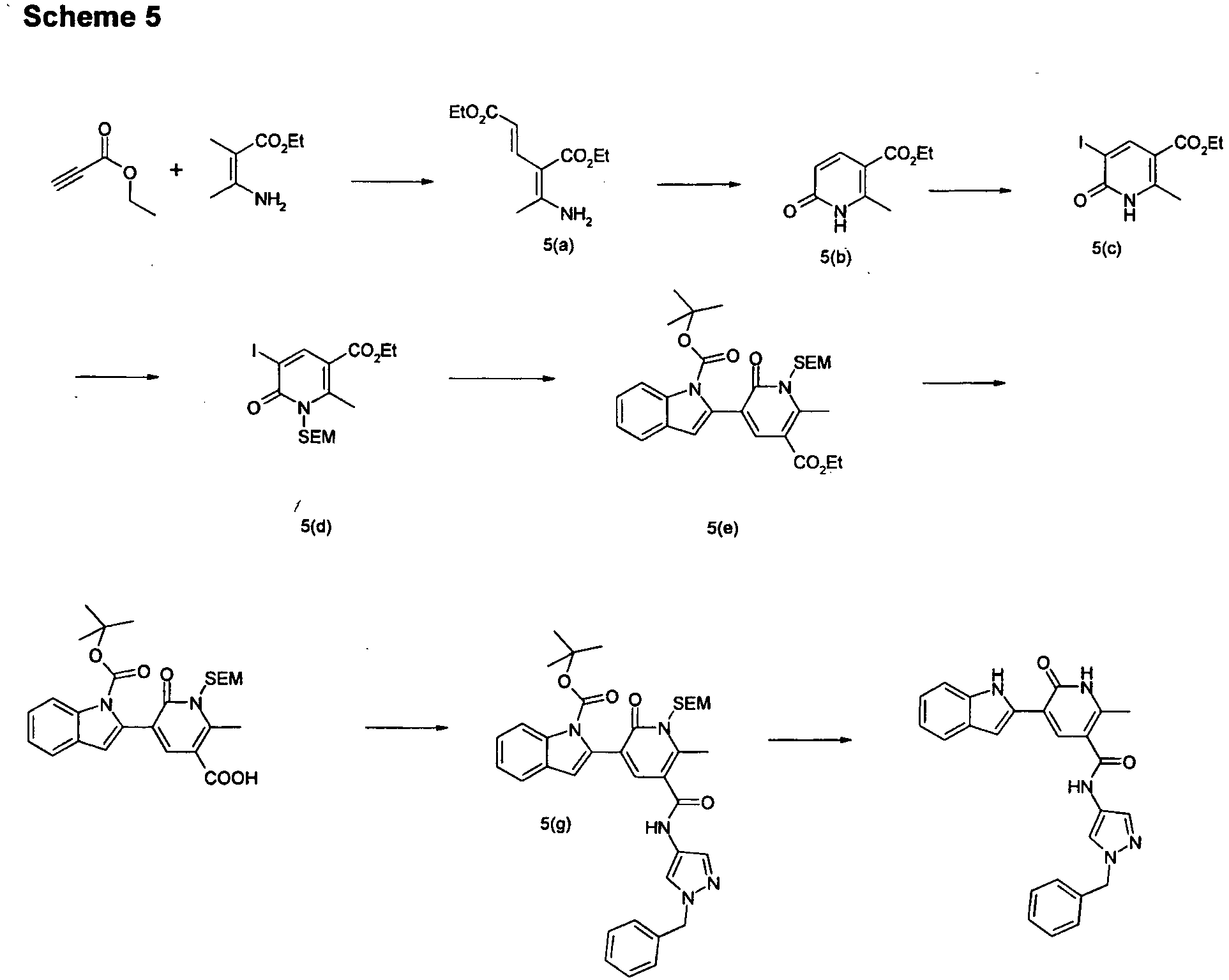

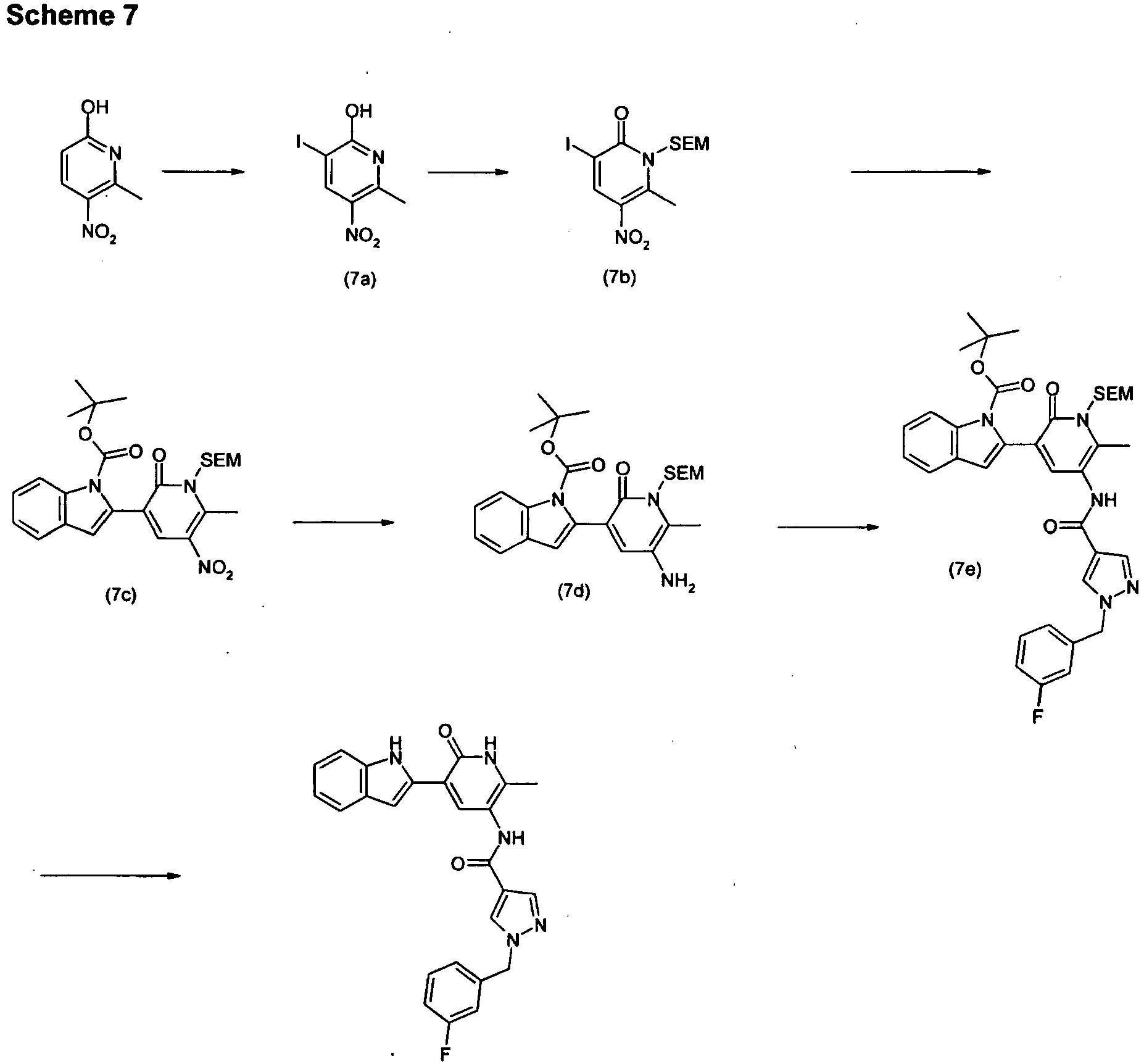


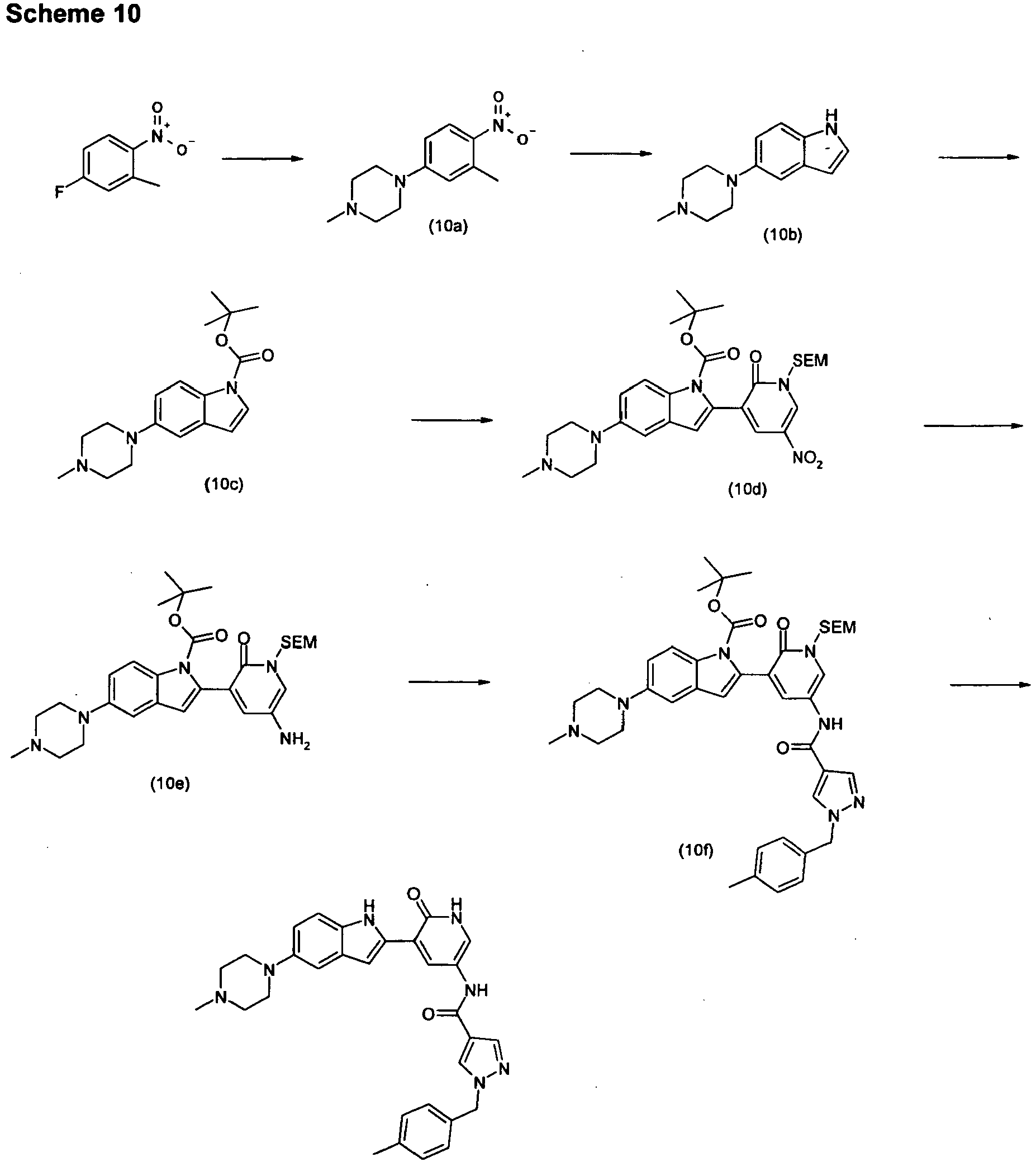

- The following examples illustrate the preparation of specific compounds of the invention and are not intended to be limiting of the full scope of the invention.
-

- The title compound was prepared according to the route outlined in Scheme 1.
- 6-Hydroxy-5-iodo-nicotinic acid methyl ester (2.0g, 7.17mmol) was stirred in anhydrous 1,2-dimethoxyethane (60mL) at ambient temperature, with potassium fluoride (4.17g, 71.7mmol). 2-(Trimethylsilyl)ethoxymethyl chloride (1.20g, 1.27mL, 7.17mmol) was added drop wise and the reaction stirred at ambient temperature for 3 hours. The reaction mixture was filtered through celite, and the filter cake washed with methanol (2x25mL). The filtrate and the washings were combined and concentrated in vacuo. The residue was partitioned between water and dichloromethane, and the organic layer was separated. The aqueous was extracted with a further portion of dichloromethane and the combined dichloromethane layers were dried (Na2SO4) and concentrated in vacuo. The resultant crude product was purified by flash chromatography on SiO2 eluting first with 20% ethyl acetate / hexane and then 66% ethyl acetate / hexane to firstly afford the undesired oxygen substituted compound and then the desired title compound as an off-white solid, 2.28g, 78%.
- Intermediate (1 a), 5-iodo-6-(2-trimethylsilanyl-ethoxy)-nicotinic acid methyl ester (1.14g, 2.79mmol), 1-(tert-butoxycarbonyl) indole-2-boronic acid (1.09g, 4.18mmol), bis(triphenylphosphine) palladium(II) dichloride (0.1g, 0.143mmol), potassium acetate (0.82g, 8.37mmol) and anhydrous N,N-dimethylformamide (15mL) were combined in a 20mL microwave vial. The contents of the vial were degassed and then were heated at 60°C for 20 minutes under microwave irradiation. The reaction mixture was concentrated in vacuo. The residue was partitioned between water and dichloromethane, and the organic layer was separated. The aqueous was extracted with a further portion of dichloromethane and the combined dichloromethane layers were dried (Na2SO4) and concentrated in vacuo. The resultant crude product was purified by flash chromatography on SiO2 eluting with 20% ethyl acetate / hexane to afford the desired title compound as an oil 1.39g, 100%.
- Intermediate (1b), 2-[5-methoxycarbonyl-2-oxo-1-(2-trimethylsilanyl-ethoxymethyl)-1,2-dihydro-pyridin-3-yl]-indole-1-carboxylic acid tert-butyl ester (2.88g, 5.78mmol) was stirred in a mixture of tetrahydrofuran (40mL) and water (20mL). Lithium hydroxide (0.469g, 11.2mmol) was added and the reaction stirred at reflux for 2 hours. After cooling the reaction mixture was concentrated in vacuo, and the residue was taken up in water and the pH adjusted to 5 with the careful addition of an aqueous 2M hydrochloric acid solution. This aqueous solution was extracted with dichloromethane (x3), and the combined extracts were washed with brine, dried (Na2SO4) and concentrated in vacuo to afford the desired title compound as a yellow solid 2.30g, 85%.
- Intermediate (1c), 2-(5-carboxy-2-oxo-1-(2-trimethylsilanyl-ethoxymethyl)-1,2-dihydro-pyridin-3-yl]-indole-1-carboxylic acid tert-butyl ester (300mg, 0.62mmol), N-(3-dimethylaminopropyl)-N'-ethylcarbodiimide hydrochloride (357mg, 1.86mmol), 1-hydroxybenzotriazole hydrate (251mg, 1.86mmol), N,N-diisopropylethylamine (320mg, 0.431mL, 2.48mmol), 1-benzyl-1H-pyrazol-4-ylamine (322mg, 1.86mmol) and tetrahydrofuran (12mL) were combined in a 20mL microwave vial. The contents of the vial were heated at 90°C for 30 minutes under microwave irradiation. The reaction mixture was concentrated in vacuo. The residue was partitioned between water and dichloromethane, and the organic layer was separated. The aqueous was extracted with a further portion of dichloromethane and the combined dichloromethane layers were dried (Na2SO4) and concentrated in vacuo. The resultant crude product was purified by flash chromatography on SiO2 eluting with 20% ethyl acetate / hexane and then 2% methanol / dichloromethane to afford the desired title compound as a solid, 315mg, 80%.
- Intermediate (1d), 2-[5-(1-benzyl-1H-pyrazol-4-ylcarbamoyl)-2-oxo-1-(2-trimethylsilanyl-ethoxymethyl)-1,2-dihydro-pyridin-3-yl]-indole-1-carboxylic acid tert-butyl ester (315mg, 0.492mmol) was stirred in tetrahydrofuran (15mL) and 1,2-diaminoethane (89mg, 98ul, 1.48mmol) was added followed by tetrabutylammonium fluoride solution 1.0M in tetrahydrofuran (2.46mL, 2.46mmol). The reaction mixture was heated at reflux for 18 hours, and cooled to ambient temperature. The reaction mixture was concentrated in vacuo. The residue was partitioned between water and dichloromethane, and the organic layer was separated. The aqueous was extracted with a further portion of dichloromethane and the combined dichloromethane layers were washed with water (x3) dried (Na2SO4) and concentrated in vacuo. The resultant crude product was purified by flash chromatography on SiO2 eluting with dichloromethane - 8% methanol / dichloromethane (gradient) to afford a solid. This solid was triturated with diethyl ether to afford the desired title compound as a yellow solid, 41 mg, 20%.
- LC/MS: RT = 2.33 Min (270nm), m/z = 410, 411 [M+H]. Total run time 3.75 min (short pos).
1H NMR (d6 DMSO): δ 5.33 (s, 2H), 6.97-7.01 (m, 1 H), 7.07-7.11 (m, 1H), 7.24-7.38 (m, 6H), 7.49 (d, 1H), 7.55 (d, 1H), 7.61 (s, 1 H), 8.10 (s, 1H), 8.11 (d, 1H), 8.56 (d, 1 H), 10.30 (s, 1 H), 11.50 (s, 1H), 12.30 (s, 1 H). -

- The title compound was prepared according to the route outlined in Scheme 1.
- Pyrazole (16g, 235mmol) was added in portions to sulfuric acid, 98%, (100mL) keeping the temperature below 40°C. To this solution was added nitric acid, 70%, (16mL) maintaining the temperature below 55°C. After addition the reaction was heated at 55°C for 3hours, and then cooled to 0°C, before carefully adding to ice / water (400mL) with stirring. This mixture was neutralized by the careful addition of aqueous 50% sodium hydroxide solution using external cooling and efficient stirring. The resultant solution was extracted with ethyl acetate (3x 300mL), and the combined extracts were washed with brine (2x250mL) dried (Na2SO4) and concentrated in vacuo to yield a white solid, which was used without further purification, 24.74g, 93%.
- 4-Nitro-1H-pyrazole (565mg, 5mmol) was stirred in acetonitrile (15mL) with potassium carbonate (829mg, 6mmol) for 5 minutes and then 4-methoxybenzyl chloride (861 mg, 0.746mL, 5.5mmol) was added. The reaction was stirred at ambient temperature for 18hours, and then partitioned between ethyl acetate and an aqueous 2M hydrochloric acid solution. The organic layer was separated and the aqueous was extracted with a further portion of ethyl acetate. The combined ethyl acetate layers were dried (Na2SO4) and concentrated in vacuo. The resultant crude product was purified by flash chromatography on SiO2 eluting with 20% ethyl acetate / hexane and then 50% ethyl acetate/ dichloromethane to afford the desired title compound as an oil, 1.08g, 93%.
- 1-(4-Methoxy-benzyl)-4-nitro-1H-pyrazole (240mg, 1.03mmol) was stirred in ethanol (10mL) and the flask was evacuated and then flushed with nitrogen. Platinum, sulfided, 5wt.% on carbon, reduced, dry (10mg, catalytic amount) was added and after two vacuum / H2 cycles to replace the nitrogen inside with hydrogen, the mixture was shaken for 18 hours under ordinary hydrogen pressure (1atm).The reaction mixture was filtered and the filtrate was concentrated in vacuo to yield a red oil, which was used without further purification, 168mg, 81 %.
- The title compound was prepared according to the experimental used in Example 1,
Step 4 using intermediate (1c) and 1-(4-methoxy-benzyl)-1H-pyrazol-4-ylamine. After the usual aqueous work up, the resultant crude product was purified by flash chromatography on SiO2 eluting with hexane - 50% ethyl acetate / hexane. This afforded the title compound as a pink solid, 180mg, 50%. - The title compound was prepared according to the experimental used in Example 1, Step 5 with 2-[5-[1-(4-methoxy-benzyl)-1H-pyrazol-4-ylcarbamoyl]-2-oxo-1-(2-trimethylsilanyl-ethoxymethyl)-1,2-dihydro-pyridin-3-yl]-indole-1-carboxylic acid tert-butyl ester.
After the usual aqueous work up the resultant crude product was purified by flash chromatography on SiO2 eluting with 50% ethyl acetate / dichloromethane and then 5% methanol / dichloromethane to afford a solid which was further purified via preparative HPLC at pH9, to furnish the title compound as a yellow solid, 40mg, 36%. LC/MS: RT = 2.29 Min (270nm), m/z = 440 [M+H]. Total run time 3.75min (short pos). 1H NMR (d6 DMSO): δ 3.75 (s, 3H), 5.25 (s, 2H), 6.91-6.95 (m, 2H), 6.98-7.03 (m, 1H), 7.09-7.13 (m, 1 H), 7.23-7.28 (m, 3H), 7.51 (d, 1 H), 7.56 (d, 1 H), 7.6 (d, 1H), 8.06 (s, 1H), 8.12 (d, 1H), 8.57 (d, 1 H), 10.3 (s, 1 H), 11.51 (br s, 1 H), 12.5 (br s, 1H). -

- The title compound was prepared according to the route outlined in
Scheme 2. - Intermediate (1e), 4-nitro-1H-pyrazole (2.8g, 24.8mmol), was stirred in ethanol (200mL) and the flask was evacuated and then flushed with nitrogen. Palladium, 10wt. % on activated carbon (300mg, catalytic amount) was added and after two vacuum / H2 cycles to replace the nitrogen inside with hydrogen, the mixture was shaken for 18 hours under ordinary hydrogen pressure (1atm). Palladium, 10wt. % on activated carbon (300mg) was added and after two vacuum / H2 cycles to replace the nitrogen inside with hydrogen, the mixture was shaken for a further 4 hours. The reaction mixture was filtered through celite and the filter cake was washed through with ethanol (2x50mL). The combined washings and the filtrate were concentrated in vacuo. The residue obtained was triturated with ethyl acetate to yield a light pink solid, 1.48g, 72%. The filtrate subsequently obtained was concentrated in vacuo to yield another batch of sufficiently pure material, 0.54g, 26%, as a dark pink solid.
- To a solution of intermediate (1c), 2-[5-carboxy-2-oxo-1-(2-trimethylsilanyl-ethoxymethyl)-1,2-dihydro-pyridin-3-yl]-indole-1-carboxylic acid tert-butyl ester, (3g, 6.2mmol) in tetrahydrofuran (100mL) was added intermediate (2f), 1H-pyrazol-4-ylamine (0.62g, 7.46mmol), 1-hydroxybenzotriazole hydrate (1.09g, 8.07mmol), N,N-diisopropylethylamine (2.4g, 3.24mL, 18.6mmol) and N-(3-dimethylaminopropyl)-N'-ethylcarbodiimide hydrochloride (1.55g, 8.07mmol). The reaction mixture was heated at 40°C for 2 hours. The reaction mixture was cooled and partitioned between ethyl acetate and aqueous saturated sodium hydrogen bicarbonate solution. The ethyl acetate layer was separated and washed with brine, dried (Na2SO4) and concentrated in vacuo. The resultant crude product was purified by flash chromatography on SiO2 eluting with hexane - 66% ethyl acetate / hexane (gradient) to afford the desired title compound as a yellow solid, 1.36g, 40%.
- Intermediate (2d), 2-[2-oxo-5-(1H-pyrazol-4-ylcarbamoyl)-1-(2-trimethylsilanyl-ethoxymethyl)-1,2-dihydro-pyridin-3-yl]-indole-1-carboxylic acid tert-butyl ester (50mg, 0.091mmol), Cs2CO3 (45mg, 0.136mmol) and 2-methylbenzyl bromide (21mg, 15ul, 0.11mmol) were stirred in N,N-dimethylformamide (5mL) at ambient temperature for 48 hours. The inorganics were separated via filtration and the filtrate was concentrated in vacuo. The resultant crude product was purified by flash chromatography on SiO2 eluting with hexane - 50% ethyl acetate / hexane (gradient) to afford the desired title compound as a solid, 55mg, 93%.
- Step 4: Preparation of Title Compound: 5-(1H-Indol-2-yl)-6-oxo-1,6-dihydro-pyridine-3-carboxylic acid [1-(2-methyl-benzyl)-1H-pyrazol-4-yl]-amide.
- The title compound was prepared according to the experimental used in Example 1, Step 5 with intermediate (2e), 2-[5-[1-(2-methyl-benzyl)-1H-pyrazol-4-ylcarbamoyl]-2-oxo-1-(2-trimethylsilanyl-ethoxymethyl)-1,2-dihydro-pyridin-3-yl]-indole-1-carboxylic acid tert-butyl ester. After the usual aqueous work up, the resultant crude product was purified by trituration with acetonitrile. This afforded the title compound as a yellow solid, 30mg, 84%.
LC/MS: RT = 2.41 Min (270nm), m/z = 424 [M+H]. Total run time 3.75 min (short pos).
1H NMR (d6 DMSO): δ 2.29 (s, 3H), 5.33 (s, 2H), 6.98 (br t, 2H), 7.08 (br t, 1 H), 7.17 (m, 4H), 7.29 (s, 1 H), 7.47 (d, 1H), 7.54 (d, 1H), 7.69 (br s, 1 H), 8.00 (s, 1H), 8.12 (br s, 1 H), 8.74 (br m, 1 H), 10.50 (br s, 1 H), 11.57 (br s, 1 H) -

- The title compound was prepared by the route outlined in
Scheme 2, following the same procedures as for Example 3.
LC/MS: RT = 2.41 Min (270nm), m/z = 424 [M+H]. Total run time 3.75 min (short pos).
1H NMR (d4 MeOD): δ 2.30 (s, 3H), 5.28 (s, 2H), 7.05 (m, 5H), 7.15 (s, 1H), 7.22 (t, 1H), 7.42 (d, 1 H), 7.54 (t, 1 H), 7.68 (s, 1 H), 8.07 (m, 2H), 8.61 (d, 1 H), NHs not seen. -

- The title compound was prepared by the route outlined in
Scheme 2, following the same procedures as for Example 3.
LC/MS: RT = 2.31 Min (270nm), m/z = 424 [M+H]. Total run time 3.75 min (short pos).
1H NMR (d6 DMSO): δ 3.31 (s, 3H), 5.26 (s, 2H), 6.98 (td, 1 H), 7.09 (td, 1H), 7.15 (br s, 4H), 7.24 (d, 1H), 7.48 (dd, 1H), 7.54 (d, 1 H), 7.58 (d, 1H), 8.05 (s, 1 H), 8.01 (br s, 1H), 8.55 (d, 1H)10.27 (s, 1 H), 11.49 (br s, 1 H), 12.46 (br s, 1 H) -

- The title compound was prepared by the route outlined in
Scheme 2, following the same procedures as for Example 3.
LC/MS: RT = 2.12 Min (270nm), m/z = 435 [M+H]. Total run time 3.75 min (short pos).
1H NMR (d6 DMSO): δ 5.41 (s, 2H), 6.98 (t, 1 H), 7.08 (t, 1 H), 7.24 (s, 1 H), 7.49 (d, 1 H), 7.55 (m, 3H), 7.63 (s, 1 H), 7.69 (s, 1 H), 7.78 (dt, 1 H.), 8.11 (d, 1H), 8.19 (s, 1H), 8.55 (d, 1H), 10.35 (s, 1 H), 11.52 (s, 1 H), 12.42 (br s, 1 H) -

- The title compound was prepared by the route outlined in
Scheme 2, following the same procedures as for Example 3.
LC/MS: RT = 2.15 Min (270nm), m/z = 435 [M+H]. Total run time 3.75 min (short pos).
1H NMR (d6 DMSO): δ 5.41 (s, 2H), 6.99 (t, 1H), 7.09 (t, 1H), 7.25 (s, 1H), 7.36 (d, 2H), 7.49 (d, 1H), 7.54 (d, 1H), 7.64 (s, 1 H), 7.83 (d, 2H), 8.12 (br m, 1H), 8.19 (s, 1 H), 8.55 (d, 1 H), 10.33 (s, 1 H), 11.50 (s, 1H), 12.47 (br s,1 H) -

- The title compound was prepared by the route outlined in
Scheme 2, following the same procedures as for Example 3.
LC/MS: RT=2.24 Min (270nm), m/z = 428 [M+H]. Total run time 3.75 min (short pos).
1H NMR (d6 DMSO): δ 5.39 (s, 2H), 6.98 (td, 1H), 7.11 (td, 1 H), 7.21 (m, 4H), 7.37 (m, 1H), 7.48 (d, 1 H), 7.54 (d, 1 H), 7.61 (d, 1H), 8.11 (m, 2H), 8.55 (d, 1H), 10.30 (s, 1 H), 11.49 (br s, 1 H), 12.47 (br s, 1 H) -

- LC/MS: RT = 2.24 Min (270nm), m/z = 428 [M+H]. Total run time 3.75 min (short pos).
1H NMR (d6 DMSO): δ 5.35 (s, 2H), 6.98 (t, 1H), 7.04 (m, 5H), 7.24 (br s, 1H), 7.40 (qd, 1H), 7.48 (d, 1H), 7.54 (d, 1 H), 7.62 (s, 1 H), 8.11 (d, 1H), 8.14 (s, 1 H), 8.55 (d, 1 H), 10.30 (br s, 1 H), 11.53 (br s, 1 H) -

- The title compound was prepared by simple modifications of the protocol described for Example 3, but still using the route outlined in
Scheme 2. - The principal modification was for Step 3, and this is described below.
2-[2-Oxo-5-(1H-pyrazol-4-ylcarbamoyl)-1-(2-trimethylsilanyl-ethoxymethyl)-1,2-dihydro-pyridin-3-yl]-indole-1-carboxylic acid tert-butyl ester, (2d), (100mg, 0.182mmol) was stirred in acetone (5mL) with potassium carbonate (126mg, 0.91mmol) and 4-fluorobenzyl bromide (41mg, 27ul, 0.218mmol) was added. The reaction mixture was heated at 50°C for 8 hours, and then cooled to ambient temperature. The inorganics were separated via filtration, and the filter cake was washed through with ethyl acetate (2x5mL). The combined washings and the filtrate were concentrated in vacuo, and the residue obtained was purified by flash chromatography on SiO2 eluting with 20% ethyl acetate / hexane to afford the desired compound as an oil, 87mg, 72%. - The title compound was isolated as a yellow solid.
LC/MS: RT = 2.29 Min (270nm), m/z = 428 [M+H]. Total run time 3.75min (short pos). 1H NMR (d6 DMSO): δ 5.35 (s, 2H), 6.98-7.03 (m, 1H), 7.09-7.14 (m, 1H), 7.18-7.24 (m, 2H), 7.27 (d, 1 H), 7.31-7.36 (m, 2H), 7.51 (d, 1H), 7.57 (d, 1 H), 7.63 (d, 1H), 8.12-8.15 (m, 2H), 8.58 (d, 1 H), 10.34 (s, 1 H), 11.54 (br s, 1 H), 12.1 (br s, 1 H). -

- The title compound was prepared by the route outlined in
Scheme 2, following the same procedures as for Example 10.
LC/MS: RT = 1.21 Min (270nm), m/z = 446 [M+H]. Total run time 1.9 min (super short pos).
1H NMR (d6 DMSO): δ 5.35 (s, 2H), 7.00 (t, 1 H), 7.10 (t, 1 H), 7.30 (br s,1H), 7.35 (m, 1H), 7.45 (q, 1 H), 7.55 (d, 1 H), 7.60 (d, 1 H), 7.70 (s, 1 H) 8.15 (d, 1 H), 8.20 (s, 1H), 8.60 (d, 1 H), 10.35 (s, 1 H), NH (x3) not seen. -

- The title compound was prepared by the route outlined in
Scheme 2, following the same procedures as for Example 10.
LC/MS: RT = 1.24 Min (270nm), m/z = 444 [M+H]. Total run time 1.9 min (super short pos).
1H NMR (d6 DMSO): δ 5.40 (d, 2H), 7.05 (t, 1 H), 7.15 (t, 1 H), 7.35 (d, 2H), 7.50 (d, 2H), 7.55 (d, 1 H), 7.65 (d, 1H), 7.70 (s, 1 H) 8.20 (d, 1H), 8.25 (s, 1H), 8.65 (d, 1 H), 10.45 (s, 1 H), NH (x3) not seen. -

- The title compound was prepared by the route outlined in
Scheme 2, following the same procedures as for Example 10.
LC/MS: RT = 1.22 Min (270nm), m/z = 446 [M+H]. Total run time 1.9 min (super short pos).
1H NMR (d6 DMSO): δ 5.40 (s, 2H), 7.00 (m, 2H), 7.05 (t, 1 H), 7.15 (t, 1 H), 7.25 (m, 1H), 7.30 (d, 1H), 7.55 (d, 1H), 7.60 (d, 1H), 7.70 (s, 1 H) 8.15 (d, 1H), 8.25 (s, 1 H), 8.60 (d, 1H), 10.40 (s, 1H), NH (x2) not seen. -

- The title compound was prepared by the route outlined in
Scheme 2, following the same procedures as for Example 10.
LC/MS: RT = 1.25 Min (270nm), m/z = 442 [M+H]. Total run time 1.9 min (super short pos).
1H NMR (d6 DMSO): δ 2.25 (s, 3H), 5.30 (s, 2H), 7.00 (m, 3H), 7.10 (t, 1H), 7.30 (m, 2H), 7.50 (d, 1H), 7.60 (d, 1 H), 7.70 (s, 1 H) 8.15 (m, 2H), 8.55 (d, 1H), 10.35 (s, 1 H), NHs not seen. -

- The title compound was prepared by the route outlined in Scheme 3.
- To a solution of indole-5-carboxylic acid (2.63g, 16.34mmol) in N,N-dimethylformamide (50mL) was added sodium bicarbonate (8.24g, 98.04mmol) and benzyl bromide (11.66mL, 98.04mmol). The reaction was stirred for 48 hours at ambient temperature under nitrogen. The reaction was then partitioned between ethyl acetate and water. The organic layer was separated and the aqueous extracted with a further portion of ethyl acetate. The combined organic layers were dried (MgSO4) and evaporated in vacuo. The resultant crude product was purified by flash chromatography on SiO2, eluting with 20% ethyl acetate / hexane followed by 50% ethyl acetate / hexane to afford the title compound as an oil, 4.82g, quantitative.
- To a solution of intermediate (3a), 1 H-indole-5-carboxylic acid benzyl ester, (4.8g, 16.34mmol) in acetonitrile (100mL) was added di-tert-butyl dicarbonate (3.92g, 17.97mmol) and 4-dimethylaminopyridine (0.2g, 1.63mmol). The reaction was stirred at ambient temperature under nitrogen for 12 hours. The reaction was concentrated in vacuo and the resultant crude product was purified by flash chromatography on SiO2, eluting with 20% ethyl acetate / hexane to afford the title compound as an off white solid, 5.04g, 88%.
- To a solution of intermediate (3b), indole-1,5-dicarboxylic acid 5-benzyl ester 1-tert-butyl ester, (5.04g, 14.36mmol) in tetrahydrofuran (50mL) at 0°C was added triisopropyl borate (5mL, 21.54mmol). Freshly prepared lithium diisopropylamide solution (18.67mmol) in tetrahydrofuran (10mL) was then added drop wise at 0°C and the reaction was stirred at 0°C for 2 hours under nitrogen. The pH of the reaction mixture was adjusted to pH7 by the careful addition of an aqueous 2M hydrochloric acid solution and stirred at ambient temperature for a further 30 minutes. The organics were separated, dried (Na2SO4) and concentrated in vacuo. This afforded the title compound, which was used without further purification, 5.05g, quantitative. Step 4: Preparation of 2-[5-Methoxycarbonyl-2-oxo-1-(2-trimethylsilanyl-ethoxymethyl)-1,2-dihydro-pyridin-3-yl]-indole-1,5-dicarboxylic acid 5-benzyl ester 1-tert-butyl ester (3d).
To a solution of intermediate (1 a), 5-iodo-6-oxo-1-(2-trimethylsilanyl-ethoxymethyl)-1,6-dihydro-pyridine-3-carboxylic acid ester, (2.94g, 7.18mmol) in N,N-dimethylformamide (16mL) was added intermediate (3c), indole-2-boronic acid-1,5-dicarboxylic acid 5-benzyl ester 1-tert-butyl ester, (5.05g, 14.36mmol) and potassium acetate (2.11g, 21.54mmol). The reaction mixture was degassed for 10 minutes after which bis(triphenylphosphine)palladium(II) dichloride (0.25g, 0.359mmol) was added and the reaction mixture degassed for a further 10 minutes. The reaction mixture was then heated to 60°C in the microwave for 20mins. The reaction mixture was concentrated in vacuo, and the residue partitioned between dichloromethane and water. The organic layer was separated and the aqueous extracted with a further portion of dichloromethane. The combined organics were dried (MgSO4) and evaporated in vacuo. The resultant crude product was purified by flash chromatography on SiO2, eluting with 20% ethyl acetate / hexane to afford the title compound as a yellow oil, 2.07g, 46%. - To a degassed solution of intermediate (3d), 2-[5-methoxycarbonyl-2-oxo-1-(2-trimethylsilanyl-ethoxymethyl)-1,2-dihydro-pyridin-3-yl]-indole-1,5-dicarboxylic acid 5-benzyl ester 1-tert-butyl ester, (2.07g, 3.27mmol) in methanol (30mL) was added palladium, 10wt. % on activated carbon (50mg) and the reaction further degassed. The reaction was heated to 30°C for 72 hours under a hydrogen atmosphere. The reaction mixture was then filtered through a celite pad and the pad rinsed with hot methanol (20mL). The combined filtrate and washings were concentrated in vacuo and poured onto 4x10g PE-AX columns. The columns were then flushed with methanol and eluted with 20% acetic acid / methanol. The combined organics were concentrated in vacuo. To the residue was added ether and this was concentrated in vacuo. This process was repeated twice more and furnished the desired title compound as a brown solid, 627mg, 35%.
- The title compound was prepared according to the experimental used in Example 3,
Step 2 with intermediate (3e), 2-[5-methoxycarbonyl-2-oxo-1-(2-trimethylsilanyl-ethoxymethyl)-1,2-dihydro-pyridin-3-yl]-indole-1,5-dicarboxylic acid 1-tert-butyl ester. After the usual aqueous work up, the crude product was purified by flash chromatography on SiO2, eluting with 6% methanol / dichloromethane to afford the title compound as a yellow gum, 219mg, 95%. - The title compound was prepared according to the experimental used in Example 1, Step 3 with intermediate (3f), 2-[5-methoxycarbonyl-2-oxo-1-(2-trimethylsilanyl-ethoxymethyl)-1,2-dihydro-pyridin-3-yl]-5-(4-methyl-piperazine-1-carbonyl)-indole-1-carboxylic acid tert-butyl ester. After the usual work up, the desired title compound was isolated as a yellow solid, 142mg, 66%.
- The title compound was prepared according to the experimental used in Example 1,
Step 4 with intermediate (3g), 2-[5-carboxy-2-oxo-1-(2-trimethylsilanyl-ethoxymethyl)-1,2-dihydro-pyridin-3-yl]-5-(4-methyl-piperazine-1-carbonyl)-indole-1-carboxylic acid tert-butyl ester. After the usual work up, the crude product was purified by flash chromatography on SiO2, eluting with 5% methanol / dichloromethane to afford the title compound as a brown foam, 178mg, quantitative. - The title compound was prepared according to the experimental used in Example 1, Step 5 with intermediate (3h), 2-[5-(1-benzyl-1H-pyrazol-4-ylcarbamoyl)-2-oxo-1-(2-trimethylsilanyl-ethoxymethyl)-1,2-dihydro-pyridin-3-yl]-5-(4-methylpiperazine-1-carbonyl)-indole-1-carboxylic acid tert-butyl ester. After the usual work up the crude product was taken up in methanol (1 mL) and loaded onto a 5g SCX column. The column was flushed with methanol and then eluted with ammonia solution 7N in methanol. The eluent was concentrated in vacuo and the residue further purified by preparative HPLC at
pH 4 to afford the title compound as a brown solid, 13mg, 10%. LC/MS RT = 1.52 Min (270nm), m/z = 536 [M+H]. Total run time 3.75 min (short pos).
1H NMR (d6 DMSO): δ 2.21 (s, 3H), 2.33 (br m, 4H), 3.53-3.56 (br m, 4H) .33 (s, 2H), 7.13 (dd, 1 H), 7.31 (m, 6H), 7.53 (d, 1 H), 7.61 (s, 2H), 8.10 (s, 1 H), 8.14 (d, 1 H), 8.58 (d, 1 H), 10.31 (s, 1H), 11.72 (s, 1 H), 12.5 (s, 1 H). -

- The title compound was prepared by the route outlined in
Scheme 4. - To a stirred solution of indole-5-carboxaldehyde (2g, 13.8mmol) in toluene (10mL) was added 4-dimethylaminopyridine (1mol%, 10mg) and di-tert-butyl dicarbonate (3.14 g, 14.5mmol) and the mixture stirred at ambient temperature for 30 minutes. After this time, tert-butyl piperazine-1-carboxylate (2.56g, 13.8mmol) was added followed by sodium triacetoxyborohydride (4.44g, 20.7mmol) in portions. After stirring for 90 minutes, a 2.5% v/v solution of acetic acid in water (10mL) was added, stirred briefly and the organic layer separated. This layer was washed with water (50mL) and concentrated to near dryness. Methanol (50mL) was added and the reaction concentrated to dryness. The residue was triturated with toluene and the liquors concentrated to dryness to yield the protected indole. This residue was dissolved in anhydrous tetrahydrofuran (6mL).
This solution was added via syringe into a nitrogen-purged flask and cooled to 5 °C. Triisopropyl borate (4.77mL, 20.7mmol) was added, followed by slow addition of lithium diisopropylamide solution 2M in tetrahydrofuran (8.95 mL, 17.9mmol), ensuring the temperature remained between 0 and 5 °C. The mixture was stirred at 5 °C for one hour then quenched by the addition of an aqueous 2M hydrochloric acid solution (2mL). The pH was adjusted to 7 with aqueous ammonia solution, the ice bath removed and the resultant biphasic mixture stirred at ambient temperature for 30 minutes. The organic layer was separated, dried (MgSO4)and concentrated in vacuo to afford the title compound, 6.34g, quantitative. - Intermediate (4a), indole-2-boronic acid-5-(4-tert-butoxycarbonyl-piperazin-1-ylmethyl)-indole-1-carboxylic acid tert-butyl ester (6.34g, 13.8mmol), potassium acetate (2.59g, 26.4mmol) and intermediate (1 a), 5-iodo-6-(2-trimethylsilanyl-ethoxy)-nicotinic acid methyl ester (3.51g, 8.6mmol) were dissolved in N,N-dimethylformamide (70mL). The reaction was degassed three times using alternating cycles of vacuum and dry nitrogen and then bis(triphenylphosphine)palladium(II) dichloride (0.45g, 0.64mmol) was added. The mixture was again degassed then heated under a nitrogen atmosphere at 60 °C for one hour. The mixture was cooled, concentrated to dryness and the residue was partitioned between water and ethyl acetate. The organic layer was separated and the aqueous was extracted with a further portion of ethyl acetate. The combined ethyl acetate layers were dried (Na2SO4) and concentrated in vacuo. The resultant crude product was purified by flash chromatography on SiO2 eluting with hexane - 20% ethyl acetate / hexane (gradient) to afford the desired title compound as a copper coloured solid, 2.4g, 40%.
- The title compound was prepared according to the experimental used in Example 1, Step 3 with intermediate (4b), 5-(4-tert-butoxycarbonyl-piperazin-1-ylmethyl)-2-[5-methoxycarbonyl-2-oxo-1-(2-trimethylsilanyl-ethoxymethyl)-1,2-dihydro-pyridin-3-yl]-indole-1-carboxylic acid tert-butyl ester. After the usual work up, the title compound was isolated as a brown foam, 2.35g, quantitative.
- Intermediate (4c), 5-(4-tert-butoxycarbonyl-piperazin-1-ylmethyl)-2-[5-carboxy-2-oxo-1-(2-trimethylsilanyl-ethoxymethyl)-1,2-dihydro-pyridin-3-yl]-indole-1-carboxylic acid tert-butyl ester, (1g, 1.46mmol), benzyl-1H-pyrazole-4-yl amine (0.75g, 4.39mmol), 1-hydroxybenzotriazole hydrate (0.59 g, 4.39 mmol) and tetrahydrofuran (15mL) were placed in a microwave vial. To this solution was added N,N-diisopropylethylamine (0.58g, 0.78mL, 4.49mmol) and N-(3-dimethylaminopropyl)-N'-ethylcarbodiimide hydrochloride (0.84g, 4.39mmol), the vial capped and heated in the microwave at 90 °C for 30 minutes. After cooling, the mixture was concentrated in vacuo and the residue partitioned between water and dichloromethane. The organic layer was separated and the aqueous was extracted with a further portion of dichloromethane. The combined dichloromethane layers were dried (Na2SO4) and concentrated in vacuo. The resultant crude product was purified by flash chromatography on SiO2 eluting with dichloromethane - 15% methanol / dichloromethane (gradient) to afford the desired title compound as a yellow foam, 1.0g, 82%.
- To a solution of intermediate (4d), 2-[5-(1-benzyl-1H-pyrazol-4-ylcarbamoyl)-2-oxo-1-(2-trimethylsilanyl-ethoxymethyl)-1,2-dihydro-pyridin-3-yl]-5-(4-tert-butoxycarbonyl-piperazin-1-ylmethyl)-indole-1-carboxylic acid tert-butyl ester, 120mg, 0.14mmol) in methanol (4mL) was added hydrochloric acid, 37% (0.75mL). The mixture was heated at 90°C for 3hours. The reaction was allowed to attain ambient temperature and the pH adjusted to 7 by the careful addition of ammonia solution 7N in methanol. The mixture was concentrated in vacuo and the resultant crude residue was purified via preparative HPLC at pH9, to furnish the title compound as a yellow solid, 1.83mg, 3%.
LC/MS: RT = 1.59 Min (270nm), m/z = 508 [M+H]+. Total run time 3.75 min (short pos).
1H NMR (d4 MeOD): δ 2.71 (br t, 4H), 3.18 (t, 4H), 3.70 (s, 2H), 5.32 (s, 2H), 7.13 (m, 2H), 7.29 (m, 5H), 7.41 (d, 1 H), 7.50 (br s, 1H), 7.68 (s, 1H), 8.07 (s, 2H), 8.45 (s, 1 H), 8.57 (d, 1 H), NHs not seen. -

- The title compound was prepared by the route outlined in Scheme 5.
- Ethyl propiolate (39.2g, 41mL, 400mmol) was added to ethyl 3-aminocrotonate (51.75g, 400mmol) and the mixture heated at 90°C for 90 minutes to give a dark red oil. The mixture was allowed to cool, to give the product as a dark orange solid, 87.0g (96%).
- A solution of intermediate (5a), (E)-4-[1-amino-eth-(Z)-ylidene]-pent-2-enedioic acid diethyl ester (51g, 225mmol) in N,N-dimethylformamide (250mL) was heated at 175°C for 24 hours to give a dark brown solution. The resulting solution was allowed to cool and a pale brown precipitate slowly formed. The precipitate was removed by filtration and the solids washed with dichloromethane (75mL) and hexane (100mL) to give a pale yellow powder. The solids were dried in vacuo (60°C) to give the title compound as a pale yellow powder, 14.45g (36%)
- N-Iodosuccinimide (40g, 180mmol) was added to a suspension of intermediate (5b), 2-methyl-6-oxo-1,6-dihydro-pyridine-3-carboxylic acid ethyl ester (18.1g, 100mmol) in acetonitrile (400mL), under a nitrogen atmosphere. The resulting suspension was heated at 95°C for 5 hours to give an initial orange solution. An off-white precipitate slowly formed. The resulting suspension was allowed to cool and was poured into water (1200mL) to give an off-white precipitate. The separated by filtration and the solids washed with water (500mL) to give an off-white powder. The solids were dried in vacuo (60°C) to give the product as an off-white powder, 28.3g (92%)
- The title compound was prepared according to the experimental used in Example 1, Step 1 using intermediate (5c), 5-iodo-2-methyl-6-oxo-1,6-dihydro-pyridine-3-carboxylic acid ethyl ester. After the usual work up, the resultant crude product was purified by flash chromatography on SiO2 eluting with 20% ethyl acetate / hexane, to give the product as a yellow/ green oil, 30.5g (76%)
- A microwave vial (20mL) was charged with intermediate (5d), 5-iodo-methyl-6-oxo-1-(2-trimethylsilanyl-ethoxymethyl)-1,6-dihydro-pyridine-3-carboxylic acid ethyl ester (0.87g, 1.99mmol), potassium carbonate (0.825g, 5.97mmol), 1-(tert-butoxycarbonyl) indole-2-boronic acid (0.624g, 2.39mmol), [1,1'-Bis(diphenylphosphino)ferrocene)]dichloropalladium(II), complex with dichloromethane (0.082g, 5mol%), tetrahydrofuran (14mL) and water (2.3mL). The contents of the vial were degassed and then heated at 60°C for 1 hour under microwave irradiation. After cooling, the reaction mixture was partitioned between brine (50mL) and ethyl acetate (50mL). The organic layer was separated, dried (Na2SO4) and concentrated in vacuo. The resultant crude product was purified by flash chromatography on SiO2 with hexane - 15% ethyl acetate / hexane (gradient) to afford the title compound as a yellow foam, 1.02g, 97%.
- The title compound was prepared according to the experimental used in Example 1, Step 3 using intermediate (5e), 2-methyl-5-(1-methyl-1H-indol-2-yl)-6-oxo-1-(2-trimethylsilanyl-ethoxymethyl)-1,6-dihydro-pyridine-3-carboxylic acid ethyl ester. After the usual work up, the title compound was isolated as a yellow solid, 419mg, 92%.
- The title compound was prepared according to the experimental used in Example 16,
Step 4 with intermediate (5f), 2-methyl-5-(1-methyl-1H-indol-2-yl)-6-oxo-1-(2-trimethylsilanyl-ethoxymethyl)-1,6-dihydro-pyridine-3-carboxylic acid. After the usual work up, the crude product was purified by flash chromatography on SiO2 eluting with hexane - 33% ethyl acetate / hexane (gradient) to afford the desired title compound as a yellow solid, 110mg, 84%. - The title compound was prepared according to the experimental used in Example 1, Step 5 with intermediate (5g), 2-methyl-5-(1-methyl-1H-indol-2-yl)-6-oxo-1-(2-trimethylsilanyl-ethoxymethyl)-1,6-dihydro-pyridine-3-carboxylic acid (1-benzyl-1H-pyrazol-4-yl)-amide. Purification of the crude product was accomplished using trituration with acetonitrile. The title compound was isolated as a yellow solid, 14mg, 20%.
LC/MS: RT = 2.29 Min (270nm), m/z = 424 [M+H]. Total run time 3.75 min (short pos).
1H NMR (d6 DMSO): δ 2.46 (s, 3H), 5.32 (s, 2H), 6.97 (t, 1 H), 7.07 (t, 1 H), 7.22-7.38 (m, 6H), 7.47 (d, 1H), 7.52 (d, 1 H), 7.57 (s, 1H), 8.10 (s, 1 H), 8.26 (s, 1 H), 10.31 (s, 1 H), 11.39 (s, 1 H), 12.28 (br s, 1H). -
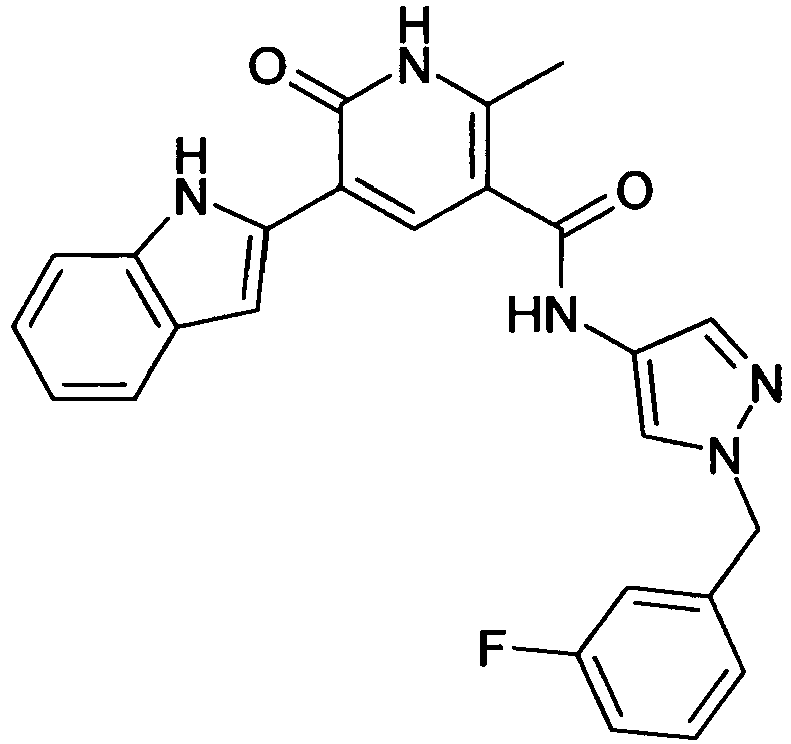
- The title compound was prepared by the route outlined in Scheme 5, following the same procedures as for Example 17.
LC/MS: RT = 2.28 Min (270nm), m/z = 442 [M+H]. Total run time 3.75 min (short pos).
1H NMR (d6 DMSO): δ 2.47 (s, 3H), 5.35 (s, 2H), 6.97-7.16 (m, 5H), 7.21 (s, 1H), 7.40 (m, 1 H), 7.47 (d, 1 H), 7.52 (d, 1 H), 7.59 (s, 1 H), 8.16 (s, 1H), 8.27 (s, 1H),10.33 (s, 1 H), 11.39 (s, 1 H), 12.28 (br s, 1 H). -

- The title compound was prepared by the route outlined in Scheme 5, following the same procedures as for Example 17.
LC/MS: RT = 2.32 Min (270nm), m/z = 460 [M+H]. Total run time 3.75 min (short pos).
1H NMR (d6 DMSO): δ 2.47 (s, 3H), 5.32 (s, 2H), 6.98-7.59 (m, 9H), 8.17 (s, 1H), 8.26 (s, 1H),10.33 (s, 1 H), 11.39 (s, 1 H), 12.28 (br s, 1 H). -

- The title compound was prepared by the route outlined in
Scheme 6. - The title compound was prepared according to the experimental used in Example 1, Step 1 using 2-hydroxy-3-iodo-5-nitro pyridine. After the usual work up, the resultant crude product was purified by flash chromatography on SiO2 eluting first with hexane and then 20% ethyl acetate / hexane to firstly afford the undesired oxygen substituted compound and then the desired title compound as a yellow oil, 4.36g, 59%.
- The title compound was prepared according to the experimental used in Example 17, Step 5 using intermediate (6a), 3-iodo-5-nitro-1-(2-trimethylsilanyl-ethoxymethyl)-1H-pyridin-2-one. After the usual work up, the crude product was purified by flash chromatography on SiO2 eluting with hexane - 20% ethyl acetate / hexane (gradient) to afford the desired title compound as an oil 0.523g, 64%.
- A round bottom flask was charged with intermediate (6b), 2-[5-nitro-2-oxo-1-(2-trimethylsilanyl-ethoxymethyl)-1,2-dihydro-pyridin-3-yl]-indole-1-carboxylic acid tert-butyl ester (0.485g, 1mmol), tetrahydrofuran (5mL) and palladium acetate (11mg, 5mol%). The flask was sealed and purged with nitrogen. While purging the flask with nitrogen, a solution of potassium fluoride (116mg, 2mmol) in water (2mL), which had been thoroughly degassed, was added via syringe. The nitrogen inlet was removed and replaced with a balloon of nitrogen. Poly(methylhydrosiloxane) (0.44mL) was added drop wise and the reaction was stirred at ambient temperature for 18 hours. The reaction mixture was diluted with dichloromethane (20mL) and aqueous saturated sodium bicarbonate solution (20mL). The organic layer was separated, filtered through a bed of celite and concentrated in vacuo. The resultant crude product was purified by flash chromatography on SiO2 eluting with hexane - 50% ethyl acetate / hexane (gradient) to afford the desired title compound as a brown solid 0.308g, 67%.
- To a solution of (6c), 2-[5-amino-2-oxo-1-(2-trimethylsilanyl-ethoxymethyl)-1,2-dihydro-pyridin-3-yl]-indole-1-carboxylic acid tert-butyl ester (0.3g, 0.659mmol) in acetonitrile (10mL) was added 1-benzyl-1H-pyrazole-4-carboxylic acid (0.111g, 0.549mmol) and triethylamine (0.133g, 0.184mL, 1.32mmol). O-benzotriazole-N,N,N',N'-tetramethyluroniumhexafluorophosphate (0.312g, 0.823mmol) was added last and the reaction mixture was stirred at ambient temperature for 18 hours. The reaction mixture was concentrated in vacuo and the residue was partitioned between ethyl acetate (25mL) and aqueous saturated sodium hydrogen carbonate solution (20mL). The organic layer was separated and the aqueous was extracted with a further portion of ethyl acetate (25mL). The combined ethyl acetate layers were washed with brine, dried (Na2SO4) and concentrated in vacuo. The resultant crude product was purified by flash chromatography on SiO2 eluting with hexane - 35% ethyl acetate / hexane - 50% ethyl acetate / hexane (gradient) to afford the desired title compound as a light brown solid, 0.246g, 70%.
- The title compound was prepared according to the experimental used in Example 1, Step 5 with intermediate (6d), 2-[5-[(1-benzyl-1H-pyrazole-4-carbonyl)-amino]-2-oxo-1-(2-trimethylsilanyl-ethoxymethyl)-1,2-dihydro-pyridin-3-yl]-indole-1-carboxylic acid tert-butyl ester.
The resultant crude product was purified by trituration with acetonitrile, to afford the title compound as a yellow solid, 64mg, 42%.
LC/MS: RT = 2.16 Min (270nm), m/z = 410 [M+H]. Total run time 3.75 min (short pos).
1H NMR (d6 DMSO): δ 5.41 (s, 2H), 6.99 (t, 1H), 7.06-7.10 (m, 2H), 7.29-7.41 (m, 5H), 7.52 (t, 2H), 7.81 (d, 1 H), 8.03 (s, 1 H), 8.18 (d, 1H),8.40 (s, 1H),9.77 (s, 1 H), 11.54 (s, 1 H), 11.98 (br s, 1 H). -

- The title compound was prepared by the route outlined in
Scheme 6, following the same procedures as for Example 20, but using intermediate (6e) inStep 4. Preparation of 1-(4-Fluoro-benzyl)-1H-pyrazole-4-carboxylic acid (6e).
1H-Pyrazole-4-carboxylic acid ethyl ester (1g, 7.14mmol) was stirred in acetone (15mL) with potassium carbonate (4.93g, 35.7mmol) and 4-fluorobenzyl bromide (1.62g, 0.746mL, 8.56mmol) was added. The reaction was heated at 50°C for 4 hours. The reaction was cooled and the inorganics were separated via filtration. The filter cake was washed through with ethyl acetate (2x10mL) and the combined washings and filtrate were concentrated in vacuo.
The residue was refluxed in methanol (10mL) containing potassium hydroxide (0.8g, 14.28mmol), for 18 hours. The reaction was cooled and concentrated in vacuo. The residue was dissolved in H2O and washed with dichloromethane. The aqueous layer was separated and carefully acidified using an aqueous 6N hydrochloric acid solution. The resulting precipitate was filtered, washed with copious amounts of water and dried in vacuo to afford the title compound, 1.05g, 67%. - The title compound, Example 21, was purified by trituration with acetonitrile, and isolated as a green solid, 80mg, 51%.
LC/MS: RT = 1.14 Min (270nm), m/z = 428 [M+H]. Total run time 1.9 min (super short pos).
1H NMR (d6 DMSO): δ 5.44 (s, 2H), 6.96-7.01 (m, 1H), 7.05-7.20 (m, 5H), 7.40-7.47 (m, 1 H), 7.49-7.55 (m, 2H), 7.80-7.84 (m, 1 H), 8.06 (s, 1 H), 8.18 (d, 1H), 8.44 (s, 1 H), 9.80 (s, 1 H), 11.56 (br s, 1 H), 12.01 (br s, 1 H). -

- The title compound was prepared by the route outlined in
Scheme 6, following the same experimental procedures as for Examples 20 and 21.
LC/MS: RT = 1.14 Min (270nm), m/z = 428 [M+H]. Total run time 1.9 min (super short pos).
1H NMR (d6 DMSO): δ 5.44 (s, 2H), 6.96-7.01 (m, 1 H), 7.05-7.22 (m, 5H), 7.40-7.47 (m, 1H),7.50-7.55 (m, 2H), 7.82 (m, 1H), 8.06 (s, 1H),8.19 (d, 1 H), 8.45 (s, 1H),9.81 (s, 1 H), 11.56 (br s, 1 H), 12.02 (br s, 1 H). -

- The title compound was prepared by the route outlined in
Scheme 6, following the same experimental procedures as for Examples 20 and 21.
LC/MS: RT = 1.21 Min (270nm), m/z = 478 [M+H]. Total run time 1.9 min (super short pos).
1H NMR (d6 DMSO): δ 5.53 (s, 2H), 6.96-7.01 (m, 1H), 7.05-7.10 (m, 2H), 7.49-7.72 (m, 6H), 7.80-7.84 (m, 1H),8.07 (s, 1 H), 8.18 (d, 1H),8.48 (s, 1 H), 9.80 (s, 1 H), 11.56 (br s, 1 H), 12.02 (br s, 1 H). -

- The title compound was prepared by the route outlined in
Scheme 6, following the same experimental procedures as for Examples 20 and 21.
LC/MS: RT = 1.16 Min (270nm), m/z = 446 [M+H]. Total run time 1.9 min (super short pos).
1H NMR (d6 DMSO): δ 5.41 (s, 2H), 6.96-7.01 (m, 1H),7.05-7.10 (m, 2H), 7.12-7.18 (m, 1 H), 7.37-7.55 (m, 4H), 7.81 (d, 1H),8.05 (s, 1H),8.19 (d, 1H),8.44 (s, 1H), 9.80 (s, 1 H), 11.56 (br s, 1 H), 12.01 (br s, 1 H). -

- The title compound was prepared by the route outlined in
Scheme 6, following the same experimental procedures as for Examples 20 and 21.
LC/MS: RT = 1.21 Min (270nm), m/z = 478 [M+H]. Total run time 1.9 min (super short pos).
1H NMR (d6 DMSO): δ 5.54 (s, 2H), 6.95-7.01 (m, 1H), 7.05-7.10 (m, 2H), 7.44-7.56 (m, 4H), 7.76 (d, 2H), 8.08 (s, 1H),8.19 (d, 1H),8.48 (s, 1 H), 9.82 (s, 1H),11.56 (br s, 1 H), 11.91 (br s, 1 H), NH not seen. -

- The title compound was prepared by the route outlined in
Scheme 6, following the same experimental procedures as for Examples 20 and 21.
LC/MS: RT = 2.29 Min (270nm), m/z = 424 [M+H]. Total run time 3.75 min (short pos).
1H NMR (d6 DMSO): δ 2.30 (s, 3H), 5.36 (s, 2H), 6.95-7.01 (m, 1H),7.04-7.17 (m, 5H), 7.24-7.29 (m, 1H), 7.48-7.56 (m, 2H), 7.81 (s, 1H), 8.04 (s, 1H), 8.18 (d, 1H), 8.39 (s, 1H), 9.78 (s, 1H),11.55 (br s, 1H), 12.01 (br s, 1H). -

- The title compound was prepared by the route outlined in
Scheme 6, following the same experimental procedures as for Examples 20 and 21.
LC/MS: RT = 2.31 Min (270nm), m/z = 444, 446 [M+H]. Total run time 3.75 min (short pos).
1H NMR (d6 DMSO): δ 5.43 (s, 2H), 6.95-7.11 (m, 3H), 7.22-7.28 (m, 1H), 7.34-7.57 (m, 5H), 7.81 (d, 1 H), 8.06 (s, 1 H), 8.19 (d, 1 H), 8.45 (s, 1 H), 9.81 (s, 1 H), 11.56 (br s, 1 H), 12.02 (br s, 1 H). -

- The title compound was prepared by the route outlined in
Scheme 6, following the same experimental procedures as for Examples 20 and 21.
LC/MS: RT = 2.31 Min (270nm), m/z = 444, 446 [M+H]. Total run time 3.75 min (short pos).
1H NMR (d6 DMSO): δ 5.41 (s, 2H), 6.96-7.11 (m, 3H), 7.29-7.34 (m, 2H), 7.43-7.56 (m, 4H), 7.81 (d, 1 H), 8.05 (s, 1 H), 8.18 (d, 1 H), 8.42 (s, 1 H), 9.80 (s, 1H), 11.56 (br s, 1 H), 12.02 (br s, 1 H). -
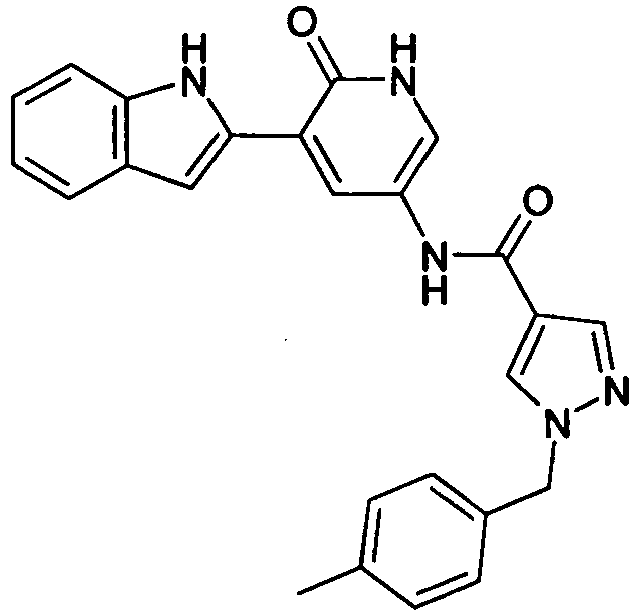
- The title compound was prepared by the route outlined in
Scheme 6, following the same experimental procedures as for Examples 20 and 21.
LC/MS: RT = 2.28 Min (270nm), m/z = 424 [M+H]. Total run time 3.75 min (short pos).
1H NMR (d6 DMSO): δ 2.29 (s, 3H), 5.35 (s, 2H), 6.94-7.11 (m, 3H), 7.19 (m, 4H), 7.48-7.56 (m, 2H), 7.81 (d, 1H),8.02 (s, 1 H), 8.18 (d, 1H),8.37 (s, 1 H), 9.77 (s, 1 H), 11.56 (br s, 1 H), 12.01 (br s, 1H). -

- The title compound was prepared by the route outlined in Scheme 7.
- The title compound was prepared according to the experimental used in Example 17, Step 3 using 2-hydroxy-6-methyl-5-nitropyridine. The usual work up afforded the title compound as a pale yellow solid, 4.95g, 81 %.
- The title compound was prepared according to the experimental used in Example 1, Step 1, using intermediate (7a), 3-iodo-6-methyl-5-nitro-1H-pyridin-2-one. After the usual work up, the crude product was purified by flash chromatography on SiO2 eluting first with hexane and then 10% ethyl acetate / hexane to firstly afford the undesired oxygen substituted compound and then the desired title compound as a yellow oil, 3.6g, 42%.
- The title compound was prepared according to the experimental used in Example 17, Step 5, with intermediate 7(b), 3-iodo-6-methyl-5-nitro-1-(2-trimethylsilanyl-ethoxymethyl)-1H-pyridin-2-one. After the usual work up, the crude product was purified by flash chromatography on SiO2 with hexane - 10% ethyl acetate / hexane (gradient) to afford the title compound as a cream coloured solid, 3.46g, 72%.
- The title compound was prepared according to the experimental used in Example 20, Step 3 with intermediate (7c), 2-[6-methyl-5-nitro-2-oxo-1-(2-trimethylsilanyl-ethoxymethyl)-1,2-dihydro-pyridin-3-yl]-indole-1-carboxylic acid tert-butyl ester. After the usual work up, the crude product was purified by flash chromatography on SiO2 with hexane - 65% ethyl acetate / hexane (gradient) to afford the title compound as a yellow foam, 2.27g, 83%.
- The title compound was prepared according to the experimental used in Example 20,
Step 4 with intermediate (7d), 2-[5-amino-6-methyl-2-oxo-1-(2-trimethylsilanyl-ethoxymethyl)-1,2-dihydrpyridin-3-yl]-indole-1-carboxylic acid tert-butyl ester, and 1-(3-Fluoro-benzyl)-1H-pyrazole-4-carboxylic acid, which was synthesised according to the protocol described for intermediate (6e) in Example 21. The resultant crude product was purified by flash chromatography on SiO2 with hexane - 50% ethyl acetate / hexane (gradient) to afford the title compound as a yellow oil, 80mg, 70%. - The title compound was prepared according to the experimental from Example 1, Step 5, with intermediate (7e), 2-[5-{[1-(3-fluoro-benzyl)-1H-pyrazole-4-carbonyl]-amino}-6-methyl-2-oxo-1-(2-trimethylsilanyl-ethoxymethyl)-1,2-dihydro-pyridin-3-yl]-indole-1-carboxylic acid tert-butyl ester. The title compound was purified by trituration with acetonitrile, and isolated as a pale green solid, 8mg, 15%.
LC/MS: RT = 1.93 Min (270nm), m/z = 442 [M+H]. Total run time 3.75min (short pos). 1H NMR (d6 DMSO): δ 2.18 (s, 3H), 5.45 (s, 2H) 6.95-7.01 (m, 1 H), 7.04-7.1 (m, 1 H), 7.12-7.22 (m, 4H), 7.42-7.56 (m, 3H), 7.99 (s, 1 H), 8.07 (s, 1 H), 8.46 (s, 1H),9.57 (s, 1 H), 11.45 (br s, 1H),12.18 (br s, 1 H). -

- The title compound was prepared by the route outlined in Scheme 7, following the same procedures as for Example 30.
LC/MS: RT = 2.15 Min (270nm), m/z = 424 [M+H]. Total run time 3.75 min (short pos).
1H NMR (d6 DMSO): δ 2.16 (s, 3H), 5.40 (s, 2H), 6.96 (t, 1H), 7.05 (t, 1H), 7.16 (s, 1H),7.29-7.40 (m, 5H), 7.44 (d, 1 H), 7.49 (d, 1H),7.96 (s, 1 H), 8.03 (s, 1H),8.40 (s, 1H),9.50 (s, 1 H), 11.42 (s, 1 H), 12.14 (br s, 1 H). -

- The title compound was prepared by the route outlined in Scheme 7, following the same procedures as for Example 30.
LC/MS: RT = 2.18 Min (270nm), m/z = 442 [M+H]. Total run time 3.75 min (short pos).
1H NMR (d6 DMSO): δ 2.16 (s, 3H), 5.40 (s, 2H), 6.96 (t, 1H), 7.05 (t, 1H), 7.16 (s, 1 H), 7.19-7.39 (m, 4H), 7.44 (d, 1 H), 7.49 (d, 1H),7.95 (s, 1H),8.03 (s, 1 H), 8.40 (s, 1H), 9.50 (s, 1H), 11.42 (s, 1H), 12.14 (br s, 1 H). -

- The title compound was prepared by the route outlined in Scheme 7, following the same procedures as for Example 30.
LC/MS: RT = 2.21 Min (270nm), m/z = 460 [M+H]. Total run time 3.75 min (short pos).
1H NMR (d6 DMSO): δ 2.16 (s, 3H), 5.40 (s, 2H), 6.96 (t, 1H), 7.05 (t, 1H),7.16 (m, 2H), 7.38-7.50 (m, 4H), 7.96 (s, 1H),8.05 (s, 1H),8.42 (s, 1H), 9.52 (s, 1 H), 11.43 (s, 1H),12.15 (br s, 1H). -

- The title compound was prepared according to the general route outlined in Scheme 1.
LC/MS: RT = 2.20 Min (270nm), m/z = 416 [M+H]. Total run time 3.75min (short pos).
1H NMR (d6 DMSO): δ 0.92-1.02 (m, 2H), 1.15-1.26 (m, 3H) 1.53 (d, 2H), 1.6-1.72 (m, 3H), 1.75-1.85 (m, 1H), 3.95 (d, 2H), 6.99-7.03 (m, 1H), 7.09-7.13 (m, 1H),7.28 (d, 1 H), 7.51 (d, 1 H), 7.56-7.59 (m, 2H), 7.99 (s, 1H),8.13 (br s, 1 H), 8.59 (d, 1 H), 10.28 (br s, 1H), 11.52 (br s, 1H), 12.49 (br s, 1H). -

- The title compound was prepared according to the general route outlined in Scheme 1.
LC/MS: RT = 1.83 Min (270nm), m/z = 409 [M-H]. Total run time 3.75 min (short pos / neg).
1H NMR (d6 DMSO): δ 5.38 (s, 2H), 6.98 (td, 1H),7.10 (td, 1 H), 7.24 (d, 1 H), 7.38 (ddd, 1 H), 7.48 (dd, 1H),7.54 (d, 1H),7.62 (d, 1 H), 7.65 (dt, 1H),8.11 (d, 1 H), 8.17 (s, 1H), 8.51 (m, 2H), 8.56 (d, 1 H), 10.31 (s, 1H),11.52 (br s, 1H), 12.50 (br s, 1 H). -

- The title compound was prepared according to the general route outlined in Scheme 1.
LC/MS: RT = 1.78 Min (270nm), m/z = 411 [M+H]. Total run time 3.75 min (short pos / neg).
1H NMR (d6 DMSO): δ 5.41 (s, 2H), 6.98 (td, 1H),7.09 (t, 1H), 7.12 (d, 2H), 7.25 (d, 1 H), 7.48 (d, 1H),7.54 (d, 1H),7.66 (s, 1H),8.13 (d, 1 H), 8.19 (s, 1 H), 8.53 (m, 2H), 8.55 (d, 1 H), 10.34 (s, 1 H), 11.53 (br s, 1 H), 12.45 (br s, 1 H) -

- The title compound was prepared according to the route outlined in
Scheme 8. - To a mechanically stirred solution of indole-5-carboxylic acid (26.3g, 163mmol) in tetrahydrofuran (600mL), was added a solution of lithum aluminium hydride 1.0M in tetrahydrofuran (200mL, 200mmol) drop wise at ambient temperature. A solution of lithium aluminium hydride 2.0M in tetrahydrofuran (22mL, 44mmol) was added drop wise at ambient temperature, and then the reaction mixture was carefully heated up to reflux and held there for 1 hour. The reaction mixture was cooled to ambient temperature and then water (13mL) was added drop wise, followed by an aqueous 10% sodium hydroxide solution (13mL), and water (20mL). The suspension was stirred at ambient temperature for 30 minutes, filtered through a bed of celite and the filter cake washed with ethyl acetate (2x200mL). The filtrate and the washings were combined and the organics were separated, dried (Na2SO4) and concentrated in vacuo, to give a dark red oil. The resultant crude product was suspended in hexane (200mL), and ethyl acetate (10mL) was added. This mixture was stirred at ambient temperature for 18 hours, and the solids were separated via filtration and washed with hexane to afford the title compound as a light brown solid, 22.25g, 93%.
- To a mechanically stirred solution of (1H-Indol-5-yl)-methanol, (8a), (22.2g, 151mmol) in dichloromethane (300mL) at ambient temperature was added N,N-diisopropylethylamine (39.0g, 52.6mL, 302mmol) followed by a solution of tertbutyldimethylsilyl chloride (25g, 166mmol) in dichloromethane (400mL). 4-Dimethylaminopyridine (1.84g, 15.1mmol) was added and the reaction was stirred at ambient temperature for 2 hours. The reaction mixture was concentrated in vacuo and the residue was taken up in ethyl acetate (400mL), washed with an aqueous 0.5N hydrochloric acid solution (600mL), brine, dried (Na2SO4) and concentrated in vacuo to yield a red oil.
This red oil was dissolved in dichloromethane (350mL) and to this was added di-tert-butyl dicarbonate (36.2g, 166mmol) drop wise at ambient temperature as a solution in dichloromethane (50mL). 4-Dimethylaminopyridine (1.84g, 15.1mmol) was added and the reaction stirred at ambient temperature for 2 hours. The reaction mixture was concentrated in vacuo and the residue was taken up in ethyl acetate (300mL), washed with an aqueous 0.5N hydrochloric acid solution (200mL), brine, dried (Na2SO4) and concentrated in vacuo to yield a light brown oil. The resultant crude product was purified by flash chromatography on SiO2 eluting first with hexane and then 10% ethyl acetate / hexane to afford the desired title compound as a white solid, 52.22g, 96%. - To a solution of diisopropylamine (2.1g, 2.89mL, 20.8mmol) in anhydrous tetrahydrofuran (10mL) was added butyllithium solution 2.5M in hexanes (7.71mL, 19.3mmol) drop wise at -78°C. After addition the reaction mixture was allowed to attain 0°C, where it was stirred for 30 minutes to form the lithiumdiisopropyl amide solution. 5-(tert-Butyl-dimethyl-silanyloxymethyl)-indole-1-carboxylic acid tert-butyl ester (8b) (5.89g, 16.3mmol) was stirred in tetrahydrofuran (80mL) and triisopropyl borate (4.18g, 5.13mL, 22.2mmol) was added, and the reaction mixture was cooled to -5°C. To this was added the previously described lithiumdiisopropyl amide solution drop wise keeping the temperature between -5°C and 0°C. After addition the reaction was stirred at -5°C for 30mins and then allowed to attain ambient temperature. The reaction mixture was concentrated in vacuo to yield crude indole-2-boronic acid-5-(tert-Butyl-dimethyl-silanyloxymethyl)-indole-1-carboxylic acid tert-butyl ester, which was dissolved in tetrahydrofuran (100mL). Water (20mL), potassium carbonate (6.17g, 44.6mmol), 3-iodo-5-nitro-1-(2-trimethylsilanyl-ethoxymethyl)-1H-pyridin-2-one, intermediate (6a) (5.87g, 14.8mmol) in tetrahydrofuran (20mL) and [1,1'-Bis(diphenylphosphino)ferrocene)]dichloropalladium(II), complex with dichloromethane (0.605g, 5mol%) were added. The red suspension was degassed for 10 minutes and then heated at 60°C for 2 hours. The reaction mixture was cooled and was partitioned between ethyl acetate (200mL) and aqueous saturated sodium bicarbonate solution (200mL). The organic layer was separated and the aqueous was extracted with a further portion of ethyl acetate. The combined ethyl acetate layers were washed with brine, dried (Na2SO4), filtered through a plug of celite and concentrated in vacuo. The resultant crude product was purified by flash chromatography on SiO2 eluting with hexane - 15% ethyl acetate / hexane (gradient) to afford the desired title compound as a yellow solid, 8.44g, 90%.
- The title compound was prepared by the route outlined in
Scheme 8 and using the experimental from Example 20, Step 3, with intermediate (8c) 5-(tert-butyl-dimethyl-silanyloxymethyl)-2-[3-nitro-6-oxo-5-(2-trimethylsilanyl-ethoxymethyl)-cyclohexa-,3-dienyl]-indole-1-carboxylic acid tert-butyl ester (11.58g, 18.4mmol).
The resultant crude product was purified by flash chromatography on SiO2 with hexane - 50% ethyl acetate / hexane (gradient) to afford the title compound as a dark yellow foam, 10.21 g, 93%. - The title compound was prepared by the route outlined in
Scheme 8 and using the experimental from Example 20,step 4, with intermediate (8d), 2-[5-amino-2-oxo-1-(2-trimethylsilanyl-ethoxymethyl)-1,2-dihydro-pyridin-3-yl]-5-(tert-butyl-dimethyl-silanyloxymethyl)-indole-1-carboxylic acid tert-butyl ester (1.0g, 1.67mmol) and 1-(4-methyl-benzyl)-1H-pyrazole-4-carboxylic acid (0.43g, 1.99mmol) which had been synthesised according to the protocol described for intermediate (6e) in example 21. The resultant crude product was purified by flash chromatography on SiO2 with hexane - 50% ethyl acetate / hexane (gradient) to afford the title compound as a pink oil, 0.721g, 54%. - Intermediate 8(e), 5-(tert-butyl-dimethyl-silanyloxymethyl)-2-[5-{[1-(4-methyl-benzyl)-1H-pyrazole-4-carbonyl]-amino}-2-oxo-1-(2-trimethylsilanyl-ethoxymethyl)-1,2-dihydro-pyridin-3-yl]-indole-1-carboxylic acid tert-butyl ester (0.72g, 0.9mmol) was stirred in tetrahydrofuran (20mL) and cooled to 0°C. Tetrabutylammonium fluoride solution 1.0M in tetrahydrofuran (0.9mL, 0.9mmol) was added drop wise at 0°C, and then the reaction was allowed to attain ambient temperature, where it was stirred for a further 2hours. The reaction mixture was diluted with ethyl acetate (30mL), washed with water (30mL), aqueous 0.5N hydrochloric acid solution (30mL), brine, dried (Na2SO4) and concentrated in vacuo to yield a green foam.
This green foam was dissolved in anhydrous dichloromethane (20mL) and manganese dioxide (1.17g, 13.5mmol) was added. The reaction was refluxed for 1 hour and, after cooling, the mixture was filtered through a bed of celite. The filter cake was washed through with tetrahydrofuran (20mL) and the filtrate was concentrated in vacuo. The resultant crude product was purified by flash chromatography on SiO2 with hexane - 50% ethyl acetate / hexane (gradient) to afford the title compound as a tan solid, 0.454g, 74%. - To a solution of intermediate (8f), 5-Formyl-2-[5-{[1-(4-methyl-benzyl)-1H-pyrazole-4-carbonyl]-amino}-2-oxo-1-(2-trimethylsilanyl-ethoxymethyl)-1,2-dihydro-pyridin-3-yl]-indole-1-carboxylic acid tert-butyl ester, (150mg, 0.22mmol) in dichloromethane (10mL) was added 4-fluoropiperidine hydrochloride (61 mg, 0.44mmol), sodium triacetoxyborohydride (140mg, 0.66mmol) and acetic acid (1 drop). The reaction mixture was stirred at ambient temperature for 3 hours and then diluted with ethyl acetate. The mixture was washed with saturated aqueous sodium bicarbonate solution, brine, dried (Na2SO4) and concentrated in vacuo. The resultant crude product was purified by flash chromatography on SiO2 with hexane - ethyl acetate (gradient) and then ion exchange using an SCX-2 column to afford the title compound as a yellow solid, 96mg, 57%.
- A 2-5mL microwave vial was charged with intermediate (8g), 5-(4-fluoro-piperidin-1-ylmethyl)-2-[5-{[1-(4-methyl-benzyl)-1H-pyrazole-4carbonyl]amino}-2-oxo-1-(2-trimethylsilanyl-ethoxymethyl)-1,2-dihydro-pyridin-3-yl]-indolecarboxylic acid tert-butyl ester (96mg, 0.125mmol), tetrahydrofuran (3mL), 1,2-diaminoethane (38mg, 42ul, 0.63mmol) and finally tetrabutylammonium fluoride solution 1.0M in tetrahydrofuran (0.63mL, 0.63mmol). The vial was heated under microwave irradiation at 120°C for 20mins. After cooling, the reaction mixture was diluted with ethyl acetate (20mL) and washed with water (4x20mL) and brine (4x20mL). The organics were dried (Na2SO4) and concentrated in vacuo. The resultant yellow solid was purified via trituration using acetonitrile, to afford the title compound as a yellow solid, 42mg, 63%.
LC/MS: RT = 1.51 Min (270nm), m/z = 539 [M+H]. Total run time 3.75min (short pos). 1H NMR (d6 DMSO): δ 1.66-1.88 (m, 4H), 2.26-2.32 (m, 5H), 2.55 (m, 2H), 3.50 (s, 2H), 4.59-4.75 (m, 1H), 5.34 (s, 2H), 7.00-7.05 (m, 2H), 7.19 (m, 4H), 7.41 (s, 1H), 7.44 (d, 1H),7.81 (d, 1H),8.01 (s, 1 H), 8.16 (d, 1 H), 8.36 (s, 1 H), 9.76 (s, 1 H), 11.50 (s, 1H),11.96 (br s, 1 H). -

- The title compound was prepared by the route outlined in
Scheme 8, following the same experimental procedures as for Example 37. It was purified by trituration with acetonitrile, and isolated as a yellow solid, 70mg, 66%.
LC/MS: RT = 1.51 Min (270nm), m/z = 521 [M+H]. Total run time 3.75 min (short pos).
1H NMR (d6 DMSO): δ 1.37-1.48 (m, 6H), 2.29-2.33 (m, 7H), 3.45 (s, 2H), 5.34 (s, 2H), 7.00-7.04 (m, 2H), 7.19 (m, 4H), 7.40-7.44 (d, 2H), 7.81 (d, 1H),8.01 (s, 1H), 8.16 (d, 1 H), 8.36 (s, 1 H), 9.76 (s, 1 H), 11.49 (s, 1 H), 11.96 (br s, 1 H). -

- The title compound was prepared by the route outlined in
Scheme 8, following the same experimental procedures as for Example 37.
The crude product was purified by flash chromatography on SiO2 with dichloromethane - 40% methanol / dichloromethane (gradient) and then trituration with diethyl ether to afford the title compound as a yellow solid, 9mg, 13%.
LC/MS: RT = 1.44 Min (270nm), m/z = 551 [M+H]. Total run time 3.75 min (short pos).
1H NMR (d6 DMSO): δ 1.06-1.15 (m. 2H), 1.32 (m, 1 H), 1.59 (m, 2H), 1.86 (m, 2H), 2.29 (s, 3H), 2.81 (m, 2H), 3.22 (m, 2H), 3.46 (s, 2H), 4.36 (t, 1H), 5.34 (s, 2H), 6.99-7.03 (m, 2H), 7.19 (m, 4H), 7.39-7.43 (d, 2H), 7.81 (d, 1 H), 8.01 (s, 1 H), 8.15 (d, 1 H), 8.36 (s, 1H),9.76 (s, 1H),11.50 (s, 1 H), NH not seen. -

- The title compound was prepared by the route outlined in
Scheme 8, following the same experimental procedures as for Example 37.
The title compound was purified by trituration with acetonitrile, and isolated as a yellow solid, 39mg, 51%.
LC/MS: RT = 1.41 Min (270nm), m/z = 523 [M+H]. Total run time 3.75 min (short pos).
1H NMR (d6 DMSO): δ 2.29 (s, 3H), 2.36 (m, 4H), 3.49 (s, 2H), 3.56 (m, 4H), 5.34 (s, 2H), 7.00-7.05 (m, 2H), 7.19 (m, 4H), 7.43-7.46 (d, 2H), 7.82 (d, 1H), 8.01 (s, 1H), 8.16 (d, 1H), 8.36 (s, 1H), 9.76 (s, 1H), 11.51 (s, 1H), 11.97 (br s, 1H). -

- The title compound was prepared by the route outlined in
Scheme 8, following the same experimental procedures as for Example 37.
The title compound was purified by trituration with acetonitrile, and isolated as a yellow solid, 35mg, 56%.
LC/MS: RT = 1.47 Min (270nm), m/z = 507 [M+H]. Total run time 3.75 min (short pos).
1H NMR (d6 DMSO): δ 1.68 (m, 4H), 2.29 (s, 3H), 2.43 (m, 4H), 3.61 (s, 2H), 5.34 (s, 2H), 7.00-7.05 (m, 2H), 7.19 (m, 4H), 7.42-7.44 (d, 2H), 7.82 (d, 1H), 8.01 (s, 1H), 8.16 (d, 1 H), 8.36 (s, 1H), 9.75 (s, 1 H), 11.49 (s, 1 H), 11.96 (br s, 1 H). -

- The title compound was prepared by the route outlined in
Scheme 8, following the same experimental procedures as for Example 37.
The title compound was purified by trituration with acetonitrile, and isolated as a yellow solid, 18mg, 40%.
LC/MS: RT = 1.42 Min (270nm), m/z = 509 [M+H]. Total run time 3.75 min (short pos).
1H NMR (d6 DMSO): δ 2.29 (s, 3H), 2.74 (m, 2H), 3.44 (m, 2H), 3.57 (s, 2H), 4.16 (m, 1H), 5.23 (d, 1H), 5.34 (s, 2H), 6.97-7.02 (m, 2H), 7.19 (m, 4H), 7.38-7.42 (d, 2H), 7.81 (d, 1H), 8.01 (s, 1H), 8.15 (d, 1H), 8.36 (s, 1H), 9.75 (s, 1H), 11.49 (s, 1H), 11.90 (br s, 1H). -
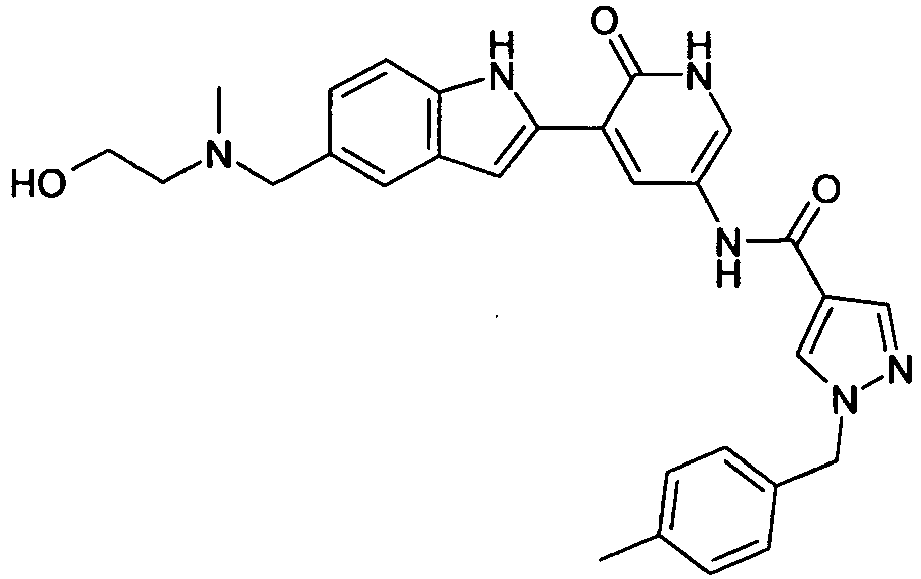
- The title compound was prepared by the route outlined in
Scheme 8, following the same experimental procedures as for Example 37.
The title compound was purified by trituration with acetonitrile, and isolated as a yellow solid, 37mg, 50%.
LC/MS: RT = 1.42 Min (270nm), m/z = 511 [M+H]. Total run time 3.75 min (short pos).
1H NMR (d6 DMSO): δ 2.15 (s, 3H), 2.29 (s, 3H), 2.43 (t, 2H), 3.48-3.55 (m, 4H), 4.32 (t, 1 H), 5.35 (s, 2H), 7.00-7.05 (m, 2H), 7.19 (m, 4H), 7.42-7.44 (d, 2H), 7.82 (d, 1 H), 8.01 (s, 1 H), 8.15 (d, 1 H), 8.36 (s, 1 H), 9.75 (s, 1 H), 11.49 (s, 1 H), 11.96 (br s, 1 H). -

- The title compound was prepared by the route outlined in
Scheme 8, following the same experimental procedures as for Example 37.
The title compound was purified by flash chromatography on SiO2 with dichloromethane - 12% methanol / dichloromethane - 12% methanol / 2% ammonia solution 7N in methanol / dichloromethane (gradient) and isolated as a yellow solid, 2.1 mg, 12%.
LC/MS: RT = 0.93 Min (270nm), m/z = 541 [M+H]. Total run time 1.9 min (super short pos).
1H NMR (d6 DMSO): δ 1.24-1.26 (m, 2H), 1.34-1.39 (m, 2H), 1.48-1.49 (m, 4H), 2.32-2.36 (m, 2H), 3.45-3.51 (m, 2H), 5.41 (s, 2H), 7.01 (d, 1H), 7.04 (dd, 1H), 7.31 (d, 2H), 7.41-7.42 (m, 4H), 7.82 (d, 1H),8.04 (s, 1 H), 8.17 (d, 1 H), 8.42 (s, 1 H), 9.79 (1H, s), 11.51 (1 H, s), NH not seen. -

- The title compound was prepared by the route outlined in
Scheme 8, following the same experimental procedures as for Example 37.
The resultant crude product was purified by trituration with acetonitrile to afford the title compound as brown solid, 8mg, 20%
LC/MS: RT = 0.91 Min (270nm), m/z = 545 [M+H]. Total run time 1.9 min (super short pos).
1H NMR (d6 DMSO): δ 1.27 (t, 3H), 3.11-3.18 (m, 4H), 3.66-3.75 (m, 2H), 4.38 (d, 2H), 5.39 (s, 2H), 7.11 (s, 1 H), 7.22 (dd, 1 H), 7.30 (d, 2H), 7.41 (d, 2H), 7.58 (d, 1 H), 7.72 (s, 1 H), 7.83 (d, 1 H), 8.03 (s, 1H), 8.26 (d, 1 H), 8.40 (s, 1 H), 9.18 (s, 1H), 9.80 (s, 1 H), 11.76 (s, 1H), NH not seen. -

- The title compound was prepared by the route outlined in
Scheme 8, following the same experimental procedures as for Example 37.
The resultant crude product was taken up in methanol (1mL) and loaded onto a 5g SCX column. The column was flushed with methanol and then eluted with ammonia solution 7N in methanol. The eluent was concentrated in vacuo and the residue further purified by preparative HPLC atpH 4 to afford the title compound as a yellow solid, 3mg, 8%. - LC/MS: RT = 0.90 Min (270nm), m/z = 456 [Fragment]. Total run time 1.9 min (super short pos).
1H NMR (d6 DMSO): δ 2.90-2.93 (m, 2H), 3.63 (m, 2H), 4.15 (s, 2H), 5.10 (s, 1 H), 5.41 (s, 2H), 7.09 (d, 1H), 7.20 (dd, 1 H), 7.31 (d, 2H), 7.50 (d, 2H), 7.55 (d, 1H), 7.66 (s, 1 H), 7.80 (d, 1 H), 8.05 (s, 1H), 8.25 (d, 1H), 8.43 (s, 1H), 9.82 (s, 1 H), 11.68 (s, 1H), NHs not seen. -

- The title compound was prepared by the route outlined in
Scheme 8, following the same experimental procedures as for Example 37.
The title compound was purified by flash chromatography on SiO2 with dichloromethane - 10% methanol / dichloromethane -10% methanol / 1% ammonia solution 7N in methanol / dichloromethane (gradient) and isolated as a yellow solid, 30mg, 65%.
LC/MS: RT = 1.73 Min (270nm), m/z = 560, 561 [M+H]. Total run time 3.75 min (short pos).
1H NMR (d6 DMSO): δ 1.23 (m, 2H), 1.69 (m, 2H), 1.79-1.86 (m, 2H), 2.29-2.33 (m, 2H), 3.51 (s, 2H), 4.61-4.73 (m, 1 H), 5.41 (s, 2H), 7.01 (d, 1H), 7.04 (dd, 1 H), 7.31 (d, 2H), 7.42-7.46 (m, 4H), 7.82 (d, 1 H), 8.04 (s, 1 H), 8.17 (d, 1H), 8.41 (s, 1 H), 9.78 (s, 1H), 11.51 (s, 1 H), 11.98 (s, 1 H). -

- The title compound was prepared by the route outlined in
Scheme 8, following the same experimental procedures as for Example 37.
It was purified by flash chromatography on SiO2 with dichloromethane - 10% methanol / dichloromethane - 10% methanol / 1% ammonia solution 7N in methanol / dichloromethane (gradient) and then by trituration with acetonitrile. The desired compound was isolated as a yellow solid, 8mg, 10%.
LC/MS: RT = 0.91 Min (270nm), m/z = 557 [M+H]. Total run time 1.9 min (super short pos).
1H NMR (d6 DMSO): δ 1.36-1.39 (m, 2H), 1.68-1.71 (m, 2H), 2.01 (m, 2H), 2.67 (m, 2H), 3.46 (m, 2H), 4.51 (s, 1H), 5.41 (s, 2H), 7.01-7.03 (m, 2H), 7.31 (d, 2H), 7.44 (m, 4H), 7.82 (d, 1 H), 8.04 (s, 1H), 8.17 (d, 1 H), 8.42 (s, 1 H), 9.78 (s, 1H), 11.50 (s, 1H), 11.98 (s, 1 H), OH not seen. -

- The title compound was prepared by the route outlined in
Scheme 8, following the same experimental procedures as for Example 37.
Purification by trituration with acetonitrile afforded the title compound as a yellow solid, 51 mg, 85%
LC/MS: RT = 0.91 Min (270nm), m/z = 525 [M+H]. Total run time 1.9 min (super short pos / neg).
1H NMR (d6 DMSO): δ 1.68 (m, 2H), 1.78 (m, 2H), 2.26 (m, 2H), 2.60 (m, 2H), 3.50 (s, 2H), 4.66 (dm, 1 H), 5.40 (s, 2H), 6.99 (d, 1H), 7.02 (dd, 1 H), 7.40 (m, 7H), 7.85 (d, 1 H), 8.07 (s, 1H), 8.25 (d, 1H), 8.46 (s, 1 H), 9.92 (s, 1H), 11.51 (br s, 1 H), 11.96 (br s, 1H) -

- The title compound was prepared by the route outlined in
Scheme 8, following the same experimental procedures as for Example 37.
Purification by trituration with acetonitrile afforded the title compound as a yellow solid, 38mg, 46%
LC/MS: RT = 0.90 Min (270nm), m/z = 493 [M+H]. Total run time 1.9 min (super short pos / neg).
1H NMR (d6 DMSO): δ 1.68 (br s, 4H), 2.43 (br s, 4H), 3.61 (br s, 2H), 5.40 (s, 2H), 6.99 (d, 1 H), 7.04 (dd, 1 H), 7.38 (m, 7H), 7.84 (d, 1H), 8.06 (s, 1 H), 8.22 (br s, 1H), 8.44 (s, 1H), 9.87 (s, 1H), 11.49 (s, 1H), 11.96 (br s, 1H) -

- The title compound was prepared by the route outlined in
Scheme 8, following the same experimental procedures as for Example 37, with a slight modification to the protocol in Step 5. - Intermediate (8d), 2-[5-amino-2-oxo-1-(2-trimethylsilanyl-ethoxymethyl)-1,2-dihydro-pyridin-3-yl]-5-(tert-butyl-dimethyl-silanyloxymethyl)-indole-1-carboxylic acid tert-butyl ester, (600mg, 1mmol) was stirred in dichloromethane (50mL) at RT with triethylamine (202mg, 0.278mL, 2mmol). The reaction mixture was cooled to 5°C and then a solution of 1-Benzyl-1H-pyrazole-4-carbonyl chloride (265mg, 1.2mmol), which had been prepared according to the protocol below, in dichloromethane (10ml), was added drop wise. After addition the reaction was stirred at RT for 18 hrs and then the reaction mixture was washed with saturated sodium hydrogen carbonate solution (2x50mL), brine (50ml), dried (Na2SO4) and concentrated in vacuo. The resultant crude product was purified by flash chromatography on SiO2 eluting with hexane - 50% ethyl acetate / hexane (gradient) to afford the desired compound as a pale green foam, 750mg, 96%.
- Preparation of 1-Benzyl)-1H-pyrazole-4-carbonyl chloride used in Step 5, above. 1-Benzyl-1H-pyrazole-4-carboxylic acid (1.6g, 7.92mmol) was stirred as a suspension in toluene (20mL) at RT and thionyl chloride (1.88g, 1.15mL, 15.8mmol) was added. The reaction mixture was slowly heated to reflux and heating continued for 4hrs. After cooling the reaction was concentrated in vacuo. Toluene was added to the residue and concentrated in vacuo. This was repeated a further three times with toluene and twice with isohexane. The crude oil obtained was used without further purification, 1.65g, 95%.
- The title compound was purified by trituration with acetonitrile afforded the title compound as a yellow solid, 25mg, 36%
LC/MS: RT = 1.64 Min (270nm), m/z = 509 [M+H]. Total run time 3.75 min (short pos).
1H NMR (d6 DMSO): δ 2.29-2.39 (m, 4H), 3.50 (s, 2H), 3.52-3.60 (m, 4H), 5.41 (s, 2H), 7.00-7.02 (m, 2H), 7.28-7.46 (m, 7H), 7.82 (s, 1H),8.04 (s, 1 H), 8.16-8.19(d, 1 H), 8.40 (s, 1 H), 9.77 (s, 1 H), 11.51 (s, 1 H), 11.96 (br s, 1 H). -

- The title compound was prepared by the route outlined in
Scheme 8, following the same experimental procedures as for Example 51.
The title compound was purified by trituration with acetonitrile, and isolated as a yellow solid, 0.467g, 42%.
LC/MS: RT = 1.44 Min (270nm), m/z = 507 [M+H]. Total run time 3.75 min (short pos).
1H NMR (d6 DMSO): δ 1.37 (m, 2H), 1.47 (m, 4H), 2.32 (m, 4H), 3.45 (s, 2H), 5.41 (s, 2H), 7.00-7.03 (m, 2H), 7.28-7.44 (m, 7H), 7.82 (d, 1H), 8.03 (s, 1H), 8.16 (d, 1H), 8.41 (s, 1H), 9.79 (s, 1H), 11.50 (s, 1 H), 11.99 (br s, 1 H). -

- The title compound was prepared by the route outlined in
Scheme 8, following the same experimental procedures as for Example 51.
The title compound was purified by preparative HPLC at pH9 and isolated as a yellow solid, 3mg, 4%. - LC/MS: RT = 1.64 Min (270nm), m/z = 556 [M+H]. Total run time 3.75 min (short pos).
1H NMR (d6 DMSO): δ 2.14 (s, 3H), 2.20-2.40 (m, 8H), 3.48 (s, 2H), 5.41 (s, 2H), 7.0-7.48 (m, 8H), 7.81 (d, 1H), 8.04 (s, 1 H), 8.16 (d, 1 H), 8.42 (s, 1H), 9.78 (s, 1H), 11.50 (s, 1H), 11.92 (br s, 1H). -

- The title compound was prepared by the route outlined in
Scheme 8, following the same experimental procedures as for Example 51.
The title compound was purified by trituration with acetonitrile, and isolated as a yellow solid, 5mg, 9%.
LC/MS: RT = 1.41 Min (270nm), m/z = 497 [M+H]. Total run time 3.75 min (short pos).
1H NMR (d6 DMSO): δ 2.29 (s, 3H), 2.60 (q, 2H), 3.47 (q, 2H), 3.75 (s, 2H), 4.45 (t, 1H), 5.34 (s, 2H), 7.00 (s, 1H), 7.05 (d, 1H), 7.19 (m, 4H), 7.41-7.45 (m, 2H), 7.82 (d, 1 H), 8.01 (s, 1 H), 8.16 (d, 1 H), 8.36 (s, 1 H), 9.75 (s, 1 H), 11.48 (s, 1 H). -

- The title compound was prepared by the route outlined in
Scheme 8, following the same experimental procedures as for Example 51.
The title compound was purified by trituration with acetonitrile, and isolated as a yellow solid, 33mg, 49%. - LC/MS: RT = 0.96Min (270nm), m/z = 527 [M+H]. Total run time 1.9 min (super short pos).
1H NMR (d6 DMSO): δ 1.62 (m, 4H), 2.40-2.48 (m, 4H), 3.60 (s, 2H), 5.41 (s, 2H), 6.96-7.46 (m, 8H), 7.80-7.84 (d, 1H), 8.04 (s, 1 H), 8.17 (d, 1 H), 8.42 (s, 1 H), 9.78 (s, 1H), 11.50 (s, 1 H), 11.90-12.00 (br s, 1 H). -

- The title compound was prepared by the route outlined in
Scheme 8, following the same experimental procedures as for Example 51.
The title compound was purified by trituration with acetonitrile, and isolated as a yellow solid, 13mg, 17%. - LC/MS: RT = 0.88Min (270nm), m/z = 511 [M+H]. Total run time 1.9 min (super short pos).
1H NMR (d6 DMSO): δ 0.97-1.01 (t, 3H), 3.41-3.47 (q, 2H), 3.60 (s, 2H), 4.24-4.27 (t, 1H), 5.41 (s, 2H), 6.99-7.44 (m, 9H), 7.81-7.82 (d, 1H), 8.03 (s, 1 H), 8.16-8.17 (d, 1H), 8.41 (s, 1H), 9.78 (s, 1H), 11.51 (s, 1H), 11.90-11.98 (br s, 1H). -

- The title compound was prepared by the route outlined in
Scheme 8, following the same experimental procedures as for Example 51.
The title compound was purified by trituration with acetonitrile, and isolated as a yellow solid, 25mg, 33%. - LC/MS: RT = 0.91 Min (270nm), m/z = 525 [M+H]. Total run time 1.9 min (super short pos).
1H NMR (d6 DMSO): δ 1.40-1.60 (m, 2H), 1.64-1.73 (m, 1 H), 1.76-1.80 (m, 1 H), 2.17-2.25 (m, 1 H), 2.26-2.36 (m, 1H), 2.40-2.47 (m, 1H), 2.64-2.76 (m, 1H), 3.49-3.59 (d, 2H), 4.51-4.69 (m, 1H), 5.41 (s, 2H), 7.01-7.46 (m, 9H), 7.81-7.82 (d, 1H), 8.03 (s, 1 H), 8.16-8.17 (d, 1 H), 8.40 (s, 1 H), 9.77 (s, 1 H), 11.53 (s, 1 H), 11.85-11.95 (br s, 1 H). -

- The title compound was prepared by the route outlined in
Scheme 8, following the same experimental procedures as for Example 51.
The title compound was purified by trituration with acetonitrile, and isolated as a yellow solid, 34mg, 47%. - LC/MS: RT = 1.55 Min (270nm), m/z = 522 [M+H]. Total run time 3.75 min (short pos).
1H NMR (d6 DMSO): δ 2.14 (s, 3H), 2.24-2.41 (m, 8H), 3.48 (s, 2H), 5.41 (s, 2H), 7.00-7.44 (m, 9H), 7.81-7.82 (d, 1 H), 8.03 (s, 1H), 8.16-8.18 (d, 1H), 8.41 (s, 1 H), 9.78 (s, 1 H), 11.52 (s, 1 H), 11.94-11.96 (br s, 1 H). -

- The title compound was prepared by the route outlined in
Scheme 8, following the same experimental procedures as for Example 51.
The title compound was purified by trituration with acetonitrile, and isolated as a yellow solid, 63mg, 62%.
LC/MS: RT = 1.39 Min (270nm), m/z = 536 [M+H]. Total run time 3.75 min (short pos).
1H NMR (d6 DMSO): δ 2.14 (s, 3H), 2.26-2.44 (m, 11H), 3.48 (s, 2H), 5.34 (s, 2H), 7.00-7.03 (m, 2H), 7.19 (m, 4H), 7.41-7.44 (m, 2H), 7.82 (d, 1H), 8.01 (s, 1H), 8.16 (d, 1 H), 8.36 (s, 1 H), 9.76 (s, 1 H), 11.50 (s, 1 H), 11.97 (br s, 1 H). -

- The title compound was prepared by the route outlined in
Scheme 8, following the same experimental procedures as for Example 51.
The title compound was purified by trituration with acetonitrile, and isolated as a yellow solid, 18mg, 35%. - LC/MS: RT = 1.59 Min (270nm), m/z = 523 [M+H]. Total run time 3.75 min (short pos).
1H NMR (d6 DMSO): δ 1.30-1.43 (m, 2H), 1.64-1.73 (m, 2H), 1.97-2.03 (t, 2H), 2.63-2.72 (m, 2H), 3.40-3.44 (m, 1 H), 3.46 (s, 2H), 4.49-4.50 (d, 1H), 5.41 (s, 2H), 6.99-7.43 (m, 9H), 7.82-7.84 (d, 1H), 8.03 (s, 1 H), 8.16-8.17 (d, 1 H), 8.41 (s, 1 H), 9.78 (s, 1 H), 11.58 (s, 1 H), 11.90 (br s, 1 H). -

- The title compound was prepared by the route outlined in
Scheme 8, following the same experimental procedures as for Example 51.
The title compound was purified by trituration with acetonitrile, and isolated as a yellow solid, 8mg, 15%. - LC/MS: RT = 1.58 Min (270nm), m/z = 422 [Fragment]. Total run time 3.75 min (short pos).
1H NMR (d6 DMSO): δ 2.57-2.61 (t, 2H), 3.45-3.49 (m, 2H), 3.74 (s, 2H), 4.39-4.46 (m, 1 H), 5.41 (s, 2H), 6.99-7.45 (m, 9H), 7.82-7.83 (d, 1H), 8.03 (s, 1 H), 8.17-8.18 (d, 1H), 8.41 (s, 1H), 9.78(s, 1 H), 11.51 (s, 1 H). -

- The title compound was prepared by the route outlined in
Scheme 8, following the same experimental procedures as for Example 51.
The title compound was purified by trituration with acetonitrile, and isolated as a yellow solid, 26mg, 23%.
LC/MS: RT = 1.38 Min (270nm), m/z = 566 [M+H]. Total run time 3.75 min (short pos).
1H NMR (d6 DMSO): δ 2.29 (s, 3H), 2.32-2.45 (m, 10H), 3.44-3.48 (m, 4H), 4.32 (t, 1H), 5.34 (s, 2H), 7.00-7.03 (m, 2H), 7.19 (m, 4H), 7.41-7.44 (m, 2H), 7.82 (d, 1H), 8.01 (s, 1 H), 8.16 (d, 1 H), 8.36 (s, 1 H), 9.76 (s, 1 H), 11.50 (s, 1 H), 11.96 (br s, 1 H). -

- The title compound was prepared by the route outlined in
Scheme 8, following the same experimental procedures as for Example 51.
The title compound was purified by preparative HPLC at pH9 and isolated as a yellow solid, 4mg, 6%. - LC/MS: RT = 0.95 Min (270nm), m/z = 559 [M+H]. Total run time 1.9 min (super short pos).
1H NMR (d6 DMSO): δ 1.39-1.55 (m, 2H), 1.64-1.73 (m, 1H), 1.76-1.89 (m, 1 H), 2.19-2.25 (m, 1 H), 2.28-2.35 (m, 1 H), 2.41-2.46 (m, 1 H), 2.64-2.76 (m, 1 H), 3.54-3.55 (d, 2H), 4.50-4.70 (m, 1 H), 5.41 (s, 2H), 7.00-7.48 (m, 8H), 7.82-7.83 (d, 1H), 8.04 (s, 1H), 8.17-8.18(d, 1H), 8.42 (s, 1H), 9.79 (s, 1 H), 11.52 (s, 1H), 11.93-12.02 (br s, 1 H). -

- The title compound was prepared by the route outlined in
Scheme 8, following the same experimental procedures as for Example 51.
The title compound was purified by trituration with acetonitrile, and isolated as a yellow solid, 17mg, 48%. - LC/MS: RT = 0.94 Min (270nm), m/z = 422 [other]. Total run time 1.9 min (super short pos).
1H NMR (d6 DMSO): δ 1.90-1.99 (m, 4H), 3.56 (s, 2H), 5.41 (s, 2H), 7.01-7.46 (m, 9H), 7.82-7.83 (d, 1 H), 8.04 (s, 1 H), 8.19-8.20 (d, 1 H), 8.42 (s, 1H), 9.82 (s, 1H), 11.54 (s, 1H). -

- The title compound was prepared by the route outlined in
Scheme 8, following the same experimental procedures as for Example 51.
The title compound was purified by preparative HPLC atpH 4 and isolated as a yellow solid, 4mg, 5%. - LC/MS: RT = 0.85 Min (270nm), m/z = 552 [M+H]. Total run time 1.9 min (super short pos).
1H NMR (d4 MeOD): δ 2.74-3.13 (m, 10H), 3.70-3.73 (t, 2H), 3.97 (s, 2H), 5.40 (s, 2H), 7.05-7.58 (m, 9H), 7.90-7.91 (d, 1 H), 8.05 (s, 1 H), 8.24-8.25 (d, 1H), 8.50 (s, 1 H). -

- The title compound was prepared by the route outlined in
Scheme 8, following the same experimental procedures as for Example 51.
The title compound was purified by preparative HPLC at pH9 followed by trituration with acetonitrile and isolated as a yellow solid, 0.5mg, 1%. - LC/MS: RT = 0.89 Min (270nm), m/z = 586 [M+H]. Total run time 1.9 min (super short pos).
1H NMR (d4 MeOD): δ 2.48-2.71 (m, 8H), 3.62-3.68 (m, 4H), 5.40 (s, 2H), 7.02-7.51 (m, 8H), 7.93-7.94 (d, 1 H), 8.06 (s, 1 H), 8.21-8.22 (d, 1 H), 8.28 (s, 1H), 8.54 (s, 1H). -

- The title compound was prepared by the route outlined in
Scheme 8, following the same experimental procedures as for Example 51.
The title compound was purified by preparative HPLC at pH9 and isolated as a yellow solid, 6mg, 10%. - LC/MS: RT = 0.92 Min (270nm), m/z = 456 [Fragment]. Total run time 1.9 min (super short pos).
1H NMR (d6 DMSO): δ 2.32-2.38 (m, 4H), 3.49 (s, 2H), 3.55-3.57 (m, 4H), 5.41 (s, 2H), 7.01-7.05 (m, 2H), 7.28-7.32 (m, 2H), 7.41-7.47 (m, 4H), 7.82-7.83 (d, 1H), 8.05 (s, 1 H), 8.17-8.18 (d, 1H), 8.42(s, 1H), 9.81 (s, 1H), 11.53 (s, 1H), 11.96-12.04 (br s, 1H). -

- The title compound was prepared by the route outlined in
Scheme 8, following the same experimental procedures as for Example 51.
The title compound was purified by preparative HPLC at pH9 and isolated as a yellow solid, 3mg, 4%. - LC/MS: RT = 0.86 Min (270nm), m/z = 422 [Fragment]. Total run time 1.9 min (super short pos).
1H NMR (d6 DMSO): δ 3.13 (s, 3H), 3.52-3.62 (m, 4H), 4.22-4.28 (m, 2H), 5.41 (s, 2H), 7.12-7.40 (m, 7H), 7.58-7.60 (d, 1H), 7.69 (s, 1 H), 7.80 (s, 1 H), 8.05 (s, 1H), 8.26-8.27 (d, 1H), 8.43 (s, 1H), 9.85 (s, 1H), 11.75 (s, 1 H), 12.04-12.11 (br s, 1 H). -

- The title compound was prepared by the route outlined in
Scheme 8, following the same experimental procedures as for Example 51.
The title compound was purified by trituration with acetonitrile, and isolated as a yellow solid, 2mg, 10%. - LC/MS: RT = 0.92 Min (254nm), m/z = 537 [M+H]. Total run time 1.9 min (super short pos).
1H NMR (d4 MeOD): δ 1.10 (d, 6H), 1.76, (t, 2H), 2.79 (d, 2H), 3.58 (s, 2H), 3.62-3.72 (m, 2H), 5.4 (s, 2H), 7.01 (s, 1 H), 7.12 (dd, 1 H), 7.28-7.42 (m, 6H), 7.49 (s, 1 H), 7.94 (d, 1 H), 8.06 (s, 1 H), 8.22 (d, 1 H), 8.25 (s, 1 H) -

- The title compound was prepared by the route outlined in
Scheme 8, following the same experimental procedures as for Example 51.
The title compound was purified by trituration with acetonitrile, and isolated as a yellow solid, 17mg, 23%. - LC/MS: RT = 0.87 Min (254nm), m/z = 536 [M+H]. Total run time 1.9 min (super short pos).
1H NMR (d4 MeOD): δ 1.03 (d, 3H), 1.91 (t, 1 H), 2.15-2.26 (br m, 2H), 2.27 (s, 3H), 2.34 (m, 1H), 2.75-2.88 (m, 3H), 3.55-3.63 (m, 2H), 5.4 (s, 2H), 7.12 (s, 1H), 8.04-8.1 (dd, 1H), 7.28-7.41 (m, 6H), 7.48 (s, 1 H), 7.94 (d, 1H), 8.06 (s, 1 H), 8.21 (d, 1H), 8.25 (s, 1H). -

- The title compound was prepared by the route outlined in
Scheme 8, following the same experimental procedures as for Example 51.
The title compound was purified by trituration with acetonitrile, and isolated as a yellow solid, 84mg, 62%.
LC/MS: RT = 1.56 Min (270nm), m/z = 537 [M+H]. Total run time 3.75 min (short pos).
1H NMR (d6 DMSO): δ 1.00 (d, 6H), 1.62 (m, 2H), 2.68 (m, 2H), 3.47 (s, 2H), 3.55 (m, 2H), 5.41 (s, 2H), 7.01-7.04 (m, 2H), 7.28-7.46 (m, 7H), 7.82 (d, 1 H), 8.03 (s, 1H), 8.16 (d, 1H), 8.41 (s, 1H), 9.79 (s, 1H), 11.53 (s, 1H), 11.99 (br s, 1 H). -

- The title compound was prepared by the route outlined in
Scheme 8, following the same experimental procedures as for Example 51.
The title compound was purified by flash chromatography on silica eluting with dichloromethane/ methanol (19:1) to give a pale brown gum followed by trituration with diethyl ether, and isolated as a yellow powder, 30mg, 23%. - LC/MS: RT=1.76Min (270nm), m/z = 579 [M+H]. Total run time 3.75min (short pos). 1H NMR (d6 DMSO): δ 1.10 (br s, 6H), 1.25 (d, 6H), 1.70 (br s, 2H), 2.80 (br m, 2H), 2.90 (m, 1 H), 3.60 (br m, 3H), 5.40 (s, 2H), 7.10 (br s, 1 H), 7.30 (m, 3H), 7.50 (br s, 2H), 7.90 (br s, 1H), 8.10 (s, 1H), 8.20 (br s, 1 H), 8.50 (s, 1H), 9.85 (s, 1H), 11.52 (br s, 1H), 12.00 (br s, 1 H).
-

- The title compound was prepared by the route outlined in
Scheme 8, following the same experimental procedures as for Example 51.
The title compound was purified by flash chromatography on silica eluting with dichloromethane/ methanol (19:1) to give a pale brown gum followed by trituration with diethyl ether, and isolated as a yellow powder, 35mg, 23%. - LC/MS: RT=1.65 Min (270nm), m/z = 567 [M+H]. Total run time 3.75min (short pos). 1H NMR (d6 DMSO): δ 1.25 (d, 6H),1.75 (br m, 2H),1.90 (br m, 2H), 2.35 (br m, 2H), 2.90 (m, 1 H), 3.60 (s, 2H), 4.70 (br s, 1 H), 4.80 (br s, 1 H), 5.40 (s, 2H), 7.00 (m, 2H), 7.30 (m, 4H), 7.50 (m, 2H), 7.85 (d, 1 H), 8.10 (s, 1H), 8.20 (d, 1 H), 8.45 (s, 1H), 9.85 (s, 1H), 11.54 (br s, 1 H), 12.00 (br s, 1 H).
-

- The title compound was prepared by the route outlined in
Scheme 8, following the same experimental procedures as for Example 51.
The title compound was purified by trituration with acetonitrile, and isolated as a yellow solid, 34mg, 42%. - LC/MS: RT = 0.98 Min (270nm), m/z = 551 [M+H]. Total run time 1.9 min (super short pos).
1H NMR (d6 DMSO): δ 1.0 (d, 6H), 1.62 (dd, 2H), 2.3 (s, 3H), 2.68 (dd, 2H) 3.46 (s, 2H), 3.5-3.6 (m, 2H), 5.35 (s, 2H), 7.0-7.05 (m, 2H), 7.2 (s, 4H), 7.40-7.46 (m, 2H), 7.82 (d, 1H), 8.01 (s, 1H), 8.16 (s, 1 H), 8.37 (s, 1H), 9.79 (br s, 1 H), 11.55 (br s, 1 H), 11.95 (br s, 1 H) -

- The title compound was prepared by the route outlined in
Scheme 8, following the same experimental procedures as for Example 51.
The title compound was purified by trituration with acetonitrile, and isolated as a yellow solid, 36mg, 48%. - LC/MS: RT = 0.95 Min (270nm), m/z = 509 [M+H]. Total run time 1.9 min (super short pos).
1H NMR (d6 DMSO): δ 0.98 (q, 6H), 2.28 (s, 3H), 2.46 (q, 4H), 3.55 (s, 2H), 5.34 (s, 2H), 7.0 (d, 1H), 7.05 (dd, 1H), 7.19 (s, 4H), 7.41-7.44 (m, 2H), 7.81 (d, 1 H), 8.01 (s, 1 H), 8.15 (s, 1 H), 8.37 (s, 1H), 9.78 (br s, 1 H), 11.5 (br s, 1 H), 11.95 (br s, 1 H) -

- The title compound was prepared by the route outlined in
Scheme 8, following the same experimental procedures as for Example 51.
The title compound was purified by trituration with acetonitrile, and isolated as a yellow solid, 2mg, 6%.
LC/MS: RT = 1.57 Min (270nm), m/z = 555 [M+H]. Total run time 3.75 min (short pos).
1H NMR (d6 DMSO): δ 1.00 (d, 6H), 1.60 (t, 2H), 2.7 (d, 2H), 3.45 (s, 2H), 3.55 (m, 2H), 5.40 (s, 2H), 6.89 (br, 1H), 7.00 (dd, 1H), 7.20 (t, 2H), 7.40 (m, 4H), 7.82 (d, 1H), 8.05 (s, 1 H), 8.15 (br, 1 H), 8.40 (s, 1H), 9.70 (s, 1H). -

- The title compound was prepared by the route outlined in
Scheme 8, following the same experimental procedures as for Example 51.
The title compound was purified by trituration with acetonitrile, and isolated as a yellow solid, 26mg, 44%.
LC/MS: RT = 1.65 Min (270nm), m/z = 535 [M+H]. Total run time 3.75 min (short pos).
1H NMR (d6 DMSO): δ 1.05-1.33 (m, 5H), 1.57 (m, 1H), 1.73-1.81 (m, 4H), 2.09 (s, 3H), 2.41 (m, 1H), 3.57 (s, 2H), 5.41 (s, 2H), 6.98-7.04 (m, 2H), 7.28-7.43 (m, 7H), 7.82 (d, 1H), 8.03 (s, 1H), 8.15 (d, 1H), 8.41 (s, 1H), 9.79 (s, 1H), 11.50 (s, 1H), 11.98 (br s, 1H). -
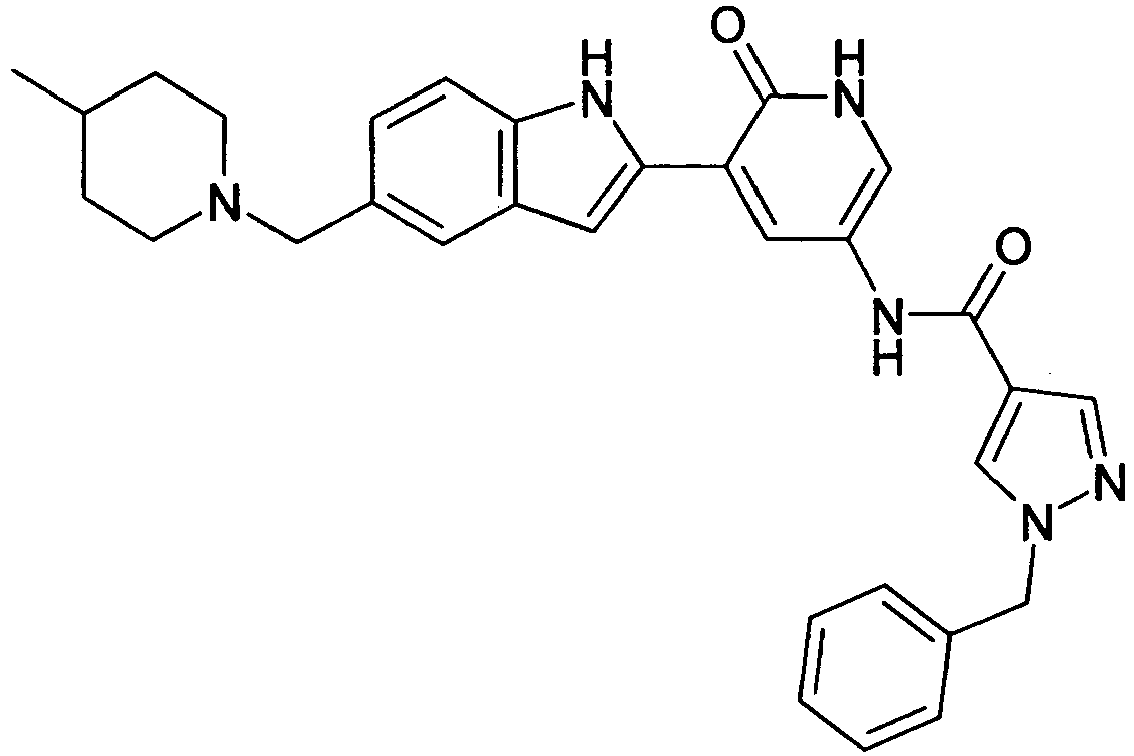
- The title compound was prepared by the route outlined in
Scheme 8, following the same experimental procedures as for Example 51.
The title compound was purified by trituration with acetonitrile, and isolated as a yellow solid, 34mg, 62%.
LC/MS: RT = 1.61 Min (270nm), m/z = 521 [M+H]. Total run time 3.75 min (short pos).
1H NMR (d6 DMSO): δ 0.87 (d, 3H), 1.12 (m, 2H), 1.29 (m, 1H), 1.53 (d, 2H), 1.87 (t, 2H), 2.78 (d, 2H), 3.46 (s, 2H), 5.41 (s, 2H), 7.00-7.02 (m, 2H), 7.28-7.44 (m, 7H), 7.82 (d, 1H), 8.03 (s, 1H), 8.16 (d, 1H), 8.41 (s, 1H), 9.79 (s, 1H), 11.50 (s, 1H), 11.99 (br s, 1H). -

- The title compound was prepared by the route outlined in
Scheme 8, following the same experimental procedures as for Example 51.
The title compound was purified by trituration with acetonitrile, and isolated as a yellow solid, 20mg, 31%.
LC/MS: RT = 1.52 Min (270nm), m/z = 511 [M+H]. Total run time 3.75 min (short pos).
1H NMR (d6 DMSO): δ 2.15 (s, 3H), 2.50 (t, 2H), 3.22 (s, 3H), 3.44 (t, 2H), 3.52 (s, 2H), 5.41 (s, 2H), 7.00-7.04 (m, 2H), 7.28-7.45 (m, 7H), 7.82 (d, 1H), 8.03 (s, 1H), 8.16 (d, 1 H), 8.41 (s, 1H), 9.79 (s, 1 H), 11.51 (s, 1 H), 11.99 (br s, 1H). -

- The title compound was prepared by the route outlined in
Scheme 8, following the same experimental procedures as for Example 51.
The title compound was purified by trituration with acetonitrile followed by preparative HPLC atpH 4 and isolated as a yellow solid, 3mg, 5%.
LC/MS: RT = 0.93 Min (270nm), m/z = 525 [M+H]. Total run time 1.9 min (super short pos).
1H NMR (d6 DMSO): δ 1.4 (m, 2H), 1.50 (m, 5H), 2.40 (m, 3H), 3.45 (s, 2H), 5.40 (s, 2H), 7.02 (br, 2H), 7.05 (m, 1H), 7.22 (t, 1H), 7.35 (m, 2H), 7.45 (m, 2H), 7.80 (d, 1 H), 8.05 (s, 1H), 8.16 (d, 1 H), 8.40 (s, 1 H), 9.80 (s, 1H), 11.52 (s, 1 H) -

- The title compound was prepared by the route outlined in
Scheme 8, following the same experimental procedures as for Example 51.
The title compound was purified by trituration with acetonitrile, and isolated as a yellow solid, 20mg, 37%.
LC/MS: RT = 1.58 Min (270nm), m/z = 543 [M+H]. Total run time 3.75 min (short pos).
1H NMR (d6 DMSO): δ 1.70 (m, 2H), 1.85 (m, 2H), 2.3 (m, 2H), 3.50 (s, 2H), 4.65 (br d, 1H), 5.40 (s, 2H), 6.95 (br s, 1H), 7.00 (dd, 1 H), 7.25 (t, 2H), 7.40 (m, 4H), 7.85 (d, 1 H), 8.05 (s, 1H), 8.15(s, 1H), 8.40 (s, 1 H), 9.75 (s, 1H), -

- The title compound was prepared by the route outlined in
Scheme 8, following the same experimental procedures as for Example 51.
The title compound was purified by trituration with acetonitrile, and isolated as a yellow solid, 49mg, 48%.
LC/MS: RT = 1.63 Min (270nm), m/z = 539 [M+H]. Total run time 3.75 min (short pos).
1H NMR (d6 DMSO): δ 0.90 (d, 3H), 1.10 (m, 2H), 1.30 (m, 1 H), 1.58 (d, 2H), 1.85 (t, 2H), 2.80 (d, 2H), 3.40 (s, 2H), 5.4 (s, 2H), 6.90 (br, 1H), 7.00 (dd, 1 H), 7.22 (t, 2H), 7.38 (m, 4H), 7.84 (d, 1 H), 8.05 (s, 1H), 8.10 (s, 1H), 8.40 (s, 1H), 9.75 (s, 1H), -

- The title compound was prepared by the route outlined in
Scheme 8, following the same experimental procedures as for Example 51.
The title compound was purified by trituration with acetonitrile followed by preparative HPLC atpH 4, to furnish the title compound as a yellow solid, 16mg, 18%.
LC/MS: RT = 0.92 Min (270nm), m/z = 440 [Fragment]. Total run time 1.9 min (super short pos).
1H NMR (d6 DMSO): δ 1.05 (t, 3H), 2.65 (q, 2H), 3.88 (s, 2H), 5.4 (s, 2H), 7.04 (d, 1 H), 7.06 (dd, 1H), 7.22 (t, 2H), 7.38 (m, 2H), 7.55 (dd, 1H), 7.58 (s, 1 H), 7.80 (s, 1 H), 8.05 (s, 1H), 8.25 (d, 1H), 8.35 (s, 1H), 8.44 (s, 1 H) 9.85 (s, 1H), 11.6 (s, 1H). -

- The title compound was prepared by the route outlined in
Scheme 8, following the same experimental procedures as for Example 51.
The title compound was purified by trituration with acetonitrile followed by preparative HPLC at pH9, to furnish the title compound as a yellow solid, 12mg, 15%.
LC/MS: RT = 1.68 Min (270nm), m/z = 553 [M+H]. Total run time 3.75 min (short pos).
1H NMR (d6 DMSO): δ 1.0-1.2 (m, 4H), 1.2-1.4 (m, 2H), 1.6 (d, 1H), 1.66-1.84 (m, 4H), 2.28 (s, 3H), 3.62, (s, 2H), 5.4 (s, 2H), 7.02 (d, 1H), 7.04-7.08 (dd, 1H), 7.24 (t, 2H), 7.34-7.40 (m, 2H), 7.42-7.46 (m, 2H), 7.8 (d, 1 H), 8.02 (s, 1H), 8.18 (s, 1 H), 8.20 (s, 1H), 9.56 (s, 1H), 11.5 (s, 1H). -
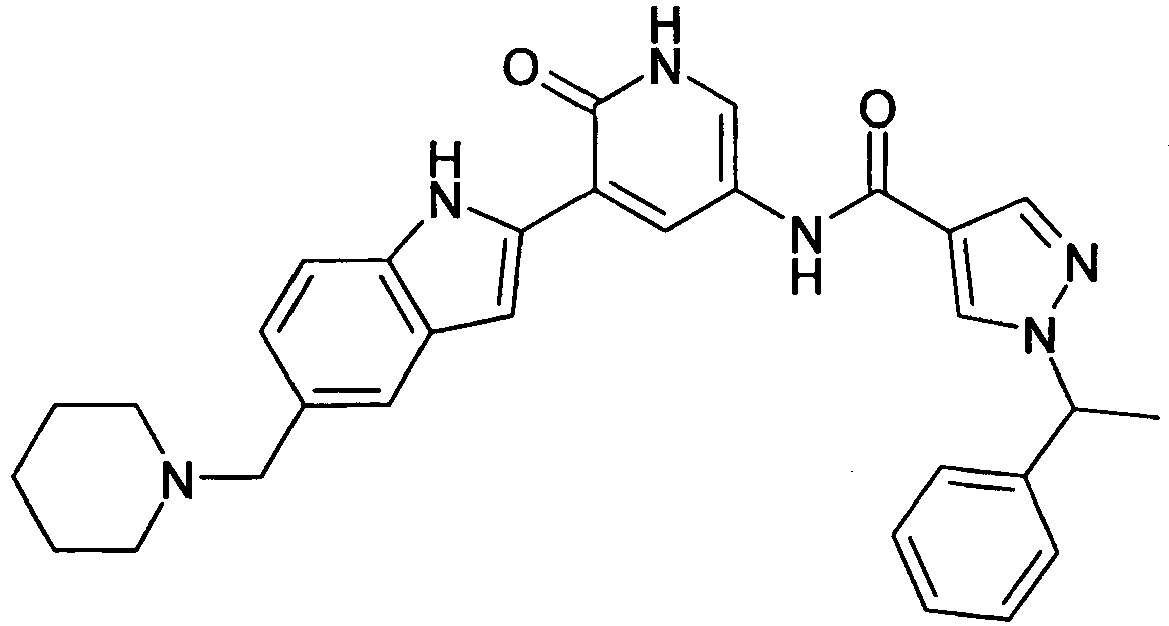
- The title compound was prepared by the route outlined in
Scheme 8, following the same experimental procedures as for Example 51.
The title compound was purified by trituration with acetonitrile, and isolated as a yellow solid, 37mg, 54%.
LC/MS: RT = 0.95 Min (270nm), m/z = 521 [M+H]. Total run time 1.9 min (super short pos).
1H NMR (d6 DMSO): δ 1.32-1.42 (m, 2H), 1.43-1.52 (m, 4H), 1.83-1.84 (d, 3H), 2.25-2.36 (m, 4H), 3.45 (s, 2H), 5.67-5.72 (q, 1H), 7.01-7.44 (m, 9H), 7.82-7.83 (d, 1 H), 8.03 (s, 1H), 8.16-8.17 (d, 1H), 8.45 (s, 1H), 9.78 (s, 1H), 11.51 (s, 1 H), 11.92-12.03 (br s, 1H). -
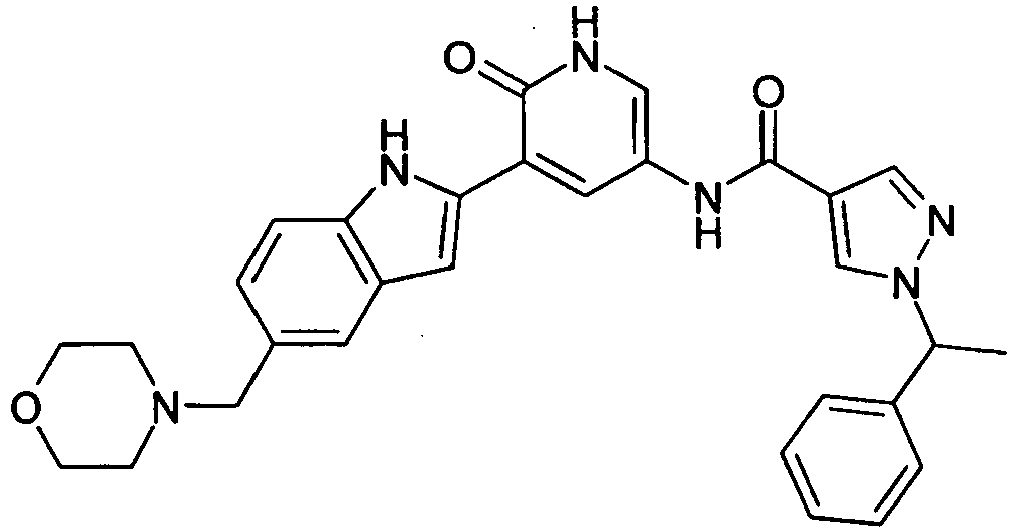
- The title compound was prepared by the route outlined in
Scheme 8, following the same experimental procedures as for Example 51.
The title compound was purified by trituration with acetonitrile, and isolated as a yellow solid, 15mg, 23%. - LC/MS: RT = 0.89 Min (270nm), m/z = 523 [M+H]. Total run time 1.9 min (super short pos).
1H NMR (d6 DMSO): δ 1.83-1.85 (d, 3H), 2.35 (m, 4H), 3.49 (s, 2H), 3.55-3.57 (m, 4H), 5.67-5.74 (q, 1H), 6.99-7.46 (m, 9H), 7.82-7.83 (d, 1H), 8.04 (s, 1 H), 8.16-8.17 (d, 1 H), 8.45 (s, 1H), 9.78 (s, 1 H), 11.53 (s, 1 H), 11.90-12.05 (br s, 1 H). -

- The title compound was prepared by the route outlined in
Scheme 8, following the same experimental procedures as for Example 51.
The title compound was purified by trituration with acetonitrile, and isolated as a yellow solid, 16mg, 46%.
LC/MS: RT = 0.93 Min (270nm), m/z = 539 [M+H]. Total run time 1.9 min (super short pos).
1H NMR (d6 DMSO): δ 1.66-1.76 (m, 2H), 1.83-1.85 (m, 5H), 2.23-2.32 (m, 2H), 3.50 (s, 2H), 4.60-4.70 (d, 1H), 5.67-5.72 (q, 1 H), 7.0-7.05 (m, 2H), 7.26-7.45 (m, 7H), 7.82-7.83 (d, 1 H), 8.04 (s, 1 H), 8.16-8.17 (d, 1H), 8.45 (s, 1 H), 9.78 (s, 1 H), 11.53 (s, 1 H), 11.95-12.00 (br s, 1 H). -

- The title compound was prepared by the route outlined in
Scheme 8, following the same experimental procedures as for Example 51.
The title compound was purified by trituration with acetonitrile, and isolated as a yellow solid, 3mg, 9%. - LC/MS: RT = 0.95 Min (254nm), m/z = 539 [M+H]. Total run time 1.9 min (super short pos).
1H NMR (d6 DMSO): δ 1.36-1.40 (br s, 2H), 1.43-1.50 (br m, 4H), 1.82 (d, 3H), 2.26-2.32 (br m, 4H), 3.44 (s, 2H), 5.70 (q, 1H), 7.00 (m, 2H), 7.20 (m, 2H), 7.32-7.44 (m, 4H), 7.82 (d, 1 H), 8.02 (s, 1 H), 8.18 (d, 1 H), 8.44 (s, 1 H), 9.80 (s, 1 H), 11.52 (s, 1 H), 12.00 (br s, 1H) -

- The title compound was prepared by the route outlined in
Scheme 8, following the same experimental procedures as for Example 51.
The title compound was purified by trituration with acetonitrile, and isolated as a yellow solid, 9mg, 30%. - LC/MS: RT = 0.89 Min (254nm), m/z = 554 [M+H]. Total run time 1.9 min (super short pos).
1H NMR (d6 DMSO): δ 1.80 (d, 3H), 2.15 (s, 3H), 2.2-2.4 (br m, 8H), 3.42 (s, 2H), 5.70 (q, 1 H), 7.00 (m, 2H), 7.18-7.22 (m, 2H), 7.36-7.40 (m, 2H), 7.4-7.48 (m, 2H), 7.82 (d, 1 H), 8.04 (s, 1H), 8.16 (d, 1H), 8.44 (s, 1 H), 9.78 (s, 1H), 11.52 (s, 1 H), 12.00 (br s, 1 H). -
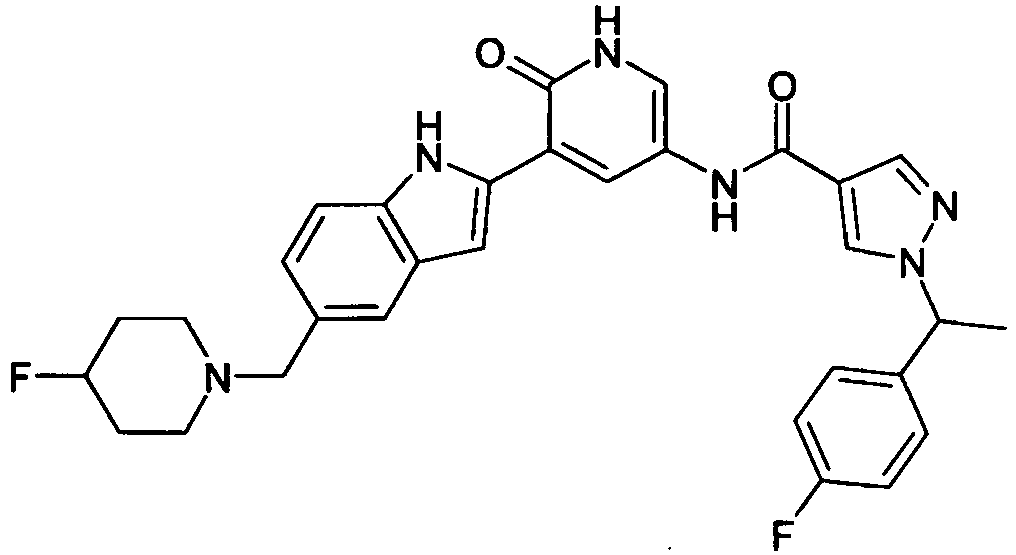
- The title compound was prepared by the route outlined in
Scheme 8, following the same experimental procedures as for Example 51.
The title compound was purified by trituration with acetonitrile, and isolated as a yellow solid, 2mg, 14%. - LC/MS: RT = 0.95 Min (254nm), m/z = 557 [M+H]. Total run time 1.9 min (super short pos).
1H NMR (d6 DMSO): δ 1.60-1.73 (m, 2H), 1.73-1.90 (m, 2H), 1.81 (d, 3H), 2.20-2.30 (m, 2H), 2.43-2.55 (m, 2H obscured by DMSO peak), 3.50 (s, 2H), 4.56-4.76 (m, 1H), 5.70 (q, 1H), 7.00 (m, 2H), 7.20 (m, 2H), 7.32-7.38 (m, 2H), 7.4-7.46 (m, 2H), 7.82 (d, 1 H), 8.04 (s, 1 H), 8.16 (d, 1 H), 8.44 (s, 1 H), 9.78 (s, 1 H), 11.52 (s, 1 H), 11.98 (br s, 1 H) -

- The title compound was prepared by the route outlined in
Scheme 8, following the same experimental procedures as for Example 51.
The title compound was purified by trituration with acetonitrile, and isolated as a yellow solid, 34mg, 31%.
LC/MS: RT = 1.61 Min (270nm), m/z = 550 [M+H]. Total run time 3.75 min (short pos).
1H NMR (d6 DMSO): δ 1.0 (d, 6H), 1.62 (t, 2H), 1.82 (d, 3H), 2.68 (m, 2H), 3.48 (s, 2H), 3.55 (m, 2H), 5.7 (q, 1H), 7.0 (m, 2H), 7.20-7.42 (m, 7H), 7.80 (d, 1H), 8.05 (s, 1 H), 8.10 (s, 1H), 8.42 (s, 1 H), 9.78 (s, 1 H), -

- The title compound was prepared by the route outlined in
Scheme 8, following the same experimental procedures as for Example 51. The title compound was purified by trituration with acetonitrile, and isolated as a yellow solid, 57mg, 49%. - LC/MS: RT = 1.66 Min (270nm), m/z = 535 [M+H]. Total run time 3.75 min (short pos).
1H NMR (d6 DMSO): δ 0.87 (d, 3H), 1.12 (m, 2H), 1.30 (m, 1H), 1.54 (m, 2H), 1.84 (d, 3H), 1.87 (m, 2H), 2.78 (m, 2H), 3.46 (s, 2H), 5.70 (q, 1H), 7.00-7.03 (m, 2H), 7.28-7.44 (m, 7H), 7.82 (d, 1H), 8.04 (s, 1 H), 8.15 (d, 1 H), 8.45 (s, 1H), 9.78 (s, 1 H), 11.51 (s, 1H), 11.99 (br s, 1 H). -

- The title compound was prepared by the route outlined in
Scheme 6, following the same experimental procedures as for Example 20, except that the relevant carboxylic acid, 1-(1-phenyl-ethyl)-1H-pyrazole-4-carboxylic acid, was converted to 1-(1-phenyl-ethyl)-1H-pyrazole-4-carbonyl chloride and then coupled to the amine using the same experimental described for Example 51.
The title compound was purified by flash chromatography on SiO2 with ethyl acetate and isolated as a yellow solid, 57mg, 49%. - LC/MS: RT=2.03 Min (270nm), m/z = 424 [M+H]. Total run time 3.75min (short pos).
1H NMR (d6 DMSO): δ 1.85 (d, 3H), 5.70 (q, 1H), 6.95 (t, 1H), 7.10 (m, 2H), 7.30 (m, 3H), 7.35 (m, 2H), 7.55 (m, 2H), 7.80 (d, 1 H), 8.05 (s, 1H), 8.20 (d, 1H), 8.45 (s, 1 H), 9.75 (s, 1H), 11.54 (br s, 1 H), 11.99 (br s, 1 H). -

- The title compound was prepared by the route outlined in
Scheme 6, following the same experimental procedures as for Example 20, except that the relevant carboxylic acid, 1-(3-Phenyl-propyl)-1H-pyrazole-4-carboxylic acid, was converted to 1-(3-Phenyl-propyl)-1H-pyrazole-4-carbonyl chloride, and then coupled to the amine using the same experimental described for Example 51.
The title compound was purified by trituration with acetonitrile, and isolated as a yellow solid, 30mg, 48%. - LC/MS: RT = 2.22 Min (270nm), m/z = 436 [M-H]. Total run time 3.75 min (short pos / neg).
1H NMR (d6 DMSO): δ 2.12 (t, 2H), 2.55 (m, 2H), 4.17 (t, 2H), 6.97 (m, 1 H), 7.07 (m, 2H) 7.22 (m, 3H), 7.30 (m, 2H), 7.52 (t, 2H), 7.82 (s, 1H), 8.03 (s, 1H), 8.20 (s, 1H), 8.35 (s,1H), 9.77 (br s, 1 H), 11.57 (br s, 1 H), 12.0 (br s, 1 H) -

- The title compound was prepared by the route outlined in
Scheme 8, following the same experimental procedures as for Example 51.
The title compound was purified by trituration with diethyl ether, and isolated as a yellow solid, 30mg, 42%. - LC/MS: RT = 0.94 Min (270nm), m/z = 539 [M+H]. Total run time 1.9 min (super short pos).
1H NMR (d6 DMSO): δ 1.34-1.42 (m, 2H), 1.46-1.52 (m, 4H), 2.30-2.37 (m, 4H), 3.11-3.16 (m, 2H), 3.45 (s, 2H), 4.38-4.42 (t, 2H), 6.97-7.21 (m, 6H), 7.40-7.43 (m, 2H), 7.82-7.83 (d, 1 H), 8.03 (s, 1H), 8.17-8.18 (d, 1H), 8.19 (s, 1 H), 9.76 (s, 1 H), 11.58 (s, 1H), 11.95-12.00 (br s, 1 H). -

- The title compound was prepared by the route outlined in
Scheme 8, following the same experimental procedures as for Example 51. The title compound was purified by trituration with diethyl ether, and isolated as a yellow solid, 36mg, 51 %. - LC/MS: RT = 0.94 Min (270nm), m/z = 557 [M+H]. Total run time 1.9 min (super short pos).
1H NMR (d6 DMSO): δ 1.69-1.92 (m, 4H), 2.24-2.33 (m, 2H), 3.11-3.18 (m, 4H), 3.50 (s, 2H), 4.38-4.42 (t, 2H), 4.59-4.75 (m, 1H), 7.00-7.21 (m, 6H), 7.41-7.44 (m, 2H), 7.83-7.84 (d, 1 H), 8.03 (s, 1 H), 8.19-8.20 (m, 2H), 9.78 (s, 1 H), 11.62-11.69 (br s, 1 H). -

- The title compound was prepared by the route outlined in Scheme 9, using intermediate (8b) and applying the same the experimental procedures as for Example 1. The title compound was purified by trituration with acetonitrile followed by preparative HPLC at
pH 4 and isolated as a yellow solid, 24mg, 14%. - LC/MS: RT=0.95 Min (270nm), m/z = 561 [M+H]. Total run time 1.9 min (super short pos).
1H NMR (d6 DMSO): δ 1.75 (br m, 2H), 1.85 (br m, 2H), 2.30 (br m, 2H), 2.55 (br m, 2H), 3.53 (s, 2H), 4.65 (m, 1H), 5.35 (s, 2H), 7.05 (dd, 1 H), 7.15 (m, 1 H), 7.25 (d, 1 H), 7.30 (m, 1H), 7.45 (m, 3H), 7.55 (d, 1H), 8.10 (d, 1H), 8.15 (s, 1 H), 8.25 (s, 1H), 8.55 (d, 1 H), 10.40 (s, 1 H), 11.48 (br s, 1 H). -

- The title compound was prepared by the route outlined in Scheme 9, using intermediate (8b) and applying the same the experimental procedures as for Example 1. The title compound was purified by trituration with acetonitrile followed by preparative HPLC at
pH 4 and isolated as a yellow solid, 12mg, 8%. - LC/MS: RT=0.95 Min (270nm), m/z = 529 [M+H]. Total run time 1.9 min (super short pos).
1H NMR (d6 DMSO): δ 1.75 (br s, 4H), 2.60 (s, 4H), 3.75 (s, 2H), 5.30 (s, 2H), 7.10 (m, 2H), 7.20 (d, 1 H), 7.45 (m, 3H), 7.65 (d, 1 H), 8.10 (d, 1 H), 8.15 (s, 1 H), 8.25 (br s, 1 H), 8.55 (d, 1 H), 10.40 (s, 1 H), 11.51 (br s, 1 H). -

- The title compound was prepared by the route outlined in Scheme 9, using intermediate (8b) and applying the same the experimental procedures as for Example 1. The title compound was purified by trituration with acetonitrile, and isolated as a yellow solid, 65mg, 27%.
- LC/MS: RT=1.70 Min (270nm), m/z = 545 [M+H]. Total run time 3.75min (short pos). 1H NMR (d6 DMSO): δ 2.40 (br s, 4H), 3.50 (s, 2H), 3.60 (t, 4H), 5.30 (s, 2H), 7.10 (m, 2H), 7.20 (d, 1 H), 7.35 (m, 1 H), 7.45 (m, 3H), 7.65 (d, 1 H), 8.15 (d, 1 H), 8.20 (d, 1 H), 8.65 (d, 1 H), 10.35 (s, 1 H), 11.46 (br s, 1 H), 12.44 (br s, 1 H).
-

- The title compound was prepared by the route outlined in Scheme 9, using intermediate (8b) and applying the same the experimental procedures as for Example 1. The crude product was purified by preparative HPLC at
pH 4 and isolated as a yellow solid, 15mg (7%) - LC/MS: RT=0.91 Min (270nm); m/z = 559 [M+H]. Total run time 1.9min (super short pos).
1H NMR (d6 DMSO): δ 1.45 (m, 2H), 1.85 (m, 2H), 2.25 (m, 2H), 2.85 (m, 2H), 3.55 (m, 1 H), 3.75 (s, 2H), 5.40 (s, 2H), 7.10 (m, 2H), 7.25 (d, 1 H), 7.35 (m, 1H), 7.45 (m, 3H), 7.65 (d, 1 H), 8.15 (d, 1 H), 8.20 (d, 1 H), 8.35 (br s, 1 H), 8.65 (d, 1 H), 10.45 (s, 1 H), 11.52 (br s, 1 H). -
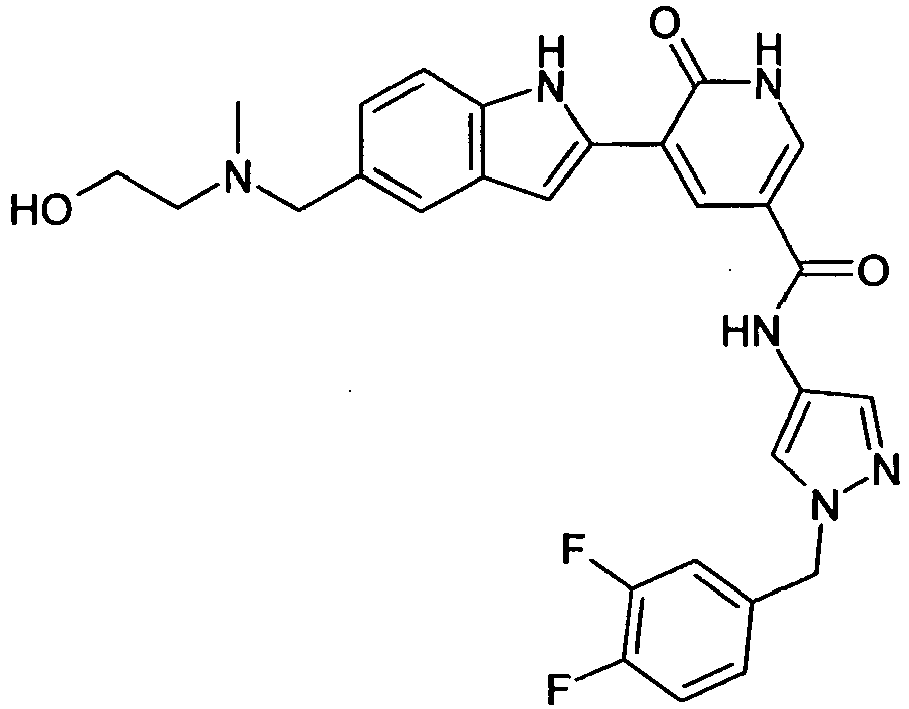
- The title compound was prepared by the route outlined in Scheme 9, using intermediate (8b) and applying the same the experimental procedures as for Example 1.The crude product was purified by preparative HPLC at
pH 4 to give the product as a yellow solid, 21mg, 11%. - LC/MS: RT=0.91 Min (270nm), m/z = 533 [M+H]. Total run time 1.9min (super short pos).
1H NMR (d6 DMSO): δ 2.25 (s, 3H), 2.45 (t, 2H), 3.55 (t, 2H), 3.65 (s, 2H), 5.35 (s, 2H), 7.10 (m, 2H), 7.25 (d, 1 H), 7.35 (m, 1 H), 7.45 (m, 3H), 7.65 (d, 1H), 8.10 (d, 1H), 8.15 (d, 1 H), 8.25 (br s, 1 H), 8.60 (d, 1 H), 10.35 (s, 1H), 11.50 (br s, 1 H). -

- The title compound was prepared by the route outlined in Scheme 9, using intermediate (8b) and applying the same the experimental procedures as for Example 1.The crude product was purified by preparative HPLC at
pH 4 to give the product as a yellow solid, 18mg, 9%. - LC/MS: RT=0.93 Min (270nm), m/z = 547.2 [M+H]. Total run time 1.9min (super short pos).
1H NMR (d6 DMSO): δ 1.05 (t, 3H), 2.55 (t, 2H), 2.60 (t, 2H), 3.50 (t, 2H), 3.69 (s, 2H), 5.35 (s, 2H), 7.10 (dd, 2H), 7.25 (d, 1H), 7.35 (m, 1 H), 7.45 (m, 3H), 7.65 (d, 1H), 8.10 (d, 1H), 8.15 (d, 1H), 8.25 (br s, 1H), 8.60 (d, 1 H), 10.35 (s, 1 H), 11.50 (br s, 1H). -

- The title compound was prepared by the route outlined in Scheme 9, using intermediate (8b) and applying the same the experimental procedures as for Example 1.The crude product was purified by preparative HPLC at
pH 4 to give the product as a yellow solid, 12mg, 6%.
LC/MS: RT=0.91 Min (270nm), m/z = 458 [Fragment]. Total run time 1.9min (super short pos).
1H NMR (d6 DMSO): δ 2.75 (t, 2H), 3.55 (t, 2H), 3.93 (s, 2H), 5.35 (s, 2H), 7.10 (m, 1H), 7.15 (d, 1 H), 7.25 (m, 1H), 7.35 (m, 1H), 7.45 (m, 2H), 7.55 (s, 1 H), 7.65 (d, 1 H), 8.10 (d, 1H), 8.15 (d, 1 H), 8.20 (s, 1H), 8.30 (br s, 1 H), 8.60 (d, 1H), 10.40 (s, 1H), 11.58 (br s, 1 H). -

- The title compound was prepared by the route outlined in Scheme 9, using intermediate (8b) and applying the same the experimental procedures as for Example 1.The crude product was purified by preparative HPLC at
pH 4 to give the product as a yellow solid, 10mg, 5%.
LC/MS: RT=0.92 Min (270nm), m/z = 558 [M+H]. Total run time 1.9 min (super short pos).
1H NMR (d6 DMSO): δ 2.35 (s, 3H), 2.55 (br s, 6H), 3.95 (br s, 4H), 5.50 (s, 2H), 7.20 (dd, 1 H), 7.25 (m, 1H), 7.40 (d, 1 H), 7.50 (m, 1 H), 7.60 (m, 3H), 7.80 (s, 1H), 8.25 (d, 1 H), 8.30 (d, 1 H), 8.75 (d, 1H), 10.50 (s, 1 H), 11.50 (br s, 1 H). -

- The title compound was prepared by the route outlined in Scheme 9, using intermediate (8b) and applying the same the experimental procedures as for Example 1.The crude product was purified by preparative HPLC at
pH 4 to give the product as a yellow solid, 8mg, 3%. - LC/MS: RT=0.91 Min (270nm), m/z = 588 [M+H]. Total run time 1.9min (super short pos).
1H NMR (d6 DMSO): δ 2.40 (m, 10H), 3.45 (m, 4H), 5.35 (s, 2H), 7.04 (dd, 1 H), 7.10 (m, 1H), 7.21 (d, 1H), 7.33 (m, 1H), 7.42 (m, 3H), 7.63 (s, 1H), 8.15 (d, 1H), 8.20 (s, 1H), 8.25 (br s, 1H), 8.60 (d, 1 H), 10.40 (s, 1H), 11.50 (br s, 1 H). -

- The title compound was prepared by the route outlined in
Scheme 8, following the same experimental procedures as for Example 51, except (1H-Indol-4-yl)-methanol was used.
The title compound was purified by trituration with acetonitrile, and isolated as a yellow solid, 13mg, 33%. - LC/MS RT = 0.88 Min (270nm), m/z = 467 [M+H]. Total run time 1.9 min (super short pos / neg).
1H NMR (d6 DMSO): δ 2.19 (s, 3H), 2.49 (s, 3H), 3.64 (s, 2H), 5.40 (s, 2H), 6.89 (d, 1 h), 7.01 (t, 1H), 7.14 (br d, 1h), 7.38 (m, 6H), 7.88 (br s, 1H), 8.03 (s, 1 H), 8.20 (d, 1 H), 8.41 (s, 1H), 9.89 (s, 1H), 11.60 (s, 1H) -

- The title compound was prepared by the route outlined in
Scheme 8, following the same experimental procedures as for Example 51, except (1H-Indol-4-yl)-methanol was used.
The title compound was purified by trituration with acetonitrile, and isolated as a yellow solid, 17mg, 26%. - LC/MS RT = 0.89 Min (270nm), m/z = 522 [M+H]. Total run time 1.9 min (super short pos / neg).
1H NMR (d6 DMSO):2.13 (s, 3H), 2.33 (br s, 4H), 2.41 (br s, 4H), 3.33 (s, 2H), 4.29 (s, 2H), 6.91 (d, 1 H), 7.02 (d, 1 H), 7.14 (br s, 1H), 7.34 (m, 6H), 7.85 (br s, 1H), 8.03 (s, 1 H), 8.19 (d, 1H), 8.41 (s, 1H), 9.78 (s, 1H), 11.56 (s, 1 H), 12.00 (br s, 1 H)
-

- The title compound was prepared by the route outlined in
Scheme 8, following the same experimental procedures as for Example 51, except (1H-Indol-4-yl)-methanol was used. The final step, deprotection, was achieved using the following alternative to the usual procedure. - 2-[5-[(1-Benzyl-1H-pyrazole-4-carbonyl)-amino]-2-oxo-1-(2-trimethylsilanyl-ethoxymethyl)-1,2-dihydro-pyridin-3-yl]-4-piperidin-1-ylmethyl-indole-1-carboxylic acid tert-butyl ester (110mg, 0.149mmol) was stirred in dichloromethane (5mL) at -78°C and then boron tribromide 1.0M solution in dichloromethane (2mL, 2mmol) was added drop wise. After addition the cooling was removed and the reaction was stirred at RT for 1 hour. The reaction mixture was cooled to -78°C and methanol (2mL) was added. Again the cooling was removed and the reaction stirred at RT, followed by concentration in vacuo. The residue was partitioned between ethyl acetate and water. The organics were separated, washed with sodium hydrogen bicarbonate, dried (Na2SO4) and concentrated in vacuo to furnish a dark yellow solid. This was purified by trituration with ethyl acetate to give the title compound as a yellow solid, 31mg, 41%.
- LC/MS RT = 1.55 Min (270nm), m/z = 507 [M+H]. Total run time 3.75 min (short pos). 1H NMR (d4-MeOD): δ 1.57 (m, 2H), 1.73 (m, 4H) 2.92 (m, 4H), 4.17 (m, 2H), 5.43 (s, 2H), 7.13 (d, 1 H), 7.20 (m, 1 H), 7.28 (s, 1H), 7.36 (m, 5H), 7.48 (m, 1 H), 7.88 (s, 1H), 8.08 (s, 1H), 8.29 (s, 1H), 8.34 (s, 1 H).
-
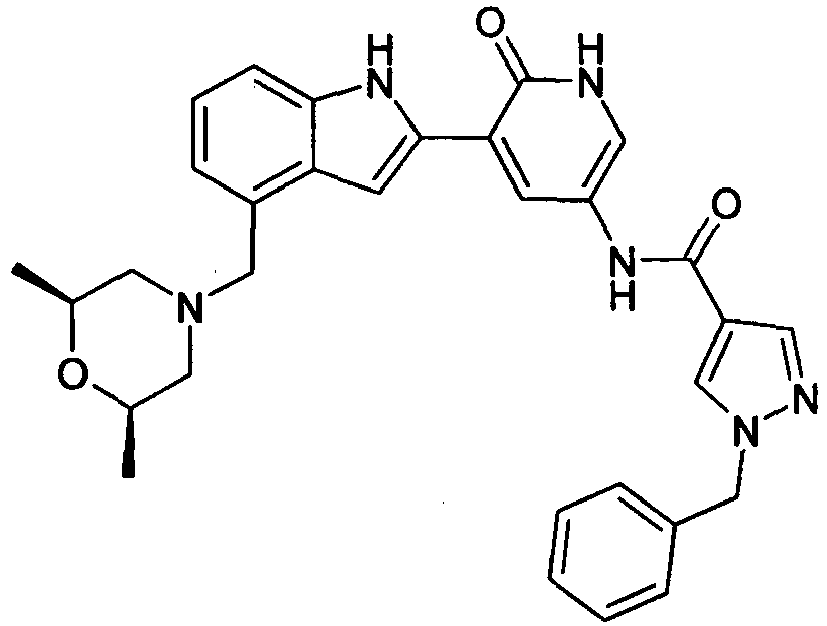
- The title compound was prepared by the route outlined in
Scheme 8, following the same experimental procedures as for Example 51, except (1H-Indol-4-yl)-methanol was used and the alternative deprotection method described for Example 108 was adopted.
The title compound was purified by trituration with ethyl acetate, and isolated as a yellow solid, 45mg, 56%.
LC/MS RT = 1.56 Min (270nm), m/z = 537 [M+H]. Total run time 3.75 min (short pos).
1H NMR (d4-MeOD): δ 1.11 (d, 6H), 1.88 (t, 2H) 2.86 (d, 2H), 3.70 (m, 2H), 3.83 (s, 2H), 5.42 (s, 2H), 7.03 (m, 1H), 7.13 (m, 1H), 7.25 (s, 1H), 7.37 (m, 6H), 7.95 (d, 1 H), 8.09 (s, 1 H), 8.28 (m, 2H). -

- The title compound was prepared by the route outlined in Scheme 1, following the same experimental procedures as for Examples 1 and 2.
The title compound was purified by trituration with acetonitrile, and isolated as a yellow solid, 4mg, 8%. - LC/MS RT = 1.12 Min (270nm), m/z = 429 [M+H]. Total run time 1.9 min (super short pos / neg).
1H NMR (d6 DMSO):5.38 (s, 2H), 7.00 (td, 1H), 7.09 (td, 1H), 7.19 (dd, 1H), 7.24 (br d, 1 H), 7.49 (br d, 1 H), 7.55 (br d,1H), 7.62 (s, 1H), 7.87 (td, 1H), 8.11 (d, 1H), 8.19 (s, 1H), 8.21 (br s, 1H), 8.55 (d, 1H), 10.31 (br s, 1H), 11.50 (br s, 1H). -

- The title compound was prepared by the route outlined in
Scheme 6, following the same experimental procedures as for Examples 20 and 21.
The crude product was purified by preparative HPLC atpH 4 to give the product as a yellow solid, 3mg, 11 %. - LC/MS RT = 1.08 Min (270nm), m/z = 429 [M+H]. Total run time 1.9 min (super short pos / neg).
1H NMR (d4-MeOD):5.45 (s, 2H), 7.00 (t, 1H), 7.02 (s, 1H), 7.09 (m, 2H), 7.41 (d, 1 H), 7.53 (d, 1H), 7.92 (m, 2H), 8.07 (s, 1 H), 8.21 (m, 2H), 8.33 (s, 1 H). -

- The title compound was prepared according to the route outlined in
Scheme 10. - A mixture of 5-fluoro-2-nitrotoluene (2.5g, 16mmol), N-methylpiperazine (2mL, 18mmol) and potassium carbonate (2.7g, 19mmol) in DMSO (7mL) was stirred and heated at 100°C for 2 hours. The reaction mixture was cooled to ambient temperature and then diluted with ethyl acetate (100mL), washed with water (3x30mL), brine, dried (MgSO4) and concentrated in vacuo. The resultant crude product was purified by flash chromatography on SiO2 eluting with dichloromethane-40% methanol / dichloromethane (gradient) to afford the desired title compound as a yellow solid, 3.67g, 97%.
- A solution of 1-methyl-4-(3-methyl-4-nitro-phenyl)-piperazine (10a), (2.63g, 11.2mmol), N,N-dimethylformamide dimethyl acetal (4.7mL, 35.84mmol) and pyrrolidine (1.5mL, 17.9mmol) in anhydrous N,N-dimethylformamide (20mL) was heated at 120°C for 18 hours. The reaction mixture was concentrated in vacuo, taken up in ethanol (50mL) containing 2 mL of water and to this was added ammonium formate (3.67g, 58.2mmol). Palladium, 10wt. % on activated carbon (0.84g) was added and the suspension was stirred and heated at 50°C for 30 minutes. The reaction mixture was then filtered through a celite pad and the pad rinsed with hot methanol (20mL). The combined filtrate and washings were concentrated in vacuo and the residue was taken up in ethyl acetate (100mL), washed with aqueous saturated sodium bicarbonate solution (2x100mL), brine, dried (MgSO4) and concentrated in vacuo. The resultant crude product was purified by flash chromatography on SiO2 eluting first with hexane and then 15% ethyl acetate / hexane to afford the desired title compound as an off-white solid, 1.44g, 60%.
- A solution of 5-(4-methyl-piperazin-1-yl)-1H-indole (10b), (1.67g, 7.7mmol) in dichloromethane (40mL) was added di-tert-butyl dicarbonate (1.87g, 8.6mmol) drop wise at ambient temperature as a solution in dichloromethane (5mL). 4-Dimethylaminopyridine (0.095g, 0.8mmol) was added and the reaction stirred at ambient temperature for 18 hours. The reaction mixture was washed with aqueous saturated sodium bicarbonate solution (100mL), brine, dried (MgSO4) and concentrated in vacuo. The resultant crude product was purified by flash chromatography on SiO2 eluting with dichloromethane - 15% methanol / dichloromethane (gradient) to afford the desired title compound as a yellow solid, 2.33g, 95%.
- The title compound was prepared by the route outlined in
Scheme 10 and using the experimental from Example 37, Step 3, with intermediate (10c), 5-(4-methyl-piperazin-1-yl)-indole-1-carboxylic acid tert-butyl ester (2.33g, 7.4mmol) and 3-iodo-5-nitro-1-(2-trimethylsilanyl-ethoxymethyl)-1H-pyridin-2-one (2.66g, 6.7mmol) which had been synthesised according to the protocol described for intermediate (6a) in example 20. The resultant solid was purified via trituration using diethyl ether, to afford the title compound as a pale brown solid, 1.73g, 40%. - The title compound was prepared by the route outlined in
Scheme 10 and using the experimental from Example 20, Step 3, with intermediate (10d), 5-(4-methyl-piperazin-1-yl)-2-[5-nitro-2-oxo-1-(2-trimethylsilanyl-ethoxymethyl)-1,2-dihydro-pyridin-3-yl]-indole-1-carboxylic acid tert-butyl ester (0.73g, 1.2mmol). The resultant crude product was purified by flash chromatography on SiO2 eluting with dichloromethane - 20% methanol / dichloromethane (gradient) to afford the desired title compound as a dark yellow foam, 0.435g, 63%. - The title compound was prepared by the route outlined in
Scheme 10 and using the experimental from Example 115,Step 4, with intermediate (10e), 2-[5-amino-2-oxo-1-(2-trimethylsilanyl-ethoxymethyl)-1,2-dihydro-pyridin-3-yl]-5-(4-methyl-piperazin-1-yl)-indole-1-carboxylic acid tert-butyl ester (0.1g, 0.18mmol) and 1-(4-methyl-benzyl)-1H-pyrazole-4-carbonyl chloride (0.047g, 0.2mmol).The resultant crude product was purified by flash chromatography on SiO2 eluting with dichloromethane - 8% methanol / dichloromethane (gradient) to afford the desired title compound as a pale brown solid, 0.107g, 79%. - The title compound was prepared by the route outlined in
Scheme 10, following the same experimental procedures as for Example 37. It was purified by trituration with acetonitrile, and isolated as a yellow solid, 43mg, 59%.
LC/MS: RT = 1.45 Min (270nm), m/z = 522 [M+H]. Total run time 3.75 min (short pos).
1H NMR (d6 DMSO): δ 2.23 (s, 3H), 2.29 (s, 3H), 2.48 (m, 4H), 3.04 (m, 4H), 5.34 (s, 2H), 6.86-6.89 (m, 2H), 6.97 (m, 1H), 7.19 (m, 4H), 7.37 (d, 1H), 7.82 (d, 1H), 8.01 (s, 1H), 8.11 (d, 1H), 8.37 (s, 1H), 9.76 (s, 1H), 11.37 (s, 1 H), 11.96 (br s, 1 H). -

- The title compound was prepared by the route outlined in
Scheme 10, following the same experimental procedures as for Example 112. The title compound was purified by trituration with acetonitrile, and isolated as a yellow solid, 40mg, 61%.
LC/MS: RT = 1.49 Min (270nm), m/z = 508 [M+H]. Total run time 3.75 min (short pos).
1H NMR (d6 DMSO): δ 2.23 (s, 3H), 2.48 (m, 4H), 3.05 (m, 4H), 5.40 (s, 2H), 6.86-6.89 (m, 2H), 6.97 (m, 1H), 7.28-7.40 (m, 6H), 7.82 (d, 1H), 8.03 (s, 1H), 8.12 (d, 1 H), 8.41 (s, 1 H), 9.78 (s, 1 H), 11.36 (s, 1H), 11.97 (br s, 1 H). -

- The title compound was prepared by the route outlined in
Scheme 10, following the same experimental procedures as for Example 112. The title compound was purified by trituration with acetonitrile, and isolated as a yellow solid, 38mg, 57%.
LC/MS: RT = 1.52 Min (270nm), m/z = 526 [M+H]. Total run time 3.75 min (short pos).
1H NMR (d6 DMSO): δ 2.22 (s, 3H), 2.48 (m, 4H), 3.05 (m, 4H), 5.39 (s, 2H), 6.86-6.89 (m, 2H), 6.97 (m, 1 H), 7.19-7.24 (m, 2H), 7.34-7.39 (m, 3H), 7.82 (d, 1H), 8.03 (s, 1H), 8.12 (d, 1H), 8.41 (s, 1H), 9.78 (s, 1H), 11.36 (s, 1H), 11.97 (br s, 1H). -
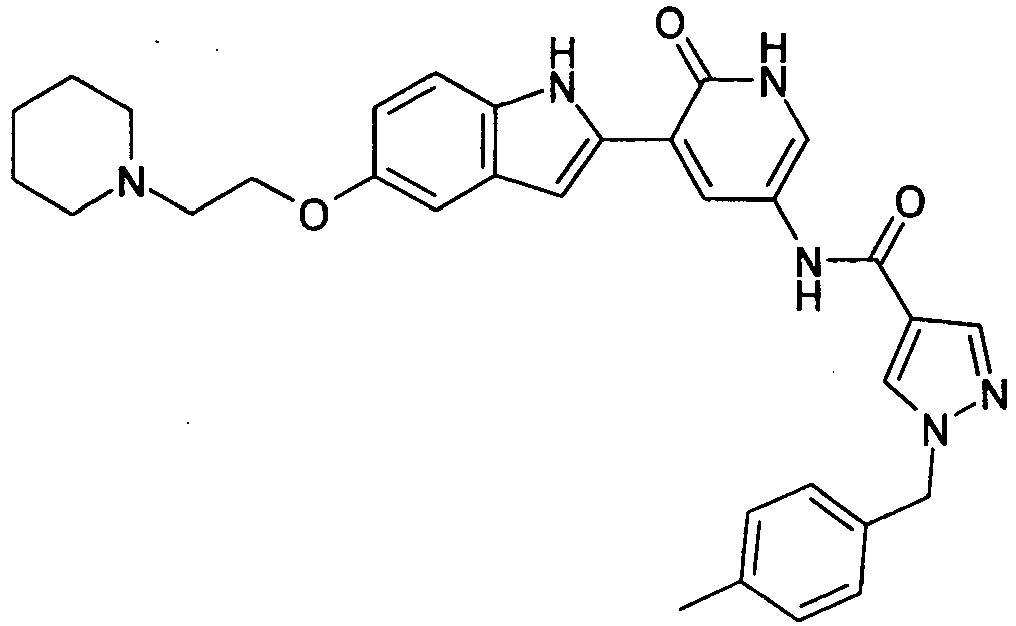
- The title compound was prepared according to the route outlined in Scheme 11.
- The title compound was prepared by the route outlined in Scheme 11 and using the experimental from Example 37,
Step 2, with intermediate 1H-Indol-5-ol (5.54g, 7.4mmol). The resultant crude product was purified by flash chromatography on SiO2 with hexane - 10% ethyl acetate / hexane (gradient) to afford the title compound as a white solid, 13.41 g, 93%. - The title compound was prepared by the route outlined in Scheme 11 and using the experimental from Example 37, Step 3, with intermediate 5-(tert-butyl-dimethyl-silanyloxy)-indole-1-carboxylic acid tert-butyl ester (11a) (2.90g, 8.3mmol) and (6a), 3-iodo-5-nitro-1-(2-trimethylsilanyl-ethoxymethyl)-1H-pyridin-2-one (3g, 7.6mmol). The resultant crude product was purified by flash chromatography on SiO2 with hexane - 20% ethyl acetate / hexane (gradient) to afford after trituration using hexane, the title compound as a pale yellow solid, 3.67g, 79%.
- The title compound was prepared by the route outlined in Scheme 11 and using the experimental from Example 20, Step 3, with intermediate (11b) 5-(tert-butyl-dimethyl-silanyloxy)-2-[5-nitro-2-oxo-1-(2-trimethylsilanyl-ethoxymethyl)-1,2-dihydro-pyridin-3-yl]-indole-1-carboxylic acid tert-butyl ester (3.65g, 5.93mmol). The resultant crude product was purified by flash chromatography on SiO2 with hexane - 40% ethyl acetate / hexane (gradient) to afford the title compound as a dark yellow foam, 2.615g, 75%.
- Intermediate (11c), 2-[5-amino-2-oxo-1-(2-trimethylsilanyl-ethoxymethyl)-1,2-dihydro-pyridin-3-yl]-5-(tert-butyl-dimethyl-silanyloxy)-indole-1-carboxylic acid tert-butyl ester (1.3g, 2.2mmol) was stirred in dichloromethane (50mL) at RT with triethylamine (444mg, 0.612mL, 4.4mmol). The reaction mixture was cooled to 5°C and then a solution of 1-(4-methyl-benzyl)-1H-pyrazole-4-carbonyl chloride (2.86mmol, 0.67g), which had been prepared according to the protocol below, in dichloromethane (10ml), was added drop wise. After addition the reaction was stirred at RT for 3 hrs and then the reaction mixture was washed with saturated sodium hydrogen carbonate solution (2x50mL), brine (50ml), dried (Na2SO4) and concentrated in vacuo. The resultant crude product was purified by flash chromatography on SiO2 eluting with hexane - 50% ethyl acetate / hexane (gradient) and further purified via trituration with isohexane (20mL) and diethyl ether (20mL). The solids were separated by filtration and dried in vacuo to afford the desired intermediate as a white solid, 1.56g, 90%.
- 1-(4-Methyl-benzyl)-1H-pyrazole-4-carboxylic acid (0.618g, 2.86mmol), which had been prepared according to the protocol described for intermediate (6e), in Example 21, was stirred in toluene (20mL) at RT and thionyl chloride (681mg, 0.42mL, 5.72mmol) was added. The reaction mixture was slowly heated to 90°C and heating continued for 3hrs. After cooling the reaction was concentrated in vacuo. Toluene was added to the residue and concentrated in vacuo. This was repeated a further three times and the crude solid obtained was triturated using isohexane. The solids were separated by filtration washed with isohexane and dried in vacuo to afford 1-(4-methyl-benzyl)-1H-pyrazole-4-carbonyl chloride as a white solid, 0.67g, quant.
- Intermediate (11d), 5-(tert-butyl-dimethyl-silanyloxy)-2-[5-{[1-(4-methyl-benzyl)-1H-pyrazole-4-carbonyl]-amino}-2-oxo-1-(2-trimethylsilanyl-ethoxymethyl)-1,2-dihydro-pyridin-3-yl]-indole-1-carboxylic acid tert-butyl ester (1.55g, 1.97mmol) was stirred in tetrahydrofuran (40mL) and cooled to 0°C. Tetrabutylammonium fluoride solution 1.0M in tetrahydrofuran (2.08mL, 2.08mmol) was added drop wise at 0°C, and then the reaction was allowed to attain ambient temperature, where it was stirred for a further 2hours. The reaction mixture was diluted with ethyl acetate (30mL), washed with water (30mL), aqueous 0.5N hydrochloric acid solution (30mL), brine, dried (Na2SO4) and concentrated in vacuo. The resultant green foam was purified via trituration using diethyl ether, to afford the title compound as a pale yellow solid, 0.946g, 71%.
- To a solution of intermediate (11e), 5-hydroxy-2-[5-{[1-(4-methyl-benzyl)-1H-pyrazole-4-carbonyl]-amino}-2-oxo-1-(2-trimethylsilanyl-ethoxymethyl)-1,2-dihydro-pyridin-3-yl]-indole-1-carboxylic acid tert-butyl ester (150mg, 0.22mmol) in N,N-dimethylformamide (3mL) was added 1-(2-chloroethyl)-piperidine hydrochloride (62mg, 0.33mmol) and cesium carbonate (219mg, 0.67mmol). The reaction mixture was heated at 50°C for 5 hours, and cooled to ambient temperature. The reaction mixture was cooled and partitioned between ethyl acetate and water. The ethyl acetate layer was separated and washed with brine, dried (Na2SO4) and concentrated in vacuo. The title compound was purified by flash chromatography on SiO2 eluting with dichloromethane - 5% methanol / dichloromethane (gradient) to afford the desired title compound as a pale yellow solid, 94mg, 54%.
- The title compound was prepared according to the experimental used in Example 37,
Step 8 with intermediate (11f), 2-[5-{[1-(4-methyl-benzyl)-1H-pyrazole-4-carbonyl]-amino}-2-oxo-1-(2-trimethylsilanyl-ethoxymethyl)-1,2-dihydro-pyridin-3-yl]-5-(2-piperidin-1-yl-ethoxy)-indole-1-carboxylic acid tert-butyl ester. Purification of the crude product was accomplished using trituration with acetonitrile. The title compound was isolated as a yellow solid, 41 mg, 62%.
LC/MS: RT = 1.76 Min (270nm), m/z = 551 [M+H]. Total run time 3.75 min (short pos).
1H NMR (d6 DMSO): δ 1.38 (m, 2H), 1.50 (m, 4H), 2.29 (s, 3H), 2.44 (m, 4H), 2.65 (t, 2H), 4.04 (t, 2H), 5.34 (s, 2H), 6.71 (dd, 1 H), 6.92 (m, 1H), 7.03 (d, 1 H), 7.19 (m, 4H), 7.39 (d, 1H), 7.82 (d, 1H), 8.01 (s, 1H), 8.14 (d, 1H), 8.37 (s, 1H), 9.76 (s, 1 H), 11.46 (s, 1H), 11.97 (br s, 1 H). -

- The title compound was prepared by the route outlined in Scheme 11, following the same experimental procedures as for Example 115.
The title compound was purified by trituration with acetonitrile, and isolated as a yellow solid, 21 mg, 75%.
LC/MS: RT = 1.74 Min (270nm), m/z = 569 [M+H]. Total run time 3.75 min (short pos).
1H NMR (d6 DMSO): δ 1.42-1.56 (m, 2H), 1.67-1.88 (m, 2H), 2.29 (s, 3H), 2.33-2.57 (m, 3H), 2.75 (d, 2H), 2.86 (m, 1H), 4.06 (t, 2H), 4.63 (m, 1H), 5.34 (s, 2H), 6.71 (dd, 1H), 6.93 (m, 1H), 7.04 (d, 1H), 7.19 (m, 4H), 7.40 (d, 1 H), 7.82 (d, 1 H), 8.01 (s, 1H), 8.14 (d, 1 H), 8.37 (s, 1 H), 9.76 (s, 1 H), 11.45 (s, 1 H), 11.98 (br s, 1 H). -

- The title compound was prepared by the route outlined in Scheme 11, following the same experimental procedures as for Example 115.
The title compound was purified by trituration with acetonitrile, and isolated as a yellow solid, 51 mg, 71%.
LC/MS: RT = 1.72 Min (270nm), m/z = 567 [M+H]. Total run time 3.75 min (short pos).
1H NMR (d6 DMSO): δ 1.88 (m, 2H), 2.29 (s, 3H), 2.37 (m, 4H), 2.44 (d, 2H), 3.58 (m, 4H), 3.99 (t, 2H), 5.34 (s, 2H), 6.71 (dd, 1 H), 6.93 (m, 1 H), 7.01 (d, 1 H), 7.19 (m, 4H), 7.40 (d, 1H), 7.82 (d, 1 H), 8.01 (s, 1H). 8.14 (d, 1H), 8.37 (s, 1 H), 9.77 (s, 1 H), 11.44 (s, 1H), 11.98 (br s, 1 H). -

- The title compound was prepared by the route outlined in Scheme 11, following the same experimental procedures as for Example 115.
The title compound was purified by trituration with acetonitrile, and isolated as a yellow solid, 20mg, 63%.
LC/MS: RT = 1.71 Min (270nm), m/z = 553 [M+H]. Total run time 3.75 min (short pos).
1H NMR (d6 DMSO): δ 2.29 (s, 3H), 2.50 (m, 4H), 2.70 (d, 2H), 3.59 (m, 4H), 4.07 (t, 2H), 5.34 (s, 2H), 6.72 (dd, 1 H), 6.93 (m, 1H), 7.04 (d, 1H), 7.19 (m, 4H), 7.40 (d, 1 H), 7.82 (d, 1 H), 8.01 (s, 1H), 8.14 (d, 1H), 8.37 (s, 1 H), 9.76 (s, 1H), 11.45 (s, 1 H), 11.96 (br s, 1H). -

- The title compound was prepared by the route outlined in Scheme 11, following the same experimental procedures as for Example 115.
The title compound was purified by trituration with acetonitrile, and isolated as a yellow solid, 47mg, 87%.
LC/MS: RT = 1.78 Min (270nm), m/z = 565 [M+H]. Total run time 3.75 min (short pos).
1H NMR (d6 DMSO): δ 1.38 (m, 2H), 1.49 (m, 4H), 1.86 (m, 2H), 2.29 (s, 3H), 2.33 (m, 4H), 2.39 (t, 2H), 3.97 (t, 2H), 5.34 (s, 2H), 6.70 (dd, 1 H), 6.92 (m, 1 H), 7.01 (d, 1H), 7.19 (m, 4H), 7.39 (d, 1H), 7.82 (d, 1 H), 8.01 (s, 1H), 8.13 (d, 1H), 8.37 (s, 1H), 9.77 (s, 1 H), 11.45 (s, 1 H), 11.98 (br s, 1 H). -

- The title compound was prepared by the route outlined in Scheme 11, following the same experimental procedures as for Example 115.
The title compound was purified by trituration with acetonitrile, and isolated as a yellow solid, 65mg, 39%.
LC/MS: RT = 1.58 Min (270nm), m/z = 539 [M+H]. Total run time 3.75 min (short pos).
1H NMR (d6 DMSO): δ 0.96 (s, 6H), 2.21 (s, 6H), 2.24 (s, 2H), 3.67 (s, 2H), 5.41 (s, 2H), 6.72 (dd, 1H), 6.92 (d. 1H), 7.01 (d, 1H), 7.28-7.40 (m, 6H), 7.84 (d, 1H), 8.03 (s, 1H), 8.14 (d, 1 H), 8.41 (s, 1H), 9.79 (s, 1 H), 11.43 (s, 1 H), 11.99 (br s, 1 H). -

- The title compound was prepared by the route outlined in Scheme 11, following the same experimental procedures as for Example 115, but with the following modification to
Step 6. - A 3-5mL microwave vial was charged with 5-hydroxy-2-[2-oxo-5-{[1-(4-trifluoromethyl-benzyl)-1H-pyrazole-4-carbonyl]-amino}-1-(2-trimethylsilanyl-ethoxymethyl)-1,2-dihydro-pyridin-3-yl]-indole-1-carboxylic acid tert-butyl ester (150mg, 0.207mmol), triphenyl phosphine (87mg, 0.33mmol), tetrahydrofuran (3mL), 1-(2-hydroxyethyl)piperidine (40mg, 41 µL 0.31 mmol) and diisopropyl azidocarboxylate (67mg, 65µL, 0.33mmol). The reaction mixture was then heated to 140°C in the microwave for 30mins. The crude reaction mixture was purified by flash chromatography on SiO2, eluting dichloromethane - 15% methanol / dichloromethane (gradient) to afford the title compound as a yellow solid, 87mg, 50%.
- The title compound was purified by trituration with acetonitrile, and isolated as a yellow solid, 33mg, 52%.
LC/MS: RT = 1.69 Min (270nm), m/z = 605 [M+H]. Total run time 3.75 min (short pos).
1H NMR (d6 DMSO): δ 1.38 (m, 2H), 1.50 (m, 4H), 2.44 (m, 4H), 2.66 (t, 2H), 4.04 (t, 2H), 5.54 (s, 2H), 6.71 (dd, 1H), 6.92 (m, 1H), 7.03 (d, 1 H), 7.40 (d, 1H), 7.46 (m, 2H), 7.76 (m, 2H), 7.83 (d, 1H), 8.07 (s, 1H), 8.15 (d, 1 H), 8.47 (s, 1 H), 9.81 (s, 1 H), 11.44 (s, 1H), 11.99 (br s, 1H). -

- The title compound was prepared by the route outlined in Scheme 11, following the same experimental procedures as for Example 115.
The title compound was purified by trituration with acetonitrile, and isolated as a yellow solid, 6mg, 23%.
LC/MS: RT = 0.92 Min (270nm), m/z = 525 [M+H]. Total run time 1.9 min (super short pos).
1H NMR (d6 DMSO): δ 1.81-1.88 (m, 2H), 2.15 (s, 6H), 2.29 (s, 3H), 2.34-2.38 (m, 2H), 3.96-3.99 (t, 2H), 5.34 (s, 2H), 6.69-6.72 (dd, 1H), 6.92 (s, 1H), 7.00-7.01 (d, 1H), 7.19 (s, 4H), 7.38-7.41 (d, 1 H), 7.82-7.83 (d, 1 H), 8.01 (s, 1 H), 8.14-8.15 (d, 1 H), 8.37 (s, 1 H), 9.77 (s, 1 H), 11.47 (s, 1 H), 11.92 -12.00 (br s, 1 H). -

- The title compound was prepared by the route outlined in Scheme 11, following the same experimental procedures as for Example 121.
The title compound was purified by trituration with acetonitrile, and isolated as a brown solid, 8mg, 35%. - LC/MS: RT = 1.63 Min (270nm), m/z = 553 [M+H]. Total run time 3.75 min (short pos).
1H NMR (d6 DMSO): δ 0.93-0.97 (t, 6H), 1.79-1.83 (m, 2H), 2.29 (s, 3H), 3.96-3.99 (t, 2H), 5.34 (s, 2H), 6.68-6.70 (d, 1 H), 6.89 (s, 1 H), 7.00 (s, 1H), 7.19 (s, 4H), 7.37-7.39 (d, 1H), 7.84 (s, 1H), 8.02 (s, 1 H), 8.14 (s, 1H), 8.37 (s, 1 H), 9.78 (s, 1H), 11.62-11.70 (br s, 1H). -

- The title compound was prepared by the route outlined in Scheme 11, following the same experimental procedures as for Example 121.
The title compound was purified by trituration with acetonitrile, and isolated as a yellow solid, 13mg, 29%. - LC/MS: RT = 0.91 Min (270nm), m/z = 580 [M+H]. Total run time 1.9 min (super short pos).
1H NMR (d6 DMSO): δ 1.83-1.89 (m, 2H), 2.14 (s, 3H), 2.29 (s, 3H), 2.41-2.44 (t, 2H), 2.31-2.44 (br m, 8H), 3.96-3.99 (t, 2H), 5.34 (s, 2H), 6.69-6.72 (dd, 1H), 6.92 (s, 1 H), 7.00-7.01 (d, 1 H), 7.19(s, 4H), 7.38-7.40 (d, 1H), 7.82-7.83 (d, 1H), 8.01 (s, 1H), 8.13-8.14 (d, 1H), 8.37 (s, 1H), 9.78 (s, 1H), 11.46 (s, 1H), 11.90-12.00 (br s, 1 H). -

- The title compound was prepared by the route outlined in Scheme 11, following the same experimental procedures as for Example 115.
- The title compound was purified by trituration with acetonitrile, and isolated as a brown solid, 28mg, 44%.
- LC/MS: RT = 0.93 Min (270nm), m/z = 539 [M+H]. Total run time 1.9 min (super short pos).
1H NMR (d6 DMSO): δ 0.97-1.00 (t, 6H), 2.29 (s, 3H), 2.53-2.59 (q, 4H), 2.76-2.79 (t, 2H), 3.98-4.01 (t, 2H), 5.34 (s, 2H), 6.69-6.72 (dd, 1 H), 6.93 (s, 1H), 7.02-7.03 (d, 1 H), 7.19 (s, 4H), 7.39-7.41 (d, 1 H), 7.82-7.83 (d, 1 H), 8.01 (s, 1 H), 8.14-8.15 (d, 1 H), 8.37 (s, 1 H), 9.78 (s, 1 H), 11.45 (s, 1 H). -
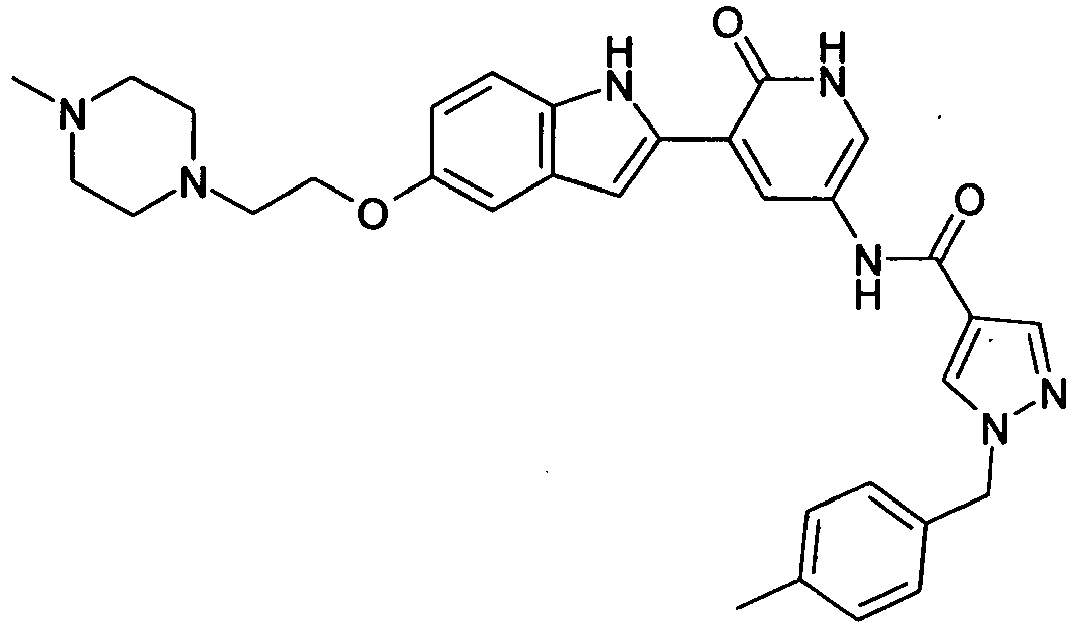
- The title compound was prepared by the route outlined in Scheme 11, following the same experimental procedures as for Example 115.
The title compound was purified by trituration with acetonitrile, and isolated as a yellow solid, 2mg, 23%. - LC/MS: RT = 0.92 Min (270nm), m/z = 566 [M+H]. Total run time 1.9 min (super short pos).
1H NMR (d6 DMSO): δ 2.14 (s, 3H), 2.29 (s, 3H), 2.24-2.40 (br m, 8H), 2.64-2.70 (m, 2H), 4.03-4.06 (t, 2H), 5.34 (s, 2H), 6.69-6.72 (dd, 1 H), 6.91 (s, 1H), 7.02-7.03 (d, 1H), 7.19 (s, 4H), 7.38-7.40 (d, 1H), 7.82-7.83 (d, 1 H), 8.02 (s, 1H), 8.13-8.14 (d, 1 H), 8.37 (s, 1 H), 9.77 (s, 1 H), 11.48-11.61 (br s, 1H). -

- The title compound was prepared by the route outlined in Scheme 11, following the same experimental procedures as for Example 121.
The title compound was purified by trituration with acetonitrile, and isolated as a yellow solid, 7mg, 24%. - LC/MS: RT = 0.96 Min (270nm), m/z = 594 [M+H]. Total run time 1.9 min (super short pos).
1H NMR (d6 DMSO): δ 1.15-1.19 (t, 3H), 1.84-1.88 (m, 2H), 2.14 (s, 3H), 2.30-2.46 (br m, 8H), 2.41-2.44 (t, 2H), 2.57-2.62 (q, 2H), 3.96-3.99 (t, 2H), 5.37 (s, 2H), 6.69-6.72 (dd, 1 H), 6.92 (s, 1 H), 7.00-7.01 (d, 1 H), 7.07-7.09 (d, 1 H), 7.15 (s, 1H), 7.18 (s, 1H), 7.27-7.31 (m, 1 H), 7.38-7.41 (d, 1 H), 7.82-7.83 (d, 1H), 8.03 (s, 1H), 8.14-8.15 (d, 1 H), 8.40 (s, 1 H), 9.79 (s, 1 H), 11.48 (s, 1 H), 11.90-12.00 (br m, 1 H). -

- The title compound was prepared by the route outlined in Scheme 11, following the same experimental procedures as for Example 121.
The title compound was purified by trituration with acetonitrile, and isolated as a yellow solid, 16mg, 39%. - LC/MS: RT = 0.95 Min (270nm), m/z = 525 [M+H]. Total run time 1.9 min (super short pos).
1H NMR (d6 DMSO): δ 1.15-1.19 (t, 3H), 2.22 (s, 6H), 2.58-2.64 (m, 4H), 4.01-4.04 (t, 2H), 5.37 (s, 2H), 6.69-6.72 (dd, 1 H), 6.91 (s, 1 H), 7.02-7.03 (d, 1 H), 7.07-7.09 (d, 1 H), 7.15 (s, 1 H), 7.18 (s, 1H), 7.27-7.31 (t, 1 H), 7.38-7.41 (d, 1H), 7.82-7.83 (d, 1 H), 8.03 (s, 1 H), 8.14-8.15 (d, 1H), 8.40 (s, 1H), 9.78 (s, 1H), 11.50-11.61 (s, 1 H), 11.86-12.00 (br s, 1H). -

- The title compound was prepared by the route outlined in Scheme 11, following the same experimental procedures as for Example 121.
The title compound was purified by trituration with acetonitrile, and isolated as a yellow solid, 6mg, 20%. - LC/MS: RT = 0.97 Min (270nm), m/z = 539 [M+H]. Total run time 1.9 min (super short pos).
1H NMR (d6 DMSO): δ 1.15-1.19 (t, 3H), 1.85 (m, 2H), 2.15 (s, 6H), 2.33-2.40 (m, 4H), 3.96-3.98 (t, 2H), 5.37 (s, 2H), 6.69-6.72 (d, 1 H), 6.91 (s, 1 H), 7.01 (s, 1H), 7.07-7.09 (d, 1 H), 7.15 (s, 1 H), 7.18 (s, 1 H), 7.27-7.31 (t, 1H), 7.38-7.40 (d, 1H), 7.84 (s, 1 H), 8.03 (s, 1 H), 8.15 (s, 1 H), 8.41 (s, 1 H), 9.78 (s, 1 H), 11.50 (s, 1 H). -

- The title compound was prepared by the route outlined in Scheme 11, following the same experimental procedures as for Example 121.
The title compound was purified by trituration with acetonitrile, and isolated as a brown solid, 2mg, 3%. - LC/MS: RT = 0.98 Min (270nm), m/z = 553 [M+H]. Total run time 1.9 min (super short pos).
1H NMR (d6 DMSO): δ 0.97-1.00 (t, 6H), 1.15-1.19 (t, 3H), 2.53-2.60 (m, 6H), 2.76-2.79 (t, 2H), 3.98-4.01 (t, 2H), 5.37 (s, 2H), 6.69-6.72 (dd, 1 H), 6.92-6.41 (m, 7H), 7.83 (m, 1H), 8.03 (s, 1 H), 8.14-8.15 (s, 1 H), 8.40 (s, 1 H), 9.79 (s, 1 H), 11.44 (s, 1 H), 11.90-12.00 (br m, 1H). -

- The title compound was prepared by the route outlined in Scheme 11, following the same experimental procedures as for Example 121.
The title compound was purified by trituration with acetonitrile, and isolated as a yellow solid, 2mg, 5%. - LC/MS: RT = 0.98 Min (270nm), m/z = 581 [M+H]. Total run time 1.9 min (super short pos).
1H NMR (d6 DMSO): δ 1.04 (d, 6H), 1.73 (t, 2H), 2.29 (s, 3H), 2.68 (m, 2H), 2.84 (d, 2H), 3.52-3.61 (m, 2H), 4.06 (t, 2H), 5.34 (s, 2H), 6.71 (dd, 1H), 6.92 (d, 1H), 7.03 (d, 1H), 7.19 (s, 4H), 7.40 (d, 1H), 7.82 (d, 1H), 8.01 (s, 1H), 8.15 (d, 1H), 8.37 (s,1H), 9.77 (s, 1 H), 11.47 (br s, 1H), 11.92 (br s, 1 H) -

- The title compound was prepared by the route outlined in Scheme 11, following the same experimental procedures as for Example 115.
The title compound was purified by preparative HPLC at pH9 and isolated as a yellow solid, 2mg, 3%. - LC/MS: RT = 0.91 Min (270nm), m/z = 511 [M+H]. Total run time 1.9 min (super short pos).
1H NMR (d6 DMSO): δ 2.23 (s, 6H), 2.29 (s, 3H), 2.63 (t, 2H), 4.03 (t, 2H), 5.34 (s, 2H), 6.72 (dd, 1H), 6.93 (d, 1 H), 7.03 (d, 1H), 7.19 (s, 4H), 7.40 (d, 1 H), 7.83 (d, 1H), 8.02 (s, 1H), 8.15 (d, 1 H), 8.37 (s,1H), 9.78 (s, 1H), 11.45 (br s, 1 H), 11.98 (br s, 1 H) -

- The title compound was prepared by the route outlined in Scheme 11, following the same experimental procedures as for Example 121.
The title compound was purified by trituration with acetonitrile, and isolated as a yellow solid, 12mg, 20%. - LC/MS: RT = 0.97 Min (270nm), m/z = 580 [M+H]. Total run time 1.9 min (super short pos).
1H NMR (d6 DMSO): δ 1.17 (t, 3H), 1.23 (m, 2H), 2.14 (s, 3H), 2.24-2.38 (m, 4H), 2.59 (q, 2H), 2.68 (t, 2H), 4.05 (t, 2H), 5.37 (s, 2H), 6.71 (dd, 1H), 6.92 (d, 1 H), 7.03 (d, 1H), 7.08 (d, 1H), 7.14-7.19 (m, 2H), 7.26-7.31 (m, 1 H), 7.39 (d, 1H), 7.83 (d, 1H), 8.03 (s, 1 H), 8.15 (d, 1 H), 8.4 (s,1H), 9.78 (s, 1 H), 11.47 (br s, 1H), 11.95 (br s, 1 H) -

- The title compound was prepared by the route outlined in Scheme 11, following the same experimental procedures as for Example 121.
- The title compound was purified by trituration with acetonitrile, and isolated as a yellow solid, 13mg, 25%.
- LC/MS: RT = 1.02 Min (270nm), m/z = 579 [M+H]. Total run time 1.9 min (super short pos).
1H NMR (d6 DMSO): δ 1.17 (t, 3H), 1.33-1.41 (m, 2H), 1.46-1.52 (m, 4H), 1.85 (quintet, 2H), 2.30-2.35 (m, 4H), 2.39 (t, 2H), 2.59 (q, 2H), 3.97 (t, 2H), 5.37 (s, 2H), 6.71 (dd, 1H), 6.92 (d, 1H), 7.01 (d, 1H), 7.08 (d, 1H), 7.14-7.20 (m, 2H), 7.26-7.31 (m, 1 H), 7.4 (d, 1H), 7.82 (d, 1H), 8.03 (s, 1H), 8.15 (d, 1H), 8.4 (s,1H), 9.79 (s, 1 H), 11.46 (br s, 1 H), 11.95 (br s, 1 H) -

- The title compound was prepared by the route outlined in Scheme 11, following the same experimental procedures as for Example 121.
The title compound was purified by trituration with acetonitrile, and isolated as a yellow solid, 13mg, 23%. - LC/MS: RT = 1.74 Min (270nm), m/z = 565 [M+H]. Total run time 3.75 min (short pos).
1H NMR (d6 DMSO): δ 1.17 (t, 3H), 1.4 (m, 2H), 1.5 (m, 4H), 2.45 (m, 4H), 2.6 (q, 2H), 2.65 (t, 2H), 4.04 (t, 2H), 5.37 (s, 2H), 6.71 (dd, 1 H), 6.92 (s, 1H), 7.03 (d,1H), 7.07 (d, 1H), 7.15-7.2 (m, 2H), 7.26-7.31 (m, 1H), 7.4 (d, 1 H), 7.82 (d, 1 H), 8.03 (s, 1H), 8.15 (d, 1H), 8.4 (s,1H), 9.78 (br s, 1H), 11.45 (br s, 1 H), 11.98 (br s, 1 H) -
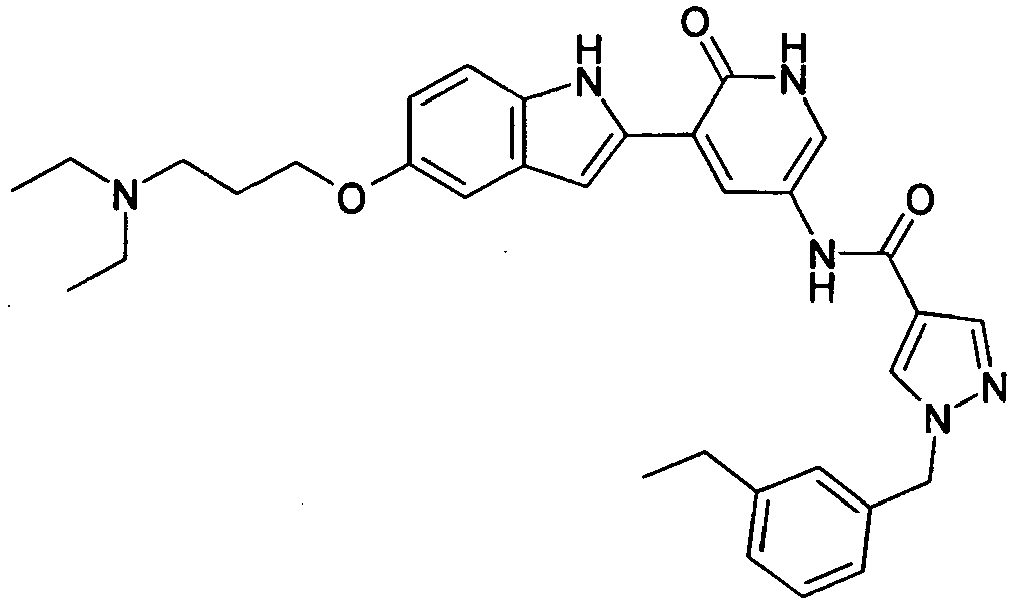
- The title compound was prepared by the route outlined in Scheme 11, following the same experimental procedures as for Example 121.
The title compound was purified by preparative HPLC at pH9 and isolated as a yellow solid, 6mg, 12%. - LC/MS: RT = 1.01 Min (270nm), m/z = 567 [M+H]. Total run time 1.9 min (super short pos).
1H NMR (d6 DMSO): δ 0.96 (t, 6H), 1.17 (t, 3H), 1.83 (quintet, 2H), 2.44-2.52 (multiplicity partially obscured by residual DMSO peak, 4H), 2.54-2.62 (m, 4H), 3.98 (t, 2H), 5.37 (s, 2H), 6.71 (dd, 1 H), 6.93 (d, 1H), 7.01 (d, 1 H), 7.08 (d, 1 H), 7.14-7.19 (m, 2H), 7.29 (m, 1H), 7.40 (d, 1H), 7.83 (d, 1H), 8.03 (s, 1H), 8.16 (d, 1 H), 8.40 (s,1H), 9.81 (s, 1 H), 11.45 (br s, 1 H), 11.96 (br s, 1 H) -

- The title compound was prepared by the route outlined in Scheme 11, following the same experimental procedures as for Example 121.
- The title compound was purified by trituration with diethyl ether, and isolated as a yellow solid, 4mg, 7%.
- LC/MS: RT = 1.67 Min (270nm), m/z = 553 [M+H]. Total run time 3.75 min (short pos).
1H NMR (d6 DMSO): δ 0.96 (s, 6H), 2.2 (s, 6H), 2.24 (s, 2H), 2.29 (s, 3H), 3.67 (s, 2H), 5.34 (s, 2H), 6.72 (dd, 1 H), 6.92 (d, 1 H) 7.01 (d, 1H), 7.19 (s, 4H), 7.39 (d, 1H), 7.84 (s, 1H), 8.01 (s, 1H), 8.13 (s, 1 H), 8.37 (s,1 H), 9.77 (br s, 1 H), 11.43 (br s, 1H), 11.98 (br s, 1 H) -

- The title compound was prepared by the route outlined in Scheme 11, following the same experimental procedures as for Example 121.
The title compound was purified by preparative HPLC atpH 4 and isolated as a brown solid, 5mg, 19%. - LC/MS: RT = 1.01 Min (270nm), m/z = 595 [M+H]. Total run time 1.9 min (super short pos).
1H NMR (d6 DMSO): δ 1.04 (d, 6H), 1.17 (t, 3H), 1.73 (t, 2H), 2.59 (q, 2H), 2.68 (m, 2H), 2.84 (d, 2H), 3.52-3.60 (m, 2H), 4.06 (m, 2H), 5.37 (s, 2H), 6.72 (dd, 1H), 6.92 (d, 1 H), 7.03 (d, 1H), 7.08 (d, 1H), 7.14-7.19 (m, 2H), 7.29 (m, 1 H), 7.40 (d, 1H), 7.83 (d, 1H), 8.03 (s, 1H), 8.17 (d, 1H), 8.40 (s,1H), 9.80 (s, 1 H), 11.45 (br s, 1H), 11.95 (br s, 1H) -

- The title compound was prepared by the route outlined in Scheme 11, following the same experimental procedures as for Example 121.
The title compound was purified by trituration with acetonitrile, and isolated as a yellow solid, 7mg, 16%. - LC/MS: RT = 0.92 Min (254nm), m/z = 539 [M+H]. Total run time 1.9 min (super short pos).
1H NMR (d6 DMSO): δ 0.95 (t, 6H), 1.80 (quintet, 2H), 2.45 (q, 4H), 2.53 (t, 2H), 3.98 (t, 2H), 5.40 (s, 2H), 6.68-6.72 (dd, 1H), 6.92 (d, 1 H), 7.02 (d, 1H), 7.26-7.41 (m, 6H), 7.83 (d, 1H), 8.04 (s, 1H), 8.14 (d, 1H), 8.40 (s, 1H), 9.77 (s, 1 H), 11.44 (s, 1H), 11.98 (br s, 1 H) -

- The title compound was prepared by the route outlined in Scheme 11, following the same experimental procedures as for Example 121.
- The title compound was purified by trituration with acetonitrile, and isolated as a yellow solid, 17mg, 36%.
- LC/MS: RT = 0.88 Min (254nm), m/z = 566 [M+H]. Total run time 1.9 min (super short pos).
1H NMR (d6 DMSO): δ 1.85 (quintet, 2H), 2.14 (s, 3H), 2.20-2.50 (br m, 8H), 2.42 (t, 2H), 3.98 (t, 2H), 5.4 (s, 2H), 6.68-6.72 (dd, 1H), 6.91 (d, 1 H), 7 (d, 1 H), 7.27-7.42 (m, 6H), 7.82 (d, 1H), 8.03 (s, 1 H), 8.14 (d, 1 H), 8.40 (s,1H), 9.78 (s, 1 H), 11.45 (s, 1 H), 11.98 (br s, 1 H). -

- The title compound was prepared by the route outlined in Scheme 11, following the same experimental procedures as for Example 121.
The title compound was purified by trituration with acetonitrile, and isolated as a yellow solid, 14mg, 32%.
LC/MS: RT = 1.59 Min (254nm), m/z = 525 [M+H]. Total run time 3.75 min (short pos).
1H NMR (d6 DMSO): δ 0.98 (t, 6H), 2.56 (q, 4H), 2.77 (t, 2H), 4, (t, 2H), 5.40 (s, 2H), 6.68-6.72 (dd, 1 H), 6.92 (d, 1 H), 7.03 (d, 1 H), 7.27-7.42 (m, 6H), 7.83 (d, 1H), 8.03 (s, 1 H), 8.15 (d, 1 H), 8.41 (s, 1 H), 9.78 (s, 1 H), 11.45 (s, 1 H), 11.98 (br s, 1 H) -

- The title compound was prepared by the route outlined in Scheme 11, following the same experimental procedures as for Example 121.
The title compound was purified by trituration with acetonitrile, and isolated as a yellow solid, 5mg, 22%. - LC/MS: RT = 1.53 Min (254nm), m/z = 497 [M+H]. Total run time 3.75 min (short pos).
1H NMR (d6 DMSO): δ 2.22 (s, 6H), 2.63 (t, 2H), 4.02 (t, 2H), 5.4 (s, 2H), 6.7-6.74 (dd, 1H), 6.93 (d, 1 H), 7.03 (d, 1H), 7.26-7.42 (m, 6H), 7.82 (d, 1 H), 8.04 (s, 1H), 8.14 (d, 1H), 8.41 (s, 1 H), 9.78 (s, 1H), 11.45 (s, 1H), 11.98 (br s, 1 H) -
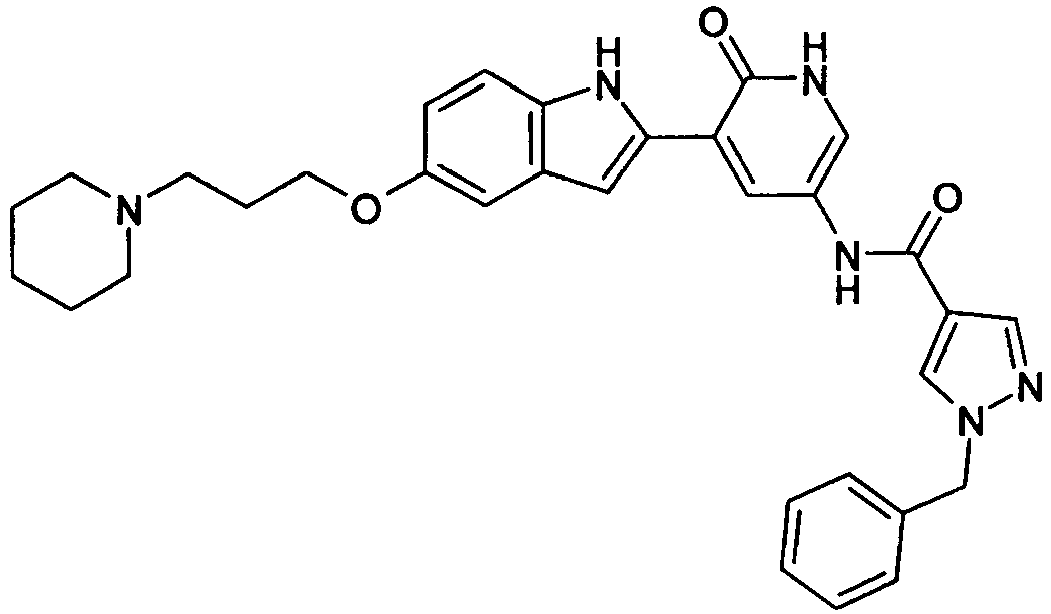
- The title compound was prepared by the route outlined in Scheme 11, following the same experimental procedures as for Example 121.
The title compound was purified by trituration with acetonitrile, and isolated as a yellow solid, 13mg, 30%. - LC/MS: RT = 1.62 Min (254nm), m/z = 551 [M+H]. Total run time 3.75 min (short pos).
1H NMR (d6 DMSO): δ 1.37-1.41 (br m, 2H), 1.46-1.54 (m, 4H), 1.85 (quintet, 2H), 2.30-2.36 (br m, 4H), 2.39 (t, 2H), 3.98 (t, 2H), 5.40 (s, 2H), 6.68-6.72 (dd, 1 H), 6.92 (d, 1 H), 7.01 (d, 1 H), 7.26-7.42 (m, 6H), 7.82 (d, 1H), 8.03 (s, 1 H), 8.15 (d, 1 H), 8.40 (s, 1 H), 9.78 (s, 1 H), 11.45 (s, 1 H), 11.98 (br s, 1 H) -

- The title compound was prepared by the route outlined in Scheme 11, following the same experimental procedures as for Example 121.
The title compound was purified by trituration with acetonitrile, and isolated as a yellow solid, 14mg, 42%. - LC/MS: RT = 1.53 Min (254nm), m/z = 523 [M+H]. Total run time 3.75 min (short pos).
1H NMR (d6 DMSO): δ 1.68 (m, 4H), 2.52 (m, obscured by DMSO peak, 4H), 2.78 (t, 2H), 4.04 (t, 2H), 5.40 (s, 2H), 6.68-6.72 (dd, 1 H), 6.92 (d, 1 H), 7.02 (d, 1 H), 7.26-7.42 (m, 6H), 7.82 (d, 1 H), 8.04 (s, 1H), 8.15 (d, 1 H), 8.41 (s, 1H), 9.78 (s, 1 H), 11.46 (s, 1H), 11.98 (br s, 1H) -

- The title compound was prepared by the route outlined in Scheme 11, following the same experimental procedures as for Example 121.
The title compound was purified by trituration with acetonitrile, and isolated as a yellow solid, 14mg, 28%. - LC/MS: RT = 1.55 Min (254nm), m/z = 511 [M+H]. Total run time 3.75 min (short pos).
1H NMR (d6 DMSO): δ 1.85 (quintet, 2H), 2.15 (s, 6H), 2.38 (t, 2H), 3.98 (t, 2H), 5.40 (s, 2H), 6.68-6.72 (dd, 1 H), 6.92 (d, 1 H), 7.02 (d, 1H), 7.26-7.42 (m, 6H), 7.82 (d, 1H), 8.04 (s, 1 H), 8.15 (d, 1 H), 8.40 (s, 1 H), 9.78 (s, 1H), 11.45 (s,1H), 11.98 (br s, 1 H) -

- The title compound was prepared by the route outlined in Scheme 11, following the same experimental procedures as for Example 121.
The title compound was purified by trituration with acetonitrile, and isolated as a yellow solid, 11 mg, 27%.
LC/MS: RT = 1.52 Min (254nm), m/z = 552 [M+H]. Total run time 3.75 min (short pos).
1H NMR (d6 DMSO): δ 2.14 (s, 3H), 2.20-2.40 (br m, 4H), 2.68 (t, 2H), 4.05 (t, 2H), 5.40 (s, 2H), 6.69-6.74 (dd, 1 H), 6.97 (d, 1 H), 7.04 (d, 1 H), 7.27-7.42 (m, 6H), 7.83 (d, 1 H), 8.04 (s, 1 H), 8.15 (d, 1 H), 8.40 (s, 1 H), 9.78 (s 1 H), 11.45 (s, 1 H), 11.98 (br s, 1H) -

- The title compound was prepared by the route outlined in Scheme 11, following the same experimental procedures as for Example 121.
The title compound was purified by trituration with acetonitrile, and isolated as a yellow solid, 5mg, 11 %. - LC/MS: RT = 0.93 Min (254nm), m/z = 567 [M+H]. Total run time 1.9 min (super short pos).
1H NMR (d6 DMSO): δ 1.04 (d, 6H), 1.72 (t, 2H), 2.67 (m, 2H), 2.84 (d, 2H), 3.57 (m, 2H), 4.06 (t, 2H), 5.40 (s, 2H), 6.7-6.73 (dd, 1H), 6.93 (d, 1 H), 7.04 (d, 1H), 7.28-7.42 (m, 6H), 7.82 (d, 1H), 8.03 (s 1H), 8.15 (d, 1H), 8.41 (s, 1H), 9.78 (s, 1H), 11.44 (s, 1H), 11.98 (br s, 1 H) -

- The title compound was prepared by the route outlined in Scheme 11, following the same experimental procedures as for Example 121.
The title compound was purified by preparative HPLC atpH 4 and isolated as a yellow solid, 8mg, 12%. - LC/MS: RT = 1.08 Min (254nm), m/z = 551 [M+H]. Total run time 1.9 min (super short pos).
1H NMR (d6 DMSO): δ 1.85 - 1.95 (m, 4H), 2.20 (t, 2H), 3.35 (m, partially obscured by water peak, 4H), 3.90 (t, 2H), 5.40 (s, 2H), 6.7-6.73 (dd, 1H), 6.94 (d, 1H), 7.00 (d, 1 H), 7.28-7.42 (m, 6H), 7.82 (d, 1H), 8.00 (s, 1 H), 8.14 (d, 1 H), 8.41 (s, 1 H), 9.79, (s, 1H), 11.45 (s, 1H), 11.98 (br s, 1 H). -

- The title compound was prepared by the route outlined in Scheme 11, following the same experimental procedures as for Example 115.
The title compound was purified by trituration with acetonitrile, and isolated as a yellow solid, 16mg, 33%.
LC/MS: RT = 1.73 Min (270nm), m/z = 537 [M+H]. Total run time 3.75 min (short pos).
1H NMR (d6 DMSO): δ 1.4 (m, 3H), 1.50 (m, 4H), 2.40 (m, 2H), 2.70 (m, 3H), 4.0 (t, 2H), 5.40 (s, 2H), 6.70 (dd, 2H), 6.8 (s, 1H), 7.00 (s, 1H), 7.3 (m, 5H), 7.80 (s, 1H), 8.0 (s, 1 H), 8.10 (s, 1 H), 8.40 (s, 1H), 9.70 (s, 1 H), 12.00 (br, 1 H) -

- The title compound was prepared by the route outlined in Scheme 11, following the same experimental procedures as for Example 121.
The title compound was purified by trituration with diethyl ether, and isolated as a yellow solid, 70mg, 35%.
LC/MS: RT=1.82 Min (270nm), m/z = 593 [M+H]. Total run time 3.75min (short pos). 1H NMR (d6 DMSO): δ 1.20 (d, 6H), 1.40 (br s, 2H), 1.55 (br s, 4H),1.90 (br m, 2H), 2.40(br s, 4H), 2.90 (m, 1 H), 4.00 (t, 2H), 5.35 (s, 2H), 6.70 (dd, 1 H), 6.95 (d, 1 H), 7.05 (d, 1H), 7.25 (m, 4H), 7.40 (d, 1H), 7.85 (d, 1 H), 8.00 (s, 1 H), 8.20 (d, 1 H), 8.45 (s, 1 H), 9.85 (s, 1 H), 11.44 (br s, 1H), 11.98 (br s, 1 H). -

- The title compound was prepared by the route outlined in Scheme 11, following the same experimental procedures as for Example 121.
The title compound was purified by trituration with diethyl ether, and isolated as a yellow solid, 60mg, 40%. - LC/MS: RT=1.84 Min (270nm), m/z = 593 [M+H]. Total run time 3.75min (short pos). 1H NMR (d6 DMSO): δ 1.30 (s, 9H), 1.45 (br m, 2H), 1.55 (m, 4H), 2.45 (br s, 4H), 2.70 (t, 2H), 4.05 (t, 2H), 5.35 (s, 2H), 6.70 (dd, 1 H), 6.95 (d, 1 H), 7.05 (d, 1 H), 7.25 (d, 2H), 7.45 (m, 3H), 7.85 (d, 1H), 8.00 (s, 1H), 8.20 (d, 1 H), 8.45 (s, 1H), 9.85 (s, 1 H), 11.44 (br s, 1 H).
-

- The title compound was prepared by the route outlined in Scheme 11, following the same experimental procedures as for Example 121.
The title compound was purified by trituration with diethyl ether, and isolated as a yellow solid, 60mg, 47%.
LC/MS: RT=1.80 Min (270nm), m/z = 579 [M+H]. Total run time 3.75min (short pos). 1H NMR (d6 DMSO): δ 1.20 (d, 6H), 1.40 (br m, 2H), 1.55 (m, 4H), 2.45 (br s, 4H), 2.70 (t, 2H), 2.90 (m, 1H), 4.10 (t, 2H), 5.35 (s, 2H), 6.70 (dd, 1 H), 6.95 (d, 1 H), 7.05 (d, 1H), 7.25 (m, 4H), 7.40 (d, 1H), 7.85 (d, 1 H), 8.00 (s, 1 H), 8.20 (d, 1 H), 8.45 (s, 1H), 9.85 (s, 1 H), 11.44 (br s, 1 H), 11.90 (br s, 1H). -

- The title compound was prepared by the route outlined in Scheme 11, following the same experimental procedures as for Example 121.
The title compound was purified by preparative HPLC atpH 4 to give the product as a yellow solid, 50mg, 28%. - LC/MS: RT=1.08 Min (270nm), m/z = 607 [M+H]. Total run time 1.9min (super short pos).
1H NMR (d6 DMSO): δ 1.30 (s, 9H), 1.40 (br m, 2H), 1.55 (m, 4H), 1.90 (m, 2H), 2.45 (br s, 4H), 4.00 (t, 2H), 5.35 (s, 2H), 6.70 (dd, 1H), 6.95 (d, 1 H), 7.00 (d, 1H), 7.20 (d, 2H), 7.40 (m, 3H), 7.85 (d, 1 H), 8.00 (s, 1H), 8.20 (d, 1 H), 8.45 (s, 1 H), 9.85 (s, 1 H), 11.46 (br s, 1H). -

- The title compound was prepared by the route outlined in Scheme 11, following the same experimental procedures as for Example 121.
The title compound was purified by trituration with diethyl ether, and isolated as a yellow solid, 65mg, 40%.
LC/MS: RT=1.82 Min (270nm), m/z = 581 [M+H]. Total run time 3.75min (short pos). 1H NMR (d6 DMSO): δ 1.00 (br t, 6H),1.30 (s, 9H), 2.60 (br s, 4H), 2.85 (br s, 2H), 4.00 (br s, 2H), 5.35 (s, 2H), 6.75 (dd, 1 H), 6.95 (d, 1H), 7.05 (d, 1 H), 7.25 (d, 2H), 7.40 (m, 3H), 7.85 (d, 1 H), 8.00 (s, 1 H), 8.20 (d, 1 H), 8.45 (s, 1 H), 9.85 (s, 1 H), 11.44 (br s, 1H), 11.98 (br s, 1H). -

- The title compound was prepared by the route outlined in Scheme 11, following the same experimental procedures as for Example 121.
The title compound was purified by trituration with diethyl ether, and isolated as a yellow solid, 110mg, 55%.
LC/MS: RT=1.78 Min (270nm), m/z = 567 [M+H]. Total run time 3.75min (short pos). 1H NMR (d6 DMSO): δ 1.00 (t, 6H), 1.20 (d, 6H), 2.60 (br q, 4H), 2.85 (br s, 2H), 2.90 (m, 1 H), 4.00 (t, 2H), 5.35 (s, 2H), 6.70 (dd, 1H), 6.95 (d, 1H), 7.05 (d, 1H), 7.25 (m, 4H), 7.40 (d, 1 H), 7.85 (d, 1 H), 8.00 (s, 1 H), 8.20 (d, 1H), 8.45 (s, 1 H), 9.85 (s, 1 H), 11.44 (br s, 1 H), 11.98 (br s, 1 H). -

- The title compound was prepared by the route outlined in Scheme 11, following the same experimental procedures as for Example 121.
The title compound was purified by trituration with diethyl ether, and isolated as a yellow solid, 80mg, 56%.
LC/MS: RT=1.80 Min (270nm), m/z = 567 [M+H]. Total run time 3.75min (short pos). 1H NMR (d6 DMSO): δ 1.30 (s, 9H), 1.90 (m, 2H), 2.20 (s, 6H), 2.40 (t, 2H), 4.00 (t, 2H), 5.35 (s, 2H), 6.75 (dd, 1 H), 6.95 (d, 1H), 7.05 (d, 1H), 7.25 (d, 2H), 7.40 (m, 3H), 7.85 (d, 1 H), 8.00 (s, 1 H), 8.20 (d, 1 H), 8.45 (s, 1 H), 9.85 (s, 1 H), 11.44 (br s, 1 H), 11.94 (br s, 1 H). -

- The title compound was prepared by the route outlined in Scheme 11, following the same experimental procedures as for Example 121.
The title compound was purified by trituration with diethyl ether, and isolated as a yellow solid, 115mg, 68%.
LC/MS: RT=1.75 Min (270nm), m/z = 553 [M+H]. Total run time 3.75min (short pos). 1H NMR (d6 DMSO): δ 1.25 (d, 6H), 1.75 (m, 2H), 2.15 (s, 6H), 2.40 (t, 2H), 2.90 (m, 1H), 4.00 (t, 2H), 5.35 (s, 2H), 6.70 (dd, 1 H), 6.95 (d, 1H), 7.05 (d, 1H), 7.25 (m, 4H), 7.40 (d, 1H), 7.85 (d, 1 H), 8.00 (s, 1 H), 8.20 (d, 1 H) 8.45 (s, 1H), 9.85 (s, 1 H), 11.44 (br s, 1 H), 11.96 (br s, 1 H). -

- The title compound was prepared by the route outlined in Scheme 11, following the same experimental procedures as for Example 115, except 1H-Indol-4-ol was used and the alternative deprotection method described for Example 108 was adopted. The title compound was purified by trituration with ethyl acetate, and isolated as a yellow solid, 7mg, 10%.
LC/MS: RT=1.48 Min (270nm), m/z = 469 [M+H]. Total run time 3.75min (short pos). 1H NMR (d4 MeOD): δ 3.17 (t, 2H), 4.20 (t, 2H), 5.40 (s, 2H), 6.52 (dd, 1H), 7.06 (m, 2H), 7.20 (s, 1H), 7.33 (m, 5H), 7.86 (d, 1H), 8.05 (s, 1H), 8.23 (d, 1 H), 8.26 (s, 1 H). -

- The title compound was prepared by the route outlined in Scheme 11, following the same experimental procedures as for Example 115, except 1H-Indol-4-ol was used and the alternative deprotection method described for Example 108 was adopted. The title compound was purified by trituration with ethyl acetate, and isolated as a yellow solid, 22mg, 29%.
LC/MS: RT=1.51 Min (270nm), m/z = 497 [M+H]. Total run time 3.75min (short pos). 1H NMR (d4 MeOD): δ 2.47 (s, 6H), 2.94 (t, 2H), 4.29 (t, 2H), 5.43 (s, 2H), 6.53 (d, 1H), 7.06 (m, 2H), 7.17 (s,1H), 7.40 (m, 5H), 7.95 (d, 1H), 8.09 (s, 1H), 8.23 (d, 1 H), 8.29 (s, 1H). -

- The title compound was prepared by the route outlined in
Scheme 6, following the same procedures as for Example 20, apart from a modified coupling procedure inStep 4 which utilised intermediate (6h). - A 20mL microwave vial was charged with 1H-pyrazole-4-carboxylic acid ethyl ester (1g, 7.1mmol), (R)-1-phenylethanol (1.31mL, 10.7mmol), triphenylphosphine (3g, 11.4mmol) and tetrahydrofuran (15mL). The reaction was stirred at ambient temperature for 10 minutes before adding diisopropyl azodicarboxylate (2.25mL, 11.14mmol) with cooling. The vial was heated under microwave irradiation at 140°C for 15mins. After cooling, the solvent was removed in vacuo and the residue purified by flash chromatography on SiO2 with hexane - 30% ethyl acetate / hexane (gradient) to afford intermediate (6f), 1-((S)-1-Phenyl-ethyl)-1H-pyrazole-4-carboxylic acid ethyl ester as an oil, 1.646g, 94%.
Intermediate (6f), 1-((S)-1-Phenyl-ethyl)-1H-pyrazole-4-carboxylic acid ethyl ester (1.525g, 6.2mmol) was stirred in a mixture of tetrahydrofuran (20mL) and water (20mL). Lithium hydroxide (0.524g, 12.5mmol) was added and the reaction stirred at ambient temperature for 24 hours. The reaction mixture was reduced in volume and extracted with diethyl ether (3x20mL). The aqueous layer was carefully acidified using an aqueous 6N hydrochloric acid solution. The resulting precipitate was filtered, washed with copious amounts of water and dried in vacuo to afford intermediate (6g), 1-((S)-1-Phenyl-ethyl)-1H-pyrazole-4-carboxylic acid as a white solid, 0.664g, 49%.
Intermediate (6g), 1-((S)-1-Phenyl-ethyl)-1H-pyrazole-4-carboxylic acid (0.5g, 2.31 mmol) was stirred in toluene (20mL) at RT and thionyl chloride (0.34mL, 4.62mmol) was added. The reaction mixture was slowly heated to 90°C and heating continued for 3hrs. After cooling the reaction was concentrated in vacuo. Toluene was added to the residue and concentrated in vacuo. This was repeated a further three times and the title compound, intermediate (6h), 1-((S)-1-Phenyl-ethyl)-1H-pyrazole-4-carbonyl chloride, was isolated as an oil, 0.544g, quantitative. - Modified procedure for
Step 4. - Intermediate (6c), 2-[5-Amino-2-oxo-1-(2-trimethylsilanyl-ethoxymethyl)-1,2-dihydro-pyridin-3-yl]-indole-1-carboxylic acid tert-butyl ester (100mg, 0.22mmol) was stirred in dichloromethane (5mL) at RT with triethylamine (0.092mL, 0.66mmol). The reaction mixture was cooled to 5°C and then a solution of intermediate (6h), 1-((S)-1-Phenyl-ethyl)-1H-pyrazole-4-carbonyl chloride, (54mg, 0.231 mmol) in dichloromethane (1mL) was added drop wise. After addition the reaction was stirred at RT for 1 hour and then the reaction mixture was concentrated in vacuo and the residue partitioned between ethyl acetate (10mL) and aqueous saturated sodium hydrogen carbonate solution (10mL). The organic layer was separated and the aqueous was extracted with a further portion of ethyl acetate (10mL). The combined ethyl acetate layers were washed with brine, dried (Na2SO4) and concentrated in vacuo. The resultant crude product was purified by flash chromatography on SiO2 eluting with hexane-50% ethyl acetate / hexane (gradient) to afford the desired intermediate, 2-(1-Methyl-2-oxo-5-{[1-((S)-1-phenyl-ethyl)-1H-pyrazole-4-carbonyl]-amino}-1,2-dihydro-pyridin-3-yl)-indole-1-carboxylic acid tert-butyl ester, 0.108g, 76%.
- The title compound was purified by flash chromatography on SiO2 eluting with dichloromethane - 10% methanol / dichloromethane (gradient) to afford the desired title compound as a yellow solid, 22mg, 31 %.
- LC/MS: RT = 2.07 Min (270nm), m/z = 424 [M+H]. Total run time 3.75 min (short pos).
1H NMR (d6 DMSO): δ 1.84 (d, 3H), 5.69 (q, 1H), 6.98 (m, 1H), 7.05-7.09 (m, 2H), 7.28-7.39 (m, 5H), 7.49-7.54 (m, 2H), 7.81 (d, 1 H), 8.04 (s, 1 H), 8.18 (d, 1H), 8.45 (s, 1H), 9.77 (s, 1H), 11.56 (s, 1 H), 12.00 (br s, 1 H). -

- The title compound was prepared by the route outlined in
Scheme 6, following the same procedures as for Example 160, except intermediate (6k), 1-((R)-1-Phenyl-ethyl)-1H-pyrazole-4-carbonyl chloride, was used in the coupling procedure inStep 4. Intermediate (6k), 1-((R)-1-Phenyl-ethyl)-1H-pyrazole-4-carbonyl chloride, was synthesised using the same procedures as for intermediate (6h), but starting from (S)-1-phenylethanol.
The title compound was purified by trituration with acetonitrile, and isolated as a yellow solid, 34mg, 45%. - LC/MS: RT = 2.07 Min (270nm), m/z = 424 [M+H]. Total run time 3.75 min (short pos).
1H NMR (d6 DMSO): δ 1.84 (d, 3H), 5.69 (q, 1H), 6.98 (m, 1H), 7.05-7.09 (m, 2H), 7.28-7.39 (m, 5H), 7.49-7.54 (m, 2H), 7.81 (d, 1 H), 8.04 (s, 1H), 8.18 (d, 1 H), 8.45 (s, 1H), 9.77 (s, 1H), 11.56 (s, 1H), 12.00 (br s, 1H). -

- The title compound was prepared by the route outlined in
Scheme 8, following the same experimental procedures as for Example 37, reacting intermediate (8d), 2-[5-Amino-2-oxo-1-(2-trimethylsilanyl-ethoxymethyl)-1,2-dihydro-pyridin-3-yl]-5-(tert-butyl-dimethyl-silanyloxymethyl)-indole-1-carboxylic acid tert-butyl with intermediate (6h), 1-((S)-1-Phenyl-ethyl)-1H-pyrazole-4-carbonyl chloride in the coupling step as described for Example 160.
The title compound was purified by trituration with acetonitrile, and isolated as a yellow solid, 131mg, 71%. - LC/MS: RT = 1.58 Min (270nm), m/z = 521 [M+H]. Total run time 3.75 min (short pos).
1H NMR (d6 DMSO): δ 1.37-1.50 (m, 6H), 1.84 (d, 3H), 2.31 (m, 4H), 3.44 (s, 2H), 5.69 (q, 1 H), 7.00-7.03 (m, 2H), 7.28-7.44 (m, 7H), 7.82 (d, 1H), 8.03 (s, 1 H), 8.15 (d, 1 H), 8.45 (s, 1 H), 9.78 (s, 1 H), 11.50 (s, 1 H), 11.97 (br s, 1 H). -

- The title compound was prepared by the route outlined in
Scheme 8, following the same experimental procedures as for Example 162. The title compound was purified by trituration with acetonitrile, and isolated as a yellow solid, 25mg, 38%. - LC/MS: RT = 1.59 Min (270nm), m/z = 551 [M+H]. Total run time 3.75 min (short pos).
1H NMR (d6 DMSO): δ 1.00 (d, 6H), 1.62 (t, 2H), 1.84 (d, 3H), 2.68 (d, 2H), 3.47 (s, 2H), 3.54 (m, 2H), 5.70 (q, 1H), 7.01-7.04 (m, 2H), 7.28-7.46 (m, 7H), 7.82 (d, 1H), 8.04 (s, 1H), 8.16 (d, 1 H), 8.45 (s, 1H), 9.78 (s, 1H), 11.53 (s, 1 H), 11.99 (br s, 1 H). -

- The title compound was prepared by the route outlined in
Scheme 8, following the same experimental procedures as for Example 162. The title compound was purified by trituration with acetonitrile, and isolated as a yellow solid, 37mg, 57%. - LC/MS: RT = 1.59 Min (270nm), m/z = 539 [M+H]. Total run time 3.75 min (short pos).
1H NMR (d6 DMSO): δ 1.68 (m, 2H), 1.79 (m, 2H), 1.84 (d, 3H), 2.28 (m, 2H), 2.50 (m, 2H), 3.50 (s, 2H), 4.60-4.72 (m, 1H), 5.70 (q, 1H), 7.01-7.04 (m, 2H), 7.28-7.45 (m, 7H), 7.82 (d, 1 H), 8.03 (s, 1 H), 8.15 (d, 1 H), 8.45 (s, 1H), 9.78 (s, 1 H), 11.53 (s, 1H), 11.99 (br s, 1 H). -

- The title compound was prepared by the route outlined in
Scheme 8, following the same experimental procedures as for Example 162. The title compound was purified by trituration with acetonitrile, and isolated as a yellow solid, 40mg, 54%. - LC/MS: RT = 1.65 Min (270nm), m/z = 535 [M+H]. Total run time 3.75 min (short pos).
1H NMR (d6 DMSO): δ 0.87 (d, 3H), 1.12 (m, 2H), 1.30 (m, 1H), 1.54 (m, 2H), 1.84 (d, 3H), 1.87 (m, 2H), 2.78 (m, 2H), 3.45 (s, 2H), 5.70 (q, 1H), 7.00-7.03 (m, 2H), 7.28-7.44 (m, 7H), 7.82 (d, 1H), 8.03 (s, 1H), 8.15 (d, 1H), 8.45 (s, 1H), 9.78 (s, 1 H), 11.51 (s, 1 H), 11.99 (br s, 1 H). -

- The title compound was prepared by the route outlined in
Scheme 8, following the same experimental procedures as for Example 37, reacting intermediate (8d), 2-[5-Amino-2-oxo-1-(2-trimethylsilanyl-ethoxymethyl)-1,2-dihydro-pyridin-3-yl]-5-(tert-butyl-dimethyl-silanyloxymethyl)-indole-1-carboxylic acid tert-butyl with intermediate (6k), 1-((R)-1-Phenyl-ethyl)-1H-pyrazole-4-carbonyl chloride in the coupling step as described for Example 161. - The title compound was purified by trituration with acetonitrile, and isolated as a yellow solid, 47mg, 55%.
- LC/MS: RT = 1.61 Min (270nm), m/z = 551 [M+H]. Total run time 3.75 min (short pos).
1H NMR (d6 DMSO): δ 1.01 (d, 6H), 1.62 (t, 2H), 1.84 (d, 3H), 2.68 (m, 2H), 3.47 (s, 2H), 3.54 (m, 2H), 5.70 (q, 1H), 7.01-7.04 (m, 2H), 7.28-7.46 (m, 7H), 7.82 (d, 1H), 8.03 (s, 1 H), 8.15 (d, 1 H), 8.45 (s, 1H), 9.78 (s, 1 H), 11.53 (s, 1 H), 11.99 (br s, 1 H). -

- The title compound was prepared by the route outlined in
Scheme 8, following the same experimental procedures as for Example 166. The title compound was purified by trituration with acetonitrile, and isolated as a yellow solid, 54mg, 56%. - LC/MS: RT = 1.66 Min (270nm), m/z = 535 [M+H]. Total run time 3.75 min (short pos).
1H NMR (d6 DMSO): δ 0.87 (d, 3H), 1.12 (m, 2H), 1.30 (m, 1H), 1.54 (m, 2H), 1.84 (d, 3H), 1.87 (m, 2H), 2.78 (m, 2H), 3.46 (s, 2H), 5.70 (q, 1 H), 7.00-7.03 (m, 2H), 7.28-7.44 (m, 7H), 7.82 (d, 1 H), 8.03 (s, 1 H), 8.15 (d, 1 H), 8.45 (s, 1 H), 9.78 (s, 1 H), 11.51 (s, 1H), 11.99 (br s, 1H). -

- The title compound was prepared by the route outlined in
Scheme 8, following the same experimental procedures as for Example 166. The title compound was purified by trituration with acetonitrile, and isolated as a yellow solid, 48mg, 58%. - LC/MS: RT = 1.60 Min (270nm), m/z = 521 [M+H]. Total run time 3.75 min (short pos).
1H NMR (d6 DMSO): δ 1.37-1.50 (m, 6H), 1.84 (d, 3H), 2.31 (m, 4H), 3.44 (s, 2H), 5.70 (q, 1 H), 7.00-7.03 (m, 2H), 7.28-7.44 (m, 7H), 7.82 (d, 1 H), 8.03 (s, 1 H), 8.15 (d, 1H), 8.45 (s, 1H), 9.78 (s, 1H), 11.51 (s, 1H), 11.99 (br s, 1 H). -

- The title compound was prepared by the route outlined in
Scheme 8, following the same experimental procedures as for Example 166. The title compound was purified by trituration with acetonitrile, and isolated as a yellow solid, 49mg, 53%. - LC/MS: RT = 1.56 Min (270nm), m/z = 539 [M+H]. Total run time 3.75 min (short pos).
1H NMR (d6 DMSO): δ 1.68 (m, 2H), 1.79 (m, 2H), 1.84 (d, 3H), 2.28 (m, 2H), 2.52 (m, 2H), 3.50 (s, 2H), 4.60-4.72 (m, 1H), 5.70 (q, 1H), 7.01-7.04 (m, 2H), 7.28-7.45 (m, 7H), 7.83 (d, 1 H), 8.03 (s, 1 H), 8.16 (d, 1 H), 8.45 (s, 1 H), 9.78 (s, 1 H), 11.52 (s, 1 H), 11.99 (br s, 1 H). -

- The title compound was prepared by the route outlined in
Scheme 8, following the same experimental procedures as for Example 51.
The title compound was purified by trituration with acetonitrile, and isolated as a yellow solid, 28mg, 24%. - LC/MS: RT = 1.45 Min (270nm), m/z = 522 [M-H]. Total run time 3.75 min (short neg).
1H NMR (d6 DMSO): δ 2.15 (s, 9H), 2.42 (s, 4H), 3.52 (s, 2H), 5.41 (s, 2H), 6.98-7.06 (m, 2H), 7.25-7.45 (m, 7H), 7.82 (s, 1 H), 8.04 (s, 1 H), 8.17 (d, 1 H), 8.42 (s, 1H), 9.81 (br s, 1 H), 11.52 (br s, 1 H), 12.0 (br s, 1 H). -

- The title compound was prepared by the route outlined in
Scheme 8, following the same experimental procedures as for Example 51. - The title compound was purified by trituration with acetonitrile, and isolated as a yellow solid, 58mg, 56%.
- LC/MS: RT = 1.68 Min (270nm), m/z = 519 [M-H]. Total run time 3.75 min (short neg).
1H NMR (d6 DMSO): δ 1.15 (d, 3H), 1.22-1.36 (m, 4H), 1.88 (m, 1H), 2.3 (m, 1H), 2.65 (m, 1 H), 3.12 (d, 1 H), 4.0 (d, 1 H), 5.4 (s, 2H), 6.99-7.04 (m, 2H), 7.27-7.44 (m, 7H), 7.82 (m, 1H), 8.03 (s, 1H), 8.15 (d, 1H), 8.41 (s, 1H), 9.8 (br s, 1H), 11.5 (br s, 1H), 11.99(brs, 1H). -

- The title compound was prepared by the route outlined in
Scheme 8, following the same experimental procedures as for Example 51.
The title compound was purified by trituration with acetonitrile, and isolated as a yellow solid, 42mg, 31%. - LC/MS: RT = 1.45 Min (270nm), m/z = 534 [M-H]. Total run time 3.75 min (short neg).
1H NMR (d6 DMSO): δ 1.58 (m 1 H), 1.82 (m, 1H), 2.05 (s, 6H), 2.22 (m, 1H), 2.42 (m, 1H), 2.56 (m, 1H), 2.66 (m, 2H), 3.58 (dd, 2H), 5.41 (s, 2H), 7.01 (m, 2H), 7.25-7.45 (m, 7H), 7.82 (s, 1 H), 8.03 (s, 1 H), 8.17 (s, 1 H), 8.41 (s, 1 H), 9.8 (br s, 1 H), 11.5 (br s, 1H), 11.99 (br s, 1 H). -

- The title compound was prepared by the route outlined in
Scheme 8, following the same experimental procedures as for Example 51.
The title compound was purified by trituration with acetonitrile, and isolated as a yellow solid, 20mg, 20%. - LC/MS: RT = 1.69 Min (270nm), m/z = 519 [M-H]. Total run time 3.75 min (short neg).
1H NMR (d6 DMSO): δ 1.15 (d, 3H), 1.22-1.36 (m, 4H), 1.88 (m, 1 H), 2.3 (m, 1H), 2.65 (m, 1H), 3.12 (d, 1 H), 4.0 (d, 1H), 5.4 (s, 2H), 6.99-7.04 (m, 2H), 7.27-7.44 (m, 7H), 7.82 (m, 1H), 8.03 (s, 1H), 8.15 (d, 1 H), 8.41 (s, 1 H), 9.82 (br s, 1 H), 11.51 (br s, 1 H), 11.99 (br s, 1 H). -

- The title compound was prepared by the route outlined in
Scheme 8, following the same experimental procedures as for Example 51.
The title compound was purified by trituration with acetonitrile, and isolated as a yellow solid, 20mg, 20%. - LC/MS: RT = 1.63 Min (270nm), m/z = 509 [M-H]. Total run time 3.75 min (short neg).
1H NMR (d6 DMSO): δ 1.77-1.93 (m, 1H), 2.05-2.2 (m, 1 H), 2.3 (q, 1 H), 2.53-2.64 (m, 1 H), 2.7-2.82 (m, 2H), 3.63 (s, 2H), 5.18 (dt, 1 H), 5.4 (s, 2H), 7.0-7.07 (m, 2H), 7.27-7.46 (m, 7H), 7.82 (d, 1H), 8.03 (s, 1H), 8.17 (d, 1H), 8.41 (s, 1H), 9.79 (s, 1 H), 11.52 (br s, 1H), 12.01 (br s, 1H). -

- The title compound was prepared by the route outlined in
Scheme 8, following the same experimental procedures as for Example 51.
The title compound was purified by trituration with acetonitrile, and isolated as a yellow solid, 76mg, 81%. - LC/MS: RT = 1.62 Min (270nm), m/z = 509 [M-H]. Total run time 3.75 min (short neg).
1H NMR (d6 DMSO): δ 1.77-1.93 (m, 1H), 2.05-2.2 (m, 1 H), 2.3 (q, 1 H), 2.53-2.64 (m, 1H), 2.7-2.82 (m, 2H), 3.63 (s, 2H), 5.18 (dt, 1H), 5.4 (s, 2H), 7.0-7.07 (m, 2H), 7.27-7.46 (m, 7H), 7.82 (d, 1 H), 8.03 (s, 1H), 8.17 (d, 1 H), 8.41 (s, 1H), 9.8 (s, 1 H), 11.52 (br s, 1 H), 12.01 (br s, 1 H). -

- The title compound was prepared by the route outlined in
Scheme 8, following the same experimental procedures as for Example 51.
Purification by trituration with acetonitrile afforded the title compound as a yellow solid, 30mg, 43%
LC/MS: RT = 1.49 Min (270nm), m/z = 580 [M+H]. Total run time 3.75 min (short pos).
1H NMR (d6 DMSO): δ 0.86 (s, 6H), 0.92 (t, 3H), 2.09 (s, 2H), 2.19 (s, 6H), 2.31 (s, 2H), 2.42 (q, 2H), 3.64 (s, 2H), 5.41 (s, 2H), 7.01 (s, 1 H), 7.11 (dd, 1H), 7.28-7.45 (m, 7H), 7.80 (d, 1 H), 8.03 (s, 1H), 8.16 (d, 1 H), 8.41 (s, 1 H), 9.79 (s, 1H), 11.49 (s, 1 H), 11.99 (brs, 1H) -

- The title compound was prepared by the route outlined in
Scheme 8, following the same experimental procedures as for Example 51, with the following modification. Deprotection of intermediate (8e), 5-(tert-Butyl-dimethyl-silanyloxymethyl)-2-[5-{[1-(4-methyl-benzyl)-1H-pyrazole-4-carbonyl]-amino}-2-oxo-1-(2-trimethylsilanyl-ethoxymethyl)-1,2-dihydro-pyridin-3-yl]-indole-1-carboxylic acid tert-butyl ester, in the usual manner, yielded 2-[5-[(1-benzyl-1H-pyrazole-4-carbonyl)-amino]-2-oxo-1-(2-trimethylsilanyl-ethoxymethyl)-1,2-dihydro-pyridin-3-yl]-5-hydroxymethyl-indole-1-carboxylic acid tert-butyl ester. DIPEA (153µL, 0.9mmol) and 2-[5-[(1-benzyl-1H-pyrazole-4-carbonyl)-amino]-2-oxo-1-(2-trimethylsilanyl-ethoxymethyl)-1,2-dihydro-pyridin-3-yl]-5-hydroxymethyl-indole-1-carboxylic acid tert-butyl ester (0.2g, 0.3mmol) were stirred in 1,2-dichloroethane (5mL) and cooled to 0°C. Methanesulfonyl chloride (27µL, 0.36mmol) was added drop wise at 0°C and stirred for a further 2hours at 0°C. cis-2,6-Dimethylpiperidine (118µL 0.9mmol) was added drop wise at 0°C and then the reaction was allowed to attain ambient temperature. The reaction mixture was heated at reflux overnight followed by cooling to ambient temperature. The reaction mixture was diluted with ethyl acetate (30mL), washed with water (30mL), saturated sodium hydrogen carbonate solution (30mL), brine, dried (Na2SO4) and concentrated in vacuo. The resultant crude product was taken up in methanol (1 mL) and loaded onto a 5g SCX column. The column was flushed with methanol and then eluted with ammonia solution 7N in methanol. The eluent was concentrated in vacuo to afford the title compound as a light brown solid, 120mg, 53%. - Global deprotection in the usual manner afforded the title compound which was purified by trituration with diethyl ether, and isolated as a yellow solid, 20mg, 24%. LC/MS: RT = 1.72 Min (270nm), m/z = 535 [M+H]. Total run time 3.75 min (short pos).
1H NMR (d6 DMSO): δ 1.02 (d, 6H), 1.26 (m, 3H), 1.53-1.60 (m, 3H), 2.45 (m, 2H), 3.78 (s, 2H), 5.41 (s, 2H), 7.00 (s, 1 H), 7.08 (d, 1H), 7.28-7.40 (m, 6H), 7.49 (s, 1H), 7.80 (s, 1H), 8.03 (s, 1 H), 8.14 (d, 1 H), 8.41 (s, 1H), 9.79 (s, 1 H), 11.45 (s, 1 H), 11.98 (br s, 1H). -

- The title compound was prepared by the route outlined in Scheme 11, following the same experimental procedures as for Example 115.
The title compound was purified by trituration with acetonitrile, and isolated as a yellow solid, 50mg, 47%.
LC/MS: RT = 1.78 Min (270nm), m/z = 567.3 [M+H]. Total run time 3.75 min (short pos).
1H NMR (d6 DMSO): δ 0.90 (t, 6H), 0.95 (s, 6H), 2.35 (s, 2H), 2.50 (q, 4H), 3.65 (s, 2H), 5.40 (s, 2H), 6.70 (dd, 1H), 6.90 (d, 1 H), 7.00 (d, 1 H), 7.25-7.45 (m, 6H), 7.85 (d, 1H), 8.05 (s, 1 H), 8.15 (d, 1 H), 8.40 (s, 1 H), 9.80 (s, 1 H), 11.40 (s, 1 H), 12.00 (br s, 1H). -
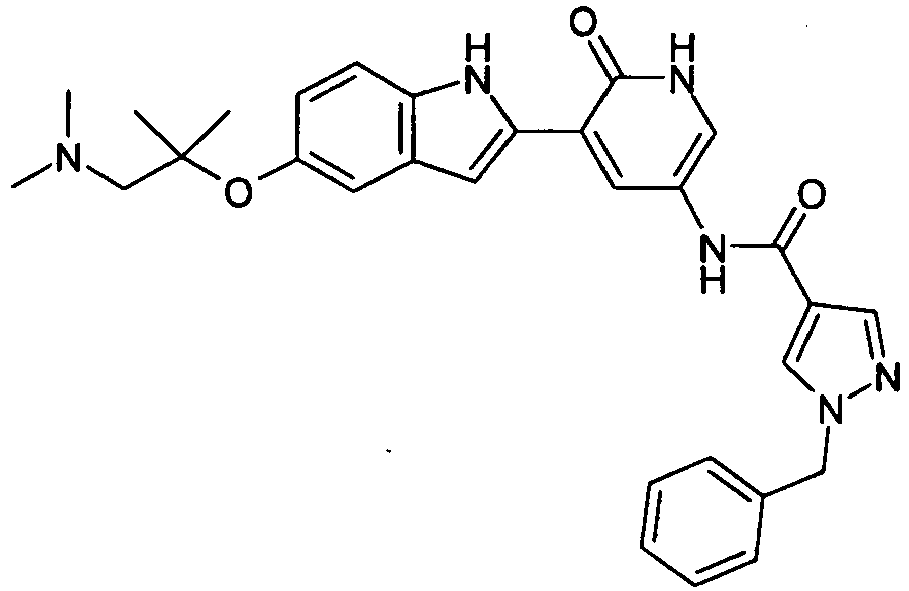
- The title compound was prepared by the route outlined in Scheme 11, following the same experimental procedures as for Example 115. In this instance the chloroalkyl intermediate, (2-chloro-2-methyl-propyl)-dimethyl-amine hydrochloride, required for
Step 6 was not commercially available and was synthesised according to the following methodology. - Preparation of (2-chloro-2-methyl-propyl)-dimethyl-amine hydrochloride. 2-Dimethylamino-2-methyl-propan-1-ol as an 80% solution in water (10mL, 9.1g, 78mmol) was dissolved in toluene (100mL) and then after stirring for 30mins, the organic layer separated, dried over Mg2SO4 and then concentrated to a volume of approximately 50mL. Thionyl chloride (95mmol, 6.9mL, 11.3g) was added to this solution and the mixture heated at 80°C for 3hrs. After cooling, the mixture was concentrated in vacuo. Anhydrous toluene was added and the mixture was concentrated in vacuo. This process was repeated a further three times with toluene and once with isohexane. The residue obtained was slurried in diethyl ether, separated via filtration and washed with copious amounts of diethylether before being dried in vacuo at RT. The compound obtained was a mixture of the desired title compound (2-chloro-2-methyl-propyl)-dimethyl-amine hydrochloride (70%) and the isomer (2-chloro-1,1-dimethyl-ethyl)-dimethyl-amine (30%) by NMR. The total yield was 5.23g (49%).
This mixture containing 70% desired intermediate and 30% undesired isomer was used in the subsequent alkylation step without further purification and so a mixture of two possible products was obtained. These two products were duly separated, prior to global deprotection, by flash chromatography on SiO2 and the desired product was eluted using dichloromethane - 10% methanol / dichloromethane (gradient). The undesired product of this reaction remained on the column.
The title compound was purified by trituration with diethyl ether, and isolated as a yellow solid, 58mg, 64%. - LC/MS: RT = 1.65 Min (270nm), m/z = 523 [M-H]. Total run time 3.75 min (short neg).
1H NMR (d6 DMSO): δ 1.21 (s, 6H), 2.34 (s, 6H) 5.41 (s, 2H), 6.74 (dd, 1 H), 6.97 (s, 1 H), 7.1 (s, 1H), 7.27-7.41 (m, 6H), 7.82 (d, 1 H), 8.03 (s, 1H), 8.15 (d, 1 H), 8.42 (s, 1 H), 9.8 (br s, 1 H), 11.48 (s, 1 H), 12.0 (br s, 1 H). -

- The title compound was prepared by the route outlined in Scheme 11, following the same experimental procedures as for Example 115. In this instance the chloroalkyl intermediate, 1-(3-chloro-2,2-dimethyl-propyl)-pyrrolidine, required for
Step 6, was not commercially available and was synthesised according to the following methodology. - Preparation of 1-(3-Chloro-2,2-dimethyl-propyl)-pyrrolidine. 3-Chloro-2,2-dimethyl-propionyl chloride (0.5g, 3.2mmol) was stirred in dichloromethane (20mL) at RT with triethylamine (0.9mL, 6.4mmol). The reaction mixture was cooled to 5°C and then pyrrolidine (0.32mL, 3.9mmol), was added drop wise. After addition the reaction was stirred at RT for 1 hr, and then the reaction mixture was washed with saturated sodium hydrogen carbonate solution (2x50mL), brine (50ml), dried (Na2SO4) and concentrated in vacuo to afford 3-chloro-2,2-dimethyl-1-pyrrolidin-1-yl-propan-1-one as a yellow solid, 0.576g, 94%.
To this intermediate, 3-chloro-2,2-dimethyl-1-pyrrolidin-1-yl-propan-1-one (0.57g, 3mmol) in anhydrous THF (20mL) was slowly added a 1M anhydrous THF solution of lithium aluminium hydride (7.5mL, 7.5mmol) at room temperature. The resulting clear solution was stirred overnight at room temperature under nitrogen to give a cloudy suspension. Water (0.3mL) was carefully added to the reaction mixture followed by 15% w/v aqueous sodium hydroxyde solution (0.3mL) and water (0.9mL). The reaction was filtered and the filtrate evaporated to dryness to give the title compound which was used without futher purification. - The title compound was purified by trituration with acetonitrile, and isolated as a yellow solid, 104mg, 54%.
- LC/MS: RT = 1.77 Min (270nm), m/z = 565 [M+H]. Total run time 3.75 min (short pos).
1H NMR (d6 DMSO): δ 0.98 (s, 6H), 1.63 (m, 4H), 2.45 (s, 2H), 2.53 (m, 4H), 3.68 (s, 2H), 5.40 (s, 2H), 6.72 (dd, 1H), 6.92 (s, 1H), 7.01 (d, 1 H), 7.28-7.40 (m, 6H), 7.84 (d, 1H), 8.03 (s, 1H), 8.14 (d, 1 H), 8.41 (s, 1 H), 9.79 (s, 1 H), 11.44 (s, 1 H), 11.98 (br s, 1H). -

- The title compound was prepared by the route outlined in Scheme 11, following the same experimental procedures as for Example 115. In this instance the relevant chloroalkyl intermediate, required for
Step 6, was not commercially available and was synthesised according to the protocol given for Example 180.
The title compound was purified by trituration with acetonitrile, and isolated as a yellow solid, 20mg, 10%.
LC/MS: RT = 2.11 Min (270nm), m/z = 601 [M+H]. Total run time 3.75 min (short pos).
1H NMR (d6 DMSO): δ 0.98 (s, 6H), 2.18 (m, 2H), 2.47 (s, 2H), 2.78 (t, 2H), 2.94 (t, 2H), 3.67 (s, 2H), 5.41 (s, 2H), 6.72 (dd, 1 H), 6.92 (s. 1H), 7.02 (d, 1 H), 7.28-7.41 (m, 6H), 7.84 (d, 1 H), 8.03 (s, 1 H), 8.14 (d, 1 H), 8.41 (s, 1H), 9.79 (s, 1H), 11.44 (s, 1 H), 12.0 (br s, 1H). -

- The title compound was prepared by the route outlined in Scheme 11, following the same experimental procedures as for Example 115. In this instance the relevant chloroalkyl intermediate, required for
Step 6, was not commercially available and was synthesised according to the protocol given for Example 180.
The title compound was purified by trituration with acetonitrile, and isolated as a yellow solid, 30mg, 17%.
LC/MS: RT = 1.56 Min (270nm), m/z = 583 [M+H]. Total run time 3.75 min (short pos).
1H NMR (d6 DMSO): δ 0.98 (s, 6H), 1.75-2.11 (m, 2H), 2.45 (m, 3H), 2.73-2.86 (m, 3H), 3.68 (s, 2H), 5.05-5.17 (m, 1 H), 5.41 (s, 2H), 6.72 (dd, 1 H), 6.92 (s, 1H), 7.02 (d, 1H), 7.28-7.41 (m, 6H), 7.84 (d, 1H), 8.03 (s, 1 H), 8.14 (d, 1 H), 8.41 (s, 1 H), 9.79 (s, 1H), 11.44 (s, 1H), 11.99 (br s, 1H) -

- The title compound was prepared by the route outlined in Scheme 11, following the same experimental procedures as for Example 115. In this instance the relevant chloroalkyl intermediate, required for
Step 6, was not commercially available and was synthesised according to the protocol given for Example 180.
The title compound was purified by trituration with acetonitrile, and isolated as a yellow solid, 31 mg, 18%.
LC/MS: RT = 1.57 Min (270nm), m/z = 583 [M+H]. Total run time 3.75 min (short pos).
1H NMR (d6 DMSO): δ 0.98 (s, 6H), 1.77-2.11 (m, 2H), 2.45 (m, 3H), 2.71-2.86 (m, 3H), 3.68 (s, 2H), 5.06-5.17 (m, 1H), 5.41 (s, 2H), 6.72 (dd, 1H), 6.92 (s, 1 H), 7.02 (d, 1H), 7.28-7.41 (m, 6H), 7.84 (d, 1H), 8.03 (s, 1 H), 8.14 (d, 1 H), 8.41 (s, 1 H), 9.79 (s, 1H), 11.44 (s, 1H), 11.99 (br s, 1 H) -

- The title compound was prepared by the route outlined in Scheme 11, following the same experimental procedures as for Example 115. In this instance the relevant chloroalkyl intermediate, required for
Step 6, was not commercially available and was synthesised according to the protocol given for Example 180.
The title compound was purified by trituration with acetonitrile, and isolated as a yellow solid, 16mg, 18%.
LC/MS: RT = 1.74 Min (270nm), m/z = 581 [M+H]. Total run time 3.75 min (short pos).
1H NMR (d6 DMSO): δ 0.98 (s, 6H), 2.27 (s, 2H), 2.43 (m, 4H), 3.50 (m, 4H), 3.67 (s, 2H), 5.41 (s, 2H), 6.72 (dd, 1 H), 6.91 (s, 1 H), 7.01 (d, 1H), 7.28-7.40 (m, 6H), 7.84 (d, 1H), 8.03 (s, 1 H), 8.14 (d, 1 H), 8.41 (s, 1 H), 9.79 (s, 1H), 11.43 (s, 1H), 11.99 (br s, 1 H). -

- The title compound was prepared by the route outlined in Scheme 11, following the same experimental procedures as for Example 115. In this instance the relevant chloroalkyl intermediate required for
Step 6 was not commercially available and was synthesised according to the protocol given for Example 180.
The title compound was purified by trituration with acetonitrile, and isolated as a yellow solid, 123mg, 64%.
LC/MS: RT = 1.79 Min (270nm), m/z = 579 [M+H]. Total run time 3.75 min (short pos).
1H NMR (d6 DMSO): δ 0.94 (s, 6H), 1.30 (m, 2H), 1.42 (m, 4H), 2.22 (s, 2H), 2.40 (m, 4H), 3.65 (s, 2H), 5.41 (s, 2H), 6.71 (dd, 1 H), 6.92 (s, 1 H), 7.00 (d, 1H), 7.28-7.40 (m, 6H), 7.83 (d, 1H), 8.03 (s, 1 H), 8.14 (d, 1 H), 8.41 (s, 1H), 9.79 (s, 1 H), 11.43 (s, 1H), 11.97 (br s, 1H). -

- The title compound was prepared by the route outlined in Scheme 11, following the same experimental procedures as for Example 115. In this instance the chloroalkyl intermediate, 1-(1-chloromethyl-cyclopropylmethyl )-pyrrolidine hydrochloride, required for
Step 6, was not commercially available and was synthesised according to the following methodology. - Preparation of 1-(1-chloromethyl-cyclopropylmethyl)-pyrrolidine hydrochloride. Oxalyl chloride (12.5mL, 2M) in dichloromethane was added to a solution of cyclopropane-1,1-dicarboxylic acid methyl ester (2.90g, 20mmol) in dichloromethane (50mL) at 0°C (ice/ water) and the solution stirred. DMF (100µL) was added and the solution stirred for ∼2hrs. at room temperature, to give a pale yellow solution. The solution was concentrated to a yellow semi-solid.
- The semi-solid was taken up in THF (20ml) and the solution cooled, 0°C (ice/ water), and pyrrolidine (6mL, 71mmol) was added slowly and the resulting suspension stirred for ∼60mins. Ethyl acetate (150mL) was added and the mixture washed with water (2x 75mL) and saturated aqueous sodium chloride solution (75mL). The solution was dried over anhydrous magnesium sulphate and concentrated to yield 1-(pyrrolidine-1-carbonyl)-cyclopropanecarboxylic acid methyl ester as a yellow/ brown oil 2.20g, 55%.
Lithium aluminium hydride solution (20mL, 1 M) in THF was added slowly to a solution of 1-(pyrrolidine -1-carbonyl )-cyclopropanecarboxylic acid methyl ester (2.2g, 11mmol) in THF at 0°C (ice/ water), under a nitrogen atmosphere, and the resulting solution stirred for -3hrs at room temperature. The solution was cooled, 0°C (ice/ water), and sodium sulphate decahydrate (4.9g, 15mmol) was added portionwise to give a white suspension. Diethyl ether (25mL) was added and the suspension stirred for ∼18hrs. at room temperature. The resulting suspension was filtered, through celite, and the solids washed with diethyl ether (2x 50mL). The combined filtrates were concentrated to give (1-pyrrolidin-1-ylmethyl-cyclopropyl)-methanol as a pale yellow oil 1.45g, 84%.
Thionyl chloride (1 mL, 13.7mmol) was added to a solution of (1-pyrrolidin-1-ylmethyl-cyclopropyl)-methanol (1.45g, 9.3mmol) in toluene (20mL) to give a pale brown suspension. The suspension was heated, 110 °C, for ∼3hrs. to give a dark brown suspension. The resulting suspension was allowed to cool and concentrated to a brown solid. Tritruation with diethyl ether (40mL) gave the desired intermediate, 1-(1-chloromethyl-cyclopropylmethyl)-pyrrolidine hydrochloride as a brown powder 1.6g, 82%. - The title compound was purified by trituration with acetonitrile, and isolated as a yellow solid, 145mg, 58%.
LC/MS: RT = 1.76 Min (270nm), m/z = 565.3 [M+H]. Total run time 3.75 min (short pos).
1H NMR (d6 DMSO): δ 0.40 (t, 2H), 0.60 (t, 2H), 0.95 (t, 6H), 2.45 (s, 2H), 2.50 (q, 4H), 3.85 (s, 2H), 5.40 (s, 2H), 6.70 (dd, 1H), 6.90 (d, 1H), 7.00 (d, 1 H), 7.25-7.45 (m, 6H), 7.85 (d, 1H), 8.00 (s, 1 H), 8.15 (d, 1H), 8.40 (s, 1 H), 9.80 (s, 1 H), 11.40 (s, 1 H), 11.95 (br s, 1 H). -

- The title compound was prepared by the route outlined in Scheme 11, following the same experimental procedures as for Example 115. In this instance the relevant chloroalkyl intermediate, required for
Step 6, was not commercially available and was synthesised according to the protocol given for Example 186.
The title compound was purified by trituration with acetonitrile, and isolated as a yellow solid, 175mg, 62%.
LC/MS: RT = 1.73 Min (270nm), m/z = 563.3 [M+H]. Total run time 3.75 min (short pos).
1H NMR (d6 DMSO): δ 0.40 (t, 2H), 0.50 (t, 2H), 1.65 (br s, 4H), 2.45 (s, 2H), 2.50 (br s, 4H), 3.85 (s, 2H), 5.40 (s, 2H), 6.75 (dd, 1H), 6.90 (d, 1 H), 7.00 (d, 1H), 7.25-7.40 (m, 6H), 7.85 (d, 1 H), 8.05 (s, 1 H), 8.15 (d, 1 H), 8.40 (s, 1 H), 9.80 (s, 1H), 11.40 (s, 1H), 11.95 (br s, 1 H). -

- The title compound was prepared by the route outlined in Scheme 11, following the same experimental procedures as for Example 115. In this instance the relevant chloroalkyl intermediate, required for
Step 6, was not commercially available and was synthesised according to the protocol given for Example 186.
The title compound was purified by trituration with acetonitrile, and isolated as a yellow solid, 190mg, 66%.
LC/MS: RT = 1.71 Min (270nm), m/z = 537.3 [M+H]. Total run time 3.75 min (short pos).
1H NMR (d6 DMSO): δ 0.40 (q, 2H), 0.60 (q, 2H), 2.21 (s, 6H), 2.25 (s, 2H), 3.85 (s, 2H), 5.40 (s, 2H), 6.70 (dd, 1H), 6.90 (d, 1H), 7.00 (d, 1H), 7.25-7.45 (m, 6H), 7.85 (d, 1 H), 8.05 (s, 1 H), 8.15 (d, 1 H), 8.45 (s, 1 H), 9.80 (s, 1H), 11.40 (s, 1 H), 11.95 (br s, 1H). - All reagents obtained from commercial sources were used without further purification. Anhydrous solvents were obtained from commercial sources and used without further drying. Flash chromatography was performed with pre-packed silica-gel cartridges (Strata Si-1, 61 A, Phenomenex, Cheshire, UK or IST Flash II, 54 A, Argonaut, Hengoed, UK). Thin layer chromatography was conducted with 5 x 10 cm plates coated with Merck Type 60 F254 silica-gel. Microwave heating was performed with a Biotage Initiator™ 2.0 instrument.
- The compounds of the present invention were characterized by high performance liquid chromatography-mass spectroscopy (HPLC-MS) on either an Agilent HP1200 Rapid Resolution Mass detector 6140 multi mode source M/z range 150 to 1000 amu or an Agilent HP1100 Mass detector 1946D ESI source M/z range 150 to 1000 amu. The conditions and methods listed below are identical for both machines.
- Column for 3.75 min run: Gemini 5µm, C18, 30 mm x 4.6mm (Phenomenex). Temperature: 35C.
Column for 1.9 min run: LunaHST 2.5 µm, C18, 50 x 2 mm (Phenomenex). Temperature: 55C.
Mobile Phase: A - Water + 10 mMol / ammonium formate + 0.08% (v/v) formic acid at pH ca 3.5.
B - 95% Acetonitrile + 5% A + 0.08% (v/v) formic acid
Injection Volume: 2µL
"Short" method gradient table, either positive (pos) or positive and negative (pos / neg) ionisationTime (min) Solvent A (%) Solvent B (%) Flow (mL/min) 0 95 5 2 0.25 95 5 2 2.50 95 5 2 2.55 5 95 3 3.60 5 95 3 3.65 5 95 2 3.70 95 5 2 3.75 95 5 2
"Super Short" method gradient table, either positive (pos) or positive and negative (pos / neg) ionisationTime (min) Solvent A (%) Solvent B (%) Flow (mL/min) 0 95 5 1.1 0.12 95 5 1.1 1.30 5 95 1.1 1.35 5 95 1.7 1.85 5 95 1.7 1.90 5 95 1.1 1.95 95 5 1.1
Detection: UV detection at 230, 254 and 270 nm. - The compounds of the present invention were also characterized by Nuclear Magnetic Resonance (NMR). Analysis was performed with a Bruker DPX400 spectrometer and proton NMR spectra were measured at 400 MHz. The spectral reference was the known chemical shift of the solvent. Proton NMR data is reported as follows: chemical shift (δ) in ppm, followed by the multiplicity, where s = singlet, d = doublet, t = triplet, q = quartet, m = multiplet, dd = doublet of doublets, dt = doublet of triplets, dm = doublet of multiplets, ddd = doublet of double doublets, td = triplet of doublets, qd = quartet of doublets and br = broad, and finally the integration.
- Some compounds of the invention were purified by preparative HPLC. These were performed on a Waters FractionLynx MS autopurification system, with a Gemini® 5 µm C18(2), 100 mm × 20 mm i.d. column from Phenomenex, running at a flow rate of 20 cm3min-1 with UV diode array detection (210-400 nm) and mass-directed collection. Gradients used for each compound are shown in Table 1.
- At pH 4: solvent A = 10 mM ammonium acetate in HPLC grade water + 0.08% v/v formic acid. Solvent B = 95% v/v HPLC grade acetonitrile + 5% v/v solvent A + 0.08% v/v formic acid.
- At pH 9: solvent A = 10 mM ammonium acetate in HPLC grade water + 0.08% v/v ammonia solution. Solvent B = 95% v/v HPLC grade acetonitrile + 5% v/v solvent A + 0.08% v/v ammonia solution.
- The mass spectrometer was a Waters Micromass ZQ2000 spectrometer, operating in positive or negative ion electrospray ionisation modes, with a molecular weight scan range of 150 to 1000.
- IUPAC chemical names were generated using AutoNom Standard.
- Assays for the CHK1 kinase activity were carried out by monitoring the phosphorylation of a synthetic peptide Chktide with the amino acid sequence, KKKVSRSGLYRSPSMPENLNRPR. The assay mixture containing the inhibitor and CHK1 enzyme was mixed together in a microtiter plate in a final volume of 50µl and incubated for 40 minutes at 30°C.
The assay mixture contained 0.01mM unlabeled ATP, 0.5µCi 33P-γ-ATP, 14.8µM Chktide, 0.1 mg/mL BSA, 50mM Hepes-NaOH pH 7.5 and 12.5nM His-CHK1 (Invitrogen) enzyme. The reaction was stopped by adding 50µL of 50mM phosphoric acid. 90µL of the mixture was transferred to a pre-wetted 96-well multi-screen MAPHNOB filtration plate (Millipore) and filtered on a vacuum manifold. The filter plate was washed with 3 successive additions of 200µl 50mM phosphoric acid and then with 100µL methanol. The filtration plate was dried for 10 min at 65°C, scintillant added and phosphorylated peptide quantified in a scintillation counter (Trilux, PerkinElmer). - The compounds tested in the above assay were assigned to one of three activity ranges, namely A = IC50 <100 nM, B = IC50 >100 nM and <500nM or C = IC50 >500nM and <1500nM as indicated in the table below.
Table of CHK1 Enzyme Activities Example Activity Example Activity 1 A 95 A 2 B 96 A 3 C 97 A 4 A 98 A 5 B 99 A 6 B 100 A 7 C 101 A 8 B 102 A 9 A 103 A 10 A 104 A 11 A 105 A 12 B 106 A 13 A 107 A 14 B 108 A 15 A 109 A 16 A 110 B 17 C 111 A 18 C 112 A 19 B 113 A 20 A 114 A 21 A 115 A 22 A 116 A 23 A 117 A 24 A 118 A 25 B 119 A 26 A 120 A 27 A 121 A 28 A 122 A 29 A 123 A 30 B 124 A 31 A 125 A 32 B 126 A 33 B 127 A 34 C 128 A 35 A 129 A 36 B 130 A 37 A 131 A 38 A 132 A 39 A 133 A 40 A 134 A 41 A 135 A 42 A 136 A 43 A 137 A 44 A 138 A 45 A 139 A 46 A 140 A 47 A 141 A 48 A 142 A 49 A 143 A 50 A 144 A 51 A 145 A 52 A 146 A 53 A 147 A 54 A 148 A 55 A 149 A 56 A 150 A 57 A 151 A 58 A 152 A 59 A 153 A 60 A 154 C 61 A 155 A 62 A 156 A 63 A 157 A 64 A 158 A 65 A 159 A 66 A 160 B 67 A 161 A 68 A 162 A 69 A 163 A 70 A 164 A 71 A 165 A 72 A 166 A 73 A 167 A 74 A 168 A 75 A 169 A 76 A 170 A 77 A 171 A 78 A 172 A 79 A 173 A 80 A 174 A 81 A 175 A 82 A 176 A 83 A 177 A 84 A 178 A 85 A 179 A 86 A 180 A 87 A 181 A 88 A 182 A 89 A 183 A 90 A 184 A 91 A 185 A 92 A 186 A 93 A 187 A 94 A 188 A - The gemcitabine EC50 assay was developed as a rapid method for screening CHK1 inhibitors to determine their relative cell activity. This assay utilises a feature of the effect of CHK1 inhibitors on gemcitabine toxicity. In the absence of a CHK1 inhibitor, gemcitabine acts predominantly as an anti-metbolite and therefore induces very little cell death, even at high concentrations. This can be as high as 70-80% survival at concentrations in excess of 1µM. However, in the presence of a CHK1 inhibitor, the mechanism of action of gemcitabine switches to a more classical cytotoxic mode of action. For example, the fraction of cells surviving can be reduced to around 30% and below.
Concentrations of gemcitabine can be selected that in the absence of a CHK1 inhibitor, have no effect on cell survival but in the presence of a CHK1 inhibitor are highly cytotoxic. 10000 HT29 cells were plated per well of a 96 well plate and allowed to attach at 37°C in a 5% CO2 humidified incubator for 18 hours. CHK1 inhibitors were then titrated in the presence of 10, 15 and 20nM gemcitabine for 72 hours and the EC50 determined by staining with sulforhodamine B (SRB) and determining the absorbance at 540nm. - The compounds were tested in the above assay in the presence of gemcitabine at 10nM, and assigned to one of two activity ranges, namely A = EC50 <100 nM or B = EC50 >100 nM and <500nM as indicated in the table below.
Table of CHK1 Cellular Activities Example Activity Example Activity 20 B 171 A 38 B 173 A 49 A 176 B 52 A 177 A 71 A 178 A 78 A 179 A 87 A 180 A 120 A 185 A 166 A 186 A - 5x10⁶ HT29 cells were subcutaneously implanted into the flanks of Balb-c nude mice. Upon reaching approximately 100mm3, animals were randomised into control and treatment groups. Animals were dosed twice per week with low dose gemcitabine (10mg/kg) ie on
days -
Fig 1 shows the In vivo potentiation results of the compound of Example 20 in combination with gemcitabine. Dosing Schedule: Gemcitabine 10mg/kg i.p.days
Claims (16)
- A compound of formula (I) or a pharmaceutically acceptable salt thereof:
 R1, R2, R5 and R6 are independently selected from hydrogen, hydroxy, methyl, trifluoromethyl, hydroxymethyl, methoxy, trifluoromethoxy, methylamino and dimethylamino;R3, and R4 are independently selected from hydrogen, hydroxy, C1-C3 alkyl, fluoro-(C1-C3)-alkyl, hydroxy-(C1-C3)-alkyl, C1-C3 alkoxy, fluoro-(C1-C3)-alkoxy, hydroxy-(C1-C3)-alkoxy, -N(R11)-R12, -Alk-N(R11)-R12, -O-Alk-N(R11)-R12, -C(=O)OH, carboxy-(C1-C3)-alkyl, or -C(=O)-NH-R13;Alk is a straight or branched chain divalent C1-C6 alkylene radical;R7 and R8 are independently selected from hydrogen, hydroxy, or C1-C3 alkoxy;X is a straight chain divalent C1-C3 alkylene radical, optionally substituted on one or more carbons by R9 and/or R10;R9 and R10 are independently selected from methyl, hydroxy, or fluoro;R11 is hydrogen, C1-C3 alkyl, or fluoro-(C1-C3)-alkyl, andR12 is C1-C3 alkyl or hydroxy-(C1-C6)-alkyl, either of which may be optionally substituted on the alkyl portion by phenyl, C1-C3 alkoxy-(C1-C3)-alkyl-, halo-(C1-C4)-alkyl, C3-C6 cycloalkyl, methylsulfonyl-(C1-C3)-alkyl or -N(R18)-R19;R13 is hydrogen, C1-C3 alkyl, fluoro-(C1-C3)-alkyl, or a radical of formula -Alk-N(R14)-R15; R14 and R15 are independently selected from hydrogen, C1-C3 alkyl, or fluoro-(C1-C3)-alkyl;or R11 and R12, or R14 and R15, together with the nitrogen atom to which they are respectively attached, form an optionally substituted, 4- to 6-membered, monocyclic heterocyclic ring having no more than three additional heteroatoms independently selected from oxygen, sulphur and nitrogen;W is selected from -C(=O)-N(-R16)- or -N(-R17)-C(=O)-;R16 or R17 is selected from hydrogen, C1-C3 alkyl, or fluoro-(C1-C3)-alkyl;R18 and R19 are selected from hydrogen, C1-C3 alkyl, or fluoro-(C1-C3)-alkyl, or R18 and R19 together with the nitrogen atom to which they are respectively attached, form an optionally substituted, 4- to 6-membered, monocyclic heterocyclic ring having no more than three additional heteroatoms independently selected from oxygen, sulphur and nitrogen;Y is hydrogen, C1-C3 alkyl, C1-C3 alkoxy, or halo; andQ is selected from optionally substituted phenyl, optionally substituted cyclohexyl, or an optionally substituted 6-membered monocyclic heteroaryl ring.
 - A compound as claimed in claim 1 wherein R3 or R4 is selected from -N(R11)-R12, -Alk-N(R11)-R12, or -O-Alk-N(R11)-R12, wherein R11 and R12 together with the nitrogen atom to which they are attached form a piperidine, morpholine, or piperazine ring, optionally substituted by C1-C3 alkyl, hydroxy-(C1-C3 alkyl)- or fluoro; or.
wherein R3 or R4 is selected from -N(R11)-R12, -Alk-N(R11)-R12, or -O-Alk-N(R11)-R12, wherein R11 and R12 are independently selected from methyl and ethyl, or R11 is methyl or ethyl and R12 is -N(R18)-R19 wherein R18 and R19 are independently selected from methyl and ethyl. - A compound as claimed in any of the preceding claims wherein Alk is -CH2-, -CH2CH2-, -CH2CH2CH2-, -CH2C(CH3)2CH2- or is a divalent radical of formula (II):

- A compound as claimed in any of the preceding claims wherein R1, R2, R5 and R6 are each hydrogen, or R1, R2, R4, R5 and R6 are each hydrogen.
- A compound as claimed in any of the preceding claims wherein Y is hydrogen or methyl.
- A compound as claimed in any of the preceding claims wherein W is -NH-C(=O)- wherein the carbonyl group is linked to the pyrazole ring.
- A compound as claimed in any of the preceding claims wherein R7 and R8 are both hydrogen.
- A compound as claimed in any of the preceding claims wherein X is -CH2-, -CH(CH3)- or -C(CH3)2-.
- A compound as claimed in any of the preceding claims wherein Q is optionally substituted phenyl.
- A compound as claimed in claim 9 wherein the substituent or substituents on the phenyl ring is/are selected from methyl, trifluoromethyl, methoxy, fluoro, chloro, or cyano.
- A compound as claimed in any of claims 1 to 8 wherein Q is cyclohexyl or pyrid-3-yl.
- A compound as claimed in claim 1 wherein:R1, R2, R4, R5, R6, R7 and R8 are each hydrogen;Y is hydrogen or methyl;W is -NH-C(=O)- wherein the carbonyl group is linked to the pyrazole ring;R3 is -N(R11)-R12, -Alk-N(R11)-R12, or -O-Alk-N(R11)-R12;R11 and R12 together with the nitrogen atom to which they are attached form an optionally substituted, 5- to 6-membered, monocyclic heterocyclic ring having no more than three additional heteroatoms independently selected from oxygen, sulphur and nitrogen; or R11 and R12 are independently selected from methyl and ethyl; or R11 is methyl or ethyl and R12 is -N(R18)-R19 wherein R18 and R19 are independently selected from methyl and ethyl;Alk is -CH2-, -CH2CH2-, -CH2CH2CH2-, -CH2C(CH3)2CH2- or is a divalent radical of formula (II):
 X is -CH2-, -CH(CH3)- or-C(CH3)2-; andQ is phenyl, optionally substituted by one or two substituents selected from C1-C3 alkyl, fluoro-(C1-C3)alkyl, C1-C3 alkoxy, fluoro-(C1-C3) alkoxy, halo, and cyano.
 - A compound as claimed in claim 12 wherein R11 and R12 together with the nitrogen atom to which they are attached form a piperidine, morpholine, or piperazine ring, optionally substituted by C1-C3 alkyl or fluoro.
- A compound as claimed in claim 1, selected from the group consisting of:1-Benzyl-1H-pyrazole-4-carboxylic acid [5-(1H-indol-2-yl)-6-oxo-1,6-dihydro-pyridin-3-yl]-amide,1-((4-Methyl-benzyl)-1H-pyrazole-4-carboxylic acid [6-oxo-5-(5-piperidin-1-ylmethyl-1H-indol-2-yl)-1,6-dihydro-pyridin-3-yl]-amide,1-Benzyl-1H-pyrazole-4-carboxylic acid {5-[5-(4-fluoro-piperidin-1-ylmethyl)-1H-indol-2-yl]-6-oxo-1,6-dihydro-pyridin-3-yl}-amide,1-Benzyl-1H-pyrazole-4-carboxylic acid [6-oxo-5-(5-piperidin-1-ylmethyl-1H-indol-2-yl)-1,6-dihydro-pyridin-3-yl]-amide,1-Benzyl-1H-pyrazole-4-carboxylic acid {5-[5-(cis-2,6-dimethyl-morpholin-4-ylmethyl)-1H-indol-2-yl]-6-oxo-1,6-dihydro-pyridin-3-yl}-amide,1-Benzyl-1H-pyrazole-4-carboxylic acid {5-[5-(4-methyl-piperidin-1-ylmethyl)-1H-indol-2-yl]-6-oxo-1,6-dihydro-pyridin-3-yl}-amide,1-((1-Phenyl-ethyl)-1H-pyrazole-4-carboxylic acid {5-[5-(4-fluoro-piperidin-1-ylmethyl)-1H-indol-2-yl]-6-oxo-1,6-dihydro-pyridin-3-yl}-amide,1-Benzyl-1H-pyrazole-4-carboxylic acid {5-[5-(3-dimethylamino-2,2-dimethyl-propoxy)-1 H-indol-2-yl]-6-oxo-1,6-dihydro-pyridin-3-yl}-amide,1-(((R)-1-Phenyl-ethyl)-1H-pyrazole-4-carboxylic acid {5-[5-(cis-2,6-dimethyl-morpholin-4-ylmethyl)-1H-indol-2-yl]-6-oxo-1,6-dihydro-pyridin-3-yl}-amide,1-Benzyl-1H-pyrazole-4-carboxylic acid {5-[5-((S)-2-methyl-piperidin-1-ylmethyl)-1H-indol-2-yl]-6-oxo-1,6-dihydro-pyridin-3-yl}-amide,1-Benzyl-1H-pyrazole-4-carboxylic acid {5-[5-((R)-2-methyl-piperidin-1-ylmethyl)-1H-indol-2-yl]-6-oxo-1,6-dihydro-pyridin-3-yl}-amide,1-Benzyl-1H-pyrazole-4-carboxylic acid [5-(5-{[(3-dimethylamino-2,2-dimethyl-propyl)-ethyl-amino]-methyl}-1H-indol-2-yl)-6-oxo-1,6-dihydro-pyridin-3-yl]-amide,1-Benzyl-1H-pyrazole-4-carboxylic acid {5-[5-(cis-2,6-dimethyl-piperidin-1-ylmethyl)-1H-indol-2-yl]-6-oxo-1,6-dihydro-pyridin-3-yl}-amide,1-Benzyl-1H-pyrazole-4-carboxylic acid {5-[5-(3-diethylamino-2,2-dimethyl-propoxy)-1H-indol-2-yl]-6-oxo-1,6-dihydro-pyridin-3-yl}-amide,1-Benzyl-1H-pyrazole-4-carboxylic acid {5-[5-(2-dimethylamino-1,1-dimethyl-ethoxy)-1H-indol-2-yl]-6-oxo-1,6-dihydro-pyridin-3-yl}-amide,1-Benzyl-1H-pyrazole-4-carboxylic acid {5-[5-(2,2-dimethyl-3-pyrrolidin-1-yl-propoxy)-1H-indol-2-yl]-6-oxo-1,6-dihydro-pyridin-3-yl}-amide,1-Benzyl-1H-pyrazole-4-carboxylic acid {5-[5-(2,2-dimethyl-3-piperidin-1-yl-propoxy)-1H-indol-2-yl]-6-oxo-1,6-dihydro-pyridin-3-yl}-amide,1-Benzyl-1H-pyrazole-4-carboxylic acid {5-[5-(1-diethylaminomethyl-cyclopropylmethoxy)-1H-indol-2-yl]-6-oxo-1,6-dihydro-pyridin-3-yl}-amide,and pharmaceutically acceptable salts thereof.
- A pharmaceutical composition comprising a compound as claimed in any of the preceding claims and one or more pharmaceutically acceptable carriers and/or excipients, and which optionally also contains a cytotoxic or cytostatic agent.
- A compound as claimed in any of claims 1 to 14 for use in the treatment of cancer, optionally in combination with radiotherapy or chemotherapy, or for the treatment of an autoimmune disorder.
Priority Applications (1)
| Application Number | Priority Date | Filing Date | Title |
|---|---|---|---|
| PL09704645T PL2294065T3 (en) | 2008-01-22 | 2009-01-20 | Indolyl-pyridone derivatives having checkpoint kinase 1 inhibitory activity |
Applications Claiming Priority (3)
| Application Number | Priority Date | Filing Date | Title |
|---|---|---|---|
| GBGB0801090.2A GB0801090D0 (en) | 2008-01-22 | 2008-01-22 | New chemical compounds |
| GBGB0818695.9A GB0818695D0 (en) | 2008-10-11 | 2008-10-11 | New chemical compounds |
| PCT/GB2009/000149 WO2009093012A1 (en) | 2008-01-22 | 2009-01-20 | Indolyl- pyridone derivatives having checkpoint kinase 1 inhibitory activity |
Publications (2)
| Publication Number | Publication Date |
|---|---|
| EP2294065A1 EP2294065A1 (en) | 2011-03-16 |
| EP2294065B1 true EP2294065B1 (en) | 2014-03-19 |
Family
ID=40377594
Family Applications (1)
| Application Number | Title | Priority Date | Filing Date |
|---|---|---|---|
| EP20090704645 Not-in-force EP2294065B1 (en) | 2008-01-22 | 2009-01-20 | Indolyl-pyridone derivatives having checkpoint kinase 1 inhibitory activity |
Country Status (17)
| Country | Link |
|---|---|
| US (5) | US8916591B2 (en) |
| EP (1) | EP2294065B1 (en) |
| JP (1) | JP5386508B2 (en) |
| CN (1) | CN101970424B (en) |
| AU (1) | AU2009207478B2 (en) |
| BR (1) | BRPI0906495B8 (en) |
| CA (1) | CA2712959C (en) |
| DK (1) | DK2294065T3 (en) |
| EA (1) | EA021464B1 (en) |
| ES (1) | ES2461799T3 (en) |
| IL (1) | IL206808A (en) |
| MX (1) | MX2010007525A (en) |
| NZ (1) | NZ586756A (en) |
| PL (1) | PL2294065T3 (en) |
| PT (1) | PT2294065E (en) |
| WO (1) | WO2009093012A1 (en) |
| ZA (1) | ZA201005210B (en) |
Families Citing this family (19)
| Publication number | Priority date | Publication date | Assignee | Title |
|---|---|---|---|---|
| JP5386508B2 (en) | 2008-01-22 | 2014-01-15 | ヴァーナリス アールアンドディー リミテッド | Indolyl-pyridone derivatives |
| GB0912499D0 (en) * | 2009-07-18 | 2009-08-26 | Vernalis R&D Ltd | Indopyl-pyridone derivatives |
| CA2794801C (en) | 2010-04-07 | 2019-01-15 | F. Hoffmann-La Roche Ag | Pyrazol-4-yl-heterocyclyl-carboxamide compounds and methods of use |
| EP2463289A1 (en) * | 2010-11-26 | 2012-06-13 | Almirall, S.A. | Imidazo[1,2-b]pyridazine derivatives as JAK inhibitors |
| EP2760857A1 (en) | 2011-09-27 | 2014-08-06 | F.Hoffmann-La Roche Ag | Pyrazol-4-yl-heterocyclyl-carboxamide compounds and methods of use |
| GB201201566D0 (en) | 2012-01-30 | 2012-03-14 | Vernalis R&D Ltd | New chemical compounds |
| AU2014293013A1 (en) | 2013-07-26 | 2016-03-17 | Race Oncology Ltd. | Combinatorial methods to improve the therapeutic benefit of bisantrene |
| CN107406417B (en) * | 2015-01-28 | 2020-06-09 | 拜耳制药股份公司 | 4H-pyrrolo [3,2-c ] pyridin-4-one derivatives |
| WO2019126081A1 (en) * | 2017-12-19 | 2019-06-27 | Bristol-Myers Squibb Company | Amide substituted indole compounds useful as tlr inhibitors |
| JP2021532181A (en) * | 2018-07-24 | 2021-11-25 | エピザイム,インク. | Pyridine-2-one compounds useful as SMARCA2 antagonists |
| US10280721B1 (en) | 2018-07-27 | 2019-05-07 | Upwing Energy, LLC | Artificial lift |
| US10370947B1 (en) * | 2018-07-27 | 2019-08-06 | Upwing Energy, LLC | Artificial lift |
| US10787873B2 (en) | 2018-07-27 | 2020-09-29 | Upwing Energy, LLC | Recirculation isolator for artificial lift and method of use |
| US10253606B1 (en) | 2018-07-27 | 2019-04-09 | Upwing Energy, LLC | Artificial lift |
| PT3842425T (en) * | 2018-08-24 | 2024-07-02 | Transthera Sciences Nanjing Inc | Novel quinoline derivative inhibitor |
| US11686161B2 (en) | 2018-12-28 | 2023-06-27 | Upwing Energy, Inc. | System and method of transferring power within a wellbore |
| CN112625027B (en) * | 2019-09-24 | 2022-09-09 | 药捷安康(南京)科技股份有限公司 | Heterocyclic derivatives and their uses |
| EP4543455A4 (en) * | 2022-06-24 | 2026-06-03 | Enalare Therapeutics Inc | PROCEDURES FOR THE TREATMENT OF NEUROLOGICAL RESPIRATORY SUFFICIENCE |
| CN115594634B (en) * | 2022-10-26 | 2024-10-01 | 浙江工业大学 | A new process for continuous preparation of 4-nitropyrazole |
Family Cites Families (11)
| Publication number | Priority date | Publication date | Assignee | Title |
|---|---|---|---|---|
| CA2442428A1 (en) * | 2001-03-28 | 2002-10-10 | Mark D. Wittman | Novel tyrosine kinase inhibitors |
| IL161576A0 (en) | 2001-10-26 | 2004-09-27 | Aventis Pharma Inc | Benzimidazoles and analogues and their use as protein kinases inhibitors |
| US20050256157A1 (en) * | 2002-08-23 | 2005-11-17 | Chiron Corporation | Combination therapy with CHK1 inhibitors |
| AU2004251175A1 (en) | 2003-06-05 | 2005-01-06 | Merck & Co., Inc. | Substituted indoles and a process for preparing substituted indoles |
| TWI372050B (en) * | 2003-07-03 | 2012-09-11 | Astex Therapeutics Ltd | (morpholin-4-ylmethyl-1h-benzimidazol-2-yl)-1h-pyrazoles |
| CA2600914A1 (en) * | 2005-01-28 | 2007-07-26 | Mark E. Fraley | Inhibitors of checkpoint kinases |
| EP1891048A1 (en) * | 2005-06-11 | 2008-02-27 | Vernalis (R&D) Limited | Pyrazole-substituted benzimidazole derivatives for use in the treatment of cancer and autoimmune disorders |
| JP2009543770A (en) * | 2006-07-14 | 2009-12-10 | アステックス・セラピューティクス・リミテッド | Combinations of pyrazole derivatives for the inhibition of CDK and GSK |
| WO2008025526A1 (en) * | 2006-08-31 | 2008-03-06 | F. Hoffmann-La Roche Ag | Indole derivatives, their manufacture and use as pharmaceutical agents |
| JP5386508B2 (en) | 2008-01-22 | 2014-01-15 | ヴァーナリス アールアンドディー リミテッド | Indolyl-pyridone derivatives |
| AU2010247412A1 (en) * | 2009-05-15 | 2011-11-24 | Novartis Ag | 5-pyridin-3-yl-1,3-dihydro-indol-2-on derivatives and their use as modulators of aldosterone synthase and/or CYP11B1 |
-
2009
- 2009-01-20 JP JP2010543556A patent/JP5386508B2/en not_active Expired - Fee Related
- 2009-01-20 DK DK09704645T patent/DK2294065T3/en active
- 2009-01-20 NZ NZ586756A patent/NZ586756A/en not_active IP Right Cessation
- 2009-01-20 CA CA2712959A patent/CA2712959C/en not_active Expired - Fee Related
- 2009-01-20 EA EA201001197A patent/EA021464B1/en not_active IP Right Cessation
- 2009-01-20 EP EP20090704645 patent/EP2294065B1/en not_active Not-in-force
- 2009-01-20 PT PT09704645T patent/PT2294065E/en unknown
- 2009-01-20 WO PCT/GB2009/000149 patent/WO2009093012A1/en not_active Ceased
- 2009-01-20 US US12/812,791 patent/US8916591B2/en not_active Expired - Fee Related
- 2009-01-20 CN CN200980103188XA patent/CN101970424B/en not_active Expired - Fee Related
- 2009-01-20 ES ES09704645T patent/ES2461799T3/en active Active
- 2009-01-20 AU AU2009207478A patent/AU2009207478B2/en not_active Ceased
- 2009-01-20 PL PL09704645T patent/PL2294065T3/en unknown
- 2009-01-20 MX MX2010007525A patent/MX2010007525A/en active IP Right Grant
- 2009-01-20 BR BRPI0906495A patent/BRPI0906495B8/en not_active IP Right Cessation
-
2010
- 2010-07-05 IL IL206808A patent/IL206808A/en active IP Right Grant
- 2010-07-21 ZA ZA2010/05210A patent/ZA201005210B/en unknown
-
2014
- 2014-11-10 US US14/536,764 patent/US9604975B2/en not_active Expired - Fee Related
-
2017
- 2017-02-08 US US15/427,457 patent/US20170298043A1/en not_active Abandoned
-
2018
- 2018-04-25 US US15/962,306 patent/US10696652B2/en not_active Expired - Fee Related
-
2020
- 2020-05-28 US US16/886,276 patent/US20200361905A1/en not_active Abandoned
Also Published As
| Publication number | Publication date |
|---|---|
| EP2294065A1 (en) | 2011-03-16 |
| US20150099736A1 (en) | 2015-04-09 |
| CA2712959C (en) | 2015-06-23 |
| CA2712959A1 (en) | 2009-07-30 |
| MX2010007525A (en) | 2010-08-18 |
| CN101970424B (en) | 2013-06-12 |
| BRPI0906495B1 (en) | 2020-11-10 |
| IL206808A0 (en) | 2010-12-30 |
| US10696652B2 (en) | 2020-06-30 |
| NZ586756A (en) | 2012-04-27 |
| ES2461799T3 (en) | 2014-05-21 |
| US20200361905A1 (en) | 2020-11-19 |
| US20180244652A1 (en) | 2018-08-30 |
| EA201001197A1 (en) | 2011-04-29 |
| JP2011510055A (en) | 2011-03-31 |
| US20110021498A1 (en) | 2011-01-27 |
| BRPI0906495A8 (en) | 2015-10-06 |
| JP5386508B2 (en) | 2014-01-15 |
| IL206808A (en) | 2015-08-31 |
| US8916591B2 (en) | 2014-12-23 |
| ZA201005210B (en) | 2011-03-30 |
| PT2294065E (en) | 2014-05-15 |
| EA021464B1 (en) | 2015-06-30 |
| DK2294065T3 (en) | 2014-04-28 |
| AU2009207478B2 (en) | 2013-11-21 |
| CN101970424A (en) | 2011-02-09 |
| BRPI0906495B8 (en) | 2021-05-25 |
| BRPI0906495A2 (en) | 2015-07-14 |
| PL2294065T3 (en) | 2014-11-28 |
| AU2009207478A1 (en) | 2009-07-30 |
| US20170298043A1 (en) | 2017-10-19 |
| WO2009093012A1 (en) | 2009-07-30 |
| US9604975B2 (en) | 2017-03-28 |
Similar Documents
| Publication | Publication Date | Title |
|---|---|---|
| US10696652B2 (en) | Indolyl-pyridone derivatives having checkpoint kinase 1 inhibitory activity | |
| AU2013213954B2 (en) | 1H-pyrrolo[2,3-b] pyridine derivatives and their use as kinase inhibitors | |
| JP6507216B2 (en) | 2- (morpholin-4-yl) -1,7-naphthyridine | |
| CN106170288B (en) | drug compound | |
| CN114761086A (en) | Pyridazinones as PARP7 inhibitors | |
| JP2022548822A (en) | Heterocyclic compounds for use in treating cancer | |
| CN107635986A (en) | Substituted quinoxaline derivatives | |
| WO2011010083A1 (en) | Indolyl-pyridone derivatives | |
| HK1240227A1 (en) | 1h-pyrrolo[2,3-b] pyridine derivatives and their use as kinase inhibitors | |
| HK1240217A1 (en) | 1h-pyrrolo[2,3-b] pyridine derivatives and their use as kinase inhibitors | |
| HK1233262B (en) | 2-(morpholin-4-yl)-1,7-naphthyridines |
Legal Events
| Date | Code | Title | Description |
|---|---|---|---|
| PUAI | Public reference made under article 153(3) epc to a published international application that has entered the european phase |
Free format text: ORIGINAL CODE: 0009012 |
|
| 17P | Request for examination filed |
Effective date: 20100811 |
|
| AK | Designated contracting states |
Kind code of ref document: A1 Designated state(s): AT BE BG CH CY CZ DE DK EE ES FI FR GB GR HR HU IE IS IT LI LT LU LV MC MK MT NL NO PL PT RO SE SI SK TR |
|
| AX | Request for extension of the european patent |
Extension state: AL BA RS |
|
| DAX | Request for extension of the european patent (deleted) | ||
| RAP1 | Party data changed (applicant data changed or rights of an application transferred) |
Owner name: VERNALIS (R&D) LTD. |
|
| GRAP | Despatch of communication of intention to grant a patent |
Free format text: ORIGINAL CODE: EPIDOSNIGR1 |
|
| INTG | Intention to grant announced |
Effective date: 20131029 |
|
| GRAS | Grant fee paid |
Free format text: ORIGINAL CODE: EPIDOSNIGR3 |
|
| GRAA | (expected) grant |
Free format text: ORIGINAL CODE: 0009210 |
|
| AK | Designated contracting states |
Kind code of ref document: B1 Designated state(s): AT BE BG CH CY CZ DE DK EE ES FI FR GB GR HR HU IE IS IT LI LT LU LV MC MK MT NL NO PL PT RO SE SI SK TR |
|
| REG | Reference to a national code |
Ref country code: GB Ref legal event code: FG4D |
|
| REG | Reference to a national code |
Ref country code: CH Ref legal event code: EP |
|
| REG | Reference to a national code |
Ref country code: IE Ref legal event code: FG4D |
|
| REG | Reference to a national code |
Ref country code: AT Ref legal event code: REF Ref document number: 657602 Country of ref document: AT Kind code of ref document: T Effective date: 20140415 |
|
| REG | Reference to a national code |
Ref country code: NL Ref legal event code: T3 |
|
| REG | Reference to a national code |
Ref country code: RO Ref legal event code: EPE |
|
| REG | Reference to a national code |
Ref country code: DK Ref legal event code: T3 Effective date: 20140422 |
|
| REG | Reference to a national code |
Ref country code: DE Ref legal event code: R096 Ref document number: 602009022582 Country of ref document: DE Effective date: 20140430 |
|
| REG | Reference to a national code |
Ref country code: PT Ref legal event code: SC4A Free format text: AVAILABILITY OF NATIONAL TRANSLATION Effective date: 20140502 |
|
| REG | Reference to a national code |
Ref country code: SE Ref legal event code: TRGR |
|
| REG | Reference to a national code |
Ref country code: ES Ref legal event code: FG2A Ref document number: 2461799 Country of ref document: ES Kind code of ref document: T3 Effective date: 20140521 |
|
| PG25 | Lapsed in a contracting state [announced via postgrant information from national office to epo] |
Ref country code: LT Free format text: LAPSE BECAUSE OF FAILURE TO SUBMIT A TRANSLATION OF THE DESCRIPTION OR TO PAY THE FEE WITHIN THE PRESCRIBED TIME-LIMIT Effective date: 20140319 Ref country code: NO Free format text: LAPSE BECAUSE OF FAILURE TO SUBMIT A TRANSLATION OF THE DESCRIPTION OR TO PAY THE FEE WITHIN THE PRESCRIBED TIME-LIMIT Effective date: 20140619 |
|
| REG | Reference to a national code |
Ref country code: GR Ref legal event code: EP Ref document number: 20140400826 Country of ref document: GR Effective date: 20140625 |
|
| REG | Reference to a national code |
Ref country code: LT Ref legal event code: MG4D |
|
| PG25 | Lapsed in a contracting state [announced via postgrant information from national office to epo] |
Ref country code: CY Free format text: LAPSE BECAUSE OF FAILURE TO SUBMIT A TRANSLATION OF THE DESCRIPTION OR TO PAY THE FEE WITHIN THE PRESCRIBED TIME-LIMIT Effective date: 20140319 |
|
| PG25 | Lapsed in a contracting state [announced via postgrant information from national office to epo] |
Ref country code: LV Free format text: LAPSE BECAUSE OF FAILURE TO SUBMIT A TRANSLATION OF THE DESCRIPTION OR TO PAY THE FEE WITHIN THE PRESCRIBED TIME-LIMIT Effective date: 20140319 Ref country code: HR Free format text: LAPSE BECAUSE OF FAILURE TO SUBMIT A TRANSLATION OF THE DESCRIPTION OR TO PAY THE FEE WITHIN THE PRESCRIBED TIME-LIMIT Effective date: 20140319 |
|
| PG25 | Lapsed in a contracting state [announced via postgrant information from national office to epo] |
Ref country code: EE Free format text: LAPSE BECAUSE OF FAILURE TO SUBMIT A TRANSLATION OF THE DESCRIPTION OR TO PAY THE FEE WITHIN THE PRESCRIBED TIME-LIMIT Effective date: 20140319 Ref country code: IS Free format text: LAPSE BECAUSE OF FAILURE TO SUBMIT A TRANSLATION OF THE DESCRIPTION OR TO PAY THE FEE WITHIN THE PRESCRIBED TIME-LIMIT Effective date: 20140719 Ref country code: BG Free format text: LAPSE BECAUSE OF FAILURE TO SUBMIT A TRANSLATION OF THE DESCRIPTION OR TO PAY THE FEE WITHIN THE PRESCRIBED TIME-LIMIT Effective date: 20140619 |
|
| PG25 | Lapsed in a contracting state [announced via postgrant information from national office to epo] |
Ref country code: SK Free format text: LAPSE BECAUSE OF FAILURE TO SUBMIT A TRANSLATION OF THE DESCRIPTION OR TO PAY THE FEE WITHIN THE PRESCRIBED TIME-LIMIT Effective date: 20140319 |
|
| REG | Reference to a national code |
Ref country code: PL Ref legal event code: T3 |
|
| REG | Reference to a national code |
Ref country code: DE Ref legal event code: R097 Ref document number: 602009022582 Country of ref document: DE |
|
| PLBE | No opposition filed within time limit |
Free format text: ORIGINAL CODE: 0009261 |
|
| STAA | Information on the status of an ep patent application or granted ep patent |
Free format text: STATUS: NO OPPOSITION FILED WITHIN TIME LIMIT |
|
| 26N | No opposition filed |
Effective date: 20141222 |
|
| REG | Reference to a national code |
Ref country code: HU Ref legal event code: AG4A Ref document number: E021960 Country of ref document: HU |
|
| REG | Reference to a national code |
Ref country code: DE Ref legal event code: R097 Ref document number: 602009022582 Country of ref document: DE Effective date: 20141222 |
|
| PG25 | Lapsed in a contracting state [announced via postgrant information from national office to epo] |
Ref country code: SI Free format text: LAPSE BECAUSE OF FAILURE TO SUBMIT A TRANSLATION OF THE DESCRIPTION OR TO PAY THE FEE WITHIN THE PRESCRIBED TIME-LIMIT Effective date: 20140319 |
|
| PG25 | Lapsed in a contracting state [announced via postgrant information from national office to epo] |
Ref country code: LU Free format text: LAPSE BECAUSE OF FAILURE TO SUBMIT A TRANSLATION OF THE DESCRIPTION OR TO PAY THE FEE WITHIN THE PRESCRIBED TIME-LIMIT Effective date: 20150120 |
|
| PG25 | Lapsed in a contracting state [announced via postgrant information from national office to epo] |
Ref country code: MC Free format text: LAPSE BECAUSE OF FAILURE TO SUBMIT A TRANSLATION OF THE DESCRIPTION OR TO PAY THE FEE WITHIN THE PRESCRIBED TIME-LIMIT Effective date: 20140319 |
|
| REG | Reference to a national code |
Ref country code: FR Ref legal event code: PLFP Year of fee payment: 8 |
|
| PGFP | Annual fee paid to national office [announced via postgrant information from national office to epo] |
Ref country code: TR Payment date: 20160108 Year of fee payment: 8 |
|
| REG | Reference to a national code |
Ref country code: FR Ref legal event code: PLFP Year of fee payment: 9 |
|
| PG25 | Lapsed in a contracting state [announced via postgrant information from national office to epo] |
Ref country code: MT Free format text: LAPSE BECAUSE OF FAILURE TO SUBMIT A TRANSLATION OF THE DESCRIPTION OR TO PAY THE FEE WITHIN THE PRESCRIBED TIME-LIMIT Effective date: 20140319 |
|
| REG | Reference to a national code |
Ref country code: FR Ref legal event code: PLFP Year of fee payment: 10 |
|
| PG25 | Lapsed in a contracting state [announced via postgrant information from national office to epo] |
Ref country code: MK Free format text: LAPSE BECAUSE OF FAILURE TO SUBMIT A TRANSLATION OF THE DESCRIPTION OR TO PAY THE FEE WITHIN THE PRESCRIBED TIME-LIMIT Effective date: 20140319 |
|
| PGFP | Annual fee paid to national office [announced via postgrant information from national office to epo] |
Ref country code: GR Payment date: 20201210 Year of fee payment: 13 Ref country code: CZ Payment date: 20201229 Year of fee payment: 13 Ref country code: RO Payment date: 20201223 Year of fee payment: 13 Ref country code: FR Payment date: 20201210 Year of fee payment: 13 |
|
| PGFP | Annual fee paid to national office [announced via postgrant information from national office to epo] |
Ref country code: BE Payment date: 20201216 Year of fee payment: 13 Ref country code: PL Payment date: 20201216 Year of fee payment: 13 |
|
| PGFP | Annual fee paid to national office [announced via postgrant information from national office to epo] |
Ref country code: CH Payment date: 20210113 Year of fee payment: 13 Ref country code: FI Payment date: 20210111 Year of fee payment: 13 Ref country code: PT Payment date: 20210118 Year of fee payment: 13 Ref country code: NL Payment date: 20210113 Year of fee payment: 13 Ref country code: IE Payment date: 20210111 Year of fee payment: 13 Ref country code: IT Payment date: 20201211 Year of fee payment: 13 |
|
| PGFP | Annual fee paid to national office [announced via postgrant information from national office to epo] |
Ref country code: GB Payment date: 20210113 Year of fee payment: 13 Ref country code: ES Payment date: 20210204 Year of fee payment: 13 Ref country code: SE Payment date: 20210111 Year of fee payment: 13 Ref country code: HU Payment date: 20201212 Year of fee payment: 13 Ref country code: DE Payment date: 20210105 Year of fee payment: 13 Ref country code: DK Payment date: 20210111 Year of fee payment: 13 Ref country code: AT Payment date: 20201221 Year of fee payment: 13 |
|
| PG25 | Lapsed in a contracting state [announced via postgrant information from national office to epo] |
Ref country code: TR Free format text: LAPSE BECAUSE OF NON-PAYMENT OF DUE FEES Effective date: 20210120 |
|
| REG | Reference to a national code |
Ref country code: DE Ref legal event code: R119 Ref document number: 602009022582 Country of ref document: DE |
|
| REG | Reference to a national code |
Ref country code: FI Ref legal event code: MAE |
|
| REG | Reference to a national code |
Ref country code: DK Ref legal event code: EBP Effective date: 20220131 |
|
| REG | Reference to a national code |
Ref country code: SE Ref legal event code: EUG |
|
| REG | Reference to a national code |
Ref country code: CH Ref legal event code: PL |
|
| REG | Reference to a national code |
Ref country code: NL Ref legal event code: MM Effective date: 20220201 |
|
| REG | Reference to a national code |
Ref country code: AT Ref legal event code: MM01 Ref document number: 657602 Country of ref document: AT Kind code of ref document: T Effective date: 20220120 |
|
| GBPC | Gb: european patent ceased through non-payment of renewal fee |
Effective date: 20220120 |
|
| REG | Reference to a national code |
Ref country code: BE Ref legal event code: MM Effective date: 20220131 |
|
| PG25 | Lapsed in a contracting state [announced via postgrant information from national office to epo] |
Ref country code: SE Free format text: LAPSE BECAUSE OF NON-PAYMENT OF DUE FEES Effective date: 20220121 Ref country code: RO Free format text: LAPSE BECAUSE OF NON-PAYMENT OF DUE FEES Effective date: 20220120 Ref country code: PT Free format text: LAPSE BECAUSE OF NON-PAYMENT OF DUE FEES Effective date: 20220720 Ref country code: NL Free format text: LAPSE BECAUSE OF NON-PAYMENT OF DUE FEES Effective date: 20220201 Ref country code: GR Free format text: LAPSE BECAUSE OF NON-PAYMENT OF DUE FEES Effective date: 20220805 Ref country code: GB Free format text: LAPSE BECAUSE OF NON-PAYMENT OF DUE FEES Effective date: 20220120 Ref country code: FI Free format text: LAPSE BECAUSE OF NON-PAYMENT OF DUE FEES Effective date: 20220120 Ref country code: DE Free format text: LAPSE BECAUSE OF NON-PAYMENT OF DUE FEES Effective date: 20220802 Ref country code: CZ Free format text: LAPSE BECAUSE OF NON-PAYMENT OF DUE FEES Effective date: 20220120 Ref country code: AT Free format text: LAPSE BECAUSE OF NON-PAYMENT OF DUE FEES Effective date: 20220120 |
|
| PG25 | Lapsed in a contracting state [announced via postgrant information from national office to epo] |
Ref country code: HU Free format text: LAPSE BECAUSE OF NON-PAYMENT OF DUE FEES Effective date: 20220121 Ref country code: FR Free format text: LAPSE BECAUSE OF NON-PAYMENT OF DUE FEES Effective date: 20220131 Ref country code: BE Free format text: LAPSE BECAUSE OF NON-PAYMENT OF DUE FEES Effective date: 20220131 |
|
| PG25 | Lapsed in a contracting state [announced via postgrant information from national office to epo] |
Ref country code: LI Free format text: LAPSE BECAUSE OF NON-PAYMENT OF DUE FEES Effective date: 20220131 Ref country code: CH Free format text: LAPSE BECAUSE OF NON-PAYMENT OF DUE FEES Effective date: 20220131 |
|
| PG25 | Lapsed in a contracting state [announced via postgrant information from national office to epo] |
Ref country code: IT Free format text: LAPSE BECAUSE OF NON-PAYMENT OF DUE FEES Effective date: 20220120 Ref country code: IE Free format text: LAPSE BECAUSE OF NON-PAYMENT OF DUE FEES Effective date: 20220120 Ref country code: DK Free format text: LAPSE BECAUSE OF NON-PAYMENT OF DUE FEES Effective date: 20220131 |
|
| REG | Reference to a national code |
Ref country code: ES Ref legal event code: FD2A Effective date: 20230327 |
|
| PG25 | Lapsed in a contracting state [announced via postgrant information from national office to epo] |
Ref country code: ES Free format text: LAPSE BECAUSE OF NON-PAYMENT OF DUE FEES Effective date: 20220121 |
|
| PG25 | Lapsed in a contracting state [announced via postgrant information from national office to epo] |
Ref country code: PL Free format text: LAPSE BECAUSE OF NON-PAYMENT OF DUE FEES Effective date: 20220120 |