EP2292682A1 - Method for modifying fluorine resin film - Google Patents
Method for modifying fluorine resin film Download PDFInfo
- Publication number
- EP2292682A1 EP2292682A1 EP09766700A EP09766700A EP2292682A1 EP 2292682 A1 EP2292682 A1 EP 2292682A1 EP 09766700 A EP09766700 A EP 09766700A EP 09766700 A EP09766700 A EP 09766700A EP 2292682 A1 EP2292682 A1 EP 2292682A1
- Authority
- EP
- European Patent Office
- Prior art keywords
- fluorine resin
- resin film
- gas
- hydrophilicity
- film
- Prior art date
- Legal status (The legal status is an assumption and is not a legal conclusion. Google has not performed a legal analysis and makes no representation as to the accuracy of the status listed.)
- Granted
Links
Images

Classifications
-
- C—CHEMISTRY; METALLURGY
- C08—ORGANIC MACROMOLECULAR COMPOUNDS; THEIR PREPARATION OR CHEMICAL WORKING-UP; COMPOSITIONS BASED THEREON
- C08J—WORKING-UP; GENERAL PROCESSES OF COMPOUNDING; AFTER-TREATMENT NOT COVERED BY SUBCLASSES C08B, C08C, C08F, C08G or C08H
- C08J7/00—Chemical treatment or coating of shaped articles made of macromolecular substances
- C08J7/12—Chemical modification
-
- H—ELECTRICITY
- H01—ELECTRIC ELEMENTS
- H01M—PROCESSES OR MEANS, e.g. BATTERIES, FOR THE DIRECT CONVERSION OF CHEMICAL ENERGY INTO ELECTRICAL ENERGY
- H01M14/00—Electrochemical current or voltage generators not provided for in groups H01M6/00 - H01M12/00; Manufacture thereof
- H01M14/005—Photoelectrochemical storage cells
-
- H—ELECTRICITY
- H10—SEMICONDUCTOR DEVICES; ELECTRIC SOLID-STATE DEVICES NOT OTHERWISE PROVIDED FOR
- H10F—INORGANIC SEMICONDUCTOR DEVICES SENSITIVE TO INFRARED RADIATION, LIGHT, ELECTROMAGNETIC RADIATION OF SHORTER WAVELENGTH OR CORPUSCULAR RADIATION
- H10F19/00—Integrated devices, or assemblies of multiple devices, comprising at least one photovoltaic cell covered by group H10F10/00, e.g. photovoltaic modules
- H10F19/80—Encapsulations or containers for integrated devices, or assemblies of multiple devices, having photovoltaic cells
- H10F19/85—Protective back sheets
-
- C—CHEMISTRY; METALLURGY
- C08—ORGANIC MACROMOLECULAR COMPOUNDS; THEIR PREPARATION OR CHEMICAL WORKING-UP; COMPOSITIONS BASED THEREON
- C08J—WORKING-UP; GENERAL PROCESSES OF COMPOUNDING; AFTER-TREATMENT NOT COVERED BY SUBCLASSES C08B, C08C, C08F, C08G or C08H
- C08J2327/00—Characterised by the use of homopolymers or copolymers of compounds having one or more unsaturated aliphatic radicals, each having only one carbon-to-carbon double bond, and at least one being terminated by a halogen; Derivatives of such polymers
- C08J2327/02—Characterised by the use of homopolymers or copolymers of compounds having one or more unsaturated aliphatic radicals, each having only one carbon-to-carbon double bond, and at least one being terminated by a halogen; Derivatives of such polymers not modified by chemical after-treatment
- C08J2327/12—Characterised by the use of homopolymers or copolymers of compounds having one or more unsaturated aliphatic radicals, each having only one carbon-to-carbon double bond, and at least one being terminated by a halogen; Derivatives of such polymers not modified by chemical after-treatment containing fluorine atoms
-
- Y—GENERAL TAGGING OF NEW TECHNOLOGICAL DEVELOPMENTS; GENERAL TAGGING OF CROSS-SECTIONAL TECHNOLOGIES SPANNING OVER SEVERAL SECTIONS OF THE IPC; TECHNICAL SUBJECTS COVERED BY FORMER USPC CROSS-REFERENCE ART COLLECTIONS [XRACs] AND DIGESTS
- Y02—TECHNOLOGIES OR APPLICATIONS FOR MITIGATION OR ADAPTATION AGAINST CLIMATE CHANGE
- Y02E—REDUCTION OF GREENHOUSE GAS [GHG] EMISSIONS, RELATED TO ENERGY GENERATION, TRANSMISSION OR DISTRIBUTION
- Y02E10/00—Energy generation through renewable energy sources
- Y02E10/50—Photovoltaic [PV] energy
-
- Y—GENERAL TAGGING OF NEW TECHNOLOGICAL DEVELOPMENTS; GENERAL TAGGING OF CROSS-SECTIONAL TECHNOLOGIES SPANNING OVER SEVERAL SECTIONS OF THE IPC; TECHNICAL SUBJECTS COVERED BY FORMER USPC CROSS-REFERENCE ART COLLECTIONS [XRACs] AND DIGESTS
- Y10—TECHNICAL SUBJECTS COVERED BY FORMER USPC
- Y10T—TECHNICAL SUBJECTS COVERED BY FORMER US CLASSIFICATION
- Y10T428/00—Stock material or miscellaneous articles
- Y10T428/31504—Composite [nonstructural laminate]
- Y10T428/3154—Of fluorinated addition polymer from unsaturated monomers
Definitions
- the present invention relates to a method for modifying a fluorine resin film in order to give hydrophilicity to a surface of the fluorine resin film.
- a fluorine resin film such as a polyvinyl fluoride (PVF) film, an aluminum foil laminate, a polyethylene terephthalate (PET) film subjected to aluminum vapor deposition or Si vapor deposition, or some other film in order to improve the weather resistance and the gas barrier performance.
- PVF polyvinyl fluoride
- PET polyethylene terephthalate
- solar battery cells which are weak as to humidity, are protected from water vapor.
- the fluorine resin film is excellent from the viewpoint of long-term endurance. Therefore, demands of the film as a back sheet material have been increasing.
- a material made of a fluorine resin having a C-F bond has a problem in that the material is small in surface energy and shows water repellency and oil repellency, so as to be low in adhesiveness.
- Examples of a technique for improving the adhesiveness of such fluorine resin films include plasma discharge treatment, corona discharge treatment, and flame treatment.
- a hydrophilic functional group such as a -COOH group, -OH group, SO 3 H group, or SO 2 F x group
- a hydrophilic functional group is introduced into any surface of the resin, thereby improving the adhesiveness thereof.
- Patent Document 1 described below describes a surface-modifying method of selecting, as a synthetic or natural polymeric material, a material which has a specific gravity of 1.6 or less and does not contain an ether bond, carbonate bond, amide bond or urethane bond at all, and then bringing a mixed gas composed of fluorine gas and a single gas containing an oxygen element into contact with the synthetic or natural polymeric material, thereby giving hydrophilicity thereto.
- This publication includes a disclosure that according to the surface-modifying method, the contact angle of any surface of the synthetic or natural polymeric material to water is made small by 10°or more.
- Patent Document 1 Japanese Patent No. 3 585 833
- an object thereof is to provide a method for modifying, simply in a short time, a fluorine resin film so as not to be deteriorated in hydrophilicity with the passage of time. Another object thereof is to provide a back sheet for a solar battery which has a fluorine resin film yielded by the modifying method.
- the inventors have made investigations on a method for modifying a fluorine resin film, and a back sheet for a solar battery. As a result, the inventors have found out that the objects can be attained by adopting structures as described below, and have then made the invention.
- the present invention relates to a method for modifying a fluorine resin film, wherein a process gas which contains a gas containing fluorine atoms and at least one of a gas containing oxygen atoms or inert gas is brought into contact with the fluorine resin film, thereby giving hydrophilicity to a surface of the fluorine resin film.
- a process gas which contains a gas containing fluorine atoms and at least one of a gas containing oxygen atoms or inert gas is brought into contact with a surface of a fluorine resin film, thereby making it possible to conduct hydrophilicity-imparting treatment simply in a short time while costs for the production are restrained.
- deterioration in the hydrophilicity thereof with the passage of time can be also decreased.
- the fluorine resin film comprises tetrafluoroethylene/perfluoroalkyl vinyl ether copolymer (PFA), polyvinylidene fluoride (PVDF), polyvinyl fluoride (PVF), polychlorotrifluoroethylene (PCTFE), ethylene/chlorotrifluoroethylene copolymer (ETCFE), or ethylene/tetrafluoroethylene copolymer (ETFE).
- PFA tetrafluoroethylene/perfluoroalkyl vinyl ether copolymer
- PVDF polyvinylidene fluoride
- PVF polyvinyl fluoride
- PCTFE polychlorotrifluoroethylene
- ETCFE ethylene/chlorotrifluoroethylene copolymer
- ETFE ethylene/tetrafluoroethylene copolymer
- the fluorine resin film comprises an additive reactive with the process gas.
- the content by percentage of the additive ranges from 0.1 to 90 % by weight of the whole of the fluorine resin film.
- the present invention relates to a back sheet for a solar battery, which has a structure wherein the above described fluorine resin films are bonded to both surfaces of a substrate film, respectively, through an adhesive.
- the film Since hydrophilicity is imparted to the fluorine resin film, the film is excellent in adhesion to an adhesive. It is therefore possible that the fluorine resin film is bonded to each surface of a substrate film and the resultant lamination is used as a back sheet for a solar battery, About the hydrophilicity imparted by the treatment, the performance can be maintained over a long term; thus, the film is also excellent from the viewpoint of process-management, so that the reliability of the product is improved.
- the invention comprises the above-mentioned aspects, thereby producing advantageous effects as described in the following:
- the method for modifying a fluorine resin film according to the present embodiment is a method of bringing a process gas which contains a gas containing fluorine atoms and at least one of a gas containing oxygen atoms or inert gas into contact with a fluorine resin film, which is relatively low in critical surface tension and does not get wet easily, thereby making the film hydrophilic.
- a fluorine resin film the critical surface tension of which is 18 mN/m or more, preferably 20 mN/m or more before the hydrophilicity-imparting treatment. If the critical surface tension before the treatment is less than 18 mN/m, there is caused an inconvenience that hydrophilicity cannot be sufficiently given thereto.
- the fluorine resin film is made hydrophilic to set the critical surface tension of a surface or any surface thereof to 25 mN/m or more, preferably 30 mN/m or more, more preferably 35 mN/m or more. If the critical surface tension is less than 25 mN/m, the film is not sufficiently made hydrophilic so that the adhesion thereof to an adhesive is unfavorably declined.
- the value of the critical surface tension is calculated out as follows: use is made of a mixed solvent of ethylene glycol monoethyl ether and formamide which has an already-known surface tension ( ⁇ ) (28 to 58 mN/m) and a mixed solvent of formamide and methylene blue which has an already-known surface tension ( ⁇ ) (60 to 70 mN/m) to measure the contact angle ( ⁇ ) of the fluorine resin film surface to each of the solvents. Next, values of cos ⁇ (Y axis) versus ⁇ (X axis) are plotted; and the extrapolative value of ⁇ LV giving 1 as a value of the solid/liquid contact angle cos ⁇ is calculated, whereby the critical surface tension value is obtained.
- the fluorine resin film may have a monolayered structure or a laminated structure wherein at least two films are laminated onto each other.
- the thickness of the fluorine resin film (when the film has a laminated structure, the thickness is the total thickness of the individual layers) is not particularly limited, and ranges preferably from, for example, 10 to 100 ⁇ m.
- the two-dimensional shape of the fluorine resin film is not particularly limited, and may be appropriately set in accordance with request.
- the constituting material of the fluorine resin film is not particularly limited as far as the material has, in the molecular structure thereof, at least one of a nitrogen-containing group, a silicon-containing group, an oxygen-containing group, a phosphorus-containing group, a sulfur-containing group, a hydrocarbon group, and a halogen-containing group.
- a nitrogen-containing group include amide and amino groups.
- the silicon-containing group include trialkylsilyl, silyl ether, and -Si(CH 3 ) 2 O- groups.
- the oxygen-containing group include ester, carbonate, and ether groups.
- Examples of the phosphorus-containing group include a phosphoryl choline group.
- Examples of the sulfur-containing group include sulfo, and sulfonyl groups
- Examples of the hydrocarbon group include methyl, methylene and phenyl groups.
- Examples of the halogen-containing group include a -CHX- group, a -CHX 2 group, a -CX 2 - group, and a -CX 3 group wherein X(s) is/are at least one selected from the group consisting of F, Cl, Br and I atoms.
- PFA tetrafluoroethylene/perfluoroalkyl vinyl ether copolymer
- PVDF polyvinylidene fluoride
- PVF polyvinyl fluoride
- PCTFE polychlorotrifluoroethylene
- ETCFE ethylene/chlorotrifluoroethylene copolymer
- ETFE ethylene/tetrafluoroethylene copolymer
- the constituting material of the film on the front surface side may be identical with or different from that of the film on the rear surface side.
- the film of the front surface can be made different in the degree of hydrophilicity from that of the rear surface in accordance with the combination of the materials even when the films are subjected to the hydrophilicity-imparting treatment under the same conditions.
- the composition ratio of the additive in the film on the front surface side may be identical with or different from that of the additive in the film on the rear surface side.
- the film on the front surface side can be made different in critical surface tension value from the film on the rear surface side even when the films are subjected to the hydrophilicity-imparting treatment under the same conditions.
- the film wherein the addition amount of the additive is larger the film is made higher in hydrophilicity even when the films are treated under the same conditions.
- the additive is classified into organic additives and inorganic additives.
- the organic additives are preferably resin components that are different from the polymeric compounds given as examples of the constituting material of the fluorine resin film and each have, in the molecular structure thereof, a functional group reactive with the process gas. When such a resin component is contained therein, the fluorine-atom-containing gas reacts with the reactive functional group so that the fluorinating treatment is promoted. In this way, the hydrophilicity is further improved.
- Examples of the functional group reactive with the process gas include a nitrogen-containing group, a silicon-containing group, an oxygen-containing group, a phosphorus-containing group, a sulfur-containing group, a hydrocarbon group, and a halogen-containing group.
- Examples of the nitrogen-containing group include amide and amino groups.
- Examples of the silicon-containing group include trialkylsilyl, silyl ether, and -Si(CH 3 ) 2 O- groups.
- Examples of the oxygen-containing group include ester, carbonate, and ether groups.
- Examples of the phosphorus-containing group include a phosphoryl choline group.
- Examples of the sulfur-containing group include sulfo, and sulfonyl groups.
- hydrocarbon group examples include methyl, methylene and phenyl groups.
- halogen-containing group examples include a -CHX-group, a -CHX 2 group, a -CX 2 - group, and -CX 3 group wherein X(s) is/are at least one selected from the group consisting of F, Cl, Br and I atoms.
- the resin components are, for example, polymethyl methacrylate (PMMA), polyethylene terephthalate (PET), polyethylene naphthalate (PEN), polybutylene terephthalate (PBT), polycyclohexanedimethanol terephthalate (PCT), polycarbonate (PC), and polyolefins, These resin components may be used alone or in combination of two or more thereof.
- PMMA polymethyl methacrylate
- PET polyethylene terephthalate
- PEN polyethylene naphthalate
- PBT polybutylene terephthalate
- PCT polycyclohexanedimethanol terephthalate
- PC polycarbonate
- polyolefins polyolefins
- the inorganic additives are not particularly limited, and examples thereof include white pigments such as titanium oxide and calcium carbonate, and black pigments such as carbon black. These inorganic additives may be used alone or in combination of two or more thereof. Any of the organic additives may be used together with any of the inorganic additives.
- the addition amount of the additive is not particularly limited, and is preferably from 0.1 to 90 % by weight of the whole of the fluorine resin film, more preferably from 0.1 to 80 % by weight thereof. If the addition amount is less than 0.1 % by weight, for example, the film may not obtain a sufficient hydrophilicity even when the film is subjected to the hydrophilicity-imparting treatment. By contrast, if the addition amount is more than 90 % by weight, there is caused an inconvenience in that performances of the fluorine resin itself cannot be kept.
- the process gas is not particularly limited as far as the gas is a gas which contains a gas containing fluorine atoms and at least one of a gas containing oxygen atoms or inert gas.
- the fluorine-atom-containing gas is not particularly limited, and examples thereof include hydrogen fluoride (HF), fluorine (F 2 ), trifluorochlorine (ClF 3 ), tetrafluorosulfur (SF 4 ), trifluoroboron (BF 3 ), and trifluoronitrogen (NF 3 ). These gases may be used alone or in combination of two or more thereof.
- the method of the invention for modifying a fluorine resin film can be performed in such a range that the fluorine-atom-containing gas concentration is from 0.001 to 99 % by volume of the whole of the process gas.
- the fluorine-atom-containing gas concentration is large, a damage may be given to the fluorine resin film, which is a product to be treated. It is therefore preferred that the gas concentration is low.
- the concentration is, for example, from 0.001 to 50 % by volume, more preferably from 0.001 to 10 % by volume.
- the oxygen-atom-containing gas is not particularly limited, and examples thereof include oxygen gas (O 2 ), sulfur dioxide gas (SO 2 ), and carbonyl fluoride (COF 2 ). These gases may be used alone or in combination of two or more thereof.
- the method of the invention for modifying a fluorine resin film can be performed in such a range that the oxygen-atom-containing gas concentration is from 0.001 to 99 % by volume of the whole of the process gas.
- the oxygen-atom-containing gas can produce a sufficiently advantageous effect thereof even in a small amount. It is therefore preferred from the viewpoint of treatment costs also that the gas concentration is low.
- the concentration is, for example, from 0.01 to 50 % by volume, more preferably from 0.01 to 20 % by volume.
- An inert gas such as dry air, nitrogen, argon, helium, neon, krypton or xenon, may be blended with the process gas in order to dilute the process gas.
- the method of the invention for modifying a fluorine resin film can be performed by use of, for example, a reactor illustrated in FIG. 1 .
- Prepared is first a reactor 4 for subjecting any fluorine resin film to hydrophilicity-imparting treatment, and a fluorine resin film 5 is put in the reactor 4.
- the reactor 4 is not particularly limited, and may be, for example, a reactor made of stainless steel, aluminum or nickel.
- a valve of a vacuum line 7 is opened to degas the reactor into a vacuum.
- a predetermined pressure for example, 10 Pa
- the valve of the vacuum line 7 is closed.
- the following valves are appropriately opened: valves of a first supply line 1 through which a fluorine-atom-containing gas is supplied; a second supply line 2 through which an oxygen-atom-containing gas is supplied; and a third supply line 3 through which an inert gas is supplied.
- a process gas which is thus adjusted to predetermined concentrations is introduced into the reactor 4.
- the process gas is brought into contact with the fluorine resin film 5 to subject the film 5 to a hydrophilicity-imparting treatment.
- the critical surface tension of the fluorine resin film 5 after the hydrophilicity-imparting treatment can be controlled by setting the concentration of the process gas, the treating period, the treating temperature, and the gas flow rates as needed.
- the surface area of the fluorine resin film 5 is large, it is necessary to use treating conditions and a reactor corresponding to the size thereof.
- the reaction may be conducted while the process gas is continuously supplied under normal pressure, increased pressure or reduced pressure. Alternatively, the reaction may be conducted in a state sealed at normal pressure, increased pressure or reduced pressure.
- the concentration of the fluorine-atom-containing gas in the process gas can be adjusted by means of the gas amount supplied from each of the first supply line 1 to the third supply line 3.
- the treating period for the hydrophilicity-imparting treatment is not particularly limited.
- the reaction between the fluorine resin and the process gas is explosively generated at the initial stage of the reaction; thus, by the treatment for a relatively short period, the advantageous effects of the hydrophilicity-impartation are obtained.
- the period ranges, for example, from 1 second to 600 minutes, preferably from 1 second to 100 minutes, more preferably from 1 second to 30 minutes. If the treating period is less than 1 second, a sufficient hydrophilicity may not be given to the fluorine resin film 5.
- the treating temperature for the hydrophilicity-imparting treatment is not particularly limited. Considering the heat resistant temperature of the fluorine resin film 5 (when the additive is added thereto, the heat resistant temperature thereof is considered), the treating temperature is preferably from -50 °C to 150 °C, more preferably from 0 °C to 100 °C. If the treating temperature is lower than -50 °C, a sufficient hydrophilicity may not be given to the fluorine resin film 5. By contrast, if the treating temperature is higher than 150 °C, the fluorine resin film is thermally deformed so that the yield may be declined.
- the gas flow rate of the process gas flowing in the reactor 4 is not particularly limited.
- the reaction may be explosively caused; thus, at the initial stage of the reaction, it is important to set the concentration of the fluorinated gas and the flow rate appropriately.
- the concentration and the flow rate may be appropriately made high or low,
- the gas flow rate may be appropriately set in accordance with the size of the reactor 4 and the shape of the fluorine resin film 5.
- the valve of the third supply line 3 is opened to introduce an inert gas, thereby substituting the inert gas, at a predetermined flow rate, for the process gas in the reactor 4.
- a valve of an exhaust line 6 is also opened.
- the valves of the third supply line 3 and the exhaust line 6 are closed, and further the valve of the vacuum line 7 is opened so as to degas the reactor 4 into a vacuum until the inside of the reactor 4 reaches a predetermined pressure (for example, 10 Pa).
- valve of the vacuum line 7 is closed and the valve of the third supply line 3 is opened to introduce the inert gas into the reactor so as to turn into the atmospheric pressure.
- the valve of the exhaust line 6 is opened and then the fluorine resin film 5 subjected to the hydrophilicity-imparting treatment is taken out.
- the fluorine resin film taken out from the reactor 4, which has been subjected to the hydrophilicity-imparting treatment, may be washed with a washing liquid such as water or an alcohol. This manner makes it possible to remove unreacted F 2 , which is adsorbed on the fluorine resin film surface, or HF, which is generated by the reaction, so that a hydrophilic surface excellent in stability can be formed.
- the fluorine resin film yielded by a hydrophilicity-imparting treatment as described above can be favorably applied to, for example, a back sheet for a solar battery.
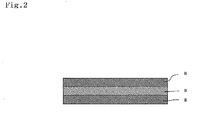
- the film When the sheet is used as a back sheet for a solar battery, the film may be in a form as illustrated in FIG. 2 .
- fluorine resin films 8 according to the invention are bonded to both surfaces of a substrate film 9, respectively, through an adhesive.
- the fluorine resin films 8 of the invention have undergone the hydrophilicity-imparting treatment, as described above; thus, the adhesion thereof to the adhesive is good so that the films can be prevented from being peeled since they are not deteriorated with the passage of time.
- the thus-produced laminated film has a gas barrier performance against water vapor, oxygen gas and some other gas.
- a back sheet for a solar battery that is excellent in reliability can be produced.
- the adhesive is not particularly limited, and may be, for example, a urethane adhesive or an epoxy adhesive.
- a pressure-sensitive adhesive (sticky agent) may be used.
- the pressure-sensitive adhesive is not particularly limited, and may be, for example, an acrylic, rubbery or urethane sticky agent.
- a PVDF film (trade name: NAFLON, manufactured by Nichias Corp.; thickness: 2 mm) was first introduced, as a fluorine resin film 5, into the reactor 4. Next, the valve of the vacuum line 7 was opened to reduce the pressure in the reactor 4 down to 10 Pa or less.
- the valve of the vacuum line 7 was closed, and then the valve of the first supply line 1, for the supply of fluorine-atom-containing gas, and that of the second supply line 2, for the supply of oxygen-atom-containing gas, were simultaneously opened to introduce a process gas into the reactor 4 until the pressure thereof turned to the atmospheric pressure.
- Tthe process gas was adjusted as follows: the ratio (by volume) of fluorine gas/oxygen gas/nitrogen gas therein was 5/95/0, and the total flow rate being 1.0 1/min.
- the valves of the first supply line 1 and the second supply line 2 were simultaneously closed to keep the inside of the reactor in an airtight state. The reactor was then kept as it was for 5 minutes.
- the temperature of the inside of the reactor 4 was kept at 30 °C.
- valves of the third supply line 3, for the supply of inert gas, and the exhaust line 6 were opened to substitute nitrogen gas, at a flow rate of 10 1/min, for the mixed gas of fluorine gas, oxygen gas and nitrogen gas in the reactor 4. Thereafter, the valves of the third supply line 3 and the exhaust line 6 were closed and the valve of the vacuum line 7 was opened to reduce the pressure in the reactor into 10 Pa or less.
- valve of the vacuum line 7 was closed and the valve of the third supply line 3 was opened to introduce nitrogen gas at a flow rate of 1.0 1/min into the reactor 4 until the pressure thereof had reached the atmospheric pressure.
- the valve of the exhaust line 6 was opened to take out the PVDF film subjected to the hydrophilicity-imparting treatment.
- the taken-out PVDF film was washed with UPW (ultra pure water) of room temperature, which was being stirred, for 1 hour. After the washing, UPW on the surfaces was blown away by the effect of nitrogen gas, and then the film was dried at room temperature under a reduced pressure until the pressure reached a value of 10 Pa or less.
- a device, Drop Master 300, manufactured by Kyowa Interface Science Co., Ltd. was used to measure the contact angle ( ⁇ ) of the dried PVDF film.
- the used measuring liquid was a surface energy measuring agent (surface tension ⁇ : 25 to 70 mN/m) manufactured by Arcotest Co.
- Example 2 the same hydrophilicity-imparting treatment as in Example 1 was conducted except that a PVF film (trade name: TEDLAR, manufactured by DuPont) was used as the fluorine resin film. Thereafter, values of the critical surface tension were calculated.
- a PVF film trade name: TEDLAR, manufactured by DuPont
- Example 2 the same hydrophilicity-imparting treatment as in Example 1 was conducted except that a PFA film (trade name: NAFLON, manufactured by Nichias Corp.) was used as the fluorine resin film. Thereafter, values of the critical surface tension were calculated.
- a PFA film trade name: NAFLON, manufactured by Nichias Corp.
- Example 2 the same hydrophilicity-imparting treatment as in Example 1 was conducted except that a PCTFE film (trade name: YODOFLON, manufactured by Yodogawa Hu-Tech Co., Ltd.) was used as the fluorine resin film. Thereafter, values of the critical surface tension were calculated.
- a PCTFE film trade name: YODOFLON, manufactured by Yodogawa Hu-Tech Co., Ltd.
- Example 2 the same hydrophilicity-imparting treatment as in Example 1 was conducted except that an ETFE film (trade name: YODOFLON, manufactured by Yodogawa Hu-Tech Co., Ltd.) was used as the fluorine resin film. Thereafter, values of the critical surface tension were calculated.
- ETFE film trade name: YODOFLON, manufactured by Yodogawa Hu-Tech Co., Ltd.
- Example 2 the same hydrophilicity-imparting treatment as in Example 1 was conducted except that the process gas was changed to a gas wherein the ratio (by volume) of fluorine gas/sulfur dioxide gas/nitrogen gas was 5/95/0. Thereafter, values of the critical surface tension were calculated.
- Example 2 the same hydrophilicity-imparting treatment as in Example 1 was conducted except that the process gas was changed to a gas wherein the ratio (by volume) of fluorine gas/carbonyl fluoride gas/nitrogen gas was 5/95/0. Thereafter, values of the critical surface tension were calculated.
- the same hydrophilicity-imparting treatment as in Example 1 was conducted except that the process gas was changed to a gas wherein the ratio (by volume) of fluorine gas/nitrogen gas was 0.001/99.999. Thereafter, values of the critical surface tension were calculated.
- the supply of the process gas into the reactor 4 was performed by closing the valve of the vacuum line 7, opening the valves of the first supply line 1, for the supply of fluorine-atom-containing gas, and the third supply line 3, for the supply of nitrogen gas, simultaneously, and further closing the second supply line 2, for the supply of oxygen-atom-containing gas.
- Example 8 the same hydrophilicity-imparting treatment as in Example 8 was conducted except that a PVF film (trade name: TEDLAR, manufactured by DuPont) was used as the fluorine resin film. Thereafter, values of the critical surface tension were calculated.
- a PVF film trade name: TEDLAR, manufactured by DuPont
- Example 2 the same hydrophilicity-imparting treatment as in Example 1 was conducted except that the treating period was set to 0.5 minute and the temperature of the inside of the reactor 4 was changed to 100 °C, Thereafter, values of the critical surface tension were calculated.
- Example 10 the same hydrophilicity-imparting treatment as in Example 10 was conducted except that a PVF film (trade name: TEDLAR, manufactured by DuPont) was used as the fluorine resin film. Thereafter, values of the critical surface tension were calculated.
- a PVF film trade name: TEDLAR, manufactured by DuPont
- the same hydrophilicity-imparting treatment as in Example 1 was conducted except that the process gas was changed to a gas wherein the ratio (by volume) of fluorine gas/oxygen gas/nitrogen gas was 0.5/20/79.5, the treating period was set to 1 minute and the temperature of the inside of the reactor 4 was changed to 50 °C. Thereafter, values of the critical surface tension were calculated.
- the supply of the process gas into the reactor 4 was performed by closing the valve of the vacuum line 7, and opening the valves of the first supply line 1, for the supply of fluorine-atom-containing gas, the second supply line 2, for the supply of oxygen gas, and the third supply line 3, for the supply of nitrogen gas, simultaneously.
- Example 12 the same hydrophilicity-imparting treatment as in Example 12 was conducted except that a PVF film (trade name: TEDLAR, manufactured by DuPont) was used as the fluorine resin film. Thereafter, values of the critical surface tension were calculated.
- a PVF film trade name: TEDLAR, manufactured by DuPont
- Example 2 the same hydrophilicity-imparting treatment as in Example 2 was conducted except that a PVF film to which PMMA was added in an amount of 30 % by weight of the whole of the film was used as the fluorine resin film. Thereafter, values of the critical surface tension were calculated.
- a PVDF film to which PMMA (polymethyl methacrylate) was added in an amount of 30 % by weight of the whole of the film was used as the fluorine resin film.
- the treating period was set to 5 minutes, and the temperature of the inside of the reactor 4 was changed to 30 °C. Except for the changes, the same hydrophilicity-imparting treatment as in Example 12 was conducted. Thereafter, values of the critical surface tension were calculated.
- Example 15 the same hydrophilicity-imparting treatment as in Example 15 was conducted except that a PVDF film to which PMMA was added in an amount of 90 % by weight of the whole of the film was used as the fluorine resin film. Thereafter, values of the critical surface tension were calculated.
Landscapes
- Chemical & Material Sciences (AREA)
- Chemical Kinetics & Catalysis (AREA)
- General Chemical & Material Sciences (AREA)
- Organic Chemistry (AREA)
- Medicinal Chemistry (AREA)
- Polymers & Plastics (AREA)
- Health & Medical Sciences (AREA)
- Electrochemistry (AREA)
- Treatments Of Macromolecular Shaped Articles (AREA)
- Electroluminescent Light Sources (AREA)
- Compositions Of Macromolecular Compounds (AREA)
- Photovoltaic Devices (AREA)
- Laminated Bodies (AREA)
- Coating Of Shaped Articles Made Of Macromolecular Substances (AREA)
Abstract
Description
- The present invention relates to a method for modifying a fluorine resin film in order to give hydrophilicity to a surface of the fluorine resin film.
- As a back sheet material for a solar battery, use is made of a fluorine resin film such as a polyvinyl fluoride (PVF) film, an aluminum foil laminate, a polyethylene terephthalate (PET) film subjected to aluminum vapor deposition or Si vapor deposition, or some other film in order to improve the weather resistance and the gas barrier performance. In this way, solar battery cells, which are weak as to humidity, are protected from water vapor.
- Of the back sheet materials, the fluorine resin film is excellent from the viewpoint of long-term endurance. Therefore, demands of the film as a back sheet material have been increasing. In general, however, a material made of a fluorine resin having a C-F bond has a problem in that the material is small in surface energy and shows water repellency and oil repellency, so as to be low in adhesiveness.
- Examples of a technique for improving the adhesiveness of such fluorine resin films include plasma discharge treatment, corona discharge treatment, and flame treatment. In these surface-modifying techniques, a hydrophilic functional group (such as a -COOH group, -OH group, SO3H group, or SO2Fx group) is introduced into any surface of the resin, thereby improving the adhesiveness thereof.
- However, according to these treating methods, a large-scale apparatus is required, and costs for the production increase. Moreover, there remains a problem that after the surface modification, the film deteriorates considerably with the passage of time, and the adhesive performance thereof cannot be kept over a long term.
- Patent Document 1 described below describes a surface-modifying method of selecting, as a synthetic or natural polymeric material, a material which has a specific gravity of 1.6 or less and does not contain an ether bond, carbonate bond, amide bond or urethane bond at all, and then bringing a mixed gas composed of fluorine gas and a single gas containing an oxygen element into contact with the synthetic or natural polymeric material, thereby giving hydrophilicity thereto.
This publication includes a disclosure that according to the surface-modifying method, the contact angle of any surface of the synthetic or natural polymeric material to water is made small by 10°or more. - However, this conventional technique cannot be applied to any fluorine resin having a specific gravity of about 1,6 to 2,2 for the following reason: in a synthetic polymeric or natural polymeric material having a specific gravity more than 1.6, the crystal structure thereof is grown or developed; therefore, fluorine gas does not diffuse therein easily, so that a surface-madificatian function is not easily expressed.
- Patent Document 1: Japanese Patent No.
3 585 833 - In light of the above problems, an object thereof is to provide a method for modifying, simply in a short time, a fluorine resin film so as not to be deteriorated in hydrophilicity with the passage of time. Another object thereof is to provide a back sheet for a solar battery which has a fluorine resin film yielded by the modifying method.
- In order to solve the problems in the prior art, the inventors have made investigations on a method for modifying a fluorine resin film, and a back sheet for a solar battery. As a result, the inventors have found out that the objects can be attained by adopting structures as described below, and have then made the invention.
- In order to achieve the above described object, the present invention relates to a method for modifying a fluorine resin film, wherein a process gas which contains a gas containing fluorine atoms and at least one of a gas containing oxygen atoms or inert gas is brought into contact with the fluorine resin film, thereby giving hydrophilicity to a surface of the fluorine resin film.
- According to the method, a process gas which contains a gas containing fluorine atoms and at least one of a gas containing oxygen atoms or inert gas is brought into contact with a surface of a fluorine resin film, thereby making it possible to conduct hydrophilicity-imparting treatment simply in a short time while costs for the production are restrained.
According to the method, in the fluorine resin film subjected to the hydrophilicity-imparting treatment, deterioration in the hydrophilicity thereof with the passage of time can be also decreased. - It is preferable that the fluorine resin film comprises tetrafluoroethylene/perfluoroalkyl vinyl ether copolymer (PFA), polyvinylidene fluoride (PVDF), polyvinyl fluoride (PVF), polychlorotrifluoroethylene (PCTFE), ethylene/chlorotrifluoroethylene copolymer (ETCFE), or ethylene/tetrafluoroethylene copolymer (ETFE).
- It is preferable that the fluorine resin film comprises an additive reactive with the process gas.
- When the additive, which is reactive with the process gas, is incorporated into the fluorine resin film, the impartation of hydrophilicity onto the surface of the fluorine resin film is promoted. This treatment makes it possible to conduct the hydrophilicity-imparting treatment more effectively.
- It is preferable that the content by percentage of the additive ranges from 0.1 to 90 % by weight of the whole of the fluorine resin film.
- And in order to achieve the above described object, the present invention relates to a back sheet for a solar battery, which has a structure wherein the above described fluorine resin films are bonded to both surfaces of a substrate film, respectively, through an adhesive.
- Since hydrophilicity is imparted to the fluorine resin film, the film is excellent in adhesion to an adhesive. It is therefore possible that the fluorine resin film is bonded to each surface of a substrate film and the resultant lamination is used as a back sheet for a solar battery,
About the hydrophilicity imparted by the treatment, the performance can be maintained over a long term; thus, the film is also excellent from the viewpoint of process-management, so that the reliability of the product is improved. - The invention comprises the above-mentioned aspects, thereby producing advantageous effects as described in the following:
- According to the invention, a process gas which contains a gas containing fluorine atoms and at least one of a gas containing oxygen atoms or inert gas is brought into contact with a surface of a fluorine resin film, thereby making it possible to conduct a hydrophilicity-imparting treatment simply in a short time while costs for the production are restrained.
- Thus, the production efficiency is improved. Moreover, the fluorine resin film yielded by the method can be preferably used in, for example, a back sheet for a solar battery.
-
- FIG. 1
- shows a schematic view illustrating an example of a reactor used for hydrophilicity-imparting treatment of a fluorine resin film according to an embodiment of the invention.
- FIG. 2
- shows a schematic sectional view which schematically illustrates a back sheet, for a solar battery, that has the fluorine resin film.
- The method for modifying a fluorine resin film according to the present embodiment is a method of bringing a process gas which contains a gas containing fluorine atoms and at least one of a gas containing oxygen atoms or inert gas into contact with a fluorine resin film, which is relatively low in critical surface tension and does not get wet easily, thereby making the film hydrophilic.
- It is preferred to use a fluorine resin film the critical surface tension of which is 18 mN/m or more, preferably 20 mN/m or more before the hydrophilicity-imparting treatment. If the critical surface tension before the treatment is less than 18 mN/m, there is caused an inconvenience that hydrophilicity cannot be sufficiently given thereto.
- It is also preferred that the fluorine resin film is made hydrophilic to set the critical surface tension of a surface or any surface thereof to 25 mN/m or more, preferably 30 mN/m or more, more preferably 35 mN/m or more. If the critical surface tension is less than 25 mN/m, the film is not sufficiently made hydrophilic so that the adhesion thereof to an adhesive is unfavorably declined.
- The value of the critical surface tension is calculated out as follows: use is made of a mixed solvent of ethylene glycol monoethyl ether and formamide which has an already-known surface tension (γ) (28 to 58 mN/m) and a mixed solvent of formamide and methylene blue which has an already-known surface tension (γ) (60 to 70 mN/m) to measure the contact angle (θ) of the fluorine resin film surface to each of the solvents.
Next, values of cosθ (Y axis) versus γ (X axis) are plotted; and the extrapolative value of γLV giving 1 as a value of the solid/liquid contact angle cosθ is calculated, whereby the critical surface tension value is obtained.
The larger the numerical value of the critical surface tension is, the higher the wettability is; and the smaller the numerical value of the critical surface tension is, the lower the wettability is - The fluorine resin film may have a monolayered structure or a laminated structure wherein at least two films are laminated onto each other. The thickness of the fluorine resin film (when the film has a laminated structure, the thickness is the total thickness of the individual layers) is not particularly limited, and ranges preferably from, for example, 10 to 100 µm. The two-dimensional shape of the fluorine resin film is not particularly limited, and may be appropriately set in accordance with request.
- The constituting material of the fluorine resin film is not particularly limited as far as the material has, in the molecular structure thereof, at least one of a nitrogen-containing group, a silicon-containing group, an oxygen-containing group, a phosphorus-containing group, a sulfur-containing group, a hydrocarbon group, and a halogen-containing group.
Examples of the nitrogen-containing group include amide and amino groups. Examples of the silicon-containing group include trialkylsilyl, silyl ether, and -Si(CH3)2O- groups. Examples of the oxygen-containing group include ester, carbonate, and ether groups.
Examples of the phosphorus-containing group include a phosphoryl choline group.
Examples of the sulfur-containing group include sulfo, and sulfonyl groups,
Examples of the hydrocarbon group include methyl, methylene and phenyl groups. Examples of the halogen-containing group include a -CHX- group, a -CHX2 group, a -CX2- group, and a -CX3 group wherein X(s) is/are at least one selected from the group consisting of F, Cl, Br and I atoms.
Specific examples thereof include tetrafluoroethylene/perfluoroalkyl vinyl ether copolymer (PFA), polyvinylidene fluoride (PVDF), polyvinyl fluoride (PVF), polychlorotrifluoroethylene (PCTFE), ethylene/chlorotrifluoroethylene copolymer (ETCFE), and ethylene/tetrafluoroethylene copolymer (ETFE). These may be used alone or in combination of two or more thereof. - When the fluorine resin film has a laminated structure composed of at least two films, the constituting material of the film on the front surface side may be identical with or different from that of the film on the rear surface side.
When the constituting materials of the two films are made different from each other, the film of the front surface can be made different in the degree of hydrophilicity from that of the rear surface in accordance with the combination of the materials even when the films are subjected to the hydrophilicity-imparting treatment under the same conditions. - It is preferred to add, into the fluorine resin film, an additive reactive with the process gas. This makes it possible that for the hydrophilicity-imparting treatment with the process gas, the hydrophilicity-impartation can be further promoted.
- When the fluorine resin film has a laminated structure composed of at least two films, the composition ratio of the additive in the film on the front surface side may be identical with or different from that of the additive in the film on the rear surface side.
When the composition ratios of the additive are made different from each other, the film on the front surface side can be made different in critical surface tension value from the film on the rear surface side even when the films are subjected to the hydrophilicity-imparting treatment under the same conditions.
In short, in the film wherein the addition amount of the additive is larger, the film is made higher in hydrophilicity even when the films are treated under the same conditions. - The additive is classified into organic additives and inorganic additives. The organic additives are preferably resin components that are different from the polymeric compounds given as examples of the constituting material of the fluorine resin film and each have, in the molecular structure thereof, a functional group reactive with the process gas.
When such a resin component is contained therein, the fluorine-atom-containing gas reacts with the reactive functional group so that the fluorinating treatment is promoted. In this way, the hydrophilicity is further improved. - Examples of the functional group reactive with the process gas include a nitrogen-containing group, a silicon-containing group, an oxygen-containing group, a phosphorus-containing group, a sulfur-containing group, a hydrocarbon group, and a halogen-containing group.
Examples of the nitrogen-containing group include amide and amino groups.
Examples of the silicon-containing group include trialkylsilyl, silyl ether, and -Si(CH3)2O- groups.
Examples of the oxygen-containing group include ester, carbonate, and ether groups.
Examples of the phosphorus-containing group include a phosphoryl choline group.
Examples of the sulfur-containing group include sulfo, and sulfonyl groups.
Examples of the hydrocarbon group include methyl, methylene and phenyl groups.
Examples of the halogen-containing group include a -CHX-group, a -CHX2 group, a -CX2- group, and -CX3 group wherein X(s) is/are at least one selected from the group consisting of F, Cl, Br and I atoms. - More specifically, the resin components are, for example, polymethyl methacrylate (PMMA), polyethylene terephthalate (PET), polyethylene naphthalate (PEN), polybutylene terephthalate (PBT), polycyclohexanedimethanol terephthalate (PCT), polycarbonate (PC), and polyolefins, These resin components may be used alone or in combination of two or more thereof.
- The inorganic additives are not particularly limited, and examples thereof include white pigments such as titanium oxide and calcium carbonate, and black pigments such as carbon black. These inorganic additives may be used alone or in combination of two or more thereof. Any of the organic additives may be used together with any of the inorganic additives.
- The addition amount of the additive is not particularly limited, and is preferably from 0.1 to 90 % by weight of the whole of the fluorine resin film, more preferably from 0.1 to 80 % by weight thereof. If the addition amount is less than 0.1 % by weight, for example, the film may not obtain a sufficient hydrophilicity even when the film is subjected to the hydrophilicity-imparting treatment. By contrast, if the addition amount is more than 90 % by weight, there is caused an inconvenience in that performances of the fluorine resin itself cannot be kept.
- The process gas is not particularly limited as far as the gas is a gas which contains a gas containing fluorine atoms and at least one of a gas containing oxygen atoms or inert gas. The fluorine-atom-containing gas is not particularly limited, and examples thereof include hydrogen fluoride (HF), fluorine (F2), trifluorochlorine (ClF3), tetrafluorosulfur (SF4), trifluoroboron (BF3), and trifluoronitrogen (NF3). These gases may be used alone or in combination of two or more thereof.
- The method of the invention for modifying a fluorine resin film can be performed in such a range that the fluorine-atom-containing gas concentration is from 0.001 to 99 % by volume of the whole of the process gas. However, if the fluorine-atom-containing gas concentration is large, a damage may be given to the fluorine resin film, which is a product to be treated.
It is therefore preferred that the gas concentration is low. Specifically, the concentration is, for example, from 0.001 to 50 % by volume, more preferably from 0.001 to 10 % by volume. - The oxygen-atom-containing gas is not particularly limited, and examples thereof include oxygen gas (O2), sulfur dioxide gas (SO2), and carbonyl fluoride (COF2). These gases may be used alone or in combination of two or more thereof.
- The method of the invention for modifying a fluorine resin film can be performed in such a range that the oxygen-atom-containing gas concentration is from 0.001 to 99 % by volume of the whole of the process gas. However, the oxygen-atom-containing gas can produce a sufficiently advantageous effect thereof even in a small amount. It is therefore preferred from the viewpoint of treatment costs also that the gas concentration is low. Specifically, the concentration is, for example, from 0.01 to 50 % by volume, more preferably from 0.01 to 20 % by volume.
- An inert gas, such as dry air, nitrogen, argon, helium, neon, krypton or xenon, may be blended with the process gas in order to dilute the process gas.
- The method of the invention for modifying a fluorine resin film can be performed by use of, for example, a reactor illustrated in
FIG. 1 . Prepared is first a reactor 4 for subjecting any fluorine resin film to hydrophilicity-imparting treatment, and afluorine resin film 5 is put in the reactor 4. The reactor 4 is not particularly limited, and may be, for example, a reactor made of stainless steel, aluminum or nickel. - Next, when the pressure in the reactor 4 is reduced, a valve of a
vacuum line 7 is opened to degas the reactor into a vacuum. After the pressure has reached a predetermined pressure (for example, 10 Pa), the valve of thevacuum line 7 is closed.
As needed, next, the following valves are appropriately opened: valves of a first supply line 1 through which a fluorine-atom-containing gas is supplied; asecond supply line 2 through which an oxygen-atom-containing gas is supplied; and a third supply line 3 through which an inert gas is supplied. A process gas which is thus adjusted to predetermined concentrations is introduced into the reactor 4. - In this way, the process gas is brought into contact with the
fluorine resin film 5 to subject thefilm 5 to a hydrophilicity-imparting treatment. The critical surface tension of thefluorine resin film 5 after the hydrophilicity-imparting treatment can be controlled by setting the concentration of the process gas, the treating period, the treating temperature, and the gas flow rates as needed.
However, when the surface area of thefluorine resin film 5 is large, it is necessary to use treating conditions and a reactor corresponding to the size thereof. The reaction may be conducted while the process gas is continuously supplied under normal pressure, increased pressure or reduced pressure. Alternatively, the reaction may be conducted in a state sealed at normal pressure, increased pressure or reduced pressure. - The concentration of the fluorine-atom-containing gas in the process gas can be adjusted by means of the gas amount supplied from each of the first supply line 1 to the third supply line 3.
- The treating period for the hydrophilicity-imparting treatment is not particularly limited. The reaction between the fluorine resin and the process gas is explosively generated at the initial stage of the reaction; thus, by the treatment for a relatively short period, the advantageous effects of the hydrophilicity-impartation are obtained.
Specifically, the period ranges, for example, from 1 second to 600 minutes, preferably from 1 second to 100 minutes, more preferably from 1 second to 30 minutes. If the treating period is less than 1 second, a sufficient hydrophilicity may not be given to thefluorine resin film 5. - The treating temperature for the hydrophilicity-imparting treatment is not particularly limited. Considering the heat resistant temperature of the fluorine resin film 5 (when the additive is added thereto, the heat resistant temperature thereof is considered), the treating temperature is preferably from -50 °C to 150 °C, more preferably from 0 °C to 100 °C. If the treating temperature is lower than -50 °C, a sufficient hydrophilicity may not be given to the
fluorine resin film 5. By contrast, if the treating temperature is higher than 150 °C, the fluorine resin film is thermally deformed so that the yield may be declined. - The gas flow rate of the process gas flowing in the reactor 4 is not particularly limited. When the gas flow rate is high, the reaction may be explosively caused; thus, at the initial stage of the reaction, it is important to set the concentration of the fluorinated gas and the flow rate appropriately.
In other words, in accordance with the progress of the reaction, the concentration and the flow rate may be appropriately made high or low, The gas flow rate may be appropriately set in accordance with the size of the reactor 4 and the shape of thefluorine resin film 5. - At the end of the hydrophilicity-imparting treatment, the valve of the third supply line 3 is opened to introduce an inert gas, thereby substituting the inert gas, at a predetermined flow rate, for the process gas in the reactor 4. At this time, a valve of an
exhaust line 6 is also opened.
Thereafter, the valves of the third supply line 3 and theexhaust line 6 are closed, and further the valve of thevacuum line 7 is opened so as to degas the reactor 4 into a vacuum until the inside of the reactor 4 reaches a predetermined pressure (for example, 10 Pa). - Next, the valve of the
vacuum line 7 is closed and the valve of the third supply line 3 is opened to introduce the inert gas into the reactor so as to turn into the atmospheric pressure. When the inside of the reactor 4 reaches the atmospheric pressure, the valve of theexhaust line 6 is opened and then thefluorine resin film 5 subjected to the hydrophilicity-imparting treatment is taken out. - The fluorine resin film taken out from the reactor 4, which has been subjected to the hydrophilicity-imparting treatment, may be washed with a washing liquid such as water or an alcohol. This manner makes it possible to remove unreacted F2, which is adsorbed on the fluorine resin film surface, or HF, which is generated by the reaction, so that a hydrophilic surface excellent in stability can be formed.
- The fluorine resin film yielded by a hydrophilicity-imparting treatment as described above can be favorably applied to, for example, a back sheet for a solar battery. When the sheet is used as a back sheet for a solar battery, the film may be in a form as illustrated in
FIG. 2 . Specifically, fluorine resin films 8 according to the invention are bonded to both surfaces of a substrate film 9, respectively, through an adhesive.
At this time, the fluorine resin films 8 of the invention have undergone the hydrophilicity-imparting treatment, as described above; thus, the adhesion thereof to the adhesive is good so that the films can be prevented from being peeled since they are not deteriorated with the passage of time.
The thus-produced laminated film has a gas barrier performance against water vapor, oxygen gas and some other gas. Thus, a back sheet for a solar battery that is excellent in reliability can be produced. - The adhesive is not particularly limited, and may be, for example, a urethane adhesive or an epoxy adhesive. A pressure-sensitive adhesive (sticky agent) may be used. The pressure-sensitive adhesive is not particularly limited, and may be, for example, an acrylic, rubbery or urethane sticky agent.
- Hereinafter, preferred examples of this invention will be illustratively described in detail. However, materials, blend amounts and so on that will be described in the examples are not intended to limit the scope of this invention into only the described materials and so on as far as no restrictive description thereabout is included. Thus, the materials and so on are mere descriptive examples.
- As illustrated in
FIG. 1 , a PVDF film (trade name: NAFLON, manufactured by Nichias Corp.; thickness: 2 mm) was first introduced, as afluorine resin film 5, into the reactor 4. Next, the valve of thevacuum line 7 was opened to reduce the pressure in the reactor 4 down to 10 Pa or less. - Next, the valve of the
vacuum line 7 was closed, and then the valve of the first supply line 1, for the supply of fluorine-atom-containing gas, and that of thesecond supply line 2, for the supply of oxygen-atom-containing gas, were simultaneously opened to introduce a process gas into the reactor 4 until the pressure thereof turned to the atmospheric pressure. Tthe process gas was adjusted as follows: the ratio (by volume) of fluorine gas/oxygen gas/nitrogen gas therein was 5/95/0, and the total flow rate being 1.0 1/min.
Furthermore, the valves of the first supply line 1 and thesecond supply line 2 were simultaneously closed to keep the inside of the reactor in an airtight state. The reactor was then kept as it was for 5 minutes. The temperature of the inside of the reactor 4 was kept at 30 °C.
After a lapse of a predetermined period, the valves of the third supply line 3, for the supply of inert gas, and theexhaust line 6 were opened to substitute nitrogen gas, at a flow rate of 10 1/min, for the mixed gas of fluorine gas, oxygen gas and nitrogen gas in the reactor 4.
Thereafter, the valves of the third supply line 3 and theexhaust line 6 were closed and the valve of thevacuum line 7 was opened to reduce the pressure in the reactor into 10 Pa or less. - Next, the valve of the
vacuum line 7 was closed and the valve of the third supply line 3 was opened to introduce nitrogen gas at a flow rate of 1.0 1/min into the reactor 4 until the pressure thereof had reached the atmospheric pressure. After the inside of the reactor 4 turned to the atmospheric pressure, the valve of theexhaust line 6 was opened to take out the PVDF film subjected to the hydrophilicity-imparting treatment. - The taken-out PVDF film was washed with UPW (ultra pure water) of room temperature, which was being stirred, for 1 hour. After the washing, UPW on the surfaces was blown away by the effect of nitrogen gas, and then the film was dried at room temperature under a reduced pressure until the pressure reached a value of 10 Pa or less. A device, Drop Master 300, manufactured by Kyowa Interface Science Co., Ltd. was used to measure the contact angle (θ) of the dried PVDF film.
The used measuring liquid was a surface energy measuring agent (surface tension γ: 25 to 70 mN/m) manufactured by Arcotest Co. Values of the cosθ (Y axis) versus γ (X axis) were plotted, and the extrapolative value of γLV giving 1 as a value of the solid/liquid contact angle cosθ was calculated, whereby the values were obtained. The results are shown in Table 1 described below. - In the present example, the same hydrophilicity-imparting treatment as in Example 1 was conducted except that a PVF film (trade name: TEDLAR, manufactured by DuPont) was used as the fluorine resin film. Thereafter, values of the critical surface tension were calculated.
- In the present example, the same hydrophilicity-imparting treatment as in Example 1 was conducted except that a PFA film (trade name: NAFLON, manufactured by Nichias Corp.) was used as the fluorine resin film. Thereafter, values of the critical surface tension were calculated.
- In the present example, the same hydrophilicity-imparting treatment as in Example 1 was conducted except that a PCTFE film (trade name: YODOFLON, manufactured by Yodogawa Hu-Tech Co., Ltd.) was used as the fluorine resin film. Thereafter, values of the critical surface tension were calculated.
- In the present example, the same hydrophilicity-imparting treatment as in Example 1 was conducted except that an ETFE film (trade name: YODOFLON, manufactured by Yodogawa Hu-Tech Co., Ltd.) was used as the fluorine resin film. Thereafter, values of the critical surface tension were calculated.
- In the present example, the same hydrophilicity-imparting treatment as in Example 1 was conducted except that the process gas was changed to a gas wherein the ratio (by volume) of fluorine gas/sulfur dioxide gas/nitrogen gas was 5/95/0. Thereafter, values of the critical surface tension were calculated.
- In the present example, the same hydrophilicity-imparting treatment as in Example 1 was conducted except that the process gas was changed to a gas wherein the ratio (by volume) of fluorine gas/carbonyl fluoride gas/nitrogen gas was 5/95/0. Thereafter, values of the critical surface tension were calculated.
- In the present example, the same hydrophilicity-imparting treatment as in Example 1 was conducted except that the process gas was changed to a gas wherein the ratio (by volume) of fluorine gas/nitrogen gas was 0.001/99.999. Thereafter, values of the critical surface tension were calculated.
The supply of the process gas into the reactor 4 was performed by closing the valve of thevacuum line 7, opening the valves of the first supply line 1, for the supply of fluorine-atom-containing gas, and the third supply line 3, for the supply of nitrogen gas, simultaneously, and further closing thesecond supply line 2, for the supply of oxygen-atom-containing gas. - In the present example, the same hydrophilicity-imparting treatment as in Example 8 was conducted except that a PVF film (trade name: TEDLAR, manufactured by DuPont) was used as the fluorine resin film. Thereafter, values of the critical surface tension were calculated.
- In the present example, the same hydrophilicity-imparting treatment as in Example 1 was conducted except that the treating period was set to 0.5 minute and the temperature of the inside of the reactor 4 was changed to 100 °C, Thereafter, values of the critical surface tension were calculated.
- In the present example, the same hydrophilicity-imparting treatment as in Example 10 was conducted except that a PVF film (trade name: TEDLAR, manufactured by DuPont) was used as the fluorine resin film. Thereafter, values of the critical surface tension were calculated.
- In the present example, the same hydrophilicity-imparting treatment as in Example 1 was conducted except that the process gas was changed to a gas wherein the ratio (by volume) of fluorine gas/oxygen gas/nitrogen gas was 0.5/20/79.5, the treating period was set to 1 minute and the temperature of the inside of the reactor 4 was changed to 50 °C. Thereafter, values of the critical surface tension were calculated.
The supply of the process gas into the reactor 4 was performed by closing the valve of thevacuum line 7, and opening the valves of the first supply line 1, for the supply of fluorine-atom-containing gas, thesecond supply line 2, for the supply of oxygen gas, and the third supply line 3, for the supply of nitrogen gas, simultaneously. - In the present example, the same hydrophilicity-imparting treatment as in Example 12 was conducted except that a PVF film (trade name: TEDLAR, manufactured by DuPont) was used as the fluorine resin film. Thereafter, values of the critical surface tension were calculated.
- In the present example, the same hydrophilicity-imparting treatment as in Example 2 was conducted except that a PVF film to which PMMA was added in an amount of 30 % by weight of the whole of the film was used as the fluorine resin film. Thereafter, values of the critical surface tension were calculated.
- In the present example, a PVDF film to which PMMA (polymethyl methacrylate) was added in an amount of 30 % by weight of the whole of the film was used as the fluorine resin film. The treating period was set to 5 minutes, and the temperature of the inside of the reactor 4 was changed to 30 °C.
Except for the changes, the same hydrophilicity-imparting treatment as in Example 12 was conducted. Thereafter, values of the critical surface tension were calculated. - In the present example, the same hydrophilicity-imparting treatment as in Example 15 was conducted except that a PVDF film to which PMMA was added in an amount of 90 % by weight of the whole of the film was used as the fluorine resin film. Thereafter, values of the critical surface tension were calculated.
-
- 1
- = first supply line
- 2
- = second supply line
- 3
- = third supply line
- 4
- = reactor
- 5
- = fluorine resin film
- 6
- = exhaust line
- 7
- = vacuum line
- 8
- = fluorine resin film
- 9
- = substrate film
| Species | Additive | Treating conditions | Critical surface tension (mN/m) | ||||||
| Gas species | Concentration (% by volume) | Temperature °C) | Period (min) | Before the treatment | After the treatment | After one month | |||
| Example I | PVDF | None | F2/O2N2 | 5/95/0 | 30 | 5 | 25 | 31 | Not changed |
| Example 2 | PVF | None | F2/O2N2 | 5/95/0 | 29 | 38 | Not changed | ||
| Example 3 | PFA | None | F2/O2N2 | 5/95/0 | 18.5 | 20 | Not changed | ||
| Example 4 | PCTFE | None | F2/O2/N2 | 5/95/0 | 31 | 35 | Not changed | ||
| Example 5 | ETFE | None | F2/O2/N2 | 5/95/0 | 22 | 30 | Not changed | ||
| Example 6 | PVDF | None | F2/SO2/N2 | 5/95/0 | 25 | 32 | Not changed | ||
| Example 7 | PVDF | None | F2/COF2/N2 | 5/95/0 | 25 | 31 | Not changed | ||
| Example 8 | PVDF | None | F2/O2fN2 | 0.001/0/99.999 | 25 | 30 | Not changed | ||
| Example 9 | PVF | None | F2/O2N2 | 0.001/0/99.999 | 29 | 31 | Not changed | ||
| Example 10 | PVDF | None | F2O2/N2 | 5/95/0 | 100 | 0.5 | 25 | 34 | Not changed |
| Example 11 | PVF | None | F2/O2/N2 | 5/95/0 | 29 | 40 | Not changed | ||
| Example 12 | PVDF | None | F2/O2N2 | 0.5/20/79.5 | 50 | 1 | 25 | 31 | Not changed |
| Example 13 | PVF | None | F2/O2N2 | 0.5/20/79.5 | 29 | 38 | Not changed | ||
| Example 14 | PVF | PMMA 30wt% | F2/O2/N2 | 5/95/0 | 30 | 5 | 27 | 40 | Not changed |
| Example 15 | PVDF | PMMA 30wt% | F2/O2/N2 | 0.5/20/79.5 | 27 | 36 | Not changed | ||
| Example 16 | PVDF | PMMA 90 wt% | F2/O2/N2 | 0.5/20/79.5 | 27 | 40 | Not changed | ||
Claims (5)
- A method for modifying a fluorine resin film,
wherein a process gas which contains a gas containing fluorine atoms and at least one of a gas containing oxygen atoms or inert gas is brought into contact with the fluorine resin film, thereby giving hydrophilicity to a surface of the fluorine resin film. - The method for modifying a fluorine resin film according to claim 1,
wherein the fluorine resin film comprises tetrafluoroethylene/perfluoalkyl vinyl ether copolymer (PFA), polyvinylidene fluoride (PVDF), polyvinyl fluoride (PVF), polychlorotrifluoroethylene (PCTFE), ethylene/chlorotrifluoroethylene copolymer (ETCFE), or ethylene/tetrafluoroethylene copolymer (ETFE). - The method for modifying a fluorine resin film according to claim 1 or 2,
wherein the fluorine resin film comprises an additive reactive with the process gas. - The method for modifying a fluorine resin film according to claim 3,
wherein the content by percentage of the additive ranges from 0.1 to 90 % by weight of the whole of the fluorine resin film. - A back sheet for a solar battery, which has a structure wherein fluorine resin films as recited in any one of claims 1 to 4 are bonded to both surfaces of a substrate film, respectively, through an adhesive.
Applications Claiming Priority (2)
| Application Number | Priority Date | Filing Date | Title |
|---|---|---|---|
| JP2008160889 | 2008-06-19 | ||
| PCT/JP2009/061111 WO2009154252A1 (en) | 2008-06-19 | 2009-06-18 | Method for modifying fluorine resin film |
Publications (3)
| Publication Number | Publication Date |
|---|---|
| EP2292682A1 true EP2292682A1 (en) | 2011-03-09 |
| EP2292682A4 EP2292682A4 (en) | 2013-04-03 |
| EP2292682B1 EP2292682B1 (en) | 2017-09-13 |
Family
ID=41434167
Family Applications (1)
| Application Number | Title | Priority Date | Filing Date |
|---|---|---|---|
| EP09766700.0A Not-in-force EP2292682B1 (en) | 2008-06-19 | 2009-06-18 | Method for modifying fluorine resin film |
Country Status (5)
| Country | Link |
|---|---|
| US (1) | US11548993B2 (en) |
| EP (1) | EP2292682B1 (en) |
| JP (1) | JP5582729B2 (en) |
| CN (1) | CN102066470B (en) |
| WO (1) | WO2009154252A1 (en) |
Families Citing this family (5)
| Publication number | Priority date | Publication date | Assignee | Title |
|---|---|---|---|---|
| CN102448707B (en) | 2009-06-04 | 2015-02-25 | 斯泰拉化工公司 | Method for producing multilayer film |
| JP5934978B2 (en) * | 2012-04-23 | 2016-06-15 | パナソニックIpマネジメント株式会社 | Solar cell module |
| KR101604283B1 (en) * | 2014-12-08 | 2016-03-17 | 엘에스산전 주식회사 | Solar cell module |
| CN107540777B (en) * | 2016-06-23 | 2020-06-09 | 浙江省化工研究院有限公司 | Modified polychlorotrifluoroethylene resin, and preparation method and application thereof |
| KR102515102B1 (en) * | 2017-10-24 | 2023-03-27 | 삼성에스디아이 주식회사 | Case for rechargeable battery and rechargeable battery comprising the same |
Family Cites Families (18)
| Publication number | Priority date | Publication date | Assignee | Title |
|---|---|---|---|---|
| US3162623A (en) * | 1961-12-26 | 1964-12-22 | Du Pont | Crosslinking of polymers with nitrogen fluorides |
| JPH03126734A (en) * | 1989-10-13 | 1991-05-29 | Nobuatsu Watanabe | Surface-modified synthetic high polymer-molded article and surface modification method |
| US5425832A (en) | 1990-10-05 | 1995-06-20 | Bridgestone Corporation | Surface treatment of fluoropolymer members and preparation of composite products therefrom |
| JP3057742B2 (en) * | 1990-10-05 | 2000-07-04 | 株式会社ブリヂストン | Surface treatment method of fluorine-based member and method of compounding fluorine-based member |
| JP3094644B2 (en) * | 1991-04-12 | 2000-10-03 | 株式会社ブリヂストン | Weatherproof sheet and method for producing the same |
| JP3232643B2 (en) * | 1991-04-12 | 2001-11-26 | 株式会社ブリヂストン | Method for producing rubber-based composite material |
| AU676330B2 (en) * | 1993-06-11 | 1997-03-06 | Isovolta Osterreichische Isolierstoffwerke Aktiengesellschaft | Process and device for manufacturing photovoltaic modules |
| JPH09227705A (en) * | 1996-02-19 | 1997-09-02 | Mitsubishi Chem Corp | Web surface treatment equipment |
| JP2000208790A (en) * | 1999-01-13 | 2000-07-28 | Dainippon Printing Co Ltd | Surface protection sheet for solar cell module and solar cell module using the same |
| JP2001019857A (en) * | 1999-07-08 | 2001-01-23 | Toto Ltd | Antisweating ceiling |
| JP2001072779A (en) * | 1999-09-06 | 2001-03-21 | Denki Kagaku Kogyo Kk | Anti-fouling fluorine resin film |
| US6462142B1 (en) * | 1999-11-03 | 2002-10-08 | Air Products And Chemicals, Inc. | Processes for improved surface properties incorporating compressive heating of reactive gases |
| JP3585833B2 (en) * | 2000-12-26 | 2004-11-04 | 東洋炭素株式会社 | Surface modification method of synthetic or natural polymer material |
| EP1462465B1 (en) * | 2003-03-25 | 2012-02-22 | 3M Innovative Properties Company | Melt-processible thermoplastic fluoropolymers having improved processing characteristics and method of producing the same |
| US20090148348A1 (en) * | 2005-08-11 | 2009-06-11 | Eksigent Technologies, Llc | Plastic surfaces and apparatuses for reduced adsorption of solutes and methods of preparing the same |
| US8211592B2 (en) * | 2005-09-15 | 2012-07-03 | GM Global Technology Operations LLC | Hydrophilic layer on flowfield for water management in PEM fuel cell |
| JP5380771B2 (en) * | 2006-11-28 | 2014-01-08 | トヨタ自動車株式会社 | FUEL CELL SEPARATOR, METHOD FOR PRODUCING FUEL CELL SEPARATOR, AND FUEL CELL |
| US20090101204A1 (en) * | 2007-10-22 | 2009-04-23 | Biosolar, Inc. | Photovoltaic laminated module backsheet, films and coatings for use in module backsheet, and processes for making the same |
-
2009
- 2009-06-16 JP JP2009143545A patent/JP5582729B2/en not_active Expired - Fee Related
- 2009-06-18 CN CN2009801229091A patent/CN102066470B/en active Active
- 2009-06-18 WO PCT/JP2009/061111 patent/WO2009154252A1/en not_active Ceased
- 2009-06-18 US US12/992,961 patent/US11548993B2/en active Active
- 2009-06-18 EP EP09766700.0A patent/EP2292682B1/en not_active Not-in-force
Also Published As
| Publication number | Publication date |
|---|---|
| JP2010024446A (en) | 2010-02-04 |
| WO2009154252A1 (en) | 2009-12-23 |
| US20110086230A1 (en) | 2011-04-14 |
| JP5582729B2 (en) | 2014-09-03 |
| CN102066470B (en) | 2013-12-04 |
| EP2292682A4 (en) | 2013-04-03 |
| EP2292682B1 (en) | 2017-09-13 |
| CN102066470A (en) | 2011-05-18 |
| US11548993B2 (en) | 2023-01-10 |
Similar Documents
| Publication | Publication Date | Title |
|---|---|---|
| CN1302316C (en) | Plastic substrates for electronic display applications | |
| EP2292682B1 (en) | Method for modifying fluorine resin film | |
| EP2096191B1 (en) | Ethylene-tetrafluoroethylene copolymer molded product and method for producing the same | |
| JP5414426B2 (en) | Composite film | |
| EP1059991B1 (en) | Methods for reforming polymer surface for improved wettability | |
| TWI791739B (en) | Organic-inorganic hybrid film , laminate and articles including organic-inorganic hybrid film | |
| TW201114046A (en) | Back surface protecting sheet for solar cell module and solar cell module | |
| EP1999199B1 (en) | Method for the modification of the surface of shaped parts made of plastic by fluorine-initiated oxidation | |
| US20110129676A1 (en) | Multi-layered front sheet encapsulant for photovoltaic modules | |
| EP2543508A1 (en) | Layered product and process for producing same | |
| JP2011051194A (en) | Barrier laminate, gas-barrier film, and method for producing barrier laminate | |
| WO2000020489A1 (en) | Non-perfluoro fluororesin molded article having low-temperature heat sealability | |
| EP2439057B1 (en) | Method for producing multilayer film | |
| CN106132691A (en) | Gas barrier film and the manufacture method of gas barrier film | |
| CN101074295A (en) | Surface fluorination of plastics materials | |
| CN114156369B (en) | A double-sided coated transparent backing plate and its preparation method | |
| CN101817228B (en) | Preparation method and product of PVDF (Polyvinylidene Fluoride) based multi-layer co-bonding film | |
| EP3356251B1 (en) | Multilayer barrier stack | |
| JP4224330B2 (en) | Barrier film | |
| CN111435688B (en) | Photovoltaic backboard and photovoltaic module comprising same | |
| JP2013000931A (en) | Method for producing gas barrier film | |
| KR101721577B1 (en) | Backsheet for solor cells having Polyvinylidene fluoride film |
Legal Events
| Date | Code | Title | Description |
|---|---|---|---|
| PUAI | Public reference made under article 153(3) epc to a published international application that has entered the european phase |
Free format text: ORIGINAL CODE: 0009012 |
|
| 17P | Request for examination filed |
Effective date: 20110105 |
|
| AK | Designated contracting states |
Kind code of ref document: A1 Designated state(s): AT BE BG CH CY CZ DE DK EE ES FI FR GB GR HR HU IE IS IT LI LT LU LV MC MK MT NL NO PL PT RO SE SI SK TR |
|
| AX | Request for extension of the european patent |
Extension state: AL BA RS |
|
| DAX | Request for extension of the european patent (deleted) | ||
| RIC1 | Information provided on ipc code assigned before grant |
Ipc: C08J 7/00 20060101AFI20130215BHEP Ipc: H01L 31/04 20060101ALI20130215BHEP Ipc: H01M 14/00 20060101ALI20130215BHEP |
|
| A4 | Supplementary search report drawn up and despatched |
Effective date: 20130301 |
|
| 17Q | First examination report despatched |
Effective date: 20131129 |
|
| GRAP | Despatch of communication of intention to grant a patent |
Free format text: ORIGINAL CODE: EPIDOSNIGR1 |
|
| INTG | Intention to grant announced |
Effective date: 20170329 |
|
| GRAS | Grant fee paid |
Free format text: ORIGINAL CODE: EPIDOSNIGR3 |
|
| GRAA | (expected) grant |
Free format text: ORIGINAL CODE: 0009210 |
|
| AK | Designated contracting states |
Kind code of ref document: B1 Designated state(s): AT BE BG CH CY CZ DE DK EE ES FI FR GB GR HR HU IE IS IT LI LT LU LV MC MK MT NL NO PL PT RO SE SI SK TR |
|
| REG | Reference to a national code |
Ref country code: GB Ref legal event code: FG4D |
|
| REG | Reference to a national code |
Ref country code: CH Ref legal event code: EP |
|
| REG | Reference to a national code |
Ref country code: IE Ref legal event code: FG4D |
|
| REG | Reference to a national code |
Ref country code: AT Ref legal event code: REF Ref document number: 928077 Country of ref document: AT Kind code of ref document: T Effective date: 20171015 |
|
| REG | Reference to a national code |
Ref country code: DE Ref legal event code: R096 Ref document number: 602009048337 Country of ref document: DE |
|
| REG | Reference to a national code |
Ref country code: NL Ref legal event code: MP Effective date: 20170913 |
|
| REG | Reference to a national code |
Ref country code: LT Ref legal event code: MG4D |
|
| PG25 | Lapsed in a contracting state [announced via postgrant information from national office to epo] |
Ref country code: FI Free format text: LAPSE BECAUSE OF FAILURE TO SUBMIT A TRANSLATION OF THE DESCRIPTION OR TO PAY THE FEE WITHIN THE PRESCRIBED TIME-LIMIT Effective date: 20170913 Ref country code: SE Free format text: LAPSE BECAUSE OF FAILURE TO SUBMIT A TRANSLATION OF THE DESCRIPTION OR TO PAY THE FEE WITHIN THE PRESCRIBED TIME-LIMIT Effective date: 20170913 Ref country code: LT Free format text: LAPSE BECAUSE OF FAILURE TO SUBMIT A TRANSLATION OF THE DESCRIPTION OR TO PAY THE FEE WITHIN THE PRESCRIBED TIME-LIMIT Effective date: 20170913 Ref country code: HR Free format text: LAPSE BECAUSE OF FAILURE TO SUBMIT A TRANSLATION OF THE DESCRIPTION OR TO PAY THE FEE WITHIN THE PRESCRIBED TIME-LIMIT Effective date: 20170913 Ref country code: NO Free format text: LAPSE BECAUSE OF FAILURE TO SUBMIT A TRANSLATION OF THE DESCRIPTION OR TO PAY THE FEE WITHIN THE PRESCRIBED TIME-LIMIT Effective date: 20171213 |
|
| REG | Reference to a national code |
Ref country code: AT Ref legal event code: MK05 Ref document number: 928077 Country of ref document: AT Kind code of ref document: T Effective date: 20170913 |
|
| PG25 | Lapsed in a contracting state [announced via postgrant information from national office to epo] |
Ref country code: GR Free format text: LAPSE BECAUSE OF FAILURE TO SUBMIT A TRANSLATION OF THE DESCRIPTION OR TO PAY THE FEE WITHIN THE PRESCRIBED TIME-LIMIT Effective date: 20171214 Ref country code: LV Free format text: LAPSE BECAUSE OF FAILURE TO SUBMIT A TRANSLATION OF THE DESCRIPTION OR TO PAY THE FEE WITHIN THE PRESCRIBED TIME-LIMIT Effective date: 20170913 Ref country code: ES Free format text: LAPSE BECAUSE OF FAILURE TO SUBMIT A TRANSLATION OF THE DESCRIPTION OR TO PAY THE FEE WITHIN THE PRESCRIBED TIME-LIMIT Effective date: 20170913 Ref country code: BG Free format text: LAPSE BECAUSE OF FAILURE TO SUBMIT A TRANSLATION OF THE DESCRIPTION OR TO PAY THE FEE WITHIN THE PRESCRIBED TIME-LIMIT Effective date: 20171213 |
|
| PG25 | Lapsed in a contracting state [announced via postgrant information from national office to epo] |
Ref country code: NL Free format text: LAPSE BECAUSE OF FAILURE TO SUBMIT A TRANSLATION OF THE DESCRIPTION OR TO PAY THE FEE WITHIN THE PRESCRIBED TIME-LIMIT Effective date: 20170913 |
|
| PG25 | Lapsed in a contracting state [announced via postgrant information from national office to epo] |
Ref country code: PL Free format text: LAPSE BECAUSE OF FAILURE TO SUBMIT A TRANSLATION OF THE DESCRIPTION OR TO PAY THE FEE WITHIN THE PRESCRIBED TIME-LIMIT Effective date: 20170913 Ref country code: RO Free format text: LAPSE BECAUSE OF FAILURE TO SUBMIT A TRANSLATION OF THE DESCRIPTION OR TO PAY THE FEE WITHIN THE PRESCRIBED TIME-LIMIT Effective date: 20170913 Ref country code: CZ Free format text: LAPSE BECAUSE OF FAILURE TO SUBMIT A TRANSLATION OF THE DESCRIPTION OR TO PAY THE FEE WITHIN THE PRESCRIBED TIME-LIMIT Effective date: 20170913 |
|
| REG | Reference to a national code |
Ref country code: FR Ref legal event code: PLFP Year of fee payment: 10 |
|
| PG25 | Lapsed in a contracting state [announced via postgrant information from national office to epo] |
Ref country code: AT Free format text: LAPSE BECAUSE OF FAILURE TO SUBMIT A TRANSLATION OF THE DESCRIPTION OR TO PAY THE FEE WITHIN THE PRESCRIBED TIME-LIMIT Effective date: 20170913 Ref country code: SK Free format text: LAPSE BECAUSE OF FAILURE TO SUBMIT A TRANSLATION OF THE DESCRIPTION OR TO PAY THE FEE WITHIN THE PRESCRIBED TIME-LIMIT Effective date: 20170913 Ref country code: IS Free format text: LAPSE BECAUSE OF FAILURE TO SUBMIT A TRANSLATION OF THE DESCRIPTION OR TO PAY THE FEE WITHIN THE PRESCRIBED TIME-LIMIT Effective date: 20180113 Ref country code: IT Free format text: LAPSE BECAUSE OF FAILURE TO SUBMIT A TRANSLATION OF THE DESCRIPTION OR TO PAY THE FEE WITHIN THE PRESCRIBED TIME-LIMIT Effective date: 20170913 Ref country code: EE Free format text: LAPSE BECAUSE OF FAILURE TO SUBMIT A TRANSLATION OF THE DESCRIPTION OR TO PAY THE FEE WITHIN THE PRESCRIBED TIME-LIMIT Effective date: 20170913 |
|
| REG | Reference to a national code |
Ref country code: DE Ref legal event code: R097 Ref document number: 602009048337 Country of ref document: DE |
|
| PLBE | No opposition filed within time limit |
Free format text: ORIGINAL CODE: 0009261 |
|
| STAA | Information on the status of an ep patent application or granted ep patent |
Free format text: STATUS: NO OPPOSITION FILED WITHIN TIME LIMIT |
|
| REG | Reference to a national code |
Ref country code: DE Ref legal event code: R082 Ref document number: 602009048337 Country of ref document: DE Representative=s name: MEISSNER BOLTE PATENTANWAELTE RECHTSANWAELTE P, DE Ref country code: DE Ref legal event code: R081 Ref document number: 602009048337 Country of ref document: DE Owner name: STELLA CHEMIFA CORP., OSAKA CITY, JP Free format text: FORMER OWNER: STELLA CHEMIFA CORP., OSAKA-SHI, JP |
|
| PG25 | Lapsed in a contracting state [announced via postgrant information from national office to epo] |
Ref country code: DK Free format text: LAPSE BECAUSE OF FAILURE TO SUBMIT A TRANSLATION OF THE DESCRIPTION OR TO PAY THE FEE WITHIN THE PRESCRIBED TIME-LIMIT Effective date: 20170913 |
|
| 26N | No opposition filed |
Effective date: 20180614 |
|
| PG25 | Lapsed in a contracting state [announced via postgrant information from national office to epo] |
Ref country code: SI Free format text: LAPSE BECAUSE OF FAILURE TO SUBMIT A TRANSLATION OF THE DESCRIPTION OR TO PAY THE FEE WITHIN THE PRESCRIBED TIME-LIMIT Effective date: 20170913 |
|
| REG | Reference to a national code |
Ref country code: FR Ref legal event code: CA Effective date: 20181105 |
|
| REG | Reference to a national code |
Ref country code: CH Ref legal event code: PL |
|
| GBPC | Gb: european patent ceased through non-payment of renewal fee |
Effective date: 20180618 |
|
| REG | Reference to a national code |
Ref country code: BE Ref legal event code: MM Effective date: 20180630 |
|
| REG | Reference to a national code |
Ref country code: IE Ref legal event code: MM4A |
|
| PG25 | Lapsed in a contracting state [announced via postgrant information from national office to epo] |
Ref country code: MC Free format text: LAPSE BECAUSE OF FAILURE TO SUBMIT A TRANSLATION OF THE DESCRIPTION OR TO PAY THE FEE WITHIN THE PRESCRIBED TIME-LIMIT Effective date: 20170913 Ref country code: LU Free format text: LAPSE BECAUSE OF NON-PAYMENT OF DUE FEES Effective date: 20180618 |
|
| PG25 | Lapsed in a contracting state [announced via postgrant information from national office to epo] |
Ref country code: LI Free format text: LAPSE BECAUSE OF NON-PAYMENT OF DUE FEES Effective date: 20180630 Ref country code: GB Free format text: LAPSE BECAUSE OF NON-PAYMENT OF DUE FEES Effective date: 20180618 Ref country code: CH Free format text: LAPSE BECAUSE OF NON-PAYMENT OF DUE FEES Effective date: 20180630 Ref country code: IE Free format text: LAPSE BECAUSE OF NON-PAYMENT OF DUE FEES Effective date: 20180618 |
|
| PG25 | Lapsed in a contracting state [announced via postgrant information from national office to epo] |
Ref country code: BE Free format text: LAPSE BECAUSE OF NON-PAYMENT OF DUE FEES Effective date: 20180630 |
|
| PG25 | Lapsed in a contracting state [announced via postgrant information from national office to epo] |
Ref country code: MT Free format text: LAPSE BECAUSE OF NON-PAYMENT OF DUE FEES Effective date: 20180618 |
|
| PG25 | Lapsed in a contracting state [announced via postgrant information from national office to epo] |
Ref country code: TR Free format text: LAPSE BECAUSE OF FAILURE TO SUBMIT A TRANSLATION OF THE DESCRIPTION OR TO PAY THE FEE WITHIN THE PRESCRIBED TIME-LIMIT Effective date: 20170913 |
|
| PG25 | Lapsed in a contracting state [announced via postgrant information from national office to epo] |
Ref country code: HU Free format text: LAPSE BECAUSE OF FAILURE TO SUBMIT A TRANSLATION OF THE DESCRIPTION OR TO PAY THE FEE WITHIN THE PRESCRIBED TIME-LIMIT; INVALID AB INITIO Effective date: 20090618 Ref country code: PT Free format text: LAPSE BECAUSE OF FAILURE TO SUBMIT A TRANSLATION OF THE DESCRIPTION OR TO PAY THE FEE WITHIN THE PRESCRIBED TIME-LIMIT Effective date: 20170913 |
|
| PG25 | Lapsed in a contracting state [announced via postgrant information from national office to epo] |
Ref country code: MK Free format text: LAPSE BECAUSE OF NON-PAYMENT OF DUE FEES Effective date: 20170913 Ref country code: CY Free format text: LAPSE BECAUSE OF FAILURE TO SUBMIT A TRANSLATION OF THE DESCRIPTION OR TO PAY THE FEE WITHIN THE PRESCRIBED TIME-LIMIT Effective date: 20170913 |
|
| P01 | Opt-out of the competence of the unified patent court (upc) registered |
Effective date: 20230428 |
|
| PGFP | Annual fee paid to national office [announced via postgrant information from national office to epo] |
Ref country code: DE Payment date: 20240502 Year of fee payment: 16 |
|
| PGFP | Annual fee paid to national office [announced via postgrant information from national office to epo] |
Ref country code: FR Payment date: 20240509 Year of fee payment: 16 |
|
| REG | Reference to a national code |
Ref country code: DE Ref legal event code: R119 Ref document number: 602009048337 Country of ref document: DE |
|
| PG25 | Lapsed in a contracting state [announced via postgrant information from national office to epo] |
Ref country code: DE Free format text: LAPSE BECAUSE OF NON-PAYMENT OF DUE FEES Effective date: 20260101 |
|
| PG25 | Lapsed in a contracting state [announced via postgrant information from national office to epo] |
Ref country code: FR Free format text: LAPSE BECAUSE OF NON-PAYMENT OF DUE FEES Effective date: 20250630 |