EP2292611A1 - Novel thiophenediamine derivative having urea structure - Google Patents
Novel thiophenediamine derivative having urea structure Download PDFInfo
- Publication number
- EP2292611A1 EP2292611A1 EP09750683A EP09750683A EP2292611A1 EP 2292611 A1 EP2292611 A1 EP 2292611A1 EP 09750683 A EP09750683 A EP 09750683A EP 09750683 A EP09750683 A EP 09750683A EP 2292611 A1 EP2292611 A1 EP 2292611A1
- Authority
- EP
- European Patent Office
- Prior art keywords
- group
- compound
- pyridine
- acid amide
- carboxylic acid
- Prior art date
- Legal status (The legal status is an assumption and is not a legal conclusion. Google has not performed a legal analysis and makes no representation as to the accuracy of the status listed.)
- Granted
Links
- 0 C*C(C*C(NC1=CSCC(*C)=C1N)=O)=CC(*N(*C)C(N(*)*)=O)=* Chemical compound C*C(C*C(NC1=CSCC(*C)=C1N)=O)=CC(*N(*C)C(N(*)*)=O)=* 0.000 description 5
- OVEAXVIYKAUIEM-UHFFFAOYSA-N CC(C)(C)OC(Nc1c[s]cc1NC(c(cc1)ccc1C(OC)=O)=O)=O Chemical compound CC(C)(C)OC(Nc1c[s]cc1NC(c(cc1)ccc1C(OC)=O)=O)=O OVEAXVIYKAUIEM-UHFFFAOYSA-N 0.000 description 1
- WFCMGPXRTIAEFB-UHFFFAOYSA-N CC(C)(C)OC(Nc1c[s]cc1NC(c(cc1)ncc1C(OC)=O)=O)=O Chemical compound CC(C)(C)OC(Nc1c[s]cc1NC(c(cc1)ncc1C(OC)=O)=O)=O WFCMGPXRTIAEFB-UHFFFAOYSA-N 0.000 description 1
- YQMMNJHXHDOUHI-UHFFFAOYSA-N CC(C)(C)OC(Nc1c[s]cc1NC(c1ccc(CN(CCCN(C)C)C(Nc2cccc(C)c2)=O)cn1)=O)=O Chemical compound CC(C)(C)OC(Nc1c[s]cc1NC(c1ccc(CN(CCCN(C)C)C(Nc2cccc(C)c2)=O)cn1)=O)=O YQMMNJHXHDOUHI-UHFFFAOYSA-N 0.000 description 1
- WKRCMXOCZDVSIY-UHFFFAOYSA-N CC(C)(C)OC(Nc1c[s]cc1NC(c1ccc(CN(CCCN2CCOCC2)C(NC2CCCC2)=O)cc1)=O)=O Chemical compound CC(C)(C)OC(Nc1c[s]cc1NC(c1ccc(CN(CCCN2CCOCC2)C(NC2CCCC2)=O)cc1)=O)=O WKRCMXOCZDVSIY-UHFFFAOYSA-N 0.000 description 1
- QLUWFMKSZKDZEV-UHFFFAOYSA-N CC(C)(C)OC(Nc1c[s]cc1NC(c1ccc(CN(CCCN2CCOCC2)C(Nc(cc2C)ccc2F)=O)cn1)=O)=O Chemical compound CC(C)(C)OC(Nc1c[s]cc1NC(c1ccc(CN(CCCN2CCOCC2)C(Nc(cc2C)ccc2F)=O)cn1)=O)=O QLUWFMKSZKDZEV-UHFFFAOYSA-N 0.000 description 1
- HKPZMPYYTKDGCH-UHFFFAOYSA-N CC(C)(C)OC(Nc1c[s]cc1NC(c1ccc(CN(CCN(C)C)C(NC2CCCC2)=O)cc1)=O)=O Chemical compound CC(C)(C)OC(Nc1c[s]cc1NC(c1ccc(CN(CCN(C)C)C(NC2CCCC2)=O)cc1)=O)=O HKPZMPYYTKDGCH-UHFFFAOYSA-N 0.000 description 1
- VIYFFHDHLOSPNK-UHFFFAOYSA-N CC(C)(C)OC(Nc1c[s]cc1NC(c1ccc(CN(CCN(C)C)C(NCc2ccccc2)=O)cc1)=O)=O Chemical compound CC(C)(C)OC(Nc1c[s]cc1NC(c1ccc(CN(CCN(C)C)C(NCc2ccccc2)=O)cc1)=O)=O VIYFFHDHLOSPNK-UHFFFAOYSA-N 0.000 description 1
- FCITXRGVPQJPKV-UHFFFAOYSA-N CC(C)(C)OC(Nc1c[s]cc1NC(c1ccc(CN(CCN(C)C)C(Nc2ccc3OCCOc3c2)=O)cc1)=O)=O Chemical compound CC(C)(C)OC(Nc1c[s]cc1NC(c1ccc(CN(CCN(C)C)C(Nc2ccc3OCCOc3c2)=O)cc1)=O)=O FCITXRGVPQJPKV-UHFFFAOYSA-N 0.000 description 1
- FUSVRGFUHJWWER-UHFFFAOYSA-N CC(C)(C)OC(Nc1c[s]cc1NC(c1ncc(CN(CCCN2CCOCC2)C(Nc(cc2F)ccc2F)=O)cc1)=O)=O Chemical compound CC(C)(C)OC(Nc1c[s]cc1NC(c1ncc(CN(CCCN2CCOCC2)C(Nc(cc2F)ccc2F)=O)cc1)=O)=O FUSVRGFUHJWWER-UHFFFAOYSA-N 0.000 description 1
- REJOKPLTWALIIZ-UHFFFAOYSA-N CC(C)(C)OC(Nc1c[s]cc1NC(c1ncc(CN(CCN(C)C)C(NC2CC2)=O)cc1)=O)=O Chemical compound CC(C)(C)OC(Nc1c[s]cc1NC(c1ncc(CN(CCN(C)C)C(NC2CC2)=O)cc1)=O)=O REJOKPLTWALIIZ-UHFFFAOYSA-N 0.000 description 1
- GZRLYBBFAKPXJI-UHFFFAOYSA-N CC(C)(C)OC(Nc1c[s]cc1NC(c1ncc(CN(CCN(C)C)C(NCCc2ccccc2)=O)cc1)=O)=O Chemical compound CC(C)(C)OC(Nc1c[s]cc1NC(c1ncc(CN(CCN(C)C)C(NCCc2ccccc2)=O)cc1)=O)=O GZRLYBBFAKPXJI-UHFFFAOYSA-N 0.000 description 1
- PSDUBXLKAJVSKS-UHFFFAOYSA-N CC(C)(C)OC(Nc1c[s]cc1NC(c1ncc(CN(CCN(C)C)C(Nc2cc(CO)ccc2)=O)cc1)=O)=O Chemical compound CC(C)(C)OC(Nc1c[s]cc1NC(c1ncc(CN(CCN(C)C)C(Nc2cc(CO)ccc2)=O)cc1)=O)=O PSDUBXLKAJVSKS-UHFFFAOYSA-N 0.000 description 1
- DYDGJQGEFMUXGN-UHFFFAOYSA-N CC(C)(C)OC(Nc1c[s]cc1NC(c1ncc(CN(CCN2CCCC2)C(NCCc2ccccc2)=O)cc1)=O)=O Chemical compound CC(C)(C)OC(Nc1c[s]cc1NC(c1ncc(CN(CCN2CCCC2)C(NCCc2ccccc2)=O)cc1)=O)=O DYDGJQGEFMUXGN-UHFFFAOYSA-N 0.000 description 1
- PEZSIBYIKYSQFV-UHFFFAOYSA-N CC(C)(C)OC(Nc1c[s]cc1NC(c1ncc(CNCCCN2CCOCC2)cc1)=O)=O Chemical compound CC(C)(C)OC(Nc1c[s]cc1NC(c1ncc(CNCCCN2CCOCC2)cc1)=O)=O PEZSIBYIKYSQFV-UHFFFAOYSA-N 0.000 description 1
- ZGGACPIKCFYIET-UHFFFAOYSA-N CC(C)(C)OC(Nc1c[s]cc1NC(c1ncc(CNCCN(C)C)cc1)=O)=O Chemical compound CC(C)(C)OC(Nc1c[s]cc1NC(c1ncc(CNCCN(C)C)cc1)=O)=O ZGGACPIKCFYIET-UHFFFAOYSA-N 0.000 description 1
- ANQLXFJNFFGZOC-UHFFFAOYSA-N CC(C)NC(N(CCCN1CCN(C)CC1)Cc1ccc(C(Nc2c[s]cc2NC(OC(C)(C)C)=O)=O)nc1)=O Chemical compound CC(C)NC(N(CCCN1CCN(C)CC1)Cc1ccc(C(Nc2c[s]cc2NC(OC(C)(C)C)=O)=O)nc1)=O ANQLXFJNFFGZOC-UHFFFAOYSA-N 0.000 description 1
- FOHRRYRSMTUXOS-UHFFFAOYSA-N CC1(C(Nc2c[s]cc2N)=O)NC=C(CN(CCCN(C)C)C(Nc2c[s]cc2)=O)C=C1 Chemical compound CC1(C(Nc2c[s]cc2N)=O)NC=C(CN(CCCN(C)C)C(Nc2c[s]cc2)=O)C=C1 FOHRRYRSMTUXOS-UHFFFAOYSA-N 0.000 description 1
- KXIDWAFGPPKPFV-UHFFFAOYSA-N CCC(C)NC(N(CCN(C)C)Cc1ccc(C(Nc2c[s]cc2NC(OC(C)(C)C)=O)=O)nc1)=O Chemical compound CCC(C)NC(N(CCN(C)C)Cc1ccc(C(Nc2c[s]cc2NC(OC(C)(C)C)=O)=O)nc1)=O KXIDWAFGPPKPFV-UHFFFAOYSA-N 0.000 description 1
- GYDIJHOITLWSIQ-UHFFFAOYSA-N CCCCCCNC(N(CCCN1CCOCC1)Cc1ccc(C(Nc2c[s]cc2NC(OC(C)(C)C)=O)=O)nc1)=O Chemical compound CCCCCCNC(N(CCCN1CCOCC1)Cc1ccc(C(Nc2c[s]cc2NC(OC(C)(C)C)=O)=O)nc1)=O GYDIJHOITLWSIQ-UHFFFAOYSA-N 0.000 description 1
- IDFANOPDMXWIOP-UHFFFAOYSA-N CCCCCN(C)C Chemical compound CCCCCN(C)C IDFANOPDMXWIOP-UHFFFAOYSA-N 0.000 description 1
- KGFAJVGOIJQKBO-UHFFFAOYSA-N CCN1C(CN(Cc(cc2)cnc2C(Nc2c[s]cc2NC(OC(C)(C)C)=O)=O)C(Nc2c[s]cc2)=O)CCC1 Chemical compound CCN1C(CN(Cc(cc2)cnc2C(Nc2c[s]cc2NC(OC(C)(C)C)=O)=O)C(Nc2c[s]cc2)=O)CCC1 KGFAJVGOIJQKBO-UHFFFAOYSA-N 0.000 description 1
- MSBJDXGAYGIXPL-UHFFFAOYSA-N CN(C)CCCN(Cc1ccc(C(Nc2c[s]cc2N)=O)nc1)C(NC1CCCC1)=O Chemical compound CN(C)CCCN(Cc1ccc(C(Nc2c[s]cc2N)=O)nc1)C(NC1CCCC1)=O MSBJDXGAYGIXPL-UHFFFAOYSA-N 0.000 description 1
- HASSDYDGMIIANK-UHFFFAOYSA-N CN(C)CCNCc(cc1)ccc1C(OCc1ccccc1)=O Chemical compound CN(C)CCNCc(cc1)ccc1C(OCc1ccccc1)=O HASSDYDGMIIANK-UHFFFAOYSA-N 0.000 description 1
- ZIONXCKEGYBOMF-UHFFFAOYSA-N CN1CCN(CCCN(Cc2ccc(C(Nc3c[s]cc3N)=O)nc2)C(Nc2ccc3OCCOc3c2)=O)CC1 Chemical compound CN1CCN(CCCN(Cc2ccc(C(Nc3c[s]cc3N)=O)nc2)C(Nc2ccc3OCCOc3c2)=O)CC1 ZIONXCKEGYBOMF-UHFFFAOYSA-N 0.000 description 1
- XCNFNXORUFIVPR-UHFFFAOYSA-N CNc1c[s]cc1NC(C1=NC=C(CN(CCN(C)C)C(NCc(cccc2)c2OC)=O)CC1)=O Chemical compound CNc1c[s]cc1NC(C1=NC=C(CN(CCN(C)C)C(NCc(cccc2)c2OC)=O)CC1)=O XCNFNXORUFIVPR-UHFFFAOYSA-N 0.000 description 1
- RLNCUYOWPPOWOJ-UHFFFAOYSA-N CNc1c[s]cc1NC(c1ncc(CN(CCN2CCCC2)C(Nc2ccc3OCCOc3c2)=O)cc1)=O Chemical compound CNc1c[s]cc1NC(c1ncc(CN(CCN2CCCC2)C(Nc2ccc3OCCOc3c2)=O)cc1)=O RLNCUYOWPPOWOJ-UHFFFAOYSA-N 0.000 description 1
Classifications
-
- C—CHEMISTRY; METALLURGY
- C07—ORGANIC CHEMISTRY
- C07D—HETEROCYCLIC COMPOUNDS
- C07D333/00—Heterocyclic compounds containing five-membered rings having one sulfur atom as the only ring hetero atom
- C07D333/02—Heterocyclic compounds containing five-membered rings having one sulfur atom as the only ring hetero atom not condensed with other rings
- C07D333/04—Heterocyclic compounds containing five-membered rings having one sulfur atom as the only ring hetero atom not condensed with other rings not substituted on the ring sulphur atom
- C07D333/26—Heterocyclic compounds containing five-membered rings having one sulfur atom as the only ring hetero atom not condensed with other rings not substituted on the ring sulphur atom with hetero atoms or with carbon atoms having three bonds to hetero atoms with at the most one bond to halogen, e.g. ester or nitrile radicals, directly attached to ring carbon atoms
- C07D333/30—Hetero atoms other than halogen
- C07D333/36—Nitrogen atoms
-
- A—HUMAN NECESSITIES
- A61—MEDICAL OR VETERINARY SCIENCE; HYGIENE
- A61P—SPECIFIC THERAPEUTIC ACTIVITY OF CHEMICAL COMPOUNDS OR MEDICINAL PREPARATIONS
- A61P1/00—Drugs for disorders of the alimentary tract or the digestive system
-
- A—HUMAN NECESSITIES
- A61—MEDICAL OR VETERINARY SCIENCE; HYGIENE
- A61P—SPECIFIC THERAPEUTIC ACTIVITY OF CHEMICAL COMPOUNDS OR MEDICINAL PREPARATIONS
- A61P1/00—Drugs for disorders of the alimentary tract or the digestive system
- A61P1/04—Drugs for disorders of the alimentary tract or the digestive system for ulcers, gastritis or reflux esophagitis, e.g. antacids, inhibitors of acid secretion, mucosal protectants
-
- A—HUMAN NECESSITIES
- A61—MEDICAL OR VETERINARY SCIENCE; HYGIENE
- A61P—SPECIFIC THERAPEUTIC ACTIVITY OF CHEMICAL COMPOUNDS OR MEDICINAL PREPARATIONS
- A61P1/00—Drugs for disorders of the alimentary tract or the digestive system
- A61P1/16—Drugs for disorders of the alimentary tract or the digestive system for liver or gallbladder disorders, e.g. hepatoprotective agents, cholagogues, litholytics
-
- A—HUMAN NECESSITIES
- A61—MEDICAL OR VETERINARY SCIENCE; HYGIENE
- A61P—SPECIFIC THERAPEUTIC ACTIVITY OF CHEMICAL COMPOUNDS OR MEDICINAL PREPARATIONS
- A61P1/00—Drugs for disorders of the alimentary tract or the digestive system
- A61P1/18—Drugs for disorders of the alimentary tract or the digestive system for pancreatic disorders, e.g. pancreatic enzymes
-
- A—HUMAN NECESSITIES
- A61—MEDICAL OR VETERINARY SCIENCE; HYGIENE
- A61P—SPECIFIC THERAPEUTIC ACTIVITY OF CHEMICAL COMPOUNDS OR MEDICINAL PREPARATIONS
- A61P11/00—Drugs for disorders of the respiratory system
-
- A—HUMAN NECESSITIES
- A61—MEDICAL OR VETERINARY SCIENCE; HYGIENE
- A61P—SPECIFIC THERAPEUTIC ACTIVITY OF CHEMICAL COMPOUNDS OR MEDICINAL PREPARATIONS
- A61P11/00—Drugs for disorders of the respiratory system
- A61P11/02—Nasal agents, e.g. decongestants
-
- A—HUMAN NECESSITIES
- A61—MEDICAL OR VETERINARY SCIENCE; HYGIENE
- A61P—SPECIFIC THERAPEUTIC ACTIVITY OF CHEMICAL COMPOUNDS OR MEDICINAL PREPARATIONS
- A61P11/00—Drugs for disorders of the respiratory system
- A61P11/06—Antiasthmatics
-
- A—HUMAN NECESSITIES
- A61—MEDICAL OR VETERINARY SCIENCE; HYGIENE
- A61P—SPECIFIC THERAPEUTIC ACTIVITY OF CHEMICAL COMPOUNDS OR MEDICINAL PREPARATIONS
- A61P13/00—Drugs for disorders of the urinary system
- A61P13/08—Drugs for disorders of the urinary system of the prostate
-
- A—HUMAN NECESSITIES
- A61—MEDICAL OR VETERINARY SCIENCE; HYGIENE
- A61P—SPECIFIC THERAPEUTIC ACTIVITY OF CHEMICAL COMPOUNDS OR MEDICINAL PREPARATIONS
- A61P13/00—Drugs for disorders of the urinary system
- A61P13/10—Drugs for disorders of the urinary system of the bladder
-
- A—HUMAN NECESSITIES
- A61—MEDICAL OR VETERINARY SCIENCE; HYGIENE
- A61P—SPECIFIC THERAPEUTIC ACTIVITY OF CHEMICAL COMPOUNDS OR MEDICINAL PREPARATIONS
- A61P13/00—Drugs for disorders of the urinary system
- A61P13/12—Drugs for disorders of the urinary system of the kidneys
-
- A—HUMAN NECESSITIES
- A61—MEDICAL OR VETERINARY SCIENCE; HYGIENE
- A61P—SPECIFIC THERAPEUTIC ACTIVITY OF CHEMICAL COMPOUNDS OR MEDICINAL PREPARATIONS
- A61P15/00—Drugs for genital or sexual disorders; Contraceptives
-
- A—HUMAN NECESSITIES
- A61—MEDICAL OR VETERINARY SCIENCE; HYGIENE
- A61P—SPECIFIC THERAPEUTIC ACTIVITY OF CHEMICAL COMPOUNDS OR MEDICINAL PREPARATIONS
- A61P15/00—Drugs for genital or sexual disorders; Contraceptives
- A61P15/08—Drugs for genital or sexual disorders; Contraceptives for gonadal disorders or for enhancing fertility, e.g. inducers of ovulation or of spermatogenesis
-
- A—HUMAN NECESSITIES
- A61—MEDICAL OR VETERINARY SCIENCE; HYGIENE
- A61P—SPECIFIC THERAPEUTIC ACTIVITY OF CHEMICAL COMPOUNDS OR MEDICINAL PREPARATIONS
- A61P15/00—Drugs for genital or sexual disorders; Contraceptives
- A61P15/14—Drugs for genital or sexual disorders; Contraceptives for lactation disorders, e.g. galactorrhoea
-
- A—HUMAN NECESSITIES
- A61—MEDICAL OR VETERINARY SCIENCE; HYGIENE
- A61P—SPECIFIC THERAPEUTIC ACTIVITY OF CHEMICAL COMPOUNDS OR MEDICINAL PREPARATIONS
- A61P17/00—Drugs for dermatological disorders
-
- A—HUMAN NECESSITIES
- A61—MEDICAL OR VETERINARY SCIENCE; HYGIENE
- A61P—SPECIFIC THERAPEUTIC ACTIVITY OF CHEMICAL COMPOUNDS OR MEDICINAL PREPARATIONS
- A61P17/00—Drugs for dermatological disorders
- A61P17/06—Antipsoriatics
-
- A—HUMAN NECESSITIES
- A61—MEDICAL OR VETERINARY SCIENCE; HYGIENE
- A61P—SPECIFIC THERAPEUTIC ACTIVITY OF CHEMICAL COMPOUNDS OR MEDICINAL PREPARATIONS
- A61P19/00—Drugs for skeletal disorders
-
- A—HUMAN NECESSITIES
- A61—MEDICAL OR VETERINARY SCIENCE; HYGIENE
- A61P—SPECIFIC THERAPEUTIC ACTIVITY OF CHEMICAL COMPOUNDS OR MEDICINAL PREPARATIONS
- A61P19/00—Drugs for skeletal disorders
- A61P19/02—Drugs for skeletal disorders for joint disorders, e.g. arthritis, arthrosis
-
- A—HUMAN NECESSITIES
- A61—MEDICAL OR VETERINARY SCIENCE; HYGIENE
- A61P—SPECIFIC THERAPEUTIC ACTIVITY OF CHEMICAL COMPOUNDS OR MEDICINAL PREPARATIONS
- A61P21/00—Drugs for disorders of the muscular or neuromuscular system
-
- A—HUMAN NECESSITIES
- A61—MEDICAL OR VETERINARY SCIENCE; HYGIENE
- A61P—SPECIFIC THERAPEUTIC ACTIVITY OF CHEMICAL COMPOUNDS OR MEDICINAL PREPARATIONS
- A61P25/00—Drugs for disorders of the nervous system
-
- A—HUMAN NECESSITIES
- A61—MEDICAL OR VETERINARY SCIENCE; HYGIENE
- A61P—SPECIFIC THERAPEUTIC ACTIVITY OF CHEMICAL COMPOUNDS OR MEDICINAL PREPARATIONS
- A61P25/00—Drugs for disorders of the nervous system
- A61P25/02—Drugs for disorders of the nervous system for peripheral neuropathies
-
- A—HUMAN NECESSITIES
- A61—MEDICAL OR VETERINARY SCIENCE; HYGIENE
- A61P—SPECIFIC THERAPEUTIC ACTIVITY OF CHEMICAL COMPOUNDS OR MEDICINAL PREPARATIONS
- A61P25/00—Drugs for disorders of the nervous system
- A61P25/08—Antiepileptics; Anticonvulsants
-
- A—HUMAN NECESSITIES
- A61—MEDICAL OR VETERINARY SCIENCE; HYGIENE
- A61P—SPECIFIC THERAPEUTIC ACTIVITY OF CHEMICAL COMPOUNDS OR MEDICINAL PREPARATIONS
- A61P25/00—Drugs for disorders of the nervous system
- A61P25/14—Drugs for disorders of the nervous system for treating abnormal movements, e.g. chorea, dyskinesia
-
- A—HUMAN NECESSITIES
- A61—MEDICAL OR VETERINARY SCIENCE; HYGIENE
- A61P—SPECIFIC THERAPEUTIC ACTIVITY OF CHEMICAL COMPOUNDS OR MEDICINAL PREPARATIONS
- A61P25/00—Drugs for disorders of the nervous system
- A61P25/14—Drugs for disorders of the nervous system for treating abnormal movements, e.g. chorea, dyskinesia
- A61P25/16—Anti-Parkinson drugs
-
- A—HUMAN NECESSITIES
- A61—MEDICAL OR VETERINARY SCIENCE; HYGIENE
- A61P—SPECIFIC THERAPEUTIC ACTIVITY OF CHEMICAL COMPOUNDS OR MEDICINAL PREPARATIONS
- A61P25/00—Drugs for disorders of the nervous system
- A61P25/28—Drugs for disorders of the nervous system for treating neurodegenerative disorders of the central nervous system, e.g. nootropic agents, cognition enhancers, drugs for treating Alzheimer's disease or other forms of dementia
-
- A—HUMAN NECESSITIES
- A61—MEDICAL OR VETERINARY SCIENCE; HYGIENE
- A61P—SPECIFIC THERAPEUTIC ACTIVITY OF CHEMICAL COMPOUNDS OR MEDICINAL PREPARATIONS
- A61P27/00—Drugs for disorders of the senses
-
- A—HUMAN NECESSITIES
- A61—MEDICAL OR VETERINARY SCIENCE; HYGIENE
- A61P—SPECIFIC THERAPEUTIC ACTIVITY OF CHEMICAL COMPOUNDS OR MEDICINAL PREPARATIONS
- A61P27/00—Drugs for disorders of the senses
- A61P27/02—Ophthalmic agents
-
- A—HUMAN NECESSITIES
- A61—MEDICAL OR VETERINARY SCIENCE; HYGIENE
- A61P—SPECIFIC THERAPEUTIC ACTIVITY OF CHEMICAL COMPOUNDS OR MEDICINAL PREPARATIONS
- A61P27/00—Drugs for disorders of the senses
- A61P27/02—Ophthalmic agents
- A61P27/06—Antiglaucoma agents or miotics
-
- A—HUMAN NECESSITIES
- A61—MEDICAL OR VETERINARY SCIENCE; HYGIENE
- A61P—SPECIFIC THERAPEUTIC ACTIVITY OF CHEMICAL COMPOUNDS OR MEDICINAL PREPARATIONS
- A61P27/00—Drugs for disorders of the senses
- A61P27/02—Ophthalmic agents
- A61P27/14—Decongestants or antiallergics
-
- A—HUMAN NECESSITIES
- A61—MEDICAL OR VETERINARY SCIENCE; HYGIENE
- A61P—SPECIFIC THERAPEUTIC ACTIVITY OF CHEMICAL COMPOUNDS OR MEDICINAL PREPARATIONS
- A61P29/00—Non-central analgesic, antipyretic or antiinflammatory agents, e.g. antirheumatic agents; Non-steroidal antiinflammatory drugs [NSAID]
-
- A—HUMAN NECESSITIES
- A61—MEDICAL OR VETERINARY SCIENCE; HYGIENE
- A61P—SPECIFIC THERAPEUTIC ACTIVITY OF CHEMICAL COMPOUNDS OR MEDICINAL PREPARATIONS
- A61P3/00—Drugs for disorders of the metabolism
- A61P3/08—Drugs for disorders of the metabolism for glucose homeostasis
- A61P3/10—Drugs for disorders of the metabolism for glucose homeostasis for hyperglycaemia, e.g. antidiabetics
-
- A—HUMAN NECESSITIES
- A61—MEDICAL OR VETERINARY SCIENCE; HYGIENE
- A61P—SPECIFIC THERAPEUTIC ACTIVITY OF CHEMICAL COMPOUNDS OR MEDICINAL PREPARATIONS
- A61P31/00—Antiinfectives, i.e. antibiotics, antiseptics, chemotherapeutics
-
- A—HUMAN NECESSITIES
- A61—MEDICAL OR VETERINARY SCIENCE; HYGIENE
- A61P—SPECIFIC THERAPEUTIC ACTIVITY OF CHEMICAL COMPOUNDS OR MEDICINAL PREPARATIONS
- A61P31/00—Antiinfectives, i.e. antibiotics, antiseptics, chemotherapeutics
- A61P31/04—Antibacterial agents
-
- A—HUMAN NECESSITIES
- A61—MEDICAL OR VETERINARY SCIENCE; HYGIENE
- A61P—SPECIFIC THERAPEUTIC ACTIVITY OF CHEMICAL COMPOUNDS OR MEDICINAL PREPARATIONS
- A61P31/00—Antiinfectives, i.e. antibiotics, antiseptics, chemotherapeutics
- A61P31/10—Antimycotics
-
- A—HUMAN NECESSITIES
- A61—MEDICAL OR VETERINARY SCIENCE; HYGIENE
- A61P—SPECIFIC THERAPEUTIC ACTIVITY OF CHEMICAL COMPOUNDS OR MEDICINAL PREPARATIONS
- A61P31/00—Antiinfectives, i.e. antibiotics, antiseptics, chemotherapeutics
- A61P31/12—Antivirals
-
- A—HUMAN NECESSITIES
- A61—MEDICAL OR VETERINARY SCIENCE; HYGIENE
- A61P—SPECIFIC THERAPEUTIC ACTIVITY OF CHEMICAL COMPOUNDS OR MEDICINAL PREPARATIONS
- A61P31/00—Antiinfectives, i.e. antibiotics, antiseptics, chemotherapeutics
- A61P31/12—Antivirals
- A61P31/20—Antivirals for DNA viruses
- A61P31/22—Antivirals for DNA viruses for herpes viruses
-
- A—HUMAN NECESSITIES
- A61—MEDICAL OR VETERINARY SCIENCE; HYGIENE
- A61P—SPECIFIC THERAPEUTIC ACTIVITY OF CHEMICAL COMPOUNDS OR MEDICINAL PREPARATIONS
- A61P33/00—Antiparasitic agents
-
- A—HUMAN NECESSITIES
- A61—MEDICAL OR VETERINARY SCIENCE; HYGIENE
- A61P—SPECIFIC THERAPEUTIC ACTIVITY OF CHEMICAL COMPOUNDS OR MEDICINAL PREPARATIONS
- A61P33/00—Antiparasitic agents
- A61P33/02—Antiprotozoals, e.g. for leishmaniasis, trichomoniasis, toxoplasmosis
-
- A—HUMAN NECESSITIES
- A61—MEDICAL OR VETERINARY SCIENCE; HYGIENE
- A61P—SPECIFIC THERAPEUTIC ACTIVITY OF CHEMICAL COMPOUNDS OR MEDICINAL PREPARATIONS
- A61P33/00—Antiparasitic agents
- A61P33/02—Antiprotozoals, e.g. for leishmaniasis, trichomoniasis, toxoplasmosis
- A61P33/06—Antimalarials
-
- A—HUMAN NECESSITIES
- A61—MEDICAL OR VETERINARY SCIENCE; HYGIENE
- A61P—SPECIFIC THERAPEUTIC ACTIVITY OF CHEMICAL COMPOUNDS OR MEDICINAL PREPARATIONS
- A61P35/00—Antineoplastic agents
-
- A—HUMAN NECESSITIES
- A61—MEDICAL OR VETERINARY SCIENCE; HYGIENE
- A61P—SPECIFIC THERAPEUTIC ACTIVITY OF CHEMICAL COMPOUNDS OR MEDICINAL PREPARATIONS
- A61P35/00—Antineoplastic agents
- A61P35/02—Antineoplastic agents specific for leukemia
-
- A—HUMAN NECESSITIES
- A61—MEDICAL OR VETERINARY SCIENCE; HYGIENE
- A61P—SPECIFIC THERAPEUTIC ACTIVITY OF CHEMICAL COMPOUNDS OR MEDICINAL PREPARATIONS
- A61P37/00—Drugs for immunological or allergic disorders
- A61P37/02—Immunomodulators
-
- A—HUMAN NECESSITIES
- A61—MEDICAL OR VETERINARY SCIENCE; HYGIENE
- A61P—SPECIFIC THERAPEUTIC ACTIVITY OF CHEMICAL COMPOUNDS OR MEDICINAL PREPARATIONS
- A61P37/00—Drugs for immunological or allergic disorders
- A61P37/02—Immunomodulators
- A61P37/06—Immunosuppressants, e.g. drugs for graft rejection
-
- A—HUMAN NECESSITIES
- A61—MEDICAL OR VETERINARY SCIENCE; HYGIENE
- A61P—SPECIFIC THERAPEUTIC ACTIVITY OF CHEMICAL COMPOUNDS OR MEDICINAL PREPARATIONS
- A61P37/00—Drugs for immunological or allergic disorders
- A61P37/08—Antiallergic agents
-
- A—HUMAN NECESSITIES
- A61—MEDICAL OR VETERINARY SCIENCE; HYGIENE
- A61P—SPECIFIC THERAPEUTIC ACTIVITY OF CHEMICAL COMPOUNDS OR MEDICINAL PREPARATIONS
- A61P43/00—Drugs for specific purposes, not provided for in groups A61P1/00-A61P41/00
-
- A—HUMAN NECESSITIES
- A61—MEDICAL OR VETERINARY SCIENCE; HYGIENE
- A61P—SPECIFIC THERAPEUTIC ACTIVITY OF CHEMICAL COMPOUNDS OR MEDICINAL PREPARATIONS
- A61P5/00—Drugs for disorders of the endocrine system
- A61P5/14—Drugs for disorders of the endocrine system of the thyroid hormones, e.g. T3, T4
-
- A—HUMAN NECESSITIES
- A61—MEDICAL OR VETERINARY SCIENCE; HYGIENE
- A61P—SPECIFIC THERAPEUTIC ACTIVITY OF CHEMICAL COMPOUNDS OR MEDICINAL PREPARATIONS
- A61P5/00—Drugs for disorders of the endocrine system
- A61P5/38—Drugs for disorders of the endocrine system of the suprarenal hormones
-
- A—HUMAN NECESSITIES
- A61—MEDICAL OR VETERINARY SCIENCE; HYGIENE
- A61P—SPECIFIC THERAPEUTIC ACTIVITY OF CHEMICAL COMPOUNDS OR MEDICINAL PREPARATIONS
- A61P7/00—Drugs for disorders of the blood or the extracellular fluid
-
- A—HUMAN NECESSITIES
- A61—MEDICAL OR VETERINARY SCIENCE; HYGIENE
- A61P—SPECIFIC THERAPEUTIC ACTIVITY OF CHEMICAL COMPOUNDS OR MEDICINAL PREPARATIONS
- A61P7/00—Drugs for disorders of the blood or the extracellular fluid
- A61P7/06—Antianaemics
-
- A—HUMAN NECESSITIES
- A61—MEDICAL OR VETERINARY SCIENCE; HYGIENE
- A61P—SPECIFIC THERAPEUTIC ACTIVITY OF CHEMICAL COMPOUNDS OR MEDICINAL PREPARATIONS
- A61P7/00—Drugs for disorders of the blood or the extracellular fluid
- A61P7/10—Antioedematous agents; Diuretics
-
- A—HUMAN NECESSITIES
- A61—MEDICAL OR VETERINARY SCIENCE; HYGIENE
- A61P—SPECIFIC THERAPEUTIC ACTIVITY OF CHEMICAL COMPOUNDS OR MEDICINAL PREPARATIONS
- A61P9/00—Drugs for disorders of the cardiovascular system
-
- A—HUMAN NECESSITIES
- A61—MEDICAL OR VETERINARY SCIENCE; HYGIENE
- A61P—SPECIFIC THERAPEUTIC ACTIVITY OF CHEMICAL COMPOUNDS OR MEDICINAL PREPARATIONS
- A61P9/00—Drugs for disorders of the cardiovascular system
- A61P9/04—Inotropic agents, i.e. stimulants of cardiac contraction; Drugs for heart failure
-
- A—HUMAN NECESSITIES
- A61—MEDICAL OR VETERINARY SCIENCE; HYGIENE
- A61P—SPECIFIC THERAPEUTIC ACTIVITY OF CHEMICAL COMPOUNDS OR MEDICINAL PREPARATIONS
- A61P9/00—Drugs for disorders of the cardiovascular system
- A61P9/10—Drugs for disorders of the cardiovascular system for treating ischaemic or atherosclerotic diseases, e.g. antianginal drugs, coronary vasodilators, drugs for myocardial infarction, retinopathy, cerebrovascula insufficiency, renal arteriosclerosis
-
- C—CHEMISTRY; METALLURGY
- C07—ORGANIC CHEMISTRY
- C07D—HETEROCYCLIC COMPOUNDS
- C07D409/00—Heterocyclic compounds containing two or more hetero rings, at least one ring having sulfur atoms as the only ring hetero atoms
- C07D409/02—Heterocyclic compounds containing two or more hetero rings, at least one ring having sulfur atoms as the only ring hetero atoms containing two hetero rings
- C07D409/12—Heterocyclic compounds containing two or more hetero rings, at least one ring having sulfur atoms as the only ring hetero atoms containing two hetero rings linked by a chain containing hetero atoms as chain links
Definitions
- the present invention relates to a novel thiophenediamine derivative having a urea structure or a salt thereof which is useful as a pharmaceutical.
- the derivative has a histone deacetylase inhibitory activity and is therefore expected as a preventive and/or therapeutic agent for a disease against which a histone deacetylase inhibitor is considered to be effective.
- the derivative has an effect of morphological change on trabecular meshwork cells and an effect of intraocular pressure reduction, and is useful as a preventive and/or therapeutic agent for a disease considered to be associated with circulation of aqueous humor and/or intraocular pressure.
- Eukaryotic chromosomal DNA wraps around core histone proteins, histones H2A, H2B, H3 and H4, etc. to form a basic structure called nucleosome. Further, the nucleosome structures assemble to form a chromatin structure. Post-translational modifications of histones are closely related to the constitution of the chromatin structure, and as the post-translational modification, acetylation, methylation, phosphorylation, ubiquitination and the like are known.
- histone acetylation is related to gene transcriptional induction, replication, repair and the like.
- histone acetylation is reversibly regulated by a histone acetyltransferase (hereinafter referred to as "HAT”) and a histone deacetylase (hereinafter referred to as "HDAC").
- HAT histone acetyltransferase
- HDAC histone deacetylase
- HDAC histone acetylation by HAT is enhanced and subsequent gene transcriptional induction, replication, repair and the like are activated, and therefore, various diseases considered to be associated with cell proliferation, senescence and the like.
- diseases considered to be associated with cell proliferation, senescence and the like Such as cancer, autoimmune diseases, neurodegenerative diseases and infectious diseases can be prevented and/or treated ( Protein, Nucleic Acid and Enzyme, Vol. 51. No. 14 (2006 ), JP-A-2005-272419 and JP-T-2006-517532 ).
- HDAC inhibitor butyric acid which has an effect of cell cycle arrest, an effect of normalization and differentiation of transformed cells and the like
- trichostatin A which is a microbial metabolite and has an effect of cell cycle arrest, an effect of induction of differentiation and the like
- trapoxin which is a microbial metabolite and has an inhibitory effect of cell proliferation
- J. Antibiotics, 43, 1524-1534 (1990 ) and J. Biol. Chem. , 268, 22429-22435 (1993 ) are known.
- the aqueous humor circulation in the eye is closely related to intraocular pressure, and the hindrance of the aqueous humor circulation effect on the intraocular pressure.
- the intraocular pressure is increased to cause a disease considered to be associated with aqueous humor circulation or intraocular pressure such as glaucoma or ocular hypertension.
- aqueous humor is produced by filtration or active transport of plasma components and most aqueous humor flows out of the eyeball through the trabecular outflow pathway. That is, it becomes possible to prevent and/or treat a disease considered to be associated with aqueous humor circulation or intraocular pressure by changing the morphology of trabecular meshwork cells with a medicinal agent or the like to reduce the resistance to aqueous humor outflow thereby enhancing aqueous humor outflow.
- latrunculin A an actin polymerization inhibitor
- H-7 a myosin light chain kinase (MLCK) inhibitor
- Y-39983 a Rho kinase inhibitor
- a compound having a thiophenediamine structure is disclosed as an inhibitor of tumor cell proliferation in WO 2005/030704 and 2005/030705 .
- a novel thiophenediamine derivative having a urea structure there is no specific description regarding a novel thiophenediamine derivative having a urea structure.
- the present inventors conducted studies of the synthesis of a novel chemical structure, that is, a novel thiophenediamine derivative having a urea structure or a salt thereof and succeeded in creating a large number of novel compounds.
- the present inventors found that the derivative or a salt thereof has an HDAC inhibitory activity and therefore is useful as a preventive and/or therapeutic agent for a disease against which an HDAC inhibitor is considered to be effective.
- the derivative or salt thereof has an effect of morphological change on trabecular meshwork cells and an effect of intraocular pressure reduction and therefore is useful as a preventive and/or therapeutic agent for a disease considered to be associated with circulation of aqueous humor and/or intraocular pressure, and thus, the present invention has been completed.
- the invention relates to a compound represented by the following general formula (1) or a salt thereof (hereinafter referred to as "the present compound”), and a pharmaceutical composition containing the same.
- a preferred invention of the medical use thereof is an invention relating to a preventive and/or therapeutic agent for a diseases against which an HDAC inhibitor is considered to be useful in treating, such as cancer, autoimmune diseases, inflammatory diseases, neurodegenerative diseases, infectious diseases, hematopoietic disorders, fibrosis, cardiovascular disorders, diseases associated with angiogenesis, further, since the present compound has an effect of morphological change on trabecular meshwork cells and an effect of intraocular pressure reduction, it is an invention relating to a preventive and/or therapeutic agent for a disease considered to be associated with circulation of aqueous humor and/or intraocular pressure such as glaucoma or ocular hypertension.
- R 1 and R 2 are the same or different and represent a hydrogen atom, a lower alkyl group which may have a substituent, a lower alkenyl group which may have a substituent, a lower alkynyl group which may have a substituent or a group represented by the following general formula (2);
- R 3 represents a hydroxy group, a lower alkoxy group which may have a substituent, a lower cycloalkyloxy group which may have a substituent, an aryloxy group which may have a substituent, a carboxy group, a lower alkoxycarbonyl group which may have a substituent, -NR a R b or a group represented by the following general formula (3);
- R 4 and R 5 are the same or different and represent a halogen atom, a lower alkyl group, a hydroxy group or a lower alkoxy group;
- R 6 represents a halogen atom, a lower alkyl group which may have a substituent, an
- the invention provides a novel thiophenediamine derivative having a urea structure or a salt thereof which is useful as a pharmaceutical.
- the present compound has an HDAC inhibitory activity, and is therefore useful as a preventive and/or therapeutic agent for a disease against which an HDAC inhibitor is considered to be effective, and is particularly expected as a preventive and/or therapeutic agent for cancer, autoimmune diseases, inflammatory diseases, neurodegenerative diseases, infectious diseases, hematopoietic disorders, fibrosis, cardiovascular diseases or diseases considered to be associated with angiogenesis.
- the present compound has an effect of morphological change on trabecular meshwork cells and an effect of intraocular pressure reduction, is expected as a preventive and/or therapeutic agent for a disease considered to be associated with circulation of aqueous humor and/or intraocular pressure such as glaucoma or ocular hypertension.
- halogen atom refers to a fluorine, chlorine, bromine or iodine atom.
- lower alkyl group refers to a straight chain or branched alkyl group having 1 to 8 carbon atoms, preferably 1 to 6. Specific examples thereof include methyl, ethyl, n-propyl, n-butyl, n-pentyl, n-hexyl, n-heptyl, n-octyl, isopropyl, isobutyl, sec-butyl, tert-butyl and isopentyl groups and the like.
- lower alkenyl group refers to a straight chain or branched alkenyl group having 2 to 8 carbon atoms, preferably 2 to 6. Specific examples thereof include vinyl, propenyl, butenyl, pentenyl, hexenyl, heptenyl, octenyl, isopropenyl, 2-methyl-1-propenyl and 2-methyl-2-butenyl groups and the like.
- lower alkynyl group refers to a straight chain or branched alkynyl group having 2 to 8 carbon atoms, preferably 2 to 6. Specific examples thereof include ethynyl, propynyl, butynyl, pentynyl, hexynyl, heptynyl, octynyl, isobutynyl and isopentynyl groups and the like.
- lower cycloalkyl group refers to a cycloalkyl group having 3 to 8 carbon atoms, preferably 3 to 6. Specific examples thereof include cyclopropyl, cyclobutyl, cyclopentyl, cyclohexyl, cycloheptyl and cyclooctyl groups.
- aryl group refers to a residue formed by removing one hydrogen atom from a monocyclic aromatic hydrocarbon group, or bicyclic or tricyclic condensed polycyclic aromatic hydrocarbon having 6 to 14 carbon atoms. Specific examples thereof include phenyl, naphthyl, anthryl and phenanthryl groups and the like.
- lower alkoxy group refers to a group formed by replacing the hydrogen atom of a hydroxy group with a lower alkyl group. Specific examples thereof include methoxy, ethoxy, n-propoxy, n-butoxy, n-pentoxy, n-hexyloxy, n-heptyloxy, n-octyloxy, isopropoxy, isobutoxy, sec-butoxy, tert-butoxy and isopentoxy groups and the like.
- lower cycloalkyloxy group refers to a group formed by replacing the hydrogen atom of a hydroxy group with a lower cycloalkyl group. Specific examples thereof include cyclopropyloxy, cyclobutyloxy, cyclopentyloxy, cyclohexyloxy, cycloheptyloxy, cyclooctyloxy groups.
- aryloxy group refers to a group formed by replacing the hydrogen atom of a hydroxy group with an aryl group. Specific examples thereof include phenoxy, naphthoxy, anthryloxy, phenanthryloxy and the like.
- lower alkylthio group refers to a group formed by replacing the hydrogen atom of a mercapto group with a lower alkyl group. Specific examples thereof include methylthio, ethylthio, n-propylthio, n-butylthio, n-pentylthio, n-hexylthio, n-heptylthio, n-octylthio, isopropylthio, isobutylthio, sec-butylthio, tert-butylthio and isopentylthio groups and the like.
- lower alkylcarbonyl group refers to a group formed by replacing the hydrogen atom of a formyl group with a lower alkyl group. Specific examples thereof include methylcarbonyl, ethylcarbonyl, n-propylcarbonyl, n-butylcarbonyl, n-pentylcarbonyl, n-hexylcarbonyl, n-heptylcarbonyl, n-octylcarbonyl, isopropylcarbonyl, isobutylcarbonyl, sec-butylcarbonyl, tert-butylcarbonyl and isopentylcarbonyl groups and the like.
- lower alkoxycarbonyl group refers to a group formed by replacing the hydrogen atom of a formyl group with a lower alkoxy group. Specific examples thereof include methoxycarbonyl, ethoxycarbonyl, n-propoxycarbonyl, n-butoxycarbonyl, n-pentoxycarbonyl, n-hexyloxycarbonyl, n-heptyloxycarbonyl, n-octyloxycarbonyl, isopropoxycarbonyl, isobutoxycarbonyl, sec-butoxycarbonyl, tert-butoxycarbonyl and isopentoxycarbonyl groups and the like.
- heterocyclic ring refers to a saturated or unsaturated monocyclic heterocyclic ring having one or a plurality of heteroatoms selected from a nitrogen atom, an oxygen atom and a sulfur atom in the ring, or a bicyclic or tricyclic condensed polycyclic heterocyclic ring.
- saturated monocyclic heterocyclic ring examples include aziridine, azetidine, pyrrolidine, pyrazolidine, imidazolidine, triazolidine, piperidine, hexahydropyridazine, hexahydropyrimidine, piperazine, homopiperidine and homopiperazine rings and the like having at least a nitrogen atom in the ring, tetrahydrofuran and tetrahydropyran, [1,4]dioxane, [1,2]dioxirane rings and the like having at least an oxygen atom in the ring, tetrahydrothiophene and tetrahydrothiopyran rings and the like having at least a sulfur atom in the ring, oxazolidine, isoxazolidine and morpholine rings and the like having at least a nitrogen atom and an oxygen atom in the ring, and thiazolidine, isothiazolidine and thi
- such a saturated monocyclic heterocyclic ring can be condensed with a benzene ring or the like to form a bicyclic or tricyclic condensed polycyclic heterocyclic ring such as a dihydroindole, dihydroindazole, dihydrobenzimidazole, tetrahydroquinoline, tetrahydroisoquinoline, tetrahydrocinnoline, tetrahydrophthalazine, tetrahydroquinazoline, tetrahydroquinoxaline, 2,3-dihydro-1-benzofuran, 1,3-dihydro-2-benzofuran, chromane, isochromane, benzo[1,3]dioxole, 2,3-dihydrobenzo[1,4]dioxine, dihydrobenzothiophene, dihydroisobenzothiophene, thiochromane, isothiochromane,
- the "unsaturated monocyclic heterocyclic ring” include dihydropyrrole, pyrrole, dihydropyrazole, pyrazole, dihydroimidazole, imidazole, dihydrotriazole, triazole, tetrahydropyridine, dihydropyridine, pyridine, tetrahydropyridazine, dihydropyridazine, pyridazine, tetrahydropyrimidine, dihydropyrimidine, pyrimidine, tetrahydropyrazine, dihydropyrazine and pyrazine rings and the like having at least a nitrogen atom in the ring, dihydrofuran, furan, dihydropyran and pyran rings and the like having at least an oxygen atom in the ring, dihydrothiophene, thiophene, dihydrothiopyran and thiopyran rings and the like having at least a sulfur atom in the ring
- an unsaturated monocyclic heterocyclic ring can be condensed with a benzene ring or the like to form a bicyclic or tricyclic condensed polycyclic heterocyclic ring such as an indole, indazole, benzimidazole, benzotriazole, dihydroquinoline, quinoline, dihydroisoquinoline, isoquinoline, phenanthridine, dihydrocinnoline, cinnoline, dihydrophthalazine, phthalazine, dihydroquinazoline, quinazoline, dihydroquinoxaline, quinoxaline, benzofuran, isobenzofuran, chromene, isochromene, benzothiophene, isobenzothiophene, thiochromene, isothiochromene, benzoxazole, benzisoxazole, benzoxazine, benzothiazole, tetrahydrobenzothi,
- heterocyclic rings in the case of a heterocyclic ring having two hydrogen atoms on the same carbon atom, these hydrogen atoms may be substituted with an oxo group to form a heterocyclic ketone such as 2-pyrrolidone, 4-piperidone, 4-thiazolidone, pyran-4-(4H)-one or pyrazin-2-(3H)-one, and these heterocyclic ketones are also included in the scope of the heterocyclic ring of this invention.
- a heterocyclic ketone such as 2-pyrrolidone, 4-piperidone, 4-thiazolidone, pyran-4-(4H)-one or pyrazin-2-(3H)-one
- heterocyclic ring having one or plural heteroatoms selected from the group consisting of a nitrogen atom and an oxygen atom in the ring refers to a heterocyclic ring having one or plural nitrogen atoms and/or oxygen atoms in the ring among the above-mentioned heterocyclic rings.
- heterocyclic group refers to a residue formed by removing one hydrogen atom from a heterocyclic ring.
- cyclic hydrocarbon refers to a saturated or unsaturated monocyclic hydrocarbon, or bicyclic or tricyclic hydrocarbon having 3 to 10 carbon atoms.
- saturated monocyclic hydrocarbon examples include cyclopropane, cyclobutane, cyclopentane, cyclohexane, cycloheptane, cyclooctane and the like.
- saturated bicyclic hydrocarbon examples include octahydropentalene, octahydroindene, decahydronaphthalene and the like.
- saturated tricyclic hydrocarbon examples include bicyclo[2.2.1]heptane and the like.
- unsaturated monocyclic hydrocarbon examples include cyclopentene, cyclohexene, cyclopentadiene, cyclohexadiene, benzene and the like.
- unsaturated bicyclic hydrocarbon examples include indan, 1,2,3,4-tetrahydronaphthalene, naphthalene and the like.
- lower alkylene group refers to a straight or branched alkylene group having 1 to 8, preferably 1 to 6 carbon atoms. Specific examples thereof include methylene, ethylene, trimethylene, tetramethylene, pentamethylene, hexamethylene, heptamethylene, octamethylene, methylmethylene, ethylmethylene and the like.
- lower alkyl group which may have a substituent refers to a "lower alkyl group", a “lower alkenyl group”, a “lower alkynyl group”, a “lower alkoxy group which may have a substituent” , “lower alkylthio group which may have a substituent”, “lower alkylcarbonyl group which may have a substituent”, “lower alkoxycarbonyl group which may have a substituent” and/or “lower alkylene group which may have a substituent” refers to a "lower alkyl group", a “lower alkenyl group”, a “lower alkynyl group”, a “lower alkoxy group”, a “lower alkylthio group", a “lower alkylcarbonyl group”, a “lower alkoxycarbonyl group” and/or a “lower alkylene group” which may have one or plural substituents selected from the group consisting of a
- aryl group which may have a substituent refers to an "aryl group", a “heterocyclic group”, a “lower cycloalkyloxy group” and/or an "aryloxy group” which may have one or plural substituents selected from the group consisting of a halogen atom, a lower alkyl group, a lower alkenyl group, a lower alkynyl group, a lower cycloalkyl group, an aryl group, a heterocyclic group, a nitro group, a cyano group, an oxo group, -OR p , -SR q , -COR r , -COOR s , -CONR t R u and -NR v R w .
- R p , R q , R r , R s , R t , R u , R v and R w are the same or different and represent a group selected from the group consisting of a hydrogen atom, a lower alkyl group, a lower alkenyl group, a lower alkynyl group, a lower cycloalkyl group, an aryl group and a heterocyclic group.
- lower alkyl group having a hydroxy group as a substituent refers to a “lower alkyl group” substituted with one or plural hydroxy groups.
- lower alkyl group having a lower alkoxy group as a substituent refers to a “lower alkyl group” substituted with one or plural lower alkoxy groups.
- lower alkyl group having a lower alkoxycarbonyl group as a substituent refers to a “lower alkyl group” substituted with one or plural lower alkoxycarbonyl groups.
- the respective groups may be the same or different, and the number of the groups is preferably 2 or 3, particularly preferably 2. Further, a hydrogen atom and a halogen atom are also included in the concept of the "group".
- HDAC inhibitor refers to a pharmaceutical composition which inhibits HDAC thereby enhancing acetylation of histones and the like to exhibit a pharmaceutical effect.
- the "disease against which an HDAC inhibitor is considered to be effective" as used in this invention refers to a disease on which it is known that an HDAC inhibitor is expected to have a therapeutic effect and/or a preventive effect.
- Specific examples thereof include cancer, autoimmune diseases, inflammatory diseases, neurodegenerative diseases, infectious diseases, hematopoietic disorder, fibrosis and cardiovascular diseases and the like.
- cancer such as acute leukemia, chronic leukemia, malignant lymphoma, multiple myeloma, colon cancer, brain tumor, head and neck cancer, breast cancer, lung cancer, esophageal cancer, stomach cancer, liver cancer, gallbladder cancer, bile duct cancer, pancreatic cancer, islet cell carcinoma, renal cell carcinoma, adrenal cortical carcinoma, bladder cancer, prostate cancer, testicular tumor, ovarian cancer, uterine cancer, choriocarcinoma, thyroid cancer, malignant carcinoid tumor, skin cancer, malignant melanoma, osteosarcoma, soft tissue sarcoma, neuroblastoma, Wilms' tumor and retinoblastoma; autoimmune diseases and/or inflammatory diseases such as rheumatoid arthritis, nephritis, diabetes, systemic lupus erythematosus, human autoimmune lymphoproliferative lymphadenopathy, immunoblastic lymphadenopathy, Crohn's
- the "disease considered to be associated with aqueous humor circulation and/or intraocular pressure" as used herein is not particularly limited as long as it is a disease considered to be associated with aqueous humor circulation and/or intraocular pressure, preferred examples thereof include glaucoma and ocular hypertension.
- the “salt” of the present compound is not particularly limited as long as it is a pharmaceutically acceptable salt, and examples thereof include salts with an inorganic acid such as hydrochloric acid, hydrobromic acid, hydroiodic acid, nitric acid, sulfuric acid or phosphoric acid; salts with an organic acid such as acetic acid, fumaric acid, maleic acid, succinic acid, citric acid, tartaric acid, adipic acid, gluconic acid, glucoheptonic acid, glucuronic acid, terephthalic acid, methanesulfonic acid, lactic acid, hippuric acid, 1,2-ethanedisulfonic acid, isethionic acid, lactobionic acid, oleic acid, pamoic acid, polygalacturonic acid, stearic acid, tannic acid, trifluoromethanesulfonic acid, benzenesulfonic acid, p-toluenesulfonic acid, lauryl sul
- the present compound may be in the form of a hydrate or a solvate.
- these crystalline polymorphisms and crystalline polymorphism groups are also included in the invention.
- the crystalline polymorphism groups mean individual crystal forms in respective stages when the crystal forms are changed by the conditions for the production, crystallization, storage or the like of these crystals and the states thereof (the states also include a formulated state), and all the processes thereof.
- examples of the present compound include, in the compounds represented by the general formula (1), compounds which comprise one or a combination of two or more selected from the group consisting of the above-mentioned (a1), (a2), (a3), (a4), (a5), (a6), (a7), (a8), (a9), (a10), (a11) and (a12) and salts thereof.
- preferred examples of the present compound include, in the compounds represented by the general formula (1), compounds which comprise one or a combination of two or more selected from the group consisting of the above-mentioned (b1), (b2), (b3), (b4), (b5), (b6), (b7), (b8), (b9), (b10), (b11) and (b12) and salts thereof.
- the selected conditions can be also combined with the condition (a).
- preferred examples of the present compound include, in the compounds represented by the general formula (1), compounds which comprise one or a combination of two or more selected from the group consisting of the above-mentioned (c1), (c2), (c3), (c4), (c5), (c6), (c7), (c8), (c9), (c10), (c11), (c12), (c13) and (c14) and salts thereof.
- the selected conditions can be also combined with the condition (a) and/or (b).
- the ring A represents cyclopentane, cyclohexane, benzene, indan, thiophene, furan, benzo[1,3]dioxole, 2,3-dihydro-1-benzofuran, thiazole, 2,3-dihydrobenzo[1,4]dioxine or pyridine.
- the ring B represents pyrrolidine, piperazine or morpholine
- the present compounds can be prepared according to the following methods. Each specific process for preparing the present compounds are described in detail in the following examples (section of Production Examples). Additionally, the term "Boc" used in the following synthetic routes represents a tert-butoxycarbonyl group. In the case that an oxygen atom, a nitrogen atom, a sulfur atom, and so on are contained in R 1 , R 2 , R 3 , R 4 , R 5 of the following scheme, they will be able to be protected or deprotected by generally used methods.
- the compound (III) can be synthesized according to the synthetic route 1-2. Namely, it can be given by the reaction of the sulfonate (V) with an amine (VI) in an organic solvent such as acetonitrile at 0°C to room temperature for 30 minutes to 24 hours.
- the compound (V) can be synthesized according to the synthetic route 1-3. Namely, it can be given by the reaction of the compound (VII) with methanesulfonyl chloride (VIII) in an organic solvent such as dichloromethane in the presence of a base such as triethylamine at 0°C to room temperature for 30 minutes to 3 hours.
- a base such as triethylamine
- THF tetrahydrofuran
- the compound (IX) can be synthesized according to the synthetic route 1-5. Namely, it can be given by the reaction of the compound (X) with the compound (XI) in an organic solvent such as N,N-dimethylformamide (hereinafter referred to as "DMF") in the presence of a condensing reagent such as O-(7-azabenzotriazol-1-yl)-1,1,3,3-tetramethyluronium hexafluorophosphate (hereinafter referred to as "HATU”) and a base such as N-methylmorpholine at room temperature for 1 hour to 24 hours.
- DMF N,N-dimethylformamide
- HATU O-(7-azabenzotriazol-1-yl)-1,1,3,3-tetramethyluronium hexafluorophosphate
- the compound (X) can be synthesized according to the synthetic route 1-6. Namely, it can be given by the reaction of the compound (XII) with di-tert-butyl dicarbonate (XIII) in an organic solvent such as THF in the presence of a base such as triethylamine at -20°C to room temperature for 1 hour to 24 hours.
- a pharmacological activity of the present compound will be described in detail in the following Examples under the item of "Pharmacological Tests", as a result of studying an HDAC inhibitory activity of the present compound using HDAC Fluorimetric Assay/Drug Discovery Kit (manufactured by BIOMOL, Inc.) according to the protocol of the kit, it was found that the present compound has an excellent HDAC inhibitory activity.
- the present compound is useful as a preventive and/or therapeutic agent for a disease against which an HDAC inhibitor is considered to be effective, and is particularly expected as a preventive and/or therapeutic agent for cancer, autoimmune diseases, inflammatory diseases, neurodegenerative disease s, infectious diseases, hematopoietic disorders, fibrosis, cardiovascular diseases, diseases considered to be associated with angiogenesis or the like.
- the present compound has an effect of intraocular pressure reduction. That is, the present compound has an effect of morphological change on trabecular meshwork cells and an effect of intraocular pressure reduction and therefore is expected as a preventive and/or therapeutic agent for a disease considered to be associated with aqueous humor circulation and/or intraocular pressure such as glaucoma or ocular hypertension.
- the present compound can be administered either orally or parenterally.
- the dosage form include a tablet, a capsule, a granule, a powder, an injection and an eye drop, and such a preparation can be prepared by a widely used technique.
- an oral preparation such as a tablet, a capsule, a granule or a powder can be prepared by optionally adding a necessary amount of an excipient such as lactose, mannitol, starch, crystalline cellulose, light silicic anhydride, calcium carbonate or calcium hydrogen phosphate; a lubricant such as stearic acid, magnesium stearate or talc; a binder such as starch, hydroxypropyl cellulose, hydroxypropylmethyl cellulose or polyvinylpyrrolidone; a disintegrant such as carboxymethyl cellulose, low-substituted hydroxypropylmethyl cellulose or calcium citrate; a coating agent such as hydroxypropylmethyl cellulose, macrogol or a silicone resin; a stabilizer such as ethyl para-hydroxybenzoate or benzyl alcohol; a corrigent such as a sweetener, a sour agent or a flavor; or the like.
- an excipient such as
- a parenteral preparation such as an injection or an eye drop can be prepared by optionally adding a necessary amount of a tonicity agent such as sodium chloride, concentrated glycerin, propylene glycol, polyethylene glycol, potassium chloride, sorbitol or mannitol; a buffer such as sodium phosphate, sodium hydrogen phosphate, sodium acetate, citric acid, glacial acetic acid or trometamol; a surfactant such as polysorbate 80, polyoxy 40 stearate or polyoxyethylene hydrogenated castor oil 60; a stabilizer such as sodium citrate or sodium edetate; a preservative such as benzalkonium chloride, paraben, benzethonium chloride, para-hydroxybenzoate ester, sodium benzoate, chlorobutanol or sorbic acid; a pH adjusting agent such as hydrochloric acid, citric acid, phosphoric acid, glacial acetic acid, sodium hydroxide, sodium carbonate or sodium hydrogen carbonate;
- the dose of the present compound can be properly selected depending on the symptoms, age, dosage form or the like.
- an oral preparation it can be administered in an amount of generally from 0.01 to 1000 mg, preferably from 1 to 100 mg per day in a single dose or several divided doses.
- a preparation containing the present compound at a concentration of generally from 0.0001 to 10% (w/v), preferably from 0.01 to 5% (w/v) can be administered in a single dose or several divided doses.
- di-t-butyl dicarbonate (0.16 g, 0.72 mmol) was added to a solution of 3,4-diaminothiophene dihydrochloride (0.13g, 0.71 mmol) and triethylamine (0.29 mL, 2.1 mmol) in THF (4.0 mL) and then the mixture was stirred at room temperature overnight.
- Water (40 mL) was added to the reaction solution and the whole was extracted with ethyl acetate (30 mL) twice. The organic layer was washed with water (30 mL) and brine (30 mL) , dried over anhydrous sodium sulfate, and then the solvent was removed under reduced pressure.
- lithium tetrahydroborate 1.5 g, 70 mmol was added to a mixed solution of N-(4-t-butoxycarbonylaminothiophen-3-yl)-5-methoxycarbonylp yridine-2-carboxylic acid amide (Reference Compound No. 2-1, 24 g, 64 mmol) in THF (1.3 L) - 1,4-dioxane (1.3 L), and then the reaction mixture was stirred at same temperature overnight. Lithium tetrahydroborate (0.30 g, 14 mmol) was added thereto and the mixture was stirred at room temperature for 2 hours.
- N-(4-t-Butoxycarbonylaminothiophen-3-yl)-5-methanesul fonyloxymethylpyridine-2-carboxylic acid amide (Reference Compound No.4-1, 0.36g, 0.83 mmol) and N,N-dimethylethylenediamine (0.46 mL, 4.2 mmol) were dissolved in anhydrous dichloromethane (5.0 mL) - anhydrous acetonitrile (5.0 mL), and then the reaction mixture was stirred at room temperature for 1.5 hours. Ethyl acetate (0.10 L) and water (0.10 L) were added to the reaction solution, and then the mixture was partitioned.
- N,N'-carbonyldiimidazole (0.10 g, 0.64 mmol) and 2-aminothiazol (63 mg, 0.63 mmol) were dissolved in THF (2.0 mL), and then the reaction mixture was stirred for 30 minutes.
- N-(4-t-Butoxycarbonylaminothiophen-3-yl)-5-(2-dimethylamino ethylaminomethyl)pyridine-2-carboxylic acid amide (Reference Compound No.5-1, 79 mg, 0.19 mmol) was added to the reaction solution, and then the reaction mixture was stirred at 50°C overnight.
- Benzy bromide (7.8 mL, 66 mmol) was added to a suspension of 4-hydroxymethylbenzoic acid (10 g, 66 mmol) and cesium carbonate (11 g, 34 mmol) in mixed solvent (DMF 0.10 L - methanol 30 mL - water 30mL), and then the reaction mixture was stirred at room temperature for 2 hours.
- Water (0.50 L) and ethyl acetate (0.50 L) were added to the reaction solution, and the mixture was partitioned. The organic layer was washed with saturated aqueous sodium hydrogen carbonate solution (0.30 L) and water (0.30 L) twice, respectively.
- N,N-Dimethylethylenediamine (0.90 mL, 8.2 mmol) was added to a solution of 4-methanesulfonyloxymethylbenzoic acid benzyl ester (Reference Compound No.8-1, 2.3 g, 7.2 mmol) and triethylamine (3.0 mL, 22 mmol) in DMF (10 mL), and then the reaction mixture was stirred at room temperature for 2 hours. Saturated aqueous sodium hydrogen carbonate solution (0.15 L) was added to the reaction solution, and the whole was extracted with chloroform (0.10 L) three times.
- Reference Compound No. 8-1 By using Reference Compound No. 8-1 and commercially available compounds, the following Reference Compound No.9-2 was obtained by a method similar to that of Reference Compound No.9-1.
- 4-[3-(Morpholin-4-yl)propylamin omethyl]benzoic acid benzyl ester (Reference Compound No.9-2)
- Indan-5-ylisocyanate (0.62 mL, 4.3 mmol) was added to a solution of a mixture including 4-(2-dimethylaminoethylaminomethyl)benzoic acid benzyl ester (Reference Compound No.9-1, 1.2 g, 3.8 mmol) in dichloromethane (10 mL), and the reaction mixture was stirred at room temperature for 15 hours. The reaction solution was evaporated under reduced pressure and the obtained residue was purified by silica gel column chromatography (chloroform-methanol) to give 0.98 g of the title reference compound as colorless oil.
- Reference Compound No.10-2 was obtained by a method similar to that of Reference Compound No.10-1.
- 4-[3-(2,3-Dihydro-1-benzofuran -5-yl)-1-[3-(morpholin-4-yl)pr opyl]ureidomethyl]benzoic acid benzyl ester (Reference Compound No.10-2)
- a tablet of the above-mentioned formulation is coated using 3 mg of a coating agent (for example, a conventional coating agent such as hydroxypropylmethyl cellulose, macrogol or a silicone resin), whereby a desired tablet can be obtained.
- a coating agent for example, a conventional coating agent such as hydroxypropylmethyl cellulose, macrogol or a silicone resin
- a desired tablet can be obtained by appropriately changing the kinds and/or amounts of the present compound and additives.
- a desired capsule can be obtained by appropriately changing the kinds and/or amounts of the present compound and additives.
- the Present compound 100 mg Sodium chloride 900 mg Polysorbate 80 500 mg Sodium hydroxide q.s. Hydrochloric acid q.s. Sterile purified water q.s.
- a desired eye drop can be obtained by appropriately changing the kinds and/or amounts of the present compound and additives.
- HDAC Fluorimetric Assay /Drug Discovery Kit manufactured by Biomol
- HDAC inhibitory activity of the present compounds was measured according to the protocol included with the kit.
- the kit contains Buffer, HeLa nuclear extract (includes HDAC), Substrate, Developer and Trichostatin A (an HDAC inhibitor).
- test compound was dissolved in dimethyl sulfoxide (hereinafter referred to as "DMSO"), whereby a 2 mg/mL solution was prepared. Then, the resulting solution was diluted with Buffer containing 5% DMSO, whereby a 150 ⁇ M test compound solution was prepared.
- DMSO dimethyl sulfoxide
- the enzyme inhibitory rate of the respective test compound (CompoundNo.1-1, Compound No.1-7, Compound No.1-8, Compound No.1-18, Compound No.1-24, Compound No.1-34, Compound No.1-43, Compound No.1-56, Compound No.1-59, Compound No.1-71, Compound No.1-77, Compound No.1-82, Compound No.1-88, Compound No.1-103, Compound No.1-104, Compound No.2-2) are shown in Table I.
- TM-1 cells human trabecular meshwork cell line
- Culture medium 1 A reagent was prepared by adding fetal bovine serum (10%), L-glutamine (2 mM), amphotericin B (2.5 ⁇ g/mL), and gentamicin (25 ⁇ g/mL) to Dulbecco's Modified Eagle Medium (hereinafter referred to as "D-MEM").
- D-MEM Dulbecco's Modified Eagle Medium
- Culture medium 2 A reagent was prepared by adding fetal bovine serum (3%), L-glutamine (2 mM), amphotericin B (2.5 ⁇ g/mL), and gentamicin (25 ⁇ g/mL) were added to D-MEM.
- a mixed liquid of Calcein-AM (16 ⁇ M) and Hoechst 33342 (40 ⁇ M) was prepared by diluting a Calcein-AM solution (cytoplasmic staining reagent, manufactured by Dojindo Laboratories) and a Hoechst 33342 solution (nuclear staining reagent, manufactured by Dojindo Laboratories) with D-MEM containing L-glutamine (2 mM), amphotericin B (2.5 ⁇ g/mL), and gentamicin (25 ⁇ g/mL).
- TM-1 cells subcultured at 37°C in a 8% carbon dioxide gas atmosphere were treated with a trypsin/EDTA solution (0.05% trypsin and 0.53 mM tetrasodium ethylenediaminetetraacetate) at 24 hours before performing a drug treatment mentioned below and seeded on a 96-well culture plate.
- the culture medium 1 was used for the subculture of the cells.
- the culture medium 2 was used for the cell culture after seeding the cells on the plate.
- test compound was dissolved in DMSO, whereby a 5 mM solution was prepared. Then, the resulting solution was diluted with the culture medium 2, whereby a 200 ⁇ M test compound solution was prepared.
- Y-27632 which is a Rho kinase inhibitor induces a morphological change in trabecular meshwork cells in Investigative Ophthalmology & Visual Science, 42, 137-144 (2001 ). Therefore, Y-27632 (produced according to the method described in WO 90/05723 ) was used as a positive control, and dissolved in DMSO in the same manner as the test compound, whereby a 5 mM solution was prepared, and then, the resulting solution was diluted with the culture medium 2, whereby a 200 ⁇ M positive control compound solution was prepared.
- CSI 4 ⁇ ⁇ x Cell Area / Cell Perimeter 2
- the CSI values of the respective test compound are shown in Table II.
- test compound was dissolved in physiological saline containing 0.5% DMSO, whereby a 1 mM test compound administration liquid was prepared.
- test compound administration liquid (20 ⁇ L) was intracamerally administered to one eye.
- vehicle physiological saline containing 0.5% DMSO
- one drop of 0.4% oxybuprocaine hydrochloride eye drop was instilled into the administered eye to achieve local anesthesia, and thereafter, the intraocular pressure was measured using an applanation tonometer.
- Intraocular Pressure Reduction Rate % 100 x Average Value of Intraocular Pressure of Control Group - Average Value of Intraocular Pressure of Each Test Compound Administration Group / Average Value of Intraocular Pressure of Control Group
- the present compounds have an excellent HDAC inhibitory activity and are expected to be useful as a preventive and/or therapeutic agent for diseases which an HDAC inhibitor is considered to be useful in treating, for example cancer, autoimmune diseases, inflammatory diseases, neurodegenerative diseases, infectious disease, hematopoietic disorders, fibrosis, cardiovascular disorders, diseases associated with angiogenesis.
- the present compounds have an excellent effect of cellular morphological change on trabecular meshwork cells equal to or greater than that of Y-27632 used as the positive control (lower CSI indicates greater morphological changes in Table II).
- the present compounds have an excellent intraocular pressure-lowering effect also in the test using actual animal models.
- the present compounds can be used as an intraocular pressure-lowering agent and are expected to be useful as a preventive and/or therapeutic agent for diseases associated with aqueous humor circulation and/or intraocular pressure, particularly as a preventive and/or therapeutic agent for glaucoma, ocular hypertension, and the like.
Landscapes
- Health & Medical Sciences (AREA)
- Organic Chemistry (AREA)
- Chemical & Material Sciences (AREA)
- Life Sciences & Earth Sciences (AREA)
- Veterinary Medicine (AREA)
- Chemical Kinetics & Catalysis (AREA)
- General Chemical & Material Sciences (AREA)
- Medicinal Chemistry (AREA)
- Nuclear Medicine, Radiotherapy & Molecular Imaging (AREA)
- Pharmacology & Pharmacy (AREA)
- Animal Behavior & Ethology (AREA)
- General Health & Medical Sciences (AREA)
- Public Health (AREA)
- Engineering & Computer Science (AREA)
- Bioinformatics & Cheminformatics (AREA)
- Neurology (AREA)
- Biomedical Technology (AREA)
- Diabetes (AREA)
- Neurosurgery (AREA)
- Immunology (AREA)
- Oncology (AREA)
- Endocrinology (AREA)
- Communicable Diseases (AREA)
- Pulmonology (AREA)
- Hematology (AREA)
- Virology (AREA)
- Cardiology (AREA)
- Reproductive Health (AREA)
- Tropical Medicine & Parasitology (AREA)
- Urology & Nephrology (AREA)
- Ophthalmology & Optometry (AREA)
- Heart & Thoracic Surgery (AREA)
- Physical Education & Sports Medicine (AREA)
- Dermatology (AREA)
- Rheumatology (AREA)
- Psychology (AREA)
- Pregnancy & Childbirth (AREA)
- Hospice & Palliative Care (AREA)
- Gynecology & Obstetrics (AREA)
- Pain & Pain Management (AREA)
Abstract
Description
- The present invention relates to a novel thiophenediamine derivative having a urea structure or a salt thereof which is useful as a pharmaceutical. The derivative has a histone deacetylase inhibitory activity and is therefore expected as a preventive and/or therapeutic agent for a disease against which a histone deacetylase inhibitor is considered to be effective. In addition, the derivative has an effect of morphological change on trabecular meshwork cells and an effect of intraocular pressure reduction, and is useful as a preventive and/or therapeutic agent for a disease considered to be associated with circulation of aqueous humor and/or intraocular pressure.
- Eukaryotic chromosomal DNA wraps around core histone proteins, histones H2A, H2B, H3 and H4, etc. to form a basic structure called nucleosome. Further, the nucleosome structures assemble to form a chromatin structure. Post-translational modifications of histones are closely related to the constitution of the chromatin structure, and as the post-translational modification, acetylation, methylation, phosphorylation, ubiquitination and the like are known.
- For example, it is thought that histone acetylation is related to gene transcriptional induction, replication, repair and the like.
- The histone acetylation is reversibly regulated by a histone acetyltransferase (hereinafter referred to as "HAT") and a histone deacetylase (hereinafter referred to as "HDAC").
- It is thought that if HDAC is inhibited, histone acetylation by HAT is enhanced and subsequent gene transcriptional induction, replication, repair and the like are activated, and therefore, various diseases considered to be associated with cell proliferation, senescence and the like. Such as cancer, autoimmune diseases, neurodegenerative diseases and infectious diseases can be prevented and/or treated (Protein, Nucleic Acid and Enzyme, Vol. 51. No. 14 (2006),
JP-A-2005-272419 JP-T-2006-517532 - As typical examples of an HDAC inhibitor, butyric acid which has an effect of cell cycle arrest, an effect of normalization and differentiation of transformed cells and the like (J. Biol. Chem., 254, 1716-1723 (1979)), trichostatin A which is a microbial metabolite and has an effect of cell cycle arrest, an effect of induction of differentiation and the like (Cancer Res., 47, 3688-3691 (1987), Exp. Cell Res., 177, 122-131 (1988) and J. Biol. Chem., 265, 17174-17179 (1990)), trapoxin which is a microbial metabolite and has an inhibitory effect of cell proliferation (J. Antibiotics, 43, 1524-1534 (1990) and J. Biol. Chem. , 268, 22429-22435 (1993)) and the like are known.
- Moreover, the aqueous humor circulation in the eye is closely related to intraocular pressure, and the hindrance of the aqueous humor circulation effect on the intraocular pressure. In particular, when the aqueous humor circulation is hindered, the intraocular pressure is increased to cause a disease considered to be associated with aqueous humor circulation or intraocular pressure such as glaucoma or ocular hypertension.
- In general, aqueous humor is produced by filtration or active transport of plasma components and most aqueous humor flows out of the eyeball through the trabecular outflow pathway. That is, it becomes possible to prevent and/or treat a disease considered to be associated with aqueous humor circulation or intraocular pressure by changing the morphology of trabecular meshwork cells with a medicinal agent or the like to reduce the resistance to aqueous humor outflow thereby enhancing aqueous humor outflow.
- For example, as a medicinal agent for changing the morphology of trabecular meshwork cells to enhance aqueous humor outflow, latrunculin A (an actin polymerization inhibitor), H-7 (a myosin light chain kinase (MLCK) inhibitor), Y-39983 (a Rho kinase inhibitor) (
WO 1997/030701 andWO 2000/009162 ) and the like are known. - On the other hand, a compound having a thiophenediamine structure is disclosed as an inhibitor of tumor cell proliferation in
WO 2005/030704 and2005/030705 . However, there is no specific description regarding a novel thiophenediamine derivative having a urea structure. - It is a very interesting subject to study the synthesis of a novel thiophenediamine derivative having a urea structure or a salt thereof and to study its pharmacological effects.
- The present inventors conducted studies of the synthesis of a novel chemical structure, that is, a novel thiophenediamine derivative having a urea structure or a salt thereof and succeeded in creating a large number of novel compounds.
- Further, as a result of studies of a pharmacological effect of the derivative or a salt thereof, the present inventors found that the derivative or a salt thereof has an HDAC inhibitory activity and therefore is useful as a preventive and/or therapeutic agent for a disease against which an HDAC inhibitor is considered to be effective. As a result of further studies, they found that the derivative or salt thereof has an effect of morphological change on trabecular meshwork cells and an effect of intraocular pressure reduction and therefore is useful as a preventive and/or therapeutic agent for a disease considered to be associated with circulation of aqueous humor and/or intraocular pressure, and thus, the present invention has been completed.
- That is, the invention relates to a compound represented by the following general formula (1) or a salt thereof (hereinafter referred to as "the present compound"), and a pharmaceutical composition containing the same.
- Further, a preferred invention of the medical use thereof is an invention relating to a preventive and/or therapeutic agent for a diseases against which an HDAC inhibitor is considered to be useful in treating, such as cancer, autoimmune diseases, inflammatory diseases, neurodegenerative diseases, infectious diseases, hematopoietic disorders, fibrosis, cardiovascular disorders, diseases associated with angiogenesis, further, since the present compound has an effect of morphological change on trabecular meshwork cells and an effect of intraocular pressure reduction, it is an invention relating to a preventive and/or therapeutic agent for a disease considered to be associated with circulation of aqueous humor and/or intraocular pressure such as glaucoma or ocular hypertension.


R6 represents a halogen atom, a lower alkyl group which may have a substituent, an aryl group which may have a substituent, a heterocyclic group which may have a substituent, a hydroxy group, a lower alkoxy group which may have a substituent, a mercapto group, a lower alkylthio group which may have a substituent, a lower alkylcarbonyl group which may have a substituent, an amino group, a nitro group or a cyano group;
R7 represents a lower alkyl group which may have a substituent, a hydroxy group or a lower alkoxy group which may have a substituent;
Ra and Rb are the same or different and represent a hydrogen atom or a lower alkyl group which may have a substituent;
the ring A represents a cyclic hydrocarbon or a heterocyclic ring;
the ring B represents a heterocyclic ring having one or plural heteroatoms selected from the group consisting of a nitrogen atom and an oxygen atom in the ring;
X represents a lower alkylene group which may have a substituent;
Y and Z are the same or different and represent a single bond or a lower alkylene group which may have a substituent;
W1-W2 represents N-CH, CH-N or CH-CH; and
1, m, n and o are the same or different and represent 0, 1, 2 or 3. The same shall apply hereinafter.] - The invention provides a novel thiophenediamine derivative having a urea structure or a salt thereof which is useful as a pharmaceutical. The present compound has an HDAC inhibitory activity, and is therefore useful as a preventive and/or therapeutic agent for a disease against which an HDAC inhibitor is considered to be effective, and is particularly expected as a preventive and/or therapeutic agent for cancer, autoimmune diseases, inflammatory diseases, neurodegenerative diseases, infectious diseases, hematopoietic disorders, fibrosis, cardiovascular diseases or diseases considered to be associated with angiogenesis. Further since the present compound has an effect of morphological change on trabecular meshwork cells and an effect of intraocular pressure reduction, is expected as a preventive and/or therapeutic agent for a disease considered to be associated with circulation of aqueous humor and/or intraocular pressure such as glaucoma or ocular hypertension.
- Hereinafter, definitions of terms and phrases (atoms, groups, rings and the like) used in this specification will be described in detail.
- The "halogen atom" refers to a fluorine, chlorine, bromine or iodine atom.
- The "lower alkyl group" refers to a straight chain or branched alkyl group having 1 to 8 carbon atoms, preferably 1 to 6. Specific examples thereof include methyl, ethyl, n-propyl, n-butyl, n-pentyl, n-hexyl, n-heptyl, n-octyl, isopropyl, isobutyl, sec-butyl, tert-butyl and isopentyl groups and the like.
- The "lower alkenyl group" refers to a straight chain or branched alkenyl group having 2 to 8 carbon atoms, preferably 2 to 6. Specific examples thereof include vinyl, propenyl, butenyl, pentenyl, hexenyl, heptenyl, octenyl, isopropenyl, 2-methyl-1-propenyl and 2-methyl-2-butenyl groups and the like.
- The "lower alkynyl group" refers to a straight chain or branched alkynyl group having 2 to 8 carbon atoms, preferably 2 to 6. Specific examples thereof include ethynyl, propynyl, butynyl, pentynyl, hexynyl, heptynyl, octynyl, isobutynyl and isopentynyl groups and the like.
- The "lower cycloalkyl group" refers to a cycloalkyl group having 3 to 8 carbon atoms, preferably 3 to 6. Specific examples thereof include cyclopropyl, cyclobutyl, cyclopentyl, cyclohexyl, cycloheptyl and cyclooctyl groups.
- The "aryl group" refers to a residue formed by removing one hydrogen atom from a monocyclic aromatic hydrocarbon group, or bicyclic or tricyclic condensed polycyclic aromatic hydrocarbon having 6 to 14 carbon atoms. Specific examples thereof include phenyl, naphthyl, anthryl and phenanthryl groups and the like.
- The "lower alkoxy group" refers to a group formed by replacing the hydrogen atom of a hydroxy group with a lower alkyl group. Specific examples thereof include methoxy, ethoxy, n-propoxy, n-butoxy, n-pentoxy, n-hexyloxy, n-heptyloxy, n-octyloxy, isopropoxy, isobutoxy, sec-butoxy, tert-butoxy and isopentoxy groups and the like.
- The "lower cycloalkyloxy group" refers to a group formed by replacing the hydrogen atom of a hydroxy group with a lower cycloalkyl group. Specific examples thereof include cyclopropyloxy, cyclobutyloxy, cyclopentyloxy, cyclohexyloxy, cycloheptyloxy, cyclooctyloxy groups.
- The "aryloxy group" refers to a group formed by replacing the hydrogen atom of a hydroxy group with an aryl group. Specific examples thereof include phenoxy, naphthoxy, anthryloxy, phenanthryloxy and the like.
- The "lower alkylthio group" refers to a group formed by replacing the hydrogen atom of a mercapto group with a lower alkyl group. Specific examples thereof include methylthio, ethylthio, n-propylthio, n-butylthio, n-pentylthio, n-hexylthio, n-heptylthio, n-octylthio, isopropylthio, isobutylthio, sec-butylthio, tert-butylthio and isopentylthio groups and the like.
- The "lower alkylcarbonyl group" refers to a group formed by replacing the hydrogen atom of a formyl group with a lower alkyl group. Specific examples thereof include methylcarbonyl, ethylcarbonyl, n-propylcarbonyl, n-butylcarbonyl, n-pentylcarbonyl, n-hexylcarbonyl, n-heptylcarbonyl, n-octylcarbonyl, isopropylcarbonyl, isobutylcarbonyl, sec-butylcarbonyl, tert-butylcarbonyl and isopentylcarbonyl groups and the like.
- The "lower alkoxycarbonyl group" refers to a group formed by replacing the hydrogen atom of a formyl group with a lower alkoxy group. Specific examples thereof include methoxycarbonyl, ethoxycarbonyl, n-propoxycarbonyl, n-butoxycarbonyl, n-pentoxycarbonyl, n-hexyloxycarbonyl, n-heptyloxycarbonyl, n-octyloxycarbonyl, isopropoxycarbonyl, isobutoxycarbonyl, sec-butoxycarbonyl, tert-butoxycarbonyl and isopentoxycarbonyl groups and the like.
- The "heterocyclic ring" refers to a saturated or unsaturated monocyclic heterocyclic ring having one or a plurality of heteroatoms selected from a nitrogen atom, an oxygen atom and a sulfur atom in the ring, or a bicyclic or tricyclic condensed polycyclic heterocyclic ring.
- Specific examples of the "saturated monocyclic heterocyclic ring" include aziridine, azetidine, pyrrolidine, pyrazolidine, imidazolidine, triazolidine, piperidine, hexahydropyridazine, hexahydropyrimidine, piperazine, homopiperidine and homopiperazine rings and the like having at least a nitrogen atom in the ring, tetrahydrofuran and tetrahydropyran, [1,4]dioxane, [1,2]dioxirane rings and the like having at least an oxygen atom in the ring, tetrahydrothiophene and tetrahydrothiopyran rings and the like having at least a sulfur atom in the ring, oxazolidine, isoxazolidine and morpholine rings and the like having at least a nitrogen atom and an oxygen atom in the ring, and thiazolidine, isothiazolidine and thiomorpholine rings and the like having at least a nitrogen atom and a sulfur atom in the ring.
- Further, such a saturated monocyclic heterocyclic ring can be condensed with a benzene ring or the like to form a bicyclic or tricyclic condensed polycyclic heterocyclic ring such as a dihydroindole, dihydroindazole, dihydrobenzimidazole, tetrahydroquinoline, tetrahydroisoquinoline, tetrahydrocinnoline, tetrahydrophthalazine, tetrahydroquinazoline, tetrahydroquinoxaline, 2,3-dihydro-1-benzofuran, 1,3-dihydro-2-benzofuran, chromane, isochromane, benzo[1,3]dioxole, 2,3-dihydrobenzo[1,4]dioxine, dihydrobenzothiophene, dihydroisobenzothiophene, thiochromane, isothiochromane, dihydrobenzoxazole, dihydrobenzisoxazole, dihydrobenzoxazine, dihydrobenzothiazole, dihydrobenzisothiazole, dihydrobenzothiazine, xanthene, 4a-carbazole, or perimidine rings and the like.
- Specific examples of the "unsaturated monocyclic heterocyclic ring" include dihydropyrrole, pyrrole, dihydropyrazole, pyrazole, dihydroimidazole, imidazole, dihydrotriazole, triazole, tetrahydropyridine, dihydropyridine, pyridine, tetrahydropyridazine, dihydropyridazine, pyridazine, tetrahydropyrimidine, dihydropyrimidine, pyrimidine, tetrahydropyrazine, dihydropyrazine and pyrazine rings and the like having at least a nitrogen atom in the ring, dihydrofuran, furan, dihydropyran and pyran rings and the like having at least an oxygen atom in the ring, dihydrothiophene, thiophene, dihydrothiopyran and thiopyran rings and the like having at least a sulfur atom in the ring, dihydrooxazole, oxazole, dihydroisoxazole, isoxazole, dihydrooxazine and oxazine rings and the like having at least a nitrogen atom and an oxygen atom in the ring, dihydrothiazole, thiazole, dihydroisothiazole, isothiazole, dihydrothiazine and thiazine rings and the like having at least a nitrogen atom and a sulfur atom in the ring.
- Further, such an unsaturated monocyclic heterocyclic ring can be condensed with a benzene ring or the like to form a bicyclic or tricyclic condensed polycyclic heterocyclic ring such as an indole, indazole, benzimidazole, benzotriazole, dihydroquinoline, quinoline, dihydroisoquinoline, isoquinoline, phenanthridine, dihydrocinnoline, cinnoline, dihydrophthalazine, phthalazine, dihydroquinazoline, quinazoline, dihydroquinoxaline, quinoxaline, benzofuran, isobenzofuran, chromene, isochromene, benzothiophene, isobenzothiophene, thiochromene, isothiochromene, benzoxazole, benzisoxazole, benzoxazine, benzothiazole, tetrahydrobenzothiazole, benzisothiazole, benzothiazine, phenoxanthin, carbazole, β-carboline, phenanthridine, acridine, phenanthroline, phenazine, phenothiazine or phenoxazine rings and the like.
- Further, among these heterocyclic rings, in the case of a heterocyclic ring having two hydrogen atoms on the same carbon atom, these hydrogen atoms may be substituted with an oxo group to form a heterocyclic ketone such as 2-pyrrolidone, 4-piperidone, 4-thiazolidone, pyran-4-(4H)-one or pyrazin-2-(3H)-one, and these heterocyclic ketones are also included in the scope of the heterocyclic ring of this invention.
- The "heterocyclic ring having one or plural heteroatoms selected from the group consisting of a nitrogen atom and an oxygen atom in the ring" refers to a heterocyclic ring having one or plural nitrogen atoms and/or oxygen atoms in the ring among the above-mentioned heterocyclic rings.
- The "heterocyclic group" refers to a residue formed by removing one hydrogen atom from a heterocyclic ring.
- The "cyclic hydrocarbon" refers to a saturated or unsaturated monocyclic hydrocarbon, or bicyclic or tricyclic hydrocarbon having 3 to 10 carbon atoms.
- Specific examples of the saturated monocyclic hydrocarbon include cyclopropane, cyclobutane, cyclopentane, cyclohexane, cycloheptane, cyclooctane and the like.
- Specific examples of the saturated bicyclic hydrocarbon include octahydropentalene, octahydroindene, decahydronaphthalene and the like.
- Specific examples of the saturated tricyclic hydrocarbon include bicyclo[2.2.1]heptane and the like.
- Specific examples of the unsaturated monocyclic hydrocarbon include cyclopentene, cyclohexene, cyclopentadiene, cyclohexadiene, benzene and the like.
- Specific examples of the unsaturated bicyclic hydrocarbon include indan, 1,2,3,4-tetrahydronaphthalene, naphthalene and the like.
- The "lower alkylene group" refers to a straight or branched alkylene group having 1 to 8, preferably 1 to 6 carbon atoms. Specific examples thereof include methylene, ethylene, trimethylene, tetramethylene, pentamethylene, hexamethylene, heptamethylene, octamethylene, methylmethylene, ethylmethylene and the like.
- The "lower alkyl group which may have a substituent", "lower alkenyl group which may have a substituent", "lower alkynyl group which may have a substituent" , "lower alkoxy group which may have a substituent" , "lower alkylthio group which may have a substituent", "lower alkylcarbonyl group which may have a substituent", "lower alkoxycarbonyl group which may have a substituent" and/or "lower alkylene group which may have a substituent" refers to a "lower alkyl group", a "lower alkenyl group", a "lower alkynyl group", a "lower alkoxy group", a "lower alkylthio group", a "lower alkylcarbonyl group", a "lower alkoxycarbonyl group" and/or a "lower alkylene group" which may have one or plural substituents selected from the group consisting of a halogen atom, a lower cycloalkyl group, an aryl group, a heterocyclic group, a nitro group, a cyano group, an oxo group, -ORp, -SRq, -CORr, -COORs, -CONRtRu and -NRvRw.
- The "aryl group which may have a substituent", "heterocyclic group which may have a substituent", "lower cycloalkyloxy group which may have a substituent" and/or "aryloxy group which may have a substituent" refers to an "aryl group", a "heterocyclic group", a "lower cycloalkyloxy group" and/or an "aryloxy group" which may have one or plural substituents selected from the group consisting of a halogen atom, a lower alkyl group, a lower alkenyl group, a lower alkynyl group, a lower cycloalkyl group, an aryl group, a heterocyclic group, a nitro group, a cyano group, an oxo group, -ORp, -SRq, -CORr, -COORs, -CONRtRu and -NRvRw.
- Here, Rp, Rq, Rr, Rs, Rt, Ru, Rv and Rw are the same or different and represent a group selected from the group consisting of a hydrogen atom, a lower alkyl group, a lower alkenyl group, a lower alkynyl group, a lower cycloalkyl group, an aryl group and a heterocyclic group.
- The "lower alkyl group having a hydroxy group as a substituent" refers to a "lower alkyl group" substituted with one or plural hydroxy groups.
- The "lower alkyl group having a lower alkoxy group as a substituent" refers to a "lower alkyl group" substituted with one or plural lower alkoxy groups.
- The "lower alkyl group having a lower alkoxycarbonyl group as a substituent" refers to a "lower alkyl group" substituted with one or plural lower alkoxycarbonyl groups.
- With regard to the term "plural groups" as used in this invention, the respective groups may be the same or different, and the number of the groups is preferably 2 or 3, particularly preferably 2. Further, a hydrogen atom and a halogen atom are also included in the concept of the "group".
- In the invention, when "l" , "m" , "n" and/or "o" represent 2 or 3, the respective plural groups represented by R4, R5, R6 or R7 may be the same or different. Incidentally, when "l", "m", "n" and/or "o" represent 0, the respective groups represented by R4, R5, R6 and/or R7 do not exist. That is, it shows that the compound does not have the substituents.
- The "HDAC inhibitor" as used in this invention refers to a pharmaceutical composition which inhibits HDAC thereby enhancing acetylation of histones and the like to exhibit a pharmaceutical effect.
- The "disease against which an HDAC inhibitor is considered to be effective" as used in this invention refers to a disease on which it is known that an HDAC inhibitor is expected to have a therapeutic effect and/or a preventive effect. Specific examples thereof include cancer, autoimmune diseases, inflammatory diseases, neurodegenerative diseases, infectious diseases, hematopoietic disorder, fibrosis and cardiovascular diseases and the like.
- More specific examples thereof include cancer such as acute leukemia, chronic leukemia, malignant lymphoma, multiple myeloma, colon cancer, brain tumor, head and neck cancer, breast cancer, lung cancer, esophageal cancer, stomach cancer, liver cancer, gallbladder cancer, bile duct cancer, pancreatic cancer, islet cell carcinoma, renal cell carcinoma, adrenal cortical carcinoma, bladder cancer, prostate cancer, testicular tumor, ovarian cancer, uterine cancer, choriocarcinoma, thyroid cancer, malignant carcinoid tumor, skin cancer, malignant melanoma, osteosarcoma, soft tissue sarcoma, neuroblastoma, Wilms' tumor and retinoblastoma; autoimmune diseases and/or inflammatory diseases such as rheumatoid arthritis, nephritis, diabetes, systemic lupus erythematosus, human autoimmune lymphoproliferative lymphadenopathy, immunoblastic lymphadenopathy, Crohn's disease, ulcerative colitis, multiple sclerosis, inflammatory bowel diseases, psoriasis, osteoarthropathy, juvenile chronic arthritis, graft-versus-host rejection, asthma, alcoholic hepatitis, Sjogren's syndrome, ankylosing spondylitis, membranous glomerulonephritis, intervertebral disk pain, atopic dermatitis, allergic rhinitis, allergic conjunctivitis, keratitis, conjunctivitis, uveitis, age-related macular degeneration, diabetic retinopathy and diabetic macular edema; neurodegenerative diseases such as Alzheimer's disease, Parkinson's disease, Huntington's disease, amyotrophic lateral sclerosis, spinocerebellar degeneration, polyglutamine diseases, striatonigral degeneration, progressive supranuclear palsy, torsion dystonia, cervical dystonia, familial tremor, Gilles de la Tourette syndrome, diffuse Lewy body disease, Pick's disease, intracerebral hemorrhage, primary lateral sclerosis, spinal muscular atrophy, amyotrophic lateral sclerosis, hypertrophic interstitial neuropathy, retinitis pigmentosa, hereditary optic atrophy, hereditary spastic paraplegia, progressive ataxia and Shy-Drager syndrome; infectious diseases such as fungal infection (such as candidal fungus), bacterial infection, viral infection (including herpes simplex), protozoan infection (such as malaria), toxoplasmosis and coccidiosis; hematopoietic disorder such as anemia, sickle cell anemia and thalassemia; fibrosis such as hepatic fibrosis, cystic fibrosis, and vascular fibrosis; cardiovascular diseases such as heart failure, restenosis, arteriosclerosis and cardiac hypertrophy; and diseases considered to be associated with angiogenesis such as the above-mentioned cancer, rheumatoid arthritis, psoriasis, age-related macular degeneration and diabetic retinopathy.
- Incidentally, the above-mentioned specific diseases are described for the purpose of understanding the invention better and are not meant to limit the scope of the invention, and there is no particular limitation as long as it is a disease against which an HDAC inhibitor is considered to be effective.
- Further, in the case where there are families and/or subtypes in HDAC in the invention, these families and/or subtypes are also included in the scope of HDAC of the invention.
- The "disease considered to be associated with aqueous humor circulation and/or intraocular pressure" as used herein is not particularly limited as long as it is a disease considered to be associated with aqueous humor circulation and/or intraocular pressure, preferred examples thereof include glaucoma and ocular hypertension.
- The "salt" of the present compound is not particularly limited as long as it is a pharmaceutically acceptable salt, and examples thereof include salts with an inorganic acid such as hydrochloric acid, hydrobromic acid, hydroiodic acid, nitric acid, sulfuric acid or phosphoric acid; salts with an organic acid such as acetic acid, fumaric acid, maleic acid, succinic acid, citric acid, tartaric acid, adipic acid, gluconic acid, glucoheptonic acid, glucuronic acid, terephthalic acid, methanesulfonic acid, lactic acid, hippuric acid, 1,2-ethanedisulfonic acid, isethionic acid, lactobionic acid, oleic acid, pamoic acid, polygalacturonic acid, stearic acid, tannic acid, trifluoromethanesulfonic acid, benzenesulfonic acid, p-toluenesulfonic acid, lauryl sulfate, methyl sulfate, naphthalenesulfonic acid, sulfosalicylic acid or the like; quaternary ammonium salts with methyl bromide, methyl iodide or the like; salts with a halogen ion such as a bromine ion, a chlorine ion, an iodine ion or the like; salts with an alkali metal such as lithium, sodium, potassium or the like; salts with an alkaline earth metal such as calcium, magnesium or the like; salts with a metal such as iron, zinc or the like; salts with ammonia; and salts with an organic amine such as triethylenediamine, 2-aminoethanol, 2,2-iminobis(ethanol), 1-deoxy-1-(methylamino)-2-D-sorbitol, 2-amino-2-(hydroxymethyl)-1,3-propanediol, procaine, N,N-bis(phenylmethyl)-1,2-ethanediamine or the like.
- In the case where there are geometric isomers or optical isomers in the present compound, these isomers are also included in the scope of the invention.
- Further, the present compound may be in the form of a hydrate or a solvate.
- Further, in the case where there is proton tautomerism in the present compound, the tautomeric isomers thereof are also included in the invention.
- In the case where there are crystalline polymorphisms and crystalline polymorphism groups (crystalline polymorphism systems) in the present compound, these crystalline polymorphisms and crystalline polymorphism groups (crystalline polymorphism systems) are also included in the invention. Here, the crystalline polymorphism groups (crystalline polymorphism systems) mean individual crystal forms in respective stages when the crystal forms are changed by the conditions for the production, crystallization, storage or the like of these crystals and the states thereof (the states also include a formulated state), and all the processes thereof.
- (a) Examples of the present compound include compounds in which the respective groups are as defined below and salts thereof in the compounds represented by the general formula (1) and salts thereof:

- (a1) R1 and R2 are the same or different and represent a hydrogen atom, a lower alkyl group which may have a substituent, a lower alkenyl group which may have a substituent, a lower alkynyl group which may have a substituent or a group represented by the following general formula (2); and/or

- (a2) R3 represents a hydroxy group, a lower alkoxy group which may have a substituent, a lower cycloalkyloxy group which may have a substituent, an aryloxy group which may have a substituent, a carboxy group, a lower alkoxycarbonyl group which may have a substituent, -NRaRb or a group represented by the following general formula (3); and/or

- (a3) R4 and R5 are the same or different and represent a halogen atom, a lower alkyl group, a hydroxy group or a lower alkoxy group; and/or
- (a4) R6 represents a halogen atom, a lower alkyl group which may have a substituent, an aryl group which may have a substituent, a heterocyclic group which may have a substituent, a hydroxy group, a lower alkoxy group which may have a substituent, a mercapto group, a lower alkylthio group which may have a substituent, a lower alkylcarbonyl group which may have a substituent, an amino group, a nitro group or a cyano group; and/or
- (a5) R7 represents a lower alkyl group which may have a substituent, a hydroxy group or a lower alkoxy group which may have a substituent; and/or
- (a6) Ra and Rb are the same or different and represent a hydrogen atom or a lower alkyl group which may have a substituent; and/or
- (a7) the ring A represents a cyclic hydrocarbon or a heterocyclic ring; and/or
- (a8) the ring B represents a heterocyclic ring having one or plural heteroatoms selected from the group consisting of a nitrogen atom and an oxygen atom in the ring;
- (a9) X represents a lower alkylene group which may have a substituent; and/or
- (a10) Y and Z are the same or different and represent a single bond or a lower alkylene group which may have a substituent; and/or
- (a11) W1-W2 represents N-CH, CH-N or CH-CH; and/or
- (a12) l, m, n and o are the same or different and represent 0, 1, 2 or 3.
- That is, examples of the present compound include, in the compounds represented by the general formula (1), compounds which comprise one or a combination of two or more selected from the group consisting of the above-mentioned (a1), (a2), (a3), (a4), (a5), (a6), (a7), (a8), (a9), (a10), (a11) and (a12) and salts thereof.
- (b) Preferred examples of the present compound include compounds in which the respective groups are as defined below and salts thereof in the compounds represented by the general formula (1) and salts thereof:
- (b1) R1 and R2 are the same or different and represent a hydrogen atom, a lower alkyl group, a lower alkyl group having a lower alkoxy group (preferably an isopropoxy group) as a substituent, a lower alkyl group having a lower alkoxycarbonyl group (preferably an ethoxycarbonyl group) as a substituent, a lower alkenyl group, a lower alkynyl group or a group represented by the following general formula (2); and/or

- (b2) R3 represents a hydroxy group, a lower alkoxy group, a lower cycloalkyloxy group, an aryloxy group, a carboxy group, a lower alkoxycarbonyl group, -NRaRb or a group represented by the following general formula (3); and/or

- (b3) R6 represents a halogen atom, a lower alkyl group, a lower alkyl group having a hydroxy group as a substituent, a lower alkyl group having a lower alkoxy group as a substituent, an aryl group, a heterocyclic group, a hydroxy group, a lower alkoxy group, a mercapto group, a lower alkylthio group, a lower alkylcarbonyl group, an amino group, a nitro group or a cyano group; and/or
- (b4) R7 represents a lower alkyl group or a lower alkoxy group; and/or
- (b5) Ra and Rb are the same or different and represent a hydrogen atom or a lower alkyl group; and/or
- (b6) the ring A represents a cyclic hydrocarbon or a heterocyclic ring; and/or
- (b7) the ring B represents a heterocyclic ring having one or plural heteroatoms selected from the group consisting of a nitrogen atom and an oxygen atom in the ring; and/or
- (b8) X represents a lower alkylene group; and/or
- (b9) Y and Z are the same or different and represent a single bond or a lower alkylene group; and/or
- (b10) W1-W2 represents CH-N or CH-CH; and/or
- (b11) l and m represent 0; and/or
- (b12) n and o are the same or different and represent 0, 1, 2 or 3.
- That is, preferred examples of the present compound include, in the compounds represented by the general formula (1), compounds which comprise one or a combination of two or more selected from the group consisting of the above-mentioned (b1), (b2), (b3), (b4), (b5), (b6), (b7), (b8), (b9), (b10), (b11) and (b12) and salts thereof. The selected conditions can be also combined with the condition (a).
- (c) More preferred examples of the present compound include compounds in which the respective groups are as defined below and salts thereof in the compounds represented by the general formula (1) and salts thereof:
- (c1) R1 represents a hydrogen atom, a lower alkyl group, a lower alkyl group having a lower alkoxy group (preferably an isopropoxy group) as a substituent, a lower alkyl group having a lower alkoxycarbonyl group (preferably an ethoxycarbonyl group) as a substituent or a group represented by the following general formula (2); and/or

- (c2) R2 represents a hydrogen atom; and/or
- (c3) R3 represents -NRaRb or a group represented by the following general formula (3); and/or

- (c4) R6 represents a halogen atom, a lower alkyl group, a lower alkyl group having a hydroxy group as a substituent, an aryl group, a lower alkoxy group or a lower alkylcarbonyl group; and/or
- (c5) R7 represents a lower alkyl group; and/or
- (c6) Ra and Rb represent a lower alkyl group; and/or
- (c7) the ring A represents a cyclic hydrocarbon or a heterocyclic ring; and/or
- (c8) the ring B represents a heterocyclic ring having one or plural heteroatoms selected from the group consisting of a nitrogen atom and an oxygen atom in the ring; and/or
- (c9) X and Y represent a lower alkylene group; and/or
- (c10) Z represents a single bond or a lower alkylene group; and/or
- (c11) W1-W2 represents CH-N or CH-CH; and/or
- (c12) 1 and m represent 0; and/or
- (c13) n represents 0, 1 or 2; and/or
- (c14) o represents 0 or 1.
- That is, preferred examples of the present compound include, in the compounds represented by the general formula (1), compounds which comprise one or a combination of two or more selected from the group consisting of the above-mentioned (c1), (c2), (c3), (c4), (c5), (c6), (c7), (c8), (c9), (c10), (c11), (c12), (c13) and (c14) and salts thereof. The selected conditions can be also combined with the condition (a) and/or (b).
- (d) Preferred examples of the ring A include the following rings.
- The ring A represents cyclopentane, cyclohexane, benzene, indan, thiophene, furan, benzo[1,3]dioxole, 2,3-dihydro-1-benzofuran, thiazole, 2,3-dihydrobenzo[1,4]dioxine or pyridine.
- Further, compounds which have the condition (d) and satisfy the requirements of the above-mentioned (a), (b), (c) and/or the following (e) or salts thereof are more preferred.
- (e) Preferred examples of the ring B include the following rings.
- The ring B represents pyrrolidine, piperazine or morpholine
- Further, compounds which have the condition (e) and satisfy the requirements of the above-mentioned (a), (b), (c) and/or (d) or salts thereof are more preferred.
- (f) Particularly preferred specific examples of the present compound include the following compounds or salts thereof.
N-(4-Aminothiophen-3-yl)-5-[3-(2,3-dihydrobenzo[1,4] dioxin-6-yl)-1-(2-dimethylaminoethyl)ureidomethyl]pyridine-2-carboxylic acid amide,
N-(4-Aminothiophen-3-yl)-4-[3-(2,3-dihydro-1-benzofuran-5-yl)-1-[3-(morpholin-4-yl)propyl]ureidomethyl] benzamide,
N-(4-Aminothiophen-3-yl)-5-[1-(2-dimethylaminoethyl) -3-(thiophen-3-yl)ureidomethyl]pyridine-2-carboxylic acid amide, N-(4-Aminothiophen-3-yl)-5-[1-(2-dimethylaminoethyl) -3-phenethylureidomethyl]pyridine-2-carboxylic acid amide,
N-(4-Aminothiophen-3-yl)-5-[1-(3-dimethylaminopropyl )-3-(thiophen-3-yl)ureidomethyl]pyridine-2-carboxylic acid amide,
N-(4-Aminothiophen-3-yl)-5-[3-cyclopentyl-1-[3-(morpholin-4-yl)propyl]ureidomethyl]pyridine-2-carboxylic acid amide,
N-(4-Aminothiophen-3-yl)-5-[1-(2-dimethylaminoethyl) -3-isopropylureidomethyl]pyridine-2-carboxylic acid amide,
N-(4-Aminothiophen-3-yl)-5-[3-isopropyl-1-[3-(4-methylpiperazin-1-yl)propyl]ureidomethyl]pyridine-2-carboxylic acid amide,
N-(4-Aminothiophen-3-yl)-5-[1-[4-(morpholin-4-yl) butyl]-3-phenethylureidomethyl]pyridine-2-carboxylic acid amide,
N-(4-Aminothiophen-3-yl)-5-[3-cyclopentyl-1-[2-(pyrrolidin-1-yl)ethyl]ureidomethyl]pyridine-2-carboxylic acid amide,
N-(4-Aminothiophen-3-yl)-5-[2-[3-(benzo[1,3]dioxol-5 -yl)]ethyl-1-[2-(4-methylpiperazin-1-yl)ethyl]ureidomethyl] pyridine-2-carboxylic acid amide,
N-(4-Aminothiophen-3-yl)-5-[1-[4-(morpholin-4-yl) butyl]-3-propylureidomethyl]pyridine-2-carboxylic acid amide,
N-(4-Aminothiophen-3-yl)-5-[3-ethoxycarbonylmethyl-1 -[3-(morpholin-4-yl)propyl]ureidomethyl]pyridine-2-carboxylic acid amide,
N-(4-Aminothiophen-3-yl)-5-[1-(2-dimethylaminoethyl) -3-(thiazol-2-yl)ureidomethyl]pyridine-2-carboxylic acid amide, and
N-(4-Aminothiophen-3-yl)-5-[1-(2-dimethylaminoethyl) ureidomethyl]pyridine-2-carboxylic acid amide. - The present compounds can be prepared according to the following methods. Each specific process for preparing the present compounds are described in detail in the following examples (section of Production Examples). Additionally, the term "Boc" used in the following synthetic routes represents a tert-butoxycarbonyl group. In the case that an oxygen atom, a nitrogen atom, a sulfur atom, and so on are contained in R1, R2, R3, R4, R5 of the following scheme, they will be able to be protected or deprotected by generally used methods.
- The processes for preparing the present compounds are divided roughly into the methods described below, and the suitable method can be chosen according to the kind of substituents.
- 1) The present compound (I) can be synthesized according to the synthetic route 1. Namely, the compound (I) can be given by the treatment of the compound (II) in an organic solvent such as methanol in the presence of an acid such as hydrogen chloride - ethyl acetate solution at 0°C to room temperature for 30 minutes to 24 hours. Synthetic Route 1

- The compound (IIa, R2=H) can be synthesized according to the synthetic route 1-1. Namely, it can be given by the reaction of the compound (III) with an isocyanate (IV) in an organic solvent such as dichloromethane at 0°C to room temperature for 30 minutes to 24 hours.
-

- The compound (III) can be synthesized according to the synthetic route 1-2. Namely, it can be given by the reaction of the sulfonate (V) with an amine (VI) in an organic solvent such as acetonitrile at 0°C to room temperature for 30 minutes to 24 hours.
-

- The compound (V) can be synthesized according to the synthetic route 1-3. Namely, it can be given by the reaction of the compound (VII) with methanesulfonyl chloride (VIII) in an organic solvent such as dichloromethane in the presence of a base such as triethylamine at 0°C to room temperature for 30 minutes to 3 hours.
-

- The compound (VIIa, Y=CH2) can be synthesized according to the synthetic route 1-4. Namely, it can be given by the treatment of the compound (IX) in an organic solvent such as tetrahydrofuran (hereinafter referred to as "THF") in the presence of a reducing reagent such as lithium borohydride at 0°C to room temperature for 30 minutes to 24 hours.
-

- The compound (IX) can be synthesized according to the synthetic route 1-5. Namely, it can be given by the reaction of the compound (X) with the compound (XI) in an organic solvent such as N,N-dimethylformamide (hereinafter referred to as "DMF") in the presence of a condensing reagent such as O-(7-azabenzotriazol-1-yl)-1,1,3,3-tetramethyluronium hexafluorophosphate (hereinafter referred to as "HATU") and a base such as N-methylmorpholine at room temperature for 1 hour to 24 hours.
-

- The compound (X) can be synthesized according to the synthetic route 1-6. Namely, it can be given by the reaction of the compound (XII) with di-tert-butyl dicarbonate (XIII) in an organic solvent such as THF in the presence of a base such as triethylamine at -20°C to room temperature for 1 hour to 24 hours.
-

- 2) The compound (II) can be synthesized according to the synthetic route 2. Namely, it can be given by the reaction of the compound (III) with an amine (XIV) in an organic solvent such as THF in the presence of a reagent for urea formation such as 1,1'-carbonyldiimidazole at 0°C to 60°C for 30 minutes to 24 hours.
-

- A pharmacological activity of the present compound will be described in detail in the following Examples under the item of "Pharmacological Tests", as a result of studying an HDAC inhibitory activity of the present compound using HDAC Fluorimetric Assay/Drug Discovery Kit (manufactured by BIOMOL, Inc.) according to the protocol of the kit, it was found that the present compound has an excellent HDAC inhibitory activity. That is, the present compound is useful as a preventive and/or therapeutic agent for a disease against which an HDAC inhibitor is considered to be effective, and is particularly expected as a preventive and/or therapeutic agent for cancer, autoimmune diseases, inflammatory diseases, neurodegenerative disease s, infectious diseases, hematopoietic disorders, fibrosis, cardiovascular diseases, diseases considered to be associated with angiogenesis or the like.
- Further, as a result of studying an effect of morphological change of the present compound on trabecular meshwork cells, i.e., an effect of morphological change of the present compound on trabecular meshwork cells in an evaluation system using the cell shape index (hereinafter referred to as "CSI") reported in The Journal of Clinical Investigation, 103, 1141-1150 (1999) as an index, it was found the present compound has an excellent effect of morphological change on trabecular meshwork cells.
- Further, as a result of studying an effect of intraocular pressure reduction of the present compound through intracameral administration using male Japanese white rabbits in order to confirm an actual effect of intraocular pressure reduction of the present compound, it was confirmed that the present compound has an effect of intraocular pressure reduction. That is, the present compound has an effect of morphological change on trabecular meshwork cells and an effect of intraocular pressure reduction and therefore is expected as a preventive and/or therapeutic agent for a disease considered to be associated with aqueous humor circulation and/or intraocular pressure such as glaucoma or ocular hypertension.
- The present compound can be administered either orally or parenterally. Examples of the dosage form include a tablet, a capsule, a granule, a powder, an injection and an eye drop, and such a preparation can be prepared by a widely used technique.
- For example, an oral preparation such as a tablet, a capsule, a granule or a powder can be prepared by optionally adding a necessary amount of an excipient such as lactose, mannitol, starch, crystalline cellulose, light silicic anhydride, calcium carbonate or calcium hydrogen phosphate; a lubricant such as stearic acid, magnesium stearate or talc; a binder such as starch, hydroxypropyl cellulose, hydroxypropylmethyl cellulose or polyvinylpyrrolidone; a disintegrant such as carboxymethyl cellulose, low-substituted hydroxypropylmethyl cellulose or calcium citrate; a coating agent such as hydroxypropylmethyl cellulose, macrogol or a silicone resin; a stabilizer such as ethyl para-hydroxybenzoate or benzyl alcohol; a corrigent such as a sweetener, a sour agent or a flavor; or the like.
- Further, a parenteral preparation such as an injection or an eye drop can be prepared by optionally adding a necessary amount of a tonicity agent such as sodium chloride, concentrated glycerin, propylene glycol, polyethylene glycol, potassium chloride, sorbitol or mannitol; a buffer such as sodium phosphate, sodium hydrogen phosphate, sodium acetate, citric acid, glacial acetic acid or trometamol; a surfactant such as polysorbate 80, polyoxy 40 stearate or polyoxyethylene hydrogenated castor oil 60; a stabilizer such as sodium citrate or sodium edetate; a preservative such as benzalkonium chloride, paraben, benzethonium chloride, para-hydroxybenzoate ester, sodium benzoate, chlorobutanol or sorbic acid; a pH adjusting agent such as hydrochloric acid, citric acid, phosphoric acid, glacial acetic acid, sodium hydroxide, sodium carbonate or sodium hydrogen carbonate; a soothing agent such as benzyl alcohol; or the like.
- The dose of the present compound can be properly selected depending on the symptoms, age, dosage form or the like. For example, in the case of an oral preparation, it can be administered in an amount of generally from 0.01 to 1000 mg, preferably from 1 to 100 mg per day in a single dose or several divided doses. Further, in the case of an eye drop, a preparation containing the present compound at a concentration of generally from 0.0001 to 10% (w/v), preferably from 0.01 to 5% (w/v) can be administered in a single dose or several divided doses.
- Hereinafter, Production Examples, Preparation Examples and results of Pharmacological Tests of the present compound will be described. However, these examples are described for the purpose of understanding the invention better and are not meant to limit the scope of the invention.
- Under ice cooling, di-t-butyl dicarbonate (0.16 g, 0.72 mmol) was added to a solution of 3,4-diaminothiophene dihydrochloride (0.13g, 0.71 mmol) and triethylamine (0.29 mL, 2.1 mmol) in THF (4.0 mL) and then the mixture was stirred at room temperature overnight. Water (40 mL) was added to the reaction solution and the whole was extracted with ethyl acetate (30 mL) twice. The organic layer was washed with water (30 mL) and brine (30 mL) , dried over anhydrous sodium sulfate, and then the solvent was removed under reduced pressure. The obtained residue was purified by silica gel column chromatography (hexane - ethyl acetate) to give 87 mg of the title reference compound as a brown solid. (Yield 58%)

1H-NMR (500 MHz, CDCl3) δ 1.52 (s, 9H) , 3.33 (br s, 2H) , 6.33 (d, J = 3.7 Hz, 1H), 6.52 (br s, 1H), 7.13 (br s, 1H) - HATU (1.3 g, 3.5 mmol) was added to a solution of 3-amino-4-t-butoxycarbonylaminothiophene (Reference Compound No.1-1, 0.68 g, 3.2 mmol), 5-methoxycarbonylpyridine-2-carboxylic acid (0.64 g, 3.5 mmol), and N-methylmorpholine (0.70 mL, 6.4 mmol) in DMF (20 mL), and then the reaction mixture was stirred at room temperature overnight. Water (0.30 L) and ethyl acetate (0.40 L) were added thereto, and the insoluble materials were filtered off to give 0.50 g of the title reference compound as a pale yellow solid. The filtrate was partitioned and the organic layer was dried over anhydrous sodium sulfate. The solvent was evaporated under reduced pressure, and then the obtained solid was collected by filtration with ethylacetate (30 mL) to give 0.30 g of the title reference compound as a pale brown solid.
(Yield 67%)
1H-NMR (400 MHz, CDCl3) δ 1.56 (s, 9H), 4.00 (s, 3H), 6.93 (br s, 1H), 7.19 (br s, 1H) , 7.66 (br s, 1H), 8.36 (dd, J = 8.1, 0.9 Hz, 1H), 8.50 (dd, J = 8.1, 2.0 Hz, 1H), 9.16 (dd, J = 2.0, 0.9 Hz, 1H) , 10.28 (br s, 1H) - By using any compounds selected from Reference Compound No. 1-1 and commercially available compounds, the following Reference Compound No.2-2 was obtained by a method similar to that of Reference Compound No.2-1.
N-(4-t-Butoxycarbonylaminothiophen-3-yl)-4-methoxycarbonyl benzamide (Reference Compound No.2-2) 1H-NMR (400 MHz, CDCl3) δ 1.55 (s, 9H), 3.96 (s, 3H), 6.71 (s, 1H) , 6.88 (d, J = 3.8 Hz, 1H), 7.83 (d, J = 3.8 Hz, 
1H) , 8.00 (d, J = 8.7 Hz, 2H), 8.13 (d, J = 8.7 Hz, 2H), 9.79 (br s, 1H) - Under ice cooling, lithium tetrahydroborate (1.5 g, 70 mmol) was added to a mixed solution of N-(4-t-butoxycarbonylaminothiophen-3-yl)-5-methoxycarbonylp yridine-2-carboxylic acid amide (Reference Compound No. 2-1, 24 g, 64 mmol) in THF (1.3 L) - 1,4-dioxane (1.3 L), and then the reaction mixture was stirred at same temperature overnight. Lithium tetrahydroborate (0.30 g, 14 mmol) was added thereto and the mixture was stirred at room temperature for 2 hours. Under ice cooling, water (0.40 L) and 10% aqueous citric acid solution (25 mL) were added thereto. The precipitates were filtered off and the filtrate was evaporated under reduced pressure. Water (0.30 L) was added thereto and the precipitates were filtered and dried under reduced pressure to give 21 g of the title reference compound as a pale yellow solid. (Yield 95%)

1H-NMR (400 MHz, CDCl3) δ 1.54 (s, 9H), 2.02 (t, J = 5.6 Hz, 1H), 4.84 (d, J = 5.6 Hz, 2H), 7.11 (br s, 1H), 7.23 (br s, 1H), 7.56 (br s, 1H), 7.90 (dd, J = 8.1, 2. 2 Hz, 1H) , 8.25 (d, J = 8.1 Hz, 1H), 8.56 (d, J = 2.2 Hz, 1H), 10.16 (br s, 1H) N-(4-t-Butoxycarbonylaminoth iophen-3-yl)-4-hydroxymethyl benzamide (Reference Compound No.3-2) 1H-NMR (400 MHz, CDCl3) δ 1.54 (s, 9H), 1.99 (br s, 1H) , 4.77 (d, J = 4.6 Hz, 2H), 6.87 (s, 1H), 6.93 (d, J = 3.8 Hz, 1H), 7.44 (d, J = 8.4 Hz, 2H), 7.71 (d, J= 3.8 Hz, 1H), 7.90 (d, J = 8.4 Hz, 2H), 9.47 (br s, 1H) 
- Under ice cooling, methanesulfonyl chloride (71 µL, 0.92 mmol) was added to a solution of N-(4-t-butoxycarbonylaminothiophen-3-yl)-5-hydroxymethylpyr idine-2-carboxylic acid amide (Reference Compound No.3-1, 0.32 g, 0.93 mmol) and triethylamine (0.32 mL, 2.3 mmol) in anhydrous dichloromethane (20 mL), and then the reaction mixture was stirred for 2 hour. Water (0.15 L) and ethyl acetate (0.15 L) were added thereto and the whole was partitioned. The organic layer was washed with brine (0.15 L), dried over anhydrous sodium sulfate, and then the solvent was evaporated under reduced pressure to give 0.36 g of the title reference compound as a yellow solid. (Yield 91%)

1H-NMR (400 MHz, CDCl3) δ 1.55 (s, 9H), 3.06 (s, 3H), 5.34 (s, 2H), 6.97 (br s, 1H), 7.20 (br s, 1H), 7.62 (br s, 1H), 7.98 (dd, J = 8.1, 2.2 Hz, 1H), 8.34 (dd, J = 8.1, 0.5 Hz, 1H), 8.63 (dd, J = 2.2, 0.5 Hz, 1H), 10.21 (br s, 1H) - N-(4-t-Butoxycarbonylaminothiophen-3-yl)-5-methanesul fonyloxymethylpyridine-2-carboxylic acid amide (Reference Compound No.4-1, 0.36g, 0.83 mmol) and N,N-dimethylethylenediamine (0.46 mL, 4.2 mmol) were dissolved in anhydrous dichloromethane (5.0 mL) - anhydrous acetonitrile (5.0 mL), and then the reaction mixture was stirred at room temperature for 1.5 hours. Ethyl acetate (0.10 L) and water (0.10 L) were added to the reaction solution, and then the mixture was partitioned. The organic layer was washed with brine (0.10 L), dried over anhydrous sodium sulfate, and then the solvent was evaporated under reduced pressure. The obtained residue was purified by silica gel column chromatography (chloroform-methanol) to give 98 mg of the title reference compound as a brown amorphous product. (Yield 28%)

1H-NMR (500 MHz, CDCl3) δ 1.54 (s, 9H), 2.23 (s, 6H), 2.46 (t, J = 5.9 Hz, 2H), 2.70 (t, J = 5.9 Hz, 2H), 3.92 (s, 2H) , 7.25 (br s, 2H) , 7.52 (br s, 1H) , 7.89 (dd, J = 7.8, 2.1 Hz, 1H), 8.23 (d, J = 7.8 Hz, 1H) , 8.54 (d, J = 2.1 Hz, 1H), 110.14 (s, 1H) - Under ice cooling, methanesulfonyl chloride (0.37 mL, 4.8 mmol) was added to a solution of N-(4-t-butoxycarbonylaminothiophen-3-yl)-4-hydroxymethylben zamide (Reference Compound No.3-2, 1.51 g, 4.3 mmol) and triethylamine (1.5 mL, 11 mmol) in anhydrous dichloromethane (70 mL), and the reaction mixture was stirred for 1.5 hours. Acetonitrile (50 mL) and N-(3-aminopropyl)morpholin (3.1 mL, 21 mmol) were added to the reaction solution and the mixture was stirred at room temperature overnight. Water (0.20 L) and ethyl acetate (0.20 L) were added to the reaction solution, and then the mixture was partitioned. The organic layer was washed with brine (0.20 L), dried over anhydrous sodium sulfate, and then the solvent was evaporated under reduced pressure. The obtained residue was purified by silica gel column chromatography (chloroform-methanol) to give 0.81 g of the title reference compound as yellow oil. (Yield 39%)

1H-NMR (500 MHz, CDCl3) 5 1.54 (s, 9H), 1.73 (m, 2H), 2.40-2.49 (m, 6H), 2.73 (t, J = 6.7 Hz, 2H) , 3.69 (t, J = 4.6 Hz, 4H), 3.88 (s, 2H), 6.86 (br s, 1H), 6.94 (d, J = 3.7 Hz, 1H) , 7.42 (d, J = 8.2 Hz, 2H), 7.73 (d, J = 3.7 Hz, 1H), 7.90 (d, J = 8.2 Hz, 2H), 9.44 (br s, 1H) - By using any compounds selected from Reference Compound No.3-2, 4-1 and commercially available compounds, the following Reference Compounds (No.5-3 ~ 5-12) were obtained by a method similar to that of Reference Compound No.5-1 or 5-2.
N-(4-t-Butoxycarbonylaminothiophen-3-yl)-5-(3-dimethylaminop ropylaminomethyl)pyridine-2-ca rboxylic acid amide (Reference Compound No.5-3) 1H-NMR (400 MHz, DMSO-d6) δ 1.51 (s, 9H), 1.51-1.58 (m, 2H), 2.09 (s, 6H), 2.22 (t, J = 7.2 Hz, 2H), 2.49-2.51 (m, 2H), 3.80 (s, 2H), 7.22 (d, J = 3.6 Hz, 1H), 7.81 (d, J=3.6 Hz, 1H), 7.99 (dd, J = 7.9, 1.5 Hz, 1H), 8.10 (d, J = 7.9 Hz, 1H), 8.58 (d, J = 1.5 Hz, 1H), 9.30 (br s, 1H), 10.48 (br s, 1H) 
N-(4-t-Butoxycarbonylaminothiophen-3-yl)-5-[3-(4-methylpiper azin-1-yl)propylaminomethyl]py ridine-2-carboxylic acid amide (Reference Compound No.5-4) 1H-NMR (400 MHz, CDCl3) δ 1.54 (s, 9H), 1.74 (m, 2H), 1.92 (br s, 4H), 2.30 (s, 3H), 2.46 (t, J = 7.1 Hz, 2H), 2.50 (br s, 4H), 2.71 (t, J = 6.7 Hz, 2H), 3.90 (s, 2H), 7.18-7.28 (m, 2H), 7.52 (br s, 1H), 7. 89 (dd, J = 8.1, 2. 2 Hz, 1H) , 8.24 (d, J = 8.1 Hz, 1H) , 8.54 (d, J = 2.2 Hz, 1H), 10.15 (s, 1H) 
N-(4-t-Butoxycarbonylaminothiophen-3-yl)-5-[2-(4-methylpiper azin-1-yl)ethylaminomethyl]pyr idine-2-carboxylic acid amide (Reference Compound No.5-5) 1H-NMR (500 MHz, CDCl3) δ 1.54 (s, 9H), 2.28 (s, 3H), 2.46 (br s, 8H), 2.52 (t, J = 6.0 Hz, 2H), 2.70 (t, J = 6.0 Hz, 2H), 3.91 (s, 2H), 7.20 (br s, 1H), 7.26 (m, 1H), 7.52 (br s, 1H), 7.88 (dd, J = 7.9, 2.1 Hz, 1H) , 8.24 (d, J = 7. 9 Hz, 1H), 8.53 (d, J = 2.1 Hz, 1H), 10.14 (s, 1H) 
N-(4-t-Butoxycarbonylaminothiophen-3-yl)-5-(1-ethylpyrrolidi n-2-ylmethylaminomethyl)pyridi ne-2-carboxylic acid amide (Reference Compound No.5-6) 1H-NMR (500 MHz, CDCl3) δ 1.09 (t, J = 7.2 Hz, 3H), 1.54 (s, 9H), 1.66-1.79 (m, 3H), 1.90 (m, 1H) , 2.11-2.25 (m, 2H), 2.50 (m, 1H), 2.59 (dd, J = 11.3, 5.8 Hz, 1H), 2.66 (dd, J = 11.3, 4.0 Hz, 1H), 2.79 (m, 1H), 3.15 (m, 1H), 3.90 (d, J = 14. 4 Hz, 1H) , 3.93 (d, J = 14.4 Hz, 1H), 7.18 (br s, 2H), 7.51 (br s, 1H), 7.88 (dd, J = 7.9, 2.0 Hz, 1H), 8.23 (d, J = 7.9 Hz, 1H), 8.54 (d, J = 2.0 Hz, 1H), 10.14 (s, 1H) 
N-(4-t-Butoxycarbonylaminothiophen-3-yl)-5-[2-(morpholin-4-y 1)ethylaminomethyl]pyridine-2-carboxylic acid amide (Reference Compound No.5-7) 1H-NMR (500 MHz, CDCl3) δ 1.54 (s, 9H), 2.43 (t, J = 4.5 Hz, 4H), 2.52 (t, J = 5.9 Hz, 2H), 2.71 (t, J = 5.9 Hz, 2H), 3.70 (t, J = 4.5 Hz, 4H), 3.92 (s, 2H), 7.25 (brs, 1H), 7.26 (br s, 1H), 7.53 (br s, 1H), 7.88 (dd, J = 7.9, 2.0 Hz, 1H), 8.24 (d, J = 7.9 Hz, 1H), 8.54 (d, J = 2.0 Hz, 1H), 10.14 (br s, 1H) 
N-(4-t-Butoxycarbonylaminothiophen-3-yl)-5-[4-(morpholin-4-y 1)butylaminomethyl]pyridine-2-carboxylic acid amide (Reference Compound No.5-8) 1H-NMR (400 MHz, CDCl3) δ 1.53-1.58 (m, 4H), 1.54 (s, 9H), 2.34 (m, 2H), 2.43 (m, 4H), 2.65 (t, J = 6.6 Hz, 2H), 3.71 (t, J = 4.6 Hz, 4H), 3.90 (s, 2H), 7.19 (br s, 1H), 7.25 (m, 1H), 7.52 (br s, 1H), 7.88 (dd, J = 8.1, 2.2 Hz, 1H) , 8.23 (d, J = 8.1 Hz, 1H) , 8.53 (d, J=2.2Hz, 1H), 10.14 (s, 1H) 
N-(4-t-Butoxycarbonylaminothiophen-3-yl)-5-[2-(pyrrolidin-1-yl)ethylaminomethyl]pyridine-2-carboxylic acid amide (Reference Compound No.5-9) 1H-NMR (500 MHz, CDCl3) δ 1.54 (s, 9H), 1.80 (br s, 4H), 2.55 (br s, 4H), 2.67 (t, J = 5.9 Hz, 2H), 2.76 (t, J = 5.9 Hz, 2H), 3.92 (s, 2H), 7.20 (br s, 2H), 7.51 (br s, 1H), 7.89 (dd, J = 7.9, 2.1 Hz, 1H), 8.23 (dd, J = 7.9, 0.6 Hz, 1H), 8.54 (dd, J = 2.1, 0.6 Hz, 1H), 10.14 (s, 1H) 
N-(4-t-Butoxycarbonylaminothiophen-3-yl)-5-[3-(pyrrolidin-1-yl)propylaminomethyl]pyridine-2-carboxylic acid amide (Reference Compound No.5-10) 1H-NMR (500 MHz, CDCl3) δ 1.54 (s, 9H), 1.71-1.79 (m, 6H), 2.48-2.54 (m, 6H), 2.70 (t, J = 6.9 Hz, 2H), 3.89 (s, 2H), 7.19 (br s, 2H), 7.52 (br s, 1H), 7.87 (dd, J = 7.9, 2.1 Hz, 1H), 8.23 (d, J= 7.9 Hz, 1H), 8.53 (d, J = 2.1 Hz, 1H), 10.14 (s, 1H) 
N-(4-t-Butoxycarbonylaminothiophen-3-yl)-4-(2-dimethylaminoe thylaminomethyl)benzamide (Reference Compound No.5-11) 1H-NMR (400 MHz, CDCl3) δ 1.54 (s, 9H), 2.24 (s, 6H), 2.48 (t, J = 6.0 Hz, 2H), 2.71 (t, J = 6.0 Hz, 2H), 3.88 (s, 2H), 6.95 (d, J = 3.7 Hz, 1H), 6.99 (s, 1H), 7.42 (d, J = 8.4 Hz, 2H), 7.72 (d, J = 3.7 Hz, 1H), 7.88 (d, J = 8.4 Hz, 2H), 9.41 (br s, 1H) 
N-(4-t-Butoxycarbonylaminothiophen-3-yl)-5-[3-(morpholin-4-y 1)propylaminomethyl]pyridine-2 -carboxylic acid amide (Reference Compound No.5-12) 1H-NMR (400 MHz, CDCl3) δ 1.54 (s, 9H), 1.72 (m, 2H), 2.39-2.48 (m, 6H), 2.70 (t, J = 6.7 Hz, 2H), 3.70 (t, J = 4.6 Hz, 4H), 3.90 (s, 2H), 7.18 (br s, 1H), 7.24 (br s, 1H), 7.53 (br s, 1H), 7.88 (dd, J = 7.9, 2.1 Hz, 1H), 8.24 (dd, J = 7.9, 0.7 Hz, 1H), 8.54 (dd, J = 2.1, 0.7 Hz, 1H), 10.14 (br s, 1H) 
- 3,4-Difluorophenyl isocyanate (15 µL, 0.13 mmol) was added to a solution of N-(4-t-butoxycarbonylaminothiophen-3-yl)-5-[3-(morpholin-4-yl)propylaminomethyl]pyridine-2-carboxylic acid amide (Reference Compound No.5-12, 43 mg, 0.091 mmol) in dichloromethane (2.0 mL), and then the reaction mixture was stirred at room temperature for 1.5 hours. The reaction solution was purified by silica gel column chromatography (chloroform-methanol) to give 53 mg of the title reference compound as a colorless solid. (Yield 92%)

1H-NMR (500 MHz, CDCl3) δ 1.53 (s, 9H), 1. 79 (m, 2H), 2.43-2.51 (m, 6H), 3.37 (m, 2H), 3.67 (m, 4H), 4.63 (s, 2H), 7.00-7.13 (m, 3H), 7.24 (br s, 1H), 7.46-7.57 (m, 2H), 7.90 (dd, J = 7.9, 2.0 Hz, 1H), 8.23 (d, J = 7.9 Hz, 1H), 8.55 (d, J = 2.0 Hz, 1H), 9. 15 (s, 1H), 10. 14 (s, 1H) - Under ice cooling, N,N'-carbonyldiimidazole (0.10 g, 0.64 mmol) and 2-aminothiazol (63 mg, 0.63 mmol) were dissolved in THF (2.0 mL), and then the reaction mixture was stirred for 30 minutes. N-(4-t-Butoxycarbonylaminothiophen-3-yl)-5-(2-dimethylamino ethylaminomethyl)pyridine-2-carboxylic acid amide (Reference Compound No.5-1, 79 mg, 0.19 mmol) was added to the reaction solution, and then the reaction mixture was stirred at 50°C overnight. Water (30 mL) was added to the reaction solution, the whole was extracted with ethyl acetate (30 mL) twice. The organic layer was washed with water (30 mL), dried over anhydrous magnesium sulfate, and then the solvent was evaporated under reduced pressure. The obtained residue was purified by silica gel column chromatography (chloroform-methanol) to give 91 mg of the title reference compound as a colorless amorphous product. (Yield 84%)

1H-NMR (500 MHz, DMSO-d6) δ 1.49 (s, 9H), 2.27 (s, 6H), 2.50 (m, 2H), 3.47 (t, J = 4.7 Hz, 2H), 4.72 (s, 2H), 6.85 (br s, 1H), 7.01 (br s, 1H), 7.21 (d, J = 3.5 Hz, 1H), 7.33 (br s, 1H), 7.80 (d, J = 3.5 Hz, 1H), 7.97 (dd, J = 8.0, 2.0 Hz, 1H), 8.13 (d, J = 8.0 Hz, 1H), 8.59 (br s, 1H), 9.28 (br s, 1H), 10.48 (br s, 1H) - By using any compounds selected from Reference Compound No. 5-1 ~ 5-12 and commercially available compounds, the following Reference Compounds (No. 6-3 ~ 6-120) were obtained by a method similar to that of Reference Compound No.6-1 or 6-2.
N-(4-t-Butoxycarbonylaminothiophen-3-yl)-5-[3-(2,3-dihydrobenzo[1,4]dioxin-6-yl)-1-[3-(morpholin-4-yl)propyl]ureidmethyl]pyridine-2 -carboxylic acid amide (Reference Compound No.6-3) 1H-NMR (500 MHz, CDCl3) δ 1.53 (s, 9H), 1.76 (m, 2H), 2.41-2.50 (m, 6H), 3.35 (t, J = 5.5 Hz, 2H), 3.65 (t, J = 4.3 Hz, 4H), 4.23-4.25 (m, 4H), 4.62 (s, 2H), 6.79-6.83 (m, 2H), 6.98 (m, 1H), 7.15 (br s, 1H), 7.27 (br s, 1H), 7.51 (br s, 1H), 7.92 (dd, J = 7.9, 2.0 Hz, 1H), 8.22 (d, J = 7.9 Hz, 1H), 8.55 (d, J = 2.0 Hz, 1H) , 8.95 (s, 1H), 10.12 (s, 1H) 
N-(4-t-Butoxycarbonylaminothiophen-3-yl)-5-[3-(2,3-dihydrobenzo[1,4]dioxin-6-yl)-1-(2-dimethylaminoethyl)ureidomethyl]pyridine-2-car boxylic acid amide (Reference Compound No.6-4) 1H-NMR (400 MHz, CDCl3) δ 1.54 (s, 9H), 2.38 (s, 6H), 2.50 (t, J = 4.2 Hz, 2H), 3.30 (t, J = 4.2 Hz, 2H), 4.20-4.26 (m, 4H), 4.64 (s, 2H), 6.78 (d, J = 8.8 Hz, 1H), 6.81 (dd, J = 8.8, 2.2 Hz, 1H), 6.93 (d, J = 2.2 Hz, 1H), 7.12 (br s, 1H), 7.25 (br s, 1H), 7.53 (br s, 1H), 7.90 (dd, J = 8.1, 2.2 Hz, 1H), 8.24 (dd, J = 8.1, 0.7 Hz, 1H), 8.54 (dd, J = 2.2, 0.7 Hz, 1H), 10.14 (br s, 1H), 10.85 (br s, 1H) 
N-(4-t-Butoxycarbonylaminothiophen-3-yl)-5-[1-(2-dimethylaminoethyl)-3-(3-fluorophenyl)ureidomethyl]pyridine-2-carboxylicacid amide (Reference Compound No.6-5) 1H-NMR (400 MHz, CDCl3) δ 1.54 (s, 9H), 2.41 (s, 6H), 2.54 (t, J = 4.3 Hz, 2H) , 3.32 (t, J = 4.3 Hz, 2H), 4.65 (s, 2H), 6.68 (tdd, J = 8.4, 2.6, 0.9 Hz, 1H), 7.00 (m, 1H), 7.10 (br s, 1H), 7.17-7.30 (m, 3H), 7.54 (br s, 1H), 7.90 (dd, J = 8.0, 2.1 Hz, 1H), 8.25 (dd, J = 8.0, 0.7 Hz, 1H), 8.55 (dd, J = 2.1, 0.7 Hz, 1H), 10.15 (br s, 1H), 11.32 (br s, 1H) 
N-(4-t-Butoxycarbonylaminothiophen-3-yl)-5-[1-(2-dimethylaminoethy 1)-3-(thiophen-3-yl)ureidomethyl] pyridine-2-carboxylic acid amide (Reference Compound No.6-6) 1H-NMR (400 MHz, CDCl3) δ 1.54 (s, 9H), 2.39 (s, 6H), 2.52 (t, J = 4.3 Hz, 2H), 3.31 (t, J = 4.3 Hz, 2H), 4.67 (s, 2H), 6.87 (dd, J = 5.1, 1.3 Hz, 1H), 7.12 (br s, 1H), 7.21 (dd, J = 5.1, 3.4 Hz, 1H), 7.25 (m, 1H), 7.30 (dd, J=3.4, 1.3 Hz, 1H), 7.53 (br s, 1H), 7.90 (dd, J = 8.1, 2.2 Hz, 1H), 8.24 (dd, J = 8.1, 0.6 Hz, 1H), 8.54 (dd, J = 2.2, 0.6 Hz, 1H), 10.14 (s, 1H), 11.51 (s, 1H) 
N-(4-t-Butoxycarbonylaminothiophen-3-yl)-5-[1-(2-dimethylaminoethyl)-3-phenethylureidomethyl]pyridine-2-carboxylic acid amide (Reference Compound No.6-7) 
1H-NMR (400 MHz, CDCl3) 5 1.54 (s, 9H), 2.04 (s, 6H) , 2.30 (t, J = 4.7 Hz, 2H), 2.84 (t, J = 7.0 Hz, 2H), 3.11 (t, J = 4.7 Hz, 2H), 3.52 (m, 2H), 4.58 (s, 2H), 7.14 (br s, 1H), 7.21 (m, 1H), 7.22 (m, 2H), 7.27-7.32 (m, 3H), 7.52 (br s, 1H), 7.74 (br s, 1H), 7.81 (dd, J = 8.0, 1.8 Hz, 1H), 8.22 (d, J=8.0Hz, 1H), 8.48 (d, J = 1.8 Hz, 1H), 10.13 (s, 1H) N-(4-t-Butoxycarbonylaminothiophen-3-yl)-5-[3-cyclopentyl-1-(2-dimethylaminoethyl)ureidomethyl]pyridine-2-carboxylic acid amide (Reference Compound No.6-8) 1H-NMR (500 MHz, CDCl3) δ 1.37 (m, 2H), 1.53 (s, 9H), 1.56-1.68 (m, 4H), 1.94 (m, 2H), 2.24 (s, 6H), 2.38 (t, J = 4.4 Hz, 2H), 3.16 (t, J = 4.4 Hz, 2H), 4.06 (m, 1H), 4.57 (s, 2H), 7.11 (br s, 1H), 7.24 (m, 1H), 7.51 (br s, 1H), 7.84 (dd, J = 7.9, 2.0 Hz, 1H), 8.04 (d, J = 6.4 Hz, 1H), 8.21 (d, J=7.9Hz, 1H), 8.48 (d, J = 2.0 Hz, 1H), 10.12 (s, 1H) 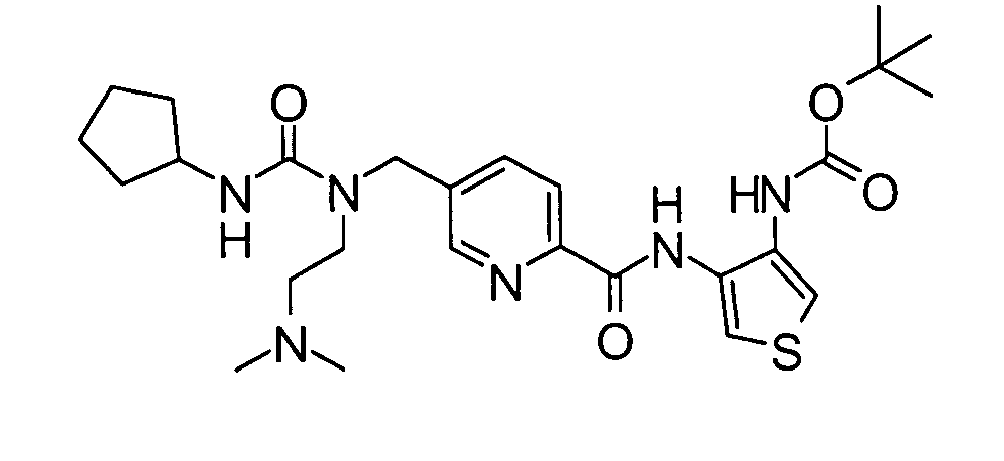
5-[3-(Benzo[1,3]dioxol-5-yl)-1-(2-dimethylaminoethyl)ureidomethyl]-N-(4-t-butoxycarbonylaminothiophen-3-yl)pyridine-2-carboxylic acid amide (Reference Compound No.6-9) 1H-NMR (400 MHz, CDCl3) δ 1.54 (s, 9H), 2.38 (s, 6H), 2.51 (t, J = 4.3 Hz, 2H), 3.31 (t, J = 4.3 Hz, 2H), 4.64 (s, 2H), 5.92 (s, 2H), 6.65 (dd, J= 8.3, 2.1 Hz, 1H), 6.73 (d, J = 8.3 Hz, 1H), 7.08 (d, J = 2.1 Hz, 1H), 7.13 (br s, 1H), 7.24 (m, 1H), 7.54 (br s, 1H) , 7.90 (dd, J = 8.0, 2.1 Hz, 1H), 8.24 (dd, J = 8.0, 0.7 Hz, 1H), 8.54 (dd, J = 2.1, 0.7 Hz, 1H), 10.14 (s, 1H), 10.94 (s, 1H) 
N-(4-t-Butoxycarbonylaminothiophen-3-yl)-5-[1-(2-dimethylaminoethy 1)-3-(4-fluoro-3-methylphenyl)ureidomethyl]pyridine-2-carboxylic acid amide (Reference Compound No.6-10) 1H-NMR (400 MHz, CDCl3) δ 1.54 (s, 9H), 2.26 (d, J = 2.0 Hz, 3H), 2.39 (s, 6H), 2.53 (t, J= 4.3 Hz, 2H), 3.32 (t, J = 4.3 Hz, 2H), 4.65 (s, 2H), 6.91 (t,J=9.0 Hz, 1H), 7.00 (m, 1H), 7.11 (br s, 1H), 7.24 (m, 1H), 7.28 (m, 1H), 7.54 (br s, 1H), 7.91 (dd, J = 7.9, 2.2 Hz, 1H), 8.25 (dd, J = 7.9, 0.7 Hz, 1H), 8.55 (dd, J = 2.2, 0.7 Hz, 1H), 10.14 (s, 1H), 10.96 (s, 1H) 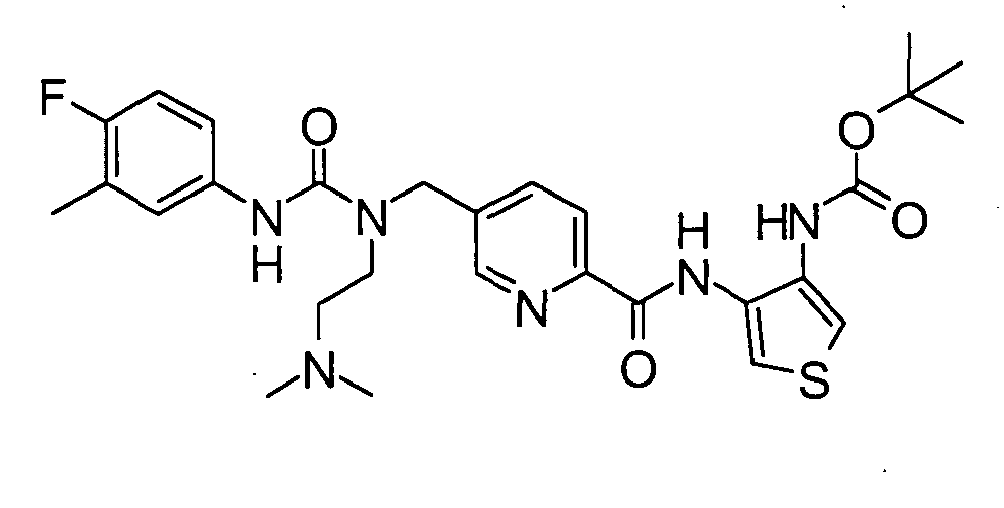
N-(4-t-Butoxycarbonylaminothiophen-3-yl)-5-[1-(2-dimethylaminoethy1)-3-(3-methylphenyl)ureidomethyl]pyridine-2-carboxylic acid amide (Reference Compound No.6-11) 
1H-NMR (400 MHz, CDCl3) δ 1.54 (s, 9H), 2.34 (s, 3H), 2.40 (s, 6H), 2.53 (t, J = 4.4 Hz, 2H), 3.33 (t, J = 4.4 Hz, 2H), 4.66 (s, 2H), 6.82 (d, J = 7.9 Hz, 1H), 7.05 (d, J = 7.9 Hz, 1H), 7.15 (br s, 1H), 7.17 (t,J = 7.9 Hz, 1H), 7.24 (br s, 1H), 7.29 (br s, 1H), 7.53 (br s, 1H), 7.92 (dd, J = 7.9, 2.1 Hz, 1H), 8.25 (d, J = 7.9 Hz, 1H), 8.56 (d, J = 2.1 Hz, 1H), 10.14 (s, 1H), 10.97 (s, 1H) N-(4-t-Butoxycarbonylaminothiophen-3-yl)-5-[1-(2-dimethylaminoethy1)-3-(3-methoxyphenyl)ureidomethyl]pyridine-2-carboxylic acid amide (Reference Compound No.6-12) 1H-NMR (400 MHz, CDCl3) δ 1.54 (s, 9H), 2.40 (s, 6H), 2.52 (t, J = 4.4 Hz, 2H), 3.33 (t, J = 4.4 Hz, 2H), 3.82 (s, 3H), 4.66 (s, 2H), 6.56 (ddd, J = 8.2, 2.3, 0.9 Hz, 1H), 6.84 (ddd, J = 8.2, 2.3, 0.9 Hz, 1H), 7.14 (t, J = 2.3 Hz, 1H), 7.15 (br s, 1H), 7.18 (t, J= 8.2 Hz, 1H) , 7.26 (m, 1H), 7.53 (br s, 1H), 7.91 (dd, J = 8.0, 2.2 Hz, 1H), 8.25 (dd, J = 8.0, 0.7 Hz, 1H), 8.55 (dd, J = 2.2, 0.7 Hz, 1H), 10.15 (s, 1H), 11.13 (s, 1H) 
N-(4-t-Butoxycarbonylaminothiophen-3-yl)-5-[1-[3-(morpholin-4-yl)propyl]-3-(thiophen-3-yl)ureidomethyl]pyridine-2-carboxylic acid amide (Reference Compound No.6-13) 1H-NMR (500 MHz, CDCl3) δ 1.53 (s, 9H), 1.77 (m, 2H), 2.42-2.50 (m, 6H), 3.36 (t, J = 5.7 Hz, 2H), 3.72 (t, J = 4.6 Hz, 4H), 4.64 (s, 2H), 7.10 (dd, J = 5.2, 1.5 Hz, 1H), 7.22-7.27 (m, 3H), 7.30 (m, 1H), 7.52 (br s, 1H), 7.91 (dd, J = 8.0, 1.9 Hz, 1H), 8.23 (d, J = 8.0 Hz, 1H), 8.55 (d, J = 1.9 Hz, 1H), 9.22 (br s, 1H), 10.12 (br s, 1H) 
N-(4-t-Butoxycarbonylaminothiophen-3-yl)-5-[3-(3-fluorophenyl)-1-[3-(morpholin-4-yl)propyl]ureidomethyl]pyridine-2-carboxylic acid amide (Reference Compound No.6-14) 1H-NMR (500 MHz, CDCl3) δ 1.53 (s, 9H), 1. 79 (m, 2H), 2.44-2.51 (m, 6H), 3.38 (t, J = 5.7 Hz, 2H), 3.71 (t, J = 4.6 Hz, 4H), 4.64 (s, 2H), 6.78 (tdd, J = 8.3, 2.5, 0.8 Hz, 1H), 7.01-7.15 (m, 2H), 7.20-7.30 (m, 2H), 7.41 (dt, J = 11.1, 2.2 Hz, 1H), 7.53 (br s, 1H), 7.91 (dd, J = 8.0, 1.9 Hz, 1H) , 8.23 (d, J = 8.0 Hz, 1H) , 8.56 (d, J = 1.9 Hz, 1H) , 9.03 (s, 1H) , 10.14 (br s, 1H) 
N-(4-t-Butoxycarbonylaminothiophen-3-yl)-5-[3-(4-fluoro-3-methylphenyl)-1-[3-(morpholin-4-yl)propyl]ureidomethyl]pyridine-2-carboxyl ic acid amide (Reference Compound No.6-15) 1H-NMR (400 MHz, CDCl3) δ 1.53 (s, 9H), 1.78 (m, 2H), 2.27 (d, J = 2.0 Hz, 3H), 2.41-2.51 (m, 6H), 3.37 (t, J = 5.6 Hz, 2H), 3.64 (t, J = 4.6 Hz, 4H), 4.63 (s, 2H), 6.95 (t, J = 8.9 Hz, 1H), 7.12 (m, 1H), 7.21-7.31 (m, 3H), 7.53 (brs, 1H), 7.91 (dd, J = 7.9, 2.1 Hz, 1H) , 8.22 (dd, J = 7.9, 0.5 Hz, 1H), 8.55 (dd, J = 2.1, 0.5 Hz, 1H), 8.98 (s, 1H), 10.12 (br s, 1H) 
N-(4-t-Butoxycarbonylaminothiophen-3-yl)-5-[3-(2,3-dihydro-1-benzo furan-5-yl)-1-[3-(morpholin-4-yl)propyl]ureidomethyl]pyridine-2-ca rboxylic acid amide (Reference Compound No.6-16) 1H-NMR (500 MHz, CDCl3) δ 1.53 (s, 9H), 1.77 (m, 2H), 2.44 (br s, 4H), 2.48 (t, J = 6.0 Hz, 2H), 3.21 (t, J = 8.6 Hz, 2H), 3.37 (t, J = 5.5 Hz, 2H), 3.61 (t, J = 4.6 Hz, 4H), 4.57 (t, J = 8.6 Hz, 2H), 4.63 (s, 2H), 6.72 (d, J = 8.3 Hz, 1H), 6.95 (dd, J = 8.3, 2.2 Hz, 1H), 7.14 (br s, 1H), 7.21-7.29 (m, 1H), 7.33 (d, J= 2.2 Hz, 1H), 7.51 (br s, 1H), 7.93 (dd, J = 7.9, 2.1 Hz, 1H), 8.22 (dd, J = 7.9, 0.5 Hz, 1H), 8.55 (dd, J = 2.1, 0.5 Hz, 1H), 8.99 (br s, 1H), 10.12 (br s, 1H) 
N-(4-t-Butoxycarbonylaminothiophen-3-yl)-5-[3-(3,4-difluorophenyl) -1-(2-dimethylaminoethyl)ureidomethyl]pyridine-2-carboxylic acid amide (Reference Compound No.6-17) 1H-NMR (500 MHz, CDCl3) δ 1.54 (s, 9H), 2.40 (s, 6H), 2.54 (m, 2H), 3.32 (t, J = 4.3 Hz, 2H), 4.64 (s, 2H), 6.90 (m, 1H), 6.98-7.17 (m, 2H), 7.24 (br s, 1H), 7.39 (m, 1H), 7.55 (br s, 1H), 7.89 (dd, J = 8.0, 1.9 Hz, 1H), 8.25 (d, J = 8.0 Hz, 1H), 8.55 (d, J= 1.9 Hz, 1H), 10.15 (s, 1H), 11.30 (s, 1H) 
N-(4-t-Butoxycarbonylaminothiophen-3-yl)-5-[1-(2-dimethylaminoethy l)-3-(4-fluorophenyl)ureidomethyl]pyridine-2-carboxylic acid amide (Reference Compound No.6-18) 
1H-NMR (500 MHz, CDCl3) δ 1.54 (s, 9H), 2.40 (s, 6H), 2.53 (t, J = 4.2 Hz, 2H), 3.33 (t, J = 4.2 Hz, 2H), 4.65 (s, 2H), 6.98 (t, J = 8.9 Hz, 2H), 7.12 (br s, 1H), 7.25 (br s, 1H), 7.30 (dd, J = 8.9, 4.7 Hz, 2H), 7.53 (br s, 1H), 7.91 (dd, J = 7.9, 2.0 Hz, 1H), 8.25 (d, J = 7.9 Hz, 1H), 8.55 (d, J = 2.0 Hz, 1H), 10.14 (s, 1H), 11.06 (s, 1H) 5-[3-(3-Acetylphenyl)-1-(2-dimethylaminoethyl)ureidomethyl]-N-(4-t-butoxycarbonylaminothiophen-3-yl)pyridine-2-carboxylic acid amide (Reference Compound No.6-19) 1H-NMR (500 MHz, CDCl3) δ 1.54 (s, 9H), 2.43 (s, 6H), 2.56 (t, J = 4.1 Hz, 2H), 2.61 (s, 3H), 3.35 (t, J = 4.1 Hz, 2H), 4.67 (s, 2H), 7.10 (br s, 1H), 7.25 (br s, 1H), 7.39 (t, J = 8.0 Hz, 1H), 7.54 (br s, 1H), 7.58 (d, J = 8.0 Hz, 1H), 7.66 (ddd, J = 8.0, 1.0, 0.5 Hz, 1H), 7.89-7.93 (m, 2H), 8.26 (d, J = 8.2 Hz, 1H), 8.56 (d, J = 2.1 Hz, 1H), 10.15 (s, 1H), 11.43 (s, 1H) 
5-[3-(Benzo[1,3]dioxol-5-yl)-1-(2-dimethylaminoethyl)ureidomethyl] -N-(4-t-butoxycarbonylaminothiophen-3-yl)pyridine-2-carboxylic acid amide (Reference Compound No.6-20) 1H-NMR (500 MHz, CDCl3) δ 1.54 (s, 9H), 2.11 (s, 6H), 2.33 (t, J = 4.5 Hz, 2H), 2.75 (t, J = 6.9 Hz, 2H), 3.14 (t, J=4.5Hz, 2H), 3.46 (m, 2H), 4.58 (s, 2H), 5.92 (s, 2H), 6.66 (dd, J = 7.7, 1.6 Hz, 1H), 6.72 (d, J = 1.6 Hz, 1H), 6.75 (d, J = 7.7 Hz, 1H), 7. 17 (br s, 2H), 7.52 (br s, 1H), 7.61 (br s, 1H), 7.81 (dd, J = 8.1, 2.1 Hz, 1H), 8.22 (dd, J = 8.1, 0.6 Hz, 1H), 8.44 (dd, J = 2.1, 0.6 Hz, 1H), 10.13 (s, 1H) 
N-(4-t-Butoxycarbonylaminothiophen-3-yl)-5-[1-(3-dimethylaminoprop yl)-3-(3-methylphenyl)ureidomethyl]pyridine-2-carboxylic acid amide (Reference Compound No.6-21) 1H-NMR (400 MHz, DMSO-d6) δ 1.49 (s, 9H), 1.70 (m, 2H), 2.20 (s, 6H), 2.26 (s, 3H), 2.27 (m, 2H), 3.34 (m, 2H), 4.62 (s, 2H), 6.76 (d, J = 7.7 Hz, 1H), 7.12 (t, J = 7.7 Hz, 1H), 7.19 (d, J = 7.7 Hz, 1H), 7.21 (d, J = 3 .7 Hz, 1H), 7.27 (s, 1H), 7.81 (d, J = 3.7 Hz, 1H), 7.98 (dd, J = 8.1, 1.6 Hz, 1H), 8.13 (d, J = 8.1 Hz, 1H), 8.60 (d, J = 1.6 Hz, 1H), 9.30 (br s, 1H), 9.61 (brs, 1H), 10.49 (br s, 1H). 
N-(4-t-Butoxycarbonylaminothiophen-3-yl)-5-[3-(3,4-difluorophenyl) -1-(3-dimethylaminopropyl)ureidomethyl]pyridine-2-carboxylic acid amide (Reference Compound No.6-22) 1H-NMR (400 MHz, DMSO-d6) δ 1.49 (s, 9H), 1.70 (m, 2H), 2.19 (s, 6H), 2.26 (t, J = 6.2 Hz, 2H), 3.35 (m, 2H), 4,63 (s, 2H), 7.08 (m, 1H), 7.21 (d, J = 3.7 Hz, 1H) , 7.31 (m, 1H), 7.67 (ddd, J = 13.8, 7.4, 2.7 Hz, 1H) , 7.81 (d, J = 3.7 Hz, 1H), 7.97 (dd, J = 7.9, 1.7 Hz, 1H) , 8.13 (d, J = 7.9 Hz, 1H), 8.59 (d, J = 1.7 Hz, 1H), 9.30 (br s, 1H), 9.95 (br s, 1H) , 10.48 (br s, 1H). 
N-(4-t-Butoxycarbonylaminothiophen-3-yl)-5-[1-(3-dimethylaminoprop yl)-3-(thiophen-3-yl)ureidomethyl]pyridine-2-carboxylic acid amide (Reference Compound No.6-23) 1H-NMR (400 MHz, DMSO-d6) δ 1.49 (s, 9H), 1. 68 (m, 2H), 2.19 (s, 6H), 2.25 (t, J = 6.1 Hz, 2H), 3.33 (m, 2H), 4.62 (s, 2H), 7.04 (dd, J = 5.1, 1.5 Hz, 1H) , 7.22 (d, J = 3.7 Hz, 1H), 7.27 (dd, J = 3.2, 1.5 Hz, 1H), 7.39 (dd, J = 5.1, 3.2 Hz, 1H) , 7.81 (d, J - 3.7 Hz, 1H) , 7.96 (dd, J = 8.1, 1.6 Hz, 1H) , 8.13 (d, J = 8.1 Hz, 1H), 8.59 (d, J = 1.6 Hz, 1H) , 9.29 (br s, 1H), 10.06 (br s, 1H), 10.48 (br s, 1H). 
N-(4-t-Butoxycarbonylaminothiophen-3-yl)-5-[3-(2,3-dihydrobenzo[1, 4]dioxin-6-yl)-1-(3-dimethylaminopropyl)ureidomethyl]pyridine-2-ca rboxylic acid amide (Reference Compound No.6-24) 1H-NMR (500 MHz, DMSO-d6) δ 1.50 (s, 9H), 1. 67 (m, 2H), 2.17 (s, 6H), 2.25 (t, J = 6.3 Hz, 2H), 3.30 (m, 2H), 4.17-4.21 (m, 4H), 4.60 (s, 2H), 6.73 (d, J = 8.9 Hz, 1H), 6.77 (dd, J = 8.9, 2.4 Hz, 1H) , 7.07 (d, J = 2.4 Hz, 1H) , 7.21 (d, J = 3.7 Hz, 1H), 7.81 (d, J= 3.7 Hz, 1H) , 7.95 (dd, J=7.9, 2.1 Hz, 1H), 8.13 (d, J = 7.9 Hz, 1H), 8.58 (s, 1H), 9.30 (br s, 1H), 9.43 (s, 1H), 10.49 (br s, 1H). 
N-(4-t-Butoxycarbonylaminothiophen-3-yl)-5-[1-(3-dimethylaminoprop yl)-3-(3-fluorophenyl)ureidomethyl]pyridine-2-carboxylic acid amide (Reference Compound No.6-25) 1H-NMR (500 MHz, DMSO-d6) δ 1.49 (s, 9H), 1.71 (m, 2H), 2.20 (s, 6H), 2.27 (t, J = 6.3 Hz, 2H), 3.35 (m, 2H), 4.63 (s, 2H), 6.75 (td, J = 8.3, 2.4 Hz, 1H) , 7.07 (d, J = 8.3 Hz, 1H) , 7.21 (d, J = 3 .7 Hz, 1H) , 7.28 (m, 1H), 7.48 (dt, J = 12.4, 2.4 Hz, 1H), 7.81 (d, J = 3.7 Hz, 1H), 7.98 (dd, J = 8.0, 1.6 Hz, 1H), 8.13 (d, J = 8.0 Hz, 1H), 8.60 (d, J = 1.6 Hz, 1H), 9.29 (br s, 1H) , 10.00 (br s, 1H), 10.49 (br s, 1H). 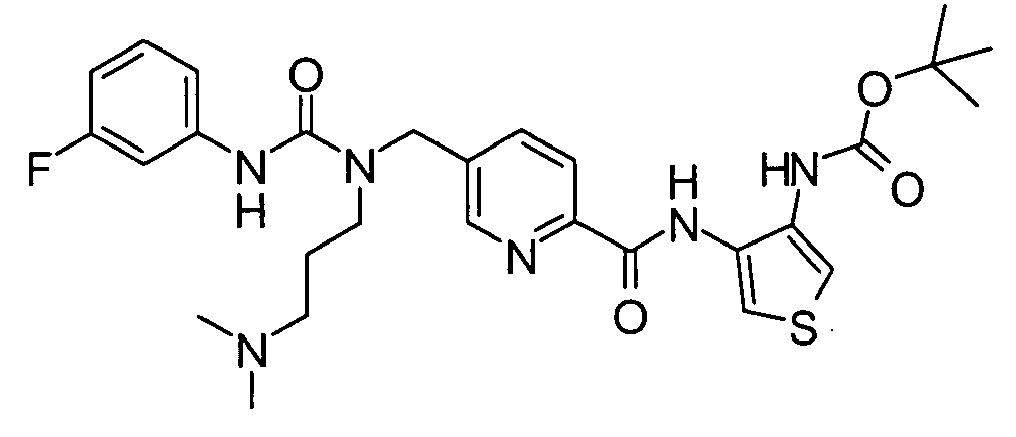
N-(4-t-Butoxycarbonylaminothiophen-3-yl)-5-[1-[3-(4-methylpiperazi n-1-yl)propyl]-3-(thiophen-3-yl)ureidomethyl]pyridine-2-carboxylic acid amide (Reference Compound No.6-26) 1H-NMR (400 MHz, CDCl3) δ 1.53 (s, 9H), 1.76 (m, 2H), 2.29 (s, 3H), 2.46 (t, J = 5.9 Hz, 2H), 2.49 (br s, 8H), 3.34 (t, J = 5.5 Hz, 2H), 4. 63 (s, 2H), 7.13 (dd, J = 5.1, 1.5 Hz, 1H), 7.22-7.27 (m, 2H), 7.23 (dd, J = 5.1, 3.4 Hz, 1H), 7.30 (dd, J = 3.4, 1.5 Hz, 1H) , 7.52 (br s, 1H), 7.91 (dd, J = 8.1, 2.2 Hz, 1H) , 8.22 (d, J = 8.1 Hz, 1H), 8.54 (d, J = 2 .2 Hz, 1H) , 9.34 (s, 1H), 10.12 (s, 1H) 
N-(4-t-Butoxycarbonylaminothiophen-3-yl)-5-[3-(3-methylphenyl)-1-[ 3-(4-methylpiperazin-1-yl)propyl]ureidomethyl]pyridine-2-carboxylic acid amide (Reference Compound No.6-27) 1H-NMR (400 MHz, CDCl3) δ1.53 (s, 9H), 1. 77 (m, 2H), 2.27 (s, 3H), 2.35 (s, 3H), 2.46 (br s, 8H), 2.47 (t, J = 5.9 Hz, 2H), 3.36 (t, J = 5.5 Hz, 2H), 4.63 (s, 2H), 6.90 (d, J = 7.7 Hz, 1H), 7.11-7.31 (m, 4H), 7.20 (t, J = 7.7 Hz, 1H), 7.51 (br s, 1H), 7.92 (dd, J = 8.1, 2.2 Hz, 1H), 8.22 (d, J = 8.1 Hz, 1H), 8.55 (d, J = 2.2 Hz, 1H), 9.02 (s, 1H), 10.13 (s, 1H) 
N-(4-t-Butoxycarbonylaminothiophen-3-yl)-5-[3-(2,3-dihydrobenzo[1, 4]dioxin-6-yl)-1-[3-(4-methylpiperazin-1-yl)propyl]ureidomethyl]py ridine-2-carboxylic acid amide (Reference Compound No.6-28) 1H-NMR (400 MHz, CDCl3) δ 1.53 (s, 9H), 1.75 (m, 2H), 2.24 (s, 3H), 2.40 (br s, 4H) , 2.46 (t, J = 6.0 Hz, 2H), 2.48 (br s, 4H), 3.33 (t, J = 5.5 Hz, 2H), 4.23-4.25 (m, 4H), 4.61 (s, 2H), 6.80 (d, J = 8.5 Hz, 1H), 6.83 (dd, J = 8.5, 2.4 Hz, 1H), 7.01 (d, J = 2.4 Hz, 1H), 7.15-7.29 (m, 2H), 7.51 (br s, 1H), 7.92 (dd, J = 8.1, 2.1 Hz, 1H), 8.21 (d, J = 8.1Hz, 1H), 8.54 (d, J = 2.1 Hz, 1H), 9.07 (s, 1H), 10.12 (s, 1H) 
5-[3-(Benzo[1,3]dioxol-5-yl)-1-(3-dimethylaminopropyl)ureidomethyl ]-N-(4-t-butoxycarbonylaminothiophen-3-yl)pyridine-2-carboxylic acid amide (Reference Compound No.6-29) 1H-NMR (500 MHz, DMSO-d6) δ 1.50 (s, 9H), 1.68 (m, 2H), 2.17 (s, 6H), 2.25 (t, J = 6.4 Hz, 2H), 3.34 (m, 2H), 4.61 (s, 2H), 5.95 (s, 2H), 6.72 (dd, J = 8.4, 2.1 Hz, 1H), 6.80 (d, J = 8.4 Hz, 1H), 7.17 (d, J = 2.1 Hz, 1H), 7.21 (d, J = 3.5 Hz, 1H), 7.81 (d, J = 3.5 Hz, 1H), 7.96 (dd, J = 7.9, 1.7 Hz, 1H), 8.13 (d, J = 7.9 Hz, 1H), 8.58 (d, J = 1. 7 Hz, 1H), 9.29 (br s, 1H), 9.50 (br s, 1H), 10.48 (br s, 1H) 
N-(4-t-Butoxycarbonylaminothiophen-3-yl)-5-[1-(3-dimethylaminoprop yl)-3-phenethylureidomethyl]pyridine-2-carboxylic acid amide (Reference Compound No.6-30) 1H-NMR (500 MHz, DMSO-d6) δ 1.50 (s, 9H), 1. 53 (m, 2H), 2.04 (s, 6H), 2.13 (t, J = 6.6 Hz, 2H), 2.73 (t, J = 7.3 Hz, 2H), 3.13 (t, J = 6.6 Hz, 2H), 3.30 (m, 2H), 4.53 (s, 2H), 7.11 (t, J = 5.2 Hz, 1H), 7.18-7.22 (m, 4H), 7.29 (t, J = 7.5 Hz, 2H), 7.81 (d, J = 3.7 Hz, 1H), 7.83 (dd, J = 7.9, 1.7 Hz, 1H), 8.10 (d, J = 7.9 Hz, 1H), 8.50 (d, J = 1. 7 Hz, 1H), 9.29 (br s, 1H), 10.48 (br s, 1H). 
N-(4-t-Butoxycarbonylaminothiophen-3-yl)-5-[3-cyclopentyl-1-(3-dim ethylaminopropyl)ureidomethyl]pyridine-2-carboxylic acid amide (Reference Compound No.6-31) 1H-NMR (500 MHz, DMSO-d6) δ 1.34 (m, 2H), 1.49 (s, 9H), 1.57 (m, 2H), 1.59-1.64 (m, 4H), 1.84 (m, 2H), 2.11 (s, 6H), 2.16 (t, J = 6.6 Hz, 2H), 3.17 (t, J = 6.4 Hz, 2H), 3.89 (m, 1H), 4.52 (s, 2H), 6.89 (d, J = 6.4 Hz, 1H), 7.21 (d, J = 3.7 Hz, 1H), 7.81 (d, J = 3.7 Hz, 1H), 7.88 (dd, J = 7.9, 1.5 Hz, 1H), 8.11 (d, J = 7.9 Hz, 1H), 8.50 (d, J = 1.5 Hz, 1H), 9.29 (br s, 1H), 10.48 (br s, 1H). 
5-[3-(2-Benzo[1,3]dioxol-5-ylethy1)-1-[3-(morpholin-4-yl)propyl]ur eidomethyl]-N-(4-t-butoxycarbonylaminothiophen-3-yl)pyridine-2-car boxylic acid amide (Reference Compound No.6-32) 1H-NMR (400 MHz, CDCl3) δ 1.53 (s, 9H), 1.63 (m, 2H), 2.27-2.37 (m, 6H), 2.77 (t, J = 6.7 Hz, 2H), 3.16 (t, J = 5.7 Hz, 2H), 3.44 (q, J = 6.7 Hz, 2H), 3.60 (br s, 4H), 4.56 (s, 2H), 5.92 (s, 2H), 6.64 (dd, J = 7.8, 1.7 Hz, 1H), 6.70 (d, J = 1.7 Hz, 1H), 6.76 (d, J = 7.8 Hz, 1H), 7.09 (br s, 1H), 7.23 (br s, 2H), 7.52 (s, 1H), 7.79 (dd, J = 8.0, 2.2 Hz, 1H), 8.22 (dd, J = 8.0, 0.5 Hz, 1H), 8.43 (dd, J = 2.2, 0.5 Hz, 1H), 10.13 (s, 1H) 
N-(4-t-Butoxycarbonylaminothiophen-3-yl)-5-[3-cyclopentyl-1-[3-(mo rpholin-4-yl)propyl]ureidomethyl]pyridine-2-carboxylic acid amide (Reference Compound No.6-33) 1H-NMR (500 MHz, CDCl3) δ 1.35 (m, 2H), 1.54 (s, 9H), 1.61 (m, 2H), 1.69 (m, 4H), 2.06 (m, 2H), 2.37 (t, J = 6.1 Hz, 2H), 2.44 (br s, 4H), 3.20 (t, J = 6.1 Hz, 2H), 3.74 (t, J = 4.6 Hz, 4H), 4.11 (m, 1H), 4.57 (s, 2H), 5.91 (d, J= 7.0 Hz, 1H), 7.12 (br s, 1H), 7.24 (br s, 1H), 7.52 (brs, 1H), 7.84 (dd, J = 7.9, 2.0Hz, 1H), 8.22 (d, J = 7.9 Hz, 1H), 8.50 (d, J = 2.0 Hz, 1H), 10.12 (s, 1H) 
N-(4-t-Butoxycarbonylaminothiophen-3-yl)-5-[3-cyclohexyl-1-[3-(mor pholin-4-yl)propyl]ureidomethyl]pyridine-2-carboxylic acid amide (Reference Compound No.6-34) 1H-NMR (400 MHz, CDCl3) δ 1.12 (m, 2H), 1.38 (m, 2H), 1.54 (s, 9H), 1. 60-1. 79 (m, 6H), 1.99 (m, 2H), 2.37 (t, J = 6.1 Hz, 2H), 2.44 (br s, 4H), 3.21 (t, J = 6.2 Hz, 2H), 3.65 (m, 1H), 3.76 (t, J = 4.6 Hz, 4H), 4.56 (s, 2H), 5.89 (d, J = 8.3 Hz, 1H), 7.27 (br s, 2H), 7.52 (br s, 1H), 7.84 (dd, J = 8.1, 2.2 Hz, 1H), 8.22 (d, J = 8.1 Hz, 1H), 8.50 (d, J = 2.2 Hz, 1H), 10.12 (s, 1H) 
N-(4-t-Butoxycarbonylaminothiophen-3-yl)-5-[1-[2-(4-methylpiperazi n-1-yl)ethyl]-3-(thiophen-3-yl)ureidomethyl]pyridine-2-carboxylic acid amide (Reference Compound No.6-35) 1H-NMR (400 MHz, CDCl3) δ 1.54 (s, 9H), 2.32 (s, 3H), 2.53 (br s, 4H), 2.56 (t, J = 4.2 Hz, 2H), 2.65 (br s, 4H), 3.34 (t, J = 4.2 Hz, 2H), 4.66 (s, 2H), 7.12 (br s, 1H), 7.15 (dd, J = 5.1, 1.5 Hz, 1H), 7.24 (m, 1H), 7.25 (dd, J = 5.1, 3.2 Hz, 1H), 7.31 (dd, J = 3.2, 1.5 Hz, 1H), 7.54 (br s, 1H), 7.90 (dd, J = 8.1, 2.2 Hz, 1H), 8.24 (d, J = 8.1 Hz, 1H), 8.53 (d, J = 2.2 Hz, 1H), 10.13 (s, 1H), 10.36 (s, 1H) 
N-(4-t-Butoxycarbonylaminothiophen-3-yl)-5-[3-(2,3-dihydrobenzo[1, 4]dioxin-6-yl)-1-[2-(4-methylpiperazin-1-yl)ethyl]ureidomethyl]pyr idine-2-carboxylic acid amide (Reference Compound No.6-36) 1H-NMR (500 MHz, CDCl3) δ 1.54 (s, 9H), 2.31 (s, 3H), 2.51 (br s, 4H), 2.55 (t, J = 4.3 Hz, 2H), 2.63 (br s, 4H), 3.34 (t, J = 4.3 Hz, 2H), 4.22-4.26 (m, 4H), 4.63 (s, 2H), 6.80 (d, J = 8.6 Hz, 1H), 6.87 (dd, J = 8.6, 2.4 Hz, 1H), 7.03 (d, J = 2.4 Hz, 1H), 7.14 (br s, 1H), 7.24 (m, 1H), 7.53 (br s, 1H), 7.91 (dd, J = 8.1, 2.0 Hz, 1H), 8.23 (d, J = 8 .1 Hz, 1H), 8.54 (d, J = 2.0 Hz, 1H), 9.85 (s, 1H), 10.13 (s, 1H) 
N-(4-t-Butoxycarbonylaminothiophen-3-yl)-5-[3-cyclopentyl-1-[2-(4-methylpiperazin-1-yl)ethyl]ureidomethyl]pyridine-2-carboxylic acid amide (Reference Compound No.6-37) 1H-NMR (400 MHz, CDCl3) δ 1.43 (m, 2H), 1.54 (s, 9H), 1.61 (m, 2H), 1.70 (m, 2H), 2.04 (m, 2H), 2.29 (s, 3H), 2.44 (br s, 4H), 2.45 (t, J = 4.5 Hz, 2H), 2.54 (br s, 4H), 3.20 (t, J = 4.5 Hz, 2H), 4.11 (m, 1H), 4.58 (s, 2H), 7.06 (d, J = 7.1 Hz, 1H), 7.16 (br s, 1H), 7.24 (m, 1H), 7.52 (br s, 1H), 7.84 (dd, J = 7.9, 2.1 Hz, 1H), 8.22 (d, J = 7.9 Hz, 1H), 8.48 (d, J = 2.1 Hz, 1H), 10.12 (s, 1H) 
N-(4-t-Butoxycarbonylaminothiophen-3-yl)-5-[1-(1-ethylpyrrolidin-2-ylmethyl)-3-(thiophen-3-yl)ureidomethyl]pyridine-2-carboxylic acid amide (Reference Compound No.6-38) 1H-NMR (500 MHz, CDCl3) 5 1.12 (t, J = 7.2 Hz, 3H), 1.54 (m, 1H), 1.54 (s, 9H), 1.75-1.94 (m, 3H), 2.49 (m, 2H), 2.83 (m, 2H), 3.18-3.34 (m, 3H), 4.51 (d, J = 15.6 Hz, 1H), 4.82 (d, J = 15.6 Hz, 1H), 6.93 (dd, J = 5.1, 1.4 Hz, 1H), 7.13 (br s, 2H), 7.21 (dd, J = 5.1, 3.4 Hz, 1H), 7.27 (m, 1H), 7.52 (br s, 1H), 7.91 (dd, J = 8.1, 2. 0 Hz, 1H), 8.24 (d, J = 8.1 Hz, 1H), 8.55 (d, J = 2.0 Hz, 1H), 10.13 (s, 1H), 11.77 (s, 1H) 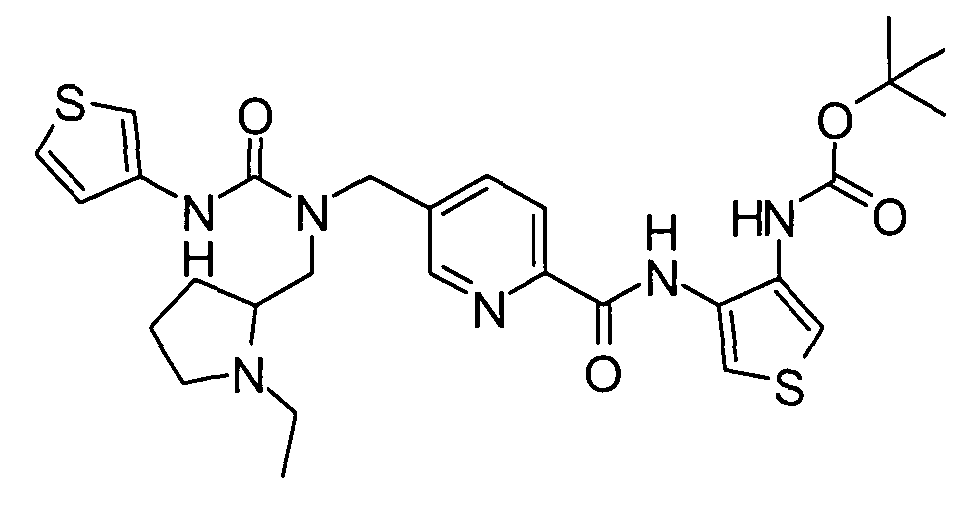
N-(4-t-Butoxycarbonylaminothiophen-3-yl)-5-[3-(2,3-dihydrobenzo[1, 4]dioxin-6-yl)-1-(1-ethylpyrrolidin-2-ylmethyl)ureidomethyl]pyridi ne-2-carboxylic acid amide (Reference Compound No.6-39) 1H-NMR (400 MHz, CDCl3) 5 1.10 (t, J = 7.2 Hz, 3H), 1.54 (s, 9H), 1.61 (m, 1H), 1.73-1.96 (m, 3H), 2.47 (m, 2H), 2.83 (m, 2H), 3.18-3.34 (m, 3H), 4.20-4.28 (m, 4H), 4.51 (d, J = 15.6 Hz, 1H), 4.76 (d, J = 15.6 Hz, 1H), 6.77 (d, J = 8.8 Hz, 1H), 6.82 (dd, J = 8.8, 2.3 Hz, 1H), 6.95 (d, J = 2.3 Hz, 1H), 7.15 (br s, 1H), 7.25 (br s, 1H), 7.53 (br s, 1H), 7.91 (dd, J = 8.1, 2.1 Hz, 1H), 8.23 (dd, J = 8.1, 0.7 Hz, 1H), 8.55 (dd, J = 2.1, 0.7 Hz, 1H), 10.13 (s, 1H), 11.18 (s, 1H) 
N-(4-t-Butoxycarbonylaminothiophen-3-yl)-5-[1-(1-ethylpyrrolidin-2 -ylmethyl)-3-phenethylureidomethy1]pyridine-2-carboxylic acid amide (Reference Compound No.6-40) 1H-NMR (400 MHz, CDCl3) δ 0.93 (t, J = 7.2 Hz, 3H), 1.39-1.80 (m, 4H), 1.53 (s, 9H) , 2.07-2.25 (m, 2H), 2.62 (m, 2H), 2.77-2.90 (m, 3H), 3.08 (m, 2H), 3.38 (m, 1H), 3.59 (m, 1H), 4.43 (d, J = 15.6 Hz, 1H), 4.72 (d, J = 15.6 Hz, 1H), 7.11-7.32 (m, 7H), 7.51 (br s, 1H), 7.81 (dd, J = 8.1, 2.2 Hz, 1H), 8.21 (dd, J = 8.1, 0.7 Hz, 1H), 8.48 (dd, J = 2.2, 0.7 Hz, 1H), 8.50 (br s, 1H), 10.12 (s, 1H) 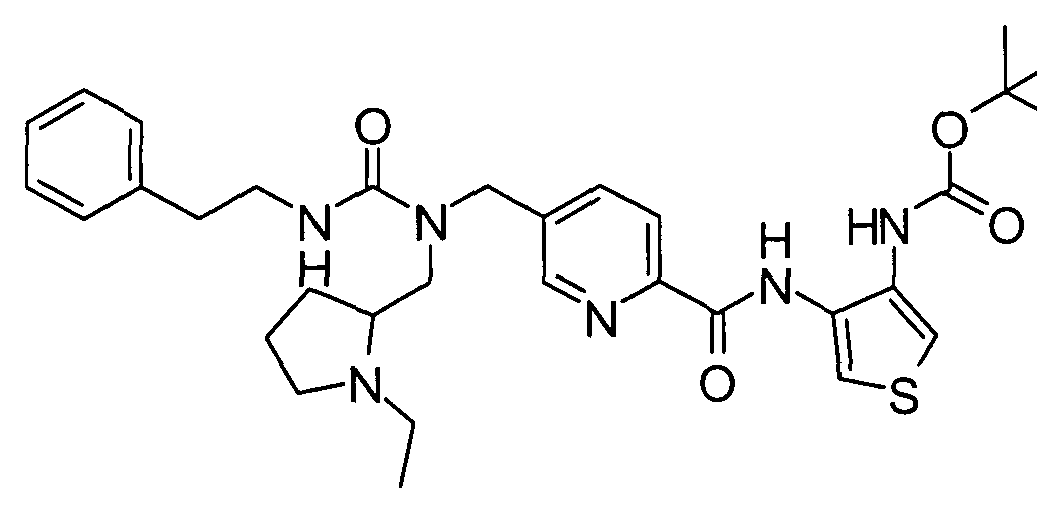
N-(4-t-Butoxycarbonylaminothiophen-3-yl)-5-[3-cyclopentyl-1-(1-eth ylpyrrolidin-2-ylmethyl)ureidomethyl]pyridine-2-carboxylic acid amide (Reference Compound No.6-41) 1H-NMR (400 MHz, CDCl3) δ 1.08 (t, J = 7.2 Hz, 3H), 1.39 (m, 2H), 1.46-1.87 (m, 8H), 1.54 (s, 9H), 1.98 (m, 2H), 2.29-2.45 (m, 2H), 2.70-2.80 (m, 2H), 3.06 (m, 1H), 3.13 (d, J = 5. 4 Hz, 2H), 4.04 (m, 1H), 4.41 (d, J = 15.6 Hz, 1H), 4.75 (d, J = 15.6 Hz, 1H), 7.14 (br s, 2H), 7.51 (br s, 1H), 7.86 (dd, J = 8.0, 2.1 Hz, 1H), 8.21 (dd, J = 8.0, 0.6 Hz, 1H), 8.38 (d, J = 6.3 Hz, 1H), 8.49 (dd, J = 2.1, 0.6 Hz, 1H), 10.12 (s, 1H) 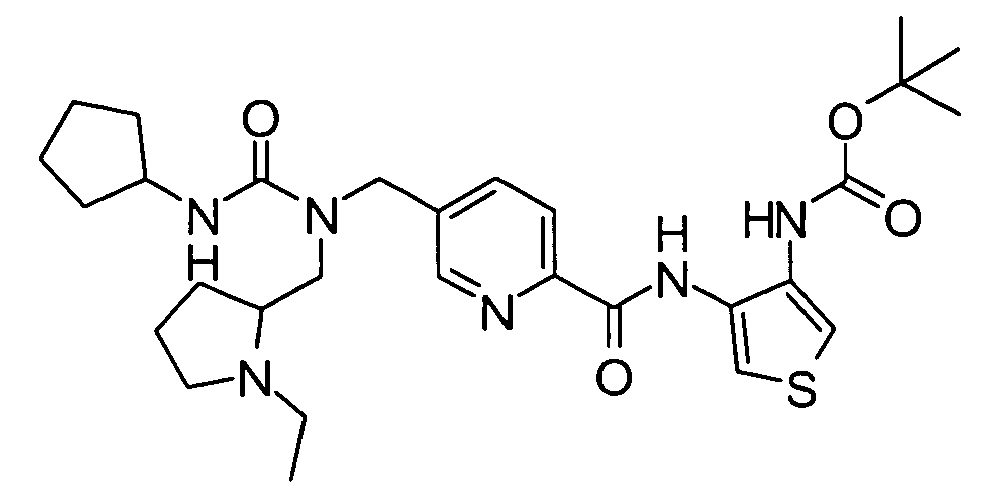
N-(4-t-Butoxycarbonylaminothiophen-3-yl)-5-[1-(2-dimethylaminoethyl)-3-isopropylureidomethyl]pyridine-2-carboxylic acid amide (Reference Compound No.6-42) 1H-NMR (400 MHz, DMSO-d6) 5 1.05 (d, J = 6.7 Hz, 6H), 1.50 (s, 9H), 2.14 (s, 6H), 2.32 (t, J = 5.7 Hz, 2H), 3.24 (t, J = 5.7 Hz, 2H), 3.74 (m, 1H), 4.56 (s, 2H), 7.06 (d, J = 7.1 Hz, 1H), 7.21 (d, J = 3.7 Hz, 1H), 7.81 (d, J = 3.7 Hz, 1H), 7.88 (dd, J = 8.1, 1.7 Hz, 1H), 8.11 (d, J = 8.1 Hz, 1H), 8.50 (d, J = 1.7 Hz, 1H), 9.29 (brs, 1H), 10.48 (br s, 1H). 
N-(4-t-Butoxycarbonylaminothiophen-3-yl)-5-[1-(2-dimethylaminoethy 1)-3-propylureidomethyl]pyridine-2-carboxylicacid amide (Reference Compound No.6-43) 1H-NMR (400 MHz, DMSO-d6) 5 0.83 (t, J = 7.4 Hz, 3H), 1.41, (m, 2H), 1.50 (s, 9H), 2.13 (s, 6H), 2.31 (t, J = 6.0 Hz, 2H), 3.00 (m, 2H), 3.26 (t, J = 6.0 Hz, 2H), 4.57 (s, 2H), 6.95 (t, J = 5.2 Hz, 1H), 7.21 (d, J = 3.7 Hz, 1H), 7.81 (d, J = 3.7 Hz, 1H), 7.87 (dd, J = 8.1, 1.7 Hz, 1H), 8.11 (d, J = 8.1 Hz, 1H), 8.49 (d, J = 1.7 Hz, 1H), 9.30 (br s, 1H), 10.48 (br s, 1H). 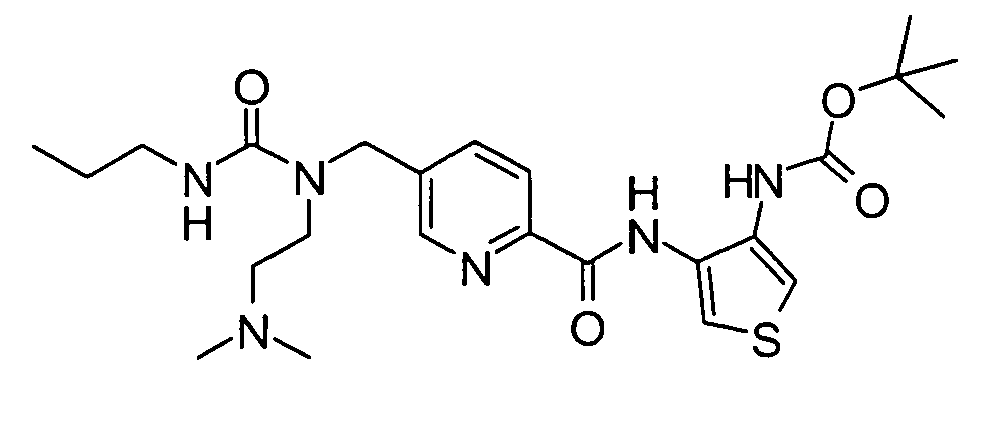
N-(4-t-Butoxycarbonylaminothiophen-3-yl)-5-[1-(2-dimethylaminoethyl)-3-(4-fluorophenethyl)ureidomethyl]pyridine-2-carboxylic acid amide (Reference Compound No.6-44) 1H-NMR (400 MHz, DMSO-d6) δ 1.49 (s, 9H), 2.07 (s, 6H), 2.25 (t, J = 6.3 Hz, 2H), 2.72 (t, J = 7.1 Hz, 2H), 3.23 (t, J= 6.3 Hz, 2H), 3.27 (m, 2H), 4.56 (s, 2H), 6.95 (t, J = 5.4 Hz, 1H), 7.07 (t, J = 8.9 Hz, 2H), 7.19-7.22 (m, 3H), 7.81 (dd, J = 8.0, 1.9 Hz, 1H), 7.81 (d, J = 3.7 Hz, 1H), 8.11 (d, J = 8.0 Hz, 1H), 8.49 (d, J = 1.9 Hz, 1H), 9.29 (br s, 1H), 10.48 (br s, 1H). 
N-(4-t-Butoxycarbonylaminothiophen-3-yl)-5-[3-t-butyl-1-(2-dimethy laminoethyl)ureidomethyl]pyridine -2-carboxylic acid amide (Reference Compound No.6-45) 1H-NMR (500 MHz, DMSO-d6) δ 1.26 (s, 9H), 1.50 (s, 9H), 2.17 (s, 6H), 2.34 (t, J = 5.0 Hz, 2H), 3.20 (t, J = 5.0 Hz, 2H), 4.52 (s, 2H), 7.21 (d, J = 3.7 Hz, 1H), 7.44 (s, 1H), 7.81 (d, J = 3.7 Hz, 1H), 7.88 (dd, J = 8.0, 1.6 Hz, 1H), 8.11 (d, J = 8.0 Hz, 1H), 8.51 (d, J = 1.6 Hz, 1H), 9.29 (br s, 1H), 10.49 (br s, 1H). 
N-(4-t-Butoxycarbonylaminothiophen-3-yl)-5-[1-(2-dimethylaminoethyl)-3-(pyridin-3-yl)ureidomethyl]pyridine-2-carboxylic acid amide (Reference Compound No.6-46) 1H-NMR (400 MHz, DMSO-d6) δ 1.49 (s, 9H), 2.27 (s, 6H), 2.48 (m, 2H), 3.45 (t, J = 5.1 Hz, 2H), 4.69 (s, 2H), 7.22 (d, J = 3.7 Hz, 2H), 7.28 (ddd, J = 8.3, 4.6, 0.7 Hz, 1H), 7.81 (d, J = 3.7 Hz, 1H), 7.85 (ddd, J = 8.3, 2.6, 1.5 Hz, 1H), 7.99 (dd, J = 7.9, 1.6 Hz, 1H), 8.14 (d, J = 7.9 Hz, 1H), 8.15 (dd, J = 4.6, 1.5 Hz, 1H), 8.52 (dd, J = 2.6, 0.7 Hz, 1H), 8.59 (d, J = 1.6 Hz, 1H), 9.29 (br s, 1H), 10.49 (br s, 1H). 
N-(4-t-Butoxycarbonylaminothiophen-3-yl)-5-[3-(2,3-dihydro-1-benzo furan-5-yl)-1-(2-dimethylaminoethyl)ureidomethyl]pyridine-2-carbox ylic acid amide (Reference Compound No.6-47) 1H-NMR (400 MHz, DMSO-d6) δ 1.50 (s, 9H), 2.24 (s, 6H), 2.45 (t, J = 5.2 Hz, 2H), 3.13 (m, 2H), 3.39 (t, J = 5.2 Hz, 2H), 4.47 (t, J= 8.7 Hz, 2H), 4.65 (s, 2H), 6.64 (d, J= 8.4 Hz, 1H), 6.97 (dd, J = 8.4, 2.1 Hz, 1H), 7.22 (d, J = 3.7 Hz, 1H), 7.28 (d, J = 2.1 Hz, 1H), 7.81 (d, J = 3.7 Hz, 1H), 7.96 (dd, J = 7.9, 1.6 Hz, 1H), 8.13 (d, J = 7.9 Hz, 1H), 8.58 (d, J = 1. 6 Hz, 1H), 9.30 (br s, 1H), 9.76 (br s, 1H), 10.49 (br s, 1H). 
N-(4-t-Butoxycarbonylaminothiophen-3-yl)-5-[1-(2-dimetylaminoethy l)-3-hexylureidomethyl]pyridine-2 -carboxylic acid amide (Reference Compound No.6-48) 1H-NMR (400 MHz, DMSO-d6) δ 0.85 (t, J = 7.0 Hz, 3H), 1.21-1.26 (m, 6H), 1.39 (m, 2H), 1.51 (s, 9H), 2.13 (s, 6H), 2.31 (t, J = 6.1 Hz, 2H), 3.02 (m, 2H), 3.27 (t, J = 6.1 Hz, 2H), 4.57 (s, 2H), 6.90 (t, J = 5.2 Hz, 1H), 7.21 (d, J = 3.7 Hz, 1H), 7.81 (d, J = 3.7 Hz, 1H), 7.87 (dd, J = 8.1, 1.7 Hz, 1H), 8.11 (d, J = 8.1 Hz, 1H), 8.49 (d, J = 1.7 Hz, 1H), 9.29 (br s, 1H), 10.48 (br s, 1H). 
N-(4-t-Butoxycarbonylaminothiophen-3-yl)-5-[3-cyclopropyl-1-(2-dim ethylaminoethyl)ureidomethyl]pyridine-2-carboxylic acid amide (Reference Compound No.6-49) 1H-NMR (500 MHz, DMSO-d6) δ 0.30-0.35 (m, 2H), 0.52-0.58 (m, 2H), 1.51 (s, 9H), 2.12 (s, 6H), 2.29 (t, J = 6.0 Hz, 2H), 2.39 (m, 1H), 3.22 (t, J= 6.0Hz, 2H), 4.55 (s, 2H), 7.20 (m, 1H), 7.22 (d, J = 3.7 Hz, 1H), 7.81 (d, J = 3.7 Hz, 1H), 7.87 (dd, J = 8.1, 1.5 Hz, 1H), 8.11 (d, J = 8.1 Hz, 1H), 8.49 (d, J = 1.5 Hz, 1H), 9.29 (br s, 1H), 10.48 (br s, 1H). 
N-(4-t-Butoxycarbonylaminothiophen-3-yl)-5-[1-[2-(morpholin-4-yl)e thyl]-3-(thiophen-3-yl)ureidomethyl]pyridine-2-carboxylic acid amide (Reference Compound No.6-50) 1H-NMR (400 MHz, CDCl3) δ 1.54 (s, 9H), 2.57 (t, J= 4.3 Hz, 2H), 2.62 (t, J = 4.5 Hz, 4H), 3.36 (t, J = 4.3 Hz, 2H), 3.78 (t, J = 4.5 Hz, 4H), 4.66 (s, 2H), 7.11 (dd, J = 5.1, 1.4 Hz, 1H), 7.15 (br s, 1H), 7.24 (br s, 1H), 7.26 (dd, J = 5.1, 3.2 Hz, 1H), 7.31 (dd, J = 3.2, 1.4 Hz, 1H), 7.54 (br s, 1H), 7.90 (dd, J = 8.1, 2.2 Hz, 1H), 8.24 (dd, J = 8.1, 0.7 Hz, 1H), 8.54 (dd, J = 2.2, 0.7 Hz, 1H), 10.14 (br s, 1H), 10.22 (br s, 1H) 
N-(4-t-Butoxycarbonylaminothiophen-3-yl)-5-[3-(2,3-dihydrobenzo[1,4]dioxin-6-yl)-1-[2-(morpholin-4-yl)ethyl]ureidomethyl]pyridine-2-carboxylic acid amide (Reference Compound No.6-51) 1H-NMR (500 MHz, CDCl3) δ 1.54 (s, 9H), 2.56 (t, J = 4.3 Hz, 2H), 2.60 (br s, 4H), 3.35 (t, J = 4.3 Hz, 2H), 3.76 (t, J = 4.6 Hz, 4H), 4.22-4.26 (m, 4H), 4.64 (s, 2H), 6.81 (d, J=8.7Hz, 1H), 6.85 (dd, J = 8.7, 2.3 Hz, 1H), 6.99 (d, J = 2.3 Hz, 1H), 7.12 (br s, 1H), 7.24 (br s, 1H), 7.53 (br s, 1H), 7.91 (dd, J = 7.9, 1.8 Hz, 1H), 8.24 (d, J = 7.9 Hz, 1H), 8.55 (d, J = 1.8 Hz, 1H), 9.68 (brs, 1H), 10.14 (br s, 1H) 
N-(4-t-Butoxycarbonylaminothiophen-3-yl)-5-[1-[2-(morpholin-4-yl)e thyl]-3-phenethylureidomethyl]pyridine-2-carboxylic acid amide (Reference Compound No.6-52) 1H-NMR (500 MHz, CDCl3) δ 1.54 (s, 9H), 2.30 (t, J = 4.4 Hz, 4H), 2.36 (t, J = 4.7 Hz, 2H), 2.86 (t, J = 6.7 Hz, 2H), 3.16 (t, J = 4.7 Hz, 2H), 3.45 (br s, 4H), 3.50 (q, J = 6.7 Hz, 2H), 4.59 (s, 2H), 7.12 (br s, 1H), 7.19-7.31 (m, 6H), 7.47 (br s, 1H), 7.53 (br s, 1H), 7.82 (dd, J = 8.1, 2.1 Hz, 1H), 8.23 (d, J = 8.1 Hz, 1H), 8.49 (d, J = 2.1 Hz, 1H), 10.13 (br s, 1H) 
N-(4-t-Butoxycarbonylaminothiophen-3-yl)-5-[3-cyclopentyl-1-[2-(morpholin-4-yl)ethyl]ureidomethyl]pyridine-2-carboxylic acid amide (Reference Compound No.6-53) 1H-NMR (400 MHz, CDCl3) δ 1.40 (m, 2H), 1.54 (s, 9H), 1.58-1.73 (m, 4H), 2.05 (m, 2H), 2.46 (t, J = 4.7 Hz, 2H), 2.51 (t, J = 4.5 Hz, 4H), 3.23 (t, J = 4.7 Hz, 2H), 3.72 (t, J=4.5Hz, 4H), 4.11 (m, 1H), 4.59 (s, 2H), 6.85 (d, J= 6.3 Hz, 1H), 7.11 (br s, 1H), 7.25 (br s, 1H), 7.53 (br s, 1H), 7.85 (dd, J = 7.9, 2.1 Hz, 1H), 8.23 (dd, J = 7.9, 0.6 Hz, 1H), 8.49 (dd, J = 2.1, 0.6 Hz, 1H), 10.13 (br s, 1H) 
N-(4-t-Butoxycarbonylaminothiophen-3-yl)-5-[1-[3-(4-methylpiperazin-1-yl)propyl]-3-phenethylureidomethyl]pyridine-2-carboxylic acid amide (Reference Compound No.6-54) 1H-NMR (500 MHz, CDCl3) δ 1.53 (s, 9H), 1.61 (m, 2H), 2.26 (s, 3H), 2.31 (t, J = 6.1 Hz, 2H), 2.32 (br s, 8H), 2.87 (t, J = 6.7 Hz, 2H), 3.13 (t, J = 5.7 Hz, 2H), 3.48 (q, J = 6.7 Hz, 2H), 4.57 (s, 2H), 7.17 (br s, 1H), 7.20-7.24 (m, 3H), 7.26-7.31 (m, 3H), 7.35 (m, 1H), 7.52 (br s, 1H), 7.78 (dd, J = 7.9, 2.1 Hz, 1H), 8.22 (d, J = 7.9 Hz, 1H), 8.49 (d, J = 2.1 Hz, 1H), 10.13 (s, 1H) 
N-(4-t-Butoxycarbonylaminothiophen-3-yl)-5-[3-isopropyl-1-[3-(4-methylpiperazin-1-yl)propyl]ureidomethyl]pyridine-2-carboxylic acid amide (Reference Compound No.6-55) 1H-NMR (500 MHz, CDCl3) 5 1.21 (d, J = 6.7 Hz, 6H), 1.54 (s, 9H), 1.67 (m, 2H), 2.31 (s, 3H), 2.36 (t, J = 6.1 Hz, 2H), 2.49 (br s, 8H), 3.18 (t, J = 6.0 Hz, 2H), 4.01 (m, 1H), 4.56 (s, 2H), 6.04 (d, J = 8.2 Hz, 1H), 7.16 (br s, 1H), 7.26 (m, 1H), 7.51 (brs, 1H), 7.84 (dd, J = 7.9, 2.1 Hz, 1H), 8.22 (d, J = 7.9 Hz, 1H), 8.50 (d, J = 2.1 Hz, 1H), 10.12 (s, 1H) 
N-(4-t-Butoxycarbonylaminothiophen-3-yl)-5-[3-cyclopentyl-1-[3-(4-methylpiperazin-1-yl)propyl]ureidomethyl]pyridine-2-carboxylic acid amide (Reference Compound No.6-56) 1H-NMR (500 MHz, CDCl3) δ 1.39 (m, 2H), 1.54 (s, 9H), 1.60 (m, 2H), 1.64-1.74 (m, 4H), 2.05 (m, 2H), 2.30 (s, 3H), 2.36 (t, J = 6.0 Hz, 2H), 2.47 (br s, 8H), 3.19 (t, J = 6.0 Hz, 2H), 4.10 (m, 1H), 4.56 (s, 2H), 6.05 (d, J = 7.6 Hz, 1H), 7.15 (br s, 1H), 7.25 (m, 1H), 7.51 (br s, 1H), 7.84 (dd, J = 8.1, 2.0 Hz, 1H), 8.22 (d, J = 8.1 Hz, 1H) , 8.50 (d, J = 2.0 Hz, 1H), 10.12 (s, 1H) 
N-(4-t-Butoxycarbonylaminothiophen-3-yl)-5-[3-(2,3-dihydrobenzo[1,4]dioxin-6-yl)-1-[4-(morpholin-4-yl)butyl]ureidomethyl]pyridine-2- carboxylic acid amide (Reference Compound No.6-57) 1H-NMR (400 MHz, CDCl3) δ 1.52 (m, 2H), 1.54 (s, 9H), 1.69 (m, 2H), 2.38 (t, J = 7.0 Hz, 2H), 2.41 (m, 4H), 3.28 (t, J = 7.9 Hz, 2H), 3.63 (t, J = 4.6 Hz, 4H), 4.22-4.25 (m, 4H), 4.66 (s, 2H), 6.61 (m, 1H), 6.75 (dd, J = 8.7, 2.4 Hz, 1H), 6.80 (d, J = 8.7 Hz, 1H), 6.91 (d, J = 2.4 Hz, 1H), 7.11 (br s, 1H), 7.24 (m, 1H), 7.54 (br s, 1H), 7.88 (dd, J = 8.1, 2.2 Hz, 1H) , 8.24 (d, J = 8.1 Hz, 1H), 8.53 (d, J = 2.2 Hz, 1H), 10.13 (s, 1H) 
N-(4-t-Butoxycarbonylaminothiophen-3-yl)-5-[1-[4-(morpholin-4-yl)butyl]-3-phenethylureidomethyl]pyridine-2-carboxylic acid amide (Reference Compound No.6-58) 1H-NMR (500 MHz, CDCl3) δ 1.39 (m, 2H) , 1. 48 (m, 2H) , 1.54 (s, 9H), 2.24 (t, J = 7. 0 Hz, 2H), 2.32 (m, 4H), 2.85 (t, J = 6.5 Hz, 2H), 3.08 (t, J = 7.9 Hz, 2H), 3.54 (q, J = 6.5 Hz, 2H), 3.64 (t, J = 4.6 Hz, 4H), 4.57 (s, 2H), 4.75 (t, J = 6.5 Hz, 1H), 7.14 (br s, 1H), 7.17 (d, J = 7.0 Hz, 2H), 7.22 (m, 1H), 7.26-7.30 (m, 3H), 7.54 (br s, 1H), 7.75 (dd, J = 8.1, 1.8 Hz, 1H) , 8.21 (d, J = 8.1 Hz, 1H) , 8.45 (d, J = 1.8Hz, 1H), 10.13 (s, 1H) 
N-(4-t-Butoxycarbonylaminothiophen-3-yl)-5-[3-cyclopentyl-1-[4-(morpholin-4-yl)butyl]ureidomethyl]pyridine-2-carboxylic acid amide (Reference Compound No.6-59) 1H-NMR (400 MHz, CDCl3) δ 1.33 (m, 2H), 1.47 (m, 2H) , 1.54 (s, 9H), 1.54-1.65 (m, 6H), 2.00 (m, 2H), 2.32 (t, J = 7.1 Hz, 2H), 2.40 (m, 4H), 3.16 (t, J = 7.6 Hz, 2H), 3.70 (t, J = 4.6 Hz, 4H), 4.14 (m, 1H), 4.35 (d, J = 6.9 Hz, 1H) , 4.58 (s, 2H), 7.11 (br s, 1H), 7.24 (m, 1H), 7.54 (br s, 1H), 7. 80 (dd, J = 8.1, 2.2 Hz, 1H) , 8.23 (d, J = 8.1 Hz, 1H) , 8.48 (d, J = 2.2 Hz, 1H), 10.13 (s, 1H) 
N-(4-t-Butoxycarbonylaminothiophen-3-yl)-5-[3-sec-butyl-1-(2-dimethylaminoethyl)ureidomethyl]pyridine-2-carboxylic acid amide (Reference Compound No.6-60) 1H-NMR (500 MHz, DMSO-d6) 5 0.83 (t, J = 7.5 Hz, 3H), 1.03 (d, J= 6.4Hz, 3H), 1.39 (m, 2H), 1.50 (s, 9H), 2.14 (s, 6H), 2.32 (t, J = 5.8 Hz, 2H), 3.25 (m, 2H), 3.57 (m, 1H), 4.57 (s, 2H), 6.98 (d, J = 7.6 Hz, 1H), 7.21 (d, J = 3.7 Hz, 1H), 7.81 (d, J = 3.7 Hz, 1H), 7.88 (dd, J = 7.9, 2.1 Hz, 1H), 8.11 (d, J = 7.9 Hz, 1H), 8.49 (br s, 1H), 9.29 (br s, 1H), 10.48 (br s, 1H). 
N-(4-t-Butoxycarbonylaminothiophen-3-yl)-5-[1-[3-(morpholin-4-yl)p ropyl]-3-(3-phenylpropyl)ureidomethyl]pyridine-2-carboxylic acid amide (Reference Compound No.6-61) 1H-NMR (400 MHz, CDCl3) δ 1.53 (s, 9H), 1.64 (m, 2H), 1.89 (m, 2H) , 2.35 (t, J = 6.0 Hz, 2H), 2.41 (br s, 4H), 2.68 (t, J = 7.5 Hz, 2H) , 3.17 (t, J = 5.7 Hz, 2H), 3.27 (td, J = 7.5, 5. 6 Hz, 2H), 3.66 (t, J = 4.4 Hz, 4H), 4.56 (s, 2H) , 7.07 (t, J = 5.6 Hz, 1H), 7.17 (m, 1H) , 7.19 (d, J = 7.1 Hz, 2H), 7.25 (m, 1H), 7.27 (t, J = 7.1 Hz, 2H), 7.28 (m, 1H), 7.52 (s, 1H), 7.84 (dd, J = 7.9, 2.1 Hz, 1H), 8.22 (dd, J = 7.9, 0.6 Hz, 1H), 8.50 (dd, J = 2.1, 0.6 Hz, 1H), 10.12 (s, 1H) 
5-[3-Benzyl-1-[3-(morpholin-4-yl)propyl]ureidomethyl]-N-(4-t-butox ycarbonylaminothiophen-3-yl)pyridine-2-carboxylic acid amide (Reference Compound No.6-62) 1H-NMR (500 MHz, CDCl3) δ 1.54 (s, 9H), 1.67 (m, 2H), 2.25 (br s, 4H), 2.34 (t, J = 5.9 Hz, 2H), 3.29 (t, J = 5.9 Hz, 2H), 3.40 (br s, 4H), 4.49 (d, J= 5.5Hz, 2H), 4.63 (s, 2H), 7.12 (br s, 1H), 7.15 (d, J = 7.1 Hz, 1H), 7.24 (m, 1H), 7.28-7.36 (m, 4H), 7.52 (br s, 1H), 7.57 (t, J = 5. 5 Hz, 1H) , 7.88 (dd, J = 7.9, 2.1 Hz, 1H), 8.23 (dd, J = 7.9, 0.6 Hz, 1H), 8.54 (dd, J = 2.1, 0.6 Hz, 1H), 10.13 (s, 1H) 
N-(4-t-Butoxycarbonylamino-thiophene-3-yl)-5-[3-hexyl-1-[3-(morpholin-4-yl)propyl]ureidomethyl]pyridine-2-carboxylic acid amide (Reference Compound No.6-63) 1H-NMR (500 MHz, CDCl3) 5 0.89 (t, J = 6.9 Hz, 3H), 1.29-1.36 (m, 6H), 1.51 (m, 2H), 1.54 (s, 9H), 1.66 (m, 2H), 2.38 (t, J = 6.1 Hz, 2H) , 2.44 (br s, 4H), 3.19-3.24 (m, 4H), 3.73 (t, J = 4.4 Hz, 4H), 4.57 (s, 2H), 6.99 (t, J = 5.5 Hz, 1H) , 7.15 (br s, 1H), 7.26 (m, 1H), 7.52 (br s, 1H), 7 . 84 (dd, J = 7.9, 1. 8 Hz, 1H) , 8.22 (d, J = 7.9 Hz, 1H), 8.50 (d, J= 1.8 Hz, 1H), 10.12 (s, 1H) 
N-(4-t-Butoxycarbonylaminothiophen-3-yl)-5-[3-(3,4-dimethoxyphenethyl)-1-[3-(morpholin-4-yl)propyl]ureidomethyl]pyridine-2-carboxyli c acid amide (Reference Compound No.6-64) 1H-NMR (400 MHz, CDCl3) δ 1.52 (s, 9H), 1.63 (m, 2H), 2.34 (t, J = 5.6 Hz, 2H), 2.34 (m, 4H), 2.81 (t, J = 6.8 Hz, 2H) , 3.15 (t, J = 5.7 Hz, 2H) , 3.48 (m, 2H), 3.61 (br s, 4H), 3.82 (s, 3H), 3.82 (s, 3H), 4.55 (s, 2H), 6.72-6.76 (m, 2H), 6.80 (d, J = 8.5 Hz, 1H), 7.11 (br s, 1H), 7.27-7.31 (m, 2H), 7.57 (br s, 1H), 7.79 (d, J = 8.0 Hz, 1H), 8.21 (d, J = 8.0Hz, 1H), 8.32 (s, 1H), 10.19 (s, 1H) 
N-(4-t-Butoxycarbonylaminothiophen-3-yl)-5-[1-(2-dimethylaminoethy1)-3-(4-phenylphenethyl)ureidomethyl]pyridine-2-carboxylic acid amide (Reference Compound No.6-65) 1H-NMR (400 MHz, DMSO-d6) δ 1.49 (s, 9H), 2.07 (s, 6H), 2.27 (t, J= 6.2 Hz, 2H), 2.50 (m, 2H), 2.78 (t, J = 7.1 Hz, 2H), 3.25 (t, J = 6.2 Hz, 2H) , 4.58 (s, 2H), 6.98 (t, J = 5.4 Hz, 1H) , 7.22 (d, J = 3.7 Hz, 1H) , 7.27 (d, J = 8.3 Hz, 2H), 7.33 (dt, J = 7.4, 1.6 Hz, 1H) , 7.42 (t, J = 7.4 Hz, 2H), 7.56 (d, J = 8.3 Hz, 2H), 7.61 (m, 2H), 7.82 (d, J = 3.7 Hz, 1H), 7.86 (dd, J = 8.2, 1.7 Hz, 1H) , 8.11 (d, J = 8.2 Hz, 1H) , 8.51 (d, J = 1.7 Hz, 1H), 9.30 (br s, 1H), 10.50 (br s, 1H). 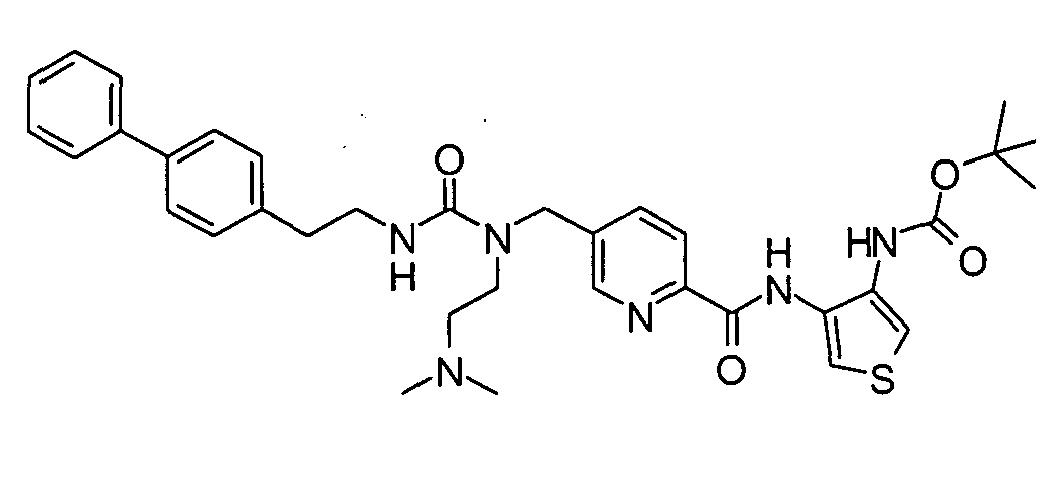
N-(4-t-Butoxycarbonylaminothiophen-3-yl)-5-[1-(2-dimethylaminoethyl)-3-(4-methoxyphenethyl)ureidomethyl]pyridine-2-carboxylic acid amide (Reference Compound No.6-66) 1H-NMR (400 MHz, DMSO-d6) δ 1.50 (s, 9H), 2.08 (s, 6H), 2.27 (t, J = 6.3 Hz, 2H), 2.50 (m, 2H), 2.66 (t, J = 7.3 Hz, 2H), 3.23 (m, 2H), 3.70 (s, 3H), 4.56 (s, 2H), 6.83 (d, J = 8.7 Hz, 2H), 6.92 (t, J = 5.0 Hz, 1H), 7.08 (d, J = 8.7 Hz, 2H), 7.21 (d, J = 3.7 Hz, 1H), 7.80-7.83 (m, 2H), 8 .10 (d, J = 7 . 8 Hz, 1H) , 8.50 (d, J = 1.5 Hz, 1H), 9.29 (br s, 1H), 10.49 (br s, 1H). 
N-(4-t-Butoxycarbonylaminothiophen-3-yl)-5-[1-[2-(pyrrolidin-1-yl)ethyl]-3-(thiophen-3-yl)ureidomethyl]pyridine-2-carboxylic acid amide (Reference Compound No.6-67) 1H-NMR (400 MHz, CDCl3) δ 1.54 (s, 9H), 1.90 (m, 4H), 2.65-2.76 (m, 6H), 3.34 (t, J = 4.3 Hz, 2H), 4.67 (s, 2H), 6.91 (dd, J = 5.1, 1.5 Hz, 1H), 7.11 (br s, 1H), 7.21 (dd, J = 5.1, 3.3 Hz, 1H), 7.24 (br s, 1H), 7.28 (dd, J = 3.3, 1.5 Hz, 1H), 7.53 (s, 1H), 7.90 (dd, J = 8.1, 2.2 Hz, 1H), 8.24 (dd, J = 8.1, 0.6 Hz, 1H), 8.54 (dd, J = 2.2, 0.6 Hz, 1H), 10.13 (s, 1H), 11.28 (s, 1H) 
N-(4-t-Butoxycarbonylaminothiophen-3-yl)-5-[3-(2,3-dihydrobenzo[1,4]dioxin-6-yl)-1-[2-(pyrrolidin-1-yl)ethyl]ureidomethyl]pyridine-2 -carboxylic acid amide (Reference Compound No.6-68) 1H-NMR (400 MHz, CDCl3) 5 1.54 (s, 9H), 1.89 (br s, 4H), 2.63-2.75 (m, 6H), 3.34 (t, J = 4.2 Hz, 2H), 4.20-4.27 (m, 4H), 4.64 (s, 2H), 6.77 (dd, J = 8.8, 0.5 Hz, 1H), 6.80 (dd, J = 8.8, 2.1 Hz, 1H), 6.92 (dd, J = 2.1, 0.5 Hz, 1H) , 7.13 (brs, 1H), 7.25 (br s, 1H), 7.53 (s, 1H), 7.91 (dd, J = 8.0, 2.1 Hz, 1H), 8.23 (dd, J = 8.0, 0.6 Hz, 1H), 8.54 (dd, J = 2.1, 0.6 Hz, 1H), 10.14 (s, 1H), 10.63 (s, 1H) 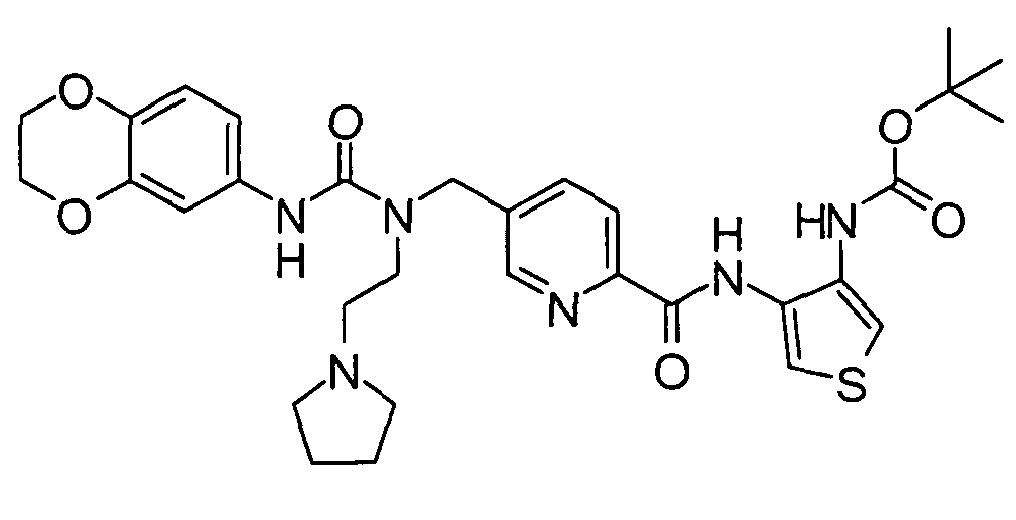
N-(4-t-Butoxycarbonylaminothiophen-3-yl)-5-[3-phenethyl-1-[2-(pyrrolidin-1-yl)ethyl]ureidomethyl]pyridine-2-carboxylic acid amide (Reference Compound No.6-69). 1H-NMR (400 MHz, CDCl3) 5 1.54 (s, 9H), 1.65 (br s, 4H), 2.40 (br s, 4H), 2.53 (t, J = 4.8 Hz, 2H) , 2.83 (t, J = 7.0 Hz, 2H), 3.17 (t, J = 4.8 Hz, 2H), 3.46 (q, J = 7.0 Hz, 2H), 4.59 (s, 2H), 7.04-7.32 (m, 7H), 7.52 (br s, 1H) , 7.81 (dd, J = 8.1, 2. 2 Hz, 1H), 7.83 (br s, 1H), 8.22 (dd, J = 8.1, 0.6 Hz, 1H), 8.48 (dd, J = 2.2, 0.6 Hz, 1H), 10.13 (s, 1H) 
N-(4-t-Butoxycarbonylaminothiophen-3-yl)-5-[3-cyclopentyl-1-[2-(pyrrolidin-1-yl)ethyl]ureidomethyl]pyridine-2-carboxylic acid amide (Reference Compound No.6-70) 1H-NMR (400 MHz, CDCl3) δ 1.33 (m, 2H), 1.54 (s, 9H), 1.56-1.70 (m, 4H), 1.79 (br s, 4H), 1.99 (m, 2H), 2.53-2.62 (m, 6H), 3.21 (t, J = 4.5 Hz, 2H), 4.09 (m, 1H), 4.59 (s, 2H), 7.15 (br s, 1H), 7.25 (br s, 1H), 7.52 (br s, 1H) , 7.80 (d, J = 6.1 Hz, 1H), 7.85 (dd, J = 7.9, 2.0 Hz, 1H), 8.22 (dd, J = 7.9, 0.5 Hz, 1H), 8.49 (dd, J = 2.0, 0.5 Hz, 1H), 10.13 (s, 1H) 
N-(4-t-Butoxycarbonylaminothiophen-3-yl)-5-[1-[3-(pyrrolidin-1-yl)propyl]-3-(thiophen-3-yl)ureidomethyl]pyridine-2-carboxylic acid amide (Reference Compound No.6-71) 1H-NMR (400 MHz, CDCl3) δ 1.53 (s, 9H), 1.73 (m, 2H), 1.89 (m, 4H), 2.52-2.61 (m, 6H), 3.38 (t, J = 5.6 Hz, 2H), 4.63 (s, 2H), 6.96 (dd, J = 5.1, 1.3 Hz, 1H) , 7.14 (brs, 1H), 7.20 (dd, J = 5.1, 3.2 Hz, 1H), 7.27 (br s, 1H), 7.30 (dd, J = 3.2, 1.3 Hz, 1H), 7.51 (br s, 1H), 7.91 (dd, J = 8.1, 2.1 Hz, 1H), 8.23 (dd, J = 8.1, 0.5 Hz, 1H), 8.55 (dd, J = 2.1, 0.5 Hz, 1H), 10.12 (s, 1H), 10.25 (s, 1H) 
N-(4-t-Butoxycarbonylaminothiophen-3-yl)-5-[3-(2,3-dihydrobenzo[1,4]dioxin-6-yl)-1-[3-(pyrrolidin-1-yl)propyl]ureidomethyl]pyridine-2-carboxylic acid amide (Reference Compound No.6-72) 1H-NMR (500 MHz, CDCl3) δ 1.53 (s, 9H), 1.72 (m, 2H), 1.84 (br s, 4H), 2.50-2.59 (m, 6H) , 3.38 (t, J = 5.3 Hz, 2H), 4.20-4.26 (m, 4H), 4.61 (s, 2H) , 6.77 (d, J = 8.7 Hz, 1H), 6.85 (dd, J = 8.7, 2.4 Hz, 1H) , 6.99 (d, J = 2.4 Hz, 1H), 7.16 (br s, 1H), 7.24 (br s, 1H), 7.51 (br s, 1H), 7.92 (dd, J = 8.0, 2.1 Hz, 1H) , 8.22 (d, J = 8.0 Hz, 1H), 8.55 (d, J = 2.1 Hz, 1H), 9.73 (s, 1H), 10.12 (s, 1H) 
N-(4-t-Butoxycarbonylaminothiophen-3-yl)-5-[3-phenethyl-1-[3-(pyrrolidin-1-yl)propyl]ureidomethyl]pyridine-2-carboxylic acid amide (Reference Compound No.6-73) 1H-NMR (400 MHz, CDCl3) δ 1.53 (s, 9H), 1. 58 (m, 2H), 1.69 (br s, 4H), 2.34-2.46 (m, 6H), 2. 82 (t, J = 7 .1 Hz, 2H), 3.19 (t, J = 5.6 Hz, 2H), 3.44 (q, J = 7.1 Hz, 2H), 4.57 (s, 2H), 7.15 (br s, 1H), 7.18-7.24 (m, 3H), 7.25-7.32 (m, 3H), 7.51 (br s, 1H), 7.80 (dd, J = 8.0, 2.1 Hz, 1H), 7.88 (br s, 1H), 8.22 (dd, J = 8.0, 0.7 Hz, 1H), 8.49 (dd, J = 2.1, 0.7 Hz, 1H), 10.12 (s, 1H) 
N-(4-t-Butoxycarbonylaminothiophen-3-yl)-5-[3-cyclopentyl-1-[3-(pyrrolidin-1-yl)propyl]ureidomethyl]pyridine-2-carboxylic acid amide (Reference Compound No.6-74) 1H-NMR (400 MHz, CDCl3)δ 1.29 (m, 2H), 1.54 (s, 9H), 1.56-1.71 (m, 6H), 1.80 (br s, 4H), 2.05 (m, 2H), 2.45 (t, J = 6.0 Hz, 2H), 2.49 (br s, 4H), 3.23 (t, J = 5.7 Hz, 2H), 4.03 (m, 1H), 4.55 (s, 2H) , 7.07 (d, J = 6.1 Hz, 1H), 7.17 (br s, 1H), 7.24 (br s, 1H), 7.51 (br s, 1H), 7.86 (dd, J = 8.0, 2.1 Hz, 1H), 8.21 (dd, J = 8.0, 0.6 Hz, 1H), 8.50 (dd, J = 2.1, 0.6 Hz, 1H), 10.12 (s, 1H) 
N-(4-t-Butoxycarbonylaminothiophen-3-yl)-5-[1-[2-(4-methylpiperazin-1-yl)ethyl]-3-phenethylureidomethyl]pyridine-2-carboxylic acid amide (Reference Compound No.6-75) 1H-NMR (500 MHz, CDCl3) 5 1.54 (s, 9H), 2.22 (br s, 4H), 2.23 (s, 3H), 2.38 (t, J = 4.6 Hz, 2H), 2.39 (br s, 4H) , 2.87 (t, J = 6.7 Hz, 2H) , 3.15 (t, J = 4.6 Hz, 2H), 3.48 (q, J = 6.7 Hz, 2H), 4.59 (s, 2H), 7.14 (br s, 1H), 7.20-7.23 (m, 3H), 7.26 (m, 1H) , 7.30 (t, J = 7.5 Hz, 2H) , 7.53 (br s, 1H) , 7.74 (br s, 1H), 7.81 (dd, J = 8.2, 2.1 Hz, 1H) , 8.22 (d, J = 8.2 Hz, 1H), 8.48 (d, J = 2.1 Hz, 1H), 10.13 (s, 1H) 
5-[3-(Benzo[1,3]dioxol-5-yl)-1-[2-(4-methylpiperazin-1-yl)ethyl]ureidomethyl]-N-(4-t-butoxycarbonylaminothiophen-3-yl)pyridine-2-car boxylic acid amide (Reference Compound No.6-76) 1H-NMR (400 MHz, CDCl3) δ 1.53 (s, 9H), 2.25 (s, 3H), 2.26 (br s, 4H), 2.41 (t, J = 4.5 Hz, 2H), 2.42 (br s, 4H), 2.78 (t, J = 6.8 Hz, 2H), 3.17 (t, J = 4.5 Hz, 2H) , 3.44 (q, J = 6.8 Hz, 2H), 4.58 (s, 2H) , 5.92 (s, 2H) , 6. 65 (dd, J = 8.0, 1.7 Hz, 1H) , 6.71 (d, J = 1.7 Hz, 1H), 6.75 (d, J = 8.0 Hz, 1H), 7.17 (br s, 1H), 7.25 (m, 1H), 7.52 (br s, 1H) , 7.69 (br s, 1H), 7.81 (dd, J = 8.1, 2.2 Hz, 1H), 8.22 (d, J = 8.1 Hz, 1H) , 8.44 (d, J = 2 . 2 Hz, 1H), 10.13 (s, 1H) 
N-(4-t-Butoxycarbonylaminothiophen-3-yl)-5-[3-isopropyl-1-[2-(4-me thylpiperazin-1-yl)ethyl]ureidomethyl]pyridine-2-carboxylic acid amide (Reference Compound No.6-77) 1H-NMR (500 MHz, CDCl3) δ 1.22 (d, J = 6.4 Hz, 6H), 1.54 (s, 9H), 2.30 (s, 3H), 2.45 (t, J = 4.6 Hz, 2H), 2.47 (br s, 4H), 2.54 (br s, 4H), 3.20 (t, J = 4.6 Hz, 2H), 3.99 (m, 1H), 4.58 (s, 2H), 7.04 (d, J = 7.3 Hz, 1H), 7.15 (br s, 1H), 7.25 (m, 1H), 7.52 (br s, 1H) , 7. 84 (dd, J = 8.1, 2.0 Hz, 1H) , 8.22 (d, J = 8.1 Hz, 1H) , 8.48 (d, J = 2.0 Hz, 1H), 10.12 (s, 1H) 
N-(4-t-Butoxycarbonylaminothiophen-3-yl)-5-[1-(2-dimethylaminoethy1)-3-(2-isopropyloxyethyl)ureidomethyl]pyridine-2-carboxylic acid amide (Reference Compound No.6-78) 1H-NMR (500 MHz, DMSO-d6) δ 1.08 (d, J = 6.1 Hz, 6H), 1.51 (s, 9H), 2.13 (s, 6H), 2.32 (t, J = 6.1 Hz, 2H), 3.16 (m, 2H), 3.26 (t, J = 6.1 Hz, 2H), 3.36 (m, 2H), 3.52 (m, 1H), 4.58 (s, 2H), 6.97 (t, J = 5.2 Hz, 1H), 7.21 (d, J = 3.7 Hz, 1H), 7.81 (d, J = 3.7 Hz, 1H), 7.88 (dd, J = 7.9, 2.1 Hz, 1H) , 8.10 (d, J = 7.9 Hz, 1H), 8.50 (br s, 1H), 10.48 (br s, 1H). 
N-(4-t-Butoxycarbonylaminothiophen-3-yl)-5-[1-(2-dimethylaminoethyl)-3-[2-(thiophen-2-yl)ethyl]ureidomethyl]pyridine-2-carboxylic acid amide (Reference Compound No.6-79) 1H-NMR (500 MHz, DMSO-d6) δ 1.50 (s, 9H), 2.09 (s, 6H), 2.29 (t, J = 6.2 Hz, 2H) , 2.95 (t, J = 7.0 Hz, 2H), 3.25 (t, J = 6.2 Hz, 2H), 3.30 (m, 2H), 4.58 (s, 2H), 6.86 (m, 1H), 6.94 (dd, J = 5.2, 3.7 Hz, 1H), 7.08 (t, J = 5.0 Hz, 1H), 7.22 (d, J = 3.7 Hz, 1H), 7.32 (dd, J = 5.2, 1.2 Hz, 1H), 7.81 (d, J = 3.7 Hz, 1H), 7.86 (dd, J = 8.1, 1.7 Hz, 1H), 8.10 (d, J = 8.1 Hz, 1H), 8.50 (d, J = 1.7 Hz, 1H) , 9.28 (br s, 1H), 10.48 (br s, 1H). 
N-(4-t-Butoxycarbonylaminothiophen-3-yl)-5-[3-(3-chlorophenethyl)-1-(2-dimethylaminoethyl)ureidomethyl]pyridine-2-carboxylic acid amide (Reference Compound No.6-80) 1H-NMR (400 MHz, DMSO-d6) δ 1.50 (s, 9H), 2.06 (s, 6H), 2.25 (t, J = 6.2 Hz, 2H), 2.75 (t, J = 6.8 Hz, 2H), 3.22 (t, J = 6.2 Hz, 2H), 3.29 (m, 2H), 4.56 (s, 2H) , 6.96 (t, J = 5.4 Hz, 1H), 7.14 (d, J = 7.6 Hz, 1H), 7.22 (d, J = 3.7 Hz, 1H), 7.23-7.33 (m, 3H), 7.81 (m, 1H), 7.82 (d, J = 3.7 Hz, 1H) , 8.09 (d, J = 8.1 Hz, 1H), 8.49 (d, J = 1.5 Hz, 1H) , 9.29 (br s, 1H), 10.48 (br s, 1H). 
N-(4-t-Butoxycarbonylaminothiophen-3-yl)-5-[1-[4-(morpholin-4-yl)butyl]-3-propylureidomethyl]pyridine-2-carboxylicacid amide (Reference Compound No.6-81) 1H-NMR (500 MHz, CDCl3) 5 0.92 (t, J = 7.5 Hz, 3H), 1.49 (m, 2H), 1.51-1.63 (m, 4H), 1.54 (s, 9H), 2.35 (t, J = 7.0 Hz, 2H), 2.41 (m, 4H) , 3.17 (t, J = 7.8 Hz, 2H), 3.25 (td, J = 7.0, 5.9 Hz, 2H), 3.71 (t, J = 4.6 Hz, 4H), 4.61 (s, 2H), 4.78 (t, J = 5.9 Hz, 1H), 7.11 (br s, 1H), 7.24 (m, 1H), 7.54 (br s, 1H), 7.82 (dd, J = 7.9, 2.1 Hz, 1H) , 8.23 (d, J = 7.9 Hz, 1H) , 8.49 (d, J = 2.1 Hz, 1H), 10.13 (s, 1H) 
N-(4-t-Butoxycarbonylaminothiophen-3-yl)-5-[3-isopropyl-1-[4-(morpholin-4-yl)butyl]ureidomethyl]pyridine-2-carboxylic acid amide (Reference Compound No.6-82) 1H-NMR (400 MHz, CDCl3) δ 1.17 (d, J = 6.6 Hz, 6H), 1.49 (m, 2H), 1.54 (s, 9H), 1.58 (m, 2H), 2.33 (t, J = 7.1 Hz, 2H), 2.41 (m, 4H), 3.16 (t, J = 7.7 Hz, 2H), 3.71 (t, J = 4.6 Hz, 4H) , 4.03 (m, 1H), 4.23 (d, J = 7.6 Hz, 1H) , 4.59 (s, 2H), 7.11 (br s, 1H), 7.24 (m, 1H), 7.54 (br s, 1H), 7.80 (dd, J = 8.1, 2.2 Hz, 1H) , 8.23 (d, J = 8.1 Hz, 1H) , 8.48 (d, J = 2.2 Hz, 1H), 10.14 (s, 1H) 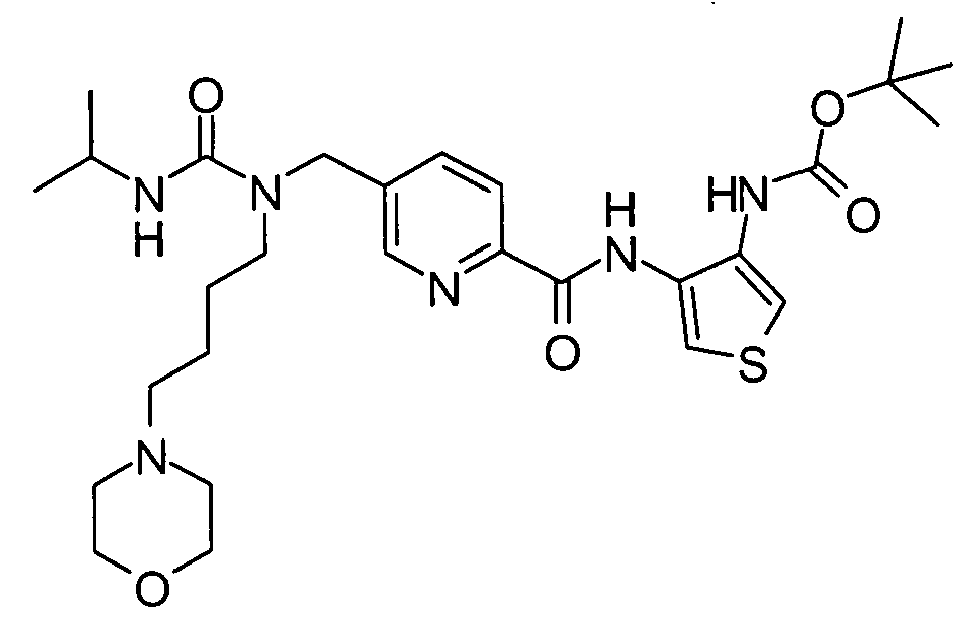
N-(4-t-Butoxycarbonylaminothiophen-3-yl)-5-[3-sec-butyl-1-[4-(morpholin-4-yl)butyl]ureidomethyl]pyridine-2-carboxylic acid amide (Reference Compound No.6-83) 1H-NMR (500 MHz, CDCl3) δ 0.91 (t, J = 7.3 Hz, 3H), 1.14 (d, J = 6.4 Hz, 3H), 1.43-1.52 (m, 4H), 1.54 (s, 9H), 1.59 (m, 2H), 2.33 (t, J = 7.2 Hz, 2H), 2.40 (m, 4H), 3.17 (m, 2H), 3.70 (t, J = 4.7 Hz, 4H), 3.85 (m, 1H), 4.21 (d, J = 7.9 Hz, 1H) , 4.60 (s, 2H), 7.11 (br s, 1H), 7.24 (m, 1H), 7.54 (br s, 1H) , 7.80 (dd, J = 7.9, 2.1 Hz, 1H), 8.23 (d, J = 7.9 Hz, 1H), 8.48 (d, J = 2.1 Hz, 1H), 10.13 (s, 1H) 
N-(4-t-Butoxycarbonylaminothiophen-3-yl)-5-[1-[3-(morpholin-4-yl)propyl]-3-propylureidomethyl]pyridine-2-carboxylic acid amide (Reference Compound No.6-84) 1H-NMR (400 MHz, CDCl3) δ 0.94 (t, J = 7.4 Hz, 3H), 1.54 (s, 9H), 1.55 (m, 2H), 1.67 (m, 2H), 2.38 (t, J = 6.1 Hz, 2H), 2.44 (br s, 4H), 3.16-3.24 (m, 4H), 3.73 (t, J = 4.5Hz, 4H), 4.57 (s, 2H), 7.04 (t, J = 5.6 Hz, 1H) , 7.12 (br s, 1H), 7.24 (m, 1H), 7.52 (s, 1H), 7.84 (dd, J = 7.9, 2.1 Hz, 1H) , 8.22 (d, J = 7.9, 0.6 Hz, 1H) , 8.50 (dd, J = 2.1, 0.6 Hz, 1H), 10.12 (s, 1H) 
N-(4-t-Butoxycarbonylaminothiophen-3-yl)-5-[3-isopropyl-1-[3-(morpholin-4-yl)propyl]ureidomethyl]pyridine-2-carboxylic acid amide (Reference Compound No.6-85) 1H-NMR (400 MHz, CDCl3) δ 1.20 (d, J = 6.6 Hz, 6H), 1.54 (s, 9H), 1.68 (m, 2H), 2.37 (t, J = 6.1 Hz, 2H) , 2.45 (t, J = 4.4 Hz, 4H) , 3.20 (t, J = 6.1 Hz, 2H), 3.76 (t, J = 4.4 Hz, 4H), 4.02 (m, 1H), 4.57 (s, 2H), 5.89 (d, J = 8.1 Hz, 1H), 7.12 (br s, 1H), 7.24 (m, 1H), 7.52 (br s, 1H), 7.84 (dd, J = 8.1, 2.2 Hz, 1H), 8.22 (dd, J = 8.1, 0.7 Hz, 1H), 8.50 (dd, J = 2.2, 0.7 Hz, 1H), 10.13 (s, 1H) 
N-(4-t-Butoxycarbonylaminothiophen-3-yl)-5-[3-sec-butyl-1-[3-(morpholin-4-yl)propyl]ureidomethyl]pyridine-2-carboxylic acid amide (Reference Compound No.6-86) 1H-NMR (500 MHz, CDCl3) δ δ 0.94 (t, J = 7.5 Hz, 3H), 1.17 (d, J= 6.4 Hz, 3H), 1.48 (m, 2H), 1.54 (s, 9H), 1.68 (m, 2H), 2.35 (m, 1H), 2.40 (m, 1H), 2.42 (m, 4H), 3.18 (m, 1H), 3.26 (m, 1H), 3.74 (m, 4H), 3.81 (m, 1H), 4.52 (d, J= 15.9 Hz, 1H), 4.63 (d, J = 15.9 Hz, 1H) , 5.83 (d, J = 8.2 Hz, 1H), 7.12 (br s, 1H), 7.25 (m, 1H), 7.52 (br s, 1H), 7.84 (dd, J = 8.1, 2.0 Hz, 1H) , 8.22 (d, J = 8.1 Hz, 1H) , 8.50 (d, J = 2.0 Hz, 1H) , 10.12 (s, 1H) 
N-(4-t-Butoxycarbonylaminothiophen-3-yl)-5-[3-ethoxycarbonylmethyl-1-[3-(morpholin-4-yl)propyl]ureidomethyl]pyridine-2-carboxylic acid amide (Reference Compound No.6-87) 1H-NMR (500 MHz, CDCl3) δ 1.29 (t, J = 7.2 Hz, 3H), 1.54 (s, 9H), 1.70 (m, 2H), 2.47 (t, J = 6.0 Hz, 2H), 2.48 (br s, 4H), 3.30 (t, J = 5.7 Hz, 2H), 3.68 (br s, 4H), 3.93 (d, J = 5.9 Hz, 2H) , 4.21 (q, J = 7.2 Hz, 2H), 4.59 (s, 2H), 7.16 (br s, 1H), 7.26 (m, 1H), 7.50 (br s, 1H), 7.85 (dd, J = 7.9, 2.0 Hz, 1H), 7.90 (t, J = 5. 9 Hz, 1H), 8.22 (d, J = 7.9 Hz, 1H) , 8.50 (d, J = 2.0 Hz, 1H), 10.10 (s, 1H) 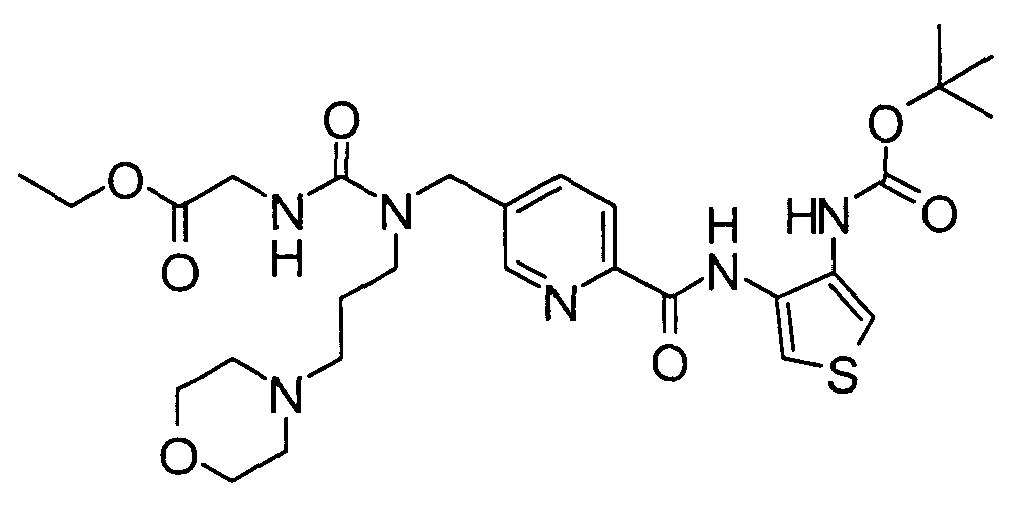
N-(4-t-Butoxycarbonylaminothiophen-3-yl)-5-[3-(3-t-butyldimethylsilyloxymethylphenyl)-1-(2-dimethylaminoethyl)ureidomethyl]pyridine-2-carboxylic acid amide (Reference Compound No.6-88) 1H-NMR (500 MHz, DMSO-d6) δ 0.08 (s, 6H), 0.90 (s, 9H), 1.49 (s, 9H), 2.28 (s, 6H), 2.47 (m, 2H), 3.41 (t, J=4.9 Hz, 2H), 4.66 (br s, 4H), 6.87 (d, J = 7.3 Hz, 1H), 7.19-7.22 (m, 2H), 7.27-7.30 (m, 2H), 7.81 (d, J = 3.7 Hz, 1H) , 7.98 (dd, J = 7.9, 2.1 Hz, 1H), 8.13 (d, J = 7.9 Hz, 1H) , 8.59 (br s, 1H), 9.29 (br s, 1H), 10.29 (brs, 1H), 10.48 (brs, 1H). 
N-(4-t-Butoxycarbonylaminothiophen-3-yl)-5-[1-(2-dimethylaminoethy1)-3-(3-methylphenethyl)ureidomethyl]pyridine-2-carboxylic acid amide (Reference Compound No.6-89) 1H-NMR (400 MHz, DMSO-d6) δ 1.49 (s, 9H), 2.07 (s, 6H), 2.25-2.27 (m, 5H), 2.69 (t, J =7.1 Hz, 2H), 3.23 (t, J = 6.2 Hz, 2H), 3.28 (m, 2H), 4.57 (s, 2H), 6.98-7.06 (m, 4H), 7.14-7.22 (m, 2H), 7.81-7.84 (m, 2H), 8.10 (d, J = 7.8 Hz, 1H), 8.50 (d, J = 1.5 Hz, 1H), 9.29 (br s, 1H), 10.48 (br s, 1H). 
5-[3-Benzyl-1-(2-dimethylaminoethyl)ureidomethyl]-N-(4-t-butoxycar bonylaminothiophen-3-yl)pyridine-2-carboxylic acid amide (Reference Compound No.6-90) 1H-NMR (400 MHz, DMSO-d6) δ 1.50 (s, 9H), 2.09 (s, 6H), 2.34 (t, J = 6.0 Hz, 2H), 4.22-4.27 (m, 4H), 4.62 (s, 2H) , 6.42 (t, J = 6.0 Hz, 1H), 7.13-7.34 (m, 6H), 7.81 (d, J = 3.7 Hz, 1H), 7.89 (dd, J =8.0, 2.0 Hz, 1H), 8.11 (d, J = 8.0 Hz, 1H), 8.52 (d, J = 2.0 Hz, 1H), 9.29 (br s, 1H), 10.48 (br s, 1H). 
N-(4-t-Butoxycarbonylaminothiophen-3-yl)-5-[1-(2-dimethylaminoethy1)-3-(3-phenylpropyl)ureidomethyl]pyridine-2-carboxylic acid amide (Reference Compound No.6-91) 1H-NMR (400 MHz, DMSO-d6) δ 1.48 (s, 9H), 1.68 (m, 2H), 2.13 (s, 6H), 2.32 (t, J = 6.0 Hz, 2H), 2.56 (m, 2H), 2.98 (m, 2H), 3.28 (m, 2H), 4.58 (s, 2H), 6.94 (t, J = 5.1 Hz, 1H), 7.15-7.21 (m, 4H), 7.25-7.29 (m, 2H), 7.81 (d, J = 3.7 Hz, 1H), 7.88 (dd, J = 8.1, 1. 9 Hz, 1H), 8.11 (d, J = 8.1 Hz, 1H), 8.50 (d, J = 1.9 Hz, 1H), 9.29 (br s, 1H), 10.48 (br s, 1H). 
N-(4-t-Butoxycarbonylaminothiophen-3-yl)-5-[1-(2-dimethylaminoethy1)-3-(furan-2-ylmethyl)ureidomethyl]pyridine-2-carboxylic acid amide (Reference Compound No.6-92) 1H-NMR (400 MHz, DMSO-d6) δ 1.50 (s, 9H), 2.10 (s, 6H), 2.32 (t, J = 6.0 Hz, 2H), 3.29 (m, 2H), 4.24 (d, J = 5. Hz, 2H), 4.60 (s, 2H), 6.17 (m, 1H), 6.36-6.38 (m, 2H), 7.22 (d, J = 3.7 Hz, 1H), 7.55 (m, 1H), 7.81 (d, J = 3.7 Hz, 1H), 7.88 (dd, J = 7.8, 1.6 Hz, 1H), 8.11 (d, J = 7.8 Hz, 1H), 8.51 (d, J = 1.6 Hz, 1H), 9.30 (br s, 1H), 10.48 (br s, 1H). 
N-(4-t-Butoxycarbonylaminothiophen-3-yl)-4-[1-(2-dimethylaminoethy1)-3-(thiophen-3-yl)ureidomethyl]benzamide(Reference Compound No.6-93) 1H-NMR (400 MHz, CDCl3) δ 1.52 (s, 9H), 2.36 (s, 6H), 2.45 (t, J = 4.3 Hz, 2H), 3.29 (t, J = 4.3 Hz, 2H), 4.63 (s, 2H), 6.88 (dd, J = 5.1, 1.4 Hz, 1H), 6.98 (d, J = 3 .7 Hz, 1H), 7.10 (s, 1H), 7.20 (dd, J = 5.1, 3.2 Hz, 1H), 7.31 (dd, J = 3.2, 1.4 Hz, 1H), 7.35 (d, J = 8.2 Hz, 2H), 7.71 (d, J = 3.7 Hz, 1H), 7.86 (d, J = 8.2 Hz, 2H), 9.48 (br s, 1H), 11.41 (s, 1H) 
N-(4-t-Butoxycarbonylaminothiophen-3-yl)-4-[3-(2,3-dihydrobenzo[1,4]dioxin-6-yl)-1-(2-dimethylaminoethyl)ureidomethyl]benzamide (Reference Compound No.6-94) 1H-NMR (500 MHz, CDCl3) δ 1.53 (s, 9H), 2.35 (s, 6H), 2.43 (t, J = 4.1 Hz, 2H), 3.30 (t, J = 4.1 Hz, 2H), 4.20-4.25 (m, 4H), 4.62 (s, 2H), 6.77 (d, J = 8.6 Hz, 1H), 6.82 (dd, J = 8.6, 2.4 Hz, 1H), 6.93 (d, J = 2.4 Hz, 1H), 6.96 (s, 1H), 6.98 (d, J =3.7 Hz, 1H), 7.39 (d, J = 8.2 Hz, 2H), 7.71 (d, J = 3.7 Hz, 1H), 7.88 (d, J = 8.2 Hz, 2H), 9.44 (br s, 1H), 10.76 (s, 1H) 
4-[3-Benzyl-1-(2-dimethylaminoethyl)ureidomethyl]-N-(4-t-butoxycarbonylaminothiophen-3-yl)benzamide(Reference Compound No.6-95) 1H-NMR (500 MHz, CDCl3) δ 1.54 (s, 9H), 2.03 (s, 6H), 2.32 (t, J = 4 .4 Hz, 2H), 3.21 (t, J = 4.4 Hz, 2H), 4.39 (d, J = 4.9 Hz, 2H), 4.60 (s, 2H), 6.80 (br s, 1H), 6.96 (d, J = 3.8 Hz, 1H), 7.26 (m, 1H), 7.31-7.33 (m, 4H), 7.38 (d, J = 8.2 Hz, 2H), 7.73 (d, J = 3.8 Hz, 1H), 7.88 (d, J = 8.2 Hz, 2H), 8.22 (br s, 1H), 9.39 (br s, 1H) 
N-(4-t-Butoxycarbonylaminothiophen-3-yl)-4-[1-(2-dimethylaminoethyl)-3-phenethylureidomethyl]benzamide(Reference Compound No.6-96) 1H-NMR (500 MHz, CDCl3) δ 1.52 (s, 9H), 2.04 (s, 6H), 2.27 (t, J = 5.0 Hz, 2H), 2.82 (t, J = 6.8 Hz, 2H), 3.14 (t, J = 5.0 Hz, 2H), 3.51 (q, J = 6.8 Hz, 2H), 4.54 (s, 2H), 7.00 (d, J = 3.7 Hz, 1H), 7.10 (br s, 1H), 7.18-7.21 (m, 3H), 7.26-7.32 (m, 4H), 7.42 (br s, 1H), 7.72 (d, J = 3.7 Hz, 1H), 7.87 (d, J = 8.2 Hz, 2H), 9.50 (br s, 1H) 
N-(4-t-Butoxycarbonylaminothiophen-3-yl)-4-[1-(2-dimethylaminoethyl)-3-isopropylureidomethyl]benzamide(Reference Compound No.6-97) 1H-NMR (400 MHz, CDCl3) 5 1.12 (d, J = 6.6 Hz, 6H), 1.52 (s, 9H), 2.23 (s, 6H), 2.34 (t, J = 4. 6 Hz, 2H), 3.17 (t, J = 4.6 Hz, 2H), 3.89 (m, 1H), 4.54 (s, 2H), 7.03 (d, J = 3.7 Hz, 1H), 7.25 (br s, 1H), 7.31 (d, J = 8.3 Hz, 2H), 7.70 (d, J = 3.7 Hz, 1H), 7.72 (br s, 1H), 7.87 (d, J = 8.3 Hz, 2H), 9.52 (br s, 1H) 
N-(4-t-Butoxycarbonylaminothiophen-3-yl)-4-[3-cyclopentyl-1-(2-dimethylaminoethyl)ureidomethyl]benzamide(Reference Compound No.6-98) 1H-NMR (400 MHz, CDCl3) δ 1.36 (m, 2H), 1.52 (s, 9H), 1.55-1.68 (m, 4H), 1.92 (m, 2H), 2.22 (s, 6H), 2.34 (t, J = 4.5 Hz, 2H), 3.17 (t, J = 4.5 Hz, 2H), 4.06 (m, 1H), 4.54 (s, 2H), 7.04 (d, J = 3.8 Hz, 1H), 7.25 (br s, 1H), 7.32 (d, J = 8.3 Hz, 2H), 7.70 (d, J = 3.8 Hz, 1H), 7.85 (br s, 1H), 7.88 (d, J = 8.3 Hz, 2H), 9.53 (br s, 1H) 
N-(4-t-Butoxycarbonylaminothiophen-3-yl)-5-[1-[3-(4-methylpiperazin-1-yl)propyl]-3-propylureidomethyl]pyridine-2-carboxylic acid amide (Reference Compound No.6-99) 1H-NMR (500 MHz, CDCl3) 5 0.95 (t, J = 7.5 Hz, 3H), 1.54 (s, 9H), 1.56 (m, 2H), 1.65 (m, 2H), 2.31 (s, 3H), 2.37 (t, J = 6.0 Hz, 2H), 2.46 (br s, 8H), 3.18-3.22 (m, 4H), 4.57 (s, 2H), 7.14 (br s, 1H), 7.21 (t, J = 5.8 Hz, 1H), 7.26 (m, 1H), 7.51 (br s, 1H), 7. 84 (dd, J = 7.9, 2.1 Hz, 1H), 8.21 (d, J = 7 .9 Hz, 1H), 8.50 (d, J = 2.1 Hz, 1H), 10.11 (s, 1H) 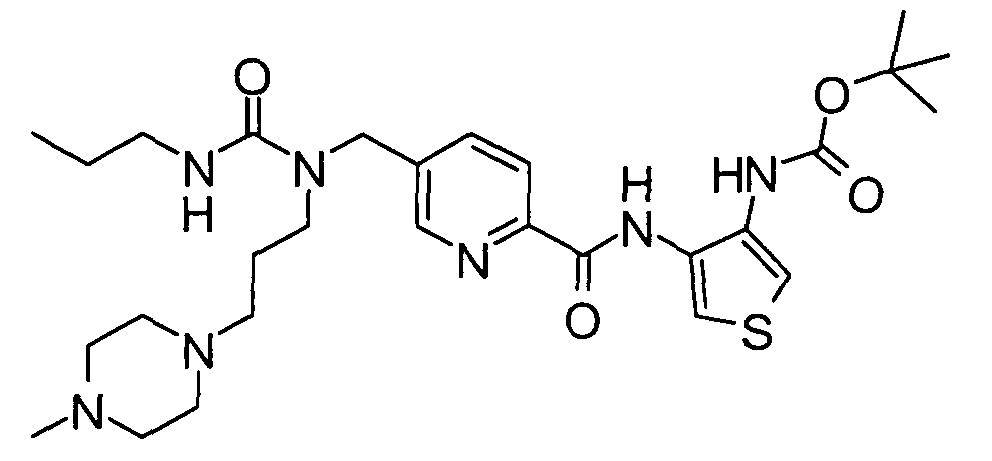
N-(4-t-Butoxycarbonylaminothiophen-3-yl)-5-[3-sec-butyl-1-[3-(4-methylpiperazin-1-yl)propyl]ureidomethyl]pyridine-2-carboxylic acid amide (Reference Compound No.6-100) 1H-NMR (500 MHz, CDCl3) 5 0.95 (t, J = 7.5 Hz, 3H), 1.18 (d, J = 6 .7 Hz, 3H), 1.50 (m, 2H), 1.54 (s, 9H), 1.67 (m, 2H), 2.31 (s, 3H), 2.34 (m, 1H), 2.38 (m, 1H), 2.46 (br s, 8H), 3.16 (m, 1H), 3.24 (m, 1H), 3.80 (m, 1H), 4.52 (d, J = 15.9 Hz, 1H), 4.62 (d, J = 15.9 Hz, 1H), 5.96 (d, J = 7.9 Hz, 1H), 7.14 (br s, 1H), 7.26 (m, 1H), 7.51 (br s, 1H), 7.84 (dd, J = 7.9, 2.1 Hz, 1H), 8.22 (d, J = 7.9 Hz, 1H), 8.50 (d, J = 2.1 Hz, 1H), 10.12 (s, 1H) 
5-[3-Benzyl-1-[3-(4-methylpiperazin-1-yl)propyl]ureidomethyl]-N-(4-t-butoxycarbonylaminothiophen-3-yl)pyridine-2-carboxylic acid amide (Reference Compound No.6-101) 1H-NMR (500 MHz, CDCl3) δ 1.53 (s, 9H), 1.67 (m, 2H), 2.09 (s, 3H), 2.29 (br s, 8H), 2.35 (t, J= 6.0Hz, 2H), 3.28 (t, J = 5.5 Hz, 2H), 4.50 (d, J = 5.7 Hz, 2H), 4.62 (s, 2H), 7.08-7.19 (m, 2H), 7.25 (m, 1H), 7.28-7.35 (m, 4H), 7.51 (br s, 1H), 7.79 (t, J = 5.7 Hz, 1H), 7.87 (dd, J = 7.9, 2.1 Hz, 1H), 8.23 (d, J = 7.9 Hz, 1H), 8.53 (d, J = 2.1 Hz, 1H), 10.12 (s, 1H) 
N-(4-t-Butoxycarbonylaminothiophen-3-yl)-5-[1-[3-(morpholin-4-yl)propyl]-3-phenethylureidomethyl]pyridine-2-carboxylic acid amide (Reference Compound No.6-102) 1H-NMR (500 MHz, CDCl3) δ 1.54 (s, 9H), 1. 61 (m, 2H), 2.24-2.32 (m, 6H), 2.86 (t, J = 6.7 Hz, 2H), 3.14 (t, J = 5.8 Hz, 2H), 3.47 (m, 2H), 3.52 (br s, 4H), 4.58 (s, 2H), 7.15 (t, J = 5.8 Hz, 1H), 7.18-7.24 (m, 5H), 7.28-7.32 (m, 2H), 7.52 (br s, 1H), 7.80 (dd, J = 7.9, 2.0 Hz, 1H), 8.23 (d, J = 7.9 Hz, 1H), 8.50 (d, J = 2.0Hz, 1H), 10.14 (s, 1H) 
N-(4-t-Butoxycarbonylaminothiophen-3-yl)-5-[1-(2-dimethylaminoethyl)ureidomethyl]pyridine-2-carboxylicacidamide (Reference Compound No.6-103) 1H-NMR (400 MHz, DMSO-d6) δ 1.51 (s, 9H), 2.12 (s, 6H), 2.32 (t, J = 6.4 Hz, 2H), 3.26 (t, J = 6.4 Hz, 2H), 4.57 (s, 2H), 6.12 (s, 2H), 7.22 (d, J = 3.7 Hz, 1H), 7.81 (d, J = 3.7 Hz, 1H), 7.89 (dd, J = 8.0, 1.9 Hz, 1H), 8.12 (d, J = 8.0 Hz, 1H), 8.52 (d, J = 1.9 Hz, 1H), 9.29 (br s, 1H), 10.48 (br s, 1H). 
N-(4-t-Butoxycarbonylaminothiophen-3-yl)-5-[1-(2-dimethylaminoethyl)-3-ethylureidomethyl]pyridine-2 -carboxylicacid amide (Reference Compound No.6-104) 1H-NMR (400 MHz, DMSO-d6) 5 1.02 (t, J = 7.2 Hz, 3H), 1.51 (s, 9H), 2.13 (s, 6H), 2.31 (t, J=6.2Hz, 2H), 3.07 (m, 2H), 3.27 (m, 2H), 4.57 (s, 2H), 6.92 (t, J = 5.1 Hz, 1H), 7.22 (d, J = 3.7 Hz, 1H), 7.81 (d, J=3.7Hz, 1H), 7.87 (dd, J = 7.9, 1.7 Hz, 1H), 8.11 (d, J = 7.9 Hz, 1H), 8. 50 (d, J = 1.7 Hz, 1H), 9.29 (br s, 1H), 10.48 (br s, 1H). 
N-(4-t-Butoxycarbonylaminothiophen-3-yl)-4-[1-[3-(morpholin-4-yl)propyl]-3-(thiophen-3-yl)ureidomethyl]benzamide(Reference Compound No.6-105) 1H-NMR (500 MHz, CDCl6) δ 1.52 (s, 9H), 1. 72 (m, 2H), 2.39-2.49 (m, 6H), 3.34 (t, J = 5.8 Hz, 2H), 3.71 (t, J = 4.6 Hz, 4H), 4.62 (s, 2H), 6.93 (br s, 1H), 6.97 (d, J = 3.8 Hz, 1H), 7.10 (dd, J = 5.2, 1.5 Hz, 1H), 7.23 (dd, J = 5.2, 3.1 Hz, 1H), 7.31 (dd, J = 3.1, 1.5 Hz, 1H), 7.38 (d, J = 8.2 Hz, 2H), 7.71 (d, J = 3.8 Hz, 1H), 7.86 (d, J = 8.2 Hz, 2H), 9.08 (br s, 1H), 9.41 (br s, 1H) 
N-(4-t-Butoxycarbonylaminothiophen-3-yl)-4-[3-(2,3-dihydrobenzo[1,4]dioxin-6-yl)-1-[3-(morpholin-4-yl)propyl]ureidmethyl]benzamide (Reference Compound No.6-106) 1H-NMR (500 MHz, CDCl6) δ 1.52 (s, 9H), 1.71 (m, 2H), 2.38-2.47 (m, 6H), 3.34 (t, J = 5.7 Hz, 2H), 3.64 (t, J = 4.6 Hz, 4H), 4.19-4.27 (m, 4H), 4.61 (s, 2H), 6.77 (d, J = 8.7 Hz, 1H), 6.80 (dd, J = 8.7, 2.4 Hz, 1H), 6.97 (d, J = 2.4 Hz, 1H), 6.98 (br s, 1H), 6.99 (d, J = 4.0 Hz, 1H), 7.40 (d, J= 8.2 Hz, 2H), 7.70 (d, J = 4.0 Hz, 1H), 7.87 (d, J = 8.2 Hz, 2H), 8.77 (br s, 1H), 9.41 (br s, 1H) 
4-[3-Benzyl-1-[3-(morpholin-4-yl)propyl]ureidomethyl]-N-(4-t-butoxycarbonylaminothiophen-3-yl)benza mide(Reference Compound No.6-107) 1H-NMR (500 MHz, CDCl6) δ 1.53 (s, 9H), 1.62 (m, 2H), 2.24 (br s, 4H), 2.31 (t, J = 6.0 Hz, 2H), 3.28 (t, J = 5.8 Hz, 2H), 3.41 (br s, 4H), 4.49 (d, J = 5.5 Hz, 2H), 4.61 (s, 2H), 6.91 (br s, 1H), 6.97 (d, J = 3.7 Hz, 1H), 7.23-7.34 (m, 5H), 7.38 (br s, 1H), 7.38 (d, J = 8.2 Hz, 2H), 7.71 (d, J = 3.7Hz, 1H), 7.88 (d, J = 8.2Hz, 2H), 9.41 (br s, 1H) 
N-(4-t-Butoxycarbonylaminothiophen-3-yl)-5-[1-(2-dimethylaminoethyl)-3-(pyridin-2-ylmethyl)ureidomethyl]pyridine-2-carboxylic acid amide (Reference Compound No.6-108) 1H-NMR (500 MHz, DMSO-d6) δ 1.50 (s, 9H), 2.13 (s, 6H), 2.38 (t, J = 6.3 Hz, 2H), 3.35 (t, J = 6.3 Hz, 2H), 4.35 (d, J = 5.4 Hz, 2H), 4.64 (s, 2H), 7.21-7.26 (m, 3H), 7.54 (t, J = 5.4 Hz, 1H), 7.74 (td, J = 7.7, 1.7 Hz, 1H), 7. 81 (d, J = 3.7 Hz, 1H), 7.93 (dd, J = 7.9, 1.7 Hz, 1H), 8.13 (d, J = 7.9 Hz, 1H), 8.48 (m, 1H), 8.54 (d, J = 1.7 Hz, 1H), 9.28 (br s, 1H), 10.48 (br s, 1H). 
N-(4-t-Butoxycarbonylaminothiophen-3-yl)-5-[1-(2-dimethylaminoethyl)-3-(pyridin-3-ylmethyl)ureidomethyl]pyridine-2-carboxylic acid amide (Reference Compound No.6-109) 1H-NMR (500 MHz, DMSO-d6) δ 1.50 (s, 9H), 2.09 (s, 6H), 2.33 (t, J = 6.3Hz, 2H), 3.33 (m, 2H), 4.27 (d, J = 5.3 Hz, 2H), 4.61 (s, 2H), 7.22 (d, J = 3.7 Hz, 1H), 7.33 (dd, J = 7.6, 4.9 Hz, 1H), 7.53 (t, J = 5.3 Hz, 1H), 7.64 (dd, J = 7.6, 1.7 Hz, 1H), 7.81 (d, J = 3.7 Hz, 1H), 7.87 (dd, J - 8.1, 2.1 Hz, 1H), 8.11 (d, J = 8.1 Hz, 1H), 8.43 (dd, J = 4.9, 1.7 Hz, 1H), 8.47 (m, 1H), 8.51 (br s, 1H), 9.29 (brs, 1H), 10.48 (brs, 1H). 
N-(4-t-Butoxycarbonylaminothiophen-3-yl)-5-[1-(2-dimethylaminoethyl)-3-(pyridin-4-ylmethyl)ureidomethyl]pyridine-2-carboxylic acid amide (Reference Compound No.6-110) 1H-NMR (400 MHz, DMSO-d6) δ 1.50 (s, 9H), 2.13 (s, 6H), 2.36 (t, J = 6.3 Hz, 2H), 3.35 (t, J = 6.3 Hz, 2H), 4.27 (d, J = 5.6 Hz, 2H), 4.63 (s, 2H), 7.21-7.23 (m, 3H), 7.53 (br s, 1H), 7.81 (d, J = 3.7 Hz, 1H), 7.90 (dd, J = 8.2, 2.0 Hz, 1H), 8.13 (d, J = 8.2 Hz, 1H), 8.47 (d, J = 6.1 Hz, 2H), 8.52 (d, J = 2.0 Hz, 1H), 9.30 (br s, 1H), 10.48 (br s, 1H). 
N-(4-t-Butoxycarbonylaminothiophen-3-yl)-5-[1-(2-dimethylaminoethy 1)-3-methylureidomethyl]pyridine-2-carboxylic acid amide (Reference Compound No.6-111) 1H-NMR (500 MHz, DMSO-d6) δ 1.51 (s, 9H), 2.12 (s, 6H), 2.30 (t, J = 6.5 Hz, 2H), 2.60 (d, J = 4.3 Hz, 3H), 3.26 (t, J = 6.5 Hz, 2H), 4.57 (s, 2H), 6.66 (m, 1H), 7.22 (d, J = 3.7 Hz, 1H), 7.81 (d, J = 3.7 Hz, 1H), 7.87 (dd, J = 8.0, 1.7 Hz, 1H), 8.11 (d, J = 8.0 Hz, 1H), 8.50 (d, J = 1.7 Hz, 1H), 9.28 (brs, 1H), 10.47 (brs, 1H). 
N-(4-t-Butoxycarbonylaminothiophen-3-yl)-5-[1-(2-dimethylaminoethyl)-3-(2-methoxybenzyl)ureidomethy1]pyridine-2-carboxylic acid amide (Reference Compound No.6-112) 1H-NMR (500 MHz, DMSO-d6) δ 1.50 (s, 9H), 2.10 (s, 6H), 2.35 (t, J = 6.0Hz, 2H), 3.32 (m, 2H), 3.78 (s, 3H), 4.23 (d, J = 5.5 Hz, 2H), 4.62 (s, 2H), 6.89 (t, J = 7.5 Hz, 1H), 6.95 (d, J = 7.5 Hz, 1H), 7.12 (dd, J = 7.5, 0.9 Hz, 1H), 7.20 (m, 1H), 7.22 (d, J=3.5 Hz, 1H), 7.33 (br s, 1H), 7.81 (d, J = 3.5 Hz, 1H), 7.90 (dd, J = 8.1, 1.7 Hz, 1H), 8.11 (d, J = 8.1 Hz, 1H), 8.53 (d, J = 1.7 Hz, 1H), 9.29 (br s, 1H), 10.48 (br s, 1H). 
N-(4-t-Butoxycarbonylaminothiophen-3-yl)-5-[1-(2-dimethylaminoethyl)-3-(3-methoxybenzyl)ureidomethyl]pyridine-2-carboxylic acid amide (Reference Compound No.6-113) 1H-NMR (500 MHz, DMSO-d6) δ 1.50 (s, 9H), 2.10 (s, 6H), 2.35 (t, J = 6.1 Hz, 2H), 3.33 (m, 2H), 3.71 (s, 3H), 4.24 (d, J = 5.3 Hz, 2H), 4.62 (s, 2H), 6.76-6.81 (m, 3H), 7.20 (m, 1H), 7.22 (d, J = 3.7 Hz, 1H), 7.45 (t, J = 5.3 Hz, 1H), 7.82 (d, J = 3.7 Hz, 1H), 7.89 (dd, J = 8.1, 1.7 Hz, 1H), 8.11 (d, J = 8.1 Hz, 1H), 8.52 (d, J = 1.7 Hz, 1H), 9.29 (br s, 1H), 10.47 (br s, 1H). 
N-(4-t-Butoxycarbonylaminothiophen-3-yl)-5-[1-(2-dimethylaminoethyl)-3-(4-methoxybenzyl)ureidomethyl]pyridine-2-carboxylic acid amide (Reference Compound No.6-114) 1H-NMR (500 MHz, DMSO-d6) δ 1.50 (s, 9H), 2.09 (s, 6H), 2.33 (t, J = 6.2 Hz, 2H), 3.29 (t, J = 6.2 Hz, 2H), 3.72 (s, 3H), 4.18 (d, J = 5.3 Hz, 2H), 4.61 (s, 2H), 6.85 (d, J = 8.6 Hz, 2H), 7.16 (d, J = 8.6 Hz, 2H), 7.22 (d, J = 3.7 Hz, 1H), 7.43 (t, J = 5.3 Hz, 1H), 7. 81 (d, J = 3.7 Hz, 1H), 7.88 (dd, J = 8.0, 2.0 Hz, 1H), 8.11 (d, J = 8.0 Hz, 1H), 8.51 (br s, 1H), 9.29 (br s, 1H), 10.48 (br s, 1H). 
N-(4-t-Butoxycarbonylaminothiophen-3-yl)-4-[1-[3-(morpholin-4-yl)propyl]-3-phenethylureidomethyl]benzamide(Reference Compound No.6-115) 1H-NMR (500 MHz, CDCl3) δ 1.53 (s, 9H), 1.56 (m, 2H), 2.24-2.30 (m, 6H), 2.85 (t, J = 6.6 Hz, 2H), 3.15 (t, J = 6.0 Hz, 2H), 3.47 (q, J = 6.6 Hz, 2H), 3.53 (br s, 4H), 4.55 (s, 2H), 6.86 (br s, 1H), 6.88 (br s, 1H), 6.97 (d, J = 3.7 Hz, 1H), 7.17-7.23 (m, 3H), 7.27-7.31 (m, 2H), 7.34 (d, J = 8.2 Hz, 2H), 7.73 (d, J = 3.7 Hz, 1H), 7.88 (d, J = 8.2 Hz, 2H), 9.43 (br s, 1H) 
N-(4-t-Butoxycarbonylaminothiophen-3-yl)-4-[3-isopropyl-1-[3-(morpholin-4-yl)propyl]ureidomethyl]benzamide (Reference Compound No.6-116) 1H-NMR (500 MHz, CDCl3) 5 1.17 (d, J = 6.4 Hz, 6H), 1.53 (s, 9H), 1.65 (m, 2H), 2.34 (t, J = 6.4 Hz, 2H), 2.43 (br s, 4H), 3.22 (t, J = 6.3 Hz, 2H), 3.74 (t, J = 4.7 Hz, 4H), 4.01 (m, 1H), 4.54 (s, 2H), 5.54 (d, J = 7.6 Hz, 1H), 6.96 (br s, 1H), 6.98 (d, J = 3.7 Hz, 1H), 7.34 (d, J = 8.4 Hz, 2H), 7.71 (d, J = 3.7 Hz, 1H), 7.87 (d, J = 8.4 Hz, 2H), 9.44 (br s, 1H) 
N-(4-t-Butoxycarbonylaminothiophen-3-yl)-4-[3-cyclopentyl-1-[3-(morpholin-4-yl)propyl]ureidomethyl] benzamide(Reference Compound No.6-117) 1H-NMR (500 MHz, CDCl3) δ 1.32 (m, 2H), 1.53 (s, 9H), 1.55-1.69 (m, 6H), 2.02 (m, 2H), 2.34 (t, J = 6.4 Hz, 2H), 2.42 (br s, 4H), 3.23 (t, J = 6.3 Hz, 2H), 3.72 (t, J = 4.6 Hz, 4H), 4.11 (m, 1H), 4.54 (s, 2H), 5.55 (d, J = 6.1 Hz, 1H), 6.90 (br s, 1H), 6.97 (d, J = 3.7 Hz, 1H), 7.35 (d, J = 8.4 Hz, 2H), 7.72 (d, J = 3.7 Hz, 1H), 7.88 (d, J = 8.4 Hz, 2H), 9.44 (br s, 1H) 
N-(4-t-Butoxycarbonylaminothiophen-3-yl)-5-[1-(2-dimethylaminoethyl)-3-(2-fluorophenethyl)ureidomethyl]pyridine-2-carboxylic acid amide (Reference Compound No.6-118) 1H-NMR (400 MHz, DMSO-d6) δ 1.49 (s, 9H), 2.07 (s, 6H), 2.26 (t, J = 6 .3 Hz, 2H), 2.77 (t, J = 7.1 Hz, 2H), 3.23 (t, J = 6.3 Hz, 2H), 3.30 (m, 2H), 4.56 (s, 2H), 7.00 (t, J = 5.4 Hz, 1H), 7.09-7.15 (m, 2H), 7.22 (d, J = 3.7 Hz, 1H), 7.22-7.27 (m, 2H), 7.82 (d, J = 3.7 Hz, 1H), 7.82 (m, 1H), 8.10 (d, J = 8.0 Hz, 1H), 8.48 (d, J = 1.2 Hz, 1H), 9.28 (br s, 1H), 10.48 (br s, 1H). 
N-(4-t-Butoxycarbonylaminothiophen-3-yl)-5-[1-(2-dimethylaminoethyl)-3-(3-fluorobenzyl)ureidomethyl]pyridine-2-carboxylic acid amide (Reference Compound No.6-119) 1H-NMR (500 MHz, DMSO-d6) δ 1.50 (s, 9H), 2.11 (s, 6H), 2.35 (t, J = 6.3 Hz, 2H), 3.34 (t, J = 6.3 Hz, 2H), 4.27 (d, J = 5.4 Hz, 2H), 4.62 (s, 2H), 7.01-7.08 (m, 3H), 7.21 (d, J = 3.7 Hz, 1H), 7.33 (m, 1H), 7.49 (t, J = 5.4 Hz, 1H), 7.81 (d, J = 3.7 Hz, 1H), 7. 89 (dd, J = 8.0, 1.9 Hz, 1H), 8.11 (d, J = 7.9 Hz, 1H), 8.51 (br s, 1H), 9.28 (br s, 1H), 10.48 (br s, 1H). 
N-(4-t-Butoxycarbonylaminothiophen-3-yl)-5-[1-(2-dimethylaminoethyl)-3-(4-fluorobenzyl)ureidomethyl]pyridine-2-carboxylic acid amide (Reference Compound No.6-120) 1H-NMR (500 MHz, DMSO-d6) δ 1.50 (s, 9H), 2.09 (s, 6H), 2.33 (t, J = 6.1 Hz, 2H), 3.29 (m, 2H), 4.23 (d, J = 5.5 Hz, 2H), 4.61 (s, 2H), 7.12 (t, J = 8.9 Hz, 2H), 7.21 (d, J = 3.7 Hz, 1H), 7.28 (m, 2H), 7.50 (1, J = 5.5 Hz, 1H), 7.81 (d, J = 3.7 Hz, 1H), 7.88 (dd, J = 7.9, 1.7 Hz, 1H), 8.11 (d, J = 7.9 Hz, 1H), 8.51 (d, J = 1.7 Hz, 1H), 9.29 (br s, 1H), 10.48 (br s, 1H). 
- Benzy bromide (7.8 mL, 66 mmol) was added to a suspension of 4-hydroxymethylbenzoic acid (10 g, 66 mmol) and cesium carbonate (11 g, 34 mmol) in mixed solvent (DMF 0.10 L - methanol 30 mL - water 30mL), and then the reaction mixture was stirred at room temperature for 2 hours. Water (0.50 L) and ethyl acetate (0.50 L) were added to the reaction solution, and the mixture was partitioned. The organic layer was washed with saturated aqueous sodium hydrogen carbonate solution (0.30 L) and water (0.30 L) twice, respectively. The organic layer was dried over anhydrous magnesium sulfate, and then the solvent was evaporated under reduced pressure. The obtained solid was filtered and dried at 35°C under reduced pressure to give 13 g of the title reference compound as a white solid. (Yield 81%)
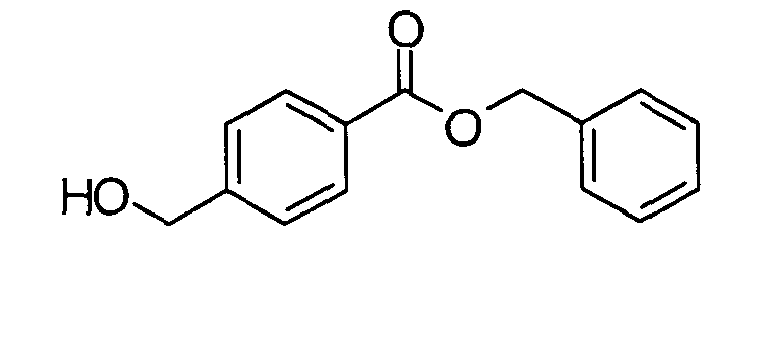
1H-NMR (400 MHz, DMSO-d6) δ 4.58 (d, J = 5.8 Hz, 2H), 5.35 (s, 2H), 5.38 (t, J = 5.8 Hz, 1H), 7.33-7.44 (m, 4H), 7.46 (m, 1H), 7.47 (d, J = 8.2 Hz, 2H), 7.96 (d, J = 8.2 Hz, 2H) - Under ice cooling, methanesulfonyl chloride (2.1 mL, 27 mmol) was added to a solution of 4-hydroxymethylbenzoic acid benzyl ester (Reference Compound No. 7-1, 6.0 g, 24.8 mmol) and triethylamine (7.6 mL, 54 mmol) in dichloromethane (60 mL), and then the reaction mixture was stirred at room temperature for 50 minutes. Brine (0.30 L) was added to the reaction solution, and the mixture was extracted with chloroform (0.15 L) four times. The organic layer was dried over anhydrous magnesium sulfate, and the solvent was evaporated under reduced pressure to give 5.8 g of the title reference compound as yellow oil.
(Yield 73%)
1H-NMR (400 MHz, CDCl3) δ 2.97 (s, 3H), 5.28 (s, 2H), 5.38 (s, 2H), 7.35-7.41 (m, 5H), 7.49 (d, J = 8.2 Hz, 2H), 8.12 (d, J = 8.2 Hz, 2H) - N,N-Dimethylethylenediamine (0.90 mL, 8.2 mmol) was added to a solution of 4-methanesulfonyloxymethylbenzoic acid benzyl ester (Reference Compound No.8-1, 2.3 g, 7.2 mmol) and triethylamine (3.0 mL, 22 mmol) in DMF (10 mL), and then the reaction mixture was stirred at room temperature for 2 hours. Saturated aqueous sodium hydrogen carbonate solution (0.15 L) was added to the reaction solution, and the whole was extracted with chloroform (0.10 L) three times. The organic layer was dried over anhydrous magnesium sulfate, and then the solvent was evaporated under reduced pressure to give 1.2 g of mixture including the title reference compound as yellow oil.

1H-NMR (400 MHz, CDCl3) δ 2.22 (s, 6H), 2.45 (t, J = 6.0 Hz, 2H), 2.69 (t, J = 6.0 Hz, 2H), 3.87 (s, 2H), 5.36 (s, 2H), 7.33-7.46 (m, 7H), 8.03 (d, J = 8.3 Hz, 2H) - By using Reference Compound No. 8-1 and commercially available compounds, the following Reference Compound No.9-2 was obtained by a method similar to that of Reference Compound No.9-1.
4-[3-(Morpholin-4-yl)propylamin omethyl]benzoic acid benzyl ester (Reference Compound No.9-2) 1H-NMR (500 MHz, CDCl3) δ 1.71 (m, 2H), 2.40 (t, J = 7.2 Hz, 2H), 2.43 (Br, s, 4H), 2.68 (t, J = 6.7 Hz, 2H), 3.69 (t, J = 4.7 Hz, 4H), 3.85 (s, 2H), 5.36 (s, 2H), 7.35 (m, 1H), 7.37-7.41 (m, 2H), 7.39 (d, J = 8.2 Hz, 2H), 7.44-7.46 (m, 2H), 8.03 (d, J = 8.2 Hz, 2H) 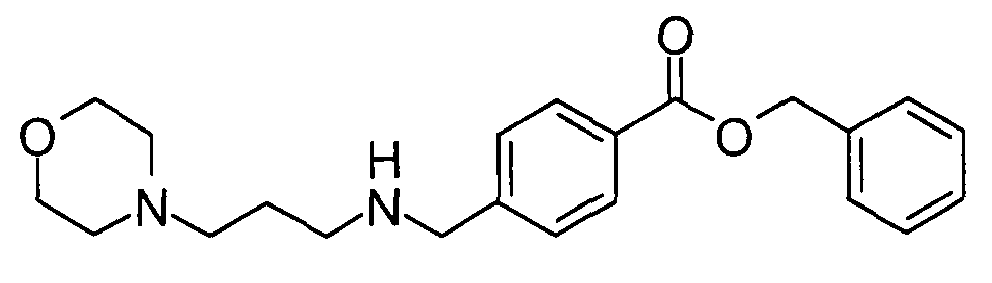
- Indan-5-ylisocyanate (0.62 mL, 4.3 mmol) was added to a solution of a mixture including 4-(2-dimethylaminoethylaminomethyl)benzoic acid benzyl ester (Reference Compound No.9-1, 1.2 g, 3.8 mmol) in dichloromethane (10 mL), and the reaction mixture was stirred at room temperature for 15 hours. The reaction solution was evaporated under reduced pressure and the obtained residue was purified by silica gel column chromatography (chloroform-methanol) to give 0.98 g of the title reference compound as colorless oil.
(Yield 29% in 2 steps)
1H-NMR (500 MHz, CDCl3) δ 2.04 (m, 2H), 2.35 (s, 6H), 2.43 (t, J = 4.3 Hz, 2H), 2.82-2.89 (m, 4H), 3.30 (t, J = 4.3 Hz, 2H), 4.62 (s, 2H), 5.36 (s, 2H), 6.97 (dd, J = 8.2, 1.6 Hz, 1H), 7.10 (d, J = 8.2 Hz, 1H), 7.34-7.37 (m, 4H), 7.39 (d, J = 8.3 Hz, 2H), 7.44 (d, J = 7.0 Hz, 2H), 8.03 (d, J = 8.3 Hz, 2H), 10.72 (s, 1H) - By using Reference Compound No.9-2 and commercially available compounds, the following Reference Compound No.10-2 was obtained by a method similar to that of Reference Compound No.10-1.
4-[3-(2,3-Dihydro-1-benzofuran -5-yl)-1-[3-(morpholin-4-yl)pr opyl]ureidomethyl]benzoic acid benzyl ester (Reference Compound No.10-2) 1H-NMR (400 MHz, CDCl3) 5 1.70 (m, 2H), 2.40 (t, J = 7.2 Hz, 2H), 2.44 (m, 4H), 3.19 (t, J = 8.7 Hz, 2H), 3.35 (t, J = 5.7 Hz, 2H), 3.61 (t, J = 4.5 Hz, 4H), 4.55 (t, J = 8.7 Hz, 2H), 4.61 (s, 2H), 5.36 (s, 2H), 6.71 (d, J = 8.4 Hz, 1H), 6. 9 4 (dd, J = 8.4, 2.2 Hz, 1H), 7.32-7.41 (m, 5H), 7.43-7.48 (m, 3H), 8.02 (d, J = 8.5 Hz, 2H), 8.78 (s, 1H) 
- 10% Palladium-carbon (0.10 g) was added to a solution of 4-[1-(2-dimethylaminoethyl)-3-(indan-5-yl)ureidomethyl]benz oic acid benzyl ester (Reference Compound No.12-1, 0.97 g, 2.1 mmol) in methanol (20 mL), and then the reaction mixture was stirred at room temperature for 29 hours under hydrogen atmosphere. The insoluble materials were filtered out and the filtrate was evaporated under reduced pressure. The obtained solid was filtered with ethyl acetate to give 0.78 g of the title reference compound as a white solid quantitatively.

1H-NMR (500 MHz, DMSO-d6) δ 1.99 (m, 2H), 2.34 (s, 6H), 1.57 (br s, 2H), 2.75-2.82 (m, 4H), 3.39 (t, J = 5.2 Hz, 2H), 4.62 (s, 2H), 7.07-7.09 (m, 2H), 7.31 (s, 1H), 7.38 (d, J = 8.2 Hz, 2H), 7.92 (d, J = 8.2 Hz, 2H), 9.68 (s, 1H) - By using Reference Compound No. 10-2 and commercially available compounds, the following Reference Compound No.11-2 was obtained by a method similar to that of Reference Compound No.11-1.
4-[3-(2,3-Dihydro-1-benzofuran-5-yl)-1-[3-(morpholin-4-yl) propyl]ureidomethyl]benzoic acid (Reference Compound No.11-2) 1H-NMR (400 MHz, CDCl3) δ 1.66 (m, 2H), 2.26 (t, J = 7.0Hz, 2H), 2.32 (m, 4H), 3.13 (t, J = 8.7 Hz, 2H), 3.29 (t, J = 6.8 Hz, 2H), 3.52 (t, J = 6.8 Hz, 4H), 4.48 (t, J = 8.7 Hz, 2H), 4.59 (s, 2H), 6.64 (d, J = 8.5 Hz, 1H), 7.05 (dd, J = 8.5, 2.3 Hz, 1H), 7.33 (d, J = 8.3 Hz, 2H), 7.34 (m, 1H), 7.89 (d, J = 8.3 Hz, 2H), 8.42 (s, 1H) 
- 4.0 M Hydrogen chloride - ethyl acetate solution (5.0 mL) was added to a solution of N-(4-t-butoxycarbonylaminothiophen-3-yl)-5-[3-(2,3-dihydrob enzo[1,4]dioxin-6-yl)-1-(2-dimethylaminoethyl)ureidomethyl] pyridine-2-carboxylic acid amide (Reference Compound No.6-4, 60 mg, 0.10 mmol) in a mixed solvent of ethyl acetate (2.0 mL) - methanol (3.0 mL), and then the reaction mixture was stirred at room temperature for 2 hours. Chloroform (0.10 L) and saturated aqueous sodium hydrogen carbonate solution (0.15 L) were added to a reaction solution, and then the whole was partitioned. The organic layer was washed with brine (0.10 L). The organic layer was dried over anhydrous magnesium sulfate and the solvent was evaporated under reduced pressure. The obtained residue was purified by silica gel column chromatography (chloroform-methanol) to give 38 mg of the title compound as an orange amorphous product. (Yield 77%)

1H-NMR (400 MHz, CDCl3) δ 2.38 (s, 6H), 2.50 (t, J = 4.2 Hz, 2H), 3.31 (t, J = 4.2 Hz, 2H), 3.54 (br s, 2H), 4.20-4.27 (m, 4H), 4.64 (s, 2H), 6.40 (d, J = 3.4 Hz, 1H), 6.78 (d, J = 8.7 Hz, 1H), 6.82 (dd, J = 8.7, 2.4 Hz, 1H), 6.93 (d, J = 2.4 Hz, 1H), 7.62 (d, J = 3.4 Hz, 1H), 7.90 (dd, J = 8.0, 2.2 Hz, 1H), 8.23 (dd, J = 8.0, 0.7 Hz, 1H), 8.57 (dd, J = 2.2, 0.7 Hz, 1H), 10.05 (br s, 1H), 10.84 (br s, 1H) - By using any compounds selected from Reference Compound No. 6-1 ∼ 6-3, 6-5 ∼ 6-120, the following Compounds (No.1-2 ∼ 1-120) were obtained by a method similar to that of Compound No.1-1.
N-(4-Aminothiophen-3-yl)-4-[3-(2,3-dihydrobenzo[1,4]dioxin-6-yl)-1-(2-dimethylaminoethyl)ureidomethyl]benzamide(compound No.1-2) 1H-NMR (400 MHz, CDCl3) δ 2.35 (s, 6H), 2.45 (t, J = 4.3 Hz, 2H), 3.30 (t, J = 4.3 Hz, 2H), 3.43 (s, 2H), 4.20-4.26 (m, 4H), 4.60 (s, 2H), 6.45 (d, J = 3.4 Hz, 1H), 6.77 (t, J = 8.7 Hz, 1H), 6.81 (dd, J = 8.7, 2.3 Hz, 1H), 6.93 (d, J = 2.3 Hz, 1H), 7.41 (d, J = 8.3 Hz, 2H), 7.55 (d, J = 3.4 Hz, 1H), 7.84 (d, J = 8.3 Hz, 2H), 8.26 (s, 1H), 10.79 (s, 1H) 
N-(4-Aminothiophen-3-yl)-5-[3-(3,4-difluorophenyl)-1-[3-(morpholin-4-yl)propyl]ureidomethyl]pyridine-2-carboxylic acid amide (Compound No.1-3) 1H-NMR (400 MHz, CDCl3) 5 1.79 (m, 2H), 2.40-2.53 (m, 6H), 3.37 (t, J = 5.4 Hz, 2H), 3.54 (br s, 2H), 3.67 (t, J = 4.5 Hz, 4H), 4.63 (s, 2H), 6.40 (d, J = 3.4 Hz, 1H), 7.01-7.15 (m, 2H), 7.50 (m, 1H), 7.62 (d, J = 3.4 Hz, 1H), 7.90 (dd, J = 8.1, 2.0 Hz, 1H), 8.23 (d, J = 8.1 Hz, 1H), 8.58 (d, J = 2.0 Hz, 1H), 9.15 (s, 1H), 10.04 (s, 1H) 
N-(4-Aminothiophen-3-yl)-5-[1-[3-(morpholin-4-yl)propyl]-3-phenethylureidomethyl]pyridine-2-carboxylic acid amide (Compound No.1-4) 1H-NMR (400 MHz, CDCl3) 5 1.60 (m, 2H), 2.24-2.33 (m, 6H), 2.87 (t, J = 6.8 Hz, 2H), 3.14 (t, J = 5.7 Hz, 2H), 3.45-3.56 (m, 8H), 4.58 (s, 2H), 6.40 (d, J = 3.3 Hz, 1H), 7.15 (t, J = 5.7 Hz, 1H), 7.18-7.25 (m, 3H), 7.28-7.33 (m, 2H), 7.62 (d, J = 3.3 Hz, 1H), 7.79 (dd, J = 8.1, 2.1 Hz, 1H), 8.22 (dd, J = 8.1, 0.5 Hz, 1H), 8.51 (dd, J = 2.1, 0.5 Hz, 1H), 10.05 (s, 1H) 
N-(4-Aminothiophen-3-yl)-5-[3-(2,3-dihydrobenzo[1,4]dioxin-6-yl)-1-[3-(morpholin-4-yl)propyl]ureidomethyl]pyridine-2-carboxylic acid amide (Compound No.1-5) 1H-NMR (400 MHz, CDCl3) 5 1.76 (m, 2H), 2.42-2.50 (m, 6H), 3.36 (t, J = 5.4 Hz, 2H), 3.54 (br s, 2H), 3.65 (t, J = 4.6 Hz, 4H), 4.23-4.25 (m, 4H), 4.62 (s, 2H), 6.39 (d, J = 3.4 Hz, 1H), 6.79-6.84 (m, 2H), 6.99 (m, 1H), 7.61 (d, J = 3.4 Hz, 1H), 7.91 (dd, J = 7.9, 2.2 Hz, 1H), 8.21 (dd, J = 7.9, 0.7 Hz, 1H), 8.57 (dd, J = 2.2, 0.7 Hz, 1H), 8.96 (s, 1H), 10.04 (s, 1H) 
N-(4-Aminothiophen-3-yl)-5-[1-(2-dimethylaminoethyl)-3-(3-fluorophenyl)ureidomethyl]pyridine-2-carboxylic acid amide (Compound No.1-6) 1H-NMR (400 MHz, CDCl3) 5 2.41 (s, 6H), 2.54 (t, J = 4.2 Hz, 2H), 3.33 (t, J = 4.2 Hz, 2H), 3.54 (br s, 2H), 4.66 (s, 2H), 6.40 (d, J = 3.6 Hz, 1H), 6.68 (tdd, J = 8.4, 2.5, 0.9 Hz, 1H), 7.00 (m, 1H), 7.18-7.31 (m, 2H), 7.63 (d, J = 3.6 Hz, 1H), 7.90 (dd, J = 8.0, 2.1 Hz, 1H), 8.25 (dd, J = 8.0, 0.7 Hz, 1H), 8.58 (dd, J = 2.1, 0.7 Hz, 1H), 10.05 (s, 1H), 11.32 (s, 1H) 
N-(4-Aminothiophen-3-yl)-5-[1-(2-dimethylaminoethyl)-3-(thiophen-3-yl)ureidomethyl]pyridine-2-carboxylic acid amide (Compound No.1-7) 1H-NMR (400 MHz, CDCl3) 5 2.39 (s, 6H), 2.52 (t, J = 4.3 Hz, 2H), 3.31 (t, J = 4.3 Hz, 2H), 3.54 (s, 2H), 4.67 (s, 2H), 6.40 (d, J = 3.4 Hz, 1H), 6.87 (dd, J = 5.1, 1.4 Hz, 1H), 7.21 (dd, J = 5.1, 3.4 Hz, 1H), 7.30 (dd, J = 3.4, 1.4 Hz, 1H), 7.62 (d, J = 3.4 Hz, 1H), 7.89 (dd, J = 8.1, 2.2 Hz, 1H), 8.23 (dd, J = 8.1, 0.6 Hz, 1H), 8.57 (dd, J = 2.2, 0.6 Hz, 1H), 10.04 (s, 1H), 11.49 (s, 1H) 
N-(4-Aminothiophen-3-yl)-5-[1-(2-dimethylaminoethyl)-3-phenethylureidomethyl]pyridine-2-carboxylic acid amide (Compound No.1-8) 1H-NMR (400 MHz, CDCl3) 5 2.04 (s, 6H), 2.30 (t, J = 4.8 Hz, 2H), 2.84 (t, J = 7.0 Hz, 2H), 3.12 (t, J = 4.8 Hz, 2H), 3.52 (td, J = 7.0, 5. 5 Hz, 2H), 3.53 (br s, 2H), 4.58 (s, 2H), 6.40 (d, J = 3.3 Hz, 1H), 7.19-7.24 (m, 3H), 7.30 (m, 2H), 7.62 (d, J = 3.3 Hz, 1H), 7.72 (br s, 1H), 7.80 (dd, J = 8.1, 2.2 Hz, 1H), 8.21 (dd, J = 8.1, 0.7 Hz, 1H), 8.50 (dd, J = 2.2, 0.7 Hz, 1H), 10.05 (s, 1H) 
N-(4-Aminothiophen-3-yl)-5-[3-cyclopentyl-1-(2-dimethylaminoethyl)ureidomethyl]pyridine-2-carboxylic acid amide (Compound No.1-9) 1H-NMR (400 MHz, CDCl3) 5 1.39 (m, 2H), 1.58-1.68 (m, 4H), 1.96 (m, 2H), 2.25 (s, 6H), 2.39 (t, J = 4.4 Hz, 2H), 3.17 (t, J = 4.4 Hz, 2H), 3.54 (s, 2H), 4.07 (m, 1H), 4.59 (s, 2H), 6.40 (d, J = 3.3 Hz, 1H), 7.62 (d, J = 3.3 Hz, 1H), 7.85 (dd, J = 8.0, 2.1 Hz, 1H), 8.06 (d, J = 5.6 Hz, 1H), 8.21 (dd, J = 8.0, 0.7 Hz, 1H), 8.52 (dd, J = 2.1, 0.7 Hz, 1H), 10.04 (s, 1H) 
N-(4-Aminothiophen-3-yl)-5-[3-(benzo[1,3]dioxol-5-yl)-1-(2-dimethylaminoethyl)ureidomethyl]pyridine-2-carboxylicacid amide (Compound No.1-10) 1H-NMR (400 MHz, CDCl3) 5 2.38 (s, 6H), 2.51 (t, J = 4.3 Hz, 2H), 3.32 (t, J = 4.3 Hz, 2H), 3.54 (s, 2H), 4.65 (s, 2H), 5.92 (s, 2H), 6.40 (d, J = 3.3 Hz, 1H), 6.65 (dd, J = 8.3, 2.1 Hz, 1H), 6.73 (d, J = 8.3 Hz, 1H), 7.08 (d, J = 2.1 Hz, 1H), 7.62 (d, J = 3.3 Hz, 1H), 7.90 (dd, J = 8.1, 2.2 Hz, 1H), 8.24 (dd, J = 8.1, 0.7 Hz, 1H), 8.57 (dd, J = 2.2, 0.7 Hz, 1H), 10.05 (s, 1H), 10.95 (s, 1H) 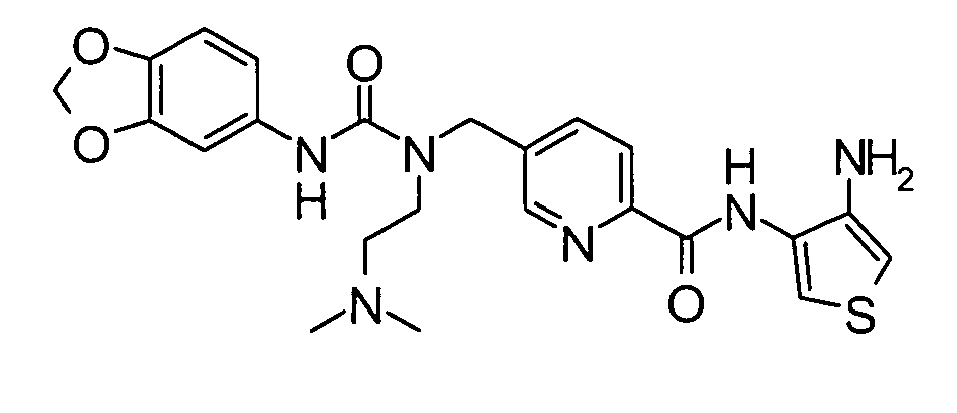
N-(4-Aminothiophen-3-yl)-5-[1-(2-dimethylaminoethyl)-3-(4-fluoro-3-methylphenyl)ureidomethyl]pyridine-2-carboxylic acid amide (Compound No.1-11) 1H-NMR (400 MHz, CDCl3) 5 2.26 (d, J = 1.7 Hz, 3H), 2.39 (s, 6H), 2.53 (t, J = 4.3 Hz, 2H), 3.33 (t, J = 4.3 Hz, 2H), 3.54 (s, 2H), 4.65 (s, 2H), 6.40 (d, J = 3.6 Hz, 1H), 6.91 (t, J = 8.9 Hz, 1H), 7.00 (m, 1H), 7.28 (m, 1H), 7.62 (d, J = 3.6 Hz, 1H), 7.90 (dd, J = 8.1, 2.2 Hz, 1H), 8.24 (dd, J = 8.1, 0.7 Hz, 1H), 8.58 (dd, J = 2.2, 0.7 Hz, 1H), 10.05 (s, 1H), 10.95 (s, 1H) 
N-(4-Aminothiophen-3-yl)-5-[1-(2-dimethylaminoethyl)-3-(3-meth ylphenyl)ureidomethyl]pyridine-2-carboxylic acid amide (Compound No.1-12) 1H-NMR (400 MHz, CDCl3) δ 2.34 (s, 3H), 2.40 (s, 6H), 2.52 (t, J = 4.3 Hz, 2H), 3.33 (t, J = 4.3 Hz, 2H), 3.54 (s, 2H), 4.66 (s, 2H), 6.40 (d, J = 3.4 Hz, 1H), 6.82 (d, J = 7.7 Hz, 1H), 7.05 (d, J = 7.7 Hz, 1H), 7.17 (t, J = 7.7 Hz, 1H), 7.29 (br s, 1H), 7.62 (d, J = 3.4 Hz, 1H), 7.91 (dd, J = 8.1, 2.2 Hz, 1H), 8.24 (dd, J = 8.1, 0.7 Hz, 1H), 8.58 (dd, J = 2.2, 0.7 Hz, 1H), 10.05 (s, 1H), 10.97 (s, 1H) 
N-(4-Aminothiophen-3-yl)-5-[1-(2-dimethylaminoethyl)-3-(3-meth oxyphenyl)ureidomethyl]pyridine -2-carboxylic acid amide (Compound No.1-13) 1H-NMR (400 MHz, CDCl3) 5 2.40 (s, 6H), 2.52 (t, J = 4.3 Hz, 2H), 3.33 (t, J = 4.3 Hz, 2H), 3.54 (s, 2H), 3.82 (s, 3H), 4.66 (s, 2H), 6.40 (d, J = 3.4 Hz, 1H), 6.56 (ddd, J = 8.2, 2.3, 1.0 Hz, 1H), 6.84 (ddd, J = 8.2, 2.3, 1.0 Hz, 1H), 7.15 (t, J = 2.3 Hz, 1H), 7.18 (t, J = 8.2 Hz, 1H), 7.62 (d, J = 3.4 Hz, 1H), 7.90 (dd, J = 8.0, 2.2 Hz, 1H), 8.24 (dd, J = 8.0, 0.7 Hz, 1H), 8.58 (dd, J = 2.2, 0.7 Hz, 1H), 10.05 (s, 1H), 11.12 (s, 1H) 
N-(4-Aminothiophen-3-yl)-5-[1-[3-(morpholin-4-yl)propyl]-3-(th iophen-3-yl)ureidomethyl]pyridi ne-2-carboxylic acid amide (Compound No.1-14) 1H-NMR (400 MHz, CDCl3) 5 1.77 (m, 2H), 2.44-2.50 (m, 6H), 3.36 (t, J = 5.6 Hz, 2H), 3.53 (br s, 2H), 3.72 (t, J = 4.6 Hz, 4H), 4.64 (s, 2H), 6.40 (d, J = 3.3 Hz, 1H), 7.10 (dd, J = 5.1, 1.4 Hz, 1H), 7.24 (dd, J = 5.1, 3.2 Hz, 1H), 7.31 (dd, J = 3.2, 1.4 Hz, 1H), 7.62 (d, J = 3.3 Hz, 1H), 7.90 (dd, J = 8.0, 2.1 Hz, 1H), 8.22 (dd, J = 8.0, 0.7 Hz, 1H), 8.58 (dd, J = 2.1, 0.7 Hz, 1H), 9.24 (br s, 1H), 10.04 (br s, 1H) 
N-(4-Aminothiophen-3-yl)-5-[3-(3-fluorophenyl)-1-[3-(morpholin-4-yl)propyl]ureidomethyl]pyrid ine-2-carboxylic acid amide (Compound No.1-15) 1H-NMR (400 MHz, CDCl3) 5 1.79 (m, 2H), 2.44-2.52 (m, 6H), 3.38 (t, J = 5.6 Hz, 2H), 3.53 (br s, 2H), 3.71 (t, J = 4.6 Hz, 4H), 4.64 (s, 2H), 6.40 (d, J = 3.4 Hz, 1H), 6.78 (tdd, J = 8.3, 2.6, 0.8 Hz, 1H), 7.12 (m, 1H), 7.26 (m, 1H), 7.41 (dt, J = 11.1, 2.3 Hz, 1H), 7.62 (d, J = 3.4 Hz, 1H), 7.90 (dd, J = 8.1, 2.0 Hz, 1H), 8.23 (d, J = 8.1 Hz, 1H), 8.58 (d, J = 2.0 Hz, 1H), 9.03 (br s, 1H), 10.04 (br s, 1H) 
N-(4-Aminothiophen-3-yl)-5-[3-(4-fluoro-3-methylphenyl)-1-[3-(morpholin-4-yl)propyl]ureidomethyl]pyridine-2-carboxylic acid amide (Compound No.1-16) 1H-NMR (400 MHz, CDCl3) δ 1.78 (m, 2H), 2.27 (d, J = 2.0 Hz, 3H), 2.42-2.51 (m, 6H), 3.38 (t, J = 5.5 Hz, 2H), 3.54 (br s, 2H), 3.64 (t, J = 4.5 Hz, 4H), 4.63 (s, 2H), 6.40 (d, J = 3.8 Hz, 1H), 6.95 (t, J = 8.9 Hz, 1H), 7. 13 (m, 1H), 7.30 (dd, J = 6.6, 2.7 Hz, 1H), 7.62 (d, J = 3.8 Hz, 1H), 7.91 (dd, J = 8.1, 2.1 Hz, 1H), 8.22 (dd, J = 8.1, 0.7 Hz, 1H), 8.57 (dd, J = 2.1, 0.7 Hz, 1H), 9.00 (br s, 1H), 10.04 (br s, 1H) 
N-(4-Aminothiophen-3-yl)-5-[3-(2,3-dihydro-1-benzofuran-5-yl)-1-[3-(morpholin-4-yl)propyl]ureidomethyl]pyridine-2-carboxylic acid amide (Compound No.1-17) 1H-NMR (400 MHz, CDCl3) δ 1.77 (m, 2H), 2.44 (br s, 4H), 2.48 (t, J = 6.0 Hz, 2H), 3.21 (t, J = 8.7 Hz, 2H), 3.37 (t, J = 5.5 Hz, 2H), 3.54 (br s, 2H), 3.61 (t, J = 4.5 Hz, 4H), 4.57 (t, J = 8.7 Hz, 2H), 4.63 (s, 2H), 6.40 (d, J = 3.3 Hz, 1H), 6.72 (d, J = 8.4 Hz, 1H), 6.95 (dd, J = 8.4, 2.2 Hz, 1H), 7.34 (d, J = 2.2 Hz, 1H), 7.61 (d, J = 3.3 Hz, 1H), 7.92 (dd, J = 8.1, 2.1 Hz, 1H), 8.22 (dd, J = 8.1, 0.7 Hz, 1H), 8.58 (dd, J = 2.1, 0.7 Hz, 1H), 9.00 (br s, 1H), 10.04 (br s, 1H) 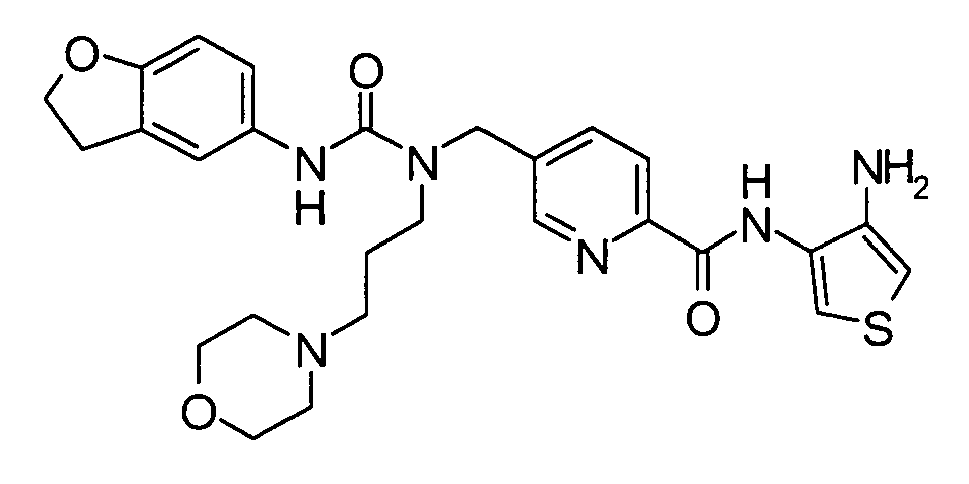
N-(4-Aminothiophen-3-yl)-5-[3-(3,4-difluorophenyl)-1-(2-dimethylaminoethyl)ureidomethyl]pyrid ine-2-carboxylic acid amide (Compound No.1-18) 1H-NMR (400 MHz, CDCl3) 5 2.40 (s, 6H), 2.54 (t, J = 4.2 Hz, 2H), 3.32 (t, J = 4.2 Hz, 2H), 3.52 (br s, 2H), 4.64 (s, 2H), 6.40 (d, J = 3.4 Hz, 1H), 6.91 (m, 1H), 7.04 (m, 1H), 7.39 (ddd, J = 12.7, 7.2, 2.6 Hz, 1H), 7.62 (d, J = 3.4 Hz, 1H), 7.89 (dd, J = 8.0, 2.2 Hz, 1H), 8.24 (dd, J = 8.0, 0.7 Hz, 1H), 8.57 (dd, J = 2.2, 0.7 Hz, 1H), 10.04 (s, 1H), 11.28 (s, 1H) 
N-(4-Aminothiophen-3-yl)-5-[1-(2-dimethylaminoethyl)-3-(4-fluo rophenyl)ureidomethyl]pyridine-2-carboxylic acid amide (Compound No.1-19) 1H-NMR (400 MHz, CDCl3) δ 2.40 (s, 6H), 2.53 (t, J = 4.3 Hz, 2H), 3.34 (t, J = 4.3 Hz, 2H), 3.53 (br s, 2H), 4.65 (s, 2H), 6.40 (d, J = 3.4 Hz, 1H), 6.98 (t, J = 8.9 Hz, 2H), 7.30 (dd, J = 8.9, 4.9 Hz, 2H), 7.62 (d, J = 3.4 Hz, 1H), 7.90 (dd, J = 8.1, 2.2 Hz, 1H), 8.24 (dd, J = 8.1, 0.7 Hz, 1H), 8.58 (dd, J = 2.2, 0.7 Hz, 1H), 10.04 (s, 1H), 11.07 (s, 1H) 
5-[3-(3-Acetylphenyl)-1-(2-dimethylaminoethyl)ureidomethyl]-N-(4-aminothiophen-3-yl)pyridine-2-carboxylic acid amide (Compound No.1-20) 1H-NMR (400 MHz, CDCl3) 5 2.43 (s, 6H), 2.56 (t, J = 4.2 Hz, 2H), 2.61 (s, 3H),3.36 (t, J = 4.2 Hz, 2H), 3.53 (br s, 2H), 4.67 (s, 2H), 6.40 (d, J = 3.5 Hz, 1H), 7.38 (t, J = 7.9 Hz, 1H), 7. 58 (ddd, J = 7.9, 1.5, 1.0 Hz, 1H), 7.63 (d, J = 3.5 Hz, 1H), 7.66 (ddd, J = 7.9, 2.2, 1.0 Hz, 1H), 7.89-7.93 (m, 2H), 8.25 (dd, J = 8.1, 0.5 Hz, 1H), 8.59 (dd, J = 2.2, 0.5 Hz, 1H), 10.05 (s, 1H), 11.42 (s, 1H) 
N-(4-Aminothiophen-3-yl)-5-[3-[2-(benzo[1,3]dioxol-5-yl)ethyl]-1-(2-dimethylaminoethyl)ureidomethyl]pyridine-2-carboxylic acid amide (Compound No.1-21) 1H-NMR (500 MHz, CDCl3) 5 2.11 (s, 6H), 2.33 (t, J = 4.7 Hz, 2H), 2.75 (t, J = 6.8 Hz, 2H), 3.15 (t, J = 4.7 Hz, 2H), 3.46 (q, J = 6.8 Hz, 2H), 3.55 (br s, 2H), 4.58 (s, 2H), 5.92 (s, 2H), 6.39 (d, J = 3.5 Hz, 1H), 6.66 (dd, J = 7.9, 1.6 Hz, 1H), 6.72 (d, J = 1.6 Hz, 1H), 6.74 (d, J = 7.9 Hz, 1H), 7.59 (br s, 1H), 7.62 (d, J = 3.5 Hz, 1H), 7.80 (dd, J = 7.9, 2.1 Hz, 1H), 8.21 (dd, J = 7.9, 0.6 Hz, 1H), 8.47 (dd, J = 2.1, 0.6 Hz, 1H), 10.05 (s, 1H) 
N-(4-Aminothiophen-3-yl)-5-[1-(3-dimethylaminopropyl)-3-(3-methylphenyl)ureidomethyl]pyridine -2-carboxylic acid amide (Compound No.1-22) 1H-NMR (400 MHz, DMSO-d6) δ 1.71 (m, 2H), 2.20 (s, 6H), 2.26 (s, 3H), 2.28 (t, J = 6.3 Hz, 2H), 3.36 (m, 2H), 4.62 (s, 2H), 4.81 (s, 2H), 6.27 (d, J = 3.7 Hz, 1H), 6.75 (d, J = 7.8 Hz, 1H), 7.12 (t, J = 7.8 Hz, 1H), 7.20 (d, J = 7.8 Hz, 1H), 7.28 (s, 1H), 7.65 (d, J = 3.7 Hz, 1H), 7.97 (dd, J = 8.1, 1.8 Hz, 1H), 8.14 (d, J = 8.1 Hz, 1H), 8.67 (d, J = 1.8 Hz, 1H), 9.62 (br s, 1H), 10.19 (br s, 1H). 
N-(4-Aminothiophen-3-yl)-5-[3-(3,4-difluorophenyl)-1-(3-dimethylaminopropyl)ureidomethyl]pyri dine-2-carboxylic acid amide (Compound No.1-23) 1H-NMR (400 MHz, DMSO-d6) δ 1.71 (m, 2H), 2.19 (s, 6H), 2.27 (t, J = 6.2 Hz, 2H), 3.36 (m, 2H), 4.63 (s, 2H), 4.81 (s, 2H), 6.27 (d, J = 3.7 Hz, 1H), 7.09 (m, 1H), 7.31 (m, 1H), 7.65 (d, J = 3.7 Hz, 1H), 7.68 (m, 1H), 7.97 (dd, J = 8.1, 1.8 Hz, 1H), 8.13 (d, J = 8.1 Hz, 1H), 8.67 (d, J = 1.8 Hz, 1H), 9.95 (br s, 1H), 10.19 (s, 1H). 
N-(4-Aminothiophen-3-yl)-5-[l-(3-dimethylaminopropyl)-3-(thiop hen-3-yl)ureidomethyl]pyridine-2-carboxylic acid amide (Compound No.1-24) 1H-NMR (400 MHz, DMSO-d6) δ 1.69 (m, 2H), 2.19 (s, 6H), 2.27 (t, J = 6.0 Hz, 2H), 3.33 (m, 2H), 4.63 (s, 2H), 4.81 (s, 2H), 6.27 (d, J = 3.5 Hz, 1H), 7.04 (dd, J = 5.1, 1.2 Hz, 1H), 7.28 (dd, J = 3.3, 1.2 Hz, 1H), 7.39 (dd, J = 5.1, 3.3 Hz, 1H), 7.65 (d, J = 3.5 Hz, 1H), 7.96 (dd, J = 8.1, 1.7 Hz, 1H), 8.14 (d, J = 8.1 Hz, 1H), 8.66 (d, J = 1.7 Hz, 1H), 10.07 (brs, 1H), 10.19 (s, 1H). 
N-(4-Aminothiophen-3-yl)-5-[3-(2,3-dihydrobenzo[1,4]dioxin-6-yl)-1-(3-dimethylaminopropyl)ureidomethyl]pyridine-2-carboxylic acid amide (Compound No.1-25) 1H-NMR (500 MHz, DMSO-d6) δ 1.68 (m, 2H), 2.17 (s, 6H), 2.26 (t, J = 6.3 Hz, 2H), 3.33 (m, 2H), 4.16-4.21 (m, 4H), 4.60 (s, 2H), 4.81 (br s, 2H), 6.27 (d, J=3.5 Hz, 1H), 6.73 (d, J = 8.7 Hz, 1H), 6.77 (dd, J = 8.7, 2.4 Hz, 1H), 7.07 (d, J=2.4Hz, 1H), 7.64 (d, J = 3.5 Hz, 1H), 7.95 (dd, J = 8.2, 1.9 Hz, 1H), 8.12 (d, J=8.2Hz, 1H), 8.65 (d, J = 1.9 Hz, 1H), 9.44 (br s, 1H), 10.18 (br s, 1H). 
N-(4-Aminothiophen-3-yl)-5-[1-(3-dimethylaminopropyl)-3-(3-flu orophenyl)ureidomethyl]pyridine -2-carboxylic acid amide (Compound No.1-26) 1H-NMR (400 MHz, DMSO-d6) δ 1.72 (m, 2H), 2.20 (s, 6H), 2.28 (t, J = 6.2 Hz, 2H), 3.36 (t, J = 6.2 Hz, 2H), 4.63 (s, 2H), 4.81 (s, 2H), 6.27 (d, J = 3.6 Hz, 1H), 6.74 (m, 1H), 7.08 (d, J = 8.3 Hz, 1H), 7.28 (m, 1H), 7.49 (dt, J = 12.5, 2.2 Hz, 1H), 7.65 (d, J = 3.6 Hz, 1H), 7.98 (dd, J = 8.1, 2.0 Hz, 1H), 8.13 (d, J = 8.1Hz, 1H), 8.68 (d, J = 2.0 Hz, 1H), 10.03 (br s, 1H), 10.19 (br s, 1H). 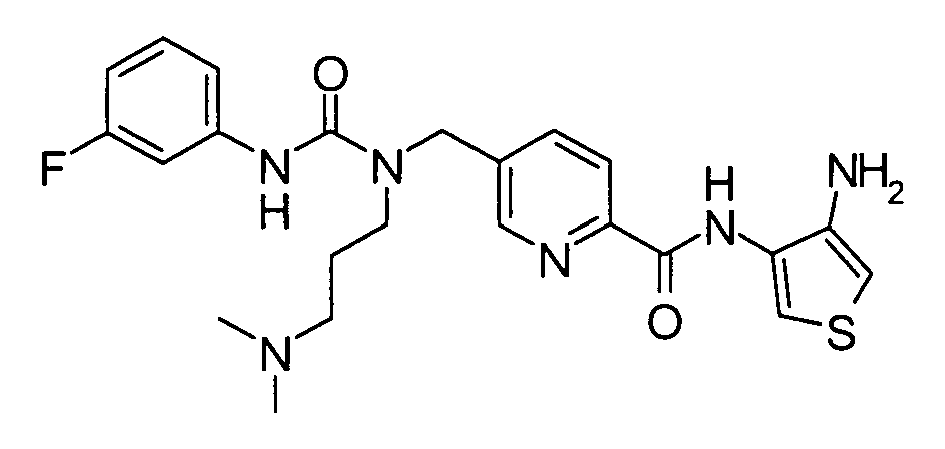
N-(4-Aminothiophen-3-yl)-5-[1-[3-(4-methylpiperazin-1-yl)propyl]-3-(thiophen-3-yl)ureidomethy1]pyridine-2-carboxylic acid amide (Compound No.1-27) 1H-NMR (400 MHz, CDCl3) δ 1.76 (m, 2H), 2.29 (s, 3H), 2.46 (m, 2H), 2.49 (br s, 8H), 3.34 (m, 2H), 3.53 (br s, 2H), 4.63 (s, 2H), 6.39 (d, J = 3 .4 Hz, 1H), 7.13 (d, J = 4.3 Hz, 1H), 7.23 (t, J = 4.3 Hz, 1H), 7.30 (m, 1H), 7.62 (d, J = 3.4 Hz, 1H), 7.90 (d, J = 8.1 Hz, 1H), 8.21 (d, J = 8.1 Hz, 1H), 8.56 (s, 1H), 9.32 (s, 1H), 10.04 (S, 1H) 
N-(4-Aminothiophen-3-yl)-5-[3-(3-methylphenyl)-1-[3-(4-methylpiperazin-1-yl)propyl]ureidomethyl]pyridine-2-carboxylic acid amide (Compound No.1-28) 1H-NMR (400 MHz, CDCl3) δ 1.77 (m, 2H), 2.27 (s, 3H), 2.35 (s, 3H), 2.46 (br s, 8H), 2.47 (t, J = 5.9 Hz, 2H), 3.37 (t, J = 5.4 Hz, 2H), 3.53 (br s, 2H), 4.63 (s, 2H), 6.38 (d, J=3.6 Hz, 1H), 6.90 (d, J = 7.7 Hz, 1H), 7.20 (t, J = 7.7 Hz, 1H), 7. 26-7.31 (m, 2H), 7.61 (d, J = 3.6 Hz, 1H), 7.90 (dd, J = 8.1, 1.7 Hz, 1H), 8.21 (d, J = 8.1 Hz, 1H), 8.57 (d, J = 1.7 Hz, 1H), 8.98 (s, 1H), 10.04 (s, 1H) 
N-(4-Aminothiophen-3-yl)-5-[3-(2,3-dihydrobenzo[1,4]dioxin-6-yl)-1-[3-(4-methylpiperazin-1-yl)propyl]ureidomethyl]pyridine-2 -carboxylic acid amide (Compound No.1-29) 1H-NMR (500 MHz, CDCl3) δ 1 .75 (m, 2H), 2.25 (s, 3H), 2.41 (br s, 8H), 2.46 (t, J = 6.0 Hz, 2H), 3.34 (t, J = 5.3 Hz, 2H), 3.55 (br s, 2H), 4.23-4.25 (m, 4H), 4.60 (s, 2H), 6.38 (d, J = 3.4 Hz, 1H), 6.79 (d, J = 8.7 Hz, 1H), 6.84 (dd, J = 8.7, 2.3 Hz, 1H), 7.02 (d, J=2.3Hz, 1H), 7.61 (d, J = 3.4 Hz, 1H), 7.90 (dd, J = 8.1, 2.0 Hz, 1H), 8.20 (d, J = 8.1 Hz, 1H), 8.56 (d, J = 2.0 Hz, 1H), 9.03 (s, 1H), 10.04 (s, 1H) 
N-(4-Aminothiophen-3-yl)-5-[3-(benzo[1,3]dioxol-5-yl)-1-(3-dim ethylaminopropyl)ureidomethyl]p yridine-2-carboxylic acid amide (Compound No.1-30) 1H-NMR (400 MHz, DMSO-d6) δ 1. 69 (m, 2H), 2.18 (s, 6H), 2.26 (t, J = 6.3 Hz, 2H), 3.33 (m, 2H), 4.61 (s, 2H), 4.81 (br s, 2H), 5.95 (s, 2H), 6.27 (d, J = 3.5 Hz, 1H), 6.73 (dd, J = 8.4, 2.0 Hz, 1H), 6.80 (d, J =8.4 Hz, 1H), 7.18 (d, J = 2.0 Hz, 1H), 7.65 (d, J = 3.5 Hz, 1H), 7.96 (dd, J = 8.1, 2.1 Hz, 1H), 8.13 (dd, J = 8.1, 0.6 Hz, 1H), 8.66 (dd, J = 2.1, 0.6 Hz, 1H), 9.52 (br s, 1H), 10.19 (br s, 1H). 
N-(4-Aminothiophen-3-yl)-5-[1-(3-dimethylaminopropyl)-3-phenethylureidomethyl]pyridine-2-carb oxylic acid amide (Compound No.1-31) 1H-NMR (400 MHz, DMSO-d6) δ 1. 55 (m, 2H), 2.05 (s, 6H), 2.14 (t, J = 6.6 Hz, 2H), 2.74 (t, J = 7.3 Hz, 2H), 3.14 (t, J = 6.6 Hz, 2H), 3.30 (m, 2H), 4.54 (s, 2H), 4.81 (br s, 2H), 6.28 (d, J = 3.7 Hz, 1H), 7.13 (t, J = 5.5 Hz, 1H), 7.18-7.22 (m, 3H), 7.29 (t, J = 7.2 Hz, 2H), 7.65 (d, J = 3.7 Hz, 1H), 7.83 (dd, J = 8.1, 2.2 Hz, 1H), 8.10 (dd, J = 8.1, 0.7 Hz, 1H), 8.57 (dd, J = 2.2, 0.7 Hz, 1H), 10.19 (br s, 1H). 
N-(4-Aminothiophen-3-yl)-5-[3-cyclopentyl-1-(3-dimethylaminopropyl)ureidomethyl]pyridine-2-ca rboxylic acid amide (Compound No.1-32) 1H-NMR (500 MHz, DMSO-d6) δ 1.35 (m, 2H), 1. 49 (m, 2H), 1. 57 (m, 2H), 1.62 (m, 2H), 1.84 (m, 2H), 2.11 (s, 6H), 2.17 (t, J = 6.4 Hz, 2H), 3.17 (t, J = 6.6 Hz, 2H), 3.91 (m, 1H), 4.52 (s, 2H), 4.80 (br s, 2H), 6.27 (d, J = 3.5 Hz, 1H), 6.89 (d, J = 6. 4 Hz, 1H), 7.64 (d, J = 3.5 Hz, 1H), 7.88 (dd, J = 8.2, 1.9 Hz, 1H), 8.11 (d, J = 8.2 Hz, 1H), 8.58 (d, J = 1.9 Hz, 1H), 10.18 (br s, 1H). 
N-(4-Aminothiophen-3-yl)-5-[3-[2-(benzo[1,3]dioxol-5-yl)ethyl]-1-[3-(morpholin-4-yl)propyl]ureidomethyl]pyridine-2-carboxylic acid amide (Compound No.1-33) 1H-NMR (500 MHz, CDCl3) δ 1.62 (m, 2H), 2.29-2.36 (m, 6H), 2.78 (t, J = 6.7 Hz, 2H), 3.16 (t, J = 5.8 Hz, 2H), 3.44 (q, J = 6.7 Hz, 2H), 3.56 (br s, 2H), 3.60 (br s, 4H), 4.57 (s, 2H), 5.92 (s, 2H), 6.39 (d, J = 3.5 Hz, 1H), 6.64 (dd, J = 7.9, 1.5 Hz, 1H), 6.70 (d, J = 1.5 Hz, 1H), 6.75 (d, J = 7.9 Hz, 1H), 7.07 (br s, 1H), 7.62 (d, J = 3.5 Hz, 1H), 7.79 (dd, J = 7.9, 2.1 Hz, 1H), 8.22 (dd, J = 7.9, 0.6 Hz, 1H), 8.46 (dd, J = 2.1, 0.6 Hz, 1H), 10.05 (s, 1H) 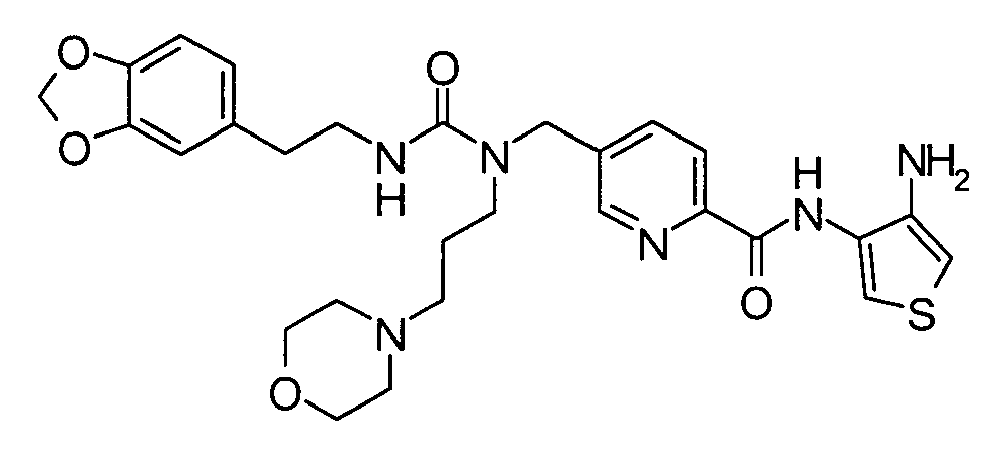
N-(4-Aminothiophen-3-yl)-5-[3-cyclopentyl-1-[3-(morpholin-4-yl )propyl]ureidomethyl]pyridine-2-carboxylic acid amide (Compound No.1-34) 1H-NMR (400 MHz, CDCl3) δ 1.35 (m, 2H), 1.56-1.72 (m, 6H), 2.06 (m, 2H), 2.37 (t, J = 6.1 Hz, 2H), 2.44 (t, J = 4.5 Hz, 4H), 3.21 (t, J = 6.2 Hz, 2H), 3.54 (br s, 2H), 3.74 (t, J = 4.5 Hz, 4H), 4.11 (m, 1H), 4.57 (s, 2H), 5.91 (d, J = 6.8 Hz, 1H), 6.40 (d, J = 3.3 Hz, 1H), 7.62 (d, J = 3.3 Hz, 1H), 7.84 (dd, J = 8.0, 2.2 Hz, 1H), 8.22 (dd, J = 8.0, 0.7 Hz, 1H), 8.53 (dd, J = 2.2, 0.7 Hz, 1H), 10.04 (s, 1H) 
N-(4-Aminothiophen-3-yl)-5-[3-cyclohexyl-1-[3-(morpholin-4-yl) propyl]ureidomethyl]pyridine-2-carboxylic acid amide (Compound No.1-35) 1H-NMR (500 MHz, CDCl3) δ1.11 (m, 2H), 1. 37 (m, 2H), 1.62-1.71 (m, 4H), 1.75 (d, J = 13.7 Hz, 2H), 1.99 (d, J = 12.2 Hz, 2H), 2.36 (t, J = 6.3 Hz, 2H), 2.44 (br s, 4H), 3.21 (t, J = 6.1 Hz, 2H), 3.54 (br s, 2H), 3.65 (m, 1H), 3.76 (t, J = 4.7 Hz, 4H), 4.56 (s, 2H), 5.86 (d, J = 7.6 Hz, 1H), 6.40 (d, J = 3.4 Hz, 1H), 7.61 (d, J = 3.4 Hz, 1H), 7.84 (dd, J = 8.1, 2.0 Hz, 1H), 8.21 (d, J = 8.1 Hz, 1H), 8.52 (d, J = 2.0 Hz, 1H), 10.03 (s, 1H) 
N-(4-Aminothiophen-3-yl)-5-[1-[2-(4-methylpiperazin-1-yl)ethyl]-3-(thiophen-3-yl)ureidomethyl ]pyridine-2-carboxylic acid amide (Compound No.1-36) 1H-NMR (500 MHz, CDCl3) δ 2.32 (s, 3H), 2.52 (br s, 4H), 2.56 (t, J = 4.3 Hz, 2H), 2.64 (br s, 4H), 3.34 (t, J = 4.3 Hz, 2H), 3.55 (br s, 2H), 4.64 (s, 2H), 6.38 (d, J = 3.5 Hz, 1H), 7.15 (dd, J = 5.1, 1.4 Hz, 1H), 7.24 (dd, J = 5.1, 3.2 Hz, 1H), 7.31 (dd, J = 3.2, 1.4 Hz, 1H), 7.62 (d, J = 3.5 Hz, 1H), 7.87 (dd, J = 7.9, 1.8 Hz, 1H), 8.21 (d, J = 7 . 9 Hz, 1H), 8.54 (d, J = 1.8 Hz, 1H), 10.03 (s, 1H), 10.34 (s, 1H) 
N-(4-Aminothiophen-3-yl)-5-[3-(2,3-dihydrobenzo[1,4]dioxin-6-yl)-1-[2-(4-methylpiperazin-1-yl)ethyl]ureidomethyl]pyridine-2-carboxylic acid amide (Compound No.1-37) 1H-NMR (400 MHz, CDCl3) δ 2.30 (s, 3H), 2.51 (br s, 4H), 2.55 (t, J = 4.3 Hz, 2H), 2.63 (br s, 4H), 3.34 (t, J = 4.3 Hz, 2H), 3.54 (br s, 2H), 4.21-4.26 (m, 4H), 4.63 (s, 2H), 6.39 (d, J = 3.4 Hz, 1H), 6. 80 (d, J = 8.5 Hz, 1H), 6.87 (dd, J = 8.5, 2.4 Hz, 1H), 7.03 (d, J=2.4 Hz, 1H), 7.62 (d, J = 3.4 Hz, 1H), 7.89 (dd, J = 7.9, 2.1 Hz, 1H), 8.22 (d, J = 7.9 Hz, 1H), 8.56 (d, J = 2.1 Hz, 1H), 9. 84 (s, 1H), 10.04 (s, 1H) 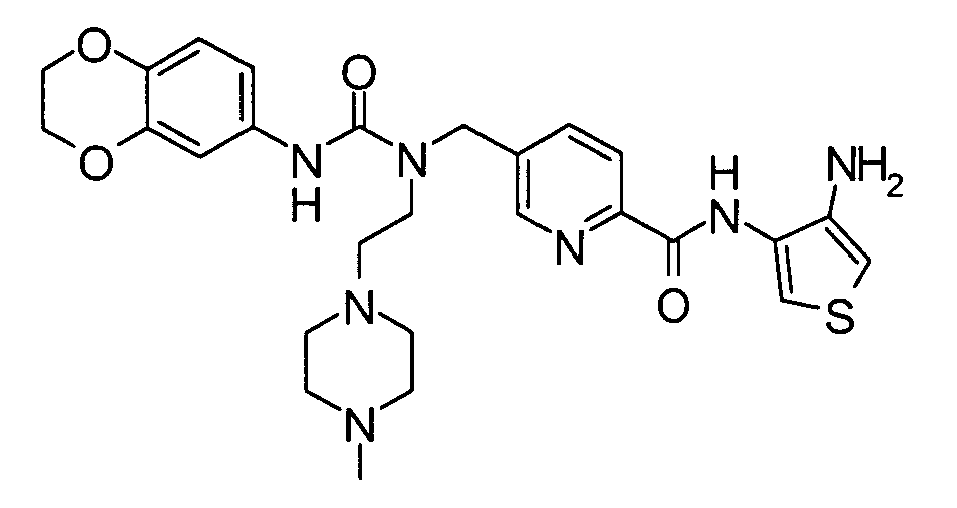
N-(4-Aminothiophen-3-yl)-5-[3-cyclopentyl-1-[2-(4-methylpiperazin-1-yl)ethyl]ureidomethyl]pyr idine-2-carboxylic acid amide (Compound No.1-38) 1H-NMR (400 MHz, CDCl3) δ 1. 42 (m, 2H) ,1.60 (m, 2H), 1.70 (m, 2H), 2.03 (m, 2H), 2.29 (s, 3H), 2.43 (br s, 4H), 2.44 (t, J = 4.5 Hz, 2H), 2.53 (br s, 4H), 3.20 (t, J = 4.5 Hz, 2H), 3.54 (br s, 2H), 4.10 (m, 1H), 4.57 (s, 2H), 6.38 (d, J = 3.7 Hz, 1H), 7.03 (d, J = 7.2 Hz, 1H), 7.61 (d, J = 3.7 Hz, 1H), 7.83 (dd, J = 8.1, 2.2 Hz, 1H), 8.20 (d, J = 8.1 Hz, 1H), 8.50 (d, J = 2.2 Hz, 1H), 10.03 (s, 1H) 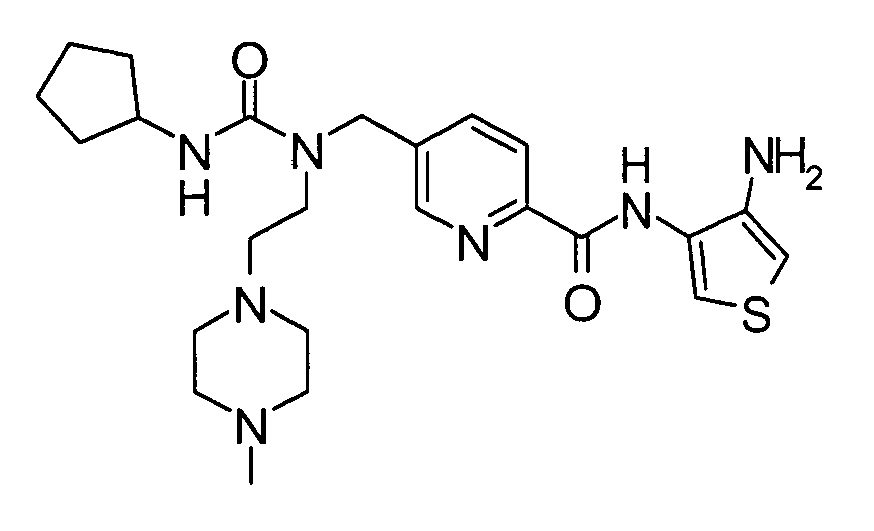
N-(4-Aminothiophen-3-yl)-5-[1-(1-ethylpyrrolidin-2-ylmethyl)-3-(thiophen-3-yl)ureidomethyl]pyridine-2-carboxylic acid amide (Compound No.1-39) 1H-NMR (400 MHz, CDCl3) δ 1.12 (t, J = 7.2 Hz, 3H), 1.55 (m, 1H), 1.75-1.94 (m, 3H), 2.43-2.55 (m, 2H), 2.77-2.89 (m, 2H), 3.18-3.32 (m, 3H), 3.54 (br s, 2H), 4.51 (d, J = 15.9 Hz, 1H), 4.82 (d, J = 15.9 Hz, 1H), 6.40 (d, J = 3.5 Hz, 1H), 6.93 (dd, J = 5.1, 1.5 Hz, 1H), 7.21 (dd, J = 5.1, 3.2 Hz, 1H), 7.27 (m, 1H), 7.62 (d, J = 3.5 Hz, 1H), 7.90 (dd, J = 8.1, 2.2 Hz, 1H), 8.23 (dd, J = 8.1, 0.6 Hz, 1H), 8.57 (dd, J = 2.2, 0.6 Hz, 1H), 10.05 (s, 1H), 11.77 (s, 1H) 
N-(4-Aminothiophen-3-yl)-5-[3-(2,3-dihydrobenzo[1,4]dioxin-6-yl)-1-(1-ethylpyrrolidin-2-ylmethyl)ureidomethyl]pyridine-2-carboxylic acid amide (Compound No.1-40) 1H-NMR (400 MHz, CDCl3) δ 1.09 (t, J = 7.2 Hz, 3H), 1.53 (m, 1H), 1 .74-1 . 96 (m, 3H), 2.41-2.55 (m, 2H), 2.76-2.89 (m, 2H), 3.19-3.35 (m, 3H), 3.58 (br s, 2H), 4.20-4.26 (m, 4H), 4.52 (d, J = 15.6 Hz, 1H), 4.76 (d, J = 15.6 Hz, 1H), 6.39 (d, J = 3.4 Hz, 1H), 6.77 (d, J = 8.8 Hz, 1H), 6.83 (dd, J = 8.8, 2.3 Hz, 1H), 6.95 (d, J = 2.3 Hz, 1H), 7.62 (d, J = 3.4 Hz, 1H), 7.91 (dd, J = 8.1, 2.2 Hz, 1H), 8.23 (dd, J = 8.1, 0.6 Hz, 1H), 8.57 (dd, J = 2.2, 0.6 Hz, 1H), 10.05 (s, 1H), 11.17 (s, 1H) 
N-(4-Aminothiophen-3-yl)-5-[1-(1-ethylpyrrolidin-2-ylmethyl)-3 -phenethylureidomethyl]pyridine-2-carboxylic acid amide (Compound No.1-41) 1H-NMR (400 MHz, CDCl3) δ 0.93 (t, J = 7.2 Hz, 3H), 1.39-1.82 (m, 4H), 2.06-2.26 (m, 2H), 2.63 (m, 2H), 2 .75-2 .91 (m, 3H), 3.08 (m, 2H), 3.38 (m, 1H), 3.52 (br s, 2H), 3.60 (m, 1H), 4.43 (d, J = 15.7 Hz, 1H), 4.72 (d, J = 15.7 Hz, 1H), 6.40 (d, J = 3.4 Hz, 1H), 7.19-7.32 (m, 5H), 7.62 (d, J = 3.4 Hz, 1H), 7.80 (dd, J = 8.0, 2.0 Hz, 1H), 8.21 (d, J = 8.0 Hz, 1H), 8.50 (d, J = 2.0 Hz, 1H), 8.51 (br s, 1H), 10.05 (s, 1H) 
N-(4-Aminothiophen-3-yl)-5-[3-cyclopentyl-1-(1-ethylpyrrolidin-2-ylmethyl)ureidomethyl]pyridine-2-carboxylic acid amide (Compound No.1-42) 1H-NMR (400 MHz, CDCl3) δ 1.07 (t, J = 7.2 Hz, 3H), 1.39 (m, 2H), 1.45-1.87 (m, 8H), 1.98 (m, 2H), 2 .27-2 . 44 (m, 2H), 2 . 69-2 . 80 (m, 2H), 3.06 (m, 1H), 3.14 (d, J = 5.1 Hz, 2H), 3 . 54 (br s, 2H), 4.05 (m, 1H), 4.41 (d, J = 15.6 Hz, 1H), 4.75 (d, J = 15.6 Hz, 1H), 6.39 (d, J = 3 .4 Hz, 1H), 7.61 (d, J = 3 .4 Hz, 1H), 7 . 85 (dd, J = 8.0, 2.1 Hz, 1H), 8.21 (dd, J = 8.0, 0.7 Hz, 1H), 8.37 (d, J = 5.9 Hz, 1H), 8.52 (dd, J = 2.1, 0.7 Hz, 1H), 10.04 (s, 1H) 
N-(4-Aminothiophen-3-yl)-5-[1-(2-dimethylaminoethyl)-3-isopropylureidomethyl]pyridine-2-carbo xylic acid amide (Compound No.1-43) 1H-NMR (500 MHz, DMSO-d6) δ 1.06 (d, J = 6.5 Hz, 6H), 2.15 (s, 6H), 2.33 (t, J = 5.7 Hz, 2H), 3.25 (t, J = 5.7 Hz, 2H), 3.74 (m, 1H), 4.56 (s, 2H), 4.80 (br s, 2H), 6.27 (d, J = 3.7 Hz, 1H), 7.07 (d, J = 6.7 Hz, 1H), 7.64 (d, J = 3.7 Hz, 1H), 7.87 (dd, J = 8.2, 1.9 Hz, 1H), 8.11 (d, J = 8.2 Hz, 1H), 8.58 (d, J = 1.9 Hz, 1H), 10.18 (br s, 1H). 
N-(4-Aminothiophen-3-yl)-5-[1-(2-dimethylaminoethyl)-3-propylureidomethyl]pyridine-2-carboxyl ic acid amide (Compound No.1-44) 1H-NMR (500 MHz, DMSO-d6) δ 0.83 (t, J = 7.3 Hz, 3H), 1.41 (m, 2H), 2.14 (s, 6H), 2.33 (t, J = 6.1 Hz, 2H), 3.00 (m, 2H), 3.27 (t, J = 6.1 Hz, 2H), 4.58 (s, 2H), 4.80 (br s, 2H), 6.27 (d, J = 3.7 Hz, 1H), 6.96 (t, J = 5.3 Hz, 1H), 7 . 65 (d, J = 3.7 Hz, 1H), 7.87 (dd, J = 8.1, 1.8 Hz, 1H), 8.11 (d, J = 8.1 Hz, 1H), 8.57 (d,J=1.8Hz, 1H), 10.18 (br s, 1H). 
N-(4-Aminothiophen-3-yl)-5-[1-(2-dimethylaminoethyl)-3-(4-fluorophenethyl)ureidomethyl]pyridi ne-2-carboxylic acid amide (Compound No.1-45) 1H-NMR (500 MHz, DMSO-d6) δ 2.07 (s, 6H), 2.27 (m, 2H), 2.72 (t, J = 7.2 Hz, 2H), 3.23 (t, J = 6.3 Hz, 2H), 3.28 (m, 2H), 4.56 (s, 2H), 4.80 (br s, 2H), 6.28 (d, J = 3.5 Hz, 1H), 6.96 (t, J = 5.2 Hz, 1H), 7.09 (m, 2H), 7.21 (m, 2H), 7.65 (d, J = 3.5 Hz, 1H), 7.81 (dd, J = 8.0, 1.9 Hz, 1H), 8.10 (d, J = 8.0 Hz, 1H), 8.56 (d, J = 1.9 Hz, 1H), 10.19 (br s, 1H). 
N-(4-Aminothiophen-3-yl)-5-[3-t-butyl-1-(2-dimethylaminoethyl)ureidomethyl]pyridine-2-carboxylic acid amide (Compound No.1-46) 1H-NMR (400 MHz, DMSO-d6) δ 1.27 (s, 9H), 2.17 (s, 6H), 2.35 (t, J = 5.0 Hz, 2H), 3.20 (t, J = 5.0 Hz, 2H), 4.52 (s, 2H), 4.81 (br s, 2H), 6.27 (d, J = 3.5 Hz, 1H), 7.46 (s, 1H), 7. 65 (d, J = 3.5 Hz, 1H), 7.87 (dd, J = 8.1, 1.8 Hz, 1H), 8.11 (d, J= 8.1 Hz, 1H), 8.58 (d, J = 1.8 Hz, 1H), 10.18 (br s, 1H). 
N-(4-Aminothiophen-3-yl)-5-[1-(2-dimethylaminoethyl)-3-(pyridi n-3-yl)ureidomethyl]pyridine-2-carboxylic acid amide (Compound No.1-47) 1H-NMR (400 MHz, DMSO-d6) δ 2.28 (s, 6H), 2.51 (m, 2H), 3.46 (t, J = 5.1 Hz, 2H), 4.69 (s, 2H), 4.80 (br s, 2H), 6.27 (d, J = 3.4 Hz, 1H), 7.28 (dd, J = 8.3, 4:7 Hz, 1H), 7.65 (d, J = 3 .4 Hz, 1H), 7.86 (ddd, J = 8.3, 2 . 6, 1.4 Hz, 1H), 7.98 (dd, J = 8.2, 1.8 Hz, 1H), 8.13 (d, J = 8.2 Hz, 1H), 8.15 (dd, J = 4.7, 1.4 Hz, 1H), 8.52 (d, J = 2.6 Hz, 1H), 8.67 (d, J = 1.8 Hz, 1H), 10.19 (br s, 1H), 10.54 (br s, 1H). 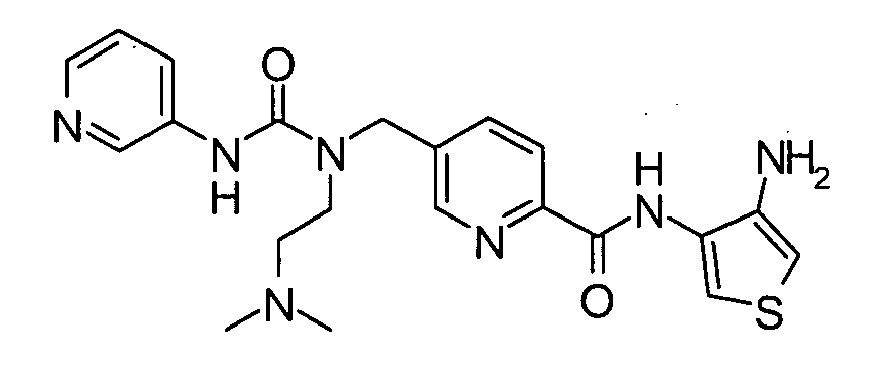
N-(4-Aminothiophen-3-yl)-5-[3-(2,3-dihydro-1-benzofuran-5-yl)-1-(2-dimethylaminoethyl)ureidomethyl]pyridine-2-carboxylic acid amide (Compound No.1-48) 1H-NMR (400 MHz, DMSO-d6) 5 2.25 (s, 6H), 2.46 (t, J = 5.2 Hz, 2H), 3.13 (t, J = 8.7 Hz, 2H), 3.40 (t, J = 5.2 Hz, 2H), 4.47 (t, J = 8.7 Hz, 2H), 4.65 (s, 2H), 4.81 (br s, 2H), 6.27 (d, J = 3 .7 Hz, 1H), 6.63 (d, J = 8.5 Hz, 1H), 6.97 (dd, J = 8.5, 2.2 Hz, 1H), 7.30 (d, J = 2 .2 Hz, 1H), 7.65 (d, J = 3.7 Hz, 1H), 7.96 (dd, J = 8.0, 1.8 Hz, 1H), 8.13 (d, J = 8.0 Hz, 1H), 8.65 (d, J = 1.8 Hz, 1H), 9.79 (br s, 1H), 10.19 (br s, 1H). 
N-(4-Aminothiophen-3-yl)-5-[1-(2-dimethylaminoethyl)-3-hexylureidomethyl]pyridine-2-carboxylic acid amide (Compound No.1-49) 1H-NMR (400 MHz, DMSO-d6) δ 0.85 (t, J = 6.8 Hz, 3H), 1.24 (br s, 6H), 1.39 (m, 2H), 2.14 (s, 6H), 2.33 (m, 2H), 3.03 (m, 2H), 3.27 (t, J = 6.4 Hz, 2H), 4.57 (s, 2H), 4.81 (br s, 2H), 6.27 (d, J = 3.5 Hz, 1H) , 6.92 (t, J = 5. 5 Hz, 1H), 7.65 (d, J = 3.5 Hz, 1H), 7.87 (dd, J = 8.0, 2.2 Hz, 1H), 8.11 (dd, J = 8.0, 0.7 Hz, 1H), 8.57 (dd, J = 2.2, 0.7 Hz, 1H), 10.18 (br s, 1H). 
N-(4-Aminothiophen-3-yl)-5-[3-cyclopropyl-1-(2-dimethylaminoethyl)ureidomethyl]pyridine-2-carboxylic acid amide (Compound No.1-50) 1H-NMR (400 MHz, DMSO-d6) δ 0.32-0.36 (m, 2H), 0.54-0.58 (m, 2H), 2.13 (s, 6H), 2 .30-2.33 (m, 3H), 3.23 (t, J = 5.9 Hz, 2H), 4.56 (s, 2H), 4.81 (br s, 2H), 6.27 (d, J = 3 . 5 Hz, 1H), 7.22 (br s, 1H), 7.65 (d, J = 3 .5 Hz, 1H), 7.86 (dd, J = 8.1, 1.9 Hz, 1H), 8.11 (d, J = 8.1Hz, 1H), 8.57 (d, J = 1.9 Hz, 
N-(4-Aminothiophen-3-yl)-5-[1-[2-(morpholin-4-yl)ethyl]-3-(thi ophen-3-yl)ureidomethyl]pyridine-2-carboxylic acid amide (Compound No.1-51) 1H-NMR (400 MHz, CDCl3) δ 2.57 (t, J = 4.3 Hz, 2H), 2.61 (t, J = 4.5 Hz, 4H), 3.36 (t, J = 4.3 Hz, 2H), 3.55 (br s, 2H), 3.78 (t, J = 4.5 Hz, 4H), 4.67 (s, 2H), 6.40 (d, J = 3 .4 Hz, 1H), 7.11 (dd, J = 5.1, 1.5 Hz, 1H), 7. 2 6 (m, 1H), 7.31 (dd, J = 3.2, 1.5 Hz, 1H), 7.62 (d, J = 3.4 Hz, 1H), 7.89 (dd, J = 8.0, 2.0 Hz, 1H), 8.24 (dd, J = 8.0, 0.6 Hz, 1H), 8.57. (dd, J = 2.0, 0.6 Hz, 1H), 10.03 (br s, 1H), 10.22 (br s, 1H) 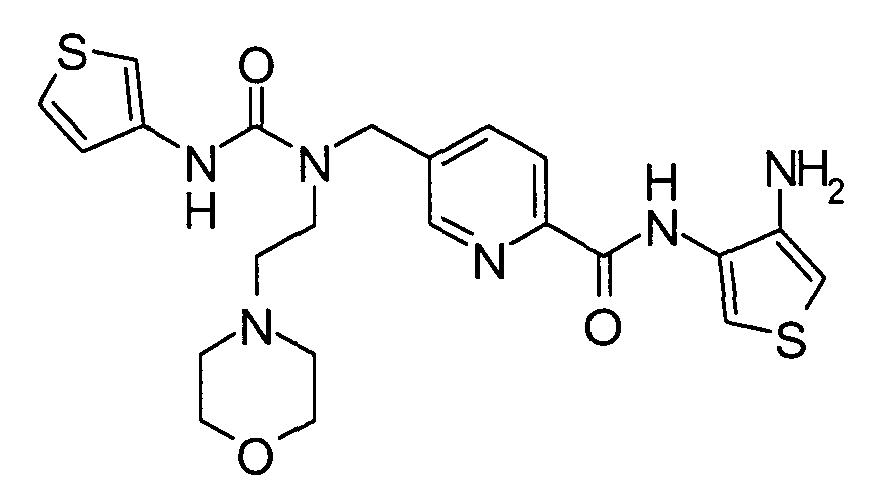
N-(4-Aminothiophen-3-yl)-5-[3-(2,3-dihydrobenzo[1,4]dioxin-6-yl)-1-[2-(morpholin-4-yl)ethyl]ureidomethyl]pyridine-2-carboxylic acid amide (Compound No.1-52) 1H-NMR (400 MHz, CDCl3) δ 2.56 (t, J = 4.4 Hz, 2H), 2.60 (t, J = 4.5 Hz, 4H), 3.36 (t, J = 4.4 Hz, 2H), 3.57 (br s, 2H), 3.76 (t, J = 4. 5 Hz, 4H), 4.21-4.28 (m, 4H), 4.64 (s, 2H), 6.40 (d, J = 3.4 Hz, 1H), 6.81 (d, J = 8.7 Hz, 1H), 6.85 (dd, J = 8.7, 2.4 Hz, 1H), 6. 99 (d, J=2.4 Hz, 1H), 7.62 (d, J = 3.4 Hz, 1H), 7.90 (dd, J = 8.1, 2.0Hz, 1H), 8.23 (dd, J = 8.1, 0.7 Hz, 1H), 8.57 (dd, J = 2.0, 0.7 Hz, 1H), 9.68 (br s, 1H), 10.04 (br s, 1H) 
N-(4-Aminothiophen-3-yl)-5-[1-[2-(morpholin-4-yl)ethyl]-3-phenethylureidomethyl]pyridine-2-ca rboxylic acid amide (Compound No.1-53) 1H-NMR (400 MHz, CDCl3) δ 2.30 (t, J = 4.5 Hz, 4H), 2.36 (t, J = 4.8 Hz, 2H), 2.86 (t, J = 7.0 Hz, 2H), 3.16 (t, J = 4.8 Hz, 2H), 3.45 (br s, 4H), 3.50 (q, J = 7.0 Hz, 2H), 3.55 (br s, 2H), 4.59 (s, 2H), 6.40 (d, J = 3.4 Hz, 1H), 7.18-7.23 (m, 3H), 7.25-7.32 (m, 2H), 7.46 (br s, 1H), 7.62 (d, J = 3.4 Hz, 1H), 7.81 (dd, J = 8.1, 2.1 Hz, 1H), 8.22 (dd, J = 8.1, 0.7 Hz, 1H), 8.51 (dd, J = 2.1, 0.7 Hz, 1H), 10.04 (br s, 1H) 
N-(4-Aminothiophen-3-yl)-5-[3-cyclopentyl-1-[2-(morpholin-4-yl)ethyl]ureidomethyl]pyridine-2-carboxylic acid amide (Compound No.1-54) 1H-NMR (400 MHz, CDCl3) 5 1.40 (m, 2H), 1.57-1.73 (m, 4H), 2.05 (m, 2H), 2.45 (t, J=4.8Hz, 2H), 2.50 (t, J = 4.6 Hz, 4H), 3.23 (t, J = 4.8 Hz, 2H), 3.54 (br s, 2H), 3.71 (t, J = 4.6 Hz, 4H), 4.11 (m, 1H), 4.59 (s, 2H), 6.40 (d, J = 3.4 Hz, 1H), 6.84 (d, J = 6.8 Hz, 1H), 7.61 (d, J = 3.4 Hz, 1H), 7.84 (dd, J = 8.0, 2.1 Hz, 1H), 8.21 (dd, J = 8.0, 0.6 Hz, 1H), 8.52 (dd, J = 2.1, 0.6 Hz, 1H), 10.03 (br s, 1H) 
N-(4-Aminothiophen-3-yl)-5-[1-[3-(4-methylpiperazin-1-yl)propyl]-3-phenethylureidomethyl]pyri dine-2-carboxylic acid amide (Compound No.1-55) 1H-NMR (400 MHz, CDCl3) δ 1.60 (m, 2H), 2.26 (s, 3H), 2.31 (t, J = 6.0 Hz, 2H), 2.32 (br s, 8H), 2.87 (t, J = 6.7 Hz, 2H), 3.13 (t, J = 5. 6 Hz, 2H), 3.48 (q,J=6.7 Hz, 2H), 3.53 (br s, 2H), 4.56 (s, 2H), 6.39 (d, J = 3.4 Hz, 1H), 7.20-7.25 (m, 3H), 7.27-7.35 (m, 3H), 7.62 (d, J = 3.4 Hz, 1H), 7.77 (dd, J = 8.1, 2.2 Hz, 1H), 8.21 (d, J = 8.1 Hz, 1H), 8.50 (d, J = 2.2 Hz, 1H), 10.05 (s, 1H) 
N-(4-Aminothiophen-3-yl)-5-[3-isopropyl-1-[3-(4-methylpiperazin-1-yl)propyl]ureidomethyl]pyri dine-2-carboxylic acid amide (Compound No.1-56) 1H-NMR (500 MHz, CDCl3) δ 1.21 (d, J = 6.4 Hz, 6H), 1.67 (m, 2H), 2.31 (s, 3H), 2.36 (t, J = 6.1 Hz, 2H), 2.49 (br s, 8H), 3.19 (t, J = 6.0 Hz, 2H), 3.57 (br s, 2H), 4.01 (m, 1H), 4.55 (s, 2H), 6.02 (d, J = 8.2 Hz, 1H), 6.38 (d, J = 3.7 Hz, 1H), 7.61 (d, J = 3.7 Hz, 1H), 7.83 (dd, J = 7.9, 1.8 Hz, 1H), 8.20 (d,J=7.9Hz, 1H), 8.51 (d, J = 1.8 Hz, 1H), 10.04 (s, 1H) 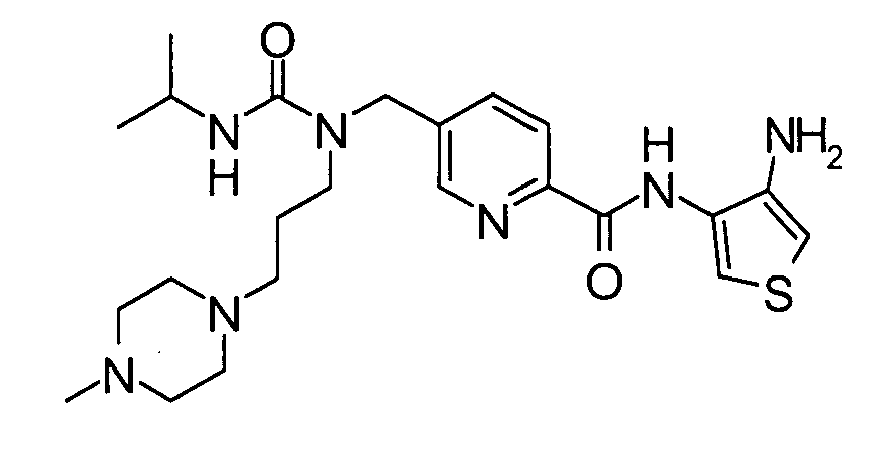
N-(4-Aminothiophen-3-yl)-5-[3-cyclopentyl-1-[3-(4-methylpipera zin-1-yl)propyl]ureidomethyl]pyridine-2-carboxylic acid amide (Compound No.1-57) 1H-NMR (500 MHz, CDCl3) δ 1.38 (m, 2H), 1. 61 (m, 2H), 1.64-1.73 (m, 4H), 2.05 (m, 2H), 2.30 (s, 3H), 2.36 (t, J=6.3 Hz, 2H), 2.47 (br s, 8H), 3.19 (t, J = 6.0 Hz, 2H), 3.54 (br s, 2H), 4.10 (m, 1H), 4.56 (s, 2H), 6.03 (d, J=7.6Hz, 1H), 6.39 (d, J = 3.4 Hz, 1H), 7.61 (d, J = 3.4 Hz, 1H), 7.84 (dd, J =7.9, 1.8 Hz, 1H), 8.21 (d, J = 7.9 Hz, 1H), 8.52 (d, J =1.8 Hz, 1H), 10.04 (s, 1H) 
N-(4-Aminothiophen-3-yl)-5-[3-(2,3-dihydrobenzo[1,4]dioxin-6-yl)-1-[4-(morpholin-4-yl)butyl]ureidomethyl]pyridine-2-carboxylic acid amide (Compound No.1-58) 1H-NMR (400 MHz, CDCl3) δ1.52 (m, 2H), 1.66 (m, 2H), 2.37 (t, J = 7.1 Hz, 2H), 2.40 (m, 4H), 3.28 (t, J = 7.9 Hz, 2H), 3.55 (br s, 2H), 3.63 (t, J = 4.5 Hz, 4H), 4.22-4.24 (m, 4H), 4.65 (s, 2H), 6.39 (d, J = 3.6 Hz, 1H), 6.65 (s, 1H), 6.74 (dd, J = 8.8, 2.4 Hz, 1H), 6.79 (d, J=8.8Hz, 1H), 6.91 (d, J = 2.4 Hz, 1H), 7.62 (d, J = 3.6 Hz, 1H), 7.85 (dd, J =8.1, 2.0 Hz, 1H), 8.22 (d, J = 8.1 Hz, 1H), 8.54 (d, J = 2.0 Hz, 1H), 10.03 (s, 1H) 
N-(4-Aminothiophen-3-yl)-5-[1-[4-(morpholin-4-yl)butyl]-3-phenethylureidomethyl]pyridine-2-carboxylic acid amide (Compound No.1-59) 1H-NMR (500 MHz, CDCl3) δ1.39 (m, 2H), 1.47 (m, 2H), 2.24 (t, J = 7.0 Hz, 2H), 2.33 (m, 4H), 2.85 (t, J = 6.3 Hz, 2H), 3.09 (t, J = 7.8 Hz, 2H), 3.53 (br s, 2H), 3.54 (q, J = 6.3 Hz, 2H), 3.65 (t, J = 4.6 Hz, 4H), 4.57 (s, 2H), 4.77 (t, J = 6.3 Hz, 1H), 6.40 (d, J=3.6 Hz, 1H), 7. 17 (d, J = 7 .2 Hz, 2H), 7.21 (m, 1H), 7.29 (t, J = 7.2 Hz, 2H), 7.63 (d, J = 3.6 Hz, 1H), 7.74 (dd, J =8.1, 2.0 Hz, 1H), 8.20 (d, J = 8.1 Hz, 1H), 8.47 (d, J = 2.0 Hz, 1H), 10.03 (s, 1H) 
N-(4-Aminothiophen-3-yl)-5-[3-cyclopentyl-1-[4-(morpholin-4-yl)butyl]ureidomethyl]pyridine-2-carboxylic acid amide (Compound No.1-60) 1H-NMR (400 MHz, CDCl3) δ 1.32 (m, 2H),1.46 (m, 2H), 1.53-1.65 (m, 6H), 2.00 (m, 2H), 2.31 (t, J = 7.2 Hz, 2H), 2.39 (m, 4H), 3.16 (t, J = 7.6 Hz, 2H), 3.55 (br s, 2H), 3.69 (t, J = 4.6 Hz, 4H), 4.13 (m, 1H), 4.37 (d, J = 6.8 Hz, 1H), 4.57 (s, 2H), 6.38 (d, J = 3.4 Hz, 1H), 7.61 (d, J = 3.4 Hz, 1H), 7.78 (dd, J = 7.9, 2.1 Hz, 1H), 8.20 (d, J=7.9Hz, 1H), 8.49 (d, J = 2.1 Hz, 1H), 10.02 (s, 1H) 
N-(4-Aminothiophen-3-yl)-5-[3-sec-butyl-1-(2-dimethylaminoethyl)ureidomethyl]pyridine-2-carboxylic acid amide (Compound No.1-61) 1H-NMR (500 MHz, DMSO-d6) δ 0.83 (t, J = 7.5 Hz, 3H), 1.03 (d, J = 6.4 Hz, 3H), 1.40 (m 2H), 2.15 (s, 6H), 2.34 (t, J = 5.7 Hz, 2H), 3.25 (m, 2H), 3.58 (m, 1H), 4.55 (d, J = 16.2 Hz, 1H), 4.58 (d, J = 16.2 Hz, 1H), 4.80 (br s, 2H), 6.27 (d, J = 3.7 Hz, 1H), 7.00 (d, J = 7. 6 Hz, 1H), 7.64 (d, J=3.7 Hz, 1H), 7.87 (dd, J = 8.0, 1.9 Hz, 1H), 8.11 (d, J=8.0 Hz, 1H), 8.58 (d, J=1.9Hz, 1H), 10.18 (br s, 1H). 
N-(4-Aminothiophen-3-yl)-5-[1-[3-(morpholin-4-yl)propyl]-3-(3-phenylpropyl)ureidomethyl]pyrid ine-2-carboxylic acid amide (Compound No.1-62) 1H-NMR (MHz,) 5 
N-(4-Aminothiophen-3-yl)-5-[3-benzyl-1-[3-(morpholin-4-yl)prop yl]ureidomethyl]pyridine-2-carboxylic acid amide (Compound No.1-63) 1H-NMR (400 MHz, CDCl3) δ 1.67 (m, 2H), 2.25 (t, J = 4.0 Hz, 4H), 2.34 (t, J = 6.1Hz, 2H), 3.29 (t, J=5.6 Hz, 2H), 3.39 (br s, 4H), 3.54 (s, 2H), 4.49 (d, J = 5.8 Hz, 2H), 4.63 (s, 2H), 6.40 (d, J = 3.4 Hz, 1H), 7.12-7.28 (m, 2H), 7.31-7.34 (m, 3H), 7.57 (t, J = 5.8 Hz, 1H), 7.62 (d, J = 3.4 Hz, 1H), 7.87 (dd, J =8.1, 2.2 Hz, 1H) , 8.23 (dd, J = 8.1, 0.7 Hz, 1H), 8.56 (dd, J = 2.2, 0.7 Hz, 1H), 10.04 (s, 1H). 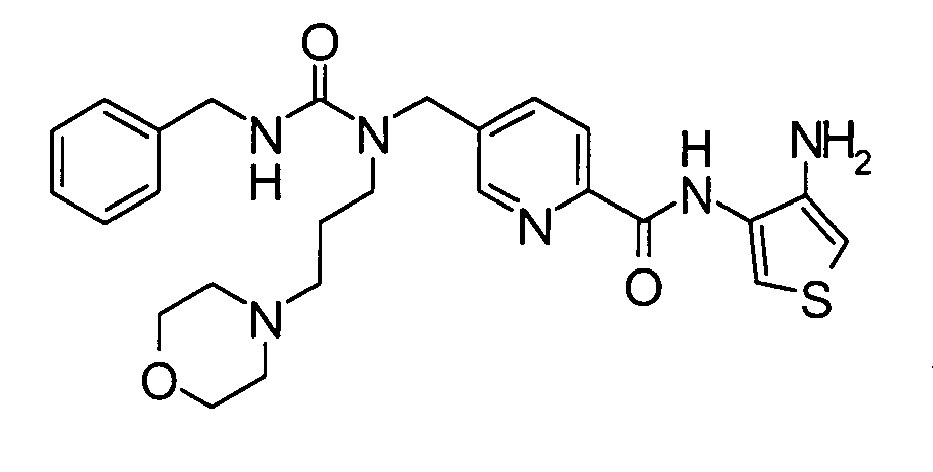
N-(4-Aminothiophen-3-yl)-5-[3-hexyl-1-[3-(morpholin-4-yl)propyl]ureidomethyl]pyridine-2-carbo xylic acid amide (Compound No.1-64) 1H-NMR (400 MHz, CDCl3) δ δ 0.88 (t, J=6.8 Hz, 3H), 1.27-1.34 (m, 6H), 1.52 (m, 2H), 1.65 (m, 2H), 2.38 (t, J = 6.0 Hz, 2H), 2.44 (br s, 4H), 3.18-3.24 (m, 4H), 3.55 (br s, 2H), 3.73 (t, J = 4.6 Hz, 4H), 4.57 (s, 2H), 6.39 (d, J = 3.3 Hz, 1H), 6.98 (br s, 1H), 7.61 (d, J=3.3 Hz, 1H), 7.83 (dd, J = 8.1, 2.2 Hz, 1H), 8.21 (dd, J = 8.0, 0.7 Hz, 1H), 8.52 (dd, J = 2.1, 0.7 Hz, 1H), 10.03 (s, 1H) 
N-(4-Aminothiophen-3-yl)-5-[3-(3,4-dimethoxyphenethyl)-1-[3-(morpholin-4-yl)propyl]ureidomethyl]pyridine-2-carboxylic acid amide (Compound No.1-65) 1H-NMR (400 MHz, CDCl3) δ δ 1.62 (m, 2H), 2.30-2.34 (m, 6H), 2.81 (t, J=6.8Hz, 2H), 3.16 (t, J = 6.0 Hz, 2H), 3.46 (m, 2H), 3.54 (br s, 2H), 3.60 (br s, 4H), 3.83 (s, 3H), 3.84 (s, 3H), 4.57 (s, 2H), 6.39 (d, J=3.7Hz, 1H), 6.73 (dd, J = 8.8, 2.2 Hz, 1H), 6.74 (m, 1H), 6.80 (d, J=8.8Hz, 1H), 7.09 (s, 1H), 7.64 (d, J = 3.7 Hz, 1H), 7.81 (dd, J = 8.0, 2.1 Hz, 1H), 8.21 (dd, J = 8.0, 0.7 Hz, 1H), 8.43 (dd, J = 2.1, 0.7 Hz, 1H), 10.07 (s, 1H) 
N-(4-Aminothiophen-3-yl)-5-[1-(2-dimethylaminoethyl)-3-(4-phenylphenethyl)ureidomethyl]pyridine-2-carboxylic acid amide (Compound No.1-66) 1H-NMR (400 MHz, DMSO-d6) δ 2.07 (s, 6H), 2.28 (t, J = 6.0 Hz, 2H), 2.78 (t, J = 7.2 Hz, 2H), 3.26 (t, J=6.0 Hz, 2H), 3.32 (m, 2H), 4.58 (s, 2H), 4.81 (br s, 2H), 6.28 (d, J = 3.7 Hz, 1H), 6.99 (br s, 1H), 7.27 (d, J = 8.3 Hz, 2H), 7.33 (t, J = 7.4 Hz, 1H) , 7.43 (t, J=7.4 Hz, 2H) , 7.57 (d, J=8.3Hz, 2H), 7.61 (m, 2H), 7.65 (d, J = 3.7 Hz, 1H), 7.86 (dd, J = 8.0, 2.2 Hz, 1H), 8.11 (dd, J = 8.0, 0.7 Hz, 1H), 8.58 (dd, J = 2.2, 0.7 Hz, 1H), 10.20 (br s, 1H). 
N-(4-Aminothiophen-3-yl)-5-[1-(2-dimethylaminoethyl)-3-(4-methoxyphenethyl)ureidomethyl]pyrid ine-2-carboxylic acid amide (Compound No.1-67) 1H-NMR (500 MHz, DMSO-d6) δ 2.08 (s, 6H), 2.27 (t, J = 6.3 Hz, 2H), 2.66 (t, J = 7.2 Hz, 2H), 3.22-3.25 (m, 4H), 3.71 (s, 3H), 4.56 (s, 2H), 4.80 (br s, 2H), 6.27 (d, J = 3.5Hz, 1H), 6.83 (d, J = 8.6 Hz, 2H), 6.92 (t, J = 4.7 Hz, 1H), 7.09 (d, J = 8.6 Hz, 2H), 7.65 (d, J=3.5 Hz, 1H), 7.81 (dd, J = 8.1, 1.9 Hz, 1H), 8.10 (d, J=8.1 Hz, 1H), 8.56 (d, J=1.9 Hz, 1H), 10.19 (br s, 1H). 
N-(4-Aminothiophen-3-yl)-5-[1-[2-(pyrrolidin-1-yl)ethyl]-3-(th iophen-3-yl)ureidomethyl]pyridi ne-2-carboxylic acid amide (Compound No.1-68) 1H-NMR (500 MHz, CDCl3) δ 1.90 (br s, 4H), 2.66-2.75 (m, 6H), 3.35 (t,J=4.3Hz, 2H), 3.51 (br s, 2H), 4.67 (s, 2H), 6.40 (d, J=3.5Hz, 1H), 6.92 (dd, J = 5.0, 1.2 Hz, 1H), 7.21 (dd, J = 5.0, 3.2 Hz, 1H), 7.28 (dd, J = 3.2, 1.2 Hz, 1H), 7.62 (d, J = 3.5 Hz, 1H), 7.89 (dd, J = 8.1, 2.0 Hz, 1H), 8.23 (d, J = 8.1 Hz, 1H), 8.57 (d, J = 2.0 Hz, 1H), 10.04 (s, 1H), 11.24 (s, 1H) 
N-(4-Aminothiophen-3-yl)-5-[3-(2,3-dihydrobenzo[1,4]dioxin-6-yl)-1-[2-(pyrrolidin-1-yl)ethyl]ureidomethyl]pyridine-2-carboxy lic acid amide (Compound No.1-69) 1H-NMR (500 MHz, CDCl3) δ 1.89 (br s, 4H), 2.65-2.74 (m, 6H), 3.34 (t, J=4.3Hz, 2H), 3.53 (br s, 2H), 4.20-4.26 (m, 4H), 4.64 (s, 2H), 6.39 (d, J = 3.4 Hz, 1H), 6.77 (d, J = 8.6 Hz, 1H), 6.80 (dd, J = 8.6, 2.2 Hz, 1H), 6.93 (d, J=2.2 Hz, 1H), 7.62 (d, J = 3.4 Hz, 1H), 7.90 (dd, J = 7.9, 1.8 Hz, 1H), 8.23 (d,J=7.9Hz, 1H), 8.57 (d, J = 1.8 Hz, 1H), 10.04 (s, 1H), 10.60 (s, 1H) 
N-(4-Aminothiophen-3-yl)-5-[3-phenethyl-1-[2-(pyrrolidin-1-yl) ethyl]ureidomethyl]pyridine-2-carboxylic acid amide (Compound No.1-70) 1H-NMR (400 MHz, CDCl3) δ 1.66 (m, 4H), 2.42 (br s, 4H), 2.53 (t, J = 5.1 Hz, 2H), 2.83 (t, J = 7.3 Hz, 2H), 3.18 (t, J = 5.1 Hz, 2H), 3.37 (br s, 2H), 3.46 (q, J=7.3 Hz, 2H), 4.58 (s, 2H), 6.39 (d, J = 3.5 Hz, 1H), 7.19-7.24 (m, 3H),7.29 (m, 2H) , 7.62 (d, J = 3.5 Hz, 1H), 7.76 (br s, 1H), 7.79 (dd, J = 8.0, 2.2 Hz, 1H), 8.20 (dd, J = 8.0, 0.7 Hz, 1H), 8.49 (dd, J=2.2, 0.7 Hz, 1H), 10.05 (s, 1H) 
N-(4-Aminothiophen-3-yl)-5-[3-cyclopentyl-1-[2-(pyrrolidin-1-yl)ethyl]ureidomethyl]pyridine-2 -carboxylic acid amide (Compound No.1-71) 1H-NMR (500 MHz, CDCl3) δ 1.34 (m, 2H), 1.54-1.69 (m, 4H), 1.79 (m, 4H), 2.00 (m, 2H), 2.54-2.62 (m, 6H), 3.21 (t, J = 4.6 Hz, 2H), 3.54 (br s, 2H), 4.07 (m, 1H), 4.59 (s, 2H), 6.39 (d, J = 3.5 Hz, 1H), 7.61 (d, J = 3.5 Hz, 1H), 7.78 (d, J = 5.5 Hz, 1H), 7.84 (dd, J = 8.0, 2.1 Hz, 1H), 8.21 (dd, J = 8.0, 0.6 Hz, 1H), 8.52 (dd, J = 2.1, 0.6 Hz, 1H), 10.04 (s, 1H) 
N-(4-Aminothiophen-3-yl)-5-[1-[3-(pyrrolidin-1-yl)propyl]-3-(t hiophen-3-yl)ureidomethyl]pyrid ine-2-carboxylic acid amide (Compound No.1-72) 1H-NMR (500 MHz, CDCl3)δ 1.72 (m, 2H) , 1.88 (m, 4H), 2.51-2.60 (m, 6H), 3.39 (t, J=5.6 Hz, 2H), 3.52 (br s, 2H), 4.63 (s, 2H), 6.39 (d, J = 3.5 Hz, 1H), 6.96 (dd, J = 5.1, 1.3 Hz, 1H), 7.20 (dd, J = 5.1, 3.3 Hz, 1H), 7.31 (dd, J = 3.3, 1.3 Hz, 1H), 7.61 (d, J = 3.5 Hz, 1H) , 7.90 (dd, J = 8.1, 2.3 Hz, 1H), 8.22 (dd, J = 8.1, 0.7 Hz, 1H), 8.58 (dd, J = 2.3, 0.7 Hz, 1H), 10.04 (s, 1H), 10.25 (s, 1H) 
N-(4-Aminothiophen-3-yl)-5-[3-(2,3-dihydrobenzo[1,4]dioxin-6-yl)-1-[3-(pyrrolidin-1-yl)propyl]ureidomethyl]pyridine-2-carbox ylic acid amide (Compound No.1-73) 1H-NMR (400 MHz, CDCl3) δ 1.72 (m, 2H), 1. 84 (m, 4H), 2.48-2.60 (m, 6H), 3.39 (t, J=5.5 Hz, 2H), 3.54 (br s, 2H), 4.20-4.26 (m, 4H), 4.61 (s, 2H), 6.39 (d,J=3 .4 Hz, 1H), 6.77 (d, J = 8.7 Hz, 1H), 6.86 (dd, J = 8.7, 2.3 Hz, 1H), 7.00 (d, J=2.3 Hz, 1H), 7.61 (d, J = 3.4 Hz, 1H), 7.91 (dd, J = 8.1, 2.2 Hz, 1H), 8.21 (dd, J = 8.1, 0.7 Hz, 1H), 8.58 (dd, J = 2.2, 0.7 Hz, 1H), 9.73 (s, 1H), 10.05 (s, 1H) 
N-(4-Aminothiophen-3-yl)-5-[3-phenethyl-1-[3-(pyrrolidin-1-yl) propyl]ureidomethyl]pyridine-2-carboxylic acid amide (Compound No.1-74) 1H-NMR (500 MHz, CDCl3) δ 1.60 (br s, 2H), 1.70 (br s, 4H), 2.41 (brs, 6H), 2.83 (t, J=6.8Hz, 2H), 3.20 (br s, 2H), 3.45 (q, J = 6.8 Hz, 2H), 3.53 (br s, 2H), 4.56 (s, 2H), 6.40 (d,J-3.7 Hz, 1H), 7.19-7.23 (m, 3H), 7.26-7.31 (m, 2H), 7.62 (d, J = 3.7 Hz, 1H), 7.78 (d, J = 7.9 Hz, 1H), 7.87 (br s, 1H), 8.21 (d, J = 7.9 Hz, 1H), 8.50 (s, 1H), 10.05 (s, 1H) 
N-(4-Aminothiophen-3-yl)-5-[3-cyclopentyl-1-[3-(pyrrolidin-1-yl)propyl]ureidomethyl]pyridine-2-carboxylic acid amide (Compound No.1-75) 1H-NMR (500 MHz, CDCl3) δ 1.31 (m, 2H), 1.54-1.71 (m, 6H), 1.80 (br s, 4H), 2.05 (m, 2H), 2.44 (t, J = 5.8 Hz, 2H), 2.49 (br s, 4H), 3.24 (t, J = 5.8 Hz, 2H), 3.53 (br s, 2H), 4.03 (m, 1H), 4.55 (s, 2H), 6.39 (d, J = 3.4 Hz, 1H), 7.06 (d, J = 6.1Hz, 1H), 7.61 (d, J = 3.4 Hz, 1H), 7.85 (dd, J = 7.9, 2.0 Hz, 1H), 8.21 (d, J = 7.9 Hz, 1H), 8.53 (d, J = 2.0 Hz, 1H), 10.04 (s, 1H) 
N-(4-Aminothiophen-3-yl)-5-[1-[2-(4-methylpiperazin-1-yl)ethyl]-3-phenethylureidomethyl]pyrid ine-2-carboxylic acid amide (Compound No.1-76) 1H-NMR (400 MHz, CDCl3) δ 2.21 (br s, 4H), 2.24 (s, 3H), 2.39 (t, J = 4.5 Hz, 2H), 2.40 (br s, 4H), 2.88 (t, J = 6.5 Hz, 2H), 3.16 (t, J = 4.5 Hz, 2H), 3.49 (q, J = 6.5 Hz, 2H), 3.57 (br s, 2H), 4.59 (s, 2H), 6.40 (d, J = 3.6 Hz, 1H), 7.20-7.24 (m, 3H), 7.30 (t, J=7.3Hz, 2H), 7.63 (d, J = 3.6 Hz, 1H), 7.73 (br s, 1H), 7.80 (dd, J = 8.1, 2.2 Hz, 1H), 8.22 (d, J = 8.1 Hz, 1H), 8.50 (d, J = 2.2 Hz, 1H), 10.05 (s, 1H) 
N-(4-Aminothiophen-3-yl)-5-[2-[3-(benzo[1,3]dioxol-5-yl)]ethyl-1-[2-(4-methylpiperazin-1-yl)ethyl]ureidomethyl]pyridine-2-ca rboxylic acid amide (Compound No.1-77) 1H-NMR (500 MHz, CDCl3) δ 2.24 (s, 3H) , 2.28 (br s, 4H), 2.40 (t, J = 4.6 Hz, 2H), 2.42 (br s, 4H), 2.78 (t, J=6.7Hz, 2H), 3.17 (t, J = 4.6 Hz, 2H), 3.43 (q, J = 6.7 Hz, 2H), 3.56 (br s, 2H), 4.58 (s, 2H), 5.92 (s, 2H), 6.39 (d, J = 3.4 Hz, 1H), 6.65 (dd, J = 7.9, 1.5 Hz, 1H), 6.71 (d, J=1.5Hz, 1H), 6.74 (d, J = 7.9 Hz, 1H), 7.62 (d, J = 3.4 Hz, 1H), 7.65 (br s, 1H), 7.80 (dd, J = 7.9, 2.1 Hz, 1H), 8.21 (d, J = 7.9 Hz, 1H), 8.47 (d, J = 2.1 Hz, 1H), 10.04 (s, 1H) 
N-(4-Aminothiophen-3-yl)-5-[3-isopropyl-1-[2-(4-methylpiperazin-1-yl)ethyl]ureidomethyl]pyrid ine-2-carboxylic acid amide (Compound No.1-78) 1H-NMR (400 MHz, CDCl3) δ 1.23 (d, J = 6.6 Hz, 6H), 2.31 (s, 3H), 2.45 (t, J = 4.6Hz, 2H), 2.47 (brs, 4H), 2.55 (br s, 4H), 3.21 (t, J = 4.6 Hz, 2H), 3.56 (br s, 2H), 4.00 (m, 1H), 4.59 (s, 2H), 6.40 (d, J = 3.4 Hz, 1H), 7.04 (d, J = 7.3 Hz, 1H), 7.62 (d, J = 3.4 Hz, 1H), 7.84 (dd, J = 8.1, 2.2 Hz, 1H), 8.22 (d, J =8.1 Hz, 1H), 8.52 (d, J = 2.2 Hz, 1H), 10.04 (s, 1H) 
N-(4-Aminothiophen-3-yl)-5-[1-(2-dimethylaminoethyl)-3-(2-isopropyloxyethyl)ureidomethyl]pyridine-2-carboxylic acid amide (Compound No.1-79) 1H-NMR (500 MHz, DMSO-d6) δ 1.07 (d, J = 6.1 Hz, 6H), 2.14 (s, 6H), 2.33 (t, J =6.1 Hz, 2H), 3.17 (m, 2H), 3.27 (t, J = 6.1 Hz, 2H), 3.37 (t, J = 6.0 Hz, 2H), 3.53 (m, 1H), 4.58 (s, 2H), 4.79 (br s, 2H), 6.28 (d, J = 3.7 Hz, 1H), 6.99 (t, J = 5.2 Hz, 1H), 7.64 (d, J=3.7 Hz, 1H), 7.88 (dd, J = 8.0, 1.9 Hz, 1H), 8.10 (d,J =8.0 Hz, 1H), 8.58 (d, J = 1.9 Hz, 1H), 10.18 (br s, 1H). 
N-(4-Aminothiophen-3-yl)-5-[1-(2-dimethylaminoethyl)-3-[2-(thiophen-2-yl)ethyl]ureidomethyl]p yridine-2-carboxylic acid amide (Compound No.1-80) 1H-NMR (500 MHz, DMSO-d6) δ 2.11 (s, 6H), 2.32 (t, J = 6.2 Hz, 2H), 2.95 (t, J = 7.0 Hz, 2H), 3.26 (t, J = 6.2 Hz, 2H), 3.30 (m, 2H), 4.58 (s, 2H), 4.80 (br s, 2H), 6.28 (d, J = 3.4 Hz, 1H), 6.86 (m, 1H), 6.95 (m, 1H), 7.10 (t, J = 5.2 Hz, 1H), 7.33 (dd, J = 5.2, 1.2 Hz, 1H), 7.65 (d, J = 3.4 Hz, 1H), 7.85 (dd, J = 8.1, 1.8 Hz, 1H), 8.10 (d, J = 8.1Hz, 1H), 8.57 (d, J = 1.8 Hz, 1H), 10.19 (br s, 1H). 
N-(4-Aminothiophen-3-yl)-5-[3-(3-chlorophenethyl)-1-(2-dimethylaminoethyl)ureidomethyl]pyridine-2-carboxylic acid amide (Compound No.1-81) 1H-NMR (400 MHz, DMSO-d6) δ 2.07 (s, 6H), 2.26 (t, J = 6.2 Hz, 2H), 2.76 (t, J = 6.8 Hz, 2H), 3.22 (t, J=6.2 Hz, 2H), 3.30 (m, 2H), 4.56 (s, 2H), 4.81 (br s, 2H), 6.28 (d, J = 3.5 Hz, 1H), 6.98 (t, J = 5.2 Hz, 1H), 7.16 (dt, J = 7.3, 1.3 Hz, 1H), 7.24-7.33 (m, 3H), 7.65 (d, J = 3.5 Hz, 1H), 7.80 (dd, J = 8.1, 2.1 Hz, 1H), 8.09 (dd, J = 8.1, 0.7 Hz, 1H), 8.55 (dd, J = 2.1, 0.7 Hz, 1H), 10.19 (br s, 1H). 
N-(4-Aminothiophen-3-yl)-5-[1-[4-(morpholin-4-yl)butyl]-3-propylureidomethyl]pyridine-2-carboxylic acid amide (Compound No.1-82) 1H-NMR (400 MHz, CDCl3) δ 0.91 (t, J = 7.3 Hz, 3H), 1. 48 (m, 2H), 1.50-1.63 (m, 4H), 2.34 (t, J = 6.8 Hz, 2H), 2.41 (m, 4H), 3.17 (t, J = 7.7 Hz, 2H), 3.24 (q, J = 6.3 Hz, 2H), 3.56 (br s, 2H), 3.70 (t, J = 4.5 Hz, 4H), 4.60 (s, 2H), 4.82 (t, J = 6.3 Hz, 1H), 6.39 (d, J = 3.6 Hz, 1H), 7.62 (d, J = 3.6 Hz, 1H), 7.80 (dd, J = 7.9, 1.8 Hz, 1H), 8.21 (d, J=7.9Hz, 1H), 8.50 (d, J =1.8 Hz, 1H), 10.03 (s, 1H) 
N-(4-Aminothiophen-3-yl)-5-[3-isopropyl-1-[4-(morpholin-4-yl)b utyl]ureidomethyl]pyridine-2-ca rboxylic acid amide (Compound No.1-83) 1H-NMR (400 MHz, CDCl3) δ 1.17 (d, J = 6.1 Hz, 6H), 1.48 (m, 2H), 1.58 (m, 2H), 2.33 (t, J = 6.8 Hz, 2H), 2.41 (m, 4H), 3.17 (t, J = 7.3 Hz, 2H), 3.55 (br s, 2H), 3.71 (m, 4H), 4.02 (m, 1H), 4.26 (d, J = 7.3 Hz, 1H), 4.59 (s, 2H), 6.40 (d, J = 2.4 Hz, 1H), 7.62 (d, J=2.4 Hz, 1H), 7.79 (d,J=8.1Hz, 1H), 8.22 (d, J = 8.1 Hz, 1H), 8.50 (s, 1H), 10.03 (s, 1H) 
N-(4-Aminothiophen-3-yl)-5-[3-sec-butyl-1-[4-(morpholin-4-yl)butyl]ureidomethyl]pyridine-2-ca rboxylic acid amide (Compound No.1-84) 1H-NMR (500 MHz, CDCl3) δ 0.90 (t, J = 7.5 Hz, 3H), 1.14 (d, J = 6.4 Hz, 3H), 1.43-1.51 (m, 4H), 1.59 (m, 2H), 2.33 (t, J = 7.0 Hz, 2H), 2.40 (m, 4H), 3.18 (m, 2H), 3.56 (br s, 2H), 3.70 (t, J=4.6Hz, 4H), 3.85 (m, 1H), 4.24 (d, J = 7.9 Hz, 1H), 4.57 (d, J = 16.5 Hz, 1H), 4.61 (d, J = 16.5 Hz, 1H), 6.39 (d, J = 3.4 Hz, 1H), 7.62 (d, J = 3.4 Hz, 1H), 7.79 (dd, J = 7.9, 2.1 Hz, 1H), 8.22 (d,J=7.9Hz, 1H), 8.50 (d, J = 2.1 Hz, 1H), 10.03 (s, 1H) 
N-(4-Aminothiophen-3-yl)-5-[1-[3-(morpholin-4-yl)propyl-3-prop yl]ureidomethyl]pyridine-2-carb oxylic acid amide (Compound No.1-85) 1H-NMR (400 MHz, CDCl3) δ δ 0.94 (t, J=7.3 Hz, 3H), 1. 54 (m, 2H), 1.66 (m, 2H), 2.38 (t, J = 6.1 Hz, 2H), 2.44 (br s, 4H), 3.17-3.24 (m, 4H), 3.53 (s, 2H), 3.73 (t, J=4.6Hz, 4H), 4.57 (s, 2H), 6.39 (d, J = 3.7 Hz, 1H), 7.03 (t, J = 5.6 Hz, 1H), 7.61 (d, J = 3.7 Hz, 1H), 7.84 (dd, J = 8.1, 2.2 Hz, 1H), 8.21 (dd, J = 8.1, 0.7 Hz, 1H), 8.52 (dd, J = 2.1, 0.7 Hz, 1H), 10.03 (s, 1H) 
N-(4-Aminothiophen-3-yl)-5-[3-isopropyl-1-[3-(morpholin-4-yl)propyl]ureidomethyl]pyridine-2-c arboxylic acid amide (Compound No.1-86) 1H-NMR (500 MHz, CDCl3) δ 1.20 (d, J = 6.7 Hz, 6H), 1.68 (m, 2H), 2.36 (t, J = 6.3 Hz, 2H), 2.44 (br s, 4H), 3.20 (t, J = 6.1 Hz, 2H), 3.53 (s, 2H), 3.75 (t, J = 4.7 Hz, 4H), 4.02 (m, 1H), 4.57 (s, 2H), 5.87 (d, J = 7.9Hz, 1H), 6.40 (d, J =3.6 Hz, 1H), 7. 61 (d, J = 3 . 6 Hz, 1H), 7.84 (dd, J = 8.0, 1.9 Hz, 1H), 8.22 (d, J =8.0 Hz, 1H), 8.53 (d, J = 1.9 Hz, 1H), 10.03 (s, 1H) 
N-(4-Aminothiophen-3-yl)-5-[3-sec-butyl-1-[3-(morpholin-4-yl)propyl]ureidomethyl]pyridine-2-carboxylic acid amide (Compound No.1-87) 1H-NMR (400 MHz, CDCl3) δ 0.94 (t, J = 7.4 Hz, 3H), 1.17 (d, J = 6.6 Hz, 3H), 1.50 (m, 2H), 1.68 (m, 2H), 2.34 (m, 1H), 2.40 (m, 1H), 2.44 (m, 4H), 3.18 (m, 1H), 3.24 (m, 1H), 3.53 (s, 2H), 3.74 (t, J = 4.0 Hz, 4H), 3.81 (m, 1H), 4.53 (d, J = 15.9 Hz, 1H), 4.62 (d, J = 15.9 Hz, 1H), 5.83 (d, J = 8.8 Hz, 1H), 6.40 (d, J =3.6 Hz, 1H), 7. 61 (d,J=3.6Hz, 1H), 7.84 (dd, J = 7.9, 2.2 Hz, 1H), 8.22 (dd, J = 7.9, 0.7 Hz, 1H), 8.52 (dd, J = 2.2, 0.7 Hz, 1H), 10.03 (s, 1H) 
N-(4-Aminothiophen-3-yl)-5-[3-ethoxycarbonylmethyl-1-[3-(morpholin-4-yl)propyl]ureidomethyl]pyridine-2-carboxylic acid amide (Compound No.1-88) 1H-NMR (400 MHz, CDCl3) δ 1.29 (t, J = 7.1 Hz, 3H), 1.70 (m, 2H), 2.47 (t, J = 5.9Hz, 2H), 2.48 (brs, 4H), 3.30 (t, J = 5.6 Hz, 2H), 3.53 (s, 2H), 3.68 (br s, 4H), 3.94 (t, J = 4.6 Hz, 2H), 4.21 (q, J = 7.1 Hz, 2H), 4.59 (s, 2H), 6.39 (d, J= 3.4Hz, 1H), 7.61 (d, J = 3.4 Hz, 1H), 7.85 (dd, J = 7.9, 2.0 Hz, 1H), 7.94 (br s, 1H), 8.21 (dd, J = 7.9, 0.7 Hz, 1H), 8.53 (dd, J = 2.0, 0.7 Hz, 1H), 10.03 (s, 1H) 
N-(4-Aminothiophen-3-yl)-5-[1-(2-dimethylaminoethyl)-3-(3-hydroxymethylphenyl)ureidomethyl]pyridine-2-carboxylic acid amide (Compound No.1-89) 1H-NMR (500 MHz, DMSO-d6) δ 2.27 (s, 6H), 2.48 (m, 2H), 3.43 (t, J = 5.2 Hz, 2H), 4.44 (d, J = 5.8 Hz, 2H), 4.67 (s, 2H), 4.80 (s, 2H), 5.13 (t, J = 5.8 Hz, 1H), 6.27 (d, J = 3.7 Hz, 1H), 6.87 (d, J = 7.8 Hz, 1H), 7.18 (t, J = 7.8 Hz, 1H), 7.23 (d, J = 7.8 Hz, 1H), 7.37 (s, 1H), 7.66 (d, J = 3.7 Hz, 1H), 7.97 (dd, J = 7.9, 2.1 Hz, 1H), 8.13 (d, J = 7.9, 0.6 Hz, 1H), 8.67 (dd, J = 2.1, 0.6 Hz, 1H), 10.19 (br s, 2H). 
N-(4-Aminothiophen-3-yl)-5-[1-(2-dimethylaminoethyl)-3-(3-methylphenethyl)ureidomethyl]pyridine-2-carboxylic acid amide (Compound No.1-90) 1H-NMR (400 MHz, DMSO-d6) δ 2.07 (s, 6H), 2.26-2.29 (m, 5H), 2.69 (t, J=7.1Hz, 2H), 3.23 (t, J = 6.5 Hz, 2H), 3.28 (m, 2H), 4.57 (s, 2H), 4.80 (br s, 2H), 6.28 (d, J = 3.7 Hz, 1H), 6.97-7.01 (m, 4H), 7.16 (t, J = 7.7 Hz, 1H), 7.65 (d, J = 3.7 Hz, 1H), 7.82 (dd, J =8.1, 1.8 Hz, 1H), 8.09 (d, J = 8.1 Hz, 1H), 8.56 (d, J = 1.8 Hz, 1H), 10.19 (br s, 1H). 
N-(4-Aminothiophen-3-yl)-5-[3-benzyl-1-(2-dimethylaminoethyl)ureidomethyl]pyridine-2-carboxyl ic acid amide (Compound No.1-91) 1H-NMR (400 MHz, DMSO-d6) δ 2.17 (s, 6H), 2.51 (m, 2H), 2.98 (m, 2H), 3.07 (m, 2H), 4.59 (s, 2H), 4.80 (br s, 2H), 6.27 (d, J = 3.7 Hz, 1H), 6.95 (br s, 1H), 7.15-7.20 (m, 3H), 7.27 (t, J = 7.6 Hz, 2H), 7.64 (d, J = 3.7 Hz, 1H), 7.88 (dd, J =8.1, 2.2 Hz, 1H), 8.11 (dd, J = 8.1, 0.5 Hz, 1H), 8.58 (dd, J = 2.2, 0.5 Hz, 1H), 10.18 (br s, 1H). 
N-(4-Aminothiophen-3-yl)-5-[1-(2-dimethylaminoethyl)-3-(3-phenylpropyl)ureidomethyl]pyridine-2-carboxylic acid amide (Compound No.1-92) 1H-NMR (400 MHz, DMSO-d6) δ 2.17 (s, 6H), 2.51 (m, 2H), 2.98 (m, 2H), 3.07 (m, 2H), 4.59 (s, 2H), 4.80 (br s, 2H), 6.27 (d, J = 3.7 Hz, 1H), 6.95 (br s, 1H), 7.15-7.20 (m, 3H), 7.27 (t, J = 7.6 Hz, 2H), 7.64 (d, J = 3.7 Hz, 1H), 7.88 (dd, J =8.1, 2. 2 Hz, 1H), 8.11 (dd, J = 8.1, 0.5 Hz, 1H), 8.58 (dd, J = 2.2, 0.5 Hz, 1H), 10.18 (br s, 1H). 
N-(4-Aminothiophen-3-yl)-5-[1-(2-dimethylaminoethyl)-3-(furan-2-ylmethyl)ureidomethyl]pyridin e-2-carboxylic acid amide (Compound No.1-93) 1H-NMR (500 MHz, DMSO-d6) 5 2.10 (s, 6H), 2.33 (t, J = 6.0 Hz, 2H), 3.29 (t, J = 6.0 Hz, 2H), 4.24 (d, J=5.2 Hz, 2H), 4.60 (s, 2H), 4.80 (br s, 2H), 6.17 (dd, J = 3.1, 0.9 Hz, 1H), 6.28 (d, J = 3.5 Hz, 1H), 6.38 (dd, J = 3.1, 1.8 Hz, 1H), 7.56 (dd, J = 1.8, 0.9 Hz, 1H), 7.61 (br s, 1H), 7.65 (d, J = 3.5 Hz, 1H), 7.88 (dd, J =8.1, 2.0 Hz, 1H), 8.11 (d, J = 8.1 Hz, 1H), 8.59 (d, J = 2.0 Hz, 1H), 10.18 (br s, 1H). 
N-(4-Aminothiophen-3-yl)-5-[1-(2-dimethylaminoethyl)-3-(4-fluorobenzyl)ureidomethyl]pyridine-2-carboxylic acid amide (Compound No.1-94) 1H-NMR (400 MHz, DMSO-d6) δ 2.10 (s, 6H), 2.34 (t, J = 6.1 Hz, 2H), 3.30 (m, 2H), 4.23 (d, J = 5.4 Hz, 2H), 4.61 (s, 2H), 4.81 (br s, 2H), 6.28 (d, J = 3.7 Hz, 1H), 7.13 (t, J = 8.9 Hz, 2H), 7.28 (m, 2H), 7.51 (t, J = 5.4 Hz, 1H), 7.65 (d, J = 3.7 Hz, 1H), 7.88 (dd, J =7.9, 2.0 Hz, 1H), 8.11 (d, J = 7.9 Hz, 1H), 8.59 (d, J = 2.0 Hz, 1H), 10.18 (br s, 1H). 
N-(4-Aminothiophen-3-yl)-4-[1-(2-dimethylaminoethyl)-3-(thiophen-3-yl)ureidomethyl]benzamide (Compound No.1-95) 1H-NMR (400 MHz, CDCl3) δ 2.37 (s, 6H), 2.48 (t, J = 4.3 Hz, 2H), 3.31 (t, J = 4.3 Hz, 2H), 3.39 (br s, 2H), 4.64 (s, 2H), 6.47 (d, J = 3.4 Hz, 1H), 6.88 (dd, J = 5.1, 1.4 Hz, 1H), 7.20 (dd, J = 5.1, 3.2 Hz, 1H), 7.31 (dd, J = 3.2, 1.4 Hz, 1H), 7.42 (d, J = 8.3 Hz, 2H), 7.56 (d, J = 3.4 Hz, 1H), 7.84 (d, J = 8.3 Hz, 2H), 8.21 (s, 1H), 11.37 (br s, 1H) 
N-(4-Aminothiophen-3-yl)-4-[3-benzyl-1-(2-dimethylaminoethyl)ureidomethyl]benzamide (Compound No.1-96) 1H-NMR (400 MHz, CDCl3) δ 2.04 (s, 6H), 2.34 (t, J = 4.6 Hz, 2H), 3.22 (t, J = 4. 6 Hz, 2H), 3.47 (brs, 2H), 4.38 (d, J = 4.9 Hz, 2H), 4.58 (s, 2H), 6.46 (d, J = 3.4 Hz, 1H), 7.26 (m, 1H), 7.30-7.35 (m, 4H), 7.38 (d, J = 8.4 Hz, 2H), 7.55 (d, J = 3.4 Hz, 1H), 7.84 (d, J = 8.4 Hz, 2H), 8.26 (br s, 2H) 
N-(4-Aminothiophen-3-yl)-4-[1-(2-dimethylaminoethyl)-3-pheneth ylureidomethyl]benzamide (Compound No.1-97) 1H-NMR (400 MHz, CDCl3) δ 2.05 (s, 6H), 2.28 (t, J = 4.9 Hz, 2H), 2.83 (t, J = 6.7 Hz, 2H), 3.15 (t, J=4.9 Hz, 2H), 3.41 (br s, 2H), 3.52 (q, J = 6.7 Hz, 2H), 4.55 (s, 2H), 6.47 (d, J = 3.5 Hz, 1H), 7.17-7.24 (m, 3H), 7.25-7.32 (m, 2H), 7.35 (d, J=8.2Hz, 2H), 7.43 (br s, 1H), 7.56 (d, J = 3.5 Hz, 1H), 7.83 (d, J = 8.2 Hz, 2H), 8.21 (s, 1H) 
N-(4-Aminothiophen-3-yl)-4-[1-(2-dimethylaminoethyl)-3-isopropylureidomethyl]benzamide (Compound No.1-98) 1H-NMR (400 MHz, CDCl3) δ 1.14 (d, J = 6.3 Hz, 6H), 2.24 (s, 6H), 2.37 (t, J = 4.6 Hz, 2H), 3.19 (t, J=4.6 Hz, 2H), 3.50 (br s, 2H), 3.90 (m, 1H), 4.55 (s, 2H), 6.46 (d, J = 3.5 Hz, 1H), 7.37 (d, J = 8.3 Hz, 2H), 7.55 (d, J = 3.5 Hz, 1H), 7.65 (br s, 1H), 7.84 (d, J = 8.3 Hz, 2H), 8.24 (br s, 1H) 
N-(4-Aminothiophen-3-yl)-4-[3-cyclopentyl-1-(2-dimethylaminoethyl)ureidomethyl]benzamide (Compound No.1-99) 1H-NMR (400 MHz, CDCl3) δ 1.38 (m, 2H), 1.53-1.68 (m, 4H), 1.95 (m, 2H), 2.24 (s, 6H), 2.36 (t, J = 4.5 Hz, 2H), 3.18 (t, J = 4.5 Hz, 2H), 3.48 (br s, 2H), 4.08 (m, 1H), 4.55 (s, 2H), 6.46 (d, J = 3.4 Hz, 1H) , 7.37 (d, J = 8.3 Hz, 2H), 7.55 (d, J = 3.4 Hz, 1H), 7.79 (br s, 1H), 7.84 (d, J = 8.3 Hz, 2H), 8.25 (br s, 1H) 
N-(4-Aminothiophen-3-yl)-5-[1-[3-(4-methylpiperazin-1-yl)propyl]-3-propylureidomethyl]pyridin e-2-carboxylic acid amide (Compound No.1-100) 1H-NMR (400 MHz, CDCl3) δ 0.94 (t, J = 7.4 Hz, 3H), 1. 56 (m, 2H), 1.65 (m, 2H), 2.31 (s, 3H), 2.37 (t, J = 6.0 Hz, 2H), 2.47 (br s, 8H), 3.18-3.23 (m, 4H), 3.55 (br s, 2H), 4.56 (s, 2H), 6.39 (d, J = 3.6 Hz, 1H), 7.19 (m, 1H), 7.61 (d, J = 3.6 Hz, 1H), 7.83 (dd, J = 7.9, 2.1 Hz, 1H), 8.20 (d, J = 7.9 Hz, 1H), 8.51 (d, J = 2.1 Hz, 1H), 10.03 (s, 1H) 
N-(4-Aminothiophen-3-yl)-5-[3-sec-butyl-1-[3-(4-methylpiperazin-1-yl)propyl]ureidomethyl]pyri dine-2-carboxylic acid amide (Compound No.1-101) 1H-NMR (500 MHz, CDCl3) 5 0.94 (t, J = 7.5 Hz, 3H), 1.18 (d, J = 6.7 Hz, 3H), 1.42-1.59 (m, 2H), 1.67 (m, 2H), 2.31 (s, 3H), 2.34 (m, 1H), 2.39 (m, 1H), 2.48 (br s, 8H), 3.17 (m, 1H), 3.23 (m, 1H), 3.55 (br s, 2H), 3.80 (m, 1H), 4.52 (d, J = 15.9 Hz, 1H), 4.61 (d, J = 15.9 Hz, 1H), 5.94 (d, J = 8.2 Hz, 1H), 6.39 (d, J =3.6 Hz, 1H), 7. 61 (d, J = 3.6 Hz, 1H), 7. 83 (dd, J = 8.1, 2.0 Hz, 1H), 8.21 (d, J = 8.1 Hz, 1H), 8.52 (d, J = 2.0 Hz, 1H), 10.03 (s, 1H) 
N-(4-Aminothiophen-3-yl)-5-[3-benzyl-1-[3-(4-methylpiperazin-1-yl)propyl]ureidomethyl]pyridin e-2-carboxylic acid amide (Compound No.1-102) 1H-NMR (400 MHz, CDCl3) δ 1.67 (m, 2H), 2.09 (s, 3H), 2.31 (br s, 8H), 2.35 (t, J = 5.7 Hz, 2H), 3.29 (m, 2H), 3.55 (br s, 2H), 4.50 (d, J = 5.6 Hz, 2H), 4.62 (s, 2H), 6.39 (d, J = 3.3 Hz, 1H), 7.25 (m, 1H), 7.30-7.35 (m, 4H), 7.62 (d, J = 3.3 Hz, 1H), 7.79 (m, 1H), 7.87 (d, J = 8.1 Hz, 1H), 8.22 (d, J = 8.1 Hz, 1H), 8.56 (s, 1H), 10.05 (s, 1H) 
N-(4-Aminothiophen-3-yl)-5-[1-(2-dimethylaminoethyl)-3-(thiazol-2-yl)ureidomethyl]pyridine-2-carboxylic acid amide (Compound No.1-103) 1H-NMR (400 MHz, DMSO-d6) δ 2.28 (s, 6H), 2.50 (m, 2H), 3.49 (t, J = 4.8 Hz, 2H), 4.72 (s, 2H), 4.80 (br s, 2H), 6.27 (d, J = 3.5 Hz, 1H), 7.00 (d, J = 3.7 Hz, 1H), 7.32 (d, J = 3.7 Hz, 1H), 7.65 (d, J = 3.5 Hz, 1H), 7.96 (dd, J = 8.1, 2.1 Hz, 1H), 8.13 (d, J = 8.1 Hz, 1H), 8.66 (d, J = 2.1 Hz, 1H), 10.19 (br s, 1H). 
N-(4-Aminothiophen-3-yl)-5-[1-(2-dimethylaminoethyl)ureidomethyl]pyridine-2-carboxylic acid amide (Compound No.1-104) 1H-NMR (400 MHz, DMSO-d6) δ 2.12 (s, 6H), 2.32 (t, J = 6.5 Hz, 2H), 3.26 (t, J = 6.5 Hz, 2H), 4.57 (s, 2H), 4.80 (br s, 2H), 6.11 (s, 2H), 6.27 (d, J = 3.7 Hz, 1H), 7.65 (d, J = 3.7 Hz, 1H), 7.89 (dd, J = 8.0, 1.9 Hz, 1H), 8.12 (d, J = 8.0 Hz, 1H), 8.58 (d, J = 1.9 Hz, 1H), 10.18 (br s, 1H). 
N-(4-Aminothiophen-3-yl)-5-[1-(2-dimethylaminoethyl)-3-ethylureidomethyl]pyridine-2-carboxylic acid amide (Compound No.1-105) 1H-NMR (400 MHz, DMSO-d6) δ 1.02 (t, J = 7.1 Hz, 3H), 2.13 (s, 6H), 2.32 (t, J = 6.2 Hz, 2H), 3.07 (m, 2H), 3.26 (t, J = 6.2 Hz, 2H), 4.57 (s, 2H), 4.81 (br s, 2H), 6.27 (d, J = 3.5 Hz, 1H), 6.93 (t, J = 4.8 Hz, 1H), 7.65 (d, J = 3.5 Hz, 1H), 7.87 (dd, J = 8.1, 2.0 Hz, 1H), 8.11 (dd, J = 8.1, 0.5 Hz, 1H), 8.57 (dd, J = 2.0, 0.5 Hz, 1H), 10.18 (br s, 1H). 
N-(4-Aminothiophen-3-yl)-4-[1-[3-(morpholin-4-yl)propyl]-3-(thiophen-3-yl)ureidomethyl]benzam ide (Compound No.1-106) 1H-NMR (400 MHz, CDCl3) δ 1.74 (m, 2H), 2.41-2.50 (m, 6H), 3.36 (t, J = 5.7 Hz, 2H), 3.53 (br s, 2H), 3.72 (t, J = 4.6 Hz, 4H), 4. 63 (s, 2H), 6.48 (d, J = 3.4 Hz, 1H), 7.10 (dd, J = 5.1, 1.3 Hz, 1H), 7.23 (dd, J = 5.1, 3.3 Hz, 1H), 7.32 (dd, J = 3.3, 1.3 Hz, 1H), 7.44 (d, J = 8.3 Hz, 2H), 7.56 (d, J = 3.4 Hz, 1H), 7.84 (d, J = 8.3 Hz, 2H), 8.16 (s, 1H), 9.10 (s, 1H) 
N-(4-Aminothiophen-3-yl)-4-[3-(2,3-dihydrobenzo[1,4]dioxin-6-yl)-1-[3-(morpholin-4-yl)propyl]ureidomethyl]benzamide (Compound No.1-107) 1H-NMR (400 MHz, CDCl3) δ 1.72 (m, 2H), 2.40-2.48 (m, 6H), 3.35 (t, J = 5.6 Hz, 2H), 3.48 (br s, 2H), 3.65 (t, J = 4.6 Hz, 4H), 4.21-4.26 (m, 4H), 4.60 (s, 2H), 6.45 (d, J = 3.4 Hz, 1H), 6.79 (d, J = 8.7 Hz, 1H), 6.82 (dd, J = 8.7, 2.4 Hz, 1H), 6.99 (d, J = 2.4 Hz, 1H), 7.42 (d, J = 8.3 Hz, 2H), 7.55 (d, J = 3.4 Hz, 1H), 7.82 (d, J = 8.3 Hz, 2H), 8.22 (s, 1H), 8.78 (s, 1H) 
N-(4-Aminothiophen-3-yl)-4-[3-benzyl-1-[3-(morpholin-4-yl)propyl]ureidomethyl]benzamide (Compound No.1-108) 1H-NMR (500 MHz, CDCl3) δ 1.64 (m, 2H), 2.25 (br s, 4H), 2.32 (t, J = 6.0 Hz, 2H), 3.29 (t, J = 5.8 Hz, 2H), 3.41 (br s, 6H), 4.49 (d, J = 5.8 Hz, 2H), 4.62 (s, 2H), 6.48 (d, J = 3.7 Hz, 1H), 7.31-7.34 (m, 5H), 7.40 (br s, 1H), 7.42 (d, J = 8.2 Hz, 2H), 7.56 (d, J = 3.7 Hz, 1H), 7.85 (d, J = 8.2 Hz, 2H), 8.18 (s, 1H) 
N-(4-Aminothiophen-3-yl)-5-[1-(2-dimethylaminoethyl)-3-(pyridin-2-ylmethyl)ureidomethyl]pyrid ine-2-carboxylic acid amide (Compound No.1-109) 1H-NMR (400 MHz, DMSO-d6) δ 2.20 (s, 6H), 2.50 (m, 2H), 3.39 (t, J = 6.1 Hz, 2H), 4.36 (d, J = 5.5 Hz, 2H), 4.65 (s, 2H), 4.81 (br s, 2H), 6.28 (d, J = 3.5 Hz, 1H), 7.22-7.26 (m, 2H), 7.56 (t, J = 5.5 Hz, 1H), 7.65 (d, J = 3.5 Hz, 1H), 7.74 (td, J = 7.6, 1.8 Hz, 1H), 7.93 (dd, J = 8.0, 2.2 Hz, 1H), 8.13 (dd, J = 8.0, 0.6 Hz, 1H), 8.49 (ddd, J = 4.9, 1.8, 1.0 Hz, 1H), 8.62 (dd, J = 2.2, 0.6 Hz, 1H), 10.19 (br s, 1H). 
N-(4-Aminothiophen-3-yl)-5-[1-(2-dimethylaminoethyl)-3-(pyridin-3-ylmethyl)ureidomethyl]pyrid ine-2-carboxylic acid amide hydrochloride (Compound No.1-110) 1H-NMR (500 MHz, DMSO-d6) δ 2.78 (d, J = 4.6 Hz, 6H), 3.27 (m, 2H), 3.69 (t, J = 7.0 Hz, 2H), 4.45 (d, J = 5.5 Hz, 2H), 4.71 (s, 2H), 7.55 (d, J = 3.7 Hz, 1H), 7.83 (d, J = 3.7 Hz, 1H), 7.91-7.95 (m, 2H), 8.02 (dd, J = 7.9, 5.7 Hz, 1H), 8.15 (d, J = 8.2 Hz, 1H), 8.49 (d, J = 7.9 Hz, 1H), 8.65 (d, J = 1.8 Hz, 1H), 8.81 (d, J = 5.7 Hz, 1H), 8.87 (br s, 1H), 10.62 (brs, 1H), 10.67 (brs, 1H). 
N-(4-Aminothiophen-3-yl)-5-[1-(2-dimethylaminoethyl)-3-(pyridin-4-ylmethyl)ureidomethyl]pyrid ine-2-carboxylic acid amide hydrochloride (Compound No.1-111) 1H-NMR (500 MHz, DMSO-d6) δ 2.79 (d, J = 4.9 Hz, 6H), 3.29 (m, 2H), 3.71 (t, J = 7.0 Hz, 2H), 4.52 (d, J = 5.5 Hz, 2H), 4.74 (s, 2H), 7.47 (br s, 1H), 7.82 (d, J = 3.7 Hz, 1H), 7.93-7.98 (m, 4H), 8.18 (d, J = 7.9 Hz, 1H), 8.67 (d, J = 2.1 Hz, 1H), 8.85 (d, J = 6.7 Hz, 2H), 10.57 (br s, 1H), 10.67 (br s, 1H). 
N-(4-Aminothiophen-3-yl)-5-[1-(2-dimethylaminoethyl)-3-(2-meth oxybenzyl)ureidomethyl]pyridine -2-carboxylic acid amide (Compound No.1-112) 1H-NMR (500 MHz, DMSO-d6) δ 2.10 (s, 6H), 2.36 (t, J = 6.0 Hz, 2H), 3.33 (t, J = 6.0 Hz, 2H), 3.79 (s, 3H), 4.23 (d, J = 5.5 Hz, 2H), 4.62 (s, 2H), 4.80 (br s, 2H), 6.28 (d, J = 3.4 Hz, 1H), 6.89 (t, J = 7.7 Hz, 1H), 6.95 (d, J = 7.7 Hz, 1H), 7.13 (d, J = 7.7 Hz, 1H), 7.21 (t, J = 7.7 Hz, 1H), 7.35 (br s, 1H), 7.65 (d, J = 3.4 Hz, 1H), 7.90 (dd, J = 8.0, 1.9 Hz, 1H), 8.11 (d, J = 8.0 Hz, 1H), 8.60 (d, J = 1.9 Hz, 1H), 10.19 (br s, 1H). 
N-(4-Aminothiophen-3-yl)-5-[1-(2-dimethylaminoethyl)-3-(3-methoxybenzyl)ureidomethyl]pyridine -2-carboxylic acid amide (Compound No.1-113) 1H-NMR (500 MHz, DMSO-d6) δ 2.11 (s, 6H), 2.36 (t, J = 6.2 Hz, 2H), 3.34 (t, J = 6.2 Hz, 2H), 3.72 (s, 3H), 4.24 (d, J = 5.5 Hz, 2H), 4.62 (s, 2H), 4.80 (br s, 2H), 6.28 (d, J = 3.5 Hz, 1H), 6.76-6.82 (m, 3H), 7.21 (t, J = 7.8 Hz, 1H), 7.46 (t, J = 5.5 Hz, 1H), 7.65 (d, J = 3.5 Hz, 1H), 7.89 (dd, J = 8.1, 1.8 Hz, 1H), 8.10 (d, J = 8.1 Hz, 1H), 8.60 (d, J = 1.8 Hz, 1H), 10.18 (br s, 1H). 
N-(4-Aminothiophen-3-yl)-5-[1-(2-dimethylaminoethyl)-3-(4-methoxybenzyl)ureidomethyl]pyridine-2-carboxylic acid amide (Compound No.1-114) 1H-NMR (500 MHz, DMSO-d6) δ 2.10 (s, 6H), 2.35 (t, J = 6.1 Hz, 2H), 3.31 (t, J = 6.1 Hz, 2H), 3.72 (s, 3H), 4.18 (d, J = 5.3 Hz, 2H), 4.61 (s, 2H), 4.80 (br s, 2H), 6.28 (d, J = 3.5 Hz, 1H), 6.86 (d, J = 8.9 Hz, 2H), 7.16 (d, J = 8.9 Hz, 2H), 7.45 (t, J = 5.3 Hz, 1H), 7.65 (d, J = 3.5 Hz, 1H), 7.88 (dd, J = 8.1, 2.0 Hz, 1H), 8.11 (d, J = 8.1 Hz, 1H), 8.58 (d, J = 2.0 Hz, 1H), 10.18 (br s, 1H). 
N-(4-Aminothiophen-3-yl)-5-[1-(2-dimethylaminoethyl)-3-methylureidomethyl]pyridine-2-carboxylic acid amide (Compound No.1-115) 1H-NMR (500 MHz, DMSO-d6) δ 2.15 (s, 6H), 2.35 (t, J = 6.1 Hz, 2H), 2.59 (d, J = 4.3 Hz, 3H), 3.28 (t, J = 6.1 Hz, 2H), 4.58 (s, 2H), 4.80 (br s, 2H), 6.27 (d, J = 3.7 Hz, 1H), 6.67 (m, 1H), 7.64 (d, J = 3.7 Hz, 1H), 7.87 (dd, J = 7.9, 2.1 Hz, 1H), 8.11 (d, J = 7.9 Hz, 1H), 8.57 (d, J = 2.1 Hz, 1H), 10.18 (br s, 1H). 
N-(4-Aminothiophen-3-yl)-4-[1-[3-(morpholin-4-yl)propyl]-3-phenethylureidomethyl]benzamide (Compound No.1-116) 1H-NMR (400 MHz, CDCl3) δ 1.55 (m, 2H), 2.22-2.32 (m, 6H), 2.86 (t, J = 6.7 Hz, 2H), 3.16 (t, J = 5.7 Hz, 2H), 3.39 (br s, 2H), 3.48 (q, J = 6.7 Hz, 2H), 3.53 (br s, 4H), 4.56 (s, 2H), 6.48 (d, J = 3.4 Hz, 1H), 6.92 (br s, 1H), 7.18-7.24 (m, 3H), 7.30 (t, J = 7.2 Hz, 2H), 7.36 (d, J = 8.2 Hz, 2H), 7.56 (d, J = 3.4 Hz, 1H), 7.84 (d, J = 8.2 Hz, 2H), 8.18 (br s, 1H) 
N-(4-Aminothiophen-3-yl)-4-[3-isopropyl-1-[3-(morpholin-4-yl)propyl]ureidomethyl]benzamide (Compound No.1-117) 1H-NMR (400 MHz, CDCl3) δ 1.18 (d, J = 6.6 Hz, 6H), 1.66 (m, 2H), 2.35 (t, J = 6.1 Hz, 2H), 2.44 (br s, 4H), 3.23 (t, J = 6.3 Hz, 2H), 3.41 (br s, 2H), 3.75 (t, J = 4.5 Hz, 4H), 4.02 (m, 1H), 4.54 (s, 2H), 5.61 (d, J = 7.3 Hz, 1H), 6.48 (d, J = 3.5 Hz, 1H), 7.38 (d, J = 8.3 Hz, 2H), 7.56 (d, J = 3.5 Hz, 1H), 7.84 (d, J = 8.3 Hz, 2H), 8.19 (br s, 1H) 
N-(4-Aminothiophen-3-yl)-4-[3-cyclopentyl-1-[3-(morpholin-4-yl)propyl]ureidomethyl]benzamide (Compound No.1-118) 1H-NMR (400 MHz, CDCl3) δ 1.33 (m, 2H), 1.50-1.73 (m, 6H), 2.04 (m, 2H), 2.35 (t, J = 6.3 Hz, 2H), 2.43 (br s, 4H), 3.23 (t, J = 6.2 Hz, 2H), 3.41 (br s, 2H), 3.73 (t, J = 4.5 Hz, 4H), 4.11 (m, 1H), 4.54 (s, 2H), 5.63 (d, J = 6.6 Hz, 1H), 6.47 (d, J = 3.4 Hz, 1H), 7.38 (d, J = 8.3 Hz, 2H), 7.56 (d, J= 3.4 Hz, 1H), 7.84 (d, J = 8.3 Hz, 2H), 8.20 (br s, 1H) 
N-(4-Aminothiophen-3-yl)-5-[1-(2-dimethylaminoethyl)-3-(2-fluorophenethyl)ureidomethyl]pyridi ne-2-carboxylic acid amide (Compound No.1-119) 1H-NMR (400 MHz, DMSO-d6) δ 2.07 (s, 6H), 2.27 (t, J = 6.3 Hz, 2H), 2.78 (t, J = 7.1 Hz, 2H), 3.23 (t, J = 6.3 Hz, 2H), 3.29 (m, 2H), 4.56 (s, 2H), 4.81 (br s, 2H), 6.28 (d, J = 3.4 Hz, 1H), 7.02 (t, J = 5.4 Hz, 1H), 7.10-7.16 (m, 2H), 7.24-7.29 (m, 2H), 7.65 (d, J = 3.4 Hz, 1H), 7.81 (dd, J = 8.0, 2.0 Hz, 1H), 8.09 (d, J = 8.0 Hz, 1H), 8.55 (d, J = 2.0 Hz, 1H), 10.19 (br s, 1H). 
N-(4-Aminothiophen-3-yl)-5-[1-(2-dimethylaminoethyl)-3-(3-fluo robenzyl)ureidomethyl]pyridine-2-carboxylic acid amide (Compound No.1-120) 1H-NMR (400 MHz, DMSO-d6) δ 2.11 (s, 6H), 2.36 (t, J = 6.3 Hz, 2H), 3.35 (t, J = 6.3 Hz, 2H), 4.27 (d, J = 5.5 Hz, 2H), 4.62 (s, 2H), 4.80 (br s, 2H), 6.28 (d, J = 3.7 Hz, 1H), 7.01-7.09 (m, 3H), 7.34 (m, 1H), 7.51 (t, J = 5.5 Hz, 1H), 7.65 (d, J = 3.7 Hz, 1H), 7.89 (dd, J = 8.0, 2.1 Hz, 1H), 8.11 (dd, J = 8.0, 0.6 Hz, 1H), 8.59 (dd, J = 2.1, 0.6 Hz, 1H), 10.18 (br s, 1H). 
- A solution of 4-[1-(2-dimethylaminoethyl)-3-(indan-5-yl)ureidomethyl]benz oic acid (Reference Compound No.11-1, 77 mg, 0.20 mmol), 3,4-diaminothiophene dihydrochloride (45 mg, 0.24 mmol), N,N-diisopropylethylamine (77 µL, 0.44 mmol) and HATU (90 mg, 0.24 mmol) in DMF (2.0 mL) was stirred at room temperature overnight. Water (30 mL) was added to the reaction solution, and then the whole was extracted with ethyl acetate (30 mL) three times. The organic layer was washed with water (30 mL) and brine (30 mL), dried over anhydrous magnesium sulfate, and then the solvent was evaporated under reduced pressure. The obtained residue was purified by silica gel (NH-modified silica gel) column chromatography (chloroform-methanol) to give 55 mg of the title compound as a brown amorphous product. (Yield 58%)

1H-NMR (400 MHz, DMSO-d6) δ 1.99 (m, 2H), 2.27 (s, 6H), 2.50 (m, 2H), 2.79 (m, 4H), 3.38 (m, 2H), 4.61 (s, 2H), 4.87 (s, 2H), 6.13 (d, J = 3.7 Hz, 1H), 7.05 (dd, J = 8.1, 1.8 Hz, 1H), 7.08 (d, J = 8.1 Hz, 1H), 7.31 (br s, 1H), 7.43 (d, J = 8.2 Hz, 2H), 7.50 (d, J = 3.7 Hz, 1H), 7.91 (d, J = 8.2 Hz, 2H), 9.64 (br s, 1H), 9.91 (br s, 1H) - By using Reference Compound No. 1-2 and commercially available compounds, the following Compound No.2-2 was obtained by a method similar to that of Compound No.2-1.
N-(4-Aminothiophen-3-yl)-4-[3-(2,3-dihydro-1-benzofuran-5-yl)-1-[3-(morpholin-4-yl)propyl]ureidomethyl]benzamide (Compound No.2-2) 1H-NMR (400 MHz, CDCl3) δ 1.72 (m, 2H), 2.43 (m, 4H), 2.45 (t, J = 5.9 Hz, 2H), 3.18 (t, J = 8.7 Hz, 2H), 3.36 (t, J = 5.6 Hz, 2H), 3.45 (s, 2H), 3.61 (t, J = 4.4 Hz, 4H), 4.56 (t, J = 8.7 Hz, 2H), 4.59 (s, 2H), 6.42 (d, J = 3.6 Hz, 1H), 6.70 (d, J = 8.3 Hz, 1H), 6.93 (dd, J = 8.3, 2.1 Hz, 1H), 7.33 (d, J = 2.1 Hz, 1H), 7.40 (d, J = 8.3 Hz, 2H), 7.54 (d, J = 3.6 Hz, 1H), 7.82 (d, J = 8.3 Hz, 2H), 8.31 (s, 1H), 8.86 (s, 1H) 
- Hereinafter, typical preparation examples of the present compound will be shown.
-
The Present compound 1 mg Lactose 100 mg Cornstarch 40 mg Calcium carboxymethyl cellulose 4.5 mg Hydroxypropyl cellulose 4 mg Magnesium stearate 0.5 mg - A tablet of the above-mentioned formulation is coated using 3 mg of a coating agent (for example, a conventional coating agent such as hydroxypropylmethyl cellulose, macrogol or a silicone resin), whereby a desired tablet can be obtained. In addition, a desired tablet can be obtained by appropriately changing the kinds and/or amounts of the present compound and additives.
-
The Present compound 5 mg Lactose 135 mg Calcium carboxymethyl cellulose 4.5 mg Hydroxypropyl cellulose 4 mg Magnesium stearate 1.5 mg - A desired capsule can be obtained by appropriately changing the kinds and/or amounts of the present compound and additives.
-
The Present compound 100 mg Sodium chloride 900 mg Polysorbate 80 500 mg Sodium hydroxide q.s. Hydrochloric acid q.s. Sterile purified water q.s. - A desired eye drop can be obtained by appropriately changing the kinds and/or amounts of the present compound and additives.
- Using HDAC Fluorimetric Assay /Drug Discovery Kit (manufactured by Biomol), HDAC inhibitory activity of the present compounds was measured according to the protocol included with the kit. The kit contains Buffer, HeLa nuclear extract (includes HDAC), Substrate, Developer and Trichostatin A (an HDAC inhibitor).
- A test compound was dissolved in dimethyl sulfoxide (hereinafter referred to as "DMSO"), whereby a 2 mg/mL solution was prepared. Then, the resulting solution was diluted with Buffer containing 5% DMSO, whereby a 150 µM test compound solution was prepared.
-
- 1) To a 384-well culture plate, the test compound solution was added in an amount of 2 µL per well.
- 2) HeLa nuclear extract was diluted 30-fold with Buffer. The resulting solution was added in an amount of 3 µL per well, and then incubation was performed at 37°C for 2 hours.
- 3) Substrate was diluted 500-fold with Buffer. The resulting solution was added in an amount of 5 µL per well (the final concentration of the test compound was 30 µM), and then incubation was performed at 37°C for 10 minutes.
- 4) Developer was diluted 20-fold with Buffer and Trichostatin A (2 µM) was added to it. The resulting solution was added in an amount of 10 µL per well, and then incubation was performed at room temperature for 15 minutes.
- 5) The fluorescence intensity of each well was measured using multilabel counter ARVO (manufactured by Wallac) with excitation at 360 nm and emission at 460 nm.
- 6) A control data was obtained from the same experiment except that Buffer containing 5% DMSO was added instead of the test compound solution as the above-mentioned procedure from 1) to 5).
- 7) A blank data was obtained from the same experiment except that Buffer containing 5% DMSO was added instead of the test compound solution and that Buffer was added instead of Hela nuclear extract as the above-mentioned procedure from 1) to 5).
- Enzyme inhibitory rate (%) was calculated using the following equation.

- As an example of the test results, the enzyme inhibitory rate of the respective test compound (CompoundNo.1-1, Compound No.1-7, Compound No.1-8, Compound No.1-18, Compound No.1-24, Compound No.1-34, Compound No.1-43, Compound No.1-56, Compound No.1-59, Compound No.1-71, Compound No.1-77, Compound No.1-82, Compound No.1-88, Compound No.1-103, Compound No.1-104, Compound No.2-2) are shown in Table I.
Table I Test Compound Enzyme Inhibitory Rate (%) Compound No.1-1 97 Compound No.1-7 100 Compound No.1-8 96 Compound No.1-18 97 Compound No.1-24 100 Compound No.1-34 97 Compound No.1-43 100 Compound No.1-56 97 Compound No.1-59 97 Compound No.1-71 100 Compound No.1-77 100 Compound No.1-82 96 Compound No.1-88 95 Compound No.1-103 97 Compound No.1-104 97 Compound No.2-2 93 - If the enzyme inhibitory rate was more than 100%, the value is shown to be 100% in Table I.
- As a method for evaluating a cellular morphological change, an evaluation system using the cell shape index (hereinafter referred to as "CSI") as an index has been reported in The Journal of Clinical Investigation, 103, 1141-1150 (1999). Therefore, according to the method described in the above document, an effect of morphological change of the present compounds on trabecular meshwork cells was evaluated.
- A human trabecular meshwork cell line (hereinafter referred to as "TM-1 cells") reported in Investigative Ophthalmology & Visual Science, 43, 151-161 (2002) was used.
- Culture medium 1 : A reagent was prepared by adding fetal bovine serum (10%), L-glutamine (2 mM), amphotericin B (2.5 µg/mL), and gentamicin (25 µg/mL) to Dulbecco's Modified Eagle Medium (hereinafter referred to as "D-MEM").
- Culture medium 2: A reagent was prepared by adding fetal bovine serum (3%), L-glutamine (2 mM), amphotericin B (2.5 µg/mL), and gentamicin (25 µg/mL) were added to D-MEM.
- Cell staining liquid: A mixed liquid of Calcein-AM (16 µM) and Hoechst 33342 (40 µM) was prepared by diluting a Calcein-AM solution (cytoplasmic staining reagent, manufactured by Dojindo Laboratories) and a Hoechst 33342 solution (nuclear staining reagent, manufactured by Dojindo Laboratories) with D-MEM containing L-glutamine (2 mM), amphotericin B (2.5 µg/mL), and gentamicin (25 µg/mL).
- TM-1 cells subcultured at 37°C in a 8% carbon dioxide gas atmosphere were treated with a trypsin/EDTA solution (0.05% trypsin and 0.53 mM tetrasodium ethylenediaminetetraacetate) at 24 hours before performing a drug treatment mentioned below and seeded on a 96-well culture plate. The culture medium 1 was used for the subculture of the cells. The culture medium 2 was used for the cell culture after seeding the cells on the plate.
- A test compound was dissolved in DMSO, whereby a 5 mM solution was prepared. Then, the resulting solution was diluted with the culture medium 2, whereby a 200 µM test compound solution was prepared.
- It has been reported that Y-27632 which is a Rho kinase inhibitor induces a morphological change in trabecular meshwork cells in Investigative Ophthalmology & Visual Science, 42, 137-144 (2001). Therefore, Y-27632 (produced according to the method described in
WO 90/05723 -
- 1) To a 96-well culture plate, a solution of TM-1 cells adjusted to a cell density of 1.6 x 10⁴ cells/mL was added in an amount of 95 µL (1.5 x 10⁴ cells) per well.
- 2) Incubation was performed at 37°C in a 8% carbon dioxide gas atmosphere for 24 hours.
- 3) The test compound solution or positive control compound solution was added in an amount of 5 µL per well (the final concentration of the test compound or positive control compound was 10 µM). As a control, the culture medium 2 containing DMSO (4%) was added in an amount of 5 µL per well.
- 4) Incubation was performed at 37°C in a 8% carbon dioxide gas atmosphere for 24 hours.
- 5) The cell staining liquid was added in an amount of 10 µL per well.
- 6) Incubation was performed at 37°C in a 8% carbon dioxide gas atmosphere for 1 hour to stain the cells.
- 7) A 37% formaldehyde solution was added in an amount of 10 µL per well.
- 8) Incubation was performed at room temperature for 1 hour to fix the cells.
- 9) Washing with phosphate-buffered saline was performed.
- 10) Using Array Scan Vti HCS reader (manufactured by Cellomics), images of stained cells magnified with a 20-fold objective lens were captured in 80 fields (10 fields x 8 wells) per test compound addition group.
- 11) CSI was calculated for each cell and an average value was obtained for each test compound addition group.
- CSI was calculated using the following equation.

- As an example of the test results, the CSI values of the respective test compound (Compound No.1-1, Compound No.1-7, Compound No.1-8, Compound No.1-18, Compound No.1-24, Compound No.1-34, Compound No.1-43, Compound No.1-56, Compound No.1-59, Compound No.1-71, Compound No.1-77, Compound No.1-82, Compound No.1-88, Compound No.1-103, Compound No.1-104, Compound No.2-2, Y-27632) are shown in Table II.
Table II Test Compound CSI Control 0.694 Compound No.1-1 0.527 Compound No.1-7 0.523 Compound No.1-8 0.548 Compound No.1-18 0.519 Compound No.1-24 0.509 Compound No.1-34 0.516 Compound No.1-43 0.522 Compound No.1-56 0.422 Compound No.1-59 0.500 Compound No.1-71 0.481 Compound No.1-77 0.515 Compound No.1-82 0.507 Compound No.1-88 0.539 Compound No.1-103 0.496 Compound No.1-104 0.505 Compound No.2-2 0.555 Y-27632 0.627 - In order to evaluate an intraocular pressure-lowering effect of the present compounds, a test for evaluation of intraocular pressure-lowering effect of intracameral administration of a drug using male Japanese White rabbits was performed.
- A test compound was dissolved in physiological saline containing 0.5% DMSO, whereby a 1 mM test compound administration liquid was prepared.
- One drop of 0.4% oxybuprocaine hydrochloride eye drop was instilled into both eyes of each male Japanese White rabbit to achieve local anesthesia, and thereafter, the intraocular pressure was measured using an applanation tonometer. Then, by using a syringe fitted with a 30-gauge needle, the test compound administration liquid (20 µL) was intracamerally administered to one eye. As a control, 20 µL of the vehicle (physiological saline containing 0.5% DMSO) for the test compound was intracamerally administered. After the lapse of a certain period of time from the administration of the test compound or vehicle, one drop of 0.4% oxybuprocaine hydrochloride eye drop was instilled into the administered eye to achieve local anesthesia, and thereafter, the intraocular pressure was measured using an applanation tonometer.
- The intraocular pressure-lowering effect of each test compound was evaluated by calculating an intraocular pressure reduction rate. The intraocular pressure reduction rate (%) was calculated using the following equation.

- As an example of the test results, the intraocular pressure reduction rates of the respective test compound administration groups at 9 hours after administering the respective test compounds (Compound 1-43 and Compound 1-82) are shown in Table III (one group consisting of 6 cases).
Table III Test Compound Intraocular Pressure Reduction Rate (%) Compound No.1-43 7 Compound No.1-82 25 - As shown in Table I, the present compounds have an excellent HDAC inhibitory activity and are expected to be useful as a preventive and/or therapeutic agent for diseases which an HDAC inhibitor is considered to be useful in treating, for example cancer, autoimmune diseases, inflammatory diseases, neurodegenerative diseases, infectious disease, hematopoietic disorders, fibrosis, cardiovascular disorders, diseases associated with angiogenesis. Additionally, as shown in Table II, the present compounds have an excellent effect of cellular morphological change on trabecular meshwork cells equal to or greater than that of Y-27632 used as the positive control (lower CSI indicates greater morphological changes in Table II). Further, as shown in Table III, the present compounds have an excellent intraocular pressure-lowering effect also in the test using actual animal models. Accordingly, the present compounds can be used as an intraocular pressure-lowering agent and are expected to be useful as a preventive and/or therapeutic agent for diseases associated with aqueous humor circulation and/or intraocular pressure, particularly as a preventive and/or therapeutic agent for glaucoma, ocular hypertension, and the like.
Claims (21)
- A compound represented by the following general formula (1) or a salt thereof:


R6 represents a halogen atom, a lower alkyl group which may have a substituent, an aryl group which may have a substituent, a heterocyclic group which may have a substituent, a hydroxy group, a lower alkoxy group which may have a substituent, a mercapto group, a lower alkylthio group which may have a substituent, a lower alkylcarbonyl group which may have a substituent, an amino group, a nitro group or a cyano group;
R7 represents a lower alkyl group which may have a substituent, a hydroxy group or a lower alkoxy group which may have a substituent;
Ra and Rb are the same or different and represent a hydrogen atom or a lower alkyl group which may have a substituent;
the ring A represents a cyclic hydrocarbon or a heterocyclic ring;
the ring B represents a heterocyclic ring having one or plural heteroatoms selected from the group consisting of a nitrogen atom and an oxygen atom in the ring;
X represents a lower alkylene group which may have a substituent;
Y and Z are the same or different and represent a single bond or a lower alkylene group which may have a substituent;
W1-W2 represents N-CH, CH-N or CH-CH; and
1, m, n and o are the same or different and represent 0, 1, 2 or 3. - The compound or a salt thereof according to claim 1, wherein, in the general formula (1),
R1 and R2 are the same or different and represent a hydrogen atom, a lower alkyl group, a lower alkyl group having a lower alkoxy group as a substituent, a lower alkyl group having a lower alkoxycarbonyl group as a substituent, a lower alkenyl group, a lower alkynyl group or a group represented by the following general formula (2);

R7 represents a lower alkyl group or a lower alkoxy group; Ra and Rb are the same or different and represent a hydrogen atom or a lower alkyl group;
the ring A represents a cyclic hydrocarbon or a heterocyclic ring;
the ring B represents a heterocyclic ring having one or plural heteroatoms selected from the group consisting of a nitrogen atom and an oxygen atom in the ring;
X represents a lower alkylene group;
Y and Z are the same or different and represent a single bond or a lower alkylene group;
W1-W2 represents CH-N or CH-CH;
l and m represent 0; and
n and o are the same or different and represent 0, 1, 2 or 3. - The compound or a salt thereof according to claim 1 or 2, wherein, in the general formula (1),
R1 represents a hydrogen atom, a lower alkyl group, a lower alkyl group having a lower alkoxy group as a substituent, a lower alkyl group having a lower alkoxycarbonyl group as a substituent or a group represented by the following general formula (2);
R3 represents -NRaRb or a group represented by the following general formula (3);
R7 represents a lower alkyl group;
Ra and Rb represent a lower alkyl group;
the ring A represents a cyclic hydrocarbon or a heterocyclic ring;
the ring B represents a heterocyclic ring having one or plural heteroatoms selected from the group consisting of a nitrogen atom and an oxygen atom in the ring;
X and Y represent a lower alkylene group;
Z represents a single bond or a lower alkylene group; W1-W2 represents CH-N or CH-CH;
l and m represent 0;
n represents 0, 1 or 2; and
o represents 0 or 1. - The compound or a salt thereof according to claim 1 or 2, wherein, in the general formula (1), the ring A represents cyclopentane, cyclohexane, benzene, indan, thiophene, furan, benzo[1,3]dioxole, 2,3-dihydro-l-benzofuran, thiazole, 2,3-dihydrobenzo[1,4]dioxine or pyridine.
- The compound or a salt thereof according to claim 3, wherein, in the general formula (1), the ring A represents cyclopentane, cyclohexane, benzene, indan, thiophene, furan, benzo[1,3]dioxole, 2,3-dihydro-1-benzofuran, thiazole, 2,3-dihydrobenzo[1,4]dioxine or pyridine.
- The compound or a salt thereof according to claim 1 or 2, wherein, in the general formula (1), the ring B represents pyrrolidine, piperazine or morpholine.
- The compound or a salt thereof according to claim 3, wherein, in the general formula (1), the ring B represents pyrrolidine, piperazine or morpholine.
- A compound or a salt thereof selected from
N-(4-Aminothiophen-3-yl)-5-[3-(2,3-dihydrobenzo[1,4] dioxin-6-yl)-1-(2-dimethylaminoethyl)ureidomethyl]pyridine-2-carboxylic acid amide,
N-(4-Aminothiophen-3-yl)-4-[3-(2,3-dihydro-1-benzofuran-5-yl)-1-[3-(morpholin-4-yl)propyl]ureidomethyl] benzamide,
N-(4-Aminothiophen-3-yl)-5-[1-(2-dimethylaminoethyl) -3-(thiophen-3-yl)ureidomethyl]pyridine-2-carboxylic acid amide,
N-(4-Aminothiophen-3-yl)-5-[1-(2-dimethylaminoethyl) -3-phenethylureidomethyl]pyridine-2-carboxylic acid amide, N-(4-Aminothiophen-3-yl)-5-[1-(3-dimethylaminopropyl )-3-(thiophen-3-yl)ureidomethyl]pyridine-2-carboxylic acid amide,
N-(4-Aminothiophen-3-yl)-5-[3-cyclopentyl-1-[3-(morpholin-4-yl)propyl]ureidomethyl]pyridine-2-carboxylic acid amide,
N-(4-Aminothiophen-3-yl)-5-[1-(2-dimethylaminoethyl) -3-isopropylureidomethyl]pyridine-2-carboxylic acid amide,
N-(4-Aminothiophen-3-yl)-5-[3-isopropyl-1-[3-(4-methylpiperazin-1-yl)propyl]ureidomethyl]pyridine-2-carboxylic acid amide,
N-(4-Aminothiophen-3-yl)-5-[1-[4-(morpholin-4-yl) butyl]-3-phenethylureidomethyl]pyridine-2-carboxylic acid amide,
N-(4-Aminothiophen-3-yl)-5-[3-cyclopentyl-1-[2-(pyrrolidin-1-yl)ethyl]ureidomethyl]pyridine-2-carboxylic acid amide,
N-(4-Aminothiophen-3-yl)-5-[2-[3-(benzo[1,3]dioxol-5 -yl)]ethyl-1-[2-(4-methylpiperazin-1-yl)ethyl]ureidomethyl] pyridine-2-carboxylic acid amide, N-(4-Aminothiophen-3-yl)-5-[1-[4-(morpholin-4-yl) butyl]-3-propylureidomethyl]pyridine-2-carboxylic acid amide,
N-(4-Aminothiophen-3-yl)-5-[3-ethoxycarbonylmethyl-1 -[3-(morpholin-4-yl)propyl]ureidomethyl]pyridine-2-carboxylic acid amide,
N-(4-Aminothiophen-3-yl)-5-[1-(2-dimethylaminoethyl) -3-(thiazol-2-yl)ureidomethyl]pyridine-2-carboxylic acid amide, and
N-(4-Aminothiophen-3-yl)-5-[1-(2-dimethylaminoethyl) ureidomethyl]pyridine-2-carboxylic acid amide. - A pharmaceutical composition comprising at least one compound selected from the group consisting of the compound and a salt thereof according to any one of claims 1 to 8.
- A histone deacetylase inhibitor comprising at least one compound selected from the group consisting of the compound and a salt thereof according to any one of claims 1 to 8 as an active ingredient.
- A preventive and/or therapeutic agent for a disease, against which a histone deacetylase inhibitor is considered to be effective, comprising at least one compound selected from the group consisting of the compound and a salt thereof according to any one of claims 1 to 8 as an active ingredient.
- An intraocular pressure-lowering agent comprising at least one compound selected from the group consisting of the compound and a salt thereof according to any one of claims 1 to 8 as an active ingredient.
- A preventive and/or therapeutic agent for a disease associated with aqueous humor circulation and/or intraocular pressure comprising at least one compound selected from the group consisting of the compound and a salt thereof according to any one of claims 1 to 8 as an active ingredient.
- A method for inhibiting histone deacetylase comprising administering to a patient in need thereof a pharmaceutically effective amount of at least one compound selected from the group consisting of the compound and a salt thereof according to any one of claims 1 to 8.
- A method for preventing and/or treating a disease, against which a histone deacetylase inhibitor is considered to be effective, comprising administering to a patient in need thereof a pharmaceutically effective amount of at least one compound selected from the group consisting of the compound and a salt thereof according to any one of claims 1 to 8.
- A method for lowering an intraocular pressure comprising administering to a patient in need thereof a pharmaceutically effective amount of at least one compound selected from the group consisting of the compound and a salt thereof according to any one of claims 1 to 8.
- A method for preventing and/or treating a disease associated with aqueous humor circulation and/or intraocular pressure, comprising administering to a patient in need thereof a pharmaceutically effective amount of at least one compound selected from the group consisting of the compound and a salt thereof according to any one of claims 1 to 8.
- A t least one compound selected from the group consisting of the compound and a salt thereof according to any one of claims 1 to 8 for use for inhibiting histone deacetylase.
- At least one compound selected from the group consisting of the compound and a salt thereof according to any one of claims 1 to 8 for use for preventing and/or treating a disease, against which a histone deacetylase inhibitor is considered to be effective.
- At least one compound selected from the group consisting of the compound and a salt thereof according to any one of claims 1 to 8 for use for lowering an intraocular pressure.
- At least one compound selected from the group consisting of the compound and a salt thereof according to any one of claims 1 to 8 for use for preventing and/or treating a disease associated with aqueous humor circulation and/or intraocular pressure.
Priority Applications (1)
| Application Number | Priority Date | Filing Date | Title |
|---|---|---|---|
| PL09750683T PL2292611T3 (en) | 2008-05-23 | 2009-05-25 | Novel thiophenediamine derivative having urea structure |
Applications Claiming Priority (2)
| Application Number | Priority Date | Filing Date | Title |
|---|---|---|---|
| JP2008134902 | 2008-05-23 | ||
| PCT/JP2009/059494 WO2009142321A1 (en) | 2008-05-23 | 2009-05-25 | Novel thiophenediamine derivative having urea structure |
Publications (3)
| Publication Number | Publication Date |
|---|---|
| EP2292611A1 true EP2292611A1 (en) | 2011-03-09 |
| EP2292611A4 EP2292611A4 (en) | 2011-06-22 |
| EP2292611B1 EP2292611B1 (en) | 2012-07-25 |
Family
ID=41340245
Family Applications (1)
| Application Number | Title | Priority Date | Filing Date |
|---|---|---|---|
| EP09750683A Not-in-force EP2292611B1 (en) | 2008-05-23 | 2009-05-25 | Novel thiophenediamine derivative having urea structure |
Country Status (9)
| Country | Link |
|---|---|
| US (2) | US8198271B2 (en) |
| EP (1) | EP2292611B1 (en) |
| JP (1) | JP2010001289A (en) |
| KR (1) | KR20110028262A (en) |
| CN (1) | CN102036978A (en) |
| CA (1) | CA2724357A1 (en) |
| ES (1) | ES2389754T3 (en) |
| PL (1) | PL2292611T3 (en) |
| WO (1) | WO2009142321A1 (en) |
Families Citing this family (1)
| Publication number | Priority date | Publication date | Assignee | Title |
|---|---|---|---|---|
| CN106977443A (en) * | 2017-04-24 | 2017-07-25 | 南昌大学 | The purposes of hydroxamic acid derivs of one class O benzyls substitution and preparation method thereof and medicine |
Family Cites Families (13)
| Publication number | Priority date | Publication date | Assignee | Title |
|---|---|---|---|---|
| WO1990005723A1 (en) | 1988-11-24 | 1990-05-31 | Yoshitomi Pharmaceutical Industries, Ltd. | Trans-4-amino(alkyl)-1-pyridylcarbamoyl-cyclohexane compounds and their medicinal use |
| US5798380A (en) | 1996-02-21 | 1998-08-25 | Wisconsin Alumni Research Foundation | Cytoskeletal active agents for glaucoma therapy |
| CA2635412C (en) * | 1998-08-17 | 2011-06-21 | Senju Pharmaceutical Co., Ltd. | Agent for prophylaxis and treatment of asthenopia or pseudomyopia |
| WO2003024448A2 (en) * | 2001-09-14 | 2003-03-27 | Methylgene, Inc. | Inhibitors of histone deacetylase |
| JP2006508120A (en) * | 2002-11-12 | 2006-03-09 | アルコン,インコーポレイテッド | Histone deacetylase inhibitors for treating degenerative diseases of the eye |
| TW200426138A (en) * | 2002-12-10 | 2004-12-01 | Hoffmann La Roche | Novel arylene-carboxylic acid (2-amino-phenyl)-amide derivatives, their manufacture and use as pharmaceutical agents |
| AU2004205372B2 (en) | 2003-01-17 | 2011-02-24 | Topotarget Uk Limited | Hydroxamic acid compounds comprising an ester or ketone linkage as HDAC inhibitors |
| CA2539117A1 (en) | 2003-09-24 | 2005-04-07 | Methylgene Inc. | Inhibitors of histone deacetylase |
| JP2005272419A (en) | 2004-03-26 | 2005-10-06 | Nippon Kayaku Co Ltd | Histon deacetylase inhibitor |
| CA2642813A1 (en) * | 2006-02-28 | 2007-09-07 | Merck & Co., Inc. | Inhibitors of histone deacetylase |
| ES2375522T3 (en) | 2006-12-26 | 2012-03-01 | Santen Pharmaceutical Co., Ltd | NEW DERIVATIVE OF N- (2-AMINOFENIL) BENZAMIDA WITH UREA STRUCTURE. |
| KR20090125209A (en) * | 2007-03-28 | 2009-12-03 | 산텐 세이야꾸 가부시키가이샤 | Intraocular pressure lowering agent containing a compound having a histone deacetylase inhibitory effect as an active ingredient |
| JP5150332B2 (en) | 2007-03-28 | 2013-02-20 | 参天製薬株式会社 | Novel pyridinecarboxylic acid (2-aminophenyl) amide derivatives having a urea structure |
-
2009
- 2009-05-25 WO PCT/JP2009/059494 patent/WO2009142321A1/en not_active Ceased
- 2009-05-25 US US12/993,452 patent/US8198271B2/en not_active Expired - Fee Related
- 2009-05-25 EP EP09750683A patent/EP2292611B1/en not_active Not-in-force
- 2009-05-25 ES ES09750683T patent/ES2389754T3/en active Active
- 2009-05-25 JP JP2009124796A patent/JP2010001289A/en not_active Abandoned
- 2009-05-25 KR KR1020107026936A patent/KR20110028262A/en not_active Withdrawn
- 2009-05-25 CA CA2724357A patent/CA2724357A1/en not_active Abandoned
- 2009-05-25 CN CN2009801187046A patent/CN102036978A/en active Pending
- 2009-05-25 PL PL09750683T patent/PL2292611T3/en unknown
-
2012
- 2012-04-17 US US13/448,674 patent/US8288380B2/en not_active Expired - Fee Related
Also Published As
| Publication number | Publication date |
|---|---|
| JP2010001289A (en) | 2010-01-07 |
| ES2389754T3 (en) | 2012-10-31 |
| EP2292611A4 (en) | 2011-06-22 |
| US8288380B2 (en) | 2012-10-16 |
| CN102036978A (en) | 2011-04-27 |
| WO2009142321A1 (en) | 2009-11-26 |
| EP2292611B1 (en) | 2012-07-25 |
| US20110077244A1 (en) | 2011-03-31 |
| KR20110028262A (en) | 2011-03-17 |
| US8198271B2 (en) | 2012-06-12 |
| PL2292611T3 (en) | 2012-11-30 |
| CA2724357A1 (en) | 2009-11-26 |
| US20120202808A1 (en) | 2012-08-09 |
Similar Documents
| Publication | Publication Date | Title |
|---|---|---|
| US8012972B2 (en) | Pyridinecarboxylic acid (2-aminophenyl) amide derivative having urea structure | |
| EP2107052B1 (en) | Novel n-(2-aminophenyl)benzamide derivative having an urea structure | |
| EP2135620A1 (en) | Ocular hypotensive agent comprising compound capable of inhibiting histone deacetylase as active ingredient | |
| CA2643070A1 (en) | Novel 1,2,3,4-tetrahydroquinoxaline derivative having glucocorticoid receptor binding activity | |
| NO342905B1 (en) | New 1,2-dihydroquinoline derivatives, pharmaceutical compositions containing them, and the use thereof | |
| EP2733144B1 (en) | Novel compound having parp inhibitory activity | |
| EP2319835B1 (en) | Glucocorticoid receptor agonist composed of 2,2,4-trimethyl-6-phenyl-1,2-dihydroquinoline derivative having substituted oxy group | |
| US20040132717A1 (en) | 2-Oxo-piperidinyl-and 2-oxo-azepanyl alkanoic acid derivatives for the treatment of epilepsy and other neurological disorders | |
| EP2292611B1 (en) | Novel thiophenediamine derivative having urea structure | |
| EP2319831A1 (en) | Novel pyrrole derivative having, as substituents, ureide group, aminocarbonyl group and bicyclic group which may have substituent |
Legal Events
| Date | Code | Title | Description |
|---|---|---|---|
| PUAI | Public reference made under article 153(3) epc to a published international application that has entered the european phase |
Free format text: ORIGINAL CODE: 0009012 |
|
| 17P | Request for examination filed |
Effective date: 20101202 |
|
| AK | Designated contracting states |
Kind code of ref document: A1 Designated state(s): AT BE BG CH CY CZ DE DK EE ES FI FR GB GR HR HU IE IS IT LI LT LU LV MC MK MT NL NO PL PT RO SE SI SK TR |
|
| AX | Request for extension of the european patent |
Extension state: AL BA RS |
|
| A4 | Supplementary search report drawn up and despatched |
Effective date: 20110520 |
|
| RIC1 | Information provided on ipc code assigned before grant |
Ipc: A61K 31/381 20060101ALI20110516BHEP Ipc: A61K 31/5377 20060101ALI20110516BHEP Ipc: A61K 31/4439 20060101ALI20110516BHEP Ipc: A61P 27/00 20060101ALI20110516BHEP Ipc: A61K 31/4436 20060101ALI20110516BHEP Ipc: A61P 7/06 20060101ALI20110516BHEP Ipc: A61P 3/10 20060101ALI20110516BHEP Ipc: A61P 9/10 20060101ALI20110516BHEP Ipc: A61P 1/16 20060101ALI20110516BHEP Ipc: C07D 333/36 20060101AFI20101201BHEP Ipc: A61P 1/04 20060101ALI20110516BHEP Ipc: C07D 409/12 20060101ALI20110516BHEP Ipc: A61P 17/06 20060101ALI20110516BHEP Ipc: A61P 13/12 20060101ALI20110516BHEP Ipc: A61P 11/06 20060101ALI20110516BHEP Ipc: A61P 11/02 20060101ALI20110516BHEP Ipc: A61P 9/00 20060101ALI20110516BHEP Ipc: A61P 7/00 20060101ALI20110516BHEP Ipc: A61P 1/00 20060101ALI20110516BHEP Ipc: A61K 31/496 20060101ALI20110516BHEP Ipc: A61K 31/444 20060101ALI20110516BHEP Ipc: A61P 17/00 20060101ALI20110516BHEP Ipc: A61P 19/02 20060101ALI20110516BHEP |
|
| DAX | Request for extension of the european patent (deleted) | ||
| GRAP | Despatch of communication of intention to grant a patent |
Free format text: ORIGINAL CODE: EPIDOSNIGR1 |
|
| GRAC | Information related to communication of intention to grant a patent modified |
Free format text: ORIGINAL CODE: EPIDOSCIGR1 |
|
| GRAS | Grant fee paid |
Free format text: ORIGINAL CODE: EPIDOSNIGR3 |
|
| GRAA | (expected) grant |
Free format text: ORIGINAL CODE: 0009210 |
|
| AK | Designated contracting states |
Kind code of ref document: B1 Designated state(s): AT BE BG CH CY CZ DE DK EE ES FI FR GB GR HR HU IE IS IT LI LT LU LV MC MK MT NL NO PL PT RO SE SI SK TR |
|
| REG | Reference to a national code |
Ref country code: GB Ref legal event code: FG4D |
|
| REG | Reference to a national code |
Ref country code: CH Ref legal event code: EP Ref country code: CH Ref legal event code: NV Representative=s name: BOHEST AG |
|
| REG | Reference to a national code |
Ref country code: AT Ref legal event code: REF Ref document number: 567653 Country of ref document: AT Kind code of ref document: T Effective date: 20120815 Ref country code: IE Ref legal event code: FG4D |
|
| REG | Reference to a national code |
Ref country code: DE Ref legal event code: R096 Ref document number: 602009008530 Country of ref document: DE Effective date: 20120920 |
|
| REG | Reference to a national code |
Ref country code: GR Ref legal event code: EP Ref document number: 20120402123 Country of ref document: GR Effective date: 20120915 |
|
| REG | Reference to a national code |
Ref country code: ES Ref legal event code: FG2A Ref document number: 2389754 Country of ref document: ES Kind code of ref document: T3 Effective date: 20121031 |
|
| REG | Reference to a national code |
Ref country code: PL Ref legal event code: T3 |
|
| REG | Reference to a national code |
Ref country code: NL Ref legal event code: VDEP Effective date: 20120725 |
|
| REG | Reference to a national code |
Ref country code: AT Ref legal event code: MK05 Ref document number: 567653 Country of ref document: AT Kind code of ref document: T Effective date: 20120725 |
|
| REG | Reference to a national code |
Ref country code: LT Ref legal event code: MG4D Effective date: 20120725 |
|
| PG25 | Lapsed in a contracting state [announced via postgrant information from national office to epo] |
Ref country code: AT Free format text: LAPSE BECAUSE OF FAILURE TO SUBMIT A TRANSLATION OF THE DESCRIPTION OR TO PAY THE FEE WITHIN THE PRESCRIBED TIME-LIMIT Effective date: 20120725 Ref country code: CY Free format text: LAPSE BECAUSE OF FAILURE TO SUBMIT A TRANSLATION OF THE DESCRIPTION OR TO PAY THE FEE WITHIN THE PRESCRIBED TIME-LIMIT Effective date: 20120725 Ref country code: NO Free format text: LAPSE BECAUSE OF FAILURE TO SUBMIT A TRANSLATION OF THE DESCRIPTION OR TO PAY THE FEE WITHIN THE PRESCRIBED TIME-LIMIT Effective date: 20121025 Ref country code: BE Free format text: LAPSE BECAUSE OF FAILURE TO SUBMIT A TRANSLATION OF THE DESCRIPTION OR TO PAY THE FEE WITHIN THE PRESCRIBED TIME-LIMIT Effective date: 20120725 Ref country code: LT Free format text: LAPSE BECAUSE OF FAILURE TO SUBMIT A TRANSLATION OF THE DESCRIPTION OR TO PAY THE FEE WITHIN THE PRESCRIBED TIME-LIMIT Effective date: 20120725 Ref country code: HR Free format text: LAPSE BECAUSE OF FAILURE TO SUBMIT A TRANSLATION OF THE DESCRIPTION OR TO PAY THE FEE WITHIN THE PRESCRIBED TIME-LIMIT Effective date: 20120725 Ref country code: IS Free format text: LAPSE BECAUSE OF FAILURE TO SUBMIT A TRANSLATION OF THE DESCRIPTION OR TO PAY THE FEE WITHIN THE PRESCRIBED TIME-LIMIT Effective date: 20121125 |
|
| PG25 | Lapsed in a contracting state [announced via postgrant information from national office to epo] |
Ref country code: LV Free format text: LAPSE BECAUSE OF FAILURE TO SUBMIT A TRANSLATION OF THE DESCRIPTION OR TO PAY THE FEE WITHIN THE PRESCRIBED TIME-LIMIT Effective date: 20120725 Ref country code: PT Free format text: LAPSE BECAUSE OF FAILURE TO SUBMIT A TRANSLATION OF THE DESCRIPTION OR TO PAY THE FEE WITHIN THE PRESCRIBED TIME-LIMIT Effective date: 20121126 Ref country code: SI Free format text: LAPSE BECAUSE OF FAILURE TO SUBMIT A TRANSLATION OF THE DESCRIPTION OR TO PAY THE FEE WITHIN THE PRESCRIBED TIME-LIMIT Effective date: 20120725 Ref country code: SE Free format text: LAPSE BECAUSE OF FAILURE TO SUBMIT A TRANSLATION OF THE DESCRIPTION OR TO PAY THE FEE WITHIN THE PRESCRIBED TIME-LIMIT Effective date: 20120725 |
|
| PG25 | Lapsed in a contracting state [announced via postgrant information from national office to epo] |
Ref country code: NL Free format text: LAPSE BECAUSE OF FAILURE TO SUBMIT A TRANSLATION OF THE DESCRIPTION OR TO PAY THE FEE WITHIN THE PRESCRIBED TIME-LIMIT Effective date: 20120725 |
|
| PG25 | Lapsed in a contracting state [announced via postgrant information from national office to epo] |
Ref country code: RO Free format text: LAPSE BECAUSE OF FAILURE TO SUBMIT A TRANSLATION OF THE DESCRIPTION OR TO PAY THE FEE WITHIN THE PRESCRIBED TIME-LIMIT Effective date: 20120725 Ref country code: DK Free format text: LAPSE BECAUSE OF FAILURE TO SUBMIT A TRANSLATION OF THE DESCRIPTION OR TO PAY THE FEE WITHIN THE PRESCRIBED TIME-LIMIT Effective date: 20120725 Ref country code: EE Free format text: LAPSE BECAUSE OF FAILURE TO SUBMIT A TRANSLATION OF THE DESCRIPTION OR TO PAY THE FEE WITHIN THE PRESCRIBED TIME-LIMIT Effective date: 20120725 Ref country code: CZ Free format text: LAPSE BECAUSE OF FAILURE TO SUBMIT A TRANSLATION OF THE DESCRIPTION OR TO PAY THE FEE WITHIN THE PRESCRIBED TIME-LIMIT Effective date: 20120725 |
|
| PG25 | Lapsed in a contracting state [announced via postgrant information from national office to epo] |
Ref country code: SK Free format text: LAPSE BECAUSE OF FAILURE TO SUBMIT A TRANSLATION OF THE DESCRIPTION OR TO PAY THE FEE WITHIN THE PRESCRIBED TIME-LIMIT Effective date: 20120725 |
|
| PLBE | No opposition filed within time limit |
Free format text: ORIGINAL CODE: 0009261 |
|
| STAA | Information on the status of an ep patent application or granted ep patent |
Free format text: STATUS: NO OPPOSITION FILED WITHIN TIME LIMIT |
|
| 26N | No opposition filed |
Effective date: 20130426 |
|
| PG25 | Lapsed in a contracting state [announced via postgrant information from national office to epo] |
Ref country code: BG Free format text: LAPSE BECAUSE OF FAILURE TO SUBMIT A TRANSLATION OF THE DESCRIPTION OR TO PAY THE FEE WITHIN THE PRESCRIBED TIME-LIMIT Effective date: 20121025 |
|
| REG | Reference to a national code |
Ref country code: DE Ref legal event code: R097 Ref document number: 602009008530 Country of ref document: DE Effective date: 20130426 |
|
| PGFP | Annual fee paid to national office [announced via postgrant information from national office to epo] |
Ref country code: GR Payment date: 20130425 Year of fee payment: 5 Ref country code: PL Payment date: 20130412 Year of fee payment: 5 Ref country code: TR Payment date: 20130430 Year of fee payment: 5 |
|
| PG25 | Lapsed in a contracting state [announced via postgrant information from national office to epo] |
Ref country code: MC Free format text: LAPSE BECAUSE OF FAILURE TO SUBMIT A TRANSLATION OF THE DESCRIPTION OR TO PAY THE FEE WITHIN THE PRESCRIBED TIME-LIMIT Effective date: 20120725 |
|
| REG | Reference to a national code |
Ref country code: CH Ref legal event code: PL |
|
| GBPC | Gb: european patent ceased through non-payment of renewal fee |
Effective date: 20130525 |
|
| PG25 | Lapsed in a contracting state [announced via postgrant information from national office to epo] |
Ref country code: CH Free format text: LAPSE BECAUSE OF NON-PAYMENT OF DUE FEES Effective date: 20130531 Ref country code: DE Free format text: LAPSE BECAUSE OF NON-PAYMENT OF DUE FEES Effective date: 20131203 Ref country code: LI Free format text: LAPSE BECAUSE OF NON-PAYMENT OF DUE FEES Effective date: 20130531 |
|
| REG | Reference to a national code |
Ref country code: DE Ref legal event code: R119 Ref document number: 602009008530 Country of ref document: DE Effective date: 20131203 |
|
| REG | Reference to a national code |
Ref country code: IE Ref legal event code: MM4A |
|
| PG25 | Lapsed in a contracting state [announced via postgrant information from national office to epo] |
Ref country code: FI Free format text: LAPSE BECAUSE OF NON-PAYMENT OF DUE FEES Effective date: 20130525 Ref country code: IT Free format text: LAPSE BECAUSE OF NON-PAYMENT OF DUE FEES Effective date: 20130525 |
|
| REG | Reference to a national code |
Ref country code: FR Ref legal event code: ST Effective date: 20140131 |
|
| PG25 | Lapsed in a contracting state [announced via postgrant information from national office to epo] |
Ref country code: GB Free format text: LAPSE BECAUSE OF NON-PAYMENT OF DUE FEES Effective date: 20130525 Ref country code: IE Free format text: LAPSE BECAUSE OF NON-PAYMENT OF DUE FEES Effective date: 20130525 |
|
| PG25 | Lapsed in a contracting state [announced via postgrant information from national office to epo] |
Ref country code: FR Free format text: LAPSE BECAUSE OF NON-PAYMENT OF DUE FEES Effective date: 20130531 |
|
| REG | Reference to a national code |
Ref country code: ES Ref legal event code: FD2A Effective date: 20140610 |
|
| PG25 | Lapsed in a contracting state [announced via postgrant information from national office to epo] |
Ref country code: ES Free format text: LAPSE BECAUSE OF NON-PAYMENT OF DUE FEES Effective date: 20130526 |
|
| PG25 | Lapsed in a contracting state [announced via postgrant information from national office to epo] |
Ref country code: GR Free format text: LAPSE BECAUSE OF NON-PAYMENT OF DUE FEES Effective date: 20141203 |
|
| REG | Reference to a national code |
Ref country code: GR Ref legal event code: ML Ref document number: 20120402123 Country of ref document: GR Effective date: 20141203 |
|
| PG25 | Lapsed in a contracting state [announced via postgrant information from national office to epo] |
Ref country code: MT Free format text: LAPSE BECAUSE OF FAILURE TO SUBMIT A TRANSLATION OF THE DESCRIPTION OR TO PAY THE FEE WITHIN THE PRESCRIBED TIME-LIMIT Effective date: 20120725 |
|
| PG25 | Lapsed in a contracting state [announced via postgrant information from national office to epo] |
Ref country code: HU Free format text: LAPSE BECAUSE OF FAILURE TO SUBMIT A TRANSLATION OF THE DESCRIPTION OR TO PAY THE FEE WITHIN THE PRESCRIBED TIME-LIMIT; INVALID AB INITIO Effective date: 20090525 Ref country code: MK Free format text: LAPSE BECAUSE OF FAILURE TO SUBMIT A TRANSLATION OF THE DESCRIPTION OR TO PAY THE FEE WITHIN THE PRESCRIBED TIME-LIMIT Effective date: 20120725 Ref country code: LU Free format text: LAPSE BECAUSE OF NON-PAYMENT OF DUE FEES Effective date: 20130525 |
|
| PG25 | Lapsed in a contracting state [announced via postgrant information from national office to epo] |
Ref country code: PL Free format text: LAPSE BECAUSE OF NON-PAYMENT OF DUE FEES Effective date: 20140525 |
|
| REG | Reference to a national code |
Ref country code: PL Ref legal event code: LAPE |
|
| PG25 | Lapsed in a contracting state [announced via postgrant information from national office to epo] |
Ref country code: TR Free format text: LAPSE BECAUSE OF NON-PAYMENT OF DUE FEES Effective date: 20140525 |