EP2292610A1 - Macrolides with VEGF transcription suppression activity - Google Patents
Macrolides with VEGF transcription suppression activity Download PDFInfo
- Publication number
- EP2292610A1 EP2292610A1 EP10182752A EP10182752A EP2292610A1 EP 2292610 A1 EP2292610 A1 EP 2292610A1 EP 10182752 A EP10182752 A EP 10182752A EP 10182752 A EP10182752 A EP 10182752A EP 2292610 A1 EP2292610 A1 EP 2292610A1
- Authority
- EP
- European Patent Office
- Prior art keywords
- hydrogen
- methyl
- hydroxy
- compound
- formula
- Prior art date
- Legal status (The legal status is an assumption and is not a legal conclusion. Google has not performed a legal analysis and makes no representation as to the accuracy of the status listed.)
- Granted
Links
- 0 CC1(*)OC(C)(C(*)C*)C(*)(*)C1* Chemical compound CC1(*)OC(C)(C(*)C*)C(*)(*)C1* 0.000 description 35
- VLEFQCMRQXOIGQ-HFUCWMCMSA-N CCC(C(C)C1OC1CC(C)/C=C/C=C(\C)/C(C(C)/C=C/C(C(C)(CCC(C1)O)O)OC(C)=O)OC1O)OC(CN(C)C)=O Chemical compound CCC(C(C)C1OC1CC(C)/C=C/C=C(\C)/C(C(C)/C=C/C(C(C)(CCC(C1)O)O)OC(C)=O)OC1O)OC(CN(C)C)=O VLEFQCMRQXOIGQ-HFUCWMCMSA-N 0.000 description 1
- MBTDMEUESUDOBZ-VHSLCUDQSA-N CCC(C(C)C1OC1CC(C)/C=C/C=C(\C)/C(C(C)/C=C/C(C(C)(CCC(C1)O)O)OC(NC)=O)OC1=O)O Chemical compound CCC(C(C)C1OC1CC(C)/C=C/C=C(\C)/C(C(C)/C=C/C(C(C)(CCC(C1)O)O)OC(NC)=O)OC1=O)O MBTDMEUESUDOBZ-VHSLCUDQSA-N 0.000 description 1
- FLYXCDWZVGJRJT-YADPXLQXSA-N CCC(C(C)C1OC1CC(C)/C=C/C=C(\C)/C(C(C)/C=C/C(C(C)(CCC(C1)O)O)OC(NCc2ncccc2)=O)OC1=O)O Chemical compound CCC(C(C)C1OC1CC(C)/C=C/C=C(\C)/C(C(C)/C=C/C(C(C)(CCC(C1)O)O)OC(NCc2ncccc2)=O)OC1=O)O FLYXCDWZVGJRJT-YADPXLQXSA-N 0.000 description 1
- YPPHABGGEXXTDD-HKYVOFJESA-N CCC(C(C)OC(C)CC(C)/C=C/C=C(\C)/C(C(C)/C=C/C([C@](C)(CCC(C1)O)O2)OC2=O)OC1O)O Chemical compound CCC(C(C)OC(C)CC(C)/C=C/C=C(\C)/C(C(C)/C=C/C([C@](C)(CCC(C1)O)O2)OC2=O)OC1O)O YPPHABGGEXXTDD-HKYVOFJESA-N 0.000 description 1
- YVPGYPWDDYIQJP-UHFFFAOYSA-N CCN(C)C1CNCC1 Chemical compound CCN(C)C1CNCC1 YVPGYPWDDYIQJP-UHFFFAOYSA-N 0.000 description 1
- AHOGNVWPERTWMY-UHFFFAOYSA-N CN(C1CCNCCC1)[IH]C Chemical compound CN(C1CCNCCC1)[IH]C AHOGNVWPERTWMY-UHFFFAOYSA-N 0.000 description 1
- RUZHGFVEMQGCAW-UHFFFAOYSA-N CNCC1CNC1 Chemical compound CNCC1CNC1 RUZHGFVEMQGCAW-UHFFFAOYSA-N 0.000 description 1
- JVODWNWKCOVKTO-UHFFFAOYSA-N CNCC1CNCC1 Chemical compound CNCC1CNCC1 JVODWNWKCOVKTO-UHFFFAOYSA-N 0.000 description 1
- UIBJIIGQWXZTTL-UHFFFAOYSA-N C[N+](C)(C1CC1)[O-] Chemical compound C[N+](C)(C1CC1)[O-] UIBJIIGQWXZTTL-UHFFFAOYSA-N 0.000 description 1
Classifications
-
- C—CHEMISTRY; METALLURGY
- C07—ORGANIC CHEMISTRY
- C07D—HETEROCYCLIC COMPOUNDS
- C07D405/00—Heterocyclic compounds containing both one or more hetero rings having oxygen atoms as the only ring hetero atoms, and one or more rings having nitrogen as the only ring hetero atom
- C07D405/14—Heterocyclic compounds containing both one or more hetero rings having oxygen atoms as the only ring hetero atoms, and one or more rings having nitrogen as the only ring hetero atom containing three or more hetero rings
-
- A—HUMAN NECESSITIES
- A61—MEDICAL OR VETERINARY SCIENCE; HYGIENE
- A61K—PREPARATIONS FOR MEDICAL, DENTAL OR TOILETRY PURPOSES
- A61K31/00—Medicinal preparations containing organic active ingredients
- A61K31/33—Heterocyclic compounds
- A61K31/335—Heterocyclic compounds having oxygen as the only ring hetero atom, e.g. fungichromin
-
- A—HUMAN NECESSITIES
- A61—MEDICAL OR VETERINARY SCIENCE; HYGIENE
- A61K—PREPARATIONS FOR MEDICAL, DENTAL OR TOILETRY PURPOSES
- A61K31/00—Medicinal preparations containing organic active ingredients
- A61K31/33—Heterocyclic compounds
- A61K31/335—Heterocyclic compounds having oxygen as the only ring hetero atom, e.g. fungichromin
- A61K31/336—Heterocyclic compounds having oxygen as the only ring hetero atom, e.g. fungichromin having three-membered rings, e.g. oxirane, fumagillin
-
- A—HUMAN NECESSITIES
- A61—MEDICAL OR VETERINARY SCIENCE; HYGIENE
- A61K—PREPARATIONS FOR MEDICAL, DENTAL OR TOILETRY PURPOSES
- A61K31/00—Medicinal preparations containing organic active ingredients
- A61K31/33—Heterocyclic compounds
- A61K31/395—Heterocyclic compounds having nitrogen as a ring hetero atom, e.g. guanethidine or rifamycins
- A61K31/40—Heterocyclic compounds having nitrogen as a ring hetero atom, e.g. guanethidine or rifamycins having five-membered rings with one nitrogen as the only ring hetero atom, e.g. sulpiride, succinimide, tolmetin, buflomedil
- A61K31/4025—Heterocyclic compounds having nitrogen as a ring hetero atom, e.g. guanethidine or rifamycins having five-membered rings with one nitrogen as the only ring hetero atom, e.g. sulpiride, succinimide, tolmetin, buflomedil not condensed and containing further heterocyclic rings, e.g. cromakalim
-
- A—HUMAN NECESSITIES
- A61—MEDICAL OR VETERINARY SCIENCE; HYGIENE
- A61K—PREPARATIONS FOR MEDICAL, DENTAL OR TOILETRY PURPOSES
- A61K31/00—Medicinal preparations containing organic active ingredients
- A61K31/33—Heterocyclic compounds
- A61K31/395—Heterocyclic compounds having nitrogen as a ring hetero atom, e.g. guanethidine or rifamycins
- A61K31/435—Heterocyclic compounds having nitrogen as a ring hetero atom, e.g. guanethidine or rifamycins having six-membered rings with one nitrogen as the only ring hetero atom
- A61K31/44—Non condensed pyridines; Hydrogenated derivatives thereof
- A61K31/4427—Non condensed pyridines; Hydrogenated derivatives thereof containing further heterocyclic ring systems
-
- A—HUMAN NECESSITIES
- A61—MEDICAL OR VETERINARY SCIENCE; HYGIENE
- A61K—PREPARATIONS FOR MEDICAL, DENTAL OR TOILETRY PURPOSES
- A61K31/00—Medicinal preparations containing organic active ingredients
- A61K31/33—Heterocyclic compounds
- A61K31/395—Heterocyclic compounds having nitrogen as a ring hetero atom, e.g. guanethidine or rifamycins
- A61K31/435—Heterocyclic compounds having nitrogen as a ring hetero atom, e.g. guanethidine or rifamycins having six-membered rings with one nitrogen as the only ring hetero atom
- A61K31/44—Non condensed pyridines; Hydrogenated derivatives thereof
- A61K31/445—Non condensed piperidines, e.g. piperocaine
- A61K31/4523—Non condensed piperidines, e.g. piperocaine containing further heterocyclic ring systems
-
- A—HUMAN NECESSITIES
- A61—MEDICAL OR VETERINARY SCIENCE; HYGIENE
- A61K—PREPARATIONS FOR MEDICAL, DENTAL OR TOILETRY PURPOSES
- A61K31/00—Medicinal preparations containing organic active ingredients
- A61K31/33—Heterocyclic compounds
- A61K31/395—Heterocyclic compounds having nitrogen as a ring hetero atom, e.g. guanethidine or rifamycins
- A61K31/435—Heterocyclic compounds having nitrogen as a ring hetero atom, e.g. guanethidine or rifamycins having six-membered rings with one nitrogen as the only ring hetero atom
- A61K31/44—Non condensed pyridines; Hydrogenated derivatives thereof
- A61K31/455—Nicotinic acids, e.g. niacin; Derivatives thereof, e.g. esters, amides
-
- A—HUMAN NECESSITIES
- A61—MEDICAL OR VETERINARY SCIENCE; HYGIENE
- A61K—PREPARATIONS FOR MEDICAL, DENTAL OR TOILETRY PURPOSES
- A61K31/00—Medicinal preparations containing organic active ingredients
- A61K31/33—Heterocyclic compounds
- A61K31/395—Heterocyclic compounds having nitrogen as a ring hetero atom, e.g. guanethidine or rifamycins
- A61K31/495—Heterocyclic compounds having nitrogen as a ring hetero atom, e.g. guanethidine or rifamycins having six-membered rings with two or more nitrogen atoms as the only ring heteroatoms, e.g. piperazine or tetrazines
- A61K31/496—Non-condensed piperazines containing further heterocyclic rings, e.g. rifampin, thiothixene or sparfloxacin
-
- A—HUMAN NECESSITIES
- A61—MEDICAL OR VETERINARY SCIENCE; HYGIENE
- A61K—PREPARATIONS FOR MEDICAL, DENTAL OR TOILETRY PURPOSES
- A61K31/00—Medicinal preparations containing organic active ingredients
- A61K31/33—Heterocyclic compounds
- A61K31/395—Heterocyclic compounds having nitrogen as a ring hetero atom, e.g. guanethidine or rifamycins
- A61K31/535—Heterocyclic compounds having nitrogen as a ring hetero atom, e.g. guanethidine or rifamycins having six-membered rings with at least one nitrogen and one oxygen as the ring hetero atoms, e.g. 1,2-oxazines
- A61K31/5375—1,4-Oxazines, e.g. morpholine
- A61K31/5377—1,4-Oxazines, e.g. morpholine not condensed and containing further heterocyclic rings, e.g. timolol
-
- A—HUMAN NECESSITIES
- A61—MEDICAL OR VETERINARY SCIENCE; HYGIENE
- A61K—PREPARATIONS FOR MEDICAL, DENTAL OR TOILETRY PURPOSES
- A61K31/00—Medicinal preparations containing organic active ingredients
- A61K31/74—Synthetic polymeric materials
-
- A—HUMAN NECESSITIES
- A61—MEDICAL OR VETERINARY SCIENCE; HYGIENE
- A61P—SPECIFIC THERAPEUTIC ACTIVITY OF CHEMICAL COMPOUNDS OR MEDICINAL PREPARATIONS
- A61P17/00—Drugs for dermatological disorders
- A61P17/06—Antipsoriatics
-
- A—HUMAN NECESSITIES
- A61—MEDICAL OR VETERINARY SCIENCE; HYGIENE
- A61P—SPECIFIC THERAPEUTIC ACTIVITY OF CHEMICAL COMPOUNDS OR MEDICINAL PREPARATIONS
- A61P19/00—Drugs for skeletal disorders
- A61P19/02—Drugs for skeletal disorders for joint disorders, e.g. arthritis, arthrosis
-
- A—HUMAN NECESSITIES
- A61—MEDICAL OR VETERINARY SCIENCE; HYGIENE
- A61P—SPECIFIC THERAPEUTIC ACTIVITY OF CHEMICAL COMPOUNDS OR MEDICINAL PREPARATIONS
- A61P27/00—Drugs for disorders of the senses
- A61P27/02—Ophthalmic agents
-
- A—HUMAN NECESSITIES
- A61—MEDICAL OR VETERINARY SCIENCE; HYGIENE
- A61P—SPECIFIC THERAPEUTIC ACTIVITY OF CHEMICAL COMPOUNDS OR MEDICINAL PREPARATIONS
- A61P29/00—Non-central analgesic, antipyretic or antiinflammatory agents, e.g. antirheumatic agents; Non-steroidal antiinflammatory drugs [NSAID]
-
- A—HUMAN NECESSITIES
- A61—MEDICAL OR VETERINARY SCIENCE; HYGIENE
- A61P—SPECIFIC THERAPEUTIC ACTIVITY OF CHEMICAL COMPOUNDS OR MEDICINAL PREPARATIONS
- A61P35/00—Antineoplastic agents
-
- A—HUMAN NECESSITIES
- A61—MEDICAL OR VETERINARY SCIENCE; HYGIENE
- A61P—SPECIFIC THERAPEUTIC ACTIVITY OF CHEMICAL COMPOUNDS OR MEDICINAL PREPARATIONS
- A61P35/00—Antineoplastic agents
- A61P35/02—Antineoplastic agents specific for leukemia
-
- A—HUMAN NECESSITIES
- A61—MEDICAL OR VETERINARY SCIENCE; HYGIENE
- A61P—SPECIFIC THERAPEUTIC ACTIVITY OF CHEMICAL COMPOUNDS OR MEDICINAL PREPARATIONS
- A61P35/00—Antineoplastic agents
- A61P35/04—Antineoplastic agents specific for metastasis
-
- A—HUMAN NECESSITIES
- A61—MEDICAL OR VETERINARY SCIENCE; HYGIENE
- A61P—SPECIFIC THERAPEUTIC ACTIVITY OF CHEMICAL COMPOUNDS OR MEDICINAL PREPARATIONS
- A61P43/00—Drugs for specific purposes, not provided for in groups A61P1/00-A61P41/00
-
- A—HUMAN NECESSITIES
- A61—MEDICAL OR VETERINARY SCIENCE; HYGIENE
- A61P—SPECIFIC THERAPEUTIC ACTIVITY OF CHEMICAL COMPOUNDS OR MEDICINAL PREPARATIONS
- A61P7/00—Drugs for disorders of the blood or the extracellular fluid
-
- A—HUMAN NECESSITIES
- A61—MEDICAL OR VETERINARY SCIENCE; HYGIENE
- A61P—SPECIFIC THERAPEUTIC ACTIVITY OF CHEMICAL COMPOUNDS OR MEDICINAL PREPARATIONS
- A61P9/00—Drugs for disorders of the cardiovascular system
-
- A—HUMAN NECESSITIES
- A61—MEDICAL OR VETERINARY SCIENCE; HYGIENE
- A61P—SPECIFIC THERAPEUTIC ACTIVITY OF CHEMICAL COMPOUNDS OR MEDICINAL PREPARATIONS
- A61P9/00—Drugs for disorders of the cardiovascular system
- A61P9/10—Drugs for disorders of the cardiovascular system for treating ischaemic or atherosclerotic diseases, e.g. antianginal drugs, coronary vasodilators, drugs for myocardial infarction, retinopathy, cerebrovascula insufficiency, renal arteriosclerosis
-
- C—CHEMISTRY; METALLURGY
- C07—ORGANIC CHEMISTRY
- C07D—HETEROCYCLIC COMPOUNDS
- C07D313/00—Heterocyclic compounds containing rings of more than six members having one oxygen atom as the only ring hetero atom
-
- C—CHEMISTRY; METALLURGY
- C07—ORGANIC CHEMISTRY
- C07D—HETEROCYCLIC COMPOUNDS
- C07D407/00—Heterocyclic compounds containing two or more hetero rings, at least one ring having oxygen atoms as the only ring hetero atoms, not provided for by group C07D405/00
- C07D407/02—Heterocyclic compounds containing two or more hetero rings, at least one ring having oxygen atoms as the only ring hetero atoms, not provided for by group C07D405/00 containing two hetero rings
- C07D407/06—Heterocyclic compounds containing two or more hetero rings, at least one ring having oxygen atoms as the only ring hetero atoms, not provided for by group C07D405/00 containing two hetero rings linked by a carbon chain containing only aliphatic carbon atoms
-
- C—CHEMISTRY; METALLURGY
- C07—ORGANIC CHEMISTRY
- C07D—HETEROCYCLIC COMPOUNDS
- C07D407/00—Heterocyclic compounds containing two or more hetero rings, at least one ring having oxygen atoms as the only ring hetero atoms, not provided for by group C07D405/00
- C07D407/14—Heterocyclic compounds containing two or more hetero rings, at least one ring having oxygen atoms as the only ring hetero atoms, not provided for by group C07D405/00 containing three or more hetero rings
-
- C—CHEMISTRY; METALLURGY
- C07—ORGANIC CHEMISTRY
- C07D—HETEROCYCLIC COMPOUNDS
- C07D493/00—Heterocyclic compounds containing oxygen atoms as the only ring hetero atoms in the condensed system
- C07D493/02—Heterocyclic compounds containing oxygen atoms as the only ring hetero atoms in the condensed system in which the condensed system contains two hetero rings
- C07D493/04—Ortho-condensed systems
-
- C—CHEMISTRY; METALLURGY
- C07—ORGANIC CHEMISTRY
- C07D—HETEROCYCLIC COMPOUNDS
- C07D493/00—Heterocyclic compounds containing oxygen atoms as the only ring hetero atoms in the condensed system
- C07D493/02—Heterocyclic compounds containing oxygen atoms as the only ring hetero atoms in the condensed system in which the condensed system contains two hetero rings
- C07D493/08—Bridged systems
-
- C—CHEMISTRY; METALLURGY
- C12—BIOCHEMISTRY; BEER; SPIRITS; WINE; VINEGAR; MICROBIOLOGY; ENZYMOLOGY; MUTATION OR GENETIC ENGINEERING
- C12P—FERMENTATION OR ENZYME-USING PROCESSES TO SYNTHESISE A DESIRED CHEMICAL COMPOUND OR COMPOSITION OR TO SEPARATE OPTICAL ISOMERS FROM A RACEMIC MIXTURE
- C12P17/00—Preparation of heterocyclic carbon compounds with only O, N, S, Se or Te as ring hetero atoms
- C12P17/02—Oxygen as only ring hetero atoms
Definitions
- the present invention relates to a 12-membered ring macrolide compound and antitumor activity thereof. More specifically, it relates to an agent for treating cancer, in particular, an agent for treating a solid cancer, an agent for suppressing cancer metastasis, an agent for treating diabetic retinopathy, an agent for treating rheumatoid arthritis and an agent for treating hematoma, which suppresses an angiogenesis by varying gene expression, for example, by inhibiting VEGF production.
- an agent for treating cancer in particular, an agent for treating a solid cancer, an agent for suppressing cancer metastasis, an agent for treating diabetic retinopathy, an agent for treating rheumatoid arthritis and an agent for treating hematoma, which suppresses an angiogenesis by varying gene expression, for example, by inhibiting VEGF production.
- tumorgenesis is caused by that a gene of normal cell is varied and a gene different from the normal cell is expressed. Accordingly, the present inventors have considered that the growth of a cancer cell can be suppressed by varying the gene expression of the cancer cell. For example, they have considered that the growth of the cancer cell can be varied by varying the gene expression of oncogene or tumor suppressor gene, or by varying the gene expression involving in cell cycle.
- the present inventors have considered that a compound causing the variation of the gene expression, in particular, a compound suppressing VEGF production at a low oxygen condition could suppress angiogenesis by a cancer and is also effective for solid cancer. Then, they carried out screening fermentation products of microorganism using the VEGF production of low oxygen stimulating U251 cell as an index, have found out novel bioactive compounds, 12-membered ring macrolide compounds (hereinafter, these are referred to as 11107A to 11107BJ) which suppress the growth of vascular endothelial cell by suppressing VEGF production, and further suppress the growth of solid cancer in vivo. Further, they have found that compounds which were obtained by chemically modifying these microbial products (hereinafter, these are referred to as 11107 derivative) also have an activity for suppressing the growth of solid cancer.
- 11107 derivative compounds which were obtained by chemically modifying these microbial products
- the present invention provides the compound defined below, a pharmacologically acceptable salt thereof or a hydrate thereof.
- the hydrate is preferably a pharmacologically acceptable hydrate.
- the present invention also provides medical uses of the respective compounds, a pharmacologically acceptable salt thereof or a hydrate of them. Namely, they are a pharmaceutical composition containing any one of them, medicament, the method for preventing, treating or improving diseases, the use of the compound for producing an agent for treating them, etc.
- Pharmaceuticals are preferably, an agent for preventing or treating a disease against which gene expression control is efficacious, an agent for preventing or treating a disease against which VEGF production suppressing action is efficacious, an agent for preventing or treating a disease against which an antiangiogenic effect is efficacious, an antiangiogenic agent, an antitumor agent, an agent for treating hematoma, an agent for suppressingcancer metastasis, an agent for treating retina angiogenic disease or an agent for treating diabetic retinopathy, an agent for treating inflammatory disease, an agent for treating inflammatory diseases consisting of osteoarthritis, rheumatoid arthritis, psoriasis or delayed hypersensitivity reaction, an agent for treating atherosclerosis, an agent for treating solid cancer, especially a medicament in which the solid cancer is lung cancer, brain tumor, breast cancer, prostate cancer, ovarian cancer, colon cancer or melanoma, an agent for treating leukemia, an antitumor agent based on gene expression control, an antitumor
- the present invention provides a method for preventing or treating a disease against which gene expression control is efficacious, by administering a pharmacologically effective dose of the above-mentioned medicament to a patient.
- the method is a method for preventing or treating a disease against which the VEGF production suppressing action is efficacious or against which an antiangiogenic action is efficacious.
- any one of compounds of the present invention a pharmacologically acceptable salt thereof or a hydrate of them for producing the above-mentioned medicament or an agent for preventing or treating.
- it is occasionally used for producing an agent for preventing or treating a disease against which gene expression control is efficacious, a disease against which the VEGF production suppressing action is efficacious, a disease against which an antiangiogenic action is efficacious or a solid cancer.
- the present invention provides the production process of the compound of the present invention, a pharmacologically acceptable salt thereof or a hydrate of them, which comprises culturing Streptomyces sp. Mer. 11107, FERM P-18144 or its variant in a nutrient culture medium, collecting the compounds described in any of the above are from the culture solution, and carrying out various modification synthesis by using the obtained compounds as a starting material to obtain derivatives thereof.
- the present invention provides an agent for preventing or treating a disease against which the gene expression control is efficacious, a disease against which the VEGF production suppressing action is efficacious, a disease against which the antiangiogenic action is efficacious or solid cancers, which comprises the compound represented by the formula (4), a pharmacologically acceptable salt thereof or a hydrate of them. Further, it provides a method for preventing or treating by using it, and use of it for producing an agent for preventing or treating.
- the agent for preventing or treating is preferably an agent for treating hematoma, an agent for suppressing cancer metastasis, an agent for treating retina angiogenic disease or an agent for treating diabetic retinopathy, an agent for treating inflammatory disease, an agent for treating osteoarthritis, an agent for treating rheumatoid arthritis, an agent for treating psoriasis, an agent for treating atherosclerosis or an agent for treating solid cancer.
- the solid cancer is lung cancer, brain tumor, breast cancer, prostate cancer, ovarian cancer, colon cancer or melanoma, it is effective in particular.
- the following deposit microorganism can be used for the microorganism for producing the compound of the present invention.
- the fungus strain was internationally deposited to International Patent Organism Depositary (IPOD) National Institute of Advanced Industrial Science and Technology (Tsukuba Central 6, 1-1, Higashi 1-Chome Tsukuba-shi, Ibaraki-ken 305-8566 Japan).
- Streptomyces sp. Mer-11107 was deposited as FERM P-18144 at the National Institute of Bioscience and Human-Technology Agency of Industrial Science and Technology (1-3, Higashi 1 chome Tsukuba-shi Ibaraki-ken 305-8566, Japan). Further, this was transferred to International Deposit FERM BP-7812 at International Patent Organism Depositary (IPOD) National Institute of Advanced Industrial Science and Technology (Tsukuba Central 6, 1-1, Higashi 1-Chome Tsukuba-shi, Ibaraki-ken 305-8566 Japan).
- Streptomyces sp. A-1532, Streptomyces sp.A-1533 and Streptomyces sp. A-1534 were also internationally deposited to International Patent Organism Depositary (IPOD) National Institute of Advanced Industrial Science and Technology (Tsukuba Central 6, 1-1, Higashi 1-Chome Tsukuba-shi, Ibaraki-ken 305-8566 Japan) as FERM BP-7849, FERM BP-7850 and FERM BP-7851, respectively.
- IP International Patent Organism Depositary
- the structural formula of the compound represents occasionally a fixed isomer for convenience.
- isomers and mixtures of the isomers such as a geometric isomer which are generated from the configuration of the compound, an optical isomer based on an asymmetric carbon, a rotamer, a stereoisomer and a tautomer. It is not limited to the description of the formula for convenience, and may be either of isomers or a mixture thereof.
- the compound of the present invention occasionally has an asymmetric carbon in the molecule, and its optically active substance and a racemate may exist, but it is not specifically limited and any one is included.
- polymorphic crystals may exist, but it is not specifically limited in the present invention and any one of the crystal forms may be single or a mixture of the crystal form.
- the compound (1) according to the present invention or a salt thereof may be an anhydride or a hydrate, and both are included in the present invention.
- the metabolite which is generated by decomposing the compound (1) according to the present invention in vivo and the prodrug of the compound (1) according to the present invention or a salt thereof are also included in the present invention.
- halogen used in the specification of the present application means a fluorine atom, a chlorine atom, a bromine atom and an iodine atom.
- C 1-22 alkyl used in the specification of the present application indicates alkyl groups having 1 to 22 carbons, and as the preferable group, linear or branched alkyl groups such as a methyl group, an ethyl group, an n-propyl group, an isopropyl group, a n-butyl group, an isobutyl group, a sec-butyl group, a tert-butyl group, a n-pentyl group, a 1,1-dirnetlaylpropyl group, a 1,2-dimethylpropyl group, a 2,2-dimethylpropyl group, a 1-ethylpropyl group, a 2-ethylpropyl group, a n-hexyl group, a 1-methyl-2-ethylpropyl group, a 1-ethyl-2-methylpropyl group, a 1,1,2-trimethylpropyl group, a 1-propylpropyl group, a
- the "unsaturated C 2-22 alkyl” used in the specification of the present application indicates an alkenyl group having 2 to 22 carbons or an alkynyl group having 2 to 22 carbons, and as the preferable group, a vinyl group, an allyl group, a 1-propenyl group, a 2-propenyl group, an isopropenyl group, a 2-methyl-l-propenyl group, a 3-methyl-1-propenyl group, a 2-methyl-2-propenyl group, a 3-methyl-2-propenyl group, a 1-butenyl group, a 2-butenyl group, a 3-butenyl group, a 1-pentenyl group, a 1-hexenyl group, a 1,3-hexanedienyl group, a 1,6-hexanedienyl group, an ethynyl group, a 1-propynyl group, a 2-propynyl group, a 1-buty
- the "C 2-22 acyl” used in the specification of the present application indicates an acyl group having 2 to 22 carbons, and as the preferable group, linear chain or branched acyl groups such an acetyl group, a propionyl group, a butyryl group, an isobutyryl group, a valeryl group, an isovaleryl group, a pivaloyl group, a caproyl group, a decanoyl group, a lauroyl group, a myristoyl group, a palmitoyl group, a stearoyl group or an arachidonyl group may be proposed.
- the "C 2-22 acyloxy" used in the present specification has the partial structure corresponding to the "C 2-22 acyl".
- the "unsaturated C 3-22 acyl” used in the specification of the present application indicates an acyl group consisting of 3 to 22 carbons and having a double bond or a triple bond, and as the preferable group, linear chain or branched acyl groups such as an acryl group, a propioloyl group, a crotonoyl group, an isocrotonoyl group, an oleoyl group or a linolenoyl group may be proposed. Further, the "unsaturated C 3-22 acyloxy" used in the specification of the present application has the partial structure corresponding to the "unsaturated C 3-22 acyl".
- C 1-22 alkoxy used in the specification of the present application indicates an alkoxy group having 1 to 22 carbons, and as the preferable group, a methoxy group, an ethoxy group, an n-propoxy group, an isopropoxy group, an n-butoxy group, an isobutoxy group, a sec-butoxy group, a tert-butoxy group, a n-pentyloxy group, an isopentyloxy group, a sec-pentyloxy group, an n-hexyloxy group, an isohexyloxy group, a 1,1-dimethylpropyloxy group, a 1,2-dimethylpropoxy group, a 2,2-dimethylpropyloxy group, a 2-ethylpropoxy group, a 1-methyl-2-ethylpropoxy group, a 1-ethyl-2-methylpropoxy group, a 1,1,2-trimethylpropoxy group, a 1,1,2-trimethylpropoxy group, a 1,1
- the "unsaturated C 2-22 alkoxy" used in the specification of the present application indicates an alkenyloxy group or an alkynyloxy group having 2 to 22 carbons, and as the preferable group, for example, a vinyloxy group, an allyloxy group, a 1-propenyloxy group, a 2-propenyloxy group, an isopropenyloxy group, a 2-methyl-1-propenyloxy group, a 3-methyl-1-propenyloxy group, a 2-methyl-2-propenyloxy group, a 3-methyl-2-propenyloxy group, a 1-butenyloxy group, a 2-butenyloxy group, a 3-butenyloxy group, a 1-pentenyloxy group, a 1-hexenyloxy group, a 1,3-hexanedienyloxy group, a 1,6-hexanedienyloxy group, a propargyloxy group, a 2-butynyloxy group etc.
- C 3-8 cycloalkyl used in the specification of the present application indicates a cycloalkyl group having 3 to 8 carbons, and as the preferable group, a cyclopropyl group, a cyclobutyl group, a cyclopentyl group, a cyclohexyl group, a cycloheptyl group, a cyclooctyl group etc. may be proposed.
- C 3-8 cycloalkenyl used in the specification of the present application indicates a cycloalkenyl group having 3 to 8 carbons, and as the preferable group, cyclopropen-1-yl, cyclopropen-3-yl, cyclobuten-1-yl, cyclobuten-3-yl, 1,3-cyclobutadien-1-yl, cyclopenten-1-yl, cyclopenten-3-yl, cyclopenten-4-yl, 1,3-cyclopentadien-1-yl, 1,3-cyclopentadien-2-yl, 1,3-cyclopentadien-5-yl, cyclohexen-1-yl, cyclohexen-3-yl, cyclohexen-4-yl, 1,3-cyclohexadien-1-yl, 1,3-cyclohexadien-2-yl, 1,3-cyclohexadien-5-yl, 1,4-cyclohexa
- C 6-14 aryl used in the specification of the present application means an aromatic hydrocarbon cyclic group which was constituted by 6 to 14 carbons, and condensed rings such as a monocyclic group, a dicyclic group and a tricyclic group are included.
- a phenyl group an indenyl group, a 1-naphthyl group, a 2-naphthyl group, an azulenyl group, a hepthalenyl group, a biphenyl group, an indacenyl group, an acenaphthyl group, a fluorenyl group, a phenalenyl group, a phenanthrenyl group, an anthracenyl group, a cyclopentacyclooctenyl group, a benzocyclooctenyl group etc. may be proposed.
- the "5- to 14-membered heteroaryl” used in the specification of the present application means a monocyclic, dicyclic or tricyclic 5- to 14-membered aromatic heterocyclic group which contains one or more of hetero atoms selected from the group consisting of a nitrogen atom, a sulfur atom and an oxygen atom.
- the nitrogen-containing aromatic heterocyclic group includes a pyrrolyl group, a pyridyl group, a pyridazinyl group, a pyrimidinyl group, a pyrazinyl group, a triazolyl group, a tetrazolyl group, a benzotriazolyl group, a pyrazolyl group, an imidazolyl group, a benzimidazolyl group, an indolyl group, an isoindolyl group, an indolizinyl group, a purinyl group, an indazolyl group, a quinolyl group, an isoquinolyl group, a quinolizinyl group, a phthalazinyl group, a naphthylidinyl group, a quinoxalinyl group, a quinazolinyl group, a cinnolinyl group, a pteridiny
- the "3- to 14-membered nitrogen-containing non-aromatic hetero ring" used in the specification of the present application means a monocyclic, dicyclic or tricyclic 3- to 14-membered non-aromatic heterocyclic group which contains one or more of hetero atoms selected from the group consisting of a nitrogen atom, a sulfur atom and an oxygen atom, in addition to a nitrogen atom.
- the preferable example includes an aziridinyl group, an acetidyl group, a pyrrolidinyl group, a pyrrolinyl group, a piperidinyl group, a piperazinyl group, an imidazolinyl group, a pyrazolidinyl group, an imidazolidinyl group, a morpholinyl group, a thiomorpholinyl group, an imidazolinyl group, an oxazolinyl group and the like.
- non-aromatic heterocyclic group includes also a group derived from a pyridone ring, a non-aromatic condensed ring (for example, a group derived from a phthalimide ring, a succinimide ring and the like).
- the substituent of "which may optionally have substituents" used in the specification of the present application includes one or more groups selected from a C 1-8 alkyl group, a C 2-8 alkenyl group (for example, a vinyl group), a C 2-8 alkynyl group (for example, an ethynyl group), a C 6-14 aryl group (for example, a phenyl group and the like), 5- to 14-membered hetero aryl group (for example, a thienyl group, a furyl group, a pyridyl group, a pyridazinyl group, a pyrimidinyl group, a pyrazinyl group and the like), a hydroxyl group, a C 1-8 alkoxy group, a C 1-8 acyl group, a C 2-8 acyloxy group, a C 2-8 alkenyloxycarbonyl group, a C 2-8 alkynyloxycarbonyl group, a
- Aerial hyphae that bore spirales is extended from vegetative hypha.
- Spore chain consisting of about 10 to 20 of columnar spores are formed at the edge of the ripened aerial hyphae.
- the size of the spores are about 0.7 ⁇ 10 ⁇ m, the surface of the spores is smooth, and specific organs such as sporangium, scleoric granule and zoospore are not observed.
- the strain grew well, the aerial hyphae grew up on the surface, and light gray spores (Light gray; d) were observed.
- the reverse side of colony was Light melon yellow (3ea). Soluble pigment was not produced.
- the strain growth was bad, and the aerial hyphae did not grow on the surface.
- the reverse side of colony was Light melon yellow (3ea). Soluble pigment was not produced.
- the physiological properties of the strain are as shown below.
- the present strain is a strain of the genus streptomyces from the above -mentioned microbial characteristics. Accordingly, the present inventors have named the present microbial strain as Streptomyces sp. Mer-11107.
- the bioactive substances 11107A to BJ of the present invention are produced by inoculating the above-mentioned microbial strain or its variant on a nutrition source medium and carrying out aerobic fermentation.
- the producing microorganism of the biologically active substance 11107A to BJ belongs to Streptomyces sp., is not limited to the above-mentioned microbial strain so far as it has an ability of producing 11107A to BJ, and all can be utilized in the present invention.
- both of 11107A to BJ and the analogue which the above-mentioned microbial strain produces are referred to as 11107 analogue.
- the fermentation method of the above-mentioned microorganism is subjected to the general fermentation method of microorganism, but it is preferable that it is carried out under aerobic conditions such as shaking culture or aeration-agitation fermentation using liquid medium.
- the medium used for culture may be a medium containing a nutrition source which can be utilized by microorganism belonging the genus Strepomyces, therefore all of various synthetic, a semi-synthetic medium, an organic medium and the like can be utilized.
- As the medium composition there can be used a single or a combination of glucose, galactose, sucrose, maltose, fructose, glycerin, dextrine, starch, molasses, soybean oil and the like.
- the nitrogen source there can be used a single or a combination of organic nitrogen sources such as pharma media, peptone, meat extract, soybean powder, fish powder, gluten meal, casein, dry yeast, amino acid, yeast extract and urea, and inorganic nitrogen sources such as sodium nitrate and ammonium sulfate.
- organic nitrogen sources such as pharma media, peptone, meat extract, soybean powder, fish powder, gluten meal, casein, dry yeast, amino acid, yeast extract and urea
- inorganic nitrogen sources such as sodium nitrate and ammonium sulfate.
- salts such as sodium chloride, potassium chloride, calcium carbonate, magnesium sulfate, sodium phosphate, potassium phosphate, copper sulfate, iron sulfate, manganese chloride and cobalt chloride; heavy metal salts, vitamins such as vitamin B or biotin, if necessary.
- various defoaming agents can be appropriately added in the medium as necessary.
- the defoaming agent it is required to set at a concentration for not adversely affecting the production of an objective substance, and for example, the use concentration is desirably 0.05% or less.
- the culture condition can be appropriately selected within the range at which the microbial strain is grown well and can produce the above-mentioned substance.
- the pH of a medium is about 5 to 9, and preferably nearby neutral in general.
- the temperature of fermentation is usually kept at 20 to 40°C, preferably 24 to 30°C and more preferably 28 to 35°C.
- the fermentation period is about 2 to 8 days, and usually about 4 to 7 days or usually about 3 to 5 days.
- the above-mentioned fermentation conditions can be suitably changed in accordance with the kind and property of microorganism used, external conditions and the like, and it is needless to say that an optimum condition can be selected.
- the biologically active substance 11107 analogue of the present invention which was accumulated in the cultured broth can be collected by usual separation procedures utilizing its property such as, for example, a solvent extraction method and an absorbing resin method.
- General methods for separation and purification which are used for isolation of microbial metabolites from the cultured broth can be employed in order to collect the 11107 analogue from the cultured medium after the fermentation.
- there can be corresponded all methods such as extraction by an organic solvent using methanol, ethanol, acetone, butanol, ethyl acetate, butyl acetate and chloroform, and toluene; the treatment of adsorption and desorption using a hydrophobic adsorption resin such as DIAION HP-20; gel filtration chromatography using Sephadex LH-20; absorption chromatography by active carbon, silica gel and the like; or the treatment of adsorption and desorption by thin layer chromatography; or high performance liquid chromatography using a reverse phase column and the like, to this.
- the purification methods for 11107 analogue are not specifically limited to the methods shown here.
- the 11107 analogue can be isolated and purified by using these methods alone or in combination and repeatedly using them.
- methods of separation and purification which are usually used for isolating microorganism metabolism product from the incubation solution can be utilized in order to collect the 11107 analogue from the incubation solution.
- methods of separation and purification which are usually used for isolating microorganism metabolism product from the incubation solution can be utilized in order to collect the 11107 analogue from the incubation solution.
- the methods shown here are not specifically limited.
- the 11107 analogue can be isolated and purified by using these methods alone or in combination and repeatedly using them.
- the compound of the present invention represented by the respective formulae including the formula (I) can be synthesized from the 11107 analogue which was isolated and purified, using general organic synthesis methods. As a typical method, it can be synthesized by, for example, a method shown below, and a combination of these methods. In production, the reaction compound may have a protective group, and the objective compound is obtained by removing its protective group.
- the hydroxy group of 11107 analogue can be protected by an appropriate protective group. It is possible to selectively protect the hydroxy group of 11107 analogue by selecting a protecting group. All or a portion of the hydroxy group can be protected by ethoxyethyl, tetrahydropyranyl, methoxymethyl, t-butyldimethylsilyl, triethylsilyl, trimethylsilyl and the like as the protecting group.
- the compound, protected by such as ethoxyethyl or tetrahydropyranyl can be synthesized by treating ethyl vinyl ether or dihydropyran in the presence of an acid respectively.
- an acid there are mentioned usual organic acids, inorganic acids, for example, pyridinium p-toluenesulfonate, p-toluenesulfonic acid and the like.
- the solvent used for the reaction is not specifically limited, but the solvent which cannot easily react with a raw material substance is desirable, and for example, tetrahydrofuran, dichloromethane and the like are mentioned.
- the reaction time is 10 minutes to 30 hours.
- the reaction temperature is a temperature of -78°C to reflux by heating.
- the deprotection of the protecting group can be easily carried out by treatent with an acid.
- an acid there are mentioned usual organic acids, inorganic acids, for example, pyridinium p-toluenesulfonate, p-toluenesulfonic acid and the like.
- the solvent used for the reaction is not specifically limited, but a solvent which cannot easily react with a raw material substance is desirable, and for example, methanol, ethanol and the like are mentioned.
- the reaction time is 10 minutes to 30 hours.
- the reaction temperature is a temperature of -78°C to reflux by heating.
- the compound, protected by such as methoxymethyl, t-butyldimethylsilyl, triethylsilyl, or trimethylsilyl can be synthesized by reacting with a corresponding chloro-, bromo- or trifluoromethanesulfonyl-compound respectively in the presence of a base.
- a base there are mentioned usual organic bases, inorganic bases, for example, imidazole, diisopropylethylamine, dimethylaminopyridine, triethylamine, pyridine, 2,6-rutidine, sodium hydride, 8-bis(dimethylamino)naphthalene and the like.
- the solvent used for the reaction is not specifically limited, but a solvent which cannot easily react with a raw material substance is desirable, and for example, tetrahydrofuran, dichloromethane, N,N-dimethylformamide and the like are mentioned.
- the reaction time is 10 minutes to 30 hours.
- the reaction temperature is a temperature of -78°C to reflux by heating.
- the deprotection of the protecting group can be carried out by treatment with a fluorine anion or an acid.
- a fluorine anion or an acid As the fluorine reagent, there are mentioned tetrabutylammonium fluoride, hydrogen fluoride, potassium fluoride and the like, and as the acid, there are mentioned usual organic acids, inorganic acids, for example, acetic acid, trifluoroacetic acid, p-toluenesulfonic acid and the like.
- the solvent used for the reaction is not specifically limited, but a solvent which cannot easily react with a raw material substance is desirable, and for example, tetrahydrofuran, diethyl ether, water and the like are mentioned.
- the reaction time is 10 minutes to 30 hours.
- the reaction temperature is a temperature of -78°C to reflux by heating.
- the neighboring hydroxy group can be protected by being treated with dimethoxyacetone in the presence of an acid catalyst.
- an acid catalyst there are mentioned usual organic acids, inorganic acids, for example, p-toluenesulfonic acid, pyridinium p-toluenesulfonate and the like.
- the solvent used for the reaction is not specifically limited, but a solvent which cannot easily react with a raw material substance is desirable, and for example, tetrahydrofuran, dichloromethane and the like are mentioned.
- the reaction time is 10 minutes to 30 hours.
- the reaction temperature is a temperature of -78°C to reflux by heating.
- the deprotection of the protecting group can be carrid out by treatment with an acid to convert it into a hydroxy group.
- an acid there are mentioned usual organic acids, inorganic acids, for example, acetic acid, trifluoroacetic acid, p-toluenesulfonic acid and the like.
- the solvent used for the reaction is not specifically limited, but a solvent which cannot easily react with a raw material substance is desirable, and for example, methanol, ethanol and the like are mentioned.
- the reaction time is 10 minutes to 30 hours.
- the reaction temperature is a temperature of -78°C to reflux by heating.
- the hydroxy group of 11107 analogue or a residual hydroxy group after suitable protection of the hydroxy group of 11107 analogue can be acylated.
- the acylated derivative of the formula (I) can be synthesized by deprotecion of the protecting group of the product.
- reagents for the acylation an acid anhydride with a base, an acyl chloride with a base, a carboxylic acid with a condensing agent, a carboxylic acid with trimethylsilyl chloride, or reagents used for Mitsunobu reaction.
- the acid anhydride various carboxylic anhydrides are used, but for example, they are acetic anhydride, propionic anhydride, butyric anhydride and the like.
- the acid chloride various acid chlorides are used, but for example, they are acetyl chloride, propionyl chloride, benzoyl chloride and the like.
- the base there are mentioned usual organic bases, inorganic bases, for example, diisopropylethylamine, dimethylaminopyridine, triethylamine, pyridine, 2,6-rutidine, sodium hydride, and the like.
- the carboxylic acid various carboxylic acids are used, but for example, they are acetic acid and propionic acid.
- the condensing agent is dicyclohexylcarbodiimide, trifluoroacetic anhydride, carbonylimidazole and the like.
- various carboxylic acids can be substituted in the presence of triphenylphosphine and diethylazodicarboxylate.
- the solvent used for the reaction is not specifically limited, but a solvent which cannot easily react with a raw material substance is desirable, and for example, dichloromethane, chloroform, tetrahydrofuran and the like are mentioned.
- the reaction time is 10 minutes to 30 hours.
- the reaction temperature is a temperature of -78°C to reflux by heating.
- an acyloxy group having good elimination property is occasionally eliminated to form a double bond in the present reaction.
- the hydroxy group of 11107 analogue or a residual hydroxy group after suitable protection of the hydroxy group of 11107 analogue can be converted into an alkoxy group.
- the protecting group of the product is deprotected to synthesize the alkylated derivative of the formula (I).
- the alkylation can be carried out by treating with R m -X in the presence of a base or, in case of methylation, by treating with methyl trifluoromethanesulfonate.
- various alkyls can be used for R m , and for example, it is methyl, ethyl and benzyl.
- X represents an leaving group.
- a chloro group for example, there can be mentioned a chloro group, a bromo group, an iodo group, or a trifluoromethanesulfonate and the like.
- the base there are mentioned usual organic bases, inorganic bases, for example, sodium hydride, lithium bis(trimethylsilyl)amide, lithium diisopropylamide, lithium dicyclohexylamide, potassium carbonate, cesium carbonate, 8-bis(dimethylamino)naphthalene and the like.
- the solvent used for the reaction is not specifically limited, but a solvent which cannot easily react with a raw material substance is desirable, and for example, diethyl ether, tetrahydrofuran, diethoxyethane and the like are mentioned.
- the reaction time is 10 minutes to 30 hours.
- the reaction temperature is a temperature of -78°C to reflux by heating.
- the hydroxy group of 11107 analogue or a residual hydroxy group after suitable protection of the hydroxy group of 11107 analogue can be converted into halogen such as chlorine, bromine, iodine or fluorine.
- the protecting group of the product can be deprotected to obtain the halogen derivative of the formula (I). For example, it is treated with diethylaminosulfate trifluorade (DAST), or it is treated with carbon tetrabromide, bromine, phosphorous tribromide, iodine and tetrachloride in the presence of triphenyl phosphine and a base.
- DAST diethylaminosulfate trifluorade
- the base there are mentioned usual organic bases, inorganic bases, for example, diisopropylethylamine, dimethylaminopyridine, triethylamine, pyridine, 2,6-rutidine, sodium hydride and the like.
- the solvent used for the reaction is not specifically limited, but a solvent which cannot easily react with a raw material substance is desirable, and for example, tetrahydrofuran, dichloromethane, N,N-dimethylformamide and the like are mentioned.
- the reaction time is 10 minutes to 30 hours.
- the reaction temperature is a temperature of -78°C to reflux by heating.
- the hydroxy group of 11107 analogue or a residual hydroxy group after suitable protection of the hydroxy group of 11107 analogue can be sulfonylated.
- the protecting group of the product can be deprotected to obtain the sulfonyl derivative of the formula (I).
- the sulfonylation can be carried out by p-toluenesulfonyl chloride, methanesulfonyl chloride and benzenesulfonyl chloride, in the presence of an appropriate base.
- the base there are mentioned usual organic bases, inorganic bases, for example, diisopropylethylamine, dimethylaminopyridine, triethylamine, pyridine, 2,6-rutidine, sodium hydride and the like.
- the solvent used for the reaction is not specifically limited, but a solvent which cannot easily react with a raw material substance is desirable, and for example, tetrahydrofuran, dichloromethane, N,N-dimethylformamide and the like are mentioned.
- the reaction time is 10 minutes to 30 hours.
- the reaction temperature is a temperature of -78°C to reflux by heating.
- the hydroxy group of 11107 analogue or a residual hydroxy group after suitable protection of the hydroxy group of 11107 analogue is treated with a chloroformate derivative or carbonyldiimidazole in the presence of a base.
- the protecting group of the product can be eliminated to obtain the carbonic ester derivative of the formula (I) .
- the chloroformate derivative 4-nitrophenylchloroformate, phenyl chloroformate and the like are mentioned.
- the base there are mentioned usual organic bases, inorganic bases, for example, diisopropylethylamine, dimethylaminopyridine, triethylamine, pyridine, 2,6-rutidine, sodium hydride and the like.
- the solvent used for the reaction is not specifically limited, but a solvent which cannot easily react with a raw material substance is desirable, and for example, tetrahydrofuran, dichloromethane, N,N-dimethylformamide and the like are mentioned.
- the reaction time is 10 minutes to 30 hours.
- the reaction temperature is a temperature of -78°C to reflux by heating.
- the hydroxy group of 11107 analogue or a residual hydroxy group after suitable protection of the hydroxy group of 11107 analogue is treated with an isocyanate in the presence of a base or a copper catalyst.
- the protecting group of the product can be eliminated to obtain the urethane derivative of the formula (I).
- isocyanate there are mentioned usual isocyanate, for example, ethyl isocyanate, methyl isocyanate, phenyl isocyanate and the like.
- the base there are mentioned usual organic bases, inorganic bases, for example, diisopropylethylamine, dimethylaminopyridine, triethylamine, pyridine, 2,6-rutidine, sodium hydride and the like.
- the solvent used for the reaction is not specifically limited, but a solvent which cannot be easily reacted with a raw material substance is desirable, and for example, tetrahydrofuran, dichloromethane, N,N-dimethylformamide and the like are mentioned.
- the reaction time is 10 minutes to 30 hours.
- the reaction temperature is a temperature of - 78°C to reflux by heating.
- a derivative which was obtained by converting the hydroxy group of 11107 analogue or a residual hydroxy group after suitable protection of the hydroxy group, to carbonic ester is treated with an amine in the presence of a base or with an amine alone.
- the protecting group of the product can be deprotected to obtain the urethane derivative of the formula (I).
- the amine various amines can be used and for example, methylamine, ethylamine, aniline and the like are mentioned.
- the base there are mentioned usual organic bases, inorganic bases, for example, diisopropylethylamine, dimethylaminopyridine, triethylamine, pyridine, 2,6-rutidine, sodium hydride and the like.
- the solvent used for the reaction is not specifically limited, but a solvent which cannot easily react with a raw material substance is desirable, and for example, tetrahydrofuran, dichloromethane, N,N-dimethylformamide and the like are mentioned.
- the reaction time is 10 minutes to 30 hours.
- the reaction temperature is a temperature of -78°C to reflux by heating.
- Tthe hydroxy group of 11107 analogue or a residual hydroxy group after suitable protection of the hydroxy group of 11107 analogue is directly or indirectly converted into a good leaving group, it can be converted into an amine after introducing an azide, if necessary.
- the protecting group of the product can be deprotected to obtain the amine derivative of the formula (I).
- DPPA diethyl azodicarboxylate and triphenylphosphine
- DPPA and DBU DPPA
- TMAD TMAD
- TBP sodium azide
- a palladium catalyst Pd(PPh 3 ) 4 and the like are mentioned.
- the solvent used for the reaction is not specifically limited, but a solvent which cannot easily react with a raw material substance is desirable, and for example, tetrahydrofuran, dichloromethane, N,N-dimethylformamide and the like are mentioned.
- the reaction time is 10 minutes to 30 hours.
- the reaction temperature is a temperature of -78°C to reflux by heating.
- 11107 analogue or 11107 derivative whose hydroxy groups are appropriately protected is treated with an oxidizing agent, and a double bond can be converted into an oxylane ring, or an allyl position can be oxidized.
- the protecting group of the product can be deprotected to obtain the oxidized product of the formula (I) .
- the oxidizing agent m-chloro-perbenzoic acid, t-butylhydroperoxide and the like are mentioned.
- the solvent used for the reaction is not specifically limited, but a solvent which cannot easily react with a raw material substance is desirable, and for example, tetrahydrofuran, dichloromethane, N,N-dimethylformamide and the like are mentioned.
- the reaction time is 10 minutes to 30 hours.
- the reaction temperature is a temperature of -78°C to reflux by heating.
- the double bond of 11107 analogue or the 11107 derivative whose hydroxy group was appropriately protected can be reduced.
- the protecting group of the product can be deprotected to obtain the reduced product of the formula (I).
- the reducing agent hydrogen in the presence of a catalyst, zinc and lithium are mentioned.
- the catalyst there are mentioned palladium-carbon, palladium hydroxide, platinum oxide, rhodium-carbon, and the like.
- the solvent used for the reaction is not specifically limited, but a solvent which cannot easily react with a raw material substance is desirable, and for example, methanol, ethanol, tetrahydrofuran, and the like are mentioned.
- the reaction time is 10 minutes to 30 hours.
- the reaction temperature is a temperature of -78°C to reflux by heating.
- the hydroxy group of 11107 analogue or a residual hydroxy group after suitable protection of the hydroxy group of 11107 analogue is treated with an oxidizing agent.
- the protecting group of the product can be deprotected to obtain the ketone body of the formula (I).
- the oxidizing agent there can be used manganese dioxide, pyridinium chlorochromate, pyridinium dichromate, Dess-Martin reagent, a reagent of Swern oxidation condition, and the like.
- the solvent used for the reaction is not specifically limited, but a solvent which cannot easily react with a raw material substance is desirable, and for example, tetrahydrofuran, dichloromethane, chloroform and the like are mentioned.
- the reaction time is 10 minutes to 30 hours.
- the reaction temperature is a temperature of - 78°C to reflux by heating.
- an oxime derivative can be synthesized by treating a corresponding ketone compound with an amine.
- the amine for example, hydroxylamine, methoxyamine, and the like are mentioned.
- the solvent used for the reaction is not specifically limited, but a solvent which cannot easily react with a raw material substance is desirable, and for example, tetrahydrofuran, dichloromethane and the like are mentioned.
- the reaction time is 10 minutes to 30 hours.
- the reaction temperature is a temperature of -78°C to reflux by heating. (13) Synthesis of amine from ketone compound
- An amine derivative among the compound of the formula (I) can be synthesized by treating a corresponding ketone compound with an amine and further reducing it.
- the amine is not limited, and for example, methylamine, ethylamine and the like are mentioned.
- As the reducing agent there can be mentioned sodium cyanoboronohydride, sodium borohydride, diisobutylaluminum hydride and the like.
- the solvent used for the reaction is not specifically limited, but a solvent which cannot easily react with a raw material substance is desirable, and for example, tetrahydrofuran, dichloromethane and the like are mentioned.
- the reaction time is 10 minutes to 30 hours.
- the reaction temperature is a temperature of -78°C to reflux by heating.
- amino group can be modified in a similar manner as described for the acylation, sulfonylation and alkylation of a hydroxy group.
- the the oxylane ring of 11107 analogue or 11107 derivative whose hydroxy group was appropriately protected can be converted into a compound in which either of A or B is hydroxy and another is halogen, by being treated with HX.
- the protecting group can be deprotected to obtain the halohydrin derivative of the formula (I).
- HX is, for example, hydrogen chloride or hydrogen bromide. Alternatively, it can be synthesized by treating with chlorotrimethylsilane and then treating with sodium iodide.
- the solvent used for the reaction is not specifically limited, but a solvent which cannot easily react with a raw material substance is desirable, and for example, diethyl ether, 1,2-diethoxyethane, water and the like are mentioned.
- the reaction time is 10 minutes to 30 hours.
- the reaction temperature is a temperature of -78°C to reflux by heating.
- the compound of the formula (1) can be synthesized by carrying out the oxidative cleavage of the double bond of 11107 analogue or 11107 derivatives whose hydroxy groupw are appropriately protected, and carrying out the olefination of the resulting aldehyde, and then removing the protecting group.
- osmium tetraoxide, ruthenium oxide and potassium permanganate can be used, and sodium periodate, lead tetraacetate and the like can be used for the cleavage of the resulting diol .
- the solvent used for the reaction is not specifically limited, but a solvent which cannot easily react with a raw material substance is desirable, and for example, tetrahydrofuran, dichloromethane and the like are mentioned.
- the reaction time is 10 minutes to 30 hours.
- the reaction temperature is a temperature of -78°C to reflux by heating.
- an aldehyde compound can be directly obtained by carrying out the ozone oxidation or by simultaneously treating the double bond with osmium tetraoxide and sodium periodate.
- the solvent used for the reaction is not specifically limited, but a solvent which cannot be easily reacted with a raw material substance is desirable, and for example, tetrahydrofuran, dichloromethane and the like are mentioned.
- the reaction time is 10 minutes to 30 hours.
- the reaction temperature is a temperature of -78°C to reflux by heating.
- a double bond formation can be carried out by the Julia olefination of the aldehyde, with a sulfonate having a suitable substituent and a base, or by Wittig reaction of the aldehyde with a phosphate having a suitable substituent and a base, and thus, the compound represented by the formula (I) can be synthesized.
- the base there are used usual organic bases, inorganic bases, for example, lithium diisopropylamide, lithium bis(trimethylsilyl)amide, lithium hydride, butyl lithium, lithium dicyclohexylamide and the like.
- the solvent used for the reaction is not specifically limited, but a solvent which cannot be easily reacted with a raw material substance is desirable, and for example, tetrahydrofuran, diethyl ether and the like are mentioned.
- the reaction time is 10 minutes to 30 hours.
- the reaction temperature is a temperature of -78°C to reflux by heating.
- the present compound is effective as an agent for preventing or treating a disease against which control of gene expression is efficacious, an agent for preventing or treating a disease against which VEGF production suppressing action is efficacious, an agent for preventing or treating a disease against which an antiangiogenic effect is efficacious.
- the "preventing or treating” indicates either of preventing or treating, or both of them. More specifically, the present compound is effective as an antitumor agent, and in particular, as an antitumor agent and a carcinoma metastasis suppressor for solid cancer.
- pancreatic cancer gastric cancer, colon cancer, breast cancer, prostate cancer, lung cancer, kidney cancer, brain tumor, sinciput cancer, esophageal cancer, derma cancer, liver cancer, uterus cancer, cervix uteri cancer, urinary bladder cancer, thyroid cancer, testicular cancer, choroionic carcinoma, osteosarcoma, soft tissue sarcoma, and ovarian cancer
- pancreatic cancer gastric cancer, colon cancer, breast cancer, prostate cancer, lung cancer, kidney cancer, brain tumor, sinciput cancer, esophageal cancer, derma cancer, liver cancer, uterus cancer, cervix uteri cancer, urinary bladder cancer, thyroid cancer, testicular cancer, choroionic carcinoma, osteosarcoma, soft tissue sarcoma, and ovarian cancer
- it is also effective as an antitumor agent for leukemia.
- it is also effective as an agent for treating hematoma.
- a pH regulator, a buffer, a stabilizer, a solubilizer and the like are added to the main drug, if necessary, to prepare an intramuscular, intra-articular or intravenous injection according to a conventional method.
- the compound When the compound is administrated as a preventive or therapeutic agent for various diseases, it may be orally administrated as tablets, powders, granules, capsules, syrups and the like, and may be parenterally administrated as a spray, a suppository, an injection, an external preparation and a drip.
- the dose is remarkably different according to the extent of symptom, age, the kind of lever diseases etc., and approximately 1 mg to 100 mg per day for an adult is administrated in general at one time or several times.
- Conventional preparation carriers are used at preparation, and the preparations are produced by a conventional method. Namely, when a solid preparation for oral use is prepared, a filler is added to the main drug, and if necessary, a binder, a disintegrant, a lubricant, a colorant, a flavoring agent and the like are added thereto, and then tablets, coated tablets, granules, powders, capsules and the like are prepared. It is needless to say that sugar coating, gelatin coating or suitable coating may conducted on the tablet and granule, if necessary.
- antitumor drugs effective for solid cancer and the like have been found from the cultured broth of a strain of genus Streptomyces or its variant, and a derivative of the fermentation products.
- Example A1 or A1-1 The cultured broth of strain Mer-11107 was obtained in Example A1 or A1-1. From the broth, 11107A-G were obtained in Examples A2 to A9. Similarly, H-Z, AA-AZ and BA-BG were obtained in Examples A10 to A67.
- Example B1 to B82 shows the chemical synthesis of other compounds using any one of the above-mentioned fermentation products, which were respectively specified, as a starting material.
- C1 to C7 are the pharmacological experimental data.
- Example A1 200 L tank fermentation of Mer-11107
- One loopful of the the slant culture of Mer-11107 strain (ISP-2 medium) was inoculated into a 500 ml Erlenmeyer flask containing 50 ml of seed medium (2% of glucose, 1% of ESSANMEAT (manufactured by Ajinomoto Co. Ltd.), 0.5% of yeast extract, 0.25% of sodium chloride, 0.32% of calcium carbonate, pH 6.8 before sterilization), and it was cultured at 28°C for 2 days to give the first seed culture.
- seed medium 2% of glucose, 1% of ESSANMEAT (manufactured by Ajinomoto Co. Ltd.), 0.5% of yeast extract, 0.25% of sodium chloride, 0.32% of calcium carbonate, pH 6.8 before sterilization
- 0.1 ml of the culture was inoculated into a 500 ml Erlenmeyer flask containing 100 ml of the seed medium as same as the medium mentioned above, and it was cultured at 28°C for 1 day to give the second seed culture.
- 800mL of the second culture was inoculated into a 200 L tank containing 100 L of production medium (5% of potato starch, 0.8% of pharmamedia, 0.8% of gluten meal, 0.5% of yeast extract, 0.1% of calcium carbonate, pH 6.8 before sterilization), and it was fermented at 28°C for 5 days with an agitation at 90 rpm, an aeration of 1.0 vvm and an inner pressure of 20 kPa to give cultured broth.
- One loopful of the slant culture of Mer-11107 strain was inoculated into a 500 ml Erlenmeyer flask containing 50 ml of seed medium (2% of glycerin, 2% of glucose, 2% of soybean meal (ESSANMEAT manufactured by Ajinomoto Co. Ltd.), 0.5% of yeast extract, 0.25% of sodium chloride, 0.32% of calcium carbonate, 0.0005% of copper sulfate, 0.0005% of manganese chloride, 0.0005% of zinc sulfate, and pH 7.4), and it was cultured at 28°C for 3 days on a shaker to give the first seed culture.
- seed medium 2% of glycerin, 2% of glucose, 2% of soybean meal (ESSANMEAT manufactured by Ajinomoto Co. Ltd.
- yeast extract 0.5%
- sodium chloride 0.25%
- calcium carbonate 0.0005%
- copper sulfate 0.0005%
- manganese chloride 0.0005%
- zinc sulfate 0.000
- 0.6 ml of the seed culture was inoculated into a 500 ml Erlenmeyer flask containing 60 ml of the producing medium (5% of soluble starch, 0.5% of corn steep liquor, 0.5% of dry yeast, 0.5% of gluten meal, 0.1% of calcium carbonate) and it was fermented at 28°C for 4 days on a rotary shaker to give a fermentation culture broth.
- the producing medium 5% of soluble starch, 0.5% of corn steep liquor, 0.5% of dry yeast, 0.5% of gluten meal, 0.1% of calcium carbonate
- Example A1 or A1-1 The cultured broth (10 L) obtained in Example A1 or A1-1 was extracted with 1-butanol (10 L), then thus acquired 1-butanol, layer was evaporated to dryness to give 100 g of crude active fraction.
- the crude active fraction was applied on Sephadex LH-20 (1500 ml; manufactured by Pharmacia Co. Ltd.), and eluted with tetrahydrofuran-methanol (1:1) as a solvent.
- the eluted crude active fraction was concentrated to dryness, and subject to silica gel column chromatography (WAKO GEL C-200) .
- the column was eluted with a mix solution (2 L) consisting of n-hexane and ethyl acetate (1:9, v/v) to obtain a crude active fraction which contains 11107A, 11107B and 11107C, and to obtain a crude active fraction which contains 11107D, 11107E, 11107F and 11107G.
- the crude active fraction which contains 11107A, 11107B and 11107C was subjected to preparative high performance liquid chromatography (HPLC) under the following preparative HPLC condition (A1), and the eluted active fractions were collected separately.
- the respective fractions were desalted by HPLC under the following preparative HPLC condition (A2) to give 11107A (1.2 mg), 11107B (6 mg) and 11107C (0.3 mg).
- the crude active fraction which contains 11107D, 11107E, 11107F and 11107G was also subjected to HPLC under the following preparative HPLC condition (A1), and the eluted active fractions were collected separately.
- the respective fractions were desalted by HPLC under the following preparative condition (A2) to obtain 11107D (1.8 mg), 11107E (1 mg), 11107F (0.1 mg) and 11107G (0.2 mg).
- the cultured broth (10 L) was extracted with 1-butanol (10 L), then thus acquired 1-butanol layer was evaporated to dryness to give 100 g of crude active fraction.
- the crude active fraction was applied on Sephadex LH-20 (1500 ml; manufactured by Pharmacia Co. Ltd.), and eluted with tetrahydrofuran-methanol (1:1) as a solvent.
- An eluted fraction from 540 ml to 660 ml was concentrated to dryness under reduced pressure to give a residue (660 mg) Further, the residue was dissolved in a mix solution consisting of ethyl acetate and methanol (9:1, v/v), and subjected to silica gel column chromatography (WAKO GEL C-200, 50 g).
- the column was eluted with a mix solution (2L) consisting of n-hexane and ethyl acetate (1:9, v/v), the fraction eluted from 468 ml to 1260 ml (crude active fraction A) and the fraction eluted from 1440 ml to 1566 ml (crude active fraction B) were collected separately, and crude active fraction A and B were evaporated to give 25 mg and 15 mg of residues, respectively.
- a mix solution (2L) consisting of n-hexane and ethyl acetate (1:9, v/v)
- the crude active fraction A was subjected to preparative high performance liquid chromatography (HPLC) under the following preparative HPLC condition (A), and the fractions eluted at the retention time of 28 min., 34 min. and 39 min. were collected respectively. After removing acetonitrile, the respective fractions were desalted by HPLC under the following preparative HPLC condition (B) to give 11107A (retention time: 36 min., 1.2 mg), 111078 (retention time: 37 min., 6 mg) and 11107C (retention time: 38 min., 0.3 mg). Similarly, the crude active fraction B was also fractionated by HPLC under the following preparative condition (A).
- Analytic HPLC condition (a) Column: YMC J'sphere ODS-M80 JM-307, ⁇ 4.6 mm ⁇ 75 mm (manufactured by YMC Co.) Temperature: 30°C Flow rate: 1 ml/min. Detection: 240 nm Eluent: acetonitrile/0.15% aqueous potassium dihydrogenphosphorate (pH 3.5) (2:8 to 8:2, v/v, 0 to 50 min., linear gradient) Retention time:
- 11107A The physico-chemical properties of 11107A are shown below.
- the structure of 11107A was determined as shown below.
- 11107B The physico-chemical properties of 11107B are shown below.
- the structure of 11107B was determined as shown below.
- 11107C The physico-chemical properties of 11107C are shown below.
- the structure of 11107C was determined as shown below.
- 11107D The physico-chemical properties of 11107D are shown below.
- the structure of 11107D was determined as shown below.
- 11107E The physico-chemical properties of 11107E are shown below.
- the structure of 11107E was determined as shown below.
- 11107F The physico-chemical properties of 11107F are shown below.
- the structure of 11107F was determined as shown below.
- 11107G The physico-chemical properties of 11107G are shown below.
- the cultured broth (20 L) was separated into the filtrate and the mycelium cake. Then the filtrate was extracted with ethyl acetate (20 L). Thus obtained ethyl acetate layer was evaporated to dryness to give 2.33g of crude active fraction.
- the crude active fraction was subject to silica gel column chromatography (Wako Gel C-200), the column was eluted with a mix solution (1 L) consisting of n-hexane and ethyl acetate (9 : 1, v / v), and thus acquired active fractions were concentrated to give a crude active fraction which contained 11107H and 11107I and a crude active fraction which contains 11107J and 1107K.
- the crude active fraction which contains 11107H and 11107I was subjected to preparative high performance liquid chromatography (HPLC), under the following preparative HPLC condition (B1). Then the eluted active fractions were concentrated to give a fraction in which 11107H was a main component and a fraction in which 11107I was a main component. The respective fractions were subjected to preparative high performance liquid chromatography (HPLC), under the following preparative HPLC condition (B2) to elute active substances. They were concentrate to dryness to give 11107H (1.2 mg) and 11107I (6 mg). Similarly, the crude active fraction which contains 11107J and 11107K was also fractionated by HPLC under the following preparative HPLC condition (B3).
- the eluted fractions were collected separately and concentrated to give a fraction in which 11107J was a main component and a fraction in which 11107K was a main component.
- the respective fractions were subjected to preparative high performance liquid chromatography (HPLC), under the following preparative HPLC condition (B4) to elute corresponding active substances. They were concentrated to dryness to give 11107J (1.8 mg) and 11107K (1 mg).
- 11107I The physico-chemical properties of 11107I are shown below.
- the structure of 11107I was determined as shown below.
- 11107J The physico-chemical properties of 11107J are shown below.
- the structure of 11107J was determined as shown below.
- the physico-chemical properties of 11107K are shown below.
- the structure of 11107K was determined as shown below.
- the cultured broth (86 L) was filtrated using a small size filter press (washed with water: 10 L), and separated into the filtrate, the washed solution (94 L) and the mycelium cake (wet weight 14.5kg).
- the filtrate and the washed solution were extracted with toluene (50 L).
- the mycelium cake was extracted with methanol (50 L), then the methanol extract was filtrated (wash with methanol: 10 L). This methanol extract was evaporated under reduced pressure to remove the methanol, then extracted with toluene (10 L). After the respective toluene layers were washed with water, they were combined and concentrated to give 69.4 g of extract containing active compound.
- the column was washed with a mix solution (1000 ml) consisting of ethyl acetate and n-hexane (1:1, v/v), developed with a mix solution (600 ml) consisting of ethyl acetate and n-hexane (2:1, v/v), a mix solution (1000 ml) consisting of ethyl acetate and n-hexane (8:2, v/v) and ethyl acetate (500 ml).
- a fraction eluted to 300ml (crude active fraction A), a fraction eluted from 300 ml to 1080 ml (11107E fraction) and a fraction eluted from 1080 ml to 2010 ml (crude active fraction B) were collected separately and evaporated under reduced pressure to give 519 mg of crude active fraction A, 5.96 g of 11107B fraction and 681 mg of crude active fraction B, respectively.
- the cultured broth (86 L) was combined with acetone (18 L), stirred and extracted, and then the mixture was filtered by a continuous centrifugal filtering machine.
- the resulting acetone extract (106 L) was adsorbed on DIAION HP-20 column (11 L), and eluted with 5% aqueous acetone (10 L), 40% aqueous acetone (30 L), 60% aqueous acetone (60 L) and 80% aqueous acetone (80 L).
- the 60% aqueous acetone fraction (30 L) was concentrated, then extracted with toluene (10 L). Thus obtained toluene layer was evaporated to give 17.6 g of crude active fraction.
- a fraction eluted from 1100 ml to 1700ml (crude active fraction A), a fraction eluted from 1700 ml to 4000 ml (11107B fraction) and a fraction eluted from 4000 ml to 5000 ml (crude active fraction B) were collected separately and evaporated under reduced pressure to give 640 mg of crude active fraction A, 3.32 g of crude 11107B and 466 mg of crude active fraction B, respectively.
- Example A17 Purification of 11107L, M, N, O, P, Q, R, S, T, U, V, W, X, Y, Z, AA, AB, AC, AD, AE, AF, AG, AH, AI, AJ, AK, AL, AM, AN, AP, AQ and AR
- the resulting crude active fraction A was subjected to preparative high performance liquid chromatography (HPLC) under the following preparative conditions (C1) and (C2) to give 11107L (8.6 mg), 11107M (6.8 mg), 11107N (5.4 mg), 11107AP (3.4 mg) and 11107AR (1.8 mg). Further, the separation with preparative high performance liquid chromatography (HPLC), followed by purification with silica gel thin layer chromatography (Merk 105715, toluene:acetone (2:1, v/v)), gave 11107X (11.1 mg), 11107Y (6.5 mg), 11107AL (1.8 mg), 11107AM (2.7 mg), 11107AN (0.6 mg) and 11107AQ (6.0mg).
- the crude 11107B fraction (5.96g) was subjected to preparative high performance liquid chromatography (HPLC) under the following preparative HPLC condition (C3) to give the crude active fraction C (100 mg) containing 11107T, 11107U, 11107W, 11107Z, 11107AA, 11107AC, 11107AH and 11107AI.
- 35 mg of the resulting crude active fraction C was further subjected to the preparative high performance liquid chromatography (HPLC) under the following preparative HPLC condition (C4), a fraction containing 11107T, a fraction containing 11107AA and 11107U, and a fraction containing 11107W, 11107Z and 11107AC were collected separately, and the solvent was removed.
- the fraction containing 11107T was further subjected to the preparative high performance liquid chromatography (HPLC) under the following preparative HPLC condition (C5) to give a 11107T solution. Then, 11107T (0.8 mg) was given by removal of the solvent.
- the fraction containing 11107AA and 11107U was further subjected to the preparative high performance liquid chromatography (HPLC) under the following preparative HPLC condition (C5) to give a 11107AA solution and a 11107U solution. Then, 11107AA (0.2 mg) and 11107U (1.0 mg) were given by removal of the solvent.
- the fraction containing 11107W, 11107Z and 11107AC was further subjected to the preparative high performance liquid chromatography (HPLC) under the following preparative HPLC condition (C5) to give a 11107W solution, a 11107Z solution and a 11107AC solution. Then, 11107W (1.3 mg), 11107Z (1.1 mg) and 11107AC (0.4 mg) were given by removal of the solvent. Further, the total amount of the residue of the resulting crude active fraction C was subjected to the preparative high performance liquid chromatography (HPLC) under the following preparative HPLC condition (C6), a fraction containing 11107AH and a fraction containing 11107AI were collected separately, and the solvent was removed.
- HPLC preparative high performance liquid chromatography
- the fraction containing 11107AH was further subjected to the preparative high performance liquid chromatography (HPLC) under the following preparative HPLC conditions (C7) to give a 11107AH solution. Then, 11107AH (0.3 mg) was given by removal of the solvent. The fraction containing 11107AI was further subjected to the preparative high performance liquid chromatography (HPLC) under the following preparative HPLC condition (C8) to obtain a 11107AI solution. Then, 11107AI (0.5 mg) was given by removal of the solvent.
- the resulting crude active fraction B (1.15 g) was dissolved in 20 ml of a mix solution consisting of tetrahydrofuran-50% aqueous acetonitrile (1:2, v/v), and subjected to ODS column chromatography (ODS-AM 120-S50; manufactured by YMC Co., 750 g).
- the column was eluted with a mix solution (5 L) consisting of acetonitrile and water (45:55, v/v), to obtain crude active fraction B1 containing 111070, 11107P, 11107Q, 11107R, 11107AF and 11107AG which was eluted from 1300 ml to 1800 ml, crude active fraction B2 containing 11107S and 11107V which was eluted from 2160 ml to 2400 ml, and crude active fraction B3 containing 11107AD, 11107AE, 11107AJ and 11107AK which was eluted from 2565 ml to 3300 ml were collected separately.
- the respective fractions were evaporated to dryness, to give 50 mg of crude active fraction B1, 236 mg of crude active fraction B2 and 67.5 mg of crude active fraction B3.
- the fraction containing 11107O was further subjected to the preparative high performance liquid chromatography (HPLC) under the following preparative HPLC condition (C11) to give a 11107O solution. Then, 11107O (0.5 mg) was given by removal of the solvent.
- the fraction containing 11107P was subjected to the preparative high performance liquid chromatography (HPLC) under the following preparative HPLC condition (C11) to give a 11107P solution. Then, 11107P (1.3 mg) was given by removal of the solvent.
- the fraction containing 11107Q was further subjected to the preparative high performance liquid chromatography (HPLC) under the following preparative HPLC condition (C6) to give a 11107Q solution.
- the resulting crude active fraction B3 (67.5 mg) was subjected to preparative high performance liquid chromatography (HPLC) under the following preparative HPLC condition (C16), a fraction containing 11107AD, a fraction containing 11107AE and a fraction containing 11107AJ and 11107AK were collected separately, and the solvent was removed.
- the fraction containing 11107AD was subjected to repeated use of preparative high performance liquid chromatography (HPLC), under the following preparative conditions (C17), (C18) and (C17) in turn, to give 111107AD (4.1 mg) .
- the fraction containing 11107AE was subjected to twice repeated use of preparative high performance liquid chromatography (HPLC), under the following preparative HPLC condition (C17) to give 11107AE (8.2 mg) as a mixture of tautomers, 11107AEa and 11107AEb.
- the fraction containing 11107AJ and 11107AK was subjected to preparative high performance liquid chromatography (HPLC), under the following preparative HPLC conditions (C17), to give a fraction containing 11107AJ and a fraction containing 11107AK separately. The solvent was removed from each fraction. Then the respective fractions were subject to repeated use of preparative high performance liquid chromatography (HPLC), under the following preparative conditions (C18) and (17) in turn, to give 11107AJ (0.5 mg) and 11107AK (0.9 mg).
- 11107L The physico-chemical properties of 11107L are shown below.
- the structure of 11107L was determined as shown below.
- 11107M The physico-chemical properties of 11107M are shown below.
- the structure of 11107M was determined as shown below.
- 11107N The physico-chemical properties of 11107N are shown below.
- the structure of 11107N was determined as shown below.
- the physico-chemical properties of 111070 are shown below.
- the structure of 111070 was determined as shown below.
- 11107P The physico-chemical properties of 11107P are shown below.
- the structure of 11107P was determined as shown below.
- 11107Q The physico-chemical properties of 11107Q are shown below.
- the structure of 11107Q was determined as shown below.
- the physico-chemical properties of 11107T are shown below.
- the structure of 11107T was determined as shown below.
- 11107U The physico-chemical properties of 11107U are shown below.
- the structure of 11107U was determined as shown below.
- 11107W The physico-chemical properties of 11107W are shown below.
- the structure of 11107W was determined as shown below.
- 11107X The physico-chemical properties of 11107X are shown below.
- the structure of 11107X was determined as shown below.
- 11107Y The physico-chemical properties of 11107Y are shown below.
- the structure of 11107Y was determined as shown below.
- 11107Z The physico-chemical properties of 11107Z are shown below.
- the structure of 11107Z was determined as shown below.
- 11107AA The physico-chemical properties of 11107AA are shown below.
- the structure of 11107AA was determined as shown below.
- 11107AB The physico-chemical properties of 11107AB are shown below.
- the structure of 11107AB was determined as shown below.
- 11107AC The physico-chemical properties of 11107AC are shown below.
- the structure of 11107AC was determined as shown below.
- 11107AD The physico-chemical properties of 11107AD are shown below.
- the structure of 11107AD was determined as shown below. Further, the present compound is the stereoisomer of 3-position hydroxy group of 11107B.
- 11107AE was determined to be a mixture of two tautomers, 11107AEa and 11107AEb (1:1) of which structures are shown below.
- 11107AG The physico-chemical properties of 11107AG are shown below.
- the structure of 11107AG was determined as shown below.
- 11107AI The physico-chemical properties of 11107AI are shown below.
- the structure of 11107AI was determined as shown below.
- 11107AJ The physico-chemical properties of 11107AJ were shown below.
- 11107AK The physico-chemical properties of 11107AK are shown below.
- the structure of 11107AK was determined as shown below.
- 11107AM The physico-chemical properties of 11107AM are shown below.
- the structure of 11107AM was determined as shown below.
- the physico-chemical properties of 11107AQ are shown below.
- the structure of 11107AQ was determined as shown below.
- the crude active fraction B (970 mg) was dissolved in 20 ml of a mix solution consisting of tetrahydrofuran-50% aqueous acetonitrile (1:2; v/v), and subjected to ODS column chromatography (ODS-AM 120-S50, manufactured by YMC Co., 750 g).
- the column was eluted with a mix solution (5 L) consisting of acetonitrile and water (45:55; v/v), crude active fraction B4 containing 11107AS, 11107AT, 11107AU and 11107BC which was eluted from 825 ml to 1650 ml and crude active fraction B5 containing 11107AO which was eluted from 2400 ml to 2565 ml were collected, and the respective fractions were concentrated to dryness under reduced pressure, to give 54 mg of crude active fraction B4 and 25 mg of crude active fraction B5.
- a mix solution 5 L
- crude active fraction B4 containing 11107AS, 11107AT, 11107AU and 11107BC which was eluted from 825 ml to 1650 ml
- crude active fraction B5 containing 11107AO which was eluted from 2400 ml to 2565 ml were collected, and the respective fractions were concentrated to dryness under reduced pressure, to give 54 mg of crude active fraction B4 and 25 mg of crude active
- the resulting active fraction B4 (34.7 mg) was subjected to preparative high performance liquid chromatography (HPLC) under the following preparative HPLC condition (D1).
- HPLC preparative high performance liquid chromatography
- a fraction containing 11107AT, a fraction containing 11107AS and a fraction containing 11107 AU and 11107BC were collected, and the solvent was removed.
- the fraction containing 11107AT was further subjected to the preparative high performance liquid chromatography (HPLC) under the following preparative HPLC conditions (D2) to give a 11107AT solution. Then, the solvent was removed to give 11107AT (2.8 mg).
- the fraction containing 11107AS was also subjected to preparative high performance liquid chromatography (HPLC) under the following preparative HPLC condition (D2) to give 11107AS (1.8 mg).
- the fraction containing 11107 AU and 11107BC was subjected to preparative high performance liquid chromatography (HPLC) under the following preparative HPLC condition (D3) to give a 11107AU solution and a 11107BC solution. Then, the each solvent was removed to give 11107AU (1.1 mg) and 11107BC (0.5 mg). Further, the resulting crude active fraction B5 (24 mg) was subjected to preparative high performance liquid chromatography (HPLC) under the following preparative HPLC condition (D4) to give a 11107A0 solution. Then, the solvent was removed to give 11107A0 (0.9 mg) .
- 11107AO The physico-chemical properties of 11107AO are shown below.
- the structure of 11107AO was determined as shown below.
- Example A56 Purification of 11107AV, AW, AX, AY, AZ, BA, BB, BD, BE, BF and BG
- the crude active fraction B (1.47 g) was dissolved in a mix solution (20 ml) consisting of tetrahydrofuran-50% aqueous acetonitrile (1:2; v/v), and subjected to an ODS column chromatography (ODS-AM 120-S50, manufactured by YMC co., 750 g). The column was eluted with a mix solution (5 L) consisting of acetonitrile and water (45:55; v/v).
- the resulting crude active fraction B6 (81.7 mg) was subjected to the preparative high performance liquid chromatography (HPLC) under the following preparative HPLC condition (E1), a fraction containing 11107BB, a fraction containing 11107BA, a fraction containing 11107AW, 11107AX, 11107AY, 11107BG and 11107BE, a fraction containing 11107AV, a fraction containing 11107BD and 11107BF, and a fraction containing 11107AZ were collected separately, and the solvent was removed.
- the fraction containing 11107BB was subjected to repeated use of a high performance liquid chromatography (HPLC) under the following preparative HPLC conditions (E2) and (E3) in turn, to give 11107BB (0.1 mg).
- the fraction containing 11107BA was subjected further to preparative high performance liquid chromatography (HPLC), under the following preparative HPLC conditions (E3) to give 11107BA (0.3 mg).
- HPLC preparative high performance liquid chromatography
- E4 preparative HPLC condition
- a 11107AW solution a fraction containing 11107AX, a fraction containing 11107AY, a fraction containing 11107BG and a fraction containing 11107BE were collected separately.
- 11107AW, 11107AW (0.6 mg) was given by removal of the solvent.
- the fraction containing 11107BD was subjected further to preparative high performance liquid chromatography (HPLC) under the following preparative HPLC condition (E7) to give 11107BD (0.1 mg), and the fraction containing 11107BF was also subjected further to preparative high performance liquid chromatography (HPLC) under the following preparative HPLC condition (E7) to give 11107BF (0.1 mg).
- the fraction containing 11107AZ was subjected to preparative high performance liquid chromatography (HPLC) under the following preparative HPLC condition (E8) to give a 11107AZ solution, and then the solvent was removed to give 11107AZ (0.1 mg).
- the physico-chemical properties of 11107AV are shown below.
- the structure of 11107AV was determined as shown below.
- 11107AW The physico-chemical properties of 11107AW are shown below.
- the structure of 11107AW was determined as shown below.
- 11107AZ The physico-chemical properties of 11107AZ are shown below.
- the structure of 11107AZ was determined as shown below.
- 11107BD The physico-chemical properties of 11107BD are shown below.
- the structure of 11107BD was determined as shown below.
- the physico-chemical properties of 111C7BF were shown below.
- the structure of 11107BF was determined as shown below. Further, the present compound is the stereoisomer of 17-position hydroxy group of 11107P.
- the present inventors carried out the mutation treatment (100 ⁇ g/ml, 28°C, 1 hour) of Streptomyces sp. Mer-11107 (Deposit No. FERM BP-7812) by N-methyl-N'-nitro-N-nitrosoguanidine in a tris-maleate buffer (pH 6.0), then spread it on an yeast-malt agar medium to form spores. The spores obtained were collected, the portion was diluted and spread on an yeast-malt agar medium to form colonies.
- Mycerial cell was collected from the respective colonies, inoculated in a 15 ml of test tube containing 2 ml of seed medium (2% of glucose, 1% of soybean meal (ESUSAN-MEAT manufactured by Ajinomoto Co., Ltd.), 0.5% of yeast extract (manufactured by Oriental Yeast Co., Ltd.), 0.25% of sodium chloride, 0.32% of calcium carbonate, pH 6.8), and cultured by shaking at 25°C for 3 days.
- seed medium 2% of glucose, 1% of soybean meal (ESUSAN-MEAT manufactured by Ajinomoto Co., Ltd.), 0.5% of yeast extract (manufactured by Oriental Yeast Co., Ltd.), 0.25% of sodium chloride, 0.32% of calcium carbonate, pH 6.8), and cultured by shaking at 25°C for 3 days.
- the portion of the cultured broth was transferred to 2 ml of a producing medium (7% of soluble starch, 0.8% of gluten meal, 0.8% of PHARMAMEDIA, 0.1% of calcium carbonate, pH 6.8), and cultured at 25°C for 4 days (the residual seed culture were stored in a frozen state).
- These strains are deposited as FERM BP-7849, FERM BP-7850 and FERM BP-7851, respectively, at the above-mentioned International Deposit Organization.
- the frozen seed culture of A-1532 was melted, 0.2 ml of the seed culture was inoculated into a 250 ml Erlenmeyer flask containing 20 ml of the seed medium (2% of glucose, 1% of soybean meal (ESSAN-MEAT manufactured by Ajinomoto Co. Ltd.), 0.5% of yeast extract (manufactured by Oriental Yeast Co. Ltd.), 0.25% of sodium chloride, 0.32% of calcium carbonate, pH 6.8), and it was cultured on a shaker at 25°C for 3 days to obtain a seed culture broth.
- the seed medium 2% of glucose, 1% of soybean meal (ESSAN-MEAT manufactured by Ajinomoto Co. Ltd.), 0.5% of yeast extract (manufactured by Oriental Yeast Co. Ltd.), 0.25% of sodium chloride, 0.32% of calcium carbonate, pH 6.8
- 0.6 ml of the seed culture broth was inoculated into a 500 ml Erlenmeyer flask containing 60 ml of a producing medium (5% of soluble starch, 1% of glucose, 1% of gluten meal, 2% of PHARMAMEDIA, 0.1% of calcium carbonate, pH 6.8), and it was cultured at 25 °C for 4 days on a shaker to obtain a cultured broth.
- a producing medium 5% of soluble starch, 1% of glucose, 1% of gluten meal, 2% of PHARMAMEDIA, 0.1% of calcium carbonate, pH 6.8
- the culturer broth (100 ml) was extracted with ethyl acetate (100 ml), and then the ethyl acetate layer was concentrated to dryness to obtain 80 mg of a crude active fraction.
- the resulting crude active fraction was subjected to the preparative high performance liquid chromatography (HPLC) under the above-mentioned preparative HPLC condition (G) to obtain a 11107BH solution. Then, the solvent was removed to otbain 11107BH (10.7 mg).
- 11107BH The physico-chemical properties of 11107BH are shown below.
- the structure of 11107BH was determined as shown below.
- 0.2 ml of the frozen seed culture of A-1533 was inoculated into a 250 ml Erlenmeyer flask containing 20 ml of a seed medium (2% of glucose, 1% of soybean meal (ESUSAN-MEAT manufactured by Ajinomoto Co. Ltd.), 0.5% of yeast extract (manufactured by Oriental Yeast Co. Ltd.), 0.25% of sodium chloride, 0.32% of calcium carbonate, pH 6.8), and it was cultured on a shaker at 25°C for 3 days to obtain a seed culture broth.
- a seed medium 20% of glucose, 1% of soybean meal (ESUSAN-MEAT manufactured by Ajinomoto Co. Ltd.), 0.5% of yeast extract (manufactured by Oriental Yeast Co. Ltd.), 0.25% of sodium chloride, 0.32% of calcium carbonate, pH 6.8
- 0.6 ml of the seed culture broth was inoculated into a 500 ml Erlenmeyer flask containing 60 ml of a producing medium (5% of soluble starch, 1% of glucose, 1% of gluten meal, 2% of PHARMAMEDIA, 0.1% of calcium carbonate, pH 6.8), and it was cultured at 25°C for 4 days on a shaker to obtain a cultured broth.
- a producing medium 5% of soluble starch, 1% of glucose, 1% of gluten meal, 2% of PHARMAMEDIA, 0.1% of calcium carbonate, pH 6.8
- the cultured broth (100 ml) was extracted with ethyl acetate (100 ml), and then the ethyl acetate layer was concentrated to dryness to obtain 60 mg of a crude active fraction.
- the resulting crude active fraction was subjected to the preparative high performance liquid chromatography (HPLC) under the above-mentioned preparative HPLC condition (H) to obtain a 11107BI solution. Then, the solvent was removed to obtain 11107BI (7.1 mg).
- 11107BI The physico-chemical properties of 11107BI are shown below.
- the structure of 11107BI was determined as shown below.
- the frozen seed culture of A-1534 was melted, 0.2 ml of the seed culture was inoculated into a 250 ml Erlenmeyer flask containing 20 ml of a seed medium (2% of glucose, 1% of soybean meal (ESUSAN-MEAT manufactured by Ajinomoto Co. Ltd.), 0.5% of yeast extract (manufactured by Oriental Yeast Co. Ltd.), 0.25% of sodium chloride, 0.32% of calcium carbonate, pH 6.8), and it was cultured at 25°C for 3 days on a shaker to obtain a seed culture broth.
- a seed medium 20% of glucose, 1% of soybean meal (ESUSAN-MEAT manufactured by Ajinomoto Co. Ltd.), 0.5% of yeast extract (manufactured by Oriental Yeast Co. Ltd.), 0.25% of sodium chloride, 0.32% of calcium carbonate, pH 6.8
- 0.6 ml of the seed culture broth was inoculated into a 500 ml Erlenmeyer flask containing 60 ml of a producing medium (5% of soluble starch, 1% of glucose, 1% of gluten meal, 2% of PHARMAMEDIA, 0.1% of calcium carbonate, pH 6.8), and it was cultured at 25°C for 4 days on a shaker to obtain a culture broth.
- a producing medium 5% of soluble starch, 1% of glucose, 1% of gluten meal, 2% of PHARMAMEDIA, 0.1% of calcium carbonate, pH 6.8
- the cultured broth (100 ml) was extracted with ethyl acetate (100 ml), and then the ethyl acetate layer was concentrated to dryness to obtain 86 mg of a crude active fraction.
- the resulting crude active fraction was subjected to the preparative high performance liquid chromatography (HPLC) under the following preparative HPLC condition (I) to obtain a 11107BJ solution. Then, the solvent was removed to obtain 11107BJ (3.0 mg).
- Example B1 (8E,12E,14E)-7-Aoetox -19-chloro-3,6,18,21-tetrahydroxy-6,10,12,16,20-pentamethyltricosa-8,12,14-_ trien-11-olide (Compound B1-1) and (8E,12E,14E)-7-acetoxy-18-chloro-3,6,19,21-tetrahydroxy-6,10,12,16,20-pentamethyltricosa-8,12,14-trien-11-olide (Compound B1-2)
- Example B2 (8E,12E,14E)-7-Acetoxy-18-bromo-3,6,19,21-tetrahydroxy-6,10,12,16,20-pentamethyltricosa-8,12,14-trien-11-olide (Compound B2-1) and (8E,12E,14E)-7-acetoxy-19-bromo-3,6,18,21-tetrahydroxy-6,10,12,16,20-pentamethyltricasa-8,12,14-trien-11-olide (Compound B2-2)
- Example B3 (8E,12E,14E)-7-Acetoxy-3,6,18,21-tetrahydroxy-19-iodo-6,10,12,16,20-pentamethyltricosa-8,12,14-trien-11-olide (Compound B3-1) and (8E,12E,114E)-7-acetoxy-3,5,19,21-tetrahydroxy-18-iodo-6,10,12,16,20-pentamethyltricosa-8,12,14-trien-11-olide (Compound B3-2)
- Example B4 (8E,12E)-7-Acetoxy-3,6,21-trihydroxy-6,10,12,16,20-pentamethyl-14,15,18,19-diepoxytricosa-8,12-dien-11-olide and (8E,14E)-7-acetoxy-3,6,21-trihydroxy-6,10,12,16,20-pentamethyl-12,13,18,19-diepoxytricosa-8,14-dien-11-olide (Compound B4)
- Example B5 (8E,12E,14E)-7-Acetoxy-3,6,16,21-tetrahydroxy-6,10,12,16,20-pentamethyl-18,19-epoxytricosa-8,12,14-trien-11-olide (Compound B5-1) and epi-(8E,12E,14E)-7-acetoxy-3,6,16,21-tetrahydroxy-6,10,12,16,20-pentamethyl-18,19-epoxytricosa-8,12,14-trien-11-olide (Compound B5-2)
- Example B6 7-Acetoxy-3,6,21-trihydroxy-6,10,12,16,20-pentamethyl-18,19-epoxytricosa-11-olide and E-7-acetoxy-3,6,21-trihydroxy-6,10,12,16,20-pentamethyl-18,19-epoxytricosa-14-en-11-olide (Compound B6-1), and E-7-acetoxy-3,6,21-trihydroxy-6,10,12,16,20-pentamethyl-18,19-epoxytricosa-12-en-11-olide (Compound B6-2)
- Example B8 (8E,12E,14E)-7-Acetoxy-3,6-dihydroxy-21-methoxy-6,10,12,16,20-pentamethyl-18,19-epoxytricosa-8,12,14-trien-11-olide (Compound B8-1), (8E,12E,14E)-7-acetoxy-3-hydroxy-6,21-dimethoxy-6,10,12,16,20-pentamethyl-18,19-epoxytricosa-8,12,14-trien-11-olide (Compound B8-2), (8E,12E,14E)-7-acetoxy-3,6,21-trimethoxy-6,10,12,16,20-pentamethyl-18,19-epoxytricosa-8,12,14-trien-11-olide (Compound B8-3), (8E,12E,14E)-7-acetoxy-6,21-dihydroxy-3-methoxy-6,10,12,16,20-pentamethyl-18,19-e
- Methyl trifluoromethanesulfonate 28 mg, 168 ⁇ mol was added to a solution of (8E,12E,14E)-7-acetoxy-3,6,21-trihydroxy-6,10,12,16,20-pentamethyl-18,19-epoxytricosa-8,12,14-trien-11-olide (30 mg, 56 ⁇ mol) and 1,8-bis(dimethylamino)naphthalene (43 mg, 202 ⁇ mol) in 1 ml toluene, followed by heating at 60°C for 20 hours under nitrogen atmosphere.
- Example A22 By using (8E,12E,14E)-7-acetoxy-3,6,17,21-tetrahydroxy-6,10,12,16,20-pentamethyl-18,19-epoxytricosa-8,12,14-trien-11-olide (2.3 mg, 4.2 ⁇ mol) obtained in Example A22, methylation of the hydroxy group was carried out in the same manner as Example B8, to give the title compound (30 ⁇ g).
- Example B10 (8E,12E,14E)-7-Acetoxy-3,21-bis(t-butyldimethylsiloxy)-6-hydroxy-6,10,12,16,20-pentamethyl-18,19-epoxytricosa-6,12,14-trien-11-olide (Compound B10-1), (8E,12E,14E)-7-acetoxy-3-t-butyldimethylsiloxy-6,21-dihydroxy-6,10,12,16,20-pentamethyl-18,19-epoxytricosa-8,12,14-trien-11-olide (Compound B10-2) and (8E,12E,14E)-7-acetoxy-21-(t-butyldimethylsiloxy)-3,6-dihydroxy-6,10,12,16,20-pentamethyl-18,19-epoxytricosa-8,12,14-trien-11-olide (Compound B10-3)
- TBS is the abbreviation of t-butyldimethylsilyl, and so forth.
- the reaction solution was diluted with ethyl acetate, washed with distilled water and brine, dried over anhydrous magnesium sulfate and evaporated.
- reaction solution was diluted with ethyl acetate, washed with distilled water and brine, dried over anhydrous magnesium sulfate and evaporated.
- ESI-MS m/z 817(M+Na) + .
- Example B14 (8E,12E,14E)-21-(t-Butyldimethylsiloxy)-6,7-carbonyldioxy-3-hydroxy-6,10,12,16,20-pentamethyl-18,19-epoxytricosa-8,12,14-trien-11-olide (Compound B14-1) and (8E,12E,14E) -6,7-carbonyldioxy-3,21-dihydroxy-6,10,12,16,20-pentamethyl-18,19-epoxytricosa-8,12,14-trier-11-olide (Compound B14-2)
- Example B15 (8E,12E,14E)-21-(t-butyldimethyl)siloxy-3-hydroxy-6,7-dimethoxy-6,10,12,16,20-pentamethyl-18,19-epoxytricosa-8,12,14-trien-11-olide (Compound B15-1) and (8E,12E,14E)-3,21-dihydroxy-6,7-dimethoxy-6,10,12,16,20-pentamethyl-18,19-epoxytricosa-8,12,14-trien-11-olide (Compound B15-2)
- Example B12 By using (8E,12E,14E)-3,21-bis(t-butyldimethylsiloxy)-6,7-dihydroxy-6,10,12,16,20-pentamethyl-18,19-epoxytricosa-B,12,14-trien-11-olide (20 mg, 28 ⁇ mol) obtained in Example B12, the methylation of the hydroxy group was carried out in the same manner as Example B8, and then the deprotection was carried out in the same manner as in Example B14, to obtain the title Compound B15-1 (8.4 mg, 40%) and Compound B15-2 (8.6 mg, 42%) as colorless oils, respectively.
- Example B16 (8E,12E,14E)-7-Acetoxy-3,6-dihydroxy-21-methanesulfonyloxy-6,10,12,16,20-pentamethyl-18,19-epoxytricosa-8,12,14-trien-11-olide (Compound B16-1) and (8E,12E,14E)-7-acetoxy-6-hydroxy-3,21-dimethanesulfonyloxy-6,10,12,16,20-pentamethyl-18,19-epoxytricosa-8,12,14-trien-11-olide (Compound B16-2)
- Example B17 (8E,12E,14E)-7-Acetoxy-3,6-dihydroxy-21-(toluene-4-sulfonyloxy)-6,10,12,16,20-pentamethyl-18,19-epoxytricosa-8,12,14-trien-11-olide (Compound B17)
- Example B18 (8E,12E,14E)-7-Acetoxy-21-fluoro-3,6-dihydroxy-6,10,12,16,20-pentamethyl-18,19-epoxytricosa-8,12,14-trien-11-olide (Compound B18-1), (8E,12E,14E)-7-acetoxy-21-fluoro-3-hydroxy-6-methylene-10,12,16,20-tetramethyl-18,19-epoxytricosa-8,12,14-trien-11-olide (Compound B18-2), (8E,12E,14E)-7-acetoxy-6-fluoro-31,21-dihydroxy-6,10,12,16,20-pentamethyl-18,19-epoxytricosa-8,12,14-trien-11-olide and (8E,12E,14E)-7-acetoxy-20-fluoro-3,6-dihydroxy-6,10,12,16,20-pentamethyl-18,19-epoxytric
- the reaction mixture was diluted with dichloromethane (4 mL), a saturated sodium bicarbonate aqueous solution (1 mL) was added thereto and the temperature was raised to room temperature.
- the organic layer was washed with a saturated sodium bicarbonate aqueous solution (1 mL) and brine (1 mL).
- the organic layer obtained was dried over anhydrous sodium sulfate, filtered and then concentrated.
- Example B20 (8E,12E,14E)-3,7,21-Triacetoxy-6-hydroxy-6,10,12,16,20-pentamethyl-18,19-epoxytricosa-8,12,14-trien-11-olide (Compound B20-1), (8E,12E,14E)-7,21-diacetoxy-3,6-dihydroxy-6,10,12,16,20-pentamethyl-16,19-epoxytricosa-8,12,14-trien-11-olide (Compound B20-2), and (8E,12E,14E)-3,6,7,21-tetraacetoxy-6-hydroxy-6,10,12,16,20-pentamethyl-18,19-epoxytricosa-8,12,14-trien-11-olide (Compound B20-3)
- Example B21 (8E,12E,14E)-7,19-Diacetoxy-18-chloro-3,6,21-trihydroxy-6,10,12,16,20-pentamethyltricosa-8,12,14-trien-11-olide (Compound b21-1), (8E,12E,14E)-7,21-diacetoxy-18-chloro-3,6,19-trihydroxy-6,10,12,16,20-pentamethyltricosa-8,12,14-trien-11-olide (Compound B21-2), (8E,12E,14E)-3,7,19-triacetoxy-18-chloro-6,21-dihydroxy-6,10,12,16,20-pentamethyltricosa-8,12,14-trien-11-olide (Compound B21-3), (8E,12E,14E)-7,19,21-triacetoxy-18-chloro-3,6-dihydroxy-6,10,12,16,20-pentamethyltricosa-8
- Example B22 (8E,12E,14E)-7,18,21-Triacetoxy-19-chloro-3,6-dihydroxy-6,10,12,16,20-pentamethyltricosa-8,12,14-trien-11-olide (Compound B22-1) and (8E,12E,14E)-3,7,18,21-tetraacetox-19-chlaro-6-hydroxy-6,10,12,16,20-pentamethyltricosa-8,12,14-trien-11-olide (Compound B22-2)
- Example B23 (8E,12E,14E)-7,18,21-Triacetoxy-19-bromo-3,6-dihydroxy-6,10,12,16,20-pentamethyltricosa-8,12,14-trien-11-olide (Compound B23-1) and (8E,12E,14E)-3,7,18,21-tetraacetoxy-19-bromo-6-hydroxy-6,10,12,16,20-pentamethyltricosa-8,12,14-trien-11-olide (Compound B23-2)
- Ethyl vinyl ether (485 mg, 6.7 mmol) and pyridinium p-toluenesulfonate (28 mg, 0.11 mmol) were added to a solution of (8E,12E,14E)-7-acetoxy-3-t-butyldimethylsiloxy-6,21-dihydroxy-6,10,12,16,20-pentamethyl-18,19-epoxytricosa-8,12,14-trien-11-olide (146 mg, 0.22 mmol) in dichloromethane (5 mL) at room temperature. The mixture was stirred at room temperature for 18 hours.
- the reaction mixture was diluted with ethyl acetates, washed with brine, dried over anhydrous magnesium sulfate and evaporated.
- ESI-MS m/z 817(M+Na) + .
- the reaction solution was diluted with ethyl acetate, andfiltered through Celite. The filtrate was washed with brine, dried over anhydrous magnesium sulfate and evaporated.
- ESI-MS m/z 789(M+Na) + .
- Ethoxyacetic acid 23 mg, 0.22 mmol
- dicyclohexylcarbodiimide 55 mg, 0.27 mmol
- dimethylaminopyridine 5.4 mg, 0.27 mmol
- (8E,12E,14E)-7-acetoxy-3-t-butyldimethylsiloxy-6,21-dihydroxy-6,10,12,16,20-pentamethyl-18,19-epoxytricosa-8,12,14-trien-11-olide 29 mg, 0.044 mmol
- dichloromethane 3 mL
- the reaction mixture was diluted with ethyl acetate, and filtered through Celite. The filtrate was washed with brine, dried over anhydrous magnesium sulfate and evaporated.
- Ethyl vinyl ether (82 mg, 1.1 mmol) and pyridinium p-toluenesulfonate (9.2 mg, 0.036 mmol) were added to a solution of 7-acetoxy-3-t-butyldimethylsiloxy-21-ethoxyacetoxy-6-hydroxy-6,10,12,16,20-pentamethyl-18,19-epoxytricosa-8,12,14-trien-11-olide (27 mg, 0.036 mmol) in dichloromethane (1.5 mL) at room temperature. The mixture was stirred at room temperature for 17 hours.
- the reaction solution was diluted with ethyl acetate, washed with brine, dried over anhydrous magnesium sulfate and evaporated.
- ESI-MS m/z 831(M+Na) + .
- the reaction mixture was diluted with ethyl acetate, washed with brine, dried over anhydrous magnesium sulfate and evaporated.
- ESI-MS m/z 717(M+Na) + .
- Ethoxyacetylacetic acid was esterified with (8E,12E,14E)-7-acetoxy-6,21-bis(1-ethoxyethoxy)-3-hydroxy-6,10,12,16,20-pentamethyl-18,19-epoxytricosa-8,12,14-trien-11-olide through the similar synthetic route as Example B24, to give the title compound as a colorless oil.
- Ethoxyacetylacetic acid was esterified with (8E,12E,14E)-7-acetoxy-6,21-dihydroxy-3-t-butyldimethylsiloxy-6,10,12,16,20-pentamethyl-18,19-epoxytricosa-8,12,14-trien-11-olide through the similar synthetic route as Example B25, to give the title compound was obtained as a colorless oil.
- Example B28 (8E,12E,14E)-7-Acetoxy-3,6-dihydroxy-6,10,12,16,20-pentamethyl-21-dimethylaminoacetoxy-18,19-epoxytricosa-8,12,14-trien-11-olide (Compound B28)
- Example B29 (8E,12E,14E)-7-Acetoxy-3-6-dihydroxy-6,10,12,16,20-pentamethyl-21-nicotinoxy-18,19-epoxytricosa-8,12,14-trien-11-olide (Compound B29)
- Example B30 (8E,12E,14E)-7-Acetoxy-3-21-dibenzoloxy-6-hydroxy-6,10,12,16,20-pentamethyl-18,19-epoxytricosa-8,12,14-trien-11-olide (Compound B30-1), (8E,12E,14E)-7-acetoxy-3-benzoloxy-6,21-dihydroxy-6,10,12,16,20-pentamethyl-18,19-epoxytricosa-8,12,14-trien-11-olide (Compound B30-2), and (8E,12E,14E)-7-acetoxy-21-benzoloxy-3,6-dihydroxy-6,10,12,16,20-pentamethyl-18,19-epoxytricosa-8,12,14-trien11-olide (Compound B30-3)
- Example B31 (8E,12E)-7-Acetoxy-3,6,21-trihydroxy-6,10,12,16,20-pentamethyl-14,15,18,19-diepoxytricosa-8,12-dien-11-olide and (8E,14E)-7-acetoxy-3,6,21-trihydroxy-6,10,12,16,20-pentamethyl-12,13,18,19-diepoxytricosa-8,14-dien-11-olide (Compound B31)
- dimethylaminopyridine (4.2 mg, 34.4 ⁇ mol) and 4-nitrophenyl chloroformate (23.4 mg, 116.4 ⁇ mol) were added thereto under ice-cooling, and the temperature was raised to room temperature. After stirring for 1.5 hours, the mixture was diluted with ethyl acetate (20 mL), and washed with a saturated sodium bicarbonate aqueous solution (4 mL) and brine (2 mL). The organic layer obtained was dried over anhydrous sodium sulfate, filtered and then concentrated.
- Example B33 (8E,12E,14E)-7-Acetoxy-3,21-dicarbamoyloxy-6-hydroxy-6,10,12,16,20-pentamethyl-18,19-epoxytricosa-8,12,14-trien-11-olide (Compound B33-1) and (8E,12E,14E)-7-acetoxy-21-carbamoyloxy-3-ethylcarboxy-6-hydroxy-6,10,12,16,20-pentamethyl-18,19-epoxytricosa-8,12,14-trien-11-olide (Compound B33-2)
- Example B35 (8E,12E,14E)7-Acetoxy-3-carbamoyloxy-6,21-dihydroxy-6,10,12,16,20-pentamethyl-18,19-epoxtricosa-8,12,14-trien-11-olide (Compound B35-1) and (8E,12E,14E)-7-acetoxy-21-carbamoyloxy-3,6-dihydroxy-6,10,12,16,20-pentamethyl-18,19-epoxytricosa-8,12,14-trien-11-olide (Compound B35-2)
- reaction mixture diluted with ethyl acetate (40 mL), and washed with a saturated sodium bicarbonate aqueous solution (4 mL) for three times, purified water (4 mL) and brine (4 mL). The organic layer obtained was dried over anhydrous sodium sulfate, filtered and then concentrated.
- the reaction solution was diluted with ethyl acetate (20 mL) and washed with purified water (4 mL) twice and brine (4 mL). The resulting organic layer was dried over anhydrous sodium sulfate, filtered and then concentrated. The resulting crude product was purified by thin layer chromatography (MERCK Silicagel 60 F254, 0.5 mm, developing solution; ethyl acetate) to obtain the title Compound B35-2 (8.0 mg, 13.8 ⁇ mol, 89.0%) as a colorless oil.
- Example B36 (8E,12E,14E)-7-Acetoxy-3-((4-methylpiperazin-1-yl)carbonyl)oxy-6,21-dihydroxy-6,10,12,16,20-pentamethyl-18,19-epoxytricosa-8,12,14-trien-11-olide (Compound B36-1) and (8E,12E,14E)-7-acetoxy-21-((4-methylpiperazin-1-yl)carbonyl)oxy-3,6-dihydroxy-6,10,12,16,20-pentamethyl-18,19-epoxytricosa-8,12,14-trien-11-olide (Compound B36-2)
- Example B37 (8E,12E,14E)-7-Acetoxy-3-((4-piperidin-1-yl)-piperidin-1-yl)carbonyl)oxy-6,21-dihydroxy-6,10,12,16,20-pentamethyl-18,19-epoxytricosa-8,12,14-trien-11-olide (Compound B37-1) and (8E,12E,14E)-7-acetoxy-21-((4-piperidin-1-yl)-piperidin-1-yl)carbonyl)-3,6-dihydroxy-6,10,12,16,20-pentamethyl-18,19-epoxytricosa-8,12,14-trien-11-olide (Compound B37-2)
- the resulting crude product was purified by thin layer chromatography (MERCK Silicagel 60 F254, 0.5 mm, developing solution; ethyl acetate) to obtain the title compound (10.7 mg, 14.5 ⁇ mol, 100.0%) as a colorless oil.
- Potassium carbonate (138 mg, 0,996 mmol) was added to a solution of (8E,12E,14E)-7-acetoxy-3,6,21-tri(1-ethoxyethoxy)-6,10,12,16,20-pentamethyl-18,19-epoxytricosa-8,12,14-trien-11-olide (250 mg, 0.332 mmol) in methanol (5 mL) at room temperature, followed by stirring at the same temperature for 2 hours. Acetic acid (60 mg, 1 mmol), ethyl acetate and water were added to the reaction solution, and the mixture was extracted with ethyl acetate.
- Morpholine (9 mg, 0.103 mmol) was added to a solution of (8E,12E,14E)-7-chloroacetoxy-3,6,21-tri(1-ethoxyethoxy)-6,10,12,16,20-pentamethyl-18,19-epoxytricosa-8,12,14-trien-11-olide (8.1 mg, 10.3 ⁇ mol) in N,N-dimethylformamide (1 mL) at room temperature, followed by stirring at 60°C for one hour. Ethyl acetate and water were added to the reaction solution, and the mixture was extracted with ethyl acetate, and the organic layer was washed with water.
- LiHMDS 1.0 M tetrahydrofuran solution, 81 ⁇ L, 81 ⁇ mol
- 8E,12E,14E 3-,6,21-tri(1-ethoxyethoxy)-7-hydroxy-6,10,12,16,20-pentamethyl-18,19-epoxytricosa-8,12,14-trien-11-olide (10 mg, 14 ⁇ mol) in tetrahydrofuran (1 mL) at -40°C under nitrogen atmosphere.
- Example B51 (8E,12E,14E)-7-((4-Acetylpiperazin-1-yl)carbonyl)oxy-3,6,21-trihydroxy-6,10,12,16,20-pentamethyl-18,19-epoxytricosa-8,12,14-trien-11-olide (Compound B51)
- Example B54 (8E,12E,14E)-7-(N-(2-Dimethylamino)ethyl)carbamoyloxy-3,6,21-trihydroxy-6,10,12,16,20-pentamethyl-18,19-epoxytricosa-8,12,14-trien-11-olide (Compound B54)
- Example B60 (8E,12E,14E)-3,6,21-Trihydroxy-6,10,12,16,20-pentamethyl-7-N-(3-(morpholin-4-yl)propyl)carbamoyloxy-18,19-epoxytricosa-8,12,14-trien-11-olide (Compound B60)
- Example B68 (8E,12E,14E)-7-N-Ethylcarbamoyloxy-3,6,21-trihydroxy-6,10,12,16,20-pentamethyl-18,19-epoxytricosa-8,12,14-trien-11-olide (Compound B68)
- Cuprous chloride (1) 13 mg, 0.13 mmol
- ethyl isocyanate 16 mg, 0.23 mmol
- (8E,12E,14E)-3,6,21-tris(1-ethoxyethoxy)-7-hydroxy-6,10,12,16,20-pentamethyl-18,19-epoxytricosa-8,12,14-trien-11-olide 16 mg, 0.023 mmol
- dichloromethane 2.5 mL
- the mixture was stirred at room temperature for 16 hours.
- the reaction mixture was diluted with ethyl acetate, washed with brine, dried over anhydrous magnesium sulfate and evaporated.
- Example B11 The 7-acetoxy of the compound obtained in Example B11 was solvolyzed by the similar method as the compound B12. Then, using ethylamine, it was converted into 7-(N-ethyl)carbamethoxy moiety by the similar method as Example B44, and then the ethoxyethyl group was deprotected by the similar method as Example B44 to give the title compound as a colorless oil.
- Example B10-2 A solution of Compound B10-2 (37 mg, 57 ⁇ mol) obtained in Example B10 in chloroform (5 mL) was added to a suspension of Dess-Martin reagent (72 mg, 170 ⁇ mol) in chloroform (2.5 mL), followed by stirring at room temperature for one hour. A 10% aqueous sodium thiosulfate solution was added to the reaction mixture and the mixture was vigorously stirred. Then, the organic layer was washed with brine, dried over anhydrous magnesium sulfate and evaporated.
- Example B74 The title compound (a colorless oil) was synthesized by the similar method as Example B74.
- 1 H-NMR Spectrum(CD 3 OD,400MHz) ⁇ (ppm): 0.85(3H,t,J 6.8Hz), 1.03-1.15(10H,m), 1.18(3H,s), 1.32-1.47(3H,m), 1.52-1.68(3H,m), 1.71-1.74(3H,m), 2.06(3H,s), 2.10-2.37(2H,m), 2.38-2.61(4H,m), 2.66-2.91(2H,m), 3.74-3.81(1H,m), 4.99-5.06(4H,m), 5.51-5.73(3H,m), 6.02-6.11(1H,m), 6.24-6.35(1H,m), 7.23-7,34(5H,m); ESI-MS m/z 662(M+Na) + .
- Example B76 (8E,12E)-7-A
- the reaction mixture was diluted with 15 mL of ethyl acetate, washed with brine, dried over anhydrous magnesium sulfate and evaporated.
- Example B78 (8E,12E,14E)-3,6,21-Trihydroxy-6,10,12,16,20-pentamethyl-7-N-(3-(4-methylpiperazin-1-yl)propyl)carbamoyloxy-18,19-epoxytricosa-8,12,14-trien-11-olide (Compound B78)
- U251 human glioma cell cultured in DULBECCO-modified eagle medium (DMEM; manufactured by SIGMA Co., Ltd.) containing 10% fetal calf serum, penicillin (100 unit/ml) and streptomycin (100 ⁇ g/ml) was dispensed in 96-well plates by 4 ⁇ 10 4 cells/well. After culturing at 37°C overnight in a CO 2 incubator (5% CO 2 ), the media were removed, and 180 ⁇ l of the above-mentioned incubation solution was charged. After adding 20 ⁇ L of the above-mentioned incubation solution containing the test compound diluted with 3-fold succession, they were incubated in a low oxygen (2% O 2 ) incubator for 18 hours. The supernatants thereof were measured by an ELISA kit (Immunobiology Research Institute).
- WiDr human colon cancer cell, PC3 human prostate cancer cell, DU145 human colon cancer cell and HT1080 human colon cancer cell which were cultured in DULBECCO-modified eagle medium (manufactured by DMEM SIGMA Co., Ltd.) containing 10% fetal calf serum, penicillin (100 unit/ml) and streptomycin (100 ⁇ g/ml) were dispensed in 96 well plates by 3 ⁇ 10 4 cells/well. After culturing at 37°C overnight in a CO 2 incubator (5% CO 2 ), the media were removed, and 180 ⁇ l of the above-mentioned incubation solution was charged.
- DULBECCO-modified eagle medium manufactured by DMEM SIGMA Co., Ltd.
- penicillin 100 unit/ml
- streptomycin 100 ⁇ g/ml
- mice human breast cancer BSY-1 cell was transplanted to the subcutaneous body sides of mice.
- the animals were grouped so that the average of the volumes of the respective groups became uniform, when it reached about 100 mm 3 .
- Control group was made as 10 mice and 11107B-administering groups were made as 5 mice.
- 11107B was administrated for the 11107B-administering groups once by intravenous injection so as to be 10 mg/kg, and a vehicle was administered to the control group.
- the tumor volumes on the fifth day, eighth day, 12th day and 15th day were measured, and relative tumor volumes were determined setting the tumor volume at the initiation of administration as 1. The results are shown in Table 11.
- 11107B showed the effect of suppressing solid tumor by a single administration. Days after the administration 1 5 8 12 15 Control group 1 1.79 2.05 2.54 2.59 11107 B group 1 1.08 1.28 1.40 1.70
- Example C4 Construction of reporter system of screening compound which suppresses the transcription of VEGF (1) Construction of reporter vector reflecting transcription from VEGF promoter
- VEGF promoter sequence was cloned, and inserted in secretory alkali phosphatase (PLAP) vector to construct reporter vector.
- PLAP secretory alkali phosphatase
- VEGF genome was cloned from phage library.
- PCR primers having the sequences described in Sequence Numbers 1 and 2 were designed based on VEGF cDNA (GenBank accession number: X62568) and a fragment having about 340 bp was obtained by carrying out PCR.
- Human genome phage library Human genomic library, Clontech Co. was screened using this as a probe to obtain pUC18-VEGFA containing about 5.4 kb of VEGF 5' flanking region.
- VEGF promoter region of about 2.3kb obtained was inserted in the multi cloning site KpnI/NheI of secretory alkali phosphatase (PLAP) vector ( Goto et al, Mol. Pharmacol., 49, 860-873, 1996 ), and thus, VEGF-PLAP vector was constructed.
- PLAP secretory alkali phosphatase
- VEGF-PLAP vector was introduced in the U251 cell cultured in the DULBECCO-modified eagle medium (DMEM; manufactured by SIGMA Co., Ltd.) containing 10% fetal calf serum, and cultured in the presence of 1 mg/ml G418 (Merck Co.) to establish G418 resistant stable clone (U251/1-8 cell).
- DMEM DULBECCO-modified eagle medium
- G418 Merck Co.
- U251/1-8 cell was rinsed twice with the adequate amount of PBS (Phosphate buffered saline), diluted in the DMEM medium containing 10% of serum in which alkaline phosphates was inactivated by the treatment of 60°C for 20 min., and dispensed in 96-well plates by 4 ⁇ 10 4 cells/180 ⁇ l.
- PBS Phosphate buffered saline
- the PLAP activity under usual oxygen was set as 0%
- the PLAP activity of cell which was treated under low oxygen was set as 100%
- the concentration suppressing the PLAP activity by 50% was set as the IC50 value of PLAP.
- the IC50 values of VEGF transcription-suppressing activity of 11107 analogues obtained in Examples A1 to A82 were measured, and as a result, the IC50 values of 11107B, 11107C, 11107D, 11107E, 11107H, 11107I, 11107J, 11107K, 11107L, 11107M, 11107N, 11107P, 11107Q, 11107R, 11107T, 11107U, 11107W, 11107X, 11107Y, 11107Z, 11107AB, 11107AD, 11107AE, 11107AJ, 11107AL, 11107AM, 11107AN, 11107AP, 11107AQ, 11107AW, 11107AX, 11107AY, 11107AZ, 11107BF, 11107BG, 11107BH and 11107BI were within a range of 1 to 100 nM, and they showed VEGF transcription-suppressing activity.
- IC50 values of VEGF transcription suppressing activity of the 11107 derivatives obtained in Examples B1 to B58 were measured, and as a result, the IC50 values of Compounds B1-1, B1-2, B2-1, B2-2, B3-1, B3-2, B8-1, B8-2, B8-4, B8-5, B9, B16-1, B17, B18-1, B18-3, B20-2, B21-2, B21-3, B21-4, B23-1, B24, B25, B26, B27, B28, B29, B30-2, B30-3, B33-1, B33-2, B35-1, B35-2, B36-2, B37-1, B39, B40, B41, B42, B43-1, B43-2, B44, B45, B46, B47, B48, B49, B50, B51, B52, B53, B54, B55, B56, B57, B58, B59, B60, B61, B62, B63, B64, B
- IC50 values were shown in Table below. Analogues and derivatives VEGF transcription suppressing activity (IC 50:nM) 11107B 1.8 11107C 8.2 11107D 6.6 11107H 3.1 11107J 5.9 11107K 2.7 11107AM 2.6 11107BH 2.6 Coumpound B20-2 1.6
- H460 human lung cancer cell U251 human glioma cell, BSY-1 and MDA-MB435 human breast cancer cell, PC-3 and DU145 human prostate cancer cell, OVCAR-3 human ovarian cancer cell, WiDr human colon cancer cell and B16 melanoma mouse melanoma cell cultured in DMEM (manufactured by SIGMA Co., Ltd.) containing 10% fetal calf serum were dispensed in 96-well plates by 2 ⁇ 10 3 cells/180 ⁇ l, and they were cultured at 37°C overnight in a CO 2 incubator (5% CO 2 ). Then, 20 ⁇ L of the above-mentioned incubation solution containing test compounds diluted with 2-fold succession was added, and they were further cultured in a CO 2 incubator for 3 days.
- DMEM manufactured by SIGMA Co., Ltd.
- mice In order to study solid cancer growth suppressing action of various 11107 analogues and derivatives in vivo , WiDr human colon cancer cells were transplanted to the subcutaneous body sides of mice. The animals were grouped so that the average of the volumes of the respective groups becomes uniform, when it reached about 100 mm 3 . Control group was made as 10 mice and various 11107 analogues and derivatives-administering groups were made as 5 mice. Various 11107 analogues and derivatives were administrated for the administering groups for 5 days by intravenous injection so as to be any of 0.625 mg, 2.5 mg and 10 mg/kg/day, and a vehicle was administered to the control group.
- the tumor volumes on the fifteenth day or sixteenth day were measured, and relative tumor volume ratios (T/C%) were determined setting the tumor volume of the control group as 1.
- T/C% relative tumor volume ratios
Landscapes
- Health & Medical Sciences (AREA)
- Chemical & Material Sciences (AREA)
- Organic Chemistry (AREA)
- Life Sciences & Earth Sciences (AREA)
- General Health & Medical Sciences (AREA)
- Public Health (AREA)
- Medicinal Chemistry (AREA)
- Pharmacology & Pharmacy (AREA)
- Animal Behavior & Ethology (AREA)
- Veterinary Medicine (AREA)
- Epidemiology (AREA)
- General Chemical & Material Sciences (AREA)
- Chemical Kinetics & Catalysis (AREA)
- Engineering & Computer Science (AREA)
- Nuclear Medicine, Radiotherapy & Molecular Imaging (AREA)
- Bioinformatics & Cheminformatics (AREA)
- Wood Science & Technology (AREA)
- Zoology (AREA)
- Microbiology (AREA)
- General Engineering & Computer Science (AREA)
- Genetics & Genomics (AREA)
- Heart & Thoracic Surgery (AREA)
- Biochemistry (AREA)
- Rheumatology (AREA)
- Oncology (AREA)
- Cardiology (AREA)
- Hematology (AREA)
- Biotechnology (AREA)
- Vascular Medicine (AREA)
- Physical Education & Sports Medicine (AREA)
- Immunology (AREA)
- Diabetes (AREA)
- Ophthalmology & Optometry (AREA)
- Pain & Pain Management (AREA)
- Dermatology (AREA)
- Urology & Nephrology (AREA)
- Orthopedic Medicine & Surgery (AREA)
- Pharmaceuticals Containing Other Organic And Inorganic Compounds (AREA)
- Heterocyclic Carbon Compounds Containing A Hetero Ring Having Oxygen Or Sulfur (AREA)
- Preparation Of Compounds By Using Micro-Organisms (AREA)
Abstract
Description
- The present invention relates to a 12-membered ring macrolide compound and antitumor activity thereof. More specifically, it relates to an agent for treating cancer, in particular, an agent for treating a solid cancer, an agent for suppressing cancer metastasis, an agent for treating diabetic retinopathy, an agent for treating rheumatoid arthritis and an agent for treating hematoma, which suppresses an angiogenesis by varying gene expression, for example, by inhibiting VEGF production.
- Compounds having cytotoxicity have been used as anticancer agents, and many screenings have been carried out using cytotoxicity as an index. As a result, almost all of anticancer agents give affection to cancer cell and simultaneously to tissue in which cell proliferation is active, for example, to bone marrow, intestine epithelium and the like. Thus, the improvement of QOL of a patient has not been accomplished out yet.
- Further, although it can be expected that treatment by the anticancer agents is rather effective for leukemia, it cannot be always said that they are effective for solid cancer, therefore it is status quo that the anticancer agents being effective for solid cancer are very few in number.
- Screening fermentaion products of microorganism has been carried out using the cytotoxicity in vitro as an index, expecting that they might also be used as a anticancer agent. Many compounds having cytotoxicity have been found, however, it is confirmed that many of them areonly cytotoxic, and few compounds show anticancer effect in vivo , and further few compounds exhibit effectiveness for solid cancer.
- It is the object of the present invention to find a compound which is effective in vivo and can be further expected to have an effect for solid cancer from fermentation products of microorganism.
- It is considered that tumorgenesis is caused by that a gene of normal cell is varied and a gene different from the normal cell is expressed. Accordingly, the present inventors have considered that the growth of a cancer cell can be suppressed by varying the gene expression of the cancer cell. For example, they have considered that the growth of the cancer cell can be varied by varying the gene expression of oncogene or tumor suppressor gene, or by varying the gene expression involving in cell cycle.
- The present inventors have considered that a compound causing the variation of the gene expression, in particular, a compound suppressing VEGF production at a low oxygen condition could suppress angiogenesis by a cancer and is also effective for solid cancer. Then, they carried out screening fermentation products of microorganism using the VEGF production of low oxygen stimulating U251 cell as an index, have found out novel bioactive compounds, 12-membered ring macrolide compounds (hereinafter, these are referred to as 11107A to 11107BJ) which suppress the growth of vascular endothelial cell by suppressing VEGF production, and further suppress the growth of solid cancer in vivo. Further, they have found that compounds which were obtained by chemically modifying these microbial products (hereinafter, these are referred to as 11107 derivative) also have an activity for suppressing the growth of solid cancer.
- The present invention provides the compound defined below, a pharmacologically acceptable salt thereof or a hydrate thereof. The hydrate is preferably a pharmacologically acceptable hydrate.
- Hereafter, the respective title compounds are defined by the respective formulae. Any of these are reduced by the restricted clauses 1 and 2. Further, the compound described in the restricted clause 3 is not included.
- The substituents such as R2 in the respective formulae are defined by each formula.
- Further, the present invention also provides medical uses of the respective compounds, a pharmacologically acceptable salt thereof or a hydrate of them. Namely, they are a pharmaceutical composition containing any one of them, medicament, the method for preventing, treating or improving diseases, the use of the compound for producing an agent for treating them, etc.
- 1. A compound represented by the formula (1), a pharmacologically acceptable salt thereof or a hydrate of them.


provided that
(Restricted clause 1) when the above-mentioned compound is represented by the following formula (2) :


- 2. A compound represented by the formula (5), a pharmacologically acceptable salt thereof or a hydrate of them.

R2, R10, R12 and R14 are the same as or different from each other and each represents hydrogen or methyl;
R3a, R3b, R5a, R5b, R6a and R6b are the same as or different from each other and each represents- (1) hydrogen,
- (2) hydroxy,
- (3)
- <1> C1-22 alkyl,
- <2> C1-22 alkoxy,
- <3> ArCH2O- (wherein Ar represents C6-14 aryl or 5-membered to 14-membered heteroaryl which may have substituents),
- <4> C2-22 acyloxy,
- <5> unsaturated C3-22 acyloxy,
- <6> -OCORCO (wherein RCO represents (i) C6-14 aryl, (ii) 5-membered to 14-membered heteroaryl, (iii) C1-22 alkoxy, (iv) unsaturated C2-22 alkoxy, (v) C6-14 aryloxy or (vi) 5-membered to 14-membered heteroaryloxy, each of which may have substituents),
- <7> C1-22 alkylsulfonyloxy,
- <8> benzenesulfonyloxy or
- <9> -OSiRs1Rs2Rs3 (wherein Rs1, Rs2 and Rs3 are the same as or different from each other and each represents methyl, ethyl, i-propyl, t-butyl or phenyl,
- (4) halogen or
- (5) -RM-NRN1RN2 (wherein RM represents a single bond or -CC-O-; and RN1 and RN2 are 1) the same as or different from each other and each represents <1> hydrogen or <2> (i) C1-22 alkyl, (ii) unsaturated C3-22 alkyl, (iii) C2-22 aryl, (iv) unsaturated C3-22 acyl, (v) C6-14 aryl, (vi) 5-membered to 14-membered heteroaryl, (vii) benzyl, (viii) C1-22 alkylsulfonyl or (ix) benzenesulfonyl, each of which may have substituents, or 2) NRN1RN2 may be bound together to represent 3-membered to 14-membered nitrogen-containing non-aromatic heterocyclic ring which may have substituents);
R7a and R7b are- (1) different from each other and each represents
- 1) hydrogen,
- 2) -ORH (wherein RH is hydrogen, methyl or acetyl),
- 3) -ORD (wherein RD represents
- (i) C1-22 alkyl (provided that in case of methyl, it always has substituents),
- (ii) -CH2Ar,
- (iii) C3-22 acyl,
- (iv) unsaturated C3-22 aryl,
- (v) -CORCO,
- (vi) C1-22 alkylsulfonyl,
- (vii) benzenesulfonyl or
- (viii) SiRs1Rs2Rs3) or
- 4) RM-NRN1RN2, or
- (2) R7a and R7b may be bound together to represent <1> a ketone structure (=O) or represent an oxime structure (=NCROX; wherein ROX represents <1> C1-22 alkyl, <2> unsaturated C3-22 alkyl, <3> C6-14 aryl, <4> 5-membered to 14-membered heteroaryl or <5> benzyl, each of which may have substituents);
further, either of R6a or R6b and either of R7a or R7b may be bound together to form a 1,3-dioxolane ring;
G is represented by
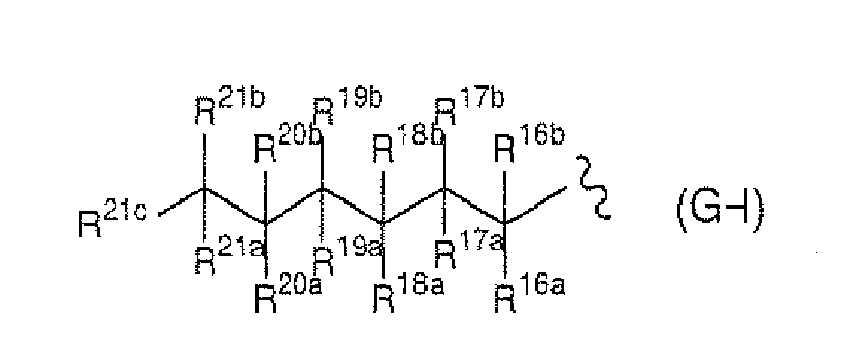
- (1) hydrogen,
- (2) methyl which may optionally have substituents,
- (3) ORH,
- (4) ORD,
- (5) halogen or
- (6) RM-NRN1RN2; and R21c means (1) hydrogen or (2)


further, either of R21a or R21b and either of R22a or R22b may be bound together to represent the partial structure


provided that the restricted clauses 1, 2 and 3 are included. - (1) different from each other and each represents
- 3. A compound represented by the formula (6), a pharmacologically acceptable salt thereof or a hydrate of them.
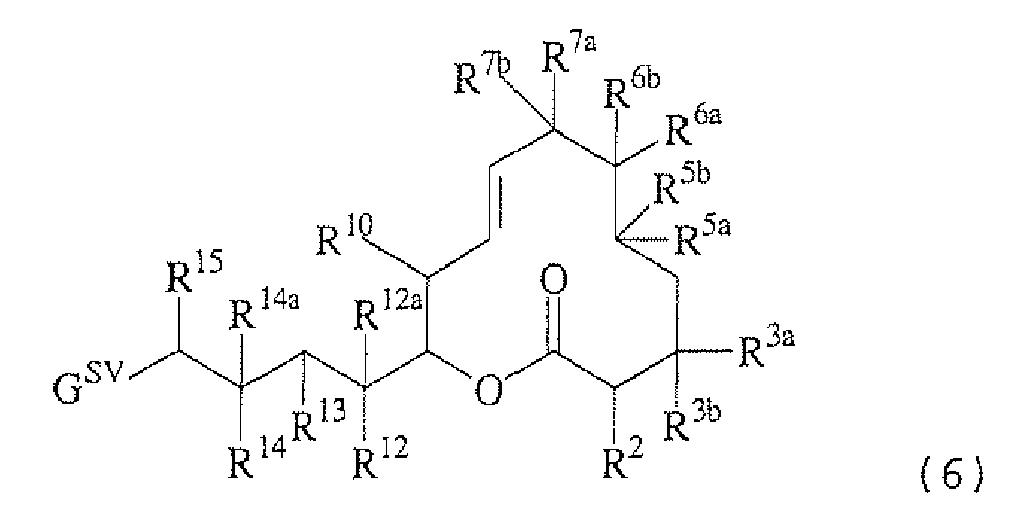
R12a and R13 (1) each represents hydrogen, or (2) are bound together to <1> form a single bond and represent


GSV (1) has the same meaning as the definition of G in the formula 5, or (2) represents
- 4. A compound represented by the formula (7), a pharmacologically acceptable salt thereof or a hydrate of them.


- 5. A compound represented by the formula (8), a pharmacologically acceptable salt thereof or a hydrate of them.

- 6. A compound represented by the formula (9), a pharmacologically acceptable salt thereof or a hydrate of them.
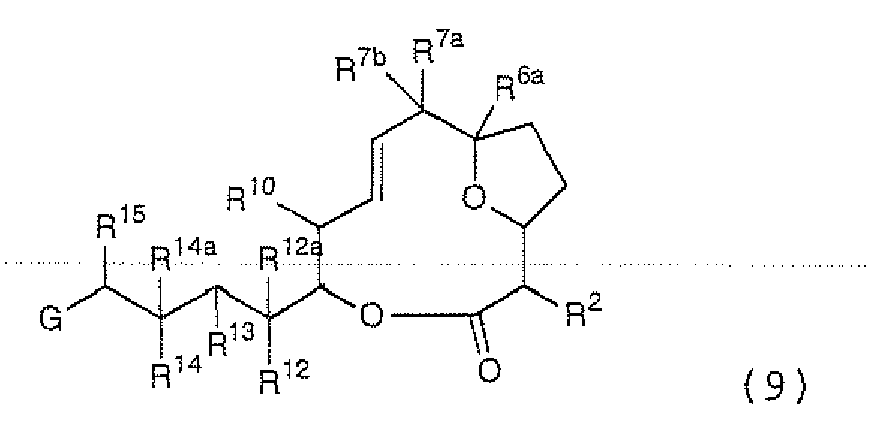
- 7. A compound represented by the formula (10), a pharmacologically acceptable salt thereof or a hydrate of them.

- 8. A compound represented by the formula (11), a pharmacologically acceptable salt thereof or a hydrate of them.

Gm is represented by (1)


- 9. A compound represented by the formula (12), a pharmacologically acceptable salt thereof or a hydrate of them.

- 10. A compound represented by the formula (13), a pharmacologically acceptable salt thereof or a hydrate of them.

- 11. A compound represented by the formula (14), a pharmacologically acceptable salt thereof or a hydrate of them.

- 12. A compound represented by the formula (H-I), a pharmacologically acceptable salt thereof or a hydrate of them.

- (1) hydrogen,
- (2) methyl,
- (3) hydroxymethyl or
- (4) C2-8 acyloxymethyl;
- (1) hydrogen,
- (2) hydroxy,
- (3) methoxy or
- (4) C2-8 acyloxy;
- 13. A compound represented by the formula (H-1), a pharmacologically acceptable salt thereof or a hydrate of them, which is selected from the group consisting of a compound in which R2h is hydrogen, R3h' is hydroxy, both of R5h and R5h' are hydrogen, R6h is methyl, R6h' is hydroxy, R7h' is hydroxy, all of R10h, R12h and R16h are methyl, both of R16h' and R17h' are hydrogen, R20h is methyl, R20h' is hydrogen, R21h' is hydroxy, both of R21h and R22h' are hydrogen and R22h is methyl;
a compound in which R2 is hydrogen, R3h' is hydroxy, both of R5h and R5h' are hydrogen, R6h is methyl, R6h' is hydroxy, R7h' is acetoxy, all of R10h, R12h and R16h are methyl, both of R16h' and R17h' are hydrogen, R20h is methyl, R21h' is hydrogen, R21h' is hydroxy, both of R21h and R22h' are hydrogen, and R22h is methyl;
a compound in which R2h is hydrogen, R3h' is hydroxy, both of R5h and R5h' are hydrogen, R6h is methyl, R6h' is hydroxy, R7h' is acetoxy, all of R10h, R12h and R16h are methyl, both of R16h' and R17h' are hydrogen, R20h is methyl, R20h' is hydrogen, both of R21h and R21h' are bound together to form a ketone structure, R22h' is hydrogen and R22h is methyl;
a compound in which R2h is hydrogen, R3h' is hydroxy, both of R5h and R5h' are hydrogen, R6h is methyl, R6h' is hydroxy, R7h' is acetoxy, all of R10h, R12h and R16h are methyl, R16h' is hydroxy, R17h' is hydrogen, R20h is methyl, R20h' is hydrogen, R21h' is hydroxy, both of R21h and R22h' are hydrogen, and R22h is me thyl ;
a compound in which R2h is hydrogen, R3h' is hydroxy, both of R5h and R5h' are hydrogen, R6h is methyl, R6h' is hydroxy, R7h' is acetoxy, all of R10h, R12h and R16h are methyl, both of R16h' and R17h' are hydrogen, R20h is methyl, R20h' is hydroxy, R21h' is hydroxy, both of R21h and R22h' are hydrogen, and R22h is methyl;
a compound in which R2h is hydrogen, R3h' is hydroxy, both of R5h and R5h' are hydrogen, R6h is methyl, R6h' is hydroxy, R7h' is hydroxy, all of R10h, R12h and R16h are methyl, R16h' is hydroxy, R17h' is hydrogen, R20h is methyl, R20h' is hydrogen, R21h' is hydroxy, both of R21h and R22h' are hydrogen, and R22h is methyl;
a compound in which R2h is hydrogen, R3h' is hydroxy, both of R5h and R5h' are hydrogen, R6h is methyl, R6h' is hydroxy, R7h' is hydroxy, all of R10h, R12h and R16h are methyl, both of R16h' and R17h' are hydrogen, R20h is methyl, R20h' is hydroxy, R21h' is hydroxy, both of R21h and R22h' are hydrogen, and R22h is methyl;
a compound in which R2h is hydrogen, R3h' is hydroxy, both of R5h and R5h' are hydrogen, R6h is methyl, R6h' is hydroxy, R7h' is propanoyloxy, all of R10h, R12h and R16h are methyl, both of R16h' and R17h' are hydrogen, R20h is methyl, R20h' is hydrogen, R21h' is hydroxy, both of R21h and R22h' are hydrogen, and R22h is methyl;
a compound in which R2h is hydrogen, R3h' is hydroxy, both of R5h and R5h' are hydrogen, R6h is methyl, R6h' is hydroxy, R7h' is acetoxy, all of R10h, R12h and R16h are methyl, both of R16h' and R17h' are hydrogen, R20h is methyl, R21h' is hydrogen, R21h' is hydroxy, and all of R21h, R22h' and R22h are hydrogen;
a compound in which R2h is hydrogen, R3h' is hydroxy, R5h is hydrogen, R5h' is hydroxy, R6h is methyl, R6h' is hydroxy, R7h' is acetoxy, all of R10h, R12h and R16h are methyl, both of R16h' and R17h' are hydrogen, R20h is methyl, R20h' is hydrogen, R21h' is hydroxy, both of R21h and R22h' are hydrogen, and R22h is methyl;
a compound in which R2h is hydrogen, R3h' is hydroxy, R5h is hydrogen, R5h' is acetoxy, R6h is methyl, R6h' is hydroxy, R7h' is acetoxy, all of R10h, R12h and R16h are methyl, both of R16h' and R17h' are hydrogen, R20h is methyl, R20h' is hydrogen, R21h' is hydroxy, both of R21h and R22h' are hydrogen, and R22h is methyl;
a compound in which R2h is hydrogen, R3h' is acetoxy, both of R5h and R5h' are hydrogen, R6h is methyl, R6h' is hydroxy, R7h' is acetoxy, all of R30h, R12h and R16h are methyl, both of R16' and R17h' are hydrogen, R20h is methyl, R20h' is hydrogen, R21h' is hydroxy, both of R21h and R22h' are hydrogen, and R22h is methyl;
a compound in which R2h is hydrogen, R3h' is hydroxy, both of R5h and R5h' are hydrogen, R6h is acetoxymethyl, R6h' is hydroxy, R7h' is acetoxy, all of R10h, R12h and R16h are methyl, both of R16h' and R17h' are hydrogen, R20h is methyl, R20h' is hydrogen, R21h' is hydroxy, both of R21h and R22h' are hydrogen, and R22h is methyl;
a compound in which R2h is hydrogen, R3h' is hydroxy, both of R5h and R5h' are hydrogen, R6h is methyl, R6h' is hydroxy, R7h' is acetoxy, all of R10h, R12h and R16h are methyl, R16h' is hydrogen, R17h' are hydroxy, R20h is methyl, R20h' is hydrogen, R21h' is hydroxy, both of R21h and R22h' are hydrogen, and R22h is methyl;
a compound in which R2h is hydrogen, R3h' is hydroxy, both of R5h and R5h' are hydrogen, R6h is methyl, R6h' is hydroxy, R7h' is acetoxy, all of R10h, R12h and R16h are methyl, both of R16h' and R17h' are hydrogen, both of R20h and R20h' are hydrogen, R21h' is hydroxy, both of R21h and R22h' are hydrogen, and R22h is methyl;
a compound in which R2h is hydrogen, R3h' is hydroxy, both of R5h and R5h' are hydrogen, R6h is methyl, R6h' is hydroxy, R7h' is acetoxy, both of R10h and R12h are methyl, all of R16h, R16h' and R17h' are hydrogen, R20h is methyl, R20h' is hydrogen, R22h' is hydroxy, both of R21h and R22h' are hydrogen, and R22h is methyl;
a compound in which R2h is hydrogen, R3h' is hydroxy, both of R5h and R5h' are hydrogen, R6h is methyl, R6h' is hydroxy, R7h' is acetoxy, both of R10h and R16h are methyl, all of R12h, R16h' and R17h' are hydrogen, R20h is methyl, R20h' is hydrogen, R21h' is hydroxy, both of R21h and R22h' are hydrogen, and R22h is methyl;
a compound in which R2h is hydrogen, R3h' is hydroxy, both of R5h and R5h' are hydrogen, R6h is methyl, R6h' is hydroxy, R7h' is acetoxy, both of R12h and R16h are methyl, all of R10h, R16h' and R17h' are hydrogen, R20h is methyl, R20h' is hydrogen, R21h' is hydroxy, both of R21h and R22h' are hydrogen, and R22h is methyl;
a compound in which R2h is hydrogen, R3h' is hydroxy, both of R5h and R5h' are hydrogen, R6h is acetoxymethyl, R6h' is hydroxy, R7h' is hydroxy, all of R10h, R12h and R16h are methyl, both of R16h' and R17h' are hydrogen, R20h is methyl, R20h' is hydrogen, R21h' is hydroxy, both of R21h and R22h' are hydrogen, and R22h is methyl;
a compound in which R2h is hydrogen, R3h' is hydroxy, both of R5h and R5h' are hydrogen, R6h is methyl, R6h' is hydroxy, R7h' is hydroxy, all of R10h, R12h and R16h are methyl, both of R16h' and R17h' are hydrogen, R20h is methyl, R20h' is hydrogen, R21h and R21h' are bound together to form a ketone structure, R22h' is hydrogen, and R22h is methyl;
a compound in which R2h is hydrogen, R3h' is hydroxy, all of R5h, R5h' and R6h are hydrogen, R6h' is acetoxy, R7h' is hydroxy, all of R10h, R12h and R16h are methyl, both of R16h', and R17h' are hydrogen, R20h is methyl, R20h' is hydrogen, R21h' is hydroxy, both of R21h and R22h' are hydrogen, and R22h is methyl;
a compound in which R2h is methyl, R3h' is hydroxy, both of R5h and R5h' are hydrogen, R6h is methyl, R6h' is hydroxy, R7h' is hydroxy, all of R10h, R12h and R16h are methyl, both of R16h' and R17h' are hydrogen, R20h is methyl, R20h' is hydrogen, R21h' is hydroxy, both of R21h and R22h' are hydrogen, and R22h is methyl;
a compound in which R2h is methyl, R3h' is hydroxy, both of R5h and R5h' are hydrogen, R6h is methyl, R6h' is hydroxy, R7h' is acetoxy, all of R10h, R12h and R16h are methyl, both of R16h' and R17h' are hydrogen, R20h is methyl, R20h' is hydrogen, R21h' is hydroxy, both of R21h and R22h' are hydrogen, and R22h is methyl;
a compound in which R2h is hydrogen, R3h' is hydroxy, R5h is hydrogen, R5h' is hydroxy, R6h is methyl, R6h' is hydrogen, R7h' is acetoxy, all of R10h, R12h and R16h are methyl, both of R16h' and R17h' are hydrogen, R20h is methyl, R20h' is hydrogen, R21h' is hydroxy, both of R21h and R22h' are hydrogen, and R22h is methyl;
a compound in which R2h is hydrogen, R3h' is hydroxy, all of R5h, R5h', R6h and R6h' are hydrogen, R7h' is hydroxy, all of R10h, R12h and R16h are methyl, both of R16h' and R17h' are hydrogen, R20h is methyl, R20h' is hydrogen, R21h' is hydroxy, both of R21h and R22h' are hydrogen, and R22h is methyl;
a compound in which R2h is hydrogen, R3h' is hydroxy, both of R5h and R5h' are hydrogen, R6h and R6h' are bound together to form a spirooxyrane structure, R7h' is acetoxy, all of R10h, R12h and R16h are methyl, both of R16h' and R17h' are hydrogen, R20h is methyl, R20h' is hydrogen, R21h' is hydroxy, both of R21h and R22h' are hydrogen, and R22h is methyl;
a compound in which R2h is hydrogen, R3h' is hydroxy, both of R5h and R5h' are hydrogen, R6h and R6h' are bound together to form a spirooxyrane structure, R7h' is hydroxy, all of R10h, R12h and R16h are methyl, both of R16h' and R17h' are hydrogen, R20h is methyl, R20h' is hydrogen, R21h' is hydroxy, both of R21h and R22h' are hydrogen, and R22h is methyl;
a compound in which R2h is hydrogen, R3h' is hydroxy, both of R5h and R5h' are hydrogen, R6h is methyl, R6h' is acetoxy, R7h' is acetoxy, all of R10h, R12h and R16h are methyl, both of R16h' and R17h' are hydrogen, R20h is methyl, R20h' is hydrogen, R21h' is hydroxy, both of R21h and R22h' are hydrogen, and R22h is methyl;
a compound in which R2h is hydrogen, R3h' is hydroxy, both of R5h and R5h' are hydrogen, R6h is methyl, R6h' is hydroxy, R7h' is acetoxy, all of R10h, R12h and R16h are methyl, R16h' is hydroxy, R17h' is hydrogen, R20h is methyl, R20h' is hydrogen, R21h and R21h' are bound together to form a ketone structure, R22h' is hydrogen, and R22h is methyl;
a compound in which R2h is hydrogen, R3h' is hydroxy, both of R5h and R5h' are hydrogen, R6h is methyl, R6h' is hydroxy, R7h' is acetoxy, all of R10h, R12h and R16h are methyl, both of R16h' and R17h' are hydrogen, R20h is methyl, R20h' is hydrogen, R21h is hydrogen, both of R21h' and R22h' are hydroxy, and R22h is methyl;
a compound in which R2h is hydrogen, R3h' is hydroxy, R5h is hydrogen, R5h' is hydroxy, R6h is methyl, R6h' is hydroxy, R7h' is acetoxy, all of R10h, R12h and R16h are methyl, both of R16h' and R17h' are hydrogen, R20h is methyl, R20h' is hydrogen, R21h is hydrogen, both of R21h' and R22h' are hydroxy, and R22h is methyl;
a compound in which R2h is hydrogen, R3h' is hydroxy, both of R5h and R5h' are hydrogen, R6h is methyl, R6h' is hydroxy, R7h' is hydroxy, both of R10h and R16h are methyl, all of R12h, R16h' and R17h' are hydrogen, R20h is methyl, R20h' is hydrogen, R21h' is hydroxy, both of R21h and R22h' are hydrogen, and R22h is methyl; and
a compound in which R2h is hydrogen, R3h' is hydroxy, both of R5h and R5h' are bound together to form a ketone structure, R6h is methyl, R6h' is hydroxy, R7h' is acetoxy, all of R10h, R12h and R16h are methyl, both of R16h' and R17h' are hydrogen, R20h is methyl, R20h' is hydrogen, R21h' is hydroxy, both of R21h and R22h' are hydrogen, and R22h is methyl. - 14. A compound represented by the formula (H-II), a pharmacologically acceptable salt thereof or a hydrate of them.

- (1) hydrogen,
- (2) methyl,
- (3) hydroxymethyl or
- (4) C2-8 acyloxymethyl;
- (1) hydrogen,
- (2) hydroxy,
- (3) methoxy or
- (4) C2-8 acyloxy;
- 15. A compound represented by the formula (H-II), a pharmacologically acceptable salt thereof or a hydrate of them, which is selected from the group consisting of a compound in which R2h is hydrogen, R3h' is hydroxy, R6h is methyl, R6h' is hydroxy, R7h' is acetoxy, all of R10h, R12h and R16h are methyl, both of R16h' and R17h' are hydrogen, R20h is methyl, R20h' is hydrogen, R21h' is hydroxy, both of R21h and R22h' are hydrogen and R22h is methyl;
a compound in which R2h is hydrogen, R3h' is hydroxy, R6h is methyl, R6h' is hydroxy, R7h' is hydroxy, all of R10h, R12h and R16h are methyl, both of R16h' and R17h' are hydrogen, R20h is methyl, R20h' is hydrogen, R21h' is hydroxy, both of R21h and R22h' are hydrogen, and R22h is methyl;
a compound in which R2h is hydrogen, R3h' is hydroxy, R6h is methyl, R6h' is hydroxy, R7h' is acetoxy, all of R10h, R12h and R16h are methyl, both of R16h' and R17h' are hydrogen, R20h is methyl, R21h' is hydrogen, both of R21h and R21h' are bound together to form a ketone structure, R22h' is hydrogen, and R22h is methyl,
a compound in which R2h is hydrogen, R3h' is hydroxy, R6h and R6h' are bound together to form a spirooxyrane structure, R7h' is acetoxy, all of R10h, R12h and R16h are methyl, both of R16h' and R17h' are hydrogen, R20h is methyl, R20h' is hydrogen, R21h' is hydroxy, both of R21h and R22h' are hydrogen, and R22h is methyl;
a compound in which R2h is hydrogen, R3h' is hydroxy, R6h is methyl, R6h' is acetoxy, R7h' is acetoxy, all of R10h, R12h and R16h are methyl, both of R16h' and R17h' are hydrogen, R20h is methyl, R20h' is hydrogen, R21h' is hydroxy, both of R21h and R22h' are hydrogen, and R22h is methyl; and
a compound in which R2h is hydrogen, R3h' is hydroxy, R6h is methyl, R6h' is hydroxy, R7h' is acetoxy, all of R10h, R12h and R16h are methyl, R16h' is hydrogen, R17h' is hydroxy, R20h is methyl, R20h' is hydrogen, R21h' is hydroxy, both of R21h and R22h' are hydrogen, and R22h is methyl. - 16. A compound represented by the formula (H-III), a pharmacologically acceptable salt thereof or a hydrate of them.

- (1) hydrogen,
- (2) methyl,
- (3) hydroxymethyl or
- (4) C2-8 acyloxymethyl;
- (1) hydrogen,
- (2) hydroxy,
- (3) methoxy or
- (4) C2-8 acyloxy;
- 17. A compoundrepresented by the formula (H-III), a pharmacologically acceptable salt thereof or a hydrate of them, which is selected from the group consisting of a compound in which R2h is hydrogen, both of R5h' and R5h' are hydrogen, R6h is methyl, R6h' is hydroxy, R7h' is hydroxy, all of R10h, R12h and R16h are methyl, both of R16h' and R17h' are hydrogen, R20h is methyl, R20h' is hydrogen, R21h' is hydroxy, both of R21h and R22h' are hydrogen and R22h is methyl;
a compound in which R2h is hydrogen, both of R5h and R5h' are hydrogen, R6h is methyl, R6h' is hydroxy, R7h' is acetoxy, all of R10h, R12h and R16h are methyl, both of R16h' and R17h' are hydrogen, R20h is methyl, R20h' is hydrogen, R21h' is acetoxy, both of R21h and R22h' are hydrogen and R22h is methyl; and
a compound in which R2h is hydrogen, both of R5h and R5h' are hydrogen, R6h is methyl, R6h' is hydroxy, R7h' is acetoxy, all of R10h, R12h and R16h are methyl, both of R16h' and R17h' are hydrogen, R20h is methyl, R20h' is hydrogen, R21h' is hydroxy, both of R21h and R22h' are hydrogen and R22h is methyl. - 18. A compound represented by the formula (H-IV), a pharmacologically acceptable salt thereof or a hydrate of them.

- (1) hydrogen,
- (2) methyl,
- (3) hydroxymethyl or
- (4) C2-8 acyloxymethyl;
R3h', R5h', R6h', R7h', R16h', R17h', R20h', R21h' and R22h' are the same as or different from each other and each represents - (5) hydrogen,
- (6) hydroxy,
- (7) methoxy or
- (8) C2-8 acyloxy;

- 19. The compound represented by the formula (H-IV), a pharmacologically acceptable salt thereof or a hydrate of them, which is selected from the group consisting of a compound in which R2h is hydrogen, R3h and R3h' are bound together to form a ketone structure, R4h and R5 form a single bond to represent

a compound in which R2h is hydrogen, R3h is hydrogen, R3h' is hydroxy, all of R4h, R5h and R5h' are hydrogen, R6h is methyl, R6h' is hydroxy, R7h and R7h' are bound together to form a ketone structure, all of R10h, R12h and R16h are methyl, both of R16h' and R17h' are hydrogen, R20h is methyl, R20h' is hydrogen, R21h' is hydroxy, both of R21h and R22h' are hydrogen, and R22h is methyl. - 20. A compound represented by the formula (H-V), a pharmacologically acceptable salt thereof or a hydrate of them.


- 21. A compoundrepresented by the formula (H-V), a pharmacologically acceptable salt thereof or a hydrate of them, which is selected from the group consisting of a compound in which Gmh is represented by the formula (MH-I), R2h is hydrogen, R3h' is hydroxy, both of R5h and R5h' are hydrogen, R6h is methyl, R6h' is hydroxy, R7h' is acetoxy, all of R10h, R12h and R16h are methyl, all of R16h', R17h' and R18h are hydrogen, all of R20h, R21h' and R21h" are hydrogen and R20h' is hydroxy;
a compound in which Gmh is represented by the formula (MH-I), R2h is hydrogen, R3h' is hydroxy, both of R5h and R5h' are hydrogen, R6h is methyl, R6h' is hydroxy, R7h' is acetoxy, all of R10h, R12h and R16h are methyl, R16h' is hydrogen, R17h' is hydroxy, and all of R18h, R20h, R20h', R21h' and R21h" are hydrogen;
a compound in which Gmh is represented by the formula (MH-I), R2h is hydrogen, R3h' is hydroxy, both of R5h and R5h' are hydrogen, R6h is methyl, R6h' is hydroxy, R7h' is acetoxy, all of R10h, R12h and R16h are methyl, R16h' is hydroxy, and all of R17h', R18h, R20h, R20h', R21h' and R21h" are hydrogen;
a compound in which Gmh is represented by the formula (MH-I), R2h is hydrogen, R3h' is hydroxy, both of R5h and R5h' are hydrogen, R6h is methyl, R6h' is hydroxy, R7h' is acetoxy, all of R10h, R12h and R16h are methyl, R16h' is hydrogen, R17h' is hydroxy, R18h is methyl, and all of R20h, R20h', R21h' and R21h" are hydrogen;
a compound in which Gmh is represented by the formula (MH-V), R2h is hydrogen, R3h' is hydroxy, R6h is methyl, R6h' is hydroxy, all of R10h, R12h and R16h are methyl, all of R16h', R17h', R18h and R20h' are hydrogen, R20h is methyl, R21h' is hydroxy, and R21h' is ethyl. - 22. A compound represented by the formula (H-VI), a pharmacologically acceptable salt thereof or a hydrate of them.

- 23. A compound represented by the formula (H-VI), a pharmacologically acceptable salt thereof or a hydrate of them, which is selected from the group consisting of a compound in which Gmh is represented by the formula (MH-I), R2h is hydrogen, R3h' is hydroxy, both of R5h and R5h' are hydrogen, R6h is methyl, R6h' is hydroxy, R7h' is acetoxy, all of R10h, R12h and R16h are methyl, both of R16h' and R17h' are hydrogen, R20h is methyl, both of R20h' and R21h are hydrogen, both of R21h' and R22h' are hydroxy, and R22h is methyl; and
a compound in which Gmh is represented by the formula (MH-I), R2h is hydrogen, R3h' is hydroxy, both of R5h and R5h' are hydrogen, R6h is methyl, R6h' is hydroxy, R7h' is acetoxy, all of R10h, R12h and R16h are methyl, both of R16h' and R17h' are hydrogen, R20h is methyl, all of R20h', R21h and R22h' are hydrogen, R21h' is hydroxy, and R22h is methyl. - 24. A compound represented by the formula (H-VII), a pharmacologically acceptable salt thereof or a hydrate of them.

- 25. A compound represented by the formula (H-VII), a pharmacologically acceptable salt thereof or a hydrate of them, which is selected from the group consisting of a compound in which Gmh is represented by the formula (MH-I), --- represents a double bond, R2h is hydrogen, R3h' is hydroxy, both of R5h and R5h' are hydrogen, R6h is methyl, R6h' is hydroxy, R7h' is acetoxy, all of R10h, R12h and R16h are methyl, both of R16h' and R17h' are hydrogen, R20h is methyl, all of R20h', R21h and R22h' are hydrogen, R21h' is hydroxy, and R22h is methyl;
a compound in which Gmh is represented by the formula (MH-I), --- represents a single bond, R2h is hydrogen, R3h' is hydroxy, both of R5h and R5h' are hydrogen, R6h is methyl, R6h' is hydroxy, R7h' is acetoxy, all of R10h, R12h and R16h are methyl, both of R16h' and R17h' are hydrogen, R20h is methyl, all of R20h', R21h and R22h' are hydrogen, R21h' is hydroxy, and R22h is methyl; and
a compound in which Gmh is represented by the formula (MH-II), --- represents a double bond, R2h is hydrogen, R3h' is hydroxy, R6h is methyl, R6h' is hydroxy, R7h' is acetoxy, all of R10h, R12h and R16h are methyl, both of R16h' and R17h' are hydrogen, R20h is methyl, all of R20h' R21h and R22h' are hydrogen, R21h' is hydroxy, and R22h is methyl. - 26. A compound represented by the formula (H-VIII), a pharmacologically acceptable salt thereof or a hydrate of them.

- 27. A compound, a pharmacologically acceptable salt thereof or a hydrate of them in the formula (H-VIII), which is selected from the group consisting of a compound in which Gmh is represented by the formula (MH-1), R2h is hydrogen, R3h' is hydroxy, both of R5h and R5h' are hydrogen, R6h is methyl, R6h' is hydroxy, R7h' is acetoxy, all of R10h, R12h and R16h are methyl, both of R16h' and R17h' are hydrogen, R18h' is hydroxy, R20h is methyl, R22h' is hydroxy, and R22h is methyl; and
a compound in which Gmh is represented by the formula (MH-I), R2h is hydrogen, R3h' is hydroxy, both of R5h and R5h' are hydrogen, R6h is methyl, R6h' is hydroxy, R7h' is acetoxy, all of R10h, R12h and R16h are methyl, both of R16h' and R17h' are hydrogen, R18h' is hydroxy, R20h is methyl, R22h' are hydrogen, and R22h is methyl. - 28. A compound represented by the formula (H-IX), a pharmacologically acceptable salt thereof or a hydrate of them.

- 29. A compound represented by the formula (H-IX), a pharmacologically acceptable salt thereof or a hydrate of them, which is selected from the group consisting of a compound in which Gmh is represented by the formula (MH-I), C14 --C15 is a double bond, C16 --C17 is a single bond, R2h is hydrogen, R3h' is hydroxy, both of R5h and R5h' are hydrogen, R6h is methyl, R6h' is hydroxy, R7h' is acetoxy, all of R10h, R12h and R16h are methyl, all of R14h, R18h and R19h are hydrogen, and both of R18h' and R19h' are hydroxy;
a compound in which Gmh is represented by the formula (MH-I), C14 --C15 is a single bond, C16 --C17 is a double bond, R2h is hydrogen, R3h' is hydroxy, both of R5h and R5h' are hydrogen, R6h is methyl, R6h' is hydroxy, R7h' is acetoxy, both of R10n and R14h are methyl, both of R12h and R16h are hydrogen, R18h is methyl, R18h' is hydroxy, and R19h and R19h' are bound together to form a ketone structure (=O); and
a compound in which Gmh is represented by the formula (MH-I), C14 --C15 is a single bond, C16 --C17 is a double bond, R2b is hydrogen, R3h' is hydroxy, both of R5h and R5h' are hydrogen, R6h is methyl, R6h' is hydroxy, R7h' is acetoxy, both of R10h and R14h are methyl, both of R12h and R16h are hydrogen, R18h is methyl, R18h' is hydroxy, R19h is hydrogen, and R19h' is hydroxy. - 30. A compound represented by the formula (H-X), a pharmacologically acceptable salt thereof or a hydrate of them.

- 31. A compound, a pharmacologically acceptable salt thereof or a hydrate of them in the formula (H-X), which is selected from the group consisting of a compound in which Gmh is represented by the formula (MH-I), R18h" is represented by the formula (R-F), C14 --C15 is a double bond, C16 --C17 is a single bond, R2h is hydrogen, R3h' is hydroxy, both of R5h and R5h' are hydrogen, R6h is methyl, R6h' is hydroxy, R7h' is acetoxy, all of R10h, R12h and R16h are methyl, both of R14h and R17h' are hydrogen, R18h' is hydroxy, both of Rf3a and Rf5 are methyl, both of Rf3b and Rf4b are hydrogen, and Rf4b is hydroxy;
a compound in which Gmh is represented by the formula (MH-I), C14 --C15 is a single bond, C16 --C17 is a double bond, R2h is hydrogen, R3h' is hydroxy, both of R5h and R5h' are hydrogen, R6h is methyl, R6h' is hydroxy, R7h' is acetoxy, both of R10h and R14h are methyl, all of R12h, R16h and R17h' are hydrogen, R18h' is hydroxy, and R18h" is methyl; and
a compound in which Gmh is represented by the formula (MH-I), C14 --C15 is a double bond, C16 --C17 is a single bond, R2h is hydrogen, R3h' is hydroxy, both of R5h and R5h' are hydrogen, R6h is methyl, R6h' is hydroxy, R7h is acetoxy, all of R10h, R12h and R16h are methyl, both of R14h and R18h' are hydrogen, R17h' is hydroxy, and R18h" is methyl. - 32. A compound represented by the formula (H-XI), a pharmacologically acceptable salt thereof or a hydrate of them.

- 33. A compound represented by the formula (H-XI), a pharmacologically acceptable salt thereof or a hydrate of them, which is selected from the group consisting of a compound in which Gmh is represented by the formula (MH-I), R17h" is represented by the formula (R-F), R2h is hydrogen, R3h' is hydroxy, both of R5h and R5h' are hydrogen, R6h is methyl, R6h' is hydroxy, R7h' is acetoxy, all of R10h, R12h and R16h" are methyl, both of Rf3a and Rf4a are hydroxy, Rf3b is hydrogen, Rf4b is methyl, and Rf5 is ethyl; and
a compound in which Gmh is represented by the formula (MH-I), R2h is hydrogen, R3h' is hydroxy, all of R5h, R5h' and R6h' are hydrogen, R6h is methyl, R7h' is acetoxy, both of R10h and R12h are methyl, R16h" is hydroxy, and R17h" is hydrogen. - 34. A compound represented by the formula (15), a pharmacologically acceptable salt thereof or a hydrate of them.

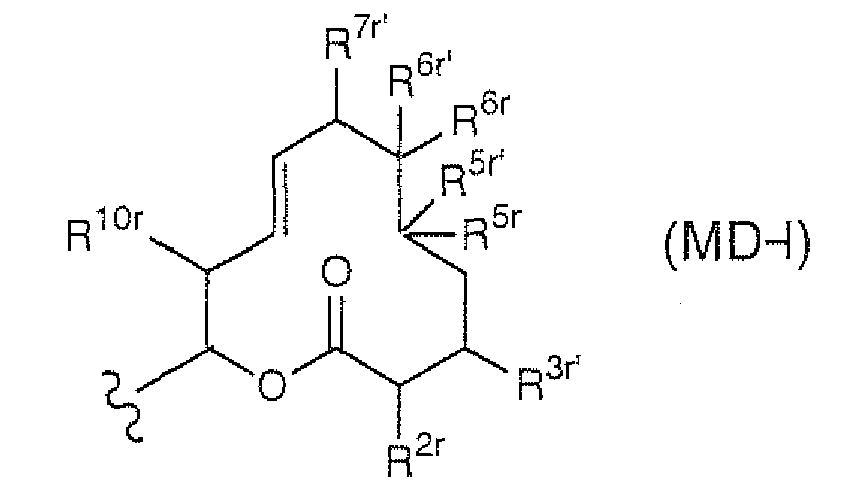
- 1) hydrogen,
- 2) methyl which may have substituents,
- 3) -ORH (wherein RH is <1> hydrogen, <2> methyl or <3> acetyl),
- 4) -ORD (wherein RD represents
- <1> C1-22 alkyl (provided that in case of methyl, it has always substituents),
- <2> -CH2Ar,
- <3> C3-22 acyl,
- <4> unsaturated C3-22 acyl,
- <5> -CORCO,
- <6> C1-22 alkylsulfonyl,
- <7> benzenesulfonyl or
- <8> -SiRs1Rs2Rs3, each of which may have substituents)
- 5) halogen or
- 6) -RM-NRN1RN2 (Ar, RCO, Rs1, Rs2, Rs3, RM, RN1 and RN2 have the same meanings as the definitions of the formula 5), further, R5r and R5r' may be bound together to represent a ketone structure;
the formula (2) :
the formula (3) :


- 1) hydrogen,
- 2) methyl which may be optionally substituted,
- 3) -ORH (wherein RH represents <1> hydrogen, <2> methyl or <3> acetyl),
- 4) -ORD (wherein RD represents
- <1> C1-22 alkyl (provided that in case of methyl, it has always substituents),
- <2> -CH2Ar,
- <3> C3-22 acyl,
- <4> unsaturated C3-22 acyl,
- <5> -CORCO,
- <6> C1-22 alkylsulfonyl,
- <7> benzenesulfonyl, or
- <8> -SiRs1Rs2Rs3, each of which may have substituents),
- 5) halogen or
- 6) -RM-NRN1RN2 (Ar, RCO, Rs1, Rs2, Rs3, RM, RN1 and RN2 have the same meanings as the definitions in the formula 5); further, R21r and R21r' may be bound together to represent <1> a ketone structure (=O) or an oxime structure (=NOROX: wherein ROX has the same meaning as the definition in the formula 5);
each of which may have substituents, the other is 1) hydroxy, or 2) <1> C1-22 alkoxy or <2> C2-22 acyloxy, each of which may have substituents. - 35. A compound represented by the formula (16), a pharmacologically acceptable salt thereof or a hydrate of them.

- 36. A compound represented by the formula (17), a pharmacologically acceptable salt thereof or a hydrate of them.
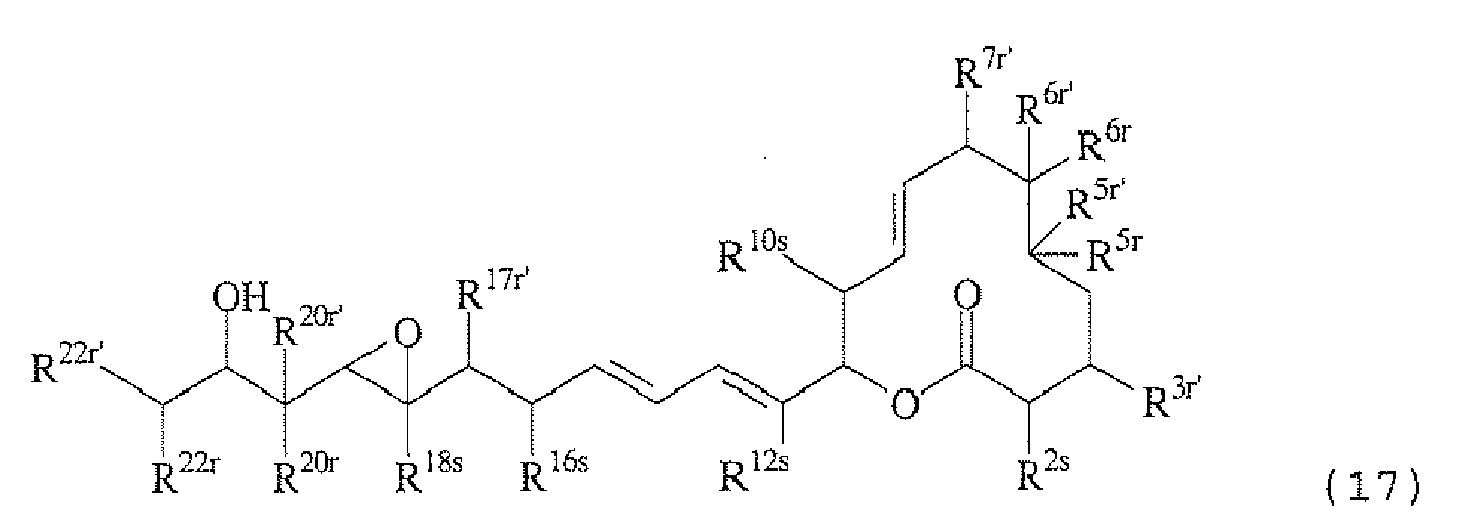
- 37. A compound represented by the formula (18), a pharmacologically acceptable salt thereof or a hydrate of them.

- 38. A compound represented by the formula (18), a pharmacologically acceptable salt thereof or a hydrate of them, which is selected from the group of compounds consisting of, (1) a compound in which RAM is represented by






(3) a compound in which RAM is represented by

- 39. A compound represented by the formula (19), a pharmacologically acceptable salt thereof or a hydrate of them.

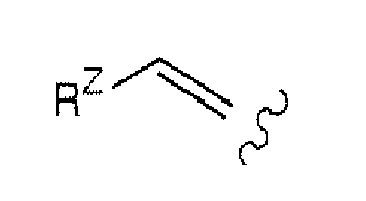
- 40. A compound represented by the formula (20), a pharmacologically acceptable salt thereof or a hydrate of them.

The substituent described here indicates the following.- a) C1-C8 alkyl, C1-C8 alkoxy, C2-C8 acyl,
- b) fluoro, chloro, bromo, iodo,
- c) carboxylic acid, sulfonic acid, carboxylic acid ester, carboxamide which may optionally have substituents on nitrogen,
- d) nitro, amino, N-monosubstituted amino, N,N-disubstituted amino,
- e) a hydroxy group, mercaptane, C1-C8 alkylthio, C1-C8 alkylsulfoxide, C1-C8 alkylsulfone, provided that the restricted clauses 1, 2 an 3 are included.
- 41. A compound represented by the formula (21), a pharmacologically acceptable salt thereof or a hydrate of them.

- 42. The compound, a pharmacologically acceptable salt thereof or a hydrate of them, wherein in the formula (21), R3", R6" and R17 are hydrogen; R7" is hydrogen or acetyl; R16 and R20 are the same as or different from each other and each represents hydrogen or hydroxy; R21a' and R21b' are bond together with oxygen, or either one of them represents hydroxy and the other is hydrogen; and R12' is methyl.
- 43. The compound, a pharmacologically acceptable salt thereof or a hydrate of them, wherein in the formula (21), R3", R6" and R17 are hydrogen; R7" is acetyl; R16 and R17 are the same as or different from each other and each represents hydrogen or hydroxy; R21a and R21b are bound together with oxygen, or either one of them represents hydroxy and the other is hydrogen; and R12 represents methyl or -CH2OH.
- 44. The compound, or a pharmacologically acceptable salt thereof or a hydrate of them, wherein in the formula (21), R3", R6", R7", R17, R20 and R21a are hydrogen; R16 and R21b are hydroxy; and R12 is methyl.
- 45. The compound, a pharmacologically acceptable salt thereof or a hydrate of them, wherein in the formula (21), R3", R6", R7", R16, R17 and R21a are hydrogen; R20 and R21b are hydroxy; and R12 is methyl.
- 46. The compound, a pharmacologically acceptable salt thereof or a hydrate of them, wherein in the formula (21), R3", R6", R7", R16, R17, R20 and R21a are hydrogen; R21b is hydroxy; and R12 is methyl.
- 47. The compound, a pharmacologically acceptable salt thereof or a hydrate of them, wherein in the formula (21), R3", R6", R16, R17 and R21a are hydrogen; R20 and R21b are hydroxy; R7", is acetyl; and R12 is methyl.
- 48. The compound, a pharmacologically acceptable salt thereof or a hydrate of them, wherein in the formula (21), R3", R6", R17, R20 and R21a are hydrogen; R16 and R21b are hydroxy; R7", is acetyl; and R12 is methyl.
- 49. The compound, a pharmacologically acceptable salt thereof or a hydrate of them, wherein in the formula (21), R3", R6", R16, R17 and R20 are hydrogen; R21a and R21b are bound together with oxygen; R7" is acetyl; and R12 is methyl.
- 50. The compound, a pharmacologically acceptable salt thereof or a hydrate of them, wherein in the formula (21), R3", R6", R16, R17, R20 and R21a are hydrogen; R21b is hydroxy; R7" is acetyl; and R12 is methyl.
- 51. A medicament comprising at least one selected from compounds, a pharmacologically acceptable salt thereof or a hydrate of them an active ingredient.
- Pharmaceuticals are preferably, an agent for preventing or treating a disease against which gene expression control is efficacious, an agent for preventing or treating a disease against which VEGF production suppressing action is efficacious, an agent for preventing or treating a disease against which an antiangiogenic effect is efficacious, an antiangiogenic agent, an antitumor agent, an agent for treating hematoma, an agent for suppressingcancer metastasis, an agent for treating retina angiogenic disease or an agent for treating diabetic retinopathy, an agent for treating inflammatory disease, an agent for treating inflammatory diseases consisting of osteoarthritis, rheumatoid arthritis, psoriasis or delayed hypersensitivity reaction, an agent for treating atherosclerosis, an agent for treating solid cancer, especially a medicament in which the solid cancer is lung cancer, brain tumor, breast cancer, prostate cancer, ovarian cancer, colon cancer or melanoma, an agent for treating leukemia, an antitumor agent based on gene expression control, an antitumor agent based on VEGF production suppressing action or an antitumor agent based on an antiangiogenic effect.
- Further, the present invention provides a method for preventing or treating a disease against which gene expression control is efficacious, by administering a pharmacologically effective dose of the above-mentioned medicament to a patient. In particular, the method is a method for preventing or treating a disease against which the VEGF production suppressing action is efficacious or against which an antiangiogenic action is efficacious.
- Further, it provides use of the any one of compounds of the present invention, a pharmacologically acceptable salt thereof or a hydrate of them for producing the above-mentioned medicament or an agent for preventing or treating. In particular, it is occasionally used for producing an agent for preventing or treating a disease against which gene expression control is efficacious, a disease against which the VEGF production suppressing action is efficacious, a disease against which an antiangiogenic action is efficacious or a solid cancer.
- Further, the present invention provides the production process of the compound of the present invention, a pharmacologically acceptable salt thereof or a hydrate of them, which comprises culturing Streptomyces sp. Mer. 11107, FERM P-18144 or its variant in a nutrient culture medium, collecting the compounds described in any of the above are from the culture solution, and carrying out various modification synthesis by using the obtained compounds as a starting material to obtain derivatives thereof.
- Further, the present invention provides an agent for preventing or treating a disease against which the gene expression control is efficacious, a disease against which the VEGF production suppressing action is efficacious, a disease against which the antiangiogenic action is efficacious or solid cancers, which comprises the compound represented by the formula (4), a pharmacologically acceptable salt thereof or a hydrate of them. Further, it provides a method for preventing or treating by using it, and use of it for producing an agent for preventing or treating. The agent for preventing or treating is preferably an agent for treating hematoma, an agent for suppressing cancer metastasis, an agent for treating retina angiogenic disease or an agent for treating diabetic retinopathy, an agent for treating inflammatory disease, an agent for treating osteoarthritis, an agent for treating rheumatoid arthritis, an agent for treating psoriasis, an agent for treating atherosclerosis or an agent for treating solid cancer. When the solid cancer is lung cancer, brain tumor, breast cancer, prostate cancer, ovarian cancer, colon cancer or melanoma, it is effective in particular.

- As the 12-membered ring macrolide compound which is similar as the present invention, FD895 (
JP-A 4-352783 - The following deposit microorganism can be used for the microorganism for producing the compound of the present invention. The fungus strain was internationally deposited to International Patent Organism Depositary (IPOD) National Institute of Advanced Industrial Science and Technology (Tsukuba Central 6, 1-1, Higashi 1-Chome Tsukuba-shi, Ibaraki-ken 305-8566 Japan).
- Streptomyces sp. Mer-11107 was deposited as FERM P-18144 at the National Institute of Bioscience and Human-Technology Agency of Industrial Science and Technology (1-3, Higashi 1 chome Tsukuba-shi Ibaraki-ken 305-8566, Japan). Further, this was transferred to International Deposit FERM BP-7812 at International Patent Organism Depositary (IPOD) National Institute of Advanced Industrial Science and Technology (Tsukuba Central 6, 1-1, Higashi 1-Chome Tsukuba-shi, Ibaraki-ken 305-8566 Japan).
- Additionally, Streptomyces sp. A-1532, Streptomyces sp.A-1533 and Streptomyces sp. A-1534 were also internationally deposited to International Patent Organism Depositary (IPOD) National Institute of Advanced Industrial Science and Technology (Tsukuba Central 6, 1-1, Higashi 1-Chome Tsukuba-shi, Ibaraki-ken 305-8566 Japan) as FERM BP-7849, FERM BP-7850 and FERM BP-7851, respectively.
- The meanings of terms, symbols and the like used in the specification of the present application will be illustrated below, and the present invention will be specifically illustrated.
- In the specification of the present application, the structural formula of the compound represents occasionally a fixed isomer for convenience. In the specification of the present application, there are included all isomers and mixtures of the isomers such as a geometric isomer which are generated from the configuration of the compound, an optical isomer based on an asymmetric carbon, a rotamer, a stereoisomer and a tautomer. It is not limited to the description of the formula for convenience, and may be either of isomers or a mixture thereof. Accordingly, the compound of the present invention occasionally has an asymmetric carbon in the molecule, and its optically active substance and a racemate may exist, but it is not specifically limited and any one is included. Further, polymorphic crystals may exist, but it is not specifically limited in the present invention and any one of the crystal forms may be single or a mixture of the crystal form. The compound (1) according to the present invention or a salt thereof may be an anhydride or a hydrate, and both are included in the present invention. The metabolite which is generated by decomposing the compound (1) according to the present invention in vivo and the prodrug of the compound (1) according to the present invention or a salt thereof are also included in the present invention.
- The "halogen" used in the specification of the present application means a fluorine atom, a chlorine atom, a bromine atom and an iodine atom.
- The "C1-22 alkyl" used in the specification of the present application indicates alkyl groups having 1 to 22 carbons, and as the preferable group, linear or branched alkyl groups such as a methyl group, an ethyl group, an n-propyl group, an isopropyl group, a n-butyl group, an isobutyl group, a sec-butyl group, a tert-butyl group, a n-pentyl group, a 1,1-dirnetlaylpropyl group, a 1,2-dimethylpropyl group, a 2,2-dimethylpropyl group, a 1-ethylpropyl group, a 2-ethylpropyl group, a n-hexyl group, a 1-methyl-2-ethylpropyl group, a 1-ethyl-2-methylpropyl group, a 1,1,2-trimethylpropyl group, a 1-propylpropyl group, a 1-methylbutyl group, a 2-methylbutyl group, a 1,1-dimethylbutyl group, a 1,2-dimethylbutyl group, a 2,2-dimethylbutyl group, a 1,3-dimethylbutyl group, a 2,3-dimethylbutyl group, a 2-ethylbutyl group, a 2-methylpentyl group or a 3-methylpentyl group may be proposed.
- The "unsaturated C2-22 alkyl" used in the specification of the present application indicates an alkenyl group having 2 to 22 carbons or an alkynyl group having 2 to 22 carbons, and as the preferable group, a vinyl group, an allyl group, a 1-propenyl group, a 2-propenyl group, an isopropenyl group, a 2-methyl-l-propenyl group, a 3-methyl-1-propenyl group, a 2-methyl-2-propenyl group, a 3-methyl-2-propenyl group, a 1-butenyl group, a 2-butenyl group, a 3-butenyl group, a 1-pentenyl group, a 1-hexenyl group, a 1,3-hexanedienyl group, a 1,6-hexanedienyl group, an ethynyl group, a 1-propynyl group, a 2-propynyl group, a 1-butynyl group, a 2-butynyl group, a 3-butynyl group, a 3-methyl-1-propynyl group, a 1-ethynyl-2-propynyl group, a 2-methyl-3-propynyl group, a 1-pentynyl group, a 1-hexynyl group, a 1,3-hexanediynyl group, a 1,6-hexanediynyl group, etc. may be proposed.
- The "C2-22 acyl" used in the specification of the present application indicates an acyl group having 2 to 22 carbons, and as the preferable group, linear chain or branched acyl groups such an acetyl group, a propionyl group, a butyryl group, an isobutyryl group, a valeryl group, an isovaleryl group, a pivaloyl group, a caproyl group, a decanoyl group, a lauroyl group, a myristoyl group, a palmitoyl group, a stearoyl group or an arachidonyl group may be proposed. Further, the "C2-22 acyloxy" used in the present specification has the partial structure corresponding to the "C2-22 acyl".
- The "unsaturated C3-22 acyl" used in the specification of the present application indicates an acyl group consisting of 3 to 22 carbons and having a double bond or a triple bond, and as the preferable group, linear chain or branched acyl groups such as an acryl group, a propioloyl group, a crotonoyl group, an isocrotonoyl group, an oleoyl group or a linolenoyl group may be proposed. Further, the "unsaturated C3-22 acyloxy" used in the specification of the present application has the partial structure corresponding to the "unsaturated C3-22 acyl".
- The "C1-22 alkoxy" used in the specification of the present application indicates an alkoxy group having 1 to 22 carbons, and as the preferable group, a methoxy group, an ethoxy group, an n-propoxy group, an isopropoxy group, an n-butoxy group, an isobutoxy group, a sec-butoxy group, a tert-butoxy group, a n-pentyloxy group, an isopentyloxy group, a sec-pentyloxy group, an n-hexyloxy group, an isohexyloxy group, a 1,1-dimethylpropyloxy group, a 1,2-dimethylpropoxy group, a 2,2-dimethylpropyloxy group, a 2-ethylpropoxy group, a 1-methyl-2-ethylpropoxy group, a 1-ethyl-2-methylpropoxy group, a 1,1,2-trimethylpropoxy group, a 1,1,2-trimethylpropoxy group, a 1,1-dimethylbutoxy group, a 1,2-dimethylbutoxy group, a 2,2-dimethylbutoxy group, a 2,3-dimethylbutoxy group, a 1,3-dimethylbutyloxy group, a 2-ethylbutoxy group, a 1,3-dimethylbutoxy group, a 2-methylpentoxy group, a 3-methylpentyloxy group, a hexyloxy group etc. may be proposed.
- The "unsaturated C2-22 alkoxy" used in the specification of the present application indicates an alkenyloxy group or an alkynyloxy group having 2 to 22 carbons, and as the preferable group, for example, a vinyloxy group, an allyloxy group, a 1-propenyloxy group, a 2-propenyloxy group, an isopropenyloxy group, a 2-methyl-1-propenyloxy group, a 3-methyl-1-propenyloxy group, a 2-methyl-2-propenyloxy group, a 3-methyl-2-propenyloxy group, a 1-butenyloxy group, a 2-butenyloxy group, a 3-butenyloxy group, a 1-pentenyloxy group, a 1-hexenyloxy group, a 1,3-hexanedienyloxy group, a 1,6-hexanedienyloxy group, a propargyloxy group, a 2-butynyloxy group etc. may be proposed.
- The "C3-8 cycloalkyl" used in the specification of the present application indicates a cycloalkyl group having 3 to 8 carbons, and as the preferable group, a cyclopropyl group, a cyclobutyl group, a cyclopentyl group, a cyclohexyl group, a cycloheptyl group, a cyclooctyl group etc. may be proposed.
- The "C3-8 cycloalkenyl" used in the specification of the present application indicates a cycloalkenyl group having 3 to 8 carbons, and as the preferable group, cyclopropen-1-yl, cyclopropen-3-yl, cyclobuten-1-yl, cyclobuten-3-yl, 1,3-cyclobutadien-1-yl, cyclopenten-1-yl, cyclopenten-3-yl, cyclopenten-4-yl, 1,3-cyclopentadien-1-yl, 1,3-cyclopentadien-2-yl, 1,3-cyclopentadien-5-yl, cyclohexen-1-yl, cyclohexen-3-yl, cyclohexen-4-yl, 1,3-cyclohexadien-1-yl, 1,3-cyclohexadien-2-yl, 1,3-cyclohexadien-5-yl, 1,4-cyclohexadien-3-yl, 1,4-cyclohexadien-1-yl, cyclohepten-1-yl, cyclohepten-3-yl, cyclohepten-4-yl, cyclohepten-5-yl, 1,3-cyclohepten-2-yl, 1,3-cyclohepten-1-yl, 1,3-cycloheptadien-5-yl, 1,3-cycloheptadien-6-yl, 1,4-cycloheptadien-3-yl, 1,4-cycloheptadien-2-yl, 1,4-cycloheptadien-1-yl, 1,4-cycloheptadien-6-yl, l,3,5-cycloheptatrien-3-yl, 1,3,5-cycloheptatrien-2-yl, 1,3,5-cycloheptatrien-1-yl, 1,3,5-cycloheptatrien-7-yl, cycloocten-1-yl, cycloocten-3-yl, cycloocten-4-yl, cycloocten-5-yl, 1,3-cyclooctadien-2-yl, 1,3-cyclooctadien-1-yl, 2,3-cyclooctadien-5-yl, 1,3-cyclooctadien-6-yl, 1,4-cyclooctadien-3-yl, 1,4-cyclooctadien-2-yl, 1,4-cyclooctadien-1-yl, 1,4-cyclooctadien-6-yl, 1,4-cyclooctadien-7-yl, 1,5-cyclooctadien-3-yl, 1,5-cyclooctadien-2-yl, 1,3,5-cyclooctatrien-3-yl, 1,3,5-cyclooctatrien-2-yl, 1,3,5-cyclooctatrien-1-yl, 1,3,5-cycloactatrien-7-yl, 1,3,6-cyclooctatrien-2-yl, 1,3,6-cyclooctatrien-1-yl, 1,3,6-cyclooctatrien-5-yl, 1,3,6-cyclooctatrien-6-yl etc. may be proposed.
- The "C6-14 aryl" used in the specification of the present application means an aromatic hydrocarbon cyclic group which was constituted by 6 to 14 carbons, and condensed rings such as a monocyclic group, a dicyclic group and a tricyclic group are included. As the preferable examples, a phenyl group, an indenyl group, a 1-naphthyl group, a 2-naphthyl group, an azulenyl group, a hepthalenyl group, a biphenyl group, an indacenyl group, an acenaphthyl group, a fluorenyl group, a phenalenyl group, a phenanthrenyl group, an anthracenyl group, a cyclopentacyclooctenyl group, a benzocyclooctenyl group etc. may be proposed.
- The "5- to 14-membered heteroaryl" used in the specification of the present application means a monocyclic, dicyclic or tricyclic 5- to 14-membered aromatic heterocyclic group which contains one or more of hetero atoms selected from the group consisting of a nitrogen atom, a sulfur atom and an oxygen atom. As the preferable group, the nitrogen-containing aromatic heterocyclic group includes a pyrrolyl group, a pyridyl group, a pyridazinyl group, a pyrimidinyl group, a pyrazinyl group, a triazolyl group, a tetrazolyl group, a benzotriazolyl group, a pyrazolyl group, an imidazolyl group, a benzimidazolyl group, an indolyl group, an isoindolyl group, an indolizinyl group, a purinyl group, an indazolyl group, a quinolyl group, an isoquinolyl group, a quinolizinyl group, a phthalazinyl group, a naphthylidinyl group, a quinoxalinyl group, a quinazolinyl group, a cinnolinyl group, a pteridinyl group, an imidazotriazinyl group, a pyrazinopyridazinyl group, an acridinyl group, a phenanthridinyl group, a carbazolyl group, a carbolinyl group, a perimidinyl group, a phenanthrolinyl group, a phenazinyl group, an imidazopyridinyl group, an imidazopyrimidinyl group, a pyrazolopyridinyl group, and the like; the aromatic heterocyclic group containing sulfur includes a thienyl group, a benzothienyl group and the like; the aromatic heterocyclic group containing oxygen includes, a furyl group, a pyranyl group, a cyclopentapyranyl group, a benzofuryl group, an isobenzofuryl group and the like; the aromatic heterocyclic group containing 2 or more of different kind of hetero atoms includes, a thiazolyl group, an isothiazolyl group, a benzothiazolyl group, a benzothiadiazolyl group, a phenothiazinyl group, an isoxazolyl group, a furazanyl group, a phenoxazinyl group, an oxazolyl group, an isooxazoyl group, a benzoxazolyl group, an oxadiazolyl group, a pyrazolooxazolyl group, an imidazothiazolyl group, a thienofuranyl group, a furopyrrolyl group, a pyridoxazinyl group and the like.
- The "3- to 14-membered nitrogen-containing non-aromatic hetero ring" used in the specification of the present application means a monocyclic, dicyclic or tricyclic 3- to 14-membered non-aromatic heterocyclic group which contains one or more of hetero atoms selected from the group consisting of a nitrogen atom, a sulfur atom and an oxygen atom, in addition to a nitrogen atom. The preferable example includes an aziridinyl group, an acetidyl group, a pyrrolidinyl group, a pyrrolinyl group, a piperidinyl group, a piperazinyl group, an imidazolinyl group, a pyrazolidinyl group, an imidazolidinyl group, a morpholinyl group, a thiomorpholinyl group, an imidazolinyl group, an oxazolinyl group and the like. Further, the non-aromatic heterocyclic group includes also a group derived from a pyridone ring, a non-aromatic condensed ring (for example, a group derived from a phthalimide ring, a succinimide ring and the like).
- The substituent of "which may optionally have substituents" used in the specification of the present application includes one or more groups selected from a C1-8 alkyl group, a C2-8 alkenyl group (for example, a vinyl group), a C2-8 alkynyl group (for example, an ethynyl group), a C6-14 aryl group (for example, a phenyl group and the like), 5- to 14-membered hetero aryl group (for example, a thienyl group, a furyl group, a pyridyl group, a pyridazinyl group, a pyrimidinyl group, a pyrazinyl group and the like), a hydroxyl group, a C1-8 alkoxy group, a C1-8 acyl group, a C2-8 acyloxy group, a C2-8 alkenyloxycarbonyl group, a C2-8 alkynyloxycarbonyl group, a C1-8 alkoxycarbonyl group, a halogen atom, a hydroxycarbonyl group, a thiol group, a C1-8 alkylthio group, a C1-8 alkylsulfoxide group, a C1-8 alkylsulfonyl group, a C1-8 alkylsulfonyloxy group, a hydroxysulfonyl group, an nitrile group, an nitro group, an nitroso group, an amino group, an N-C1-8 alkylamino group, an N,N-di(C1-8 alkyl)amino group, an N-C2-8 alkenylamino group, an N,N-di(C2-8 alkenyl)amino group, an N-C2-8 alkynylamino group, an N,N-di(C2-8 alkynyl)amino group, an N-arylamino group (for example, a phenylamino group), an N-heteroarylamino group (for example, a 2-pyridylamino group, a 3-pyridylamino group, a 1-pyrrolylamino group, and the like), an N-C1-8 alkyl-N-arylamino group, an N-C1-8 alkyl-N-heteroarylamino group, an aralkyloxy group, a heteroaryloxy group, a C1-8 alkylsulfonylamino group, a C2-8 alkenylsulfonylamino group, a C2-8 alkynylsulfonylamino group, an N-C1-8 alkylcarbamoyl group, an N-C1-8 alkylcarbamoyl group, an N-C2-8 alkenylcarbamoyl group, an N,N-di(C2-8 alkynyl)carbamoyl group, a C2-8 acylamino group, and the like.
- There are disclosed below 1. the property of separated microorganism, 2. the fermentation method of the microorganism, 3. the purification method of an active substance, 4. the modification method of the active substance and 5. the application method of the active substance which were described in the present invention.
- As raw materials of the compound of the present invention, it is expected that any one of strains belonging to the genus Streptomyces can be used. However, as a typical strain used in the present invention, a strain which was named as "Mer-11107 strain" by the inventors is exemplified. The taxonomical properties of this strain are as follows.
- Aerial hyphae that bore spirales is extended from vegetative hypha. Spore chain consisting of about 10 to 20 of columnar spores are formed at the edge of the ripened aerial hyphae. The size of the spores are about 0.7 × 10 µm, the surface of the spores is smooth, and specific organs such as sporangium, scleoric granule and zoospore are not observed.
- Cultural characteristics after incubation at 28°C for two weeks on various media are shown below. The color tone is described by the color name and codes which are shown in the parenthesis of the Color Harmony Manual (Container Corporation of America).
- The strain grew well, the aerial hyphae grew up on the surface, and light gray spores (Light gray; d) were observed. The reverse side of colony was Light melon yellow (3ea). Soluble pigment was not produced.
- The strain grew in the middle level, the aerial hyphae grew slightly on the surface, and gray spores (Gray; d) were observed. The reverse side of colony was Nude tan (4gc) or Putty (1 1/2ec). Soluble pigment was not produced.
- The strain grew well, the aerial hyphae grew up on the surface, and gray spores (Gray; d) were observed. The reverse side of colony was Fawn (4ig) or Gray (g). Soluble pigment was not produced.
- The strain grew well, the aerial hyphae grew up on the surface, and white spores (White; a) were observed. The reverse side of colony was Pearl pink (3ca). Soluble pigment was not produced.
- The strain growth was bad, and the aerial hyphae did not grow on the surface. The reverse side of colony was Light melon yellow (3ea). Soluble pigment was not produced.
- The strain grew well, the aerial hyphae grew up on the surface, and white spores (White; a) were observed. The reverse side of colony was Pearl pink (3ca). Soluble pigment was not produced.
- Various carbon sources are added in Pridham-Gottlieb agar medium, growth after incubation at 28°C for two weeks are shown below.
1) L-arabinose ± 2) D-xylose ± 3) D-glucose + 4) D-fructose + 5) sucrose + 6) inositol + 7) L-rhamnose - 8) D-mannitol + 9) D-raffinose + (+: positive, ±: slightly positive, -: negative) - The physiological properties of the strain are as shown below.
- (a) Range of growth temperature (yeast extract-malt extract agar medium, incubation for 2 weeks) 12°C to 37°C
- (b) Range of optimum temperature (yeast extract-malt extract agar medium, incubation for 2 weeks) 21°C to 33°C
- (c) Liquefaction of gelatin (glucose-peptone-gelatin agar medium) negative
- (d) Coagulation of milk (skim milk agar medium) negative
- (e) Peptonization of milk (skim milk agar medium) negative
- (f) Hydrolysis of starch (inorganic salt-starch agar medium) negative
- (g) Formation of melanoid pigment (peptone-yeast extract-iron agar medium) negative
(tyrosine medium) negative - (h) Production of hydrogen sulfide (peptone-yeast extract-iron agar medium) negative
- (i) Reduction of nitrate (broth containing 0.1% potassium nitrate) negative
- (j)Sodium chloride tolerance (yeast extract-malt extract agar medium, incubation for 2 weeks) grown at a salt content of 4% or less
- LL-diaminopimelic acid and glycine were detected from the cell wall of the present strain. It is considered that the present strain is a strain of the genus streptomyces from the above -mentioned microbial characteristics. Accordingly, the present inventors have named the present microbial strain as Streptomyces sp. Mer-11107.
- The bioactive substances 11107A to BJ of the present invention are produced by inoculating the above-mentioned microbial strain or its variant on a nutrition source medium and carrying out aerobic fermentation. The producing microorganism of the biologically active substance 11107A to BJ belongs to Streptomyces sp., is not limited to the above-mentioned microbial strain so far as it has an ability of producing 11107A to BJ, and all can be utilized in the present invention. Hereinafter, both of 11107A to BJ and the analogue which the above-mentioned microbial strain produces are referred to as 11107 analogue.
- The fermentation method of the above-mentioned microorganism is subjected to the general fermentation method of microorganism, but it is preferable that it is carried out under aerobic conditions such as shaking culture or aeration-agitation fermentation using liquid medium. The medium used for culture may be a medium containing a nutrition source which can be utilized by microorganism belonging the genus Strepomyces, therefore all of various synthetic, a semi-synthetic medium, an organic medium and the like can be utilized. As the medium composition, there can be used a single or a combination of glucose, galactose, sucrose, maltose, fructose, glycerin, dextrine, starch, molasses, soybean oil and the like. As the nitrogen source, there can be used a single or a combination of organic nitrogen sources such as pharma media, peptone, meat extract, soybean powder, fish powder, gluten meal, casein, dry yeast, amino acid, yeast extract and urea, and inorganic nitrogen sources such as sodium nitrate and ammonium sulfate. Additionally, for example, there can be added and used salts such as sodium chloride, potassium chloride, calcium carbonate, magnesium sulfate, sodium phosphate, potassium phosphate, copper sulfate, iron sulfate, manganese chloride and cobalt chloride; heavy metal salts, vitamins such as vitamin B or biotin, if necessary. Further, when foaming is remarkable during culture, various defoaming agents can be appropriately added in the medium as necessary. When the defoaming agent is added, it is required to set at a concentration for not adversely affecting the production of an objective substance, and for example, the use concentration is desirably 0.05% or less.
- The culture condition can be appropriately selected within the range at which the microbial strain is grown well and can produce the above-mentioned substance. For example, the pH of a medium is about 5 to 9, and preferably nearby neutral in general. The temperature of fermentation is usually kept at 20 to 40°C, preferably 24 to 30°C and more preferably 28 to 35°C. The fermentation period is about 2 to 8 days, and usually about 4 to 7 days or usually about 3 to 5 days. The above-mentioned fermentation conditions can be suitably changed in accordance with the kind and property of microorganism used, external conditions and the like, and it is needless to say that an optimum condition can be selected. The biologically active substance 11107 analogue of the present invention which was accumulated in the cultured broth can be collected by usual separation procedures utilizing its property such as, for example, a solvent extraction method and an absorbing resin method.
- General methods for separation and purification which are used for isolation of microbial metabolites from the cultured broth can be employed in order to collect the 11107 analogue from the cultured medium after the fermentation. For example, there can be corresponded all methods such as extraction by an organic solvent using methanol, ethanol, acetone, butanol, ethyl acetate, butyl acetate and chloroform, and toluene; the treatment of adsorption and desorption using a hydrophobic adsorption resin such as DIAION HP-20; gel filtration chromatography using Sephadex LH-20; absorption chromatography by active carbon, silica gel and the like; or the treatment of adsorption and desorption by thin layer chromatography; or high performance liquid chromatography using a reverse phase column and the like, to this. Further, the purification methods for 11107 analogue are not specifically limited to the methods shown here.
- The 11107 analogue can be isolated and purified by using these methods alone or in combination and repeatedly using them.
- After termination of the incubation, methods of separation and purification which are usually used for isolating microorganism metabolism product from the incubation solution can be utilized in order to collect the 11107 analogue from the incubation solution. For example, there can be corresponded all methods such as extraction by an organic solvent using methanol, ethanol, butanol, ethyl acetate and chloroform; the treatment of adsorption and desorption by various ion exchange chromatographies, gel filtration chromatography using Sephadex LH-20; absorption chromatography by active carbon, silica gel and the like; or the treatment of adsorption and desorption by thin layer chromatography; or high performance liquid chromatography using a reverse phase column and the like, to this. Further, the methods shown here are not specifically limited.
- The 11107 analogue can be isolated and purified by using these methods alone or in combination and repeatedly using them.
- The compound of the present invention represented by the respective formulae including the formula (I) can be synthesized from the 11107 analogue which was isolated and purified, using general organic synthesis methods. As a typical method, it can be synthesized by, for example, a method shown below, and a combination of these methods. In production, the reaction compound may have a protective group, and the objective compound is obtained by removing its protective group.

- The hydroxy group of 11107 analogue can be protected by an appropriate protective group. It is possible to selectively protect the hydroxy group of 11107 analogue by selecting a protecting group. All or a portion of the hydroxy group can be protected by ethoxyethyl, tetrahydropyranyl, methoxymethyl, t-butyldimethylsilyl, triethylsilyl, trimethylsilyl and the like as the protecting group.
- The compound, protected by such as ethoxyethyl or tetrahydropyranyl, can be synthesized by treating ethyl vinyl ether or dihydropyran in the presence of an acid respectively. As the acid, there are mentioned usual organic acids, inorganic acids, for example, pyridinium p-toluenesulfonate, p-toluenesulfonic acid and the like. The solvent used for the reaction is not specifically limited, but the solvent which cannot easily react with a raw material substance is desirable, and for example, tetrahydrofuran, dichloromethane and the like are mentioned. The reaction time is 10 minutes to 30 hours. The reaction temperature is a temperature of -78°C to reflux by heating.
- The deprotection of the protecting group can be easily carried out by treatent with an acid. As the acid, there are mentioned usual organic acids, inorganic acids, for example, pyridinium p-toluenesulfonate, p-toluenesulfonic acid and the like. The solvent used for the reaction is not specifically limited, but a solvent which cannot easily react with a raw material substance is desirable, and for example, methanol, ethanol and the like are mentioned. The reaction time is 10 minutes to 30 hours. The reaction temperature is a temperature of -78°C to reflux by heating.
- The compound, protected by such as methoxymethyl, t-butyldimethylsilyl, triethylsilyl, or trimethylsilyl, can be synthesized by reacting with a corresponding chloro-, bromo- or trifluoromethanesulfonyl-compound respectively in the presence of a base. As the base, there are mentioned usual organic bases, inorganic bases, for example, imidazole, diisopropylethylamine, dimethylaminopyridine, triethylamine, pyridine, 2,6-rutidine, sodium hydride, 8-bis(dimethylamino)naphthalene and the like. The solvent used for the reaction is not specifically limited, but a solvent which cannot easily react with a raw material substance is desirable, and for example, tetrahydrofuran, dichloromethane, N,N-dimethylformamide and the like are mentioned. The reaction time is 10 minutes to 30 hours. The reaction temperature is a temperature of -78°C to reflux by heating.
- The deprotection of the protecting group can be carried out by treatment with a fluorine anion or an acid. As the fluorine reagent, there are mentioned tetrabutylammonium fluoride, hydrogen fluoride, potassium fluoride and the like, and as the acid, there are mentioned usual organic acids, inorganic acids, for example, acetic acid, trifluoroacetic acid, p-toluenesulfonic acid and the like. The solvent used for the reaction is not specifically limited, but a solvent which cannot easily react with a raw material substance is desirable, and for example, tetrahydrofuran, diethyl ether, water and the like are mentioned. The reaction time is 10 minutes to 30 hours. The reaction temperature is a temperature of -78°C to reflux by heating.
- Further, the neighboring hydroxy group can be protected by being treated with dimethoxyacetone in the presence of an acid catalyst. As the acid, there are mentioned usual organic acids, inorganic acids, for example, p-toluenesulfonic acid, pyridinium p-toluenesulfonate and the like. The solvent used for the reaction is not specifically limited, but a solvent which cannot easily react with a raw material substance is desirable, and for example, tetrahydrofuran, dichloromethane and the like are mentioned. The reaction time is 10 minutes to 30 hours. The reaction temperature is a temperature of -78°C to reflux by heating.
- The deprotection of the protecting group can be carrid out by treatment with an acid to convert it into a hydroxy group. As the acid, there are mentioned usual organic acids, inorganic acids, for example, acetic acid, trifluoroacetic acid, p-toluenesulfonic acid and the like. The solvent used for the reaction is not specifically limited, but a solvent which cannot easily react with a raw material substance is desirable, and for example, methanol, ethanol and the like are mentioned. The reaction time is 10 minutes to 30 hours. The reaction temperature is a temperature of -78°C to reflux by heating.
- The hydroxy group of 11107 analogue or a residual hydroxy group after suitable protection of the hydroxy group of 11107 analogue can be acylated. The acylated derivative of the formula (I) can be synthesized by deprotecion of the protecting group of the product. As reagents for the acylation, an acid anhydride with a base, an acyl chloride with a base, a carboxylic acid with a condensing agent, a carboxylic acid with trimethylsilyl chloride, or reagents used for Mitsunobu reaction. As the acid anhydride, various carboxylic anhydrides are used, but for example, they are acetic anhydride, propionic anhydride, butyric anhydride and the like. As the acid chloride, various acid chlorides are used, but for example, they are acetyl chloride, propionyl chloride, benzoyl chloride and the like. As the base, there are mentioned usual organic bases, inorganic bases, for example, diisopropylethylamine, dimethylaminopyridine, triethylamine, pyridine, 2,6-rutidine, sodium hydride, and the like. As the carboxylic acid, various carboxylic acids are used, but for example, they are acetic acid and propionic acid. The condensing agent is dicyclohexylcarbodiimide, trifluoroacetic anhydride, carbonylimidazole and the like. Further, in Mitsunobu reaction, various carboxylic acids can be substituted in the presence of triphenylphosphine and diethylazodicarboxylate. The solvent used for the reaction is not specifically limited, but a solvent which cannot easily react with a raw material substance is desirable, and for example, dichloromethane, chloroform, tetrahydrofuran and the like are mentioned. The reaction time is 10 minutes to 30 hours. The reaction temperature is a temperature of -78°C to reflux by heating.
- Further, an acyloxy group having good elimination property is occasionally eliminated to form a double bond in the present reaction.
- The hydroxy group of 11107 analogue or a residual hydroxy group after suitable protection of the hydroxy group of 11107 analogue can be converted into an alkoxy group. The protecting group of the product is deprotected to synthesize the alkylated derivative of the formula (I). The alkylation can be carried out by treating with Rm-X in the presence of a base or, in case of methylation, by treating with methyl trifluoromethanesulfonate. In the formula, various alkyls can be used for Rm, and for example, it is methyl, ethyl and benzyl. X represents an leaving group. For example, there can be mentioned a chloro group, a bromo group, an iodo group, or a trifluoromethanesulfonate and the like. As the base, there are mentioned usual organic bases, inorganic bases, for example, sodium hydride, lithium bis(trimethylsilyl)amide, lithium diisopropylamide, lithium dicyclohexylamide, potassium carbonate, cesium carbonate, 8-bis(dimethylamino)naphthalene and the like. The solvent used for the reaction is not specifically limited, but a solvent which cannot easily react with a raw material substance is desirable, and for example, diethyl ether, tetrahydrofuran, diethoxyethane and the like are mentioned. The reaction time is 10 minutes to 30 hours. The reaction temperature is a temperature of -78°C to reflux by heating.
- The hydroxy group of 11107 analogue or a residual hydroxy group after suitable protection of the hydroxy group of 11107 analogue can be converted into halogen such as chlorine, bromine, iodine or fluorine. The protecting group of the product can be deprotected to obtain the halogen derivative of the formula (I). For example, it is treated with diethylaminosulfate trifluorade (DAST), or it is treated with carbon tetrabromide, bromine, phosphorous tribromide, iodine and tetrachloride in the presence of triphenyl phosphine and a base. As the base, there are mentioned usual organic bases, inorganic bases, for example, diisopropylethylamine, dimethylaminopyridine, triethylamine, pyridine, 2,6-rutidine, sodium hydride and the like. The solvent used for the reaction is not specifically limited, but a solvent which cannot easily react with a raw material substance is desirable, and for example, tetrahydrofuran, dichloromethane, N,N-dimethylformamide and the like are mentioned. The reaction time is 10 minutes to 30 hours. The reaction temperature is a temperature of -78°C to reflux by heating.
- The hydroxy group of 11107 analogue or a residual hydroxy group after suitable protection of the hydroxy group of 11107 analogue can be sulfonylated. The protecting group of the product can be deprotected to obtain the sulfonyl derivative of the formula (I). The sulfonylation can be carried out by p-toluenesulfonyl chloride, methanesulfonyl chloride and benzenesulfonyl chloride, in the presence of an appropriate base. As the base, there are mentioned usual organic bases, inorganic bases, for example, diisopropylethylamine, dimethylaminopyridine, triethylamine, pyridine, 2,6-rutidine, sodium hydride and the like. The solvent used for the reaction is not specifically limited, but a solvent which cannot easily react with a raw material substance is desirable, and for example, tetrahydrofuran, dichloromethane, N,N-dimethylformamide and the like are mentioned. The reaction time is 10 minutes to 30 hours. The reaction temperature is a temperature of -78°C to reflux by heating.
- The hydroxy group of 11107 analogue or a residual hydroxy group after suitable protection of the hydroxy group of 11107 analogue is treated with a chloroformate derivative or carbonyldiimidazole in the presence of a base. The protecting group of the product can be eliminated to obtain the carbonic ester derivative of the formula (I) . As the chloroformate derivative, 4-nitrophenylchloroformate, phenyl chloroformate and the like are mentioned. As the base, there are mentioned usual organic bases, inorganic bases, for example, diisopropylethylamine, dimethylaminopyridine, triethylamine, pyridine, 2,6-rutidine, sodium hydride and the like. The solvent used for the reaction is not specifically limited, but a solvent which cannot easily react with a raw material substance is desirable, and for example, tetrahydrofuran, dichloromethane, N,N-dimethylformamide and the like are mentioned. The reaction time is 10 minutes to 30 hours. The reaction temperature is a temperature of -78°C to reflux by heating.
- The hydroxy group of 11107 analogue or a residual hydroxy group after suitable protection of the hydroxy group of 11107 analogue is treated with an isocyanate in the presence of a base or a copper catalyst. The protecting group of the product can be eliminated to obtain the urethane derivative of the formula (I). As the isocyanate,there are mentioned usual isocyanate, for example, ethyl isocyanate, methyl isocyanate, phenyl isocyanate and the like. As the base, there are mentioned usual organic bases, inorganic bases, for example, diisopropylethylamine, dimethylaminopyridine, triethylamine, pyridine, 2,6-rutidine, sodium hydride and the like. The solvent used for the reaction is not specifically limited, but a solvent which cannot be easily reacted with a raw material substance is desirable, and for example, tetrahydrofuran, dichloromethane, N,N-dimethylformamide and the like are mentioned. The reaction time is 10 minutes to 30 hours. The reaction temperature is a temperature of - 78°C to reflux by heating.
- Further, a derivative which was obtained by converting the hydroxy group of 11107 analogue or a residual hydroxy group after suitable protection of the hydroxy group, to carbonic ester is treated with an amine in the presence of a base or with an amine alone. The protecting group of the product can be deprotected to obtain the urethane derivative of the formula (I). As the amine, various amines can be used and for example, methylamine, ethylamine, aniline and the like are mentioned. As the base, there are mentioned usual organic bases, inorganic bases, for example, diisopropylethylamine, dimethylaminopyridine, triethylamine, pyridine, 2,6-rutidine, sodium hydride and the like. The solvent used for the reaction is not specifically limited, but a solvent which cannot easily react with a raw material substance is desirable, and for example, tetrahydrofuran, dichloromethane, N,N-dimethylformamide and the like are mentioned. The reaction time is 10 minutes to 30 hours. The reaction temperature is a temperature of -78°C to reflux by heating.
- Tthe hydroxy group of 11107 analogue or a residual hydroxy group after suitable protection of the hydroxy group of 11107 analogue is directly or indirectly converted into a good leaving group, it can be converted into an amine after introducing an azide, if necessary. The protecting group of the product can be deprotected to obtain the amine derivative of the formula (I).
- When the hydroxy group or a good leaving group is converted into an azide, there can be used DPPA, diethyl azodicarboxylate and triphenylphosphine, DPPA and DBU, DPPA, TMAD, TBP or sodium azide, etc. Alternatively, it is treated with sodium azide in the presence of a palladium catalyst. As the palladium catalyst, Pd(PPh3)4 and the like are mentioned. The solvent used for the reaction is not specifically limited, but a solvent which cannot easily react with a raw material substance is desirable, and for example, tetrahydrofuran, dichloromethane, N,N-dimethylformamide and the like are mentioned. The reaction time is 10 minutes to 30 hours. The reaction temperature is a temperature of -78°C to reflux by heating.
- 11107 analogue or 11107 derivative whose hydroxy groups are appropriately protected is treated with an oxidizing agent, and a double bond can be converted into an oxylane ring, or an allyl position can be oxidized. The protecting group of the product can be deprotected to obtain the oxidized product of the formula (I) . As the oxidizing agent, m-chloro-perbenzoic acid, t-butylhydroperoxide and the like are mentioned. The solvent used for the reaction is not specifically limited, but a solvent which cannot easily react with a raw material substance is desirable, and for example, tetrahydrofuran, dichloromethane, N,N-dimethylformamide and the like are mentioned. The reaction time is 10 minutes to 30 hours. The reaction temperature is a temperature of -78°C to reflux by heating.
- The double bond of 11107 analogue or the 11107 derivative whose hydroxy group was appropriately protected can be reduced. The protecting group of the product can be deprotected to obtain the reduced product of the formula (I). As the reducing agent, hydrogen in the presence of a catalyst, zinc and lithium are mentioned. As the catalyst, there are mentioned palladium-carbon, palladium hydroxide, platinum oxide, rhodium-carbon, and the like. The solvent used for the reaction is not specifically limited, but a solvent which cannot easily react with a raw material substance is desirable, and for example, methanol, ethanol, tetrahydrofuran, and the like are mentioned. The reaction time is 10 minutes to 30 hours. The reaction temperature is a temperature of -78°C to reflux by heating.
- The hydroxy group of 11107 analogue or a residual hydroxy group after suitable protection of the hydroxy group of 11107 analogue is treated with an oxidizing agent. The protecting group of the product can be deprotected to obtain the ketone body of the formula (I). As the oxidizing agent, there can be used manganese dioxide, pyridinium chlorochromate, pyridinium dichromate, Dess-Martin reagent, a reagent of Swern oxidation condition, and the like. The solvent used for the reaction is not specifically limited, but a solvent which cannot easily react with a raw material substance is desirable, and for example, tetrahydrofuran, dichloromethane, chloroform and the like are mentioned. The reaction time is 10 minutes to 30 hours. The reaction temperature is a temperature of - 78°C to reflux by heating.
- Among the compound of the formula (1), an oxime derivative can be synthesized by treating a corresponding ketone compound with an amine. As the amine, for example, hydroxylamine, methoxyamine, and the like are mentioned. As the solvent used for the reaction is not specifically limited, but a solvent which cannot easily react with a raw material substance is desirable, and for example, tetrahydrofuran, dichloromethane and the like are mentioned. The reaction time is 10 minutes to 30 hours. The reaction temperature is a temperature of -78°C to reflux by heating. (13) Synthesis of amine from ketone compound
- An amine derivative among the compound of the formula (I) can be synthesized by treating a corresponding ketone compound with an amine and further reducing it. The amine is not limited, and for example, methylamine, ethylamine and the like are mentioned. As the reducing agent, there can be mentioned sodium cyanoboronohydride, sodium borohydride, diisobutylaluminum hydride and the like. The solvent used for the reaction is not specifically limited, but a solvent which cannot easily react with a raw material substance is desirable, and for example, tetrahydrofuran, dichloromethane and the like are mentioned. The reaction time is 10 minutes to 30 hours. The reaction temperature is a temperature of -78°C to reflux by heating.
- Using the amino compound obtained by the above-mentioned reaction, amino group can be modified in a similar manner as described for the acylation, sulfonylation and alkylation of a hydroxy group.
- The the oxylane ring of 11107 analogue or 11107 derivative whose hydroxy group was appropriately protected can be converted into a compound in which either of A or B is hydroxy and another is halogen, by being treated with HX. The protecting group can be deprotected to obtain the halohydrin derivative of the formula (I).
- HX is, for example, hydrogen chloride or hydrogen bromide. Alternatively, it can be synthesized by treating with chlorotrimethylsilane and then treating with sodium iodide. The solvent used for the reaction is not specifically limited, but a solvent which cannot easily react with a raw material substance is desirable, and for example, diethyl ether, 1,2-diethoxyethane, water and the like are mentioned. The reaction time is 10 minutes to 30 hours. The reaction temperature is a temperature of -78°C to reflux by heating.
- Various conversions which were described in the modification of a hydroxy group can be also carried out to the hydroxy group of halohydrin.
-

- The compound of the formula (1) can be synthesized by carrying out the oxidative cleavage of the double bond of 11107 analogue or 11107 derivatives whose hydroxy groupw are appropriately protected, and carrying out the olefination of the resulting aldehyde, and then removing the protecting group.
- For example, as the oxidizing agent, osmium tetraoxide, ruthenium oxide and potassium permanganate can be used, and sodium periodate, lead tetraacetate and the like can be used for the cleavage of the resulting diol . The solvent used for the reaction is not specifically limited, but a solvent which cannot easily react with a raw material substance is desirable, and for example, tetrahydrofuran, dichloromethane and the like are mentioned. The reaction time is 10 minutes to 30 hours. The reaction temperature is a temperature of -78°C to reflux by heating.
- Further, an aldehyde compound can be directly obtained by carrying out the ozone oxidation or by simultaneously treating the double bond with osmium tetraoxide and sodium periodate. The solvent used for the reaction is not specifically limited, but a solvent which cannot be easily reacted with a raw material substance is desirable, and for example, tetrahydrofuran, dichloromethane and the like are mentioned. The reaction time is 10 minutes to 30 hours. The reaction temperature is a temperature of -78°C to reflux by heating.
- A double bond formation can be carried out by the Julia olefination of the aldehyde, with a sulfonate having a suitable substituent and a base, or by Wittig reaction of the aldehyde with a phosphate having a suitable substituent and a base, and thus, the compound represented by the formula (I) can be synthesized. As the base, there are used usual organic bases, inorganic bases, for example, lithium diisopropylamide, lithium bis(trimethylsilyl)amide, lithium hydride, butyl lithium, lithium dicyclohexylamide and the like. The solvent used for the reaction is not specifically limited, but a solvent which cannot be easily reacted with a raw material substance is desirable, and for example, tetrahydrofuran, diethyl ether and the like are mentioned. The reaction time is 10 minutes to 30 hours. The reaction temperature is a temperature of -78°C to reflux by heating.
- The present compound is effective as an agent for preventing or treating a disease against which control of gene expression is efficacious, an agent for preventing or treating a disease against which VEGF production suppressing action is efficacious, an agent for preventing or treating a disease against which an antiangiogenic effect is efficacious. The "preventing or treating" indicates either of preventing or treating, or both of them. More specifically, the present compound is effective as an antitumor agent, and in particular, as an antitumor agent and a carcinoma metastasis suppressor for solid cancer. As the solid cancer, for example, pancreatic cancer, gastric cancer, colon cancer, breast cancer, prostate cancer, lung cancer, kidney cancer, brain tumor, sinciput cancer, esophageal cancer, derma cancer, liver cancer, uterus cancer, cervix uteri cancer, urinary bladder cancer, thyroid cancer, testicular cancer, choroionic carcinoma, osteosarcoma, soft tissue sarcoma, and ovarian cancer may be proposed. Further, it is also effective as an antitumor agent for leukemia. Further, it is also effective as an agent for treating hematoma. Furthermore, it is also effective as an agent for treating diabetic retinopathy, rheumatoid arthritis and hematoma, which is based on VEGF production suppressing action. Further more, it is also effective as an agent for treating inflammatory diseases consisting of osteoarthritis, psoriasis and prolonged hypersensitivity reaction, and atherosclerosis.
- When the compound is prepared as an injection, a pH regulator, a buffer, a stabilizer, a solubilizer and the like are added to the main drug, if necessary, to prepare an intramuscular, intra-articular or intravenous injection according to a conventional method.
- When the compound is administrated as a preventive or therapeutic agent for various diseases, it may be orally administrated as tablets, powders, granules, capsules, syrups and the like, and may be parenterally administrated as a spray, a suppository, an injection, an external preparation and a drip. The dose is remarkably different according to the extent of symptom, age, the kind of lever diseases etc., and approximately 1 mg to 100 mg per day for an adult is administrated in general at one time or several times.
- Conventional preparation carriers are used at preparation, and the preparations are produced by a conventional method. Namely, when a solid preparation for oral use is prepared, a filler is added to the main drug, and if necessary, a binder, a disintegrant, a lubricant, a colorant, a flavoring agent and the like are added thereto, and then tablets, coated tablets, granules, powders, capsules and the like are prepared. It is needless to say that sugar coating, gelatin coating or suitable coating may conducted on the tablet and granule, if necessary.
- In the present invention, antitumor drugs effective for solid cancer and the like have been found from the cultured broth of a strain of genus Streptomyces or its variant, and a derivative of the fermentation products.
- Examples below illustrate the following subjects in detail.
- The cultured broth of strain Mer-11107 was obtained in Example A1 or A1-1. From the broth, 11107A-G were obtained in Examples A2 to A9. Similarly, H-Z, AA-AZ and BA-BG were obtained in Examples A10 to A67.
- Cultured broth of Mer-11107 mutants EM07.015N13, EM07.015N54 and EM07.031N58 (synonymous with Strepcomyces sp. A-1532, Streptomyces sp. A-1532, Streptomyces sp. A-1532, respectively) and the isolated compounds from the broth were obtained in Example A-68 to A77. Namely, 11107BH, 11107BI and 11107BJ were obtained.
- Further, Example B1 to B82 shows the chemical synthesis of other compounds using any one of the above-mentioned fermentation products, which were respectively specified, as a starting material. C1 to C7 are the pharmacological experimental data.
- The present invention will be more specifically illustrated according to Examples below, but the present invention is not limited to these.
- One loopful of the the slant culture of Mer-11107 strain (ISP-2 medium) was inoculated into a 500 ml Erlenmeyer flask containing 50 ml of seed medium (2% of glucose, 1% of ESSANMEAT (manufactured by Ajinomoto Co. Ltd.), 0.5% of yeast extract, 0.25% of sodium chloride, 0.32% of calcium carbonate, pH 6.8 before sterilization), and it was cultured at 28°C for 2 days to give the first seed culture. 0.1 ml of the culture was inoculated into a 500 ml Erlenmeyer flask containing 100 ml of the seed medium as same as the medium mentioned above, and it was cultured at 28°C for 1 day to give the second seed culture. 800mL of the second culture was inoculated into a 200 L tank containing 100 L of production medium (5% of potato starch, 0.8% of pharmamedia, 0.8% of gluten meal, 0.5% of yeast extract, 0.1% of calcium carbonate, pH 6.8 before sterilization), and it was fermented at 28°C for 5 days with an agitation at 90 rpm, an aeration of 1.0 vvm and an inner pressure of 20 kPa to give cultured broth.
- One loopful of the slant culture of Mer-11107 strain (ISP-2) was inoculated into a 500 ml Erlenmeyer flask containing 50 ml of seed medium (2% of glycerin, 2% of glucose, 2% of soybean meal (ESSANMEAT manufactured by Ajinomoto Co. Ltd.), 0.5% of yeast extract, 0.25% of sodium chloride, 0.32% of calcium carbonate, 0.0005% of copper sulfate, 0.0005% of manganese chloride, 0.0005% of zinc sulfate, and pH 7.4), and it was cultured at 28°C for 3 days on a shaker to give the first seed culture. 0.6 ml of the seed culture was inoculated into a 500 ml Erlenmeyer flask containing 60 ml of the producing medium (5% of soluble starch, 0.5% of corn steep liquor, 0.5% of dry yeast, 0.5% of gluten meal, 0.1% of calcium carbonate) and it was fermented at 28°C for 4 days on a rotary shaker to give a fermentation culture broth.
- The cultured broth (10 L) obtained in Example A1 or A1-1 was extracted with 1-butanol (10 L), then thus acquired 1-butanol, layer was evaporated to dryness to give 100 g of crude active fraction. The crude active fraction was applied on Sephadex LH-20 (1500 ml; manufactured by Pharmacia Co. Ltd.), and eluted with tetrahydrofuran-methanol (1:1) as a solvent. The eluted crude active fraction was concentrated to dryness, and subject to silica gel column chromatography (WAKO GEL C-200) . The column was eluted with a mix solution (2 L) consisting of n-hexane and ethyl acetate (1:9, v/v) to obtain a crude active fraction which contains 11107A, 11107B and 11107C, and to obtain a crude active fraction which contains 11107D, 11107E, 11107F and 11107G. The crude active fraction which contains 11107A, 11107B and 11107C was subjected to preparative high performance liquid chromatography (HPLC) under the following preparative HPLC condition (A1), and the eluted active fractions were collected separately. After removing the acetonitrile, the respective fractions were desalted by HPLC under the following preparative HPLC condition (A2) to give 11107A (1.2 mg), 11107B (6 mg) and 11107C (0.3 mg). Similarly, the crude active fraction which contains 11107D, 11107E, 11107F and 11107G was also subjected to HPLC under the following preparative HPLC condition (A1), and the eluted active fractions were collected separately. After removing acetonitrile, the respective fractions were desalted by HPLC under the following preparative condition (A2) to obtain 11107D (1.8 mg), 11107E (1 mg), 11107F (0.1 mg) and 11107G (0.2 mg).
- The cultured broth (10 L) was extracted with 1-butanol (10 L), then thus acquired 1-butanol layer was evaporated to dryness to give 100 g of crude active fraction. The crude active fraction was applied on Sephadex LH-20 (1500 ml; manufactured by Pharmacia Co. Ltd.), and eluted with tetrahydrofuran-methanol (1:1) as a solvent. An eluted fraction from 540 ml to 660 ml was concentrated to dryness under reduced pressure to give a residue (660 mg) Further, the residue was dissolved in a mix solution consisting of ethyl acetate and methanol (9:1, v/v), and subjected to silica gel column chromatography (WAKO GEL C-200, 50 g). The column was eluted with a mix solution (2L) consisting of n-hexane and ethyl acetate (1:9, v/v), the fraction eluted from 468 ml to 1260 ml (crude active fraction A) and the fraction eluted from 1440 ml to 1566 ml (crude active fraction B) were collected separately, and crude active fraction A and B were evaporated to give 25 mg and 15 mg of residues, respectively.
- The crude active fraction A was subjected to preparative high performance liquid chromatography (HPLC) under the following preparative HPLC condition (A), and the fractions eluted at the retention time of 28 min., 34 min. and 39 min. were collected respectively. After removing acetonitrile, the respective fractions were desalted by HPLC under the following preparative HPLC condition (B) to give 11107A (retention time: 36 min., 1.2 mg), 111078 (retention time: 37 min., 6 mg) and 11107C (retention time: 38 min., 0.3 mg). Similarly, the crude active fraction B was also fractionated by HPLC under the following preparative condition (A). The fractions eluted at the retention time of 17 min., 21 min., 22 min., and 26 min. to 27 min. were collected respectively. After removing acetonitrile, the respective fractions were desalted by HPLC under the following preparative condition (B) to give 11107D (retention time: 36 min., 1.8 mg), 11107E (retention time: 34 min., 1 mg), 11107F (retention time: 28 min., 0.1 mg) and 11107G (retention time: 32 min., 0.2 mg).
- Column: YMC-PACK ODS-AM SH-343-5AM, φ20 mm × 250 mm
(manufactured by YMC Co.)
Temperature: room temperature
Flow rate: 10 ml/min.
Detection: 240 nm
Eluent: acetonitrile/0.15% aqueous potassium dihydrogenphosphate (pH 3.5) (2:8 to 8:2, v/v, 0 to 50 min., linear gradient) - Column: YMC-PACK ODS-AM SH-343-5AM, φ20 mm × 250 mm
(manufactured by YMC Co.)
Temperature: room temperature
Flow rate: 10 ml/min.
Detection: 240 nm
Eluent: methanol/water (2:8 to 10:0, v/v, 0 to 40 min., linear gradient) - The retention times of the above-mentioned compounds when analysis was carried out at the under-mentioned HPLC condition, are shown as below.
Analytic HPLC condition (a)
Column: YMC J'sphere ODS-M80 JM-307, φ4.6 mm × 75 mm
(manufactured by YMC Co.)
Temperature: 30°C
Flow rate: 1 ml/min.
Detection: 240 nm
Eluent: acetonitrile/0.15% aqueous potassium dihydrogenphosphorate (pH 3.5) (2:8 to 8:2, v/v, 0 to 50 min., linear gradient) Retention time: - 11107A: 13.4 min.
- 11107B: 15.5 min.
- 11107C: 17.3 min.
- 11107D: 11.4 min.
- 11107E: 12.9 min.
- 11107F: 9.0 min.
- 11107G: 10.8 min.
- The physico-chemical properties of 11107A are shown below. The structure of 11107A was determined as shown below.
- 1. Appearance: colorless powder
- 2. Molecular weight: 494, FAB-MS m/z 493(M-H)-
- 3. Molecular formula: C28H46O7
- 4. Solubility: soluble in dimethylsulfoxide, pyridine, methanol and acetone, and slightly soluble in water
- 5. Color reaction: positive for iodine and sulfuric acid
- 6. Ultraviolet absorption spectrum (methanol, maximum value) nm: 239 (ε 28800)
- 7. Infrared absorption spectrum (KBr) cm-1: 3364, 2963, 1732, 1714, 1455, 1372, 1176
- 8. 1H-NMR spectrum (CD3OD, 500MHz): δ ppm (integral, multiplicity, coupling constant J (Hz)):
- 0.9(3H,d,J=7.0Hz), 0.98(3H,d,J=6.8Hz), 1.02(3H,t,J=8.0Hz), 1.15(3H,d,J=6.8Hz), 1.28(1H,m), 1.33(3H,s), 1.42(2H,m), 1.50-1.73(6H,m), 1.82(3H,s), 2.54(1H,m), 2.59(2H,m), 2.64(1H,m), 2.73(1H,dd,J=2.4,8.3Hz), 2.80(1H,dt,J=2.4,5.7Hz), 3.58(1H,dt,J=8.3,4.4Hz), 3.77(1H,d,J=9.8Hz), 3.84(1H,m), 5.10(1H,d,J=9.8Hz), 5.45(1H,dd,J=9.8,15.2Hz), 5.72(1H,dd,J=8.2,15.2Hz), 5.78(1H,dd,J=9.8,15.2Hz), 6.15(1H,d,J=9.8Hz), 6.36(1H,dd,J=9.8,15.2Hz)

- The physico-chemical properties of 11107B are shown below. The structure of 11107B was determined as shown below.
- 1. Appearance: colorless powder
- 2. Molecular weight: 536, FAB-MS m/z 535(M-H)-, 559(M+Na)+
- 3. Molecular formula: C30H48O8
- 4. Solubility: soluble in dimethylsulfoxide, pyridine, methanol and acetone, and slightly soluble in water
- 5. Color reaction: positive for iodine and sulfuric acid
- 6. Ultraviolet absorption spectrum (methanol, maximum value) nm: 240 (ε 31300)
- 7. Infrared absorption spectrum (KBr) cm-1: 3443, 2968, 1732, 1715, 1456, 1371, 1244, 1176
- 8. 1H-NMR spectrum (CD3OD, 500 MHz): δ ppm (integral, multiplicity, coupling constant J (Hz)):
- 0.93(3H,d,J=7.0Hz), 0.94(3H,d,J=6.8Hz), 0.98(3H,t,J=8.0Hz), 1.12(3H,d,J=6.8Hz), 1.23(3H,s), 1.25(1H,m), 1.42(2H,m), 1.53-1.70(6H,m), 1.79(3H,d,J=1.0Hz), 2.10(3H,s), 2.52(1H,m), 2.56(2H,m), 2.60(1H,m), 2.70(1H,dd,J=2.4,8.3Hz), 2.76(1H,dt,J=2.4,5.7Hz), 3.56(1H,dt,J=8.3,4.4Hz), 3.82(1H,m), 5.08(2H,d,J=9.8Hz), 5.60(1H,dd,J=9.8,15.2Hz), 5.70(1H,dd,J=8.3,15.2Hz), 5.74(1H,dd,J=9.8,15.2Hz), 6.13(1H,d,J=9.8Hz), 6.36(1H,dd,J=9.8,15.2Hz) 9. 13C-NMR spectrum (CD3OD, 125 MHz): δ ppm (multiplicity): 10.82(q), 10.86(q), 11.91(q), 16.88(q), 21.09(q), 21.63(q), 24.21(q), 28.62(t), 30.47(t), 36.68(d), 37.53(t), 40.10(t), 40.70(t), 41.77(d), 42.77(d), 58.44(d), 62.96(d), 70.42(d), 74.10(s), 75.31(d), 80.31(d), 84.27(d), 125.83(d), 127.06(d), 132.19(s), 132.44(d), 141.66(d), 142.36(d), 171.78(s), 172.15(s)

- The physico-chemical properties of 11107C are shown below. The structure of 11107C was determined as shown below.
- 1. Appearance: colorless powder
- 2. Molecular weight: 534,BS2-MS m/z 533(M-H)-
- 3. Molecular formula: C30H46O8
- 4. Solubility: soluble in dimethylsulfoxide, pyridine, methanol and acetone, and slightly soluble in water
- 5. Color reaction: positive for iodine and sulfuric acid
- 6. Ultraviolet absorption spectrum (methanol, maximum value) nm: 239 (ε 33100)
- 7. Infrared absorption spectrum (KBr) cm-1: 3363, 2970, 1732, 1715, 1373, 1243, 1177
- 8. 1H-NMR spectrum (CD3OD, 500 MHz): δ ppm (integral, multiplicity, coupling constant J (Hz)):
- 0.94(3H,d,J=7.0Hz), 1.08(3H,t,J=8.0Hz), 1.13(3H,d,J=6.8Hz), 1.16(3H,d,J=6.8Hz), 1.25(3H,s), 1.35-1.76(6H,m), 1.81(3H,s), 2.12(3H,s), 2.38(1H,m), 2.50-2.67(6H,m), 2.82(2H,m), 3.82(1H,m), 5.12(2H,d,J=9.8Hz), 5.64(1H,dd,J=9.8,15.2Hz), 5.72(1H,dd,J=8.3,15.2Hz), 5.76(1H,dd,J=9.8,15.2Hz), 6.18(1H,d,J=9.8Hz), 6.40(1H,dd,J=9.8,15.2Hz)
- The physico-chemical properties of 11107D are shown below. The structure of 11107D was determined as shown below.
- 1. Appearance: colorless powder
- 2. Molecular weight: 552, ESI-MS m/z 551(M-H)-, 575(M+Na)+
- 3. Molecular formula: C30H48O9
- 4. Solubility: soluble in dimethylsulfoxide, pyridine, methanol and acetone, and slightly soluble in water
- 5. Color reaction: positive for iodine and sulfuric acid
- 6. Ultraviolet absorption spectrum (methanol, maximum value) nm: 239 (ε 33100)
- 7. Infrared absorption spectrum (KBr) cm-1: 3417, 2967, 1732, 1714, 1455, 1372, 1248, 1176
- 8. 1H-NMR spectrum (CD3OD, 500 MHz): δ ppm (integral, multiplicity, coupling constant J (Hz)):
- 0.93(3H,d,J=7.0Hz), 0.95(3H,d,J=6.8Hz), 0.98(3H,t,J=8.0Hz), 1.23(3H,s), 1.30(1H,m), 1.36-1.66(9H,m), 1.70(1H,dd,J=6.4,14.2Hz), 1.82(3H,d,J=1.0Hz), 1.90(1H,dd,J=6.4,14.2Hz), 2.10(3H,s), 2.52(2H,m), 2.62(1H,m), 2.72(H,dd,J=2.4,8.3Hz), 2.94(1H,dt,J=2.4,5.7Hz), 3.55(1H,dt,J=8.3,4.4Hz), 3.82(1H,m), 5.10(1H,d,J=9.8Hz), 5.11(1H,d,J=10.8Hz), 5.60(1H,dd,J=9.8,15.2Hz), 5.74(1H,dd,J=8.3,15.2Hz), 5.92(1H,d,J=15.2Hz), 6.18(1H,d,J=10.8Hz), 6.57(1H,dd,J=10.8,15.2Hz)
- 9. 13C-NMR spectrum (CD3OD, 125 MHz): δ ppm (multiplicity):
- 10.52(q), 10.82(q), 11.98(q), 16.84(q), 21.07(q), 24.21(q), 28.62(t), 28.79(q), 30.46(t), 37.53(t), 40.10(t), 41.80(d), 42.58(d), 45.97(t), 55.99(d), 62.53(d), 70.42(d), 73.09(s), 74.11(s), 75.30(d), 80.31(d), 84.19(d), 123.64(d), 127.10(d), 131.76(d), 133.81(s), 141.61(d), 143.22(d), 171.75(s), 172.18(s)

- The physico-chemical properties of 11107E are shown below. The structure of 11107E was determined as shown below.
- 1. Appearance: colorless powder
- 2. Molecular weight: 552, FAB-MS m/z 551(M-H)-
- 3. Molecular formula: C30H48O8
- 4. Solubility: soluble in dimethylsulfoxide, pyridine, methanol and acetone, and slightly soluble in water
- 5. Color reaction: positive for iodine and sulfuric acid
- 6. Ultraviolet absorption spectrum (methanol, maximum value) nm: 240 (ε 26200)
- 7. Infrared absorption spectrum (KBr) cm-1: 3500, 2969, 1732, 1715, 1455, 1372, 1244, 1176
- 8. 1H-NMR spectrum (CD3OD, 500 MHz): δ ppm (integral, multiplicity, coupling constant J (Hz)):
- 0.93(3H,d,J=7.0Hz), 1.08(3H,t,J=8.0Hz), 1.12(3H,s), 1.16(3H,d,J=7.0Hz), 1.25(3H,s), 1.35-1.78(8H,m), 1.81(3H,s), 2.12(3H,s), 2.55(1H,m), 2.59(2H,m), 2.63(1H,m), 2.98(1H,d,J=2.4Hz), 3.02(1H,dt,J=2.4,5.7Hz), 3.36(1H,m), 3.85(1H,m), 5.12(2H,d,J=9.8Hz), 5.62(1H,dd,J=9.8,15.2Hz), 5.74(1H,dd,J=9.8,15.2Hz), 5.76(1H,dd,J=9.8,15.2Hz), 6.16(1H,d,J=9.8Hz), 6.38(1H,dd,J=9.8,15.2Hz)

- The physico-chemical properties of 11107F are shown below. The structure of 11107F was determined as shown below.
- 1. Appearance: colorless powder
- 2. Molecular weight: 510, FAB-MS m/z 509(M-H)-
- 3. Molecular formula: C28H46O8
- 4. Solubility: soluble in dimethylsulfoxide, pyridine, methanol and acetone, and slightly soluble in water
- 5. Color reaction: positive for iodine and sulfuric acid
- 6. 1H-NMR spectrum (CD3OD, 500 MHz): δ ppm (integral, multiplicity, coupling constant J (Hz)):
- 0.94(3H,d,J=7.0Hz), 0.95(3H,d,J=6.8Hz), 0.98(3H,t,J=8.0Hz), 1.31-1.40(7H,m), 1.50-1.60(6H,m), 1.71(1H,dd,J=6.4,14.2Hz), 1.82(3H,s), 1.90(1H,dd,J=6.4,14.2Hz), 2.54(2H,m), 2.62(1H,m), 2.70(1H,dd,J=2.4,8.3Hz), 2.94(1H,dt,J=2.4,5.7Hz), 3.56(1H,dt,J=8.3,4.4Hz), 3.74(1H,d,J=9.8Hz), 3.80(1H,m), 5.10(1H,d,J=9.8Hz), 5.42(1H,dd,J=9.8,15.2Hz), 5.78(1H,dd,J=9.8,15.2Hz), 5.91(1H,d,J=15.2Hz), 6.18(1H,d,J=10.8Hz), 6.57(1H,dd,J=10.8,15.2Hz)

- The physico-chemical properties of 11107G are shown below. The structure of 11107G was determined as shown below.
- 1. Appearance: colorless powder
- 2. Molecular weight: 510, FAB-MS m/z 509(M-H)-
- 3. Molecular formula: C28H46O8
- 4. Solubility: soluble in dimethylsulfoxide, pyridine, methanol and acetone, and slightly soluble in water
- 5. Color reaction: positive for iodine and sulfuric acid
- 6. 1H-NMR spectrum (CD3OD, 500 MHz): δ ppm (integral, multiplicity, coupling constant J (Hz)):
- 0.94(3H,d,J=6.4Hz), 1.06(3H,t,J=7.3Hz), 1.09(3H,s), 1.13(3H,d,J=7.0Hz), 1.31(3H,s), 1.33-1.40(3H,m), 1.55-1.78(5H,m), 1.79(3H,s), 2.52(1H,m), 2.58(2H,m), 2.60(1H,m), 2.95(1H,d,J=2.0Hz), 3.00(1H,dt,J=2.0,5.4Hz), 3.35(1H,m), 3.74(1H,d,J=9.8Hz), 3.80(1H,m), 5.07(1H,d,J=10.2Hz), 5.41(1H,dd,J=9.8,15.2Hz), 5.70(1H,dd,J=9.8,15.2Hz), 5.75(1H,dd,J=9.8,5.2Hz), 6.12(1H,d,J=10.8Hz), 6.38(1H,dd,J=10.8,15.2Hz)

- The cultured broth (20 L) was separated into the filtrate and the mycelium cake. Then the filtrate was extracted with ethyl acetate (20 L). Thus obtained ethyl acetate layer was evaporated to dryness to give 2.33g of crude active fraction. The crude active fraction was subject to silica gel column chromatography (Wako Gel C-200), the column was eluted with a mix solution (1 L) consisting of n-hexane and ethyl acetate (9 : 1, v / v), and thus acquired active fractions were concentrated to give a crude active fraction which contained 11107H and 11107I and a crude active fraction which contains 11107J and 1107K. The crude active fraction which contains 11107H and 11107I was subjected to preparative high performance liquid chromatography (HPLC), under the following preparative HPLC condition (B1). Then the eluted active fractions were concentrated to give a fraction in which 11107H was a main component and a fraction in which 11107I was a main component. The respective fractions were subjected to preparative high performance liquid chromatography (HPLC), under the following preparative HPLC condition (B2) to elute active substances. They were concentrate to dryness to give 11107H (1.2 mg) and 11107I (6 mg). Similarly, the crude active fraction which contains 11107J and 11107K was also fractionated by HPLC under the following preparative HPLC condition (B3). The eluted fractions were collected separately and concentrated to give a fraction in which 11107J was a main component and a fraction in which 11107K was a main component. The respective fractions were subjected to preparative high performance liquid chromatography (HPLC), under the following preparative HPLC condition (B4) to elute corresponding active substances. They were concentrated to dryness to give 11107J (1.8 mg) and 11107K (1 mg).
-
- Column: YMC-PACK ODS-AM SH-343-5AM, φ20 mm × 250 mm (manufactured by YMC Co.)
- Temperature: room temperature
- Flow rate: 10 ml/min.
- Detection: 240 nm
- Eluent: acetonitrile/water (2:8 to 10:0, v/v, 0 to 50 min., linear gradient)
-
- Column: YMC-PACK ODS-AM SH-343-5AM, φ20 mm × 250 mm (manufactured by YMC Co.)
- Temperature: room temperature
- Flow rate: 10 ml/min.
- Detection: 240 nm
- Eluent: acetonitrile/water (4:6 to 7:3, v/v, 0 to 50 min., linear gradient)
-
- Column: YMC J'sphere ODS-M80 JM-343, φ20 mm × 250 mm (manufactured by YMC Co.)
- Flow rate: 10 mi/min.
- Detection: 240 nm
- Eluent: acetonitrile/water (3:7 to 7:3, v/v, 0 to 50 min., linear gradient)
-
- Column: YMC J'sphere ODS-M80 JM-343, φ20 mm × 250 mm (manufactured by YMC Co.)
- Flow rate: 10 ml/min.
- Detection: 240 nm
- Eluent: acetonitrile/water (2:8 to 10:0, v/v, 0 to 40 min., linear gradient)
- The retention times of the above-mentioned compounds when analysis was carried out at the following HPLC analysis conditions are shown.
-
- Column: YMC J'sphere ODS-M80 JM-307, φ4.6 mm × 75 mm (manufactured by YMC Co.)
- Temperature: 30°C
- Flow rate: 1 ml/min.
- Detection: 240 nm
- Eluent: acetonitrile/0.15% potassium dihydrogenphosphate (pH 3.5) (2:8 to 8:2, v/v, 0 to 50 min., linear gradient)
- Retention time:
- 11107H: 16.2 min.
- 11107I: 16.9 min.
-
- Column: CAPCELL PAK C18 SG120 φ4.6 mm × 250 mm (manufactured by SHISEIDO Co.)
- Temperature: 40°C
- Flow rate: 1 ml/min.
- Detection: 240 nm
- Eluent: acetonitrile/water (4:6, v/v) isocratic
- Retention time:
- 11107J: 11.2 min.
- 11107K: 11.9 min.
- The physico-chemical properties of 11107I are shown below. The structure of 11107I was determined as shown below.
- 1. Appearance: colorless powder
- 2. Molecular weight: 550, ESI-MS m/z 549(M-H)-
- 3. Molecular formula: C31H50O8
- 4. Solubility: soluble in dimethylsulfoxide, pyridine, methanol and acetone, and slightly soluble in water
- 5. Color reaction: positive for iodine and sulfuric acid
- 6. 1H-NMR spectrum (C5D5N, 500 MHz): δ ppm (integral, multiplicity, coupling constant J (Hz)):
- 0.87(3H,d,J=6.8Hz), 1.04-1.10(9H,m), 1.15(3H,d,J=6.8Hz), 1.45(1H,m), 1.47(3H,s), 1.56(1H,m), 1.65-1.79(4H,m), 1.80(3H,s), 1.82(1H,m), 1,95(1H,m), 2.11(1H,m), 2.30(2H,m), 2.55(1H,m), 2.66(1H,m), 2.71(1H,dd,J=3.4,14.1Hz), 2.77(1H,dd,J=4.2,14.1Hz), 2.89(1H,dd,J=2.0,8.3Hz), 3.01(1H,dd,J=2.0,8.3Hz), 3.97(1H,m), 4.10(1H,m), 5.33(1H,d,J=10.7Hz), 5.56(1H,d,J=9.8Hz), 5.73(1H,dd,J=7.8,14.6Hz), 5.82(1H,dd,J=10.3,15.2Hz), 6.28(1H,dd,J=9.8,15.2Hz), 6.34(1H,d,J=11.2Hz), 6.46(1H,dd,J=10.8,15.2Hz)

- The physico-chemical properties of 11107J are shown below. The structure of 11107J was determined as shown below.
- 1. Appearance: colorless powder
- 2. Molecular weight: 522, FAB-MS m/z 523(M+H)+
- 3. Molecular formula: C29H46O8
- 4. Solubility: soluble in dimethylsulfoxide, pyridine, methanol and acetone, and slightly soluble in water
- 5. Color reaction: positive for iodine and sulfuric acid
- 6. Infrared absorption spectrum (KBr) cm-1: 3386, 2969, 1731, 1714, 1455, 1371, 1249, 1174
- 7. 1H-NMR spectrum (CD3OD, 500 MHz): δ ppm (integral, multiplicity, coupling constant J (Hz)):
- 0.88(3H,d,J=6.9Hz), 0.92(3H,d,J=7.3Hz), 1.08(3H,d,J=6.4Hz), 1.15(1H,m), 1.18(3H,d,J=6.4Hz), 1.19(3H,s), 1.35-1.68(6H,m), 1.75(3H,d,J=1.0Hz), 2.06(3H,s), 2.43-2.60(4H,m), 2.62(1H,dd,J=2.5,8.3Hz), 2.71(1H,dt,J=2.5,5.9Hz), 3.74-3.81(2H,m), 5.04(2H,d,J=9.8Hz), 5.56(1H,dd,J=9.8,15.2Hz), 5.66(1H,dd,J=8.3,15.1Hz), 5.70(1H,dd,J=9.8,15.1Hz), 6.10(1H,dd,J=1.0,10.7Hz), 6.32(1H,dd,J=10.7,15.1Hz)
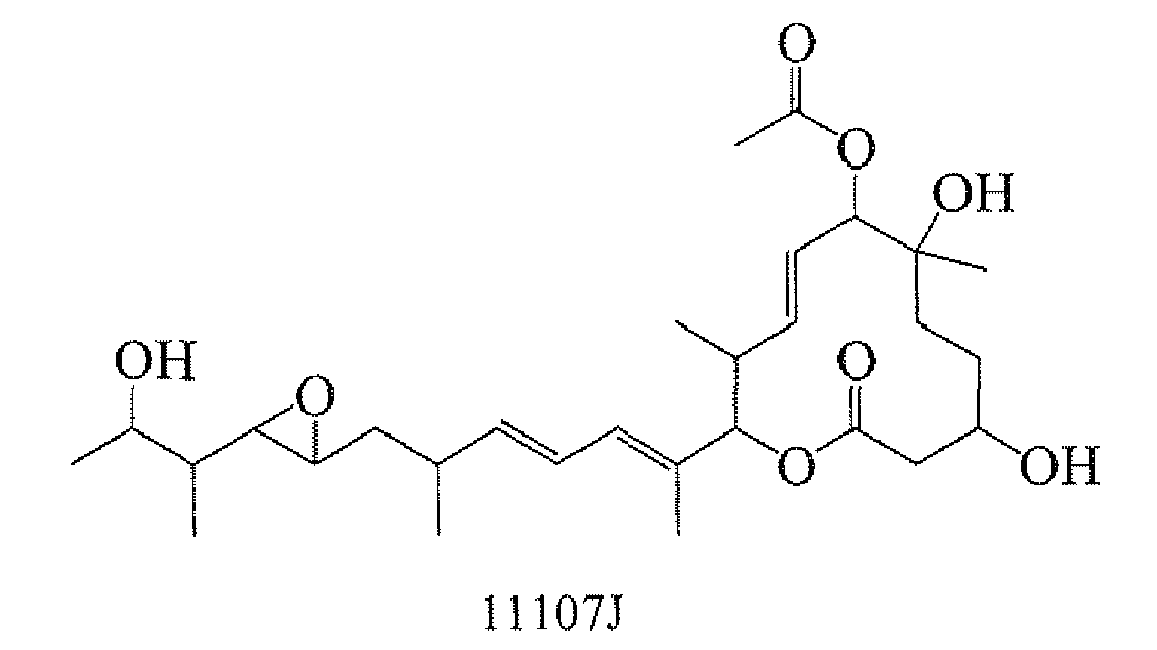
- The physico-chemical properties of 11107K are shown below. The structure of 11107K was determined as shown below.
- 1. Appearance: colorless powder
- 2. Molecular weight: 552, FAB-MS m/z 553(M+H)+
- 3. Molecular formula: C30H48O9
- 4. Solubility: soluble in dimethylsulfoxide, pyridine, methanol and acetone, and slightly soluble in water
- 5. Color reaction: positive for iodine and sulfuric acid
- 6. Infrared absorption spectrum (KBr) cm-1: 3461, 2965, 1735, 1712, 1455, 1372, 1242, 1169
- 7. 1H-NMR spectrum (CD3OD, 500 MHz): δ ppm (integral, multiplicity, coupling constant J (Hz)):
- 0.87(3H,d,J=6.8Hz), 0.91(3H,d,J=7.3Hz), 0.94(3H,t,J=7.6Hz), 1.09(3H,d,J=6.9Hz), 1.11(3H,s), 1.21(1H,m), 1.42-1.66(6H,m), 1.7(3H,d,J=1.0Hz), 2.06(3H,s), 2.44-2.58(3H,m), 2.61(1H,dd,J=3.7,12.9Hz), 2.66(1H,dd,J=2.2,8.1Hz), 2.73(1H,dt,J=2.2,6.0Hz), 3.50-3.57(2H,m), 4.15(1H,m), 5.05(1H,d,J=9.8Hz), 5.09(1H,d,J=10.3Hz), 5.53(1H,dd,J=10.3,15,1Hz), 5.64-5.70(2H,m), 6.09(1H,d,J=10.7Hz), 6.33(1H,dd,J=10.7,15.1Hz).

- The cultured broth (86 L) was filtrated using a small size filter press (washed with water: 10 L), and separated into the filtrate, the washed solution (94 L) and the mycelium cake (wet weight 14.5kg). The filtrate and the washed solution were extracted with toluene (50 L). The mycelium cake was extracted with methanol (50 L), then the methanol extract was filtrated (wash with methanol: 10 L). This methanol extract was evaporated under reduced pressure to remove the methanol, then extracted with toluene (10 L). After the respective toluene layers were washed with water, they were combined and concentrated to give 69.4 g of extract containing active compound. Thus acquired extract was dissolved in methanol (400 ml), combined with 10% aqueous sodium chloride (400 ml) and washed with n-hexane (400 ml 0 2). Then it was extracted with ethyl acetate (400 ml 2), washed with water and concentrated under reduced pressure to give 12.1 g of crude active fraction. The crude active fraction was dissolved in a mix solution consisting of ethyl acetate and n-hexane (1:1, v/v), and subjected to silica gel chromatography (Kiesel gel 60, 120g). The column was washed with a mix solution (1000 ml) consisting of ethyl acetate and n-hexane (1:1, v/v), developed with a mix solution (600 ml) consisting of ethyl acetate and n-hexane (2:1, v/v), a mix solution (1000 ml) consisting of ethyl acetate and n-hexane (8:2, v/v) and ethyl acetate (500 ml). A fraction eluted to 300ml (crude active fraction A), a fraction eluted from 300 ml to 1080 ml (11107E fraction) and a fraction eluted from 1080 ml to 2010 ml (crude active fraction B) were collected separately and evaporated under reduced pressure to give 519 mg of crude active fraction A, 5.96 g of 11107B fraction and 681 mg of crude active fraction B, respectively.
- The cultured broth (86 L) was combined with acetone (18 L), stirred and extracted, and then the mixture was filtered by a continuous centrifugal filtering machine. The resulting acetone extract (106 L) was adsorbed on DIAION HP-20 column (11 L), and eluted with 5% aqueous acetone (10 L), 40% aqueous acetone (30 L), 60% aqueous acetone (60 L) and 80% aqueous acetone (80 L). The 60% aqueous acetone fraction (30 L) was concentrated, then extracted with toluene (10 L). Thus obtained toluene layer was evaporated to give 17.6 g of crude active fraction. 5.0 g of this crude active fraction was dissolved in toluene and subjected to a silica gel column chromatography (Kiesel gel 60, 350g). The column was washed with toluene (350 ml), developed with a mix solution (4000 ml) consisting of toluene and acetone (3:1, v/v), a mix solution (1000 ml) consisting of toluene and acetone (1:1, v/v). A fraction eluted from 1100 ml to 1700ml (crude active fraction A), a fraction eluted from 1700 ml to 4000 ml (11107B fraction) and a fraction eluted from 4000 ml to 5000 ml (crude active fraction B) were collected separately and evaporated under reduced pressure to give 640 mg of crude active fraction A, 3.32 g of crude 11107B and 466 mg of crude active fraction B, respectively.
- The resulting crude active fraction A was subjected to preparative high performance liquid chromatography (HPLC) under the following preparative conditions (C1) and (C2) to give 11107L (8.6 mg), 11107M (6.8 mg), 11107N (5.4 mg), 11107AP (3.4 mg) and 11107AR (1.8 mg). Further, the separation with preparative high performance liquid chromatography (HPLC), followed by purification with silica gel thin layer chromatography (Merk 105715, toluene:acetone (2:1, v/v)), gave 11107X (11.1 mg), 11107Y (6.5 mg), 11107AL (1.8 mg), 11107AM (2.7 mg), 11107AN (0.6 mg) and 11107AQ (6.0mg).
- The crude 11107B fraction (5.96g) was subjected to preparative high performance liquid chromatography (HPLC) under the following preparative HPLC condition (C3) to give the crude active fraction C (100 mg) containing 11107T, 11107U, 11107W, 11107Z, 11107AA, 11107AC, 11107AH and 11107AI. 35 mg of the resulting crude active fraction C was further subjected to the preparative high performance liquid chromatography (HPLC) under the following preparative HPLC condition (C4), a fraction containing 11107T, a fraction containing 11107AA and 11107U, and a fraction containing 11107W, 11107Z and 11107AC were collected separately, and the solvent was removed. The fraction containing 11107T was further subjected to the preparative high performance liquid chromatography (HPLC) under the following preparative HPLC condition (C5) to give a 11107T solution. Then, 11107T (0.8 mg) was given by removal of the solvent. The fraction containing 11107AA and 11107U was further subjected to the preparative high performance liquid chromatography (HPLC) under the following preparative HPLC condition (C5) to give a 11107AA solution and a 11107U solution. Then, 11107AA (0.2 mg) and 11107U (1.0 mg) were given by removal of the solvent. The fraction containing 11107W, 11107Z and 11107AC was further subjected to the preparative high performance liquid chromatography (HPLC) under the following preparative HPLC condition (C5) to give a 11107W solution, a 11107Z solution and a 11107AC solution. Then, 11107W (1.3 mg), 11107Z (1.1 mg) and 11107AC (0.4 mg) were given by removal of the solvent. Further, the total amount of the residue of the resulting crude active fraction C was subjected to the preparative high performance liquid chromatography (HPLC) under the following preparative HPLC condition (C6), a fraction containing 11107AH and a fraction containing 11107AI were collected separately, and the solvent was removed. The fraction containing 11107AH was further subjected to the preparative high performance liquid chromatography (HPLC) under the following preparative HPLC conditions (C7) to give a 11107AH solution. Then, 11107AH (0.3 mg) was given by removal of the solvent. The fraction containing 11107AI was further subjected to the preparative high performance liquid chromatography (HPLC) under the following preparative HPLC condition (C8) to obtain a 11107AI solution. Then, 11107AI (0.5 mg) was given by removal of the solvent.
- The resulting crude active fraction B (1.15 g) was dissolved in 20 ml of a mix solution consisting of tetrahydrofuran-50% aqueous acetonitrile (1:2, v/v), and subjected to ODS column chromatography (ODS-AM 120-S50; manufactured by YMC Co., 750 g). The column was eluted with a mix solution (5 L) consisting of acetonitrile and water (45:55, v/v), to obtain crude active fraction B1 containing 111070, 11107P, 11107Q, 11107R, 11107AF and 11107AG which was eluted from 1300 ml to 1800 ml, crude active fraction B2 containing 11107S and 11107V which was eluted from 2160 ml to 2400 ml, and crude active fraction B3 containing 11107AD, 11107AE, 11107AJ and 11107AK which was eluted from 2565 ml to 3300 ml were collected separately. The respective fractions were evaporated to dryness, to give 50 mg of crude active fraction B1, 236 mg of crude active fraction B2 and 67.5 mg of crude active fraction B3.
- 38.6 mg of the resulting crude active fraction B1 was subjected to the preparative high performance liquid chromatography (HPLC) under the following preparative HPLC condition (C9), whereby a fraction containing 11107AF, a fraction containing 111070, a fraction containing 11107P, a fraction containing 11107Q, a fraction containing 11107R and a fraction containing 11107AG were collected separately, and the solvent was removed. The fraction containing 11107AF was further subjected to the preparative high performance liquid chromatography (HPLC) under the following preparative HPLC condition (C10) to obtain a 11107AF solution. Then, 11107AF (0.3 mg) was given by removal of the solvent. The fraction containing 11107O was further subjected to the preparative high performance liquid chromatography (HPLC) under the following preparative HPLC condition (C11) to give a 11107O solution. Then, 11107O (0.5 mg) was given by removal of the solvent. The fraction containing 11107P was subjected to the preparative high performance liquid chromatography (HPLC) under the following preparative HPLC condition (C11) to give a 11107P solution. Then, 11107P (1.3 mg) was given by removal of the solvent. The fraction containing 11107Q was further subjected to the preparative high performance liquid chromatography (HPLC) under the following preparative HPLC condition (C6) to give a 11107Q solution. Then, 11107Q (0.6 mg) was given by removal of the solvent. The fraction containing 11107R was further subjected to the preparative high performance liquid chromatography (HPLC) under the following preparative HPLC condition (C6) to give a 11107R solution. Then, 11107R (0.6 mg) was given by removal of the solvent. The fraction containing 11107AG was further subjected to the preparative high performance liquid chromatography (HPLC) under the following preparative HPLC condition (C12) to give a 11107AG solution. Then, 11107AG (1.0 mg) was given by removal of the solvent.
- 200 mg of crude active fraction B2 was subjected to repeated use of preparative high performance liquid chromatography (HPLC), under the following preparative HPLC condition (C13) to give a fraction containing 11107S and a fraction containing 11107AB and 11107V (0.5 mg). The fraction containing 11107S was subjected to the preparative high performance liquid chromatography (HPLC) under the following preparative HPLC condition (C14) to give a 11107S solution. Then, 11107S (1.2 mg) was given by removal of the solvent. Similarly, the fraction containing 11107AB (20 mg) was subjected to the preparative high performance liquid chromatography (HPLC) under the following HPLC preparative condition (C15) to give a 11107AB solution. Then, 11107AB (14 mg) was given by removal of the solvent.
- The resulting crude active fraction B3 (67.5 mg) was subjected to preparative high performance liquid chromatography (HPLC) under the following preparative HPLC condition (C16), a fraction containing 11107AD, a fraction containing 11107AE and a fraction containing 11107AJ and 11107AK were collected separately, and the solvent was removed. The fraction containing 11107AD was subjected to repeated use of preparative high performance liquid chromatography (HPLC), under the following preparative conditions (C17), (C18) and (C17) in turn, to give 111107AD (4.1 mg) . Further, the fraction containing 11107AE was subjected to twice repeated use of preparative high performance liquid chromatography (HPLC), under the following preparative HPLC condition (C17) to give 11107AE (8.2 mg) as a mixture of tautomers, 11107AEa and 11107AEb. Further, the fraction containing 11107AJ and 11107AK was subjected to preparative high performance liquid chromatography (HPLC), under the following preparative HPLC conditions (C17), to give a fraction containing 11107AJ and a fraction containing 11107AK separately. The solvent was removed from each fraction. Then the respective fractions were subject to repeated use of preparative high performance liquid chromatography (HPLC), under the following preparative conditions (C18) and (17) in turn, to give 11107AJ (0.5 mg) and 11107AK (0.9 mg).
-
- Column: CAPCELL PAK C18 UG120, φ30 mm × 250 mm (manufactured by SHISEIDO Co.)
- Flow rate: 20 ml/min.
- Detection: 240 nm
- Eluent: acetonitrile/water (4:6, v/v) isocratic
-
- Column: CAPCELL PAK C18 UG120, φ30 mm × 250 mm (manufactured by SHISEIDO Co.)
- Flow rate: 20 ml/min.
- Detection: 240 nm
- Eluent: acetonitrile/water (5:5, v/v) isocratic
-
- Column: Inertsil ODS-3, φ50 mm × 250 mm (manufactured by GL Science)
- Temperature: room temperature
- Flow rate: 40 ml/min.
- Detection: 240 nm
- Eluent: acetonitrile/water (45:55, v/v) isocratic
-
- Column: CAPCELL PAK C18 SG120, φ20 mm × 250 mm (manufactured by SHISEIDO Co.)
- Temperature: 40°C
- Flow rate: 5 ml/min.
- Detection: 200 nm
- Eluent: acetonitrile/water (4:6, v/v) isocratic
-
- Column: CAPCELL PAK C18 SG120, φ20 mm × 250 mm (manufactured by SHISEIDO Co.)
- Temperature: 40°C
- Flow rate: 10 ml/min.
- Detection: 240 nm
- Eluent: methanol/water (6:4, v/v) isocratic
-
- Column: CAPCELL PAK C18 SG120, φ20 mm × 250 mm (manufactured by SHISEIDO Co.)
- Temperature: 40°C
- Flow rate: 5 ml/min.
- Detection: 240 nm
- Eluent: acetonitrile/water (4:6, v/v) isocratic
-
- Column: CAPCELL PAK C18 SG120, φ20 mm × 250 mm (manufactured by SHISEIDO Co.)
- Temperature: 40°C
- Flow rate: 5 ml/min.
- Detection: 200 nm
- Eluent: methanol/water (6:4, v/v) isocratic
-
- Column: CAPCELL PAK C18 SG120, φ20 mm × 250 mm (manufactured by SHISEIDO Co.)
- Temperature: 40°C
- Flow rate: 5 ml/min.
- Detection: 240 nm
- Eluent: methanol/water (6:4, v/v) isocratic
-
- Column: YMC J'sphere ODS-M80 JM-343, φ20 mm × 250 mm (manufactured by YMC Co.)
- Temperature: 40°C
- Flow rate: 5 ml/min.
- Detection: 200 nm
- Eluent: acetonitrile/water (3:7, v/v) isocratic
-
- Column: CAPCELL PAK C18 SG120, φ20 mm × 250 mm (manufactured by SHISEIDO Co.)
- Temperature: 40°C
- Flow rate: 5 ml/min.
- Detection: 240 nm
- Eluent: methanol/water (5:5, v/v) isocratic
-
- Column: YMC J'sphere ODS-M80 JM-343, φ20 mm × 250 mm (manufactured by YMC Co.)
- Temperature: 40°C
- Flow rate: 5 ml/min.
- Detection: 240 nm
- Eluent: acetonitrile/water (3:7, v/v) isocratic
-
- Column: YMC J'sphere ODS-M80 JM-343, φ20 mm × 250 mm (manufactured by YMC Co.)
- Temperature: 40°C
- Flow rate: 5 ml/min.
- Detection: 200 nm
- Eluent: methanol/water (6:4, v/v) isocratic
-
- Column: YMC J'sphere ODS-H80 JH-343, φ20 mm × 250 mm (manufactured by YMC Co.)
- Temperature: 40°C
- Flow rate: 20 ml/min.
- Detection: 215 nm
- Eluent: acetonitrile/water (32:68, v/v) isocratic
-
- Column: YMC J'sphere ODS-H80 JH-323, φ10 mm × 250 mm (manufactured by YMC Co.)
- Temperature: 40°C
- Flow rate: 5 ml/min.
- Detection: 215 nm
- Eluent: acetonitrile/water (4:6, v/v) isocratic
-
- Column: YMC J'sphere ODS-H80 JH-343, φ20 mm × 250 mm (manufactured by YMC Co.)
- Temperature: 40°C
- Flow rate: 20 ml/min.
- Detection: 215 nm
- Eluent: acetonitrile/water (4:6, v/v) isocratic
-
- Column: YMC J'sphere ODS-M80 JM-343, φ20 mm × 250 mm (manufactured by YMC Co.)
- Temperature: room temperature
- Flow rate: 10 ml/min.
- Detection: 240 nm
- Eluent: acetonitrile/water (35:65-4:6, v/v, 0-50 minutes, linear gradient), acetonitrile/water (4:6, v/v, 50-70 minutes, isocratic)
-
- Column: YMC J'sphere ODS-M80 JM-343, φ20 mm × 250 mm (manufactured by YMC Co.)
- Temperature: room temperature
- Flow rate: 10 ml/min.
- Detection: 240 nm
- Eluent: methanol/water (65:35-7:3, v/v, 0-40 minutes, linear gradient)
-
- Column: CAPCELL PAK C18 SG120, φ20 mm × 250 mm (manufactured by SHISEIDO Co.)
- Temperature: room temperature
- Flow rate: 5 ml/min.
- Detection: 240 nm
- Eluent: acetonitirle/water (4:6, v/v) isocratic
- The retention times of 11107B and the above-mentioned compounds when analysis was carried out at the following Analytic HPLC conditions are shown below.
-
- Column: CAPCELL PAK C18 SG120, φ4.6 mm × 250 mm (manufactured by SHISEIDO Co.)
- Temperature: 40°C
- Flow rate: 1 ml/min.
- Detection: 240 nm
- Eluent: acetonitirle/water (4:6, v/v) isocratic
- Retention time:
- 11107B: 16.4 min.
- 11107L: 22.2 min.
- 11107M: 36.0 min.
- 11107N: 18.1 min.
- 11107R: 7.6 min.
- 11107X: 23.8 min.
- 11107Y: 23.6 min.
- 11107AL: 32.0 min.
- 11107AM: 30.3 min.
- 11107AN: 38.7 min.
- 11107AP: 60.4 min.
- 11107AQ: 64.7 min.
- 11107AR: 15.2 min.
-
- Column: CAPCELL PAK C18 SG120, φ4.6 mm × 250 mm (manufactured by SHISEIDO Co.)
- Temperature: 40°C
- Flow rate: 1 ml/min.
- Detection: 240 nm
- Eluent: methanol/water (6:4, v/v) isocratic
- Retention time:
- 11107T: 13.0 min.
- 11107U: 14.4 min.
- 11107w: 15.4 min.
- 11107Z: 15.9 min.
- 11107AA: 12.4 min.
- 11107AC: 12.7 min.
- 11107AI: 18.3 min.
-
- Column: CAPCELL PAK C18 SG120, φ4.6 mm × 250 mm (manufactured by SHISEIDO Co.)
- Temperature: 40°C
- Flow rate: 1 ml/min.
- Detection: 200 nm
- Eluent: methanol/water (6:4, v/v; isocratic
- Retention time:
- 11107AH: 10.3 min.
-
- Column: CAPCELL PAK C18 SG120, φ4.6 mm × 250 mm (manufactured by (SHISEIDO Co.)
- Temperature: 40°C
- Flow rate: 1 ml/min.
- Detection: 240 nm
- Eluent: methanol/water (5:5, v/v) isocratic
- Retention time:
- 111070: 20.2 min.
- 11107Q: 25.2 min.
- 11107AF: 17.7 min.
-
- Column: YMC J'sphere ODE-M80 JM-307, φ4.6 mm × 75 mm (manufactured by YMC Co.)
- Temperature: 40°C
- Flow rate: 1.5 ml/min.
- Detection: 240 nm
- Eluent: acetonitrile/water (3:7, v/v) isocratic
- Retention time:
- 11107P: 5.8 min.
-
- Column: YMC Pack Ph A407, φ4.6 mm × 75 mm (manufactured by YMC Co.)
- Temperature: 40°C
- Flow rate: 1 ml/min.
- Detection: 200 nm
- Eluent: methanol/water (5:5, v/v) isocratic
- Retention time:
- 11107AG: 6.5 min.
-
- Column: CAPCELL PAK C18 SG120, φ4.6 mm × 250 mm (manufactured by SHISEIDO Co.)
- Temperature: 40°C
- Flow rate: 1 ml/min.
- Detection: 254 nm
- Eluent: acetonitrile/water (4:6, v/v) isocratic
- Retention time:
- 11107V: 9.6 min.
- 11107AB: 10.8 min.
-
- Column: CAPCELL PAK C18 SG120, φ4.6 mm × 250 mm (manufactured by SHISEIDO Co.)
- Temperature: 40°C
- Flow rate: 1.5 ml/min.
- Detection: 240 nm
- Eluent: acetonitrile/water (4:6, v/v) isocratic 111075 : 6.6 min.
-
- Column: CAPCELL PAK C18 SG120, φ4.6 mm × 250 mm (manufactured by SHISEIDO Co.)
- Temperature: room temperature
- Flow rate: 1 ml/min.
- Detection: 240 nm
- Eluent: acetonitrile/water (4:6, v/v) isocratic
- Retention time:
- 11107AD: 15.6 min.
- 11107AE: 14.7 min. (11107AEa), 15.4 min. (11107AEb)
- 11107AJ: 12.9 min.
- 11107AK: 13.4 min.
- The physico-chemical properties of 11107L are shown below. The structure of 11107L was determined as shown below.
- 1. Appearance: colorless powder
- 2. Molecular weight: 594, FAB-MS m/z 617(M+Na)+, 593(M-H)-
- 3. Molecular formula: C32H50O10
- 4. Solubility: soluble in dimethylsulfoxide, pyridine, methanol and acetone, and slightly soluble in water
- 5. Color reaction: positive for iodine and sulfuric acid
- 6. Infrared absorption spectrum: 3470, 2970, 1735, 1718, 1456, 1373, 1236, 1175
- 7. 1H-NMR spectrum (CD3OD, 400 MHz): δ ppm (integral, multiplicity, coupling constant J (Hz)):
- 0.87(3H,d,J=6.6Hz), 0.90(3H,d,J=7.0Hz), 0.94(3H,t,J=7.3Hz), 1.08(3H,d,J=7.0Hz), 1.18-1.22 (4H,m), 1.42-1.52(3H,m), 1.65-1.69(1H,m), 1.70-1.74(2H,m), 1.77(3H,d,J=0.7Hz), 2.06(3H,s), 2.08(3H,s), 2.46-2.50(1H,m), 2.52(1H,dd,J=4.4,15.0Hz), 2.55-2.52(1H,m), 2.65(1H,dd,J=2.2,8.4Hz), 2.72(1H,dt,J=2.2,5.9Hz), 2.77(1H,dd,J=3.3,15.0Hz), 3.51(1H,dt,J=8.4,4.4Hz), 3.73-3.75(1H,m), 4.98(1H,dd,J=3.1,10.7Hz), 5.08(1H,d,J=9.9Hz), 5.11(1H,d,J=11.0Hz), 5.60(1H,dd,J=9.9,15.0Hz), 5.66(1H,dd,J=8.4,15.0Hz), 5.74(1H,dd,J=9.9,15.0Hz), 6.09(1H,d,J=11.0Hz), 6.33(1H,dd,J=11.0,15.0Hz)

- The physico-chemical properties of 11107M are shown below. The structure of 11107M was determined as shown below.
- 1. Appearance: colorless powder
- 2. Molecular weight: 578, FAB-MS m/z 577(M-H)-
- 3. Molecular formula: C32H50O9
- 4. Solubility: soluble in dimethylsulfoxide, pyridine, methanol and acetone, and slightly soluble in water
- 5. Color reaction: positive for iodine and sulfuric acid
- 6. Infrared absorption spectrum: 3498, 2970, 1731, 1719, 1456, 1374, 1254, 1174
- 7. 1H-NMR spectrum (CD3OD, 400 MHz): δ ppm (integral, multiplicity, coupling constant J (Hz)):
- 0.89(3H,d,J=6.6Hz), 0.90(3H,d,J=7.0Hz), 0.93(3H,t,J=7.3Hz), 1.08(3H,d,J=7.0Hz), 1.17-1.20(4H,m), 1.42-1.55(5H,m), 1.60-1.66(3H,m), 1.74(3H,d,J=1.1Hz), 2.04(3H,s), 2.06(3H,s), 2.44-2.52(1H,m), 2.54-2.58(1H,m), 2.60(1H,dd,J=3.7,14.8Hz), 2.62(1H,dd,J=5.9,14.8Hz), 2.64(1H,dd,J=2.2,8.1Hz), 2.72(1H,dt,J=2.2,5.9Hz), 3.51(1H,dt,J=8.4,4.8Hz), 4.82-4.84(1H,m), 4.98(1H,d,J=10.6Hz), 5.02(1H,d,J=9.6Hz), 5.57(1H,dd,J=9.9,15.0Hz), 5.66(1H,dd,J=9.4,15.0Hz), 5.71(1H,dd,J=9.6,15.0Hz), 6.09(1H,d,J=11.0Hz), 6.32(1H,dd,J=11.0,15.0Hz)

- The physico-chemical properties of 11107N are shown below. The structure of 11107N was determined as shown below.
- 1. Appearance: colorless powder
- 2. Molecular weight: 594, FAB-MS m/z 595(M+H)+, 617(M+Na)+
- 3. Molecular formula: C32H50O10
- 4. Solubility: soluble in dimethylsulfoxide, pyridine, methanol and acetone, and slightly soluble in water
- 5. Color reaction: positive for iodine and sulfuric acid
- 6. Infrared absorption spectrum: 3480, 2964, 1740, 1719, 1456, 1371, 1244, 1174
- 7. 1H-NMR spectrum (CD3OD, 400 MHz): δ ppm (integral, multiplicity, coupling constant J (Hz)):
- 0.88(3H,d,J=6.2Hz), 0.90(3H,d,J=6.6Hz), 0.94(3H,t,J=7.3Hz), 1.08(3H,d,J=7.0Hz), 1.17-2.22(1H,m), 1.42-1.52(5H,m), 1.55-1.65(3H,m), 1.75(3H,d,J=0.7Hz), 2.D4(3H,s), 2.05(3H,s), 2.45-2.50(1H,m), 2.51(1H,d,J=4.4Hz), 2.53(1H,d,J=3.3Hz), 2.54-2.62(1H,m), 2.65(1H,dd,J=2.6,8.4Hz), 2.72(1H,dt,J=2.6,6.2Hz), 3.51(1H,dt,J=8.8,4.8Hz), 3.75-3.81(1H,m), 4.00(1H,d,J=11.4Hz), 4,14(1H,d,J=11.4Hz), 5-05(1H,d,J=10.6Hz), 5.21(1H,d,J=9.5Hz), 5.63(1H,dd,J=9.5,15.0Hz), 5.65(1H,dd,J=9.5,15.0Hz), 5.72(1H,dd,J=9.5,15.0Hz), 6.09(1H,d,J=11.0Hz), 6.32(1H,dd,J=11.0,15.0Hz)
- The physico-chemical properties of 111070 are shown below. The structure of 111070 was determined as shown below.
- 1. Appearance: colorless powder
- 2. Molecular weight: 554, FAB-MS m/z 555(M+H)+, 577(M+Na)+
- 3. Molecular formula: C30H50O9
- 4. Solubility: soluble in dimethylsulfoxide, pyridine, methanol and acetone, and slightly soluble in water
- 5. Color reaction: positive for iodine and sulfuric acid
- 6. Infrared absorption spectrum (KBr)cm-1: 3419, 2966, 1733, 1716, 1457, 1374, 1258, 1176
- 7. 1H-NMR spectrum (CD3OD, 500 MHz): δ ppm (integral, multiplicity, coupling constant J (Hz)):
- 0.88(3H,d,J=6.8Hz), 0.90(3H,d,J=7.3Hz), 0.93(3H,t,J=7.3Hz), 1.06(3H,d,J=6.8Hz), 1.19(3H,s), 1.34-1.44(3H,m), 1.51(2H,m), 1.54-1.71(3H,m), 1.75(3H,s), 1.90(1H,m), 2.06(3H,s), 2.53(2H,m), 2.56(2H,m), 3.43-3.50(2H,m), 3.57(1H,m), 3.78(1H,m), 5.05(2H,d,J=10.3Hz), 5.57(1H,dd,J=10.3,15.1Hz), 5.61(1H,dd,J=8.3,15.1Hz), 5.70(1H,dd,J=9.8,15.1Hz), 6.10(1H,d,J=10.7Hz), 6.33(1H,dd,J=10.7,15.1Hz)

- The physico-chemical properties of 11107P are shown below. The structure of 11107P was determined as shown below.
- 1. Appearance: colorless powder
- 2. Molecular weight: 552, FAB-MS m/z 553(M+H)+, 5'75 (M+Na) +
- 3. Molecular formula: C30H48O9
- 4. Solubility: soluble in dimethylsulfoxide, pyridine, methanol and acetone, and slightly soluble in water
- 5. Color reaction: positive for iodine and sulfuric acid
- 6. Infrared absorption spectrum (KBr) cm-1: 3290, 2969, 1734, 1716, 1457, 1374, 1247, 1177
- 7. 1H-NMP, spectrum (CD3OD, 500 MHz): δ ppm (integral, multiplicity, coupling constant J (Hz)):
- 0.88(3H,d,J=6.8Hz), 0.90(3H,d,J=7.3Hz), 0.94(3H,t,J==7.3Hz), 1.13(3H,d,J=6.8Hz), 1.19(3H,s), 1.22(1H,m), 1.28-1.67(6H,m), 1.75(3H,d,J=1.0Hz), 2.06(3H,s), 2.44(1H,m), 2.53-2.57(3H,m), 2.74(1H,dd,J=2.4,6.8Hz), 2.83(1H,dd,J=2.0,8.3Hz), 3.09(1H,dd,J=6.8,7.3Hz), 3.52(1H,m), 3.78(1H,m), 5.04(1H,d,J=10.7Hz), 5.05(IH,d,J=9.8Hz), 5.56(1H,dd,J=9.8,15.1Hz), 5.701(1H,dd,J=9.8,15.1Hz), 5.703(1H,dd,J=7.3,15.1Hz), 6.10(1H,d,J=10.7Hz), 6.37(1H,dd,J=10.7,15.1Hz)

- The physico-chemical properties of 11107Q are shown below. The structure of 11107Q was determined as shown below.
- 1. Appearance: colorless powder
- 2. Molecular weight: 550, FAB-MS m/z 551(M+H)+, 573(M+Na)+
- 3. Molecular formula: C30H46O9
- 4. Solubility: soluble in dimethylsulfoxide, pyridine, methanol and acetone, and slightly soluble in water
- 5. Color reaction: positive for iodine and sulfuric acid
- 6. Infrared absorption spectrum (KBr) cm-1: 3384, 2970, 1732, 1716, 1670, 1456, 1374, 1258, 1174
- 7. 1H-NMR spectrum (CD3OD, 500 MHz): δ ppm (integral, multiplicity, coupling constant J (Hz)):
- 0.88(3H,d,J=6.4Hz), 1.07(3H,d,J=6.8Hz), 1.19(3H,s), 1.31(3H,d,J=6.8Hz), 1.34-1.45(3H,m), 1.53-1.71(3H,m), 1.75(3H,s), 1.77(3H,s), 2.06(3H,s), 2.50-2.57(4H,m), 3.79(1H,m), 4.48(1H,m), 4.94(1H,q,J=6.8Hz), 5.045(1H,d,J=11.2Hz), 5.047(1H,d,J=9.3Hz), 5.57(1H,dd,J=9.3,15.1Hz), 5.63(1H,dd,J=8.8,15.1Hz), 5.70(1H,dd,J=9.8,15.1Hz), 6.10(1H,d,J=10.7Hz), 6.35(1H,dd,J=10.7,15.1Hz), 6.54(1H,d,J=8.3Hz)

- The physico-chemical properties of 11107T are shown below. The structure of 11107T was determined as shown below.
- 1. Appearance: colorless powder
- 2. Molecular weight: 522, FAB-MS m/z 545(M+Na)+
- 3. Molecular formula: C29H46O8
- 4. Solubility: soluble in dimethylsulfoxide, pyridine, methanol and acetone, and slightly soluble in water
- 5. Color reaction: positive for iodine and sulfuric acid
- 6. Infrared absorption spectrum (KBr) cm-1: 3421, 2965, 1734, 1718, 1457, 1370, 1244, 1175
- 7. 1H-NMR spectrum (CD3OD, 500 MHz): δ ppm (integral, multiplicity, coupling constant J (Hz)):
- 0.89(3H,d,J=6.8Hz), 0.93(3H,t,J=7.3Hz), 1.09(3H,d,J=6.8Hz), 1.19(3H,s), 1.28-1.42(2H,m), 1.42-1.68(8H,m), 1.75(3H,s), 2.06(3H,s), 2.48-2.57(4H,m), 2.74(1H,ddd,J=2.4,4.9,5.9Hz), 2.85(1H,ddd,J=2.4,4.4,7.3Hz), 3.64(1H,m), 3.78(1H,m), 5.047(1H,d,J=9.8Hz), 5.052(1H,d,J=10.8Hz), 5.57(1H,dd,J=9.8,15.1Hz), 5.69(7.H,dd,J=8.3,15.1Hz), 5.70(1H,dd,J=9.6,15.1Hz), 6.10(1H,d,J=10.7Hz), 6.32(1H,dd,J=10.7,15.1Hz)

- The physico-chemical properties of 11107U are shown below. The structure of 11107U was determined as shown below.
- 1. Appearance: colorless powder
- 2. Molecular weight: 522, FAB-MS m/z 545(M+Na)+
- 3. Molecular formula: C29H46O8
- 4. Solubility: soluble in dimethylsulfoxide, pyridine, methanol and acetone, and slightly soluble in water
- 5. Color reaction: positive for iodine and sulfuric acid
- 6. Infrared absorption spectrum (KBr) cm-1. 3461, 2967, 1732, 1715, 1455, 1372, 1247, 1174
- 7. 1H-NMR spectrum (CD3OD, 500 MHz): δ ppm (integral, multiplicity, coupling constant J (Hz)):
- 0.88(3H,d,J=6.8Hz), 0.93(3H,d,J=6.8Hz), 0.95(3H,t,J=7.8Hz), 1.19(3H,s), 1.26(1H,m), 1.34-1.42(2H,m), 1.42-1.56(2H,m), 1.56-1.72(4H,m), 1.74(3H,s), 2.06(3H,s), 2.29(2H,m), 2.52-2.56(3H,m), 2.70(1H,dd,J=2.4,8.3Hz), 2.76(1H,dt,J=2.4,5.9Hz), 3.53(1H,m), 3.78(1H,m), 5.05(2H,d,J=10.3Hz), 5.56(1H,dd,J=9.8,15.1Hz), 5.70(1H,dd,J=9.8,15.1Hz), 5.79(1H,dt,J=15.1,7.1Hz), 6.09(1H,d,J=10.7Hz), 6.34(1H,dd,J=10.7,15.1Hz)

- The physico-chemical properties of 11107W are shown below. The structure of 11107W was determined as shown below.
- 1. Appearance: colorless powder
- 2. Molecular weight: 522, FAB-MS m/z 523(M+H)+, 545(M+Na)+
- 3. Molecular formula: C29H46O8
- 4. Solubility: soluble in dimethylsulfoxide, pyridine, methanol and acetone, and slightly soluble in water
- 5. Color reaction: positive for iodine and sulfuric acid
- 6. Infrared absorption spectrum (KBr) cm-1: 3463, 2967, 1734, 1715, 1456, 1373, 1245, 1174
- 7. 1H-NMR spectrum (CD3OD, 500 MHz): δ ppm (integral, multiplicity, coupling constant J (Hz)):
- 0.91(3H,d,J=7.3Hz), 0.94(3H,t,J=7.3Hz), 1.00(3H,d,J=6.8Hz), 1.08(3H,d,J=6.8Hz), 1.19(3H,s), 1.20(1H,m), 1.32-1.42 (2H,m), 1.42-1.54(3H,m), 1.54-1.67(3H,m), 2.06(3H,s), 2.37-2.53(4H,m), 2.66(1H,dd,J=2.4,8.3Hz), 2.72(1H,dt,J=2.4,5.9,Hz), 3.52(1H,m), 3.79(1H,m), 5.04(1H,d,J=9.8Hz), 5.09(1H,dd,J=8.3,10.7Hz), 5.52(1H,dd,J=8.3,15.1Hz), 5.56(1H,dd,J=10.3,15.1Hz), 5.67(1H,dd,J=9.8,15.1Hz), 5.69(1H,dd,J=8.3,15.1Hz), 6.10(1H,dd,J=10.3,15.1Hz), 6.29(1H,dd,J=10.3,15.1Hz)

- The physico-chemical properties of 11107X are shown below. The structure of 11107X was determined as shown below.
- 1. Appearance: colorless powder
- 2. Molecular weight: 550,FAB-MS m/z 573(M+Na)+, 549(M-H)-
- 3. Molecular formula: C31H50O8
- 4. Solubility: soluble in dimethylsulfoxide, pyridine, methanol and acetone, and slightly soluble in water
- 5. Color reaction: positive for iodine and sulfuric acid
- 6. Infrared absorption spectrum (KBr) cm-1: 3479, 2967, 1733, 1716, 1457, 1374, 1243, 1178
- 7. 1H-NMR spectrum (CD3OD, 400 MHz): δ ppm (integral, multiplicity, coupling constant J (Hz)):
- 0.87(3H,d,J=7.0Hz), 0.90(3H,d,J=7.0Hz), 0.94(3H,t,J=7.3Hz), 1.08(3H,d,J=6.6Hz), 1.18-1.22(7H,m), 1.33-1.35(2H,m), 1.43-1.52(3H,m), 1.59-1.63(1H,m), 1.59-1-70(2H,m), 1.73(3H,d,J=0.7Hz), 2.06(3H,s), 2.45-2.50(1H,m), 2.53-2.60(1H,m), 2.60-2.64(1H,m) 2.65(1H,dd,J=2.2,8.1Hz), 2.72(1H,dt,J=2.2,5.9Hz), 3.48-3.53(2H,m), 5.00(1H,d,J=11.0Hz), 5.02(1H,d,J=9.9Hz), 5.55(1H,dd,J=9.9,15.0Hz), 5.66(1H,dd,J=9.4,15.0Hz), 5.70(1H,dd,J=9.9,15.0Hz), 6.09(1H,d,J=11.0Hz), 6.32(1H,dd,J=11.0,15.0Hz)
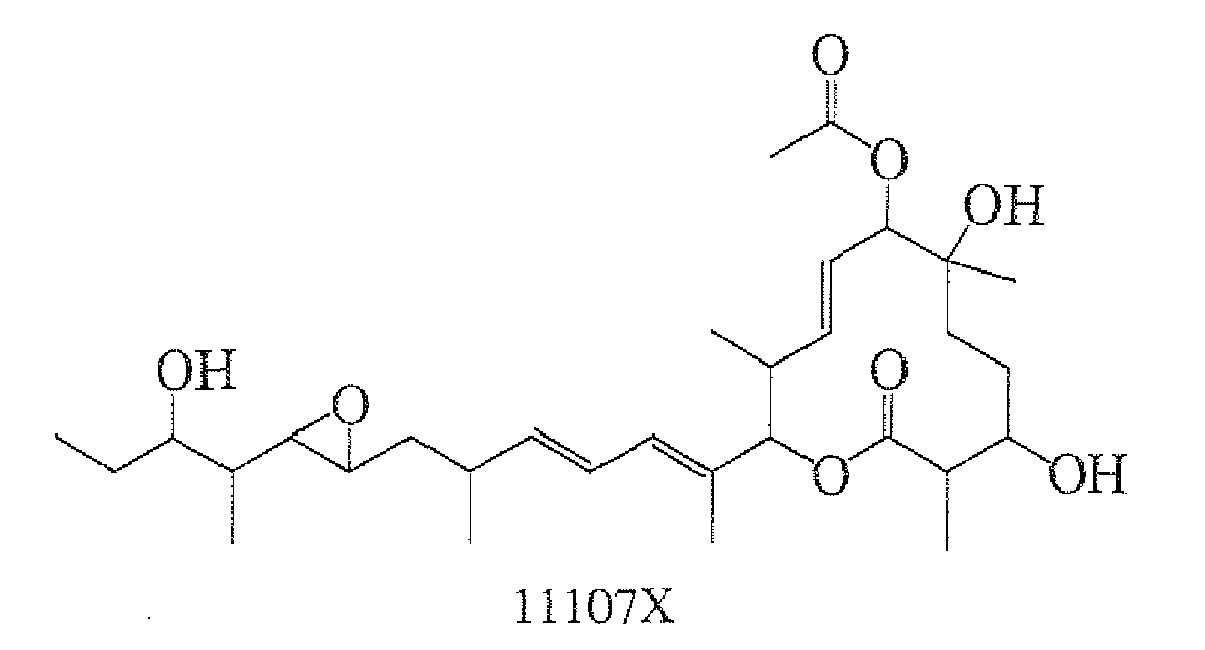
- The physico-chemical properties of 11107Y are shown below. The structure of 11107Y was determined as shown below.
- 1. Appearance: colorless powder
- 2. Molecular weight: 536, FAB-MS m/z 559(M+Na)+, 535(M-H)-
- 3. Molecular formula: C30H48O8
- 4. Solubility: soluble in dimethylsulfoxide, pyridine, methanol and acetone, and slightly soluble in water
- 5. Color reaction: positive for iodine and sulfuric acid
- 6. Infrared absorption spectrum (KBr) cm-1: 3442, 2965, 1733, 1716, 1457, 1373, 1241, 1167
- 7. 1H-NMR spectrum (CD3OD, 400 MHz): δ ppm (integral, multiplicity, coupling constant J (Hz)):
- 0.86(3H,d,J=7.0Hz), 0.90(3H,d,J=7.3Hz), 0.93(3H,t,J=7.3Hz), 0.95(3H,d,J=6.6Hz), 1.08(3H,d,J=7.0Hz), 1.17-1.20(1H,m), 1.43-1.52(5H,m), 1.60-1.64(1H,m), 1.75(3H,d,J=1.1Hz), 2.00(3H,s), 2.01-2.04(1H,m), 2.47-2.52(1H,m), 2.53-2.55(1H,m), 2.56(1H,d,J=4.0Hz), 2.61(1H,d,J=3.3Hz), 2.65(1H,dd,J=2.2,8.1Hz), 2.72(1H,dt,J=2.2,5.9Hz), 3.51(1H,dt,J=8.1,4.8Hz), 3.76(1H,dt,J=3.6,12.5Hz), 4.09-4.12(1H,m), 4.88(1H,d,J=9.2Hz), 5.05(1H,d,J=10.6Hz), 5.42(1H,dd,J=9.2,15.0Hz), 5.50(1H,dd,J=9.5,15.0Hz), 5.66(1H,dd,J=8.4,15.0Hz), 6.08(1H,d,J=10.3Hz), 6.32(1H,dd,J=10.3,15.0Hz)

- The physico-chemical properties of 11107Z are shown below. The structure of 11107Z was determined as shown below.
- 1. Appearance: colorless powder
- 2. Molecular weight: 522, FAB-MS m/z 523(M+H)+, 545(M+Na)+
- 3. Molecular formula: C29H46O8
- 4. Solubility: soluble in dimethylsulfoxide, pyridine, methanol and acetone, and slightly soluble in water
- 5. Color reaction: positive for iodine and sulfuric acid
- 6. Infrared absorption spectrum (KBr) cm-1: 3423, 2965, 1733, 1716, 1457, 1373, 1242, 1174
- 7. 1H-NMR spectrum (CD3OD, 500 MHz): δ ppm (integral, multiplicity, coupling constant J (Hz)):
- 0-90(3H,d,J=6.8Hz), 0.94(3H,t,J==7.3Hz), 1.08(3H,d,J=6.8Hz), 1.20(3H,s), 1.21(1H,m), 1.36-1.42(2H,m), 1.42-1.54(3H,m), 1.54-1.66(3H,m), 1.79(3H,s), 2.07(3H,s), 2.40(2H,m), 2.46(1H,m), 2.57(2H,m), 2.66(1H,dd,J=2.4,8.3Hz), 2.73(1H,dt,J=2.4,5.9Hz), 3.52(1H,m), 3.79(1H,m), 5.0S(1H,d,J=9.3Hz), 5.47(1H,dd,J=3.4,11.2Hz), 5.63(1H,dd,J=8.8,15.1Hz), 5.69(1H,dd,J=9.3,15.1Hz), 5.74(1H,ddd,J=3.4,9.8,15.1Hz), 6.07(1H,d,J=10.BHz), 6.31(1H,dd,J=10.8,15.1Hz)

- The physico-chemical properties of 11107AA are shown below. The structure of 11107AA was determined as shown below.
- 1. Appearance: colorless powder
- 2. Molecular weight: 534, FAB-MS m/z 535(M+H)+, 557(M+Na)+
- 3. Molecular formula: C30H46O8
- 4. Solubility: soluble in dimethylsulfoxide, pyridine, methanol and acetone, and slightly soluble in water
- 5. Color reaction: positive for iodine and sulfuric acid
- 6. Infrared absorption spectrum (KBr) cm-1: 3414, 2971, 1733, 1716, 1457, 1374, 1257, 1175
- 7. 1H-NMR spectrum (CD3OD, 500 MHz): δ ppm (integral, multiplicity, coupling constant J (Hz)):
- 0.87(3H,d,J=6.3Hz), 1.059(3H,t,J=7.3Hz), 1.060(3H,d,J=6.3Hz), 1.19(3H,s), 1.32-1.44(3H,m), 1.52-1.68(3H,m), 1.72(3H,d,J=1.5Hz), 1.75(3H,d,J=1.0Hz), 2.06(3H,s), 2.49-2.57(4H,m), 2.72(2H,m), 3.78(1H,m), 4.47(1H,m), 5.046(1H,d,J=10.7Hz), 5.047(1H,d,J=9.3Hz), 5.57(1H,dd,J=9.9,15.1Hz), 5.63(1H,dd,J=8.8,15.1Hz), 5.70(1H,dd,J=9.3,15.1Hz), 6.10(1H,d,J=11.2Hz), 6.33(1H,dd,J=11.2,15.1Hz), 6.56(1H,dd,J=1.0,8.3Hz)

- The physico-chemical properties of 11107AB are shown below. The structure of 11107AB was determined as shown below.
- 1. Appearance: colorless powder
- 2. Molecular weight: 552, FAB-MS m/z 551(M-H)-
- 3. Molecular formula: C30H48O9
- 4. Solubility: soluble in dimethylsulfoxide, pyridine, methanol and acetone, and slightly soluble in water
- 5. Color reaction: positive for iodine and sulfuric acid
- 6. Infrared absorption spectrum (KBr) cm-1: 3460, 2964, 1732, 1716, 1456, 1374, 1174
- 7. 1H-NMR spectrum (CD3OD, 500 MHz): δ ppm (integral, multiplicity, coupling constant J (Hz)):
- 0.91(3H,d,J=6.8Hz), 0.92(3H,d,J=6.8Hz), 0.94(3H,t,J=7.6Hz), 1.08(3H,d,J=6.4Hz), 1.21(1H,m), 1.30-1.70(8H,m), 1.75(3H,d,J=1.0Hz), 2.08(3H,s), 2.45-2.65(4H,m), 2.66(1H,dd,J=2.0,8.3Hz), 2.72(1H,dt,J=2.4,5.9Hz), 3.51(1H,m), 3.75(1H,m), 3.86(1H,d,J=9.8Hz), 4.07(1H,d,J=11.7Hz), 4.34(1H,d,J=11.7Hz), 5.04(1H,d,J=10.7Hz), 5,44(1H,dd,J=9.7,15.1Hz), 5.66(1H,dd,J=8.3,15.1Hz), 5.74(1H,dd,J=9.8,15.4Hz), 6.09(1H,d,J=10.7Hz), 6.33(1H,dd,J=10.7,15.1Hz).

- The physico-chemical properties of 11107AC are shown below. The structure of 11107AC was determined as shown below.
- 1. Appearance: colorless powder
- 2. Molecular weight: 492, FAB-MS m/z 493(M+H)+, 515(M+Na)+
- 3. Molecular formula: C28H44O7
- 4. Solubility: soluble in dimethylsulfoxide, pyridine, methanol and acetone, and slightly soluble in water
- 5. Color reaction: positive for iodine and sulfuric acid
- 6. 1H-NMR spectrum (CD3OD), 500 MHz): δ ppm (integral, multiplicity, coupling constant J (Hz)):
- 0.91(3H,d,J=6.8Hz), 1.01(3H,t,J=7.1Hz), 1.07(3H,d,J=6.8Hz), 1.09(3H,d,J=7.3Hz), 1.27(3H,s), 1.32-1.38(2H,m), 1.44(1H,m), 1.52-1.62(2H,m), 1.67(1H,m), 1.75(3H,d,J=2.0Hz), 2.32(1H,dq,J=8.3,6.8Hz), 2.48(1H,m), 2.51(2H,m), 2.54-2.61(3H,m), 2.73-2.78(2H,m), 3.70(1H,d,J=9.8Hz), 3.76(1H,m), 5.03(1H,d,J=10.7Hz), 5.38(1H,dd,J=9.8,15.1Hz), 5.66(1H,dd,J=8.8,15.1Hz), 5.72(1H,dd,J=9.8,15.1Hz), 6.09(1H,d,J=11.2Hz), 6.33(1H,dd,J=10.7,15.1Hz)

- The physico-chemical properties of 11107AD are shown below. The structure of 11107AD was determined as shown below. Further, the present compound is the stereoisomer of 3-position hydroxy group of 11107B.
- 1. Appearance: colorless powder
- 2. Molecular weight: 536, FAB-MS m/z 559(M+Na)+
- 3. Molecular formula: C30H48O8
- 4. Solubility: soluble in dimethylsulfoxide, pyridine, methanol and acetone, and slightly soluble in water
- 5. Color reaction: positive for iodine and sulfuric acid
- 6. Infrared absorption spectrum (KBr) cm-1: 3420, 2960, 1730, 1460, 1380, 1240, 1140
- 7. 1H-NMR spectrum (CD3OD, 500 MHz): δ ppm (integral, multiplicity, coupling constant J (Hz)):
- 0.86(3H,d,J=6.8Hz), 0.90(3H,d,J=7.3Hz), 0.94(3H,t,J=7.3Hz), 1.08(3H,d,J=6.8Hz), 1.16(3H,s),1.20(1H,m), 1.36-1.72(8H,m), 1.75(3H,s), 2.06(3H,s), 2.42-2.63(4H,m), 2.66(1H,dd,J=2.4,7.8Hz), 2.73(1H,dt,J=2.4,5.9Hz), 3.51(1H,dt,J=8.8,4.4Hz), 4.23(1H,m), 5.01(1H,d,J=9.8Hz), 5.04(1H,d,J=10.7Hz), 5.49(1H,dd,J=10.0,15.1Hz), 5.67(1H,dd,J=8.3,15.1Hz), 5.71(1H,dd,J=9.8,15.1Hz), 6.08(1H,d,J=10.7Hz) 6.34(1H,dd,J,10.7,15.1Hz)

- The physico-chemical properties of 11107AE are shown below. 11107AE was determined to be a mixture of two tautomers, 11107AEa and 11107AEb (1:1) of which structures are shown below.
- 1. Appearance: colorless powder
- 2. Molecular weight: 522, FAB-MS m/z 545(M+Na)+
- 3. Molecular formula: C29H46O8
- 4. Solubility: soluble in dimethylsulfoxide, pyridine, methanol and acetone, and slightly soluble in water
- 5. Color reaction: positive for iodine and sulfuric acid
- 6. Infrared absorption spectrum (KBr) cm-1: 3420, 2960, 1735, 1720, 1460, 1375, 1245, 1170
- 7. 1H-NMR spectrum (CD3OD, 500 MHz): δ ppm (integral, multiplicity, coupling constant J (Hz)):
- 11107AEa:
- 0.90(3H,d,J=6.6Hz), 0.91(3H,d,J=7.0Hz), 0.94(3H,t,J=7,3Hz), 1.09(3H,d,J=6.6Hz), 1.20(1H,m), 1.36-1.68(8H,m), 1.75(3H,s), 2.05(3H,s), 2.47(1H,m), 2.48(1H,dd,J=4.6,14.1Hz), 2.58(1H,dd,J=3.5,14.1Hz), 2.62(1H,m), 2.66(1H,dd,J=2.2,8.1Hz), 2.73(1H,dt,J=2.2,5.9Hz), 3.51(1H,dt,J=8.1,4.8Hz), 3.84(1H,m), 3.88(1H,m), 5.04(1H,d,J=10.6Hz), 5.13(1H,dd,J=2.9,9.9Hz), 5.59(1H,dd,J=9.7,15.2Hz), 5.66(1H,dd,J=8.4,15.1Hz), 5.71(1H,dd,J=9.7,15.2Hz), 6,10(1H,d,J=10.6Hz), 6.33(1H,dd,J=10.6,15.1Hz)
- 11107AEb:
- 0.91(3H,d,J=7.0Hz), 0.92(3H,d,J=7.7Hz), 0.94(3H,t,J=7.3Hz), 1.09(3H,d,J=6.6Hz), 1.20(1H,m), 1.42-1.68(8H,m), 1.75(3H,s), 2.09(3H,s), 2.40(1H,dd,J=5.5,13.9Hz), 2.47(1H,m), 2.59(1H,dd,J=3.7,13.9Hz), 2.62(1H,m), 2.66(1H,dd,J=2.2,8.1Hz), 2.73(1H,dt,J=2.2,5.9Hz), 3.51(1H,dt,J=8.1,4.8Hz), 3.87(1H,m), 4.12(1H,dd,J=3,1,9.7Hz), 5.01(1H,d,J=10.6Hz), 5.02(1H,m), 5.47(1H,dd,J=9.7,15.2Hz), 5.66(1H,dd,J=8.4,15.1Hz), 5.72(1H,dd,J=9.7,15.2Hz), 6.10(1H,d,J=10.6Hz), 6.33(1H,dd,J=10.6,15.1Hz)

- 11107AEa:
- The physico-chemical properties of 11107AG are shown below. The structure of 11107AG was determined as shown below.
- 1. Appearance: colorless powder
- 2. Molecular weight: 556, FAB-MS m/z 579(M+Na)+, 557(M+H)+, 555(M-H)-
- 3. Molecular formula: C30H52O9
- 4. Solubility: soluble in dimethylsulfoxide, pyridine, methanol and acetone, and slightly soluble in water
- 5. Color reaction: positive for iodine and sulfuric acid
- 6. Ultraviolet absorption spectrum (methanol): terminal adsorption
- 7. Infrared absorption spectrum (KBr) cm-1: 3270, 2965, 1731, 1714, 1457, 1384, 1255, 1178
- 8. 1H-NMR spectrum (CD3OD, 500 MHz): δ ppm (integral, multiplicity, coupling constant J (Hz)):
- 0.89(3H,d,J=6.4Hz), 0.935(3H,d,J=6.8Hz), 0.939(3H,t,J=7.3Hz), 0.97(3H,d,J=6.8Hz), 1.18(3H,s), 1.24(1H,m), 1.30-1.70(10H,m), 1.64(3H,s), 1.76(1H,m), 1.93(1H,m), 2.06(3H,s),2.13(1H,m), 2.52(2H,m), 2.54(1H,m), 3.45(1H,dd,J=2.9,7.8Hz), 3.56(1H,m), 3.60(1H,m), 3.78(1H,m), 5.04(1H,d,J=10.7Hz), 5.05(1H,d,J=9.8Hz), 5.52-5.58(2H,m), 5.59(1H,dd,J=9.8,15.1Hz)

- The physico-chemical properties of 11107AI are shown below. The structure of 11107AI was determined as shown below.
- 1. Appearance: colorless powder
- 2. Molecular weight: 508, FAB-MS m/z 531(M+Na)+
- 3. Molecular formula: C29H48O7
- 4. Solubility: soluble in dimethylsulfoxide, pyridine, methanol and acetone, and slightly soluble in water
- 5. Color reaction: positive for iodine and sulfuric acid
- 6. 1H-NMR spectrum (CD3OD, 500 MHz): δ ppm (integral, multiplicity, coupling constant J (Hz)):
- 0.91(6H,s), 0.94(3H,t,J=7.3Hz), 1.09(3H,d,J=6.8Hz), 1.19(3H,d,J=6.8Hz), 1.21(1H,m), 1.26(3H,s), 1.28-1.38(2H,m), 1.42-1.58(4H,m), 1.60-1.68(2H,m), 1.74(3H,s), 2.48(1H,m), 2.54-2.63(2H,m), 2.66(1H,dd,J=2.4,8.3Hz), 2.73(1H,dt,J=2.4,5.9Hz), 3.46-3.54(2H,m), 3.68(1H,d,J=9.8Hz), 4.99(1H,d,J=10.7Hz), 5.37(1H,dd,J=9.8,15.1Hz), 5.66(1H,dd,J=8.3,15.1Hz), 5.71(1H,dd,J=9.8,15.1Hz), 6.08(1H,d,J=10.7Hz), 6.33(1H,dd,J=10.7,15.1Hz)

- The physico-chemical properties of 11107AJ were shown below. The structure of 11107AJ was determined as shown below.
- 1. Appearance: colorless powder
- 2. Molecular weight: 536, FAB-MS m/z 559(M+Na)+
- 3. Molecular formula: C30H48O8
- 4. Solubility; soluble in dimethylsulfoxide, pyridine, methanol and acetone, and slightly soluble in water
- 5. Color reaction: positive for iodine and sulfuric acid
- 6. Infrared absorption spectrum (KBr) cm-1: 3420, 2960, 1735, 1460, 1375, 1255, 1180
- 7. 1H-NMR spectrum (CD3OD, 500 MHz): δ ppm (integral, multiplicity, coupling constant J (Hz)):
- 0.88(3H,d,J=6.8Hz), 1.01(3H,d,J=6.3Hz), 1.02(3H,d,J=6.8Hz), 1.11(3H,d,J=6.3Hz), 1.19(3H,s), 1.36-1. 42 (2H,m), 1.54-1.63(2H,m), 1.73(3H,s), 2.00-2.08(5H,m), 2.25(2H,m), 2.53-2.60(3H,m), 3.27(1H,dd,J=4.3,7.3H.z), 3.70(1H,dq,J=4.9,6.3Hz), 3.78(1H,m), 5.04(1H,d,J=9.8Rz), 5.05(1H,d,J=9.8Hz), 5.34(1H,dd,J=8.3,15.1Hz), 5.41(1H,dt,J=15.1,7.3Hz), 5.57(1H,dd,J=3.3,15.1Hz), 5.65(1H,dd,J=7.3,15.1Hz), 5.70(1H,dd,J=9.8,15.1Hz), 6.07(1H,d,J=11.2Hz) 6.33(1H,dd,J=11.2,15.1Hz)

- The physico-chemical properties of 11107AK are shown below. The structure of 11107AK was determined as shown below.
- 1. Appearance: colorless powder
- 2. Molecular weight: 464, FAB-MS m/z 487 (M+Na) +
- 3. Molecular formula: C27H44O6
- 4. Solubility: soluble in dimethylsulfoxide, pyridine, methanol and acetone, and slightly soluble in water
- 5. Color reaction: positive for iodine and sulfuric acid
- 6. Infrared absorption spectrum (KBr) cm-1: 3300, 2960, 1725, 1715, 1455, 1370, 1255, 1020
- 7. 1H-NMR spectrum (CD3OD, 500 MHz): δ ppm (integral, multiplicity, coupling constant J (Hz)):
- 0.89(3H,d,J=6.8Hz), 0.90(3H,d,J=6.8Hz), 0.94(3H,t,J=7.6Hz), 1.08(3H,d,J=6.8Hz), 1.10-1.74(11H,m), 1.75(3H,s), 2.32(1H,dd,J=6.8,13.7Hz), 2.48(1H,m), 2.56(1H,m), 2.63(1H,dd,J=4.1,13.7Hz), 2.66(1H,dd,J=2.4,8.3Hz), 2.73(1H,dt,J=2.4,6.3Hz), 3.51(1H,m), 3.89(1H,m), 3.98(1H,dt,J=3.9,9.8Hz), 4.95(1H,d,J=10.7Hz), 5.32(1H,dd,J=9.5,15.1Hz), 5.43(1H,dd,J=9.3,15.1Hz), 5.66(1H,dd,J=8.3,14.9Hz), 6.08(1H,d,J=11.0Hz), 6.32(1H,dd,J=11.0,14,9Hz)

- The physico-chemical properties of 11107AM are shown below. The structure of 11107AM was determined as shown below.
- 1. Appearamce: colorless powder
- 2. Molecular weight: 534, FAH-MS m/z 557(M+Na)+, 533(M-H)
- 3. Molecular formula: C30H46O8
- 4. Solubility: soluble in dimethylsulfoxide, pyridine, methanol and acetone, and slightly soluble in water
- 5. Color reaction: positive for iodine and sulfuric acid
- 6. Infrared absorption spectrum: 3461, 2965, 1733, 1716, 1457, 1374, 1242, 1174
- 7. 1H-NMR spectrum (CD3OD, 400 MHz): δ ppm (integral, multiplicity, coupling constant J (Hz)):
- 0.87(3H,d,J=7,0Hz), 0.89(3H,d,J=7.0Hz), 0.94(3H,t,J=7.3Hz), 1.08(3H,d,J=6.6Hz), 1.17-1.21(1H,m), 1.42-1.55(6H,m), 1.61-1.67(2H,m), 1.76(3H,d,J=1.1Hz), 2.00(3H,s), 2.19(1H,dd,J=9.2,12.8Hz), 2.45-2.50(1H,m), 2.54(1H,d,J=4.8Hz), 2.56-2.61(1H,m), 2.65(1H,dd,J=2.2,8.0Hz), 2.70(1H,dd,J=4.0,12.8Hz), 2.72(1H,dt,J=2.2,5.9Hz), 2.82(1H,d,J=4.8Hz), 3.51(1H,dt,J=8.4,4.4Hz), 4.06-4.12(1H,m), 4.99(1H,d,J=10.6Hz), 5.36(1H,d,J=9.5Hz), 5.62-5.69(3H,m), 6.10(1H,d,J=11.0Hz), 6.33(1H,dd,J=11.0,15.0Hz)

- The physico-chemical properties of 11107AQ are shown below. The structure of 11107AQ was determined as shown below.
- 1. Appearance: colorless powder
- 2. Molecular weight: 578, FAB-MS m/z 577(M-H)-
- 3. Molecular formula: C32H50O9
- 4. Solubility: soluble in dimethylsulfoxide, pyridine, methanol and acetone, and slightly soluble in water
- 5. Color reaction: positive for iodine and sulfuric acid
- 6. Infrared absorption spectrum: 3461, 2968, 1733, 1716, 1457, 1373, 1230, 1175
- 7. 1H-NMR spectrum (CD3OD, 400MHz): δ ppm (integral, multiplicity, coupling constant J (Hz)):
- 0.89(3H,d,J=6.6Hz), 0.90(3H,d,J=7.0Hz), 0.94(3H,t,J=7.3Hz), 1.08(3H,d,J=7.0Hz), 1.17-1.22(1H,m), 1.42-1.52(5H,m), 1.55(3H,s), 1.56-1.66 (3H,m), 1.75(3H,d,J=1.1Hz), 2.04(3H,s), 2.05(3H,s), 2.45-2.50(1H,m), 2.49(2H,d,J=3.7Hz), 2.57-2.64(1H,m), 2.65(1H,dd,J=2.2,8.0Hz), 2.72(1H,dt,J=2.2,5.9Hz), 3.51(1H,dt,J=8.4,4.6Hz), 3.78-3.81(1H,m), 5.05(1H,d,J=10.6Hz), 5.13(1H,d,J=9.5Hz), 5.62(1H,dd,J=9.5,15.0Hz), 5.68(1H,dd,J=6.9,15.0Hz), 5.74(1H,dd,J=9.5,15.0Hz), 6.10(1H,d,J=11.0Hz), 6.32(1H,dd,J=11.0,15.0Hz)

- The crude active fraction B (970 mg) was dissolved in 20 ml of a mix solution consisting of tetrahydrofuran-50% aqueous acetonitrile (1:2; v/v), and subjected to ODS column chromatography (ODS-AM 120-S50, manufactured by YMC Co., 750 g). The column was eluted with a mix solution (5 L) consisting of acetonitrile and water (45:55; v/v), crude active fraction B4 containing 11107AS, 11107AT, 11107AU and 11107BC which was eluted from 825 ml to 1650 ml and crude active fraction B5 containing 11107AO which was eluted from 2400 ml to 2565 ml were collected, and the respective fractions were concentrated to dryness under reduced pressure, to give 54 mg of crude active fraction B4 and 25 mg of crude active fraction B5.
- The resulting active fraction B4 (34.7 mg) was subjected to preparative high performance liquid chromatography (HPLC) under the following preparative HPLC condition (D1). A fraction containing 11107AT, a fraction containing 11107AS and a fraction containing 11107 AU and 11107BC were collected, and the solvent was removed. The fraction containing 11107AT was further subjected to the preparative high performance liquid chromatography (HPLC) under the following preparative HPLC conditions (D2) to give a 11107AT solution. Then, the solvent was removed to give 11107AT (2.8 mg). Similarly, the fraction containing 11107AS was also subjected to preparative high performance liquid chromatography (HPLC) under the following preparative HPLC condition (D2) to give 11107AS (1.8 mg). The fraction containing 11107 AU and 11107BC was subjected to preparative high performance liquid chromatography (HPLC) under the following preparative HPLC condition (D3) to give a 11107AU solution and a 11107BC solution. Then, the each solvent was removed to give 11107AU (1.1 mg) and 11107BC (0.5 mg). Further, the resulting crude active fraction B5 (24 mg) was subjected to preparative high performance liquid chromatography (HPLC) under the following preparative HPLC condition (D4) to give a 11107A0 solution. Then, the solvent was removed to give 11107A0 (0.9 mg) .
-
- Column: YMC J'sphere ODS-M80 JM-343, φ20 mm × 250 mm (manufactured by YMC Co.)
- Temperature: 40°C
- Flow rate: 5 ml/min.
- Detection: 200 nm
- Eluent: acetonitrile/water (3:7, v/v) isocratic
-
- Column: CAPCELL PAK C18 SG120, φ20 mm × 250 mm (manufactured by SHISEIDO Co.)
- Temperature: 40°C
- Flow rate: 5 ml/min.
- Detection: 240 nm
- Eluent: methanol/water (5:5, v/v) isocratic
-
- Column: CAPCELL PAK C18 SG120, φ20 mm × 250 mm (manufactured by SHISEIDO Co.)
- Temperature: 40°C
- Flow rate: 5 ml/min.
- Detection: 200 nm
- Eluent: methanol/water (5:5, v/v) isocratic
-
- Column: CAPCELL PAK C18 SG120, φ20 mm × 250 mm (manufactured by SHISEIDO Co.)
- Temperature: 40°C
- Flow rate: 5 ml/min.
- Detection: 200 nm
- Eluent: methanol/water (6:4, v/v) isocratic
- The retention time of the above-mentioned compounds when analysis was carried out under the following analytic HPLC conditions are shown below.
-
- Column: YMC J'sphere ODS-M80 JM-307, φ4.6 mm × 75 mm (manufactured by YMC Co.)
- Temperature: 40°C
- Flow rate: 1 ml/min.
- Detection: 240 nm
- Eluent: acetonitrile/water (3:7, v/v) isocratic
- Retention time:
- 11107AT: 6.9 min.
-
- Column: CAPCELL PAK C18 SG120, φ4.6 mm × 250 mm (manufactured by (SHISEIDO Co.)
- Temperature: 40°C
- Flow rate: 1 ml/min.
- Detection: 240 nm
- Eluent: methanol/water (5:5, v/v) isocratic
- Retention time:
- 11107AS: 19.4 min.
- 11107ALT: 34.3 min.
-
- Column: CAPCELL PAK C18 SG120, φ4.6 mm × 250 mm (manufactured by SHISEIDO Co.)
- Temperature: 40°C
- Flow rate: 1 ml/min.
- Detection: 200 nm
- Eluent: methanol/water (5:5, v/v) isocratic
- Retention time:
- 11107BC: 31.0 min.
-
- Column: CAPCELL PAK C18 SG120, φ4.6 mm × 250 mm (manufactured by SHISEIDO Co.)
- Temperature: 40°C
- Flow rate: 1 ml/min.
- Detection: 240 nm
- Eluent: acetonitrile/water (4:6, v/v) isocratic
- Retention time:
- 11107AO: 11.6 min.
- The physico-chemical properties of 11107AO are shown below. The structure of 11107AO was determined as shown below.
- 1. Appearance: colorless powder
- 2. Molecular weight: 492, FAB-MS m/z 515(M+Na)+
- 3. Molecular formula: C28H44O7
- 4. Solubility: soluble in dimethylsulfoxide, pyridine, methanol and acetone, and slightly soluble in water
- 5. Color reaction: positive for iodine and sulfuric acid
- 6. Infrared absorption spectrum (KBr) cm-1: 3407, 2965, 1731, 1716, 1456, 1384, 1249, 1178
- 7. 1H-NMR spectrum (CD3OD, 500 MHz): δ ppm (integral, multiplicity, coupling constant J (Hz)):
- 0.907(3H,d,J=6.8Hz), 0.912(3H,d,J=6.8Hz), 0.94(3H,t,J=7.6Hz), 1.09(3H,d,J=5.8Ha), 1.21(1H,m), 1.44-1.55(5H,m), 1.61-1.72(2H,m), 1.78(3H,d,J=1.0Hz), 1.86(1H,m), 2.31(1H,dd,J=7.3,13.7Hz), 2.48(1H,m), 2.53(1H,d,J=5.9Hz), 2.60(1H,ddq,J=9.3,10.7,6.8Hz), 2,64(1H,dd,J=3.4,13.7Hz), 2.66(1H,dd,J=2.4,8.3Hz), 2.73(1H,dt,J=2.4,5.9Hz), 3.02(1H,d,J=5.9Hz), 3.52(1H,dt,J=8.8,4.9Hz), 3.97(1H,m), 4.20(1H,d,J=9.3Hz), 5.00(1H,d,J=10.7Hz), 5.49(1H,dd,J=9.3,15.1Hz), 5.62(1H,dd,J=9.3,15.1Hz), 5.67(1H,dd,J=8.3,15.1Hz), 6.10(1H,d,J=10.7Hz), 6.33(1H,dd,J=10.7,15.1Hz)

- The crude active fraction B (1.47 g) was dissolved in a mix solution (20 ml) consisting of tetrahydrofuran-50% aqueous acetonitrile (1:2; v/v), and subjected to an ODS column chromatography (ODS-AM 120-S50, manufactured by YMC co., 750 g). The column was eluted with a mix solution (5 L) consisting of acetonitrile and water (45:55; v/v). The crude active fraction B6 containing 11107AV, 11107AW, 11107AX, 11107AY, 11107AZ, 11107BA, 11107BB, 11107BD, 11107BE, 111073F and 11107BG which was eluted from 1140 ml to 1650 ml was collected, and concentrated to dryness under reduced pressure to give 87 mg of the crude active fraction B6.
- The resulting crude active fraction B6 (81.7 mg) was subjected to the preparative high performance liquid chromatography (HPLC) under the following preparative HPLC condition (E1), a fraction containing 11107BB, a fraction containing 11107BA, a fraction containing 11107AW, 11107AX, 11107AY, 11107BG and 11107BE, a fraction containing 11107AV, a fraction containing 11107BD and 11107BF, and a fraction containing 11107AZ were collected separately, and the solvent was removed. The fraction containing 11107BB was subjected to repeated use of a high performance liquid chromatography (HPLC) under the following preparative HPLC conditions (E2) and (E3) in turn, to give 11107BB (0.1 mg). The fraction containing 11107BA was subjected further to preparative high performance liquid chromatography (HPLC), under the following preparative HPLC conditions (E3) to give 11107BA (0.3 mg). The fraction containing 11107AW, 11107AX, 11107AY, 11107BG and 11107BE was subjected further to preparative high performance liquid chromatography (HPLC), under the following preparative HPLC condition (E4), and a 11107AW solution, a fraction containing 11107AX, a fraction containing 11107AY, a fraction containing 11107BG and a fraction containing 11107BE were collected separately. As for 11107AW, 11107AW (0.6 mg) was given by removal of the solvent. After removing the solvent of the fraction containing 11107AY, it was subjected further to preparative high performance liquid chromatography (HPLC) under the following preparative HPLC condition (E2) to give 11107AY (0.2 mg). With respect to the fraction containing 11107AX, after removing the solvent, it was subjected further to preparative high performance liquid chromatography (HPLC) under the following preparative HPLC condition (E2) to give 11107AX (0.5 mg). Also, with respect to the fraction containing 111D7BG, after removing the solvent, it was subjected further to preparative high performance liquid chromatography (HPLC) under the following preparative HPLC condition (E2) to give 11107BG (0.2 mg). After removing the solvent of the fraction containing 11107BE, it was subjected further to repeated use of a preparative high performance liquid chromatography (HPLC) under the following preparative HPLC conditions (E5), (E4) and (E6) in turn, to give 11107BE (0.2 mg). The fraction containing 11107AV was subjected to preparative high performance liquid chromatography (HPLC) under the following preparative HPLC condition (E7) to give 11107AV (0.5 mg). The fraction containing 11107BD and 11107BF was subjected further to preparative high performance liquid chromatography (HPLC) under the following preparative HPLC condition (E8) to give a fraction containing 11107BD and a fraction containing 11107BF. The fraction containing 11107BD was subjected further to preparative high performance liquid chromatography (HPLC) under the following preparative HPLC condition (E7) to give 11107BD (0.1 mg), and the fraction containing 11107BF was also subjected further to preparative high performance liquid chromatography (HPLC) under the following preparative HPLC condition (E7) to give 11107BF (0.1 mg). The fraction containing 11107AZ was subjected to preparative high performance liquid chromatography (HPLC) under the following preparative HPLC condition (E8) to give a 11107AZ solution, and then the solvent was removed to give 11107AZ (0.1 mg).
-
- Column: YMC J'sphere ODS-M80 JM-343, φ20 mm × 250 mm (manufactured by YMC Co.)
- Temperature: 40°C
- Flow rate: 5 ml/min.
- Detection: 200 nm
- Eluent: acetonitrile/water (3:7, v/v) isocratic
-
- Column: CAPCELL PAK C18 SG120, φ20 mm × 250 mm (manufactured by SHISEIDO Co.)
- Temperature: 40°C
- Flow rate: 5 ml/min.
- Detection: 240 nm
- Eluent: acetonitirle/water (4:6, v/v) isocratic
-
- Column: CAPCELL PAK C18 SG120, φ20 mm × 250 mm (manufactured by SHISEIDO Co.)
- Temperature: 40°C
- Flow rate: 5 ml/min.
- Detection: 240 nm
- Eluent: methanol/water (5:5, v/v) isocratic
-
- Column: YMC-Pack Ph SH-443-5, φ20 mm × 250 mm (manufactured by YMC Co.)
- Temperature: 40°C
- Flow rate: 5 ml/min.
- Detection: 200 nm
- Eluent: methanol/water (5:5, v/v) isocratic
-
- Column: CAPCELL PAK C18 SG120, φ20 mm × 250 mm (manufactured by SHISEIDO Co.)
- Temperature: 40°C
- Flow rate: 5 ml/min.
- Detection: 200 nm
- Eluent: acetonitrile/water (4:6, v/v) isocratic
-
- Column: CAPCELL PAK C18 SG120, φ20 mm × 250 mm (manufactured by SHISEIDO Co.)
- Temperature: 40°C
- Flow rate: 5 ml/min.
- Detection: 200 nm
- Eluent: methanol/water (5:5, v/v) isocratic
-
- Column: YMC-Pack Ph SH-443-5, φ20 mm × 250 mm (manufactured by YMC Co.)
- Temperature: 40°C
- Flow rate: 5 ml/min.
- Detection: 240 nm
- Eluent: methanol/water (5:5, v/v) isocratic
-
- Column: CAPCELL PAK C18 SG120, φ20 mm × 250 mm (manufactured by (SHISEIDO Co.)
- Temperature: 40°C
- Flow rate: 5 ml/min.
- Detection: 240 nm
- Eluent: methanol/water (6:4, v/v) isocratic
- The retention time of the above-mentioned compounds when analysis was carried out under the following analytic HPLC conditions are shown below.
-
- Column: CAPCELL PAK C18 SG120, φ4.6 mm × 250 mm (manufactured by SHISEIDO Co.)
- Temperature: 40°C
- Flow rate: 1 ml/min.
- Detection: 240 nm
- Eluent: acetonitirle/water (4:6, v/v) isocratic
- Retention time:
- 11107AV: 7.9 min.
- 11107AW: 6.8 min.
- 11107AX: 7.2 min.
- 11107AZ: 9.8 min.
- 11107BB: 6.1 min.
- 11107BG: 7.1 min.
-
- Column: CAPCELL PAK C18 SG120, φ4.6 mm × 250 mm (manufactured by (SHISEIDO Co.)
- Temperature: 40°C
- Flow rate: 1 ml/min.
- Detection: 240 nm
- Eluent: methanol/water (5:5, v/v) isocratic
- Retention time:
- 11107BA: 22.0 min.
-
- Column: CAPCELL PAK C18 SG120, φ4.6 mm × 250 mm (manufactured by SHISEIDO Co.)
- Temperature: 40°C
- Flow rate: 1 ml/min.
- Detection: 200 nm
- Eluent: methanol/water (5:5, v/v) isocratic
- Retention time:
- 11107BE: 23.0 min.
-
- Column: CAPCELL PAK C18 SG120, φ4.6 mm × 250 mm (manufactured by SHISEIDO Co.)
- Temperature: 40°C
- Flow rate: 1 ml/min.
- Detection: 240 nm
- Eluent: methanol/water (6:4, v/v) isocratic
- Retention time:
- 11107BD: 10.4 min.
- 11107BF: 9.1 min.
-
- Column: YMC Pack Ph A-402, φ4.6 mm × 150 mm (manufactured by YMC Co.)
- Temperature: 40°C
- Flow rate: 1 ml/min.
- Detection: 240 nm
- Eluent: methanol/water (5:5, v/v) isocratic
- Retention time:
- 11107AY: 9.4 min.
- The physico-chemical properties of 11107AV are shown below. The structure of 11107AV was determined as shown below.
- 1. Appearance: colorless powder
- 2. Molecular weight: 550, FAB-MS m/z 573(M+Na)+
- 3. Molecular formula: C30H46O9
- 4. Solubility: soluble in dimethylsulfoxide, pyridine, methanol and acetone, and slightly soluble in water
- 5. Color reaction: positive for iodine and sulfuric acid
- 6. Infrared absorption spectrum (KBr) cm-1: 3421, 2972, 1733, 1716, 1457, 1373, 1254, 1175
- 7. 1H-NMR spectrum (CD3OD, 600 MHz): δ ppm (integral, multiplicity, coupling constant J (Hz)):
- 0.92(3H,d,J=6.7Hz), 1.05(3H,t,J=7.2Hz), 1.17(3H,d,J=7.2Hz), 1.23(3H,s), 1.35-1.45(5H,m), 1.55-1.72(2H,m), 1.68(1H,dd,J=6,5,14.2Hz), 1.82(3H,d,J=1.1Hz), 1.93(1H,dd,J=5.2,14.2Hz), 2.10(3H,s), 2.37(1H,dq,J=8.3,7.2Hz), 2.56(2H,m), 2.58-2.64(3H,m), 2.80(1H,dd,J=2.2,8.3Hz), 2.96(1H,dt,J=2.2,5.2Hz), 3.83(1H,m), 5.09(1H,d,J=9.7Hz), 5.10(1H,d,J=.10.8Hz), 5.61(1H,dd,J=9.9,15.3Hz), 5.75(1H,dd,J=9.7,15.3Hz), 5.91(1H,d,J=15.3Hz), 6.18(1H,d,J=11.0Hz), 6.57(1H,dd,J=11.0,15.3Hz)
- The physico-chemical properties of 11107AW are shown below. The structure of 11107AW was determined as shown below.
- 1. Appearance: colorless powder
- 2. Molecular weight: 552, FAB-MS m/z 575(M+Na)+
- 3. Molecular formula: C30H48O9
- 4. Solubility: soluble in dimethylsulfoxide, pyridine, methanol and acetone, and slightly soluble in water
- 5. Color reaction: positive for iodine and sulfuric acid
- 6. 1H-NMR spectrum (CD3OD, 500 MHz): δ ppm (integral, multiplicity, coupling constant J (Hz)):
- 0,92(3H,d,J=6.BHz), 0.97(3H,d,J=7.1Hz), 1.13(3H,d,J=6.8Hz), 1.23(3H,s), 1.24(3H,d,J=6.1Hz), 1.38-1.46(2H,m), 1.46-1.72(5H,m), 1.79(3H,d,J=0.7Hz), 2.10(3H,s), 2.52(1H,m), 2.57(2H,m), 2.61(1H,m), 2.71(1H,dd,J=2.2,8.5Hz), 2.78(1H,dt.,J=2.2,5.9Hz), 3.46(1H,dd,J=4.2,7.1Hz), 3.72(1H,dq,J=7.1,6.1Hz), 3.82(1H,m), 5.09(2H,d,J=10.0Hz), 5.60(1H,dd,J=9.8,15.2Hz), 5.70(1H,dd,J=8.3,14.9Hz), 5.74(1H,dd,J=9.8,15.2Hz), 6.13(1H,d,J=10.6Hz), 6.36(1H,dd,J=10.7,14.9Hz)
- The physico-chemical properties of 11107AZ are shown below. The structure of 11107AZ was determined as shown below.
- 1. Appearance: colorless powder
- 2. Molecular weight: 568, FAB-MS m/z 569(M+H)+, 591(M+Na)+
- 3. Molecular formula: C30H48O10
- 4. Solubility: soluble in dimethylsulfoxide, pyridine, methanol and acetone, and slightly soluble in water
- 5. Color reaction: positive for iodine and sulfuric acid
- 6. Infrared absorption spectrum (KBr) cm-1: 2970, 1732, 1715, 1455, 1383, 1259, 1181
- 7. 1H-NMR spectrum (CD3OD, 500 MHz): δ ppm (integral, multiplicity, coupling constant J (Hz)):
- 0.87(3H,d,J=6.8Hz), 0.93(3H,d,J=6.8Hz), 1.09(3H,d,J=6.4Hz), 1.11(3H,s), 1.20(3F,d,J=5.9Hz), 1.42-1.68(5H,m), 1.76(3H,s), 2.06(3H,s), 2.45-2.65(4H,m), 2.67(1H,dd,J=2.4,8.3Hz), 2.75(1H,dt,J=2.4,5.9Hz), 3.42(1H,dd,J=4.4,7.3Hz), 3.53(1H,dd,J=2.0,11.7Hz), 3.68(1H,dq,J=7.3,5.9Hz), 4.15(1H,m), 5.06(1H,d,J=9.8Hz), 5.09(1H,d,J=10.8Hz), 5.53(1H,dd,J=10.3,15.1Hz), 5.67(2H,m), 6.09(1H,d,J=10.7Hz), 6.33(1H,dd,J=10.7,15.1Hz)
- The physico-chemical properties of 11107BD are shown below. The structure of 11107BD was determined as shown below.
- 1. Appearance: colorless powder
- 2. Molecular weight: 480, FAB-MS m/z 503(M+Na)+
- 3. Molecular formula: C27H44O7
- 4. Solubility: soluble in dimethylsulfoxide, pyridine, methanol and acetone, and slightly soluble in water
- 5. Color reaction: positive for iodine and sulfuric acid
- 6. 1H-NMF spectrum (CD3OD, 500 MHz) : δ ppm (integral, multiplicity, coupling constant J (Hz) ) :
- 0.91(3H,d,J=6.8Hz), 0.94(3H,t,J=7.3Hz), 0.98(3H,d,J=6.8Hz), 1.08(3H,d,J=6.8Hz), 1.22(1H,m), 1.26(3H,s), 1.30-1.40(2H,m), 1.43-1.65(6H,m), 2.37(1H,m), 2.44(1H,m), 2.52(2H,m), 2.66(1H,dd,J=2.4,8.3Hz), 2.72(1H,dt,J=2.4,5.9Hz), 3.52(1H,m), 3.70(1H,d,J=9.8Hz), 3.77(1H,m), 5.08(1H,dd,J=8.8,10.3Hz), 5.38(1H,dd,J=9.8,15.1Hz), 5.53(1H,dd,J=8.3,15.1Hz), 5.69(2H,m), 6.10(1H,dd,J=10.3,15.1Hz), 6.28(1H,dd,J=10.3,15.1Hz)
- The physico-chemical properties of 111C7BF were shown below. The structure of 11107BF was determined as shown below. Further, the present compound is the stereoisomer of 17-position hydroxy group of 11107P.
- 1. Apperance: colorless powder
- 2. Molecular weight: 552, FAB-MS m/z 553(M+H)+, 575(M+Na)+
- 3. Molecular formula: C30H48O9
- 4. Solubility: soluble in dimethylsulfoxide, pyridine, methanol and acetone, and slightly soluble in water
- 5. Color reaction: positive for iodine and sulfuric acid
- 6. 1H-NMR spectrum (CD3OD, 500 MHz): δ ppm (integral, multiplicity, coupling constant J (Hz)):
- 0.88(3H,d,J=6.8Hz), 0.93(3H,d,J=6.8Hz), 0.95(3H,t,J=7.3Hz), 1.14(3H,d,J=6.8Hz), 1.19(3H,s), 1.24(1H,m), 1.34-1.44(2H,m), 1.44-1.66(4H,m), 1.75(3H,s), 2.06(3H,s), 2.47-2.60(4H,m), 2.73(1H,dd,J=2.4,4.9Hz), 2.92(1H,dd,J=2.0,8.3Hz), 3.39(1H,dd,J=4.4,4.9Hz), 3.53(1H,dt,J=8.8,4.4Hz), 3.78(1H,m), 5.05(2H,d,J=10.3Hz), 5.57(1H,dd,J=9.8,15.1Hz), 5.70(1H,dd,J=9.6,15.1Hz), 5.81(1H,dd,J=8.1,15.1Hz), 6.11(1H,d,J=11.2Hz), 6.36(1H,dd,J=11.2,15.1Hz)
- The present inventors carried out the mutation treatment (100 µg/ml, 28°C, 1 hour) of Streptomyces sp. Mer-11107 (Deposit No. FERM BP-7812) by N-methyl-N'-nitro-N-nitrosoguanidine in a tris-maleate buffer (pH 6.0), then spread it on an yeast-malt agar medium to form spores. The spores obtained were collected, the portion was diluted and spread on an yeast-malt agar medium to form colonies. Mycerial cell was collected from the respective colonies, inoculated in a 15 ml of test tube containing 2 ml of seed medium (2% of glucose, 1% of soybean meal (ESUSAN-MEAT manufactured by Ajinomoto Co., Ltd.), 0.5% of yeast extract (manufactured by Oriental Yeast Co., Ltd.), 0.25% of sodium chloride, 0.32% of calcium carbonate, pH 6.8), and cultured by shaking at 25°C for 3 days. Further, the portion of the cultured broth was transferred to 2 ml of a producing medium (7% of soluble starch, 0.8% of gluten meal, 0.8% of PHARMAMEDIA, 0.1% of calcium carbonate, pH 6.8), and cultured at 25°C for 4 days (the residual seed culture were stored in a frozen state). The cultured broth was extracted with ethyl acetate, analyzed by TLC (Merck 5717, acetone:toluene=1:1, coloration by phosphomolybdic acid), and 3 strains, that is A-1532, A-1533 and A-1534 strains in which spots other than 11107B substance (Rf: about 0.5) appear were selected. These strains are deposited as FERM BP-7849, FERM BP-7850 and FERM BP-7851, respectively, at the above-mentioned International Deposit Organization.
- The frozen seed culture of A-1532 was melted, 0.2 ml of the seed culture was inoculated into a 250 ml Erlenmeyer flask containing 20 ml of the seed medium (2% of glucose, 1% of soybean meal (ESSAN-MEAT manufactured by Ajinomoto Co. Ltd.), 0.5% of yeast extract (manufactured by Oriental Yeast Co. Ltd.), 0.25% of sodium chloride, 0.32% of calcium carbonate, pH 6.8), and it was cultured on a shaker at 25°C for 3 days to obtain a seed culture broth. 0.6 ml of the seed culture broth was inoculated into a 500 ml Erlenmeyer flask containing 60 ml of a producing medium (5% of soluble starch, 1% of glucose, 1% of gluten meal, 2% of PHARMAMEDIA, 0.1% of calcium carbonate, pH 6.8), and it was cultured at 25 °C for 4 days on a shaker to obtain a cultured broth. Example A70 Purification of 11107BH
- The culturer broth (100 ml) was extracted with ethyl acetate (100 ml), and then the ethyl acetate layer was concentrated to dryness to obtain 80 mg of a crude active fraction. The resulting crude active fraction was subjected to the preparative high performance liquid chromatography (HPLC) under the above-mentioned preparative HPLC condition (G) to obtain a 11107BH solution. Then, the solvent was removed to otbain 11107BH (10.7 mg).
-
- Column: CAPCELL PAK C18 UG120, φ30 mm × 250 mm (manufactured by (SHISEIDO Co.)
- Flow rate: 20 ml/min.
- Detection: 240 nm
- Eluent: acetonitrile/water (4:6, v/v) isocratic
- The retention time of the above-mentioned compound when analysis was carried out at the following analytic HPLC conditions is shown below.
-
- Column: CAPCELL PAK C18 SG120, φ4.6 mm × 250 mm (manufactured by SHISEIDO Co.)
- Temperature: 40°C
- Flow rate: 1 ml/min.
- Detection: 240 nm
- Eluent: acetonitrile/water (4:6, v/v) isocratic
- Retention time:
- 11107BH: 19.6 min.
- The physico-chemical properties of 11107BH are shown below. The structure of 11107BH was determined as shown below.
- 1. Appearance: colorless powder
- 2. Molecular weight: 550, FAB-MS m/z 573(M+Na)+, 549 (M-H)-
- 3. Molecular formula: C30H46O9
- 4. Solubility: soluble in dimethylsulfoxide, pyridine, methanol and acetone, and slightly soluble in water
- 5. Color reaction: positive for iodine and sulfuric acid
- 7. Infrared absorption spectrum: 3470, 2966, 1733, 1716, 1457, 1373, 1242, 1187
- 8. 1H-NMR spectrum (CD3OD, 400 MHz): δ ppm (integral, multiplicity, coupling constant J (Hz)):
- 0.83(3H,d,J=6.6Hz), 0.89(3H,d,J=7.0Hz), 0.93(3H,t,J=7.3Hz), 1.07(3H,d,J=6.6Hz), 1.16-1.21(1H,m), 1.32(3H,s), 1.42-1.66(4H,m), 1.71(3H,d,J=1.1Hz), 2.08(3H,s),2.39-2.46(2H,m), 2.60(1H,dd,J=5.4,15.0Hz), 2.65(1H,dd,J=2.2,8.1Hz), 2.71(1H,dt,J=2.2,5.9Hz), 2.75(1H,dd,J=9.2,18.0Hz), 2.76(1H,dd,J=3.3,15.0Hz), 3.08(1H,dd,J=3.3,18.0Hz), 3.51(1H,dt,J=8.8,4.8Hz), 4.26-4.33(1H,m), 5.02(1H,d,J=10.6Hz), 5.47(1H,d,J=9.5Hz), 5.49(1H,dd,J=9.5,15.0Hz), 5.60-5.68(2H,m), 6.06(1H,d,J=11.0Hz), 6.31(1H,dd,J=11.0,15.0Hz)
- 0.2 ml of the frozen seed culture of A-1533 was inoculated into a 250 ml Erlenmeyer flask containing 20 ml of a seed medium (2% of glucose, 1% of soybean meal (ESUSAN-MEAT manufactured by Ajinomoto Co. Ltd.), 0.5% of yeast extract (manufactured by Oriental Yeast Co. Ltd.), 0.25% of sodium chloride, 0.32% of calcium carbonate, pH 6.8), and it was cultured on a shaker at 25°C for 3 days to obtain a seed culture broth. 0.6 ml of the seed culture broth was inoculated into a 500 ml Erlenmeyer flask containing 60 ml of a producing medium (5% of soluble starch, 1% of glucose, 1% of gluten meal, 2% of PHARMAMEDIA, 0.1% of calcium carbonate, pH 6.8), and it was cultured at 25°C for 4 days on a shaker to obtain a cultured broth.
- The cultured broth (100 ml) was extracted with ethyl acetate (100 ml), and then the ethyl acetate layer was concentrated to dryness to obtain 60 mg of a crude active fraction. The resulting crude active fraction was subjected to the preparative high performance liquid chromatography (HPLC) under the above-mentioned preparative HPLC condition (H) to obtain a 11107BI solution. Then, the solvent was removed to obtain 11107BI (7.1 mg).
-
- Column: CAPCELL PAK C18 UG120, φ30 mm × 250 mm (manufactured by SHISEIDO Co.)
- Temperature: room temperature
- Flow rate: 20 ml/min.
- Detection: 240 nm
- Eluent: acetonitrile/water (5:5, v/v) isocratic
- The retention time of the above-mentioned compound when analysis was carried out at the following analytic HPLC condition is shown.
-
- Column: CAPCELL PAK C18 SG120, φ4.6 mm × 250 mm (manufactured by SHISEIDO Co.)
- Temperature: 40°C
- Flow rate: 1 ml/min.
- Detection: 240 nm
- Eluent: acetonitrile/water (4:6, v/v) isocratic
- Retention time:
- 11107BI: 56.7 min.
- The physico-chemical properties of 11107BI are shown below. The structure of 11107BI was determined as shown below.
- 1. Appearance: colorless powder
- 2. Molecular weight: 520, FAB-MS m/z 543(M+Na)+, 519(M-H)-
- 3. Molecular formula: C30H48O7
- 4. Solubility: soluble in dimethylsulfoxide, pyridine, methanol and acetone, and slightly soluble in water
- 5. Color reaction: positive for iodine and sulfuric acid
- 6. Infrared absorption spectrum: 3470, 2962, 1733, 1716, 1457, 1373, 1244, 1176
- 7. 1H-NMR spectrum (CD3OD, 400 MHz): δ ppm (integral, multiplicity, coupling constant J (Hz)):
- 0.87(3H,d,J=6.6Hz), 0.92(3H,t,J=7.3Hz), 0.98(3H,d,J=6.6Hz), 1.01(3H,d,J=6.6Hz), 1.18(3H,s), 1.26-1.39(3H,m), 1.50-1.62(3H,m), 1.73(3H,d,J=1.1Hz), 2.00-2.06(2H,m), 2.06(3H,s), 2.08-2.13(1H,m), 2.24-2.30(1H,m), 2.52(2H,d,J=3.7H.z), 2.54-2.57(1H,m), 3.19(1H,dt,J=3.3,8.4Hz), 3.75-3.80(1H,m), 5.04(2H,d,J=9.9H.z), 5.32(1H,dd,J=7.7,15.4Hz), 5.39(1H,dd,J=6.2,15.4Hz), 5.56(1H,dd,J=9.9,15.0Hz), 5.64(1H,dd,J=8.0,15.0Hz), 5.69(1H,dd,J=9.9,15.0Hz), 6.06(1H,d,J=11.0Hz), 6.21(1H,dd,J=11.0,15.0Hz)
- The frozen seed culture of A-1534 was melted, 0.2 ml of the seed culture was inoculated into a 250 ml Erlenmeyer flask containing 20 ml of a seed medium (2% of glucose, 1% of soybean meal (ESUSAN-MEAT manufactured by Ajinomoto Co. Ltd.), 0.5% of yeast extract (manufactured by Oriental Yeast Co. Ltd.), 0.25% of sodium chloride, 0.32% of calcium carbonate, pH 6.8), and it was cultured at 25°C for 3 days on a shaker to obtain a seed culture broth. 0.6 ml of the seed culture broth was inoculated into a 500 ml Erlenmeyer flask containing 60 ml of a producing medium (5% of soluble starch, 1% of glucose, 1% of gluten meal, 2% of PHARMAMEDIA, 0.1% of calcium carbonate, pH 6.8), and it was cultured at 25°C for 4 days on a shaker to obtain a culture broth.
- The cultured broth (100 ml) was extracted with ethyl acetate (100 ml), and then the ethyl acetate layer was concentrated to dryness to obtain 86 mg of a crude active fraction. The resulting crude active fraction was subjected to the preparative high performance liquid chromatography (HPLC) under the following preparative HPLC condition (I) to obtain a 11107BJ solution. Then, the solvent was removed to obtain 11107BJ (3.0 mg).
-
- Column: CAPCELL PAK C18 UG120, φ30 mm × 250 mm (manufactured by SHISEIDO Co.)
- Flow rate: 20 ml/min.
- Detection: 240 nm
- Eluent: acetonitrile/water (5:5, v/v) isocratic
- The retention time of the above-mentioned compound when analysis was carried out at the following analytic HPLC condition is shown below.
-
- Column: CAPCELL PAK C18 SG120, φ4.6 mm × 250 mm (manufactured by SHISEIDO Co.)
- Temperature: 40°C
- Flow rate: 1 ml/min.
- Detection: 240 nm
- Eluent: acetonitrile/water (4:6, v/v) isocratic
- Retention time:
- 11107BJ: 54.9 min.
-

- (8E,12E,14E)-7-Acetoxy-3,6,21-trihydroxy-6,10,12,16,20-pentamethyl-18,19-epoxytricosa-8,12,14-trien-11-olide (18.0 mg, 33.5 µmol) was dissolved in DME (0.2 mL). After cooling to -20°C, 4M HCl in dioxane (17.0 µL, 68.0 µmol) was added thereto and the mixture was stirred for 4 hours. Potassium carbonate (10.5 mg, 76.0 µmol) and toluene (1 mL) were added to the reaction solution, and the temperature was raised to room temperature. The reaction solution was concentrated, and the resulting crude product was purified by preparative HPLC (SHISEIDO Capcell pak C18, 10 mm I.D. × 250 mm, acetonitrile:water=40:60, 4.0 mL/min.) to obtain the title Compound B1-1 (3.0 mg, 5.2 µmol, 15.6%) and Compound B1-2 (10.8 mg, 18.8 µmol, 56.2%) as colorless oils, respectively.
- 1H-NMR spectrum (CD3OD, 400MHz) δ(ppm): 0.88(3H,d,J=7Hz), 0.95(3H,t,J=7Hz), 1.02(3H,d,J=7Hz), 1.05(3H,d,J=7Hz), 1.18(3H,s), 1.30-1.46(4H,m), 1.52-1.66(3H,m), 1.74(3H,s), 1.80(1H,brt,J=11Hz), 2.05(3H,s), 2.05-2.11(1H,m), 2.52(2H,d,J=4Hz), 2.48-2.61(2H,m), 3.35-3.42(1H,m), 3.65(1H,brt,J=8Hz), 3.74-3,80(1H,m), 3.84(1H,dd,J=4,8Hz), 5.04(1H,d,J=10Hz), 5.05(1H,d,J=11Hz), 5.56(1H,dd,J=10,15Hz), 5.58(1H,dd,J=9,15Hz), 5.69(1H,dd,J=10,15Hz), 6.09(1H,d,J=10Hz), 6.33(1H,dd,J=11,15Hz); FAB-MS m/z 573 (M+H)+.
- 1H-NMR spectrum (CD3OD, 400MHz) δ(ppm): 0.87(3H,d,J=7Hz), 0.91(3H,d,J=7Hz), 0.93(3H,t,J=7Hz), 1.05(3H,d,J=7Hz), 1.18(3H,s), 1.32-1.47(3H,m), 1.49-1.65(3H,m), 1.74(3H,s), 1.76-1.81(2H,m), 1.82-1.90(1H,m), 2.05(3H,s), 2.52(2H,d,J=4Hz), 2.52-2.63(2H,m), 3.68(1H,dd,J=6,6Hz), 3.74-3,80(1H,m), 3.89(1H,dq,J=2,6Hz), 4.12(1H,dt,J=5,9Hz), 5.037(1H,d,J=10Hz), 5.039(1H,d,J=11Hz), 5.56(1H,dd,J=10,15Hz), 5,69(1H,dd,J=10,15Hz), 5.74(1H,dd,J=7,15Hz), 6.08(1H,d,J=11Hz), 6.29(1H,dd,J=11,15Hz); FAB-MS m/z 573(M+H)+.
-

- (8E,12E,14E)-7-Acetoxy-3,6,21-trihydroxy-6,10,12,16,20-pentamethyl-18,19-epoxytricosa-8,12,14-trien-11-olide (18.6 mg, 34.7 µmol) was dissolved in DME (0.2 mL). After cooling to -20°C, 47% HBr (13 µL, 75.5 µmol) was added thereto and the mixture was stirred for 20 hours. Potassium carbonate (10.5 mg, 76.0 µmol) and toluene (1 mL) were added to the reaction solution and the temperature was raised to room temperature. The reaction solution was concentrated, and the resulting crude product was purified by thin layer chromatography (MERCK Silicagel 60 F254, 0.5 mm, developing solution; chloroform:methanol=20:1) to obtain the title Compound B2-1 (8.8 mg, 14.3 µmol, 41.1%) and Compound B2-2 (4.8 mg, 7.8 µmol, 22.4%) as colorless oils, respectively.
- 1H-NMR spectrum (CD3OD, 400MHz) δ(ppm): 0.87(3H,d,J=7Hz), 0.90(3H,d,J=7Hz), 0.94(3H,t,J=7Hz), 1.04(3H,d,J=7Hz), 1.18 (3H,s), 1.33-1.45(3H,m), 1.48-1.64(3H,m), 1.74(3H,s), 1.75-1.83(1H,m), 1.87-1.96(2H,m), 2.05(3H,s), 2.50-2.63(2H,m), 2.52(2H,d,J-4Hz), 3.74-3.82(1H,m), 3.79(1H,dd,J=5,7Hz), 3.88(1H,ddd,J=2,6,8Hz), 4.27(1H,ddd,J=3,5,11Hz), 5.04(2H,d,J=10Hz), 5.56(1H,dd,J=10,15Hz), 5.69(1H,dd,J=10,15Hz), 5.75(1H,dd,J=8,15Hz), 6.08(1H,d,J=11Hz), 6.29(1H,dd,J=11,15Hz); FAB-MS m/z 616(M)+.
- 1H -NMR spectrum (CD3OD, 400MHz) δ(ppm): 0.88(3H,d,J=7Hz), 0.95(3H,t,J=7Hz), 1.05(6H,d,J=7Hz), 1.18(3H,s), 1.30-1.47(4H,m), 1.55-1.66(3H,m), 1.74(3H,d,J=0.7Hz), 1 . 82-1.96(1H,m), 1.95-2.03(1H,m), 2.05(3H,s), 2.52(2H,d,J=4Hz), 2.45-2.62(2H,m), 3.38(1H,dt,J=3,8Hz), 3.68(1H,brt,J=8Hz), 3.74-3,80(1H,m), 3.96(1H,dd,J=4,8Hz), 5.04(1H,d,J=10Hz), 5.05(1H,d,J=11Hz), 5.56(1H,dd,J=10,15Hz), 5.59(1H,dd,J=9,15Hz), 5.69(1H,dd,J=10,15Hz), 6.09(1H,d,J=11Hz), 6.33(1H,dd,J=11,15Hz); FAB-MS m/z 617(M+H)+.
-

- To a suspension of NaI (15.3 mg, 102.1 µmol) in acetonitrile (0.2 mL) was added dropwise TMS-Cl (7.0 µL, 55.2 µmol), followed by stirring at room temperature for 10 min. To the reaction mixture was slowly added dropwise a solution of (8E,12E,14E) -7-acetoxy-3,6,21-trihydroxy-6,10,12,16,20-pentamethyl-18,19-epoxytriccsa-8,12,14-trien-11-olide (17.5 mg, 32.6 µmol) in acetonitrile (0.1 mL), followed by stirring for 40 min. To the reaction suspension was added a 10% aqueous sodium thiosulfate solution (1 mL), followed by extracting with chloroform (2 mL) for two times. The resulting organic layers were dried over anhydrous sodium sulfate, filtered and then evaporated. The resulting crude product was purified by thin layer chromatography (MERCK Silicagel 60 F254, 0.5 mm, developing solution; chloroform:methanol=20:1) to obtain the title Compound B3-1 (1.8 mg, 2.7 µmol, 8.3%) and Compound B3-2 (4.6 mg, 6.9 µmol, 21.2%) as colorless oils, respectively.
- 1H-NMR spectrum (CD3OD, 400MHz) δ (ppm) : 0.88(3H,d,J=7Hz), 0.95(3H,t,J=7Hz), 1.03(3H,d,J=6Hz), 1.04(3H,d,J=7Hz), 1.18(3H,s), 1.26-1.45(5H,m), 1.54-1.65(3H,m), 1.74(3H,d,J=0.7Hz), 1.98-2.07(1H,m), 2.05(3H,s), 2.52(2H,d,J=4Hz), 2.5(3-2.60(2H,m), 3.56(1H,brt,J=9Hz), 3.73-3.80(1H,m), 4.06(1H,dd,J=4,8Hz), 5.04(1H,d,J=10Hz), 5.05(1H,d,J=11Hz), 5,56(1H,dd,J=10,15Hz), 5.59(1H,dd,J=9,15Hz), 5.69(1H,dd,J=10,15Hz), 6.09(1H,d,J=11Hz), 6.33(1H,dd,J=11,15Hz); FAB-MS m/z 665(M+H)+.
- 1H-NMR spectrum (CD3OD, 400MHz) δ(ppm): 0.87(3H,d,J=6Hz), 0.89(3H,d,J=7Hz), 0.94(3H,t,J=7Hz), 1.00(3H,d,J=7Hz), 1.18(3H,s), 1.35-1.445(3H,m), 1.48-1.64(4H,m), 1.74(3H,d,J=1.1Hz), 1.90-2.02 (2H,m), 2.05(3H,s), 2.52(2H,d,J=4Hz), 2.45-2.58(2H,m), 3.74-3.80(1H,m), 3.82-3.88(2H,m), 4.40(1H,ddd,J=3,5,11Hz), 5.04(1H,d,J=10Hz), 5.56(1H,dd,J=10,15Hz), 5,69(1H,dd,J=10,15Hz), 5.77(1H,dd,J=7,15Hz), 6.08(1H,d,J=11Hz), 6.29(1H,dd,J=11,15Hz); FAB-MS m/z 665(M+H)+.
-

- A solution of (8E,12E,14E)-7-acetoxy-3,6,21-trihydroxy-6,10,12,16,20-pentamethyl-18,19-epoxytricosa-8,12,14-trien-11-olide (21.7 mg, 40.4 µmol) in dichloromethane (0.5 mL) was cooled to -30°C. m-Chloroperbenzoic acid (26.4 mg, 76.5 µmol) was added thereto, followed by stirring for 17.5 hours. After the temperature was raised to room temperature, a saturated sodium bicarbonate aqueous solution (1.0 mL) was added thereto and the mixture was extracted with chloroform (12 mL). The resulting organic layer was dried over anhydrous sodium sulfate, filtered and then concentrated. The resulting crude product was purified by thin layer chromatography (MERCK Silicagel 60 F254, 0.5 mm, devloping solution; toluene:acetone=1:1) to obtain the title Compound B4 (9.3 mg, 16.8 µmol, 41.6%) as a colorless oil.
1H-NMR spectrum (CD3OD, 400MHz) δ(ppm): 0.83-0.97(23.6H,m), 0.98-1.12(13.2H), 1.15-1.19(8.7H,m), 1.21-1.40(13.4H,m), 1.43-1.65(17.8H,m), 1.70-1.84(6.9H,m), 2.03-2.06(8.9H,m), 2.43-2.77(15.5H,m), 2.84-2.88(1.6H,m), 3.40-3.47(2.5H,m), 3.47-3.56(2.7H,m), 3.70-3.80(3.0H,m), 4.48-4.52(1.0H,m), 5.00-5.08(4.3H,m), 5.19-5.23(1.4H,m), 5.39-5.46(1.2H,m), 5.50-5.72(5.91H,m), 5.92-6.00(1.0H,m); FAB-MS m/z 553(M+H)+. -

- 4A molecular sieves (26 mg) and V(acac)3 (6.0 mg, 17.2 µmol) were added to a solution of (8E,12E,14E)-7-acetoxy-3,6,21-trihydroxy-6,10,12,16,20-pentamethyl-16,19-epoxytricosa-8,12,14-trien-11-olide (18.7 mg, 34.8 µmol) in dichloromethane (0.4 mL), followed by cooling to -30°C. TBHP (20 µL, 100 µmol) was added thereto, the mixture was stirred for about 19 hours and the temperature was raised to -10°C. TBHP (50 µL, 250 µmol) was further added thereto, followed by stirring about 20 hours. Dimethylsulfoxide (51 µL, 255 µmol) was added to the reaction mixture and concentrated. The resulting crude product was purified by thin layer chromatography (MERCK Silicagel 60 F254, 0.5 mm, developing solution; toluene:acetone=1:1) and preparative HPLC (SHISEIDO Capcell pak C18, 10 mm I.D. × 250 mm, acetonitrile:water=30:70, 4.0 mL/min.) to obtain the title Compound B5-1 (1.06 mg, 1.92 µmol, 5.5%) and Compound B5-2 (1.25 mg, 2.26 µmol, 6.5%) as colorless oils, respectively.
- 1H-NMR spectrum (CD3CD, 400MHz) δ (ppm): 0.87(1H,d,J=7Hz), 0.88(3H,d,J=7Hz), 0.93(3H,t,J=7Hz), 1.18(3H,s), 1.18-1.69(8H,m), 1.33(3H,s), 1.77(3H,d,J=1.1Hz), 1.82-1.90(1H,m), 2.05(3H,s), 2.49-2.60(3H,m), 2.66(1H,dd,J=2,8Hz), 2.89(1H,dt,J=2,6Hz), 3.52(1H,dt,J=4,8Hz), 3.73-3.82(1H,m), 5.04(1H,d,J=10Hz), 5.05(1H,d,J=11Hz), 5.56(1H,dd,J=10,15Hz), 5.70(1H,dd,J=10,15Hz), 5.86(1H,d,J=15Hz), 6.13(1H,d,J=11Hz), 6.52(1H,dd,J=11,15Hz); FAB-MS m/z 551(M-H)-.
- 1H-NMR spectrum (CD3OD), 400MHz) δ(ppm) : 0.88(3H,d,J=7Hz), 0.90(3H,d,J=7Hz), 0.94(3H,t,J=7Hz), 1.18(3H,s), 1.27-1.43(3H,m), 1.34(3H,s), 1.43-1.65(4H,m), 1.77(3H,d,J=1.1Hz), 1.88(1H,dd,J=6,14Hz), 2.05(3H,s), 2.50-2.62(3H,m), 2.70(1H,dd,J=2,7Hz), 2.82(1H,dt,J=2,6Hz), 3.54(1H,dt,J=5,9Hz), 3.74-3.60(1H,m), 5.04(1H,d,J=10Hz), 5.07(1H,d,J=11Hz), 5.56(1H,dd,J=10,15Hz), 5.70(1H,dd,J=10,15Hz), 5.89(1H,d,J=15Hz), 6.14(1H,d,J=12Hz), 6.53(1H,dd,J=11,15Hz); FAB-MS m/z 551(M-H)-.
-


- (8E,12E,14E)-7-acetoxy-3,6,21-trihydroxy-6,10,12,16,20-pentamethyl-18,19-epoxytricosa-8,12,14-trien-11-olide (12.0 mg, 22.4 µmol) was dissolved in methanol (2.0 mL), and a 10% palladium carbon catalyst (WET, moisture 52.2%) (1.2 mg) was added. The mixture was stirred for 20 minutes under hydrogen atmosphere, was filtered (ADVANTEC DISMIC-13HP, PTFE, 0.2 µm), and was concentrated. The resulting crude product was purified by thin layer chromatography (MERCK Silicagel 60 F254, 0.5 mm, evolution solution; hexane:tetrahydrofuran = 1:2) to obtain the title Compound B6-2 (2.7 mg, 5.1 µmol, 22.7%) and Compound B6-1 (3.6 mg) as colorless oils, respectively.
- 1H-NMR Spectrum (CD3OD, 400MHz) δ (ppm): 0.85-1.05 (18.0H,m), 1.14-1.18(3.8H,m), 1.18-2.03(16.0H,m), 2.03-2.06(3.4H,m), 2.06-2.18(0.6H,m), 2.26-2.70(4.9H,m), 2,73-2.82(0.9H,m), 3.49-3.58(1.0H,m), 3.71-3.79(1.1H,m), 4.77-4.95(1.1H,m), 5.04-5.06(1.1H,m), 5.30-5.653.4H,m); FAB-MS m/z 539(M+H)+, 540M-, 537(M-H)-.
- 1H-NMR Spectrum (CD3OD, 400MHz) δ (ppm) : 0.87(1H,d,J=7Hz), 0.942(3H,d,J=7Hz), 0.944(3H,t,J=7Hz), 0.98(1H,d,J=7Hz), 1.17(3H,s), 1.20-1.70(12H,m), 1.63(3H,s), 2.05-2.13(2H,m), 2.05(3H,s), 2.49-2.57(1H,m), 2.51(2H,d,J=4Hz), 2.63(1H,dd,J=3,8Hz), 2.76(1H,dt,J=2,6Hz), 3.52(1H,dt,J=4,8Hz), 3.73-3.80(1H,m), 5.02(1H,d,J=11Hz), 5.03(1H,d,J=10Hz), 5.50-5.55(1H,m), 5.54(1H,dd,J=10,15Hz), 5.68(1H,dd,J=10,15Hz); FAB-MS m/z 539(M+H)+.
-


- Methyl trifluoromethanesulfonate (28 mg, 168 µmol) was added to a solution of (8E,12E,14E)-7-acetoxy-3,6,21-trihydroxy-6,10,12,16,20-pentamethyl-18,19-epoxytricosa-8,12,14-trien-11-olide (30 mg, 56 µmol) and 1,8-bis(dimethylamino)naphthalene (43 mg, 202 µmol) in 1 ml toluene, followed by heating at 60°C for 20 hours under nitrogen atmosphere. After filtering off the resulting precipitates, the filtrate was diluted with ethyl acetate, an aqueous ammonium chloride was added thereto, and the solution was vigorously stirred for 5 min. The organic layer was washed with a saturated sodium bicarbonate aqueous solution and brine, dried over anhydrous magnesium sulfate and evaporated. The resulting residue was purified by silica gel column chromatography (Kanto silica gel 60N spherical, neutral, 40 to 100 µm, eluate; hexane:ethyl acetate=1:1 to 1:4) and a preparative HPLC (YMC J'sphere ODS M-80, 20 mm I.D. × 250 mm, elution solvent; acetonitrile:water=20:80 to 100:0) to obtain the respective title compounds.
- 1H-NMR Spectrum (CD3OD, 500MHz) δ (ppm) : 0.92 (3H,d,J=7.0Hz), 0.92(3H,d,J=7.0Hz), 0.93(3H,t,J=7.0Hz), 1.13(3H,d,J=6.5Hz), 1.23(3H,s), 1.32-1.72(9H,m), 1.79(3H,s), 2.10(3H,s), 2.46-2.66(4H,m), 2,68(1H,dd,J=2.0,8.0Hz), 2.77(1H,dt,J=2.0,6.0Hz), 3.17-3.24(1H,m), 3.42(3H,s), 3.76-3.88(1H,m), 5.09(2H,d,J=10.0Hz) 5.61(1H,dd,J=10.0,15.0Hz), 5.70(1H,dd,J=8.5,15.0Hz), 5.74(1H,dd,J=10.0,15.0Hz), 6.13(1H,d,J=10.5Hz), 6.36(1H,dd,J=10.5,15.0Hz); ESI-MS m/z 351(M+H)+, 573 (M+Na)+.
- 1H-NMR Spectrum (CD3OD, 500MHz) δ (ppm): 0.92(6H,dJ=7.0Hz), 0.93(3H,t,J=7.0Hz), 1.13(3H,d,J=6.5Hz), 1.24(3H,s), 1.32-1.72(9H,m), 1.78(3H,s), 2.10(3H,s), 2.44-2.79(6H,m), 3.17-3.24(1H,m), 3.41(3H,s), 3.42(3H,s), 3.42-3.50(1H,m), 4.99(1H,d,J=11.0Hz), 5.07(1H,d,10.0Hz), 5.58(1H,dd,J=10.0,15.0Hz), 5.70(1H,dd,J=8.5,15.0Hz), 5.75(1H,dd,J=9.5,15.0Hs), 6.13(1H,d,J=11.0Hz), 6.36(1H,dd,J=11.0,15.0Hz); ESI-MS m/z 565(M+H)+, 587(M+Na)+.
- ESI-MS m/z 601(M+Na)+.
- 1H-NMR Spectrum (CD3OD, 500MHz) δ (ppm) : 0.95 (3H,d,J=7.0Hz), 0.97(3H,d,J=7.0Hz), 1.01(3H,t,J=7.5HZ), 1.15(3H,d,J=7.0Hz), 1.24-1.34(1H, m), 1.26(3H,s), 1.34-1.46(2H,m), 1.47-1.64(3H,m), 1.66-1.74(2H,m), 1.74-1.84(1H,m), 1.81(3H,s), 2.13(3H,s), 2.49(1H,dd,J=3.0,14.5Hz), 2.48-2.68(2H,m), 2.73(1H,dd,J=2.0,8.5Hz), 2.75-2.82(2H,m), 3.43(3H,s), 3.45-3.52(1H,m), 3.55-3.62(1H,m), 5.02(1H,d,J=10.5Hz), 5.09(1H,d,J=9.5Hz), 5.61(1H,dd,J=10.0,15.0Hz), 5.73(1H,dd,J=8.5,15.0Hz), 5.77(1H,dd,J=10.0,15.0Hz), 6.16(1H,d,J=11.0Hz), 6.39(1H,dd,J=11.0,15.0Hz; ESI-MS m/z 573(M+Na)+, 549(M-H)-, 585(M+Cl)-.
- 1H-NMR Spectrum (CD3OD, 500MHz) δ (ppm): 0.94 (3H,d,J=6.5Hz), 0.97(3H,d,J=7.0Hz), 1.01(3H,t,J=7.5Hz), 1.15(3H,d,J=6.5Hz), 1.22-1.33(1H,m), 1.27(3H,s), 1.46-1.74(8H,m), 1.82(3H,s), 2.11(3H,s), 2.48-2.68(4H,m), 2.73(1H,d,J=8.0Hz), 2.79(1H,t,J=6.0Hz), 3.39(3H,s), 3.55-3.62(1H,m), 3.85-3.92(1H,m), 5.11(1H,d,J=11.0Hz), 5.19(1H,d,J=9.5Hz), 5.63(1H,dd,J=10.0,15.0Hz), 5.73(1H,dd,J=8.5,15.0Hz), 5.78(1H,dd,J=10.0,15.0Hz), 6.16(1H,d,J=11.0Hz), 6.40(1H,dd,J=11.0,15.0Hz); ESI-MS m/z 573(M+Na)+, 549(M-H)-, 585(M+Cl)-.
- 1H-NMR Spectrum (CD3OD,500MHz) δ (ppm) : 0.85-0.92(9H,m), 1.09(3H,d,J=7.0Hz), 1.20(3H,s), 1.21-1.40(3H,m), 1.42-1.54(2H,m), 1.56-1.68(3H,m), 1.68-1.76(1H,m), 1.74(3H,s), 2.06(3H,s), 2.43(1H,dd,J=8.0,14.5Hz), 2.40-2.62(2H,m), 2.64(1H,dd,J=2.5,7.5Hz), 2.68-2.75(2H,m), 3.12-3.20(1H,m), 3.37(3H,s), 3.38(3H,s), 3.38-3.46(1H,m), 4.95(1H,d,J=11.0Hz), 5.03(1H,d,J=9.5Hz), 5.54(1H,dd,J=9.5,15.0Hz), 5.66(1H,dd,J=8.0,15.0Hz), 5.71(1H,dd,J=10.0,15.0Hz), 6.09(1H,d,J=11.0Hz), 6.32(1H,dd,J=11.0,15.0Hz); ESI-MS m/z 565(M+H)+, 587(M+Na)+.
-


- By using (8E,12E,14E)-7-acetoxy-3,6,17,21-tetrahydroxy-6,10,12,16,20-pentamethyl-18,19-epoxytricosa-8,12,14-trien-11-olide (2.3 mg, 4.2 µmol) obtained in Example A22, methylation of the hydroxy group was carried out in the same manner as Example B8, to give the title compound (30 µg).
1H-NMR Spectrum (CDCl3,500MHz) δ (ppm) : 0.86-0.94(9H,m), 1.16(3H,d,J=6.5Hz), 1.22(3H,s), 1.22-1.74(7H,m), 1.75(3H,s), 2.10(3H,s), 2.46-2.58(3H,m), 2.63(1H,dd,J=3.5,14.5Hz), 2.82(1H,dd,J=2.0,5.0Hz), 2.91(1H,dd,J=2.0,8.0Hz), 3.18(1H,dt,J=4.0,10.5Hz), 3.29-3.35(1H,m), 3.41(3H,s), 3.72-3.80(1H,m), 5.09(1H,d,J=9.5Hz), 5.16(1H,d,J=11.0Hz), 5.58-5.74(3H,m), 6.09(1H,d,J=10.5Hz), 6.32(1H,dd,J=11.0,15.0Hz); ESI-MS m/z 589(M+Na)+, 601(M+Cl)-. -


- To a solution of (8E,12E,14E)-7-acetoxy-3,6,21-trihydroxy-6,10,12,16,20-pentamethyl-18,19-epoxytricosa-8,12,14-trien-11-olide (10 mg, 56 µmol) and imidazole (4.2 mg, 61 µmol) in 0.4 mL of N,N-dimethylformamide was added a solution of t-butylchlorodimethylsilane in 0.1 mL of N,N-dimethylformamide, followed by stirring at room temperature for 12 hours under nitrogen atmosphere. The reaction solution was diluted with ethyl acetate, washed with distilled water and brine, dried over anhydrous magnesium sulfate and evaporated. The resulting residue was purified by silica gel column chromatography (Kanto silica gel 60N spherical, neutral, 40 to 100 µm, eluate; hexane:ethyl acetate=3:1 to 1:1) to obtain the title Compound B10-1 (5.3 mg, 380), Compound B10-2 (2.4 mg, 40%) and Compound B10-3 (1.5 mg, 12%) as colorless oils, respectively.
- 1H-NMR Spectrum (CD3OD, 600MHz) δ (ppm) : 0.12(6H,s), 0.13(3H,s), 0.14(3H,s), 0.38(3H,t,J=7.2Hz), 0.90(3H,d,J=6.8Hz), 0.93(3H,d,J=6.8Hz), 0.95(9H,s), 0.96(9H,s), 1.22(3H,d,J=6.6Hz), 1.26-1.33(1H,m), 1.36-1.63(6H,m), 1.67-1.75(2H,m), 1.77(3H,s), 2.11(3H,s), 2.42(1H,dd,J=4.8,15.0Hz), 2.48-2.64(3H,m), 2.66(1H,dd,J=3.0,8.4Hz), 2.77(1H,dt,J=2.4,6.0Hz), 3.75-3.80(1H,m), 3.93-3.99(1H,m), 4.94(1H,d,J=10.8Hz), 5.07(1H,d,J=9.6Hz), 5.61(1H,dd,J=9.6,15.0Hz), 5.68(1H,dd,J=8.4,15.0Hz), 5.75(1H,dd,J=9.6,15.0Hz), 6.14(1H,d,J=10.8Hz), 6.36(1H,dd,J=10.8,15.0Hz); ESI-MS m/z 765(M+H)+.
- 1H-NMR Spectrum (CD3OD,600MHz) δ (ppm): 0.13(3H,s), 0.14(3H,s), 0.93(3H,d,J=6.8Hz), 0.94(3H,d,J=6.8Hz), 0.96(9H,s), 0.98(3H,t,J=7.2Hz), 1.13(3H,d,J=7.2Hz), 1.13(3H,d,J=6.6Hz), 1.20-1.28(1H,m), 1.34-1.76(8H,m), 1.77(3H,s), 2.10(3H,s), 2.42(1H,dd,J=4.8,13.8Hz), 2.47-2.65(3H,m), 2.70(1H,dd,J=2.4,8.4Hz), 2.77(1H,dt,J=2.4,6.0Hz), 3.53-3.58(1H,m), 3.93-4.00(1H,m), 4.94(1H,d,J=10.8Hz), 5.07(1H,d,J=9.6Hz), 5.61(1H,dd,J=9.6,15.0Hz), 5.71(1H,dd,J=8.4,15.0Hz), 5.74(1H,dd,J=9.6,15.0Hz), 6.15(1H,d,J=10.8Hz), 6.36(1H,dd,J=10.8,15.0Hz); ESI-MS m/z 651(M+H)+, 673(M+Na)+.
- 1H-NMR Spectrum (CD3OD, 600MHz) δ (ppm): 0.12(6H,s), 0.86(3H,d,J=7.2Hz), 0.90(3H,d,J=7.2Hz), 0.92(9H,s), 0.95(3H,t,J=6.6Hz), 1.12(3H,d,J=6.6Hz), 1.23(3H,s), 1.26-1.74(9H,m), 1.78(3H,s), 2.10(3H,s), 2.44-2.68(4H,m), 2.66(1H,dd,J=2.4,8.4Hz), 2.77(1H,dt,J=2.4,6.0Hz), 3.75-3.85(2H,m), 5.08(1H,dJ=10.8Hz), 5.09(1H,d,J=9.6Hz), 5.61(1H,dd,J=9.6,15.0Hz), 5.68(1H,dd,J=8.4,15.0Hz), 5.74(1H,dd,J=9.6,15.0Hz), 6,13(1H,d,J=10.8Hz), 6.36(1H,dd,J=10.8,15.0Hz); ESI-MS m/z 651(M+H)+, 673(M+Na)+.
-

- Pyridinium p-toluenesulfonate (1.8 mg, 7 µmol) was added to a solution of (8E,12E,14E)-7-acetoxy-3-(t-butyldimethylsiloxy)-6,21-dihydroxy-6,10,12,16,20-pentamethyl-18,19-epoxytricosa-8,12,14-trien-11-olide (44 mg, 67 µmol) obtained in Example B10 and ethyl vinyl ether (98 mg, 1.35 mmol) in methylene chloride (3 mL), and the mixture was stirred at room temperature for 18 hours. The reaction solution was diluted with ethyl acetate, washed with distilled water and brine, dried over anhydrous magnesium sulfate and evaporated. The resulting residue was purified by silica gel column chromatography (Kanto silica gel 60N, 40 to 50 µm, ethyl acetate:hexane=1:4 to 1:2) to obtain the title compound (35 mg, 66%) as a colorless oil.
ESI-MS m/z 817(M+Na)+. -

- Potassium carbonate (48 mg, 0.35 mmol) was added to a solution of (8E,12E,14E)-7-acetoxy-3,21-his(t-butyldimethylsiloxy)-6-hydroxy-6,10,12,16,20-pentamethyl-18,19-epoxytricosa-8,12,14-trien-11-olide (220 mg, 0.29 mmol) obtained in Example B11 methanol (15 mL), followed by stirring at room temperature for 15 hours. After acetic acid (40 µL, 0.69 mmol) was added, the reaction solution was evaporated. The residue was dissolved in ethyl acetate, and the solution was washed with a saturated sodium bicarbonate aqueous solution and brine, dried over anhydrous magnesium sulfate and then concentrated to dryness under reduced pressure to obtain the title compound (0.2 g, 95%) as a colorless amorphous.
ESI-MS m/z 762(M+K)+. -

- (8E,12E,14E)-3,21-bis(t-Butyldimethylsiloxy)-6,7-dihydroxy-6,10,12,16,20-pentamethyl-18,19-epoxytricosa-8,12,14-trien-11-olide (15 mg, 20 mmol) obtained in Example B12 and N,N'-carbonyldiimidazole (20 mg, 120 µmol) were dissolved in 0.5 mL of tetrahydrofuran, followed by stirring at 60°C for one hour. The reaction solution was diluted with ethyl acetate, washed with brine, dried over anhydrous magnesium sulfate and then evaporated. The resulting residue was purified by silica gel column chromatography (Kanto silica gel 60N, 40 to 100 µm, eluate; hexane:ethyl acetate=6:1) to obtain the title compound (15.4 mg, 86%) as a colorless oil.
-

- A solution of 1.0 M of tetrabutylammoniumfluoride in tetrahydrofuran (240 µL, 240 µmol) was added to a solution of (8E,12E,14E)-3,21-bis(t-butyldimethylsiloxy)-6,7-carbonyldioxy-6,10,12,16,20-pentamethyl-18,19-epoxytricosa-8,12,14-trien-11-olide (9 mg, 12 µmol) obtained in Example B13 in tetrahydrofuran (2.5 mL), followed by stirring at room temperature for 20 hours. Acetic acid (14 µL, 240 µmol) was added to the reaction solution, and it was diluted with ethyl acetate. Then, the reaction solution was washed with distilled water and brine, dried over anhydrous magnesium sulfate and evaporated. The resulting residue was purified by thin layer chromatography (MERCK Silicagel 60 F254, 0.2 mm, developing solution; hexane:ethyl acetate=2:3) to obtain the title Compound B14-1 (4.3 mg, 56%) as a colorless oil and Compound B14-2 (0.92 mg, 15%) as a white powder, respectively.
- 1H-NMR spectrum (CD3OD, 500MHz) δ (ppm) : 0.08(6H,m), 0.08(6H,s), 0.83(3H,t,J=7.3Hz), 0.86(3H,d,J=7.3Hz), 0.91(3H,d,J=7.3Hz), 0.92(9H,s), 1.08(3H,d,J=7.0Hz), 1.22-1.58(10H,m), 1.66(1H,dt,J=5.5,14.0Hz), 1.75(3H,s), 1.84(1H,t,J=12.0Hz), 2.07(1H,dt,J=7.5,8.0Hz), 2.30(1H,dd,J=9.5,10.5Hz), 2.42-2.54(1H,m), 2.60-2.76(4H,m), 3.71-3.76(1H,m), 3.88-3.96(1H,m), 4.80(1H,covered with CD3OH), 4.95(1H,d,J=11.0Hz), 5.65(1H,dd,J=8.5,15.0Hz), 5.69(1H,dd,J=10.0,15.0Hz), 5.77(1H,dd,J=10.0,15.0Hz), 6.09(1H,d,J=10.5Hz), 6.32(1H,dd,J=11.0,15.0Hz); ESI-MS m/z 657(M+Na)+.
- 1H-NMR spectrum (CD3OD, 500MHz) δ (ppm) : 0.90(3H,d,J=7.0Hz), 0.91(3H,d,J=6.5Hz), 0.94(3H,t,J=7.5Hz), 1.09(3H,d,J=6.5Hz), 1.06-1.21(1H,m), 1.21-1.51(8H,m), 1.64(1H,dt,J=13.5,5.5Hz), 1.75(3H,s), 1.85(1H,t,J=11.0Hz), 2.07(1H,dt,J=7.5,13.0Hz), 2.30(1H,dd,J=10.0,15.0Hz), 2.42-2.54(1H,m), 2.64-2.76(4H,m), 3.49-3.55(1H,m), 3.88-3.95(1H,m), 4.80(1H,d,J=8.5Hz), 4.95(1H,d,J=11.0Hz), 5.67(1H,dd,J=8.5,15.0Hz), 5.68(1H,dd,J=9.0,15.0Hz), 5.76(1H,dd,J=9.0,15.0Hz), 6.10(1H,d,J=11.0Hz), 6.32(1H,dd,J=11.0,15.0Hz); ESI-MS m/z 543(M+Na)+.
-

- By using (8E,12E,14E)-3,21-bis(t-butyldimethylsiloxy)-6,7-dihydroxy-6,10,12,16,20-pentamethyl-18,19-epoxytricosa-B,12,14-trien-11-olide (20 mg, 28 µmol) obtained in Example B12, the methylation of the hydroxy group was carried out in the same manner as Example B8, and then the deprotection was carried out in the same manner as in Example B14, to obtain the title Compound B15-1 (8.4 mg, 40%) and Compound B15-2 (8.6 mg, 42%) as colorless oils, respectively.
- 1H-NMR spectrum (CD3OD, 500MHz) δ (ppm) : 0.08(6H,s), 0.83(3H,t,J=7.5Hz), 0.87(3H,d,J=7.0Hz), 0.92(9H,s), 0.94(3H,d,J=7.0Hz), 1.24-1.62(12H,m), 1.29(3H,s), 1.76(3H,s), 2.44-2.68(5H,m), 2.73(1H,dt,J=2.0,6.0Hz), 3.23(3H,s), 3.27(3H,s), 3.71-3.76(1H,m), 4.78-4.62(1H covered with CD3OH), 5.07(1H,d,J=10.5Hz), 5.45(1H,dd,J=10.0,15.0Hz), 5.58(1H,dd,J=9.5,1.5.0Hz), 5.64(1H,dd,J=8.5,15.0Hz), 6.09(1H,d,J=11.0Hz), 6.33(1H,dd,J=11.0,15.0Hz).
- 1H-NMR spectrum (CD3OD, 500MHz) δ (ppm) : 0.91(3H,d,J=7.0Hz), 0.94(3H,t,J=7.5Hz), 0.95(3H,d,6.5Hz), 1.09(3H,d,J=7.0Hz), 1.11-1.26(1H,m), 1.26-1.68(8H,m), 1.29(3H,s), 1.76(3H,s), 2.44-2.56(3H,m), 2.58-2.68(2H,m), 2.73(1H,dt,J=2.0,6.0Hz), 3.23(3H,s), 3.27(3H,s), 3.48-3.55(1H,m), 3.76-3.84(1H covered with CD3OH), 5.07(1H,d,J=11.0Hz), 5.45(1H,dd,J=10.0,15.0Hz), 5.59(1H,dd,J=10.0,15.0Hz), 5.67(1H,dd,J=8.5,15.0Hz), 6.09(1H,d,J=11.0), 6.33(1H,dd,J=11.0,15.0Hz); ESI-MS m/z 545(M+Na)+.
-
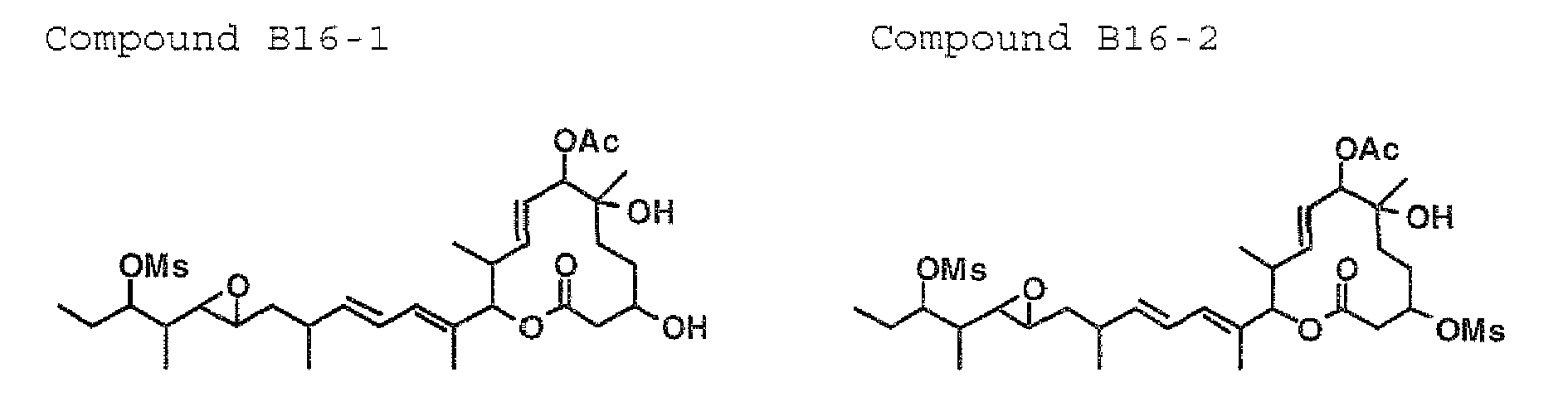
- A solution of (8E,12E,14E)-7-acetoxy-3,6,21-trihydroxy-6,10,12,16,20-pentamethyl-18,19-epoxytricosa-8,12,14-trien-11-olide (56.3 mg, 104.9 µmol) in dichloromethane (1.0 mL) was ice-cooled, and dimethylaminopyridine (39.6 mg, 324.1 µmol) was added thereto. After stirring for about 30 min., mesyl chloride (12.5 µL, 161.5 µmol) was added and the temperature was raised to room temperature. After stirring for about 3 hours, it was diluted with ethyl acetate (10 mL), and washed with distilled water (2 mL) for two times and with brine (2 mL). The organic layer obtained was dried over anhydrous sodium sulfate, filtered and then concentrated. The resulting crude product was purified by thin layer chromatography (MERCK Silicagel 60 F254, 0.5 mm, developing solution; ethyl acetate) to obtain the title Compound B16-2 (22.1 mg, 31.9 µmol, 30.4%) and Compound B16-1 (22.5 mg, 36.6 µmol, 34.9%) as colorless oil s, respectively.
- 1H-NMR spectrum (CD3OD, 400MHz) δ (ppm): 0.87(1H,d,J=7Hz), 0.94(3H,t,J=7Hz), 0.96(3H,d,J=7Hz), 1.07(3H,d,J=7Hz), 1.18(3H,s), 1.33-1.40(2H,m), 1.51-1.71(5H,m), 1.52-1.89(2H,m), 1.74(3H,d,J=1.1Hz), 2.05(3H,s), 2.43-2.60(2H,m), 2.51(1H,d,J=4Hz), 2.67(1H,dd,J=2,8Hz), 2.78(1H,dt,J=2,6Hz), 3.08(3H,s), 3.74-3.81(1H,m), 4.68(1H,dt,J=4,7Hz), 5.02(1H,d,J=11Hz), 5.04(1H,d,J=10Hz), 5.56(1H,dd,J=10,15Hz), 5.65(1H,dd,J=9,16Hz), 5.69(1H,dd,J=10,15Hz), 6.09(1H,d,J=11Hz), 6.32(1H,dd,J=11,15Hz); FAB-MS m/z 637(M+Na)+.
- 1H-NMR spectrum (CD3OD, 400MHz) δ (ppm):
- 0.88(1H,d,J=7Hz), 0.94(3H,t,J=8Hz), 0.96(3H,d,J=7Hz), 1.08(3H,d,J=7Hz), 1.19(3H,s), 1.40-1.70(2H,m), 1.70-1.89(5H,m), 1.75(3H,d,J=1.1Hz), 2.06(3H,s), 2.42-2.52(1H,m), 2.53-2.62(1H,m), 2.64-2.73(2H,m), 2.78(1H,dd,J=2,6Hz), 2.83(1H,dd,J=4,15Hz), 3.08(3H,s), 3.12(3H,s), 4.67(1H,dt,J=4,7Hz), 4.68-4.75(1H,m), 5.02(1H,d,J=11Hz), 5.03(1H,d,J=10Hz), 5.58(1H,dd,J=10,15Hz), 5.67(1H,dd,J=8,16Hz), 5.71(1H,dd,J=10,15Hz), 6.10(1H,d,J=10Hz), 6.33(1H,dd,J=10,15Hz); FAB-MS m/z 715 (M+Na)+.
-

- A solution of (8E,12E,14E)-7-acetoxy-3,6,21-trihydroxy-6,10,12,16,20-pentamethyl-18,19-epoxytricosa-8,12,14-trien-11-olide (52.3 mg, 97.4 µmol) in dichloromethane (1.0 mL) was ice-cooled, and dimethylaminopyridine (37.4 mg, 306.1 µmol) was added thereto. After stirring for about 30 min., tosyl chloride (28.6 mg, 150.0 µmol) was added and the temperature was raised to room temperature. After stirring for 4 hours, the reaction mixture was diluted with ethyl acetate (10 mL), and washed with distilled water (2 mL) for two times and with brine (2 mL). The organic layer obtained was dried over anhydrous sodium sulfate, filtered and then concentrated. The crude product was purified by medium pressure column chromatography (toluene:acetone=10:1, MERCK Lobar, LiChroprepSi 60, 4 ml/min.) and a thin layer chromatography (MERCK Silicagel 60 F254, 0.5 mm, developing solution; ethyl acetate) to obtain the title Compound (8.8 mg, 12.7 µmol, 13.0%) as a colorless oil.
1H-NMR spectrum (CD3OD, 400MHz) δ (ppm): 0.80(3H,t,J=7Hz), 0.83(3H,d,J=7Hz), 0.85(3H,d,J=7Hz), 1.04(3H,d,J=7Hz), 1.18(3H,s), 1.20-1.40(4H,m), 1.50-1.72(5H,m), 1.72(3H,d,J=1.1Hz), 2.06(3H,s), 2.25(1H,dd,J=2,8Hz), 2.35-2.45(1H,m), 2.44(3H,s), 2.52(2H,d,J=3Hz), 2.52-2.60(1H,m), 2.66(1H,dt,J=2,6Hz), 3.75-3.81(1H,m), 4.64(1H,dt,J=4,6Hz), 5.02(1H,d,J=8Hz), 5.04(1H,d,J=7Hz), 5.555(1H,dd,J=8,15Hz), 5.558(1H,dd,J=10,15Hz), 5.69(1H,dd,J=10,15Hz), 6.05(1H,d,J=11Hz), 6.28(1H,dd,J=11,15Hz), 7.42(1H,d,J=8Hz), 7.79(1H,d,J=8Hz); FAB-MS m/z 713(M+Na)+. -


- A solution of (8E,12E,14E)-7-acetoxy-3-t-butyldimethylsiloxy-6,21-dihydroxy-6,10,12,16,20-pentamethyl-18,19-epoxytricosa-8,12,14-trien-11-olide (48.3 mg, 74.2 µmol) in dichloromethane (0.5 mL) was cooled to - 35°C, and DAST (15.0 µL, 113.5 µmol) was added thereto. After 30 min., DAST (10.0 µL, 75.7 µmol) was further added, followed by stirring for 15 min. The reaction mixture was diluted with dichloromethane (4 mL), a saturated sodium bicarbonate aqueous solution (1 mL) was added thereto and the temperature was raised to room temperature. The organic layer was washed with a saturated sodium bicarbonate aqueous solution (1 mL) and brine (1 mL). The organic layer obtained was dried over anhydrous sodium sulfate, filtered and then concentrated. The resulting crude product was purified by thin layer chromatography (MERCK Silicagel 60 F254, 0.5 mm, developing solution; hexane:ethyl acetate=4:1) to obtain 9.4 mg and 7.2 mg as a mixture. These products were provided for the following procedures, respectively. 9.4 mg of the resulting product was dissolved in tetrahydrofuran (0.1 mL), , and purified water (0.2 mL) and acetic acid (0.3 mL) were added thereto. After stirring overnight, the mixture was diluted with ethyl acetate (20 mL), and washed with a saturated sodium bicarbonate aqueous solution (2 mL), purified water (2 mL) and brine (2 mL). The organic layer obtained was dried over anhydrous sodium sulfate, filtered and then concentrated. The resulting crude product was purified by preparative HPLC (SHISEIDO Capcell pak C18, 10 mm I.D. × 250 mm, acetonitrile:water=60:40, 4.0 mL/min.) to obtain Compound B18-2 (0.91 mg, 1.8 µmol, 2.4% (two steps)), Compound B18-4 (2.34 mg, 4.3 µmol, 5.8% (two steps)) and Compound B18-5 (1.33 mg, 2.5 µmol, 3.4% (two steps)), as colorless oils, respectively. Further, 7.2 mg of the resulting product was dissolved in tetrahydrofuran (0.1 mL), and purified water (0.1 mL) and acetic acid (0.3 mL) were added thereto. After stirring overnight, the mixture was diluted with ethyl acetate (20 mL), and washed with purified water (2 mL) for two times and with brine (2 µL). The organic layer obtained was dried over anhydrous sodium sulfate, filtered and then concentrated. The resulting crude product was purified by preparative HPLC (SHISEIDO Capcell pak C18, 10 mm I.D. × 250 mm, acetonitrile:water=50:50, 4.0 mL/min.) to obtain Compound B18-1 (1.20 mg, 2.2 µmol, 3.0% (two steps)) and Compound B18-3 (mixture) (1.37 mg, 2.5 µmol, 3.4% (two steps)) as colorless oils, respectively.
- 1H-NMR spectrum (CD3OD, 400MHz) δ(ppm): 0.87(1H,d,J=7Hz), 0.94(3H,d,J=7Hz), 0.97(3H,t,J=7Hz), 1.07(3H,d,J=7Hz), 1.18(3H,s), 1.31-1.79(9H,m), 1.73(3H,d,J=0.7Hz), 2.05(3H,s), 2.41-2.61(2H,m), 2.51(1H,d,J=4Hz), 2.66-2.72(2H,m), 3.74-3.81(1H,m), 4.31(1H,ddd,J=4,8,48Hz), 5.03(1H,d,J=11Hz), 5.04(1H,d,J=10Hz), 5.56(1H,dd,J=10,15Hz), 5.54(1H,dd,J=8,15Hz), 5.69(1H,dd,J=10,15Hz), 6.08(1H,d,J=11Hz), 6.32(1H,dd,J=11,15Hz); FAB-MS m/z 561(M+Na)+.
- 1H-NMR spectrum (CD3OD, 400MHz) δ(ppm): 0.73-0.96(8.0H,m), 1.05-1.10(3.3H,m), 1.15-1.70(13H,m), 1.72-1.75(3.3H,m), 2.03-2.07(3.1H,m), 2.43-2.91(5.1H,m), 3.48-3.53(0.2H,m), 3.73-3.80(1.0H,m), 5.00-5.08(1.7H,m), 5.36-5.76(3.3H,m), 6.08-6.12(1.0H,m), 6.28-6.38(1.0H,m); FAB-MS m/z 539(M+H)+.
- 1H-NMR spectrum (CD3OD, 400MHz) δ(ppm): 0.86(1H,d,J=7Hz), 0.94(3H,d,J=7Hz), 0.97(3H,t,J=8Hz), 1.07(3H,d,J=7Hz), 1.30-1.77(7H,m), 1.72(3H,d,J=1.1Hz), 2.01(3H,s), 2.14(1H,dd,J=11,13Hz), 2.31-2.38(1H,m), 2.42-2.59(3H,m), 2.66-2.72(3H,m), 3.80-3.87(1H,m), 4.31(1H,ddd,J=4,9,48Hz), 4.93(1H,d,J=11Hz), 5.03(1H,s), 5.17(1H,s), 5.28(1H,d,J=9Hz), 5.41-5.52(2H,m), 5.64(1H,dd,J=8,15Hz), 6.07(1H,d,J=11Hz), 6.31(1H,dd,J=10,15Hz); FAB-MS m/z 543(M+Na)+.
- 1H-NMR spectrum (CD3OD, 400MHz) δ(ppm): 0.88(1H,d,J=7Hz), 0.94(3H,d,J=7Hz), 0.97(3H,t,J=8Hz), 1.07(3H,d,J=7Hz), 1.44(3H,d,J=22Hz), 1.21-1.85(9H,m), 1.73(3H,d,J=1.1Hz), 2.03(3H,s), 2.41-2.63(2H,m), 2.49(2H,d,J=4Hz), 2.67-2.72(2H,m), 3.73-3.80(1H,m), 4.31(1H,ddd,J=4,9,48Hz), 5.03(1H,d,J=11Hz), 5.36-5.50(2H,m), 5.65(1H,dd,J=8,15Hz), 5.72(1H,dd,J=10,14Hz), 6.09(1H,d,J=12Hz), 6.31(1H,dd,J=11,15Hz); FAB-MS m/z 563(M+Na)+.
- 1H-NMR spectrum (CD3OD, 400MHz) δ(ppm): 0.87(1H,d,J=7Hz), 0.94(3H,t,J=7Hz), 1.08(3H,d,J=7Hz), 1.20(3H,d,J=22Hz), 1.37-1.70(9H,m), 1.44(3H,d,J=22Hz), 1.73(3H,d,J=0.7Hz), 1.74-1.85(1H,m), 2.03(3H,s), 2.41-2.51(1H,m), 2.49(2H,d,J=4Hz), 2.52-2.62(1H,m), 2.83(1H,dd,J=2,16Hz), 2.89(1H,dt,J=2,6Hz), 3.72-3.80(1H,m), 5.03(1H,d,J=11Hz), 5.36-5.50(2H,m), 5.56(1H,dd,J=8,15Hz), 5.71(1H,dd,J=10,14Hz), 6.10(1H,d,J=11Hz), 6.32(1H,dd,J=11,15Hz); FAB-MS m/z 563(M+Na)+.
-


- (8E,12E,14E)-7-Acetoxy-3,6,21-trihydroxy-6,10,12,16,20-pentamethyl-18,19-epoxytricosa-8,12,14-trien-11-olide (11.0 mg, 20.5 µmol) was dissolved in dichloromethane (0.5 mL), and cooled to -20°C. Then, triethylamine (15.0 µL, 107.6 µmol) and dimethylaminopyridine (1.1 mg, 9.0 µmol) were added. After stirring for 30 min., acetic anhydride (1.0 µL, 10.6 µmol) was added thereto. After stirring for 30 min., acetic anhydride (0.5 µL, 5.3 µmol) was additionally added, and further, acetic anhydride (0.5 µL, 5.3 µmol) was additionally added after one hour. Successively, acetic anhydride (0.5 µL, 5.3 µmol) was additionally added after 30 minutes and methanol (1 mL) was added after one and half hours, followed by concentrating. The resulting crude product was purified by thin layer chromatography (MERCK Silicagel 60 F254, 0.5 mm, developing solution; hexane:ethyl acetate=1:4) to obtain the title Compound B20-1 (4.5 mg, 7.3 µmol, 35.4%), Compound B20-2 (7.2 mg, 12.4 µmol, 60.7%) and Compound B20-3 (0.4 mg, 0.6 µmol, 2.9%) as colorless oils, respectively.
- 1H-NMR spectrum (CD3OD, 400MHz) δ(ppm): 0.86(3H,t,J=7Hz), 0.88(3H,d,J=6Hz), 0.90(3K,d,J=7Hz), 1.07(3H,d,J=7Hz), 1.17(3H,s), 1.35-1.73(9H,m), 1.74(3H,d,J=1.1Hz), 2.039(3H,s), 2.044(3H,s), 2.06(3H,s), 2.40-2.50(1H,m), 2.50-2.68(2H,m), 2.54(1H,dd,J=2,8Hz), 2.65(1H,dd.J=4,15Hz), 2.71(1H,dt,J=2,6Hz), 4.80-4.93(2H,m), 4.97(1H,d,J=11Hz), 5.02(1H,d,J=10Hz), 5.57(1H,dd,J=10,15Hz), 5.65(1H,dd,J=8,15Hz), 5.71(1H,dd,J=10,15Hz), 6.09(1H,d,J=10Hz), 6.31(1H,dd,J=11,14Hz); FAB-MS m/z 621(M+H)+.
- 1H-NMR spectrum (CD3OD, 400MHz) δ(ppm): 0.86(3H,t,J=7Hz), 0.87(3H,d,J=7Hz), 0.90(3H,d,J=7Hz), 1.07(3H,d,J=7Hz), 1.18(3H,s), 1.30-1.48(4H,m), 1.50-1.66(5H,m), 1.74(3H,d,J=1.1Hz), 2.04(3H,s), 2.05(3H,s), 2.41-2.62(2H,m), 2.51(2H,d,J=4Hz), 2.54(1H,dd.J=2,8Hz), 2.71(1H,dt,J=2,6Hz), 3.72-3.81(1H,m), 4.80-4.92(1H,m), 5.03(1H,d,J=11Hz), 5.04(1H,d,J=10Hz), 5.56(1H,dd,J=10,15Hz), 5.64(1H,dd,J=8,15Hz), 5.69(1H,dd,J=10,15Hz), 6.08(1H,d,J=10Hz), 6.31(1H,dd,J=11,15Hz); FAB-MS m/z 579(M+H)+.
- 1H-NMR spectrum (CD3OD, 400MHz) δ(ppm): 0.86(3H,t,J=7Hz), 0.89(3H,d,J=7Hz), 0.90(3H,d,J=7Hz), 1.07(3H,d,J=7Hz), 1.39-1.48(2H,m), 1.53(3H,s), 1.54-1.71(3H,m), 1.74(3H,d,J=1.1Hz), 1.74-1.88(1H,m), 2.03(6H,s), 2.04(3H,s), 2.05(3H,s), 2.34(1H,dt,J=4,13Hz), 2.39-2.52(1H,m), 2.54(1H,dd,J=2,8Hz), 2.56-2.67(1H,m), 2.59(2H,d,J=4Hz), 2.71(1H,dt,J=2,6Hz), 4.83-4.93(2H,m), 4.98(1H,d,J=11Hz), 5.11(1H,d,J=10Hz), 5.63(1H,dd,J=10,15Hz), 5.65(1H,dd,J=8,15Hz), 5.76(1H,dd,J=10,15Hz), 6.10(1H,d,J=11Hz), 6.32(1H,dd,J=10,15Hz); FAB-MS m/z 663(M+H)+.
-



- A solution of (8E,12E,14E)-7-acetoxy-18-chloro-3,6,19,21-tetrahydroxy-6,10,12,16,20-pentamethyltricosa-8,12,14-trien-11-olide (24.3 mg, 42.5 µmol) in dichloromethane (0.5 mL) was cooled to -20°C, followed by adding dimethylaminopyridine (2.4 mg, 19.6 µmol) and triethylamine (48 µL, 344 µmol). After stirring for about 5 min., acetic anhydride (6 µL, 63.6 µmol) was added dropwise and the mixture was stirred at the same temperature for about one hour. Methanol (1 mL) was added to the reaction mixture, and after the temperature was raised to room temperature, the mixture was concentrated. The resulting crude product was purified by preparative HPLC (SHISEIDO Capcell pak C18, 10 mm I.D. × 250 mm, acetonitrile:wster=50:50, 4.0 mL/min.) to obtain the title Compound B21-1 (5.8 mg, 9.4 µmol, 22.1%), Compound B21-2 (2.6 mg, 4.6 µmol, 9.8%), Compound B21-3 (2.3 mg, 3.5 µmol, 8.3%), Compound B21-4 (3.7 mg, 5.7 µmol, 13.3%), Compound B21-6 (1.0 mg, 1.5 µmol, 3.5%) and Compound B21-5 (1.6 mg, 2.2 µmol, 5.2%), as colorless oils, respectively.
- 1H-NMR spectrum (CD3OD, 400MHz) δ(ppm): 0.88(3H,d,J=7Hz), 0.89(3H,d,J=7Hz), 0.92(3H,t,J=8Hz), 1.05(3H,d,J=7Hz), 1.18(3H,s), 1.32-1.41(3H,m), 1.48-1.70(5H,m), 1.74(3H,d,J=0.7Hz), 1.79-1.87(2H,m), 2.05(3H,s), 2.10(3H,s), 2.52(2H,d,J=3Hz), 2.52-2.60(2H,m), 3.45(1H,ddd,J=2,5,8Hz), 3.74-3.81(1H,m), 4.30(1H,dt,J=3,11Hz), 5.037(1H,d,J=10Hz), 5.039(1H,d,J=11Hz), 5.24(1H,dd,J=3,9Hz), 5,56(1H,dd,J=10,15Hz), 5.69(1H,dd,J=10,15Hz), 5.72(1H,dd,J=8,15Hz), 6.08(1H,d,J=11Hz), 6.29(1H,dd,J=10,15Hz); FAB-MS m/z 637(M+Na)+.
- 1H-NMR spectrum (CD3OD, 400MHz) δ(ppm): 0.87(3H,d,J=7Hz), 0.88(3H,t,J=7Hz), 0.93(3H,d,J=7Hz), 1.04(3H,d,J=7Hz), 1.18(3H,s), 1.29-1.40(2H,m), 1.47-1.74(5H,m), 1.74(3H,d,J=1.1Hz), 1.79-1.89(2H,m), 2.02(3H,s), 2.05(3H,s), 2.51(2H,d,J=4Hz), 2.51-2.61(2H,m), 3.53(1H,dd,J=4,8Hz), 3.74-3.80(1H,m), 4.20(1H,ddd,J=3,4,11Hz), 5.04(1H,d,J=10Hz), 5.23(1H,ddd,J=2,6,8Hz), 5.56(1H,dd,J=10,15Hz), 5,69(1H,dd,J=10,15Hz), 5.74(1H,dd,J=8,15Hz), 6.07(1H,d,J=11Hz), 6.29(1H,dd,J=11,15Hz); FAB-MS m/z 637(M+Na)+.
- 1H-NMR spectrum (CD3OD, 400MHz) δ(ppm): 0.886(3H,d,J=7Hz), 0.889(3H,d,J=7Hz), 0.92(3H,t,J=7Hz), 1.05(3H,d,J=7Hz), 1.17(3H,s), 1.32-1.73(7H,m), 1.74(3H,d,J=1.1Hz), 1.79-1.87(2H,m), 2.04(3H,s), 2.05(3H,s), 2.10(3H,s), 2.52-2.68(4H,m), 3.45(1H,ddd,J=2,5,10Hz), 4.30(1H,dt,J=3,11Hz), 4.98(1H,d,J=11Hz), 5.02(1H,d,J=10Hz), 5.24(1H,dd,J=3,9Hz), 5,57(1H,dd,J=10,15Hz), 5.71(1H,dd,J=10,15Hz), 5.72(1H,dd,J=8,15Hz), 6.09(1H,d,J=11Hz), 6.29(1H,dd,J=10,14Hz); FAB-MS m/z 657(M+H)+.
- 1H-NMR spectrum (CD3OD, 400MHz) δ(ppm): 0.87(3H,t,J=8Hz), 0.88(3H,d,J=7Hz), 0.99(3H,d,J=7Hz), 1.04(3H,d,J=7Hz), 1.18(3H,s), 1.27-1.40(2H,m), 1.46-1.70(5H,m), 1.74(3H,d,J=0.7Hz), 1.74-1.82(1H,m), 2.00(3H,s), 2.045(3H,s), 2.052(3H,s), 2.09-2.18(1H,m), 2.52(2H,d,J=4Hz), 2.52-2.60(2H,m), 3.73-3.80(1H,m), 4.32(1H,dt,J=4,11Hz), 4.85-4.92(1H,m), 5.04(2H,d,J=10Hz), 5.09(1H,dd,J=4,9Hz), 5,56(1H,dd,J=10,15Hz), 5.69(1H,dd,J=10,15Hz), 5.71(1H,dd,J=8,15Hz), 6.08(1H,d,J=11Hz), 6.29(1H,dd,J=11,15Hz); FAB-MS m/z 679(M+Na)+.
- 1H-NMR spectrum (CD3OD, 400MHz) δ(ppm): 0.876(3H,t,J=8Hz), 0.881(3H,d,J=7Hz), 0.93(3H,d,J=7Hz), 1.04(3H,d,J=7Hz), 1.17(3H,s), 1.32-1.73(7H,m), 1.73(3H,d,J=0.7Hz), 1.79-1.88(2H,m), 2.02(3H,s), 2.04(3H,s), 2.05(3H,s), 2.52-2.68(4H,m), 3.53(1H,dd,J=4Hz), 4.19(1H,dt,J=3,11Hz), 4.98(1H,d,J=11Hz), 5.02(1H,d,J=10Hz), 5.23(1H,ddd,J=2,6,14Hz), 5,56(1H,dd,J=10,15Hz), 5.71(1H,dd,J=10,15Hz), 5.74(1H,dd,J=7,15Hz), 6.08(1H,d,J=10Hz), 6.29(1H,dd,J=11,15Hz); FAB-MS m/z 679(M+Na)+.
- 1H-NMR spectrum (CD3OD, 400MHz) δ(ppm): 0.86(3H,t,J=7Hz), 0.89(3H,d,J=7Hz), 0.99(3H,d,J=7Hz), 1.04(3H,d,J=7Hz), 1.17(3H,s), 1.32-1.70(7H,m), 1.74(3H,s), 1.75-1.82(1H,m), 2.00(3H,s), 2.037(3H,s), 2.045(3H,s), 2.054(3H,s), 2.102-2.16(1H,m), 2.50-2.68(4H,m), 4.32(1H,dt,J=3,11Hz), 4.98(1H,d,J=11Hz), 5.02(1H,d,J=10Hz), 5.09(1H,dd,J=4,9Hz), 5,56(1H,dd,J=10,15Hz), 5.711(1H,dd,J=10,15Hz), 5.713(1H,dd,J=8,15Hz), 6.09(1H,d,J=11Hz), 6.29(1H,dd,J=11,15Hz); FAB-MS m/z 699(M+H)+.
-

- A solution of (8E,12E,14E)-7-acetoxy-19-chloro-3,6,18,21-tetrahydroxy-6,10,12,16,20-pentamethyltricosa-8,12,14-trien-11-ollde (20.2 mg, 35.3 µmol) in dichloromethane (0.5 mL) was cooled to -20°C, and dimethylaminopyridine (1.5 mg, 12.3 µmol) and triethylamine (40 µL, 289 µmol) were added thereto. After stirring for about 5 min., acetic anhydride (5 µL, 52.9 µmol) was added dropwise and the mixture was stirred at the same temperature for about one hour. Further, acetic anhydride (5 µL, 52.9 µmol) was added dropwise and the mixture was stirred at the same temperature for about one hour. Methanol (1 mL) was added to the reaction solution, and after the temperature was raised to room temperature, the mixture was concentrated. The resulting crude product was purified by preparative HPLC (SHISEIDO Capcell pak C18, 10 mm I.D. × 250 mm, acetonitrile:water=50:50, 4.0 mL/min.) to obtain the title Compound B22-1 (5.62 mg, 8.55 µmol, 24.2%) and Compound B22-2 (3.17 mg, 4.82 µmol, 13.7%) as colorless oils, respectively.
- 1H-NMR spectrum (CD3OD, 400MHz) δ(ppm): 0.86(3H,t,=7Hz), 0.89(3H,d,J=7Hz), 1.03(3H,d,J=7Hz), 1.06(3H,d,J=7Hz), 1.18(3H,s), 1.28-1.42(2H,m), 1.51-1.70(5H,m), 1.73(3H,d,J=1.1Hz), 1.76-1.86(1H,m), 2.02 (3H,s), 2.04(3H,s), 2.05(3H,s), 2.25-2.36(1H,m), 2.48-2.61(3H,m), 3.73-3.82(1H,m), 4.06(1H,t,J=6Hz), 4.79-4.86(1H,m), 4.96-5.02(1H,m), 5.04(1H,d,J=10Hz), 5.05(1H,d,J=11Hz), 5.56(1H,dd,J=10,15Hz), 5.57(1H,dd,J=9,15Hz), 5.69(1H,dd,J=10,15Hz), 6.09(1H,d,J=11Hz), 6.23(1H,dd,J=11,15Hz); FAB-MS m/z 679(M+Na)+.
- 1H-NMR spectrum (CD3OD, 400MHz) δ(ppm): 0.86(3H,t,J=7Hz), 0.90(3H,d,J=7Hz), 1.03(3H,d,J=7Hz), 1.06(3H,d,J=7Hz), 1.17(3H,s), 1.34-1.71(7H,m), 1.72(3H,d,J=1.1Hz), 1.79-1.87(1H,m), 1.99-2.08(1H,m), 2.02(3H,s), 2.037(3H,s), 2.040(3H,s), 2.05(3H,s), 2.26-2.35(1H,m), 2.53-2.68(3H,m), 4.06(1H,t,J=6Hz), 4.95-5.02(2H,m), 4.96-5.03(1H,m), 4.98(1H,d,J=11Hz), 5.02(1H,d,J=10Hz), 5.566(1H,dd,J=10,15Hz), 5.572(1H,dd,J=8,15Hz), 5.71(1H,dd,J=10,15Hz), 6.09(1H,d,J=11Hz), 6.22(1H,dd,J=11,15Hz); FAB-MS m/z 699(M+H)+.
-
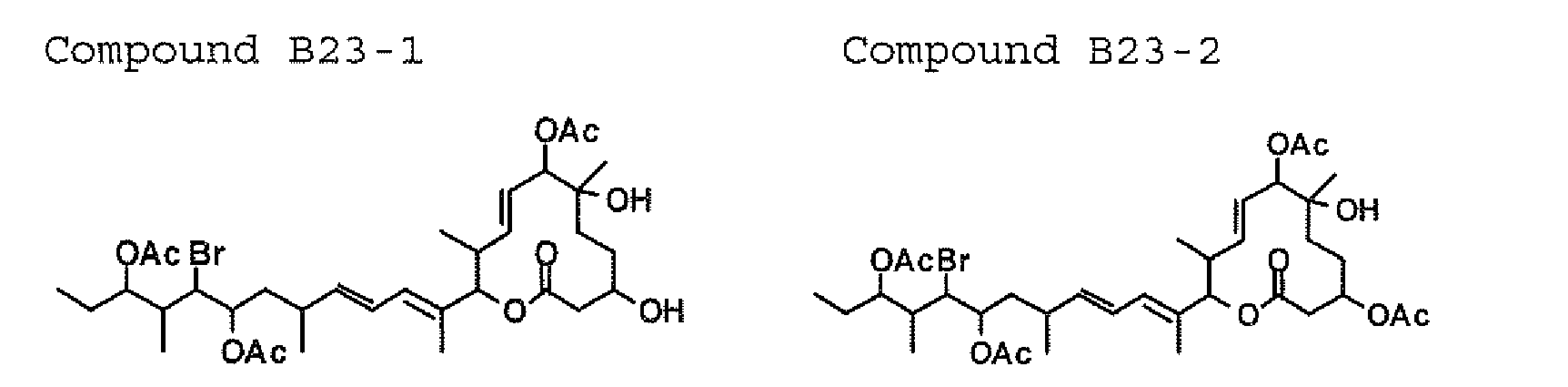
- A solution of (8E,12E,14E)-7-acetoxy-19-bromo-3,5,18,21-tetrahydroxy-6,10,12,16,20-pentamethyltricosa-8,12,14-trien-11-olide (17.0 mg, 27.5 µmol) in dichloromethane (0.4 mL) was cooled to -20°C, and dimethylaminopyridine (1.8 mg, 14.7 µmol) and triethylamine (30 µL, 216 µmol) were added thereto. After stirring for about 5 min., acetic anhydride (5 µL, 52.9 µmol) was added dropwise and the mixture was stirred at the same temperature for about one hour. Further, acetic anhydride (3 µL, 31.7 µmol) was added dropwise and the mixture was stirred at the same temperature for about one hour. Methanol (1 mL) was added to the reaction solution, and after the temperature was raised to room temperature, the mixture was concentrated. The resulting crude product was purified by preparative HPLC (SHISEIDO Capcell pak C18, 10 mm I.D. × 250 mm, acetonitrile:water=50:50-60:40, 4.0 mL/min.) to obtain the title Compound B23-1 (5.90 mg, 8.41 µmol, 30.6%) and Compound B23-2 (3.91 mg, 5.26 µmol, 19.1%) as colorless oils, respectively.
- 1H-NMR spectrum (CD3OD, 400MHz) δ(ppm): 0.86(3H,t,J=8Hz), 0.89(3H,d,J=7Hz), 1.05(3H,d,J=7Hz), 1.06(3H,d,J=7Hz), 1.18(3H,s), 1.30-1.41(2H,m), 1.53-1.78(4H,m), 1.73(3H,d,J=0.7Hz), 1.89-1.90(1H,m), 1.93-2.02(1H,m), 2.03(3H,s), 2.04(3H,s), 2.05(3H,s), 2.25-2.37(1H,m), 2.50-2.62(3H,m), 3.74-3.82(1H,m), 4.16(1H,t,J=6Hz), 4.80-4.85(1H,m), 4.94(1H,ddd,J=2,6,10Hz), 5.04(1H,d,J=10Hz), 5.05(1H,d,J=11Hz), 5.56(1H,dd,J=10,15Hz), 5.58(1H,dd,J=8,15Hz), 5.69(1H,dd,J=10,15Hz), 6.09(1H,d,J=11Hz), 6.23(1H,dd,J=11,15Hz); FAB-MS m/z 723(M+Na)+.
- 1H-NMR spectrum (CD3OD, 400MHz) δ(ppm): 0.86(3H,t,J=7Hz), 0.91(3H,d,J=7Hz), 1.05(3H,d,J=7Hz), 1.06(3H,d,J=7Hz), 1.17(3H,s), 1.35-1.77(7H,m), 1.73(3H,d,J=1.1Hz), 1.82-1.91(1H,m), 1.95-2.04(1H,m), 2.03(3H,s), 2.038(3H,s), 2.043(3H,s), 2.05(3H,s), 2.25-2.36(1H,m), 2.54-2.68(3H,m), 4.16(1H,t,J=6Hz), 4.79-4.85(2H,m), 4.94(1H,ddd,J=2,6,10Hz), 4.99(1H,d,J=11Hz), 5.02(1H,d,J=10Hz), 5.58(1H,dd,J=8,15Hz), 5.57(1H,dd,J=10,15Hz), 5.71(1H,dd,J=10,15Hz), 6.10(1H,d,J=11Hz), 6.23(1H,dd,J=11,15Hz); FAB-MS m/z 743(M+H)+.
-


-

- Ethyl vinyl ether (485 mg, 6.7 mmol) and pyridinium p-toluenesulfonate (28 mg, 0.11 mmol) were added to a solution of (8E,12E,14E)-7-acetoxy-3-t-butyldimethylsiloxy-6,21-dihydroxy-6,10,12,16,20-pentamethyl-18,19-epoxytricosa-8,12,14-trien-11-olide (146 mg, 0.22 mmol) in dichloromethane (5 mL) at room temperature. The mixture was stirred at room temperature for 18 hours. The reaction mixture was diluted with ethyl acetates, washed with brine, dried over anhydrous magnesium sulfate and evaporated. The resulting crude product was purified by silica gel column chromatography (Kanto silica gel 60N, spherical, neutral, 40 to 100 µm, eluate; hexane:ethyl acetate=70:30) to obtain the title compound (112 mg, 63%) as a colorless oil.
ESI-MS m/z 817(M+Na)+. -

- A 1.0M solution of tetrabutylammonium fluoride (0.026 mmol) in tetrahydrofuran (0.026 mL, 0.026 mmol) was added to a solution of (8E,12E,14E)-7-acetoxy-3-t-butyldimethylsiloxy-6,21-bis(1-ethoxyethoxy)-6,10,12,16,20-pentamethyl-18,19-epoxytricosa-8,12,14-trien-11-olide (19 mg, 0.024 mmol) in tetrahydrofuran (0.5 mL) at room temperature. The mixture was stirred at room temperature for 2 hours. Further, 0.026 mL of a1.0M solution of tetrabutylammonium fluoride in tetrahydrofuran (0.026 mL, 0.026 mmol) was added thereto at room temperature. After the reaction mixture was diluted with ethyl acetate, it was washed with brine, dried over anhydrous magnesium sulfate and evaporated. The resulting crude product was purified by silica gel column chromatography (Kanto silica gel 60N, spherical, neutral, 40 to 100 µm, eluate; hexane:ethyl acetate=70:30) to obtain the title compound (112 mg, 63%) as a colorless oil.
ESI-MS m/z 703(M+Na)+. -
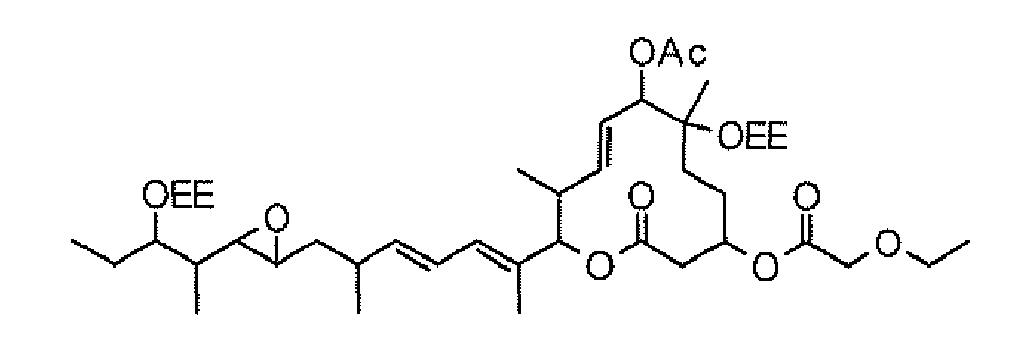
- A solution of ethoxyacetic acid (8.2 mg, 0.079 mmol) in dichloromethane (1.6 mL) was added to (8E,12E,14E)-7-acetoxy-6,21-di(1-ethoxyethoxy)-3-hydroxy-6,10,12,16,20-pentamethyl-18,19-epoxytricosa-8,12,14-trien-11-olide (13 mg, 0.016 mmol) at room temperature, and dicyclohexylcarbodiimide (20 mg, 0.094 mmol) and dimethylaminopyridine (1.9 mg, 0.016 mmol) were further added at room temperature. The mixture was stirred at room temperature for 6 hours. The reaction solution was diluted with ethyl acetate, andfiltered through Celite. The filtrate was washed with brine, dried over anhydrous magnesium sulfate and evaporated. The resulting crude product was purified by silica gel column chromatography (Kanto silica gel 60N, spherical, neutral, 40 to 100 µm, eluate; hexane:ethyl acetate=70:30) to obtain the title compound (11 mg, 91%) as a colorless oil.
ESI-MS m/z 789(M+Na)+. -

- Pyridinium p-toluenesulfonate (9.8 mg, 0.039 mmol) was added to a solution of (8E,12E,14E)-7-acetoxy-3-ethoxyacetoxy-6,21-bis(1-ethoxyethoxy)-6,10,12,16,20-pentamethyl-18,19-epoxytricosa-8,12,14-trien-11-olide (6.0 mg, 0.0078 mmol) in methanol (1.0 mL) at room temperature, followed by stirring at the same temperature for 15 hours. The reaction mixture was diluted with 15 mL of ethyl acetate, washed with brine, dried over anhydrous magnesium sulfate and evaporated. The resulting crude product was purified by thin layer chromatography (MERCK Silicagel 60 F254, 0.2 mm, developing solution; ethyl acetate) to obtain the title compound (1.7 mg, 35%) as a colorless oil.
1H-NMR spectrum (CD3OD, 400MHz) δ(ppm): 0.88(3H,d,J=6.4Hz), 0.89(3H,d,J=6.8Hz), 0.93(3H,t,J=7.2Hz), 1.08(3H,d,J=6.8Hz), 1.18(3H,s), 1.21(3H,t,J=7.2Hz), 1.28-1.72(9H,m), 1.74(3H,s), 2.06(3H,s), 2.39-2.74(6H,m), 3.46-3.52(1H,m), 3.54-3.63(2H,m), 4.11(2H,s), 4.88-4.98(1H,d,J=10.8Hz), 4.98(1H,d,J=10.8Hz), 5.02(1H,d,J=9.6Hz), 5.56(1H,dd,J=9.6,15.2Hz), 5.66(1H,dd,J=8.4,14.4Hz), 5.72(1H,dd,J=9.6,15.2Hz), 6.09(1H,d,J=10.4Hz), 6.32(1H,dd,J=10.4,14.8Hz); ESI-MS m/z 645(M+Na)+. -

-

- Ethoxyacetic acid (23 mg, 0.22 mmol), dicyclohexylcarbodiimide (55 mg, 0.27 mmol) and dimethylaminopyridine (5.4 mg, 0.27 mmol) were added to a solution of (8E,12E,14E)-7-acetoxy-3-t-butyldimethylsiloxy-6,21-dihydroxy-6,10,12,16,20-pentamethyl-18,19-epoxytricosa-8,12,14-trien-11-olide (29 mg, 0.044 mmol) in dichloromethane (3 mL) at room temperature. The mixture was stirred at room temperature for 4 hours. The reaction mixture was diluted with ethyl acetate, and filtered through Celite. The filtrate was washed with brine, dried over anhydrous magnesium sulfate and evaporated. The resulting crude product was purified by silica gel column chromatography (Kanto silica gel 60N, spherical, neutral, 40 to 100 µm, eluate; hexane:ethyl acetate=70:30) to obtain the title compound (28 mg, 85%) as a colorless oil.
ESI-MS m/z 759(M+Na)+. -

- Ethyl vinyl ether (82 mg, 1.1 mmol) and pyridinium p-toluenesulfonate (9.2 mg, 0.036 mmol) were added to a solution of 7-acetoxy-3-t-butyldimethylsiloxy-21-ethoxyacetoxy-6-hydroxy-6,10,12,16,20-pentamethyl-18,19-epoxytricosa-8,12,14-trien-11-olide (27 mg, 0.036 mmol) in dichloromethane (1.5 mL) at room temperature. The mixture was stirred at room temperature for 17 hours. The reaction solution was diluted with ethyl acetate, washed with brine, dried over anhydrous magnesium sulfate and evaporated. The resulting crude product was purified by silica gel column chromatography (Kanto silica gel 60N, spherical, neutral, 40 to 100 µm, eluate; hexane:ethyl acetate=80:20) to obtain the title compound (16 mg, 54%) as a colorless oil.
ESI-MS m/z 831(M+Na)+. -

- A 1.0 M solution of tetrabutylammonium fluoride in tetrahydrofuran (0.037 mL, 0.037 mmol) was added to a solution of (8E,12E,14E)-7-acetoxy-3-t-butyldimethylsiloxy-21-ethoxyacetoxy-6-(1-ethoxyethoxy)-6,10,12,16,20-pentamethyl-18,19-epoxytricosa-8,12,14-trien-11-olide (15 mg, 0.018 mmol) in tetrahydrofuran (1 mL) at room temperature. The mixture was stirred at room temperature for 2 hours. The reaction mixture was diluted with ethyl acetate, washed with brine, dried over anhydrous magnesium sulfate and evaporated. The resulting crude product was purified by silica gel column chromatography (Kanto silica gel 60N, spherical, neutral, 40 to 100 µm, eluate; hexane:ethyl acetate=50:50) to obtain the title compound (8.8 mg, 68%) as a colorless oil.
ESI-MS m/z 717(M+Na)+. -

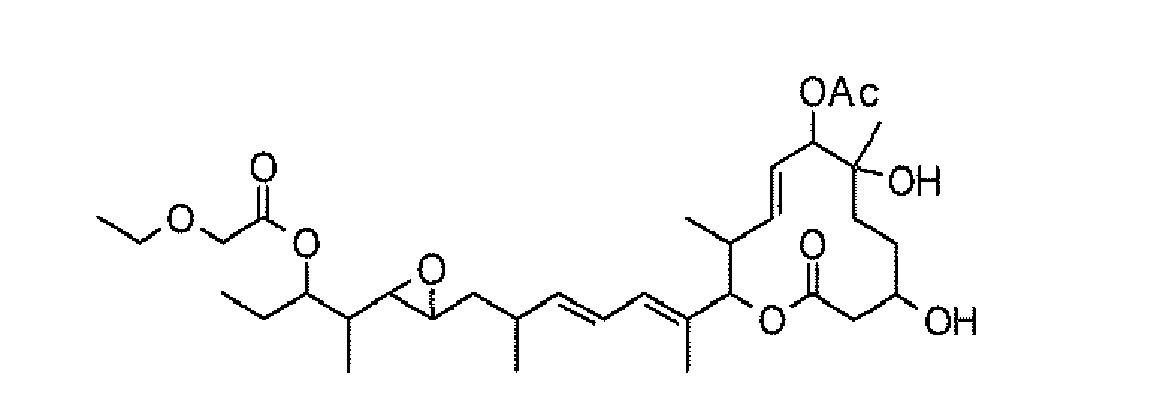
- Pyridinium p-toluenesulfonate (29 mg, 0.12 mmol) was added to a solution of (8E,12E,14E)-7-acetoxy-21-ethoxyacetoxy-6-(1-ethoxyethoxy)-3-hydroxy-6,10,12,16,20-pentamethyl-18,19-epoxytricosa-8,12,14-trien-11-olide (8.0 mg, 0.012 mmol) in methanol (1.0 mL) at room temperature, followed by stirring at the same temperature for one hour. After the reaction mixture was diluted with ethyl acetate, it was washed with brine, dried over anhydrous magnesium sulfate and evaporated. The resulting crude product was purified by thin layer chromatography (MERCK Silicagel 60 F254, 0.25 mm, developing solution; hexane:ethyl acetate=1:2) to obtain the title compound (4.0 mg, 56%) as a colorless oil.
1H-NMR spectrum (CD3OD, 400MHz) δ(ppm): 0.87(3H,d,J=6.8Hz), 0.89(3H,d,J=7.2Hz), 0.90(3H,t,J=7.2Hz), 1.07(3H,d,J=6.8Hz), 1.18(3H,s), 1.21(3H,t,J=7.2Hz), 1.24-1.70(9H,m), 1.74(3H,s), 2.05(3H,s), 2.41-2.50(1H,m), 2.51(2H,d,J=3.6Hz), 2.55(1H,dd,J=2.4,8.0Hz), 2.54-2.60(1H,m), 2.72(1H,dt,J=2.4,5.6Hz), 3.58(2H,q,J=7.2Hz), 3.74-3.81(1H,m), 4.11(2H,s), 4.94-5.00(2H,m), 5.03(1H,d,J=10.8Hz), 5.56(1H,dd,J=9.6,15.2Hz), 5.64(1H,dd,J=8.0,14.8Hz), 5.69(1H,dd,J=9.6,14.8Hz), 6.06(1H,d,J=10.8Hz), 6.32(1H,dd,J=10.8,14.8Hz); ESI-MS m/z 645(M+Na)+. -
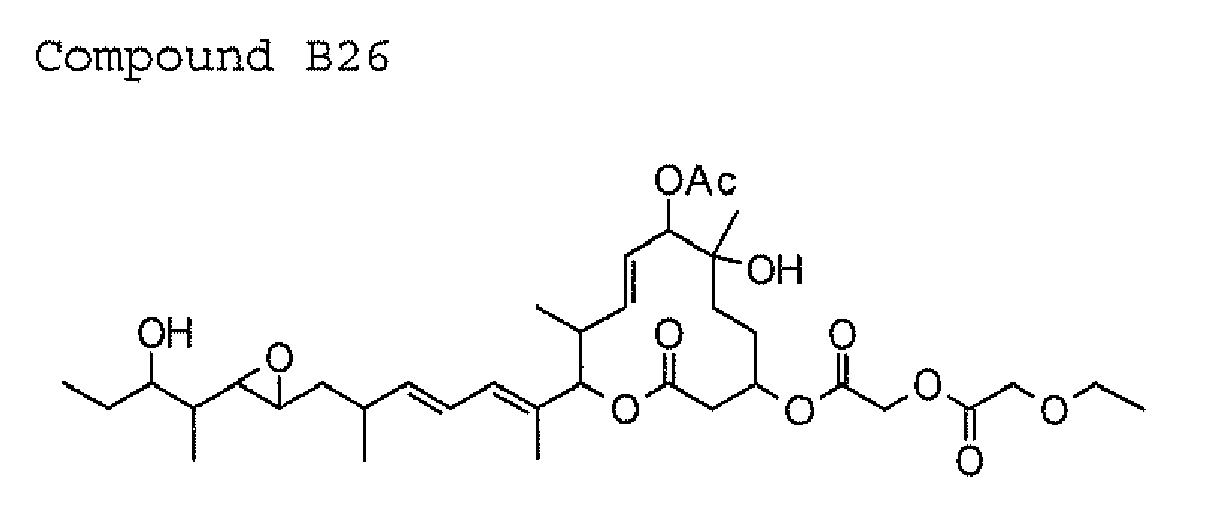
- Ethoxyacetylacetic acid was esterified with (8E,12E,14E)-7-acetoxy-6,21-bis(1-ethoxyethoxy)-3-hydroxy-6,10,12,16,20-pentamethyl-18,19-epoxytricosa-8,12,14-trien-11-olide through the similar synthetic route as Example B24, to give the title compound as a colorless oil.
1H-NMR spectrum (CD3OD, 400MHz) δ(ppm): 0.88(3H,d,J=6.4Hz), 0.90(3H,d,J=7.2Hz), 0.93(3H,t,7.2Hz), 1.08(3H,d,J=6.8Hz), 1.18(3H,s), 1.21(3H,t,J=7.2Hz), 1.26-1.72(9H,m), 1.74(3H,s), 2.06(3H,s), 2.42-2.52(1H,m), 2.54-2.62(1H,m), 2.63(2H,d,J=4.4Hz), 2.65(1H,dd,J=2.0,8.4Hz), 2.72(1H,dt,J=2.4,5.6Hz), 3.46-3.52(1H,m), 3.62(2H,q,J=7.2Hz), 4.24(2H,s), 4.72(2H,s), 4.93-4.97(1H,m), 4.99(1H,d,J=6.0Hz), 5.02(1H,d,J=4.8Hz), 5.56(1H,dd,J=9.6,15.2Hz), 5.66(1H,dd,J=8.4,14.8Hz), 5.71(1H,dd,J=9.6,15.2Hz), 6.09(1H,d,J=10.0Hz), 6.32(1H,dd,J=10.8,15.2Hz); ESI-MS m/z 703(M+Na)+. -

- Ethoxyacetylacetic acid was esterified with (8E,12E,14E)-7-acetoxy-6,21-dihydroxy-3-t-butyldimethylsiloxy-6,10,12,16,20-pentamethyl-18,19-epoxytricosa-8,12,14-trien-11-olide through the similar synthetic route as Example B25, to give the title compound was obtained as a colorless oil.
1H-NMR spectrum (CD3OD, 400MHz) δ(ppm): 0.87(3H,d,J=6.4Hz), 0.89(3H,d,J=7.2Hz), 0.90(3H,t,J=7.2Hz), 1.07(3H,d,J=6.8Hz), 1.18(3H,s), 1.28-1.70(9H,m), 1.74(3H,d,J=1.2Hz), 2.06(3H,s), 2.41-2.50(1H,m), 2.50-2.60(1H,m), 2.52(2H,d,J=4Hz), 2.56(1H,dd,J=2.0,8.0Hz), 2.72(1H,dt,J=2.4,6.0Hz), 3.74-3.82(1H,m), 4.13(2H,s), 4.96-5.20(2H,m), 5.04(1H,d,J=9.6Hz), 5.60(1H,dd,J=10.0,15.2Hz), 5.65(1H,dd,J=8.4,15.2Hz), 5.69(1H,dd,J=9.6,15.2Hz), 6.08(1H,d,J=10.8Hz), 6.32(1H,dd,J=10.8,14.4Hz); ESI-MS m/z 617(M+Na)+. -

- (8E,12E,14E)-7-acetoxy-3-t-butyldimethylsiloxy-21-dimethylaminoacetoxy)-6-hydroxy-6,10,12,16,20-pentamethyl-18,19-epoxytricosa-8,12,14-trien-11-olide was synthesized by the similar synthetic method as Example B25. To the compound (4.0 mg, 0.0054 mmol) was added a mixed solution of trifluoroacetic acid:tetrahydrofuran:H2O=1:10:5, followed by stirring for 2 hours. The reaction mixture was poured into an aqueous saturated sodium bicarbonate solution, and the mixture was extracted with ethyl acetate. The organic layer was washed with brine, dried over MgSO4 and evaporated. The resulting crude product was purified by thin layer chromatography (MERCK Silicagel 60 F254, 0.25 mm, developing solution; hexane:ethyl acetate=1:2) to obtain the title compound (1.0 mg, 29%) as a colorless oil. 1H-NMR spectrum (CD3OD, 400MHz) δ(ppm): 0.86-0.91(6H,m), 0.90(3H,t,J=7.2Hz), 1.07(3H,d,J=6.8Hz), 1.18(3H,s), 1.26-1.71(9H,m), 1.74(3H,d,J=0.8Hz), 2.06(3H,s), 2.34(6H,s), 2.41-2.50(1H,m), 2.52(2H,d,J=4.0Hz), 2.55(1H,dd,J=2.0,8.4Hz), 2.50-2.58(1H,m), 2.72(1H,dt,J=2.0,5.6Hz), 3.24(2H,s), 3.74-3.82(1H,m), 4.94-5.00(1H,m), 5.04(2H,d,J=9.6Hz), 5.56(1H,dd,J=9.6,15.2Hz), 5.54(1H,dd,J=8.0,15.2Hz), 5.69(1H,dd,J=9.6,15.2Hz), 6.08(1H,d,J=11.2Hz), 8.32(1H,dd,J=10.8,14.8Hz); ESI-MS m/z 622(M+H)+.
-

- The title compound was obtained as a colorless oil by the similar synthetic method as Example B25, using nicotinic acid as the 21-position substituent.
1H-NMR spectrum (CD3OD, 400MHz) δ(ppm): 0.86(3H,d,J=6.8Hz), 0.94(3H,t,J=7.2Hz), 1.01(3H,d,J=6.8Hz), 1.04(3H,d,J=6.8Hz), 1.18(3H,s), 1.24-1.84(9H,m), 1.72(3H,d,J=1.2Hz), 2.06(3H,s), 2.40-2.48(1H,m), 2.51(2H,d,J=4.0Hz), 2.50-2.59(1H,m), 2.62(1H,dd,J=2.4,8.4Hz), 2.75(1H,dt,J=2.0,5.6Hz), 3.72-3.83(1H,m), 5.03(1H,d,J=10.8Hz), 5.04(1H,d,J=10.0Hz), 5.17-5.24(1H,m), 5.55(1H,dd,J=9.6,15.2Hz), 5.60(1H,dd,J=8.8,14.8Hz), 5.69(1H,dd,J=9.6,15.2Hz), 6.06(1H,d,J=9.6Hz), 6.29(1H,dd,J=11.2,14.4Hz), 7.59(1H,ddd,J=1.2,4.8,8.0Hz), 8.41(1H,ddd,J=1.6,1.6,8.0Hz), 8.76(1H,dd,J=1.6,4.8Hz), 9.13(1H,dd,J=0.8,2.0Hz); ESI-MS m/z 664(M+Na)+. -


- A solution of (8E,12E,14E)-7-acetoxy-3,6,21-trihydroxy-6,10,12,16,20-pentamethyl-18,19-epoxytricosa-8,12,14-trien-11-olide (55.6 mg, 103.6 µmol) in dichloromethane (1.0 mL) was ice-cooled, followed by adding dimethylaminopyridine (40.0 mg, 327.4 µmol). After stirring for about 30 min., benzoyl chloride (19.0 µL, 163.5 µmol) was added thereto and the temperature was raised to room temperature. After stirring for 2.5 hours, the reaction solution was diluted with ethyl acetate (10 mL) and washed with purified water (2 ml) for two times and with brine (2 mL). The resulting organic layer was dried over anhydrous sodium sulfate, filtered, and then concentrated. The crude product obtained was purified by thin layer chromatography (ethyl acetate, MERCK Silicagel 60 F254, 0.5 mm) to obtain the title Compound B30-1 (15.0 mg, 20.1 µmol, 19.4%), Compound B30-2 (24.8 mg, 38.7 µmol, 37.4%) and Compound B30-3 (3.8 mg, 5.9 µmol, 5.7%) as colorless oils, respectively.
- 1H-NMR spectrum (CD3OD, 400MHz) δ (ppm): 0.89(3H,d,J=7Hz), 0.92(3H,t,J=7Hz), 0.98(3H,d,J=7Hz), 1.01(3H,d,J=7Hz), 1.20(3H,s), 1.32-1.41(1H,m), 1.42-1.51(1H,m), 1.53-1.68(3H,m), 1.70-1.82(4H,m), 1.73(3H,d,J=0.7Hz), 2.06(3H,s), 2.35-2.47(1H,m), 2.55-2.78(5H,m), 5.02(1H,d,J=11Hz), 5.06(1H,d,J=10Hz), 5.08-5.15(1H,m), 5.17(1H,dt,J=5,7Hz), 5.57(1H,dd,J=9,15Hz), 5.62(1H,dd,J=10,15Hz), 5.74(1H,dd,J=10,15Hz), 6.08(1H,d,J=11Hz), 6.28(1H,dd,J=10,15Hz), 7.43-7.50(4H,m), 7.58-7.62(2H,m), 7.99-8.02(2H,m), 8.03-8.08(2H,m); FAB-MS m/z 745(M+H)+.
- 1H-NMR spectrum (CD3OD, 400MHz) δ(ppm): 0.89(3H,d,J=7Hz), 0.90(3H,d,J=7Hz), 0.93(3H,t,J=8Hz), 1.06(3H,d,J=7Hz), 1.14-1.21(1H,m), 1.20(3H,s), 1.41-1.54(4H,m), 1.59-1.68(2H,m), 1.68-1.80(2H,m), 1.75(3H,s), 2.06(3H,s), 2.40-2.50(1H,m), 2.56-2.72(2H,m), 2.64(1H,dd,J=2,8Hz), 2.69(1H,dd,J=3,15Hz), 2.76(1H,dd,J=4,15Hz), 3.50(1H,dt,J=4,8Hz), 5.03(1H,d,J=11Hz), 5.06(1H,d,J=10Hz), 5.03-5.14(1H,m), 5.62(1H,dd,J=10,15Hz), 5.66(1H,dd,J=8,15Hz), 5.74(1H,dd,J=10,15Hz), 6.11(1H,d,J=11Hz), 6.32(1H,dd,J=10,15Hz), 7.43-7.50(2H,m), 7.58-7.62(1H,m), 8.03-8.08(2H,m); FAB-MS m/z 639(M-H)-.
- 1H-NMR spectrum (CD3OD, 400MHz) δ(ppm): 0.86(3H,d,J=7Hz), 0.92(3H,t,J=8Hz), 0.99(3H,d,J=7Hz), 1.02(3H,d,J=7Hz), 1.18(3H,s), 1.33-1.44(3H,m), 1.54-1.70(4H,m), 1.72(3H,d,J=1.1Hz), 1.72-1.84(2H,m), 2.06(3H,s), 2.48-2.50(1H,m), 2.51(2H,d,J=3Hz), 2.50-2.62(1H,m), 2.60(1H,dd,J=2,7Hz), 2.74(1H,dt,J=2,6Hz), 3.72-3.80(1H,m), 5.03(1H,d,J=11Hz), 5.04(1H,d,J=10Hz), 5.18(1H,dt,J=5,7Hz), 5.55(1H,dd,J=10,15Hz), 5.57(1H,dd,J=8,15Hz), 5.69(1H,dd,J=10,15Hz), 6.05(1H,d,J=11Hz), 6.28(1H,dd,J=11,15Hz), 7.46-7.53(2H,m), 7.59-7.65(1H,m), 7.99-8.05(2H,m); FAB-MS m/z 641(M+H)+.
-

- A solution of (8E,12E,14E)-7-acetoxy-3,6,21-trihydroxy-6,10,12,16,20-pentamethyl-18,19-epoxytricosa-8,12,14-trien-11-olide (21.7 mg, 40.4 µmol) in methylene chloride (0.5 mL) was cooled to -30°C. MCPBA (26.4 mg, 76.5 µmol) was added thereto, followed by stirring for 17.5 hours. After the temperature was raised to room temperature, a saturated sodium bicarbonate aqueous solution (1.0 mL) was added, and the mixture was extracted with chloroform (12 mL). The organic layer obtained was dried over anhydrous sodium sulfate, filtered and then concentrated. The resulting crude product was purified by thin layer chromatography (MERCK Silicagel 60 F25, 0.5 mm, developing solution; toluene:acetone=1;1) to obtain the title compound (9.3 mg, 16.8 µmol, 41.6%) as a colorless oil.
1H-NMR Spectrum(CD3OD,400MHz) δ (ppm): 0.83-0.97(23.6H,m), 0.98-1.12(13.2H), 1.15-1.19(8.7H,m), 1.21-1.40(13.4H,m), 1.43-1.65(17.8H,m), 1.70-1.84(6.9H,m), 2.03-2.06(8.9H,m), 2.43-2.77(15.5H,m), 2.84-2.88(1.6H,m), 3.40-3.47(2.5H,m), 3.47-3.56(2.7H,m), 3.70-3.80(3.0H,m), 4.48-4.52(1.0H,m), 5.00-5.08(4.3H,m), 5.19-5.23(1.4H,m), 5.39-5.46(1.2H,m), 5.50-5.72(5.91H,m), 5.92-6.00(1.0H,m); FAB-MS m/z 553(M+H)+. Example B32 (8E,12E,14E)-7-Acetoxy-6-hydroxy-6,10,12,16,20-pentamethyl-3,21-di(4-nitro-phenoxycarboxy)-18,19-epoxytricosa-8,12,14-trien-11-olide (Compound B32)

- A solution of (8E,12E,14E)-7-acetoxy-3,6,21-trihydroxy-6,10,12,16,20-pentamethyl-18,19-epoxytricosa-8,12,14-trien-11-olide (32.1 mg, 60.0 µmol) in dichloromethane (2.0 mL) was ice-cooled, followed by adding dimethylaminopyridine (4.2 mg, 34.4 µmol) and triethylamine (85.0 µL, 0.6 mmol). After stirring for about 20 min., 4-nitrophenyl chloroformate (61.8 mg, 305.4 µmol) was added. The temperature was raised to room temperature and the mixture was stirred for 2.5 hours. Further, dimethylaminopyridine (4.2 mg, 34.4 µmol) and 4-nitrophenyl chloroformate (23.4 mg, 116.4 µmol) were added thereto under ice-cooling, and the temperature was raised to room temperature. After stirring for 1.5 hours, the mixture was diluted with ethyl acetate (20 mL), and washed with a saturated sodium bicarbonate aqueous solution (4 mL) and brine (2 mL). The organic layer obtained was dried over anhydrous sodium sulfate, filtered and then concentrated. The resulting crude product was purified by silica gel column chromatography (MERCK Silicagel 60, 63 to 200 µm, eluate; hexane:ethyl acetate=2:1) to obtain the title compound (23.3 mg, 26.9 µmol, 44.8%) as a colorless oil. 1H-NMR Spectrum(CD3OD,400MHz) δ (ppm): 0.88(1H,d,J=7Hz), 0.96(3H,t,J=8Hz), 0.98(3H,d,J=7Hz), 1.08(3H,d,J=7Hz), 1.20(3H,s), 1.39-1.48(2H,m), 1.55-1.82(7H,m), 1.74(3H,d,J=0.7Hz), 2.06(3H,s), 2.43-2.52(1H,m), 2.55-2.63(1H,m), 2.64(1H,dd,J=2,8Hz), 2.68(1H,dd,J=3,15Hz), 2.78(1H,dt,J=2,6Hz), 2.87(1H,dd,J=4,15Hz), 5.01(1H,d,J=11Hz), 5.04(1H,dd,J=8,15Hz), 5.73(1H,dd,J=10,15Hz), 6.11(1H,d,J=10Hz), 6.32(1H,dd,J=11,15Hz), 7.43-7.50(4H,m), 8.27-8.32(4H,m); FAB-MS m/z 867(M+H)+.
-

- (8E,12E,14E)-7-acetoxy-6-hydroxy-6,10,12,16,20-pentamethyl-3,21-di(4-nitro-phenylcarboxy)-18,19-epoxytricosa-8,12,14-trien-11-olide (42.2 mg, 48.7 µmol) was dissolved in ethanol (1.0 mL), followed by adding a 28% aqueous ammonia (40 µL) under ice-cooling. The temperature was raised to room temperature and the mixture was stirred overnight. The reaction solution was concentrated, and the resulting crude product was purified by thin layer chromatography (MERCK Silicagel 60 F254, 0.5 mm, developing solution; ethyl acetate:hexane=5:1) to obtain the title Compound B33-2 (6.0 mg, 9.2 µmol, 18.9%) and Compound B33-1 (9.2 mg, 14.8 µmol, 30.4%) as colorless oils, respectively.
- 1H-NMR Spectrum(CD3OD,400MHz) δ (ppm): 0.88(3H,d,J=8Hz), 0.89(3H,t,J=7Hz), 0.90(3H,d,J=7Hz), 1.07(3H,d,J=7Hz), 1.17(3H,s), 1.35-1.52(4H,m), 1.55-1.73(5H,m), 1.74(3H,d,J=0.7Hz), 2.05(3H,s), 2.41-2.50(1H,m), 2.54-2.67(3H,m), 2.58(1H,dd,J=2,8Hz), 2.72(1H,dt,J=2,6Hz), 4.67-4.74(2H,m), 4.99(1H,d,J=11Hz), 5.01(1H,d,J=10Hz), 5.55(1H,dd,J=10,15Hz), 5.66(1H,dd,J=8,15Hz), 5.71(1H,dd,J=10,15Hz), 6.08(1H,d,J=11Hz), 6.32(1H,dd,J=11,15Hz); FAB-MS m/z 623(M+H)+.
- 1H-NMR Spectrum(CD3OD,400MHz) δ (ppm): 0.88(3H,d,J=8Hz), 0.89(3H,t,J=7Hz), 0.90(3H,d,J=7Hz), 1.07(3H,d,J=7Hz), 1.18(3H,s), 1.27(3H,t,J=7Hz), 1.37-1.70(9H,m), 1.74(3H,s), 2.05(3H,s), 2.41-2.50(1H,m), 2.54-2.64(3H,m), 2.69-2.76(2H,m), 4.16(2H,q,J=7Hz), 4.68-4.73(2H,m), 4.98(1H,d,J=11Hz), 5.02(1H,d,J=10Hz), 5.57(1H,dd,J=10,15Hz), 5.66(1H,dd,J=8,15Hz), 5.71(1H,dd,J=10,15Hz), 6.09(1H,d,J=11Hz), 6.31(1H,dd,J-11,15Hz); FAB-MS m/z 652(M+H)+.
-

- A solution of (8E,12E,14E)-7-acetoxy-3,6,21-trihydroxy-6,10,12,16,20-pentamethyl-18,19-epoxytricosa-8,12,14-trien-11-olide (105 mg, 195.6 µmol) in dichloromethane (4.0 mL) was ice-cooled, followed by adding dimethylaminopyridine (34.1 mg, 279.1 µmol) and triethylamine (165 µL, 1.18 mmol). After stirring for about 20 min., 4-nitrophenyl chloroformate (123.0 mg, 610.2 µmol) was added thereto, and the temperature was raised to room temperature and the solution was stirred for 16 hours. The reaction mixture diluted with ethyl acetate (40 mL), and washed with a saturated sodium bicarbonate aqueous solution (4 mL) for three times, purified water (4 mL) and brine (4 mL). The organic layer obtained was dried over anhydrous sodium sulfate, filtered and then concentrated. The resulting crude product was purified by silica gel column chromatography (MERCK Silicagel 60, 63 to 200 µm, eluate; hexane:ethyl acetate=3:2 to 1:1) and thin layer chromatography (MERCK Silicagel 60 F254, 0.5 mm, developing solution; ethyl acetate:hexane=4:1) to obtain (8E,12E,14E)-7-acetoxy-6,21-dihydroxy-6,10,12,16,20-pentamethyl-3-(4-nitrophenylcarboxy)-18,19-epoxytricosa-8,12,14-trien-11-olide (8.2 mg, 11.7 µmol, 6.0%) and (8E,12E,14E)-7-acetoxy-3,6-dihydroxy-6,10,12,16,20-pentamethyl-21-(4-nitrophenylcarboxy)-18,19-epoxytricosa-8,12,14-trien-11-olide (10.9 mg, 15.5 µmol, 7.9%). The resulting (8E,12E,14E)-7-acetoxy-6,21-dihydroxy-6,10,12,16,20-pentamethyl-3-(4-nitrophenylcarboxy)-18,19-epoxytricosa-8,12,14-trien-11-olide was dissolved in tetrahydrofuran (0.5 mL) and 28% aqueous ammonia (20 µL) was added thereto, followed by stirring for 21.5 hours. The reaction solution was diluted with ethyl acetate (20 mL), and washed with purified water (4 mL) twice and brine (4 mL). The resulting organic layer was dried over anhydrous sodium sulfate, filtered and concentrated. The resulting crude product was purified by thin layer chromatography (MERCK Silicagel 60 F254, 0.5 mm, developing solution; ethyl acetate) to obtain the title Compound B35-1 (6.8 mg, 11.7 µmol, 100.0%) as a colorless oil. Further, (8E,12E,14E)-7-acetoxy-3,6-dihydroxy-6,10,12,16,20-pentamethyl-21-(4-nitrophenylcarboxy)-18,19-epoxytricosa-8,12,14-trien-11-olide was dissolved in tetrahydrofuran (0.5 mL), 28% aqueous ammonia (20 µL) was added, and the mixture was stirred for 21.5 hours. The reaction solution was diluted with ethyl acetate (20 mL) and washed with purified water (4 mL) twice and brine (4 mL). The resulting organic layer was dried over anhydrous sodium sulfate, filtered and then concentrated. The resulting crude product was purified by thin layer chromatography (MERCK Silicagel 60 F254, 0.5 mm, developing solution; ethyl acetate) to obtain the title Compound B35-2 (8.0 mg, 13.8 µmol, 89.0%) as a colorless oil.
- 1H-NMR Spectrum(CD3OD,400MHz)δ(ppm): 0.88(3H,d,J=7Hz), 0.89(3H,d,J=7Hz), 0.93(3H,t,J=7Hz), 1.08(3H,d,J=7Hz), 1.17(3H,s), 1.17-1.24(1H,m), 1.37-1.55(5H,m), 1.56-1.72(3H,m), 1.74(3H,d,J=1.1Hz), 2.05(3H,s), 2.42-2.51(1H,m), 2.51-2.63(3H,m), 2.65(1H,dd,J=2,8Hz), 2.72(1H,dt,J=2,6z), 3.50(1H,dt,J=4,8Hz), 4.66-4.73(1H,m), 5.00(1H,d,J=11Hz), 5.01(1H,d,J=10Hz), 5.55(1H,dd,J=10,15Hz), 5.66(1H,dd,J=8,15Hz), 5.71(1H,dd,J=10,15Hz), 6.08(1H,d,J=11Hz), 6.32(1H,dd,J=10,15Hz); FAB-MS m/z 580(M+H)+.
- 1H-NMR Spectrum(CD3OD,400MHz)δ(ppm): 0.87(3H,d,J=7Hz), 0.89(3H,t,J=7Hz), 0.90(3H,d,J=7Hz), 1.07(3H,d,J=7Hz), 1.18(3H,s), 1.33-1.52(4H,m), 1.55-1.67(5H,m), 1.74(3H,d,J=1.1Hz), 2.05(3H,s), 2.42-2.52(1H,m), 2.52(2H,d,J=4Hz), 2.52-2.60(1H,m), 2.58(1H,dd,J=2,5Hz), 2.72(1H,dt,J=2,6Hz), 3.74-3.80(1H,m), 4.70(1H,dt,J=6,7Hz), 5.03(1H,d,J=12Hz), 5.04(1H,d,J=10Hz), 5.56(1H,dd,J=10,15Hz), 5.65(1H,dd,J=8,15Hz), 5.69(1H,dd,J=10,15Hz), 6.08(1H,d,J=11Hz), 6.31(1H,dd,J=10,15Hz); FAB-MS m/z 580(M+H)+.
-

- The title Compound B36-1 (a colorless oil) and Compound B36-2 (a colorless oil) were synthesized by the similar method as Example B35.
- 1H-NMR Spectrum(CD3OD,400MHz)δ(ppm): 0.88(3H,d,J=5.1Hz), 0.89(3H,d,J=5.5Hz), 0.94(3H,t,J=7.3Hz), 1.07(3H,d,J=7.0Hz), 1.18(3H,s), 1.15-1.22(1H,m), 1.34-1.55(5H,m), 1.57-1.72(3H,m), 1.73(3H,d,J=1.1Hz 2.05(3H,s), 2.30(3H,s), 2.35-2.51(5H,m), 2.52-2.63(3H,m), 2.65(1H,dd,J=2.2,8.1Hz), 2.72(1H,dt,J=2.2,5.9Hz), 3.45-3.55(4H,m), 3.55-3.69(1H,m), 4.71-4.80(1H,m), 4.97(1H,d,J=10.6Hz), 5.02(1H,d,J=9.5Hz), 5.56(1H,dd,J=9.9,15.0Hz), 5.66(1H,dd,J=8.4,15.0Hz), 5.71(1H,dd,J=9.9,15.0Hz), 6.09(1H,d,J=10.6Hz), 6.32 (1H,dd,J=10.6,15.0Hz); ESI-MS m/z 663 (M+H)+, 685 (M+Na)+.
- 1H-NMR Spectrum(CD3OD,400MHz)δ(ppm): 0.87(3H,d,J=6.6Hz), 0.89(3H,t,J=7.3Hz), 0.90(3H,d,J=7.0Hz), 1.07(3H,d,J=7.0Hz), 1.18(3H,s), 1.33-1.69(9H,m), 1.74(3H,d,J=1.1Hz), 2.05(3H,s), 2.30(3H,s), 2.38-2.60(6H,m), 2.51(2H,d,J=3.7Hz), 2.55(1H,dd,J=2.2,7.7Hz), 2.71(1H,dt,J=2.2,5.9Hz), 3.44-3.53(4H,m), 3.74-3.80(1H,m), 4.75-4.83(1H,m), 5.03(1H,d,J=10.6Hz), 5.04(1H,d,J=9.5Hz), 5.55(1H,dd,J=9.5,15.0Hz), 5.65(1H,dd,J=8.1,15.0Hz), 5.69(1H,dd,J=9.5,15.0Hz), 6.08(1H,d,J=11.0Hz), 6.31(1H,dd,J=11.0,15.0Hz); ESI-MS m/z 663(M+H)+, 685(M+Na)+.
-
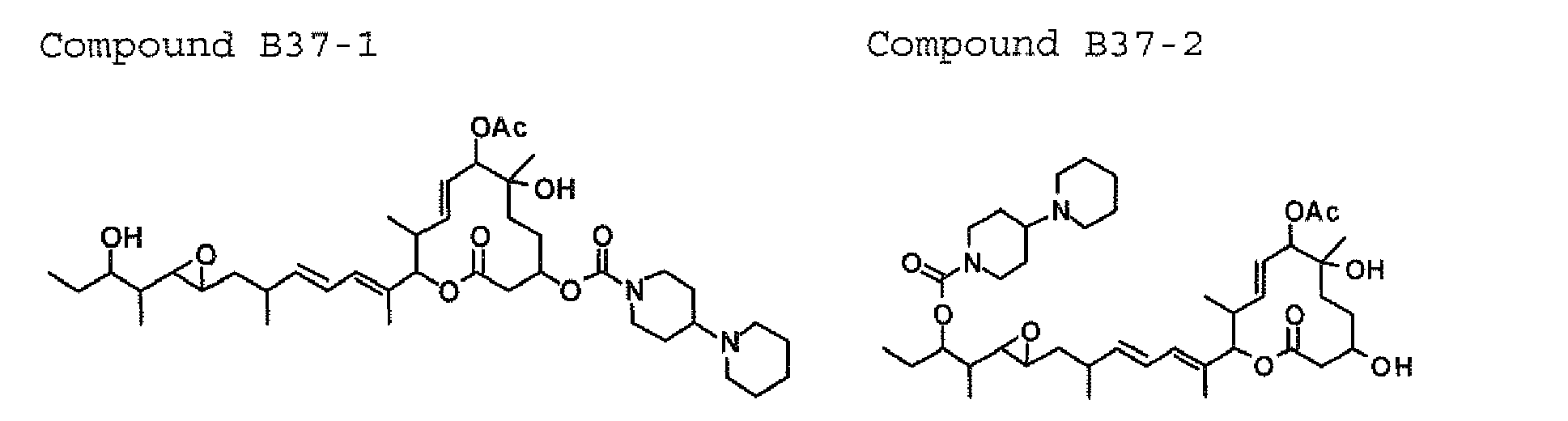
- The title Compound B37-1 (a colorless oil) and Compound B37-2 (a colorless oil) were synthesized by the similar method as Example B35.
- 1H-NMR Spectrum(CD3OD,400MHz)δ(ppm): 0.88(3H,d,J=5.1Hz), 0.89(3H,d,J=5.5Hz), 0.94(3H,t,J=7.3Hz), 1,07(3H,d,J=6.6Hz), 1.14-1.20(1H,m), 1.18(3H,s), 1.34-1.56(9H,m), 1.56-1.76(7H,m), 1.73(3H,d,J=1.1Hz), 1.83-1.92(2H,m), 2.05(3H,s), 2.42-2.65(9H,m), 2.65(1H,dd,J=2.2,8.4Hz), 2.71(1H,dt,J=2.2,5.9Hz), 2.71-2.86(2H,m), 3.50(1H,dt,J=4.8,8.8Hz), 4.12-4.33(2H,m), 4.69-4.76(1H,m), 4.97(1H,d,J=10.6Hz), 5.02(1H,d,J=9.5Hz), 5.56(1H,dd,J=9.9,15,0Hz), 5.65(1H,dd,J=8.4,15.0Hz), 5.71(1H,dd,J=9.5,15.0Hz), 6.09(1H,d,J=11.0Hz), 6.32(1H,dd,J=11.0,15.0Hz); EST-MS m/z 731(M+H)+, 753(M+Na)+.
- 1H-NMR Spectrum(CD3OD,400MHz)δ(ppm): 0.87(3H,d,J=7.0Hz), 0.88(3H,t,J=7.0Hz), 0.90(3H,d,J=7.0Hz), 1.07(3H,d,J=6.6Hz), 1.18(3H,s), 1.30-1.53(9H,m), 1.53-1.69(8H,m), 1.74(3H,d,J=1.1Hz), 1.86-1.93(2H,m), 2.05(3H,s), 2.41-2.65(7H,m), 2.51(2H,d,J=3.3Hz), 2.54(1H,dd,J=2.2,7.7Hz), 2.71(1H,dt,J=2.2,5.9Hz), 2.72-2.90(2H,m), 3.75-3.80(1H,m), 4.14-4.22(2H,m). 4.73-4.80(1H,m), 5.03(1H,d,J=11.4Hz), 5.04(1H,d,J=9.5Hz), 5.55(1H,dd,J=9.5,15.0Hz), 5.64(1H,dd,J=8.4,15.0Hz), 5.69(1H,dd,J=9.5,15.0Hz), 6.08(1H,d,J=11.0Hz), 6.31(1H,dd,J=11.0,15.0Hz); ESI-MS m/z 731(M+H)+, 753 (M+Na)+.
-

- (8E,12E,14E)-7-Acetoxy-6-hydroxy-6,10,12,16,20-pentamethyl-3,21-di(4-nitro-phenylcarboxy)-18,19-epoxytricosa-8,12,14-trien-11-olide (12.6 mg) was dissolved in tetrahydrofuran (0.5 mL), and diethylamine (20 µL) was added thereto, followed by stirring for 21.0 hours. The reaction solution was diluted with ethyl acetate (20 mL), and washed with purified water (4 mL) twice and brine (4 mL). The resulting organic layer was dried over anhydrous sodium sulfate, filtered and then concentrated. The resulting crude product was purified by thin layer chromatography (MERCK Silicagel 60 F254, 0.5 mm, developing solution; ethyl acetate) to obtain the title compound (10.7 mg, 14.5 µmol, 100.0%) as a colorless oil.
1H-NMR Spectrum(CD3OD,400MHz)δ(ppm): 0.88(3H,d,J=7Hz), 0.89(3H,t,J=7Hz), 0.91(3H,d,J=7Hz), 1.07(3H,d,J=7Hz), 1.06-1.18(12H,m), 1.18(3H,s), 1.35-1.55(4H,m), 1.56-1.73(5H,m), 1.73(3H,d,J=0.7Hz), 2.06(3H,s), 2.40-2.51(1H,m), 2.55(1H,dd,J=2,8Hz), 2.53-2.60(2H,m), 2.63(1H,dd,J=4,15Hz), 2.71(1H,dt,J=2,6Hz), 3.25-3.32(8H,m), 4.70-4.83(2H,m), 4.97(1H,d,J=11Hz), 5.03(1H,d,J=10Hz), 5.56(1H,dd,J=10,15Hz), 5.65(1H,dd,J=9,15Hz), 5.72(1H,dd,J=10,15Hz), 6.09(1H,d,J=11Hz), 6.31(1H,dd,J=11,15Hz); FAB-MS m/z 735(M+H)+. -
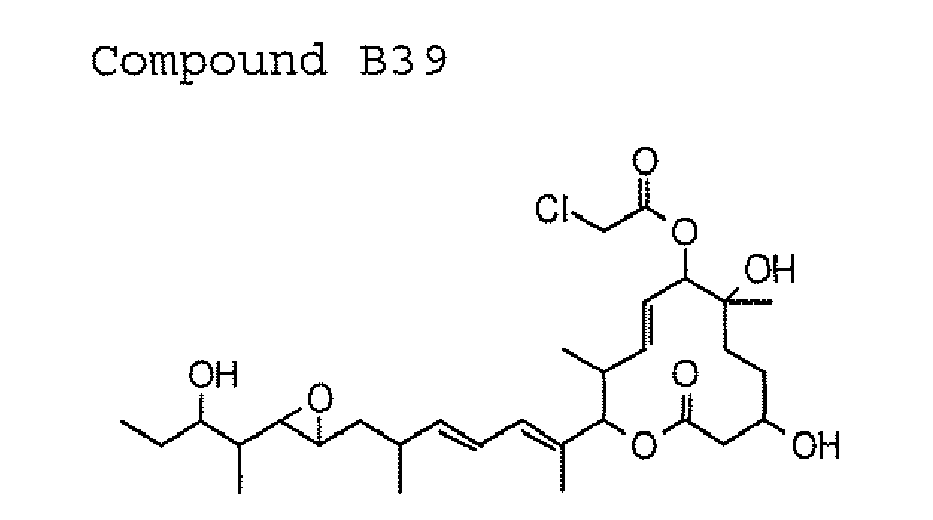
-
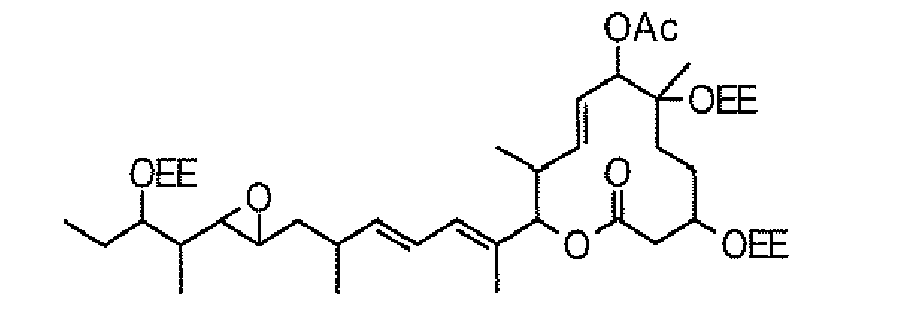
- Pyridinium p-toluenesulfonate (9 mg, 35.4 µmol) was added to a solution of (8E,12E,14E)-7-acetoxy-3,6,21-trihydroxy-6,10,12,16,20-pentamethyl-18,19-epoxytricosa-8,12,14-trien-11-olide (200 mg, 0.354 mmol) in dichloromethane (10 mL) and ethyl vinyl ether (521 mg, 7.08 mmol) at room temperature, followed by stirring at the same temperature overnight. Ethyl acetate and water were added to the reaction solution, and the mixture was extracted with ethyl acetate, dried over anhydrous magnesium sulfate, filtered and then evaporated. The resulting residue was purified by silica gel column chromatography (Kanto silica gel 60N, 40 to 50 µm; ethyl acetate-hexane=1:4, 1:3 and 1:1, successively) to obtain the title compound (250 mg, 94%) as a colorless oil.
ESI-MS m/z 775(M+Na)+. -

- Potassium carbonate (138 mg, 0,996 mmol) was added to a solution of (8E,12E,14E)-7-acetoxy-3,6,21-tri(1-ethoxyethoxy)-6,10,12,16,20-pentamethyl-18,19-epoxytricosa-8,12,14-trien-11-olide (250 mg, 0.332 mmol) in methanol (5 mL) at room temperature, followed by stirring at the same temperature for 2 hours. Acetic acid (60 mg, 1 mmol), ethyl acetate and water were added to the reaction solution, and the mixture was extracted with ethyl acetate. The organic layer was washed with water, dried over anhydrous magnesium sulfate, filtered and then evaporated. The resulting residue was purified by silica gel column chromatography (Kanto silica gel 60N, spherical, neutral, 40 to 50 µm, ethyl acetate-hexane=1:2 and 1:1, successively) to obtain the title compound (242 mg, 100%) as a colorless oil.
ESI-MS m/z 734(M+Na)+. -
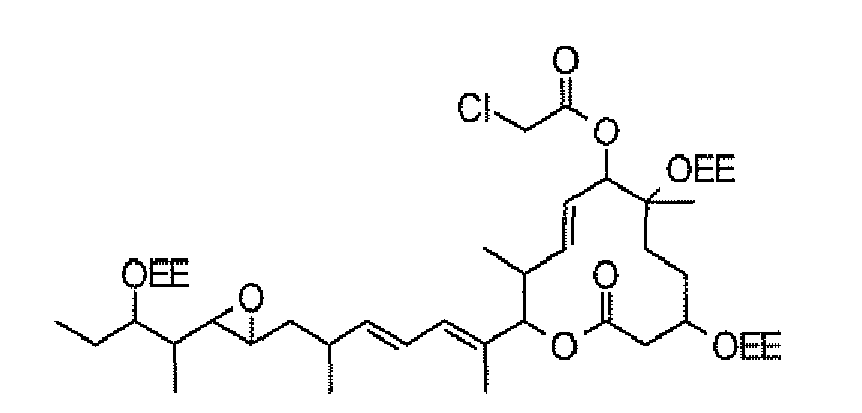
- A solution of chloroacetic anhydride (21.5 mmol, 0.122 mmol) and dimethylaminopyridine (1.2 mg, 10 µmol) in dichloromethane (0.5 mL) were added to a solution of (8E,12E,14E)-3,6,21-tri(1-ethoxyethoxy)-7-hydroxy-6,10,12,16,20-pentamethyl-18,19-epoxytricosa-8,12,14-trien-11-olide (17.4 mg, 24.4 µmol) and triethylamine (25 mg, 0.244 mmol) in dichloromethane (2 mL) at room temperature, followed by stirring at the same temperature for one hour. Ethyl acetate and water were added to the reaction solution, and the mixture was extracted with ethyl acetate, dried over anhydrous magnesium sulfate, filtered and then evaporated. The resulting residue was purified by silica gel column chromatography (Kanto silica gel 60N, 40 to 50 µm, ethyl acetate-hexane=1:4) to obtain the declared compound (18.1 mg, 94%) as a colorless oil.
-

- Pyridinium p-toluenesulfonate (1 mg, 4.1 µmol) was added to a solution of (8E,12E,14E)-7-chloroacetoxy-3,6,21-tri(l-ethoxyethoxy)-6,10,12,16,20-pentamethyl-18,19-epoxytricosa-8,12,1.4-trien-11-olide (3.2 mg, 4.06 µmol) in methanol (1 mL), followed by stirring at room temperature for one hour. The reaction solution was evaporated, and the resulting residue was purified by thin layer chromatography (MERCK Silica gel 60 F254, 0.2 mm, developing solution; ethyl acetate-hexane=2:1) to obtain the title compound (1.6 mg, 70%) as a colorless oil.
1H-NMR Spectrum(CD3OD,400MHz)δ(ppm): 0.79(3H,d,J=6.8Hz), 0.80(3H,d,J=6.8Hz), 0.84(3H,t,J=7.6Hz), 0.98(3H,d,J=6.8Hz), 1.05-1.13(4H,m), 1.25-1.31(2H,m) 1.32-1.58(6H,m), 1.65(3H,d,J=0.8Hz), 2.32-2.52(4H,m), 2.56(1H,dd,J=2.4,8.4Hz), 2.62(1H,dt,J=2.4.0Hz), 3.41(1H,dt,J=4.4,8.4Hz), 3.66-3.72(1H,m), 4.09(1H,d,J=14.8Hz), 4.15(1H,d,J=14.8Hz), 4.95(1H,d,J=10.8Hz), 5.00(1H,d,J=9.6Hz), 5.53(1H,dd,J=9.6,15.2Hz), 5.56(1H,dd,J=8.0,14.4Hz), 5.62(1H,dd,J=9.2,15.2Hz), 6.00(1H,d,J=10.8Hz), 6.23(1H,dd,J=10.8,15.2Hz); ESI-MS m/z 593(M+Na)+. -

-

- Morpholine (9 mg, 0.103 mmol) was added to a solution of (8E,12E,14E)-7-chloroacetoxy-3,6,21-tri(1-ethoxyethoxy)-6,10,12,16,20-pentamethyl-18,19-epoxytricosa-8,12,14-trien-11-olide (8.1 mg, 10.3 µmol) in N,N-dimethylformamide (1 mL) at room temperature, followed by stirring at 60°C for one hour. Ethyl acetate and water were added to the reaction solution, and the mixture was extracted with ethyl acetate, and the organic layer was washed with water. The resulting organic layer was dried over anhydrous magnesium sulfate, filtered and then evaporated. The resulting residue was purified by silica gel column chromatography (Kanto silica gel 60N, 40 to 50 µm; ethyl acetate-hexane=1:2 and 1:1, successively) to obtain the title compound (7.3 mg, 85%) as a colorless oil.
-

- Pyridinium p-toluenesulfonate (2.2 mg, 8.71 µmol) was added to a solution of (8E,12E,14E)- 3,6,21-tri(1-ethoxyethoxy)-6,10,12,16,20-pentamethyl-7-(morpholin-4-yl)acetoxy-18,19-epoxytricosa-8,12,14-trien-11-olide (7.3 mg, 8.71 µmol) in methanol (1 mL), followed by stirring at room temperature overnight. The reaction solution was evaporated, and to the resulting residue were added ethyl acetate, water and a saturated sodium bicarbonate aqueous solution. The mixture was extracted with ethyl acetate, and the resulting organic layer was dried over anhydrous magnesium sulfate, filtered and then evaporated. The resulting residue was purified by thin layer chromatography (MERCK Silica gel 60 F254, 0.2 mm, developing solution; methanol-dichloromethane=1:19) to obtain the title compound (4.4 mg, 82%) as a colorless oil.
1H-NMR Spectrum(CD3OD,400MHz)δ(ppm): 0.87(3H,d,J=6.8Hz), 0.90(3H,d,J=7.2Hz), 0.93(3H,t,J=7.6Hz), 1.08(3H,d,J=6.8Hz), 1.14-1.22(4H,m), 1.34-1.67(8H,m), 1.74(3H,d,J=0.8Hz), 2.42-2.61(8H,m), 2.65(1H,dd,J=2.4,8.0Hz), 2.72(1H,dt,J=2.4,6.0Hz), 3.28(2H,s), 3.51(1H,dt,J=4.4,8.8Hz), 3.71(4H,t,J=4.8Hz), 3.75-3.81(1H,m), 5.04(1H,d,J=10.4Hz), 5.11(1H,d,J=9.6Hz), 5.50(1H,dd,J=9.5,15.2Hz), 5.65(1H,dd,J=8.4,14.8Hz), 5.70(1H,dd,J=9.6,15.2Hz), 6.09(1H,d,J=10.8Hz), 6.32(1H,dd,J=10.8,15.2Hz); ESI-MS m/z 622(M+H)+. -

-

- LiHMDS (1.0 M tetrahydrofuran solution, 81 µL, 81 µmol) was added dropwise to a solution of (8E,12E,14E)-3,6,21-tri(1-ethoxyethoxy)-7-hydroxy-6,10,12,16,20-pentamethyl-18,19-epoxytricosa-8,12,14-trien-11-olide (10 mg, 14 µmol) in tetrahydrofuran (1 mL) at -40°C under nitrogen atmosphere. After stirring at the same temperature for 15 min., a solution of benzoyl chloride (17.8 mg, 125 µmol) in tetrahydrofuran (0.4 mL) was added dropwise thereto and the mixture was stirred at 0°C for 7 hours. Ethyl acetate and water were added to the reaction solution, and the mixture was extracted with ethyl acetate. The resulting organic layer was dried over anhydrous magnesium sulfate, filtered and then evaporated. The resulting residue was purified by silica gel column chromatography (Kanto silica gel 60N, 40 to 50 µm; ethyl acetate-hexane=1:4) to obtain the title compound (6.1 mg, 54%) as a colorless oil.
-

- Pyridinium p-toluenesulfonate (2 mg, 7.5 µmol) was added to a solution of (8E,12E,14E)-7-benzoyloxy-3,6,21-tri(1-ethoxyethoxy)-6,10,12,16,20-pentamethyl-18,19-epoxytricosa-8,12,14-trien-11-olide (6.1 mg, 7.48 µmol) in methanol (1 mL), followed by stirring at room temperature for one hour. The reaction solution was evaporated, ethyl acetate, water and a saturated sodium bicarbonate aqueous solution were added to the resulting residue, and the mixture was extracted with ethyl acetate. The resulting organic layer was dried over anhydrous magnesium sulfate, filtered and then evaporated. The resulting residue was purified by thin layer chromatography (MERCK Silica gel 60 F254, 0.2 mm, developing solution; ethyl acetate-hexane=2:1) to obtain the title compound (3.3 mg, 74%) as a colorless oil.
1H-NMR Spectrum(CD3OD,400MHz)δ(ppm): 0.88(3H,d,J=6.8Hz), 0.89(3H,d,J=6.8Hz), 0.93(3H,t,J=7.6Hz), 1.08(3H,d,J=6.8Hz), 1.13-1.23(1H,m), 1.25(3H,s), 1.40-1.55(5H,m), 1.58-1.74(3H,m), 1.75(3H,s), 2.43-2.64(4H,m), 2.65(1H,dd,J=2.4,7.6Hz), 2.71(1H,dd,J=2.4,6.0Hz), 3.50(1H,dt,J=4.4,8.8Hz), 3.78-3.84(1H,m), 5.08(1H,d,J-10.4Hz), 5.29(1H,d,J=9.6Hz), 5.66(1H,dd,J=8.8,15.2Hz), 5.69(1H,dd,J=10.0,15.2Hz), 5.82(1H,dd,J=9.6,15.2Hz), 6.10(1H,d,J=10.4Hz), 6.32(1H,dd,J=10.8,15.2Hz), 7.47(2H,t,J=7.6Hz), 7.60(1H,t,J=7.6Hz), 8.12(2H,d,J=7.6Hz); ESI-MS m/z 621(M+Na)+. -

- By using (8E,12E,14E)-3,6,21-tri(1-ethoxyethoxy)-7-hydroxy-6,10,12,16,20-pentamethyl-18,19-epoxytricosa-8,12,14-trien-11-olide as a starting material, the title compound was synthesized by the similar method as Example B39.
1H-NMR Spectrum(CD3OD,400MHz)δ(ppm): 0.87(3H,d,J=6.8Hz), 0.90(3H,d,J=7.2Hz), 0.93(6H,t,J=7.2Hz), 1.08(3H,d,J=6.8Hz), 1.18(3H,s), 1.19-1.70(11H,m), 1.74(3H,d,J=0.8Hz), 2.32(2H,dt,J=2.4,9.6Hz), 2.42-2.60(2H,m), 2.52(2H,d,J=3.2Hz), 2.65(1H,dd,J=2.0,8.0Hz), 2.72(1H,dt,J=2.0,5.6Hz), 3.50(1H,dt,J=4.4,4.4Hz), 3.74-3.84(1H,m) 5,05(1H,d,J=10.4Hz), 5.06(1H,d,J=9.6Hz), 5.57(1H,dd,J=9.6,15.2Hz), 5.65(1H,dd,J=8.4,14.8Hz), 5.69(1H,dd,J=10.0,15.2Hz), 6.09(1H,d,J=11.2Hz), 6.32(1H,dd,J=11.6,14.8Hz); ESI-MS m/z 587(M+Na)+. -

-

- A solution of 4-nitrophenyl chloroformate (62 mg, 300 µmol) in dichloromethane (2.5 mL) was added dropwise into a solution of (8E,12E,14E)-3,6,21-tri(1-ethoxyethoxy)-7-hydroxy-6,10,12,16,20-pentamethyl-18,19-epoxytricosa-8,12,14-trien-11-olide (35 mg, 49.2 µmol), triethylamine (61 mg, 600 µmol) and dimethylaminopyridine (4 mg, 30 µmol) in dichloromethane (2.5 mL), followed by stirring at room temperature for 2.5 hours under nitrogen atmosphere. Ethyl acetate, water and saturated sodium bicarbonate aqueous solution were added to the reaction mixture, and the mixture was extracted with ethyl acetate, then the organic layer was washed with water. The resulting organic layer was dried over anhydrous magnesium sulfate, filtered and then evaporated to give the title crude compound (92.2 mg) as a yellow oil. This was used for the following reaction without purification.
-

- 28% Aqueous ammonia solution (20 µL, 300 µmol) was added dropwise to a solution of the crude (8E,12E,14E)-3,6,21-tri(1-ethoxyethoxy)-6,10,12,16,20-pentamethyl-7-(4-nitrophenoxy)carboxy-18,19-epoxytricosa-8,12,14-trien-11-olide (10 mg, about 5.3 µmol) in tetrahydrofuran (1.5 mL), followed by stirring at room temperature for 3 hours. Ethyl acetate and water were added to the reaction mixture, and the mixture was extracted with ethyl acetate. The resulting organic layer was dried over anhydrous magnesium sulfate, filtered and then evaporated. The resulting residue was purified by thin layer chromatography (MERCK Silica gel 60 F254, 0.2 mm, developing solution; ethyl acetate-hexane, 1:1) to give the title compound (3.6 mg, 90%, 2 steps) as a colorless oil.
-

- Pyridinium p-toluenesulfonate (1.2 mg, 4.8 µmol) was added to a solution of (8E,12E,14E)-7-carbamoyloxy-3,6,21-tri(1-ethoxyethoxy)-6,10,12,16,20-pentamethyl-18,19-epoxytricosa-8,12,14-trien-11-olide (3.6 mg, 4.77 µmol) in methanol (1 mL), followed by stirring at room temperature for 3 hours. The reaction mixture was evaporated, ethyl acetate, water and a saturated sodium bicarbonate aqueous solution were added to the resulting residue, and the mixture was extracted with ethyl acetate. The resulting organic layer was dried over anhydrous magnesium sulfate, filtered and then evaporated. The resulting residue was purified by thin layer chromatography (MERCK Silica gel 60 F254, 0.2 mm, developing solution; methanol-dichloromethane, 1:29) to give the title compound (1.9 mg, 74%) as a colorless oil.
1H-NMR Spectrum(CD3OD,400MHz)δ(ppm): 0.89(3H,d,J=6.8Hz), 0.90(3H,d,J=6.8Hz), 0.93(3H,t,J=7.6Hz), 1.08(3H,d,J=6.8Hz), 1.14-1 23(4H,m), 1.32-1.57(8H,m), 1.74(3H,d,J=0.8Hz), 2.41-2.62(4H,m), 2.65(1H,dd,J=2.4,8.4Hz), 2.72(1H,dt,J=2.4,6.0Hz), 3.51(1H,dt,J=4.8,8.8Hz), 3.74-3.80(1H,m), 4.85-4.89(1H,m), 5.04(1H,d,J=10.8Hz), 5,54(1H,dd,J=10.0,15.2Hz), 5.65(1H,dd,J=8.4,15.2Hz), 5.69(1H,dd,J=10.0,15.2Hz), 6.09(1H,d,J=9.6Hz), 6.32(1H,dd,J=10.8,14.8Hz); ESI-MS m/z 560(M+Na)+. -

- The title compound (a colorless oil) was synthesized by the similar method as Example B44.
1H-NMR Spectrum(CD3OD,400MHz)δ(ppm): 0.88(3H,d,J=6.8Hz) 0.90(3H,d,J=6.8Hz), 0.93(3H,t,J=7.6Hz), 1.08(3H,d,J=6.8Hz), 1.14-1.23(4H,m), 1.31-1.67(8H,m), 1.74(3H,d,J=0.8Hz), 2.42-2.61(4H,m), 2.65(1H,dd,J=2.4,6.8Hz), 2.68-2.75(4H,m), 3.51(1H,dt,J-4.8,8.8Hz), 3.74-3.80(1H,m), 4.87-4.91(1H,m), 5.04(1H,d,J=10.8Hz), 5.55(1H,dd,J=9.6,15.2Hz), 5.65(1H,dd,J=8.8,15.2Hz), 5.68(1H,dd,J=9.6,15.2Hz), 6.09(1H,d,J=10.8Hz), 6.32(1H,dd,J=10.8,15.2Hz); ESI-MS m/z 574(M+Na)+. -

- The title compound (a colorless oil) was synthesized by the similar method as Example B44.
1H-NMR Spectrum(CD3OD,400MHz)δ(ppm): 0.88(3H,d,J=6.4Hz), 0.90(3H,d,J=6.8Hz), 0,93(3H,t,J=7.6Hz), 1.08(3H,d,J=6.8Hz), 1.14-1.23(4H,m), 1.33-1.68(8H,m), 1.74(3H,d,J=1.2Hz), 2.42-2.61(4H,m), 2.65(1H,dd,J=2.0,8.4Hz), 2.72(1H,dt,J=2.4,6.0Hz), 2.89(3H,S), 2.98(3H,s), 3.51(1H,dt,J=4.4,8.4Hz), 3.75-3.81(1H,m), 4.91(1H,d,J=9.6Hz), 5.04(1H,d,J=10.8Hz), 5.55(1H,dd,J=10.0,15.2Hz), 5.65(1H,dd,J=8.4,15.2Hz), 5.72(1H,dd,J=10.0,15.2Hz), 6.09(1H,d,J=11.2Hz), 6.32(1H,dd,J=10.8,14.8Hz); ESI-MS m/z 588(M+Na)+. -


- The title compound (a colorless oil) was synthesized by the similar method as Example B44.
1H-NMR Spectrum(CD3OD,400MHz)δ(ppm): 0.88(3H,d,J=6.8Hz), 0.90(3H,d,J=6.8Hz), 0.93(3H,t,J=7.6Hz), 1.08(3H,d,J=6.4Hz), 1.14-1.24(4H,m), 1.28-1.67(8H,m), 1.74(3H,s), 2.42-2.61(4H,m), 2.65(1H,dd,J=2.0,8.4Hz), 2.72(1H,dt,J=2.4,6.0Hz), 2.96(2H,t,J=7.2Hz), 3.42-3.54(3H,m), 3.74-3.80(1H,m), 4.84-4.90(1H,m), 5.04(1H,d,J=10.8Hz), 5.53(1H,dd,J=9.6,15.2Hz), 5.65(1H,dd,J=8.4,14.8Hz), 5.67(1H,dd,J=9.6,15.2Hz), 6.09(1H,d,J=10.8Hz), 6.32(1H,dd,J=10.8,15.2Hz), 7.26(1H,dd,J=5.2,7.2Hz), 7.31(1H,d,J=7.6Hz), 7.75(1H,dt,J=1.6,7.6Hz), 8.45(1H,d,J=4.8Hz); ESI-MS m/z 665(M+Na)+. -


- The title compound (a colorless oil) was synthesized by the similar method as Example B44.
1H-NMR Spectrum(CD3OD,400MHz)δ(ppm): 0.89(3H,d,J=6.4Hz), 0.90(3H,d,J=6.8Hz), 0.93(3H,t,J=7.6Hz), 1.08(3H,d,J=6.8Hz), 1.14-1.23(4H,m), 1.30-1.67(10H,m), 1.74(3H,s), 1.79-1.86(2H,m), 2.42-2.62(4H,m), 2.65(1H,dd,J=2.0,8.4Hz), 2.72(1H,dt,J=2.0,6.0Hz), 2.99-3.23(2H,m), 3.51(1H,dt,J=4.4,8,8Hz), 3.74-4.13(4H,m), 4.92(1H,d,J=9.6Hz), 5.05(1H,d,J=10.8Hz), 5.57(1H,dd,J=10.0,15.2Hz), 5.65(1H,dd,J=8.4,14.8Hz), 5.71(1H,dd,J=9.6,14.8Hz), 6.09(1H,d,J=10.4Hz), 6.32(1H,dd,J=10.8,14.8Hz); ESI-MS m/z 644(M+Na)+. -

- The title compound (a colorless oil) was synthesized by the similar method as Example B44.
1H-NMR Spectrum(CD3OD,400MHz)δ(ppm): 0.89(3H,d,J=6.8Hz), 0.90(3H,d,J=7.2Hz), 0.93(3H,t,J=7.6Hz), 1.08(3H,d,J=6.8Hz), 1.14-1.23(4H,m), 1.30-1.67(8H,m), 1.74(3H,s), 2.42-2.61(4H,m), 2.65(1H,dd,J=2.4,8.4Hz), 2.72(1H,dt,J=2.4,6.0Hz), 3.35-3.68(9H,m), 3.75-3.81(1H,m), 4.95(1H,d,J=9.6Hz), 5.04(1H,d,J=10.8Hz), 5.57(1H,dd,J=9.6,15.2Hz), 5.65(1H,dd,J=8.4,14.8Hz), 5.71(1H,dd,J=9.6,15.2Hz), 6.09(1H,d,J=10.8Hz), 6.32(1H,dd,J=10.8,14.8Hz); ESI-MS m/z 630(M+Na)+. -

- The title compound (a colorless oil) was synthesized by the similar method as Example B44.
1H-NMR Spectrum(CD3OD,400MHz) δ (ppm): 0.89(3H,d,J=6.4Hz), 0.90(3H,d,J=6.8Hz), 0,93(3H,t,J=7.6Hz), 1.08(3H,d,J=6.8Hz), 1.14-1.23(4H,m), 1.31-1.67(8H,m), 1.74(3H,s), 2.30(3H,s), 2.37-2.62(8H,m), 2.65(1H,dd.J=2.0,8.4Hz), 2.72(1H,dt,J=2.0,6.0Hz), 3.39-3.71(5H,m), 3.75-3.81(1H,m), 4.93(1H,d,J=9.6Hz), 5.04(1H,d,J=10.4Hz), 5.57(1H,dd,J=10.0,15.2Hz), 5.65(1H,dd,J=8.4,15.2Hz), 5.71(1H,dd,J=9.6,14.8Hz), 6.09(1H,d,J=l0.0Hz), 6.32(1H,dd,J=10.8,14.8Hz); ESI-MS m/z 621(M+H)+. -

- The title compound (a colorless oil) was synthesized by the similar method as Example B44.
1H-NMR Spectrum(CD3OD,400MHz)δ(ppm): 0.88(3H,d,J=6.8Hz), 0.90(3H,d,J=7.2Hz), 0.93(3H,t,J=7.6Hz), 1.08(3H,d,J=6.8Hz), 1.14-1.23(4H,m), 1.32-1.68(8H,m), 1.74(3H,d,J=1.2Hz), 2.12(3H,s), 2.41-2.62(4H,m), 2.65(1H,dd,J=2.4,8.4Hz), 2.71(1H,dt,J=2.0,6.0Hz), 3.35-3.72(9H,m), 3.74-3.82(1H,m), 4.96(1H,d,J=9.6Hz), 5.04(1H,d,J=10.4Hz), 5.58(1H,dd,J=9.6,15.2Hz), 5.65(1H,dd,J=8.4,14.8Hz), 5.72(1H,dd,J=9.6,15.2Hz), 6.09(1H,d,J=10.8Hz), 6.32(1H,dd,J=10.8,14.8Hz); ESI-MS m/z 671(M+Na)+. -


- The title compound (a colorless oil) was synthesized by the similar method as Example B44.
1H-NMR Spectrum(CD3OD,400MHz)δ(ppm): 0.89(3H,d,J=6.8Hz), 0.90(3H,d,J=6.8Hz), 0.93(3H,t,J=7.6Hz), 1.08(3H,d,J=6.8Hz), 1.11-1.23(4H,m), 1.26-1.67(8H,m), 1.74(3H,s), 2.42-2.62(4H,m), 2.65(1H,dd,J=2.0,8.4Hz), 2.69-2.81(5H,m), 3.36-3.69(5H,m), 3.75-3.82(1H,m), 4.94(1H,d,J=9.6Hz), 5.04(1H,d,J=10.8Hz), 5.57(1H,dd,J=10.0,15.2Hz), 5.66(1H,dd,J=8.8,15.6Hz), 5.71(1H,dd,J=9.6,15.2Hz), 6.09(1H,d,J=10.8Hz), 6.32(1H,dd,J=10.8,14.8Hz); ESI-MS m/z 607(M+H)+. -

- The title compound was obtained as a colorless oil by the similar method as Example B44.
- 1H-NMR Spectrum (CD3OD,500MHz)δ(ppm): 0.90(3H,d,J=6.5Hz), 0.91(3H,d,J=7.0Hz), 0.94(3H,t,J=8.0Hz), 1.09(3H,d,J=7.0Hz), 1.16-1.26(1H,m), 1.21(3H,s), 1.28-1.68(8H,m), 1.75(3H,s), 2.42-2.62(4H,m), 2.66(1H,dd,J=2.5,8.5Hz), 2.73(1H,dt,J=2.0,6.0Hz), 3.25-3.32(2H,m), 3.34(3H,m), 3.44(2H,t,J=5.5Hz), 3.48-3.51(1H,m), 3.74-3.82(1H,m), 4.90(1H,d,J=9.5Hz), 5.05(1H,d,J=10.5Hz), 5.56(1H,dd,J=10.0,15.0Hz), 5.62-5.76(2H,m), 6.09(1H,d,J=10.0Hz), 6.32(1H,dd,J=11.0,15.0Hz); ESI-MS m/z 618(M+Na)+.
-
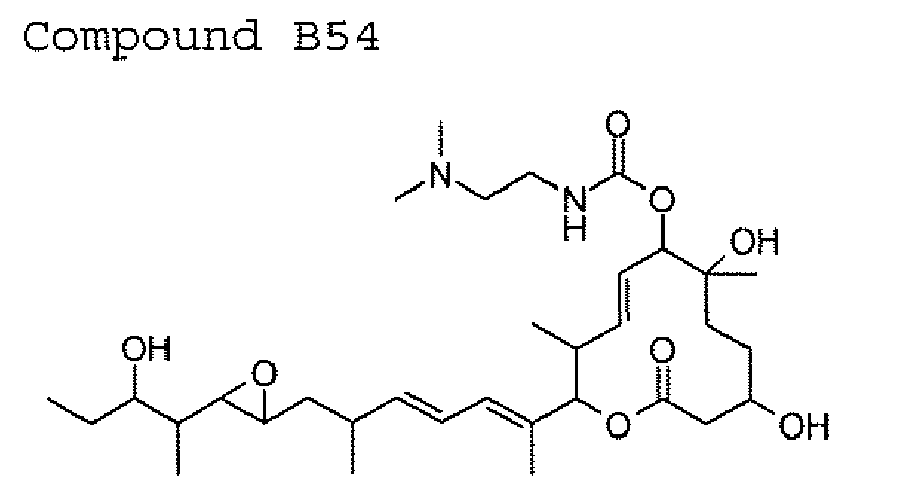
- The title compound was obtained as a colorless oil by the similar method as Example B44.
1H-NMR Spectrum (CD3OD,500MHz)δ(ppm): 0.89(3H,d,J=7.5Hz), 0.90(3H,d,J=7.5Hz), 0.94(3H,t,J=7.5Hz), 1.09(3H,d,J=7.0Hz), 1.16-1.26(1H,m), 1.21(3H,s), 1.28-1.68(8H,m), 1.75(3H,s), 2.26(6H,s), 2.44(2H,t,J=6.5Hz), 2.44-2.62(4H,m), 2.67(1H,dd,J=2.0,8.5Hz), 2.73(1H,dt,J=2.0,6.0Hz), 3.25(2H,t,J=6.0Hz), 3.48-3.54(1H,m), 3.75-3.82(1H,m), 4.90(1H,d,J=10.0Hz), 5.05(1H,d,J=11.0Hz), 5.63-5.74(2H,m), 6.09(1H,d,J=10.5Hz), 6.32(1H,dd,J=11.0,15.0Hz); ESI-MS m/z 609(M+H)+. -

- The title compound was obtained as a colorless oil by the similar method as Example B44.
1H-NMR Spectrum (CD3OD,500MHz)δ(ppm): 0.89(3H,d,J=7.0Hz), 0.91(3H,d,J=7.0Hz), 0.94(3H,t,J=7.0Hz), 1.09(3H,d,J=7.0Hz), 1,16-1.72(11H,m), 1.21(3H,s), 1.75(3H,s), 2.24(6H,s), 2.36(2H,t,J=8.0Hz), 2.42-2.62(4H,m), 2.66(1H,dd,J=2.0,8.0Hz), 2.73(1H,dt,J=2.0,9.0Hz), 3.14(2H,t,J=7.0Hz), 3.48-3.55(1H,m), 3.75-3.82(1H,m), 4.90(1H,d,J=10.5Hz), 5.05(1H,d,J=10.5Hz), 5.64-5.74(2H,m), 6.09(1H,d,J=10.5Hz), 6.32(1H,dd,J=11.0,15.0Hz); ESI-MS m/z 623(M+H)+. -

- The title compound was obtained as a colorless oil by the similar method as Example B44.
1H-NMR Spectrum(CD3OD,400MHz)δ(ppm): 0.88(3H,d,J=7.2Hz), 0.89(3H,d,J=7.2Hz), 0.94(3H,t,J=7.6Hz), 1.08(3H,d,J=6.8Hz), 1.16-1.64(9H,m), 1.23(3H,s), 1.74(3H,s), 2.40-2.60(2H,m), 2.52(2H,d,J=4.0Hz), 2.64(1H,dd,J=2.4,8.4Hz), 2.72(1H,dt,J=2.4,5.6Hz), 3.43-3.52(1H,m), 3,70-3.81(1H,m), 4.40(2H,s), 4.95(1H,d,J=9.2Hz), 5.04(1H,d,J=10.8Hz), 5.56(1H,dd,J=9.2,15.6Hz), 5.65(1H,dd,J=8.8,15.2Hz), 5.73(1H,dd,J=10.4,15.2Hz), 6.08(1H,d,J=10.8Hz), 6.32(1H,dd,J=11.2,15.2Hz), 7.29(1H,t,J=5.6Hz), 7.37(1H,d,J=8.0Hz), 7.80(1H,t,J=8.0Hz), 8.47(1H,d,J=5.6Hz); ESI-MS m/z 629(M+H)+, 651(M+Na)+. -


- The title compound was obtained as a colorless oil by the similar method as Example B44.
1H-NMR Spectrum(CD3OD,400MHz)δ(ppm): 0.87(3H,d,J=6.8Hz), 0.90(3H,d,J=6.8Hz), 0.93(3H,t,J=7.2Hz), 1.08(3H,d,J=6.8Hz), 1.17-1.66(9H,m), 1.21(3H,s), 1.74(3H,s), 2.40-2.60(2H,m), 2.52(2H,d,J=3.6Hz), 2.65(1H,dd,J=2.4,8.4Hz), 2.72(1H,dt,J=2.4,6.0Hz). 3.43-3.54(1H,m), 3.72-3.82(1H,m), 4.33(2H,s), 4.92(1H,d,J=9.2Hz), 5.04(1H,d,J=10.8Hz), 5.55(1H,dd,J=10.0,15.2Hz), 5.65(1H,dd,J=8.4,14.8Hz), 5.70(1H,dd,J=9.6,15.6Hz), 6.08(1H,d,J=10.8Hz), 6.32(1H,dd,J=10.8,14.8Hz), 7.39(1H,dd,J=5.2,8.0Hz), 7.77(1H,d,J=7.6Hz), 8.42(1H,d,J=4.8Hz), 8.47(1H,brs); ESI-MS m/z 651(M+Na)+. -

- The title compound was obtained as a colorless oil by the similar method as Example B44.
1H-NMR Spectrum(CD3OD,400MHz)δ(ppm): 0.88(3H,d,J=7.2Hz), 0.89(3H,d,J=6.8Hz), 0.94(3H,t,J=7.6Hz), 1.08(3H,d,J=6.4Hz), 1.15-1.66(9H,m), 1.23(3H,s), 1.74(3H,s), 2.46-2.62(4H,m), 2.65(1H,dd,J=2.0,8.4Hz), 2.72(1H,dt,J=2.4,6.0Hz), 3.46-3.55(1H,m), 3.72-3.82(1H,m), 4.35(2H,s), 4.93(1H,d,J=9.6Hz), 5.04(1H,d,J=10.8Hz), 5.56(1H,dd,J=9.6,15.2Hz), 5.65(1H,dd,J=8.4,14.8Hz), 5.72(1H,dd,J=9.6,15.2Hz), 6.09(1H,d,J=11.2Hz), 6.32(1H,dd,J=10.8,14.8Hz), 7.34(2H,d,J=5.2Hz), 8.45(2H,dd,J=1.6,4.8Hz); ESI-MS m/z 629(M+H)+, 651(M+Na)+. -

- The title compound was obtained as a colorless oil by the similar method as Example B44.
1H-NMR Spectrum(CD3OD,400MHz)δ(ppm): 0.88(3H,d,J=5.2Hz), 0.89(3H,d,J=7.2Hz), 0.93(3H,t,J=7.2Hz), 1.07(3H,d,J=6.8Hzy, 1.17-1.66(9H,m), 1.20(3H,s), 1.74(3H,s), 2.44-2.62(8H,m), 2.65(1H,dd,J=2.4,8.4Hz), 2.72(1H,dt,J=2.4,6.0Hz), 3.26(2H,t,J=6.8Hz), 3.28-3.36(2H,m), 3.46-3.54(1H,m), 3.62-3.72(4H,m), 3.74-3.83(1H,m), 4.84-4.88(1H,m), 5.34(1H,d,J=10.8Hz), 5.54(1H,dd,J=10.4,15.2Hz), 5.65(1H,dd,J=8.8,15.2Hz), 5.69(1H,dd,J=10.0,15.6Hz), 6.09(1H,d,J=10.8Hz), 6.32(1H,dd,J=10.8,14.8Hz); ESI-MS m/z 651(M+H)+. -

- The title compound was obtained as a colorless oil by the similar method as Example B44.
1H-NMR Spectrum(CD3OD,400MHz)δ(ppm): 0.88(3H,d,J=5.2Hz), 0.90(3H,d,J=7.2Hz), 0.93(3H,t,J=7.2Hz), 1.08(3H,d,J=8.0Hz), 1.16-1.73(11H,m), 1.20(3H,s), 1.74(3H,s), 2.36-2.62(8H,m), 2.65(1H,dd,J=2.0,8.4Hz), 2.72(1H,dt,J=2.4,6.0Hz), 3.10-3.16(4H,m), 3.46-3.54(1H,m), 3.62-3.72(4H,m), 3.74-3.82(1H,m), 4.84-4.88(1H,m), 5.04(1H,d,J=10.8Hz), 5.54(1H,dd,J=10.0,14.8Hz), 5.62-5.74(2H,m), 6.09(1H,d,J=10.8Hz), 6.32(1H,dd,J=10.8,15.2Hz); ESI-MS m/z 665(M+H)+. -

- The title compound (a colorless oil) was synthesized by the similar method as Example B44.
1H-NMR Spectrum (CD3OD,400MHz)δ(ppm): 0.89(3H,d,J=6.8Hz), 0.90(3H,d,J=6.8Hz), 0.93(3H,t,J=7.6Hz), 1.08(3H,d,J=6.8Hz), 1.14-1.25(4H,m), 1.34-1.68(8H,m), 1.74(3H,d,J=0.8Hz), 1.77-1.86(2H,m), 2.41-2.63(4H,m), 2.65(1H,dd,J=2.4,8.4Hz), 2.72(1H,dt,J=2.4,6.0Hz), 2.73-2.94(4H,m), 3.41-3.68(5H,m), 3.75-3.82(1H,m), 4.94(1H,d,J=9.6Hz), 5.05(1H,d,J=10.4Hz), 5.57(1H,dd,J=l0.0,15.2Hz), 5.65(1H,dd,J=8.4,15.2Hz), 5.72(1H,dd,J=10.0,15.2Hz), 6.09(1H,d,J=10.8Hz), 6.32(1H,dd,J=10.8,14.8Hz); ESI-MS m/z 621(M+H)+. -

- The title compound (a colorless oil) was synthesized by the similar method as Example B44.
1H-NMR Spectrum (CD3OD,400MHz)δ(ppm): 0.79(3H,d,J=6.4Hz), 0.80(3H,d,J=7.2Hz), 0.84(3H,t,J=7.6Hz), 0.98(3H,d,J=6.8Hz), 1.05-1.16(4H,m), 1.24-1.58(8H,m), 1.65(3H,d,J=0.8Hz), 1.76-1.84(2H,m), 2.25(3H,s), 2.33-2.58(9H,m), 2.62(1H,dt,J=2.4,6.0Hz), 3.37-3.46(3H,m), 3.48-3.58(2H,m), 3.66-3.72(1H,m), 4.85(1H,d,J=9.6Hz), 4.95(1H,d,J=10.8Hz), 5.48(1H,dd,J=9.6,15.2Hz), 5.56(1H,dd,J=8.4,15.2Hz), 5.63(1H,dd,J=9.6,15.2Hz), 6.00(1H,d,J=10.8Hz), 6.23(1H,dd,J=10.8,14.8Hz); ESI-MS m/z 635(M+H)+. -
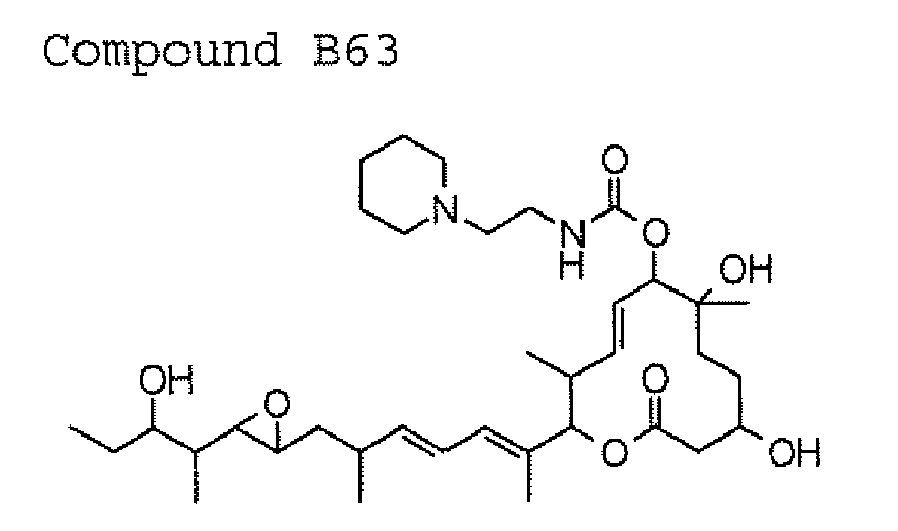
- The title compound (a colorless oil) was synthesized by the similar method as Example B44.
1H-NMR Spectrum (CD3OD,400MHz)δ(ppm): 0.88(3H,d,J=6.0Hz), 0.90(3H,d,J=6.8Hz), 0.93(3H,t,J=7.6Hz), 1.08(3H,d,J=6.8Hz), 1.14-1.25(4H,m), 1.32-1.67(14H,m), 1.74(3H,d,J=0.8Hz), 2.40-2.52(10H,m), 2.65(1H,dd,J=2.4,8.4Hz), 2.72(1H,dt,J=2.4,6.0Hz), 3.26(2H,t,J=6.8Hz), 3.51(1H,dt,J=4.4,8.4Hz), 3.74-3.81(1H,m), 4.86-4.92(1H,m), 5.04(1H,d,J=10.8Hz), 5.54(1H,dd,J=9.6,15.2Hz), 5.65(1H,dd,J=8.4,14.8Hz), 5.69(1H,dd,J=10.0,14.8Hz), 6.09(1H,d,J=10.8Hz), 6.32(1H,dd,J=10.8,14.4Hz); ESI-MS m/z 649(M+H)+. -

- The title compound (a colorless oil) was synthesized by the similar method as Example B44.
1H-NMR Spectrum (CD3OD,400MHz)δ(ppm): 0.88(3H,d,J=6.4Hz), 0.90(3H,d,J=6.8Hz), 0.93(3H,t,J=7.6Hz), 1.08(3H,d,J=6.8Hz), 1.14-1.25(4H,m), 1.32-1.67(8H,m), 1.74(3H,s), 1.78-1.83(4H,m), 2.42-2.62(10H,m), 2.65(1H,dd,J=2.4,8.4Hz), 2.72(1H,dt,J=2.4,6.0Hz), 3.27(2H,t,J=6.8Hz), 3.51(1H,dt,J=4.4,8.4Hz), 3.74-3.81(1H,m), 4.86-4.92(1H,m), 5.04(1H,d,J=10.8Hz), 5.54(1H,dd,J=9.6,15.2Hz), 5.65(1H,dd,J=8.4,14.8Hz), 5.69(1H,dd,J=9.6,15.2Hz), 6.09(1H,d,J=10.8Hz), 6.32(1H,dd,J=10.8,15.2Hz); ESI-MS m/z 635(M+H)+. -
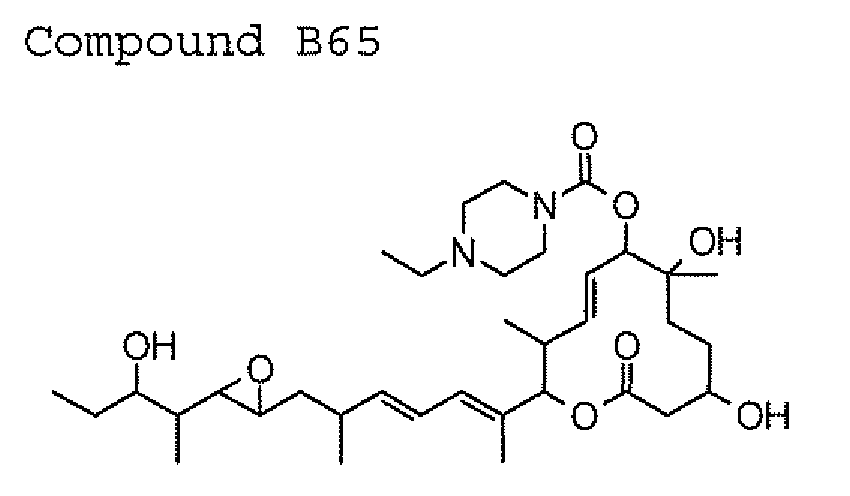
- The title compound (a colorless oil) was synthesized by the similar method as Example B44.
1H-NMR Spectrum (CD3OD,400MHz)δ(ppm): 0.89(3H,d,J=6.4Hz), 0.90(3H,d,J=6.8Hz), 0.93(3H,t,J=7.6Hz), 1.08(3H,d,J=6.8Hz), 1.11(3H,t,J=7.2Hz), 1.14-1.23(4H,m), 1.33-1.67(8H,m), 1.74(3H,d,J=1.2Hz), 2.40-2.63(10H,m), 2.65(1H,dd,J=2.4,8.4Hz), 2.72(1H,dt,J=2.4,6.0Hz), 3.40-3.72(5H,m), 3.75-3.81(1H,m), 4.93(1H,d,J=10.0Hz), 5.04(1H,d,J=10.4Hz), 5.57(1H,dd,J=9.6,15.2Hz), 5.65(1H,dd,J=8.4,15.2Hz), 5.71(1H,dd,J=9.6,15.2Hz), 6.09(1H,d,J=10.8Hz), 6.32(1H,dd,J=10.8,14.8Hz); ESI-MS m/z 635(M+H)+. -


- The title compound (a colorless oil) was synthesized by the similar method as Example B44.
1H-NMR Spectrum (CD3OD,400MHz)δ(ppm): 0.89(3H,d,J=6.8Hz), 0.90(3H,d,J=6.8Hz), 0.93(3H,t,J=7.6Hz), 1.08(3H,d,J=6.8Hz), 1.14-1.23(4H,m), 1.33-1.67(BH,m), 1.74(3H,d,J=1.2Hz), 2.43-2.61(10H,m), 2.65(1H,dd,J=2.4,8.4Hz), 2.72(1H,dt,J=2.4,6.0Hz), 3.38-3.72(7H,m), 3.74-3.81(1H,m), 4.93(1H,d,J=9.6Hz), 5.04(1H,d,J=10.8Hz), 5.57(1H,dd,J=9.6,15.2Hz), 5.65(1H,dd,J=8.4,14.8Hz), 5.71(1H,dd,J=9.6,15.2Hz), 6.09(1H,d,J=10.8Hz), 6.32(1H,dd,J=10.8,14.8Hz); ESI-MS m/z 651(M+H)+. -

- The title compound (a colorless oil) was synthesized by the similar method as Example B44.
1H-NMR Spectrum (CD3OD,400MHz)δ(ppm): 0.88(3H,d,J=6.4Hz), 0.90(3H,d,J=6.8Hz), 0.93(3H,t,J=7.6Hz), 1.08(3H,d,J=6.8Hz), 1.11-1.26(10H,m), 1.34-1.68(8H,m), 1.74(3H,d,J=0.8Hz), 2.42-2.62(5H,m), 2.65(1H,dd,J=2.4,8.4Hz), 2.72(1H,dt,J=2.4,6.0Hz), 3.04-3.36(2H,m), 3.24-3.30(1H,m), 3.51(1H,dt,J=4.4,8.8Hz), 3.65-3.73(1H,m), 3.75-3.82(1H,m), 4.18-4.28(1H,m), 4.88-5.00(1H,m), 5.05(1H,d,J=10.8Hz), 5.57(1H,dt,J=10.0,15.2Hz), 5.65(1H,dd,J=8.4,14.8Hz), 5.71(1H,dt,J=9.6,15.2Hz), 6.09(1H,d,J=10.8Hz), 6.32(1H,dd,J=10.8,14.8Hz); ESI-MS m/z 635(M+H)+. -

-

- Cuprous chloride (1) (13 mg, 0.13 mmol) and ethyl isocyanate (16 mg, 0.23 mmol) were added to a solution of (8E,12E,14E)-3,6,21-tris(1-ethoxyethoxy)-7-hydroxy-6,10,12,16,20-pentamethyl-18,19-epoxytricosa-8,12,14-trien-11-olide (16 mg, 0.023 mmol) in dichloromethane (2.5 mL) at room temperature. The mixture was stirred at room temperature for 16 hours. The reaction mixture was diluted with ethyl acetate, washed with brine, dried over anhydrous magnesium sulfate and evaporated. The resulting crude product was purified by silica gel column chromatography (Kanto silica gel 60N, spherical, neutral, 40 to 100 µm, eluate; ethyl acetate:hexane=50:50) to give the title compound (11 mg, 61%) as a colorless oil.
ESI-MS m/z 781(M+Na)+. -

- Pyridinium p-toluenesulfonate (17 mg, 0.069 mmol) was added to a solution of (8E,12E,14E)-3,6,21-tris(1-ethoxyethoxy)-7-N-ethylcarbamoyloxy-6,10,12,16,20-pentamethyl-18,19-epoxytricosa-8,12,14-trien-11-olide (11 mg, 0.014 mmol) in methanol (1.5 mL) at room temperature, followed by stirring at the same temperature for one hour. The reaction mixture was diluted with 1.5 mL of ethyl acetate, washed with brine, dried over anhydrous magnesium sulfate and evaporated. The resulting crude product was purified by silica gel column chromatography (Kanto silica gel 60N, spherical, neutral, 40 to 100 µm, eluate: ethyl acetate) to give the title compound (6.0 mg, 61%) as a colorless oil.
1H-NMR Spectrum(CD3OD,400MHz)δ(ppm): 0.89(3H,d,J=7.2Hz), 0.90(3H,d,J=6.8Hz), 0.93(3H,t,J=7.2Hz), 1.08(3H,d,J=6.8Hz), 1.10(3H,t,J=7.2Hz), 1.18-1.66(9H,m), 1.20(3H,s), 1.74(3H,s), 2.40-2.61(2H,m), 2.52(2H,d,J=4Hz), 2.65(1H,dd,J=2.4,8.4Hz), 2.72(1H,dt,J=2.4,5.6Hz), 3.12(2H,q,J=7.2Hz), 3.51(1H,dt,J=4.4,4.4Hz), 3.74-3.82(1H,m), 4.88(1H,m), 5.04(1H,d,J=10.8Hz), 5.55(1H,dd,J=10,15.2Hz), 5.62-5.72(2H,m), 6.09(1H,d,J=10.8Hz), 6.32(1H,dd,J=10.8,15.2Hz); ESI-MS m/z 588(M+Na)+. -

- Using chloroacetyl isocyanate, the title compound was obtained as a colorless oil by the similar method as Example B68.
1H-NMR Spectrum (CD3OD,500MHz)δ(ppm): 0.90(3H,d,J=6.5Hz), 0.90(3H,d,J=7.0Hz), 0.94(3H,t,J=7.5Hz), 1.09(3H,d,J=7.0Hz), 1.16-1.21(4H,m), 1.32-1.68(8H,m), 1.75(3H,s), 2.42-2.64(4H,m), 2.66(1H,dd,J=2.0,6.0Hz), 3.48-3.56(1H,m), 3.74-3.84(1H,m), 4.44(2H,s), 5.01(1H,d,J=9.5Hz), 5.06(1H,d,J=10.0Hz), 5.60-5.70(2H,m), 5.73(1H,dd,J=10.0,15.0Hz), 6.10(1H,d,J=11.0Hz), 6.33(1H,dd,J=11.0,15.0Hz); ESI-MS m/z 636(M+Na)+. -

- The 7-acetoxy of the compound obtained in Example B11 was solvolyzed by the similar method as the compound B12. Then, using ethylamine, it was converted into 7-(N-ethyl)carbamethoxy moiety by the similar method as Example B44, and then the ethoxyethyl group was deprotected by the similar method as Example B44 to give the title compound as a colorless oil.
1H-NMR Spectrum (CD3OD,500MHz)δ(ppm): 0.09(3H,s), 0.10(3H,s), 0.88-0.97(18H,m), 1.09(3H,d,J=7.5Hz), 1.12(3H,d,J=7.5Hz), 1.20(3H,s), 1.20-1.26(1H,m), 1.27-1.72(8H,m), 1.73(3H,s), 2.38(1H,dd,J=4.0,13.0Hz), 2.42-2.64(3H,m), 2.66(1H,d,J=8.0Hz), 2.73(1H,t,J=6.0Hz), 3.08-3.20(2H,m), 3.48-3.56(1H,m), 3.88-3.96(1H,m), 4.88(1H,d,J=11.0Hz), 4.90(1H,d,J=11.0Hz), 5.56(1H,dd,J=10.0,15.0Hz), 5.54-5.84(2H,m), 6.11(1H,d,J=11.0Hz), 6.32(1H,dd,J=11.0,15.0Hz); ESI-MS m/z 702(M+Na)+. - A solution of Compound B10-2 (37 mg, 57 µmol) obtained in Example B10 in chloroform (5 mL) was added to a suspension of Dess-Martin reagent (72 mg, 170 µmol) in chloroform (2.5 mL), followed by stirring at room temperature for one hour. A 10% aqueous sodium thiosulfate solution was added to the reaction mixture and the mixture was vigorously stirred. Then, the organic layer was washed with brine, dried over anhydrous magnesium sulfate and evaporated. The resulting residue was purified by silica gel column chromatography (Kanto silica gel 60N, spherical, neutral, 40 to 100 µm, eluate; hexane:ethyl acetate=2:1 to 1:1) to give a 3-t-butyldimethylsiloxy-21-keto compound (30 mg, 81%). A solution of the resulting 3-t-butyldimethylsiloxy-21-keto compound (25 mg, 39 µmol) in tetrahydrofuran (100 µL) was added to a mixture of trifluoroacetic acid:tetrahydrofuran:water=1:10:5 (2 mL), followed by stirring at room temperature for 5 hours. After ethyl acetate was added to the reaction mixture, the organic layer was washed with a saturated sodium bicarbonate aqueous solution and brine, dried over anhydrous magnesium sulfate and then evaporated. The resulting residue was purified by silica gel column chromatography (Kanto silica gel 60N, spherical, neutral, 40 to 100 µm, eluate; hexane:ethyl acetate=1:3) to give a colorless oil (11.1 mg, 54%). It was confirmed by TLC and HPLC that this product was identical to 11107C obtained from the cultured broth of microbial.
-

- A solution of (8E,12E,14E)-3,6,21-tri(1-ethoxyethoxy)-7-hydroxy-6,10,12,16,20-pentamethyl-18,19-epoxytricosa-8,12,14-trien-11-olide (10 mg, 14 µmol) obtained in Example B39 in chloroform (0.5 mL) was added to a suspension of Dess-Martin reagent (60 mg, 140 µmol) in chloroform (2 mL), followed by stirring at room temperature for 3 hours. The reaction mixture was poured into a sodium thiosulfate aqueous solution, and the mixture was vigorously stirred. Then, ethyl acetate was added thereto, and the organic layer was washed with brine, dried over anhydrous sodium sulfate and evaporated. The resulting residue was dissolved in 2 mL of methanol and pyridinium p-toluenesulfonate (3 mg, 11 µmol) was added thereto, followed by stirring at room temperature for 20 hours. The solvent was removed, and the resulting residue was dissolved in ethyl acetate. The mixture was washed with a saturated sodium bicarbonate aqueous solution and brine, dried over anhydrous magnesium sulfate and evaporated. The resulting residue was purified by thin layer chromatography (MERCK Silica gel 60 F254, 0.2 mm, developing solution; hexane:ethyl acetate=1:5) and preparative HPLC (Shiseido CAPCELL PAK C18, 10mmI.D.x250mm, eluate; acetonitrile:water=20:80-80:20) to give the title compound (0.11 mg, 2%) as a colorless oil.
1H-NMR Spectrum (CD3OD,500MHz)δ(ppm): 0.91(3H,d,J=7.5Hz), 0.94(3H,t,J=7.5Hz), 0.96(3H,d,J=7.0Hz), 1.10(3H,d,J=7.0Hz), 1.10-1.26(2H,m), 1.29(3H,m), 1.30-1.56(4H,m), 1.58-1.72(2H,m), 1.78(3H,s), 1.77-1.86(1H,m), 2.31(1H,dd,J=8.0,14.0Hz), 2.44-2.54(1H,m), 2.64-2.76(4H,m), 3.48-3.56(1H,m), 4.13-4.20(1H,m), 5.05(1H,d,J=10.5Hz), 5.69(1H,dd,J=9.0,15.0Hz), 6.11(1H,d,J=11.0Hz), 6.28(1H,dd,J=10.5,15.5Hz), 6.34(1H,dd,J=11.0,15.0Hz), 7.03(1H,d,J=15.5Hz); ESI-MS m/z 515(M+Na)+. -

- A solution of methoxyhydroxylamine (1.2 mg, 0.014 mmol) in pyridine (0.5 mL) was added to a solution of (8E,12E,14E)-7-acetoxy-3,6,21-trihydroxy-6,10,12,16,20-pentamethyl-21-oxo-18,19-epoxytricosa-8,12,14-trien-11-olide (5.0 mg, 0.0093 mmol) in pyridine (0.5 mL) at room temperature. The mixture was stirred at 60°C for 16 hours. The reaction mixture was diluted with ethyl acetate, washed with brine, dried over anhydrous magnesium sulfate and evaporated. The resulting crude product was purified by thin layer chromatography (MERCK Silica gel 60 F254, 0.2 mm, developing solution; ethyl acetate) to give the title compound (2.2 mg, 42%) as a colorless oil.
1H-NMR Spectrum(CD3OD,400MHz)δ(ppm): 0.87(3H,d,J=6.4Hz), 1.03(3H,d,J=7.4Hz), 1.05-1.10(6H,m), 1.18(3H,s), 1.26-1.70(6H,m), 1.74(3H,s), 2.06(3H,s), 2.20-2.32(2H,m), 2.42-2.60(3H,m), 2.52(2H,d,J=4.0Hz), 2.70-2.88(2H,m), 3.73-3.80(1H,m), 3.78(3H,s), 5.04(2H,d,J=10.0Hz), 5.56(1H,dd,J=10.0,15.2Hz), 5.66(1H,dd,J=8.4,16.4Hz), 5.69(1H,dd,J=9.2,15.6Hz), 6.09(1H,d,J=10.8Hz), 6.32(1H,dd,J=12.8,14.8Hz); ESI-MS m/z 586(M+Na)+. -

- The title compound (a colorless oil) was synthesized by the similar method as Example B74.
1H-NMR Spectrum(CD3OD,400MHz)δ(ppm): 0.85(3H,t,J=6.8Hz), 1.03-1.15(10H,m), 1.18(3H,s), 1.32-1.47(3H,m), 1.52-1.68(3H,m), 1.71-1.74(3H,m), 2.06(3H,s), 2.10-2.37(2H,m), 2.38-2.61(4H,m), 2.66-2.91(2H,m), 3.74-3.81(1H,m), 4.99-5.06(4H,m), 5.51-5.73(3H,m), 6.02-6.11(1H,m), 6.24-6.35(1H,m), 7.23-7,34(5H,m); ESI-MS m/z 662(M+Na)+. Example B76 (8E,12E)-7-Acetoxy-3,6-dihydroxy-6,10,12-trimethyltricosa-8,12,14-trien-11-olide (Compound B76)

-

- A solution of osmium tetraoxide (4.9 mg, 0.13 mmol) in pyridine (1.2 mL) was added to (8E,12E,14E)-7-acetoxy-3,6,21-tris(1-ethoxyethoxy)-5,10,12,16,20-pentamethyl-18,19-epoxytricosa-8,12,14-trien-11-olide (18 mg, 0.024 mmol) at -10°C. The mixture was stirred at the same temperature for one hour. An aqueous solution of NaHSO3 was added to the reaction mixture, followed by stirring at the room temperature for 10 min. The mixture was diluted with ethyl acetate, washed with 1N hydrochloric acid and brine, dried over anhydrous magnesium sulfate and evaporated, to give a crude diol compound (14 mg, 71%) as a colorless oil. The resulting crude product was used for the next reaction without purification. Lead tetraacetate (41 mg, 0.092 mmol) and potassium carbonate (18 mg, 0.13 mmol) were added to a solution of the crude diol compound (15 mg, 0.018 mmol)in toluene (1.0 mL) at room temperature, followed by stirring at the same temperature for 3 hours. The reaction mixture was diluted with 15 mL of ethyl acetate, washed with brine, dried over anhydrous magnesium sulfate and evaporated. The resulting crude product was purified by silica gel column chromatography (Kanto silica gel 60N, spherical, neutral, 40 to 100 µm, eluate; hexane:ethyl acetate=50:50) to give the title compound (5.4 mg, 57%) as a colorless oil.
1H-NMR Spectrum(CD3OD,400MHz)δ(ppm): 0.95(3H,d,J=6.8Hz), 1.12-1.36(15H,m), 1.38-1.78(4H,m), 2.04(3H,s), 2.19(3H,s), 2.46-2.68(3H,m), 3.46-3.90(5H,m), 4.74-5.23(4H,m), 5.58(1H,dd,J=10.0,15.6Hz), 5.74-5.86(1H,m), 6.02(1H,d,J=7.6Hz), 10.03(1H,d,J=7.6Hz); ESI-MS m/z 535(M+Na)+. -

- A solution of 1.57 M n-BuLi in hexane (0.17 mL) was added dropwise to a solution of diisopropylamine (31 mg, 0.36 mmol) in tetrahydrofuran (1.8 mL) at -78°C, followed by stirring at the same temperature for 20 min. To the resulting solution, a solution of 1,3-benzothiazol-2-ylnonylsulfone (44 mg, 0.14 mmol) in tetrahydrofuran (1 mL) at -78°C, followed by stirring at the same temperature for 30 min. 0.6 mL of the resulting solution ( which corresponds to 8.8 mg, 0.027 mmol of the anion of 1,3-benzothiazol-2-ylnonylsulfone) was added to asolution of (8E,12E)-7-acetoxy-3,6-bis(1-ethoxyethoxy)-6,10,12-trimethyl-14-oxotetradeca-8,12-dien-11-olide (6.9 mg, 0.013 mmol) in tetrahydrofuran (0.5 mL) at -78°C. The temperature of the resulting solution was gradually (during one hour 50 min.) raised to room temperature with stirring. A saturated aqueous ammonium chloride solution was added to the reaction mixture and the mixture was further diluted with ethyl acetate. Then, the mixture was washed with brine, dried over anhydrous magnesium sulfate and evaporated. The resulting crude product was purified by silica gel column chromatography (Kanto silica gel 60N, spherical, neutral, 40 to 100 µm, eluate; hexane:ethyl acetate=80:20) to give the title compound (3.2 mg, 38%) as a pale yellow oil.
ESI-MS m/z 645(M+Na)+. -
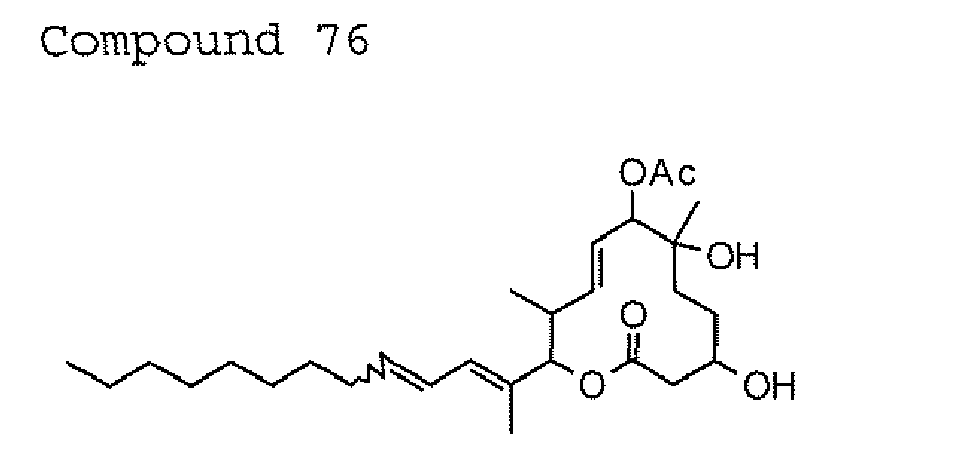
- Pyridinium p-toluenesulfonate (13 mg, 0.051 mmol) was added to a solution of (8E,12E)-7-acetoxy-3,5-bis(1-ethoxyethoxy)-6,10,12-trimethyltricosa-8,12,14-trien-11-olide (3.2 mg, 0.0051 mmol) in methanol (1 mL) at room temperature, followed by stirring at the same temperature for 2.5 hours. The reaction mixture was diluted with 1 mL of ethyl acetate, washed with brine, dried over anhydrous magnesium sulfate and evaporated. The resulting crude product was purified by thin layer chromatography (MERCK Silica gel 60 F254, 0.25 mm, developing solution; hexane:ethyl acetate=1:2) to give the title compound (1.2 mg, 49%) as a pale yellow oil.
1H-NMR Spectrum(CD3OD,400MHz)δ(ppm): 0.85-0.92(6H,m), 1.18(3H,s), 1.20-1.65(16H,m), 1.73(3H,d,J=4Hz), 2.06(3H,s), 2.07-2.23(2H,m), 2.50-2.62(3H,m), 3.75-3.82(1H,m), 5.02-5.12(2H,m), 5.50-5.62(1H,m), 5.62-5.80(2H,m), 6.04-6.43(2H,m); ESI-MS m/z 501(M+Na)+. -

- The title compound was obtained as a colorless oil by the similar method as Example B44.
1H-NMR Spectrum(CD3OD,400MHz)δ(ppm): 0.88(3H,d,J=5.2Hz), 0.89(3H,d,J=7.2Hz), 0.93(3H,t,J=7.2Hz), 1.08(3H,d,J=6.8Hz), 1.20(3H,s), 1.14-1.67(17H,m), 1.74(3H,s), 1.86-1.92(2H,m), 2.42-2.62(10H,m), 2.65(1H,dd,J=2.4,8.4Hz), 2.72(1H,dt,J=2.4,5.6Hz), 2.73-2.83(2H,m), 3.46-3.54(1H,m), 3.74-3.82(1H,m), 4.13-4.22(1H,m), 4.91(1H,d,J=9.6Hz), 5.04(1H,d,J=10.8Hz), 5.56(1H,dd,10.0,15.2Hz), 5.65(1H,dd,J=8.4,15.2Hz), 5.71(1H,dd,J=9.6,15.2Hz), 6.09(1H,d,J=10.4Hz), 6.32(1H,dd,J=10.8,15.2Hz); ESI-MS m/z 689(M+H)+. -

- The title compound was obtained as a colorless oil by the similar method as Example B44.
1H-NMR Spectrum(CD3OD,400MHz)δ(ppm): 0.88(3H,d,J=5.2Hz), 0.90(3H,d,J=7.2Hz), 0.93(3H,t,J=7.6Hz), 1.07(3H,d,J=6.8Hz), 1.20(3H,s), 1.16-1.72(11H,m), 1.74(3H,s), 2.28(3H,s), 2.36-2.62(14H,m), 2.65(1H,dd,J=2.4,8.4Hz), 2.72(1H,dt,J=2.4,6.0Hz), 3.13(2H,t,J=6.8Hz), 3.46-3.54(1H,m), 3.74-3,82(1H,m), 5.04(1H,d,J=10.4Hz), 5.54(1H,dd,J=10.0,15.2Hz), 5.65(1H,dd,J=8.4,14.8Hz), 5.69(1H,dd,J=9.6,15.2Hz), 6.09(1H,d,J=11.2Hz), 6.32(1H,dd,J=10.8,14.8Hz); ESI-MS m/z 678(M+H)+. -

- The title compound was obtained as a colorless oil by the similar method as Example B44.
1H-NMR Spectrum (CD3OD,500MHz)δ(ppm): 0.89(3H,d,J=7.0Hz), 0.89(3H,d,J=8.0Hz), 0.94(3H,t,J=7.0Hz), 1.07(3H,d,J=7.0Hz), 1.14-1.24(1H,m), 1.20(3H,s), 1.26-1.68(10H,m), 1.74(3H,s), 1.84-1.94(2H,m), 2.10-2.20(2H,m), 2.28(3H,s), 2.40-2.64(4H,m), 2.66(1H,dd,J=2.0,8.0Hz), 2.73(1H,dt,J=2.5,6.0Hz), 2.78-2.88(2H,m), 3.30-3.46(1H,br), 3.48-3.55(1H,m), 3.74-3.82(1H,m), 4.89(1H,d,J=10.0Hz), 5.05(1H,d,J=11.0Hz), 5.55(1H,dd,J=9.5,15.0Hz), 5.62-5.74(2H,m), 6.09(1H,d,J=11.0Hz), 6.31(1H,dd,J=11.0,15,0Hz); ESI-MS m/z 635(M+H)+. -

- The title compound was obtained as a colorless oil by the similar method as Example B44.
1H-NMR Spectrum (CD3OD,400MHz)δ(ppm): 0.88(3H,d,J=6.4Hz), 0.90(3H,d,J=6.8Hz), 0.93(3H,t,J=7.6Hz), 1.08(3H,d,J=6.8Hz), 1.14-1.22(4H,m), 1.33-1.68(10H,m), 1.74(3H,s), 1.74-1.87(2H,m), 2.06-2.21(2H,m), 2.28(3H,s), 2.42-2.62(4H,m), 2.65(1H,dd,J=2.4,8.4Hz), 2.72(1H,dt,J=2.4,6.0Hz), 2.84(3H,br-s), 2.87-2.97(2H,m), 3.51(1H,dt,J=4.4,8.4Hz), 3.75-3.81(1H,m), 3.87-4.14(1H,m), 4.95(1H,d,J=9.6Hz), 5.05(1H,d,J=10.8Hz), 5.56(1H,dd,J=10.0,15.2Hz), 5.65(1H,dd,J=8.4,14.8Hz), 5.72(1H,dd,J=9.6,14.8Hz), 6.09(1H,d,J=10.0Hz), 6.32(1H,dd,J=10.8,14.8Hz); ESI-MS m/z 649(M+H)+. -

- The title compound was obtained as a colorless oil by the similar method as Example B44.
1H-NMR Spectrum (CD3OD,400MHz)δ(ppm): 0.88(3H,d,J=6.4Hz), 0.90(3H,d,J=6.8Hz), 0.93(3H,t,J=7.6Hz), 1.05-1.10(9H,m), 1.14-1.22(4H,m), 1.33-1.68(8H,m), 1.74(3H,d,J=0.8Hz), 2.30-2.62(6H,m), 2.65(1H,dd,J=2.4,8.4Hz), 2.66-2.77(3H,m), 3.51(1H,dt,J=4.4,8.4Hz), 3.75-3.81(1H,m), 3.90-4.02(1H,m), 4.15-4.28(1H,m), 4.88-4.99(1H,m), 5.04(1H,d,J=10.4Hz), 5.57(1H,dd,J=10.0,15.2Hz), 5.65(1H,dd,J=8.4,15.2Hz), 5.71(1H,dd,J=9.6,15.2Hz), 6.09(1H,d,J=l0.0Hz), 6.32(1H,dd,J=10.8,15.2Hz); ESI-MS m/z 635(M+H)+. -

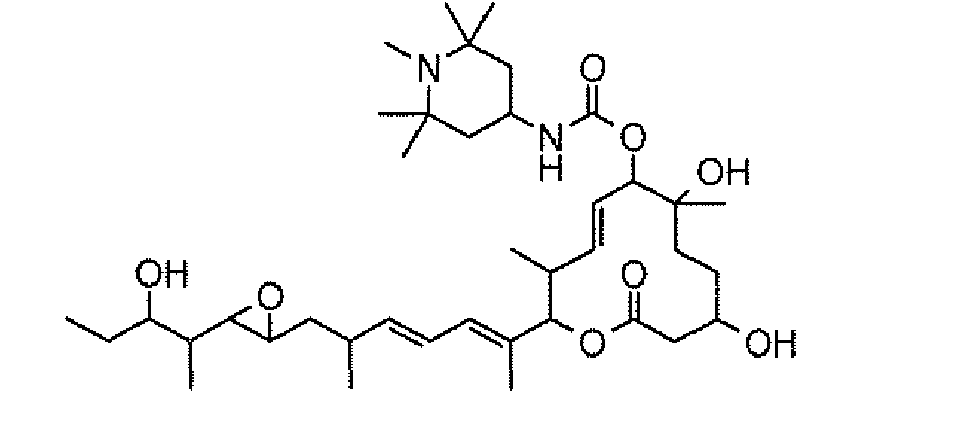
- The title compound was obtained as a colorless oil by the similar method as Example B44.
1H-NMR Spectrum (CD3OD,400MHz)δ(ppm): 0.89(3H,d,J=6.8Hz), 0.90(3H,d,J=6.8Hz), 0.93(3H,t,J=7.6Hz), 1.06-1.80(34H,m), 2.27(3H,s), 2.42-2.61(4H,m), 2.65(1H,dd,J=2.4,8.4Hz), 2.72(1H,dt,J=2.4,6.0Hz), 3.51(1H,dt,J=4.4,8.4Hz), 3.74-3.83(2H,m), 4.87-4.92(1H,m), 5.05(1H,d,J=10.8Hz), 5.55(1H,dd,J=10.0,15.2Hz), 5.65(1H,dd,J=8.4,14.8Hz), 5.69(1H,dd,J=9.6,14.8Hz), 6.09(1H,d,J=10.8Hz), 6.32(1H,dd,J=11.2,14.8Hz); ESI-MS m/z 691(M+H)+. - U251 human glioma cell cultured in DULBECCO-modified eagle medium (DMEM; manufactured by SIGMA Co., Ltd.) containing 10% fetal calf serum, penicillin (100 unit/ml) and streptomycin (100 µg/ml) was dispensed in 96-well plates by 4×10⁴ cells/well. After culturing at 37°C overnight in a CO2 incubator (5% CO2), the media were removed, and 180 µl of the above-mentioned incubation solution was charged. After adding 20µL of the above-mentioned incubation solution containing the test compound diluted with 3-fold succession, they were incubated in a low oxygen (2% O2) incubator for 18 hours. The supernatants thereof were measured by an ELISA kit (Immunobiology Research Institute).
- Concentration at which the amount of VEGF expressed by low oxygen stimulation was suppressed to 50 % (IC50 value) was determined and results are shown in Table 9. As shown in Table, 11107B suppressed most strongly VEGF production, and 11107C and 11107D were strong successive to 11107B. The activities of 11107F and 11107G were very weak.
Compound VEGF production suppressing action : IC50 (ng/ml) 11107 B 0.8 11107 C 3.0 11107 D 3.2 11107 E 36.3 11107 A 111 - WiDr human colon cancer cell, PC3 human prostate cancer cell, DU145 human colon cancer cell and HT1080 human colon cancer cell, which were cultured in DULBECCO-modified eagle medium (manufactured by DMEM SIGMA Co., Ltd.) containing 10% fetal calf serum, penicillin (100 unit/ml) and streptomycin (100 µg/ml) were dispensed in 96 well plates by 3 × 10⁴ cells/well. After culturing at 37°C overnight in a CO2 incubator (5% CO2), the media were removed, and 180 µl of the above-mentioned incubation solution was charged. After adding 20µL of the above-mentioned incubation solution containing the test compound diluted with 3-fold succession, they were incubated in a low oxygen (2% CO2) incubator for 18 hours. The supernatants thereof were measured by an ELISA kit (Immunobiology Research Institute).
- Concentration at which the amount of VEGF expressed by low oxygen stimulation was suppressed to 50 % (IC50 value) was determined and results are shown in Table 10. 11107B suppressed most strongly VEGF production, and 11107C and 11107D were strong successive to 11107B. 11107B showed the VEGF production suppressing effect to all cells used for the experiment.
Various cancer cells VEGF production suppressing action : IC50 (ng/ml) WiDr 0.65 PC 3 0.71 DU-145 1.05 HT 1080 1.89 - In order to study solid cancer proliferation suppressing action of 11107B in vivo, human breast cancer BSY-1 cell was transplanted to the subcutaneous body sides of mice. The animals were grouped so that the average of the volumes of the respective groups became uniform, when it reached about 100 mm3. Control group was made as 10 mice and 11107B-administering groups were made as 5 mice. 11107B was administrated for the 11107B-administering groups once by intravenous injection so as to be 10 mg/kg, and a vehicle was administered to the control group. The tumor volumes on the fifth day, eighth day, 12th day and 15th day were measured, and relative tumor volumes were determined setting the tumor volume at the initiation of administration as 1. The results are shown in Table 11.
- As shown in Table, 11107B showed the effect of suppressing solid tumor by a single administration.
Days after the administration 1 5 8 12 15 Control group 1 1.79 2.05 2.54 2.59 11107 B group 1 1.08 1.28 1.40 1.70 - In order to prepare reporter system reflecting transcription from VEGF promoter, VEGF promoter sequence was cloned, and inserted in secretory alkali phosphatase (PLAP) vector to construct reporter vector.
- In order to obtain the promoter region of human VEGF, VEGF genome was cloned from phage library. PCR primers having the sequences described in Sequence Numbers 1 and 2 were designed based on VEGF cDNA (GenBank accession number: X62568) and a fragment having about 340 bp was obtained by carrying out PCR. Human genome phage library (Human genomic library, Clontech Co.) was screened using this as a probe to obtain pUC18-VEGFA containing about 5.4 kb of VEGF 5' flanking region. The pUC18-VEGFA was cleaved by KpnI/NheI, VEGF promoter region of about 2.3kb obtained was inserted in the multi cloning site KpnI/NheI of secretory alkali phosphatase (PLAP) vector (Goto et al, Mol. Pharmacol., 49, 860-873, 1996), and thus, VEGF-PLAP vector was constructed.
- The above-mentioned VEGF-PLAP vector was introduced in the U251 cell cultured in the DULBECCO-modified eagle medium (DMEM; manufactured by SIGMA Co., Ltd.) containing 10% fetal calf serum, and cultured in the presence of 1 mg/ml G418 (Merck Co.) to establish G418 resistant stable clone (U251/1-8 cell).
- It was confirmed that U251/1-8 cell secreted PLAP under low oxygen (2% O2 incubator) in the same manner as in the report (Cell. Mol. Biol. Res. 40, 35-39, 1994) and was a reporter system reflecting the transcription from VEGF promoter. The screening of the compound suppressing VEGF production which was induced by low oxygen stimulation was carried out below using the clone.
- In order to remove the influence of alkaline phosphates in serum, U251/1-8 cell was rinsed twice with the adequate amount of PBS (Phosphate buffered saline), diluted in the DMEM medium containing 10% of serum in which alkaline phosphates was inactivated by the treatment of 60°C for 20 min., and dispensed in 96-well plates by 4 × 10⁴ cells/180 µl.
- After culturing at 37°C overnight in a CO2 incubator (5% CO2), 20 µL of the above-mentioned incubation solution containing the test compound diluted with 3-fold succession was added, and then they were incubated in a low oxygen (2% CO2) incubator for 18 hours. With respect to the PLAP activity in the culture supernatants, 10 µl of the supernatants was added to 50 µl of 0.28 M Na2CO3-NaHCO3 buffer solution (pH 10.0, 8.0 mM MgSO4), and finally 50 µl of alkaline phosphatase substrate (LUMISTEIN, Genomescience Co.) was added. After reacting for one hour, the alkaline phosphatase activity of the PLAP was measured by detecting the chemical luminescence by a micro plate reader (Perkin-Elmer Co.).
- The PLAP activity under usual oxygen was set as 0%, the PLAP activity of cell which was treated under low oxygen was set as 100%, and the concentration suppressing the PLAP activity by 50% was set as the IC50 value of PLAP.
- The IC50 values of VEGF transcription-suppressing activity of 11107 analogues obtained in Examples A1 to A82 were measured, and as a result, the IC50 values of 11107B, 11107C, 11107D, 11107E, 11107H, 11107I, 11107J, 11107K, 11107L, 11107M, 11107N, 11107P, 11107Q, 11107R, 11107T, 11107U, 11107W, 11107X, 11107Y, 11107Z, 11107AB, 11107AD, 11107AE, 11107AJ, 11107AL, 11107AM, 11107AN, 11107AP, 11107AQ, 11107AW, 11107AX, 11107AY, 11107AZ, 11107BF, 11107BG, 11107BH and 11107BI were within a range of 1 to 100 nM, and they showed VEGF transcription-suppressing activity.
- Further, the IC50 values of VEGF transcription suppressing activity of the 11107 derivatives obtained in Examples B1 to B58 were measured, and as a result, the IC50 values of Compounds B1-1, B1-2, B2-1, B2-2, B3-1, B3-2, B8-1, B8-2, B8-4, B8-5, B9, B16-1, B17, B18-1, B18-3, B20-2, B21-2, B21-3, B21-4, B23-1, B24, B25, B26, B27, B28, B29, B30-2, B30-3, B33-1, B33-2, B35-1, B35-2, B36-2, B37-1, B39, B40, B41, B42, B43-1, B43-2, B44, B45, B46, B47, B48, B49, B50, B51, B52, B53, B54, B55, B56, B57, B58, B59, B60, B61, B62, B63, B64, B65, B66, B67, B69, B74, B75, B77, B78, B79, B80, B81, B82 were within a range of 0.5 to 100 nM, and they showed VEGF transcription-suppressing activity.
- Specifically, IC50 values were shown in Table below.
Analogues and derivatives VEGF transcription suppressing activity
(IC 50:nM)11107B 1.8 11107C 8.2 11107D 6.6 11107H 3.1 11107J 5.9 11107K 2.7 11107AM 2.6 11107BH 2.6 Coumpound B20-2 1.6 - Dami human blood megakaryocytic cell, MOLT 4 human acute lymphoblastic cell, K562 human chronic myelogenous cell, U937 human histcytic lymphoma and p388 mouse lymphoma cultured in RPMI 1640 (manufactured by SIGMA Co., Ltd.) containing 10% fetal calf serum were dispensed in 96-well plates by 2×10³ cells/180 µl, and they were cultured at 37°C overnight in a CO2 incubator (5% CO2). Then, 20 µL of the above-mentioned incubation solution containing 11107B diluted with 2-fold succession was added, and they were further cultured in a CO2 incubator for 3 days.
- 20 µL of Alamar Blue reagent (Biosource Co.) was added to the cultured cell, and fluorescence activity (ex 530 nm/em 590 nm) was measured by a micro plate reader (ARBO, Perkin-Elmer Co.) after 3 to 5 hours. The cell growth of the control to which the compound is not added is set as 100%, the concentration at which it was suppressed by 50% was determined. As shown in Table, 11107B showed the growth suppressing activity to a wide range of leukemia cells.
Cell strain Multiplication suppressing activity
IC 50 (nM)Dami 1.2 MOLT4 1.5 U937 1.1 K562 2.1 p388 2 - H460 human lung cancer cell, U251 human glioma cell, BSY-1 and MDA-MB435 human breast cancer cell, PC-3 and DU145 human prostate cancer cell, OVCAR-3 human ovarian cancer cell, WiDr human colon cancer cell and B16 melanoma mouse melanoma cell cultured in DMEM (manufactured by SIGMA Co., Ltd.) containing 10% fetal calf serum were dispensed in 96-well plates by 2×10³ cells/180 µl, and they were cultured at 37°C overnight in a CO2 incubator (5% CO2). Then, 20 µL of the above-mentioned incubation solution containing test compounds diluted with 2-fold succession was added, and they were further cultured in a CO2 incubator for 3 days.
- 20 µL of Alamar Blue reagent (Biosource Co.) was added to the cultured cells, and after 3 to 5 hours, fluorescence activity (ex 530 nm/em 590 nm) was measured by a micro plate reader (ARBO, Perkin-Elmer Co.). The cell growth of the control to which the compound is not added is set as 100%, the concentration at which it was suppressed by 50% was determined. The IC50 values for the studied cell lines were 0.9 to 2.9 nM, and 11107B showed the growth suppressing activity to a wide range of cancer species. Example C7 Solid cancer growth suppressing action of various 11107 analogues and derivatives
- In order to study solid cancer growth suppressing action of various 11107 analogues and derivatives in vivo, WiDr human colon cancer cells were transplanted to the subcutaneous body sides of mice. The animals were grouped so that the average of the volumes of the respective groups becomes uniform, when it reached about 100 mm3. Control group was made as 10 mice and various 11107 analogues and derivatives-administering groups were made as 5 mice. Various 11107 analogues and derivatives were administrated for the administering groups for 5 days by intravenous injection so as to be any of 0.625 mg, 2.5 mg and 10 mg/kg/day, and a vehicle was administered to the control group. The tumor volumes on the fifteenth day or sixteenth day were measured, and relative tumor volume ratios (T/C%) were determined setting the tumor volume of the control group as 1. Among the studied 11107 analogues and derivatives, 11107B, 11107D, 11107BH and Compounds B20-2, B50, B52, B54 and B55 showed the effect of suppressing the increase in the tumor volume, and the relative tumor volume ratios (T/C%) to the Control group were within a range of 1 to 50%.
- The present invention pertains to the following special embodiments
- Item 1. A compound represented by the formula (1), a pharmacologically acceptable salt thereof or a hydrate of them.


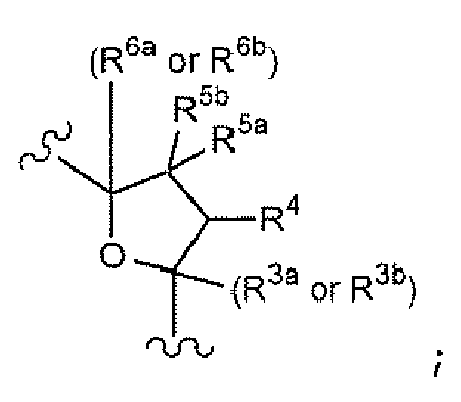


provided that
(Restricted clause 1) when the above-mentioned compound is represented by the following formula (2):


- Item 2. A compound represented by the formula (5), a pharmacologically acceptable salt thereof or a hydrate of them.

R2, R10, R12 and R14 are the same as or different from each other and each represents hydrogen or methyl;
R3a, R3b, R5a, R5b, R6a and R6b are the same as or different from each other and each represents- (1) hydrogen,
- (2) hydroxy,
- (3)
- <1> C1-22 alkyl,
- <2> C1-22 alkoxy,
- <3> ArCH2O- (wherein Ar represents C6-14 aryl or 5-membered to 14-membered heteroaryl which may have substituents),
- <4> C2-22 acyloxy,
- <5> unsaturated C3-22 acyloxy,
- <6> -OCORCO (wherein RCO represents (i) C6-14 aryl, (ii) 5-membered to 14-membered heteroaryl, (iii) C1-22 alkoxy, (iv) unsaturated C2-22 alkoxy, (v) C6-14 aryloxy or (vi) 5-membered to 14-membered heteroaryloxy, each of which may have substituents),
- <7> C1-22 alkylsulfonyloxy,
- <8> benzenesulfonyloxy or
- <9> -OSiRs1Rs2Rs3 (wherein Rs1, Rs2 and Rs3 are the same as or different from each other and each represents methyl, ethyl, i-propyl, t-butyl or phenyl,
- (4) halogen or
- (5) -RM-NRN1RN2 (wherein RM represents a single bond or -COO-; and RN1 and RN2 are 1) the same as or different from each other and each represents <1> hydrogen or <2> (i) C1-22 alkyl, (ii) unsaturated C3-22 alkyl, (iii) C2-22 acyl, (iv) unsaturated C3-22 acyl, (v) C6-14 aryl, (vi) 5-membered to 14-membered heteroaryl, (vii) benzyl, (viii) C1-22 alkylsulfonyl or (ix) benzenesulfonyl, each of which may have substituents, or 2) NRN1RN2 may be bound together to represent 3-membered to 14-membered nitrogen-containing non-aromatic heterocyclic ring which may have substituents);
- (1) different from each other and each represents
- 1) hydrogen,
- 2) -ORH (wherein RH is hydrogen, methyl or acetyl),
- 3) -ORD (wherein RD represents
- (i) C1-22 alkyl (provided that in case of methyl, it always has substituents),
- (ii) -CH2Ar,
- (iii) C3-22 acyl,
- (iv) unsaturated C3-22 acyl,
- (v) CORCO,
- (vi) C1-22 alkylsulfonyl,
- (vii) benzenesulfonyl or
- (viii) -SiRs1Rs2Rs3) or
- 4) -RM-NRN1RN2, or
- (2) R7a and R7b may be bound together to represent <1> a ketone structure (=O) or represent an oxime structure (=NOROX; wherein ROX represents <1> C1-22 alkyl, <2> unsaturated C3-22 alkyl, <3> C6-14 aryl, <4> 5-membered to 14-membered heteroaryl or <5> benzyl, each of which may have substituents);
further, R6a or R6b may be bound together to represent a spirooxyrane ring or exomethylene;
further, either of R6a or R6b and either of R7a or R7b may be bound together to form a 1,3-dioxolane ring;
G is represented by
R17a, R17b, R18a, R18b, R19a, R19b, R20a, R20b, R21a and R21b are the same as or different from each other and each represents- (1) hydrogen,
- (2) methyl which may optionally have substituents,
- (3) -ORH,
- (4) -ORD,
- (5) halogen or
- (6) -RM-NRN1RN2; and

further, either of R18a or R18b and either of R19a or R19b may form a single bond together to represent the partial structure


further, either of R21a or R21b and either of R22a or R22b may be bound together to represent the partial structure


provided that the restricted clauses 1, 2 and 3 according to item 1 are included. - Item 3. A compound represented by the formula (6), a pharmacologically acceptable salt thereof or a hydrate of them.

R12a and R13 (1) each represents hydrogen, or (2) are bound together to <1> form a single bond and represent
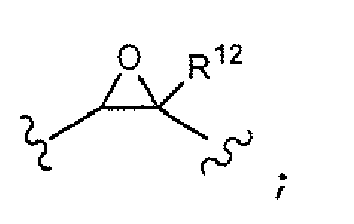

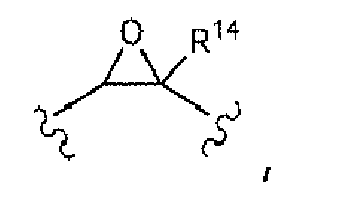
GSV (1) has the same meaning as the definition of G in the formula 5, or (2) represents
- Item 4. A compound represented by the formula (7), a pharmacologically acceptable salt thereof or a hydrate of them.


- Item 5. A compound represented by the formula (8), a pharmacologically acceptable salt thereof or a hydrate of them.

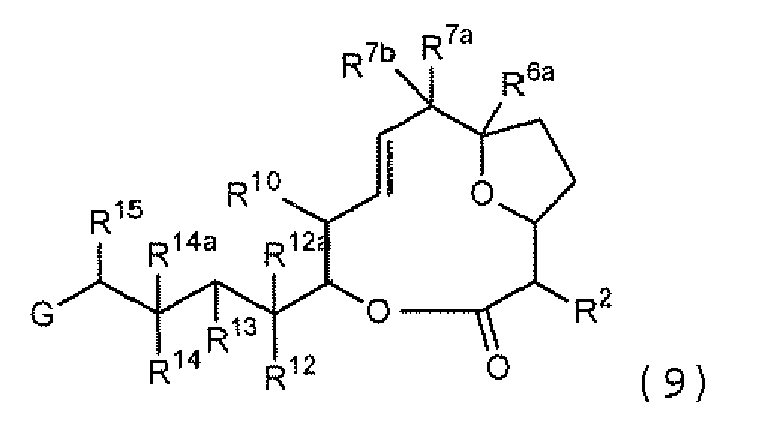
- Item 7. A compound represented by the formula (10), a pharmacologically acceptable salt thereof or a hydrate of them.

- Item 8. A compound represented by the formula (11), a pharmacologically acceptable salt thereof or a hydrate of them.


- Item 9. A compound represented by the formula (12), a pharmacologically acceptable salt thereof or a hydrate of them.

- Item 10. A compound represented by the formula (13), a pharmacologically acceptable salt thereof or a hydrate of them.

- Item 11. A compound represented by the formula (14), a pharmacologically acceptable salt thereof or a hydrate of them.

- Item 12. A compound represented by the formula (H-I), a pharmacologically acceptable salt thereof or a hydrate of them.

- (1) hydrogen,
- (2) methyl,
- (3) hydroxymethyl or
- (4) C2-8 acyloxymethyl;
- (1) hydrogen,
- (2) hydroxy,
- (3) methoxy or
- (4) C2-8 acyloxy;
- Item 13. A compound represented by the formula (H-1) according to item 12, a pharmacologically acceptable salt thereof or a hydrate of them, which is selected from the group consisting of a compound in which R2h is hydrogen, R3h' is hydroxy, both of R5h and R5h' are hydrogen, R6h is methyl, R6h' is hydroxy, R7h' is hydroxy, all of R10h, R12h and R16h are methyl, both of R16h' and R17h' are hydrogen, R20h is methyl, R20h' is hydrogen, R21h' is hydroxy, both of R21h and R22h' are hydrogen and R22h is methyl;
a compound in which R2h is hydrogen, R3h' is hydroxy, both of R5h and R5h' are hydrogen, R6h is methyl, R6h' is hydroxy, R7h' is acetoxy, all of R10h, R12h and R16h are methyl, both of R16h' and R17h' are hydrogen, R20h is methyl, R20h' is hydrogen, R21h' is hydroxy, both of R21h and R22h' are hydrogen, and R22h is methyl;
a compound in which R2h is hydrogen, R3h' is hydroxy, both of R5h and R5h' are hydrogen, R6h is methyl, R6h' is hydroxy, R7h' is acetoxy, all of R10h, R12h and R16h are methyl, both of R16h' and R17h' are hydrogen, R20h is methyl, R20h', is hydrogen, both of R21h and R21h' are bound together to form a ketone structure, R22h' is hydrogen and R22h is methyl;
a compound in which R2h is hydrogen, R3h' is hydroxy, both of R5h and R5h' are hydrogen, R6h is methyl, R6h' is hydroxy, R7h' is acetoxy, all of R10h, R12h and R16h are methyl, R16h' is hydroxy, R17h' is hydrogen, R20h is methyl, R20h' is hydrogen, R21h' is hydroxy, both of R21h and R22h' are hydrogen, and R22h is methyl;
a compound in which R2h is hydrogen, R3h' is hydroxy, both of R5h and R5h' are hydrogen, R6h is methyl, R6h' is hydroxy, R7h' is acetoxy, all of R10h, R12h and R16h are methyl, both of R16h' and R17h' are hydrogen, R20h is methyl, R20h' is hydroxy, R21h' is hydroxy, both of R21h and R22h' are hydrogen, and R22h is methyl;
a compound in which R2h is hydrogen, R3h' is hydroxy, both of R5h and R5h' are hydrogen, R6h is methyl, R6h' is hydroxy, R7h' is hydroxy, all of R10h, R12h and R16h are methyl, R16h' is hydroxy, R17h' is hydrogen, R20h is methyl, R20h' is hydrogen, R21h' is hydroxy, both of R21h and R22h' are hydrogen, and R22h is methyl;
a compound in which R2h is hydrogen, R3h' is hydroxy, both of R5h and R5h' are hydrogen, R6h is methyl, R6h' is hydroxy, R7h' is hydroxy, all of R10h, R12h and R16h are methyl, both of R16h' and R17h' are hydrogen, R20h is methyl, R20h' is hydroxy, R21h' is hydroxy, both of R21h and R22h' are hydrogen, and R22h is methyl;
a compound in which R2h is hydrogen, R3h' is hydroxy, both of R5h and R5h' are hydrogen, R6h is methyl, R6h' is hydroxy, R7h' is propanoyloxy, all of R10h, R12h and R16h are methyl, both of R16h' and R17h' are hydrogen, R20h is methyl, R20h' is hydrogen, R21h' is hydroxy, both of R21h and R22h' are hydrogen, and R22h is methyl;
a compound in which R2h is hydrogen, R3h' is hydroxy, both of R5h and R5h' are hydrogen, R6h is methyl, R6h' is hydroxy, R7h' is acetoxy, all of R10h, R12h and R16h are methyl, both of R16h' and R17h' are hydrogen, R20h is methyl, R20h' is hydrogen, R21h' is hydroxy, and all of R21h, R22h' and R22h are hydrogen;
a compound in which R2h is hydrogen, R3h' is hydroxy, R5h is hydrogen, R5h' is hydroxy, R6h is methyl, R6h' is hydroxy, R7h' is acetoxy, all of R10h, R12h and R16h are methyl, both of R16h' and R17h' are hydrogen, R20h is methyl, R20h' is hydrogen, R21h' is hydroxy, both of R21h and R22h are hydrogen, and R22h is methyl;
a compound in which R2h is hydrogen, R3h' is hydroxy, R5h is hydrogen, R5h' is acetoxy, R6h is methyl, R6h' is hydroxy, R7h' is acetoxy, all of R10h, R12h and R16h are methyl, both of R16h' and R17h' are hydrogen, R20h is methyl, R20h' is hydrogen, R21h' is hydroxy, both of R21h and R22h' are hydrogen, and R22h is methyl;
a compound in which R2h is hydrogen, R3h' is acetoxy, both of R5h and R5h' are hydrogen, R6h is methyl, R6h' is hydroxy, R7h' is acetoxy, all of R10h, R12h and R16h are methyl, both of R16h' and R17h' are hydrogen, R20h is methyl, R20h' is hydrogen, R21h' is hydroxy, both of R21h and R22h' are hydrogen, and R22h is methyl;
a compound in which R2h is hydrogen, R3h' is hydroxy, both of R5h and R5h' are hydrogen, R6h is acetoxymethyl, R6h' is hydroxy, R7h' is acetoxy, all of R10h, R12h and R16h are methyl, both of R16h' and R17h' are hydrogen, R20h is methyl, R20h' is hydrogen, R21h; is hydroxy, both of R21h and R22h' are hydrogen, and R22h is methyl;
a compound in which R2h is hydrogen, R3h' is hydroxy, both of R5h and R5h' are hydrogen, R6h is methyl, R6h' is hydroxy, R7h' is acetoxy, all of R10h, R12h and R16h are methyl, R16h' is hydrogen, R17h' are hydroxy, R20h is methyl, R20h' is hydrogen, R21h' is hydroxy, both of R21h and R22h' are hydrogen, and R22h is methyl;
a compound in which R2h is hydrogen, R3h' is hydroxy, both of R5h and R5h' are hydrogen, R6h is methyl, R6h' is hydroxy, R7h' is acetoxy, all of R10h, R12h and R16h are methyl, both of R16h' and R17h' are hydrogen, both of R20h and R20h' are hydrogen, R21h' is hydroxy, both of R21h and R22h' are hydrogen, and R22h is methyl;
a compound in which R2h is hydrogen, R3h' is hydroxy, both of R5h and R5h' are hydrogen, R6h is methyl, R6h' is hydroxy, R7h' is acetoxy, both of R10h and R12h are methyl, all of R16h, R16h' and R17h' are hydrogen, R20h is methyl, R20h' is hydrogen, R21h' is hydroxy, both of R21h and R22h' are hydrogen, and R22h is methyl;
a compound in which R2h is hydrogen, R3h' is hydroxy, both of R5h and R5h' are hydrogen, R6h is methyl, R6h' is hydroxy, R7h' is acetoxy, both of R10h and R16h are methyl, all of R12h, R16h' and R17h' are hydrogen, R20h is methyl, R20h' is hydrogen, R21h' is hydroxy, both of R21h and R22h' are hydrogen, and R22h is methyl;
a compound in which R2h is hydrogen, R3h' is hydroxy, both of R5h and R5h' are hydrogen, R6h is methyl, R6h' is hydroxy, R7h' is acetoxy, both of R12h and R16h are methyl, all of R10h, R16h' and R17h' are hydrogen, R20h is methyl, R20h' is hydrogen, R21h' is hydroxy, both of R21h and R22h' are hydrogen, and R22h is methyl;
a compound in which R2h is hydrogen, R3h' is hydroxy, both of R5h and R5h' are hydrogen, R6h is acetoxymethyl, R6h' is hydroxy, R7h' is hydroxy, all of R10h, R12h and R16h are methyl, both of R16h' and R17h' are hydrogen, R20h is methyl, R20h' is hydrogen, R21h' is hydroxy, both of R21h and R22h' are hydrogen, and R22h is methyl;
a compound in which R2h is hydrogen, R3h' is hydroxy, both of R5h and R5h' are hydrogen, R6h is methyl, R6h' is hydroxy, R7h' is hydroxy, all of R10h, R12h and R16h are methyl, both of R16h' and R17h' are hydrogen, R20h is methyl, R20h' is hydrogen, R21h and R21h' are bound together to form a ketone structure, R22h' is hydrogen, and R22h is methyl;
a compound in which R2h is hydrogen, R3h' is hydroxy, all of R5h, R5h' and R6h are hydrogen, R6h' is acetoxy, R7h' is hydroxy, all of R10h, R12h and R16h are methyl, both of R16h' and R17h' are hydrogen, R20h is methyl, R20h' is hydrogen, R21h' is hydroxy, both of R21h and R22h' are hydrogen, and R22h is methyl;
a compound in which R2h is methyl, R3h' is hydroxy, both of R5h and R5h' are hydrogen, R6h is methyl, R6h' is hydroxy, R7h' is hydroxy, all of R10h, R12h and R16h are methyl, both of R16h' and R17h' are hydrogen, R20h is methyl, R20h' is hydrogen, R21h' is hydroxy, both of R21h and R22h' are hydrogen, and R22h is methyl;
a compound in which R2h is methyl, R3h' is hydroxy, both of R5h and R5h' are hydrogen, R6h is methyl, R6h' is hydroxy, R7h' is acetoxy, all of R10h, R12h and R16h are methyl, both of R16h' and R17h' are hydrogen, R20h is methyl, R20h' is hydrogen, R21h' is hydroxy, both of R21h and R22h' are hydrogen, and R22h is methyl;
a compound in which R2h is hydrogen, R3h' is hydroxy, R5h is hydrogen, R5h' is hydroxy, R6h is methyl, R6h' is hydrogen, R7h' is acetoxy, all of R10h, R12h and R16h are methyl, both of R16h' and R17h' are hydrogen, R20h is methyl, R20h' is hydrogen, R21h' is hydroxy, both of R21h and R22h' are hydrogen, and R22h is methyl;
a compound in which R2h is hydrogen, R3h' is hydroxy, all of R5h, R5h', R6h and R6h' are hydrogen, R7h' is hydroxy, all of R10h, R12h and R16h are methyl, both of R16h' and R17h' are hydrogen, R20h is methyl, R20h' is hydrogen, R21h' is hydroxy, both of R21h and R22h' are hydrogen, and R22h is methyl;
a compound in which R2h is hydrogen, R3h' is hydroxy, both of R5h and R5h' are hydrogen, R6h and R6h' are bound together to form a spirooxyrane structure, R7h' is acetoxy, all of R10h, R12h and R16h are methyl, both of R16h' and R17h' are hydrogen, R20h is methyl, R20h' is hydrogen, R21h' is hydroxy, both of R21h and R22h' are hydrogen, and R22h is methyl;
a compound in which R2h is hydrogen, R3h' is hydroxy, both of R5h and R5h' are hydrogen, R6h and R6h' are bound together to form a spirooxyrane structure, R7h' is hydroxy, all of R10h, R12h and R16h are methyl, both of R16h' and R17h' are hydrogen, R20h is methyl, R20h' is hydrogen, R21h' is hydroxy, both of R21h and R22h' are hydrogen, and R22h is methyl;
a compound in which R2h is hydrogen, R3h' is hydroxy, both of R5h and R5h' are hydrogen, R6h is methyl, R6h' is acetoxy, R7h' is acetoxy, all of R10h, R12h and R16h are methyl, both of R16h' and R17h' are hydrogen, R20h is methyl, R20h' is hydrogen, R21h' is hydroxy, both of R21h and R22h' are hydrogen, and R22h is methyl;
a compound in which R2h is hydrogen, R3h' is hydroxy, both of R5h and R5h' are hydrogen, R6h is methyl, R6h' is hydroxy, R7h' is acetoxy, all of R10h, R12h and R16h are methyl, R16h' is hydroxy, R17h' is hydrogen, R20h is methyl, R20h' is hydrogen, R21h and R21h' are bound together to form a ketone structure, R22h' is hydrogen, and R22h is methyl;
a compound in which R2h is hydrogen, R3h' is hydroxy, both of R5h and R5h' are hydrogen, R6h is methyl, R5h' is hydroxy, R7h' is acetoxy, all of R10h, R12h and R16h are methyl, both of R16h' and R17h' are hydrogen, R20h is methyl, R20h' is hydrogen, R21h is hydrogen, both of R21h' and R22h' are hydroxy, and R22h is methyl;
a compound in which R2h is hydrogen, R3h' is hydroxy, R5h is hydrogen, R5h' is hydroxy, R6h is methyl, R6h' is hydroxy, R7h' is acetoxy, all of R10h, R12h and R16h are methyl, both of R16h' and R17h' are hydrogen, R20h is methyl, R20h' is hydrogen, R21h is hydrogen, both of R21h' and R22h' are hydroxy, and R22h is methyl;
a compound in which R2h is hydrogen, R3h' is hydroxy, both of R5h and R5h' are hydrogen, R6h is methyl, R6h' is hydroxy, R7h' is hydroxy, both of R10h and R16h are methyl, all of R12h, R16h' and R17h' are hydrogen, R20h is methyl, R20h' is hydrogen, R21h' is hydroxy, both of R21h and R22h' are hydrogen, and R22h is methyl; and
a compound in which R2h is hydrogen, R3h' is hydroxy, both of R5h and R5h' are bound together to form a ketone structure, R6h is methyl, R6h' is hydroxy, R7h' is acetoxy, all of R10h, R12h and R16h are methyl, both of R16h' and R17h' are hydrogen, R20h is methyl, R20h' is hydrogen, R21h' is hydroxy, both of R21h and R22h' are hydrogen, and R22h is methyl. - Item 14. A compound represented by the formula (H-II), a pharmacologically acceptable salt thereof or a hydrate of them.

- (1) hydrogen,
- (2) methyl,
- (3) hydroxymethyl or
- (4) C2-8 acyloxymethyl;
- (1) hydrogen,
- (2) hydroxy,
- (3) methoxy or
- (4) C2-8 acyloxy;
- Item 15. A compound represented by the formula (H-II) according to item 14, a pharmacologically acceptable salt thereof or a hydrate of them, which is selected from the group consisting of a compound in which R2h is hydrogen, R3h' is hydroxy, R6h is methyl, R6h' is hydroxy, R7h' is acetoxy, all of R10h, R12h and R16h are methyl, both of R16h' and R17h' are hydrogen, R20h is methyl, R20h' is hydrogen, R21h' is hydroxy, both of R21h and R22h' are hydrogen and R22h is methyl;
a compound in which R2h is hydrogen, R3h' is hydroxy, R6h is methyl, R6h' is hydroxy, R7h' is hydroxy, all of R10h, R12h and R16h are methyl, both of R16h' and R17h' are hydrogen, R20h is methyl, R20h' is hydrogen, R21h' is hydroxy, both of R21h and R22h' are hydrogen, and R22h is methyl;
a compound in which R2h is hydrogen, R3h' is hydroxy, R6h is methyl, R6h' is hydroxy, R7h' is acetoxy, all of R10h, R12h and R16h are methyl, both of R16h' and R17h' are hydrogen, R20h is methyl, R20h' is hydrogen, both of R21h and R21h' are bound together to form a ketone structure, R22h' is hydrogen, and R22h is methyl;
a compound in which R2h is hydrogen, R3h' is hydroxy, R6h and R6h' are bound together to form a spirooxyrane structure, R7h' is acetoxy, all of R10h, R12h and R16h are methyl, both of R16h' and R17h' are hydrogen, R20h is methyl, R20h' is hydrogen, R21h' is hydroxy, both of R21h and R22h' are hydrogen, and R22h is methyl;
a compound in which R2h is hydrogen, R3h' is hydroxy, R6h is methyl, R6h' is acetoxy, R7h' is acetoxy, all of R10h, R12h and R16h are methyl, both of R16h' and R17h' are hydrogen, R20h is methyl, R20h' is hydrogen, R21h' is hydroxy, both of R21h and R22h' are hydrogen, and R22h is methyl; and
a compound in which R2h is hydrogen, R3h' is hydroxy, R6h is methyl, R6h' is hydroxy, R7h' is acetoxy, all of R10h, R12h and R16h are methyl, R16h' is hydrogen, R17h' is hydroxy, R20h is methyl, R20h' is hydrogen, R21h' is hydroxy, both of R21h and R22h' are hydrogen, and R22h is methyl. - Item 16. A compound represented by the formula (H-III), a pharmacologically acceptable salt thereof or a hydrate of them.

- (1) hydrogen,
- (2) methyl,
- (3) hydroxymethyl or
- (4) C2-8 acyloxymethyl;
- (1) hydrogen,
- (2) hydroxy,
- (3) methoxy or
- (4) C2-8 acyloxy;
- Item 17. A compoundrepresented by the formula (H-III) according to item 16, a pharmacologically acceptable salt thereof or a hydrate of them, which is selected from the group consisting of a compound in which R2h is hydrogen, both of R5h' and R5h' are hydrogen, R6h is methyl, R6h' is hydroxy, R7h' is hydroxy, all of R10h, R12h and R16h are methyl, both of R16h' and R17h' are hydrogen, R20h is methyl, R20h' is hydrogen, R21h' is hydroxy, both of R21h and R22h' are hydrogen and R22h is methyl;
a compound in which R2h is hydrogen, both of R5h and R5h' are hydrogen, R5h is methyl, R6h' is hydroxy, R7h' is acetoxy, all of R10h, R12h and R16h are methyl, both of R16h' and R17h' are hydrogen, R20h is methyl, R20h' is hydrogen, R21h' is acetoxy, both of R21h and R22h' are hydrogen and R22h is methyl; and
a compound in which R2h is hydrogen, both of R5h and R5h' are hydrogen, R6h is methyl, R6h' is hydroxy, R7h' is acetoxy, all of R10h, R12h and R16h are methyl, both of R16h' and R17h' are hydrogen, R20h is methyl, R20h' is hydrogen, R21h' is hydroxy, both of R21h and R22h' are hydrogen and R22h is methyl. - Item 18. A compound represented by the formula (H-IV), a pharmacologically acceptable salt thereof or a hydrate of them.

- (1) hydrogen,
- (2) methyl ,
- (3) hydroxymethyl or
- (4) C2-8 acyloxymethyl;
R3h', R5h', R6h', R7h', R16h', R17h', R20h', R21h' and R22h' are the same as or different from each other and each represents - (5) hydrogen,
- (6) hydroxy,
- (7) methoxy or
- (8) C2-8 aryloxy;

further, R6h and R6h' may be bound together to form a spirooxyrane structure, provided that the restricted clauses 1, 2 and 3 according to item 1 are included. - Item 19. The compound represented by the formula (H-IV) according to item 18, a pharmacologically acceptable salt thereof or a hydrate of them, which is selected from the group consisting of a compound in which R2h is hydrogen, R3h and R3h' are bound together to form a ketone structure, R4h and R5h form a single bond to represent

a compound in which R2h is hydrogen, R3h is hydrogen, R3h' is hydroxy, all of R4h, R5h and R5h' are hydrogen, R6h is methyl, R6h' is hydroxy, R7h and R7h' are bound together to form a ketone structure, all of R10h, R12h and R16h are methyl, both of R16h' and R17h' are hydrogen, R20h is methyl, R20h' is hydrogen, R21h' is hydroxy, both of R21h and R22h' are hydrogen, and R22h is methyl. - Item 20. A compound represented by the formula (H-V), a pharmacologically acceptable salt thereof or a hydrate of them.


the formula (3):

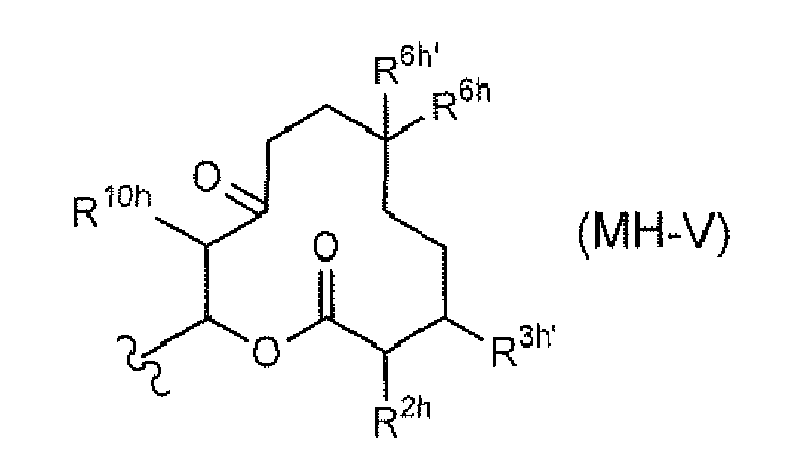
- Item 21. A compoundrepresented by the formula (H-V) according to item 20, a pharmacologically acceptable salt thereof or a hydrate of them, which is selected from the group consisting of a compound in which Gmh is represented by the formula (MH-I), R2h is hydrogen, R3h' is hydroxy, both of R5h and R5h' are hydrogen, R6h is methyl, R6h' is hydroxy, R7h' is acetoxy, all of R10h, R12h and R16h are methyl, all of R16h', R17h' and R18h are hydrogen, all of R20h, R21h' and R21h" are hydrogen and R20h' is hydroxy;
a compound in which Gmh is represented by the formula (MH-I), R2h is hydrogen, R3h' is hydroxy, both of R5h and R5h' are hydrogen, R6h is methyl, R6h' is hydroxy, R7h' is acetoxy, all of R10h, R12h and R16h are methyl, R16h' is hydrogen, R17h' is hydroxy, and all of R18h, R20h, R20h', R21h' and R21h" are hydrogen;
a compound in which Gmh is represented by the formula (MH-I), R2h is hydrogen, R3h' is hydroxy, both of R5h and R5h' are hydrogen, R6h is methyl, R6h' is hydroxy, R7h' is acetoxy, all of R10h, R12h and R16h are methyl, R16h' is hydroxy, and all of R17h', R18h, R20h, R20h', R21h' and R21h" are hydrogen;
a compound in which Gmh is represented by the formula (MH-I), R2h is hydrogen, R3h' is hydroxy, both of R5h and R5h' are hydrogen, R6h is methyl, R6h' is hydroxy, R7h' is acetoxy, all of R10h, R12h and R16h are methyl, R16h' is hydrogen, R17h' is hydroxy, R18h is methyl, and all of R20h, R20h', R21h' and R21h" are hydrogen;
a compound in which Gmh is represented by the formula (MH-V), R2h is hydrogen, R3h' is hydroxy, R6h is methyl, R6h' is hydroxy, all of R10th, R12h and R16h are methyl, all of R16h', R17h', R18h and R20h' are hydrogen, R20h is methyl, R21h' is hydroxy, and R21h" is ethyl. - Item 22. A compound represented by the formula (H-VI), a pharmacologically acceptable salt thereof or a hydrate of them.

- Item 23. A compound represented by the formula (H-VI) according to item 22, a pharmacologically acceptable salt thereof or a hydrate of them, which is selected from the group consisting of a compound in which Gmh is represented by the formula (MH-I), R2h is hydrogen, R3h' is hydroxy, both of R5h and R5h' are hydrogen, R6h is methyl, R6h' is hydroxy, R7h' is acetoxy, all of R10h, R12h and R16h are methyl, both of R16h' and R17h' are hydrogen, R20h is methyl, both of R20h' and R21h are hydrogen, both of R21h' and R22h' are hydroxy, and R22h is methyl; and
a compound in which Gmh is represented by the formula (MH-I), R2h is hydrogen, R3h' is hydroxy, both of R5h and R5h' are hydrogen, R6h is methyl, R6h' is hydroxy, R7h' is acetoxy, all of R10h, R12h and R16h are methyl, both of R16h' and R17h' are hydrogen, R20h is methyl, all of R20h', R21h and R22h' are hydrogen, R21h' is hydroxy, and R22h is methyl. - Item 24. A compound represented by the formula (H-VII), a pharmacologically acceptable salt thereof or a hydrate of them.

- Item 25. A compound represented by the formula (H-VII), a pharmacologically acceptable salt thereof or a hydrate of them, which is selected from the group consisting of a compound in which Gmh is represented by the formula (MH-I), --- represents a double bond, R2h is hydrogen, R3h' is hydroxy, both of R5h and R5h' are hydrogen, R6h is methyl, R6h' is hydroxy, R7h' is acetoxy, all of R10h, R12h and R16h are methyl, both of R16h' and R17h' are hydrogen, R20h is methyl, all of R20h', R21h and R22h' are hydrogen, R21h' is hydroxy, and R22h is methyl;
a compound in which Gmh is represented by the formula (MH-I), --- represents a single bond, R2h is hydrogen, R3h' is hydroxy, both of R5h and R5h' are hydrogen, R6h is methyl, R6h' is hydroxy, R7h' is acetoxy, all of R10h, R12h and R16h are methyl, both of R16h' and R17h' are hydrogen, R20h is methyl, all of R20h', R21h and R22h' are hydrogen, R21h' is hydroxy, and R22h is methyl; and
a compound in which Gmh is represented by the formula (MH-II), --- represents a double bond, R2h is hydrogen, R3h' is hydroxy, R6h is methyl, R6h' is hydroxy, R7h' is acetoxy, all of R10h, R12h and R16h are methyl, both of R16h' and R17h' are hydrogen, R20h is methyl, all of R20h', R21h and R22h' are hydrogen, R22h' is hydroxy, and R22h is methyl. - Item 26. A compound represented by the formula (H-VIII), a pharmacologically acceptable salt thereof or a hydrate of them.

- Item 27. A compound, a pharmacologically acceptable salt thereof or a hydrate of them in the formula (H-VIII) according to item 26, which is selected from the group consisting of a compound in which Gmh is represented by the formula (MH-I), R2h is hydrogen, R3h' is hydroxy, both of R5h and R5h' are hydrogen, R6h is methyl, R6h' is hydroxy, R7h' is acetoxy, all of R10h, R12h and R16h are methyl, both of R16h' and R17h' are hydrogen, R18h' is hydroxy, R20h is methyl, R22h' is hydroxy, and R22h is methyl; and
a compound in which Gmh is represented by the formula (MH-I), R2h is hydrogen, R3h' is hydroxy, both of R5h and R5h' are hydrogen, R6h is methyl, R6h' is hydroxy, R7h' is acetoxy, all of R10h, R12h and R16h are methyl, both of R16h' and R17h' are hydrogen, R18h' is hydroxy, R20h is methyl, R22h' are hydrogen, and R22h is methyl. - Item 28. A compound represented by the formula (H-IX), a pharmacologically acceptable salt thereof or a hydrate of them.

a compound in which Gmh is represented by the formula (MH-I), C14 --C15 is a single bond, C16 --C17 is a double bond, R2h is hydrogen, R3h' is hydroxy, both of R5h and R5h' are hydrogen, R6h is methyl, R6h' is hydroxy, R7h' is acetoxy, both of R10h and R14h are methyl, both of R12h and R16h are hydrogen, R18h is methyl, R18h' is hydroxy, and R19h and R19h' are bound together to form a ketone structure (=O); and
a compound in which Gmh is represented by the formula (MH-I), C14 --C15, is a single bond, C16 --C17 is a double bond, R2h is hydrogen, R3h' is hydroxy, both of R5h and R5h' are hydrogen, R6h is methyl, R6h' is hydroxy, R7h' is acetoxy, both of R10h and R14h are methyl, both of R12h and R16h are hydrogen, R18h is methyl, R18h' is hydroxy, R19h is hydrogen, and R19h' is hydroxy. - Item 30. A compound represented by the formula (H-X), a pharmacologically acceptable salt thereof or a hydrate of them.

- Item 31. A compound, a pharmacologically acceptable salt thereof or a hydrate of them in the formula (H-X) according to item 30, which is selected from the group consisting of a compound in which Gmh is represented by the formula (MH-I), R18h" is represented by the formula (R-F), C14 --C15 is a double bond, C16 --C17 is a single bond, R2h is hydrogen, R3h' is hydroxy, both of R5h and R5h' are hydrogen, R6h is methyl, R6h' is hydroxy, R7h' is acetoxy, all of R10h, R12h and R16h are methyl, both of R14h and R17h' are hydrogen, R18h' is hydroxy, both of Rf3a and Rf5 are methyl, both of Rf3b and Rf4b are hydrogen, and Rf4b is hydroxy;
a compound in which Gmh is represented by the formula (MH-I), C14 --C15, is a single bond, C16 --C17, is a double bond, R2h is hydrogen, R3h' is hydroxy, both of R5h and R5h' are hydrogen, R6h is methyl, R6h' is hydroxy, R7h' is acetoxy, both of R10h and R14h are methyl, all of R12h, R16h and R17h' are hydrogen, R18h' is hydroxy, and R18h" is methyl; and
a compound in which Gmh is represented by the formula (MH-I), C14 --C15, is a double bond, C16 --C17 is a single bond, R2h is hydrogen, R3h' is hydroxy, both of R5h and R5h' are hydrogen, R6h is methyl, R6h' is hydroxy, R7h' is acetoxy, all of R10h, R12h and R16h are methyl, both of R14h and R18h' are hydrogen, R17h' is hydroxy, and R18h" is methyl. - Item 32. A compound represented by the formula (H-XI), a pharmacologically acceptable salt thereof or a hydrate of them.

- Item 33. A compound represented by the formula (H-XI) according to item 32, a pharmacologically acceptable salt thereof or a hydrate of them, which is selected from the group consisting of a compound in which Gmh is represented by the formula (MH-I), R17h" is represented by the formula (R-F), R2h is hydrogen, R3h' is hydroxy, both of R5h and R5h' are hydrogen, R6h is methyl, R6h' is hydroxy, R7h' is acetoxy, all of R10h, R12h and R16h" are methyl, both of Rf3a and Rf4a are hydroxy, Rf3b is hydrogen, Rf4b is methyl, and Rf5 is ethyl; and
a compound in which Gmh is represented by the formula (MH-I), R2h is hydrogen, R3h' is hydroxy, all of R5h, R5h' and R6h' are hydrogen, R6h is methyl, R7h' is acetoxy, both of R10h and R12h are methyl, R16h" is hydroxy, and R17h" is hydrogen. - Item 34. A compound represented by the formula (15), a pharmacologically acceptable salt thereof or a hydrate of them.


- 1) hydrogen,
- 2) methyl which may have substituents,
- 3) -ORH (wherein RH is <1> hydrogen, <2> methyl or <3> acetyl),
- 4) -ORD (wherein RD represents
- <1> C1-22 alkyl (provided that in case of methyl, it has always substituents),
- <2> -CH2Ar,
- <3> C3-22 acyl,
- <4> unsaturated C3-22 acyl,
- <5> -CORCO,
- <6> C1-22 alkylsulfonyl,
- <7> benzenesulfonyl or
- <8> -SiRs1Rs2Rs3, each of which may have substituents)
- 5) halogen or
- 6) -RM-NRN1RN2 (Ar, RCO, Rs1, Rs2, Rs3, RM, RN1 and RN2 have the same meanings as the definitions of the formula 5 of item 2), further, R5r and R5r' may be bound together to represent a ketone structure;
further, either of R6r or R6r', and R7r' may be bound together to represent a 1,3-dioxolane ring),
the formula (2):
the formula (3):
the formula (4):
the formula (5):
- 1) hydrogen,
- 2) methyl which may be optionally substituted,
- 3) -ORH (wherein RH represents <1> hydrogen, <2> methyl or <3> acetyl),
- 4) -ORD (wherein RD represents
- <1> C1-22 alkyl (provided that in case of methyl, it has always substituents),
- <2> -CH2Ar,
- <3> C3-22 acyl,
- <4> unsaturated C3-22 acyl,
- <5> CORCO,
- <6> C1-22 alkylsulfonyl,
- <7> benzenesulfonyl, or
- <8> -SiRs1Rs2Rs3, each of which may have substituents),
- 5) halogen or
- 6) -RM-NRN1RN2 (Ar, PCO, Rs1, Rs2, Rs3, RM, RN1 and RN2 have the same meanings as the definitions in the formula 5 of item 2);
when either one of A and B is 1) halogen, or 2) <1> alkylsulfonyloxy, <2> benzenesulfonyloxy or <3> C1-22 alkoxy, each of which may have substituents, the other is 1) hydroxy, or 2) <1> C1-22 alkoxy or <2> C2-22 acyloxy, each of which may have substituents. - Item 35. A compound represented by the formula (16), a pharmacologically acceptable salt thereof or a hydrate of them.
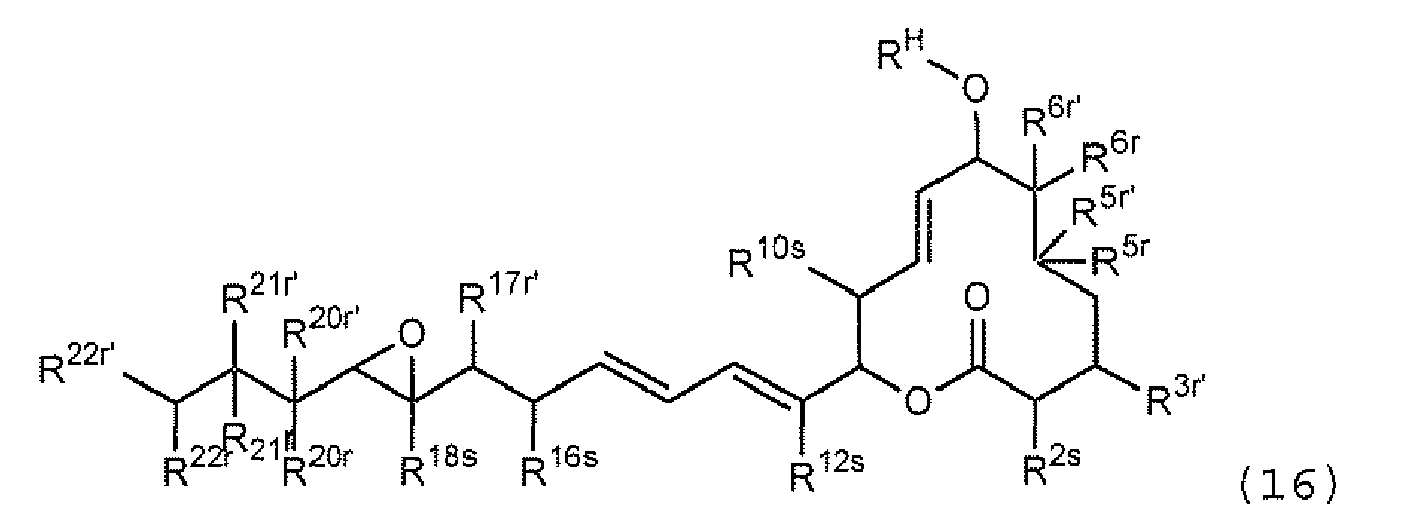
- Item 36. A compound represented by the formula (17), a pharmacologically acceptable salt thereof or a hydrate of them.

- Item 37. A compound represented by the formula (18), a pharmacologically acceptable salt thereof or a hydrate of them.

- Item 38. A compound represented by the formula (18) of item 37, a pharmacologically acceptable salt thereof or a hydrate of them, which is selected from the group of compounds consisting of, (1) a compound in which RAM is represented by
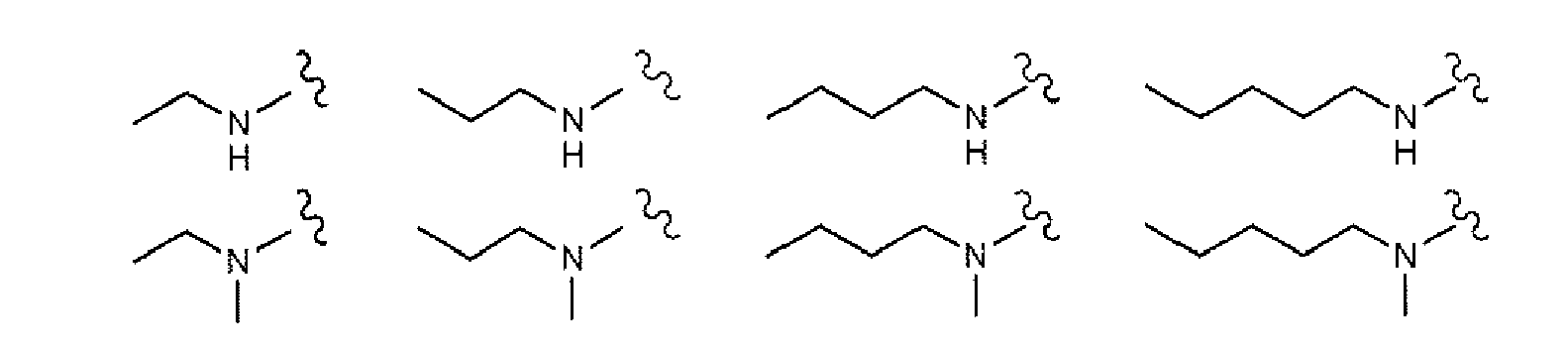


(3) a compound in which RAM is represented by

- Item 39. A compound represented by the formula (19), a pharmacologically acceptable salt thereof or a hydrate of them.


- Item 40. A compound represented by the formula (20), a pharmacologically acceptable salt thereof or a hydrate of them,

The substituent described here indicates the following.- a) C1-C8 alkyl, C1-C8 alkoxy, C2-C8 acyl,
- b) fluoro, chloro, bromo, iodo,
- c) carboxylic acid, sulfonic acid, carboxylic acid ester, carboxamide which may optionally have substituents on nitrogen,
- d) nitro, amino, N-monosubstituted amino, N,N-disubstituted amino,
- e) a hydroxy group, mercaptane, C1-C8 alkylthio, C1-C8 alkylsulfoxide, C1-C8 alkylsulfone, provided that the restricted clauses 1, 2 an 3 according to item 1 are included.
- Item 41. A compound represented by the formula (21), a pharmacologically acceptable salt thereof or a hydrate of them.

- Item 42. The compound according to item 41, a pharmacologically acceptable salt thereof or a hydrate of them, wherein in the formula (21), R3", R6" and R17 are hydrogen; R7" is hydrogen or acetyl; R16 and R20 are the same as or different from each other and each represents hydrogen or hydroxy; R21a' and R21b' are bound together with oxygen, or either one of them represents hydroxy and the other is hydrogen; and R12' is methyl.
- Item 43. The compound according to item 41, a pharmacologically acceptable salt thereof or a hydrate of them, wherein in the formula (21), R3", R6" and R17 are hydrogen; R7" is acetyl; R16 and R17 are the same as or different from each other and each represents hydrogen or hydroxy; R21a and R21b are bound together with oxygen, or either one of them represents hydroxy and the other is hydrogen; and R12 represents methyl or -CH2OH. Item 44. The compound according to item 41, or a pharmacologically acceptable salt thereof or a hydrate of them, wherein in the formula (21), R3", R6", R7", R17, R20 and R21a are hydrogen; R16 and R21b are hydroxy; and R12 is methyl.
- Item 45. The compound according to item 41, a pharmacologically acceptable salt thereof or a hydrate of them, wherein in the formula (21), R3", R6", R7", R16, R17 and R21a are hydrogen; R20 and R21b are hydroxy; and R12 is methyl.
- Item 46. The compound according to item 41, a pharmacologically acceptable salt thereof or a hydrate of them, wherein in the formula (21), R3", R6", R7", R16, R17, R20 and R21a are hydrogen; R21b is hydroxy; and R12 is methyl.
- Item 47. The compound according to item 41, a pharmacologically acceptable salt thereof or a hydrate of them, wherein in the formula (21), R3", R6", R16, R17 and R21a are hydrogen; R20 and R21b are hydroxy; R7" is acetyl; and R12 is methyl.
- Item 48. The compound according to item 41, a pharmacologically acceptable salt thereof or a hydrate of them, wherein in the formula (21), R3", R6", R17, R20 and R21a are hydrogen; R16 and R21b are hydroxy; R7" is acetyl; and R32 is methyl.
- Item 49. The compound according to item 41, a pharmacologically acceptable salt thereof or a hydrate of them, wherein in the formula (21), R3", R6", R16, R17 and R20 are hydrogen; R21a and R21b are bound together with oxygen; R7" is acetyl; and R12 is methyl.
- Item 50. The compound according to item 41, a pharmacologically acceptable salt thereof or a hydrate of them, wherein in the formula (21), R3", R6", R16, R17, R20 and R21a are hydrogen; R21b is hydroxy; R7" is acetyl; and R12 is methyl.
- Item 51. A medicament comprising at least one selected from compounds according to items 1 to 50, a pharmacologically acceptable salt thereof or a hydrate of them an active ingredient.
- Item 52. The medicament according to item 51, as an agent for preventing or treating a disease against which gene expression control is efficacious.
- Item 53. The medicament according to item 51, as an agent for preventing or treating a diseases against which VEGF production suppressing action is efficacious.
- Item 54. The medicament according to item 51, as an agent for preventing or treating a disease against which an antiangiogenic effect is efficacious.
- Item 55. The medicament according to item 51, as an antiangiogenic agent.
- Item 56. The medicament according to item 51, as an antitumor agent.
- Item 57. The medicament according to item 51, as an agent for treating hematoma.
- Item 58. The medicament according to item 51, as an agent for supressing cancer metastasis.
- Item 59. The medicament according to item 51, as an agent for treating retina angiogenic disease or an agent for treating diabetic retinopathy.
- Item 60. The medicament according to item 51, as an agent for treating inflammatory disease.
- Item 61. The medicament according to item 51, as an agent for treating inflammatory diseases consisting of osteoarthritis, rheumatoid arthritis, psoriasis or delayed hypersensitivity reaction.
- Item 62. The medicament according to item 51, as an agent for treating atherosclerosis.
- Item 63. The medicament according to item 51, as an agent for treating solid cancer.
- Item 64. The medicament according to item 63, wherein the solid cancer is lung cancer, brain tumor, breast cancer, prostate cancer, ovarian cancer, colon cancer or melanoma. Item 65. The medicament according to item 51, as an agent for treating leukemia.
- Item 66. The medicament according to item 51, as an antitumor agent based on gene expression control.
- Item 67. The medicament according to item 51, as an antitumor agent based on VEGF production suppressing action.
- Item 68. The medicament according to item 51, as an antitumor agent based on an antiangiogenic effect.
- Item 69. A method for preventing or treating a disease against which gene expression control is efficacious, by administering a pharmacologically effective dose of the medicament according to item 51 to a patient.
- Item 70. A method for preventing or treating a disease against which the VEGF production suppressing action is efficacious, by administering a pharmacologically effective dose of the medicament according to item 51 to a patient.
- Item 71. A method for preventing or treating a disease against which an antiangiogenic effect is efficacious, by administering a pharmacologically effective dose of the medicament according to item 51 to a patient.
- Item 72. Use of the compound according to any one of items 1 to 50, a pharmacologically acceptable salt thereof or a hydrate of them, for producing an agent for preventing or treating a disease against which the gene expression control is efficacious, a disease against which the VEGF production suppressing action is efficacious, a disease against which the antiangiogenic action is efficacious or solid cancers.
- Item 73. A production process of the compound according to any one of items 1 to 50, a pharmacologically acceptable salt thereof or a hydrate of them, which comprises culturing Streptomyces sp. Mer. 11107, FERM P-18144 or its variant in a nutrient culture medium, collecting the compound according to any one of items 1 to 50 from the culture solution, and carrying out various modification synthesis by using the obtained compounds as a starting material to obtain derivatives thereof.
- Item 74. An agent for preventing or treating a disease against which the gene expression control is efficacious, a disease against which the VEGF production suppressing action is efficacious, a disease against which the antiangiogenic action is efficacious or solid cancers, which comprises a compound represented by the formula (4):

- Item 75. An agent for treating hematoma, an agent for suppressing cancer metastasis, an agent for treating retina angiogenic disease, an agent for treating diabetic retinopathy, an agent for treating inflammatory diseases, an agent for treating osteoarthritis, an agent for treating rheumatoid arthritis, an agent for treating psoriasis, an agent for treating atherosclerosis or an agent for treating solid cancer, which comprises a compound represented by the formula (4)

- Item 76. The agent for treating solid tumor according to item 75, wherein the solid tumor is lung cancer, brain tumor, breast cancer, prostate cancer, ovarian cancer, colon cancer or melanoma.


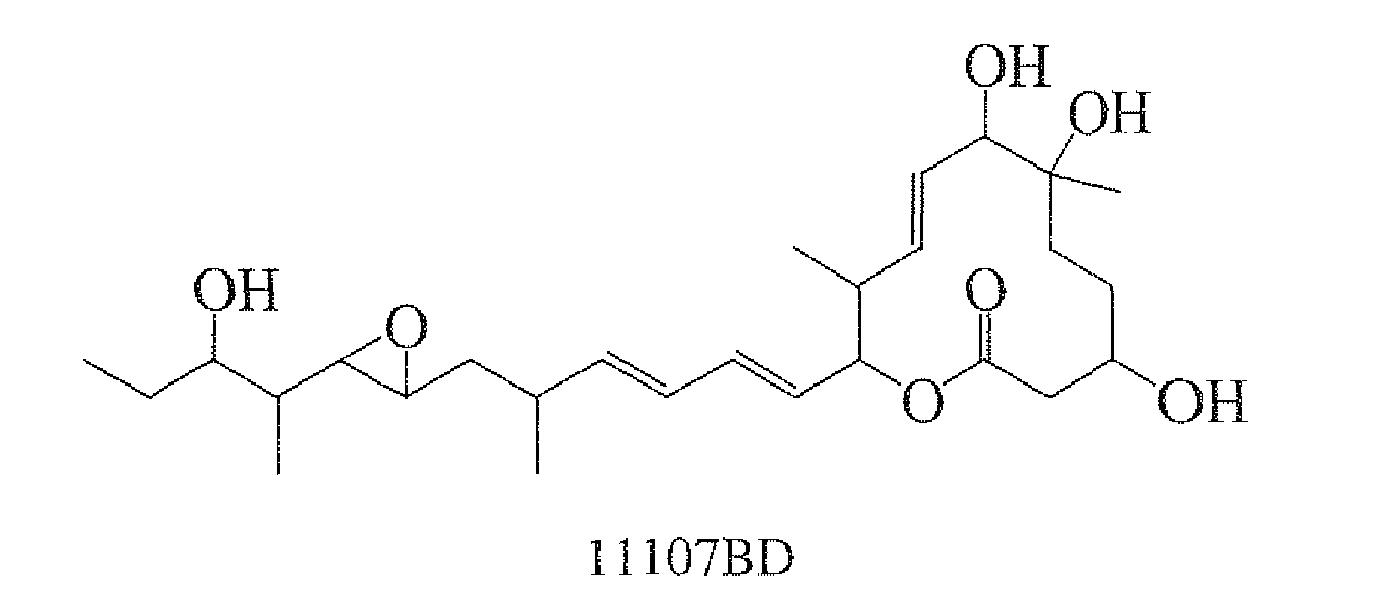


Claims (24)
- A compound represented by(a) the formula (5), a pharmacologically acceptable salt thereof or a hydrate of them,

R2, R10, R12 and R14 are the same as or different from each other and each represents hydrogen or methyl;
R3a, R3b, R5a, R5b, R6a and R6b are the same as or different from each other and each represents(1) hydrogen,(2) hydroxy,(3)<1> C1-22 alkyl,<2> C1-22 alkoxy,<3> ArCH2O- (wherein Ar represents C6-14 aryl or 5-membered to 14-membered heteroaryl which may have substituents),<4> C2-22 acyloxy,<5> unsaturated C3-22 acyloxy,<6> -OCORCO (wherein RCO represent (i) C6-14 aryl, (ii) 5-membered to 14-membered heteroaryl, (iii) C1-22 alkoxy, (iv) unsaturated C2-22 alkoxy, (v) C6-14 aryloxy or (vi) 5-membered to 14-membered heteroaryloxy, each of which may have substituents),<7> C1-22 alkylsulfonyloxy,<8> benzenesulfonyloxy or<9> -OSiRs1Rs2Rs3 (wherein Rs1, Rs2 and Rs3 are the same as or different from each other and each represents methyl, ethyl, i-propyl, t-butyl or phenyl,(4) halogen or(5) -RM-NRN1RN2 (wherein RM represents a single bond or -CO-O-; and RN1 and RN2 are 1) the same as or different from each other and each represents <1> hydrogen or <2> (i) C1-22 alkyl, (ii) unsaturated C3-22 alkyl, (iii) C2-22 acyl, (iv) unsaturated C3-22 acyl, (v) C6-14 aryl, (vi) 5-membered to 14-membered heteroaryl, (vii) benzyl, (viii) C1-22 alkylsulfonyl or (ix) benzenesulfonyl, eachof whichmayhave substituents, or 2) NRN1RN2 may be bound together to represent 3-membered to 14-membered nitrogen-containing non-aromatic heterocyclic ring which may have substituents);R7a and R7b are(1) different from each other and each represents1) hydrogen,2) -ORH (wherein RH is hydrogen, methyl or acetyl),3) -ORD (wherein RD represents(i) C1-22 alkyl (provided that in case of methyl, it always has substituents),(ii) -CH2Ar,(iii) C3-22 acyl,(iv) unsaturated C3-22 acyl,(v) -CORCO,(vi) C1-22 alkylsulfonyl,(vii) benzenesulfonyl or(viii) -SiRs1Rs2Rs3) or4) -RM-NRN1RN2, or(2) R7a and R7b may be bound together to represent <1> a ketone structure (=O) or represent an oxime structure (=NOROX, wherein ROX represents <1> C1-22 alkyl, <2> unsaturated C3-22 alkyl, <3> C6-14 aryl, <4> 5-membered to 14-membered heteroaryl or <5> benzyl, each of which may have substituents);
further, R3a and R3b may be bound together to represent a ketone structure (=O) or an oxime structure (=NOROX);
further, R6a or R6b may be bound together to represent a spirooxyrane ring or exomethylene;
further, either of R6a or R6b and either of R7a or R7b may be bound together to form a 1,3-dioxolane ring;
G is represented by
R17a, R17b, R18a, R18b, R19a, R19b, R20a, R20b, R21a and R21b are the same as or different from each other and each represents(1) hydrogen,(2) methyl which may optionally have substituents,(3) -ORH,(4) -ORD,(5) halogen or(6) -RM-NRN1RN2; andR21c means
further, either of R18a or R18b and either of R19a or R19b may form a single bond together to represent the partial structure

 (b) the formula (H-I), a pharmacologically acceptable salt thereof or a hydrate of them,
 (1) hydrogen,(2) methyl,(3) hydroxymethyl or(4) C2-8 acyloxymethyl;R3h', R5h', R6h', R7h', R16h', R17h', R20h', R21h' and R22h' are the same as or different from each other and each represents(1) hydrogen,(2) hydroxy,(3) methoxy or(4) C2-8 acyloxy;R5h and R5h' may be bound together to form a ketone structure (=O); R21h and R21h' may be bound together to form a ketone structure (=O); and R6h and R6h' may be bound together to form a spirooxyrane structure,
or(c) the formula (18), a pharmacologically acceptable salt thereof or a hydrate of them,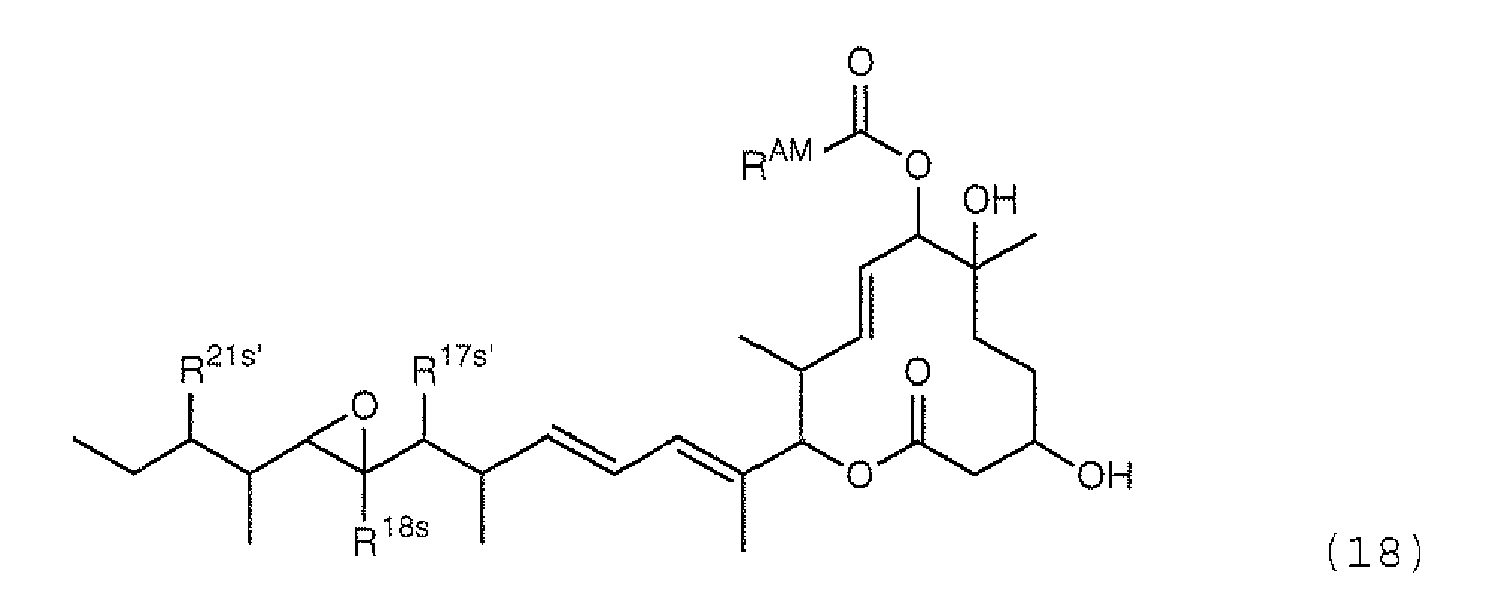
provided that
(Restricted clause 1) when the above-mentioned compound is represented by the following formula (2):


- A compound according to claim 1 represented by the formula (11), a pharmacologically acceptable salt thereof or a hydrate of them.

Gm is represented by (1)
- A compound according to claim 1 represented by the formula (12), a pharmacologically acceptable salt thereof or a hydrate of them.

- A compound according to claim 1 represented by the formula (H-I), a pharmacologically acceptable salt thereof or a hydrate of them.
 (1) hydrogen,(2) methyl,(3) hydroxymethyl or(4) C2-8 acyloxymethyl;R3h', R5h', R6h', R7h', R16h', R17h', R20h', R21h' and R22h' are the same as or different from each other and each represents(1) hydrogen,(2) hydroxy,(3) methoxy or(4) C2-8 acyloxy;R5h and R5h' may be bound together to form a ketone structure (=O) ; R21h and R21h' may be bound together to form a ketone structure (=O); and R6h and R6h' may be bound together to form a spirooxyrane structure.
 - A compound represented by the formula (H-1) according to claim 4, a pharmacologically acceptable salt thereof or a hydrate of them, which is selected from the group consisting of a compound in which R2h is hydrogen, R3h' is hydroxy, both of R5h and R5h' are hydrogen, R6h is methyl, R6h' is hydroxy, R7h' is hydroxy, all of R10h, R12h and R16h are methyl, both of R16h' and R17h' are hydrogen, R20h is methyl, R20h' is hydrogen, R21h' is hydroxy, both of R21h and R22h' are hydrogen and R22h is methyl;
a compound in which R2h is hydrogen, R3h' is hydroxy, both of R5h and R5h' are hydrogen, R6h is methyl, R6h' is hydroxy, R7h' is acetoxy, all of R10h, R12h and R16h are methyl, both of R16h' and R17h' are hydrogen, R20h is methyl, R20h' is hydrogen, R21h' is hydroxy, both of R21h and R22h' are hydrogen, and R22h is methyl;
a compound in which R2h is hydrogen, R3h' is hydroxy, both of R5h and R5h' are hydrogen, R6h is methyl, R6h' is hydroxy, R7h' is acetoxy, all of R10h, R12h and R16h are methyl, both of R16h' and R17h' are hydrogen, R20h is methyl, R20h' is hydrogen, both of R21h and R21h' are bound together to form a ketone structure, R22h' is hydrogen and R22h is methyl;
a compound in which R2h is hydrogen, R3h' is hydroxy, both of R5h and R5h' are hydrogen, R6h is methyl, R6h' is hydroxy, R7h' is acetoxy, all of R10h, R12h and R16h are methyl, R16h' is hydroxy, R17h' is hydrogen, R20h is methyl, R20h' is hydrogen, R21h' is hydroxy, both of R21h and R22h' are hydrogen, and R22h is methyl;
a compound in which R2h is hydrogen, R3h' is hydroxy, both of R5h and R5h' are hydrogen, R6h is methyl, R6h' is hydroxy, R7h' is acetoxy, all of R10h, R12h and R16h are methyl, both of R16h' and R17h' are hydrogen, R20h is methyl, R20h' is hydroxy, R21h' is hydroxy, both of R21h and R22h' are hydrogen, and R22h is methyl;
a compound in which R2h is hydrogen, R3h' is hydroxy, both of R5h and R5h' are hydrogen, R6h is methyl, R6h' is hydroxy, R7h' is hydroxy, all of R10h, R12h and R16h are methyl, R16h' is hydroxy, R17h' is hydrogen, R20h is methyl, R20h' is hydrogen, R21h' is hydroxy, both of R21h and R22h' are hydrogen, and R22h is methyl;
a compound in which R2h is hydrogen, R3h' is hydroxy, both of R5h and R5h' are hydrogen, R6h is methyl, R6h' is hydroxy, R7h' is hydroxy, all of R10h, R12h and R16h are methyl, both of R16h' and R17h' are hydrogen, R20h is methyl, R20h' is hydroxy, R21h' is hydroxy, both of R21h and R22h' are hydrogen, and R22h is methyl;
a compound in which R2h is hydrogen, R3h' is hydroxy, both of R5h and R5h' are hydrogen, R6h is methyl, R6h' is hydroxy, R7h' is propanoyloxy, all of R10h, R12h and R16h are methyl, both of R16h' and R17h' are hydrogen, R20h is methyl, R20h' is hydrogen, R21h' is hydroxy, both of R21h and R22h' are hydrogen, and R22h is methyl;
a compound in which R2h is hydrogen, R3h' is hydroxy, both of R5h and R5h' are hydrogen, R6h is methyl, R6h' is hydroxy, R7h' is acetoxy, all of R10h, R12h and R16h are methyl, both of R16h' and R17h' are hydrogen, R20h is methyl, R20h' is hydrogen, R21h' is hydroxy, and all of R21h, R22h' and R22h are hydrogen;
a compound in which R2h is hydrogen, R3h' is hydroxy, R5h is hydrogen, R5h' is hydroxy, R6h is methyl, R6h' is hydroxy, R7h' is acetoxy, all of R10h, R12h and R16h are methyl, both of R16h' and R17h' are hydrogen, R20h is methyl, R20h' is hydrogen, R21h' is hydroxy, both of R21h and R22h' are hydrogen, and R22h is methyl;
a compound in which R2h is hydrogen, R3h' is hydroxy, R5h is hydrogen, R5h' is acetoxy, R6h is methyl, R6h' is hydroxy, R7h' is acetoxy, all of R10h, R12h and R16h are methyl, both of R16h' and R17h' are hydrogen, R20h is methyl, R20h' is hydrogen, R21h' is hydroxy, both of R21h and R22h' are hydrogen, and R22h is methyl;
a compound in which R2h is hydrogen, R3h' is acetoxy, both of R5h and R5h' are hydrogen, R6h is methyl, R6h' is hydroxy, R7h' is acetoxy, all of R10h, R12h and R16n are methyl, both of R16h' and R17h' are hydrogen, R20h is methyl, R20h' is hydrogen, R21h' is hydroxy, both of R21h and R22h' are hydrogen, and R22h is methyl;
a compound in which R2h is hydrogen, R3h' is hydroxy, both of R5h and R5h' are hydrogen, R6h is acetoxymethyl, R6h' is hydroxy, R7h' is acetoxy, all of R10h, R12h and R16h are methyl, both of R16h' and R17h' are hydrogen, R20h is methyl, R20h' is hydrogen, R21h' is hydroxy, both of R21h and R22h' are hydrogen, and R22h is methyl;
a compound in which R2h is hydrogen, R3h' is hydroxy, both of R5h and R5h' are hydrogen, R6h is methyl, R6h' is hydroxy, R7h' is acetoxy, all of R10h, R12h and R16h are methyl, R16h' is hydrogen, R17h' are hydroxy, R20h is methyl, R20h' is hydrogen, R21h' is hydroxy, both of R21h and R22h' are hydrogen, and R22h is methyl;
a compound in which R2h is hydrogen , R3h' is hydroxy, both of R5h and R5h' are hydrogen, R6h is methyl, R6h' is hydroxy, R7h' is acetoxy, all of R10h, R12h and R16h are methyl, both of R16h' and R17h' are hydrogen, both of R20h and R20h' are hydrogen, R21h' is hydroxy, both of R21h and R22h' are hydrogen, and R22h is methyl;
a compound in which R2h is hydrogen, R3h' is hydroxy, both of R5h and R5h' are hydrogen, R6h is methyl, R6h' is hydroxy, R7h' is acetoxy, both of R10h and R12h are methyl, all of R16h, R16h' and R17h' are hydrogen, R20h is methyl, R20h' is hydrogen, R21h' is hydroxy, both of R21h and R22h' are hydrogen, and R22h is methyl;
a compound in which R2h is hydrogen, R3h' is hydroxy, both of R5h and R5h' are hydrogen, R6h is methyl, R6h' is hydroxy, R7h' is acetoxy, both of R10h and R16h are methyl, all of R12h, R16h' and R17h' are hydrogen, R20h is methyl, R20h' is hydrogen, R21h' is hydroxy, both of R21h and R22h' are hydrogen, and R22h is methyl;
a compound in which R2h is hydrogen, R3h' is hydroxy, both of R5h and R5h' are hydrogen, R6h is methyl, R6h' is hydroxy, R7h' is acetoxy, both of R12h and R16h are methyl, all of R10h, R16h' and R17h' are hydrogen, R20h is methyl, R20h' is hydrogen, R21h' is hydroxy, both of R21h and R22h' are hydrogen, and R22h is methyl;
a compound in which R2h is hydrogen, R3h' is hydroxy, both of R5h and R5h' are hydrogen, R6h is acetoxymethyl, R6h' is hydroxy, R7h' is hydroxy, all of R10h, R12h and R16h are methyl, both of R16h' and R17h' are hydrogen, R20h is methyl, R20h' is hydrogen, R21h' is hydroxy, both of R21h and R22h' are hydrogen, and R22h is methyl;
a compound in which R2h is hydrogen, R3h' is hydroxy, both of R5h and R5h' are hydrogen, R6h is methyl, R6h' is hydroxy, R7h' is hydroxy, all of R10h, R12h and R16h are methyl , both of R16h' and R17h' are hydrogen, R20h is methyl, R20h' is hydrogen, R21h and R21h' are bound together to formaketone structure, R22h' is hydrogen, and R22h is methyl ;
a compound in which R2h is hydrogen, R3h' is hydroxy, all of R5h, R5h' and R6h are hydrogen, R6h' is acetoxy, R7h' is hydroxy, all of R10h', R12h and R16h are methyl, both of R16h' and R17h' are hydrogen, R20h is methyl, R20h' is hydrogen, R21h' is hydroxy, both of R21h and R22h' are hydrogen, and R22h is methyl;
a compound in which R2h is methyl, R3h' is hydroxy, both of R5h and R5h' are hydrogen, R6h is methyl, R6h' is hydroxy, R7h' is hydroxy, all of R10h, R12h and R16h are methyl, both of R16h' and R17h' are hydrogen, R20h is methyl, R20h' is hydrogen, R21h' is hydroxy, both of R21h and R22h' are hydrogen, and R22h is methyl;
a compound in which R2h is methyl, R3h' is hydroxy, both of R5h and R5h' are hydrogen, R6h is methyl, R6h' is hydroxy, R7h' is acetoxy, all of R10h, R12h and R16h are methyl, both of R16h' and R17h' are hydrogen, R20h is methyl, R20h' is hydrogen, R21h' is hydroxy, both of R21h and R22h' are hydrogen, and R22h is methyl;
a compound in which R2h is hydrogen, R3h' is hydroxy, R5h is hydrogen, R5h' is hydroxy, R6h is methyl, R6h' is hydrogen, R7h' is acetoxy, all of R10h, R12h and R16h are methyl, both of R16h' and R17h' are hydrogen, R20h is methyl, R20h' is hydrogen, R21h' is hydroxy, both of R21h and R22h' are hydrogen, and R22h is methyl;
a compound in which R2h is hydrogen, R3h' is hydroxy, all of R5h, R5h', R6h and R6h' are hydrogen, R7h' is hydroxy, all of R10h, R12h and R16h are methyl, both of R16h' and R17h' are hydrogen, R20h is methyl, R20h' is hydrogen, R21h' is hydroxy, both of R21h and R22h' are hydrogen, and R22h is methyl;
a compound in which R2h is hydrogen, R2h' is hydroxy, both of R5h and R5h' are hydrogen, R6h and R6h' are bound together to form a spirooxyrane structure, R7h' is acetoxy, all of R10h, R12h and R16h are methyl, both of R16h' and R17h' are hydrogen, R20h is methyl, R20h' is hydrogen, R21h' is hydroxy, both of R21h and R22h' are hydrogen, and R22h is methyl;
a compound in which R2h is hydrogen, R3h' is hydroxy, both of R5h and R5h' are hydrogen, R6h and R6h' are bound together to form a spirooxyrane structure, R7h' is hydroxy, all of R10h, R12h and R16h are methyl, both of R16h' and R17h' are hydrogen, R20h is methyl, R20h' is hydrogen, R21h' is hydroxy, both of R21h and R22h' are hydrogen, and R22h is methyl;
a compound in which R2h is hydrogen, R3h' is hydroxy, both of R5h and R5h' are hydrogen, R6h is methyl, R6h' is acetoxy, R7h' is acetoxy, all of R10h, R12h and R16h are methyl, both of R16h' and R17h' are hydrogen, R20h is methyl, R20h' is hydrogen, R20h' is hydroxy, both of R21h and R22h' are hydrogen, and R22h is methyl;
a compound in which R2h is hydrogen, R3h' is hydroxy, both of R5h and R5h' are hydrogen, R6h is methyl, R6h' is hydroxy, R7h' is acetoxy, all of R10h, R12h and R16h are methyl, R16h' is hydroxy, R17h' is hydrogen, R20h is methyl, R20h' is hydrogen, R21h and R21h' are bound together to form a ketone structure, R22h' is hydrogen, and R22h is methyl;
a compound in which R2h is hydrogen, R3h' is hydroxy, both of R5h and R5h' are hydrogen, R6h is methyl, R6h' is hydroxy, R7h' is acetoxy, all of R10h, R12h and R16h are methyl , both of R16h' and R17h' are hydrogen, R20h is methyl, R20h' is hydrogen, R21h is hydrogen, both of R21h' and R22h' are hydroxy, and R22h is methyl;
a compound in which R2h is hydrogen, R3h' is hydroxy, R5h is hydrogen, R5h' is hydroxy, R6h is methyl, R6h' is hydroxy, R7h' is acetoxy, all of R10h, R12h and R16h are methyl, both of R16h' and R17h' are hydrogen, R20h is methyl, R20h' is hydrogen, R21h is hydrogen, both of R21h' and R22h' are hydroxy, and R22h is methyl;
a compound in which R2h is hydrogen, R3h' is hydroxy, both of R5h and R5h' are hydrogen, R6h is methyl, R6h' is hydroxy, R7h' is hydroxy, both of R10n and R16h are methyl, all of R12h, R16h' and R17h' are hydrogen, R20h is methyl, R20h' is hydrogen, R21h' is hydroxy, both of R21h and R22h' are hydrogen, and R22h is methyl; and
a compound in which R2h is hydrogen, R3h' is hydroxy, both of R5h and R5h' are bound together to form a ketone structure, R6h is methyl, R6h' is hydroxy, R7h' is acetoxy, all of R10h, R12h and R16h are methyl, both of R16h' and R17h' are hydrogen, R20h is methyl, R20h' is hydrogen, R21h' is hydroxy, both of R21h and R22h' are hydrogen, and R22h is methyl. - A compound according to claim 1 represented by the formula (H-V), a pharmacologically acceptable salt thereof or a hydrate of them.


- A compound according to claim 1 represented by the formula (H-VI), a pharmacologically acceptable salt thereof or a hydrate of them.

- A compound represented by the formula (H-VI) according to claim 7, a pharmacologically acceptable salt thereof or a hydrate of them, which is selected from the group consisting of a compound in which Gmh is represented by the formula (MH-I), R2h is hydrogen, R3h' is hydroxy, both of R5h and R5h' are hydrogen, R6h is methyl, R6h' is hydroxy, R7h' is acetoxy, all of R10h R12h and R16h are methyl, both of R16h and R17h are hydrogen, R20h is methyl, both of R20h' and R21h are hydrogen, both of R21h' and R22h' are hydroxy, and R22h is methyl; and
a compound in which Gmh is represented by the formula (MH-I), R2h is hydrogen, R3h' is hydroxy, both of R5h and R5h' are hydrogen, R6h is methyl, R6h' is hydroxy, R7h' is acetoxy, all of R10h, R12h and R16h are methyl, both of R16h' and R17h' are hydrogen, R20h is methyl, all of R20h', R21h and R22h' are hydrogen, R21h' is hydroxy, and R22h is methyl. - A compound according to claim 1 represented by the formula (15), a pharmacologically acceptable salt thereof or a hydrate of them.

 1) hydrogen,2) methyl,3) -ORH (wherein RH is <1> hydrogen, <2> methyl or <3> acetyl),4) -ORD (wherein PD represents<1> C1-22 alkyl,<2> -CH2Ar,<3> C3-22 acyl,<4> unsaturated C3-22 acyl,<5> -CORCO,<6> C1-22 alkylsulfonyl,<7> benzenesulfonyl or<8> -SiRs1Rs2Rs3)5) halogen or6) -RM-NRN1RN2 (Ar, RCO, Rs1, Rs2, Rs3, RM, RN1 and RN2 have the same meanings as the definitions of the formula 5 of claim 1) ;R7r' represents(1) hydrogen,(2) -ORH (wherein RH is hydrogen or acetyl),(3) -ORD (wherein RD represents1) C1-22 alkyl (provided that in case of methyl, it always has substituents),2) -CH2Ar,3) C3-22 acyl,4) unsaturated C3-22 acyl,5) -CORCO,6) C1-22 alkylsulfonyl,7) benzenesulfonyl or8) -SiRs1Rs2Rs3) or(4) -RM-NRN1RN2 (RCO, Rs1, Rs2, Rs3, RM, RN1 and RN2 have the same meanings as the definitions of the formula 5 of claim 1) ; further, R6r or R6r' may be bound together to represent a spirooxyrane structure or an exo-methylene structure; further, either of R6r or R6r', and R7r' may be bound together to represent a 1,3-dioxolane ring),R17r', R18r, R20r, R20r', R21r, R21r', R22r and R22r' are the same as or different from each other and each represents1) hydrogen,2) methyl which may be optionally substituted,3) -ORH (wherein RH represents <1> hydrogen, <2> methyl or <3> acetyl),4) -ORD (wherein RD represents<1> C1-22 alkyl (provided that in case of methyl, it has always substituents),<2> CH2Ar,<3> C3-22 acyl,<4> unsaturated C3-22 acyl,<5> -CORCO,<6> C1-22 alkylsulfonyl,<7> benzenesulfonyl, or<8> -SiRs1Rs2Rs3, each of which may have substituents),5) halogen or6) -RM-NRN1RN2 (Ar, RCO, Rs1, Rs2, Rs3 , RM, RN1 and RN2 have the same meanings as the definitions in the formula 5 of claim 1);further, R21r and R21r' may be bound together to represent <1> a ketone structure (=0) or an oxime structure (=NOROX: wherein ROX has the same meaning as the definition in the formula 5 of claim 1);
when either one of A and B is 1) halogen, or 2) <1> alkylsulfonylaxy, <2> benzenesulfonyloxy or <3> C1-22 alkoxy, each of which may have substituents, the other is 1) hydroxy, or 2) <1> C1-22 alkoxy or <2> C2-22 acyloxy, each of which may have substituents. - A compound according to claim 1 represented by the formula (16), a pharmacologically acceptable salt thereof or a hydrate of them.
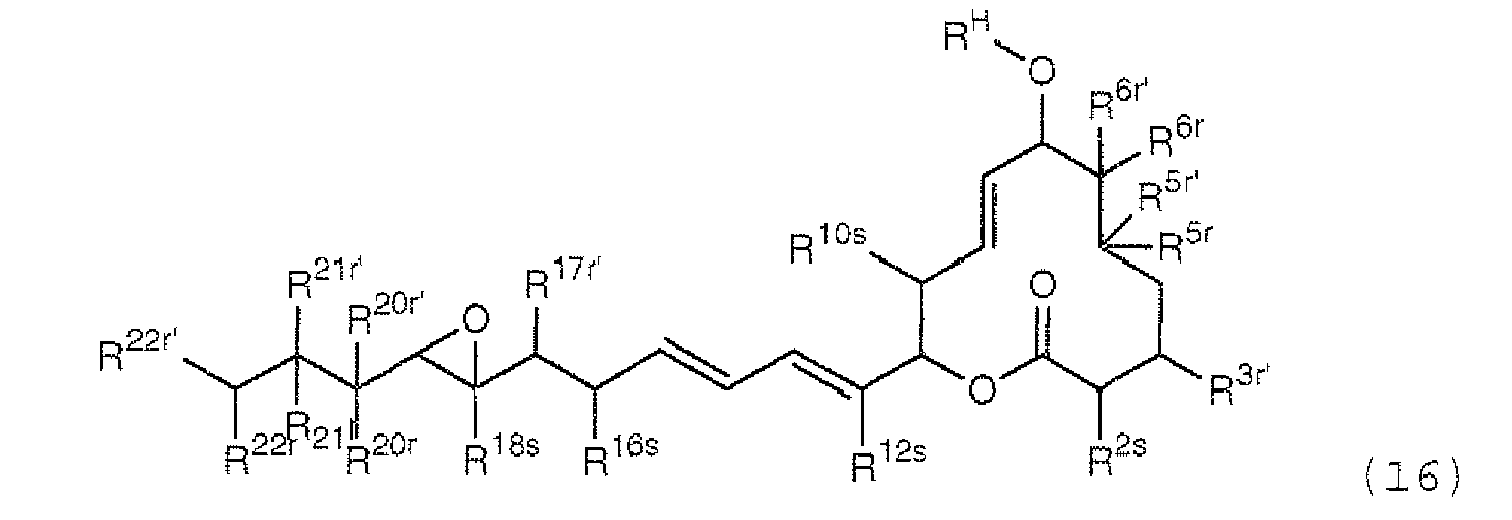
- A compound according to claim 1 represented by the formula (17), a pharmacologically acceptable salt thereof or a hydrate of them.
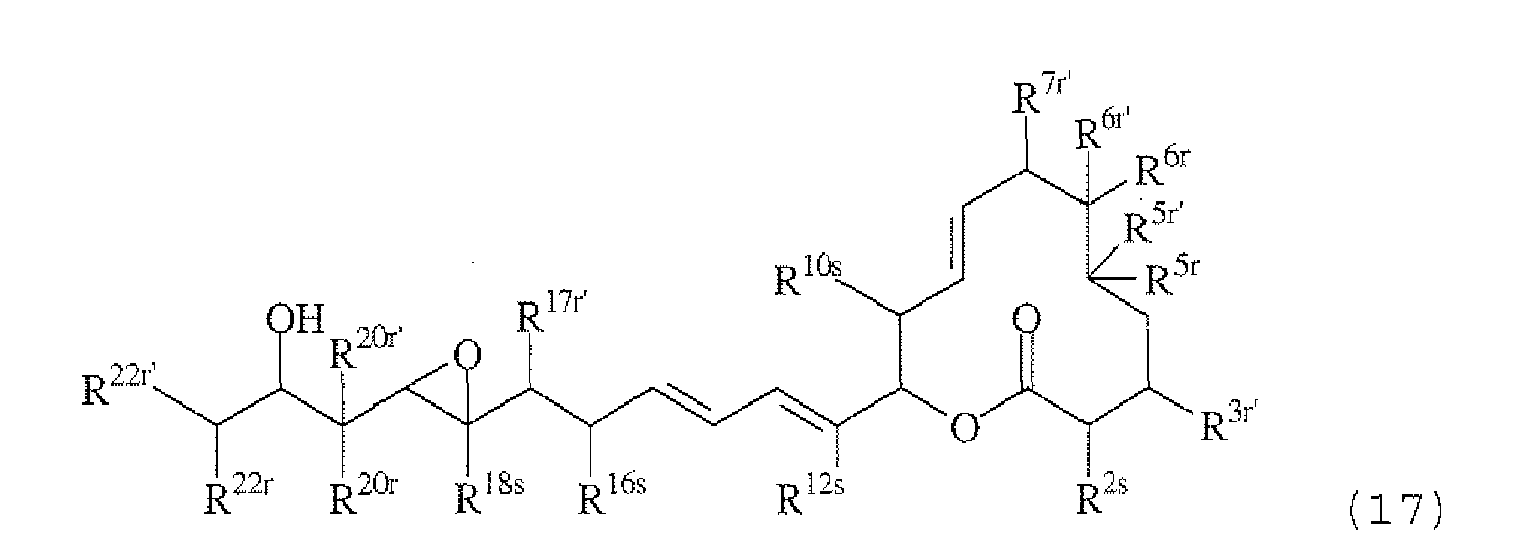
- A compound according to claim 1 represented by the formula (18), a pharmacologically acceptable salt thereof or a hydrate of them.

- A compound represented by the formula (18) of claim 12, a pharmacologically acceptable salt thereof or a hydrate of them, which is selected from the group of compounds consisting of, (1) a compound in which RAM is represented by


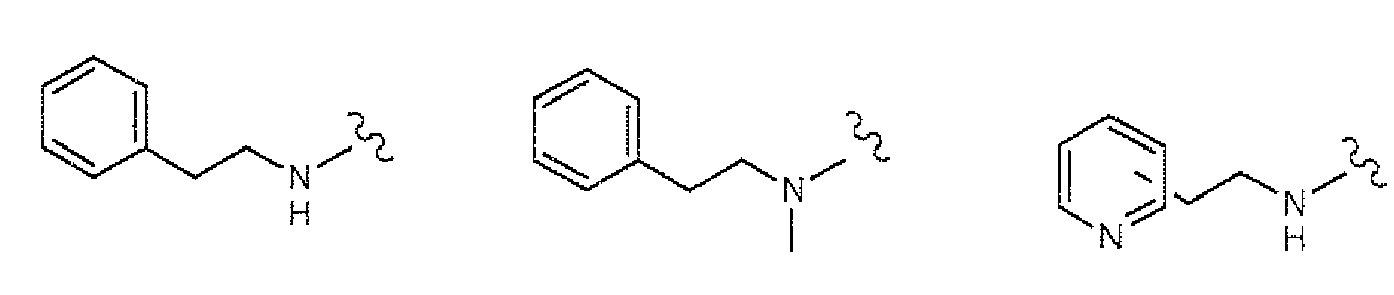


(3) a compound in which RAM is represented by

- A compound according to claim 1 represented by the formula (20), a pharmacologically acceptable salt thereof or a hydrate of them.

the substituent described here indicates the following.a) C1-C8 alkyl, C1-C8 alkoxy, C2-C8 acyl,b) fluoro, chloro, bromo, iodo,c) carboxylic acid, sulfonic acid, carboxylic acid ester, carboxamide which may optionally have substituents on nitrogen,d) nitro, amino, N-monosubstituted amino, N,N-disubstituted amino,e) a hydroxy group, mercaptane, C1-C8 alkylthio, C1-C8 alkylsulfoxide, C1-C8 alkylsulfone. - A compound according to claim 1 represented by the formula (21), a pharmacologically acceptable salt thereof or a hydrate of them.

- The compound according to claim 15, a pharmacologically acceptable salt thereof or a hydrate of them, wherein in the formula (21), R3", R6" and R17 are hydrogen; R7" is hydrogen or acetyl; R16 and R20 are the same as or different from each other and each represents hydrogen or hydroxy; R21a and R21b are bound together with oxygen, or either one of them represents hydroxy and the other is hydrogen; and R12 is methyl.
- The compound according to claim 15, a pharmacologically acceptable salt thereof or a hydrate of them, wherein in the formula (21), R3", R6" and R17 are hydrogen; R7" is acetyl; R16 and R17 are the same as or different from each other and each represents hydrogen or hydroxy; R21a and R21b are bound together with oxygen, or either one of them represents hydroxy and the other is hydrogen; and R12 represents methyl .
- The compound according to claim 15, or a pharmacologically acceptable salt thereof or a hydrate of them, which is selected from the group consisting of a compound in which R3", R6", R7", R17, R20 and R21a are hydrogen; R16 and R21b are hydroxy; and R12 is methyl,
a compound in which R3", R6", R7", R16, R17 and R21a are hydrogen ; R20 and R21b are hydroxy; and R12 is methyl,
a compound in which R3", R6", R7", R16, R17, R20 and R21a are hydrogen; R21b is hydroxy; and R12 is methyl,
a compound in which R3", R6", R16, R17 and R21a are hydrogen; R20 and R21b are hydroxy; R7" is acetyl; and R12 is methyl,
a compound in which R3", R6", R17, R20 and R21a are hydrogen; R16 and R21b are hydroxy; R7" is acetyl; and R12 is methyl,
a compound in which R3", R6", R16, R17 and R20 are hydrogen; R21a and R21b are bound together with oxygen; R7" is acetyl; and R12 is methyl, and
a compound in which R3", R6", R16, R17, R20 and R21a are hydrogen; R21b is hydroxy; R7" is acetyl; and R12 is methyl. - A medicament comprising at least one selected from compounds according to claims 1 to 18, a pharmacologically acceptable salt thereof or a hydrate of them an active ingredient.
- At least one compound selected from compounds according to claims 1 to 18 for use in a method of preventing or treating a disease against which gene expression control is efficacious, preventing or treating a diseases against which VEGF production suppressing action is efficacious, preventing or treating a disease against which an antiangiogenic effect is efficacious, treating hematoma, suppressing cancer metastasis, treating retina angiogenic disease, treating diabetic retinopathy, treating inflammatory disease, treating atherosclerosis, treating solid cancer or treating leukemia.
- At least one compound selected from compounds according to claims 1 to 18 for use as an antiangiogenic agent or an antitumor agent.
- The compound for use according to claim 20, wherein the inflammatory disease is osteoarthritis, rheumatoid arthritis, psoriasis or delayed hypersensitivity reaction.
- The compound for use according to claim 20, wherein the solid cancer is lung cancer, brain tumor, breast cancer, prostate cancer, ovarian cancer, colon cancer or melanoma.
- A production process of the compound according to any one of claims 1 to 18, a pharmacologically acceptable salt thereof or a hydrate of them, which comprises culturing Streptomyces sp. Mer. 11107, FERM P-18144 or its variant in a nutrient culture medium, collecting the compound according to any one of claims 1 to 18 from the culture solution, and carrying out various modification synthesis by using the obtained compounds as a starting material to obtain derivatives thereof.
Applications Claiming Priority (2)
| Application Number | Priority Date | Filing Date | Title |
|---|---|---|---|
| JP2001025458 | 2001-02-01 | ||
| EP02711280A EP1380579A4 (en) | 2001-02-01 | 2002-02-01 | NEW PHYSIOLOGICALLY ACTIVE SUBSTANCES |
Related Parent Applications (2)
| Application Number | Title | Priority Date | Filing Date |
|---|---|---|---|
| EP02711280.4 Division | 2002-02-01 | ||
| EP02711280A Division EP1380579A4 (en) | 2001-02-01 | 2002-02-01 | NEW PHYSIOLOGICALLY ACTIVE SUBSTANCES |
Publications (2)
| Publication Number | Publication Date |
|---|---|
| EP2292610A1 true EP2292610A1 (en) | 2011-03-09 |
| EP2292610B1 EP2292610B1 (en) | 2014-04-02 |
Family
ID=18890441
Family Applications (3)
| Application Number | Title | Priority Date | Filing Date |
|---|---|---|---|
| EP10182754A Withdrawn EP2277880A1 (en) | 2001-02-01 | 2002-02-01 | Macrolides with VEGF transcription suppression activity |
| EP10182752.5A Expired - Lifetime EP2292610B1 (en) | 2001-02-01 | 2002-02-01 | Macrolides with vegf transcription suppression activity |
| EP02711280A Withdrawn EP1380579A4 (en) | 2001-02-01 | 2002-02-01 | NEW PHYSIOLOGICALLY ACTIVE SUBSTANCES |
Family Applications Before (1)
| Application Number | Title | Priority Date | Filing Date |
|---|---|---|---|
| EP10182754A Withdrawn EP2277880A1 (en) | 2001-02-01 | 2002-02-01 | Macrolides with VEGF transcription suppression activity |
Family Applications After (1)
| Application Number | Title | Priority Date | Filing Date |
|---|---|---|---|
| EP02711280A Withdrawn EP1380579A4 (en) | 2001-02-01 | 2002-02-01 | NEW PHYSIOLOGICALLY ACTIVE SUBSTANCES |
Country Status (9)
| Country | Link |
|---|---|
| US (2) | US7026352B1 (en) |
| EP (3) | EP2277880A1 (en) |
| JP (1) | JP4439181B2 (en) |
| KR (2) | KR20090085163A (en) |
| CN (1) | CN1489583B (en) |
| CA (1) | CA2436667C (en) |
| ES (1) | ES2477240T3 (en) |
| TW (2) | TWI312681B (en) |
| WO (1) | WO2002060890A1 (en) |
Families Citing this family (41)
| Publication number | Priority date | Publication date | Assignee | Title |
|---|---|---|---|---|
| TWI312681B (en) | 2001-02-01 | 2009-08-01 | Novel physiologically active substance | |
| TWI334866B (en) * | 2002-05-29 | 2010-12-21 | Mercian Corp | Novel physiologically active substances |
| EP1541570A4 (en) | 2002-07-31 | 2008-05-21 | Mercian Corp | NEW PHYSIOLOGICALLY ACTIVE SUBSTANCE |
| WO2004011661A1 (en) | 2002-07-31 | 2004-02-05 | Mercian Corporation | Novel physiologically active substances |
| NZ540103A (en) | 2002-11-29 | 2007-05-31 | Mercian Corp | Process for producing macrolide compound |
| EP1608626A1 (en) | 2003-03-28 | 2005-12-28 | Cornell Research Foundation, Inc. | Migrastatin analog compositions and uses thereof |
| KR20060110865A (en) | 2003-11-27 | 2006-10-25 | 에자이 가부시키가이샤 | DNA involved in the hydroxylation of macrolide compounds |
| WO2005073223A1 (en) * | 2004-01-29 | 2005-08-11 | Eisai R & D Management Co., Ltd. | Method of stabilizing macrolide compound |
| ES2343843T3 (en) * | 2004-02-06 | 2010-08-11 | EISAI R&D MANAGEMENT CO., LTD. | PROCEDURE TO EXAMINE THE SENSITIVITY OF CANCER CELLS TO AN ANTI-TARGET AGENT. |
| JP5149001B2 (en) | 2004-05-25 | 2013-02-20 | スローン−ケッタリング・インスティテュート・フォー・キャンサー・リサーチ | Migrastatin analogues in the treatment of cancer |
| JP4599357B2 (en) * | 2004-07-20 | 2010-12-15 | エーザイ・アール・アンド・ディー・マネジメント株式会社 | DNA encoding a polypeptide involved in the biosynthesis of pladienolide |
| US8188141B2 (en) | 2004-09-23 | 2012-05-29 | Sloan-Kettering Institute For Cancer Research | Isomigrastatin analogs in the treatment of cancer |
| TW200716744A (en) * | 2005-05-26 | 2007-05-01 | Eisai R&D Man Co Ltd | Genetically modified microorganism and process for production of macrolide compound using the microorganism |
| WO2007110704A2 (en) * | 2005-09-28 | 2007-10-04 | Novimmune Sa | Macrolide compositions as therapeutic agent |
| WO2007043621A1 (en) | 2005-10-13 | 2007-04-19 | Eisai R & D Management Co., Ltd. | Total synthesis of pladienolide b and pladienolide d |
| JPWO2008016187A1 (en) | 2006-08-02 | 2009-12-24 | エーザイ・アール・アンド・ディー・マネジメント株式会社 | Pradienolides target molecule, compound binding to the target molecule, and screening method thereof |
| AU2007285215A1 (en) * | 2006-08-14 | 2008-02-21 | Eisai R & D Management Co., Ltd. | Stable lyophilized preparation |
| MX2009008068A (en) * | 2007-01-29 | 2009-11-18 | Eisai R&D Man Co Ltd | Solid of macrolide compound, method for production thereof, and pharmaceutical composition comprising the same. |
| JPWO2008111464A1 (en) | 2007-03-05 | 2010-06-24 | エーザイ・アール・アンド・ディー・マネジメント株式会社 | Anticancer drug action test method using splicing abnormality as an index |
| WO2008111466A1 (en) | 2007-03-05 | 2008-09-18 | Eisai R & D Management Co., Ltd. | Method for examination of activity of anti-cancer agent employing reduction in expression level of gene as measure |
| US20080312317A1 (en) * | 2007-04-12 | 2008-12-18 | Eisai R&D Management Co., Ltd. | 12 membered-ring macrolactam derivatives |
| CA2692644A1 (en) | 2007-07-06 | 2009-01-15 | Toshio Tsuchida | Method for producing macrolide compound and production intermediate therof |
| GB0821540D0 (en) * | 2008-11-25 | 2008-12-31 | Merlion Pharmaceuticals Pte Ltd | Lipopeptide compounds and their use |
| GB0821539D0 (en) * | 2008-11-25 | 2008-12-31 | Merlion Pharmaceuticals Pte Ltd | Therapeutic compounds and their use |
| WO2013148324A1 (en) | 2012-03-26 | 2013-10-03 | The Regents Of The University Of California | Anti-cancer polyketide compounds |
| WO2014027821A1 (en) * | 2012-08-14 | 2014-02-20 | 한국화학연구원 | Weed control composition comprising streptomyces scopuliridis kr-001 strains or culture medium thereof as active ingredient |
| CN103145740B (en) * | 2013-02-28 | 2014-10-22 | 大连理工大学 | A kind of sulfoxide alkaloid compound and its preparation method and application |
| AU2015259237B2 (en) * | 2014-05-15 | 2019-08-15 | Eisai R&D Management Co., Ltd. | Pladienolide pyridine compounds and methods of use |
| ES2887201T3 (en) | 2015-09-01 | 2021-12-22 | Eisai R&D Man Co Ltd | Splice variants associated with neomorphic mutants of SF3B1 |
| MX379655B (en) * | 2015-11-18 | 2025-03-11 | Eisai R&D Man Co Ltd | A SOLID STATE FORM OF PLADIENOLIDE PYRIDINE COMPOUNDS AND METHODS OF USE. |
| AU2018235940A1 (en) | 2017-03-15 | 2019-10-17 | Eisai R&D Management Co., Ltd. | Spliceosome mutations and uses thereof |
| KR20200083532A (en) | 2017-10-31 | 2020-07-08 | 에자이 알앤드디 매니지먼트 가부시키가이샤 | A combination and method of use comprising at least one spliceosome modulator and at least one inhibitor selected from BCL2 inhibitors, BCL2/BCLXL inhibitors and BCLXL inhibitors |
| TWI878153B (en) * | 2018-04-09 | 2025-03-21 | 日商衛材R&D企管股份有限公司 | Certain pladienolide compounds and methods of use |
| CN117285502A (en) | 2018-04-12 | 2023-12-26 | 卫材R&D管理有限公司 | Pladienolide derivatives as spliceosome targeting agents for the treatment of cancer |
| US12172986B2 (en) | 2018-06-01 | 2024-12-24 | Eisai R&D Management Co., Ltd | Splicing modulator antibody-drug conjugates and methods of use |
| US11998544B2 (en) | 2018-06-01 | 2024-06-04 | Eisai R&D Management Co., Ltd. | Methods of using splicing modulators |
| JP7334927B2 (en) * | 2019-03-12 | 2023-08-29 | 学校法人大阪医科薬科大学 | Anti-cancer agent |
| TW202233187A (en) | 2020-11-04 | 2022-09-01 | 日商衛材R&D企管股份有限公司 | Biomarkers for myelodysplastic syndrome (mds) and methods of using the same |
| WO2023131866A1 (en) | 2022-01-05 | 2023-07-13 | Eisai R&D Management Co., Ltd. | Biomarkers for myelodysplastic syndrome (mds) and methods of using the same |
| US20260062404A1 (en) | 2022-11-07 | 2026-03-05 | Eisai R&D Management Co., Ltd. | Method for producing macrolide compound |
| CN120500477A (en) * | 2022-12-01 | 2025-08-15 | 艾斯佩拉生物制药公司 | Chemical enzymatic synthesis of polyacetyl compounds |
Citations (2)
| Publication number | Priority date | Publication date | Assignee | Title |
|---|---|---|---|---|
| JPH04352783A (en) | 1991-05-27 | 1992-12-07 | Taisho Pharmaceut Co Ltd | 12-membered ring macrolide compound |
| WO2000075126A1 (en) * | 1999-06-03 | 2000-12-14 | The United States Of America, Represented By The Secretary, Department Of Health And Human Services | Mycolactone and related compounds, compositions and methods of use |
Family Cites Families (6)
| Publication number | Priority date | Publication date | Assignee | Title |
|---|---|---|---|---|
| US6562602B2 (en) * | 2000-08-03 | 2003-05-13 | Kosan Biosciences, Inc. | Fermentation and purification of mycolactones |
| TWI312681B (en) | 2001-02-01 | 2009-08-01 | Novel physiologically active substance | |
| TWI233361B (en) * | 2001-04-13 | 2005-06-01 | Gen Hospital Corp | Methods of preventing UVB-induced skin damage |
| TWI334866B (en) * | 2002-05-29 | 2010-12-21 | Mercian Corp | Novel physiologically active substances |
| WO2004011661A1 (en) * | 2002-07-31 | 2004-02-05 | Mercian Corporation | Novel physiologically active substances |
| WO2007043621A1 (en) * | 2005-10-13 | 2007-04-19 | Eisai R & D Management Co., Ltd. | Total synthesis of pladienolide b and pladienolide d |
-
2002
- 2002-01-31 TW TW096138445A patent/TWI312681B/en active
- 2002-01-31 TW TW091101678A patent/TWI311558B/en active
- 2002-02-01 EP EP10182754A patent/EP2277880A1/en not_active Withdrawn
- 2002-02-01 CN CN028041879A patent/CN1489583B/en not_active Expired - Fee Related
- 2002-02-01 ES ES10182752.5T patent/ES2477240T3/en not_active Expired - Lifetime
- 2002-02-01 WO PCT/JP2002/000848 patent/WO2002060890A1/en not_active Ceased
- 2002-02-01 JP JP2002561040A patent/JP4439181B2/en not_active Expired - Fee Related
- 2002-02-01 EP EP10182752.5A patent/EP2292610B1/en not_active Expired - Lifetime
- 2002-02-01 EP EP02711280A patent/EP1380579A4/en not_active Withdrawn
- 2002-02-01 KR KR1020097015521A patent/KR20090085163A/en not_active Ceased
- 2002-02-01 US US10/470,806 patent/US7026352B1/en not_active Expired - Lifetime
- 2002-02-01 KR KR1020037009709A patent/KR101115364B1/en not_active Expired - Fee Related
- 2002-02-01 CA CA2436667A patent/CA2436667C/en not_active Expired - Fee Related
-
2005
- 2005-08-30 US US11/213,962 patent/US7667052B2/en not_active Expired - Lifetime
Patent Citations (2)
| Publication number | Priority date | Publication date | Assignee | Title |
|---|---|---|---|---|
| JPH04352783A (en) | 1991-05-27 | 1992-12-07 | Taisho Pharmaceut Co Ltd | 12-membered ring macrolide compound |
| WO2000075126A1 (en) * | 1999-06-03 | 2000-12-14 | The United States Of America, Represented By The Secretary, Department Of Health And Human Services | Mycolactone and related compounds, compositions and methods of use |
Non-Patent Citations (10)
| Title |
|---|
| BESTMAN H J ET AL: "NEUE SYNTHESE MAKROCYCLISCHER LACTONE", ANGEWANDTE CHEMIE, WILEY - V C H VERLAG GMBH & CO. KGAA, WEINHEIM, DE, vol. 95, no. 10, 1 January 1983 (1983-01-01), pages 810/811, XP002951019, ISSN: 0044-8249 * |
| BESTMAN H J ET AL: "SYNTHESEN (E)-ALPHA,BETA-UNGESAETTIGTER MACROCYCLISCHER LACTONE DURCH INTRAMOLEKULARE WITTIG-OLEFINIERUNG VIA TRIPHENYLPHOSPHORANYLIDENKETE N//SYNTHESES OF (E)-ALPHA,BETA-UNSATURATED MACROCYCLIC LACTONES BY INTRAMOLECULAR WITTIG-OLEFINATION VIA TRIPHENYLP", SYNTHESIS, GEORG THIEME VERLAG, STUTTGART, DE, 1 June 1989 (1989-06-01), pages 419 - 423, XP002951018, ISSN: 0039-7881, DOI: 10.1055/S-1989-27271 * |
| FUERSTNER A ET AL: "EFFICIENT TOTAL SYNTHESES OF RESIN GLYCOSIDES AND ANALOGUES BY RING-CLOSING OLEFIN METATHESIS", JOURNAL OF THE AMERICAN CHEMICAL SOCIETY, AMERICAN CHEMICAL SOCIETY, US, vol. 121, no. 34, 1 January 1999 (1999-01-01), pages 7814 - 7821, XP002951020, ISSN: 0002-7863, DOI: 10.1021/JA991361L * |
| GUNAWARDANA G ET AL: "CHARACTERIZATION OF NOVEL MACROLIDE TOXINS, MYCOLACTONES A AND B, FROM A HUMAN PATHOGEN, MYCOBACTERIUM ULCERANS", JOURNAL OF THE AMERICAN CHEMICAL SOCIETY, AMERICAN CHEMICAL SOCIETY, US, vol. 121, no. 25, 1 January 1999 (1999-01-01), XP002951022, ISSN: 0002-7863, DOI: 10.1021/JA990017L * |
| HAMBERG ET AL: "Fatty acid allene oxides II. Formation of two macrolactones from 12,13(S)-epoxy-9(Z),11-octadecadienoic acid", CHEMISTRY AND PHYSICS OF LIPIDS, LIMERICK, IR, vol. 46, no. 4, 1 April 1988 (1988-04-01), pages 235 - 243, XP023390255, ISSN: 0009-3084, [retrieved on 19880401], DOI: 10.1016/0009-3084(88)90037-0 * |
| HAMBERG M: "NEW CYCLOPENTENONE FATTY ACIDS FORMED FROM LINOLEIC AND LINOLENIC ACIDS IN POTATO", LIPIDS, SPRINGER, US, vol. 35, no. 4, 1 January 2000 (2000-01-01), pages 353 - 363, XP002951024, ISSN: 0024-4201, DOI: 10.1007/S11745-000-532-Z * |
| KOBAYASHI J ET AL: "Amphidinolide Q, a novel 12-membered macrolide from the cultured marine dinoflagellate Amphidinium sp", TETRAHEDRON LETTERS, ELSEVIER, AMSTERDAM, NL, vol. 37, no. 9, 26 February 1996 (1996-02-26), pages 1449 - 1450, XP004705238, ISSN: 0040-4039, DOI: 10.1016/0040-4039(96)00029-9 * |
| ROHR J: "A NEW ROLE FOR POLYKETIDES", ANGEWANDTE CHEMIE. INTERNATIONAL EDITION, WILEY VCH VERLAG, WEINHEIM, vol. 39, no. 16, 1 January 2000 (2000-01-01), pages 2847 - 2849, XP002951023, ISSN: 1433-7851, DOI: 10.1002/1521-3773(20000818)39:16<2847::AID-ANIE2847>3.0.CO;2-0 * |
| SEKI-ASANO M ET AL: "ISOLATION AND CHARACTERIZATION OF A NEW 12-MEMBERED MACROLIDE FD-895", JOURNAL OF ANTIBIOTICS, JAPAN ANTIBIOTICS RESEARCH ASSOCIATION, TOKYO, JP, vol. 47, no. 12, 1 December 1994 (1994-12-01), pages 1395 - 1401, XP002951021, ISSN: 0021-8820 * |
| SEKI-ASANO M. ET AL., J. ANTIBIOTICS, vol. 47, 1994, pages 1395 - 1401 |
Also Published As
| Publication number | Publication date |
|---|---|
| WO2002060890A1 (en) | 2002-08-08 |
| EP1380579A4 (en) | 2005-09-14 |
| CA2436667C (en) | 2010-03-30 |
| JP4439181B2 (en) | 2010-03-24 |
| JPWO2002060890A1 (en) | 2004-06-03 |
| ES2477240T3 (en) | 2014-07-16 |
| EP1380579A1 (en) | 2004-01-14 |
| TWI312681B (en) | 2009-08-01 |
| EP2277880A1 (en) | 2011-01-26 |
| US7667052B2 (en) | 2010-02-23 |
| KR20030070131A (en) | 2003-08-27 |
| EP2292610B1 (en) | 2014-04-02 |
| KR101115364B1 (en) | 2012-04-12 |
| US7026352B1 (en) | 2006-04-11 |
| US20060079572A1 (en) | 2006-04-13 |
| CA2436667A1 (en) | 2002-08-08 |
| TW200814997A (en) | 2008-04-01 |
| CN1489583A (en) | 2004-04-14 |
| CN1489583B (en) | 2011-03-30 |
| KR20090085163A (en) | 2009-08-06 |
| TWI311558B (en) | 2009-07-01 |
Similar Documents
| Publication | Publication Date | Title |
|---|---|---|
| EP2292610B1 (en) | Macrolides with vegf transcription suppression activity | |
| EP2266978B1 (en) | Novel physiologically active substances | |
| KR101285695B1 (en) | Novel physiologically active substances | |
| KR101835253B1 (en) | Synthesis of resorcylic acid lactones useful as therapeutic agents | |
| HK1150309A (en) | Novel physiologically active substances | |
| HK1074839A (en) | Novel physiolgically active substances | |
| HK1076839A (en) | Novel physiologically active substances |
Legal Events
| Date | Code | Title | Description |
|---|---|---|---|
| PUAI | Public reference made under article 153(3) epc to a published international application that has entered the european phase |
Free format text: ORIGINAL CODE: 0009012 |
|
| AC | Divisional application: reference to earlier application |
Ref document number: 1380579 Country of ref document: EP Kind code of ref document: P |
|
| AK | Designated contracting states |
Kind code of ref document: A1 Designated state(s): AT BE CH CY DE DK ES FI FR GB GR IE IT LI LU MC NL PT SE TR |
|
| RIN1 | Information on inventor provided before grant (corrected) |
Inventor name: NORIHISA, KOJI Inventor name: SAMESHIMA, TOMOHIRO Inventor name: NIIJIMA, JUN Inventor name: OKUDA, AKIFUMI Inventor name: YAMORI, TAKAO Inventor name: DOBASHI, KAZUYUKI Inventor name: UENAKA, TOSHIMITSU Inventor name: KOMEDA, KEISUKE Inventor name: TAKEDA, SUSUMU Inventor name: FUJITA, MASANORI Inventor name: IWATA, MASAO Inventor name: SAKAI, TAKASHI Inventor name: NAKASHIMA, TAKASHI Inventor name: TSUCHIDA, TOSHIO Inventor name: YOSHIDA, MASASHI Inventor name: KOTAKE, YOSHIHIKO Inventor name: ASAI, NAOKI Inventor name: YAMADA, TOMONARI Inventor name: NAGAI, MITSUO Inventor name: MATSUFUJI, MOTOKO Inventor name: MIZUI, YOSHIHARU Inventor name: KISHI, KUMIKO Inventor name: OKAMOTO, KIYOSHI Inventor name: YAMAMOTO, SATOSHI Inventor name: KAWAMURA, NAOTO |
|
| RIN1 | Information on inventor provided before grant (corrected) |
Inventor name: YAMADA, TOMONARI Inventor name: ASAI, NAOKI Inventor name: KOTAKE, YOSHIHIKO Inventor name: NAGAI, MITSUO Inventor name: MIZUI, YOSHIHARU Inventor name: UENAKA, TOSHIMITSU Inventor name: NIIJIMA, JUN Inventor name: OKAMOTO, KIYOSHI Inventor name: OKUDA, AKIFUMI Inventor name: KAWAMURA, NAOTO Inventor name: TSUCHIDA, TOSHIO Inventor name: KOMEDA, KEISUKE Inventor name: YAMORI, TAKAO Inventor name: NAKASHIMA, TAKASHI Inventor name: KISHI, KUMIKO Inventor name: TAKEDA, SUSUMU Inventor name: MATSUFUJI, MOTOKO Inventor name: NORIHISA, KOJI Inventor name: DOBASHI, KAZUYUKI Inventor name: SAMESHIMA, TOMOHIRO Inventor name: FUJITA, MASANORI Inventor name: YAMAMOTO, SATOSHI Inventor name: YOSHIDA, MASASHI Inventor name: IWATA, MASAO Inventor name: SAKAI, TAKASHI |
|
| 17P | Request for examination filed |
Effective date: 20110822 |
|
| 17Q | First examination report despatched |
Effective date: 20111018 |
|
| RAP1 | Party data changed (applicant data changed or rights of an application transferred) |
Owner name: MICROBIOPHARM JAPAN CO., LTD. Owner name: EISAI R&D MANAGEMENT CO., LTD. |
|
| GRAP | Despatch of communication of intention to grant a patent |
Free format text: ORIGINAL CODE: EPIDOSNIGR1 |
|
| RIC1 | Information provided on ipc code assigned before grant |
Ipc: A61P 35/00 20060101ALI20130903BHEP Ipc: A61K 31/5377 20060101ALI20130903BHEP Ipc: C07D 493/08 20060101ALI20130903BHEP Ipc: C07D 407/06 20060101ALI20130903BHEP Ipc: C07D 313/00 20060101AFI20130903BHEP Ipc: A61K 31/4025 20060101ALI20130903BHEP Ipc: A61K 31/4427 20060101ALI20130903BHEP Ipc: A61K 31/74 20060101ALI20130903BHEP Ipc: C07D 493/04 20060101ALI20130903BHEP Ipc: A61K 31/496 20060101ALI20130903BHEP Ipc: A61K 31/4523 20060101ALI20130903BHEP Ipc: C07D 407/14 20060101ALI20130903BHEP Ipc: C12P 17/02 20060101ALI20130903BHEP Ipc: C07D 493/10 20060101ALI20130903BHEP Ipc: C07D 405/14 20060101ALI20130903BHEP Ipc: A61K 31/455 20060101ALI20130903BHEP Ipc: A61K 31/335 20060101ALI20130903BHEP Ipc: A61K 31/336 20060101ALI20130903BHEP |
|
| INTG | Intention to grant announced |
Effective date: 20130924 |
|
| GRAS | Grant fee paid |
Free format text: ORIGINAL CODE: EPIDOSNIGR3 |
|
| RAP1 | Party data changed (applicant data changed or rights of an application transferred) |
Owner name: EISAI R&D MANAGEMENT CO., LTD. |
|
| GRAA | (expected) grant |
Free format text: ORIGINAL CODE: 0009210 |
|
| AC | Divisional application: reference to earlier application |
Ref document number: 1380579 Country of ref document: EP Kind code of ref document: P |
|
| AK | Designated contracting states |
Kind code of ref document: B1 Designated state(s): AT BE CH CY DE DK ES FI FR GB GR IE IT LI LU MC NL PT SE TR |
|
| REG | Reference to a national code |
Ref country code: GB Ref legal event code: FG4D |
|
| REG | Reference to a national code |
Ref country code: CH Ref legal event code: EP Ref country code: AT Ref legal event code: REF Ref document number: 660044 Country of ref document: AT Kind code of ref document: T Effective date: 20140415 |
|
| REG | Reference to a national code |
Ref country code: IE Ref legal event code: FG4D |
|
| REG | Reference to a national code |
Ref country code: DE Ref legal event code: R096 Ref document number: 60246158 Country of ref document: DE Effective date: 20140515 |
|
| REG | Reference to a national code |
Ref country code: NL Ref legal event code: T3 Ref country code: ES Ref legal event code: FG2A Ref document number: 2477240 Country of ref document: ES Kind code of ref document: T3 Effective date: 20140716 |
|
| REG | Reference to a national code |
Ref country code: SE Ref legal event code: TRGR |
|
| REG | Reference to a national code |
Ref country code: AT Ref legal event code: MK05 Ref document number: 660044 Country of ref document: AT Kind code of ref document: T Effective date: 20140402 |
|
| PG25 | Lapsed in a contracting state [announced via postgrant information from national office to epo] |
Ref country code: GR Free format text: LAPSE BECAUSE OF FAILURE TO SUBMIT A TRANSLATION OF THE DESCRIPTION OR TO PAY THE FEE WITHIN THE PRESCRIBED TIME-LIMIT Effective date: 20140703 Ref country code: CY Free format text: LAPSE BECAUSE OF FAILURE TO SUBMIT A TRANSLATION OF THE DESCRIPTION OR TO PAY THE FEE WITHIN THE PRESCRIBED TIME-LIMIT Effective date: 20140402 Ref country code: FI Free format text: LAPSE BECAUSE OF FAILURE TO SUBMIT A TRANSLATION OF THE DESCRIPTION OR TO PAY THE FEE WITHIN THE PRESCRIBED TIME-LIMIT Effective date: 20140402 |
|
| PG25 | Lapsed in a contracting state [announced via postgrant information from national office to epo] |
Ref country code: AT Free format text: LAPSE BECAUSE OF FAILURE TO SUBMIT A TRANSLATION OF THE DESCRIPTION OR TO PAY THE FEE WITHIN THE PRESCRIBED TIME-LIMIT Effective date: 20140402 |
|
| PG25 | Lapsed in a contracting state [announced via postgrant information from national office to epo] |
Ref country code: PT Free format text: LAPSE BECAUSE OF FAILURE TO SUBMIT A TRANSLATION OF THE DESCRIPTION OR TO PAY THE FEE WITHIN THE PRESCRIBED TIME-LIMIT Effective date: 20140804 |
|
| REG | Reference to a national code |
Ref country code: DE Ref legal event code: R097 Ref document number: 60246158 Country of ref document: DE |
|
| PG25 | Lapsed in a contracting state [announced via postgrant information from national office to epo] |
Ref country code: DK Free format text: LAPSE BECAUSE OF FAILURE TO SUBMIT A TRANSLATION OF THE DESCRIPTION OR TO PAY THE FEE WITHIN THE PRESCRIBED TIME-LIMIT Effective date: 20140402 Ref country code: BE Free format text: LAPSE BECAUSE OF FAILURE TO SUBMIT A TRANSLATION OF THE DESCRIPTION OR TO PAY THE FEE WITHIN THE PRESCRIBED TIME-LIMIT Effective date: 20140402 |
|
| PLBE | No opposition filed within time limit |
Free format text: ORIGINAL CODE: 0009261 |
|
| STAA | Information on the status of an ep patent application or granted ep patent |
Free format text: STATUS: NO OPPOSITION FILED WITHIN TIME LIMIT |
|
| 26N | No opposition filed |
Effective date: 20150106 |
|
| REG | Reference to a national code |
Ref country code: DE Ref legal event code: R097 Ref document number: 60246158 Country of ref document: DE Effective date: 20150106 |
|
| PG25 | Lapsed in a contracting state [announced via postgrant information from national office to epo] |
Ref country code: LU Free format text: LAPSE BECAUSE OF FAILURE TO SUBMIT A TRANSLATION OF THE DESCRIPTION OR TO PAY THE FEE WITHIN THE PRESCRIBED TIME-LIMIT Effective date: 20150201 |
|
| PG25 | Lapsed in a contracting state [announced via postgrant information from national office to epo] |
Ref country code: MC Free format text: LAPSE BECAUSE OF FAILURE TO SUBMIT A TRANSLATION OF THE DESCRIPTION OR TO PAY THE FEE WITHIN THE PRESCRIBED TIME-LIMIT Effective date: 20140402 |
|
| REG | Reference to a national code |
Ref country code: IE Ref legal event code: MM4A |
|
| PG25 | Lapsed in a contracting state [announced via postgrant information from national office to epo] |
Ref country code: IE Free format text: LAPSE BECAUSE OF NON-PAYMENT OF DUE FEES Effective date: 20150201 |
|
| REG | Reference to a national code |
Ref country code: FR Ref legal event code: PLFP Year of fee payment: 15 |
|
| REG | Reference to a national code |
Ref country code: FR Ref legal event code: PLFP Year of fee payment: 16 |
|
| PG25 | Lapsed in a contracting state [announced via postgrant information from national office to epo] |
Ref country code: TR Free format text: LAPSE BECAUSE OF FAILURE TO SUBMIT A TRANSLATION OF THE DESCRIPTION OR TO PAY THE FEE WITHIN THE PRESCRIBED TIME-LIMIT Effective date: 20140402 |
|
| REG | Reference to a national code |
Ref country code: FR Ref legal event code: PLFP Year of fee payment: 17 |
|
| PGFP | Annual fee paid to national office [announced via postgrant information from national office to epo] |
Ref country code: FR Payment date: 20210225 Year of fee payment: 20 Ref country code: IT Payment date: 20210222 Year of fee payment: 20 Ref country code: CH Payment date: 20210217 Year of fee payment: 20 Ref country code: NL Payment date: 20210217 Year of fee payment: 20 |
|
| PGFP | Annual fee paid to national office [announced via postgrant information from national office to epo] |
Ref country code: DE Payment date: 20210217 Year of fee payment: 20 Ref country code: GB Payment date: 20210219 Year of fee payment: 20 Ref country code: SE Payment date: 20210217 Year of fee payment: 20 |
|
| PGFP | Annual fee paid to national office [announced via postgrant information from national office to epo] |
Ref country code: ES Payment date: 20210422 Year of fee payment: 20 |
|
| REG | Reference to a national code |
Ref country code: DE Ref legal event code: R071 Ref document number: 60246158 Country of ref document: DE |
|
| REG | Reference to a national code |
Ref country code: NL Ref legal event code: MK Effective date: 20220131 |
|
| REG | Reference to a national code |
Ref country code: CH Ref legal event code: PL |
|
| REG | Reference to a national code |
Ref country code: GB Ref legal event code: PE20 Expiry date: 20220131 |
|
| REG | Reference to a national code |
Ref country code: SE Ref legal event code: EUG |
|
| PG25 | Lapsed in a contracting state [announced via postgrant information from national office to epo] |
Ref country code: GB Free format text: LAPSE BECAUSE OF EXPIRATION OF PROTECTION Effective date: 20220131 |
|
| REG | Reference to a national code |
Ref country code: ES Ref legal event code: FD2A Effective date: 20220526 |
|
| PG25 | Lapsed in a contracting state [announced via postgrant information from national office to epo] |
Ref country code: ES Free format text: LAPSE BECAUSE OF EXPIRATION OF PROTECTION Effective date: 20220202 |