EP2290872A1 - Device for generating a message authentication code for authenticating a message - Google Patents
Device for generating a message authentication code for authenticating a message Download PDFInfo
- Publication number
- EP2290872A1 EP2290872A1 EP09168875A EP09168875A EP2290872A1 EP 2290872 A1 EP2290872 A1 EP 2290872A1 EP 09168875 A EP09168875 A EP 09168875A EP 09168875 A EP09168875 A EP 09168875A EP 2290872 A1 EP2290872 A1 EP 2290872A1
- Authority
- EP
- European Patent Office
- Prior art keywords
- message
- key
- block
- authentication code
- generating
- Prior art date
- Legal status (The legal status is an assumption and is not a legal conclusion. Google has not performed a legal analysis and makes no representation as to the accuracy of the status listed.)
- Granted
Links
Images

Classifications
-
- H—ELECTRICITY
- H04—ELECTRIC COMMUNICATION TECHNIQUE
- H04L—TRANSMISSION OF DIGITAL INFORMATION, e.g. TELEGRAPHIC COMMUNICATION
- H04L9/00—Cryptographic mechanisms or cryptographic arrangements for secret or secure communications; Network security protocols
- H04L9/002—Countermeasures against attacks on cryptographic mechanisms
- H04L9/003—Countermeasures against attacks on cryptographic mechanisms for power analysis, e.g. differential power analysis [DPA] or simple power analysis [SPA]
-
- H—ELECTRICITY
- H04—ELECTRIC COMMUNICATION TECHNIQUE
- H04L—TRANSMISSION OF DIGITAL INFORMATION, e.g. TELEGRAPHIC COMMUNICATION
- H04L9/00—Cryptographic mechanisms or cryptographic arrangements for secret or secure communications; Network security protocols
- H04L9/06—Cryptographic mechanisms or cryptographic arrangements for secret or secure communications; Network security protocols the encryption apparatus using shift registers or memories for block-wise or stream coding, e.g. DES systems or RC4; Hash functions; Pseudorandom sequence generators
- H04L9/0643—Hash functions, e.g. MD5, SHA, HMAC or f9 MAC
-
- H—ELECTRICITY
- H04—ELECTRIC COMMUNICATION TECHNIQUE
- H04L—TRANSMISSION OF DIGITAL INFORMATION, e.g. TELEGRAPHIC COMMUNICATION
- H04L2209/00—Additional information or applications relating to cryptographic mechanisms or cryptographic arrangements for secret or secure communication H04L9/00
- H04L2209/80—Wireless
- H04L2209/805—Lightweight hardware, e.g. radio-frequency identification [RFID] or sensor
Definitions
- the invention relates to a device for generating a message authentication code for authenticating a message. Furthermore, the invention relates to a system for generating a message authentication code for authenticating a message. Moreover, the invention relates to a smart card. Furthermore, the invention relates to a method for a generating a message authentication code for authenticating a message. Beyond this, the invention relates to a program element. Furthermore, the invention relates to a computer-readable medium.
- MAC message authentication codes
- the MAC on a message is constructed by splitting it into blocks of size equal to the blocksize of the underlying cipher (e.g. 128 bits in the case of AES), CBC-encrypting the message (with padding in the last block if required), and retaining (all or part of) the result of the last block encryption as the computed MAC value.
- the computed MAC may be truncated by retaining the required number of most significant bits.
- a MAC algorithm sometimes called a keyed (cryptographic) hash function, accepts as input a secret key and an arbitrary-length message to be authenticated, and outputs a MAC (sometimes known as a tag).
- the MAC value protects both a message's data integrity as well as its authenticity, by allowing verifiers (who also possess the secret key) to detect any changes to the message content.
- Differential power analysis is a form of side channel attack in which the attacker studies the power consumption of a cryptographic hardware device (such as a smart card, tamper-resistant "black box", or integrated circuit).
- the attack can non-invasively extract cryptographic keys and other secret information from the device.
- some MAC construction algorithms may re-encrypt the last block of the message with a further key. Nevertheless, such an encrypted message authentication code remains vulnerable to DPA attacks since the first-block-input and last-block-output vectors are still visible.
- the object of the invention is achieved by a device, a system, a smart card, a method, a program element and a computer-readable medium according to the independent claims.
- a device for generating a message authentication code for authenticating a message wherein the message is divided in blocks with a specified block length, wherein the device comprises a generating unit for generating the message authentication code based on a message by using a block cipher algorithm, and an encrypting unit for performing an exclusive disjunction on the last block with a first key and for performing an exclusive disjunction on the first and/or the last block additionally with a second key for generating the message authentication code.
- a system for generating a message authentication code for authenticating a message wherein the message is divided in blocks with a specified block length, wherein the system comprises a sender and a receiver, wherein the sender and the receiver comprise a device with the above mentioned features, respectively.
- a smart card comprising a device with the above mentioned features.
- a method for generating a message authentication code for authenticating a message comprising generating the message authentication code based on a message by using a block cipher algorithm, performing an exclusive disjunction on the last block with a first key, and performing an exclusive disjunction on the first and/or the last block additionally with a second key for generating the message authentication code.
- a program element for instance a software routine, in source code or in executable code, for instance a downloadable program
- a processor when being executed by a processor, is adapted to control or carry out a method having the above mentioned features.
- a computer-readable medium for instance a CD, a DVD, a USB stick, a floppy disk or a harddisk
- a computer program is stored which, when being executed by a processor, is adapted to control or carry out a method having the above mentioned features.
- Data processing which may be performed according to embodiments of the invention can be realized by a computer program, that is by software, or by using one or more special electronic optimization circuits, that is in hardware, or in hybrid form, that is by means of software components and hardware components.
- block cipher algorithm may denote an algorithm using a block cipher.
- a block cipher is a symmetric key cipher operating on fixed-length groups of bits, termed blocks, with an unvarying transformation.
- a block cipher encryption algorithm might take (for example) a 128-bit block of plaintext as input, and output a corresponding 128-bit block of ciphertext.
- the generating unit and the encrypting unit may be formed as a single unit and/or on a single chip.
- exclusive disjunction may denote also an exclusive-ORing or XOR-function on the different blocks.
- the encrypting unit may perform with one or more additional keys an XORing of these keys with the relevant data vector, and the linearity of this XOR step may provide a protection against DPA.
- the first key may also be a pair of keys, wherein only one of the pair of keys may be used respectively.
- the message authentication code may be used for authenticating a message sent from a sender to a receiver.
- the sender may generate the message authentication code based on the message and the first and the second key and send this code together with the message to the receiver.
- the receiver may receive the message together with the code and generate a code based on the message and the first and the second key itself. Subsequently, the receiver may compare the received message authentication code with the self-generated message authentication code and authenticate in this way the received message.
- the term "sender” may denote a transponder or any similar device and the term “receiver” may denote for example a communication partner for the responder.
- smart card may denote also a chip card or integrated circuit card.
- the block cipher algorithm may be a message authentication code algorithm.
- a message authentication code (often MAC) is a short piece of information used to authenticate a message.
- a MAC algorithm sometimes called a keyed (cryptographic) hash function, accepts as input a secret key and an arbitrary-length message to be authenticated, and outputs a MAC (sometimes known as a tag).
- the MAC value protects both a message's data integrity as well as its authenticity, by allowing verifiers (who also possess the secret key) to detect any changes to the message content.
- MACs differ from digital signatures, as MAC values are both generated and verified using the same secret key. This implies that the sender and receiver of a message must agree on keys before initiating communications, as is the case with symmetric encryption.
- the encrypting unit may be adapted for using a first second key for the first block and a second second key for the last block.
- the first and second second keys may also be called first additional key and second additional key.
- the second key may depend on the first key. Either or both of the second keys, that means the first and the second second key may depend on the first key.
- the second key may be any computable function of the first key.
- a function is an abstract entity that associates an input, here the first key, to a corresponding output, here the second key, according to some rule.
- the second key may exchangeable between the device and a communication partner.
- the device may be a transponder and the communication partner may be a corresponding receiver.
- the second key may be known to the device and to the communication partner prior to the generation of the message authentication code.
- Embodiments of the invention are related to transponders, in particular smart cards and RFID tags.
- transponders in particular smart cards and RFID tags.
- this description makes reference primarily to smart cards, although for one skilled in the art it is clear that embodiments of the invention equally relate to RFID tags and transponders in general, as well as to devices in general which communicate over a wired or wireless connection.
- the NIST National Institute of Standards and Technology recommend a method for construction of message authentication codes (MACs) using a block cipher known as cipher-based MAC (CMAC).
- MACs message authentication codes
- CMAC cipher-based MAC
- the MAC on a message is constructed by splitting it into blocks of size equal to the blocksize of the underlying cipher (e.g. 128 bits in the case of Advanced Encryption Standard (AES)), CBC (cipher block chaining)-encrypting the message (with padding in the last block if required), and retaining (all or part of) the result of the last block encryption as the computed MAC value.
- AES Advanced Encryption Standard
- CBC cipher block chaining
- the standard dictates that the computed MAC should be truncated by retaining the required number of most significant bits.
- Fig. 4 shows the principles of MAC construction according to this standard. Special attention should be paid to the operations of "subkey insertion" on the last block.
- the subkeys K1 or K2 are secret constants, derived from the encryption of a constant vector under the MAC key in use, which are additionally XORed with the input to the final block operation.
- the objective of making the last block operation different from all others is to prevent simple "MAC-chaining" attacks which become possible in the absence of "special last blocks".
- an attacker can concatenate in an arbitrary fashion suitably modified MAC'd messages he has previously seen computed under the same MAC key, for example within a communication session. With this measure, since derivation of the subkey requires knowledge of the MAC key, an attacker is no longer able to chain messages when only the last block operation includes this constant which is unknown to him.
- DPA Differential Power Analysis attacks operate by testing a hypothesis about (part of) a cryptographic key; such a hypothesis is tested by correlating power trace measurements of a device when using the key being attacked against its expected internal signals under the assumption that the hypothesis is correct. With the correct hypothesis, large increases in computed correlation can be observed compared to the cases where the hypothesis is incorrect. Typically, such attacks require a large number of power traces (of the order of 10 6 , although the exact number is implementation-dependent).
- the attacker In order to perform DPA attacks, the attacker needs to be able to convert his hypothesis about part of the key into some expectation about the internal signal he is correlating against the power trace.
- a complete DPA attack to recover a key is usually a multi-stage process; the attacker gathers a large number of power traces with known input or output data as described above. These same traces are used a number of times to test hypotheses about different parts of the cipher key in use, enabling the attacker to derive all or most of the key bits.
- the input to the first block operation is wholly known; the inputs to subsequent blocks are not known due to the block chaining.
- the output of only the last block is known (unless the MAC is truncated, in which case the last block output is only partly known), since it is the MAC result itself.
- the block operation can be thought of as a "final block"; a subkey is used, so the input to the block operation is not known, in this case because of the effect of the XORing of a CMAC subkey value not known to an attacker.
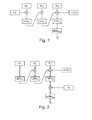
- a principle of generating a MAC is shown in Fig. 1 , which prevents DPA-attacks on the visible first-block-input vector.
- a subkey which may be a value similar to K1/K2 as specified by CMAC, but next to this also a completely independent shared secret of block length size can possibly be used, obscures the data vector required by an attacker to mount a DPA attack.
- a subkey value K3 is added by XORing it with the input to the first block operation.
- An alternative mechanism which can be used to protect the visible first-block-input against DPA attacks is to limit the possible values of the M1 message block to a small number of possibilities.
- the visible first block vector can only take a small number of values, this number acts as an upper bound on the number of different traces the attacker is able to collect in order to mount his DPA attack. If this number is already below the threshold of DPA attack resistance which a given implementation provides, then such an attack cannot be successfully mounted.
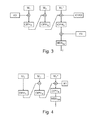
- Fig. 2 The same approach as used in Fig. 1 may be used to protect the visible output from the last block operation as shown in Fig. 2 .
- the insertion of the subkey is performed directly on the output of the final block operation, before the truncation operator (which of course may be "null").
- the additional subkey K4 insertion is shown.
- the output vector from the last subkey operation is not visible to an attacker.
- Fig. 3 a combination of the principles shown in Fig. 1 and 2 may be provided as shown in Fig. 3 .
- the first subkey K3 is inserted into the method for the first block and also the second subkey K4 is inserted into the method for the last block.
- the part of the input vector which affects the input to an S-box (substitution box) in the first round is denoted by M, and K j is the portion of the first round key which affects that S-box; for multiple inputs M, the attacker makes a hypothesis about the value of Kj and tests for confirmation of that hypothesis using the above decribed process.
- the DPA attack is typically mounted at the output of the S-box, shown with a X.
- the subscript "j" here denotes only that K j is a portion of the roundkey (called the "j-portion” hereafter); when AES is the block cipher used, it really is a specific byte of the (first round) key; however, for other block ciphers e.g. as in the case of DES, the portion of key involved may not consist of contiguous bits.
- each first round S-box is affected by 8 bits of round key so there are 256 hypotheses to test.
- the subkey KX may be a function of K (f(K)) or a specified secret value. What the attacker can recover by a DPA attack is the value which is the exclusive-OR of KX and K j ; however, this does not unambiguously reveal the subkey.
- the subkey is a function of K
- the"j-portion" of the key K is not unambigously revealed, since the j-portion of f(K) i.e. [f(K)] j depends on the whole key (at least when the function f() is the conventional one used to create subkeys i.e. encryption of a constant vector under the key K).
- the attacker cannot make and test an independent hypothesis about only the j-portion of K since his test is affected by all other portions at the same time (at least in the case where f() has the properties of a well-behaved block-cipher).
- the "subkey” can of course be any secret value known only to the creator and verifier of the MAC, which is not necessarily derived from the MAC key; in this case, it acts as an XOR mask acting on the initial round key portion.
- the MAC constructions described herein are designed to protect input and output vectors for the purposes of resisting key recovery attacks using DPA.
Landscapes
- Engineering & Computer Science (AREA)
- Computer Security & Cryptography (AREA)
- Computer Networks & Wireless Communication (AREA)
- Signal Processing (AREA)
- Power Engineering (AREA)
- Mobile Radio Communication Systems (AREA)
Abstract
Description
- The invention relates to a device for generating a message authentication code for authenticating a message. Furthermore, the invention relates to a system for generating a message authentication code for authenticating a message. Moreover, the invention relates to a smart card. Furthermore, the invention relates to a method for a generating a message authentication code for authenticating a message. Beyond this, the invention relates to a program element. Furthermore, the invention relates to a computer-readable medium.
- During message transmission, messages may be changed by an attacker. To avoid such an attack, there exist different approaches. One of these approaches is a method for constructing message authentication codes (MACs) using block ciphers and is known as "CMAC".
- The MAC on a message is constructed by splitting it into blocks of size equal to the blocksize of the underlying cipher (e.g. 128 bits in the case of AES), CBC-encrypting the message (with padding in the last block if required), and retaining (all or part of) the result of the last block encryption as the computed MAC value. In the event that a MAC shorter than the cipher blocksize is to be used, the computed MAC may be truncated by retaining the required number of most significant bits. A MAC algorithm, sometimes called a keyed (cryptographic) hash function, accepts as input a secret key and an arbitrary-length message to be authenticated, and outputs a MAC (sometimes known as a tag). The MAC value protects both a message's data integrity as well as its authenticity, by allowing verifiers (who also possess the secret key) to detect any changes to the message content.
- Differential power analysis is a form of side channel attack in which the attacker studies the power consumption of a cryptographic hardware device (such as a smart card, tamper-resistant "black box", or integrated circuit). The attack can non-invasively extract cryptographic keys and other secret information from the device. To prevent certain cryptographic attacks, some MAC construction algorithms may re-encrypt the last block of the message with a further key. Nevertheless, such an encrypted message authentication code remains vulnerable to DPA attacks since the first-block-input and last-block-output vectors are still visible.
- Hence, it is an object of the invention to provide a device providing a more secure authentication of a message.
- The object of the invention is achieved by a device, a system, a smart card, a method, a program element and a computer-readable medium according to the independent claims.
- According to an exemplary embodiment, a device for generating a message authentication code for authenticating a message is provided, wherein the message is divided in blocks with a specified block length, wherein the device comprises a generating unit for generating the message authentication code based on a message by using a block cipher algorithm, and an encrypting unit for performing an exclusive disjunction on the last block with a first key and for performing an exclusive disjunction on the first and/or the last block additionally with a second key for generating the message authentication code.
- According to another exemplary embodiment, a system for generating a message authentication code for authenticating a message is provided, wherein the message is divided in blocks with a specified block length, wherein the system comprises a sender and a receiver, wherein the sender and the receiver comprise a device with the above mentioned features, respectively.
- According to still another exemplary embodiment, a smart card is provided, wherein the smart card comprises a device with the above mentioned features.
- According to still another exemplary embodiment, a method for generating a message authentication code for authenticating a message is provided, wherein the message is divided in blocks with a specified block length, the method comprising generating the message authentication code based on a message by using a block cipher algorithm, performing an exclusive disjunction on the last block with a first key, and performing an exclusive disjunction on the first and/or the last block additionally with a second key for generating the message authentication code.
- According to still another exemplary embodiment of the invention, a program element (for instance a software routine, in source code or in executable code, for instance a downloadable program) is provided, which, when being executed by a processor, is adapted to control or carry out a method having the above mentioned features.
- According to yet another exemplary embodiment of the invention, a computer-readable medium (for instance a CD, a DVD, a USB stick, a floppy disk or a harddisk) is provided, in which a computer program is stored which, when being executed by a processor, is adapted to control or carry out a method having the above mentioned features.
- Data processing which may be performed according to embodiments of the invention can be realized by a computer program, that is by software, or by using one or more special electronic optimization circuits, that is in hardware, or in hybrid form, that is by means of software components and hardware components.
- The term "block cipher algorithm" may denote an algorithm using a block cipher. A block cipher is a symmetric key cipher operating on fixed-length groups of bits, termed blocks, with an unvarying transformation. A block cipher encryption algorithm might take (for example) a 128-bit block of plaintext as input, and output a corresponding 128-bit block of ciphertext.
- The generating unit and the encrypting unit may be formed as a single unit and/or on a single chip.
- The term "exclusive disjunction" may denote also an exclusive-ORing or XOR-function on the different blocks. The encrypting unit may perform with one or more additional keys an XORing of these keys with the relevant data vector, and the linearity of this XOR step may provide a protection against DPA.
- The first key may also be a pair of keys, wherein only one of the pair of keys may be used respectively.
- The message authentication code may be used for authenticating a message sent from a sender to a receiver. The sender may generate the message authentication code based on the message and the first and the second key and send this code together with the message to the receiver. The receiver may receive the message together with the code and generate a code based on the message and the first and the second key itself. Subsequently, the receiver may compare the received message authentication code with the self-generated message authentication code and authenticate in this way the received message.
- The term "sender" may denote a transponder or any similar device and the term "receiver" may denote for example a communication partner for the responder.
- The term "smart card" may denote also a chip card or integrated circuit card.
- In the following, further exemplary embodiments of the device will be explained. However, these embodiments also apply to the system, to the smart card, to the method, to the program element and to the computer-readable medium.
- According to an exemplary embodiment, the block cipher algorithm may be a message authentication code algorithm. In cryptography, a message authentication code (often MAC) is a short piece of information used to authenticate a message. A MAC algorithm, sometimes called a keyed (cryptographic) hash function, accepts as input a secret key and an arbitrary-length message to be authenticated, and outputs a MAC (sometimes known as a tag). The MAC value protects both a message's data integrity as well as its authenticity, by allowing verifiers (who also possess the secret key) to detect any changes to the message content.
- MACs differ from digital signatures, as MAC values are both generated and verified using the same secret key. This implies that the sender and receiver of a message must agree on keys before initiating communications, as is the case with symmetric encryption.
- According to a further exemplary embodiment, the encrypting unit may be adapted for using a first second key for the first block and a second second key for the last block. The first and second second keys may also be called first additional key and second additional key. Thus, it may be more difficult for an attacker to gain any information for both keys.
- According to a further exemplary embodiment, the second key may depend on the first key. Either or both of the second keys, that means the first and the second second key may depend on the first key. Thus, the second key may be any computable function of the first key. In general, a function is an abstract entity that associates an input, here the first key, to a corresponding output, here the second key, according to some rule.
- According to a further exemplary embodiment, the second key may exchangeable between the device and a communication partner. The device may be a transponder and the communication partner may be a corresponding receiver. In this case, the second key may be known to the device and to the communication partner prior to the generation of the message authentication code.
- Embodiments of the invention are related to transponders, in particular smart cards and RFID tags. For the sake of clarity, this description makes reference primarily to smart cards, although for one skilled in the art it is clear that embodiments of the invention equally relate to RFID tags and transponders in general, as well as to devices in general which communicate over a wired or wireless connection.
- These and other aspects of the invention are apparent from and will be elucidated with reference to the embodiments described hereinafter.
- The invention will be described in greater detail hereinafter, by way of nonlimiting examples, with reference to the embodiments shown in the drawings.
-
Fig. 1 shows a principle of a method according to an exemplary embodiment of the invention. -
Fig. 2 shows a principle of the method according to a further exemplary embodiment of the invention. -
Fig. 3 shows a principle of the method according to a further exemplary embodiment of the invention. -
Fig. 4 shows a principle of a common method for generating a method authentication code. -
Fig. 5a and 5b shows an attack without and with using a method or device according to an exemplary embodiment of the invention. - The illustration in the drawing is schematically. In different drawings, similar or identical elements are provided with the same reference signs.
- The NIST (National Institute of Standards and Technology) recommend a method for construction of message authentication codes (MACs) using a block cipher known as cipher-based MAC (CMAC).
- The MAC on a message is constructed by splitting it into blocks of size equal to the blocksize of the underlying cipher (e.g. 128 bits in the case of Advanced Encryption Standard (AES)), CBC (cipher block chaining)-encrypting the message (with padding in the last block if required), and retaining (all or part of) the result of the last block encryption as the computed MAC value. In the event that a MAC shorter than the cipher blocksize is to be used, the standard dictates that the computed MAC should be truncated by retaining the required number of most significant bits.
-
Fig. 4 shows the principles of MAC construction according to this standard. Special attention should be paid to the operations of "subkey insertion" on the last block. The subkeys K1 or K2 are secret constants, derived from the encryption of a constant vector under the MAC key in use, which are additionally XORed with the input to the final block operation. The objective of making the last block operation different from all others is to prevent simple "MAC-chaining" attacks which become possible in the absence of "special last blocks". In general, without this "special last block" function, using this principle, an attacker can concatenate in an arbitrary fashion suitably modified MAC'd messages he has previously seen computed under the same MAC key, for example within a communication session. With this measure, since derivation of the subkey requires knowledge of the MAC key, an attacker is no longer able to chain messages when only the last block operation includes this constant which is unknown to him. - Differential Power Analysis (DPA) attacks operate by testing a hypothesis about (part of) a cryptographic key; such a hypothesis is tested by correlating power trace measurements of a device when using the key being attacked against its expected internal signals under the assumption that the hypothesis is correct. With the correct hypothesis, large increases in computed correlation can be observed compared to the cases where the hypothesis is incorrect. Typically, such attacks require a large number of power traces (of the order of 106, although the exact number is implementation-dependent).
- In order to perform DPA attacks, the attacker needs to be able to convert his hypothesis about part of the key into some expectation about the internal signal he is correlating against the power trace. Usually, in the case of a block cipher operating in encrypt-mode, this means that he needs to know either the input data vector, whereupon he can perform an encryption operation which depends on the part of the key about which he has a hypothesis; this is typically the action of a first-round substitution (or S-box) on a combination of key and input data, or the output data, whereby he can perform the equivalent of a decryption operation by working backwards through the last round to derive an expected internal signal.
- Note that it is not necessary for the attacker to have access to both input and output for such an attack, which makes the application of DPA very general and powerful. A complete DPA attack to recover a key is usually a multi-stage process; the attacker gathers a large number of power traces with known input or output data as described above. These same traces are used a number of times to test hypotheses about different parts of the cipher key in use, enabling the attacker to derive all or most of the key bits. In practice, he usually recovers the "round key" for the first or last round, from which he can derive the logical key from a knowledge of the scheduling/expansion algorithm.
- In the specific case of AES, an attacker would typically test hypotheses one byte at a time, corresponding to the action of data and a round key byte on one of the S-box instances. Once he has recovered 16 round key bytes, the logical key in use is easily derived, since the AES key expansion can be computed either forwards or backwards.
- In general, the same principles can apply whether DPA is used to perform a key recovery attack on encryption, decryption, or MAC computation/verification. In the case of an encryption operation, it is usually the output ciphertext that is available to an attacker, whilst a MAC computation is often performed on known message data, that means the input is available.
- Thus, for MAC on known message data, the input to the first block operation is wholly known; the inputs to subsequent blocks are not known due to the block chaining. The output of only the last block is known (unless the MAC is truncated, in which case the last block output is only partly known), since it is the MAC result itself. In the case of a single-block MAC, the block operation can be thought of as a "final block"; a subkey is used, so the input to the block operation is not known, in this case because of the effect of the XORing of a CMAC subkey value not known to an attacker.
- According to a first exemplary embodiment, a principle of generating a MAC is shown in
Fig. 1 , which prevents DPA-attacks on the visible first-block-input vector. The presence of a subkey, which may be a value similar to K1/K2 as specified by CMAC, but next to this also a completely independent shared secret of block length size can possibly be used, obscures the data vector required by an attacker to mount a DPA attack. In the method shown inFig. 1 , a subkey value K3 is added by XORing it with the input to the first block operation. - An alternative mechanism which can be used to protect the visible first-block-input against DPA attacks is to limit the possible values of the M1 message block to a small number of possibilities. When the visible first block vector can only take a small number of values, this number acts as an upper bound on the number of different traces the attacker is able to collect in order to mount his DPA attack. If this number is already below the threshold of DPA attack resistance which a given implementation provides, then such an attack cannot be successfully mounted.
- The same approach as used in
Fig. 1 may be used to protect the visible output from the last block operation as shown inFig. 2 . In this case, it is important to protect the entire output vector, so the insertion of the subkey is performed directly on the output of the final block operation, before the truncation operator (which of course may be "null"). InFig. 2 , the additional subkey K4 insertion is shown. As a result of the subkey insertion, the output vector from the last subkey operation is not visible to an attacker. - Also a combination of the principles shown in
Fig. 1 and 2 may be provided as shown inFig. 3 . Here, the first subkey K3 is inserted into the method for the first block and also the second subkey K4 is inserted into the method for the last block. - In the case of a MAC on a single-block message, the presence of one of the standard subkeys K1/K2 is sufficient to protect the input vector; in this case, one would not need to use the subkey K3.
- The presence of the subkey K3 or K4 acts as a mask which prevents the attacker from deriving correct logical key information from his DPA attack. To understand this more clearly, consider
Fig. 5a and 5b . - In
Fig. 5a , the part of the input vector which affects the input to an S-box (substitution box) in the first round is denoted by M, and Kj is the portion of the first round key which affects that S-box; for multiple inputs M, the attacker makes a hypothesis about the value of Kj and tests for confirmation of that hypothesis using the above decribed process. The DPA attack is typically mounted at the output of the S-box, shown with a X. The subscript "j" here denotes only that Kj is a portion of the roundkey (called the "j-portion" hereafter); when AES is the block cipher used, it really is a specific byte of the (first round) key; however, for other block ciphers e.g. as in the case of DES, the portion of key involved may not consist of contiguous bits. - Note that the bitsize of Kj must be sufficiently small that the attacker can test all possible hypotheses about its possible value in a reasonable time; for example, with the AES cipher, each first round S-box is affected by 8 bits of round key so there are 256 hypotheses to test.
- In
Fig. 5b , the configuration in the presence of a subkey is shown. The subkey KX may be a function of K (f(K)) or a specified secret value. What the attacker can recover by a DPA attack is the value which is the exclusive-OR of KX and Kj; however, this does not unambiguously reveal the subkey. In the case, that the subkey is a function of K, the"j-portion" of the key K is not unambigously revealed, since the j-portion of f(K) i.e. [f(K)]j depends on the whole key (at least when the function f() is the conventional one used to create subkeys i.e. encryption of a constant vector under the key K). The attacker cannot make and test an independent hypothesis about only the j-portion of K since his test is affected by all other portions at the same time (at least in the case where f() has the properties of a well-behaved block-cipher). - In general, the "subkey" can of course be any secret value known only to the creator and verifier of the MAC, which is not necessarily derived from the MAC key; in this case, it acts as an XOR mask acting on the initial round key portion.
- The MAC constructions described herein are designed to protect input and output vectors for the purposes of resisting key recovery attacks using DPA.
- Finally, it should be noted that the above-mentioned embodiments illustrate rather than limit the invention, and that those skilled in the art will be capable of designing many alternative embodiments without departing from the scope of the invention as defined by the appended claims. In the claims, any reference signs placed in parentheses shall not be construed as limiting the claims. The word "comprising" and "comprises", and the like, does not exclude the presence of elements or steps other than those listed in any claim or the specification as a whole. The singular reference of an element does not exclude the plural reference of such elements and vice-versa. In a device claim enumerating several means, several of these means may be embodied by one and the same item of software or hardware. The mere fact that certain measures are recited in mutually different dependent claims does not indicate that a combination of these measures cannot be used to advantage.
Claims (10)
- Device for generating a message authentication code for authenticating a message, wherein the message is divided in blocks (M) with a specified block length, the device comprising
a generating unit for generating the message authentication code based on a message by using a block cipher algorithm, and
an encrypting unit for performing an exclusive disjunction on the last block with a first key (K1, K2) and for performing an exclusive disjunction on the first and/or the last block additionally with a second key (K3, K4) for generating the message authentication code. - Device according to claim 1, wherein the block cipher algorithm is a message authentication code algorithm.
- Device according to claim 1, wherein the encrypting unit is adapted for using a first second key (K3) for the first block and a second second key (K4) for the last block.
- Device according to claim 1, wherein the second key (K3, K4) depends on the first key (K1, K2).
- Device according to claim 1, wherein the second key (K3, K4) is exchangeable between the device and a communication partner.
- System for authenticating a message, wherein the message is divided in blocks with a specified block length, the system comprising a sender and a receiver, wherein the sender and the receiver comprise a device according to claim 1, respectively.
- Smart card comprising a device according to claim 1.
- Method for generating a message authentication code for authenticating a message, wherein the message is divided in blocks with a specified block length, the method comprising
generating the message authentication code based on a message by using a block cipher algorithm,
performing an exclusive disjunction on the last block with a first key, and
performing an exclusive disjunction on the first and/or the last block additionally with a second key for generating the message authentication code. - A computer-readable medium, in which a computer program is stored, which computer program, when being executed by a processor, is adapted to carry out or control a method according to claim 8
- A program element, which program element, when being executed by a processor, is adapted to carry out or control a method according to claim 8.
Priority Applications (2)
| Application Number | Priority Date | Filing Date | Title |
|---|---|---|---|
| EP09168875.4A EP2290872B1 (en) | 2009-08-27 | 2009-08-27 | Device for generating a message authentication code for authenticating a message |
| US12/870,756 US9497021B2 (en) | 2009-08-27 | 2010-08-27 | Device for generating a message authentication code for authenticating a message |
Applications Claiming Priority (1)
| Application Number | Priority Date | Filing Date | Title |
|---|---|---|---|
| EP09168875.4A EP2290872B1 (en) | 2009-08-27 | 2009-08-27 | Device for generating a message authentication code for authenticating a message |
Publications (2)
| Publication Number | Publication Date |
|---|---|
| EP2290872A1 true EP2290872A1 (en) | 2011-03-02 |
| EP2290872B1 EP2290872B1 (en) | 2014-06-18 |
Family
ID=42683197
Family Applications (1)
| Application Number | Title | Priority Date | Filing Date |
|---|---|---|---|
| EP09168875.4A Active EP2290872B1 (en) | 2009-08-27 | 2009-08-27 | Device for generating a message authentication code for authenticating a message |
Country Status (2)
| Country | Link |
|---|---|
| US (1) | US9497021B2 (en) |
| EP (1) | EP2290872B1 (en) |
Cited By (1)
| Publication number | Priority date | Publication date | Assignee | Title |
|---|---|---|---|---|
| WO2019199283A1 (en) * | 2018-04-10 | 2019-10-17 | Visa International Service Association | Tamper-resistant data encoding for mobile devices |
Families Citing this family (28)
| Publication number | Priority date | Publication date | Assignee | Title |
|---|---|---|---|---|
| US8422667B2 (en) | 2005-01-27 | 2013-04-16 | The Chamberlain Group, Inc. | Method and apparatus to facilitate transmission of an encrypted rolling code |
| US12149618B2 (en) | 2005-01-27 | 2024-11-19 | The Chamberlain Group Llc | Method and apparatus to facilitate transmission of an encrypted rolling code |
| USRE48433E1 (en) | 2005-01-27 | 2021-02-09 | The Chamberlain Group, Inc. | Method and apparatus to facilitate transmission of an encrypted rolling code |
| US9148409B2 (en) | 2005-06-30 | 2015-09-29 | The Chamberlain Group, Inc. | Method and apparatus to facilitate message transmission and reception using different transmission characteristics |
| US7836306B2 (en) * | 2005-06-29 | 2010-11-16 | Microsoft Corporation | Establishing secure mutual trust using an insecure password |
| US8645713B2 (en) * | 2011-03-22 | 2014-02-04 | Fujitsu Limited | Encrypting method, recording medium of encrypting program, decrypting method, and recording medium of decrypting program |
| WO2013009284A1 (en) | 2011-07-11 | 2013-01-17 | Research In Motion Limited | Data integrity for proximity-based communication |
| CN103650554B (en) * | 2011-07-11 | 2018-02-23 | 黑莓有限公司 | For the method for the trusted communications between mobile device, mobile device and computer-readable medium |
| KR101572935B1 (en) * | 2014-10-02 | 2015-12-11 | 현대자동차주식회사 | Method of authenticating can packet using mac divison and appratus for implementing the same |
| US11418321B2 (en) | 2014-12-03 | 2022-08-16 | Nagravision Sari | Block cryptographic method for encrypting/decrypting messages and cryptographic devices for implementing this method |
| PL3403369T3 (en) | 2016-01-13 | 2020-10-19 | Telefonaktiebolaget Lm Ericsson (Publ) | Integrity protection |
| US10171235B2 (en) | 2016-05-19 | 2019-01-01 | Nxp B.V. | User-initiated migration of encryption keys |
| US9680453B1 (en) | 2016-08-09 | 2017-06-13 | Nxp Usa, Inc. | Oscillator circuit |
| US10050526B2 (en) | 2016-08-09 | 2018-08-14 | Nxp Usa, Inc. | Switching power converter |
| US9741449B1 (en) | 2016-08-09 | 2017-08-22 | Nxp Usa, Inc. | Sample and hold circuit |
| US11438137B2 (en) * | 2017-09-01 | 2022-09-06 | Mitsubishi Electric Corporation | Encryption device, decryption device, encryption method, decryption method, and computer readable medium |
| US20190155919A1 (en) * | 2017-11-20 | 2019-05-23 | International Business Machines Corporation | Performing deduplication on cloud-resident encrypted data |
| US10652743B2 (en) | 2017-12-21 | 2020-05-12 | The Chamberlain Group, Inc. | Security system for a moveable barrier operator |
| JP7063666B2 (en) * | 2018-03-22 | 2022-05-09 | 株式会社東海理化電機製作所 | Authentication system |
| US11074773B1 (en) | 2018-06-27 | 2021-07-27 | The Chamberlain Group, Inc. | Network-based control of movable barrier operators for autonomous vehicles |
| US11423717B2 (en) | 2018-08-01 | 2022-08-23 | The Chamberlain Group Llc | Movable barrier operator and transmitter pairing over a network |
| US10997810B2 (en) | 2019-05-16 | 2021-05-04 | The Chamberlain Group, Inc. | In-vehicle transmitter training |
| US12120225B2 (en) * | 2020-09-25 | 2024-10-15 | Renesas Electronics Corporation | Secure key generation and management in open and secure processor environments |
| AU2020472441B2 (en) * | 2020-10-16 | 2024-03-28 | Ntt, Inc. | Secret MSB normalization system, distributed processing apparatus, secret MSB normalization method, program |
| CN112737767B (en) * | 2020-12-30 | 2022-03-15 | 山东大学 | Method and system for generating message authentication code resisting differential power analysis and time attack |
| CN113824549B (en) * | 2021-08-30 | 2023-06-16 | 中国人民解放军海军工程大学 | System and method for reducing leakage information of block cipher bypass |
| CN114513311B (en) * | 2022-02-25 | 2024-09-03 | 上海芯钛信息科技有限公司 | Method, device, equipment and medium for improving message authentication code algorithm |
| CN119544384B (en) * | 2025-01-21 | 2025-08-19 | 成方金融科技有限公司 | Message processing method, device, equipment, storage medium and program product |
Family Cites Families (37)
| Publication number | Priority date | Publication date | Assignee | Title |
|---|---|---|---|---|
| US5483598A (en) * | 1993-07-01 | 1996-01-09 | Digital Equipment Corp., Patent Law Group | Message encryption using a hash function |
| US5673319A (en) * | 1995-02-06 | 1997-09-30 | International Business Machines Corporation | Block cipher mode of operation for secure, length-preserving encryption |
| US6182216B1 (en) * | 1997-09-17 | 2001-01-30 | Frank C. Luyster | Block cipher method |
| US6333983B1 (en) * | 1997-12-16 | 2001-12-25 | International Business Machines Corporation | Method and apparatus for performing strong encryption or decryption data using special encryption functions |
| CA2316227C (en) | 1998-01-02 | 2009-08-11 | Cryptography Research, Inc. | Leak-resistant cryptographic method and apparatus |
| EP1088295B1 (en) | 1998-06-03 | 2007-08-15 | Cryptography Research Inc. | Balanced cryptographic computational method and apparatus for leak minimization in smartcards and other cryptosystems |
| WO1999063696A1 (en) | 1998-06-03 | 1999-12-09 | Cryptography Research, Inc. | Using unpredictable information to minimize leakage from smartcards and other cryptosystems |
| JP2002519722A (en) | 1998-06-03 | 2002-07-02 | クリプターグラフィー リサーチ インコーポレイテッド | Improved DES and other cryptographic processes for smart cards and other cryptographic systems to minimize leakage |
| EP2031792B1 (en) | 1998-06-03 | 2013-01-09 | Cryptography Research Inc. | Secure modular exponentiation with leak minimization for smartcards and other cryptosystems |
| ATE360866T1 (en) | 1998-07-02 | 2007-05-15 | Cryptography Res Inc | LEAK-RESISTANT UPDATING OF AN INDEXED CRYPTOGRAPHIC KEY |
| WO2001056221A2 (en) * | 2000-01-31 | 2001-08-02 | Vdg Inc. | Block encryption method and schemes for data confidentiality and integrity protection |
| AU2001249511A1 (en) * | 2000-03-31 | 2001-10-15 | Vdg Inc. | Authentication method and schemes for data integrity protection |
| US20020051537A1 (en) * | 2000-09-13 | 2002-05-02 | Rogaway Phillip W. | Method and apparatus for realizing a parallelizable variable-input-length pseudorandom function |
| US7046802B2 (en) * | 2000-10-12 | 2006-05-16 | Rogaway Phillip W | Method and apparatus for facilitating efficient authenticated encryption |
| US7403620B2 (en) | 2002-07-02 | 2008-07-22 | Stmicroelectronics S.A. | Cyphering/decyphering performed by an integrated circuit |
| US7613925B2 (en) * | 2003-01-10 | 2009-11-03 | Motorola, Inc. | Method for authenticating a message |
| US7697681B2 (en) | 2004-02-06 | 2010-04-13 | Nortel Networks Limited | Parallelizable integrity-aware encryption technique |
| US20050210260A1 (en) * | 2004-03-17 | 2005-09-22 | Ramarathnam Venkatesan | Unimodular matrix-based message authentication codes (MAC) |
| WO2005107138A1 (en) | 2004-03-29 | 2005-11-10 | Stmicroelectronics Sa | Processor for executing an aes-type algorithm |
| US7869590B2 (en) * | 2005-04-12 | 2011-01-11 | Broadcom Corporation | Method and system for hardware accelerator for implementing f9 integrity algorithm in WCDMA compliant handsets |
| JP4810289B2 (en) * | 2006-04-17 | 2011-11-09 | ルネサスエレクトロニクス株式会社 | Message authenticator generation device, message authenticator verification device, and message authentication system |
| US8233619B2 (en) * | 2006-06-07 | 2012-07-31 | Stmicroelectronics S.R.L. | Implementation of AES encryption circuitry with CCM |
| US8102999B2 (en) * | 2006-08-18 | 2012-01-24 | Medtronic, Inc. | Secure telemetric link |
| FR2907622A1 (en) * | 2006-10-19 | 2008-04-25 | St Microelectronics Sa | DATA TRANSMISSION METHOD USING A RECEPTION ACCOUNT CODE HAVING HID AUTHENTICATION BITS |
| JP4712017B2 (en) * | 2006-11-13 | 2011-06-29 | 韓國電子通信研究院 | Message authentication code generation method using stream cipher, authentication encryption method using stream cipher, and authentication decryption method using stream cipher |
| KR100930577B1 (en) | 2006-11-13 | 2009-12-09 | 한국전자통신연구원 | Message authentication code generation method using stream cipher, authentication encryption method using stream cipher, and authentication decryption method using stream cipher |
| US9225518B2 (en) * | 2006-12-08 | 2015-12-29 | Alcatel Lucent | Method of providing fresh keys for message authentication |
| US8341417B1 (en) * | 2006-12-12 | 2012-12-25 | Cisco Technology, Inc. | Data storage using encoded hash message authentication code |
| US7991158B2 (en) | 2006-12-13 | 2011-08-02 | Tyfone, Inc. | Secure messaging |
| US20090119510A1 (en) * | 2007-11-06 | 2009-05-07 | Men Long | End-to-end network security with traffic visibility |
| JP5201716B2 (en) * | 2007-09-28 | 2013-06-05 | 東芝ソリューション株式会社 | Cryptographic module distribution system, cryptographic management server device, cryptographic processing device, client device, cryptographic management program, cryptographic processing program, and client program |
| DE102007052656B4 (en) * | 2007-11-05 | 2010-03-25 | Texas Instruments Deutschland Gmbh | Digital encryption hardware accelerator |
| US8254569B2 (en) * | 2007-12-29 | 2012-08-28 | Nec (China) Co., Ltd. | Provable data integrity verifying method, apparatuses and system |
| CN103560880B (en) * | 2008-08-19 | 2017-04-12 | Nxp股份有限公司 | Method for generating a cipher-based message authentication code |
| US8452984B2 (en) * | 2008-08-28 | 2013-05-28 | Alcatel Lucent | Message authentication code pre-computation with applications to secure memory |
| US8218759B2 (en) * | 2009-04-17 | 2012-07-10 | Oracle America, Inc. | System and method for encrypting data |
| KR101584987B1 (en) * | 2009-06-08 | 2016-01-13 | 삼성전자주식회사 | Apparatus for transmitting and receiving data and method using the same |
-
2009
- 2009-08-27 EP EP09168875.4A patent/EP2290872B1/en active Active
-
2010
- 2010-08-27 US US12/870,756 patent/US9497021B2/en active Active
Non-Patent Citations (2)
| Title |
|---|
| KATSUYUKI OKEYA; TETSU IWATA: "Side Channel Attacks on Message Authentication Codes", vol. 2, 1 August 2006, INFORMATION PROCESSING SOCIETY OF JAPAN; IPSJ DIGITAL COURIER, pages: 478 - 488, XP002600138 * |
| OKEYA K: "Side channel attacks against hash-based MACs with PGV compression functions", IEICE TRANSACTIONS ON FUNDAMENTALS OF ELECTRONICS,COMMUNICATIONS AND COMPUTER SCIENCES, ENGINEERING SCIENCES SOCIETY, TOKYO, JP LNKD- DOI:10.1093/IETFEC/E91-A.1.168, vol. E91A, no. 1, 1 January 2008 (2008-01-01), pages 168 - 175, XP001509991, ISSN: 0916-8508 * |
Cited By (2)
| Publication number | Priority date | Publication date | Assignee | Title |
|---|---|---|---|---|
| WO2019199283A1 (en) * | 2018-04-10 | 2019-10-17 | Visa International Service Association | Tamper-resistant data encoding for mobile devices |
| US10984139B2 (en) | 2018-04-10 | 2021-04-20 | Visa International Service Association | Tamper-resistant data encoding for mobile devices |
Also Published As
| Publication number | Publication date |
|---|---|
| US20110051927A1 (en) | 2011-03-03 |
| EP2290872B1 (en) | 2014-06-18 |
| US9497021B2 (en) | 2016-11-15 |
Similar Documents
| Publication | Publication Date | Title |
|---|---|---|
| US9497021B2 (en) | Device for generating a message authentication code for authenticating a message | |
| US12081648B2 (en) | Block cryptographic method for encrypting/decrypting messages and cryptographic devices for implementing this method | |
| US9166793B2 (en) | Efficient authentication for mobile and pervasive computing | |
| US8332634B2 (en) | Cryptographic systems for encrypting input data using an address associated with the input data, error detection circuits, and methods of operating the same | |
| US12627643B2 (en) | System and method to improve user authentication for enhanced security of cryptographically protected communication sessions | |
| US10567155B2 (en) | Securing a cryptographic device | |
| CN103684772B (en) | Dynamic deficiency encryption system | |
| Dobraunig et al. | Fault attacks on nonce-based authenticated encryption: Application to keyak and ketje | |
| AU2011327986B2 (en) | Protection against passive sniffing | |
| US11436946B2 (en) | Encryption device, encryption method, decryption device, and decryption method | |
| Wu et al. | JAMBU lightweight authenticated encryption mode and AES-JAMBU | |
| EP3477889B1 (en) | Using white-box in a leakage-resilient primitive | |
| JP2009199068A (en) | Secret calculation system, secret calculation method, secret calculation device, verification device, and program | |
| Fu et al. | Linear regression side channel attack applied on constant xor | |
| JP6631989B2 (en) | Encryption device, control method, and program | |
| KR20150103394A (en) | Cryptography system and cryptographic communication method thereof | |
| JP7700960B2 (en) | Information processing device, method and program | |
| Yang et al. | Security analysis of Kulseng et al.'s mutual authentication protocol for RFID systems | |
| Attacks | New Efficient Padding Methods Secure Against | |
| Okeya | Side channel attacks against hash-based MACs with PGV compression functions | |
| KR20140145967A (en) | Cryptography system and cryptographic communication method thereof |
Legal Events
| Date | Code | Title | Description |
|---|---|---|---|
| PUAI | Public reference made under article 153(3) epc to a published international application that has entered the european phase |
Free format text: ORIGINAL CODE: 0009012 |
|
| AK | Designated contracting states |
Kind code of ref document: A1 Designated state(s): AT BE BG CH CY CZ DE DK EE ES FI FR GB GR HR HU IE IS IT LI LT LU LV MC MK MT NL NO PL PT RO SE SI SK SM TR |
|
| AX | Request for extension of the european patent |
Extension state: AL BA RS |
|
| 17P | Request for examination filed |
Effective date: 20110902 |
|
| RIC1 | Information provided on ipc code assigned before grant |
Ipc: H04L 9/06 20060101AFI20120726BHEP |
|
| GRAP | Despatch of communication of intention to grant a patent |
Free format text: ORIGINAL CODE: EPIDOSNIGR1 |
|
| INTG | Intention to grant announced |
Effective date: 20140225 |
|
| GRAS | Grant fee paid |
Free format text: ORIGINAL CODE: EPIDOSNIGR3 |
|
| GRAA | (expected) grant |
Free format text: ORIGINAL CODE: 0009210 |
|
| AK | Designated contracting states |
Kind code of ref document: B1 Designated state(s): AT BE BG CH CY CZ DE DK EE ES FI FR GB GR HR HU IE IS IT LI LT LU LV MC MK MT NL NO PL PT RO SE SI SK SM TR |
|
| REG | Reference to a national code |
Ref country code: GB Ref legal event code: FG4D |
|
| REG | Reference to a national code |
Ref country code: CH Ref legal event code: EP |
|
| REG | Reference to a national code |
Ref country code: AT Ref legal event code: REF Ref document number: 673889 Country of ref document: AT Kind code of ref document: T Effective date: 20140715 |
|
| REG | Reference to a national code |
Ref country code: IE Ref legal event code: FG4D |
|
| REG | Reference to a national code |
Ref country code: DE Ref legal event code: R096 Ref document number: 602009024715 Country of ref document: DE Effective date: 20140731 |
|
| PG25 | Lapsed in a contracting state [announced via postgrant information from national office to epo] |
Ref country code: FI Free format text: LAPSE BECAUSE OF FAILURE TO SUBMIT A TRANSLATION OF THE DESCRIPTION OR TO PAY THE FEE WITHIN THE PRESCRIBED TIME-LIMIT Effective date: 20140618 Ref country code: CY Free format text: LAPSE BECAUSE OF FAILURE TO SUBMIT A TRANSLATION OF THE DESCRIPTION OR TO PAY THE FEE WITHIN THE PRESCRIBED TIME-LIMIT Effective date: 20140618 Ref country code: NO Free format text: LAPSE BECAUSE OF FAILURE TO SUBMIT A TRANSLATION OF THE DESCRIPTION OR TO PAY THE FEE WITHIN THE PRESCRIBED TIME-LIMIT Effective date: 20140918 Ref country code: LT Free format text: LAPSE BECAUSE OF FAILURE TO SUBMIT A TRANSLATION OF THE DESCRIPTION OR TO PAY THE FEE WITHIN THE PRESCRIBED TIME-LIMIT Effective date: 20140618 Ref country code: GR Free format text: LAPSE BECAUSE OF FAILURE TO SUBMIT A TRANSLATION OF THE DESCRIPTION OR TO PAY THE FEE WITHIN THE PRESCRIBED TIME-LIMIT Effective date: 20140919 |
|
| REG | Reference to a national code |
Ref country code: NL Ref legal event code: VDEP Effective date: 20140618 |
|
| REG | Reference to a national code |
Ref country code: AT Ref legal event code: MK05 Ref document number: 673889 Country of ref document: AT Kind code of ref document: T Effective date: 20140618 |
|
| REG | Reference to a national code |
Ref country code: LT Ref legal event code: MG4D |
|
| PG25 | Lapsed in a contracting state [announced via postgrant information from national office to epo] |
Ref country code: HR Free format text: LAPSE BECAUSE OF FAILURE TO SUBMIT A TRANSLATION OF THE DESCRIPTION OR TO PAY THE FEE WITHIN THE PRESCRIBED TIME-LIMIT Effective date: 20140618 Ref country code: SE Free format text: LAPSE BECAUSE OF FAILURE TO SUBMIT A TRANSLATION OF THE DESCRIPTION OR TO PAY THE FEE WITHIN THE PRESCRIBED TIME-LIMIT Effective date: 20140618 Ref country code: LV Free format text: LAPSE BECAUSE OF FAILURE TO SUBMIT A TRANSLATION OF THE DESCRIPTION OR TO PAY THE FEE WITHIN THE PRESCRIBED TIME-LIMIT Effective date: 20140618 |
|
| PG25 | Lapsed in a contracting state [announced via postgrant information from national office to epo] |
Ref country code: RO Free format text: LAPSE BECAUSE OF FAILURE TO SUBMIT A TRANSLATION OF THE DESCRIPTION OR TO PAY THE FEE WITHIN THE PRESCRIBED TIME-LIMIT Effective date: 20140618 Ref country code: CZ Free format text: LAPSE BECAUSE OF FAILURE TO SUBMIT A TRANSLATION OF THE DESCRIPTION OR TO PAY THE FEE WITHIN THE PRESCRIBED TIME-LIMIT Effective date: 20140618 Ref country code: ES Free format text: LAPSE BECAUSE OF FAILURE TO SUBMIT A TRANSLATION OF THE DESCRIPTION OR TO PAY THE FEE WITHIN THE PRESCRIBED TIME-LIMIT Effective date: 20140618 Ref country code: EE Free format text: LAPSE BECAUSE OF FAILURE TO SUBMIT A TRANSLATION OF THE DESCRIPTION OR TO PAY THE FEE WITHIN THE PRESCRIBED TIME-LIMIT Effective date: 20140618 Ref country code: PT Free format text: LAPSE BECAUSE OF FAILURE TO SUBMIT A TRANSLATION OF THE DESCRIPTION OR TO PAY THE FEE WITHIN THE PRESCRIBED TIME-LIMIT Effective date: 20141020 Ref country code: SK Free format text: LAPSE BECAUSE OF FAILURE TO SUBMIT A TRANSLATION OF THE DESCRIPTION OR TO PAY THE FEE WITHIN THE PRESCRIBED TIME-LIMIT Effective date: 20140618 |
|
| PG25 | Lapsed in a contracting state [announced via postgrant information from national office to epo] |
Ref country code: PL Free format text: LAPSE BECAUSE OF FAILURE TO SUBMIT A TRANSLATION OF THE DESCRIPTION OR TO PAY THE FEE WITHIN THE PRESCRIBED TIME-LIMIT Effective date: 20140618 Ref country code: AT Free format text: LAPSE BECAUSE OF FAILURE TO SUBMIT A TRANSLATION OF THE DESCRIPTION OR TO PAY THE FEE WITHIN THE PRESCRIBED TIME-LIMIT Effective date: 20140618 Ref country code: NL Free format text: LAPSE BECAUSE OF FAILURE TO SUBMIT A TRANSLATION OF THE DESCRIPTION OR TO PAY THE FEE WITHIN THE PRESCRIBED TIME-LIMIT Effective date: 20140618 Ref country code: IS Free format text: LAPSE BECAUSE OF FAILURE TO SUBMIT A TRANSLATION OF THE DESCRIPTION OR TO PAY THE FEE WITHIN THE PRESCRIBED TIME-LIMIT Effective date: 20141018 |
|
| REG | Reference to a national code |
Ref country code: DE Ref legal event code: R097 Ref document number: 602009024715 Country of ref document: DE |
|
| PG25 | Lapsed in a contracting state [announced via postgrant information from national office to epo] |
Ref country code: LU Free format text: LAPSE BECAUSE OF FAILURE TO SUBMIT A TRANSLATION OF THE DESCRIPTION OR TO PAY THE FEE WITHIN THE PRESCRIBED TIME-LIMIT Effective date: 20140827 Ref country code: MC Free format text: LAPSE BECAUSE OF FAILURE TO SUBMIT A TRANSLATION OF THE DESCRIPTION OR TO PAY THE FEE WITHIN THE PRESCRIBED TIME-LIMIT Effective date: 20140618 |
|
| REG | Reference to a national code |
Ref country code: CH Ref legal event code: PL |
|
| PLBE | No opposition filed within time limit |
Free format text: ORIGINAL CODE: 0009261 |
|
| STAA | Information on the status of an ep patent application or granted ep patent |
Free format text: STATUS: NO OPPOSITION FILED WITHIN TIME LIMIT |
|
| PG25 | Lapsed in a contracting state [announced via postgrant information from national office to epo] |
Ref country code: DK Free format text: LAPSE BECAUSE OF FAILURE TO SUBMIT A TRANSLATION OF THE DESCRIPTION OR TO PAY THE FEE WITHIN THE PRESCRIBED TIME-LIMIT Effective date: 20140618 Ref country code: BE Free format text: LAPSE BECAUSE OF NON-PAYMENT OF DUE FEES Effective date: 20140831 Ref country code: LI Free format text: LAPSE BECAUSE OF NON-PAYMENT OF DUE FEES Effective date: 20140831 Ref country code: CH Free format text: LAPSE BECAUSE OF NON-PAYMENT OF DUE FEES Effective date: 20140831 Ref country code: IT Free format text: LAPSE BECAUSE OF FAILURE TO SUBMIT A TRANSLATION OF THE DESCRIPTION OR TO PAY THE FEE WITHIN THE PRESCRIBED TIME-LIMIT Effective date: 20140618 |
|
| REG | Reference to a national code |
Ref country code: IE Ref legal event code: MM4A |
|
| 26N | No opposition filed |
Effective date: 20150319 |
|
| PG25 | Lapsed in a contracting state [announced via postgrant information from national office to epo] |
Ref country code: BE Free format text: LAPSE BECAUSE OF FAILURE TO SUBMIT A TRANSLATION OF THE DESCRIPTION OR TO PAY THE FEE WITHIN THE PRESCRIBED TIME-LIMIT Effective date: 20140618 |
|
| PG25 | Lapsed in a contracting state [announced via postgrant information from national office to epo] |
Ref country code: SI Free format text: LAPSE BECAUSE OF FAILURE TO SUBMIT A TRANSLATION OF THE DESCRIPTION OR TO PAY THE FEE WITHIN THE PRESCRIBED TIME-LIMIT Effective date: 20140618 |
|
| PG25 | Lapsed in a contracting state [announced via postgrant information from national office to epo] |
Ref country code: IE Free format text: LAPSE BECAUSE OF NON-PAYMENT OF DUE FEES Effective date: 20140827 |
|
| PG25 | Lapsed in a contracting state [announced via postgrant information from national office to epo] |
Ref country code: SM Free format text: LAPSE BECAUSE OF FAILURE TO SUBMIT A TRANSLATION OF THE DESCRIPTION OR TO PAY THE FEE WITHIN THE PRESCRIBED TIME-LIMIT Effective date: 20140618 |
|
| PG25 | Lapsed in a contracting state [announced via postgrant information from national office to epo] |
Ref country code: BG Free format text: LAPSE BECAUSE OF FAILURE TO SUBMIT A TRANSLATION OF THE DESCRIPTION OR TO PAY THE FEE WITHIN THE PRESCRIBED TIME-LIMIT Effective date: 20140618 Ref country code: MT Free format text: LAPSE BECAUSE OF FAILURE TO SUBMIT A TRANSLATION OF THE DESCRIPTION OR TO PAY THE FEE WITHIN THE PRESCRIBED TIME-LIMIT Effective date: 20140618 |
|
| REG | Reference to a national code |
Ref country code: FR Ref legal event code: PLFP Year of fee payment: 8 |
|
| PG25 | Lapsed in a contracting state [announced via postgrant information from national office to epo] |
Ref country code: TR Free format text: LAPSE BECAUSE OF FAILURE TO SUBMIT A TRANSLATION OF THE DESCRIPTION OR TO PAY THE FEE WITHIN THE PRESCRIBED TIME-LIMIT Effective date: 20140618 Ref country code: HU Free format text: LAPSE BECAUSE OF FAILURE TO SUBMIT A TRANSLATION OF THE DESCRIPTION OR TO PAY THE FEE WITHIN THE PRESCRIBED TIME-LIMIT; INVALID AB INITIO Effective date: 20090827 |
|
| REG | Reference to a national code |
Ref country code: FR Ref legal event code: PLFP Year of fee payment: 9 |
|
| PG25 | Lapsed in a contracting state [announced via postgrant information from national office to epo] |
Ref country code: MK Free format text: LAPSE BECAUSE OF FAILURE TO SUBMIT A TRANSLATION OF THE DESCRIPTION OR TO PAY THE FEE WITHIN THE PRESCRIBED TIME-LIMIT Effective date: 20140618 |
|
| REG | Reference to a national code |
Ref country code: FR Ref legal event code: PLFP Year of fee payment: 10 |
|
| P01 | Opt-out of the competence of the unified patent court (upc) registered |
Effective date: 20230724 |
|
| PGFP | Annual fee paid to national office [announced via postgrant information from national office to epo] |
Ref country code: DE Payment date: 20250724 Year of fee payment: 17 |
|
| PGFP | Annual fee paid to national office [announced via postgrant information from national office to epo] |
Ref country code: GB Payment date: 20250725 Year of fee payment: 17 |
|
| PGFP | Annual fee paid to national office [announced via postgrant information from national office to epo] |
Ref country code: FR Payment date: 20250725 Year of fee payment: 17 |