EP2288107A1 - Authentication using GAA functionality for unidirectional network connections - Google Patents
Authentication using GAA functionality for unidirectional network connections Download PDFInfo
- Publication number
- EP2288107A1 EP2288107A1 EP10189236A EP10189236A EP2288107A1 EP 2288107 A1 EP2288107 A1 EP 2288107A1 EP 10189236 A EP10189236 A EP 10189236A EP 10189236 A EP10189236 A EP 10189236A EP 2288107 A1 EP2288107 A1 EP 2288107A1
- Authority
- EP
- European Patent Office
- Prior art keywords
- entity
- function entity
- network
- authentication
- network application
- Prior art date
- Legal status (The legal status is an assumption and is not a legal conclusion. Google has not performed a legal analysis and makes no representation as to the accuracy of the status listed.)
- Granted
Links
Images





Classifications
-
- H—ELECTRICITY
- H04—ELECTRIC COMMUNICATION TECHNIQUE
- H04L—TRANSMISSION OF DIGITAL INFORMATION, e.g. TELEGRAPHIC COMMUNICATION
- H04L63/00—Network architectures or network communication protocols for network security
- H04L63/08—Network architectures or network communication protocols for network security for authentication of entities
-
- H—ELECTRICITY
- H04—ELECTRIC COMMUNICATION TECHNIQUE
- H04L—TRANSMISSION OF DIGITAL INFORMATION, e.g. TELEGRAPHIC COMMUNICATION
- H04L12/00—Data switching networks
- H04L12/02—Details
- H04L12/16—Arrangements for providing special services to substations
- H04L12/18—Arrangements for providing special services to substations for broadcast or conference, e.g. multicast
-
- H—ELECTRICITY
- H04—ELECTRIC COMMUNICATION TECHNIQUE
- H04W—WIRELESS COMMUNICATION NETWORKS
- H04W12/00—Security arrangements; Authentication; Protecting privacy or anonymity
- H04W12/04—Key management, e.g. using generic bootstrapping architecture [GBA]
- H04W12/043—Key management, e.g. using generic bootstrapping architecture [GBA] using a trusted network node as an anchor
- H04W12/0431—Key distribution or pre-distribution; Key agreement
-
- H—ELECTRICITY
- H04—ELECTRIC COMMUNICATION TECHNIQUE
- H04W—WIRELESS COMMUNICATION NETWORKS
- H04W12/00—Security arrangements; Authentication; Protecting privacy or anonymity
- H04W12/06—Authentication
-
- H—ELECTRICITY
- H04—ELECTRIC COMMUNICATION TECHNIQUE
- H04L—TRANSMISSION OF DIGITAL INFORMATION, e.g. TELEGRAPHIC COMMUNICATION
- H04L12/00—Data switching networks
- H04L12/02—Details
- H04L12/16—Arrangements for providing special services to substations
- H04L12/18—Arrangements for providing special services to substations for broadcast or conference, e.g. multicast
- H04L12/1836—Arrangements for providing special services to substations for broadcast or conference, e.g. multicast with heterogeneous network architecture
-
- H—ELECTRICITY
- H04—ELECTRIC COMMUNICATION TECHNIQUE
- H04L—TRANSMISSION OF DIGITAL INFORMATION, e.g. TELEGRAPHIC COMMUNICATION
- H04L12/00—Data switching networks
- H04L12/02—Details
- H04L12/16—Arrangements for providing special services to substations
- H04L12/18—Arrangements for providing special services to substations for broadcast or conference, e.g. multicast
- H04L12/189—Arrangements for providing special services to substations for broadcast or conference, e.g. multicast in combination with wireless systems
-
- H—ELECTRICITY
- H04—ELECTRIC COMMUNICATION TECHNIQUE
- H04W—WIRELESS COMMUNICATION NETWORKS
- H04W4/00—Services specially adapted for wireless communication networks; Facilities therefor
- H04W4/06—Selective distribution of broadcast services, e.g. multimedia broadcast multicast service [MBMS]; Services to user groups; One-way selective calling services
Definitions
- the present invention relates to methods, network entities, a system, and a computer program product for authentication between a client entity and a network, wherein the client entity is not able to communicate with the network in a bidirectional manner.
- the present invention relates to authentication using functionalities in accordance with a generic authentication architecture, GAA, in e.g. broadcast scenarios.
- IP Internet Protocol
- GAA generic authentication architecture
- HSS 14 home subscriber system
- UE 12 user equipment UE 12
- NE 13 network entity NE 13
- GAA 11 basically consists of three sub-aspects. That is, a generic bootstrapping architecture (GBA) 11b, subscriber certificates 11a, and an authentication proxy (AP) 11c e.g. based on HTTPS (Secure Hypertext Transport Protocol).
- GAA generic bootstrapping architecture
- AP authentication proxy
- GBA generic bootstrapping architecture
- GBA functionality is to bootstrap authentication and key agreement for application security, and it is based on the HTTP Digest AKA (Authentication and Key Agreement) mechanism in accordance with IETF RFC 3310.
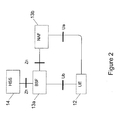
- FIG 2 there is illustrated a network model for generic bootstrapping.
- NAF 13b operator-controlled network application function
- the user equipment 12 and the network application function 13b can run some application-specific protocol where the authentication of messages will be based on those session keys generated during mutual authentication.
- GAA/GBA can in general be regarded as a 3-party authentication scenario, wherein the bootstrapping server function 13a is further connected to a home subscriber system HSS 14 maintaining e.g. user security settings (USS).
- USS user security settings
- the reference points (interfaces) between the individual entities in Figure 2 are denoted by Ub, Ua, Zn, and Zh.
- the interfaces Zn and Zh are based on Diameter (according to the Diameter Base Protocol which is specified in IETF RFC 3588), the interface Ub is based on a reuse of HTTP Digest AKA messages, and the protocol used on the interface Ua depends on the application to be executed.
- the utilization of the generic bootstrapping architecture is divided into two phases.
- the first phase i.e. the (generic) bootstrapping procedure as such, is illustrated in Figure 3
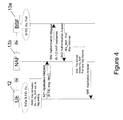
- the second phase i.e. the generic bootstrapping usage procedure, is illustrated in Figure 4 .
- the user equipment UE 12 sends an HTTP request towards the bootstrapping server function BSF 13a (step S31).
- the BSF 13a retrieves the user profile and a challenge, i.e. authentication vector (AV), over the Zh interface from the home subscriber system HSS 14.
- the BSF 13a forwards authentication parameters RAND and AUTN to the UE 12 in order to demand the UE 12 to authenticate itself.
- the UE 12 calculates a message authentication code (MAC) so as to verify the challenge from the authenticated network, as well as calculates session keys CK, IK, and RES.
- MAC message authentication code
- the session keys CK, IK, and RES are available in both BSF 13a and UE 12.
- the UE 12 sends again a request to the BSF 13a, and the BSF 13a checks in step S36 whether the received parameter is calculated using RES and is equal to the parameter that is similarly calculated using XRES which has been obtained before as a part of the authentication vector from the HSS 14. If these parameters are equal, the UE 12 is authenticated, and the BSF 13a generates a key ("master key") Ks by concatenating the session keys CK and IK (step S37). The key Ks is then used for securing the Ua interface.
- step S38 the BSF 13a sends an OK message including a transaction identifier B-TID and other possible data (such as for example a lifetime of the key Ks) to the UE 12, by means of which the success of the authentication is indicated.
- the session keys CK and IK By concatenating the session keys CK and IK, the key Ks for securing the Ua interface is then also generated at the UE 12 (step S39). Therewith, a bootstrapping session between the user equipment (client) and the bootstrapping server function has been started successfully.
- FIG 4 an example procedure using a bootstrapped security association is depicted.
- the UE 12 After having initiated a bootstrapping session (S40a), the UE 12 can start to communicate with the network application function NAF 13b. Thereby, the master key Ks generated during bootstrapping procedure in the UE 12 and in the BSF 13a is used to derive the NAF-specific key Ks_NAF (step S40b).
- An application request (step S41) includes the transaction identifier B-TID obtained during bootstrapping, an application-specific dataset denoted by msg, and all credentials being denoted by MAC.
- step S42 the NAF 13b requests one or more keys and possibly user profile data corresponding to the information supplied by the UE 12 over the Zn interface from the BSF 13a. Such a request can e.g. be based on the transaction identifier.
- the NAF-specific key Ks_NAF is generated in the BSF entity 13a.
- the BSF 13a responds by supplying the requested key or keys (including Ks_NAF and an application-specific part of the user profile being denoted by Prof) to the NAF 13b, which the NAF 13b uses directly, or with which the NAF 13b derives further keys required to protect the protocol used over the Ua interface towards UE 12, which is an application-specific functionality and not addressed in GAA specifications.
- the requested key or keys including Ks_NAF and an application-specific part of the user profile being denoted by Prof
- Prof an application-specific part of the user profile being denoted by Prof
- the NAF entity 13b stores (step S44) at least the parameters Ks_NAF, Prof, and the lifetime of the key. Afterwards, the NAF 13b continues with the protocol used over the Ua interface by sending an application answer to the UE 12 (step S45).
- the normal conventional 3GPP GAA behavior is that a client, i.e. a user equipment, bootstraps with the BSF entity using an AKA authentication vector.
- GAA credentials are obtained which consist of a shared key Ks and a bootstrapping transaction identifier (B-TID).
- Ks_NAF server-specific key
- the NAF-specific keys i.e. B-TID and Ks_NAF
- the conventional bootstrapping procedure requires the client to have a bidirectional connection to the BSF entity, and the subsequent use of the NAF-specific credentials between the UE and the NAF typically requires this as well.
- the problem resides in that the conventional GAA and/or GBA mechanisms do not work, i.e. cannot be used for authentication, in case there is no return channel from the user equipment to the network.
- An example for such a scenario are broadcast networks, e.g. the user equipment being a set-top box (STB; or digibox) for digital video broadcasting.
- STB set-top box
- GAA and/or GBA according to the prior art cannot be used as the UE can neither bootstrap with the BSF nor communicate with the NAF in a bidirectional manner, as is required.
- this object is for example achieved by a method for performing authentication between a client entity and a network comprising at least a bootstrapping server function entity and a network application function entity, wherein the client entity is not able to communicate with both of the network entities in a bidirectional manner, the method comprising the steps of transmitting a request for authentication information from the network application function entity to the bootstrapping server function entity when the network application function entity needs to securely transmit data to the client entity; processing the request and retrieving the authentication information at the bootstrapping server function entity; transmitting a response including the authentication information from the bootstrapping server function entity to the network application function entity; transmitting the authentication information and the data to be transmitted from the network application function entity to the client entity; and authenticating the network using the authentication information at the client entity.
- this object is for example achieved by a method for performing authentication between a client entity and a network comprising at least a bootstrapping server function entity and a network application function entity, wherein the client entity is not able to communicate with both of the network entities in a bidirectional manner, said authentication being a generic authentication in accordance with a generic authentication architecture, the method comprising the steps of transmitting a request for authentication information from the network application function entity to the bootstrapping server function entity when the network application function entity needs to securely transmit data to the client entity; processing the request and retrieving the authentication information at the bootstrapping server function entity, including a step of creating bootstrapping session data; transmitting a response including the authentication information, comprising at least a random challenge parameter, a network authentication parameter, the bootstrapping session data, and a key of the network application function entity, from the bootstrapping server function entity to the network application function entity; transmitting the authentication information, an identity of the network application function entity, and the data to be transmitted from the network application function entity to
- this object is for example achieved by a method for performing authentication between a client entity and a network comprising at least a bootstrapping server function entity and a network application function entity, wherein the client entity is not able to communicate with both of the network entities in a bidirectional manner, wherein there exists a valid bootstrapping session between the client entity and the bootstrapping server function entity, the method comprising the steps of transmitting a request for authentication information from the network application function entity to the bootstrapping server function entity when the network application function entity needs to securely transmit data to the client entity; processing the request and retrieving the authentication information at the bootstrapping server function entity; transmitting a response including the authentication information, comprising at least bootstrapping session data and a key of the network application function entity, from the bootstrapping server function entity to the network application function entity; transmitting the authentication information and the data to be transmitted from the network application function entity to the client entity; and authenticating the network using the authentication information and generating a key of the network application function entity at the client entity
- this object is for example achieved by a client entity for use within an authentication architecture for performing authentication between the client entity and a network, the client entity comprising receiving means for receiving transmissions from the network, and authenticating means for authenticating the network using received authentication information.
- this object is for example achieved by a client entity for use within an authentication architecture for performing authentication between the client entity and a network, the network comprising at least a bootstrapping server function entity and a network application function entity, and in which architecture the client entity is not able to communicate with both of the network entities in a bidirectional manner, the client entity comprising receiving means for receiving transmissions from the network application function entity, and authenticating means for authenticating the network using the received authentication information.
- this object is for example achieved by a network entity for use within an authentication architecture for performing authentication between a client entity and a network, the network comprising at least the network entity being a network application function entity and a bootstrapping server function entity, and in which architecture the client entity is not able to communicate with both of the network entities in a bidirectional manner, the network entity comprising transceiver means for sending transmissions to the client entity, and for sending to and receiving from the bootstrapping server function entity, wherein the transceiver means is configured for transmitting a request for authentication information to the bootstrapping server function entity when the network application function entity needs to securely transmit data to the client entity, for receiving a response including the authentication information from the bootstrapping server function entity, and for transmitting the authentication information and the data to be transmitted to the client entity.
- this object is for example achieved by a network entity for use within an authentication architecture for performing authentication between a client entity and a network, the network comprising at least the network entity being a bootstrapping server function entity and a network application function entity, and in which architecture the client entity is not able to communicate with both of the network entities in a bidirectional manner, the network entity comprising transceiver means for sending to and receiving from the network application function entity, and processing and retrieving means for processing a request received from the network application function entity and for retrieving authentication information, wherein the transceiver means is configured for receiving the request from the network application function entity and for transmitting the authentication information to the network application function entity.
- the client entity of the authentication architecture system is a set-top box.
- this object is for example achieved by a computer program product being loadable into a memory of a digital processing means and comprising software code portions for performing the steps of the method according to any one of the first to fourth aspects when said product is run on said digital processing means.
- the network according to any of the above aspects is a broadcast network.
- the bootstrapping phase between the client and the bootstrapping server function is basically removed. Further, it is advantageous that this bootstrapping phase is partly combined with the meta-protocol (or the single messages) between the network application function and the client.
- the GAA/GBA concept is thus broadened in its area of application.
- Figure 1 illustrates an overview of a generic authentication architecture environment
- Figure 2 illustrates a network model for generic bootstrapping
- FIG. 3 illustrates a generic bootstrapping procedure according to the prior art
- Figure 4 illustrates a generic bootstrapping usage procedure according to the prior art
- Figure 5 illustrates a signaling diagram of a method according to a first embodiment of the present invention
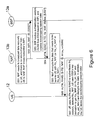
- Figure 6 illustrates a signaling diagram of a method according to a second embodiment of to the present invention
- Figure 7 illustrates a signaling diagram of a method according to a third embodiment of the present invention
- Figure 8 illustrates a block diagram of a client entity according to an embodiment of the present invention
- Figure 9 illustrates a block diagram of a network application function entity according to an embodiment of the present invention.
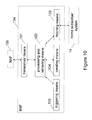
- Figure 10 illustrates a block diagram of a bootstrapping server function entity according to an embodiment of the present invention.
- the present invention and its embodiments are exemplarily directed to cases for GAA and/or GBA environments where a client or user equipment does not have a return channel back to the network.
- the network comprising at least a network application function entity and a bootstrapping server function entity
- the user equipment (client entity) lacks a bidirectional connection, i.e. a return channel, to the network application function entity, or to the bootstrapping server function entity, or to both of these entities.
- Figure 5 illustrates a signaling diagram of a method according to a first embodiment of the present invention.
- Figure 5 depicts a scenario where the client entity or user equipment UE 12 has no return channel to the network, i.e. the client entity is not able to communicate with both the network application function (NAF) entity 13b and the bootstrapping server function (BSF) entity 13a in a bidirectional manner. Thus, the client entity cannot perform a bootstrapping procedure with the BSF entity.
- An example for such a scenario may be a set-top box (STB; or digibox) which is equipped with a UICC (Universal Integrated Circuits Card) card reader.
- STB set-top box
- UICC Universal Integrated Circuits Card
- the NAF entity 13b needs to deliver some data (e.g., broadcast keys) to the client UE 12.
- the NAF entity 13b knows the private identity of the subscriber, i.e. the subscriber's IMPI (IP Multimedia core network subsystem private identity), and the data that need to be delivered to the UE 12.
- the NAF entity 13b sends a request including the subscriber's IMPI, its own identity NAF_ID (i.e., NAF hostname), and optionally one or more GSIDs (GAA service identifiers for requesting NAF-specific user security settings) over the Zn reference point to the bootstrapping server function (BSF) entity 13a.
- BSF bootstrapping server function
- the transmittal of the request (of step 2) may be triggered by a means different from the client entity.
- the authentication (bootstrapping) procedure or the need for such may be triggered in the network (for example in the NAF entity itself) by a need for updating broadcast keys in the terminal entity.
- the BSF entity 13a Upon receipt of the request from the NAF entity 13b, the BSF entity 13a checks in step S53 whether the NAF entity 13b is authorized to request authentication information, e.g. a network authentication element (AUTN) and a random challenge (RAND). If so, the BSF entity 13a fetches authentication vectors from a home subscriber system HSS 14, calculates the NAF entity's key Ks_NAF based on the NAF entity's identity NAF_ID and other key derivation parameters. It also extracts the requested user security settings USSs (if any) from subscriber's GBA user security settings (GUSS).
- authentication information e.g. a network authentication element (AUTN) and a random challenge (RAND). If so, the BSF entity 13a fetches authentication vectors from a home subscriber system HSS 14, calculates the NAF entity's key Ks_NAF based on the NAF entity's identity NAF_ID and other key derivation parameters. It also extracts the requested user
- the BSF entity 13a then sends the parameters AUTN, RAND, Ks_NAF, lifetime of Ks_NAF, and the requested USSs (if any) to the NAF entity 13b.
- the NAF 13b uses the key Ks_NAF to encrypt (or otherwise secure) the data to be transmitted to the client entity 12 (step S55).
- Ks_NAF e.g. GBA_U
- either of keys Ks_int_NAF and Ks_ext_NAF may be used for this purpose.
- the functionality of encrypting is optional.
- the NAF entity 13b uses the broadcast channel between itself and the UE 12 to send parameters AUTN, RAND, NAF_ID, and the encrypted data to the UE 12.
- AUTN, RAND, NAF_ID, and the encrypted data itself may be further protected with other known means (e.g., by using a public key of the device certificate of the UE).
- the UE 12 receives the data from the NAF 13b, it first uses the parameters AUTN and the RAND to authenticate the network. If this is successful, it will derive the bootstrapping key (Ks) from session keys CK and IK, and continue to derive the NAF-specific key Ks_NAF using Ks, NAF_ID, and other key derivation parameters. It can then decrypt the data using the key Ks_NAF, and take the data (e.g., broadcast keys) into use in the UE 12.
- Ks bootstrapping key
- Figure 6 illustrates a signaling diagram of a method according to a second embodiment of the present invention.
- the client entity UE 12 has no return channel to the network, and thus cannot perform a bootstrapping procedure directly with the BSF 13a entity. Rather, the bootstrapping takes place with the aid of a NAF entity. Hence, such a procedure may be referred to as reverse bootstrapping.
- a reverse bootstrapping procedure takes place between the client entity UE 12 and the bootstrapping server function entity BSF 13a via a network application function entity NAF 13b. The procedure is described below.
- the NAF entity 13b needs to deliver some data (e.g., broadcast keys) to the client UE 12.
- the NAF entity 13b knows the identity of the subscriber, i.e. the subscriber's IMPI (see above), and the data that need to be delivered to the UE 12.
- the UE 12 has always a connection to the NAF entity 13b and delivers a bootstrapping transaction identifier B-TID before the NAF entity 13b is able to request corresponding GBA keys from the BSF entity 13a.
- the NAF entity 13b is triggered to fetch the GBA data by some other means.
- the NAF entity 13b in step S62 sends the subscriber's IMPI, its own NAF_ID (i.e., NAF hostname), and optionally one or more GSIDs (GAA service identifiers for requesting NAF-specific user security settings) over the Zn reference point to the BSF entity 13a.
- NAF_ID i.e., NAF hostname
- GSIDs GAA service identifiers for requesting NAF-specific user security settings
- the BSF 13a Upon receipt of the request from the NAF entity 13b, the BSF 13a checks in step S63 whether the NAF entity 13b is authorized to request authorization information such as parameters like AUTN and RAND, and be part of a reverse bootstrapping procedure according to the present embodiment. If so, the BSF entity 13a fetches authentication vectors from a home subscriber system HSS 14, calculates the key Ks_NAF based on the identity NAF_ID and other key derivation parameters. It also extracts the requested user security settings USSs (if any) from subscriber's GUSS. Then, still in step S63, the BSF entity 13a creates bootstrapping session data for the subscriber that can be used later with other NAFs 13b, too.
- authorization information such as parameters like AUTN and RAND
- the BSF entity 13a should contain the existing bootstrapping session data (identified by the bootstrapping transaction identifier B-TID), and calculate the key Ks_NAF as mentioned also above.
- the BSF entity 13a according to this embodiment creates bootstrapping session data without communicating with the client entity UE 12, which are to be used for calculation of Ks_NAF and a selection of USSs.
- the BSF entity 13a sends parameters AUTN, RAND, B-TID, Ks_NAF, lifetime of the Ks_NAF, and the requested USSs (if any) to the NAF. Also AUTN, RAND, and B-TID is returned to the NAF.
- the NAF then (in step 5) optionally uses the key Ks_NAF to encrypt (or otherwise secure) the data to be transmitted.
- Ks_NAF a NAF-specific functionality.
- GBA specifications are very open on what happens in the NAF 13b and how the NAF 13b uses the GBA keys.
- the functionality of encrypting (and decrypting) of data to be transmitted is purely optional in the framework of performing authentication.
- the NAF entity uses the (unidirectional) broadcast channel between itself and the UE 12 to send parameters AUTN, RAND, B-TID, NAF_ID, and the encrypted data to the UE 12.
- AUTN, RAND, NAF_ID, and the encrypted data itself may be further protected with other means (e.g., by OMA DRM 2.0 [2] and by using a public key of the device certificate of the UE 12).
- the identifier B-TID is transferred from the UE 12 to the NAF 13b. This would have taken place already before step S61 in a normal GBA procedure. According to the present embodiment, the identifier B-TID as well as the parameters AUTN and the RAND are sent from the NAF entity 13b to the client UE 12.
- the UE When the UE receives the data from the NAF 13b (step S67), it first uses the parameters AUTN and RAND to authenticate the network. If this is successful, it will derive the bootstrapping key (Ks) from session keys CK and IK, and continue to derive the NAF-specific key Ks_NAF using Ks, NAF_ID, and other key derivation parameters. It can then decrypt the data using the key Ks_NAF, and take the data (e.g., broadcast keys) into use in the UE 12.
- Ks bootstrapping key
- the UE 12 may also be configured to store the bootstrapping session data that can be used later with another NAF 13b.
- the UE 12 then establishes a bootstrapping session by means of the received parameters B-TID, AUTN, and RAND. Also, in the present embodiment, the key derivation is handled at this stage of the procedure (as the bootstrapping session became valid). The UE 12 may also use a newly created bootstrapping session with other NAFs 13b as long as the session is valid or a bootstrapping session is created.
- Figure 7 illustrates a signaling diagram of a further method according to a third embodiment of the present invention.
- the client UE 12 has no return channel to the NAF entity 13b but does have such a bidirectional connection to other network elements such as the BSF 13a. That is, similar to the above scenarios, the client entity UE 12 is not able to communicate with both of the relevant network elements NAF 13b and BSF 13a in a bidirectional manner. However, in the present case, the client can perform a bootstrapping procedure with the BSF entity 13a.
- An example for such a scenario may be a mobile terminal that has 3G functionalities, e.g. IP connectivity, but it is also equipped with a facility to receive for example digital video broadcast for handheld terminals, i.e. is DVB-H enabled.
- This scenario assumes that the UE 12 either has a valid bootstrapping session with the BSF 13a all the time (this could be a configuration option in the UE 12), or that the BSF 13a is able to trigger the UE 12 to run a bootstrapping session establishment (e.g., by using the Session Initiation Protocol (SIP)).
- SIP Session Initiation Protocol
- the NAF entity 13b needs to deliver some data (e.g., broadcast keys) to the client entity UE 12. It knows the identity of subscriber, i.e. its IMPI, and the data that need to be delivered to the UE 12. The NAF entity 13b then sends the subscriber's IMPI, its NAF_ID (i.e., NAF hostname), and optionally one or more GSIDs (GAA service identifiers for requesting NAF-specific user security settings) over the Zn reference point (step S72). Up to this point, the method is rather similar to the one of the second embodiment above.
- some data e.g., broadcast keys
- the BSF entity 13a Upon receipt of the request from the NAF entity 13b, the BSF entity 13a checks in step S73 whether the subscriber has a valid bootstrapping session, and can be found in its databases. If it is not present, the BSF entity 13a can either indicate an error to the NAF entity 13b or trigger the client entity UE 12 to run a bootstrapping establishing procedure. The BSF entity 13a then calculates the key Ks_NAF based on the identity NAF_ID and other key derivation parameters. It also extracts the requested user security settings USSs (if any) from subscriber's GUSS.
- the BSF entity 13a sends the parameters B-TID, Ks_NAF, lifetime of the Ks_NAF, the requested USSs (if any) to the NAF entity 13b.
- the NAF entity 13b learns the valid bootstrapping transaction identifier B-TID when it receives this from the BSF entity 13a.
- the NAF entity 13b may optionally use its key Ks_NAF to encrypt (or otherwise secure) the data to be transmitted.
- the NAF entity 13b uses the broadcast channel between itself and the UE 12 to send the parameters B-TID, NAF_ID, and the encrypted data to the client entity UE.
- the parameters B-TID, NAF_ID, and the encrypted data itself may be further protected with other means (e.g., by OMA DRM 2.0 [2] and by using a public key of the device certificate of the UE 12).
- the UE 12 in step S77 uses B-TID and NAF_ID to derive the NAF-specific key Ks_NAF using Ks (identified by B-TID), NAF_ID, and other key derivation parameters. It can then, if encrypted, decrypt the data using the Ks_NAF, and take the data (e.g., broadcast keys) into use in the UE 12.
- Ks identified by B-TID
- NAF_ID identified by B-TID
- Ks_NAF e.g., broadcast keys
- the functionality related to the GBA key usage in the UE 12 is NAF-specific. The key derivation is handled at this stage of the procedure.
- the client entity 12 cannot reach the BSF 13a, but has a 2-way channel to the NAF 13b.
- GBA Global System for Mobile Communications
- the basic reverse GBA protocol cannot be used because the NAF 13b does not know the IMPI of the subscriber of the UE 12.
- WLAN Wireless Local Area Network
- EAP Extensible Authentication Protocol
- the client entity UE 12 performs a bootstrapping procedure (with the BSF entity 13a) via the NAF entity 13b. Signaling is similar to the above described procedures except that, before the first step, the UE 12 contacts the NAF entity 13b and sends its private identity IMPI.
- a still further embodiment resides in a case where the NAF entity 13b has only a unidirectional channel to the UE 12, but the BSF 13a has a bidirectional channel to the UE 12.
- a client entity there are presented a client entity, a network application function entity, a bootstrapping server function entity, and a system for performing authentication between the client entity and the network in accordance with any one of the methods of the present invention.
- Figure 8 illustrates a block diagram of a client entity according to an embodiment of the present invention.
- a client entity 12 comprises receiving means 87 for receiving transmissions from the network application function NAF entity 13b and authenticating means 81 for authenticating the network using the received authentication information.
- the client entity UE 12 optionally further comprises one or more of the following (as can be gathered from Figure 8 ):
- the client entity 12 further comprises processing and control means 86 which is configured to process data and signaling, and to control the client entity 12 as a whole as well as its constituents, such as e.g. the establishing means 84.
- processing and control means 86 have bidirectional data and/or control connections to any one of the constituent means shown.
- the client entity further comprises at least a user equipment and/or is connectable to a universal subscriber identity module in accordance with e.g. 3GPP standards.
- the client entity according to still another embodiment of the present invention is a set-top box (or digibox). If so, the client entity being such a set-top box is configured to be operated according to any appropriate known technique, such as for example according to DVB-H standards.
- the authenticating means 81 of the client entity is configured to access user identity information available at the client entity.
- user identity information are for example used, in addition to received authentication information, for authentication purposes.
- user identity information are for example stored in a smart-card connectable to the client entity, such as e.g. a UICC, a universal subscriber identity module (USIM), or a smart-card enabled for use according to DVB-H standards.
- a smart-card connectable to the client entity such as e.g. a UICC, a universal subscriber identity module (USIM), or a smart-card enabled for use according to DVB-H standards.
- Figure 9 illustrates a block diagram of a network application function entity according to an embodiment of the present invention.
- a network entity in particular a network application function entity 13b, according to one embodiment comprises transceiver means 91 which are configured to send transmissions to a client entity 12, and to send to and receive from a bootstrapping server function entity 13a.
- the transceiver means 91 is e.g. configured to transmit a request for authentication information to the bootstrapping server function entity 13a when the network application function entity 13b needs to securely transmit data to the client entity 12, to receive a response including the authentication information from the bootstrapping server function entity 13a, and to transmit the authentication information and the data to be transmitted to the client entity 12.
- the network application function NAF entity 13b optionally further comprises encrypting means 92 for encrypting the data to be transmitted to the client entity 12 using the key of the network application function entity 13b itself.
- the data to be transmitted are represented by a database symbol labeled DATA 93.
- transceiver means 91 could be configured for transmitting an identity of the network application function entity 13b to the client entity 12. Such an identity may also be stored in the same database DATA 93 as the date to be transmitted.
- the network entity is configured to broadcast transmissions, e.g. to the client entity UE.
- Figure 10 illustrates a block diagram of a bootstrapping server function entity according to an embodiment of the present invention.
- a network entity in particular a bootstrapping server function BSF entity 13a, according to one embodiment comprises transceiver means 101 for sending to and receiving from a network application function entity 13b, and processing and retrieving means 102 for processing a request received from the network application function entity 13b and for retrieving authentication information.
- the transceiver means 101 is particularly configured for receiving the request from the network application function entity 13b and for transmitting the authentication information to the network application function 13b entity.
- the bootstrapping server function entity BSF 13a optionally further comprises one or more of the following (as can be gathered from Figure 10 ):
- a system according to the present invention comprises at least one client entity 12 (which may optionally be a set-top box), at least one network application function entity 13b, and at least one bootstrapping server function entity 13a according to Figures 8 to 10 .
- the mentioned functional elements i.e. the UE, the BSF, and the NAF according to the present invention, and their constituents can be implemented by any known means, either in hardware and/or software, respectively, as long as it is configured to perform the described functions of the respective parts.
- the authenticating means of the client entity can be implemented by any data processing unit, e.g. a microprocessor, being configured to authenticate the network using the received authentication information according to the method of the present invention.
- the mentioned parts can also be realized in individual functional blocks or by individual means, or one or more of the mentioned parts can be realized in a single functional block or by a single means.
- the above illustration of Figures 8 to 10 is only for illustrative purposes and does not restrict an implementation of the present invention anyhow.
- a client entity for performing authentication between a client entity and a network
- the network comprising at least a bootstrapping server function entity and a network application function entity, and wherein the client entity is not able to communicate with both of the network entities in a bidirectional manner, wherein the standard Ub reference point between the client entity and the bootstrapping server function entity is not utilized for authentication purposes.
- the present invention discloses authentication using GAA functionality for unidirectional network connections.
- the network is a broadcast network.
Landscapes
- Engineering & Computer Science (AREA)
- Computer Networks & Wireless Communication (AREA)
- Signal Processing (AREA)
- Computer Security & Cryptography (AREA)
- Computer Hardware Design (AREA)
- Computing Systems (AREA)
- General Engineering & Computer Science (AREA)
- Mobile Radio Communication Systems (AREA)
Abstract
Description
- The present invention relates to methods, network entities, a system, and a computer program product for authentication between a client entity and a network, wherein the client entity is not able to communicate with the network in a bidirectional manner. In particular, the present invention relates to authentication using functionalities in accordance with a generic authentication architecture, GAA, in e.g. broadcast scenarios.
- In recent years, various kinds of communication systems, in particular mobile and/or IP-based (IP: Internet Protocol) communication systems, as well as a multitude of services offered in these systems have been developed.
- In such advanced communication systems, such as e.g. Third Generation mobile communication networks currently under development by the Third Generation Partnership Program (3GPP), aspects relating to security and trustworthiness are playing a more and more important role.
- Starting from the concept of subscriber certificates, which support services that mobile operators provide and whose provision assists mobile operators, and in consideration of a need for more generic security capabilities, 3GPP standardization work lately concentrated on the evolution of a generic authentication architecture (GAA). As can be gathered from
Figure 1 showing an overview of a generic authentication architecture environment in interrelation with a homesubscriber system HSS 14, a user equipment UE 12, and a network entity NE 13, GAA 11 basically consists of three sub-aspects. That is, a generic bootstrapping architecture (GBA) 11b,subscriber certificates 11a, and an authentication proxy (AP) 11c e.g. based on HTTPS (Secure Hypertext Transport Protocol). Thereby, the generic bootstrapping architecture (GBA) also builds a basis for both the other sub-aspects in that GBA offers generic authentication capability for various applications based on a shared secret. Usually, GBA functionality is to bootstrap authentication and key agreement for application security, and it is based on the HTTP Digest AKA (Authentication and Key Agreement) mechanism in accordance with IETF RFC 3310. - In
Figure 2 , there is illustrated a network model for generic bootstrapping. A bootstrapping server function BSF 13a and the user equipment UE 12, which are connected via a bidirectional link Ub, mutually authenticate using the AKA protocol, and agree on session keys. These keys are afterwards to be used for a bootstrapping session and to be used between theuser equipment 12 and an operator-controlled network application function NAF 13b which is also connected to theuser equipment 12 by means of a bidirectional link Ua. After the bootstrapping procedure, which is described in detail below, theuser equipment 12 and thenetwork application function 13b can run some application-specific protocol where the authentication of messages will be based on those session keys generated during mutual authentication. Accordingly, GAA/GBA can in general be regarded as a 3-party authentication scenario, wherein thebootstrapping server function 13a is further connected to a home subscriber system HSS 14 maintaining e.g. user security settings (USS). - The reference points (interfaces) between the individual entities in
Figure 2 are denoted by Ub, Ua, Zn, and Zh. The interfaces Zn and Zh are based on Diameter (according to the Diameter Base Protocol which is specified in IETF RFC 3588), the interface Ub is based on a reuse of HTTP Digest AKA messages, and the protocol used on the interface Ua depends on the application to be executed. - The utilization of the generic bootstrapping architecture is divided into two phases. The first phase, i.e. the (generic) bootstrapping procedure as such, is illustrated in
Figure 3 , and the second phase, i.e. the generic bootstrapping usage procedure, is illustrated inFigure 4 . - In the bootstrapping procedure according to
Figure 3 , the user equipment UE 12 sends an HTTP request towards the bootstrapping server function BSF 13a (step S31). In step S32, theBSF 13a retrieves the user profile and a challenge, i.e. authentication vector (AV), over the Zh interface from the homesubscriber system HSS 14. Then, in step S33, theBSF 13a forwards authentication parameters RAND and AUTN to the UE 12 in order to demand the UE 12 to authenticate itself. The UE 12 calculates a message authentication code (MAC) so as to verify the challenge from the authenticated network, as well as calculates session keys CK, IK, and RES. Thus, the session keys CK, IK, and RES are available in bothBSF 13a and UE 12. In step S35, the UE 12 sends again a request to theBSF 13a, and theBSF 13a checks in step S36 whether the received parameter is calculated using RES and is equal to the parameter that is similarly calculated using XRES which has been obtained before as a part of the authentication vector from theHSS 14. If these parameters are equal, theUE 12 is authenticated, and theBSF 13a generates a key ("master key") Ks by concatenating the session keys CK and IK (step S37). The key Ks is then used for securing the Ua interface. In step S38, theBSF 13a sends an OK message including a transaction identifier B-TID and other possible data (such as for example a lifetime of the key Ks) to theUE 12, by means of which the success of the authentication is indicated. By concatenating the session keys CK and IK, the key Ks for securing the Ua interface is then also generated at the UE 12 (step S39). Therewith, a bootstrapping session between the user equipment (client) and the bootstrapping server function has been started successfully. - In
Figure 4 , an example procedure using a bootstrapped security association is depicted. After having initiated a bootstrapping session (S40a), the UE 12 can start to communicate with the network application function NAF 13b. Thereby, the master key Ks generated during bootstrapping procedure in theUE 12 and in theBSF 13a is used to derive the NAF-specific key Ks_NAF (step S40b). An application request (step S41) includes the transaction identifier B-TID obtained during bootstrapping, an application-specific dataset denoted by msg, and all credentials being denoted by MAC. In step S42, the NAF 13b requests one or more keys and possibly user profile data corresponding to the information supplied by the UE 12 over the Zn interface from theBSF 13a. Such a request can e.g. be based on the transaction identifier. Between steps S42 and S43, the NAF-specific key Ks_NAF is generated in theBSF entity 13a. In step S43, the BSF 13a responds by supplying the requested key or keys (including Ks_NAF and an application-specific part of the user profile being denoted by Prof) to the NAF 13b, which the NAF 13b uses directly, or with which the NAF 13b derives further keys required to protect the protocol used over the Ua interface towards UE 12, which is an application-specific functionality and not addressed in GAA specifications. Such a derivation is performed in the same way as the UE 12 did beforehand. - Then, the
NAF entity 13b stores (step S44) at least the parameters Ks_NAF, Prof, and the lifetime of the key. Afterwards, the NAF 13b continues with the protocol used over the Ua interface by sending an application answer to the UE 12 (step S45). - For further details on the generic bootstrapping architecture, reference is made to the technical specification 3GPP TS 33.220 (version 6.3.0) of December 2004.
- In view of the conventional generic authentication architecture and generic bootstrapping architecture described above, there arises the following problem.
- In summary, the normal conventional 3GPP GAA behavior is that a client, i.e. a user equipment, bootstraps with the BSF entity using an AKA authentication vector. As a result, so called GAA credentials are obtained which consist of a shared key Ks and a bootstrapping transaction identifier (B-TID). These GAA credentials are further used to derive a server-specific key (Ks_NAF). The NAF-specific keys (i.e. B-TID and Ks_NAF) can then be used between the client UE and the server NAF, such as e.g. as username/password in existing protocols, which case is denoted by the term "generic".
- The conventional bootstrapping procedure requires the client to have a bidirectional connection to the BSF entity, and the subsequent use of the NAF-specific credentials between the UE and the NAF typically requires this as well. Thus, the problem resides in that the conventional GAA and/or GBA mechanisms do not work, i.e. cannot be used for authentication, in case there is no return channel from the user equipment to the network. An example for such a scenario are broadcast networks, e.g. the user equipment being a set-top box (STB; or digibox) for digital video broadcasting. In such a scenario, GAA and/or GBA according to the prior art cannot be used as the UE can neither bootstrap with the BSF nor communicate with the NAF in a bidirectional manner, as is required.
- In a contribution to the DVB-H (Digital Video Broadcasting for Handhelds) consortium and the ETSI (European Telecommunication Standards Institute), Vodafone presented a proposal for an interface for a USIM card-based element of the mechanism used to derive keys for service protection. However, this proposal is not suitable to overcome the problem described above and the related drawbacks.
- Thus, a solution to the above problem and drawbacks is needed for providing security in such scenarios which are becoming more and more important for future use.
- Consequently, it is an object of the present invention to remove the above drawbacks inherent to the prior art and to provide accordingly improved methods, network entities, a system, and a computer program product.
- According to a first aspect of the invention, this object is for example achieved by a method for performing authentication between a client entity and a network comprising at least a bootstrapping server function entity and a network application function entity, wherein the client entity is not able to communicate with both of the network entities in a bidirectional manner, the method comprising the steps of transmitting a request for authentication information from the network application function entity to the bootstrapping server function entity when the network application function entity needs to securely transmit data to the client entity; processing the request and retrieving the authentication information at the bootstrapping server function entity; transmitting a response including the authentication information from the bootstrapping server function entity to the network application function entity; transmitting the authentication information and the data to be transmitted from the network application function entity to the client entity; and authenticating the network using the authentication information at the client entity.
- According to further advantageous developments at least one of the following applies:
- the step of transmitting the request is triggered by a means different from the client entity;
- the request comprises at least a private identity of the client entity and an identity of the network application function entity;
- the step of retrieving the authentication information comprises a step of fetching the authentication information from a home subscriber system;
- the authentication information comprise at least a random challenge parameter and a network authentication parameter;
- the response further comprises a key of the network application function entity;
- the step of transmitting the authentication information further comprises a step of transmitting an identity of the network application function entity;
- the step of authenticating the network further comprises a step of generating a key of the network application function entity at the client entity;
- the authentication performed is a generic authentication in accordance with a generic authentication architecture;
- the step of retrieving the authentication information further comprises a step of creating bootstrapping session data;
- the authentication information comprise at least a random challenge parameter, a network authentication parameter, and bootstrapping session data;
- the response further comprises a key of the network application function entity;
- the step of transmitting the authentication information further comprises a step of transmitting an identity of the network application function entity;
- the step of authenticating the network further comprises a step of generating a key of the network application function entity at the client entity;
- the step of authenticating the network further comprises a step of establishing a bootstrapping session between the client entity and the bootstrapping server function entity;
- the step of establishing a bootstrapping session is based on the authentication information transmitted from the network application function entity;
- the step of authenticating the network further comprises a step of storing the bootstrapping session data at the client entity;
- there exists a valid bootstrapping session between the client entity and the bootstrapping server function entity;
- a valid bootstrapping session exists permanently;
- the step of processing the request further comprises a step of triggering the client entity to establish a valid bootstrapping session;
- the authentication information comprise at least bootstrapping session data;
- the response further comprises a key of the network application function entity;
- the step of authenticating the network further comprises a step of generating a key of the network application function entity at the client entity;
- the method further comprises a step where the client entity initially contacts the network application function entity and sends its private identity;
- the network application function entity triggers the client entity to establish a valid bootstrapping session;
- the network application function entity triggers the bootstrapping server function entity so as to trigger an unsolicited bootstrapping procedure with the client entity;
- the method further comprises a step of encrypting the data to be transmitted at the network application function entity using its key; and/or
- the method further comprises a step of decrypting the encrypted data at the client entity using the key of the network application function entity. According to a second aspect of the invention, this object is for example achieved by a method for performing authentication between a client entity and a network comprising at least a bootstrapping server function entity and a network application function entity, wherein the client entity is not able to communicate with both of the network entities in a bidirectional manner, the method comprising the steps of transmitting a request for authentication information from the network application function entity to the bootstrapping server function entity when the network application function entity needs to securely transmit data to the client entity; processing the request and retrieving
- According to a third aspect of the invention, this object is for example achieved by a method for performing authentication between a client entity and a network comprising at least a bootstrapping server function entity and a network application function entity, wherein the client entity is not able to communicate with both of the network entities in a bidirectional manner, said authentication being a generic authentication in accordance with a generic authentication architecture, the method comprising the steps of transmitting a request for authentication information from the network application function entity to the bootstrapping server function entity when the network application function entity needs to securely transmit data to the client entity; processing the request and retrieving the authentication information at the bootstrapping server function entity, including a step of creating bootstrapping session data; transmitting a response including the authentication information, comprising at least a random challenge parameter, a network authentication parameter, the bootstrapping session data, and a key of the network application function entity, from the bootstrapping server function entity to the network application function entity; transmitting the authentication information, an identity of the network application function entity, and the data to be transmitted from the network application function entity to the client entity; and authenticating the network using the authentication information and establishing a bootstrapping session between the client entity and the bootstrapping server function entity at the client entity.
- According to a fourth aspect of the invention, this object is for example achieved by a method for performing authentication between a client entity and a network comprising at least a bootstrapping server function entity and a network application function entity, wherein the client entity is not able to communicate with both of the network entities in a bidirectional manner, wherein there exists a valid bootstrapping session between the client entity and the bootstrapping server function entity, the method comprising the steps of transmitting a request for authentication information from the network application function entity to the bootstrapping server function entity when the network application function entity needs to securely transmit data to the client entity; processing the request and retrieving the authentication information at the bootstrapping server function entity; transmitting a response including the authentication information, comprising at least bootstrapping session data and a key of the network application function entity, from the bootstrapping server function entity to the network application function entity; transmitting the authentication information and the data to be transmitted from the network application function entity to the client entity; and authenticating the network using the authentication information and generating a key of the network application function entity at the client entity.
- According to a fifth aspect of the invention, this object is for example achieved by a client entity for use within an authentication architecture for performing authentication between the client entity and a network, the client entity comprising receiving means for receiving transmissions from the network, and authenticating means for authenticating the network using received authentication information.
- According to a sixth aspect of the invention, this object is for example achieved by a client entity for use within an authentication architecture for performing authentication between the client entity and a network, the network comprising at least a bootstrapping server function entity and a network application function entity, and in which architecture the client entity is not able to communicate with both of the network entities in a bidirectional manner, the client entity comprising receiving means for receiving transmissions from the network application function entity, and authenticating means for authenticating the network using the received authentication information.
-
- According to further advantageous developments at least one of the following applies:
- the client entity further comprises key generating means for generating a key of the network application function entity;
- the client entity further comprises establishing means for establishing a bootstrapping session between the client entity and the bootstrapping server function entity;
- the client entity further comprises storing means for storing bootstrapping session data;
- the client entity further comprises decrypting means for decrypting encrypted data received from the network application function entity using a key of the network application function entity;
- the client entity further comprises processing and control means for processing data and signaling, and for controlling the client entity and its constituent means; and/or
- the client entity comprises at least a user equipment and is connectable to a universal subscriber identity module.
- According to further advantageous developments of the fifth or sixth aspects at least one of the following applies:
- the client entity is a set-top box;
- the authenticating means is configured to access user identity information available at the client entity; and/or
- the user identity information are stored in a smart-card connectable to the client entity.
- According to a seventh aspect of the invention, this object is for example achieved by a network entity for use within an authentication architecture for performing authentication between a client entity and a network, the network comprising at least the network entity being a network application function entity and a bootstrapping server function entity, and in which architecture the client entity is not able to communicate with both of the network entities in a bidirectional manner, the network entity comprising transceiver means for sending transmissions to the client entity, and for sending to and receiving from the bootstrapping server function entity, wherein the transceiver means is configured for transmitting a request for authentication information to the bootstrapping server function entity when the network application function entity needs to securely transmit data to the client entity, for receiving a response including the authentication information from the bootstrapping server function entity, and for transmitting the authentication information and the data to be transmitted to the client entity.
- According to further advantageous developments at least one of the following applies:
- the transceiver means is further configured for transmitting an identity of the network application function entity to the client entity;
- the network entity further comprises encrypting means for encrypting the data to be transmitted to the client entity using the key of the network application function entity; and/or
- the network entity is configured to broadcast transmissions.
- According to a eighth aspect of the invention, this object is for example achieved by a network entity for use within an authentication architecture for performing authentication between a client entity and a network, the network comprising at least the network entity being a bootstrapping server function entity and a network application function entity, and in which architecture the client entity is not able to communicate with both of the network entities in a bidirectional manner, the network entity comprising transceiver means for sending to and receiving from the network application function entity, and processing and retrieving means for processing a request received from the network application function entity and for retrieving authentication information, wherein the transceiver means is configured for receiving the request from the network application function entity and for transmitting the authentication information to the network application function entity.
-
- According to further advantageous developments at least one of the following applies:
- the network entity further comprises fetching means for fetching the authentication information from a home subscriber system;
- the network entity further comprises creating means for creating bootstrapping session data;
- the network entity further comprises triggering means for triggering the client entity to establish a valid bootstrapping session; and/or
- the network is a broadcast network.
- According to a ninth aspect of the invention, this object is for example achieved by an authentication architecture system for performing authentication between a client entity and a network, the network comprising at least a bootstrapping server function entity and a network application function entity, and in which architecture the client entity is not able to communicate with both of the network entities in a bidirectional manner, the system comprising at least one client entity according to the fifth or sixth aspects, at least one network application function entity according to the seventh aspect, and at least one bootstrapping server function entity according to eighth aspect.
- According to a further advantageous development the client entity of the authentication architecture system is a set-top box.
- According to a tenth aspect of the invention, this object is for example achieved by a computer program product being loadable into a memory of a digital processing means and comprising software code portions for performing the steps of the method according to any one of the first to fourth aspects when said product is run on said digital processing means.
- According to another advantageous technical solution according to the present invention, the network according to any of the above aspects is a broadcast network.
- It is an advantage of the present invention that a solution is provided on how the 3GPP GAA concept can be used in scenarios where the client does not have a return channel back to the network.
- With the embodiments of the present invention, the bootstrapping phase between the client and the bootstrapping server function is basically removed. Further, it is advantageous that this bootstrapping phase is partly combined with the meta-protocol (or the single messages) between the network application function and the client.
- It is another advantage of the present invention that bootstrapping of authentication and key agreement is enabled for the scenario lacking a return channel, i.e. lacking a bidirectional connection to the network.
- By means of the present invention, the GAA/GBA concept is thus broadened in its area of application.
- In the following, the present invention will be described in greater detail by means of embodiments thereof with reference to the accompanying drawings, in which
-
Figure 1 illustrates an overview of a generic authentication architecture environment, -
Figure 2 illustrates a network model for generic bootstrapping, -
Figure 3 illustrates a generic bootstrapping procedure according to the prior art, -
Figure 4 illustrates a generic bootstrapping usage procedure according to the prior art, -
Figure 5 illustrates a signaling diagram of a method according to a first embodiment of the present invention, -
Figure 6 illustrates a signaling diagram of a method according to a second embodiment of to the present invention, -
Figure 7 illustrates a signaling diagram of a method according to a third embodiment of the present invention, -
Figure 8 illustrates a block diagram of a client entity according to an embodiment of the present invention, -
Figure 9 illustrates a block diagram of a network application function entity according to an embodiment of the present invention, and -
Figure 10 illustrates a block diagram of a bootstrapping server function entity according to an embodiment of the present invention. - The present invention is described herein by means of embodiments thereof with reference to particular non-limiting example scenarios. A person skilled in the art will appreciate that the invention is not limited to these examples, and may be more broadly applied.
- The present invention and its embodiments are exemplarily directed to cases for GAA and/or GBA environments where a client or user equipment does not have a return channel back to the network. With the network comprising at least a network application function entity and a bootstrapping server function entity, this means that a user equipment (client entity) is not able to communicate with both of the network entities in a bidirectional manner. Stated in other words, this means that the user equipment (client entity) lacks a bidirectional connection, i.e. a return channel, to the network application function entity, or to the bootstrapping server function entity, or to both of these entities.
-
Figure 5 illustrates a signaling diagram of a method according to a first embodiment of the present invention.Figure 5 depicts a scenario where the client entity oruser equipment UE 12 has no return channel to the network, i.e. the client entity is not able to communicate with both the network application function (NAF)entity 13b and the bootstrapping server function (BSF)entity 13a in a bidirectional manner. Thus, the client entity cannot perform a bootstrapping procedure with the BSF entity. An example for such a scenario may be a set-top box (STB; or digibox) which is equipped with a UICC (Universal Integrated Circuits Card) card reader. - A method for performing authentication between the client entity and the network so as to utilize GAA functionalities is described below.
- In step S51, the
NAF entity 13b needs to deliver some data (e.g., broadcast keys) to theclient UE 12. TheNAF entity 13b knows the private identity of the subscriber, i.e. the subscriber's IMPI (IP Multimedia core network subsystem private identity), and the data that need to be delivered to theUE 12. In step S52, theNAF entity 13b sends a request including the subscriber's IMPI, its own identity NAF_ID (i.e., NAF hostname), and optionally one or more GSIDs (GAA service identifiers for requesting NAF-specific user security settings) over the Zn reference point to the bootstrapping server function (BSF)entity 13a. - It is to be noted that the transmittal of the request (of step 2) may be triggered by a means different from the client entity. For example in the case of DVB-H, the authentication (bootstrapping) procedure or the need for such may be triggered in the network (for example in the NAF entity itself) by a need for updating broadcast keys in the terminal entity.
- Upon receipt of the request from the
NAF entity 13b, theBSF entity 13a checks in step S53 whether theNAF entity 13b is authorized to request authentication information, e.g. a network authentication element (AUTN) and a random challenge (RAND). If so, theBSF entity 13a fetches authentication vectors from a homesubscriber system HSS 14, calculates the NAF entity's key Ks_NAF based on the NAF entity's identity NAF_ID and other key derivation parameters. It also extracts the requested user security settings USSs (if any) from subscriber's GBA user security settings (GUSS). - In a fourth step S54, the
BSF entity 13a then sends the parameters AUTN, RAND, Ks_NAF, lifetime of Ks_NAF, and the requested USSs (if any) to theNAF entity 13b. TheNAF 13b uses the key Ks_NAF to encrypt (or otherwise secure) the data to be transmitted to the client entity 12 (step S55). Optionally, in the case of UICC-enabled GBA (i.e. GBA_U) either of keys Ks_int_NAF and Ks_ext_NAF may be used for this purpose. However, the functionality of encrypting (as well as the below decrypting) is optional. - In step S56, the
NAF entity 13b uses the broadcast channel between itself and theUE 12 to send parameters AUTN, RAND, NAF_ID, and the encrypted data to theUE 12. AUTN, RAND, NAF_ID, and the encrypted data itself may be further protected with other known means (e.g., by using a public key of the device certificate of the UE). When theUE 12 receives the data from theNAF 13b, it first uses the parameters AUTN and the RAND to authenticate the network. If this is successful, it will derive the bootstrapping key (Ks) from session keys CK and IK, and continue to derive the NAF-specific key Ks_NAF using Ks, NAF_ID, and other key derivation parameters. It can then decrypt the data using the key Ks_NAF, and take the data (e.g., broadcast keys) into use in theUE 12. - Consequently, the Ub reference point is not used at all in the presented method.
-
Figure 6 illustrates a signaling diagram of a method according to a second embodiment of the present invention. There is again depicted a scenario where theclient entity UE 12 has no return channel to the network, and thus cannot perform a bootstrapping procedure directly with theBSF 13a entity. Rather, the bootstrapping takes place with the aid of a NAF entity. Hence, such a procedure may be referred to as reverse bootstrapping. - A reverse bootstrapping procedure according to the present embodiment takes place between the
client entity UE 12 and the bootstrapping serverfunction entity BSF 13a via a network applicationfunction entity NAF 13b. The procedure is described below. - In step S61, the
NAF entity 13b needs to deliver some data (e.g., broadcast keys) to theclient UE 12. TheNAF entity 13b knows the identity of the subscriber, i.e. the subscriber's IMPI (see above), and the data that need to be delivered to theUE 12. According to conventional procedures, theUE 12 has always a connection to theNAF entity 13b and delivers a bootstrapping transaction identifier B-TID before theNAF entity 13b is able to request corresponding GBA keys from theBSF entity 13a. - In the method according to the present embodiment, the
NAF entity 13b is triggered to fetch the GBA data by some other means. - The
NAF entity 13b in step S62 sends the subscriber's IMPI, its own NAF_ID (i.e., NAF hostname), and optionally one or more GSIDs (GAA service identifiers for requesting NAF-specific user security settings) over the Zn reference point to theBSF entity 13a. According to conventional procedures, the identifier B-TID is used to fetch the GBA keys from theBSF 13a. In contrast thereto, theNAF entity 13b here uses the subscriber's IMPI to fetch the GBA data from theBSF 13a. - Upon receipt of the request from the
NAF entity 13b, theBSF 13a checks in step S63 whether theNAF entity 13b is authorized to request authorization information such as parameters like AUTN and RAND, and be part of a reverse bootstrapping procedure according to the present embodiment. If so, theBSF entity 13a fetches authentication vectors from a homesubscriber system HSS 14, calculates the key Ks_NAF based on the identity NAF_ID and other key derivation parameters. It also extracts the requested user security settings USSs (if any) from subscriber's GUSS. Then, still in step S63, theBSF entity 13a creates bootstrapping session data for the subscriber that can be used later with other NAFs 13b, too. - According to procedures of the prior art, the
BSF entity 13a should contain the existing bootstrapping session data (identified by the bootstrapping transaction identifier B-TID), and calculate the key Ks_NAF as mentioned also above. In contrast thereto, theBSF entity 13a according to this embodiment creates bootstrapping session data without communicating with theclient entity UE 12, which are to be used for calculation of Ks_NAF and a selection of USSs. In step S64, theBSF entity 13a sends parameters AUTN, RAND, B-TID, Ks_NAF, lifetime of the Ks_NAF, and the requested USSs (if any) to the NAF. Also AUTN, RAND, and B-TID is returned to the NAF. The NAF then (in step 5) optionally uses the key Ks_NAF to encrypt (or otherwise secure) the data to be transmitted. According to the current specifications, this is a NAF-specific functionality. (Note that GBA specifications are very open on what happens in theNAF 13b and how theNAF 13b uses the GBA keys.) As mentioned above, the functionality of encrypting (and decrypting) of data to be transmitted is purely optional in the framework of performing authentication. - In step S66, the NAF entity uses the (unidirectional) broadcast channel between itself and the
UE 12 to send parameters AUTN, RAND, B-TID, NAF_ID, and the encrypted data to theUE 12. AUTN, RAND, NAF_ID, and the encrypted data itself may be further protected with other means (e.g., by OMA DRM 2.0 [2] and by using a public key of the device certificate of the UE 12). - According to current prior art standards, the identifier B-TID is transferred from the
UE 12 to theNAF 13b. This would have taken place already before step S61 in a normal GBA procedure. According to the present embodiment, the identifier B-TID as well as the parameters AUTN and the RAND are sent from theNAF entity 13b to theclient UE 12. - When the UE receives the data from the
NAF 13b (step S67), it first uses the parameters AUTN and RAND to authenticate the network. If this is successful, it will derive the bootstrapping key (Ks) from session keys CK and IK, and continue to derive the NAF-specific key Ks_NAF using Ks, NAF_ID, and other key derivation parameters. It can then decrypt the data using the key Ks_NAF, and take the data (e.g., broadcast keys) into use in theUE 12. TheUE 12 may also be configured to store the bootstrapping session data that can be used later with anotherNAF 13b. TheUE 12 then establishes a bootstrapping session by means of the received parameters B-TID, AUTN, and RAND. Also, in the present embodiment, the key derivation is handled at this stage of the procedure (as the bootstrapping session became valid). TheUE 12 may also use a newly created bootstrapping session with other NAFs 13b as long as the session is valid or a bootstrapping session is created. - Also here, the Ub reference point is not used at all in the presented method.
-
Figure 7 illustrates a signaling diagram of a further method according to a third embodiment of the present invention. There is depicted a scenario where theclient UE 12 has no return channel to theNAF entity 13b but does have such a bidirectional connection to other network elements such as theBSF 13a. That is, similar to the above scenarios, theclient entity UE 12 is not able to communicate with both of the relevantnetwork elements NAF 13b andBSF 13a in a bidirectional manner. However, in the present case, the client can perform a bootstrapping procedure with theBSF entity 13a. An example for such a scenario may be a mobile terminal that has 3G functionalities, e.g. IP connectivity, but it is also equipped with a facility to receive for example digital video broadcast for handheld terminals, i.e. is DVB-H enabled. - This scenario assumes that the
UE 12 either has a valid bootstrapping session with theBSF 13a all the time (this could be a configuration option in the UE 12), or that theBSF 13a is able to trigger theUE 12 to run a bootstrapping session establishment (e.g., by using the Session Initiation Protocol (SIP)). The present method utilizes GAA functionalities is described below. - In step S71, the
NAF entity 13b needs to deliver some data (e.g., broadcast keys) to theclient entity UE 12. It knows the identity of subscriber, i.e. its IMPI, and the data that need to be delivered to theUE 12. TheNAF entity 13b then sends the subscriber's IMPI, its NAF_ID (i.e., NAF hostname), and optionally one or more GSIDs (GAA service identifiers for requesting NAF-specific user security settings) over the Zn reference point (step S72). Up to this point, the method is rather similar to the one of the second embodiment above. - Upon receipt of the request from the
NAF entity 13b, theBSF entity 13a checks in step S73 whether the subscriber has a valid bootstrapping session, and can be found in its databases. If it is not present, theBSF entity 13a can either indicate an error to theNAF entity 13b or trigger theclient entity UE 12 to run a bootstrapping establishing procedure. TheBSF entity 13a then calculates the key Ks_NAF based on the identity NAF_ID and other key derivation parameters. It also extracts the requested user security settings USSs (if any) from subscriber's GUSS. TheBSF entity 13a sends the parameters B-TID, Ks_NAF, lifetime of the Ks_NAF, the requested USSs (if any) to theNAF entity 13b. Thus, theNAF entity 13b learns the valid bootstrapping transaction identifier B-TID when it receives this from theBSF entity 13a. In the fifth step, theNAF entity 13b may optionally use its key Ks_NAF to encrypt (or otherwise secure) the data to be transmitted. TheNAF entity 13b uses the broadcast channel between itself and theUE 12 to send the parameters B-TID, NAF_ID, and the encrypted data to the client entity UE. The parameters B-TID, NAF_ID, and the encrypted data itself may be further protected with other means (e.g., by OMA DRM 2.0 [2] and by using a public key of the device certificate of the UE 12). - When the
UE 12 in step S77 receives the data from theNAF entity 13b, it uses B-TID and NAF_ID to derive the NAF-specific key Ks_NAF using Ks (identified by B-TID), NAF_ID, and other key derivation parameters. It can then, if encrypted, decrypt the data using the Ks_NAF, and take the data (e.g., broadcast keys) into use in theUE 12. The functionality related to the GBA key usage in the UE 12 (as in theNAF 13b, see step S75) is NAF-specific. The key derivation is handled at this stage of the procedure. - The extensions/modifications when implementing the methods according to any one of the embodiments of the present invention into a GBA architecture according to the prior art are the following:
- the
NAF 13b is able to request AUTN and RAND (but not RES, CK, IK) and the GBA key derived from CK and IK (i.e. Ks_NAF, for example) by using subscriber's private identity (e.g. IMPI or IMSI) instead of B-TID; - the
BSF 13a is able to create a bootstrapping session data for a subscriber based on NAF's request for AUTN and RAND; - in addition to normal data returned from the
BSF 13a, also AUTN and RAND are returned (but not RES, CK, IK); - the
UE 12 is able to create a bootstrapping session data based on AUTN, RAND, B-TID, and key lifetime received from theNAF 13b; and - the
NAF 13b is able to request bootstrapping session data (B-TID, NAF-specific, etc.) by using the subscriber's IMPI. - As a further embodiment of the present invention, there is conceivable a case where the
client entity 12 cannot reach theBSF 13a, but has a 2-way channel to theNAF 13b. For example, this is the case when theUE 12 uses GBA for access authentication. The basic reverse GBA protocol cannot be used because theNAF 13b does not know the IMPI of the subscriber of theUE 12. Such a scenario could also be present for example in a WLAN (Wireless Local Area Network) case, where theclient entity 12 needs to authenticate but only has a connection for example to an EAP (Extensible Authentication Protocol) server which could operate as theNAF entity 13b in such a case. - Accordingly, the
client entity UE 12 performs a bootstrapping procedure (with theBSF entity 13a) via theNAF entity 13b. Signaling is similar to the above described procedures except that, before the first step, theUE 12 contacts theNAF entity 13b and sends its private identity IMPI. - A still further embodiment resides in a case where the
NAF entity 13b has only a unidirectional channel to theUE 12, but theBSF 13a has a bidirectional channel to theUE 12. - In this embodiment, it is possible that
- (1) the
NAF entity 13b triggers theUE 12 to establish a valid bootstrapping session; or - (2) the
NAF entity 13b triggers theBSF entity 13a so as to trigger an unsolicited bootstrapping procedure with theclient entity UE 12. - According to further embodiments of the present invention, there are presented a client entity, a network application function entity, a bootstrapping server function entity, and a system for performing authentication between the client entity and the network in accordance with any one of the methods of the present invention.
-
Figure 8 illustrates a block diagram of a client entity according to an embodiment of the present invention. - A
client entity 12 according to one embodiment comprises receiving means 87 for receiving transmissions from the network applicationfunction NAF entity 13b and authenticating means 81 for authenticating the network using the received authentication information. - According to further embodiments, the
client entity UE 12 optionally further comprises one or more of the following (as can be gathered fromFigure 8 ): - key generating means 82 for generating a key of the network application function entity (e.g. Ks_NAF);
- establishing means 84 for establishing a bootstrapping session between the
client entity 12 and the bootstrappingserver function entity 13a; - storing means 85 for storing bootstrapping session data; and/or
- decrypting means 83 for decrypting encrypted data received from the network
application function entity 13b using a key of the networkapplication function entity 13b, which is supplied from the key generating means 82. - The
client entity 12 according to the embodiment shown inFigure 8 further comprises processing and control means 86 which is configured to process data and signaling, and to control theclient entity 12 as a whole as well as its constituents, such as e.g. the establishing means 84. For this purpose, the processing and control means 86 have bidirectional data and/or control connections to any one of the constituent means shown. - The client entity according to the present embodiment further comprises at least a user equipment and/or is connectable to a universal subscriber identity module in accordance with e.g. 3GPP standards.
- Further, the client entity according to still another embodiment of the present invention is a set-top box (or digibox). If so, the client entity being such a set-top box is configured to be operated according to any appropriate known technique, such as for example according to DVB-H standards.
- In the above embodiment, the authenticating means 81 of the client entity is configured to access user identity information available at the client entity. Such user identity information are for example used, in addition to received authentication information, for authentication purposes. These user identity information are for example stored in a smart-card connectable to the client entity, such as e.g. a UICC, a universal subscriber identity module (USIM), or a smart-card enabled for use according to DVB-H standards.
-
Figure 9 illustrates a block diagram of a network application function entity according to an embodiment of the present invention. - A network entity, in particular a network
application function entity 13b, according to one embodiment comprises transceiver means 91 which are configured to send transmissions to aclient entity 12, and to send to and receive from a bootstrappingserver function entity 13a. The transceiver means 91 is e.g. configured to transmit a request for authentication information to the bootstrappingserver function entity 13a when the networkapplication function entity 13b needs to securely transmit data to theclient entity 12, to receive a response including the authentication information from the bootstrappingserver function entity 13a, and to transmit the authentication information and the data to be transmitted to theclient entity 12. - According to further embodiments, the network application
function NAF entity 13b optionally further comprises encrypting means 92 for encrypting the data to be transmitted to theclient entity 12 using the key of the networkapplication function entity 13b itself. According toFigure 9 , the data to be transmitted are represented by a database symbol labeledDATA 93. - Furthermore, the transceiver means 91 could be configured for transmitting an identity of the network
application function entity 13b to theclient entity 12. Such an identity may also be stored in thesame database DATA 93 as the date to be transmitted. - The network entity according to a further embodiment of the present invention is configured to broadcast transmissions, e.g. to the client entity UE.
-
Figure 10 illustrates a block diagram of a bootstrapping server function entity according to an embodiment of the present invention. - A network entity, in particular a bootstrapping server
function BSF entity 13a, according to one embodiment comprises transceiver means 101 for sending to and receiving from a networkapplication function entity 13b, and processing and retrievingmeans 102 for processing a request received from the networkapplication function entity 13b and for retrieving authentication information. In the present embodiment, the transceiver means 101 is particularly configured for receiving the request from the networkapplication function entity 13b and for transmitting the authentication information to thenetwork application function 13b entity. - According to further embodiments, the bootstrapping server
function entity BSF 13a optionally further comprises one or more of the following (as can be gathered fromFigure 10 ): - fetching means 105 for fetching the authentication information from a home
subscriber system HSS 14; - creating means 104 for creating bootstrapping session data; and/or
- triggering means 103 for triggering the
client entity 12 to establish a valid bootstrapping session. - A system according to the present invention comprises at least one client entity 12 (which may optionally be a set-top box), at least one network
application function entity 13b, and at least one bootstrappingserver function entity 13a according toFigures 8 to 10 . - It is to be noted that in
Figures 8 to 10 only those means and functional elements are depicted which are associated with the present invention. For the sake of simplicity, other means and functional elements which are known by a skilled person to form a part of any of the depicted apparatuses in their conventional structures are omitted. - In general, it is to be noted that the mentioned functional elements, i.e. the UE, the BSF, and the NAF according to the present invention, and their constituents can be implemented by any known means, either in hardware and/or software, respectively, as long as it is configured to perform the described functions of the respective parts. For example, the authenticating means of the client entity can be implemented by any data processing unit, e.g. a microprocessor, being configured to authenticate the network using the received authentication information according to the method of the present invention. The mentioned parts can also be realized in individual functional blocks or by individual means, or one or more of the mentioned parts can be realized in a single functional block or by a single means. Correspondingly, the above illustration of
Figures 8 to 10 is only for illustrative purposes and does not restrict an implementation of the present invention anyhow. - In summary, there are disclosed methods, a client entity, network entities, a system, and a computer program product for performing authentication between a client entity and a network, the network comprising at least a bootstrapping server function entity and a network application function entity, and wherein the client entity is not able to communicate with both of the network entities in a bidirectional manner, wherein the standard Ub reference point between the client entity and the bootstrapping server function entity is not utilized for authentication purposes. In short, the present invention discloses authentication using GAA functionality for unidirectional network connections.
- According to an advantageous aspect of the present invention, the network is a broadcast network.
- Even though the invention is described above with reference to the examples according to the accompanying drawings, it is clear that the invention is not restricted thereto. Rather, it is apparent to those skilled in the art that the present invention can be modified in many ways without departing from the scope of the inventive idea as disclosed in the appended claims.
- This application is a divisional application of European patent application no.
06 710 685.6 EP-A-1 844 595 . The original claims of the parent application (being denoted as "subject-matter") are repeated below in the present specification and form part of the divisional application as filed. - Subject-
matter 1. A method for performing authentication between a client entity and a network comprising at least a bootstrapping server function entity and a network application function entity, wherein the client entity is not able to communicate with both of the bootstrapping server function and the network application function entities in a bidirectional manner, the method comprising the steps of:- transmitting a request for authentication information from a network application function entity to a bootstrapping server function entity when the network application function entity needs to securely transmit data to a client entity;
- processing the request and retrieving the authentication information at the bootstrapping server function entity;
- transmitting a response including the authentication information from the bootstrapping server function entity to the network application function entity;
- transmitting the authentication information and the data to be transmitted from the network application function entity to the client entity; and
- authenticating a network using the authentication information at the client entity.
- Subject-matter 2. The method according to subject-
matter 1, wherein the step of transmitting the request is triggered by a means different from the client entity. - Subject-matter 3. The method according to subject-
matter 1, wherein the request comprises at least one of a private identity of the client entity and an identity of the network application function entity. - Subject-matter 4. The method according to subject-
matter 1, wherein the step of processing the request and retrieving the authentication information comprises a step of fetching the authentication information from a home subscriber system. - Subject-matter 5. The method according to subject-
matter 1, wherein the authentication information comprises at least a random challenge parameter or a network authentication parameter. - Subject-matter 6. The method according to subject-matter 5, wherein the response further comprises a key of the network application function entity.
- Subject-matter 7. The method according to subject-
matter 1, wherein the step of transmitting the authentication information further comprises a step of transmitting an identity of the network application function entity. - Subject-matter 8. The method according to subject-
matter 1, wherein the step of authenticating the network further comprises a step of generating a key of the network application function entity at the client entity. - Subject-matter 9. The method according to subject-
matter 1, wherein the step of authenticating the network comprises performing an authentication wherein the authentication includes a generic authentication in accordance with a generic authentication architecture. - Subject-matter 10. The method according to subject-matter 9, wherein the step of retrieving the authentication information further comprises a step of creating bootstrapping session data.
- Subject-
matter 11. The method according to subject-matter 9, wherein the authentication information comprises at least a random challenge parameter, a network authentication parameter, or bootstrapping session data. - Subject-
matter 12. The method according to subject-matter 11, wherein the response further comprises a key of the network application function entity. - Subject-
matter 13. The method according to subject-matter 9, wherein the step of transmitting the authentication information further comprises a step of transmitting an identity of the network application function entity. - Subject-
matter 14. The method according to subject-matter 9, wherein the step of authenticating the network further comprises a step of generating a key of the network application function entity at the client entity. - Subject-matter 15. The method according to subject-matter 9, wherein the step of authenticating the network further comprises a step of establishing a bootstrapping session between the client entity and the bootstrapping server function entity.
- Subject-matter 16. The method according to subject-matter 15, wherein the step of establishing a bootstrapping session is based on transmitting the authentication information from the network application function entity.
- Subject-matter 17. The method according to subject-matter 10, wherein the step of authenticating the network further comprises a step of storing the bootstrapping session data at the client entity.
- Subject-matter 18. The method according to subject-
matter 1, further comprising determining a valid bootstrapping session exists between the client entity and the bootstrapping server function entity. - Subject-matter 19. The method according to subject-matter 18, wherein the valid bootstrapping session exists permanently.
- Subject-matter 20. The method according to subject-matter 18, wherein the step of processing the request further comprises a step of triggering the client entity to establish the valid bootstrapping session.
- Subject-matter 21. The method according to subject-matter 18, wherein the authentication information comprise bootstrapping session data.
- Subject-matter 22. The method according to subject-matter 21, wherein the response further comprises a key of the network application function entity.
- Subject-matter 23. The method according to subject-matter 18, wherein the step of authenticating the network further comprises a step of generating a key of the network application function entity at the client entity.
- Subject-matter 24. The method according to subject-
matter 1, further comprising a step where the client entity initially contacts the network application function entity and sends a private identity of the client entity. - Subject-matter 25. The method according to subject-
matter 1, further comprising triggering, by the network application function entity, the client entity to establish a valid bootstrapping session. - Subject-matter 26. The method according to subject-
matter 1, further comprising triggering, by the network application function entity, the bootstrapping server function entity so as to trigger an unsolicited bootstrapping procedure with the client entity. - Subject-matter 27. The method according to subject-
matter 1, further comprising a step of encrypting the data to be transmitted at the network application function entity using a key of the network application function. - Subject-matter 28. The method according to subject-matter 27, further comprising a step of decrypting the data at the client entity using the key of the network application function entity.
- Subject-matter 29. A method for performing authentication between a client entity and a network comprising at least a bootstrapping server function entity and a network application function entity, wherein the client entity is not able to communicate with both of the bootstrapping server function and the network application function entities in a bidirectional manner, the method comprising the steps of:
- transmitting a request for authentication information from a network application function entity to the bootstrapping server function entity when a network application function entity needs to securely transmit data to the client entity;
- processing the request and retrieving the authentication information at the bootstrapping server function entity, including a step of fetching the authentication information from a home subscriber system;
- transmitting a response including the authentication information, comprising at least a random challenge parameter, a network authentication parameter, or a key of the network application function entity, from the bootstrapping server function entity to the network application function entity;
- transmitting the authentication information, an identity of the network application function entity, and the data to be transmitted from the network application function entity to the client entity; and
- authenticating a network using the authentication information and generating a key of the network application function entity at the client entity.
- Subject-matter 30. A method for performing authentication between a client entity and a network comprising at least a bootstrapping server function entity and a network application function entity, wherein the client entity is not able to communicate with both of the bootstrapping server function and the network application function entities in a bidirectional manner, said authentication being a generic authentication in accordance with a generic authentication architecture, the method comprising the steps of:
- transmitting a request for authentication information from a network application function entity to a bootstrapping server function entity when the network application function entity needs to securely transmit data to a client entity;
- processing the request and retrieving the authentication information at the bootstrapping server function entity, including a step of creating bootstrapping session data;
- transmitting a response including the authentication information, comprising at least a random challenge parameter, a network authentication parameter, the bootstrapping session data, or a key of the network application function entity, from the bootstrapping server function entity to the network application function entity;
- transmitting the authentication information, an identity of the network application function entity, and the data to be transmitted from the network application function entity to the client entity; and
- authenticating a network using the authentication information and establishing a bootstrapping session between the client entity and the bootstrapping server function entity at the client entity.
- Subject-matter 31. A method for performing authentication between a client entity and a network comprising at least a bootstrapping server function entity and a network application function entity, wherein the client entity is not able to communicate with both of the bootstrapping server function and the network application function network entities in a bidirectional manner, wherein there exists a valid bootstrapping session between the client entity and the bootstrapping server function entity, the method comprising the steps of:
- transmitting a request for authentication information from a network application function entity to a bootstrapping server function entity when the network application function entity needs to securely transmit data to a client entity;
- processing the request and retrieving the authentication information at the bootstrapping server function entity;
- transmitting a response including the authentication information, comprising at least bootstrapping session data or a key of the network application function entity, from the bootstrapping server function entity to the network application function entity;
- transmitting the authentication information and the data to be transmitted from the network application function entity to the client entity; and
- authenticating a network using the authentication information and generating a key of the network application function entity at the client entity.
- Subject-matter 32. A client entity for use within an authentication architecture for performing authentication between the client entity and a network, the client entity comprising:
- receiving means for receiving transmissions from a network, and
- authenticating means for authenticating the network using received authentication information.
- Subject-matter 33. A client entity for use within an authentication architecture for performing authentication between the client entity and a network, the network comprising at least a bootstrapping server function entity and a network application function entity, and wherein an architecture of the client entity is not able to communicate with both of the bootstrapping server function and the network application function entities in a bidirectional manner, the client entity comprising:
- receiving means for receiving transmissions from a network application function entity, and
- authenticating means for authenticating the network using received authentication information.
- Subject-matter 34. The client entity according to subject-matter 32, further comprising key generating means for generating a key of the network application function entity.
- Subject-matter 35. The client entity according to subject-matter 32, further comprising establishing means for establishing a bootstrapping session between the client entity and the bootstrapping server function entity.
- Subject-matter 36. The client entity according to subject-matter 32, further comprising storing means for storing bootstrapping session data.
- Subject-matter 37. The client entity according to subject-matter 32, further comprising decrypting means for decrypting encrypted data received from the network application function entity using a key of the network application function entity.
- Subject-matter 38. The client entity according to subject-matter 32, further comprising processing and control means for processing data and signaling, and for controlling the client entity and its constituent means.
- Subject-matter 39. The client entity according to subject-matter 32, wherein the client entity comprises at least a user equipment and is connectable to a universal subscriber identity module.
- Subject-matter 40. A network entity for use within an authentication architecture for performing authentication between a client entity and a network, the network comprising at least the network entity having a network application function entity and a bootstrapping server function entity, and wherein the client entity is not able to communicate with both of the bootstrapping server function and the network application function entities in a bidirectional manner, the network entity comprising:
- transceiver means for sending transmissions to a client entity , and for sending to and receiving from a bootstrapping server function entity,
- first transmitting means for transmitting a request for authentication information to the bootstrapping server function entity when a network application function entity needs to securely transmit data to the client entity ,
- receiving means for receiving a response including the authentication information from the bootstrapping server function entity, and
- second transmitting means for transmitting the authentication information and the data to be transmitted to the client entity.
- Subject-matter 41. The network entity according to subject-matter 40, wherein the transceiver means is configured to transmit an identity of the network application function entity to the client entity.
- Subject-matter 42. The network entity according to subject-matter 40, further comprising encrypting means for encrypting the data to be transmitted to the client entity using a key of the network application function entity.
- Subject-matter 43. A network entity for use within an authentication architecture for performing authentication between a client entity and a network, the network comprising at least the network entity having a bootstrapping server function entity and a network application function entity, and wherein the client entity is not able to communicate with both of the bootstrapping server function and the network application function entities in a bidirectional manner, the network entity comprising: transceiver means for sending to and receiving from a network application function entity, and
processing and retrieving means for processing a request received from the network application function entity and for retrieving authentication information,
wherein the transceiver means is configured to receive the request from the network application function entity and to transmit the authentication information to the network application function entity. - Subject-matter 44. The network entity according to subject-matter 43, further comprising fetching means for fetching the authentication information from a home subscriber system.
- Subject-matter 45. The network entity according to subject-matter 43, further comprising creating means for creating bootstrapping session data.
- Subject-matter 46. The network entity according to subject-matter 43, further comprising triggering means for triggering the client entity to establish a valid bootstrapping session.
- Subject-matter 47. An authentication architecture system for performing authentication between a client entity and a network, the network comprising at least a bootstrapping server function entity and a network application function entity, and wherein the client entity is not able to communicate with both of the bootstrapping server function and the network application function entities in a bidirectional manner, the system comprising:
- at least one client entity for performing authentication between the at least one client entity and a network, wherein the at least one client entity includes
- receiving means for receiving transmissions from the network, and
- authenticating means for authenticating the network using received authentication information;
- at least one network application function entity for use within an authentication architecture for performing authentication between the at least one client entity and the network, wherein the at least one network application function entity includes
- transceiver means for sending transmissions to the at least one client entity and for sending to and receiving from at least one bootstrapping server function entity, wherein the transceiver means is configured to
- transmit a request for the authentication information to the at least one bootstrapping server function entity when the at least one network application function entity needs to securely transmit data to the at least one client entity,
- receive a response including the authentication information from the at least one bootstrapping server function entity, and
- transmit the authentication information and the data to the at least one client entity; and
- at least one bootstrapping server function entity for use within an authentication architecture for performing authentication between the at least one client entity and the network, wherein the at least one bootstrapping server function entity includes
- second transceiver means for sending to and receiving from the at least one network application function entity, and
- processing and retrieving means for processing the request received from the at least one network application function entity and for retrieving the authentication information,
- receive the request from the at least one network application function entity, and
- transmit the authentication information to the at least one network application function entity.
- Subject-matter 48. A computer program embodied on a computer-readable medium, the computer program configured to load into a memory of a digital processing means and to control said digital processing means to perform the steps of:
- transmitting a request for authentication information from a network application function entity to a bootstrapping server function entity when the network application function entity needs to securely transmit data to a client entity;
- processing the request and retrieving the authentication information at the bootstrapping server function entity;
- transmitting a response including the authentication information from the bootstrapping server function entity to the network application function entity;
- transmitting the authentication information and the data to be transmitted from the network application function entity to the client entity; and
- authenticating a network using the authentication information at the client entity.
- Subject-matter 49. A method according to subject-
matter 1, wherein the network comprises a broadcast network. - Subject-matter 50. A system according to subject-matter 47, wherein the network comprises a broadcast network.
- Subject-matter 51. A system according to subject-matter 47, wherein the client entity comprises a set-top box.
- Subject-matter 52. A network entity according to subject-matter 40, wherein the network entity is configured to broadcast transmissions.
- Subject-matter 53. A network entity according to subject-matter 43, wherein the network comprises a broadcast network.
- Subject-matter 54. A client entity according to subject-matter 32, wherein the client entity comprises a set-top box.
- Subject-matter 55. A client entity according to subject-matter 54, wherein the authenticating means is configured to access user identity information available at the client entity.
- Subject-matter 56. A client entity according to subject-matter 55, wherein the user identity information are stored in a smart-card connectable to the client entity.
- Subject-matter 57. The client entity according to subject-matter 33, further comprising key generating means for generating a key of the network application function entity.
- Subject-matter 58. The client entity according to subject-matter 33, further comprising establishing means for establishing a bootstrapping session between the client entity and the bootstrapping server function entity.
- Subject-matter 59. The client entity according to subject-matter 33, further comprising storing means for storing bootstrapping session data.
- Subject-matter 60. The client entity according to subject-matter 33, further comprising decrypting means for decrypting encrypted data received from the network application function entity using a key of the network application function entity.
- Subject-matter 61. The client entity according to subject-matter 33, further comprising processing and control means for processing data and signaling, and for controlling the client entity and its constituent means.
- Subject-matter 62. The client entity according to subject-matter 33, wherein the client entity comprises at least a user equipment and is connectable to a universal subscriber identity module.
- Subject-matter 63. A client entity according to subject-matter 33, wherein the client entity comprises a set-top box.
Claims (23)
- An apparatus,
said apparatus being operable as a client entity for use within an authentication architecture for performing authentication between the client entity (UE) and a network, the network comprising at least a bootstrapping server function entity (BSF) and a network application function entity (NAF), wherein the client entity (UE) is operable to have a unidirectional network connection lacking a return channel from the client entity to the bootstrapping server function entity (BSF) and/or the network application function entity (NAF), said apparatus comprising:receiving means (87) for receiving, from the network application function entity, authentication information from the bootstrapping server function entity and data to be transmitted from the network application function entity to the client entity, andauthenticating means (81) for authenticating the network using the received authentication information, wherein said authenticating comprises performing an authentication including a generic authentication in accordance with a generic authentication architecture. - The apparatus according to claim 1, wherein
the authentication information comprise at least a random challenge parameter, a network authentication parameter, or a key of the network application function entity, and
the receiving means is adapted to receive an identity of the network application function entity. - The apparatus according to claim 1, wherein
there exists a valid bootstrapping session between the client entity and the bootstrapping server function entity (BSF), and
the authentication information comprise at least bootstrapping session data or a key of the network application function entity. - The apparatus according to any one of claims 1 to 3, further comprising key generating means (82) for generating a key of the network application function entity.
- A method, comprising
performing authentication between a client entity (UE) and a network comprising at least a bootstrapping server function entity (BSF) and a network application function entity (NAF), wherein the client entity (UE) has a unidirectional network connection lacking a return channel from the client entity to the bootstrapping server function entity (BSF) and/or the network application function entity (NAF), the authentication comprising
receiving (S56, S76), from the network application function entity, authentication information from the bootstrapping server function and data to be transmitted from the network application function entity, and
authenticating (S57, S77) the network using the received authentication information, wherein said authenticating comprises performing an authentication including a generic authentication in accordance with a generic authentication architecture. - The method according to claim 5, wherein
the authentication information comprise at least a random challenge parameter, a network authentication parameter, or a key of the network application function entity, and
the receiving from the network application function entity further includes receiving an identity of the network application function entity. - The method according to claim 5, wherein
there exists a valid bootstrapping session between the client entity and the bootstrapping server function entity (BSF), and
the authentication information comprise at least bootstrapping session data or a key of the network application function entity. - The method according to any one of claims 5 to 7, further comprising generating a key of the network application function entity.
- A computer program embodied on a computer-readable medium, the computer program configured to load into a memory of a digital processing means and to control said digital processing means to perform the method according to any one of claims 5 to 8.
- An apparatus,
said apparatus being operable as a network application function entity for use within an authentication architecture for performing authentication between a client entity (UE) and a network, the network comprising at least the apparatus operating as a network application function entity (NAF) and a bootstrapping server function entity (BSF), wherein the client entity (UE) is operable to have a unidirectional network connection lacking a return channel from the client entity to the bootstrapping server function entity (BSF) and/or the network application function entity (NAF), the apparatus comprising: transceiver means (91) for sending to the client entity, and for sending to and receiving from the bootstrapping server function entity,
wherein the transceiver means is adapted fortransmitting a request for authentication information to the bootstrapping server function entity, said request comprising a private identity of the client entity, when the network application function entity needs to securely transmit data to the client entity,receiving a response including the authentication information from the bootstrapping server function entity, andtransmitting the authentication information and the data to be transmitted to the client entity,wherein said authentication information are adapted for an authentication including a generic authentication in accordance with a generic authentication architecture. - The apparatus according to claim 10, wherein
the authentication information included in the response comprise at least a random challenge parameter, a network authentication parameter, or a key of the network application function entity, and
the transmitting to the client entity further includes transmitting an identity of the network application function entity. - The apparatus according to claim 10, wherein
there exists a valid bootstrapping session between the client entity and the bootstrapping server function entity (BSF), and
the authentication information included in the response comprise at least bootstrapping session data or a key of the network application function entity. - A method, comprising
performing authentication between a client entity (UE) and a network comprising at least a bootstrapping server function entity (BSF) and a network application function entity (NAF), wherein the client entity (UE) has a unidirectional network connection lacking a return channel from the client entity to the bootstrapping server function entity (BSF) and/or the network application function entity (NAF), the authentication comprising
transmitting (S52, S72) a request for authentication information to the bootstrapping server function entity, said request comprising a private identity of the client entity, when the network application function entity needs to securely transmit data to the client entity,
receiving (S54, S74) a response including the authentication information from the bootstrapping server function entity, and
transmitting (S56, S76) the authentication information and the data to be transmitted to the client entity,
wherein said authentication information are adapted for an authentication including a generic authentication in accordance with a generic authentication architecture. - The method according to claim 13, wherein
the authentication information included in the response comprise at least a random challenge parameter, a network authentication parameter, or a key of the network application function entity, and
the transmitting to the client entity further includes transmitting an identity of the network application function entity. - The method according to claim 13, wherein
there exists a valid bootstrapping session between the client entity and the bootstrapping server function entity (BSF), and
the authentication information included in the response comprise at least bootstrapping session data or a key of the network application function entity. - A computer program embodied on a computer-readable medium, the computer program configured to load into a memory of a digital processing means and to control said digital processing means to perform the method according to any one of claims 13 to 15.
- An apparatus,
said apparatus being operable as a bootstrapping server function entity for use within an authentication architecture for performing authentication between a client entity (UE) and a network, the network comprising at least the apparatus operating as a bootstrapping server function entity (BSF) and a network application function entity (NAF), wherein the client entity (UE) is operable to have a unidirectional network connection lacking a return channel from the client entity to the bootstrapping server function entity (BSF) and/or the network application function entity (NAF), the apparatus comprising:transceiver means (101) for sending to and receiving from the network application function entity, andprocessing and retrieving means (102) for processing a request received from the network application function entity, said request comprising a private identity of the client entity, and for retrieving authentication information, said processing and retrieving means further comprising creating means (104) for creating bootstrapping session data for the client entity,wherein the transceiver means (101) is configured to receive the request from the network application function entity and to transmit the authentication information comprising the created bootstrapping session data for the client entity to the network application function entity,
wherein said authentication information are adapted for an authentication including a generic authentication in accordance with a generic authentication architecture. - The apparatus according to claim 17, wherein
the processing and retrieving means (102) is adapted such that the processing includes fetching the authentication information from a home subscriber system,
the authentication information comprise at least a random challenge parameter, a network authentication parameter, or a key of the network application function entity. - The apparatus according to claim 17, wherein
there exists a valid bootstrapping session between the client entity and the bootstrapping server function entity (BSF), and
the authentication information comprise at least bootstrapping session data or a key of the network application function entity. - A method, comprising
performing authentication between a client entity (UE) and a network comprising at least a bootstrapping server function entity (BSF) and a network application function entity (NAF), wherein the client entity (UE) has a unidirectional network connection lacking a return channel from the client entity to the bootstrapping server function entity (BSF) and/or the network application function entity (NAF), the authentication comprising
receiving (S52, S72) a request for authentication information from the network application function entity, said request comprising a private identity of the client entity,
processing (S53, S73) the request received from the network application function entity and retrieving authentication information, further comprising creating bootstrapping session data for the client entity,
transmitting (S54, S74) a response including the authentication information comprising the created bootstrapping session data for the client entity to the network application function entity,
wherein said authentication information are adapted for an authentication including a generic authentication in accordance with a generic authentication architecture. - The method according to claim 20, wherein
the processing includes fetching the authentication information from a home subscriber system,
the authentication information comprise at least a random challenge parameter, a network authentication parameter, or a key of the network application function entity. - The method according to claim 20, wherein
there exists a valid bootstrapping session between the client entity and the bootstrapping server function entity (BSF), and
the authentication information comprise at least bootstrapping session data or a key of the network application function entity. - A computer program embodied on a computer-readable medium, the computer program configured to load into a memory of a digital processing means and to control said digital processing means to perform the method according to any one of claims 20 to 22.
Priority Applications (2)
| Application Number | Priority Date | Filing Date | Title |
|---|---|---|---|
| EP10189236.2A EP2288107B1 (en) | 2005-02-03 | 2006-01-17 | Authentication using GAA functionality for unidirectional network connections |
| PL10189236T PL2288107T3 (en) | 2005-02-03 | 2006-01-17 | Authentication using GAA functionality for unidirectional network connections |
Applications Claiming Priority (4)
| Application Number | Priority Date | Filing Date | Title |
|---|---|---|---|
| EP05002300 | 2005-02-03 | ||
| US11/108,848 US8726023B2 (en) | 2005-02-03 | 2005-04-19 | Authentication using GAA functionality for unidirectional network connections |
| EP10189236.2A EP2288107B1 (en) | 2005-02-03 | 2006-01-17 | Authentication using GAA functionality for unidirectional network connections |
| EP06710685A EP1844595B1 (en) | 2005-02-03 | 2006-01-17 | Authentication using GAA functionality for unidirectional network connections |
Related Parent Applications (2)
| Application Number | Title | Priority Date | Filing Date |
|---|---|---|---|
| EP06710685A Division EP1844595B1 (en) | 2005-02-03 | 2006-01-17 | Authentication using GAA functionality for unidirectional network connections |
| EP06710685A Division-Into EP1844595B1 (en) | 2005-02-03 | 2006-01-17 | Authentication using GAA functionality for unidirectional network connections |
Publications (2)
| Publication Number | Publication Date |
|---|---|
| EP2288107A1 true EP2288107A1 (en) | 2011-02-23 |
| EP2288107B1 EP2288107B1 (en) | 2014-04-02 |
Family
ID=36282576
Family Applications (2)
| Application Number | Title | Priority Date | Filing Date |
|---|---|---|---|
| EP06710685A Expired - Lifetime EP1844595B1 (en) | 2005-02-03 | 2006-01-17 | Authentication using GAA functionality for unidirectional network connections |
| EP10189236.2A Expired - Lifetime EP2288107B1 (en) | 2005-02-03 | 2006-01-17 | Authentication using GAA functionality for unidirectional network connections |
Family Applications Before (1)
| Application Number | Title | Priority Date | Filing Date |
|---|---|---|---|
| EP06710685A Expired - Lifetime EP1844595B1 (en) | 2005-02-03 | 2006-01-17 | Authentication using GAA functionality for unidirectional network connections |
Country Status (3)
| Country | Link |
|---|---|
| EP (2) | EP1844595B1 (en) |
| PL (2) | PL1844595T3 (en) |
| WO (1) | WO2006082533A1 (en) |
Families Citing this family (4)
| Publication number | Priority date | Publication date | Assignee | Title |
|---|---|---|---|---|
| US8726023B2 (en) | 2005-02-03 | 2014-05-13 | Nokia Corporation | Authentication using GAA functionality for unidirectional network connections |
| EP1844595B1 (en) | 2005-02-03 | 2011-03-02 | Nokia Corporation | Authentication using GAA functionality for unidirectional network connections |
| US8046824B2 (en) * | 2005-04-11 | 2011-10-25 | Nokia Corporation | Generic key-decision mechanism for GAA |
| TW201015940A (en) * | 2008-10-01 | 2010-04-16 | Avermedia Tech Inc | Network authorization method and application thereof |
Citations (3)
| Publication number | Priority date | Publication date | Assignee | Title |
|---|---|---|---|---|
| EP1492381A1 (en) * | 2003-06-24 | 2004-12-29 | Alcatel | Digital subscriber line access network with improved authentication, authorization, accounting and configuration control for multicast services |
| US20050015583A1 (en) * | 2001-10-24 | 2005-01-20 | Sinikka Sarkkinen | Ciphering as a part of the multicast concept |
| EP1844595A1 (en) | 2005-02-03 | 2007-10-17 | Nokia Corporation | Authentication using gaa functionality for unidirectional network connections |
-
2006
- 2006-01-17 EP EP06710685A patent/EP1844595B1/en not_active Expired - Lifetime
- 2006-01-17 PL PL06710685T patent/PL1844595T3/en unknown
- 2006-01-17 WO PCT/IB2006/050173 patent/WO2006082533A1/en not_active Ceased
- 2006-01-17 PL PL10189236T patent/PL2288107T3/en unknown
- 2006-01-17 EP EP10189236.2A patent/EP2288107B1/en not_active Expired - Lifetime
Patent Citations (3)
| Publication number | Priority date | Publication date | Assignee | Title |
|---|---|---|---|---|
| US20050015583A1 (en) * | 2001-10-24 | 2005-01-20 | Sinikka Sarkkinen | Ciphering as a part of the multicast concept |
| EP1492381A1 (en) * | 2003-06-24 | 2004-12-29 | Alcatel | Digital subscriber line access network with improved authentication, authorization, accounting and configuration control for multicast services |
| EP1844595A1 (en) | 2005-02-03 | 2007-10-17 | Nokia Corporation | Authentication using gaa functionality for unidirectional network connections |
Non-Patent Citations (1)
| Title |
|---|
| "Universal Mobile Telecommunications System (UMTS); Generic Authentication Architecture (GAA); Generic bootstrapping architecture (3GPP TS 33.220 version 6.3.0 Release 6); ETSI TS 133 220", ETSI STANDARDS, EUROPEAN TELECOMMUNICATIONS STANDARDS INSTITUTE, SOPHIA-ANTIPO, FR, vol. 3-SA3, no. V630, December 2004 (2004-12-01), XP014028221, ISSN: 0000-0001 * |
Also Published As
| Publication number | Publication date |
|---|---|
| PL2288107T3 (en) | 2014-07-31 |
| EP2288107B1 (en) | 2014-04-02 |
| WO2006082533A1 (en) | 2006-08-10 |
| PL1844595T3 (en) | 2011-07-29 |
| EP1844595A1 (en) | 2007-10-17 |
| EP1844595B1 (en) | 2011-03-02 |
Similar Documents
| Publication | Publication Date | Title |
|---|---|---|
| US10284555B2 (en) | User equipment credential system | |
| EP2442602B1 (en) | Access method and system for cellular mobile communication network | |
| US8527759B2 (en) | IMS user equipment, control method thereof, host device, and control method thereof | |
| CN101194529B (en) | Method for agreeing on a security key between at least one first and one second communications station for securing a communications link | |
| US8543814B2 (en) | Method and apparatus for using generic authentication architecture procedures in personal computers | |
| CN101112038B (en) | User authentication and authorization in communication system | |
| US10902110B2 (en) | Use of AKA methods and procedures for authentication of subscribers without access to SIM credentials | |
| US20060274695A1 (en) | System and method for effectuating a connection to a network | |
| US8990897B2 (en) | Generic key-decision mechanism for GAA | |
| US8726023B2 (en) | Authentication using GAA functionality for unidirectional network connections | |
| WO2008006312A1 (en) | A realizing method for push service of gaa and a device | |
| US20160044505A1 (en) | Method to establish a secure voice communication using generic bootstrapping architecture | |
| US20060101270A1 (en) | Determining a key derivation function | |
| EP2288107B1 (en) | Authentication using GAA functionality for unidirectional network connections | |
| Agarwal et al. | Operator-based over-the-air M2M wireless sensor network security | |
| US20240340164A1 (en) | Establishment of forward secrecy during digest authentication |
Legal Events
| Date | Code | Title | Description |
|---|---|---|---|
| PUAI | Public reference made under article 153(3) epc to a published international application that has entered the european phase |
Free format text: ORIGINAL CODE: 0009012 |
|
| AC | Divisional application: reference to earlier application |
Ref document number: 1844595 Country of ref document: EP Kind code of ref document: P |
|
| AK | Designated contracting states |
Kind code of ref document: A1 Designated state(s): AT BE BG CH CY CZ DE DK EE ES FI FR GB GR HU IE IS IT LI LT LU LV MC NL PL PT RO SE SI SK TR |
|
| 17P | Request for examination filed |
Effective date: 20110818 |
|
| 17Q | First examination report despatched |
Effective date: 20130524 |
|
| REG | Reference to a national code |
Ref country code: DE Ref legal event code: R079 Ref document number: 602006040964 Country of ref document: DE Free format text: PREVIOUS MAIN CLASS: H04L0029060000 Ipc: H04W0012060000 |
|
| GRAP | Despatch of communication of intention to grant a patent |
Free format text: ORIGINAL CODE: EPIDOSNIGR1 |
|
| RIC1 | Information provided on ipc code assigned before grant |
Ipc: H04W 12/06 20090101AFI20131104BHEP Ipc: H04L 12/18 20060101ALI20131104BHEP Ipc: H04L 29/06 20060101ALI20131104BHEP |
|
| INTG | Intention to grant announced |
Effective date: 20131126 |
|
| GRAS | Grant fee paid |
Free format text: ORIGINAL CODE: EPIDOSNIGR3 |
|
| GRAA | (expected) grant |
Free format text: ORIGINAL CODE: 0009210 |
|
| AC | Divisional application: reference to earlier application |
Ref document number: 1844595 Country of ref document: EP Kind code of ref document: P |
|
| AK | Designated contracting states |
Kind code of ref document: B1 Designated state(s): AT BE BG CH CY CZ DE DK EE ES FI FR GB GR HU IE IS IT LI LT LU LV MC NL PL PT RO SE SI SK TR |
|
| REG | Reference to a national code |
Ref country code: GB Ref legal event code: FG4D |
|
| REG | Reference to a national code |
Ref country code: AT Ref legal event code: REF Ref document number: 660747 Country of ref document: AT Kind code of ref document: T Effective date: 20140415 Ref country code: CH Ref legal event code: EP |
|
| REG | Reference to a national code |
Ref country code: IE Ref legal event code: FG4D |
|
| REG | Reference to a national code |
Ref country code: DE Ref legal event code: R096 Ref document number: 602006040964 Country of ref document: DE Effective date: 20140515 |
|
| REG | Reference to a national code |
Ref country code: NL Ref legal event code: T3 |
|
| RAP2 | Party data changed (patent owner data changed or rights of a patent transferred) |
Owner name: NOKIA CORPORATION |
|
| REG | Reference to a national code |
Ref country code: PL Ref legal event code: T3 |
|
| REG | Reference to a national code |
Ref country code: AT Ref legal event code: MK05 Ref document number: 660747 Country of ref document: AT Kind code of ref document: T Effective date: 20140402 |
|
| REG | Reference to a national code |
Ref country code: LT Ref legal event code: MG4D |
|
| PG25 | Lapsed in a contracting state [announced via postgrant information from national office to epo] |
Ref country code: FI Free format text: LAPSE BECAUSE OF FAILURE TO SUBMIT A TRANSLATION OF THE DESCRIPTION OR TO PAY THE FEE WITHIN THE PRESCRIBED TIME-LIMIT Effective date: 20140402 Ref country code: IS Free format text: LAPSE BECAUSE OF FAILURE TO SUBMIT A TRANSLATION OF THE DESCRIPTION OR TO PAY THE FEE WITHIN THE PRESCRIBED TIME-LIMIT Effective date: 20140802 Ref country code: CY Free format text: LAPSE BECAUSE OF FAILURE TO SUBMIT A TRANSLATION OF THE DESCRIPTION OR TO PAY THE FEE WITHIN THE PRESCRIBED TIME-LIMIT Effective date: 20140402 Ref country code: LT Free format text: LAPSE BECAUSE OF FAILURE TO SUBMIT A TRANSLATION OF THE DESCRIPTION OR TO PAY THE FEE WITHIN THE PRESCRIBED TIME-LIMIT Effective date: 20140402 Ref country code: GR Free format text: LAPSE BECAUSE OF FAILURE TO SUBMIT A TRANSLATION OF THE DESCRIPTION OR TO PAY THE FEE WITHIN THE PRESCRIBED TIME-LIMIT Effective date: 20140703 Ref country code: BG Free format text: LAPSE BECAUSE OF FAILURE TO SUBMIT A TRANSLATION OF THE DESCRIPTION OR TO PAY THE FEE WITHIN THE PRESCRIBED TIME-LIMIT Effective date: 20140702 Ref country code: CZ Free format text: LAPSE BECAUSE OF FAILURE TO SUBMIT A TRANSLATION OF THE DESCRIPTION OR TO PAY THE FEE WITHIN THE PRESCRIBED TIME-LIMIT Effective date: 20140402 |
|
| PG25 | Lapsed in a contracting state [announced via postgrant information from national office to epo] |
Ref country code: AT Free format text: LAPSE BECAUSE OF FAILURE TO SUBMIT A TRANSLATION OF THE DESCRIPTION OR TO PAY THE FEE WITHIN THE PRESCRIBED TIME-LIMIT Effective date: 20140402 Ref country code: SE Free format text: LAPSE BECAUSE OF FAILURE TO SUBMIT A TRANSLATION OF THE DESCRIPTION OR TO PAY THE FEE WITHIN THE PRESCRIBED TIME-LIMIT Effective date: 20140402 Ref country code: LV Free format text: LAPSE BECAUSE OF FAILURE TO SUBMIT A TRANSLATION OF THE DESCRIPTION OR TO PAY THE FEE WITHIN THE PRESCRIBED TIME-LIMIT Effective date: 20140402 Ref country code: ES Free format text: LAPSE BECAUSE OF FAILURE TO SUBMIT A TRANSLATION OF THE DESCRIPTION OR TO PAY THE FEE WITHIN THE PRESCRIBED TIME-LIMIT Effective date: 20140402 |
|
| REG | Reference to a national code |
Ref country code: HU Ref legal event code: AG4A Ref document number: E021143 Country of ref document: HU |
|
| PG25 | Lapsed in a contracting state [announced via postgrant information from national office to epo] |
Ref country code: PT Free format text: LAPSE BECAUSE OF FAILURE TO SUBMIT A TRANSLATION OF THE DESCRIPTION OR TO PAY THE FEE WITHIN THE PRESCRIBED TIME-LIMIT Effective date: 20140804 |
|
| REG | Reference to a national code |
Ref country code: DE Ref legal event code: R097 Ref document number: 602006040964 Country of ref document: DE |
|
| PG25 | Lapsed in a contracting state [announced via postgrant information from national office to epo] |
Ref country code: SK Free format text: LAPSE BECAUSE OF FAILURE TO SUBMIT A TRANSLATION OF THE DESCRIPTION OR TO PAY THE FEE WITHIN THE PRESCRIBED TIME-LIMIT Effective date: 20140402 Ref country code: DK Free format text: LAPSE BECAUSE OF FAILURE TO SUBMIT A TRANSLATION OF THE DESCRIPTION OR TO PAY THE FEE WITHIN THE PRESCRIBED TIME-LIMIT Effective date: 20140402 Ref country code: RO Free format text: LAPSE BECAUSE OF FAILURE TO SUBMIT A TRANSLATION OF THE DESCRIPTION OR TO PAY THE FEE WITHIN THE PRESCRIBED TIME-LIMIT Effective date: 20140402 Ref country code: BE Free format text: LAPSE BECAUSE OF FAILURE TO SUBMIT A TRANSLATION OF THE DESCRIPTION OR TO PAY THE FEE WITHIN THE PRESCRIBED TIME-LIMIT Effective date: 20140402 Ref country code: EE Free format text: LAPSE BECAUSE OF FAILURE TO SUBMIT A TRANSLATION OF THE DESCRIPTION OR TO PAY THE FEE WITHIN THE PRESCRIBED TIME-LIMIT Effective date: 20140402 |
|
| PLBE | No opposition filed within time limit |
Free format text: ORIGINAL CODE: 0009261 |
|
| STAA | Information on the status of an ep patent application or granted ep patent |
Free format text: STATUS: NO OPPOSITION FILED WITHIN TIME LIMIT |
|
| 26N | No opposition filed |
Effective date: 20150106 |
|
| PG25 | Lapsed in a contracting state [announced via postgrant information from national office to epo] |
Ref country code: IT Free format text: LAPSE BECAUSE OF FAILURE TO SUBMIT A TRANSLATION OF THE DESCRIPTION OR TO PAY THE FEE WITHIN THE PRESCRIBED TIME-LIMIT Effective date: 20140402 |
|
| REG | Reference to a national code |
Ref country code: DE Ref legal event code: R097 Ref document number: 602006040964 Country of ref document: DE Effective date: 20150106 |
|
| PG25 | Lapsed in a contracting state [announced via postgrant information from national office to epo] |
Ref country code: SI Free format text: LAPSE BECAUSE OF FAILURE TO SUBMIT A TRANSLATION OF THE DESCRIPTION OR TO PAY THE FEE WITHIN THE PRESCRIBED TIME-LIMIT Effective date: 20140402 |
|
| REG | Reference to a national code |
Ref country code: CH Ref legal event code: PL |
|
| PG25 | Lapsed in a contracting state [announced via postgrant information from national office to epo] |
Ref country code: LU Free format text: LAPSE BECAUSE OF FAILURE TO SUBMIT A TRANSLATION OF THE DESCRIPTION OR TO PAY THE FEE WITHIN THE PRESCRIBED TIME-LIMIT Effective date: 20150117 |
|
| GBPC | Gb: european patent ceased through non-payment of renewal fee |
Effective date: 20150117 |
|
| PG25 | Lapsed in a contracting state [announced via postgrant information from national office to epo] |
Ref country code: MC Free format text: LAPSE BECAUSE OF FAILURE TO SUBMIT A TRANSLATION OF THE DESCRIPTION OR TO PAY THE FEE WITHIN THE PRESCRIBED TIME-LIMIT Effective date: 20140402 |
|
| REG | Reference to a national code |
Ref country code: DE Ref legal event code: R081 Ref document number: 602006040964 Country of ref document: DE Owner name: NOKIA TECHNOLOGIES OY, FI Free format text: FORMER OWNER: NOKIA CORP., 02610 ESPOO, FI |
|
| PG25 | Lapsed in a contracting state [announced via postgrant information from national office to epo] |
Ref country code: GB Free format text: LAPSE BECAUSE OF NON-PAYMENT OF DUE FEES Effective date: 20150117 Ref country code: CH Free format text: LAPSE BECAUSE OF NON-PAYMENT OF DUE FEES Effective date: 20150131 Ref country code: LI Free format text: LAPSE BECAUSE OF NON-PAYMENT OF DUE FEES Effective date: 20150131 |
|
| REG | Reference to a national code |
Ref country code: FR Ref legal event code: ST Effective date: 20150930 |
|
| REG | Reference to a national code |
Ref country code: IE Ref legal event code: MM4A |
|
| PG25 | Lapsed in a contracting state [announced via postgrant information from national office to epo] |
Ref country code: FR Free format text: LAPSE BECAUSE OF NON-PAYMENT OF DUE FEES Effective date: 20150202 |
|
| PG25 | Lapsed in a contracting state [announced via postgrant information from national office to epo] |
Ref country code: IE Free format text: LAPSE BECAUSE OF NON-PAYMENT OF DUE FEES Effective date: 20150117 |
|
| REG | Reference to a national code |
Ref country code: NL Ref legal event code: PD Owner name: NOKIA TECHNOLOGIES OY; FI Free format text: DETAILS ASSIGNMENT: VERANDERING VAN EIGENAAR(S), OVERDRACHT; FORMER OWNER NAME: NOKIA CORPORATION Effective date: 20151111 |
|
| PG25 | Lapsed in a contracting state [announced via postgrant information from national office to epo] |
Ref country code: TR Free format text: LAPSE BECAUSE OF FAILURE TO SUBMIT A TRANSLATION OF THE DESCRIPTION OR TO PAY THE FEE WITHIN THE PRESCRIBED TIME-LIMIT Effective date: 20140402 |
|
| REG | Reference to a national code |
Ref country code: HU Ref legal event code: FH1C Free format text: FORMER REPRESENTATIVE(S): MAK ANDRAS, SBGK SZABADALMI UEGYVIVOEI IRODA, HU Representative=s name: DR. KOCSOMBA NELLI UEGYVEDI IRODA, HU Ref country code: HU Ref legal event code: GB9C Owner name: NOKIA TECHNOLOGIES OY, FI Free format text: FORMER OWNER(S): NOKIA CORPORATION, FI |
|
| REG | Reference to a national code |
Ref country code: HU Ref legal event code: HC9C Owner name: NOKIA TECHNOLOGIES OY, FI Free format text: FORMER OWNER(S): NOKIA CORPORATION, FI |
|
| REG | Reference to a national code |
Ref country code: HU Ref legal event code: HC9C Owner name: NOKIA TECHNOLOGIES OY, FI Free format text: FORMER OWNER(S): NOKIA CORPORATION, FI |
|
| PGFP | Annual fee paid to national office [announced via postgrant information from national office to epo] |
Ref country code: NL Payment date: 20241214 Year of fee payment: 20 Ref country code: PL Payment date: 20241213 Year of fee payment: 20 |
|
| PGFP | Annual fee paid to national office [announced via postgrant information from national office to epo] |
Ref country code: HU Payment date: 20241218 Year of fee payment: 20 |
|
| PGFP | Annual fee paid to national office [announced via postgrant information from national office to epo] |
Ref country code: DE Payment date: 20241203 Year of fee payment: 20 |
|
| REG | Reference to a national code |
Ref country code: DE Ref legal event code: R071 Ref document number: 602006040964 Country of ref document: DE |
|
| REG | Reference to a national code |
Ref country code: NL Ref legal event code: MK Effective date: 20260116 |