EP2287994A1 - Hybrid power supply with battery for charging of capacitor to support high peak current requirements - Google Patents
Hybrid power supply with battery for charging of capacitor to support high peak current requirements Download PDFInfo
- Publication number
- EP2287994A1 EP2287994A1 EP20100180300 EP10180300A EP2287994A1 EP 2287994 A1 EP2287994 A1 EP 2287994A1 EP 20100180300 EP20100180300 EP 20100180300 EP 10180300 A EP10180300 A EP 10180300A EP 2287994 A1 EP2287994 A1 EP 2287994A1
- Authority
- EP
- European Patent Office
- Prior art keywords
- elements
- power supply
- electrical power
- groups
- storage elements
- Prior art date
- Legal status (The legal status is an assumption and is not a legal conclusion. Google has not performed a legal analysis and makes no representation as to the accuracy of the status listed.)
- Withdrawn
Links
Images




Classifications
-
- H—ELECTRICITY
- H02—GENERATION; CONVERSION OR DISTRIBUTION OF ELECTRIC POWER
- H02J—ELECTRIC POWER NETWORKS; CIRCUIT ARRANGEMENTS OR SYSTEMS FOR SUPPLYING OR DISTRIBUTING ELECTRIC POWER; SYSTEMS FOR STORING ELECTRIC ENERGY
- H02J7/00—Circuit arrangements for charging or discharging batteries or for supplying loads from batteries
- H02J7/34—Parallel operation in networks using both storage and other DC sources, e.g. providing buffering
- H02J7/345—Parallel operation in networks using both storage and other DC sources, e.g. providing buffering using capacitors as storage or buffering devices
-
- H—ELECTRICITY
- H02—GENERATION; CONVERSION OR DISTRIBUTION OF ELECTRIC POWER
- H02J—ELECTRIC POWER NETWORKS; CIRCUIT ARRANGEMENTS OR SYSTEMS FOR SUPPLYING OR DISTRIBUTING ELECTRIC POWER; SYSTEMS FOR STORING ELECTRIC ENERGY
- H02J7/00—Circuit arrangements for charging or discharging batteries or for supplying loads from batteries
- H02J7/34—Parallel operation in networks using both storage and other DC sources, e.g. providing buffering
Definitions
- the present invention relates to a power supply.
- a battery is formed of individual cells, each of which produces a voltage and current output.
- the cells are arranged in series or parallel arrays to form the power supply that is capable of producing the required voltage and current output of the power supply.
- Cells may be constructed from a variety of materials and configurations, each of which has a particular set of operating characteristics. For example, some constructions may be particularly well suited to supplying current at a consistent voltage over an extended period but unsuitable for high transient loads, whereas others are better suited for such loading. It is usual to select a cell construction best suited to the duty cycle to which it will be subjected.
- the duty cycle is consistent and repetitive allowing a particular cell construction to be used to satisfy the demands.
- the duty cycle may vary dramatically and inconsistently making cell selection more difficult.
- many applications that require high peak currents also have volume and weight constraints, for example power tools, hobby planes and race carts to name a few.
- a particularly demanding application addressed by the applicants is a powered leg prosthesis where the battery is needed to power an actuator and move the user.
- the number of batteries required to satisfy the maximum peak current would not fit inside the available volume. There is thus a need for a compact power supply that can meet varying demands and deliver high quantities of energy within a short amount of time, and fit inside a very limited volume.
- an electrical power supply for providing electrical power to a load, the power supply comprising:
- a control system (40) controls the supply of electrical power from a power pack (50) to an active prosthesis (60).
- an active prosthesis (60) is designed to supply the mechanical energy necessary to move by itself.
- the purpose of the control system (40) is to provide the required signals to operate the control of the actuating mechanism (62), for example an electric motor, of the active prosthesis (60) in the required manner.
- the sensors (42) capture information, in real time, about the dynamics of the amputee's locomotion and provide that information to the controller (46) via interface (44).
- the controller (46) determines the joint trajectories and the required force or torque that must be applied by the actuating mechanism (62) in order to provide coordinated movements.
- the control system (40) then generates output signals which are used to regulate the power supplied to the actuating mechanism (62) from a power pack (50).
- Power pack (50) includes a power drive (52) which is itself connected to a power supply (54) to supply energy to actuating mechanism (62) in order to create the requirement movements.
- the power supply (54) and power drive (52) interact through a saturation control line (916) to control the amount of power being provided by the power drive (52) to the actuating mechanism (62) through power lines (61).
- the power drive (52) may be for example, but not limiting the current description to the following model, a PIC25/50 from ELMO Motion Control
- a first current profile is a relatively high-frequency Pulsed Width Modulation (PWM) signal.
- PWM Pulsed Width Modulation
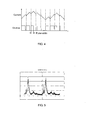
- the period of a PWM signal always remains the same, but the signal duty cycle (ON/OFF ratio) may vary over time as illustrated in FIG. 4 .
- the outputs of the power drive (52) that feed the actuating mechanism (62) are of the PWM type.
- the required energy taken by the power drive (52) to fulfill this profile must come from the power supply (54).
- a second current profile is a low frequency one. It is the main current envelop that reproduces the gait or amputees movement, in the case of an active prosthesis (60).
- This profile may be relatively high current but of short duration and has a sine wave-like form on normal gait operation. It will be seen therefore that the cu rrent demands imposed on the power supply vary and to satisfy these demands, the power supply is organized as shown in greater detail in FIG. 2 .
- the power supply (54) has energy storage elements of different characteristics, namely a battery (100), a super capacitor (200) and electrolytic capacitors (300).
- the storage elements are connected in parallel to the power drive (52) by a bus (59) connected to terminals 56,58.
- the first profile, the high-frequency Pulsed Width Modulation (PWM), is most suitably addressed by electrolytic capacitors (300), while the second profile, the low frequency one, is most suitably addressed by battery (100) and super capacitor (200).
- the storage elements are functionally segregated by an inductor (400) that is interposed in the bus (59) to limit the current flow from battery (100) and super capacitor (200) in specific cases, which will be discussed later.
- the inductor 400 acts to delay the supply of current from the battery 100 and superconductor 200and accordingly current is supplied preferentially by discharge of the parallel electrolytic capacitors (300).
- Power supply (54) also includes power protection/management elements.
- the power protection/management elements include a local shunt controller (500) with associated switch (510) and resistor (520), diode (600), slow in-rush limiter (700), fast in-rush limiter (800) and Power Management Unit (PMU) (900).
- battery (100) also includes protection elements and management elements.
- the shunt controller (500) and associated switch (510) and resistor (520) are included to prevent large voltage induction across the power supply (54) Vout+ (56) and Vout- (58) terminals during energy regeneration phases.
- the diode (600) protects battery (100) from reverse currents on the power supply (54) bus (59) during those same phases.
- the super capacitor (200) and electrolytic capacitors (300) will be fully discharged.
- the slow in-rush limiter (700), and fast in-rush limiter (800) are therefore used to limit in time the current drain on the battery (100) resulting from the super capacitor (200) and electrolytic capacitors (300), respectively.
- the characteristics of the energy storage elements are determined by their internal construction as described more fully below.
- battery (100) includes 10 battery cells (110), such as high-energy density Lithium Polymer (Li-Pol) cells, for example, but not limiting the current description to the following model, SLPB36495-HD cells manufactured by Kokam Engineering.
- Battery cells (110) are configured serially, this arrangement allowing for a relatively high voltage to be used (nominal 37V, maximum 42V when fully charged) as well as allowing the use of high current (power).
- This performance enables a reduction in the number or required cells (110) inside the battery (100) because of the ability of the cells (110) to deliver higher currents than their nominal one.
- it offers an advantageous volume-over-performance solution, and allows for a relatively compact design, which is an important factor in the case of an active prosthesis (60) or any other electric or electronic device having limited available space for a power supply.
- SLPB393452-H high-energy density Lithium Polymer (Li-Pol) cells manufactured by Kokam Engineering, may be configured in three parallel strings of 10 serially connected battery cells each.
- Battery (100) is required to match the power supply requirements of the power drive (52) to deliver power within its operation range, thus, depending on the application, the number and configuration of battery cells (110) may vary accordingly.
- Battery (100) further includes charging connector (170) to connect the battery cells (110) to a power source for recharging.
- an actuating mechanism (62) such as an electric motor, has a typical voltage requirement of about 36V and a maximum peak current of about 18A. Since one battery cell (110) has a nominal voltage of 3.7V, this means that about 10 serial battery cells (110) are required.
- the battery cells (110) are monitored using PCMs (120, 130, 140 and 150), such as, for example, but not limiting the current description to the following model, MAX1666 PCMs manufactured by Maxim.
- An individual PCM (120, 130, 140 and 150) monitors an associated cell group (112, 113, 114 and 115), comprising 2 or 3 battery cells (110) in series, by measuring voltages, charge and discharge currents.
- a PCM 120, 130, 140 and 150
- a PCM 120, 130, 140 and 150
- a PCM 120, 130, 140 and 150
- it protects the monitored battery cells (110) by disabling the use of its associated cell group (112, 113, 114 and 115) by controlling its associated charging protection switch (124, 134, 144 and 154) through respective control lines (122, 132, 142 and 152).
- a detection of an adverse condition in one group of cells opens the discharging protection switch (164) to prevent further current supply.
- the PCM 120, 130, 140 and 150
- a high-energy storage element, the super capacitor (200), is used in order to limit the peak current contribution of the battery (100).
- the super capacitor (200) can deliver high quantities of energy within a very short amount of time, which is a different behavior than that of the battery (100). Batteries are considered high-energy element because they can store higher energy inside their volume but do not have the same ability to deliver it as quickly. Thus, in-rush high currents are partially delivered by the super capacitor (200), for example, but not limiting the current description to the following model, a THQ3050243 from Evans Capacitor. It has been evaluated that 24 mF were sufficient for the example application.
- ESR Equivalent Serial Resistor
- the electrolytic capacitors (300) are high-energy storage elements used in order to limit the peak current contribution of the battery (100) as well as for PWM filtering. Similarly to the super capacitor (200), the electrolytic capacitors (300) can deliver high quantities of energy within a very short amount of time, which is a different behavior than that of the battery (100). Thus, higher frequency in-rush high currents are partially delivered by the electrolytic capacitors (300), for example, but not limiting the current description to the following model, EEUFC1J471L capacitors from Panasonic.
- capacitors having an individual capacity of 0.47 mF for a total capacity is 2.82 mF (six electrolytic capacitors (300) in parallel). Additional benefits come from this paralleling of the electrolytic capacitors (300), notably the ESR is reduced by a factor of six while the capacity and maximum current are increase by a factor of six.
- the energy storage elements with the different characteristics are segregated by the inductor (400).
- the role of the inductor (400) is to delay and therefore limit the current contribution of the battery (100) and super capacitor (200) when peak high-frequency current conditions occur.
- the inductor (400) is located between power drive (52) and super capacitor (200) because the power drive (52) potentially induces high frequency noises (and therefore currents) and super capacitors do not perform well under high frequency conditions.
- Inductor (400) plays the same role for the battery (100). Enough inductance should be used in order to allow an acceptable contribution limitation of the low-frequency sub-system, i.e. battery (100) and super capacitor (200).
- the inductor (400) forces the electrolytic capacitors (300) to deliver their energy into power drive (52).
- the inductor (400) may be, for example, but not limiting the current description to the following model, a DC780-153K inductor from API Delevan. It should be noted that the selected inductor (400) must have an incremental current value that matches the application's worst-case current, which is approximately 18A in the given example.
- the power supply (54) will absorb energy from the active prosthesis (60) instead of delivering it, such a situation is referred to as a regeneration phase.
- a regeneration phase occurs, for example, when the active prosthesis' (60) user is descending stairs.
- the effects of a regeneration phase on the power supply (54) is an energy return on its elements, which energy may be used to recharge the super capacitor (200) and the electrolytic capacitors (300).
- the voltage across Vout+ (56) and Vout- (58) may continue increasing, which may be damaging.
- the shunt controller (500) monitors the voltage across Vout+ (56) and Vout- (58) in order to determine if a preset maximum voltage level has been attained. Whenever the monitored voltage goes above the preset maximum voltage level, the shunt controller (500) closes switch (510), which results in the absorbed energy being dissipated into resistor (520). Conversely, whenever the monitored voltage goes below the preset maximum voltage level, shunt controller (500) opens switch (510).
- the impact on the power supply (54) is an energy return on its elements, which may be damageable for the battery (100).
- the diode's (600) purpose is to protect the battery (100) from such energy returns by stopping reverse currents on the power supply (54) bus (59).
- the slow in-rush limiter (700) and a fast in-rush limiter (800) may be based, for example, on N-Channel D 2 PAK power mosfets that will let the voltage increase linearly across the super capacitor (200) and electrolytic capacitors (300), respectively.
- a simple way to proceed is to adjust the charging time to a nearly steady-state acceptable power.
- PMU Power Management Unit
- the PMU (900) which is shown in FIG. 6 , is a controller whose purpose is to determine the maximum allowable power available from battery (100), open or close discharging switch (164) using discharge switch control line (914) and set the power drive (52) power saturation command using power saturation control line (916).
- the signal on power saturation control line (916) is indicative of the power available from the battery (100) and is used by the power drive (52) to select the optimum control signal for the actuating mechanism (62).
- the PMU (900) includes a Digital Signal Processor (DSP) (910), optional audio warning (960) and LCD display (970) low power level indicators and a DC/DC converter (950).
- DSP Digital Signal Processor
- optional audio warning (960) and LCD display (970) low power level indicators are not required to be part of the PMU (900) or even to be located on the power supply (54), they may also be, for example, remotely located.
- the DSP (910) includes a state machine that monitors, in real-time, the voltages of the battery cells (110) through monitoring lines (912). As the condition of the battery cells (110) change, the DSP (910) executes an algorithm to determine the appropriate level for the power saturation control line (916).
- An example of an algorithm that may be executed by the DSP (910) is depicted by the flow chart shown in FIG. 7 . The sequence of steps composing the algorithm is indicated by the sequence of blocks (920) to (942).
- the algorithm starts by monitoring the instantaneous voltage, at time sample "t", of the individual battery cells (110), Vbat i (t), through monitoring lines (912) and computes, at block (922), the total instantaneous voltage of the battery (100), Vbat(t), by summing all the instantaneous voltages of the individ ual battery cells (110).
- the algorithm proceeds to compute, for each battery cell (110), the average voltage for the last "I" time samples, MeanVbat i (t). This step serves to filter out sharp rises or drops in voltage that may briefly appear and may not be representative of the state of the individual battery cells (110).
- block (926) the average of the MeanVbat i (t) for all battery cells (110), VmeanVbat, is computed.
- block (928) identifies the minimum of the MeanVbat i (t), for all battery cells (110), which results in VmeanMin.
- the weighted voltage, Vbat(weighed) is computed by multiplying the total instantaneous voltage, Vbat i (t), by a weighting factor equal the ratio of the minimum of the average voltages for the last "I" time samples over the average of the those average voltages.
- the purpose of this weighting factor is to take into account possible voltage discrepancies amongst the individual battery cells (110). Of course, other weighting factors may be used to represent specific conditions of the power supply.
- the algorithm checks if the weighted voltage, Vbat(weighted), is below a minimal acceptable voltage, Vbat(acceptable), which is a threshold indicative of a minimal operationally safe voltage level below which damage may start accruing to the battery (100) or some of its constituent battery cells(110). If Vbat(weighed) is below Vbat(acceptable), then, at block (933), the algorithm opens the discharge switch (164), through discharge switch control line (914), so has to disconnect the battery (100) from the bus (59). On the other hand, if Vbat(weighed) is not below Vbat(acceptable), then, at block (935), the algorithm closes the discharge switch (164), through discharge switch control line (914), so as to connect the battery (100) to the bus (59).
- the algorithm sets the actuating mechanisms (62) power saturation level of the power drive (52), at block (938), by sending a power saturation command, PMaxCMD, to the power drive (52) through power saturation control line (916).
- a low pass filter is applied to PMaxSat, the purpose of the lowpass filter is to introduce a certain delay in time so as to eliminated small rapid variations in the PMaxSat values.
- the transfer function G(S) is dynamically adjusted in response to the available power.
- the DSP (910) requires a single 3.3V and a dual +/-12V power supplies to operate.
- This power may be provided by converting a portion of the power drive's (52) available power into the required DSP (910) power levels using a DC/DC converter (950), for example, but not limiting the current description to the following model, a DATEL TWR-3.3/4-12/300-D4.
- a DC/DC converter (950) is the possibility of isolating the DSP (910) from the power source, i.e. the battery (100).
- Other possible approaches would be to make an equivalent converter using discrete electronic elements, instead of a modular block, integrated as a converter or having an additional power supply dedicated to the DSP (910).
- an audio warning (960) and/or an LCD display (970) may be implemented as a two-level configuration: a first warning indicating that the battery's (100) power is getting low; a second one indicating that the battery's (100) power is nearing a "critical power failure" condition.
- the first warning may be issued when the PMU (900) estimates that battery (100) has a power reserve sufficient to operate for a further 30 minutes until total discharge (under normal operating conditions), while the second warning may be issued at 10 minutes before total discharge.
- the battery (100) is initially charged using the connector (170).
- the cells (110) are monitored by the PCM's (120, 130, 140 and 150) and isolated from the charger (170) when fully charged.
- the super capacitor (200) and electrolytic capacitors (300) are charged from the battery (100) with the in rush limiters (700 and 800) limiting the drain on the battery (100).
- the initial locomotion of the amputee is secured by the sensors (42) and generates a control signal at the controller (46) to initiate the operation of the actuating mechanism (62).
- the power drive (52) determines the current required up to the maximum indicated by the saturation control line (916) and connects the power supply (54) to the mechanism (62).
- the electrolytic capacitors (300) provide the higher frequency components of the current supply with battery (100) recharging the electrolytic capacitors (300) as limited by the fast in-rush limiters (800).
- the inductor (400) inhibits current flow from the battery (100) and super conductor (200) so that the demand is met by the electrolytic capacitors (300).
- the super capacitor (200) supplies this, supplemented by battery (100) to meet the requirements.
- the PMU (900) monitors the condition of the cells (110) and modifies the main power command in the power drive (52) as appropriate. If the condition of battery (100) indicates a critical energy level, the low power level indicators (960 and 970) are activated to allow the amputee to take appropriate action. Should the condition of the cells continue to deteriorate, the switch (164) is opened and the battery (100) is isolated.
- the power supply (54) is effective to match the characteristics of the storage elements to the duty cycles and avoid permanent damage to the battery cells (110) by monitoring their performance and modifying the supply of power as appropriate.
- the present invention is not limited to its use with an active prosthesis, other applications having high energy demands during short periods of time, such as, for example, cordless power tools, hobby planes and race carts, may also benefit from the above describe power supply.
Landscapes
- Engineering & Computer Science (AREA)
- Power Engineering (AREA)
- Charge And Discharge Circuits For Batteries Or The Like (AREA)
- Secondary Cells (AREA)
Abstract
The present invention discloses an electrical power supply (54) for providing electrical power to a load (62), the power supply (54) comprising a plurality of energy storage elements (100,200,300) each having a different operating characteristic and connected in an electrical circuit to the load, and a circuit element (400) interposed between at least one of the storage elements and the load and operable to segregate the energy storage elements therefrom, the circuit element being selected to match supply of energy to the load to the characteristics of the storage elements, whereby a power saturation level is determined.
Description
- The present invention relates to a power supply.
- A battery is formed of individual cells, each of which produces a voltage and current output. The cells are arranged in series or parallel arrays to form the power supply that is capable of producing the required voltage and current output of the power supply.
- Cells may be constructed from a variety of materials and configurations, each of which has a particular set of operating characteristics. For example, some constructions may be particularly well suited to supplying current at a consistent voltage over an extended period but unsuitable for high transient loads, whereas others are better suited for such loading. It is usual to select a cell construction best suited to the duty cycle to which it will be subjected.
- In many applications the duty cycle is consistent and repetitive allowing a particular cell construction to be used to satisfy the demands. In other applications, the duty cycle may vary dramatically and inconsistently making cell selection more difficult. To further complicate the selection many applications that require high peak currents also have volume and weight constraints, for example power tools, hobby planes and race carts to name a few. A particularly demanding application addressed by the applicants is a powered leg prosthesis where the battery is needed to power an actuator and move the user. For many of those applications that have high peak current requirements, the number of batteries required to satisfy the maximum peak current would not fit inside the available volume. There is thus a need for a compact power supply that can meet varying demands and deliver high quantities of energy within a short amount of time, and fit inside a very limited volume.
- Accordingly, it is an object of the present application to obviate or mitigate some or all of the above disadvantages.
- According to the present invention, there is provided an electrical power supply for providing electrical power to a load, the power supply comprising:
- a plurality of energy storage elements each having a different operating characteristic and connected in an electrical circuit to said load;
and - a circuit element interposed between at least one of said storage elements and said load and operable to segregate said one of said energy storage elements therefrom, said circuit element being selected to match supply of energy to said load to said characteristics of said storage elements.
- An embodiment of the invention will now be described by way of example only with reference to the accompanying drawings, in which:
-
FIG. 1 is a block diagram showing a control system for a prosthesis having an actuating mechanism. -
FIG. 2 is a schematic block diagram of a power pack. -
FIG. 3 is a schematic block diagram of the battery included inFIG. 2 . -
FIG. 4 is a graph of a high-frequency Pulsed Width Modulation (PWM) signal. -
FIG. 5 is a graph of a typical gait current profile. -
FIG. 6 is a schematic block diagram of the Power Management Unit (PMU) included inFIG. 2 . -
FIG. 7 is a flow diagram of the PMU algorithm. -
FIG. 8 is a block diagram of the G(S) transfer function. - Referring to
FIG. 1 , a control system (40) controls the supply of electrical power from a power pack (50) to an active prosthesis (60). Unlike conventional prosthesis, an active prosthesis (60) is designed to supply the mechanical energy necessary to move by itself. The purpose of the control system (40) is to provide the required signals to operate the control of the actuating mechanism (62), for example an electric motor, of the active prosthesis (60) in the required manner. The sensors (42) capture information, in real time, about the dynamics of the amputee's locomotion and provide that information to the controller (46) via interface (44). The controller (46) determines the joint trajectories and the required force or torque that must be applied by the actuating mechanism (62) in order to provide coordinated movements. The control system (40) then generates output signals which are used to regulate the power supplied to the actuating mechanism (62) from a power pack (50). - Power pack (50) includes a power drive (52) which is itself connected to a power supply (54) to supply energy to actuating mechanism (62) in order to create the requirement movements. The power supply (54) and power drive (52) interact through a saturation control line (916) to control the amount of power being provided by the power drive (52) to the actuating mechanism (62) through power lines (61). The power drive (52), may be for example, but not limiting the current description to the following model, a PIC25/50 from ELMO Motion Control
- An example of a control system (40) using sensors (42) is described in
U.S. patent application No. 10/600,725 filed June 20, 2003 U.S. patent application No. 10/463,495 filed June 17, 2003 - The current required for operation of the
actuating mechanism 62 may be divided in two major current profiles as shown onFIGS 4 and 5 . A first current profile is a relatively high-frequency Pulsed Width Modulation (PWM) signal. PWM is a high-efficiency control signal that has a wide spread use in motor control. The period of a PWM signal always remains the same, but the signal duty cycle (ON/OFF ratio) may vary over time as illustrated inFIG. 4 . The outputs of the power drive (52) that feed the actuating mechanism (62) are of the PWM type. The required energy taken by the power drive (52) to fulfill this profile must come from the power supply (54). - A second current profile is a low frequency one. It is the main current envelop that reproduces the gait or amputees movement, in the case of an active prosthesis (60). This profile, an example of which is illustrated in
FIG. 5 , may be relatively high current but of short duration and has a sine wave-like form on normal gait operation. It will be seen therefore that the cu rrent demands imposed on the power supply vary and to satisfy these demands, the power supply is organized as shown in greater detail inFIG. 2 . - The power supply (54) has energy storage elements of different characteristics, namely a battery (100), a super capacitor (200) and electrolytic capacitors (300). The storage elements are connected in parallel to the power drive (52) by a bus (59) connected to
terminals inductor 400 acts to delay the supply of current from thebattery 100 and superconductor 200and accordingly current is supplied preferentially by discharge of the parallel electrolytic capacitors (300). - Power supply (54) also includes power protection/management elements. The power protection/management elements include a local shunt controller (500) with associated switch (510) and resistor (520), diode (600), slow in-rush limiter (700), fast in-rush limiter (800) and Power Management Unit (PMU) (900). As will be described further below, battery (100) also includes protection elements and management elements.
- The shunt controller (500) and associated switch (510) and resistor (520) are included to prevent large voltage induction across the power supply (54) Vout+ (56) and Vout- (58) terminals during energy regeneration phases. The diode (600) protects battery (100) from reverse currents on the power supply (54) bus (59) during those same phases. Moreover, when the power supply (54) is powered on after a certain period of inactivity the super capacitor (200) and electrolytic capacitors (300) will be fully discharged. The slow in-rush limiter (700), and fast in-rush limiter (800) are therefore used to limit in time the current drain on the battery (100) resulting from the super capacitor (200) and electrolytic capacitors (300), respectively.
- The characteristics of the energy storage elements are determined by their internal construction as described more fully below.
- Referring to
FIG. 3 , battery (100) includes 10 battery cells (110), such as high-energy density Lithium Polymer (Li-Pol) cells, for example, but not limiting the current description to the following model, SLPB36495-HD cells manufactured by Kokam Engineering. Battery cells (110) are configured serially, this arrangement allowing for a relatively high voltage to be used (nominal 37V, maximum 42V when fully charged) as well as allowing the use of high current (power). These cells (110) are well suited for the example application of an active prosthesis (60) in that they enable the discharge of high currents of up to 10 times (10C, where 1C mA = 2000 mA) the cell's (110) nominal one, or in any other applications requiring high peak currents. This performance enables a reduction in the number or required cells (110) inside the battery (100) because of the ability of the cells (110) to deliver higher currents than their nominal one. As well, it offers an advantageous volume-over-performance solution, and allows for a relatively compact design, which is an important factor in the case of an active prosthesis (60) or any other electric or electronic device having limited available space for a power supply. - Other types and number of battery cells in various configurations may be used. For example, in an alternate embodiment, 30 SLPB393452-H high-energy density Lithium Polymer (Li-Pol) cells, manufactured by Kokam Engineering, may be configured in three parallel strings of 10 serially connected battery cells each.
- Of course, the battery (100) is required to match the power supply requirements of the power drive (52) to deliver power within its operation range, thus, depending on the application, the number and configuration of battery cells (110) may vary accordingly. Battery (100) further includes charging connector (170) to connect the battery cells (110) to a power source for recharging.
- In the example of an active prosthesis (60) application, it is supposed that, but not limiting the current description to the following specification, an actuating mechanism (62), such as an electric motor, has a typical voltage requirement of about 36V and a maximum peak current of about 18A. Since one battery cell (110) has a nominal voltage of 3.7V, this means that about 10 serial battery cells (110) are required. The normal operation voltage of a single battery cell (110), however, changes from 4.2V (fully charged) to 3.0V (fully discharged), and accordingly the cells are monitored in order to identify possible adverse operating conditions.
- The battery cells (110) are monitored using PCMs (120, 130, 140 and 150), such as, for example, but not limiting the current description to the following model, MAX1666 PCMs manufactured by Maxim. An individual PCM (120, 130, 140 and 150) monitors an associated cell group (112, 113, 114 and 115), comprising 2 or 3 battery cells (110) in series, by measuring voltages, charge and discharge currents. In a charging mode, when a PCM (120, 130, 140 and 150) detects a noticeable voltage change or an over current condition, it protects the monitored battery cells (110) by disabling the use of its associated cell group (112, 113, 114 and 115) by controlling its associated charging protection switch (124, 134, 144 and 154) through respective control lines (122, 132, 142 and 152). During discharge mode, a detection of an adverse condition in one group of cells opens the discharging protection switch (164) to prevent further current supply. The PCM (120, 130, 140 and 150) returns to bypass mode (switches closed) when associated cell group (112, 113, 114 and 115) reaches its protection release voltage or current.
- A high-energy storage element, the super capacitor (200), is used in order to limit the peak current contribution of the battery (100). The super capacitor (200) can deliver high quantities of energy within a very short amount of time, which is a different behavior than that of the battery (100). Batteries are considered high-energy element because they can store higher energy inside their volume but do not have the same ability to deliver it as quickly. Thus, in-rush high currents are partially delivered by the super capacitor (200), for example, but not limiting the current description to the following model, a THQ3050243 from Evans Capacitor. It has been evaluated that 24 mF were sufficient for the example application.
- Special care should be taken regarding the super capacitor's (200) Equivalent Serial Resistor (ESR) as it should be kept as low as possible. The expected values for one super capacitor (200) should stand in mΩ and lower than 1Ω for the whole group in the case were multiple super capacitors (200) are used. High ESR results in lower instantaneous available current, which means that the battery (100) would have to provide a higher current contribution.
- The electrolytic capacitors (300) are high-energy storage elements used in order to limit the peak current contribution of the battery (100) as well as for PWM filtering. Similarly to the super capacitor (200), the electrolytic capacitors (300) can deliver high quantities of energy within a very short amount of time, which is a different behavior than that of the battery (100). Thus, higher frequency in-rush high currents are partially delivered by the electrolytic capacitors (300), for example, but not limiting the current description to the following model, EEUFC1J471L capacitors from Panasonic. In the ongoing example, for volume considerations, the use of smaller electrolytic capacitors (300) has been preferred, in this case capacitors having an individual capacity of 0.47 mF for a total capacity is 2.82 mF (six electrolytic capacitors (300) in parallel). Additional benefits come from this paralleling of the electrolytic capacitors (300), notably the ESR is reduced by a factor of six while the capacity and maximum current are increase by a factor of six.
- As noted above, the energy storage elements with the different characteristics are segregated by the inductor (400). The role of the inductor (400) is to delay and therefore limit the current contribution of the battery (100) and super capacitor (200) when peak high-frequency current conditions occur. The inductor (400) is located between power drive (52) and super capacitor (200) because the power drive (52) potentially induces high frequency noises (and therefore currents) and super capacitors do not perform well under high frequency conditions. Inductor (400) plays the same role for the battery (100). Enough inductance should be used in order to allow an acceptable contribution limitation of the low-frequency sub-system, i.e. battery (100) and super capacitor (200). By reducing the current contribution of the low-frequency sub-system, battery (100) and super capacitor (200), the inductor (400) forces the electrolytic capacitors (300) to deliver their energy into power drive (52). In the example application of an active prosthesis (60), the inductor (400) may be, for example, but not limiting the current description to the following model, a DC780-153K inductor from API Delevan. It should be noted that the selected inductor (400) must have an incremental current value that matches the application's worst-case current, which is approximately 18A in the given example.
- In certain situations, the power supply (54) will absorb energy from the active prosthesis (60) instead of delivering it, such a situation is referred to as a regeneration phase. A regeneration phase occurs, for example, when the active prosthesis' (60) user is descending stairs. The effects of a regeneration phase on the power supply (54) is an energy return on its elements, which energy may be used to recharge the super capacitor (200) and the electrolytic capacitors (300). However, once the super capacitor (200) and the electrolytic capacitors (300) have been fully recharged, the voltage across Vout+ (56) and Vout- (58) may continue increasing, which may be damaging. To protect the super capacitor (200) and the electrolytic capacitors (300), the shunt controller (500) monitors the voltage across Vout+ (56) and Vout- (58) in order to determine if a preset maximum voltage level has been attained. Whenever the monitored voltage goes above the preset maximum voltage level, the shunt controller (500) closes switch (510), which results in the absorbed energy being dissipated into resistor (520). Conversely, whenever the monitored voltage goes below the preset maximum voltage level, shunt controller (500) opens switch (510).
- During a regeneration phase, as discussed above, the impact on the power supply (54) is an energy return on its elements, which may be damageable for the battery (100). The diode's (600) purpose is to protect the battery (100) from such energy returns by stopping reverse currents on the power supply (54) bus (59).
- When charging the super capacitor (200) and electrolytic capacitors (300) from the battery (100), for example when the power supply (54) is powered on after a certain period of inactivity having had for effect the full discharge of the super capacitor (200) and electrolytic capacitors (300), a very high and fast power drain is experienced by the battery (100). This results in a power drain which may exceeds the maximum allowable power available, thus causing the PMU to disconnect the battery (100) from the bus (59) in order to protect the battery (100) from an over discharge situation. To prevent such a situation from happening, a slow in-rush limiter (700) and a fast in-rush limiter (800) limit in time the current drain of the super capacitor (200) and electrolytic capacitors (300), respectively, on the battery (100).
- The slow in-rush limiter (700) and a fast in-rush limiter (800) may be based, for example, on N-Channel D2PAK power mosfets that will let the voltage increase linearly across the super capacitor (200) and electrolytic capacitors (300), respectively. A simple way to proceed is to adjust the charging time to a nearly steady-state acceptable power.
- Although the organisation of the storage elements will enable the appropriate elements to supply current to the actuating mechanism (62), further enhancement and control may be obtained from the power management unit (PMU) (900). The PMU (900), which is shown in
FIG. 6 , is a controller whose purpose is to determine the maximum allowable power available from battery (100), open or close discharging switch (164) using discharge switch control line (914) and set the power drive (52) power saturation command using power saturation control line (916). The signal on power saturation control line (916) is indicative of the power available from the battery (100) and is used by the power drive (52) to select the optimum control signal for the actuating mechanism (62). - The PMU (900) includes a Digital Signal Processor (DSP) (910), optional audio warning (960) and LCD display (970) low power level indicators and a DC/DC converter (950). The optional audio warning (960) and LCD display (970) low power level indicators are not required to be part of the PMU (900) or even to be located on the power supply (54), they may also be, for example, remotely located.
- The DSP (910) includes a state machine that monitors, in real-time, the voltages of the battery cells (110) through monitoring lines (912). As the condition of the battery cells (110) change, the DSP (910) executes an algorithm to determine the appropriate level for the power saturation control line (916). An example of an algorithm that may be executed by the DSP (910) is depicted by the flow chart shown in
FIG. 7 . The sequence of steps composing the algorithm is indicated by the sequence of blocks (920) to (942). - In block (920) the algorithm starts by monitoring the instantaneous voltage, at time sample "t", of the individual battery cells (110), Vbati(t), through monitoring lines (912) and computes, at block (922), the total instantaneous voltage of the battery (100), Vbat(t), by summing all the instantaneous voltages of the individ ual battery cells (110).
- At block (924), the algorithm proceeds to compute, for each battery cell (110), the average voltage for the last "I" time samples, MeanVbati(t). This step serves to filter out sharp rises or drops in voltage that may briefly appear and may not be representative of the state of the individual battery cells (110).
- At block (926), the average of the MeanVbati(t) for all battery cells (110), VmeanVbat, is computed. In parallel to block (926), block (928) identifies the minimum of the MeanVbati(t), for all battery cells (110), which results in VmeanMin.
- Then, at block (930), the weighted voltage, Vbat(weighed), is computed by multiplying the total instantaneous voltage, Vbati(t), by a weighting factor equal the ratio of the minimum of the average voltages for the last "I" time samples over the average of the those average voltages. The purpose of this weighting factor is to take into account possible voltage discrepancies amongst the individual battery cells (110). Of course, other weighting factors may be used to represent specific conditions of the power supply.
- At block (932), the algorithm checks if the weighted voltage, Vbat(weighted), is below a minimal acceptable voltage, Vbat(acceptable), which is a threshold indicative of a minimal operationally safe voltage level below which damage may start accruing to the battery (100) or some of its constituent battery cells(110). If Vbat(weighed) is below Vbat(acceptable), then, at block (933), the algorithm opens the discharge switch (164), through discharge switch control line (914), so has to disconnect the battery (100) from the bus (59). On the other hand, if Vbat(weighed) is not below Vbat(acceptable), then, at block (935), the algorithm closes the discharge switch (164), through discharge switch control line (914), so as to connect the battery (100) to the bus (59).
- At block (936), the actuating mechanisms (62) power saturation level, PMaxSat, is computed by multiplying the difference between the weighted voltage, Vbat(weighed), and the minimal acceptable voltage, Vbat(acceptable), by transfer function G(S) which implements a current regulator.
FIG. 8 shows a block diagram of the G(S) transfer function in which:
where: - lbat is the battery (100) current,
- Rt is the battery (100) equivalent resistance;

where:- lav is the available current,
- G1 and G2 are gain functions,
- F is the sampling frequency;
and:
- The gain functions G1 and G2 of
Equation 2 may be computed as:
where: - GA is the desired gain of the system, and
- fc is the desired cut-off frequency of the system;
- The algorithm then sets the actuating mechanisms (62) power saturation level of the power drive (52), at block (938), by sending a power saturation command, PMaxCMD, to the power drive (52) through power saturation control line (916).
- At block (940), a low pass filter is applied to PMaxSat, the purpose of the lowpass filter is to introduce a certain delay in time so as to eliminated small rapid variations in the PMaxSat values. Following the low pass filtering of PMaxSat, at block (942), the transfer function G(S) is dynamically adjusted in response to the available power.
- Typically, the DSP (910) requires a single 3.3V and a dual +/-12V power supplies to operate. This power may be provided by converting a portion of the power drive's (52) available power into the required DSP (910) power levels using a DC/DC converter (950), for example, but not limiting the current description to the following model, a DATEL TWR-3.3/4-12/300-D4. An advantage of using a DC/DC converter (950) is the possibility of isolating the DSP (910) from the power source, i.e. the battery (100). Other possible approaches would be to make an equivalent converter using discrete electronic elements, instead of a modular block, integrated as a converter or having an additional power supply dedicated to the DSP (910).
- Regarding the warning to user when approaching end of autonomy time, an audio warning (960) and/or an LCD display (970) may be implemented as a two-level configuration: a first warning indicating that the battery's (100) power is getting low; a second one indicating that the battery's (100) power is nearing a "critical power failure" condition. For example, the first warning may be issued when the PMU (900) estimates that battery (100) has a power reserve sufficient to operate for a further 30 minutes until total discharge (under normal operating conditions), while the second warning may be issued at 10 minutes before total discharge.
- In operation therefore, the battery (100) is initially charged using the connector (170). The cells (110) are monitored by the PCM's (120, 130, 140 and 150) and isolated from the charger (170) when fully charged. Upon the prosthesis being activated, the super capacitor (200) and electrolytic capacitors (300) are charged from the battery (100) with the in rush limiters (700 and 800) limiting the drain on the battery (100).
- The initial locomotion of the amputee is secured by the sensors (42) and generates a control signal at the controller (46) to initiate the operation of the actuating mechanism (62). The power drive (52) determines the current required up to the maximum indicated by the saturation control line (916) and connects the power supply (54) to the mechanism (62). The electrolytic capacitors (300) provide the higher frequency components of the current supply with battery (100) recharging the electrolytic capacitors (300) as limited by the fast in-rush limiters (800). The inductor (400) inhibits current flow from the battery (100) and super conductor (200) so that the demand is met by the electrolytic capacitors (300).
- When the power drive (52) requires a high current, at a lower frequency, the super capacitor (200) supplies this, supplemented by battery (100) to meet the requirements.
- The PMU (900) monitors the condition of the cells (110) and modifies the main power command in the power drive (52) as appropriate. If the condition of battery (100) indicates a critical energy level, the low power level indicators (960 and 970) are activated to allow the amputee to take appropriate action. Should the condition of the cells continue to deteriorate, the switch (164) is opened and the battery (100) is isolated.
- Accordingly, it will be seen that the power supply (54) is effective to match the characteristics of the storage elements to the duty cycles and avoid permanent damage to the battery cells (110) by monitoring their performance and modifying the supply of power as appropriate.
- It should be noted that the present invention is not limited to its use with an active prosthesis, other applications having high energy demands during short periods of time, such as, for example, cordless power tools, hobby planes and race carts, may also benefit from the above describe power supply.
- Although the present invention has been described by way of particular embodiments and examples thereof, it should be noted that it will be apparent to persons skilled in the art that modifications may be applied to the present particular embodiment without departing from the scope of the present invention.
Claims (19)
- An electrical power supply (54) for providing electrical power to a load (62), the power supply comprising:a plurality of energy storage elements or groups thereof (100, 200, 300) each energy storage element/group of elements having a different operating characteristic and connected in an electrical circuit to said load;a circuit element (400) interposed between at least one of said storage elements/groups of elements and said load and operable to segregate said one of said energy storage elements/groups of elements therefrom, said circuit element being selected to match supply of power to said load to said characteristics of said storage elements/groups of elements; anda power monitoring unit (900) operable to monitor power supplied by at least one of said energy storage elements/groups of elements to said load and further operable to determine a power saturation level, wherein said power saturation level indicates an amount of power that can be requested by said load.
- An electrical power supply according to claim 1 wherein said storage elements/groups of elements are connected in parallel and said circuit element is interposed between a pair of said storage elements/groups of elements.
- An electrical power supply according to claim 2 wherein said power monitoring unit determines the maximum current to be supplied to said load.
- An electrical power supply according to claim 2 wherein said power monitoring unit is operable to disconnect said one energy storage element/group of elements from said circuit upon attainment of predetermined conditions.
- An electrical power supply according to claim 2 wherein said one energy storage element/group of elements is operable to replenish energy in another of said energy storage elements.
- An electrical power supply according to claim 5 wherein power supply from said one storage element to said other of said storage elements is limited to match the characteristics of said one storage element.
- An electrical power supply according to any preceding claim, wherein:said circuit element is an inductor.
- An electrical power supply according to any preceding claim, wherein:the energy storage elements/group of elements include at least one battery cell (100).
- An electrical power supply according to claim 8, wherein there are provided at least three energy storage elements/groups of elements, each having a different operating characteristic.
- An electrical power supply according to claim 9 wherein said at least one battery cell is operable to charge the other energy storage elements/groups of elements, and one of the said other energy storage elements/groups of elements is arranged to provide said electrical power to said load depending on the current profile required by the load.
- An electrical power supply according to claim 8, further comprising:a diode (600) connected between the at least one battery cell and the load;wherein the diode inhibits reverse currents from the load to the at least one battery cell.
- An electrical power supply according to claim 8, wherein:the at least one battery cell is a Lithium Polymer cell.
- An electrical power supply according to any preceding claim, wherein:the energy storage elements/groups of elements include at least one super capacitor (200).
- An electrical power supply according to any preceding claim, wherein:the energy storage elements/groups of elements include at least one electrolytic capacitor (300).
- An electrical power supply according to any preceding claim, further comprising:at least one in-rush current limiter (700, 800) connected to at least one of the energy storage elements/groups of elements.
- An electrical power supply according to any preceding claim, further comprising:a shunt controller (500) connected to the electrical circuit, the shunt controller having an associated resistor (520) and an associated switch (510);wherein the shunt controller monitors the power supply's voltage level and closes its associated switch in response to a preset maximum voltage level being attained, the closing of the shunt controller's associated switch resulting in the dissipation of energy into its associated resistor.
- An electrical power supply according to any preceding claim, wherein:supply of power from said energy storage elements/groups of elements to said load is controlled by a power drive controller (52) operable to match the current requirements from said storage elements with requirements of said load.
- An electrical power supply according to claim 17, wherein:at least one of said energy storage elements/groups of elements is monitored by said power monitoring unit to match requirements of said controller to available power.
- An electrical power supply according to claim 18, wherein said power monitoring unit provides a control signal to said power drive controller indicative of the power saturation level of said one of said storage elements/groups of elements.
Applications Claiming Priority (2)
| Application Number | Priority Date | Filing Date | Title |
|---|---|---|---|
| US52064003P | 2003-11-18 | 2003-11-18 | |
| EP20030782040 EP1685638B1 (en) | 2003-11-18 | 2003-12-22 | Compact power supply |
Related Parent Applications (1)
| Application Number | Title | Priority Date | Filing Date |
|---|---|---|---|
| EP03782040.4 Division | 2003-12-22 |
Publications (1)
| Publication Number | Publication Date |
|---|---|
| EP2287994A1 true EP2287994A1 (en) | 2011-02-23 |
Family
ID=34619498
Family Applications (2)
| Application Number | Title | Priority Date | Filing Date |
|---|---|---|---|
| EP20030782040 Expired - Lifetime EP1685638B1 (en) | 2003-11-18 | 2003-12-22 | Compact power supply |
| EP20100180300 Withdrawn EP2287994A1 (en) | 2003-11-18 | 2003-12-22 | Hybrid power supply with battery for charging of capacitor to support high peak current requirements |
Family Applications Before (1)
| Application Number | Title | Priority Date | Filing Date |
|---|---|---|---|
| EP20030782040 Expired - Lifetime EP1685638B1 (en) | 2003-11-18 | 2003-12-22 | Compact power supply |
Country Status (9)
| Country | Link |
|---|---|
| US (1) | US7230352B2 (en) |
| EP (2) | EP1685638B1 (en) |
| JP (1) | JP4182109B2 (en) |
| KR (1) | KR101021265B1 (en) |
| CN (1) | CN1879277B (en) |
| AT (1) | ATE536656T1 (en) |
| AU (1) | AU2003289791B2 (en) |
| CA (1) | CA2543062C (en) |
| WO (1) | WO2005050812A1 (en) |
Cited By (1)
| Publication number | Priority date | Publication date | Assignee | Title |
|---|---|---|---|---|
| US8901888B1 (en) | 2013-07-16 | 2014-12-02 | Christopher V. Beckman | Batteries for optimizing output and charge balance with adjustable, exportable and addressable characteristics |
Families Citing this family (33)
| Publication number | Priority date | Publication date | Assignee | Title |
|---|---|---|---|---|
| EP1842275A4 (en) | 2005-01-25 | 2016-05-11 | Victhom Human Bionics Inc | METHOD AND DEVICE FOR CHARGING POWER SUPPLY |
| US7399554B2 (en) * | 2005-03-17 | 2008-07-15 | Kejha Joseph B | Hybrid rechargeable battery having high power and high energy density lithium cells |
| US7851945B2 (en) * | 2005-08-08 | 2010-12-14 | Hewlett-Packard Development Company, L.P. | System and method of providing power |
| US7471016B2 (en) * | 2005-12-19 | 2008-12-30 | O2Micro International Limited | Low pass filter |
| TW200740009A (en) * | 2006-04-14 | 2007-10-16 | Nat Energy Technology Co Ltd | Composite battery set for power tool |
| GB2449490A (en) * | 2007-05-25 | 2008-11-26 | Glory In Group Ltd | Power tool with super capacitors |
| US8138720B2 (en) * | 2008-02-26 | 2012-03-20 | Afs Trinity Power Corporation | System and method for dual energy storage management |
| CN101399452B (en) * | 2008-04-30 | 2011-07-06 | 刘云海 | Mixed battery pack comprising lithium power cell and super capacitor |
| US20090295517A1 (en) * | 2008-05-29 | 2009-12-03 | Northern Lights Semiconductor Corp. | Expandable Energy Storage for Portable Electronic Devices |
| JP5322514B2 (en) * | 2008-06-30 | 2013-10-23 | 大崎データテック株式会社 | Periodic power supply device for thermal print head |
| DE102008045113B4 (en) | 2008-09-01 | 2011-08-25 | Otto Bock HealthCare GmbH, 37115 | Prosthetic knee joint and method for operating a prosthetic knee joint |
| KR101131664B1 (en) * | 2010-01-28 | 2012-03-28 | 장석호 | Charging equipment using switching arrangement and charging/discharging |
| US8481203B2 (en) * | 2010-02-03 | 2013-07-09 | Bren-Tronies Batteries International, L.L.C. | Integrated energy storage unit |
| US20110189507A1 (en) * | 2010-02-03 | 2011-08-04 | International Battery, Inc. | Extended energy storage unit |
| US20110210712A1 (en) * | 2010-03-01 | 2011-09-01 | Tagare Madhavi V | AC or DC POWER SUPPLY EMPLOYING SAMPLING POWER CIRCUIT |
| US8638066B2 (en) * | 2010-08-09 | 2014-01-28 | Bbn Technologies Corp. | Battery optimization and protection in a low power energy environment |
| DE102011002548B4 (en) * | 2011-01-12 | 2024-03-28 | Robert Bosch Gmbh | Method for controlling a battery and battery for carrying out the method |
| CN102364811B (en) * | 2011-10-20 | 2013-10-23 | 江苏大学 | A nickel-carbon supercapacitor activation method and device |
| US20130192907A1 (en) * | 2011-11-02 | 2013-08-01 | Joseph Sarokham | Stair climbing wheeled vehicle, and system and method of making and using same |
| KR101218446B1 (en) * | 2012-05-18 | 2013-01-04 | 아이에스(주) | Eco-broadcasting system with fast-response function |
| KR101255653B1 (en) * | 2012-05-18 | 2013-04-17 | 아이에스(주) | Eco-broadcasting system in a company |
| US20140265554A1 (en) * | 2013-03-14 | 2014-09-18 | Ford Global Technologies, Llc | Dual Lithium-Ion Battery System for Electric Vehicles |
| US10003293B2 (en) * | 2013-03-15 | 2018-06-19 | Andrew John Bartlik | Portable motor drive system |
| US10511067B2 (en) * | 2013-08-23 | 2019-12-17 | Black & Decker Inc. | System and method to divert inductive energy from cells |
| KR101599962B1 (en) * | 2014-06-12 | 2016-03-07 | 삼화콘덴서공업 주식회사 | Energe storage system |
| KR101599959B1 (en) * | 2014-06-12 | 2016-03-07 | 삼화콘덴서공업 주식회사 | Energe storage system |
| JPWO2017159218A1 (en) * | 2016-03-15 | 2019-01-24 | 三洋電機株式会社 | Management device and power supply |
| JP2020512033A (en) | 2016-12-01 | 2020-04-23 | ラピッド オキシジェン カンパニー インコーポレイテッドRapid Oxygen Company Inc. | Portable chemical oxygen generator |
| US12161570B2 (en) * | 2017-12-12 | 2024-12-10 | Össur Iceland Ehf | Powered prosthetic knee with battery recharging during regeneration phase |
| US11278435B2 (en) * | 2020-01-03 | 2022-03-22 | Otto Bock Healthcare Lp | Reconfigurable electrical circuit for supplying increased power from a supercapacitor and method for using the same |
| DE102023213114A1 (en) * | 2023-12-20 | 2025-06-26 | Siemens Aktiengesellschaft | Capacitive energy storage device for switchgear, a drive with such an energy storage device and a switchgear with such a drive |
| DE102023213112B4 (en) * | 2023-12-20 | 2026-02-12 | Siemens Aktiengesellschaft | Capacitive energy storage device for switchgear with energy flow control, a drive with such an energy storage device, and a switchgear with such a drive. |
| KR102814670B1 (en) * | 2024-06-25 | 2025-05-29 | 비나텍주식회사 | Control unit controlling hybrid supercapacitor module |
Citations (6)
| Publication number | Priority date | Publication date | Assignee | Title |
|---|---|---|---|---|
| EP0718951A1 (en) * | 1994-12-20 | 1996-06-26 | Alcatel | Electrical power supply device especially for portable apparatuses |
| EP0902547A2 (en) * | 1997-09-15 | 1999-03-17 | Research In Motion Limited | Improved power supply system for a packet-switched radio transmitter |
| EP1107420A2 (en) * | 1999-12-03 | 2001-06-13 | Onemocall Co., Ltd | Power supply circuit |
| US6373152B1 (en) * | 1999-12-17 | 2002-04-16 | Synergy Scientech Corp. | Electrical energy storage device |
| FR2816463A1 (en) * | 2000-11-03 | 2002-05-10 | Jean Noel Charpentier | DC power supply for electronic equipment has voltage doubler circuit for storing battery energy in capacitor followed by voltage regulator |
| WO2003088373A2 (en) * | 2002-04-08 | 2003-10-23 | Powergenix Systems, Inc. | Hybrid battery configuration |
Family Cites Families (11)
| Publication number | Priority date | Publication date | Assignee | Title |
|---|---|---|---|---|
| US5153496A (en) * | 1990-09-27 | 1992-10-06 | Baxtrer International Inc. | Cell monitor and control unit for multicell battery |
| US5422558A (en) * | 1993-05-05 | 1995-06-06 | Astec International Ltd. | Multicell battery power system |
| US5504415A (en) * | 1993-12-03 | 1996-04-02 | Electronic Power Technology, Inc. | Method and apparatus for automatic equalization of series-connected batteries |
| US5656915A (en) * | 1995-08-28 | 1997-08-12 | Eaves; Stephen S. | Multicell battery pack bilateral power distribution unit with individual cell monitoring and control |
| US5998930A (en) * | 1996-10-24 | 1999-12-07 | Motorola Inc. | Electronic ballast with two-step boost converter and method |
| US5982156A (en) * | 1997-04-15 | 1999-11-09 | The United States Of America As Represented By The Secretary Of The Air Force | Feed-forward control of aircraft bus dc boost converter |
| US6331365B1 (en) * | 1998-11-12 | 2001-12-18 | General Electric Company | Traction motor drive system |
| KR100289537B1 (en) * | 1999-04-21 | 2001-05-02 | 김순택 | lithum secondary battery |
| GB0028602D0 (en) * | 2000-11-23 | 2001-01-10 | Switched Reluctance Drives Ltd | Operation of switched reluctance drive systems from dual voltage sources |
| JP3896258B2 (en) * | 2001-04-25 | 2007-03-22 | 株式会社日立製作所 | Automotive power supply |
| AUPR967301A0 (en) * | 2001-12-21 | 2002-01-24 | Energy Storage Systems Pty Ltd | A control circuit |
-
2003
- 2003-12-22 EP EP20030782040 patent/EP1685638B1/en not_active Expired - Lifetime
- 2003-12-22 CA CA002543062A patent/CA2543062C/en not_active Expired - Lifetime
- 2003-12-22 KR KR1020067009621A patent/KR101021265B1/en not_active Expired - Fee Related
- 2003-12-22 EP EP20100180300 patent/EP2287994A1/en not_active Withdrawn
- 2003-12-22 CN CN2003801107097A patent/CN1879277B/en not_active Expired - Fee Related
- 2003-12-22 US US10/743,231 patent/US7230352B2/en not_active Expired - Lifetime
- 2003-12-22 JP JP2005510678A patent/JP4182109B2/en not_active Expired - Fee Related
- 2003-12-22 AU AU2003289791A patent/AU2003289791B2/en not_active Ceased
- 2003-12-22 AT AT03782040T patent/ATE536656T1/en active
- 2003-12-22 WO PCT/CA2003/002013 patent/WO2005050812A1/en not_active Ceased
Patent Citations (6)
| Publication number | Priority date | Publication date | Assignee | Title |
|---|---|---|---|---|
| EP0718951A1 (en) * | 1994-12-20 | 1996-06-26 | Alcatel | Electrical power supply device especially for portable apparatuses |
| EP0902547A2 (en) * | 1997-09-15 | 1999-03-17 | Research In Motion Limited | Improved power supply system for a packet-switched radio transmitter |
| EP1107420A2 (en) * | 1999-12-03 | 2001-06-13 | Onemocall Co., Ltd | Power supply circuit |
| US6373152B1 (en) * | 1999-12-17 | 2002-04-16 | Synergy Scientech Corp. | Electrical energy storage device |
| FR2816463A1 (en) * | 2000-11-03 | 2002-05-10 | Jean Noel Charpentier | DC power supply for electronic equipment has voltage doubler circuit for storing battery energy in capacitor followed by voltage regulator |
| WO2003088373A2 (en) * | 2002-04-08 | 2003-10-23 | Powergenix Systems, Inc. | Hybrid battery configuration |
Cited By (1)
| Publication number | Priority date | Publication date | Assignee | Title |
|---|---|---|---|---|
| US8901888B1 (en) | 2013-07-16 | 2014-12-02 | Christopher V. Beckman | Batteries for optimizing output and charge balance with adjustable, exportable and addressable characteristics |
Also Published As
| Publication number | Publication date |
|---|---|
| JP4182109B2 (en) | 2008-11-19 |
| US20050105226A1 (en) | 2005-05-19 |
| ATE536656T1 (en) | 2011-12-15 |
| JP2007524331A (en) | 2007-08-23 |
| CN1879277A (en) | 2006-12-13 |
| CA2543062C (en) | 2009-04-14 |
| CA2543062A1 (en) | 2005-06-02 |
| KR101021265B1 (en) | 2011-03-11 |
| KR20070017478A (en) | 2007-02-12 |
| AU2003289791A1 (en) | 2005-06-08 |
| CN1879277B (en) | 2010-05-26 |
| AU2003289791B2 (en) | 2010-03-04 |
| EP1685638B1 (en) | 2011-12-07 |
| US7230352B2 (en) | 2007-06-12 |
| WO2005050812A1 (en) | 2005-06-02 |
| EP1685638A1 (en) | 2006-08-02 |
Similar Documents
| Publication | Publication Date | Title |
|---|---|---|
| EP1685638B1 (en) | Compact power supply | |
| US7786620B2 (en) | Battery supplementing super capacitor energy storage charge and discharge converter | |
| US10333319B2 (en) | Hybrid super-capacitor / rechargeable battery system | |
| US8134342B2 (en) | Method for pulsed charging of a battery in an autonomous system comprising a supercapacitance | |
| US9882380B2 (en) | For hybrid super-capacitor / battery systems in pulsed power applications | |
| EP2367261A2 (en) | Direct-current power source apparatus | |
| US7750606B2 (en) | Method of charging and discharging of supercapacitors without the use of converters or chargers | |
| JP2007526731A (en) | Energy storage system | |
| WO2009073841A1 (en) | Hybrid electrical power source | |
| JP2008131736A (en) | Distributed power system and buck-boost chopper device | |
| JP4054776B2 (en) | Hybrid system | |
| WO2014152690A1 (en) | Switched voltage booster | |
| JP2004304931A (en) | Method and device for charging power storage device | |
| JP3800055B2 (en) | Large capacity capacitor current control method and power conversion system | |
| Divya et al. | Mathematical Modelling and Cell Balancing of Lithium-ion Battery | |
| Edke et al. | Improvement in dynamic performance of an Three phase Induction motor by using ultra capacitor | |
| Deng et al. | Supercapacitor Dynamic Control Suite for Achieving High Transient State Power in Robot System | |
| RU2859173C1 (en) | Method for balancing storage battery | |
| US20250183818A1 (en) | Power smoothing and boosting for exercise machine | |
| KR101244892B1 (en) | An energy storage apparatus of an uninterrupted power supply(ups) using a switching method of an ultra-capacitor | |
| Pandurang et al. | Development of a Compact Hybrid Energy Storage System for Pulsed Load Applications in Unmanned Ground Vehicles | |
| WO2026087433A1 (en) | A hybrid energy storage power supply system | |
| CN120300974A (en) | Power board circuit device and electronic equipment |
Legal Events
| Date | Code | Title | Description |
|---|---|---|---|
| PUAI | Public reference made under article 153(3) epc to a published international application that has entered the european phase |
Free format text: ORIGINAL CODE: 0009012 |
|
| AC | Divisional application: reference to earlier application |
Ref document number: 1685638 Country of ref document: EP Kind code of ref document: P |
|
| AK | Designated contracting states |
Kind code of ref document: A1 Designated state(s): AT BE BG CH CY CZ DE DK EE ES FI FR GB GR HU IE IT LI LU MC NL PT RO SE SI SK TR |
|
| STAA | Information on the status of an ep patent application or granted ep patent |
Free format text: STATUS: THE APPLICATION IS DEEMED TO BE WITHDRAWN |
|
| 18D | Application deemed to be withdrawn |
Effective date: 20110824 |