EP2286777A1 - Wearing article - Google Patents
Wearing article Download PDFInfo
- Publication number
- EP2286777A1 EP2286777A1 EP09746434A EP09746434A EP2286777A1 EP 2286777 A1 EP2286777 A1 EP 2286777A1 EP 09746434 A EP09746434 A EP 09746434A EP 09746434 A EP09746434 A EP 09746434A EP 2286777 A1 EP2286777 A1 EP 2286777A1
- Authority
- EP
- European Patent Office
- Prior art keywords
- fastening
- waist region
- rear waist
- elements
- fastening elements
- Prior art date
- Legal status (The legal status is an assumption and is not a legal conclusion. Google has not performed a legal analysis and makes no representation as to the accuracy of the status listed.)
- Withdrawn
Links
Images

Classifications
-
- A—HUMAN NECESSITIES
- A61—MEDICAL OR VETERINARY SCIENCE; HYGIENE
- A61F—FILTERS IMPLANTABLE INTO BLOOD VESSELS; PROSTHESES; DEVICES PROVIDING PATENCY TO, OR PREVENTING COLLAPSING OF, TUBULAR STRUCTURES OF THE BODY, e.g. STENTS; ORTHOPAEDIC, NURSING OR CONTRACEPTIVE DEVICES; FOMENTATION; TREATMENT OR PROTECTION OF EYES OR EARS; BANDAGES, DRESSINGS OR ABSORBENT PADS; FIRST-AID KITS
- A61F13/00—Bandages or dressings; Absorbent pads
- A61F13/15—Absorbent pads, e.g. sanitary towels, swabs or tampons for external or internal application to the body; Supporting or fastening means therefor; Tampon applicators
- A61F13/56—Supporting or fastening means
- A61F13/5622—Supporting or fastening means specially adapted for diapers or the like
- A61F13/565—Supporting or fastening means specially adapted for diapers or the like pants type diaper
-
- A—HUMAN NECESSITIES
- A61—MEDICAL OR VETERINARY SCIENCE; HYGIENE
- A61F—FILTERS IMPLANTABLE INTO BLOOD VESSELS; PROSTHESES; DEVICES PROVIDING PATENCY TO, OR PREVENTING COLLAPSING OF, TUBULAR STRUCTURES OF THE BODY, e.g. STENTS; ORTHOPAEDIC, NURSING OR CONTRACEPTIVE DEVICES; FOMENTATION; TREATMENT OR PROTECTION OF EYES OR EARS; BANDAGES, DRESSINGS OR ABSORBENT PADS; FIRST-AID KITS
- A61F13/00—Bandages or dressings; Absorbent pads
- A61F13/15—Absorbent pads, e.g. sanitary towels, swabs or tampons for external or internal application to the body; Supporting or fastening means therefor; Tampon applicators
- A61F13/45—Absorbent pads, e.g. sanitary towels, swabs or tampons for external or internal application to the body; Supporting or fastening means therefor; Tampon applicators characterised by the shape
- A61F13/49—Absorbent pads, e.g. sanitary towels, swabs or tampons for external or internal application to the body; Supporting or fastening means therefor; Tampon applicators characterised by the shape specially adapted to be worn around the waist, e.g. diapers or nappies
- A61F13/496—Absorbent pads, e.g. sanitary towels, swabs or tampons for external or internal application to the body; Supporting or fastening means therefor; Tampon applicators characterised by the shape specially adapted to be worn around the waist, e.g. diapers or nappies in the form of pants or briefs
-
- A—HUMAN NECESSITIES
- A61—MEDICAL OR VETERINARY SCIENCE; HYGIENE
- A61F—FILTERS IMPLANTABLE INTO BLOOD VESSELS; PROSTHESES; DEVICES PROVIDING PATENCY TO, OR PREVENTING COLLAPSING OF, TUBULAR STRUCTURES OF THE BODY, e.g. STENTS; ORTHOPAEDIC, NURSING OR CONTRACEPTIVE DEVICES; FOMENTATION; TREATMENT OR PROTECTION OF EYES OR EARS; BANDAGES, DRESSINGS OR ABSORBENT PADS; FIRST-AID KITS
- A61F13/00—Bandages or dressings; Absorbent pads
- A61F13/15—Absorbent pads, e.g. sanitary towels, swabs or tampons for external or internal application to the body; Supporting or fastening means therefor; Tampon applicators
- A61F13/56—Supporting or fastening means
- A61F13/62—Mechanical fastening means ; Fabric strip fastener elements, e.g. hook and loop
- A61F13/622—Fabric strip fastener elements, e.g. hook and loop
-
- A—HUMAN NECESSITIES
- A61—MEDICAL OR VETERINARY SCIENCE; HYGIENE
- A61F—FILTERS IMPLANTABLE INTO BLOOD VESSELS; PROSTHESES; DEVICES PROVIDING PATENCY TO, OR PREVENTING COLLAPSING OF, TUBULAR STRUCTURES OF THE BODY, e.g. STENTS; ORTHOPAEDIC, NURSING OR CONTRACEPTIVE DEVICES; FOMENTATION; TREATMENT OR PROTECTION OF EYES OR EARS; BANDAGES, DRESSINGS OR ABSORBENT PADS; FIRST-AID KITS
- A61F13/00—Bandages or dressings; Absorbent pads
- A61F13/15—Absorbent pads, e.g. sanitary towels, swabs or tampons for external or internal application to the body; Supporting or fastening means therefor; Tampon applicators
- A61F2013/15008—Absorbent pads, e.g. sanitary towels, swabs or tampons for external or internal application to the body; Supporting or fastening means therefor; Tampon applicators characterized by the use
- A61F2013/15154—Absorbent pads, e.g. sanitary towels, swabs or tampons for external or internal application to the body; Supporting or fastening means therefor; Tampon applicators characterized by the use for hospitalised patients
-
- A—HUMAN NECESSITIES
- A61—MEDICAL OR VETERINARY SCIENCE; HYGIENE
- A61F—FILTERS IMPLANTABLE INTO BLOOD VESSELS; PROSTHESES; DEVICES PROVIDING PATENCY TO, OR PREVENTING COLLAPSING OF, TUBULAR STRUCTURES OF THE BODY, e.g. STENTS; ORTHOPAEDIC, NURSING OR CONTRACEPTIVE DEVICES; FOMENTATION; TREATMENT OR PROTECTION OF EYES OR EARS; BANDAGES, DRESSINGS OR ABSORBENT PADS; FIRST-AID KITS
- A61F13/00—Bandages or dressings; Absorbent pads
- A61F13/15—Absorbent pads, e.g. sanitary towels, swabs or tampons for external or internal application to the body; Supporting or fastening means therefor; Tampon applicators
- A61F13/15203—Properties of the article, e.g. stiffness or absorbency
- A61F2013/15284—Properties of the article, e.g. stiffness or absorbency characterized by quantifiable properties
Definitions
- an improvement in the wearing article having a longitudinal direction and a transverse direction and comprising a liquid-absorbent chassis and fastening means wherein the liquid-absorbent chassis includes a front waist region, a rear waist region and a crotch region extending between these front and rear waist regions and the fastening means serve to connect a pair of opposite lateral zones of the front waist region referred to hereinafter as first lateral zones with a pair of opposite lateral zones of the rear waist region referred to hereinafter as second lateral zones in a detachable fashion so as to define a waist-opening and a pair of leg-openings.
- the chassis 11 comprises an inner sheet 18 formed by liquid-pervious nonwoven fabric, an outer sheet 19 formed by hydrophobic fibrous nonwoven fabric, moisture-pervious plastic film or a laminate thereof, and a liquid-absorbent core 20 sandwiched between the inner and outer sheets 18, 19 wherein the chassis 11 is curved inward so as to be constricted in the crotch region 15 and to have a concave shape curved inwardly as a whole.
- the helper's fingers may be inserted into respective gaps defined by the unoccupied spaces 30 between the first fastening elements 25, 26 and the second fastening elements 27, 28 engaged together and then the helper's fingers may be pressed against the unoccupied spaces 30 so as to disengage the first fastening elements 25, 26 and the second fastening elements 27, 28 one from another. It should be appreciated here that it is not essential to divide the first fastening elements 25, 26 into the upper and lower halves but it is also possible to use the elements 25, 26 which continuously extend in the longitudinal direction Y.
- Fig. 3 is a diagram illustrating a sequence from A to B in which the helper puts the diaper 10 on the wearer's body sitting in a chair
- Fig. 4 is a diagram illustrating a manner in which the diaper 110 of prior art is put on the wearer in upright posture. Expressions "right-hand side” and “left-hand side” used herein should be understood to be designated with respect to the helper.
- the crotch region 15 is positioned between the wearer's thighs 31, 32, the front waist region 13 is placed on respective upper sides of the thighs 31, 32 while the rear waist region 14 is placed on respective lower sides of the thighs 31, 32, then the first lateral zone 13b is engaged with the second lateral zone 14b, and thereafter the front waist region 13 is held in the vicinity of upper end thereof with the right hand and pulled leftward while the second lateral zone 14a of the rear waist region 14 underlying the thigh 31 is held with the left hand and pulled leftward.
- Fig. 3A first, the front waist region 13 is placed on respective upper sides of the thighs 31, 32 while the rear waist region 14 is placed on respective lower sides of the thighs 31, 32, then the first lateral zone 13b is engaged with the second lateral zone 14b, and thereafter the front waist region 13 is held in the vicinity of upper end thereof with the right hand and pulled leftward while the second lateral zone 14a of the rear waist region 14 underlying the thigh 31 is held with the left hand and pulled leftward.
- the wearer is in the chair with his or her garment 33 such as trousers around the ankles, the garment 33 wedged between the ankles force the ankles to be spaced from each other.
- the wearer's thighs 31, 32 are correspondingly spaced from each other so that a width dimension W1 as measured between respective outermost sides of the wearer's thighs should be larger than a width dimension W2 the wearer's waist.
- the width dimension W1 will be larger than a width dimension W3 as measured between the respective outermost sides when the diaper 110 is put on the wearer in upright posture.
Landscapes
- Health & Medical Sciences (AREA)
- Engineering & Computer Science (AREA)
- Life Sciences & Earth Sciences (AREA)
- Biomedical Technology (AREA)
- Heart & Thoracic Surgery (AREA)
- Vascular Medicine (AREA)
- Epidemiology (AREA)
- Animal Behavior & Ethology (AREA)
- General Health & Medical Sciences (AREA)
- Public Health (AREA)
- Veterinary Medicine (AREA)
- Mechanical Engineering (AREA)
- Absorbent Articles And Supports Therefor (AREA)
- Professional, Industrial, Or Sporting Protective Garments (AREA)
- Undergarments, Swaddling Clothes, Handkerchiefs Or Underwear Materials (AREA)
Abstract
Description
- The present invention relates to pant-type wearing articles such as disposable pant-type diapers or toilet-training pants and more particularly to pant-type wearing articles having respective pairs of lateral zones of front and rear waist regions adapted to be detachably engaged with each other.
- The disposable diaper in which the front and rear waist regions are adapted to be detachably connected with each other along respective pairs of lateral zones thereof has conventionally known. For example, the diaper disclosed in
PATENT DOCUMENT 1 comprises a liquid-absorbent chassis and fastening means wherein the chassis comprises a front waist region, a rear waist region and a crotch region and the fastening means respectively includes hook elements and loop elements. - In the case of the
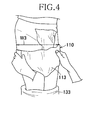
diaper 110 disposed inPATENT DOCUMENT 1, thefront waist region 113 and the rear waist region may be connected with each other along the respective lateral zones via the fastening means to shape thediaper 110 into the pant. Thediaper 110 shaped into the pant can be smoothly put on the wearer's body even while standing the wearer up without taking off his or her trousers (SeeFig. 4 ). - However, if the wearer's
garment 133 such as trousers are pulled down while standing the wearer up, a posture of the wearer might become unstable, particularly in the case of the aged wearer, resulting in getting off balance, staggering about and even tipping over. To avoid such situation, a helper often puts the aged wearer in a chair to put the diaper on the wearer's body in such posture. Assumed that, during this, the wearer is in the chair with his or hergarment 133 such as trousers around the ankles, thegarment 133 wedged between the ankles force the ankles to be spaced from each other. Consequentially, the wearer's thighs are correspondingly spaced from each other so that a width dimension as measured between respective outer sides of the thighs should be larger than a dimension of the wearer's waist. If thediaper 110 is guided between the wearer's thighs and the front and rear waist regions of the diaper are connected to each other in order to shape thediaper 110 into the pant, thediaper 110 will be pulled outward in the transverse direction beyond a supposed width dimension (width dimension of the waist as measured in the transverse direction) . As a result, the engagement between the front and rear waist regions might be released in the course of putting thediaper 110 on the wearer's body. - In view of the problem as has been described just above, it is a principal object of the present invention to provide a wearing article improved so that the wearing article can be smoothly put on the wearer's body even when the wearer is in the chair.
- The object set forth above is achieved, according to the present invention, by an improvement in the wearing article having a longitudinal direction and a transverse direction and comprising a liquid-absorbent chassis and fastening means wherein the liquid-absorbent chassis includes a front waist region, a rear waist region and a crotch region extending between these front and rear waist regions and the fastening means serve to connect a pair of opposite lateral zones of the front waist region referred to hereinafter as first lateral zones with a pair of opposite lateral zones of the rear waist region referred to hereinafter as second lateral zones in a detachable fashion so as to define a waist-opening and a pair of leg-openings.
- The improvement according to the present invention is characterized in that at least the rear waist region of the front waist region and the rear waist region is elasticized, the fastening means comprise a pair of first fastening elements extending on respective outer surfaces of the first lateral zones of the front waist region in the longitudinal direction and a pair of second fastening elements adapted to be associated the first fastening elements and extending on respective inner surfaces of the second lateral zones of the rear waist region in the longitudinal direction, and assumed that after the first fastening element has been engaged with associated the second fastening element on one side of the wearing article, the front and rear waist regions are pulled toward the other side and at least the rear waist region is held in its stretched state and the first fastening element is tried to be engaged with associated the second fastening element, the fastening means exhibit sufficiently high fastening strength against shearing force to prevent the sufficiently high to prevent the first and second fastening elements on the one side as well as on the other side from unintentionally being disengaged from each other.
- In addition to the representative embodiment as has been described just above, the present invention may be implemented in preferred embodiments as follow:
- (1) The fastening means are provided in the form of mechanical fasteners, wherein the first fastening elements and the second fastening elements are implemented in a form of hook elements and loop elements adapted to be engaged with associated the hook elements.
- (2) The fastening means are implemented in a form of mechanical fasteners and shearing stress generated by engagement between the first fastening elements and the second fastening elements is 5N/cm2 or higher and fastening strength against shearing force exhibited by the fastening means as a whole is 60N or higher.
- (3) The second fastening elements extending on respective inner surfaces of the second lateral zones of the rear waist region and the first fastening elements are attached to respective outer surfaces of base members extending outward from the first lateral zones.
- (4) The first fastening element is divided into upper halves and lower halves spaced from and opposed to each other in the longitudinal direction.
- According to the present invention, the fastening means provided in the transversely opposite lateral zones of the diaper have a sufficiently high level of fastening strength against shearing force to overcome the problem such that, even when the diaper is put on the wearer's body sitting in the chair by connecting the respective lateral zones of the front and rear waist regions on one side of the diaper with each other vua the associated fastening means and then by connecting the respective lateral zones at the other side of the diaper via the fastening means provided on the other side of the diaper while at least the rear waist region is stretched toward the other side of the diaper, the fastening means on one side and/or on the other side might be disengaged in this course of putting the diaper on the wearer's body.
-
-
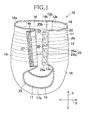
Fig. 1 is a perspective view of the disposable diaper. -
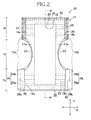
Fig. 2 is a partially cutaway plan view of the flatly developed disposable diaper. -
Fig. 3 is a diagram illustrating a sequence from A to B in which the diaper is put on the wearer sitting in a chair. -
Fig. 4 is a diagram illustrating a manner in which the diaper of prior art is put on the wearer in upright posture. -
- 10
- disposable diaper (wearing article)
- 11
- chassis
- 12a, 12b
- fastening means
- 13
- front waist region
- 13a, 13b
- first pair of lateral zones
- 14
- rear waist region
- 14a, 14b
- second pair of lateral zones
- 15
- crotch region
- 16
- waist-opening
- 17
- leg-opening
- 25, 26
- first pair of fastening elements
- 25a, 26a
- upper halves
- 25b, 26b
- lower halves
- 27, 28
- second pair of fastening elements
- 29a, 29b
- base members
- 30
- unoccupied space
- X
- transverse direction
- Y
- longitudinal direction
-
Figs. 1 through 3 illustrate adisposable diaper 10 for adult as a typical embodiment of the present invention and details of the invention will be more fully understood from the description of this diaper for adult given hereunder in reference with theseFigs. 1 through 3 .Fig. 1 is a perspective view of thediaper 10 with a pair of fastening means 12a disengaged from each other andFig. 2 is a partially cutaway plan view of thediaper 10 flatly developed in a transverse direction X as well as in a longitudinal direction Y of thediaper 10 after both pairs of the fastening means 12a, 12b have been disengaged one from another. - As will be apparent from
Figs. 1 and2 , thediaper 10 comprises a liquid-absorbent chassis 11 and the fastening means 12a, 12b and is configured from afront waist region 13, arear waist region 14 and acrotch region 15 extending between thesewaist regions - The chassis 11 comprises an
inner sheet 18 formed by liquid-pervious nonwoven fabric, anouter sheet 19 formed by hydrophobic fibrous nonwoven fabric, moisture-pervious plastic film or a laminate thereof, and a liquid-absorbent core 20 sandwiched between the inner andouter sheets crotch region 15 and to have a concave shape curved inwardly as a whole. - In the front and
rear waist regions outer sheets elastic elements 22 extending in the transverse direction X along aperipheral edge 16a of the waist-opening 16, a plurality of legelastic elements 23 extending along respectiveperipheral edges 17a of the leg-openings 17, and a plurality of second waistelastic elements 24 extending in the transverse direction X provided between theperipheral edge 16a of the waist-opening 16 and the respectiveperipheral edges 17a of the legelastic elements 17. - These
elastic elements elastic elements rear waist regions - The
core 20 is formed typically by a mixture of fluff pulp and superabsorbent polymer particles (SAP) and preferably wrapped with a liquid-dispersant shape retaining sheet (not shown) to prevent the core 20 from unacceptable deformation and at the same time to prevent potential falling off of SAP. - The
front waist region 13 and therear waist region 14 respectively have a first pair oflateral zones 13a, 13b and a second pair oflateral zones diaper 10 and extending in the longitudinal direction Y. The first pair oflateral zones 13a, 13b and the second pair oflateral zones diaper 10 on the wearer's body. Upon connection of these first and second pairs oflateral zones openings 17 are formed (SeeFig. 1 ). - The fastening means 12a, 12b comprise a first pair of
fastening elements fastening elements fastening elements fastening elements lateral zones 13a, 13b in the transverse direction X and the second pair offastening elements lateral zones - The
base members lateral zones 13a, 13b. Thesebase members lateral zones 13a, 13b by adhesive or thermal or ultrasonic bonding technique of well known art so as to extend outward from the firstlateral zones 13a, 13b in the transverse direction X. Thebase members lateral zones 13a, 13b without overlapping theelastic members base members elastic elements - The
first fastening elements base members first fastening elements upper halves lower halves unoccupied spaces 30. Theunoccupied spaces 30 defined between theupper halves lower halves diaper 10 on the wearer's body. Specifically, theupper halves second fastening elements lower halves second fastening elements diaper 10 is taken off from the wearer's body, handling for disengagement can be carried out more easily than for the diaper of prior art. Specifically, the helper's fingers may be inserted into respective gaps defined by theunoccupied spaces 30 between thefirst fastening elements second fastening elements unoccupied spaces 30 so as to disengage thefirst fastening elements second fastening elements first fastening elements elements - The
first fastening elements normal diaper 10 for adult, each of thefirst fastening elements rear waist regions - The
second fastening elements lateral zones lateral zones second fastening elements lateral zones first fastening elements second fastening elements - The fastening means 12a, 12b may be implemented in the form of mechanical fasteners wherein the
first fastening elements second fastening elements first fastening elements second fastening elements first fastening elements second fastening elements second fastening elements first fastening elements lateral zones first fastening elements inner sheet 18. -
Fig. 3 is a diagram illustrating a sequence from A to B in which the helper puts thediaper 10 on the wearer's body sitting in a chair andFig. 4 is a diagram illustrating a manner in which thediaper 110 of prior art is put on the wearer in upright posture. Expressions "right-hand side" and "left-hand side" used herein should be understood to be designated with respect to the helper. - Now the sequence in which the helper puts the
diaper 10 on the wearer will be described. Referring toFig. 3A first, thecrotch region 15 is positioned between the wearer'sthighs front waist region 13 is placed on respective upper sides of thethighs rear waist region 14 is placed on respective lower sides of thethighs second lateral zone 14b, and thereafter thefront waist region 13 is held in the vicinity of upper end thereof with the right hand and pulled leftward while thesecond lateral zone 14a of therear waist region 14 underlying thethigh 31 is held with the left hand and pulled leftward. Referring now toFig. 3B , while holding thefront waist region 13 as having been pulled leftward and pressing it against the upper side of the wearer'sthigh 31 to hold it thereon, thesecond lateral zone 14a is pulled up from under thethigh 31 until thesecond lateral zone 14a is put flat together with thefirst lateral zone 13a on the lateral side of thethigh 31, and finally theupper half 25a and thelower half 25b of thefirst fastening element 25 are successively engaged with thesecond fastening element 27 to shape thepant 10 into pant. - Assumed that, during this, the wearer is in the chair with his or her
garment 33 such as trousers around the ankles, thegarment 33 wedged between the ankles force the ankles to be spaced from each other. Consequentially, the wearer'sthighs Fig. 4 , the width dimension W1 will be larger than a width dimension W3 as measured between the respective outermost sides when thediaper 110 is put on the wearer in upright posture. - In other words, tensile stress in the transverse direction X is exerted on the
diaper 10 its entirety and thediaper 10 is stretched in the transverse direction X beyond an assumed width (i.e., the width dimension W2 of the waist). In consequence, the plane of the fastening means 12b along which thefirst fastening element 26 and thesecond fastening element 28 are first engaged is exposed to shearing force higher than that exerted on the corresponding plane when thediaper 10 is put on the wearer's body in upright posture. Therefore, if fastening strength of the fastening means 12a, 12b is relatively low, the first andsecond fastening elements second fastening elements diaper 10 on the wearer's body smoothly. - To overcome such anxiety, the fastening means 12a, 12b according to the present invention are provided with fastening strength against shearing force sufficiently high to avoid the above-mentioned anxiety that the fastening effect might be lost in the course of putting the
diaper 10 on the wearer's body. - To meet such requirements, shear stress generated as the first fastening element is engaged with the associated second fastening means is preferably in a range of 5N/cm2 or higher and the fastening means 12a, 12b preferably exhibit fastening strength against shearing force of 60N or higher. If the fastening strength against shearing force of the fastening means 12a, 12b is less than 60N, the fastening means 12b brought in engagement first or/and the fastening means 12 brought in engagement thereafter might be unintentionally disengaged when the
diaper 10 is put on the wearer's body sitting in the chair. - The shearing stress of the fastening means 12a, 12b may be measured by a method as follows:
- First, from the hook element and the loop element used for the
first fastening elements second fastening elements - As has previously been described, the front and
rear waist regions elastic members rear waist regions rear waist regions diaper 10 is put on the wearer's body in sitting posture. In order to facilitate operation of putting thediaper 10 on the wearer's body, it is possible to elasticize therear waist region 14 alone and/or to dimension therear waist region 14 to be larger than thefront waist region 13. If therear waist region 14 alone is elasticized and therear waist region 14 is dimensioned to be larger than thefront waist region 13, shearing force exerted on the previously brought into engagement can be effectively alleviated in the course of putting thediaper 10 on the wearer's body because it is unnecessary to stretch thefront waist region 13. - In the course of putting the
diaper 10 on the wearer's body, the first and second waistelastic elements rear waist region diaper 10 to be put on the wearer's body, the first and second waistelastic elements rear waist regions elastic elements 22 extending along theperipheral edge 16a of the waist-opening 16 preferably exhibit the stretch ratio as well as the stretch stress higher than those of the second waistelastic elements 24 provided principally for the purpose of improved fitness to the wearer's body. - While the
diaper 10 according to the illustrated embodiment comprises the chassis 11 including the core 20 principally serving for liquid-absorption sandwiched between the inner andouter sheets diaper 10 comprises the chassis formed by a sheet member and a pad-like liquid-absorbent structure including the core 20 prepared separately of the chassis 11. In this case, the liquid-absorbent structure may be attached to the inner surface of the chassis 11 only along limited portions of its front and rear ends and transversely opposite side edges to avoid a possibility that the presence of the core 20 having a relatively high stiffness might obstruct smooth stretching as well as contraction of the second waistelastic elements 24. Consequentially, the front andrear waist regions diaper 10 on the wearer's body.
Claims (5)
- A wearing article having a longitudinal direction and a transverse direction and comprising a liquid-absorbent chassis and fastening means wherein said liquid-absorbent chassis including a front waist region, a rear waist region and a crotch region extending between said front and rear waist regions and said fastening means serve to connect a pair of first lateral zones of said front waist region with a pair of second lateral zones of said rear waist region in a detachable fashion so as to define a waist-opening and a pair of leg-openings, said wearing article being characterized in that:at least said rear waist region of said front waist region and said rear waist region is elasticized;said fastening means comprise a pair of first fastening elements extending on respective outer surfaces of said first lateral zones of said front waist region in said longitudinal direction and a pair of second fastening elements adapted to be associated said first fastening elements and extending on respective inner surfaces of said second lateral zones of said rear waist region in said longitudinal direction; andassumed that after said first fastening element has been engaged with associated said second fastening element on one side of said wearing article, said front and rear waist regions are pulled toward other side and, while at least said rear waist region is held in its stretched state and said first fastening element is tried to be engaged with associated said second fastening element, said fastening means exhibit sufficiently high fastening strength against shearing force to prevent said first and second fastening elements on said one side as well as on said other side from unintentionally being disengaged from each other.
- The wearing article as defined by Claim 1, wherein said fastening means are provided in a form of mechanical fasteners, wherein said first fastening elements and said second fastening elements are implemented in a form of hook elements and loop elements adapted to be engaged with associated said hook elements.
- The wearing article as defined by Claim 1 or 2, wherein said fastening means are implemented in a form of mechanical fasteners and shearing stress generated by engagement between said first fastening elements and said second fastening elements is 5N/cm2 or higher and fastening strength against shearing force exhibited by said fastening means as a whole is 60N or higher.
- The wearing article as defined by any one of Claims 1 through 3, wherein said second fastening elements extend on respective inner surfaces of said second lateral zones of said rear waist region and said first fastening elements are attached to respective outer surfaces of base members extending outward from said first lateral zones.
- The wearing article as defined by any one of Claims 1 through 4, wherein said first fastening element is divided into upper halves and lower halves spaced from and opposed to each other in said longitudinal direction.
Applications Claiming Priority (2)
| Application Number | Priority Date | Filing Date | Title |
|---|---|---|---|
| JP2008128929A JP5394657B2 (en) | 2008-05-15 | 2008-05-15 | Wearing article |
| PCT/JP2009/055602 WO2009139227A1 (en) | 2008-05-15 | 2009-03-23 | Wearing article |
Publications (2)
| Publication Number | Publication Date |
|---|---|
| EP2286777A1 true EP2286777A1 (en) | 2011-02-23 |
| EP2286777A4 EP2286777A4 (en) | 2014-06-04 |
Family
ID=41318600
Family Applications (1)
| Application Number | Title | Priority Date | Filing Date |
|---|---|---|---|
| EP09746434.1A Withdrawn EP2286777A4 (en) | 2008-05-15 | 2009-03-23 | Wearing article |
Country Status (12)
| Country | Link |
|---|---|
| US (1) | US20110152817A1 (en) |
| EP (1) | EP2286777A4 (en) |
| JP (1) | JP5394657B2 (en) |
| KR (1) | KR101395522B1 (en) |
| CN (1) | CN102076300B (en) |
| AR (1) | AR071773A1 (en) |
| AU (1) | AU2009247404B2 (en) |
| CL (1) | CL2009001118A1 (en) |
| EA (1) | EA201071189A1 (en) |
| MY (1) | MY150986A (en) |
| TW (1) | TW201006448A (en) |
| WO (1) | WO2009139227A1 (en) |
Families Citing this family (1)
| Publication number | Priority date | Publication date | Assignee | Title |
|---|---|---|---|---|
| WO2019182526A1 (en) * | 2018-03-23 | 2019-09-26 | Evyap Sabun Yag Gliserin Sanayi Ve Ticaret Anonim Sirketi | A non-sagging baby diaper |
Family Cites Families (21)
| Publication number | Priority date | Publication date | Assignee | Title |
|---|---|---|---|---|
| US4905323A (en) * | 1989-01-04 | 1990-03-06 | Jennifra Lampman | Disposable undergarment |
| SE508028C2 (en) * | 1993-05-12 | 1998-08-10 | Moelnlycke Ab | Waist belt for absorbent garments |
| US20020188268A1 (en) * | 1999-06-30 | 2002-12-12 | Mark James Kline | Elastomeric side panel for use with convertible absorbent articles |
| EP1559388B1 (en) * | 1998-12-18 | 2014-04-23 | Kimberly-Clark Worldwide, Inc. | Absorbent articles with refastenable side seams |
| US6761711B1 (en) * | 1998-12-18 | 2004-07-13 | Kimberly-Clark Worldwide, Inc. | Absorbent articles with refastenable side seams |
| JP4615140B2 (en) * | 2001-03-03 | 2011-01-19 | 大王製紙株式会社 | A disposable diaper with a fixed front seat |
| WO2002069873A1 (en) * | 2001-03-03 | 2002-09-12 | Daio Paper Corporation | Paper diaper |
| JP4004814B2 (en) * | 2001-09-03 | 2007-11-07 | 白十字株式会社 | Disposable absorbent article |
| JP2003180748A (en) * | 2001-12-17 | 2003-07-02 | Daio Paper Corp | Nonwoven fabric target tape and absorbent article using the same |
| DE10246365A1 (en) * | 2002-09-30 | 2004-04-08 | Paul Hartmann Ag | Incontinence pad for adults has two fasteners associated with corresponding abutment surfaces; fastener further from hip area withstands greater force before becoming undone |
| JP2004339658A (en) * | 2003-05-19 | 2004-12-02 | Kuraray Co Ltd | Engaging fiber sheet |
| JP4949618B2 (en) * | 2004-03-31 | 2012-06-13 | ユニ・チャーム株式会社 | Wearing article |
| JP4220432B2 (en) * | 2004-05-11 | 2009-02-04 | 大王製紙株式会社 | Fixed paper diapers |
| WO2006033350A1 (en) * | 2004-09-22 | 2006-03-30 | Kao Corporation | Absorptive article |
| JP4458996B2 (en) * | 2004-09-22 | 2010-04-28 | 花王株式会社 | Absorbent articles |
| DE102004053469A1 (en) * | 2004-11-03 | 2006-05-04 | Paul Hartmann Ag | Loop forming nonwoven material for a mechanical closure |
| KR20070116878A (en) * | 2005-03-11 | 2007-12-11 | 쓰리엠 이노베이티브 프로퍼티즈 캄파니 | Manufacturing method of fastener |
| CA2643207C (en) * | 2006-02-24 | 2011-10-18 | The Procter & Gamble Company | Nonwoven fabric for a female component of a fastening system |
| US7828784B2 (en) * | 2006-04-24 | 2010-11-09 | Kimberly-Clark Worldwide, Inc. | Absorbent articles with refastenable side seams and intuitive disposal feature |
| JP5009052B2 (en) * | 2006-05-31 | 2012-08-22 | 大王製紙株式会社 | Disposable diapers |
| JP5037868B2 (en) * | 2006-07-06 | 2012-10-03 | ユニ・チャーム株式会社 | Pants-type wearing article |
-
2008
- 2008-05-15 JP JP2008128929A patent/JP5394657B2/en not_active Expired - Fee Related
-
2009
- 2009-03-23 WO PCT/JP2009/055602 patent/WO2009139227A1/en not_active Ceased
- 2009-03-23 AU AU2009247404A patent/AU2009247404B2/en active Active
- 2009-03-23 CN CN2009801247719A patent/CN102076300B/en active Active
- 2009-03-23 MY MYPI20105349 patent/MY150986A/en unknown
- 2009-03-23 EP EP09746434.1A patent/EP2286777A4/en not_active Withdrawn
- 2009-03-23 US US12/992,341 patent/US20110152817A1/en not_active Abandoned
- 2009-03-23 EA EA201071189A patent/EA201071189A1/en unknown
- 2009-03-23 KR KR1020107027678A patent/KR101395522B1/en not_active Expired - Fee Related
- 2009-05-08 CL CL2009001118A patent/CL2009001118A1/en unknown
- 2009-05-13 AR ARP090101719A patent/AR071773A1/en not_active Application Discontinuation
- 2009-05-14 TW TW098116007A patent/TW201006448A/en unknown
Also Published As
| Publication number | Publication date |
|---|---|
| CN102076300A (en) | 2011-05-25 |
| JP2009273732A (en) | 2009-11-26 |
| US20110152817A1 (en) | 2011-06-23 |
| JP5394657B2 (en) | 2014-01-22 |
| AU2009247404A1 (en) | 2009-11-19 |
| CN102076300B (en) | 2013-09-25 |
| WO2009139227A1 (en) | 2009-11-19 |
| EA201071189A1 (en) | 2011-06-30 |
| AR071773A1 (en) | 2010-07-14 |
| TW201006448A (en) | 2010-02-16 |
| KR101395522B1 (en) | 2014-05-14 |
| KR20110021867A (en) | 2011-03-04 |
| MY150986A (en) | 2014-03-31 |
| EP2286777A4 (en) | 2014-06-04 |
| CL2009001118A1 (en) | 2010-04-16 |
| AU2009247404B2 (en) | 2014-05-29 |
Similar Documents
| Publication | Publication Date | Title |
|---|---|---|
| US7255688B2 (en) | Pull-on disposable wearing article | |
| US9107777B2 (en) | Disposable wearing article | |
| JP6625525B2 (en) | Assortment of disposable absorbent articles for wearing on a wide range of wearers | |
| EP2301501B1 (en) | Method of making wearing article and this wearing article | |
| EP1374815A2 (en) | Open-type disposable wearing article | |
| EP3318230B1 (en) | Disposable wearing article | |
| CN103179933B (en) | There is the disposable absorbent article of the finger tab not damaging draftability | |
| US11253408B2 (en) | Refastenable disposable garment having a curled edge, and process for making same | |
| EP1872759B1 (en) | Disposable pants-type wearing article | |
| EP1179331B1 (en) | Disposable undergarment | |
| US9480607B2 (en) | Pants-type wearing article | |
| EP2286774A1 (en) | Wearing article and method of folding the same | |
| EP2032110B1 (en) | Belted absorbent garment | |
| AU2003220900B2 (en) | Pants type disposable wearing article | |
| AU2009247404B2 (en) | Pants-Type Wearing Article | |
| JP5787689B2 (en) | Disposable wearing items | |
| AU2013229179A1 (en) | Method for simplifying the donning of refastenable disposable absorbent articles | |
| KR20170078695A (en) | Disposable article with reinforced handle |
Legal Events
| Date | Code | Title | Description |
|---|---|---|---|
| PUAI | Public reference made under article 153(3) epc to a published international application that has entered the european phase |
Free format text: ORIGINAL CODE: 0009012 |
|
| 17P | Request for examination filed |
Effective date: 20101126 |
|
| AK | Designated contracting states |
Kind code of ref document: A1 Designated state(s): AT BE BG CH CY CZ DE DK EE ES FI FR GB GR HR HU IE IS IT LI LT LU LV MC MK MT NL NO PL PT RO SE SI SK TR |
|
| AX | Request for extension of the european patent |
Extension state: AL BA RS |
|
| DAX | Request for extension of the european patent (deleted) | ||
| A4 | Supplementary search report drawn up and despatched |
Effective date: 20140506 |
|
| RIC1 | Information provided on ipc code assigned before grant |
Ipc: A61F 13/56 20060101ALI20140428BHEP Ipc: A61F 13/66 20060101ALI20140428BHEP Ipc: A61F 13/15 20060101ALN20140428BHEP Ipc: A61F 13/62 20060101ALI20140428BHEP Ipc: A61F 13/496 20060101ALI20140428BHEP Ipc: A61F 13/49 20060101AFI20140428BHEP |
|
| 17Q | First examination report despatched |
Effective date: 20150320 |
|
| STAA | Information on the status of an ep patent application or granted ep patent |
Free format text: STATUS: THE APPLICATION IS DEEMED TO BE WITHDRAWN |
|
| 18D | Application deemed to be withdrawn |
Effective date: 20161122 |