EP2286617B1 - Method and apparatus for communication between wireless telecommunications networks of different technology types - Google Patents
Method and apparatus for communication between wireless telecommunications networks of different technology types Download PDFInfo
- Publication number
- EP2286617B1 EP2286617B1 EP09728779A EP09728779A EP2286617B1 EP 2286617 B1 EP2286617 B1 EP 2286617B1 EP 09728779 A EP09728779 A EP 09728779A EP 09728779 A EP09728779 A EP 09728779A EP 2286617 B1 EP2286617 B1 EP 2286617B1
- Authority
- EP
- European Patent Office
- Prior art keywords
- network
- interface
- signaling
- technology
- identifier
- Prior art date
- Legal status (The legal status is an assumption and is not a legal conclusion. Google has not performed a legal analysis and makes no representation as to the accuracy of the status listed.)
- Active
Links
Images
Classifications
-
- H—ELECTRICITY
- H04—ELECTRIC COMMUNICATION TECHNIQUE
- H04W—WIRELESS COMMUNICATION NETWORKS
- H04W36/00—Hand-off or reselection arrangements
- H04W36/0005—Control or signalling for completing the hand-off
- H04W36/0055—Transmission or use of information for re-establishing the radio link
- H04W36/0066—Transmission or use of information for re-establishing the radio link of control information between different types of networks in order to establish a new radio link in the target network
-
- H—ELECTRICITY
- H04—ELECTRIC COMMUNICATION TECHNIQUE
- H04W—WIRELESS COMMUNICATION NETWORKS
- H04W36/00—Hand-off or reselection arrangements
- H04W36/08—Reselecting an access point
- H04W36/083—Reselecting an access point wherein at least one of the access points is a moving node
-
- H—ELECTRICITY
- H04—ELECTRIC COMMUNICATION TECHNIQUE
- H04W—WIRELESS COMMUNICATION NETWORKS
- H04W36/00—Hand-off or reselection arrangements
- H04W36/14—Reselecting a network or an air interface
- H04W36/144—Reselecting a network or an air interface over a different radio air interface technology
-
- H—ELECTRICITY
- H04—ELECTRIC COMMUNICATION TECHNIQUE
- H04W—WIRELESS COMMUNICATION NETWORKS
- H04W36/00—Hand-off or reselection arrangements
- H04W36/08—Reselecting an access point
-
- H—ELECTRICITY
- H04—ELECTRIC COMMUNICATION TECHNIQUE
- H04W—WIRELESS COMMUNICATION NETWORKS
- H04W92/00—Interfaces specially adapted for wireless communication networks
- H04W92/16—Interfaces between hierarchically similar devices
- H04W92/20—Interfaces between hierarchically similar devices between access points
-
- Y—GENERAL TAGGING OF NEW TECHNOLOGICAL DEVELOPMENTS; GENERAL TAGGING OF CROSS-SECTIONAL TECHNOLOGIES SPANNING OVER SEVERAL SECTIONS OF THE IPC; TECHNICAL SUBJECTS COVERED BY FORMER USPC CROSS-REFERENCE ART COLLECTIONS [XRACs] AND DIGESTS
- Y02—TECHNOLOGIES OR APPLICATIONS FOR MITIGATION OR ADAPTATION AGAINST CLIMATE CHANGE
- Y02D—CLIMATE CHANGE MITIGATION TECHNOLOGIES IN INFORMATION AND COMMUNICATION TECHNOLOGIES [ICT], I.E. INFORMATION AND COMMUNICATION TECHNOLOGIES AIMING AT THE REDUCTION OF THEIR OWN ENERGY USE
- Y02D30/00—Reducing energy consumption in communication networks
- Y02D30/70—Reducing energy consumption in communication networks in wireless communication networks
Definitions
- the present invention relates to a method and apparatus for communication between wireless telecommunications networks of different technology types, and more particularly, but not exclusively, where the different technology types are what is termed 'fourth generation', or '4G', technologies.
- High Rate Packet Data also referred to as 1xEV-DO or High Data Rate (HDR)
- HRPD High Rate Packet Data
- WiMAX is an IEEE standard 802.16e for mobile technology.
- LTE Long Term Evolution
- 3GPP Third Generation Partnership Project
- UMB Ultra Mobile Broadband
- a mobile terminal may have a capability for communicating with networks of different technology types. If conditions deteriorate, for example, when the mobile terminal is connected to a node in one network, it may be desirable to transfer it to a new connection, which may be another node of the same network or a node in a different network. Signaling messaging is required between the mobile terminal and elements of a potential new target network node so as to complete handover preparation, for example, by transferring information regarding the context of the mobile terminal, and to carry out handover from a source node to a target node once the necessary steps have been fulfilled. If handover involves transfer between networks of different technology types, some mechanism must be provided to permit signaling messaging for use in making a connection between the mobile terminal and the target node to be sent to the target network to establish communication between them.
- HO inter-technology handover
- Each Radio Access Technology uses different protocols and architectures to establish an IP (Internet Protocol) service for an MS. Many of them involve the setup of the Radio Access Network session for the MS and the setup of L3 connectivity.
- WiMax requires WiMax RAN access and WiMax session and IP session setup.
- HRPD requires HRPD session, PPP session and MIP session setup. Each one of these setups may take any time between 1- 5 seconds. Therefore, the setup of these sessions and reservation of the resources must be done in a "make-before-break" fashion, that is, before the actual HO execution. This is achieved by "tunneling" of target technology messages over the current serving technology.
- IP encapsulation IP encapsulation
- RAN Radio Access Network
- IP encapsulation IP encapsulation
- HA Home Agent
- RAN Radio Access Network
- Document 3GPP TSG CT WG1 Meeting #51 bis C1-080750 is concerned with handover between LTE and HRPD and discloses a tunnelling process in which target specific network access signalling between the source and target networks is carried out.
- 3GPP TS 23.402 v2.0.0 (2007-12) is concerned with architecture enhancements for providing IP connectivity using non-3GPP accesses to the Evolved 3GPP PS Domain where the protocols between its Core Network elements are IETF-based.
- a method for communication between wireless telecommunications networks of different technology types including the steps of:
- the first technology type is WiMAX and the identifier is a special service flow identifier. This may be detected at an Access Services Network Gateway (ASN GW), for example.
- a method in accordance with the invention thus permits the use of logical radio channels for encapsulating inter-technology signaling.
- the source node may be made aware that the mobile terminal is signaling to the second technology in preparation for a handover, whereas this would not be visible to a source node if IP encapsulation were to be used instead. Also, by employing a method in accordance with the invention, delays are reduced as there is no need to rely on existing L3 protocols, this being particular advantageous for real time applications such as speech.
- the first technology type is WiMAX and the second technology type may be HRPD, for example.
- the method may also be applied where the first technology type is HRPD and the second technology type is WiMAX.
- a method in accordance with the invention may use first and second technology types that are respective ones of the following technology types: High Rate Packet Data (HRPD); WiMAX; Long Term Evolution (LTE); and Ultra Mobile Broadband (UMB). Future evolutions of these or other types of technology may be used.
- HRPD High Rate Packet Data
- WiMAX Wireless Fidelity
- LTE Long Term Evolution
- UMB Ultra Mobile Broadband
- the interface is an S101 interface, although another common interface standard may be adopted instead.
- the S101 interface has been proposed for use in inter-RAT communications for communication between LTE and HRPD networks.
- the identifier may, in one method, be in the form of a signaling link protocol (SLP) identifier.
- SLP signaling link protocol
- the interface may be an S101 interface.
- This is an interface defined initially for use between an LTE network and an HRPD network.
- the present inventors have realized that such an interface may be more generally applied for use as an interface between networks with other combinations of technology types.
- a node for a wireless telecommunications network of a first technology type comprises: a detector for detecting an identifier associated with a message container, the identifier indicating that the container encapsulates handover signaling messaging in accordance with a second technology type different to the first technology type; and a transmitter for transmitting a container having the detected identifier over a signaling interface with another node included in a wireless telecommunications network of the second technology type.
- the first and second technology types may be respective ones of the following technology types: High Rate Packet Data (HRPD); WiMAX; Long Term Evolution (LTE); and Ultra Mobile Broadband (UMB). Other types of technology or evolutions of these may be used.
- a mobile terminal having the capability of communicating with networks of at least two respective different technology types is operative, during handover preparation for handover from a first network of a first technology type to a second network of a second technology type, to add an identifier to signaling messaging for use in the second network to indicate that the signaling messaging is to be tunneled from the first network to the second network over an interface.
- the first and second technology types may be respective ones of the following technology types: High Rate Packet Data (HRPD); WiMAX; Long Term Evolution (LTE); and Ultra Mobile Broadband (UMB). Other types of technology or evolutions of these may be used.
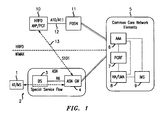
- an access terminal (or mobile terminal) (AT/MS) 1 is in communication with a WiMAX network 2, being connected to a base station 3.
- the base station 3 is connected via an ASN GW 4 to common core network elements shown at 5 and including Authentication, Authorization and Accounting server (AAA) 6, Policy and Charging Rules Functions (PCRF) 7, Home Agent/Location Manager (HA/LMA) 8 and IP Multimedia Subsystem (IMS) 9 entities.
- AAA Authentication, Authorization and Accounting server
- PCRF Policy and Charging Rules Functions
- H/LMA Home Agent/Location Manager
- IMS IP Multimedia Subsystem
- HRPD Another network of a second technology type, HRPD, includes an HRPD Access Network and Policy Control Function (AN*/PCF) second node 10 which connects to a Packet Data Serving Node (PDSN) 11 via the A10/A11 interface 12.
- PDSN Packet Data Serving Node
- A10/A11 interface 12 The PDSN 11 connects to the common core network elements shown at 5.
- FA Foreign Agent
- HA Home Agent
- the ASN-GW 4 is the network node that performs RAN control and routing. After transmission to the HA, the traffic is subsequently routed to its destination using standard IP routing.
- an MS may have multiple service flows (SF) simultaneously, and each SF has a unique identifier, SFID.
- the WiMAX ASN-GW 4 is the network element that performs IP classification and mapping of IP flow to WiMAX SF and vice versa.
- the ASN-GW 4 detects all tunneled signaling messages, intercepting them to perform special routing to the HRPD RAN instead of going via the standard WiMAX 'FA to HA' tunneling mechanism.
- a special service flow is created. This is a flow of traffic that can be identified by its unique ID in the RAN, instead of by its IP classifier such as source/destination address, source/destination port number, protocol ID, and so on.
- the ASN-GW 4 creates a secure tunnel between itself and the HRPD RAN (there could be more than one tunnel for load sharing purpose) to carry an S101 interface 13 between the ASN-GW 4 and the HRPD AN*/PCF node 10.
- the MS uses a special flow from AT/MS 1 to ASN-GW 4 to send any HO trigger it may detect, for example, such as change in signal strength.
- the ASN-GW 4 also uses a special flow from ASN-GW 4 to AT/MS 1 to convey any network information, such as neighbor list of co-located HPRD BSs and/or border cell notification to AT/MS, to assist HO.
- the ASN-GW 4 recognizes the special service flow ID, which is a unique globally known SF m, and uses the secure tunnel established earlier as S101 to deliver messages, the signaling messaging being encapsulated in a container which also includes an identifier as to its contents.
- all the tunneled signaling messages from HRPD RAN are received as if they come directly from a WiMAX terminal via a WiMAX BS that carries the WiMAX air interface over the WiMAX R6 interface, such as subscriber station (SS) association as if AT/MS has performed a successful ranging, authentication exchange, initial SF creation, IP connectivity setup, etc.
- SS subscriber station
- the special service flow initiated by ASN-GW 4 and/or AT/MS 1 is used for intercepting and sending HRPD session set-up messages between AT/MS and HRPD RAN (sent as a WiMAX, payload). This avoids the need for a special tunneling capability on the WiMAX air interface.
- HRPD air interface has the concept of Radio Link Protocol (RLP) flows and Signaling Link Protocol (SLP) flow.
- RLP flow corresponds to A10 connection (R-P) with PDSN.
- SLP flow is used for HRPD signaling messages and it terminates in HRPD RNC.
- Each MS may support multiple RLP flows, similar to service flows in WiMAX.
- the HRPD RNC can create the same S101 interface from HRPD to LTE, WiMAX or UMB, as applicable.
- a method and embodiment in accordance with the invention may be deployed without modifying either the HRPD or WiMAX radio interfaces, thus avoiding impact on existing radio interfaces. Changes may be isolated to specific equipment such as RNCs. This potentially leads to a large cost saving over both making radio interface changes and adding security mechanisms such as firewalls.
Landscapes
- Engineering & Computer Science (AREA)
- Computer Networks & Wireless Communication (AREA)
- Signal Processing (AREA)
- Mobile Radio Communication Systems (AREA)
Description
- The present invention relates to a method and apparatus for communication between wireless telecommunications networks of different technology types, and more particularly, but not exclusively, where the different technology types are what is termed 'fourth generation', or '4G', technologies.
- Currently, efforts in mobile telecommunications developments are directed to providing broadband data communications, known as 3.5G and 4G, using various competing radio access technologies (RATs) aiming to achieve high bandwidth combined with low latency, high efficiencies and flexibility. High Rate Packet Data (HRPD), also referred to as 1xEV-DO or High Data Rate (HDR), is a high-speed CDMA-based wireless data technology. WiMAX is an IEEE standard 802.16e for mobile technology. Long Term Evolution (LTE) is a Third Generation Partnership Project (3GPP) for enhancing UMTS. Ultra Mobile Broadband (UMB) is a 3GPP2 project.
- A mobile terminal (MS) may have a capability for communicating with networks of different technology types. If conditions deteriorate, for example, when the mobile terminal is connected to a node in one network, it may be desirable to transfer it to a new connection, which may be another node of the same network or a node in a different network. Signaling messaging is required between the mobile terminal and elements of a potential new target network node so as to complete handover preparation, for example, by transferring information regarding the context of the mobile terminal, and to carry out handover from a source node to a target node once the necessary steps have been fulfilled. If handover involves transfer between networks of different technology types, some mechanism must be provided to permit signaling messaging for use in making a connection between the mobile terminal and the target node to be sent to the target network to establish communication between them.
- One problem during inter-technology handover (HO) is timing for real-time services. It is desirable that the traffic interruption during such HO is kept within 300ms to make the HO seamless and reduce the likelihood of real-time service being degraded.
- Each Radio Access Technology (RAT) uses different protocols and architectures to establish an IP (Internet Protocol) service for an MS. Many of them involve the setup of the Radio Access Network session for the MS and the setup of L3 connectivity. For example: WiMax requires WiMax RAN access and WiMax session and IP session setup. HRPD requires HRPD session, PPP session and MIP session setup. Each one of these setups may take any time between 1- 5 seconds. Therefore, the setup of these sessions and reservation of the resources must be done in a "make-before-break" fashion, that is, before the actual HO execution. This is achieved by "tunneling" of target technology messages over the current serving technology.
- One possible tunneling mechanism is to rely directly on the IP network of the serving technology, which may be termed IP encapsulation, and tunnel the "pre-registration" directly from serving technology, via the Home Agent (HA), to the target technology's Radio Access Network (RAN).
Document 3GPP TSG CT WG1 Meeting #51 bis C1-080750 is concerned with handover between LTE and HRPD and discloses a tunnelling process in which target specific network access signalling between the source and target networks is carried out.
3GPP TS 23.402 v2.0.0 (2007-12) is concerned with architecture enhancements for providing IP connectivity using non-3GPP accesses to the Evolved 3GPP PS Domain where the protocols between its Core Network elements are IETF-based. - According to a first aspect of the invention, a method for communication between wireless telecommunications networks of different technology types, including the steps of:
- setting up an air interface between a mobile terminal and a first node included in a network of a first technology type;
- setting up a signaling interface between the first node included in a network of a first technology type and a second node included in a network of a second different technology type;
- providing messaging over the air interface related to handover of a mobile terminal from the network of the first technology type to the network of the second technology type;
- providing signaling messaging over the signaling interface in accordance with the second technology type, the signaling messaging being related to the handover;
- encapsulating the signaling messaging in a container for transmission over the signaling interface;
- associating an identifier from the messaging provided over the air interface with the container to indicate that the container encapsulates said signaling messaging;
- and, when the identifier is detected at the first node, sending the container over the signaling interface to the second node.
- In one method in accordance with the invention, the first technology type is WiMAX and the identifier is a special service flow identifier. This may be detected at an Access Services Network Gateway (ASN GW), for example. A method in accordance with the invention thus permits the use of logical radio channels for encapsulating inter-technology signaling.
- By using a method in accordance with the invention, it is not necessary to rely on IP tunneling and thus security issues associated with IP communications, such as Denial of Service attacks, hijacking of sessions and exposure of RAN equipment to hackers, may be avoided during the handover process. Additionally, by using the invention, the source node may be made aware that the mobile terminal is signaling to the second technology in preparation for a handover, whereas this would not be visible to a source node if IP encapsulation were to be used instead. Also, by employing a method in accordance with the invention, delays are reduced as there is no need to rely on existing L3 protocols, this being particular advantageous for real time applications such as speech.
- In one method in accordance with the invention, the first technology type is WiMAX and the second technology type may be HRPD, for example. The method may also be applied where the first technology type is HRPD and the second technology type is WiMAX.
- A method in accordance with the invention may use first and second technology types that are respective ones of the following technology types: High Rate Packet Data (HRPD); WiMAX; Long Term Evolution (LTE); and Ultra Mobile Broadband (UMB). Future evolutions of these or other types of technology may be used.
- In one method in accordance with the invention, the interface is an S101 interface, although another common interface standard may be adopted instead. The S101 interface has been proposed for use in inter-RAT communications for communication between LTE and HRPD networks. By adopting the S101 interface for other combinations of technology types, compatibly issues are reduced and there is no need to modify interfaces between different types for each specific combination, aiding backward compatibility and easing later system upgrades and providing a scalable solution.
- Where the first technology type is HRPD, the identifier may, in one method, be in the form of a signaling link protocol (SLP) identifier.
- In a method in accordance with the invention, the interface may be an S101 interface. This is an interface defined initially for use between an LTE network and an HRPD network. The present inventors have realized that such an interface may be more generally applied for use as an interface between networks with other combinations of technology types.
- According to a second aspect of the invention, a node for a wireless telecommunications network of a first technology type comprises: a detector for detecting an identifier associated with a message container, the identifier indicating that the container encapsulates handover signaling messaging in accordance with a second technology type different to the first technology type; and a transmitter for transmitting a container having the detected identifier over a signaling interface with another node included in a wireless telecommunications network of the second technology type. The first and second technology types may be respective ones of the following technology types: High Rate Packet Data (HRPD); WiMAX; Long Term Evolution (LTE); and Ultra Mobile Broadband (UMB). Other types of technology or evolutions of these may be used.
- According to a third aspect of the invention, a mobile terminal having the capability of communicating with networks of at least two respective different technology types is operative, during handover preparation for handover from a first network of a first technology type to a second network of a second technology type, to add an identifier to signaling messaging for use in the second network to indicate that the signaling messaging is to be tunneled from the first network to the second network over an interface. The first and second technology types may be respective ones of the following technology types: High Rate Packet Data (HRPD); WiMAX; Long Term Evolution (LTE); and Ultra Mobile Broadband (UMB). Other types of technology or evolutions of these may be used.
- Some embodiments and methods in accordance with the present invention are now described by way of example only, and with reference to the accompanying drawings, in which:
-
Figure 1 schematically illustrates a wireless telecommunications system having two networks of respective different technology types. - With reference to
Figure 1 , an access terminal (or mobile terminal) (AT/MS) 1 is in communication with aWiMAX network 2, being connected to abase station 3. Thebase station 3 is connected via an ASN GW 4 to common core network elements shown at 5 and including Authentication, Authorization and Accounting server (AAA) 6, Policy and Charging Rules Functions (PCRF) 7, Home Agent/Location Manager (HA/LMA) 8 and IP Multimedia Subsystem (IMS) 9 entities. - Another network of a second technology type, HRPD, includes an HRPD Access Network and Policy Control Function (AN*/PCF)
second node 10 which connects to a Packet Data Serving Node (PDSN) 11 via the A10/A11 interface 12. The PDSN 11 connects to the common core network elements shown at 5. - In a WiMAX network, all traffic received over the WiMAX air interface from the MS 1 is sent from the Foreign Agent (FA), which is part of the ASN-
GW 4, to the Home Agent (HA). The ASN-GW 4 is the network node that performs RAN control and routing. After transmission to the HA, the traffic is subsequently routed to its destination using standard IP routing. - Over the WiMAX air interface, an MS may have multiple service flows (SF) simultaneously, and each SF has a unique identifier, SFID. The WiMAX ASN-
GW 4 is the network element that performs IP classification and mapping of IP flow to WiMAX SF and vice versa. To create the equivalent of S101 interface with the HRPD RAN, similar to that between LTE and HRPD networks, the ASN-GW 4 detects all tunneled signaling messages, intercepting them to perform special routing to the HRPD RAN instead of going via the standard WiMAX 'FA to HA' tunneling mechanism. - In a method in accordance with the invention, a special service flow is created. This is a flow of traffic that can be identified by its unique ID in the RAN, instead of by its IP classifier such as source/destination address, source/destination port number, protocol ID, and so on.
- In a WiMAX to HRPD handoff, the ASN-
GW 4 creates a secure tunnel between itself and the HRPD RAN (there could be more than one tunnel for load sharing purpose) to carry anS101 interface 13 between the ASN-GW 4 and the HRPD AN*/PCF node 10. The MS uses a special flow from AT/MS 1 to ASN-GW 4 to send any HO trigger it may detect, for example, such as change in signal strength. The ASN-GW 4 also uses a special flow from ASN-GW 4 to AT/MS 1 to convey any network information, such as neighbor list of co-located HPRD BSs and/or border cell notification to AT/MS, to assist HO. For all AT/MS-originated messages destined for HRPD RAN for HRPD session setup, the ASN-GW 4 recognizes the special service flow ID, which is a unique globally known SF m, and uses the secure tunnel established earlier as S101 to deliver messages, the signaling messaging being encapsulated in a container which also includes an identifier as to its contents. - From the point of view of the ASN-
GW 4, all the tunneled signaling messages from HRPD RAN are received as if they come directly from a WiMAX terminal via a WiMAX BS that carries the WiMAX air interface over the WiMAX R6 interface, such as subscriber station (SS) association as if AT/MS has performed a successful ranging, authentication exchange, initial SF creation, IP connectivity setup, etc. - Thus, the special service flow initiated by ASN-
GW 4 and/or AT/MS 1 is used for intercepting and sending HRPD session set-up messages between AT/MS and HRPD RAN (sent as a WiMAX, payload). This avoids the need for a special tunneling capability on the WiMAX air interface. - For handover from HRPD to one of LTE, WiMAX or UMB networks, for example, the same mechanism may be applied. HRPD air interface has the concept of Radio Link Protocol (RLP) flows and Signaling Link Protocol (SLP) flow. RLP flow corresponds to A10 connection (R-P) with PDSN. SLP flow is used for HRPD signaling messages and it terminates in HRPD RNC. Each MS may support multiple RLP flows, similar to service flows in WiMAX. By applying the same technique of identify the HO tunneling message using the special SLP-like flow ID, the HRPD RNC can create the same S101 interface from HRPD to LTE, WiMAX or UMB, as applicable.
- Thus, it is possible to minimize changes to deployed networks while providing Network Control of handover, to maintain security of HRPD RAN, and use single Interface from HRPD to a number of emerging technologies, such as WiMAX, LTE and UMB.
- A method and embodiment in accordance with the invention may be deployed without modifying either the HRPD or WiMAX radio interfaces, thus avoiding impact on existing radio interfaces. Changes may be isolated to specific equipment such as RNCs. This potentially leads to a large cost saving over both making radio interface changes and adding security mechanisms such as firewalls.
- Coordination of the radio handover with the bearer path switching is critical, and cannot be efficiently managed by the mobile alone- The network must be involved. This special flow-based tunneling provides operators with security and flexibility for optimization compared to regular IP connection.
- The re-use of certain approaches from LTE to HRPD handover allows an operator for flexibility in making business decisions regarding technologies.
- The present invention may be embodied in other specific forms without departing from its essential characteristics- The described embodiments are to be considered in all respects only as illustrative and not restrictive. The scope of the invention is, therefore, indicated by the appended claims rather than by the foregoing description. All changes that come within the meaning and range of equivalency of the claims are to be embraced within their scope.
Claims (15)
- A method for communication between wireless telecommunications networks of different technology types, including the steps of:setting up an air interface between a mobile terminal (1) and a first node (4) included in a network of a first technology type (2);setting up a signaling interface (13) between the first node (4) included in a network of a first technology type (2) and a second node (10) included in a network of a second different technology type ;providing messaging over the air interface related to handover of the mobile terminal (1) from the network of the first technology type (2) to the network of the second technology type ;providing signaling messaging over the signaling interface (13) in accordance with the second technology type, the signaling messaging being related to the handover;encapsulating the signaling messaging in a container for transmission over the signaling interface;characterized by
associating an identifier from the messaging provided over the air interface with the container to indicate that the container encapsulates said signaling messaging;and, when the identifier is detected at the first node (4), sending the container over the signaling interface to the second node (10). - The method as claimed in claim 1 and wherein the first technology type is WiMAX and the identifier is a special service flow identifier.
- The method as claimed in claim 2 and wherein the identifier is detected at the Access Services Network Gateway, ASN GW (4).
- The method as claimed in claim 1, 2 or 3 and wherein the second technology type is HRPD.
- The method as claimed in claim 1 and wherein the first technology type is HRPD.
- The method as claimed in claim 5 wherein the identifier is one which terminates at HRPD. RNC.
- The method as claimed in claim 6 and wherein the identifier is a signaling link protocol, SLP, identifier.
- The method as claimed in claim 1 and wherein the first and second technology types are respective ones of the following technology types: High Rate Packet Data, HRPD; WiMAX; Long Term Evolution, LTE; and Ultra Mobile Broadband, UMB.
- The method as claimed in any preceding claim and wherein the signaling interface is an S101 interface.
- A node for a wireless telecommunications network of a first technology type (2), the node (4) comprising: a detector for detecting an identifier associated with a message container, the identifier indicating that the container encapsulates handover signaling messaging in accordance with a second technology type different to the first technology type;
and characterized by
a transmitter for transmitting a container having the detected identifier over a signaling interface (13) with another node (10) included in a wireless telecommunications network of the second technology type. - The node as claimed in claim 10 and wherein the first and second technology types are respective ones of the following technology types: High Rate Packet Data, HRPD; WiMAX; Long Term Evolution, LTE; and Ultra Mobile Broadband, UMB.
- The node as claimed in claim 10 or 11 and wherein the signaling interface (13) is an S101 interface.
- A mobile terminal (1) having the capability of communicating with networks of at least two respective different technology types and
characterized by
being operative, during handover preparation for handover from a first network (2) of a first technology type to a second network of a second technology type, to add an identifier to signaling messaging for use in the second network to indicate that the signaling messaging is to be tunneled from the first network to the second network over an interface (13). - The mobile terminal as claimed in claim 13 and wherein the first and second technology types are respective ones of the following technology types: High Rate Packet Data, HRPD; WiMAX; Long Term Evolution, LTE; and Ultra Mobile Broadband, UMB.
- The mobile terminal as claimed in claim 13 or 14 and wherein the interface (13) is an S101 interface.
Applications Claiming Priority (2)
| Application Number | Priority Date | Filing Date | Title |
|---|---|---|---|
| US12/080,015 US20090245200A1 (en) | 2008-03-31 | 2008-03-31 | Method and apparatus for communication between wireless telecommunications networks of different technology types |
| PCT/IB2009/005369 WO2009122286A1 (en) | 2008-03-31 | 2009-03-13 | Method and apparatus for communication between wireless telecommunications networks of different technology types |
Publications (2)
| Publication Number | Publication Date |
|---|---|
| EP2286617A1 EP2286617A1 (en) | 2011-02-23 |
| EP2286617B1 true EP2286617B1 (en) | 2012-10-10 |
Family
ID=40912071
Family Applications (1)
| Application Number | Title | Priority Date | Filing Date |
|---|---|---|---|
| EP09728779A Active EP2286617B1 (en) | 2008-03-31 | 2009-03-13 | Method and apparatus for communication between wireless telecommunications networks of different technology types |
Country Status (6)
| Country | Link |
|---|---|
| US (2) | US20090245200A1 (en) |
| EP (1) | EP2286617B1 (en) |
| JP (1) | JP5389898B2 (en) |
| KR (1) | KR101155298B1 (en) |
| CN (2) | CN105451281A (en) |
| WO (1) | WO2009122286A1 (en) |
Families Citing this family (4)
| Publication number | Priority date | Publication date | Assignee | Title |
|---|---|---|---|---|
| US8781509B2 (en) * | 2009-05-08 | 2014-07-15 | Zte (Usa) Inc. | Interworking circuit service fall back |
| US8831619B2 (en) | 2011-07-21 | 2014-09-09 | Alcatel Lucent | Method of sharing information between base stations associated with different network technologies and the base stations |
| JP5544039B2 (en) * | 2013-10-10 | 2014-07-09 | 日本無線株式会社 | WiMAX roaming communication system |
| US20150296415A1 (en) * | 2014-04-11 | 2015-10-15 | Alcatel Lucent | Ack For Downlink WiFi Carrier Aggregation |
Family Cites Families (26)
| Publication number | Priority date | Publication date | Assignee | Title |
|---|---|---|---|---|
| US6963745B2 (en) * | 2002-01-23 | 2005-11-08 | Samsung Electronics Co., Ltd. | Method for performing inter system handovers in mobile telecommunication system |
| JP3984922B2 (en) * | 2003-03-20 | 2007-10-03 | 株式会社エヌ・ティ・ティ・ドコモ | Mobile device, server device, and information providing method |
| US7570616B2 (en) * | 2003-04-09 | 2009-08-04 | Alcatel-Lucent Usa Inc. | Mobile cellular communication device presentation of user notification of active communication session handoff between radio technologies that are not directly compatible |
| US7382750B2 (en) * | 2003-07-02 | 2008-06-03 | High Tech Computer Corp. | Inter-RAT handover to UTRAN with simultaneous PS and CS domain sevices |
| CA2559268A1 (en) * | 2004-03-12 | 2005-09-29 | Interdigital Technology Corporation | Method and system for switching a radio access technology between wireless communicaiton systems with a multi-mode wireless transmit/receive unit |
| US7978683B2 (en) * | 2004-04-14 | 2011-07-12 | Alcatel-Lucent Usa Inc. | Method of transferring call transition messages between network controllers of different radio technologies |
| GB0413484D0 (en) * | 2004-06-16 | 2004-07-21 | Nokia Corp | Inter-mode/inter-rat handover |
| US8320326B2 (en) * | 2004-11-22 | 2012-11-27 | Motorola Mobility Llc | Method and system for inter-technology active handoff of a hybrid communication device |
| US20060109818A1 (en) * | 2004-11-22 | 2006-05-25 | Shreesha Ramanna | Method and system for inter-technology active handoff of a hybrid communication device |
| US20060159047A1 (en) * | 2005-01-18 | 2006-07-20 | Interdigital Technology Corporation | Method and system for context transfer across heterogeneous networks |
| US7668139B2 (en) * | 2005-03-23 | 2010-02-23 | Intel Corporation | Mobile handover utilizing multicast in a multi-protocol label switching (MPLS)-based network |
| WO2006130058A1 (en) * | 2005-06-01 | 2006-12-07 | Telefonaktiebolaget Lm Ericsson (Publ) | A method and a network node for managing handovers in a packet data communication environment |
| KR100877136B1 (en) * | 2005-06-23 | 2009-01-07 | 삼성전자주식회사 | Apparatus and method for processing handoff between heterogeneous networks in wireless communication system |
| US7912009B2 (en) | 2006-02-03 | 2011-03-22 | Motorola Mobility, Inc. | Method and apparatus for supporting mobility in inter-technology networks |
| US8391153B2 (en) * | 2006-02-17 | 2013-03-05 | Cisco Technology, Inc. | Decoupling radio resource management from an access gateway |
| DK1989906T3 (en) * | 2006-02-28 | 2017-05-22 | Nokia Technologies Oy | COMMUNICATION NETWORK SUPPLY |
| EP1850531B1 (en) * | 2006-04-26 | 2013-06-12 | Alcatel Lucent | Method and architecture for interworking of standardised networks |
| US7817574B2 (en) * | 2006-10-19 | 2010-10-19 | Motorola Mobility, Inc. | Inter-packet-node paging between communication networks |
| US8289920B2 (en) * | 2007-03-16 | 2012-10-16 | Qualcomm Incorporated | Method and apparatus for handoff between access systems |
| US8576795B2 (en) * | 2007-03-16 | 2013-11-05 | Qualcomm Incorporated | Method and apparatus for handoff between source and target access systems |
| US8169968B1 (en) * | 2007-05-10 | 2012-05-01 | Rockstar Consortium | Reducing communication silence when performing inter-technology handoff |
| KR101467780B1 (en) * | 2007-10-17 | 2014-12-03 | 엘지전자 주식회사 | Handover method between heterogeneous wireless access networks |
| US8054802B2 (en) * | 2007-10-29 | 2011-11-08 | Alcatel Lucent | Hand-off trigger at access technology borders |
| FR2930397A1 (en) * | 2008-04-18 | 2009-10-23 | France Telecom | METHOD OF TRANSFERRING FLOW BETWEEN HETEROGENEOUS ACCESS POINTS |
| US8638749B2 (en) * | 2008-06-06 | 2014-01-28 | Qualcomm Incorporated | Method and apparatus for inter-network handoff |
| US20100046477A1 (en) * | 2008-08-19 | 2010-02-25 | Motorola, Inc. | Method for Hand-Over In A Heterogeneous Wireless Network |
-
2008
- 2008-03-31 US US12/080,015 patent/US20090245200A1/en not_active Abandoned
-
2009
- 2009-03-13 EP EP09728779A patent/EP2286617B1/en active Active
- 2009-03-13 US US12/935,852 patent/US8804662B2/en active Active
- 2009-03-13 WO PCT/IB2009/005369 patent/WO2009122286A1/en not_active Ceased
- 2009-03-13 CN CN201610007275.7A patent/CN105451281A/en active Pending
- 2009-03-13 JP JP2011502455A patent/JP5389898B2/en active Active
- 2009-03-13 KR KR1020107021151A patent/KR101155298B1/en not_active Expired - Fee Related
- 2009-03-13 CN CN2009801118864A patent/CN101983524A/en active Pending
Also Published As
| Publication number | Publication date |
|---|---|
| JP2011517202A (en) | 2011-05-26 |
| US20090245200A1 (en) | 2009-10-01 |
| US8804662B2 (en) | 2014-08-12 |
| CN101983524A (en) | 2011-03-02 |
| CN105451281A (en) | 2016-03-30 |
| KR20100120690A (en) | 2010-11-16 |
| EP2286617A1 (en) | 2011-02-23 |
| JP5389898B2 (en) | 2014-01-15 |
| US20110188469A1 (en) | 2011-08-04 |
| KR101155298B1 (en) | 2012-06-13 |
| WO2009122286A1 (en) | 2009-10-08 |
Similar Documents
| Publication | Publication Date | Title |
|---|---|---|
| US8027309B2 (en) | Low latency handover between wireless communication networks using different radio access technologies | |
| CA3030741C (en) | Method for processing pdu session establishment procedure and amf node | |
| US8130771B2 (en) | Packet-forwarding for proxy mobile IP | |
| EP2052564B1 (en) | Intersystem change involving mapping between different types of radio bearers | |
| US8780856B2 (en) | Inter-system handoffs in multi-access environments | |
| KR101001509B1 (en) | System-to-System Handover Using Legacy Interfaces | |
| US8494543B2 (en) | Flow balancing in communications networks | |
| US8644280B2 (en) | Method of establishing an HRPD signal link | |
| US20110176510A1 (en) | Method and system for handover and domain transfer in a telecommunications system | |
| US20070218903A1 (en) | Handover in communication networks | |
| CN101682867A (en) | Handover from circuit switched domain to circuit switched service over packet switched domain | |
| EP2502443B1 (en) | Apparatuses and methods for reducing a load on a serving gateway in a communications network system | |
| US8804662B2 (en) | Method and apparatus for communication between wireless telecommunications networks of different technology types | |
| EP2059074A1 (en) | Method and apparatus for call handover in a telecommunications system | |
| EP1869906B1 (en) | Transferring context information to facilitate node mobility | |
| Dell'Uomo et al. | An all-IP solution for QoS mobility management and AAA in the 4G mobile networks | |
| CN101945365A (en) | Method and system for switching emergency session |
Legal Events
| Date | Code | Title | Description |
|---|---|---|---|
| PUAI | Public reference made under article 153(3) epc to a published international application that has entered the european phase |
Free format text: ORIGINAL CODE: 0009012 |
|
| 17P | Request for examination filed |
Effective date: 20101102 |
|
| AK | Designated contracting states |
Kind code of ref document: A1 Designated state(s): AT BE BG CH CY CZ DE DK EE ES FI FR GB GR HR HU IE IS IT LI LT LU LV MC MK MT NL NO PL PT RO SE SI SK TR |
|
| AX | Request for extension of the european patent |
Extension state: AL BA RS |
|
| DAX | Request for extension of the european patent (deleted) | ||
| RAP1 | Party data changed (applicant data changed or rights of an application transferred) |
Owner name: ALCATEL LUCENT |
|
| GRAP | Despatch of communication of intention to grant a patent |
Free format text: ORIGINAL CODE: EPIDOSNIGR1 |
|
| GRAS | Grant fee paid |
Free format text: ORIGINAL CODE: EPIDOSNIGR3 |
|
| GRAA | (expected) grant |
Free format text: ORIGINAL CODE: 0009210 |
|
| AK | Designated contracting states |
Kind code of ref document: B1 Designated state(s): AT BE BG CH CY CZ DE DK EE ES FI FR GB GR HR HU IE IS IT LI LT LU LV MC MK MT NL NO PL PT RO SE SI SK TR |
|
| REG | Reference to a national code |
Ref country code: GB Ref legal event code: FG4D |
|
| REG | Reference to a national code |
Ref country code: AT Ref legal event code: REF Ref document number: 579425 Country of ref document: AT Kind code of ref document: T Effective date: 20121015 Ref country code: CH Ref legal event code: EP |
|
| REG | Reference to a national code |
Ref country code: IE Ref legal event code: FG4D |
|
| REG | Reference to a national code |
Ref country code: DE Ref legal event code: R096 Ref document number: 602009010354 Country of ref document: DE Effective date: 20121206 |
|
| PG25 | Lapsed in a contracting state [announced via postgrant information from national office to epo] |
Ref country code: SI Free format text: LAPSE BECAUSE OF FAILURE TO SUBMIT A TRANSLATION OF THE DESCRIPTION OR TO PAY THE FEE WITHIN THE PRESCRIBED TIME-LIMIT Effective date: 20121010 |
|
| REG | Reference to a national code |
Ref country code: NL Ref legal event code: VDEP Effective date: 20121010 |
|
| REG | Reference to a national code |
Ref country code: AT Ref legal event code: MK05 Ref document number: 579425 Country of ref document: AT Kind code of ref document: T Effective date: 20121010 |
|
| REG | Reference to a national code |
Ref country code: LT Ref legal event code: MG4D |
|
| PG25 | Lapsed in a contracting state [announced via postgrant information from national office to epo] |
Ref country code: HR Free format text: LAPSE BECAUSE OF FAILURE TO SUBMIT A TRANSLATION OF THE DESCRIPTION OR TO PAY THE FEE WITHIN THE PRESCRIBED TIME-LIMIT Effective date: 20121010 Ref country code: ES Free format text: LAPSE BECAUSE OF FAILURE TO SUBMIT A TRANSLATION OF THE DESCRIPTION OR TO PAY THE FEE WITHIN THE PRESCRIBED TIME-LIMIT Effective date: 20130121 Ref country code: SE Free format text: LAPSE BECAUSE OF FAILURE TO SUBMIT A TRANSLATION OF THE DESCRIPTION OR TO PAY THE FEE WITHIN THE PRESCRIBED TIME-LIMIT Effective date: 20121010 Ref country code: IS Free format text: LAPSE BECAUSE OF FAILURE TO SUBMIT A TRANSLATION OF THE DESCRIPTION OR TO PAY THE FEE WITHIN THE PRESCRIBED TIME-LIMIT Effective date: 20130210 Ref country code: NO Free format text: LAPSE BECAUSE OF FAILURE TO SUBMIT A TRANSLATION OF THE DESCRIPTION OR TO PAY THE FEE WITHIN THE PRESCRIBED TIME-LIMIT Effective date: 20130110 Ref country code: FI Free format text: LAPSE BECAUSE OF FAILURE TO SUBMIT A TRANSLATION OF THE DESCRIPTION OR TO PAY THE FEE WITHIN THE PRESCRIBED TIME-LIMIT Effective date: 20121010 Ref country code: LT Free format text: LAPSE BECAUSE OF FAILURE TO SUBMIT A TRANSLATION OF THE DESCRIPTION OR TO PAY THE FEE WITHIN THE PRESCRIBED TIME-LIMIT Effective date: 20121010 Ref country code: NL Free format text: LAPSE BECAUSE OF FAILURE TO SUBMIT A TRANSLATION OF THE DESCRIPTION OR TO PAY THE FEE WITHIN THE PRESCRIBED TIME-LIMIT Effective date: 20121010 |
|
| PG25 | Lapsed in a contracting state [announced via postgrant information from national office to epo] |
Ref country code: GR Free format text: LAPSE BECAUSE OF FAILURE TO SUBMIT A TRANSLATION OF THE DESCRIPTION OR TO PAY THE FEE WITHIN THE PRESCRIBED TIME-LIMIT Effective date: 20130111 Ref country code: PL Free format text: LAPSE BECAUSE OF FAILURE TO SUBMIT A TRANSLATION OF THE DESCRIPTION OR TO PAY THE FEE WITHIN THE PRESCRIBED TIME-LIMIT Effective date: 20121010 Ref country code: LV Free format text: LAPSE BECAUSE OF FAILURE TO SUBMIT A TRANSLATION OF THE DESCRIPTION OR TO PAY THE FEE WITHIN THE PRESCRIBED TIME-LIMIT Effective date: 20121010 Ref country code: BE Free format text: LAPSE BECAUSE OF FAILURE TO SUBMIT A TRANSLATION OF THE DESCRIPTION OR TO PAY THE FEE WITHIN THE PRESCRIBED TIME-LIMIT Effective date: 20121010 Ref country code: PT Free format text: LAPSE BECAUSE OF FAILURE TO SUBMIT A TRANSLATION OF THE DESCRIPTION OR TO PAY THE FEE WITHIN THE PRESCRIBED TIME-LIMIT Effective date: 20130211 |
|
| PG25 | Lapsed in a contracting state [announced via postgrant information from national office to epo] |
Ref country code: AT Free format text: LAPSE BECAUSE OF FAILURE TO SUBMIT A TRANSLATION OF THE DESCRIPTION OR TO PAY THE FEE WITHIN THE PRESCRIBED TIME-LIMIT Effective date: 20121010 |
|
| PG25 | Lapsed in a contracting state [announced via postgrant information from national office to epo] |
Ref country code: EE Free format text: LAPSE BECAUSE OF FAILURE TO SUBMIT A TRANSLATION OF THE DESCRIPTION OR TO PAY THE FEE WITHIN THE PRESCRIBED TIME-LIMIT Effective date: 20121010 Ref country code: CZ Free format text: LAPSE BECAUSE OF FAILURE TO SUBMIT A TRANSLATION OF THE DESCRIPTION OR TO PAY THE FEE WITHIN THE PRESCRIBED TIME-LIMIT Effective date: 20121010 Ref country code: SK Free format text: LAPSE BECAUSE OF FAILURE TO SUBMIT A TRANSLATION OF THE DESCRIPTION OR TO PAY THE FEE WITHIN THE PRESCRIBED TIME-LIMIT Effective date: 20121010 Ref country code: BG Free format text: LAPSE BECAUSE OF FAILURE TO SUBMIT A TRANSLATION OF THE DESCRIPTION OR TO PAY THE FEE WITHIN THE PRESCRIBED TIME-LIMIT Effective date: 20130110 Ref country code: DK Free format text: LAPSE BECAUSE OF FAILURE TO SUBMIT A TRANSLATION OF THE DESCRIPTION OR TO PAY THE FEE WITHIN THE PRESCRIBED TIME-LIMIT Effective date: 20121010 |
|
| PLBE | No opposition filed within time limit |
Free format text: ORIGINAL CODE: 0009261 |
|
| STAA | Information on the status of an ep patent application or granted ep patent |
Free format text: STATUS: NO OPPOSITION FILED WITHIN TIME LIMIT |
|
| PG25 | Lapsed in a contracting state [announced via postgrant information from national office to epo] |
Ref country code: RO Free format text: LAPSE BECAUSE OF FAILURE TO SUBMIT A TRANSLATION OF THE DESCRIPTION OR TO PAY THE FEE WITHIN THE PRESCRIBED TIME-LIMIT Effective date: 20121010 Ref country code: IT Free format text: LAPSE BECAUSE OF FAILURE TO SUBMIT A TRANSLATION OF THE DESCRIPTION OR TO PAY THE FEE WITHIN THE PRESCRIBED TIME-LIMIT Effective date: 20121010 |
|
| 26N | No opposition filed |
Effective date: 20130711 |
|
| REG | Reference to a national code |
Ref country code: GB Ref legal event code: 732E Free format text: REGISTERED BETWEEN 20130926 AND 20131002 |
|
| PG25 | Lapsed in a contracting state [announced via postgrant information from national office to epo] |
Ref country code: MC Free format text: LAPSE BECAUSE OF NON-PAYMENT OF DUE FEES Effective date: 20130331 |
|
| REG | Reference to a national code |
Ref country code: CH Ref legal event code: PL Ref country code: DE Ref legal event code: R097 Ref document number: 602009010354 Country of ref document: DE Effective date: 20130711 |
|
| REG | Reference to a national code |
Ref country code: FR Ref legal event code: GC Effective date: 20131018 |
|
| PG25 | Lapsed in a contracting state [announced via postgrant information from national office to epo] |
Ref country code: CY Free format text: LAPSE BECAUSE OF FAILURE TO SUBMIT A TRANSLATION OF THE DESCRIPTION OR TO PAY THE FEE WITHIN THE PRESCRIBED TIME-LIMIT Effective date: 20121010 |
|
| REG | Reference to a national code |
Ref country code: IE Ref legal event code: MM4A |
|
| PG25 | Lapsed in a contracting state [announced via postgrant information from national office to epo] |
Ref country code: CH Free format text: LAPSE BECAUSE OF NON-PAYMENT OF DUE FEES Effective date: 20130331 Ref country code: LI Free format text: LAPSE BECAUSE OF NON-PAYMENT OF DUE FEES Effective date: 20130331 Ref country code: IE Free format text: LAPSE BECAUSE OF NON-PAYMENT OF DUE FEES Effective date: 20130313 |
|
| PG25 | Lapsed in a contracting state [announced via postgrant information from national office to epo] |
Ref country code: MT Free format text: LAPSE BECAUSE OF FAILURE TO SUBMIT A TRANSLATION OF THE DESCRIPTION OR TO PAY THE FEE WITHIN THE PRESCRIBED TIME-LIMIT Effective date: 20121010 |
|
| REG | Reference to a national code |
Ref country code: FR Ref legal event code: PLFP Year of fee payment: 7 |
|
| PG25 | Lapsed in a contracting state [announced via postgrant information from national office to epo] |
Ref country code: TR Free format text: LAPSE BECAUSE OF FAILURE TO SUBMIT A TRANSLATION OF THE DESCRIPTION OR TO PAY THE FEE WITHIN THE PRESCRIBED TIME-LIMIT Effective date: 20121010 |
|
| PG25 | Lapsed in a contracting state [announced via postgrant information from national office to epo] |
Ref country code: LU Free format text: LAPSE BECAUSE OF NON-PAYMENT OF DUE FEES Effective date: 20130313 Ref country code: HU Free format text: LAPSE BECAUSE OF FAILURE TO SUBMIT A TRANSLATION OF THE DESCRIPTION OR TO PAY THE FEE WITHIN THE PRESCRIBED TIME-LIMIT; INVALID AB INITIO Effective date: 20090313 Ref country code: MK Free format text: LAPSE BECAUSE OF FAILURE TO SUBMIT A TRANSLATION OF THE DESCRIPTION OR TO PAY THE FEE WITHIN THE PRESCRIBED TIME-LIMIT Effective date: 20121010 |
|
| REG | Reference to a national code |
Ref country code: FR Ref legal event code: PLFP Year of fee payment: 8 |
|
| REG | Reference to a national code |
Ref country code: FR Ref legal event code: PLFP Year of fee payment: 9 |
|
| REG | Reference to a national code |
Ref country code: FR Ref legal event code: PLFP Year of fee payment: 10 |
|
| PGFP | Annual fee paid to national office [announced via postgrant information from national office to epo] |
Ref country code: FR Payment date: 20220209 Year of fee payment: 14 |
|
| PG25 | Lapsed in a contracting state [announced via postgrant information from national office to epo] |
Ref country code: FR Free format text: LAPSE BECAUSE OF NON-PAYMENT OF DUE FEES Effective date: 20230331 |
|
| PGFP | Annual fee paid to national office [announced via postgrant information from national office to epo] |
Ref country code: DE Payment date: 20250204 Year of fee payment: 17 |
|
| PGFP | Annual fee paid to national office [announced via postgrant information from national office to epo] |
Ref country code: GB Payment date: 20250130 Year of fee payment: 17 |