-
The present invention relates to oligonucleotides inhibiting cellular migration, invasion or metastasis.
-
In particular, it relates to the use of double-stranded oligonucleotides for the manufacture of drug for the prevention or treatment of human pathologies, such as tumors.
-
More particularly, the invention aims at inhibiting the expression of genes, the products of which participate in triggering or maintaining pathological states.
-
The invention also relates to the pharmaceutical compositions for the inhibition of the expression of genes, the products of which participate in triggering or maintaining pathological states.
-
TSP1 is a large -450 kDa- trimeric calcium-binding molecule composed of several domains (Carlson et al. 2008) which binds to numerous ligands and receptors, including several integrins and the scavenger receptor CD36. TRP1, which was the first antiangiogenic molecule characterized (Good et al. 1990), inhibits In vitro the migration and induces the apoptosis of endothelial cells (Jimenez et al. 2000). TSP1 expression is inhibited in a large number of tumors (Ren et al. 2006; Zhang and Lawler 2007) including primary breast tumors and androgen-dependent prostate tumors, where there is an inverse correlation between TSP1 expression and the blood vessel density (MVD) (Colombel et al. 2005; Fontana et al. 2005b). The antiangiogenic activity of TSP1 resides in a heptapeptide located into the properdin type I repeats. Stable derivatives of this heptapeptide were developed for clinical applications in oncology. It has been previously reported that the TSP1 expression is high, and no longer associated with a reduced MVD, both in breast metastases (Fontana et al. 2005a), and in invasive or metastatic prostate tumors that became refractory to hormonal ablation (Colombel et al. 2005). However, a functional involvement of TSP1 in tumor development has not been established.
-
It is now well established that calcium, which binds to the type III repeats of TSP1 and modifies its folding and properties (Adams 2004; Carlson et al. 2008), regulates the proliferation, differentiation and apoptosis of cancer cells(Abeele et al. 2002; Thebault et al. 2006; Lehen'Kyi et al. 2007). Indeed, the cyclic morphological and adherence changes observed during cell migration are accompanied by repetitive changes in [Ca2+]i depending on Ca2+ influx through channels located on the plasma membrane channels. The molecular nature of these channels in migrating cells, and even more so for metastatic cancer cells, is still largely unknown.
-
It is know that the inhibition of angiogenesis efficiently inhibits the growth of primary tumors but it was recently shown to induce cell migration and metastasis, strongly limiting the therapeutic effect.
-
RNA interference (RNAi) is the process where the introduction of double-stranded RNA into a cell inhibits gene expression in a sequence dependent fashion. RNAi has been observed in a number of organisms such as mammalian, Drosophila, nematodes, fungi and plants and is believed to be involved in anti-viral defence, modulation of transposon-activity and regulation of gene expression.
-
RNA interference (RNAi) is usually described as a post-transcriptional gene-silencing mechanism in which dsRNA triggers degradation of homologous messenger RNA in the cytoplasm. The process of RNAi is carried out by two types of small RNA molecules: microRNA (miRNA) and small interfering RNA (siRNA) (Carthew and Sontheimer 2009). The siRNA is a kind of double-stranded oligonucleotide loaded into the RNA induced silencing complex (RISC). This activated complex releases one strand of the siRNA which presents the identical sequence with respect to target mRNA. Then, this activated complex recognises the target mRNA sequence by the complementation of nucleotide between the target sequence and the other strand of the siRNA.
-
One of the aims of the invention is to provide inhibitors of molecules which facilitate the invasion or metastatesis.
-
Another aim of the present invention is to provide inhibitors of the molecules which control or mediate the activity of the above mentioned molecules.
-
Another aim of the present invention is to provide pharmaceutical compositions comprising said inhibitors.
-
Another aim of the present invention is to provide pharmaceutical compositions which are efficient to inhibit both primary tumors and invasive or metastatic tumor progression.
-
The invention relies on the unexpected experimental results according to which the hypoxia-induced TSP1 expression stimulates the migration of the tumor cells out of the hypoxic environment.
-
Thus, in a general embodiment, the invention relates to the use of at least:
- one inhibitor of protein expression, which inhibits the expression of:
- TSP1 protein, or
- a protein, which controls the expression of TSP1 or mediates the activity of TRP1,
or,
- one inhibitor of protein activity, said inhibitor inhibiting the activity of:
- the TSP1 protein, in particular the activity responsible for the stimulation of cell migration, or
- one protein which controls the expression or mediates the activity of TSP1,
for the manufacture of a drug for the prevention or the treatment of invasive or metastatic tumors.
-
The Inventors have demonstrated here that hypoxia, induces an increases the cytosolic calcium concentration and, in an apparent paradox for an antiangiogenic molecule, a stimulation of TSP1 production and secretion. Hypoxia also induces an increase of the expression of several calcium channels which control the expression of TSP1. Importantly, the Inventors have also demonstrated that in prostate tumors, TSP1 is a major stimulator of cell migration in vitro and of tumor development in vivo as its silencing strongly inhibited tumor development.
-
Up to now, it could not be encompassed, for the man skilled in the art, to inhibit the expression or the activity of TSP1 protein, which has anti-angiogenic property. In fact, the man skilled in the art would have expected that the inhibition of TSP1 expression or activity would increase microvessel density in human tumoral tissues, thus likely to be in favour of the growth of tumoral tissues on the one hand, and of the development of tumoral invasion or metastasis on the other hand.
-
An inhibitor of protein expression refers to a biological molecule, such as an oligonucleotide or a peptide, or a protein, or any other kind of organic or inorganic molecules, which inhibit the transcription of the gene coding said protein, or the translation of the mRNA of the gene coding said protein.
-
A protein which controls the expression of TSP1 refers to a protein which controls the transcription of TSP1 gene or the translation of TSP1 gene transcript. For instance, several non-voltage dependent cationic channels of the Transient Receptor Potential (TRP) family, such as TRPV2, TRPV3, TRPV6, TRPM8, have been taken into account in the present invention.
-
A protein which mediates the activity of TSP1 refers to a protein, such as the receptors of TSP1 protein, which could mediate the biological activity of TSP1 protein. For instance, the receptors, CD36 and B3 integrin have been taken into account in the present invention.
-
An inhibitor of protein activity refers to a biological molecule, such as an oligonucleotide, or a peptide, or a protein, or any other kind of organic or inorganic molecules which inhibit the biological activity of said protein in in vivo or in vitro tests.
-
The stimulation of cell migration refers to a situation where the percentage of migrating cells in the treated group is statistically higher than that of the control group.
-
The cell migration capacity can be measured in vitro using a modified Boyden Chamber. Boyden Chamber consists of two compartments separated by a permeable membrane. Cells are placed in the upper chamber and the chemotactic factors in the lower chamber. Cells migrating through the membrane are counted.
-
A detailed migration assay is given in the example section.
-
An invasive tumor refers to a cancer that has broken through its initial limiting membrane, such as the basement membrane of the breast duct. This cancer spreads outside the tissue where it initially develops and grows into nearby, healthy tissues. "Invasive" does not imply that the cancer has already spread outside the breast. "Invasive" has the same meaning as infiltrating.
-
A metastatic tumor refers to a cancer that has spread from its original site to one or more additional body sites.
-
In another embodiment, the inhibitor of protein expression inhibits the expression of proteins chosen from the group comprising TRP1, TRPV2, TRPV3, TRPV6, TRPM8, CD36, or B3 integrin.
-
TRPV2, TRPV3, TRPV6, TRPM8 belong to non-voltage dependent cationic channels of the Transient Receptor Potential (TRP) family. These proteins control the expression of TSP1 protein.
-
CD36 and B3 integrin are receptors of TSP1. It is known that TSP1 binds to a number of receptors (Roberts 2008). These receptors can mediate the activity of TSP1 protein.
-
In another embodiment, the inhibitor of protein expression inhibits the in vivo and in vitro expression of proteins chosen from the group comprising TSP1, TRPV2, TRPV3, CD36, or B3 integrin.
-
In vivo tests involve living animals, including human, mice and rat. In the present invention, the in vivo inhibition of protein expression can be measured by the growth and the volume of tumoral tissue which is xenografted into nude mice. The reduction of the volume of a tumoral tissue after the injection of the inhibitor of protein expression, or the inhibitor of protein activity, means the in vivo inhibition of said protein expression.
-
In vitro tests refer, for instance, to the use of cells in culture, or real-time RT-PCT, etc., in order to measure the inhibition of protein expression.
-
In another embodiment, the inhibitor of protein expression inhibits the in vivo expression of proteins chosen from the group comprising TSP1, TRPV2, TRPV3.
-
In another embodiment, the inhibitor of the protein expression is a double-stranded oligonucleotide or a single-stranded oligonucleotide.
-
By the expression "oligonucleotide" is meant a polynucleotide from 2 to 100, and more particularly from 5 to 50, and preferably 13 to 25 nucleotides, and in particular 19, 20, 21 oligonucleotides, of type of ribonucleotides, deoxyribonucleotides or the mix of them.
-
A double-stranded oligonucleotide can refer to a siRNA. A single-stranded oligonucleotide can refer to a microRNA or any anti-sense single strand oligonucleotide used to inhibit the expression of target gene.
-
The use of a double-stranded oligonucleotide is more efficient than other previous anti-RNA strategies such as ribozyme or single stranded antisense deoxynucleotides because it cleaves repeatedly its target mRNA.
-
Furthermore, a double-stranded oligonucleotide is more stable than a single-stranded oligonucleotide.
-
In another embodiment, the inhibitor of the protein expression is:
- a double-stranded oligonucleotide comprising two oligonucleotide sequences, (a) and (b), forming a hybrid,
wherein the oligonucleotide sequence (a)
- is either complementary to the oligonucleotide sequence (b),
- or presents less than 40% mismatches with said oligonucleotide sequence (b), and
wherein the oligonucleotide sequence (a)
- is either complementary to a target sequence belonging to the RNA or DNA molecule coding one of the proteins above-defined, the expression of which is to be inhibited,
- or presents less than 40% mismatches with a target sequence belonging to the RNA or DNA molecule coding one of the proteins above-defined, the expression of which is to be inhibited,
- or a fragment of the above-defined double-stranded oligonucleotides (a) and (b), comprising two complementary fragments of the respective above-defined oligonucleotide sequences (a) and (b), provided that said fragment conserves the property of inhibiting the expression of one of the proteins above-defined.
-
The oligonucleotide sequence (a) is preferably complementary to the oligonucleotide sequence (b), but can comprise 1-8 mismatches, particularly 5, more particularly 3 mismatches, still more particularly 1 mismatch with the oligonucleotide sequence (b).
-
The oligonucleotide sequence (a) is preferably complementary to the target sequence, but can comprise 1-8 mismatches, particularly 5, more particularly 3 mismatches, still more particularly 1 mismatch with the target sequence; this application is particular when the length of the target sequence is of 21 nucleotides.
-
In another embodiment, the inhibitor of the protein expression is:
- a double-stranded oligonucleotide comprising two oligonucleotide sequences, (a) and (b), forming a hybrid, wherein each oligonucleotide sequence comprises at one of its 3' or 5' ends, one to five unpaired nucleotides forming single-stranded ends extending beyond the hybrid, wherein the part inside the hybrid of the oligonucleotide sequence (a)
- is either complementary to the oligonucleotide sequence (b),
- or presents less than 40% mismatches with said oligonucleotide sequence (b), and
wherein the oligonucleotide sequence (a)
- is either complementary to a target sequence belonging to the RNA, or DNA molecule coding one of the proteins above-defined, the expression of which is to be inhibited,
- or presents less than 40% mismatches with a target sequence belonging to the RNA or DNA molecule coding one of the proteins above-defined, the expression of which is to be inhibited,
- or a fragment of the above-defined double-stranded oligonucleotides (a) and (b), comprising two complementary fragments of the respective above-defined oligonucleotide sequences (a) and (b), provided that said fragment conserves the property of inhibiting the expression of one of the proteins above-defined.
-
The oligonucleotide sequence (a) is preferably complementary to the oligonucleotide sequence (b), but can comprise 1-8 mismatches, particularly 5, more particularly 3 mismatches, still more particularly 1 mismatch with the oligonucleotide sequence (b).
-
The oligonucleotide sequence (a) is preferably complementary to the target sequence, but can comprise 1-8 mismatches, particularly 5, more particularly 3 mismatches, still more particularly 1 mismatch with the target sequence; this application is particular when the length of the target sequence is of 21 nucleotides.
-
In an advantageous embodiment, the oligonucleotide sequence complementary to the target sequence comprises from 15 to 25 nucleotides.
-
The oligonucleotide sequence complementary to the target sequence is an antisense strand, and wherein the second oligonucleotide sequence complementary to the first sequence is a sense strand.
-
The nature of the nucleotides comprised in the oligonucleotide sequence of the present invention is ribonucleotide, deoxyribonucleotide or both of them.
-
The nucleotides comprised in the oligonucleotide sequence of the present invention can be natural nucleotides (A, T, G, C, U), or chemically modified nucleotides, or a mix of them, in particular chemically modified nucleotides comprising a reactive group, or a linking agent, such as 5-methylcytidine, xanthinosine pseudouridine, dihydrouridine, inosine, ribothymidine, 7-methylguanosine or Locked Nucleic Acids (LNA).
-
Preferably, the oligonucleotide sequence complementary to the target sequence, also designed by the antisense strand, comprises substantially natural ribonucleotides and the sense strand, can comprise ribonucleotides, deoxyribonucleotides or both of them.
-
The above mentioned definition also applies to the pharmaceutical compositions and the oligonucleotides sequences further described.
-
In an advantageous embodiment, the double-stranded oligonucleotide comprises, at the 3' end of each of the two said oligonucleotide sequences, 1 to 5 nucleotides, preferably 2 to 3 nucleotides, extending beyond the hybrid.
-
In a more advantageous embodiment, the nucleotides extending beyond the hybrid are deoxythymidines.
-
In a particular embodiment, the expression of the target sequence represented by SEQ ID NO: 41 (TSP1) is inhibited by the double-stranded oligonucleotide described in the present invention.
-
In another particular embodiment, the expression of the target sequence represented by SEQ ID NO: 42 (TRPV3) is inhibited by the double-stranded oligonucleotide described in the present invention.
-
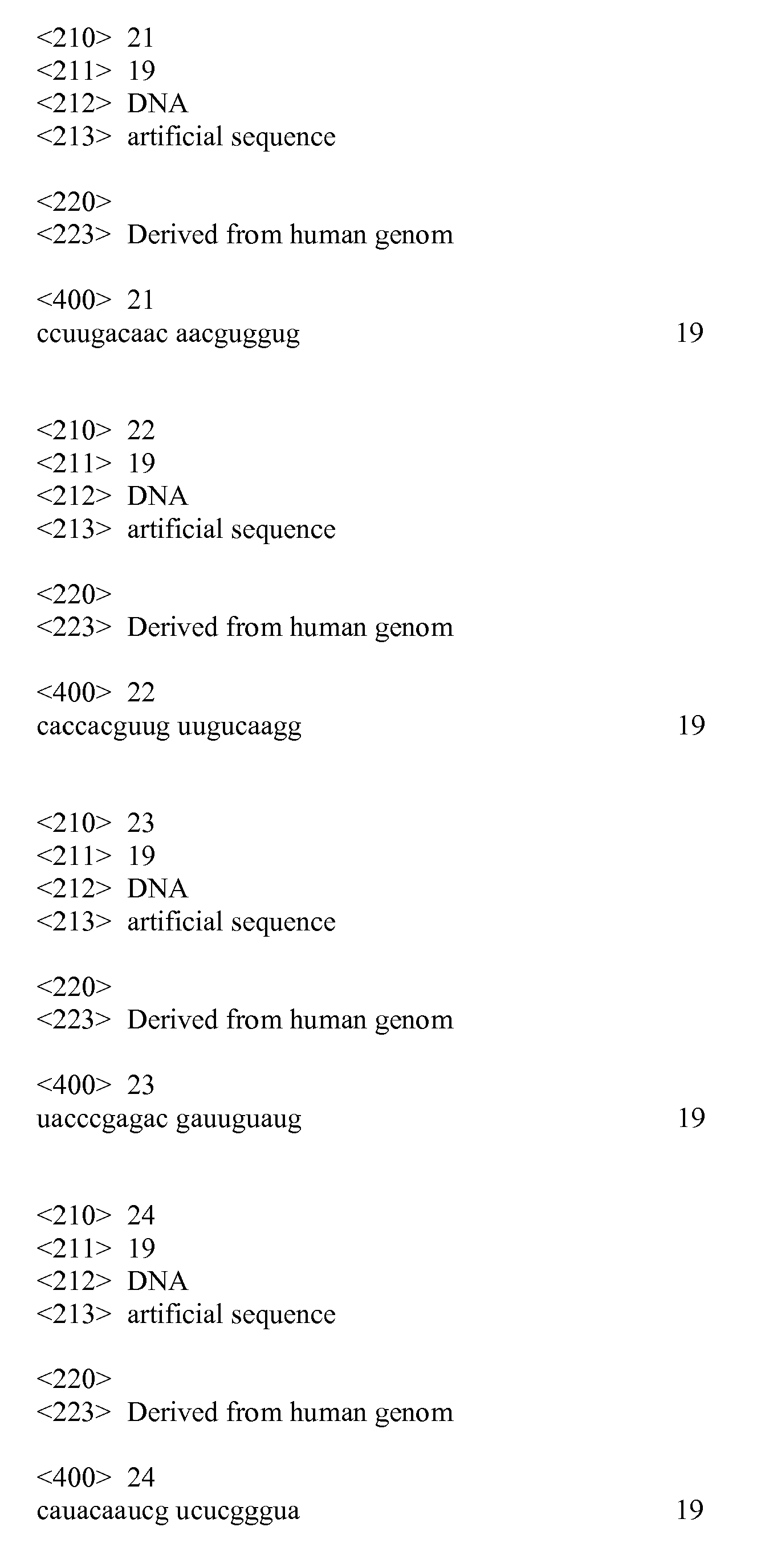
In another particular embodiment, the double-stranded oligonucleotide is chosen from one of the following couples consisting in (SEQ ID NO: 1 and SEQ ID NO: 2);(SEQ ID NO: 3 and SEQ ID NO: 4); (SEQ ID NO: 5 and SEQ ID NO: 6),; (SEQ ID NO: 7 and SEQ ID NO: 8); (SEQ ID NO: 9 and SEQ ID NO: 10) ; (SEQ ID NO: 11 and SEQ ID NO: 12); (SEQ ID NO: 13 and SEQ ID NO: 14); (SEQ ID NO: 15 and SEQ ID NO: 16); (SEQ ID NO: 17 and SEQ ID NO: 18); (SEQ ID NO: 19 and SEQ ID NO: 20); (SEQ ID NO: 21 and SEQ ID NO: 22); (SEQ ID NO: 23 and SEQ ID NO: 24); (SEQ ID NO: 25 and SEQ ID NO: 26); (SEQ ID NO: 27 and SEQ ID NO: 28); (SEQ ID NO: 29 and SEQ ID NO: 30); (SEQ ID NO: 31 and SEQ ID NO: 32); (SEQ ID NO: 33 and SEQ ID NO: 34); (SEQ ID NO: 35 and SEQ ID NO: 36); (SEQ ID NO: 37 and SEQ ID NO: 38); (SEQ ID NO: 39 and SEQ ID NO: 40).
-
Table 1 gives the list of the double-stranded oligonucleotide sequences used in the present invention. The gene targeted by each corresponding double-stranded oligonucleotide sequence is also given in the first column on the left side of the table.
| Target of the oligonucleotide | With dTdT | Without dT dT |
| TSP1a (cross species) | SEQ ID NO 1: CCUUGACAACAACGUGGUGdTdT | SEQ ID NO 21: CCUUGACAACAACGUGGUG |
| | SEQ ID NO 2: CACCACGUUGUUGUCAAGGdTdT | SEQ ID NO 22: CACCACGUUGUUGUCAAGG |
| TSP1b | SEQ ID NO 3: UACCCGAGACGAUUGUAUGdTdT | SEQ ID NO 23: UACCCGAGACGAUUGUAUG |
| | SEQ ID NO 4: CAUACAAUCGUCUCGGGUAdTdT | SEQ ID NO 24: CAUACAAUCGUCUCGGGUA |
| TRPV3a | SEQ ID NO 5: CAAGGAGAGCGAACGCAUCdTdT | SEQ ID NO 25: CAAGGAGAGCGAACGCAUC |
| | SEQ ID NO 6: GAUGCGUUCGCUCUCCUUGdTdT | SEQ ID NO 26: GAUGCGUUCGCUCUCCUUG |
| TRPV3b (cross species) | SEQ ID NO 7: AUGUACAGCGUCAUGAUCCdTdT | SEQ ID NO 27: AUGUACAGCGUCAUGAUCC |
| | SEQ ID NO 8: GGAUCAUGACGCUGUACAUdTdT | SEQ ID NO 28: GGAUCAUGACGCUGUACAU |
| TRPM8a | SEQ ID NO 9: UCUCUGAGCGCACUAUUCAdTdT | SEQ ID NO 29: UCUCUGAGCGCACUAUUCA |
| | SEQ ID NO 10: UGAAUAGUGCGCUCAGAGAdTdT | SEQ ID NO 30: UGAAUAGUGCGCUCAGAGA |
| TRPM8b | SEQ ID NO 11: UAUUCCGUUCGGUCAUCUAdTdT | SEQ ID NO 31: UAUUCCGUUCGGUCAUCUA |
| | SEQ ID NO 12: UAGAUGACCGAACGGAAUAdTdT | SEQ ID NO 32: UAGAUGACCGAACGGAAUA |
| CD36 | SEQ ID NO 13: UACAGACAGUUUUGGAUCUdTdT | SEQ ID NO 33: UACAGACAGUUUUGGAUCU |
| | SEQ ID NO 14: AGAUCCAAAACUGUCUGUAdTdT | SEQ ID NO 34: AGAUCCAAAACUGUCUGUA |
| integrin B3 | SEQ ID NO 15: GGAGAAUCUGCUGAAGGAUdTdT | SEQ ID NO 35: GGAGAAUCUGCUGAAGGAU |
| | SEQ ID NO 16: AUCCUUCAGCAGAUUCUCCdTdT | SEQ ID NO 36: AUCCUUCAGCAGAUUCUCC |
| TRPV2 | SEQ ID NO 17: UAAGAGUCAACCUCAACUAdTdT | SEQ ID NO 37: UAAGAGUCAACCUCAACUA |
| | SEQ ID NO 18: UAGUUGAGGUUGACUCUUAdTdT | SEQ ID NO 38: UAGUUGAGGUUGACUCUUA |
| TRPV6 | SEQ ID NO 19: GGAAGACAGGCAAGAUCUCdTdT | SEQ ID NO 39: GGAAGACAGGCAAGAUCUC |
| | SEQ ID NO 20: GAGAUCUUGCCUGUCUUCCdTdT | SEQ ID NO 40: GAGAUCUUGCCUGUCUUCC |
-
The oligonucleotide sequences numbered from 1 to 20 comprise, at the 3' end of each of the two said oligonucleotide sequences, two deoxythymidines extending beyond the hybrid. The oligonucleotide sequences numbered from 21 to 40 do not comprise any nucleotide extending beyond the hybrid; the first oligonucleotide sequence (antisense strand) and the second oligonucleotide sequence (sense strand) have the same length, in Table 1, according to an advantageous embodiment of the invention.
-
The target sequence (TSP1a) able to be inhibited by the double-stranded oligonucleotide consisting in SEQ ID NO: 1 and SEQ ID NO:2, or the double-stranded oligonucleotide consisting in SEQ ID NO:21 and SEQ ID NO:22 is a sequence fully conserved between the mouse and the human sequences.
-
The target sequence (TSP1b) able to be inhibited by the double-stranded oligonucleotide consisting in SEQ ID NO: 3 and SEQ ID NO:4, or the double-stranded oligonucleotide consisting in SEQ ID NO:23 and SEQ ID NO:24 targets the human TSP1 mRNA.
-
The target sequence (TRPV3b) able to be inhibited by the double-stranded oligonucleotide consisting in SEQ ID NO: 7 and SEQ ID NO:8, or the double-stranded oligonucleotide consisting in SEQ ID NO:27 and SEQ ID NO:28 is a sequence fully conserved between the mouse and the human sequences.
-
The target sequence (TRPV3a) able to be inhibited by the double-stranded oligonucleotide consisting in SEQ ID NO: 5 and SEQ ID NO:6, or the double-stranded oligonucleotide consisting in SEQ ID NO:25 and SEQ ID NO:26 targets the human TRPV3 mRNA.
-
A double-stranded oligonucleotide which does not recognize any mammalian mRNA known to this day is used as a control in some in vitro and in vivo experiments. This double-stranded oligonucleotide consists in the following couple of sequences:
- Strand 1: 5'-GAUAGCAAUGACGAAUGCGUAdTdT-3'
- Strand 2: 5'-UACGCAUUCGUCAUUGCUAUCdTdT-3'
-
It is to be noted that other controls can be substituted, and in vivo injection of the vehicle (PBS) is also used as a control.
-
In an advantageous embodiment, the double-stranded oligonucleotide is chosen from the following couples consisting in (SEQ ID NO: 1 and SEQ ID NO: 2);(SEQ ID NO: 3 and SEQ ID NO: 4); (SEQ ID NO: 5 and SEQ ID NO: 6),; (SEQ ID NO: 7 and SEQ ID NO: 8); (SEQ ID NO: 13 and SEQ ID NO: 14) ; (SEQ ID NO: 15 and SEQ ID NO: 16); (SEQ ID NO: 17 and SEQ ID NO: 18); (SEQ ID NO: 21 and SEQ ID NO: 22); (SEQ ID NO: 23 and SEQ ID NO: 24); (SEQ ID NO: 25 and SEQ ID NO: 26); (SEQ ID NO: 27 and SEQ ID NO: 28); (SEQ ID NO: 33 and SEQ ID NO: 34); (SEQ ID NO: 35 and SEQ ID NO: 36); (SEQ ID NO: 37 and SEQ ID NO: 38).
-
In a more advantageous embodiment, the double-stranded oligonucleotide is chosen from the following couples consisting in (SEQ ID NO: 1 and SEQ ID NO: 2);(SEQ ID NO: 3 and SEQ ID NO: 4); (SEQ ID NO: 5 and SEQ ID NO: 6),; (SEQ ID NO: 7 and SEQ ID NO: 8); (SEQ ID NO: 17 and SEQ ID NO: 18); (SEQ ID NO: 21 and SEQ ID NO: 22); (SEQ ID NO: 23 and SEQ ID NO: 24); (SEQ ID NO: 25 and SEQ ID NO: 26); (SEQ ID NO: 27 and SEQ ID NO: 28); (SEQ ID NO: 37 and SEQ ID NO: 38).
-
In another embodiment, the invention relates to the use of a product containing or consisting in:
- at least a double-stranded oligonucleotide above-defined,
- at least an anti-angiogenic agent,
for the manufacture of a combination product for a simultaneous, separate, or spread over time use for the prevention or the treatment of invasive or metastatic tumors.
-
In another embodiment, the invention relates to the use of a product containing or consisting in:
- at least a double-stranded oligonucleotide above-defined,
- at least an anti-tumoral agent,
for the manufacture of a combination product for a simultaneous, separate, or spread over time use for the prevention or the treatment of invasive or metastatic tumors.
-
In another embodiment, the invention relates to the use of a product containing or consisting in:
- at least a double-stranded oligonucleotide above-defined,
- at least an anti-angiogenic agent,
- at least an anti-tumoral agent,
for the manufacture of a combination product for a simultaneous, separate, or spread over time use for the prevention or the treatment of invasive or metastatic tumors.
-
In an advantageous embodiment, the drug is combined with an anti-tumoral therapy, such as radiotherapy or a chemotherapy.
-
In an advantageous embodiment, the anti-angiogenic agent is chosen from the group comprising Cilengitide, Vandetanib, Lenalidomide, Thalidomide, Arsenic Trioxide, Bevacizumab, anti-VEGFR-1, anti-VEGFR-2, anti-PDGFR, anti-FMS-FLT-3, anti-TK1.
-
In an advantageous embodiment, the anti-tumoral agent is chosen from the group comprising alkylating agents, such as Bendamustine, Temozolomide, Mechlorethamine, Cyclophosphamide, Carmustine, Cisplatine, Busulfan, Thiotepa, or Decarbazine, anti-metabolite agents, such as Pentostatine, Methotrexate, Pemetrexed, Floxuridine, Fluorouracil, Cytaraine, Mercaptopurine or Thiguanine, cytotoxic antibiotics such as Rubitecan, Mitomycine C, Daunorubicin, Doxorubicine, Bleomycin, Plicamycin, Mitoxantrone HC1, or Oxaliplatine, plant derivatives, such as Vinorelbine, BMS 184476, Vincristine sulfate, Vinblastine, Docetaxel taxol.
-
In another advantageous embodiment, the invasive of metastatic tumor is a solid tumor or a lymphoproliferative tumor.
-
In a more advantageous embodiment, the solid tumor is prostate tumor, a liver tumor, hepatic adenomas, focal nodular hyperplasia, a brain tumor such as glioma, a breast tumor, a kidney tumor, a lung tumor such as non-small cell lung carcinoma, small cell lung carcinoma, pleuropulmonary blastoma and carcinoid tumor, a bone tumor such as osteoma, osteochondroma, aneurysmal bone cyst, and fibrous dysplasia, osteosarcoma, chondrosarcoma, Ewing's sarcoma, malignant fibrous histiocytoma, fibrosarcoma, a stomach cancer, a colon tumor, a small bowel tumor, a esophageal tumor, a pancreatic tumor, a sarcoma, a cervical tumor, a gall blader tumor, a melanoma.
-
In another more advantageous embodiment, lymphoproliferative tumor is Leukemia, Lymphoma, or a Multiple myeloma.
-
In conformity with the present invention, the inhibitor of protein activity can be an antibody against TSP1 protein or one protein controlling the expression or mediating the activity of TSP1, such as TRPV2, TRPV3, TRPV6, TRPM8, CD36, B3 integrin, in instance.
-
In another aspect, the invention relates to a pharmaceutical composition.
-
In a general embodiment, the pharmaceutical composition comprises as active substance, at least
- one inhibitor of protein expression, which inhibits the expression of:
- TSP1 protein, or
- a protein, which controls the expression of TSP1 or mediates the activity of TSP1 or,
- one inhibitor of protein activity, said inhibitor inhibiting the activity of:
- the TSP1 protein, in particular the activity responsible for the stimulation of cell migration, or
- one protein which controls the expression or mediates the activity of TSP1, in association with a pharmaceutically acceptable vehicle.
-
In an advantageous embodiment, the inhibitor of protein expression inhibits the expression of proteins chosen from the group comprising TSP1, TRPV2, TRPV3, TRPV6, TRPM8, CD36, or B3 integrin.
-
In a more advantageous embodiment, the inhibitor of protein expression inhibits the expression of proteins chosen from the group comprising TSP1, TRPV2, TRPV3, CD36, or B3 integrin.
-
In a particular advantageous embodiment, inhibitor of protein expression inhibits the expression of proteins chosen from the group comprising TSP1, TRPV2, TRPV3.
-
In another advantageous embodiment, inhibitor of the protein expression is a double-stranded oligonucleotide or a single-stranded oligonucleotide.
-
In another embodiment, the inhibitor of the protein expression in the pharmaceutical composition of the present invention is:
- a double-stranded oligonucleotide comprising two oligonucleotide sequences, (a) and (b), forming a hybrid,
wherein the oligonucleotide sequence (a)
- is either complementary to the oligonucleotide sequence (b),
- or presents less than 40% mismatches with said oligonucleotide sequence (b), and
wherein the oligonucleotide sequence (a)
- is either complementary to a target sequence belonging to the RNA or DNA molecule coding one of the proteins above-defined, the expression of which is to be inhibited,
- or presents less than 40% mismatches with a target sequence belonging to the RNA or DNA molecule coding one of the proteins above-defined, the expression of which is to be inhibited,
- or a fragment of the above-defined double-stranded oligonucleotides (a) and (b), comprising two complementary fragments of the respective above-defined oligonucleotide sequences (a) and (b), provided that said fragment conserves the property of inhibiting the expression of one of the proteins above-defined.
-
The oligonucleotide sequence (a) is preferably complementary to the oligonucleotide sequence (b), but can comprise 1-8 mismatches, particularly 5, more particularly 3 mismatches, still more particularly 1 mismatch with the oligonucleotide sequence (b).
-
The oligonucleotide sequence (a) is preferably complementary to the target sequence, but can comprise 1-8 mismatches, particularly 5, more particularly 3 mismatches, still more particularly 1 mismatch with the target sequence; this application is particular when the length of the target sequence is 21 nucleotides.
-
In another embodiment, inhibitor of the protein expression in the pharmaceutical composition of the present invention is:
- a double-stranded oligonucleotide comprising two oligonucleotide sequences, (a) and (b), forming a hybrid, wherein each oligonucleotide sequence comprises at one of its 3' or 5' ends, one to five unpaired nucleotides forming single-stranded ends extending beyond the hybrid, wherein the part inside the hybrid of the oligonucleotide sequence (a)
- is either complementary to the oligonucleotide sequence (b),
- or presents less than 40% mismatches with said oligonucleotide sequence (b), and
wherein the oligonucleotide sequence (a)
- is either complementary to a target sequence belonging to the RNA, or DNA molecule coding one of the proteins above-defined, the expression of which is to be inhibited,
- or presents less than 40% mismatches with a target sequence belonging to the RNA or DNA molecule coding one of the proteins above-defined, the expression of which is to be inhibited,
- or a fragment of the above-defined double-stranded oligonucleotides (a) and (b), comprising two complementary fragments of the respective above-defined oligonucleotide sequences (a) and (b), provided that said fragment conserves the property of inhibiting the expression of one of the proteins above-defined.
-
The oligonucleotide sequence (a) is preferably complementary to the oligonucleotide sequence (b), but can comprise 1-8 mismatches, particularly 5, more particularly 3 mismatches, still more particularly 1 mismatch with the oligonucleotide sequence (b).
-
The oligonucleotide sequence (a) is preferably complementary to the target sequence, but can comprise 1-8 mismatches, particularly 5, more particularly 3 mismatches, still more particularly 1 mismatch with the target sequence; this application is particular when the length of the target sequence is 21 nucleotides.
-
In the pharmaceutical compositions of the present invention, oligonucleotide sequence complementary to the target sequence comprises from 15 to 25 nucleotides.
-
In an advantageous embodiment, the double-stranded oligonucleotide comprises, at the 3' end of each of the two said oligonucleotide sequences 1 to 5 nucleotides, preferably 2 to 3 nucleotides, extending beyond the hybrid.
-
The nucleotides extending beyond the hybrid can be complementary or not to the target sequence.
-
The nucleotides extending beyond the hybrid can be any natural nucleotide.
-
In a more advantageous embodiment, the nucleotides extending beyond the hybrid are deoxythymidines.
-
In a particular embodiment, the expression of the target sequence represented by SEQ ID NO: 41 (TSP1) is inhibited by the double-stranded oligonucleotide described in the present invention.
-
In another particular embodiment, the expression of the target sequence represented by SEQ ID NO: 43 (TRPV3) is inhibited by the double-stranded oligonucleotide described in the present invention.
-
In another particular embodiment, the pharmaceutical composition of the present invention comprises as active substance, the double-stranded oligonucleotide chosen from the following couples consisting in (SEQ ID NO: 1 and SEQ ID NO: 2);(SEQ ID NO: 3 and SEQ ID NO: 4); (SEQ ID NO: 5 and SEQ ID NO: 6),; (SEQ ID NO: 7 and SEQ ID NO: 8); (SEQ ID NO: 9 and SEQ ID NO: 10) ; (SEQ ID NO: 11 and SEQ ID NO: 12); (SEQ ID NO: 13 and SEQ ID NO: 14); (SEQ ID NO: 15 and SEQ ID NO: 16); (SEQ ID NO: 17 and SEQ ID NO: 18); (SEQ ID NO: 19 and SEQ ID NO: 20); (SEQ ID NO: 21 and SEQ ID NO: 22); (SEQ ID NO: 23 and SEQ ID NO: 24); (SEQ ID NO: 25 and SEQ ID NO: 26); (SEQ ID NO: 27 and SEQ ID NO: 28); (SEQ ID NO: 29 and SEQ ID NO: 30); (SEQ ID NO: 31 and SEQ ID NO: 32); (SEQ ID NO: 33 and SEQ ID NO: 34); (SEQ ID NO: 35 and SEQ ID NO: 36); (SEQ ID NO: 37 and SEQ ID NO: 38); (SEQ ID NO: 39 and SEQ ID NO: 40).
-
In an advantageous embodiment, the pharmaceutical composition of the present invention comprises as active substance, the double-stranded oligonucleotide chosen from the following couples consisting in (SEQ ID NO: 1 and SEQ ID NO: 2);(SEQ ID NO: 3 and SEQ ID NO: 4); (SEQ ID NO: 5 and SEQ ID NO: 6),; (SEQ ID NO: 7 and SEQ ID NO: 8); (SEQ ID NO: 13 and SEQ ID NO: 14) ; (SEQ ID NO: 15 and SEQ ID NO: 16); (SEQ ID NO: 17 and SEQ ID NO: 18); (SEQ ID NO: 21 and SEQ ID NO: 22); (SEQ ID NO: 23 and SEQ ID NO: 24); (SEQ ID NO: 25 and SEQ ID NO: 26); (SEQ ID NO: 27 and SEQ ID NO: 28); (SEQ ID NO: 33 and SEQ ID NO: 34); (SEQ ID NO: 35 and SEQ ID NO: 36); (SEQ ID NO: 37 and SEQ ID NO: 38).
-
In a more advantageous embodiment, the pharmaceutical composition of the present invention comprises as active substance, the double-stranded oligonucleotide chosen from the following couples consisting in (SEQ ID NO: 1 and SEQ ID NO: 2);(SEQ ID NO: 3 and SEQ ID NO: 4); (SEQ ID NO: 5 and SEQ ID NO: 6),; (SEQ ID NO: 7 and SEQ ID NO: 8); (SEQ ID NO: 17 and SEQ ID NO: 18); (SEQ ID NO: 21 and SEQ ID NO: 22); (SEQ ID NO: 23 and SEQ ID NO: 24); (SEQ ID NO: 25 and SEQ ID NO: 26); (SEQ ID NO: 27 and SEQ ID NO: 28); (SEQ ID NO: 37 and SEQ ID NO: 38).
-
In an advantageous embodiment, the pharmaceutically acceptable vehicle is a saline solution.
-
In another advantageous embodiment, the double-stranded oligonucleotide used in the pharmaceutical composition of the present invention is coupled with cholesterol or substances enabling penetration of said double-stranded oligonucleotide into the cells.
-
In another more advantageous embodiment, the substances enabling penetration of said double-stranded oligonucleotide into the cells are for instance liposomes, lipid-based agents, nanoparticles, magnetic spheres, polyethyleneimine derivatives.
-
In an advantageous embodiment, the active substance is formulated for the administration at a dose in the range of 0, 05 to 50 mg/kg, in particular 0, 1 to 20 mg/kg.
-
The active substance comprising the double-stranded oligonucleotide can be administrated at a modified but sufficient dose according to the application way or the form of the active substance.
-
In an advantageous embodiment, the active substance is formulated for one of the following administrations: intravenous, intraperitoneal, subcutaneous, intramuscular, nasal instillation, sublingual, intra rectal, direct injection in the tumor, topical or oral.
-
The oligonucleotides of the present invention can be either transfected in cells which are then injected in the tissues, or be directly injected in the tissues by, for example local, systemic, aerosol route.
-
In an advantageous embodiment, the pharmaceutical composition comprises, as active substance, a product containing or consisting in:
- at least a double-stranded oligonucleotide above-defined
- at least an anti-angiogenic agent,
as combination product for a simultaneous, separate, or spread over time use.
-
In a preferred embodiment, the pharmaceutical composition comprises, as active substance, a product containing or consisting in:
- at least a double-stranded oligonucleotide above-defined,
- at least an anti-tumoral agent,
as combination product for a simultaneous, separate, or spread over time use.
-
In a preferred embodiment, the pharmaceutical composition comprises, as active substance, a product containing or consisting in:
- at least a double-stranded oligonucleotide above-defined,
- at least an anti-angiogenic agent,
- at least an anti-tumoral agent,
as combination product for a simultaneous, separate, or spread over time use.
-
The anti-angiogenic agent of the pharmaceutical composition of the invention can be chosen from the group comprising Cilengitide, Vandetanib, Lenalidomide, Thalidomide, Arsenic Trioxide, Bevacizumab, anti-VEGFR-1, anti-VEGFR-2, anti-PDGFR, anti-FMS-FLT-3, anti-TK1.
-
The anti-tumoral agent of the pharmaceutical composition of the invention can be chosen from the group comprising alkylating agents, such as Bendamustine, Temozolomide, Mechlorethamine, Cyclophosphamide, Carmustine, Cisplatine, Busulfan, Thiotepa, or Decarbazine, anti-metabolite agents, such as Pentostatine, Methotrexate, Pemetrexed, Floxuridine, Fluorouracil, Cytaraine, Mercaptopurine or Thiguanine, cytotoxic antibiotics such as Rubitecan, Mitomycine C, Daunorubicin, Doxorubicine, Bleomycin, Plicamycin, Mitoxantrone HC1, or Oxaliplatine, plant derivatives, such as Vinorelbine, BMS 184476, Vincristine sulfate, Vinblastine, Docetaxel taxol.
-
In another embodiment, the invention relates to the oligonucleotide sequence chosen from the following sequences: SEQ ID NO: 1, SEQ ID NO: 2, SEQ ID NO: 3, SEQ ID NO: 4, SEQ ID NO: 5, SEQ ID NO: 6, SEQ ID NO: 7, SEQ ID NO: 8, SEQ ID NO: 9, SEQ ID NO: 10, SEQ ID NO: 11, SEQ ID NO: 12, SEQ ID NO: 13, SEQ ID NO: 14, SEQ ID NO: 15, SEQ ID NO: 16, SEQ ID NO: 17, SEQ ID NO: 18, SEQ ID NO: 19, SEQ ID NO: 20, SEQ ID NO: 21, SEQ ID NO: 22, SEQ ID NO: 23, SEQ ID NO: 24, SEQ ID NO: 25, SEQ ID NO: 26, SEQ ID NO: 27, SEQ ID NO: 28, SEQ ID NO: 29, SEQ ID NO: 30, SEQ ID NO: 31, SEQ ID NO: 32, SEQ ID NO: 33, SEQ ID NO: 34, SEQ ID NO: 35, SEQ ID NO: 36, SEQ ID NO: 37, SEQ ID NO: 38, SEQ ID NO: 39, SEQ ID NO: 40
-
All these sequences are new per se.
-
In another embodiment, the invention relates to the double-stranded oligonucleotides chosen from the following couples consisting in (SEQ ID NO: 1 and SEQ ID NO: 2);(SEQ ID NO: 3 and SEQ ID NO: 4); (SEQ ID NO: 5 and SEQ ID NO: 6),; (SEQ ID NO: 7 and SEQ ID NO: 8); (SEQ ID NO: 9 and SEQ ID NO: 10) ; (SEQ ID NO: 11 and SEQ ID NO: 12); (SEQ ID NO: 13 and SEQ ID NO: 14); (SEQ ID NO: 15 and SEQ ID NO: 16); (SEQ ID NO: 17 and SEQ ID NO: 18); (SEQ ID NO: 19 and SEQ ID NO: 20); (SEQ ID NO: 21 and SEQ ID NO: 22); (SEQ ID NO: 23 and SEQ ID NO: 24); (SEQ ID NO: 25 and SEQ ID NO: 26); (SEQ ID NO: 27 and SEQ ID NO: 28); (SEQ ID NO: 29 and SEQ ID NO: 30); (SEQ ID NO: 31 and SEQ ID NO: 32); (SEQ ID NO: 33 and SEQ ID NO: 34); (SEQ ID NO: 35 and SEQ ID NO: 36); (SEQ ID NO: 37 and SEQ ID NO: 38); (SEQ ID NO: 39 and SEQ ID NO: 40).
-
In an advantageous embodiment, the invention relates to the double-stranded oligonucleotides chosen from the following couples consisting in (SEQ ID NO: 1 and SEQ ID NO: 2);(SEQ ID NO: 3 and SEQ ID NO: 4); (SEQ ID NO: 5 and SEQ ID NO: 6),; (SEQ ID NO: 7 and SEQ ID NO: 8); (SEQ ID NO: 13 and SEQ ID NO: 14) ; (SEQ ID NO: 15 and SEQ ID NO: 16); (SEQ ID NO: 17 and SEQ ID NO: 18); (SEQ ID NO: 21 and SEQ ID NO: 22); (SEQ ID NO: 23 and SEQ ID NO: 24); (SEQ ID NO: 25 and SEQ ID NO: 26); (SEQ ID NO: 27 and SEQ ID NO: 28); (SEQ ID NO: 33 and SEQ ID NO: 34); (SEQ ID NO: 35 and SEQ ID NO: 36); (SEQ ID NO: 37 and SEQ ID NO: 38).
-
In an advantageous embodiment, the invention relates to the double-stranded oligonucleotides chosen from the following couples consisting in (SEQ ID NO: 1 and SEQ ID NO: 2);(SEQ ID NO: 3 and SEQ ID NO: 4); (SEQ ID NO: 5 and SEQ ID NO: 6),; (SEQ ID NO: 7 and SEQ ID NO: 8); (SEQ ID NO: 17 and SEQ ID NO: 18); (SEQ ID NO: 21 and SEQ ID NO: 22); (SEQ ID NO: 23 and SEQ ID NO: 24); (SEQ ID NO: 25 and SEQ ID NO: 26); (SEQ ID NO: 27 and SEQ ID NO: 28); (SEQ ID NO: 37 and SEQ ID NO: 38).
-
All these double-stranded oligonucleotides are new per se.
-
The present invention is illustrated by the following Figures and examples, which are in no way the limitation of the scope of the invention.
DESCRIPTION OF THE FIGURES
-
- Figure 1A represents TSP1 mRNA level in androgen-dependent (LNCaP), castration-resistant (C4-2 and 22RV1), or androgen-independent (PC3) prostate tumor cells. Results (mean ± SEM, n>3) are normalized to the cyclophilin A mRNA level and expressed in arbitrary units (LNCaP set to 1).
- Figure 1B represents corresponding TSP1 protein level in androgen-dependent (LNCaP), castration-resistant (C4-2 and 22RV1), or androgen-independent (PC3) prostate tumor cells. Tubulin was used as a loading control.
- Figure 1C represents TSP1 mRNA level in C4-2 cells 48h after transfection with two different siRNAs targeting the TSP1 mRNA. Results, normalized to the cyclophilin A mRNA level in the same cells, are expressed as arbitrary unit, mean ± SEM of 3 independent experiments.
- Figure 1D represents the TSP1 expression, visualized by indirect immunofluorescence in C4-2 cells 48h after transfection with TSP1 a- or TSP1b-siRNA
- Figure 1E represents the metabolic activity of C4-2 cells after transfection of TSPla-or TSP1b-siRNA
- Figure 1F represents the enzymatic activity of caspases 3 and 7 measured 48h after transfection of C4-2 cells with the TSP1a- or TSP1b-siRNA. Results are not statistically different between control or TSP1-siRNA transfected cells.
- Figure 1G represents the migration capacity towards fresh culture medium of C4-2 (black bars) or PC3 cells (grey bars) transfected with the indicated siRNAs. The number of cells that had migrated was counted 3 days later. Result are expressed as the percentage of migrating cells as compared to cells migrating in the control condition (mean ± SEM, n=3). The experiment was repeated 3 times with comparable results.
- Figure 1H represents the migration capacity of LNCaP towards conditioned medium from LNCaP or C4-2 cells. LNCaP (black bars) or C4-2 cells (grey bars) were plated in the lower part of Boyden chambers. 2 days later, LNCaP cells were seeded in the upper chamber and the number of migrating cells counted 18h later. Results are expressed as in G.
- Figure 1I represents TSP1 expression, measured by western blotting, in cellular homogenates and in the conditioned medium of JT8 cells cultured for 2 days in the presence (dox+) or absence (dox-) of doxycycline. JT8 cells are fibrosarcoma cells stably transfected with a tet-repressible plasmid coding for TSP1.
- Figure 1J represents the migration of C4-2 cells towards the medium conditioned by TSP1-inducible JT8 cells grown in the presence of doxycycline to repress TSP1 expression or in absence of doxycycline to induce TSP1. Results are expressed as in G.
- Figure 1K represents the migration capacity of C4-2 cells transfected with the indicated siRNAs. The number of cells that had migrated was counted 2 days later. Results are expressed as in Figure 1C.
- Figure 2A represents TSP1 expression in C4-2 cells treated for 2 h by vehicle (left) or thapsigargin (1µM) (right). TSP1 expression is visualized by indirect immunofluorescence.
- Figure 2B represents TSP1 secretion in the cell culture medium by C4-2 cells treated for 2 h by vehicle (left) or thapsigargin (1µM) (right). The secreted TSP1 is measured by western blotting in the cell culture medium.
- Figure 2C represents TSP1 expression in C4-2 cells treated for 2h with camphor at the indicated doses. TSP1 expression is visualized by indirect immunofluorescence.
- Figure 2D represents TSP1 secretion in the cell culture medium by C4-2 cells treated for 2 h by vehicle or camphor at the indicated doses. The secreted TSP1 is measured by western blotting in the cell culture medium.
- Figure 2E represents the TSP1 mRNA level in C4-2 cells after 6h of treatment by camphor at the indicated doses (mean ± SEM, n=3). The quantity of mRNA is normalized to cyclophilin A.
- Figure 2F shows the TRPV3 (black bars) and TRPM8 (grey bars) mRNA levels measured in the indicated prostate tumor cell lines. Results (mean ± SEM, n>3) are normalized to the cyclophilin A mRNA level and expressed in arbitrary units.
- Figure 2G represents the detection by western-blot of TRPV3 protein in indicated prostate cell lines. Tubulin was used as a loading control.
- Figure 2H represents TSP1 and TRPV3 expression in C4-2 cells 48h after transfection of a TRPV3a siRNA.
- Figure 2I represents the TSP1 mRNA level of C4-2 cells transfected by the indicated siRNAs. Results, normalized to the cyclophilin A mRNA level are measured 2 day after transfection (mean ± SEM, n>3).
- Figure 3A represents the effects of TRPM8 and TRPV6 on C4-2 cell proliferation. C4-2 cells were transfected with the indicated siRNAs. Their proliferation is measured by a metabolic assay (mean ± SEM, n=3, representative of 3 separate experiments).
- Figure 3B represents the effects of TRPV3 silencing on the migration of C4-2 (black bars) or PC3 cells (grey bars). Cells were transfected by control, or 2 different TRPV3 siRNA as indicated, and a migration assay performed as in Fig 1G.
- Figure 3C represents the migration capacity of C4-2 cells transfected 32 days before with a cont- or TRPC4- or TRPC6-siRNA.
- Figure 3D represents Western blot detection of TSP1 48h after transfection in the culture medium of C4-2 cells transfected with cont- or TSP1-siRNA.
- Figure 3E represents the effects of TSP1 on migration capacity of C4-2 cells. C4-2 cells plated in the lower part of a Boyden chamber were transfected by either control- (noted C), or TSP1-siRNA (TSP). On the same day, a separate batch of cells was transfected by either control-, TSP1-, or TRPV3-siRNA (TRP). Three days later, these latter cells were trypsinized and seeded into the upper part of the Boyden chamber as indicated. Migration was quantified 18h later and results expressed as a percentage of cells migrating in the control condition (cells transfected with a control-siRNA in the upper and lower part) (mean ± SEM, n=3).
- Figure 3F represents TRPV3 (light grey bars) and TSP1 mRNA levels (dark grey bars) measured in C4-2 cells incubated in normoxia or in the presence of cobalt chloride 300µM to mimic hypoxia. mRNA levels are quantified and normalized to cyclophilin A. Results are expressed as the ratio of mRNA levels in hypoxia to that in normoxia set to 1. The results from 2 independent experiments are shown.
- Figure 3G represents intracellular calcium concentration in C4-2 cells grown in control conditions (cont) or in the presence of 300µM CoCl2 for 30 minutes or 48 hours (mean ± SEM, n>120 cells per condition).
- Figure 4A represents tumor volume of mice bearing exponentially growing C4-2 tumors. These mice were treated daily with i.p. injections of PBS (triangles), Control- (black squares) TRPV3- (light grey diamonds) or TSP1-siRNA (dark grey diamonds). All siRNAs were diluted (120µg/kg) in PBS. Tumor volume is expressed in cm3 (mean ± SEM, 6 mice per group).
- Figure 4B represents tumor volume of mice bearing exponentially growing PC3 tumors. These mice were treated daily with i.p. injections of Control- (black squares) TRPV3-(light grey diamonds) or TSP1-siRNA (dark grey diamonds). All siRNAs were diluted (120µg/kg) in PBS. Tumor volume is expressed in cm3 (mean ± SEM, 6 mice per group).
- Figure 4C represents TRPV3 and TSP1 mRNA levels, normalized to cyclophilin A and expressed in arbitrary units, in PC3 tumors collected at the end of the experiment depicted in Figure 4B. The TSP1 mRNA level was plotted against the TRPV3 mRNA level in the same tumor from mice treated with control-siRNA (black squares), TRPV3-siRNA (grey diamonds) or TSP1-siRNA (white circles).
- Figure 4D represents the quantification of microvessel density (MVD) in hot spots of vascularization from C4-2 (grey bars) or PC3 (black bars) tumors collected at the end of the experiment described in Figure 4A and Figure 4B.
- Figure 4E represents the VEGF mRNA level, normalized to cyclophilin A mRNA level, in tumors collected at the end of experiments shown in Fig 4A (C4-2, triangles) and 4B (PC3, diamonds). Tumors were treated by control-siRNA (black symbols), or TRPV3-siRNA (light grey symbols) or TSP1-siRNA (dark grey symbols).
- Figures 4F represent mRNA level of the indicated genes in sacrificed male nude mice 5 hours after an i.p. injection of PBS (black bars), or 4000 µg/kg of either poly(I:C), a known ligand of TLR3 (dark grey bars), or TRPV3b-siRNA (light grey bars) or TSP1a-siRNA (white bars) all diluted in PBS. The mRNA level of the indicated genes, normalized to cyclophilin A, was quantified by real time RT-PCR in the spleen. Results (mean ± SEM, n=4) are expressed in arbitrary units, normalized to the value in PBS controls set to 1.
EXAMPLES
-
The following examples have been carried out according to the experimental procedures hereafter described.
Reagents and siRNAs
-
Camphor and thapsigargin were purchased from Sigma-Aldrich (Saint-Quentin Fallavier, France). TSP1 antibodies (Ab-4) were from Neomarkers (Interchim, Montluçon, France), TRPV3 antibodies from TEBU (Le Perray en Yvelines, France) and Tubulin from Sigma-Aldrich (Saint-Quentin Fallavier, France). Alexa-Fluor goat anti-rabbit 488 and Alexa-Fluor goat anti-mouse 568 were purchased from Molecular probes. SiRNAs were purchased from Sigma-Aldrich (Saint-Quentin Fallavier, France). The sequences used are indicated in the supplementary table 1.
Cell lines
-
Cell line LNCaP is androgen-dependent prostate cell line. It expresses the androgen receptor and depends of androgen for its growth.
-
Cell line C4-2 and 22RV1 are hormone-refractory prostate tumor cell lines. They express the androgen receptor but depend no more androgen for their growth.
-
Cell line PC3 is androgen-independent prostate cell line. PC3 cells no longer express the androgen receptor.
Cell culture and transfection
-
LNCaP and C4-2 cells were grown in RMPI containing 10% fetal calf serum, PC-3 cells in DMEM containing 10% fetal calf serum. The Hiperfect reagent (Qiagen, Courtaboeuf, France) was used to transfect cells in 24 wells plates with the indicated siRNAs (10nM) as recommended by the manufacturer. A metabolic activity assay (WST1, Roche Diagnostics, Meylan France) was used to measure cell proliferation. To mimic hypoxia, cells were grown in the presence of 300 µM cobalt chloride for 48h.
Migration assay
-
The migration capacity was measured using a modified Boyden Chamber. Cells (40,000) were seeded in RPMI 1% FBS in the upper part of a cell culture-chamber-insert system separated from the lower chamber by a 8 µm PET membrane (BD Biosciences, Le Pont de Claix, France). RPMI 10% FBS, or conditioned medium was added in the lower compartment. Eighteen hours later, non migrating cells in the upper compartment were scrapped off using a cotton swab. Cells on the lower side of the membrane were fixed with methanol at -20°C and stained with Hoechst 33258 (Sigma-Aldrich, Saint-Quentin Fallavier, France). Membranes were then excised, mounted on a glass side with Glycergel (DAKO) and cells counted.
Real-time RT-PCR siRNA and mRNA analysis
-
Total RNA was isolated using TRIzol reagent (Invitrogen, Cergy Pontoise, France). RNA were retrotranscribed using a High capacity cDNA Reverse Transcription Kit (Applied Biosystems, Courtaboeuf, France). cDNA was quantified by real time PCR using the Power SYBR® Green PCR Master Mix (Applied Biosystems, Courtaboeuf, France). Human Cyclophilin A was used as an internal control. The sequences of the PCR primers are indicated in the supplementary table 2.
Calcium Imaging
-
Fluorescence imaging was carried out in Hank's balanced salt solution (HBSS) containing 142mM Nad, 5.6 mM KCI, 1 mM MgCl2, 2 mM CaCl2, 0.34 mM Na2HPO4 0.44 mM KH2PO4, 10 mM HEPES, and 5.6 mM glucose. Cytosolic calcium concentration was measured using Fura-2 loaded cells (2 µM) as previously described (Mariot et al. 2002). The intracellular calcium concentration was derived from the ratio of the fluorescence intensities for each of the excitation wavelengths (F340/F380) and from the Grynkiewicz equation (Grynkiewicz et al. 1985).
Animals, siRNA injection and tumorigeniciw assays
-
Studies involving animals, including housing and care, method of euthanasia and experimental protocols were conducted in accordance with the local animal ethical committee in the Institut Andre Lwoff in Villejuif, France. Tumor cells (2×10⁶ cells/mouse) were injected subcutaneously in 50% (v:v) matrigel (BD biosciences, Le Pont de Claix, France) to 6-8 weeks old male nude mice and measured every day. When tumors grew exponentially, siRNA diluted in PBS were injected i.p. on a daily basis (120µg/kg). Tumor volume was estimated using the formula: length × width2 x 0.5.
Example 1: TSP1 expression is increased in hormone-refractory cancer prostate cells
-
The TSP1 promoter is methylated in the androgen-dependent prostate cell line LNCaP (Li et al. 1999) and accordingly, TSP1 mRNA and protein levels are very low in these cells (Fig 1A and Fig 1B). Interestingly, a sustained TSP1 expression was found in C4-2 cells, which were established from LNCaP tumors recurring in mice after castration (Thalmann et al. 1994). TSP1 was also found expressed, at the mRNA (Fig 1A) and protein (Fig 1B) levels, in the hormone-refractory prostate tumor cell line R22RV1 (Sramkoski et al. 1999), and in the androgen-independent cell line PC3. To study the function of TSP1 in prostate carcinoma cells, a first siRNA was designed to target a sequence fully conserved between the mouse and the human sequences (TSP1a-siRNA) and a second one was designed to target specifically the human mRNA (TSP1b-siRNA). In C4-2 cells, the two siRNAs silenced TSP1 expression over 70% at the mRNA (Fig 1C) and protein level (Fig 1D), with no effect on cell proliferation (Fig 1E) or apoptosis (Fig 1F).
Example 2: TSP1 stimulates the migration of prostate tumor cells.
-
Boyden chambers were used to study a potential role of TSP1 on the migration of prostate tumor cells. TSP1 silencing strongly inhibited the migration of C4-2 cells (Fig 1G). This effect was not dependent upon the expression of the androgen receptor because the migration of PC3 cells was also strongly affected by TSP1 silencing (Fig 1G). Conversely, the migration of LNCaP cells, which do not express TSP1, was stimulated when cells migrated towards C4-2 cells-conditioned medium (Fig 1H). To further establish the role of TSP1 on the migration of prostate tumor cells, a cell line, JT8, where the production of TSP1 is under the control of a tetracycline-repressible promoter was used (Filleur et al. 2001). Conditioned medium of JT8 cells was prepared in the presence of doxycycline to repress TSP1 expression, or in its absence to induce TSP1 expression (Fig 1I). The migration of C4-2 cells towards these two media was then measured. The presence of TSP1 strongly increased the capacity of cells to migrate (Fig 1J).
-
The activity of TSP1 is mediated by several kinds of receptors, in particular integrins comprising the subunits β1 or β3, and the CD36 receptor. In the present invention, specific siRNAs were designed to target respectively CD36, β1 and β3 integrins. Silencing β1 had no effect on the migration properties of C4-2 cells (Fig 1K). In contrast, the silencing of CD36 or β3 strongly reduced the C4-2 migration in the Boyden assay (Fig 1K), demonstrating that CD36 is not only involved in the antiangiogenic effects of TSP1 but also in its capacity to induce migration.
-
The above mentioned results show that TSP1 is expressed at much higher levels (mRNA and protein) in C4-2, 22RV1 and PC3 cells than in LNCaP cells. Transfection of C4-2 cells by 10 nM of TSPla-siRNA or TSP1b-siRNA significantly reduces the TSP1 mRNA level (Fig 1C) and protein level (Fig 1D), without affecting cell proliferation (Figure 1E).
Example 3: TSP1 expression and secretion are regulated by calcium in prostate tumor cells.
-
TSP1 contains a calcium-binding domain and calcium affects TSP1 folding (Adams 2004). The question is whether an increase in the cytosolic calcium concentration in prostate tumor cells could regulate TSP1 expression and/or secretion. For this purpose, C4-2 cells were treated with thapsigargin, an inhibitor of SERCA pump, which increases the intracellular calcium concentration (Ca++ i). A 2h treatment with thapsigargin resulted into a rapid depletion of TSP1 from the cytosol (Fig 2A) and secretion into the culture medium (Fig 2B). Similar effects were obtained using camphor, a well-established agonist of TRPV3 channel (Moqrich et al. 2005; Vogt-Eisele et al. 2007) (Fig 2C and 2D). In addition, a 6h treatment by camphor induced a dose dependent increase in TSP1 mRNA level (Figure 2E). These results establish that calcium regulates both TSP1 mRNA level and secretion in prostate tumor cells.
Example 4: Expression of TRP channels and regulation of TSP1 in prostate tumor cells.
-
The expression of two TRP channels, TRPM8 and TRPV3, was analysed in prostate cell lines. TRPM8 was expressed in LNCaP and C4-2 cells but undetectable in 22RV1 and at a very low level only in PC3 cells (Fig 2F). In contrast, TRPV3 was expressed in all these 4 prostate cell lines (Fig 2F), including the androgen-independent PC3 cells. The TRPV3 mRNA was upregulated in the castration-resistant cell line C4-2 as compared to its parental androgen-dependent cell line LNCaP. However, the results of invention clearly show that, at the protein level, TRPV3 is strongly expressed in LNCaP cells (Fig 2G). Then it was analysed whether the expression of TRP channels could regulate TSP1 expression. Silencing TRPV3 reduced TSP1 protein expression (Fig 2H). At least 4 channels of the TRP family, TRPV2, TRPV3, TRPV6 and TRPM8, stimulate TSP1, as their silencing resulted into a reduced TSP1 mRNA level (Fig 2I). In contrast, TRPC4 and TRPC6 repressed TSP1, and their silencing increased its mRNA level in C4-2 cells (Fig 2I). TRPC1, TRPC3 or ORAI had no significant effect on TSP1 expression (Fig 2I).
Example 5: TRPV3 channel is involved in the control of prostate cancer cell migration
-
To address the possible role of TRP calcium channels on migration, focus was made on TRPV3 as this channel is well expressed in prostate carcinomas cells, whatever their dependence on androgens, and because, as opposed to TRPM8, TRPV3 silencing does not affect cell proliferation (Fig 3A), a phenotype which could bias the interpretation of migration assays. TRPV3 silencing triggered a massive inhibition of cell migration in C4-2 and PC3 cells (Fig 3B). In contrast, siRNAs targeting TRPC4 or TRPC6 stimulated C4-2 cells migration (Fig 3C). All together, these results strongly suggest that the effects of TRP channels on migration could be mediated by TSP1.
Example 6: The effects of TRPV3 on cell migration are mediated by TSP1
-
To further study the respective roles of TRP1 and TRPV3 in cell migration, C4-2 cells plated in the lower part of Boyden chambers were transfected by either control- or TSP1-siRNAs. Three days later, the TSP1 concentration was markedly reduced in the conditioned medium of TSP1-siRNA transfected cells (Fig 3D). We then added in the upper part of the chambers C4-2 cells transfected 3 days earlier with control-, TSP1-, or TRPV3-siRNAs. As compared to control conditions (cells transfected by control siRNAs in the upper and lower chambers), silencing TSP1 simultaneously in the two compartments reduced migration by 70% (Fig 3E). Interestingly, when TSP1 was silenced in a single compartment, either upper or lower, the migration capacity was only partially reduced, demonstrating that the migration effect is mediated by the secreted protein (Fig 3E).
-
Silencing TRPV3 in the upper compartment drastically repressed the migration of C4-2 cells migrating towards a medium depleted in TSP1. But importantly, this inhibition was completely abolished when TSP1 was present in the lower part of the Boyden chambers (Fig 3E). This result demonstrates that the stimulation by TRPV3 of cell migration is mediated by the secreted TSP1.
Example 7: Hypoxia induces the expression of TRPV3 and TSP1 and increases the [Ca++]i
-
Resistance to hypoxic conditions is a common feature of advanced tumors. The TSP1 and TRPV3 mRNA levels, and the intracellular calcium concentration, were analysed in C4-2 cells under hypoxic conditions. A 48h-treatment by 300 µM cobalt chloride, which induces the stabilization of Hifla and Hif2a proteins (Yuan et al. 2003) and mimics the effects of hypoxia, strongly induced the TRPV3 and TSP1 mRNA levels (Fig 3F).
-
The intracellular calcium concentration was measured in C4-2 cells grown in control conditions or in the presence of cobalt chloride. The resting level, which was not modified after 30 min, was increased over two fold in cells incubated for 48h in the presence of cobalt chloride (Fig 3G).
Example 8: In vivo silencing of TRPV3 or TSP1 inhibits the growth of castration-resistant or androgen-independent prostate tumors.
-
The In vitro data of the invention establish that the migration of C4-2 or PC3 cells is strongly impaired by TRPV3 or TSP1 silencing, without affecting cell proliferation or survival. In order to address the role of TSP1 and TRPV3 In vivo, C4-2 cells were xenografted into nude mice. Once tumors were exponentially growing, mice were randomized for treatment and received daily either PBS i.p. injections or 120 µg/kg of either control-, or TSP1-, or TRPV3-siRNA diluted into PBS and injected i.p. The growth of tumors in mice treated with TSP1- or TRPV3- siRNA was significantly inhibited (Fig 4A). Similarly, both TRPV3- and TSP1-siRNAs inhibited the growth of xenografted PC3 tumors (Fig 4B).
-
In control PC3 tumors collected at the end of the experiment depicted in Fig 4B, a high degree of correlation was observed (r2=0.83) between the TRPV3 and TSP1 mRNA levels (Fig 4C). As compared to controls, treatment by TSP1-siRNA significantly decreased the TSP1 mRNA level in PC3 tumors (Fig 4C). Of note, silencing TRPV3 resulted into a reduction of TRPV3 mRNA level, but also into a reduction of TSP1 mRNA level (Fig 4C). These data confirm that, In vivo as In vitro, TRPV3 regulates TSP1 expression.
-
Although tumors treated by TSP1- or TRPV3-siRNA were smaller and highly necrotic, their microvessel blood density (MVD) in non-necrotic regions was significantly higher than in controls (Fig 4D). No increase in VEGF production in C4-2 or PC3 tumors treated by TSP1- or TRPV3-siRNA was found (Fig 4E). This result establishes that TSP1 still exerts antiangiogenic properties in C4-2 and PC3 tumors.
Example 9: Absence of induction of the expression of interferon or inflammatory cytokines.
-
In order to confirm that the antitumoral effects observed in vivo were not linked to a non-specific immune response, mice were given one injection by intraperitoneal route of TSPla-siRNA, or of TRPV3b-siRNA, or of Poly (I:C), a known ligand of TLR3, used as a control. All the injections were carried out with a dose of 4mg/kg siRNA diluted in PBS. Five hours after injection, mRNAs coding several genes involved in innate immune response or in inflammation were quantified by quantitative real time RT-PCT. Only the treatment by Poly (I:C) induces a significant increase of TLR3, TLR7, IL6, IL12b, IFNβ, IFNγ, and IP10. (Fig 4F). These results establish that the antitumor effect observed by injections of TSP1-siRNA or TRPV3-siRNA in vivo cannot be attributed to a stimulation of immunity independent.
References
-
- Abeele, F.V., Skryma, R., Shuba, Y., Van Coppenolle, F., Slomianny, C., Roudbaraki, M., Mauroy, B., Wuytack, F., and Prevarskaya, N. 2002. Bcl-2-dependent modulation of Ca2+ homeostasis and store-operated channels in prostate cancer cells. 1(2): 169-179.
- Adams, J.C. 2004. Functions of the conserved thrombospondin carboxy-terminal cassette in cell-extracellular matrix interactions and signaling. The International Journal of Biochemistry & Cell Biology 36(6): 1102-1114.
- Carlson, C.B., Lawler, J., and Mosher, D.F. 2008. Structures of thrombospondins. Cell Mol Life Sci 65(5): 672-686.
- Carthew, R.W. and Sontheimer, E.J. 2009. Origins and Mechanisms of miRNAs and siRNAs. Cell 136(4): 642-655.
- Colombel, M., Filleur, S., Fournier, P., Merle, C., Guglielmi, J., Courtin, A., Degeorges, A., Serre, C.M., Bouvier, R., Clezardin, P. et al. 2005. Androgens repress the expression of the angiogenesis inhibitor thrombospondin-1 in normal and neoplastic prostate. Cancer Res 65(1): 300-308.
- Filleur, S., Volpert, O.V., Degeorges, A., Voland, C., Reiher, F., Clezardin, P., Bouck, N., and Cabon, F. 2001. In vivo mechanisms by which .
-
Fontana, A., Filleur, S., Guglielmi, J., Frappart, L., Bruno-Bossio, G., Boissier, S., Cabon, F., and Clezardin, P. 2005a. Human breast tumors override the antiangiogenic effect of stromal thrombospondin-1 in vivo. Int J Cancer
.
- Fontana, A., Filleur, S., Guglielmi, J., Frappart, L., Bruno-Bossio, G., Boissier, S., Cabon, F., and Clézardin, P. 2005b. Human breast tumors override the antiangiogenic effect of stromal thrombospondin-1 in vivo. International Journal of Cancer 116(5): 686-691.
- Good, D.J., Polverini, P.J., Rastinejad, F., Le, B.M., Lemons, R.S., Frazier, W.A., and Bouck, N.P. 1990. A tumor suppressor-dependent inhibitor of angiogenesis is immunologically and functionally indistinguishable from a fragment of thrombospondin. Proc Natl Acad Sci U S A 87(17): 6624-6628.
- Grynkiewicz, G., Poenie, M., and Tsien, R. 1985. A new generation of Ca2+ indicators with greatly improved fluorescence properties. J Biol Chem 260(6): 3440-3450.
- Jimenez, B., Volpert, O.V., Crawford, S.E., Febbraio, M., Silverstein, R.L., and Bouck, N. 2000. Signals leading to apoptosis-dependent inhibition of neovascularization by thrombospondin-1. Nat Med 6(1): 41-48.
- Lehen'Kyi, V., Flourakis, M., Skryma, R., and Prevarskaya, N. 2007. TRPV6 channel controls prostate cancer cell proliferation via Ca2+//NFAT-dependent pathways. Oncogene 26(52): 7380-7385.
- Li, Q., Ahuja, N., Burger, P.C., and Issa, J.P. 1999. Methylation and silencing of the Thrombospondin-1 promoter in human cancer. Oncogene 18(21): 3284-3289.
- Mariot, P., Vanoverberghe, K., Lalevee, N., Rossier, M.F., and Prevarskaya, N. 2002. Overexpression of an alpha 1H (Cav3.2) T-type Calcium Channel during Neuroendocrine Differentiation of Human Prostate Cancer Cells. J Biol Chem 277(13): 10824-10833.
- Moqrich, A., Hwang, S.W., Earley, T.J., Petrus, M.J., Murray, A.N., Spencer, K.S., Andahazy, M., Story, G.M., and Patapoutian, A. 2005. Impaired thermosensation in mice lacking TRPV3, a heat and camphor sensor in the skin. Science 307(5714): 1468-1472.
- Ren, B., Yee, K.O., Lawler, J., and Khosravi-Far, R. 2006. Regulation of tumor angiogenesis by thrombospondin-1. Biochimica et Biophysica Acta (BBA) - Reviews on Cancer 1765(2): 178-188.
- Roberts, D.D. 2008. Thrombospondins: from structure to therapeutics. Cell Mol Life Sci 65(5): 669-671.
- Sramkoski, R.M., Pretlow, T.G., 2nd, Giaconia, J.M., Pretlow, T.P., Schwartz, S., Sy, M.S., Marengo, S.R., Rhim, J.S., Zhang, D., and Jacobberger, J.W. 1999. A new human prostate carcinoma cell line, 22Rv1. In Vitro Cell Dev Biol Anim 35(7): 403-409.
- Thalmann, G.N., Anezinis, P.E., Chang, S.M., Zhau, H.E., Kim, E.E., Hopwood, V.L., Pathak, S., von Eschenbach, A.C., and Chung, L.W. 1994. Androgen-independent cancer progression and bone metastasis in the LNCaP model of human prostate cancer. Cancer Res 54(10): 2577-2581.
- Thebault, S., Flourakis, M., Vanoverberghe, K., Vandermoere, F., Roudbaraki, M., Lehen'kyi, V.y., Slomianny, C., Beck, B., Mariot, P., Bonnal, J.-L. et al. 2006. Differential Role of Transient Receptor Potential Channels in Ca2+ Entry and Proliferation of Prostate Cancer Epithelial Cells. Cancer Res 66(4): 2038-2047.
- Vogt-Eisele, A.K., Weber, K., Sherkheli, M.A., Vielhaber, G., Panten, J., Gisselmann, G., and Hatt, H. 2007. Monoterpenoid agonists of TRPV3. Br J Pharmacol 151(4): 530-540.
- Yuan, Y., Hilliard, G., Ferguson, T., and Millhorn, D.E. 2003. Cobalt Inhibits the Interaction between Hypoxia-inducible Factor-alpha and von Hippel-Lindau Protein by Direct Binding to Hypoxia-inducible Factor-alpha. J Biol Chem 278(18): 15911-15916.
- Zhang, X. and Lawler, J. 2007. Thrombospondin-based antiangiogenic therapy. Microvasc Res 74(2-3): 90-99.