EP2282171A1 - Method for adjusting navigation frame, navigation apparatus and computer program product - Google Patents
Method for adjusting navigation frame, navigation apparatus and computer program product Download PDFInfo
- Publication number
- EP2282171A1 EP2282171A1 EP10007463A EP10007463A EP2282171A1 EP 2282171 A1 EP2282171 A1 EP 2282171A1 EP 10007463 A EP10007463 A EP 10007463A EP 10007463 A EP10007463 A EP 10007463A EP 2282171 A1 EP2282171 A1 EP 2282171A1
- Authority
- EP
- European Patent Office
- Prior art keywords
- navigation
- navigation frame
- event
- displaying
- frame
- Prior art date
- Legal status (The legal status is an assumption and is not a legal conclusion. Google has not performed a legal analysis and makes no representation as to the accuracy of the status listed.)
- Granted
Links
Images




Classifications
-
- G—PHYSICS
- G06—COMPUTING OR CALCULATING; COUNTING
- G06F—ELECTRIC DIGITAL DATA PROCESSING
- G06F3/00—Input arrangements for transferring data to be processed into a form capable of being handled by the computer; Output arrangements for transferring data from processing unit to output unit, e.g. interface arrangements
- G06F3/01—Input arrangements or combined input and output arrangements for interaction between user and computer
- G06F3/048—Interaction techniques based on graphical user interfaces [GUI]
- G06F3/0484—Interaction techniques based on graphical user interfaces [GUI] for the control of specific functions or operations, e.g. selecting or manipulating an object, an image or a displayed text element, setting a parameter value or selecting a range
- G06F3/04845—Interaction techniques based on graphical user interfaces [GUI] for the control of specific functions or operations, e.g. selecting or manipulating an object, an image or a displayed text element, setting a parameter value or selecting a range for image manipulation, e.g. dragging, rotation, expansion or change of colour
-
- G—PHYSICS
- G01—MEASURING; TESTING
- G01C—MEASURING DISTANCES, LEVELS OR BEARINGS; SURVEYING; NAVIGATION; GYROSCOPIC INSTRUMENTS; PHOTOGRAMMETRY OR VIDEOGRAMMETRY
- G01C21/00—Navigation; Navigational instruments not provided for in groups G01C1/00 - G01C19/00
- G01C21/26—Navigation; Navigational instruments not provided for in groups G01C1/00 - G01C19/00 specially adapted for navigation in a road network
- G01C21/34—Route searching; Route guidance
- G01C21/36—Input/output arrangements for on-board computers
-
- G—PHYSICS
- G06—COMPUTING OR CALCULATING; COUNTING
- G06F—ELECTRIC DIGITAL DATA PROCESSING
- G06F3/00—Input arrangements for transferring data to be processed into a form capable of being handled by the computer; Output arrangements for transferring data from processing unit to output unit, e.g. interface arrangements
- G06F3/01—Input arrangements or combined input and output arrangements for interaction between user and computer
- G06F3/048—Interaction techniques based on graphical user interfaces [GUI]
- G06F3/0481—Interaction techniques based on graphical user interfaces [GUI] based on specific properties of the displayed interaction object or a metaphor-based environment, e.g. interaction with desktop elements like windows or icons, or assisted by a cursor's changing behaviour or appearance
- G06F3/0482—Interaction with lists of selectable items, e.g. menus
-
- G—PHYSICS
- G06—COMPUTING OR CALCULATING; COUNTING
- G06F—ELECTRIC DIGITAL DATA PROCESSING
- G06F3/00—Input arrangements for transferring data to be processed into a form capable of being handled by the computer; Output arrangements for transferring data from processing unit to output unit, e.g. interface arrangements
- G06F3/01—Input arrangements or combined input and output arrangements for interaction between user and computer
- G06F3/048—Interaction techniques based on graphical user interfaces [GUI]
- G06F3/0487—Interaction techniques based on graphical user interfaces [GUI] using specific features provided by the input device, e.g. functions controlled by the rotation of a mouse with dual sensing arrangements, or of the nature of the input device, e.g. tap gestures based on pressure sensed by a digitiser
Definitions
- the aforesaid window comprises an operation window or a browsing window.
- the step of displaying the navigation frame on the screen in the form of a three-dimensional picture comprises displaying the navigation frame in a form of a bird eye view, wherein a plurality of objects of the navigation frame are displayed on a plane of the bird eye view.
- the step of displaying the navigation frame on the screen in the form of a three-dimensional picture comprises displaying the navigation frame in a form of a curve map, wherein a plurality of objects of the navigation frame are displayed on a curved plane of the curve map.
- FIG. 3 is an example of a navigation frame according to an example of the application.
- FIG. 4 is an example of a navigation frame according to an example of the application.
- FIG. 5 is a block diagram of a navigation apparatus according to an example of the present application.
- FIG. 8 shows a flowchart illustrating a method for adjusting a navigation frame according to an example of the present application.
- FIGs. 9A and 9B are examples of adjusting the navigation frame according to an example of the application.
- the processing unit 140 is, for example, a central processing unit (CPU), or other programmable ordinary used or specifically used microprocessor, digital signal processor (DSP), programmable controller, application specific integrated circuits (ASIC), programmable logic device (PLD), or other similar devices or a combination of those devices.
- CPU central processing unit
- DSP digital signal processor
- ASIC application specific integrated circuits
- PLD programmable logic device
- the processing unit 140 is coupled to the positioning unit 110, the display unit 120, and the input unit 130, and may adjust the angle of view of a navigation frame displayed by the display unit 120 according to a received event. Examples are given below for illustrating detailed steps of the navigation apparatus 100 adjusting the navigation frame.
- FIG. 2 is a flowchart illustrating a method for adjusting a navigation frame according to an example of the present application.
- the method of the example is suitable for the navigation apparatus 100 in FIG. 1 and detailed steps of the navigation frame adjusting method of the application are described in detail below with reference to the aforesaid elements of the navigation apparatus 100.
- the processing unit 140 of the navigation apparatus 100 displays the navigation frame on the display unit 120 in a form of a three-dimensional picture (S210).
- the navigation apparatus 100 for example, performs positioning to obtain a current location thereof by using the positioning unit 110, receives a destination inputted by a user by using the input unit 130, and finally sets the current location as a start point and sets the location of the destination as an end point to plan a navigation route by using the processing unit 140.
- the processing unit 140 when displaying the navigation frame, displays the navigation frame in a form of a bird eye view and displays a plurality of objects of the navigation frame on a plane of the bird eye view.
- the processing unit 140 also, for example, displays the navigation frame in a form of a curve map and displays a plurality of objects of the navigation frame on a curved plane of the curve map.
- the processing unit 140 further scales each of the objects according to a relative distance between the location of the object and a current location of the mobile device, and displays the scaled object on the plane of the bird eye view or on the curved plane of the curve map.
- the objects in a close end of the screen have a larger size so as to provide details of the map and the objects for a user to inspect and the objects in a far end of the screen has a smaller size so as to provide a larger viewable map or route for a user to browse.
- FIG. 3 and FIG. 4 are examples of the navigation frame according to an example of the application.
- the navigation frame 300 is displayed in a form of a bird eye view and the navigation frame 400 is displayed in a form of a curve map. Since the navigation frames 300 and 400 are both displayed in a form of a three-dimensional picture, a tilting angle is included between a map plane of the navigation frame and a screen plane, therefore the map is displayed on the screen in a particular angle of view.
- the objects in a lower area of the navigation frames 300 and 400 are magnified and the objects in an upper area of the navigation frames 300 and 400 are contracted such that a user is able to experience the distances among the objects according to the sizes thereof.
- step S230 in the process of the display unit 120 displaying the navigation frame, when receiving an event (step S230), the processing unit 140 adjusts the angle of view of the navigation frame immediately, so as to reduce the size of the navigation frame (step S230) and empty an area of the screen.
- the received event comprises an external event such as an incoming call, a short message, an instant message, or an e-mail, or an internal event triggered by the user, which is not limited thereto. It should be noted herein that, in an example, the processing unit 140 still substantially maintains a range of a map displayed in the navigation frame when reducing the size of the navigation frame.
- the processing unit 140 After adjusting the navigation frame, the processing unit 140 further displays a window corresponding to the event in the area of the screen that is emptied due to the reduction of the navigation frame (step S240). Accordingly, the navigation apparatus 100 may provide users with ease to respond to an external event or perform an operation for a self-triggered event.
- FIG. 6 shows a flowchart illustrating a method for adjusting a navigation frame according to an example of the present application.
- the navigation apparatus 500 when receiving the external event, automatically adjusts the angle of view and the size of the navigation frame, so as to display a window corresponding to the event and provide users with ease to make a response.
- the steps thereof are as follows.
- the processing unit 560 displays the navigation frame on the display unit 520 in a form of a three-dimensional picture (S610).
- the navigation apparatus 500 for example, performs positioning to obtain a current location thereof by using the positioning unit 510, receives a destination inputted by a user by using the input unit 520, and finally sets the current location as a start point and sets the location of the destination as an end point to plan a navigation route by using the processing unit 560.
- the communication unit 540 receives an external event transmitted from outside (step S620), in which the external event is, for example, an incoming call, a short message, an instant message, or an e-mail.
- the communication unit 540 transmits the event to the processing unit 560 for performing subsequent processes.
- the processing unit 560 When receiving the event, the processing unit 560 then adjusts the angle of view of the navigation frame to make the size of the navigation frame reduce (step S630), so as to empty an area of the screen, in which the processing unit 560 still substantially maintains a range of a map displayed in the navigation frame when reducing the size of the navigation frame.
- the processing unit 560 further displays a window corresponding to the event in the area of the screen that is emptied due to the reduction of the navigation frame (step S640).
- the window may be, for example, a content of the event or at least one function key or a menu corresponding to the event displayed by the processing unit 560.
- the processing unit 560 displays a window for answering the incoming call in the emptied area of the screen.
- the processing unit 560 for example, displays the reduced operating window in an upper area of the screen and empties a lower area of the screen for displaying the window corresponding to the received event.
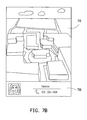
- FIG. 7A and FIG. 7B are examples of adjusting the navigation frame according to an example of the application.
- the navigation frame 710 is displayed in a form of a bird eye view, which comprises objects from large to small displayed in the screen from near to far according to the distances between the locations of the objects and the current location of the navigation apparatus, thus offering the user to browse.
- the navigation apparatus adjusts the angle of view of the navigation frame 710 to reduce the size of the navigation frame 710 and displays the reduced navigation frame 710 on the upper area of the screen when receiving the incoming call.
- the navigation apparatus also displays a window 720 corresponding to the incoming call on the lower area of the screen, in which the window 720 comprises a name and a telephone number of the caller, thus offering the user to make a response (i.e. answering the call or ignoring the call).
- the navigation apparatus 500 still detects an operation from the user by the input unit 530, so as to execute corresponding functions such as answering or ignoring the call.
- the navigation apparatus 500 also closes the window and adjusts the angle of view of the navigation frame back to the original angle of view so as to resume the size of the navigation frame when the event is ended (e.g. the call is ended).
- FIG. 8 shows a flowchart illustrating a method for adjusting a navigation frame according to an example of the present application.
- the navigation apparatus 500 when receiving the user-triggered event, automatically adjusts the angle of view and the size of the navigation frame, so as to display a window corresponding to the event and provide users with ease to make a response.
- the steps thereof are as follows.
- the processing unit 560 displays the navigation frame on the display unit 520 in a form of a three-dimensional picture (S810).
- the navigation apparatus 500 for example, performs positioning to obtain a current location thereof by using the positioning unit 510, receives a destination inputted by a user by using the input unit 520, and finally sets the current location as a start point and sets the location of the destination as an end point to plan a navigation route by using the processing unit 560.
- the navigation apparatus 500 detects a tilting angle thereof by using the sensing unit 550 (step S820) and transmits the detected tilting angle to the processing unit 560.
- the processing unit 560 determines whether the tilting angle is within a predetermined range (step S830), which is, for example, from 15 to 20 degree. If the processing unit 560 determines that the tilting angle is not within the predetermined range, then the process returns to step S620 for continuing detecting the tilting angle.
- step S840 the processing unit 560 adjusts the angle of view of the navigation frame to make the size of the navigation frame reduce (step S840), so as to empty an area of the screen, in which the processing unit 560 still substantially maintains a range of a map displayed in the navigation frame when reducing the size of the navigation frame.
- the processing unit 560 further displays a window corresponding to the triggered event in the area of the screen that is emptied due to the reduction of the navigation frame (step S850).
- the window may be, for example, function keys or a menu corresponding to the user-triggered event displayed by the processing unit 560 according to the detection of the sensing unit 550.
- the processing unit 560 displays a dialing button or a contact list in the emptied area of the screen, offering the user to operate.
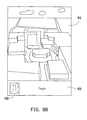
- FIG. 9A and FIG. 9B are examples of adjusting the navigation frame according to an example of the application.
- the navigation frame 910 is displayed in a form of a bird eye view, which comprises objects from large to small displayed in the screen from near to far according to the distances between the locations of the objects and the current location of the navigation apparatus, thus offering the user to browse.
- the navigation apparatus adjusts the angle of view of the navigation frame 910 to reduce the size of the navigation frame 910 and displays the reduced navigation frame 910 on the upper area of the screen when determining that the user triggers the event.
- the navigation apparatus also displays a corresponding operating window 920 on the lower area of the screen, in which the window 920 comprises a function key of a phone book, thus offering the user to activate a phone book and make a call therethrough.
- the navigation apparatus 500 still continues to receive an operation from the user by the input unit 530, so as to execute corresponding functions such as making a call.
- the navigation apparatus 500 also closes the window and adjusts the angle of view of the navigation frame back to the original angle of view so as to resume the size of the navigation frame when the event is ended (e.g. the call is ended).
- the present application further provides a computer program product which comprises a computer program to be loaded into a mobile device to execute the method for adjusting the navigation frame described above.
- the computer program product is composed of a plurality of program instructions (for example, an organization chart establishing program instruction, a table approving program instruction, a setting program instruction, and a deployment program instruction, etc), and these program instructions are loaded into the mobile device and executed by the same to accomplish various steps in the method for adjusting the navigation frame and various functions of the navigation apparatus described above.
- the method for adjusting a navigation frame, the navigation apparatus, and the computer program product of the application detect an event transmitted externally or an event triggered by a user when displaying a navigation frame, so as to adjust the angle of view of the navigation frame to make the size thereof reduce and display a window corresponding to the event. Therefore, the application may provide users with ease to operate the navigation apparatus without affecting the navigation function.
Landscapes
- Engineering & Computer Science (AREA)
- General Engineering & Computer Science (AREA)
- Theoretical Computer Science (AREA)
- Radar, Positioning & Navigation (AREA)
- Remote Sensing (AREA)
- Physics & Mathematics (AREA)
- General Physics & Mathematics (AREA)
- Human Computer Interaction (AREA)
- Automation & Control Theory (AREA)
- Navigation (AREA)
- Telephone Function (AREA)
Abstract
Description
- Generally, navigation software has the function to plan a route and provide a guidance, so as to help the user to find a best route and arrive at a destination quickly and safely. However, if the end point is far away from the start point, then the planed route may cover a relatively large map area. In order to clearly show details of the map and the navigation route that can be recognized by the user, the navigation software adaptively adjusts the scaling ratio and range of the map and only displays the map and the navigation route nearby the navigation device. Furthermore, the map is displayed in a full-screen mode so that the user can clearly recognize the navigation route at a glance.
- When the navigation software displays the map in the full-screen mode, the mobile device may receive an incoming call, a short message, an instant message, or an email from outside. At this time, the mobile device usually temporarily stops the navigation function or closes the navigation frame, and then calls a corresponding operating window, such that the user may make a response to the received event. However, the action of stopping the navigation function or closing the navigation frame probably influences a determination of a user for a driving path or makes a user miss the corner to make a turn, and accordingly jeopardizes a safety of driving.
- The present application is directed to a method for adjusting a navigation frame, which adjusts the angle of view of the navigation frame and provides users with ease to respond to the received event.
- The present application is also directed to a navigation apparatus, which displays a window corresponding to the received event without affecting the navigation function.
- The present application provides a method for adjusting a navigation frame, suitable for a mobile device having a screen. In the method, a navigation frame is displayed on the screen in a form of a three-dimensional picture. When an event is received, the angle of view of the navigation frame is adjusted to make the size of the navigation frame reduce and a window corresponding to the event is displayed in an area of the screen that is emptied due to the reduction of the navigation frame.
- In one example of the application, the aforesaid window comprises an operation window or a browsing window.
- In one example of the application, the step of adjusting the angle of view of the navigation frame to make the size of the navigation frame reduce comprises maintaining a range of a map displayed in the navigation frame when reducing the size of the navigation frame.
- In one example of the application, the step of displaying the navigation frame on the screen in the form of a three-dimensional picture comprises displaying the navigation frame in a form of a bird eye view, wherein a plurality of objects of the navigation frame are displayed on a plane of the bird eye view. In one example of the application, the step of displaying the navigation frame on the screen in the form of a three-dimensional picture comprises displaying the navigation frame in a form of a curve map, wherein a plurality of objects of the navigation frame are displayed on a curved plane of the curve map.
- In one example of the application, before receiving the event, the method further comprises detecting a tilting angle of the mobile device, determining whether the detected tilting angle is within a predetermined range, and triggering the event when the detected tilting angle is within the predetermined range.
- In one example of the present application, the step of receiving the event comprising receiving an incoming call, a short message, an instant message, or an e-mail.
- In one example of the present application, the step of displaying the window corresponding to the event comprises displaying an operating window for answering the incoming call when receiving an incoming call.
- In one example of the present application, the step of receiving the event comprises receiving an operation of a user, so as to trigger the event.
- In one example of the application, the step of adjusting the angle of view of the navigation frame to make the size of the navigation frame reduce comprises displaying the reduced navigation frame on an upper area of the screen to empty a lower area of the screen for displaying the window.
- In one example of the application, the step of displaying the window corresponding to the event in the area of the screen that is emptied due to the reduction of the navigation frame comprises displaying a content of the event or displaying at least one function key or a menu corresponding to the event.
- In one example of the present application, after the step of displaying the window corresponding to the event, the method further comprises receiving an operation of a user for the window to execute a corresponding function. In one example of the present application, after the step of displaying the window corresponding to the event, the method further comprises closing the window and adjusting the angle of view of the navigation frame back to the original angle of view so as to resume the size of the navigation frame when the event is ended.
- The present application provides a navigation apparatus, which comprising a positioning unit, a display unit, an input unit, and a processing unit. The positioning unit is used for obtaining a current location of the navigation device. The display unit is used for displaying a navigation frame. The input unit is used for receiving an operation of a user. The processing unit is coupled to the positioning unit, the input unit, and the display unit, and is for displaying a navigation frame on the screen in a form of a three-dimensional picture. When receiving an event, the processing unit is used for adjusting the angle of view of the navigation frame to reduce the size of the navigation frame and displaying a window corresponding to the event in an area of the screen that is emptied due to the reduction of the navigation frame.
- The present application further provides a computer program product which comprises instructions to be loaded into a mobile device to execute following steps. First, a navigation frame is displayed on the screen in a form of a three-dimensional picture. When an event is received, the angle of view of the navigation frame is adjusted to make the size of the navigation frame reduce and a window corresponding to the event is displayed in an area of the screen that is emptied due to the reduction of the navigation frame.
- Based on the above, the method for adjusting the navigation frame, the navigation apparatus and the computer program product of the application adaptively adjust the angle of view of the navigation frame when receiving an external event or an event triggered by a user, so as to empty an area of the screen for displaying a corresponding operation or browsing window. Accordingly, the application provides users with ease to respond to the event without affecting the navigation function.
- In order to make the aforementioned and other features and advantages of the application more comprehensible, examples accompanying figures are described in detail below.
- The accompanying drawings are included to provide a further understanding of the application, and are incorporated in and constitute a part of this specification. The drawings illustrate examples of the application and, together with the description, serve to explain the principles of the application.
-
FIG. 1 is a block diagram of a navigation apparatus according to an example of the present application. -
FIG. 2 is a flowchart illustrating a method for adjusting a navigation frame according to an example of the present application. -
FIG. 3 is an example of a navigation frame according to an example of the application. -
FIG. 4 is an example of a navigation frame according to an example of the application. -
FIG. 5 is a block diagram of a navigation apparatus according to an example of the present application. -
FIG. 6 shows a flowchart illustrating a method for adjusting a navigation frame according to an example of the present application. -
FIGs. 7A and7B are examples of adjusting the navigation frame according to an example of the application. -
FIG. 8 shows a flowchart illustrating a method for adjusting a navigation frame according to an example of the present application. -
FIGs. 9A and9B are examples of adjusting the navigation frame according to an example of the application. - The present application adaptively adjusts the angle of view of a navigation frame corresponding to a received event when a mobile apparatus displays the navigation frame in a form of a three-dimensional picture, so as to empty a screen space for displaying a window corresponding to the event. Accordingly, the application may provide users with ease to respond to an external event or perform an operation on a self-triggered event.
-
FIG. 1 is a block diagram of a navigation apparatus according to an example of the present application. Referring toFIG. 1 , thenavigation apparatus 100 comprises apositioning unit 110, adisplay unit 120, aninput unit 130, and aprocessing unit 140, and may provide users with ease to respond to the triggered event in the process of executing a navigation function. Thenavigation apparatus 100 is, for example, a mobile phone, a smartphone, a personal digital assistance (PDA), a PDA phone or a Car PC, which is not limited thereto. The functions of aforesaid elements are respectively illustrated in the following. - The
positioning unit 110 is used for obtaining a current location of thenavigation apparatus 100, and is , for example, a global positioning system (GPS), or other positioning systems using a global system for mobile communication (GSM) system, a personal handy-phone system (PHS), a code division multiple access (CDMA) system, a wireless fidelity (Wi-Fi) system, a worldwide interoperability for microwave access (WiMAX) system, a radio repeater, or a radio broadcaster for positioning, which is not limited by the present example. - The
display unit 120 is, for example, a liquid crystal display (LCD), a light emitting diode (LED) display, an organic light emitting diode (OLED) display, or other displays suitable for displaying the navigation frame. - The
input unit 130 is, for example, a mouse, a keyboard, or a touch pad used for receiving an operation of a user for planning a navigation route. Wherein, theinput unit 130 may also be, for example, a resistive type, a capacitive type, or other types of touch sensitive units may be integrated with thedisplay unit 120 to form a touch screen. - The
processing unit 140 is, for example, a central processing unit (CPU), or other programmable ordinary used or specifically used microprocessor, digital signal processor (DSP), programmable controller, application specific integrated circuits (ASIC), programmable logic device (PLD), or other similar devices or a combination of those devices. - The
processing unit 140 is coupled to thepositioning unit 110, thedisplay unit 120, and theinput unit 130, and may adjust the angle of view of a navigation frame displayed by thedisplay unit 120 according to a received event. Examples are given below for illustrating detailed steps of thenavigation apparatus 100 adjusting the navigation frame. -
FIG. 2 is a flowchart illustrating a method for adjusting a navigation frame according to an example of the present application. Referring toFIG. 2 , the method of the example is suitable for thenavigation apparatus 100 inFIG. 1 and detailed steps of the navigation frame adjusting method of the application are described in detail below with reference to the aforesaid elements of thenavigation apparatus 100. - First, the
processing unit 140 of thenavigation apparatus 100 displays the navigation frame on thedisplay unit 120 in a form of a three-dimensional picture (S210). Thenavigation apparatus 100, for example, performs positioning to obtain a current location thereof by using thepositioning unit 110, receives a destination inputted by a user by using theinput unit 130, and finally sets the current location as a start point and sets the location of the destination as an end point to plan a navigation route by using theprocessing unit 140. - It is noted herein that when displaying the navigation frame, the
processing unit 140, for example, displays the navigation frame in a form of a bird eye view and displays a plurality of objects of the navigation frame on a plane of the bird eye view. Theprocessing unit 140 also, for example, displays the navigation frame in a form of a curve map and displays a plurality of objects of the navigation frame on a curved plane of the curve map. When displaying the objects, theprocessing unit 140 further scales each of the objects according to a relative distance between the location of the object and a current location of the mobile device, and displays the scaled object on the plane of the bird eye view or on the curved plane of the curve map. In brief, the objects in a close end of the screen have a larger size so as to provide details of the map and the objects for a user to inspect and the objects in a far end of the screen has a smaller size so as to provide a larger viewable map or route for a user to browse. - For example,
FIG. 3 andFIG. 4 are examples of the navigation frame according to an example of the application. Referring toFIG. 3 andFIG. 4 , thenavigation frame 300 is displayed in a form of a bird eye view and thenavigation frame 400 is displayed in a form of a curve map. Since the navigation frames 300 and 400 are both displayed in a form of a three-dimensional picture, a tilting angle is included between a map plane of the navigation frame and a screen plane, therefore the map is displayed on the screen in a particular angle of view. In addition, the objects in a lower area of the navigation frames 300 and 400 are magnified and the objects in an upper area of the navigation frames 300 and 400 are contracted such that a user is able to experience the distances among the objects according to the sizes thereof. - Back to step S210, in the process of the
display unit 120 displaying the navigation frame, when receiving an event (step S230), theprocessing unit 140 adjusts the angle of view of the navigation frame immediately, so as to reduce the size of the navigation frame (step S230) and empty an area of the screen. The received event comprises an external event such as an incoming call, a short message, an instant message, or an e-mail, or an internal event triggered by the user, which is not limited thereto. It should be noted herein that, in an example, theprocessing unit 140 still substantially maintains a range of a map displayed in the navigation frame when reducing the size of the navigation frame. - After adjusting the navigation frame, the
processing unit 140 further displays a window corresponding to the event in the area of the screen that is emptied due to the reduction of the navigation frame (step S240). Accordingly, thenavigation apparatus 100 may provide users with ease to respond to an external event or perform an operation for a self-triggered event. - It is noted herein that the
navigation apparatus 100 of the application may correspondingly adjusts the navigation frame according to the event triggered by different manners, thus offering the user to make a response. Regarding the external event and the user-triggered event, corresponding examples are given below for further illustration. -
FIG. 5 is a block diagram of a navigation apparatus according to an example of the present application. Referring toFIG. 5 , thenavigation apparatus 500 comprises apositioning unit 510, adisplay unit 520, aninput unit 530, acommunication unit 540, asensing unit 550, and aprocessing unit 560. The functions of thepositioning unit 510, thedisplay unit 520, and theinput unit 530 are the same as those of thepositioning unit 110, thedisplay unit 120, and theinput unit 130 in the aforesaid examples. Hence, the descriptions thereof are omitted herein. - Different from the above-described examples, the
navigation apparatus 500 herein is further disposed with thecommunication unit 540 and thesensing unit 550. Thecommunication unit 540 is, for example, a device for communicating through communication systems such as GPS, PHS, CDMA, Wi-Fi, or WiMAX. Thecommunication unit 540 may receive external events such as an incoming call, a short message, an instant message, or an e-mail from an external device. Thesensing unit 550 is, for example, a G sensor, which is able to detect a tilting angle of thenavigation apparatus 500 and determine an operation of a user for thenavigation apparatus 500 so as to trigger an internal event. - Regarding the condition of receiving the external event,
FIG. 6 shows a flowchart illustrating a method for adjusting a navigation frame according to an example of the present application. Referring to bothFIG. 5 and FIG. 6 , when receiving the external event, thenavigation apparatus 500 automatically adjusts the angle of view and the size of the navigation frame, so as to display a window corresponding to the event and provide users with ease to make a response. The steps thereof are as follows. - First, the
processing unit 560 displays the navigation frame on thedisplay unit 520 in a form of a three-dimensional picture (S610). Thenavigation apparatus 500, for example, performs positioning to obtain a current location thereof by using thepositioning unit 510, receives a destination inputted by a user by using theinput unit 520, and finally sets the current location as a start point and sets the location of the destination as an end point to plan a navigation route by using theprocessing unit 560. - Next, the
communication unit 540 receives an external event transmitted from outside (step S620), in which the external event is, for example, an incoming call, a short message, an instant message, or an e-mail. When receiving the external event, thecommunication unit 540 transmits the event to theprocessing unit 560 for performing subsequent processes. - When receiving the event, the
processing unit 560 then adjusts the angle of view of the navigation frame to make the size of the navigation frame reduce (step S630), so as to empty an area of the screen, in which theprocessing unit 560 still substantially maintains a range of a map displayed in the navigation frame when reducing the size of the navigation frame. - After the navigation frame is adjusted, the
processing unit 560 further displays a window corresponding to the event in the area of the screen that is emptied due to the reduction of the navigation frame (step S640). According to the type of the received event, the window may be, for example, a content of the event or at least one function key or a menu corresponding to the event displayed by theprocessing unit 560. For example, when receiving an incoming call, theprocessing unit 560 displays a window for answering the incoming call in the emptied area of the screen. In addition, theprocessing unit 560, for example, displays the reduced operating window in an upper area of the screen and empties a lower area of the screen for displaying the window corresponding to the received event. - For example,
FIG. 7A andFIG. 7B are examples of adjusting the navigation frame according to an example of the application. Referring toFIG. 7A first, thenavigation frame 710 is displayed in a form of a bird eye view, which comprises objects from large to small displayed in the screen from near to far according to the distances between the locations of the objects and the current location of the navigation apparatus, thus offering the user to browse. Referring toFIG. 7B , the navigation apparatus adjusts the angle of view of thenavigation frame 710 to reduce the size of thenavigation frame 710 and displays the reducednavigation frame 710 on the upper area of the screen when receiving the incoming call. In the meantime, the navigation apparatus also displays awindow 720 corresponding to the incoming call on the lower area of the screen, in which thewindow 720 comprises a name and a telephone number of the caller, thus offering the user to make a response (i.e. answering the call or ignoring the call). - It should be noted herein that in the meantime of displaying the adjusted navigation frame and the window, the
navigation apparatus 500 still detects an operation from the user by theinput unit 530, so as to execute corresponding functions such as answering or ignoring the call. In addition, thenavigation apparatus 500 also closes the window and adjusts the angle of view of the navigation frame back to the original angle of view so as to resume the size of the navigation frame when the event is ended (e.g. the call is ended). - Regarding the condition of receiving the user-triggered event,
FIG. 8 shows a flowchart illustrating a method for adjusting a navigation frame according to an example of the present application. Referring to bothFIG. 5 andFIG. 8 , when receiving the user-triggered event, thenavigation apparatus 500 automatically adjusts the angle of view and the size of the navigation frame, so as to display a window corresponding to the event and provide users with ease to make a response. The steps thereof are as follows. - First, the
processing unit 560 displays the navigation frame on thedisplay unit 520 in a form of a three-dimensional picture (S810). Thenavigation apparatus 500, for example, performs positioning to obtain a current location thereof by using thepositioning unit 510, receives a destination inputted by a user by using theinput unit 520, and finally sets the current location as a start point and sets the location of the destination as an end point to plan a navigation route by using theprocessing unit 560. - Next, the
navigation apparatus 500 detects a tilting angle thereof by using the sensing unit 550 (step S820) and transmits the detected tilting angle to theprocessing unit 560. Theprocessing unit 560 then determines whether the tilting angle is within a predetermined range (step S830), which is, for example, from 15 to 20 degree. If theprocessing unit 560 determines that the tilting angle is not within the predetermined range, then the process returns to step S620 for continuing detecting the tilting angle. If theprocessing unit 560 determines that the tilting angle is within the predetermined range, then an event is triggered and theprocessing unit 560 adjusts the angle of view of the navigation frame to make the size of the navigation frame reduce (step S840), so as to empty an area of the screen, in which theprocessing unit 560 still substantially maintains a range of a map displayed in the navigation frame when reducing the size of the navigation frame. - After the navigation frame is adjusted, the
processing unit 560 further displays a window corresponding to the triggered event in the area of the screen that is emptied due to the reduction of the navigation frame (step S850). The window may be, for example, function keys or a menu corresponding to the user-triggered event displayed by theprocessing unit 560 according to the detection of thesensing unit 550. For example, when the user-triggered event is making a call, theprocessing unit 560 displays a dialing button or a contact list in the emptied area of the screen, offering the user to operate. - For example,
FIG. 9A andFIG. 9B are examples of adjusting the navigation frame according to an example of the application. Referring toFIG. 9A first, thenavigation frame 910 is displayed in a form of a bird eye view, which comprises objects from large to small displayed in the screen from near to far according to the distances between the locations of the objects and the current location of the navigation apparatus, thus offering the user to browse. Referring toFIG. 9B , the navigation apparatus adjusts the angle of view of thenavigation frame 910 to reduce the size of thenavigation frame 910 and displays the reducednavigation frame 910 on the upper area of the screen when determining that the user triggers the event. In the meantime, the navigation apparatus also displays acorresponding operating window 920 on the lower area of the screen, in which thewindow 920 comprises a function key of a phone book, thus offering the user to activate a phone book and make a call therethrough. - It should be noted herein that in the meantime of displaying the adjusted navigation frame and the window, the
navigation apparatus 500 still continues to receive an operation from the user by theinput unit 530, so as to execute corresponding functions such as making a call. In addition, thenavigation apparatus 500 also closes the window and adjusts the angle of view of the navigation frame back to the original angle of view so as to resume the size of the navigation frame when the event is ended (e.g. the call is ended). - The present application further provides a computer program product which comprises a computer program to be loaded into a mobile device to execute the method for adjusting the navigation frame described above. The computer program product is composed of a plurality of program instructions (for example, an organization chart establishing program instruction, a table approving program instruction, a setting program instruction, and a deployment program instruction, etc), and these program instructions are loaded into the mobile device and executed by the same to accomplish various steps in the method for adjusting the navigation frame and various functions of the navigation apparatus described above.
- Based on the above, the method for adjusting a navigation frame, the navigation apparatus, and the computer program product of the application detect an event transmitted externally or an event triggered by a user when displaying a navigation frame, so as to adjust the angle of view of the navigation frame to make the size thereof reduce and display a window corresponding to the event. Therefore, the application may provide users with ease to operate the navigation apparatus without affecting the navigation function.
- Although the application has been described with reference to the above examples, it will be apparent to one of the ordinary skill in the art that modifications to the described example may be made without departing from the spirit of the application. Accordingly, the scope of the application will be defined by the attached claims not by the above detailed descriptions.
Claims (15)
- A method for adjusting a navigation frame, suitable for a mobile device having a screen, the method comprising:displaying (S210, S610) a navigation frame on the screen in a form of a three-dimensional picture;receiving (S220, S620) an event;adjusting (S230, S630) the angle of view of the navigation frame to make the size of the navigation frame reduce; anddisplaying (S240, S640) a window corresponding to the event in an area of the screen that is emptied due to the reduction of the navigation frame.
- The method according to claim 1, wherein the step of adjusting the angle of view of the navigation frame to make the size of the navigation frame reduce comprises:maintaining a range of a map displayed in the navigation frame when reducing the size of the navigation frame.
- The method according to claim 1 or 2, wherein the step of displaying the navigation frame on the screen in the form of the three-dimensional picture comprises:displaying the navigation frame in a form of a bird eye view, wherein a plurality of objects of the navigation frame are displayed on a plane of the bird eye view.
- The method according to any one of claims 1 to 3, wherein the step of receiving the event comprises:detecting (S820) a tilting angle of the mobile device;determining (S830) whether the detected tilting angle is within a predetermined range; andtriggering (S840) the event if the detected tilting angle is within the predetermined range.
- The method according to any one of claims 1 to 3, wherein the step of receiving the event comprises:receiving an incoming call, a short message, an instant message, or an e-mail, or receiving an operation of a user, so as to trigger the event.
- The method according to any one of claims 1 to 5, wherein the step of displaying the window corresponding to the event in the area of the screen that is emptied due to the reduction of the navigation frame comprises:displaying a content of the event or displaying at least one function key or a menu corresponding to the event.
- The method according to any one of claims to 6, wherein after the step of displaying the window corresponding to the event in the area of the screen that is emptied due to the reduction of the navigation frame, the method further comprises:closing the window and adjusting the angle of view of the navigation frame back to the original angle of view so as to resume the size of the navigation frame when the event is ended.
- A computer program product, comprising instructions for being loaded into a mobile device to enable the mobile device to execute the method for adjusting a navigation frame according to any one of claims 1 to 7.
- A navigation apparatus (100, 500), comprising:a positioning unit (110, 510), for obtaining a current location of the navigation device;a display unit (120, 520), for displaying a navigation frame;an input unit (130, 530), for receiving an operation of a user; anda processing unit (140, 560), coupled to the positioning unit (110, 510), the display unit (120, 520) and the input unit (130, 530), for displaying a navigation frame on the display unit (120, 520) in a form of a three-dimensional picture, and adjusting the angle of view of the navigation frame to make the size of the navigation frame reduce and displaying a window corresponding to an event in an area of the display unit (120, 520) that is emptied due to the reduction of the navigation frame when the input unit (130, 530) receives the event.
- The navigation apparatus according to claim 9, wherein the processing unit (140, 560) comprises displaying the navigation frame in a form of a bird eye view, wherein a plurality of objects of the navigation frame are displayed on a plane of the bird eye view; and the processing unit (140, 560) further comprises scaling each of the objects and displaying the scaled object on the plane of the bird eye view according to a relative distance between a map location of the object and a current location of the navigation apparatus (100, 500).
- The navigation apparatus according to claim 9, wherein the processing unit (140, 560) comprises displaying the navigation frame in a form of a curve map, wherein a plurality of objects of the navigation frame are displayed on a curved plane of the curve map; and wherein the processing unit (140, 560) further comprises scaling each of the objects and displaying the scaled object on the curved plane of the curve map according to a relative distance between a map location of the object and a current location of the navigation apparatus (100, 500).
- The navigation apparatus according to claim 9, further comprising:a sensing unit (550), coupled to the processing unit (560), for detecting a tilting angle of the navigation apparatus (500) and transmitting the detected tilting angle to the processing unit (560), whereinthe processing unit (560) triggers the event when determining the detected tilting angle is within the predetermined range.
- The navigation apparatus according to claim 9, further comprising:a communication unit (540), coupled to the processing unit (560), for receiving an incoming call, a short message, an instant message, or an e-mail so as to trigger the event and transmit the event to the processing unit (560).
- The navigation apparatus according to any one of claims 9 to 13, wherein the processing unit (140, 560) comprises closing the window and adjusting the angle of view of the navigation frame back to the original angle of view so as to resume the size of the navigation frame when the event is ended.
- A navigation system, comprising:a display means for displaying a navigation frame in a form of a three-dimensional picture;a receiving means for receiving an event;an adjusting means for adjusting the angle of view of the navigation frame to reduce the size of the navigation frame when the receiving tool receives the event; anda menu means for displaying a window corresponding to the event in an area of the display means that is emptied due to the reduction of the navigation frame.
Applications Claiming Priority (2)
| Application Number | Priority Date | Filing Date | Title |
|---|---|---|---|
| US22895709P | 2009-07-27 | 2009-07-27 | |
| TW098145394A TWI420078B (en) | 2009-07-27 | 2009-12-28 | Mehtod for adjusting navigation frame, navigation apparatus and computer program product |
Publications (2)
| Publication Number | Publication Date |
|---|---|
| EP2282171A1 true EP2282171A1 (en) | 2011-02-09 |
| EP2282171B1 EP2282171B1 (en) | 2014-03-19 |
Family
ID=42937447
Family Applications (1)
| Application Number | Title | Priority Date | Filing Date |
|---|---|---|---|
| EP10007463.2A Not-in-force EP2282171B1 (en) | 2009-07-27 | 2010-07-19 | Method for adjusting navigation frame, navigation apparatus and computer program product |
Country Status (2)
| Country | Link |
|---|---|
| US (2) | US8762045B2 (en) |
| EP (1) | EP2282171B1 (en) |
Families Citing this family (7)
| Publication number | Priority date | Publication date | Assignee | Title |
|---|---|---|---|---|
| WO2013012300A2 (en) * | 2011-07-21 | 2013-01-24 | 삼성전자 주식회사 | Method for providing an in-vehicle notification service, machine-readable storage medium, head unit device, and mobile device |
| KR101590341B1 (en) | 2011-10-31 | 2016-02-19 | 삼성전자주식회사 | Method and apparatus controlling interrupt in portable terminal |
| KR20130053137A (en) * | 2011-11-15 | 2013-05-23 | 엘지전자 주식회사 | Mobile terminal and menthod for controlling of the same |
| KR20150084200A (en) * | 2014-01-13 | 2015-07-22 | 엘지전자 주식회사 | A head mounted display and the method of controlling thereof |
| RU2608885C2 (en) * | 2014-06-30 | 2017-01-25 | Общество С Ограниченной Ответственностью "Яндекс" | Method for determining the curve point nearest to the position on the map |
| KR102274405B1 (en) * | 2014-11-28 | 2021-07-07 | 현대엠엔소프트 주식회사 | Method for displaying of web vector map by varying scale of map |
| CN109787890B (en) * | 2019-03-01 | 2021-02-12 | 北京达佳互联信息技术有限公司 | Instant messaging method, device and storage medium |
Citations (6)
| Publication number | Priority date | Publication date | Assignee | Title |
|---|---|---|---|---|
| JPH1151666A (en) * | 1997-08-08 | 1999-02-26 | Mitsubishi Electric Corp | Information search and distribution device for mobile communication terminal and mobile communication terminal |
| US6282490B1 (en) * | 1997-08-08 | 2001-08-28 | Aisin Aw Co., Ltd. | Map display device and a recording medium |
| US20030216861A1 (en) * | 2002-05-17 | 2003-11-20 | Fujitsu Ten Limited | Navigation apparatus |
| US20040236507A1 (en) * | 2003-05-21 | 2004-11-25 | Kishiko Maruyama | Car navigation system |
| JP2006039953A (en) * | 2004-07-27 | 2006-02-09 | Denso Corp | Image composition device, display device, and navigation device |
| JP2007286158A (en) * | 2006-04-13 | 2007-11-01 | Xanavi Informatics Corp | Navigation apparatus |
Family Cites Families (10)
| Publication number | Priority date | Publication date | Assignee | Title |
|---|---|---|---|---|
| JP2000305452A (en) | 1999-04-21 | 2000-11-02 | Sony Corp | Electronic map device and electronic map display method |
| US6573842B2 (en) | 2000-10-06 | 2003-06-03 | Matsushita Electric Industrial Co., Ltd. | Map display device, map display method, and computer program for use in map display device |
| JP3932171B2 (en) * | 2001-11-30 | 2007-06-20 | アルパイン株式会社 | 3D display device for underground buildings |
| JP4234089B2 (en) * | 2004-11-16 | 2009-03-04 | 株式会社ソニー・コンピュータエンタテインメント | Entertainment device, object display device, object display method, program, and character display method |
| EP1696301B8 (en) | 2005-02-28 | 2010-09-08 | Research In Motion Limited | System and method for navigating a mobile device user interface with a directional sensing device |
| JP4653561B2 (en) * | 2005-05-31 | 2011-03-16 | 株式会社東芝 | Information processing apparatus and display control method |
| US20070106948A1 (en) * | 2005-11-07 | 2007-05-10 | Nokia Corporation | Improving message reply function in electronic devices |
| CN101009089A (en) | 2006-01-26 | 2007-08-01 | 宏达国际电子股份有限公司 | Screen display control device |
| JP5171053B2 (en) | 2007-02-09 | 2013-03-27 | 日立建機株式会社 | Clutch control device for hydraulic drive vehicle |
| JP2009157053A (en) * | 2007-12-26 | 2009-07-16 | Aisin Aw Co Ltd | Three-dimensional map display navigation device, three-dimensional map display system, and three-dimensional map display program |
-
2010
- 2010-07-19 EP EP10007463.2A patent/EP2282171B1/en not_active Not-in-force
- 2010-07-19 US US12/838,497 patent/US8762045B2/en not_active Expired - Fee Related
-
2014
- 2014-05-14 US US14/277,054 patent/US9058097B2/en not_active Expired - Fee Related
Patent Citations (6)
| Publication number | Priority date | Publication date | Assignee | Title |
|---|---|---|---|---|
| JPH1151666A (en) * | 1997-08-08 | 1999-02-26 | Mitsubishi Electric Corp | Information search and distribution device for mobile communication terminal and mobile communication terminal |
| US6282490B1 (en) * | 1997-08-08 | 2001-08-28 | Aisin Aw Co., Ltd. | Map display device and a recording medium |
| US20030216861A1 (en) * | 2002-05-17 | 2003-11-20 | Fujitsu Ten Limited | Navigation apparatus |
| US20040236507A1 (en) * | 2003-05-21 | 2004-11-25 | Kishiko Maruyama | Car navigation system |
| JP2006039953A (en) * | 2004-07-27 | 2006-02-09 | Denso Corp | Image composition device, display device, and navigation device |
| JP2007286158A (en) * | 2006-04-13 | 2007-11-01 | Xanavi Informatics Corp | Navigation apparatus |
Also Published As
| Publication number | Publication date |
|---|---|
| US20140250387A1 (en) | 2014-09-04 |
| EP2282171B1 (en) | 2014-03-19 |
| US8762045B2 (en) | 2014-06-24 |
| US20110022311A1 (en) | 2011-01-27 |
| US9058097B2 (en) | 2015-06-16 |
Similar Documents
| Publication | Publication Date | Title |
|---|---|---|
| TWI420078B (en) | Mehtod for adjusting navigation frame, navigation apparatus and computer program product | |
| US9058097B2 (en) | Method for adjusting navigation frame, navigation apparatus and recording medium | |
| KR101106800B1 (en) | Electronic apparatus and display method in electronic apparatus | |
| US10306049B1 (en) | Providing interactive alert information | |
| JP5370259B2 (en) | Portable electronic devices | |
| CN104731480B (en) | Image display method and device based on touch screen | |
| CN102017744A (en) | Delayed emergency position determination and transmission | |
| US20160050307A1 (en) | Method and device for adding application badge | |
| CN105975190B (en) | Graphical interface processing method, device and system | |
| CN108768430B (en) | Communication control management method and mobile terminal | |
| EP2264567A2 (en) | Apparatus and method for motion detection in portable terminal | |
| WO2019217085A1 (en) | Call rejection with a message comprising location information | |
| KR102044498B1 (en) | Method for providing video call service and an electronic device thereof | |
| CN105975753A (en) | Method for calculating moving speed of user and mobile terminal | |
| KR20110056003A (en) | Method and device for navigating a mobile terminal | |
| CN108601004B (en) | NFC use guide method, mobile terminal and computer readable storage medium | |
| CN104702674B (en) | Geographical position exchange method and device | |
| CN106569690B (en) | Device and method for preventing mistaken touch | |
| CN107911534B (en) | Information processing method and device, mobile terminal and computer readable storage medium | |
| US8914073B2 (en) | Mobile electronic device, display control method and storage medium storing display control program | |
| CN107645588B (en) | Message notification processing method, terminal and computer readable storage medium | |
| US9544415B2 (en) | Mobile electronic device, position checking method, position checking program, and position checking system | |
| US9947296B2 (en) | Display device, display method, program | |
| CN105147260A (en) | Method and device for prompting pulse beating intensity | |
| CN106775069B (en) | Pressure compensation method and system |
Legal Events
| Date | Code | Title | Description |
|---|---|---|---|
| PUAI | Public reference made under article 153(3) epc to a published international application that has entered the european phase |
Free format text: ORIGINAL CODE: 0009012 |
|
| 17P | Request for examination filed |
Effective date: 20100719 |
|
| AK | Designated contracting states |
Kind code of ref document: A1 Designated state(s): AL AT BE BG CH CY CZ DE DK EE ES FI FR GB GR HR HU IE IS IT LI LT LU LV MC MK MT NL NO PL PT RO SE SI SK SM TR |
|
| AX | Request for extension of the european patent |
Extension state: BA ME RS |
|
| GRAP | Despatch of communication of intention to grant a patent |
Free format text: ORIGINAL CODE: EPIDOSNIGR1 |
|
| INTG | Intention to grant announced |
Effective date: 20131015 |
|
| GRAS | Grant fee paid |
Free format text: ORIGINAL CODE: EPIDOSNIGR3 |
|
| GRAA | (expected) grant |
Free format text: ORIGINAL CODE: 0009210 |
|
| AK | Designated contracting states |
Kind code of ref document: B1 Designated state(s): AL AT BE BG CH CY CZ DE DK EE ES FI FR GB GR HR HU IE IS IT LI LT LU LV MC MK MT NL NO PL PT RO SE SI SK SM TR |
|
| REG | Reference to a national code |
Ref country code: GB Ref legal event code: FG4D |
|
| REG | Reference to a national code |
Ref country code: CH Ref legal event code: EP |
|
| REG | Reference to a national code |
Ref country code: IE Ref legal event code: FG4D |
|
| REG | Reference to a national code |
Ref country code: AT Ref legal event code: REF Ref document number: 657956 Country of ref document: AT Kind code of ref document: T Effective date: 20140415 |
|
| REG | Reference to a national code |
Ref country code: DE Ref legal event code: R096 Ref document number: 602010014358 Country of ref document: DE Effective date: 20140430 Ref country code: NL Ref legal event code: T3 |
|
| PG25 | Lapsed in a contracting state [announced via postgrant information from national office to epo] |
Ref country code: NO Free format text: LAPSE BECAUSE OF FAILURE TO SUBMIT A TRANSLATION OF THE DESCRIPTION OR TO PAY THE FEE WITHIN THE PRESCRIBED TIME-LIMIT Effective date: 20140619 Ref country code: LT Free format text: LAPSE BECAUSE OF FAILURE TO SUBMIT A TRANSLATION OF THE DESCRIPTION OR TO PAY THE FEE WITHIN THE PRESCRIBED TIME-LIMIT Effective date: 20140319 |
|
| REG | Reference to a national code |
Ref country code: AT Ref legal event code: MK05 Ref document number: 657956 Country of ref document: AT Kind code of ref document: T Effective date: 20140319 |
|
| REG | Reference to a national code |
Ref country code: LT Ref legal event code: MG4D |
|
| PG25 | Lapsed in a contracting state [announced via postgrant information from national office to epo] |
Ref country code: CY Free format text: LAPSE BECAUSE OF FAILURE TO SUBMIT A TRANSLATION OF THE DESCRIPTION OR TO PAY THE FEE WITHIN THE PRESCRIBED TIME-LIMIT Effective date: 20140319 Ref country code: FI Free format text: LAPSE BECAUSE OF FAILURE TO SUBMIT A TRANSLATION OF THE DESCRIPTION OR TO PAY THE FEE WITHIN THE PRESCRIBED TIME-LIMIT Effective date: 20140319 Ref country code: SE Free format text: LAPSE BECAUSE OF FAILURE TO SUBMIT A TRANSLATION OF THE DESCRIPTION OR TO PAY THE FEE WITHIN THE PRESCRIBED TIME-LIMIT Effective date: 20140319 |
|
| PG25 | Lapsed in a contracting state [announced via postgrant information from national office to epo] |
Ref country code: HR Free format text: LAPSE BECAUSE OF FAILURE TO SUBMIT A TRANSLATION OF THE DESCRIPTION OR TO PAY THE FEE WITHIN THE PRESCRIBED TIME-LIMIT Effective date: 20140319 Ref country code: LV Free format text: LAPSE BECAUSE OF FAILURE TO SUBMIT A TRANSLATION OF THE DESCRIPTION OR TO PAY THE FEE WITHIN THE PRESCRIBED TIME-LIMIT Effective date: 20140319 |
|
| PG25 | Lapsed in a contracting state [announced via postgrant information from national office to epo] |
Ref country code: RO Free format text: LAPSE BECAUSE OF FAILURE TO SUBMIT A TRANSLATION OF THE DESCRIPTION OR TO PAY THE FEE WITHIN THE PRESCRIBED TIME-LIMIT Effective date: 20140319 Ref country code: BE Free format text: LAPSE BECAUSE OF FAILURE TO SUBMIT A TRANSLATION OF THE DESCRIPTION OR TO PAY THE FEE WITHIN THE PRESCRIBED TIME-LIMIT Effective date: 20140319 Ref country code: IS Free format text: LAPSE BECAUSE OF FAILURE TO SUBMIT A TRANSLATION OF THE DESCRIPTION OR TO PAY THE FEE WITHIN THE PRESCRIBED TIME-LIMIT Effective date: 20140719 Ref country code: EE Free format text: LAPSE BECAUSE OF FAILURE TO SUBMIT A TRANSLATION OF THE DESCRIPTION OR TO PAY THE FEE WITHIN THE PRESCRIBED TIME-LIMIT Effective date: 20140319 Ref country code: CZ Free format text: LAPSE BECAUSE OF FAILURE TO SUBMIT A TRANSLATION OF THE DESCRIPTION OR TO PAY THE FEE WITHIN THE PRESCRIBED TIME-LIMIT Effective date: 20140319 Ref country code: BG Free format text: LAPSE BECAUSE OF FAILURE TO SUBMIT A TRANSLATION OF THE DESCRIPTION OR TO PAY THE FEE WITHIN THE PRESCRIBED TIME-LIMIT Effective date: 20140619 |
|
| PG25 | Lapsed in a contracting state [announced via postgrant information from national office to epo] |
Ref country code: ES Free format text: LAPSE BECAUSE OF FAILURE TO SUBMIT A TRANSLATION OF THE DESCRIPTION OR TO PAY THE FEE WITHIN THE PRESCRIBED TIME-LIMIT Effective date: 20140319 Ref country code: AT Free format text: LAPSE BECAUSE OF FAILURE TO SUBMIT A TRANSLATION OF THE DESCRIPTION OR TO PAY THE FEE WITHIN THE PRESCRIBED TIME-LIMIT Effective date: 20140319 Ref country code: PL Free format text: LAPSE BECAUSE OF FAILURE TO SUBMIT A TRANSLATION OF THE DESCRIPTION OR TO PAY THE FEE WITHIN THE PRESCRIBED TIME-LIMIT Effective date: 20140319 Ref country code: SK Free format text: LAPSE BECAUSE OF FAILURE TO SUBMIT A TRANSLATION OF THE DESCRIPTION OR TO PAY THE FEE WITHIN THE PRESCRIBED TIME-LIMIT Effective date: 20140319 |
|
| REG | Reference to a national code |
Ref country code: DE Ref legal event code: R097 Ref document number: 602010014358 Country of ref document: DE |
|
| PG25 | Lapsed in a contracting state [announced via postgrant information from national office to epo] |
Ref country code: PT Free format text: LAPSE BECAUSE OF FAILURE TO SUBMIT A TRANSLATION OF THE DESCRIPTION OR TO PAY THE FEE WITHIN THE PRESCRIBED TIME-LIMIT Effective date: 20140721 |
|
| PLBE | No opposition filed within time limit |
Free format text: ORIGINAL CODE: 0009261 |
|
| STAA | Information on the status of an ep patent application or granted ep patent |
Free format text: STATUS: NO OPPOSITION FILED WITHIN TIME LIMIT |
|
| PG25 | Lapsed in a contracting state [announced via postgrant information from national office to epo] |
Ref country code: DK Free format text: LAPSE BECAUSE OF FAILURE TO SUBMIT A TRANSLATION OF THE DESCRIPTION OR TO PAY THE FEE WITHIN THE PRESCRIBED TIME-LIMIT Effective date: 20140319 |
|
| 26N | No opposition filed |
Effective date: 20141222 |
|
| PG25 | Lapsed in a contracting state [announced via postgrant information from national office to epo] |
Ref country code: LU Free format text: LAPSE BECAUSE OF FAILURE TO SUBMIT A TRANSLATION OF THE DESCRIPTION OR TO PAY THE FEE WITHIN THE PRESCRIBED TIME-LIMIT Effective date: 20140719 |
|
| REG | Reference to a national code |
Ref country code: CH Ref legal event code: PL |
|
| PG25 | Lapsed in a contracting state [announced via postgrant information from national office to epo] |
Ref country code: IT Free format text: LAPSE BECAUSE OF FAILURE TO SUBMIT A TRANSLATION OF THE DESCRIPTION OR TO PAY THE FEE WITHIN THE PRESCRIBED TIME-LIMIT Effective date: 20140319 |
|
| REG | Reference to a national code |
Ref country code: DE Ref legal event code: R097 Ref document number: 602010014358 Country of ref document: DE Effective date: 20141222 |
|
| REG | Reference to a national code |
Ref country code: IE Ref legal event code: MM4A |
|
| PG25 | Lapsed in a contracting state [announced via postgrant information from national office to epo] |
Ref country code: LI Free format text: LAPSE BECAUSE OF NON-PAYMENT OF DUE FEES Effective date: 20140731 Ref country code: CH Free format text: LAPSE BECAUSE OF NON-PAYMENT OF DUE FEES Effective date: 20140731 |
|
| REG | Reference to a national code |
Ref country code: FR Ref legal event code: PLFP Year of fee payment: 6 |
|
| PG25 | Lapsed in a contracting state [announced via postgrant information from national office to epo] |
Ref country code: SI Free format text: LAPSE BECAUSE OF FAILURE TO SUBMIT A TRANSLATION OF THE DESCRIPTION OR TO PAY THE FEE WITHIN THE PRESCRIBED TIME-LIMIT Effective date: 20140319 |
|
| PG25 | Lapsed in a contracting state [announced via postgrant information from national office to epo] |
Ref country code: IE Free format text: LAPSE BECAUSE OF NON-PAYMENT OF DUE FEES Effective date: 20140719 |
|
| PG25 | Lapsed in a contracting state [announced via postgrant information from national office to epo] |
Ref country code: MC Free format text: LAPSE BECAUSE OF FAILURE TO SUBMIT A TRANSLATION OF THE DESCRIPTION OR TO PAY THE FEE WITHIN THE PRESCRIBED TIME-LIMIT Effective date: 20140319 Ref country code: SM Free format text: LAPSE BECAUSE OF FAILURE TO SUBMIT A TRANSLATION OF THE DESCRIPTION OR TO PAY THE FEE WITHIN THE PRESCRIBED TIME-LIMIT Effective date: 20140319 |
|
| PG25 | Lapsed in a contracting state [announced via postgrant information from national office to epo] |
Ref country code: GR Free format text: LAPSE BECAUSE OF FAILURE TO SUBMIT A TRANSLATION OF THE DESCRIPTION OR TO PAY THE FEE WITHIN THE PRESCRIBED TIME-LIMIT Effective date: 20140620 Ref country code: MT Free format text: LAPSE BECAUSE OF FAILURE TO SUBMIT A TRANSLATION OF THE DESCRIPTION OR TO PAY THE FEE WITHIN THE PRESCRIBED TIME-LIMIT Effective date: 20140319 |
|
| REG | Reference to a national code |
Ref country code: FR Ref legal event code: PLFP Year of fee payment: 7 |
|
| PG25 | Lapsed in a contracting state [announced via postgrant information from national office to epo] |
Ref country code: TR Free format text: LAPSE BECAUSE OF FAILURE TO SUBMIT A TRANSLATION OF THE DESCRIPTION OR TO PAY THE FEE WITHIN THE PRESCRIBED TIME-LIMIT Effective date: 20140319 Ref country code: HU Free format text: LAPSE BECAUSE OF FAILURE TO SUBMIT A TRANSLATION OF THE DESCRIPTION OR TO PAY THE FEE WITHIN THE PRESCRIBED TIME-LIMIT; INVALID AB INITIO Effective date: 20100719 |
|
| REG | Reference to a national code |
Ref country code: FR Ref legal event code: PLFP Year of fee payment: 8 |
|
| REG | Reference to a national code |
Ref country code: FR Ref legal event code: PLFP Year of fee payment: 9 |
|
| PG25 | Lapsed in a contracting state [announced via postgrant information from national office to epo] |
Ref country code: MK Free format text: LAPSE BECAUSE OF FAILURE TO SUBMIT A TRANSLATION OF THE DESCRIPTION OR TO PAY THE FEE WITHIN THE PRESCRIBED TIME-LIMIT Effective date: 20140319 |
|
| PG25 | Lapsed in a contracting state [announced via postgrant information from national office to epo] |
Ref country code: AL Free format text: LAPSE BECAUSE OF FAILURE TO SUBMIT A TRANSLATION OF THE DESCRIPTION OR TO PAY THE FEE WITHIN THE PRESCRIBED TIME-LIMIT Effective date: 20140319 |
|
| PGFP | Annual fee paid to national office [announced via postgrant information from national office to epo] |
Ref country code: DE Payment date: 20180703 Year of fee payment: 9 Ref country code: NL Payment date: 20180712 Year of fee payment: 9 |
|
| PGFP | Annual fee paid to national office [announced via postgrant information from national office to epo] |
Ref country code: GB Payment date: 20180718 Year of fee payment: 9 |
|
| PGFP | Annual fee paid to national office [announced via postgrant information from national office to epo] |
Ref country code: FR Payment date: 20190627 Year of fee payment: 10 |
|
| REG | Reference to a national code |
Ref country code: DE Ref legal event code: R119 Ref document number: 602010014358 Country of ref document: DE |
|
| GBPC | Gb: european patent ceased through non-payment of renewal fee |
Effective date: 20190719 |
|
| PG25 | Lapsed in a contracting state [announced via postgrant information from national office to epo] |
Ref country code: GB Free format text: LAPSE BECAUSE OF NON-PAYMENT OF DUE FEES Effective date: 20190719 Ref country code: NL Free format text: LAPSE BECAUSE OF NON-PAYMENT OF DUE FEES Effective date: 20190801 Ref country code: DE Free format text: LAPSE BECAUSE OF NON-PAYMENT OF DUE FEES Effective date: 20200201 |
|
| REG | Reference to a national code |
Ref country code: NL Ref legal event code: MM Effective date: 20190801 |
|
| PG25 | Lapsed in a contracting state [announced via postgrant information from national office to epo] |
Ref country code: FR Free format text: LAPSE BECAUSE OF NON-PAYMENT OF DUE FEES Effective date: 20200731 |