EP2281926A2 - Hollow fiber, dope solution composition for forming a hollow fiber, and method for manufacturing a hollow fiber using the same - Google Patents
Hollow fiber, dope solution composition for forming a hollow fiber, and method for manufacturing a hollow fiber using the same Download PDFInfo
- Publication number
- EP2281926A2 EP2281926A2 EP09750756A EP09750756A EP2281926A2 EP 2281926 A2 EP2281926 A2 EP 2281926A2 EP 09750756 A EP09750756 A EP 09750756A EP 09750756 A EP09750756 A EP 09750756A EP 2281926 A2 EP2281926 A2 EP 2281926A2
- Authority
- EP
- European Patent Office
- Prior art keywords
- group
- hollow fiber
- substituted
- chemical formulae
- polyimide
- Prior art date
- Legal status (The legal status is an assumption and is not a legal conclusion. Google has not performed a legal analysis and makes no representation as to the accuracy of the status listed.)
- Granted
Links
- 0 C*c1cc(*(C(*2(C(*3C(C)(C)C)=O)C3=O)=O)C2=O)c(*)cc1C(C)(C)C Chemical compound C*c1cc(*(C(*2(C(*3C(C)(C)C)=O)C3=O)=O)C2=O)c(*)cc1C(C)(C)C 0.000 description 8
- GLFKFHJEFMLTOB-UHFFFAOYSA-N Cc1ccc(C(C(F)(F)F)(C(F)(F)F)c2cc(C)c(C)cc2)cc1C Chemical compound Cc1ccc(C(C(F)(F)F)(C(F)(F)F)c2cc(C)c(C)cc2)cc1C GLFKFHJEFMLTOB-UHFFFAOYSA-N 0.000 description 2
- NIRXJGOJSAWMFD-UHFFFAOYSA-N C1C2C3(C4)C1CCC2CC4C3 Chemical compound C1C2C3(C4)C1CCC2CC4C3 NIRXJGOJSAWMFD-UHFFFAOYSA-N 0.000 description 1
- VQMPTVQCADWACQ-UHFFFAOYSA-N CCC(C)(CC)N Chemical compound CCC(C)(CC)N VQMPTVQCADWACQ-UHFFFAOYSA-N 0.000 description 1
- YWYHGNUFMPSTTR-UHFFFAOYSA-N Cc(cc1)ccc1Oc1ccc(C)cc1 Chemical compound Cc(cc1)ccc1Oc1ccc(C)cc1 YWYHGNUFMPSTTR-UHFFFAOYSA-N 0.000 description 1
- SQNZJJAZBFDUTD-UHFFFAOYSA-N Cc1c(C)cc(C)c(C)c1 Chemical compound Cc1c(C)cc(C)c(C)c1 SQNZJJAZBFDUTD-UHFFFAOYSA-N 0.000 description 1
- HZAWPPRBCALFRN-UHFFFAOYSA-N Cc1ccc(Cc2ccc(C)cc2)cc1 Chemical compound Cc1ccc(Cc2ccc(C)cc2)cc1 HZAWPPRBCALFRN-UHFFFAOYSA-N 0.000 description 1
Images



Classifications
-
- D—TEXTILES; PAPER
- D01—NATURAL OR MAN-MADE THREADS OR FIBRES; SPINNING
- D01D—MECHANICAL METHODS OR APPARATUS IN THE MANUFACTURE OF ARTIFICIAL FILAMENTS, THREADS, FIBRES, BRISTLES OR RIBBONS
- D01D5/00—Formation of filaments, threads, or the like
- D01D5/24—Formation of filaments, threads, or the like with a hollow structure; Spinnerette packs therefor
-
- B—PERFORMING OPERATIONS; TRANSPORTING
- B01—PHYSICAL OR CHEMICAL PROCESSES OR APPARATUS IN GENERAL
- B01D—SEPARATION
- B01D67/00—Processes specially adapted for manufacturing semi-permeable membranes for separation processes or apparatus
- B01D67/0002—Organic membrane manufacture
- B01D67/0009—Organic membrane manufacture by phase separation, sol-gel transition, evaporation or solvent quenching
- B01D67/0011—Casting solutions therefor
-
- B—PERFORMING OPERATIONS; TRANSPORTING
- B01—PHYSICAL OR CHEMICAL PROCESSES OR APPARATUS IN GENERAL
- B01D—SEPARATION
- B01D69/00—Semi-permeable membranes for separation processes or apparatus characterised by their form, structure or properties; Manufacturing processes specially adapted therefor
- B01D69/08—Hollow fibre membranes
-
- B—PERFORMING OPERATIONS; TRANSPORTING
- B01—PHYSICAL OR CHEMICAL PROCESSES OR APPARATUS IN GENERAL
- B01D—SEPARATION
- B01D69/00—Semi-permeable membranes for separation processes or apparatus characterised by their form, structure or properties; Manufacturing processes specially adapted therefor
- B01D69/08—Hollow fibre membranes
- B01D69/087—Details relating to the spinning process
-
- B—PERFORMING OPERATIONS; TRANSPORTING
- B01—PHYSICAL OR CHEMICAL PROCESSES OR APPARATUS IN GENERAL
- B01D—SEPARATION
- B01D71/00—Semi-permeable membranes for separation processes or apparatus characterised by the material; Manufacturing processes specially adapted therefor
- B01D71/06—Organic material
- B01D71/58—Other polymers having nitrogen in the main chain, with or without oxygen or carbon only
- B01D71/62—Polycondensates having nitrogen-containing heterocyclic rings in the main chain
- B01D71/64—Polyimides; Polyamide-imides; Polyester-imides; Polyamide acids or similar polyimide precursors
-
- C—CHEMISTRY; METALLURGY
- C08—ORGANIC MACROMOLECULAR COMPOUNDS; THEIR PREPARATION OR CHEMICAL WORKING-UP; COMPOSITIONS BASED THEREON
- C08G—MACROMOLECULAR COMPOUNDS OBTAINED OTHERWISE THAN BY REACTIONS ONLY INVOLVING UNSATURATED CARBON-TO-CARBON BONDS
- C08G73/00—Macromolecular compounds obtained by reactions forming a linkage containing nitrogen with or without oxygen or carbon in the main chain of the macromolecule, not provided for in groups C08G12/00 - C08G71/00
- C08G73/06—Polycondensates having nitrogen-containing heterocyclic rings in the main chain of the macromolecule
- C08G73/10—Polyimides; Polyester-imides; Polyamide-imides; Polyamide acids or similar polyimide precursors
-
- C—CHEMISTRY; METALLURGY
- C08—ORGANIC MACROMOLECULAR COMPOUNDS; THEIR PREPARATION OR CHEMICAL WORKING-UP; COMPOSITIONS BASED THEREON
- C08G—MACROMOLECULAR COMPOUNDS OBTAINED OTHERWISE THAN BY REACTIONS ONLY INVOLVING UNSATURATED CARBON-TO-CARBON BONDS
- C08G73/00—Macromolecular compounds obtained by reactions forming a linkage containing nitrogen with or without oxygen or carbon in the main chain of the macromolecule, not provided for in groups C08G12/00 - C08G71/00
- C08G73/06—Polycondensates having nitrogen-containing heterocyclic rings in the main chain of the macromolecule
- C08G73/10—Polyimides; Polyester-imides; Polyamide-imides; Polyamide acids or similar polyimide precursors
- C08G73/1042—Copolyimides derived from at least two different tetracarboxylic compounds or two different diamino compounds
-
- C—CHEMISTRY; METALLURGY
- C08—ORGANIC MACROMOLECULAR COMPOUNDS; THEIR PREPARATION OR CHEMICAL WORKING-UP; COMPOSITIONS BASED THEREON
- C08G—MACROMOLECULAR COMPOUNDS OBTAINED OTHERWISE THAN BY REACTIONS ONLY INVOLVING UNSATURATED CARBON-TO-CARBON BONDS
- C08G73/00—Macromolecular compounds obtained by reactions forming a linkage containing nitrogen with or without oxygen or carbon in the main chain of the macromolecule, not provided for in groups C08G12/00 - C08G71/00
- C08G73/06—Polycondensates having nitrogen-containing heterocyclic rings in the main chain of the macromolecule
- C08G73/18—Polybenzimidazoles
-
- C—CHEMISTRY; METALLURGY
- C08—ORGANIC MACROMOLECULAR COMPOUNDS; THEIR PREPARATION OR CHEMICAL WORKING-UP; COMPOSITIONS BASED THEREON
- C08G—MACROMOLECULAR COMPOUNDS OBTAINED OTHERWISE THAN BY REACTIONS ONLY INVOLVING UNSATURATED CARBON-TO-CARBON BONDS
- C08G73/00—Macromolecular compounds obtained by reactions forming a linkage containing nitrogen with or without oxygen or carbon in the main chain of the macromolecule, not provided for in groups C08G12/00 - C08G71/00
- C08G73/06—Polycondensates having nitrogen-containing heterocyclic rings in the main chain of the macromolecule
- C08G73/22—Polybenzoxazoles
-
- C—CHEMISTRY; METALLURGY
- C08—ORGANIC MACROMOLECULAR COMPOUNDS; THEIR PREPARATION OR CHEMICAL WORKING-UP; COMPOSITIONS BASED THEREON
- C08G—MACROMOLECULAR COMPOUNDS OBTAINED OTHERWISE THAN BY REACTIONS ONLY INVOLVING UNSATURATED CARBON-TO-CARBON BONDS
- C08G75/00—Macromolecular compounds obtained by reactions forming a linkage containing sulfur with or without nitrogen, oxygen, or carbon in the main chain of the macromolecule
- C08G75/32—Polythiazoles; Polythiadiazoles
-
- C—CHEMISTRY; METALLURGY
- C08—ORGANIC MACROMOLECULAR COMPOUNDS; THEIR PREPARATION OR CHEMICAL WORKING-UP; COMPOSITIONS BASED THEREON
- C08L—COMPOSITIONS OF MACROMOLECULAR COMPOUNDS
- C08L79/00—Compositions of macromolecular compounds obtained by reactions forming in the main chain of the macromolecule a linkage containing nitrogen with or without oxygen or carbon only, not provided for in groups C08L61/00 - C08L77/00
- C08L79/04—Polycondensates having nitrogen-containing heterocyclic rings in the main chain; Polyhydrazides; Polyamide acids or similar polyimide precursors
- C08L79/08—Polyimides; Polyester-imides; Polyamide-imides; Polyamide acids or similar polyimide precursors
-
- D—TEXTILES; PAPER
- D01—NATURAL OR MAN-MADE THREADS OR FIBRES; SPINNING
- D01D—MECHANICAL METHODS OR APPARATUS IN THE MANUFACTURE OF ARTIFICIAL FILAMENTS, THREADS, FIBRES, BRISTLES OR RIBBONS
- D01D5/00—Formation of filaments, threads, or the like
- D01D5/24—Formation of filaments, threads, or the like with a hollow structure; Spinnerette packs therefor
- D01D5/247—Discontinuous hollow structure or microporous structure
-
- D—TEXTILES; PAPER
- D01—NATURAL OR MAN-MADE THREADS OR FIBRES; SPINNING
- D01F—CHEMICAL FEATURES IN THE MANUFACTURE OF ARTIFICIAL FILAMENTS, THREADS, FIBRES, BRISTLES OR RIBBONS; APPARATUS SPECIALLY ADAPTED FOR THE MANUFACTURE OF CARBON FILAMENTS
- D01F1/00—General methods for the manufacture of artificial filaments or the like
- D01F1/02—Addition of substances to the spinning solution or to the melt
- D01F1/08—Addition of substances to the spinning solution or to the melt for forming hollow filaments
-
- D—TEXTILES; PAPER
- D01—NATURAL OR MAN-MADE THREADS OR FIBRES; SPINNING
- D01F—CHEMICAL FEATURES IN THE MANUFACTURE OF ARTIFICIAL FILAMENTS, THREADS, FIBRES, BRISTLES OR RIBBONS; APPARATUS SPECIALLY ADAPTED FOR THE MANUFACTURE OF CARBON FILAMENTS
- D01F6/00—Monocomponent artificial filaments or the like of synthetic polymers; Manufacture thereof
- D01F6/58—Monocomponent artificial filaments or the like of synthetic polymers; Manufacture thereof from homopolycondensation products
- D01F6/74—Monocomponent artificial filaments or the like of synthetic polymers; Manufacture thereof from homopolycondensation products from polycondensates of cyclic compounds, e.g. polyimides, polybenzimidazoles
-
- B—PERFORMING OPERATIONS; TRANSPORTING
- B01—PHYSICAL OR CHEMICAL PROCESSES OR APPARATUS IN GENERAL
- B01D—SEPARATION
- B01D2325/00—Details relating to properties of membranes
- B01D2325/02—Details relating to pores or porosity of the membranes
- B01D2325/025—Finger pores
-
- B—PERFORMING OPERATIONS; TRANSPORTING
- B01—PHYSICAL OR CHEMICAL PROCESSES OR APPARATUS IN GENERAL
- B01D—SEPARATION
- B01D2325/00—Details relating to properties of membranes
- B01D2325/02—Details relating to pores or porosity of the membranes
- B01D2325/026—Sponge structure
Definitions
- This disclosure relates to a hollow fiber, a dope solution composition for forming a hollow fiber, and a method for manufacturing a hollow fiber using the same.
- Membranes should satisfy the requirements of superior thermal, chemical and mechanical stability, high permeability and high selectivity so that they can be commercialized and then applied to a variety of industries.
- permeability used herein is defined as a rate at which a substance permeates through a membrane.
- selectivity used herein is defined as a permeation ratio between two different gas components.
- membranes may be classified into reverse osmosis membranes, ultrafiltration membranes, microfiltration membranes, gas separation membranes, etc. Based on the shape, membranes may be largely classified into flat sheet membranes, spiral-wound membranes, composite membranes and hollow fiber membranes. Of these, asymmetric hollow fiber membranes have the largest membrane areas per unit volume and are thus generally used as gas separation membranes.
- This gas separation process generally employs a membrane process, a pressure swing adsorption process, a cryogenic process and the like.
- the pressure swing adsorption process and the cryogenic process are generalized techniques, design and operations methods of which have already been developed, and are now in widespread use.
- gas separation using the membrane process has a relatively short history.
- the gas separation membrane is used to separate and concentrate various gases, e.g., hydrogen (H 2 ), helium (He), nitrogen (N 2 ), oxygen (O 2 ), carbon monoxide (CO), carbon dioxide (CO 2 ), water vapor (H 2 O), ammonia (NH 3 ), sulfur compounds (SO x ) and light hydrocarbon gases such as methane (CH 4 ), ethane (C 2 H 6 ), ethylene (C 2 H 4 ), propane (C 3 H 8 ), propylene (C 3 H 6 ), butane (C 4 H 10 ), butylene (C 4 H 8 ).
- Gas separation may be used in the fields including separation of oxygen or nitrogen present in air, removal of moisture present in compressed air and the like.
- the principle for the gas separation membranes is based on the difference in permeability between respective components constituting a mixture of two or more gases.
- the gas separation involves a solution-diffusion process, in which a gas mixture comes in contact with a surface of a membrane and at least one component thereof is selectively dissolved. Inside the membrane, selective diffusion occurs. The gas component which permeates the membrane is more rapid than at least one of other components. Gas components having a relatively low permeability pass through the membrane at a speed lower than at least one component. Based upon such a principle, the gas mixture is divided into two flows, i.e., a selectively permeated gas-containing flow and a non-permeated gas-containing flow. Accordingly, in order to suitably separate gas mixtures, there is a demand for techniques to select a membrane material having high perm-selectivity to a specific gas ingredient and to control the material to have a structure capable of exhibiting sufficient permeance.
- the membrane In order to selectively separate gases and concentrate the same through the membrane separation, the membrane must generally have an asymmetric structure comprising a dense selective-separation layer arranged on the surface of the membrane and a porous supporter with a minimum permeation resistance arranged on the bottom of the membrane.
- One membrane property i.e., selectivity
- Another membrane property i.e., permeability
- the separation layer must be free from surface defects and have a fine pore size.
- a representative hollow fiber preparation process using dry-jet-wet spinning comprises the following four steps, (1) spinning hollow fibers with a polymeric dope solution, (2) bringing the hollow fibers into contact with air to evaporate volatile ingredients therefrom, (3) precipitating the resulting fibers in a coagulation bath, and (4) subjecting the fibers to post-treatment including washing, drying and the like.
- Organic polymers such as polysulfones, polycarbonates, polypyrrolones, polyarylates, cellulose acetates and polyimides are widely used as hollow fiber membrane materials for gas separation.
- Various attempts have been made to impart permeability and selectivity for a specific gas to polyimide membranes having superior chemical and thermal stability among these polymer materials for gas separation.
- permeability and selectivity are inversely proportional.
- U.S. Patent No. 4,880,442 discloses polyimide membranes wherein a large fractional free volume is imparted to polymeric chains and permeability is improved using non-rigid anhydrides.
- U.S. Patent No. 4,717,393 discloses crosslinked polyimide membranes exhibiting high gas selectivity and superior stability, as compared to conventional polyimide gas separation membranes.
- U.S. Patent Nos. 4,851,505 and 4,912,197 disclose polyimide gas separation membranes capable of reducing the difficulty of polymer processing due to superior solubility in generally-used solvents.
- PCT Publication No. WO 2005/007277 discloses defect-free asymmetric membranes comprising polyimide and another polymer selected from the group consisting of polyvinylpyrrolidones, sulfonated polyetheretherketones and mixtures thereof.
- polymeric materials having membrane performance available commercially for use in gas separation are limited to only a few types. This is because there is considerable limitation in improving polymeric structures, and great compatibility between permeability and selectivity makes it difficult to obtain separation and permeation capabilities beyond a predetermined upperbound.
- One aspect of the present invention provides a hollow fiber having gas permeability and selectivity.
- Another aspect of the present invention provides a dope solution composition for forming a hollow fiber.
- Further aspect of the present invention provides a method for manufacturing a hollow fiber using the dope solution composition for forming a
- a hollow fiber that includes a hollow positioned at the center of the hollow fiber, macropores positioned at adjacent to the hollow, and mesopores and picopores positioned at adjacent to macropores, and the picopores are three dimensionally connected to each other to form a three dimensional network structure.
- the hollow fiber includes a polymer derived from polyimide, and the polyimide includes a repeating unit obtained from aromatic diamine including at least one ortho -positioned functional group with respect to an amine group and dianhydride.
- the hollow fiber may include a dense layer (effective thin layer) including picopores at a surface portion, and the dense layer has a structure where the number of the picopores increases as near to the surface of the hollow fiber.
- the three dimensional network structure where at least two picopores are three-dimensionally connected includes an hourglass shaped structure forming a narrow valley at connection parts.
- the ortho -positioned functional group with respect to the amine group may include OH, SH, or NH 2 .
- the polymer derived from polyimide has a fractional free volume (FFV) of about 0.15 to about 0.40, and interplanar distance (d-spacing) of about 580 pm to about 800 pm measured by X-ray diffraction (XRD).
- FV fractional free volume
- d-spacing interplanar distance
- the polymer derived from polyimide includes picopores, and the picopores has a full width at half maximum (FWHM) of about 10 pm to about 40 pm meaaured by positron annihilation lifetime spectroscopy (PALS).
- FWHM full width at half maximum
- the polymer derived from polyimide has a BET surface area of about 100 to about 1,000 m 2 /g.
- the polyimide may be selected from the group consisting of polyimide represented by the following Chemical Formulae 1 to 4, polyimide copolymers represented by the following Chemical Formulae 5 to 8, copolymers thereof, and blends thereof.
- the polymer may include a polymer represented by one of the following Chemical Formulae 19 to 32, or copolymers thereof.
- the hollow fiber may be applicable as a gas separation membrane for separating at least one selected from the group consisting of He, H 2 , N 2 , CH 4 , O 2 , N 2 , CO 2 , and combinations thereof.
- the hollow fiber has O 2 /N 2 selectivity of 4 or more, CO 2 /CH 4 selectivity of 30 or more, H 2 /N 2 selectivity of 30 or more, H 2 /CH 4 selectivity of 50 or more, CO 2 /N 2 selectivity of 20 or more, and He/N 2 selectivity of 40 or more.
- the hollow fiber may have O 2 /N 2 selectivity of 4 to 20, CO 2 /CH 4 selectivity of 30 to 80, H 2 /N 2 selectivity of 30 to 80, H 2 /CH 4 selectivity of 50 to 90, CO 2 /N 2 selectivity of 20 to 50, and He/N 2 selectivity of 40 to 120.
- a dope solution composition for forming a hollow fiber includes polyimide including a repeating unit prepared from aromatic diamine including at least one ortho- positioned functional group and dianhydride, an organic solvent, and an additive.
- the organic solvent includes one selected from the group consisting of dimethylsulfoxide; N-methyl-2-pyrrolidone; N-methylpyrrolidone; N,N-dimethyl formamide; ketones selected from the group consisting of N,N-dimethyl acetamide; y-butyrolactone, cyclohexanone, 3-hexanone, 3-heptanone, 3-octanone; and combinations thereof.
- the additive includes one selected from the group consisting of water; alcohols selected from the group consisting of methanol, ethanol, 2-methyl-1-butanol, 2-methyl-2-butanol, glycerol, ethylene glycol, diethylen glycol, and propylene glycol; ketones selected from the group consisting of acetone and methyl ethyl ketone; polymer compounds selected from the group consisting of polyvinyl alcohol, polyacrylic acid, polyacryl amide, polyethylene glycol, polypropylene glycol, chitosan, chitin, dextran, and polyvinylpyrrolidone; salts selected from the group consisting of lithium chloride, sodium chloride, calcium chloride, lithium acetate, sodium sulfate, and sodium hydroxide; tetrahydrofuran; trichloroethane; and mixtures thereof.
- alcohols selected from the group consisting of methanol, ethanol, 2-methyl-1-butanol, 2-methyl-2-
- the ortho-positioned functional group with respect to the amine group may include OH, SH, or NH 2 .
- the dope solution composition for forming a hollow fiber includes about 10 to about 45 wt% of the polyimide, about 25 to about 70 wt% of the organic solvent, and about 2 to about 30 wt% of the additive.
- the dope solution composition for forming a hollow fiber has a viscosity of about 2 Pa ⁇ s to about 200 Pa.s.
- the polyimide has a weight average molecular weight (Mw) of about 10,000 to about 200,000.
- the polyimide may be selected from the group consisting of polyimide represented by the following Chemical Formulae 1 to 4, polyimide copolymers represented by the following Chemical Formulae 5 to 8, copolymers thereof, and blends thereof.
- a method for manufacturing a hollow fiber includes spinning a dope solution composition for forming a hollow fiber to prepare a polyimide hollow fiber, and heat-treating the polyimide hollow fiber to obtain a hollow fiber including thermally rearranged polymer.
- the hollow fiber includes a hollow positioned at the center of the hollow fiber, macropores positioned at adjacent to the hollow, and mesopores and picopores positioned at adjacent to macropores, and the picopores are three dimensionally connected to each other to form a three dimensional network structure.
- the thermally rearranged polymer may include polymers represented by one of the above Chemical Formulae 19 to 32 or copolymers thereof.
- the polyimide represented by one of the above Chemical Formulae 1 to 8 may be obtained from imidization of polyamic acid represented by one of the following Chemical Formulae 33 to 40.
- Ar 1 , Ar 2 , Q, Y, n, m and I are the same as in the above Chemical Formulae 1 to 8.
- the imidization include chemical imidization and solution-thermal imidization.
- the chemical imidization is carried out at about 20 to about 180°C for about 4 to about 24 hours.
- the chemical imidization may further include protecting an ortho- positioned functional group of polyamic acid with a protecting group before imidization, and removing the protecting group after imidization.
- the solution-thermal imidization may be performed at about 100 to about 180°C for about 2 to about 30 hours in a solution.
- the solution-thermal imidization may also further include protecting an ortho-positioned functional group of polyamic acid with a protecting group before imidization, and removing the protecting group after imidization.
- the solution-thermal imidization may be performed using an azeotropic mixture.
- the heat treatment of the polyimide hollow fiber may be performed by increasing a temperature at about 10 to about 30°C/min up tp about 400 to about 550°C, and then maintaining the temperature for about 1 minute to about 1 hour under an inert atmosphere.
- Ar 1 may be selected from one of the following Chemical Formulae.
- Ar 2 may be selected from one of the following Chemical Formulae.
- examples of Ar 1 ' are the same as in those of Ar 2 of the above Chemical Formulae 1 to 8 and Chemical Formulae 19 to 40.
- Ar 1 may be a functional group represented by the following Chemical Formula A, B, or C
- Ar 2 may be a functional group represented by the following Chemical Formula D or E
- Q may be C(CF 3 ) 2 .
- Ar 1 may be a functional group represented by the following Chemical Formula A, B, or C
- Ar 1 ' may be a functional group represented by the following Chemical Formula F, G, or H
- Ar 2 may be a functional group represented by the following Chemical Formula D or E
- Q may be C(CF 3 ) 2 .
- a mole ratio of each repeating unit and an m:l mole ratio range from 0.1:9.9 to 9.9:0.1.
- the hollow fiber has excellent gas permeability, selectivity, mechanical strength, and chemical stability, and good endurance to stringent condition such as long operation time, acidic conditions, and high humidity.
- the term “surface portion” refers to an outer surface portion, an inner surface portion, or ourter surface portion/inner surface portion of a hollow fiber, and the term “surface” refers to an outer surface, an inner surface, or outer surface/inner surface of a hollow fiber.
- the term “picopore” refers to a pore (cavity) having an average diameter of hundreds of picometers, and in one embodiment having 100 picometers to 1000 picometers.
- the term “mesopore” refers to a pore (cavity) having an average diameter of 2 to 50 naometers, and the term “macropore” refers to a pore (cavity) having an average diameter of more than 50 naometers.
- substituted refers to a compound or a functional group where hydrogen is substituted with at least one substituent selected from the group consisting of a C1 to C10 alkyl group, a C1 to C10 alkoxy group, a C1 to C10 haloalkyl group, and a C1 to C10 haloalkoxy group.
- hetero cyclic group refers to a C3 to C30 heterocycloalkyl group, a C3 to C30 heterocycloalkenyl group, or a C3 to C30 heteroaryl group including 1 to 3 heteroatoms selected from the group consisting of O, S, N, P, Si, and combinations thereof.
- copolymer refers to a block copolymer to a random copolymer.
- the hollow fiber includes a hollow positioned at the center of the hollow fiber, macropores positioned at adjacent to the hollow, and mesopores and picopores positioned at adjacent to macropores, and the picopores are three dimensionally connected to each other to form a three dimensional network structure.
- the hollow fiber includes a polymer derived from polyimide, and the polyimide includes a repeating unit obtained from aromatic diamine including at least one ortho -positioned functional group with respect to an amine group and dianhydride.
- the hollow fiber may include a dense layer (effective thin layer) including picopores at a surface portion.
- the hollow fiber is capable of separating gases selectively and efficiently due to such a dense layer.
- the dense layer may have a thickness ranging from 50nm to 1 ⁇ m, but is not limited thereto.
- the dense layer has a structure where the number of the picopores increases as near to the surface of the hollow fiber. Thereby, at the hollow fiber surface, selective gas separation may be realized, and at a lower of the membrane, gas concentration may be efficiently realized.
- the three dimensional network structure where at least two picopores are three-dimensionally connected includes a hourglass shaped structure forming a narrow valley at connection parts.
- the hourglass shaped structure forming a narrow valley at connection parts makes gases selective separation and relatively wider picopores than the valley makes separated gases transfer fast.
- the ortho -positioned functional group with respect to the amine group may include OH, SH, or NH 2 .
- the polyimide may be prepared by generally-used method in this art. For example, the polyimide is obtained form imidization of polyhydroxyamic acid having OH group at ortho -position with respect to an amine group, polythioamic acid having having SH group at ortho- position with respect to an amine group, polyaminoamic acid having a NH 2 group at ortho -position with respect to an amine group, or copolymers of the polyamic acid.
- the polyimide is thermally rearranged into a polymer such as polybenzoxazole, polybenzothiazole, or polypyrrolone having high fractional free volume in accordance with a method that will be described below.
- polyhydroxyimide having an ortho -positioned OH group with respect to an amine group is thermally rearranged to polybenzoxazole
- polythiolimide having an ortho -positioned SH group with respect to an amine group is thermally rearranged to polybenzothiazole
- polyaminoimide having an ortho- positioned NH 2 group with respect to an amine group is thermally rearranged to polypyrrolone.
- the hollow fiber according to one embodiment of the present invention includes the polymer such as polybenzoxazole, polybenzothiazole, or polypyrrolone having high fractional free volume.
- the polymer derived from polyimide has a fractional free volume (FFV) of about 0.15 to about 0.40, and interplanar distance (d-spacing) of about 580 pm to about 800 pm measured by X-ray diffraction (XRD).
- FMV fractional free volume
- d-spacing interplanar distance
- the polymer derived from polyimide has excellent gas permeability, and the hollow fiber including the polymer derived from polyimide is applicable for selective and efficient gas separation.
- the polymer derived from polyimide includes picopores.
- the picopores has an average diameter having about 600 pm to about 800 pm.
- the picopores has a full width at half maximum (FWHM) of about 10 pm to about 40 pm meaaured by positron annihilation lifetime spectroscopy (PALS). It indicates that the produced picopores have significantly uniform size.
- the hollow including the polymer derived from polyimide is capable of separating gases selectively and stably.
- the PALS measurement is performed by obtaining time difference, T 1 , T 2 , T 3 and the like between ⁇ 0 of 1.27MeV produced by radiation of positron produced from 22 Na isotope and ⁇ 1 and ⁇ 2 of 0.511 MeV produced by annihilation thereafter.
- the polymer derived from polyimide has a BET (Brunauer, Emmett, Teller) surface area of about 100 to about 1,000 m 2 /g.
- BET Brunauer, Emmett, Teller
- the BET surface area is within the range, surface area appropriate for gas adsorption can be obtained.
- the hollow fiber hasexcellent selectivity and permeability at separating gases through a solution-diffusion mechanism.
- the polyimide may be selected from the group consisting of polyimide represented by the following Chemical Formulae 1 to 4, polyimide copolymers represented by the following Chemical Formulae 5 to 8, copolymers thereof, and blends thereof, but is not limited thereto.
- Examples of the copolymers of the polyimide represented by the above Chemical Formula 1 to 4 include polyimide copolymers represented by the following Chemical Formulae 9 to 18.
- Ar 1 , Q, n, m, and I are the same as defined in the above Chemical Formulae 1 to 8, Y and Y' are the same or different, and are independently OH, SH, or NH 2 .
- Ar 1 may be selected from one of the following Chemical Formulae.
- Ar 2 may be selected from one of the following Chemical Formulae, but is not limited thereto.
- Ar 1 may be a functional group represented by the following Chemical Formula A, B, or C
- Ar 2 may be a functional group represented by the following Chemical Formula D or E
- Q may be C(CF 3 ) 2 , but they are not limited thereto.
- polyimides represented by the above Chemical Formulae 1 to 4 are respectively thermally-rearranged into polybenzoxazole, polybenzothiazole, or polypyrrolone having high fractional free volume in accordance with a method that will be described below.
- polybenzoxazole is derived from polyhydroxyimide where Y is OH in the Chemical Formulae 1 to 4
- polybenzothiazole is derived from polythiolimide where Y is SH in the Chemical Formulae 1 to 4
- polypyrrolone is derived from polyaminoimide where Y is NH 2 in the Chemical Formulae 1 to 4.
- the polyimide copolymers represented by the above Chemical Formulae 5 to 8 are respectively thermally-rearranged into a poly(benzoxazoleimide) copolymer, a poly(benzothiazole-imide) copolymer, or a poly(pyrrolone-imide) copolymer having high fractional free volume in accordance with a method that will be described below. It is possible to control physical properties of the prepared hollow fibers by controlling the copolymerization ratio (mole ratio) between blocks which will be thermally rearranged into polybenzoxazole, polybenzothiazole and polybenzopyrrolone through intramolecular and intermolecular conversion, and blocks which will be thermally rearranged into polyimides.
- the polyimide copolymer represented by Chemical Formulae 9 to 18 are respectively thermally-rearranged to form hollow fibers made of copolymers of polybenzoxazole, polybenzothiazole and polybenzopyrrolone, each having a high fractional free volume in accordance with a method that will be described below. It is possible to control the physical properties of hollow fibers thus prepared may be controlled by controlling the copolymerization ratio (mole ratio) between blocks which are thermally rearranged into polybenzoxazole, polybenzothiazole and polybenzopyrrolone.
- the copolymerization ratio (m : I) between the blocks of the polyimide copolymers represented by the above Chemical Formula 5 to 18 ranges from about 0.1:9.9 to about 9.9:0.1, and in one embodiment from about 2:8 to about 8:2, and in another embodiment, about 5:5.
- the copolymerization ratio affects the morphology of the hollow fibers thus prepared. Such morphologic change is associated with gas permeability and selectivity.
- the prepared hollow fiber has excellent gas permeability and selectivity.
- the polymer derived from polyimide may include a polymer represented by one of the following Chemical Formulae 19 to 32, or copolymers thereof, but is not limited thereto.
- Ar 1 may be a functional group represented by the following Chemical Formula A, B, or C
- Ar 1 ' may be a functional group represented by the following Chemical Formula F, G, or H
- Ar 2 may be a functional group represented by the following Chemical Formula D or E
- Q may be C(CF 3 ) 2 , but they are not limited thereto.
- the hollow fiber may be applicable for separating at least one gases selected from the group consisting of He, H 2 , N 2 , CH 4 , O 2 , N 2 , CO 2 , and combinations thereof.
- the hollow fiber may be used as a gas separation membrane.
- the mixed gases include O 2 /N 2 , CO 2 /CH 4 , H 2 /N 2 , H 2 /CH 4 , CO 2 /N 2 , and He/N 2 , but are not limited thereto.
- the hollow fiber may have O 2 /N 2 selectivity of 4 or more, for example 4 to 20, CO 2 /CH 4 selectivity of 30 or more, for example 30 to 80, H 2 /N 2 selectivity of 30 or more, for example 30 to 80, H 2 /CH 4 selectivity of 50 or more, for example 50 to 90, CO 2 /N 2 selectivity of 20 or more, for example 20 to 50, and He/N 2 selectivity of 40 or more, for example 40 to 120.
- the dope solution composition for forming a hollow fiber includes polyimide including a repeating unit obtained from aromatic diamine including at least one ortho -positioned functional group with respect to an amine group, an organic solvent, and an additive.
- the organic solvent includes one selected from the group consisting of dimethylsulfoxide; N-methyl-2-pyrrolidone; N-methylpyrrolidone; N,N-dimethyl formamide; ketones selected from the group consisting of N,N-dimethyl acetamide; y-butyrolactone, cyclohexanone, 3-hexanone, 3-heptanone, 3-octanone; and combinations thereof, but is not limited thereto.
- dimethylsulfoxide; N-methyl-2-pyrrolidone; N,N-dimethyl formamide; N,N-dimethyl acetamide; or combinations thereof are preferable.
- the organic solvent can dissolve polymers, and is mixable with the additive to form a meta-stable state, and thereby hollow fiber having dense layer can be provided.
- the additive includes one selected from the group consisting of water; alcohols selected from the group consisting of methanol, ethanol, 2-methyl-1-butanol, 2-methyl-2-butanol, glycerol, ethylene glycol, diethylen glycol, and propylene glycol; ketones selected from the group consisting of acetone and methyl ethyl ketone; polymer compounds selected from the group consisting of polyvinyl alcohol, polyacrylic acid, polyacryl amide, polyethylene glycol, polypropylene glycol, chitosan, chitin, dextran, and polyvinylpyrrolidone; salts selected from the group consisting of lithium chloride, sodium chloride, calcium chloride, lithium acetate, sodium sulfate, and sodium hydroxide; tetrahydrofuran; trichloroethane; and mixtures thereof, but is not limited thereto.
- water, glycerol, propyleneglycol, polyethyleneglycol, polyvinylpyrrolidone, and combination thereof may be preferable.
- the additive can make a meta-stable dope solution composition along with the organic solvent even though it has good solubility for polyamic acid polymers and thus it can not be used singluraly. It can also help non-solvent in a coagulation bath be diffused into the dope solution composition to form a uniform thin layer and help macropores in a sublayer effectively.
- the ortho- positioned a functional group with respect to the amine group includes OH, SH, or NH 2 .
- the dope solution composition for forming a hollow fiber includes about 10 to about 45 wt% of the polyimide, about 25 to about 70 wt% of the organic solvent, and about 2 to about 30 wt% of the additive.
- the organic solvent dissolves the polyimide.
- the dope solution composition for forming a hollow fiber has an appropriate viscosity and thus hollow fiber may be easily made while improving permeability of the hollow fiber.
- the dope solution composition for forming a hollow fiber has a viscosity ranging from about 2 Pa ⁇ s to 200 Pa.s.
- the dope solution composition for forming a hollow fiber can be spun through nozzles, and hollow fiber is coagulated in to solid phase by a phase inversion.
- the additive controls phase separation temperatures or viscosity of a dope solution composition for forming a hollow fiber.
- a hollow fiber can be made easily, and also surface pore sizes of a hollow fiber can be appropriately controlled to easily form a dense layer.
- the polyimide has a weight average molecular weight (Mw) of about 10,000 to about 200,000.
- Mw weight average molecular weight
- the dope solution composition for forming a hollow fiber including the same can be appropriately controlled resulting in processibility, and the polymer derived from polyimide has good mechanical strength and performances.
- the polyimide may be selected from the group consisting of polyimide represented by the following Chemical Formulae 1 to 4, polyimide copolymers represented by the following Chemical Formulae 5 to 8, copolymers thereof, and blends thereof.
- a method for manufacturing a hollow fiber includes spinning a dope solution composition for forming a hollow fiber to prepare a polyimide hollow fiber, and heat-treating the polyimide hollow fiber to obtain a hollow fiber including thermally rearranged polymer.
- the hollow fiber made according to the above method includes a hollow positioned at the center of the hollow fiber, macropores positioned at adjacent to the hollow, and mesopores and picopores positioned at adjacent to macropores, and the picopores are three dimensionally connected to each other to form a three dimensional network structure.
- the thermally rearranged polymer may include polymers represented by one of the above Chemical Formulae 19 to 32 or copolymers thereof, but is not limited thereto.
- the polyimide hollow fiber may include polyimides represented by the above Chemical Formulae 1 to 8, copolymers thereof, and blends thereof.
- the polyimide represented by one of the above Chemical Formulae 1 to 8 may be obtained from imidization of polyamic acid represented by one of the following Chemical Formulae 33 to 40.
- Copolymers of the above polyamic acid represented by Chemical Formulae 33 to 36 include polyamic acid copolymers represented by the following Chemical Formulae 41 to 50.
- the imidization include chemical imidization and solution-thermal imidization, but is not limited thereto.
- the chemical imidization is carried out at about 20 to about 180°C for about 4 to about 24 hours.
- a catalyst pyridine and acetic anhydride to remove produced water may be used.
- imidization of polyamic acid can be performed sufficiently.
- the chemical imidization may be performed after protecting ortho- positioned functional groups, OH, SH, and NH 2 with respect to the amine group. That is, a protecting group for a functional group, OH, SH, and NH 2 is introduced, and the protecting group is removed after imidization.
- the protecting group may be introduced by chlorosilane such as trimethylchlorosilane ((CH 3 ) 3 SiCl), triethylchlorosilane ((C 2 H 5 ) 3 SiCl), tributyl chlorosilane ((C 4 H 9 ) 3 SiCl), tribenzyl chlorosilane ((C 6 H 5 SiCl), triethoxy chlorosilane ((OC 2 H 5 ) 3 SiCl), and the like, or hydrofuran such as tetrahydrofurane (THF).
- chlorosilane such as trimethylchlorosilane ((CH 3 ) 3 SiCl), triethylchlorosilane ((C 2 H 5 ) 3 SiCl), tributyl chlorosilane ((C 4 H 9 ) 3 SiCl), tribenzyl chlorosilane ((C 6 H 5 SiCl), triethoxy chlorosilane ((OC 2 H 5
- diluted hydrochloric acid, sulfuric acid, nitric acid, acetic acidm and the like may be used.
- the chemical imidization using the protecting group may improve yield and molecular weight of the polymer for forming a hollow according to one embodiment of the present invention.
- the solution-thermal imidization may be performed at about 100 to about 180 °C for about 2 to about 30 hours in a solution.
- polyamic acid imidization can be realized sufficiently.
- the solution-thermal imidization may be performed after protecting ortho -positioned functional groups, OH, SH, and NH 2 with respect to the amine group. That is, a protecting group for a functional group, OH, SH, and NH 2 is introduced, and the protecting group is removed after imidization.
- the protecting group may be introduced by chlorosilane such as trimethylchlorosilane, triethylchlorosilane, tributyl chlorosilane, tribenzyl chlorosilane, triethoxy chlorosilan, and the like or hydrofuran such as tetrahydrofurane.
- tertiary amines such as trimethyl amine, triethyl amine, tripropyl amine, pyridine, and the like may be used.
- diluted hydrochloric acid, sulfuric acid, nitric acid, acetic acidm and the like may be used.
- the solution-thermal imidization may be performed using an azeotropic mixture that further includes benzenes such as benzene, toluene, xylene, cresol, and the like; aliphatic organic solvents such as hexane; alicyclic organic solvents such as cyclohexane, and the like.
- benzenes such as benzene, toluene, xylene, cresol, and the like
- aliphatic organic solvents such as hexane
- alicyclic organic solvents such as cyclohexane, and the like.
- the solution-thermal imidization using the protecting group and azeotropic mixture may also improve yield and molecular weight of the polymer for forming a hollow according to one embodiment of the present invention.
- the imidization condition can be controlled in accordance with the functional groups, Ar 1 , Ar 2 , Q, Y, and Y' of the polyamic acid.
- polyamic acids (polyhydroxyamic acid, polythioamic acid, or polyaminoamic acid) represented by the Chemical Formula 33, Chemical Formula 34, Chemical Formula 35 and Chemical Formula 36 are converted through imidization i.e., cyclization reaction into polyimides represented by Chemical Formula 1, Chemical Formula 2, Chemical Formula 3 and Chemical Formula 4, respectively.
- polyamic acid copolymers represented by the Chemical Formula 37, Chemical Formula 38, Chemical Formula 39 and Chemical Formula 40 are converted through imidization into polyimide copolymers represented by Chemical Formula 5, Chemical Formula 6, Chemical Formula 7 and Chemical Formula 8, respectively.
- polyamic acid copolymers represented by the Chemical Formulae 41 to 50 are converted through imidization into polyimide copolymers represented by Chemical Formulae 9 to 18.
- the spinning process of the dope solution composition for forming a polyimide hollow fiber may be carried out in accordance with a generally-used method in the art and is not particularly limited.
- dry or dry-jet-wet spinning is used for the preparation of hollow fibers.
- a solvent-exchange method using solution-spinning is generally used as the hollow fiber preparation method.
- the solvent exchange method after a dope solution composition for forming a hollow fiber is dissolved in a solvent and spun using a dry or dry-jet-wet spinning method, the solvent and the non-solvent are exchanged in the presence of the non-solvent to form picopores.
- the solvent is diffused into a coagulation bath as the non-solvent, an asymmetric membrane or a symmetric membrane in which the interior is identical to the exterior was formed.
- the dry-jet-wet spinning is achieved through the steps of: a1) preparing a dope solution composition for forming a hollow fiber; a2) bringing the dope solution composition into contact with an internal coagulant, and spinning the composition in air, while coagulating an inside of hollow fiber to form a polyimide hollow fiber; a3) coagulating the hollow fiber in a coagulation bath; a4) washing the hollow fiber with a cleaning solution, followed by drying; and a5) heat-treating the polyimide hollow fiber to obtain a thermally rearranged polymer.
- a flow rate of internal coagulant discharged through an inner nozzle ranges from 1 to 10 ml/min, and in one embodiment, 1 to 3 ml/min.
- a double nozzle has an outer diameter of 0.1 to 2.5 mm. The flow rate of the internal coagulant and the outer diameter of the double nozzle may be controlled within the range according to the use and conditions of hollow fibers.
- the air gap between the nozzle and the coagulation bath ranges from 1 cm to 100 cm, and in one embodiment, 10 cm to 50 cm.
- the phase-inversion is induced in a coagulation bath by passing the hollow fiber through a high-temperature spinning nozzle, while maintaining a spinning temperature of 5 to 120°C and a spinning rate of 5 to 50 m/min.
- the spinning temperature and spinning rate may be varied within the range depending upon the use and operation conditions of hollow fibers.
- the spinning temperature is within the above range
- the viscosity of the dope solution composition can be appropriately controlled, thus making it easy to perform rapid spinning, and solvent evaporation can be prevented, thus disadvantageously making it impossible to continuously prepare hollow fibers.
- the spinning rate is within the above range, a flow rate is appropriately maintained, and the mechanical properties and chemical stability of hollow fibers thus produced are improved.
- the temperature of the coagulation bath may range from about 0 to about 50°C.
- the coagulation bath temperature is within the above range, the solvent volatilization in the coagulation bath may be prevented, thus advantageously making it possible to smoothly prepare hollow fibers.
- any type may be used so long as it does not dissolve polymeric materials and is compatible with the solvent and additive.
- useful external coagulants include water, ethanol, methanol, and mixtures thereof. In one embodiment, water is preferred.
- washing and drying processes may be performed. Water or hot-water may be used as the cleaning solution.
- the washing time is not particularly limited. In one embodiment, it is preferable that the washing is carried out for 1 to 24 hours.
- the drying is performed at a temperature ranging from 20 to 100°C for 3 to 72 hours.
- the polyimide hollow fiber is heat-treated to obtain hollow fibers including thermally rearranged polymers.
- the hollow fiber including the thermally rearranged polymer has a decreased density, an increased fractional free volume (FFV) and an increased interplanar distance (d-spacing) due to an increased picopore size and produced well-connected picopores, and thus exhibit improved gas permeability, as compared with polyimide hollow fibers.
- the hollow fiber including the rearranged polymer has excellent gas permeability and selectivity.
- the heat treatment is performed by increasing a temperature up to 400 to 550°C, and in one embodiment 450 to 500°C, at a heating rate of 10 to 30°C/min and heat-treating for 1 minute to 1 hour, in one embodiment 10 minutes to 30 minutes at that temperature under an inert atmosphere.
- thermal rearrangement may be sufficiently realized.
- Ar 1 , Ar 1 ', Ar 2 , Q, Y, Y", n, m, and I are the same as defined in the above Chemical Formulae 1 to 50.
- the polyimide hollow fibers including the polyimides repreented by the above Chemical Formulae 1 to 4 are converted through thermal treatment into hollow fibers made of polybenzoxazole, polybenzethiazole, or polybenzopyrrolone polymer represented by Chemical Formulae 19 to 25.
- the conversion of polyimide hollow fibers into the polymers is carried out through the removal reaction of CO 2 present in the polymers of Chemical Formulae 1 to 4.
- polyimides of Chemical Formulae 1 to 4 in which Y is -NH 2 are thermally rearranged into polypyrrolones of Chemical Formulae 20, 22, and 25.
- hollow fibers made of polyimide copolymers of Chemical Formulae 5 to 8 are converted through the removal reaction of CO 2 present in the polyimides into polymers of Chemical Formulae 26 to 32.
- the blocks constituting the polyimide hollow fibers made of polyimide copolymers represented by Chemical Formulae 9 to 18 are thermally rearranged into polybenzoxazole, polybenzothiazole and polypyrrolone, depending upon the type of Y to form hollow fibers made of copolymers thereof, i.e., copolymers of polymers represented by Chemical Formulae 19 to 25.
- the hollow fibers are prepared in the form of a macrovoid-formed finger or a sponge that has a macrovoid-free selective layer and thus exhibits stable membrane performance.
- the hollow fibers may be prepared in a symmetric or asymmetric form by controlling the preparation process.
- polymer design while taking into consideration the characteristics of Ar 1 , Ar 1 ', Ar 2 , and Q present in the chemical structure, permeability and selectivity for various gas types can be controlled.
- the hollow fiber includes the polymers represented by the above Chemical Formulae 19 to 32 or copolymers thereof.
- the hollow fibers of the present invention can endure not only mild conditions, but also stringent condition such as long operation time, acidic conditions and high humidity, due to rigid backbones present in the polymers.
- the hollow fiber according to the embodiment has chemical stability and mechanical properties.
- the polymers represented by Chemical Formulae 19 to 32 or copolymers thereof are designed to have a desired weight average molecular weight, and in one embodiment, a weight average molecular weight of 10,000 to 200,000.
- a weight average molecular weight of 10,000 to 200,000.
- the molecular weight is less than 10,000, the physical properties of the polymers are poor, and when the molecular weight exceeds 200,000, the viscosity of the dope solution composition is greatly increased, thus making it difficult to spin the dope solution composition using a pump.
- the hollow fiber according to one embodiment of the present invention includes a hollow positioned at the center of the hollow fiber, macropores positioned at adjacent to the hollow, and mesopores and picopores positioned at adjacent to macropores, and the picopores are three dimensionally connected to each other to form a three dimensional network structure.
- the hollow fiber has high fractional free volume and thus realizes excellent gas selectivity and gas permeability.
- the hollow fiber has good permeability and selectivity for at least one gases selected from the group consisting of He, H 2 , N 2 , CH 4 , O 2 N 2 , CO 2 , and combinations thereof.
- a hollow fiber including polybenzoxazole represented by Chemical Formula 51 is prepared from the polyhydroxyimide-containing dope solution composition for forming a hollow fiber.
- the resulting polyimide was added to 243g (75 wt%) of NMP and then and 10 wt% of ethanol as an additive was added to prepare a homogeneous dope solution composition for forming a hollow fiber.
- the dope solution composition for forming a hollow fiber was defoamed at ambient temperature under reduced pressure for 24 hours, and foreign materials were removed using a glass filter (pore diameter: 60 ⁇ m). Subsequently, the resulting solution was allowed to stand at 25°C and was then spun through a double-ring nozzle. Distilled water was used as an internal coagulating solution and an air gap was set at 50 cm. The spun hollow fiber was coagulated in a coagulation bath including water at 25°C and was then wound at a rate of 20 m/min. The resulting hollow fiber was washed, air-dried at ambient temperature for 3 days. Then the dried hollow fiber was heat-treated under an inert atmosphere at 500°C for 10 minutes at a heating rate of 15°C/min using heating furnance to prepare a hollow fiber thermally rearranged into polybenzoxazole represented by Chemical Formula 51.
- the hollow fiber thus prepared had a weight average molecular weight of 48,960.
- characteristic bands of polybenzoxazole at 1620 cm -1 (C N), and 1058 cm -1 (C-N).
- the hollow fiber has a fractional free volume of 0.33, and interplanar distance (d-spacing) of 720 pm.
- the interplanar distance (d-spacing) was measused by X-ray diffraction (XRD, CuK ⁇ ray, 10 to 40 degrees at 0.05 degree intervals, a film sample)
- a hollow fiber including polybenzoxazole was prepared in the same manner as in Example 1, except that polyimide was prepared by reacting 2,2-bis(3-amino-4-hydroxyphenyl)hexafluoropropane and 4,4'-(hexafluoroisopropylidene)diphthalic anhydride in a solution without toluene at 180°C for 24 hours.
- the hollow fiber had a fractional free volume of 0.34 and interplanar distance (d-spacing) of 680 pm.
- the interplanar distance (d-spacing) was measused by X-ray diffraction (XRD, CuK ⁇ ray, 10 to 40 degrees at 0.05 degree intervals, a film sample)
- a hollow fiber including polybenzothiazole represented by the following Chemical Formula 52 was prepared through the following reaction.
- the hollow fiber including polybenzothiazole represented by the above Chemical Formula 52 was prepared according to the same method as Example 1 except for preparing polyimide having a thiol group (-SH) by reacting 20.8 g (0.1 mol) of 2,5-diamino-1,4-benzenedithiol dihydrochloride as starting materials with 44.4 g (0.1 mol) of 4,4'-(hexafluoroisopropylidene)-diphthalic anhydride.
- the hollow fiber had a weight average molecular weight of 32,290 and was identified to have a polybenzothiazole characteristic band of 1484 cm -1 (C-S), 1404 cm -1 (C-S), which does not exist in polyimide, as a result of FT-IR analysis. In addition, it had a fractional free volume of 0.28, interplanar distance (d-spacing) of 640 pm.
- the interplanar distance (d-spacing) was measused by X-ray diffraction (XRD, CuK ⁇ ray, 10 to 40 degrees at 0.05 degree intervals, a film sample)
- a hollow fiber including polypyrrolone represented by the following Chemical Formula 53 was prepared through the following reaction.
- the hollow fiber including polypyrrolone represented by the above Chemical Formula 53 was prepared according to the same method as Example 1 except for preparing polyimide having an amine group (-NH 2 ) by reacting 21.4 g (0.1 mol) of 3,3'-diaminobenzidine as a starting materials with 44.4 g (0.1 mol) of 4,4'-(hexafluoroisopropylidene)diphthalic anhydride.
- the hollow fiber had a fractional free volume of 0.25 and interplanar distance (d-spacing) of 650 pm.
- the interplanar distance (d-spacing) was measused by X-ray diffraction (XRD, CuK ⁇ ray, 10 to 40 degrees at 0.05 degree intervals, a film sample)
- a hollow fiber including polybenzoxazole represented by the following Chemical Formula 54 was prepared through the following reaction.
- the hollow fiber including polybenzoxazole represented by the above Chemical Formula 54 was prepared according to the same method as Example 1 except for preparing polyimide by reacting 21.6 g (0.1 mol) of 3,3'-dihydroxyaminobenzidine as starting materials with 44.4 g (0.1 mol) of 4,4'-(hexafluoroisopropylidene)diphthalic anhydride.
- the hollow fiber had fractional free volume of 0.21 and interplanar distance (d-spacing) of 610 pm.
- the interplanar distance (d-spacing) was measused by X-ray diffraction (XRD, CuK ⁇ ray, 10 to 40 degrees at 0.05 degree intervals, a film sample)
- a hollow fiber including polypyrrolone represented by the following Chemical Formula 55 was prepared through the reaction.
- the hollow fiber including polypyrrolone represented by the above Chemical Formula 55 was prepared according to the same method as Example 1 except for preparing polyimide powder by reacting 28.4 g (0.1 mol) of benzene-1 ,2,4,5-tetraamine tetrahydrochloride as starting materials with 31.0 g (0.1 mol) of oxydiphthalic anhydride.
- the interplanar distance (d-spacing) was measused by X-ray diffraction (XRD, CuK ⁇ ray, 10 to 40 degrees at 0.05 degree intervals, a film sample)
- a hollow fiber including a poly(benzoxazole-benzoxazole) copolymer represented by the following Chemical Formula 56 was prepared through the following reaction.
- the hollow fiber including a poly(benzoxazole-benzoxazole) copolymer including m:l in a mole ratio of 5:5 represented by the above Chemical Formula 56 was prepared according to the same method as Example 1 except for preparing polyimide powder by reacting 36.6 g (0.1 mol) of 2,2-bis(3-amino-4-hydroxyphenyl)hexafluoropropane as starting materials and 21.6 g (0.1 mol) of 3,3'-dihydroxybenzidine with 58.8 g (0.2 mol) of 4,4'-biphthalic anhydride.
- the interplanar distance (d-spacing) was measused by X-ray diffraction (XRD, CuK ⁇ ray, 10 to 40 degrees at 0.05 degree intervals, a film sample)
- a hollow fiber including a poly(benzoxazole-imide) copolymer represented by the following Chemical Formula 57 was prepared through the following reaction.
- the hollow fiber including a poly(benzoxazole-imide) copolymer (the mole ratio of m:l is 8:2) represented by the above Chemical Formula 57 was prepared according to the same method as Example 1 except for preparing polyimide by reacting 58.60g (0.16 mol) of 2,2-bis(3-amino-4-hydroxyphenyl)hexafluoropropane and 8.01g (0.04 mol) of 4,4'-diaminodiphenylether as starting materials with 64.45 g (20 mol) of 3,3',4,4'-benzophenonetetracarboxylic dianhydride.
- the interplanar distance (d-spacing) was measused by X-ray diffraction (XRD, CuK ⁇ ray, 10 to 40 degrees at 0.05 degree intervals, a film sample)
- a hollow fiber including a poly(pyrrolone-imide) copolymer represented by the following Chemical Formula 58 was prepared through the following reaction.
- the hollow fiber poly including a (pyrrolone-imide) copolymer (the mole ratio of m:l is 8:2) represented by the above Chemical Formula 58 was prepared according to the same method as Example 1 except for preparing polyimide by reacting 17.1 g (0.08 mol) of 3,3'-diaminobenzidine and 4.0 g (0.02 mol) of 4,4'-diaminodiphenylether as starting materials with 44.4 g (0.1 mol) of 4,4'-(hexafluoroisopropylidene)diphthalic anhydride.
- the hollow fiber had a fractional free volume of 0.23 and interplanar distance (d-spacing) of 630 pm.
- the interplanar distance (d-spacing) was measused by X-ray diffraction (XRD, CuK ⁇ ray, 10 to 40 degrees at 0.05 degree intervals, a film sample)
- a hollow fiber including a poly(benzothiazole-imide) copolymer represented by the following Chemical Formula 59 was prepared through the following reaction.
- the hollow fiber including a poly(benzothiazole-imide) copolymer (the mole ratio of m:l is 8:2) represented by the above Chemical Formula 59 was prepared according to the same method as Example 1 except for preparing a polyimide-based copolymer by reacting 33.30 g (0.16 mol) of 2,5-diamino-1,4-benzenedithiol dihydrochloride and 8.0 g (0.04 mol) of 4,4'-diamino diphenylether as starting materials with 88.8 g (0.1 mol) of 4,4'-(hexafluoroisopropylidene)diphthalic anhydride.
- the hollow fiber had a fractional free volume of 0.22 and interplanar distance (d-spacing) of 640 pm.
- the interplanar distance (d-spacing) was measused by X-ray diffraction (XRD, CuK ⁇ ray, 10 to 40 degrees at 0.05 degree intervals, a film sample)
- a hollow fiber including a poly(benzoxazole-benzothiazole) copolymer represented by the following Chemical Formula 60 was prepared through the following reaction.
- the hollow fiber including a poly(benzoxazole-benzothiazole) copolymer (the mole ratio of m:l is 5:5) represented by the above Chemical Formula 60 was prepared according to the same method as Example 1 except for preparing a polyimide-based copolymer by reacting 10.8 g (0.05 mol) of 3,3'-dihydroxybenzidine and 10.9 g (0.05 mol) of 2,5-diamino-1,4-benzenedithiol dihydrochloride as starting materials with 44.4 g (10 mmol) of 4,4'-(hexafluoroisopropylidene)diphthalic anhydride.
- the interplanar distance (d-spacing) was measused by X-ray diffraction (XRD, CuK ⁇ ray, 10 to 40 degrees at 0.05 degree intervals, a film sample)
- a hollow fiber including a poly(pyrrolone-pyrrolone) copolymer according to the following Chemical Formula 61 was prepared through the following reaction.
- the hollow fiber including a poly(pyrrolone-pyrrolone) copolymer (the mole ratio of m:l is 8:2) represented by the above Chemical Formula 61 was prepared according to the same method as Example 1 except for preparing 34.2 g (0.16 mol) of 3,3'-diaminobenzidine and 11.4 g (0.04 mol) of benzene-1,2,4,5-tetraamine tetrahydrochloride a starting material with 88.8 g (20 mmol) of 4,4'-(hexafluoroisopropylidene)diphthalic anhydride.
- the interplanar distance (d-spacing) was measused by X-ray diffraction (XRD, CuK ⁇ ray, 10 to 40 degrees at 0.05 degree intervals, a film sample)
- a hollow fiber including a poly(benzoxazole-benzothiazole) copolymer represented by the following Chemical Formula 62 was prepared through the following reaction.
- the hollow fiber including a poly(benzoxazole-benzothiazole) copolymer (herein, m: l in a mol ratio of 8:2) represented by the above Chemical Formula 62 was prepared according to the same method as Example 1 except for preparing a poly(hydroxyimide-thiolimide) copolymer by reacting 21.8 g (0.1 mol) of 2,5-diamino-1,4-benzenedithiol dihydrochloride as starting materials 36.6 g (0.16 mol) of 2,2-bis(3-amino-4-hydroxyphenyl)hexafluoropropane with 88.8g (20 mmol) of 4,4'-(hexafluoroisopropylidene)diphthalic anhydride.
- the hollow fiber had a fractional free volume of 0.31 and interplanar distance (d-spacing) of 740 pm.
- the interplanar distance (d-spacing) was measused by X-ray diffraction (XRD, CuK ⁇ ray, 10 to 40 degrees at 0.05 degree intervals, a film sample)
- a hollow fiber was prepared according to the same method as Example 1 except for preparing a homogenous solution by adding 5 wt% of tetrahydrofuran and 15 wt% of propyleneglycol as additives.
- the hollow fiber had fractional free volume of 0.32 and interplanar distance (d-spacing) of 730 pm.
- the interplanar distance (d-spacing) was measused by X-ray diffraction (XRD, CuK ⁇ ray, 10 to 40 degrees at 0.05 degree intervals, a film sample)
- a hollow fiber was prepared according to the same method as Example 1 except for preparing a homogenous solution by adding 5 wt% of tetrahydrofuran and 15 wt% of ethanol as an additive to prepare a homogenous solution.
- the hollow fiber had a fractional free volume of 0.33 and interplanar distance (d-spacing) of 740 pm.
- the interplanar distance (d-spacing) was measused by X-ray diffraction (XRD, CuK ⁇ ray, 10 to 40 degrees at 0.05 degree intervals, a film sample)
- a hollow fiber was prepared according to the same method as Example 1 except for preparing a homogenous solution by adding and mixing 15 wt% of polyethyleneglycol additive (Aldrich, molecular weight 2000) as a pore-controlling agent.
- polyethyleneglycol additive Aldrich, molecular weight 2000
- the interplanar distance (d-spacing) was measused by X-ray diffraction (XRD, CuK ⁇ ray, 10 to 40 degrees at 0.05 degree intervals, a film sample)
- a hollow fiber was prepared according to the same method as in Example 1 except for heat treatment at 450°C for 30 minutes heat treatment.
- the hollow fiber had a fractional free volume of 0.29 and interplanar distance (d-spacing) of 680 pm.
- the interplanar distance (d-spacing) was measused by X-ray diffraction (XRD, CuK ⁇ ray, 10 to 40 degrees at 0.05 degree intervals, a film sample)
- a hollow fiber was prepared according to the same method as Example except ofr heat treatment at 400°C for 30 minutes.
- the hollow fiber had a fractional free volume of 0.24 and interplanar distance (d-spacing) of 590 pm.
- the interplanar distance (d-spacing) was measused by X-ray diffraction (XRD, CuK ⁇ ray, 10 to 40 degrees at 0.05 degree intervals, a film sample)
- a hollow fiber was prepared according to the same method as Example 1 except for not performing heat treatment process.
- the final solution included polyamic acid/polyvinylpyrrolidone/- glycerol/N-methylpyrrolidone (PAA/PVP/GLY/NMP) respectively in an amount ratio of 13/1/17/69 wt%.
- the spinning solution was mixed for 12 hours before spinning.
- the polyimide/PVP membrane had an exterior diameter of 2.2 mm and a thickness of 0.3 mm.
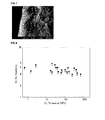
- FIGS. 1, 2, and 3 show 300x, 1,500x, and 5,000x magnification electron-scanning microscope photographs of the partcial cross-section of the hollow fiber according to Example 1.
- FIGS. 4, 5, and 6 show 120x, 600x, and 2,000x magnification electron-scanning microscope photographs of the partcial cross-section of the hollow fiber according to Example 8.
- the hollow fiber according to one embodiment of the present invention had no defect on the surface of the dense layer.
- Example 1 to 18 and Comparative Example 1 to 3 were evaluated as follows regarding gas permeability and selectivity. The results are provided in Table 1.
- the gas permeance is a gas permeability speed against a membrane measured by fabricating a separation membrane module for gas permeance with a hollow fiber and measuring a gas permeance amount by the following Equation 1.
- a gas permeance unit used is GPU (Gas Permeation Unit, 1 ⁇ 10 -6 cm 3 /cm 2 .sec.cmHg).
- the selectivity was indicated as a permeance ratio obtained by measuring an individual gas against the same membrane.
- P dp dt VT 0 P 0 ⁇ TP f ⁇ A eff
- P indicates gas permeance
- dp/dt indicates a pressure increase rate
- V indicates a lower volume
- P f indicates difference between upper and lower pressures.
- T indicates a temperature during the measurement
- a eff indicates an effective area
- Table 1 H 2 permeance (GPU) O 2 permeance (GPU) CO 2 permeance (GPU) O 2 /N 2 selectivity CO 2 /CH 4 selectivity
- Example 1 542 136 619 5.9 37.7
- Example 4 116 59 115 4.5 35.9
- Example 5 131 19.2 86 7.7 41.0
- Example 6 292 61 216 5.2 24.3
- Example 9 85 19 97 4.6 34.6
- Example 10 615 119 227 4.6 26.1
- Example 12 419 95 519 5.3 37.1
- Example 14 875 151
- a hollow fiber according to Examples 1 to 18 of the present invention had excellent gas permeance against gas such as H 2 , O 2 , CO 2 , and the like compared with the one of Comparative Examples 1 to 3.
- FIG. 8 is a graph showing oxygen permeance and oxygen/nitrogen selectivity comparison of GPU units of the hollow fibers according to Example 1 to 18 and Comparative Example 1 to 3.
- FIG. 9 is a graph showing carbon dioxide permeance and carbon dioxide/methane selectivity comparison of GPU units of the hollow fibers according to Example 1 to 18 and Comparative Examples 1 to 3.
- the hollow fiber according to Examples of the present invention had similar oxygen/nitrogen selectivity or carbon dioxide/methane selectivity to those of Comparative Examples but excellent permeance.
Landscapes
- Chemical & Material Sciences (AREA)
- Chemical Kinetics & Catalysis (AREA)
- Engineering & Computer Science (AREA)
- Health & Medical Sciences (AREA)
- Organic Chemistry (AREA)
- Polymers & Plastics (AREA)
- Medicinal Chemistry (AREA)
- Textile Engineering (AREA)
- Manufacturing & Machinery (AREA)
- Mechanical Engineering (AREA)
- General Chemical & Material Sciences (AREA)
- Dispersion Chemistry (AREA)
- Macromolecular Compounds Obtained By Forming Nitrogen-Containing Linkages In General (AREA)
- Separation Using Semi-Permeable Membranes (AREA)
- Artificial Filaments (AREA)
- Polymers With Sulfur, Phosphorus Or Metals In The Main Chain (AREA)
Abstract
Description
- This disclosure relates to a hollow fiber, a dope solution composition for forming a hollow fiber, and a method for manufacturing a hollow fiber using the same.
- Membranes should satisfy the requirements of superior thermal, chemical and mechanical stability, high permeability and high selectivity so that they can be commercialized and then applied to a variety of industries. The term "permeability" used herein is defined as a rate at which a substance permeates through a membrane. The term "selectivity" used herein is defined as a permeation ratio between two different gas components.
- Based on the separation performance, membranes may be classified into reverse osmosis membranes, ultrafiltration membranes, microfiltration membranes, gas separation membranes, etc. Based on the shape, membranes may be largely classified into flat sheet membranes, spiral-wound membranes, composite membranes and hollow fiber membranes. Of these, asymmetric hollow fiber membranes have the largest membrane areas per unit volume and are thus generally used as gas separation membranes.
- A process for separating a specific gas component from various ingredients constituting a gas mixture is greatly important. This gas separation process generally employs a membrane process, a pressure swing adsorption process, a cryogenic process and the like. Of these, the pressure swing adsorption process and the cryogenic process are generalized techniques, design and operations methods of which have already been developed, and are now in widespread use. On the other hand, gas separation using the membrane process has a relatively short history.
- The gas separation membrane is used to separate and concentrate various gases, e.g., hydrogen (H2), helium (He), nitrogen (N2), oxygen (O2), carbon monoxide (CO), carbon dioxide (CO2), water vapor (H2O), ammonia (NH3), sulfur compounds (SOx) and light hydrocarbon gases such as methane (CH4), ethane (C2H6), ethylene (C2H4), propane (C3H8), propylene (C3H6), butane (C4H10), butylene (C4H8). Gas separation may be used in the fields including separation of oxygen or nitrogen present in air, removal of moisture present in compressed air and the like.
- The principle for the gas separation membranes is based on the difference in permeability between respective components constituting a mixture of two or more gases. The gas separation involves a solution-diffusion process, in which a gas mixture comes in contact with a surface of a membrane and at least one component thereof is selectively dissolved. Inside the membrane, selective diffusion occurs. The gas component which permeates the membrane is more rapid than at least one of other components. Gas components having a relatively low permeability pass through the membrane at a speed lower than at least one component. Based upon such a principle, the gas mixture is divided into two flows, i.e., a selectively permeated gas-containing flow and a non-permeated gas-containing flow. Accordingly, in order to suitably separate gas mixtures, there is a demand for techniques to select a membrane material having high perm-selectivity to a specific gas ingredient and to control the material to have a structure capable of exhibiting sufficient permeance.
- In order to selectively separate gases and concentrate the same through the membrane separation, the membrane must generally have an asymmetric structure comprising a dense selective-separation layer arranged on the surface of the membrane and a porous supporter with a minimum permeation resistance arranged on the bottom of the membrane. One membrane property, i.e., selectivity, is determined depending upon the structure of the selective-separation layer. Another membrane property, i.e., permeability, depends on the thickness of the selective-separation layer and the porosity level of the lower structure, i.e., the porous supporter of the asymmetric membrane. Furthermore, to selectively separate a mixture of gases, the separation layer must be free from surface defects and have a fine pore size.
- Since a system using a gas separation membrane module was developed in 1977 by the Monsanto Company under the trade name "Prism", gas separation processes using polymer membranes has been first available commercially. The gas separation process has shown a gradual increase in annual gas separation market share due to low energy consumption and low installation cost, as compared to conventional methods.
- Since a cellulose acetate semi-permeation membrane having an asymmetric structure as disclosed in
U.S. Patent No. 3,133,132 was developed, a great deal of research has been conducted on polymeric membranes and various polymers are being prepared into hollow fibers using phase inversion methods. - General methods for manufacturing asymmetric hollow fiber membranes using phase-inversion are wet-spinning and dry-jet-wet spinning. A representative hollow fiber preparation process using dry-jet-wet spinning comprises the following four steps, (1) spinning hollow fibers with a polymeric dope solution, (2) bringing the hollow fibers into contact with air to evaporate volatile ingredients therefrom, (3) precipitating the resulting fibers in a coagulation bath, and (4) subjecting the fibers to post-treatment including washing, drying and the like.
- Organic polymers such as polysulfones, polycarbonates, polypyrrolones, polyarylates, cellulose acetates and polyimides are widely used as hollow fiber membrane materials for gas separation. Various attempts have been made to impart permeability and selectivity for a specific gas to polyimide membranes having superior chemical and thermal stability among these polymer materials for gas separation. However, in general polymeric membrane, permeability and selectivity are inversely proportional.
- For example,
U.S. Patent No. 4,880,442 discloses polyimide membranes wherein a large fractional free volume is imparted to polymeric chains and permeability is improved using non-rigid anhydrides. Furthermore,U.S. Patent No. 4,717,393 discloses crosslinked polyimide membranes exhibiting high gas selectivity and superior stability, as compared to conventional polyimide gas separation membranes. In addition,U.S. Patent Nos. 4,851,505 and4,912,197 disclose polyimide gas separation membranes capable of reducing the difficulty of polymer processing due to superior solubility in generally-used solvents. In addition,PCT Publication No. WO 2005/007277 discloses defect-free asymmetric membranes comprising polyimide and another polymer selected from the group consisting of polyvinylpyrrolidones, sulfonated polyetheretherketones and mixtures thereof. - However, polymeric materials having membrane performance available commercially for use in gas separation (in the case of air separation, oxygen permeability is 1 Barrer or higher, and oxygen/nitrogen selectivity is 6.0 or higher) are limited to only a few types. This is because there is considerable limitation in improving polymeric structures, and great compatibility between permeability and selectivity makes it difficult to obtain separation and permeation capabilities beyond a predetermined upperbound.
- Furthermore, conventional polymeric membrane materials have a limitation of permeation and separation properties and disadvantages in that they undergo decomposition and aging upon a long-term exposure to high pressure and high temperature processes or to gas mixtures containing hydrocarbon, aromatic and polar solvents, thus causing a considerable decrease in inherent membrane performance. Due to these problems, in spite of their high economic value, gas separation processes are utilized in considerably limited applications to date.
- Accordingly, there is an increasing demand for development of polymeric materials capable of achieving both high permeability and superior selectivity, and novel gas separation membranes using the same.
- In accordance with such demand, a great deal of research has been conducted to modify polymers into ideal structures that exhibit superior gas permeability and selectivity, and have a desired pore size.
- One aspect of the present invention provides a hollow fiber having gas permeability and selectivity.
- Another aspect of the present invention provides a dope solution composition for forming a hollow fiber.
- Further aspect of the present invention provides a method for manufacturing a hollow fiber using the dope solution composition for forming a
- Accoridng to one aspect of the present invention, a hollow fiber is provided that includes a hollow positioned at the center of the hollow fiber, macropores positioned at adjacent to the hollow, and mesopores and picopores positioned at adjacent to macropores, and the picopores are three dimensionally connected to each other to form a three dimensional network structure. The hollow fiber includes a polymer derived from polyimide, and the polyimide includes a repeating unit obtained from aromatic diamine including at least one ortho-positioned functional group with respect to an amine group and dianhydride.
- The hollow fiber may include a dense layer (effective thin layer) including picopores at a surface portion, and the dense layer has a structure where the number of the picopores increases as near to the surface of the hollow fiber.
- The three dimensional network structure where at least two picopores are three-dimensionally connected includes an hourglass shaped structure forming a narrow valley at connection parts.
- The ortho-positioned functional group with respect to the amine group may include OH, SH, or NH2.
- The polymer derived from polyimide has a fractional free volume (FFV) of about 0.15 to about 0.40, and interplanar distance (d-spacing) of about 580 pm to about 800 pm measured by X-ray diffraction (XRD).
- The polymer derived from polyimide includes picopores, and the picopores has a full width at half maximum (FWHM) of about 10 pm to about 40 pm meaaured by positron annihilation lifetime spectroscopy (PALS).
- The polymer derived from polyimide has a BET surface area of about 100 to about 1,000 m2/g.
- The polyimide may be selected from the group consisting of polyimide represented by the following
Chemical Formulae 1 to 4, polyimide copolymers represented by the followingChemical Formulae 5 to 8, copolymers thereof, and blends thereof.


- In the above
Chemical Formulae 1 to 8,
Ar1 is an aromatic group selected from a substituted or unsubstituted quadrivalent C6 to C24 arylene group and a substituted or unsubstituted quadrivalent C4 to C24 heterocyclic group, where the aromatic group is present singularly; at least two aromatic groups are fused to form a condensed cycle; or at least two aromatic groups are linked by single bond or a functional group selected from O, S, C(=O), S(=O)2, Si(CH3)2, (CH2)p (where 1 ≤p≤10), (CF2)q (where 1 ≤q≤10), C(CH3)2, C(CF3)2, or C(=O)NH,
Ar2 is an aromatic group selected from a substituted or unsubstituted divalent C6 to C24 arylene group and a substituted or unsubstituted divalent C4 to C24 heterocyclic group, where the aromatic group is present singularly; at least two aromatic groups are fused to form a condensed cycle; or at least two aromatic groups are linked by single bond or a functional group selected from O, S, C(=O), S(=O)2, Si(CH3)2, (CH2)p (where 1≤p≤10), (CF2)q (where 1 ≤q≤10), C(CH3)2, C(CF3)2, or C(=O)NH,
Q is O, S, C(=O), CH(OH), S(=O)2, Si(CH3)2, (CH2)p (where 1≤p≤10), (CF2)q (where 1≤q≤10), C(CH3)2, C(CF3)2, C(=O)NH, C(CH3)(CF3), or a substituted or unsubstituted phenylene group (where the substituted phenylene group is a phenylene group substituted with a C1 to C6 alkyl group or a C1 to C6 haloalkyl group), where the Q is linked with aromatic groups with m-m, m-p, p-m, or p-p positions,
Y is the same or different from each other in each repeating unit and independently selected from OH, SH, or NH2,
n is an integer ranging from 20 to 200,
m is an integer ranging from 10 to 400, and
I is an integer ranging from 10 to 400. - The polymer may include a polymer represented by one of the following Chemical Formulae 19 to 32, or copolymers thereof.


- In the above Chemical Formulae 19 to 32,
Ar1, Ar2, Q, n, m, and I are the same as defined in theabove Chemical Formulae 1 to 8,
Ar1' is an aromatic group selected from a substituted or unsubstituted divalent C6 to C24 arylene group and a substituted or unsubstituted divalent C4 to C24 heterocyclic group, where the aromatic group is present singularly; at least two aromatic groups are fused to form a condensed cycle; or at least two aromatic groups are linked by single bond or a functional group selected from O, S, C(=O), S(=O)2, Si(CH3)2, (CH2)p (where 1≤p≤10), (CF2)q (where 1≤q≤10), C(CH3)2, C(CF3)2, or C(=O)NH, and
Y" is O or S. - The hollow fiber may be applicable as a gas separation membrane for separating at least one selected from the group consisting of He, H2, N2, CH4, O2, N2, CO2, and combinations thereof.
- The hollow fiber has O2/N2 selectivity of 4 or more, CO2/CH4 selectivity of 30 or more, H2/N2 selectivity of 30 or more, H2/CH4 selectivity of 50 or more, CO2/N2 selectivity of 20 or more, and He/N2 selectivity of 40 or more. In one embodiment, the hollow fiber may have O2/N2 selectivity of 4 to 20, CO2/CH4 selectivity of 30 to 80, H2/N2 selectivity of 30 to 80, H2/CH4 selectivity of 50 to 90, CO2/N2 selectivity of 20 to 50, and He/N2 selectivity of 40 to 120.
Another aspect of the present invention, a dope solution composition for forming a hollow fiber is provided that includes polyimide including a repeating unit prepared from aromatic diamine including at least one ortho-positioned functional group and dianhydride, an organic solvent, and an additive. - The organic solvent includes one selected from the group consisting of dimethylsulfoxide; N-methyl-2-pyrrolidone; N-methylpyrrolidone; N,N-dimethyl formamide; ketones selected from the group consisting of N,N-dimethyl acetamide; y-butyrolactone, cyclohexanone, 3-hexanone, 3-heptanone, 3-octanone; and combinations thereof.
- The additive includes one selected from the group consisting of water; alcohols selected from the group consisting of methanol, ethanol, 2-methyl-1-butanol, 2-methyl-2-butanol, glycerol, ethylene glycol, diethylen glycol, and propylene glycol; ketones selected from the group consisting of acetone and methyl ethyl ketone; polymer compounds selected from the group consisting of polyvinyl alcohol, polyacrylic acid, polyacryl amide, polyethylene glycol, polypropylene glycol, chitosan, chitin, dextran, and polyvinylpyrrolidone; salts selected from the group consisting of lithium chloride, sodium chloride, calcium chloride, lithium acetate, sodium sulfate, and sodium hydroxide; tetrahydrofuran; trichloroethane; and mixtures thereof.
- The ortho-positioned functional group with respect to the amine group may include OH, SH, or NH2.
- The dope solution composition for forming a hollow fiber includes about 10 to about 45 wt% of the polyimide, about 25 to about 70 wt% of the organic solvent, and about 2 to about 30 wt% of the additive.
- The dope solution composition for forming a hollow fiber has a viscosity of about 2 Pa·s to about 200 Pa.s.
- The polyimide has a weight average molecular weight (Mw) of about 10,000 to about 200,000.
- In the dope solution composition for forming a hollow fiber, the polyimide may be selected from the group consisting of polyimide represented by the following
Chemical Formulae 1 to 4, polyimide copolymers represented by the followingChemical Formulae 5 to 8, copolymers thereof, and blends thereof. - Another another embodiment of the present invention, a method for manufacturing a hollow fiber is provided that includes spinning a dope solution composition for forming a hollow fiber to prepare a polyimide hollow fiber, and heat-treating the polyimide hollow fiber to obtain a hollow fiber including thermally rearranged polymer. The hollow fiber includes a hollow positioned at the center of the hollow fiber, macropores positioned at adjacent to the hollow, and mesopores and picopores positioned at adjacent to macropores, and the picopores are three dimensionally connected to each other to form a three dimensional network structure.
- The thermally rearranged polymer may include polymers represented by one of the above Chemical Formulae 19 to 32 or copolymers thereof.
- The polyimide represented by one of the
above Chemical Formulae 1 to 8 may be obtained from imidization of polyamic acid represented by one of the following Chemical Formulae 33 to 40.


- In the above Chemical Formulae 33 to 40,
- Ar1, Ar2, Q, Y, n, m and I are the same as in the
above Chemical Formulae 1 to 8. - The imidization include chemical imidization and solution-thermal imidization.
- The chemical imidization is carried out at about 20 to about 180°C for about 4 to about 24 hours.
- The chemical imidization may further include protecting an ortho-positioned functional group of polyamic acid with a protecting group before imidization, and removing the protecting group after imidization.
- The solution-thermal imidization may be performed at about 100 to about 180°C for about 2 to about 30 hours in a solution.
- The solution-thermal imidization may also further include protecting an ortho-positioned functional group of polyamic acid with a protecting group before imidization, and removing the protecting group after imidization.
- The solution-thermal imidization may be performed using an azeotropic mixture.
- In the above method for manufacturing the hollow fiber, the heat treatment of the polyimide hollow fiber may be performed by increasing a temperature at about 10 to about 30°C/min up tp about 400 to about 550°C, and then maintaining the temperature for about 1 minute to about 1 hour under an inert atmosphere.
- In the
above Chemical Formulae 1 to 8 and Chemical Formulae 19 to 40, Ar1 may be selected from one of the following Chemical Formulae.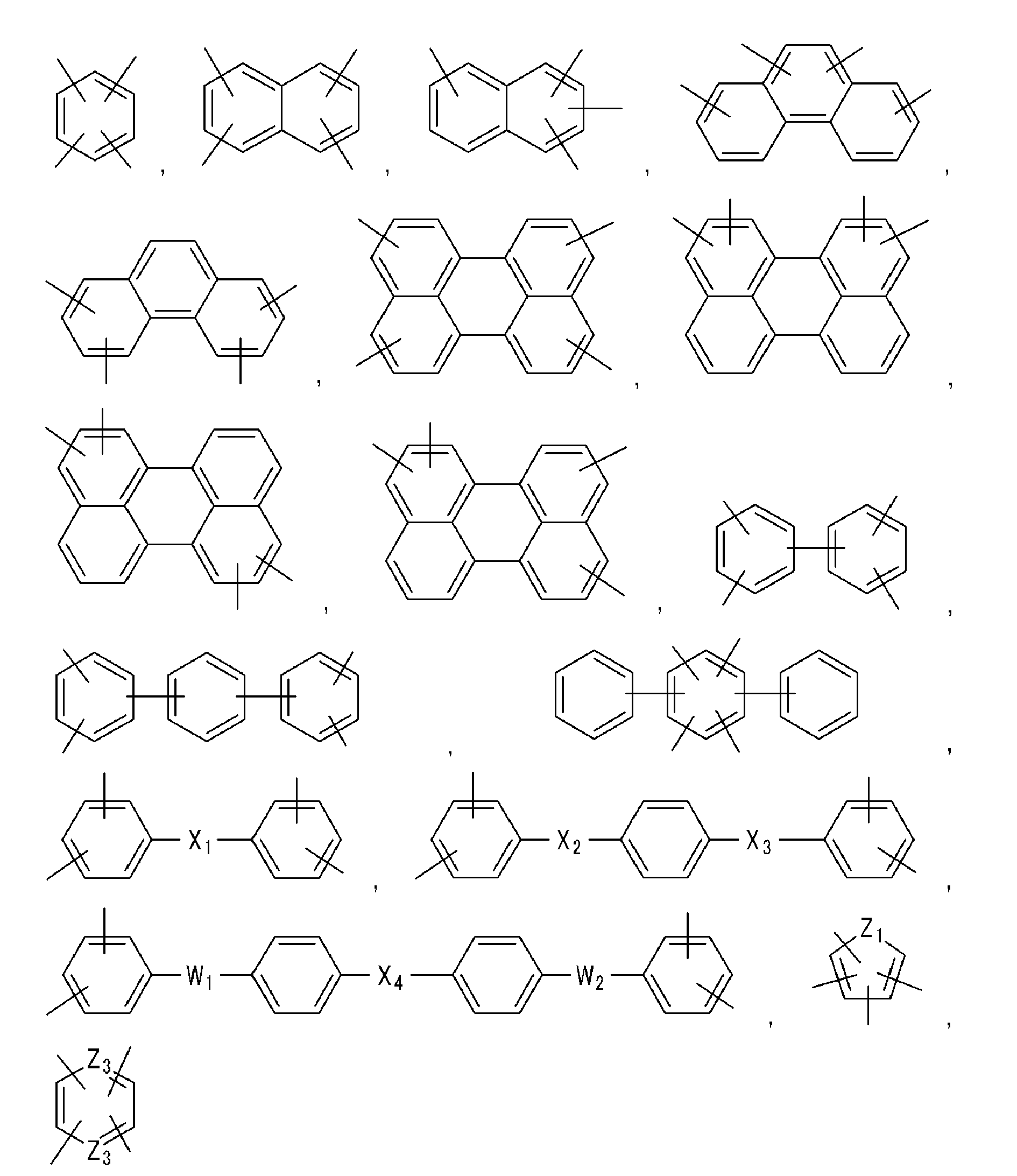
- In the above Chemical Formulae,
X1, X2, X3, and X4 are the same or different and independently O, S, C(=O), CH(OH), S(=O)2, Si(CH3)2, (CH2)p (where 1≤p≤10), (CF2)q (where 1≤q≤10), C(CH3)2, C(CF3)2, or C(=O)NH,
W1 and W2 are the same or different, and independently O, S, or C(=O),
Z1 is O, S, CR1R2 or NR3, where R1, R2, and R3 are the same or different from each other and independently hydrogen or a C1 to C5 alkyl group, and
Z2 and Z3 are the same or different from each other and independently N or CR4 (where, R4 is hydrogen or a C1 to C5 alkyl group), provided that both Z2 and Z3 are not CR4. - In the
above Chemical Formulae 1 to 8 and Chemical Formula 19 toChemical Formula 40, specific examples of Ar1 may be selected from one of the following Chemical Formulae.

- In the
above Chemical Formulae 1 to 8 and Chemical Formulae 19 to 40, Ar2 may be selected from one of the following Chemical Formulae.
- In the above Chemical Formulae,
X1, X2, X3, and X4 are the same or different, and independently O, S, C(=O), CH(OH), S(=O)2, Si(CH3)2, (CH2)p (where 1≤p≤10), (CF2)q (where 1≤q≤10), C(CH3)2, C(CF3)2, or C(=O)NH,
W1 and W2 are the same or different, and independently O, S, or C(=O),
Z1 is O, S, CR1R2 or NR3, where R1, R2 and R3 are the same or different from each other and independently hydrogen or a C1 to C5 alkyl group, and
Z2 and Z3 are the same or different from each other and independently N or CR4 (where, R4 is hydrogen or a C1 to C5 alkyl group), provided that both Z2 and Z3 are not CR4. - In the
above Chemical Formulae 1 to 8 and Chemical Formulae 19 to 40, specific examples of Ar2 may be selected from one of the following Chemical Formulae.


- In the
above Chemical Formulae 1 to 8 and Chemical Formulae 19 to 40, Q is selected from C(CH3)2, C(CF3)2, O, S, S(=O)2, or C(=O). - In the above Chemical Formulae 19 to 32, examples of Ar1' are the same as in those of Ar2 of the
above Chemical Formulae 1 to 8 and Chemical Formulae 19 to 40. - In the
above Chemical Formulae 1 to 8, Ar1 may be a functional group represented by the following Chemical Formula A, B, or C, Ar2 may be a functional group represented by the following Chemical Formula D or E, and Q may be C(CF3)2.


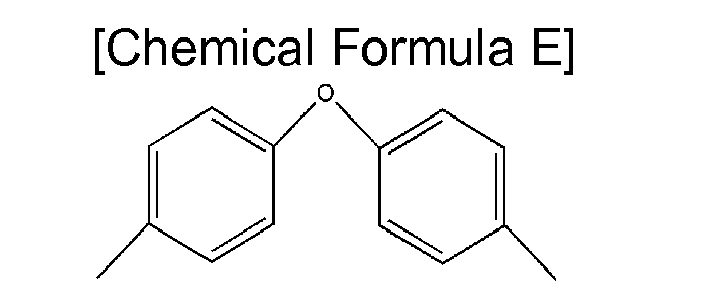
- In the above Chemical Formulae 19 to 32, Ar1 may be a functional group represented by the following Chemical Formula A, B, or C, Ar1' may be a functional group represented by the following Chemical Formula F, G, or H, Ar2 may be a functional group represented by the following Chemical Formula D or E, and Q may be C(CF3)2.


- In the polyimide copolymer including repeating units represented by the
above Chemical Formulae 1 to 4 and the polyimide copolymer represented by the aboveChemical Formula 5 to 8, a mole ratio of each repeating unit and an m:l mole ratio range from 0.1:9.9 to 9.9:0.1. - Hereinafter, further embodiments of the present invention will be described in detail.
- The hollow fiber has excellent gas permeability, selectivity, mechanical strength, and chemical stability, and good endurance to stringent condition such as long operation time, acidic conditions, and high humidity.
-
-
FIG. 1 is a cross-sectional scanning electron microscope (SEM) image of a hollow fiber prepared in Example 1 at 100x magnification; -
FIG. 2 is a cross-sectional scanning electron microscope (SEM) image of a hollow fiber prepared in Example 1 at 3,000x magnification; -
FIG. 3 is a cross-sectional scanning electron microscope (SEM) image of a hollow fiber prepared in Example 1 at 1 0,000x magnification; -
FIG. 4 is a cross-sectional scanning electron microscope (SEM) image of a hollow fiber prepared in Example 1 at 40,000x magnification; -
FIG. 5 is a cross-sectional scanning electron microscope (SEM) image of a hollow fiber prepared in Example 8 at 100x magnification; -
FIG. 6 is a cross-sectional scanning electron microscope (SEM) image of a hollow fiber prepared in Example 8 at 1,000x magnification; -
FIG. 7 is a cross-sectional scanning electron microscope (SEM) image of a hollow fiber prepared in Example 8 at 5,000x magnification; -
FIG. 8 is a graph comparing oxygen permeance (GPU) and oxygen/nitrogen selectivity for hollow fibers prepared in Examples 1 to 18 and Comparative Examples 1 to 3 (the numbers 1' to 3' indicate Comparative Examples 1 to 3, respectively; and thenumbers 1 to 18 indicate Examples 1 to 18, respectively); and -
FIG. 9 is a graph comparing carbon dioxide permeance (GPU) and carbon dioxide/methane selectivity for hollow fibers prepared in Examples 1 to 18 and Comparative Examples 1 to 3 (the numbers 1' to 3' indicate Comparative Examples 1 to 3, respectively; and thenumbers 1 to 18 indicate Examples 1 to 18, respectively). - Exemplary embodiments of the present invention will hereinafter be described in detail. However, these embodiments are only exemplary, and the present invention is not limited thereto.
- As used herein, when a specific definition is not provided, the term "surface portion" refers to an outer surface portion, an inner surface portion, or ourter surface portion/inner surface portion of a hollow fiber, and the term "surface" refers to an outer surface, an inner surface, or outer surface/inner surface of a hollow fiber. The term "picopore" refers to a pore (cavity) having an average diameter of hundreds of picometers, and in one embodiment having 100 picometers to 1000 picometers. The term "mesopore" refers to a pore (cavity) having an average diameter of 2 to 50 naometers, and the term "macropore" refers to a pore (cavity) having an average diameter of more than 50 naometers.
- As used herein, when a specific definition is not provided, the term "substituted" refers to a compound or a functional group where hydrogen is substituted with at least one substituent selected from the group consisting of a C1 to C10 alkyl group, a C1 to C10 alkoxy group, a C1 to C10 haloalkyl group, and a C1 to C10 haloalkoxy group. The term, "hetero cyclic group" refers to a C3 to C30 heterocycloalkyl group, a C3 to C30 heterocycloalkenyl group, or a C3 to C30 heteroaryl group including 1 to 3 heteroatoms selected from the group consisting of O, S, N, P, Si, and combinations thereof. The term "copolymer" refers to a block copolymer to a random copolymer.
- The hollow fiber according to one embodiment of the present invention includes a hollow positioned at the center of the hollow fiber, macropores positioned at adjacent to the hollow, and mesopores and picopores positioned at adjacent to macropores, and the picopores are three dimensionally connected to each other to form a three dimensional network structure. The hollow fiber includes a polymer derived from polyimide, and the polyimide includes a repeating unit obtained from aromatic diamine including at least one ortho-positioned functional group with respect to an amine group and dianhydride.
- The hollow fiber may include a dense layer (effective thin layer) including picopores at a surface portion. The hollow fiber is capable of separating gases selectively and efficiently due to such a dense layer. The dense layer may have a thickness ranging from 50nm to 1µm, but is not limited thereto.
- The dense layer has a structure where the number of the picopores increases as near to the surface of the hollow fiber. Thereby, at the hollow fiber surface, selective gas separation may be realized, and at a lower of the membrane, gas concentration may be efficiently realized.
- The three dimensional network structure where at least two picopores are three-dimensionally connected includes a hourglass shaped structure forming a narrow valley at connection parts. The hourglass shaped structure forming a narrow valley at connection parts makes gases selective separation and relatively wider picopores than the valley makes separated gases transfer fast.
- The ortho-positioned functional group with respect to the amine group may include OH, SH, or NH2. The polyimide may be prepared by generally-used method in this art. For example, the polyimide is obtained form imidization of polyhydroxyamic acid having OH group at ortho-position with respect to an amine group, polythioamic acid having having SH group at ortho-position with respect to an amine group, polyaminoamic acid having a NH2 group at ortho-position with respect to an amine group, or copolymers of the polyamic acid.
- The polyimide is thermally rearranged into a polymer such as polybenzoxazole, polybenzothiazole, or polypyrrolone having high fractional free volume in accordance with a method that will be described below. For example, polyhydroxyimide having an ortho-positioned OH group with respect to an amine group is thermally rearranged to polybenzoxazole, polythiolimide having an ortho-positioned SH group with respect to an amine group is thermally rearranged to polybenzothiazole, and polyaminoimide having an ortho-positioned NH2 group with respect to an amine group is thermally rearranged to polypyrrolone. The hollow fiber according to one embodiment of the present invention includes the polymer such as polybenzoxazole, polybenzothiazole, or polypyrrolone having high fractional free volume.
- The polymer derived from polyimide has a fractional free volume (FFV) of about 0.15 to about 0.40, and interplanar distance (d-spacing) of about 580 pm to about 800 pm measured by X-ray diffraction (XRD). The polymer derived from polyimide has excellent gas permeability, and the hollow fiber including the polymer derived from polyimide is applicable for selective and efficient gas separation.
- The polymer derived from polyimide includes picopores. The picopores has an average diameter having about 600 pm to about 800 pm. The picopores has a full width at half maximum (FWHM) of about 10 pm to about 40 pm meaaured by positron annihilation lifetime spectroscopy (PALS). It indicates that the produced picopores have significantly uniform size. Thereby, the hollow including the polymer derived from polyimide is capable of separating gases selectively and stably. The PALS measurement is performed by obtaining time difference, T1, T2, T3 and the like between γ0 of 1.27MeV produced by radiation of positron produced from 22Na isotope and γ1 and γ2 of 0.511 MeV produced by annihilation thereafter.
- The polymer derived from polyimide has a BET (Brunauer, Emmett, Teller) surface area of about 100 to about 1,000 m2/g. When the BET surface area is within the range, surface area appropriate for gas adsorption can be obtained. Thereby, the hollow fiber hasexcellent selectivity and permeability at separating gases through a solution-diffusion mechanism.
- The polyimide may be selected from the group consisting of polyimide represented by the following
Chemical Formulae 1 to 4, polyimide copolymers represented by the followingChemical Formulae 5 to 8, copolymers thereof, and blends thereof, but is not limited thereto.


- In the
above Chemical Formulae 1 to 8,
Ar1 is an aromatic group selected from a substituted or unsubstituted quadrivalent C6 to C24 arylene group and a substituted or unsubstituted quadrivalent C4 to C24 heterocyclic group, where the aromatic group is present singularly; at least two aromatic groups are fused to form a condensed cycle; or at least two aromatic groups are linked by single bond or a functional group selected from O, S, C(=O), S(=O)2, Si(CH3)2, (CH2)p (where 1≤p≤10), (CF2)q (where 1≤q≤10), C(CH3)2, C(CF3)2, or C(=O)NH,
Ar2 is an aromatic group selected from a substituted or unsubstituted divalent C6 to C24 arylene group and a substituted or unsubstituted divalent C4 to C24 heterocyclic group, where the aromatic group is present singularly; at least two aromatic groups are fused to form a condensed cycle; or at least two aromatic groups are linked by single bond or a functional group selected from O, S, C(=O), S(=O)2, Si(CH3)2, (CH2)p (where 1≤p≤10), (CF2)q (where 1≤q≤10), C(CH3)2, C(CF3)2, or C(=O)NH,
Q is O, S, C(=O), CH(OH), S(=O)2, Si(CH3)2, (CH2)p (where 1≤p≤10), (CF2)q (where 1≤q≤10), C(CH3)2, C(CF3)2, C(=O)NH, C(CH3)(CF3), or a substituted or unsubstituted phenylene group (where the substituted phenylene group is a phenylene group substituted with a C1 to C6 alkyl group or a C1 to C6 haloalkyl group), where the Q is linked with aromatic groups with m-m, m-p, p-m, or p-p positions,
Y is the same or different from each other in each repeating unit and independently selected from OH, SH, or NH2,
n is an integer ranging from 20 to 200,
m is an integer ranging from 10 to 400, and
I is an integer ranging from 10 to 400. - Examples of the copolymers of the polyimide represented by the above
Chemical Formula 1 to 4 include polyimide copolymers represented by the followingChemical Formulae 9 to 18.


- In the
above Chemical Formulae 9 to 18,
Ar1, Q, n, m, and I are the same as defined in theabove Chemical Formulae 1 to 8,
Y and Y' are the same or different, and are independently OH, SH, or NH2. - In the
above Chemical Formulae 1 to 18, Ar1 may be selected from one of the following Chemical Formulae.

- In the above Chemical Formulae,
X1, X2, X3, and X4 are the same or different, and independently O, S, C(=O), CH(OH), S (=O)2, Si(CH3)2, (CH2)p (where, 1≤p≤10), (CF2)q (where, 1 ≤q≤10), C(CH3)2, C(CF3)2, or C(=O)NH,
W1 and W2 are the same or different, and independently O, S, or C(=O),
Z1 is O, S, CR1R2 or NR3, where R1, R2, and R3 are the same or different from each other and independently hydrogen or a C1 to C5 alkyl group, and
Z2 and Z3 are the same or different from each other and independently N or CR4 (where, R4 is hydrogen or a C1 to C5 alkyl group), provided that both Z2 and Z3 are not CR4. - In the
above Chemical Formulae 1 to 18, specific examples of Ar1 may be selected from one of the following Chemical Formulae, but are not limited thereto.


- In the
above Chemical Formulae 1 to 18, Ar2 may be selected from one of the following Chemical Formulae, but is not limited thereto.

- In the above Chemical Formulae,
X1, X2, X3, and X4 are the same or different, and independently O, S, C(=O), CH(OH), S(=O)2, Si(CH3)2, (CH2)p (where 1≤p≤10), (CF2)q (where 1 ≤q≤10), C(CH3)2, C(CF3)2, or C(=O)NH,
W1 and W2 are the same or different, and independently O, S, or C(=O),
Z1 is O, S, CR1R2 or NR3, where R1, R2 and R3 are the same or different from each other and independently hydrogen or a C1 to C5 alkyl group, and
Z2 and Z3 are the same or different from each other and independently N or CR4 (where, R4 is hydrogen or a C1 to C5 alkyl group), provided that both Z2 and Z3 are not CR4. - In the
above Chemical Formulae 1 to 18, specific examples of Ar2 may be selected from one of the following Chemical Formulae, but are not limited thereto.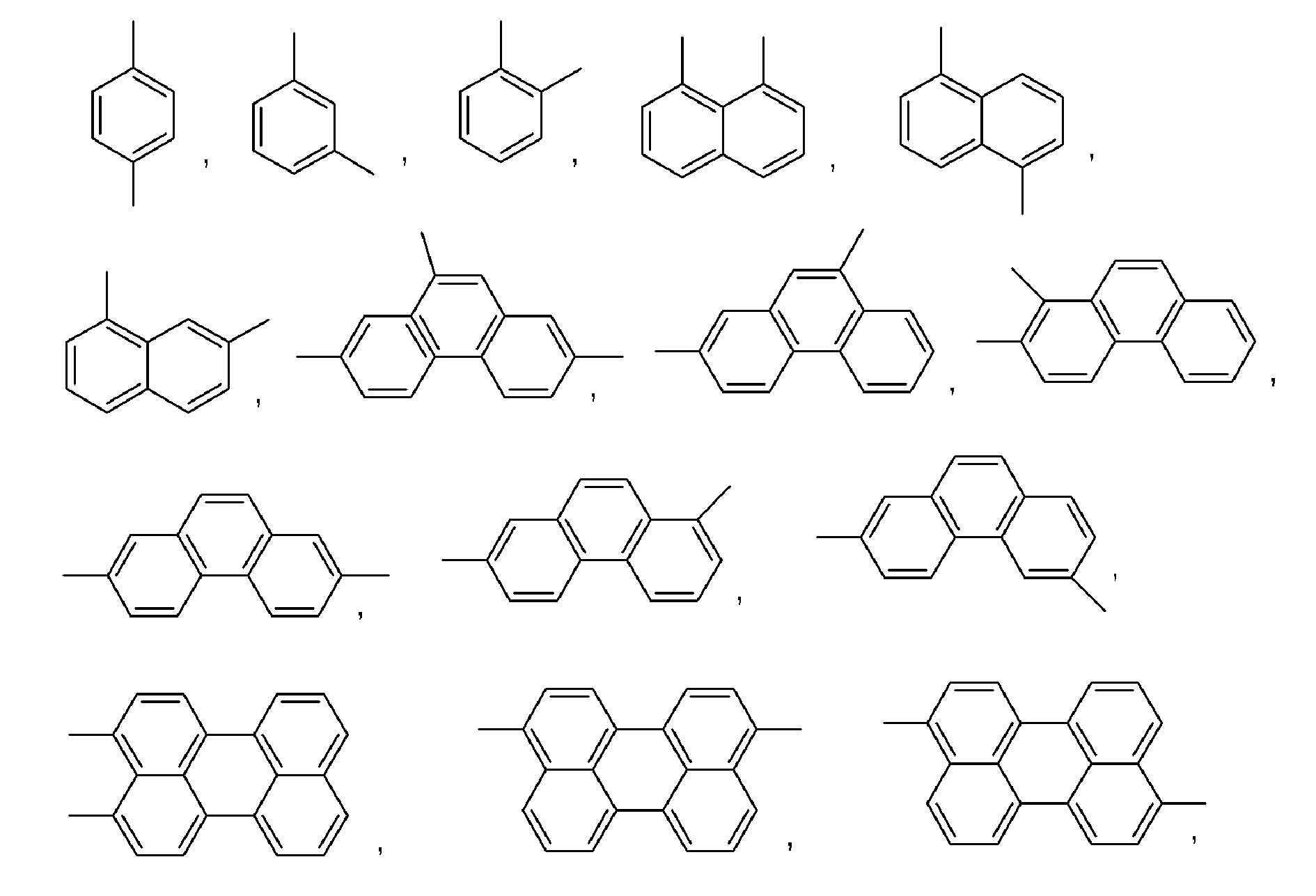


- In the
above Chemical Formulae 1 to 18, Q is selected from C(CH3)2, C(CF3)2, O, S, S(=O)2, and C(=O), but is not limited thereto. - In the
above Chemical Formulae 1 to 18, Ar1 may be a functional group represented by the following Chemical Formula A, B, or C, Ar2 may be a functional group represented by the following Chemical Formula D or E, and Q may be C(CF3)2, but they are not limited thereto.


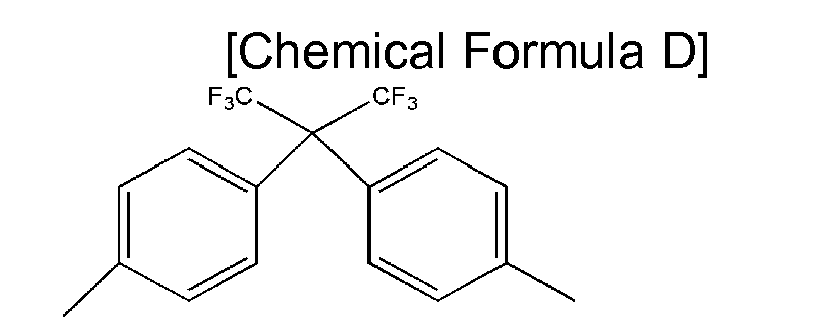

- The polyimides represented by the
above Chemical Formulae 1 to 4 are respectively thermally-rearranged into polybenzoxazole, polybenzothiazole, or polypyrrolone having high fractional free volume in accordance with a method that will be described below. For example, polybenzoxazole is derived from polyhydroxyimide where Y is OH in theChemical Formulae 1 to 4, polybenzothiazole is derived from polythiolimide where Y is SH in theChemical Formulae 1 to 4, and polypyrrolone is derived from polyaminoimide where Y is NH2 in theChemical Formulae 1 to 4. - The polyimide copolymers represented by the
above Chemical Formulae 5 to 8 are respectively thermally-rearranged into a poly(benzoxazoleimide) copolymer, a poly(benzothiazole-imide) copolymer, or a poly(pyrrolone-imide) copolymer having high fractional free volume in accordance with a method that will be described below. It is possible to control physical properties of the prepared hollow fibers by controlling the copolymerization ratio (mole ratio) between blocks which will be thermally rearranged into polybenzoxazole, polybenzothiazole and polybenzopyrrolone through intramolecular and intermolecular conversion, and blocks which will be thermally rearranged into polyimides. - The polyimide copolymer represented by
Chemical Formulae 9 to 18 are respectively thermally-rearranged to form hollow fibers made of copolymers of polybenzoxazole, polybenzothiazole and polybenzopyrrolone, each having a high fractional free volume in accordance with a method that will be described below. It is possible to control the physical properties of hollow fibers thus prepared may be controlled by controlling the copolymerization ratio (mole ratio) between blocks which are thermally rearranged into polybenzoxazole, polybenzothiazole and polybenzopyrrolone. - The copolymerization ratio (m : I) between the blocks of the polyimide copolymers represented by the above
Chemical Formula 5 to 18 ranges from about 0.1:9.9 to about 9.9:0.1, and in one embodiment from about 2:8 to about 8:2, and in another embodiment, about 5:5. The copolymerization ratio affects the morphology of the hollow fibers thus prepared. Such morphologic change is associated with gas permeability and selectivity. When the copolymerization ratio between the blocks is within the above range, the prepared hollow fiber has excellent gas permeability and selectivity. - In the above hollow fiber, the polymer derived from polyimide may include a polymer represented by one of the following Chemical Formulae 19 to 32, or copolymers thereof, but is not limited thereto.


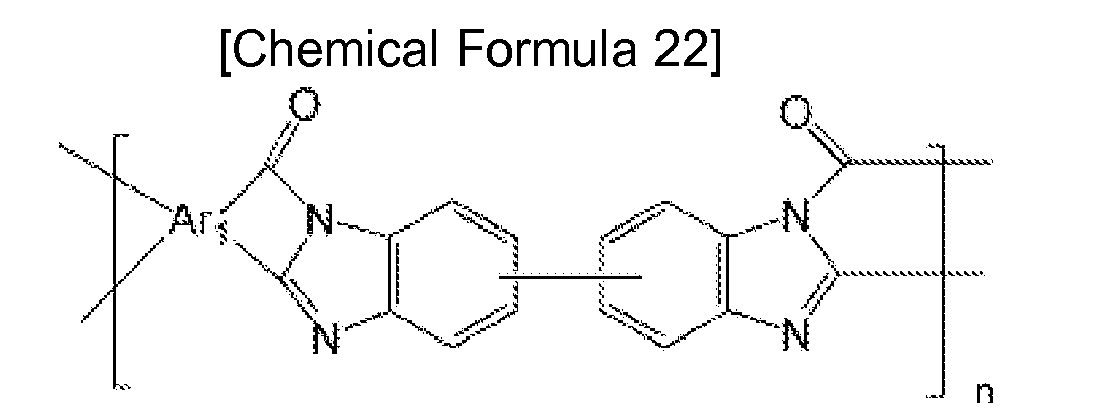


- In the above Chemical Formulae 19 to 32,
Ar1, Ar2, Q, n, m, and I are the same as defined in theabove Chemical Formulae 1 to 8,
Ar1' is an aromatic group selected from a substituted or unsubstituted divalent C6 to C24 arylene group and a substituted or unsubstituted divalent C4 to C24 heterocyclic group, where the aromatic group is present singularly; at least two aromatic groups are fused to form a condensed cycle; or at least two aromatic groups are linked by single bond or a functional group selected from O, S, C(=O), S(=O)2, Si(CH3)2, (CH2)p (where 1≤p≤10), (CF2)q (where 1 ≤q≤10), C(CH3)2, C(CF3)2, or C(=O)NH, and
Y" is O or S. - In the above Chemical Formulae 19 to 32, examples of Ar1, Ar2, and Q are the same as in those of the
above Chemical Formulae 1 to 18. - In the above Chemical Formulae 19 to 32, examples of Ar1' are the same as in those of the
above Chemical Formulae 1 to 18. - In the above Chemical Formulae 19 to 32, Ar1 may be a functional group represented by the following Chemical Formula A, B, or C, Ar1' may be a functional group represented by the following Chemical Formula F, G, or H, Ar2 may be a functional group represented by the following Chemical Formula D or E, and Q may be C(CF3)2, but they are not limited thereto.


- The hollow fiber may be applicable for separating at least one gases selected from the group consisting of He, H2, N2, CH4, O2, N2, CO2, and combinations thereof. The hollow fiber may be used as a gas separation membrane. Examples of the mixed gases include O2/N2, CO2/CH4, H2/N2, H2/CH4, CO2/N2, and He/N2, but are not limited thereto.
- The hollow fiber may have O2/N2 selectivity of 4 or more, for example 4 to 20, CO2/CH4 selectivity of 30 or more, for example 30 to 80, H2/N2 selectivity of 30 or more, for example 30 to 80, H2/CH4 selectivity of 50 or more, for example 50 to 90, CO2/N2 selectivity of 20 or more, for example 20 to 50, and He/N2 selectivity of 40 or more, for example 40 to 120.
- The dope solution composition for forming a hollow fiber according to another embodiment includes polyimide including a repeating unit obtained from aromatic diamine including at least one ortho-positioned functional group with respect to an amine group, an organic solvent, and an additive.
- The organic solvent includes one selected from the group consisting of dimethylsulfoxide; N-methyl-2-pyrrolidone; N-methylpyrrolidone; N,N-dimethyl formamide; ketones selected from the group consisting of N,N-dimethyl acetamide; y-butyrolactone, cyclohexanone, 3-hexanone, 3-heptanone, 3-octanone; and combinations thereof, but is not limited thereto. In one embodiment, for the organic solvent, dimethylsulfoxide; N-methyl-2-pyrrolidone; N,N-dimethyl formamide; N,N-dimethyl acetamide; or combinations thereof are preferable. The organic solvent can dissolve polymers, and is mixable with the additive to form a meta-stable state, and thereby hollow fiber having dense layer can be provided.
- The additive includes one selected from the group consisting of water; alcohols selected from the group consisting of methanol, ethanol, 2-methyl-1-butanol, 2-methyl-2-butanol, glycerol, ethylene glycol, diethylen glycol, and propylene glycol; ketones selected from the group consisting of acetone and methyl ethyl ketone; polymer compounds selected from the group consisting of polyvinyl alcohol, polyacrylic acid, polyacryl amide, polyethylene glycol, polypropylene glycol, chitosan, chitin, dextran, and polyvinylpyrrolidone; salts selected from the group consisting of lithium chloride, sodium chloride, calcium chloride, lithium acetate, sodium sulfate, and sodium hydroxide; tetrahydrofuran; trichloroethane; and mixtures thereof, but is not limited thereto. In one embodiment, for the additive, water, glycerol, propyleneglycol, polyethyleneglycol, polyvinylpyrrolidone, and combination thereof may be preferable. The additive can make a meta-stable dope solution composition along with the organic solvent even though it has good solubility for polyamic acid polymers and thus it can not be used singluraly. It can also help non-solvent in a coagulation bath be diffused into the dope solution composition to form a uniform thin layer and help macropores in a sublayer effectively.
- In the dope solution composition for forming a hollow fiber, the ortho-positioned a functional group with respect to the amine group includes OH, SH, or NH2.
- The dope solution composition for forming a hollow fiber includes about 10 to about 45 wt% of the polyimide, about 25 to about 70 wt% of the organic solvent, and about 2 to about 30 wt% of the additive.
- When the amount of the polyimide is within the above range, hollow fiber strength and gas permeability may be maintained excellently.
- The organic solvent dissolves the polyimide. When the organic solvent is used in the above ranged amount, the dope solution composition for forming a hollow fiber has an appropriate viscosity and thus hollow fiber may be easily made while improving permeability of the hollow fiber.
- The dope solution composition for forming a hollow fiber has a viscosity ranging from about 2 Pa·s to 200 Pa.s. When the dope solution composition for forming a hollow fiber is within the above range, the dope solution composition for forming a hollow fiber can be spun through nozzles, and hollow fiber is coagulated in to solid phase by a phase inversion.
- The additive controls phase separation temperatures or viscosity of a dope solution composition for forming a hollow fiber.
- When the additive is used in the above ranged amount, a hollow fiber can be made easily, and also surface pore sizes of a hollow fiber can be appropriately controlled to easily form a dense layer.
- In the dope solution composition for forming a hollow fiber, the polyimide has a weight average molecular weight (Mw) of about 10,000 to about 200,000. When the polyimide has the above ranged weight average molecular weight, it can be synthesized easily, the dope solution composition for forming a hollow fiber including the same can be appropriately controlled resulting in processibility, and the polymer derived from polyimide has good mechanical strength and performances.
- In the dope solution composition for forming a hollow fiber, the polyimide may be selected from the group consisting of polyimide represented by the following
Chemical Formulae 1 to 4, polyimide copolymers represented by the followingChemical Formulae 5 to 8, copolymers thereof, and blends thereof. - Another embodiment of the present invention, a method for manufacturing a hollow fiber is provided that includes spinning a dope solution composition for forming a hollow fiber to prepare a polyimide hollow fiber, and heat-treating the polyimide hollow fiber to obtain a hollow fiber including thermally rearranged polymer. The hollow fiber made according to the above method includes a hollow positioned at the center of the hollow fiber, macropores positioned at adjacent to the hollow, and mesopores and picopores positioned at adjacent to macropores, and the picopores are three dimensionally connected to each other to form a three dimensional network structure.
- The thermally rearranged polymer may include polymers represented by one of the above Chemical Formulae 19 to 32 or copolymers thereof, but is not limited thereto.
- For example, the polyimide hollow fiber may include polyimides represented by the
above Chemical Formulae 1 to 8, copolymers thereof, and blends thereof. - The polyimide represented by one of the
above Chemical Formulae 1 to 8 may be obtained from imidization of polyamic acid represented by one of the following Chemical Formulae 33 to 40.


- In the above Chemical Formulae 33 to 40,
Ar1, Ar2, Q, Y, n, m, and I are the same as in aboveChemical Formulae 1 to 8.
Copolymers of the above polyamic acid represented by Chemical Formulae 33 to 36 include polyamic acid copolymers represented by the following Chemical Formulae 41 to 50.




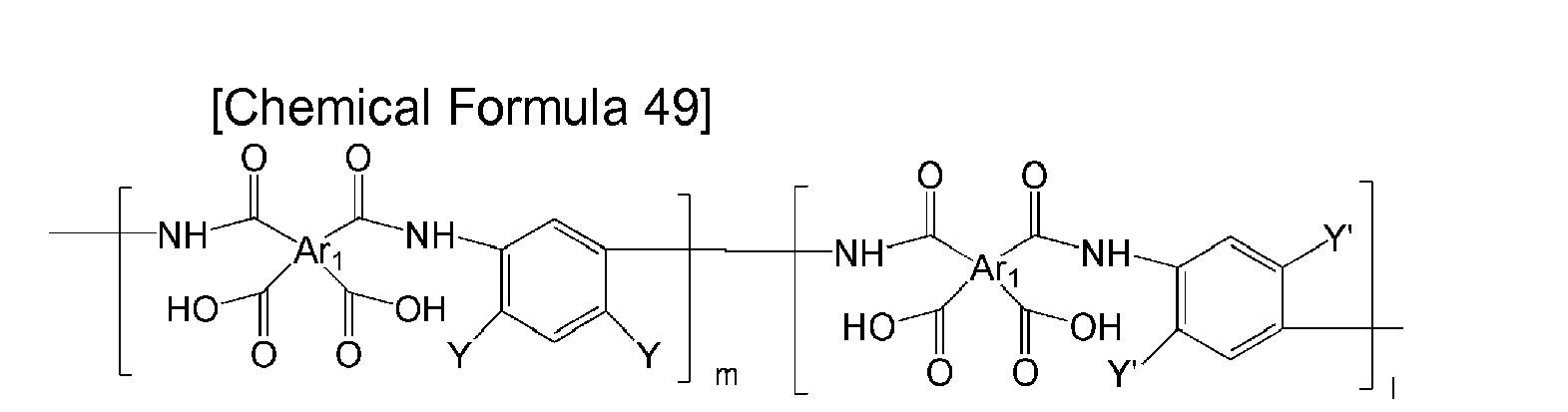

- In the above Chemical Formulae 41 to 50,
Ar1, Q, Y, Y', n, m and I are the same as in theabove Chemical Formulae 1 to 18. - The imidization include chemical imidization and solution-thermal imidization, but is not limited thereto.
- The chemical imidization is carried out at about 20 to about 180°C for about 4 to about 24 hours. For a catalyst, pyridine and acetic anhydride to remove produced water may be used. When the chemical imidization is preformed at the above temperature, imidization of polyamic acid can be performed sufficiently.
- The chemical imidization may be performed after protecting ortho-positioned functional groups, OH, SH, and NH2 with respect to the amine group. That is, a protecting group for a functional group, OH, SH, and NH2 is introduced, and the protecting group is removed after imidization. The protecting group may be introduced by chlorosilane such as trimethylchlorosilane ((CH3)3SiCl), triethylchlorosilane ((C2H5)3SiCl), tributyl chlorosilane ((C4H9)3SiCl), tribenzyl chlorosilane ((C6H5SiCl), triethoxy chlorosilane ((OC2H5)3SiCl), and the like, or hydrofuran such as tetrahydrofurane (THF). For the base, tertiary amines such as trimethyl amine, triethyl amine, tripropyl amine, pyridine, and the like may be used. For removing the protecting group, diluted hydrochloric acid, sulfuric acid, nitric acid, acetic acidm and the like may be used. The chemical imidization using the protecting group may improve yield and molecular weight of the polymer for forming a hollow according to one embodiment of the present invention.
- The solution-thermal imidization may be performed at about 100 to about 180 °C for about 2 to about 30 hours in a solution. When the solution-thermal imidization is preformed within the above temperature range, polyamic acid imidization can be realized sufficiently.
- The solution-thermal imidization may be performed after protecting ortho-positioned functional groups, OH, SH, and NH2 with respect to the amine group. That is, a protecting group for a functional group, OH, SH, and NH2 is introduced, and the protecting group is removed after imidization. The protecting group may be introduced by chlorosilane such as trimethylchlorosilane, triethylchlorosilane, tributyl chlorosilane, tribenzyl chlorosilane, triethoxy chlorosilan, and the like or hydrofuran such as tetrahydrofurane. For the base, tertiary amines such as trimethyl amine, triethyl amine, tripropyl amine, pyridine, and the like may be used. For removing the protecting group, diluted hydrochloric acid, sulfuric acid, nitric acid, acetic acidm and the like may be used.
- The solution-thermal imidization may be performed using an azeotropic mixture that further includes benzenes such as benzene, toluene, xylene, cresol, and the like; aliphatic organic solvents such as hexane; alicyclic organic solvents such as cyclohexane, and the like.
- The solution-thermal imidization using the protecting group and azeotropic mixture may also improve yield and molecular weight of the polymer for forming a hollow according to one embodiment of the present invention.
- The imidization condition can be controlled in accordance with the functional groups, Ar1, Ar2, Q, Y, and Y' of the polyamic acid.
- The imidization reaction will be described in more detail referring to the following
Reaction Schemes 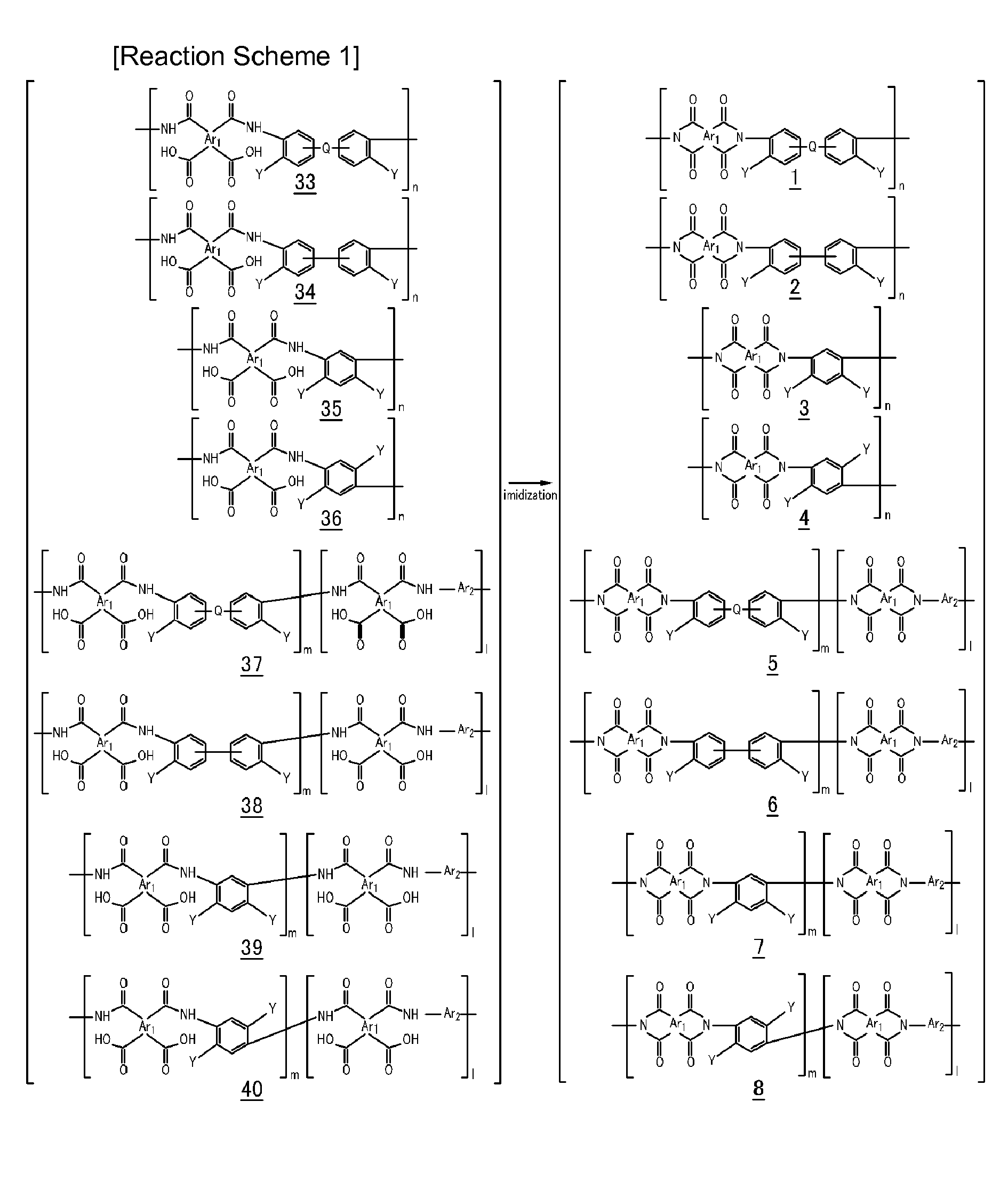

- In the
Reaction Schemes
Ar1, Ar2, Q, Y, Y', n, m, and I are the same as in theabove Chemical Formulae 1 to 18. - As shown in the
Reaction Scheme 1, polyamic acids (polyhydroxyamic acid, polythioamic acid, or polyaminoamic acid) represented by the Chemical Formula 33, Chemical Formula 34, Chemical Formula 35 and Chemical Formula 36 are converted through imidization i.e., cyclization reaction into polyimides represented byChemical Formula 1,Chemical Formula 2,Chemical Formula 3 and Chemical Formula 4, respectively. - In addition, polyamic acid copolymers represented by the Chemical Formula 37, Chemical Formula 38, Chemical Formula 39 and
Chemical Formula 40 are converted through imidization into polyimide copolymers represented byChemical Formula 5,Chemical Formula 6,Chemical Formula 7 andChemical Formula 8, respectively. - As shown in the
Reaction Scheme 2, polyamic acid copolymers represented by the Chemical Formulae 41 to 50 are converted through imidization into polyimide copolymers represented byChemical Formulae 9 to 18. - The spinning process of the dope solution composition for forming a polyimide hollow fiber may be carried out in accordance with a generally-used method in the art and is not particularly limited. In the present invention, dry or dry-jet-wet spinning is used for the preparation of hollow fibers.
- A solvent-exchange method using solution-spinning is generally used as the hollow fiber preparation method. In accordance with the solvent exchange method, after a dope solution composition for forming a hollow fiber is dissolved in a solvent and spun using a dry or dry-jet-wet spinning method, the solvent and the non-solvent are exchanged in the presence of the non-solvent to form picopores. In the process in which the solvent is diffused into a coagulation bath as the non-solvent, an asymmetric membrane or a symmetric membrane in which the interior is identical to the exterior was formed.
- For example, in a case where dry-jet-wet spinning is used for the preparation of hollow fibers, the dry-jet-wet spinning is achieved through the steps of: a1) preparing a dope solution composition for forming a hollow fiber; a2) bringing the dope solution composition into contact with an internal coagulant, and spinning the composition in air, while coagulating an inside of hollow fiber to form a polyimide hollow fiber; a3) coagulating the hollow fiber in a coagulation bath; a4) washing the hollow fiber with a cleaning solution, followed by drying; and a5) heat-treating the polyimide hollow fiber to obtain a thermally rearranged polymer.
- A flow rate of internal coagulant discharged through an inner nozzle ranges from 1 to 10 ml/min, and in one embodiment, 1 to 3 ml/min. In addition, a double nozzle has an outer diameter of 0.1 to 2.5 mm. The flow rate of the internal coagulant and the outer diameter of the double nozzle may be controlled within the range according to the use and conditions of hollow fibers.
- In addition, the air gap between the nozzle and the coagulation bath ranges from 1 cm to 100 cm, and in one embodiment, 10 cm to 50 cm.
- The phase-inversion is induced in a coagulation bath by passing the hollow fiber through a high-temperature spinning nozzle, while maintaining a spinning temperature of 5 to 120°C and a spinning rate of 5 to 50 m/min.
- The spinning temperature and spinning rate may be varied within the range depending upon the use and operation conditions of hollow fibers.
- When the spinning temperature is within the above range, the viscosity of the dope solution composition can be appropriately controlled, thus making it easy to perform rapid spinning, and solvent evaporation can be prevented, thus disadvantageously making it impossible to continuously prepare hollow fibers. In addition, when the spinning rate is within the above range, a flow rate is appropriately maintained, and the mechanical properties and chemical stability of hollow fibers thus produced are improved.
- The temperature of the coagulation bath may range from about 0 to about 50°C. When the coagulation bath temperature is within the above range, the solvent volatilization in the coagulation bath may be prevented, thus advantageously making it possible to smoothly prepare hollow fibers.
- As the external coagulant present in the coagulation bath, any type may be used so long as it does not dissolve polymeric materials and is compatible with the solvent and additive. Non-limitig examples of useful external coagulants include water, ethanol, methanol, and mixtures thereof. In one embodiment, water is preferred.
- To remove the solvent, additive, and the coagulated solution that remain inside the coagulated hollow fibers and on the surface thereof, washing and drying processes may be performed. Water or hot-water may be used as the cleaning solution. The washing time is not particularly limited. In one embodiment, it is preferable that the washing is carried out for 1 to 24 hours.
- After the washing, the drying is performed at a temperature ranging from 20 to 100°C for 3 to 72 hours.
- Subsequently, the polyimide hollow fiber is heat-treated to obtain hollow fibers including thermally rearranged polymers. The hollow fiber including the thermally rearranged polymer has a decreased density, an increased fractional free volume (FFV) and an increased interplanar distance (d-spacing) due to an increased picopore size and produced well-connected picopores, and thus exhibit improved gas permeability, as compared with polyimide hollow fibers. Thereby the hollow fiber including the rearranged polymer has excellent gas permeability and selectivity.
- The heat treatment is performed by increasing a temperature up to 400 to 550°C, and in one embodiment 450 to 500°C, at a heating rate of 10 to 30°C/min and heat-treating for 1 minute to 1 hour, in one
embodiment 10 minutes to 30 minutes at that temperature under an inert atmosphere.
Within the above temperature range, thermal rearrangement may be sufficiently realized. - Hereinafter, the heat treatment will be illustrated in detail with reference to the following
Reaction Schemes 3 and 4.

- In the
Reaction Schemes 3 and 4, - Ar1, Ar1', Ar2, Q, Y, Y", n, m, and I are the same as defined in the
above Chemical Formulae 1 to 50. - Referring to the
Reaction Scheme 3, the polyimide hollow fibers including the polyimides repreented by theabove Chemical Formulae 1 to 4 are converted through thermal treatment into hollow fibers made of polybenzoxazole, polybenzethiazole, or polybenzopyrrolone polymer represented by Chemical Formulae 19 to 25. The conversion of polyimide hollow fibers into the polymers is carried out through the removal reaction of CO2 present in the polymers ofChemical Formulae 1 to 4. - The polyimides of
Chemical Formulae 1 to 4 in which Y is -OH or -SH are thermally rearranged into polybenzoxazoles (Y"=O) or polybenzothiazoles (Y"=S) of Chemical Formula 19, Chemical Formula 21, Chemical Formula 23 and Chemical Formula 24. In addition, polyimides ofChemical Formulae 1 to 4 in which Y is -NH2 are thermally rearranged into polypyrrolones ofChemical Formulae 20, 22, and 25. - As shown in Reaction Scheme 4, through the aforementioned heat treatment, hollow fibers made of polyimide copolymers of
Chemical Formulae 5 to 8 are converted through the removal reaction of CO2 present in the polyimides into polymers of Chemical Formulae 26 to 32. - Polyhydroxyimides or polythiolimide of
Chemical Formulae 5 to 8 in which Y is -OH or-SH are thermally rearranged into benzoxazole (Y"=O)-imide copolymers or benzothiazole (Y"=S)-imide copolymers of Chemical Formulae 26, 28, 30 and 31. In addition, polyaminoimide (Y= NH2) represented by theabove Chemical Formulae 5 to 8 are converted through imidization into poly(pyrrolone-imide) copolymers represented by Chemical Formula 27, 29, and 32, respectively. - The blocks constituting the polyimide hollow fibers made of polyimide copolymers represented by
Chemical Formulae 9 to 18 are thermally rearranged into polybenzoxazole, polybenzothiazole and polypyrrolone, depending upon the type of Y to form hollow fibers made of copolymers thereof, i.e., copolymers of polymers represented by Chemical Formulae 19 to 25. - By controlling the preparation process, the hollow fibers are prepared in the form of a macrovoid-formed finger or a sponge that has a macrovoid-free selective layer and thus exhibits stable membrane performance. Alternatively, the hollow fibers may be prepared in a symmetric or asymmetric form by controlling the preparation process. Furthermore, by controlling polymer design while taking into consideration the characteristics of Ar1, Ar1', Ar2, and Q present in the chemical structure, permeability and selectivity for various gas types can be controlled.
- The hollow fiber includes the polymers represented by the above Chemical Formulae 19 to 32 or copolymers thereof.
- The hollow fibers of the present invention can endure not only mild conditions, but also stringent condition such as long operation time, acidic conditions and high humidity, due to rigid backbones present in the polymers. The hollow fiber according to the embodiment has chemical stability and mechanical properties.
- The polymers represented by Chemical Formulae 19 to 32 or copolymers thereof are designed to have a desired weight average molecular weight, and in one embodiment, a weight average molecular weight of 10,000 to 200,000. When the molecular weight is less than 10,000, the physical properties of the polymers are poor, and when the molecular weight exceeds 200,000, the viscosity of the dope solution composition is greatly increased, thus making it difficult to spin the dope solution composition using a pump.
- The hollow fiber according to one embodiment of the present invention includes a hollow positioned at the center of the hollow fiber, macropores positioned at adjacent to the hollow, and mesopores and picopores positioned at adjacent to macropores, and the picopores are three dimensionally connected to each other to form a three dimensional network structure. By this structure, the hollow fiber has high fractional free volume and thus realizes excellent gas selectivity and gas permeability. For example, the hollow fiber has good permeability and selectivity for at least one gases selected from the group consisting of He, H2, N2, CH4, O2 N2, CO2, and combinations thereof.
- Hereinafter, preferred examples will be provided for a further understanding of the invention. These examples are for illustrative purposes only and are not intended to limit the scope of the present invention.
- As shown in
Reaction Scheme 5, a hollow fiber including polybenzoxazole represented by Chemical Formula 51 is prepared from the polyhydroxyimide-containing dope solution composition for forming a hollow fiber.
- 36.6 g (0.1 mol) of 2,2-bis(3-amino-4-hydroxyphenyl)hexafluoropropane was a 1 000m nitrogen-purged reactor and N-methylpyrrolidone (NMP) solvent was added. The reactor was placed in an oil bath to constantly maintain the reaction temperature at -15°C. 44.4 g (0.1 mol) of 4,4'-(hexafluoroisopropylidene)diphthalic anhydride was injected to the resulting solution slowly. Then, the solution was allowed to react for about 4 hours to prepare a pale yellow viscous polyhydroxyamic acid solution.
- 300 ml of toluene was added to the polyhydroxyamic acid solution. While the temperature of the reactor was increasing up to 150°C, polyhydroxyimide was obtained by performing reaction for 12 hours through thermally solution imidization using azeotropic mixture.
- The resulting polyimide was added to 243g (75 wt%) of NMP and then and 10 wt% of ethanol as an additive was added to prepare a homogeneous dope solution composition for forming a hollow fiber.
- The dope solution composition for forming a hollow fiber was defoamed at ambient temperature under reduced pressure for 24 hours, and foreign materials were removed using a glass filter (pore diameter: 60 µm). Subsequently, the resulting solution was allowed to stand at 25°C and was then spun through a double-ring nozzle. Distilled water was used as an internal coagulating solution and an air gap was set at 50 cm. The spun hollow fiber was coagulated in a coagulation bath including water at 25°C and was then wound at a rate of 20 m/min. The resulting hollow fiber was washed, air-dried at ambient temperature for 3 days. Then the dried hollow fiber was heat-treated under an inert atmosphere at 500°C for 10 minutes at a heating rate of 15°C/min using heating furnance to prepare a hollow fiber thermally rearranged into polybenzoxazole represented by Chemical Formula 51.
- The hollow fiber thus prepared had a weight average molecular weight of 48,960. As a result of FT-IR analysis, characteristic bands of polybenzoxazole at 1620 cm-1 (C=N), and 1058 cm-1 (C-N). The hollow fiber has a fractional free volume of 0.33, and interplanar distance (d-spacing) of 720 pm.
- The interplanar distance (d-spacing) was measused by X-ray diffraction (XRD, CuKα ray, 10 to 40 degrees at 0.05 degree intervals, a film sample)
- A hollow fiber including polybenzoxazole was prepared in the same manner as in Example 1, except that polyimide was prepared by reacting 2,2-bis(3-amino-4-hydroxyphenyl)hexafluoropropane and 4,4'-(hexafluoroisopropylidene)diphthalic anhydride in a solution without toluene at 180°C for 24 hours.
- The hollow fiber had a weight average molecular weight of 9,240 and was identified to have a band of 1620 cm-1(C=N), 1058 cm-1(C-N), a polybenzoxazole characteristic band, which polyimide did not have, as a result of FT-IR analysis. In addition, the hollow fiber had a fractional free volume of 0.34 and interplanar distance (d-spacing) of 680 pm.
- The interplanar distance (d-spacing) was measused by X-ray diffraction (XRD, CuKα ray, 10 to 40 degrees at 0.05 degree intervals, a film sample)
- A hollow fiber including polybenzothiazole represented by the following Chemical Formula 52 was prepared through the following reaction.

- The hollow fiber including polybenzothiazole represented by the above Chemical Formula 52 was prepared according to the same method as Example 1 except for preparing polyimide having a thiol group (-SH) by reacting 20.8 g (0.1 mol) of 2,5-diamino-1,4-benzenedithiol dihydrochloride as starting materials with 44.4 g (0.1 mol) of 4,4'-(hexafluoroisopropylidene)-diphthalic anhydride.
- The hollow fiber had a weight average molecular weight of 32,290 and was identified to have a polybenzothiazole characteristic band of 1484 cm-1(C-S), 1404 cm-1(C-S), which does not exist in polyimide, as a result of FT-IR analysis. In addition, it had a fractional free volume of 0.28, interplanar distance (d-spacing) of 640 pm.
- The interplanar distance (d-spacing) was measused by X-ray diffraction (XRD, CuKα ray, 10 to 40 degrees at 0.05 degree intervals, a film sample)
- A hollow fiber including polypyrrolone represented by the following Chemical Formula 53 was prepared through the following reaction.

- The hollow fiber including polypyrrolone represented by the above Chemical Formula 53 was prepared according to the same method as Example 1 except for preparing polyimide having an amine group (-NH2) by reacting 21.4 g (0.1 mol) of 3,3'-diaminobenzidine as a starting materials with 44.4 g (0.1 mol) of 4,4'-(hexafluoroisopropylidene)diphthalic anhydride.
- The hollow fiber had a weight average molecular weight of 37,740 and was identified to have a polypyrrolone characteristic band of 1758 cm-1(C=O), 1625cm-1(C=N), which does not exist in polyimide, as a result of FT-IR analysis. In addition, the hollow fiber had a fractional free volume of 0.25 and interplanar distance (d-spacing) of 650 pm.
- The interplanar distance (d-spacing) was measused by X-ray diffraction (XRD, CuKα ray, 10 to 40 degrees at 0.05 degree intervals, a film sample)
- A hollow fiber including polybenzoxazole represented by the following Chemical Formula 54 was prepared through the following reaction.

- The hollow fiber including polybenzoxazole represented by the above Chemical Formula 54 was prepared according to the same method as Example 1 except for preparing polyimide by reacting 21.6 g (0.1 mol) of 3,3'-dihydroxyaminobenzidine as starting materials with 44.4 g (0.1 mol) of 4,4'-(hexafluoroisopropylidene)diphthalic anhydride.
- The hollow fiber had a weight average molecular weight of 21,160 and was identified to have a polybenzoxazole characteristic band of 1595 cm-1(C=N), 1052cm-1(C=O), which does not exist in polyimide as a result of FT-IR analysis. The hollow fiber had fractional free volume of 0.21 and interplanar distance (d-spacing) of 610 pm.
- The interplanar distance (d-spacing) was measused by X-ray diffraction (XRD, CuKα ray, 10 to 40 degrees at 0.05 degree intervals, a film sample)
- A hollow fiber including polypyrrolone represented by the following Chemical Formula 55 was prepared through the reaction.

- The hollow fiber including polypyrrolone represented by the above Chemical Formula 55 was prepared according to the same method as Example 1 except for preparing polyimide powder by reacting 28.4 g (0.1 mol) of benzene-1 ,2,4,5-tetraamine tetrahydrochloride as starting materials with 31.0 g (0.1 mol) of oxydiphthalic anhydride.
- It had a weight average molecular weight of 33,120 and a polypyrrolone characteristic band of 1758 cm-1(C=O), 1625 cm-1(C=N) which were not detected in polyimide as a result of FT-IR analysis. It had a fractional free volume of 0.27 and interplanar distance (d-spacing) of 650 pm.
- The interplanar distance (d-spacing) was measused by X-ray diffraction (XRD, CuKα ray, 10 to 40 degrees at 0.05 degree intervals, a film sample)
- A hollow fiber including a poly(benzoxazole-benzoxazole) copolymer represented by the following Chemical Formula 56 was prepared through the following reaction.

- The hollow fiber including a poly(benzoxazole-benzoxazole) copolymer including m:l in a mole ratio of 5:5 represented by the above Chemical Formula 56 was prepared according to the same method as Example 1 except for preparing polyimide powder by reacting 36.6 g (0.1 mol) of 2,2-bis(3-amino-4-hydroxyphenyl)hexafluoropropane as starting materials and 21.6 g (0.1 mol) of 3,3'-dihydroxybenzidine with 58.8 g (0.2 mol) of 4,4'-biphthalic anhydride.
- It had a weight average molecular weight of 24,860 and a polybenzoxazole characteristic band of 1620 cm-1(C=N), 1058 cm-1(C-N) which were not detected in polyimide as a result of FT-IR analysis. It had fractional free volume of 0.24 and interplanar distance (d-spacing) of 550 pm.
- The interplanar distance (d-spacing) was measused by X-ray diffraction (XRD, CuKα ray, 10 to 40 degrees at 0.05 degree intervals, a film sample)
- A hollow fiber including a poly(benzoxazole-imide) copolymer represented by the following Chemical Formula 57 was prepared through the following reaction.

- The hollow fiber including a poly(benzoxazole-imide) copolymer (the mole ratio of m:l is 8:2) represented by the above Chemical Formula 57 was prepared according to the same method as Example 1 except for preparing polyimide by reacting 58.60g (0.16 mol) of 2,2-bis(3-amino-4-hydroxyphenyl)hexafluoropropane and 8.01g (0.04 mol) of 4,4'-diaminodiphenylether as starting materials with 64.45 g (20 mol) of 3,3',4,4'-benzophenonetetracarboxylic dianhydride.
- The hollow fiber had a weight average molecular weight of 35,470 and was identified to have a polybenzoxazole characteristic band of 1620 cm-1(C=N), 1058 cm-1(C-N) and a polyimide characteristic band of 1720 cm-1(C=O), 1580 cm-1(C=O) from the result of FT-IR analysis which were not detected in polyimide. In addition, it had a fractional free volume of 0.22 and interplanar distance (d-spacing) of 620 pm.
- The interplanar distance (d-spacing) was measused by X-ray diffraction (XRD, CuKα ray, 10 to 40 degrees at 0.05 degree intervals, a film sample)
- A hollow fiber including a poly(pyrrolone-imide) copolymer represented by the following Chemical Formula 58 was prepared through the following reaction.

- The hollow fiber poly including a (pyrrolone-imide) copolymer (the mole ratio of m:l is 8:2) represented by the above Chemical Formula 58 was prepared according to the same method as Example 1 except for preparing polyimide by reacting 17.1 g (0.08 mol) of 3,3'-diaminobenzidine and 4.0 g (0.02 mol) of 4,4'-diaminodiphenylether as starting materials with 44.4 g (0.1 mol) of 4,4'-(hexafluoroisopropylidene)diphthalic anhydride.
- The hollow fiber had a weight average molecular weight of 52,380 and a polypyrrolone characteristic band of 1758 cm-1(C=O), 1625 cm-1(C=N) and a polyimide characteristic band of 1720 cm-1(C=O), 1580 cm-1(C=O) from the result of FT-IR analysis which were not detected in polyimide. In addition, the hollow fiber had a fractional free volume of 0.23 and interplanar distance (d-spacing) of 630 pm.
- The interplanar distance (d-spacing) was measused by X-ray diffraction (XRD, CuKα ray, 10 to 40 degrees at 0.05 degree intervals, a film sample)
- A hollow fiber including a poly(benzothiazole-imide) copolymer represented by the following Chemical Formula 59 was prepared through the following reaction.

- The hollow fiber including a poly(benzothiazole-imide) copolymer (the mole ratio of m:l is 8:2) represented by the above Chemical Formula 59 was prepared according to the same method as Example 1 except for preparing a polyimide-based copolymer by reacting 33.30 g (0.16 mol) of 2,5-diamino-1,4-benzenedithiol dihydrochloride and 8.0 g (0.04 mol) of 4,4'-diamino diphenylether as starting materials with 88.8 g (0.1 mol) of 4,4'-(hexafluoroisopropylidene)diphthalic anhydride.
- It had a weight average molecular weight of 18,790 and a polybenzothiazole characteristic band of 1484 cm-1(C-S), 1404 cm-1(C-S) and a polyimide characteristic band of 1720 cm-1(C=O), 1580 cm-1(C=O) from the result of FT-IR analysis which were not detected in polyimide. In addition, the hollow fiber had a fractional free volume of 0.22 and interplanar distance (d-spacing) of 640 pm.
- The interplanar distance (d-spacing) was measused by X-ray diffraction (XRD, CuKα ray, 10 to 40 degrees at 0.05 degree intervals, a film sample)
- A hollow fiber including a poly(benzoxazole-benzothiazole) copolymer represented by the following
Chemical Formula 60 was prepared through the following reaction.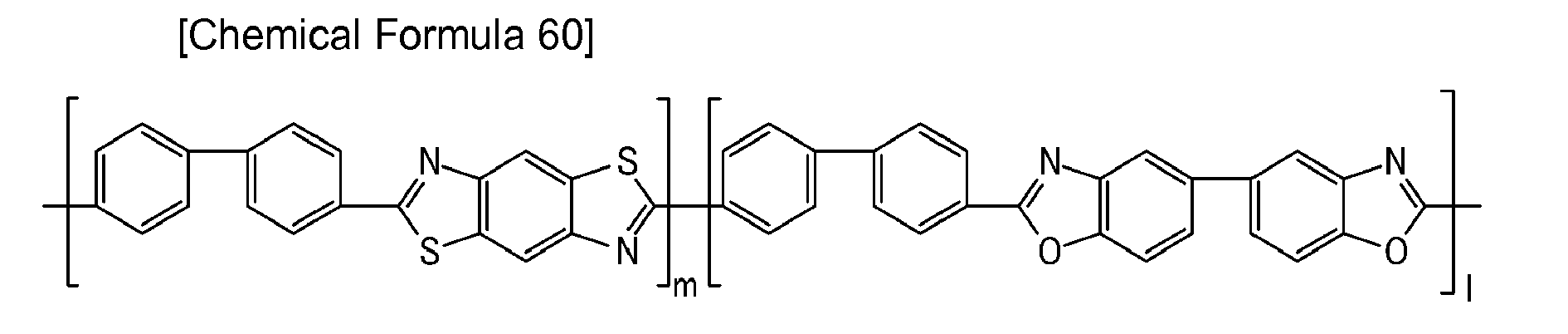
- The hollow fiber including a poly(benzoxazole-benzothiazole) copolymer (the mole ratio of m:l is 5:5) represented by the above
Chemical Formula 60 was prepared according to the same method as Example 1 except for preparing a polyimide-based copolymer by reacting 10.8 g (0.05 mol) of 3,3'-dihydroxybenzidine and 10.9 g (0.05 mol) of 2,5-diamino-1,4-benzenedithiol dihydrochloride as starting materials with 44.4 g (10 mmol) of 4,4'-(hexafluoroisopropylidene)diphthalic anhydride. - It had a weight average molecular weight of 13,750 and a polybenzoxazole characteristic band of 1595 cm-1(C=N), 1052 cm-1(C-N) and a polybenzothiazole characteristic band of 1484 cm-1(C-S), 1404 cm-1(C-S) from the result of FT-IR analysis which were not detected in polyimide. In addition, it had a fractional free volume of 0.16 and interplanar distance (d-spacing) of 580 pm.
- The interplanar distance (d-spacing) was measused by X-ray diffraction (XRD, CuKα ray, 10 to 40 degrees at 0.05 degree intervals, a film sample)
- A hollow fiber including a poly(pyrrolone-pyrrolone) copolymer according to the following Chemical Formula 61 was prepared through the following reaction.

- The hollow fiber including a poly(pyrrolone-pyrrolone) copolymer (the mole ratio of m:l is 8:2) represented by the above Chemical Formula 61 was prepared according to the same method as Example 1 except for preparing 34.2 g (0.16 mol) of 3,3'-diaminobenzidine and 11.4 g (0.04 mol) of benzene-1,2,4,5-tetraamine tetrahydrochloride a starting material with 88.8 g (20 mmol) of 4,4'-(hexafluoroisopropylidene)diphthalic anhydride.
- The hollow fiber had a weight average molecular weight of 64,820 and a polypyrrolone characteristic band of 1758 cm-1(C=O), 1625 cm-1(C=N) from the result of FT-IR analysis which were not detected in polyimide. In addition, it had a fractional free volume of 0.23 and interplanar distance (d-spacing) of 590 pm.
- The interplanar distance (d-spacing) was measused by X-ray diffraction (XRD, CuKα ray, 10 to 40 degrees at 0.05 degree intervals, a film sample)
- A hollow fiber including a poly(benzoxazole-benzothiazole) copolymer represented by the following Chemical Formula 62 was prepared through the following reaction.

- The hollow fiber including a poly(benzoxazole-benzothiazole) copolymer (herein, m: l in a mol ratio of 8:2) represented by the above Chemical Formula 62 was prepared according to the same method as Example 1 except for preparing a poly(hydroxyimide-thiolimide) copolymer by reacting 21.8 g (0.1 mol) of 2,5-diamino-1,4-benzenedithiol dihydrochloride as starting materials 36.6 g (0.16 mol) of 2,2-bis(3-amino-4-hydroxyphenyl)hexafluoropropane with 88.8g (20 mmol) of 4,4'-(hexafluoroisopropylidene)diphthalic anhydride.
- It had a weight average molecular weight of 46,790 and was identied to have a polybenzothiazole characteristic band of 1484 cm-1(C-S) 1404 cm-1(C-S) as well as a polybenzoxazole characteristic band of 1620 cm-1(C=N), 1058 cm-1(C-N) which were not detected in polyimide as a result of FT-IR analysis. The hollow fiber had a fractional free volume of 0.31 and interplanar distance (d-spacing) of 740 pm.
- The interplanar distance (d-spacing) was measused by X-ray diffraction (XRD, CuKα ray, 10 to 40 degrees at 0.05 degree intervals, a film sample)
- A hollow fiber was prepared according to the same method as Example 1 except for preparing a homogenous solution by adding 5 wt% of tetrahydrofuran and 15 wt% of propyleneglycol as additives.
- The hollow fiber had a weight average molecular weight of 48,960 and was identified to have a polybenzoxazole characteristic band of 1620 cm-1(C=N), 1058 cm-1(C-N) which were not detected in polyimide as a result of FT-IR analysis. The hollow fiber had fractional free volume of 0.32 and interplanar distance (d-spacing) of 730 pm.
- The interplanar distance (d-spacing) was measused by X-ray diffraction (XRD, CuKα ray, 10 to 40 degrees at 0.05 degree intervals, a film sample)
- A hollow fiber was prepared according to the same method as Example 1 except for preparing a homogenous solution by adding 5 wt% of tetrahydrofuran and 15 wt% of ethanol as an additive to prepare a homogenous solution.
- The hollow fiber had a weight average molecular weight of 48,960 and was identified to have a polybenzoxazole characteristic band of 1620 cm-1(C=N), 1058 cm-1(C-N) which were not detected in polyimide from a result of FT-IR analysis. The hollow fiber had a fractional free volume of 0.33 and interplanar distance (d-spacing) of 740 pm.
- The interplanar distance (d-spacing) was measused by X-ray diffraction (XRD, CuKα ray, 10 to 40 degrees at 0.05 degree intervals, a film sample)
- A hollow fiber was prepared according to the same method as Example 1 except for preparing a homogenous solution by adding and mixing 15 wt% of polyethyleneglycol additive (Aldrich, molecular weight 2000) as a pore-controlling agent.
- The hollow fiber had a weight average molecular weight of 48,960 and a polybenzoxazole characteristic band of 1620 cm-1(C=N), 1058 cm-1(C-N) from the result of FT-IR analysis which were not detected in polyimide. In addition, it had a fractional free volume of 0.33 and interplanar distance (d-spacing) of 730 pm.
- The interplanar distance (d-spacing) was measused by X-ray diffraction (XRD, CuKα ray, 10 to 40 degrees at 0.05 degree intervals, a film sample)
- A hollow fiber was prepared according to the same method as in Example 1 except for heat treatment at 450°C for 30 minutes heat treatment.
- The hollow fiber had a weight average molecular weight of 48,960 and a polybenzoxazole characteristic band of 1620 cm-1(C=N), 1058 cm-1(C-N) from the result of FT-IR analysis which were not detected in polyimide. In addition, the hollow fiber had a fractional free volume of 0.29 and interplanar distance (d-spacing) of 680 pm.
- The interplanar distance (d-spacing) was measused by X-ray diffraction (XRD, CuKα ray, 10 to 40 degrees at 0.05 degree intervals, a film sample)
- A hollow fiber was prepared according to the same method as Example except ofr heat treatment at 400°C for 30 minutes.
- The hollow fiber had a weight average molecular weight of 48,960 and a polybenzoxazole characteristic band of 1620 cm-1(C=N), 1058 cm-1(C-N) from the result of FT-IR analysis which were not detected in polyimide. In addition, the hollow fiber had a fractional free volume of 0.24 and interplanar distance (d-spacing) of 590 pm.
- The interplanar distance (d-spacing) was measused by X-ray diffraction (XRD, CuKα ray, 10 to 40 degrees at 0.05 degree intervals, a film sample)
- As disclosed in Korean Patent laid open No.
2002-0015749 - A hollow fiber was prepared according to the same method as Example 1 except for not performing heat treatment process.
- According to the
PCT publication No. WO2005/007277 , 4,4'-diaminodiphenylether (ODA) was reacted with benzophenone tetracarboxylic acid dianhydride (BTDA) to prepare polyamic acid (PAA). 19wt% of the polyamic acid (PAA) was dissolved in N-methylpyrrolidone (NMP) to prepare a solution. Next, 50 wt% of polyvinylpyrrolidone (PVP) was dissolved in N-methylpyrrolidone to prepare an additive solution and added to the polyamic acid (PAA) solution. Then, glycerol (GLY) and N-methylpyrrolidone (NMP) were added to the solution. The final solution included polyamic acid/polyvinylpyrrolidone/- glycerol/N-methylpyrrolidone (PAA/PVP/GLY/NMP) respectively in an amount ratio of 13/1/17/69 wt%. The spinning solution was mixed for 12 hours before spinning. - Next, 20°C water was used as an internal coagulant, and then, the spinning solution was discharged through spinnerette. The internal coagulant was injected at a flow rate of 12 ml/min. Then, a hollow fiber was spinned at a speed of 4 cm/s, so that it can just stay for 6 seconds in an air cap. Herein, a membrane was solidified in 30°C 100% water. Next, it was washed with water for 2 to 4 hours until a remaining solvent and glycerol were completely extracted at a room temperature. Then, it was dried in air. It was imidized in a nitrogen purged oven. Next, it was heated up to 150°C for 3 hours, heated at 150°C for 1 hour, heated up to 250°C for 2 hours, kept being heated at 250°C for 2 hours, and slowly cooled down at a room temperature for 4 hours. The polyimide/PVP membrane had an exterior diameter of 2.2 mm and a thickness of 0.3 mm.
-
FIGS. 1, 2, and 3 show 300x, 1,500x, and 5,000x magnification electron-scanning microscope photographs of the partcial cross-section of the hollow fiber according to Example 1. -
FIGS. 4, 5, and 6 show 120x, 600x, and 2,000x magnification electron-scanning microscope photographs of the partcial cross-section of the hollow fiber according to Example 8. - Referring to
FIGS. 1 to 6 , the hollow fiber according to one embodiment of the present invention had no defect on the surface of the dense layer. - The hollow fibers according to Example 1 to 18 and Comparative Example 1 to 3 were evaluated as follows regarding gas permeability and selectivity. The results are provided in Table 1.
- The gas permeance is a gas permeability speed against a membrane measured by fabricating a separation membrane module for gas permeance with a hollow fiber and measuring a gas permeance amount by the following
Equation 1. As for a gas permeance unit, used is GPU (Gas Permeation Unit, 1 ×10⁻⁶ cm3/cm2.sec.cmHg). - The selectivity was indicated as a permeance ratio obtained by measuring an individual gas against the same membrane.

- In the
Equation 1, - P indicates gas permeance, dp/dt indicates a pressure increase rate, V indicates a lower volume, and Pf indicates difference between upper and lower pressures.
- T indicates a temperature during the mesurement, Aeff indicates an effective area, and P0 and To indicate standard pressure and temperature.
Table 1 H2 permeance (GPU) O2 permeance (GPU) CO2 permeance (GPU) O2/N2 selectivity CO2/CH4 selectivity Example 1 542 136 619 5.9 37.7 Example 2 1680 630 2280 4.0 20.2 Example 3 1270 286 985 5.8 20.1 Example 4 116 59 115 4.5 35.9 Example 5 131 19.2 86 7.7 41.0 Example 6 292 61 216 5.2 24.3 Example 7 165 31 167 6.0 40.7 Example 8 215 37 138 6.0 35.4 Example 9 85 19 97 4.6 34.6 Example 10 615 119 227 4.6 26.1 Example 11 86 27 48 7.1 30.0 Example 12 419 95 519 5.3 37.1 Example 13 1320 368 1125 5.3 27.4 Example 14 875 151 516 4.7 22.7 Example 15 1419 227 1619 4.0 34.4 Example 16 1824 418 2019 4.3 28.4 Example 17 211 41 211 4.7 50.2 Example 18 35 2.6 10 7.0 29.7 Comparative Example 1 65 16 52 5.0 31.1 Comparative Example 2 21.7 1.42 23.6 4.9 20.7 Comparative Example 3 12.1 0.66 2.47 6.0 30.9 - Referring to Table 1, a hollow fiber according to Examples 1 to 18 of the present invention had excellent gas permeance against gas such as H2, O2, CO2, and the like compared with the one of Comparative Examples 1 to 3.
-
FIG. 8 is a graph showing oxygen permeance and oxygen/nitrogen selectivity comparison of GPU units of the hollow fibers according to Example 1 to 18 and Comparative Example 1 to 3. -
FIG. 9 is a graph showing carbon dioxide permeance and carbon dioxide/methane selectivity comparison of GPU units of the hollow fibers according to Example 1 to 18 and Comparative Examples 1 to 3. - Referring to
FIGS. 8 and9 , the hollow fiber according to Examples of the present invention had similar oxygen/nitrogen selectivity or carbon dioxide/methane selectivity to those of Comparative Examples but excellent permeance. - While this invention has been described in connection with what is presently considered to be practical exemplary embodiments, it is to be understood that the invention is not limited to the disclosed embodiments, but, on the contrary, is intended to cover various modifications and equivalent arrangements included within the spirit and scope of the appended claims.
Claims (50)
- A hollow fiber comprising:a hollow positioned at the center of the hollow fiber,macropores positioned at adjacent to the hollow, andmesopores and picopores positioned at adjacent to macroporeswherein the picopores are three dimensionally connected to each other to form a three dimensional network structure,the hollow fiber comprises a polymer derived from polyimide, andthe polyimide comprises a repeating unit obtained from aromatic diamine including at least one ortho-positioned functional group with respect to an amine group and dianhydride.
- The hollow fiber of claim 1, wherein the hollow fiber comprises a dense layer including picopores at a surface portion.
- The hollow fiber of claim 2, wherein the dense layer has a structure where the number of the picopores increases as near to the surface of the hollow fiber.
- The hollow fiber of claim 1, wherein the three dimensional network structure where at least two picopores are three-dimensionally connected comprises an hourglass shaped structure forming a narrow valley at connection parts.
- The hollow fiber of claim 1, wherein the ortho-positioned functional group comprises OH, SH, or NH2.
- The hollow fiber of claim 1, wherein the polymer has a fractional free volume (FFV) of 0.15 to 0.40.
- The hollow fiber of claim 1, wherein the polymer has interplanar distance (d-spacing) of 580 pm to 800 pm measured by X-ray diffraction (XRD).
- The hollow fiber of claim 1, wherein the polymer comprsies picopores,
and
the picopores has a full width at half maximum (FWHM) of 10 pm to 40 pm measured by positron annihilation lifetime spectroscopy (PALS). - The hollow fiber of claim 1, wherein the polymer has a BET (Brunauer, Emmett, Teller) surface area of 100 to 1,000 m2/g.
- The hollow fiber of claim 1, wherein the polyimide is selected from the group consisting of polyimide represented by the following Chemical Formulae 1 to 4, polyimide copolymers represented by the following Chemical Formulae 5 to 8, copolymers thereof, and blends thereof:


Ar1 is an aromatic group selected from a substituted or unsubstituted quadrivalent C6 to C24 arylene group and a substituted or unsubstituted quadrivalent C4 to C24 heterocyclic group, where the aromatic group is present singularly; at least two aromatic groups are fused to form a condensed cycle; or at least two aromatic groups are linked by single bond or a functional group selected from O, S, C(=O), S(=O)2, Si(CH3)2, (CH2)p (where 1≤p≤10), (CF2)q (where 1≤q≤10), C(CH3)2, C(CF3)2, or C(=O)NH,
Ar2 is an aromatic group selected from a substituted or unsubstituted divalent C6 to C24 arylene group and a substituted or unsubstituted divalent C4 to C24 heterocyclic group, where the aromatic group is present singularly;
at least two aromatic groups are fused to form a condensed cycle; or at least two aromatic groups are linked by single bond or a functional group selected from O, S, C(=O), S(=O)2, Si(CH3)2, (CH2)p (where 1≤p≤10), (CF2)q (where 1≤q≤10), C(CH3)2, C(CF3)2, or C(=O)NH,
Q is O, S, C(=O), CH(OH), S(=O)2, Si(CH3)2, (CH2)p (where 1≤p≤10), (CF2)q (where 1≤q≤10), C(CH3)2, C(CF3)2, C(=O)NH, C(CH3)(CF3), or a substituted or unsubstituted phenylene group (where the substituted phenylene group is a phenylene group substituted with a C1 to C6 alkyl group or a C1 to C6 haloalkyl group), where the Q is linked with aromatic groups with m-m, m-p, p-m, or p-p positions,
Y is the same or different from each other in each repeating unit and independently selected from OH, SH, or NH2,
n is an integer ranging from 20 to 200,
m is an integer ranging from 10 to 400, and
I is an integer ranging from 10 to 400. - The hollow fiber of claim 10, wherein Ar1 is selected from one of the following Chemical Formulae:
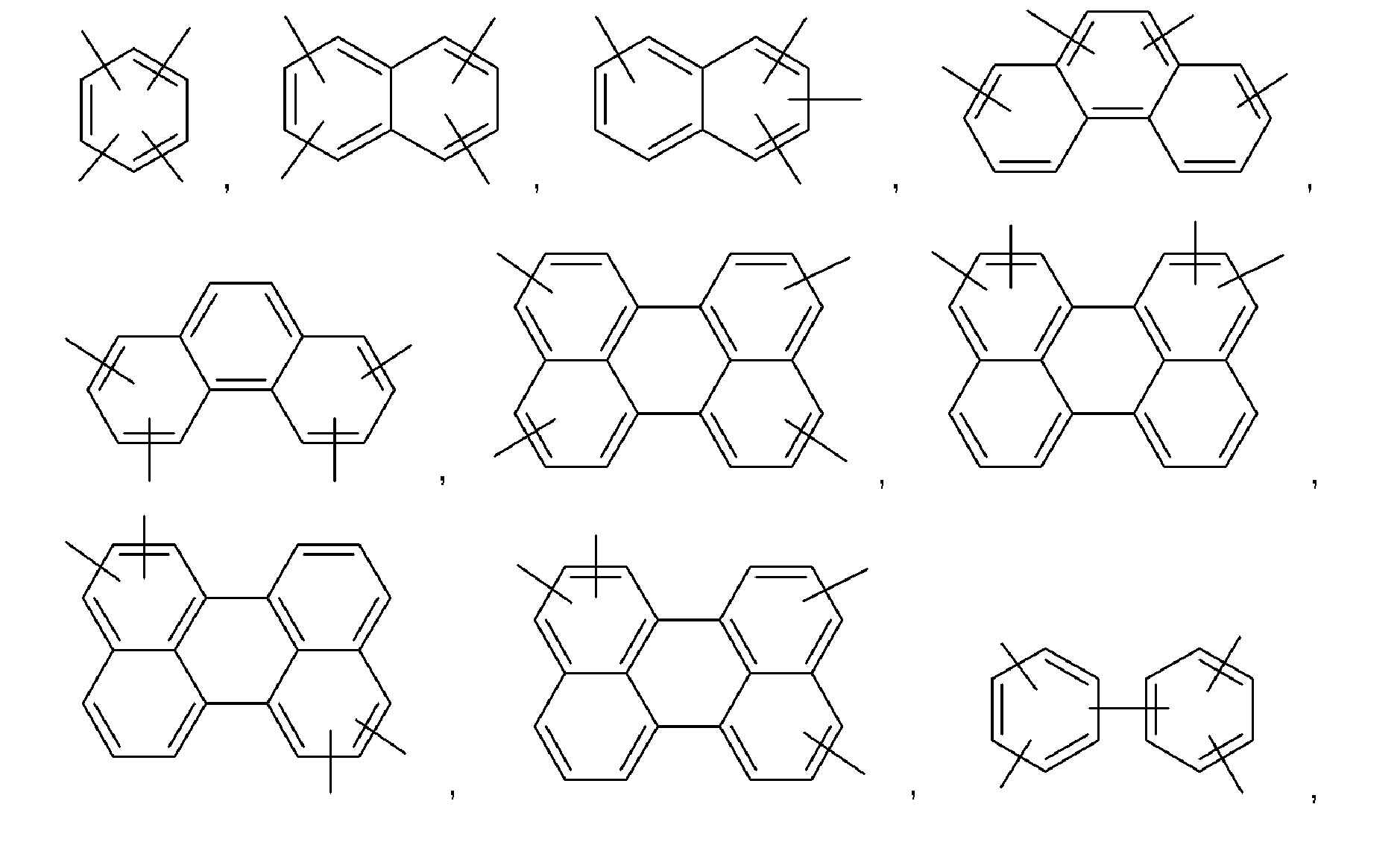
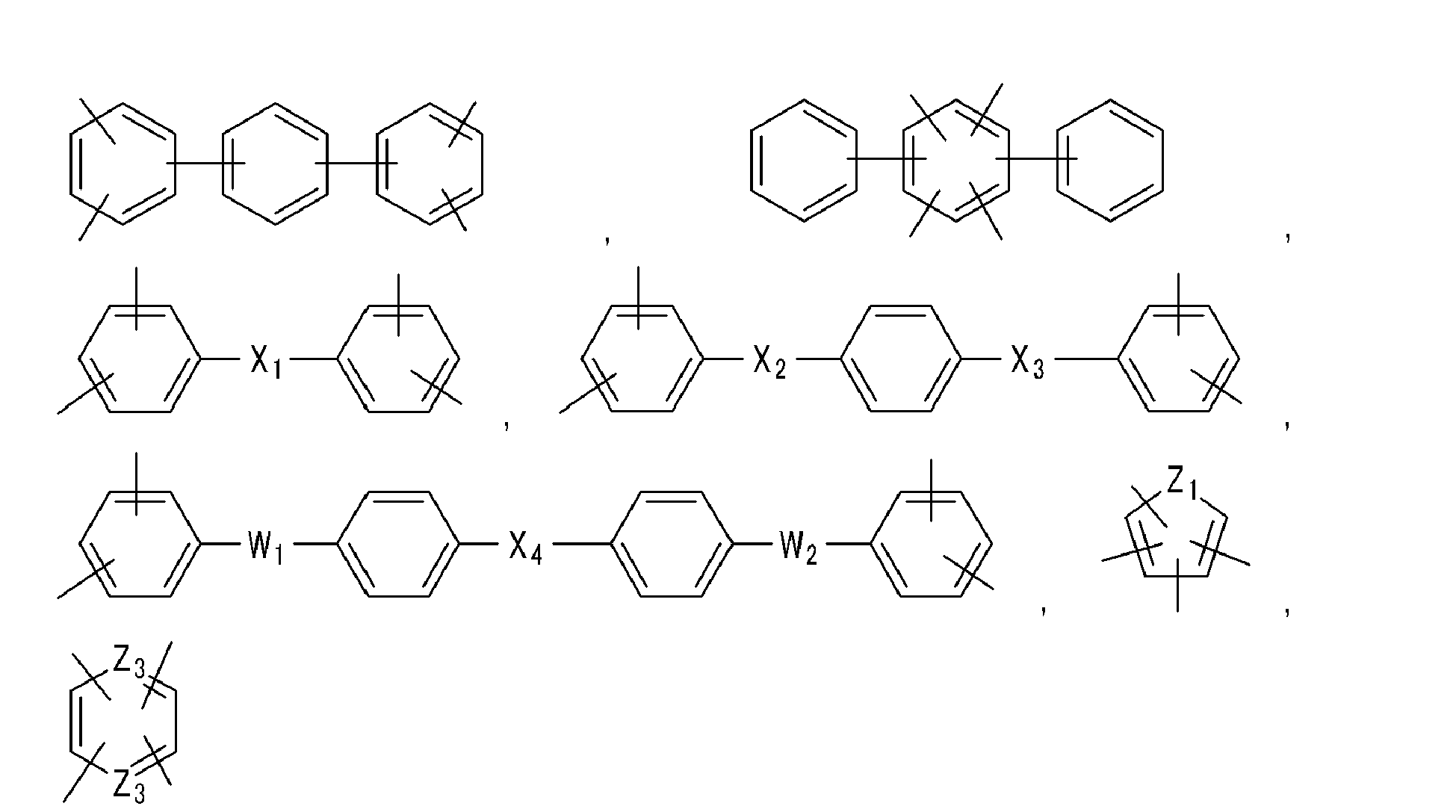
X1, X2, X3, and X4 are the same or different and independently O, S, C(=O), CH(OH), S(=O)2, Si(CH3)2, (CH2)p (where 1≤p≤10), (CF2)q (where 1≤q≤10), C(CH3)2, C(CF3)2, or C(=O)NH,
W1 and W2 are the same or different, and independently O, S, or C(=O),
Z1 is O, S, CR1R2 or NR3, where R1, R2, and R3 are the same or different from each other and independently hydrogen or a C1 to C5 alkyl group, and
Z2 and Z3 are the same or different from each other and independently N or CR4 (where, R4 is hydrogen or a C1 to C5 alkyl group), provided that both Z2 and Z3 are not CR4. - The hollow fiber of claim 11, wherein Ar1 is selected from one of the following Chemical Formulae:
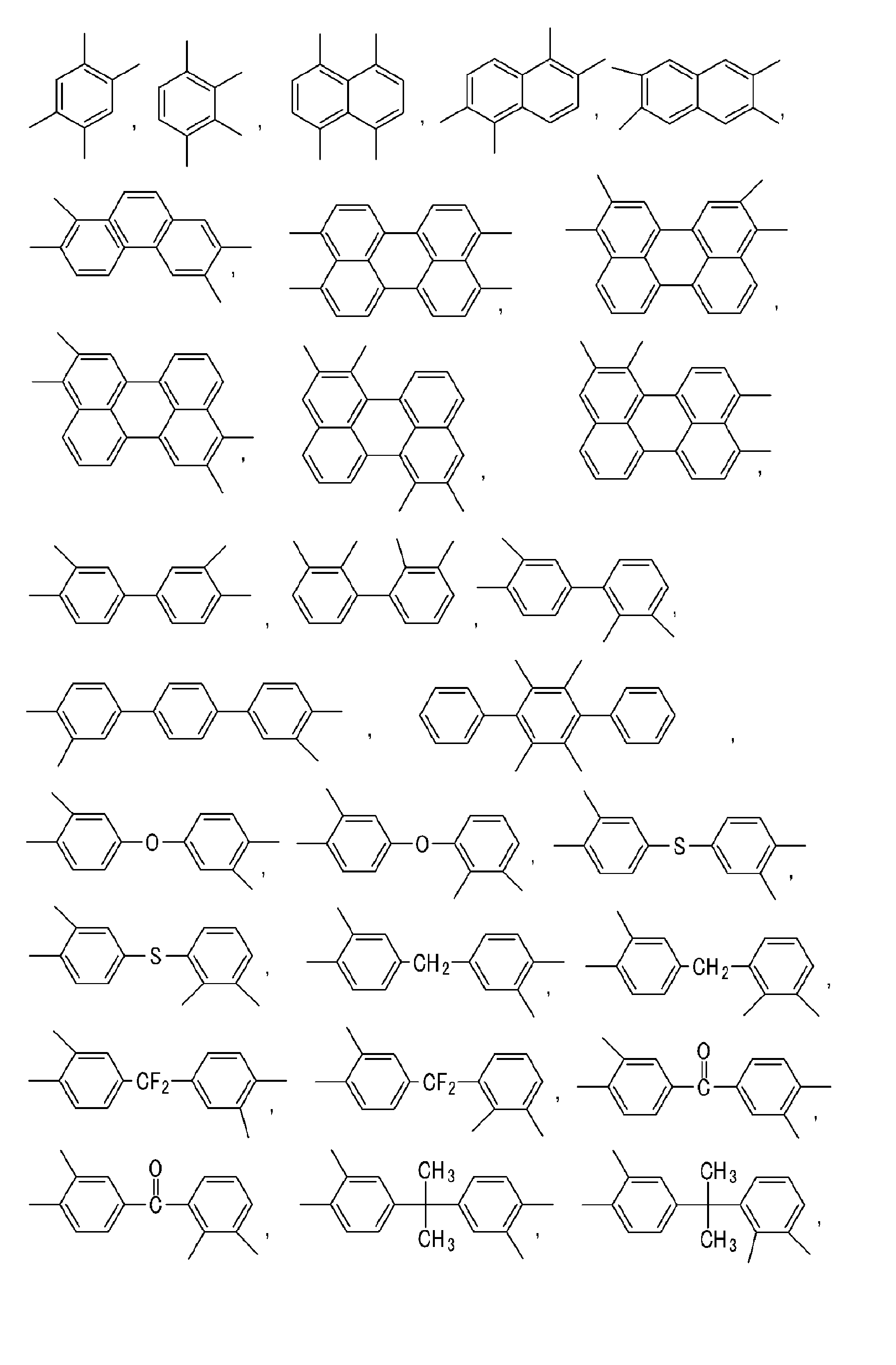

- The hollow fiber of claim 10, wherein Ar2 is selected from one of the following Chemical Formulae:


X1, X2, X3, and X4 are the same or different, and independently O, S, C(=O), CH(OH), S(=O)2, Si(CH3)2, (CH2)p (where 1≤p≤10), (CF2)q (where 1≤q≤10), C(CH3)2, C(CF3)2, or C(=O)NH,
W1 and W2 are the same or different, and independently O, S, or C(=O),
Z1 is O, S, CR1R2 or NR3, where R1, R2 and R3 are the same or different from each other and independently hydrogen or a C1 to C5 alkyl group, and
Z2 and Z3 are the same or different from each other and independently N or CR4 (where, R4 is hydrogen or a C1 to C5 alkyl group), provided that both Z2 and Z3 are not CR4. - The hollow fiber of claim 13, wherein Ar2 is selected from one of the following Chemical Formulae:


- The hollow fiber of claim 10, wherein Q is selected from C(CH3)2, C(CF3)2, O, S, S(=O)2, or C(=O).
- The hollow fiber of claim 10, wherein Ar1 is a functional group represented by the following Chemical Formula A, B, or C, Ar2 is a functional group represented by the following Chemical Formula D or E, and Q is C(CF3)2:


- The hollow fiber of claim 10, wherein a mole ratio of each repeating unit represented by the above Chemical Formulae 1 to 4 in the polyimide copolymers or an m:l mole ratio in the above Chemical Formula 5 to Chemical Formula 8 ranges from 0.1:9.9 to 9.9:0.1.
- The hollow fiber of claim 1, wherein the polymer comprises a polymer represented by one of the following Chemical Formulae 19 to 32, or copolymers thereof:


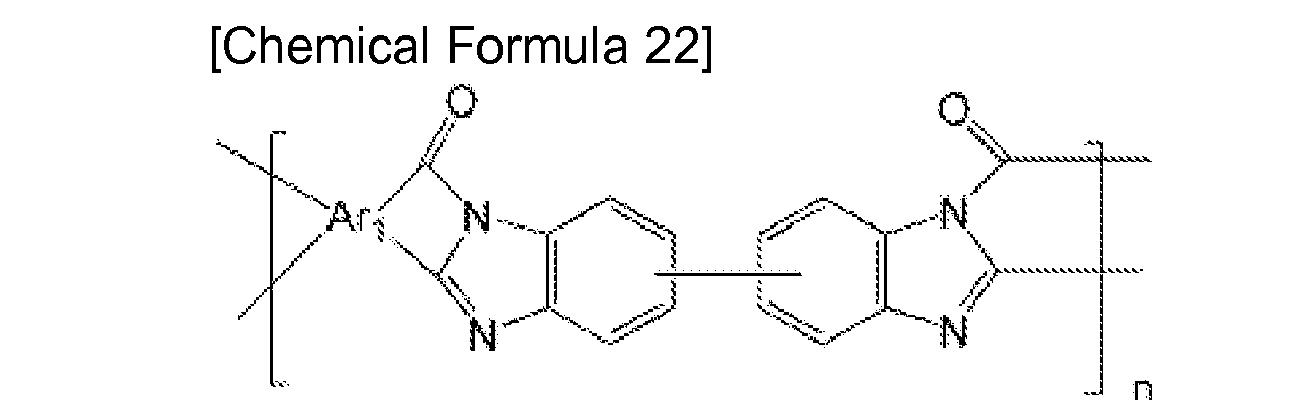


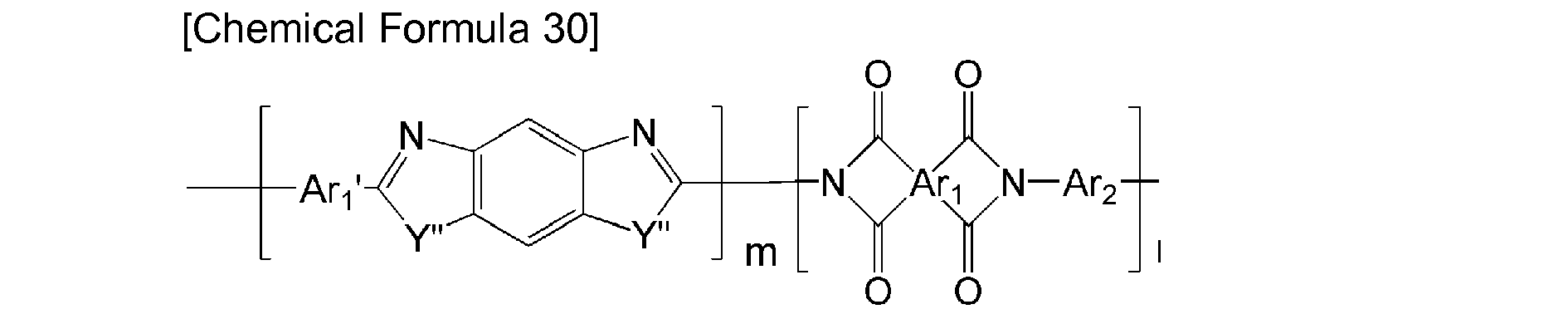

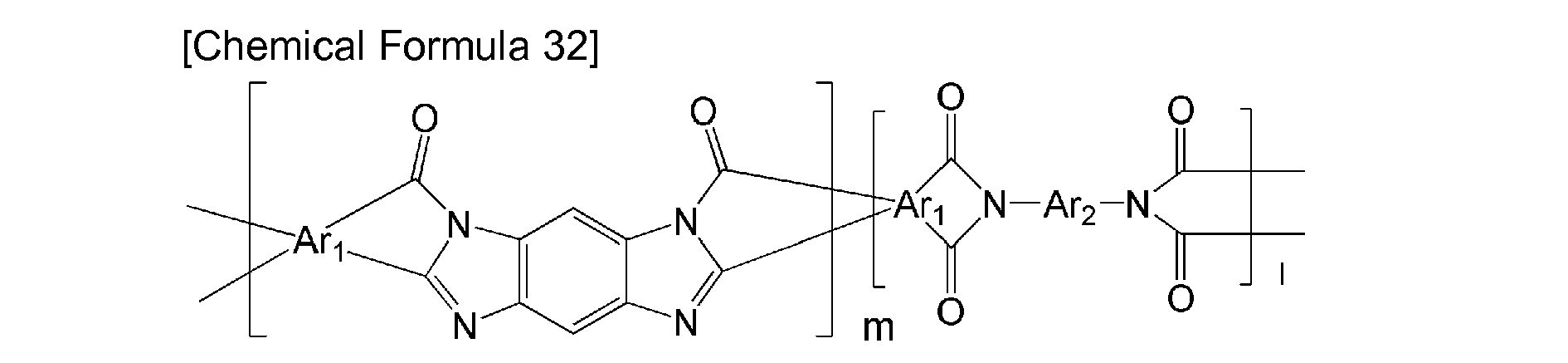
Ar1 is an aromatic group selected from a substituted or unsubstituted quadrivalent C6 to C24 arylene group and a substituted or unsubstituted quadrivalent C4 to C24 heterocyclic group, where the aromatic group is present singularly; at least two aromatic groups are fused to form a condensed cycle; or at least two aromatic groups are linked by single bond or a functional group selected from O, S, C(=O), S(=O)2, Si(CH3)2, (CH2)p (where 1≤p≤10), (CF2)q (where 1≤q≤10), C(CH3)2, C(CF3)2, or C(=O)NH,
Ar1' and Ar2 are the same or different, and independently an aromatic group selected from a substituted or unsubstituted divalent C6 to C24 arylene group and a substituted or unsubstituted divalent C4 to C24 heterocyclic group, where the aromatic group is present singularly; at least two aromatic groups are fused to form a condensed cycle; or at least two aromatic groups are linked by single bond or a functional group selected from O, S, C(=O), S(=O)2, Si(CH3)2, (CH2)p (where 1≤p≤10), (CF2)q (where 1≤q≤10), C(CH3)2, C(CF3)2, or C(=O)NH,
Q is O, S, C(=O), CH(OH), S(=O)2, Si(CH3)2, (CH2)p (where 1≤p≤10), (CF2)q (where 1≤q≤10), C(CH3)2, C(CF3)2, C(=O)NH, C(CH3)(CF3), or a substituted or unsubstituted phenylene group (where the substituted phenylene group is a phenylene group substituted with a C1 to C6 alkyl group or a C1 to C6 haloalkyl group), where the Q is linked with aromatic groups with m-m, m-p, p-m, or p-p positions,
Y" is O or S,
n is an integer ranging from 20 to 200,
m is an integer ranging from 10 to 400, and
I is an integer ranging from 10 to 400. - The hollow fiber of claim 18, wherein Ar1 is selected from the following Chemical Formulae:

X1, X2, X3, and X4 are the same or different and independently O, S, C(=O), CH(OH), S(=O)2, Si(CH3)2, (CH2)p (where 1≤p≤10), (CF2)q (where 1≤q≤10), C(CH3)2, C(CF3)2, or C(=O)NH,
W1 and W2 are the same or different, and independently O, S, or C(=O),
Z1 is O, S, CR1R2 or NR3, where R1, R2, and R3 are the same or different from each other and independently hydrogen or a C1 to C5 alkyl group, and
Z2 and Z3 are the same or different from each other and independently N or CR4 (where, R4 is hydrogen or a C1 to C5 alkyl group), provided that both Z2 and Z3 are not CR4. - The hollow fiber of claim 19, wherein Ar1 is selected from one of the following Chemical Formulae:


- The hollow fiber of claim 18, wherein Ar1' and Ar2 are selected from one of the following Chemical Formulae:

X1, X2, X3, and X4 are the same or different, and independently O, S, C(=O), CH(OH), S(=O)2, Si(CH3)2, (CH2)p (where 1≤p≤10), (CF2)q (where 1≤q≤10), C(CH3)2, C(CF3)2, or C(=O)NH,
W1 and W2 are the same or different, and independently O, S, or C(=O),
Z1 is O, S, CR1R2 or NR3, where R1, R2 and R3 are the same or different from each other and independently hydrogen or a C1 to C5 alkyl group, and
Z2 and Z3 are the same or different from each other and independently N or CR4 (where, R4 is hydrogen or a C1 to C5 alkyl group), provided that both Z2 and Z3 are not CR4. - The hollow fiber of claim 21, wherein Ar1' and Ar2 are selected from one of the following Chemical Formulae:


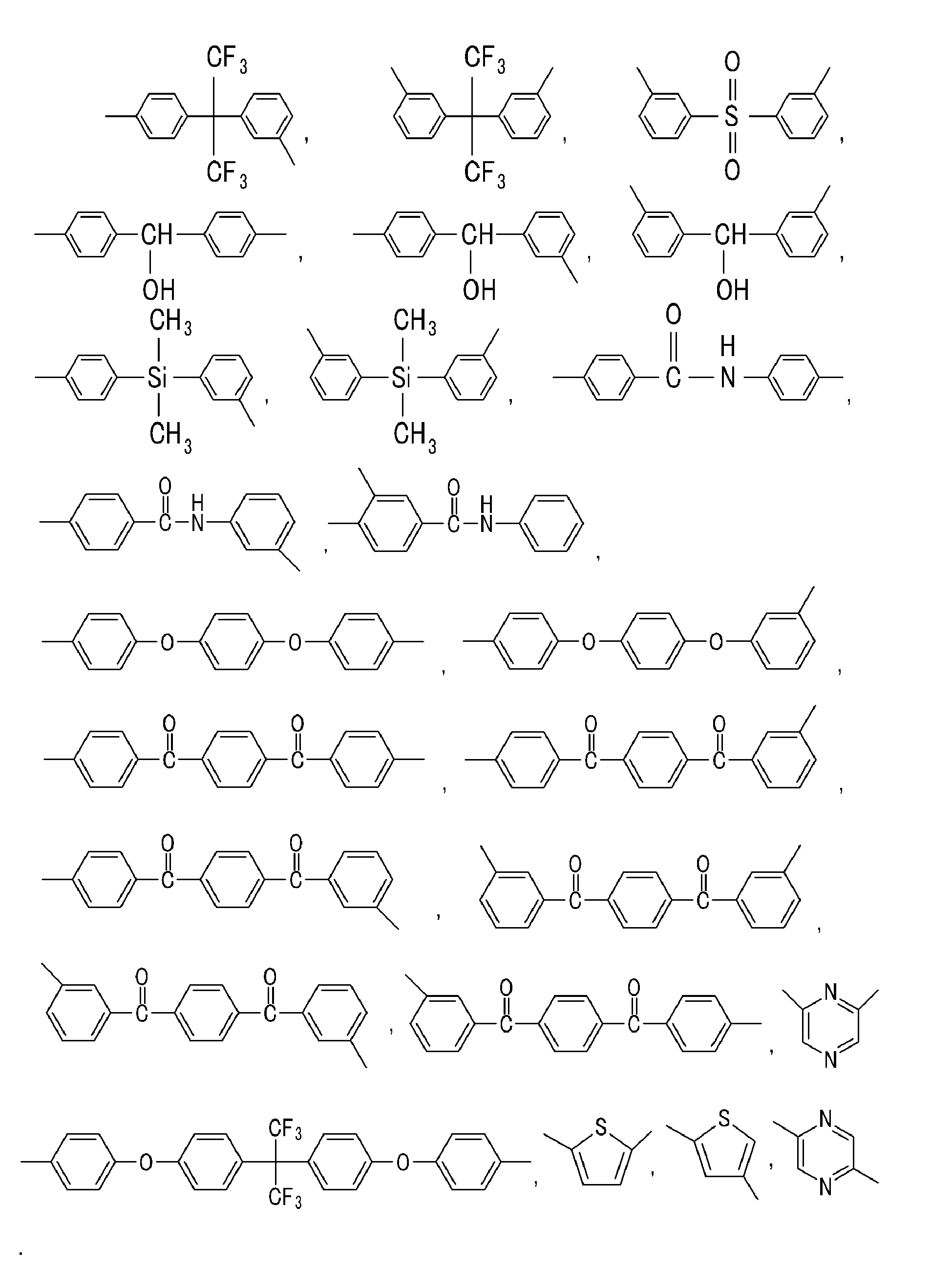
- The hollow fiber of claim 18, wherein Q is selected from C(CH3)2, C(CF3)2, O, S, S(=O)2, or C(=O).
- The hollow fiber of claim 18, wherein Ar1 is a functional group represented by the following Chemical Formula A, B, or C, Ar1' is a functional group represented by the following Chemical Formula F, G, or H, Ar2 is a functional group represented by the following Chemical Formula D or E, and Q is C(CF3)2:


- The hollow fiber of claim 1, wherein the hollow fiber is applicable for separating at least one gas selected from the group consisting of He, H2, N2, CH4, O2, N2, CO2, and combinations thereof.
- The hollow fiber of claim 25, wherein the hollow fiber has O2/N2 selectivity of 4 or more, CO2/CH4 selectivity of 30 or more, H2/N2 selectivity of 30 or more, H2/CH4 selectivity of 50 or more, CO2/N2 selectivity of 20 or more, and He/N2 selectivity of 40 or more.
- The hollow fiber of claim 26, wherein the hollow fiber has O2/N2 selectivity of 4 to 20, CO2/CH4 selectivity of 30 to 80, H2/N2 selectivity of 30 to 80, H2/CH4 selectivity of 50 to 90, CO2/N2 selectivity of 20 to 50, and He/N2 selectivity of 40 to 120.
- A dope solution composition for forming a hollow fiber comprising:polyimide including a repeating unit prepared from aromatic diamine including at least one ortho-positioned functional group and dianhydride;an organic solvent; andan additive,wherein the organic solvent is selected from the group consisting of dimethylsulfoxide; N-methyl-2-pyrrolidone; N-methylpyrrolidone; N,N-dimethyl formamide; N,N-dimethyl acetamide; ketone selected from the group consisting of γ-butyrolactone, cyclohexanone, 3-hexanone, 3-heptanone, and 3-octanone; and combinations thereof, andthe additive is water; alcohols selected from the group consisting of methanol, ethanol, 2-methyl-1-butanol, 2-methyl-2-butanol, glycerol, ethyleneglycol, diethyleneglycol and propyleneglycol; ketones selected from the group consisting of acetone and methyl ethyl ketone; polymer compounds selected from the group consisting of polyvinyl alcohol, polyacrylic acid, polyacryl amide, polyethylene glycol, polypropylene glycol, chitosan, chitin, dextran, and polyvinylpyrrolidone; salts selected from the group consisting of lithium chloride, sodium chloride, calcium chloride, lithium acetate, sodium sulfate, and sodium hydroxide; tetrahydrofuran; trichloroethane; and mixtures thereof.
- The dope solution composition of claim 28, wherein the ortho-positioned functional group comprises OH, SH, or NH2.
- The dope solution composition of claim 28, wherein the composition comprises 10 to 45 wt% of the polyimide, 25 to 70 wt% of the organic solvent, and 2 to 30 wt% of the the additive.
- The dope solution composition of claim 28, wherein the dope solution composition has a viscosity of 2 Pa-s to 200 Pa.s.
- The dope solution composition of claim 28, wherein the polyimide has a weight average molecular weight (Mw) of 10,000 to 200,000.
- The dope solution composition of claim 28, wherein the polyimide is selected from the group consisting of polyimide represented by the following Chemical Formulae 1 to 4, polyimide copolymers represented by the following Chemical Formulae 5 to 8, copolymers thereof, and blends thereof:


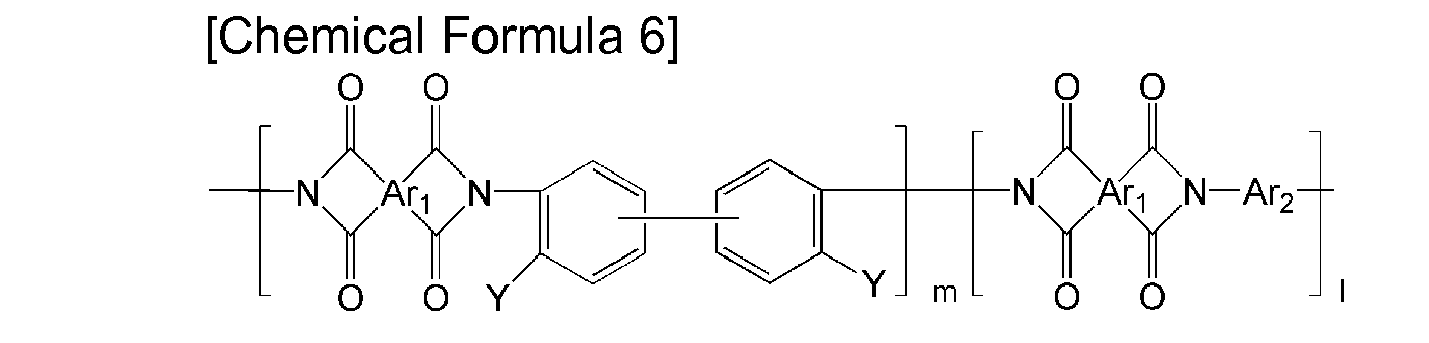
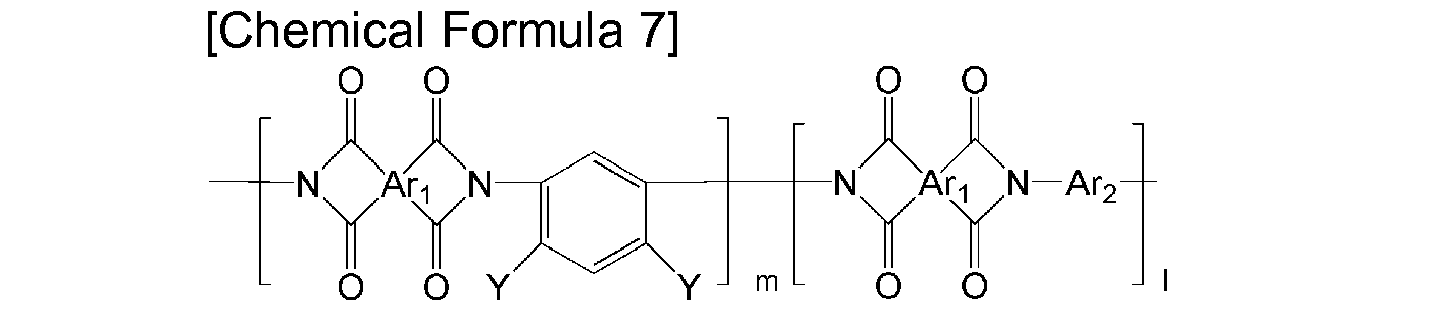

Ar1 is an aromatic group selected from a substituted or unsubstituted quadrivalent C6 to C24 arylene group and a substituted or unsubstituted quadrivalent C4 to C24 heterocyclic group, where the aromatic group is present singularly; at least two aromatic groups are fused to form a condensed cycle; or at least two aromatic groups are linked by single bond or a functional group selected from O, S, C(=O), S(=O)2, Si(CH3)2, (CH2)p (where 1≤p≤10), (CF2)q (where 1≤q≤10), C(CH3)2, C(CF3)2, or C(=O)NH,
Ar2 is an aromatic group selected from a substituted or unsubstituted divalent C6 to C24 arylene group and a substituted or unsubstituted divalent C4 to C24 heterocyclic group, where the aromatic group is present singularly; at least two aromatic groups are fused to form a condensed cycle; or at least two aromatic groups are linked by single bond or a functional group selected from O, S, C(=O), S(=O)2, Si(CH3)2, (CH2)p (where 1≤p≤10), (CF2)q (where 1≤q≤10), C(CH3)2, C(CF3)2, or C(=O)NH,
Q is O, S, C(=O), CH(OH), S(=O)2, Si(CH3)2, (CH2)p (where 1≤p≤10), (CF2)q (where 1≤q≤10), C(CH3)2, C(CF3)2, C(=O)NH, C(CH3)(CF3), or a substituted or unsubstituted phenylene group (where the substituted phenylene group is a phenylene group substituted with a C1 to C6 alkyl group or a C1 to C6 haloalkyl group), where the Q is linked with aromatic groups with m-m, m-p, p-m, or p-p positions,
Y is the same or different from each other in each repeating unit and independently selected from OH, SH, or NH2,
n is an integer ranging from 20 to 200,
m is an integer ranging from 10 to 400, and
I is an integer ranging from 10 to 400. - The dope solution composition of claim 33, wherein Ar1 is selected from one of the following Chemical Formulae:

X1, X2, X3, and X4 are the same or different and independently O, S, C(=O), CH(OH), S(=O)2, Si(CH3)2, (CH2)p (where 1≤p≤10), (CF2)q (where 1≤q≤10), C(CH3)2, C(CF3)2, or C(=O)NH,
W1 and W2 are the same or different, and independently O, S, or C(=O),
Z1 is O, S, CR1R2 or NR3, where R1, R2, and R3 are the same or different from each other and independently hydrogen or a C1 to C5 alkyl group, and
Z2 and Z3 are the same or different from each other and independently N or CR4 (where, R4 is hydrogen or a C1 to C5 alkyl group), provided that both Z2 and Z3 are not CR4. - The dope solution composition of claim 34, wherein Ar1 is selected from one of the following Chemical Formulae:


- The dope solution composition of claim 33, wherein Ar2 is selected from one of the following Chemical Formulae:

X1, X2, X3, and X4 are the same or different, and independently O, S, C(=O), CH(OH), S(=O)2, Si(CH3)2, (CH2)p (where 1≤p≤10), (CF2)q (where 1≤q≤10), C(CH3)2, C(CF3)2, or C(=O)NH,
W1 and W2 are the same or different, and independently O, S, or C(=O),
Z1 is O, S, CR1R2 or NR3, where R1, R2 and R3 are the same or different from each other and independently hydrogen or a C1 to C5 alkyl group, and
Z2 and Z3 are the same or different from each other and independently N or CR4 (where, R4 is hydrogen or a C1 to C5 alkyl group), provided that both Z2 and Z3 are not CR4. - The dope solution composition of claim 36, wherein Ar2 is selected from one of the following Chemical Formulae:


- The dope solution composition of claim 33, wherein Q is selected from C(CH3)2, C(CF3)2, O, S, S(=O)2, or C(=O).
- The dope solution composition of claim 33, wherein Ar1 is a functional group represented by the following Chemical Formula A, B, or C, Ar2 is a functional group represented by the following Chemical Formula D or E, and Q is C(CF3)2:


- The dope solution composition of claim 33, wherein a mole ratio of each repeating unit represented by the above Chemical Formulae 1 to 4 in the polyimide copolymers or an m: l mole ratio in the above Chemical Formula 5 to Chemical Formula 8 ranges from 0.1:9.9 to 9.9:0.1.
- A method for manufacturing a hollow fiber, comprising spinning a dope solution composition for forming a hollow fiber according to one of claim 28 to claim 40 to prepare a polyimide hollow fiber;
and
heat-treating the polyimide hollow fiber to obtain a hollow fiber including thermally rearranged polymer,
wherein the hollow fiber comprises
a hollow positioned at the center of the hollow fiber,
macropores positioned at adjacent to the hollow, and
mesopores and picopores positioned at adjacent to macropores, and the picopores are three dimensionally connected to each other to form a three dimensional network structure. - The method of claim 41, wherein the thermally rearranged polymer comprises a polymer represented by one of the following Chemical Formulae 19 to 32, or copolymers thereof:


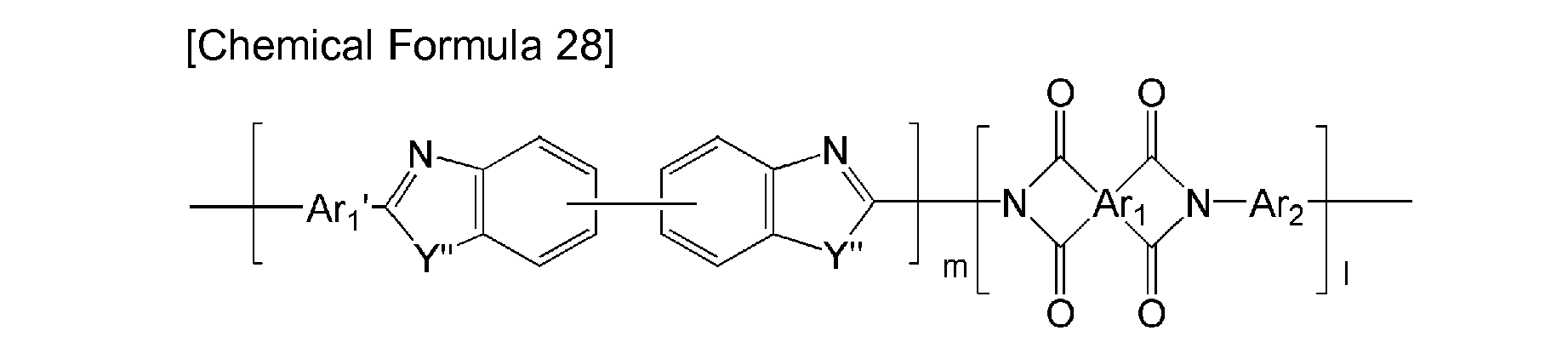


Ar1 is an aromatic group selected from a substituted or unsubstituted quadrivalent C6 to C24 arylene group and a substituted or unsubstituted quadrivalent C4 to C24 heterocyclic group, where the aromatic group is present singularly; at least two aromatic groups are fused to form a condensed cycle; or at least two aromatic groups are linked by single bond or a functional group selected from O, S, C(=O), S(=O)2, Si(CH3)2, (CH2)p (where 1≤p≤10), (CF2)q (where 1≤q≤10), C(CH3)2, C(CF3)2, or C(=O)NH,
Ar1' and Ar2 are the same or different, and are independently an aromatic group selected from a substituted or unsubstituted divalent C6 to C24 arylene group and a substituted or unsubstituted divalent C4 to C24 heterocyclic group, where the aromatic group is present singularly; at least two aromatic groups are fused to form a condensed cycle; or at least two aromatic groups are linked by single bond or a functional group selected from O, S, C(=O), S(=O)2, Si(CH3)2, (CH2)p (where 1≤p≤10), (CF2)q (where 1≤q≤10), C(CH3)2, C(CF3)2, or C(=O)NH,
Q is O, S, C(=O), CH(OH), S(=O)2, Si(CH3)2, (CH2)p (where 1≤p≤10), (CF2)q (where 1≤q≤10), C(CH3)2, C(CF3)2, C(=O)NH, C(CH3)(CF3), or a substituted or unsubstituted phenylene group (where the substituted phenylene group is a phenylene group substituted with a C1 to C6 alkyl group or a C1 to C6 haloalkyl group), where the Q is linked with aromatic groups with m-m, m-p, p-m, or p-p positions,
Y" is O or S,
n is an integer ranging from 20 to 200,
m is an integer ranging from 10 to 400, and
I is an integer ranging from 10 to 400. - The method of claim 41, wherein the polyimide represented by one of the above Chemical Formulae 1 to 8 is obtained from imidization of polyamic acid represented by one of the following Chemical Formulae 33 to 40:


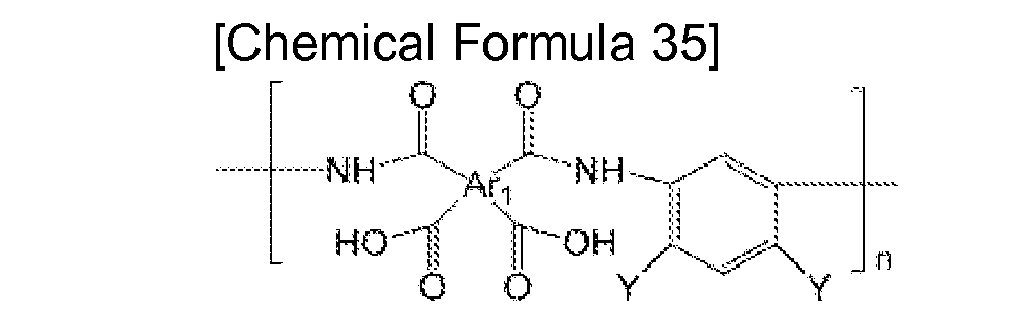


Ar1 is an aromatic group selected from a substituted or unsubstituted quadrivalent C6 to C24 arylene group and a substituted or unsubstituted quadrivalent C4 to C24 heterocyclic group, where the aromatic group is present singularly; at least two aromatic groups are fused to form a condensed cycle; or at least two aromatic groups are linked by single bond or a functional group selected from O, S, C(=O), S(=O)2, Si(CH3)2, (CH2)p (where 1≤p≤10), (CF2)q (where 1≤q≤10), C(CH3)2, C(CF3)2, or C(=O)NH,
Ar2 is an aromatic group selected from a substituted or unsubstituted divalent C6 to C24 arylene group and a substituted or unsubstituted divalent C4 to C24 heterocyclic group, where the aromatic group is present singularly; at least two aromatic groups are fused to form a condensed cycle; or at least two aromatic groups are linked by single bond or a functional group selected from O, S, C(=O), S(=O)2, Si(CH3)2, (CH2)p (where 1≤p≤10), (CF2)q (where 1≤q≤10), C(CH3)2, C(CF3)2, or C(=O)NH,
Q is O, S, C(=O), CH(OH), S(=O)2, Si(CH3)2, (CH2)p (where 1≤p≤10), (CF2)q (where 1≤q≤10), C(CH3)2, C(CF3)2, C(=O)NH, C(CH3)(CF3), or a substituted or unsubstituted phenylene group (where the substituted phenylene group is a phenylene group substituted with a C1 to C6 alkyl group or a C1 to C6 haloalkyl group), where the Q is linked with aromatic groups with m-m, m-p, p-m, or p-p positions,
Y is the same or different from each other in each repeating unit and independently selected from OH, SH, or NH2,
n is an integer ranging from 20 to 200,
m is an integer ranging from 10 to 400, and
I is an integer ranging from 10 to 400. - The method of claim 43, wherein the imidization comprises chemical imidization or solution-thermal imidization.
- The method of claim 44, wherein the chemical imidization is performed at 20 to 180°C for 4 to 24 hours.
- The method of claim 44, wherein the chemical imidization further comprises
protecting an ortho-positioned functional group of polyamic acid with a protecting group before imidization, and
removing the protecting group after imidization. - The method of claim 44, wherein the solution-thermal imidization is performed at 100 to 180°C for 2 to 30 hours in a solution.
- The method of claim 44, wherein the solution-thermal imidization further comprises
protecting an ortho-positioned functional group of polyamic acid with a protecting group before imidization, and
removing the protecting group after imidization. - The method of claim 44, wherein the solution-thermal imidization is performed using an azeotropic mixture.
- The method of claim 44, wherein the heat treatment is performed by increasing a temperature at 10 to 30°C/min up tp 400 to 550°C, and then maintaining the temperature for 1 minute to 1 hour under an inert atmosphere.
Applications Claiming Priority (3)
| Application Number | Priority Date | Filing Date | Title |
|---|---|---|---|
| KR20080046127 | 2008-05-19 | ||
| KR2008002863 | 2008-05-22 | ||
| PCT/KR2009/002645 WO2009142434A2 (en) | 2008-05-19 | 2009-05-19 | Hollow fiber, dope solution composition for forming a hollow fiber, and method for manufacturing a hollow fiber using the same |
Publications (3)
| Publication Number | Publication Date |
|---|---|
| EP2281926A2 true EP2281926A2 (en) | 2011-02-09 |
| EP2281926A4 EP2281926A4 (en) | 2011-08-10 |
| EP2281926B1 EP2281926B1 (en) | 2018-09-05 |
Family
ID=41340677
Family Applications (1)
| Application Number | Title | Priority Date | Filing Date |
|---|---|---|---|
| EP09750756.0A Not-in-force EP2281926B1 (en) | 2008-05-19 | 2009-05-19 | Hollow fiber and method for manufacturing a hollow fiber |
Country Status (6)
| Country | Link |
|---|---|
| EP (1) | EP2281926B1 (en) |
| JP (1) | JP5265763B2 (en) |
| CN (1) | CN102099512B (en) |
| MX (1) | MX2010012599A (en) |
| RU (1) | RU2465380C2 (en) |
| WO (1) | WO2009142434A2 (en) |
Cited By (3)
| Publication number | Priority date | Publication date | Assignee | Title |
|---|---|---|---|---|
| WO2012148360A1 (en) * | 2011-04-29 | 2012-11-01 | National University Of Singapore | Cardo-polybenzoxazole polymer/copolymer membranes for improved permeability and method for fabricating the same |
| EP2345685A4 (en) * | 2008-10-09 | 2013-12-11 | Iucf Hyu | POLYMER AND METHOD FOR PREPARING THE SAME |
| EP3216819A4 (en) * | 2014-10-10 | 2018-09-05 | Toray Industries, Inc. | Polyimide solution, heat-resistant non-woven fabric, and method for manufacturing same |
Families Citing this family (15)
| Publication number | Priority date | Publication date | Assignee | Title |
|---|---|---|---|---|
| KR100932765B1 (en) | 2008-02-28 | 2009-12-21 | 한양대학교 산학협력단 | Polyimide-polybenzoxazole copolymer, preparation method thereof, and gas separation membrane comprising the same |
| CA2640517A1 (en) | 2008-05-19 | 2009-11-19 | Industry-University Cooperation Foundation, Hanyang University | Polyamic acids dope composition, preparation method of hollow fiber using the same and hollow fiber prepared therefrom |
| US8013103B2 (en) | 2008-10-10 | 2011-09-06 | Industry-University Cooperation Foundation, Hanyang University | Polymer compounds and a preparation method thereof |
| US8487064B2 (en) | 2008-10-10 | 2013-07-16 | Industry-University Cooperation Foundation, Hanyang University | Polymer compounds and a preparation method thereof |
| BRPI0919681A2 (en) * | 2008-10-17 | 2017-10-31 | Solvay Advanced Polymers Llc | process for making a fiber or sheet, and fiber or sheet |
| KR101201491B1 (en) * | 2010-01-18 | 2012-12-21 | 한양대학교 산학협력단 | Porous support and polymer electrolyte membrane for fuel cell including the same |
| CN102560894A (en) * | 2011-11-17 | 2012-07-11 | 江西先材纳米纤维科技有限公司 | Production method of polybenzoxazole nanofiber nonwoven fabric and its application |
| US8753426B2 (en) * | 2012-08-03 | 2014-06-17 | Air Products And Chemicals, Inc. | Polymers, polymer membranes and methods of producing the same |
| JP2016530343A (en) * | 2013-06-06 | 2016-09-29 | キング アブドゥラー ユニバーシティ オブ サイエンス アンド テクノロジー | Triptycene acid dianhydride, polyimide, method for producing each, and method of use |
| WO2014202324A1 (en) * | 2013-06-21 | 2014-12-24 | Evonik Fibres Gmbh | Method for producing polyimide membranes |
| US9440197B2 (en) | 2013-07-01 | 2016-09-13 | ICUF-HYU (Industry-University Cooperation Foundation Hanyang University) | Crosslinked thermally rearranged poly(benzoxazole-co-imide), gas separation membranes comprising the same and preparation method thereof |
| KR101552517B1 (en) * | 2013-07-01 | 2015-09-11 | 한양대학교 산학협력단 | Crosslinked thermally rearranged poly(benzoxazole-co-imide), gas separation membranes comprising the same and preparation method thereof |
| KR101571393B1 (en) * | 2013-09-26 | 2015-11-24 | 한양대학교 산학협력단 | Thermally rearranged poly(benzoxazole-co-imide) separation membrane for membrane distillation and preparation method thereof |
| EP3052222B1 (en) * | 2013-09-30 | 2021-05-12 | Georgia Tech Research Corporation | Process for preparing an asymmetric modified carbon molecular sieve hollow fiber membrane and use of the same |
| CN114130202B (en) * | 2021-12-15 | 2023-03-14 | 中国科学院长春应用化学研究所 | Microporous filter membrane and preparation method thereof |
Family Cites Families (25)
| Publication number | Priority date | Publication date | Assignee | Title |
|---|---|---|---|---|
| NL271831A (en) | 1960-11-29 | |||
| US4717393A (en) | 1986-10-27 | 1988-01-05 | E. I. Du Pont De Nemours And Company | Polyimide gas separation membranes |
| US4912197A (en) | 1987-08-14 | 1990-03-27 | E. I. Du Pont De Nemours And Company | Highly soluble clear polyimides |
| JPH01159024A (en) * | 1987-12-16 | 1989-06-22 | Central Glass Co Ltd | Gas separation membrane |
| US4880442A (en) | 1987-12-22 | 1989-11-14 | E. I. Du Pont De Nemours And Company | Polyimide gas separation membranes |
| US4851505A (en) | 1988-04-13 | 1989-07-25 | E. I. Du Pont De Nemours And Company | Highly soluble aromatic polyimides |
| JPH07121343B2 (en) * | 1990-03-15 | 1995-12-25 | 宇部興産株式会社 | Gas separation hollow fiber membrane and method for producing the same |
| BR9106385A (en) * | 1990-04-20 | 1993-04-27 | Dow Chemical Co | INNOVATION IN MEMBRANE SEPARATION DEVICE, A PROCESS TO SEPARATE A MIXTURE, AND IN MEMBRANE, AND PROCESS TO MAKE A POROUS MEMBRANE |
| US5558936A (en) * | 1991-08-01 | 1996-09-24 | Hoechst Celanese Corp | High selectivity hollow fibers |
| US5605627A (en) * | 1992-10-07 | 1997-02-25 | Minntech Corporation | Dialysate filter including an asymmetric microporous, hollow fiber membrane incorporating a polyimide |
| US5591250A (en) * | 1993-08-09 | 1997-01-07 | Gas Research Institute | Material and process for separating carbon dioxide from methane |
| FR2710549B1 (en) * | 1993-09-27 | 1996-06-21 | Inst Francais Du Petrole | High selectivity asymmetric membranes for the separation of gases and a process for their production. |
| JP2828001B2 (en) * | 1995-01-11 | 1998-11-25 | 財団法人韓國化學研究所 | Asymmetric hollow fiber membrane for water / organic solvent separation or gas separation and method for producing the same |
| JPH08243367A (en) * | 1995-03-13 | 1996-09-24 | Dainippon Ink & Chem Inc | Method for manufacturing polyimide composite film |
| US5635067A (en) * | 1995-03-14 | 1997-06-03 | Praxair Technology, Inc. | Fluid separation membranes prepared from blends of polyimide polymers |
| JP3361655B2 (en) * | 1995-05-10 | 2003-01-07 | エヌオーケー株式会社 | Porous ceramics composite hollow fiber membrane and method for producing the same |
| US5725769A (en) * | 1995-07-18 | 1998-03-10 | Bend Research, Inc. | Solvent-resistant microporous polymide membranes |
| US5753008A (en) * | 1995-07-12 | 1998-05-19 | Bend Research, Inc. | Solvent resistant hollow fiber vapor permeation membranes and modules |
| KR100381463B1 (en) | 2000-08-23 | 2003-04-26 | 하성용 | Membrane Formation by dual quenched method |
| US6383258B1 (en) * | 2000-12-19 | 2002-05-07 | L'air Liquide Societe Anonyme Pour L'etude Et L'exploitation Des Procedes Georges Claude | Copolyimide gas separation membranes |
| JP3698078B2 (en) * | 2001-07-16 | 2005-09-21 | 宇部興産株式会社 | Method for producing asymmetric hollow fiber gas separation membrane |
| CA2435538A1 (en) | 2003-07-18 | 2005-01-18 | Universite Laval | Solvent resistant asymmetric integrally skinned membranes |
| US20060011063A1 (en) * | 2004-07-16 | 2006-01-19 | Honeywell International Inc. | High temperature gas separation membrane suitable for OBIGGS applications |
| JP5061337B2 (en) * | 2005-10-21 | 2012-10-31 | 森村興産株式会社 | Fiber filtration membrane |
| JP4858160B2 (en) * | 2006-12-25 | 2012-01-18 | 宇部興産株式会社 | Gas separation membrane and method of using the same |
-
2009
- 2009-05-19 RU RU2010149305/04A patent/RU2465380C2/en active
- 2009-05-19 WO PCT/KR2009/002645 patent/WO2009142434A2/en not_active Ceased
- 2009-05-19 MX MX2010012599A patent/MX2010012599A/en active IP Right Grant
- 2009-05-19 EP EP09750756.0A patent/EP2281926B1/en not_active Not-in-force
- 2009-05-19 JP JP2011510422A patent/JP5265763B2/en not_active Expired - Fee Related
- 2009-05-19 CN CN2009801281372A patent/CN102099512B/en not_active Expired - Fee Related
Cited By (3)
| Publication number | Priority date | Publication date | Assignee | Title |
|---|---|---|---|---|
| EP2345685A4 (en) * | 2008-10-09 | 2013-12-11 | Iucf Hyu | POLYMER AND METHOD FOR PREPARING THE SAME |
| WO2012148360A1 (en) * | 2011-04-29 | 2012-11-01 | National University Of Singapore | Cardo-polybenzoxazole polymer/copolymer membranes for improved permeability and method for fabricating the same |
| EP3216819A4 (en) * | 2014-10-10 | 2018-09-05 | Toray Industries, Inc. | Polyimide solution, heat-resistant non-woven fabric, and method for manufacturing same |
Also Published As
| Publication number | Publication date |
|---|---|
| WO2009142434A3 (en) | 2010-03-04 |
| JP2011523683A (en) | 2011-08-18 |
| EP2281926B1 (en) | 2018-09-05 |
| RU2465380C2 (en) | 2012-10-27 |
| EP2281926A4 (en) | 2011-08-10 |
| MX2010012599A (en) | 2011-04-26 |
| JP5265763B2 (en) | 2013-08-14 |
| WO2009142434A2 (en) | 2009-11-26 |
| CN102099512A (en) | 2011-06-15 |
| RU2010149305A (en) | 2012-06-27 |
| CN102099512B (en) | 2013-05-15 |
Similar Documents
| Publication | Publication Date | Title |
|---|---|---|
| EP2281926B1 (en) | Hollow fiber and method for manufacturing a hollow fiber | |
| EP2281925B1 (en) | Hollow fiber, dope solution composition for forming a hollow fiber, and method for manufacturing a hollow fiber using the same | |
| US8163071B2 (en) | Hollow fiber, dope composition for forming hollow fiber, and method of preparing hollow fiber using the same | |
| US20090297850A1 (en) | Hollow fiber, dope composition for forming hollow fiber, and method of making hollow fiber using the same | |
| EP2880080B1 (en) | Polymers, polymer membranes and methods of producing the same | |
| Kawakami et al. | Gas transport properties of soluble aromatic polyimides with sulfone diamine moieties | |
| ES2777276T3 (en) | Production method of a thermally transposed PBX, thermally transposed PBX and membrane | |
| EP4070880B1 (en) | Improved method to make carbon molecular sieve hollow fiber membranes | |
| CN103846022A (en) | Preparation method of copolyimide hollow fiber gas separation membrane | |
| US20140047976A1 (en) | Cardo-Polybenzoxazole Polymer/Copolymer Membranes For Improved Permeability And Method For Fabricating The Same | |
| JPH0924260A (en) | Poly (imidazopyrrolone-imide) copolymer separation membrane and method for producing the same | |
| JPH08198964A (en) | Polyimide gas separation membrane | |
| CN112870998A (en) | Soluble poly (siloxane-co-imide) block copolymer film, preparation and application | |
| Higashi et al. | Effect of phase separation due to solvent evaporation on particle aggregation in the skin layer of the gas separation membrane | |
| CN122011383A (en) | Polymer, chlorine-containing polyimide gas separation composite membrane, and preparation method and application thereof | |
| CN119463179A (en) | Symmetrical polybenzoxazole film, ultrafine polybenzoxazole hollow fiber asymmetric membrane, preparation method and application thereof | |
| BR112019008922B1 (en) | METHOD FOR PRODUCING AN ASYMMETRIC HOLLOW FIBER CARBON MOLECULAR SIEVE, PROCESS FOR SEPARATING A GAS MOLECULE FROM A GAS FEED, AND, GAS SEPARATION MODULE |
Legal Events
| Date | Code | Title | Description |
|---|---|---|---|
| PUAI | Public reference made under article 153(3) epc to a published international application that has entered the european phase |
Free format text: ORIGINAL CODE: 0009012 |
|
| 17P | Request for examination filed |
Effective date: 20101214 |
|
| AK | Designated contracting states |
Kind code of ref document: A2 Designated state(s): AT BE BG CH CY CZ DE DK EE ES FI FR GB GR HR HU IE IS IT LI LT LU LV MC MK MT NL NO PL PT RO SE SI SK TR |
|
| AX | Request for extension of the european patent |
Extension state: AL BA RS |
|
| RIC1 | Information provided on ipc code assigned before grant |
Ipc: C08K 5/34 20060101ALI20110629BHEP Ipc: C08K 5/05 20060101ALI20110629BHEP Ipc: D01F 6/80 20060101ALI20110629BHEP Ipc: C08L 79/08 20060101ALI20110629BHEP Ipc: D01F 6/74 20060101ALI20110629BHEP Ipc: B01D 71/64 20060101ALI20110629BHEP Ipc: C08K 5/42 20060101ALI20110629BHEP Ipc: D01D 5/24 20060101AFI20110629BHEP Ipc: D01D 5/247 20060101ALI20110629BHEP |
|
| A4 | Supplementary search report drawn up and despatched |
Effective date: 20110712 |
|
| DAX | Request for extension of the european patent (deleted) | ||
| STAA | Information on the status of an ep patent application or granted ep patent |
Free format text: STATUS: EXAMINATION IS IN PROGRESS |
|
| 17Q | First examination report despatched |
Effective date: 20170120 |
|
| GRAP | Despatch of communication of intention to grant a patent |
Free format text: ORIGINAL CODE: EPIDOSNIGR1 |
|
| STAA | Information on the status of an ep patent application or granted ep patent |
Free format text: STATUS: GRANT OF PATENT IS INTENDED |
|
| INTG | Intention to grant announced |
Effective date: 20180403 |
|
| GRAS | Grant fee paid |
Free format text: ORIGINAL CODE: EPIDOSNIGR3 |
|
| GRAA | (expected) grant |
Free format text: ORIGINAL CODE: 0009210 |
|
| STAA | Information on the status of an ep patent application or granted ep patent |
Free format text: STATUS: THE PATENT HAS BEEN GRANTED |
|
| AK | Designated contracting states |
Kind code of ref document: B1 Designated state(s): AT BE BG CH CY CZ DE DK EE ES FI FR GB GR HR HU IE IS IT LI LT LU LV MC MK MT NL NO PL PT RO SE SI SK TR |
|
| REG | Reference to a national code |
Ref country code: GB Ref legal event code: FG4D |
|
| REG | Reference to a national code |
Ref country code: CH Ref legal event code: EP |
|
| REG | Reference to a national code |
Ref country code: AT Ref legal event code: REF Ref document number: 1037916 Country of ref document: AT Kind code of ref document: T Effective date: 20180915 |
|
| REG | Reference to a national code |
Ref country code: IE Ref legal event code: FG4D |
|
| REG | Reference to a national code |
Ref country code: DE Ref legal event code: R096 Ref document number: 602009054310 Country of ref document: DE |
|
| REG | Reference to a national code |
Ref country code: NL Ref legal event code: FP |
|
| REG | Reference to a national code |
Ref country code: LT Ref legal event code: MG4D |
|
| PG25 | Lapsed in a contracting state [announced via postgrant information from national office to epo] |
Ref country code: GR Free format text: LAPSE BECAUSE OF FAILURE TO SUBMIT A TRANSLATION OF THE DESCRIPTION OR TO PAY THE FEE WITHIN THE PRESCRIBED TIME-LIMIT Effective date: 20181206 Ref country code: NO Free format text: LAPSE BECAUSE OF FAILURE TO SUBMIT A TRANSLATION OF THE DESCRIPTION OR TO PAY THE FEE WITHIN THE PRESCRIBED TIME-LIMIT Effective date: 20181205 Ref country code: LT Free format text: LAPSE BECAUSE OF FAILURE TO SUBMIT A TRANSLATION OF THE DESCRIPTION OR TO PAY THE FEE WITHIN THE PRESCRIBED TIME-LIMIT Effective date: 20180905 Ref country code: BG Free format text: LAPSE BECAUSE OF FAILURE TO SUBMIT A TRANSLATION OF THE DESCRIPTION OR TO PAY THE FEE WITHIN THE PRESCRIBED TIME-LIMIT Effective date: 20181205 Ref country code: FI Free format text: LAPSE BECAUSE OF FAILURE TO SUBMIT A TRANSLATION OF THE DESCRIPTION OR TO PAY THE FEE WITHIN THE PRESCRIBED TIME-LIMIT Effective date: 20180905 Ref country code: SE Free format text: LAPSE BECAUSE OF FAILURE TO SUBMIT A TRANSLATION OF THE DESCRIPTION OR TO PAY THE FEE WITHIN THE PRESCRIBED TIME-LIMIT Effective date: 20180905 |
|
| REG | Reference to a national code |
Ref country code: AT Ref legal event code: MK05 Ref document number: 1037916 Country of ref document: AT Kind code of ref document: T Effective date: 20180905 |
|
| PG25 | Lapsed in a contracting state [announced via postgrant information from national office to epo] |
Ref country code: ES Free format text: LAPSE BECAUSE OF FAILURE TO SUBMIT A TRANSLATION OF THE DESCRIPTION OR TO PAY THE FEE WITHIN THE PRESCRIBED TIME-LIMIT Effective date: 20180905 Ref country code: LV Free format text: LAPSE BECAUSE OF FAILURE TO SUBMIT A TRANSLATION OF THE DESCRIPTION OR TO PAY THE FEE WITHIN THE PRESCRIBED TIME-LIMIT Effective date: 20180905 Ref country code: HR Free format text: LAPSE BECAUSE OF FAILURE TO SUBMIT A TRANSLATION OF THE DESCRIPTION OR TO PAY THE FEE WITHIN THE PRESCRIBED TIME-LIMIT Effective date: 20180905 |
|
| PG25 | Lapsed in a contracting state [announced via postgrant information from national office to epo] |
Ref country code: PL Free format text: LAPSE BECAUSE OF FAILURE TO SUBMIT A TRANSLATION OF THE DESCRIPTION OR TO PAY THE FEE WITHIN THE PRESCRIBED TIME-LIMIT Effective date: 20180905 Ref country code: EE Free format text: LAPSE BECAUSE OF FAILURE TO SUBMIT A TRANSLATION OF THE DESCRIPTION OR TO PAY THE FEE WITHIN THE PRESCRIBED TIME-LIMIT Effective date: 20180905 Ref country code: AT Free format text: LAPSE BECAUSE OF FAILURE TO SUBMIT A TRANSLATION OF THE DESCRIPTION OR TO PAY THE FEE WITHIN THE PRESCRIBED TIME-LIMIT Effective date: 20180905 Ref country code: IS Free format text: LAPSE BECAUSE OF FAILURE TO SUBMIT A TRANSLATION OF THE DESCRIPTION OR TO PAY THE FEE WITHIN THE PRESCRIBED TIME-LIMIT Effective date: 20190105 Ref country code: IT Free format text: LAPSE BECAUSE OF FAILURE TO SUBMIT A TRANSLATION OF THE DESCRIPTION OR TO PAY THE FEE WITHIN THE PRESCRIBED TIME-LIMIT Effective date: 20180905 Ref country code: RO Free format text: LAPSE BECAUSE OF FAILURE TO SUBMIT A TRANSLATION OF THE DESCRIPTION OR TO PAY THE FEE WITHIN THE PRESCRIBED TIME-LIMIT Effective date: 20180905 Ref country code: CZ Free format text: LAPSE BECAUSE OF FAILURE TO SUBMIT A TRANSLATION OF THE DESCRIPTION OR TO PAY THE FEE WITHIN THE PRESCRIBED TIME-LIMIT Effective date: 20180905 |
|
| PG25 | Lapsed in a contracting state [announced via postgrant information from national office to epo] |
Ref country code: SK Free format text: LAPSE BECAUSE OF FAILURE TO SUBMIT A TRANSLATION OF THE DESCRIPTION OR TO PAY THE FEE WITHIN THE PRESCRIBED TIME-LIMIT Effective date: 20180905 Ref country code: PT Free format text: LAPSE BECAUSE OF FAILURE TO SUBMIT A TRANSLATION OF THE DESCRIPTION OR TO PAY THE FEE WITHIN THE PRESCRIBED TIME-LIMIT Effective date: 20190105 |
|
| REG | Reference to a national code |
Ref country code: DE Ref legal event code: R097 Ref document number: 602009054310 Country of ref document: DE |
|
| PLBE | No opposition filed within time limit |
Free format text: ORIGINAL CODE: 0009261 |
|
| STAA | Information on the status of an ep patent application or granted ep patent |
Free format text: STATUS: NO OPPOSITION FILED WITHIN TIME LIMIT |
|
| PG25 | Lapsed in a contracting state [announced via postgrant information from national office to epo] |
Ref country code: DK Free format text: LAPSE BECAUSE OF FAILURE TO SUBMIT A TRANSLATION OF THE DESCRIPTION OR TO PAY THE FEE WITHIN THE PRESCRIBED TIME-LIMIT Effective date: 20180905 |
|
| 26N | No opposition filed |
Effective date: 20190606 |
|
| PG25 | Lapsed in a contracting state [announced via postgrant information from national office to epo] |
Ref country code: SI Free format text: LAPSE BECAUSE OF FAILURE TO SUBMIT A TRANSLATION OF THE DESCRIPTION OR TO PAY THE FEE WITHIN THE PRESCRIBED TIME-LIMIT Effective date: 20180905 |
|
| REG | Reference to a national code |
Ref country code: CH Ref legal event code: PL |
|
| PG25 | Lapsed in a contracting state [announced via postgrant information from national office to epo] |
Ref country code: MC Free format text: LAPSE BECAUSE OF FAILURE TO SUBMIT A TRANSLATION OF THE DESCRIPTION OR TO PAY THE FEE WITHIN THE PRESCRIBED TIME-LIMIT Effective date: 20180905 Ref country code: LI Free format text: LAPSE BECAUSE OF NON-PAYMENT OF DUE FEES Effective date: 20190531 Ref country code: CH Free format text: LAPSE BECAUSE OF NON-PAYMENT OF DUE FEES Effective date: 20190531 |
|
| REG | Reference to a national code |
Ref country code: BE Ref legal event code: MM Effective date: 20190531 |
|
| PG25 | Lapsed in a contracting state [announced via postgrant information from national office to epo] |
Ref country code: LU Free format text: LAPSE BECAUSE OF NON-PAYMENT OF DUE FEES Effective date: 20190519 |
|
| PG25 | Lapsed in a contracting state [announced via postgrant information from national office to epo] |
Ref country code: TR Free format text: LAPSE BECAUSE OF FAILURE TO SUBMIT A TRANSLATION OF THE DESCRIPTION OR TO PAY THE FEE WITHIN THE PRESCRIBED TIME-LIMIT Effective date: 20180905 |
|
| PG25 | Lapsed in a contracting state [announced via postgrant information from national office to epo] |
Ref country code: IE Free format text: LAPSE BECAUSE OF NON-PAYMENT OF DUE FEES Effective date: 20190519 |
|
| PGFP | Annual fee paid to national office [announced via postgrant information from national office to epo] |
Ref country code: NL Payment date: 20200323 Year of fee payment: 12 Ref country code: GB Payment date: 20200325 Year of fee payment: 12 |
|
| PG25 | Lapsed in a contracting state [announced via postgrant information from national office to epo] |
Ref country code: BE Free format text: LAPSE BECAUSE OF NON-PAYMENT OF DUE FEES Effective date: 20190531 |
|
| PGFP | Annual fee paid to national office [announced via postgrant information from national office to epo] |
Ref country code: FR Payment date: 20200325 Year of fee payment: 12 |
|
| PGFP | Annual fee paid to national office [announced via postgrant information from national office to epo] |
Ref country code: DE Payment date: 20200320 Year of fee payment: 12 |
|
| PG25 | Lapsed in a contracting state [announced via postgrant information from national office to epo] |
Ref country code: CY Free format text: LAPSE BECAUSE OF FAILURE TO SUBMIT A TRANSLATION OF THE DESCRIPTION OR TO PAY THE FEE WITHIN THE PRESCRIBED TIME-LIMIT Effective date: 20180905 |
|
| PG25 | Lapsed in a contracting state [announced via postgrant information from national office to epo] |
Ref country code: MT Free format text: LAPSE BECAUSE OF FAILURE TO SUBMIT A TRANSLATION OF THE DESCRIPTION OR TO PAY THE FEE WITHIN THE PRESCRIBED TIME-LIMIT Effective date: 20180905 Ref country code: HU Free format text: LAPSE BECAUSE OF FAILURE TO SUBMIT A TRANSLATION OF THE DESCRIPTION OR TO PAY THE FEE WITHIN THE PRESCRIBED TIME-LIMIT; INVALID AB INITIO Effective date: 20090519 |
|
| REG | Reference to a national code |
Ref country code: DE Ref legal event code: R119 Ref document number: 602009054310 Country of ref document: DE |
|
| REG | Reference to a national code |
Ref country code: NL Ref legal event code: MM Effective date: 20210601 |
|
| GBPC | Gb: european patent ceased through non-payment of renewal fee |
Effective date: 20210519 |
|
| PG25 | Lapsed in a contracting state [announced via postgrant information from national office to epo] |
Ref country code: GB Free format text: LAPSE BECAUSE OF NON-PAYMENT OF DUE FEES Effective date: 20210519 Ref country code: DE Free format text: LAPSE BECAUSE OF NON-PAYMENT OF DUE FEES Effective date: 20211201 |
|
| PG25 | Lapsed in a contracting state [announced via postgrant information from national office to epo] |
Ref country code: NL Free format text: LAPSE BECAUSE OF NON-PAYMENT OF DUE FEES Effective date: 20210601 Ref country code: FR Free format text: LAPSE BECAUSE OF NON-PAYMENT OF DUE FEES Effective date: 20210531 |
|
| PG25 | Lapsed in a contracting state [announced via postgrant information from national office to epo] |
Ref country code: MK Free format text: LAPSE BECAUSE OF FAILURE TO SUBMIT A TRANSLATION OF THE DESCRIPTION OR TO PAY THE FEE WITHIN THE PRESCRIBED TIME-LIMIT Effective date: 20180905 |