EP2281811A1 - A continuous deacetylation and purification process in the synthesis of non-ionic X-ray contrast agents - Google Patents
A continuous deacetylation and purification process in the synthesis of non-ionic X-ray contrast agents Download PDFInfo
- Publication number
- EP2281811A1 EP2281811A1 EP09176522A EP09176522A EP2281811A1 EP 2281811 A1 EP2281811 A1 EP 2281811A1 EP 09176522 A EP09176522 A EP 09176522A EP 09176522 A EP09176522 A EP 09176522A EP 2281811 A1 EP2281811 A1 EP 2281811A1
- Authority
- EP
- European Patent Office
- Prior art keywords
- compound
- continuous
- bis
- synthesis
- ionic
- Prior art date
- Legal status (The legal status is an assumption and is not a legal conclusion. Google has not performed a legal analysis and makes no representation as to the accuracy of the status listed.)
- Ceased
Links
- 238000003786 synthesis reaction Methods 0.000 title abstract description 6
- 230000015572 biosynthetic process Effects 0.000 title abstract description 5
- 239000002872 contrast media Substances 0.000 title abstract description 5
- 230000006196 deacetylation Effects 0.000 title abstract description 3
- 238000003381 deacetylation reaction Methods 0.000 title abstract description 3
- 238000000746 purification Methods 0.000 title description 4
- 229940126062 Compound A Drugs 0.000 claims abstract description 29
- NLDMNSXOCDLTTB-UHFFFAOYSA-N Heterophylliin A Natural products O1C2COC(=O)C3=CC(O)=C(O)C(O)=C3C3=C(O)C(O)=C(O)C=C3C(=O)OC2C(OC(=O)C=2C=C(O)C(O)=C(O)C=2)C(O)C1OC(=O)C1=CC(O)=C(O)C(O)=C1 NLDMNSXOCDLTTB-UHFFFAOYSA-N 0.000 claims abstract description 29
- 150000001875 compounds Chemical class 0.000 claims abstract description 12
- 238000000034 method Methods 0.000 claims abstract description 11
- 238000001914 filtration Methods 0.000 claims abstract description 7
- 125000002887 hydroxy group Chemical group [H]O* 0.000 claims abstract description 7
- 238000005406 washing Methods 0.000 claims abstract description 5
- BHCBLTRDEYPMFZ-UHFFFAOYSA-N 5-acetamido-1-n,3-n-bis(2,3-dihydroxypropyl)-2,4,6-triiodobenzene-1,3-dicarboxamide Chemical compound CC(=O)NC1=C(I)C(C(=O)NCC(O)CO)=C(I)C(C(=O)NCC(O)CO)=C1I BHCBLTRDEYPMFZ-UHFFFAOYSA-N 0.000 claims abstract description 4
- 238000002360 preparation method Methods 0.000 claims abstract description 3
- 239000013078 crystal Substances 0.000 claims description 5
- KAEGSAWWVYMWIQ-UHFFFAOYSA-N 5-amino-1-n,3-n-bis(2,3-dihydroxypropyl)-2,4,6-triiodobenzene-1,3-dicarboxamide Chemical compound NC1=C(I)C(C(=O)NCC(O)CO)=C(I)C(C(=O)NCC(O)CO)=C1I KAEGSAWWVYMWIQ-UHFFFAOYSA-N 0.000 claims description 3
- 230000000850 deacetylating effect Effects 0.000 claims description 2
- 238000001035 drying Methods 0.000 claims description 2
- 238000002425 crystallisation Methods 0.000 abstract description 9
- 238000010924 continuous production Methods 0.000 abstract description 7
- OKKJLVBELUTLKV-UHFFFAOYSA-N Methanol Chemical compound OC OKKJLVBELUTLKV-UHFFFAOYSA-N 0.000 description 12
- HEMHJVSKTPXQMS-UHFFFAOYSA-M Sodium hydroxide Chemical compound [OH-].[Na+] HEMHJVSKTPXQMS-UHFFFAOYSA-M 0.000 description 12
- WFDIJRYMOXRFFG-UHFFFAOYSA-N Acetic anhydride Chemical compound CC(=O)OC(C)=O WFDIJRYMOXRFFG-UHFFFAOYSA-N 0.000 description 9
- QTBSBXVTEAMEQO-UHFFFAOYSA-N Acetic acid Chemical compound CC(O)=O QTBSBXVTEAMEQO-UHFFFAOYSA-N 0.000 description 6
- 239000011541 reaction mixture Substances 0.000 description 6
- 238000006640 acetylation reaction Methods 0.000 description 5
- 239000000203 mixture Substances 0.000 description 5
- 238000004128 high performance liquid chromatography Methods 0.000 description 4
- 229960004359 iodixanol Drugs 0.000 description 4
- NBQNWMBBSKPBAY-UHFFFAOYSA-N iodixanol Chemical compound IC=1C(C(=O)NCC(O)CO)=C(I)C(C(=O)NCC(O)CO)=C(I)C=1N(C(=O)C)CC(O)CN(C(C)=O)C1=C(I)C(C(=O)NCC(O)CO)=C(I)C(C(=O)NCC(O)CO)=C1I NBQNWMBBSKPBAY-UHFFFAOYSA-N 0.000 description 4
- 238000004519 manufacturing process Methods 0.000 description 4
- 239000000047 product Substances 0.000 description 4
- 238000006243 chemical reaction Methods 0.000 description 3
- 239000012065 filter cake Substances 0.000 description 3
- XLYOFNOQVPJJNP-UHFFFAOYSA-N water Substances O XLYOFNOQVPJJNP-UHFFFAOYSA-N 0.000 description 3
- VMHLLURERBWHNL-UHFFFAOYSA-M Sodium acetate Chemical compound [Na+].CC([O-])=O VMHLLURERBWHNL-UHFFFAOYSA-M 0.000 description 2
- FAPWRFPIFSIZLT-UHFFFAOYSA-M Sodium chloride Chemical compound [Na+].[Cl-] FAPWRFPIFSIZLT-UHFFFAOYSA-M 0.000 description 2
- 230000021736 acetylation Effects 0.000 description 2
- 238000010923 batch production Methods 0.000 description 2
- NTHXOOBQLCIOLC-UHFFFAOYSA-N iohexol Chemical compound OCC(O)CN(C(=O)C)C1=C(I)C(C(=O)NCC(O)CO)=C(I)C(C(=O)NCC(O)CO)=C1I NTHXOOBQLCIOLC-UHFFFAOYSA-N 0.000 description 2
- IUNJANQVIJDFTQ-UHFFFAOYSA-N iopentol Chemical compound COCC(O)CN(C(C)=O)C1=C(I)C(C(=O)NCC(O)CO)=C(I)C(C(=O)NCC(O)CO)=C1I IUNJANQVIJDFTQ-UHFFFAOYSA-N 0.000 description 2
- 239000012452 mother liquor Substances 0.000 description 2
- 239000002002 slurry Substances 0.000 description 2
- 239000001632 sodium acetate Substances 0.000 description 2
- 235000017281 sodium acetate Nutrition 0.000 description 2
- 125000000738 acetamido group Chemical group [H]C([H])([H])C(=O)N([H])[*] 0.000 description 1
- 125000002777 acetyl group Chemical group [H]C([H])([H])C(*)=O 0.000 description 1
- 230000000397 acetylating effect Effects 0.000 description 1
- 238000010306 acid treatment Methods 0.000 description 1
- 238000005054 agglomeration Methods 0.000 description 1
- 230000002776 aggregation Effects 0.000 description 1
- 125000003277 amino group Chemical group 0.000 description 1
- 239000006227 byproduct Substances 0.000 description 1
- 230000003197 catalytic effect Effects 0.000 description 1
- 239000003153 chemical reaction reagent Substances 0.000 description 1
- 239000003795 chemical substances by application Substances 0.000 description 1
- 238000010586 diagram Methods 0.000 description 1
- 239000012467 final product Substances 0.000 description 1
- 239000012530 fluid Substances 0.000 description 1
- 230000007062 hydrolysis Effects 0.000 description 1
- 238000006460 hydrolysis reaction Methods 0.000 description 1
- 238000009776 industrial production Methods 0.000 description 1
- 229960001025 iohexol Drugs 0.000 description 1
- 229960000824 iopentol Drugs 0.000 description 1
- 238000011031 large-scale manufacturing process Methods 0.000 description 1
- 125000001997 phenyl group Chemical group [H]C1=C([H])C([H])=C(*)C([H])=C1[H] 0.000 description 1
- 238000001556 precipitation Methods 0.000 description 1
- 238000011084 recovery Methods 0.000 description 1
- 150000003839 salts Chemical class 0.000 description 1
- 239000011780 sodium chloride Substances 0.000 description 1
- 239000002904 solvent Substances 0.000 description 1
- 230000003068 static effect Effects 0.000 description 1
- JOXIMZWYDAKGHI-UHFFFAOYSA-N toluene-4-sulfonic acid Chemical compound CC1=CC=C(S(O)(=O)=O)C=C1 JOXIMZWYDAKGHI-UHFFFAOYSA-N 0.000 description 1
Images
Classifications
-
- C—CHEMISTRY; METALLURGY
- C07—ORGANIC CHEMISTRY
- C07C—ACYCLIC OR CARBOCYCLIC COMPOUNDS
- C07C231/00—Preparation of carboxylic acid amides
- C07C231/22—Separation; Purification; Stabilisation; Use of additives
- C07C231/24—Separation; Purification
-
- C—CHEMISTRY; METALLURGY
- C07—ORGANIC CHEMISTRY
- C07C—ACYCLIC OR CARBOCYCLIC COMPOUNDS
- C07C231/00—Preparation of carboxylic acid amides
- C07C231/12—Preparation of carboxylic acid amides by reactions not involving the formation of carboxamide groups
-
- C—CHEMISTRY; METALLURGY
- C07—ORGANIC CHEMISTRY
- C07C—ACYCLIC OR CARBOCYCLIC COMPOUNDS
- C07C237/00—Carboxylic acid amides, the carbon skeleton of the acid part being further substituted by amino groups
- C07C237/28—Carboxylic acid amides, the carbon skeleton of the acid part being further substituted by amino groups having the carbon atom of at least one of the carboxamide groups bound to a carbon atom of a non-condensed six-membered aromatic ring of the carbon skeleton
- C07C237/46—Carboxylic acid amides, the carbon skeleton of the acid part being further substituted by amino groups having the carbon atom of at least one of the carboxamide groups bound to a carbon atom of a non-condensed six-membered aromatic ring of the carbon skeleton having carbon atoms of carboxamide groups, amino groups and at least three atoms of bromine or iodine, bound to carbon atoms of the same non-condensed six-membered aromatic ring
Definitions
- This invention relates generally to large-scale synthesis of non-ionic X-ray contrast agents. It further relates to an improved method for the synthesis and purification of 5-acetamido-N,N'-bis(2,3-dihydroxypropyl)-2,4,6-triiodoisophthalamide ("Compound A”), an intermediate in the industrial preparation of non-ionic X-ray contrast agents. In particular, it relates to a continuous process for deactylation of the acetylated hydroxyl groups and subsequent purification of Compound A.
- Compound A 5-acetamido-N,N'-bis(2,3-dihydroxypropyl)-2,4,6-triiodoisophthalamide
- Non-ionic X-ray contrast agents constitute a very important class of pharmaceutical compounds produced in large quantities.
- iodixanol marketed under the trade name Visipaque®, is one of the most used agents in diagnostic X-ray procedures. It is produced in large quantities by GE Healthcare in Lindesnes, Norway.
- the industrial production of iodixanol involves a multistep chemical synthesis as shown in Scheme 1 below. See also U.S. Patent No. 6,974,882 . To reduce the cost of the final product, it is critical to optimize each synthetic step. Even a small improvement in reaction design can lead to significant savings in a large scale production.
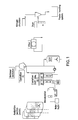
- FIG. 1 is a schematic diagram of one exemplary embodiment of the instant invention.
- the present invention provides an industrial process for purifying Compound A. Specifically, it uses a continuous process comprising the steps of (1) deacetylating the acetylated hydroxyl groups of 5-amino-N,N'-bis(2,3-dihydroxypropyl)-2,4,6-triiodoisophthalamide ("Compound B") in a first reactor at a pH between about 11 and about 12 by adding aqueous sodium hydroxide or another suitable base; (2) crystallising Compound A in a second reactor at a pH between about 11 and about 12 at a temperature of between about 10°C and about 70 °C; (3) crystallising Compound A in a third reactor at a pH between about 6 and about 8 and at a temperature higher than or equal to about 10°C and lower than or equal to that in step (2); and (4) filtering and washing the crystals of Compound A.
- Compound B 5-amino-N,N'-bis(2,3-dihydroxypropyl)-2,4,6-triiodoi
- a reactor in the instant process may be a tubular flow reactor, a continuous stirred tank reactor (CSTR), or other suitable continuous reaction equipment.
- CSTR continuous stirred tank reactor
- a continuous process In a batch process, all the operations are performed successively in the same reactor. Thus, production capacity increase in a batch production requires very large reactor volumes and a corresponding increase in capital investments.
- a continuous process has dedicated equipment for every operation, where the mixture moves from one operation to the next within the production line. All the operations are performed continuously all the time and the system is at a steady state. Consequently, a continuous production process requires much smaller equipment volumes and investments for achieving the same production capacity.
- a continuous operation allows for less varying quality of the product. While desirable, a continuous system is more complicated to design and is highly specific to one single product.
- the process from deacetylation to dry Compound A can be run continuously using a number of sequential steps.
- the undesired acetylated hydroxyl group is deacetylated at a pH between about 11 and about 12 by adding a base such as aqueous sodium hydroxide.
- a base such as aqueous sodium hydroxide.
- the concentration of NaOH used is about 10-50 w/w %, more preferably 20-25 w/w %.
- the reaction is strongly exothermic. Sodium acetate is formed as a byproduct.
- Compound A is first crystallized at a pH between about 11 and 12 and at a temperature of between about 10°C and about 70 °C in a second reactor.
- Compound A is again crystallized in a third reactor at a pH between about 6 and 8, but at a lower or same temperature than the previous crystallisation step.
- the pH is adjusted to about 7 by acid treatment, resulting in precipitation of Compound A.
- the purity and yield are influenced by the presence of sodium acetate and methanol. High supersaturation is useful for agglomeration of the crystalline product and thus its filterability.
- crystallisation of Compound A may be divided into more than two steps, each preferably at a different pH, different temperature, and/or different residence time.
- the solvent used may be removed in one of the crystallisation steps, which may increase the yield of Compound A recovery.
- a first crystallisation step may be conducted at (1) a pH of about 11.0-11.5, preferably about 11.3, (2) a temperature of about 50-65°C, preferably about 60°C, and (3) a residence time of about 1-4 hours, preferably about 2 hours.
- a second crystallisation step may be conducted at (1) a pH of about 6-8, preferably about 7, (2) a temperature of 50-65°C, preferably about 60°C, and (3) a residence time of about 1-4 hours, preferably about 2 hours.
- a third crystallisation step may be conducted at (1) a pH of about 6-8, preferably about 7, (2) a temperature of 50-65°C, preferably about 60°C, and (3) a residence time of about 1-4 hours, preferably about 2 hours, simultaneously stripping off up to about 40 % of the mother liquor volume, preferably 15-30 % of the volume.
- a fourth crystallisation step may be conducted at (1) a pH of about 6-8, preferably about 7, a temperature of about 15-30°C, preferably about 15-20°C, and a residence time of 6-12 hours, preferably about 8 hours.
- Compound A crystals are filtered and washed.
- crystals of Compound A are dried.
- the filtration, washing and drying steps may preferably be combined in one step using a suitable combined filter dryer.
- the instant process provides Compound A with consistent quality and yield. Steady state conditions are obtained in the process.
- Compound B was acetylated in a mixture of acetic anhydride and acetic acid in the presence of catalytic amounts of p-toluene sulphonic acid at 50-125°C. Excess acetic anhydride and acetic acid was distilled off under reduced pressure, and the reaction mixture was diluted with methanol and water.
- the resulting reaction mixture had the following composition: Overacetylated Compound A (a mixture of compounds with varying number of acetyl groups attached): 97.7-98.3 % by area in HPLC Compound B: 0.0-0.3 % by area in HPLC Concentration: 31 w/v % Compound A in an approximately 2.5:1 methanol/water mixture Conductivity: 5.1-5.7 mS/cm
- Compound B was produced from the reaction mixture in a system according to Figure 1 .
- the reaction mixture from the acetylation reaction (prepared batch wise) was fed into the static mixer in a flow ratio of 1.04 mL reaction mixture: 1.0 mL 20 w/w % NaOH at about 55°C (outlet temperature).
- the absolute feeding rate of the reaction mixture was 2.6 kg/hour.
- the pH was kept at about 12.2 at steady state.
- HPLC of the output stream showed Compound A in 98.2 % purity with 0.23 % Compound B present at steady state.
- the continuous crystallisation was performed as described above.
- the pH in the first and second crystalliser varied between 11.1 and 11.5 over time, while the pH in the third and fourth crystalliser varied between 6.2 and 7.2.
- the temperature was 60°C in the two first crystallisers and 20°C in the third and fourth. Residence times were held at 2, 2, 2 and 8 hours, respectively.
- 20 % of the mother liquor volume was stripped off in the third crystalliser at a pressure of 240-250 mbar.
- the water content in the methanolic distillate from the stripping was 34-35 w/w %.
- the resulting slurry from the fourth crystalliser was transferred to a holding tank before filtration.
- the slurry was filtered in a continuous rotation filter at 1.6-3.2 barA.
- the filtration rate varied between about 500 and 900 L/m2/hour (about 500-650 L/m2/hour at steady state).
- the filter cake was washed with methanol (about 1.9 kg/kg Compound A) in the same filter.
- the resulting salt content in the filter cake was 0.2-0.3 w/w % NaCl.
- the moist filter cake was dried in a continuous fluid bed (spin flash) dryer at 120-130°C gas temperature.
- the maximum temperature exposed to the product was 80°C.
- the resulting moisture content was 0.4 w/w %.
- the purity of dry Compound A in HPLC was 99.5 % by area.
Landscapes
- Chemical & Material Sciences (AREA)
- Organic Chemistry (AREA)
- Chemical Kinetics & Catalysis (AREA)
- Organic Low-Molecular-Weight Compounds And Preparation Thereof (AREA)
Abstract
This invention relates to an improved method for the synthesis of 5-acetamido-N,N'-bis(2,3-dihydroxypropyl)-2,4,6-triiodoisophthalamide ("Compound A"), an intermediate in the industrial preparation of non-ionic X-ray contrast agents. In particular, it relates to a continuous process of deacetylation of the acetylated hydroxyl group in 5-amino-N,N'-bis(2,3-dihydroxypropyt)-2,4,6-triiodo-1,3-benzenedicarboxarriide ("Compound B") followed by crystallisations, filtration, and washing of Compound A.
Description
- This invention relates generally to large-scale synthesis of non-ionic X-ray contrast agents. It further relates to an improved method for the synthesis and purification of 5-acetamido-N,N'-bis(2,3-dihydroxypropyl)-2,4,6-triiodoisophthalamide ("Compound A"), an intermediate in the industrial preparation of non-ionic X-ray contrast agents. In particular, it relates to a continuous process for deactylation of the acetylated hydroxyl groups and subsequent purification of Compound A.
- Non-ionic X-ray contrast agents constitute a very important class of pharmaceutical compounds produced in large quantities. 5-[N-(2,3-dihydroxypropyl)-acetamido]-N,N'-bis(2,3-dihydroxypropyl)-2,4,6-triiodo-isophthalamide ("iohexol"), 5-[N-(2-hydroxy-3-methoxypropyl)acetamido]-N,N'-bis(2,3-dihydroxypropyl)-2,4,6-triiodo-isophthalamide ("iopentol"), and 1,3-bis(acetamido)-N,N'-bis[3,5-bis(2,3-dihydroxypropyl-aminocarbonyl)-2,4,6-triiodophenyl]-2-hydroxypropane ("iodixanol") are important examples of such compounds. They generally contain one or two triiodinated benzene rings.
- For example, iodixanol, marketed under the trade name Visipaque®, is one of the most used agents in diagnostic X-ray procedures. It is produced in large quantities by GE Healthcare in Lindesnes, Norway. The industrial production of iodixanol involves a multistep chemical synthesis as shown in Scheme 1 below. See also
U.S. Patent No. 6,974,882 . To reduce the cost of the final product, it is critical to optimize each synthetic step. Even a small improvement in reaction design can lead to significant savings in a large scale production. - In the acetylation step of the industrial scale synthesis 5-amino-N,N'-bis(2,3-dihydroxypropyl)-2,4,6-triiodoisophthalamide (Compound B), is acetylated to produce 5-acetylamino-N,N'-bis(2,3-dihydroxypropyl)-2,4,6-triiodoisophthalamide (Compound A) using acetic anhydride as the acetylating reagent. The instant invention is directed to a continuous process for deactylation of the undesired acetylated groups generated during the acetylation step and subsequent purification of Compound A.

-
FIG. 1 is a schematic diagram of one exemplary embodiment of the instant invention. - The present invention provides an industrial process for purifying Compound A. Specifically, it uses a continuous process comprising the steps of (1) deacetylating the acetylated hydroxyl groups of 5-amino-N,N'-bis(2,3-dihydroxypropyl)-2,4,6-triiodoisophthalamide ("Compound B") in a first reactor at a pH between about 11 and about 12 by adding aqueous sodium hydroxide or another suitable base; (2) crystallising Compound A in a second reactor at a pH between about 11 and about 12 at a temperature of between about 10°C and about 70 °C; (3) crystallising Compound A in a third reactor at a pH between about 6 and about 8 and at a temperature higher than or equal to about 10°C and lower than or equal to that in step (2); and (4) filtering and washing the crystals of Compound A.
- A reactor in the instant process may be a tubular flow reactor, a continuous stirred tank reactor (CSTR), or other suitable continuous reaction equipment.
- In a batch process, all the operations are performed successively in the same reactor. Thus, production capacity increase in a batch production requires very large reactor volumes and a corresponding increase in capital investments. On the other hand, a continuous process has dedicated equipment for every operation, where the mixture moves from one operation to the next within the production line. All the operations are performed continuously all the time and the system is at a steady state. Consequently, a continuous production process requires much smaller equipment volumes and investments for achieving the same production capacity. In addition, a continuous operation allows for less varying quality of the product. While desirable, a continuous system is more complicated to design and is highly specific to one single product.
- In the acetylation reaction of Compound B, both the amino group and the four hydroxyl groups are acetylated. See Scheme 2. The acetylated hydroxyl groups are undesirable and thus deacetylated following the acetylation reaction.

- In the present invention, we have found that the process from deacetylation to dry Compound A can be run continuously using a number of sequential steps. First, the undesired acetylated hydroxyl group is deacetylated at a pH between about 11 and about 12 by adding a base such as aqueous sodium hydroxide. Under this condition, only the desired - NH-Ac group survives the hydrolysis and remains acetylated. Preferably, the concentration of NaOH used is about 10-50 w/w %, more preferably 20-25 w/w %. The reaction is strongly exothermic. Sodium acetate is formed as a byproduct.
- Second, Compound A is first crystallized at a pH between about 11 and 12 and at a temperature of between about 10°C and about 70 °C in a second reactor.
- Third, Compound A is again crystallized in a third reactor at a pH between about 6 and 8, but at a lower or same temperature than the previous crystallisation step. Preferably, the pH is adjusted to about 7 by acid treatment, resulting in precipitation of Compound A. The purity and yield are influenced by the presence of sodium acetate and methanol. High supersaturation is useful for agglomeration of the crystalline product and thus its filterability.
- Optionally, crystallisation of Compound A may be divided into more than two steps, each preferably at a different pH, different temperature, and/or different residence time. Preferably, the solvent used may be removed in one of the crystallisation steps, which may increase the yield of Compound A recovery. For example, a first crystallisation step may be conducted at (1) a pH of about 11.0-11.5, preferably about 11.3, (2) a temperature of about 50-65°C, preferably about 60°C, and (3) a residence time of about 1-4 hours, preferably about 2 hours. A second crystallisation step may be conducted at (1) a pH of about 6-8, preferably about 7, (2) a temperature of 50-65°C, preferably about 60°C, and (3) a residence time of about 1-4 hours, preferably about 2 hours. A third crystallisation step may be conducted at (1) a pH of about 6-8, preferably about 7, (2) a temperature of 50-65°C, preferably about 60°C, and (3) a residence time of about 1-4 hours, preferably about 2 hours, simultaneously stripping off up to about 40 % of the mother liquor volume, preferably 15-30 % of the volume. A fourth crystallisation step may be conducted at (1) a pH of about 6-8, preferably about 7, a temperature of about 15-30°C, preferably about 15-20°C, and a residence time of 6-12 hours, preferably about 8 hours.
- As the final step of the instant continuous process, Compound A crystals are filtered and washed. Preferably, following filtration and washings, crystals of Compound A are dried. The filtration, washing and drying steps may preferably be combined in one step using a suitable combined filter dryer.
- The instant process provides Compound A with consistent quality and yield. Steady state conditions are obtained in the process.
- The invention is illustrated further by the following examples that are not to be construed as limiting the invention in scope to the specific procedures described in them.
- Compound B was acetylated in a mixture of acetic anhydride and acetic acid in the presence of catalytic amounts of p-toluene sulphonic acid at 50-125°C. Excess acetic anhydride and acetic acid was distilled off under reduced pressure, and the reaction mixture was diluted with methanol and water. The resulting reaction mixture had the following composition:
Overacetylated Compound A (a mixture of compounds with varying number of acetyl groups attached): 97.7-98.3 % by area in HPLC Compound B: 0.0-0.3 % by area in HPLC Concentration: 31 w/v % Compound A in an approximately 2.5:1 methanol/water mixture Conductivity: 5.1-5.7 mS/cm - Compound B was produced from the reaction mixture in a system according to
Figure 1 . The reaction mixture from the acetylation reaction (prepared batch wise) was fed into the static mixer in a flow ratio of 1.04 mL reaction mixture: 1.0 mL 20 w/w % NaOH at about 55°C (outlet temperature). The absolute feeding rate of the reaction mixture was 2.6 kg/hour. The pH was kept at about 12.2 at steady state. HPLC of the output stream showed Compound A in 98.2 % purity with 0.23 % Compound B present at steady state. - The continuous crystallisation was performed as described above. The pH in the first and second crystalliser varied between 11.1 and 11.5 over time, while the pH in the third and fourth crystalliser varied between 6.2 and 7.2. The temperature was 60°C in the two first crystallisers and 20°C in the third and fourth. Residence times were held at 2, 2, 2 and 8 hours, respectively. 20 % of the mother liquor volume was stripped off in the third crystalliser at a pressure of 240-250 mbar. The water content in the methanolic distillate from the stripping was 34-35 w/w %. The resulting slurry from the fourth crystalliser was transferred to a holding tank before filtration.
- The slurry was filtered in a continuous rotation filter at 1.6-3.2 barA. The filtration rate varied between about 500 and 900 L/m2/hour (about 500-650 L/m2/hour at steady state). The filter cake was washed with methanol (about 1.9 kg/kg Compound A) in the same filter. The resulting salt content in the filter cake was 0.2-0.3 w/w % NaCl.
- The moist filter cake was dried in a continuous fluid bed (spin flash) dryer at 120-130°C gas temperature. The maximum temperature exposed to the product was 80°C. The resulting moisture content was 0.4 w/w %.
- The purity of dry Compound A in HPLC was 99.5 % by area.
- All patents, journal articles, publications and other documents discussed and/or cited above are hereby incorporated by reference.
Claims (2)
- A process for industrial preparation of 5-acetamido-N,N'-bis(2,3-dihydroxypropyl)-2,4,6-triiodoisophthalamide ("Compound A") comprising the following sequential and continuous steps:(1) deacetylating the acetylated hydroxyl group of 5-amino-N,N'-bis(2,3-dihydroxypropyl)-2,4,6-triiodoisophthalamide ("Compound B") in a first reactor at a pH between about 11 and about 12 by adding a base;(2) crystallising Compound A in a second reactor at a pH between about 11 and about 12 at a temperature of between about 10 °C and about 70°C;(3) crystallising Compound A in a third reactor at a pH between about 6 and about 8 and at a temperature higher than or equal to about 10°C and lower than or equal to that in step (2); and(4) filtering and washing the crystals of Compound A.
- The process of Claim 1 further comprising the step of drying the crystals of Compound A.
Applications Claiming Priority (1)
| Application Number | Priority Date | Filing Date | Title |
|---|---|---|---|
| US22709209P | 2009-07-21 | 2009-07-21 |
Publications (1)
| Publication Number | Publication Date |
|---|---|
| EP2281811A1 true EP2281811A1 (en) | 2011-02-09 |
Family
ID=41651159
Family Applications (1)
| Application Number | Title | Priority Date | Filing Date |
|---|---|---|---|
| EP09176522A Ceased EP2281811A1 (en) | 2009-07-21 | 2009-11-19 | A continuous deacetylation and purification process in the synthesis of non-ionic X-ray contrast agents |
Country Status (4)
| Country | Link |
|---|---|
| US (1) | US20110021822A1 (en) |
| EP (1) | EP2281811A1 (en) |
| KR (1) | KR20110009039A (en) |
| CN (1) | CN101962342A (en) |
Cited By (3)
| Publication number | Priority date | Publication date | Assignee | Title |
|---|---|---|---|---|
| WO2015082718A1 (en) * | 2013-12-06 | 2015-06-11 | Ge Healthcare As | Alternative process for the purification of an intermediate in the synthesis of non-ionic x-ray contrast agents |
| WO2015082720A1 (en) * | 2013-12-06 | 2015-06-11 | Ge Healthcare As | Alternative process for the purification of an intermediate in the synthesis of non-ionic x-ray contrast agents |
| WO2016193740A1 (en) * | 2015-06-02 | 2016-12-08 | Hovione Scientia Limited | Process for the preparation of intermediates useful in the preparation of non-ionic contrast agents |
Families Citing this family (5)
| Publication number | Priority date | Publication date | Assignee | Title |
|---|---|---|---|---|
| CN110003038A (en) * | 2012-09-27 | 2019-07-12 | 通用电气医疗集团股份有限公司 | The preparation of the midbody compound of Ioforminol |
| PT2917174T (en) * | 2012-11-12 | 2018-11-14 | Ge Healthcare As | Preparation of intermediates of x-ray contrast agents |
| WO2015082719A1 (en) * | 2013-12-06 | 2015-06-11 | Ge Healthcare As | Alternative acetylation process in the synthesis of non-ionic xray contrast agents |
| GB202004773D0 (en) * | 2020-03-31 | 2020-05-13 | Ge Healthcare As | Continuous crystallisation method |
| CN118993925A (en) * | 2024-10-24 | 2024-11-22 | 南昌大学 | Continuous flow synthesis process of ioversol |
Citations (3)
| Publication number | Priority date | Publication date | Assignee | Title |
|---|---|---|---|---|
| US5840967A (en) * | 1996-08-29 | 1998-11-24 | Nycomed Imaging As | Process for the preparation of contrast agents |
| US20020010368A1 (en) * | 1999-02-11 | 2002-01-24 | Homestad Ole Magne | Preparation of iodixanol |
| US20090143471A1 (en) * | 2006-04-07 | 2009-06-04 | Guerbet | Process for the Atomization of Ioxilan |
Family Cites Families (4)
| Publication number | Priority date | Publication date | Assignee | Title |
|---|---|---|---|---|
| ATE20733T1 (en) * | 1982-11-08 | 1986-08-15 | Nyegaard & Co As | X-RAY CONTRAST AGENT. |
| GB9618055D0 (en) * | 1996-08-29 | 1996-10-09 | Nycomed Imaging As | Process |
| IT1319671B1 (en) * | 2000-12-01 | 2003-10-23 | Bracco Spa | PROCESS FOR THE PREPARATION OF (S) -N, N'-BIS (2-IDROSSI-1- (IDROSSIMETIL) ETIL) -5 - ((2-IDROSSI-1-OSSOPROPIL) AMINO) |
| NO20053687D0 (en) * | 2005-07-29 | 2005-07-29 | Amersham Health As | Crystallization Process. |
-
2009
- 2009-10-01 US US12/571,464 patent/US20110021822A1/en not_active Abandoned
- 2009-11-19 EP EP09176522A patent/EP2281811A1/en not_active Ceased
-
2010
- 2010-07-20 KR KR1020100069816A patent/KR20110009039A/en not_active Withdrawn
- 2010-07-21 CN CN2010102411842A patent/CN101962342A/en active Pending
Patent Citations (4)
| Publication number | Priority date | Publication date | Assignee | Title |
|---|---|---|---|---|
| US5840967A (en) * | 1996-08-29 | 1998-11-24 | Nycomed Imaging As | Process for the preparation of contrast agents |
| US20020010368A1 (en) * | 1999-02-11 | 2002-01-24 | Homestad Ole Magne | Preparation of iodixanol |
| US6974882B2 (en) | 1999-02-11 | 2005-12-13 | Amersham Health As | Preparation of iodixanol |
| US20090143471A1 (en) * | 2006-04-07 | 2009-06-04 | Guerbet | Process for the Atomization of Ioxilan |
Cited By (10)
| Publication number | Priority date | Publication date | Assignee | Title |
|---|---|---|---|---|
| WO2015082718A1 (en) * | 2013-12-06 | 2015-06-11 | Ge Healthcare As | Alternative process for the purification of an intermediate in the synthesis of non-ionic x-ray contrast agents |
| WO2015082720A1 (en) * | 2013-12-06 | 2015-06-11 | Ge Healthcare As | Alternative process for the purification of an intermediate in the synthesis of non-ionic x-ray contrast agents |
| CN105873898A (en) * | 2013-12-06 | 2016-08-17 | 通用电气医疗集团股份有限公司 | Alternative process for the purification of an intermediate in the synthesis of non-ionic X-ray contrast agents |
| US9695113B2 (en) | 2013-12-06 | 2017-07-04 | Ge Healthcare As | Alternative process for the purification of an intermediate in the synthesis of non-ionic X-ray contrast agents |
| US9834504B2 (en) | 2013-12-06 | 2017-12-05 | Ge Healthcare As | Alternative process for the purification of an intermediate in the synthesis of non-ionic X-ray contrast agents |
| US10011560B2 (en) | 2013-12-06 | 2018-07-03 | Ge Healthcare As | Alternative process for the purification of an intermediate in the synthesis of non-ionic X-ray contrast agents |
| CN105873898B (en) * | 2013-12-06 | 2019-06-25 | 通用电气医疗集团股份有限公司 | Alternative method for purification of intermediates in the synthesis of non-ionic X-ray contrast agents |
| WO2016193740A1 (en) * | 2015-06-02 | 2016-12-08 | Hovione Scientia Limited | Process for the preparation of intermediates useful in the preparation of non-ionic contrast agents |
| JP2018517705A (en) * | 2015-06-02 | 2018-07-05 | ホビオネ サイエンティア リミテッド | Process for the preparation of intermediates useful for the preparation of non-ionic contrast agents |
| US11059021B2 (en) | 2015-06-02 | 2021-07-13 | Hovione Scientia Limited | Process for the preparation of intermediates useful in the preparation of non-ionic contrast agents |
Also Published As
| Publication number | Publication date |
|---|---|
| US20110021822A1 (en) | 2011-01-27 |
| CN101962342A (en) | 2011-02-02 |
| KR20110009039A (en) | 2011-01-27 |
Similar Documents
| Publication | Publication Date | Title |
|---|---|---|
| EP1150943B1 (en) | Preparation of iodixanol | |
| US20110021822A1 (en) | continuous deacetylation and purification process in synthesis of non-ionic x-ray contrast agents | |
| CA2575088C (en) | Preparation of iodixanol | |
| KR102172700B1 (en) | Preparation of intermediates of x-ray contrast agents | |
| EP3077367B1 (en) | Alternative process for the purification of an intermediate in the synthesis of non-ionic x-ray contrast agents | |
| WO2007064220A1 (en) | Purification of iodixanol | |
| US10011560B2 (en) | Alternative process for the purification of an intermediate in the synthesis of non-ionic X-ray contrast agents | |
| EP2281804A1 (en) | A continuous process of preparing 5-amino-N,N'-bis(2,3-dihydroxypropyl)-2,4,6-triiodoisophthalamide, an intermediate for synthesizing non-ionic X-ray contrast agents | |
| EP1966110B1 (en) | Purification process of iodixanol | |
| EP2277859A1 (en) | Acetylation using reduced concentration of acetic acid anhydride for synthesizing non-ionic X-ray contrast agents | |
| US9688614B2 (en) | Alternative acetylation process in the synthesis of non-ionic X-ray contrast agents | |
| CA2710594A1 (en) | A continuous deacetylation and purification process in synthesis of non-ionic x-ray contrast agents | |
| EP2277851A1 (en) | Acetylation using reduced volume of acetic acid anhydride for synthesizing non-ionic X-ray contrast agents | |
| EP2289870A1 (en) | Method for purifying 5-amino-N,N'-bis(2,3-dihydroxypropyl)-isophthalamide, an intermediate in the preparation of non-ionic X-ray contrast agents | |
| CA2710570A1 (en) | Acetylation using reduced concentration of acetic acid anhydride for synthesizing non-ionic x-ray contrast agents | |
| EP2281803A1 (en) | Improvements in crystallization of 5-amino-N,N'-bis(2,3-dihydroxypropyl)-2,4,6,-triiodo-isophthalamide, an intermediate for synthesizing non-ionic X-ray contrast agents | |
| HK1227842A1 (en) | Alternative process for the purification of an intermediate in the synthesis of non-ionic x-ray contrast agents | |
| CA2710577C (en) | Crystallization of iodixanol using milling | |
| HK1227842B (en) | Alternative process for the purification of an intermediate in the synthesis of non-ionic x-ray contrast agents | |
| CA2710573A1 (en) | A continuous process of preparing intermediate for non-ionic x-ray contrast agents | |
| HK1227016B (en) | Alternative process for the purification of an intermediate in the synthesis of non-ionic x-ray contrast agents |
Legal Events
| Date | Code | Title | Description |
|---|---|---|---|
| PUAI | Public reference made under article 153(3) epc to a published international application that has entered the european phase |
Free format text: ORIGINAL CODE: 0009012 |
|
| 17P | Request for examination filed |
Effective date: 20091119 |
|
| AK | Designated contracting states |
Kind code of ref document: A1 Designated state(s): AT BE BG CH CY CZ DE DK EE ES FI FR GB GR HR HU IE IS IT LI LT LU LV MC MK MT NL NO PL PT RO SE SI SK SM TR |
|
| AX | Request for extension of the european patent |
Extension state: AL BA RS |
|
| 17Q | First examination report despatched |
Effective date: 20111227 |
|
| STAA | Information on the status of an ep patent application or granted ep patent |
Free format text: STATUS: THE APPLICATION HAS BEEN REFUSED |
|
| 18R | Application refused |
Effective date: 20131121 |