EP2281725A1 - Vehicle abs control device with internal parameter auto-calibration function - Google Patents
Vehicle abs control device with internal parameter auto-calibration function Download PDFInfo
- Publication number
- EP2281725A1 EP2281725A1 EP08792638A EP08792638A EP2281725A1 EP 2281725 A1 EP2281725 A1 EP 2281725A1 EP 08792638 A EP08792638 A EP 08792638A EP 08792638 A EP08792638 A EP 08792638A EP 2281725 A1 EP2281725 A1 EP 2281725A1
- Authority
- EP
- European Patent Office
- Prior art keywords
- abs control
- internal parameter
- abs
- brake pressure
- parameter
- Prior art date
- Legal status (The legal status is an assumption and is not a legal conclusion. Google has not performed a legal analysis and makes no representation as to the accuracy of the status listed.)
- Granted
Links
Images


Classifications
-
- B—PERFORMING OPERATIONS; TRANSPORTING
- B60—VEHICLES IN GENERAL
- B60T—VEHICLE BRAKE CONTROL SYSTEMS OR PARTS THEREOF; BRAKE CONTROL SYSTEMS OR PARTS THEREOF, IN GENERAL; ARRANGEMENT OF BRAKING ELEMENTS ON VEHICLES IN GENERAL; PORTABLE DEVICES FOR PREVENTING UNWANTED MOVEMENT OF VEHICLES; VEHICLE MODIFICATIONS TO FACILITATE COOLING OF BRAKES
- B60T8/00—Arrangements for adjusting wheel-braking force to meet varying vehicular or ground-surface conditions, e.g. limiting or varying distribution of braking force
- B60T8/17—Using electrical or electronic regulation means to control braking
- B60T8/176—Brake regulation specially adapted to prevent excessive wheel slip during vehicle deceleration, e.g. ABS
- B60T8/1761—Brake regulation specially adapted to prevent excessive wheel slip during vehicle deceleration, e.g. ABS responsive to wheel or brake dynamics, e.g. wheel slip, wheel acceleration or rate of change of brake fluid pressure
- B60T8/17616—Microprocessor-based systems
-
- B—PERFORMING OPERATIONS; TRANSPORTING
- B60—VEHICLES IN GENERAL
- B60T—VEHICLE BRAKE CONTROL SYSTEMS OR PARTS THEREOF; BRAKE CONTROL SYSTEMS OR PARTS THEREOF, IN GENERAL; ARRANGEMENT OF BRAKING ELEMENTS ON VEHICLES IN GENERAL; PORTABLE DEVICES FOR PREVENTING UNWANTED MOVEMENT OF VEHICLES; VEHICLE MODIFICATIONS TO FACILITATE COOLING OF BRAKES
- B60T2270/00—Further aspects of brake control systems not otherwise provided for
- B60T2270/10—ABS control systems
- B60T2270/14—ABS control systems hydraulic model
Definitions
- the present invention relates to an ABS control system that controls wheel brake pressure with an electronic control unit (ECU) installed in a vehicle and particularly relates to an ABS control system having the function of automatically calibrating an internal parameter.
- the present invention also relates to an ABS control program having the function of automatically calibrating an internal parameter and an ABS control program internal parameter calibration method.
- Antilock brake systems are generally installed in vehicles.
- Antilock brake systems are systems that stabilize steering of the vehicle and perform brake control such that the braking distance becomes as short as possible by easing up on the wheel brake force to eliminate skidding when it has been detected that the wheels are skidding at the time of braking and thereafter again increasing the brake force.
- Antilock brake systems are mainly configured from a hydraulic pressure modulator, wheel speed sensors, and an electronic control unit (ECU). The ECU processes signals, controls actuators inside the hydraulic pressure modulator, and controls the brake pressure.
- the ECU judges the skidding tendency of the braked wheels on the basis of wheel speed signals from the wheel speed sensors and, when it judges that the braked wheels are in a skidding tendency, outputs a control signal to the modulator that adjusts the brake pressure.
- the modulator adjusts the brake pressure such that skidding of the braked wheels is eliminated.
- ABS software ordinarily models ABS braking, and a control program is designed in accordance with that model.
- Various parameters are used in the ABS control program. By optimizing (calibrating) these parameters, ABS braking following the model is realized.
- the parameters used in ABS control vary depending on ABS braking models and control algorithms, but a parameter relating to the operating characteristic of the hydraulic pressure modulator, a parameter required by the ABS braking model, and a parameter relating to the braking characteristic of the vehicle are possible.
- These parameters relating to ABS control can be tentatively decided by the specifications of each component and simulations at the early design stage. However, it is not always the case that optimum ABS braking will be obtained with parameters that have tentatively been set by simulations or the like.
- ABS braking tests are performed using an actual vehicle equipped with ABS software in which tentative parameters have been set, wheel speed, hydraulic pressure, and vehicle motion during ABS braking are measured, and each parameter is optimized (calibrated) on the basis of these actual measured values such that optimum ABS braking is obtained.
- ABS control parameter calibration has conventionally been performed by analyzing the measured values of wheel speed and brake pressure during ABS braking in actual vehicle tests and, on the basis of the analysis results, deciding optimum parameters on the basis of design guidelines and the experience and know-how of the designer.
- FIG. 8 schematically shows a conventional ABS software parameter decision procedure.
- ABS software in which a tentative parameter has been set, ABS braking is performed in an actual vehicle test, and wheel speed, hydraulic pressure value, and vehicle motion during ABS braking are measured. Thereafter, these measured values are analyzed. Then, a new parameter is artificially decided from the analysis results on the basis of design guidelines and the experience and know-how of the designer. Then, the ABS software is changed on the basis of the decided parameter. Then, the changed ABS software is downloaded to the ECU. Moreover, whether or not optimum ABS braking will be obtained is further tested on the basis of the changed parameter. Here, if optimum ABS braking is obtained, parameter calibration ends, but when optimum ABS braking is not obtained, the above procedure is repeated.
- ABS control parameter calibration has required time.
- ABS braking models and ABS software algorithms are becoming more complex and the number of parameters is growing in accompaniment therewith, so ABS software development now requires even more time.
- the ABS design and manufacturing process can be significantly shortened if the work of deciding a parameter from the results of measurements that have artificially been carried out can be automated, a new parameter can be soon reflected in the ABS software during execution of an actual vehicle test, the actual vehicle test can be continued with the new parameter, and the parameter can be calibrated. From this standpoint, the present invention provides an ABS control system and software with an automatic parameter calibration function.
- An ABS control system includes an electronic control unit, a wheel speed sensor, and a brake pressure sensor.
- the wheel speed sensor and the brake pressure sensor measure wheel speed and brake pressure during ABS braking, and the electronic control unit automatically calibrates an internal parameter used in ABS control in response to the wheel speed and brake pressure measurement results.
- the ABS control system can automatically calibrate the internal parameter used in ABS control by (a) the wheel speed sensor and the brake pressure sensor measuring the wheel speed and the brake pressure during ABS braking and the electronic control unit calculating the internal parameter used in ABS control in response to the wheel speed and brake pressure measurement results and setting the calculated internal parameter as a new internal parameter used in ABS control.
- the ABS control system can automatically calibrate the internal parameter used in ABS control by further (b) judging whether or not the calculated internal parameter satisfies a predetermined condition and (c) ending calibration if it is judged that the calculated internal parameter satisfies the predetermined condition and again executing the procedure of (a) and (b) if it is judged that the calculated internal parameter does not satisfy the predetermined condition.
- the present invention provides an ABS control program that controls wheel brake pressure with an electronic control unit.
- the ABS control program of the present invention can automatically calibrate an internal parameter of the ABS control program in response to wheel speed and brake pressure that have been measured during ABS braking.
- the ABS control program can automatically calibrate the internal parameter of the ABS control program by (a) calculating the internal parameter of the ABS control program in response to the wheel speed and the brake pressure that have been measured during ABS braking and setting the calculated internal parameter as a new internal parameter of the ABS control program.
- the ABS control program can automatically calibrate the internal parameter of the ABS control program by further (b) judging whether or not the calculated internal parameter satisfies a predetermined condition and (c) ending calibration if it is judged that the calculated internal parameter satisfies the predetermined condition and again executing the procedure of (a) and (b) if it is judged that the calculated internal parameter does not satisfy the predetermined condition.
- the present invention provides a method of calibrating an internal parameter of an ABS control program that controls wheel brake pressure with an electronic control unit.
- the calibration method of the present invention includes the steps of: (a) measuring wheel speed and brake pressure during ABS braking; and (b) automatically calibrating the internal parameter in accordance with a predetermined algorithm of the ABS control program in response to the wheel speed and the brake pressure that have been measured.
- step (b) includes the sub-steps of (b-1) calculating the internal parameter in accordance with the predetermined algorithm of the ABS control program in response to the wheel speed and the brake pressure that have been measured and (b-2) setting the calculated internal parameter as a new internal parameter of the ABS control program.
- step (b) further includes the sub-steps of (b-3) judging whether or not the calculated internal parameter satisfies a predetermined condition and (b-4) ending calibration if it is judged that the calculated internal parameter satisfies the predetermined condition and again executing the procedure of (a), (b-1), (b-2), and (b-3) if it is judged that the calculated internal parameter does not satisfy the predetermined condition.
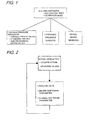
- FIG. 1 is a diagram showing the system configuration of an ABS control system of the present invention
- An ABS control system of the present invention is, as shown in FIG. 1 , configured from an ECU having an ABS control program (software) according to the present invention installed therein, a hydraulic pressure modulator (various types of valves, cylinders, pistons, electromagnetic solenoids, etc.), and various types of measurement sensors such as wheel speed sensors and hydraulic pressure sensors.
- the system configuration shown in FIG. 1 is not intended to limit the system configuration of the ABS control system of the present invention, and it is possible to increase or decrease the number of system components as long as it does not run counter to the aim of the present invention.
- the hardware configuration of the ABS control system of the present invention is the same as that of a conventional ABS control system aside from being equipped with the hydraulic pressure sensors and will not be described in detail in the present specification because it can be given an arbitrary configuration.
- the hydraulic pressure sensors are used in order to measure brake pressure during actual vehicle tests described later, and they need not be used in ABS braking.
- the ABS control program according to the present invention can be realized by installing a parameter calibration function in a conventional ABS control program.
- the conventional ABS control program mentioned here is an ABS control program in which only an ABS control function is installed and which does not have an internal parameter calibrating function.
- the ABS control program of the present invention can be realized by installing an internal parameter calibrating function in addition to the conventional function of judging wheel skidding tendency from signals from wheel speed sensors or the like and controlling the hydraulic pressure modulator on the basis of these.
- the conventional ABS control function is publicly known and an arbitrary function can be used, so in the present specification, it will not be described in detail and only the internal parameter calibration function will be described below.
- the ABS software calibration function of the present invention has the function of receiving measurement data from measurement instruments such as the wheel speed sensors and the hydraulic pressure sensors and analyzing the received data.
- the ABS software calibration function also has the function of using the data analysis results to calculate a new parameter and change the parameter to the new numerical value that has been calculated.
- the calibration function also has the function of judging whether or not the new parameter that has been calculated is optimum.
- FIG. 2 schematically shows a flow of calibrating a parameter using the ABS software with the internal parameter calibration function according to the present invention.
- the ABS software according to the present invention data analysis, parameter calculation, and parameter changes can be automated. Consequently, data acquisition can be done in an actual vehicle instantaneously using a new parameter that has been changed.
- parameter calibration can be automated by incorporating in the software the function of determining whether or not a parameter has been optimized. In this manner, by using the ABS software according to the present invention, the calibration process can be shortened because changes to the ABS software accompanying a parameter change that have conventionally been necessary and downloading the changed ABS software to the ECU become unnecessary.
- FIG. 3 shows in greater detail a typical flow when calibrating a parameter using the ABS software with the internal parameter calibration function according to the present invention.
- the calibration function is started (step 10).
- an environment needed for an actual vehicle test is prepared. That is, an actual vehicle in which the ECU having the internal parameter calibration function of the present invention has been installed is prepared.
- the ASAP file is a standardized file for calibration that includes information regarding associated data objects inside the ECU, such as characteristic values (parameters, curves, maps), actual measured values, hypothetical measured values, dependency values, etc.
- the method of creating the ASAP file is publicly known and can be performed by an arbitrary method, so it will not be described in the present specification.
- a tentative (initial) parameter is set in the ABS software (step 14).
- the initial parameter can be recorded in an external file and set to a variable in the ABS software when the ABS software reads the external file.
- the initial parameter is decided beforehand depending on the specifications of each component such as the hydraulic pressure modulator and simulations. Further, the initial parameter may also be decided on the basis of results of having tested the initial parameter in a hypothetical simple test environment.
- the parameter can be defined as an internal variable (e.g., a global variable) such that it can be rewritten by the ABS software itself.
- an actual vehicle test is started (step 16). That is, the ABS software is started in a calibration mode. In the calibration mode, the number of times and the timing of ABS braking are defined, and the operator of the actual vehicle test operates the vehicle in accordance with the calibration mode.
- the brake operation procedure in the calibration mode can be arbitrarily decided. That is, it suffices for the brake operation procedure to be decided in response to a parameter calculation algorithm described in the ABS software. For example, when ABS braking is executed multiple times on the same conditions, plural measured values are obtained, and a parameter is calculated from these plural measured values in the same conditions (e.g., when a mean value is used, etc.), it suffices for the brake operation procedure to be decided such that ABS braking is repeated multiple times on the same conditions.
- ABS software receives these measured values and calculates each parameter in response to these measured values (step 18). Then, the calculated parameter is set as a new internal parameter of the ABS software.
- the ABS software can be programmed to have functions F1 to Fn per parameter to be calculated and calculate each parameter on the basis of the measured values it has received. It is preferable for the parameter decision functions to be created per parameter from the standpoint of maintenance and the like.
- the measured values utilized for parameter calculation are not limited to wheel speed and hydraulic pressure. That is, it suffices for measured values needed for the parameter calculation functions to be measured and for these to be used as needed. For example, in addition to wheel speed sensors and hydraulic pressure sensors, acceleration sensors and temperature sensors may be installed in the test vehicle, and the ABS software may be programmed to calculate a parameter using these measured values.
- step 20 it is judged inside the ABS software whether the parameter that has been calculated in step 18 has been optimized (step 20). Specifically, it is determined inside the ABS software whether or not the new parameter that has been calculated satisfies a predetermined condition.
- the judgment of whether or not the parameter has been optimized can be performed by various methods per parameter. For example, if the difference between a parameter before being changed and the parameter that has been calculated in step 18 is within a predetermined value, it may be judged that the parameters are sufficiently convergent and that the parameter that has been decided this time is an optimum parameter. Alternatively, multiple measurement and parameter calculation may be repeated, and a situation where the variance in the calculated parameter is within a predetermined value may be used as a basis for judging optimization.
- the repetition of actual vehicle measurement and parameter calculation a predetermined number of times may be used as a condition, and the mean value of the calculated parameters may be decided as an optimum parameter.
- step 20 If it is judged in step 20 that the parameter has been optimized, then the optimized parameter is saved in the external file (step 22) and calibration is ended (step 24). If it is judged in step 20 that the parameter has not been optimized, the flow returns to step 16 where ABS braking, measurement data acquisition, and parameter calculation are again executed anew for the newly set parameter and repeated until the parameter is optimized.
- arbitrary parameters used in ABS control can be calibrated automatically with ABS software.
- the method of parameter calibration is arbitrary as long as it is a method that can be realized with software.
- the parameter calculation and optimization algorithm in the ABS software according to the present invention and the types of measurement data (wheel speed, brake pressure, etc.) needed for that and the number of times of data measurement persons skilled in the art of this technical field can appropriately change these depending on the parameter.
- ABS control parameters employable in the present invention and calibration methods thereof will be described below.
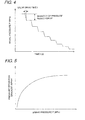
- a pressure reducing valve is driven for a certain amount of time and at regular intervals from a predetermined hydraulic pressure (e.g., about 10 MPa), and the hydraulic pressure values are measured.
- a hydraulic pressure gradient (MPa/s) at each hydraulic pressure can be calculated.
- a hydraulic pressure-hydraulic pressure gradient characteristic curve such as in FIG. 5 can be obtained per each wheel.
- the value of this characteristic curve is set in the ABS software as a new parameter.
- the hydraulic pressure values can be measured multiple times and the mean value can be used as the optimum value.
- the measurement result this time may be judged to be the optimum value.
- CP_FA is the coefficient of braking force transmission of the front wheels
- CP_RA is the coefficient of braking force transmission of the rear wheels
- P_FL is the hydraulic pressure of the front left wheel
- P_FR is the hydraulic pressure of the front right wheel
- P_RL is the hydraulic pressure of the rear left wheel
- P_RR is the hydraulic pressure of the rear right wheel.
- the deceleration a can be estimated from the quantity of change in the wheel speed.
- the method of estimating the deceleration a from the quantity of change in the wheel speed is publicly known and can be performed by an arbitrary method, so it will not be described here.
- the coefficient of braking force transmission CP is dependent on temperature, so the measurement is repeated multiple times and the mean value is used as the optimum parameter and set in the ABS software.
- the coefficient of braking force transmission can be decided by the same procedure also in regard to the rear wheels.
- a parameter relating to a master cylinder hydraulic pressure model will be described.
- the initial value of the master cylinder pressure model value at the time the ABS starts can be estimated from the deceleration of the wheels.
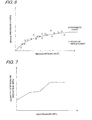
- the master cylinder pressure P at the time ABS control starts and the wheel deceleration a at that time can be measured to obtain an approximate curve and the optimum parameter like in FIG. 6 .
- the approximate curve can be obtained by an arbitrary approximation method such as the least-square method. Different parameters may be used for the front wheels and the rear wheels.
- OBR_Factor f (a, a', T_cycle).
- the over-braking correction value is monitored in a state where the master cylinder pressure is constant, and a threshold value (parameter) for making the over-braking correction value effective is obtained. That is, when the over-braking correction value is equal to or greater than a certain threshold value (parameter), the calculated correction value is added to the master cylinder hydraulic pressure model value. This threshold value is set in the ABS software.
- the basic pressure reduction quantity of the ABS is defined by a table such as in FIG. 7 , for example, because it is adjusted to match each lock pressure.
- Calibration of the pressure reduction quantity is performed in response to wheel acceleration after pressure reduction. Specifically, it is adjusted such that wheel acceleration after pressure reduction becomes a predetermined target value. Basically, when the pressure reduction quantity is small, acceleration is also small, and when the pressure reduction quantity is large, acceleration also becomes large. Consequently, a new pressure reduction quantity can be calculated from the difference between the target value of wheel acceleration after pressure reduction and the measured value. New pressure reduction quantities can be plurally calculated, and the mean value can be used as the optimum value.
- the pressure reduction quantity may be judged to have been optimized.
- the decided pressure reduction quantity table (parameter) is set in the ABS software.
- the ABS software according to the present invention can automatically calibrate an internal parameter, so the calibration process can be significantly shortened as compared to conventional calibration methods.
Landscapes
- Engineering & Computer Science (AREA)
- Microelectronics & Electronic Packaging (AREA)
- Physics & Mathematics (AREA)
- Fluid Mechanics (AREA)
- Transportation (AREA)
- Mechanical Engineering (AREA)
- Regulating Braking Force (AREA)
Abstract
Description
- The present invention relates to an ABS control system that controls wheel brake pressure with an electronic control unit (ECU) installed in a vehicle and particularly relates to an ABS control system having the function of automatically calibrating an internal parameter. The present invention also relates to an ABS control program having the function of automatically calibrating an internal parameter and an ABS control program internal parameter calibration method.
- Antilock brake systems (ABS) are generally installed in vehicles. Antilock brake systems are systems that stabilize steering of the vehicle and perform brake control such that the braking distance becomes as short as possible by easing up on the wheel brake force to eliminate skidding when it has been detected that the wheels are skidding at the time of braking and thereafter again increasing the brake force. Antilock brake systems are mainly configured from a hydraulic pressure modulator, wheel speed sensors, and an electronic control unit (ECU). The ECU processes signals, controls actuators inside the hydraulic pressure modulator, and controls the brake pressure. Generally, in antilock brake systems, the ECU judges the skidding tendency of the braked wheels on the basis of wheel speed signals from the wheel speed sensors and, when it judges that the braked wheels are in a skidding tendency, outputs a control signal to the modulator that adjusts the brake pressure. Thus, the modulator adjusts the brake pressure such that skidding of the braked wheels is eliminated.
- ABS software ordinarily models ABS braking, and a control program is designed in accordance with that model. Various parameters are used in the ABS control program. By optimizing (calibrating) these parameters, ABS braking following the model is realized. The parameters used in ABS control vary depending on ABS braking models and control algorithms, but a parameter relating to the operating characteristic of the hydraulic pressure modulator, a parameter required by the ABS braking model, and a parameter relating to the braking characteristic of the vehicle are possible. These parameters relating to ABS control can be tentatively decided by the specifications of each component and simulations at the early design stage. However, it is not always the case that optimum ABS braking will be obtained with parameters that have tentatively been set by simulations or the like. For that reason, ABS braking tests are performed using an actual vehicle equipped with ABS software in which tentative parameters have been set, wheel speed, hydraulic pressure, and vehicle motion during ABS braking are measured, and each parameter is optimized (calibrated) on the basis of these actual measured values such that optimum ABS braking is obtained.
- ABS control parameter calibration has conventionally been performed by analyzing the measured values of wheel speed and brake pressure during ABS braking in actual vehicle tests and, on the basis of the analysis results, deciding optimum parameters on the basis of design guidelines and the experience and know-how of the designer.
-
FIG. 8 schematically shows a conventional ABS software parameter decision procedure. First, using ABS software in which a tentative parameter has been set, ABS braking is performed in an actual vehicle test, and wheel speed, hydraulic pressure value, and vehicle motion during ABS braking are measured. Thereafter, these measured values are analyzed. Then, a new parameter is artificially decided from the analysis results on the basis of design guidelines and the experience and know-how of the designer. Then, the ABS software is changed on the basis of the decided parameter. Then, the changed ABS software is downloaded to the ECU. Moreover, whether or not optimum ABS braking will be obtained is further tested on the basis of the changed parameter. Here, if optimum ABS braking is obtained, parameter calibration ends, but when optimum ABS braking is not obtained, the above procedure is repeated. - In this manner, ABS control parameter calibration has required time. Particularly in recent years, in order to meet various brake performance needs, ABS braking models and ABS software algorithms are becoming more complex and the number of parameters is growing in accompaniment therewith, so ABS software development now requires even more time.
- Therefore, the ABS design and manufacturing process can be significantly shortened if the work of deciding a parameter from the results of measurements that have artificially been carried out can be automated, a new parameter can be soon reflected in the ABS software during execution of an actual vehicle test, the actual vehicle test can be continued with the new parameter, and the parameter can be calibrated. From this standpoint, the present invention provides an ABS control system and software with an automatic parameter calibration function.
- An ABS control system according to the present invention includes an electronic control unit, a wheel speed sensor, and a brake pressure sensor. The wheel speed sensor and the brake pressure sensor measure wheel speed and brake pressure during ABS braking, and the electronic control unit automatically calibrates an internal parameter used in ABS control in response to the wheel speed and brake pressure measurement results.
- The ABS control system according to one aspect of the present invention can automatically calibrate the internal parameter used in ABS control by (a) the wheel speed sensor and the brake pressure sensor measuring the wheel speed and the brake pressure during ABS braking and the electronic control unit calculating the internal parameter used in ABS control in response to the wheel speed and brake pressure measurement results and setting the calculated internal parameter as a new internal parameter used in ABS control.
- The ABS control system according to one aspect of the present invention can automatically calibrate the internal parameter used in ABS control by further (b) judging whether or not the calculated internal parameter satisfies a predetermined condition and (c) ending calibration if it is judged that the calculated internal parameter satisfies the predetermined condition and again executing the procedure of (a) and (b) if it is judged that the calculated internal parameter does not satisfy the predetermined condition.
- Further, the present invention provides an ABS control program that controls wheel brake pressure with an electronic control unit. The ABS control program of the present invention can automatically calibrate an internal parameter of the ABS control program in response to wheel speed and brake pressure that have been measured during ABS braking.
- The ABS control program according to one aspect of the present invention can automatically calibrate the internal parameter of the ABS control program by (a) calculating the internal parameter of the ABS control program in response to the wheel speed and the brake pressure that have been measured during ABS braking and setting the calculated internal parameter as a new internal parameter of the ABS control program.
- The ABS control program according to one aspect of the present invention can automatically calibrate the internal parameter of the ABS control program by further (b) judging whether or not the calculated internal parameter satisfies a predetermined condition and (c) ending calibration if it is judged that the calculated internal parameter satisfies the predetermined condition and again executing the procedure of (a) and (b) if it is judged that the calculated internal parameter does not satisfy the predetermined condition.
- Further, the present invention provides a method of calibrating an internal parameter of an ABS control program that controls wheel brake pressure with an electronic control unit. The calibration method of the present invention includes the steps of: (a) measuring wheel speed and brake pressure during ABS braking; and (b) automatically calibrating the internal parameter in accordance with a predetermined algorithm of the ABS control program in response to the wheel speed and the brake pressure that have been measured.
- In the ABS control program internal parameter calibration method according to one aspect of the present invention, step (b) includes the sub-steps of (b-1) calculating the internal parameter in accordance with the predetermined algorithm of the ABS control program in response to the wheel speed and the brake pressure that have been measured and (b-2) setting the calculated internal parameter as a new internal parameter of the ABS control program.
- In the ABS control program internal parameter calibration method according to one aspect of the present invention, step (b) further includes the sub-steps of (b-3) judging whether or not the calculated internal parameter satisfies a predetermined condition and (b-4) ending calibration if it is judged that the calculated internal parameter satisfies the predetermined condition and again executing the procedure of (a), (b-1), (b-2), and (b-3) if it is judged that the calculated internal parameter does not satisfy the predetermined condition.
-
FIG. 1 is a diagram showing the system configuration of an ABS control system of the present invention; -
FIG. 2 is a diagram showing an internal parameter calibration procedure using ABS software of the present invention; -
FIG. 3 is a diagram showing in greater detail the internal parameter calibration procedure using the ABS software of the present invention; -
FIG. 4 is a diagram showing the relationship between the drive time and the pressure reduction quantity of a pressure reducing valve at each brake pressure; -
FIG. 5 is a diagram showing a brake pressure characteristic curve; -
FIG. 6 is a diagram showing the relationship between a master cylinder hydraulic model value and deceleration; -
FIG. 7 is a diagram showing an ABS basic pressure reduction quantity; and -
FIG. 8 is a diagram showing a conventional ABS software internal parameter calibration procedure. - An ABS control system of the present invention is, as shown in
FIG. 1 , configured from an ECU having an ABS control program (software) according to the present invention installed therein, a hydraulic pressure modulator (various types of valves, cylinders, pistons, electromagnetic solenoids, etc.), and various types of measurement sensors such as wheel speed sensors and hydraulic pressure sensors. The system configuration shown inFIG. 1 is not intended to limit the system configuration of the ABS control system of the present invention, and it is possible to increase or decrease the number of system components as long as it does not run counter to the aim of the present invention. The hardware configuration of the ABS control system of the present invention is the same as that of a conventional ABS control system aside from being equipped with the hydraulic pressure sensors and will not be described in detail in the present specification because it can be given an arbitrary configuration. In the ABS control system according to the present invention, the hydraulic pressure sensors are used in order to measure brake pressure during actual vehicle tests described later, and they need not be used in ABS braking. - The ABS control program according to the present invention can be realized by installing a parameter calibration function in a conventional ABS control program.
The conventional ABS control program mentioned here is an ABS control program in which only an ABS control function is installed and which does not have an internal parameter calibrating function. In other words, the ABS control program of the present invention can be realized by installing an internal parameter calibrating function in addition to the conventional function of judging wheel skidding tendency from signals from wheel speed sensors or the like and controlling the hydraulic pressure modulator on the basis of these. The conventional ABS control function is publicly known and an arbitrary function can be used, so in the present specification, it will not be described in detail and only the internal parameter calibration function will be described below. - The ABS software calibration function of the present invention has the function of receiving measurement data from measurement instruments such as the wheel speed sensors and the hydraulic pressure sensors and analyzing the received data. The ABS software calibration function also has the function of using the data analysis results to calculate a new parameter and change the parameter to the new numerical value that has been calculated. The calibration function also has the function of judging whether or not the new parameter that has been calculated is optimum.
-
FIG. 2 schematically shows a flow of calibrating a parameter using the ABS software with the internal parameter calibration function according to the present invention. By using the ABS software according to the present invention,
data analysis, parameter calculation, and parameter changes can be automated. Consequently, data acquisition can be done in an actual vehicle instantaneously using a new parameter that has been changed. Additionally, parameter calibration can be automated by incorporating in the software the function of determining whether or not a parameter has been optimized. In this manner, by using the ABS software according to the present invention, the calibration process can be shortened because changes to the ABS software accompanying a parameter change that have conventionally been necessary and downloading the changed ABS software to the ECU become unnecessary. -
FIG. 3 shows in greater detail a typical flow when calibrating a parameter using the ABS software with the internal parameter calibration function according to the present invention. - First, the calibration function is started (step 10). At this stage, an environment needed for an actual vehicle test is prepared. That is, an actual vehicle in which the ECU having the internal parameter calibration function of the present invention has been installed is prepared.
- Next, as ASAP file for calibration is created (step 12). The ASAP file is a standardized file for calibration that includes information regarding associated data objects inside the ECU, such as characteristic values (parameters, curves, maps), actual measured values, hypothetical measured values, dependency values, etc. The method of creating the ASAP file is publicly known and can be performed by an arbitrary method, so it will not be described in the present specification.
- Next, a tentative (initial) parameter is set in the ABS software (step 14). The initial parameter can be recorded in an external file and set to a variable in the ABS software when the ABS software reads the external file. The initial parameter is decided beforehand depending on the specifications of each component such as the hydraulic pressure modulator and simulations. Further, the initial parameter may also be decided on the basis of results of having tested the initial parameter in a hypothetical simple test environment. The parameter can be defined as an internal variable (e.g., a global variable) such that it can be rewritten by the ABS software itself.
- Next, an actual vehicle test is started (step 16). That is, the ABS software is started in a calibration mode. In the calibration mode, the number of times and the timing of ABS braking are defined, and the operator of the actual vehicle test operates the vehicle in accordance with the calibration mode. The brake operation procedure in the calibration mode can be arbitrarily decided. That is, it suffices for the brake operation procedure to be decided in response to a parameter calculation algorithm described in the ABS software. For example, when ABS braking is executed multiple times on the same conditions, plural measured values are obtained, and a parameter is calculated from these plural measured values in the same conditions (e.g., when a mean value is used, etc.), it suffices for the brake operation procedure to be decided such that ABS braking is repeated multiple times on the same conditions.
- Next, wheel speed, hydraulic pressure, etc. are measured in ABS braking, and the ABS software receives these measured values and calculates each parameter in response to these measured values (step 18). Then, the calculated parameter is set as a new internal parameter of the ABS software. The ABS software can be programmed to have functions F1 to Fn per parameter to be calculated and calculate each parameter on the basis of the measured values it has received. It is preferable for the parameter decision functions to be created per parameter from the standpoint of maintenance and the like. The measured values utilized for parameter calculation are not limited to wheel speed and hydraulic pressure. That is, it suffices for measured values needed for the parameter calculation functions to be measured and for these to be used as needed. For example, in addition to wheel speed sensors and hydraulic pressure sensors, acceleration sensors and temperature sensors may be installed in the test vehicle, and the ABS software may be programmed to calculate a parameter using these measured values.
- Next, it is judged inside the ABS software whether the parameter that has been calculated in
step 18 has been optimized (step 20). Specifically, it is determined inside the ABS software whether or not the new parameter that has been calculated satisfies a predetermined condition. The judgment of whether or not the parameter has been optimized can be performed by various methods per parameter. For example, if the difference between a parameter before being changed and the parameter that has been calculated instep 18 is within a predetermined value, it may be judged that the parameters are sufficiently convergent and that the parameter that has been decided this time is an optimum parameter. Alternatively, multiple measurement and parameter calculation may be repeated, and a situation where the variance in the calculated parameter is within a predetermined value may be used as a basis for judging optimization. Alternatively, the repetition of actual vehicle measurement and parameter calculation a predetermined number of times may be used as a condition, and the mean value of the calculated parameters may be decided as an optimum parameter. In any event, it is desirable to decide the condition of optimization in consideration of the types and number of measurement data needed for parameter calculation, the parameter calculation algorithm, and the magnitude of the influence that parameter has on ABS control. Examples of automated parameter calculation procedures and optimization judgment methods will be described later. - If it is judged in
step 20 that the parameter has been optimized, then the optimized parameter is saved in the external file (step 22) and calibration is ended (step 24).
If it is judged instep 20 that the parameter has not been optimized, the flow returns to step 16 where ABS braking, measurement data acquisition, and parameter calculation are again executed anew for the newly set parameter and repeated until the parameter is optimized. - In this manner, in the present invention, arbitrary parameters used in ABS control can be calibrated automatically with ABS software. Further, the method of parameter calibration is arbitrary as long as it is a method that can be realized with software. As for the parameter calculation and optimization algorithm in the ABS software according to the present invention and the types of measurement data (wheel speed, brake pressure, etc.) needed for that and the number of times of data measurement, persons skilled in the art of this technical field can appropriately change these depending on the parameter.
- Examples of ABS control parameters employable in the present invention and calibration methods thereof will be described below.
- Calibration of a brake hydraulic pressure characteristic curve in a wheel pressure model will be described.
As shown inFIG. 4 , a pressure reducing valve is driven for a certain amount of time and at regular intervals from a predetermined hydraulic pressure (e.g., about 10 MPa), and the hydraulic pressure values are measured. Thus, the hydraulic pressure gradient (MPa/s) at each hydraulic pressure can be calculated. By performing this per each wheel, a hydraulic pressure-hydraulic pressure gradient characteristic curve such as inFIG. 5 can be obtained per each wheel. The value of this characteristic curve is set in the ABS software as a new parameter. Regarding the method of optimizing the value of this characteristic curve, for example, the hydraulic pressure values can be measured multiple times and the mean value can be used as the optimum value. Alternatively, if the difference between the characteristic curve that has been calculated from the previous measurement and the characteristic curve that has been calculated from the measurement this time is equal to or less than a predetermined value, the measurement result this time may be judged to be the optimum value. - Calibration of the coefficient of braking force transmission in a braking force model will be described. The braking force relationship can be given by the following equation.

- Here, CP_FA is the coefficient of braking force transmission of the front wheels, CP_RA is the coefficient of braking force transmission of the rear wheels, P_FL is the hydraulic pressure of the front left wheel, P_FR is the hydraulic pressure of the front right wheel, P_RL is the hydraulic pressure of the rear left wheel, and P_RR is the hydraulic pressure of the rear right wheel.
- The coefficient of braking force transmission of the front wheels can be obtained with the equation CP_FA = m · a / (P_FL + P_FR) by restricting the brake hydraulic pressure of the rear wheels to 0 MPa and performing an actual vehicle test. The deceleration a can be estimated from the quantity of change in the wheel speed. The method of estimating the deceleration a from the quantity of change in the wheel speed is publicly known and can be performed by an arbitrary method, so it will not be described here. The coefficient of braking force transmission CP is dependent on temperature, so the measurement is repeated multiple times and the mean value is used as the optimum parameter and set in the ABS software.
The coefficient of braking force transmission can be decided by the same procedure also in regard to the rear wheels. - A parameter relating to a master cylinder hydraulic pressure model will be described. The initial value of the master cylinder pressure model value at the time the ABS starts can be estimated from the deceleration of the wheels. The master cylinder pressure P at the time ABS control starts and the wheel deceleration a at that time can be measured to obtain an approximate curve and the optimum parameter like in
FIG. 6 . The approximate curve can be obtained by an arbitrary approximation method such as the least-square method.
Different parameters may be used for the front wheels and the rear wheels. - Here, a threshold value of correction with respect to over-braking will be described. When the brake pedal force is increased, the wheel pressure increase gain rises, and the wheel motion and the ABS control cycle change. Therefore, in such cases, it is necessary to correct the master cylinder model value. The over-braking correction value is usually obtained from the wheel acceleration a, the differential a' thereof, and the control cycle T_cycle. That is, it is calculated by correction value OBR_Factor = f (a, a', T_cycle). In order to avoid unnecessary correction, the over-braking correction value is monitored in a state where the master cylinder pressure is constant, and a threshold value (parameter) for making the over-braking correction value effective is obtained. That is, when the over-braking correction value is equal to or greater than a certain threshold value (parameter), the calculated correction value is added to the master cylinder hydraulic pressure model value. This threshold value is set in the ABS software.
- An ABS pressure reduction quantity will be described.
The basic pressure reduction quantity of the ABS is defined by a table such as inFIG. 7 , for example, because it is adjusted to match each lock pressure. Calibration of the pressure reduction quantity is performed in response to wheel acceleration after pressure reduction. Specifically, it is adjusted such that wheel acceleration after pressure reduction becomes a predetermined target value. Basically, when the pressure reduction quantity is small, acceleration is also small, and when the pressure reduction quantity is large, acceleration also becomes large. Consequently, a new pressure reduction quantity can be calculated from the difference between the target value of wheel acceleration after pressure reduction and the measured value. New pressure reduction quantities can be plurally calculated, and the mean value can be used as the optimum value. Alternatively, if the difference between the target value of wheel acceleration after pressure reduction and the actual measured value is equal to or less than a predetermined value, the pressure reduction quantity may be judged to have been optimized. The decided pressure reduction quantity table (parameter) is set in the ABS software. - Several parameters and methods of calibrating those parameters employable in the ABS software with the automatic calibration function according to the present invention have been described above, but the parameters and methods of calibrating those parameters usable in the present invention are not limited to the above examples. The designer can freely set the needed parameter and method of calibrating that parameter in response to the ABS control format, the ABS system configuration, and the ABS control model. Depending on the parameter, it is possible that the parameter is described in the ABS software and that calibration cannot be automated. In such cases, a parameter whose calibration cannot be automated may be calibrated by a conventional method, and just the procedure of calibration of a parameter that can be automated may be incorporated in the ABS software.
- As described above, the ABS software according to the present invention can automatically calibrate an internal parameter, so the calibration process can be significantly shortened as compared to conventional calibration methods.
- Conventionally, parameters have been artificially decided on the basis of design guidelines and the experience and know-how of the designer on the basis of measured values in actual vehicle tests and analysis results. Additionally, in order for a decided parameter to be reflected in the ABS software, a procedure where the ABS software parameter is changed offline and downloaded to the ECU has been necessary. However, in the ABS software according to the present invention, the conventional procedure of artificial parameter decision and reflection is automated in the ABS software. Consequently, the calibration process can be shortened because a test can be performed with a new parameter without interrupting an actual vehicle test. Further, the procedure of conventional artificial parameter decision is eliminated and automated in software, so calibration can be performed without dependence on the skill of the designer, and, as a result, the quality of the ABS control system can be improved.
Claims (9)
- An ABS control system that controls wheel brake pressure with an electronic control unit, the ABS control system including:a wheel speed sensor; anda brake pressure sensor,wherein the wheel speed sensor and the brake pressure sensor measure wheel speed and brake pressure during ABS braking, and the electronic control unit automatically calibrates an internal parameter used in ABS control in response to the wheel speed and brake pressure measurement results.
- The ABS control system according to claim 1, wherein the ABS control system automatically calibrates the internal parameter used in ABS control by(a) the wheel speed sensor and the brake pressure sensor measuring the wheel speed and the brake pressure during ABS braking and the electronic control unit calculating the internal parameter used in ABS control in response to the wheel speed and brake pressure measurement results and setting the calculated internal parameter as a new internal parameter used in ABS control.
- The ABS control system according to claim 2, wherein the ABS control system automatically calibrates the internal parameter used in ABS control by further(b) judging whether or not the calculated internal parameter satisfies a predetermined condition and(c) ending calibration if it is judged that the calculated internal parameter satisfies the predetermined condition and again executing the procedure of (a) and (b) if it is judged that the calculated internal parameter does not satisfy the predetermined condition.
- An ABS control program that controls wheel brake pressure with an electronic control unit, wherein the ABS control program automatically calibrates an internal parameter of the ABS control program in response to wheel speed and brake pressure that have been measured during ABS braking.
- The ABS control program according to claim 4, wherein the ABS control program automatically calibrates the internal parameter of the ABS control program by(a) calculating the internal parameter of the ABS control program in response to the wheel speed and the brake pressure that have been measured during ABS braking and setting the calculated internal parameter as a new internal parameter of the ABS control program.
- The ABS control program according to claim 5, wherein the ABS control program automatically calibrates the internal parameter of the ABS control program by further(b) judging whether or not the calculated internal parameter satisfies a predetermined condition and(c) ending calibration if it is judged that the calculated internal parameter satisfies the predetermined condition and again executing the procedure of (a) and (b) if it is judged that the calculated internal parameter does not satisfy the predetermined condition.
- A method of calibrating an internal parameter of an ABS control program that controls wheel brake pressure with an electronic control unit, the calibration method including the steps of:(a) measuring wheel speed and brake pressure during ABS braking; and(b) automatically calibrating the internal parameter in accordance with a predetermined algorithm of the ABS control program in response to the wheel speed and the brake pressure that have been measured.
- The calibration method according to claim 7, wherein step (b) includes the sub-steps of(b-1) calculating the internal parameter in accordance with the predetermined algorithm of the ABS control program in response to the wheel speed and the brake pressure that have been measured and(b-2) setting the calculated internal parameter as a new internal parameter of the ABS control program.
- The calibration method according to claim 8, wherein step (b) further includes the sub-steps of(b-3) judging whether or not the calculated internal parameter satisfies a predetermined condition and(b-4) ending calibration if it is judged that the calculated internal parameter satisfies the predetermined condition and again executing the procedure of (a), (b-1), (b-2), and (b-3) if it is judged that the calculated internal parameter does not satisfy the predetermined condition.
Applications Claiming Priority (2)
| Application Number | Priority Date | Filing Date | Title |
|---|---|---|---|
| JP2008135456 | 2008-05-23 | ||
| PCT/JP2008/064967 WO2009141923A1 (en) | 2008-05-23 | 2008-08-22 | Vehicle abs control device with internal parameter auto-calibration function |
Publications (3)
| Publication Number | Publication Date |
|---|---|
| EP2281725A1 true EP2281725A1 (en) | 2011-02-09 |
| EP2281725A4 EP2281725A4 (en) | 2013-07-17 |
| EP2281725B1 EP2281725B1 (en) | 2017-10-11 |
Family
ID=41339871
Family Applications (1)
| Application Number | Title | Priority Date | Filing Date |
|---|---|---|---|
| EP08792638.2A Active EP2281725B1 (en) | 2008-05-23 | 2008-08-22 | Vehicle abs control device with internal parameter auto-calibration function |
Country Status (5)
| Country | Link |
|---|---|
| US (1) | US8706376B2 (en) |
| EP (1) | EP2281725B1 (en) |
| JP (1) | JP5276656B2 (en) |
| CN (1) | CN102036864B (en) |
| WO (1) | WO2009141923A1 (en) |
Cited By (1)
| Publication number | Priority date | Publication date | Assignee | Title |
|---|---|---|---|---|
| EP3421312B1 (en) | 2016-02-24 | 2020-11-25 | Nabtesco Automotive Corporation | Air supply system |
Families Citing this family (13)
| Publication number | Priority date | Publication date | Assignee | Title |
|---|---|---|---|---|
| WO2013029056A1 (en) * | 2011-08-25 | 2013-02-28 | Cnh America Llc | Method of calibration of a park brake of a continuously variable transmission |
| CN102426425B (en) * | 2011-11-08 | 2013-07-17 | 重庆邮电大学 | Automobile ABS (Antilock Brake System) virtual reality simulation system |
| WO2015058119A2 (en) * | 2013-10-17 | 2015-04-23 | Robert Bosch Gmbh | Validating automotive safety functions |
| AT513370B1 (en) | 2013-11-05 | 2015-11-15 | Avl List Gmbh | Virtual test optimization for driver assistance systems |
| US9440632B2 (en) * | 2014-11-05 | 2016-09-13 | Bendix Commercial Vehicle Systems Llc | Method, controller and system for monitoring brake operation |
| CN108833572B (en) * | 2018-06-28 | 2021-01-15 | 无锡沃尔福汽车技术有限公司 | Method and system for enabling ECU to establish communication with client not integrating ASAP3 protocol |
| DE102019211551A1 (en) * | 2019-08-01 | 2021-02-04 | Robert Bosch Gmbh | Procedure for the automatic parameterization of a braking system |
| US11161487B2 (en) | 2019-08-15 | 2021-11-02 | Bendix Commercial Vehicle Systems Llc | System and method for controlling wheel brakes in a vehicle platooning with another vehicle |
| CN112857819A (en) * | 2019-11-28 | 2021-05-28 | 罗伯特·博世有限公司 | Vehicle brake regulation and control calibration method and system, vehicle and readable storage medium |
| TW202229065A (en) * | 2020-12-30 | 2022-08-01 | 義大利商萊卡母動力傳動系統有限公司 | Method and system for the control of an electro-hydraulic abs braking system |
| IT202100000428A1 (en) * | 2021-01-12 | 2022-07-12 | Faiveley Transport Italia Spa | PROCEDURE FOR CALIBRATION OF AN ACQUISITION CHAIN OF A BRAKING DEVICE OR SYSTEM OF AT LEAST ONE RAILWAY VEHICLE |
| CN117124881B (en) * | 2022-05-20 | 2025-12-23 | 比亚迪股份有限公司 | A vehicle torque control method, apparatus, electronic device, and storage medium |
| CN115723723B (en) * | 2022-11-18 | 2026-04-17 | 北京经纬恒润科技股份有限公司 | A method and apparatus for calibrating parameters of a braking system |
Family Cites Families (33)
| Publication number | Priority date | Publication date | Assignee | Title |
|---|---|---|---|---|
| DE3723876A1 (en) * | 1987-07-18 | 1989-01-26 | Daimler Benz Ag | SAFETY DEVICE FOR A ROAD VEHICLE EQUIPPED WITH AN ANTI-BLOCKING SYSTEM |
| DE3723875A1 (en) * | 1987-07-18 | 1989-02-02 | Daimler Benz Ag | SAFETY DEVICE FOR A ROAD VEHICLE EQUIPPED WITH AN ANTI-BLOCKING SYSTEM |
| DE3829951A1 (en) * | 1988-09-03 | 1990-03-15 | Daimler Benz Ag | METHOD FOR CONTROLLING THE BRAKE PRESSURE ON VEHICLES WITH LOADS AND DEVICE FOR IMPLEMENTING THE METHOD |
| DE4007360A1 (en) * | 1990-03-08 | 1991-09-12 | Daimler Benz Ag | METHOD FOR DISTRIBUTING BRAKE PRESSURE ON THE AXLES OF A MOTOR VEHICLE WITH ABS PRESSURE BRAKE |
| DE4314448A1 (en) * | 1993-05-03 | 1994-11-10 | Teves Gmbh Alfred | Brake system for motor vehicles with electric drive |
| KR0150481B1 (en) * | 1994-06-22 | 1998-12-01 | Daewoo Electronics Co Ltd | Simulator of abs (anti-lock brake system) modulator |
| US6325469B1 (en) * | 1996-09-06 | 2001-12-04 | General Motors Corporation | Brake control system |
| JPH10108840A (en) * | 1996-10-09 | 1998-04-28 | Canon Inc | Eye gaze detection device |
| JP3768685B2 (en) * | 1998-07-01 | 2006-04-19 | 株式会社日立製作所 | Brake fluid pressure control device |
| EP1129036B1 (en) | 1998-10-16 | 2003-12-17 | 02 Technologies, Inc. | Bottled water cooler with built-in oxygen generator and oxygen injection system |
| EP1159173B1 (en) * | 1999-02-27 | 2006-02-22 | Continental Teves AG & Co. oHG | Method of controlling the performance of a motor vehicle |
| JP2000335393A (en) * | 1999-05-25 | 2000-12-05 | Unisia Jecs Corp | Brake control device |
| DE10224058A1 (en) * | 2001-08-11 | 2003-05-15 | Continental Teves Ag & Co Ohg | Method for testing a current regulator of an electronically controllable valve of a hydraulic vehicle brake system |
| US20040243290A1 (en) * | 2001-08-11 | 2004-12-02 | Robert Schmidt | Method for determining a fault in a pressure sensor or brake circuit |
| US6859712B2 (en) * | 2001-08-31 | 2005-02-22 | General Motors Corporation | Adaptive compensation method for an anti-lock brake control |
| DE10216564B4 (en) * | 2002-04-15 | 2015-12-17 | Wabco Gmbh | Method for data exchange in a vehicle, in which the individual vehicle parts are interconnected via a PLC data bus |
| DE10218973A1 (en) * | 2002-04-27 | 2003-11-06 | Continental Teves Ag & Co Ohg | Method for controlling a hydraulic vehicle brake system with active hydraulic brake booster and hydraulic brake system |
| US6732038B2 (en) * | 2002-05-31 | 2004-05-04 | General Motors Corporation | Transmission gear selection method for enhancing the effectiveness of vehicle rocking maneuvers |
| US20060100766A1 (en) * | 2002-07-05 | 2006-05-11 | Continental Teves Ag & Co. Ohg | Method for increasing the stability of a motor vehicle |
| JP4211330B2 (en) * | 2002-09-04 | 2009-01-21 | 日産自動車株式会社 | Development support apparatus and development support method for anti-lock brake system for vehicle |
| US6799132B2 (en) * | 2003-01-08 | 2004-09-28 | Westinghouse Air Brake Technologies Corporation | Smart resolution valve pressure control |
| CN100418817C (en) * | 2003-07-31 | 2008-09-17 | 大陆-特韦斯贸易合伙股份公司及两合公司 | Method for determining an actuation current of a control device |
| WO2005009815A2 (en) | 2003-07-31 | 2005-02-03 | Continental Teves Ag & Co. Ohg | Method for determining the drive current for an actuator |
| US7225060B2 (en) * | 2004-07-30 | 2007-05-29 | Novariant, Inc. | Vehicle control system with user-guided calibration |
| ITRM20040498A1 (en) * | 2004-10-13 | 2005-01-13 | Stefano Bertazzoni | AUTOMATIC CONTROL SYSTEM FOR THE MANEUVER OF MOTOR BOATS, RELATED METHOD, AND PROVIDED BOAT OF THE SYSTEM. |
| US7762360B2 (en) * | 2006-02-21 | 2010-07-27 | Fabio Saposnik | Vehicle calibration and trajectory control system |
| JP5119646B2 (en) * | 2006-03-06 | 2013-01-16 | 株式会社アドヴィックス | Brake control device for vehicle |
| US7841673B2 (en) * | 2006-05-11 | 2010-11-30 | Gm Global Technology Operations, Inc. | Vehicle braking system |
| US20080111342A1 (en) * | 2006-11-09 | 2008-05-15 | Volkswagen Of America, Inc. | Bicycle having an antilock brake |
| JP2008269080A (en) * | 2007-04-17 | 2008-11-06 | Nsk Ltd | Design support device for control device of electric power steering device and control device for electric power steering device |
| JP2008017515A (en) * | 2007-08-27 | 2008-01-24 | Kyocera Corp | Transmission / reception system adjustment method and adaptive array radio apparatus in adaptive array base station |
| JP4759591B2 (en) | 2008-05-12 | 2011-08-31 | 有限会社アンディクス | Water cooler |
| US8626962B2 (en) * | 2009-07-02 | 2014-01-07 | Marine Canada Acquisition Inc. | Tilt and trim sensor apparatus |
-
2008
- 2008-08-22 JP JP2010512903A patent/JP5276656B2/en active Active
- 2008-08-22 CN CN200880129393.9A patent/CN102036864B/en active Active
- 2008-08-22 EP EP08792638.2A patent/EP2281725B1/en active Active
- 2008-08-22 WO PCT/JP2008/064967 patent/WO2009141923A1/en not_active Ceased
- 2008-08-22 US US12/992,777 patent/US8706376B2/en active Active
Cited By (2)
| Publication number | Priority date | Publication date | Assignee | Title |
|---|---|---|---|---|
| EP3421312B1 (en) | 2016-02-24 | 2020-11-25 | Nabtesco Automotive Corporation | Air supply system |
| EP3421312B2 (en) † | 2016-02-24 | 2025-11-19 | Nabtesco Automotive Corporation | Air supply system |
Also Published As
| Publication number | Publication date |
|---|---|
| CN102036864B (en) | 2014-07-23 |
| US8706376B2 (en) | 2014-04-22 |
| JPWO2009141923A1 (en) | 2011-09-29 |
| CN102036864A (en) | 2011-04-27 |
| JP5276656B2 (en) | 2013-08-28 |
| US20110071744A1 (en) | 2011-03-24 |
| EP2281725B1 (en) | 2017-10-11 |
| EP2281725A4 (en) | 2013-07-17 |
| WO2009141923A1 (en) | 2009-11-26 |
Similar Documents
| Publication | Publication Date | Title |
|---|---|---|
| EP2281725B1 (en) | Vehicle abs control device with internal parameter auto-calibration function | |
| KR101525637B1 (en) | Method for controlling a solenoid valve and apparatus for carrying out said method | |
| US8155821B2 (en) | Vacuum brake booster and method for the operation thereof | |
| US7204564B2 (en) | Vehicle trailer brake controller with wheel speed selection | |
| AU2009286562B2 (en) | Method of and apparatus for monitoring the performance of a vehicle braking system | |
| US20130311059A1 (en) | Velocity sensitive passenger vehicle trailer brake controller | |
| US5705744A (en) | Vehicle brake system checking method | |
| KR101146541B1 (en) | Method for learning characteristic curves for hydraulic valves | |
| US12485867B2 (en) | Method for updating a configuration in a braking arrangement | |
| US9789860B2 (en) | Method for determining a likely internal pressure for a master brake cylinder and device for determining a likely internal pressure for a master brake cylinder | |
| US7267412B2 (en) | Method for determining or calibrating the brake control characteristic of a vacuum brake booster | |
| KR101894612B1 (en) | Method for calibrating a modulation point of a pneumatic brake booster which is calculated on the basis of a pressure sensor signal | |
| CN116096610B (en) | Equipment and methods for parameter estimation of braking systems in vehicles equipped with automated piston cylinders. | |
| US6736465B2 (en) | System for estimating brake-fluid pressure | |
| JP4518417B2 (en) | Method and apparatus for calculating the axial load of a vehicle with the aid of a computer | |
| EP2371586A1 (en) | Method for controlling the fluidic actuation of a brake or suspension system | |
| US12384350B2 (en) | Control device and method for determining a p-V characteristic of at least one wheel brake cylinder of a brake system of a vehicle | |
| EP3715199B1 (en) | Vehicle brake control device | |
| CN111212771B (en) | Brake valve, compressed air brake system with brake valve and brake valve manufacturing method | |
| CN120548272A (en) | Method for determining characteristic parameters of flow resistance | |
| CN119928795A (en) | Braking control method, device, vehicle and medium of a wire-controlled brake system | |
| CN116985767A (en) | A pressure adjustment method and device for electric vehicle wheel cylinders | |
| EP4713231A1 (en) | Method for obtaining information on the wear condition of a vehicle braking system | |
| KR100950927B1 (en) | Sensor Diagnosis Method of Vehicle Control System | |
| JP2001517579A (en) | Method and apparatus for systematic evaluation of the dynamic state of a control system |
Legal Events
| Date | Code | Title | Description |
|---|---|---|---|
| PUAI | Public reference made under article 153(3) epc to a published international application that has entered the european phase |
Free format text: ORIGINAL CODE: 0009012 |
|
| 17P | Request for examination filed |
Effective date: 20101223 |
|
| AK | Designated contracting states |
Kind code of ref document: A1 Designated state(s): AT BE BG CH CY CZ DE DK EE ES FI FR GB GR HR HU IE IS IT LI LT LU LV MC MT NL NO PL PT RO SE SI SK TR |
|
| AX | Request for extension of the european patent |
Extension state: AL BA MK RS |
|
| DAX | Request for extension of the european patent (deleted) | ||
| A4 | Supplementary search report drawn up and despatched |
Effective date: 20130618 |
|
| RIC1 | Information provided on ipc code assigned before grant |
Ipc: B60T 8/34 20060101ALI20130612BHEP Ipc: B60T 8/17 20060101ALI20130612BHEP Ipc: B60T 8/174 20060101AFI20130612BHEP |
|
| 17Q | First examination report despatched |
Effective date: 20141031 |
|
| GRAP | Despatch of communication of intention to grant a patent |
Free format text: ORIGINAL CODE: EPIDOSNIGR1 |
|
| INTG | Intention to grant announced |
Effective date: 20170410 |
|
| GRAS | Grant fee paid |
Free format text: ORIGINAL CODE: EPIDOSNIGR3 |
|
| GRAA | (expected) grant |
Free format text: ORIGINAL CODE: 0009210 |
|
| AK | Designated contracting states |
Kind code of ref document: B1 Designated state(s): AT BE BG CH CY CZ DE DK EE ES FI FR GB GR HR HU IE IS IT LI LT LU LV MC MT NL NO PL PT RO SE SI SK TR |
|
| REG | Reference to a national code |
Ref country code: GB Ref legal event code: FG4D |
|
| REG | Reference to a national code |
Ref country code: CH Ref legal event code: EP |
|
| REG | Reference to a national code |
Ref country code: IE Ref legal event code: FG4D |
|
| REG | Reference to a national code |
Ref country code: AT Ref legal event code: REF Ref document number: 935725 Country of ref document: AT Kind code of ref document: T Effective date: 20171115 |
|
| REG | Reference to a national code |
Ref country code: DE Ref legal event code: R096 Ref document number: 602008052477 Country of ref document: DE |
|
| REG | Reference to a national code |
Ref country code: NL Ref legal event code: MP Effective date: 20171011 |
|
| REG | Reference to a national code |
Ref country code: LT Ref legal event code: MG4D |
|
| REG | Reference to a national code |
Ref country code: AT Ref legal event code: MK05 Ref document number: 935725 Country of ref document: AT Kind code of ref document: T Effective date: 20171011 |
|
| PG25 | Lapsed in a contracting state [announced via postgrant information from national office to epo] |
Ref country code: NL Free format text: LAPSE BECAUSE OF FAILURE TO SUBMIT A TRANSLATION OF THE DESCRIPTION OR TO PAY THE FEE WITHIN THE PRESCRIBED TIME-LIMIT Effective date: 20171011 |
|
| PG25 | Lapsed in a contracting state [announced via postgrant information from national office to epo] |
Ref country code: LT Free format text: LAPSE BECAUSE OF FAILURE TO SUBMIT A TRANSLATION OF THE DESCRIPTION OR TO PAY THE FEE WITHIN THE PRESCRIBED TIME-LIMIT Effective date: 20171011 Ref country code: SE Free format text: LAPSE BECAUSE OF FAILURE TO SUBMIT A TRANSLATION OF THE DESCRIPTION OR TO PAY THE FEE WITHIN THE PRESCRIBED TIME-LIMIT Effective date: 20171011 Ref country code: NO Free format text: LAPSE BECAUSE OF FAILURE TO SUBMIT A TRANSLATION OF THE DESCRIPTION OR TO PAY THE FEE WITHIN THE PRESCRIBED TIME-LIMIT Effective date: 20180111 Ref country code: ES Free format text: LAPSE BECAUSE OF FAILURE TO SUBMIT A TRANSLATION OF THE DESCRIPTION OR TO PAY THE FEE WITHIN THE PRESCRIBED TIME-LIMIT Effective date: 20171011 Ref country code: FI Free format text: LAPSE BECAUSE OF FAILURE TO SUBMIT A TRANSLATION OF THE DESCRIPTION OR TO PAY THE FEE WITHIN THE PRESCRIBED TIME-LIMIT Effective date: 20171011 |
|
| PG25 | Lapsed in a contracting state [announced via postgrant information from national office to epo] |
Ref country code: GR Free format text: LAPSE BECAUSE OF FAILURE TO SUBMIT A TRANSLATION OF THE DESCRIPTION OR TO PAY THE FEE WITHIN THE PRESCRIBED TIME-LIMIT Effective date: 20180112 Ref country code: LV Free format text: LAPSE BECAUSE OF FAILURE TO SUBMIT A TRANSLATION OF THE DESCRIPTION OR TO PAY THE FEE WITHIN THE PRESCRIBED TIME-LIMIT Effective date: 20171011 Ref country code: AT Free format text: LAPSE BECAUSE OF FAILURE TO SUBMIT A TRANSLATION OF THE DESCRIPTION OR TO PAY THE FEE WITHIN THE PRESCRIBED TIME-LIMIT Effective date: 20171011 Ref country code: IS Free format text: LAPSE BECAUSE OF FAILURE TO SUBMIT A TRANSLATION OF THE DESCRIPTION OR TO PAY THE FEE WITHIN THE PRESCRIBED TIME-LIMIT Effective date: 20180211 Ref country code: HR Free format text: LAPSE BECAUSE OF FAILURE TO SUBMIT A TRANSLATION OF THE DESCRIPTION OR TO PAY THE FEE WITHIN THE PRESCRIBED TIME-LIMIT Effective date: 20171011 Ref country code: BG Free format text: LAPSE BECAUSE OF FAILURE TO SUBMIT A TRANSLATION OF THE DESCRIPTION OR TO PAY THE FEE WITHIN THE PRESCRIBED TIME-LIMIT Effective date: 20180111 |
|
| REG | Reference to a national code |
Ref country code: DE Ref legal event code: R097 Ref document number: 602008052477 Country of ref document: DE |
|
| PG25 | Lapsed in a contracting state [announced via postgrant information from national office to epo] |
Ref country code: CZ Free format text: LAPSE BECAUSE OF FAILURE TO SUBMIT A TRANSLATION OF THE DESCRIPTION OR TO PAY THE FEE WITHIN THE PRESCRIBED TIME-LIMIT Effective date: 20171011 Ref country code: SK Free format text: LAPSE BECAUSE OF FAILURE TO SUBMIT A TRANSLATION OF THE DESCRIPTION OR TO PAY THE FEE WITHIN THE PRESCRIBED TIME-LIMIT Effective date: 20171011 Ref country code: DK Free format text: LAPSE BECAUSE OF FAILURE TO SUBMIT A TRANSLATION OF THE DESCRIPTION OR TO PAY THE FEE WITHIN THE PRESCRIBED TIME-LIMIT Effective date: 20171011 Ref country code: EE Free format text: LAPSE BECAUSE OF FAILURE TO SUBMIT A TRANSLATION OF THE DESCRIPTION OR TO PAY THE FEE WITHIN THE PRESCRIBED TIME-LIMIT Effective date: 20171011 |
|
| PLBE | No opposition filed within time limit |
Free format text: ORIGINAL CODE: 0009261 |
|
| STAA | Information on the status of an ep patent application or granted ep patent |
Free format text: STATUS: NO OPPOSITION FILED WITHIN TIME LIMIT |
|
| REG | Reference to a national code |
Ref country code: FR Ref legal event code: PLFP Year of fee payment: 11 |
|
| PG25 | Lapsed in a contracting state [announced via postgrant information from national office to epo] |
Ref country code: RO Free format text: LAPSE BECAUSE OF FAILURE TO SUBMIT A TRANSLATION OF THE DESCRIPTION OR TO PAY THE FEE WITHIN THE PRESCRIBED TIME-LIMIT Effective date: 20171011 Ref country code: IT Free format text: LAPSE BECAUSE OF FAILURE TO SUBMIT A TRANSLATION OF THE DESCRIPTION OR TO PAY THE FEE WITHIN THE PRESCRIBED TIME-LIMIT Effective date: 20171011 Ref country code: PL Free format text: LAPSE BECAUSE OF FAILURE TO SUBMIT A TRANSLATION OF THE DESCRIPTION OR TO PAY THE FEE WITHIN THE PRESCRIBED TIME-LIMIT Effective date: 20171011 |
|
| 26N | No opposition filed |
Effective date: 20180712 |
|
| PG25 | Lapsed in a contracting state [announced via postgrant information from national office to epo] |
Ref country code: SI Free format text: LAPSE BECAUSE OF FAILURE TO SUBMIT A TRANSLATION OF THE DESCRIPTION OR TO PAY THE FEE WITHIN THE PRESCRIBED TIME-LIMIT Effective date: 20171011 |
|
| PG25 | Lapsed in a contracting state [announced via postgrant information from national office to epo] |
Ref country code: MC Free format text: LAPSE BECAUSE OF FAILURE TO SUBMIT A TRANSLATION OF THE DESCRIPTION OR TO PAY THE FEE WITHIN THE PRESCRIBED TIME-LIMIT Effective date: 20171011 |
|
| REG | Reference to a national code |
Ref country code: CH Ref legal event code: PL |
|
| PG25 | Lapsed in a contracting state [announced via postgrant information from national office to epo] |
Ref country code: LU Free format text: LAPSE BECAUSE OF NON-PAYMENT OF DUE FEES Effective date: 20180822 Ref country code: CH Free format text: LAPSE BECAUSE OF NON-PAYMENT OF DUE FEES Effective date: 20180831 Ref country code: LI Free format text: LAPSE BECAUSE OF NON-PAYMENT OF DUE FEES Effective date: 20180831 |
|
| REG | Reference to a national code |
Ref country code: BE Ref legal event code: MM Effective date: 20180831 |
|
| PG25 | Lapsed in a contracting state [announced via postgrant information from national office to epo] |
Ref country code: BE Free format text: LAPSE BECAUSE OF NON-PAYMENT OF DUE FEES Effective date: 20180831 |
|
| PG25 | Lapsed in a contracting state [announced via postgrant information from national office to epo] |
Ref country code: MT Free format text: LAPSE BECAUSE OF NON-PAYMENT OF DUE FEES Effective date: 20180822 |
|
| PG25 | Lapsed in a contracting state [announced via postgrant information from national office to epo] |
Ref country code: TR Free format text: LAPSE BECAUSE OF FAILURE TO SUBMIT A TRANSLATION OF THE DESCRIPTION OR TO PAY THE FEE WITHIN THE PRESCRIBED TIME-LIMIT Effective date: 20171011 |
|
| PG25 | Lapsed in a contracting state [announced via postgrant information from national office to epo] |
Ref country code: PT Free format text: LAPSE BECAUSE OF FAILURE TO SUBMIT A TRANSLATION OF THE DESCRIPTION OR TO PAY THE FEE WITHIN THE PRESCRIBED TIME-LIMIT Effective date: 20171011 Ref country code: HU Free format text: LAPSE BECAUSE OF FAILURE TO SUBMIT A TRANSLATION OF THE DESCRIPTION OR TO PAY THE FEE WITHIN THE PRESCRIBED TIME-LIMIT; INVALID AB INITIO Effective date: 20080822 |
|
| PG25 | Lapsed in a contracting state [announced via postgrant information from national office to epo] |
Ref country code: CY Free format text: LAPSE BECAUSE OF FAILURE TO SUBMIT A TRANSLATION OF THE DESCRIPTION OR TO PAY THE FEE WITHIN THE PRESCRIBED TIME-LIMIT Effective date: 20171011 Ref country code: IE Free format text: LAPSE BECAUSE OF NON-PAYMENT OF DUE FEES Effective date: 20180822 |
|
| PGFP | Annual fee paid to national office [announced via postgrant information from national office to epo] |
Ref country code: GB Payment date: 20250822 Year of fee payment: 18 |
|
| PGFP | Annual fee paid to national office [announced via postgrant information from national office to epo] |
Ref country code: FR Payment date: 20250821 Year of fee payment: 18 |
|
| PGFP | Annual fee paid to national office [announced via postgrant information from national office to epo] |
Ref country code: DE Payment date: 20251021 Year of fee payment: 18 |