EP2280572A2 - Reducing power consumption in mobile networks - Google Patents
Reducing power consumption in mobile networks Download PDFInfo
- Publication number
- EP2280572A2 EP2280572A2 EP10167926A EP10167926A EP2280572A2 EP 2280572 A2 EP2280572 A2 EP 2280572A2 EP 10167926 A EP10167926 A EP 10167926A EP 10167926 A EP10167926 A EP 10167926A EP 2280572 A2 EP2280572 A2 EP 2280572A2
- Authority
- EP
- European Patent Office
- Prior art keywords
- base station
- qam symbols
- symbols
- qam
- mobile terminal
- Prior art date
- Legal status (The legal status is an assumption and is not a legal conclusion. Google has not performed a legal analysis and makes no representation as to the accuracy of the status listed.)
- Withdrawn
Links
Images


Classifications
-
- H—ELECTRICITY
- H04—ELECTRIC COMMUNICATION TECHNIQUE
- H04L—TRANSMISSION OF DIGITAL INFORMATION, e.g. TELEGRAPHIC COMMUNICATION
- H04L1/00—Arrangements for detecting or preventing errors in the information received
- H04L1/0078—Avoidance of errors by organising the transmitted data in a format specifically designed to deal with errors, e.g. location
- H04L1/0086—Unequal error protection
-
- H—ELECTRICITY
- H04—ELECTRIC COMMUNICATION TECHNIQUE
- H04L—TRANSMISSION OF DIGITAL INFORMATION, e.g. TELEGRAPHIC COMMUNICATION
- H04L27/00—Modulated-carrier systems
- H04L27/32—Carrier systems characterised by combinations of two or more of the types covered by groups H04L27/02, H04L27/10, H04L27/18 or H04L27/26
- H04L27/34—Amplitude- and phase-modulated carrier systems, e.g. quadrature-amplitude modulated carrier systems
- H04L27/3405—Modifications of the signal space to increase the efficiency of transmission, e.g. reduction of the bit error rate, bandwidth, or average power
- H04L27/3411—Modifications of the signal space to increase the efficiency of transmission, e.g. reduction of the bit error rate, bandwidth, or average power reducing the peak to average power ratio or the mean power of the constellation; Arrangements for increasing the shape gain of a signal set
-
- H—ELECTRICITY
- H04—ELECTRIC COMMUNICATION TECHNIQUE
- H04L—TRANSMISSION OF DIGITAL INFORMATION, e.g. TELEGRAPHIC COMMUNICATION
- H04L1/00—Arrangements for detecting or preventing errors in the information received
- H04L1/0078—Avoidance of errors by organising the transmitted data in a format specifically designed to deal with errors, e.g. location
- H04L1/009—Avoidance of errors by organising the transmitted data in a format specifically designed to deal with errors, e.g. location arrangements specific to transmitters
-
- H—ELECTRICITY
- H04—ELECTRIC COMMUNICATION TECHNIQUE
- H04L—TRANSMISSION OF DIGITAL INFORMATION, e.g. TELEGRAPHIC COMMUNICATION
- H04L27/00—Modulated-carrier systems
- H04L27/32—Carrier systems characterised by combinations of two or more of the types covered by groups H04L27/02, H04L27/10, H04L27/18 or H04L27/26
- H04L27/34—Amplitude- and phase-modulated carrier systems, e.g. quadrature-amplitude modulated carrier systems
- H04L27/3405—Modifications of the signal space to increase the efficiency of transmission, e.g. reduction of the bit error rate, bandwidth, or average power
-
- H—ELECTRICITY
- H04—ELECTRIC COMMUNICATION TECHNIQUE
- H04L—TRANSMISSION OF DIGITAL INFORMATION, e.g. TELEGRAPHIC COMMUNICATION
- H04L1/00—Arrangements for detecting or preventing errors in the information received
- H04L1/0001—Systems modifying transmission characteristics according to link quality, e.g. power backoff
- H04L1/0002—Systems modifying transmission characteristics according to link quality, e.g. power backoff by adapting the transmission rate
- H04L1/0003—Systems modifying transmission characteristics according to link quality, e.g. power backoff by adapting the transmission rate by switching between different modulation schemes
-
- H—ELECTRICITY
- H04—ELECTRIC COMMUNICATION TECHNIQUE
- H04W—WIRELESS COMMUNICATION NETWORKS
- H04W52/00—Power management, e.g. Transmission Power Control [TPC] or power classes
- H04W52/02—Power saving arrangements
- H04W52/0203—Power saving arrangements in the radio access network or backbone network of wireless communication networks
- H04W52/0206—Power saving arrangements in the radio access network or backbone network of wireless communication networks in access points, e.g. base stations
-
- H—ELECTRICITY
- H04—ELECTRIC COMMUNICATION TECHNIQUE
- H04W—WIRELESS COMMUNICATION NETWORKS
- H04W52/00—Power management, e.g. Transmission Power Control [TPC] or power classes
- H04W52/04—Transmission power control [TPC]
- H04W52/18—TPC being performed according to specific parameters
- H04W52/26—TPC being performed according to specific parameters using transmission rate or quality of service QoS [Quality of Service]
- H04W52/262—TPC being performed according to specific parameters using transmission rate or quality of service QoS [Quality of Service] taking into account adaptive modulation and coding [AMC] scheme
-
- Y—GENERAL TAGGING OF NEW TECHNOLOGICAL DEVELOPMENTS; GENERAL TAGGING OF CROSS-SECTIONAL TECHNOLOGIES SPANNING OVER SEVERAL SECTIONS OF THE IPC; TECHNICAL SUBJECTS COVERED BY FORMER USPC CROSS-REFERENCE ART COLLECTIONS [XRACs] AND DIGESTS
- Y02—TECHNOLOGIES OR APPLICATIONS FOR MITIGATION OR ADAPTATION AGAINST CLIMATE CHANGE
- Y02D—CLIMATE CHANGE MITIGATION TECHNOLOGIES IN INFORMATION AND COMMUNICATION TECHNOLOGIES [ICT], I.E. INFORMATION AND COMMUNICATION TECHNOLOGIES AIMING AT THE REDUCTION OF THEIR OWN ENERGY USE
- Y02D30/00—Reducing energy consumption in communication networks
- Y02D30/70—Reducing energy consumption in communication networks in wireless communication networks
Definitions
- the present invention is comprised within the field of mobile telecommunications, and more specifically in the mechanisms for improving energy efficiency of mobile networks during the communication between a mobile terminal and a base station.
- the invention relates to a method for reducing the power consumption in mobile networks according to claim 1, and a system according to claim 9. Preferred embodiments are defined in the dependent claims.
- the communication between a mobile terminal and a base station is QAM modulated.
- the method comprises:
- the new assignation of the QAM symbols can be obtained by assigning the most frequently used QAM symbols to those symbols in the QAM modulation with lower amplitude.
- the method preferably comprises sending the base station to the mobile terminal, together with the new assignation of the QAM symbols, the amount of information using said new assignation.
- the dynamic real time analysis to obtain the most used QAM symbols is preferably carried out for the downlink communication, detecting this way the most frequently used QAM symbols in the downlink communication.
- the new assignation of the QAM symbols is preferably expressed via a conversion matrix.
- the system for reducing the power consumption in mobile networks comprises:
- the data processing means of the base station can be configured to obtain the new assignation of the QAM symbols by assigning the most frequently used QAM symbols to those symbols in the QAM modulation with lower amplitude or with higher amplitude.
- the base station can be further configured to send to the mobile terminal, together with the new assignation of the QAM symbols, the amount of information using said new assignation.
- the solution proposed consists on a combination of the above dynamic real time analysis plus a dynamic table with symbols and bits sequence, shared periodically between the UE and the network. Hence the symbol would not be statically connected to a bit string, but would be dynamically allocated. By doing this, it is possible to allocate the most likely bit strings within a communication to those symbols that have less amplitude (less energy), hence providing less power consumption.
- Modulation is done in the last part of the transmitting chain, in the physical layer of the RF link. Modulation is defined in the standard in 44.004 document.
- RLC/MAC Described in 3GPP 44.060, which are layer 2 protocol.
- RLC layer Before modulation, RLC layer pass the bit stream to physical layer, and then the physical layer finish the process of channel coding, adding tail bit and training sequence, separate in different timeslots and finally generate another bit stream which is going to be modulated. Then the bit stream is mapped into symbol, depending on the modulation technical adopted, several bits will mapped into a symbol (e.g. GMSK modulation, 1 bit will map 1 symbol; 16 QAM modulation, 4 bits will map 1 symbol), and the mapping or transformation relationship between bits and symbol is static: once the symbol's position in constellation is confirmed, then the mapping relationship is confirmed.
- GMSK modulation 1 bit will map 1 symbol
- 16 QAM modulation 4 bits will map 1 symbol
- QAM modulations are usually depicted in a constellation-like representation, representing amplitude and phase.
- Figure 2 is represented a modulation constellation diagram for rectangular 16-QAM used in GSM, which are rectangular constellations.
- the present invention proposes to include a new function in the modulation/demodulation processes to allow to make some symbols (inner or outer) more common and therefore gain the advantages that are described previously.
- modulation scrambler/descrambler These functions can be called modulation scrambler/descrambler and will find bits to symbol mapping that follow the operator strategy. This allocation will be done per user.
- RLC Last one before the bits are modulated is the RLC one.
- RLC has one buffer where information to be sent in the downlink is stored.
- the new scrambler function will calculate which are the symbols that will occur more often in that bit sequence. Those symbols will be ordered according to operator's preference and will be allocated a new bitstream.
- This scrambler function should be configurable by the operator where a parameter with at least the following three values should be provided:
- Descrambler in the user device will receive this message and will apply this conversion matrix to the information to be received. If there is no message received after the amount of information has expired, then no scrambling shall be done.
- a new message Before sending the information to the user in the downlink, a new message will be sent in order to indicate the new scrambling mode to be used. That message will be divided in two parts:
- the different codes used in the mobile networks will be QAM modulated, the different codes will have different amplitudes, and thus representing different power levels.
- the symbol assigned to an absent signal can instead be replaced, according with the present invention, by a symbol of lower amplitude dynamically.
Landscapes
- Engineering & Computer Science (AREA)
- Computer Networks & Wireless Communication (AREA)
- Signal Processing (AREA)
- Mobile Radio Communication Systems (AREA)
- Digital Transmission Methods That Use Modulated Carrier Waves (AREA)
Abstract
- making the base station a dynamic real time analysis of the QAM symbols used in the communication between said mobile terminal and the base station, detecting the most frequently used QAM symbols;
- obtaining the base station a new assignation of the QAM symbols for the downlink communication;
- sending the base station the new assignation of the QAM symbols to the mobile terminal;
- using the mobile terminal and the base station said new assignation of the QAM symbols for the demodulation process and modulation process, respectively, in their subsequent communication.
Description
- The present invention is comprised within the field of mobile telecommunications, and more specifically in the mechanisms for improving energy efficiency of mobile networks during the communication between a mobile terminal and a base station.
- Part of the success of mobile broadband services is based on the usage of higher order modulation schemes (16 QAM, 32 QAM and 64 QAM in the future). The utilization of higher order modulation is so far restricted to HSPA, but can be easily extrapolated in the future to EDGE evolution and definitely to 4G. This higher order modulation schemes are different from conventional QPSK mechanism as not all symbols have the same amplitude, hence not all symbols consume same energy. This can be seen as the price to pay for increasing the amount of bits per symbol (e.g. in 8 PSK each symbol carries 3 bits, with 16 QAM number is 4 bits, 32 QAM goes up to 5 and finally with 64 QAM the amount of bits per symbol is 6).
- Current mechanisms to reduce power consumption in mobile telecommunications are mainly based on reducing the amount of energy required by the hardware mechanisms (increased PA (Power Amplifier) efficiency, switch off of unused elements during idle times), but radio protocols are not considered as a mechanism to improve energy efficiency of mobile networks.
- It is well-known that abbreviations and acronyms are frequently used in the mobile telephony field. Below is a glossary of acronyms/terms used throughout the present specification:
- 3GPP
- The 3rd Generation Partnership Project
- ETSI
- European Telecommunications Standards Institute
- GPRS
- General Packet Radio Service
- GSM
- Global System for Mobile Communications
- EDGE
- Enhanced Data GSM Environment
- MAC
- Medium Access Control
- PA
- Power Amplifier
- PSK
- Phase Shift Keying
- QAM
- Quadrature Amplitude Modulation
- QPSK
- Quadrature Phase-Shift Keying
- RLC
- Radio Link Control
- UE
- User Equipment
- UMTS
- Universal Mobile Telecommunications System
- The invention relates to a method for reducing the power consumption in mobile networks according to
claim 1, and a system according toclaim 9. Preferred embodiments are defined in the dependent claims. - In the present method the communication between a mobile terminal and a base station is QAM modulated. The method comprises:
- making the base station a dynamic real time analysis of the QAM symbols used in the communication between said mobile terminal and the base station, detecting the most frequently used QAM symbols;
- obtaining the base station a new assignation of the QAM symbols for the downlink communication;
- sending the base station the new assignation of the QAM symbols to the mobile terminal;
- using the mobile terminal and the base station said new assignation of the QAM symbols for the demodulation process and modulation process, respectively, in their subsequent communication.
- The new assignation of the QAM symbols can be obtained by assigning the most frequently used QAM symbols to those symbols in the QAM modulation with lower amplitude.
- The dynamic real time analysis to obtain the most used QAM symbols can be carried out by:
- using data already transmitted between the mobile phone and the base station (normally, the last data transmitted in the last x seconds), or
- using data to be transmitted between the mobile phone and the base station (e.g., the data stored in the transmission buffer), or
- using data already transmitted and data to be transmitted between the mobile phone and the base station.
- The method preferably comprises sending the base station to the mobile terminal, together with the new assignation of the QAM symbols, the amount of information using said new assignation.
- The dynamic real time analysis to obtain the most used QAM symbols is preferably carried out for the downlink communication, detecting this way the most frequently used QAM symbols in the downlink communication.
- The new assignation of the QAM symbols is preferably expressed via a conversion matrix.
- On the other hand, the system for reducing the power consumption in mobile networks comprises:
- the base station, which in turn comprises data processing means configured to:
- make a dynamic real time analysis of the QAM symbols used in the communication between said mobile terminal and the base station, detecting the most frequently used QAM symbols; and
- obtain a new assignation of the QAM symbols;
- send the new assignation of the QAM symbols to the mobile terminal, and
- use said new assignation of the QAM symbols for the modulation process in the subsequent communication with the mobile terminal;
- the mobile terminal, being configured to use said new assignation of the QAM symbols for the demodulation process in the subsequent communication with the base station.
- The data processing means of the base station can be configured to obtain the new assignation of the QAM symbols by assigning the most frequently used QAM symbols to those symbols in the QAM modulation with lower amplitude or with higher amplitude.
- The data processing means of the base station can be configured to obtain the most used QAM symbols in the dynamic real time analysis by:
- using data already transmitted between the mobile phone and the base station;
- using data to be transmitted between the mobile phone and the base station;
- using data already transmitted and data to be transmitted between the mobile phone and the base station.
- The base station can be further configured to send to the mobile terminal, together with the new assignation of the QAM symbols, the amount of information using said new assignation.
- A series of drawings which aid in better understanding the invention and which are expressly related with an embodiment of said invention, presented as a non-limiting example thereof, are very briefly described below.
-
Figure 1 shows the building block of physical layer functions. -
Figure 2 shows a modulation constellation diagram for rectangular 16-QAM used in GSM. -
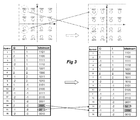
Figure 3 shows an example of a new assignation of the QAM symbols according to the invention. - Usually in whatever digital communication not all combination of bits is equally probable. As an example, GSM standard establishes that whenever there is nothing to send within a particular message, it is filled in with the 2B octet (or in binary 00101011). If using a 16 QAM modulation, the symbols for 0010 and for 1011 would be much more likely than others. In a general communication, it is possible to make a dynamic real time analysis of the most used symbols (sequence of bits) in the previous frames, that would give a guidance of the most probable future symbols (sequence of bits).
- The solution proposed consists on a combination of the above dynamic real time analysis plus a dynamic table with symbols and bits sequence, shared periodically between the UE and the network. Hence the symbol would not be statically connected to a bit string, but would be dynamically allocated. By doing this, it is possible to allocate the most likely bit strings within a communication to those symbols that have less amplitude (less energy), hence providing less power consumption.
- This would provide a side benefit in terms of interference, improving the overall system capacity. Dynamic allocation of bit strings with symbols, in combination with the analysis of the more likely strings to reduce the overall energy consumption of the system is a novel approach in telecom systems.
- In EDGE evolution new modulation schemes will be introduced in order to improve the overall performance in the system. These modulations are QAM modulations which consist in different amplitudes and phases, while the previous modulations were just phase shifting modulations. The building block of physical layer functions is shown in
Figure 1 , using the following references: 1 for the info + parity bits, 2 for the coded bits, 3 for the interleaved bits, 4 for the encrypted bits, 5 for the modulating bits, 6 for the information bits (receive). - Modulation is done in the last part of the transmitting chain, in the physical layer of the RF link. Modulation is defined in the standard in 44.004 document.
- Information is sent in a bitstream format to the physical layer by RLC/MAC (Described in 3GPP 44.060), which are
layer 2 protocol. - Before modulation, RLC layer pass the bit stream to physical layer, and then the physical layer finish the process of channel coding, adding tail bit and training sequence, separate in different timeslots and finally generate another bit stream which is going to be modulated. Then the bit stream is mapped into symbol, depending on the modulation technical adopted, several bits will mapped into a symbol (e.g. GMSK modulation, 1 bit will map 1 symbol; 16 QAM modulation, 4 bits will map 1 symbol), and the mapping or transformation relationship between bits and symbol is static: once the symbol's position in constellation is confirmed, then the mapping relationship is confirmed.
- QAM modulations are usually depicted in a constellation-like representation, representing amplitude and phase. In
Figure 2 is represented a modulation constellation diagram for rectangular 16-QAM used in GSM, which are rectangular constellations. - In these constellations we can distinguish between outer symbols and inner symbols:
- Outer symbols are the ones in the outer part of the constellation (in
Figure 2 there are 12 outer symbols). They have bigger amplitude and therefore the PAR (Peak average ratio) will be higher. However, as they do not have a lot of symbols around, the uncertainty is lower and it is easier to transmit and receive those symbols. - Inner symbols are the ones in the inner part of the constellation (in
Figure 2 there are 2 inner symbols). They have lower amplitude and therefore the PAR (Peak Average Ratio) will be lower. However, since they have a lot of symbols around the uncertainty is big and it is more difficult to receive those symbols. - Therefore there are two kinds of symbols with some advantages and disadvantages:
- High PAR require some power backoff in the PA and the power efficiency will be worst than with lower PAR.
- High symbol receiving uncertainty, creates a higher number of errors in the symbol detection, reducing the performance of the system, especially regarding throughput and latency.
- As it has been described there are different symbol types in QAM modulations with different advantages. Right now there is static mapping to symbols (3GPP 44.004) so the distribution in the long term will probably be equal.
- The present invention proposes to include a new function in the modulation/demodulation processes to allow to make some symbols (inner or outer) more common and therefore gain the advantages that are described previously.
- These functions can be called modulation scrambler/descrambler and will find bits to symbol mapping that follow the operator strategy. This allocation will be done per user.
- In GSM systems information is sent to the different protocols defined in the standard. Last one before the bits are modulated is the RLC one. RLC has one buffer where information to be sent in the downlink is stored. Before information is prepared to be sent the new scrambler function will calculate which are the symbols that will occur more often in that bit sequence. Those symbols will be ordered according to operator's preference and will be allocated a new bitstream.
- This scrambler function should be configurable by the operator where a parameter with at least the following three values should be provided:
- 1- Outer symbols favored.
- 2- Inner Symbols favored.
- 3- No symbols favored.
- Descrambler in the user device will receive this message and will apply this conversion matrix to the information to be received. If there is no message received after the amount of information has expired, then no scrambling shall be done.
- Before sending the information to the user in the downlink, a new message will be sent in order to indicate the new scrambling mode to be used. That message will be divided in two parts:
- 1- Conversion matrix, where each symbol in the constellation will be allocated a new bitstream. Reference can be the static allocation already in use right now. In
Figure 3 it is shown an example with 16QAM (16 symbols), aimed to understand the conversion matrix, in which onlysymbols - 1, 2, 3, 4, 5, 6, 7, 8, 9, 10, 11, 12, 13, 15, 14, 16
symbol 1, that is, '1101'; the new bitstream for symbol 2 (Q=2, I=1) is the previous bitstream for saidsymbol 2, that is, '1100';...; the new bitstream for symbol 14 (Q=2, I=-2) is the previous bitstream for thesymbol 15, that is, '0011'; the new bitstream for symbol 15 (Q=-I, I=-2) is the previous bitstream for thesymbol 14, that is, '0000'; the new bitstream for symbol 16 (Q=-2, I=-2) is the previous bitstream for saidsymbol 16, that is, '0010'.
In this example if the bitstream '0000' is most frequently used then it would be expressed as Q=-I, I=-2 (instead of the former symbol Q=2, I=-2) and thus saving energy since the new symbol has lower amplitude.
The information regarding the conversion matrix can be transmitted in many other different ways (e.g., transmitting the whole conversion matrix including all rows and columns), provided it is clear which conversion is to be applied in the demodulation process. - 2- Amount of information that will use that conversion matrix.
- Since the different signals used in the mobile networks will be QAM modulated, the different codes will have different amplitudes, and thus representing different power levels. The symbol assigned to an absent signal can instead be replaced, according with the present invention, by a symbol of lower amplitude dynamically.
Claims (15)
- Method for reducing the power consumption in mobile networks, wherein the communication between a mobile terminal and a base station is QAM modulated, characterized in that it comprises:- making the base station a dynamic real time analysis of the QAM symbols used in the communication between said mobile terminal and the base station, detecting the most frequently used QAM symbols;- obtaining the base station a new assignation of the QAM symbols for the downlink communication;- sending the base station the new assignation of the QAM symbols to the mobile terminal;- using the mobile terminal and the base station said new assignation of the QAM symbols for the demodulation process and modulation process, respectively, in their subsequent communication.
- Method according to claim 1, wherein the new assignation of the QAM symbols is obtained by assigning the most frequently used QAM symbols to those symbols in the QAM modulation with lower amplitude.
- Method according to any of claims 1-2, wherein the dynamic real time analysis to obtain the most used QAM symbols is carried out by using data already transmitted between the mobile phone and the base station.
- Method according to any of claims 1-2, wherein the dynamic real time analysis to obtain the most used QAM symbols is carried out by using data to be transmitted between the mobile phone and the base station.
- Method according to any of claims 1-2, wherein the dynamic real time analysis to obtain the most used QAM symbols is carried out by using data already transmitted and data to be transmitted between the mobile phone and the base station.
- Method according to any of previous claims, wherein it also comprises sending the base station to the mobile terminal, together with the new assignation of the QAM symbols, the amount of information using said new assignation.
- Method according to any of claims 1-6, wherein the dynamic real time analysis to obtain the most used QAM symbols is carried out for the downlink communication, detecting this way the most frequently used QAM symbols in the downlink communication.
- Method according to any of previous claims, wherein the new assignation of the QAM symbols is expressed via a conversion matrix.
- System for reducing the power consumption in mobile networks, wherein the communication between a mobile terminal and a base station is QAM modulated, characterized in that it comprises:- the base station, which in turn comprises data processing means configured to:• make a dynamic real time analysis of the QAM symbols used in the communication between said mobile terminal and the base station, detecting the most frequently used QAM symbols; and• obtain a new assignation of the QAM symbols;the base station being configured to:• send the new assignation of the QAM symbols to the mobile terminal, and• use said new assignation of the QAM symbols for the modulation process in the subsequent communication with the mobile terminal;- the mobile terminal, being configured to use said new assignation of the QAM symbols for the demodulation process in the subsequent communication with the base station.
- System according to claim 9, wherein the data processing means of the base station are configured to obtain the new assignation of the QAM symbols by assigning the most frequently used QAM symbols to those symbols in the QAM modulation with lower amplitude.
- System according to claim 9, wherein the data processing means of the base station are configured to obtain the new assignation of the QAM symbols by assigning the most frequently used QAM symbols to those symbols in the QAM modulation with higher amplitude.
- System according to any of claims 9-11, wherein the data processing means of the base station are configured to obtain the most used QAM symbols in the dynamic real time analysis by using data already transmitted between the mobile phone and the base station.
- System according to any of claims 9-11, wherein the data processing means of the base station are configured to obtain the most used QAM symbols in the dynamic real time analysis by using data to be transmitted between the mobile phone and the base station.
- System according to any of claims 9-11, the data processing means of the base station are configured to obtain the most used QAM symbols in the dynamic real time analysis by using data already transmitted and data to be transmitted between the mobile phone and the base station.
- System according to any of claims 9-14, wherein the base station is further configured to send to the mobile terminal, together with the new assignation of the QAM symbols, the amount of information using said new assignation.
Applications Claiming Priority (1)
| Application Number | Priority Date | Filing Date | Title |
|---|---|---|---|
| ES200930380A ES2376686B1 (en) | 2009-06-30 | 2009-06-30 | METHOD AND SYSTEM TO REDUCE POWER CONSUMPTION IN MOBILE NETWORKS. |
Publications (2)
| Publication Number | Publication Date |
|---|---|
| EP2280572A2 true EP2280572A2 (en) | 2011-02-02 |
| EP2280572A3 EP2280572A3 (en) | 2014-12-31 |
Family
ID=42790827
Family Applications (1)
| Application Number | Title | Priority Date | Filing Date |
|---|---|---|---|
| EP10167926.4A Withdrawn EP2280572A3 (en) | 2009-06-30 | 2010-06-30 | Reducing power consumption in mobile networks |
Country Status (3)
| Country | Link |
|---|---|
| US (1) | US8244314B2 (en) |
| EP (1) | EP2280572A3 (en) |
| ES (1) | ES2376686B1 (en) |
Family Cites Families (6)
| Publication number | Priority date | Publication date | Assignee | Title |
|---|---|---|---|---|
| US6553535B1 (en) * | 1998-08-21 | 2003-04-22 | Massachusetts Institute Of Technology | Power-efficient communication protocol |
| US20050226342A1 (en) * | 2004-03-03 | 2005-10-13 | Fady Alajaji | System and method for mapping information symbols to transmission symbols |
| CN101228761B (en) * | 2005-07-26 | 2011-04-20 | 松下电器产业株式会社 | Rearrangement Diversity of Bit Manipulation Relative to Inverted Constellation Mapping |
| EP1804541B1 (en) * | 2005-12-27 | 2012-11-21 | Telefonaktiebolaget L M Ericsson (Publ) | Method, system, device and computer-readable medium for communicating incremental broadcast information |
| WO2008001446A1 (en) * | 2006-06-29 | 2008-01-03 | Fujitsu Limited | Transmission device, reception device, transmission method, and reception method |
| US8437391B2 (en) * | 2009-06-26 | 2013-05-07 | Intel Corporation | Transmitting video between two stations in a wireless network |
-
2009
- 2009-06-30 ES ES200930380A patent/ES2376686B1/en active Active
-
2010
- 2010-06-30 EP EP10167926.4A patent/EP2280572A3/en not_active Withdrawn
- 2010-06-30 US US12/826,888 patent/US8244314B2/en not_active Expired - Fee Related
Non-Patent Citations (1)
| Title |
|---|
| None |
Also Published As
| Publication number | Publication date |
|---|---|
| US20100331004A1 (en) | 2010-12-30 |
| ES2376686A1 (en) | 2012-03-16 |
| ES2376686B1 (en) | 2013-01-29 |
| EP2280572A3 (en) | 2014-12-31 |
| US8244314B2 (en) | 2012-08-14 |
Similar Documents
| Publication | Publication Date | Title |
|---|---|---|
| EP1234401B1 (en) | Variable rate coding for forward link | |
| CN101779510B (en) | Radio communication control method, base station device, and user device | |
| EP3309989A1 (en) | Wireless communications apparatus and wireless communications method | |
| JP3887547B2 (en) | Mobile station, base station, mobile communication system, mobile communication method, and mobile communication program | |
| EP1908192B1 (en) | Methods and apparatus for implementing and using an in-band rate indicator | |
| EP2247060B1 (en) | USF coding | |
| CN101647209B (en) | Power Control of Orthogonal Subchannels in Wireless Communication | |
| US20070140167A1 (en) | Apparatus and method for reducing map channel overhead in a broadband wireless communication system | |
| EP1908191B1 (en) | In-band rate indicator method and wireless terminal | |
| WO2008002446A2 (en) | Apparatus and methods for implementing hierarchical modulation and demodulation for geran evolution | |
| EP2667556B1 (en) | Control channel information transmission method, and base station and terminal using the same method | |
| WO2009117577A1 (en) | Signaling for multi-user reusing one slot (muros) operation in gsm | |
| US6646993B1 (en) | Communication apparatus and method of format adaptation therefor | |
| KR101126805B1 (en) | Method and device of handling multi-user/multi-service | |
| US8290077B1 (en) | Communication with multiple users over a single time slot using high-order modulation | |
| RU2548901C2 (en) | Data modulation in communication system | |
| MXPA05010772A (en) | Method and apparatus for a spectrally compliant cellular communication system. | |
| KR20070096539A (en) | Device and method for transmitting and receiving control channel in orthogonal frequency division multiplexing system | |
| US8244314B2 (en) | Reducing power consumption in mobile networks | |
| WO2009078555A1 (en) | Method of transmitting signal | |
| US20090279625A1 (en) | Legacy-compliant burst formats for multiple users reusing one slot (muros) operation | |
| WO2018083766A1 (en) | Base station device, terminal device, wireless communication system and transmission method | |
| HK1110723A (en) | Determination if a share channel (e:g: ssch) can be utilized for transmission |
Legal Events
| Date | Code | Title | Description |
|---|---|---|---|
| PUAI | Public reference made under article 153(3) epc to a published international application that has entered the european phase |
Free format text: ORIGINAL CODE: 0009012 |
|
| AK | Designated contracting states |
Kind code of ref document: A2 Designated state(s): AL AT BE BG CH CY CZ DE DK EE ES FI FR GB GR HR HU IE IS IT LI LT LU LV MC MK MT NL NO PL PT RO SE SI SK SM TR |
|
| AX | Request for extension of the european patent |
Extension state: BA ME RS |
|
| PUAL | Search report despatched |
Free format text: ORIGINAL CODE: 0009013 |
|
| AK | Designated contracting states |
Kind code of ref document: A3 Designated state(s): AL AT BE BG CH CY CZ DE DK EE ES FI FR GB GR HR HU IE IS IT LI LT LU LV MC MK MT NL NO PL PT RO SE SI SK SM TR |
|
| AX | Request for extension of the european patent |
Extension state: BA ME RS |
|
| RIC1 | Information provided on ipc code assigned before grant |
Ipc: H04W 52/02 20090101ALN20141125BHEP Ipc: H04W 52/26 20090101ALI20141125BHEP Ipc: H04L 1/00 20060101AFI20141125BHEP Ipc: H04W 28/04 20090101ALI20141125BHEP Ipc: H04L 27/34 20060101ALI20141125BHEP |
|
| RBV | Designated contracting states (corrected) |
Designated state(s): AL AT BE BG CH CY CZ DE DK EE ES FI FR GB GR HR HU IE IS IT LI LT LU LV MC MK MT NL NO PL PT RO SE SI SK SM TR |
|
| 17P | Request for examination filed |
Effective date: 20150622 |
|
| STAA | Information on the status of an ep patent application or granted ep patent |
Free format text: STATUS: THE APPLICATION IS DEEMED TO BE WITHDRAWN |
|
| 18D | Application deemed to be withdrawn |
Effective date: 20170103 |