EP2280075A1 - Biocatalyst for catalytic hydroamination - Google Patents
Biocatalyst for catalytic hydroamination Download PDFInfo
- Publication number
- EP2280075A1 EP2280075A1 EP09166871A EP09166871A EP2280075A1 EP 2280075 A1 EP2280075 A1 EP 2280075A1 EP 09166871 A EP09166871 A EP 09166871A EP 09166871 A EP09166871 A EP 09166871A EP 2280075 A1 EP2280075 A1 EP 2280075A1
- Authority
- EP
- European Patent Office
- Prior art keywords
- trans
- phenyl
- hydroamination
- anyone
- protein
- Prior art date
- Legal status (The legal status is an assumption and is not a legal conclusion. Google has not performed a legal analysis and makes no representation as to the accuracy of the status listed.)
- Ceased
Links
- 238000005913 hydroamination reaction Methods 0.000 title claims abstract description 41
- 102000004190 Enzymes Human genes 0.000 title abstract description 28
- 108090000790 Enzymes Proteins 0.000 title abstract description 28
- 230000003197 catalytic effect Effects 0.000 title description 3
- 239000011942 biocatalyst Substances 0.000 title description 2
- 238000000034 method Methods 0.000 claims abstract description 55
- 108700023158 Phenylalanine ammonia-lyases Proteins 0.000 claims abstract description 41
- 240000009164 Petroselinum crispum Species 0.000 claims abstract description 11
- 235000002770 Petroselinum crispum Nutrition 0.000 claims abstract description 11
- 244000005700 microbiome Species 0.000 claims abstract description 10
- 108090000623 proteins and genes Proteins 0.000 claims description 61
- 150000007523 nucleic acids Chemical group 0.000 claims description 59
- 102000004169 proteins and genes Human genes 0.000 claims description 49
- 239000000758 substrate Substances 0.000 claims description 38
- QGZKDVFQNNGYKY-UHFFFAOYSA-N ammonia Natural products N QGZKDVFQNNGYKY-UHFFFAOYSA-N 0.000 claims description 28
- 230000000694 effects Effects 0.000 claims description 27
- 125000003118 aryl group Chemical group 0.000 claims description 24
- COLNVLDHVKWLRT-QMMMGPOBSA-N L-phenylalanine Chemical compound OC(=O)[C@@H](N)CC1=CC=CC=C1 COLNVLDHVKWLRT-QMMMGPOBSA-N 0.000 claims description 19
- -1 ammonia compound Chemical class 0.000 claims description 17
- 108091028043 Nucleic acid sequence Proteins 0.000 claims description 16
- 229910021529 ammonia Inorganic materials 0.000 claims description 16
- 229960005190 phenylalanine Drugs 0.000 claims description 13
- QROGIFZRVHSFLM-QHHAFSJGSA-N [(e)-prop-1-enyl]benzene Chemical compound C\C=C\C1=CC=CC=C1 QROGIFZRVHSFLM-QHHAFSJGSA-N 0.000 claims description 12
- 150000001412 amines Chemical class 0.000 claims description 12
- 229910052799 carbon Inorganic materials 0.000 claims description 12
- QROGIFZRVHSFLM-UHFFFAOYSA-N trans-beta-methyl styrene Natural products CC=CC1=CC=CC=C1 QROGIFZRVHSFLM-UHFFFAOYSA-N 0.000 claims description 12
- OKTJSMMVPCPJKN-UHFFFAOYSA-N Carbon Chemical compound [C] OKTJSMMVPCPJKN-UHFFFAOYSA-N 0.000 claims description 11
- OUYCCCASQSFEME-QMMMGPOBSA-N L-Tyrosine Natural products OC(=O)[C@@H](N)CC1=CC=C(O)C=C1 OUYCCCASQSFEME-QMMMGPOBSA-N 0.000 claims description 11
- 239000000203 mixture Substances 0.000 claims description 11
- VHUUQVKOLVNVRT-UHFFFAOYSA-N Ammonium hydroxide Chemical compound [NH4+].[OH-] VHUUQVKOLVNVRT-UHFFFAOYSA-N 0.000 claims description 9
- 239000002253 acid Substances 0.000 claims description 8
- 229960004441 tyrosine Drugs 0.000 claims description 7
- AXCXHFKZHDEKTP-NSCUHMNNSA-N 4-methoxycinnamaldehyde Chemical compound COC1=CC=C(\C=C\C=O)C=C1 AXCXHFKZHDEKTP-NSCUHMNNSA-N 0.000 claims description 6
- OOCCDEMITAIZTP-QPJJXVBHSA-N (E)-cinnamyl alcohol Chemical compound OC\C=C\C1=CC=CC=C1 OOCCDEMITAIZTP-QPJJXVBHSA-N 0.000 claims description 4
- PPBRXRYQALVLMV-UHFFFAOYSA-N Styrene Chemical compound C=CC1=CC=CC=C1 PPBRXRYQALVLMV-UHFFFAOYSA-N 0.000 claims description 4
- 239000000908 ammonium hydroxide Substances 0.000 claims description 4
- APEJMQOBVMLION-UHFFFAOYSA-N cinnamamide Chemical compound NC(=O)C=CC1=CC=CC=C1 APEJMQOBVMLION-UHFFFAOYSA-N 0.000 claims description 4
- JMFRWRFFLBVWSI-NSCUHMNNSA-N coniferol Chemical compound COC1=CC(\C=C\CO)=CC=C1O JMFRWRFFLBVWSI-NSCUHMNNSA-N 0.000 claims description 4
- 125000001997 phenyl group Chemical group [H]C1=C([H])C([H])=C(*)C([H])=C1[H] 0.000 claims description 4
- KJPRLNWUNMBNBZ-QPJJXVBHSA-N (E)-cinnamaldehyde Chemical compound O=C\C=C\C1=CC=CC=C1 KJPRLNWUNMBNBZ-QPJJXVBHSA-N 0.000 claims description 3
- OCNIKEFATSKIBE-NSCUHMNNSA-N (e)-4-(4-hydroxyphenyl)but-3-en-2-one Chemical compound CC(=O)\C=C\C1=CC=C(O)C=C1 OCNIKEFATSKIBE-NSCUHMNNSA-N 0.000 claims description 3
- AVXURJPOCDRRFD-UHFFFAOYSA-N Hydroxylamine Chemical compound ON AVXURJPOCDRRFD-UHFFFAOYSA-N 0.000 claims description 3
- IWTYTFSSTWXZFU-QPJJXVBHSA-N [(e)-3-chloroprop-1-enyl]benzene Chemical compound ClC\C=C\C1=CC=CC=C1 IWTYTFSSTWXZFU-QPJJXVBHSA-N 0.000 claims description 3
- MPMBRWOOISTHJV-XVNBXDOJSA-N [(e)-but-1-enyl]benzene Chemical compound CC\C=C\C1=CC=CC=C1 MPMBRWOOISTHJV-XVNBXDOJSA-N 0.000 claims description 3
- VUKHQPGJNTXTPY-NSCUHMNNSA-N [(e)-but-2-enyl]benzene Chemical compound C\C=C\CC1=CC=CC=C1 VUKHQPGJNTXTPY-NSCUHMNNSA-N 0.000 claims description 3
- 125000001931 aliphatic group Chemical group 0.000 claims description 3
- 150000003863 ammonium salts Chemical class 0.000 claims description 3
- 125000003178 carboxy group Chemical group [H]OC(*)=O 0.000 claims description 3
- 125000004185 ester group Chemical group 0.000 claims description 3
- RUVINXPYWBROJD-ONEGZZNKSA-N trans-anethole Chemical compound COC1=CC=C(\C=C\C)C=C1 RUVINXPYWBROJD-ONEGZZNKSA-N 0.000 claims description 3
- PIAOLBVUVDXHHL-VOTSOKGWSA-N β-nitrostyrene Chemical compound [O-][N+](=O)\C=C\C1=CC=CC=C1 PIAOLBVUVDXHHL-VOTSOKGWSA-N 0.000 claims description 3
- CNBCNHHPIBKYBO-NSCUHMNNSA-N (e)-3-(4-methoxyphenyl)prop-2-enenitrile Chemical compound COC1=CC=C(\C=C\C#N)C=C1 CNBCNHHPIBKYBO-NSCUHMNNSA-N 0.000 claims description 2
- ZWKNLRXFUTWSOY-QPJJXVBHSA-N (e)-3-phenylprop-2-enenitrile Chemical compound N#C\C=C\C1=CC=CC=C1 ZWKNLRXFUTWSOY-QPJJXVBHSA-N 0.000 claims description 2
- QMMOXUPEWRXHJS-HWKANZROSA-N (e)-pent-2-ene Chemical compound CC\C=C\C QMMOXUPEWRXHJS-HWKANZROSA-N 0.000 claims description 2
- WQDGTJOEMPEHHL-UHFFFAOYSA-N 1-chloro-4-prop-1-en-2-ylbenzene Chemical compound CC(=C)C1=CC=C(Cl)C=C1 WQDGTJOEMPEHHL-UHFFFAOYSA-N 0.000 claims description 2
- RYPKRALMXUUNKS-UHFFFAOYSA-N 2-Hexene Natural products CCCC=CC RYPKRALMXUUNKS-UHFFFAOYSA-N 0.000 claims description 2
- BTOVVHWKPVSLBI-UHFFFAOYSA-N 2-methylprop-1-enylbenzene Chemical compound CC(C)=CC1=CC=CC=C1 BTOVVHWKPVSLBI-UHFFFAOYSA-N 0.000 claims description 2
- BELRNEPYFJNSPN-UHFFFAOYSA-N 2-phenylpent-4-en-2-ol Chemical compound C=CCC(O)(C)C1=CC=CC=C1 BELRNEPYFJNSPN-UHFFFAOYSA-N 0.000 claims description 2
- RYPKRALMXUUNKS-HWKANZROSA-N 2E-hexene Chemical compound CCC\C=C\C RYPKRALMXUUNKS-HWKANZROSA-N 0.000 claims description 2
- BJIOGJUNALELMI-ONEGZZNKSA-N Isoeugenol Natural products COC1=CC(\C=C\C)=CC=C1O BJIOGJUNALELMI-ONEGZZNKSA-N 0.000 claims description 2
- 125000003798 L-tyrosyl group Chemical group [H]N([H])[C@]([H])(C(=O)[*])C([H])([H])C1=C([H])C([H])=C(O[H])C([H])=C1[H] 0.000 claims description 2
- 229910017912 NH2OH Inorganic materials 0.000 claims description 2
- ORKBJNQAFQMOGC-NSCUHMNNSA-N [(e)-hex-4-enyl]benzene Chemical compound C\C=C\CCCC1=CC=CC=C1 ORKBJNQAFQMOGC-NSCUHMNNSA-N 0.000 claims description 2
- KHMYONNPZWOTKW-VMPITWQZSA-N [(e)-pent-1-enyl]benzene Chemical compound CCC\C=C\C1=CC=CC=C1 KHMYONNPZWOTKW-VMPITWQZSA-N 0.000 claims description 2
- UGUYQBMBIJFNRM-OQFOIZHKSA-N [(z)-but-2-en-2-yl]benzene Chemical compound C\C=C(\C)C1=CC=CC=C1 UGUYQBMBIJFNRM-OQFOIZHKSA-N 0.000 claims description 2
- QROGIFZRVHSFLM-KXFIGUGUSA-N [(z)-prop-1-enyl]benzene Chemical compound C\C=C/C1=CC=CC=C1 QROGIFZRVHSFLM-KXFIGUGUSA-N 0.000 claims description 2
- OOCCDEMITAIZTP-UHFFFAOYSA-N allylic benzylic alcohol Natural products OCC=CC1=CC=CC=C1 OOCCDEMITAIZTP-UHFFFAOYSA-N 0.000 claims description 2
- BJIOGJUNALELMI-ARJAWSKDSA-N cis-isoeugenol Chemical compound COC1=CC(\C=C/C)=CC=C1O BJIOGJUNALELMI-ARJAWSKDSA-N 0.000 claims description 2
- 229940119526 coniferyl alcohol Drugs 0.000 claims description 2
- 229910001425 magnesium ion Inorganic materials 0.000 claims description 2
- XWYXLYCDZKRCAD-BQYQJAHWSA-N p-Methoxystilbene Chemical compound C1=CC(OC)=CC=C1\C=C\C1=CC=CC=C1 XWYXLYCDZKRCAD-BQYQJAHWSA-N 0.000 claims description 2
- ANGVCCXFJKHNDS-UHFFFAOYSA-N pent-1-en-2-ylbenzene Chemical compound CCCC(=C)C1=CC=CC=C1 ANGVCCXFJKHNDS-UHFFFAOYSA-N 0.000 claims description 2
- QMMOXUPEWRXHJS-UHFFFAOYSA-N pentene-2 Natural products CCC=CC QMMOXUPEWRXHJS-UHFFFAOYSA-N 0.000 claims description 2
- 230000000707 stereoselective effect Effects 0.000 claims description 2
- BJIOGJUNALELMI-UHFFFAOYSA-N trans-isoeugenol Natural products COC1=CC(C=CC)=CC=C1O BJIOGJUNALELMI-UHFFFAOYSA-N 0.000 claims description 2
- OQYUFQVPURDFKC-MDZDMXLPSA-N [(e)-2-methylbut-1-enyl]benzene Chemical compound CC\C(C)=C\C1=CC=CC=C1 OQYUFQVPURDFKC-MDZDMXLPSA-N 0.000 claims 1
- 230000002255 enzymatic effect Effects 0.000 abstract description 9
- 235000018102 proteins Nutrition 0.000 description 43
- 108020004707 nucleic acids Proteins 0.000 description 32
- 102000039446 nucleic acids Human genes 0.000 description 32
- 229940088598 enzyme Drugs 0.000 description 25
- 238000006243 chemical reaction Methods 0.000 description 23
- 108020004414 DNA Proteins 0.000 description 22
- 239000000047 product Substances 0.000 description 22
- 239000013598 vector Substances 0.000 description 20
- 229940024606 amino acid Drugs 0.000 description 17
- 210000004027 cell Anatomy 0.000 description 17
- IJGRMHOSHXDMSA-UHFFFAOYSA-N Atomic nitrogen Chemical compound N#N IJGRMHOSHXDMSA-UHFFFAOYSA-N 0.000 description 16
- 150000001413 amino acids Chemical class 0.000 description 15
- 230000014509 gene expression Effects 0.000 description 15
- 238000009396 hybridization Methods 0.000 description 15
- 229920001184 polypeptide Polymers 0.000 description 15
- 108090000765 processed proteins & peptides Proteins 0.000 description 15
- 102000004196 processed proteins & peptides Human genes 0.000 description 15
- 150000003839 salts Chemical class 0.000 description 14
- XLYOFNOQVPJJNP-UHFFFAOYSA-N water Substances O XLYOFNOQVPJJNP-UHFFFAOYSA-N 0.000 description 13
- RAXXELZNTBOGNW-UHFFFAOYSA-N imidazole Natural products C1=CNC=N1 RAXXELZNTBOGNW-UHFFFAOYSA-N 0.000 description 12
- 239000002609 medium Substances 0.000 description 12
- 239000000243 solution Substances 0.000 description 12
- 238000007792 addition Methods 0.000 description 11
- COLNVLDHVKWLRT-UHFFFAOYSA-N phenylalanine Natural products OC(=O)C(N)CC1=CC=CC=C1 COLNVLDHVKWLRT-UHFFFAOYSA-N 0.000 description 10
- 230000001105 regulatory effect Effects 0.000 description 10
- AFABGHUZZDYHJO-UHFFFAOYSA-N 2-Methylpentane Chemical compound CCCC(C)C AFABGHUZZDYHJO-UHFFFAOYSA-N 0.000 description 9
- 108091034117 Oligonucleotide Proteins 0.000 description 9
- HEMHJVSKTPXQMS-UHFFFAOYSA-M Sodium hydroxide Chemical compound [OH-].[Na+] HEMHJVSKTPXQMS-UHFFFAOYSA-M 0.000 description 9
- 125000003729 nucleotide group Chemical group 0.000 description 9
- 239000013612 plasmid Substances 0.000 description 9
- 241000588724 Escherichia coli Species 0.000 description 8
- ZHNUHDYFZUAESO-UHFFFAOYSA-N Formamide Chemical compound NC=O ZHNUHDYFZUAESO-UHFFFAOYSA-N 0.000 description 8
- 230000015572 biosynthetic process Effects 0.000 description 8
- 239000007795 chemical reaction product Substances 0.000 description 8
- 238000004519 manufacturing process Methods 0.000 description 8
- 229910052757 nitrogen Inorganic materials 0.000 description 8
- 239000002773 nucleotide Substances 0.000 description 8
- 238000003786 synthesis reaction Methods 0.000 description 8
- WEVYAHXRMPXWCK-UHFFFAOYSA-N Acetonitrile Chemical compound CC#N WEVYAHXRMPXWCK-UHFFFAOYSA-N 0.000 description 7
- YMWUJEATGCHHMB-UHFFFAOYSA-N Dichloromethane Chemical compound ClCCl YMWUJEATGCHHMB-UHFFFAOYSA-N 0.000 description 7
- HNDVDQJCIGZPNO-YFKPBYRVSA-N L-histidine Chemical compound OC(=O)[C@@H](N)CC1=CN=CN1 HNDVDQJCIGZPNO-YFKPBYRVSA-N 0.000 description 7
- 150000001875 compounds Chemical class 0.000 description 7
- 239000002904 solvent Substances 0.000 description 7
- 108091032973 (ribonucleotides)n+m Proteins 0.000 description 6
- QTBSBXVTEAMEQO-UHFFFAOYSA-N Acetic acid Chemical compound CC(O)=O QTBSBXVTEAMEQO-UHFFFAOYSA-N 0.000 description 6
- XEEYBQQBJWHFJM-UHFFFAOYSA-N Iron Chemical compound [Fe] XEEYBQQBJWHFJM-UHFFFAOYSA-N 0.000 description 6
- IMNFDUFMRHMDMM-UHFFFAOYSA-N N-Heptane Chemical compound CCCCCCC IMNFDUFMRHMDMM-UHFFFAOYSA-N 0.000 description 6
- JLCPHMBAVCMARE-UHFFFAOYSA-N [3-[[3-[[3-[[3-[[3-[[3-[[3-[[3-[[3-[[3-[[3-[[5-(2-amino-6-oxo-1H-purin-9-yl)-3-[[3-[[3-[[3-[[3-[[3-[[5-(2-amino-6-oxo-1H-purin-9-yl)-3-[[5-(2-amino-6-oxo-1H-purin-9-yl)-3-hydroxyoxolan-2-yl]methoxy-hydroxyphosphoryl]oxyoxolan-2-yl]methoxy-hydroxyphosphoryl]oxy-5-(5-methyl-2,4-dioxopyrimidin-1-yl)oxolan-2-yl]methoxy-hydroxyphosphoryl]oxy-5-(6-aminopurin-9-yl)oxolan-2-yl]methoxy-hydroxyphosphoryl]oxy-5-(6-aminopurin-9-yl)oxolan-2-yl]methoxy-hydroxyphosphoryl]oxy-5-(6-aminopurin-9-yl)oxolan-2-yl]methoxy-hydroxyphosphoryl]oxy-5-(6-aminopurin-9-yl)oxolan-2-yl]methoxy-hydroxyphosphoryl]oxyoxolan-2-yl]methoxy-hydroxyphosphoryl]oxy-5-(5-methyl-2,4-dioxopyrimidin-1-yl)oxolan-2-yl]methoxy-hydroxyphosphoryl]oxy-5-(4-amino-2-oxopyrimidin-1-yl)oxolan-2-yl]methoxy-hydroxyphosphoryl]oxy-5-(5-methyl-2,4-dioxopyrimidin-1-yl)oxolan-2-yl]methoxy-hydroxyphosphoryl]oxy-5-(5-methyl-2,4-dioxopyrimidin-1-yl)oxolan-2-yl]methoxy-hydroxyphosphoryl]oxy-5-(6-aminopurin-9-yl)oxolan-2-yl]methoxy-hydroxyphosphoryl]oxy-5-(6-aminopurin-9-yl)oxolan-2-yl]methoxy-hydroxyphosphoryl]oxy-5-(4-amino-2-oxopyrimidin-1-yl)oxolan-2-yl]methoxy-hydroxyphosphoryl]oxy-5-(4-amino-2-oxopyrimidin-1-yl)oxolan-2-yl]methoxy-hydroxyphosphoryl]oxy-5-(4-amino-2-oxopyrimidin-1-yl)oxolan-2-yl]methoxy-hydroxyphosphoryl]oxy-5-(6-aminopurin-9-yl)oxolan-2-yl]methoxy-hydroxyphosphoryl]oxy-5-(4-amino-2-oxopyrimidin-1-yl)oxolan-2-yl]methyl [5-(6-aminopurin-9-yl)-2-(hydroxymethyl)oxolan-3-yl] hydrogen phosphate Polymers Cc1cn(C2CC(OP(O)(=O)OCC3OC(CC3OP(O)(=O)OCC3OC(CC3O)n3cnc4c3nc(N)[nH]c4=O)n3cnc4c3nc(N)[nH]c4=O)C(COP(O)(=O)OC3CC(OC3COP(O)(=O)OC3CC(OC3COP(O)(=O)OC3CC(OC3COP(O)(=O)OC3CC(OC3COP(O)(=O)OC3CC(OC3COP(O)(=O)OC3CC(OC3COP(O)(=O)OC3CC(OC3COP(O)(=O)OC3CC(OC3COP(O)(=O)OC3CC(OC3COP(O)(=O)OC3CC(OC3COP(O)(=O)OC3CC(OC3COP(O)(=O)OC3CC(OC3COP(O)(=O)OC3CC(OC3COP(O)(=O)OC3CC(OC3COP(O)(=O)OC3CC(OC3COP(O)(=O)OC3CC(OC3COP(O)(=O)OC3CC(OC3CO)n3cnc4c(N)ncnc34)n3ccc(N)nc3=O)n3cnc4c(N)ncnc34)n3ccc(N)nc3=O)n3ccc(N)nc3=O)n3ccc(N)nc3=O)n3cnc4c(N)ncnc34)n3cnc4c(N)ncnc34)n3cc(C)c(=O)[nH]c3=O)n3cc(C)c(=O)[nH]c3=O)n3ccc(N)nc3=O)n3cc(C)c(=O)[nH]c3=O)n3cnc4c3nc(N)[nH]c4=O)n3cnc4c(N)ncnc34)n3cnc4c(N)ncnc34)n3cnc4c(N)ncnc34)n3cnc4c(N)ncnc34)O2)c(=O)[nH]c1=O JLCPHMBAVCMARE-UHFFFAOYSA-N 0.000 description 6
- 125000003275 alpha amino acid group Chemical group 0.000 description 6
- BFNBIHQBYMNNAN-UHFFFAOYSA-N ammonium sulfate Chemical compound N.N.OS(O)(=O)=O BFNBIHQBYMNNAN-UHFFFAOYSA-N 0.000 description 6
- 229940044197 ammonium sulfate Drugs 0.000 description 6
- 229910052921 ammonium sulfate Inorganic materials 0.000 description 6
- 235000011130 ammonium sulphate Nutrition 0.000 description 6
- 239000002299 complementary DNA Substances 0.000 description 6
- 238000012216 screening Methods 0.000 description 6
- WFDIJRYMOXRFFG-UHFFFAOYSA-N Acetic anhydride Chemical compound CC(=O)OC(C)=O WFDIJRYMOXRFFG-UHFFFAOYSA-N 0.000 description 5
- 108090000673 Ammonia-Lyases Proteins 0.000 description 5
- 102000004118 Ammonia-Lyases Human genes 0.000 description 5
- 241000196324 Embryophyta Species 0.000 description 5
- XEKOWRVHYACXOJ-UHFFFAOYSA-N Ethyl acetate Chemical compound CCOC(C)=O XEKOWRVHYACXOJ-UHFFFAOYSA-N 0.000 description 5
- PEDCQBHIVMGVHV-UHFFFAOYSA-N Glycerine Chemical compound OCC(O)CO PEDCQBHIVMGVHV-UHFFFAOYSA-N 0.000 description 5
- BAVYZALUXZFZLV-UHFFFAOYSA-N Methylamine Chemical compound NC BAVYZALUXZFZLV-UHFFFAOYSA-N 0.000 description 5
- 108010021466 Mutant Proteins Proteins 0.000 description 5
- 102000008300 Mutant Proteins Human genes 0.000 description 5
- 150000001336 alkenes Chemical class 0.000 description 5
- 238000005576 amination reaction Methods 0.000 description 5
- 238000004458 analytical method Methods 0.000 description 5
- 230000000295 complement effect Effects 0.000 description 5
- 229960002885 histidine Drugs 0.000 description 5
- 238000004895 liquid chromatography mass spectrometry Methods 0.000 description 5
- 239000002243 precursor Substances 0.000 description 5
- 238000006467 substitution reaction Methods 0.000 description 5
- 241000894006 Bacteria Species 0.000 description 4
- 108700010070 Codon Usage Proteins 0.000 description 4
- 102000053602 DNA Human genes 0.000 description 4
- QUSNBJAOOMFDIB-UHFFFAOYSA-N Ethylamine Chemical compound CCN QUSNBJAOOMFDIB-UHFFFAOYSA-N 0.000 description 4
- OAKJQQAXSVQMHS-UHFFFAOYSA-N Hydrazine Chemical compound NN OAKJQQAXSVQMHS-UHFFFAOYSA-N 0.000 description 4
- PMMYEEVYMWASQN-DMTCNVIQSA-N Hydroxyproline Chemical compound O[C@H]1CN[C@H](C(O)=O)C1 PMMYEEVYMWASQN-DMTCNVIQSA-N 0.000 description 4
- ONIBWKKTOPOVIA-BYPYZUCNSA-N L-Proline Chemical compound OC(=O)[C@@H]1CCCN1 ONIBWKKTOPOVIA-BYPYZUCNSA-N 0.000 description 4
- QIVBCDIJIAJPQS-VIFPVBQESA-N L-tryptophane Chemical compound C1=CC=C2C(C[C@H](N)C(O)=O)=CNC2=C1 QIVBCDIJIAJPQS-VIFPVBQESA-N 0.000 description 4
- NBIIXXVUZAFLBC-UHFFFAOYSA-N Phosphoric acid Chemical compound OP(O)(O)=O NBIIXXVUZAFLBC-UHFFFAOYSA-N 0.000 description 4
- NQRYJNQNLNOLGT-UHFFFAOYSA-N Piperidine Chemical compound C1CCNCC1 NQRYJNQNLNOLGT-UHFFFAOYSA-N 0.000 description 4
- FAPWRFPIFSIZLT-UHFFFAOYSA-M Sodium chloride Chemical compound [Na+].[Cl-] FAPWRFPIFSIZLT-UHFFFAOYSA-M 0.000 description 4
- QAOWNCQODCNURD-UHFFFAOYSA-N Sulfuric acid Chemical compound OS(O)(=O)=O QAOWNCQODCNURD-UHFFFAOYSA-N 0.000 description 4
- 125000003277 amino group Chemical group 0.000 description 4
- 235000011114 ammonium hydroxide Nutrition 0.000 description 4
- 238000010367 cloning Methods 0.000 description 4
- 238000002474 experimental method Methods 0.000 description 4
- 239000012634 fragment Substances 0.000 description 4
- 230000004927 fusion Effects 0.000 description 4
- BDAGIHXWWSANSR-UHFFFAOYSA-N methanoic acid Natural products OC=O BDAGIHXWWSANSR-UHFFFAOYSA-N 0.000 description 4
- 238000010369 molecular cloning Methods 0.000 description 4
- VLKZOEOYAKHREP-UHFFFAOYSA-N n-Hexane Chemical compound CCCCCC VLKZOEOYAKHREP-UHFFFAOYSA-N 0.000 description 4
- 229960002429 proline Drugs 0.000 description 4
- 235000000346 sugar Nutrition 0.000 description 4
- FGMPLJWBKKVCDB-UHFFFAOYSA-N trans-L-hydroxy-proline Natural products ON1CCCC1C(O)=O FGMPLJWBKKVCDB-UHFFFAOYSA-N 0.000 description 4
- 229910052723 transition metal Inorganic materials 0.000 description 4
- 150000003624 transition metals Chemical class 0.000 description 4
- 229960004799 tryptophan Drugs 0.000 description 4
- NGSWKAQJJWESNS-UHFFFAOYSA-N 4-coumaric acid Chemical compound OC(=O)C=CC1=CC=C(O)C=C1 NGSWKAQJJWESNS-UHFFFAOYSA-N 0.000 description 3
- 108091026890 Coding region Proteins 0.000 description 3
- 108020004705 Codon Proteins 0.000 description 3
- LFQSCWFLJHTTHZ-UHFFFAOYSA-N Ethanol Chemical compound CCO LFQSCWFLJHTTHZ-UHFFFAOYSA-N 0.000 description 3
- DGAQECJNVWCQMB-PUAWFVPOSA-M Ilexoside XXIX Chemical compound C[C@@H]1CC[C@@]2(CC[C@@]3(C(=CC[C@H]4[C@]3(CC[C@@H]5[C@@]4(CC[C@@H](C5(C)C)OS(=O)(=O)[O-])C)C)[C@@H]2[C@]1(C)O)C)C(=O)O[C@H]6[C@@H]([C@H]([C@@H]([C@H](O6)CO)O)O)O.[Na+] DGAQECJNVWCQMB-PUAWFVPOSA-M 0.000 description 3
- OKKJLVBELUTLKV-UHFFFAOYSA-N Methanol Chemical compound OC OKKJLVBELUTLKV-UHFFFAOYSA-N 0.000 description 3
- MUBZPKHOEPUJKR-UHFFFAOYSA-N Oxalic acid Chemical compound OC(=O)C(O)=O MUBZPKHOEPUJKR-UHFFFAOYSA-N 0.000 description 3
- KWYUFKZDYYNOTN-UHFFFAOYSA-M Potassium hydroxide Chemical compound [OH-].[K+] KWYUFKZDYYNOTN-UHFFFAOYSA-M 0.000 description 3
- 240000004808 Saccharomyces cerevisiae Species 0.000 description 3
- YXFVVABEGXRONW-UHFFFAOYSA-N Toluene Chemical compound CC1=CC=CC=C1 YXFVVABEGXRONW-UHFFFAOYSA-N 0.000 description 3
- 239000007983 Tris buffer Substances 0.000 description 3
- 125000003342 alkenyl group Chemical group 0.000 description 3
- 150000001408 amides Chemical class 0.000 description 3
- BIGPRXCJEDHCLP-UHFFFAOYSA-N ammonium bisulfate Chemical compound [NH4+].OS([O-])(=O)=O BIGPRXCJEDHCLP-UHFFFAOYSA-N 0.000 description 3
- 238000013459 approach Methods 0.000 description 3
- QVGXLLKOCUKJST-UHFFFAOYSA-N atomic oxygen Chemical compound [O] QVGXLLKOCUKJST-UHFFFAOYSA-N 0.000 description 3
- 230000004071 biological effect Effects 0.000 description 3
- 230000002051 biphasic effect Effects 0.000 description 3
- 239000000872 buffer Substances 0.000 description 3
- 229940041514 candida albicans extract Drugs 0.000 description 3
- 239000003054 catalyst Substances 0.000 description 3
- KRKNYBCHXYNGOX-UHFFFAOYSA-N citric acid Chemical compound OC(=O)CC(O)(C(O)=O)CC(O)=O KRKNYBCHXYNGOX-UHFFFAOYSA-N 0.000 description 3
- 238000012217 deletion Methods 0.000 description 3
- 230000037430 deletion Effects 0.000 description 3
- 235000019441 ethanol Nutrition 0.000 description 3
- 125000001495 ethyl group Chemical group [H]C([H])([H])C([H])([H])* 0.000 description 3
- 239000013604 expression vector Substances 0.000 description 3
- 238000000855 fermentation Methods 0.000 description 3
- 230000004151 fermentation Effects 0.000 description 3
- 108020001507 fusion proteins Proteins 0.000 description 3
- 102000037865 fusion proteins Human genes 0.000 description 3
- 238000000769 gas chromatography-flame ionisation detection Methods 0.000 description 3
- 238000002290 gas chromatography-mass spectrometry Methods 0.000 description 3
- 230000002068 genetic effect Effects 0.000 description 3
- 239000001963 growth medium Substances 0.000 description 3
- HNDVDQJCIGZPNO-UHFFFAOYSA-N histidine Natural products OC(=O)C(N)CC1=CN=CN1 HNDVDQJCIGZPNO-UHFFFAOYSA-N 0.000 description 3
- 125000002887 hydroxy group Chemical group [H]O* 0.000 description 3
- 229910052742 iron Inorganic materials 0.000 description 3
- 125000002496 methyl group Chemical group [H]C([H])([H])* 0.000 description 3
- 150000007524 organic acids Chemical class 0.000 description 3
- 235000005985 organic acids Nutrition 0.000 description 3
- 229910052760 oxygen Inorganic materials 0.000 description 3
- 239000001301 oxygen Substances 0.000 description 3
- 230000008488 polyadenylation Effects 0.000 description 3
- 239000008057 potassium phosphate buffer Substances 0.000 description 3
- 239000011541 reaction mixture Substances 0.000 description 3
- 230000002441 reversible effect Effects 0.000 description 3
- 238000000926 separation method Methods 0.000 description 3
- 238000004904 shortening Methods 0.000 description 3
- 239000011734 sodium Substances 0.000 description 3
- 229910052708 sodium Inorganic materials 0.000 description 3
- 150000008163 sugars Chemical class 0.000 description 3
- 238000013518 transcription Methods 0.000 description 3
- 230000035897 transcription Effects 0.000 description 3
- 230000009466 transformation Effects 0.000 description 3
- LENZDBCJOHFCAS-UHFFFAOYSA-N tris Chemical compound OCC(N)(CO)CO LENZDBCJOHFCAS-UHFFFAOYSA-N 0.000 description 3
- 239000011782 vitamin Substances 0.000 description 3
- 235000013343 vitamin Nutrition 0.000 description 3
- 229940088594 vitamin Drugs 0.000 description 3
- 229930003231 vitamin Natural products 0.000 description 3
- 239000012138 yeast extract Substances 0.000 description 3
- YBJHBAHKTGYVGT-ZKWXMUAHSA-N (+)-Biotin Chemical compound N1C(=O)N[C@@H]2[C@H](CCCCC(=O)O)SC[C@@H]21 YBJHBAHKTGYVGT-ZKWXMUAHSA-N 0.000 description 2
- KWTSXDURSIMDCE-QMMMGPOBSA-N (S)-amphetamine Chemical compound C[C@H](N)CC1=CC=CC=C1 KWTSXDURSIMDCE-QMMMGPOBSA-N 0.000 description 2
- KWTSXDURSIMDCE-UHFFFAOYSA-N 1-phenylpropan-2-amine Chemical compound CC(N)CC1=CC=CC=C1 KWTSXDURSIMDCE-UHFFFAOYSA-N 0.000 description 2
- QDGAVODICPCDMU-UHFFFAOYSA-N 2-amino-3-[3-[bis(2-chloroethyl)amino]phenyl]propanoic acid Chemical compound OC(=O)C(N)CC1=CC=CC(N(CCCl)CCCl)=C1 QDGAVODICPCDMU-UHFFFAOYSA-N 0.000 description 2
- OSWFIVFLDKOXQC-UHFFFAOYSA-N 4-(3-methoxyphenyl)aniline Chemical compound COC1=CC=CC(C=2C=CC(N)=CC=2)=C1 OSWFIVFLDKOXQC-UHFFFAOYSA-N 0.000 description 2
- JVVRCYWZTJLJSG-UHFFFAOYSA-N 4-dimethylaminophenol Chemical compound CN(C)C1=CC=C(O)C=C1 JVVRCYWZTJLJSG-UHFFFAOYSA-N 0.000 description 2
- 229960000549 4-dimethylaminophenol Drugs 0.000 description 2
- VHYFNPMBLIVWCW-UHFFFAOYSA-N 4-dimethylaminopyridine Substances CN(C)C1=CC=NC=C1 VHYFNPMBLIVWCW-UHFFFAOYSA-N 0.000 description 2
- 241000186361 Actinobacteria <class> Species 0.000 description 2
- NLXLAEXVIDQMFP-UHFFFAOYSA-N Ammonia chloride Chemical compound [NH4+].[Cl-] NLXLAEXVIDQMFP-UHFFFAOYSA-N 0.000 description 2
- 102100032948 Aspartoacylase Human genes 0.000 description 2
- 241000193830 Bacillus <bacterium> Species 0.000 description 2
- WKBOTKDWSSQWDR-UHFFFAOYSA-N Bromine atom Chemical compound [Br] WKBOTKDWSSQWDR-UHFFFAOYSA-N 0.000 description 2
- OYPRJOBELJOOCE-UHFFFAOYSA-N Calcium Chemical compound [Ca] OYPRJOBELJOOCE-UHFFFAOYSA-N 0.000 description 2
- ZAMOUSCENKQFHK-UHFFFAOYSA-N Chlorine atom Chemical compound [Cl] ZAMOUSCENKQFHK-UHFFFAOYSA-N 0.000 description 2
- 241000186216 Corynebacterium Species 0.000 description 2
- XDTMQSROBMDMFD-UHFFFAOYSA-N Cyclohexane Chemical compound C1CCCCC1 XDTMQSROBMDMFD-UHFFFAOYSA-N 0.000 description 2
- RTZKZFJDLAIYFH-UHFFFAOYSA-N Diethyl ether Chemical compound CCOCC RTZKZFJDLAIYFH-UHFFFAOYSA-N 0.000 description 2
- PXGOKWXKJXAPGV-UHFFFAOYSA-N Fluorine Chemical compound FF PXGOKWXKJXAPGV-UHFFFAOYSA-N 0.000 description 2
- VZCYOOQTPOCHFL-OWOJBTEDSA-N Fumaric acid Chemical compound OC(=O)\C=C\C(O)=O VZCYOOQTPOCHFL-OWOJBTEDSA-N 0.000 description 2
- 101000797251 Homo sapiens Aspartoacylase Proteins 0.000 description 2
- VEXZGXHMUGYJMC-UHFFFAOYSA-N Hydrochloric acid Chemical compound Cl VEXZGXHMUGYJMC-UHFFFAOYSA-N 0.000 description 2
- SIKJAQJRHWYJAI-UHFFFAOYSA-N Indole Chemical compound C1=CC=C2NC=CC2=C1 SIKJAQJRHWYJAI-UHFFFAOYSA-N 0.000 description 2
- 229930182821 L-proline Natural products 0.000 description 2
- 239000007832 Na2SO4 Substances 0.000 description 2
- PVNIIMVLHYAWGP-UHFFFAOYSA-N Niacin Chemical compound OC(=O)C1=CC=CN=C1 PVNIIMVLHYAWGP-UHFFFAOYSA-N 0.000 description 2
- ONIBWKKTOPOVIA-UHFFFAOYSA-N Proline Natural products OC(=O)C1CCCN1 ONIBWKKTOPOVIA-UHFFFAOYSA-N 0.000 description 2
- JUJWROOIHBZHMG-UHFFFAOYSA-N Pyridine Chemical compound C1=CC=NC=C1 JUJWROOIHBZHMG-UHFFFAOYSA-N 0.000 description 2
- AUNGANRZJHBGPY-SCRDCRAPSA-N Riboflavin Chemical compound OC[C@@H](O)[C@@H](O)[C@@H](O)CN1C=2C=C(C)C(C)=CC=2N=C2C1=NC(=O)NC2=O AUNGANRZJHBGPY-SCRDCRAPSA-N 0.000 description 2
- 108020004682 Single-Stranded DNA Proteins 0.000 description 2
- PMZURENOXWZQFD-UHFFFAOYSA-L Sodium Sulfate Chemical compound [Na+].[Na+].[O-]S([O-])(=O)=O PMZURENOXWZQFD-UHFFFAOYSA-L 0.000 description 2
- NINIDFKCEFEMDL-UHFFFAOYSA-N Sulfur Chemical compound [S] NINIDFKCEFEMDL-UHFFFAOYSA-N 0.000 description 2
- WYURNTSHIVDZCO-UHFFFAOYSA-N Tetrahydrofuran Chemical compound C1CCOC1 WYURNTSHIVDZCO-UHFFFAOYSA-N 0.000 description 2
- QIVBCDIJIAJPQS-UHFFFAOYSA-N Tryptophan Natural products C1=CC=C2C(CC(N)C(O)=O)=CNC2=C1 QIVBCDIJIAJPQS-UHFFFAOYSA-N 0.000 description 2
- 239000006035 Tryptophane Substances 0.000 description 2
- XSQUKJJJFZCRTK-UHFFFAOYSA-N Urea Chemical compound NC(N)=O XSQUKJJJFZCRTK-UHFFFAOYSA-N 0.000 description 2
- 230000009471 action Effects 0.000 description 2
- 125000002252 acyl group Chemical group 0.000 description 2
- 150000001299 aldehydes Chemical class 0.000 description 2
- 229910000147 aluminium phosphate Inorganic materials 0.000 description 2
- 150000001414 amino alcohols Chemical class 0.000 description 2
- 229940025084 amphetamine Drugs 0.000 description 2
- AVKUERGKIZMTKX-NJBDSQKTSA-N ampicillin Chemical compound C1([C@@H](N)C(=O)N[C@H]2[C@H]3SC([C@@H](N3C2=O)C(O)=O)(C)C)=CC=CC=C1 AVKUERGKIZMTKX-NJBDSQKTSA-N 0.000 description 2
- 229960000723 ampicillin Drugs 0.000 description 2
- 239000002518 antifoaming agent Substances 0.000 description 2
- 238000010923 batch production Methods 0.000 description 2
- 125000000499 benzofuranyl group Chemical group O1C(=CC2=C1C=CC=C2)* 0.000 description 2
- 125000004196 benzothienyl group Chemical group S1C(=CC2=C1C=CC=C2)* 0.000 description 2
- 230000008827 biological function Effects 0.000 description 2
- 230000036983 biotransformation Effects 0.000 description 2
- GDTBXPJZTBHREO-UHFFFAOYSA-N bromine Substances BrBr GDTBXPJZTBHREO-UHFFFAOYSA-N 0.000 description 2
- 229910052794 bromium Inorganic materials 0.000 description 2
- 239000006227 byproduct Substances 0.000 description 2
- 210000004899 c-terminal region Anatomy 0.000 description 2
- 239000011575 calcium Substances 0.000 description 2
- 229910052791 calcium Inorganic materials 0.000 description 2
- 125000002843 carboxylic acid group Chemical group 0.000 description 2
- YCIMNLLNPGFGHC-UHFFFAOYSA-N catechol Chemical compound OC1=CC=CC=C1O YCIMNLLNPGFGHC-UHFFFAOYSA-N 0.000 description 2
- 238000005119 centrifugation Methods 0.000 description 2
- 239000002738 chelating agent Substances 0.000 description 2
- 239000003795 chemical substances by application Substances 0.000 description 2
- 239000000460 chlorine Substances 0.000 description 2
- 229910052801 chlorine Inorganic materials 0.000 description 2
- 238000012411 cloning technique Methods 0.000 description 2
- 238000002742 combinatorial mutagenesis Methods 0.000 description 2
- 239000003599 detergent Substances 0.000 description 2
- 235000014113 dietary fatty acids Nutrition 0.000 description 2
- PMMYEEVYMWASQN-UHFFFAOYSA-N dl-hydroxyproline Natural products OC1C[NH2+]C(C([O-])=O)C1 PMMYEEVYMWASQN-UHFFFAOYSA-N 0.000 description 2
- 235000019439 ethyl acetate Nutrition 0.000 description 2
- 229930195729 fatty acid Natural products 0.000 description 2
- 239000000194 fatty acid Substances 0.000 description 2
- 150000004665 fatty acids Chemical class 0.000 description 2
- 239000011737 fluorine Substances 0.000 description 2
- 229910052731 fluorine Inorganic materials 0.000 description 2
- OVBPIULPVIDEAO-LBPRGKRZSA-N folic acid Chemical compound C=1N=C2NC(N)=NC(=O)C2=NC=1CNC1=CC=C(C(=O)N[C@@H](CCC(O)=O)C(O)=O)C=C1 OVBPIULPVIDEAO-LBPRGKRZSA-N 0.000 description 2
- 235000019253 formic acid Nutrition 0.000 description 2
- 230000006870 function Effects 0.000 description 2
- 230000002538 fungal effect Effects 0.000 description 2
- 125000002541 furyl group Chemical group 0.000 description 2
- 239000007789 gas Substances 0.000 description 2
- 235000011187 glycerol Nutrition 0.000 description 2
- 230000013595 glycosylation Effects 0.000 description 2
- 239000003102 growth factor Substances 0.000 description 2
- 125000001072 heteroaryl group Chemical group 0.000 description 2
- IPCSVZSSVZVIGE-UHFFFAOYSA-N hexadecanoic acid Chemical compound CCCCCCCCCCCCCCCC(O)=O IPCSVZSSVZVIGE-UHFFFAOYSA-N 0.000 description 2
- 229960002591 hydroxyproline Drugs 0.000 description 2
- 238000011534 incubation Methods 0.000 description 2
- 238000009776 industrial production Methods 0.000 description 2
- 239000003112 inhibitor Substances 0.000 description 2
- 238000003780 insertion Methods 0.000 description 2
- 230000037431 insertion Effects 0.000 description 2
- BPHPUYQFMNQIOC-NXRLNHOXSA-N isopropyl beta-D-thiogalactopyranoside Chemical compound CC(C)S[C@@H]1O[C@H](CO)[C@H](O)[C@H](O)[C@H]1O BPHPUYQFMNQIOC-NXRLNHOXSA-N 0.000 description 2
- 125000001449 isopropyl group Chemical group [H]C([H])([H])C([H])(*)C([H])([H])[H] 0.000 description 2
- JJWLVOIRVHMVIS-UHFFFAOYSA-N isopropylamine Chemical compound CC(C)N JJWLVOIRVHMVIS-UHFFFAOYSA-N 0.000 description 2
- JVTAAEKCZFNVCJ-UHFFFAOYSA-N lactic acid Chemical compound CC(O)C(O)=O JVTAAEKCZFNVCJ-UHFFFAOYSA-N 0.000 description 2
- 239000007788 liquid Substances 0.000 description 2
- 239000000463 material Substances 0.000 description 2
- 239000011159 matrix material Substances 0.000 description 2
- 238000005259 measurement Methods 0.000 description 2
- 238000002844 melting Methods 0.000 description 2
- 230000008018 melting Effects 0.000 description 2
- 108020004999 messenger RNA Proteins 0.000 description 2
- 230000004060 metabolic process Effects 0.000 description 2
- 108010065059 methylaspartate ammonia-lyase Proteins 0.000 description 2
- 235000013379 molasses Nutrition 0.000 description 2
- 238000002887 multiple sequence alignment Methods 0.000 description 2
- 238000002703 mutagenesis Methods 0.000 description 2
- 231100000350 mutagenesis Toxicity 0.000 description 2
- 230000035772 mutation Effects 0.000 description 2
- 125000004123 n-propyl group Chemical group [H]C([H])([H])C([H])([H])C([H])([H])* 0.000 description 2
- 150000002825 nitriles Chemical class 0.000 description 2
- 235000015097 nutrients Nutrition 0.000 description 2
- 239000012044 organic layer Substances 0.000 description 2
- 239000003960 organic solvent Substances 0.000 description 2
- 239000002798 polar solvent Substances 0.000 description 2
- 239000002244 precipitate Substances 0.000 description 2
- 230000008569 process Effects 0.000 description 2
- LXNHXLLTXMVWPM-UHFFFAOYSA-N pyridoxine Chemical compound CC1=NC=C(CO)C(CO)=C1O LXNHXLLTXMVWPM-UHFFFAOYSA-N 0.000 description 2
- 230000009257 reactivity Effects 0.000 description 2
- 238000003259 recombinant expression Methods 0.000 description 2
- 239000011780 sodium chloride Substances 0.000 description 2
- 239000001509 sodium citrate Substances 0.000 description 2
- 229910052938 sodium sulfate Inorganic materials 0.000 description 2
- 238000010561 standard procedure Methods 0.000 description 2
- 239000000126 substance Substances 0.000 description 2
- 125000001424 substituent group Chemical group 0.000 description 2
- 239000011593 sulfur Substances 0.000 description 2
- 229910052717 sulfur Inorganic materials 0.000 description 2
- 150000003467 sulfuric acid derivatives Chemical class 0.000 description 2
- 238000012360 testing method Methods 0.000 description 2
- 125000001544 thienyl group Chemical group 0.000 description 2
- 239000011573 trace mineral Substances 0.000 description 2
- 235000013619 trace mineral Nutrition 0.000 description 2
- WBYWAXJHAXSJNI-VOTSOKGWSA-N trans-cinnamic acid Chemical compound OC(=O)\C=C\C1=CC=CC=C1 WBYWAXJHAXSJNI-VOTSOKGWSA-N 0.000 description 2
- 230000017105 transposition Effects 0.000 description 2
- 150000003668 tyrosines Chemical class 0.000 description 2
- 238000005406 washing Methods 0.000 description 2
- OZLUHEKXNCBTIX-JTQLQIEISA-N (2s)-2-(dimethylamino)-3-(4-nitrophenyl)propanoic acid Chemical compound CN(C)[C@H](C(O)=O)CC1=CC=C([N+]([O-])=O)C=C1 OZLUHEKXNCBTIX-JTQLQIEISA-N 0.000 description 1
- AQKMYHBKZMBFDY-VIFPVBQESA-N (2s)-2-(methylazaniumyl)-3-(4-nitrophenyl)propanoate Chemical compound CN[C@H](C(O)=O)CC1=CC=C([N+]([O-])=O)C=C1 AQKMYHBKZMBFDY-VIFPVBQESA-N 0.000 description 1
- CNMAQBJBWQQZFZ-LURJTMIESA-N (2s)-2-(pyridin-2-ylamino)propanoic acid Chemical compound OC(=O)[C@H](C)NC1=CC=CC=N1 CNMAQBJBWQQZFZ-LURJTMIESA-N 0.000 description 1
- BAWRRKZCBDUZKE-YFKPBYRVSA-N (2s)-2-(pyrimidin-2-ylamino)propanoic acid Chemical compound OC(=O)[C@H](C)NC1=NC=CC=N1 BAWRRKZCBDUZKE-YFKPBYRVSA-N 0.000 description 1
- GHOKWGTUZJEAQD-ZETCQYMHSA-N (D)-(+)-Pantothenic acid Chemical compound OCC(C)(C)[C@@H](O)C(=O)NCCC(O)=O GHOKWGTUZJEAQD-ZETCQYMHSA-N 0.000 description 1
- MWQZBZCEEOGCLE-AATRIKPKSA-N (e)-3-(1-benzothiophen-2-yl)prop-2-enoic acid Chemical compound C1=CC=C2SC(/C=C/C(=O)O)=CC2=C1 MWQZBZCEEOGCLE-AATRIKPKSA-N 0.000 description 1
- OCCNZXOFXUAHOB-AATRIKPKSA-N (e)-3-(1-benzothiophen-3-yl)prop-2-enoic acid Chemical compound C1=CC=C2C(/C=C/C(=O)O)=CSC2=C1 OCCNZXOFXUAHOB-AATRIKPKSA-N 0.000 description 1
- IUUKDBLGVZISGW-OWOJBTEDSA-N (e)-3-(2,3,4,5,6-pentafluorophenyl)prop-2-enoic acid Chemical compound OC(=O)\C=C\C1=C(F)C(F)=C(F)C(F)=C1F IUUKDBLGVZISGW-OWOJBTEDSA-N 0.000 description 1
- OIPVGRCXMFBNAN-SNAWJCMRSA-N (e)-3-(2,6-dichlorophenyl)prop-2-enoic acid Chemical compound OC(=O)\C=C\C1=C(Cl)C=CC=C1Cl OIPVGRCXMFBNAN-SNAWJCMRSA-N 0.000 description 1
- JMUOYANNVIFGFN-SNAWJCMRSA-N (e)-3-(2,6-difluorophenyl)prop-2-enoic acid Chemical compound OC(=O)\C=C\C1=C(F)C=CC=C1F JMUOYANNVIFGFN-SNAWJCMRSA-N 0.000 description 1
- KJRRTHHNKJBVBO-AATRIKPKSA-N (e)-3-(2-chlorophenyl)prop-2-enoic acid Chemical compound OC(=O)\C=C\C1=CC=CC=C1Cl KJRRTHHNKJBVBO-AATRIKPKSA-N 0.000 description 1
- IOUDZAFBPDDAMK-AATRIKPKSA-N (e)-3-(2-fluorophenyl)prop-2-enoic acid Chemical compound OC(=O)\C=C\C1=CC=CC=C1F IOUDZAFBPDDAMK-AATRIKPKSA-N 0.000 description 1
- MBAWRXICVNIUGY-OWOJBTEDSA-N (e)-3-(3,5-difluorophenyl)prop-2-enoic acid Chemical compound OC(=O)\C=C\C1=CC(F)=CC(F)=C1 MBAWRXICVNIUGY-OWOJBTEDSA-N 0.000 description 1
- YEMUSDCFQUBPAL-SNAWJCMRSA-N (e)-3-(3-bromophenyl)prop-2-enoic acid Chemical compound OC(=O)\C=C\C1=CC=CC(Br)=C1 YEMUSDCFQUBPAL-SNAWJCMRSA-N 0.000 description 1
- FFKGOJWPSXRALK-SNAWJCMRSA-N (e)-3-(3-chlorophenyl)prop-2-enoic acid Chemical compound OC(=O)\C=C\C1=CC=CC(Cl)=C1 FFKGOJWPSXRALK-SNAWJCMRSA-N 0.000 description 1
- WEYFZKRRQZYAJI-SNAWJCMRSA-N (e)-3-(3-cyanophenyl)prop-2-enoic acid Chemical compound OC(=O)\C=C\C1=CC=CC(C#N)=C1 WEYFZKRRQZYAJI-SNAWJCMRSA-N 0.000 description 1
- RTSIUKMGSDOSTI-SNAWJCMRSA-N (e)-3-(3-fluorophenyl)prop-2-enoic acid Chemical compound OC(=O)\C=C\C1=CC=CC(F)=C1 RTSIUKMGSDOSTI-SNAWJCMRSA-N 0.000 description 1
- USVZQKYCNGNRBV-AATRIKPKSA-N (e)-3-(4-cyanophenyl)prop-2-enoic acid Chemical compound OC(=O)\C=C\C1=CC=C(C#N)C=C1 USVZQKYCNGNRBV-AATRIKPKSA-N 0.000 description 1
- ZCJLOOJRNPHKAV-ONEGZZNKSA-N (e)-3-(furan-2-yl)prop-2-enoic acid Chemical compound OC(=O)\C=C\C1=CC=CO1 ZCJLOOJRNPHKAV-ONEGZZNKSA-N 0.000 description 1
- JHAPZUDWRRBZHZ-OWOJBTEDSA-N (e)-3-(furan-3-yl)prop-2-enoic acid Chemical compound OC(=O)\C=C\C=1C=COC=1 JHAPZUDWRRBZHZ-OWOJBTEDSA-N 0.000 description 1
- BICRLKUDLCTJHM-VOTSOKGWSA-N (e)-3-cyclohexa-1,4-dien-1-ylprop-2-enoic acid Chemical compound OC(=O)\C=C\C1=CCC=CC1 BICRLKUDLCTJHM-VOTSOKGWSA-N 0.000 description 1
- WPXMLUUYWNHQOR-CMDGGOBGSA-N (e)-3-naphthalen-1-ylprop-2-enoic acid Chemical compound C1=CC=C2C(/C=C/C(=O)O)=CC=CC2=C1 WPXMLUUYWNHQOR-CMDGGOBGSA-N 0.000 description 1
- LKDFTXDJKHGCAC-SNAWJCMRSA-N (e)-3-pyridin-2-ylprop-2-enoic acid Chemical compound OC(=O)\C=C\C1=CC=CC=N1 LKDFTXDJKHGCAC-SNAWJCMRSA-N 0.000 description 1
- VUVORVXMOLQFMO-ONEGZZNKSA-N (e)-3-pyridin-3-ylprop-2-enoic acid Chemical compound OC(=O)\C=C\C1=CC=CN=C1 VUVORVXMOLQFMO-ONEGZZNKSA-N 0.000 description 1
- SSAYTINUCCRGDR-OWOJBTEDSA-N (e)-3-pyridin-4-ylprop-2-enoic acid Chemical compound OC(=O)\C=C\C1=CC=NC=C1 SSAYTINUCCRGDR-OWOJBTEDSA-N 0.000 description 1
- VYRYYUKILKRGDN-OWOJBTEDSA-N (e)-3-thiophen-3-ylprop-2-enoic acid Chemical compound OC(=O)\C=C\C=1C=CSC=1 VYRYYUKILKRGDN-OWOJBTEDSA-N 0.000 description 1
- 102000040650 (ribonucleotides)n+m Human genes 0.000 description 1
- WBYWAXJHAXSJNI-VOTSOKGWSA-M .beta-Phenylacrylic acid Natural products [O-]C(=O)\C=C\C1=CC=CC=C1 WBYWAXJHAXSJNI-VOTSOKGWSA-M 0.000 description 1
- RYHBNJHYFVUHQT-UHFFFAOYSA-N 1,4-Dioxane Chemical compound C1COCCO1 RYHBNJHYFVUHQT-UHFFFAOYSA-N 0.000 description 1
- OWEGMIWEEQEYGQ-UHFFFAOYSA-N 100676-05-9 Natural products OC1C(O)C(O)C(CO)OC1OCC1C(O)C(O)C(O)C(OC2C(OC(O)C(O)C2O)CO)O1 OWEGMIWEEQEYGQ-UHFFFAOYSA-N 0.000 description 1
- PAWQVTBBRAZDMG-UHFFFAOYSA-N 2-(3-bromo-2-fluorophenyl)acetic acid Chemical compound OC(=O)CC1=CC=CC(Br)=C1F PAWQVTBBRAZDMG-UHFFFAOYSA-N 0.000 description 1
- KKMZQOIASVGJQE-ONEGZZNKSA-N 2-Thiopheneacrylic acid Chemical compound OC(=O)\C=C\C1=CC=CS1 KKMZQOIASVGJQE-ONEGZZNKSA-N 0.000 description 1
- OQYUFQVPURDFKC-UHFFFAOYSA-N 2-methylbut-1-enylbenzene Chemical compound CCC(C)=CC1=CC=CC=C1 OQYUFQVPURDFKC-UHFFFAOYSA-N 0.000 description 1
- BBQDLDVSEDAYAA-AATRIKPKSA-N 2-nitrocinnamic acid Chemical compound OC(=O)\C=C\C1=CC=CC=C1[N+]([O-])=O BBQDLDVSEDAYAA-AATRIKPKSA-N 0.000 description 1
- YQUVCSBJEUQKSH-UHFFFAOYSA-N 3,4-dihydroxybenzoic acid Chemical compound OC(=O)C1=CC=C(O)C(O)=C1 YQUVCSBJEUQKSH-UHFFFAOYSA-N 0.000 description 1
- WWXMVRYHLZMQIG-SNAWJCMRSA-N 3-nitrocinnamic acid Chemical compound OC(=O)\C=C\C1=CC=CC([N+]([O-])=O)=C1 WWXMVRYHLZMQIG-SNAWJCMRSA-N 0.000 description 1
- ISMMYAZSUSYVQG-ZZXKWVIFSA-N 4-Fluorocinnamic acid Chemical compound OC(=O)\C=C\C1=CC=C(F)C=C1 ISMMYAZSUSYVQG-ZZXKWVIFSA-N 0.000 description 1
- DBLDQZASZZMNSL-QMMMGPOBSA-N 4-[(2s)-2-amino-3-hydroxypropyl]phenol Chemical compound OC[C@@H](N)CC1=CC=C(O)C=C1 DBLDQZASZZMNSL-QMMMGPOBSA-N 0.000 description 1
- GXLIFJYFGMHYDY-ZZXKWVIFSA-N 4-chlorocinnamic acid Chemical compound OC(=O)\C=C\C1=CC=C(Cl)C=C1 GXLIFJYFGMHYDY-ZZXKWVIFSA-N 0.000 description 1
- 241000589291 Acinetobacter Species 0.000 description 1
- VJVQKGYHIZPSNS-FXQIFTODSA-N Ala-Ser-Arg Chemical compound C[C@H](N)C(=O)N[C@@H](CO)C(=O)N[C@H](C(O)=O)CCCN=C(N)N VJVQKGYHIZPSNS-FXQIFTODSA-N 0.000 description 1
- 241000611272 Alcanivorax Species 0.000 description 1
- GUBGYTABKSRVRQ-XLOQQCSPSA-N Alpha-Lactose Chemical compound O[C@@H]1[C@@H](O)[C@@H](O)[C@@H](CO)O[C@H]1O[C@@H]1[C@@H](CO)O[C@H](O)[C@H](O)[C@H]1O GUBGYTABKSRVRQ-XLOQQCSPSA-N 0.000 description 1
- QGZKDVFQNNGYKY-UHFFFAOYSA-O Ammonium Chemical compound [NH4+] QGZKDVFQNNGYKY-UHFFFAOYSA-O 0.000 description 1
- ATRRKUHOCOJYRX-UHFFFAOYSA-N Ammonium bicarbonate Chemical compound [NH4+].OC([O-])=O ATRRKUHOCOJYRX-UHFFFAOYSA-N 0.000 description 1
- 239000004254 Ammonium phosphate Substances 0.000 description 1
- 244000105975 Antidesma platyphyllum Species 0.000 description 1
- 239000004475 Arginine Substances 0.000 description 1
- HCAUEJAQCXVQQM-ACZMJKKPSA-N Asn-Glu-Asp Chemical compound [H]N[C@@H](CC(N)=O)C(=O)N[C@@H](CCC(O)=O)C(=O)N[C@@H](CC(O)=O)C(O)=O HCAUEJAQCXVQQM-ACZMJKKPSA-N 0.000 description 1
- 241000972773 Aulopiformes Species 0.000 description 1
- 235000014469 Bacillus subtilis Nutrition 0.000 description 1
- 241000537222 Betabaculovirus Species 0.000 description 1
- VEXZGXHMUGYJMC-UHFFFAOYSA-M Chloride anion Chemical compound [Cl-] VEXZGXHMUGYJMC-UHFFFAOYSA-M 0.000 description 1
- 108020004638 Circular DNA Proteins 0.000 description 1
- RYGMFSIKBFXOCR-UHFFFAOYSA-N Copper Chemical compound [Cu] RYGMFSIKBFXOCR-UHFFFAOYSA-N 0.000 description 1
- 241000186226 Corynebacterium glutamicum Species 0.000 description 1
- XFXPMWWXUTWYJX-UHFFFAOYSA-N Cyanide Chemical compound N#[C-] XFXPMWWXUTWYJX-UHFFFAOYSA-N 0.000 description 1
- ZGERHCJBLPQPGV-ACZMJKKPSA-N Cys-Ser-Gln Chemical compound C(CC(=O)N)[C@@H](C(=O)O)NC(=O)[C@H](CO)NC(=O)[C@H](CS)N ZGERHCJBLPQPGV-ACZMJKKPSA-N 0.000 description 1
- AUNGANRZJHBGPY-UHFFFAOYSA-N D-Lyxoflavin Natural products OCC(O)C(O)C(O)CN1C=2C=C(C)C(C)=CC=2N=C2C1=NC(=O)NC2=O AUNGANRZJHBGPY-UHFFFAOYSA-N 0.000 description 1
- WQZGKKKJIJFFOK-QTVWNMPRSA-N D-mannopyranose Chemical compound OC[C@H]1OC(O)[C@@H](O)[C@@H](O)[C@@H]1O WQZGKKKJIJFFOK-QTVWNMPRSA-N 0.000 description 1
- COLNVLDHVKWLRT-MRVPVSSYSA-N D-phenylalanine Chemical compound OC(=O)[C@H](N)CC1=CC=CC=C1 COLNVLDHVKWLRT-MRVPVSSYSA-N 0.000 description 1
- 229930182832 D-phenylalanine Natural products 0.000 description 1
- HMFHBZSHGGEWLO-SOOFDHNKSA-N D-ribofuranose Chemical compound OC[C@H]1OC(O)[C@H](O)[C@@H]1O HMFHBZSHGGEWLO-SOOFDHNKSA-N 0.000 description 1
- ZAQJHHRNXZUBTE-NQXXGFSBSA-N D-ribulose Chemical compound OC[C@@H](O)[C@@H](O)C(=O)CO ZAQJHHRNXZUBTE-NQXXGFSBSA-N 0.000 description 1
- ZAQJHHRNXZUBTE-UHFFFAOYSA-N D-threo-2-Pentulose Natural products OCC(O)C(O)C(=O)CO ZAQJHHRNXZUBTE-UHFFFAOYSA-N 0.000 description 1
- 102000004594 DNA Polymerase I Human genes 0.000 description 1
- 108010017826 DNA Polymerase I Proteins 0.000 description 1
- 239000003155 DNA primer Substances 0.000 description 1
- 238000001712 DNA sequencing Methods 0.000 description 1
- 102000016928 DNA-directed DNA polymerase Human genes 0.000 description 1
- 108010014303 DNA-directed DNA polymerase Proteins 0.000 description 1
- RWSOTUBLDIXVET-UHFFFAOYSA-N Dihydrogen sulfide Chemical class S RWSOTUBLDIXVET-UHFFFAOYSA-N 0.000 description 1
- 241000588722 Escherichia Species 0.000 description 1
- 241001198387 Escherichia coli BL21(DE3) Species 0.000 description 1
- VGGSQFUCUMXWEO-UHFFFAOYSA-N Ethene Chemical compound C=C VGGSQFUCUMXWEO-UHFFFAOYSA-N 0.000 description 1
- 239000005977 Ethylene Substances 0.000 description 1
- 229930091371 Fructose Natural products 0.000 description 1
- 239000005715 Fructose Substances 0.000 description 1
- RFSUNEUAIZKAJO-ARQDHWQXSA-N Fructose Chemical compound OC[C@H]1O[C@](O)(CO)[C@@H](O)[C@@H]1O RFSUNEUAIZKAJO-ARQDHWQXSA-N 0.000 description 1
- 241000233866 Fungi Species 0.000 description 1
- 108700028146 Genetic Enhancer Elements Proteins 0.000 description 1
- 108700007698 Genetic Terminator Regions Proteins 0.000 description 1
- 206010071602 Genetic polymorphism Diseases 0.000 description 1
- FTIJVMLAGRAYMJ-MNXVOIDGSA-N Gln-Ile-Leu Chemical compound CC(C)C[C@@H](C(O)=O)NC(=O)[C@H]([C@@H](C)CC)NC(=O)[C@@H](N)CCC(N)=O FTIJVMLAGRAYMJ-MNXVOIDGSA-N 0.000 description 1
- CBEUFCJRFNZMCU-SRVKXCTJSA-N Glu-Met-Leu Chemical compound [H]N[C@@H](CCC(O)=O)C(=O)N[C@@H](CCSC)C(=O)N[C@@H](CC(C)C)C(O)=O CBEUFCJRFNZMCU-SRVKXCTJSA-N 0.000 description 1
- WQZGKKKJIJFFOK-GASJEMHNSA-N Glucose Natural products OC[C@H]1OC(O)[C@H](O)[C@@H](O)[C@@H]1O WQZGKKKJIJFFOK-GASJEMHNSA-N 0.000 description 1
- ZZJVYSAQQMDIRD-UWVGGRQHSA-N Gly-Pro-His Chemical compound NCC(=O)N1CCC[C@H]1C(=O)N[C@@H](Cc1cnc[nH]1)C(O)=O ZZJVYSAQQMDIRD-UWVGGRQHSA-N 0.000 description 1
- 102100031181 Glyceraldehyde-3-phosphate dehydrogenase Human genes 0.000 description 1
- 244000068988 Glycine max Species 0.000 description 1
- 235000010469 Glycine max Nutrition 0.000 description 1
- 241001337904 Gordonia <angiosperm> Species 0.000 description 1
- RXVOMIADLXPJGW-GUBZILKMSA-N His-Asp-Glu Chemical compound [H]N[C@@H](CC1=CNC=N1)C(=O)N[C@@H](CC(O)=O)C(=O)N[C@@H](CCC(O)=O)C(O)=O RXVOMIADLXPJGW-GUBZILKMSA-N 0.000 description 1
- 102100022695 Histidine ammonia-lyase Human genes 0.000 description 1
- RENBRDSDKPSRIH-HJWJTTGWSA-N Ile-Phe-Met Chemical compound N[C@@H]([C@@H](C)CC)C(=O)N[C@@H](CC1=CC=CC=C1)C(=O)N[C@@H](CCSC)C(=O)O RENBRDSDKPSRIH-HJWJTTGWSA-N 0.000 description 1
- LKDRXBCSQODPBY-AMVSKUEXSA-N L-(-)-Sorbose Chemical compound OCC1(O)OC[C@H](O)[C@@H](O)[C@@H]1O LKDRXBCSQODPBY-AMVSKUEXSA-N 0.000 description 1
- 150000008575 L-amino acids Chemical class 0.000 description 1
- ODKSFYDXXFIFQN-BYPYZUCNSA-P L-argininium(2+) Chemical compound NC(=[NH2+])NCCC[C@H]([NH3+])C(O)=O ODKSFYDXXFIFQN-BYPYZUCNSA-P 0.000 description 1
- KDXKERNSBIXSRK-YFKPBYRVSA-N L-lysine Chemical compound NCCCC[C@H](N)C(O)=O KDXKERNSBIXSRK-YFKPBYRVSA-N 0.000 description 1
- JZKXXXDKRQWDET-QMMMGPOBSA-N L-m-tyrosine Chemical compound OC(=O)[C@@H](N)CC1=CC=CC(O)=C1 JZKXXXDKRQWDET-QMMMGPOBSA-N 0.000 description 1
- STVVMTBJNDTZBF-VIFPVBQESA-N L-phenylalaninol Chemical compound OC[C@@H](N)CC1=CC=CC=C1 STVVMTBJNDTZBF-VIFPVBQESA-N 0.000 description 1
- TYYLDKGBCJGJGW-UHFFFAOYSA-N L-tryptophan-L-tyrosine Natural products C=1NC2=CC=CC=C2C=1CC(N)C(=O)NC(C(O)=O)CC1=CC=C(O)C=C1 TYYLDKGBCJGJGW-UHFFFAOYSA-N 0.000 description 1
- GUBGYTABKSRVRQ-QKKXKWKRSA-N Lactose Natural products OC[C@H]1O[C@@H](O[C@H]2[C@H](O)[C@@H](O)C(O)O[C@@H]2CO)[C@H](O)[C@@H](O)[C@H]1O GUBGYTABKSRVRQ-QKKXKWKRSA-N 0.000 description 1
- 102000003960 Ligases Human genes 0.000 description 1
- 108090000364 Ligases Proteins 0.000 description 1
- 239000006142 Luria-Bertani Agar Substances 0.000 description 1
- 102000004317 Lyases Human genes 0.000 description 1
- 108090000856 Lyases Proteins 0.000 description 1
- YKIRNDPUWONXQN-GUBZILKMSA-N Lys-Asn-Gln Chemical compound C(CCN)C[C@@H](C(=O)N[C@@H](CC(=O)N)C(=O)N[C@@H](CCC(=O)N)C(=O)O)N YKIRNDPUWONXQN-GUBZILKMSA-N 0.000 description 1
- KDXKERNSBIXSRK-UHFFFAOYSA-N Lysine Natural products NCCCCC(N)C(O)=O KDXKERNSBIXSRK-UHFFFAOYSA-N 0.000 description 1
- 239000004472 Lysine Substances 0.000 description 1
- FYYHWMGAXLPEAU-UHFFFAOYSA-N Magnesium Chemical class [Mg] FYYHWMGAXLPEAU-UHFFFAOYSA-N 0.000 description 1
- GUBGYTABKSRVRQ-PICCSMPSSA-N Maltose Natural products O[C@@H]1[C@@H](O)[C@H](O)[C@@H](CO)O[C@@H]1O[C@@H]1[C@@H](CO)OC(O)[C@H](O)[C@H]1O GUBGYTABKSRVRQ-PICCSMPSSA-N 0.000 description 1
- PWHULOQIROXLJO-UHFFFAOYSA-N Manganese Chemical compound [Mn] PWHULOQIROXLJO-UHFFFAOYSA-N 0.000 description 1
- 241001465754 Metazoa Species 0.000 description 1
- ZOKXTWBITQBERF-UHFFFAOYSA-N Molybdenum Chemical class [Mo] ZOKXTWBITQBERF-UHFFFAOYSA-N 0.000 description 1
- 102000016943 Muramidase Human genes 0.000 description 1
- 108010014251 Muramidase Proteins 0.000 description 1
- 241000186359 Mycobacterium Species 0.000 description 1
- 108010062010 N-Acetylmuramoyl-L-alanine Amidase Proteins 0.000 description 1
- SCIFESDRCALIIM-UHFFFAOYSA-N N-Me-Phenylalanine Natural products CNC(C(O)=O)CC1=CC=CC=C1 SCIFESDRCALIIM-UHFFFAOYSA-N 0.000 description 1
- OVBPIULPVIDEAO-UHFFFAOYSA-N N-Pteroyl-L-glutaminsaeure Natural products C=1N=C2NC(N)=NC(=O)C2=NC=1CNC1=CC=C(C(=O)NC(CCC(O)=O)C(O)=O)C=C1 OVBPIULPVIDEAO-UHFFFAOYSA-N 0.000 description 1
- SCIFESDRCALIIM-VIFPVBQESA-N N-methyl-L-phenylalanine Chemical compound C[NH2+][C@H](C([O-])=O)CC1=CC=CC=C1 SCIFESDRCALIIM-VIFPVBQESA-N 0.000 description 1
- 241000187654 Nocardia Species 0.000 description 1
- 108091092724 Noncoding DNA Proteins 0.000 description 1
- 238000000636 Northern blotting Methods 0.000 description 1
- 229910019142 PO4 Inorganic materials 0.000 description 1
- 235000021314 Palmitic acid Nutrition 0.000 description 1
- 235000019483 Peanut oil Nutrition 0.000 description 1
- 241000208317 Petroselinum Species 0.000 description 1
- BQMFWUKNOCJDNV-HJWJTTGWSA-N Phe-Val-Ile Chemical compound [H]N[C@@H](CC1=CC=CC=C1)C(=O)N[C@@H](C(C)C)C(=O)N[C@@H]([C@@H](C)CC)C(O)=O BQMFWUKNOCJDNV-HJWJTTGWSA-N 0.000 description 1
- OAICVXFJPJFONN-UHFFFAOYSA-N Phosphorus Chemical compound [P] OAICVXFJPJFONN-UHFFFAOYSA-N 0.000 description 1
- ZLMJMSJWJFRBEC-UHFFFAOYSA-N Potassium Chemical class [K] ZLMJMSJWJFRBEC-UHFFFAOYSA-N 0.000 description 1
- QOSMNYMQXIVWKY-UHFFFAOYSA-N Propyl levulinate Chemical group CCCOC(=O)CCC(C)=O QOSMNYMQXIVWKY-UHFFFAOYSA-N 0.000 description 1
- 108010076504 Protein Sorting Signals Proteins 0.000 description 1
- CZPWVGJYEJSRLH-UHFFFAOYSA-N Pyrimidine Chemical compound C1=CN=CN=C1 CZPWVGJYEJSRLH-UHFFFAOYSA-N 0.000 description 1
- RWRDLPDLKQPQOW-UHFFFAOYSA-N Pyrrolidine Chemical compound C1CCNC1 RWRDLPDLKQPQOW-UHFFFAOYSA-N 0.000 description 1
- 108020005067 RNA Splice Sites Proteins 0.000 description 1
- MUPFEKGTMRGPLJ-RMMQSMQOSA-N Raffinose Natural products O(C[C@H]1[C@@H](O)[C@H](O)[C@@H](O)[C@@H](O[C@@]2(CO)[C@H](O)[C@@H](O)[C@@H](CO)O2)O1)[C@@H]1[C@H](O)[C@@H](O)[C@@H](O)[C@@H](CO)O1 MUPFEKGTMRGPLJ-RMMQSMQOSA-N 0.000 description 1
- 108091081062 Repeated sequence (DNA) Proteins 0.000 description 1
- 241000316848 Rhodococcus <scale insect> Species 0.000 description 1
- 241000223252 Rhodotorula Species 0.000 description 1
- 241000223253 Rhodotorula glutinis Species 0.000 description 1
- 241000223254 Rhodotorula mucilaginosa Species 0.000 description 1
- 241001030146 Rhodotorula sp. Species 0.000 description 1
- PYMYPHUHKUWMLA-LMVFSUKVSA-N Ribose Natural products OC[C@@H](O)[C@@H](O)[C@@H](O)C=O PYMYPHUHKUWMLA-LMVFSUKVSA-N 0.000 description 1
- 238000006434 Ritter amidation reaction Methods 0.000 description 1
- 229910003798 SPO2 Inorganic materials 0.000 description 1
- 101100434411 Saccharomyces cerevisiae (strain ATCC 204508 / S288c) ADH1 gene Proteins 0.000 description 1
- 101100478210 Schizosaccharomyces pombe (strain 972 / ATCC 24843) spo2 gene Proteins 0.000 description 1
- 241000610780 Skermania Species 0.000 description 1
- 238000002105 Southern blotting Methods 0.000 description 1
- 108010073771 Soybean Proteins Proteins 0.000 description 1
- 229920002472 Starch Polymers 0.000 description 1
- 235000021355 Stearic acid Nutrition 0.000 description 1
- 241000187747 Streptomyces Species 0.000 description 1
- 241001655322 Streptomycetales Species 0.000 description 1
- 229930006000 Sucrose Natural products 0.000 description 1
- CZMRCDWAGMRECN-UGDNZRGBSA-N Sucrose Chemical compound O[C@H]1[C@H](O)[C@@H](CO)O[C@@]1(CO)O[C@@H]1[C@H](O)[C@@H](O)[C@H](O)[C@@H](CO)O1 CZMRCDWAGMRECN-UGDNZRGBSA-N 0.000 description 1
- 235000019486 Sunflower oil Nutrition 0.000 description 1
- 108700005078 Synthetic Genes Proteins 0.000 description 1
- JZRWCGZRTZMZEH-UHFFFAOYSA-N Thiamine Natural products CC1=C(CCO)SC=[N+]1CC1=CN=C(C)N=C1N JZRWCGZRTZMZEH-UHFFFAOYSA-N 0.000 description 1
- GQPQJNMVELPZNQ-GBALPHGKSA-N Thr-Ser-Trp Chemical compound C[C@H]([C@@H](C(=O)N[C@@H](CO)C(=O)N[C@@H](CC1=CNC2=CC=CC=C21)C(=O)O)N)O GQPQJNMVELPZNQ-GBALPHGKSA-N 0.000 description 1
- GSEJCLTVZPLZKY-UHFFFAOYSA-N Triethanolamine Chemical compound OCCN(CCO)CCO GSEJCLTVZPLZKY-UHFFFAOYSA-N 0.000 description 1
- 241000204066 Tsukamurella Species 0.000 description 1
- LUMQYLVYUIRHHU-YJRXYDGGSA-N Tyr-Ser-Thr Chemical compound [H]N[C@@H](CC1=CC=C(O)C=C1)C(=O)N[C@@H](CO)C(=O)N[C@@H]([C@@H](C)O)C(O)=O LUMQYLVYUIRHHU-YJRXYDGGSA-N 0.000 description 1
- FZADUTOCSFDBRV-RNXOBYDBSA-N Tyr-Tyr-Trp Chemical compound C([C@H](N)C(=O)N[C@@H](CC=1C=CC(O)=CC=1)C(=O)N[C@@H](CC=1C2=CC=CC=C2NC=1)C(O)=O)C1=CC=C(O)C=C1 FZADUTOCSFDBRV-RNXOBYDBSA-N 0.000 description 1
- 108010052982 Tyrosine 2,3-aminomutase Proteins 0.000 description 1
- MUPFEKGTMRGPLJ-UHFFFAOYSA-N UNPD196149 Natural products OC1C(O)C(CO)OC1(CO)OC1C(O)C(O)C(O)C(COC2C(C(O)C(O)C(CO)O2)O)O1 MUPFEKGTMRGPLJ-UHFFFAOYSA-N 0.000 description 1
- GVJUTBOZZBTBIG-AVGNSLFASA-N Val-Lys-Arg Chemical compound CC(C)[C@@H](C(=O)N[C@@H](CCCCN)C(=O)N[C@@H](CCCN=C(N)N)C(=O)O)N GVJUTBOZZBTBIG-AVGNSLFASA-N 0.000 description 1
- ZVNYJIZDIRKMBF-UHFFFAOYSA-N Vesnarinone Chemical compound C1=C(OC)C(OC)=CC=C1C(=O)N1CCN(C=2C=C3CCC(=O)NC3=CC=2)CC1 ZVNYJIZDIRKMBF-UHFFFAOYSA-N 0.000 description 1
- HCHKCACWOHOZIP-UHFFFAOYSA-N Zinc Chemical compound [Zn] HCHKCACWOHOZIP-UHFFFAOYSA-N 0.000 description 1
- 238000009825 accumulation Methods 0.000 description 1
- 150000001253 acrylic acids Chemical group 0.000 description 1
- 229910052768 actinide Inorganic materials 0.000 description 1
- 150000001255 actinides Chemical class 0.000 description 1
- 230000004913 activation Effects 0.000 description 1
- 101150102866 adc1 gene Proteins 0.000 description 1
- 239000000654 additive Substances 0.000 description 1
- 238000005273 aeration Methods 0.000 description 1
- 125000003295 alanine group Chemical group N[C@@H](C)C(=O)* 0.000 description 1
- 150000001298 alcohols Chemical class 0.000 description 1
- 150000001345 alkine derivatives Chemical class 0.000 description 1
- 150000001350 alkyl halides Chemical class 0.000 description 1
- HMFHBZSHGGEWLO-UHFFFAOYSA-N alpha-D-Furanose-Ribose Natural products OCC1OC(O)C(O)C1O HMFHBZSHGGEWLO-UHFFFAOYSA-N 0.000 description 1
- WQZGKKKJIJFFOK-PHYPRBDBSA-N alpha-D-galactose Chemical compound OC[C@H]1O[C@H](O)[C@H](O)[C@@H](O)[C@H]1O WQZGKKKJIJFFOK-PHYPRBDBSA-N 0.000 description 1
- 239000012080 ambient air Substances 0.000 description 1
- 230000006229 amino acid addition Effects 0.000 description 1
- 125000000539 amino acid group Chemical group 0.000 description 1
- 238000007281 aminoalkylation reaction Methods 0.000 description 1
- 239000001099 ammonium carbonate Substances 0.000 description 1
- 235000012501 ammonium carbonate Nutrition 0.000 description 1
- 235000019270 ammonium chloride Nutrition 0.000 description 1
- 229910000148 ammonium phosphate Inorganic materials 0.000 description 1
- 235000019289 ammonium phosphates Nutrition 0.000 description 1
- 230000003321 amplification Effects 0.000 description 1
- 239000003242 anti bacterial agent Substances 0.000 description 1
- 230000000844 anti-bacterial effect Effects 0.000 description 1
- 229940088710 antibiotic agent Drugs 0.000 description 1
- 239000012062 aqueous buffer Substances 0.000 description 1
- ODKSFYDXXFIFQN-UHFFFAOYSA-N arginine Natural products OC(=O)C(N)CCCNC(N)=N ODKSFYDXXFIFQN-UHFFFAOYSA-N 0.000 description 1
- 108010062796 arginyllysine Proteins 0.000 description 1
- 150000004982 aromatic amines Chemical class 0.000 description 1
- 150000001540 azides Chemical class 0.000 description 1
- 230000001580 bacterial effect Effects 0.000 description 1
- 239000003899 bactericide agent Substances 0.000 description 1
- 230000004888 barrier function Effects 0.000 description 1
- 150000007514 bases Chemical class 0.000 description 1
- WQZGKKKJIJFFOK-VFUOTHLCSA-N beta-D-glucose Chemical compound OC[C@H]1O[C@@H](O)[C@H](O)[C@@H](O)[C@@H]1O WQZGKKKJIJFFOK-VFUOTHLCSA-N 0.000 description 1
- GUBGYTABKSRVRQ-QUYVBRFLSA-N beta-maltose Chemical compound OC[C@H]1O[C@H](O[C@H]2[C@H](O)[C@@H](O)[C@H](O)O[C@@H]2CO)[C@H](O)[C@@H](O)[C@@H]1O GUBGYTABKSRVRQ-QUYVBRFLSA-N 0.000 description 1
- AFYNADDZULBEJA-UHFFFAOYSA-N bicinchoninic acid Chemical compound C1=CC=CC2=NC(C=3C=C(C4=CC=CC=C4N=3)C(=O)O)=CC(C(O)=O)=C21 AFYNADDZULBEJA-UHFFFAOYSA-N 0.000 description 1
- 230000027455 binding Effects 0.000 description 1
- 230000033228 biological regulation Effects 0.000 description 1
- 235000020958 biotin Nutrition 0.000 description 1
- 229960002685 biotin Drugs 0.000 description 1
- 239000011616 biotin Substances 0.000 description 1
- 239000012888 bovine serum Substances 0.000 description 1
- 210000004556 brain Anatomy 0.000 description 1
- 239000004202 carbamide Substances 0.000 description 1
- 125000004432 carbon atom Chemical group C* 0.000 description 1
- CREMABGTGYGIQB-UHFFFAOYSA-N carbon carbon Chemical compound C.C CREMABGTGYGIQB-UHFFFAOYSA-N 0.000 description 1
- 239000011203 carbon fibre reinforced carbon Substances 0.000 description 1
- 150000001728 carbonyl compounds Chemical class 0.000 description 1
- 125000002915 carbonyl group Chemical group [*:2]C([*:1])=O 0.000 description 1
- 239000012159 carrier gas Substances 0.000 description 1
- 230000015556 catabolic process Effects 0.000 description 1
- 239000001913 cellulose Substances 0.000 description 1
- 229920002678 cellulose Polymers 0.000 description 1
- 238000005356 chiral GC Methods 0.000 description 1
- 150000001851 cinnamic acid derivatives Chemical class 0.000 description 1
- KJPRLNWUNMBNBZ-UHFFFAOYSA-N cinnamic aldehyde Natural products O=CC=CC1=CC=CC=C1 KJPRLNWUNMBNBZ-UHFFFAOYSA-N 0.000 description 1
- 229940117916 cinnamic aldehyde Drugs 0.000 description 1
- 238000000975 co-precipitation Methods 0.000 description 1
- 239000010941 cobalt Chemical class 0.000 description 1
- 229910017052 cobalt Inorganic materials 0.000 description 1
- GUTLYIVDDKVIGB-UHFFFAOYSA-N cobalt atom Chemical class [Co] GUTLYIVDDKVIGB-UHFFFAOYSA-N 0.000 description 1
- 239000003240 coconut oil Substances 0.000 description 1
- 235000019864 coconut oil Nutrition 0.000 description 1
- 230000002860 competitive effect Effects 0.000 description 1
- 230000002153 concerted effect Effects 0.000 description 1
- 238000009833 condensation Methods 0.000 description 1
- 230000005494 condensation Effects 0.000 description 1
- 230000021615 conjugation Effects 0.000 description 1
- 238000010276 construction Methods 0.000 description 1
- 230000001276 controlling effect Effects 0.000 description 1
- 239000010949 copper Substances 0.000 description 1
- 229910052802 copper Inorganic materials 0.000 description 1
- 230000007797 corrosion Effects 0.000 description 1
- 238000005260 corrosion Methods 0.000 description 1
- 125000004122 cyclic group Chemical group 0.000 description 1
- 230000009615 deamination Effects 0.000 description 1
- 238000006481 deamination reaction Methods 0.000 description 1
- 238000006731 degradation reaction Methods 0.000 description 1
- 230000001419 dependent effect Effects 0.000 description 1
- 238000001514 detection method Methods 0.000 description 1
- 238000011161 development Methods 0.000 description 1
- 229960000633 dextran sulfate Drugs 0.000 description 1
- MNNHAPBLZZVQHP-UHFFFAOYSA-N diammonium hydrogen phosphate Chemical compound [NH4+].[NH4+].OP([O-])([O-])=O MNNHAPBLZZVQHP-UHFFFAOYSA-N 0.000 description 1
- 230000003292 diminished effect Effects 0.000 description 1
- ZPWVASYFFYYZEW-UHFFFAOYSA-L dipotassium hydrogen phosphate Chemical compound [K+].[K+].OP([O-])([O-])=O ZPWVASYFFYYZEW-UHFFFAOYSA-L 0.000 description 1
- 239000003814 drug Substances 0.000 description 1
- 239000000975 dye Substances 0.000 description 1
- 238000004520 electroporation Methods 0.000 description 1
- 238000003821 enantio-separation Methods 0.000 description 1
- 238000005516 engineering process Methods 0.000 description 1
- 239000003623 enhancer Substances 0.000 description 1
- 238000006911 enzymatic reaction Methods 0.000 description 1
- 125000004494 ethyl ester group Chemical group 0.000 description 1
- 239000013613 expression plasmid Substances 0.000 description 1
- 239000000284 extract Substances 0.000 description 1
- 238000011049 filling Methods 0.000 description 1
- 238000005188 flotation Methods 0.000 description 1
- 235000013312 flour Nutrition 0.000 description 1
- 238000005187 foaming Methods 0.000 description 1
- 235000019152 folic acid Nutrition 0.000 description 1
- 229960000304 folic acid Drugs 0.000 description 1
- 239000011724 folic acid Substances 0.000 description 1
- 239000001530 fumaric acid Substances 0.000 description 1
- 125000000524 functional group Chemical group 0.000 description 1
- 230000009760 functional impairment Effects 0.000 description 1
- 229930182830 galactose Natural products 0.000 description 1
- 239000008103 glucose Substances 0.000 description 1
- 108010042598 glutamyl-aspartyl-glycine Proteins 0.000 description 1
- 150000004676 glycans Chemical class 0.000 description 1
- 108020004445 glyceraldehyde-3-phosphate dehydrogenase Proteins 0.000 description 1
- 150000002337 glycosamines Chemical class 0.000 description 1
- 238000006206 glycosylation reaction Methods 0.000 description 1
- 239000007952 growth promoter Substances 0.000 description 1
- 235000009424 haa Nutrition 0.000 description 1
- 238000010438 heat treatment Methods 0.000 description 1
- 125000000623 heterocyclic group Chemical group 0.000 description 1
- 238000004128 high performance liquid chromatography Methods 0.000 description 1
- 238000001597 immobilized metal affinity chromatography Methods 0.000 description 1
- 210000003000 inclusion body Anatomy 0.000 description 1
- PZOUSPYUWWUPPK-UHFFFAOYSA-N indole Natural products CC1=CC=CC2=C1C=CN2 PZOUSPYUWWUPPK-UHFFFAOYSA-N 0.000 description 1
- RKJUIXBNRJVNHR-UHFFFAOYSA-N indolenine Natural products C1=CC=C2CC=NC2=C1 RKJUIXBNRJVNHR-UHFFFAOYSA-N 0.000 description 1
- 238000001802 infusion Methods 0.000 description 1
- 229910017053 inorganic salt Inorganic materials 0.000 description 1
- 238000002955 isolation Methods 0.000 description 1
- 239000004310 lactic acid Substances 0.000 description 1
- 235000014655 lactic acid Nutrition 0.000 description 1
- 239000008101 lactose Substances 0.000 description 1
- 229910052747 lanthanoid Inorganic materials 0.000 description 1
- 150000002602 lanthanoids Chemical class 0.000 description 1
- 239000004325 lysozyme Substances 0.000 description 1
- 235000010335 lysozyme Nutrition 0.000 description 1
- 229960000274 lysozyme Drugs 0.000 description 1
- 230000002101 lytic effect Effects 0.000 description 1
- 239000011777 magnesium Chemical class 0.000 description 1
- 229910052749 magnesium Inorganic materials 0.000 description 1
- 159000000003 magnesium salts Chemical class 0.000 description 1
- 229910052748 manganese Inorganic materials 0.000 description 1
- 239000011572 manganese Substances 0.000 description 1
- WPBNNNQJVZRUHP-UHFFFAOYSA-L manganese(2+);methyl n-[[2-(methoxycarbonylcarbamothioylamino)phenyl]carbamothioyl]carbamate;n-[2-(sulfidocarbothioylamino)ethyl]carbamodithioate Chemical class [Mn+2].[S-]C(=S)NCCNC([S-])=S.COC(=O)NC(=S)NC1=CC=CC=C1NC(=S)NC(=O)OC WPBNNNQJVZRUHP-UHFFFAOYSA-L 0.000 description 1
- 235000013372 meat Nutrition 0.000 description 1
- JZKXXXDKRQWDET-UHFFFAOYSA-N meta-tyrosine Natural products OC(=O)C(N)CC1=CC=CC(O)=C1 JZKXXXDKRQWDET-UHFFFAOYSA-N 0.000 description 1
- 229910021645 metal ion Inorganic materials 0.000 description 1
- VSDUZFOSJDMAFZ-VIFPVBQESA-N methyl L-phenylalaninate Chemical compound COC(=O)[C@@H](N)CC1=CC=CC=C1 VSDUZFOSJDMAFZ-VIFPVBQESA-N 0.000 description 1
- 150000004702 methyl esters Chemical class 0.000 description 1
- 125000001570 methylene group Chemical group [H]C([H])([*:1])[*:2] 0.000 description 1
- 150000007522 mineralic acids Chemical class 0.000 description 1
- 229910052750 molybdenum Inorganic materials 0.000 description 1
- 239000011733 molybdenum Chemical class 0.000 description 1
- 229940057059 monascus purpureus Drugs 0.000 description 1
- 229910000402 monopotassium phosphate Inorganic materials 0.000 description 1
- 235000019796 monopotassium phosphate Nutrition 0.000 description 1
- WQEPLUUGTLDZJY-UHFFFAOYSA-N n-Pentadecanoic acid Natural products CCCCCCCCCCCCCCC(O)=O WQEPLUUGTLDZJY-UHFFFAOYSA-N 0.000 description 1
- 235000001968 nicotinic acid Nutrition 0.000 description 1
- 229960003512 nicotinic acid Drugs 0.000 description 1
- 239000011664 nicotinic acid Substances 0.000 description 1
- 150000002823 nitrates Chemical class 0.000 description 1
- 150000002828 nitro derivatives Chemical class 0.000 description 1
- 125000000449 nitro group Chemical group [O-][N+](*)=O 0.000 description 1
- 229910017464 nitrogen compound Inorganic materials 0.000 description 1
- 150000002830 nitrogen compounds Chemical class 0.000 description 1
- 230000009871 nonspecific binding Effects 0.000 description 1
- 238000003199 nucleic acid amplification method Methods 0.000 description 1
- QIQXTHQIDYTFRH-UHFFFAOYSA-N octadecanoic acid Chemical compound CCCCCCCCCCCCCCCCCC(O)=O QIQXTHQIDYTFRH-UHFFFAOYSA-N 0.000 description 1
- OQCDKBAXFALNLD-UHFFFAOYSA-N octadecanoic acid Natural products CCCCCCCC(C)CCCCCCCCC(O)=O OQCDKBAXFALNLD-UHFFFAOYSA-N 0.000 description 1
- 235000014593 oils and fats Nutrition 0.000 description 1
- JRZJOMJEPLMPRA-UHFFFAOYSA-N olefin Natural products CCCCCCCC=C JRZJOMJEPLMPRA-UHFFFAOYSA-N 0.000 description 1
- 150000007530 organic bases Chemical class 0.000 description 1
- 239000012074 organic phase Substances 0.000 description 1
- 150000002898 organic sulfur compounds Chemical class 0.000 description 1
- 235000006408 oxalic acid Nutrition 0.000 description 1
- 229940014662 pantothenate Drugs 0.000 description 1
- 235000019161 pantothenic acid Nutrition 0.000 description 1
- 239000011713 pantothenic acid Substances 0.000 description 1
- 230000036961 partial effect Effects 0.000 description 1
- 230000037361 pathway Effects 0.000 description 1
- 239000000312 peanut oil Substances 0.000 description 1
- 235000011197 perejil Nutrition 0.000 description 1
- YBYRMVIVWMBXKQ-UHFFFAOYSA-N phenylmethanesulfonyl fluoride Chemical compound FS(=O)(=O)CC1=CC=CC=C1 YBYRMVIVWMBXKQ-UHFFFAOYSA-N 0.000 description 1
- NBIIXXVUZAFLBC-UHFFFAOYSA-K phosphate Chemical compound [O-]P([O-])([O-])=O NBIIXXVUZAFLBC-UHFFFAOYSA-K 0.000 description 1
- 239000010452 phosphate Substances 0.000 description 1
- PJNZPQUBCPKICU-UHFFFAOYSA-N phosphoric acid;potassium Chemical compound [K].OP(O)(O)=O PJNZPQUBCPKICU-UHFFFAOYSA-N 0.000 description 1
- 239000011574 phosphorus Substances 0.000 description 1
- 229910052698 phosphorus Inorganic materials 0.000 description 1
- 230000004962 physiological condition Effects 0.000 description 1
- 230000035479 physiological effects, processes and functions Effects 0.000 description 1
- 210000002706 plastid Anatomy 0.000 description 1
- 229920001522 polyglycol ester Polymers 0.000 description 1
- 238000003752 polymerase chain reaction Methods 0.000 description 1
- 102000054765 polymorphisms of proteins Human genes 0.000 description 1
- 108091033319 polynucleotide Proteins 0.000 description 1
- 102000040430 polynucleotide Human genes 0.000 description 1
- 239000002157 polynucleotide Substances 0.000 description 1
- 229920001282 polysaccharide Polymers 0.000 description 1
- 239000005017 polysaccharide Substances 0.000 description 1
- 239000011591 potassium Chemical class 0.000 description 1
- 229910052700 potassium Inorganic materials 0.000 description 1
- 150000003141 primary amines Chemical class 0.000 description 1
- 125000002924 primary amino group Chemical group [H]N([H])* 0.000 description 1
- 239000013615 primer Substances 0.000 description 1
- KRIOVPPHQSLHCZ-UHFFFAOYSA-N propiophenone Chemical compound CCC(=O)C1=CC=CC=C1 KRIOVPPHQSLHCZ-UHFFFAOYSA-N 0.000 description 1
- 201000005484 prostate carcinoma in situ Diseases 0.000 description 1
- 210000001938 protoplast Anatomy 0.000 description 1
- UMJSCPRVCHMLSP-UHFFFAOYSA-N pyridine Natural products COC1=CC=CN=C1 UMJSCPRVCHMLSP-UHFFFAOYSA-N 0.000 description 1
- 235000008160 pyridoxine Nutrition 0.000 description 1
- 239000011677 pyridoxine Substances 0.000 description 1
- 125000004076 pyridyl group Chemical group 0.000 description 1
- 125000000714 pyrimidinyl group Chemical group 0.000 description 1
- WQGWDDDVZFFDIG-UHFFFAOYSA-N pyrogallol Chemical class OC1=CC=CC(O)=C1O WQGWDDDVZFFDIG-UHFFFAOYSA-N 0.000 description 1
- MUPFEKGTMRGPLJ-ZQSKZDJDSA-N raffinose Chemical compound O[C@H]1[C@H](O)[C@@H](CO)O[C@@]1(CO)O[C@@H]1[C@H](O)[C@@H](O)[C@H](O)[C@@H](CO[C@@H]2[C@@H]([C@@H](O)[C@@H](O)[C@@H](CO)O2)O)O1 MUPFEKGTMRGPLJ-ZQSKZDJDSA-N 0.000 description 1
- 230000006798 recombination Effects 0.000 description 1
- 238000005215 recombination Methods 0.000 description 1
- 230000009467 reduction Effects 0.000 description 1
- 238000006722 reduction reaction Methods 0.000 description 1
- 238000006268 reductive amination reaction Methods 0.000 description 1
- 238000007670 refining Methods 0.000 description 1
- 230000010076 replication Effects 0.000 description 1
- 238000011160 research Methods 0.000 description 1
- 230000000284 resting effect Effects 0.000 description 1
- 108091008146 restriction endonucleases Proteins 0.000 description 1
- 230000001177 retroviral effect Effects 0.000 description 1
- 238000003757 reverse transcription PCR Methods 0.000 description 1
- 238000012552 review Methods 0.000 description 1
- 235000019192 riboflavin Nutrition 0.000 description 1
- 229960002477 riboflavin Drugs 0.000 description 1
- 239000002151 riboflavin Substances 0.000 description 1
- 210000003705 ribosome Anatomy 0.000 description 1
- 235000019515 salmon Nutrition 0.000 description 1
- 239000000523 sample Substances 0.000 description 1
- 150000003335 secondary amines Chemical class 0.000 description 1
- JXOHGGNKMLTUBP-HSUXUTPPSA-N shikimic acid Chemical compound O[C@@H]1CC(C(O)=O)=C[C@@H](O)[C@H]1O JXOHGGNKMLTUBP-HSUXUTPPSA-N 0.000 description 1
- JXOHGGNKMLTUBP-JKUQZMGJSA-N shikimic acid Natural products O[C@@H]1CC(C(O)=O)=C[C@H](O)[C@@H]1O JXOHGGNKMLTUBP-JKUQZMGJSA-N 0.000 description 1
- 230000037432 silent mutation Effects 0.000 description 1
- NLJMYIDDQXHKNR-UHFFFAOYSA-K sodium citrate Chemical compound O.O.[Na+].[Na+].[Na+].[O-]C(=O)CC(O)(CC([O-])=O)C([O-])=O NLJMYIDDQXHKNR-UHFFFAOYSA-K 0.000 description 1
- 235000011083 sodium citrates Nutrition 0.000 description 1
- 238000002415 sodium dodecyl sulfate polyacrylamide gel electrophoresis Methods 0.000 description 1
- 239000001488 sodium phosphate Substances 0.000 description 1
- 229910000162 sodium phosphate Inorganic materials 0.000 description 1
- 238000000527 sonication Methods 0.000 description 1
- 239000003549 soybean oil Substances 0.000 description 1
- 235000012424 soybean oil Nutrition 0.000 description 1
- 235000019710 soybean protein Nutrition 0.000 description 1
- 238000001228 spectrum Methods 0.000 description 1
- 239000008107 starch Substances 0.000 description 1
- 235000019698 starch Nutrition 0.000 description 1
- 239000007858 starting material Substances 0.000 description 1
- 239000008117 stearic acid Substances 0.000 description 1
- 238000011146 sterile filtration Methods 0.000 description 1
- 239000012536 storage buffer Substances 0.000 description 1
- 239000005720 sucrose Substances 0.000 description 1
- LSNNMFCWUKXFEE-UHFFFAOYSA-L sulfite Chemical class [O-]S([O-])=O LSNNMFCWUKXFEE-UHFFFAOYSA-L 0.000 description 1
- 239000002600 sunflower oil Substances 0.000 description 1
- 230000008685 targeting Effects 0.000 description 1
- YLQBMQCUIZJEEH-UHFFFAOYSA-N tetrahydrofuran Natural products C=1C=COC=1 YLQBMQCUIZJEEH-UHFFFAOYSA-N 0.000 description 1
- KYMBYSLLVAOCFI-UHFFFAOYSA-N thiamine Chemical compound CC1=C(CCO)SCN1CC1=CN=C(C)N=C1N KYMBYSLLVAOCFI-UHFFFAOYSA-N 0.000 description 1
- 235000019157 thiamine Nutrition 0.000 description 1
- 229960003495 thiamine Drugs 0.000 description 1
- 239000011721 thiamine Substances 0.000 description 1
- 150000003568 thioethers Chemical class 0.000 description 1
- 150000003573 thiols Chemical class 0.000 description 1
- 150000004764 thiosulfuric acid derivatives Chemical class 0.000 description 1
- 210000001519 tissue Anatomy 0.000 description 1
- KKSDGJDHHZEWEP-SNAWJCMRSA-N trans-3-coumaric acid Chemical compound OC(=O)\C=C\C1=CC=CC(O)=C1 KKSDGJDHHZEWEP-SNAWJCMRSA-N 0.000 description 1
- NGSWKAQJJWESNS-ZZXKWVIFSA-N trans-4-coumaric acid Chemical compound OC(=O)\C=C\C1=CC=C(O)C=C1 NGSWKAQJJWESNS-ZZXKWVIFSA-N 0.000 description 1
- VZCYOOQTPOCHFL-UHFFFAOYSA-N trans-butenedioic acid Natural products OC(=O)C=CC(O)=O VZCYOOQTPOCHFL-UHFFFAOYSA-N 0.000 description 1
- 238000001890 transfection Methods 0.000 description 1
- 238000003151 transfection method Methods 0.000 description 1
- 238000000844 transformation Methods 0.000 description 1
- 230000007704 transition Effects 0.000 description 1
- HRXKRNGNAMMEHJ-UHFFFAOYSA-K trisodium citrate Chemical compound [Na+].[Na+].[Na+].[O-]C(=O)CC(O)(CC([O-])=O)C([O-])=O HRXKRNGNAMMEHJ-UHFFFAOYSA-K 0.000 description 1
- 235000019263 trisodium citrate Nutrition 0.000 description 1
- 229940038773 trisodium citrate Drugs 0.000 description 1
- RYFMWSXOAZQYPI-UHFFFAOYSA-K trisodium phosphate Chemical compound [Na+].[Na+].[Na+].[O-]P([O-])([O-])=O RYFMWSXOAZQYPI-UHFFFAOYSA-K 0.000 description 1
- 108010044292 tryptophyltyrosine Proteins 0.000 description 1
- OUYCCCASQSFEME-UHFFFAOYSA-N tyrosine Natural products OC(=O)C(N)CC1=CC=C(O)C=C1 OUYCCCASQSFEME-UHFFFAOYSA-N 0.000 description 1
- 238000002604 ultrasonography Methods 0.000 description 1
- 238000000825 ultraviolet detection Methods 0.000 description 1
- 241000701161 unidentified adenovirus Species 0.000 description 1
- 241000701447 unidentified baculovirus Species 0.000 description 1
- 238000011144 upstream manufacturing Methods 0.000 description 1
- 229940011671 vitamin b6 Drugs 0.000 description 1
- 238000005303 weighing Methods 0.000 description 1
- 150000003751 zinc Chemical class 0.000 description 1
- 239000011701 zinc Substances 0.000 description 1
- 229910052725 zinc Inorganic materials 0.000 description 1
Images






Classifications
-
- C—CHEMISTRY; METALLURGY
- C12—BIOCHEMISTRY; BEER; SPIRITS; WINE; VINEGAR; MICROBIOLOGY; ENZYMOLOGY; MUTATION OR GENETIC ENGINEERING
- C12P—FERMENTATION OR ENZYME-USING PROCESSES TO SYNTHESISE A DESIRED CHEMICAL COMPOUND OR COMPOSITION OR TO SEPARATE OPTICAL ISOMERS FROM A RACEMIC MIXTURE
- C12P13/00—Preparation of nitrogen-containing organic compounds
- C12P13/001—Amines; Imines
Definitions
- the present invention relates to a method for the enzymatic hydroamination of C-C double bonds catalysed by enzymes structurally and/or functionally related to phenylalanine ammonia lyase (PAL) isolated from microorganisms of Petroselinum crispum, Rhodoturula glutinis and/or functional active derivatives thereof.
- PAL phenylalanine ammonia lyase
- amines ranges from simple use as solvents, additives for pharmaceuticals, bactericides, flotation auxiliaries, anti-foam agents, corrosion inhibitors, detergents or dyes.
- Classical methods for their synthesis, either on laboratory or industrial scale, include transformations of alcohols or alkyl halides into amines, reductive amination of carbonyl compounds, aminoalkylation, reduction of amides, nitriles, azides or nitro compounds and last but not least the Ritter reaction.
- transition metal based catalyst systems early transition metals of group 3-5, lanthanides and actinides, and late transition metals of group 8-11.
- amine functionalities to unsaturated carbon-carbon bonds can be performed either in an intramolecular or intermolecular fashion.
- Biocatalysis frequently allows the production of optically active chiral molecules from prochiral precursors, by the use of enzymes giving an alternative to asymmetric chemical synthesis.
- enzymes are proteins they are biodegradable, and due to their reactions being largely conducted in water, are consistent with the physiological conditions that they experience in nature.
- the relatively mild reaction conditions of enzymes require less energy than would typically be required for synthetic chemical reactions which are generally carried out in organic solvents.
- amino acid ammonia lyases A group of enzymes called amino acid ammonia lyases has pointed organic chemists and enzymologists, since this specific reaction can not be done non-enzymatically.
- Ammonia lyases in their natural role are involved in the metabolism of amino acids and also play a role in, for instance, the degradation of amino sugars, but only a limited amount of these enzymes have been characterised biochemically.
- the family of L -amino acid ammonia lyases mediate the abstraction of a proton from the ⁇ -(beta)-carbon and the removal of the amino group from their substrate amino acids in nature ( Figure 1 ).
- the reverse reaction is unknown in nature.
- the biosynthesis of phenylalanine follows the well known shikimate pathway.
- the reverse reaction using trans-cinnamic acid to form L-phenylalanine is not described in any metabolism in plants. ( G. M. Kishore, D. M. Shah, Annu. Rev. Biochem. 1988, 57, 627-663 .)
- Enantiopure L-phenylalanine and to a lesser extent L-tyrosine can be produced by using high concentrations of ammonia at high pH in the presence of phenylalanine ammonia lyases.
- D- and L-phenylalanine showed that D-phenylalanine does not serve as substrate and is a competitive inhibitor. ( K. R. Hanson, Arch. Biochem. Biophys. 1981, 211, 575-588 .) This indicates a very high substrate specifity of these enzymes.
- These enzymes include:
- PAL phenylalanine ammonia lyases isolated from Petroselinum crispum and /or Rhodoturula glutinis have been identified as useful to catalyse the above reaction.
- a method of hydroaminating a C-C double bond in a side-chain of an aromatic substrate which method comprises the following steps:
- Proteins having less than 100% sequence identity to SEQ-ID-Nos. 1 or 2 or proteins coded by a nucleic acid having a sequence identity less than 100% to SEQ-ID-Nos.3 or 4 are hereinafter referred to as mutant proteins.
- Proteins having 100% sequence identity to SEQ-ID-Nos. 1 or 2 or proteins coded by a nucleic acid having a sequence identity of 100% to SEQ-ID-Nos. 3 or 4 are hereinafter referred to as parent proteins.
- Mutant proteins according to the present invention having phenylalanine ammonia lyase activity preferably include proteins having at least 70 %, more preferably at least 80 %, more preferably at least 90 %, more preferably at least 98 % sequence identity to SEQ-ID No. 1 or to SEQ-ID No. 2.
- the mutant protein having phenylalanine ammonia lyase activity has 70 to 99, 75 to 98, 80 to 97, 85 to 95, 80 to 90 % sequence identity to the corresponding parent protein having SEQ-ID NOs. 1 or 2.
- Mutant proteins according to the present invention having phenylalanine ammonia lyase activity according to iii) preferably include proteins coded by a nucleic acid sequence having a sequence identity of at least 70 %, more preferably at least 80 %, more preferably at least 90 %, more preferably at least 98 % sequence identity to SEQ-ID No. 3 or to SEQ-ID. No. 4.
- the mutant protein having phenylalanine ammonia lyase activity is coded by a nucleic acid sequence having 70 to 99, 75 to 98, 80 to 97, 85 to 95, 80 to 90 % sequence identity to the nucleic acid sequence SEQ-ID Nos. 3 or 4.
- Such deduced mutants may either have substantially the same enzyme characteristics, as for example enzymatic activity, substrate specificity, stereo specificity, stability and/or solubility, as the corresponding non-mutated parent enzyme, or have modified enzyme characteristics, as for example modified, i.e. increased or diminished enzymatic activity, catalytic efficiency, stability, solubility, stereospecificity, and/or modified, i.e. broader or narrower, substrate specificity.
- SEQ-ID Nos. 1 or 2 correspond to the wildtype protein of Petroselinum crispum and /or Rhodoturula glutinis.
- SEQ-ID-Nos. 3 and 4 correspond to the codon optimised wildtype nucleic acid which has been codon optimised with respect to the expression in Escherichia coli.
- the following cis-acting sequences were preferably avoided: internal TATA-boxes, chi-sites, ribosomal entry sites, AT-rich, GC-rich sequences stretches, repeat sequences and/or RNA-secondary structures. Two stop codons were added to ensure efficient termination.
- the modified enzyme activity of the mutated proteins is at least 20 %, preferably at least 50 %, more preferably at least 80 %, more preferably at least 90 %, compared with the protein coded by SEQ-ID-No. 1 or 2 or the protein coded by a nucleic acid sequence SEQ-ID-No. 3 or 4.
- PAL activity may be for example determined spectrophotometrically by following the formation of the hydroamination product from the aromatic substrate at 270 nm.
- Standard conditions for the measurement of PAL activity may be for example 0.1 M TRIS buffer pH 8.8, 3 mM substrate at 30°C.
- the side chain according to the present invention may be for example an alkenyl chain having 2, 3, 4, 5, 6, 7, 8, 9 or 10 carbon atoms.
- the alkenyl chain may be branched or linear.
- the alkenyl chain may comprise at least one C-C double bond, preferably one or two double bonds.
- the enzymes specified above are suitable to catalyse the hydroamination of a C-C double bond in a side chain of an aromatic substrate which does not provide the naturally occurring the amino acids and/or derivatives thereof.
- products of the hydroamination reaction are not selected from the group of naturally occurring amino acids consisting of e.g. L-tyrosine, L-phenylalanine, L-proline, L-hydroxyproline, L-histidine and/or L-tryptophane. More preferably, products of the hydroamination reaction are not selected from the group of naturally occurring amino acids consisting of e.g. L-tyrosine, L-phenylalanine, L-proline, L-hydroxyproline, L-histidine and/or L-tryptophane also including derivatives thereof.
- derivatives of tyrosine, phenylalanine, proline, hydroxyproline, histidine and/or tryptophane include derivatives substituted at the ring system.
- Substituents may be for example chlorine, fluorine, bromine, cyanide, hydroxyl and/or nitro.
- Hydroamination reactions excluded from the present invention may lead for example to reaction products like phenylalaninol and/or tyrosinol.
- m-tyrosine may be excluded.
- tyrosine, phenylalanine, proline, hydroxyproline, histidine and/or tryptophane, which are N-methylated may be for example a derivative product excluded from the hydroamination reaction according to this invention.
- the amino group of the excluded reaction product after the amination may be for example substituted with one or two methyl and/or ethyl groups.
- the reaction products of the hydroamination reaction excluded from the present invention also include the D-isomer.
- the reaction product is no amino acid ester, amino alcohol and/or aldehyde derived from the above mentioned natural amino acids. More preferably, the reaction product is no amino acid ester, amino alcohol and/or aldehyde.
- the reaction product is no derivative of tyrosine, phenylalanine, wherein the phenyl ring has been replaced by a heteroycyclic ring, e.g.
- the reaction product is no pyridinylalanine, pyrimidinylalanine and/or a derivative thereof.
- the substrate is no dihydro ring analogue of cinnamic acid, i.e. trans-3-(1,4-cyclohexadienyl)-acrylic acid.
- the reaction product is no N-methyl-L-phenylalanine, N-methyl-4-nitro-L-phenylalanine and/or N, N-dimethyl-4-nitro-L-phenylalanine.
- substrates for the hydroamination reaction are not selected from the group consisting of: trans-2-fluoro-cinnamic acid, trans-3-fluorocinnamic acid, trans-4-fluorocinnamic acid, trans-2,6-difluorocinnamic acid, trans-3,5-difluorocinnamic acid, trans-2,3,4,5,6-pentafluorocinnamic acid, trans-2-chlorocinnamic acid, trans-3-chlorocinnamic acid, trans-4-chlorocinnamic acid, trans-3-(2-pyridyl)-acrylic acid, trans-3-(3-pyridyl)- acrylic acid, trans-3-(4-pyridyl)- acrylic acid, trans-3,5-pyrimidinyl-2-propenoic acid, trans-2,6-dichlorocinnamic acid, trans-3-bromocinnamic acid, trans- 3-cyanocinna
- the double bond in a side chain of the aromatic substrate is a non-activated double-bond.
- Non-activated double bonds are preferably not substituted with a carbon acid group and/or a carbon acid ester group.
- the carbon acid ester group may be for example a carbon acid methyl ester, ethyl ester and/or propyl ester group.
- the double bond is substituted with a phenyl ring and at least one further C-containing group, wherein the double bond is preferably in trans-position with respect to the aromatic ring.
- Suitable C-containing groups are selected from the group consisting of methyl, ethyl, n-propyl, iso-propyl, acid amide, nitrile and/or carbonyl.
- the C-C double bond in the side chain of the aromatic substrate can be in conjugation to the double bond or not.
- the double bond and the aromatic ring can be separated by a methylene group.
- the double bond is conjugated to the aromatic ring.
- the aromatic ring is not substituted with an electron-accepting group, for example a chlorine, bromine and/or fluorine.
- the aromatic ring is no heterocyclic group.
- the aromatic group is no 5-membered heteroarylic ring and/or 6-membered heteroarylic ring, e.g. preferably no furanyl, thiophenyl, benzofuranyl, benzothiophenyl, pyridinyl and/or pyrimidinyl group.
- the aromatic ring is a substituted or unsubstituted phenyl group.
- the aromatic ring is substituted with an ether and/or hydroxyl group.
- the substituents of the aromatic ring are in trans-position and/or in meta-position to the side-chain having the double bond.
- the substrate is selected from the group consisting of trans-beta-methylstyrene, 4-methoxy cinnamaldehyde, 4-methoxy cinnamonitrile, cis-beta-methylstyrene, cinnamyl chloride, trans-beta-nitrostyrene, styrene, cinnamamide, 4-chloro-alpha-methylstyrene, 4-methoxy stilbene, trans-cinnamaldehyde, 2-phenyl-1-pentene, trans-1-phenyl-1-butene, 2-phenyl-4-penten-2-ol, trans-cinnamonitrile, 1-phenyl-2-butene, cinnamyl alcohol, coniferyl alcohol, 4-hydroxybenzylideneacetone, trans-anethole, 2-phenyl-2-butene, 2-methyl-l-phenyl-1-butene, 2-methyl-1-phenyl-1-propene, trans-1
- Preferred substrates are cinnamyl chloride, trans-beta-nitrostyrene, isoeugenol, trans-anethole, 4-methoxy cinnamaldehyde, cinnamaldehyde, 4-hydroxybenzylidene acetone, trans-1-phenyl-1-butene and/or 1-phenyl-2-butene.
- Ammonia compounds can be selected from the group consisting of ammonia, ammonium hydroxide, ammonium salts, NH 2 OH, H 2 N-NH 2 , and/or an amine having the formula R-NH 2 , wherein R is an aliphatic group.
- R can be for example methyl, ethyl, n-propyl or iso-propyl.
- ammonium sulfate is a suitable ammonia compound.
- the hydroamination reaction is a regioselective hydroamination providing the alpha-isomer.
- the hydroamination reaction is a stereo-selective reaction preferably providing the S-enantiomer.
- the method according to the present invention provides the amination product with an enantioselectivity of at least 90 %, preferably at least 95 %, more preferably at least 99%, calculated on the basis of the whole amount of the amination product (e.e).
- the enantioselectivity can be measured using HPLC.
- hydroamination reaction is performed with isolated or purified (optionally immobilised) protein having phenylalanine ammonia lyase activity, or in the presence of microorganism expressing a protein having phenylalanine ammonia lyase enzyme activity.
- useful microorganisms may be for example Escherichia coli and/or engineered variants of E. coli and/or yeast.
- the hydroamination reaction in step a) is performed at a pH of from 8.5 to 11, more preferably at a pH of from 9 to 10.5.
- the hydroamination reaction in step a) is performed at a temperature of from 25 to 35 °C, more preferably at a temperature of from 28 to 33°C.
- step a) is performed with the following concentrations:
- the hydroamination is performed in glycerine, toluene, tetrahydrofuran, n-hexane, iso-hexane, n-heptane, dichloromethane, cyclohexane and/or 1,4-dioxane.
- the hydroamination reaction is performed in the presence of 1mmol/L to 5 mmol/L, more preferably 2 mmol/L to 3 mmol/L, Mg 2+- Ions.
- the hydroamination reaction is performed in biphasic solvent system.
- unpolar solvent and a polar solvent are mixed in a ratio of from 3:1 to 0,5:1, more preferably of from 2:5 to 1.5.
- Unpolar solvents according to the present inventions mean solvents which are preferably not miscible with water.
- n-hexane, iso-hexane, acetonitrile, n-heptane and/or cyclohexane are useful unpolar solvents for example.
- Preferred polar solvents are water or a buffer.
- 0,05 to 0,5 M TRIS-sulfate-Buffer preferably 0,08 to 0,2M, having a pH of 8 from 10 is a suitable buffer.
- hydroamination product obtainable by the method described above.
- a protein having phenylalanine lyase activity catalyses the addition of an amino compound to a double bond in a side chain of a substrate, wherein the amino compound is added to the double bond preferably in the alpha-position.
- Preferred substrates are defined above.
- the method according to the present invention is not limited to the specifically disclosed "proteins with phenylalanine ammonia lyase activity", but also extends to functional equivalents thereof.
- the term functional equivalents may also include mutated proteins as defined above.
- “functional equivalents” means enzymes, which, in a test used for enzymatic activity, display at least a 1 to 10%, or at least 20%, or at least 50%, or at least 80%, or at least 90% higher or lower activity of an enzyme, as defined herein.
- “Functional equivalents”, according to the invention also means in particular mutants, which, in at least one sequence position of the amino acid sequences stated above, have an amino acid that is different from that concretely stated, but nevertheless possess one of the aforementioned biological activities.
- “Functional equivalents” thus comprise the mutants obtainable by one or more amino acid additions, substitutions, deletions and/or inversions, where the stated changes can occur in any sequence position, provided they lead to a mutant with the profile of properties according to the invention.
- Functional equivalence is in particular also provided if the reactivity patterns coincide qualitatively between the mutant and the unchanged polypeptide, i.e. if for example the same substrates are converted at a different rate.
- salts means salts of carboxyl groups as well as salts of acid addition of amino groups of the protein molecules according to the invention.
- Salts of carboxyl groups can be produced in a known way and comprise inorganic salts, for example sodium, calcium, ammonium, iron and zinc salts, and salts with organic bases, for example amines, such as triethanolamine, arginine, lysine, piperidine and the like.
- Salts of acid addition for example salts with inorganic acids, such as hydrochloric acid and/or sulfuric acid and/or salts with organic acids, such as acetic acid and/or oxalic acid, are also covered by the invention.
- “Functional derivatives” of polypeptides according to the invention can also be produced on functional amino acid side groups or at their N-terminal or C-terminal end using known techniques.
- Such derivatives comprise for example aliphatic esters of carboxylic acid groups, amides of carboxylic acid groups, obtainable by reaction with ammonia or with a primary or secondary amine; N-acyl derivatives of free amino groups, produced by reaction with acyl groups; or O-acyl derivatives of free hydroxy groups, produced by reaction with acyl groups.
- “Functional equivalents” naturally also comprise polypeptides that can be obtained from other organisms, as well as naturally occurring variants. For example, areas of homologous sequence regions can be established by sequence comparison, and equivalent enzymes can be determined on the basis of the concrete parameters of the invention.
- “Functional equivalents” also comprise fragments, preferably individual domains or sequence motifs, of the polypeptides according to the invention, which for example display the desired biological function.
- Fusion proteins are, moreover, fusion proteins, which have one of the polypeptide sequences stated above or functional equivalents derived there from and at least one further, functionally different, heterologous sequence in functional N-terminal or C-terminal association (i.e. without substantial mutual functional impairment of the fusion protein parts).
- heterologous sequences are e.g. signal peptides, histidine anchors or enzymes.
- “Functional equivalents” that are also included according to the invention are homologues of the concretely disclosed proteins. These possess percent identity values as stated above. Said values refer to the identity with the concretely disclosed amino acid sequences, and may be calculated according to the algorithm of Pearson and Lipman, Proc. Natl. Acad, Sci. (USA) 85(8), 1988, 2444-2448 .
- the % identity values may also be calculated from BLAST alignments, algorithm blastp (protein-protein BLAST) or by applying the Clustal setting as given below.
- a percentage identity of a polypeptide according to the invention means in particular the percentage identity of the amino acid residues relative to the total length of one of the amino acid sequences concretely described herein.
- “functional equivalents” according to the invention comprise proteins of the type designated above in deglycosylated or glycosylated form as well as modified forms that can be obtained by altering the glycosylation pattern.
- Such functional equivalents or homologues of the proteins or polypeptides according to the invention can be produced by mutagenesis, e.g. by point mutation, lengthening or shortening of the protein.
- Such functional equivalents or homologues of the proteins according to the invention can be identified by screening combinatorial databases of mutants, for example shortening mutants.
- a variegated database of protein variants can be produced by combinatorial mutagenesis at the nucleic acid level, e.g. by enzymatic ligation of a mixture of synthetic oligonucleotides.
- combinatorial mutagenesis at the nucleic acid level, e.g. by enzymatic ligation of a mixture of synthetic oligonucleotides.
- degenerated genome makes it possible to supply all sequences in a mixture, which code for the desired set of potential protein sequences.
- Methods of synthesis of degenerated oligonucleotides are known to a person skilled in the art (e.g. Narang, S.A. (1983) Tetrahedron 39:3 ; Itakura et al. (1984) Annu. Rev. Biochem. 53:323 ; Itakura et al., (1984) Science 198:1056 ; Ike et al. (1983) Nucleic Acids Res. 11:477 ).
- REM Recursive Ensemble Mutagenesis
- the invention also relates to a method wherein the protein having phenylalanine activity is coded by nucleic acid sequences as defined herein and with a certain degree of “identity” to the sequences specifically disclosed herein.
- Identity between two nucleic acids means identity of the nucleotides, in each case over the entire length of the nucleic acid.
- identity may be calculated by means of the Vector NTI Suite 7.1 program of the company Informax (USA) employing the Clustal Method ( Higgins DG, Sharp PM. Fast and sensitive multiple sequence alignments on a microcomputer. Comput Appl. Biosci.
- nucleic acid sequences mentioned herein can be produced in a known way by chemical synthesis from the nucleotide building blocks, e.g. by fragment condensation of individual overlapping, complementary nucleic acid building blocks of the double helix.
- Chemical synthesis of oligonucleotides can, for example, be performed in a known way, by the phosphoamidite method (Voet, Voet, 2nd edition, Wiley Press, New York, pages 896-897).
- the accumulation of synthetic oligonucleotides and filling of gaps by means of the Klenow fragment of DNA polymerase and ligation reactions as well as general cloning techniques are described in Sambrook et al. (1989), see below.
- the invention also relates a method using nucleic acid sequences (singly-stranded and double stranded DNA and RNA sequences, e.g. cDNA and mRNA), coding for one of the above polypeptides and their functional equivalents, which can be obtained for example using artificial nucleotide analogs.
- nucleic acid sequences may be adapted to the host used for expression.
- nucleic acid molecules defined according to the invention can in addition contain non-translated sequences from the 3' and/or 5' end of the coding genetic region.
- a nucleic acid molecule defined according to the invention can be isolated by means of standard techniques of molecular biology and the sequence information supplied according to the invention.
- cDNA can be isolated from a suitable cDNA library, using one of the concretely disclosed complete sequences or a segment thereof as hybridisation probe and standard hybridisation techniques (as described for example in Sambrook, J., Fritsch, E.F. and Maniatis, T. Molecular Cloning: A Laboratory Manual. 2nd edition, Cold Spring Harbor Laboratory, Cold Spring Harbor Laboratory Press, Cold Spring Harbor, NY, 1989 ).
- a nucleic acid molecule comprising one of the disclosed sequences or a segment thereof, can be isolated by the polymerase chain reaction, using the oligonucleotide primers that were constructed on the basis of this sequence.
- the nucleic acid amplified in this way can be cloned in a suitable vector and can be characterised by DNA sequencing.
- the oligonucleotides according to the invention can also be produced by standard methods of synthesis, e.g. using an automatic DNA synthesiser.
- Nucleic acid sequences useful for the method according to the invention or derivatives thereof, homologues or parts of these sequences can for example be isolated by usual hybridisation techniques or the PCR technique from other bacteria, e.g. via genomic or cDNA libraries. These DNA sequences hybridise in standard conditions with the sequences according to the invention.
- Hybridise means the ability of a polynucleotide or oligonucleotide to bind to an almost complementary sequence in standard conditions, whereas nonspecific binding does not occur between non-complementary partners in these conditions.
- the sequences can be 90-100% complementary.
- the property of complementary sequences of being able to bind specifically to one another is utilised for example in Northern Blotting or Southern Blotting or in primer binding in PCR or RT-PCR.
- Short oligonucleotides of the conserved regions are used advantageously for hybridisation.
- longer fragments of the nucleic acids according to the invention or the complete sequences for the hybridisation are used advantageously for hybridisation.
- these standard conditions vary depending on the nucleic acid used (oligonucleotide, longer fragment or complete sequence) or depending on which type of nucleic acid - DNA or RNA - is used for hybridisation.
- the melting temperatures for DNA:DNA hybrids are approx. 10°C lower than those of DNA:RNA hybrids of the same length.
- the hybridisation conditions for DNA:DNA hybrids are 0.1 x SSC and temperatures between about 20°C to 45°C, preferably between about 30°C to 45°C.
- the hybridisation conditions are advantageously 0.1 x SSC and temperatures between about 30°C to 55°C, preferably between about 45°C to 55°C.
- Hybridisation can in particular be carried out under stringent conditions. Such hybridisation conditions are for example described in Sambrook, J., Fritsch, E.F., Maniatis, T., in: Molecular Cloning (A Laboratory Manual), 2nd edition, Cold Spring Harbor Laboratory Press, 1989, pages 9.31-9.57 or in Current Protocols in Molecular Biology, John Wiley & Sons, N.Y. (1989), 6.3.1-6.3.6 .
- “Stringent” hybridisation conditions mean in particular: Incubation at 42°C overnight in a solution consisting of 50% formamide, 5 x SSC (750 mM NaCl, 75 mM tri-sodium citrate), 50 mM sodium phosphate (pH 7.6), 5x Denhardt Solution, 10% dextran sulfate and 20 g/ml denatured, sheared salmon sperm DNA, followed by washing of the filters with 0.1x SSC at 65°C.
- the invention also relates to a method using derivatives of the concretely disclosed or derivable nucleic acid sequences.
- nucleic acid sequences defined according to the invention can be derived from the sequences specifically disclosed herein and can differ from it by addition, substitution, insertion or deletion of individual or several nucleotides, and furthermore code for polypeptides with the desired profile of properties.
- the invention also encompasses methods using nucleic acid sequences that comprise so-called silent mutations or have been altered, in comparison with a concretely stated sequence, according to the codon usage of a special original or host organism, as well as naturally occurring variants, e.g. splicing variants or allelic variants, thereof.
- the invention also encompasses coding sequence identified in a organism which codon usage has been optimised for the respective host plants or plant compartments such as tissues or plastids codon usage and/or where cryptic splice sites, polyadenylation signals and/or secondary structures of the transcript have been removed or avoided.
- the invention also relates to methods based on the molecules derived from the concretely disclosed nucleic acids by sequence polymorphisms. These genetic polymorphisms can exist between individuals within a population owing to natural variation. These natural variations usually produce a variance of 1 to 5% in the nucleotide sequence of a gene.
- nucleic acid sequences defined according to the invention mean for example allelic variants, having at least 60% homology at the level of the derived amino acid, preferably at least 80% homology, quite especially preferably at least 90% homology over the entire sequence range (regarding homology at the amino acid level, reference should be made to the details given above for the polypeptides or proteins).
- the homologies can be higher over partial regions of the sequences.
- derivatives are also to be understood to be homologues of the nucleic acid sequences according to the invention, for example animal, plant, fungal or bacterial homologues, shortened sequences, single-stranded DNA or RNA of the coding and noncoding DNA sequence.
- homologues have, at the DNA level, a homology of at least 40%, preferably of at least 60%, especially preferably of at least 70%, quite especially preferably of at least 80% over the entire DNA region given in a sequence specifically disclosed herein.
- derivatives are to be understood to be, for example, fusions with promoters.
- the promoters that are added to the stated nucleotide sequences can be modified by at least one nucleotide exchange, at least one insertion, inversion and/or deletion, though without impairing the functionality or efficacy of the promoters.
- the efficacy of the promoters can be increased by altering their sequence or can be exchanged completely with more effective promoters even of organisms of a different genus.
- the phenylalanine ammonia lyase may be expressed by an expression construct.
- Expression constructs useful for the method according to the present invention contain a nucleic acid sequence coding for a polypeptide or fusion protein of phenyl alanin ammonia lyase under the genetic control of regulatory nucleic acid sequences.
- the expression construct is part of a vector .
- constructs according to the invention comprise a promoter 5'-upstream from the respective coding sequence, and a terminator sequence 3'-downstream, and optionally further usual regulatory elements, in each case functionally associated with the coding sequence.
- a “promoter”, a “nucleic acid with promoter activity” or a “promoter sequence” mean, according to the invention, a nucleic acid which, functionally associated with a nucleic acid that is to be transcribed, regulates the transcription of this nucleic acid.
- “Functional” association means, in this context, for example the sequential arrangement of one of the nucleic acids with promoter activity and of a nucleic acid sequence that is to be transcribed and optionally further regulatory elements, for example nucleic acid sequences that enable the transcription of nucleic acids, and for example a terminator, in such a way that each of the regulatory elements can fulfill its function in the transcription of the nucleic acid sequence.
- regulatory elements for example nucleic acid sequences that enable the transcription of nucleic acids, and for example a terminator, in such a way that each of the regulatory elements can fulfill its function in the transcription of the nucleic acid sequence.
- Genetic control sequences such as enhancer sequences, can also exert their function on the target sequence from more remote positions or even from other DNA molecules. Arrangements are preferred in which the nucleic acid sequence that is to be transcribed is positioned behind (i.e.
- the distance between the promoter sequence and the nucleic acid sequence that is to be expressed transgenically can be less than 200 bp (base pairs), or less than 100 bp or less than 50 bp.
- regulatory elements are targeting sequences, enhancers, polyadenylation signals, selectable markers, amplification signals, replication origins and the like. Suitable regulatory sequences are described for example in Goeddel, Gene Expression Technology: Methods in Enzymology 185, Academic Press, San Diego, CA (1990 ).
- promoters such as cos-, tac-, trp-, tet-, trp-tet-, lpp-, lac-, lpp-lac-, lacl q- , T7-, T5-, T3-, gal-, trc-, ara-, rhaP (rhaP BAD )SP6-, lambda-P R - or in the lambda-P L -promoter, which find application advantageously in Gram-negative bacteria.
- promoters such as cos-, tac-, trp-, tet-, trp-tet-, lpp-, lac-, lpp-lac-, lacl q- , T7-, T5-, T3-, gal-, trc-, ara-, rhaP (rhaP BAD )SP6-, lambda-P R - or in the lambda-P L -promoter, which
- the nucleic acid construct is inserted in a host organism advantageously in a vector, for example a plasmid or a phage, which permits optimum expression of the genes in the host.
- a vector for example a plasmid or a phage
- vectors are also to be understood as meaning all other vectors known to a person skilled in the art, e.g. viruses, such as SV40, CMV, baculovirus and adenovirus, transposons, IS elements, phasmids, cosmids, linear or circular DNA. These vectors can be replicated autonomously in the host organism or can be replicated chromosomally.
- Suitable plasmids are, for example in E. coli, pLG338, pACYC184, pBR322, pUC18, pET16b, pUC19, pKC30, pRep4, pHS1, pKK223-3, pDHE19.2, pHS2, pPLc236, pMBL24, pLG200, pUR290, pIN-III 113 -B1, ⁇ gt11 or pBdCl; in nocardioform actinomycetes pJAM2; in Streptomyces plJ101, plJ364, plJ702 or plJ361; in bacillus pUB110, pC194 or pBD214; in Corynebacterium pSA77 or pAJ667; in fungi pALS1, pIL2 or pBB116; in yeasts 2alphaM, pAG-1, YEp6, YEp13 or pEMBLYe
- plasmids represent a small selection of the possible plasmids.
- Other plasmids are well known to a person skilled in the art and will be found for example in the book Cloning Vectors (Eds. Pouwels P.H. et al. Elsevier, Amsterdam-New York-Oxford, 1985, ISBN 0 444 904018 ).
- a recombinant expression construct useful for the production of the phenylalanine ammonia lyase is based on fusion of a suitable promoter with a suitable coding nucleotide sequence and a terminator signal or polyadenylation signal. Common recombination and cloning techniques are used for this, as described for example in T. Maniatis, E.F. Fritsch and J. Sambrook, Molecular Cloning: A Laboratory Manual, Cold Spring Harbor Laboratory, Cold Spring Harbor, NY (1989 ) as well as in T.J. Silhavy, M.L. Berman and L.W.
- the recombinant expression construct is inserted advantageously in a host-specific vector for expression in a suitable host organism, to permit optimum expression of the genes in the host.
- Vectors are well known to a person skilled in the art and will be found for example in " Cloning Vectors" (Pouwels P.H. et al., Publ. Elsevier, Amsterdam-New York-Oxford, 1985 ).
- recombinant microorganisms can be produced, which have been transformed for example with at least one vector according to the invention and can be used for production of phenylalanine ammonia lyase.
- the recombinant constructs described above are inserted in a suitable host system and expressed.
- prokaryotic organisms can be considered as recombinant host organisms for the nucleic acid according to the invention or the nucleic acid construct.
- Bacteria are used advantageously as host organisms.
- they are selected from native or recombinant bacteria having the ability to produce inclusion bodies of the PHA-, TAG- or WE-type, as in particular the TAG-producing nocardioform actinomycetes, in particular of the genus Rhodococcus, Mycobacterium, Nocardia, Gordonia, Skermania and Tsukamurella ; as well as TAG-producing Streptomycetes; WE-producing genera Acinetobacter and Alcanivorax; as well as recombinant strains of the genus Escherichia, especially E. coli, Corynebacterium, especially C. glutamicum und Bacillus, especially B . subtilis.
- the host organism or host organisms useful according to the invention then preferably contain at least one of the nucleic acid sequences, nucleic acid constructs or vectors described in this invention, which code for an enzyme activity according to the above definition.
- microorganisms are grown or bred in a manner familiar to a person skilled in the art, depending on the host organism.
- a liquid medium which contains a source of carbon, generally in the form of sugars, a source of nitrogen generally in the form of organic sources of nitrogen such as yeast extract or salts such as ammonium sulfate, trace elements such as iron, manganese and magnesium salts and optionally vitamins, at temperatures between 0°C and 100°C, preferably between 10°C to 60°C with oxygen aeration.
- the pH of the liquid nutrient medium can be maintained at a fixed value, i.e. regulated or not regulated during growing.
- Growing can be carried out batchwise, semi-batchwise or continuously. Nutrients can be supplied at the start of fermentation or can be supplied subsequently, either semi-continuously or continuously.
- the invention also relates to methods for production of proteins according to the invention by cultivating a microorganism which expresses said protein, and isolating the desired product from the culture.
- microorganisms as used according to the invention can be cultivated continuously or discontinuously in the batch process or in the fed batch or repeated fed batch process.
- a review of known methods of cultivation will be found in the textbook by Chmiel (Bioprocesstechnik 1. Consum in die Biovonstechnik (Gustav Fischer Verlag, Stuttgart, 1991 )) or in the textbook by Storhas (Bioreaktoren und periphere bamboo (Vieweg Verlag, Braunschweig/Wiesbaden, 1994 )).
- the culture medium that is to be used must satisfy the requirements of the particular strains in an appropriate manner. Descriptions of culture media for various microorganisms are given in the handbook " Manual of Methods for General Bacteriology” of the American Society for Bacteriology (Washington D. C., USA, 1981 ).
- These media that can be used according to the invention generally comprise one or more sources of carbon, sources of nitrogen, inorganic salts, vitamins and/or trace elements.
- Preferred sources of carbon are sugars, such as mono-, di- or polysaccharides. Very good sources of carbon are for example glucose, fructose, mannose, galactose, ribose, sorbose, ribulose, lactose, maltose, sucrose, raffinose, starch or cellulose. Sugars can also be added to the media via complex compounds, such as molasses, or other by-products from sugar refining. It may also be advantageous to add mixtures of various sources of carbon.
- oils and fats such as soybean oil, sunflower oil, peanut oil and coconut oil, fatty acids such as palmitic acid, stearic acid or linoleic acid, alcohols such as glycerol, methanol or ethanol and organic acids such as acetic acid or lactic acid.
- Sources of nitrogen are usually organic or inorganic nitrogen compounds or materials containing these compounds.
- sources of nitrogen include ammonia gas or ammonium salts, such as ammonium sulfate, ammonium chloride, ammonium phosphate, ammonium carbonate or ammonium nitrate, nitrates, urea, amino acids or complex sources of nitrogen, such as corn-steep liquor, soybean flour, soybean protein, yeast extract, meat extract and others.
- the sources of nitrogen can be used separately or as a mixture.
- Inorganic salt compounds that may be present in the media comprise the chloride, phosphate or sulfate salts of calcium, magnesium, sodium, cobalt, molybdenum, potassium, manganese, zinc, copper and iron.
- Inorganic sulfur-containing compounds for example sulfates, sulfites, dithionites, tetra-thionates, thiosulfates, sulfides, but also organic sulfur compounds, such as mercaptans and thiols, can be used as sources of sulfur.
- Phosphoric acid, potassium dihydrogenphosphate or dipotassium hydrogenphosphate or the corresponding sodium-containing salts can be used as sources of phosphorus.
- Chelating agents can be added to the medium, in order to keep the metal ions in solution.
- suitable chelating agents comprise dihydroxyphenols, such as catechol or proto-catechuate, or organic acids, such as citric acid.
- the fermentation media used according to the invention may also contain other growth factors, such as vitamins or growth promoters, which include for example biotin, riboflavin, thiamine, folic acid, nicotinic acid, pantothenate and pyridoxine.
- Growth factors and salts often come from complex components of the media, such as yeast extract, molasses, corn-steep liquor and the like.
- suitable precursors can be added to the culture medium.
- the precise composition of the compounds in the medium is strongly dependent on the particular experiment and must be decided individually for each specific case. Information on media optimisation can be found in the textbook " Applied Microbiol. Physiology, A Practical Approach" (Publ. P.M. Rhodes, P.F. Stanbury, IRL Press (1997) p. 53-73, ISBN 0 19 963577 3 ).
- Growing media can also be obtained from commercial suppliers, such as Standard 1 (Merck) or BHI (Brain heart infusion, DIFCO) etc.
- All components of the medium are sterilised, either by heating (20 min at 1.5 bar and 121°C) or by sterile filtration.
- the components can be sterilised either together, or if necessary separately. All the components of the medium can be present at the start of growing, or optionally can be added continuously or by batch feed.
- the temperature of the culture is normally between 15°C and 45°C, preferably 25°C to 40°C and can be kept constant or can be varied during the experiment.
- the pH value of the medium should be in the range from 5 to 8.5, preferably around 7.0.
- the pH value for growing can be controlled during growing by adding basic compounds such as sodium hydroxide, potassium hydroxide, ammonia or ammonia water or acid compounds such as phosphoric acid or sulfuric acid.
- Antifoaming agents e.g. fatty acid polyglycol esters, can be used for controlling foaming.
- suitable substances with selective action e.g. antibiotics, can be added to the medium.
- Oxygen or oxygen-containing gas mixtures e.g. the ambient air, are fed into the culture in order to maintain aerobic conditions.
- the temperature of the culture is normally from 20°C to 45°C. Culture is continued until a maximum of the desired product has formed. This is normally achieved within 10 hours to 160 hours.
- the cells can be disrupted optionally by high-frequency ultrasound, by high pressure, e.g. in a French pressure cell, by osmolysis, by the action of detergents, lytic enzymes or organic solvents, by means of homogenisers or by a combination of several of the methods listed.
- the compound trans - ⁇ -methylstyrene, ammonium hydroxide solution (CAS-#-1336-21-6, 25 % solution), methylamine (70% solution in H 2 O, CAS-#74-89-5), ethylamine (70% solution in H 2 O), isopropylamine (99%), hydrazine (35% solution in H 2 O) and hydroxylamine (50% solution in H 2 O) were purchased from Sigma-Aldrich.
- Ammonium sulfate (CAS-#7783-30-3) was purchased from Fluka.
- Nde I and BamH I restriction enzymes were purchased from Roche and T4 ligase from New England Biolabs. The digest and ligation were done by Geneart.
- GC-MS analysis was performed on an Agilent HP 6890 Series GC system equipped with an Agilent 5973 mass selective detector and a GL Focus autosampler from ATAS.
- Phenylalanine ammonia lyase Petroselinum crispum and /or Rhodoturula glutinis with optimised codon usage were synthezised by Geneart AG (Regensburg, Germany) and cloned into the plasmid pET-16b from Novagen using Nde I and BamH I restriction sites.
- the ligation product was transformed into E.coli TOP10 E. coli cells and transformants were plated out on LB-agar plates with ampicillin (cf. vector maps Figure 11 ).
- the PAL enzymes were produced in E. coli BL21 (DE3) following the producer's protocol (Invitrogen).
- One shot of BL21 (DE3) competent cells 50 ⁇ L of cells was thawed on ice and mixed directly with 1 ⁇ L of plasmid DNA. The mixture was stored on ice for 30 min, then incubated for 30 sec at 42°C and returned to ice for 2 min. 250 ⁇ L of SOC medium (at room temperature) was added. The vials were left shaking at 37°C for 1 h at 250 rpm. 20-50 ⁇ L of each transformation was spread into LB/amp plates and incubated overnight at 37°C.
- Fresh BL21(DE3) cells that contained the appropriate expression plasmid were collected from a LB/amp plate using a sterile loop and used to inoculate LB medium (10 mL) containing ampicillin (100 ⁇ g mL -1 , LB/amp medium). Pre-cultures were grown at 37°C to an OD 600 of 0.5-0.6 with vigorous shaking. The pre-culture (700 ⁇ L) was used to inoculate LB/amp medium (700 mL) and then induced with isopropyl- ⁇ -D-thiogalactopyranosid (1 mM IPTG). Incubation was continued for 24 h at 26°C.
- PAL was purified by Ni-based immobilised metal affinity chromatography by using an AKTA system (Amersham).
- PAL activity was determined spetrophotometrically by following the formation of the amination product at 270 nm. Standard conditions for the measurement of PAL activity were 0.1 M TRIS buffer pH 8.8, 3 mM phenylalanine at 30°C. For example the formation of the amination product from trans- ⁇ -methylstyrene was measured.
- LC-MS analysis was performed by using API-ES ionisation in both positive and negative mode.
- An Exclipse-XDE C18 5 ⁇ column (5 ⁇ m, 4.6 x 150 mm) was used for analytical separation. The flow rate was 0.5 mL/min and the temperature of the column was maintained at 15°C. Propiophenone (1 ⁇ L/mL) was used as internal standard for determining the conversion of reaction.
- Products obtained from trans- ⁇ -methylstyrene biotransformations were eluted with a gradient as follows: start with 10 / 90 acetonitrilel H 2 O for 12 min, in 10 min from 10/90 to 40/60 and from 40/60 to 10/90 from 22 min to 30 min. The analyses were carried out with UV detection at 220 and 260 nm.
- the amine formed during biotransformation of trans-beta-methylstyrene was derivatised (Ac 2 O, DMAP, EtOAc) to obtain the corresponding acetylated amine in order to achieve enantioseparation on a chiral GC column.
- An aliquot of the enzyme reaction mixture (0.5 mL) was extracted with 0.5 mL of ethyl acetate and dried over Na 2 SO 4 . After addition of 0.5 mL of acetic anhydride and cat. DMAP, the Eppendorff vial was shaken at rt for 30 min.
- GC analyses were carried out on an Agilent 6850 Network gas chromatograph equipped with FID and a Gerstel MPS2L multipurpose autosampler using a Varian CP-Chirasil-DEX CB column (25 m x 0.25 mm x 0.25 ⁇ m film) and H 2 as carrier gas.
- the injector temperature is set 250°C with a flow of 1.7 ml/min H 2 and a temperature program of 150°C - hold 10 min - 15°C/min - 180°C - hold 5 min - 15°C/min - 250°C.
Landscapes
- Organic Chemistry (AREA)
- Chemical & Material Sciences (AREA)
- Life Sciences & Earth Sciences (AREA)
- Zoology (AREA)
- Engineering & Computer Science (AREA)
- Wood Science & Technology (AREA)
- Biotechnology (AREA)
- Microbiology (AREA)
- General Chemical & Material Sciences (AREA)
- Chemical Kinetics & Catalysis (AREA)
- Proteomics, Peptides & Aminoacids (AREA)
- Health & Medical Sciences (AREA)
- Biochemistry (AREA)
- Bioinformatics & Cheminformatics (AREA)
- General Engineering & Computer Science (AREA)
- General Health & Medical Sciences (AREA)
- Genetics & Genomics (AREA)
- Preparation Of Compounds By Using Micro-Organisms (AREA)
Abstract
The present invention relates to a method for the enzymatic hydroamination of C-C double bonds catalyzed by enzymes structurally and/or functionally related to phenylalanine ammonia lyase (PAL) isolated from microorganisms of Petroselinum crispum, Rhodoturula glutinis and/or functional active derivatives thereof.
Description
- The present invention relates to a method for the enzymatic hydroamination of C-C double bonds catalysed by enzymes structurally and/or functionally related to phenylalanine ammonia lyase (PAL) isolated from microorganisms of Petroselinum crispum, Rhodoturula glutinis and/or functional active derivatives thereof.
- Industrial application of amines ranges from simple use as solvents, additives for pharmaceuticals, bactericides, flotation auxiliaries, anti-foam agents, corrosion inhibitors, detergents or dyes. Classical methods for their synthesis, either on laboratory or industrial scale, include transformations of alcohols or alkyl halides into amines, reductive amination of carbonyl compounds, aminoalkylation, reduction of amides, nitriles, azides or nitro compounds and last but not least the Ritter reaction.
- Although the direct addition of amines to alkenes is thermodynamically feasible (Δ (delta) H° ≈ -52.7 kJ mol-1, Δ(delta) S° ≈ -127.3 J K-1 mol-1 and Δ (delta) G° ≈ -14.7 kJ mol-1 for the addition of ammonia to ethylene), the hydroamination usually requires assistance from a catalyst for the following reasons:
- An electrostatic repulsion between the nitrogen electron pair of the approaching amine and the delta-bond of the electron-rich olefin results in a high activation barrier
- A concerted [2+2] addition of the N-H bond to the alkene is an orbital-symmetry forbidden process and is unfavourable due to the large difference in energy between the carbon-carbon Π (Pi)-bond and the N-H-σ(sigma)-bond
- The equilibrium is shifted towards the starting material as elevated temperatures due to the negative reaction entropy.
- Increasing research effort has led to the development of many transition metal based catalyst systems (early transition metals of group 3-5, lanthanides and actinides, and late transition metals of group 8-11) over the last two decades. The addition of amine functionalities to unsaturated carbon-carbon bonds can be performed either in an intramolecular or intermolecular fashion.
- However, the hydroamination of alkenes is more difficult compared with that of alkynes because of the lower reactivity and electron density of C-C double bonds. Intermolecular hydroamination of alkenes that are catalysed by late transition metals provide low rates and have limited scope. A particular challenge is the reversal of the regiochemistry to obtain the anti-Markovnikov product. (T. E. Müller, K. C. Hultzsch, M. Yus, F. Foubelo, M. Tada, Chem. Rev. 2008, 10, 3795-3892). No general catalyst has been described combining high catalytic activity and a consistent high level of enantioselectivity for a wide range of substrates, high functional group tolerance and userfriendlyness. Although primary amines are accessible via hydroamination using ammonia equivalents, the direct addition of ammonia under mild conditions has remained elusive. Asymmetric hydroamination using ammonia are highly desirable from atom-economical and cost-efficiency points of view. (K. C. Hultzsch, Adv. Synth. Catal. 2005, 347, 367-391.)
- Biocatalysis frequently allows the production of optically active chiral molecules from prochiral precursors, by the use of enzymes giving an alternative to asymmetric chemical synthesis. As enzymes are proteins they are biodegradable, and due to their reactions being largely conducted in water, are consistent with the physiological conditions that they experience in nature. The relatively mild reaction conditions of enzymes require less energy than would typically be required for synthetic chemical reactions which are generally carried out in organic solvents.
- A group of enzymes called amino acid ammonia lyases has intrigued organic chemists and enzymologists, since this specific reaction can not be done non-enzymatically.
- Ammonia lyases in their natural role are involved in the metabolism of amino acids and also play a role in, for instance, the degradation of amino sugars, but only a limited amount of these enzymes have been characterised biochemically. The family of L-amino acid ammonia lyases mediate the abstraction of a proton from the β-(beta)-carbon and the removal of the amino group from their substrate amino acids in nature (
Figure 1 ). However, the reverse reaction is unknown in nature. The biosynthesis of phenylalanine follows the well known shikimate pathway. The reverse reaction using trans-cinnamic acid to form L-phenylalanine is not described in any metabolism in plants. (G. M. Kishore, D. M. Shah, Annu. Rev. Biochem. 1988, 57, 627-663.) - However, these enzymes have already been used for industrial production of amino acids. In 1960, a Japanese company Tanabe Seiyaku started the industrial production of (S)-Asp from fumaric acid by immobilised cells of E. coli containing aspartate ammonia lyase as one of the examples of the industrial use of the enzyme (Y. Asano, Y. Kato, C. Levy, P. Baker, D. Rice, Biocat. Biotrans. 2004, 22, 131-138).
- Large-scale fermentation procedures for L-Phe production, using Rhodotorula PAL, have been used by Genex Corporation and Pfizer Corporation. Enantiomerically pure L-tyrosine has been synthesised from the corresponding p-hydroxycinnamic acid by using red yeast (Rhodotorula rubra) resting cells possessing phenylalanine ammonia lyase as biocatalyst. (J.-S. Zhao, S.-K- Yang, Chin. J. Chem. 1995, 13, 241-245.) A procedure for the conversion of trans-cinnamyl methyl ester to L-phenylalanine methyl ester was described using Rhodotorula sp. 70% conversion and e.e. >99% of product were obtained using an organic-aqueous biphasic system. (G. B. D'Cunha, V. Satyanarayan, P. M. Nair, Enzyme Microb. Technol. 1994, 16, 318-322). Acrylic acids substituted with heteroaryl groups at the beta-position were synthesized using phenylalanine ammonia lyase from parsley. The heteroaryl groups were furanyl, thiophenyl, benzofuranyl, and benzothiophenyl and contained the alanyl side chains either at the 2- or 3-positions. (C. Paizs, A. Katona, J. Retey, Chem. Eur. J. 2006, 12, 2739-2744.)
- Enantiopure L-phenylalanine and to a lesser extent L-tyrosine can be produced by using high concentrations of ammonia at high pH in the presence of phenylalanine ammonia lyases. Experiments using D- and L-phenylalanine showed that D-phenylalanine does not serve as substrate and is a competitive inhibitor. (K. R. Hanson, Arch. Biochem. Biophys. 1981, 211, 575-588.) This indicates a very high substrate specifity of these enzymes.
- Application of a broad range of different ammonia lyases in organic chemical synthesis on an industrial scale has thus far not occurred, which is due to their narrow substrate spectrum.
- These enzymes include:
- Histidine Ammonia Lyase HAL
- Phenylalanine Ammonia Lyase PAL
- Tyrosine Ammonia Lyase TAL
- Aspartate Ammonia Lyase AAL
- 3-Methylaspartate Ammonia Lyase MAL
- 3-methylaspartase
- It is an object of the present invention to provide an enzymatic catalysed method for the production of aromatic amines. It is a further an object of the invention to provide an enzymatic catalysed method for the addition of amines to the alpha-position of a double bond.
- The above mentioned problem could surprisingly be solved by identifying enzymes which catalyse the hydroamination of a double bond in a side-chain of an aromatic substrate. In particular, phenylalanine ammonia lyases (PAL) isolated from Petroselinum crispum and /or Rhodoturula glutinis have been identified as useful to catalyse the above reaction.
- According to one aspect of the present invention there is provided a method of hydroaminating a C-C double bond in a side-chain of an aromatic substrate, which method comprises the following steps:
- a) contacting the aromatic substrate in the presence of an ammonia compound with
- i) a protein having phenylalanine ammonia lyase activity isolated from Petroselinum crispum and /or Rhodoturula glutinis, ii) a protein having phenylalanine ammonia lyase activity having a sequence identity of at least 70 % to SEQ-ID No. 1 or to SEQ-ID. No. 2,
- iii) a protein coded by a nucleic acid sequence having a sequence identity of at least 70 % to SEQ No. 3 or SEQ No. 4 and/or
- iv) functional equivalents of the proteins according to i), ii) and/or iii), and
- b) optionally isolating the hydroamination product from the aromatic substrate,
wherein the hydroamination product is not L-tyrosine and/or L-phenylalanine. - Proteins having less than 100% sequence identity to SEQ-ID-Nos. 1 or 2 or proteins coded by a nucleic acid having a sequence identity less than 100% to SEQ-ID-Nos.3 or 4 are hereinafter referred to as mutant proteins. Proteins having 100% sequence identity to SEQ-ID-Nos. 1 or 2 or proteins coded by a nucleic acid having a sequence identity of 100% to SEQ-ID-Nos. 3 or 4 are hereinafter referred to as parent proteins.
- Mutant proteins according to the present invention having phenylalanine ammonia lyase activity according to ii) preferably include proteins having at least 70 %, more preferably at least 80 %, more preferably at least 90 %, more preferably at least 98 % sequence identity to SEQ-ID No. 1 or to SEQ-ID No. 2. In one embodiment the mutant protein having phenylalanine ammonia lyase activity has 70 to 99, 75 to 98, 80 to 97, 85 to 95, 80 to 90 % sequence identity to the corresponding parent protein having SEQ-ID NOs. 1 or 2.
- Mutant proteins according to the present invention having phenylalanine ammonia lyase activity according to iii) preferably include proteins coded by a nucleic acid sequence having a sequence identity of at least 70 %, more preferably at least 80 %, more preferably at least 90 %, more preferably at least 98 % sequence identity to SEQ-ID No. 3 or to SEQ-ID. No. 4. In one embodiment the mutant protein having phenylalanine ammonia lyase activity is coded by a nucleic acid sequence having 70 to 99, 75 to 98, 80 to 97, 85 to 95, 80 to 90 % sequence identity to the nucleic acid sequence SEQ-ID Nos. 3 or 4.
- Such deduced mutants may either have substantially the same enzyme characteristics, as for example enzymatic activity, substrate specificity, stereo specificity, stability and/or solubility, as the corresponding non-mutated parent enzyme, or have modified enzyme characteristics, as for example modified, i.e. increased or diminished enzymatic activity, catalytic efficiency, stability, solubility, stereospecificity, and/or modified, i.e. broader or narrower, substrate specificity.
- Sequences SEQ-ID Nos. 1 or 2 correspond to the wildtype protein of Petroselinum crispum and /or Rhodoturula glutinis. SEQ-ID-Nos. 3 and 4 correspond to the codon optimised wildtype nucleic acid which has been codon optimised with respect to the expression in Escherichia coli. During the optimisation process the following cis-acting sequences were preferably avoided: internal TATA-boxes, chi-sites, ribosomal entry sites, AT-rich, GC-rich sequences stretches, repeat sequences and/or RNA-secondary structures. Two stop codons were added to ensure efficient termination.
- Preferably the modified enzyme activity of the mutated proteins is at least 20 %, preferably at least 50 %, more preferably at least 80 %, more preferably at least 90 %, compared with the protein coded by SEQ-ID-No. 1 or 2 or the protein coded by a nucleic acid sequence SEQ-ID-No. 3 or 4. For example PAL activity may be for example determined spectrophotometrically by following the formation of the hydroamination product from the aromatic substrate at 270 nm. Standard conditions for the measurement of PAL activity may be for example 0.1 M TRIS buffer pH 8.8, 3 mM substrate at 30°C.
- The side chain according to the present invention may be for example an alkenyl chain having 2, 3, 4, 5, 6, 7, 8, 9 or 10 carbon atoms. The alkenyl chain may be branched or linear. The alkenyl chain may comprise at least one C-C double bond, preferably one or two double bonds.
- Surprisingly, the enzymes specified above are suitable to catalyse the hydroamination of a C-C double bond in a side chain of an aromatic substrate which does not provide the naturally occurring the amino acids and/or derivatives thereof.
- Preferably, products of the hydroamination reaction are not selected from the group of naturally occurring amino acids consisting of e.g. L-tyrosine, L-phenylalanine, L-proline, L-hydroxyproline, L-histidine and/or L-tryptophane. More preferably, products of the hydroamination reaction are not selected from the group of naturally occurring amino acids consisting of e.g. L-tyrosine, L-phenylalanine, L-proline, L-hydroxyproline, L-histidine and/or L-tryptophane also including derivatives thereof. For example derivatives of tyrosine, phenylalanine, proline, hydroxyproline, histidine and/or tryptophane include derivatives substituted at the ring system. Substituents may be for example chlorine, fluorine, bromine, cyanide, hydroxyl and/or nitro. Hydroamination reactions excluded from the present invention may lead for example to reaction products like phenylalaninol and/or tyrosinol. Also m-tyrosine may be excluded. Also tyrosine, phenylalanine, proline, hydroxyproline, histidine and/or tryptophane, which are N-methylated may be for example a derivative product excluded from the hydroamination reaction according to this invention. The amino group of the excluded reaction product after the amination may be for example substituted with one or two methyl and/or ethyl groups. In one embodiment the reaction products of the hydroamination reaction excluded from the present invention also include the D-isomer. Preferably, the reaction product is no amino acid ester, amino alcohol and/or aldehyde derived from the above mentioned natural amino acids. More preferably, the reaction product is no amino acid ester, amino alcohol and/or aldehyde. In an alternative embodiment the reaction product is no derivative of tyrosine, phenylalanine, wherein the phenyl ring has been replaced by a heteroycyclic ring, e.g. indole, imidazole, pyrimidine, pyridine, pyrolidine and/or piperidine. Preferably, the reaction product is no pyridinylalanine, pyrimidinylalanine and/or a derivative thereof. In an alternative embodiment the substrate is no dihydro ring analogue of cinnamic acid, i.e. trans-3-(1,4-cyclohexadienyl)-acrylic acid. For example the reaction product is no N-methyl-L-phenylalanine, N-methyl-4-nitro-L-phenylalanine and/or N, N-dimethyl-4-nitro-L-phenylalanine.
- Preferably, substrates for the hydroamination reaction are not selected from the group consisting of: trans-2-fluoro-cinnamic acid, trans-3-fluorocinnamic acid, trans-4-fluorocinnamic acid, trans-2,6-difluorocinnamic acid, trans-3,5-difluorocinnamic acid, trans-2,3,4,5,6-pentafluorocinnamic acid, trans-2-chlorocinnamic acid, trans-3-chlorocinnamic acid, trans-4-chlorocinnamic acid, trans-3-(2-pyridyl)-acrylic acid, trans-3-(3-pyridyl)- acrylic acid, trans-3-(4-pyridyl)- acrylic acid, trans-3,5-pyrimidinyl-2-propenoic acid, trans-2,6-dichlorocinnamic acid, trans-3-bromocinnamic acid, trans- 3-cyanocinnamic acid, trans-4-cyanocinnamic acid, trans-3-hydroxycinnamic acid, trans-4-hydroxycinnamic acid, trans-2-nitrocinnamic acid, trans-3-nitrocinnamic acid, trans-3-(1-naphthyl)-acrylic acid, trans-cinnamyl methyl ester, trans-3-furan-2-yl-acrylic acid, trans-3-thiophen-2-yl-acrylic acid, trans-3-furan-3- yl-acrylic acid, trans-3-thiophen-3- yl-acrylic acid, trans-3-benzofuran-2- yl-acrylic acid, trans-3-benzo[b]thiophen-2- yl-acrylic acid, trans-3-benzofuran-3- yl-acrylic acid and/or trans-3-benzo[b]thiophen-3- yl-acrylic acid.
- In one embodiment the double bond in a side chain of the aromatic substrate is a non-activated double-bond. Non-activated double bonds are preferably not substituted with a carbon acid group and/or a carbon acid ester group. The carbon acid ester group may be for example a carbon acid methyl ester, ethyl ester and/or propyl ester group.
- Preferably the double bond is substituted with a phenyl ring and at least one further C-containing group, wherein the double bond is preferably in trans-position with respect to the aromatic ring. Suitable C-containing groups are selected from the group consisting of methyl, ethyl, n-propyl, iso-propyl, acid amide, nitrile and/or carbonyl.
- The C-C double bond in the side chain of the aromatic substrate can be in conjugation to the double bond or not. For example the double bond and the aromatic ring can be separated by a methylene group. Preferably the double bond is conjugated to the aromatic ring. Preferably, the aromatic ring is not substituted with an electron-accepting group, for example a chlorine, bromine and/or fluorine. Preferably the aromatic ring is no heterocyclic group. Preferably, the aromatic group is no 5-membered heteroarylic ring and/or 6-membered heteroarylic ring, e.g. preferably no furanyl, thiophenyl, benzofuranyl, benzothiophenyl, pyridinyl and/or pyrimidinyl group. In one embodiment the aromatic ring is a substituted or unsubstituted phenyl group.
- Optionally, the aromatic ring is substituted with an ether and/or hydroxyl group. Preferably, the substituents of the aromatic ring are in trans-position and/or in meta-position to the side-chain having the double bond.
- In one embodiment the substrate is selected from the group consisting of trans-beta-methylstyrene, 4-methoxy cinnamaldehyde, 4-methoxy cinnamonitrile, cis-beta-methylstyrene, cinnamyl chloride, trans-beta-nitrostyrene, styrene, cinnamamide, 4-chloro-alpha-methylstyrene, 4-methoxy stilbene, trans-cinnamaldehyde, 2-phenyl-1-pentene, trans-1-phenyl-1-butene, 2-phenyl-4-penten-2-ol, trans-cinnamonitrile, 1-phenyl-2-butene, cinnamyl alcohol, coniferyl alcohol, 4-hydroxybenzylideneacetone, trans-anethole, 2-phenyl-2-butene, 2-methyl-l-phenyl-1-butene, 2-methyl-1-phenyl-1-propene, trans-1-phenyl-1-pentene, trans-6-phenyl-2-hexene, trans-2-hexene, trans-2-pentene and mixtures thereof (cf.
Figure 2 ). - Preferred substrates are cinnamyl chloride, trans-beta-nitrostyrene, isoeugenol, trans-anethole, 4-methoxy cinnamaldehyde, cinnamaldehyde, 4-hydroxybenzylidene acetone, trans-1-phenyl-1-butene and/or 1-phenyl-2-butene.
- Ammonia compounds can be selected from the group consisting of ammonia, ammonium hydroxide, ammonium salts, NH2OH, H2N-NH2, and/or an amine having the formula R-NH2, wherein R is an aliphatic group. R can be for example methyl, ethyl, n-propyl or iso-propyl. For example ammonium sulfate is a suitable ammonia compound.
- In one embodiment the hydroamination reaction is a regioselective hydroamination providing the alpha-isomer. Preferably the hydroamination reaction is a stereo-selective reaction preferably providing the S-enantiomer. In one embodiment the method according to the present invention provides the amination product with an enantioselectivity of at least 90 %, preferably at least 95 %, more preferably at least 99%, calculated on the basis of the whole amount of the amination product (e.e). For example the enantioselectivity can be measured using HPLC.
- In one embodiment hydroamination reaction is performed with isolated or purified (optionally immobilised) protein having phenylalanine ammonia lyase activity, or in the presence of microorganism expressing a protein having phenylalanine ammonia lyase enzyme activity. Useful microorganisms may be for example Escherichia coli and/or engineered variants of E. coli and/or yeast.
- Preferably, the hydroamination reaction in step a) is performed at a pH of from 8.5 to 11, more preferably at a pH of from 9 to 10.5.
- Preferably, the hydroamination reaction in step a) is performed at a temperature of from 25 to 35 °C, more preferably at a temperature of from 28 to 33°C.
- In one embodiment the hydroamination reaction in step a) is performed with the following concentrations:
- 0.1 to 60 mM substrate, preferably 5 to 20 mM substrate and/or
- 1 to 9 M, preferably 4 to 7 M, ammonia compound.
- In one embodiment the hydroamination is performed in glycerine, toluene, tetrahydrofuran, n-hexane, iso-hexane, n-heptane, dichloromethane, cyclohexane and/or 1,4-dioxane. Preferably the hydroamination reaction is performed in the presence of 1mmol/L to 5 mmol/L, more preferably 2 mmol/L to 3 mmol/L, Mg2+-Ions.
- In a preferred embodiment the hydroamination reaction is performed in biphasic solvent system. In the biphasic solvent system unpolar solvent and a polar solvent are mixed in a ratio of from 3:1 to 0,5:1, more preferably of from 2:5 to 1.5. Unpolar solvents according to the present inventions mean solvents which are preferably not miscible with water. n-hexane, iso-hexane, acetonitrile, n-heptane and/or cyclohexane are useful unpolar solvents for example. Preferred polar solvents are water or a buffer. For example 0,05 to 0,5 M TRIS-sulfate-Buffer, preferably 0,08 to 0,2M, having a pH of 8 from 10 is a suitable buffer.
- According to a further aspect of the invention there is provided the hydroamination product obtainable by the method described above.
-
-
Figure 1 : Enzymatic deamination of phenylalanine and reverse reaction -
Figure 2 : Aromatic substrates useful/not useful according to the method of the present invention. -
Figure 3 : GC-MS reaction: trans-beta-methylstyrene with NH4OH /Rhodotorola glutinis (Rt)-PAL
Conditions: 0.1 M TRIS-SO4 (5 mL, pH 10), 10 mM substrate, 4 M NH4OH, 300 mg whole cells of Rhodotorola glutinis (Rt)-PAL, 10 mL iso-hexane at 30°C for 4d -
Figure 4 : GC-MS reaction: trans-beta-methylstyrene with NH4OH, / Petroselinum crispum(Pc)-PAL
Conditions: 0.1 M TRIS-SO4 (5 mL, pH 10), 10 mM substrate, 4 M NH4OH, 300 mg whole cells of Petroselinum crispum(Pc)-PAL 10 mL iso-hexane at 30°C for 4d -
Figure 5 : The enantioselectivity using trans-beta-methylstyrene and ammonia sulfate to produce enantiopure amphetamine (black peak) was proven by comparing the chromatogram with the chromatogram of rac-amphetamine (dotted peaks) using chiral GC-FID -
Figure 6 : Amino acid sequence of phenylalanine ammonia lyase Petroselinum crispum -
Figure 7 : Amino acid sequence of phenylalanine ammonia lyase Rhodotorola glutinis -
Figure 8 : Nucleic acid sequence of phenylalanine ammonia lyase Petroselinum crispum -
Figure 9 : Nucleic acid sequence of phenylalanine ammonia lyase Rhodotorola glutinis -
Figure10 : Nucleic acid sequence of pET-16b Vector -
Figure 11 : Vector map of rtPAL-pET 16b -
Figure 12 : Vector map of pcPAL-pET 16b - A protein having phenylalanine lyase activity catalyses the addition of an amino compound to a double bond in a side chain of a substrate, wherein the amino compound is added to the double bond preferably in the alpha-position. Preferred substrates are defined above.
- The method according to the present invention is not limited to the specifically disclosed "proteins with phenylalanine ammonia lyase activity", but also extends to functional equivalents thereof. The term functional equivalents may also include mutated proteins as defined above.
- "Functional equivalents" or analogs of the concretely disclosed enzymes are, within the scope of the present invention, various polypeptides thereof, which moreover possess the desired biological function or activity, e.g. enzyme activity.
- For example, "functional equivalents" means enzymes, which, in a test used for enzymatic activity, display at least a 1 to 10%, or at least 20%, or at least 50%, or at least 80%, or at least 90% higher or lower activity of an enzyme, as defined herein.
- "Functional equivalents", according to the invention, also means in particular mutants, which, in at least one sequence position of the amino acid sequences stated above, have an amino acid that is different from that concretely stated, but nevertheless possess one of the aforementioned biological activities. "Functional equivalents" thus comprise the mutants obtainable by one or more amino acid additions, substitutions, deletions and/or inversions, where the stated changes can occur in any sequence position, provided they lead to a mutant with the profile of properties according to the invention. Functional equivalence is in particular also provided if the reactivity patterns coincide qualitatively between the mutant and the unchanged polypeptide, i.e. if for example the same substrates are converted at a different rate. Examples of suitable amino acid substitutions are shown in the following table:
Original residue Examples of substitution Ala Ser Arg Lys Asn Gln; His Asp Glu Cys Ser Gln Asn Glu Asp Gly Pro His Asn ; Gln Ile Leu; Val Leu Ile; Val Lys Arg ; Gln ; Glu Met Leu ; Ile Phe Met; Leu ; Tyr Ser Thr Thr Ser Trp Tyr Tyr Trp ; Phe Val Ile; Leu "Functional equivalents" in the above sense are also "precursors" of the polypeptides described, as well as "functional derivatives" and "salts" of the polypeptides.
"Precursors" are in that case natural or synthetic precursors of the polypeptides with or without the desired biological activity. - The expression "salts" means salts of carboxyl groups as well as salts of acid addition of amino groups of the protein molecules according to the invention. Salts of carboxyl groups can be produced in a known way and comprise inorganic salts, for example sodium, calcium, ammonium, iron and zinc salts, and salts with organic bases, for example amines, such as triethanolamine, arginine, lysine, piperidine and the like. Salts of acid addition, for example salts with inorganic acids, such as hydrochloric acid and/or sulfuric acid and/or salts with organic acids, such as acetic acid and/or oxalic acid, are also covered by the invention.
- "Functional derivatives" of polypeptides according to the invention can also be produced on functional amino acid side groups or at their N-terminal or C-terminal end using known techniques. Such derivatives comprise for example aliphatic esters of carboxylic acid groups, amides of carboxylic acid groups, obtainable by reaction with ammonia or with a primary or secondary amine; N-acyl derivatives of free amino groups, produced by reaction with acyl groups; or O-acyl derivatives of free hydroxy groups, produced by reaction with acyl groups.
- "Functional equivalents" naturally also comprise polypeptides that can be obtained from other organisms, as well as naturally occurring variants. For example, areas of homologous sequence regions can be established by sequence comparison, and equivalent enzymes can be determined on the basis of the concrete parameters of the invention.
- "Functional equivalents" also comprise fragments, preferably individual domains or sequence motifs, of the polypeptides according to the invention, which for example display the desired biological function.
- "Functional equivalents" are, moreover, fusion proteins, which have one of the polypeptide sequences stated above or functional equivalents derived there from and at least one further, functionally different, heterologous sequence in functional N-terminal or C-terminal association (i.e. without substantial mutual functional impairment of the fusion protein parts). Non-limiting examples of these heterologous sequences are e.g. signal peptides, histidine anchors or enzymes.
- "Functional equivalents" that are also included according to the invention are homologues of the concretely disclosed proteins. These possess percent identity values as stated above. Said values refer to the identity with the concretely disclosed amino acid sequences, and may be calculated according to the algorithm of Pearson and Lipman, Proc. Natl. Acad, Sci. (USA) 85(8), 1988, 2444-2448.
- The % identity values may also be calculated from BLAST alignments, algorithm blastp (protein-protein BLAST) or by applying the Clustal setting as given below.
- A percentage identity of a polypeptide according to the invention means in particular the percentage identity of the amino acid residues relative to the total length of one of the amino acid sequences concretely described herein.
- In the case of a possible protein glycosylation, "functional equivalents" according to the invention comprise proteins of the type designated above in deglycosylated or glycosylated form as well as modified forms that can be obtained by altering the glycosylation pattern. Such functional equivalents or homologues of the proteins or polypeptides according to the invention can be produced by mutagenesis, e.g. by point mutation, lengthening or shortening of the protein.
- Such functional equivalents or homologues of the proteins according to the invention can be identified by screening combinatorial databases of mutants, for example shortening mutants. For example, a variegated database of protein variants can be produced by combinatorial mutagenesis at the nucleic acid level, e.g. by enzymatic ligation of a mixture of synthetic oligonucleotides. There are a many methods that can be used for the production of databases of potential homologues from a degenerated oligonucleotide sequence. Chemical synthesis of a degenerated gene sequence can be carried out in an automatic DNA synthesiser, and the synthetic gene can then be ligated in a suitable expression vector. The use of a degenerated genome makes it possible to supply all sequences in a mixture, which code for the desired set of potential protein sequences. Methods of synthesis of degenerated oligonucleotides are known to a person skilled in the art (e.g. Narang, S.A. (1983) Tetrahedron 39:3; Itakura et al. (1984) Annu. Rev. Biochem. 53:323; Itakura et al., (1984) Science 198:1056; Ike et al. (1983) Nucleic Acids Res. 11:477).
- In the prior art, several techniques are known for the screening of gene products of combinatorial databases, which were produced by point mutations or shortening, and for the screening of cDNA libraries for gene products with a selected property. These techniques can be adapted for the rapid screening of the gene banks that were produced by combinatorial mutagenesis of homologues according to the invention. The techniques most frequently used for the screening of large gene banks, which are based on a high-throughput analysis, comprise cloning of the gene bank in expression vectors that can be replicated, transformation of the suitable cells with the resultant vector database and expression of the combinatorial genes in conditions in which detection of the desired activity facilitates isolation of the vector that codes for the gene whose product was detected. Recursive Ensemble Mutagenesis (REM), a technique that increases the frequency of functional mutants in the databases, can be used in combination with the screening tests, in order to identify homologues (Arkin and Yourvan (1992) PNAS 89:7811-7815; Delgrave et al. (1993) Protein Engineering 6(3):327-331).
- The invention also relates to a method wherein the protein having phenylalanine activity is coded by nucleic acid sequences as defined herein and with a certain degree of "identity" to the sequences specifically disclosed herein. "Identity" between two nucleic acids means identity of the nucleotides, in each case over the entire length of the nucleic acid.
- For example the identity may be calculated by means of the Vector NTI Suite 7.1 program of the company Informax (USA) employing the Clustal Method (Higgins DG, Sharp PM. Fast and sensitive multiple sequence alignments on a microcomputer. Comput Appl. Biosci. 1989 Apr; 5(2):151-1) with the following settings:
Multiple alignment parameter:Gap opening penalty 10 Gap extension penalty 10 Gap separation penalty range 8 Gap separation penalty off % identity for alignment delay 40 Residue specific gaps off Hydrophilic residue gap off Transition weighing 0 FAST algorithm on K- tuple size 1 Gap penalty 3 Window size 5 Number of best diagonals 5 DNA Gap Open Penalty 15.0 DNA Gap Extension Penalty 6.66 DNA Matrix Identity Protein Gap Open Penalty 10.0 Protein Gap Extension Penalty 0.2 Protein matrix Gonnet Protein/DNA ENDGAP -1 Protein/ DNA GAPDIST 4 - All the nucleic acid sequences mentioned herein (single-stranded and double-stranded DNA and RNA sequences, for example cDNA and mRNA) can be produced in a known way by chemical synthesis from the nucleotide building blocks, e.g. by fragment condensation of individual overlapping, complementary nucleic acid building blocks of the double helix. Chemical synthesis of oligonucleotides can, for example, be performed in a known way, by the phosphoamidite method (Voet, Voet, 2nd edition, Wiley Press, New York, pages 896-897). The accumulation of synthetic oligonucleotides and filling of gaps by means of the Klenow fragment of DNA polymerase and ligation reactions as well as general cloning techniques are described in Sambrook et al. (1989), see below.
- The invention also relates a method using nucleic acid sequences (singly-stranded and double stranded DNA and RNA sequences, e.g. cDNA and mRNA), coding for one of the above polypeptides and their functional equivalents, which can be obtained for example using artificial nucleotide analogs. In particular, the nucleic acid sequences may be adapted to the host used for expression.
- The nucleic acid molecules defined according to the invention can in addition contain non-translated sequences from the 3' and/or 5' end of the coding genetic region.
- A nucleic acid molecule defined according to the invention can be isolated by means of standard techniques of molecular biology and the sequence information supplied according to the invention. For example, cDNA can be isolated from a suitable cDNA library, using one of the concretely disclosed complete sequences or a segment thereof as hybridisation probe and standard hybridisation techniques (as described for example in Sambrook, J., Fritsch, E.F. and Maniatis, T. Molecular Cloning: A Laboratory Manual. 2nd edition, Cold Spring Harbor Laboratory, Cold Spring Harbor Laboratory Press, Cold Spring Harbor, NY, 1989). In addition, a nucleic acid molecule comprising one of the disclosed sequences or a segment thereof, can be isolated by the polymerase chain reaction, using the oligonucleotide primers that were constructed on the basis of this sequence. The nucleic acid amplified in this way can be cloned in a suitable vector and can be characterised by DNA sequencing. The oligonucleotides according to the invention can also be produced by standard methods of synthesis, e.g. using an automatic DNA synthesiser.
- Nucleic acid sequences useful for the method according to the invention or derivatives thereof, homologues or parts of these sequences, can for example be isolated by usual hybridisation techniques or the PCR technique from other bacteria, e.g. via genomic or cDNA libraries. These DNA sequences hybridise in standard conditions with the sequences according to the invention.
- "Hybridise" means the ability of a polynucleotide or oligonucleotide to bind to an almost complementary sequence in standard conditions, whereas nonspecific binding does not occur between non-complementary partners in these conditions. For this, the sequences can be 90-100% complementary. The property of complementary sequences of being able to bind specifically to one another is utilised for example in Northern Blotting or Southern Blotting or in primer binding in PCR or RT-PCR.
- Short oligonucleotides of the conserved regions are used advantageously for hybridisation. However, it is also possible to use longer fragments of the nucleic acids according to the invention or the complete sequences for the hybridisation. These standard conditions vary depending on the nucleic acid used (oligonucleotide, longer fragment or complete sequence) or depending on which type of nucleic acid - DNA or RNA - is used for hybridisation. For example, the melting temperatures for DNA:DNA hybrids are approx. 10°C lower than those of DNA:RNA hybrids of the same length.
- For example, depending on the particular nucleic acid, standard conditions mean temperatures between 42 and 58°C in an aqueous buffer solution with a concentration between 0.1 to 5 x SSC (1 X SSC = 0.15 M NaCl, 15 mM sodium citrate, pH 7.2) or additionally in the presence of 50% formamide, for example 42°C in 5 x SSC, 50% formamide. Advantageously, the hybridisation conditions for DNA:DNA hybrids are 0.1 x SSC and temperatures between about 20°C to 45°C, preferably between about 30°C to 45°C. For DNA:RNA hybrids the hybridisation conditions are advantageously 0.1 x SSC and temperatures between about 30°C to 55°C, preferably between about 45°C to 55°C. These stated temperatures for hybridisation are examples of calculated melting temperature values for a nucleic acid with a length of approx. 100 nucleotides and a G + C content of 50% in the absence of formamide. The experimental conditions for DNA hybridisation are described in relevant genetics textbooks, for example Sambrook et al., 1989, and can be calculated using formulae that are known by a person skilled in the art, for example depending on the length of the nucleic acids, the type of hybrids or the G + C content. A person skilled in the art can obtain further information on hybridisation from the following textbooks: Ausubel et al. (eds), 1985, Current Protocols in Molecular Biology, John Wiley & Sons, New York; Hames and Higgins (eds), 1985, Nucleic Acids Hybridisation: A Practical Approach, IRL Press at Oxford University Press, Oxford; Brown (ed), 1991, Essential Molecular Biology: A Practical Approach, IRL Press at Oxford University Press, Oxford.
- "Hybridisation" can in particular be carried out under stringent conditions. Such hybridisation conditions are for example described in Sambrook, J., Fritsch, E.F., Maniatis, T., in: Molecular Cloning (A Laboratory Manual), 2nd edition, Cold Spring Harbor Laboratory Press, 1989, pages 9.31-9.57 or in Current Protocols in Molecular Biology, John Wiley & Sons, N.Y. (1989), 6.3.1-6.3.6.
- "Stringent" hybridisation conditions mean in particular: Incubation at 42°C overnight in a solution consisting of 50% formamide, 5 x SSC (750 mM NaCl, 75 mM tri-sodium citrate), 50 mM sodium phosphate (pH 7.6), 5x Denhardt Solution, 10% dextran sulfate and 20 g/ml denatured, sheared salmon sperm DNA, followed by washing of the filters with 0.1x SSC at 65°C.
- The invention also relates to a method using derivatives of the concretely disclosed or derivable nucleic acid sequences.
- Thus, further nucleic acid sequences defined according to the invention can be derived from the sequences specifically disclosed herein and can differ from it by addition, substitution, insertion or deletion of individual or several nucleotides, and furthermore code for polypeptides with the desired profile of properties.
- The invention also encompasses methods using nucleic acid sequences that comprise so-called silent mutations or have been altered, in comparison with a concretely stated sequence, according to the codon usage of a special original or host organism, as well as naturally occurring variants, e.g. splicing variants or allelic variants, thereof. In particular, the invention also encompasses coding sequence identified in a organism which codon usage has been optimised for the respective host plants or plant compartments such as tissues or plastids codon usage and/or where cryptic splice sites, polyadenylation signals and/or secondary structures of the transcript have been removed or avoided.
- It also relates methods based on sequences that can be obtained by conservative nucleotide substitutions (i.e. the amino acid in question is replaced by an amino acid of the same charge, size, polarity and/or solubility).
- The invention also relates to methods based on the molecules derived from the concretely disclosed nucleic acids by sequence polymorphisms. These genetic polymorphisms can exist between individuals within a population owing to natural variation. These natural variations usually produce a variance of 1 to 5% in the nucleotide sequence of a gene.
- Derivatives of nucleic acid sequences defined according to the invention mean for example allelic variants, having at least 60% homology at the level of the derived amino acid, preferably at least 80% homology, quite especially preferably at least 90% homology over the entire sequence range (regarding homology at the amino acid level, reference should be made to the details given above for the polypeptides or proteins). Advantageously, the homologies can be higher over partial regions of the sequences.
- Furthermore, derivatives are also to be understood to be homologues of the nucleic acid sequences according to the invention, for example animal, plant, fungal or bacterial homologues, shortened sequences, single-stranded DNA or RNA of the coding and noncoding DNA sequence. For example, homologues have, at the DNA level, a homology of at least 40%, preferably of at least 60%, especially preferably of at least 70%, quite especially preferably of at least 80% over the entire DNA region given in a sequence specifically disclosed herein.
- Moreover, derivatives are to be understood to be, for example, fusions with promoters. The promoters that are added to the stated nucleotide sequences can be modified by at least one nucleotide exchange, at least one insertion, inversion and/or deletion, though without impairing the functionality or efficacy of the promoters. Moreover, the efficacy of the promoters can be increased by altering their sequence or can be exchanged completely with more effective promoters even of organisms of a different genus.
- The phenylalanine ammonia lyase may be expressed by an expression construct.
- Expression constructs useful for the method according to the present invention contain a nucleic acid sequence coding for a polypeptide or fusion protein of phenyl alanin ammonia lyase under the genetic control of regulatory nucleic acid sequences. Preferably the expression construct is part of a vector .
- Preferably such constructs according to the invention comprise a promoter 5'-upstream from the respective coding sequence, and a terminator sequence 3'-downstream, and optionally further usual regulatory elements, in each case functionally associated with the coding sequence.
- A "promoter", a "nucleic acid with promoter activity" or a "promoter sequence" mean, according to the invention, a nucleic acid which, functionally associated with a nucleic acid that is to be transcribed, regulates the transcription of this nucleic acid.
- "Functional" association means, in this context, for example the sequential arrangement of one of the nucleic acids with promoter activity and of a nucleic acid sequence that is to be transcribed and optionally further regulatory elements, for example nucleic acid sequences that enable the transcription of nucleic acids, and for example a terminator, in such a way that each of the regulatory elements can fulfill its function in the transcription of the nucleic acid sequence. This does not necessarily require a direct association in the chemical sense. Genetic control sequences, such as enhancer sequences, can also exert their function on the target sequence from more remote positions or even from other DNA molecules. Arrangements are preferred in which the nucleic acid sequence that is to be transcribed is positioned behind (i.e. at the 3' end) the promoter sequence, so that the two sequences are bound covalently to one another. The distance between the promoter sequence and the nucleic acid sequence that is to be expressed transgenically can be less than 200 bp (base pairs), or less than 100 bp or less than 50 bp.
- Apart from promoters and terminators, examples of other regulatory elements that may be mentioned are targeting sequences, enhancers, polyadenylation signals, selectable markers, amplification signals, replication origins and the like. Suitable regulatory sequences are described for example in Goeddel, Gene Expression Technology: Methods in Enzymology 185, Academic Press, San Diego, CA (1990).
- Examples of suitable regulatory sequences are contained in promoters such as cos-, tac-, trp-, tet-, trp-tet-, lpp-, lac-, lpp-lac-, laclq- , T7-, T5-, T3-, gal-, trc-, ara-, rhaP (rhaPBAD)SP6-, lambda-PR- or in the lambda-PL-promoter, which find application advantageously in Gram-negative bacteria. Other advantageous regulatory sequences are contained for example in the Gram-positive promoters ace, amy and SPO2, in the yeast or fungal promoters ADC1, MFalpha, AC, P-60, CYC1, GAPDH, TEF, rp28, ADH. Artificial promoters can also be used for regulation.
- For expression, the nucleic acid construct is inserted in a host organism advantageously in a vector, for example a plasmid or a phage, which permits optimum expression of the genes in the host. In addition to plasmids and phages, vectors are also to be understood as meaning all other vectors known to a person skilled in the art, e.g. viruses, such as SV40, CMV, baculovirus and adenovirus, transposons, IS elements, phasmids, cosmids, linear or circular DNA. These vectors can be replicated autonomously in the host organism or can be replicated chromosomally.
- Suitable plasmids are, for example in E. coli, pLG338, pACYC184, pBR322, pUC18, pET16b, pUC19, pKC30, pRep4, pHS1, pKK223-3, pDHE19.2, pHS2, pPLc236, pMBL24, pLG200, pUR290, pIN-III113-B1, λgt11 or pBdCl; in nocardioform actinomycetes pJAM2; in Streptomyces plJ101, plJ364, plJ702 or plJ361; in bacillus pUB110, pC194 or pBD214; in Corynebacterium pSA77 or pAJ667; in fungi pALS1, pIL2 or pBB116; in yeasts 2alphaM, pAG-1, YEp6, YEp13 or pEMBLYe23 or in plants pLGV23, pGHlac+, pBIN19, pAK2004 or pDH51. The aforementioned plasmids represent a small selection of the possible plasmids. Other plasmids are well known to a person skilled in the art and will be found for example in the book Cloning Vectors (Eds. Pouwels P.H. et al. Elsevier, Amsterdam-New York-Oxford, 1985, ).
- The production of a recombinant expression construct useful for the production of the phenylalanine ammonia lyase is based on fusion of a suitable promoter with a suitable coding nucleotide sequence and a terminator signal or polyadenylation signal. Common recombination and cloning techniques are used for this, as described for example in T. Maniatis, E.F. Fritsch and J. Sambrook, Molecular Cloning: A Laboratory Manual, Cold Spring Harbor Laboratory, Cold Spring Harbor, NY (1989) as well as in T.J. Silhavy, M.L. Berman and L.W. Enquist, Experiments with Gene Fusions, Cold Spring Harbor Laboratory, Cold Spring Harbor, NY (1984) and in Ausubel, F.M. et al., Current Protocols in Molecular Biology, Greene Publishing Assoc. and Wiley Interscience (1987).
- The recombinant expression construct is inserted advantageously in a host-specific vector for expression in a suitable host organism, to permit optimum expression of the genes in the host. Vectors are well known to a person skilled in the art and will be found for example in "Cloning Vectors" (Pouwels P.H. et al., Publ. Elsevier, Amsterdam-New York-Oxford, 1985). By means of the vectors defined above, recombinant microorganisms can be produced, which have been transformed for example with at least one vector according to the invention and can be used for production of phenylalanine ammonia lyase. Advantageously, the recombinant constructs described above, are inserted in a suitable host system and expressed. Preferably, common cloning and transfection methods that are familiar to a person skilled in the art are used, for example co-precipitation, protoplast fusion, electroporation, retroviral transfection and the like, in order to secure expression of the stated nucleic acids in the respective expression system. Suitable systems are described for example in Current Protocols in Molecular Biology, F. Ausubel et al., Publ. Wiley Interscience, New York 1997, or Sambrook et al. Molecular Cloning: A Laboratory Manual. 2nd edition, Cold Spring Harbor Laboratory, Cold Spring Harbor Laboratory Press, Cold Spring Harbor, NY, 1989.
- In principle, all prokaryotic organisms can be considered as recombinant host organisms for the nucleic acid according to the invention or the nucleic acid construct. Bacteria are used advantageously as host organisms. Preferably they are selected from native or recombinant bacteria having the ability to produce inclusion bodies of the PHA-, TAG- or WE-type, as in particular the TAG-producing nocardioform actinomycetes, in particular of the genus Rhodococcus, Mycobacterium, Nocardia, Gordonia, Skermania and Tsukamurella; as well as TAG-producing Streptomycetes; WE-producing genera Acinetobacter and Alcanivorax; as well as recombinant strains of the genus Escherichia, especially E. coli, Corynebacterium, especially C. glutamicum und Bacillus, especially B. subtilis.
- The host organism or host organisms useful according to the invention then preferably contain at least one of the nucleic acid sequences, nucleic acid constructs or vectors described in this invention, which code for an enzyme activity according to the above definition.
- The organisms used in the method according to the invention are grown or bred in a manner familiar to a person skilled in the art, depending on the host organism. As a rule, microorganisms are grown in a liquid medium, which contains a source of carbon, generally in the form of sugars, a source of nitrogen generally in the form of organic sources of nitrogen such as yeast extract or salts such as ammonium sulfate, trace elements such as iron, manganese and magnesium salts and optionally vitamins, at temperatures between 0°C and 100°C, preferably between 10°C to 60°C with oxygen aeration. The pH of the liquid nutrient medium can be maintained at a fixed value, i.e. regulated or not regulated during growing. Growing can be carried out batchwise, semi-batchwise or continuously. Nutrients can be supplied at the start of fermentation or can be supplied subsequently, either semi-continuously or continuously.
- The invention also relates to methods for production of proteins according to the invention by cultivating a microorganism which expresses said protein, and isolating the desired product from the culture.
- The microorganisms as used according to the invention can be cultivated continuously or discontinuously in the batch process or in the fed batch or repeated fed batch process. A review of known methods of cultivation will be found in the textbook by Chmiel ()) or in the textbook by Storhas (Bioreaktoren und periphere Einrichtungen (Vieweg Verlag, Braunschweig/Wiesbaden, 1994)).
- The culture medium that is to be used must satisfy the requirements of the particular strains in an appropriate manner. Descriptions of culture media for various microorganisms are given in the handbook "Manual of Methods for General Bacteriology" of the American Society for Bacteriology (Washington D. C., USA, 1981).
- These media that can be used according to the invention generally comprise one or more sources of carbon, sources of nitrogen, inorganic salts, vitamins and/or trace elements.
- Preferred sources of carbon are sugars, such as mono-, di- or polysaccharides. Very good sources of carbon are for example glucose, fructose, mannose, galactose, ribose, sorbose, ribulose, lactose, maltose, sucrose, raffinose, starch or cellulose. Sugars can also be added to the media via complex compounds, such as molasses, or other by-products from sugar refining. It may also be advantageous to add mixtures of various sources of carbon. Other possible sources of carbon are oils and fats such as soybean oil, sunflower oil, peanut oil and coconut oil, fatty acids such as palmitic acid, stearic acid or linoleic acid, alcohols such as glycerol, methanol or ethanol and organic acids such as acetic acid or lactic acid. Sources of nitrogen are usually organic or inorganic nitrogen compounds or materials containing these compounds. Examples of sources of nitrogen include ammonia gas or ammonium salts, such as ammonium sulfate, ammonium chloride, ammonium phosphate, ammonium carbonate or ammonium nitrate, nitrates, urea, amino acids or complex sources of nitrogen, such as corn-steep liquor, soybean flour, soybean protein, yeast extract, meat extract and others. The sources of nitrogen can be used separately or as a mixture. Inorganic salt compounds that may be present in the media comprise the chloride, phosphate or sulfate salts of calcium, magnesium, sodium, cobalt, molybdenum, potassium, manganese, zinc, copper and iron.
- Inorganic sulfur-containing compounds, for example sulfates, sulfites, dithionites, tetra-thionates, thiosulfates, sulfides, but also organic sulfur compounds, such as mercaptans and thiols, can be used as sources of sulfur.
- Phosphoric acid, potassium dihydrogenphosphate or dipotassium hydrogenphosphate or the corresponding sodium-containing salts can be used as sources of phosphorus. Chelating agents can be added to the medium, in order to keep the metal ions in solution. Especially suitable chelating agents comprise dihydroxyphenols, such as catechol or proto-catechuate, or organic acids, such as citric acid.
- The fermentation media used according to the invention may also contain other growth factors, such as vitamins or growth promoters, which include for example biotin, riboflavin, thiamine, folic acid, nicotinic acid, pantothenate and pyridoxine. Growth factors and salts often come from complex components of the media, such as yeast extract, molasses, corn-steep liquor and the like. In addition, suitable precursors can be added to the culture medium. The precise composition of the compounds in the medium is strongly dependent on the particular experiment and must be decided individually for each specific case. Information on media optimisation can be found in the textbook "Applied Microbiol. Physiology, A Practical Approach" (Publ. P.M. Rhodes, P.F. Stanbury, IRL Press (1997) p. 53-73, ). Growing media can also be obtained from commercial suppliers, such as Standard 1 (Merck) or BHI (Brain heart infusion, DIFCO) etc.
- All components of the medium are sterilised, either by heating (20 min at 1.5 bar and 121°C) or by sterile filtration. The components can be sterilised either together, or if necessary separately. All the components of the medium can be present at the start of growing, or optionally can be added continuously or by batch feed.
- The temperature of the culture is normally between 15°C and 45°C, preferably 25°C to 40°C and can be kept constant or can be varied during the experiment. The pH value of the medium should be in the range from 5 to 8.5, preferably around 7.0. The pH value for growing can be controlled during growing by adding basic compounds such as sodium hydroxide, potassium hydroxide, ammonia or ammonia water or acid compounds such as phosphoric acid or sulfuric acid. Antifoaming agents, e.g. fatty acid polyglycol esters, can be used for controlling foaming. To maintain the stability of plasmids, suitable substances with selective action, e.g. antibiotics, can be added to the medium. Oxygen or oxygen-containing gas mixtures, e.g. the ambient air, are fed into the culture in order to maintain aerobic conditions. The temperature of the culture is normally from 20°C to 45°C. Culture is continued until a maximum of the desired product has formed. This is normally achieved within 10 hours to 160 hours.
- The cells can be disrupted optionally by high-frequency ultrasound, by high pressure, e.g. in a French pressure cell, by osmolysis, by the action of detergents, lytic enzymes or organic solvents, by means of homogenisers or by a combination of several of the methods listed.
- The following examples only serve to illustrate the invention. The numerous possible variations that are obvious to a person skilled in the art also fall within the scope of the invention.
- The compound trans-β-methylstyrene, ammonium hydroxide solution (CAS-#-1336-21-6, 25 % solution), methylamine (70% solution in H2O, CAS-#74-89-5), ethylamine (70% solution in H2O), isopropylamine (99%), hydrazine (35% solution in H2O) and hydroxylamine (50% solution in H2O) were purchased from Sigma-Aldrich. Ammonium sulfate (CAS-#7783-30-3) was purchased from Fluka. Nde I and BamH I restriction enzymes were purchased from Roche and T4 ligase from New England Biolabs. The digest and ligation were done by Geneart.
- GC-MS analysis was performed on an Agilent HP 6890 Series GC system equipped with an Agilent 5973 mass selective detector and a GL Focus autosampler from ATAS.
- Phenylalanine ammonia lyase Petroselinum crispum and /or Rhodoturula glutinis with optimised codon usage were synthezised by Geneart AG (Regensburg, Germany) and cloned into the plasmid pET-16b from Novagen using Nde I and BamH I restriction sites. The ligation product was transformed into E.coli TOP10 E. coli cells and transformants were plated out on LB-agar plates with ampicillin (cf. vector maps
Figure 11 ). - The PAL enzymes were produced in E. coli BL21 (DE3) following the producer's protocol (Invitrogen). One shot of BL21 (DE3) competent cells (50 µL of cells) was thawed on ice and mixed directly with 1 µL of plasmid DNA. The mixture was stored on ice for 30 min, then incubated for 30 sec at 42°C and returned to ice for 2 min. 250 µL of SOC medium (at room temperature) was added. The vials were left shaking at 37°C for 1 h at 250 rpm. 20-50 µL of each transformation was spread into LB/amp plates and incubated overnight at 37°C. Fresh BL21(DE3) cells that contained the appropriate expression plasmid were collected from a LB/amp plate using a sterile loop and used to inoculate LB medium (10 mL) containing ampicillin (100 µg mL-1, LB/amp medium). Pre-cultures were grown at 37°C to an OD600 of 0.5-0.6 with vigorous shaking. The pre-culture (700 µL) was used to inoculate LB/amp medium (700 mL) and then induced with isopropyl-β-D-thiogalactopyranosid (1 mM IPTG). Incubation was continued for 24 h at 26°C. Cells were harvested by centrifugation at 8000 rpm for 15 min, washed with 100 mM potassium phosphate buffer, pH 8.0. Cells were disrupted by sonication for 12 cycles (20 sec on and 20 sec off) in potassium phosphate buffer (100 mM,
pH 8, 300 mM KCI, 0 mM imidazole) using phenylmethylsulfonylfluorid (PMSF) and lysozyme, after which unbroken cells and debris were removed by centrifugation (18000 rpm, 10 min). All steps were performed at 4°C. PAL was purified by Ni-based immobilised metal affinity chromatography by using an AKTA system (Amersham). After washing with 0mM and 200 mM imidazole, the bound protein was eluted with 350 mM imidazole. Fractions that contained PAL were desalted and concentrated in storage buffer (100 mM potassium phosphate buffer, pH 8.0). The purified enzyme was stored at +4°C until further use. The purity of the protein was analysed by SDS-PAGE and the protein concentration was determined according to the bicinchoninic acid method (BCA) using bovine serum albumine (BSA) as a standard (Pierce). - PAL activity was determined spetrophotometrically by following the formation of the amination product at 270 nm. Standard conditions for the measurement of PAL activity were 0.1 M TRIS buffer pH 8.8, 3 mM phenylalanine at 30°C. For example the formation of the amination product from trans-β-methylstyrene was measured.
- Whole cells of (Rt)-PAL or (Pc)-PAL (300 mg) were added to trans-β-methylstyrene (10 mM) in a 4 M ammonium hydroxide solution (
pH Figure 3/4 ). - LC-MS analysis was performed by using API-ES ionisation in both positive and negative mode. An Exclipse-XDE C18 5µ column (5 µm, 4.6 x 150 mm) was used for analytical separation. The flow rate was 0.5 mL/min and the temperature of the column was maintained at 15°C. Propiophenone (1 µL/mL) was used as internal standard for determining the conversion of reaction. Products obtained from trans-β-methylstyrene biotransformations were eluted with a gradient as follows: start with 10/90 acetonitrilelH2O for 12 min, in 10 min from 10/90 to 40/60 and from 40/60 to 10/90 from 22 min to 30 min. The analyses were carried out with UV detection at 220 and 260 nm.
- Whole cells of (Rt)-PAL (300 mg) were added to substrate (10 mM) in a 4 M ammonium sulfate solution (
pH 10, iso-Hexan, 10 mL total volume). The reaction mixture was incubated for 4 d at 30°C and 250 rpm. The pH was readjusted to 12 with 5 M NaOH and extracted with 4 mL CH2Cl2. The organic layer was filtered and evaporated. The precipitate was dissolved in a H2O/acetonitril mixture containing 0.1% formic acid (70/30, 500 µL) for all others and injected to the LC-MS system. - For the determination of the enantiomeric excess, the amine formed during biotransformation of trans-beta-methylstyrene was derivatised (Ac2O, DMAP, EtOAc) to obtain the corresponding acetylated amine in order to achieve enantioseparation on a chiral GC column. An aliquot of the enzyme reaction mixture (0.5 mL) was extracted with 0.5 mL of ethyl acetate and dried over Na2SO4. After addition of 0.5 mL of acetic anhydride and cat. DMAP, the Eppendorff vial was shaken at rt for 30 min. The samples were extracted with 0.5 mL of water, the organic phase was dried over Na2SO4 and the samples were analysed on chiral GC-FID. GC analyses were carried out on an Agilent 6850 Network gas chromatograph equipped with FID and a Gerstel MPS2L multipurpose autosampler using a Varian CP-Chirasil-DEX CB column (25 m x 0.25 mm x 0.25 µm film) and H2 as carrier gas. The injector temperature is set 250°C with a flow of 1.7 ml/min H2 and a temperature program of 150°C - hold 10 min - 15°C/min - 180°C -
hold 5 min - 15°C/min - 250°C. - Hydroamination of trans-beta-methylstyrene using different ammonia sources
Conversion [%] e.e. [%] m/ z Ethylamine 7 n.d 164 Methylamine 11 >99a 150 Hydrazine a2 n.d 151 Isopropylamine <1 n.d. 178 Ammoniumsulfate 8 >99a 136 a by-product formation observed
b conditions: 10 mM substrate, 6 M ammonia sulfate, 300 mg whole cells of Rhodotorula glutinis, 0.1 M TRIS buffer (pH 10) in 10 mL total volume for 3d at 30°C, LC-MS analyses e.e. =S-enantiomer - The enantioselectivity using trans-beta-methylstyrene and ammonia sulfate to produce enantiopure amphetamine (black peak) was proven by comparing the chromatogram with the chromatogram of rac-amphetamine (dotted peaks) using chiral GC-FID (
Figure 5 ).


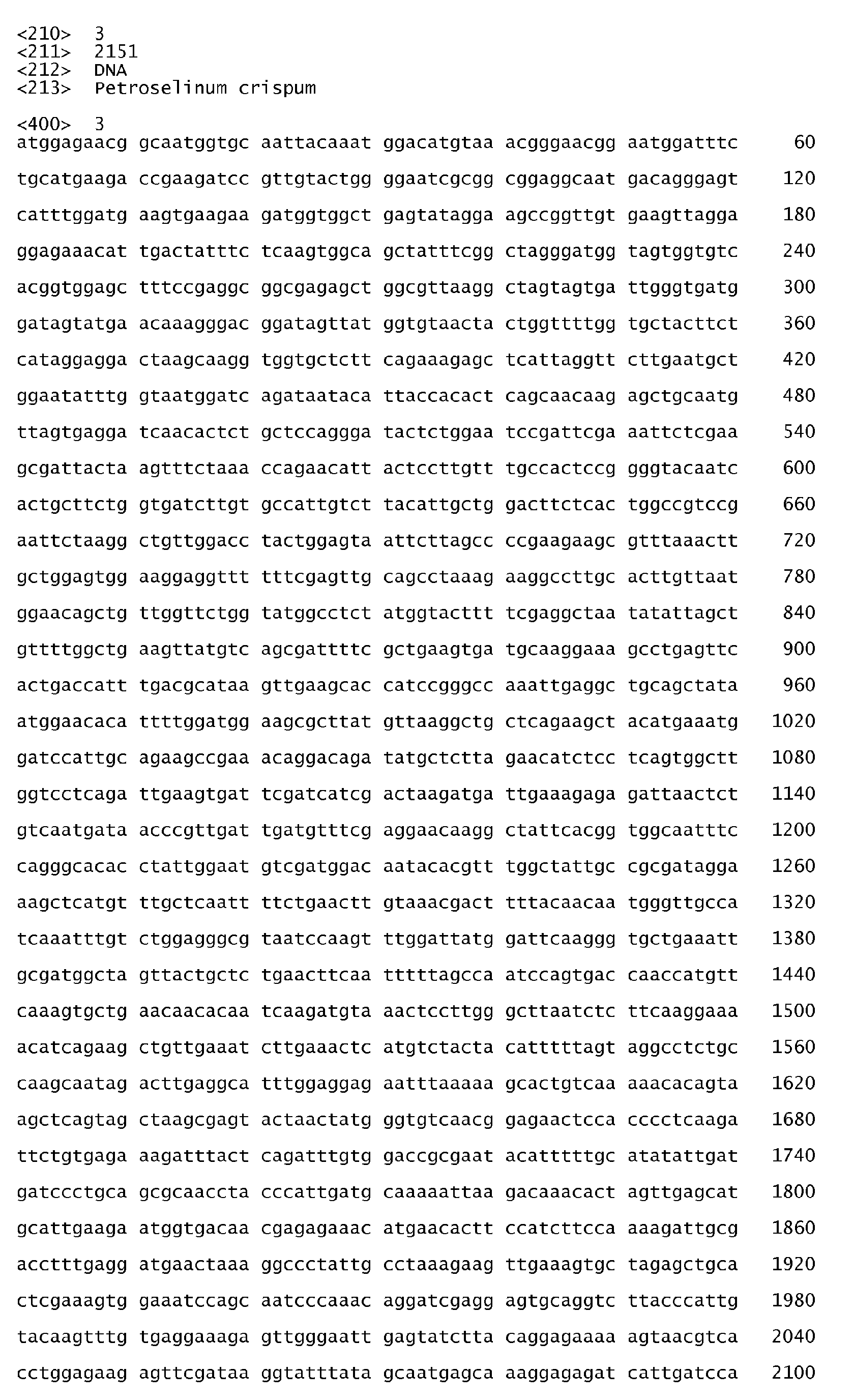


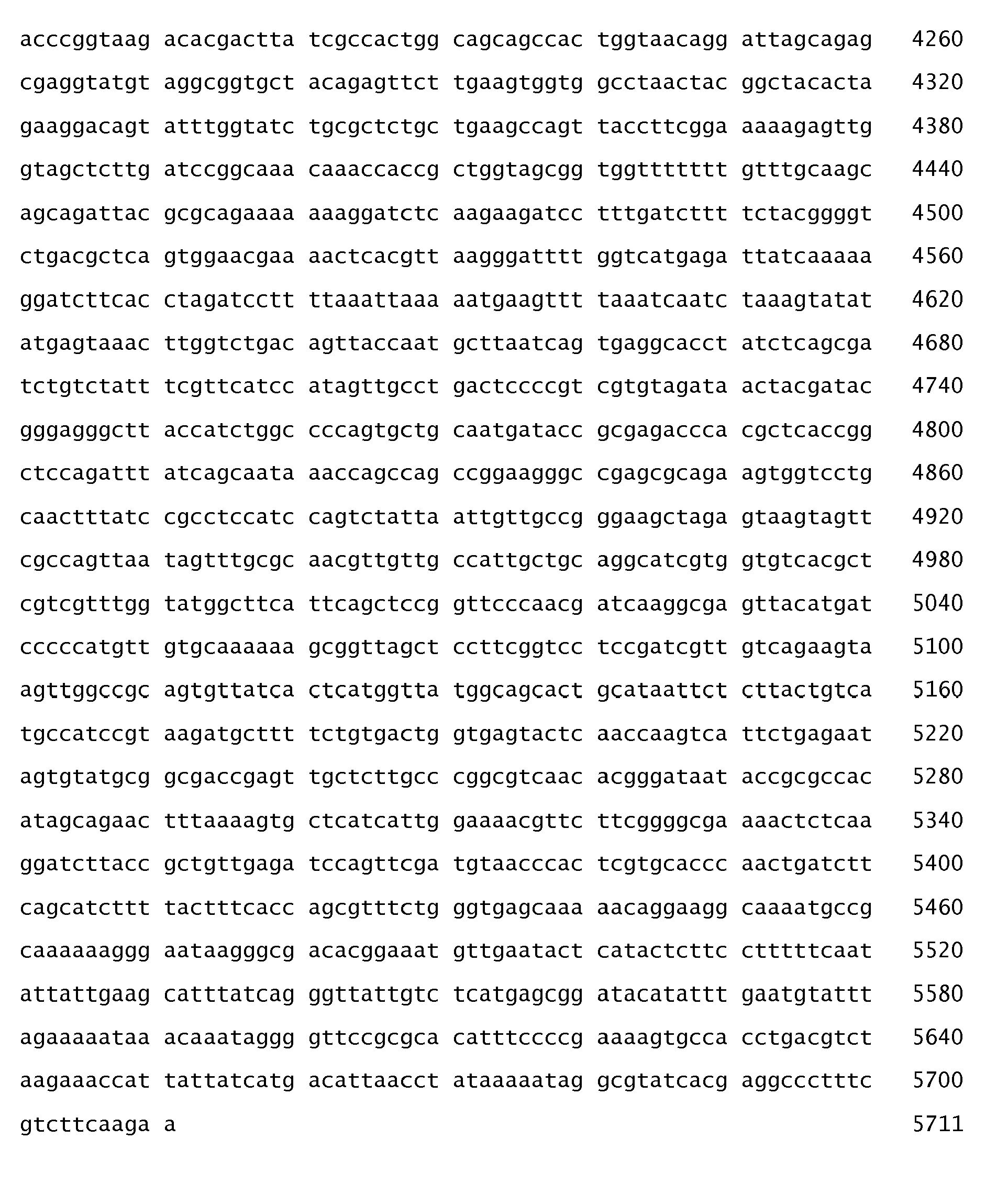
Claims (12)
- A method of hydroaminating a double bond in a side chain of an aromatic substrate
which method comprises the following steps:a) contacting the aromatic substrate in the presence of an ammonia compound withi) a protein having phenylalanine ammonia lyase activity isolated from Petroselinum crispum and /or Rhodoturula glutinis,ii) a protein having phenylalanine ammonia lyase activity having a sequence identity of at least 70 % to SEQ-ID No. 1 or to SEQ-ID. No. 2,iii) a protein coded by a nucleic acid sequence having a sequence identity of at least 70 % to SEQ No. 3 or SEQ No. 4 and/oriv) functional equivalents of the proteins according to i), ii) and/or iii)b) and optionally isolating the hydroamination product from the aromatic substrate,wherein the hydroamination product is not L-tyrosine and/or L-phenylalanine. - The method of claim 1, wherein the C-C double bond is not substituted with a carboxyl group and/or a carbon acid ester group.
- The method of claims 1 or 2,
wherein the aromatic substrate comprises a phenyl group. - The method of anyone of the preceding claims, wherein the aromatic substrate is selected from the group consisting of trans-beta-methylstyrene, 4-methoxy cinnamaldehyde, 4-methoxy cinnamonitrile, cis-beta-methylstyrene, cinnamyl chloride, trans-beta-nitrostyrene, styrene, cinnamamide, 4-chloro-alpha-methylstyrene, 4-methoxy stilbene, trans-cinnamaldehyde, 2-phenyl-1-pentene, trans-1-phenyl-1-butene, 2-phenyl-4-penten-2-ol, trans-cinnamonitrile, isoeugenol, 1-phenyl-2-butene, cinnamyl alcohol, coniferyl alcohol, 4-hydroxybenzylideneacetone, trans-anethole, 2-phenyl-2-butene, 2-methyl-1-phenyl-1-butene, 2-methyl-1-phenyl-1-propene, trans-1-phenyl-1-pentene, trans-6-phenyl-2-hexene, trans-2-hexene and trans-2-pentene and mixtures thereof.
- The method of anyone of the preceding claims, wherein the ammonia compound is selected from the group consisting of ammonia, ammonium hydroxide, ammonium salts, H2N-NH2, NH2OH, NH2CH2OH and/or an amine having the formula R-NH2, wherein R is an aliphatic group.
- The method of anyone of the preceding claims, wherein the hydroamination reaction is a stereo-selective hydroamination providing the S-enantioamer.
- The method of anyone of the preceding claims, wherein the hydroamination reaction is performed with isolated or purified (optionally immobilised) protein having phenylalanine ammonia lyase activity, or in the presence of microorganism expressing a protein having phenylalanine ammonia lyase enzyme activity.
- The method according to anyone of the preceding claims, wherein the hydroamination reaction in step a) is performed at a pH of from 8.5 to 11.
- The method according to anyone of the preceding claims, wherein the hydroamination reaction in step a) is performed at a temperature of from 25 to 35 °C.
- The method according to anyone of the preceding claims, wherein
the hydroamination reaction in step a) is performed with the following concentrations:0.1 to 60 mM aromatic substrate and/or1 to 9 M ammonia compound. - The method according to anyone of the preceding claims, wherein
the hydroamination reaction in step a) is performed in the presence of 1mmol/L to 5 mmol/L Mg2+-Ions. - Hydroamination product obtainable by the method according to anyone of the preceding claims.
Priority Applications (5)
| Application Number | Priority Date | Filing Date | Title |
|---|---|---|---|
| EP09166871A EP2280075A1 (en) | 2009-07-30 | 2009-07-30 | Biocatalyst for catalytic hydroamination |
| DE201011003122 DE112010003122T5 (en) | 2009-07-30 | 2010-07-27 | Biocatalyst for catalytic hydroamination |
| EP20100737889 EP2459727A2 (en) | 2009-07-30 | 2010-07-27 | Biocatalyst for catalytic hydroamination |
| PCT/EP2010/060917 WO2011012632A2 (en) | 2009-07-30 | 2010-07-27 | Biocatalyst for catalytic hydroamination |
| US13/387,140 US20120123155A1 (en) | 2009-07-30 | 2010-07-27 | Biocatalyst for catalytic hydroamination |
Applications Claiming Priority (1)
| Application Number | Priority Date | Filing Date | Title |
|---|---|---|---|
| EP09166871A EP2280075A1 (en) | 2009-07-30 | 2009-07-30 | Biocatalyst for catalytic hydroamination |
Publications (1)
| Publication Number | Publication Date |
|---|---|
| EP2280075A1 true EP2280075A1 (en) | 2011-02-02 |
Family
ID=41719362
Family Applications (1)
| Application Number | Title | Priority Date | Filing Date |
|---|---|---|---|
| EP09166871A Ceased EP2280075A1 (en) | 2009-07-30 | 2009-07-30 | Biocatalyst for catalytic hydroamination |
Country Status (1)
| Country | Link |
|---|---|
| EP (1) | EP2280075A1 (en) |
Citations (2)
| Publication number | Priority date | Publication date | Assignee | Title |
|---|---|---|---|---|
| US4562151A (en) * | 1983-09-06 | 1985-12-31 | Monsanto Company | Stabilization of L-phenylalanine ammonia-lyase enzyme |
| EP1085095A1 (en) * | 1997-09-24 | 2001-03-21 | NSC Technologies Company, L.L.C. | Synthesis of optically active phenylalanine analogs through microbial transformations |
-
2009
- 2009-07-30 EP EP09166871A patent/EP2280075A1/en not_active Ceased
Patent Citations (2)
| Publication number | Priority date | Publication date | Assignee | Title |
|---|---|---|---|---|
| US4562151A (en) * | 1983-09-06 | 1985-12-31 | Monsanto Company | Stabilization of L-phenylalanine ammonia-lyase enzyme |
| EP1085095A1 (en) * | 1997-09-24 | 2001-03-21 | NSC Technologies Company, L.L.C. | Synthesis of optically active phenylalanine analogs through microbial transformations |
Non-Patent Citations (44)
| Title |
|---|
| "Applied Microbiol. Physiology, A Practical Approach", 1997, IRL PRESS, pages: 53 - 73 |
| "Cloning Vectors", 1985 |
| "Cloning Vectors", 1985, PUBL. ELSEVIER |
| "Current Protocols in Molecular Biology", 1985, JOHN WILEY & SONS |
| "Current Protocols in Molecular Biology", 1989, JOHN WILEY & SONS, pages: 631 - 636 |
| "Essential Molecular Biology: A Practical Approach", IRL PRESS AT OXFORD UNIVERSITY PRESS |
| "Manual of Methods for General Bacteriology", 1981, AMERICAN SOCIETY FOR BACTERIOLOGY |
| "Nucleic Acids Hybridisation: A Practical Approach", 1985, IRL PRESS AT OXFORD UNIVERSITY PRESS |
| ARKIN; YOURVAN, PNAS, vol. 89, 1992, pages 7811 - 7815 |
| AUSUBEL, F.M. ET AL.: "Current Protocols in Molecular Biology", 1987, GREENE PUBLISHING ASSOC. AND WILEY INTERSCIENCE |
| BARTSCH SEBASTIAN ET AL: "A single residue influences the reaction mechanism of ammonia lyases and mutases.", ANGEWANDTE CHEMIE (INTERNATIONAL ED. IN ENGLISH) 2009, vol. 48, no. 18, April 2009 (2009-04-01), pages 3362 - 3365, XP002573771, ISSN: 1521-3773 * |
| C. PAIZS; A. KATONA; J. RETEY, CHEM. EUR. J., vol. 12, 2006, pages 2739 - 2744 |
| CHANG J ET AL: "INHIBITION STUDIES ON L PHENYLALANINE AMMONIA-LYASE OF RHODOSPORIDIUM-TORULOIDES", KOREAN BIOCHEMICAL JOURNAL, vol. 21, no. 4, 1988, pages 464 - 470, XP002573772, ISSN: 0368-4881 * |
| CHEM. REV., vol. 10, 2008, pages 3795 - 3892 |
| CHENNA ET AL.: "Multiple sequence alignment with the Clustal series of programs", NUCLEIC ACIDS RES, vol. 31, no. 13, 2003, pages 3497 - 500, Retrieved from the Internet <URL:http://www.ebi.ac.uk/Tools/clustalw/index.html#> |
| CHMIEL: "Bioproc- esstechnik 1. Einfuhrung in die Bioverfahrenstechnik", 1991, GUSTAV FISCHER VERLAG |
| D'CUNHA GODWIN B ET AL: "Stabilization of phenylalanine ammonia lyase containing Rhodotorula glutinis cells for the continuous synthesis of L-phenylalanine methyl ester/96/", ENZYME AND MICROBIAL TECHNOLOGY, vol. 19, no. 6, 1996, pages 421 - 427, XP002573767, ISSN: 0141-0229 * |
| DELGRAVE ET AL., PROTEIN ENGINEERING, vol. 6, no. 3, 1993, pages 327 - 331 |
| F. AUSUBEL ET AL.: "Current Protocols in Molecular Biology", 1997, PUBL. WILEY INTERSCIENCE |
| FUJITA N ET AL: "Cinnamaldehyde inhibits phenylalanine ammonia-lyase and enzymatic browning of cut lettuce", BIOSCIENCE, BIOTECHNOLOGY AND BIOCHEMISTRY 2006 JAPAN SOCIETY FOR BIOSCIENCE BIOTECHNOLOGY AND AGROCHEMISTRY JP, vol. 70, no. 3, 2006, pages 672 - 676, XP002573775 * |
| G. B. D'CUNHA; V. SATYANARAYAN; P. M. NAIR, ENZYME MICROB. TECHNOL., vol. 16, 1994, pages 318 - 322 |
| G. M. KISHORE; D. M. SHAH, ANNU. REV. BIOCHEM., vol. 57, 1988, pages 627 - 663 |
| GLOGE A ET AL: "Phenylalanine ammonia-lyase: the use of its broad substrate specificity for mechanistic investigations and biocatalysis--synthesis of L-arylalanines.", CHEMISTRY (WEINHEIM AN DER BERGSTRASSE, GERMANY) 15 SEP 2000, vol. 6, no. 18, 15 September 2000 (2000-09-15), pages 3386 - 3390, XP002573770, ISSN: 0947-6539 * |
| GOEDDEL: "Gene Expression Technology: Methods in Enzymology", vol. 185, 1990, ACADEMIC PRESS |
| HIGGINS DG; SHARP PM.: "Fast and sensitive multiple sequence alignments on a microcomputer", COMPUT APPL. BIOSCI., vol. 5, no. 2, April 1989 (1989-04-01), pages 151 - 1 |
| IKE ET AL., NUCLEIC ACIDS RES., vol. 11, 1983, pages 477 |
| ITAKURA ET AL., ANNU. REV. BIOCHEM., vol. 53, 1984, pages 323 |
| ITAKURA ET AL., SCIENCE, vol. 198, 1984, pages 1056 |
| J.-S. ZHAO; S.-K- YANG, CHIN. J. CHEM., vol. 13, 1995, pages 241 - 245 |
| K. C. HULTZSCH, ADV. SYNTH. CATAL., vol. 347, 2005, pages 367 - 391 |
| K. R. HANSON, ARCH. BIOCHEM. BIOPHYS., vol. 211, 1981, pages 575 - 588 |
| MACDONALD M JASON ET AL: "A modern view of phenylalanine ammonia lyase.", BIOCHEMISTRY AND CELL BIOLOGY = BIOCHIMIE ET BIOLOGIE CELLULAIRE JUN 2007, vol. 85, no. 3, June 2007 (2007-06-01), pages 273 - 282, XP002573769, ISSN: 0829-8211 * |
| NARANG, S.A., TETRAHEDRON, vol. 39, 1983, pages 3 |
| PAIZS C ET AL: "The interaction of heteroaryl-acrylates and alanines with phenylalanine ammonia-lyase from parsley", CHEMISTRY - A EUROPEAN JOURNAL 20060320 WILEY-VCH VERLAG DE, vol. 12, no. 10, 20 March 2006 (2006-03-20), pages 2739 - 2744, XP002573768 * |
| PEARSON; LIPMAN, PROC. NATL. ACAD, SCI. (USA), vol. 85, no. 8, 1988, pages 2444 - 2448 |
| SAMBROOK ET AL.: "Molecular Cloning: A Laboratory Manual", 1989, COLD SPRING HARBOR LABORATORY PRESS |
| SAMBROOK, J.; FRITSCH, E.F.; MANIATIS, T.: "Molecular Cloning (A Laboratory Manual)", 1989, COLD SPRING HARBOR LABORATORY PRESS, pages: 931 - 957 |
| SATO T ET AL: "INHIBITION OF PHENYL ALANINE AMMONIA LYASE EC-4.3.1.5 BY CINNAMIC-ACID DERIVATIVES AND RELATED COMPOUNDS", PHYTOCHEMISTRY (OXFORD), vol. 21, no. 4, 1982, pages 845 - 850, XP002573774, ISSN: 0031-9422 * |
| STORHAS: "Bioreaktoren und periphere Einrichtungen", 1994, VIEWEG VERLAG |
| T. MANIATIS; E.F. FRITSCH; J. SAMBROOK: "Molecular Cloning: A Laboratory Manual", 1989, COLD SPRING HARBOR LABORATORY |
| T.J. SILHAVY; M.L. BERMAN; L.W. ENQUIST: "Experiments with Gene Fusions", 1984, COLD SPRING HARBOR LABORATORY |
| VOET: "Voet", WILEY PRESS, pages: 896 - 897 |
| WATTS K T ET AL: "Discovery of a Substrate Selectivity Switch in Tyrosine Ammonia-Lyase, a Member of the Aromatic Amino Acid Lyase Family", CHEMISTRY AND BIOLOGY, CURRENT BIOLOGY, LONDON, GB, vol. 13, no. 12, 1 December 2006 (2006-12-01), pages 1317 - 1326, XP025131758, ISSN: 1074-5521, [retrieved on 20061201] * |
| Y. ASANO ET AL., BIOCAT. BIOTRANS., vol. 22, 2004, pages 131 - 138 |
Similar Documents
| Publication | Publication Date | Title |
|---|---|---|
| US8771998B2 (en) | Process for the production of gamma-aminobutyric acid | |
| JP7507739B2 (en) | Enzymatic cyclization of homofarnesylic acid. | |
| JP7263244B2 (en) | Process for the preparation of (3E,7E)-homofarnesic acid or (3E,7E)-homofarnesic acid ester | |
| AU2009211870B2 (en) | Method for the production of dipicolinate | |
| US8951750B2 (en) | Malonate decarboxylases for industrial applications | |
| JP2017519525A (en) | Amination of alcohol with redox self-sufficient biocatalyst | |
| US20120123155A1 (en) | Biocatalyst for catalytic hydroamination | |
| AU2009230728A1 (en) | Novel 12 alpha-hydroxysteroid dehydrogenases, production and use thereof | |
| JP6509215B2 (en) | Genetic engineering of Pseudomonas putida KT 2440 for rapid and high yield production of vanillin from ferulic acid | |
| US12534745B2 (en) | Lipoxygenase-catalyzed production of unsaturated C10-aldehydes from polyunsatrurated fatty acids | |
| JP5820778B2 (en) | Protein with esterase activity | |
| EP2280075A1 (en) | Biocatalyst for catalytic hydroamination | |
| JP5921194B2 (en) | Method for producing glutaconate |
Legal Events
| Date | Code | Title | Description |
|---|---|---|---|
| PUAI | Public reference made under article 153(3) epc to a published international application that has entered the european phase |
Free format text: ORIGINAL CODE: 0009012 |
|
| AK | Designated contracting states |
Kind code of ref document: A1 Designated state(s): AT BE BG CH CY CZ DE DK EE ES FI FR GB GR HR HU IE IS IT LI LT LU LV MC MK MT NL NO PL PT RO SE SI SK SM TR |
|
| AX | Request for extension of the european patent |
Extension state: AL BA RS |
|
| STAA | Information on the status of an ep patent application or granted ep patent |
Free format text: STATUS: THE APPLICATION HAS BEEN REFUSED |
|
| 18R | Application refused |
Effective date: 20110226 |