EP2279998A1 - Synthesis of iodixanol in propyleneglycol - Google Patents
Synthesis of iodixanol in propyleneglycol Download PDFInfo
- Publication number
- EP2279998A1 EP2279998A1 EP09178842A EP09178842A EP2279998A1 EP 2279998 A1 EP2279998 A1 EP 2279998A1 EP 09178842 A EP09178842 A EP 09178842A EP 09178842 A EP09178842 A EP 09178842A EP 2279998 A1 EP2279998 A1 EP 2279998A1
- Authority
- EP
- European Patent Office
- Prior art keywords
- iodixanol
- compound
- dimerisation
- bis
- propyleneglycol
- Prior art date
- Legal status (The legal status is an assumption and is not a legal conclusion. Google has not performed a legal analysis and makes no representation as to the accuracy of the status listed.)
- Granted
Links
Classifications
-
- C—CHEMISTRY; METALLURGY
- C07—ORGANIC CHEMISTRY
- C07C—ACYCLIC OR CARBOCYCLIC COMPOUNDS
- C07C231/00—Preparation of carboxylic acid amides
- C07C231/12—Preparation of carboxylic acid amides by reactions not involving the formation of carboxamide groups
Definitions
- This invention relates to the synthesis of iodixanol (1,3-bis(acetamido)-N,N'-bis[3,5-bis(2,3-dihydroxypropylaminocarbonyl)-2,4,6-triiodophenyl]-2-hydroxypropane), more specifically to the dimerisation of 5-acetamido-N,N'-bis(2,3-dihydroxypropyl)-2,4,6-triiodo-isophthalamide with propyleneglycol as solvent.
- Iodixanol is the non-proprietory name of the chemical drug substance of a non-ionic X-ray contrast agent marketed under the trade name VisipaqueTM.
- VisipaqueTM is one of the most used agents in diagnostic X-ray procedures and is manufactured in large quantities.
- non-ionic X-ray contrast agents involves the production of the chemical drug substance (referred to as primary production) followed by formulation into the drug product (referred to as secondary production).
- Primary production of iodixanol involves a multi step chemical synthesis and a thorough purification process.
- primary production it is important for the primary production to be efficient and economical and to provide a drug substance fulfilling the specifications, e.g. as expressed in the US Pharmacopea.
- the reaction is usually carried out in the non-aqueous solvent 2-methoxyethanol and generally results in the conversion of 40 to 60% of Compound A to iodixanol.
- the product contains large amounts of impurities and is normally purified by crystallization. Too large amounts of impurities make the purification difficult and to achieve the desired purity, the crude iodixanol produced by the synthetic chemical process is crystallized twice. The process is time consuming and takes about 3 days for the first crystallization and about 2 days for the second one. Hence, the crystallization process is very demanding in terms of time and equipment size, it will take several days to perform and is often a bottleneck in industrial scale processes.
- WO 99/18054 describes a method of crystallization of iodixanol where a solvent mixture comprising methanol and propan-2-ol is used in the example.
- a solvent mixture comprising methanol and propan-2-ol is used in the example.
- a vast number of other general solvents are suggested, however many of these will not be feasible in an industrial scale and there are no suggestions regarding how to perform the crystallization in terms ratios or process parameters.
- WO 98/23296 and US 5349085 describe the synthesis of iodixanol and mention possible solvents in the same general way as in WO 99/18054 , including alcohols and glycol respectively.
- propyleneglycol can be used as solvent in the dimerisation step of Compound A in an industrial scale and will fulfill the requirements listed above.
- the present invention provides a large scale dimerisation process of 5-acetamido-N,N'-bis(2,3-dihydroxypropyl)-2,4,6-triiodo-isophthalamide to iodixanol.
- the invention provides a process for the dimerisation of 5-acetamido-N,N'-bis(2,3-dihydroxypropyl)-2,4,6-triiodo-isophthalamide in a temperature range of about 10 to about 20°C using propyleneglycol as solvent in a concentration of about 0.8 to about 1.3 ml solvent per g 5-acetamido-N,N'-bis(2,3-dihydroxypropyl)-2,4,6-triiodo-isophthalamide in the presence of about 0.3 to about 0.4 mole equivalents of epichlorohydrin, and wherein the reaction solution has a pH value of about 11.5 to about 12.0.
- the instant process uses a low cost solvent that is environmentally friendly and provides high enough yields and purity in the final product to make the manufacturing process of iodixanol economically feasible in an industrial scale.
- Crude iodixanol is obtained from the processes known from the state of the art, e.g. from the dimerisation process illustrated in Scheme I above.
- the dimerisation step itself may be carried out as described in EP 108638 and WO 98/23296 , for example using epichlorohydrin as the dimerisation agent.
- the reaction is usually carried out in the non-aqueous solvent 2-methoxyethanol and generally results in the conversion of 40 to 60% of Compound A to iodixanol.
- the dimerisation generally results in the conversion of 40 to 60% of Compound A.
- the product contains large amounts of impurities and needs to undergo costly work-up procedures, like, for example, multiple crystallizations.
- backpeaks This term refers to retention times in reversed phase HPLC, where the backpeaks have slightly longer retention times than iodixanol itself. Most of the backpeaks are either trimers or O-alkylated dimers. Two examples are given below:
- Iohexol is fairly easy to remove in the subsequent crystallization of iodixanol, even when present in several weight percent.
- a typical selectivity required to be able to run an economically feasible work-up and obtain the required product quality is that the amount of backpeaks should not exceed 2% at 55-60% conversion of Compound A to iodixanol. It is even more advantageous if the backpeaks do not exceed 1.4% at this conversion.
- the dimerisation step can be carried out with propyleneglycol as solvent resulting in a product that meets the requirements in order to make the overall process of manufacturing iodixanol feasible.
- the invention provides a process for the dimerisation of 5-acetamido-N,N'-bis(2,3-dihydroxypropyl)-2,4,6-triiodo-isophthalamide in a temperature range of about 10 to about 20°C using propyleneglycol as solvent in a concentration of about 0.8 to about 1.3 ml solvent per g 5-acetamido-N,N'-bis(2,3-dihydroxypropyl)-2,4,6-triiodo-isophthalamide in the presence of about 0.3 to about 0.4 mole equivalents of epichlorohydrin, and wherein the reaction solution has a pH value of about 11.5 to about 12.0.
- the process according to the present invention is carried out with a concentration of about 0.8 to about 1.3 ml solvent per g Compound A, but even more preferably with a concentration of about 0.8 to about 1.0.
- the temperature during the dimerisation should be in the range of about 10 to about 20°C, but even more preferred is about 10 to about 15°C.
- the temperature can be constant throughout the dimerisation or varied within the specified range, preferably the temperature is lowered throughout the dimerisation.
- the dimerisation agent used in the present invention is epichlorohydrin which is added in about 0.3 to about 0.4 mole equivalents, preferably about 0.31 to about 0.35.
- the pH value in the reaction solution is about 11.5 to about 12.0, but even more preferably about 11.7 to about 11.9.
- the pH value can preferably be varied throughout the dimerisation having a higher value at the start of the dimerisation than at the end.
- the base used to raise the pH value of the reaction solution can be any base suitable.
- the base is sodium hydroxide (NaOH) or potassium hydroxide (KOH), with sodium hydroxide being most preferred.
- any suitable acid can be used, preferably concentrated hydrochloric acid (HCl).
- the dimerisation step will be allowed to proceed for several hours with a preferred reaction time of 12 to 48 hours and particularly preferred from 24 to 48 hours.
- the reaction may be terminated by quenching with any acid, preferably hydrochloric acid.
- the reaction may be monitored, e.g. by HPLC, to determine the appropriate stage at which quenching should take place.
Landscapes
- Chemical & Material Sciences (AREA)
- Organic Chemistry (AREA)
- Chemical Kinetics & Catalysis (AREA)
- Organic Low-Molecular-Weight Compounds And Preparation Thereof (AREA)
- Pharmaceuticals Containing Other Organic And Inorganic Compounds (AREA)
Abstract
Description
- This invention relates to the synthesis of iodixanol (1,3-bis(acetamido)-N,N'-bis[3,5-bis(2,3-dihydroxypropylaminocarbonyl)-2,4,6-triiodophenyl]-2-hydroxypropane), more specifically to the dimerisation of 5-acetamido-N,N'-bis(2,3-dihydroxypropyl)-2,4,6-triiodo-isophthalamide with propyleneglycol as solvent.
- Iodixanol is the non-proprietory name of the chemical drug substance of a non-ionic X-ray contrast agent marketed under the trade name Visipaque™. Visipaque™ is one of the most used agents in diagnostic X-ray procedures and is manufactured in large quantities.
- The manufacture of such non-ionic X-ray contrast agents involves the production of the chemical drug substance (referred to as primary production) followed by formulation into the drug product (referred to as secondary production). Primary production of iodixanol involves a multi step chemical synthesis and a thorough purification process. For a commercial drug product it is important for the primary production to be efficient and economical and to provide a drug substance fulfilling the specifications, e.g. as expressed in the US Pharmacopea.
- A number of methods are known for the preparation of iodixanol. These are all multi step chemical synthetic processes and the cost of the final formulated product thus mainly depends on these processes. It is therefore important to optimize the processes both for economic and environmental reasons.
- In a preferred method for the preparation of iodixanol described in
EP 108638 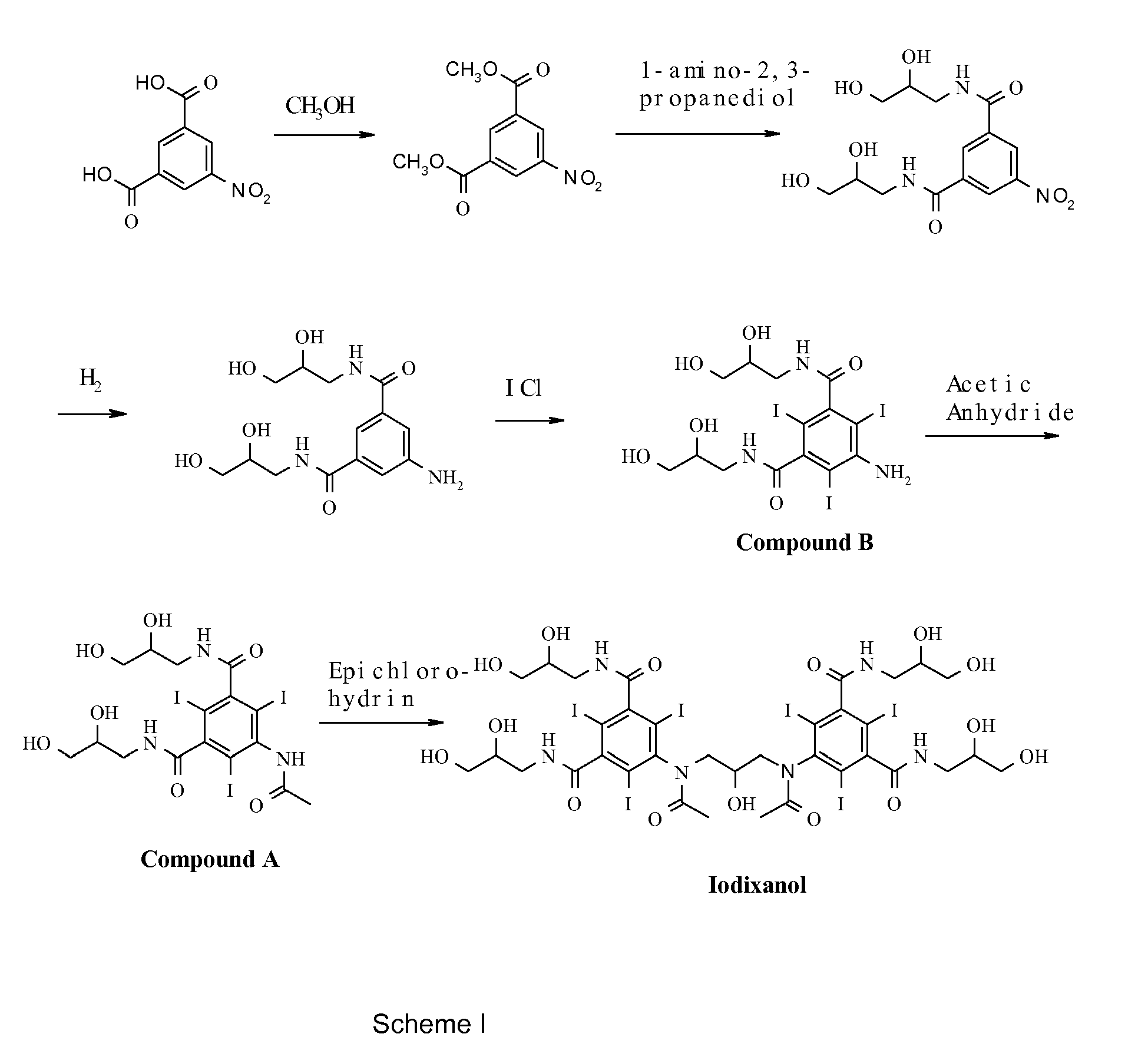
- The reaction is usually carried out in the non-aqueous solvent 2-methoxyethanol and generally results in the conversion of 40 to 60% of Compound A to iodixanol. The product contains large amounts of impurities and is normally purified by crystallization. Too large amounts of impurities make the purification difficult and to achieve the desired purity, the crude iodixanol produced by the synthetic chemical process is crystallized twice. The process is time consuming and takes about 3 days for the first crystallization and about 2 days for the second one. Hence, the crystallization process is very demanding in terms of time and equipment size, it will take several days to perform and is often a bottleneck in industrial scale processes.
- It is hence a desire to identify alternative low-cost and easily accessible solvents that can be used in the dimerisation step and that fulfill the above-mentioned criteria.
-
WO 99/18054 -
WO 98/23296 US 5349085 describe the synthesis of iodixanol and mention possible solvents in the same general way as inWO 99/18054 - It has now surprisingly been found that propyleneglycol can be used as solvent in the dimerisation step of Compound A in an industrial scale and will fulfill the requirements listed above.
- The present invention provides a large scale dimerisation process of 5-acetamido-N,N'-bis(2,3-dihydroxypropyl)-2,4,6-triiodo-isophthalamide to iodixanol.
- Thus, the invention provides a process for the dimerisation of 5-acetamido-N,N'-bis(2,3-dihydroxypropyl)-2,4,6-triiodo-isophthalamide in a temperature range of about 10 to about 20°C using propyleneglycol as solvent in a concentration of about 0.8 to about 1.3 ml solvent per g 5-acetamido-N,N'-bis(2,3-dihydroxypropyl)-2,4,6-triiodo-isophthalamide in the presence of about 0.3 to about 0.4 mole equivalents of epichlorohydrin, and wherein the reaction solution has a pH value of about 11.5 to about 12.0.
- The instant process uses a low cost solvent that is environmentally friendly and provides high enough yields and purity in the final product to make the manufacturing process of iodixanol economically feasible in an industrial scale.
- Crude iodixanol is obtained from the processes known from the state of the art, e.g. from the dimerisation process illustrated in Scheme I above. The dimerisation step itself may be carried out as described in
EP 108638 WO 98/23296 - Up until now propyleneglycol has been suggested as a possible alternative solvent in the dimerisation step for preparing iodixanol, however no documentation has revealed that the use of propyleneglycol can be feasible in an industrial scale. Hence, other solvents, especially 2-methoxyethanol have been used in large scale production of iodixanol.
- As explained above the dimerisation generally results in the conversion of 40 to 60% of Compound A. However, the product contains large amounts of impurities and needs to undergo costly work-up procedures, like, for example, multiple crystallizations.
- The most important impurities in the reaction with regard to work-up consequences are the so-called backpeaks. This term refers to retention times in reversed phase HPLC, where the backpeaks have slightly longer retention times than iodixanol itself. Most of the backpeaks are either trimers or O-alkylated dimers. Two examples are given below:
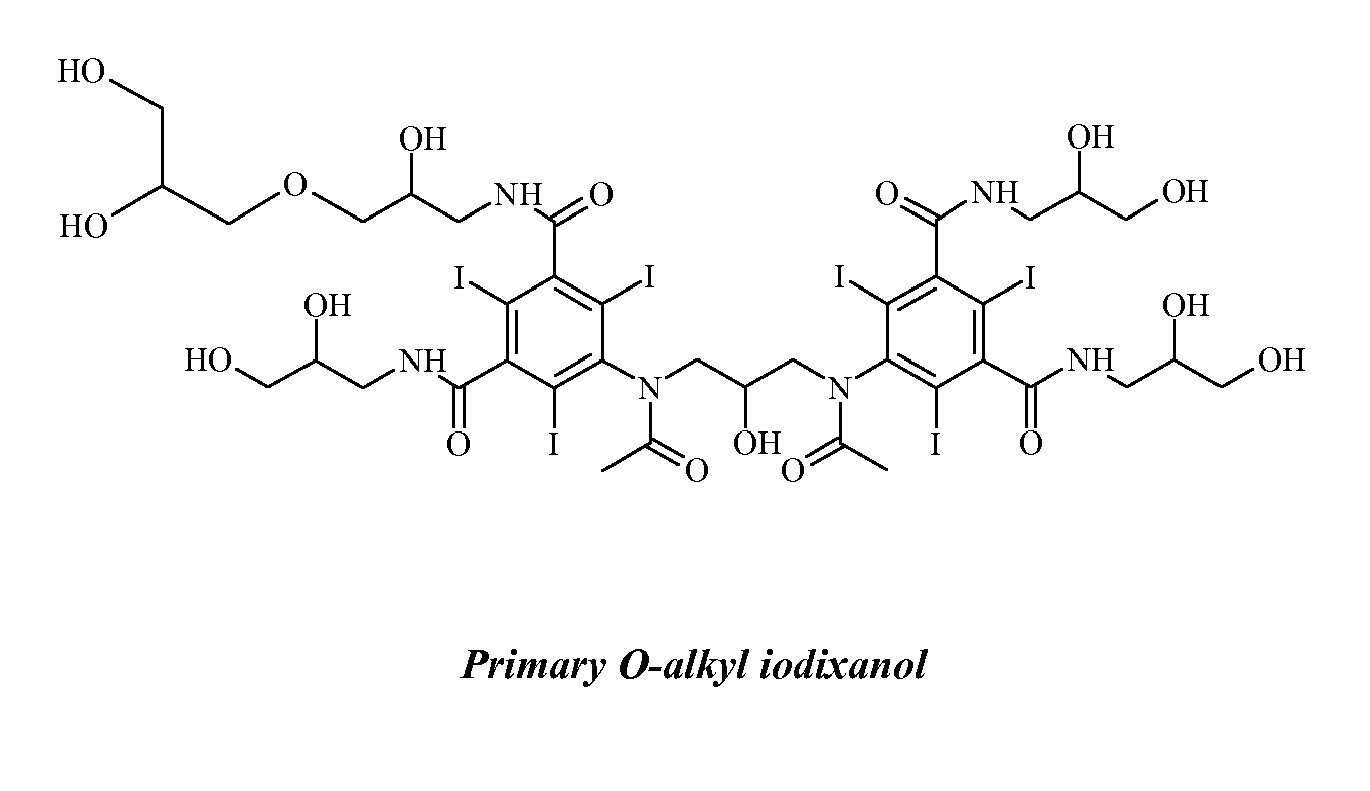

- Other by-products of importance are e.g. iohexol and N-acetyl cyclized iodixanol, whose structures are shown below. Iohexol is fairly easy to remove in the subsequent crystallization of iodixanol, even when present in several weight percent.


- A typical selectivity required to be able to run an economically feasible work-up and obtain the required product quality is that the amount of backpeaks should not exceed 2% at 55-60% conversion of Compound A to iodixanol. It is even more advantageous if the backpeaks do not exceed 1.4% at this conversion.
- It has now surprisingly been found that under specific conditions the dimerisation step can be carried out with propyleneglycol as solvent resulting in a product that meets the requirements in order to make the overall process of manufacturing iodixanol feasible.
- Thus the invention provides a process for the dimerisation of 5-acetamido-N,N'-bis(2,3-dihydroxypropyl)-2,4,6-triiodo-isophthalamide in a temperature range of about 10 to about 20°C using propyleneglycol as solvent in a concentration of about 0.8 to about 1.3 ml solvent per g 5-acetamido-N,N'-bis(2,3-dihydroxypropyl)-2,4,6-triiodo-isophthalamide in the presence of about 0.3 to about 0.4 mole equivalents of epichlorohydrin, and wherein the reaction solution has a pH value of about 11.5 to about 12.0.
- The process according to the present invention is carried out with a concentration of about 0.8 to about 1.3 ml solvent per g Compound A, but even more preferably with a concentration of about 0.8 to about 1.0.
- The temperature during the dimerisation should be in the range of about 10 to about 20°C, but even more preferred is about 10 to about 15°C. The temperature can be constant throughout the dimerisation or varied within the specified range, preferably the temperature is lowered throughout the dimerisation.
- The dimerisation agent used in the present invention is epichlorohydrin which is added in about 0.3 to about 0.4 mole equivalents, preferably about 0.31 to about 0.35.
- The pH value in the reaction solution is about 11.5 to about 12.0, but even more preferably about 11.7 to about 11.9. The pH value can preferably be varied throughout the dimerisation having a higher value at the start of the dimerisation than at the end.
- The base used to raise the pH value of the reaction solution can be any base suitable. Preferably the base is sodium hydroxide (NaOH) or potassium hydroxide (KOH), with sodium hydroxide being most preferred.
- For further adjustment of the pH value of the reaction solution any suitable acid can be used, preferably concentrated hydrochloric acid (HCl).
- The dimerisation step will be allowed to proceed for several hours with a preferred reaction time of 12 to 48 hours and particularly preferred from 24 to 48 hours. The reaction may be terminated by quenching with any acid, preferably hydrochloric acid. The reaction may be monitored, e.g. by HPLC, to determine the appropriate stage at which quenching should take place.
- The invention is illustrated further by the following examples that are not to be construed as limiting the invention in scope to the specific procedures or products described in them.
- 5-acetylamino-N,N'-bis (2,3-dihydroxypropyl)-2,4,6-triiodoisophthalamide (Compound A) (201.5 g, 0.268 mole) was dissolved in a solution of propyleneglycol (200 mL, 1.00 mL/g Compound A) and sodium hydroxide (16.06 g, 0.402 mole, 1.50 eq) at 45°C. The mixture was cooled to 10°C and conc. hydrochloric acid (24 g, 0.230 mole, 0.86 eq) was added followed by epichlorohydrin (7.68 g, 0.083 mole, 0.31 eq) added in one portion. After 48 hours an HPLC analysis showed the following composition: 51.2 % iodixanol, 41.5 % Compound A, 1.06 % backpeaks, 0.05 % N-acetyl cyclized iodixanol and 5.33 % iohexol.
- 5-acetylamino-N,N'-bis (2,3-dihydroxypropyl)-2,4,6-triiodoisophthalamide (Compound A) (201.5 g, 0.268 mole) was dissolved in a solution of propyleneglycol (200 mL, 1.00 mL/g Compound A) and sodium hydroxide (16.06 g, 0.402 mole, 1.50 eq) at 45°C. The mixture was cooled to 10°C and conc. hydrochloric acid (25 g, 0.240 mole, 0.89 eq) was added followed by epichlorohydrin (8.68 g, 0.094 mole, 0.35 eq) added in one portion. After 48 hours an HPLC analysis showed the following composition: 52.7 % iodixanol, 37.1 % Compound A, 0.94 % backpeaks, 0.05 % N-acetyl cyclized iodixanol and 7.96 % iohexol.
- 5-acetylamino-N,N'-bis (2,3-dihydroxypropyl)-2,4,6-triiodoisophthalamide (Compound A) (202.1 g, 0.270 mole) was dissolved in a solution of propyleneglycol (200 mL, 1.00 mL/g Compound A) and sodium hydroxide (16.06 g, 0.402 mole, 1.50 eq) at 45°C. The mixture was cooled to 22°C and conc. hydrochloric acid (24 g, 0.230 mole, 0.86 eq) was added followed by epichlorohydrin (8.68 g, 0.094 mole, 0.35 eq) added in one portion. The temperature was gradually reduced to 10°C over 10 hours. After 24 hours an HPLC analysis showed the following composition: 52.7 % iodixanol, 38.6 % Compound A, 1.02 % backpeaks, 0.03 % N-acetyl cyclized iodixanol and 6.77 % iohexol.
- 5-acetylamino-N,N'-bis (2,3-dihydroxypropyl)-2,4,6-triiodoisophthalamide (Compound A) (202.1 g, 0.270 mole) was dissolved in a solution of propyleneglycol (200 mL, 1.00 mL/g Compound A) and sodium hydroxide (17.13 g, 0.428 mole, 1.60 eq) at 45°C. The mixture was cooled to 22°C and conc. hydrochloric acid (25 g, 0.240 mole, 0.89 eq) was added followed by epichlorohydrin (8.18 g, 0.088 mole, 0.33 eq) added in one portion. The temperature was gradually reduced to 10°C over 10 hours. After 24 hours an HPLC analysis showed the following composition: 53.4 % iodixanol, 39.4 % Compound A, 1.20 % backpeaks, 0.04 % N-acetyl cyclized iodixanol and 5.16 % iohexol.
- All patents, journal articles, publications and other documents discussed and/or cited above are hereby incorporated by reference.
Claims (1)
- Process for the dimerisation of 5-acetamido-N,N'-bis(2,3-dihydroxypropyl)-2,4,6-triiodo-isophthalamide (Compound A) in a temperature range of about 10 to about 20°C using propyleneglycol as solvent in a concentration of about 0.8 to about 1.3 ml solvent per g Compound A in the presence of about 0.3 to about 0.4 mole equivalents of epichlorohydrin relative to Compound A, and wherein the reaction solution has a pH value of about 11.5 to about 12.0.
Priority Applications (1)
| Application Number | Priority Date | Filing Date | Title |
|---|---|---|---|
| PL09178842T PL2279998T3 (en) | 2009-07-21 | 2009-12-11 | Synthesis of iodixanol in propyleneglycol |
Applications Claiming Priority (1)
| Application Number | Priority Date | Filing Date | Title |
|---|---|---|---|
| US22709609P | 2009-07-21 | 2009-07-21 |
Publications (2)
| Publication Number | Publication Date |
|---|---|
| EP2279998A1 true EP2279998A1 (en) | 2011-02-02 |
| EP2279998B1 EP2279998B1 (en) | 2014-06-25 |
Family
ID=41491663
Family Applications (1)
| Application Number | Title | Priority Date | Filing Date |
|---|---|---|---|
| EP09178842.2A Active EP2279998B1 (en) | 2009-07-21 | 2009-12-11 | Synthesis of iodixanol in propyleneglycol |
Country Status (6)
| Country | Link |
|---|---|
| US (1) | US8969619B2 (en) |
| EP (1) | EP2279998B1 (en) |
| KR (1) | KR20110009034A (en) |
| CN (1) | CN101962335B (en) |
| ES (1) | ES2485389T3 (en) |
| PL (1) | PL2279998T3 (en) |
Families Citing this family (1)
| Publication number | Priority date | Publication date | Assignee | Title |
|---|---|---|---|---|
| KR101970327B1 (en) * | 2017-04-13 | 2019-04-18 | 고려대학교 산학협력단 | A Method for Accurate, Rapid, and Convenient One-Step-Diagnosis of Disease Based on Signal Self-Enhancement |
Citations (5)
| Publication number | Priority date | Publication date | Assignee | Title |
|---|---|---|---|---|
| EP0108638A1 (en) * | 1982-11-08 | 1984-05-16 | NYEGAARD & CO. A/S | X-ray contrast agents |
| WO1998023296A1 (en) | 1996-11-26 | 1998-06-04 | Nycomed Imaging As | Process for the production of iodinated organic x-ray contrast agents |
| WO1999018054A1 (en) | 1997-10-02 | 1999-04-15 | Nycomed Imaging As | Process for the crystallisation of sterically hindered compounds |
| GB2331098A (en) * | 1997-11-07 | 1999-05-12 | Nycomed Imaging As | An N-Alkylation process |
| WO2007064220A1 (en) * | 2005-11-29 | 2007-06-07 | Ge Healthcare As | Purification of iodixanol |
Family Cites Families (4)
| Publication number | Priority date | Publication date | Assignee | Title |
|---|---|---|---|---|
| US4460741A (en) | 1982-11-04 | 1984-07-17 | Monsanto Company | Polyblends of thermoplastic copolyetheresters, styrene-maleic anhydride polymers, acrylonitrile-butadiene-styrene polymers, and nitrile rubbers |
| GB9903109D0 (en) * | 1999-02-11 | 1999-04-07 | Nycomed Imaging As | Process |
| NO20043305D0 (en) * | 2004-08-09 | 2004-08-09 | Amersham Health As | Preparation of lodixanol |
| CN100537524C (en) * | 2007-03-23 | 2009-09-09 | 上海冠杰生物医药科技有限公司 | A kind of preparation method of iodixanol |
-
2009
- 2009-11-19 US US12/621,556 patent/US8969619B2/en active Active
- 2009-12-11 PL PL09178842T patent/PL2279998T3/en unknown
- 2009-12-11 EP EP09178842.2A patent/EP2279998B1/en active Active
- 2009-12-11 ES ES09178842.2T patent/ES2485389T3/en active Active
-
2010
- 2010-07-20 KR KR1020100069809A patent/KR20110009034A/en not_active Withdrawn
- 2010-07-21 CN CN201010241169.8A patent/CN101962335B/en active Active
Patent Citations (6)
| Publication number | Priority date | Publication date | Assignee | Title |
|---|---|---|---|---|
| EP0108638A1 (en) * | 1982-11-08 | 1984-05-16 | NYEGAARD & CO. A/S | X-ray contrast agents |
| US5349085A (en) | 1982-11-08 | 1994-09-20 | Nycomed Imaging As | X-ray contrast agents |
| WO1998023296A1 (en) | 1996-11-26 | 1998-06-04 | Nycomed Imaging As | Process for the production of iodinated organic x-ray contrast agents |
| WO1999018054A1 (en) | 1997-10-02 | 1999-04-15 | Nycomed Imaging As | Process for the crystallisation of sterically hindered compounds |
| GB2331098A (en) * | 1997-11-07 | 1999-05-12 | Nycomed Imaging As | An N-Alkylation process |
| WO2007064220A1 (en) * | 2005-11-29 | 2007-06-07 | Ge Healthcare As | Purification of iodixanol |
Also Published As
| Publication number | Publication date |
|---|---|
| US20110021830A1 (en) | 2011-01-27 |
| CN101962335A (en) | 2011-02-02 |
| ES2485389T3 (en) | 2014-08-13 |
| EP2279998B1 (en) | 2014-06-25 |
| CN101962335B (en) | 2015-11-25 |
| US8969619B2 (en) | 2015-03-03 |
| KR20110009034A (en) | 2011-01-27 |
| PL2279998T3 (en) | 2014-09-30 |
Similar Documents
| Publication | Publication Date | Title |
|---|---|---|
| EP1960349B1 (en) | Purification of iodixanol | |
| KR20070057793A (en) | Preparation of Iodixanol | |
| JP4933253B2 (en) | Method for producing iohexol | |
| EP2279998B1 (en) | Synthesis of iodixanol in propyleneglycol | |
| EP2277853B1 (en) | Synthesis of iodixanol in methanol | |
| EP2277854B1 (en) | Synthesis of iodixanol in 1-methoxy-2-propanol and water or methanol | |
| EP2277852B1 (en) | Synthesis of iodixanol in water | |
| CA2710618C (en) | Synthesis of iodixanol in methanol | |
| CA2710422C (en) | Synthesis of iodixanol in 1-methoxy-2-propanol and water or methanol | |
| CA2710598C (en) | Synthesis of iodixanol in water | |
| US9688614B2 (en) | Alternative acetylation process in the synthesis of non-ionic X-ray contrast agents | |
| CA2707173C (en) | Crystallization of iodixanol in isopropanol and methanol | |
| CA2710111A1 (en) | Synthesis of iodixanol in propyleneglycol | |
| EP2289870B1 (en) | Method for purifying 5-amino-N,N'-bis(2,3-dihydroxypropyl)-isophthalamide, an intermediate in the preparation of non-ionic X-ray contrast agents | |
| EP2277856B1 (en) | Crystallization of iodixanol using ultrasound | |
| KR101076174B1 (en) | Crystallization of iodixanol using milling | |
| US7696381B1 (en) | Alternative dimerisation reagents for synthesis of iodixanol |
Legal Events
| Date | Code | Title | Description |
|---|---|---|---|
| PUAI | Public reference made under article 153(3) epc to a published international application that has entered the european phase |
Free format text: ORIGINAL CODE: 0009012 |
|
| 17P | Request for examination filed |
Effective date: 20091213 |
|
| AK | Designated contracting states |
Kind code of ref document: A1 Designated state(s): AT BE BG CH CY CZ DE DK EE ES FI FR GB GR HR HU IE IS IT LI LT LU LV MC MK MT NL NO PL PT RO SE SI SK SM TR |
|
| 17Q | First examination report despatched |
Effective date: 20120117 |
|
| GRAP | Despatch of communication of intention to grant a patent |
Free format text: ORIGINAL CODE: EPIDOSNIGR1 |
|
| INTG | Intention to grant announced |
Effective date: 20140130 |
|
| GRAS | Grant fee paid |
Free format text: ORIGINAL CODE: EPIDOSNIGR3 |
|
| GRAA | (expected) grant |
Free format text: ORIGINAL CODE: 0009210 |
|
| AK | Designated contracting states |
Kind code of ref document: B1 Designated state(s): AT BE BG CH CY CZ DE DK EE ES FI FR GB GR HR HU IE IS IT LI LT LU LV MC MK MT NL NO PL PT RO SE SI SK SM TR |
|
| REG | Reference to a national code |
Ref country code: GB Ref legal event code: FG4D |
|
| REG | Reference to a national code |
Ref country code: CH Ref legal event code: EP |
|
| REG | Reference to a national code |
Ref country code: AT Ref legal event code: REF Ref document number: 674582 Country of ref document: AT Kind code of ref document: T Effective date: 20140715 |
|
| REG | Reference to a national code |
Ref country code: IE Ref legal event code: FG4D |
|
| REG | Reference to a national code |
Ref country code: DE Ref legal event code: R096 Ref document number: 602009024870 Country of ref document: DE Effective date: 20140807 |
|
| REG | Reference to a national code |
Ref country code: ES Ref legal event code: FG2A Ref document number: 2485389 Country of ref document: ES Kind code of ref document: T3 Effective date: 20140813 |
|
| REG | Reference to a national code |
Ref country code: NL Ref legal event code: T3 |
|
| REG | Reference to a national code |
Ref country code: NO Ref legal event code: T2 Effective date: 20140625 |
|
| REG | Reference to a national code |
Ref country code: PL Ref legal event code: T3 |
|
| PG25 | Lapsed in a contracting state [announced via postgrant information from national office to epo] |
Ref country code: GR Free format text: LAPSE BECAUSE OF FAILURE TO SUBMIT A TRANSLATION OF THE DESCRIPTION OR TO PAY THE FEE WITHIN THE PRESCRIBED TIME-LIMIT Effective date: 20140926 Ref country code: CY Free format text: LAPSE BECAUSE OF FAILURE TO SUBMIT A TRANSLATION OF THE DESCRIPTION OR TO PAY THE FEE WITHIN THE PRESCRIBED TIME-LIMIT Effective date: 20140625 Ref country code: LT Free format text: LAPSE BECAUSE OF FAILURE TO SUBMIT A TRANSLATION OF THE DESCRIPTION OR TO PAY THE FEE WITHIN THE PRESCRIBED TIME-LIMIT Effective date: 20140625 Ref country code: FI Free format text: LAPSE BECAUSE OF FAILURE TO SUBMIT A TRANSLATION OF THE DESCRIPTION OR TO PAY THE FEE WITHIN THE PRESCRIBED TIME-LIMIT Effective date: 20140625 |
|
| REG | Reference to a national code |
Ref country code: AT Ref legal event code: MK05 Ref document number: 674582 Country of ref document: AT Kind code of ref document: T Effective date: 20140625 |
|
| REG | Reference to a national code |
Ref country code: LT Ref legal event code: MG4D |
|
| PG25 | Lapsed in a contracting state [announced via postgrant information from national office to epo] |
Ref country code: LV Free format text: LAPSE BECAUSE OF FAILURE TO SUBMIT A TRANSLATION OF THE DESCRIPTION OR TO PAY THE FEE WITHIN THE PRESCRIBED TIME-LIMIT Effective date: 20140625 Ref country code: SE Free format text: LAPSE BECAUSE OF FAILURE TO SUBMIT A TRANSLATION OF THE DESCRIPTION OR TO PAY THE FEE WITHIN THE PRESCRIBED TIME-LIMIT Effective date: 20140625 Ref country code: HR Free format text: LAPSE BECAUSE OF FAILURE TO SUBMIT A TRANSLATION OF THE DESCRIPTION OR TO PAY THE FEE WITHIN THE PRESCRIBED TIME-LIMIT Effective date: 20140625 |
|
| PG25 | Lapsed in a contracting state [announced via postgrant information from national office to epo] |
Ref country code: SK Free format text: LAPSE BECAUSE OF FAILURE TO SUBMIT A TRANSLATION OF THE DESCRIPTION OR TO PAY THE FEE WITHIN THE PRESCRIBED TIME-LIMIT Effective date: 20140625 Ref country code: RO Free format text: LAPSE BECAUSE OF FAILURE TO SUBMIT A TRANSLATION OF THE DESCRIPTION OR TO PAY THE FEE WITHIN THE PRESCRIBED TIME-LIMIT Effective date: 20140625 Ref country code: EE Free format text: LAPSE BECAUSE OF FAILURE TO SUBMIT A TRANSLATION OF THE DESCRIPTION OR TO PAY THE FEE WITHIN THE PRESCRIBED TIME-LIMIT Effective date: 20140625 Ref country code: PT Free format text: LAPSE BECAUSE OF FAILURE TO SUBMIT A TRANSLATION OF THE DESCRIPTION OR TO PAY THE FEE WITHIN THE PRESCRIBED TIME-LIMIT Effective date: 20141027 |
|
| PGFP | Annual fee paid to national office [announced via postgrant information from national office to epo] |
Ref country code: CH Payment date: 20141229 Year of fee payment: 6 Ref country code: IE Payment date: 20141229 Year of fee payment: 6 Ref country code: GB Payment date: 20141229 Year of fee payment: 6 |
|
| PG25 | Lapsed in a contracting state [announced via postgrant information from national office to epo] |
Ref country code: IS Free format text: LAPSE BECAUSE OF FAILURE TO SUBMIT A TRANSLATION OF THE DESCRIPTION OR TO PAY THE FEE WITHIN THE PRESCRIBED TIME-LIMIT Effective date: 20141025 Ref country code: AT Free format text: LAPSE BECAUSE OF FAILURE TO SUBMIT A TRANSLATION OF THE DESCRIPTION OR TO PAY THE FEE WITHIN THE PRESCRIBED TIME-LIMIT Effective date: 20140625 |
|
| PGFP | Annual fee paid to national office [announced via postgrant information from national office to epo] |
Ref country code: NL Payment date: 20141226 Year of fee payment: 6 |
|
| REG | Reference to a national code |
Ref country code: DE Ref legal event code: R097 Ref document number: 602009024870 Country of ref document: DE |
|
| REG | Reference to a national code |
Ref country code: HU Ref legal event code: AG4A Ref document number: E022341 Country of ref document: HU |
|
| PG25 | Lapsed in a contracting state [announced via postgrant information from national office to epo] |
Ref country code: DK Free format text: LAPSE BECAUSE OF FAILURE TO SUBMIT A TRANSLATION OF THE DESCRIPTION OR TO PAY THE FEE WITHIN THE PRESCRIBED TIME-LIMIT Effective date: 20140625 |
|
| PGFP | Annual fee paid to national office [announced via postgrant information from national office to epo] |
Ref country code: NO Payment date: 20141231 Year of fee payment: 6 |
|
| PLBE | No opposition filed within time limit |
Free format text: ORIGINAL CODE: 0009261 |
|
| STAA | Information on the status of an ep patent application or granted ep patent |
Free format text: STATUS: NO OPPOSITION FILED WITHIN TIME LIMIT |
|
| 26N | No opposition filed |
Effective date: 20150326 |
|
| PG25 | Lapsed in a contracting state [announced via postgrant information from national office to epo] |
Ref country code: BE Free format text: LAPSE BECAUSE OF FAILURE TO SUBMIT A TRANSLATION OF THE DESCRIPTION OR TO PAY THE FEE WITHIN THE PRESCRIBED TIME-LIMIT Effective date: 20140625 |
|
| PG25 | Lapsed in a contracting state [announced via postgrant information from national office to epo] |
Ref country code: LU Free format text: LAPSE BECAUSE OF FAILURE TO SUBMIT A TRANSLATION OF THE DESCRIPTION OR TO PAY THE FEE WITHIN THE PRESCRIBED TIME-LIMIT Effective date: 20141211 |
|
| PG25 | Lapsed in a contracting state [announced via postgrant information from national office to epo] |
Ref country code: SI Free format text: LAPSE BECAUSE OF FAILURE TO SUBMIT A TRANSLATION OF THE DESCRIPTION OR TO PAY THE FEE WITHIN THE PRESCRIBED TIME-LIMIT Effective date: 20140625 |
|
| REG | Reference to a national code |
Ref country code: FR Ref legal event code: PLFP Year of fee payment: 7 |
|
| PGFP | Annual fee paid to national office [announced via postgrant information from national office to epo] |
Ref country code: PL Payment date: 20151125 Year of fee payment: 7 Ref country code: HU Payment date: 20151120 Year of fee payment: 7 Ref country code: CZ Payment date: 20151124 Year of fee payment: 7 |
|
| PG25 | Lapsed in a contracting state [announced via postgrant information from national office to epo] |
Ref country code: SM Free format text: LAPSE BECAUSE OF FAILURE TO SUBMIT A TRANSLATION OF THE DESCRIPTION OR TO PAY THE FEE WITHIN THE PRESCRIBED TIME-LIMIT Effective date: 20140625 |
|
| PG25 | Lapsed in a contracting state [announced via postgrant information from national office to epo] |
Ref country code: MC Free format text: LAPSE BECAUSE OF FAILURE TO SUBMIT A TRANSLATION OF THE DESCRIPTION OR TO PAY THE FEE WITHIN THE PRESCRIBED TIME-LIMIT Effective date: 20140625 |
|
| PG25 | Lapsed in a contracting state [announced via postgrant information from national office to epo] |
Ref country code: BG Free format text: LAPSE BECAUSE OF FAILURE TO SUBMIT A TRANSLATION OF THE DESCRIPTION OR TO PAY THE FEE WITHIN THE PRESCRIBED TIME-LIMIT Effective date: 20140625 |
|
| PG25 | Lapsed in a contracting state [announced via postgrant information from national office to epo] |
Ref country code: MT Free format text: LAPSE BECAUSE OF FAILURE TO SUBMIT A TRANSLATION OF THE DESCRIPTION OR TO PAY THE FEE WITHIN THE PRESCRIBED TIME-LIMIT Effective date: 20140625 Ref country code: TR Free format text: LAPSE BECAUSE OF FAILURE TO SUBMIT A TRANSLATION OF THE DESCRIPTION OR TO PAY THE FEE WITHIN THE PRESCRIBED TIME-LIMIT Effective date: 20140625 |
|
| REG | Reference to a national code |
Ref country code: CH Ref legal event code: PL |
|
| REG | Reference to a national code |
Ref country code: NO Ref legal event code: MMEP |
|
| GBPC | Gb: european patent ceased through non-payment of renewal fee |
Effective date: 20151211 |
|
| REG | Reference to a national code |
Ref country code: NL Ref legal event code: MM Effective date: 20160101 |
|
| REG | Reference to a national code |
Ref country code: IE Ref legal event code: MM4A |
|
| PG25 | Lapsed in a contracting state [announced via postgrant information from national office to epo] |
Ref country code: NO Free format text: LAPSE BECAUSE OF NON-PAYMENT OF DUE FEES Effective date: 20151231 Ref country code: GB Free format text: LAPSE BECAUSE OF NON-PAYMENT OF DUE FEES Effective date: 20151211 Ref country code: LI Free format text: LAPSE BECAUSE OF NON-PAYMENT OF DUE FEES Effective date: 20151231 Ref country code: IE Free format text: LAPSE BECAUSE OF NON-PAYMENT OF DUE FEES Effective date: 20151211 Ref country code: NL Free format text: LAPSE BECAUSE OF NON-PAYMENT OF DUE FEES Effective date: 20160101 Ref country code: CH Free format text: LAPSE BECAUSE OF NON-PAYMENT OF DUE FEES Effective date: 20151231 |
|
| REG | Reference to a national code |
Ref country code: FR Ref legal event code: PLFP Year of fee payment: 8 |
|
| PG25 | Lapsed in a contracting state [announced via postgrant information from national office to epo] |
Ref country code: IT Free format text: LAPSE BECAUSE OF NON-PAYMENT OF DUE FEES Effective date: 20151211 |
|
| PG25 | Lapsed in a contracting state [announced via postgrant information from national office to epo] |
Ref country code: CZ Free format text: LAPSE BECAUSE OF NON-PAYMENT OF DUE FEES Effective date: 20161211 |
|
| PG25 | Lapsed in a contracting state [announced via postgrant information from national office to epo] |
Ref country code: IT Free format text: LAPSE BECAUSE OF NON-PAYMENT OF DUE FEES Effective date: 20151211 |
|
| PGRI | Patent reinstated in contracting state [announced from national office to epo] |
Ref country code: IT Effective date: 20170710 |
|
| PG25 | Lapsed in a contracting state [announced via postgrant information from national office to epo] |
Ref country code: HU Free format text: LAPSE BECAUSE OF NON-PAYMENT OF DUE FEES Effective date: 20161212 |
|
| REG | Reference to a national code |
Ref country code: FR Ref legal event code: PLFP Year of fee payment: 9 |
|
| PG25 | Lapsed in a contracting state [announced via postgrant information from national office to epo] |
Ref country code: PL Free format text: LAPSE BECAUSE OF NON-PAYMENT OF DUE FEES Effective date: 20161211 |
|
| PG25 | Lapsed in a contracting state [announced via postgrant information from national office to epo] |
Ref country code: MK Free format text: LAPSE BECAUSE OF FAILURE TO SUBMIT A TRANSLATION OF THE DESCRIPTION OR TO PAY THE FEE WITHIN THE PRESCRIBED TIME-LIMIT Effective date: 20140625 |
|
| P01 | Opt-out of the competence of the unified patent court (upc) registered |
Effective date: 20230529 |
|
| PGFP | Annual fee paid to national office [announced via postgrant information from national office to epo] |
Ref country code: DE Payment date: 20251126 Year of fee payment: 17 |
|
| PGFP | Annual fee paid to national office [announced via postgrant information from national office to epo] |
Ref country code: IT Payment date: 20251119 Year of fee payment: 17 |
|
| PGFP | Annual fee paid to national office [announced via postgrant information from national office to epo] |
Ref country code: FR Payment date: 20251120 Year of fee payment: 17 |
|
| PGFP | Annual fee paid to national office [announced via postgrant information from national office to epo] |
Ref country code: ES Payment date: 20260102 Year of fee payment: 17 |