EP2279179B1 - Phenyl piperazine compounds, pharmaceutical composition including the same, and use thereof - Google Patents
Phenyl piperazine compounds, pharmaceutical composition including the same, and use thereof Download PDFInfo
- Publication number
- EP2279179B1 EP2279179B1 EP09755056.0A EP09755056A EP2279179B1 EP 2279179 B1 EP2279179 B1 EP 2279179B1 EP 09755056 A EP09755056 A EP 09755056A EP 2279179 B1 EP2279179 B1 EP 2279179B1
- Authority
- EP
- European Patent Office
- Prior art keywords
- phenyl
- piperazine
- methoxy
- butyl
- phenoxy
- Prior art date
- Legal status (The legal status is an assumption and is not a legal conclusion. Google has not performed a legal analysis and makes no representation as to the accuracy of the status listed.)
- Active
Links
- 0 COc(cccc1)c1N1CCN(CCCCOc2ccc(CN(C=C*)N)cc2)CC1 Chemical compound COc(cccc1)c1N1CCN(CCCCOc2ccc(CN(C=C*)N)cc2)CC1 0.000 description 2
- DONLZNSLXOJZNA-UHFFFAOYSA-N COc(cccc1)c1N1CCN(CCCCOc2ccc(CC[n]3nccn3)cc2)CC1 Chemical compound COc(cccc1)c1N1CCN(CCCCOc2ccc(CC[n]3nccn3)cc2)CC1 DONLZNSLXOJZNA-UHFFFAOYSA-N 0.000 description 1
- SCCUJCYVZTUCHX-UHFFFAOYSA-N COc(cccc1)c1N1CCN(CCCCOc2ccc(CC[n]3nncn3)cc2)CC1 Chemical compound COc(cccc1)c1N1CCN(CCCCOc2ccc(CC[n]3nncn3)cc2)CC1 SCCUJCYVZTUCHX-UHFFFAOYSA-N 0.000 description 1
- MQVNQMJNXUFVLL-UHFFFAOYSA-N COc(cccc1)c1N1CCN(CCCCOc2ccc(C[n]3ncc4ccccc34)cc2)CC1 Chemical compound COc(cccc1)c1N1CCN(CCCCOc2ccc(C[n]3ncc4ccccc34)cc2)CC1 MQVNQMJNXUFVLL-UHFFFAOYSA-N 0.000 description 1
- OJGNMLLCKVIXTF-UHFFFAOYSA-N COc(cccc1)c1N1CCN(CCCCOc2ccc(C[n]3nnnc3)cc2)CC1 Chemical compound COc(cccc1)c1N1CCN(CCCCOc2ccc(C[n]3nnnc3)cc2)CC1 OJGNMLLCKVIXTF-UHFFFAOYSA-N 0.000 description 1
- QQXUQHGOGYXBQO-UHFFFAOYSA-N COc(cccc1)c1N1CCN(CCCCOc2ccc(C[n]3nnnc3-c3ccccc3)cc2)CC1 Chemical compound COc(cccc1)c1N1CCN(CCCCOc2ccc(C[n]3nnnc3-c3ccccc3)cc2)CC1 QQXUQHGOGYXBQO-UHFFFAOYSA-N 0.000 description 1
- OUQMXTJYCAJLGO-UHFFFAOYSA-N Cc1c[s]c(N)n1 Chemical compound Cc1c[s]c(N)n1 OUQMXTJYCAJLGO-UHFFFAOYSA-N 0.000 description 1
- FKPXGNGUVSHWQQ-UHFFFAOYSA-N Cc1cc(N)n[o]1 Chemical compound Cc1cc(N)n[o]1 FKPXGNGUVSHWQQ-UHFFFAOYSA-N 0.000 description 1
- UPYFKFMQKPYHSI-UHFFFAOYSA-N Cc1n[n](CCc(cc2)ccc2OCCCCN(CC2)CCN2c(cccc2)c2OC)nn1 Chemical compound Cc1n[n](CCc(cc2)ccc2OCCCCN(CC2)CCN2c(cccc2)c2OC)nn1 UPYFKFMQKPYHSI-UHFFFAOYSA-N 0.000 description 1
- RAIPHJJURHTUIC-UHFFFAOYSA-N Nc1ncc[s]1 Chemical compound Nc1ncc[s]1 RAIPHJJURHTUIC-UHFFFAOYSA-N 0.000 description 1
Classifications
-
- C—CHEMISTRY; METALLURGY
- C07—ORGANIC CHEMISTRY
- C07D—HETEROCYCLIC COMPOUNDS
- C07D295/00—Heterocyclic compounds containing polymethylene-imine rings with at least five ring members, 3-azabicyclo [3.2.2] nonane, piperazine, morpholine or thiomorpholine rings, having only hydrogen atoms directly attached to the ring carbon atoms
- C07D295/04—Heterocyclic compounds containing polymethylene-imine rings with at least five ring members, 3-azabicyclo [3.2.2] nonane, piperazine, morpholine or thiomorpholine rings, having only hydrogen atoms directly attached to the ring carbon atoms with substituted hydrocarbon radicals attached to ring nitrogen atoms
- C07D295/08—Heterocyclic compounds containing polymethylene-imine rings with at least five ring members, 3-azabicyclo [3.2.2] nonane, piperazine, morpholine or thiomorpholine rings, having only hydrogen atoms directly attached to the ring carbon atoms with substituted hydrocarbon radicals attached to ring nitrogen atoms substituted by singly bound oxygen or sulfur atoms
- C07D295/084—Heterocyclic compounds containing polymethylene-imine rings with at least five ring members, 3-azabicyclo [3.2.2] nonane, piperazine, morpholine or thiomorpholine rings, having only hydrogen atoms directly attached to the ring carbon atoms with substituted hydrocarbon radicals attached to ring nitrogen atoms substituted by singly bound oxygen or sulfur atoms with the ring nitrogen atoms and the oxygen or sulfur atoms attached to the same carbon chain, which is not interrupted by carbocyclic rings
- C07D295/088—Heterocyclic compounds containing polymethylene-imine rings with at least five ring members, 3-azabicyclo [3.2.2] nonane, piperazine, morpholine or thiomorpholine rings, having only hydrogen atoms directly attached to the ring carbon atoms with substituted hydrocarbon radicals attached to ring nitrogen atoms substituted by singly bound oxygen or sulfur atoms with the ring nitrogen atoms and the oxygen or sulfur atoms attached to the same carbon chain, which is not interrupted by carbocyclic rings to an acyclic saturated chain
-
- A—HUMAN NECESSITIES
- A61—MEDICAL OR VETERINARY SCIENCE; HYGIENE
- A61P—SPECIFIC THERAPEUTIC ACTIVITY OF CHEMICAL COMPOUNDS OR MEDICINAL PREPARATIONS
- A61P21/00—Drugs for disorders of the muscular or neuromuscular system
-
- A—HUMAN NECESSITIES
- A61—MEDICAL OR VETERINARY SCIENCE; HYGIENE
- A61P—SPECIFIC THERAPEUTIC ACTIVITY OF CHEMICAL COMPOUNDS OR MEDICINAL PREPARATIONS
- A61P25/00—Drugs for disorders of the nervous system
-
- A—HUMAN NECESSITIES
- A61—MEDICAL OR VETERINARY SCIENCE; HYGIENE
- A61P—SPECIFIC THERAPEUTIC ACTIVITY OF CHEMICAL COMPOUNDS OR MEDICINAL PREPARATIONS
- A61P25/00—Drugs for disorders of the nervous system
- A61P25/18—Antipsychotics, i.e. neuroleptics; Drugs for mania or schizophrenia
-
- A—HUMAN NECESSITIES
- A61—MEDICAL OR VETERINARY SCIENCE; HYGIENE
- A61P—SPECIFIC THERAPEUTIC ACTIVITY OF CHEMICAL COMPOUNDS OR MEDICINAL PREPARATIONS
- A61P25/00—Drugs for disorders of the nervous system
- A61P25/22—Anxiolytics
-
- A—HUMAN NECESSITIES
- A61—MEDICAL OR VETERINARY SCIENCE; HYGIENE
- A61P—SPECIFIC THERAPEUTIC ACTIVITY OF CHEMICAL COMPOUNDS OR MEDICINAL PREPARATIONS
- A61P25/00—Drugs for disorders of the nervous system
- A61P25/24—Antidepressants
-
- A—HUMAN NECESSITIES
- A61—MEDICAL OR VETERINARY SCIENCE; HYGIENE
- A61P—SPECIFIC THERAPEUTIC ACTIVITY OF CHEMICAL COMPOUNDS OR MEDICINAL PREPARATIONS
- A61P43/00—Drugs for specific purposes, not provided for in groups A61P1/00-A61P41/00
-
- C—CHEMISTRY; METALLURGY
- C07—ORGANIC CHEMISTRY
- C07D—HETEROCYCLIC COMPOUNDS
- C07D295/00—Heterocyclic compounds containing polymethylene-imine rings with at least five ring members, 3-azabicyclo [3.2.2] nonane, piperazine, morpholine or thiomorpholine rings, having only hydrogen atoms directly attached to the ring carbon atoms
- C07D295/04—Heterocyclic compounds containing polymethylene-imine rings with at least five ring members, 3-azabicyclo [3.2.2] nonane, piperazine, morpholine or thiomorpholine rings, having only hydrogen atoms directly attached to the ring carbon atoms with substituted hydrocarbon radicals attached to ring nitrogen atoms
- C07D295/08—Heterocyclic compounds containing polymethylene-imine rings with at least five ring members, 3-azabicyclo [3.2.2] nonane, piperazine, morpholine or thiomorpholine rings, having only hydrogen atoms directly attached to the ring carbon atoms with substituted hydrocarbon radicals attached to ring nitrogen atoms substituted by singly bound oxygen or sulfur atoms
- C07D295/096—Heterocyclic compounds containing polymethylene-imine rings with at least five ring members, 3-azabicyclo [3.2.2] nonane, piperazine, morpholine or thiomorpholine rings, having only hydrogen atoms directly attached to the ring carbon atoms with substituted hydrocarbon radicals attached to ring nitrogen atoms substituted by singly bound oxygen or sulfur atoms with the ring nitrogen atoms and the oxygen or sulfur atoms separated by carbocyclic rings or by carbon chains interrupted by carbocyclic rings
Definitions
- the present invention relates to novel piperazine derivatives or pharmaceutically acceptable salts thereof, a process for preparing the same, and in particular, a high binding for Serotonin 1A(5-hydroxytryptamine; 5-HT1A) receptor, a pharmaceutical composition for treatment and/or prevention of depression and anxiety including an effective amount of the piperazine compound, and said composition for use in a method of treating depression, anxiety and other conditions related to 5-HT1A receptor in a mammal.
- Depression affects approximately 14 million people in the United States and 340 million people worldwide, making it one of the leading causes of disability [ Kessler RC. Et al., JAMA, 2003, 289, 3095-3105 ]. Depression is also associated with high rates of relapse, recurrence, disability, and death [ Hirschfield RM., et al., JAMA, 1997, 277, 333-340 ; Keller MB., J. Psychopharmacol.1996, 10(suppl 1);41-44 ].
- the 5-HT1A agonist or partial agonist acts directly on postsynaptic serotonin receptors to increase serotonergic neurotransmission.
- the 5-HT1A partial agonists Buspirone and Gepirone[ Robinson DS., et al., J. Clin. Psychopharmacol., 1990, 10(3), 67S-76S ; Bielski RJ., J. Clin. Psychiatry, 2008, 69(4), 571-577 ]
- 5-HT1A agonist, Flexinoxan [ Grof P., International Clin. Psychopharmacology, 1993, 8(3), 167-172 ] have shown efficacy in clinical trials for the treatment of depression.
- 5-HT1A agonists possess theoretic advantages in the treatment of major depression relative to other classes of antidepressants.
- these drugs are not expected to produce weight gain, sedation, or sexual dysfunctions, which are often encountered with some of the antidepressants introduced in the last 10 years [ Blier P. and Ward M., Biol. Psychiatry, 2003, 53, 193-203 ].
- US 5,578,596 discloses that the 2-alkoxy-5,6,7,8-tetrahydroquinoxaline derivatives have a strong affinity for serotonin 1A receptor and are useful for preventing and treating serotonergic neuron-related disease.
- WO 98/42692 discloses phenyl piperazine derivatives for use in the treatment of diseases associated to the modulation of the 5-HT1A receptor.
- the invention provides a piperazine compound represented by Formula (I) or pharmaceutically acceptable salts thereof: wherein
- the invention provides a pharmaceutical composition comprising:
- the invention provides a piperazine compound of formula (I) for use in a method for treating at least one of depression and anxiety in a mammal comprising administering to a mammal in need thereof an effective amount of said compound: or pharmaceutically acceptable salts thereof, wherein
- any numerical range recited herein includes all values from the lower value to the upper value. For example, if a concentration range is stated as 1% to 50%, it is intended that values such as 2% to 40%, 10% to 30%, or 1% to 3%, etc., are expressly enumerated in this specification. These are only examples of what is specifically intended, and all possible combinations of numerical values between and including the lowest value and the highest value enumerated are to be considered to be expressly stated in this application.
- a given chemical formula or name shall encompass all stereo and optical isomers and racemates thereof as well as mixtures in different proportions of the separate enantiomers, where such isomers and enantiomers exist, as well as pharmaceutically acceptable salts thereof and solvates thereof such as, for instance, hydrates.
- Isomers may be separated using conventional techniques, e.g. chromatography or fractional crystallization.
- the enantiomers may be isolated by separation of racemates for example by fractional crystallization, resolution, or HPLC.
- the diastereomers may be isolated by separation of isomer mixtures for instance by fractional crystallization, HPLC, or flash chromatography.
- a “heteroaromatic ring” or a “heterocylic ring” means a ring containing at least one heteroatom.
- a “heteroatom” means an atom other than carbon in the ring of a heterocylic group or a heteroaromatic group. Heteroatoms may be at least one of oxygen, sulfur, and nitrogen atoms. Groups containing more than one heteroatom may contain different heteroatoms.
- the piperazine compounds of the invention have Chemical Formula (I) or pharmaceutically acceptable salts thereof. wherein
- R1 and R2 are independently selected from the group consisting of hydrogen, a hydroxyl group, a halogen, nitrogen dioxide, a straight or branched chain alkyl group with 1 to 4 carbon atoms, and a straight or branched chain alkoxy group with 1 to 4 carbon atoms.
- the halogen may be F, Cl, Br, or I.
- the alky group may be methyl, ethyl, n-propyl, isopropyl, n-butyl, iso-butyl, sec-butyl, and t-butyl, and particularly may be methyl, ethyl, propyl, isopropyl, and tertiary butyl.
- alkoxy denotes a group O-alkyl, wherein alkyl is methyl, ethyl, n-propyl, isopropyl, n-butyl, iso-butyl, sec-butyl, or t-butyl.
- halogen shall mean fluorine, chlorine, bromine, or iodine.
- R4 examples include, without limitation, dimethyl amine, diethylamine, dipropylamine, methylethyl amine, methylpropyl amine, methylbutyl amine, and ethylpropy amine.
- R4 is a 5 to 9-membered aromatic amine or a 5 to 9-membered heteroaromatic amine
- R4 is connected to R3 through a nitrogen atom in an amino group.
- R4 may be a 5 to 9-membered aromatic amine wherein the ring is independently substituted with at least one of hydrogen, a C1-C6 aliphatic alkyl, a C3 to C10 cyclic alkyl, a C6-C10 aryl group and a halogen.
- examples of a 5 to 9-membered aromatic amine in R4 is a 5 or 6-membered aromatic amine substituted with at least one of hydrogen, a C1-C6 alkyl, and a halogen, and particularly, a 6-membered aromatic amine substituted with hydrogen, such as aniline.
- R4 may be a 5 to 9-membered heteroaromatic amine containing at least a nitrogen atom where the ring is independently substituted with at least one of hydrogen, a C1-C6 aliphatic alkyl, a C3 to C10 cyclic alkyl, a C6-C10 aryl group, and a halogen.
- examples of a 5 to 9-membered heteroaromatic amine include a 5 or 6-membered heteroaromatic amine substituted with at least one of a C1-C6 alkyl and a halogen, wherein the heteroaromatic amine comprises at least two heteroatoms as ring constituents where a first heteroatom is N and a second heteroatom is independently selected from the group consisting of N, O, and S.
- the 5-membered heteroaromatic amine may have a structure (II) selected from the group consisting of:
- R4 When R4 is a 5 to 9-membered heterocyclic ring or a 5 to 9-membered heteroaromatic ring, R4 may be connected to R3 through a nitrogen atom contained in the ring as a heteroatom of the 5 to 9-membered heterocylic ring or heteroaromatic ring.
- R4 may be a 5 to 9-membered heterocyclic ring containing at least a nitrogen atom where the ring is independently substituted with at least one of hydrogen, a C1-C6 aliphatic alkyl, a C3 to C10 cyclic alkyl, a C6-C10 aryl group, and a halogen.
- a 5 to 9-membered heterocylic ring include, without limitation, a 5 or 6-membered heterocylic ring having a structure (III) selected from the group consisting of:
- R4 may be a 5 to 9-membered heteroaromatic ring containing at least a nitrogen atom where the ring is independently substituted with at least one of hydrogen, a C1-C6 aliphatic alkyl, a C3 to C10 cyclic alkyl, a C6-C10 aryl group, and a halogen.
- a heteroaromatic ring include, without limitation, an azole compound such as diazole, triazole, tetraazol, benzotriazole, imidazole, pyrazole, benzimidazloe or indazole.
- the azole ring may be independently substituted with at least one of hydrogen, a C1-C6 aliphatic alkyl, a C3 to C10 cyclic alkyl, a C6-C10 aryl group, and a halogen.
- the azole compound may have a structure (IV) selected from the group consisting of:
- Examples of compounds having Chemical Formula (I) include, without limitation, 1-[4-(4-imidazol-1-ylmethyl-phenoxy)-butyl]-4-(2-methoxy-phenyl)-piperazine, 1-(2-methoxy-phenyl)-4-[4-(4-[1,2,4]triazol-1-ylmethyl-phenoxy)-butyl]-piperazine, 1-(2-methoxy-phenyl)-4-[4-(4-tetrazol-1-ylmethyl-phenoxy)-butyl]-piperazine, 1-(2-methoxy-phenyl)-4-[4-(4-tetrazol-2-ylmethyl-phenoxy)-butyl]-piperazine, 1-[4-(3-imidazol-1-ylmethyl-phenoxy)-butyl]-4-(2-methoxy-phenyl)-piperazine- hydrochloride, 1-(2-methoxy-phenyl)-4-[4-(3-[1,
- a “pharmaceutically acceptable salt”, where such salts are possible, includes both pharmaceutically acceptable acid and base addition salts.
- a suitable pharmaceutically acceptable salt of a compound of Formula I is, for example, an acid-addition salt of a compound of Formula I that is sufficiently basic, for example an acid-addition salt with an inorganic or organic acid such as hydrochloric, hydrobromic, sulphuric, trifluoroacetic, citric or maleic acid; or, for example, a salt of a compound of Formula I that is sufficiently acidic, for example an alkali or alkaline earth metal salt such as a sodium, calcium, or magnesium salt, or an ammonium salt, or a salt with an organic base such as methylamine, dimethylamine, trimethylamine, piperidine, morpholine, or tris-(2-hydroxyethyl)amine.
- phenols of Formula (VI) as starting material are reacted with dihalide alkanes represented by Formula (V) to synthesize halogenized compounds represented by Formula (VII): X-(CH 2 )n-X (V) wherein n is the same as defined above and X is a halogen such as, without limitation, chloride and bromide.
- halogenized compound represented by Formula (VII) is reacted with phenyl piperazines of Formula (VIII) to obtain the compounds having hydroxy group represented by the Formula (IX): wherein R1, R2, n and R3 are the same as defined above.
- reaction conditions described in Reaction Scheme I may be as follows.
- concentration of the phenols (VI) may be about 0.005 to about 0.1 moles, with a dihalide alkane (V) ranging from about 2.0 to about 3.0 equivalents and an organic or inorganic base from about 3.0 to about 4.0 equivalents.
- This reaction may be refluxed.
- the resulting product may be purified by column chromatography.
- a mixture of (VII) and substituted phenylpiperazine (VIII) may be refluxed in about 30ml of acetonitrile for about 6h.
- an ethereal solvent such as diethyl ether and tetrahydrofuran, a halogenated hydrocarbon solvent such as dichloromethane and chloroform, or a mixture thereof may be used.
- hydroxy compounds having hydroxy group represented by Formula (IX) are reacted with thionyl chloride and then with dialkylamines, aromatic amine, heteroaromatic amine, heterocyclic ring, or heteroaromatic ring groups to produce the phenyl piperazine compounds represented by Formula (I): wherein, R1, R2, R3, R4, and n are as previously defined.
- the pharmaceutically acceptable salts thereof represented by Formula (XI) as below can be obtained by treating a phenyl piperazine compound of Formula (I) with an anhydrous acid in a solution without further purification.
- the concentration of the compounds having hydroxy group (IX) may be about 0.005 to about 0.1 moles with thionyl chloride ranging from about 1.0 to about 1.5 equivalents.
- This reaction may be carried out at a temperature of about 0°C.
- the resulting product may be purified by column chromatography.
- the resulting compound (X) may be treated with about 2.0 to about 3.0 equivalents of dialkylamines, aromatic amine, heteroaromatic amine, heterocyclic ring, or heteroaromatic ring at a reflux to give the compound of the General Formula (I).
- tetrahydrofuran, acetonitrile, a halogenated hydrocarbon solvent such as dichloromethane and chloroform, or a mixture thereof may be used.
- HA represents an acid that is capable of forming a pharmacologically useful salt with the basic nitrogen atom.
- anhydrous acid used for the preparation of the compound (XI) include, without limitation, hydrochloric acid, sulfuric acid, phosphoric acid, acetic acid, benzoic acid, citric acid, malonic acid, salicylic acid, malic acid, fumaric acid, oxalic acid, succinic acid, tartaric acid, lactic acid, gluconic acid, ascorbic acid, maleic acid, aspartic acid, benzene sulfonic acid, methane sulfonic acid, ethane sulfonic acid, hydroxymethane sulfonic acid, hydroxyethane sulfonic acid, and the like.
- the present invention provides a pharmaceutical composition including an effective amount of phenyl piperazine compounds represented by Formula (I) for treating at least one of depression and anxiety.
- the present invention provides piperazine compounds represented by formula (I) for use in a method of treating at least one of depression and anxiety in a mammal comprising administering to a mammal in need thereof an effective amount of said compounds, alone or in combination with a pharmaceutically acceptable carrier or excipient.
- the activity of the compounds of the present invention was examined through the Mouse Tail Suspension and Marble Burying Test.
- the compounds of the present invention are used, alone or in combination with a pharmaceutically acceptable carrier or excipient.
- the compounds of the present invention may be administered orally or parentally, neat or in combination with conventional pharmaceutical carriers.
- Applicable solid carriers can include, without limitation, one or more substances which may also act as flavoring agents, lubricants, solubilizers, suspending agents, fillers, glidants, compression aids, binders, tablet-disintegrating agents, or encapsulating materials.
- the carrier may be a finely divided solid that may be in admixture with the finely divided active ingredient.
- the active ingredient may be mixed with a carrier having suitable compression properties in suitable proportions and compacted in the shape and size desired. The powders and tablets may contain up to about 99% of the active ingredient.
- Suitable solid carriers include, for example, calcium phosphate, magnesium stearate, talc, sugars, lactose, dextrin, starch, gelatin, cellulose, methyl cellulose, sodium carboxymethyl cellulose, polyvinylpyrrolidine, low melting waxes, and ion exchange resins. Liquid carriers may be used in preparing solutions, suspensions, emulsions, syrups, and elixirs.
- the active ingredient of this invention may be dissolved or suspended in a pharmaceutically acceptable liquid carrier such as water, an organic solvent, a mixture of both, or pharmaceutically acceptable oils or fats.
- a pharmaceutically acceptable liquid carrier such as water, an organic solvent, a mixture of both, or pharmaceutically acceptable oils or fats.
- the liquid carrier may contain other suitable pharmaceutical additives such as solubilizers, emulsifiers, buffers, preservatives, sweeteners, flavoring agents, suspending agents, thickening agents, colors, viscosity regulators, stabilizers, or osmo-regulators.
- liquid carriers for oral and parenteral administration include water (particularly containing additives as above, e.g., cellulose derivativessuch as, without limitation, a sodium carboxymethyl cellulose solution), alcohols (including, without limitation, monohydric alcohols and polyhydric alcohols, e.g., glycols) and their derivatives, and oils (e.g., without limitation, fractionated coconut oil and arachis oil).
- additives e.g., cellulose derivatives such as, without limitation, a sodium carboxymethyl cellulose solution
- alcohols including, without limitation, monohydric alcohols and polyhydric alcohols, e.g., glycols
- oils e.g., without limitation, fractionated coconut oil and arachis oil.
- the carrier can also be an oily ester such as ethyl oleate and isopropyl myristate.
- Sterile liquid carriers are used in sterile liquid form compositions for parenteral administration. Liquid pharmaceutical compositions that are sterile solutions or suspensions can be utilized by, for example, intramuscular, intraperitoneal, or subcutaneous injection. Sterile solutions can also be administered intravenously.
- Oral administration may be either in liquid or solid composition form.
- the pharmaceutical compositions containing the present compounds are in unit dosage form, e.g., as tablets or capsules.
- the composition may be sub-divided in unit dosages containing appropriate quantities of the active ingredients.
- the unit dosage forms can be packaged compositions, for example, packaged powders, vials, ampoules, prefilled syringes or sachets containing liquids.
- the unit dosage form can be, for example, a capsule or tablet itself, or it can be the appropriate number of any such compositions in package form.
- the therapeutically effective dosage to be used may be varied or adjusted by the physician and generally ranges from about 0.5 mg to about 750 mg, according to the specific condition(s) being treated and the size, age, and response pattern of the patient.
- the compounds of the present invention may be administered to patients at a dosage of from about 0.7 to about 7000 mg per day.
- a dosage of from about 0.7 to about 7000 mg per day For example, for a normal human adult with a body weight of approximately 70kg, the administration amount is translated into a daily dose of about 0.01 to about 100 mg per kg of body weight.
- the specific dosage employed, however, may vary depending upon the requirements of the patient, the severity of the patient's condition, and the activity of the compound. The determination of optimum dosages for a particular situation may be clinically done and is within the skill of the art.
- Example 1 The procedure given in Example 1 was followed using 1H-1,2,4-triazole as reactants, instead of imidazole, to give 1-(2-methoxy-phenyl)-4-[4-(4-[1,2,4]triazole-1-ylmethyl-phenoxy)-butyl]-piperazine.
- Example 1 The procedure given in Example 1 was followed using 1H-tetrazole as reactants, instead of imidazole, to give 1-(2-methoxy-phenyl)-4-[4-(4-tetrazol-1-ylmethyl-phenoxy)-butyl]-piperazine.
- Example 1 The procedure given in Example 1 was followed using 1H-tetrazole as reactants, instead of imidazole, to give 1-(2-methoxy-phenyl)-4-[4-(4-tetrazol-2-ylmethyl-phenoxy)-butyl]-piperazine.
- Example 5 The procedure given in Example 5 was followed using 1H-1,2,4-triazole as reactants, instead of imidazole, to give 1-(2-methoxy-phenyl)-4-[4-(3-[1,2,4]triazol-1-ylmethyl-phenoxy)-butyl]-piperazine.
- Example 5 The procedure given in Example 5 was followed using 1H-tetrazole as reactants, instead of imidazole, to give 1-(2-methoxy-phenyl)-4-[4-(3-tetrazol-1-ylmethyl-phenoxy)-butyl]-piperazine.
- Example 5 The procedure given in Example 5 was followed using 1H-tetrazole as reactants, instead of imidazole, to give 1-(2-methoxy-phenyl)-4-[4-(3-tetrazol-2-ylmethyl-phenoxy)-butyl]-piperazine.
- Example 1 The procedure given in Example 1 was followed using 1H-benzoimidazole as reactants, instead of imidazole, to give 1-(4- ⁇ 4-[4-(2-methoxy-phenyl)-piperazin-1-yl]-butoxy ⁇ -benzyl)-1 H-benzoimidazole.
- Example 1 The procedure given in Example 1 was followed using 2-methyl-imidazole as reactants, instead of imidazole, to give 1-(2-Methoxy-phenyl)-4- ⁇ 4-[4-(2-methyl-imidazol-1-ylmethyl)-phenoxy]-butyl ⁇ -piperazine.
- Example 1 The procedure given in Example 1 was followed using 1H-1,2,3-triazole as reactants, instead of imidazole, to give 1-(2-methoxy-phenyl)-4-[4-(4-[1,2,3]triazole-2-ylmethyl-phenoxy)-butyl]-piperazine.
- Example 1 The procedure given in Example 1 was followed using 1H-1,2,3-triazole as reactants, instead of imidazole, to give 1-(2-methoxy-phenyl)-4-[4-(4-[1,2,3]triazole-1-ylmethyl-phenoxy)-butyl]-piperazine.
- Example 1 The procedure given in Example 1 was followed using 1H-Indazole as reactants, instead of imidazole, to give 1-(4- ⁇ 4-[4-(2-methoxy-phenyl)-piperazin-1-yl]-butoxy ⁇ -benzyl)-1 H-indazole.
- Example 1 The procedure given in Example 1 was followed using benzotriazole as reactants, instead of imidazole, to give 1-(4- ⁇ 4-[4-(2-Methoxy-phenyl)-piperazin-1-yl]-butoxy ⁇ -benzyl)-1 H-benzotriazole.
- Example 1 The procedure given in Example 1 was followed using 5-phenyl-1H-tetrazole as reactants, instead of imidazole, to give 1-(2-methoxy-phenyl)-4- ⁇ 4-[4-(5-phenyl-tetrazol-2-ylmethyl)-phenoxy]-butyl ⁇ -piperazine.
- Example 1 The procedure given in Example 1 was followed using 5-phenyl-1H-tetrazole as reactants, instead of imidazole, to give 1-(2-methoxy-phenyl)-4- ⁇ 4-[4-(5-phenyl-tetrazol-1-ylmethyl)-phenoxy]-butyl ⁇ -piperazine.
- Example 1 The procedure given in Example 1 was followed using 5-methyl-1H-tetrazole as reactants, instead of imidazole, to give 1-(2-methoxy-phenyl)-4- ⁇ 4-[4-(5-methyl-tetrazol-2-ylmethyl)-phenoxy]-butyl ⁇ -piperazine.
- Example 1 The procedure given in Example 1 was followed using 5-methyl-1H-tetrazole as reactants, instead of imidazole, to give 1-(2-methoxy-phenyl)-4- ⁇ 4-[4-(5-methyl-tetrazol-1-ylmethyl)-phenoxy]-butyl ⁇ -piperazine.
- Example 1 The procedure given in Example 1 was followed using dimethyl amine as reactants, instead of imidazole, to give (4- ⁇ 4-[4-(2-methoxy-phenyl)-piperazin-1-yl]-butoxy ⁇ -benzyl)-dimethyl-amine dihydrochloride.
- Example 1 The procedure given in Example 1 was followed using piperidine as reactants, instead of imidazole, to give 1-(2-methoxy-phenyl)-4-[4-(4-piperidin-1-ylmethyl-phenoxy)-butyl]-piperazine.
- Example 1 The procedure given in Example 1 was followed using aniline as reactants, instead of imidazole, to give (4- ⁇ 4-[4-(2-methoxy-phenyl)-piperazin-1-yl]-butoxy ⁇ -benzyl)-phenyl-amine.
- Example 2 The procedure given in Example 1 was followed using thiazol-2-ylamine as reactants, instead of imidazole, to give (4- ⁇ 4-[4-(2-methoxy-phenyl)-piperazin-1-yl]-butoxy ⁇ -benzyl)-thiazol-2-yl-amine.
- Example 1 The procedure given in Example 1 was followed using 1-(2-chloro-phenyl)-piperazine and 1H-1,2,4-triazole as reactants, instead of 1-(2-methoxyphenyl)-piperazine and imidazole, to give 1-(2-chloro-phenyl)-4-[4-(4-[1,2,4]triazol-1-ylmethyl-phenoxy)-butyl]-piperazine.
- Example 5 The procedure given in Example 5 was followed using 1H-1,2,3-triazole as reactants, instead of imidazole, to give 1-(2-methoxy-phenyl)-4-[4-(3-[1,2,3]triazol-2-ylmethyl-phenoxy)-butyl]-piperazine.
- Example 5 The procedure given in Example 5 was followed using 1H-1,2,3-triazole as reactants, instead of Imidazole, to give 1-(2-Methoxy-phenyl)-4-[4-(3-[1,2,3]triazol-1-ylmethyl-phenoxy)-butyl]-piperazine.
- Example 5 The procedure given in Example 5 was followed using 5-methyl-1H-tetrazole as reactants, instead of imidazole, to give 1-(2-Methoxy-phenyl)-4- ⁇ 4-[3-(5-methyltetrazol-2-ylmethyl)-phenoxy]-butyl ⁇ -piperazine.
- Example 5 The procedure given in Example 5 was followed using 5-methyl-1H-tetrazole as reactants, instead of imidazole, to give 1-(2-methoxy-phenyl)-4- ⁇ 4-[3-(5-methyl-tetrazol-1-ylmethyl)-phenoxy]-butyl ⁇ -piperazine.
- Example 5 The procedure given in Example 5 was followed using dimethyl amine as reactants, instead of imidazole, to give (3- ⁇ 4-[4-(2-methoxy-phenyl)-piperazin-1-yl]-butoxy ⁇ -benzyl)-dimethyl-amine.
- Example 5 The procedure given in Example 5 was followed using morpholine as reactants, instead of imidazole, to give 4-(3- ⁇ 4-[4-(2-methoxy-phenyl)-piperazin-1-yl]-butoxy ⁇ -benzyl)-morpholine.
- Example 1 The procedure given in Example 1 was followed using 4,5-dichloro-imidazole as reactants, instead of imidazole, to give 1- ⁇ 4-[4-(4,5-dichloro-imidazol-1-ylmethyl)-phenoxy]-butyl ⁇ -4-(2-methoxy-phenyl)-piperazine.
- Example 1 The procedure given in Example 1 was followed using 1-(2-chloro-phenyl)-piperazine and 1H-tetrazole as reactants, instead of 1-(2-methoxyphenyl)-piperazine and imidazole, to give 1-(2-chloro-phenyl)-4-[4-(4-tetrazol-2-ylmethyl-phenoxy)-butyl]-piperazine.
- Example 1 The procedure given in Example 1 was followed using morpholine as reactants, instead of imidazole, to give 4-(4- ⁇ 4-[4-(2-methoxy-phenyl)-piperazin-1-yl]-butoxy ⁇ -benzyl)-morpholine.
- Example 1 The procedure given in Example 1 was followed using 1-(2-chloro-phenyl)-piperazine and dimethylamine, instead of 1-(2-methoxyphenyl)-piperazine and imidazole, to give (4- ⁇ 4-[4-(2-Chloro-phenyl)-piperazin-1-yl]-butoxy ⁇ -benzyl)-dimethyl-amine.
- Example 1 The procedure given in Example 1 was followed using 1-(3-fluoro-phenyl)-piperazine and 1H-1,2,4-triazole as reactants, instead of 1-(2-methoxyphenyl)-piperazine and imidazole, to give 1-(3-fluoro-phenyl)-4-[4-(4-[1,2,4]triazol-1-ylmethyl-phenoxy)-butyl]-piperazine.
- Example 1 The procedure given in Example 1 was followed using 1-(2-chloro-phenyl)-piperazine and methylpiperazine, instead of instead of 1-(2-methoxyphenyl)-piperazine and imidazole, to give 1-(2-methoxy-phenyl)-4-[4-(4-4-methylpiperazine-1-ylmethyl-phenoxy)-butyl]-piperazine.
- Example 1 The procedure given in Example 1 was followed using 1-(2,3-dichloro-phenyl)-piperazine and 1H-tetrazole as reactants, instead of 1-(2-methoxyphenyl)-piperazine and imidazole, to give 1-(2,3-dichloro-phenyl)-4-[4-(4-tetrazol-2-ylmethyl-phenoxy)-butyl]-piperazine.
- Example 1 The procedure given in Example 1 was followed using 1-(2,3-dichloro-phenyl)-piperazine and 5-methyl-1H-tetrazole as reactants, instead of 1-(2-methoxyphenyl)-piperazine and imidazole, to give 1-(2,3-Dichloro-phenyl)-4- ⁇ 4-[4-(5-methyl-tetrazol-1-ylmethyl)-phenoxy]-butyl ⁇ -piperazine.
- Example 1 The procedure given in Example 1 was followed using 1-(2,3-dichloro-phenyl)-piperazine and 5-methyl-1H-tetrazole as reactants, instead of 1-(2-methoxyphenyl)-piperazine and imidazole, to give 1-(2,3-Dichloro-phenyl)-4- ⁇ 4-[4-(5-methyl-tetrazol-2-ylmethyl)-phenoxy]-butyl ⁇ -piperazine.
- Example 1 The procedure given in Example 1 was followed using 1-(2,3-dichloro-phenyl)-piperazine and dimethyl amine as reactants, instead of 1-(2-methoxyphenyl)-piperazine and imidazole, to give (4- ⁇ 4-[4-(2,3-dichloro-phenyl)-piperazin-1-yl]-butoxy ⁇ -benzyl)-dimethyl-amine.
- Example 2 The procedure given in Example 1 was followed using 1-(2,3-dichloro-phenyl)-piperazine and morpholine, instead of 1-(2-methoxyphenyl)-piperazine and imidazole, to give 4-(4- ⁇ 4-[4-(2,3-Dichloro-phenyl)-piperazin-1-yl]-butoxy ⁇ -benzyl)-morpholine
- Example 1 The procedure given in Example 1 was followed using 1-(2,3-dichloro-phenyl)-piperazine and methylpiperazine, instead ofl-(2-methoxyphenyl)-piperazine and imidazole to give 1-(2-methoxy-phenyl)-4-[4-(4-4-methylpiperazine-1-ylmethyl-phenoxy)-butyl]-piperazine.
- Example 1 The procedure given in Example 1 was followed using 1-(2-chloro-phenyl)-piperazine and 1H-1,2,3-triazole as reactants, instead of 1-(2-methoxyphenyl)-piperazine and imidazole, to give 1-(2-chloro-phenyl)-4-[4-(4-[1,2,3]triazol-1-ylmethyl-phenoxy)-butyl]-piperazine.
- Example 1 The procedure given in Example 1 was followed using [1,3,4]Thiadiazol-2-ylamine as reactants, instead of imidazole, to give (4- ⁇ 4-[4-(2-Methoxy-phenyl)-piperazin-1-yl]-butoxy ⁇ -benzyl)-[1,3,4]thiadiazol-2-yl-amine.
- Example 1 The procedure given in Example 1 was followed using 1-(2,3-dichloro-phenyl)-piperazine and 1H-1,2,3-triazole as reactants, instead of 1-(2-methoxyphenyl)-piperazine and imidazole, to give 1-(2,3-dichloro-phenyl)-4-[4-(4-[1,2,3]triazol-1-ylmethyl-phenoxy)-butyl]-piperazine.
- Example 1 The procedure given in Example 1 was followed using 5-methyl-isoxazol-3-ylamine as reactants, instead of imidazole, to give (4- ⁇ 4-[4-(2-Methoxy-phenyl)-piperazin-1-yl]-butoxy ⁇ -benzyl)-(5-methyl-isoxazol-3-yl)-amine.
- Example 1 The procedure given in Example 1 was followed using 3-methyl-isoxazol-5-ylamine as reactants, instead of imidazole, to give (4- ⁇ 4-[4-(2-methoxy-phenyl)-piperazin-1-yl]-butoxy ⁇ -benzyl)-(3-methyl-isoxazol-5-yl)-amine.
- Example 47 The procedure given in Example 47 was followed using 1H-1,2,4-triazole as a reactant, instead of imidazole, to give 1-(2-methoxy-phenyl)-4- ⁇ 4-[4-(2-[1,2,4]triazol-1-yl-ethyl)-phenoxy]-butyl ⁇ -piperazine.
- Example 47 The procedure given in Example 47 was followed using 1H-1,2,3-triazole as a reactant, instead of imidazole, to give 1-(2-methoxy-phenyl)-4- ⁇ 4-[4-(2-[1,2,3]triazol-2-yl-ethyl)-phenoxy]-butyl ⁇ -piperazine.
- Example 47 The procedure given in Example 47 was followed using 1H-1,2,3-triazole as a reactant, instead of imidazole, to give 1-(2-methoxy-phenyl)-4- ⁇ 4-[4-(2-[1,2,3]triazol-1-yl-ethyl)-phenoxy]-butyl ⁇ -piperazine.
- Example 47 The procedure given in Example 47 was followed using 1H-tetrazole as a reactant, instead of imidazole, to give 1-(2-methoxy-phenyl)-4- ⁇ 4-[4-(2-tetrazol-2-yl-ethyl)-phenoxy]-butyl ⁇ -piperazine.
- Example 47 The procedure given in Example 47 was followed using 1H-tetrazole as a reactant, instead of imidazole, to give 1-(2-methoxy-phenyl)-4- ⁇ 4-[4-(2-tetrazol-1-yl-ethyl)-phenoxy]-butyl ⁇ -piperazine.
- Example 47 The procedure given in Example 47 was followed using 5-Methyl-tetrazole as a reactant, instead of imidazole, to give 1-(2-Methoxy-phenyl)-4-(4- ⁇ 4-[2-(5-methyl-tetrazol-1-yl)-ethyl]-phenoxy ⁇ -butyl)-piperazine.
- Example 47 The procedure given in Example 47 was followed using 5-Methyl-tetrazole as a reactant, instead of imidazole, to give 1-(2-Methoxy-phenyl)-4-(4- ⁇ 4-[2-(5-methyl-tetrazol-2-yl)-ethyl]-phenoxy ⁇ -butyl)-piperazine.
- Example 1 The procedure given in Example 1 was followed using 1-(2-cyano-phenyl)-piperazine and 1H-1,2,3-triazole as reactants, instead of 1-(2-methoxyphenyl)-piperazine and imidazole, to give 2- ⁇ 4-[4-(4-[1,2,3]-triazol-1-ylmethyl-phenoxy)-butyl]-piperazin-1-yl ⁇ -benzonitrile.
- Example 1 The procedure given in Example 1 was followed using 1-(2-chloro-phenyl)-piperazine and 1H-1,2,3-triazole as reactants, instead of 1-(2-methoxyphenyl)-piperazine and imidazole, to give 1-(2-chloro-phenyl)-4-[4-(4-[1,2,3]triazol-1-ylmethyl-phenoxy)-butyl]-piperazine.
- the Sprague-Dawley (SD) rats were killed by decapitation and their brains rapidly removed at 4°C.
- the cortex tissue were homogenized in 30 volumes of ice-cold 50mM Tris-HCl buffer(pH7.4) using an ultra-turrax T8 and centrifuged at 48,000 g for 20 min. The supernatant was discarded and the pellet washed twice by resuspension in 20 volumes Tris-HCl and centrifugation, homogenized in 20 volumes Tris-HCl, and incubated at 37 °C for 10 min.
- Membranes were than collected by centrifugation and washed twice before final resuspension in 10 volumes of 50 mM Tris-HCl, pH7.4.
- the incubation medium consisted of 162.5ug of tissue homogenate, 0.92nM of [3H]8-OH-DPAT and vehicle or 10uM of 5-HT or 10nM of test compounds per well.
- 5-HT and test compounds were dissolved in distilled water and incubation medium was 50mM Tris (pH7.4 at room temperature).
- the assay plates(96well) were incubated for 60 min at 25 °C.
- the reaction was terminated by rapid filtration using a Tomtec harvester, through GF/C glassfibre filter with 5 times washes of Tris buffer.
- Total binding is the value of vehicle treated group and specific binding is the values that deduct non-specific binding (i.e. the value of non-specific ligand, 5-HT).
- Example 1 Test Compound 5-HT1a % inhibition, at 10nM
- Example 1 83.1
- Example 2 80.3
- Example 3 77.8
- Example 4 75.9
- Example 5 50.7
- Example 6 50.1
- Example 8 81.6
- Example 9 52.2
- Example 11 61.8
- Example 12 60.9
- Example 13 50.4
- Example 14 51.1
- Example 15 23.5
- Example 16 62.5 Example 17 56.4
- Example 18 69.5
- Example 19 59.6
- Example 20 68.5
- Example 21 38.2
- Example 22 53.4
- Example 23 17.2
- Example 24 51.6
- Example 25 45.2
- Example 26 47.0
- Example 27 40.9
- Example 28 13.5
- Example 30 38.3
- Example 31 53.7
- Example 35 73.3
- Example 36 28.1
- Example 38 29.4 Example 39 52.9
- Example 40 45.6
- Example 41 82.1
- Example 42 95.6
- Tail Suspension Test in mice is the well-known animal model to determine antidepressant efficacy of compounds by checking escaping behavior and immobility time of mice. Mice treated with antidepressant drug show escaping behavior continuously comparing with control group.
- mice were mainly treated orally with the test compound dissolved in 30% PEG400 or with only 30% PEG400 as control.
- Tail of mouse is suspended to the rod of TST equipment and end of tail is fixed with sticky tape. Suspended mouse is incubated during 2 min for training and adaptation and after fallowing 2min, observe escaping behavior and check immobility time for 4min.
- the potent ability of the compounds was determined as percent value of reduction in immobility comparing to control group as 100% baseline.
- Example 2 Test Compound % reduction at 1mg/kg, po Example 5 21.2 Example 7 21.1 Example 8 19.6 Example 11 25 Example 12 12.7 Example 18 14.7 Example 19 50.6 Example 33 26.8 Example 39 30.4 Example 40 10.6 Example 41 14.1 Example 48 26.2 Example 49 34.3 Example 50 46.9 Example 51 14.7 Example 52 26.4 Example 54 31.8 Estalopram 47, at 30mg/kg, po Fluxetine 49. at 30mg/kg, po
- Marble burying was developed and validated as a pre-clinical assay of potential anxiolytic activity ( Andrews and Broekkamp (1993). Procedures to Identify Anxiolytic or Anxiogenic agents. In Behavioural Neuroscience, ed. A Sahgal, pp. 37-54. IRL Press, Oxford ). The marble burying test places a naive mouse into a novel environment containing 25 marbles (arranged on top of a sawdust surface). A reduction in the number of marbles buried by the mouse was hypothesized to be an anxiolytic-like effect.
- Example 3 Test Compound % reduction, at 3mg/kg,ip Example 1 28.7 Example 2 93.3 Example 5 60.3, at 7.5mg/kg, ip Example 7 61.1, at 7.5mg/kg, ip Example 11 69.0, at 7.5mg/kg, ip Example 12 97.3 Example 19 50.8, at 7.5mg/kg, ip Example 20 27.0, at 7.5mg/kg, ip Example 21 29.9 Example 24 62.6 Example 28 24.6 Example 32 27.8, at 7.5mg/kg, ip Example 36 25.3 Example 47 39.3 Example 48 31.3 Example 50 96.8, at 7.5mg/kg, ip Example 51 44.4, at 7.5mg/kg, ip Buspirone 56.0, at 20mg/kg, ip
Landscapes
- Health & Medical Sciences (AREA)
- Organic Chemistry (AREA)
- Chemical & Material Sciences (AREA)
- Bioinformatics & Cheminformatics (AREA)
- Engineering & Computer Science (AREA)
- General Health & Medical Sciences (AREA)
- Medicinal Chemistry (AREA)
- Nuclear Medicine, Radiotherapy & Molecular Imaging (AREA)
- General Chemical & Material Sciences (AREA)
- Pharmacology & Pharmacy (AREA)
- Life Sciences & Earth Sciences (AREA)
- Animal Behavior & Ethology (AREA)
- Chemical Kinetics & Catalysis (AREA)
- Public Health (AREA)
- Veterinary Medicine (AREA)
- Neurology (AREA)
- Biomedical Technology (AREA)
- Neurosurgery (AREA)
- Psychiatry (AREA)
- Pain & Pain Management (AREA)
- Orthopedic Medicine & Surgery (AREA)
- Physical Education & Sports Medicine (AREA)
- Pharmaceuticals Containing Other Organic And Inorganic Compounds (AREA)
- Thiazole And Isothizaole Compounds (AREA)
- Nitrogen- Or Sulfur-Containing Heterocyclic Ring Compounds With Rings Of Six Or More Members (AREA)
- Heterocyclic Carbon Compounds Containing A Hetero Ring Having Nitrogen And Oxygen As The Only Ring Hetero Atoms (AREA)
Description
- The present invention relates to novel piperazine derivatives or pharmaceutically acceptable salts thereof, a process for preparing the same, and in particular, a high binding for Serotonin 1A(5-hydroxytryptamine; 5-HT1A) receptor, a pharmaceutical composition for treatment and/or prevention of depression and anxiety including an effective amount of the piperazine compound, and said composition for use in a method of treating depression, anxiety and other conditions related to 5-HT1A receptor in a mammal.
- Depression affects approximately 14 million people in the United States and 340 million people worldwide, making it one of the leading causes of disability [Kessler RC. Et al., JAMA, 2003, 289, 3095-3105]. Depression is also associated with high rates of relapse, recurrence, disability, and death [Hirschfield RM., et al., JAMA, 1997, 277, 333-340; Keller MB., J. Psychopharmacol.1996, 10(suppl 1);41-44].
- The role of serotonin in the treatment of depressive and anxiety disorders is underscored by the therapeutic action of selective 5-HT reuptake inhibitors acting to enhance the degree of activation of various 5-HT receptor subtypes [Blier P. and Ward M., Biol. Psychiatry, 2003, 53,193-203]. Selective serotonin reuptake inhibitors(SSRIs) have had significant success in treating depression and related disorders and have become among the most prescribed drugs since 1980s. But, the use of SSRIs leads to the indiscriminate activation of all serotonin receptors and it can be understood as undesirable actions of serotonin in undesirable pathways at undesirable receptor subtypes [Stahl SM., 2008, Essential Psychopharmacology(3rd ed.), 531]. Although there are various treatment options for depressive and anxiety disorders, a need still exists for new drugs with improved tolerability and adequate efficacy.
- In contrast to the SSRIs, the 5-HT1A agonist or partial agonist acts directly on postsynaptic serotonin receptors to increase serotonergic neurotransmission. And, the 5-HT1A partial agonists, Buspirone and Gepirone[Robinson DS., et al., J. Clin. Psychopharmacol., 1990, 10(3), 67S-76S; Bielski RJ., J. Clin. Psychiatry, 2008, 69(4), 571-577], and 5-HT1A agonist, Flexinoxan [Grof P., International Clin. Psychopharmacology, 1993, 8(3), 167-172], have shown efficacy in clinical trials for the treatment of depression. Moreover, because of their unique pharmacological profile, 5-HT1A agonists possess theoretic advantages in the treatment of major depression relative to other classes of antidepressants. In particular, these drugs are not expected to produce weight gain, sedation, or sexual dysfunctions, which are often encountered with some of the antidepressants introduced in the last 10 years [Blier P. and Ward M., Biol. Psychiatry, 2003, 53, 193-203].
- Many reports have disclosed that phenyl piperazine compounds are effectively used for controlling depression and anxiety.
- For example,
US 5,578,596 discloses that the 2-alkoxy-5,6,7,8-tetrahydroquinoxaline derivatives have a strong affinity for serotonin 1A receptor and are useful for preventing and treating serotonergic neuron-related disease. -
WO 98/42692 - These compounds are found to be very effective as therapeutical medicines for managing depression and anxiety.
- Active research and development efforts have continued to be directed to the application of phenyl piperazine compounds for the treatment of depression and anxiety.
- In one aspect, the invention provides a piperazine compound represented by Formula (I) or pharmaceutically acceptable salts thereof:

- n is an integer from 2 to 6;
- R1 and R2 are the same or different and are independently selected from the group consisting of hydrogen, a hydroxyl group, a halogen, nitrogen dioxide, a straight or branched chain alkyl group with 1 to 4 carbon atoms, and a straight or branched chain alkoxy group with 1 to 4 carbon atoms;
- R3 is a C1-C2 alkylene; and
- R4 is selected from the group consisting of:
- (a) a C2-C6 dialkylamine,
- (b) a 5 to 9-membered aromatic amine wherein the ring is independently substituted with at least of hydrogen, a C1-C6 aliphatic alkyl, a C3 to C10 cyclic alkyl, a C6-C10 aryl group and a halogen,
- (c) a 5 to 9-membered heteroaromatic amine comprising at least a nitrogen atom as a ring constituent wherein the ring is independently substituted with at least one of hydrogen, a C1-C6 aliphatic alkyl, a C3 to C10 cyclic alkyl, a C6-C10 aryl group and a halogen,
- (d) a 5 to 9-membered heterocyclic ring comprising at least a nitrogen atom wherein the ring is independently substituted with at least one of hydrogen, a C1-C6 aliphatic alkyl, a C3 to C10 cyclic alkyl, a C6-C10 aryl group and a halogen, and
- (e) a 5 to 9-membered heteroaromatic ring comprising at least a nitrogen atom wherein the ring is independently substituted with at least one of hydrogen, a C1-C6 aliphatic alkyl, a C3 to C10 cyclic alkyl, a C6-C10 aryl group and a halogen; and
- R4 is connected to R3 group through a nitrogen atom therein.
- In another aspect, the invention provides a pharmaceutical composition comprising:
- (A) an effective amount of a piperazine compound represented by Formula (I):

- n is an integer from 2 to 6;
- R1 and R2 are the same or different and are independently selected from the group consisting of hydrogen, a hydroxyl group, a halogen, nitrogen dioxide, a straight or branched chain alkyl group with 1 to 4 carbon atoms, and a straight or branched chain alkoxy group with 1 to 4 carbon atoms;
- R3 is a C1-C2 alkylene; and
- R4 is selected from the group consisting of:
- (a) a C2-C6 dialkylamine,
- (b) a 5 to 9-membered aromatic amine wherein the ring is independently substituted with at least one of hydrogen, a C1-C6 aliphatic alkyl, a C3 to C10 cyclic alkyl, a C6-C10 aryl group and a halogen,
- (c) a 5 to 9-membered heteroaromatic amine comprising at least a nitrogen atom as a ring constituent wherein the ring is independently substituted with at least one of hydrogen, a C 1-C6 aliphatic alkyl, a C3 to C10 cyclic alkyl, a C6-C10 aryl group and a halogen,
- (d) a 5 to 9-membered heterocyclic ring comprising at least a nitrogen atom wherein the ring is independently substituted with at least of hydrogen, a C1-C6 aliphatic alkyl, a C3 to C10 cyclic alkyl, a C6-C10 aryl group and a halogen, and
- (e) a 5 to 9-membered heteroaromatic ring comprising at least a nitrogen atom wherein the ring is independently substituted with at least one of hydrogen, a C1-C6 aliphatic alkyl, a C3 to C10 cyclic alkyl, a C6-C10 aryl group and a halogen; and
- R4 is connected to R3 group through a nitrogen atom therein; and
- (B) a pharmaceutically acceptable carrier or excipient.
- In yet another aspect, the invention provides a piperazine compound of formula (I) for use in a method for treating at least one of depression and anxiety in a mammal comprising administering to a mammal in need thereof an effective amount of said compound:

- n is an integer from 2 to 6;
- R1 and R2 are the same or different and are independently selected from the group consisting of hydrogen, a hydroxyl group, a halogen, nitrogen dioxide, a straight or branched chain alkyl group with 1 to 4 carbon atoms, and a straight or branched chain alkoxy group with 1 to 4 carbon atoms;
- R3 is a C1-C2 alkylene; and
- R4 is selected from the group consisting of:
- (a) a C2-C6 dialkylamine,
- (b) a 5 to 9-membered aromatic amine wherein the ring is independently substituted with at least one of hydrogen, a C1-C6 aliphatic alkyl, a C3 to C10 cyclic alkyl, a C6-C10 aryl group and a halogen,
- (c) a 5 to 9-membered heteroaromatic amine comprising at least a nitrogen atom as a ring constituent wherein the ring is independently substituted with at least one of hydrogen, a C1-C6 aliphatic alkyl, a C3 to C10 cyclic alkyl, a C6-C10 aryl group and a halogen,
- (d) a 5 to 9-membered heterocyclic ring comprising at least a nitrogen atom wherein the ring is independently substituted with at least one of hydrogen, a C1-C6 aliphatic alkyl, a C3 to C10 cyclic alkyl, a C6-C10 aryl group and a halogen, and
- (e) a 5 to 9-membered heteroaromatic ring comprising at least a nitrogen atom wherein the ring is independently substituted with at least one of hydrogen, a C1-C6 aliphatic alkyl, a C3 to C10 cyclic alkyl, a C6-C10 aryl group and a halogen; and
- R4 is connected to R3 group through a nitrogen atom therein.
- Before any embodiments of the invention are explained in detail, it is to be understood that the invention is not limited in its application to the details of construction and the arrangement of components set forth in the following description. The invention is capable of other embodiments and of being practiced or of being carried out in various ways. Also, it is to be understood that the phraseology and terminology used herein is for the purpose of description and should not be regarded as limiting. The use of "including," "comprising," or "having" and variations thereof herein is meant to encompass the items listed thereafter and equivalents thereof as well as additional items.
- It also is understood that any numerical range recited herein includes all values from the lower value to the upper value. For example, if a concentration range is stated as 1% to 50%, it is intended that values such as 2% to 40%, 10% to 30%, or 1% to 3%, etc., are expressly enumerated in this specification. These are only examples of what is specifically intended, and all possible combinations of numerical values between and including the lowest value and the highest value enumerated are to be considered to be expressly stated in this application.
- Throughout the specification and the appended claims, a given chemical formula or name shall encompass all stereo and optical isomers and racemates thereof as well as mixtures in different proportions of the separate enantiomers, where such isomers and enantiomers exist, as well as pharmaceutically acceptable salts thereof and solvates thereof such as, for instance, hydrates. Isomers may be separated using conventional techniques, e.g. chromatography or fractional crystallization. The enantiomers may be isolated by separation of racemates for example by fractional crystallization, resolution, or HPLC. The diastereomers may be isolated by separation of isomer mixtures for instance by fractional crystallization, HPLC, or flash chromatography. A "heteroaromatic ring" or a "heterocylic ring" means a ring containing at least one heteroatom. A "heteroatom" means an atom other than carbon in the ring of a heterocylic group or a heteroaromatic group. Heteroatoms may be at least one of oxygen, sulfur, and nitrogen atoms. Groups containing more than one heteroatom may contain different heteroatoms.
- The piperazine compounds of the invention have Chemical Formula (I) or pharmaceutically acceptable salts thereof.

- n is an integer from 2 to 6;
- R1 and R2 are the same or different and are independently selected from the group consisting of hydrogen, a hydroxyl group, a halogen, nitrogen dioxide, a straight or branched chain alkyl group with 1 to 4 carbon atoms, and a straight or branched chain alkoxy group with 1 to 4 carbon atoms;
- R3 is a C1-C2 alkylene; and
- R4 is selected from the group consisting of:
- (a) a C2-C6 dialkylamine,
- (b) a 5 to 9-membered aromatic amine wherein the ring is independently substituted with at least of hydrogen, a C1-C6 aliphatic alkyl, a C3 to C10 cyclic alkyl, a C6-C10 aryl group and a halogen,
- (c) a 5 to 9-membered heteroaromatic amine comprising at least a nitrogen atom as a ring constituent wherein the ring is independently substituted with at least one of hydrogen, a C1-C6 aliphatic alkyl, a C3 to C10 cyclic alkyl, a C6-C10 aryl group and a halogen,
- (d) a 5 to 9-membered heterocyclic ring comprising at least a nitrogen atom wherein the ring is independently substituted with at least one of hydrogen, a C1-C6 aliphatic alkyl, a C3 to C10 cyclic alkyl, a C6-C10 aryl group and a halogen, and
- (e) a 5 to 9-membered heteroaromatic ring comprising at least a nitrogen atom wherein the ring is independently substituted with at least one of hydrogen, a C1-C6 aliphatic alkyl, a C3 to C10 cyclic alkyl, a C6-C10 aryl group and a halogen; and
- R4 is connected to R3 group through a nitrogen atom therein.
- In one embodiment, R1 and R2 are independently selected from the group consisting of hydrogen, a hydroxyl group, a halogen, nitrogen dioxide, a straight or branched chain alkyl group with 1 to 4 carbon atoms, and a straight or branched chain alkoxy group with 1 to 4 carbon atoms. For example, the halogen may be F, Cl, Br, or I. The alky group may be methyl, ethyl, n-propyl, isopropyl, n-butyl, iso-butyl, sec-butyl, and t-butyl, and particularly may be methyl, ethyl, propyl, isopropyl, and tertiary butyl. Unless otherwise stated or indicated, the term "alkoxy" denotes a group O-alkyl, wherein alkyl is methyl, ethyl, n-propyl, isopropyl, n-butyl, iso-butyl, sec-butyl, or t-butyl.
- Unless otherwise stated or indicated, the term "halogen" shall mean fluorine, chlorine, bromine, or iodine.
- Examples of R4 include, without limitation, dimethyl amine, diethylamine, dipropylamine, methylethyl amine, methylpropyl amine, methylbutyl amine, and ethylpropy amine.
- When R4 is a 5 to 9-membered aromatic amine or a 5 to 9-membered heteroaromatic amine, R4 is connected to R3 through a nitrogen atom in an amino group.
- R4 may be a 5 to 9-membered aromatic amine wherein the ring is independently substituted with at least one of hydrogen, a C1-C6 aliphatic alkyl, a C3 to C10 cyclic alkyl, a C6-C10 aryl group and a halogen. In one embodiment, examples of a 5 to 9-membered aromatic amine in R4 is a 5 or 6-membered aromatic amine substituted with at least one of hydrogen, a C1-C6 alkyl, and a halogen, and particularly, a 6-membered aromatic amine substituted with hydrogen, such as aniline.
- R4 may be a 5 to 9-membered heteroaromatic amine containing at least a nitrogen atom where the ring is independently substituted with at least one of hydrogen, a C1-C6 aliphatic alkyl, a C3 to C10 cyclic alkyl, a C6-C10 aryl group, and a halogen. In one embodiment, examples of a 5 to 9-membered heteroaromatic amine include a 5 or 6-membered heteroaromatic amine substituted with at least one of a C1-C6 alkyl and a halogen, wherein the heteroaromatic amine comprises at least two heteroatoms as ring constituents where a first heteroatom is N and a second heteroatom is independently selected from the group consisting of N, O, and S.
- The 5-membered heteroaromatic amine may have a structure (II) selected from the group consisting of:

- When R4 is a 5 to 9-membered heterocyclic ring or a 5 to 9-membered heteroaromatic ring, R4 may be connected to R3 through a nitrogen atom contained in the ring as a heteroatom of the 5 to 9-membered heterocylic ring or heteroaromatic ring.
- R4 may be a 5 to 9-membered heterocyclic ring containing at least a nitrogen atom where the ring is independently substituted with at least one of hydrogen, a C1-C6 aliphatic alkyl, a C3 to C10 cyclic alkyl, a C6-C10 aryl group, and a halogen. Examples of a 5 to 9-membered heterocylic ring include, without limitation, a 5 or 6-membered heterocylic ring having a structure (III) selected from the group consisting of:

- R4 may be a 5 to 9-membered heteroaromatic ring containing at least a nitrogen atom where the ring is independently substituted with at least one of hydrogen, a C1-C6 aliphatic alkyl, a C3 to C10 cyclic alkyl, a C6-C10 aryl group, and a halogen. Examples of a heteroaromatic ring include, without limitation, an azole compound such as diazole, triazole, tetraazol, benzotriazole, imidazole, pyrazole, benzimidazloe or indazole. The azole ring may be independently substituted with at least one of hydrogen, a C1-C6 aliphatic alkyl, a C3 to C10 cyclic alkyl, a C6-C10 aryl group, and a halogen. The azole compound may have a structure (IV) selected from the group consisting of:

- Examples of compounds having Chemical Formula (I) include, without limitation, 1-[4-(4-imidazol-1-ylmethyl-phenoxy)-butyl]-4-(2-methoxy-phenyl)-piperazine, 1-(2-methoxy-phenyl)-4-[4-(4-[1,2,4]triazol-1-ylmethyl-phenoxy)-butyl]-piperazine, 1-(2-methoxy-phenyl)-4-[4-(4-tetrazol-1-ylmethyl-phenoxy)-butyl]-piperazine, 1-(2-methoxy-phenyl)-4-[4-(4-tetrazol-2-ylmethyl-phenoxy)-butyl]-piperazine, 1-[4-(3-imidazol-1-ylmethyl-phenoxy)-butyl]-4-(2-methoxy-phenyl)-piperazine- hydrochloride, 1-(2-methoxy-phenyl)-4-[4-(3-[1,2,4]triazol-1-ylmethyl-phenoxy)-butyl]-piperazine hydrochloride, 1-(2-methoxy-phenyl)-4-[4-(3-tetrazol-1-ylmethyl-phenoxy)-butyl]-piperazine hydrochloride, 1-(2-methoxy-phenyl)-4-[4-(3-tetrazol-2-ylmethyl-phenoxy)-butyl]-piperazine hydrochloride, 1-(4-{4-[4-(2-methoxy-phenyl)-piperazin-1-yl]-butoxy}-benzyl)-1H-benzoimidazole, 1-(2-Methoxy-phenyl)-4-{4-[4-(2-methyl-imidazol-1-ylmethyl)-phenoxy]-butyl}-piperazine, 1-(2-methoxy-phenyl)-4-[4-(4-[1,2,3]triazol-2-ylmethyl-phenoxy)-butyl]-piperazine, 1-(2-methoxy-phenyl)-4-[4-(4-[1,2,3]triazol-1-ylmethyl-phenoxy)-butyl]-piperazine, 1-(4-{4-[4-(2-Methoxy-phenyl)-piperazin-1-yl]-butoxy}-benzyl)-1H-indazole, 1-(4-{4-[4-(2-Methoxy-phenyl)-piperazin-1-yl]-butoxy}-benzyl)-1H-benzotriazole, 1-(2-methoxy-phenyl)-4-{4-[4-(5-phenyl-tetrazol-2-ylmethyl)-phenoxy]-butyl}-piperazine, 1-(2-methoxy-phenyl)-4-{4-[4-(5-phenyl-tetrazol-1-ylmethyl)-phenoxy]-butyl}-piperazine, 1-(2-methoxy-phenyl)-4-{4-[4-(5-methyl-tetrazol-2-ylmethyl)-phenoxy]-butyl}-piperazine, 1-(2-methoxy-phenyl)-4-{4-[4-(5-methyl-tetrazol-1-ylmethyl)-phenoxy]-butyl}-piperazine,(4-{4-[4-(2-methoxy-phenyl)-piperazin-1-yl]-butoxy}-benzyl)-dimethyl-amine di-hydrochloride, 1-(2-methoxy-phenyl)-4-[4-(4-piperidin-1-ylmethyl-phenoxy)-butyl]-piperazine, (4-{4-[4-(2-methoxy-phenyl)-piperazin-1-yl]-butoxy}-benzyl)-phenyl-amine, (4-{4-[4-(2-methoxy-phenyl)-piperazin-1-yl]-butoxy}-benzyl)-thiazol-2-yl-amine, 1-(2-chloro-phenyl)-4-[4-(4-[1,2,4]triazol-1-ylmethyl-phenoxy)-butyl]-piperazine, 1-(2-methoxy-phenyl)-4-[4-(3-[1,2,3]triazol-2-ylmethyl-phenoxy)-butyl]-piperazine, 1-(2-Methoxy-phenyl)-4-[4-(3-[1,2,3]triazol-1-ylmethyl-phenoxy)-butyl]-piperazine, 1-(2-Methoxy-phenyl)-4-[4-(3-[1,2,3]triazol-2-ylmethyl-phenoxy)-butyl]-piperazine, 1-(2-methoxy-phenyl)-4-{4-[3-(5-methyl-tetrazol-1-ylmethyl)-phenoxy]-butyl}-piperazine, (3-{4-[4-(2-methoxy-phenyl)-piperazin-1-yl]-butoxy}-benzyl)-dimethyl-amine, 4-(3-{4-[4-(2-methoxy-phenyl)-piperazin-1-yl]-butoxy}-benzyl)-morpholine, 1-{4-[4-(4,5-dichloro-imidazol-1-ylmethyl)-phenoxy]-butyl}-4-(2-methoxy-phenyl)-piperazine, 1-(2-chloro-phenyl)-4-[4-(4-tetrazol-2-ylmethyl-phenoxy)-butyl]-piperazine, 4-(4-{4-[4-(2-methoxy-phenyl)-piperazin-1-yl]-butoxy}-benzyl)-morpholine, (4-{4-[4-(2-Chloro-phenyl)-piperazin-1-yl]-butoxy}-benzyl)-dimethyl-amine, 1-(3-fluoro-phenyl)-4-[4-(4-[1,2,4]triazol-1-ylmethyl-phenoxy)-butyl)-piperazine, 1-(2-methoxy-phenyl)-4-[4-(4-4-methylpiperazine-1-ylmethyl-phenoxy)-butyl]-piperazine, , 1-(2,3-dichloro-phenyl)-4-[4-(4-tetrazol-2-ylmethyl-phenoxy)-butyl]-piperazine, 1-(2,3-Dichloro-phenyl)-4-{4-[4-(5-methyl-tetrazol-1-ylmethyl)-phenoxy]-butyl}-piperazine, 1-(2,3-Dichloro-phenyl)-4-{4-[4-(5-methyl-tetrazol-2-ylmethyl)-phenoxy]-butyl}-piperazine, (4-{4-[4-(2,3-dichloro-phenyl)-piperazin-1-yl]-butoxy}-benzyl)-dimethyl-amine, 4-(4-{4-[4-(2,3-Dichloro-phenyl)-piperazin-1-yl]-butoxy}-benzyl)-morpholine, 1-(2-methoxy-phenyl)-4-[4-(4-4-methylpiperazine-1-ylmethyl-phenoxy)-butyl]-piperazine, 1-(2-chloro-phenyl)-4-[4-(4-[1,2,3]triazol-1-ylmethyl-phenoxy)-butyl]-piperazine, (4-{4-[4-(2-Methoxy-phenyl)-piperazin-1-yl]-butoxy}-benzyl)-[1,3,4]thiadiazol-2-yl-amine, 1-(2,3-dichloro-phenyl)-4-[4-(4-[1,2,3]triazol-1-ylmethyl-phenoxy)-butyl]-piperazine, (4-{4-[4-(2-Methoxy-phenyl)-piperazin-1-yl]-butoxy}-benzyl)-(5-methyl-isoxazol-3-yl)-amine, (4-{4-[4-(2-methoxy-phenyl)-piperazin-1-yl]-butoxy}-benzyl)-(5-methyl-isoxazol-3-yl)-amine, 1-{4-[4-(2-imidazol-1-yl-ethyl)-phenoxy]-butyl}-4-(2-methoxy-phenyl)-piperazine, 1-(2-methoxy-phenyl)-4-{4-[4-(2-[1,2,4]triazol-1-yl-ethyl)-phenoxy]-butyl}-piperazine, 1-(2-methoxy-phenyl)-4-{4-[4-(2-[1,2,3]triazol-2-yl-ethyl)-phenoxy]-butyl}-piperazine, 1-(2-methoxy-phenyl)-4-{4-[4-(2-[1,2,3]triazol-l-yl-ethyl)-phenoxy]-butyl}-piperazine, 1-(2-methoxy-phenyl)-4-{4-[4-(2-tetrazol-2-yl-ethyl)-phenoxy]-butyl}-piperazine, 1-(2-methoxy-phenyl)-4-{4-[4-(2-tetrazol-1-yl-ethyl)-phenoxy]-butyl}-piperazine, 1-(2-Methoxy-phenyl)-4-(4-{4-[2-(5-methyl-tetrazol-1-yl)-ethyl]-phenoxy}-butyl)-piperazine, 1-(2-Methoxy-phenyl)-4-(4-{4-[2-(5-methyl-tetrazol-2-yl)-ethyl]-phenoxy}-butyl)-piperazine, 2-{4-[4-(4-[1,2,3]-triazol-1-ylmethyl-phenoxy)-butyl]-piperazin-1-yl}-benzonitrile, and 1-(2-chloro-phenyl)-4-[4-(4-[1,2,3]triazol-2-ylmethyl-phenoxy)-butyl]-piperazine.
- A "pharmaceutically acceptable salt", where such salts are possible, includes both pharmaceutically acceptable acid and base addition salts. A suitable pharmaceutically acceptable salt of a compound of Formula I is, for example, an acid-addition salt of a compound of Formula I that is sufficiently basic, for example an acid-addition salt with an inorganic or organic acid such as hydrochloric, hydrobromic, sulphuric, trifluoroacetic, citric or maleic acid; or, for example, a salt of a compound of Formula I that is sufficiently acidic, for example an alkali or alkaline earth metal salt such as a sodium, calcium, or magnesium salt, or an ammonium salt, or a salt with an organic base such as methylamine, dimethylamine, trimethylamine, piperidine, morpholine, or tris-(2-hydroxyethyl)amine.
- A method for preparing the above piperazine derivative, represented by chemical Formula (I) will be described below in detail.
- First, phenols of Formula (VI) as starting material are reacted with dihalide alkanes represented by Formula (V) to synthesize halogenized compounds represented by Formula (VII):
X-(CH2)n-X (V)


- The halogenized compound represented by Formula (VII) is reacted with phenyl piperazines of Formula (VIII) to obtain the compounds having hydroxy group represented by the Formula (IX):


- This procedure is summarized as set forth in Reaction Scheme (I) below.

- Details of the reaction conditions described in Reaction Scheme I may be as follows. For the conversion of the phenols (VI) to the halogenized compound (VII), the concentration of the phenols (VI) may be about 0.005 to about 0.1 moles, with a dihalide alkane (V) ranging from about 2.0 to about 3.0 equivalents and an organic or inorganic base from about 3.0 to about 4.0 equivalents. This reaction may be refluxed. The resulting product may be purified by column chromatography. For the conversion of the halogenized compounds (VII) to the compound having hydroxy group (IX), a mixture of (VII) and substituted phenylpiperazine (VIII) may be refluxed in about 30ml of acetonitrile for about 6h. For this coupling reaction, an ethereal solvent such as diethyl ether and tetrahydrofuran, a halogenated hydrocarbon solvent such as dichloromethane and chloroform, or a mixture thereof may be used.
- Then, the hydroxy compounds having hydroxy group represented by Formula (IX) are reacted with thionyl chloride and then with dialkylamines, aromatic amine, heteroaromatic amine, heterocyclic ring, or heteroaromatic ring groups to produce the phenyl piperazine compounds represented by Formula (I):

R1, R2, R3, R4, and n are as previously defined. - The pharmaceutically acceptable salts thereof represented by Formula (XI) as below can be obtained by treating a phenyl piperazine compound of Formula (I) with an anhydrous acid in a solution without further purification.
- This procedure is summarized as set forth in Reaction Scheme (II) below.


- Details of the reaction conditions described in Reaction Scheme II are as follows. For the conversion of the compounds having hydroxy group (IX) to the compound (X), the concentration of the compounds having hydroxy group (IX) may be about 0.005 to about 0.1 moles with thionyl chloride ranging from about 1.0 to about 1.5 equivalents. This reaction may be carried out at a temperature of about 0°C. The resulting product may be purified by column chromatography. The resulting compound (X) may be treated with about 2.0 to about 3.0 equivalents of dialkylamines, aromatic amine, heteroaromatic amine, heterocyclic ring, or heteroaromatic ring at a reflux to give the compound of the General Formula (I). For this coupling reaction, tetrahydrofuran, acetonitrile, a halogenated hydrocarbon solvent such as dichloromethane and chloroform, or a mixture thereof may be used.
- In Reaction Scheme II, HA represents an acid that is capable of forming a pharmacologically useful salt with the basic nitrogen atom. Specific examples of the anhydrous acid used for the preparation of the compound (XI) include, without limitation, hydrochloric acid, sulfuric acid, phosphoric acid, acetic acid, benzoic acid, citric acid, malonic acid, salicylic acid, malic acid, fumaric acid, oxalic acid, succinic acid, tartaric acid, lactic acid, gluconic acid, ascorbic acid, maleic acid, aspartic acid, benzene sulfonic acid, methane sulfonic acid, ethane sulfonic acid, hydroxymethane sulfonic acid, hydroxyethane sulfonic acid, and the like. For additional acids, one can refer to "Pharmaceutical Salts", J. Pharm. Sci., 1977; 66(1): 1-19. This preparation may be executed in a reaction media that can be exemplified by an ethereal solvent such as tetrahydrofuran, an alcoholic solvent such as methanol, an ester solvent such as ethyl acetate, a halogenated hydrocarbon solvent, and mixtures thereof. In one embodiment, an ethereal solvent is recommended as an addition solution, including ethyl ether, propyl ether, isopropyl ether, butyl ether, and isobutyl ether. The concentration of the compound (I) may be in the order of about 0.01 to about 5 moles.
- In another embodiment of the present invention, the present invention provides a pharmaceutical composition including an effective amount of phenyl piperazine compounds represented by Formula (I) for treating at least one of depression and anxiety.
- In a further embodiment of the present invention, the present invention provides piperazine compounds represented by formula (I) for use in a method of treating at least one of depression and anxiety in a mammal comprising administering to a mammal in need thereof an effective amount of said compounds, alone or in combination with a pharmaceutically acceptable carrier or excipient.
- The activity of the compounds of the present invention was examined through the Mouse Tail Suspension and Marble Burying Test.
- In therapeutic use as agents for depression and anxiety the compounds of the present invention are used, alone or in combination with a pharmaceutically acceptable carrier or excipient.
- The compounds of the present invention may be administered orally or parentally, neat or in combination with conventional pharmaceutical carriers. Applicable solid carriers can include, without limitation, one or more substances which may also act as flavoring agents, lubricants, solubilizers, suspending agents, fillers, glidants, compression aids, binders, tablet-disintegrating agents, or encapsulating materials. In powders, the carrier may be a finely divided solid that may be in admixture with the finely divided active ingredient. In tablets, the active ingredient may be mixed with a carrier having suitable compression properties in suitable proportions and compacted in the shape and size desired. The powders and tablets may contain up to about 99% of the active ingredient.
- Suitable solid carriers include, for example, calcium phosphate, magnesium stearate, talc, sugars, lactose, dextrin, starch, gelatin, cellulose, methyl cellulose, sodium carboxymethyl cellulose, polyvinylpyrrolidine, low melting waxes, and ion exchange resins. Liquid carriers may be used in preparing solutions, suspensions, emulsions, syrups, and elixirs.
- The active ingredient of this invention may be dissolved or suspended in a pharmaceutically acceptable liquid carrier such as water, an organic solvent, a mixture of both, or pharmaceutically acceptable oils or fats. The liquid carrier may contain other suitable pharmaceutical additives such as solubilizers, emulsifiers, buffers, preservatives, sweeteners, flavoring agents, suspending agents, thickening agents, colors, viscosity regulators, stabilizers, or osmo-regulators. Suitable examples of liquid carriers for oral and parenteral administration include water (particularly containing additives as above, e.g., cellulose derivativessuch as, without limitation, a sodium carboxymethyl cellulose solution), alcohols (including, without limitation, monohydric alcohols and polyhydric alcohols, e.g., glycols) and their derivatives, and oils (e.g., without limitation, fractionated coconut oil and arachis oil).
- For parenteral administration the carrier can also be an oily ester such as ethyl oleate and isopropyl myristate. Sterile liquid carriers are used in sterile liquid form compositions for parenteral administration. Liquid pharmaceutical compositions that are sterile solutions or suspensions can be utilized by, for example, intramuscular, intraperitoneal, or subcutaneous injection. Sterile solutions can also be administered intravenously.
- Oral administration may be either in liquid or solid composition form. In one embodiment, the pharmaceutical compositions containing the present compounds are in unit dosage form, e.g., as tablets or capsules. In such form, the composition may be sub-divided in unit dosages containing appropriate quantities of the active ingredients. The unit dosage forms can be packaged compositions, for example, packaged powders, vials, ampoules, prefilled syringes or sachets containing liquids. Alternatively, the unit dosage form can be, for example, a capsule or tablet itself, or it can be the appropriate number of any such compositions in package form. The therapeutically effective dosage to be used may be varied or adjusted by the physician and generally ranges from about 0.5 mg to about 750 mg, according to the specific condition(s) being treated and the size, age, and response pattern of the patient.
- The compounds of the present invention may be administered to patients at a dosage of from about 0.7 to about 7000 mg per day. For example, for a normal human adult with a body weight of approximately 70kg, the administration amount is translated into a daily dose of about 0.01 to about 100 mg per kg of body weight. The specific dosage employed, however, may vary depending upon the requirements of the patient, the severity of the patient's condition, and the activity of the compound. The determination of optimum dosages for a particular situation may be clinically done and is within the skill of the art.
- A better understanding of the present invention may be obtained in light of the following examples to illustrate, but are not to be construed to limit, the present invention.
-

- A mixture of 4-hydroxybenzaldehyde (5mmol), 1-bromo-4-chlorobutane (5mmol), and potassium carbonate (15mmol) was refluxed in 100ml of acetone for 6h. This solution was then concentrated on a rotary evaporator and diluted with ethyl acetate. This mixture was then washed with brine, and the resulting organic layer was dried and purified by column chromatography. This was dissolved in methanol (50ml) and was added with sodium borohydride (10mmol) at 25°C. This mixture was stirred at 25°C for 2h. This solution was then concentrated in a rotary evaporator and diluted with methylene chloride, then washed with brine, and the resulting organic layer was dried and concentrated in vacuo. The crude product was dissolved in isopropanol (50ml) and was added with 1-(2-methoxyphenyl)-piperazine (5mmol), sodium carbonate (15mmol), and potassium iodide (5mmol) at 25°C, and the reaction mixture was refluxed for 12h. This solution was then concentrated on a rotary evaporator and diluted with methylene chloride, then washed with brine, and the resulting organic layer was dried and purified by column chromatography. This product was dissolved in CHCl3 (30ml) and was added with pyridine and thionyl chloride (5mmol) at 0°C, then stirred at room temperature for 16h, and water was added to terminate the reaction. The organic layer was extracted 3 times with dichloromethane, dried, and concentrated in vacuo. The residue was purified by column chromatography. This was dissolved in acetonitrile (30ml) and was added with imidazole (6mmol), potassium carbonate (15mmol), and potassium iodide (5mmol) at 25°C, and the reaction mixture was refluxed for 12h. This solution was then concentrated in a rotary evaporator and diluted with methylene chloride, then washed with brine, and the resulting organic layer was dried and purified by column chromatography. The resulting 1-[4-(4-imidazole-1-ylmethyl-phenoxy)-butyl]-4-(2-methoxy-phenyl)-piperazine was dissolved in dichloromethane and the solution was treated with a solution of HCl in ethyl ether. The resulting precipitate was filtered to give 1-[4-(4-imidazole-1-ylmethyl-phenoxy)-butyl]-4-(2-methoxy-phenyl)-piperazine hydrochloride.
- 1H-NMR (CDCl3, 200MHz) δ 11.1 (br, 1H), 7.5 (s, 1H), 7.3 (s, 1H), 7.2(m, 2H), 6.9(m, 7H), 5.0(s, 2H), 4.0(t, 2H), 3.8 (s, 3H), 3.2(m, 4H), 2.7(m, 4H), 2.5(t, 2H), 1.8(m, 4H)
-

- The procedure given in Example 1 was followed using 1H-1,2,4-triazole as reactants, instead of imidazole, to give 1-(2-methoxy-phenyl)-4-[4-(4-[1,2,4]triazole-1-ylmethyl-phenoxy)-butyl]-piperazine.
- 1H-NMR (CDCl3, 200MHz) δ 8.1 (s, 1H), 8.0 (s, 1H), 7.2(m, 2H), 6.9(m, 6H), 5.2(s, 2H), 4.0(t, 2H), 3.8 (s, 3H), 3.2(m, 4H), 2.7(m, 4H), 2.5(t, 2H), 1.8(m, 4H)
-

- The procedure given in Example 1 was followed using 1H-tetrazole as reactants, instead of imidazole, to give 1-(2-methoxy-phenyl)-4-[4-(4-tetrazol-1-ylmethyl-phenoxy)-butyl]-piperazine.
- 1H-NMR (CDCl3, 200MHz) δ 8.6(s, 1H), 7.2 (m, 2H), 7.0(m, 6H), 5.6 (s, 2H), 4.0(t, 2H), 3.8(s, 3H)3.2(m, 4H), 2.9(m, 4H), 2.7(t, 2H), 1.9(m, 4H)
-

- The procedure given in Example 1 was followed using 1H-tetrazole as reactants, instead of imidazole, to give 1-(2-methoxy-phenyl)-4-[4-(4-tetrazol-2-ylmethyl-phenoxy)-butyl]-piperazine.
- 1H-NMR (CDCl3, 200MHz) δ 8.6(s, 1H), 7.2 (m, 2H), 7.0(m, 6H), 5.8 (s, 2H), 4.0(t, 2H), 3.8(s, 3H)3.2(m, 4H), 2.9(m, 4H), 2.7(t, 2H), 1.9(m, 4H)
-

- A mixture of 3-hydroxybenzaldehyde (5mmol), 1-bromo-4-chlorobutane (5mmol), and potassium carbonate (15mmol) was refluxed in 100ml of acetone for 6h. This solution was then concentrated in a rotary evaporator and diluted with ethyl acetate, then washed with brine, and the resulting organic layer was dried and purified by column chromatography. This was dissolved in methanol (50ml) and was added with sodium borohydride (10mmol) at 25°C, and was stirred at 25 °C for 2h. This solution was then concentrated in a rotary evaporator and diluted with methylene chloride, then washed with brine, and the resulting organic layer was dried and concentrated in vacuo. The crude product was dissolved in isopropanol (50ml) and was added with 1-(2-methoxyphenyl)-piperazine (5mmol), sodium carbonate (15mmol), and potassium iodide (5mmol) at 25°C, and the reaction mixture was refluxed for 12h. This solution was then concentrated in a rotary evaporator and diluted with methylene chloride, then washed with brine, and the resulting organic layer was dried and purified by column chromatography. This product was dissolved in CHCl3 (30ml) and was added with pyridine and thionyl chloride (5mmol) at 0°C, and then the resulting reaction mixture was stirred at room temperature for 16h, and water was added to terminate the reaction. The organic layer was extracted 3 times with dichloromethane, then dried and concentrated in vacuo, and the residue was purified by column chromatography. This was dissolved in acetonitrile (30ml) and was added with imidazole (6mmol), potassium carbonate (15mmol), and potassium iodide (5mmol) at 25°C, and the reaction mixture was refluxed for 12h. This solution was then concentrated in a rotary evaporator and diluted with methylene chloride, then washed with brine, and the resulting organic layer was dried and purified by column chromatography. The resulting 1-[4-(3-imidazole-1-ylmethyl-phenoxy)-butyl]-4-(2-methoxy-phenyl)-piperazine was dissolved in dichloromethane and the solution was treated with a solution of HCl in ethyl ether. The resulting precipitate was filtered to give 1-[4-(3-imidazol-1-ylmethyl-phenoxy)-butyl]-4-(2-methoxy-phenyl)-piperazine hydrochloride.
- 1H-NMR (DMSO, 200MHz) δ 11.6 (br,1H), 9.5 (s,1H),7.8 (s, 1H), 7.6 (s, 1H), 7.2(m, 2H), 7.0(m, 6H), 5.4(s, 2H), 4.0(t, 2H), 3.8(s, 3H), 3.6-3.2 (m, 10H), 2.0(m, 2H), 1.8(m, 2H)
-

- The procedure given in Example 5 was followed using 1H-1,2,4-triazole as reactants, instead of imidazole, to give 1-(2-methoxy-phenyl)-4-[4-(3-[1,2,4]triazol-1-ylmethyl-phenoxy)-butyl]-piperazine.
- 1H-NMR (DMSO, 200MHz) δ 11.6 (br,1H), 9.5 (s,1H), 8.5(s, 1H), 7.2(m, 2H), 7.0(m, 6H), 5.4(s, 2H), 4.0(t, 2H), 3.8(s, 3H), 3.6-3.2 (m, 10H), 2.0(m, 2H), 1.8(m, 2H)
-

- The procedure given in Example 5 was followed using 1H-tetrazole as reactants, instead of imidazole, to give 1-(2-methoxy-phenyl)-4-[4-(3-tetrazol-1-ylmethyl-phenoxy)-butyl]-piperazine.
- 1H-NMR (DMSO, 200MHz) δ 10.8 (br,1H), 9.6 (s,1H), 7.2(m, 2H), 7.0(m, 6H), 5.4(s, 2H), 4.0(t, 2H), 3.8(s, 3H), 3.6 (m, 4H), 3.2 (m, 6H), 2.0(m, 2H), 1.8(m, 2H)
-

- The procedure given in Example 5 was followed using 1H-tetrazole as reactants, instead of imidazole, to give 1-(2-methoxy-phenyl)-4-[4-(3-tetrazol-2-ylmethyl-phenoxy)-butyl]-piperazine.
- 1H-NMR (DMSO, 200MHz) δ 10.8 (br,1H), 9.0 (s,1H), 7.2(m, 2H), 7.0(m, 6H), 5.9(s, 2H), 4.0(t, 2H), 3.8(s, 3H), 3.6 (m, 4H), 3.2 (m, 6H), 2.0(m, 2H), 1.8(m, 2H)
-

- The procedure given in Example 1 was followed using 1H-benzoimidazole as reactants, instead of imidazole, to give 1-(4-{4-[4-(2-methoxy-phenyl)-piperazin-1-yl]-butoxy}-benzyl)-1 H-benzoimidazole.
- 1H-NMR (CDCl3, 200MHz) δ 8.0 (s, 1H), 7.8 (m, 1H), 7.3 (m, 3H), 7.2(m., 2H), 7.0(m, 6H), 5.3 (s, 2H), 4.0 (t, 2H), 3.8(s, 3H), 3.1(m, 4H), 2.7(m, 4H), 2.5(t, 2H), 1.8(m, 4H)
-

- The procedure given in Example 1 was followed using 2-methyl-imidazole as reactants, instead of imidazole, to give 1-(2-Methoxy-phenyl)-4-{4-[4-(2-methyl-imidazol-1-ylmethyl)-phenoxy]-butyl}-piperazine.
- 1H-NMR (CDCl3, 200MHz) δ 7.1∼6.8 (m, 10H), 5.0 (s, 2H), 4.0(t, 2H), 3.8 (s, 3H), 3.2(m, 4H), 2.7(m, 4H), 2.5(t, 2H), 2.2 (s,3H), 1.8(m, 4H)
-

- The procedure given in Example 1 was followed using 1H-1,2,3-triazole as reactants, instead of imidazole, to give 1-(2-methoxy-phenyl)-4-[4-(4-[1,2,3]triazole-2-ylmethyl-phenoxy)-butyl]-piperazine.
- 1H-NMR (CDCl3 200MHz) δ 7.6 (s, 2H), 7.2(m, 2H), 6.9(m, 6H), 5.6 (s, 2H), 4.0(t, 2H), 3.8 (s, 3H), 3.2(m, 4H), 2.7(m, 4H), 2.5(t, 2H), 1.8(m, 4H)
-

- The procedure given in Example 1 was followed using 1H-1,2,3-triazole as reactants, instead of imidazole, to give 1-(2-methoxy-phenyl)-4-[4-(4-[1,2,3]triazole-1-ylmethyl-phenoxy)-butyl]-piperazine.
- 1H-NMR (CDCl3, 200MHz) δ 7.7 (s, 1H), 7.4 (s, 1H), 7.2(m, 2H), 6.9(m, 6H), 5.5 (s, 2H), 4.0(t, 2H), 3.8 (s, 3H), 3.2(m, 4H), 2.7(m, 4H), 2.5(t, 2H), 1.8(m, 4H)
-

- The procedure given in Example 1 was followed using 1H-Indazole as reactants, instead of imidazole, to give 1-(4-{4-[4-(2-methoxy-phenyl)-piperazin-1-yl]-butoxy}-benzyl)-1 H-indazole.
- 1H-NMR (CDCl3, 200MHz) δ 8.1 (s, 1H), 7.7 (m, 1H), 7.3 (m, 3H), 7.2(m., 2H), 7.0(m, 6H), 5.3 (s, 2H), 4.0 (t, 2H), 3.8(s, 3H), 3.1(m, 4H), 2.7(m, 4H), 2.5(t, 2H), 1.8(m, 4H)
-

- The procedure given in Example 1 was followed using benzotriazole as reactants, instead of imidazole, to give 1-(4-{4-[4-(2-Methoxy-phenyl)-piperazin-1-yl]-butoxy} -benzyl)-1 H-benzotriazole.
- 1H NMR (CDCl3, 200MHz) δ 8.1 (m, 1H), 7.4∼7.2 (m, 5H), 7.0∼6.8 (m, 6H), 5.8 (s, 2H), 4.0 (t, 2H), 3.8(s, 3H), 3.1(m, 4H), 2.7(m, 4H), 2.5(t, 2H), 1.8(m, 4H)
-
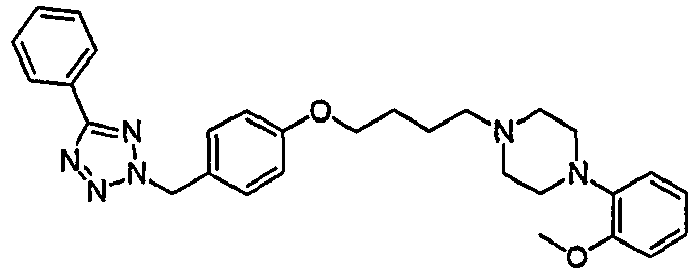
- The procedure given in Example 1 was followed using 5-phenyl-1H-tetrazole as reactants, instead of imidazole, to give 1-(2-methoxy-phenyl)-4-{4-[4-(5-phenyl-tetrazol-2-ylmethyl)-phenoxy]-butyl}-piperazine.
- 1H-NMR (CDCl3, 200MHz) δ 8.2 (m, 2H), 7.6 (m, 5H), 7.2∼7.0(m., 6H), 5.8 (s, 2H), 4.0 (t, 2H), 3.8(s, 3H), 3.1(m, 4H), 2.7(m, 4H), 2.5(t, 2H), 1.8(m, 4H)
-
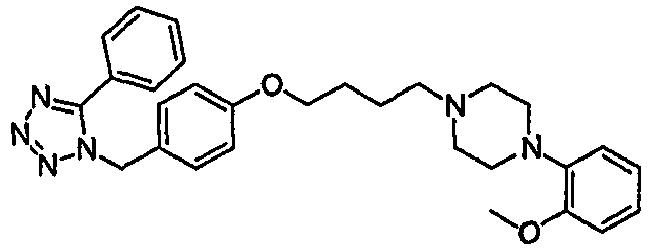
- The procedure given in Example 1 was followed using 5-phenyl-1H-tetrazole as reactants, instead of imidazole, to give 1-(2-methoxy-phenyl)-4-{4-[4-(5-phenyl-tetrazol-1-ylmethyl)-phenoxy]-butyl}-piperazine.
- 1H-NMR (CDCl3, 200MHz) δ 7.6 (m, 4H), 7.2(m., 3H), 6.9 (m, 6H), 5.6 (s, 2H), 4.0 (t, 2H), 3.8(s, 3H), 3.1(m, 4H), 2.7(m, 4H), 2.5(t, 2H), 1.8(m, 4H)
-

- The procedure given in Example 1 was followed using 5-methyl-1H-tetrazole as reactants, instead of imidazole, to give 1-(2-methoxy-phenyl)-4-{4-[4-(5-methyl-tetrazol-2-ylmethyl)-phenoxy]-butyl}-piperazine.
- 1H-NMR (CDCl3, 200MHz) δ 7.4(m, 2H), 7.0(m, 6H), 5.6 (s, 2H), 4.0(t, 2H), 3.8(s, 3H), 3.1(m, 4H), 2.7(m, 4H), 2.5(t, 2H), 2.5(s, 3H), 1.8(m, 4H)
-

- The procedure given in Example 1 was followed using 5-methyl-1H-tetrazole as reactants, instead of imidazole, to give 1-(2-methoxy-phenyl)-4-{4-[4-(5-methyl-tetrazol-1-ylmethyl)-phenoxy]-butyl}-piperazine.
- 1H NMR (CDCl3, 200MHz) δ 7.2 (m, 2H), 7.0(m, 6H), 5.4 (s, 2H), 4.0(t, 2H), 3.8(s, 3H), 3.1(m, 4H), 2.7(m, 4H), 2.5(t, 2H), 2.5(s, 3H), 1.8(m, 4H)
-
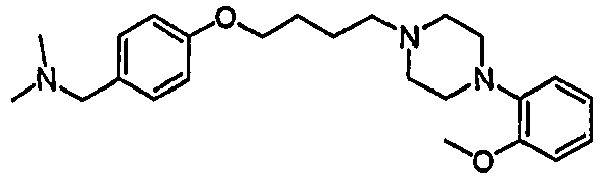
- The procedure given in Example 1 was followed using dimethyl amine as reactants, instead of imidazole, to give (4-{4-[4-(2-methoxy-phenyl)-piperazin-1-yl]-butoxy}-benzyl)-dimethyl-amine dihydrochloride.
- 1H-NMR (DMSO, 200MHz) δ 11.3 (br,1H), 11.1 (br,1H), 7.5(m, 2H), 7.0(m, 6H), 4.2 (m, 2H), 4.0(t, 2H), 3.8(s, 3H), 3.6 (m, 4H), 3.2 (m, 6H), 2.6(m, 6H), 1.8(m, 4H)
-

- The procedure given in Example 1 was followed using piperidine as reactants, instead of imidazole, to give 1-(2-methoxy-phenyl)-4-[4-(4-piperidin-1-ylmethyl-phenoxy)-butyl]-piperazine.
- 1H-NMR (CDCl3, 200MHz) δ 7.2(m, 2H), 6.9(m, 6H), 4.0(t, 2H), 3.8 (s, 3H), 3.4 (s, 2H), 3.2(m, 4H), 2.7(m, 4H), 2.5(t, 2H), 2.4 (m,4H), 1.8(m, 4H), 1.6(m, 4H), 1.4 (m,2H)
-

- The procedure given in Example 1 was followed using aniline as reactants, instead of imidazole, to give (4-{4-[4-(2-methoxy-phenyl)-piperazin-1-yl]-butoxy}-benzyl)-phenyl-amine.
- 1H-NMR (CDCl3, 200MHz) δ 7.2(m, 2H), 7.0(m, 6H), 6.8 (m, 5H), 4.3(s, 2H), 4.0(t, 2H), 3.8 (s, 3H), 3.6 (s, 1H), 3.2(m, 4H), 2.7(m, 4H), 2.5(t, 2H), 1.8(m, 4H)
-

- The procedure given in Example 1 was followed using thiazol-2-ylamine as reactants, instead of imidazole, to give (4-{4-[4-(2-methoxy-phenyl)-piperazin-1-yl]-butoxy} -benzyl)-thiazol-2-yl-amine.
- 1H-NMR (CDCl3, 200MHz) δ 7.5 (s, 1H), 7.2(m, 2H), 7.0(m, 6H), 6.6 (s, 1H), 4.3(s, 2H), 4.0(t, 2H), 3.8 (s, 3H), 3.6 (s, 1H), 3.2(m, 4H), 2.7(m, 4H), 2.5(t, 2H), 1.8(m, 4H)
-

- The procedure given in Example 1 was followed using 1-(2-chloro-phenyl)-piperazine and 1H-1,2,4-triazole as reactants, instead of 1-(2-methoxyphenyl)-piperazine and imidazole, to give 1-(2-chloro-phenyl)-4-[4-(4-[1,2,4]triazol-1-ylmethyl-phenoxy)-butyl]-piperazine.
- 1H-NMR (CDCl3, 200MHz) δ 8.1 (s, 1H), 8.0 (s, 1H), 7.2(m, 2H), 6.9(m, 6H), 5.2(s, 2H), 4.0(t, 2H), 3.2(m, 4H), 2.7(m, 4H), 2.5(t, 2H), 1.8(m, 4H)
-

- The procedure given in Example 5 was followed using 1H-1,2,3-triazole as reactants, instead of imidazole, to give 1-(2-methoxy-phenyl)-4-[4-(3-[1,2,3]triazol-2-ylmethyl-phenoxy)-butyl]-piperazine.
- 1H-NMR (CDCl3, 200MHz) δ 7.6 (s, 2H), 7.2(m, 2H), 6.9(m, 6H), 5.4 (s, 2H), 4.0(t, 2H), 3.8 (s, 3H), 3.2(m, 4H), 2.7(m, 4H), 2.5(t, 2H), 1.8(m, 4H)
-

- The procedure given in Example 5 was followed using 1H-1,2,3-triazole as reactants, instead of Imidazole, to give 1-(2-Methoxy-phenyl)-4-[4-(3-[1,2,3]triazol-1-ylmethyl-phenoxy)-butyl]-piperazine.
- 1H-NMR (CDCl3, 200MHz) δ 7.7 (s, 1H), 7.4 (s, 1H), 7.2 (m, 2H), 7.0-6.8 (m, 6H), 5.5 (s, 2H), 4.0(t, 2H), 3.8(s, 3H), 3.1(m, 4H), 2.7(m, 4H), 2.5(t, 2H), 2.5(s, 3H),1.8(m, 4H)
-

- The procedure given in Example 5 was followed using 5-methyl-1H-tetrazole as reactants, instead of imidazole, to give 1-(2-Methoxy-phenyl)-4-{4-[3-(5-methyltetrazol-2-ylmethyl)-phenoxy]-butyl}-piperazine.
- 1H-NMR (CDCl3, 200MHz) δ 7.6 (s, 2H), 7.2 (m, 2H), 7.0-6.8 (m, 6H), 5.5 (s, 2H), 4.0(t, 2H), 3.8(s, 3H), 3.1(m, 4H), 2.7(m, 4H), 2.5(t, 2H), 2.5(s, 3H),1.8(m, 4H)
-

- The procedure given in Example 5 was followed using 5-methyl-1H-tetrazole as reactants, instead of imidazole, to give 1-(2-methoxy-phenyl)-4-{4-[3-(5-methyl-tetrazol-1-ylmethyl)-phenoxy]-butyl}-piperazine.
- 1H-NMR (CDCl3, 200MHz) δ 7.2 (m, 2H), 7.0-6.7 (m, 6H), 5.5 (s, 2H), 4.0(t, 2H), 3.8(s, 3H), 3.1(m, 4H), 2.7(m, 4H), 2.5(t, 2H), 2.5(s, 3H),1.8(m, 4H)
-

- The procedure given in Example 5 was followed using dimethyl amine as reactants, instead of imidazole, to give (3-{4-[4-(2-methoxy-phenyl)-piperazin-1-yl]-butoxy}-benzyl)-dimethyl-amine.
- 1H-NMR (CDCl3, 200MHz) δ 7.3(m, 2H), 6.9(m, 6H), 4.0(t, 2H), 3.9(s, 3H), 3.2(m, 4H), 2.7(m, 4H), 2.6(s, 6H), 2.5(t, 2H), 1.8(m, 4H)
-

- The procedure given in Example 5 was followed using morpholine as reactants, instead of imidazole, to give 4-(3-{4-[4-(2-methoxy-phenyl)-piperazin-1-yl]-butoxy}-benzyl)-morpholine.
- 1H-NMR (CDCl3, 200MHz) 7.2(m, 2H), 6.9(m, 6H), 4.1(t, 2H), 3.9(s, 3H), 3.7(m,4H), 3.5 (s, 2H), 3.2(m, 4H), 2.8(m, 4H), 2.6(t, 2H), 2.5 (m,4H), 1.8(m, 4H)
-

- The procedure given in Example 1 was followed using 4,5-dichloro-imidazole as reactants, instead of imidazole, to give 1-{4-[4-(4,5-dichloro-imidazol-1-ylmethyl)-phenoxy]-butyl} -4-(2-methoxy-phenyl)-piperazine.
- 1H-NMR (CDCl3, 200MHz) δ 7.4 (s. 1 H), 7.2(m, 2H), 6.9(m, 6H), 5.0 (s, 2H), 4.0(t, 2H), 3.8 (s, 3H), 3.2(m, 4H), 2.7(m, 4H), 2.5(t, 2H), 1.8(m, 4H)
-

- The procedure given in Example 1 was followed using 1-(2-chloro-phenyl)-piperazine and 1H-tetrazole as reactants, instead of 1-(2-methoxyphenyl)-piperazine and imidazole, to give 1-(2-chloro-phenyl)-4-[4-(4-tetrazol-2-ylmethyl-phenoxy)-butyl]-piperazine.
- 1H-NMR (CDCl3, 200MHz) δ 8.5(m, 1H), 7.4(m, 4H), 7.0(m, 2H), 6.8(m, 2H), 5.8 (s, 2H), 4.0(t, 2H), 3.2(m, 4H), 2.9(m, 4H), 2.7(t, 2H), 1.9(m, 4H)
-

- The procedure given in Example 1 was followed using morpholine as reactants, instead of imidazole, to give 4-(4-{4-[4-(2-methoxy-phenyl)-piperazin-1-yl]-butoxy}-benzyl)-morpholine.
- 1H-NMR (CDCl3, 200MHz) δ 7.2(m, 2H), 6.9(m, 6H), 4.0(t, 2H), 3.8 (s, 3H), 3.4 (s, 2H), 3.2(m, 4H), 2.7(m, 4H), 2.5(t, 2H), 2.4 (m,4H), 1.8(m, 4H), 1.6(m, 4H)
-

- The procedure given in Example 1 was followed using 1-(2-chloro-phenyl)-piperazine and dimethylamine, instead of 1-(2-methoxyphenyl)-piperazine and imidazole, to give (4-{4-[4-(2-Chloro-phenyl)-piperazin-1-yl]-butoxy}-benzyl)-dimethyl-amine.
- 1H-NMR (CDCl3, 200MHz) δ 7.3∼7.1 (m, 4H), 7.1∼6.8 (m, 4H), 4.2 (t, 2H), 3.4(m, 2H), 3.1(m, 4H), 2.7 (m, 4H), 2.5 (m,2H), 2.4 (s,6H), 1.8∼1.7 (m, 4H)
-

- The procedure given in Example 1 was followed using 1-(3-fluoro-phenyl)-piperazine and 1H-1,2,4-triazole as reactants, instead of 1-(2-methoxyphenyl)-piperazine and imidazole, to give 1-(3-fluoro-phenyl)-4-[4-(4-[1,2,4]triazol-1-ylmethyl-phenoxy)-butyl]-piperazine.
- 1H-NMR (CDCl3, 200MHz) δ 7.9 (s, 1H), 7.7 (s, 1H), 7.2(m, 2H), 6.9(m, 6H), 5.5(s, 2H), 4.0(t, 2H), 3.2(m, 4H), 2.8(m, 4H), 2.6(t, 2H), 1.8(m, 4H)
-

- The procedure given in Example 1 was followed using 1-(2-chloro-phenyl)-piperazine and methylpiperazine, instead of instead of 1-(2-methoxyphenyl)-piperazine and imidazole, to give 1-(2-methoxy-phenyl)-4-[4-(4-4-methylpiperazine-1-ylmethyl-phenoxy)-butyl]-piperazine.
- 1H-NMR (CDCl3, 200MHz) δ 7.3∼7.1 (m, 4H), 7.1∼6.8 (m, 4H), 4.3 (t, 2H), 3.4(m, 2H), 3.1(m, 4H), 2.7 (m, 4H), 2.6 (m, 8H,) 2.5 (m, 2H), 2.3 (s, 3H), 1.8∼1.7 (m, 4H)
-

- The procedure given in Example 1 was followed using 1-(2,3-dichloro-phenyl)-piperazine and 1H-tetrazole as reactants, instead of 1-(2-methoxyphenyl)-piperazine and imidazole, to give 1-(2,3-dichloro-phenyl)-4-[4-(4-tetrazol-2-ylmethyl-phenoxy)-butyl]-piperazine.
- 1H-NMR (CDCl3, 200MHz) δ 8.5 (m, 1H), 7.4-6.8 (m, 7H), 5.8 (s, 2H), 4.0(t, 2H), 3.2(m, 4H), 2.9(m, 4H), 2.7(t, 2H), 1.9(m, 4H)
-

- The procedure given in Example 1 was followed using 1-(2,3-dichloro-phenyl)-piperazine and 5-methyl-1H-tetrazole as reactants, instead of 1-(2-methoxyphenyl)-piperazine and imidazole, to give 1-(2,3-Dichloro-phenyl)-4-{4-[4-(5-methyl-tetrazol-1-ylmethyl)-phenoxy]-butyl}-piperazine.
- 1H-NMR (CDCl3, 200MHz) δ 7.2 (m, 2H), 7.0(m, 5H), 5.4 (s, 2H), 4.0(t, 2H), 3.1(m, 4H), 2.7(m, 4H), 2.5(t, 2H), 2.6(s, 3H), 1.8(m, 4H)
-

- The procedure given in Example 1 was followed using 1-(2,3-dichloro-phenyl)-piperazine and 5-methyl-1H-tetrazole as reactants, instead of 1-(2-methoxyphenyl)-piperazine and imidazole, to give 1-(2,3-Dichloro-phenyl)-4-{4-[4-(5-methyl-tetrazol-2-ylmethyl)-phenoxy]-butyl}-piperazine.
- 1H-NMR (CDCl3, 200MHz) δ 7.2∼7.0(m, 7H), 5.6 (s, 2H), 4.0(t, 2H), 3.1(m, 4H), 2.7(m, 4H), 2.5(t, 2H), 2.5(s, 3H), 1.8(m, 4H)
-

- The procedure given in Example 1 was followed using 1-(2,3-dichloro-phenyl)-piperazine and dimethyl amine as reactants, instead of 1-(2-methoxyphenyl)-piperazine and imidazole, to give (4-{4-[4-(2,3-dichloro-phenyl)-piperazin-1-yl]-butoxy}-benzyl)-dimethyl-amine.
- 1H-NMR (DMSO, 200MHz) δ 11.3 (br,1H), 11.1 (br,1H), 7.5(m, 2H), 7.0(m, 5H), 4.2 (m, 2H), 4.0(t, 2H), 3.6 (m, 4H), 3.2 (m, 6H), 2.6(m, 6H), 1.8(m, 4H)
-

- The procedure given in Example 1 was followed using 1-(2,3-dichloro-phenyl)-piperazine and morpholine, instead of 1-(2-methoxyphenyl)-piperazine and imidazole, to give 4-(4-{4-[4-(2,3-Dichloro-phenyl)-piperazin-1-yl]-butoxy}-benzyl)-morpholine
- 1H-NMR (CDCl3, 200MHz) δ 7.2(m, 2H), 6.9(m, 6H), 4.2(t, 2H), 3.7(m,4H), 3.5 (s, 2H), 3.2(m, 4H), 2.8(m, 4H), 2.6(t, 2H), 2.5 (m,4H), 1.8(m, 4H)
-

- The procedure given in Example 1 was followed using 1-(2,3-dichloro-phenyl)-piperazine and methylpiperazine, instead ofl-(2-methoxyphenyl)-piperazine and imidazole to give 1-(2-methoxy-phenyl)-4-[4-(4-4-methylpiperazine-1-ylmethyl-phenoxy)-butyl]-piperazine.
- 1H-NMR (CDCl3, 200MHz) δ 7.3∼6.8 (m, 7H), 4.3 (t, 2H), 3.4(m, 2H), 3.1 (m, 4H), 2.7 (m, 4H), 2.6 (m, 8H,) 2.5 (m, 2H), 2.3 (s, 3H), 1.8∼1.7 (m, 4H)
-

- The procedure given in Example 1 was followed using 1-(2-chloro-phenyl)-piperazine and 1H-1,2,3-triazole as reactants, instead of 1-(2-methoxyphenyl)-piperazine and imidazole, to give 1-(2-chloro-phenyl)-4-[4-(4-[1,2,3]triazol-1-ylmethyl-phenoxy)-butyl]-piperazine.
- 1H-NMR (CDCl3, 200MHz) δ 7.7 (s, 1H), 7.4 (s, 1H), 7.2(m, 2H), 6.9(m, 6H), 5.5(s, 2H), 4.0(t, 2H), 3.2(m, 4H), 2.7(m, 4H), 2.5(t, 2H), 1.8(m, 4H)
-

- The procedure given in Example 1 was followed using [1,3,4]Thiadiazol-2-ylamine as reactants, instead of imidazole, to give (4-{4-[4-(2-Methoxy-phenyl)-piperazin-1-yl]-butoxy}-benzyl)-[1,3,4]thiadiazol-2-yl-amine.
- 1H-NMR (CDCl3, 200MHz) δ 7.2∼ 6.8 (m, 9H), 4.3(s, 2H), 4.0(t, 2H), 3.8 (s, 3H), 3.2(m, 4H), 2.7(m, 4H), 2.5(t, 2H), 1.8(m, 4H)
-

- The procedure given in Example 1 was followed using 1-(2,3-dichloro-phenyl)-piperazine and 1H-1,2,3-triazole as reactants, instead of 1-(2-methoxyphenyl)-piperazine and imidazole, to give 1-(2,3-dichloro-phenyl)-4-[4-(4-[1,2,3]triazol-1-ylmethyl-phenoxy)-butyl]-piperazine.
- 1H-NMR (CDCl3, 200MHz) δ 7.7 (s, 1H), 7.4-6.8 (m, 8H), 5.8 (s, 2H), 4.0(t, 2H), 3.2(m, 4H), 2.9(m, 4H), 2.7(t, 2H), 1.9(m, 4H)
-
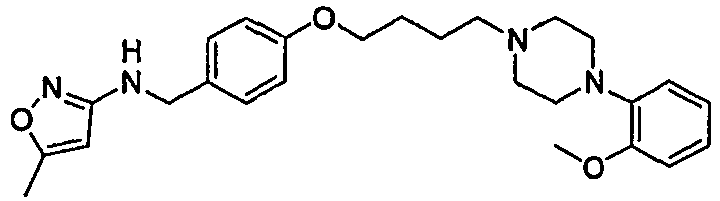
- The procedure given in Example 1 was followed using 5-methyl-isoxazol-3-ylamine as reactants, instead of imidazole, to give (4-{4-[4-(2-Methoxy-phenyl)-piperazin-1-yl]-butoxy}-benzyl)-(5-methyl-isoxazol-3-yl)-amine.
- 1H-NMR (CDCl3, 200MHz) δ 7.2∼6.8(m, 9H), 4.3(s, 2H), 4.0(t, 2H), 3.8 (s, 3H), 3.6 (s, 1H)3.2(m, 4H), 2.7(m, 4H), 2.5(t, 2H), 2.3 (s, 3H), 1.8(m, 4H)
-

- The procedure given in Example 1 was followed using 3-methyl-isoxazol-5-ylamine as reactants, instead of imidazole, to give (4-{4-[4-(2-methoxy-phenyl)-piperazin-1-yl]-butoxy}-benzyl)-(3-methyl-isoxazol-5-yl)-amine.
- 1H-NMR (CDCl3, 200MHz) δ 7.2(m, 2H), 7.0(m, 6H), 6.8 (s, 1H), 4.3(s, 2H), 4.0(t, 2H), 3.8 (s, 3H), 3.6 (s, 1H), 3.2(m, 4H), 2.7(m, 4H), 2.5(t, 2H), 2.3 (s,3H), 1.8(m, 4H)
-

- A mixture of 4-hydroxyphenetylalcohol (5mmol), 1-bromo-4-chlorobutane (5mmol), and potassium carbonate (15mmol) was refluxed in 100ml of acetone for 6h. This solution was then concentrated in a rotary evaporator and diluted with ethyl acetate. This mixture was then washed with brine, and the resulting organic layer was dried and purified by column chromatography. The product was dissolved in isopropanol (50ml) and was added with 1-(2-methoxyphenyl)-piperazine (5mmol), sodium carbonate (15mmol), and potassium iodide (5mmol) at 25 °C and the reaction mixture was refluxed for 12h. This solution was then concentrated in a rotary evaporator and diluted with methylene chloride. This mixture was then washed with brine, and the resulting organic layer was dried and purified by column chromatography. The product was dissolved in THF and was added with imidazole (15mmol), triphenylphosphine (15mmol), and diisopropyl azodicarboxylate (15mmol) dropwise at 0°C and warmed to room temperature. After 2h, the solvent was removed and the residue was washed with brine, and then purified by column chromatography.
- 1H-NMR (CDCl3, 200MHz) δ 7.3 (s, 1 H), 7.0(m, 10H), 4.1(t, 2H), 4.0(t, 2H), 3.8 (s, 3H), 3.1(m, 4H), 3.0(m, 2H), 2.7(m, 4H), 2.6(t, 2H), 1.8(m, 4H)
-

- The procedure given in Example 47 was followed using 1H-1,2,4-triazole as a reactant, instead of imidazole, to give 1-(2-methoxy-phenyl)-4-{4-[4-(2-[1,2,4]triazol-1-yl-ethyl)-phenoxy]-butyl}-piperazine.
- 1H-NMR (CDCl3, 200MHz) δ 8.0(s, 1H), 7.8(s, 1H), 7.0(m, 8H), 4.4(t, 2H), 4.0(t, 2H), 3.8 (s, 3H), 3.1(m, 6H), 2.7(m, 4H), 2.5(t, 2H), 1.8(m, 4H)
-

- The procedure given in Example 47 was followed using 1H-1,2,3-triazole as a reactant, instead of imidazole, to give 1-(2-methoxy-phenyl)-4-{4-[4-(2-[1,2,3]triazol-2-yl-ethyl)-phenoxy]-butyl}-piperazine.
- 1H-NMR (CDCl3, 200MHz) δ 7.7(s, 2H), 7.0(m, 8H), 4.6(t, 2H), 4.0(t, 2H), 3.8 (s, 3H), 3.1(m, 6H), 2.7(m, 4H), 2.5(t, 2H), 1.8(m, 4H)
-

- The procedure given in Example 47 was followed using 1H-1,2,3-triazole as a reactant, instead of imidazole, to give 1-(2-methoxy-phenyl)-4-{4-[4-(2-[1,2,3]triazol-1-yl-ethyl)-phenoxy]-butyl}-piperazine.
- 1H-NMR (CDCl3, 200MHz) δ 7.6(s, 1H), 7.3(s, 1H), 7.0(m, 8H), 4.6(t, 2H), 4.0(t, 2H), 3.8 (s, 3H), 3.1(m, 6H), 2.7(m, 4H), 2.5(t, 2H), 1.8(m, 4H)
-
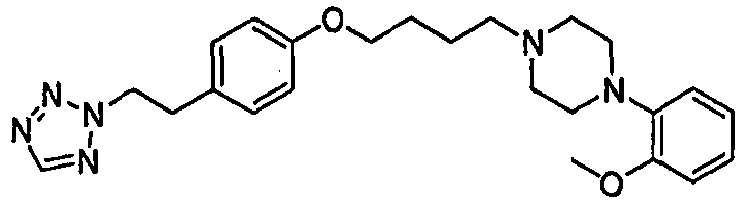
- The procedure given in Example 47 was followed using 1H-tetrazole as a reactant, instead of imidazole, to give 1-(2-methoxy-phenyl)-4-{4-[4-(2-tetrazol-2-yl-ethyl)-phenoxy]-butyl}-piperazine.
-

- The procedure given in Example 47 was followed using 1H-tetrazole as a reactant, instead of imidazole, to give 1-(2-methoxy-phenyl)-4-{4-[4-(2-tetrazol-1-yl-ethyl)-phenoxy]-butyl}-piperazine.
- 1H-NMR (CDCl3, 200MHz) δ 8.2(s, 1H), 7.0(m, 8H), 4.7(t, 2H), 4.0(t, 2H), 3.8 (s, 3H), 3.1 (m, 6H), 2.7(m, 4H), 2.5(t, 2H), 1.8(m, 4H)
-

- The procedure given in Example 47 was followed using 5-Methyl-tetrazole as a reactant, instead of imidazole, to give 1-(2-Methoxy-phenyl)-4-(4-{4-[2-(5-methyl-tetrazol-1-yl)-ethyl]-phenoxy} -butyl)-piperazine.
- 1H-NMR (CDCl3, 200MHz) δ 7.2∼7.0(m, 8H), 5.0 (t, 2H), 4.0(t, 2H), 3.8 (s, 3H), 3.1(m, 6H), 2.7(m, 4H), 2.3∼2.5 (m, 5H), 1.8(m, 4H)
-

- The procedure given in Example 47 was followed using 5-Methyl-tetrazole as a reactant, instead of imidazole, to give 1-(2-Methoxy-phenyl)-4-(4-{4-[2-(5-methyl-tetrazol-2-yl)-ethyl]-phenoxy}-butyl)-piperazine.
- 1H-NMR (CDCl3, 200MHz) δ 7.2∼7.0(m, 8H), 5.2 (t, 2H), 4.0(t, 2H), 3.8 (s, 3H), 3.1(m, 6H), 2.7(m, 4H), 2.3∼2.5 (m, 5H), 1.8(m, 4H)
-

- The procedure given in Example 1 was followed using 1-(2-cyano-phenyl)-piperazine and 1H-1,2,3-triazole as reactants, instead of 1-(2-methoxyphenyl)-piperazine and imidazole, to give 2-{4-[4-(4-[1,2,3]-triazol-1-ylmethyl-phenoxy)-butyl]-piperazin-1-yl}-benzonitrile.
- 1H-NMR (CDCl3, 200MHz) δ 7.9 (s, 1H), 7.8 (s, 1H), 7.2(m, 2H), 6.9(m, 6H), 5.5(s, 2H), 4.0(t, 2H), 3.2(m, 4H), 2.8(m, 4H), 2.6(t, 2H), 1.8(m, 4H)
-

- The procedure given in Example 1 was followed using 1-(2-chloro-phenyl)-piperazine and 1H-1,2,3-triazole as reactants, instead of 1-(2-methoxyphenyl)-piperazine and imidazole, to give 1-(2-chloro-phenyl)-4-[4-(4-[1,2,3]triazol-1-ylmethyl-phenoxy)-butyl]-piperazine.
- 1H-NMR (CDCl3, 200MHz) δ 7.6 (s, 2H), 7.2(m, 2H), 6.9(m, 6H), 5.6 (s, 2H), 4.0(t, 2H), 3.2(m, 4H), 2.7(m, 4H), 2.5(t, 2H), 1.8(m, 4H)
- The therapeutic use of the compounds of general structural formula (I) and their pharmaceutically useful salts are demonstrated by the following tests.
- The method to test the ability of compounds to inhibit serotonin 1A(5-HT1A) receptors was using Hall. et al., J NeuroChem., 1985, 44, p1685∼1696 with modification.
- The Sprague-Dawley (SD) rats were killed by decapitation and their brains rapidly removed at 4°C. The cortex tissue were homogenized in 30 volumes of ice-cold 50mM Tris-HCl buffer(pH7.4) using an ultra-turrax T8 and centrifuged at 48,000 g for 20 min. The supernatant was discarded and the pellet washed twice by resuspension in 20 volumes Tris-HCl and centrifugation, homogenized in 20 volumes Tris-HCl, and incubated at 37 °C for 10 min. Membranes were than collected by centrifugation and washed twice before final resuspension in 10 volumes of 50 mM Tris-HCl, pH7.4.
- For binding assays, the incubation medium consisted of 162.5ug of tissue homogenate, 0.92nM of [3H]8-OH-DPAT and vehicle or 10uM of 5-HT or 10nM of test compounds per well. 5-HT and test compounds were dissolved in distilled water and incubation medium was 50mM Tris (pH7.4 at room temperature). The assay plates(96well) were incubated for 60 min at 25 °C. The reaction was terminated by rapid filtration using a Tomtec harvester, through GF/C glassfibre filter with 5 times washes of Tris buffer. The radioactivity retained on the filters was counted by scintillation spectroscopy (MicroBeta TriLux, Wallac). The tests were triplicates. Percent inhibition was calculated as below equation.

- Total binding is the value of vehicle treated group and specific binding is the values that deduct non-specific binding (i.e. the value of non-specific ligand, 5-HT).
- The results obtained by testing compounds of the invention are given in the following Table 1.
Table 1 Test Compound 5-HT1a % inhibition, at 10nM Example 1 83.1 Example 2 80.3 Example 3 77.8 Example 4 75.9 Example 5 50.7 Example 6 50.1 Example 7 78.4 Example 8 81.6 Example 9 52.2 Example 10 71.8 Example 11 61.8 Example 12 60.9 Example 13 50.4 Example 14 51.1 Example 15 23.5 Example 16 62.5 Example 17 56.4 Example 18 69.5 Example 19 59.6 Example 20 68.5 Example 21 38.2 Example 22 53.4 Example 23 17.2 Example 24 51.6 Example 25 45.2 Example 26 47.0 Example 27 40.9 Example 28 13.5 Example 29 45.8 Example 30 38.3 Example 31 30.3 Example 33 53.7 Example 35 73.3 Example 36 28.1 Example 37 24.8 Example 38 29.4 Example 39 52.9 Example 40 45.6 Example 41 82.1 Example 42 36.2 Example 43 95.6 Example 44 17.4 Example 45 73.8 Example 46 64.6 Example 47 70.0 Example 48 48.0 Example 49 45.0 Example 50 51.0 Example 51 47.0 Example 52 62.0 Example 53 46.0 Example 54 71.0 Example 56 24.3 - Tail Suspension Test in mice is the well-known animal model to determine antidepressant efficacy of compounds by checking escaping behavior and immobility time of mice. Mice treated with antidepressant drug show escaping behavior continuously comparing with control group.
- The mice were mainly treated orally with the test compound dissolved in 30% PEG400 or with only 30% PEG400 as control. Tail of mouse is suspended to the rod of TST equipment and end of tail is fixed with sticky tape. Suspended mouse is incubated during 2 min for training and adaptation and after fallowing 2min, observe escaping behavior and check immobility time for 4min. The potent ability of the compounds was determined as percent value of reduction in immobility comparing to control group as 100% baseline.
- The results obtained by testing compounds of the invention are given in the following Table 2:
Table 2 Test Compound % reduction at 1mg/kg, po Example 5 21.2 Example 7 21.1 Example 8 19.6 Example 11 25 Example 12 12.7 Example 18 14.7 Example 19 50.6 Example 33 26.8 Example 39 30.4 Example 40 10.6 Example 41 14.1 Example 48 26.2 Example 49 34.3 Example 50 46.9 Example 51 14.7 Example 52 26.4 Example 54 31.8 Estalopram 47, at 30mg/kg, po Fluxetine 49. at 30mg/kg, po - This anti-depressant effect, as with other anti-depressant drugs, suggested potentials for treating depression.
- Marble burying was developed and validated as a pre-clinical assay of potential anxiolytic activity (Andrews and Broekkamp (1993). Procedures to Identify Anxiolytic or Anxiogenic agents. In Behavioural Neuroscience, ed. A Sahgal, pp. 37-54. IRL Press, Oxford). The marble burying test places a naive mouse into a novel environment containing 25 marbles (arranged on top of a sawdust surface). A reduction in the number of marbles buried by the mouse was hypothesized to be an anxiolytic-like effect.
- The results obtained by testing compounds of the invention are given in the following Table 3:
Table 3 Test Compound % reduction, at 3mg/kg,ip Example 1 28.7 Example 2 93.3 Example 5 60.3, at 7.5mg/kg, ip Example 7 61.1, at 7.5mg/kg, ip Example 11 69.0, at 7.5mg/kg, ip Example 12 97.3 Example 19 50.8, at 7.5mg/kg, ip Example 20 27.0, at 7.5mg/kg, ip Example 21 29.9 Example 24 62.6 Example 28 24.6 Example 32 27.8, at 7.5mg/kg, ip Example 36 25.3 Example 47 39.3 Example 48 31.3 Example 50 96.8, at 7.5mg/kg, ip Example 51 44.4, at 7.5mg/kg, ip Buspirone 56.0, at 20mg/kg, ip - An anti-marble burying effect, as with other anti-anxiety drugs, suggested potentials for treating anxiety.
Claims (14)
- A piperazine compound represented by Formula (I):
 n is an integer of 2 to 6;R1 and R2 are the same or different and are independently selected from the group consisting of hydrogen, a hydroxyl group, a halogen, nitrogen dioxide, a straight or branched chain alkyl group with 1 to 4 carbon atoms, and a straight or branched chain alkoxy group with 1 to 4 carbon atoms;R3 is a C1-C2 alkylene; andR4 is selected from the group consisting of:(a) a C2-C6 dialkylamine,(b) a 5 to 9-membered aromatic amine wherein the ring is independently substituted with at least one of hydrogen, a C1-C6 aliphatic alkyl, a C3 to C10 cyclic alkyl, a C6-C10 aryl group and a halogen,(c) a 5 to 9-membered heteroaromatic amine comprising at least a nitrogen atom as a ring constituent wherein the ring is independently substituted with at least one of hydrogen, a C1-C6 aliphatic alkyl, a C3 to C10 cyclic alkyl, a C6-C10 aryl group and a halogen,(d) a 5 to 9-membered heterocyclic ring comprising at least a nitrogen atom as a ring constituent wherein the ring is independently substituted with at least one of hydrogen, a C1-C6 aliphatic alkyl, a C3 to C10 cyclic alkyl, a C6-C10 aryl group and a halogen, and(e) a 5 to 9-membered heteroaromatic ring comprising at least a nitrogen atom as a ring constituent wherein the ring is independently substituted with at least one of hydrogen, a C1-C6 aliphatic alkyl, a C3 to C10 cyclic alkyl, a C6-C10 aryl group and a halogen; andR4 is connected to R3 group through a nitrogen atom therein.
 - The piperazine compound of Claim 1, wherein R4 is dimethylamine, or diethylamine.
- The piperazine compound of Claim 1, wherein R4 is connected to R3 through a nitrogen atom in an amino group of the 5 to 9-membered aromatic amine or heteroaromatic amine.
- The piperazine compound of Claim 3, wherein R4 is a 5 or 6-membered aromatic amine substituted with at least one of hydrogen, a C1-C6 alkyl, and a halogen.
- The piperazine compound of Claim 4, wherein R4 is a 6-membered aromatic amine substituted with hydrogen.
- The piperazine compound of Claim 3, wherein R4 is a 5 or 6-membered heteroaromatic amine substituted with at least one group selected from the group consisting of a C1-C6 alkyl and a halogen, wherein the heteroaromatic amine comprises at least two heteroatoms as ring constituents where a first heteroatom is N and a second heteroatom is independently selected from the group consisting of N, O, and S.
- The piperazine compound of Claim 6, wherein R4 is a 5-membered heteroaromatic amine having a structure (II) selected from the group consisting of:

- The piperazine compound of Claim 1, wherein R4 is connected to R3 through a nitrogen atom contained in a ring as a heteroatom of the 5 to 9-membered heterocyclic ring or heteroaromatic ring.
- The piperazine compound of Claim 8, wherein R4 is a 5 or 6-membered heterocyclic ring having a structure (III) selected from the group consisting of:
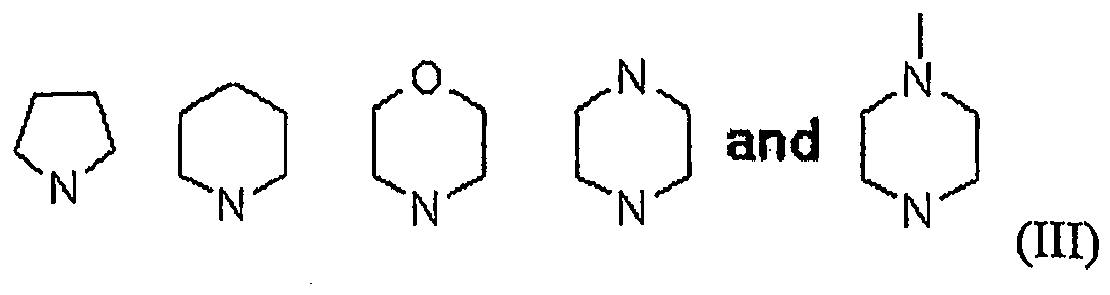
- The piperazine compound of Claim 8, wherein R4 is an selected from the group consisting of diazole, triazole, tetraazol, benzotriazole, imidazole, pyrazole, benzimidazloe, and indazole.
- The piperazine compound of Claim 10, wherein the azole has a structure (IV) selected from the group consisting:


- The piperazine compound of Claim 1, wherein R1 and R2 are independently selected from the group consisting of hydrogen, a halogen, a straight or branched chain alkyl group with 1 to 4 carbon atoms, and a straight or branched chain alkoxy group with 1 to 4 carbon atoms.
- The piperazine compound of Claim 1, wherein said compound is selected from the group consisting of: 1-[4-(4-imidazol-1-ylmethyl-phenoxy)-butyl]-4-(2-methoxy-phenyl)-piperazine, 1-(2-methoxy-phenyl)-4-[4-(4-[1,2,4]txiazol-1-ylmethyl-phenoxy)-butyl]-piperazine, 1-(2-methoxy-phenyl)-4-[4-(4-tetrazol-1-ylmethyl-phenoxy)-butyl]-piperazine, 1-(2-methoxy-phenyl)-4-[4-(4-tetrazol-2-ylmethyl-phenoxy)-butyl]-piperazine, 1-[4-(3-imidazol-1-ylmethyl-phenoxy)-butyl]-4-(2-methoxy-phenyl)-piperazine- hydrochloride, 1-(2-methoxy-phenyl)-4-[4-(3-[1,2,4]triazol-1-ylmethyl-phenoxy)-butyl]-piperazine hydrochloride, 1-(2-methoxy-phenyl)-4-[4-(3-tetrazol-1-ylmethyl-phenoxy)-butyl]-piperazine hydrochloride, 1-(2-methoxy-phenyl)-4-[4-(3-tetrazol-2-ylmethyl-phenoxy)-butyl]-piperazine hydrochloride, 1-(4-{4-[4-(2-methoxy-phenyl)-piperazin-1-yl]-butoxy}-benzyl)-1H-benzoimidazole, 1-(2-Methoxy-phenyl)-4-{4-[4-(2-methyl-imidazol-1-ylmethyl)-phenoxy]-butyl}-piperazine, 1-(2-methoxy-phenyl)-4-[4-(4-[1,2,3]triazol-2-ylmethyl-phenoxy)-butyl]-piperazine, 1-(2-methoxy-phenyl)-4-[4-(4-[1,2,3]triazol-1-ylmethyl-phenoxy)-butyl]-piperazine, 1-(4-{4-[4-(2-Methoxy-phenyl)-piperazin-1-yl]-butoxy}-benzyl)-1H-indazole, 1-(4-{4-[4-(2-Methoxy-phenyl)-piperazin-1-yl]-butoxy}-benzyl)-1H-benzotriazole, 1-(2-methoxy-phenyl)-4-{4-[4-(5-phenyl-tetrazol-2-ylmethyl)-phenoxy]-butyl}-piperazine, 1-(2-methoxy-phenyl)-4-{4-[4-(5-phenyl-tetrazol-1-ylmethyl)-phenoxy]-butyl}-piperazine, 1-(2-methoxy-phenyl)-4-{4-[4-(5-methyl-tetrazol-2-ylmethyl)-phenoxy]-butyl}-piperazine, 1-(2-methoxy-phenyl)-4-{4-[4-(5-methyl-tetrazol-1-ylmethyl)-phenoxy]-butyl}-piperazine,(4-{4-[4-(2-methoxy-phenyl)-piperazin-1-yl]-butoxy}-benzyl)-dimethyl-amine di-hydrochloride, 1-(2-methoxy-phenyl)-4-[4-(4-piperidin-1-ylmethyl-phenoxy)-butyl]-piperazine, (4-{4-[4-(2-methoxy-phenyl)-piperazin-1-yl]-butoxy}-benzyl)-phenyl-amine, (4-{4-[4-(2-methoxy-phenyl)-piperazin-1-yl]-butoxy}-benzyl)-thiazol-2-yl-amine, 1-(2-chloro-phenyl)-4-[4-(4-[1,2,4]triazol-1-ylmethyl-phenoxy)-butyl]-piperazine, 1-(2-methoxy-phenyl)-4-[4-(3-[1,2,3]triazol-2-ylmethyl-phenoxy)-butyl]-piperazine, 1-(2-Methoxy-phenyl)-4-[4-(3-[1,2,3]triazol-1-ylmethyl-phenoxy)-butyl]-piperazine, 1-(2-Methoxy-phenyl)-4-[4-(3-[1,2,3]triazol-2-ylmethyl-phenoxy)-butyl]-piperazine, 1-(2-methoxy-phenyl)-4-{4-[3-(5-methyl-tetrazol-1-ylmethyl)-phenoxy]-butyl}-piperazine, (3-{4-[4-(2-methoxy-phenyl)-piperazin-1-yl]-butoxy}-benzyl)-dimethyl-amine, 4-(3-{4-[4-(2-methoxy-phenyl)-piperazin-1-yl]-butoxy}-benzyl)-morpholine, 1-{4-[4-(4,5-dichloro-imidazol-1-ylmethyl)-phenoxy]-butyl}-4-(2-methoxy-phenyl)-piperazine, 1-(2-chloro-phenyl)-4-[4-(4-tetrazol-2-ylmethyl-phenoxy)-butyl]-piperazine, 4-(4-{4-[4-(2-methoxy-phenyl)-piperazin-1-yl]-butoxy}-benzyl)-morpholine, (4-{4-[4-(2-Chloro-phenyl)-piperazin-1-yl]-butoxy}-benzyl)-dimethyl-amine, 1-(3-fluoro-phenyl)-4-[4-(4-[1,2,4]triazol-1-ylmethyl-phenoxy)-butyl]-piperazine, 1-(2-methoxy-phenyl)-4-[4-(4-4-methylpiperazine-1-ylmethyl-phenoxy)-butyl]-piperazine, , 1-(2,3-dichloro-phenyl)-4-[4-(4-tetrazol-2-ylmethyl-phenoxy)-butyl]-piperazine, 1-(2,3-Dichloro-phenyl)-4-{4-[4-(5-methyl-tetrazol-1-ylmethyl)-phenoxy]-butyl}-piperazine, 1-(2,3-Dichloro-phenyl)-4-{4-[4-(5-methyl-tetrazol-2-ylmethyl)-phenoxy]-butyl}-piperazine, (4-{4-[4-(2,3-dichloro-phenyl)-piperazin-1-yl]-butoxy}-benzyl)-dimethyl-amine, 4-(4-{4-[4-(2,3-Dichloro-phenyl)-piperazin-1-yl]-butoxy}-benzyl)-morpholine, 1-(2-methoxy-phenyl)-4-[4-(4-4-methylpiperazine-1-ylmethyl-phenoxy)-butyl]-piperazine, 1-(2-chlorophenyl)-4-[4-(4-[1,2,3]triazol-1-ylmethyl-phenoxy)-butyl]-piperazine, (4-{4-[4-(2-Methoxy-phenyl)-piperazin-1-yl]-butoxy}-benzyl)-[1,3,4]thiadiazol-2-yl-amine, 1-(2,3-dichloro-phenyl)-4-[4-(4-[1,2,3]triazol-1-ylmethyl-phenoxy)-butyl]-piperazine, (4-{4-[4-(2-Methoxy-phenyl)-piperazin-1-yl]-butoxy} -benzyl)-(5-methyl-isoxazol-3-yl)-amine, (4-{4-[4-(2-methoxy-phenyl)-piperazin-1-yl]-butoxy}-benzyl)-(5-methyl-isoxazol-3-yl)-amine, 1-{4-[4-(2-imidazol-1-yl-ethyl)-phenoxy]-butyl}-4-(2-methoxy-phenyl)-piperazine, 1-(2-methoxy-phenyl)-4-{4-[4-(2-[1,2,4]triazol-1-yl-ethyl)-phenoxy]-butyl}-piperazine, 1-(2-methoxy-phenyl)-4-{4-[4-(2-[1,2,3]triazol-2-yl-ethyl)-phenoxy]-butyl}-piperazine, 1-(2-methoxy-phenyl)-4-{4-[4-(2-[1,2,3]triazol-1-yl-ethyl)-phenoxy]-butyl}-piperazine, 1-(2-methoxy-phenyl)-4-{4-[4-(2-tetrazol-2-yl-ethyl)-phenoxy]-butyl}-piperazine, 1-(2-methoxy-phenyl)-4-{4-[4-(2-tetrazol-1-yl-ethyl)-phenoxy]-butyl}-piperazine, 1-(2-Methoxy-phenyl)-4-(4-{4-[2-(5-methyl-tetrazol-1-yl)-ethyl]-phenoxy}-butyl)-piperazine, 1-(2-Methoxy-phenyl)-4-(4-{4-[2-(5-methyl-tetrazol-2-yl)-ethyl]-phenoxy}-butyl)-piperazine, 2-{4-[4-(4-[1,2,3]-triazol-1-ylmethyl-phenoxy)-butyl]-piperazin-1-yl}-benzonitrile, and 1-(2-chloro-phenyl)-4-[4-(4-[1,2,3]triazol-2-ylmethyl-phenoxy)-butyl]-piperazine.
- A pharmaceutical composition for treating and preventing depression and anxiety comprising an effective amount of the piperazine compound of Claims 1 to 13, and a pharmaceutically acceptable carrier or excipient.
Applications Claiming Priority (2)
| Application Number | Priority Date | Filing Date | Title |
|---|---|---|---|
| US12/128,999 US7964605B2 (en) | 2008-05-29 | 2008-05-29 | Phenyl piperazine compounds, pharmaceutical composition comprising the same, and use thereof |
| PCT/KR2009/002881 WO2009145591A2 (en) | 2008-05-29 | 2009-05-29 | Phenyl piperazine compounds, pharmaceutical composition including the same, and use thereof |
Publications (3)
| Publication Number | Publication Date |
|---|---|
| EP2279179A2 EP2279179A2 (en) | 2011-02-02 |
| EP2279179A4 EP2279179A4 (en) | 2011-12-07 |
| EP2279179B1 true EP2279179B1 (en) | 2014-09-17 |
Family
ID=41377812
Family Applications (1)
| Application Number | Title | Priority Date | Filing Date |
|---|---|---|---|
| EP09755056.0A Active EP2279179B1 (en) | 2008-05-29 | 2009-05-29 | Phenyl piperazine compounds, pharmaceutical composition including the same, and use thereof |
Country Status (8)
| Country | Link |
|---|---|
| US (1) | US7964605B2 (en) |
| EP (1) | EP2279179B1 (en) |
| JP (1) | JP5391269B2 (en) |
| KR (2) | KR101659982B1 (en) |
| CN (1) | CN102046610B (en) |
| CA (1) | CA2725563C (en) |
| ES (1) | ES2519090T3 (en) |
| WO (2) | WO2009145591A2 (en) |
Families Citing this family (8)
| Publication number | Priority date | Publication date | Assignee | Title |
|---|---|---|---|---|
| US7985752B2 (en) | 2008-05-29 | 2011-07-26 | Sk Holdings Co., Ltd. | Phenyl piperazine compounds, pharmaceutical composition including the same and use thereof |
| US7964605B2 (en) | 2008-05-29 | 2011-06-21 | Sk Holdings Co., Ltd. | Phenyl piperazine compounds, pharmaceutical composition comprising the same, and use thereof |
| KR20120090371A (en) | 2011-02-07 | 2012-08-17 | 삼성전자주식회사 | Liquid crsytal display |
| CN104205368B (en) | 2012-02-05 | 2018-08-07 | 三星电子株式会社 | Semiconductor nanocrystal, preparation method, composition and product |
| CN106187873B (en) * | 2016-07-25 | 2019-11-05 | 宜春学院 | A kind of aryl amine alkyl oxygen class compound and preparation method thereof |
| CN109232549B (en) * | 2017-07-11 | 2022-07-12 | 江苏恩华药业股份有限公司 | Compound for treating schizophrenia and application thereof |
| EP3735398B1 (en) | 2018-01-03 | 2022-02-16 | Ecolab Usa Inc. | Benzotriazole derivatives as corrosion inhibitors |
| CN113292515B (en) * | 2021-06-04 | 2022-05-20 | 沈阳药科大学 | Urea compound containing piperazine group and preparation method and application thereof |
Family Cites Families (8)
| Publication number | Priority date | Publication date | Assignee | Title |
|---|---|---|---|---|
| US5006528A (en) * | 1988-10-31 | 1991-04-09 | Otsuka Pharmaceutical Co., Ltd. | Carbostyril derivatives |
| US4975445A (en) * | 1989-12-06 | 1990-12-04 | Warner-Lambert Company | Substituted cyclohexenes as central nervous system agents |
| HUP9603001A3 (en) | 1996-10-30 | 1999-07-28 | Richter Gedeon Vegyeszet | Heterocycle compounds comprising nitrogen, process for producing them and pharmaceutical compositions containing the same |
| FR2761064B1 (en) | 1997-03-20 | 1999-06-04 | Pf Medicament | PIPERAZINES DERIVED FROM CYCLIC AMINES, THEIR PREPARATION AND THEIR APPLICATION AS MEDICAMENTS |
| US20040001492A1 (en) * | 2002-07-01 | 2004-01-01 | Johnson Erik J. | Method and system for maintaining a MAC address filtering table |
| EP1658077A4 (en) | 2003-06-19 | 2007-06-06 | Psychiatric Genomics Inc | Dual function compounds and uses thereof |
| CN103058957A (en) * | 2007-06-29 | 2013-04-24 | 埃莫里大学 | NMDA receptor antagonists for neuroprotection |
| US7964605B2 (en) | 2008-05-29 | 2011-06-21 | Sk Holdings Co., Ltd. | Phenyl piperazine compounds, pharmaceutical composition comprising the same, and use thereof |
-
2008
- 2008-05-29 US US12/128,999 patent/US7964605B2/en active Active
-
2009
- 2009-05-29 CA CA2725563A patent/CA2725563C/en active Active
- 2009-05-29 WO PCT/KR2009/002881 patent/WO2009145591A2/en not_active Ceased
- 2009-05-29 JP JP2011511519A patent/JP5391269B2/en active Active
- 2009-05-29 WO PCT/KR2009/002880 patent/WO2009145590A2/en not_active Ceased
- 2009-05-29 EP EP09755056.0A patent/EP2279179B1/en active Active
- 2009-05-29 ES ES09755056.0T patent/ES2519090T3/en active Active
- 2009-05-29 CN CN2009801195292A patent/CN102046610B/en active Active
- 2009-05-29 KR KR1020107026819A patent/KR101659982B1/en active Active
- 2009-05-29 KR KR1020107028010A patent/KR101597328B1/en not_active Expired - Fee Related
Also Published As
| Publication number | Publication date |
|---|---|
| US20090298851A1 (en) | 2009-12-03 |
| KR20110021885A (en) | 2011-03-04 |
| CN102046610B (en) | 2013-06-05 |
| WO2009145591A3 (en) | 2010-03-04 |
| ES2519090T3 (en) | 2014-11-06 |
| WO2009145591A2 (en) | 2009-12-03 |
| KR20110010748A (en) | 2011-02-07 |
| US7964605B2 (en) | 2011-06-21 |
| CA2725563C (en) | 2016-07-12 |
| KR101597328B1 (en) | 2016-03-02 |
| KR101659982B1 (en) | 2016-09-27 |
| CN102046610A (en) | 2011-05-04 |
| WO2009145590A3 (en) | 2010-03-04 |
| JP5391269B2 (en) | 2014-01-15 |
| EP2279179A4 (en) | 2011-12-07 |
| WO2009145590A2 (en) | 2009-12-03 |
| CA2725563A1 (en) | 2009-12-03 |
| JP2011521944A (en) | 2011-07-28 |
| EP2279179A2 (en) | 2011-02-02 |
Similar Documents
| Publication | Publication Date | Title |
|---|---|---|
| CA2725563C (en) | Phenyl piperazine compounds, pharmaceutical composition including the same, and use thereof | |
| KR101286499B1 (en) | Neurotherapeutic azole compounds | |
| CA2443216C (en) | Enantiomers of 1-[(4-chlorophenyl) phenylmethyl]-4-[(4-methylphenyl) sulfonyl] piperazine | |
| NL1032713C2 (en) | Histamine 3 receptor antagonists. | |
| KR920005114B1 (en) | Method for preparing 5-fluoro-2- (1-piperazinyl) pyrimidine | |
| RU2451015C2 (en) | 1,2,4-triazole derivatives as sigma receptor inhbitors | |
| HUT72492A (en) | Piperazinil bifenyl derivatives and pharmaceutical compositions containing them | |
| BG61519B2 (en) | New derivatives of phenylacetic acid, medicamentous compositions containing these compounds, and method for their preparation | |
| US6852718B2 (en) | Phenylsulphonylipiperazinyl derivatives as 5-HT receptor ligands | |
| JP5250627B2 (en) | New compounds | |
| US8772299B2 (en) | Phenyl piperazine compounds, pharmaceutical composition including the same and use thereof | |
| Augstein et al. | Relation between antihistamine and antidepressant activity in hexahydroindenopyridines | |
| KR100924405B1 (en) | Novel N-triazolylmethyl-piperazine derivatives as neurokinin-receptor antagonists | |
| EP1851210B1 (en) | Nitro-substituted phenyl-piperazine compounds, their preparation and use in medicaments | |
| DK168861B1 (en) | 4-Methyl-5-(2-(4-phenyl-1-piperazinyl)=ethyl) thiazole derivatives and a process for preparing them, pharmaceutical agents which comprise the thiazole derivatives and a process for producing them, and the use of the derivatives for producing medicaments. | |
| FI85268C (en) | Process for the preparation of therapeutically useful benzhydrylpipe razin derivatives | |
| CA1123440A (en) | 4-(naphthalenyloxy)piperidine derivatives | |
| WO2000018763A2 (en) | 2-(2,3-dihydrobenzofuran-5-yl)-4-aminomethylimidazoles: dopamine receptor subtype specific ligands | |
| HU224070B1 (en) | Process for producing 1-[(4-chloro-phenyl)-phenyl-methyl]-piperazine enantiomers, novels thereof and pharmaceutical compositions containing them | |
| CZ20001258A3 (en) | Substituted piperidine derivatives |
Legal Events
| Date | Code | Title | Description |
|---|---|---|---|
| PUAI | Public reference made under article 153(3) epc to a published international application that has entered the european phase |
Free format text: ORIGINAL CODE: 0009012 |
|
| 17P | Request for examination filed |
Effective date: 20101112 |
|
| AK | Designated contracting states |
Kind code of ref document: A2 Designated state(s): AT BE BG CH CY CZ DE DK EE ES FI FR GB GR HR HU IE IS IT LI LT LU LV MC MK MT NL NO PL PT RO SE SI SK TR |
|
| AX | Request for extension of the european patent |
Extension state: AL BA RS |
|
| DAX | Request for extension of the european patent (deleted) | ||
| A4 | Supplementary search report drawn up and despatched |
Effective date: 20111108 |
|
| RIC1 | Information provided on ipc code assigned before grant |
Ipc: A61K 31/498 20060101ALI20111103BHEP Ipc: C07D 241/02 20060101ALI20111103BHEP Ipc: C07D 241/04 20060101AFI20111103BHEP Ipc: C07D 403/08 20060101ALI20111103BHEP |
|
| RAP1 | Party data changed (applicant data changed or rights of an application transferred) |
Owner name: SK PHARMACEUTICALS CO., LTD. |
|
| GRAP | Despatch of communication of intention to grant a patent |
Free format text: ORIGINAL CODE: EPIDOSNIGR1 |
|
| INTG | Intention to grant announced |
Effective date: 20140520 |
|
| GRAS | Grant fee paid |
Free format text: ORIGINAL CODE: EPIDOSNIGR3 |
|
| GRAA | (expected) grant |
Free format text: ORIGINAL CODE: 0009210 |
|
| AK | Designated contracting states |
Kind code of ref document: B1 Designated state(s): AT BE BG CH CY CZ DE DK EE ES FI FR GB GR HR HU IE IS IT LI LT LU LV MC MK MT NL NO PL PT RO SE SI SK TR |
|
| REG | Reference to a national code |
Ref country code: GB Ref legal event code: FG4D |
|
| REG | Reference to a national code |
Ref country code: CH Ref legal event code: EP |
|
| REG | Reference to a national code |
Ref country code: IE Ref legal event code: FG4D |
|
| REG | Reference to a national code |
Ref country code: AT Ref legal event code: REF Ref document number: 687646 Country of ref document: AT Kind code of ref document: T Effective date: 20141015 |
|
| REG | Reference to a national code |
Ref country code: DE Ref legal event code: R096 Ref document number: 602009026731 Country of ref document: DE Effective date: 20141030 |
|
| REG | Reference to a national code |
Ref country code: ES Ref legal event code: FG2A Ref document number: 2519090 Country of ref document: ES Kind code of ref document: T3 Effective date: 20141106 |
|
| PG25 | Lapsed in a contracting state [announced via postgrant information from national office to epo] |
Ref country code: NO Free format text: LAPSE BECAUSE OF FAILURE TO SUBMIT A TRANSLATION OF THE DESCRIPTION OR TO PAY THE FEE WITHIN THE PRESCRIBED TIME-LIMIT Effective date: 20141217 Ref country code: LT Free format text: LAPSE BECAUSE OF FAILURE TO SUBMIT A TRANSLATION OF THE DESCRIPTION OR TO PAY THE FEE WITHIN THE PRESCRIBED TIME-LIMIT Effective date: 20140917 Ref country code: FI Free format text: LAPSE BECAUSE OF FAILURE TO SUBMIT A TRANSLATION OF THE DESCRIPTION OR TO PAY THE FEE WITHIN THE PRESCRIBED TIME-LIMIT Effective date: 20140917 Ref country code: GR Free format text: LAPSE BECAUSE OF FAILURE TO SUBMIT A TRANSLATION OF THE DESCRIPTION OR TO PAY THE FEE WITHIN THE PRESCRIBED TIME-LIMIT Effective date: 20141218 Ref country code: SE Free format text: LAPSE BECAUSE OF FAILURE TO SUBMIT A TRANSLATION OF THE DESCRIPTION OR TO PAY THE FEE WITHIN THE PRESCRIBED TIME-LIMIT Effective date: 20140917 |
|
| REG | Reference to a national code |
Ref country code: NL Ref legal event code: VDEP Effective date: 20140917 |
|
| REG | Reference to a national code |
Ref country code: LT Ref legal event code: MG4D |
|
| PG25 | Lapsed in a contracting state [announced via postgrant information from national office to epo] |
Ref country code: CY Free format text: LAPSE BECAUSE OF FAILURE TO SUBMIT A TRANSLATION OF THE DESCRIPTION OR TO PAY THE FEE WITHIN THE PRESCRIBED TIME-LIMIT Effective date: 20140917 Ref country code: HR Free format text: LAPSE BECAUSE OF FAILURE TO SUBMIT A TRANSLATION OF THE DESCRIPTION OR TO PAY THE FEE WITHIN THE PRESCRIBED TIME-LIMIT Effective date: 20140917 Ref country code: LV Free format text: LAPSE BECAUSE OF FAILURE TO SUBMIT A TRANSLATION OF THE DESCRIPTION OR TO PAY THE FEE WITHIN THE PRESCRIBED TIME-LIMIT Effective date: 20140917 |
|
| REG | Reference to a national code |
Ref country code: AT Ref legal event code: MK05 Ref document number: 687646 Country of ref document: AT Kind code of ref document: T Effective date: 20140917 |
|
| PG25 | Lapsed in a contracting state [announced via postgrant information from national office to epo] |
Ref country code: NL Free format text: LAPSE BECAUSE OF FAILURE TO SUBMIT A TRANSLATION OF THE DESCRIPTION OR TO PAY THE FEE WITHIN THE PRESCRIBED TIME-LIMIT Effective date: 20140917 |
|
| PG25 | Lapsed in a contracting state [announced via postgrant information from national office to epo] |
Ref country code: IS Free format text: LAPSE BECAUSE OF FAILURE TO SUBMIT A TRANSLATION OF THE DESCRIPTION OR TO PAY THE FEE WITHIN THE PRESCRIBED TIME-LIMIT Effective date: 20150117 Ref country code: SK Free format text: LAPSE BECAUSE OF FAILURE TO SUBMIT A TRANSLATION OF THE DESCRIPTION OR TO PAY THE FEE WITHIN THE PRESCRIBED TIME-LIMIT Effective date: 20140917 Ref country code: RO Free format text: LAPSE BECAUSE OF FAILURE TO SUBMIT A TRANSLATION OF THE DESCRIPTION OR TO PAY THE FEE WITHIN THE PRESCRIBED TIME-LIMIT Effective date: 20140917 Ref country code: CZ Free format text: LAPSE BECAUSE OF FAILURE TO SUBMIT A TRANSLATION OF THE DESCRIPTION OR TO PAY THE FEE WITHIN THE PRESCRIBED TIME-LIMIT Effective date: 20140917 Ref country code: PT Free format text: LAPSE BECAUSE OF FAILURE TO SUBMIT A TRANSLATION OF THE DESCRIPTION OR TO PAY THE FEE WITHIN THE PRESCRIBED TIME-LIMIT Effective date: 20150119 Ref country code: EE Free format text: LAPSE BECAUSE OF FAILURE TO SUBMIT A TRANSLATION OF THE DESCRIPTION OR TO PAY THE FEE WITHIN THE PRESCRIBED TIME-LIMIT Effective date: 20140917 |
|
| PG25 | Lapsed in a contracting state [announced via postgrant information from national office to epo] |
Ref country code: PL Free format text: LAPSE BECAUSE OF FAILURE TO SUBMIT A TRANSLATION OF THE DESCRIPTION OR TO PAY THE FEE WITHIN THE PRESCRIBED TIME-LIMIT Effective date: 20140917 Ref country code: AT Free format text: LAPSE BECAUSE OF FAILURE TO SUBMIT A TRANSLATION OF THE DESCRIPTION OR TO PAY THE FEE WITHIN THE PRESCRIBED TIME-LIMIT Effective date: 20140917 |
|
| REG | Reference to a national code |
Ref country code: DE Ref legal event code: R097 Ref document number: 602009026731 Country of ref document: DE |
|
| PLBE | No opposition filed within time limit |
Free format text: ORIGINAL CODE: 0009261 |
|
| STAA | Information on the status of an ep patent application or granted ep patent |
Free format text: STATUS: NO OPPOSITION FILED WITHIN TIME LIMIT |
|
| PG25 | Lapsed in a contracting state [announced via postgrant information from national office to epo] |
Ref country code: DK Free format text: LAPSE BECAUSE OF FAILURE TO SUBMIT A TRANSLATION OF THE DESCRIPTION OR TO PAY THE FEE WITHIN THE PRESCRIBED TIME-LIMIT Effective date: 20140917 |
|
| 26N | No opposition filed |
Effective date: 20150618 |
|
| PG25 | Lapsed in a contracting state [announced via postgrant information from national office to epo] |
Ref country code: SI Free format text: LAPSE BECAUSE OF FAILURE TO SUBMIT A TRANSLATION OF THE DESCRIPTION OR TO PAY THE FEE WITHIN THE PRESCRIBED TIME-LIMIT Effective date: 20140917 |
|
| REG | Reference to a national code |
Ref country code: CH Ref legal event code: PL |
|
| PG25 | Lapsed in a contracting state [announced via postgrant information from national office to epo] |
Ref country code: LI Free format text: LAPSE BECAUSE OF NON-PAYMENT OF DUE FEES Effective date: 20150531 Ref country code: CH Free format text: LAPSE BECAUSE OF NON-PAYMENT OF DUE FEES Effective date: 20150531 Ref country code: MC Free format text: LAPSE BECAUSE OF FAILURE TO SUBMIT A TRANSLATION OF THE DESCRIPTION OR TO PAY THE FEE WITHIN THE PRESCRIBED TIME-LIMIT Effective date: 20140917 Ref country code: LU Free format text: LAPSE BECAUSE OF FAILURE TO SUBMIT A TRANSLATION OF THE DESCRIPTION OR TO PAY THE FEE WITHIN THE PRESCRIBED TIME-LIMIT Effective date: 20150529 |
|
| REG | Reference to a national code |
Ref country code: IE Ref legal event code: MM4A |
|
| REG | Reference to a national code |
Ref country code: FR Ref legal event code: PLFP Year of fee payment: 8 |
|
| PG25 | Lapsed in a contracting state [announced via postgrant information from national office to epo] |
Ref country code: IE Free format text: LAPSE BECAUSE OF NON-PAYMENT OF DUE FEES Effective date: 20150529 |
|
| PG25 | Lapsed in a contracting state [announced via postgrant information from national office to epo] |
Ref country code: MT Free format text: LAPSE BECAUSE OF FAILURE TO SUBMIT A TRANSLATION OF THE DESCRIPTION OR TO PAY THE FEE WITHIN THE PRESCRIBED TIME-LIMIT Effective date: 20140917 |
|
| REG | Reference to a national code |
Ref country code: FR Ref legal event code: PLFP Year of fee payment: 9 |
|
| PG25 | Lapsed in a contracting state [announced via postgrant information from national office to epo] |
Ref country code: HU Free format text: LAPSE BECAUSE OF FAILURE TO SUBMIT A TRANSLATION OF THE DESCRIPTION OR TO PAY THE FEE WITHIN THE PRESCRIBED TIME-LIMIT; INVALID AB INITIO Effective date: 20090529 Ref country code: BG Free format text: LAPSE BECAUSE OF FAILURE TO SUBMIT A TRANSLATION OF THE DESCRIPTION OR TO PAY THE FEE WITHIN THE PRESCRIBED TIME-LIMIT Effective date: 20140917 |
|
| PG25 | Lapsed in a contracting state [announced via postgrant information from national office to epo] |
Ref country code: TR Free format text: LAPSE BECAUSE OF FAILURE TO SUBMIT A TRANSLATION OF THE DESCRIPTION OR TO PAY THE FEE WITHIN THE PRESCRIBED TIME-LIMIT Effective date: 20140917 |
|
| PG25 | Lapsed in a contracting state [announced via postgrant information from national office to epo] |
Ref country code: BE Free format text: LAPSE BECAUSE OF FAILURE TO SUBMIT A TRANSLATION OF THE DESCRIPTION OR TO PAY THE FEE WITHIN THE PRESCRIBED TIME-LIMIT Effective date: 20140917 |
|
| REG | Reference to a national code |
Ref country code: FR Ref legal event code: PLFP Year of fee payment: 10 |
|
| PG25 | Lapsed in a contracting state [announced via postgrant information from national office to epo] |
Ref country code: MK Free format text: LAPSE BECAUSE OF FAILURE TO SUBMIT A TRANSLATION OF THE DESCRIPTION OR TO PAY THE FEE WITHIN THE PRESCRIBED TIME-LIMIT Effective date: 20140917 |
|
| REG | Reference to a national code |
Ref country code: FR Ref legal event code: PLFP Year of fee payment: 15 |
|
| P01 | Opt-out of the competence of the unified patent court (upc) registered |
Effective date: 20230525 |
|
| PGFP | Annual fee paid to national office [announced via postgrant information from national office to epo] |
Ref country code: DE Payment date: 20250402 Year of fee payment: 17 |
|
| PGFP | Annual fee paid to national office [announced via postgrant information from national office to epo] |
Ref country code: ES Payment date: 20250605 Year of fee payment: 17 |
|
| PGFP | Annual fee paid to national office [announced via postgrant information from national office to epo] |
Ref country code: IT Payment date: 20250422 Year of fee payment: 17 |
|
| PGFP | Annual fee paid to national office [announced via postgrant information from national office to epo] |
Ref country code: FR Payment date: 20250401 Year of fee payment: 17 |
|
| PGFP | Annual fee paid to national office [announced via postgrant information from national office to epo] |
Ref country code: GB Payment date: 20260310 Year of fee payment: 18 |