EP2277855A1 - Crystallization of iodixanol using milling - Google Patents
Crystallization of iodixanol using milling Download PDFInfo
- Publication number
- EP2277855A1 EP2277855A1 EP09177713A EP09177713A EP2277855A1 EP 2277855 A1 EP2277855 A1 EP 2277855A1 EP 09177713 A EP09177713 A EP 09177713A EP 09177713 A EP09177713 A EP 09177713A EP 2277855 A1 EP2277855 A1 EP 2277855A1
- Authority
- EP
- European Patent Office
- Prior art keywords
- iodixanol
- crystallization
- product
- yield
- purification
- Prior art date
- Legal status (The legal status is an assumption and is not a legal conclusion. Google has not performed a legal analysis and makes no representation as to the accuracy of the status listed.)
- Granted
Links
Images

Classifications
-
- C—CHEMISTRY; METALLURGY
- C07—ORGANIC CHEMISTRY
- C07C—ACYCLIC OR CARBOCYCLIC COMPOUNDS
- C07C231/00—Preparation of carboxylic acid amides
- C07C231/22—Separation; Purification; Stabilisation; Use of additives
- C07C231/24—Separation; Purification
Definitions
- This invention relates to the manufacture of iodixanol (1,3-bis(acetamido)-N,N'-bis[3,5-bis(2,3-dihydroxypropylaminocarbonyl)-2,4,6-triiodophenyl]-2-hydroxypropane), more specifically to the purification of iodixanol by crystallization.
- Iodixanol is the non-proprietory name of the chemical drug substance of a non-ionic X-ray contrast agent marketed under the trade name VisipaqueTM.
- VisipaqueTM is one of the most used agents in diagnostic X-ray procedures and is manufactured in large quantities.
- non-ionic X-ray contrast agents involves the production of the chemical drug substance (referred to as primary production) followed by formulation into the drug product (referred to as secondary production).
- Primary production of iodixanol involves a multi step chemical synthesis and a thorough purification process.
- primary production it is important for the primary production to be efficient and economical and to provide a drug substance fulfilling the specifications, e.g. as expressed in the US Pharmacopeia.
- the third route to iodixanol involves the synthesis of 5-amino-2,4,6-triiodoisophthalic acid ( WO 96/37458 ) and then its dichloride ( WO 96/37459 ), followed by conversion into Compound A ( US 5705692 ) and finally dimerisation as in the process of Scheme I.
- This method thus has the same disadvantages as the first process, and also uses an undesirable acid chlorination step.
- the crude iodixanol produced by the synthetic chemical process is crystallized twice.
- the process is time consuming and takes about 3 days for the first crystallization and about 2 days for the second one.
- the crystallization process is very demanding in terms of time and equipment size, it will take several days to perform and is often a bottleneck in industrial scale processes.
- WO 99/18054 describes a process for the crystallization of i.a. iodixanol where the crystallization is effected with high thermal energy, specifically under elevated pressure and at a temperature above the boiling point of the solution at atmospheric pressure.
- WO 00/47549 describes a process for the preparation of iodixanol where unreacted Compound A is precipitated from the reaction mixture and recovered for reuse in a later batch.
- the present invention provides improvements to the crystallization of iodixanol.
- the invention provides a process for the purification of a crude product comprising iodixanol by crystallization, wherein the crystallization involves wet milling.
- the process according to the present invention reduces the process time for the crystallization steps and improves the washing and hence the purity of the final product.
- the processing time for the first crystallization is substantially longer than for the second one because of the higher concentration of impurities at this stage of the process. Due to the slow kinetics, both crystallizations are run at high initial supersaturation and during the crystallization process it is formed large agglomerates, often of more than 100 ⁇ m in diameter. These agglomerates are shown in Figure 1 . Agglomeration significantly reduces the available total surface area for crystal growth and therefore prolongs the process time to achieve the desired yield.
- the invention provides a process for the purification of a crude product comprising iodixanol by crystallization, wherein the crystallization solution is deagglomerated by wet milling.
- wet milling will significantly reduce the agglomeration of iodixanol crystals and by this reduce the process time for the crystallization steps. In cases where two crystallization steps are performed, the use of wet milling will be able to reduce the process time from about three days to less than two days for the first crystallization and from about two days to less than 1 day for the second crystallization.
- the purification process is finalized by filtering the precipitated iodixanol, preferably as unagglomerated crystals, from the solvents and finally washing the crystals with an alcohol such as methanol.
- the agglomerates of iodixanol crystals will also entrap mother liquor that needs to be removed by washing. By significantly reducing the agglomeration and hence the inclusion of mother liquor, a more effective washing of the crystals is achieved and also improved purity of the final product.
- wet milling can be performed using any kind of mill, e.g. disc mills, colloid mills and other shear mixers.
- the mill can be mounted either into the crystallizer or in-line to the crystallizer.
- the crystallization solution is circulated between the crystallizer and the mill.
- the mill can be used continuously throughout the crystallization, but normally a certain period at the start of the crystallization is sufficient to achieve the desired results.
- the crude product referred to in the present invention can be obtained from the processes known from the state of the art, e.g. from the dimerisation process illustrated in Scheme I above.
- the dimerisation step itself may be carried out as described in European patent 108638 and WO 98/23296 , for example using epichlorohydrin, 1,3-dichloro-2-hydroxypropane or 1,3-dibromo - 2-hydroxypropane as the dimerisation agent, with epichlorohydrin being most preferred.
- the reaction is usually carried out in a solvent such as 2-methoxyethanol, methanol, 1-methoxy-2-propanol or a mixture of 2-methoxyethanol or 1-methoxy-2-propanol and water, and generally results in the conversion of 40 to 60% of Compound A to iodixanol.
- a solvent such as 2-methoxyethanol, methanol, 1-methoxy-2-propanol or a mixture of 2-methoxyethanol or 1-methoxy-2-propanol and water
- the crude product from the dimerisation and following work-up steps is preferably in aqueous solution with small traces of organic solvent.
- the crude product normally contains about 75-90 weight% iodixanol, 3-10 weight% iohexol, 0-7 weight% Compound A, and also minor amounts of other impurities.
- the most important impurities in the reaction with regard to work-up consequences are the so-called backpeaks. This term refers to retention times in reversed phase HPLC, where the backpeaks have slightly longer retention times than iodixanol itself. Most of the backpeaks are either trimers or O-alkylated dimers.
- This crude product is preferably the starting material for the further purification by crystallization according to the present invention.
- Example 1 shows a conventional crystallization process according to prior art without the use of wet milling.
- example 3 an optimized process with wet milling is described. Because of the shorter crystallization times involved, solvent can be added at an earlier stage than in a process according to prior art. In this process it can be seen that a yield of more than 80% is reached after only 23 hours.
- Example 4 describes the process according to the present invention in a larger scale and with the use of a colloid mill.
- the crude product contained about 60% more backpeaks than in a comparable prior art process.
- the backpeak content after the first crystallization was similar to the backpeak content after the first crystallization in the prior art process.
- the product specification was met first after a further recrystallization not described in the example.
- the yield of iodixanol was as follows: Time (hrs after seeding) Yield of iodixanol (%) 12 2 24 18 32 50 48 79 54 80
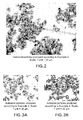
- Figure 1 shows iodixanol agglomerates produced.
- the yield of iodixanol was as follows: Time (hrs after seeding) Yield of iodixanol (%) 12 57 24 71 32 80 48 83 54 83
- Figure 2 shows iodixanol particles produced.
- the yield of iodixanol was as follows: Time (hrs after seeding) Yield of iodixanol (%) 10 51 14 65 18 78 23 81 35 82
- An aqueous solution of crude iodixanol product was concentrated in a vessel and 1-methoxy-2-propanol (PM) was added. The content of water was then adjusted to the desired level.
- the solution contained about 60 kg iodixanol, 4 kg Compound A, 4 kg iohexol and 2 kg backpeaks.
- the vessel was equipped with a stirrer, condenser, colloid mill (MK2000/4 from IKATM) in loop to the vessel and heating jacket.
- the crude product contained about 60% more backpeaks than in a comparable prior art process.
- the amount of water and PM in the solution was 19 kg and 58 kg respectively.
- the solution was heated to reflux at atmospheric pressure and seeded with 0.56 kg seed particles of iodixanol. Further addition of PM was done as given in the table below.
- the water content was reduced by 14 % by distillation during the crystallization. Start addition of PM (hrs after seeding) Amount of PM (kg) Addition time
- the yield of iodixanol was as follows: Time (hrs after seeding) Yield of Iodixanol (%) 11 61 14 68 37 88
- FIGS 3A and 3B The iodixanol particles produced using the mill during for the first 11 hours of a total crystallization time of 37 hours, are shown in Figures 3A and 3B.
- Figure 3A shows the particles 13 hours after seeding and the Figure 3B shows the particles 37 hours after seeding.
Landscapes
- Chemical & Material Sciences (AREA)
- Organic Chemistry (AREA)
- Organic Low-Molecular-Weight Compounds And Preparation Thereof (AREA)
- Saccharide Compounds (AREA)
- Heterocyclic Carbon Compounds Containing A Hetero Ring Having Nitrogen And Oxygen As The Only Ring Hetero Atoms (AREA)
Abstract
Description
- This invention relates to the manufacture of iodixanol (1,3-bis(acetamido)-N,N'-bis[3,5-bis(2,3-dihydroxypropylaminocarbonyl)-2,4,6-triiodophenyl]-2-hydroxypropane), more specifically to the purification of iodixanol by crystallization.
- Iodixanol is the non-proprietory name of the chemical drug substance of a non-ionic X-ray contrast agent marketed under the trade name Visipaque™. Visipaque™ is one of the most used agents in diagnostic X-ray procedures and is manufactured in large quantities.
- The manufacture of such non-ionic X-ray contrast agents involves the production of the chemical drug substance (referred to as primary production) followed by formulation into the drug product (referred to as secondary production). Primary production of iodixanol involves a multi step chemical synthesis and a thorough purification process. For a commercial drug product it is important for the primary production to be efficient and economical and to provide a drug substance fulfilling the specifications, e.g. as expressed in the US Pharmacopeia.
- A number of methods are known for the preparation of iodixanol. These are all multi step chemical synthetic processes and the cost of the final formulated product thus mainly depends on these processes. It is therefore important to optimize the proces.ses both for economic and environmental reasons.
- Three main chemical synthetic processes are known for the preparation of iodixanol, all of which start with 5-nitroisophthalic acid. In the first process described in
EP 108638 
EP patent 108638 - Several attempts have been made to find alternative manufacturing processes. Attempts to increase the yield of the chemical synthesis is published by Priebe et.al. (Acta Radiol. 36 (1995), Suppl. 399, 21-31). This publication describes another route which avoids the difficult last step of the process of Scheme I. However, the route involves eight reaction steps from 5-nitroisophthalic acid, which is undesirable, and one of the steps includes chlorination with thionyl chloride, which is extremely corrosive. Also, the introduction of the iodine atoms takes place very early in the sequence, which is disadvantageous as iodine is the most expensive reagent in the process. The yield and final purification method for this route have not been reported.
- The third route to iodixanol involves the synthesis of 5-amino-2,4,6-triiodoisophthalic acid (
WO 96/37458 WO 96/37459 US 5705692 ) and finally dimerisation as in the process of Scheme I. This method thus has the same disadvantages as the first process, and also uses an undesirable acid chlorination step. - A common system for purification of the crude product in the final step of the primary production process, avoiding the liquid chromatography method, has been purification by crystallization. To achieve the desired purity, the crude iodixanol produced by the synthetic chemical process is crystallized twice. The process is time consuming and takes about 3 days for the first crystallization and about 2 days for the second one. Hence, the crystallization process is very demanding in terms of time and equipment size, it will take several days to perform and is often a bottleneck in industrial scale processes.
-
WO 99/18054 -
WO 00/47549 - It is hence a desire to shorten the crystallization time and also improve the crystallization step in order to increase the purity of the final product.
-
-
FIG. 1 shows agglomerates of iodixanol produced in a crystallization step according to prior art. Scale: 1 unit = 120 µm. -
FIG. 2 shows iodixanol particles produced in a crystallization step according to the present invention. Scale: 1 unit = 30 µm. -
FIG. 3A and 3B show iodixanol particles produced in a crystallization step according to the present invention. Scale: 1 unit = 30 µm. - The present invention provides improvements to the crystallization of iodixanol.
- Thus viewed from one aspect the invention provides a process for the purification of a crude product comprising iodixanol by crystallization, wherein the crystallization involves wet milling.
- The process according to the present invention reduces the process time for the crystallization steps and improves the washing and hence the purity of the final product.
- The processing time for the first crystallization is substantially longer than for the second one because of the higher concentration of impurities at this stage of the process. Due to the slow kinetics, both crystallizations are run at high initial supersaturation and during the crystallization process it is formed large agglomerates, often of more than 100 µm in diameter. These agglomerates are shown in
Figure 1 . Agglomeration significantly reduces the available total surface area for crystal growth and therefore prolongs the process time to achieve the desired yield. - It has now surprisingly been found that it is possible to perform deagglomeration during the crystallization process by using wet milling.
- Thus viewed from one aspect, the invention provides a process for the purification of a crude product comprising iodixanol by crystallization, wherein the crystallization solution is deagglomerated by wet milling.
- The use of wet milling will significantly reduce the agglomeration of iodixanol crystals and by this reduce the process time for the crystallization steps. In cases where two crystallization steps are performed, the use of wet milling will be able to reduce the process time from about three days to less than two days for the first crystallization and from about two days to less than 1 day for the second crystallization.
- Further, the use of wet milling in the crystallization step will also improve the purity of the final product. The purification process is finalized by filtering the precipitated iodixanol, preferably as unagglomerated crystals, from the solvents and finally washing the crystals with an alcohol such as methanol. The agglomerates of iodixanol crystals will also entrap mother liquor that needs to be removed by washing. By significantly reducing the agglomeration and hence the inclusion of mother liquor, a more effective washing of the crystals is achieved and also improved purity of the final product.
-
Figure 1 shows agglomerates produced during a crystallization process according to prior art. It can be seen that the agglomerates have a mean size in the area of about 120 µm. -
Figure 2 on the other hand shows particles produced under a process according to the present invention, and it can be seen that the particles are single crystals or very small agglomerates. The size of these particles is less then about 30 µm. - According to the present invention wet milling can be performed using any kind of mill, e.g. disc mills, colloid mills and other shear mixers.
- Depending on the type of mill used, the mill can be mounted either into the crystallizer or in-line to the crystallizer. When mounted in-line to the crystallizer the crystallization solution is circulated between the crystallizer and the mill.
- The mill can be used continuously throughout the crystallization, but normally a certain period at the start of the crystallization is sufficient to achieve the desired results.
- The crude product referred to in the present invention can be obtained from the processes known from the state of the art, e.g. from the dimerisation process illustrated in Scheme I above. The dimerisation step itself may be carried out as described in European patent
108638 WO 98/23296 - Hence, in a second aspect of the invention it is provided a process for the manufacture of iodixanol comprising the steps of:
- a) reacting 5-acetamido-N,N'-bis(2,3-dihydroxypropyl)-2,4,6-triiodo-isophthalamide with a dimerisation agent in the presence of a solvent
- b) purifying the reaction product from step a) in a crystallization procedure
- c) deagglomerating the crystallization solution in the crystallization procedure by wet milling
- d) filtering and washing the product from step c)
- The crude product from the dimerisation and following work-up steps is preferably in aqueous solution with small traces of organic solvent. The crude product normally contains about 75-90 weight% iodixanol, 3-10 weight% iohexol, 0-7 weight% Compound A, and also minor amounts of other impurities. The most important impurities in the reaction with regard to work-up consequences are the so-called backpeaks. This term refers to retention times in reversed phase HPLC, where the backpeaks have slightly longer retention times than iodixanol itself. Most of the backpeaks are either trimers or O-alkylated dimers. This crude product is preferably the starting material for the further purification by crystallization according to the present invention.
- The invention is illustrated further by the following examples that are not to be construed as limiting the invention in scope to the specific procedures or products described in them.
- Example 1 shows a conventional crystallization process according to prior art without the use of wet milling.
Figure 1 shows agglomerates of iodixanol produced (1 unit = 120 µm). The process reaches a yield of 80% after 54 hours. From the comparative example 2 showing the same process with the use of wet milling, it can be seen that a yield of 80% is reached as early as after 32 hours. In addition it can be seen that the purity of the final product is increased.Figure 2 shows iodixanol particles produced (1 unit = 30 µm). - In example 3 an optimized process with wet milling is described. Because of the shorter crystallization times involved, solvent can be added at an earlier stage than in a process according to prior art. In this process it can be seen that a yield of more than 80% is reached after only 23 hours.
- Example 4 describes the process according to the present invention in a larger scale and with the use of a colloid mill. The crude product contained about 60% more backpeaks than in a comparable prior art process. However, by reducing the agglomeration by milling, the backpeak content after the first crystallization was similar to the backpeak content after the first crystallization in the prior art process. As for the prior art process, the product specification was met first after a further recrystallization not described in the example.
- 305 g of crude product containing 253 g iodixanol, 17.8 g Compound A, 22.5 g iohexol and 5.1 g backpeaks was dissolved in a mixture of water and 1-methoxy-2-propanol (PM) in a 1 liter vessel equipped with the a stirrer (with a magnet driven shaft), condenser and heating jacket. The amount of water and PM in the solution was 105 g and 442 g respectively. The solution was heated to reflux at atmospheric pressure and seeded with 2.4 g seed particles of iodixanol. Further addition of PM was done as follows:
Start addition
of PM (hrs
after seeding)Amount of PM (g) Addition time (hrs) 12 111 13 25 276 8 - The yield of iodixanol was as follows:
Time (hrs after seeding) Yield of iodixanol
(%)12 2 24 18 32 50 48 79 54 80 - The product at the end of the crystallization was filtered and washed with methanol. The purity of the product is given below (HPLC):
Substance (%) Iodixanol 98.56 Compound A 0.10 Iohexol 0.21 Backpeaks 1.07 -
Figure 1 shows iodixanol agglomerates produced. - 305 g of crude product containing 253 g iodixanol, 17.8 g Compound A, 22.5 g iohexol and 5.1 g backpeaks was dissolved in a mixture of water and 1-methoxy-2-propanol (PM) in a 1 liter vessel equipped with the a stirrer (with a magnet driven shaft), disc mill, condenser and heating jacket. The amount of water and PM in the solution was 105 g and 442 g respectively. The solution was heated to reflux at atmospheric pressure and seeded with 2.4 g seed particles of iodixanol. Further addition of PM was done as follows:
Start addition
of PM (hrs
after seeding)Amount of PM (g) Addition time (hrs) 12 111 13 25 276 8 - The yield of iodixanol was as follows:
Time (hrs after seeding) Yield of iodixanol
(%)12 57 24 71 32 80 48 83 54 83 - The product at the end of the crystallization was filtered and washed with methanol. The purity of the product is given below (HPLC):
Substance (%) Iodixanol 99.00 Compound A 0.05 Iohexol 0.05 Backpeaks 0.86 -
Figure 2 shows iodixanol particles produced. - 305 g of crude product containing 253 g iodixanol, 17.8 g Compound A, 22.5 g iohexol and 5.1 g backpeaks was dissolved in a mixture of water and 1-methoxy-2-propanol (PM) in a 1 liter vessel equipped with the a stirrer (with a magnet driven shaft), disc mill, condenser and heating jacket. The amount of water and PM in the solution was 105 g and 442 g respectively. The solution was heated to reflux at atmospheric pressure and seeded with 2.4 g seed particles of iodixanol. Further addition of PM was done as follows:
Start addition
of PM (hrs
after seeding)Amount of PM (g) Addition time (hrs) 10 111 4 14 276 4 - The yield of iodixanol was as follows:
Time (hrs after seeding) Yield of iodixanol (%) 10 51 14 65 18 78 23 81 35 82 - The product at the end of the crystallization was filtered and washed with methanol. The purity of the product is given below (HPLC):
Substance (%) Iodixanol 99.0 Compound A 0.05 Iohexol 0.05 Backpeaks 0.86 - An aqueous solution of crude iodixanol product was concentrated in a vessel and 1-methoxy-2-propanol (PM) was added. The content of water was then adjusted to the desired level. The solution contained about 60 kg iodixanol, 4 kg Compound A, 4 kg iohexol and 2 kg backpeaks. The vessel was equipped with a stirrer, condenser, colloid mill (MK2000/4 from IKA™) in loop to the vessel and heating jacket. The crude product contained about 60% more backpeaks than in a comparable prior art process. The amount of water and PM in the solution was 19 kg and 58 kg respectively. The solution was heated to reflux at atmospheric pressure and seeded with 0.56 kg seed particles of iodixanol. Further addition of PM was done as given in the table below. The water content was reduced by 14 % by distillation during the crystallization.
Start addition
of PM (hrs
after seeding)Amount of PM
(kg)Addition time (hrs) 10 19 6 16 38 6 - The yield of iodixanol was as follows:
Time (hrs after seeding) Yield of Iodixanol (%) 11 61 14 68 37 88 - The product at the end of the crystallization was filtered and washed with methanol. The purity of the product is given below (HPLC):
Substance (%) Iodixanol 98,7 Compound A 0.07 lohexol 0.04 Backpeaks 1.09 - The iodixanol particles produced using the mill during for the first 11 hours of a total crystallization time of 37 hours, are shown in
Figures 3A and 3B. Figure 3A shows the particles 13 hours after seeding and theFigure 3B shows the particles 37 hours after seeding. - All patents, journal articles, publications and other documents discussed and/or cited above are hereby incorporated by reference.
Claims (1)
- Process for the purification of a crude product comprising 1,3-bis(acetamido)-N,N'-bis[3,5-bis(2,3-dihydroxypropylaminocarbonyl)-2,4,6-triiodophenyl]-2-hydroxypropane by crystallization, wherein agglomerates in the crystallization solution are deagglomerated by wet milling during the crystallization process.
Priority Applications (1)
| Application Number | Priority Date | Filing Date | Title |
|---|---|---|---|
| PL09177713T PL2277855T3 (en) | 2009-07-21 | 2009-12-02 | Crystallization of iodixanol using milling |
Applications Claiming Priority (1)
| Application Number | Priority Date | Filing Date | Title |
|---|---|---|---|
| US22710609P | 2009-07-21 | 2009-07-21 |
Publications (2)
| Publication Number | Publication Date |
|---|---|
| EP2277855A1 true EP2277855A1 (en) | 2011-01-26 |
| EP2277855B1 EP2277855B1 (en) | 2011-11-09 |
Family
ID=41818411
Family Applications (1)
| Application Number | Title | Priority Date | Filing Date |
|---|---|---|---|
| EP09177713A Active EP2277855B1 (en) | 2009-07-21 | 2009-12-02 | Crystallization of iodixanol using milling |
Country Status (7)
| Country | Link |
|---|---|
| US (1) | US7999134B2 (en) |
| EP (1) | EP2277855B1 (en) |
| KR (1) | KR101076174B1 (en) |
| CN (1) | CN101962336A (en) |
| AT (1) | ATE532766T1 (en) |
| ES (1) | ES2374044T3 (en) |
| PL (1) | PL2277855T3 (en) |
Cited By (1)
| Publication number | Priority date | Publication date | Assignee | Title |
|---|---|---|---|---|
| US9745250B2 (en) | 2014-05-13 | 2017-08-29 | Akzo Nobel Chemicals International B.V. | Process to crystallize chelating agents |
Families Citing this family (1)
| Publication number | Priority date | Publication date | Assignee | Title |
|---|---|---|---|---|
| CN111777525B (en) * | 2019-04-04 | 2021-08-27 | 成都西岭源药业有限公司 | Refining method of iodixanol |
Citations (12)
| Publication number | Priority date | Publication date | Assignee | Title |
|---|---|---|---|---|
| EP0108638A1 (en) | 1982-11-08 | 1984-05-16 | NYEGAARD & CO. A/S | X-ray contrast agents |
| WO1993000930A1 (en) * | 1991-07-05 | 1993-01-21 | Holmes, Michael, John | Improvements in or relating to contrast agents |
| WO1996037458A1 (en) | 1995-05-23 | 1996-11-28 | Fructamine S.P.A. | Process for the preparation of a halosubstituted aromatic acid |
| WO1996037459A1 (en) | 1995-05-23 | 1996-11-28 | Fructamine S.P.A. | Process for the preparation of a dicarboxylic acid dichloride |
| US5705692A (en) | 1996-09-27 | 1998-01-06 | Abbott Laboratories | Process for the preparation of iohexol |
| WO1998023296A1 (en) | 1996-11-26 | 1998-06-04 | Nycomed Imaging As | Process for the production of iodinated organic x-ray contrast agents |
| WO1999018054A1 (en) | 1997-10-02 | 1999-04-15 | Nycomed Imaging As | Process for the crystallisation of sterically hindered compounds |
| WO2000047549A1 (en) | 1999-02-11 | 2000-08-17 | Nycomed Imaging As | Preparation of iodixanol |
| WO2006016815A1 (en) * | 2004-08-09 | 2006-02-16 | Ge Healthcare As | Preparation of iodixanol |
| WO2007013815A1 (en) * | 2005-07-29 | 2007-02-01 | Ge Healthcare As | Continuous crystallisation process of iodinated phenyl derivatives |
| WO2007013816A1 (en) * | 2005-07-29 | 2007-02-01 | Ge Healthcare As | Continuous crystallisation process of iodinated phenyl derivatives |
| WO2007064220A1 (en) * | 2005-11-29 | 2007-06-07 | Ge Healthcare As | Purification of iodixanol |
Family Cites Families (1)
| Publication number | Priority date | Publication date | Assignee | Title |
|---|---|---|---|---|
| US5525328A (en) * | 1994-06-24 | 1996-06-11 | Nanosystems L.L.C. | Nanoparticulate diagnostic diatrizoxy ester X-ray contrast agents for blood pool and lymphatic system imaging |
-
2009
- 2009-11-04 US US12/611,956 patent/US7999134B2/en active Active
- 2009-12-02 AT AT09177713T patent/ATE532766T1/en active
- 2009-12-02 EP EP09177713A patent/EP2277855B1/en active Active
- 2009-12-02 PL PL09177713T patent/PL2277855T3/en unknown
- 2009-12-02 ES ES09177713T patent/ES2374044T3/en active Active
-
2010
- 2010-07-20 KR KR1020100069814A patent/KR101076174B1/en active Active
- 2010-07-21 CN CN2010102411700A patent/CN101962336A/en active Pending
Patent Citations (12)
| Publication number | Priority date | Publication date | Assignee | Title |
|---|---|---|---|---|
| EP0108638A1 (en) | 1982-11-08 | 1984-05-16 | NYEGAARD & CO. A/S | X-ray contrast agents |
| WO1993000930A1 (en) * | 1991-07-05 | 1993-01-21 | Holmes, Michael, John | Improvements in or relating to contrast agents |
| WO1996037458A1 (en) | 1995-05-23 | 1996-11-28 | Fructamine S.P.A. | Process for the preparation of a halosubstituted aromatic acid |
| WO1996037459A1 (en) | 1995-05-23 | 1996-11-28 | Fructamine S.P.A. | Process for the preparation of a dicarboxylic acid dichloride |
| US5705692A (en) | 1996-09-27 | 1998-01-06 | Abbott Laboratories | Process for the preparation of iohexol |
| WO1998023296A1 (en) | 1996-11-26 | 1998-06-04 | Nycomed Imaging As | Process for the production of iodinated organic x-ray contrast agents |
| WO1999018054A1 (en) | 1997-10-02 | 1999-04-15 | Nycomed Imaging As | Process for the crystallisation of sterically hindered compounds |
| WO2000047549A1 (en) | 1999-02-11 | 2000-08-17 | Nycomed Imaging As | Preparation of iodixanol |
| WO2006016815A1 (en) * | 2004-08-09 | 2006-02-16 | Ge Healthcare As | Preparation of iodixanol |
| WO2007013815A1 (en) * | 2005-07-29 | 2007-02-01 | Ge Healthcare As | Continuous crystallisation process of iodinated phenyl derivatives |
| WO2007013816A1 (en) * | 2005-07-29 | 2007-02-01 | Ge Healthcare As | Continuous crystallisation process of iodinated phenyl derivatives |
| WO2007064220A1 (en) * | 2005-11-29 | 2007-06-07 | Ge Healthcare As | Purification of iodixanol |
Non-Patent Citations (1)
| Title |
|---|
| PRIEBE, ACTA RADIOL., vol. 36, no. 399, 1995, pages 21 - 31 |
Cited By (1)
| Publication number | Priority date | Publication date | Assignee | Title |
|---|---|---|---|---|
| US9745250B2 (en) | 2014-05-13 | 2017-08-29 | Akzo Nobel Chemicals International B.V. | Process to crystallize chelating agents |
Also Published As
| Publication number | Publication date |
|---|---|
| KR20110009038A (en) | 2011-01-27 |
| ATE532766T1 (en) | 2011-11-15 |
| US7999134B2 (en) | 2011-08-16 |
| CN101962336A (en) | 2011-02-02 |
| ES2374044T3 (en) | 2012-02-13 |
| KR101076174B1 (en) | 2011-10-21 |
| EP2277855B1 (en) | 2011-11-09 |
| PL2277855T3 (en) | 2012-02-29 |
| US20110021826A1 (en) | 2011-01-27 |
Similar Documents
| Publication | Publication Date | Title |
|---|---|---|
| CA2575088C (en) | Preparation of iodixanol | |
| EP1960349B1 (en) | Purification of iodixanol | |
| EP2281791A1 (en) | Solvent reduction in crystallisation of 5-acetamido-N,N'-bis(2,3-dihydroxypropyl)-2,4,6-triiodoisophthalamide, an intermediate for non-ionic X-ray contrast agents | |
| EP1641743B1 (en) | Process for iohexol manufacture | |
| EP2277855B1 (en) | Crystallization of iodixanol using milling | |
| EP1966110B1 (en) | Purification process of iodixanol | |
| EP2277856B1 (en) | Crystallization of iodixanol using ultrasound | |
| CA2710577C (en) | Crystallization of iodixanol using milling | |
| CA2710642C (en) | Crystallization of iodixanol using ultrasound | |
| CA2707173C (en) | Crystallization of iodixanol in isopropanol and methanol | |
| EP2277852B1 (en) | Synthesis of iodixanol in water | |
| EP2281803A1 (en) | Improvements in crystallization of 5-amino-N,N'-bis(2,3-dihydroxypropyl)-2,4,6,-triiodo-isophthalamide, an intermediate for synthesizing non-ionic X-ray contrast agents |
Legal Events
| Date | Code | Title | Description |
|---|---|---|---|
| PUAI | Public reference made under article 153(3) epc to a published international application that has entered the european phase |
Free format text: ORIGINAL CODE: 0009012 |
|
| 17P | Request for examination filed |
Effective date: 20091202 |
|
| AK | Designated contracting states |
Kind code of ref document: A1 Designated state(s): AT BE BG CH CY CZ DE DK EE ES FI FR GB GR HR HU IE IS IT LI LT LU LV MC MK MT NL NO PL PT RO SE SI SK SM TR |
|
| AX | Request for extension of the european patent |
Extension state: AL BA RS |
|
| GRAP | Despatch of communication of intention to grant a patent |
Free format text: ORIGINAL CODE: EPIDOSNIGR1 |
|
| RIC1 | Information provided on ipc code assigned before grant |
Ipc: C07C 231/24 20060101AFI20110601BHEP Ipc: C07C 237/46 20060101ALI20110601BHEP |
|
| GRAS | Grant fee paid |
Free format text: ORIGINAL CODE: EPIDOSNIGR3 |
|
| GRAA | (expected) grant |
Free format text: ORIGINAL CODE: 0009210 |
|
| AK | Designated contracting states |
Kind code of ref document: B1 Designated state(s): AT BE BG CH CY CZ DE DK EE ES FI FR GB GR HR HU IE IS IT LI LT LU LV MC MK MT NL NO PL PT RO SE SI SK SM TR |
|
| REG | Reference to a national code |
Ref country code: GB Ref legal event code: FG4D |
|
| REG | Reference to a national code |
Ref country code: CH Ref legal event code: EP |
|
| REG | Reference to a national code |
Ref country code: CH Ref legal event code: NV Representative=s name: ISLER & PEDRAZZINI AG |
|
| REG | Reference to a national code |
Ref country code: IE Ref legal event code: FG4D |
|
| REG | Reference to a national code |
Ref country code: DE Ref legal event code: R096 Ref document number: 602009003583 Country of ref document: DE Effective date: 20120119 |
|
| REG | Reference to a national code |
Ref country code: ES Ref legal event code: FG2A Ref document number: 2374044 Country of ref document: ES Kind code of ref document: T3 Effective date: 20120213 |
|
| REG | Reference to a national code |
Ref country code: NL Ref legal event code: T3 |
|
| REG | Reference to a national code |
Ref country code: PL Ref legal event code: T3 |
|
| REG | Reference to a national code |
Ref country code: NO Ref legal event code: T2 Effective date: 20111109 |
|
| LTIE | Lt: invalidation of european patent or patent extension |
Effective date: 20111109 |
|
| PG25 | Lapsed in a contracting state [announced via postgrant information from national office to epo] |
Ref country code: LT Free format text: LAPSE BECAUSE OF FAILURE TO SUBMIT A TRANSLATION OF THE DESCRIPTION OR TO PAY THE FEE WITHIN THE PRESCRIBED TIME-LIMIT Effective date: 20111109 Ref country code: IS Free format text: LAPSE BECAUSE OF FAILURE TO SUBMIT A TRANSLATION OF THE DESCRIPTION OR TO PAY THE FEE WITHIN THE PRESCRIBED TIME-LIMIT Effective date: 20120309 |
|
| PG25 | Lapsed in a contracting state [announced via postgrant information from national office to epo] |
Ref country code: SI Free format text: LAPSE BECAUSE OF FAILURE TO SUBMIT A TRANSLATION OF THE DESCRIPTION OR TO PAY THE FEE WITHIN THE PRESCRIBED TIME-LIMIT Effective date: 20111109 Ref country code: SE Free format text: LAPSE BECAUSE OF FAILURE TO SUBMIT A TRANSLATION OF THE DESCRIPTION OR TO PAY THE FEE WITHIN THE PRESCRIBED TIME-LIMIT Effective date: 20111109 Ref country code: LV Free format text: LAPSE BECAUSE OF FAILURE TO SUBMIT A TRANSLATION OF THE DESCRIPTION OR TO PAY THE FEE WITHIN THE PRESCRIBED TIME-LIMIT Effective date: 20111109 Ref country code: BE Free format text: LAPSE BECAUSE OF FAILURE TO SUBMIT A TRANSLATION OF THE DESCRIPTION OR TO PAY THE FEE WITHIN THE PRESCRIBED TIME-LIMIT Effective date: 20111109 Ref country code: GR Free format text: LAPSE BECAUSE OF FAILURE TO SUBMIT A TRANSLATION OF THE DESCRIPTION OR TO PAY THE FEE WITHIN THE PRESCRIBED TIME-LIMIT Effective date: 20120210 Ref country code: HR Free format text: LAPSE BECAUSE OF FAILURE TO SUBMIT A TRANSLATION OF THE DESCRIPTION OR TO PAY THE FEE WITHIN THE PRESCRIBED TIME-LIMIT Effective date: 20111109 Ref country code: PT Free format text: LAPSE BECAUSE OF FAILURE TO SUBMIT A TRANSLATION OF THE DESCRIPTION OR TO PAY THE FEE WITHIN THE PRESCRIBED TIME-LIMIT Effective date: 20120309 |
|
| PG25 | Lapsed in a contracting state [announced via postgrant information from national office to epo] |
Ref country code: CY Free format text: LAPSE BECAUSE OF FAILURE TO SUBMIT A TRANSLATION OF THE DESCRIPTION OR TO PAY THE FEE WITHIN THE PRESCRIBED TIME-LIMIT Effective date: 20111109 |
|
| REG | Reference to a national code |
Ref country code: HU Ref legal event code: AG4A Ref document number: E013331 Country of ref document: HU |
|
| PG25 | Lapsed in a contracting state [announced via postgrant information from national office to epo] |
Ref country code: EE Free format text: LAPSE BECAUSE OF FAILURE TO SUBMIT A TRANSLATION OF THE DESCRIPTION OR TO PAY THE FEE WITHIN THE PRESCRIBED TIME-LIMIT Effective date: 20111109 Ref country code: DK Free format text: LAPSE BECAUSE OF FAILURE TO SUBMIT A TRANSLATION OF THE DESCRIPTION OR TO PAY THE FEE WITHIN THE PRESCRIBED TIME-LIMIT Effective date: 20111109 Ref country code: BG Free format text: LAPSE BECAUSE OF FAILURE TO SUBMIT A TRANSLATION OF THE DESCRIPTION OR TO PAY THE FEE WITHIN THE PRESCRIBED TIME-LIMIT Effective date: 20120209 Ref country code: SK Free format text: LAPSE BECAUSE OF FAILURE TO SUBMIT A TRANSLATION OF THE DESCRIPTION OR TO PAY THE FEE WITHIN THE PRESCRIBED TIME-LIMIT Effective date: 20111109 Ref country code: MC Free format text: LAPSE BECAUSE OF NON-PAYMENT OF DUE FEES Effective date: 20111231 |
|
| PG25 | Lapsed in a contracting state [announced via postgrant information from national office to epo] |
Ref country code: RO Free format text: LAPSE BECAUSE OF FAILURE TO SUBMIT A TRANSLATION OF THE DESCRIPTION OR TO PAY THE FEE WITHIN THE PRESCRIBED TIME-LIMIT Effective date: 20111109 |
|
| PLBE | No opposition filed within time limit |
Free format text: ORIGINAL CODE: 0009261 |
|
| STAA | Information on the status of an ep patent application or granted ep patent |
Free format text: STATUS: NO OPPOSITION FILED WITHIN TIME LIMIT |
|
| REG | Reference to a national code |
Ref country code: AT Ref legal event code: MK05 Ref document number: 532766 Country of ref document: AT Kind code of ref document: T Effective date: 20111109 |
|
| 26N | No opposition filed |
Effective date: 20120810 |
|
| REG | Reference to a national code |
Ref country code: DE Ref legal event code: R097 Ref document number: 602009003583 Country of ref document: DE Effective date: 20120810 |
|
| PG25 | Lapsed in a contracting state [announced via postgrant information from national office to epo] |
Ref country code: AT Free format text: LAPSE BECAUSE OF FAILURE TO SUBMIT A TRANSLATION OF THE DESCRIPTION OR TO PAY THE FEE WITHIN THE PRESCRIBED TIME-LIMIT Effective date: 20111109 |
|
| PG25 | Lapsed in a contracting state [announced via postgrant information from national office to epo] |
Ref country code: MK Free format text: LAPSE BECAUSE OF FAILURE TO SUBMIT A TRANSLATION OF THE DESCRIPTION OR TO PAY THE FEE WITHIN THE PRESCRIBED TIME-LIMIT Effective date: 20111109 Ref country code: MT Free format text: LAPSE BECAUSE OF FAILURE TO SUBMIT A TRANSLATION OF THE DESCRIPTION OR TO PAY THE FEE WITHIN THE PRESCRIBED TIME-LIMIT Effective date: 20111109 |
|
| PG25 | Lapsed in a contracting state [announced via postgrant information from national office to epo] |
Ref country code: SM Free format text: LAPSE BECAUSE OF FAILURE TO SUBMIT A TRANSLATION OF THE DESCRIPTION OR TO PAY THE FEE WITHIN THE PRESCRIBED TIME-LIMIT Effective date: 20111109 |
|
| PG25 | Lapsed in a contracting state [announced via postgrant information from national office to epo] |
Ref country code: LU Free format text: LAPSE BECAUSE OF NON-PAYMENT OF DUE FEES Effective date: 20111202 |
|
| PG25 | Lapsed in a contracting state [announced via postgrant information from national office to epo] |
Ref country code: FI Free format text: LAPSE BECAUSE OF FAILURE TO SUBMIT A TRANSLATION OF THE DESCRIPTION OR TO PAY THE FEE WITHIN THE PRESCRIBED TIME-LIMIT Effective date: 20111109 |
|
| PG25 | Lapsed in a contracting state [announced via postgrant information from national office to epo] |
Ref country code: TR Free format text: LAPSE BECAUSE OF FAILURE TO SUBMIT A TRANSLATION OF THE DESCRIPTION OR TO PAY THE FEE WITHIN THE PRESCRIBED TIME-LIMIT Effective date: 20111109 |
|
| REG | Reference to a national code |
Ref country code: FR Ref legal event code: PLFP Year of fee payment: 7 |
|
| REG | Reference to a national code |
Ref country code: FR Ref legal event code: PLFP Year of fee payment: 8 |
|
| PG25 | Lapsed in a contracting state [announced via postgrant information from national office to epo] |
Ref country code: IT Free format text: LAPSE BECAUSE OF NON-PAYMENT OF DUE FEES Effective date: 20151202 |
|
| REG | Reference to a national code |
Ref country code: DE Ref legal event code: R082 Ref document number: 602009003583 Country of ref document: DE |
|
| PG25 | Lapsed in a contracting state [announced via postgrant information from national office to epo] |
Ref country code: IT Free format text: LAPSE BECAUSE OF NON-PAYMENT OF DUE FEES Effective date: 20151202 |
|
| PGRI | Patent reinstated in contracting state [announced from national office to epo] |
Ref country code: IT Effective date: 20170710 |
|
| REG | Reference to a national code |
Ref country code: FR Ref legal event code: PLFP Year of fee payment: 9 |
|
| P01 | Opt-out of the competence of the unified patent court (upc) registered |
Effective date: 20230529 |
|
| PGFP | Annual fee paid to national office [announced via postgrant information from national office to epo] |
Ref country code: NL Payment date: 20251119 Year of fee payment: 17 |
|
| REG | Reference to a national code |
Ref country code: CH Ref legal event code: U11 Free format text: ST27 STATUS EVENT CODE: U-0-0-U10-U11 (AS PROVIDED BY THE NATIONAL OFFICE) Effective date: 20260101 |
|
| PGFP | Annual fee paid to national office [announced via postgrant information from national office to epo] |
Ref country code: DE Payment date: 20251126 Year of fee payment: 17 |
|
| PGFP | Annual fee paid to national office [announced via postgrant information from national office to epo] |
Ref country code: GB Payment date: 20251119 Year of fee payment: 17 |
|
| PGFP | Annual fee paid to national office [announced via postgrant information from national office to epo] |
Ref country code: NO Payment date: 20251121 Year of fee payment: 17 |
|
| PGFP | Annual fee paid to national office [announced via postgrant information from national office to epo] |
Ref country code: IT Payment date: 20251119 Year of fee payment: 17 |
|
| PGFP | Annual fee paid to national office [announced via postgrant information from national office to epo] |
Ref country code: FR Payment date: 20251120 Year of fee payment: 17 Ref country code: HU Payment date: 20251212 Year of fee payment: 17 |
|
| PGFP | Annual fee paid to national office [announced via postgrant information from national office to epo] |
Ref country code: CZ Payment date: 20251204 Year of fee payment: 17 Ref country code: IE Payment date: 20251121 Year of fee payment: 17 |
|
| PGFP | Annual fee paid to national office [announced via postgrant information from national office to epo] |
Ref country code: PL Payment date: 20251128 Year of fee payment: 17 |
|
| PGFP | Annual fee paid to national office [announced via postgrant information from national office to epo] |
Ref country code: ES Payment date: 20260102 Year of fee payment: 17 |
|
| PGFP | Annual fee paid to national office [announced via postgrant information from national office to epo] |
Ref country code: CH Payment date: 20260101 Year of fee payment: 17 |