EP2277231B1 - Procédé et dispositif de production et de stockage d'énergie électrique - Google Patents
Procédé et dispositif de production et de stockage d'énergie électrique Download PDFInfo
- Publication number
- EP2277231B1 EP2277231B1 EP09734594A EP09734594A EP2277231B1 EP 2277231 B1 EP2277231 B1 EP 2277231B1 EP 09734594 A EP09734594 A EP 09734594A EP 09734594 A EP09734594 A EP 09734594A EP 2277231 B1 EP2277231 B1 EP 2277231B1
- Authority
- EP
- European Patent Office
- Prior art keywords
- complex
- iron
- solvent
- light
- absence
- Prior art date
- Legal status (The legal status is an assumption and is not a legal conclusion. Google has not performed a legal analysis and makes no representation as to the accuracy of the status listed.)
- Not-in-force
Links
- 238000000034 method Methods 0.000 title claims abstract description 16
- XEEYBQQBJWHFJM-UHFFFAOYSA-N Iron Chemical compound [Fe] XEEYBQQBJWHFJM-UHFFFAOYSA-N 0.000 claims abstract description 112
- 229910052742 iron Inorganic materials 0.000 claims abstract description 28
- 239000003446 ligand Substances 0.000 claims abstract description 14
- WARCRYXKINZHGQ-UHFFFAOYSA-N benzohydrazide Chemical compound NNC(=O)C1=CC=CC=C1 WARCRYXKINZHGQ-UHFFFAOYSA-N 0.000 claims abstract description 6
- ZMXDDKWLCZADIW-UHFFFAOYSA-N N,N-Dimethylformamide Chemical compound CN(C)C=O ZMXDDKWLCZADIW-UHFFFAOYSA-N 0.000 claims description 39
- 150000004698 iron complex Chemical class 0.000 claims description 27
- 239000002904 solvent Substances 0.000 claims description 21
- CWYNVVGOOAEACU-UHFFFAOYSA-N Fe2+ Chemical compound [Fe+2] CWYNVVGOOAEACU-UHFFFAOYSA-N 0.000 claims description 11
- 239000013110 organic ligand Substances 0.000 claims description 11
- WYURNTSHIVDZCO-UHFFFAOYSA-N Tetrahydrofuran Chemical compound C1CCOC1 WYURNTSHIVDZCO-UHFFFAOYSA-N 0.000 claims description 10
- 230000003647 oxidation Effects 0.000 claims description 10
- 238000007254 oxidation reaction Methods 0.000 claims description 10
- 230000009467 reduction Effects 0.000 claims description 10
- VTLYFUHAOXGGBS-UHFFFAOYSA-N Fe3+ Chemical compound [Fe+3] VTLYFUHAOXGGBS-UHFFFAOYSA-N 0.000 claims description 8
- WPYMKLBDIGXBTP-UHFFFAOYSA-N benzoic acid Chemical compound OC(=O)C1=CC=CC=C1 WPYMKLBDIGXBTP-UHFFFAOYSA-N 0.000 claims description 8
- 239000007800 oxidant agent Substances 0.000 claims description 8
- 230000001590 oxidative effect Effects 0.000 claims description 8
- LFQSCWFLJHTTHZ-UHFFFAOYSA-N Ethanol Chemical compound CCO LFQSCWFLJHTTHZ-UHFFFAOYSA-N 0.000 claims description 7
- QVGXLLKOCUKJST-UHFFFAOYSA-N atomic oxygen Chemical compound [O] QVGXLLKOCUKJST-UHFFFAOYSA-N 0.000 claims description 6
- 229910052760 oxygen Inorganic materials 0.000 claims description 6
- 239000001301 oxygen Substances 0.000 claims description 6
- 239000000126 substance Substances 0.000 claims description 6
- 238000006243 chemical reaction Methods 0.000 claims description 5
- 229910052751 metal Inorganic materials 0.000 claims description 5
- YLQBMQCUIZJEEH-UHFFFAOYSA-N tetrahydrofuran Natural products C=1C=COC=1 YLQBMQCUIZJEEH-UHFFFAOYSA-N 0.000 claims description 5
- XLYOFNOQVPJJNP-UHFFFAOYSA-N water Substances O XLYOFNOQVPJJNP-UHFFFAOYSA-N 0.000 claims description 5
- 239000005711 Benzoic acid Substances 0.000 claims description 4
- 235000010233 benzoic acid Nutrition 0.000 claims description 4
- 239000002184 metal Substances 0.000 claims description 3
- 230000009471 action Effects 0.000 claims description 2
- LBSANEJBGMCTBH-UHFFFAOYSA-N manganate Chemical compound [O-][Mn]([O-])(=O)=O LBSANEJBGMCTBH-UHFFFAOYSA-N 0.000 claims description 2
- 229910002547 FeII Inorganic materials 0.000 claims 6
- 229910002553 FeIII Inorganic materials 0.000 claims 6
- 229910021578 Iron(III) chloride Inorganic materials 0.000 claims 1
- 239000002253 acid Substances 0.000 claims 1
- RBTARNINKXHZNM-UHFFFAOYSA-K iron trichloride Chemical compound Cl[Fe](Cl)Cl RBTARNINKXHZNM-UHFFFAOYSA-K 0.000 claims 1
- 150000002505 iron Chemical class 0.000 abstract 1
- 238000006722 reduction reaction Methods 0.000 description 10
- RTZKZFJDLAIYFH-UHFFFAOYSA-N Diethyl ether Chemical compound CCOCC RTZKZFJDLAIYFH-UHFFFAOYSA-N 0.000 description 9
- 230000009466 transformation Effects 0.000 description 7
- 125000004435 hydrogen atom Chemical group [H]* 0.000 description 5
- 229910052757 nitrogen Inorganic materials 0.000 description 5
- 239000007787 solid Substances 0.000 description 5
- 230000008859 change Effects 0.000 description 4
- 239000013078 crystal Substances 0.000 description 4
- 238000011161 development Methods 0.000 description 4
- 125000004433 nitrogen atom Chemical group N* 0.000 description 4
- 241000894007 species Species 0.000 description 4
- 230000015572 biosynthetic process Effects 0.000 description 3
- 239000010949 copper Substances 0.000 description 3
- 238000009792 diffusion process Methods 0.000 description 3
- 230000008569 process Effects 0.000 description 3
- 230000002441 reversible effect Effects 0.000 description 3
- 230000002269 spontaneous effect Effects 0.000 description 3
- IJGRMHOSHXDMSA-UHFFFAOYSA-N Atomic nitrogen Chemical compound N#N IJGRMHOSHXDMSA-UHFFFAOYSA-N 0.000 description 2
- OKTJSMMVPCPJKN-UHFFFAOYSA-N Carbon Chemical compound [C] OKTJSMMVPCPJKN-UHFFFAOYSA-N 0.000 description 2
- RYGMFSIKBFXOCR-UHFFFAOYSA-N Copper Chemical compound [Cu] RYGMFSIKBFXOCR-UHFFFAOYSA-N 0.000 description 2
- 229910002556 Fe–N4 Inorganic materials 0.000 description 2
- UFHFLCQGNIYNRP-UHFFFAOYSA-N Hydrogen Chemical compound [H][H] UFHFLCQGNIYNRP-UHFFFAOYSA-N 0.000 description 2
- 239000011651 chromium Substances 0.000 description 2
- 229910052802 copper Inorganic materials 0.000 description 2
- 238000002484 cyclic voltammetry Methods 0.000 description 2
- 239000003792 electrolyte Substances 0.000 description 2
- 230000007613 environmental effect Effects 0.000 description 2
- 229910021397 glassy carbon Inorganic materials 0.000 description 2
- 229910052739 hydrogen Inorganic materials 0.000 description 2
- 239000001257 hydrogen Substances 0.000 description 2
- 230000007246 mechanism Effects 0.000 description 2
- BASFCYQUMIYNBI-UHFFFAOYSA-N platinum Chemical compound [Pt] BASFCYQUMIYNBI-UHFFFAOYSA-N 0.000 description 2
- 238000000926 separation method Methods 0.000 description 2
- 238000012360 testing method Methods 0.000 description 2
- VYZAMTAEIAYCRO-UHFFFAOYSA-N Chromium Chemical compound [Cr] VYZAMTAEIAYCRO-UHFFFAOYSA-N 0.000 description 1
- WAEMQWOKJMHJLA-UHFFFAOYSA-N Manganese(2+) Chemical compound [Mn+2] WAEMQWOKJMHJLA-UHFFFAOYSA-N 0.000 description 1
- 241000135309 Processus Species 0.000 description 1
- 238000002441 X-ray diffraction Methods 0.000 description 1
- DOLKKDJAWDNAMU-UHFFFAOYSA-N [4-[bis[4-(diethylamino)phenyl]methylidene]naphthalen-1-ylidene]-(4-methylphenyl)azanium;chloride Chemical compound [Cl-].C1=CC(N(CC)CC)=CC=C1C(C=1C=CC(=CC=1)N(CC)CC)=C(C=C1)C2=CC=CC=C2C1=[NH+]C1=CC=C(C)C=C1 DOLKKDJAWDNAMU-UHFFFAOYSA-N 0.000 description 1
- 238000010521 absorption reaction Methods 0.000 description 1
- 229910052729 chemical element Inorganic materials 0.000 description 1
- 239000003638 chemical reducing agent Substances 0.000 description 1
- 229910052804 chromium Inorganic materials 0.000 description 1
- 238000010668 complexation reaction Methods 0.000 description 1
- 238000002425 crystallisation Methods 0.000 description 1
- 230000008025 crystallization Effects 0.000 description 1
- 230000007547 defect Effects 0.000 description 1
- 238000010586 diagram Methods 0.000 description 1
- 230000005611 electricity Effects 0.000 description 1
- 238000002848 electrochemical method Methods 0.000 description 1
- 238000005516 engineering process Methods 0.000 description 1
- 238000002474 experimental method Methods 0.000 description 1
- KTWOOEGAPBSYNW-UHFFFAOYSA-N ferrocene Chemical compound [Fe+2].C=1C=C[CH-]C=1.C=1C=C[CH-]C=1 KTWOOEGAPBSYNW-UHFFFAOYSA-N 0.000 description 1
- 239000012467 final product Substances 0.000 description 1
- 230000001939 inductive effect Effects 0.000 description 1
- FBAFATDZDUQKNH-UHFFFAOYSA-M iron chloride Chemical compound [Cl-].[Fe] FBAFATDZDUQKNH-UHFFFAOYSA-M 0.000 description 1
- 230000031700 light absorption Effects 0.000 description 1
- 239000007788 liquid Substances 0.000 description 1
- 239000011572 manganese Substances 0.000 description 1
- WPBNNNQJVZRUHP-UHFFFAOYSA-L manganese(2+);methyl n-[[2-(methoxycarbonylcarbamothioylamino)phenyl]carbamothioyl]carbamate;n-[2-(sulfidocarbothioylamino)ethyl]carbamodithioate Chemical compound [Mn+2].[S-]C(=S)NCCNC([S-])=S.COC(=O)NC(=S)NC1=CC=CC=C1NC(=S)NC(=O)OC WPBNNNQJVZRUHP-UHFFFAOYSA-L 0.000 description 1
- 238000004519 manufacturing process Methods 0.000 description 1
- 239000000203 mixture Substances 0.000 description 1
- 238000007540 photo-reduction reaction Methods 0.000 description 1
- 229910052697 platinum Inorganic materials 0.000 description 1
- 238000004321 preservation Methods 0.000 description 1
- 238000006479 redox reaction Methods 0.000 description 1
- 230000008521 reorganization Effects 0.000 description 1
- 238000012552 review Methods 0.000 description 1
- 150000003839 salts Chemical class 0.000 description 1
- 238000005063 solubilization Methods 0.000 description 1
- 230000007928 solubilization Effects 0.000 description 1
- 238000003786 synthesis reaction Methods 0.000 description 1
- 230000001131 transforming effect Effects 0.000 description 1
- 230000007704 transition Effects 0.000 description 1
- 229910052723 transition metal Inorganic materials 0.000 description 1
- 150000003624 transition metals Chemical class 0.000 description 1
- 238000004832 voltammetry Methods 0.000 description 1
Images


Classifications
-
- H—ELECTRICITY
- H01—ELECTRIC ELEMENTS
- H01M—PROCESSES OR MEANS, e.g. BATTERIES, FOR THE DIRECT CONVERSION OF CHEMICAL ENERGY INTO ELECTRICAL ENERGY
- H01M14/00—Electrochemical current or voltage generators not provided for in groups H01M6/00 - H01M12/00; Manufacture thereof
- H01M14/005—Photoelectrochemical storage cells
-
- H—ELECTRICITY
- H01—ELECTRIC ELEMENTS
- H01G—CAPACITORS; CAPACITORS, RECTIFIERS, DETECTORS, SWITCHING DEVICES, LIGHT-SENSITIVE OR TEMPERATURE-SENSITIVE DEVICES OF THE ELECTROLYTIC TYPE
- H01G9/00—Electrolytic capacitors, rectifiers, detectors, switching devices, light-sensitive or temperature-sensitive devices; Processes of their manufacture
- H01G9/20—Light-sensitive devices
- H01G9/2059—Light-sensitive devices comprising an organic dye as the active light absorbing material, e.g. adsorbed on an electrode or dissolved in solution
-
- H—ELECTRICITY
- H10—SEMICONDUCTOR DEVICES; ELECTRIC SOLID-STATE DEVICES NOT OTHERWISE PROVIDED FOR
- H10K—ORGANIC ELECTRIC SOLID-STATE DEVICES
- H10K85/00—Organic materials used in the body or electrodes of devices covered by this subclass
- H10K85/30—Coordination compounds
- H10K85/331—Metal complexes comprising an iron-series metal, e.g. Fe, Co, Ni
Definitions
- the present invention relates to a method for producing and storing electrical energy using complexes of a metal.
- It also relates to a device for implementing this method of producing and storing electrical energy.
- the present invention proposes to open a new way in the development of simple and economical physicochemical devices for producing electrical energy using natural light.
- the present invention fully meets the reconversion and / or transformation criteria imposed in terms of environmental preservation and absence of nuisance for the biosphere.
- This object is achieved by the process of the invention, as defined in the preamble, characterized in that a molecular complex of iron derived from benzoic acid is used, this complex comprising at least one organic ligand of the benzoic hydrazide type. , and redox reactions are created in said molecular complex of iron by exposing it to light, away from the air, and reciprocally to the air, away from light.
- said organic ligand is chosen from the family of ligands defined by the formula:
- Said iron complex is preferably either: the iron complex (Fe 3+ ) defined by the formula [Fe III (HL) x Cl, Solvent], or the iron complex (Fe 2+ ) defined by the formula [Fe II (H 2 L) 2 Cl 2 ].
- HL and H 2 L represent the two chemical states of an organic ligand as defined above, depending on whether it is complexed with either oxidized iron or reduced iron.
- H 2 L corresponds to a state in which a hydrogen atom is present on the central nitrogen atom
- HL relates to a state in which the hydrogen atom is absent on the same nitrogen atom.
- an oxidation of iron (Fe 2+ ) in said complex [Fe II (H 2 L) 2 Cl 2 ] in iron (Fe 3+ ) in said complex is produced [Fe III (HL) x Cl, Solvent] by creating a chemical or electrochemical contact with an oxidant, protected from light.
- said oxidant may be chosen from the group: O 2 , I 2 , Cu 2+ , Co 3+ , FeCl 3 , H + , manganate and permanganate, ferrates.
- DMF dimethylformamide
- THF tetrahydrofuran
- ethanol ethanol
- water water
- the device of the invention as defined in the preamble, characterized in that it comprises a molecular complex of iron comprising at least one organic ligand benzoic acid hydrazide type.
- said iron complex is either: the iron complex (Fe 3+ ) defined by the formula [Fe III (HL) x Cl, Solvent], or the iron complex (Fe 2+ ) defined by the formula [Fe II (H 2 L) 2 Cl 2 ].
- HL and H 2 L represent the two chemical states of an organic ligand as defined above, depending on whether it is complexed with either oxidized iron or reduced iron.
- H 2 L corresponds to a state in which a hydrogen atom is present on the central nitrogen atom
- HL relates to a state in which the hydrogen atom is absent on the same nitrogen atom.
- the device advantageously comprises means for producing a reduction of iron (Fe 3+ ) in said [Fe III (HL) x Cl, Solvent] complex in iron (Fe 2+ ) in said complex [Fe II (H 2 L) 2 Cl 2 ] these means involving an exposure to light protected from an oxidant, said iron complex (Fe 3+ ).
- the device advantageously comprises means for producing oxidation of iron (Fe 2+ ) in said complex [Fe II (H 2 L) 2 Cl 2 ) in iron (Fe 3+ ) in said complex [ Fe III (HL) 2 Cl, Solvent] these means involving an action of a suitable oxidant, protected from light on said iron complex (Fe 2+ ).
- the complex C 1 can be obtained in the solid state from a slow diffusion of diethyl ether in the solvent which is dimethylformamide (DMF). The reaction is done in the air and away from light. This reaction is materialized by the formation of night-blue single crystals of the C 1 complex.
- DMF dimethylformamide
- the figure 1 schematically represents this transformation.
- the basic reaction is carried out between an H 2 L ligand and FeCl 3 iron chloride in the presence of the DMF solvent.
- the complexes C 1 and C 2 are produced .
- the complex C 1 exposed to light, but protected from the air, is transformed by photo reduction into complex C 2 .
- the complex C 2 is transformed by oxidation into complex C 1 .
- This reversible transformation is due to oxidation and reduction reactions related to the presence or absence of light and the presence or absence of oxygen.
- the reactions can be monitored experimentally because of the color changes accompanying the diffusion process of diethyl ether, which is a colorless liquid, into a DMF solution.
- the figure 2 is a schematic view that illustrates the molecular structure of the C 1 complex. Ellipsoids contain 50% of the electron density. The dashed lines represent the intramolecular bonds of hydrogen.
- ⁇ link length
- ° angle
- the figure 3 is a schematic view that illustrates the molecular structure of the C 2 complex.
- the ellipsoid contains 50% of the electron density.
- the dotted lines represent the intramolecular bonds of hydrogen.
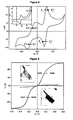
- the figure 4 represents a cyclovoltammogram of the C 1 complex (1 mM) in DMF with a platinum electrode, a 0.2 M nBU4PF6 support electrolyte and a scanning speed of 100 mV.s -1 ).
- the cyclovoltammogram of the ligand H 2 L is represented in insert and under the same experimental conditions.
- the figure 5 represents the intensity / potential curves measured on a vitreous carbon quasi-stationary electrode for the complex C 1 and the complex C 2 in the DMF solution with a carrier electrolyte nBU 4 NPF 6. 0.2 M, a scanning speed 2 mV.s -1 and a rotational speed of 1000 rpm.
- the C 1 complex was studied by cyclic voltammetry as well as pseudo-stationary voltammetry. In both cases, the presence of ferrocene in the medium shows a good validity of the electrochemical measurements.
- the electrochemical signature of the C 1 complex is in agreement with a C 1 / C 1 - reversible system whereas the H 2 L ligand shows only the oxidation wave of its redox cycle. It can be stated that the electrochemical signal of the C 1 / C 1 - pair observed by cyclic voltammetry corresponds to the redox couple C 1 / C 2 .
- the molecular complexes C 1 and C 2 in addition to their easy synthesis and their chemical stability, absorb light in the near ultraviolet, that is to say rays whose wavelength is approximately between 300 and 350 nm. It is the hydrazide type ligand which is responsible for this absorption in the UV, in solution as in the solid state.
- the originality of the system is the change in the degree of oxidation that is usable for the circulation of electrons.
- the iron solution (Fe 3+ ) is stable in the dark, and the iron + II solution is stable in the absence of air. Indeed, the yellow solution of iron (Fe 2+ ) oxidizes very easily in the air.
- the light absorption of the molecular complexes C 1 and C 2 is accompanied by a change in the degree of oxidation or reduction of the metal center, in this case iron, copper or the like, leading to new stable molecular complexes in solution as well as in the solid state.
- This phenomenon is a chemical reduction induced by light, accompanied by a spontaneous separation of species, the reduced complex on the one hand and the oxidized species on the other hand.
- the figure 6 illustrates the mechanism of the phenomenon.
- the stability of the reduced form is related to a molecular reorganization inducing a change in the apparent potential of the redox system.
- Fe Fe 3+
- Fe Fe 2+
- a species is necessarily oxidized in the medium.
- the analyzes of the final product namely the complex C 2 in solution and in the crystalline state, clearly show that the ligand molecules are not in an oxidized state.
- the electronic defect has therefore been transferred to the medium on the solvent molecules since the metal center is not reoxidized spontaneously.
- the device according to the invention constitutes a photoreductible system with spontaneous species separation.
- the method and the device of the invention open a new way in the development of simple and cheap systems, because the chemical element is iron, for the transformation of light into electricity.
- the development of new physico-chemical systems capable of transforming light energy into electrical energy is fundamental.
- new sources or systems producing energy must and must meet criteria for reconversion and / or transformation without harming the biosphere.
Landscapes
- Chemical & Material Sciences (AREA)
- Chemical Kinetics & Catalysis (AREA)
- Electrochemistry (AREA)
- General Chemical & Material Sciences (AREA)
- Separation By Low-Temperature Treatments (AREA)
- Electrical Discharge Machining, Electrochemical Machining, And Combined Machining (AREA)
- Catalysts (AREA)
- Electric Double-Layer Capacitors Or The Like (AREA)
- Battery Electrode And Active Subsutance (AREA)
- Secondary Cells (AREA)
- Hybrid Cells (AREA)
Description
- La présente invention concerne un procédé de production et de stockage d'énergie électrique utilisant des complexes d'un métal.
- Elle concerne également un dispositif pour la mise en oeuvre de ce procédé de production et de stockage d'énergie électrique.
- La littérature scientifique fournit quelques exemples de réduction photo-induite. On peut en particulier citer les articles suivants : - D.A.S. Finden, E. Tipping, G.H.M. Jaworski and C.S. Reynolds, Nature, Vol.309, 28 june 1984 - ; - G.K. Oster, G. Oster, J. Am. Chem. Soc. 1959, 81, 5543; E.L. Wehry, R. A. Ward, Inorg. Chem., 1971, 10, 12, 2660 - ; - B.C. Faust and R. G. Zepp, Environ. Sci. Technol. 1993, 27, 2517 - ; - J. Sima and J. Makanova, Coordination Chemistry Reviews, 160, 1997, 161 - ;- L. Emmenegger, R. Schonenberger, L. Sigg and B. Sulzberger, Limnol. Oceanogr., 46(1), 2001, 49 -; et - J. Sima, L. Horvathova, M. Izakovic, Monat. Chem., 2004, 135, 5 -.
- Par ailleurs, la publication Beghida et Al., Comptes Rendus - Chimie, Elsevier, Paris, Vol.10, N°7, 13 juillet 2007, nous enseigne la possibilité d'utiliser des ligands dérivant de l'acide 2-hydroxy hydrazide benzoïque pour l'élaboration de nouveaux complexes moléculaires magnétiques.
- En outre, la publication J.Sima, M.Izakovic, M.Zitnanski, International Journal of Photoenergy, Vol. 2006, 2006, pages 1 à 5, décrit le mécanisme du procédé de désactivation de complexes de ferIII formé avec des ligands de type Benacen.
- Toutefois, aucun des systèmes décrits ne présente une stabilité suffisante lui permettant une utilisation à la fois en solution et/ou à l'état solide.
- La présente invention se propose d'ouvrir une voie nouvelle dans l'élaboration de dispositifs physico-chimiques simples et économiques pour produire de l'énergie électrique en utilisant la lumière naturelle. En outre, la présente invention répond intégralement aux critères de reconversion et/ou de transformation imposés en matière de préservation de l'environnement et d'absence de nuisance pour la biosphère.
- Ce but est atteint par le procédé de l'invention, tel que défini en préambule, caractérisé en ce que l'on utilise un complexe moléculaire de fer dérivant de l'acide benzoïque, ce complexe comportant au moins un ligand organique de type benzoïque hydrazide, et l'on crée des réactions d'oxydoréduction dans ledit complexe moléculaire de fer en l'exposant à la lumière, à l'abri de l'air, et réciproquement à l'air, à l'abri de la lumière.
- D'une manière particulièrement avantageuse, ledit ligand organique est choisi parmi la famille de ligands définis par la formule :
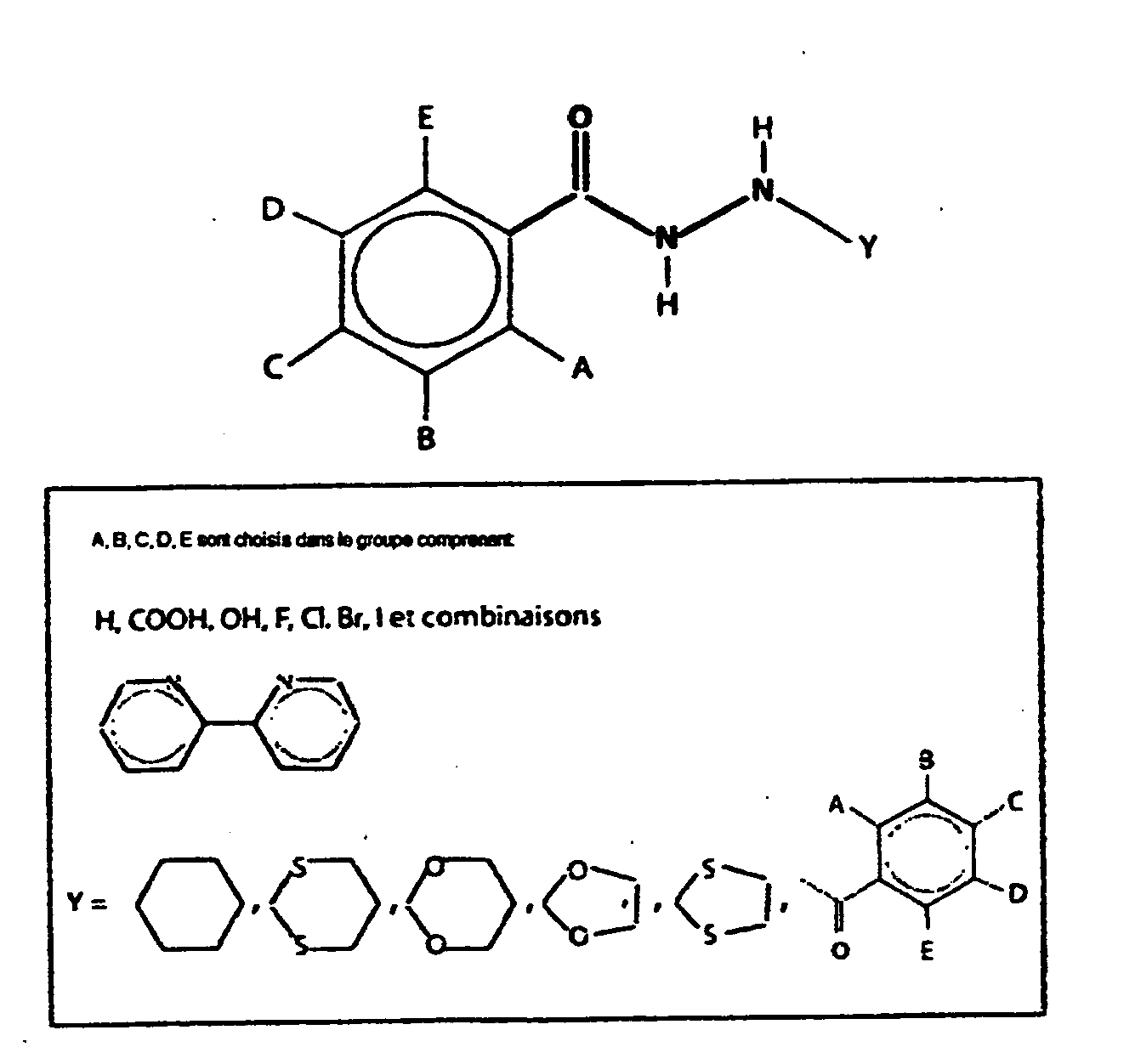
- Ledit complexe de fer est de préférence soit : le complexe de fer (Fe 3+) défini par la formule [FeIII(HL)xCl, Solvant], soit le complexe de fer (Fe 2+) défini par la formule [FeII(H2L)2Cl2]. HL et H2L représentent les deux états chimiques d'un ligand organique tel que précédemment défini, selon qu'il est complexé soit au fer oxydé soit au fer réduit. Ainsi, H2L correspond à un état dans lequel un atome d'hydrogène est présent sur l'atome d'azote central, tandis que HL concerne un état dans lequel l'atome d'hydrogène est absent sur ce même atome d'azote
- Selon un mode de réalisation, l'on produit une réduction du fer (Fe 3+) dans ledit complexe [FeIII(HL)xCl, Solvant] en fer (Fe 2+) dans ledit complexe [FeII(H2L)2Cl2] en l'exposant à la lumière à l'abri de l'oxygène.
- Selon un autre mode de réalisation, l'on produit une oxydation du fer (Fe 2+) dans ledit complexe [FeII(H2L)2Cl2] en fer (Fe 3+) dans ledit complexe [FeIII(HL)xCl, Solvant] en créant un contact chimique ou électrochimique avec un oxydant, à l'abri de la lumière.
- De façon avantageuse, ledit oxydant peut être choisi dans le groupe : O2, I2, Cu2+, Co3+, FeCl3, H+, manganate et permanganate, ferrates.
- De façon avantageuse, l'on peut choisir ledit solvant parmi les solvants suivants : le diméthylformamide (DMF), le tétrahydrofurane (THF), l'éthanol, l'eau.
- Il est également atteint par le dispositif de l'invention tel que défini en préambule, caractérisé en ce qu'il comprend un complexe moléculaire de fer comportant au moins un ligand organique de type acide benzoïque hydrazide.
- Ledit ligand organique est avantageusement choisi parmi la famille de ligands définis par la formule ci-dessous :

- Selon une forme de réalisation particulièrement avantageuse, ledit complexe de fer est soit : le complexe de fer (Fe 3+) défini par la formule [FeIII(HL)xCl, Solvant], soit le complexe de fer (Fe 2+) défini par la formule [FeII(H2L)2Cl2]. HL et H2L représentent les deux états chimiques d'un ligand organique tel que précédemment défini, selon qu'il est complexé soit au fer oxydé soit au fer réduit. Ainsi, H2L correspond à un état dans lequel un atome d'hydrogène est présent sur l'atome d'azote central, tandis que HL concerne un état dans lequel l'atome d'hydrogène est absent sur ce même atome d'azote
- Selon une forme de réalisation, le dispositif comporte avantageusement des moyens pour produire une réduction du fer (Fe 3+) dans ledit complexe [FeIII(HL)xCl, Solvant] en fer (Fe 2+) dans ledit complexe [FeII(H2L)2Cl2] ces moyens impliquant une exposition à la lumière à l'abri d'un oxydant, dudit complexe de fer (Fe 3+).
- Selon une autre forme de réalisation, le dispositif comporte avantageusement des moyens pour produire une oxydation du fer (Fe 2+) dans ledit complexe [FeII(H2L)2Cl2) en fer (Fe 3+) dans ledit complexe [FeIII(HL)2Cl, Solvant] ces moyens impliquant une action d'un oxydant adapté, à l'abri de la lumière sur ledit complexe de fer (Fe 2+).
- La présente invention et ses avantages apparaîtront mieux dans la description suivante de plusieurs modes de réalisation, donnés à titre d'exemples non limitatifs en référence aux dessins annexés, dans lesquels :
- la
figure 1 est une vue schématique représentant la transformation du complexe de fer (Fe 2+) en complexe de fer (Fe 3+) et réciproquement, - la
figure 2 est une vue représentant une molécule du complexe de fer (Fe3+), - la
figure 3 est une vue représentant une molécule du complexe de fer (Fe 2+), - la
figure 4 représente un cyclovoltammogramme du complexe de fer (Fe3+), - la
figure 5 représente les courbes intensité/potentiel mesurées sur électrode quasi stationnaire en carbone vitreux pour le complexe de fer (Fe 3+) et le complexe de fer (Fe 2+), et - la
figure 6 représente schématiquement le processus de réduction spontanée à la lumière naturelle selon l'invention. - On sait, par diverses publications, que les ligands organiques de type acide benzoïque hydrazide complexent de nombreux métaux de transition tels le fer, le manganèse, notamment à leur degrés d'oxydation habituels, (2+) ou (3+). Ces ligands dérivant de l'acide benzoïque ont été déjà synthétisés, purifiés et caractérisés en laboratoire, par les différentes méthodes spectroscopiques et de diffraction des rayons X.
- A titre d'exemple non limitatif, une sélection de ce type de ligands est donnée par les formules ci-dessous :

- Des essais de complexation effectués en laboratoire avec différents sels de manganèse (Mn 2+), (Mn 3+), de chrome (Cr 3+), de cuivre et de fer (Fe 3+), ont conduit à de nouveaux complexes mononucléaires, de structures originales. Des essais ont en particulier été effectués avec le fer et ont permis de constater que dans un complexe [FeIII(HL)2Cl, Solvant] désigné par C 1, une réduction du fer (Fe 3+) s'effectuait dans certaines conditions pour donner un nouveau complexe de fer (Fe2+) [FeII(H2L)2Cl2] désigné par C 2 et réciproquement, en modifiant les conditions.
- Le complexe C 1 peut être obtenu à l'état solide à partir d'une diffusion lente de diethyléther dans le solvant qui est le diméthylformamide (DMF). La réaction se fait à l'air et à l'abri de la lumière. Cette réaction est matérialisée par la formation de monocristaux bleu nuit du complexe C 1.
- Une exposition du mélange à l'abri de l'air et à la lumière, c'est-à-dire dans les conditions inverses de celles qui ont permis de former le complexe C 1 conduit à la formation d'une solution jaune puis à une cristallisation sous la forme de cristaux jaunes du complexe C 2. Ces cristaux jaunes, obtenus après lente diffusion de diethyléther dans la solution de DMF, sont sensibles à l'air. En effet, en présence d'oxygène de l'air, ils changent de couleur et se transforment en un solide bleu. En outre, la solubilisation des monocristaux jaunes correspondant au complexe C 2 dans la solution de DMF en présence d'air donne instantanément une solution bleue correspondant au complexe C 1. Le passage d'un des complexes à l'autre est réversible.
- La
figure 1 représente schématiquement cette transformation. La réaction de base s'effectue entre un ligand H2L et du chlorure de fer FeCl3 en présence du solvant DMF. L'on produit les complexes C 1 et C 2. Le complexe C 1 exposé à la lumière, mais à l'abri de l'air, se transforme par photo réduction en complexe C 2. A l'abri de lumière, mais exposé à l'air, plus précisément à l'oxygène de l'air, le complexe C 2 se transforme par oxydation en complexe C 1. Cette transformation réversible est due à des réactions d'oxydation et de réduction liées à la présence ou l'absence de lumière et la présence ou non d'oxygène. Les réactions peuvent être suivies expérimentalement en raison des changements de couleur accompagnant le processus de diffusion du diethyléther, qui est un liquide incolore, dans une solution de DMF. - La
figure 2 est une vue schématique qui illustre la structure moléculaire du complexe C 1. Les ellipsoïdes contiennent 50 % de la densité électronique. Les lignes en pointillé représentent les liaisons intramoléculaires de l'hydrogène. Ci-après, sont spécifiées certaines longueurs de liaisons (Å) et certains angles (°) : Fe-02, 1.973 Å (4) ; Fe-04, 1.977 Å (4) ; Fe-O5, 2.035 Å (4) ; Fe-N4, 2.145 Å (5) ; Fe-N2, 2.213 Å (5) ; Fe-Cl, 2.3318 Å (14) ; 02-Fe-O4, 159.84 °(17) ; O5-Fe-N4, 166.56 °(17). - La
figure 3 est une vue schématique qui illustre la structure moléculaire du complexe C 2. L'ellipsoïde contient 50 % de la densité électronique. Les lignes en pintillé représentent les liaisons intramoléculaires de l'hydrogène. - Ci-après, sont spécifiées certaines longueurs de liaisons (Å) et certains angles (°) : Fe1-O2, 2.115 Å (1) ; Fe1-O4, 2.122 Å (1) ; Fe1-N4, 2.199 Å (1) ; Fel-N2, 2.229 Å (1), Fe1-Cl1 2.4396 Å (7), Fe1-Cl2 2.4613 Å (7) ; 02-Fe1-O4, 175.41 ° (4) ; 04-Fe1-N4, 74.55 ° (4).La présence ou non d'un atome d'hydrogène sur l'azote central permet de confirmer la charge (Fe2+) ou (Fe3+) des atomes de fer.
- La
figure 4 représente un cyclovoltammogramme du complexe C 1 (1 mM) dans la DMF avec une électrode de platine, un électrolyte support nBU4PF6 0,2 M et une vitesse de balayage de 100 mV.s-1). Le cyclovoltammogramme du ligand H2L est représenté en insert et dans les mêmes conditions expérimentales. - La
figure 5 représente les courbes intensité/potentiel mesurées sur électrode quasi stationnaire en carbone vitreux pour le complexe C 1 et le complexe C 2 dans la solution DMF avec un électrolyte support nBU4NPF6. 0,2 M, une vitesse de balayage 2 mV.s-1 et une vitesse de rotation de 1000 rpm. - Selon l'étude électrochimique qui est résumée sur les
figures 4 et 5 , le complexe C 1 a été étudié par voltampérométrie cyclique ainsi que par voltampérométrie pseudo stationnaire. Dans les deux cas, la présence de ferrocene dans le milieu montre une bonne validité des mesures électrochimiques. La signature électrochimique du complexe C 1 est en accord avec un système C 1/ C 1 - réversible tandis que le ligand H2L ne montre que la vague d'oxydation de son cycle redox. On peut affirmer que le signal électrochimique du couple C 1 / C 1 - observé par voltampérométrie cyclique correspond au couple redox C 1 /C 2. - Les complexes moléculaires C 1 et C 2, en plus de leur synthèse aisée et de leur stabilité chimique, absorbe la lumière dans le proche ultra-violet c'est-à-dire des rayons dont la longueur d'onde est située approximativement entre 300 et 350 nm. C'est le ligand de type hydrazide qui est responsable de cette absorption dans l'UV, en solution comme à l'état solide. L'originalité du système est le changement du degré d'oxydation qui est utilisable pour la circulation d'électrons. La solution de fer (Fe 3+) est stable à l'abri de la lumière, et la solution de fer +II est stable à l'abri de l'air. En effet, la solution jaune de fer (Fe 2+) s'oxyde très facilement à l'air. A titre expérimental, il suffit de faire passer de l'air durant un intervalle de temps relativement court, par exemple une minute, dans un récipient contenant une solution du complexe C 2 pour la transformer en solution du complexe C 1, bleu sombre. Placée pendant quelques heures en pleine lumière naturelle, la solution bleue sombre du complexe C 1 se réduit en solution jaune du complexe C 2. On notera que les solutions s'enrichissent en eau dans ces conditions en raison de la réduction de l'oxygène (O2) en eau (H2O).
- En résumé, l'absorption de lumière des complexes moléculaires C 1 et C 2 s'accompagne d'un changement de degré d'oxydation ou de réduction du centre métallique, en l'occurrence le fer, le cuivre ou similaire, conduisant à de nouveaux complexes moléculaires stables en solution ainsi qu'à l'état solide. Ce phénomène est une réduction chimique induite par la lumière, accompagnée par une séparation spontanée d'espèces, le complexe réduit d'une part et l'espèce oxydée d'autre part.
- La
figure 6 illustre le mécanisme du phénomène. La stabilité de la forme réduite est liée à une réorganisation moléculaire induisant un changement du potentiel apparent du système redox. En effet, lors de la réduction du Fe (Fe 3+) en Fe (Fe 2+), une espèce est nécessairement oxydée dans le milieu. Compte tenu du caractère chromophore du ligand, on estime a priori que ce dernier cède un électron au métal, mais les analyses du produit final, à savoir le complexe C 2 en solution et à l'état cristallin, montre clairement que les molécules de ligand ne sont pas dans un état oxydé. Le défaut électronique a donc été transféré dans le milieu sur les molécules de solvant puisque le centre métallique n'est pas réoxydé spontanément. - Cependant, cette situation particulière avec une partie oxydée transférée vers le solvant qui peut être du DMF, du THF, de l'éthanol ou de l'eau permet d'envisager de nouveaux types de cellules solaires à oxydo-réduction (redox) avec une technologie particulièrement simple. Le dispositif selon l'invention constitue un système photoréductible à séparation d'espèces spontanée.
- Le procédé et le dispositif de l'invention ouvrent une voie nouvelle dans l'élaboration de systèmes simples et bons marchés, du fait que l'élément chimique est le fer, pour la transformation de la lumière en électricité. A une époque où les sources d'énergie deviennent des enjeux majeurs, la mise au point de nouveaux systèmes physico-chimiques capables de transformer l'énergie lumineuse en énergie électrique est fondamentale. De plus, et compte-tenu de la situation environnementale, les nouvelles sources ou systèmes producteurs d'énergie doivent et devront répondre à des critères de reconversion et/ou de transformation sans nuisance pour la biosphère.
Claims (12)
- Procédé de production et de stockage d'énergie électrique utilisant des complexes d'un métal, caractérisé en ce que l'on utilise un complexe moléculaire de fer dérivant de l'acide benzoïque, ce complexe comportant au moins un ligand organique (L) de type benzoïque hydrazide, et l'on crée des réactions d'oxydoréduction dans ledit complexe moléculaire de fer en l'exposant à la lumière, à l'abri de l'air, et réciproquement à l'air, à l'abri de la lumière.
- Procédé selon la revendication 1, caractérisé en ce que ledit ligand organique est choisi parmi la famille de ligands définis par la formule :

- Procédé selon la revendication 1, caractérisé en ce que ledit complexe de fer est soit : le complexe de fer (Fe 3+) défini par la formule [FeIII(HL)xCl, Solvant], soit le complexe de fer (Fe 2+) défini par la formule [FeII(H2L)2Cl2].
- Procédé selon la revendication 3, caractérisé en ce que l'on produit une réduction du fer (Fe 3+) dans ledit complexe [FeIII(HL)xCl, Solvant] en fer (Fe 2+) dans ledit complexe [FeII(H2L)2Cl2] en l'exposant à la lumière à l'abri de l'oxygène.
- Procédé selon la revendication 3, caractérisé en ce que l'on produit une oxydation du fer (Fe 2+) dans ledit complexe [FeII(H2L)2Cl2] en fer (Fe 3+) dans ledit complexe [FeIII(HL)xCl, Solvant] en créant un contact chimique ou électrochimique avec un oxydant, à l'abri de la lumière.
- Procédé selon la revendication 5, caractérisé en ce que ledit oxydant est choisi dans le groupe : O2, I2, Cu2+ Co3+,FeCl, H+, manganate et permanganate, ferrates.
- Procédé selon l'une quelconque des revendications 3, 4 ou 5, caractérisé en ce que l'on choisit ledit solvant parmi les solvants suivants : le diméthylformamide (DMF), le tétrahydrofurane (THF), l'éthanol, l'eau.
- Dispositif de production et de stockage d'énergie électrique, pour la mise en oeuvre du procédé selon l'une quelconque des revendications 1 à 7, caractérisé en ce qu'il comprend un complexe moléculaire de fer comportant au moins un ligand organique (L) de type acide benzoïque hydrazide.
- Dispositif selon la revendication 8, caractérisé en ce que ledit ligand organique (L) est choisi parmi la famille de ligands définis par la formule ci-dessous :

- Dispositif selon la revendication 8, caractérisé en ce que ledit complexe de fer est soit : le complexe de fer (Fe 3+) défini par la formule [FeIII(HL)xCl, Solvant], soit le complexe de fer (Fe 2+) défini par la formule [FeII(H2L)2Cl2].
- Dispositif selon la revendication 8, caractérisé en ce qu'il comporte des moyens pour produire une réduction du fer (Fe 3+) dans ledit complexe [FeIII(HL)xCl, Solvant] en fer (Fe 2+) dans ledit complexe [FeII(H2L)2Cl2] ces moyens impliquant une exposition à la lumière à l'abri d'un oxydant, dudit complexe de fer (Fe 3+).
- Dispositif selon la revendication 8, caractérisé en ce qu'il comporte des moyens pour produire une oxydation du fer (Fe 2+) dans ledit complexe [FeII(H2L)2Cl2] en fer (Fe 3+) dans ledit complexe [FeIII(HL)2Cl, Solvant] ces moyens impliquant une action d'un oxydant adapté, à l'abri de la lumière sur ledit complexe de fer (Fe 2+).
Priority Applications (1)
| Application Number | Priority Date | Filing Date | Title |
|---|---|---|---|
| PL09734594T PL2277231T3 (pl) | 2008-04-21 | 2009-04-21 | Sposób i urządzenie do produkcji i składowania energii elektrycznej |
Applications Claiming Priority (2)
| Application Number | Priority Date | Filing Date | Title |
|---|---|---|---|
| US12492308P | 2008-04-21 | 2008-04-21 | |
| PCT/IB2009/005303 WO2009130562A1 (fr) | 2008-04-21 | 2009-04-21 | Procédé et dispositif de production et de stockage d'énergie électrique |
Publications (2)
| Publication Number | Publication Date |
|---|---|
| EP2277231A1 EP2277231A1 (fr) | 2011-01-26 |
| EP2277231B1 true EP2277231B1 (fr) | 2012-02-08 |
Family
ID=40901991
Family Applications (1)
| Application Number | Title | Priority Date | Filing Date |
|---|---|---|---|
| EP09734594A Not-in-force EP2277231B1 (fr) | 2008-04-21 | 2009-04-21 | Procédé et dispositif de production et de stockage d'énergie électrique |
Country Status (15)
| Country | Link |
|---|---|
| US (1) | US8496788B2 (fr) |
| EP (1) | EP2277231B1 (fr) |
| JP (1) | JP2011528155A (fr) |
| CN (1) | CN102017278B (fr) |
| AT (1) | ATE545170T1 (fr) |
| AU (1) | AU2009239696A1 (fr) |
| BR (1) | BRPI0911128A2 (fr) |
| CA (1) | CA2721859A1 (fr) |
| DK (1) | DK2277231T3 (fr) |
| ES (1) | ES2382016T3 (fr) |
| NZ (1) | NZ588510A (fr) |
| PL (1) | PL2277231T3 (fr) |
| PT (1) | PT2277231E (fr) |
| RU (1) | RU2010142930A (fr) |
| WO (1) | WO2009130562A1 (fr) |
Families Citing this family (1)
| Publication number | Priority date | Publication date | Assignee | Title |
|---|---|---|---|---|
| JP5938820B2 (ja) * | 2011-01-31 | 2016-06-22 | 国立大学法人 東京大学 | 蓄熱材及びそれを利用した熱利用システム |
Family Cites Families (6)
| Publication number | Priority date | Publication date | Assignee | Title |
|---|---|---|---|---|
| US2383319A (en) * | 1939-08-23 | 1945-08-21 | Du Pont | Production of sulphonyl chlorides |
| US2383320A (en) * | 1940-12-09 | 1945-08-21 | Du Pont | Reaction of saturated aliphatic carboxylic acids with sulphuryl chloride and products thereof |
| JP2000012882A (ja) * | 1998-06-25 | 2000-01-14 | Fuji Photo Film Co Ltd | 反応性芳香族アミンをホール輸送層に含む光起電力素子およびその製造方法 |
| WO2004085708A1 (fr) * | 2002-08-21 | 2004-10-07 | Battelle Memorial Institute | Oxygenateur photolytique avec separation et fixation de dioxyde de carbone et/ou d'hydrogene |
| JP5003865B2 (ja) * | 2006-03-17 | 2012-08-15 | 宇部興産株式会社 | 二核金属錯体色素溶液およびこの溶液を用いた光電変換素子、及び光化学電池 |
| US9553315B2 (en) * | 2008-11-12 | 2017-01-24 | Ramot At Tel-Aviv University Ltd. | Direct liquid fuel cell having ammonia borane or derivatives thereof as fuel |
-
2009
- 2009-04-21 RU RU2010142930/07A patent/RU2010142930A/ru not_active Application Discontinuation
- 2009-04-21 AU AU2009239696A patent/AU2009239696A1/en not_active Abandoned
- 2009-04-21 DK DK09734594.6T patent/DK2277231T3/da active
- 2009-04-21 EP EP09734594A patent/EP2277231B1/fr not_active Not-in-force
- 2009-04-21 JP JP2011504564A patent/JP2011528155A/ja active Pending
- 2009-04-21 CA CA2721859A patent/CA2721859A1/fr not_active Abandoned
- 2009-04-21 CN CN2009801141729A patent/CN102017278B/zh not_active Expired - Fee Related
- 2009-04-21 PL PL09734594T patent/PL2277231T3/pl unknown
- 2009-04-21 WO PCT/IB2009/005303 patent/WO2009130562A1/fr not_active Ceased
- 2009-04-21 US US12/988,710 patent/US8496788B2/en not_active Expired - Fee Related
- 2009-04-21 ES ES09734594T patent/ES2382016T3/es active Active
- 2009-04-21 BR BRPI0911128A patent/BRPI0911128A2/pt not_active IP Right Cessation
- 2009-04-21 PT PT09734594T patent/PT2277231E/pt unknown
- 2009-04-21 AT AT09734594T patent/ATE545170T1/de active
- 2009-04-21 NZ NZ588510A patent/NZ588510A/en not_active IP Right Cessation
Also Published As
| Publication number | Publication date |
|---|---|
| JP2011528155A (ja) | 2011-11-10 |
| WO2009130562A4 (fr) | 2009-12-17 |
| PT2277231E (pt) | 2012-05-23 |
| DK2277231T3 (da) | 2012-05-29 |
| US8496788B2 (en) | 2013-07-30 |
| CN102017278B (zh) | 2013-07-03 |
| WO2009130562A1 (fr) | 2009-10-29 |
| PL2277231T3 (pl) | 2012-07-31 |
| BRPI0911128A2 (pt) | 2015-10-06 |
| ATE545170T1 (de) | 2012-02-15 |
| AU2009239696A1 (en) | 2009-10-29 |
| RU2010142930A (ru) | 2012-10-27 |
| US20110033741A1 (en) | 2011-02-10 |
| ES2382016T3 (es) | 2012-06-04 |
| NZ588510A (en) | 2012-03-30 |
| CA2721859A1 (fr) | 2009-10-29 |
| EP2277231A1 (fr) | 2011-01-26 |
| CN102017278A (zh) | 2011-04-13 |
Similar Documents
| Publication | Publication Date | Title |
|---|---|---|
| Chae et al. | The promise of chiral electrocatalysis for efficient and sustainable energy conversion and storage: a comprehensive review of the CISS effect and future directions | |
| Feng et al. | A self-healing catalyst for electrocatalytic and photoelectrochemical oxygen evolution in highly alkaline conditions | |
| Gryko et al. | Thiol-derivatized porphyrins for attachment to electroactive surfaces | |
| Limburg et al. | Characterization of the O2-Evolving Reaction Catalyzed by [(terpy)(H2O) MnIII (O) 2MnIV (OH2)(terpy)](NO3) 3 (terpy= 2, 2 ‘: 6, 2 ‘‘-Terpyridine) | |
| Wei et al. | Molecular chirality and charge transfer through self-assembled scaffold monolayers | |
| Michota et al. | Surface‐enhanced Raman scattering (SERS) of 4‐mercaptobenzoic acid on silver and gold substrates | |
| Blough et al. | Reactive oxygen species in natural waters | |
| Laverman et al. | Mechanistic studies of nitric oxide reactions with water soluble iron (II), cobalt (II), and iron (III) porphyrin complexes in aqueous solutions: implications for biological activity | |
| Fermín et al. | Photoinduced electron transfer at liquid/liquid interfaces. Part III. Photoelectrochemical responses involving porphyrin ion pairs | |
| Zhao et al. | Photoinduced oxidation of water to oxygen in the ionic liquid BMIMBF4 as the counter reaction in the fabrication of exceptionally long semiconducting silver-tetracyanoquinodimethane nanowires | |
| Kunieda et al. | Photochemical and photophysical properties of C60 dendrimers studied by laser flash photolysis | |
| Pramata et al. | TiO2/CsPbBr3 quantum dots coupled with polyoxometalate redox clusters for photoswitches | |
| Gupta et al. | Photochemical assisted formation of silver nano dendrites and their application in amperometric sensing of nitrite | |
| Kim et al. | Suppressing Interfacial Deprotonation of Metal Oxides for Efficient PbS Quantum Dot Photovoltaics | |
| EP2277231A1 (fr) | Procédé et dispositif de production et de stockage d'énergie électrique | |
| Zhang et al. | Study on the interaction between and bovine serum albumin by spectroscopic methods | |
| Amao et al. | Biohydrogen production with the light-harvesting function of grana from spirulina and colloidal platinum | |
| Rodríguez et al. | Ketorolac removal through photoelectrocatalysis using TiO2 nanotubes in water system | |
| Gao et al. | Ultrasensitive detection of doxycycline enabled by oxygen vacancy modulated TiO2 nanotubes | |
| Al-Abbasi et al. | Sensitization of TiO2 nanotube arrays by mixed oxovanadium (IV) complex for enhanced photoelectrochemical cells performance | |
| Tkachenko et al. | [Au (S–C6F5)] and [Au (S–C6F4–CF3)]: Reactivity, Structure, DSC, and Calculation Studies | |
| Kuzmin et al. | Hybrid and individual Mn (III) 5, 10, 15, 20-tetrakis (4-aminophenyl)-based films: electrochemistry, films formation and ORR testing | |
| Lai et al. | Ultrafast chiral peptides purification via surface plasmon enhanced spin selectivity | |
| Athanas et al. | Electrochemical detection of food preservative SO2 in red wine using SiO2 coated CdS nanomaterials | |
| Sindhu et al. | Seamless recovery and reusable photocatalytic activity of CVD grown atomically-thin WS2 films |
Legal Events
| Date | Code | Title | Description |
|---|---|---|---|
| PUAI | Public reference made under article 153(3) epc to a published international application that has entered the european phase |
Free format text: ORIGINAL CODE: 0009012 |
|
| 17P | Request for examination filed |
Effective date: 20101110 |
|
| AK | Designated contracting states |
Kind code of ref document: A1 Designated state(s): AT BE BG CH CY CZ DE DK EE ES FI FR GB GR HR HU IE IS IT LI LT LU LV MC MK MT NL NO PL PT RO SE SI SK TR |
|
| AX | Request for extension of the european patent |
Extension state: AL BA RS |
|
| DAX | Request for extension of the european patent (deleted) | ||
| GRAP | Despatch of communication of intention to grant a patent |
Free format text: ORIGINAL CODE: EPIDOSNIGR1 |
|
| GRAS | Grant fee paid |
Free format text: ORIGINAL CODE: EPIDOSNIGR3 |
|
| GRAA | (expected) grant |
Free format text: ORIGINAL CODE: 0009210 |
|
| AK | Designated contracting states |
Kind code of ref document: B1 Designated state(s): AT BE BG CH CY CZ DE DK EE ES FI FR GB GR HR HU IE IS IT LI LT LU LV MC MK MT NL NO PL PT RO SE SI SK TR |
|
| REG | Reference to a national code |
Ref country code: GB Ref legal event code: FG4D Free format text: NOT ENGLISH |
|
| REG | Reference to a national code |
Ref country code: AT Ref legal event code: REF Ref document number: 545170 Country of ref document: AT Kind code of ref document: T Effective date: 20120215 Ref country code: CH Ref legal event code: EP |
|
| REG | Reference to a national code |
Ref country code: DE Ref legal event code: R096 Ref document number: 602009005250 Country of ref document: DE Effective date: 20120405 |
|
| REG | Reference to a national code |
Ref country code: CH Ref legal event code: NV Representative=s name: CABINET ROLAND NITHARDT CONSEILS EN PROPRIETE INDU |
|
| REG | Reference to a national code |
Ref country code: NL Ref legal event code: T3 |
|
| REG | Reference to a national code |
Ref country code: PT Ref legal event code: SC4A Free format text: AVAILABILITY OF NATIONAL TRANSLATION Effective date: 20120507 |
|
| REG | Reference to a national code |
Ref country code: DK Ref legal event code: T3 |
|
| REG | Reference to a national code |
Ref country code: ES Ref legal event code: FG2A Ref document number: 2382016 Country of ref document: ES Kind code of ref document: T3 Effective date: 20120604 |
|
| LTIE | Lt: invalidation of european patent or patent extension |
Effective date: 20120208 |
|
| PG25 | Lapsed in a contracting state [announced via postgrant information from national office to epo] |
Ref country code: NO Free format text: LAPSE BECAUSE OF FAILURE TO SUBMIT A TRANSLATION OF THE DESCRIPTION OR TO PAY THE FEE WITHIN THE PRESCRIBED TIME-LIMIT Effective date: 20120508 Ref country code: HR Free format text: LAPSE BECAUSE OF FAILURE TO SUBMIT A TRANSLATION OF THE DESCRIPTION OR TO PAY THE FEE WITHIN THE PRESCRIBED TIME-LIMIT Effective date: 20120208 Ref country code: LT Free format text: LAPSE BECAUSE OF FAILURE TO SUBMIT A TRANSLATION OF THE DESCRIPTION OR TO PAY THE FEE WITHIN THE PRESCRIBED TIME-LIMIT Effective date: 20120208 Ref country code: IS Free format text: LAPSE BECAUSE OF FAILURE TO SUBMIT A TRANSLATION OF THE DESCRIPTION OR TO PAY THE FEE WITHIN THE PRESCRIBED TIME-LIMIT Effective date: 20120608 |
|
| PGFP | Annual fee paid to national office [announced via postgrant information from national office to epo] |
Ref country code: DE Payment date: 20120503 Year of fee payment: 4 Ref country code: IE Payment date: 20120419 Year of fee payment: 4 Ref country code: DK Payment date: 20120516 Year of fee payment: 4 Ref country code: NL Payment date: 20120502 Year of fee payment: 4 Ref country code: LU Payment date: 20120430 Year of fee payment: 4 |
|
| REG | Reference to a national code |
Ref country code: PL Ref legal event code: T3 |
|
| PG25 | Lapsed in a contracting state [announced via postgrant information from national office to epo] |
Ref country code: GR Free format text: LAPSE BECAUSE OF FAILURE TO SUBMIT A TRANSLATION OF THE DESCRIPTION OR TO PAY THE FEE WITHIN THE PRESCRIBED TIME-LIMIT Effective date: 20120509 Ref country code: LV Free format text: LAPSE BECAUSE OF FAILURE TO SUBMIT A TRANSLATION OF THE DESCRIPTION OR TO PAY THE FEE WITHIN THE PRESCRIBED TIME-LIMIT Effective date: 20120208 Ref country code: FI Free format text: LAPSE BECAUSE OF FAILURE TO SUBMIT A TRANSLATION OF THE DESCRIPTION OR TO PAY THE FEE WITHIN THE PRESCRIBED TIME-LIMIT Effective date: 20120208 |
|
| PGFP | Annual fee paid to national office [announced via postgrant information from national office to epo] |
Ref country code: PL Payment date: 20120420 Year of fee payment: 4 |
|
| PG25 | Lapsed in a contracting state [announced via postgrant information from national office to epo] |
Ref country code: CY Free format text: LAPSE BECAUSE OF FAILURE TO SUBMIT A TRANSLATION OF THE DESCRIPTION OR TO PAY THE FEE WITHIN THE PRESCRIBED TIME-LIMIT Effective date: 20120208 |
|
| PGFP | Annual fee paid to national office [announced via postgrant information from national office to epo] |
Ref country code: IT Payment date: 20120430 Year of fee payment: 4 |
|
| PG25 | Lapsed in a contracting state [announced via postgrant information from national office to epo] |
Ref country code: CZ Free format text: LAPSE BECAUSE OF FAILURE TO SUBMIT A TRANSLATION OF THE DESCRIPTION OR TO PAY THE FEE WITHIN THE PRESCRIBED TIME-LIMIT Effective date: 20120208 Ref country code: RO Free format text: LAPSE BECAUSE OF FAILURE TO SUBMIT A TRANSLATION OF THE DESCRIPTION OR TO PAY THE FEE WITHIN THE PRESCRIBED TIME-LIMIT Effective date: 20120208 Ref country code: SI Free format text: LAPSE BECAUSE OF FAILURE TO SUBMIT A TRANSLATION OF THE DESCRIPTION OR TO PAY THE FEE WITHIN THE PRESCRIBED TIME-LIMIT Effective date: 20120208 Ref country code: SE Free format text: LAPSE BECAUSE OF FAILURE TO SUBMIT A TRANSLATION OF THE DESCRIPTION OR TO PAY THE FEE WITHIN THE PRESCRIBED TIME-LIMIT Effective date: 20120208 Ref country code: EE Free format text: LAPSE BECAUSE OF FAILURE TO SUBMIT A TRANSLATION OF THE DESCRIPTION OR TO PAY THE FEE WITHIN THE PRESCRIBED TIME-LIMIT Effective date: 20120208 |
|
| PG25 | Lapsed in a contracting state [announced via postgrant information from national office to epo] |
Ref country code: SK Free format text: LAPSE BECAUSE OF FAILURE TO SUBMIT A TRANSLATION OF THE DESCRIPTION OR TO PAY THE FEE WITHIN THE PRESCRIBED TIME-LIMIT Effective date: 20120208 Ref country code: MC Free format text: LAPSE BECAUSE OF NON-PAYMENT OF DUE FEES Effective date: 20120430 |
|
| PLBE | No opposition filed within time limit |
Free format text: ORIGINAL CODE: 0009261 |
|
| STAA | Information on the status of an ep patent application or granted ep patent |
Free format text: STATUS: NO OPPOSITION FILED WITHIN TIME LIMIT |
|
| PGFP | Annual fee paid to national office [announced via postgrant information from national office to epo] |
Ref country code: ES Payment date: 20120427 Year of fee payment: 4 |
|
| 26N | No opposition filed |
Effective date: 20121109 |
|
| PGFP | Annual fee paid to national office [announced via postgrant information from national office to epo] |
Ref country code: PT Payment date: 20120525 Year of fee payment: 4 |
|
| PG25 | Lapsed in a contracting state [announced via postgrant information from national office to epo] |
Ref country code: MK Free format text: LAPSE BECAUSE OF FAILURE TO SUBMIT A TRANSLATION OF THE DESCRIPTION OR TO PAY THE FEE WITHIN THE PRESCRIBED TIME-LIMIT Effective date: 20120208 |
|
| REG | Reference to a national code |
Ref country code: DE Ref legal event code: R097 Ref document number: 602009005250 Country of ref document: DE Effective date: 20121109 |
|
| PG25 | Lapsed in a contracting state [announced via postgrant information from national office to epo] |
Ref country code: BG Free format text: LAPSE BECAUSE OF FAILURE TO SUBMIT A TRANSLATION OF THE DESCRIPTION OR TO PAY THE FEE WITHIN THE PRESCRIBED TIME-LIMIT Effective date: 20120508 Ref country code: MT Free format text: LAPSE BECAUSE OF FAILURE TO SUBMIT A TRANSLATION OF THE DESCRIPTION OR TO PAY THE FEE WITHIN THE PRESCRIBED TIME-LIMIT Effective date: 20120208 |
|
| REG | Reference to a national code |
Ref country code: NL Ref legal event code: V1 Effective date: 20131101 |
|
| REG | Reference to a national code |
Ref country code: CH Ref legal event code: PL |
|
| REG | Reference to a national code |
Ref country code: DK Ref legal event code: EBP Effective date: 20130430 |
|
| GBPC | Gb: european patent ceased through non-payment of renewal fee |
Effective date: 20130421 |
|
| REG | Reference to a national code |
Ref country code: IE Ref legal event code: MM4A Ref country code: PT Ref legal event code: MM4A Free format text: LAPSE DUE TO NON-PAYMENT OF FEES Effective date: 20140122 |
|
| PG25 | Lapsed in a contracting state [announced via postgrant information from national office to epo] |
Ref country code: CH Free format text: LAPSE BECAUSE OF NON-PAYMENT OF DUE FEES Effective date: 20130430 Ref country code: LI Free format text: LAPSE BECAUSE OF NON-PAYMENT OF DUE FEES Effective date: 20130430 Ref country code: GB Free format text: LAPSE BECAUSE OF NON-PAYMENT OF DUE FEES Effective date: 20130421 Ref country code: DE Free format text: LAPSE BECAUSE OF NON-PAYMENT OF DUE FEES Effective date: 20131101 |
|
| PGFP | Annual fee paid to national office [announced via postgrant information from national office to epo] |
Ref country code: BE Payment date: 20130923 Year of fee payment: 5 |
|
| REG | Reference to a national code |
Ref country code: DE Ref legal event code: R119 Ref document number: 602009005250 Country of ref document: DE Effective date: 20131101 |
|
| PG25 | Lapsed in a contracting state [announced via postgrant information from national office to epo] |
Ref country code: IT Free format text: LAPSE BECAUSE OF NON-PAYMENT OF DUE FEES Effective date: 20130421 Ref country code: NL Free format text: LAPSE BECAUSE OF NON-PAYMENT OF DUE FEES Effective date: 20131101 |
|
| PG25 | Lapsed in a contracting state [announced via postgrant information from national office to epo] |
Ref country code: IE Free format text: LAPSE BECAUSE OF NON-PAYMENT OF DUE FEES Effective date: 20130421 Ref country code: DK Free format text: LAPSE BECAUSE OF NON-PAYMENT OF DUE FEES Effective date: 20130430 |
|
| REG | Reference to a national code |
Ref country code: ES Ref legal event code: FD2A Effective date: 20140610 |
|
| PG25 | Lapsed in a contracting state [announced via postgrant information from national office to epo] |
Ref country code: PT Free format text: LAPSE BECAUSE OF NON-PAYMENT OF DUE FEES Effective date: 20140122 |
|
| PG25 | Lapsed in a contracting state [announced via postgrant information from national office to epo] |
Ref country code: HU Free format text: LAPSE BECAUSE OF FAILURE TO SUBMIT A TRANSLATION OF THE DESCRIPTION OR TO PAY THE FEE WITHIN THE PRESCRIBED TIME-LIMIT Effective date: 20090421 |
|
| REG | Reference to a national code |
Ref country code: PL Ref legal event code: LAPE |
|
| PG25 | Lapsed in a contracting state [announced via postgrant information from national office to epo] |
Ref country code: PL Free format text: LAPSE BECAUSE OF NON-PAYMENT OF DUE FEES Effective date: 20130421 Ref country code: ES Free format text: LAPSE BECAUSE OF NON-PAYMENT OF DUE FEES Effective date: 20130422 |
|
| PGFP | Annual fee paid to national office [announced via postgrant information from national office to epo] |
Ref country code: FR Payment date: 20140429 Year of fee payment: 6 |
|
| REG | Reference to a national code |
Ref country code: AT Ref legal event code: MM01 Ref document number: 545170 Country of ref document: AT Kind code of ref document: T Effective date: 20140421 |
|
| PG25 | Lapsed in a contracting state [announced via postgrant information from national office to epo] |
Ref country code: TR Free format text: LAPSE BECAUSE OF FAILURE TO SUBMIT A TRANSLATION OF THE DESCRIPTION OR TO PAY THE FEE WITHIN THE PRESCRIBED TIME-LIMIT Effective date: 20120208 |
|
| PG25 | Lapsed in a contracting state [announced via postgrant information from national office to epo] |
Ref country code: LU Free format text: LAPSE BECAUSE OF NON-PAYMENT OF DUE FEES Effective date: 20130421 |
|
| PG25 | Lapsed in a contracting state [announced via postgrant information from national office to epo] |
Ref country code: AT Free format text: LAPSE BECAUSE OF NON-PAYMENT OF DUE FEES Effective date: 20140421 |
|
| REG | Reference to a national code |
Ref country code: FR Ref legal event code: ST Effective date: 20151231 |
|
| PG25 | Lapsed in a contracting state [announced via postgrant information from national office to epo] |
Ref country code: FR Free format text: LAPSE BECAUSE OF NON-PAYMENT OF DUE FEES Effective date: 20150430 |
|
| PG25 | Lapsed in a contracting state [announced via postgrant information from national office to epo] |
Ref country code: BE Free format text: LAPSE BECAUSE OF NON-PAYMENT OF DUE FEES Effective date: 20140430 |