EP2276208A1 - Method and apparatuses for data processing in a communication system - Google Patents
Method and apparatuses for data processing in a communication system Download PDFInfo
- Publication number
- EP2276208A1 EP2276208A1 EP10012171A EP10012171A EP2276208A1 EP 2276208 A1 EP2276208 A1 EP 2276208A1 EP 10012171 A EP10012171 A EP 10012171A EP 10012171 A EP10012171 A EP 10012171A EP 2276208 A1 EP2276208 A1 EP 2276208A1
- Authority
- EP
- European Patent Office
- Prior art keywords
- data
- processing
- configuration
- communication system
- processing means
- Prior art date
- Legal status (The legal status is an assumption and is not a legal conclusion. Google has not performed a legal analysis and makes no representation as to the accuracy of the status listed.)
- Withdrawn
Links
Images


Classifications
-
- H—ELECTRICITY
- H04—ELECTRIC COMMUNICATION TECHNIQUE
- H04L—TRANSMISSION OF DIGITAL INFORMATION, e.g. TELEGRAPHIC COMMUNICATION
- H04L67/00—Network arrangements or protocols for supporting network services or applications
- H04L67/34—Network arrangements or protocols for supporting network services or applications involving the movement of software or configuration parameters
-
- H—ELECTRICITY
- H04—ELECTRIC COMMUNICATION TECHNIQUE
- H04L—TRANSMISSION OF DIGITAL INFORMATION, e.g. TELEGRAPHIC COMMUNICATION
- H04L1/00—Arrangements for detecting or preventing errors in the information received
-
- H—ELECTRICITY
- H04—ELECTRIC COMMUNICATION TECHNIQUE
- H04L—TRANSMISSION OF DIGITAL INFORMATION, e.g. TELEGRAPHIC COMMUNICATION
- H04L69/00—Network arrangements, protocols or services independent of the application payload and not provided for in the other groups of this subclass
- H04L69/22—Parsing or analysis of headers
-
- H—ELECTRICITY
- H04—ELECTRIC COMMUNICATION TECHNIQUE
- H04W—WIRELESS COMMUNICATION NETWORKS
- H04W28/00—Network traffic management; Network resource management
- H04W28/02—Traffic management, e.g. flow control or congestion control
- H04W28/06—Optimizing the usage of the radio link, e.g. header compression, information sizing, discarding information
Definitions
- This invention relates to data processing in communication systems, and particularly though not exclusively to C oded C omposite T ransport C hannel (CCTrCH) processing in packet-based UTRA TDD ( U MTS - Universal Mobile Telecommunication System - T errestrial R adio A ccess systems operating in T ime D ivision D uplex mode).
- CCTrCH C oded C omposite T ransport C hannel
- U MTS T errestrial R adio A ccess N etwork there are two modes of operation F requency D ivision D uplex (FDD) and T ime D ivision D uplex (TDD).
- FDD F requency D ivision D uplex
- TDD T ime D ivision D uplex
- UTRA TDD which is packet-based, users are separated in both the code domain and time domain.
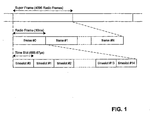
- the time domain UTRA framing has 4096 radio frames which make up a super frame with each radio frame consisting of 15 timeslots.
- a timeslot can be allocated to either Uplink (UL) or downlink (DL) transmission.
- Each CCTrCH has a particular set of characteristics, which change dynamically for each CCTrCH that is processed. Possible configuration parameters that may be applied dynamically to each CCTrCH include: number of TrCHs in a CCTrCH; CRC length; transport block size; type of channel coding; T ransmission T ime I nterleave (TTI) period; and amount of physical resource.
- An implementation of a CCTrCH processing stack may contain a mixture of hardware and software implementations of individual processing steps. Each processing step requires configuration information.
- UTRA Frequency Division Duplex FDD
- UTRA Time Division Duplex TDD
- FDD Frequency Division Duplex
- TDD Time Division Duplex
- users are separated in both the code domain and time domain.
- time domain employed in UTRA framing illustrated in FIG. 1 , 4096 radio frames make up a super frame with each radio frame consisting of 15 timeslots. A timeslot can be allocated to either Uplink (UL) or Downlink (DL) transmission.
- Transport Blocks (blocks of a defined number of bits) are submitted by the media access control (MAC) to L1 for processing.
- a Transport Block typically corresponds to a MAC protocol data unit (PDU) or corresponding unit.
- Layer 1 processes each Transport Block as shown in FIG. 2 to build up CCTrCHs. Firstly, cyclic redundancy check (CRC) attachment is performed at 205; then, transport block (TrBk) concatenation/code block segmentation is performed at 210. Next, channel coding is performed at 215; then, radio frame equalisation is performed at 220. Next, first interleaving is performed at 225; then, radio frame segmentation is performed at 230, and rate matching is performed at 235.
- CRC cyclic redundancy check
- TrBk transport block concatenation/code block segmentation
- channel coding is performed at 215; then, radio frame equalisation is performed at 220.
- first interleaving is performed at 225; then, radio frame segmentation is performed at
- a number of rate-matched data streams are multiplexed together on a single transport channel at 240; then, the resultant multiplexed data stream is processed by bit scrambling at 245.
- the bit-scrambled data stream is segmented into a number of physical channels at 250; then, second interleaving is performed on each of the segmented physical channel data streams at 255.
- physical channel mapping is performed at 260 to produce a number of CCTrCHs for physical channels such as PhCH#1 and PhCH#2. These CCTrCHs are mapped onto timeslots in known manner.
- Each CCTrCH has a particular set of characteristics. These characteristics change dynamically for each CCTrCH that is processed.
- an implementation of a CCTrCH processing stack may contain a mixture of hardware and software implementations of the individual processing steps shown in FIG. 2 . Each processing step requires configuration information.
- the present invention at least in the preferred embodiment described below, utilises a method for simplifying the problem of control of configuration parameters in a CCTrCH processing stack, though it can equally be applied to any processing stack that has dynamic configuration parameters.
- a CCTrCH configuration header 310 is attached to each of the CCTrCH data blocks when applying the data to the CCTrCH processing stack for processing CCTrCH information for communication across the UTRA TDD system's air interface.
- the CCTrCH configuration header 310 is internally derived (e.g., within a receiver by L1 Signalling) and, in a preferred embodiment, includes a TFI ( T ransport F ormat I ndicator) passed over the air-interface.
- the header 310 is read along with the input data 320 by the process in order to gain the configuration data the process requires.
- the same header 310 is then attached to its output data 320 (to form an integral CCTrCH data block 330) for use by the next process in the CCTrCH processing stack.
- the processing stage may also add extra configuration data (e.g., output data size) to the configuration header, that can save recalculation of certain parameters.
- the method and arrangement utilising configuration headers described above provides the advantages that the controlling entity does not need to store the configuration parameters for the CCTrCH, since they are passed in the configuration header; nor does the controlling entity need to keep track of the CCTrCH as it is processed by each of the processing steps; nor does the controlling entity need to calculate and control a following process with data output from a previous process, since the processing proceeds methodically from one process to another using the configuration headers.
- CCTrCH data may be carried out in software running on a processor (not shown), and that the software may be provided as a computer program element carried on any suitable data carrier (also not shown) such as a magnetic or optical computer disc.
- CCTrCH data may alternatively be carried out (in part or in whole) in hardware, for example in the form of an integrated circuit (not shown) such as an FPGA (Field Programmable Gate Array) or ASIC (Application Specific Integrated Integrated Circuit).
- an integrated circuit not shown
- FPGA Field Programmable Gate Array
- ASIC Application Specific Integrated Integrated Circuit
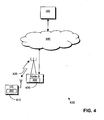
- a UTRA TDD system 400 includes a user terminal 410 (commonly referred to as 'User Equipment') which communicates over a CDMA radio link 420 with a base station 430 (commonly referred to as a 'Node B').
- the Node B 430 is controlled by a radio network controller 440, which communicates with other system infrastructure shown collectively as 450.
- processing stack or arrangement 300 described above for processing CCTrCH data may be advantageously implemented in either a UE 410 or a Node B 430 of the system as shown in the figure.
Landscapes
- Engineering & Computer Science (AREA)
- Computer Networks & Wireless Communication (AREA)
- Signal Processing (AREA)
- Mobile Radio Communication Systems (AREA)
- Communication Control (AREA)
Abstract
Description
- This invention relates to data processing in communication systems, and particularly though not exclusively to Coded Composite Transport Channel (CCTrCH) processing in packet-based UTRA TDD (UMTS - Universal Mobile Telecommunication System - Terrestrial Radio Access systems operating in Time Division Duplex mode).
- In a UMTS Terrestrial Radio Access Network (UTRAN) there are two modes of operation Frequency Division Duplex (FDD) and Time Division Duplex (TDD). In UTRA TDD, which is packet-based, users are separated in both the code domain and time domain. The time domain UTRA framing has 4096 radio frames which make up a super frame with each radio frame consisting of 15 timeslots. A timeslot can be allocated to either Uplink (UL) or downlink (DL) transmission.
- In a typical TDD system the UL and DL transmissions have to be synchronized to reduce interference. In addition DL broadcast signaling and UL random access signaling has to be supported. This leads to a partitioning of the radio frame with individual timeslots being dedicated for use either for DL or UL. UTRA specifies the processing that is applied to Transport Channel (TrCH) data by Layer 1 (L1) to build up CCTrCHs. These CCTrCHs are mapped onto timeslots.
- Each CCTrCH has a particular set of characteristics, which change dynamically for each CCTrCH that is processed. Possible configuration parameters that may be applied dynamically to each CCTrCH include: number of TrCHs in a CCTrCH; CRC length; transport block size; type of channel coding; Transmission Time Interleave (TTI) period; and amount of physical resource.
- An implementation of a CCTrCH processing stack may contain a mixture of hardware and software implementations of individual processing steps. Each processing step requires configuration information.
- The conventional approach has been to use a centralized controller for this processing. However this approach has the following disadvantages:
- 1) the controlling entity must store the configuration parameters for the CCTrCH;
- 2) the controlling entity must keep track of the CCTrCH as it is processed by each of the processing steps and recall the configuration parameters in order that they can be applied along with the data to the next processing step; and
- 3) as the amount of output data for a process is not necessarily the same as the input data the controlling entity must calculate and control the following process with this data.
- This conventional approach becomes complex when the configuration data changes dynamically for each CCTrCH as it is processed and the latency through each process changes depending on the configuration itself.
- A need therefore exists for processing of data in a communication system wherein the abovementioned disadvantage(s) may be alleviated.
- In accordance with a first aspect of the present invention there is provided a method, for data processing in a communication system, as claimed.in
claim 1. - In accordance with a second aspect of the present invention there is provided an arrangement, for data processing in a communication system, as claimed in claim 6.
- In accordance with a third aspect of the present invention there is provided a communication system as claimed in claim 11.
- One method and arrangement for processing of CCTrCH data in a packet data UTRA TDD system incorporating the present invention will now be described, by way of example only, with reference to the accompanying drawings, in which:
-
FIG. 1 shows a block schematic diagram illustrating time domain UTRA framing; -
FIG. 2 shows a block schematic diagram illustrating multiplexing and channel coding in UTRA; -
FIG. 3 shows a block schematic diagram illustrating an stack or arrangement for processing of CCTrCH data in a packet data UTRA TDD system incorporating the present invention; and -
FIG. 4 shows a block-schematic diagram of a UTRA TDD system in which the invention is used. - In a UMTS Terrestrial Radio Access Network (UTRAN) there are two modes of operation: UTRA Frequency Division Duplex (FDD) and UTRA Time Division Duplex (TDD). In UTRA TDD users are separated in both the code domain and time domain. In the time domain employed in UTRA framing, illustrated in
FIG. 1 , 4096 radio frames make up a super frame with each radio frame consisting of 15 timeslots. A timeslot can be allocated to either Uplink (UL) or Downlink (DL) transmission. - In a typical TDD system the UL and DL transmissions have to be synchronized to reduce interference. In addition DL broadcast signaling and UL random access signaling has to be supported. This leads to a possible partitioning of the radio frame as shown below:
0 1 2 3 4 5 6 7 8 9 10 11 12 13 14 DL DL DL DL DL DL DL DL UL UL UL UL UL UL UL FIG. 2 . - Transport Blocks (blocks of a defined number of bits) are submitted by the media access control (MAC) to L1 for processing. A Transport Block typically corresponds to a MAC protocol data unit (PDU) or corresponding unit.
Layer 1 processes each Transport Block as shown inFIG. 2 to build up CCTrCHs. Firstly, cyclic redundancy check (CRC) attachment is performed at 205; then, transport block (TrBk) concatenation/code block segmentation is performed at 210. Next, channel coding is performed at 215; then, radio frame equalisation is performed at 220. Next, first interleaving is performed at 225; then, radio frame segmentation is performed at 230, and rate matching is performed at 235. A number of rate-matched data streams are multiplexed together on a single transport channel at 240; then, the resultant multiplexed data stream is processed by bit scrambling at 245. The bit-scrambled data stream is segmented into a number of physical channels at 250; then, second interleaving is performed on each of the segmented physical channel data streams at 255. Finally, physical channel mapping is performed at 260 to produce a number of CCTrCHs for physical channels such asPhCH# 1 andPhCH# 2. These CCTrCHs are mapped onto timeslots in known manner. - Each CCTrCH has a particular set of characteristics. These characteristics change dynamically for each CCTrCH that is processed. The following lists examples of some of the possible configuration parameters that may be applied dynamically to each CCTrCH:
- 1) Number of TrCHs in a CCTrCH
- 2) CRC length
- 3) Transport Block Size
- 4) Type of Channel coding
- 5) Transmission Time Interleave (TTI) period
- 6) Amount of physical resource
- In practice, an implementation of a CCTrCH processing stack may contain a mixture of hardware and software implementations of the individual processing steps shown in
FIG. 2 . Each processing step requires configuration information. - The conventional approach is to use a centralized controller. However, this approach has a number of disadvantages:
- The controlling entity must store the configuration parameters for the CCTrCH.
- The controlling entity must keep track of the CCTrCH as it is processed by each of the processing steps and recall the configuration parameters in order that they can be applied along with the data to the next processing step.
- As the amount of output data for a process is not necessarily the same as the input data the controlling entity must calculate and control the following process with this data.
- This approach becomes complex when the configuration data changes dynamically for each CCTrCH as it is processed, and the latency through each process changes depending on the configuration itself.
- The present invention, at least in the preferred embodiment described below, utilises a method for simplifying the problem of control of configuration parameters in a CCTrCH processing stack, though it can equally be applied to any processing stack that has dynamic configuration parameters.
- Referring now to
FIG. 3 , to solve the problems of a centralized controller aCCTrCH configuration header 310 is attached to each of the CCTrCH data blocks when applying the data to the CCTrCH processing stack for processing CCTrCH information for communication across the UTRA TDD system's air interface. TheCCTrCH configuration header 310 is internally derived (e.g., within a receiver by L1 Signalling) and, in a preferred embodiment, includes a TFI (Transport Format Indicator) passed over the air-interface. - At each stage or processing element of the processing stack or
arrangement 300 theheader 310 is read along with theinput data 320 by the process in order to gain the configuration data the process requires. - The
same header 310 is then attached to its output data 320 (to form an integral CCTrCH data block 330) for use by the next process in the CCTrCH processing stack. The processing stage may also add extra configuration data (e.g., output data size) to the configuration header, that can save recalculation of certain parameters. - Thus, it will be understood, in employing the
configuration headers 310, in the above method: - 1) a
CCTrCH configuration header 310 is attached to every CCTrCH data block that is applied to a CCTrCH processing stack; - 2) the
CCTrCH configuration header 310 is treated as an integral part of theCCTrCH data 330; - 3) each processing stage in the CCTrCH processing stack interrogates the
CCTrCH configuration header 310 in order to gain the configuration data it requires; - 4) each processing stage in the CCTrCH processing stack attaches the
header 310 to itsoutput data 320; and - 5) each processing stage may add extra configuration data to the
CCTrCH header 310. - It will be understood and appreciated that the method and arrangement utilising configuration headers described above provides the advantages that the controlling entity does not need to store the configuration parameters for the CCTrCH, since they are passed in the configuration header; nor does the controlling entity need to keep track of the CCTrCH as it is processed by each of the processing steps; nor does the controlling entity need to calculate and control a following process with data output from a previous process, since the processing proceeds methodically from one process to another using the configuration headers.
- It will also be understood and appreciated that the method and arrangement described above allows CCTrCH processing to be performed, without the need for central control, by proceeding methodically from one processing step to another without prior knowledge of the processing latencies of each processing step.
- It will be appreciated that the method described above for processing of CCTrCH data may be carried out in software running on a processor (not shown), and that the software may be provided as a computer program element carried on any suitable data carrier (also not shown) such as a magnetic or optical computer disc.
- It will be also be appreciated that the method described above for processing of CCTrCH data may alternatively be carried out (in part or in whole) in hardware, for example in the form of an integrated circuit (not shown) such as an FPGA (Field Programmable Gate Array) or ASIC (Application Specific Integrated Integrated Circuit).
- It will further be appreciated that although the method described above for processing of CCTrCH data has been presented in the context of processing CCTrCH data for transmission, the same technique of using configuration headers passed between successive processing stages may equally be performed in processing received CCTrCH data. Referring now also to
FIG. 4 , aUTRA TDD system 400 includes a user terminal 410 (commonly referred to as 'User Equipment') which communicates over aCDMA radio link 420 with a base station 430 (commonly referred to as a 'Node B'). TheNode B 430 is controlled by aradio network controller 440, which communicates with other system infrastructure shown collectively as 450. Such a system (insofar as it has been described up to this point) is well known and need not be described further. However, it will be understood that the processing stack orarrangement 300 described above for processing CCTrCH data may be advantageously implemented in either aUE 410 or aNode B 430 of the system as shown in the figure. - It will further be appreciated that although the invention has been described above in the context of processing CCTrCH data in a UTRA TDD system, the invention may be generally applied to data processing in any communication system.
- In conclusion, therefore, it will be understood that the use of configuration headers in a data processing in a communication system as described avoids the disadvantages of using a central controller and allows processing to proceed from one processing step to another without requiring prior knowledge of the processing latencies of each processing step.
- The following numbered clauses provide further example aspects and features of the example embodiments:
- 1. A method for processing data in a communication system, the method comprising:
- providing a configuration header containing configuration data for use in processing data through a plurality of processes including a first process and a second process; and
- passing the configuration header with inter-process data from the first process to the second process, whereby the second process extracts configuration data from the configuration header passed from the first process.
- 2. The method of
clause 1, wherein the plurality of processes includes a third process, and the method further comprises the second process adding data to the configuration header passed from the first process and passing the resultant header to the third process with inter-process data. - 3. The method of
clause - 4. The method of
clause 3 wherein the communication system is a UTRA TDD system. - 5. The method of clause 4 wherein the method is for processing CCTrCH data.
- 6. An arrangement for processing data in a communication system, the arrangement comprising:
- means for providing a configuration header containing configuration data for use in processing data through a plurality of processing means including a first process means and a second processing means; and
- means for passing the configuration header with inter-process data from the first processing means to the second processing means,
- whereby the second processing means is arranged to extract configuration data from the configuration header passed from the first processing means.
- 7. The arrangement of clause 6, wherein the plurality of processing means includes a third processing means, and wherein the second processing means is arranged to add data to the configuration header passed from the first processing means and to pass the resultant header to the third process with inter-process data.
- 8. The arrangement of clause 6 or 7 wherein the communication system is a packet data wireless communication system.
- 9. The arrangement of clause 8 wherein the communication system is a UTRA TDD system.
- 10. The arrangement of clause 9 wherein the arrangement is arranged to process CCTrCH data.
- 11. A communication system including means for processing data comprising:
- means for providing a configuration header containing configuration data for use in processing data through a plurality of processing means including a first process means and a second processing means; and
- means for passing the configuration header with inter-process data from the first processing means to the second processing means,
- whereby the second processing means is arranged to extract configuration data from the configuration header passed from the first processing means.
- 12. The system of clause 11, wherein the plurality of processing means includes a third processing means, and wherein the second processing means is arranged to add data to the configuration header passed from the first processing means and to pass the resultant header to the third process with inter-process data.
- 13. The system of clause 11 or 12 wherein the communication system is a packet data wireless communication system.
- 14. The system of clause 13 wherein the communication system is a UTRA TDD system.
- 15. The system of clause 14 wherein the means for processing data is arranged to process CCTrCH data.
- 16. User equipment for use in a communication system, the user equipment comprising the arrangement of any one of clauses 6 to 10.
- 17. A base station for use in a communication system, the base station comprising the arrangement of any one of clauses 6 to 10.
- 18. A computer program element comprising computer program means for performing substantially the method of any one of
clauses 1 to 5. - 19. An integrated circuit comprising substantially the arrangement of any one of clauses 6 to 10.
Claims (15)
- A method for processing data in a communication system, the method comprising:providing a configuration header containing configuration data for use in processing data through a plurality of processes including a first process and a second process; andpassing the configuration header with inter-process data from the first process to the second process,whereby the second process extracts configuration data from the configuration header passed from the first process.
- The method of claim 1, wherein the plurality of processes includes a third process, and the method further comprises the second process adding data to the configuration header passed from the first process and passing the resultant header to the third process with inter-process data.
- The method of claim 1 wherein the communication system is a packet data wireless communication system.
- The method of claim 3 wherein the communication system is a UTRA TDD system.
- The method of claim 4 wherein the method is for processing CCTrCH data.
- An arrangement for processing data in a communication system, the arrangement comprising:means for providing a configuration header containing configuration data for use in processing data through a plurality of processing means including a first process means and a second processing means; andmeans for passing the configuration header with inter-process data from the first processing means to the second processing means,whereby the second processing means is arranged to extract configuration data from the configuration header passed from the first processing means.
- The arrangement of claim 6, wherein the plurality of processing means includes a third processing means, and wherein the second processing means is arranged to add data to the configuration header passed from the first processing means and to pass the resultant header to the third process with inter-process data.
- The arrangement of claim 6 wherein the communication system is a packet data wireless communication system.
- The arrangement of claim 8 wherein the communication system is a UTRA TDD system.
- The arrangement of claim 9 wherein the arrangement is arranged to process CCTrCH data.
- A communication system including means for processing data comprising:means for providing a configuration header containing configuration data for use in processing data through a plurality of processing means including a first process means and a second processing means; andmeans for passing the configuration header with inter-process data from the first processing means to the second processing means,whereby the second processing means is arranged to extract configuration data from the configuration header passed from the first processing means.
- The system of claim 11, wherein the plurality of processing means includes a third processing means, and wherein the second processing means is arranged to add data to the configuration header passed from the first processing means and to pass the resultant header to the third process with inter-process data.
- The system of claim 11 wherein the communication system is a packet data wireless communication system.
- User equipment for use in a communication system, the user equipment comprising the arrangement of claim 6.
- A base station for use in a communication system, the base station comprising the arrangement of claim 6.
Applications Claiming Priority (2)
| Application Number | Priority Date | Filing Date | Title |
|---|---|---|---|
| GB0129103A GB2382960B (en) | 2001-12-05 | 2001-12-05 | Method and arrangement for data processing in a communication system |
| EP02785622.8A EP1491008B1 (en) | 2001-12-05 | 2002-12-05 | Method, apparatuses and system for data processing in a UMTS Terrestrial Radio Access (UTRA) communication system |
Related Parent Applications (2)
| Application Number | Title | Priority Date | Filing Date |
|---|---|---|---|
| EP02785622.8A Division-Into EP1491008B1 (en) | 2001-12-05 | 2002-12-05 | Method, apparatuses and system for data processing in a UMTS Terrestrial Radio Access (UTRA) communication system |
| EP02785622.8 Division | 2002-12-05 |
Publications (1)
| Publication Number | Publication Date |
|---|---|
| EP2276208A1 true EP2276208A1 (en) | 2011-01-19 |
Family
ID=9927040
Family Applications (3)
| Application Number | Title | Priority Date | Filing Date |
|---|---|---|---|
| EP10184548.5A Expired - Lifetime EP2309697B1 (en) | 2001-12-05 | 2002-12-05 | Method and apparatus for data processing by a user terminal in a wireless communication system |
| EP10012171A Withdrawn EP2276208A1 (en) | 2001-12-05 | 2002-12-05 | Method and apparatuses for data processing in a communication system |
| EP02785622.8A Expired - Lifetime EP1491008B1 (en) | 2001-12-05 | 2002-12-05 | Method, apparatuses and system for data processing in a UMTS Terrestrial Radio Access (UTRA) communication system |
Family Applications Before (1)
| Application Number | Title | Priority Date | Filing Date |
|---|---|---|---|
| EP10184548.5A Expired - Lifetime EP2309697B1 (en) | 2001-12-05 | 2002-12-05 | Method and apparatus for data processing by a user terminal in a wireless communication system |
Family Applications After (1)
| Application Number | Title | Priority Date | Filing Date |
|---|---|---|---|
| EP02785622.8A Expired - Lifetime EP1491008B1 (en) | 2001-12-05 | 2002-12-05 | Method, apparatuses and system for data processing in a UMTS Terrestrial Radio Access (UTRA) communication system |
Country Status (5)
| Country | Link |
|---|---|
| US (2) | US7480276B2 (en) |
| EP (3) | EP2309697B1 (en) |
| AU (1) | AU2002350909A1 (en) |
| GB (1) | GB2382960B (en) |
| WO (1) | WO2003049385A2 (en) |
Families Citing this family (2)
| Publication number | Priority date | Publication date | Assignee | Title |
|---|---|---|---|---|
| GB2382960B (en) | 2001-12-05 | 2005-03-16 | Ipwireless Inc | Method and arrangement for data processing in a communication system |
| US8015313B2 (en) | 2008-03-04 | 2011-09-06 | Sony Corporation | Method and apparatus for managing transmission of TCP data segments |
Citations (3)
| Publication number | Priority date | Publication date | Assignee | Title |
|---|---|---|---|---|
| US5363315A (en) * | 1992-06-30 | 1994-11-08 | Motorola, Inc. | Method of communications between and within virtual radio interface standard layers |
| WO2000010302A1 (en) * | 1998-08-15 | 2000-02-24 | Roke Manor Research Limited | Programmable packet header processor |
| WO2000010297A1 (en) * | 1998-08-17 | 2000-02-24 | Vitesse Semiconductor Corporation | Packet processing architecture and methods |
Family Cites Families (21)
| Publication number | Priority date | Publication date | Assignee | Title |
|---|---|---|---|---|
| US5249292A (en) * | 1989-03-31 | 1993-09-28 | Chiappa J Noel | Data packet switch using a primary processing unit to designate one of a plurality of data stream control circuits to selectively handle the header processing of incoming packets in one data packet stream |
| US5175854A (en) * | 1989-06-19 | 1992-12-29 | Digital Equipment Corporation | Inter-applicataion interface system |
| US5020115A (en) * | 1989-07-10 | 1991-05-28 | Imnet Corporation | Methods and apparatus for dynamically scaling images |
| US5341369A (en) * | 1992-02-11 | 1994-08-23 | Vitesse Semiconductor Corp. | Multichannel self-routing packet switching network architecture |
| US5278834A (en) * | 1992-05-26 | 1994-01-11 | Alcatel Network Systems, Inc. | Method for implementing a data communication protocol stack |
| US5914953A (en) * | 1992-12-17 | 1999-06-22 | Tandem Computers, Inc. | Network message routing using routing table information and supplemental enable information for deadlock prevention |
| US5701479A (en) * | 1993-06-15 | 1997-12-23 | Xerox Corporation | Pipelined image processing system for a single application environment |
| US5995517A (en) * | 1996-01-31 | 1999-11-30 | Sanyo Electric Co., Ltd. | Multiplexed digital signal receiving device capable of miniaturizing the configuration of a signal receiving portion |
| US6434620B1 (en) * | 1998-08-27 | 2002-08-13 | Alacritech, Inc. | TCP/IP offload network interface device |
| US6424659B2 (en) * | 1998-07-17 | 2002-07-23 | Network Equipment Technologies, Inc. | Multi-layer switching apparatus and method |
| FI109568B (en) * | 2000-01-13 | 2002-08-30 | Nokia Corp | Optimized function in sleep mode |
| ATE418190T1 (en) * | 2000-01-14 | 2009-01-15 | Interdigital Tech Corp | WIRELESS COMMUNICATION SYSTEM WITH SELECTIVELY DIMENSIONED DATA TRANSPORT BLOCKS |
| US7009973B2 (en) * | 2000-02-28 | 2006-03-07 | Broadcom Corporation | Switch using a segmented ring |
| KR100516686B1 (en) * | 2000-07-08 | 2005-09-22 | 삼성전자주식회사 | Hybrid automatic repeat request method for cdma mobile system |
| US6845100B1 (en) * | 2000-08-28 | 2005-01-18 | Nokia Mobile Phones Ltd. | Basic QoS mechanisms for wireless transmission of IP traffic |
| GB2369006B (en) * | 2000-11-10 | 2004-04-07 | Nokia Mobile Phones Ltd | Mapping of internet protocol based data |
| US6959346B2 (en) * | 2000-12-22 | 2005-10-25 | Mosaid Technologies, Inc. | Method and system for packet encryption |
| AU2002326995A1 (en) * | 2001-09-19 | 2003-04-01 | Bay Microsystems, Inc. | Vertical instruction and data processing in a network processor architecture |
| GB2382960B (en) | 2001-12-05 | 2005-03-16 | Ipwireless Inc | Method and arrangement for data processing in a communication system |
| US7221657B2 (en) * | 2002-02-08 | 2007-05-22 | Telefonaktiebolaget Lm Ericsson (Publ) | Processing different size packet headers for a packet-based conversational service in a mobile communications system |
| US7415723B2 (en) * | 2002-06-11 | 2008-08-19 | Pandya Ashish A | Distributed network security system and a hardware processor therefor |
-
2001
- 2001-12-05 GB GB0129103A patent/GB2382960B/en not_active Expired - Fee Related
-
2002
- 2002-12-04 US US10/310,082 patent/US7480276B2/en not_active Ceased
- 2002-12-05 AU AU2002350909A patent/AU2002350909A1/en not_active Abandoned
- 2002-12-05 EP EP10184548.5A patent/EP2309697B1/en not_active Expired - Lifetime
- 2002-12-05 EP EP10012171A patent/EP2276208A1/en not_active Withdrawn
- 2002-12-05 WO PCT/GB2002/005526 patent/WO2003049385A2/en not_active Ceased
- 2002-12-05 EP EP02785622.8A patent/EP1491008B1/en not_active Expired - Lifetime
-
2011
- 2011-01-19 US US13/009,641 patent/USRE43926E1/en not_active Expired - Fee Related
Patent Citations (3)
| Publication number | Priority date | Publication date | Assignee | Title |
|---|---|---|---|---|
| US5363315A (en) * | 1992-06-30 | 1994-11-08 | Motorola, Inc. | Method of communications between and within virtual radio interface standard layers |
| WO2000010302A1 (en) * | 1998-08-15 | 2000-02-24 | Roke Manor Research Limited | Programmable packet header processor |
| WO2000010297A1 (en) * | 1998-08-17 | 2000-02-24 | Vitesse Semiconductor Corporation | Packet processing architecture and methods |
Non-Patent Citations (1)
| Title |
|---|
| ETSI: "Universal Mobile Telecommunications System (UMTS); Multiplexing and channel coding (FDD). (3G TS 25.212 version 3.1.1 Release 1999)", ETSI TS 125 212 V3.1.1 (2000-01), January 2000 (2000-01-01), France, pages 1 - 52, XP002161524 * |
Also Published As
| Publication number | Publication date |
|---|---|
| US7480276B2 (en) | 2009-01-20 |
| EP2309697A1 (en) | 2011-04-13 |
| EP1491008B1 (en) | 2014-10-15 |
| GB0129103D0 (en) | 2002-01-23 |
| GB2382960B (en) | 2005-03-16 |
| EP2309697B1 (en) | 2019-01-30 |
| GB2382960A (en) | 2003-06-11 |
| AU2002350909A1 (en) | 2003-06-17 |
| WO2003049385A2 (en) | 2003-06-12 |
| AU2002350909A8 (en) | 2003-06-17 |
| US20050018710A1 (en) | 2005-01-27 |
| EP1491008A2 (en) | 2004-12-29 |
| WO2003049385A3 (en) | 2003-08-21 |
| USRE43926E1 (en) | 2013-01-15 |
Similar Documents
| Publication | Publication Date | Title |
|---|---|---|
| EP1508980B1 (en) | Enhanced uplink data transmission | |
| US8023474B2 (en) | Systems and methods for communicating control data using multiple slot formats | |
| US6359904B1 (en) | Data transfer in a mobile telephone network | |
| CN1906892B (en) | Method and apparatus for providing an efficient control channel structure in a wireless communication system | |
| US7139260B2 (en) | Data transmission method and mobile telephone system | |
| CN1669232A (en) | Dynamic forward error correction in UTRA systems | |
| JP2003527010A (en) | Wireless signal transmission method, access network using the method, and wireless communication terminal | |
| JP4100632B2 (en) | Transport format data transmission | |
| JP2006505972A5 (en) | ||
| US6985471B1 (en) | Data transmission method, radio network subsystem, and user equipment | |
| EP1472803B1 (en) | METHOD AND ARRANGEMENT FOR ASYNCHRONOUS PROCESSING OF CCTrCH DATA | |
| USRE43926E1 (en) | Method and arrangement for data processing in a communication system | |
| KR20050110641A (en) | Components and methods for processing wireless communication data in presence of format uncertainty | |
| US20030147366A1 (en) | Combining transport formats having heterogeneous interleaving schemes | |
| EP1211858B1 (en) | Rate matching parameter calculation method, wireless communications base station apparatus, and wireless communications system | |
| EP1677463A1 (en) | Method and apparatus for selecting a transport format combination | |
| HK1077940A (en) | Dynamic forward error correction in utra systems | |
| HK1032498B (en) | Method and device for handling data in certain layers according to certain protocols in a mobile communications system | |
| HK1076669A (en) | A method and an apparatus for improving stability and capacity in cdma medium data rate systems |
Legal Events
| Date | Code | Title | Description |
|---|---|---|---|
| PUAI | Public reference made under article 153(3) epc to a published international application that has entered the european phase |
Free format text: ORIGINAL CODE: 0009012 |
|
| 17P | Request for examination filed |
Effective date: 20101129 |
|
| AC | Divisional application: reference to earlier application |
Ref document number: 1491008 Country of ref document: EP Kind code of ref document: P |
|
| AK | Designated contracting states |
Kind code of ref document: A1 Designated state(s): AT BE BG CH CY CZ DE DK EE ES FI FR GB GR IE IT LI LU MC NL PT SE SI SK TR |
|
| 17Q | First examination report despatched |
Effective date: 20160914 |
|
| STAA | Information on the status of an ep patent application or granted ep patent |
Free format text: STATUS: EXAMINATION IS IN PROGRESS |
|
| STAA | Information on the status of an ep patent application or granted ep patent |
Free format text: STATUS: THE APPLICATION IS DEEMED TO BE WITHDRAWN |
|
| 18D | Application deemed to be withdrawn |
Effective date: 20170125 |