EP2275872A1 - Electrophotographic toner and method of preparing the same - Google Patents
Electrophotographic toner and method of preparing the same Download PDFInfo
- Publication number
- EP2275872A1 EP2275872A1 EP10169036A EP10169036A EP2275872A1 EP 2275872 A1 EP2275872 A1 EP 2275872A1 EP 10169036 A EP10169036 A EP 10169036A EP 10169036 A EP10169036 A EP 10169036A EP 2275872 A1 EP2275872 A1 EP 2275872A1
- Authority
- EP
- European Patent Office
- Prior art keywords
- toner
- electrophotographic toner
- range
- electrophotographic
- latex particles
- Prior art date
- Legal status (The legal status is an assumption and is not a legal conclusion. Google has not performed a legal analysis and makes no representation as to the accuracy of the status listed.)
- Granted
Links
Images


Classifications
-
- G—PHYSICS
- G03—PHOTOGRAPHY; CINEMATOGRAPHY; ANALOGOUS TECHNIQUES USING WAVES OTHER THAN OPTICAL WAVES; ELECTROGRAPHY; HOLOGRAPHY
- G03G—ELECTROGRAPHY; ELECTROPHOTOGRAPHY; MAGNETOGRAPHY
- G03G9/00—Developers
- G03G9/08—Developers with toner particles
-
- G—PHYSICS
- G03—PHOTOGRAPHY; CINEMATOGRAPHY; ANALOGOUS TECHNIQUES USING WAVES OTHER THAN OPTICAL WAVES; ELECTROGRAPHY; HOLOGRAPHY
- G03G—ELECTROGRAPHY; ELECTROPHOTOGRAPHY; MAGNETOGRAPHY
- G03G9/00—Developers
- G03G9/08—Developers with toner particles
- G03G9/0821—Developers with toner particles characterised by physical parameters
-
- G—PHYSICS
- G03—PHOTOGRAPHY; CINEMATOGRAPHY; ANALOGOUS TECHNIQUES USING WAVES OTHER THAN OPTICAL WAVES; ELECTROGRAPHY; HOLOGRAPHY
- G03G—ELECTROGRAPHY; ELECTROPHOTOGRAPHY; MAGNETOGRAPHY
- G03G9/00—Developers
- G03G9/08—Developers with toner particles
- G03G9/0802—Preparation methods
- G03G9/0804—Preparation methods whereby the components are brought together in a liquid dispersing medium
-
- G—PHYSICS
- G03—PHOTOGRAPHY; CINEMATOGRAPHY; ANALOGOUS TECHNIQUES USING WAVES OTHER THAN OPTICAL WAVES; ELECTROGRAPHY; HOLOGRAPHY
- G03G—ELECTROGRAPHY; ELECTROPHOTOGRAPHY; MAGNETOGRAPHY
- G03G9/00—Developers
- G03G9/08—Developers with toner particles
- G03G9/0819—Developers with toner particles characterised by the dimensions of the particles
-
- G—PHYSICS
- G03—PHOTOGRAPHY; CINEMATOGRAPHY; ANALOGOUS TECHNIQUES USING WAVES OTHER THAN OPTICAL WAVES; ELECTROGRAPHY; HOLOGRAPHY
- G03G—ELECTROGRAPHY; ELECTROPHOTOGRAPHY; MAGNETOGRAPHY
- G03G9/00—Developers
- G03G9/08—Developers with toner particles
- G03G9/0827—Developers with toner particles characterised by their shape, e.g. degree of sphericity
-
- G—PHYSICS
- G03—PHOTOGRAPHY; CINEMATOGRAPHY; ANALOGOUS TECHNIQUES USING WAVES OTHER THAN OPTICAL WAVES; ELECTROGRAPHY; HOLOGRAPHY
- G03G—ELECTROGRAPHY; ELECTROPHOTOGRAPHY; MAGNETOGRAPHY
- G03G9/00—Developers
- G03G9/08—Developers with toner particles
- G03G9/087—Binders for toner particles
- G03G9/08742—Binders for toner particles comprising macromolecular compounds obtained otherwise than by reactions only involving carbon-to-carbon unsaturated bonds
- G03G9/08755—Polyesters
-
- G—PHYSICS
- G03—PHOTOGRAPHY; CINEMATOGRAPHY; ANALOGOUS TECHNIQUES USING WAVES OTHER THAN OPTICAL WAVES; ELECTROGRAPHY; HOLOGRAPHY
- G03G—ELECTROGRAPHY; ELECTROPHOTOGRAPHY; MAGNETOGRAPHY
- G03G9/00—Developers
- G03G9/08—Developers with toner particles
- G03G9/087—Binders for toner particles
- G03G9/08775—Natural macromolecular compounds or derivatives thereof
- G03G9/08782—Waxes
-
- G—PHYSICS
- G03—PHOTOGRAPHY; CINEMATOGRAPHY; ANALOGOUS TECHNIQUES USING WAVES OTHER THAN OPTICAL WAVES; ELECTROGRAPHY; HOLOGRAPHY
- G03G—ELECTROGRAPHY; ELECTROPHOTOGRAPHY; MAGNETOGRAPHY
- G03G9/00—Developers
- G03G9/08—Developers with toner particles
- G03G9/087—Binders for toner particles
- G03G9/08784—Macromolecular material not specially provided for in a single one of groups G03G9/08702 - G03G9/08775
- G03G9/08797—Macromolecular material not specially provided for in a single one of groups G03G9/08702 - G03G9/08775 characterised by their physical properties, e.g. viscosity, solubility, melting temperature, softening temperature, glass transition temperature
Definitions
- the present disclosure generally relates to an electrophotographic toner and methods for preparing an electrographic toner.
- Developers used to visualize electrostatic images or electrostatic latent images in electrographic or electrostatic processes can be classified into two-component developers and one-component developers.
- Two-component developers include toner and carrier particles whereas one-component developers consist exclusively of toner.
- One-component developers can be further classified into magnetic and nonmagnetic developers.
- nonmagnetic one-component developers often contain a fluidizing agent, such as colloidal silica.
- toner includes coloring particles obtained by dispersing a colorant, such as carbon black or other additives, in latex.
- Methods for preparing toner include pulverization and polymerization processes.
- toner is obtained by melting and mixing a synthetic resin with a colorant, and optionally, other additives. After pulverizing, this mixture undergoes sorting until the particles of the desired size are obtained.
- toner is obtained in the polymerization process by uniformly dissolving or dispersing various additives, such as a colorant, a polymerization initiator and, optionally, a cross-linking agent and an antistatic agent, in a polymerizable monomer.
- the polymerizable monomer composition is then dispersed in an aqueous dispersive medium, which includes a dispersion stabilizer, using an agitator to shape minute liquid droplet particles.
- the temperature of the composition is subsequently increased, and suspension polymerization is performed to obtain polymerized toner having coloring polymer particles of the desired size.
- toner used in an imaging apparatus is obtained by pulverization.
- pulverization it is difficult to precisely control the particle size, geometric size distribution, and the structure of toner, and thus, it is difficult to separately control the major characteristics of toner, such as charging characteristics, fixability, flowability, and preservation characteristics.
- polymerized toner has increased due to the simpler manufacturing process, which does not require sorting the particles, and due also to the ease of controlling the size of the particles.
- an agglomeration process for preparing agglomerated toner may be used through the use of a metal salt such as MgCl 2 , and the like, or a polymeric material such as polyaluminum chloride (PAC).
- a metal salt such as MgCl 2 , and the like
- a polymeric material such as polyaluminum chloride (PAC).
- the present disclosure provides an electrophotographic toner and methods for preparing the electrophotographic toner.
- an electrophotographic toner a method of preparing an electrophotographic toner, and a toner supplying unit, as set forth herein and in the appended claims.
- Preferred features of the invention will be apparent from the dependent claims, and the description which follows.
- the present disclosure provides an electrophotographic toner including a latex, a colorant, and a releasing agent, wherein the electrophotographic toner includes zinc (Zn), iron (Fe) and silicon (Si), wherein the [Zn]/[Fe] ratio is in the range of about 5.0 x 10 -2 to about 2.0 x 10 -2 , and the [Si]/[Fe] ratio is in the range of about 5.0 x 10 -4 to about 5.0 x 10 -2 , wherein [Zn], [Fe], and [Si] denote the intensities of Zn, Fe and Si, respectively, as measured by X-ray fluorescence spectrometry.
- the electrophotographic toner includes zinc (Zn), iron (Fe) and silicon (Si), wherein the [Zn]/[Fe] ratio is in the range of about 5.0 x 10 -2 to about 2.0 x 10 -2 , and the [Si]/[Fe] ratio is in the range of about 5.0 x 10
- the present disclosure provides an electrophotographic toner that has a log G'(60) in the range of about 0.70 x 10 1 to about 0.90 x 10 1 , and a logG ⁇ 60 - logG ⁇ 80 20 value of about 1.0 x 10 -1 to about 2.0 x 10 -1 , wherein G'(60) and G'(80) denote the storage moduli (Pa) of the electrophotographic toner at temperatures of 60 °C and 80 °C, respectively, when the dynamic viscoelasticity of the electrophotographic toner is measured at an angular velocity of 6.28 rad/sec, a temperature ramp rate of 2.0 °C/min, and an initial strain ratio of 0.3%.
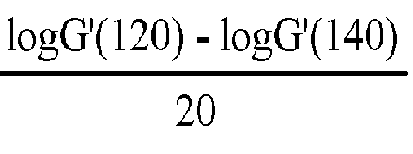
- the present disclosure provides an electrophotographic toner that has a logG ⁇ 120 - logG ⁇ 140 20 value of about 0 to about 5.0 x 10 -2 , wherein G'(120) and G'(140) denote the storage moduli (Pa) of the electrophotographic toner at temperatures of 120 °C and 140 °C, respectively, when the dynamic viscoelasticity of the electrophotographic toner is measured at an angular velocity of 6.28 rad/sec, a temperature ramp rate of 1.0 °C/min, and an initial strain ratio of 0.3%.
- the present disclosure provides an electrophotographic toner wherein the amount of each of Si and Fe may be in the range of about 3 to about 30,000 ppm.
- the present disclosure provides an electrophotographic toner wherein the latex may include at least two different polyester resins.
- the present disclosure provides an electrophotographic toner wherein the average particle diameter of the electrophotographic toner is in the range of about 3 to about 9 ⁇ m.
- the present disclosure provides an electrophotographic toner wherein the average circularity of the electrophotographic toner is in the range of about 0.940 to about 0.980.
- the present disclosure provides an electrophotographic toner wherein the volume average particle size distribution coefficient (GSDv) of the electrophotographic toner is about 1.3 or less, and the number average particle size distribution coefficient (GSDp) of the electrophotographic toner is about 1.3 or less.
- GSDv volume average particle size distribution coefficient
- GSDp number average particle size distribution coefficient
- the present disclosure provides a method of preparing an electrophotographic toner, including the steps of: a) mixing primary latex particles, a colorant dispersion, and a releasing agent dispersion to provide a mixed solution; b) adding an agglomerating agent to the mixed solution to provide a primary agglomerated toner; and c) coating the primary agglomerated toner with secondary latex particles to provide a secondary agglomerated toner, wherein the secondary latex particles are prepared by polymerizing at least one polymerizable monomer, wherein the electrophotographic toner comprises zinc (Zn), iron (Fe), and silicon (Si), wherein the [Zn]/[Fe] ratio is in the range of about 5.0 x 10 -2 to about 2.0 x 10 -2 , and the [Si]/[Fe] ratio is in the range of about 5.0 x 10 -4 to about 5.0 x 10 -2 , wherein [Zn], [Fe], and [Si] de
- the present disclosure provides a method of preparing an electrophotographic toner wherein the primary latex particles and the secondary latex particles may be each prepared using a polyester resin alone or a mixture of a polyester resin and a polymer prepared by polymerizing at least one polymerizable monomer.
- the present disclosure provides a method of preparing an electrophotographic toner wherein the primary latex particles and the secondary latex particles may be each prepared using at least two different polyester resins.
- the present disclosure provides a method of preparing an electrophotographic toner further including coating the secondary agglomerated toner with tertiary latex particles.
- the present disclosure provides a method of preparing an electrophotographic toner wherein the releasing agent dispersion includes a mixture of a paraffin-based wax and an ester-based wax; or an ester group-containing paraffin-based wax.
- the present disclosure provides a method of preparing an electrophotographic toner wherein the amount of the ester-based wax is in the range of about 5 to about 39 parts by weight% based on the total weight of the paraffin-based wax and the ester-based wax.
- the present disclosure provides a method of preparing an electrophotographic toner wherein the agglomerating agent includes a Si- and Fe-containing metal salt.
- the present disclosure provides a method of preparing an electrophotographic toner wherein the agglomerating agent includes polysilicate iron.
- the present disclosure provides a toner supplying unit including: a) a toner tank storing toner; b) a supplying part protruding from an inner surface of the toner tank to discharge toner from the toner tank; and c) a toner-agitating member rotatably disposed inside the toner tank to agitate toner in almost the entire inner space of the toner tank including a space above a top surface of the supplying part, wherein the toner comprises any electrophotographic toner described above.
- an electrophotographic toner that comprises a latex, a colorant and a releasing agent, and that further comprises zinc (Zn), iron (Fe) and silicon (Si), wherein the [Zn]/[Fe] ratio is in the range of about 5.0 x 10 -2 to about 2.0 x 10 -2 , and the [Si]/[Fe] ratio is in the range of about 5.0 x 10 -4 to about 5.0 x 10 -2 , wherein [Zn], [Fe], and [Si] denote the intensities of Zn, Fe and Si, respectively, as measured by X-ray fluorescence spectrometry.
- [Zn] corresponds to the amount of Zn contained in a Zn-containing compound that is used as a catalyst in polymerizing the latex, i.e., polyester resin, of toner. If [Zn] is too low, polymerization efficiency may be considerably low, and it may take longer to complete the reaction. On the other hand, if [Zn] is too large, the reaction rate may be too high to be controlled, and the molecular weight may be significantly increased so that it may not be able to fix the resulting toner at low temperatures. Furthermore, if [Zn] is too large, the electrical characteristics of the final toner may be adversely affected. Thus, [Zn] is to be controlled within an appropriate range.
- [Fe] corresponds to the amount of Fe contained in an agglomerating agent that is used to agglomerate the latex, the colorant and the releasing agent when toner is prepared.
- [Fe] may affect the agglomeration properties, the particle distribution and the particle size of agglomerated toner.
- the agglomerated toner may be a precursor for preparing a final toner.
- [Si] corresponds to the amount of Si contained in an agglomerating agent that is used to prepare toner, or the amount of Si contained in silica particles that are externally added to secure the flowability of toner.
- [Si] may affect the agglomeration properties, the particle distribution and the particle size of agglomerated toner, as [Fe] does, and may also affect the flowability of toner.
- the [Zn]/[Fe] ratio may be, for example, in the range of about 5.0 x 10 -2 to about 2.0 x 10 -2 , about 1.0 x 10 -1 to about 1.5 x 10 -2 , or about 2.0 x 10 -1 to about 1.0 x 10 -1 .
- [Zn]/[Fe] ratio is less than about 5.0 x 10 -4 , then [Zn] may be too low, and the polymerization rate may be too low to synthesize the latex. Furthermore, [Fe] is relatively increased, and thus the agglomeration properties and charging properties of toner may be adversely affected. On the other hand, if the [Zn]/[Fe] ratio is greater than about 2.0 x 10 -2 , then [Zn] may be too high, and thus the molecular weight of the latex may be excessively increased, or the charging properties may be adversely affected. Furthermore, the relative reduction of [Fe] may result in an ineffective agglomerating process, which may in turn affect the particle distribution and/or the particle size.
- the [Si]/[Fe] ratio may be, for example, in the range of about 5.0 x 10 -4 to about 5.0 x 10 -2 , about 8.0 x 10 -4 to about 3.0 x 10 -2 , or about 1.0 x 10 -3 to about 1.0 x 10 -2 .
- the [Si]/[Fe] ratio is less than about 5.0 x 10 -4 , then the amount of silica, which is used as an external additive, may be too low, and thus the flowability of toner may degrade. On the other hand, if the [Si]/[Fe] ratio is greater than about 5.0 x 10 -2 , then the amount of externally added silica may be too high, possibly resulting in the contamination of the internal components of the image forming apparatus in which the toner is employed.
- the electrophotographic toner may have a log G'(60) in the range of about 0.70 x 10 1 to about 0.90 x 10 1 , and a logG ⁇ 60 - logG ⁇ 80 20 value of about 1.0 x 10 -1 to about 2.0 x 10 -1 .
- the electrophotographic toner may have a logG ⁇ 120 - logG ⁇ 140 20 value of about 0 to about 0.05.
- G'(60), G'(80), G'(120), and G'(140) refer to storage moduli (Pa) at 60 °C, 80 °C, 120 °C and 140 °C, respectively, which are obtained by measuring the dynamic viscoelasticities of the toner using a circular disc-type rheometer (for example, TA ARES available from TA Instruments of New Castle, Delaware, U.S.A.) having two circular discs, at an angular velocity of 6.28 rad/sec, a temperature ramp rate of 1.0 °C/min, and an initial strain ratio of 0.3%, wherein the strain ratio is automatically controlled during the measurement.
- TA ARES available from TA Instruments of New Castle, Delaware, U.S.A.
- the dynamic viscoelasticity of toner may be dependent on the thermal properties (for example, the glass transition temperature (Tg)), the degree of cross-linking of toner, the dispersion property, compatibility, the particle size distribution, and the material used.
- Tg glass transition temperature
- G'(60) and G'(80) that is, viscoelasticity at a temperature of 100 °C or less is dependent on the glass transition temperature Tg and the melting temperature Tm of latex and wax, the type of agglomerating agent, or the colorant, etc.
- G'(120) and G'(140) that is, viscoelasticity at a temperature higher than 100 °C is highly dependent on the internal dispersion properties, the molecular weight, the degree of cross-linking, and the particle size distribution of toner, etc., rather than thermal properties of latex or wax.
- G'(60), G'(80), G'(120) and G'(140) may be determined according to the physical characteristics of source materials such as the latex, the colorant, the releasing agent and the agglomerating agent, etc., used to prepare the toner, and the physical characteristics of the toner prepared.
- G'(60), G'(80), G'(120) and G'(140) may be used to predict fusing-related characteristics of toner.
- Fusing-related characteristics may include, for example, a cold offset, a minimum fusing temperature (MFT) and a fusing latitude.
- MFT minimum fusing temperature
- the electrophotographic toner may have a logG'(60) value of, for example, in the range of about 0.70 x 10 1 to about 0.90 x 10 1 , about 0.73 x 10 1 to about 0.87 x 10 1 , or about 0.75 x 10 1 to about 0.85 x 10 1 . If the electrophotographic toner has a logG'(60) value within the above ranges, the modulus of elasticity of the toner can be appropriately maintained at 60 °C, which is an initial ramp temperature in a fusing process, and thus the toner may not be deformed in a toner transfer process. In addition, such electrophotographic toner may have excellent storage characteristics at high temperatures and developing characteristics that are not sensitive to the environmental conditions, and may exhibit acceptable durability for use in an image forming apparatus, e.g., in a printer.
- the electrophotographic toner may have a logG ⁇ 60 - logG ⁇ 80 20 value in the range of, for example, about 1.0 x 10 -1 to about 2.0 x 10 -1 , about 1.2 x 10 -1 to about 1.8 x 10 -1 , about 1.3 x 10 -1 to about 1.7 x 10 -1 .
- the electrophotographic toner has a logG ⁇ 60 - logG ⁇ 80 20 value within the above range, the slope of the modulus of elasticity of toner is sharply reduced at near the melting temperature of the latex, and thus toner may be sufficiently melt in a fusing process, and thus fused at low temperatures within a short time (i.e., high fusing speed) with a lower amount of heat.
- a short time i.e., high fusing speed
- the electrophotographic toner may have a logG ⁇ 120 - logG ⁇ 140 20 value of, for example, in the range of about 0 to about 5.0 x 10 -2 , about 1.0 x 10 -2 to about 4.0 x 10 -2 , or about 1.5 x 10 -2 to about 3.5 x 10 -2 .
- the slope of the storage modulus may be gradual at high temperatures of 120-140 °C, and a toner offset, which may occur when fused at a high temperature, may be minimized.
- the amounts of Si and Fe contained in the electrostatic toner may each be in the range of, for example, about 3 to about 30,000 ppm, about 30 to about 25,000 ppm, or about 300 to 20,000 ppm.
- the toner may have improved charging characteristics, and may result in a reduction of contamination of the internal portions of the image forming apparatus in which such toner is used.
- the latex of the electrostatic toner may consist exclusively of a polyester resin or may include a mixture (hybrid) of a polyester resin and a polymer synthesized by polymerizing at least one polymerizable monomer.
- This type of polyester resin may be obtained through the condensation reaction of a bivalent fatty acid and a bivalent alcohol.
- Any polyester resin may be used without limitation, provided that it is suitable for manufacturing a high-glossy electrostatic toner that may be fused at low temperatures, that has excellent thermal storage characteristics, and that may form high-quality images with color reproducibility.
- such a polyester resin may have a weight average molecular weight of about 1.0 x 10 4 to about 4.0 x 10 4 g/mol, and a glass transition temperature (Tg) of about 50 to 70 °C.
- the latex of the electrostatic toner may include at least two kinds of polyester resins having different weight average molecular weights and different glass transition temperatures.
- the electrophotographic toner according to the present disclosure may have a volume average particle size in the range of about 3 to about 9 ⁇ m, about 4 to about 8 ⁇ m, or about 4.5 to about 7.5 ⁇ m.
- the smaller toner particle size the higher the resolution and the higher the quality of an image may be acheived.
- small toner particles may not be appropriate for all applications.
- the appropriate toner particle size is an important consideration.
- the volume average particle diameter of toner may be measured by electrical impedance analysis.
- volume average particle diameter of toner When the volume average particle diameter of toner is greater than or equal to about 3 ⁇ m, it may be easier to clean a photoreceptor, mass-production yield can be improved, and no harmful effects on the human body are caused due to scattering. On the other hand, when the volume average particle diameter of toner is equal to or less than about 9 ⁇ m, this may lead to uniform charging, may improve fixing characteristics of toner, and may make it easier to regulate the toner layer with a doctor blade.
- the electrophotographic toner may have an average circularity in the range of about 0.940 to about 0.980, about 0.945 to about 0.975, or about 0.950 to about 0.970.
- the circularity may be in the range of 0 to 1, and as the circularity approaches 1, toner particle shape becomes more circular.
- an image developed on a transfer medium may have an appropriate thickness, and thus toner consumption may be reduced. In addition, voids between toner particles are not too large, and thus the image developed on the transfer medium may have a sufficient coating rate.
- the electrophotographic toner has an average circularity of 0.980 or less, an excessive amount of toner being supplied onto a development sleeve can be prevented, making it possible to reduce the contamination of the development sleeve that may result from the non-uniform coating of toner thereon.
- the toner particle distribution coefficients may include a volume average particle size distribution coefficient (GSDv) or a number average particle size distribution coefficient (GSDp), which may be measured as follows.
- GSDv volume average particle size distribution coefficient
- GSDp number average particle size distribution coefficient
- a toner particle size distribution is obtained from toner particle diameters measured using a particle sizing and counting analyzer, for example, the MultisizerTM III available from Beckman Coulter, Inc. of Fullerton, California, U.S.A.
- Toner particle diameter distribution is then divided into predetermined particle diameter ranges (channels). With respect to the respective particle diameter ranges (channels), the cumulative volume distribution of toner particles and the cumulative number distribution of toner particles are measured, wherein, in each of the cumulative volume and number distributions, the particle size in each distribution is increased in a direction from left to right.
- a cumulative particle diameter at 16% of the respective cumulative distributions is defined as a volume average particle diameter D16v and a number average particle diameter D16p.
- a cumulative particle diameter at 50% of the respective cumulative distributions is defined as a volume average particle diameter D50v and a number average particle diameter D50p.
- a cumulative particle diameter at 84% of the respective cumulative distributions is defined as a volume average particle diameter D84v and a number average particle diameter D84p.
- the GSDv and the GSDp may be obtained using the relations that the GSDv is defined as (D84v/D16v)0.5, and the GSDp is defined as (D84p/D16p)0.5.
- the GSDv and the GSDp may be each about 1.30 or less, in the range of about 1.15 to about 1.30, or in the range of about 1.20 to about 1.25.
- the electrophotographic toner may have a uniform particle diameter.
- a method of preparing the electrophotographic toner may include: a) mixing primary latex particles, a colorant dispersion, and a releasing agent dispersion to provide a mixed solution; b) adding an agglomerating agent to the mixed solution to provide a primary agglomerated toner; and c) coating the primary agglomerated toner with secondary latex particles to provide a secondary agglomerated toner, wherein the secondary latex particles are prepared by polymerizing at least one polymerizable monomer.
- the electrophotographic toner prepared according to an embodiment of the present disclosure may comprise zinc (Zn), iron (Fe) and silicon (Si), wherein the [Zn]/[Fe] ratio is in the range of about 5.0 x 10 -2 to about 2.0 x 10 -2 , and wherein the [Si]/[Fe] ratio is in the range of about 5.0 x 10 -4 to about 5.0 x 10 -2 .
- [Zn], [Fe] and [Si] denote the respective intensities of Zn, Fe and Si measured by X-ray fluorescence spectrometry.
- the primary latex particles may consist exclusively of a polyester resin or may include a mixture (hybrid) of a polyester resin and a polymer synthesized by polymerizing at least one polymerizable monomer.
- This type of polyester resin may be obtained through the condensation reaction of a bivalent fatty acid and a bivalent alcohol.
- Any polyester resin may be used without limitation, provided that it is suitable for manufacturing a high-glossy electrostatic toner that may be fused at low temperatures, that has excellent thermal storage characteristics, and that may form high-quality images with color reproducibility.
- such a polyester resin may have a weight average molecular weight of about 1.0 x 10 4 to about 4.0 x 10 4 g/mol, and a glass transition temperature (Tg) of about 50 to 70 °C.
- the primary latex particles may be prepared from at least two kinds of polyester resins having different weight average molecular weights and different glass transition temperatures.
- bivalent fatty acid examples include, but are not limited to, aliphatic dicarboxylic acid and aromatic dicarboxylic acid, which may be used alone or in combination.
- aliphatic dicarboxylic may include, but are not limited to, oxalic acid, malonic acid, succinic acid, glutaric acid, adipic acid, pimelic acid, suberic acid, azelaic acid, sebacic acid, 1,9-nonanedicarboxylic acid, 1,10-decanedicarboxylic acid, 1,11-undecanedicarboxylic acid, 1,12-dodecanedicarboxylic acid, 1,13-tridecanedicarboxylic acid, 1,14-tetradecanedicarboxylic acid, 1,16-hexadecanedicarboxylicacid, 1,18-octadecanedicarboxylicacid, lower alkylesters or acid anhydrides thereof, etc.
- aromatic dicarboxylic acid may include, but are not limited to, terephthalic acid, isophthalic acid, orthophthalic acid, t-butylisophthalic acid, 2,6-naphthalenedicarboxylic acid, 4,4'-biphenyldicarboxylic acid, and the like.
- bivalent alcohol may include, but are not limited to, ethyleneglycol, 1,3-propanediol, 1,4-butanediol, 1,5-pentanediol, 1,6-hexanediol, 1,7-heptanediol, 1,8-octanediol, 1,9-nonanediol, 1,10-decanediol, 1,11-undecanediol, 1,12-dodecanediol, 1,13-tridecanediol, 1,14-tetradecanediol, 1,18-octadecanediol, 1,20-eicosanediol, and the like.
- Examples of a catalyst that may be used to prepare such a polyester resin include, but are not limited to, an alkali metal compound including sodium (Na), lithium (Li) or the like; an alkali earth metal compound including magnesium (Mg), calcium (Ca) or the like; a metal compound including zinc (Zn), manganese (Mn), antimony (Sb), titanium (Ti), tin (Sn), zirconium (Zr), germanium (Ge) or the like; a phosphorous acid compound; a phosphoric acid compound; an amine compound, and the like.
- an alkali metal compound including sodium (Na), lithium (Li) or the like
- an alkali earth metal compound including magnesium (Mg), calcium (Ca) or the like
- a metal compound including zinc (Zn), manganese (Mn), antimony (Sb), titanium (Ti), tin (Sn), zirconium (Zr), germanium (Ge) or the like a phosphorous acid compound; a
- the primary latex particles which are prepared using such a polyester resin, may be prepared through an inverse phase emulsification from a dispersion prepared by dispersing a polyester resin prepared through condensation polymerization, an alkali compound, and, optionally, a surfactant, in water.
- the primary latex particles may be prepared through three processes, i.e., dissolution, emulsification, and desolvation.
- a polyester resin solution is prepared by dissolving a polyester resin in an organic solvent. Any organic solvent that can dissolve the polyester resin may be used without limitation.
- a basic compound and water are added to the polyester resin solution prepared in the dissolution process, and are subjected to a phase inversion emulsification.
- a surfactant may further be added.
- the amount of the basic compound is determined based an equivalent ratio to the amount of the carboxylic acid calculated from the acid value of the polyester resin.
- the resulting primary latex particles may have a volume average diameter of about 1 ⁇ m or less, in the range of about 100 to about 300 nm, or in the range of about 150 to about 250 nm.
- the primary latex particles may be prepared from a mixture of the polyester resin and a polymer prepared by polymerizing at least one polymerizable monomer.
- the at least one polymerizable monomer used herein may include, but are not limited to, at least one polymerizable monomer selected from the group consisting of styrene-based monomers such as styrene, vinyltoluene, or ⁇ -methylstyrene; acrylic acids, methacrylic acids; derivatives of (meth)acrylic acid such as methyl acrylate, ethyl acrylate, propyl acrylate, butyl acrylate, 2-ethylhexyl acrylate, dimethylaminoethyl acrylate, methyl methacrylate, ethyl methacrylate, propyl methacrylate, butyl methacrylate, 2-ethylhexyl methacrylate, dimethylaminoethyl methacrylate,
- a polymerization initiator and a chain transfer agent may be further used.
- polymerization initiator examples include, but are not limited to, persulfates such as potassium persulfate or ammonium persulfate; azo compounds such as 4,4-azobis(4-cyano valeric acid), dimethyl-2,2'-azobis(2-methylpropionate), 2,2-azobis(2-amidinopropane)dihydrochloride, 2,2-azobis-2-methyl-N-1,1-bis(hydroxymethyl)-2-hydroxyethylpropioamide, 2,2'-azobis(2,4-dimethylvaleronirile), 2,2'-azobisisobutyronirile, or 1,1'-azobis(1-cyclohexancarbonirile); and peroxides such as methylethylperoxide, di-t-butylperoxide, acetylperoxide, dikumylperoxide, lauroylperoxide, benzoylperoxide, t-butylperoxy-2-ethylhexano
- a chain transfer agent refers to a material that changes the type of a chain carrier when a chain reaction occurs, and may include a material capable of weakening the activity of a new chain to be less than the activity of existing chains.
- the degree of polymerization of polymerizable monomers may be reduced, and reaction for a novel chain may be initiated.
- the molecular weight distributions of toner may be controlled.
- the amount of the chain transfer agent may be in the range of about 0.1 to about 5 parts by weight, about 0.2 to about 3 parts by weight, or about 0.5 to about 2.0 parts by weight, based on 100 parts by weight of the at least one polymerizable monomer. If the amount of the chain transfer agent is within the above ranges, the molecular weight of the toner may be appropriately controlled, and thus the toner may have improved agglomeration efficiency and fixing characteristics.
- chain transfer agent may include, but are not limited to, sulfur-containing compounds such as dodecanethiol, thioglycolic acid, thioacetic acid, and mercaptoethanol; phosphorous acid compounds such as a phosphorous acid and sodium phosphorous acid; hypophosphorous acid compounds such as a hypophosphorous acid and a sodium hypophosphorous acid; and alcohols such as methyl alcohol, ethyl alcohol, isopropyl alcohol, n-butyl alcohol, and the like.
- sulfur-containing compounds such as dodecanethiol, thioglycolic acid, thioacetic acid, and mercaptoethanol
- phosphorous acid compounds such as a phosphorous acid and sodium phosphorous acid
- hypophosphorous acid compounds such as a hypophosphorous acid and a sodium hypophosphorous acid
- alcohols such as methyl alcohol, ethyl alcohol, isopropyl alcohol, n-butyl alcohol, and the like.
- the primary latex particles may further include a charge controller.
- the charge controller used according to an embodiments of the present disclosure may be a negatively charged charge controller or a positively charged charge controller.
- Examples of the negatively charged charge controller may include, but are not limited to, organic metal complexes such as a chromium containing azo complex and a mono-azo metal complex, or chelate compounds; metal-containing salicylic acid compounds wherein the metal may be chromium, iron, or zinc; and organic metal complexes such as aromatic hydroxycarboxylic acids or aromatic dicarboxylic acid.
- the positively charged type charge control agent may be a modified product such as nigrosine and a fatty acid metal salt thereof and an onium salt including a quaternary ammonium salt such as tributylammonium 1-hydroxy-4-naphthosulfonate and tetrabutylammonium tetrafluoro borate.
- These charge control agents may be used alone or in combination of at least two thereof.
- the charge controller may operate to stably support toner on a development roller with an electrostatic force. Thus, by using the charge controller, stable and high-speed charging may be ensured.
- the primary latex particles obtained as described above may be mixed with the colorant dispersion and the releasing agent dispersion to prepare a mixed solution.
- the colorant dispersion may be obtained by uniformly dispersing a composition including a colorant, such as a black colorant, a cyan colorant, a magenta colorant, or a yellow colorant, and an emulsifier by using an ultrasonic homogenizer or a micro fluidizer.
- the black colorant may be carbon black or aniline black.
- at least one colorant selected from the group consisting of the cyan colorant, the magenta colorant, and the yellow colorant may be further used in addition to the black colorant.
- the yellow colorant may be a condensed nitrogen compound, an isoindolinone compound, an anthraquinone compound, an azo metal complex, or an alkyl imide compound.
- Examples of the yellow colorant include, but are not limited to, C.I. pigment yellows 12, 13, 14, 17, 62, 74, 83, 93, 94, 95, 109, 110, 111, 128, 129, 147, 168, and 180.
- magenta colorant examples include, but are not limited to, condensed nitrogen compounds, anthraquine compounds, quinacridone compounds, base dye lake compounds, naphthol compounds, benzo imidazole compounds, thioindigo compounds, and perylene compounds.
- magenta colorant examples include, but are not limited to, C.I. pigment reds 2, 3, 5, 6, 7, 23, 48:2, 48:3, 48:4, 57:1, 81:1, 122, 144, 146, 166, 169, 177, 184, 185, 202, 206, 220, 221, and 254.
- Examples of the cyan colorant include, but are not limited to, copper phthalocyanine compounds and derivatives thereof, anthraquinone compounds, and base dye lake compounds. Specifically, examples of the cyan colorant include, but are not limited to, C.I. pigment blues 1, 7, 15, 15:1, 15:2, 15:3, 15:4, 60, 62, and 66.
- colorants may be used alone or in combination, and may be selected in consideration of color, chromaticity, brightness, weather resistance, or dispersibility in toner.
- the amount of the colorant used to prepare the colorant dispersion may be in the range of about 0.5 to about 15 parts by weight, about 1 to about 12 parts by weight, or about 2 to about 10 parts by weight, based on 100 parts by weight of toner. When the amount of the colorant is greater than or equal to 0.5 parts by weight based on 100 parts by weight of toner, a sufficient coloring effect may be obtained. When the amount of the colorant is less than or equal to about 15 parts by weight based on 100 parts by weight of toner, a sufficient electrification quantity may be obtained without a significant increase of toner manufacturing costs.
- the emulsifier used to prepare the colorant dispersion may be any emulsifier known to those skilled in the art.
- the emulsifier may be an anionic reactive emulsifier, a non-ionic reactive emulsifier, or a mixture thereof.
- the anionic reactive emulsifier may be, for example, HS-10 (available from Dai-Ichi Kogyo Seiyaku Co., Ltd. of Kyoto, Japan) or DOWFAXTM 2A1 (manufactured by The Dow Chemical Company of Midland, Michigan, U.S.A.).
- the non-ionic reactive emulsifier may be RN-10 (available from Dai-Ichi Kogyo Seiyaku Co., Ltd.).
- the releasing agent dispersion used in the method of preparing the electrophotographic toner may include a releasing agent, water, or an emulsifier.
- the releasing agent enables toner to be fixed to a final-image receptor at a low fixing temperature and to have excellent final image durability and resistance to abrasion. Thus, characteristics of toner are very dependent on the type and amount of the releasing agent.
- suitable releasing agents include, but are not limited to, polyethylene-based wax, polypropylene-based wax, silicon wax, paraffin-based wax, ester-based wax, carnauba wax, and metallocene wax.
- the releasing agent may have a melting point of about 50 to about 150 °C.
- the releasing agent is physically attached to toner particles, but is not covalently bonded with toner particles, and thus enables toner to be fixed to the final-image receptor at a low temperature, and thus provides a final image that has excellent durability and resistance to abrasion.
- the amount of the releasing agent may be in the range of about 1 to about 20 parts by weight, about 2 to about 16 parts by weight, or about 3 to about 12 parts by weight, based on 100 parts by weight of toner.
- the amount of the releasing agent is greater than or equal to about 1 part by weight based on 100 parts by weight of toner, toner may have good low-temperature characteristics and a sufficiently wide fixing temperature range.
- the amount of the releasing agent is less than or equal to about 20 parts by weight based on 100 parts by weight of toner, toner may have improved preservation characteristics and may be prepared at a lower manufacturing cost.
- the releasing agent may be an ester group-containing wax.
- the ester group-containing wax may include a mixture of an ester-based wax and a non-ester based wax; and an ester group-containing wax prepared by adding an ester group to a non-ester based wax.
- the wax may be uniformly distributed among toner particles, and thus may effectively function.
- the non-ester based wax has a releasing effect on the latex, and thus may suppress excessive plasticizing reactions, which occur when an ester-based wax is exclusively used. Therefore, toner may retain satisfactory development characteristics for a long period of time.
- ester-based wax examples include, but are not limited to, esters of monovalent to pentavalent alcohols and C15-C30 fatty acids such as behenic acid behenyl, staric acid stearyl, stearic acid ester of pentaeritritol, or montanic acid glyceride. Also, if an alcohol component constituting the ester is a monovalent alcohol, it may include 10 to 30 carbon atoms. If an alcohol component constituting the ester is a polyvalent alcohol, it may include 3 to 10 carbon atoms.
- the non-ester based wax may be polymethylene-based wax or paraffin-based wax.
- ester group-containing wax examples include, but are not limited to: a mixture of a paraffin-based wax and an ester-based wax; and an ester group-containing paraffin-based wax.
- ester group-containing wax may also include P-280, P-318, and P-319 (available from Chukyo Yushi Co., Ltd. of Nagoya, Japan).
- the amount of the ester-based wax in the releasing agent may be in the range of about 5 to about 39 weight%, about 7 to about 36 weight%, or about 9 to about 33 weight%, based on the total weight of the releasing agent.
- toner When the amount of the ester-based wax is greater than or equal to about 5 weight% based on the total weight of the releasing agent, the compatibility of the ester-based wax with the primary latex particles may be sufficiently maintained. When the amount of the ester-based wax is less than or equal to about 39 weight% based on the total weight of the releasing agent, toner may have appropriate plasticizing characteristics, and thus may retain satisfactory development characteristics for a long period of time.
- any emulsifier that is used in the art may be used as an emulsifier for the releasing agent.
- the emulsifier available for the releasing agent dispersion include, but are not limited to, an anionic reactive emulsifier, a non-ionic reactive emulsifier, and mixtures thereof.
- the anionic reactive emulsifier may be HS-10 (Dai-Ichi Kogyo Seiyaku Co., Ltd.) or DOWFAXTM 2A1 (The Dow Chemical Company).
- the non-ionic reactive emulsifier may be RN-10 (Dai-Ichi Kogyo Seiyaku Co., Ltd.).
- the molecular weight, glass transition temperature (Tg) and the rheological characteristics of the primary latex particles may be appropriately controlled through the method described above in such a way that toner may be fixed at low temperature.
- the primary latex particles, the colorant dispersion and the releasing agent dispersion prepared as described above are mixed to obtain a mixed solution.
- an agglomerating agent is added to the mixed solution to prepare an agglomerated toner.
- an agglomerating agent is added thereto at a pH of about 0.1 to about 4.0, and subjected to agglomeration at a temperature of about 25 to about 60 °C, for example, about 35 to about 50 °C, which is lower than the glass transition temperature (Tg) of the primary latex particles, and then to fusing at a temperature of about 85 to about 100 °C (a temperature that is about 30 to 50 °C higher than the Tg), thereby forming the primary agglomerated toner having a particle size of 4 to 7 ⁇ m.
- Tg glass transition temperature
- miniature toner having a particle size of 0.5 to 3 ⁇ m may first be prepared, followed by agglomeration to finally obtain the primary agglomerated toner having a particle size of 4 to 7 ⁇ m.
- secondary latex particles which act as a shell, are added thereto, and the pH of the system is adjusted to a pH of 6 to 9 and left until a particle size of the mixture is maintained constant for a predetermined period of time. Then, the temperature is raised to 90 to 98 °C, and the pH is lowered to 5 to 6 in order to coalesce the mixture into secondary agglomerated toner.
- a Si- and Fe-containing metal salt may be used as the agglomerating agent.
- the primary agglomerated toner may have a larger particle size due to enhanced ionic strength and interparticular collisions.
- the Si and Fe-containing metal salt may include polysilicate iron.
- Examples of the Si and Fe-containing metal include, but are not limited to, PSI-025, PSI-050, PSI-075, PSI-100, PSI-200, and PSI-300, which are products manufactured by Suido Kiko Co. Table 1 shows the physical properties and compositions of PSI-025, PSI-050, PSI-075, PSI-100, PSI-200, and PSI-300.
- the amount of the agglomerating agent may be in the range of about 0.1 to about 10 parts by weight, about 0.5 to about 8 parts by weight, or about 1 to about 6 parts by weight, based on 100 parts by weight of the primary latex particles. In this regard, when the amount of the agglomerating agent is greater than or equal to about 0.1 parts by weight, agglomeration efficiency may increase. When the amount of the agglomerating agent is less than or equal about 10 parts by weight, the charging properties of toner may not be degraded, and the particle size distribution may become more uniform.
- the secondary latex particles may be prepared from a polyester resin alone or from a mixture (hybrid) of a polyester resin and a polymer prepared by polymerizing at least one polymerizable monomer.
- the resulting secondary latex particles may have a volume average diameter, of about 1 ⁇ m or less, or a volume average diameter in the range of about 100 to about 300 nm.
- Such secondary latex particles may also include a releasing agent, which may be incorporated into the secondary latex particles in a polymerization process.
- the secondary agglomerated toner may be additionally coated with tertiary latex particles.
- the tertiary latex particles may also be prepared from a polyester resin alone or a mixture (hybrid) of a polyester resin and a polymer prepared by polymerizing at least one polymerizable monomer.
- toner By forming the shell layer with the secondary latex particles or tertiary latex particles, toner may have higher durability and excellent preservation characteristics during shipping and handling.
- a polymerization inhibitor may be further added to prevent formation of new latex particles.
- a mixed monomer solution may be coated on latex particles in starved-feeding conditions to ensure coating quality.
- the obtained secondary agglomerated toner or tertiary agglomerated toner may be filtered to separate toner particles, and toner particles are dried. Then, an external additive is added to the dried toner particles, and the amount of charge applied is controlled, thereby obtaining a final dry toner.
- the external additive may include silica or TiO 2 .
- the amount of the external additive may be in the range of about 1.5 to about 7 parts by weight, or about 2 to about 5 parts by weight, based on 100 parts by weight of toner to which the external additive is not added.
- the amount of the external additive is greater than or equal to about 1.5 parts by weight based on 100 parts by weight of toner to which the external additive is not added, caking that occurs as toner particles adhere to each other due to an interparticular agglomeration force is prevented, and the amount of charge applied may be stable.
- the amount of the external additive is less than or equal to about 7 parts by weight based on 100 parts by weight of toner to which the external additive is not added, the external additive may not contaminate a roller.
- An imaging method may include: attaching toner to a surface of an image carrier on which an electrostatic latent image is formed so as to form a visible image; and transferring the visible image onto a transfer medium, wherein the toner may include a latex, a colorant and a releasing agent, and may further include Zn, Fe and Si, wherein the [Zn/[Fe] ratio is in the range of about 5.0 x 10 -2 to about 2.0 x 10 -2 , wherein the [Si]/[Fe] ratio is in the range of about 5.0 x 10 -4 to about 5.0 x 10 -2 , and wherein the [Zn], [Fe] and [Si] denote the intensities of Zn, Fe and Si, respectively, as measured by X-ray fluorescence spectrometry.
- a representative electrophotographic imaging process includes a series of processes of forming images on a receptor, including charging, exposure to light, developing, transferring, fixing, cleaning, and erasing processes.
- Electromagnetic radiation that may be referred to as "light radiation” include, but are not limited to, infrared radiation, visible light radiation, and ultraviolet radiation.
- toner particles having an appropriate polarity contact the latent image on the image carrier.
- an electrically-biased developer having the same potential polarity as the polarity of toner particles is used. Toner particles move to the image carrier, selectively adhere to the latent image due to an electrostatic force, and thus forms a toner image on the image carrier.
- toner image is transferred from the image carrier to the image receptor where a final image is formed.
- an intermediate transferring element may be used to aid the transfer of toner image from the image carrier to the final-image receptor.
- toner image on the final-image receptor is heated to soften or melt toner particles, thereby fixing toner image to the final-image receptor.
- Another method of fixing may involve fixing toner image to the final-image receptor under high pressure with or without the application of heat.
- the charges on the image carrier are exposed to light having a specific wavelength, and thus are uniformly erased resulting in a substantially lower amount of charges on the image carrier. Therefore, the residue of the latent image may be removed, and the image carrier is made available for a further imaging cycle.
- a toner supplying unit may include: a) a toner tank in which toner may be stored; b) a supplying part protruding from an inner surface of the toner tank to externally supply toner from the toner tank; and c) a toner-agitating member rotatably disposed inside the toner tank to agitate toner in almost the entire inner space of the toner tank including a space above a top surface of the supplying part, wherein toner may be used to develop an electrostatic latent image, may include a latex, a colorant and a releasing agent, and may further includes Zn, Fe and Si, wherein the [Zn]/[Fe] ratio is in the range of about 5.0 x 10 -2 to about 2.0 x 10 -2 , wherein the [Si]/[Fe] ratio is in the range of about 5.0 x 10 -4 to about 5.0 x 10 -2 , and wherein [Zn], [Fe], and [Si]
- FIG. 1 is a view of a toner supplying unit 100 according to an embodiment of the present disclosure.
- Toner supplying unit 100 may include a toner tank 101, a supplying part 103, a toner-conveying member 105 and a toner-agitating member 110.
- the toner tank 101 is configured to store therein a predetermined amount of toner, and may have a substantially hollow cylindrical shape.
- the supplying part 103 may be disposed on an inner bottom surface of the toner tank 101, and may be configured to externally discharges toner contained in the toner tank 101.
- the supplying part 103 may protrude from the bottom of the toner tank 101 to have a pillar shape with a semi-circular cross section.
- the supplying part 103 may include a toner outlet (not shown) in an outer side thereof, through which toner outlet the toner may be discharged.
- Toner-conveying member 105 may be disposed at a side of the supplying part 103 on the inner bottom surface of the toner tank 101. Toner-conveying member 105 may have, for example, a coil spring shape. An end of toner-conveying member 105 may extend inside the supplying part 103 so that toner in the toner tank 101 is conveyed into the supplying part 103 as toner-conveying member 105 rotates. Toner conveyed by toner-conveying member 105 may be externally discharged through toner outlet of the supplying part 103.
- Toner-agitating member 110 is rotatably disposed inside the toner tank 101 and forces toner in the toner tank 101 to move in a radial direction. For example, when toner-agitating member 110 rotates at a middle of the toner tank 101, toner in the toner tank 101 is agitated to prevent toner from solidifying. As a result, toner moves down to the bottom of the toner tank 101 due to gravity. Toner-agitating member 110 includes a rotation shaft 112 and a toner-agitating film 120.
- the rotation shaft 112 is rotatably disposed at the middle of the toner tank 101, and may have a driving gear (not shown) that may be coaxially coupled with an end of the rotation shaft 112 protruding from a side of the toner tank 101. Therefore, the rotation of the driving gear causes the rotation shaft 112 to rotate. Also, the rotation shaft 112 may have a support plate 114 to help fix toner-agitating film 120 to the rotation shaft 112. The support plate 114 may be formed to be substantially symmetric about the rotation shaft 112. Toner-agitating film 120 has a width corresponding to the inner length of the toner tank 101.
- the toner-agitating film 120 may be elastically deformable in consideration of the shape of a projection inside the toner tank 101, i.e., the supply part 103.
- the toner-agitating film 120 may include a first agitating part 121 and a second agitating part 122 formed by cutting an end of the toner-agitating film 120 toward the rotation shaft 112 by a predetermined length.
- An imaging apparatus may include: an image carrier; an imaging unit forming an electrostatic image on the surface of the image carrier; a unit containing toner; a toner supplying unit supplying toner to the surface of the image carrier to develop the electrostatic image into a toner image; and a toner transfer unit transferring the toner image formed on the surface of the image carrier to a transfer medium, wherein the toner used to develop the electrostatic latent image may include a latex, a colorant and a releasing agent, and may further include Zn, Fe and Si, wherein the [Zn]/[Fe] ratio is in the range of about 5.0 x 10 -2 to about 2.0 x 10 -2 , wherein the [Si]/[Fe] ratio is in the range of about 5.0 x 10 -4 to about 5.0 x 10 -2 , and wherein [Zn], [Fe] and [Si] denote the intensities of Zn, Fe and Si, respectively, as measured by X-ray
- FIG. 2 is a schematic view of a non-contact development type imaging apparatus utilizing toner prepared according to an embodiment of the present disclosure.
- a non-magnetic one-component developer, i.e., toner 208, in a developing device 204 is supplied to a developing roller 205 by a supply roller 206 formed of an elastic material, such as polyurethane foam or sponge.
- the toner 208 supplied onto the developing roller 205 reaches a contact portion between a developer-regulating blade 207 and the developing roller 205 as the developing roller 205 rotates.
- the developer-regulating blade 207 may be formed of an elastic material, such as metal or rubber.
- Toner 208 which has been formed into a thin layer is transferred to a development region of a photoreceptor 201 where a latent image on the surface of the photoreceptor 201 is developed with the toner supplied by the developing roller 205, wherein the photoreceptor 201 is an example of an image carrier.
- the latent image is formed by scanning light 203 onto the photoreceptor 201.
- the developing roller 205 is arranged to face the photoreceptor 201 while being spaced apart from the photoreceptor 201 by a predetermined distance.
- the developing roller 205 and the photoreceptor 201 may rotate in opposite directions with respect to each other.
- the developing roller 205 may rotate in a counterclockwise direction while the photoreceptor 201 may rotate in a clockwise direction.
- toner 208 which has been transferred to the development region of the photoreceptor 201, develops the latent image formed on the photoreceptor 201 into a toner image using an electrostatic force generated due to the potential difference between a direct current (DC)-biased alternating current (AC) voltage applied to the developing roller 205 and the latent potential of the photoreceptor 201 charged by a charging unit 202.
- DC direct current
- AC alternating current
- Toner image which has been developed on the photoreceptor 201, reaches a transfer unit 209 as the photoreceptor 201 rotates. Toner image, which has been developed on the photoreceptor 201, is transferred to a print medium 213 when the print medium 213 passes between the photoreceptor 201 and the transfer unit 209 by the transfer unit 209 having a roller shape and to which a high voltage having a polarity opposite to toner 208 is applied.
- Toner image transferred to the print medium 213 passes through a high-temperature, highpressure fusing device (not shown), and thus is fused to the print medium 213, thereby resulting in a fixed image.
- the non-developed, residual developer 208' on the developing roller 205 is collected by the supply roller 206 contacting the developing roller 205 whereas the non-developed, residual developer 208' on the photoreceptor 201 is collected by a cleaning blade 210.
- the processes described above may be repeated for formation of subsequent images.
- the circularity may be in the range of 0 to 1, and as the circularity approaches 1, toner particle shape becomes more circular.
- polyester resins used in the following preparation examples are shown in Table 2.
- Table 2 Polyester resin P-1 P-2 P-3 Weight average molecular weight(g/mol) 14,000 15,000 30,000 Number average molecular weight (g/mol) 10,000 10,000 17,000 Acid value 5 5 8 Glass transition temperature (°C) 62 - 63 Melting temperature (°C) - 70 -
- polyester resin P-1 500 g of polyester resin P-1, 400 g of methylethylketone (MEK), and 100 g of isopropylalcohol (IPA) were placed in a 3L double-jacketed reactor, and were dissolved at 30 °C while stirring with a mechanical anchor-type stirrer to obtain a polyester resin solution. 10% of aqueous ammonia solution was slowly added to the polyester resin solution while stirring, and 1,500 g of water was further added at a rate of 50g/min with continuously stirring to prepare an emulsion. The solvent was removed from the emulsion by distillation at reduced pressure to obtain latex 1 having a 40% solid content.
- MEK methylethylketone
- IPA isopropylalcohol
- Latex 2 having a 40% solid content was prepared in the same manner as in Preparation Example 1, except that polyester resin P-2 was used instead of polyester resin P-1.
- Latex 3 having a 40% solid content was prepared in the same manner as in Preparation Example 1, except that polyester resin P-3 was used instead of polyester resin P-1.
- P-420 (Chukyo Yushi Co., Ltd.) was used as a releasing agent dispersion, as shown in Table 4.
- NX-90 available from Nippon Aerosil Co., Ltd. of Osaka, Japan
- RX-200 Nonippon Aerosil Co., Ltd.
- SW-100 available from Titan Kogyo Kabushiki Kaisha of Ube, Japan
- the resultant toner had a volume average diameter in the range of 5.5 to 6.0 ⁇ m, a GSDp of 1.2, and a GSDv of 1.23.
- the average circularity of toner was 0.972.
- Example 7 Preparation of Toner with a Volume Average Diameter of About 5.5 to About 6.0 ⁇ m
- Toner having a volume average diameter of about 5.5 to about 6.0 ⁇ m was prepared in the same manner as in Example 1, except that 5 g of 12% PSI-100 (Suido Kiko Co. Ltd.) was used as an agglomerating agent. Toner had a GSDp of 1.28 and a GSDv of 1.25. The average circularity of toner was 0.970.
- Example 8 Preparation of Toner with a Volume Average Diameter of About 5.5 to About 6.0 ⁇ m
- Toner having a volume average diameter of about 5.5 to about 6.0 ⁇ m was prepared in the same manner as in Example 1, except that 20 g of 12% PSI-100 (Suido Kiko Co. Ltd.) was used as an agglomerating agent. Toner had a GSDp of 1.23 and a GSDv of 1.3. The average circularity of toner was 0.978.
- Toner having a volume average diameter of about 5.5 to about 6.0 ⁇ m was prepared in the same manner as in Example 1, except that 1 g of 12% PSI-100 (Suido Kiko Co. Ltd.) was used as an agglomerating agent. Toner had a GSDp of 1.4 and a GSDv of 1.35. The average circularity of toner was 0.997.
- Toner having a volume average diameter of about 5.5 to about 6.0 ⁇ m was prepared in the same manner as in Example 1, except that 30 g of 12% PSI-100 (Suido Kiko Co. Ltd.) was used as an agglomerating agent. Toner had a GSDp of 1.31 and a GSDv of 1.5. The average circularity of toner was 0.959.
- Toner having a volume average diameter of about 5.5 to about 6.0 ⁇ m was prepared in the same manner as in Example 1, except that 30 g of MgCl2 and 10 g of NaCl were used as agglomerating agents. Toner had a GSDp of 1.82 and a GSDv of 1.55. The average circularity of toner was 0.895.
- Toner having a volume average diameter of about 5.5 to about 6.0 ⁇ m was prepared in the same manner as in Example 1, except that 30 g of polyaluminum chloride (PAC, available from Sigma-Aldrich Co. of St. Lois, Missouri, U.S.A.) was used as an agglomerating agent. Toner had a GSDp of 1.25 and a GSDv of 1.22. The average circularity of toner was 0.973.
- PAC polyaluminum chloride
- the circularity may be in the range of 0 to 1, and as the circularity approaches 1, toner particle shape becomes more circular.
- Particle shape may be represented using the circularity of particles less or equal to 3 ⁇ m in the particle size distribution measured using the FPIA-3000.
- Al aluminum
- X-ray fluorescence measurement As aluminum (Al) is an environmentally restricted metal, the presence if AI was detected using X-ray fluorescence measurement.
- Measurement device Belt-type fixing device (Color Laser 660 available from Samsung Electronics Co., Ltd. of Seoul, South Korea)
- the optical density (OD) of the fixed image was measured, and then a 3M 810 tape was attached to the fixed image. A weight of 500 g was reciprocated thereon five times, and then the tape used was removed. Then, the OD of the fixed image was measured again.
- This experiment was performed using a glossmeter (micro-TRI-gloss available from BYK-Gardner of Columbia, Maryland, U.S.A.) at a temperature of 160 °C at which the fixing device was used.
- a glossmeter micro-TRI-gloss available from BYK-Gardner of Columbia, Maryland, U.S.A.
- the electrophotographic toners of Example 1 through 3 wherein 5.0 x 10 -4 ⁇ [Zn]/[Fe] ⁇ 5.0 x 10 -1 and 5.0 x 10 -4 ⁇ [Si]/[Fe] ⁇ 5.0 x 10 -2 , where [Zn], [Fe], and [Si] denote the intensities of Zn, Fe and Si, respectively, as measured by X-ray fluorescence spectrometry, have excellent gloss, fixing characteristics and particle size distribution, compared to toners of Examples 9-12 (Comparative Examples 1 through 4).
- electrophotographic toner having small particle diameter, narrow particle size distribution, excellent low-temperature fixing characteristics and thermal storage characteristics, color-reproducible high image quality, and high gloss may be prepared.
Landscapes
- Physics & Mathematics (AREA)
- General Physics & Mathematics (AREA)
- Spectroscopy & Molecular Physics (AREA)
- Chemical & Material Sciences (AREA)
- Chemical Kinetics & Catalysis (AREA)
- Developing Agents For Electrophotography (AREA)
Abstract
Description
- This application claims the benefit of Korean Patent Application No.
10-2009-0064087, filed on July 14, 2009 - The present disclosure generally relates to an electrophotographic toner and methods for preparing an electrographic toner.
- Developers used to visualize electrostatic images or electrostatic latent images in electrographic or electrostatic processes can be classified into two-component developers and one-component developers. Two-component developers include toner and carrier particles whereas one-component developers consist exclusively of toner. One-component developers can be further classified into magnetic and nonmagnetic developers. In order to increase the fluidity of toner, nonmagnetic one-component developers often contain a fluidizing agent, such as colloidal silica. Typically, toner includes coloring particles obtained by dispersing a colorant, such as carbon black or other additives, in latex.
- Methods for preparing toner include pulverization and polymerization processes. In the pulverization process, toner is obtained by melting and mixing a synthetic resin with a colorant, and optionally, other additives. After pulverizing, this mixture undergoes sorting until the particles of the desired size are obtained. In contrast, toner is obtained in the polymerization process by uniformly dissolving or dispersing various additives, such as a colorant, a polymerization initiator and, optionally, a cross-linking agent and an antistatic agent, in a polymerizable monomer. The polymerizable monomer composition is then dispersed in an aqueous dispersive medium, which includes a dispersion stabilizer, using an agitator to shape minute liquid droplet particles. The temperature of the composition is subsequently increased, and suspension polymerization is performed to obtain polymerized toner having coloring polymer particles of the desired size.
- Conventionally, toner used in an imaging apparatus is obtained by pulverization. However, in pulverization it is difficult to precisely control the particle size, geometric size distribution, and the structure of toner, and thus, it is difficult to separately control the major characteristics of toner, such as charging characteristics, fixability, flowability, and preservation characteristics. Recently, the use of polymerized toner has increased due to the simpler manufacturing process, which does not require sorting the particles, and due also to the ease of controlling the size of the particles. When toner is prepared through a polymerization process, polymerized toner having a desired particle size and particle size distribution can be obtained without pulverizing or sorting. In order to control the particle size and shape of toner to be uniform in a polymerization process, an agglomeration process for preparing agglomerated toner may be used through the use of a metal salt such as MgCl2, and the like, or a polymeric material such as polyaluminum chloride (PAC).
- By using a metal salt-based agglomerating agent it is possible to control the particle size and particle size distribution of toner or to reproducibly form a capsule structure with a shell. However, it is difficult to uniformly control the particle size and shape of toner. In other words, the particle size above a middle point of the particle size distribution of toner is highly controllable. However, smaller toner particles below the middle point of the particle size distribution tend to be more spherical than desired, and may cause problems in blade cleaning during electrophotographic processes. When PAC is used, the particle size and shape of toner can be uniformly controlled and toner has a stronger agglomerating force. However, the use of aluminum substances are restricted due to their effects on the environment. Thus, there remains a need in the art for new electrophotographic toner and methods for their preparation.
- The present disclosure provides an electrophotographic toner and methods for preparing the electrophotographic toner.
- According to the present invention there is provided an electrophotographic toner, a method of preparing an electrophotographic toner, and a toner supplying unit, as set forth herein and in the appended claims. Preferred features of the invention will be apparent from the dependent claims, and the description which follows.
- In one aspect, the present disclosure provides an electrophotographic toner including a latex, a colorant, and a releasing agent, wherein the electrophotographic toner includes zinc (Zn), iron (Fe) and silicon (Si), wherein the [Zn]/[Fe] ratio is in the range of about 5.0 x 10⁻² to about 2.0 x 10⁻², and the [Si]/[Fe] ratio is in the range of about 5.0 x 10⁻⁴ to about 5.0 x 10⁻², wherein [Zn], [Fe], and [Si] denote the intensities of Zn, Fe and Si, respectively, as measured by X-ray fluorescence spectrometry.
- In another aspect, the present disclosure provides an electrophotographic toner that has a log G'(60) in the range of about 0.70 x 101 to about 0.90 x 101, and a

- In another aspect, the present disclosure provides an electrophotographic toner that has a

- In another aspect, the present disclosure provides an electrophotographic toner wherein the amount of each of Si and Fe may be in the range of about 3 to about 30,000 ppm.
- In another aspect, the present disclosure provides an electrophotographic toner wherein the latex may include at least two different polyester resins.
- In another aspect, the present disclosure provides an electrophotographic toner wherein the average particle diameter of the electrophotographic toner is in the range of about 3 to about 9 µm.
- In another aspect, the present disclosure provides an electrophotographic toner wherein the average circularity of the electrophotographic toner is in the range of about 0.940 to about 0.980.
- In another aspect, the present disclosure provides an electrophotographic toner wherein the volume average particle size distribution coefficient (GSDv) of the electrophotographic toner is about 1.3 or less, and the number average particle size distribution coefficient (GSDp) of the electrophotographic toner is about 1.3 or less.
- In another aspect, the present disclosure provides a method of preparing an electrophotographic toner, including the steps of: a) mixing primary latex particles, a colorant dispersion, and a releasing agent dispersion to provide a mixed solution; b) adding an agglomerating agent to the mixed solution to provide a primary agglomerated toner; and c) coating the primary agglomerated toner with secondary latex particles to provide a secondary agglomerated toner, wherein the secondary latex particles are prepared by polymerizing at least one polymerizable monomer, wherein the electrophotographic toner comprises zinc (Zn), iron (Fe), and silicon (Si), wherein the [Zn]/[Fe] ratio is in the range of about 5.0 x 10⁻² to about 2.0 x 10⁻², and the [Si]/[Fe] ratio is in the range of about 5.0 x 10⁻⁴ to about 5.0 x 10⁻², wherein [Zn], [Fe], and [Si] denote the intensities of Zn, Fe and Si, respectively, as measured by X-ray fluorescence spectrometry.
- In another aspect, the present disclosure provides a method of preparing an electrophotographic toner wherein the primary latex particles and the secondary latex particles may be each prepared using a polyester resin alone or a mixture of a polyester resin and a polymer prepared by polymerizing at least one polymerizable monomer.
- In another aspect, the present disclosure provides a method of preparing an electrophotographic toner wherein the primary latex particles and the secondary latex particles may be each prepared using at least two different polyester resins.
- In another aspect, the present disclosure provides a method of preparing an electrophotographic toner further including coating the secondary agglomerated toner with tertiary latex particles.
- In another aspect, the present disclosure provides a method of preparing an electrophotographic toner wherein the releasing agent dispersion includes a mixture of a paraffin-based wax and an ester-based wax; or an ester group-containing paraffin-based wax.
- In another aspect, the present disclosure provides a method of preparing an electrophotographic toner wherein the amount of the ester-based wax is in the range of about 5 to about 39 parts by weight% based on the total weight of the paraffin-based wax and the ester-based wax.
- In another aspect, the present disclosure provides a method of preparing an electrophotographic toner wherein the agglomerating agent includes a Si- and Fe-containing metal salt.
- In another aspect, the present disclosure provides a method of preparing an electrophotographic toner wherein the agglomerating agent includes polysilicate iron.
- In another aspect, the present disclosure provides a toner supplying unit including: a) a toner tank storing toner; b) a supplying part protruding from an inner surface of the toner tank to discharge toner from the toner tank; and c) a toner-agitating member rotatably disposed inside the toner tank to agitate toner in almost the entire inner space of the toner tank including a space above a top surface of the supplying part, wherein the toner comprises any electrophotographic toner described above.
- Various features and advantages of the present disclosure will become more apparent by describing in detail several embodiments thereof with reference to the attached drawings, in which:
-
FIG. 1 is a perspective view of a toner supplying unit according to an embodiment of the present disclosure; and -
FIG. 2 is a schematic view of a toner imaging apparatus according to an embodiment of the present disclosure. - The present disclosure will now be described more fully with reference to several embodiments thereof and to the accompanying drawings.
- According to one aspect of the present disclosure, there is provided an electrophotographic toner that comprises a latex, a colorant and a releasing agent, and that further comprises zinc (Zn), iron (Fe) and silicon (Si), wherein the [Zn]/[Fe] ratio is in the range of about 5.0 x 10⁻² to about 2.0 x 10⁻², and the [Si]/[Fe] ratio is in the range of about 5.0 x 10⁻⁴ to about 5.0 x 10⁻², wherein [Zn], [Fe], and [Si] denote the intensities of Zn, Fe and Si, respectively, as measured by X-ray fluorescence spectrometry.
- As used herein, [Zn] corresponds to the amount of Zn contained in a Zn-containing compound that is used as a catalyst in polymerizing the latex, i.e., polyester resin, of toner. If [Zn] is too low, polymerization efficiency may be considerably low, and it may take longer to complete the reaction. On the other hand, if [Zn] is too large, the reaction rate may be too high to be controlled, and the molecular weight may be significantly increased so that it may not be able to fix the resulting toner at low temperatures. Furthermore, if [Zn] is too large, the electrical characteristics of the final toner may be adversely affected. Thus, [Zn] is to be controlled within an appropriate range.
- As used herein, [Fe] corresponds to the amount of Fe contained in an agglomerating agent that is used to agglomerate the latex, the colorant and the releasing agent when toner is prepared. Thus, [Fe] may affect the agglomeration properties, the particle distribution and the particle size of agglomerated toner. In this regard, the agglomerated toner may be a precursor for preparing a final toner.
- As used herein, [Si] corresponds to the amount of Si contained in an agglomerating agent that is used to prepare toner, or the amount of Si contained in silica particles that are externally added to secure the flowability of toner. Thus, [Si] may affect the agglomeration properties, the particle distribution and the particle size of agglomerated toner, as [Fe] does, and may also affect the flowability of toner.
- The [Zn]/[Fe] ratio may be, for example, in the range of about 5.0 x 10⁻² to about 2.0 x 10⁻², about 1.0 x 10⁻¹ to about 1.5 x 10⁻², or about 2.0 x 10⁻¹ to about 1.0 x 10⁻¹.
- If the [Zn]/[Fe] ratio is less than about 5.0 x 10⁻⁴, then [Zn] may be too low, and the polymerization rate may be too low to synthesize the latex. Furthermore, [Fe] is relatively increased, and thus the agglomeration properties and charging properties of toner may be adversely affected. On the other hand, if the [Zn]/[Fe] ratio is greater than about 2.0 x 10⁻², then [Zn] may be too high, and thus the molecular weight of the latex may be excessively increased, or the charging properties may be adversely affected. Furthermore, the relative reduction of [Fe] may result in an ineffective agglomerating process, which may in turn affect the particle distribution and/or the particle size.
- The [Si]/[Fe] ratio may be, for example, in the range of about 5.0 x 10⁻⁴ to about 5.0 x 10⁻², about 8.0 x 10⁻⁴ to about 3.0 x 10⁻², or about 1.0 x 10⁻³ to about 1.0 x 10⁻².
- If the [Si]/[Fe] ratio is less than about 5.0 x 10⁻⁴, then the amount of silica, which is used as an external additive, may be too low, and thus the flowability of toner may degrade. On the other hand, if the [Si]/[Fe] ratio is greater than about 5.0 x 10⁻², then the amount of externally added silica may be too high, possibly resulting in the contamination of the internal components of the image forming apparatus in which the toner is employed.
- The electrophotographic toner may have a log G'(60) in the range of about 0.70 x 101 to about 0.90 x 101, and a

- The electrophotographic toner may have a
- As used herein, G'(60), G'(80), G'(120), and G'(140) refer to storage moduli (Pa) at 60 °C, 80 °C, 120 °C and 140 °C, respectively, which are obtained by measuring the dynamic viscoelasticities of the toner using a circular disc-type rheometer (for example, TA ARES available from TA Instruments of New Castle, Delaware, U.S.A.) having two circular discs, at an angular velocity of 6.28 rad/sec, a temperature ramp rate of 1.0 °C/min, and an initial strain ratio of 0.3%, wherein the strain ratio is automatically controlled during the measurement.
- The dynamic viscoelasticity of toner may be dependent on the thermal properties (for example, the glass transition temperature (Tg)), the degree of cross-linking of toner, the dispersion property, compatibility, the particle size distribution, and the material used. In particular, G'(60) and G'(80), that is, viscoelasticity at a temperature of 100 °C or less is dependent on the glass transition temperature Tg and the melting temperature Tm of latex and wax, the type of agglomerating agent, or the colorant, etc. In addition, G'(120) and G'(140), that is, viscoelasticity at a temperature higher than 100 °C is highly dependent on the internal dispersion properties, the molecular weight, the degree of cross-linking, and the particle size distribution of toner, etc., rather than thermal properties of latex or wax. Thus, G'(60), G'(80), G'(120) and G'(140) may be determined according to the physical characteristics of source materials such as the latex, the colorant, the releasing agent and the agglomerating agent, etc., used to prepare the toner, and the physical characteristics of the toner prepared.
- In addition, G'(60), G'(80), G'(120) and G'(140) may be used to predict fusing-related characteristics of toner. Fusing-related characteristics may include, for example, a cold offset, a minimum fusing temperature (MFT) and a fusing latitude.
- The electrophotographic toner may have a logG'(60) value of, for example, in the range of about 0.70 x 101 to about 0.90 x 101, about 0.73 x 101 to about 0.87 x 101, or about 0.75 x 101 to about 0.85 x 101. If the electrophotographic toner has a logG'(60) value within the above ranges, the modulus of elasticity of the toner can be appropriately maintained at 60 °C, which is an initial ramp temperature in a fusing process, and thus the toner may not be deformed in a toner transfer process. In addition, such electrophotographic toner may have excellent storage characteristics at high temperatures and developing characteristics that are not sensitive to the environmental conditions, and may exhibit acceptable durability for use in an image forming apparatus, e.g., in a printer.
- In addition, the electrophotographic toner may have a


- In addition, the electrophotographic toner may have a


- The amounts of Si and Fe contained in the electrostatic toner may each be in the range of, for example, about 3 to about 30,000 ppm, about 30 to about 25,000 ppm, or about 300 to 20,000 ppm. When the amounts of Si and Fe are within the above ranges, the toner may have improved charging characteristics, and may result in a reduction of contamination of the internal portions of the image forming apparatus in which such toner is used.
- The latex of the electrostatic toner may consist exclusively of a polyester resin or may include a mixture (hybrid) of a polyester resin and a polymer synthesized by polymerizing at least one polymerizable monomer.
- This type of polyester resin may be obtained through the condensation reaction of a bivalent fatty acid and a bivalent alcohol. Any polyester resin may be used without limitation, provided that it is suitable for manufacturing a high-glossy electrostatic toner that may be fused at low temperatures, that has excellent thermal storage characteristics, and that may form high-quality images with color reproducibility. For example, such a polyester resin may have a weight average molecular weight of about 1.0 x 10⁴ to about 4.0 x 10⁴ g/mol, and a glass transition temperature (Tg) of about 50 to 70 °C. Thus, the latex of the electrostatic toner may include at least two kinds of polyester resins having different weight average molecular weights and different glass transition temperatures.
- The electrophotographic toner according to the present disclosure may have a volume average particle size in the range of about 3 to about 9 µm, about 4 to about 8 µm, or about 4.5 to about 7.5 µm. In general, the smaller toner particle size, the higher the resolution and the higher the quality of an image may be acheived. However, when transfer speed and cleansing force are taken into consideration, small toner particles may not be appropriate for all applications. Thus, the appropriate toner particle size is an important consideration.
- The volume average particle diameter of toner may be measured by electrical impedance analysis.
- When the volume average particle diameter of toner is greater than or equal to about 3 µm, it may be easier to clean a photoreceptor, mass-production yield can be improved, and no harmful effects on the human body are caused due to scattering. On the other hand, when the volume average particle diameter of toner is equal to or less than about 9 µm, this may lead to uniform charging, may improve fixing characteristics of toner, and may make it easier to regulate the toner layer with a doctor blade.
- The electrophotographic toner may have an average circularity in the range of about 0.940 to about 0.980, about 0.945 to about 0.975, or about 0.950 to about 0.970.
- The circularity of toner may be measured using a flow particle image analyzer (e.g., the FPIA-3000 particle analyzer available from SYSMEX Corporation of Kobe, Japan), and using the following equation:

- The circularity may be in the range of 0 to 1, and as the circularity approaches 1, toner particle shape becomes more circular.
- When the electrophotographic toner has an average circularity of 0.940 or greater, an image developed on a transfer medium may have an appropriate thickness, and thus toner consumption may be reduced. In addition, voids between toner particles are not too large, and thus the image developed on the transfer medium may have a sufficient coating rate. On the other hand, when the electrophotographic toner has an average circularity of 0.980 or less, an excessive amount of toner being supplied onto a development sleeve can be prevented, making it possible to reduce the contamination of the development sleeve that may result from the non-uniform coating of toner thereon.
- The toner particle distribution coefficients may include a volume average particle size distribution coefficient (GSDv) or a number average particle size distribution coefficient (GSDp), which may be measured as follows.
- First, a toner particle size distribution is obtained from toner particle diameters measured using a particle sizing and counting analyzer, for example, the Multisizer™ III available from Beckman Coulter, Inc. of Fullerton, California, U.S.A. Toner particle diameter distribution is then divided into predetermined particle diameter ranges (channels). With respect to the respective particle diameter ranges (channels), the cumulative volume distribution of toner particles and the cumulative number distribution of toner particles are measured, wherein, in each of the cumulative volume and number distributions, the particle size in each distribution is increased in a direction from left to right. A cumulative particle diameter at 16% of the respective cumulative distributions is defined as a volume average particle diameter D16v and a number average particle diameter D16p. Likewise, a cumulative particle diameter at 50% of the respective cumulative distributions is defined as a volume average particle diameter D50v and a number average particle diameter D50p. Likewise, a cumulative particle diameter at 84% of the respective cumulative distributions is defined as a volume average particle diameter D84v and a number average particle diameter D84p.
- In this regard, the GSDv and the GSDp may be obtained using the relations that the GSDv is defined as (D84v/D16v)0.5, and the GSDp is defined as (D84p/D16p)0.5.
- In this regard, the GSDv and the GSDp may be each about 1.30 or less, in the range of about 1.15 to about 1.30, or in the range of about 1.20 to about 1.25. When each of the GSDv and GSDp is within the above ranges, the electrophotographic toner may have a uniform particle diameter.
- A method of preparing the electrophotographic toner, according to an embodiment of the present disclosure may include: a) mixing primary latex particles, a colorant dispersion, and a releasing agent dispersion to provide a mixed solution; b) adding an agglomerating agent to the mixed solution to provide a primary agglomerated toner; and c) coating the primary agglomerated toner with secondary latex particles to provide a secondary agglomerated toner, wherein the secondary latex particles are prepared by polymerizing at least one polymerizable monomer. The electrophotographic toner prepared according to an embodiment of the present disclosure may comprise zinc (Zn), iron (Fe) and silicon (Si), wherein the [Zn]/[Fe] ratio is in the range of about 5.0 x 10⁻² to about 2.0 x 10⁻², and wherein the [Si]/[Fe] ratio is in the range of about 5.0 x 10⁻⁴ to about 5.0 x 10⁻². [Zn], [Fe] and [Si] denote the respective intensities of Zn, Fe and Si measured by X-ray fluorescence spectrometry.
- In the method according to an embodiment of the present disclosure, the primary latex particles may consist exclusively of a polyester resin or may include a mixture (hybrid) of a polyester resin and a polymer synthesized by polymerizing at least one polymerizable monomer.
- This type of polyester resin may be obtained through the condensation reaction of a bivalent fatty acid and a bivalent alcohol. Any polyester resin may be used without limitation, provided that it is suitable for manufacturing a high-glossy electrostatic toner that may be fused at low temperatures, that has excellent thermal storage characteristics, and that may form high-quality images with color reproducibility. For example, such a polyester resin may have a weight average molecular weight of about 1.0 x 10⁴ to about 4.0 x 10⁴ g/mol, and a glass transition temperature (Tg) of about 50 to 70 °C. In addition, the primary latex particles may be prepared from at least two kinds of polyester resins having different weight average molecular weights and different glass transition temperatures.
- Examples of the bivalent fatty acid include, but are not limited to, aliphatic dicarboxylic acid and aromatic dicarboxylic acid, which may be used alone or in combination.
- Examples of aliphatic dicarboxylic may include, but are not limited to, oxalic acid, malonic acid, succinic acid, glutaric acid, adipic acid, pimelic acid, suberic acid, azelaic acid, sebacic acid, 1,9-nonanedicarboxylic acid, 1,10-decanedicarboxylic acid, 1,11-undecanedicarboxylic acid, 1,12-dodecanedicarboxylic acid, 1,13-tridecanedicarboxylic acid, 1,14-tetradecanedicarboxylic acid, 1,16-hexadecanedicarboxylicacid, 1,18-octadecanedicarboxylicacid, lower alkylesters or acid anhydrides thereof, etc.
- Examples of aromatic dicarboxylic acid may include, but are not limited to, terephthalic acid, isophthalic acid, orthophthalic acid, t-butylisophthalic acid, 2,6-naphthalenedicarboxylic acid, 4,4'-biphenyldicarboxylic acid, and the like.
- Examples of the bivalent alcohol may include, but are not limited to, ethyleneglycol, 1,3-propanediol, 1,4-butanediol, 1,5-pentanediol, 1,6-hexanediol, 1,7-heptanediol, 1,8-octanediol, 1,9-nonanediol, 1,10-decanediol, 1,11-undecanediol, 1,12-dodecanediol, 1,13-tridecanediol, 1,14-tetradecanediol, 1,18-octadecanediol, 1,20-eicosanediol, and the like.
- Examples of a catalyst that may be used to prepare such a polyester resin include, but are not limited to, an alkali metal compound including sodium (Na), lithium (Li) or the like; an alkali earth metal compound including magnesium (Mg), calcium (Ca) or the like; a metal compound including zinc (Zn), manganese (Mn), antimony (Sb), titanium (Ti), tin (Sn), zirconium (Zr), germanium (Ge) or the like; a phosphorous acid compound; a phosphoric acid compound; an amine compound, and the like.
- The primary latex particles, which are prepared using such a polyester resin, may be prepared through an inverse phase emulsification from a dispersion prepared by dispersing a polyester resin prepared through condensation polymerization, an alkali compound, and, optionally, a surfactant, in water.
- In particular, the primary latex particles may be prepared through three processes, i.e., dissolution, emulsification, and desolvation. Initially, in a dissolution process, a polyester resin solution is prepared by dissolving a polyester resin in an organic solvent. Any organic solvent that can dissolve the polyester resin may be used without limitation. In the emulsification process, a basic compound and water are added to the polyester resin solution prepared in the dissolution process, and are subjected to a phase inversion emulsification. Optionally, a surfactant may further be added. Herein, the amount of the basic compound is determined based an equivalent ratio to the amount of the carboxylic acid calculated from the acid value of the polyester resin.
- The resulting primary latex particles may have a volume average diameter of about 1 µm or less, in the range of about 100 to about 300 nm, or in the range of about 150 to about 250 nm.
- The primary latex particles may be prepared from a mixture of the polyester resin and a polymer prepared by polymerizing at least one polymerizable monomer. In this case, examples of the at least one polymerizable monomer used herein may include, but are not limited to, at least one polymerizable monomer selected from the group consisting of styrene-based monomers such as styrene, vinyltoluene, or α-methylstyrene; acrylic acids, methacrylic acids; derivatives of (meth)acrylic acid such as methyl acrylate, ethyl acrylate, propyl acrylate, butyl acrylate, 2-ethylhexyl acrylate, dimethylaminoethyl acrylate, methyl methacrylate, ethyl methacrylate, propyl methacrylate, butyl methacrylate, 2-ethylhexyl methacrylate, dimethylaminoethyl methacrylate, acrylonirile, methacrylonirile, acrylamide, or methacrylamide; ethylenically unsaturated monoolefines such as ethylene, propylene, or butylene; halogenated vinyls such as vinyl chloride, vinylidene chloride, or vinyl fluoride; vinyl esters such as vinyl acetate or vinyl propionate; vinylethers such as vinylmethylether or vinylethylether; vinyl ketones such as vinylmethylketone or methylisoprophenylketone; and a nitrogen-containing vinyl compound such as 2-vinylpyridine, 4-vinylpyridine, N-vinylpyrrolidone, and the like.
- For an efficient polymerization of the at least one polymerizable monomer, a polymerization initiator and a chain transfer agent may be further used.
- Examples of the polymerization initiator include, but are not limited to, persulfates such as potassium persulfate or ammonium persulfate; azo compounds such as 4,4-azobis(4-cyano valeric acid), dimethyl-2,2'-azobis(2-methylpropionate), 2,2-azobis(2-amidinopropane)dihydrochloride, 2,2-azobis-2-methyl-N-1,1-bis(hydroxymethyl)-2-hydroxyethylpropioamide, 2,2'-azobis(2,4-dimethylvaleronirile), 2,2'-azobisisobutyronirile, or 1,1'-azobis(1-cyclohexancarbonirile); and peroxides such as methylethylperoxide, di-t-butylperoxide, acetylperoxide, dikumylperoxide, lauroylperoxide, benzoylperoxide, t-butylperoxy-2-ethylhexanoate, di-isopropylperoxydicarbonate, or di-t-butylperoxyisophthalate, and the like. In addition, oxidation-reduction initiators prepared by combining these polymerization initiators and reductants may also be used as the polymerization initiator.
- A chain transfer agent refers to a material that changes the type of a chain carrier when a chain reaction occurs, and may include a material capable of weakening the activity of a new chain to be less than the activity of existing chains. As a result of using the chain transfer agent, the degree of polymerization of polymerizable monomers may be reduced, and reaction for a novel chain may be initiated. Also, as a result of using a chain transfer agent, the molecular weight distributions of toner may be controlled.
- The amount of the chain transfer agent may be in the range of about 0.1 to about 5 parts by weight, about 0.2 to about 3 parts by weight, or about 0.5 to about 2.0 parts by weight, based on 100 parts by weight of the at least one polymerizable monomer. If the amount of the chain transfer agent is within the above ranges, the molecular weight of the toner may be appropriately controlled, and thus the toner may have improved agglomeration efficiency and fixing characteristics.
- Examples of the chain transfer agent may include, but are not limited to, sulfur-containing compounds such as dodecanethiol, thioglycolic acid, thioacetic acid, and mercaptoethanol; phosphorous acid compounds such as a phosphorous acid and sodium phosphorous acid; hypophosphorous acid compounds such as a hypophosphorous acid and a sodium hypophosphorous acid; and alcohols such as methyl alcohol, ethyl alcohol, isopropyl alcohol, n-butyl alcohol, and the like.
- The primary latex particles may further include a charge controller. The charge controller used according to an embodiments of the present disclosure may be a negatively charged charge controller or a positively charged charge controller. Examples of the negatively charged charge controller may include, but are not limited to, organic metal complexes such as a chromium containing azo complex and a mono-azo metal complex, or chelate compounds; metal-containing salicylic acid compounds wherein the metal may be chromium, iron, or zinc; and organic metal complexes such as aromatic hydroxycarboxylic acids or aromatic dicarboxylic acid. In addition, the positively charged type charge control agent may be a modified product such as nigrosine and a fatty acid metal salt thereof and an onium salt including a quaternary ammonium salt such as tributylammonium 1-hydroxy-4-naphthosulfonate and tetrabutylammonium tetrafluoro borate. These charge control agents may be used alone or in combination of at least two thereof. The charge controller may operate to stably support toner on a development roller with an electrostatic force. Thus, by using the charge controller, stable and high-speed charging may be ensured.
- The primary latex particles obtained as described above may be mixed with the colorant dispersion and the releasing agent dispersion to prepare a mixed solution. The colorant dispersion may be obtained by uniformly dispersing a composition including a colorant, such as a black colorant, a cyan colorant, a magenta colorant, or a yellow colorant, and an emulsifier by using an ultrasonic homogenizer or a micro fluidizer.
- Among colorants used to prepare the colorant dispersion, the black colorant may be carbon black or aniline black. For color toner, at least one colorant selected from the group consisting of the cyan colorant, the magenta colorant, and the yellow colorant may be further used in addition to the black colorant.
- The yellow colorant may be a condensed nitrogen compound, an isoindolinone compound, an anthraquinone compound, an azo metal complex, or an alkyl imide compound. Examples of the yellow colorant include, but are not limited to, C.I.
pigment yellows 12, 13, 14, 17, 62, 74, 83, 93, 94, 95, 109, 110, 111, 128, 129, 147, 168, and 180. - Examples of the magenta colorant include, but are not limited to, condensed nitrogen compounds, anthraquine compounds, quinacridone compounds, base dye lake compounds, naphthol compounds, benzo imidazole compounds, thioindigo compounds, and perylene compounds. Specifically, examples of the magenta colorant include, but are not limited to, C.I. pigment reds 2, 3, 5, 6, 7, 23, 48:2, 48:3, 48:4, 57:1, 81:1, 122, 144, 146, 166, 169, 177, 184, 185, 202, 206, 220, 221, and 254.
- Examples of the cyan colorant include, but are not limited to, copper phthalocyanine compounds and derivatives thereof, anthraquinone compounds, and base dye lake compounds. Specifically, examples of the cyan colorant include, but are not limited to, C.I. pigment blues 1, 7, 15, 15:1, 15:2, 15:3, 15:4, 60, 62, and 66.
- These colorants may be used alone or in combination, and may be selected in consideration of color, chromaticity, brightness, weather resistance, or dispersibility in toner.
- The amount of the colorant used to prepare the colorant dispersion may be in the range of about 0.5 to about 15 parts by weight, about 1 to about 12 parts by weight, or about 2 to about 10 parts by weight, based on 100 parts by weight of toner. When the amount of the colorant is greater than or equal to 0.5 parts by weight based on 100 parts by weight of toner, a sufficient coloring effect may be obtained. When the amount of the colorant is less than or equal to about 15 parts by weight based on 100 parts by weight of toner, a sufficient electrification quantity may be obtained without a significant increase of toner manufacturing costs.
- The emulsifier used to prepare the colorant dispersion may be any emulsifier known to those skilled in the art. For example, the emulsifier may be an anionic reactive emulsifier, a non-ionic reactive emulsifier, or a mixture thereof. The anionic reactive emulsifier may be, for example, HS-10 (available from Dai-Ichi Kogyo Seiyaku Co., Ltd. of Kyoto, Japan) or DOWFAX™ 2A1 (manufactured by The Dow Chemical Company of Midland, Michigan, U.S.A.). The non-ionic reactive emulsifier may be RN-10 (available from Dai-Ichi Kogyo Seiyaku Co., Ltd.).
- The releasing agent dispersion used in the method of preparing the electrophotographic toner may include a releasing agent, water, or an emulsifier.
- The releasing agent enables toner to be fixed to a final-image receptor at a low fixing temperature and to have excellent final image durability and resistance to abrasion. Thus, characteristics of toner are very dependent on the type and amount of the releasing agent.
- Examples of suitable releasing agents include, but are not limited to, polyethylene-based wax, polypropylene-based wax, silicon wax, paraffin-based wax, ester-based wax, carnauba wax, and metallocene wax. The releasing agent may have a melting point of about 50 to about 150 °C. The releasing agent is physically attached to toner particles, but is not covalently bonded with toner particles, and thus enables toner to be fixed to the final-image receptor at a low temperature, and thus provides a final image that has excellent durability and resistance to abrasion.
- The amount of the releasing agent may be in the range of about 1 to about 20 parts by weight, about 2 to about 16 parts by weight, or about 3 to about 12 parts by weight, based on 100 parts by weight of toner. When the amount of the releasing agent is greater than or equal to about 1 part by weight based on 100 parts by weight of toner, toner may have good low-temperature characteristics and a sufficiently wide fixing temperature range. When the amount of the releasing agent is less than or equal to about 20 parts by weight based on 100 parts by weight of toner, toner may have improved preservation characteristics and may be prepared at a lower manufacturing cost.
- The releasing agent may be an ester group-containing wax. Examples of the ester group-containing wax may include a mixture of an ester-based wax and a non-ester based wax; and an ester group-containing wax prepared by adding an ester group to a non-ester based wax.
- Since an ester group has high affinity with respect to the latex component of the electrophotographic toner, the wax may be uniformly distributed among toner particles, and thus may effectively function. The non-ester based wax has a releasing effect on the latex, and thus may suppress excessive plasticizing reactions, which occur when an ester-based wax is exclusively used. Therefore, toner may retain satisfactory development characteristics for a long period of time.
- Examples of the ester-based wax include, but are not limited to, esters of monovalent to pentavalent alcohols and C15-C30 fatty acids such as behenic acid behenyl, staric acid stearyl, stearic acid ester of pentaeritritol, or montanic acid glyceride. Also, if an alcohol component constituting the ester is a monovalent alcohol, it may include 10 to 30 carbon atoms. If an alcohol component constituting the ester is a polyvalent alcohol, it may include 3 to 10 carbon atoms.
- The non-ester based wax may be polymethylene-based wax or paraffin-based wax.
- Examples of the ester group-containing wax include, but are not limited to: a mixture of a paraffin-based wax and an ester-based wax; and an ester group-containing paraffin-based wax. Examples of the ester group-containing wax may also include P-280, P-318, and P-319 (available from Chukyo Yushi Co., Ltd. of Nagoya, Japan).
- If the releasing agent is a mixture of a paraffin-based wax and an ester based wax, the amount of the ester-based wax in the releasing agent may be in the range of about 5 to about 39 weight%, about 7 to about 36 weight%, or about 9 to about 33 weight%, based on the total weight of the releasing agent.
- When the amount of the ester-based wax is greater than or equal to about 5 weight% based on the total weight of the releasing agent, the compatibility of the ester-based wax with the primary latex particles may be sufficiently maintained. When the amount of the ester-based wax is less than or equal to about 39 weight% based on the total weight of the releasing agent, toner may have appropriate plasticizing characteristics, and thus may retain satisfactory development characteristics for a long period of time.
- Like the emulsifier used in the colorant dispersion, any emulsifier that is used in the art may be used as an emulsifier for the releasing agent. Examples of the emulsifier available for the releasing agent dispersion include, but are not limited to, an anionic reactive emulsifier, a non-ionic reactive emulsifier, and mixtures thereof. The anionic reactive emulsifier may be HS-10 (Dai-Ichi Kogyo Seiyaku Co., Ltd.) or DOWFAX™ 2A1 (The Dow Chemical Company). The non-ionic reactive emulsifier may be RN-10 (Dai-Ichi Kogyo Seiyaku Co., Ltd.).
- The molecular weight, glass transition temperature (Tg) and the rheological characteristics of the primary latex particles may be appropriately controlled through the method described above in such a way that toner may be fixed at low temperature.
- The primary latex particles, the colorant dispersion and the releasing agent dispersion prepared as described above are mixed to obtain a mixed solution. Then, an agglomerating agent is added to the mixed solution to prepare an agglomerated toner. In particular, after the latex particles, the colorant dispersion, and the releasing agent dispersion are mixed to obtain a mixed solution, an agglomerating agent is added thereto at a pH of about 0.1 to about 4.0, and subjected to agglomeration at a temperature of about 25 to about 60 °C, for example, about 35 to about 50 °C, which is lower than the glass transition temperature (Tg) of the primary latex particles, and then to fusing at a temperature of about 85 to about 100 °C (a temperature that is about 30 to 50 °C higher than the Tg), thereby forming the primary agglomerated toner having a particle size of 4 to 7 µm.
- Alternatively, in preparing the primary agglomerated toner, miniature toner having a particle size of 0.5 to 3 µm may first be prepared, followed by agglomeration to finally obtain the primary agglomerated toner having a particle size of 4 to 7 µm.
- Once the primary agglomerated toner acting as a core has been prepared, secondary latex particles, which act as a shell, are added thereto, and the pH of the system is adjusted to a pH of 6 to 9 and left until a particle size of the mixture is maintained constant for a predetermined period of time. Then, the temperature is raised to 90 to 98 °C, and the pH is lowered to 5 to 6 in order to coalesce the mixture into secondary agglomerated toner.
- A Si- and Fe-containing metal salt may be used as the agglomerating agent. When such a metal salt containing Si and Fe is used, the primary agglomerated toner may have a larger particle size due to enhanced ionic strength and interparticular collisions. The Si and Fe-containing metal salt may include polysilicate iron. Examples of the Si and Fe-containing metal include, but are not limited to, PSI-025, PSI-050, PSI-075, PSI-100, PSI-200, and PSI-300, which are products manufactured by Suido Kiko Co. Table 1 shows the physical properties and compositions of PSI-025, PSI-050, PSI-075, PSI-100, PSI-200, and PSI-300.
Table 1 Type PSI-025 PSI-050 PSI-085 PSI-100 PSI-200 PSI-300 Si/Fe mole ratio 0.25 0.5 0.85 1 2 3 Main component
(concentration)Fe
(wt%)5.0 3.5 2.5 2.0 1.0 0.7 SiO2
(wt%)1.4 1.9 2.0 2.2 pH (1w/v%) 2-3 Specific gravity (20 °C) 1.14 1.13 1.09 1.08 1.06 1.04 Viscosity (mPa.S) 2.0 or greater Average molecular weight (Dalton) 500,000 Appearance transparent, yellowish brown liquid - The amount of the agglomerating agent may be in the range of about 0.1 to about 10 parts by weight, about 0.5 to about 8 parts by weight, or about 1 to about 6 parts by weight, based on 100 parts by weight of the primary latex particles. In this regard, when the amount of the agglomerating agent is greater than or equal to about 0.1 parts by weight, agglomeration efficiency may increase. When the amount of the agglomerating agent is less than or equal about 10 parts by weight, the charging properties of toner may not be degraded, and the particle size distribution may become more uniform.
- Like the primary latex particles described above, the secondary latex particles may be prepared from a polyester resin alone or from a mixture (hybrid) of a polyester resin and a polymer prepared by polymerizing at least one polymerizable monomer.
- The resulting secondary latex particles may have a volume average diameter, of about 1 µm or less, or a volume average diameter in the range of about 100 to about 300 nm. Such secondary latex particles may also include a releasing agent, which may be incorporated into the secondary latex particles in a polymerization process.
- Furthermore, the secondary agglomerated toner may be additionally coated with tertiary latex particles. The tertiary latex particles may also be prepared from a polyester resin alone or a mixture (hybrid) of a polyester resin and a polymer prepared by polymerizing at least one polymerizable monomer.
- By forming the shell layer with the secondary latex particles or tertiary latex particles, toner may have higher durability and excellent preservation characteristics during shipping and handling. In this regard, a polymerization inhibitor may be further added to prevent formation of new latex particles. In addition, a mixed monomer solution may be coated on latex particles in starved-feeding conditions to ensure coating quality.
- The obtained secondary agglomerated toner or tertiary agglomerated toner may be filtered to separate toner particles, and toner particles are dried. Then, an external additive is added to the dried toner particles, and the amount of charge applied is controlled, thereby obtaining a final dry toner.
- The external additive may include silica or TiO2. The amount of the external additive may be in the range of about 1.5 to about 7 parts by weight, or about 2 to about 5 parts by weight, based on 100 parts by weight of toner to which the external additive is not added. When the amount of the external additive is greater than or equal to about 1.5 parts by weight based on 100 parts by weight of toner to which the external additive is not added, caking that occurs as toner particles adhere to each other due to an interparticular agglomeration force is prevented, and the amount of charge applied may be stable. When the amount of the external additive is less than or equal to about 7 parts by weight based on 100 parts by weight of toner to which the external additive is not added, the external additive may not contaminate a roller.
- An imaging method according to an embodiment of the present disclosure may include: attaching toner to a surface of an image carrier on which an electrostatic latent image is formed so as to form a visible image; and transferring the visible image onto a transfer medium, wherein the toner may include a latex, a colorant and a releasing agent, and may further include Zn, Fe and Si, wherein the [Zn/[Fe] ratio is in the range of about 5.0 x 10⁻² to about 2.0 x 10⁻², wherein the [Si]/[Fe] ratio is in the range of about 5.0 x 10⁻⁴ to about 5.0 x 10⁻², and wherein the [Zn], [Fe] and [Si] denote the intensities of Zn, Fe and Si, respectively, as measured by X-ray fluorescence spectrometry.
- A representative electrophotographic imaging process includes a series of processes of forming images on a receptor, including charging, exposure to light, developing, transferring, fixing, cleaning, and erasing processes.
- In the charging process, a surface of an image carrier is charged with negative or positive charges, whichever is desired, by a corona or a charge roller. In the exposure-to-light process, the charged surface of the image carrier is selectively discharged using a laser scanner or an array of diodes in an image-wise manner in order to form a latent image that corresponds to the final visual image to be formed on the image receptor, such as, for example, a sheet of paper. Electromagnetic radiation that may be referred to as "light radiation" include, but are not limited to, infrared radiation, visible light radiation, and ultraviolet radiation.
- In the developing process, toner particles having an appropriate polarity contact the latent image on the image carrier. To this end, an electrically-biased developer having the same potential polarity as the polarity of toner particles is used. Toner particles move to the image carrier, selectively adhere to the latent image due to an electrostatic force, and thus forms a toner image on the image carrier.
- In the transferring process, toner image is transferred from the image carrier to the image receptor where a final image is formed. In some cases, an intermediate transferring element may be used to aid the transfer of toner image from the image carrier to the final-image receptor.
- In the fixing process, toner image on the final-image receptor is heated to soften or melt toner particles, thereby fixing toner image to the final-image receptor. Another method of fixing may involve fixing toner image to the final-image receptor under high pressure with or without the application of heat.
- In the cleaning process, residual toner remaining on the image carrier is removed.
- Finally, in the charge-erasing process, the charges on the image carrier are exposed to light having a specific wavelength, and thus are uniformly erased resulting in a substantially lower amount of charges on the image carrier. Therefore, the residue of the latent image may be removed, and the image carrier is made available for a further imaging cycle.
- A toner supplying unit according to an embodiment of the present disclosure may include: a) a toner tank in which toner may be stored; b) a supplying part protruding from an inner surface of the toner tank to externally supply toner from the toner tank; and c) a toner-agitating member rotatably disposed inside the toner tank to agitate toner in almost the entire inner space of the toner tank including a space above a top surface of the supplying part, wherein toner may be used to develop an electrostatic latent image, may include a latex, a colorant and a releasing agent, and may further includes Zn, Fe and Si, wherein the [Zn]/[Fe] ratio is in the range of about 5.0 x 10⁻² to about 2.0 x 10⁻², wherein the [Si]/[Fe] ratio is in the range of about 5.0 x 10⁻⁴ to about 5.0 x 10⁻², and wherein [Zn], [Fe], and [Si] denote the intensities of Zn, Fe and Si, respectively, as measured by X-ray fluorescence spectrometry.
-
FIG. 1 is a view of atoner supplying unit 100 according to an embodiment of the present disclosure. -
Toner supplying unit 100 according to an embodiment may include atoner tank 101, a supplyingpart 103, a toner-conveyingmember 105 and a toner-agitatingmember 110. - The
toner tank 101 is configured to store therein a predetermined amount of toner, and may have a substantially hollow cylindrical shape. - The supplying
part 103 may be disposed on an inner bottom surface of thetoner tank 101, and may be configured to externally discharges toner contained in thetoner tank 101. For example, the supplyingpart 103 may protrude from the bottom of thetoner tank 101 to have a pillar shape with a semi-circular cross section. The supplyingpart 103 may include a toner outlet (not shown) in an outer side thereof, through which toner outlet the toner may be discharged. - Toner-conveying
member 105 may be disposed at a side of the supplyingpart 103 on the inner bottom surface of thetoner tank 101. Toner-conveyingmember 105 may have, for example, a coil spring shape. An end of toner-conveyingmember 105 may extend inside the supplyingpart 103 so that toner in thetoner tank 101 is conveyed into the supplyingpart 103 as toner-conveyingmember 105 rotates. Toner conveyed by toner-conveyingmember 105 may be externally discharged through toner outlet of the supplyingpart 103. - Toner-agitating
member 110 is rotatably disposed inside thetoner tank 101 and forces toner in thetoner tank 101 to move in a radial direction. For example, when toner-agitatingmember 110 rotates at a middle of thetoner tank 101, toner in thetoner tank 101 is agitated to prevent toner from solidifying. As a result, toner moves down to the bottom of thetoner tank 101 due to gravity. Toner-agitatingmember 110 includes arotation shaft 112 and a toner-agitating film 120. Therotation shaft 112 is rotatably disposed at the middle of thetoner tank 101, and may have a driving gear (not shown) that may be coaxially coupled with an end of therotation shaft 112 protruding from a side of thetoner tank 101. Therefore, the rotation of the driving gear causes therotation shaft 112 to rotate. Also, therotation shaft 112 may have asupport plate 114 to help fix toner-agitating film 120 to therotation shaft 112. Thesupport plate 114 may be formed to be substantially symmetric about therotation shaft 112. Toner-agitating film 120 has a width corresponding to the inner length of thetoner tank 101. Furthermore, the toner-agitating film 120 may be elastically deformable in consideration of the shape of a projection inside thetoner tank 101, i.e., thesupply part 103. The toner-agitating film 120 may include a first agitatingpart 121 and a second agitatingpart 122 formed by cutting an end of the toner-agitating film 120 toward therotation shaft 112 by a predetermined length. - An imaging apparatus according to an embodiment of the present disclosure may include: an image carrier; an imaging unit forming an electrostatic image on the surface of the image carrier; a unit containing toner; a toner supplying unit supplying toner to the surface of the image carrier to develop the electrostatic image into a toner image; and a toner transfer unit transferring the toner image formed on the surface of the image carrier to a transfer medium, wherein the toner used to develop the electrostatic latent image may include a latex, a colorant and a releasing agent, and may further include Zn, Fe and Si, wherein the [Zn]/[Fe] ratio is in the range of about 5.0 x 10⁻² to about 2.0 x 10⁻², wherein the [Si]/[Fe] ratio is in the range of about 5.0 x 10⁻⁴ to about 5.0 x 10⁻², and wherein [Zn], [Fe] and [Si] denote the intensities of Zn, Fe and Si, respectively, as measured by X-ray fluorescence spectrometry.
-
FIG. 2 is a schematic view of a non-contact development type imaging apparatus utilizing toner prepared according to an embodiment of the present disclosure. - A non-magnetic one-component developer, i.e.,
toner 208, in a developingdevice 204 is supplied to a developingroller 205 by a supply roller 206 formed of an elastic material, such as polyurethane foam or sponge. Thetoner 208 supplied onto the developingroller 205 reaches a contact portion between a developer-regulatingblade 207 and the developingroller 205 as the developingroller 205 rotates. The developer-regulatingblade 207 may be formed of an elastic material, such as metal or rubber. Whentoner 208 passes through the contact portion between the developer-regulatingblade 207 and the developingroller 205, the amount oftoner 208 may be regulated to be a thin layer of a uniform thickness, and may also be sufficiently charged.Toner 208 which has been formed into a thin layer is transferred to a development region of aphotoreceptor 201 where a latent image on the surface of thephotoreceptor 201 is developed with the toner supplied by the developingroller 205, wherein thephotoreceptor 201 is an example of an image carrier. As previously described, the latent image is formed by scanning light 203 onto thephotoreceptor 201. - The developing
roller 205 is arranged to face thephotoreceptor 201 while being spaced apart from thephotoreceptor 201 by a predetermined distance. The developingroller 205 and thephotoreceptor 201 may rotate in opposite directions with respect to each other. For example, the developingroller 205 may rotate in a counterclockwise direction while thephotoreceptor 201 may rotate in a clockwise direction. - According to an embodiment,
toner 208, which has been transferred to the development region of thephotoreceptor 201, develops the latent image formed on thephotoreceptor 201 into a toner image using an electrostatic force generated due to the potential difference between a direct current (DC)-biased alternating current (AC) voltage applied to the developingroller 205 and the latent potential of thephotoreceptor 201 charged by a chargingunit 202. - Toner image, which has been developed on the
photoreceptor 201, reaches atransfer unit 209 as thephotoreceptor 201 rotates. Toner image, which has been developed on thephotoreceptor 201, is transferred to aprint medium 213 when theprint medium 213 passes between thephotoreceptor 201 and thetransfer unit 209 by thetransfer unit 209 having a roller shape and to which a high voltage having a polarity opposite totoner 208 is applied. - Toner image transferred to the
print medium 213 passes through a high-temperature, highpressure fusing device (not shown), and thus is fused to theprint medium 213, thereby resulting in a fixed image. The non-developed, residual developer 208' on the developingroller 205 is collected by the supply roller 206 contacting the developingroller 205 whereas the non-developed, residual developer 208' on thephotoreceptor 201 is collected by acleaning blade 210. The processes described above may be repeated for formation of subsequent images. - The embodiments of the present disclosure will be described in more detail with reference to several specific examples below, which examples are provided for illustrative purposes only, and which are not intended to limit the scope of the present disclosure.
- Scanning electron microscopic (SEM) images of toners prepared according to the following examples were obtained to identify shapes of toners. The circularity of toners was obtained using an FPIA-3000 (SYSMEX Corp.), and using the equation below:

- The circularity may be in the range of 0 to 1, and as the circularity approaches 1, toner particle shape becomes more circular.
- The physical properties of polyester resins used in the following preparation examples are shown in Table 2.
Table 2 Polyester resin P-1 P-2 P-3 Weight average molecular weight(g/mol) 14,000 15,000 30,000 Number average molecular weight (g/mol) 10,000 10,000 17,000 Acid value 5 5 8 Glass transition temperature (°C) 62 - 63 Melting temperature (°C) - 70 - - 500 g of polyester resin P-1, 400 g of methylethylketone (MEK), and 100 g of isopropylalcohol (IPA) were placed in a 3L double-jacketed reactor, and were dissolved at 30 °C while stirring with a mechanical anchor-type stirrer to obtain a polyester resin solution. 10% of aqueous ammonia solution was slowly added to the polyester resin solution while stirring, and 1,500 g of water was further added at a rate of 50g/min with continuously stirring to prepare an emulsion. The solvent was removed from the emulsion by distillation at reduced pressure to obtain latex 1 having a 40% solid content.
- Latex 2 having a 40% solid content was prepared in the same manner as in Preparation Example 1, except that polyester resin P-2 was used instead of polyester resin P-1.
- Latex 3 having a 40% solid content was prepared in the same manner as in Preparation Example 1, except that polyester resin P-3 was used instead of polyester resin P-1.
- 10 g in total of an anionic reactive emulsifier (HS-10; Dai-Ichi Kogyo Seiyaku Co., Ltd.) and a nonionic reactive emulsifier (RN-10; Dai-Ichi Kogyo Seiyaku Co., Ltd.) in ratios shown in Table 3 were added to a milling bath, together with 60 g of a colorant (cyan), 400 g of glass beads each having a diameter of about 0.8 to about 1 mm were added thereto, and then milling was performed thereon at room temperature to prepare dispersions. A homogenizer used in this experiment was an ultrasonic homogenizer or a micro fluidizer.
Table 3 color colorant HS-10 : RN-10(wt%) cyan PB 15:4 100: 0 80:20 70 : 30 - P-420 (Chukyo Yushi Co., Ltd.) was used as a releasing agent dispersion, as shown in Table 4.
Table 4 Wax P-420 Paraffin wax content 25-35% Synthetic ester wax content 5-10% Viscosity 13 (mPa.s/25°C) melting point (DSC) 89 °C - 316 g of deionized water, 250 g of latex 1 having a 40% solid content prepared in Preparation Example 1, and 57 g of latex 2 having a 40% solid content prepared in Preparation Example 2, wherein latex 1 and latex 2 function as primary latex particles constituting cores, were placed in a 1L reactor, and were stirred at 350 rpm. 35 g of 19.5% cyan colorant dispersion (HS-10 100%) prepared in Preparation Example 4 and 28 g of 35% releasing agent dispersion P-420 (Chukyo Yushi Co., Ltd ) prepared in Preparation Example 5 were added thereto to obtain a mixed solution. Then, 30 g (0.3 mol) of a nitric acid, and 15 g of 12% PSI-100 (available from Suido Kiko Co. Ltd. of Tokyo, Japan) as an agglomerating agent were added to the mixed solution, stirred using a homogenizer at a rate of 11,000 rpm for 6 minutes, and then heated stepwise up to 45 °C, thereby obtaining miniature toner having a volume average diameter of about 0.3 to about 3 µm. The miniature toner was further agglomerated for 1 hour to obtain primary agglomerated toner having a volume average diameter of about 4 to about 5 µm.
- Then, 150 g of latex 3 having a 40% solid content prepared in Preparation Example 3 was added as secondary latex particles. 1 mol of NaOH was added to adjust pH to 7 when the volume average particle diameter of toner reached about 5 to about 6 µm. When the volume average particle diameter was maintained constant for 10 minutes, the temperature was increased to 96 °C at a rate of 0.5 °C/min. When the temperature reached 96 °C, 0.3 mol of nitric acid was added thereto to adjust the pH to 5.7. Then, the resultant was fused for 4 to 5 hours to obtain secondary agglomerated toner having a volume average diameter of about 5.5 to about 6.5 µm and a potato shape. Then, the agglomerated reaction solution was cooled to a temperature lower than Tg, and then was filtered to isolate toner particles, followed by drying.
- 0.5 parts by weight of NX-90 (available from Nippon Aerosil Co., Ltd. of Osaka, Japan), 1.0 part by weight of RX-200 (Nippon Aerosil Co., Ltd.), and 0.5 parts by weight of SW-100 (available from Titan Kogyo Kabushiki Kaisha of Ube, Japan) were externally added to 100 parts by weight of the dried toner particles and stirred using a mixer (KM-LS2K, available from DAEWHA TECH Co., Ltd. of Yong-In, South Korea) at a rate of 8,000 rpm for 4 minutes. The resultant toner had a volume average diameter in the range of 5.5 to 6.0 µm, a GSDp of 1.2, and a GSDv of 1.23. The average circularity of toner was 0.972.
- Toner having a volume average diameter of about 5.5 to about 6.0 µm was prepared in the same manner as in Example 1, except that 5 g of 12% PSI-100 (Suido Kiko Co. Ltd.) was used as an agglomerating agent. Toner had a GSDp of 1.28 and a GSDv of 1.25. The average circularity of toner was 0.970.
- Toner having a volume average diameter of about 5.5 to about 6.0 µm was prepared in the same manner as in Example 1, except that 20 g of 12% PSI-100 (Suido Kiko Co. Ltd.) was used as an agglomerating agent. Toner had a GSDp of 1.23 and a GSDv of 1.3. The average circularity of toner was 0.978.
- Toner having a volume average diameter of about 5.5 to about 6.0 µm was prepared in the same manner as in Example 1, except that 1 g of 12% PSI-100 (Suido Kiko Co. Ltd.) was used as an agglomerating agent. Toner had a GSDp of 1.4 and a GSDv of 1.35. The average circularity of toner was 0.997.
- Toner having a volume average diameter of about 5.5 to about 6.0 µm was prepared in the same manner as in Example 1, except that 30 g of 12% PSI-100 (Suido Kiko Co. Ltd.) was used as an agglomerating agent. Toner had a GSDp of 1.31 and a GSDv of 1.5. The average circularity of toner was 0.959.
- Toner having a volume average diameter of about 5.5 to about 6.0 µm was prepared in the same manner as in Example 1, except that 30 g of MgCl2 and 10 g of NaCl were used as agglomerating agents. Toner had a GSDp of 1.82 and a GSDv of 1.55. The average circularity of toner was 0.895.
- Toner having a volume average diameter of about 5.5 to about 6.0 µm was prepared in the same manner as in Example 1, except that 30 g of polyaluminum chloride (PAC, available from Sigma-Aldrich Co. of St. Lois, Missouri, U.S.A.) was used as an agglomerating agent. Toner had a GSDp of 1.25 and a GSDv of 1.22. The average circularity of toner was 0.973.
- The circularity of toner may be measured using a flow particle image analyzer (FPIA-3000 available from SYSMEX Corp.), and using the following equation:

- The circularity may be in the range of 0 to 1, and as the circularity approaches 1, toner particle shape becomes more circular.
- Particle shape may be represented using the circularity of particles less or equal to 3 µm in the particle size distribution measured using the FPIA-3000.
-
- ⊚ :0.976-0.966
- ○ : 0.976∼0.985, or 0.963∼0.966
- △ : 0.985∼0.990 or 0.960∼0.963
- X : 0.99 or greater, or 0.960 or less
-
- Electrolyte: ISOTON II
- Aperture Tube: 100 µm
- Number of particles: 30,000
-
- ⊚ : 1.25 or less
- ○ : 1.25 ∼1.30
- X : greater than 1.30
- An X-ray fluorescence measurement of each of the samples was performed using an energy dispersive X-ray spectrometer (EDX-720 available from SHIMADZU Corp. of Kyoto, Japan). An X-ray tube voltage was 50 kV, and the amounts of samples that were molded were 3 g ± 0.01 g. For each sample, [Zn]/[Fe] and [Si]/[Fe] were calculated using intensities (unit: cps/uA) measured using quantitative results obtained by the X-ray fluorescence measurement.
- As aluminum (Al) is an environmentally restricted metal, the presence if AI was detected using X-ray fluorescence measurement.
-
- ○ : Al detected.
- X : no Al detected.
- Measurement device: Belt-type fixing device (Color Laser 660 available from Samsung Electronics Co., Ltd. of Seoul, South Korea)
- Unfixed image for testing: 100% pattern
- Test temperature: 150°C
- Test paper: 60 g paper sheet (X-9 available from Boise, Inc. of Boise, Idaho, U.S.A.), and 90 g paper sheet (Xerox Exclusive available from Xerox Corp. of Norwalk, Connecticut, U.S.A.)
- Fixing speed: 160 mm/sec
- Fixing time: 0.08 sec
- This experiment was performed under the conditions described above, and then the fixability of the fixed image was evaluated in the following manner.
- The optical density (OD) of the fixed image was measured, and then a 3M 810 tape was attached to the fixed image. A weight of 500 g was reciprocated thereon five times, and then the tape used was removed. Then, the OD of the fixed image was measured again.

-
- ⊚ : 90% or greater
- ○ :80∼90%
- △ :70∼80%
- X : 70% or less
- This experiment was performed using a glossmeter (micro-TRI-gloss available from BYK-Gardner of Columbia, Maryland, U.S.A.) at a temperature of 160 °C at which the fixing device was used.
- Measurement angle: 60°
- Measurement pattern: 100% pattern
-
- ⊚ : 6 % or greater
- ○ : 4∼6%
- △ :2∼4%
- X : 2% or less
- Referring to Table 5, the electrophotographic toners of Example 1 through 3, wherein 5.0 x 10⁻⁴ ≤ [Zn]/[Fe] ≤ 5.0 x 10⁻¹ and 5.0 x 10⁻⁴ ≤ [Si]/[Fe] ≤ 5.0 x 10⁻², where [Zn], [Fe], and [Si] denote the intensities of Zn, Fe and Si, respectively, as measured by X-ray fluorescence spectrometry, have excellent gloss, fixing characteristics and particle size distribution, compared to toners of Examples 9-12 (Comparative Examples 1 through 4).
- As described above, according to the present disclosure, electrophotographic toner having small particle diameter, narrow particle size distribution, excellent low-temperature fixing characteristics and thermal storage characteristics, color-reproducible high image quality, and high gloss may be prepared.
- While the present disclosure has been particularly shown and described with reference to several embodiments thereof, it will be understood by those of ordinary skill in the art that various changes in form and details may be made therein without departing from the spirit and scope of the present disclosure as defined by the following claims and their equivalents.
- Attention is directed to all papers and documents which are filed concurrently with or previous to this specification in connection with this application and which are open to public inspection with this specification, and the contents of all such papers and documents are incorporated herein by reference.
- All of the features disclosed in this specification (including any accompanying claims, abstract and drawings), and/or all of the steps of any method or process so disclosed, may be combined in any combination, except combinations where at least some of such features and/or steps are mutually exclusive.
- Each feature disclosed in this specification (including any accompanying claims, abstract and drawings) may be replaced by alternative features serving the same, equivalent or similar purpose, unless expressly stated otherwise. Thus, unless expressly stated otherwise, each feature disclosed is one example only of a generic series of equivalent or similar features.
- The invention is not restricted to the details of the foregoing embodiment(s). The invention extends to any novel one, or any novel combination, of the features disclosed in this specification (including any accompanying claims, abstract and drawings), or to any novel one, or any novel combination, of the steps of any method or process so disclosed.
| Type of agglomerating agent | XRF data | Particle shape | Particle size distribution | Al included or not (environmentally restricted metal) | Gloss | Fixing characteristics | ||
| [Zn]/[Fe] | Si | |||||||
| Example 1 | PSI-100 | 0.36 | 4.1 x 10⁻³ | ⊚ | ⊚ | X | ⊚ | ⊚ |
| Example 2 | PSI-100 | 1.0 | 4.5 x 10⁻² | ○ | ○ | X | ⊚ | ⊚ |
| Example 3 | PSI-100 | 0.21 | 6.0 x 10⁻⁴ | ⊚ | ○ | X | ⊚ | ⊚ |
| Example 9: | ||||||||
| Comparative | PSI-100 | 2.5 | 7.0 x 10⁻² | △ | X | X | ⊚ | ○ |
| Example 1 | ||||||||
| Example 10: | ||||||||
| Comparative | PSI-100 | 0.003 | 4.0 x 10⁻⁴ | △ | X | X | Δ | Δ |
| Example 2 | ||||||||
| Example 11: | ||||||||
| Comparative | MgCl2/NaCl | - | - | × | X | X | ○ | Δ |
| Example 3 | ||||||||
| Example 12: | ||||||||
| Comparative | PAC | - | - | ⊚ | ○ | ○ | X | Δ |
| Example 4 | ||||||||
Claims (15)
- An electrophotographic toner that includes a latex, a colorant and a releasing agent, wherein the electrophotographic toner further comprises zinc (Zn), iron (Fe) and silicon (Si), wherein the [Zn]/[Fe] ratio is in the range of about 5.0 x 10⁻² to about 2.0 x 10⁻², wherein the [Si]/[Fe] ratio is in the range of about 5.0 x 10⁻⁴ to about 5.0 x 10⁻², and wherein [Zn], [Fe] and [Si] denote the intensities of Zn, Fe and Si, respectively, as measured by an X-ray fluorescence spectrometry.
- The electrophotographic toner of claim 1, wherein the electrophotographic toner has a log G'(60) in the range of about 0.70 x 101 to about 0.90 x 101, and a

- The electrophotographic toner of claim 1, wherein the electrophotographic toner has a

- The electrophotographic toner of claim 1, wherein the amount of each of Si and Fe is in the range of about 3 to about 30,000 ppm.
- The electrophotographic toner of claim 1, wherein the latex comprises at least two different polyester resins.
- The electrophotographic toner of claim 1, wherein an average particle diameter of the electrophotographic toner is in the range of about 3 to about 9 µm.
- The electrophotographic toner of claim 1, wherein an average circularity of the electrophotographic toner is in the range of about 0.940 to about 0.980.
- The electrophotographic toner of claim 1, wherein the volume average particle size distribution coefficient (GSDv) of the electrophotographic toner is about 1.3 or less, and the number average particle size distribution coefficient (GSDp) of the electrophotographic toner is about 1.3 or less.
- A method of preparing an electrophotographic toner, comprising:mixing primary latex particles, a colorant dispersion and a releasing agent dispersion together to thereby produce a mixed solution;adding an agglomerating agent to the mixed solution to thereby produce a primary agglomerated toner; andcoating the primary agglomerated toner with secondary latex particles to provide a secondary agglomerated toner,wherein the secondary latex particles are prepared by polymerizing at least one polymerizable monomer, andwherein the electrophotographic toner comprises zinc (Zn), iron (Fe) and silicon (Si), wherein the [Zn]/[Fe] ratio is in the range of about 5.0 x 10⁻² to about 2.0 x 10⁻², the [Si]/[Fe] ratio being in the range of about 5.0 x 10⁻⁴ to about 5.0 x 10⁻², [Zn], [Fe] and [Si] denoting the intensities of Zn, Fe and Si, respectively, as measured by an X-ray fluorescence spectrometry.
- The method of claim 9, wherein the primary latex particles and the secondary latex particles are each prepared using a polyester resin alone or using a mixture of a polyester resin and a polymer prepared by polymerizing at least one polymerizable monomer.
- The method of claim 9, further comprising coating the secondary agglomerated toner with tertiary latex particles.
- The method of claim 9, wherein the releasing agent dispersion comprises an ester group-containing paraffin-based wax or a mixture of a paraffin-based wax and an ester-based wax.
- The method of claim 12, wherein an amount of the ester-based wax is in the range of about 5 to about 39 parts by weight% based on the total weight of the paraffin-based wax and the ester-based wax.
- The method of claim 9, wherein the agglomerating agent comprises a Si- and Fe-containing metal salt.
- The method of claim 9, wherein the agglomerating agent comprises polysilicate iron.
Applications Claiming Priority (1)
| Application Number | Priority Date | Filing Date | Title |
|---|---|---|---|
| KR1020090064087A KR20110006452A (en) | 2009-07-14 | 2009-07-14 | Electrophotographic toner and its manufacturing method |
Related Child Applications (1)
| Application Number | Title | Priority Date | Filing Date |
|---|---|---|---|
| EP18197102.9 Division-Into | 2018-09-27 |
Publications (2)
| Publication Number | Publication Date |
|---|---|
| EP2275872A1 true EP2275872A1 (en) | 2011-01-19 |
| EP2275872B1 EP2275872B1 (en) | 2019-04-17 |
Family
ID=42735799
Family Applications (1)
| Application Number | Title | Priority Date | Filing Date |
|---|---|---|---|
| EP10169036.0A Not-in-force EP2275872B1 (en) | 2009-07-14 | 2010-07-09 | Electrophotographic toner and method of preparing the same |
Country Status (4)
| Country | Link |
|---|---|
| US (1) | US8383306B2 (en) |
| EP (1) | EP2275872B1 (en) |
| KR (1) | KR20110006452A (en) |
| CN (1) | CN101986210B (en) |
Families Citing this family (5)
| Publication number | Priority date | Publication date | Assignee | Title |
|---|---|---|---|---|
| KR20120095152A (en) * | 2011-02-18 | 2012-08-28 | 삼성전자주식회사 | Toner for developing electrostatic image and method for preparing the same, means for supplying the same, and image-forming apparatus employing the same |
| JP5842433B2 (en) * | 2011-07-25 | 2016-01-13 | デクセリアルズ株式会社 | Method for measuring dynamic viscoelasticity of particulate materials |
| JP5900789B2 (en) * | 2012-01-30 | 2016-04-06 | 株式会社リコー | Image forming apparatus |
| KR101591308B1 (en) | 2013-11-19 | 2016-02-03 | 바디텍메드(주) | Sampling device with severing means and method of sampling or dispensing using the same |
| JP2017083665A (en) * | 2015-10-28 | 2017-05-18 | キヤノン株式会社 | Toner and toner production method |
Citations (2)
| Publication number | Priority date | Publication date | Assignee | Title |
|---|---|---|---|---|
| US5686218A (en) * | 1996-02-01 | 1997-11-11 | Xerox Corporation | Toner compositions with modified polyester resins |
| KR20090072931A (en) * | 2007-12-28 | 2009-07-02 | 주식회사 삼양사 | Modified polyester binder resin with excellent gloss |
Family Cites Families (2)
| Publication number | Priority date | Publication date | Assignee | Title |
|---|---|---|---|---|
| WO2004057419A2 (en) * | 2002-12-20 | 2004-07-08 | Mitsubishi Rayon Co.,Ltd. | Polyester resin composition for toner and toner |
| KR101223643B1 (en) * | 2007-10-31 | 2013-01-17 | 삼성전자주식회사 | Electrophotographic toner and process for preparing the same |
-
2009
- 2009-07-14 KR KR1020090064087A patent/KR20110006452A/en not_active Ceased
-
2010
- 2010-01-27 US US12/694,864 patent/US8383306B2/en not_active Expired - Fee Related
- 2010-07-09 EP EP10169036.0A patent/EP2275872B1/en not_active Not-in-force
- 2010-07-14 CN CN201010510554.8A patent/CN101986210B/en not_active Expired - Fee Related
Patent Citations (2)
| Publication number | Priority date | Publication date | Assignee | Title |
|---|---|---|---|---|
| US5686218A (en) * | 1996-02-01 | 1997-11-11 | Xerox Corporation | Toner compositions with modified polyester resins |
| KR20090072931A (en) * | 2007-12-28 | 2009-07-02 | 주식회사 삼양사 | Modified polyester binder resin with excellent gloss |
Also Published As
| Publication number | Publication date |
|---|---|
| EP2275872B1 (en) | 2019-04-17 |
| US8383306B2 (en) | 2013-02-26 |
| US20110014560A1 (en) | 2011-01-20 |
| CN101986210A (en) | 2011-03-16 |
| CN101986210B (en) | 2014-07-02 |
| KR20110006452A (en) | 2011-01-20 |
Similar Documents
| Publication | Publication Date | Title |
|---|---|---|
| US9081316B2 (en) | Electrophotographic toner and method of preparing the same | |
| US8431308B2 (en) | Toner for developing electrostatic image and method of preparing the same | |
| US8822121B2 (en) | Toner to develop electrostatic charge image, device to supply the same, and apparatus and method of forming image using the same | |
| EP2249209B1 (en) | Electrophotographic Toner and Method of Preparing the Same | |
| US8227161B2 (en) | Electrophotographic toner and method of preparing the same | |
| EP2341395B1 (en) | Electrophotographic toner and method of preparing the same | |
| EP2275872B1 (en) | Electrophotographic toner and method of preparing the same | |
| US8431307B2 (en) | Electrographic toner and method of preparing the same | |
| US8741517B2 (en) | Toner for developing electrostatic latent image and method of preparing the same | |
| US8501378B2 (en) | Electrophotographic toner and method of preparing the same | |
| US8765344B2 (en) | Electrophotographic toner and method of preparing the same | |
| US8268525B2 (en) | Toner usable with electrophotography and method of preparing the same | |
| US8318397B2 (en) | Electrophotographic toner and method of preparing the same | |
| US8323864B2 (en) | Toner to develop an electrostatic latent image and method of preparing the same | |
| US8298740B2 (en) | Toner for developing electrostatic latent image and method of preparing the same | |
| US8735035B2 (en) | Electrophotographic toner and process of preparing the same | |
| JP6107458B2 (en) | Electrostatic latent image developing toner and electrophotographic image forming method | |
| US8492061B2 (en) | Electrophotographic toner and method of preparing the same | |
| US8399169B2 (en) | Electrophotographic toner and method of preparing the same | |
| KR101907514B1 (en) | Electrophotographic toner and process for preparing the same | |
| JP2023047960A (en) | Electrostatic image developing toner, electrostatic image developer, toner cartridge, process cartridge, image forming device, and image forming method |
Legal Events
| Date | Code | Title | Description |
|---|---|---|---|
| PUAI | Public reference made under article 153(3) epc to a published international application that has entered the european phase |
Free format text: ORIGINAL CODE: 0009012 |
|
| AK | Designated contracting states |
Kind code of ref document: A1 Designated state(s): AL AT BE BG CH CY CZ DE DK EE ES FI FR GB GR HR HU IE IS IT LI LT LU LV MC MK MT NL NO PL PT RO SE SI SK SM TR |
|
| AX | Request for extension of the european patent |
Extension state: BA ME RS |
|
| 17P | Request for examination filed |
Effective date: 20110714 |
|
| RAP1 | Party data changed (applicant data changed or rights of an application transferred) |
Owner name: SAMSUNG ELECTRONICS CO., LTD. |
|
| 17Q | First examination report despatched |
Effective date: 20131218 |
|
| APBK | Appeal reference recorded |
Free format text: ORIGINAL CODE: EPIDOSNREFNE |
|
| APBN | Date of receipt of notice of appeal recorded |
Free format text: ORIGINAL CODE: EPIDOSNNOA2E |
|
| APBR | Date of receipt of statement of grounds of appeal recorded |
Free format text: ORIGINAL CODE: EPIDOSNNOA3E |
|
| APAF | Appeal reference modified |
Free format text: ORIGINAL CODE: EPIDOSCREFNE |
|
| RAP1 | Party data changed (applicant data changed or rights of an application transferred) |
Owner name: S-PRINTING SOLUTION CO., LTD. |
|
| RAP1 | Party data changed (applicant data changed or rights of an application transferred) |
Owner name: HP PRINTING KOREA CO., LTD. |
|
| APBT | Appeal procedure closed |
Free format text: ORIGINAL CODE: EPIDOSNNOA9E |
|
| GRAP | Despatch of communication of intention to grant a patent |
Free format text: ORIGINAL CODE: EPIDOSNIGR1 |
|
| STAA | Information on the status of an ep patent application or granted ep patent |
Free format text: STATUS: GRANT OF PATENT IS INTENDED |
|
| INTG | Intention to grant announced |
Effective date: 20190122 |
|
| GRAS | Grant fee paid |
Free format text: ORIGINAL CODE: EPIDOSNIGR3 |
|
| GRAA | (expected) grant |
Free format text: ORIGINAL CODE: 0009210 |
|
| STAA | Information on the status of an ep patent application or granted ep patent |
Free format text: STATUS: THE PATENT HAS BEEN GRANTED |
|
| AK | Designated contracting states |
Kind code of ref document: B1 Designated state(s): AL AT BE BG CH CY CZ DE DK EE ES FI FR GB GR HR HU IE IS IT LI LT LU LV MC MK MT NL NO PL PT RO SE SI SK SM TR |
|
| REG | Reference to a national code |
Ref country code: GB Ref legal event code: FG4D |
|
| REG | Reference to a national code |
Ref country code: CH Ref legal event code: EP |
|
| REG | Reference to a national code |
Ref country code: DE Ref legal event code: R096 Ref document number: 602010058263 Country of ref document: DE |
|
| REG | Reference to a national code |
Ref country code: AT Ref legal event code: REF Ref document number: 1122230 Country of ref document: AT Kind code of ref document: T Effective date: 20190515 Ref country code: IE Ref legal event code: FG4D |
|
| REG | Reference to a national code |
Ref country code: NL Ref legal event code: MP Effective date: 20190417 |
|
| REG | Reference to a national code |
Ref country code: LT Ref legal event code: MG4D |
|
| PG25 | Lapsed in a contracting state [announced via postgrant information from national office to epo] |
Ref country code: NL Free format text: LAPSE BECAUSE OF FAILURE TO SUBMIT A TRANSLATION OF THE DESCRIPTION OR TO PAY THE FEE WITHIN THE PRESCRIBED TIME-LIMIT Effective date: 20190417 |
|
| PG25 | Lapsed in a contracting state [announced via postgrant information from national office to epo] |
Ref country code: PT Free format text: LAPSE BECAUSE OF FAILURE TO SUBMIT A TRANSLATION OF THE DESCRIPTION OR TO PAY THE FEE WITHIN THE PRESCRIBED TIME-LIMIT Effective date: 20190817 Ref country code: AL Free format text: LAPSE BECAUSE OF FAILURE TO SUBMIT A TRANSLATION OF THE DESCRIPTION OR TO PAY THE FEE WITHIN THE PRESCRIBED TIME-LIMIT Effective date: 20190417 Ref country code: SE Free format text: LAPSE BECAUSE OF FAILURE TO SUBMIT A TRANSLATION OF THE DESCRIPTION OR TO PAY THE FEE WITHIN THE PRESCRIBED TIME-LIMIT Effective date: 20190417 Ref country code: FI Free format text: LAPSE BECAUSE OF FAILURE TO SUBMIT A TRANSLATION OF THE DESCRIPTION OR TO PAY THE FEE WITHIN THE PRESCRIBED TIME-LIMIT Effective date: 20190417 Ref country code: HR Free format text: LAPSE BECAUSE OF FAILURE TO SUBMIT A TRANSLATION OF THE DESCRIPTION OR TO PAY THE FEE WITHIN THE PRESCRIBED TIME-LIMIT Effective date: 20190417 Ref country code: NO Free format text: LAPSE BECAUSE OF FAILURE TO SUBMIT A TRANSLATION OF THE DESCRIPTION OR TO PAY THE FEE WITHIN THE PRESCRIBED TIME-LIMIT Effective date: 20190717 Ref country code: LT Free format text: LAPSE BECAUSE OF FAILURE TO SUBMIT A TRANSLATION OF THE DESCRIPTION OR TO PAY THE FEE WITHIN THE PRESCRIBED TIME-LIMIT Effective date: 20190417 Ref country code: ES Free format text: LAPSE BECAUSE OF FAILURE TO SUBMIT A TRANSLATION OF THE DESCRIPTION OR TO PAY THE FEE WITHIN THE PRESCRIBED TIME-LIMIT Effective date: 20190417 |
|
| PG25 | Lapsed in a contracting state [announced via postgrant information from national office to epo] |
Ref country code: PL Free format text: LAPSE BECAUSE OF FAILURE TO SUBMIT A TRANSLATION OF THE DESCRIPTION OR TO PAY THE FEE WITHIN THE PRESCRIBED TIME-LIMIT Effective date: 20190417 Ref country code: BG Free format text: LAPSE BECAUSE OF FAILURE TO SUBMIT A TRANSLATION OF THE DESCRIPTION OR TO PAY THE FEE WITHIN THE PRESCRIBED TIME-LIMIT Effective date: 20190717 Ref country code: GR Free format text: LAPSE BECAUSE OF FAILURE TO SUBMIT A TRANSLATION OF THE DESCRIPTION OR TO PAY THE FEE WITHIN THE PRESCRIBED TIME-LIMIT Effective date: 20190718 Ref country code: LV Free format text: LAPSE BECAUSE OF FAILURE TO SUBMIT A TRANSLATION OF THE DESCRIPTION OR TO PAY THE FEE WITHIN THE PRESCRIBED TIME-LIMIT Effective date: 20190417 |
|
| REG | Reference to a national code |
Ref country code: AT Ref legal event code: MK05 Ref document number: 1122230 Country of ref document: AT Kind code of ref document: T Effective date: 20190417 |
|
| REG | Reference to a national code |
Ref country code: DE Ref legal event code: R082 Ref document number: 602010058263 Country of ref document: DE Representative=s name: SCHOPPE, ZIMMERMANN, STOECKELER, ZINKLER, SCHE, DE Ref country code: DE Ref legal event code: R081 Ref document number: 602010058263 Country of ref document: DE Owner name: HEWLETT-PACKARD DEVELOPMENT COMPANY, L.P., SPR, US Free format text: FORMER OWNER: HP PRINTING KOREA CO., LTD., SUWON-SI, GYEONGGI-DO, KR |
|
| PG25 | Lapsed in a contracting state [announced via postgrant information from national office to epo] |
Ref country code: IS Free format text: LAPSE BECAUSE OF FAILURE TO SUBMIT A TRANSLATION OF THE DESCRIPTION OR TO PAY THE FEE WITHIN THE PRESCRIBED TIME-LIMIT Effective date: 20190817 |
|
| REG | Reference to a national code |
Ref country code: DE Ref legal event code: R097 Ref document number: 602010058263 Country of ref document: DE |
|
| PG25 | Lapsed in a contracting state [announced via postgrant information from national office to epo] |
Ref country code: DK Free format text: LAPSE BECAUSE OF FAILURE TO SUBMIT A TRANSLATION OF THE DESCRIPTION OR TO PAY THE FEE WITHIN THE PRESCRIBED TIME-LIMIT Effective date: 20190417 Ref country code: AT Free format text: LAPSE BECAUSE OF FAILURE TO SUBMIT A TRANSLATION OF THE DESCRIPTION OR TO PAY THE FEE WITHIN THE PRESCRIBED TIME-LIMIT Effective date: 20190417 Ref country code: EE Free format text: LAPSE BECAUSE OF FAILURE TO SUBMIT A TRANSLATION OF THE DESCRIPTION OR TO PAY THE FEE WITHIN THE PRESCRIBED TIME-LIMIT Effective date: 20190417 Ref country code: RO Free format text: LAPSE BECAUSE OF FAILURE TO SUBMIT A TRANSLATION OF THE DESCRIPTION OR TO PAY THE FEE WITHIN THE PRESCRIBED TIME-LIMIT Effective date: 20190417 Ref country code: SK Free format text: LAPSE BECAUSE OF FAILURE TO SUBMIT A TRANSLATION OF THE DESCRIPTION OR TO PAY THE FEE WITHIN THE PRESCRIBED TIME-LIMIT Effective date: 20190417 Ref country code: CZ Free format text: LAPSE BECAUSE OF FAILURE TO SUBMIT A TRANSLATION OF THE DESCRIPTION OR TO PAY THE FEE WITHIN THE PRESCRIBED TIME-LIMIT Effective date: 20190417 |
|
| PLBE | No opposition filed within time limit |
Free format text: ORIGINAL CODE: 0009261 |
|
| STAA | Information on the status of an ep patent application or granted ep patent |
Free format text: STATUS: NO OPPOSITION FILED WITHIN TIME LIMIT |
|
| PG25 | Lapsed in a contracting state [announced via postgrant information from national office to epo] |
Ref country code: MC Free format text: LAPSE BECAUSE OF FAILURE TO SUBMIT A TRANSLATION OF THE DESCRIPTION OR TO PAY THE FEE WITHIN THE PRESCRIBED TIME-LIMIT Effective date: 20190417 Ref country code: IT Free format text: LAPSE BECAUSE OF FAILURE TO SUBMIT A TRANSLATION OF THE DESCRIPTION OR TO PAY THE FEE WITHIN THE PRESCRIBED TIME-LIMIT Effective date: 20190417 Ref country code: SM Free format text: LAPSE BECAUSE OF FAILURE TO SUBMIT A TRANSLATION OF THE DESCRIPTION OR TO PAY THE FEE WITHIN THE PRESCRIBED TIME-LIMIT Effective date: 20190417 |
|
| REG | Reference to a national code |
Ref country code: CH Ref legal event code: PL |
|
| 26N | No opposition filed |
Effective date: 20200120 |
|
| PG25 | Lapsed in a contracting state [announced via postgrant information from national office to epo] |
Ref country code: TR Free format text: LAPSE BECAUSE OF FAILURE TO SUBMIT A TRANSLATION OF THE DESCRIPTION OR TO PAY THE FEE WITHIN THE PRESCRIBED TIME-LIMIT Effective date: 20190417 |
|
| REG | Reference to a national code |
Ref country code: BE Ref legal event code: MM Effective date: 20190731 |
|
| PG25 | Lapsed in a contracting state [announced via postgrant information from national office to epo] |
Ref country code: LU Free format text: LAPSE BECAUSE OF NON-PAYMENT OF DUE FEES Effective date: 20190709 Ref country code: LI Free format text: LAPSE BECAUSE OF NON-PAYMENT OF DUE FEES Effective date: 20190731 Ref country code: BE Free format text: LAPSE BECAUSE OF NON-PAYMENT OF DUE FEES Effective date: 20190731 Ref country code: SI Free format text: LAPSE BECAUSE OF FAILURE TO SUBMIT A TRANSLATION OF THE DESCRIPTION OR TO PAY THE FEE WITHIN THE PRESCRIBED TIME-LIMIT Effective date: 20190417 Ref country code: CH Free format text: LAPSE BECAUSE OF NON-PAYMENT OF DUE FEES Effective date: 20190731 |
|
| PG25 | Lapsed in a contracting state [announced via postgrant information from national office to epo] |
Ref country code: IE Free format text: LAPSE BECAUSE OF NON-PAYMENT OF DUE FEES Effective date: 20190709 |
|
| REG | Reference to a national code |
Ref country code: GB Ref legal event code: 732E Free format text: REGISTERED BETWEEN 20200917 AND 20200923 |
|
| PGFP | Annual fee paid to national office [announced via postgrant information from national office to epo] |
Ref country code: FR Payment date: 20201214 Year of fee payment: 12 |
|
| PG25 | Lapsed in a contracting state [announced via postgrant information from national office to epo] |
Ref country code: CY Free format text: LAPSE BECAUSE OF FAILURE TO SUBMIT A TRANSLATION OF THE DESCRIPTION OR TO PAY THE FEE WITHIN THE PRESCRIBED TIME-LIMIT Effective date: 20190417 |
|
| PG25 | Lapsed in a contracting state [announced via postgrant information from national office to epo] |
Ref country code: HU Free format text: LAPSE BECAUSE OF FAILURE TO SUBMIT A TRANSLATION OF THE DESCRIPTION OR TO PAY THE FEE WITHIN THE PRESCRIBED TIME-LIMIT; INVALID AB INITIO Effective date: 20100709 Ref country code: MT Free format text: LAPSE BECAUSE OF FAILURE TO SUBMIT A TRANSLATION OF THE DESCRIPTION OR TO PAY THE FEE WITHIN THE PRESCRIBED TIME-LIMIT Effective date: 20190417 |
|
| PGFP | Annual fee paid to national office [announced via postgrant information from national office to epo] |
Ref country code: GB Payment date: 20210623 Year of fee payment: 12 |
|
| PGFP | Annual fee paid to national office [announced via postgrant information from national office to epo] |
Ref country code: DE Payment date: 20201214 Year of fee payment: 12 |
|
| PG25 | Lapsed in a contracting state [announced via postgrant information from national office to epo] |
Ref country code: MK Free format text: LAPSE BECAUSE OF FAILURE TO SUBMIT A TRANSLATION OF THE DESCRIPTION OR TO PAY THE FEE WITHIN THE PRESCRIBED TIME-LIMIT Effective date: 20190417 |
|
| REG | Reference to a national code |
Ref country code: DE Ref legal event code: R119 Ref document number: 602010058263 Country of ref document: DE |
|
| GBPC | Gb: european patent ceased through non-payment of renewal fee |
Effective date: 20220709 |
|
| PG25 | Lapsed in a contracting state [announced via postgrant information from national office to epo] |
Ref country code: FR Free format text: LAPSE BECAUSE OF NON-PAYMENT OF DUE FEES Effective date: 20220731 |
|
| PG25 | Lapsed in a contracting state [announced via postgrant information from national office to epo] |
Ref country code: GB Free format text: LAPSE BECAUSE OF NON-PAYMENT OF DUE FEES Effective date: 20220709 Ref country code: DE Free format text: LAPSE BECAUSE OF NON-PAYMENT OF DUE FEES Effective date: 20230201 |