EP2275469A1 - Polymeric compound having residue of nitrogenated heterocyclic compound - Google Patents
Polymeric compound having residue of nitrogenated heterocyclic compound Download PDFInfo
- Publication number
- EP2275469A1 EP2275469A1 EP09734044A EP09734044A EP2275469A1 EP 2275469 A1 EP2275469 A1 EP 2275469A1 EP 09734044 A EP09734044 A EP 09734044A EP 09734044 A EP09734044 A EP 09734044A EP 2275469 A1 EP2275469 A1 EP 2275469A1
- Authority
- EP
- European Patent Office
- Prior art keywords
- group
- substituent
- benzene ring
- contained
- represent
- Prior art date
- Legal status (The legal status is an assumption and is not a legal conclusion. Google has not performed a legal analysis and makes no representation as to the accuracy of the status listed.)
- Withdrawn
Links
- 0 CCC1C(*)=C(*)C(c(c(*)c2*)c(*)c(*)c2-c2nc(-c(c(*)c3*)c(*)c(*)c3-c3c(*)c(*)c(*C)c(*)c3*)nc(-c(c(*)c3*)c(*)c(*)c3-c3c(*)c(*)c(*)c(*)c3*)n2)=C(*)C1* Chemical compound CCC1C(*)=C(*)C(c(c(*)c2*)c(*)c(*)c2-c2nc(-c(c(*)c3*)c(*)c(*)c3-c3c(*)c(*)c(*C)c(*)c3*)nc(-c(c(*)c3*)c(*)c(*)c3-c3c(*)c(*)c(*)c(*)c3*)n2)=C(*)C1* 0.000 description 5
Classifications
-
- C—CHEMISTRY; METALLURGY
- C07—ORGANIC CHEMISTRY
- C07D—HETEROCYCLIC COMPOUNDS
- C07D251/00—Heterocyclic compounds containing 1,3,5-triazine rings
- C07D251/02—Heterocyclic compounds containing 1,3,5-triazine rings not condensed with other rings
- C07D251/12—Heterocyclic compounds containing 1,3,5-triazine rings not condensed with other rings having three double bonds between ring members or between ring members and non-ring members
- C07D251/14—Heterocyclic compounds containing 1,3,5-triazine rings not condensed with other rings having three double bonds between ring members or between ring members and non-ring members with hydrogen or carbon atoms directly attached to at least one ring carbon atom
- C07D251/24—Heterocyclic compounds containing 1,3,5-triazine rings not condensed with other rings having three double bonds between ring members or between ring members and non-ring members with hydrogen or carbon atoms directly attached to at least one ring carbon atom to three ring carbon atoms
-
- C—CHEMISTRY; METALLURGY
- C07—ORGANIC CHEMISTRY
- C07D—HETEROCYCLIC COMPOUNDS
- C07D213/00—Heterocyclic compounds containing six-membered rings, not condensed with other rings, with one nitrogen atom as the only ring hetero atom and three or more double bonds between ring members or between ring members and non-ring members
- C07D213/02—Heterocyclic compounds containing six-membered rings, not condensed with other rings, with one nitrogen atom as the only ring hetero atom and three or more double bonds between ring members or between ring members and non-ring members having three double bonds between ring members or between ring members and non-ring members
- C07D213/04—Heterocyclic compounds containing six-membered rings, not condensed with other rings, with one nitrogen atom as the only ring hetero atom and three or more double bonds between ring members or between ring members and non-ring members having three double bonds between ring members or between ring members and non-ring members having no bond between the ring nitrogen atom and a non-ring member or having only hydrogen or carbon atoms directly attached to the ring nitrogen atom
- C07D213/06—Heterocyclic compounds containing six-membered rings, not condensed with other rings, with one nitrogen atom as the only ring hetero atom and three or more double bonds between ring members or between ring members and non-ring members having three double bonds between ring members or between ring members and non-ring members having no bond between the ring nitrogen atom and a non-ring member or having only hydrogen or carbon atoms directly attached to the ring nitrogen atom containing only hydrogen and carbon atoms in addition to the ring nitrogen atom
- C07D213/22—Heterocyclic compounds containing six-membered rings, not condensed with other rings, with one nitrogen atom as the only ring hetero atom and three or more double bonds between ring members or between ring members and non-ring members having three double bonds between ring members or between ring members and non-ring members having no bond between the ring nitrogen atom and a non-ring member or having only hydrogen or carbon atoms directly attached to the ring nitrogen atom containing only hydrogen and carbon atoms in addition to the ring nitrogen atom containing two or more pyridine rings directly linked together, e.g. bipyridyl
-
- C—CHEMISTRY; METALLURGY
- C08—ORGANIC MACROMOLECULAR COMPOUNDS; THEIR PREPARATION OR CHEMICAL WORKING-UP; COMPOSITIONS BASED THEREON
- C08G—MACROMOLECULAR COMPOUNDS OBTAINED OTHERWISE THAN BY REACTIONS ONLY INVOLVING UNSATURATED CARBON-TO-CARBON BONDS
- C08G61/00—Macromolecular compounds obtained by reactions forming a carbon-to-carbon link in the main chain of the macromolecule
- C08G61/12—Macromolecular compounds containing atoms other than carbon in the main chain of the macromolecule
-
- C—CHEMISTRY; METALLURGY
- C08—ORGANIC MACROMOLECULAR COMPOUNDS; THEIR PREPARATION OR CHEMICAL WORKING-UP; COMPOSITIONS BASED THEREON
- C08G—MACROMOLECULAR COMPOUNDS OBTAINED OTHERWISE THAN BY REACTIONS ONLY INVOLVING UNSATURATED CARBON-TO-CARBON BONDS
- C08G61/00—Macromolecular compounds obtained by reactions forming a carbon-to-carbon link in the main chain of the macromolecule
- C08G61/12—Macromolecular compounds containing atoms other than carbon in the main chain of the macromolecule
- C08G61/122—Macromolecular compounds containing atoms other than carbon in the main chain of the macromolecule derived from five- or six-membered heterocyclic compounds, other than imides
-
- C—CHEMISTRY; METALLURGY
- C08—ORGANIC MACROMOLECULAR COMPOUNDS; THEIR PREPARATION OR CHEMICAL WORKING-UP; COMPOSITIONS BASED THEREON
- C08L—COMPOSITIONS OF MACROMOLECULAR COMPOUNDS
- C08L65/00—Compositions of macromolecular compounds obtained by reactions forming a carbon-to-carbon link in the main chain; Compositions of derivatives of such polymers
-
- C—CHEMISTRY; METALLURGY
- C09—DYES; PAINTS; POLISHES; NATURAL RESINS; ADHESIVES; COMPOSITIONS NOT OTHERWISE PROVIDED FOR; APPLICATIONS OF MATERIALS NOT OTHERWISE PROVIDED FOR
- C09K—MATERIALS FOR MISCELLANEOUS APPLICATIONS, NOT PROVIDED FOR ELSEWHERE
- C09K11/00—Luminescent materials, e.g. electroluminescent or chemiluminescent
- C09K11/06—Luminescent materials, e.g. electroluminescent or chemiluminescent containing organic luminescent materials
-
- H—ELECTRICITY
- H05—ELECTRIC TECHNIQUES NOT OTHERWISE PROVIDED FOR
- H05B—ELECTRIC HEATING; ELECTRIC LIGHT SOURCES NOT OTHERWISE PROVIDED FOR; CIRCUIT ARRANGEMENTS FOR ELECTRIC LIGHT SOURCES, IN GENERAL
- H05B33/00—Electroluminescent light sources
- H05B33/12—Light sources with substantially two-dimensional [2D] radiating surfaces
- H05B33/14—Light sources with substantially two-dimensional [2D] radiating surfaces characterised by the chemical or physical composition or the arrangement of the electroluminescent material, or by the simultaneous addition of the electroluminescent material in or onto the light source
-
- H—ELECTRICITY
- H10—SEMICONDUCTOR DEVICES; ELECTRIC SOLID-STATE DEVICES NOT OTHERWISE PROVIDED FOR
- H10K—ORGANIC ELECTRIC SOLID-STATE DEVICES
- H10K50/00—Organic light-emitting devices
-
- H—ELECTRICITY
- H10—SEMICONDUCTOR DEVICES; ELECTRIC SOLID-STATE DEVICES NOT OTHERWISE PROVIDED FOR
- H10K—ORGANIC ELECTRIC SOLID-STATE DEVICES
- H10K85/00—Organic materials used in the body or electrodes of devices covered by this subclass
- H10K85/60—Organic compounds having low molecular weight
- H10K85/649—Aromatic compounds comprising a hetero atom
- H10K85/654—Aromatic compounds comprising a hetero atom comprising only nitrogen as heteroatom
-
- C—CHEMISTRY; METALLURGY
- C08—ORGANIC MACROMOLECULAR COMPOUNDS; THEIR PREPARATION OR CHEMICAL WORKING-UP; COMPOSITIONS BASED THEREON
- C08G—MACROMOLECULAR COMPOUNDS OBTAINED OTHERWISE THAN BY REACTIONS ONLY INVOLVING UNSATURATED CARBON-TO-CARBON BONDS
- C08G2261/00—Macromolecular compounds obtained by reactions forming a carbon-to-carbon link in the main chain of the macromolecule
- C08G2261/30—Monomer units or repeat units incorporating structural elements in the main chain
- C08G2261/31—Monomer units or repeat units incorporating structural elements in the main chain incorporating aromatic structural elements in the main chain
- C08G2261/316—Monomer units or repeat units incorporating structural elements in the main chain incorporating aromatic structural elements in the main chain bridged by heteroatoms, e.g. N, P, Si or B
- C08G2261/3162—Arylamines
-
- C—CHEMISTRY; METALLURGY
- C08—ORGANIC MACROMOLECULAR COMPOUNDS; THEIR PREPARATION OR CHEMICAL WORKING-UP; COMPOSITIONS BASED THEREON
- C08G—MACROMOLECULAR COMPOUNDS OBTAINED OTHERWISE THAN BY REACTIONS ONLY INVOLVING UNSATURATED CARBON-TO-CARBON BONDS
- C08G2261/00—Macromolecular compounds obtained by reactions forming a carbon-to-carbon link in the main chain of the macromolecule
- C08G2261/30—Monomer units or repeat units incorporating structural elements in the main chain
- C08G2261/32—Monomer units or repeat units incorporating structural elements in the main chain incorporating heteroaromatic structural elements in the main chain
- C08G2261/322—Monomer units or repeat units incorporating structural elements in the main chain incorporating heteroaromatic structural elements in the main chain non-condensed
- C08G2261/3221—Monomer units or repeat units incorporating structural elements in the main chain incorporating heteroaromatic structural elements in the main chain non-condensed containing one or more nitrogen atoms as the only heteroatom, e.g. pyrrole, pyridine or triazole
-
- C—CHEMISTRY; METALLURGY
- C08—ORGANIC MACROMOLECULAR COMPOUNDS; THEIR PREPARATION OR CHEMICAL WORKING-UP; COMPOSITIONS BASED THEREON
- C08G—MACROMOLECULAR COMPOUNDS OBTAINED OTHERWISE THAN BY REACTIONS ONLY INVOLVING UNSATURATED CARBON-TO-CARBON BONDS
- C08G2261/00—Macromolecular compounds obtained by reactions forming a carbon-to-carbon link in the main chain of the macromolecule
- C08G2261/30—Monomer units or repeat units incorporating structural elements in the main chain
- C08G2261/36—Oligomers, i.e. comprising up to 10 repeat units
- C08G2261/364—Oligomers, i.e. comprising up to 10 repeat units containing hetero atoms
-
- C—CHEMISTRY; METALLURGY
- C09—DYES; PAINTS; POLISHES; NATURAL RESINS; ADHESIVES; COMPOSITIONS NOT OTHERWISE PROVIDED FOR; APPLICATIONS OF MATERIALS NOT OTHERWISE PROVIDED FOR
- C09K—MATERIALS FOR MISCELLANEOUS APPLICATIONS, NOT PROVIDED FOR ELSEWHERE
- C09K2211/00—Chemical nature of organic luminescent or tenebrescent compounds
- C09K2211/14—Macromolecular compounds
- C09K2211/1408—Carbocyclic compounds
- C09K2211/1416—Condensed systems
-
- C—CHEMISTRY; METALLURGY
- C09—DYES; PAINTS; POLISHES; NATURAL RESINS; ADHESIVES; COMPOSITIONS NOT OTHERWISE PROVIDED FOR; APPLICATIONS OF MATERIALS NOT OTHERWISE PROVIDED FOR
- C09K—MATERIALS FOR MISCELLANEOUS APPLICATIONS, NOT PROVIDED FOR ELSEWHERE
- C09K2211/00—Chemical nature of organic luminescent or tenebrescent compounds
- C09K2211/14—Macromolecular compounds
- C09K2211/1441—Heterocyclic
- C09K2211/1466—Heterocyclic containing nitrogen as the only heteroatom
-
- H—ELECTRICITY
- H10—SEMICONDUCTOR DEVICES; ELECTRIC SOLID-STATE DEVICES NOT OTHERWISE PROVIDED FOR
- H10K—ORGANIC ELECTRIC SOLID-STATE DEVICES
- H10K50/00—Organic light-emitting devices
- H10K50/10—OLEDs or polymer light-emitting diodes [PLED]
- H10K50/17—Carrier injection layers
- H10K50/171—Electron injection layers
Definitions
- the present invention relates to a polymer compound having a residue of a nitrogen-containing heterocyclic compound.
- This organic electroluminescent device has organic layers such as a light emitting layer, a charge transporting layer and the like.
- organic materials excellent in electron injectability are required, and for example, a polymer compound having a triazine skeleton is suggested (Japanese Patent Application National Publication No. 2004-532314 ).
- An object of the present invention is to provide a polymer compound which is capable of giving an organic electroluminescent device showing excellent light emission efficiency when used for production of an organic electroluminescent device.
- R' represents a hydrogen atom, an alkyl group optionally having a substituent, an alkoxy group optionally having a substituent, an alkylthio group optionally having a substituent, an aryl group optionally having a substituent, an aryloxy group optionally having a substituent, an arylthio group optionally having a substituent, an alkenyl group optionally having a substituent, an alkynyl group optionally having a substituent, an amino group optionally having a substituent, a silyl group optionally having a substituent, a halogen atom, acyl group optionally having a substituent, an acyloxy group optionally having a substituent, mono-valent heterocyclic group optionally having a substituent, a heterocyclic thio group optionally having a substituent, an imine residue, an amide group optionally
- the present invention provides, in a second aspect, a composition comprising the above-described polymer compound, and at least one selected from the group consisting of a light emitting material, a hole transporting material and an electron transporting material.
- the present invention provides, in a third aspect, an organic electroluminescent device obtained by using the above-described polymer compound, and a planar light source and a display comprising this organic electroluminescent device.
- Me means a methyl group
- t-Bu means a tert-butyl group
- Ph manes a phenyl group.
- the halogen atom includes a fluorine atom, chlorine atom, bromine atom and iodine atom.
- C x to C y (x and y are positive integers satisfying x ⁇ y) represents that the carbon atom number of an organic group described together with this term is x to y.
- the alkyl group optionally has a substituent such as an alkyl group, alkoxy group, alkylthio group, aryl group, aryloxy group, arylthio group, alkenyl group, alkynyl group, amino group, silyl group, halogen atom, acyl group, acyloxy group, mono-valent heterocyclic group, heterocyclic thio group, imine residue, amide group, acid imide group, carboxyl group, nitro group, cyano group and the like (hereinafter, when referred to "substituent", the same meaning is indicated unless otherwise stated), means usually an unsubstituted alkyl group and an alkyl group substituted by a halogen atom and the like, and includes both linear alkyl groups and cyclic alkyl groups (cycloalkyl groups).
- a substituent such as an alkyl group, alkoxy group, alkylthio group, aryl group, aryloxy group,
- the alkyl group may be branched.
- the alkyl group has a carbon atom number of usually 1 to 20, preferably 1 to 15, more preferably about 1 to 10.
- Examples of the alkyl group include a methyl group, ethyl group, propyl group, isopropyl group, butyl group, isobutyl group, s-butyl group, t-butyl group, pentyl group, isoamyl group, hexyl group, cyclohexyl group, heptyl group, octyl group, 2-ethylhexyl group, nonyl group, decyl group, 3,7-dimethyloctyl group, dodecyl group, trifluoromethyl group, pentafluoroethyl group, perfluorobutyl group, perfluorohexyl group and perfluorooctyl group.
- Examples of the C 1 to C 12 alkyl group include a methyl group, ethyl group, propyl group, isopropyl group, butyl group, isobutyl group, s-butyl group, t-butyl group, pentyl group, isoamyl group, hexyl group, cyclohexyl group, heptyl group, octyl group, nonyl group, decyl group and dodecyl group.
- the alkoxy group optionally has a substituent, means usually an unsubstituted alkoxy group and an alkoxy group substituted with a halogen atom, alkoxy group or the like, and includes both linear alkoxy groups and cyclic alkoxy groups (cycloalkoxy groups).
- the alkoxy group may be branched.
- the alkoxy group has a carbon atom number of usually 1 to 20, preferably 1 to 15, more preferably about 1 to 10.
- alkoxy group examples include a methoxy group, ethoxy group, propyloxy group, isopropyloxy group, butoxy group, isobutoxy group, s-butoxy group, t-butoxy group, pentyloxy group, hexyloxy group, cyclohexyloxy group, heptyloxy group, octyloxy group, 2-ethylhexyloxy group, nonyloxy group, decyloxy group, 3,7-dimethyloctyloxy group, dodecyloxy group, trifluoromethoxy group, pentafluoroethoxy group, perfluorobutoxy group, perfluorohexyl group, perfluorooctyl group, methoxymethyloxy group, and 2-methoxyethyloxy group.
- Examples of the C 1 to C 12 alkoxy group include a methoxy group, ethoxy group, propyloxy group, isopropyloxy group, butoxy group, isobutoxy group, s-butoxy group, t-butoxy group, pentyloxy group, hexyloxy group, cyclohexyloxy group, heptyloxy group, octyloxy group, 2-ethylhexyloxy group, nonyloxy group, decyloxy group, 3,7-dimethyloctyloxy group, and dodecyloxy group.
- the alkylthio group optionally has a substituent, means usually an unsubstituted alkylthio group and an alkylthio group substituted with a halogen atom or the like, and includes both linear alkylthio groups and cyclic alkylthio groups (cycloalkylthio groups).
- the alkylthio group may be branched.
- the alkylthio group has a carbon atom number of usually 1 to 20, preferably 1 to 15, more preferably about 1 to 10.
- alkylthio group examples include a methylthio group, ethylthio group, propylthio group, isopropylthio group, butylthio group, isobutylthio group, s-butylthio group, t-butylthio group, pentylthio group, hexylthio group, cyclohexylthio group, heptylthio group, octylthio group, 2-ethylhexylthio group, nonylthio group, decylthio group, 3,7-dimethyloctylthio group, dodecylthio group, and trifluoromethylthio group.
- Examples of the C 1 to C 12 alkylthio group include a methylthio group, ethylthio group, propylthio group, isopropylthio group, butylthio group, isobutylthio group, s-butylthio group, t-butylthio group, pentylthio group, hexylthio group, cyclohexylthio group, heptylthio group, octylthio group, 2-ethylhexylthio group, nonylthio group, decylthio group, 3,7-dimethyloctylthio group, and dodecylthio group.
- the aryl group is an atomic group remaining after removing, from an aromatic hydrocarbon, one hydrogen atom connected to a carbon atom constituting the aromatic ring, optionally has a substituent, and means usually an unsubstituted aryl group and an aryl group substituted with a halogen atom, alkoxy group, alkyl group or the like.
- the aryl group also includes those having a condensed ring, and those having two or more independent benzene rings or condensed rings connected via a single bond or a di-valent organic group, for example, an alkenylene group such as a vinylene group and the like.
- the aryl group has a carbon atom number of usually 6 to 60, preferably 6 to 48, more preferably about 6 to 30.
- Examples of the aryl group include a phenyl group, C 1 to C 12 alkoxyphenyl groups, C 1 to C 12 alkylphenyl groups, 1-naphthyl group, 2-naphthyl group, 1-anthracenyl group, 2-anthracenyl group, 9-anthracenyl group, pentafluorophenyl group, biphenyl group, C 1 to C 12 alkoxybiphenyl groups, and C 1 to C 12 alkylbiphenyl groups, and of them, preferable are a phenyl group, C 1 to C 12 alkoxyphenyl groups, C 1 to C 12 alkylphenyl groups, biphenyl group, C 1 to C 12 alkoxybiphenyl groups, and C 1 to C 12 alkylbiphenyl groups.
- Examples of the C 1 to C 12 alkoxyphenyl group include a methoxyphenyl group, ethoxyphenyl group, propyloxyphenyl group, isopropyloxyphenyl group, butyloxyphenyl group, isobutyloxyphenyl group, t-butyloxyphenyl group, pentyloxyphenyl group, hexyloxyphenyl group, and octyloxyphenyl group.
- Examples of the C 1 to C 12 alkylphenyl group include a methylphenyl group, ethylphenyl group, dimethylphenyl group, propylphenyl group, mesityl group, methylethylphenyl group, isopropylphenyl group, butylphenyl group, isobutylphenyl group, t-butylphenyl group, pentylphenyl group, isoamylphenyl group, hexylphenyl group, heptylphenyl group, octylphenyl group, nonylphenyl group, decylphenyl group, and dodecylphenyl group.
- the aryloxy group optionally has a substituent, and means usually an unsubstituted aryloxy group and an aryloxy group substituted with a halogen atom, alkoxy group, alkyl group or the like.
- the aryloxy group has a carbon atom number of usually 6 to 60, preferably 6 to 48, more preferably 6 to 30.
- aryloxy group examples include a phenoxy group, C 1 to C 12 alkoxyphenoxy groups, C 1 to C 12 alkylphenoxy groups, 1-naphthyloxy group, 2-naphthyloxy group, and pentafluorophenyloxy group, and of them, preferable are C 1 to C 12 alkoxyphenoxy groups and C 1 to C 12 alkylphenoxy groups.
- Examples of the C 1 to C 12 alkoxyphenoxy group include a methoxyphenoxy group, ethoxyphenoxy group, propyloxyphenoxy group, isopropyloxyphenoxy group, butyloxyphenoxy group, isobutyloxyphenoxy group, t-butyloxyphenoxy group, pentyloxyphenoxy group, hexyloxyphenoxy group, and octyloxyphenoxy group.
- Examples of the C 1 to C 12 alkylphenoxy group include a methylphenoxy group, ethylphenoxy group, dimethylphenoxy group, propylphenoxy group, 1,3,5-trimethylphenoxy group, methylethylphenoxy group, isopropylphenoxy group, butylphenoxy group, isobutylphenoxy group, s-butylphenoxy group, t-butylphenoxy group, pentylphenoxy group, isoamylphenoxy group, hexylphenoxy group, heptylphenoxy group, octylphenoxy group, nonylphenoxy group, decylphenoxy group, and dodecylphenoxy group.
- the arylthio group optionally has a substituent, and means usually an unsubstituted arylthio group and an arylthio group substituted with a halogen atom, alkoxy group, alkyl group or the like.
- the arylthio group has a carbon atom number of usually 6 to 60, preferably 6 to 48, more preferably 6 to 30.
- Examples of the arylthio group include a phenylthio group, C 1 to C 12 alkoxyphenylthio groups, C 1 to C 12 alkylphenylthio groups, 1-naphthylthio group, 2-naphthylthio group, and pentafluorophenylthio group.
- the arylalkyl group optionally has a substituent, and means usually an unsubstituted arylalkyl group and an arylalkyl group substituted with a halogen atom, alkoxy group, alkyl group or the like.
- the arylalkyl group has a carbon atom number of usually 7 to 60, preferably 7 to 48, more preferably 7 to 30.
- arylalkyl group examples include phenyl-C 1 to C 12 alkyl groups, C 1 to C 12 alkoxyphenyl-C 1 to C 12 alkyl groups, C 1 to C 12 alkylphenyl-C 1 to C 12 alkyl groups, 1-naphthyl-C 1 to C 12 alkyl groups, and 2-naphthyl-C 1 to C 12 alkyl groups.
- the arylalkoxy group optionally has a substituent, and means usually an unsubstituted arylalkoxy group and an arylalkoxy group substituted with a halogen atom, alkoxy group, alkyl group or the like.
- the arylalkoxy group has a carbon atom number of usually 7 to 60, preferably 7 to 48, more preferably 7 to 30.
- arylakoxy group examples include phenyl-C 1 to C 12 alkoxy groups, C 1 to C 12 alkoxyphenyl-C 1 to C 12 alkoxy groups, C 1 to C 12 alkylphenyl-C 1 to C 12 alkoxy groups, 1-naphthyl-C 1 to C 12 alkoxy groups, and 2-naphthyl-C 1 to C 12 alkoxy groups.
- the arylalkylthio group optionally has a substituent, and means usually an unsubstituted arylalkylthio group and an arylalkylthio group substituted with a halogen atom, alkoxy group, alkyl group or the like.
- the arylalkylthio group has a carbon atom number of usually 7 to 60, preferably 7 to 48, more preferably 7 to 30.
- arylalkylthio group examples include phenyl-C 1 to C 12 alkylthio groups, C 1 to C 12 alkoxyphenyl-C 1 to C 12 alkylthio groups, C 1 to C 12 alkylphenyl-C 1 to C 12 alkylthio groups, 1-naphthyl-C 1 to C 12 alkylthio groups, and 2-naphthyl-C 1 to C 12 alkylthio groups.
- the alkenyl group optionally has a substituent, and includes linear alkenyl groups, branched alkenyl groups and cyclic alkenyl groups.
- the alkenyl group has a carbon atom number of usually 2 to 20, preferably 2 to 15, more preferably 2 to 10.
- Examples of the alkenyl group include a vinyl group, 1-propenyl group, 2-propenyl group, 1-butenyl group, 2-butenyl group, 1-pentenyl group, 2-pentenyl group, 1-hexenyl group, 2-hexenyl group, and 1-octenyl group.
- the arylalkenyl group optionally has a substituent, and means usually an unsubstituted arylalkenyl group and an arylalkenyl group substituted with a halogen atom, alkoxy group, alkyl group or the like.
- the arylalkenyl group has a carbon atom number of usually 8 to 60, preferably 8 to 48, more preferably 8 to 30.
- arylalkenyl group examples include phenyl-C 2 to C 12 alkenyl groups, C 1 to C 12 alkoxyphenyl-C 2 to C 12 alkenyl groups, C 1 to C 12 alkylphenyl-C 2 to C 12 alkenyl groups, 1-naphthyl-C 2 to C 12 alkenyl groups, 2-naphthyl-C 2 to C 12 alkenyl groups and the like, and of them, preferable are C 1 to C 12 alkoxyphenyl-C 2 to C 12 alkenyl groups and C 2 to C 12 alkylphenyl-C 2 to C 12 alkenyl groups.
- Examples of the C 2 to C 12 alkenyl group include a vinyl group, 1-propenyl group, 2-propenyl group, 1-butenyl group, 2-butenyl group, 1-pentenyl group, 2-pentenyl group, 1-hexenyl group, 2-hexenyl group, 1-octenyl group and the like.
- the alkynyl group optionally has a substituent, and includes linear alkynyl groups and branched alkynyl groups.
- the alkynyl group has a carbon atom number of usually 2 to 20, preferably 2 to 15, more preferably 2 to 10.
- Examples of the alkynyl group include an ethynyl group, 1-propynyl group, 2-propynyl group, 1-butynyl group, 2-butynyl group, 1-pentynyl group, 2-pentynyl group, 1-hexynyl group, 2-hexynyl group and 1-octynyl group.
- the arylalkynyl group optionally has a substituent, and means usually an unsubstituted arylalkynyl group and an arylalkynyl group substituted with a halogen atom, alkoxy group, alkyl group or the like.
- the arylalkynyl group has a carbon atom number of usually 8 to 60, preferably 8 to 48, more preferably 8 to 30.
- arylalkynyl group examples include phenyl-C 2 to C 12 alkynyl groups, C 1 to C 12 alkoxyphenyl-C 2 to C 12 alkynyl groups, C 1 to C 12 alkylphenyl-C 2 to C 12 alkynyl groups, 1-naphthyl-C 2 to C 12 alkynyl groups, and 2-naphthyl-C 2 to C 12 alkynyl groups, and of them, preferable are C 1 to C 12 alkoxyphenyl-C 2 to C 12 alkynyl groups and C 1 to C 12 alkylphenyl-C 2 to C 12 alkynyl groups.
- Examples of the C 2 to C 12 alkynyl group include an ethynyl group, 1-propynyl group, 2-propynyl group, 1-butynyl group, 2-butynyl group, 1-pentynyl group, 2-pentynyl group, 1-hexynyl group, 2-hexynyl group and 1-octynyl group.
- the mono-valent heterocyclic group indicates an atomic group remaining after removal of one hydrogen atom from a heterocyclic compound (particularly, aromatic heterocyclic compound), optionally has a substituent, and means usually an unsubstituted mono-valent heterocyclic group and a mono-valent heterocyclic group substituted with a substituent such as an alkyl group or the like.
- the mono-valent heterocyclic group has a carbon atom number of usually 4 to 60, preferably 4 to 30, more preferably 4 to 20, not including the carbon atom number of the substituent.
- the heterocyclic compound includes organic compounds having a cyclic structure in which elements constituting the ring include not only a carbon atom but also a hetero atom such as an oxygen atom, sulfur atom, nitrogen atom, phosphorus atom, boron atom, silicon atom, selenium atom, tellurium atom, arsenic atom and the like.
- Examples of the mono-valent heterocyclic group include a thienyl group, C 1 to C 12 alkylthienyl groups, pyrrolyl group, furyl group, pyridyl group, C 1 to C 12 alkylpyridyl groups, pyridazinyl group, pyrimidyl group, pyrazinyl group, triazinyl group, pyrrolidyl group, piperidyl group, quinolyl group, isoquinolyl group and the like, and of them, preferable are a thienyl group, C 1 to C 12 alkylthienyl groups, pyridyl group and C 1 to C 12 alkylpyridyl groups.
- mono-velent heterocyclic group mono-valent aromatic heterocyclic groups are preferable.
- the heterocyclicthio group means a group obtained by substituting a hydrogen atom of a mercapto group with a mono-valent heterocyclic group, and optionally has a substituent.
- the heterocyclicthio group include heteroarylthio groups such as a pyridylthio group, pyridazinylthio group, pyrimidylthio group, pyrazinylthio group, triazinylthio group and the like.
- the amino group optionally has a substituent, and means usually an unsubstituted amino group and an amino group substituted with one or two substituents selected from the group consisting of an alkyl group, aryl group, arylalkyl group and mono-valent heterocyclic group (hereinafter, referred to as "substituted amino group”).
- the substituent optionally further has a substituent (hereinafter, referred to as "secondary substituent", in some cases).
- the substituted amino group has a carbon atom number of usually 1 to 60, preferably 2 to 48, more preferably 2 to 40, not including the carbon atom number of the secondary substituent.
- substituted amino group examples include a methylamino group, dimethylamino group, ethylamino group, diethylamino group, propylamino group, dipropylamino group, isopropylamino group, diisopropylamino group, butylamino group, isobutylamino group, s-butylamino group, t-butylamino group, pentylamino group, hexylamino group, heptylamino group, octylamino group, 2-ethylhexylamino group, nonylamino group, decylamino group, 3,7-dimethyloctylamino group, dodecylamino group, cyclopentylamino group, dicyclopentylamino group, cyclohexylamino group, dicyclohexylamino group, ditrifluoromethylamino group, pheny
- the silyl group optionally has a substituent, and means usually an unsubstituted silyl group and a silyl group substituted with one, two or three substituents selected from the group consisting of an alkyl group, aryl group, arylalkyl group and mono-valent heterocyclic group (hereinafter, referred to as "substituted silyl group").
- the substituent optionally has a secondary substituent.
- the substituted silyl group has a carbon atom number of usually 1 to 60, preferably 3 to 48, more preferably 3 to 40, not including the carbon atom number of the secondary substituent.
- Examples of the substituted silyl group include a trimethylsilyl group, triethylsilyl group, tripropylsilyl group, tri-isopropylsilyl group, dimethyl-isopropylsilyl group, diethyl-isopropylsilyl group, t-butyldimethylsilyl group, pentyldimethylsilyl group, hexyldimethylsilyl group, heptyldimethylsilyl group, octyldimethylsilyl group, 2-ethylhexyl-dimethylsilyl group, nonyldimethylsilyl group, decyldimethylsilyl group, 3,7-dimethyloctyl-dimethylsilyl group, dodecyldimethylsilyl group, phenyl-C 1 to C 12 alkylsilyl groups, C 1 to C 12 alkoxyphenyl-C 1 to C 12 al
- the acyl group optionally has a substituent, and means usually an unsubstituted acyl group and an acyl group substituted with a halogen atom or the like.
- the acyl group has a carbon atom number of usually 2 to 20, preferably 2 to 18, more preferably 2 to 16.
- Examples of the acyl group include an acetyl group, propionyl group, butylyl group, isobutylyl group, pivaloyl group, benzoyl group, trifluoroacetyl group and pentafluorobenzoyl group.
- the acyloxy group optionally has a substituent, and means usually an unsubstituted acyloxy group and an acyloxy group substituted with a halogen atom or the like.
- the acyloxy group has carbon atom number of usually 2 to 20, preferably 2 to 18, more preferably 2 to 16.
- Examples of the acyloxy group include an acetoxy group, propionyloxy group, butylyloxy group, isobutylyloxy group, pivaloyloxy group, benzoyloxy group, trifluoroacetyloxy group and pentafluorobenzoyloxy group.
- imine compound examples include aldimines and ketimines, and compounds obtained by substitution of a hydrogen atom connected to a nitrogen atom in aldimines with an alkyl group, aryl group, arylalkyl group, arylalkenyl group, arylalkynyl group or the like.
- the imine residue has carbon atom number of usually 2 to 20, preferably 2 to 18, more preferably 2 to 16.
- R Y s When there exist two R Y s, they may be the same or different, and two R Y s may be mutually connected and integrated to form a ring as a di-valent group, for example, an alkylene group having 2 to 18 carbon atoms such as an ethylene group, trimethylene group, tetramethylene group, pentamethylene group, hexamethylene group and the like.).
- an alkylene group having 2 to 18 carbon atoms such as an ethylene group, trimethylene group, tetramethylene group, pentamethylene group, hexamethylene group and the like.
- imine residue include groups of the following structural formulae, and the like.
- the amide group optionally has a substituent, and means usually an unsubstituted amide group and an amide group substituted with a halogen atom or the like.
- the amide group has a carbon atom number of usually 2 to 20, preferably 2 to 18, more preferably 2 to 16.
- Examples of the amide group include a formamide group, acetamide group, propioamide group, butyroamide group, benzamide group, trifluoroacetamide group, pentafluorobenzamide group, diformamide group, diacetamide group, dipropioamide group, dibutyroamide group, dibenzamide group, ditrifluoroacetamide group and dipentafluorobenzamide group.
- the acid imide group means a residue obtained by removing from an acid imide one hydrogen atom connected to its nitrogen atom.
- the acid imide group has a carbon atom number of usually 4 to 20, preferably 4 to 18, more preferably 4 to 16. Examples of the acid imide group include groups shown below.
- the arylene group means an atomic group obtained by removing two hydrogen atoms from an aromatic hydrocarbon, and includes those having an independent benzene ring or condensed ring.
- the above-described arylene group has a carbon atom number of usually 6 to 60, preferably 6 to 48, more preferably 6 to 30, further preferably 6 to 18. This carbon atom number does not include the carbon atom number of the substituent.
- the arylene group includes unsubstituted or substituted phenylene groups such as a 1,4-phenylene group, 1,3-phenylene group, 1,2-phenylene group and the like; unsubstituted or substituted naphthalenediyl groups such as a 1,4- naphthalenediyl group, 1, 5- naphthalenediyl group, 2, 6- naphthalenediyl group and the like; unsubstituted or substituted anthracenediyl groups such as a 1,4-anthracenediyl group, 1,5-anthracenediyl group, 2,6-anthracenediyl group, 9,10-anthracenediyl group and the like; unsubstituted or substituted phenanthrenediyl groups such as a 2,7-phenanthrenediyl group and the like; unsubstituted or substituted naphthacenediyl groups such as a 1,7-naphtha
- the di-valent heterocyclic group indicates an atomic group remaining after removing two hydrogen atoms from a heterocyclic compound (particularly, aromatic heterocyclic compound), and means an unsubstituted di-valent heterocyclic group and a di-valent heterocyclic group substistuted by a substituent such as an alkyl group or the like.
- the di-valent heterocyclic group has a carbon atom number of usually 4 to 60, preferably 4 to 30, particularly preferably 6 to 12, not including the carbon atom number of the substituent.
- Examples of the above-described di-valent heterocyclic group include unsubstituted or substituted pyridinediyl groups such as a 2,5-pyridinediyl group, 2,6-pyridinediyl group and the like; unsubstituted or substituted thiophenediyl groups such as a 2,5-thiophenediyl group and the like; unsubstituted or substituted furanediyl groups such as a 2,5-furanediyl group and the like; unsubstituted or substituted quinolinediyl groups such as a 2, 6-quinolinediyl group and the like; unsubstituted or substituted isoquinolinediyl groups such as a 1,4-isoquinolinediyl group, 1,5-isoquinolinediyl group and the like; unsubstituted or substituted quinoxalinediyl groups such as a 5, 8-quinoxalinediyl group and the like;
- the di-valent group having a metal complex structure means an atomic group remaining after removing two hydrogen atoms from an organic ligand of a metal complex having the organic ligand and a center metal.
- the organic ligand has a carbon atom number of usually 4 to 60.
- the above-described organic ligand includes 8-quinolinol and derivatives thereof, benzoquinolinol and derivatives thereof, 2-phenylpyridine and derivatives thereof, 2-phenylbenzothiazole and derivatives thereof, 2-phenylbenzoxazole and derivatives thereof, porphyrin and derivatives thereof, and the like.
- center metal of the above-described metal complex examples include aluminum, zinc, beryllium, iridium, platinum, gold, europium, terbium and the like.
- the above-described metal complex includes metal complexes known as low molecular weight fluorescence emitting materials and phosphorescence emitting materials, and triplet light emitting complexes, and the like.
- the residue of a compound represented by the above-described formula (1) means an atomic group remaining after removing one or some or all of the hydrogen atoms (usually, one or two hydrogen atoms) in a compound represented by the above-described formula (1). It is preferable that the residue of a compound represented by the above-described formula (1) is contained as a repeating unit (for example, in the form of a di-valent group) in a polymer compound, present (for example, in the form of a mono-valent group) at the end of a molecule chain, and contained in a repeating unit, and it is more preferable that the residue is contained as a repeating unit in a polymer compound.
- the substituent when the aryl group optionally having a substituent or mono-valent heterocyclic group optionally having a substituent represented by Ar has a substituent, the substituent includes an alkyl group, alkoxy group, alkylthio group, aryl group, aryloxy group, arylthio group, arylalkyl group, arylalkoxy group, arylalkenyl group, arylalkynyl group, alkenyl group, alkynyl group, amino group, substituted amino group, silyl group, halogen atom, acyl group, acyloxy group, mono-valent heterocyclic group, heterocyclic thio group, imine residue, amide group, acid imide group, carboxyl group, nitro group, cyano group and the like.
- One or some or all of the hydrogen atoms contained in these substituents may be substituted by a fluorine atom.
- Ar represents preferably a phenyl group, C 1 to C 12 alkoxyphenyl group, C 1 to C 12 alkylphenyl group, biphenyl group, C 1 to C 12 alkoxybiphenyl group, C 1 to C 12 alkylbiphenyl group, pyridylphenyl group or phenylpyridyl group, more preferably a phenyl group or C 1 to C 12 alkylbiphenyl group (for example, a biphenyl group substituted by an alkyl group having 1 to 12 carbon atoms). These groups optionally have a substituent.
- the repeating unit composed of a residue of a compound represented by the above-described formula (1) is preferably a repeating unit represented by the following formula (3): wherein Ar has the same meaning as described above; each Ar' represents an arylene group optionally having a substituent or a di-valent heterocyclic group optionally having a substituent,where two Ar's may be the same or different from the standpoint of injection and transportation of charges, and it is more preferable that Ar represents a phenyl group optionally having a substituent and Ar' represents a 1,4-phenylene group optionally having a substituent in this formula (3).
- the substituent when the arylene group optionally having a substituent or di-valent heterocyclic group optionally having a substituent represented by Ar' has a substituent, the substituent includes an alkyl group, alkoxy group, alkylthio group, aryl group, aryloxy group, arylthio group, arylalkyl group, arylalkoxy group, arylalkenyl group, arylalkynyl group, alkenyl group, alkynyl group, amino group, substituted amino group, silyl group, halogen atom, acyl group, acyloxy group, mono-valent heterocyclic group, heterocyclic thio group, imine residue, amide group, acid imide group, carboxyl group, nitro group, cyano group and the like.
- One or some or all of the hydrogen atoms contained in these substituents may be substituted by a fluorine atom.
- Ar' represents, for example, a phenylene group, C 1 to C 12 alkoxyphenylene group, C 1 to C 12 alkylphenylene group, biphenylene group, C 1 to C 1 alkoxybiphenylene group, C 1 to C 12 alkylbiphenylene group, pyridinediyl group, C 1 to C 12 alkoxypyridinediyl group or C 1 to C 12 alkylpyridinediyl group, preferably, a 1,4-phenylene group, 1,3-phenylene group, 1,2-phenylene group, 1,4-pyridinediyl group, 1,3-pyridinediyl group, 1,2-pyridinediyl group, 1,4-naphthalenediyl group, 2,6-naphthalenediyl group, 1,4-anthracenediyl group, 1,5-anthracenediyl group, 2,6-anthracenediyl group or 9,10-anthracenediyl group, more preferably,
- the repeating unit represented by the above-described formula (3) includes repeating units represented by the following formulae (3)' and (3)".
- X represents a hydrogen atom, an alkyl group, an alkoxy group, an alkylthio group, an aryl group, an aryloxy group, an arylthio group, an arylalkyl group, an arylalkoxy group, an arylalkenyl group, an arylalkynyl group,an alkenyl group, an alkynyl group, an amino group, a substituted amino group, a silyl group, a halogen atom, an acyl group, an acyloxy group, a mono-valent heterocyclic group, a heterocyclic thio group, an imine residue, an amide group, an acid imide group, a carboxyl group, a nitro group or a cyano group; one or some or all of the hydrogen atoms contained in the group represented by X may be substituted by
- the repeating unit represented by the above-described formula (3) includes repeating units represented by the following formulae.
- the residues of compounds represented by the above-described formula (1) may be contained singly or in combination of two or more in a polymer compound.
- the residue of a compound represented by the above-described formula (2) means an atomic group remaining after removing one or some or all of the hydrogen atoms (usually, one or two hydrogen atoms) in a compound represented by the above-described formula (2). It is preferable that the residue of a compound represented by the above-described formula (2) is contained as a repeating unit (for example, in the form of a di-valent group) in a polymer compound, present (for example, in the form of a mono-valent group) at the end of a molecule chain, and contained in a repeating unit, and it is more preferable that the residue is contained as a repeating unit in a polymer compound, and is present at an end of a molecule chain.
- a repeating unit for example, in the form of a di-valent group
- a polymer compound present (for example, in the form of a mono-valent group) at the end of a molecule chain, and contained in a repeating unit
- the residue is contained as a repeating
- R' represents a hydrogen atom, alkyl group optionally having a substituent, alkoxy group optionally having a substituent, alkylthio group optionally having a substituent, aryl group optionally having a substituent, aryloxy group optionally having a substituent, arylthio group optionally having a substituent, alkenyl group optionally having a substituent, alkynyl group optionally having a substituent, amino group optionally having a substituent, sily having a substituent, halogen atom, acyl group optionally having a substituent, acyloxy group optionally having a substituent, mono-valent heterocyclic group optionally having a substituent, heterocyclic thio group optionally having a substituent
- R" represents a hydrogen atom, an alkyl group, an alkoxy group, an aryl group, an aryloxy group, an arylalkyl group, arylalkoxy group, an arylalkenyl group, an arylalkynyl group, an amino group, a substituted amino group, a halogen atom, an acyl group, an acyloxy group, a mono-valent heterocyclic group, a carboxyl group, a nitro group, or cyano group, and one R" contained in Z 1* , Z 2* , Z 3* , Z 4* and Z 5* represents a connecting bond, and one R" contained in Z 6* , Z 7* , Z 8* , Z 9* and Z 10* represents a connecting bond;
- -C(R") groups represented by eight members among Z 1* , Z 2* , Z 3* , Z 4* , Z 5* , Z 6* , Z 7* , Z 8* , Z 9* and Z 10* in the above-described formula (4), one moiety thereof represents a connecting bond, and the alkyl group, alkoxy group, aryl group, aryloxy group, arylalkyl group, arylalkoxy group, arylalkenyl group, arylalkynyl group, amino group, substituted amino group, halogen atom, acyl group, acyloxy group, mono-valent heterocyclic group, carboxyl group, nitro group or cyano group represented by the remaining R" groups have the same meaning as described above, and preferable are a hydrogen atom, alkyl group, alkoxy group, aryl group, aryloxy group, arylalkyl group, arylalkoxy group, halogen atom and
- the repeating unit represented by the above-described formula (4) includes repeating units represented by the following formulae.
- Z 3** and Z 8 represent -N
- the repeating unit represented by the above-described formula (5) includes a repeating unit composed of a 2,2'-bipyridine-5,5'-diyl group optionally having a substituent, repeating units represented by the following formulae, and the like.
- the residue of a compound represented by the above-described formula (2) is present at an end of a molecule chain, it is preferable that the residue is present as a group represented by the following formula (6): wherein Z 1* , Z 2* , Z 3* , Z 4* , Z 5* , Z 6 , Z 7 , Z 8 , Z 9 and Z 10 have the same meaning as described above; one or some or all of the hydrogen atoms contained in the group represented by R' and R" may be substituted by a fluorine atom.
- the proportion of groups (based on the number of groups) represented by the above-described formula (6) present at an end of a molecule chain among all molecule chain ends of a polymer compound is preferably 10 to 100%, more prefearbly 25 to 100%, further preferably 40 to 100%.
- the group represented by the above-described formula (6) includes a 2,2'-bipyridine-5,5'-yl group optionally having a substituent, groups represented by the following formulae, and the like.
- the residues of compounds represented by the above-described formula (2) may be contained singly or in combination of two or more in a polymer compound.
- the polymer compound of the present invention is preferably a conjugated polymer from the standpoint of injection and transportation of charges.
- the above-described conjugated polymer means a polymer compound in which 50 to 100%, particularly 70 to 100%, especially 80 to 100% of all bonds in the main chain are conjugated.
- the proportion (molar ratio) of the residues of compounds represented by the above-described formula (1) (including a repeating unit represented by the above-described formula (3).
- residue of compound represented by the formula (1) to the residues of compounds represented by the above-described formula (2) (including a repeating unit represented by the above-described formula (4), a repeating unit represented by the above-described formula (5) and a repeating unit represented by the above-described formula (6)) is usually 1:0.001 to 1:5, prefeably 1:0.005 to 1:3, more preferaby 1:0.01 to 1:1.
- the polymer compound of the present invention is a polymer compound having a repeating unit represented by the above-described formula (3), and at least one selected from the group consisting of a repeating unit represented by the above-described formula (4) and a repeating unit represented by the above-described formula (5), and/or, a group represented by the above-described formula (6), from the standpoint of light emission efficiency and device durability.
- the polymer compound of the present invention has further at least one repeating unit selected from the group consisting of repeating units represented by the following formula (A), repeating units represented by the following formula (B) and repeating units represented by the following formula (C), from the standpoint of transportation and injection of charges and luminance half life.
- Ar 3 and Ar 7 represent each independently an arylene group optionally having a substituent, a di-valent heterocyclic group optionally having a substituent, or a di-valent group having a metal complex structure optionally having a substituent;
- Ar 4 , Ar 5 and Ar 6 represent each independently an arylene group optionally having a substituent, a di-valent heterocyclic group optionally having a substituent, or a di-valent group obtained by connection via a single bond of two aromatic rings optionally having a substituent;
- R 1 and R 2 represent each independently a hydrogen atom, an alkyl group, an aryl group, a mono-valent heterocyclic group or an arylalkyl group;
- R 3 and R 4 represent each independently a hydrogen atom, an alkyl group, an aryl group, a mono-valent heterocyclic group, a carboxyl group, or a cyano group;
- this substituent when the group represented by Ar 3 has a substituent, this substituent includes an alkyl group, alkoxy group, aryl group, aryloxy group, arylalkyl group, arylalkoxy group, arylalkenyl group, arylalkynyl group, amino group, substituted amino group, halogen atom, acyl group, acyloxy group, mono-valent heterocyclic group, carboxyl group, nitro group, cyano group and the like, preferably an alkyl group, alkoxy group, aryl group, aryloxy group, substituted amino group and mono-valent heterocyclic group, more preferably an alkyl group, alkoxy group and aryl group.
- the arylene group in the arylene group optionally having a substituent represented by Ar 3 in the above-described formula (A) means an atomic group obtained by removing two hydrogen atoms from an aromatic hydrocarbon, and includes those having an independent benzene ring or condensed ring.
- This arylene group has a carbon atom number of usually 6 to 60, preferably 6 to 30, more preferably 6 to 18.
- the arylene group in the arylene group optionally having a substituent represented by Ar 3 in the above-described formula (A) includes a 1,4-phenylene group, 1,3-phenylene group, 1,4-naphthalenediyl group, 1,5-naphthalenediyl group, 2,6-naphthalenediyl group, 9,10-anthracenediyl group, 2,7-phenanthrylene group, 5,12-naphthacenylene group, 2,7-fluorenediyl group, 3,6-fluorenediyl group, 1,6-pyrenediyl group, 1,8-pyrenediyl group, 3,9-perylenediyl group, 3,10-perylenediyl group, 2,6-quinolinediyl group, 1,4-isoquinolinediyl group, 1, 5-isoquinolinediyl group, 5, 8-quinoxalinediyl group and the like, preferably a 1,4-phenylene group, 1,4-n
- the di-valent heterocyclic group in the di-valent heterocyclic group optionally having a substituent represented by Ar 3 in the above-described formula (A) includes a 4,7-benzo[1,2,5]thiadiazolediyl group, 3,7-phenoxazinediyl group, 3,7-phenothiazinediyl group and the like, preferably a 4,7-benzo[1,2,5]thiadiazolediyl group, 3,7-phenoxazinediyl group and 3,7-phenothiazinediyl group, a 4,7-benzo[1,2,5]thiadiazolediyl group, 3,7-phenoxazinediyl group and 3,7-phenothiazinediyl group, more preferably a 4,7-benzo[1,2,5]thiadiazolediyl group, 3,7-phenoxazinediyl group and 3,7-phenothiazinediyl group
- the di-valent group having a metal complex structure optionally having a substituent represented by Ar 3 in the above-described formula (A) includes groups represented by the following formulae M-1 to M-7.
- the group represented by Ar 3 is desirably at least one group represented by the following formulae (D), (E), (F), (G) and (H).
- R 10 represents an alkyl group, an alkoxy group, an aryl group, an aryloxy group, an arylalkyl group, an arylalkoxy group, an arylalkenyl group, an arylalkynyl group, an amino group, a substituted amino group, a halogen atom, an acyl group, an acyloxy group, a mono-valent heterocyclic group, a carboxyl group, a nitro group or a cyano group; one or some or all of the hydrogen atoms contained in these groups may be substituted by a fluorine atom; f represents an integer of 0 to 4; when a plurality of R 10 s exist, they may be the same or different, wherein R 11 and R 12 represent each independently a hydrogen atom, an alkyl group, an alkyl group
- R 10 represents preferably an alkyl group, alkoxy group, aryl group, aryloxy group, arylalkyl group, arylalkoxy group, arylalkenyl group, arylalkynyl group, substituted amino group, acyl group or mono-valent heterocyclic group, more preferably an alkyl group, alkoxy group, aryl group, aryloxy group, substituted amino group, acyl group or mono-valent heterocyclic group, further preferably an alkyl group, alkoxy group, aryl group or mono-valent heterocyclic group, particularly preferably an alkyl group, alkoxy group or aryl group.
- f represents preferably an integer of 0 to 2.
- R 11 and R 12 represent preferably an alkyl group, aryl group or mono-valent heterocyclic group, more preferably an alkyl group or aryl group.
- R 13 and R 14 represent preferably a hydrogen atom, alkyl group, alkoxy group, aryl group, aryloxy group, arylalkyl group, arylalkoxy group, substituted amino group, acyl group or mono-valent heterocyclic group, more preferably a hydrogen atom, alkyl group, alkoxy group, aryl group, aryloxy group or mono-valent heterocyclic group, further preferably a hydrogen atom or alkyl group, particularly preferably a hydrogen atom.
- R 15 represents preferably an alkyl group, aryl group or mono-valent heterocyclic group, more preferably an alkyl group or aryl group, further preferably an aryl group.
- R 16 represents preferably an alkyl group, aryl group or mono-valent heterocyclic group, more preferably an alkyl group or aryl group, further preferably an aryl group.
- the repeating unit represented by the above-described formula (A) includes preferably a fluorenediyl group optionally having a substituent, a phenylene group optionally having a substituent, and a combination thereof.
- this substituent includes an alkyl group, alkoxy group, aryl group, aryloxy group, arylalkyl group, arylalkoxy group, arylalkenyl group, arylalkynyl group, amino group, substituted amino group, halogen atom, acyl group, acyloxy group, mono-valent heterocyclic group, carboxyl group, nitro group and cyano group, preferably an alkyl group, alkoxy group, aryl group, aryloxy group, arylalkyl group, arylalkoxy group, substituted amino group, acyl group and cyano group, more preferably an alkyl group, alkoxy group and aryl group.
- the arylene group in the arylene group optionally having a substituent represented by Ar 4 , Ar 5 and Ar 6 in the above-described formula (B) means an atomic group obtained by removing two hydrogen atoms from an aromatic hydrocarbon, and includes those having an independent benzene ring or condensed ring.
- This arylene group has a carbon atom number of usually 6 to 60, preferably 6 to 30, more preferably 6 to 18.
- the arylene group in the arylene group optionally having a substituent represented by Ar 4 , Ar 5 and Ar 6 in the above-described formula (B) includes a 1,3-phenylene group, 1,4-phenylene group, 1,4-naphthalenediyl group, 2,6-naphthalenediyl group, 9,10-anthracenediyl group, 2,7-phenanthrenediyl group, 5,12-naphthacenediyl group, 2,7-fluorenediyl group, 3,8-perylenediyl group and the like.
- the di-valent heterocyclic group in the di-valent heterocyclic group optionally having a substituent represented by Ar 4 , Ar 5 and Ar 6 in the above-described formula (B) has a carbon atom number of usually 4 to 60, preferably 4 to 20, more preferably 4 to 9.
- the di-valent heterocyclic group in the di-valent heterocyclic group optionally having a substituent represented by Ar 4 , Ar 5 and Ar 6 in the above-described formula (B) includes a 2,5-thiophenediyl group, N-methyl-2,5-pyrrolediyl group, 2,5-furanediyl group, 4,7-benzo[1,2,5]thiadiazolediyl group, 3,7-phenoxazinediyl group, 3,6-carbazolediyl group and the like.
- the di-valent group obtained by connection via a single bond of two aromatic rings in the di-valent group obtained by connection via a single bond of two aromatic rings optionally having a substituent represented by Ar 4 , Ar 5 and Ar 6 in the above-described formula (A) includes groups represented by the following formulae (3A-1) to (3A-4).
- Ar 4 and Ar 6 represent each independently preferably an arylene group optionally having a substituent, more preferably a 1,3-phenylene group optionally having a substituent, 1,4-phenylene group optionally optionally having a substituent, 1,4-naphthalenediyl group optionally having a substituent, 2,6-naphthalenediyl group optionally having a substituent or group represented by the above-described formula (3A-1), more preferably, a 1,4-phenylene group optionally having a substituent or 1,4-naphthalenediyl group optionally having a substituent, particularly preferably, a 1,4-phenylene group optionally having a substituent.
- Ar 5 represents preferably a 1,3-phenylene group optionally having a substituent, 1,4-phenylene group optionally having a substituent, 1,4-naphthalenediyl group optionally having a substituent, 2,7-fluorenediyl group optionally having a substituent, 4,7-benzo[1,2,5]thiadiazolediyl group optionally having a substituent, 3,7-phenoxazinediyl group optionally having a substituent, group represented by the above-described formula (3A-1) or group represented by the above-described formula (3A-4), preferably a 1,4-phenylene group optionally having a substituent, 1,4-naphthalenediyl group optionally having a substituent, 2,7-fluorenediyl group optionally having a substituent or group represented by the above-described formula (3A-1), further preferably a 1,4-phenylene group optionally having a substituent or group represented by the above-
- R 1 and R 2 represent each independently preferably an alkyl group, aryl group or mono-valent heterocyclic group, more preferably an alkyl group or aryl group, further preferably an aryl group.
- the repeating unit represented by the above-described formula (B) includes repeating units represented by the following formulae (3B-1) to (3B-4).
- R a represents a hydrogen atom, alkyl group, alkoxy group, aryl group, aryloxy group, arylalkyl group, arylalkoxy group, arylalkenyl group, arylalkynyl group, amino group, substituted amino group, halogen atom, acyl group, acyloxy group, mono-valent heterocyclic group, carboxyl group, nitro group or cyano group.
- a plurality of R a s may be the same or different.
- the arylene group optionally having a substituent, di-valent heterocyclic group optionally having a substituent and di-valent group having a metal complex structure optionally having a substituent represented by Ar 7 in the above-described formula (C) are the same as those explained and exemplified in the above-described section of Ar 3 .
- R 3 and R 4 represent preferably a hydrogen atom, alkyl group or aryl group, more preferably a hydrogen atom or aryl group.
- the repeating unit represented by the above-described formula (C) includes repeating units represented by the following formulae (4A-1) to (4A-11).
- the proportion (molar ratio) of the residue of a compound represented by the above-described formula (1) to at least one repeating unit selected from the group consisting of repeating units represented by the above-described formula (A), repeating units represented by the above-described formula (B) and repeating units represented by the above-described formula (C) is usually 1:0.01 to 1:100, preferably 1:0.05 to 1:50, more preferably 1:0.1 to 1:20.
- Repeating units represented by the above-described formula (A), repeating units represented by the above-described formula (B) and repeating units represented by the above-described formula (C) may each be contained singly or in combination of two or more in a polymer compound.
- the polymer compound of the present invention has a polystyrene-equivalent number average molecular weight of usually 1 ⁇ 10 3 to 1 ⁇ 10 7 preferably 1 ⁇ 10 4 to 5 ⁇ 10 6 and a polystyrene-equivalent weight average molecular weight of usually 1 ⁇ 10 4 to 5 ⁇ 10 7 , preferably 5 ⁇ 10 4 to 1 ⁇ 10 7 .
- the polymer compound of the present invention includes, for example, polymer compounds 1 to 4 represented by the following formulae.
- the polymer compound 1 has a polystyrene-equivalent weight average molecular weight of 1 ⁇ 10 4 to 1 ⁇ 10 6 ).
- the polymer compound 2 has a polystyrene-equivalent weight average molecular weight of 1 ⁇ 10 4 to 1 ⁇ 10 6 .).
- the polymer compound 3 has a polystyrene-equivalent weight average molecular weight of 1 ⁇ 10 4 to 1 ⁇ 10 6 .).
- the polymer compound 4 has a polystyrene-equivalent weight average molecular weight of 1 ⁇ 10 4 to 1 ⁇ 10 6 .).
- the polymer compound of the present invention can be used together with at least one selected from the group consisting of a light emitting material, hole transporting material and electron transporting material, to provide a composition.
- the above-described light emitting material includes low molecular weight fluorescence emitting materials, phosphorescence emitting materials and the like, and examples thereof include naphthalene derivatives, anthracene and derivatives thereof, perylene and derivatives thereof, dyes such as polymethine dyes, xanthene dyes, coumarine dyes, cyanine dyes and the like; metal complexes having 8-hydroxyquinoline as a ligand; metal complexes having a 8-hydroxyquinoline derivative as a ligand; other fluorescent metal complexes, aromatic amines, tetraphenylcyclopentadiene and derivatives thereof, tetraphenylbutadiene and derivatives thereof, and fluorescent materials of low molecular weight compounds such as stilbene, silicon-containing aromatic, oxazole, furoxane, thiazole, tetraarylmethane, thiadiazole, pyrazole, metacyclophane, acetylene and the like;
- the proportion of the light emitting material is preferably 1 to 50 parts by weight, more preferably 3 to 40 parts by weight, further preferably 3 to 30 parts by weight with respect to 100 parts by weight of the polymer compound of the present invention, from the standpoint of the chromaticity of an organic electroluminescent device.
- the above-described hole transporting material includes polyvinylcarbazole and its derivatives, polysilane and its derivatives, polysiloxane derivatives having an aromatic amine in a side chain or main chain, pyrazoline derivatives, arylamine derivatives, stilbene derivatives, triphenyldiamine derivatives, polyaniline and its derivatives, polythiophene and its derivatives, polypyrrole and its derivatives, poly(p-phenylenevinylene) and its derivatives, poly(2,5-thienylenevinylene) and its derivatives, and the like. Additionally, those described in JP-A Nos. 63-70257 and 63-175860 , JP-A Nos. 2-135359 , 2-135361 , 2-209988 , 3-37992 and 3-152184 are also mentioned.
- the proportion of the above-described hole transporting material is preferably 3 to 30 parts by weight, more preferably 3 to 20 parts by weight, further preferably 3 to 10 parts by weight with respect to 100 parts by weight of the polymer compound of the present invention, from the standpoint of charge balance.
- the above-described electron transporting material includes oxadiazole derivatives, anthraquinodimethane and its derivatives, benzoquinone and its derivatives, naphthoquinone and its derivatives, anthraquinone and its derivatives, tetracyanoanthraquinodimethane and its derivatives, fluorenone derivatives, diphenyldicyanoethylene and its derivatives, diphenoquinone derivatives, metal complexes of 8-hydroxyquinoline and its derivatives, polyquinoline and its derivatives, polyquinoxaline and its derivatives, polyfluorene and its derivatives, and the like. Additionally, those described in JP-A Nos. 63-70257 and 63-175860 , JP-A Nos. 2-135359 , 2-135361 , 2-209988 , 3-37992 and 3-152184 are also mentioned.
- the proportion of the above-described electron transporting material is preferably 5 to 50 parts by weight, more preferably 5 to 30 parts by weight, further preferably 5 to 20 parts by weight with respect to 100 parts by weight of the polymer compound of the present invention, from the standpoint of charge balance.
- composition of the present invention may contain a compound represented by the above-described formula (1), a compound having a residue of a compound represented by the above-described formula (1), a compound represented by the above-described formula (2), a compound having a residue of a compound represented by the above-described formula (2), and the like, from the standpoint of light emission efficiency and device durability.
- composition of the present invention can be made into a solution or dispersion (hereinafter, referred to simply as "solution") by inclusion of an organic solvent.
- solution a solution or dispersion
- film formation can be carried out by an application method.
- This solution is called, in general, an ink, liquid composition or the like.
- the above-described organic solvent includes chlorine-based solvents such as chloroform, methylene chloride, 1,2-dichloroethane, 1,1,2-trichloroethane, chlorobenzene, o-dichlorobenzene and the like, ether solvents such as tetrahydrofuran, dioxane and the like, aromatic hydrocarbon solvents such as toluene, xylene, trimethylbenzene, mesitylene and the like, aliphatic hydrocarbon solvents such as cyclohexane, methylcyclohexane, n-pentane, n-hexane, n-heptane, n-octane, n-nonane, n-decane and the like, ketone solvents such as acetone, methyl ethyl ketone, cyclohexanone and the like, ester solvents such as ethyl acetate, butyl acetate
- organic solvents having a structure containing a benzene ring and having a melting point of 0°C or lower and a boiling point of 100°C or higher are preferably contained from the standpoint of viscosity, film formability and the like.
- drying may be effected under heating at about 50 to 150°C, alternatively, drying may be carried out under a reduced pressure of about 10 -3 Pa.
- application methods such as a spin coat method, casting method, micro gravure coat method, gravure coat method, bar coat method, roll coat method, wire bar coat method, dip coat method, slit coat method, capillary coat method, spray coat method, screen printing method, flexo printing method, offset printing method, inkjet print method, nozzle coat method and the like can be used.
- the preferable viscosity of the above-described solution is preferably in the range of 0.5 to 500 mPa•s at 25°C though it varies depeding on the printing method, and when a liquid composition passes through a discharge apparatus such as in an inkjet print method and the like, the viscosity at 25°C is preferably in the range of 0.5 to 20 mPa•s, for preventing clogging and flying curving in discharging.
- the organic electroluminescent device of the present invention is obtained by using the polymer compound of the present invention, and usually, has an anode, a cathode, and a layer obtained by using the polymer compound of the present invention disposed between the anode and the carhode, and it is prefeable that the layer obtained by using the polymer compound is a light emitting layer.
- the layer obtained by using the polymer compound of the present invention is a light emitting layer will be illustrated as one example, below.
- the constitution of the organic electroluminescent device of the present invention includes the following structures a) to d).
- the light emitting layer is a layer having a function of emitting light
- the hole transporting layer is a layer having a function of transporting holes
- the electron transporting layer is a layer having a function of transporting electrons.
- the hole transporting layer and electron transporting layer are collectively called a charge transporting layer.
- the hole transporting layer adjacent to the light emitting layer is called an interlayer layer in some cases.
- Lamination and fiml formation of each layer can be performed from a solution.
- application methods such as a spin coat method, casting method, micro gravure coat method, gravure coat method, bar coat method, roll coat method, wire bar coat method, dip coat method, slit coat method, capillary coat method, spray coat method, screen printing method, flexo printing method, offset printing method, inkjet print method, nozzle coat method and the like can be used.
- the thickness of a light emitting layer may be advantageously regulated so as to give appropriate values of driving voltage and light emission efficiency, and is usually 1 nm to 1 ⁇ m, preferably 2 nm to 500 nm, further preferably 5 nm to 200 nm.
- the hole transporting material to be used is as described above. Formation of a hole transporting layer may be carried out by any methods, and when the hole transporting material is a low molecular weight compound, film formation from a mixed solution with a polymer bindes is preferable. When the hole transporting material is a polymer compound, film formation from a solution is preferable. For film formation from a solution, the methods exemplified as the above-described application method can be used.
- the polymer binder includes polycarbonates, polyacrylates, polymethyl acrylate, polymethyl methacrylate, polystyrene, polyvinyl chloride, polysiloxane and the like.
- the thickness of the hole transporting layer may be advantageously selected so as to give suitable vaslues of driving voltage and light emission efficiency, and a thickness at least causing no formation of pin holes is necessary, and when the thickness is too large, the driving voltage of a device increases undesirably. Therefore, the thickness of the hole transporting layer is usually 1 nm to 1 ⁇ m, preferably 2 nm to 500 nm, and further preferably 5 nm to 200 nm.
- the electron transporting material to be used is as described above. Formation of the electron transporting layer may be carried out by any methods, and when the electron transporting material is a low molecular weight compound, a vacuum vapor deposition method from a powder and a method of film formation from a solution or melted condition are preferable.
- the electron transporting material is a polymer compound, a method of film formation from a solution or melted condition is preferable.
- a polymer binder may be used together.
- the methods exemplified as the above-described application method can be used.
- the polymer binder includes poly(N-vinylcarbazole), polyaniline and derivatives thereof, polythiophene and derivatives thereof, poly(p-phenylenevinylene) and derivatives thereof, poly(2,5-thienylenevinylene) and derivatives thereof, polycarbonate, polyacrylate, polymethyl acrylate, polymethyl methacrylate, polystyrene, polyvinyl chloride, polysiloxane and the like.
- the thickness of the electron transporting layer may be advantageously selected so as to give suitable values of driving voltage and light emission efficiency, and a thickness at least causing nO formation of pin holes is necessary, and when the thickness is too large, the driving voltage of a device increases undesirably. Therefore, the thickness of the electron transporting layer is usually 1 nm to 1 ⁇ m, preferably 2 nm to 500 nm, further preferably 5 nm to 200 nm.
- charge transporting layers disposed adjacent to an electrode those having a function of improving charge injection efficiency from an electrode and having an effect of lowering the driving voltage of a device are, in particularly, called charge injection layers (hole injection layer, electron injection layer) in some cases.
- charge injection layers hole injection layer, electron injection layer
- the above-mentioned charge injection layer or insulation layer may be disposed adjacent to the electrode, alternatively, for improving close adherence of an interface and preventing mixing, a thin buffer layer may be inserted into an interface of a charge transporting layer and a light emitting layer.
- the order and number of layers to be laminated, and the thickness of each layer may be appropriately determined in view of light emission efficiency and device life.
- the organic electroluminescent device having a charge injection layer includes those having the following structures
- the charge injection layer includes a layer containing an electric conductive polymer, a layer disposed between an anode and a hole transporting layer and containing a material having ionization potential of a value between an anode material and a hole transporting material contained in the hole transporting layer, a layer disposed between a cathode and an electron transporting layer and containing a material having electron affinity of a value between a cathode material and an electron transporting material contained in the electron transporting layer, and the like.
- the electric conductivity of the electric conductive polymer is preferably 10 -5 S/cm to 10 3 S/cm, and for decreasing leak current between light emission picture elements, it is more preferably 10 -5 S/cm to 10 2 S/cm, particularly preferably 10 -5 S/cm to 10 1 S/cm.
- the electric conductive polymer may be doped with a suitable amount of ions.
- an anion is used in the case of a hole injection layer and a cation is used in the case of an electron injection layer.
- the anion includes a polystyrenesulfonic ion, alkylbenzenesulfonic ion, camphorsulfonic ion and the like
- the cation includes a lithium ion, sodium ion, potassium ion, tetrabutylammonium ion and the like.
- the thickness of the charge injection layer is, for example, 1 nm to 100 nm, preferably 2 nm to 50 nm.
- the material to be used in the charge injection layer may be appropriately selected depending on a relation with materials of an electrode and an adjacent layer, and mentioned are electric conductive polymers such as polyaniline and its derivatives, polythiophene and its derivatives, polypyrrole and its derivatives, polyphenylenevinylene and its derivatives, polythienylenevinylene and its derivatives, polyquinoline and its derivatives, polyquinoxaline and its derivatives, polymers containing an aromatic amine structure on the main chain or side chain, and the like, and metal phthalocyanines (copper phthalocyanine and the like), carbon and the like.
- electric conductive polymers such as polyaniline and its derivatives, polythiophene and its derivatives, polypyrrole and its derivatives, polyphenylenevinylene and its derivatives, polythienylenevinylene and its derivatives, polyquinoline and its derivatives, polyquinoxaline and its derivatives, polymers containing an aromatic amine structure on the main chain or side chain, and the like,
- the insulation layer has a function of making charge injection easy.
- the average thickness of this insulation layer is usually 0.1 to 20 nm, preferably 0.5 to 10 nm, more preferably 1 to 5 nm.
- metal fluorides As the material to be used in the insulation layer, metal fluorides, metal oxides, organic insulating materials and the like are mentioned.
- the organic electroluminescent device having an insulation layer includes thoese having the followiing structures q) to ab).
- the substrate for forming an organic electroluminescent device of the present invention may advantageously be one which does not change in forming an electrode and an organic layer, and for example, substrates of made of glass, plastic, polymer film, silicon and the like are mentioned.
- substrates of made of glass, plastic, polymer film, silicon and the like are mentioned.
- an electrode nearer to the substrate and the opposite electrode are transparent or semi-transparent.
- At least one of electrodes consisting of an anode and cathode is transparent or semi-transparent, and the anode side is transparent or semi-transparent.
- an electric conductive metal oxide film, semi-transparent metal film and the like are used, and specifically, films (NESA and the like) formed using electric conductive inorganic compounds composed of indium oxide, zinc oxide, tin oxide, and composite thereof: indium•tin•oxide (ITO), indium•zinc•oxide and the like, and gold, platinum, silver, copper and the like are used.
- films (NESA and the like) formed using electric conductive inorganic compounds composed of indium oxide, zinc oxide, tin oxide, and composite thereof: indium•tin•oxide (ITO), indium•zinc•oxide and the like, and gold, platinum, silver, copper and the like are used.
- organic transparent electric conductive films made of polyaniline and its derivatives, polythiophene and its derivatives, and the like may be used.
- a layer made of a phthalocyanine derivative, electric conductive polymer, carbon and the like, or a layer made of a metal oxide, metal fluoride, organic insulation material and the like, may be provided on an anode.
- the thickness of an anode can be appropriately selected in view of light transmission and electric conductivity, and it is usually 10 nm to 10 ⁇ m, preferably 20 nm to 1 ⁇ m, further preferably 50 nm to 500 nm.
- materials of small work function are preferable, and use is made of metals such as lithium, sodium, potassium, rubidium, cesium, beryllium, magnesium, calcium, strontium, barium, aluminum, scandium, vanadium, zinc, yttrium, indium, cerium, samarium, europium, terbium, ytterbium and the like, alloys composed of two or more of them, or alloys composed of at least one of them and at least one of gold, silver, platinum, copper, manganese, titanium, cobalt, nickel, tungsten and tin, and graphite or graphite intercalation compounds and the like.
- metals such as lithium, sodium, potassium, rubidium, cesium, beryllium, magnesium, calcium, strontium, barium, aluminum, scandium, vanadium, zinc, yttrium, indium, cerium, samarium, europium, terbium, ytterbium and the like, alloys composed of two or more
- a vacuum vapor deposition method As the method for fabricating a cathode, a vacuum vapor deposition method, sputtering method, a laminate method of thermally press bonding a metal film, and the like are used.
- the thickness of a cathode can be appropriately selected in view of electric conductivity and durability, and it is usually 10 nm to 10 ⁇ m, preferably 20 nm to 1 ⁇ m, further preferably 50 nm to 500 nm.
- a layer made of an electric conductive polymer, or a layer made of a metal oxide, metal fluoride, organic insulation material and the like, may be provided between a cathode and a light emitting layer, or between a cathode and an electron transporting layer, and after fabrication of a cathode, a protective layer for protecting the organic electroluminscence device may be installed.
- a protective layer and/or protective cover for protecting a device from outside.
- the protective layer resins, metal oxides, metal fluorides, metal borides and the like can be used.
- a glass plate, and a plastic plate having a surface which has been subjected to a low water permeation treatment, and the like can be used, and a method in which the protective cover is pasted to a device substrate with a thermosetting resin or photo-curing resin to attain sealing is suitably used. When a space is kept using a spacer, blemishing of a device can be prevented easily.
- an inert gas such as nitrogen, argon and the like is filled in this space, oxidation of a cathode can be prevented, further, by placing a drying agent such as barium oxide and the like in this space, it becomes easy to suppress moisture adsorbed in a production process from imparting damage to the device.
- the polymer compound, the composition and the organic electroluminescent device of the present invention are useful for planar light sources such as curved light sources, flat light sources and the like (for example, illumination and the like) ; displays such as segment displays (for example, segment type display and the like), dot matrix displays (for example, dot matrix flat display and the like), liquid crystal displays (for example, liquid crystal display, backlight of liquid crystal display, and the like); etc.
- planar light sources such as curved light sources, flat light sources and the like (for example, illumination and the like)
- displays such as segment displays (for example, segment type display and the like), dot matrix displays (for example, dot matrix flat display and the like), liquid crystal displays (for example, liquid crystal display, backlight of liquid crystal display, and the like); etc.
- composition of the present invention is suitable as a material used for fabrication of these apparatuses, and additionally, also useful as a dye for laser, a material for organic solar batteries, an organic semiconductor for organic transistors, a material for conductive films such as electric conductive films, organic semiconductor films and the like, a material for luminescent films emitting fluorescence, a material for polymer electric field effect transistors, and the like.
- a planar anode and a planar cathode so as to overlap.
- a method in which a mask having a window in the form of pattern is placed on the surface of the above-mentioned planar light emitting device and a method in which either an anode or a cathode, or both electrodes are formed in the form pattern.
- both anode and a cathode are formed in the form of stripe, and placed so as to cross.
- a method in which several polymer compounds showing different emission colors are painted separately or a method in which a color filter or a fluorescence conversion filter is used partial color display and multi-color display are made possible.
- passive driving is possible, and active driving may also be carried out in combination with TFT and the like.
- These display devices can be used as a display of a computer, television, portable terminal, cellular telephone, car navigation, video camera view finder, and the like.
- F8 means 9,9-dioctylfluorene
- F8Br2 means 2,7-dibromo-9,9-dioctylfluorene.
- the polystyrene-equivalent number average molecular weight and weight average molecular weight were measured by gel permeation chromatography (GPC, manufactured by Shimadzu Corporation, tradename: LC-10Avp).
- GPC gel permeation chromatography
- a polymer compound to be measured was dissolved in tetrahydrofuran (hereinafter, referred to as "THF") so as to give a concentration of about 0.5 wt%, and 30 ⁇ L of the solution was injected into GPC.
- THF tetrahydrofuran
- TSKgel Super HM-H manufactured by Tosoh Corp.
- TSKgel Super H2000 manufactured by Tosoh Corp.
- a differential refractive index detector manufactured by Shimadzu Corp., tradename: RID-10A was used as a detector.
- NMR measurement of a monomer was carried out under the following conditions.
- HPLC high performance liquid chromatography
- LC-20A (tradaname), manufactured by Shimadzu Corp.
- UV detector UV detector, detection wavelength-254 nm
- GC gas chromatography
- Apparatus 6890N Network GC manufactured by Agilent Technology
- FID Flame ionization detector
- dehydrated THF 65 ml was added to magnesium (1.37 g, 56.4 mmol) to prepare a suspension, and a solution containing 14.2 g (59.2 mmol) of 4-hexylbromobenzene in 15 ml of dehydrated THF was gradually added to the suspension, and the mixture was heated, and stirred under reflux.
- the resultant reaction liquid was allowed to cool, then, 0.39 g (16.3 mmol) of magnesium was additionally added, and the mixture was heated again, and reacted under reflux to prepare a Grignard reagent.
- the above-described Grignard reagent was added to a suspension containing 12.0 g (28.2 mmol) of the above-described needle crystal in 100 ml dehydrated THF, and the mixture was heated, and stirred under reflux.
- the resultant reaction liquid was allowed to cool, then, washed with a dilute hydrochloric acid aqueous solution, liquid-separation was performed, and the aqueous phase was extracted with diethyl ether.
- the resultant organic phases were combined, washed with water, then, liquid-separation was performed, the organic phase was dried over anhydrous magnesium sulfate, filtrated, and concentrated.
- the resultant solution was cooled down to room temperature, then, 460 mL of toluene was added, and the mixture was stirred at room temperature for 20 minutes.
- the resultant solution was filtrated through a filtration device on which silica gel had been spread, and the filtrate was concentrated and dried to obtain a solid. Then, the solid was recrystallized twice from acetonitrile, recrystallized once from ethyl acetate, and recrystallized twice from chloroform, to obtain 2.2 g of a solid.
- the resultant coarse product was dissolved in 600 mL of THF, and 12 g of ethylenediamine, 700 ml of water and 1200 ml of toluene were added, and the mixture was stirred, then, allowed to stand still, and subjected to liquid separation.
- the resultant aqueous layer was extracted with 200 ml of toluene, and the resultant organic layers were combined, then, to this was added 8 g of ethylenediamine and 400 ml of water, and the mixture was washed, allowed to stand still, and subjected to liquid separation.
- the deposited solid was removed by filtration, and the filtrate was washed further with 400 ml of water twice and 100 ml of 15 wt% saline once.
- the resultant organic layer was dried over 50 g of anhydrous sodium sulfate, and concentrated, to obtain 21 g of a brown oil.
- the resultant oil was purified by silica gel column chromatography, concentrated and dried to obtain 10.8 g of a yellowish white crystal.
- the resultant crystal was dissolved in 22 g of hexane with heating, and cooled to cause crystallization, and the crystal was dried under reduced pressure to obtain 8.69 g (yield: 22%, LC area percentate 99.9%) of 5-brOmO-2,2'-bipyridyl represented by the following formula: (hereinafter, referred to as "low molecular weight compound D”) as a white plate crystal.
- a compound was synthesized according to a synthesis method described in WO 02/066552 . That is, under a nitrogen atmosphere, 2-bromopyridine and 1.2 equivalent of 3-bromophenylboric acid were subjected to the Suzuki coupling (catalyst: tetrakis(triphenylphosphine)palladium(0), base: 2M sodium carbonate aqueous solution, solvent: ethanol, toluene) to obtain 2-(3'-bromophenyl)pyridine represented by the following formula:
- light emitting material A an iridium complex represented by the following formula: 1 H-NMR (300 MHz/CDCl 3 ): ⁇ 1..37 (s, 54H), 6.90 (t, 3H), 7.35 (d, 3H), 7.48 (d, 12H), 7.57 (d, 6H), 7.64 (d, 12H), 7.55 to 7.70 (m, 6H), 7.78 (s, 6H), 8.00 (d, 3H), 8.05 (s, 3H) LC/MS (APCI posi): [M+H] + 1677
- a 3L four-necked flask was purged with nitrogen, and 165 g of 2,7-dibromofluorenone was charged, and suspended in 2.4 L of diphenyl ether.
- the resultant suspension was heated up to 120°C, and 2,7-dibromofluorenone was dissolved, then, to this was added 155 g of potassium hydroxide, and the mixture was heated up to 160°C and the mixture was stirred for 2.5 hours.
- the mixture was allowed to cool to room temperature, then, 1.5 L of hexane was added, and the mixture was filtrated, then, washed widh hexane to obtain a coarse product.
- the resultant reaction solution was transferred to a liquid-separation funnel and liquid-separation thereof was carried out, and extraction with 200 ml of dichloromethane was performed, then, the organic layers were combined and washed with 500 ml of water twice, and dried over anhydrous sodium sulfate.
- a layer of silica gel was laid with a thickness of 7 cm on a glass filter, and the THF solution was passed to filtrate sodium sulfate, and concentrated.
- To the resultant oil was added 100 ml of toluene, and the mixture was refluxed with heating.
- the low molecular weight compound C (0.997 g, 2.0mmol), F8Br2 (0.658 g, 1.20 mmol), the low molecular weight compound A (0.221 g, 0.40 mmol), the low molecular weight compound B (0.126 g, 0.40 mmol), palladium acetate (0.7 mg), tris(2-methoxypheyl)phosphine (4.2 mg) and toluene (30 ml) were mixed, and heated at 105°C. Into the resultant solution was dropped 6.6 ml of a 20 wt% tetraethylammonium hydroxide aqueous solution, and the mixture was refluxed for 26 hours.
- polymer compound A This precipitate was dissolved in 63 mL of toluene, and purified by passing through an alumina column and a silica gel column in this order. The resultant toluene solution was dropped into 310 ml of methanol, and stirred, then, the resultant precipitate was obtained by filtration, and dried. The yielded amount of this precipitate (hereinafter, referred to as "polymer compound A”) was 0.85 g.
- the polymer compound A had a polystyrene-equivalent number average molecular weight of 8.9 ⁇ 10 4 and a polystyrene-equivalent weight average molecular weight of 2.1 ⁇ 10 5 .
- the polymer compound A is a random copolymer having a repeating unit represented by the following formula: a repeating unit represented by the following formula: a repeating unit represented by the following formula: and a repeating unit represented by the following formula: at a molar ratio of 50:30:10:10, according to theoretical values judging from the charged raw materials.
- the low molecular weight compound C (2.118 g, 4.25 mmol), F8Br2 (1.865 g, 3.40 mmol), the low molecular weight compound A (0.469 g, 0.85 mmol), the low molecular weight compound D (0.008 g, 0.03 mmol), palladium acetate (1.4 mg), tris(2-methoxypheyl)phosphine (9.0 mg) and toluene (43 ml) were mixed, and heated at 105°C. Into the resultant solution was dropped 14.2 ml of a 20 wt% tetraethylammonium hydroxide aqueous solution, and the mixture was refluxed for 4 hours.
- polymer compound B This precipitate was dissolved in 134 mL of toluene, and purified by passing through an alumina column and a silica gel column in this order. The resultant toluene solution was dropped into 663 ml of methanol, and stirred, then, the resultant precipitate was obtained by filtration, and dried. The yielded amount of this precipitate (hereinafter, referred to as "polymer compound B”) was 1.97 g.
- the polymer compound B had a polystyrene-equivalent number average molecular weight of 1.1 ⁇ 10 5 and a polystyrene-equivalent weight average molecular weight of 2.4 ⁇ 10 5 .
- the polymer compound B is a random copolymer having a repeating unit represented by the following formula: a repeating unit represented by the following formula: and a repeating unit represented by the following formula: at a molar ratio of 50:40:10, and having a group represented by the following formula: at the end of a molecule chain, according to theoretical values judging from the charged raw materials.
- polymer compound C (alternate copolymer) having repeating units represented by the following formulae: at a ratio of 50:50 (theoretical values judging from charged amounts (molar ratio)) was 5.25 g.
- the polymer compound C had a polystyrene-equivalent number average molecular weight of 1.2X10⁵ and a polystyrene-equivalent weight average molecular weight of 2.6 ⁇ 10 5 .
- the low molecular weight compound C (1.495 g, 3.0 mmol), the low molecular weight compound E (1.431 g, 2.22 mmol), the low molecular weight compound A (0.331 g, 0.60 mmol), the low molecular weight compound B (0.0566 g, 0.18 mmol), palladium acetate (1.0 mg), tris (2-methoxypheyl) phosphine (6.3 mg) and toluene (33 ml) were mixed, and heated at 105°C. Into the resultant solution was dropped 10 ml of a 20 wt% tetraethylammonium hydroxide aqueous solution, and the mixture was refluxed for 19 hours.
- polymer compound E The resultant toluene solution was dropped into 600 ml of methanol, and stirred, then, the resultant precipitate was obtained by filtration, and dried.
- the yielded amount of this precipitate (hereinafter, referred to as "polymer compound E") was 1.53 g.
- the polymer compound E had a polystyrene-equivalent number average molecular weight of 1.3 ⁇ 10 5 and a polystyrene-equivalent weight average molecular weight of 3.3x10 5 .
- the polymer compound E is a random copolymer having a repeating unit represented by the following formula: a repeating unit represented by the following formula: a repeating unit represented by the following formula: and a repeating unit represented by the following formula: at a molar ratio of 50:37:10:3, according to theoretical values judging from the charged raw materials.
- the low molecular weight compound C (1.495 g, 3.0 mmol), the low molecular weight compound E (1.160 g, 1.80 mmol), the low molecular weight compound A (0.331 g, 0.60 mmol), the low molecular weight compound B (0.188 g, 0.60 mmol), palladium acetate (1.0 mg), tris (2-methoxypheyl)phosphine (6.3 mg) and toluene (33 ml) were mixed, and heated at 105°C. Into the resultant solution was dropped 10 ml of a 20 wt% tetraethylammonium hydroxide aqueous solution, and the mixture was refluxed for 19 hours.
- polymer compound F This precipitate was dissolved in 94 mL of toluene, and purified by passing through an alumina column and a silica gel column in this order. The resultant toluene solution was dropped into 800 ml of methanol, and stirred, then, the resultant precipitate was obtained by filtration, and dried. The yielded amount of this precipitate (hereinafter, referred to as "polymer compound F”) was 1.39 g.
- the polymer compound F had a polystyrene-equivalent number average molecular weight of 1.3 ⁇ 10 5 and a polystyrene-equivalent weight average molecular weight of 3.8 ⁇ 10 5 .
- the polymer compound F is a random copolymer having a repeating unit represented by the following formula: a repeating unit represented by the following formula: a repeating unit represented by the following formula: and a repeating unit represented by the following formula: at a molar ratio of 50:30:10:10, according to theoretical values judging from the charged raw materials.
- the low molecular weight compound C (0.987 g, 2.0 mmol), F8Br2 (0.878 g, 1.6 mmol), the low molecular weight compound A (0.221 g, 0.40 mmol), palladium acetate (0.7 mg), tris(2-methoxypheyl)phosphine (4.2 mg) and toluene (30 ml) were mixed, and heated at 105°C.
- Into the resultant solution was dropped 6.6 ml of a 20 wt% tetraethylammonium hydroxide aqueous solution, and the mixture was refluxed for 23 hours.
- polymer compound D This precipitate was dissolved in 63 mL of toluene, and purified by passing through an alumina column and a silica gel column in this order. The resultant toluene solution was dropped into 310 ml of methanol, and stirred, then, the resultant precipitate was obtained by filtration, and dried. The yielded amount of this precipitate (hereinafter, referred to as "polymer compound D”) was 1.1 g.
- the polymer compound D had a polystyrene-equivalent number average molecular weight of 1.2 ⁇ 10 5 and a polystyrene-equivalent weight average molecular weight of 3.2 ⁇ 10 5 .
- the polymer compound D is a random copolymer having a repeating unit represented by the following formula: a repeating unit represented by the following formula: and a repeating unit represented by the following formula: at a molar ratio of 50:40:10, according to theoretical values judging from the charged raw materials.
- a suspension of poly(3,4)ethylenedioxythiophene/polystyrenesulfonic acid (manufactured by H. C. Starck, trade name: BaytronP) (hereinafter, referred to as "Baytron P") was placed, and film-formed by a spin coating method to give a thickness of about 65 nm, and the film was dried on a hot plate at 200°C for 10 minutes.
- the polymer compound C was dissolved at a concentration of 0.5 wt% in xylene (manufactured by KANTO Chemical Co., Inc.: for electronics industry (EL grade)), and the resultant xylene solution was placed on a film of Baytron P, film-formed by a spin coating method, then, dried at 180°C for 15 minutes under a nitrogen atmosphere in which the oxygen concentration and the water concentration were not more than 10 ppm (weight base).
- the resultant xylene solution was placed on a film of the polymer compound C, and a light emitting layer A was formed by a spin coating method to give a thickness of about 90 nm.
- the film was dried at 90°C for 10 minutes under a nitrogen atmosphere in which the oxygen concentration and the water concentration were not more than 10 ppm (weight base).
- the pressure was reduced to 1.0 ⁇ 10 -4 Pa or lower, then, barium was vapor-deposited with a thickness of about 5 nm on a film of the light emitting layer A, then, aluminum was vapor-deposited with a thickness of about 100 nm on the barium layer, as a cathode. After vapor deposition, sealing thereof was performed using a glass substrate, to fabricate an organic electroluminescent device.
- the device constitution is as described below.
- ITO/Baytron P (about 65 nm)/polymer compound C (about 10 nm)/light emitting layer A (90 nm)/Ba/Al
- the maximum light emission efficiency was 35.0 cd/A.
- a suspension of Baytron P was placed, and film-formed by a spin coating method to give a thickness of about 65 nm, and the film was dried on a hot plate at 200°C for 10 minutes.
- the polymer compound C was dissolved at a concentration of 0.5 wt% in xylene (manufactured by KANTO Chemical Co., Inc.: for electronics industry (EL grade)), and the resultant xylene solution was placed on a film of Baytron P, film-formed by a spin coating method, then, dried at 180°C for 15 minutes under a nitrogen atmosphere in which the oxygen concentration and the water concentration were not more than 10 ppm (weight base).
- the polymer compound E and the light emitting material A were dissolved at a concentration of 1.
- the pressure was reduced to 1.0 ⁇ 10 -4 Pa or lower, then, barium was vapor-deposited with a thickness of about 5 nm on a film of the light emitting layer E, then, aluminum was vapor-deposited with a thickness of about 100 nm on the barium layer, as a cathode. After vapor deposition, sealing thereof was performed using a glass substrate, to fabricate an organic electroluminescent device.
- the device constitution is as described below.
- ITO/Baytron P (about 65 nm)/polymer compound C (about 10 nm)/light emitting layer E (90 nm)/Ba/A1
- a suspension of Baytron P was placed, and film-formed by a spin coating method to give a thickness of about 65 nm, and the film was dried on a hot plate at 200°C for 10 minutes.
- the polymer compound C was dissolved at a concentration of 0.5 wt% in xylene (manufactured by KANTO Chemical Co., Inc.: for electronics industry (EL grade)), and the resultant xylene solution was placed on a film of Baytron P, film-formed by a spin coating method, then, dried at 180°C for 15 minutes under a nitrogen atmosphere in which the oxygen concentration and the water concentration were not more than 10 ppm (weight base).
- the resultant xylene solution was placed on a film of the polymer compound C, and a light emitting layer F was formed by a spin coating method to give a thickness of about 90 nm.
- the film was dried at 90°C for 10 minutes under a nitrogen atmosphere in which the oxygen concentration and the water concentration were not more than 10 ppm (weight base).
- the pressure was reduced to 1.0 ⁇ 10 -4 Pa or lower, then, barium was vapor-deposited with a thickness of about 5 nm on a film of the light emitting layer F, then, aluminum was vapor-deposited with a thickness of about 100 nm on the barium layer, as a cathode. After vapor deposition, sealing thereof was performed using a glass substrate, to fabricate an organic electroluminescent device.
- the device constitution is as described below.
- ITO/Baytron P (about 65 nm)/polymer compound C (about 10 nm)/light emitting layer F (90 nm)/Ba/Al
- a suspension of Baytron P was placed, and film-formed by a spin coating method to give a thickness of about 65 nm, and the film was dried on a hot plate at 200°C for 10 minutes.
- the polymer compound C was dissolved at a concentration of 0.5 wt% in xylene (manufactured by KANTO Chemical Co., Inc.: for electronics industry (EL grade)), and the resultant xylene solution was placed on a film of Baytron P, film-formed by a spin coating method, then, dried at 180°C for 15 minutes under a nitrogen atmosphere in which the oxygen concentration and the water concentration were not more than 10 ppm (weight base).
- the resultant xylene solution was placed on a film of the polymer compound C, and a light emitting layer D was formed by a spin coating method to give a thickness of about 90 nm.
- the film was dried at 90°C for 10 minutes under a nitrogen atmosphere in which the oxygen concentration and the water concentration were not more than 10 ppm (weight base).
- the pressure was reduced to 1.0 ⁇ 10 -4 Pa or lower, then, barium was vapor-deposited with a thickness of about 5 nm on a film of the light emitting layer D, then, aluminum was vapor-deposited with a thickness of about 100 nm on the barium layer, as a cathode. After vapor deposition, sealing thereof was performed using a glass substrate, to fabricate an organic electroluminescent device.
- the device constitution is as described below.
- ITO/Baytron P (about 65 nm)/polymer compound C (about 10 nm)/light emitting layer D (90 nm)/Ba/Al
- the polymer compound of the present invention is capable of giving an organic electroluminesence device showing excellent device properties (particularly, maximum light emission efficiency), when used for production of the organic electroluminesence device. Further, the polymer compound of the present invention is useful also as a hole transporting material or electron transporting material.
Landscapes
- Chemical & Material Sciences (AREA)
- Organic Chemistry (AREA)
- Polymers & Plastics (AREA)
- Health & Medical Sciences (AREA)
- Chemical Kinetics & Catalysis (AREA)
- Medicinal Chemistry (AREA)
- Engineering & Computer Science (AREA)
- Materials Engineering (AREA)
- Physics & Mathematics (AREA)
- Spectroscopy & Molecular Physics (AREA)
- Optics & Photonics (AREA)
- Electroluminescent Light Sources (AREA)
- Organic Low-Molecular-Weight Compounds And Preparation Thereof (AREA)
Abstract

and a residue of a compound represented by the following formula (2) :
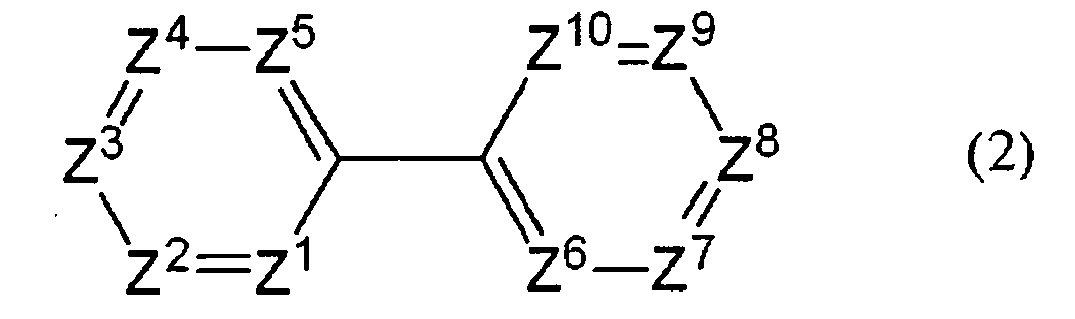
Description
- The present invention relates to a polymer compound having a residue of a nitrogen-containing heterocyclic compound.
- Recently, an organic electroluminescent display using an organic electroluminescent device is attracting attention, as the next generation display. This organic electroluminescent device has organic layers such as a light emitting layer, a charge transporting layer and the like. For the above-described organic layers, organic materials excellent in electron injectability are required, and for example, a polymer compound having a triazine skeleton is suggested (Japanese Patent Application National Publication No.
2004-532314 - However, when this polymer compound is used for production of an organic electroluminescent device, the light emission efficiency of the resultant organic electroluminescent device is not necessarily sufficient.
- An object of the present invention is to provide a polymer compound which is capable of giving an organic electroluminescent device showing excellent light emission efficiency when used for production of an organic electroluminescent device.
- The present invention provides, in a first aspect, a polymer compound having a residue of a compound represented by the following formula (1):

and a residue of a compound represented by the following formula (2) :
- and two remainders thereof each represent -C(R')=; Z9 and Z10 each represent -C (R') =; R' represents a hydrogen atom, an alkyl group optionally having a substituent, an alkoxy group optionally having a substituent, an alkylthio group optionally having a substituent, an aryl group optionally having a substituent, an aryloxy group optionally having a substituent, an arylthio group optionally having a substituent, an alkenyl group optionally having a substituent, an alkynyl group optionally having a substituent, an amino group optionally having a substituent, a silyl group optionally having a substituent, a halogen atom, acyl group optionally having a substituent, an acyloxy group optionally having a substituent, mono-valent heterocyclic group optionally having a substituent, a heterocyclic thio group optionally having a substituent, an imine residue, an amide group optionally having a substituent, an acid imide group, a carboxyl group, a nitro group, or a cyano group;
eight -C(R')= groups may be the same or different; when Z2 and Z3 each represent -C(R')=, two R's contained in Z2 and Z3 may be combined together to form a benzene ring, and when Z3 represents -C(R')=, two R's contained in Z3 and Z4 may be combined together to form a benzene ring and two R's contained in Z4 and Z5 may be combined together to form a benzene ring, providing that two or more combinations of Z2 and Z3, Z3 and Z4, and Z4 and Z5 do not simultaneously form a benzene ring;
when Z7 and Z8 each represent -C(R')=, two R's contained in Z7 and Z8 may be combined together to form a benzene ring, and when Z8 represents -C(R')=, two R's contained in Z8 and Z9 may be combined together to form a benzene ring and two R's contained in Z9 and Z10 may be combined together to form a benzene ring, providing that two or more combinations of Z7 and Z8, Z8 and Z9, and Z9 and Z10 do not simultaneously form a benzene ring. The benzene ring formed by mutual combination of two R's optionally has a substituent. - The present invention provides, in a second aspect, a composition comprising the above-described polymer compound, and at least one selected from the group consisting of a light emitting material, a hole transporting material and an electron transporting material.
- The present invention provides, in a third aspect, an organic electroluminescent device obtained by using the above-described polymer compound, and a planar light source and a display comprising this organic electroluminescent device.
- The terms commonly used in the present specification will be explained below. In the present specification, Me means a methyl group, t-Bu means a tert-butyl group, and Ph manes a phenyl group.
- The halogen atom includes a fluorine atom, chlorine atom, bromine atom and iodine atom.
- The term "Cx to Cy" (x and y are positive integers satisfying x<y) represents that the carbon atom number of an organic group described together with this term is x to y.
- The alkyl group optionally has a substituent such as an alkyl group, alkoxy group, alkylthio group, aryl group, aryloxy group, arylthio group, alkenyl group, alkynyl group, amino group, silyl group, halogen atom, acyl group, acyloxy group, mono-valent heterocyclic group, heterocyclic thio group, imine residue, amide group, acid imide group, carboxyl group, nitro group, cyano group and the like (hereinafter, when referred to "substituent", the same meaning is indicated unless otherwise stated), means usually an unsubstituted alkyl group and an alkyl group substituted by a halogen atom and the like, and includes both linear alkyl groups and cyclic alkyl groups (cycloalkyl groups). The alkyl group may be branched. The alkyl group has a carbon atom number of usually 1 to 20, preferably 1 to 15, more preferably about 1 to 10. Examples of the alkyl group include a methyl group, ethyl group, propyl group, isopropyl group, butyl group, isobutyl group, s-butyl group, t-butyl group, pentyl group, isoamyl group, hexyl group, cyclohexyl group, heptyl group, octyl group, 2-ethylhexyl group, nonyl group, decyl group, 3,7-dimethyloctyl group, dodecyl group, trifluoromethyl group, pentafluoroethyl group, perfluorobutyl group, perfluorohexyl group and perfluorooctyl group.
- Examples of the C1 to C12 alkyl group include a methyl group, ethyl group, propyl group, isopropyl group, butyl group, isobutyl group, s-butyl group, t-butyl group, pentyl group, isoamyl group, hexyl group, cyclohexyl group, heptyl group, octyl group, nonyl group, decyl group and dodecyl group.
- The alkoxy group optionally has a substituent, means usually an unsubstituted alkoxy group and an alkoxy group substituted with a halogen atom, alkoxy group or the like, and includes both linear alkoxy groups and cyclic alkoxy groups (cycloalkoxy groups). The alkoxy group may be branched. The alkoxy group has a carbon atom number of usually 1 to 20, preferably 1 to 15, more preferably about 1 to 10. Examples of the alkoxy group include a methoxy group, ethoxy group, propyloxy group, isopropyloxy group, butoxy group, isobutoxy group, s-butoxy group, t-butoxy group, pentyloxy group, hexyloxy group, cyclohexyloxy group, heptyloxy group, octyloxy group, 2-ethylhexyloxy group, nonyloxy group, decyloxy group, 3,7-dimethyloctyloxy group, dodecyloxy group, trifluoromethoxy group, pentafluoroethoxy group, perfluorobutoxy group, perfluorohexyl group, perfluorooctyl group, methoxymethyloxy group, and 2-methoxyethyloxy group.
- Examples of the C1 to C12 alkoxy group include a methoxy group, ethoxy group, propyloxy group, isopropyloxy group, butoxy group, isobutoxy group, s-butoxy group, t-butoxy group, pentyloxy group, hexyloxy group, cyclohexyloxy group, heptyloxy group, octyloxy group, 2-ethylhexyloxy group, nonyloxy group, decyloxy group, 3,7-dimethyloctyloxy group, and dodecyloxy group.
- The alkylthio group optionally has a substituent, means usually an unsubstituted alkylthio group and an alkylthio group substituted with a halogen atom or the like, and includes both linear alkylthio groups and cyclic alkylthio groups (cycloalkylthio groups). The alkylthio group may be branched. The alkylthio group has a carbon atom number of usually 1 to 20, preferably 1 to 15, more preferably about 1 to 10. Examples of the alkylthio group include a methylthio group, ethylthio group, propylthio group, isopropylthio group, butylthio group, isobutylthio group, s-butylthio group, t-butylthio group, pentylthio group, hexylthio group, cyclohexylthio group, heptylthio group, octylthio group, 2-ethylhexylthio group, nonylthio group, decylthio group, 3,7-dimethyloctylthio group, dodecylthio group, and trifluoromethylthio group.
- Examples of the C1 to C12 alkylthio group include a methylthio group, ethylthio group, propylthio group, isopropylthio group, butylthio group, isobutylthio group, s-butylthio group, t-butylthio group, pentylthio group, hexylthio group, cyclohexylthio group, heptylthio group, octylthio group, 2-ethylhexylthio group, nonylthio group, decylthio group, 3,7-dimethyloctylthio group, and dodecylthio group.
- The aryl group is an atomic group remaining after removing, from an aromatic hydrocarbon, one hydrogen atom connected to a carbon atom constituting the aromatic ring, optionally has a substituent, and means usually an unsubstituted aryl group and an aryl group substituted with a halogen atom, alkoxy group, alkyl group or the like. The aryl group also includes those having a condensed ring, and those having two or more independent benzene rings or condensed rings connected via a single bond or a di-valent organic group, for example, an alkenylene group such as a vinylene group and the like. The aryl group has a carbon atom number of usually 6 to 60, preferably 6 to 48, more preferably about 6 to 30. Examples of the aryl group include a phenyl group, C1 to C12 alkoxyphenyl groups, C1 to C12 alkylphenyl groups, 1-naphthyl group, 2-naphthyl group, 1-anthracenyl group, 2-anthracenyl group, 9-anthracenyl group, pentafluorophenyl group, biphenyl group, C1 to C12 alkoxybiphenyl groups, and C1 to C12 alkylbiphenyl groups, and of them, preferable are a phenyl group, C1 to C12 alkoxyphenyl groups, C1 to C12 alkylphenyl groups, biphenyl group, C1 to C12 alkoxybiphenyl groups, and C1 to C12 alkylbiphenyl groups.
- Examples of the C1 to C12 alkoxyphenyl group include a methoxyphenyl group, ethoxyphenyl group, propyloxyphenyl group, isopropyloxyphenyl group, butyloxyphenyl group, isobutyloxyphenyl group, t-butyloxyphenyl group, pentyloxyphenyl group, hexyloxyphenyl group, and octyloxyphenyl group.
- Examples of the C1 to C12 alkylphenyl group include a methylphenyl group, ethylphenyl group, dimethylphenyl group, propylphenyl group, mesityl group, methylethylphenyl group, isopropylphenyl group, butylphenyl group, isobutylphenyl group, t-butylphenyl group, pentylphenyl group, isoamylphenyl group, hexylphenyl group, heptylphenyl group, octylphenyl group, nonylphenyl group, decylphenyl group, and dodecylphenyl group.
- The aryloxy group optionally has a substituent, and means usually an unsubstituted aryloxy group and an aryloxy group substituted with a halogen atom, alkoxy group, alkyl group or the like. The aryloxy group has a carbon atom number of usually 6 to 60, preferably 6 to 48, more preferably 6 to 30. Examples of the aryloxy group include a phenoxy group, C1 to C12 alkoxyphenoxy groups, C1 to C12 alkylphenoxy groups, 1-naphthyloxy group, 2-naphthyloxy group, and pentafluorophenyloxy group, and of them, preferable are C1 to C12 alkoxyphenoxy groups and C1 to C12 alkylphenoxy groups.
- Examples of the C1 to C12 alkoxyphenoxy group include a methoxyphenoxy group, ethoxyphenoxy group, propyloxyphenoxy group, isopropyloxyphenoxy group, butyloxyphenoxy group, isobutyloxyphenoxy group, t-butyloxyphenoxy group, pentyloxyphenoxy group, hexyloxyphenoxy group, and octyloxyphenoxy group.
- Examples of the C1 to C12 alkylphenoxy group include a methylphenoxy group, ethylphenoxy group, dimethylphenoxy group, propylphenoxy group, 1,3,5-trimethylphenoxy group, methylethylphenoxy group, isopropylphenoxy group, butylphenoxy group, isobutylphenoxy group, s-butylphenoxy group, t-butylphenoxy group, pentylphenoxy group, isoamylphenoxy group, hexylphenoxy group, heptylphenoxy group, octylphenoxy group, nonylphenoxy group, decylphenoxy group, and dodecylphenoxy group.
- The arylthio group optionally has a substituent, and means usually an unsubstituted arylthio group and an arylthio group substituted with a halogen atom, alkoxy group, alkyl group or the like. The arylthio group has a carbon atom number of usually 6 to 60, preferably 6 to 48, more preferably 6 to 30. Examples of the arylthio group include a phenylthio group, C1 to C12 alkoxyphenylthio groups, C1 to C12 alkylphenylthio groups, 1-naphthylthio group, 2-naphthylthio group, and pentafluorophenylthio group.
- The arylalkyl group optionally has a substituent, and means usually an unsubstituted arylalkyl group and an arylalkyl group substituted with a halogen atom, alkoxy group, alkyl group or the like. The arylalkyl group has a carbon atom number of usually 7 to 60, preferably 7 to 48, more preferably 7 to 30. Examples of the arylalkyl group include phenyl-C1 to C12 alkyl groups, C1 to C12 alkoxyphenyl-C1 to C12 alkyl groups, C1 to C12 alkylphenyl-C1 to C12 alkyl groups, 1-naphthyl-C1 to C12 alkyl groups, and 2-naphthyl-C1 to C12 alkyl groups.
- The arylalkoxy group optionally has a substituent, and means usually an unsubstituted arylalkoxy group and an arylalkoxy group substituted with a halogen atom, alkoxy group, alkyl group or the like. The arylalkoxy group has a carbon atom number of usually 7 to 60, preferably 7 to 48, more preferably 7 to 30. Examples of the arylakoxy group include phenyl-C1 to C12 alkoxy groups, C1 to C12 alkoxyphenyl-C1 to C12 alkoxy groups, C1 to C12 alkylphenyl-C1 to C12 alkoxy groups, 1-naphthyl-C1 to C12 alkoxy groups, and 2-naphthyl-C1 to C12 alkoxy groups.
- The arylalkylthio group optionally has a substituent, and means usually an unsubstituted arylalkylthio group and an arylalkylthio group substituted with a halogen atom, alkoxy group, alkyl group or the like. The arylalkylthio group has a carbon atom number of usually 7 to 60, preferably 7 to 48, more preferably 7 to 30. Examples of the arylalkylthio group include phenyl-C1 to C12 alkylthio groups, C1 to C12 alkoxyphenyl-C1 to C12 alkylthio groups, C1 to C12 alkylphenyl-C1 to C12 alkylthio groups, 1-naphthyl-C1 to C12 alkylthio groups, and 2-naphthyl-C1 to C12 alkylthio groups.
- The alkenyl group optionally has a substituent, and includes linear alkenyl groups, branched alkenyl groups and cyclic alkenyl groups. The alkenyl group has a carbon atom number of usually 2 to 20, preferably 2 to 15, more preferably 2 to 10. Examples of the alkenyl group include a vinyl group, 1-propenyl group, 2-propenyl group, 1-butenyl group, 2-butenyl group, 1-pentenyl group, 2-pentenyl group, 1-hexenyl group, 2-hexenyl group, and 1-octenyl group.
- The arylalkenyl group optionally has a substituent, and means usually an unsubstituted arylalkenyl group and an arylalkenyl group substituted with a halogen atom, alkoxy group, alkyl group or the like. The arylalkenyl group has a carbon atom number of usually 8 to 60, preferably 8 to 48, more preferably 8 to 30. Examples of the arylalkenyl group include phenyl-C2 to C12 alkenyl groups, C1 to C12 alkoxyphenyl-C2 to C12 alkenyl groups, C1 to C12 alkylphenyl-C2 to C12 alkenyl groups, 1-naphthyl-C2 to C12 alkenyl groups, 2-naphthyl-C2 to C12 alkenyl groups and the like, and of them, preferable are C1 to C12 alkoxyphenyl-C2 to C12 alkenyl groups and C2 to C12 alkylphenyl-C2 to C12 alkenyl groups.
- Examples of the C2 to C12 alkenyl group include a vinyl group, 1-propenyl group, 2-propenyl group, 1-butenyl group, 2-butenyl group, 1-pentenyl group, 2-pentenyl group, 1-hexenyl group, 2-hexenyl group, 1-octenyl group and the like.
- The alkynyl group optionally has a substituent, and includes linear alkynyl groups and branched alkynyl groups. The alkynyl group has a carbon atom number of usually 2 to 20, preferably 2 to 15, more preferably 2 to 10. Examples of the alkynyl group include an ethynyl group, 1-propynyl group, 2-propynyl group, 1-butynyl group, 2-butynyl group, 1-pentynyl group, 2-pentynyl group, 1-hexynyl group, 2-hexynyl group and 1-octynyl group.
- The arylalkynyl group optionally has a substituent, and means usually an unsubstituted arylalkynyl group and an arylalkynyl group substituted with a halogen atom, alkoxy group, alkyl group or the like. The arylalkynyl group has a carbon atom number of usually 8 to 60, preferably 8 to 48, more preferably 8 to 30. Examples of the arylalkynyl group include phenyl-C2 to C12 alkynyl groups, C1 to C12 alkoxyphenyl-C2 to C12 alkynyl groups, C1 to C12 alkylphenyl-C2 to C12 alkynyl groups, 1-naphthyl-C2 to C12 alkynyl groups, and 2-naphthyl-C2 to C12 alkynyl groups, and of them, preferable are C1 to C12 alkoxyphenyl-C2 to C12 alkynyl groups and C1 to C12 alkylphenyl-C2 to C12 alkynyl groups.
- Examples of the C2 to C12 alkynyl group include an ethynyl group, 1-propynyl group, 2-propynyl group, 1-butynyl group, 2-butynyl group, 1-pentynyl group, 2-pentynyl group, 1-hexynyl group, 2-hexynyl group and 1-octynyl group.
- The mono-valent heterocyclic group indicates an atomic group remaining after removal of one hydrogen atom from a heterocyclic compound (particularly, aromatic heterocyclic compound), optionally has a substituent, and means usually an unsubstituted mono-valent heterocyclic group and a mono-valent heterocyclic group substituted with a substituent such as an alkyl group or the like. The mono-valent heterocyclic group has a carbon atom number of usually 4 to 60, preferably 4 to 30, more preferably 4 to 20, not including the carbon atom number of the substituent. The heterocyclic compound includes organic compounds having a cyclic structure in which elements constituting the ring include not only a carbon atom but also a hetero atom such as an oxygen atom, sulfur atom, nitrogen atom, phosphorus atom, boron atom, silicon atom, selenium atom, tellurium atom, arsenic atom and the like. Examples of the mono-valent heterocyclic group include a thienyl group, C1 to C12 alkylthienyl groups, pyrrolyl group, furyl group, pyridyl group, C1 to C12 alkylpyridyl groups, pyridazinyl group, pyrimidyl group, pyrazinyl group, triazinyl group, pyrrolidyl group, piperidyl group, quinolyl group, isoquinolyl group and the like, and of them, preferable are a thienyl group, C1 to C12 alkylthienyl groups, pyridyl group and C1 to C12 alkylpyridyl groups. As the mono-velent heterocyclic group, mono-valent aromatic heterocyclic groups are preferable.
- The heterocyclicthio group means a group obtained by substituting a hydrogen atom of a mercapto group with a mono-valent heterocyclic group, and optionally has a substituent. Examples of the heterocyclicthio group include heteroarylthio groups such as a pyridylthio group, pyridazinylthio group, pyrimidylthio group, pyrazinylthio group, triazinylthio group and the like.
- The amino group optionally has a substituent, and means usually an unsubstituted amino group and an amino group substituted with one or two substituents selected from the group consisting of an alkyl group, aryl group, arylalkyl group and mono-valent heterocyclic group (hereinafter, referred to as "substituted amino group"). The substituent optionally further has a substituent (hereinafter, referred to as "secondary substituent", in some cases). The substituted amino group has a carbon atom number of usually 1 to 60, preferably 2 to 48, more preferably 2 to 40, not including the carbon atom number of the secondary substituent. Examples of the substituted amino group include a methylamino group, dimethylamino group, ethylamino group, diethylamino group, propylamino group, dipropylamino group, isopropylamino group, diisopropylamino group, butylamino group, isobutylamino group, s-butylamino group, t-butylamino group, pentylamino group, hexylamino group, heptylamino group, octylamino group, 2-ethylhexylamino group, nonylamino group, decylamino group, 3,7-dimethyloctylamino group, dodecylamino group, cyclopentylamino group, dicyclopentylamino group, cyclohexylamino group, dicyclohexylamino group, ditrifluoromethylamino group, phenylamino group, diphenylamino group, C1 to C12 alkoxyphenylamino groups, di (C1 to C12 alkoxyphenyl)amino groups, C1 to C12 alkylphenylamino groups, di (C1 to C12 alkylphenyl) amino groups, 1-naphthylamino group, 2-naphthylamino group, pentafluorophenylamino group, pyridylamino group, pyridazinylamino group, pyrimidylamino group, pyrazinylamino group, triazinylamino group, phenyl-C1 to C12 alkylamino groups, C1 to C12 alkoxyphenyl-C1 to C12 alkylamino groups, di(C1 to C12 alkoxyphenyl-C1 to C12 alkyl)amino groups, C1 to C12 alkylphenyl-C1 to C12 alkylamino groups, di (C1 to C12 alkylphenyl-C1 to C12 alkyl)amino groups, 1-naphthyl-C1 to C12 alkylamino groups and 2-naphthyl-C1 to C12 alkylamino groups.
- The silyl group optionally has a substituent, and means usually an unsubstituted silyl group and a silyl group substituted with one, two or three substituents selected from the group consisting of an alkyl group, aryl group, arylalkyl group and mono-valent heterocyclic group (hereinafter, referred to as "substituted silyl group"). The substituent optionally has a secondary substituent. The substituted silyl group has a carbon atom number of usually 1 to 60, preferably 3 to 48, more preferably 3 to 40, not including the carbon atom number of the secondary substituent. Examples of the substituted silyl group include a trimethylsilyl group, triethylsilyl group, tripropylsilyl group, tri-isopropylsilyl group, dimethyl-isopropylsilyl group, diethyl-isopropylsilyl group, t-butyldimethylsilyl group, pentyldimethylsilyl group, hexyldimethylsilyl group, heptyldimethylsilyl group, octyldimethylsilyl group, 2-ethylhexyl-dimethylsilyl group, nonyldimethylsilyl group, decyldimethylsilyl group, 3,7-dimethyloctyl-dimethylsilyl group, dodecyldimethylsilyl group, phenyl-C1 to C12 alkylsilyl groups, C1 to C12 alkoxyphenyl-C1 to C12 alkylsilyl groups, C1 to C12 alkylphenyl-C1 to C12 alkylsilyl groups, 1-naphthyl-C1 to C12 alkylsilyl groups, 2-naphthyl-C1 to C12 alkylsilyl groups, phenyl-C1 to C12 alkyldimethylsilyl groups, triphenylsilyl group, tri-p-xylylsilyl group, tribenzylsilyl group, diphenylmethylsilyl group, t-butyldiphenylsilyl group and dimethylphenylsilyl group.
- The acyl group optionally has a substituent, and means usually an unsubstituted acyl group and an acyl group substituted with a halogen atom or the like. The acyl group has a carbon atom number of usually 2 to 20, preferably 2 to 18, more preferably 2 to 16. Examples of the acyl group include an acetyl group, propionyl group, butylyl group, isobutylyl group, pivaloyl group, benzoyl group, trifluoroacetyl group and pentafluorobenzoyl group.
- The acyloxy group optionally has a substituent, and means usually an unsubstituted acyloxy group and an acyloxy group substituted with a halogen atom or the like. The acyloxy group has carbon atom number of usually 2 to 20, preferably 2 to 18, more preferably 2 to 16. Examples of the acyloxy group include an acetoxy group, propionyloxy group, butylyloxy group, isobutylyloxy group, pivaloyloxy group, benzoyloxy group, trifluoroacetyloxy group and pentafluorobenzoyloxy group.
- The imine residue means a residue obtained by removing, from an imine compound having a structure represented by at least one of the formula: H-N=C< and the formula: -N=CH-, one hydrogen atom in this structure. Examples of such an imine compound include aldimines and ketimines, and compounds obtained by substitution of a hydrogen atom connected to a nitrogen atom in aldimines with an alkyl group, aryl group, arylalkyl group, arylalkenyl group, arylalkynyl group or the like. The imine residue has carbon atom number of usually 2 to 20, preferably 2 to 18, more preferably 2 to 16. Examples of the imine residue include groups represented by the general formula: -CRX=N-RY or the general formula: -N=C(RY)2 (wherein RX represents a hydrogen atom, alkyl group, aryl group, arylalkyl group, arylalkenyl group or arylalkynyl group, RY represents an alkyl group, aryl group, arylalkyl group, arylalkenyl group or arylalkynyl group. When there exist two RYs, they may be the same or different, and two RYs may be mutually connected and integrated to form a ring as a di-valent group, for example, an alkylene group having 2 to 18 carbon atoms such as an ethylene group, trimethylene group, tetramethylene group, pentamethylene group, hexamethylene group and the like.). Examples of the imine residue include groups of the following structural formulae, and the like.


- The amide group optionally has a substituent, and means usually an unsubstituted amide group and an amide group substituted with a halogen atom or the like. The amide group has a carbon atom number of usually 2 to 20, preferably 2 to 18, more preferably 2 to 16. Examples of the amide group include a formamide group, acetamide group, propioamide group, butyroamide group, benzamide group, trifluoroacetamide group, pentafluorobenzamide group, diformamide group, diacetamide group, dipropioamide group, dibutyroamide group, dibenzamide group, ditrifluoroacetamide group and dipentafluorobenzamide group.
- The acid imide group means a residue obtained by removing from an acid imide one hydrogen atom connected to its nitrogen atom. The acid imide group has a carbon atom number of usually 4 to 20, preferably 4 to 18, more preferably 4 to 16. Examples of the acid imide group include groups shown below.


- The arylene group means an atomic group obtained by removing two hydrogen atoms from an aromatic hydrocarbon, and includes those having an independent benzene ring or condensed ring. The above-described arylene group has a carbon atom number of usually 6 to 60, preferably 6 to 48, more preferably 6 to 30, further preferably 6 to 18. This carbon atom number does not include the carbon atom number of the substituent. The arylene group includes unsubstituted or substituted phenylene groups such as a 1,4-phenylene group, 1,3-phenylene group, 1,2-phenylene group and the like; unsubstituted or substituted naphthalenediyl groups such as a 1,4- naphthalenediyl group, 1, 5- naphthalenediyl group, 2, 6- naphthalenediyl group and the like; unsubstituted or substituted anthracenediyl groups such as a 1,4-anthracenediyl group, 1,5-anthracenediyl group, 2,6-anthracenediyl group, 9,10-anthracenediyl group and the like; unsubstituted or substituted phenanthrenediyl groups such as a 2,7-phenanthrenediyl group and the like; unsubstituted or substituted naphthacenediyl groups such as a 1,7-naphthacenediyl group, 2,8-naphthacenediyl group, 5,12-naphthacenediyl group and the like; unsubstituted or substituted fluorenediyl groups such as a 2,7-fluorenediyl group, 3,6-fluorenediyl group and the like; unsubstituted or substituted pyrenediyl groups such as a 1,6-pyrenediyl group, 1,8-pyrenediyl group, 2,7-pyrenediyl group, 4,9-pyrenediyl group and the like; and unsubstituted or substituted perylenediyl groups such as a 3,9-perylenediyl group, 3, 10-perylenediyl group and the like; etc., and preferable are unsubstituted or substituted phenylene groups, and unsubstituted or substituted fluorenediyl groups.
- The di-valent heterocyclic group indicates an atomic group remaining after removing two hydrogen atoms from a heterocyclic compound (particularly, aromatic heterocyclic compound), and means an unsubstituted di-valent heterocyclic group and a di-valent heterocyclic group substistuted by a substituent such as an alkyl group or the like. The di-valent heterocyclic group has a carbon atom number of usually 4 to 60, preferably 4 to 30, particularly preferably 6 to 12, not including the carbon atom number of the substituent. Examples of the above-described di-valent heterocyclic group include unsubstituted or substituted pyridinediyl groups such as a 2,5-pyridinediyl group, 2,6-pyridinediyl group and the like; unsubstituted or substituted thiophenediyl groups such as a 2,5-thiophenediyl group and the like; unsubstituted or substituted furanediyl groups such as a 2,5-furanediyl group and the like; unsubstituted or substituted quinolinediyl groups such as a 2, 6-quinolinediyl group and the like; unsubstituted or substituted isoquinolinediyl groups such as a 1,4-isoquinolinediyl group, 1,5-isoquinolinediyl group and the like; unsubstituted or substituted quinoxalinediyl groups such as a 5, 8-quinoxalinediyl group and the like; unsubstituted or substituted benzo[1,2,5]thiadiazolediyl groups such as a 4,7-benzo[1,2,5]thiadiazolediyl group and the like; unsubstituted or substituted benzothiazolediyl groups such as a 4,7-benzothiazolediyl group and the like; unsubstituted or substituted carbazolediyl groups such as a 2,7-carbazolediyl group, 3,6-carbazolediyl group and the like; unsubstituted or substituted phenoxazinediyl groups such as a 3,7-phenoxazinediyl group and the like; unsubstituted or substituted phenothiazinediyl groups such as a 3,7-phenothiazinediyl group and the like; and unsubstituted or substituted dibenzosilolediyl groups such as a 2,7-dibenzosilolediyl group and the like; etc., and preferable are unsubstituted or substituted benzo[1,2,5]thiadiazolediyl groups, unsubstituted or substituted phenoxazinediyl groups, and unsubstituted or substituted phenothiazinediyl groups. As the di-valent heterocyclic group, di-valent aromatic heterocyclic groups are preferable.
- The di-valent group having a metal complex structure means an atomic group remaining after removing two hydrogen atoms from an organic ligand of a metal complex having the organic ligand and a center metal. The organic ligand has a carbon atom number of usually 4 to 60. The above-described organic ligand includes 8-quinolinol and derivatives thereof, benzoquinolinol and derivatives thereof, 2-phenylpyridine and derivatives thereof, 2-phenylbenzothiazole and derivatives thereof, 2-phenylbenzoxazole and derivatives thereof, porphyrin and derivatives thereof, and the like.
- Examples of the center metal of the above-described metal complex include aluminum, zinc, beryllium, iridium, platinum, gold, europium, terbium and the like.
- The above-described metal complex includes metal complexes known as low molecular weight fluorescence emitting materials and phosphorescence emitting materials, and triplet light emitting complexes, and the like.
- The residue of a compound represented by the above-described formula (1) means an atomic group remaining after removing one or some or all of the hydrogen atoms (usually, one or two hydrogen atoms) in a compound represented by the above-described formula (1). It is preferable that the residue of a compound represented by the above-described formula (1) is contained as a repeating unit (for example, in the form of a di-valent group) in a polymer compound, present (for example, in the form of a mono-valent group) at the end of a molecule chain, and contained in a repeating unit, and it is more preferable that the residue is contained as a repeating unit in a polymer compound.
- In the above-described formula (1), when the aryl group optionally having a substituent or mono-valent heterocyclic group optionally having a substituent represented by Ar has a substituent, the substituent includes an alkyl group, alkoxy group, alkylthio group, aryl group, aryloxy group, arylthio group, arylalkyl group, arylalkoxy group, arylalkenyl group, arylalkynyl group, alkenyl group, alkynyl group, amino group, substituted amino group, silyl group, halogen atom, acyl group, acyloxy group, mono-valent heterocyclic group, heterocyclic thio group, imine residue, amide group, acid imide group, carboxyl group, nitro group, cyano group and the like. One or some or all of the hydrogen atoms contained in these substituents may be substituted by a fluorine atom.
- In the above-described formula (1), Ar represents preferably a phenyl group, C1 to C12 alkoxyphenyl group, C1 to C12 alkylphenyl group, biphenyl group, C1 to C12 alkoxybiphenyl group, C1 to C12 alkylbiphenyl group, pyridylphenyl group or phenylpyridyl group, more preferably a phenyl group or C1 to C12 alkylbiphenyl group (for example, a biphenyl group substituted by an alkyl group having 1 to 12 carbon atoms). These groups optionally have a substituent.
- The repeating unit composed of a residue of a compound represented by the above-described formula (1) is preferably a repeating unit represented by the following formula (3):

- In the above-described formula (3), when the arylene group optionally having a substituent or di-valent heterocyclic group optionally having a substituent represented by Ar' has a substituent, the substituent includes an alkyl group, alkoxy group, alkylthio group, aryl group, aryloxy group, arylthio group, arylalkyl group, arylalkoxy group, arylalkenyl group, arylalkynyl group, alkenyl group, alkynyl group, amino group, substituted amino group, silyl group, halogen atom, acyl group, acyloxy group, mono-valent heterocyclic group, heterocyclic thio group, imine residue, amide group, acid imide group, carboxyl group, nitro group, cyano group and the like. One or some or all of the hydrogen atoms contained in these substituents may be substituted by a fluorine atom.
- Ar' represents, for example, a phenylene group, C1 to C12 alkoxyphenylene group, C1 to C12 alkylphenylene group, biphenylene group, C1 to C1 alkoxybiphenylene group, C1 to C12 alkylbiphenylene group, pyridinediyl group, C1 to C12 alkoxypyridinediyl group or C1 to C12 alkylpyridinediyl group, preferably, a 1,4-phenylene group, 1,3-phenylene group, 1,2-phenylene group, 1,4-pyridinediyl group, 1,3-pyridinediyl group, 1,2-pyridinediyl group, 1,4-naphthalenediyl group, 2,6-naphthalenediyl group, 1,4-anthracenediyl group, 1,5-anthracenediyl group, 2,6-anthracenediyl group or 9,10-anthracenediyl group, more preferably, a 1,4-phenylene group, 1,3-phenylene group, 1,2-phenylene group, 1,4-pyridinediyl group, 1,3-pyridinediyl group, 1,2-pyridinediyl group, 1,4-naphthalenediyl group or 2,6-naphthalenediyl group, further preferably, a 1,4-phenylene group, 1,3-phenylene group, 1,4-naphthalenediyl group, 1,4-pyridinediyl group, 1,3-pyridinediyl group or 1,2-pyridinediyl group, particularly preferably, a 1,4-phenylene group or 1,4-pyridinediyl group.
- The repeating unit represented by the above-described formula (3) includes repeating units represented by the following formulae (3)' and (3)".


- The repeating unit represented by the above-described formula (3) includes repeating units represented by the following formulae.


- The residues of compounds represented by the above-described formula (1) may be contained singly or in combination of two or more in a polymer compound.
- The residue of a compound represented by the above-described formula (2) means an atomic group remaining after removing one or some or all of the hydrogen atoms (usually, one or two hydrogen atoms) in a compound represented by the above-described formula (2). It is preferable that the residue of a compound represented by the above-described formula (2) is contained as a repeating unit (for example, in the form of a di-valent group) in a polymer compound, present (for example, in the form of a mono-valent group) at the end of a molecule chain, and contained in a repeating unit, and it is more preferable that the residue is contained as a repeating unit in a polymer compound, and is present at an end of a molecule chain.
- In -C(R')= represented by 8 members among Z1, Z2, Z3, Z4, Z5, Z6, Z7, Z8, Z9 and Z10 in the above-described formula (2), R' represents a hydrogen atom, alkyl group optionally having a substituent, alkoxy group optionally having a substituent, alkylthio group optionally having a substituent, aryl group optionally having a substituent, aryloxy group optionally having a substituent, arylthio group optionally having a substituent, alkenyl group optionally having a substituent, alkynyl group optionally having a substituent, amino group optionally having a substituent, silyl group optionally having a substituent, halogen atom, acyl group optionally having a substituent, acyloxy group optionally having a substituent, mono-valent heterocyclic group optionally having a substituent, heterocyclic thio group optionally having a substituent, imine residue, amide group optionally having a substituent, acid imide group, carboxyl group, nitro group or cyano group, preferably, a hydrogen atom, alkyl group optionally substituted by a fluorine atom, alkoxy group optionally substituted by a fluorine atom, aryl group optionally substituted by a fluorine atom, aryloxy group optionally substituted by a fluorine atom, arylalkyl group optionally substituted by a fluorine atom, arylalkoxy group optionally substituted by a fluorine atom, arylalkenyl group optionally substituted by a fluorine atom, arylalkynyl group optionally substituted by a fluorine atom, amino group optionally substituted by a fluorine atom, substituted amino group optionally substituted by a fluorine atom, halogen atom, acyl group optionally substituted by a fluorine atom, acyloxy group optionally substituted by a fluorine atom, mono-valent heterocyclic group optionally substituted by a fluorine atom, carboxyl group, nitro group or cyano group, further preferably, a hydrogen atom, alkyl group optionally substituted by a fluorine atom, alkoxy group optionally substituted by a fluorine atom, aryl group optionally substituted by a fluorine atom, aryloxy group optionally substituted by a fluorine atom, arylalkyl group optionally substituted by a fluorine atom, arylalkoxy group optionally substituted by a fluorine atom, halogen atom or mono-valent heterocyclic group optionally substituted by a fluorine atom, more preferably, a hydrogen atom, alkyl group optionally substituted by a fluorine atom, aryl group optionally substituted by a fluorine atom, arylalkyl group optionally substituted by a fluorine atom, halogen atom or mono-valent heterocyclic group optionally substituted by a fluorine atom, particularly preferably, a hydrogen atom, alkyl group optionally substituted by a fluorine atom or aryl group optionally substituted by a fluorine atom, especially preferably, a hydrogen atom or alkyl group optionally substituted by a fluorine atom.
- It is preferable that the position of -N= represented by one member among Z1, Z2 and Z3 and the position of -N= represented by one member among Z6, Z7 and Z8 are symmetrical in the above-described formula (2). For example, a case in which Z1 and Z6 represent -N= and Z2, Z3, Z7 and Z8 represent -C(R' )=, a case in which Z2 and Z7 represent -N= and Z1, Z3, Z6 and Z8 represent -C(R')= and a case in which Z3 and Z8 represent -N= and Z1, Z2, Z6 and Z7 represent -C(R')= are preferable, and a case in which Z1 and Z6 represent -N= and Z2, Z3, Z7 and Z8 represent -C(R')= is more preferable.
- It is preferable that the repeating unit composed of a residue of a compound represented by the above-described formula (2) is a repeating unit represented by the following formula (4):


and it is more preferable that R" which is not a connecting bond is a repeating unit composed of a hydrogen atom or alkyl group, that R"' which is not a connecting bond is a repeating unit composed of a hydrogen atom or alkyl group, and that R" which is not a connecting bond is a repeating unit composed of a hydrogen atom or alkyl group and R"' which is not a connecting bond is a repeating unit composed of a hydrogen atom or alkyl group, in these formulae. - Regarding the -C(R")= groups represented by eight members among Z1*, Z2*, Z3*, Z4*, Z5*, Z6*, Z7*, Z8*, Z9* and Z10* in the above-described formula (4), one moiety thereof represents a connecting bond, and the alkyl group, alkoxy group, aryl group, aryloxy group, arylalkyl group, arylalkoxy group, arylalkenyl group, arylalkynyl group, amino group, substituted amino group, halogen atom, acyl group, acyloxy group, mono-valent heterocyclic group, carboxyl group, nitro group or cyano group represented by the remaining R" groups have the same meaning as described above, and preferable are a hydrogen atom, alkyl group, alkoxy group, aryl group, aryloxy group, arylalkyl group, arylalkoxy group, halogen atom and mono-valent heterocyclic group, more preferable are a hydrogen atom, alkyl group, aryl group, arylalkyl group, halogen atom and mono-valent heterocyclic group, further preferable are a hydrogen atom, alkyl group and aryl group, particularly preferable are a hydrogen atom and alkyl group.
- It is preferable that the position of -N= represented by one member among Z1*, Z2* and Z3* and the position of -N= represented by one member among Z6*, Z7* and Z8* are symmetrical in the above-described formula (4). Specifically, a case in which Z1* and Z6* represent -N= and Z2*, Z3*, Z7* and Z8* represent -C(R")=, a case in which Z2* and Z7* represent -N= and Z1*, Z3*, Z6* and Z8* represent -C(R")=, and a case in which Z3* and Z8* represent -N= and Z1*, Z2*, Z6* and Z7* represent -C(R")= are preferable , and a case in which Z1* and Z6* represent -N= and Z2*, Z3*, Z7* and Z8* represent -C(R")= is more preferable.
- In the polymer compound having a repeating unit represented by the above-described formula (4), it is preferable that two connecting bonds are obtained by removing R"s contained in Z3* and Z8*.
- The repeating unit represented by the above-described formula (4) includes repeating units represented by the following formulae.


- Regarding the -C(R"')= groups represented by four members among Z1**, Z2**, Z3**, Z4** and Z5** in the above-described formula (5), two moieties represent a connecting bond, and the alkyl group, alkoxy group, aryl group, aryloxy group, arylalkyl group, arylalkoxy group, arylalkenyl group, arylalkynyl group, amino group, substituted amino group, halogen atom, acyl group, acyloxy group, mono-valent heterocyclic group, carboxyl group, nitro group or cyano group represented by the remaining R"'s have the same meaning as described above, and preferable are a hydrogen atom, alkyl group, alkoxy group, aryl group, aryloxy group, arylalkyl group, arylalkoxy group, halogen atom and mono-valent heterocyclic group, more preferable are a hydrogen atom, alkyl group, aryl group, arylalkyl group, halogen atom and mono-valent heterocyclic group, further preferable are a hydrogen atom, alkyl group and aryl group, particularly preferable are a hydrogen atom and alkyl group.
- It is preferable that the position of -N= represented by Z1**, Z2** and Z3** and the position of -N= represented by Z6, Z7 and Z8 are symmetrical in the above-described formula (5). Specifically, a case in which Z1** and Z6 represent -N=, Z2** and Z3** represent -C(R"')= and Z7 and Z8 represent -C(R')=, a case in which Z2** and Z7 represent -N=, Z1** and Z3** represent -C(R"')= and Z6 and Z8 represent -C (R"')=, and a case in which Z3** and Z8 represent -N= , Z1** and Z2** represent -C(R"')= and Z6 and Z7 represent -C(R"')= are preferable, and a case in which Z1** and Z6 represent -N=, Z2** and Z3** represent -C(R"') = and Z7 and Z8 represent -C (R"')= is more preferable.
- In the polymer compound having a repeating unit represented by the above-described formula (5), it is preferable that two connecting bonds are obtained by removing R"'s contained in Z2** and Z4**, or Z2** and Z4**.
- The repeating unit represented by the above-described formula (5) includes a repeating unit composed of a 2,2'-bipyridine-5,5'-diyl group optionally having a substituent, repeating units represented by the following formulae, and the like.

- When the residue of a compound represented by the above-described formula (2) is present at an end of a molecule chain, it is preferable that the residue is present as a group represented by the following formula (6):

- It is preferable that the position of -N= represented by Z1*, Z2* and Z3* and the position of -N= represented by Z6, Z7 and Z8 are symmetrical in the above-described formula (6). Specifically, a case in which Z1* and Z6 represent -N=, Z2* and Z3* represent -C(R")= and Z7* and Z8* represent -C(R')=, a case in which Z2* and Z7 represent -N=, Z1* and Z3* represent -C(R")= and Z6 and Z8 represent -C(R')=, and a case in which Z3* and Z8 represent -N=, Z1* and Z2* represent -C(R")= and Z6 and Z7 represent -C(R')= are preferable , and a case in which Z1* and Z6 represent -N=, Z2* and Z3* represent -C(R")= and Z7 and Z8 represent -C(R')= is more preferable.
- In the above-described formula (6), it is preferable that one connecting bond is obtained by removing R" contained in Z3*.
- When the group represented by the above-described formula (6) is present at an end of a molecule chain, the proportion of groups (based on the number of groups) represented by the above-described formula (6) present at an end of a molecule chain among all molecule chain ends of a polymer compound is preferably 10 to 100%, more prefearbly 25 to 100%, further preferably 40 to 100%.
- The group represented by the above-described formula (6) includes a 2,2'-bipyridine-5,5'-yl group optionally having a substituent, groups represented by the following formulae, and the like.


- The residues of compounds represented by the above-described formula (2) may be contained singly or in combination of two or more in a polymer compound.
- The polymer compound of the present invention is preferably a conjugated polymer from the standpoint of injection and transportation of charges. The above-described conjugated polymer means a polymer compound in which 50 to 100%, particularly 70 to 100%, especially 80 to 100% of all bonds in the main chain are conjugated.
- In the polymer compound of the present invention, the proportion (molar ratio) of the residues of compounds represented by the above-described formula (1) (including a repeating unit represented by the above-described formula (3). Hereinafter, simply referred to as "residue of compound represented by the formula (1)") to the residues of compounds represented by the above-described formula (2) (including a repeating unit represented by the above-described formula (4), a repeating unit represented by the above-described formula (5) and a repeating unit represented by the above-described formula (6)) is usually 1:0.001 to 1:5, prefeably 1:0.005 to 1:3, more preferaby 1:0.01 to 1:1.
- It is preferable that the polymer compound of the present invention is a polymer compound having
a repeating unit represented by the above-described formula (3), and
at least one selected from the group consisting of a repeating unit represented by the above-described formula (4) and a repeating unit represented by the above-described formula (5), and/or, a group represented by the above-described formula (6),
from the standpoint of light emission efficiency and device durability. - It is preferable that the polymer compound of the present invention has further at least one repeating unit selected from the group consisting of repeating units represented by the following formula (A), repeating units represented by the following formula (B) and repeating units represented by the following formula (C), from the standpoint of transportation and injection of charges and luminance half life.


X1 represents -CR3 =CR4 -or C≡C-; R3 and R4 represent each independently a hydrogen atom, an alkyl group, an aryl group, a mono-valent heterocyclic group, a carboxyl group, or a cyano group; a represents 0 or 1. - In the above-described formula (A), when the group represented by Ar3 has a substituent, this substituent includes an alkyl group, alkoxy group, aryl group, aryloxy group, arylalkyl group, arylalkoxy group, arylalkenyl group, arylalkynyl group, amino group, substituted amino group, halogen atom, acyl group, acyloxy group, mono-valent heterocyclic group, carboxyl group, nitro group, cyano group and the like, preferably an alkyl group, alkoxy group, aryl group, aryloxy group, substituted amino group and mono-valent heterocyclic group, more preferably an alkyl group, alkoxy group and aryl group.
- The arylene group in the arylene group optionally having a substituent represented by Ar3 in the above-described formula (A) means an atomic group obtained by removing two hydrogen atoms from an aromatic hydrocarbon, and includes those having an independent benzene ring or condensed ring. This arylene group has a carbon atom number of usually 6 to 60, preferably 6 to 30, more preferably 6 to 18. The arylene group in the arylene group optionally having a substituent represented by Ar3 in the above-described formula (A) includes a 1,4-phenylene group, 1,3-phenylene group, 1,4-naphthalenediyl group, 1,5-naphthalenediyl group, 2,6-naphthalenediyl group, 9,10-anthracenediyl group, 2,7-phenanthrylene group, 5,12-naphthacenylene group, 2,7-fluorenediyl group, 3,6-fluorenediyl group, 1,6-pyrenediyl group, 1,8-pyrenediyl group, 3,9-perylenediyl group, 3,10-perylenediyl group, 2,6-quinolinediyl group, 1,4-isoquinolinediyl group, 1, 5-isoquinolinediyl group, 5, 8-quinoxalinediyl group and the like, preferably a 1,4-phenylene group, 1,4-naphthalenediyl group, 1,5-naphthalenediyl group, 2,6-naphthalenediyl group, 9,10-anthracenediyl group, 2,7-fluorenediyl group, 1,6-pyrenediyl group, 3,9-perylenediyl group, 3,10-perylenediyl group, 2,6-quinolinediyl group, 1,4-isoquinolinediyl group and 5,8-quinoxalinediyl group, more preferably a 1,4-phenylene group, 1,4-naphthalenediyl group, 1,5-naphthalenediyl group, 2,6-naphthalenediyl group, 9,10-anthracenediyl group, 2,7-fluorenediyl group and 5,8-quinoxalinediyl group, particularly preferably a 1,4-phenylene group and 2,7-fluorenediyl group.
- The di-valent heterocyclic group in the di-valent heterocyclic group optionally having a substituent represented by Ar3 in the above-described formula (A) includes a 4,7-benzo[1,2,5]thiadiazolediyl group, 3,7-phenoxazinediyl group, 3,7-phenothiazinediyl group and the like, preferably a 4,7-benzo[1,2,5]thiadiazolediyl group, 3,7-phenoxazinediyl group and 3,7-phenothiazinediyl group, a 4,7-benzo[1,2,5]thiadiazolediyl group, 3,7-phenoxazinediyl group and 3,7-phenothiazinediyl group, more preferably a 4,7-benzo[1,2,5]thiadiazolediyl group, 3,7-phenoxazinediyl group and 3,7-phenothiazinediyl group.
- The di-valent group having a metal complex structure optionally having a substituent represented by Ar3 in the above-described formula (A) includes groups represented by the following formulae M-1 to M-7.
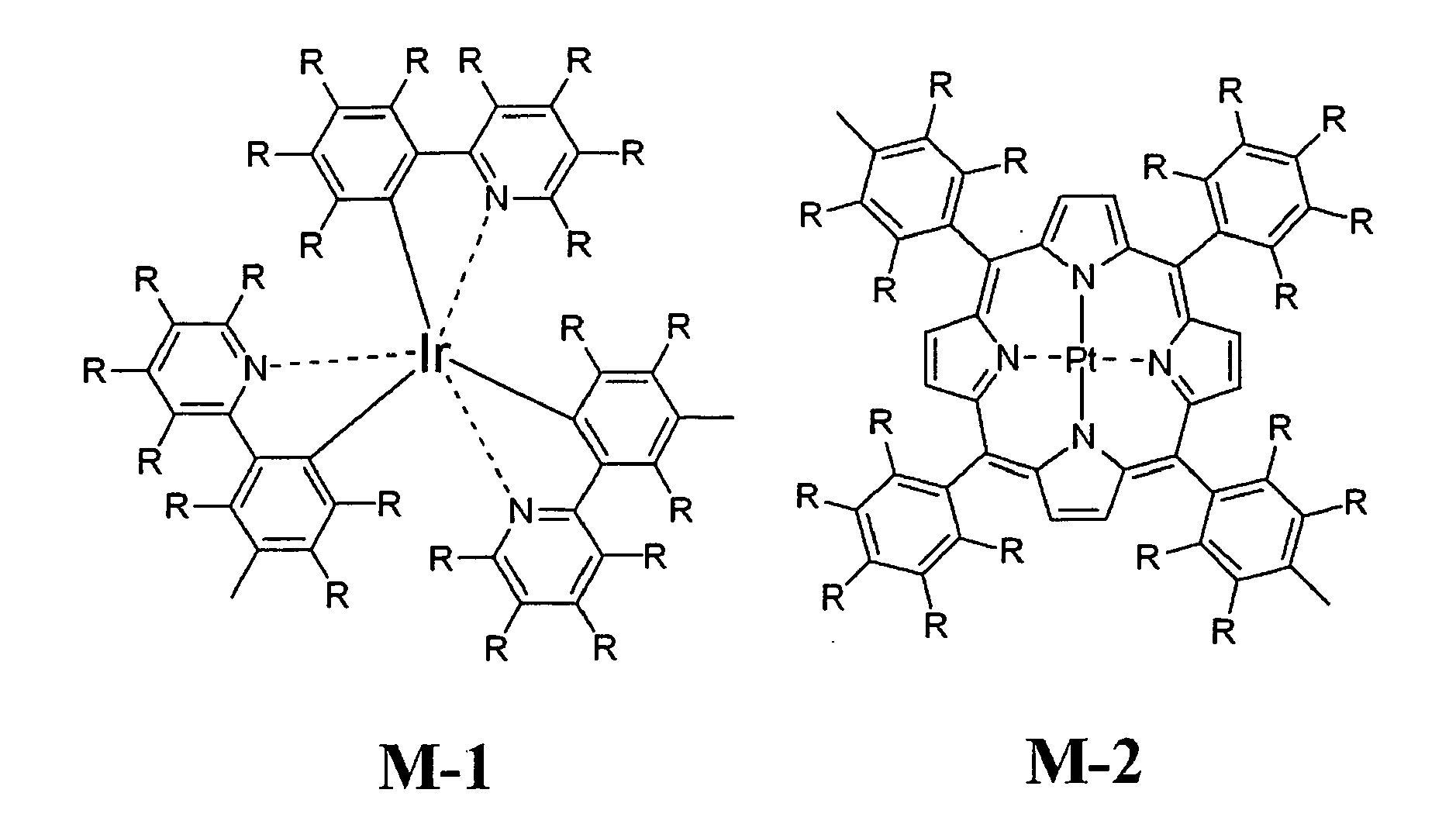


- Among them, the group represented by Ar3 is desirably at least one group represented by the following formulae (D), (E), (F), (G) and (H).
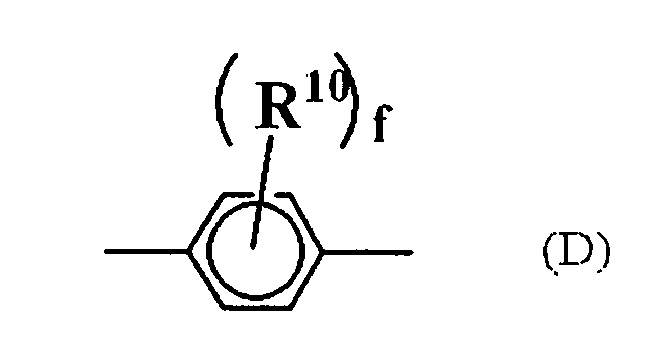


- In the above-described formula (D), R10 represents preferably an alkyl group, alkoxy group, aryl group, aryloxy group, arylalkyl group, arylalkoxy group, arylalkenyl group, arylalkynyl group, substituted amino group, acyl group or mono-valent heterocyclic group, more preferably an alkyl group, alkoxy group, aryl group, aryloxy group, substituted amino group, acyl group or mono-valent heterocyclic group, further preferably an alkyl group, alkoxy group, aryl group or mono-valent heterocyclic group, particularly preferably an alkyl group, alkoxy group or aryl group.
- In the above-described formula (D), f represents preferably an integer of 0 to 2.
- In the above-described formula (E), R11 and R12 represent preferably an alkyl group, aryl group or mono-valent heterocyclic group, more preferably an alkyl group or aryl group.
- In the above-described formula (F), R13 and R14 represent preferably a hydrogen atom, alkyl group, alkoxy group, aryl group, aryloxy group, arylalkyl group, arylalkoxy group, substituted amino group, acyl group or mono-valent heterocyclic group, more preferably a hydrogen atom, alkyl group, alkoxy group, aryl group, aryloxy group or mono-valent heterocyclic group, further preferably a hydrogen atom or alkyl group, particularly preferably a hydrogen atom.
- In the above-described formula (G), R15 represents preferably an alkyl group, aryl group or mono-valent heterocyclic group, more preferably an alkyl group or aryl group, further preferably an aryl group.
- In the above-described formula (H), R16 represents preferably an alkyl group, aryl group or mono-valent heterocyclic group, more preferably an alkyl group or aryl group, further preferably an aryl group.
- The repeating unit represented by the above-described formula (A) includes preferably a fluorenediyl group optionally having a substituent, a phenylene group optionally having a substituent, and a combination thereof.
- In the above-described formula (B), when the group represented by Ar4, Ar5 and Ar6 has a substituent, this substituent includes an alkyl group, alkoxy group, aryl group, aryloxy group, arylalkyl group, arylalkoxy group, arylalkenyl group, arylalkynyl group, amino group, substituted amino group, halogen atom, acyl group, acyloxy group, mono-valent heterocyclic group, carboxyl group, nitro group and cyano group, preferably an alkyl group, alkoxy group, aryl group, aryloxy group, arylalkyl group, arylalkoxy group, substituted amino group, acyl group and cyano group, more preferably an alkyl group, alkoxy group and aryl group.
- The arylene group in the arylene group optionally having a substituent represented by Ar4, Ar5 and Ar6 in the above-described formula (B) means an atomic group obtained by removing two hydrogen atoms from an aromatic hydrocarbon, and includes those having an independent benzene ring or condensed ring. This arylene group has a carbon atom number of usually 6 to 60, preferably 6 to 30, more preferably 6 to 18.
- The arylene group in the arylene group optionally having a substituent represented by Ar4, Ar5 and Ar6 in the above-described formula (B) includes a 1,3-phenylene group, 1,4-phenylene group, 1,4-naphthalenediyl group, 2,6-naphthalenediyl group, 9,10-anthracenediyl group, 2,7-phenanthrenediyl group, 5,12-naphthacenediyl group, 2,7-fluorenediyl group, 3,8-perylenediyl group and the like.
- The di-valent heterocyclic group in the di-valent heterocyclic group optionally having a substituent represented by Ar4, Ar5 and Ar6 in the above-described formula (B) has a carbon atom number of usually 4 to 60, preferably 4 to 20, more preferably 4 to 9. The di-valent heterocyclic group in the di-valent heterocyclic group optionally having a substituent represented by Ar4 , Ar5 and Ar6 in the above-described formula (B) includes a 2,5-thiophenediyl group, N-methyl-2,5-pyrrolediyl group, 2,5-furanediyl group, 4,7-benzo[1,2,5]thiadiazolediyl group, 3,7-phenoxazinediyl group, 3,6-carbazolediyl group and the like.
- The di-valent group obtained by connection via a single bond of two aromatic rings in the di-valent group obtained by connection via a single bond of two aromatic rings optionally having a substituent represented by Ar4, Ar5 and Ar6 in the above-described formula (A) includes groups represented by the following formulae (3A-1) to (3A-4).

- In the above-described formula (B), Ar4 and Ar6 represent each independently preferably an arylene group optionally having a substituent, more preferably a 1,3-phenylene group optionally having a substituent, 1,4-phenylene group optionally optionally having a substituent, 1,4-naphthalenediyl group optionally having a substituent, 2,6-naphthalenediyl group optionally having a substituent or group represented by the above-described formula (3A-1), more preferably, a 1,4-phenylene group optionally having a substituent or 1,4-naphthalenediyl group optionally having a substituent, particularly preferably, a 1,4-phenylene group optionally having a substituent.
- In the above-described formula (B), Ar5 represents preferably a 1,3-phenylene group optionally having a substituent, 1,4-phenylene group optionally having a substituent, 1,4-naphthalenediyl group optionally having a substituent, 2,7-fluorenediyl group optionally having a substituent, 4,7-benzo[1,2,5]thiadiazolediyl group optionally having a substituent, 3,7-phenoxazinediyl group optionally having a substituent, group represented by the above-described formula (3A-1) or group represented by the above-described formula (3A-4), preferably a 1,4-phenylene group optionally having a substituent, 1,4-naphthalenediyl group optionally having a substituent, 2,7-fluorenediyl group optionally having a substituent or group represented by the above-described formula (3A-1), further preferably a 1,4-phenylene group optionally having a substituent or group represented by the above-described formula (3A-1) optionally having a substituent.
- In the above-described formula (B), R1 and R2 represent each independently preferably an alkyl group, aryl group or mono-valent heterocyclic group, more preferably an alkyl group or aryl group, further preferably an aryl group.
- The repeating unit represented by the above-described formula (B) includes repeating units represented by the following formulae (3B-1) to (3B-4). In the formulae, Ra represents a hydrogen atom, alkyl group, alkoxy group, aryl group, aryloxy group, arylalkyl group, arylalkoxy group, arylalkenyl group, arylalkynyl group, amino group, substituted amino group, halogen atom, acyl group, acyloxy group, mono-valent heterocyclic group, carboxyl group, nitro group or cyano group. A plurality of Ras may be the same or different.


- The arylene group optionally having a substituent, di-valent heterocyclic group optionally having a substituent and di-valent group having a metal complex structure optionally having a substituent represented by Ar7 in the above-described formula (C) are the same as those explained and exemplified in the above-described section of Ar3.
- In the above-described formula (C), R3 and R4 represent preferably a hydrogen atom, alkyl group or aryl group, more preferably a hydrogen atom or aryl group.
- The repeating unit represented by the above-described formula (C) includes repeating units represented by the following formulae (4A-1) to (4A-11).


- When the polymer compound of the present invention has at least one repeating unit selected from the group consisting of repeating units represented by the above-described formula (A), repeating units represented by the above-described formula (B) and repeating units represented by the above-described formula (C), the proportion (molar ratio) of the residue of a compound represented by the above-described formula (1) to at least one repeating unit selected from the group consisting of repeating units represented by the above-described formula (A), repeating units represented by the above-described formula (B) and repeating units represented by the above-described formula (C) is usually 1:0.01 to 1:100, preferably 1:0.05 to 1:50, more preferably 1:0.1 to 1:20.
- Repeating units represented by the above-described formula (A), repeating units represented by the above-described formula (B) and repeating units represented by the above-described formula (C) may each be contained singly or in combination of two or more in a polymer compound.
- The polymer compound of the present invention has a polystyrene-equivalent number average molecular weight of usually 1×10³ to 1×10⁷ preferably 1×10⁴ to 5×10⁶ and a polystyrene-equivalent weight average molecular weight of usually 1×10⁴ to 5×10⁷, preferably 5×10⁴ to 1×10⁷.
- The polymer compound of the present invention includes, for example, polymer compounds 1 to 4 represented by the following formulae.
-


-


-


-


- The polymer compound of the present invention can be used together with at least one selected from the group consisting of a light emitting material, hole transporting material and electron transporting material, to provide a composition.
- The above-described light emitting material includes low molecular weight fluorescence emitting materials, phosphorescence emitting materials and the like, and examples thereof include naphthalene derivatives, anthracene and derivatives thereof, perylene and derivatives thereof, dyes such as polymethine dyes, xanthene dyes, coumarine dyes, cyanine dyes and the like; metal complexes having 8-hydroxyquinoline as a ligand; metal complexes having a 8-hydroxyquinoline derivative as a ligand; other fluorescent metal complexes, aromatic amines, tetraphenylcyclopentadiene and derivatives thereof, tetraphenylbutadiene and derivatives thereof, and fluorescent materials of low molecular weight compounds such as stilbene, silicon-containing aromatic, oxazole, furoxane, thiazole, tetraarylmethane, thiadiazole, pyrazole, metacyclophane, acetylene and the like; metal complexes such as an iridium complex, platinum complex and the like; triplet emitting complexes, and the like. Additionaly, those described in
JP-A No. 57-51781 JP-A No. 59-194393 - The proportion of the light emitting material is preferably 1 to 50 parts by weight, more preferably 3 to 40 parts by weight, further preferably 3 to 30 parts by weight with respect to 100 parts by weight of the polymer compound of the present invention, from the standpoint of the chromaticity of an organic electroluminescent device.
- The above-described hole transporting material includes polyvinylcarbazole and its derivatives, polysilane and its derivatives, polysiloxane derivatives having an aromatic amine in a side chain or main chain, pyrazoline derivatives, arylamine derivatives, stilbene derivatives, triphenyldiamine derivatives, polyaniline and its derivatives, polythiophene and its derivatives, polypyrrole and its derivatives, poly(p-phenylenevinylene) and its derivatives, poly(2,5-thienylenevinylene) and its derivatives, and the like. Additionally, those described in
JP-A Nos. 63-70257 63-175860 JP-A Nos. 2-135359 2-135361 2-209988 3-37992 3-152184 - The proportion of the above-described hole transporting material is preferably 3 to 30 parts by weight, more preferably 3 to 20 parts by weight, further preferably 3 to 10 parts by weight with respect to 100 parts by weight of the polymer compound of the present invention, from the standpoint of charge balance.
- The above-described electron transporting material includes oxadiazole derivatives, anthraquinodimethane and its derivatives, benzoquinone and its derivatives, naphthoquinone and its derivatives, anthraquinone and its derivatives, tetracyanoanthraquinodimethane and its derivatives, fluorenone derivatives, diphenyldicyanoethylene and its derivatives, diphenoquinone derivatives, metal complexes of 8-hydroxyquinoline and its derivatives, polyquinoline and its derivatives, polyquinoxaline and its derivatives, polyfluorene and its derivatives, and the like. Additionally, those described in
JP-A Nos. 63-70257 63-175860 JP-A Nos. 2-135359 2-135361 2-209988 3-37992 3-152184 - The proportion of the above-described electron transporting material is preferably 5 to 50 parts by weight, more preferably 5 to 30 parts by weight, further preferably 5 to 20 parts by weight with respect to 100 parts by weight of the polymer compound of the present invention, from the standpoint of charge balance.
- The composition of the present invention may contain a compound represented by the above-described formula (1), a compound having a residue of a compound represented by the above-described formula (1), a compound represented by the above-described formula (2), a compound having a residue of a compound represented by the above-described formula (2), and the like, from the standpoint of light emission efficiency and device durability.
- The composition of the present invention can be made into a solution or dispersion (hereinafter, referred to simply as "solution") by inclusion of an organic solvent. By this, film formation can be carried out by an application method. This solution is called, in general, an ink, liquid composition or the like.
- The above-described organic solvent includes chlorine-based solvents such as chloroform, methylene chloride, 1,2-dichloroethane, 1,1,2-trichloroethane, chlorobenzene, o-dichlorobenzene and the like, ether solvents such as tetrahydrofuran, dioxane and the like, aromatic hydrocarbon solvents such as toluene, xylene, trimethylbenzene, mesitylene and the like, aliphatic hydrocarbon solvents such as cyclohexane, methylcyclohexane, n-pentane, n-hexane, n-heptane, n-octane, n-nonane, n-decane and the like, ketone solvents such as acetone, methyl ethyl ketone, cyclohexanone and the like, ester solvents such as ethyl acetate, butyl acetate, methyl benzoate, ethylcellosolve acetate and the like, polyhydric alcohols such as ethylene glycol, ethylene glycol monobutyl ether, ethylene glycol monoethyl ether, ethylene glycol monomethyl ether, dimethoxyethane, propylene glycol, diethoxymethane, triethylene glycol monoethyl ether, glycerin, 1,2-hexane diol and the like and derivatives thereof, alcohol solvents such as methanol, ethanol, propanol, isopropanol, cyclohexanol and the like, sulfoxide solvents such as dimethyl sulfoxide and the like, amide solvents such as N-methyl-2-pyrrolidone, N,N-dimethylformamide, and the like. The above-described solvents may be used singly or in combination of two or more. Among the above-described solvents, organic solvents having a structure containing a benzene ring and having a melting point of 0°C or lower and a boiling point of 100°C or higher are preferably contained from the standpoint of viscosity, film formability and the like.
- In lamination and film formation from the composition of the present invention when the composition of the present invention contains the above-described organic solvent, it may be advantageous to only remove the organic solvent by drying after application of the composition of the present invention, and this is very advantageous for production. In drying, drying may be effected under heating at about 50 to 150°C, alternatively, drying may be carried out under a reduced pressure of about 10-3 Pa.
- For the above-described lamination and film formation, application methods such as a spin coat method, casting method, micro gravure coat method, gravure coat method, bar coat method, roll coat method, wire bar coat method, dip coat method, slit coat method, capillary coat method, spray coat method, screen printing method, flexo printing method, offset printing method, inkjet print method, nozzle coat method and the like can be used.
- When the composition of the present invention contains the above-described organic solvent, the preferable viscosity of the above-described solution is preferably in the range of 0.5 to 500 mPa•s at 25°C though it varies depeding on the printing method, and when a liquid composition passes through a discharge apparatus such as in an inkjet print method and the like, the viscosity at 25°C is preferably in the range of 0.5 to 20 mPa•s, for preventing clogging and flying curving in discharging.
- The organic electroluminescent device of the present invention is obtained by using the polymer compound of the present invention, and usually, has an anode, a cathode, and a layer obtained by using the polymer compound of the present invention disposed between the anode and the carhode, and it is prefeable that the layer obtained by using the polymer compound is a light emitting layer. A case in which the layer obtained by using the polymer compound of the present invention is a light emitting layer will be illustrated as one example, below.
- The constitution of the organic electroluminescent device of the present invention includes the following structures a) to d).
- a) anode/light emitting layer/cathode
- b) anode/hole transporting layer/light emitting layer/cathode
- c) anode/light emitting layer/electron transporting layer/cathode
- d) anode/hole transporting layer/light emitting layer/electron transporting layer/cathode
(Here, "/" means adjacent lamination of layers, the same shall apply hereinafter) - The light emitting layer is a layer having a function of emitting light, the hole transporting layer is a layer having a function of transporting holes, and the electron transporting layer is a layer having a function of transporting electrons. The hole transporting layer and electron transporting layer are collectively called a charge transporting layer. The hole transporting layer adjacent to the light emitting layer is called an interlayer layer in some cases.
- Lamination and fiml formation of each layer can be performed from a solution. For lamination and film formation from a solution, application methods such as a spin coat method, casting method, micro gravure coat method, gravure coat method, bar coat method, roll coat method, wire bar coat method, dip coat method, slit coat method, capillary coat method, spray coat method, screen printing method, flexo printing method, offset printing method, inkjet print method, nozzle coat method and the like can be used.
- The thickness of a light emitting layer may be advantageously regulated so as to give appropriate values of driving voltage and light emission efficiency, and is usually 1 nm to 1 µm, preferably 2 nm to 500 nm, further preferably 5 nm to 200 nm.
- When the organic electroluminescent device of the present invention has a hole transporting layer, the hole transporting material to be used is as described above. Formation of a hole transporting layer may be carried out by any methods, and when the hole transporting material is a low molecular weight compound, film formation from a mixed solution with a polymer bindes is preferable. When the hole transporting material is a polymer compound, film formation from a solution is preferable. For film formation from a solution, the methods exemplified as the above-described application method can be used.
- As the polymer binder to be mixed, those not extremely disturbing charge transportation and showing no strong absorption for visible light are preferable. The polymer binder includes polycarbonates, polyacrylates, polymethyl acrylate, polymethyl methacrylate, polystyrene, polyvinyl chloride, polysiloxane and the like.
- The thickness of the hole transporting layer may be advantageously selected so as to give suitable vaslues of driving voltage and light emission efficiency, and a thickness at least causing no formation of pin holes is necessary, and when the thickness is too large, the driving voltage of a device increases undesirably. Therefore, the thickness of the hole transporting layer is usually 1 nm to 1 µm, preferably 2 nm to 500 nm, and further preferably 5 nm to 200 nm.
- When the organic electroluminescene device of the present invention has an electron transporting layer, the electron transporting material to be used is as described above. Formation of the electron transporting layer may be carried out by any methods, and when the electron transporting material is a low molecular weight compound, a vacuum vapor deposition method from a powder and a method of film formation from a solution or melted condition are preferable. When the electron transporting material is a polymer compound, a method of film formation from a solution or melted condition is preferable. For film formation from a solution or melted condition, a polymer binder may be used together. For film formation from a solution, the methods exemplified as the above-described application method can be used.
- As the polymer binder to be mixed, those not extremely disturbing charge transportation and showing no strong absorption for visible light are preferable. The polymer binder includes poly(N-vinylcarbazole), polyaniline and derivatives thereof, polythiophene and derivatives thereof, poly(p-phenylenevinylene) and derivatives thereof, poly(2,5-thienylenevinylene) and derivatives thereof, polycarbonate, polyacrylate, polymethyl acrylate, polymethyl methacrylate, polystyrene, polyvinyl chloride, polysiloxane and the like.
- The thickness of the electron transporting layer may be advantageously selected so as to give suitable values of driving voltage and light emission efficiency, and a thickness at least causing nO formation of pin holes is necessary, and when the thickness is too large, the driving voltage of a device increases undesirably. Therefore, the thickness of the electron transporting layer is usually 1 nm to 1 µm, preferably 2 nm to 500 nm, further preferably 5 nm to 200 nm.
- Among charge transporting layers disposed adjacent to an electrode, those having a function of improving charge injection efficiency from an electrode and having an effect of lowering the driving voltage of a device are, in particularly, called charge injection layers (hole injection layer, electron injection layer) in some cases. Further, for improving close adherence with an electrode and improving charge injection from an electron, the above-mentioned charge injection layer or insulation layer may be disposed adjacent to the electrode, alternatively, for improving close adherence of an interface and preventing mixing, a thin buffer layer may be inserted into an interface of a charge transporting layer and a light emitting layer. The order and number of layers to be laminated, and the thickness of each layer may be appropriately determined in view of light emission efficiency and device life.
- The organic electroluminescent device having a charge injection layer includes those having the following structures
- e) to p).
- e) anode/charge injection layer/light emitting layer/cathode
- f) anode/light emitting layer/charge injection layer/cathode
- g) anode/charge injection layer/light emitting layer/charge injection layer/cathode
- h) anode/charge injection layer/hole transporting layer/light emitting layer/cathode
- i) anode/hole transporting layer/light emitting layer/charge injection layer/cathode
- j) anode/charge injection layer/hole transporting layer/light emitting layer/charge injection layer/cathode
- k) anode/charge injection layer/light emitting layer/charge transporting layer/cathode
- l) anode/light emitting layer/electron transporting layer/charge injection layer/cathode
- m) anode/charge injection layer/light emitting layer/electron transporting layer/charge injection layer/cathode
- n) anode/charge injection layer/hole transporting layer/light emitting layer/charge transporting layer/cathode
- O) anode/hole transporting layer/light emitting layer/electron transporting layer/charge injection layer/cathode
- p) anode/charge injection layer/hole transporting layer/light emitting layer/electron transporting layer/charge injection layer/cathode
- The charge injection layer includes a layer containing an electric conductive polymer, a layer disposed between an anode and a hole transporting layer and containing a material having ionization potential of a value between an anode material and a hole transporting material contained in the hole transporting layer, a layer disposed between a cathode and an electron transporting layer and containing a material having electron affinity of a value between a cathode material and an electron transporting material contained in the electron transporting layer, and the like.
- When the above-mentioned charge injection layer is a layer containing an electric conductive polymer, the electric conductivity of the electric conductive polymer is preferably 10-5 S/cm to 103 S/cm, and for decreasing leak current between light emission picture elements, it is more preferably 10-5 S/cm to 102 S/cm, particularly preferably 10-5 S/cm to 101 S/cm. For satisfying such a range, the electric conductive polymer may be doped with a suitable amount of ions.
- As the kind of ions to be doped, an anion is used in the case of a hole injection layer and a cation is used in the case of an electron injection layer. The anion includes a polystyrenesulfonic ion, alkylbenzenesulfonic ion, camphorsulfonic ion and the like, and the cation includes a lithium ion, sodium ion, potassium ion, tetrabutylammonium ion and the like.
- The thickness of the charge injection layer is, for example, 1 nm to 100 nm, preferably 2 nm to 50 nm.
- The material to be used in the charge injection layer may be appropriately selected depending on a relation with materials of an electrode and an adjacent layer, and mentioned are electric conductive polymers such as polyaniline and its derivatives, polythiophene and its derivatives, polypyrrole and its derivatives, polyphenylenevinylene and its derivatives, polythienylenevinylene and its derivatives, polyquinoline and its derivatives, polyquinoxaline and its derivatives, polymers containing an aromatic amine structure on the main chain or side chain, and the like, and metal phthalocyanines (copper phthalocyanine and the like), carbon and the like.
- The insulation layer has a function of making charge injection easy. The average thickness of this insulation layer is usually 0.1 to 20 nm, preferably 0.5 to 10 nm, more preferably 1 to 5 nm.
- As the material to be used in the insulation layer, metal fluorides, metal oxides, organic insulating materials and the like are mentioned.
- The organic electroluminescent device having an insulation layer includes thoese having the followiing structures q) to ab).
- q) anode/insulation layer/light emitting layer/cathode
- r) anode/light emitting layer/insulation layer/cathode
- s) anode/insulation layer/light emitting layer/insulation layer/cathode
- t) anode/insulation layer/hole transporting layer/light emitting layer/cathode
- u) anode/hole transporting layer/light emitting layer/insulation layer/cathode
- v) anode/insulation layer/hole transporting layer/light emitting layer/insulation layer/cathode
- w) anode/insulation layer/light emitting layer/electron transporting layer/cathode
- x) anode/light emitting layer/electron transporting layer/insulation layer/cathode
- y) anode/insulation layer/light emitting layer/electron transporting layer/insulation layer/cathode
- z) anode/insulation layer/hole transporting layer/light emitting layer/electron transporting layer/cathode
- aa) anode/hole transporting layer/light emitting layer/electron transporting layer/insulation layer/cathode
- ab) anode/insulation layer/hole transporting layer/light emitting layer/electron transporting layer/insulation layer/cathode
- The substrate for forming an organic electroluminescent device of the present invention may advantageously be one which does not change in forming an electrode and an organic layer, and for example, substrates of made of glass, plastic, polymer film, silicon and the like are mentioned. In the case of an opaque substrate, it is preferable that an electrode nearer to the substrate and the opposite electrode are transparent or semi-transparent.
- In the present invention, it is usually preferable that at least one of electrodes consisting of an anode and cathode is transparent or semi-transparent, and the anode side is transparent or semi-transparent.
- As the material of the anode, an electric conductive metal oxide film, semi-transparent metal film and the like are used, and specifically, films (NESA and the like) formed using electric conductive inorganic compounds composed of indium oxide, zinc oxide, tin oxide, and composite thereof: indium•tin•oxide (ITO), indium•zinc•oxide and the like, and gold, platinum, silver, copper and the like are used. As the anode, organic transparent electric conductive films made of polyaniline and its derivatives, polythiophene and its derivatives, and the like may be used. For making electric charge injection easy, a layer made of a phthalocyanine derivative, electric conductive polymer, carbon and the like, or a layer made of a metal oxide, metal fluoride, organic insulation material and the like, may be provided on an anode.
- As the method for fabricating an anode, a vacuum vapor deposition method, sputtering method, ion plating method, plating method and the like are mentioned.
- The thickness of an anode can be appropriately selected in view of light transmission and electric conductivity, and it is usually 10 nm to 10 µm, preferably 20 nm to 1 µm, further preferably 50 nm to 500 nm.
- As the material of a cathode, materials of small work function are preferable, and use is made of metals such as lithium, sodium, potassium, rubidium, cesium, beryllium, magnesium, calcium, strontium, barium, aluminum, scandium, vanadium, zinc, yttrium, indium, cerium, samarium, europium, terbium, ytterbium and the like, alloys composed of two or more of them, or alloys composed of at least one of them and at least one of gold, silver, platinum, copper, manganese, titanium, cobalt, nickel, tungsten and tin, and graphite or graphite intercalation compounds and the like.
- As the method for fabricating a cathode, a vacuum vapor deposition method, sputtering method, a laminate method of thermally press bonding a metal film, and the like are used.
- The thickness of a cathode can be appropriately selected in view of electric conductivity and durability, and it is usually 10 nm to 10 µm, preferably 20 nm to 1 µm, further preferably 50 nm to 500 nm.
- A layer made of an electric conductive polymer, or a layer made of a metal oxide, metal fluoride, organic insulation material and the like, may be provided between a cathode and a light emitting layer, or between a cathode and an electron transporting layer, and after fabrication of a cathode, a protective layer for protecting the organic electroluminscence device may be installed. For use of the organic electroluminscence device stably for a long period of time, it is preferable to install a protective layer and/or protective cover, for protecting a device from outside.
- As the protective layer, resins, metal oxides, metal fluorides, metal borides and the like can be used. As the protective cover, a glass plate, and a plastic plate having a surface which has been subjected to a low water permeation treatment, and the like can be used, and a method in which the protective cover is pasted to a device substrate with a thermosetting resin or photo-curing resin to attain sealing is suitably used. When a space is kept using a spacer, blemishing of a device can be prevented easily. If an inert gas such as nitrogen, argon and the like is filled in this space, oxidation of a cathode can be prevented, further, by placing a drying agent such as barium oxide and the like in this space, it becomes easy to suppress moisture adsorbed in a production process from imparting damage to the device.
- The polymer compound, the composition and the organic electroluminescent device of the present invention are useful for planar light sources such as curved light sources, flat light sources and the like (for example, illumination and the like) ; displays such as segment displays (for example, segment type display and the like), dot matrix displays (for example, dot matrix flat display and the like), liquid crystal displays (for example, liquid crystal display, backlight of liquid crystal display, and the like); etc. The composition of the present invention is suitable as a material used for fabrication of these apparatuses, and additionally, also useful as a dye for laser, a material for organic solar batteries, an organic semiconductor for organic transistors, a material for conductive films such as electric conductive films, organic semiconductor films and the like, a material for luminescent films emitting fluorescence, a material for polymer electric field effect transistors, and the like.
- For obtaining light emission in the form of plane using an organic elextroluminescence device of the present invention, it may be advantages to place a planar anode and a planar cathode so as to overlap. For obtaining light emission in the form of pattern, there are a method in which a mask having a window in the form of pattern is placed on the surface of the above-mentioned planar light emitting device, and a method in which either an anode or a cathode, or both electrodes are formed in the form pattern. By forming a pattern by any of these methods, and placing several electrodes so that ON/OFF is independently possible, a display device of segment type is obtained which can display digits, letters, simple marks and the like. Further, for providing a dot matrix device, it may be permissible that both an anode and a cathode are formed in the form of stripe, and placed so as to cross. By a method in which several polymer compounds showing different emission colors are painted separately or a method in which a color filter or a fluorescence conversion filter is used, partial color display and multi-color display are made possible. In the case of a dot matrix device, passive driving is possible, and active driving may also be carried out in combination with TFT and the like. These display devices can be used as a display of a computer, television, portable terminal, cellular telephone, car navigation, video camera view finder, and the like.
- The present invention will be illustrated specifically using examples. Hereinafter, "F8" means 9,9-dioctylfluorene, and "F8Br2" means 2,7-dibromo-9,9-dioctylfluorene. (Number average molecular weight and weight average molecular weight)
- In examples, the polystyrene-equivalent number average molecular weight and weight average molecular weight were measured by gel permeation chromatography (GPC, manufactured by Shimadzu Corporation, tradename: LC-10Avp). A polymer compound to be measured was dissolved in tetrahydrofuran (hereinafter, referred to as "THF") so as to give a concentration of about 0.5 wt%, and 30 µL of the solution was injected into GPC. THF was used as the mobile phase of GPC, and allowed to flow at a flow rate of 0.6 mL/min. As the column, two columns of TSKgel Super HM-H (manufactured by Tosoh Corp.) and one column of TSKgel Super H2000 (manufactured by Tosoh Corp.) were connected serially. A differential refractive index detector (manufactured by Shimadzu Corp., tradename: RID-10A) was used as a detector.
(NMR measurement) - In examples, NMR measurement of a monomer was carried out under the following conditions.
- Apparatus: nuclear magnetic resonance apparatus, INOVA300 (tradename), manufactured by Varian
- Measurement solvent: deuterated chloroform
- Sample concentration: about 1 wt%
- Measurement temperature: 25°C
- In examples, high performance liquid chromatography (hereinafter, referred to as "HPLC") of a monomer was carried out under the following conditions.
- Apparatus: LC-20A (tradaname), manufactured by Shimadzu Corp.
- Column: Kaseisorb LC ODS-AM 4.6 mm I.D. × 100 mm, manufactured by Tokyo Chemical Industry Co., Ltd.
- Mobile phase: 0.1 wt% acetic acid-containing water/0.1 wt% acetic acid-containing acetonitrile
- Detector: UV detector, detection wavelength-254 nm
- In examples, gas chromatography (hereinafter, referred to as "GC") of a monomer was carried out under the following conditions.
- Apparatus: 6890N Network GC manufactured by Agilent Technology
- Column: BPX5 0.25 mm I.D. × 30 m, manufactured by SGE Analytical Science
- Mobile phase: helium
- Detector: Flame ionization detector (FID)
-

- Under a nitrogen atmosphere, dehydrated diethyl ether (217 ml) was added to 1, 4-dibromobenzene (27.1 g, 114.97 mmol) to prepare a solution which was then cooled down to -66°C. Into the resultant suspension, a 2.77 M n-butyllithium hexane solution (37.2 ml, n-butyllithium net amount: 103.04 mmol) was dropped over a period of 2 hours at -66°C or lower, then, the mixture was stirred at the same temperture for 1 hour to prepare a lithium reagent.
- Under a nitrogen atmosphere, dehydrated diethyl ether (68 ml) was added to cyanuric chloride (10.0 g, 54.23 mmol) to prepare a suspension which was then cooled down to -50°C, and the above-described lithium reagent was added slowly over a period of 45 minutes at -35°C or lower, then, the mixture was heated up to toom temperature, and reacted at room temperature. The resultant product was filtrated, and dried under reduced pressure. The resultant solid (16.5 g) was purified to obtain 13.2 g of a needle crystal.

- Under a nitrogen atmosphere, dehydrated THF (65 ml) was added to magnesium (1.37 g, 56.4 mmol) to prepare a suspension, and a solution containing 14.2 g (59.2 mmol) of 4-hexylbromobenzene in 15 ml of dehydrated THF was gradually added to the suspension, and the mixture was heated, and stirred under reflux. The resultant reaction liquid was allowed to cool, then, 0.39 g (16.3 mmol) of magnesium was additionally added, and the mixture was heated again, and reacted under reflux to prepare a Grignard reagent.
- Under a nitrogen atmosphere, the above-described Grignard reagent was added to a suspension containing 12.0 g (28.2 mmol) of the above-described needle crystal in 100 ml dehydrated THF, and the mixture was heated, and stirred under reflux. The resultant reaction liquid was allowed to cool, then, washed with a dilute hydrochloric acid aqueous solution, liquid-separation was performed, and the aqueous phase was extracted with diethyl ether. The resultant organic phases were combined, washed with water, then, liquid-separation was performed, the organic phase was dried over anhydrous magnesium sulfate, filtrated, and concentrated. The resultant white solid was purified in a silica gel column, and further recrystallized, to obtain 6.5 g of a white solid (hereinafter, referred to as "low molecular weight compound A"). 1H-NMR (400 MHz/CDCl3):
δ 0.90 (t, 3H), 1.31 to 1.34 (m, 6H), 1.69 (m, 2H), 2.73 (t, 2H), 7.37 (d, 2H), 7.69 (d, 4H), 8.59 to 8.64 (m, 6H)
LC/MS (APCI posi): [M+H]+ 566 - Under a nitrogen atmosphere, bis(pinacolate)diboron (37.0 g, CAS number: 73183-34-3), 2,5-dibromopyridine (103.5 g), [1,1'-bis(diphenylphosphino)ferrocene]dichloropalladium (7.14 g, compound formed a complex with CH2Cl2, manufactured by Aldrich), 1,1'-bis(diphenylphosphino)ferrocene (4.85 g), sodium hydroxide (35.0 g) and 1,4-dioxane (568 mL) were stirred at 100 to 105°C for 95 hours. The resultant solution was cooled down to room temperature, then, 460 mL of toluene was added, and the mixture was stirred at room temperature for 20 minutes. The resultant solution was filtrated through a filtration device on which silica gel had been spread, and the filtrate was concentrated and dried to obtain a solid. Then, the solid was recrystallized twice from acetonitrile, recrystallized once from ethyl acetate, and recrystallized twice from chloroform, to obtain 2.2 g of a solid. Then, to the solid was added acetonitrile (650 mL), and the mixtue was stirred at a temperature causing reflux, and filtration thereof was carried out at the same temperature, and the resultant filtrate was concentrated and dried. Then, the resultant solid was recrystallized from chloroform, to obtain 1.17 g (yield: 3%, HPLC area percentage: 99.5%, GC area percentage: 99.2%) of 5,5'-dibromo-2,2'-bipyridyl represented by the following formula:

LC-MS (APPI-MS (posi)): 313 [M+H]+ - Into a 300 ml four-necked flask was charged 8.08 g (20.0 mmol) of 1,4-dihexyl-2,5-dibromobenzene, 12.19 g (48.0 mmol) of bis(pinacolate)diboron (CAS number: 73183-34-3) and 11.78 g (120.0 mmol) of potassium acetate, and purging with argon was performed. Dehydrated 1,4-dioxane (100 ml) was charged, and deaeration with argon was performed. Into this was charged [1,1'-bis(diphenylphosphino)ferrocene]dichloropalladium(II) dichloromethane complex (0.98 g, 1.2 mmOl), and deaeration with argon was further performed. Refluxing was carried out while heating for 6 hours, to obtain a dark brown slurry. Toluene and ion exchanged water were added to this, liquid-separation was performed, and the resultant organic layer was washed with ion exchanged water. Anhydrous sodium sulfate and activated carbon were added to the resultant organic layer, and the mixture was filtrated through a funnel pre-coated with celite. The filtrate was concentrated to obtain 11.94 g of a dark brown crystal. Re-crystallization from n-hexane was carried out, and the crystal was washed with methanol. The resultant crystal was dried under reduced pressure, to obtain 4.23 g of a white needle crystal represented by the following formula:

1H-NMR (299.4 MHz/CDCl3):
δ 0.95 (t, 6H), 1.39 to 1.42 (bd, 36H), 1.62 (m, 4H), 2.88 (t, 4H), 7.59 (bd, 2H)
LC/MS (ESI posi KCl addition): [M+K]+ 573 - Under a nitrogen atmosphere, to 47.5 g of 5-bromo-2-iodopyridine and 5.73 g of tetrakis(triphenylphosphine)palladium were added 500 mL of a 0.5M THF solution of 2-pyridyl zinc bromide, and the mixture was stirred at 20 to 23°C. To this was added 23 mL of water and the mixture was stirred for 10 minutes. Then, 10 g of celite (tradename: Celite 545, manufactured by Aldrich) and 250 mL of THF were added, and the mixture was stirred for 15 minutes, then, filtrated to obtain a filtrate which was then concentrated and dried. The resultant coarse product was dissolved in 600 mL of THF, and 12 g of ethylenediamine, 700 ml of water and 1200 ml of toluene were added, and the mixture was stirred, then, allowed to stand still, and subjected to liquid separation. The resultant aqueous layer was extracted with 200 ml of toluene, and the resultant organic layers were combined, then, to this was added 8 g of ethylenediamine and 400 ml of water, and the mixture was washed, allowed to stand still, and subjected to liquid separation. The deposited solid was removed by filtration, and the filtrate was washed further with 400 ml of water twice and 100 ml of 15 wt% saline once. The resultant organic layer was dried over 50 g of anhydrous sodium sulfate, and concentrated, to obtain 21 g of a brown oil. The resultant oil was purified by silica gel column chromatography, concentrated and dried to obtain 10.8 g of a yellowish white crystal. The resultant crystal was dissolved in 22 g of hexane with heating, and cooled to cause crystallization, and the crystal was dried under reduced pressure to obtain 8.69 g (yield: 22%, LC area percentate 99.9%) of 5-brOmO-2,2'-bipyridyl represented by the following formula:

1 H-NMR (299. 4 MHz, CDCl3): 7.32 (ddd, 1H), 7.82 (td, 1H), 7.94 (dd, 1H), 8.32 (d, 1H), 8.38 (d, 1H), 8.67 (dt, 1H), 8.73 (d, 1H) - A compound was synthesized according to a synthesis method described in
WO 02/066552 
- Next, under a nitrogen atmosphere, tribromobenzene and 2.2 equivalent of 4-tert-butylphenylboric acid were subjected to the Suzuki coupling (catalyst: tetrakis(triphenylphosphine)palladium(0), base: 2M sodium carbonate aqueous solution, solvent: ethanol, toluene) to obtain a bromo compound represented by the following formula:

- Under a nitrogen atmosphere, this bromo compound was dissolved in anhydrous THF, then, cooled down to -78°C, and small excess of tert-butyllithium was dropped. While cooling, B(OC4H9)3 was further dropped, and reacted at room temperature. The resultant reaction liquid was post-treated with a 3M hydrochloric acid solution, to obtain a boric acid compound represented by the following formula:
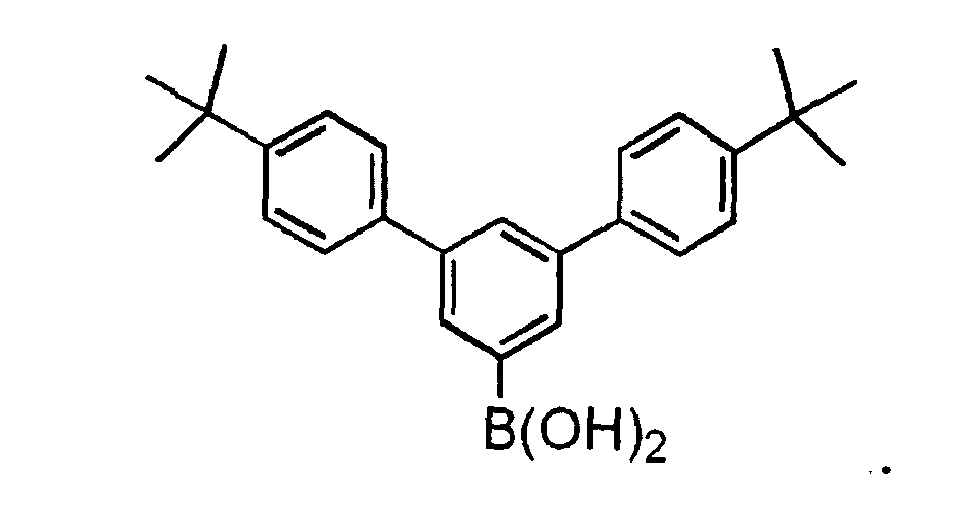
- 2-(3'-bromophenyl)pyridine and 1.2 equivalent of the above-described boric acid compound were subjected to the Suzuki coupling (catalyst: tetrakis(triphenylphosphine)palladium(0), base: 2M sodium carbonate aqueous solution, solvent: ethanol, toluene) to obtain a ligand (namely, compound acting as ligand) represented by the following formula:

- Under an argon atmosphere, the above-described ligand, 4 equivalent of IrCl3•3H2O, 2-EtOEtOH and ion exchanged water were charged, and refluxed. The deposited solid was filtrated under suction. The resultant solid was washed with ethanol and ion exchanged water, then, dried to obtain a yellow powder represented by the following formula:

- Under an argon atmosphere, to the above-described yellow powder was added 2 equivalent of the above-described ligand, and the mixture was heated in a glycol type solvent to obtain an iridium complex (hereinafter, referred to as "light emitting material A") represented by the following formula:

δ 1..37 (s, 54H), 6.90 (t, 3H), 7.35 (d, 3H), 7.48 (d, 12H), 7.57 (d, 6H), 7.64 (d, 12H), 7.55 to 7.70 (m, 6H), 7.78 (s, 6H), 8.00 (d, 3H), 8.05 (s, 3H)
LC/MS (APCI posi): [M+H]+ 1677 - A 3L four-necked flask was purged with nitrogen, and 165 g of 2,7-dibromofluorenone was charged, and suspended in 2.4 L of diphenyl ether. The resultant suspension was heated up to 120°C, and 2,7-dibromofluorenone was dissolved, then, to this was added 155 g of potassium hydroxide, and the mixture was heated up to 160°C and the mixture was stirred for 2.5 hours. The mixture was allowed to cool to room temperature, then, 1.5 L of hexane was added, and the mixture was filtrated, then, washed widh hexane to obtain a coarse product. A 3L four-necked flask was purged with nitrogen, and the resultant coarse product was charged into this, and dissolved in 1.5 L of dehydrated DMF. The resultant solution was heated up to 90°C, then, 530 g of methyl iodide was added gradually. Thereafter, the mixture was reacted for 10 hours. The resultant reaction liquid was allowed to cool to room temperature, then, dropped into 3 L of water cooled to 0°C, and extracted with 3 L of hexane twice. The resultant extraction liquid was filtrated through a glass filter on which silica gel had been spread, then, the resultant organic layer was concentrated. This was purified by silica gel column chromatography, to obtain 133.48 g of a compound E-1 represented by the following formula:

δ 3.68 (s,3H), 7.15 (d,2H), 7.20 (d,1H), 7.52 (d,2H), 7.65 (d,1H), 8.00 (brs, 1H)
13C-NMR (300MHz /CDCl3):
δ 52.6, 121.8, 122.2, 130.1, 131.6, 132.3, 132.4, 133.2, 134.7,
139.4, 140.6, 167.8 - Into a 2L three-necked round bottomed flask was charged 75 g of 1-bromo-4-n-hexylbenzene and 847 ml of anhydrous THF, and the mixture was cooled down to -78°C. Into this was slowly charged 198 ml of n-BuLi (1. 6M hexane solution), and the mixture was stirred at -78°C for 2 hours to obtain reaction liquid. A solution prepared by dissolving 49.53 g of the compound E-1 in 141 ml of anhydrous THF was charged into a dropping funnel, and dropped at a dropping rate at which the temperature of the reaction liquid did not exceed -70°C. After completion of dropping, the mixture was stirred at the same temperature for 2 hours, and heated slowly up to room temperature. Thereafter, to this was added 500 ml of an ammonium chloride saturated aqueous solution and the mixture was stirred, and transferred to a liquid-separation funnel, and the aqueous layer was removed. The resultant organic layer was washed with 500 ml of water twice, and to the resultant organic layer was added anhydrous sodium sulfate and the layer was dried. A layer of silica gel was laid with a thickness of 7 cm on a glass filter, and the THF solution was passed and filtrated, then, washing was performed with 1 L of THF. The resultant solution was concentrated and dried. Repulp washing was performed with 300 ml of hexane to obtain 60 g of a compound E-2 represented by the following formula:

- Into a 1L three-necked flask was charged 60.0 g of the compound E-2 and 202 ml of dichloromethane, the mixture was cooled down to 0°C using an ice bath. A boron trifluoride diethyl ether complex (234 ml) was charged into a dropping funnel, and dropped into the mixture. The resultant reaction solution was stirred at 0°C for 2 hours, then, the solution was poured into a beaker into which 500 ml of water and 500 g of ice had been charged, to stop the reaction. The resultant reaction solution was transferred to a liquid-separation funnel and liquid-separation thereof was carried out, and extraction with 200 ml of dichloromethane was performed, then, the organic layers were combined and washed with 500 ml of water twice, and dried over anhydrous sodium sulfate. A layer of silica gel was laid with a thickness of 7 cm on a glass filter, and the THF solution was passed to filtrate sodium sulfate, and concentrated. To the resultant oil was added 100 ml of toluene, and the mixture was refluxed with heating. Then, the mixture was cooled down to 70°C, then, 700 ml of isopropyl alcohol was added and the mixture was stirred, and allowed to cool to room temperature, to find crystallization. This crystal was filtrated, and dried, then, charged into an egg-shaped flask, and 800 ml of hexane and 50 g of activated carbon were added and the mixture was heated, and refluxed for 2 hours to obtain a mixture. Radiolite was spread (2 cm) on a glass filter, and celite was spread (3 cm) on this, which was heated in an oven to 70°C, and the above-described mixture was filtrated using this. The resultant solution was concentrated to half, and the concentrated product was heated to reflux, then, stirred at room temperature for 1 hour. Further, the prodct was stirred for 2 hours while cooling using an ice bath, and the generated crystals were collected by filtration, thereby obtaining 53.9 g of a compound E represented by the following formula:

δ 0.87(t,6H), 1.28 to 1.37 (m,12H), 1.50 to 1.62 (m,4H), 2.54 (t,4H), 7.04 (s,8H), 7.45 (d,2H), 7.49 (s,2H), 7.55 (d,2H)
13C-NMR (300MHz /CDCl3):
δ14.4, 22.9, 29.4, 31.6, 32.0, 35.8, 65.4, 121.8, 122.1, 128.1, 128.7, 129.7, 131.1, 138.3, 141.9, 142.1, 153.7 - Under a nitrogen atmosphere, the low molecular weight compound C (0.997 g, 2.0mmol), F8Br2 (0.658 g, 1.20 mmol), the low molecular weight compound A (0.221 g, 0.40 mmol), the low molecular weight compound B (0.126 g, 0.40 mmol), palladium acetate (0.7 mg), tris(2-methoxypheyl)phosphine (4.2 mg) and toluene (30 ml) were mixed, and heated at 105°C. Into the resultant solution was dropped 6.6 ml of a 20 wt% tetraethylammonium hydroxide aqueous solution, and the mixture was refluxed for 26 hours. Thereafter, 0.24 g of phenylboric acid was added, and the mixture was further refluxed for 17 hours. Then, to this was added a sodium diethyldithiacarbamate aqueous solution, and the mixture was stirred at 80°C for 2 hours. After cooling, the mixture was washed with 27 ml of water twice, 27 ml of a 3 wt% acetic acid aqueous solution twice, 27 ml of water twice, and the resultant solution was dropped into 310 mL of methanol, and filtration thereof was performed to obtain a precipitate. This precipitate was dissolved in 63 mL of toluene, and purified by passing through an alumina column and a silica gel column in this order. The resultant toluene solution was dropped into 310 ml of methanol, and stirred, then, the resultant precipitate was obtained by filtration, and dried. The yielded amount of this precipitate (hereinafter, referred to as "polymer compound A") was 0.85 g.
- The polymer compound A had a polystyrene-equivalent number average molecular weight of 8.9×10⁴ and a polystyrene-equivalent weight average molecular weight of 2.1×10⁵.
- The polymer compound A is a random copolymer having a repeating unit represented by the following formula:


- Under a nitrogen atmosphere, the low molecular weight compound C (2.118 g, 4.25 mmol), F8Br2 (1.865 g, 3.40 mmol), the low molecular weight compound A (0.469 g, 0.85 mmol), the low molecular weight compound D (0.008 g, 0.03 mmol), palladium acetate (1.4 mg), tris(2-methoxypheyl)phosphine (9.0 mg) and toluene (43 ml) were mixed, and heated at 105°C. Into the resultant solution was dropped 14.2 ml of a 20 wt% tetraethylammonium hydroxide aqueous solution, and the mixture was refluxed for 4 hours. After the reaction, 0.52 g of phenylboric acid was added, and the mixture was further refluxed for 16 hours. Then, a sodium diethyldithiacarbamate aqueous solution was added, and the mixture was stirred at 80°C for 2 hours. After cooling, the mixture was washed with 57 ml of water twice, 57 ml of a 3 wt% acetic acid aqueous solution twice, 57 ml of water twice, and the resultant solution was dropped into 663 mL of methanol, and filtration thereof was performed to obtain a precipitate. This precipitate was dissolved in 134 mL of toluene, and purified by passing through an alumina column and a silica gel column in this order. The resultant toluene solution was dropped into 663 ml of methanol, and stirred, then, the resultant precipitate was obtained by filtration, and dried. The yielded amount of this precipitate (hereinafter, referred to as "polymer compound B") was 1.97 g.
- The polymer compound B had a polystyrene-equivalent number average molecular weight of 1.1×10⁵ and a polystyrene-equivalent weight average molecular weight of 2.4×10⁵.
- The polymer compound B is a random copolymer having a repeating unit represented by the following formula:


- Under a nitrogen atmosphere, 2,7-bis(1,3,2-dioxaboloran-2-yl)-9,9-dioctylfluorene (5.20 g), bis(4-bromophenyl)-(4-s-butylphenyl)-amine (4.50 g), palladium acetate (2.2 mg), tri(2-methylphenyl)phosphine (15.1mg), trioctylmethyl ammonium chloride (0.91g, trade name: Aliquat (registered trademark) 336, manufactured by Aldrich) and toluene (70 ml) were mixed and heated at 105°C. Into the resultant solution was dropped a 2M sodium carbonate aqueous solution (19 ml), and the mixture was refluxed for 4 hours. Thereafter, phenylboric acid (121mg) was added, and the mixture was refluxed further for 3 hours. Then, a sodium diethyldithiacarbamate aqueous solution was added, and the mixture was stirrred at 80°C for 4 hours. After cooling, the mixture was washed with water (60 ml) three times, with a 3 wt% acetic acid aqueous solution (60 ml) three times and with water (60 ml) three times, and purified by passing through an alumina column and a silica gel column in this order.
- The resultant toluene solution was dropped into methanol (3 L), and the mixture was stirred for 3 hours, then, the resultant solid was taken out and dried. The yielded amount of thus obtained polymer compound (alternate copolymer) (hereinafter, referred to as "polymer compound C") having repeating units represented by the following formulae:

- Under a nitrogen atmosphere, the low molecular weight compound C (1.495 g, 3.0 mmol), the low molecular weight compound E (1.431 g, 2.22 mmol), the low molecular weight compound A (0.331 g, 0.60 mmol), the low molecular weight compound B (0.0566 g, 0.18 mmol), palladium acetate (1.0 mg), tris (2-methoxypheyl) phosphine (6.3 mg) and toluene (33 ml) were mixed, and heated at 105°C. Into the resultant solution was dropped 10 ml of a 20 wt% tetraethylammonium hydroxide aqueous solution, and the mixture was refluxed for 19 hours. Thereafter, 0.37 g of phenylboric acid was added, and the mixture was further refluxed for 17 hours. Then, to this was added a sodium diethyldithiacarbamate aqueous solution, and the mixture was stirred at 80°C for 2 hours. After cooling, the mixture was washed with 40 ml of water twice, 40 ml of a 3 wt% acetic acid aqueous solution twice, 40 ml of water twice, and the resultant solution was dropped into 500 mL of methanol, and filtration thereof was performed to obtain a precipitate. This precipitate was dissolved in 94 mL of toluene, and purified by passing through an alumina column and a silica gel column in this order. The resultant toluene solution was dropped into 600 ml of methanol, and stirred, then, the resultant precipitate was obtained by filtration, and dried. The yielded amount of this precipitate (hereinafter, referred to as "polymer compound E") was 1.53 g.
- The polymer compound E had a polystyrene-equivalent number average molecular weight of 1.3×10⁵ and a polystyrene-equivalent weight average molecular weight of 3.3x10⁵ .
- The polymer compound E is a random copolymer having a repeating unit represented by the following formula:


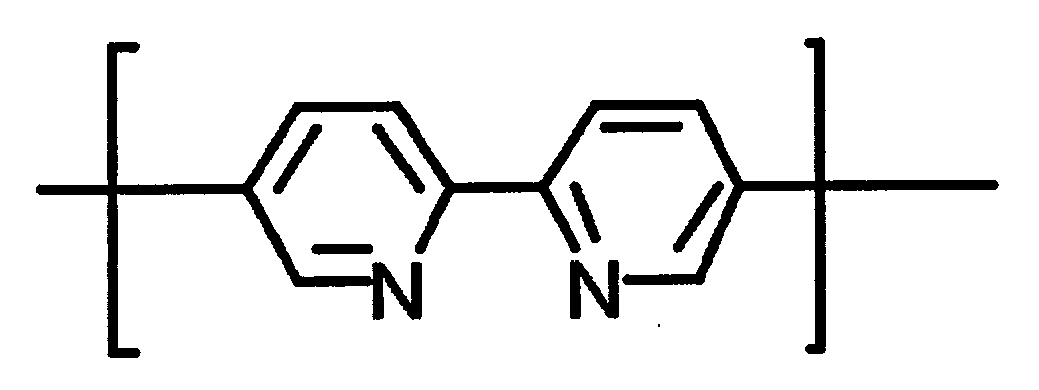
- Under a nitrogen atmosphere, the low molecular weight compound C (1.495 g, 3.0 mmol), the low molecular weight compound E (1.160 g, 1.80 mmol), the low molecular weight compound A (0.331 g, 0.60 mmol), the low molecular weight compound B (0.188 g, 0.60 mmol), palladium acetate (1.0 mg), tris (2-methoxypheyl)phosphine (6.3 mg) and toluene (33 ml) were mixed, and heated at 105°C. Into the resultant solution was dropped 10 ml of a 20 wt% tetraethylammonium hydroxide aqueous solution, and the mixture was refluxed for 19 hours. Thereafter, 0.37 g of phenylboric acid was added, and the mixture was further refluxed for 17 hours. Then, to this was added a sodium diethyldithiacarbamate aqueous solution, and the mixture was stirred at 80°C for 2 hours. After cooling, the mixture was washed with 40 ml of water twice, 40 ml of a 3 wt% acetic acid aqueous solution twice, 40 ml of water twice, and the resultant solution was dropped into 500 mL of methanol, and filtration thereof was performed, to obtain a precipitate. This precipitate was dissolved in 94 mL of toluene, and purified by passing through an alumina column and a silica gel column in this order. The resultant toluene solution was dropped into 800 ml of methanol, and stirred, then, the resultant precipitate was obtained by filtration, and dried. The yielded amount of this precipitate (hereinafter, referred to as "polymer compound F") was 1.39 g.
- The polymer compound F had a polystyrene-equivalent number average molecular weight of 1.3×10⁵ and a polystyrene-equivalent weight average molecular weight of 3.8×10⁵.
- The polymer compound F is a random copolymer having a repeating unit represented by the following formula:


- Under a nitrogen atmosphere, the low molecular weight compound C (0.987 g, 2.0 mmol), F8Br2 (0.878 g, 1.6 mmol), the low molecular weight compound A (0.221 g, 0.40 mmol), palladium acetate (0.7 mg), tris(2-methoxypheyl)phosphine (4.2 mg) and toluene (30 ml) were mixed, and heated at 105°C. Into the resultant solution was dropped 6.6 ml of a 20 wt% tetraethylammonium hydroxide aqueous solution, and the mixture was refluxed for 23 hours. Thereafter, 0.24 g of phenylboric acid was added, and the mixture was further refluxed for 8 hours. Then, to this was added a sodium diethyldithiacarbamate aqueous solution, and the mixture was stirred at 80°C for 2 hours. After cooling, the mixture was washed with 27 ml of water twice, 27 ml of a 3 wt% acetic acid aqueous solution twice, 27 ml of water twice, and the resultant solution was dropped into 310 mL of methanol, and filtration thereof was performed to obtain a precipitate. This precipitate was dissolved in 63 mL of toluene, and purified by passing through an alumina column and a silica gel column in this order. The resultant toluene solution was dropped into 310 ml of methanol, and stirred, then, the resultant precipitate was obtained by filtration, and dried. The yielded amount of this precipitate (hereinafter, referred to as "polymer compound D") was 1.1 g.
- The polymer compound D had a polystyrene-equivalent number average molecular weight of 1.2×10⁵ and a polystyrene-equivalent weight average molecular weight of 3.2×10⁵ .
- The polymer compound D is a random copolymer having a repeating unit represented by the following formula:


- On a glass substrate carrying thereon an ITO film having a thickness of 150 nm formed by a sputtering method, a suspension of poly(3,4)ethylenedioxythiophene/polystyrenesulfonic acid (manufactured by H. C. Starck, trade name: BaytronP) (hereinafter, referred to as "Baytron P") was placed, and film-formed by a spin coating method to give a thickness of about 65 nm, and the film was dried on a hot plate at 200°C for 10 minutes. Then, the polymer compound C was dissolved at a concentration of 0.5 wt% in xylene (manufactured by KANTO Chemical Co., Inc.: for electronics industry (EL grade)), and the resultant xylene solution was placed on a film of Baytron P, film-formed by a spin coating method, then, dried at 180°C for 15 minutes under a nitrogen atmosphere in which the oxygen concentration and the water concentration were not more than 10 ppm (weight base). Next, the polymer compound A and the light emitting material A were dissolved at a concentration of 1.5 wt% in xylene (manufactured by KANTO Chemical Co., Inc.: for electronics industry (EL grade))(weight ratio of polymer compound A/light emitting material A =70/30). The resultant xylene solution was placed on a film of the polymer compound C, and a light emitting layer A was formed by a spin coating method to give a thickness of about 90 nm. The film was dried at 90°C for 10 minutes under a nitrogen atmosphere in which the oxygen concentration and the water concentration were not more than 10 ppm (weight base). The pressure was reduced to 1.0×10⁻⁴ Pa or lower, then, barium was vapor-deposited with a thickness of about 5 nm on a film of the light emitting layer A, then, aluminum was vapor-deposited with a thickness of about 100 nm on the barium layer, as a cathode. After vapor deposition, sealing thereof was performed using a glass substrate, to fabricate an organic electroluminescent device. The device constitution is as described below.
- ITO/Baytron P (about 65 nm)/polymer compound C (about 10 nm)/light emitting layer A (90 nm)/Ba/Al
- When a voltage of 4.8 V was applied on the resultant organic electroluminescent device, the maximum light emission efficiency was 35.0 cd/A.
- On a glass substrate carrying thereon an ITO film having a thickness of 150 nm formed by a sputtering method, a suspension of Baytron P was placed, and film-formed by a spin coating method to give a thickness of about 65 nm, and the film was dried on a hot plate at 200°C for 10 minutes. Then, the polymer compound C was dissolved at a concentration of 0.5 wt% in xylene (manufactured by KANTO Chemical Co., Inc.: for electronics industry (EL grade)), and the resultant xylene solution was placed on a film of Baytron P, film-formed by a spin coating method, then, dried at 180°C for 15 minutes under a nitrogen atmosphere in which the oxygen concentration and the water concentration were not more than 10 ppm (weight base). Next, the polymer compound E and the light emitting material A were dissolved at a concentration of 1. 5 wt% in xylene (manufactured by KANTO Chemical Co., Inc.: for electronics industry (EL grade))(weight ratio of polymer compound E/light emitting material A = 70/30). The resultant xylene solution was placed on a film of the polymer compound C, and a light emitting layer E was formed by a spin coating method to give a thickness of about 90 nm. The film was dried at 90°C for 10 minutes under a nitrogen atmosphere in which the oxygen concentration and the water concentration were not more than 10 ppm (weight base). The pressure was reduced to 1.0×10⁻⁴ Pa or lower, then, barium was vapor-deposited with a thickness of about 5 nm on a film of the light emitting layer E, then, aluminum was vapor-deposited with a thickness of about 100 nm on the barium layer, as a cathode. After vapor deposition, sealing thereof was performed using a glass substrate, to fabricate an organic electroluminescent device. The device constitution is as described below.
- ITO/Baytron P (about 65 nm)/polymer compound C (about 10 nm)/light emitting layer E (90 nm)/Ba/A1
- When a voltage of 8.4 V was applied on the resultant organic electroluminescent device, the maximum light emission efficiency was 35.2 cd/A.
- On a glass substrate carrying thereon an ITO film having a thickness of 150 nm formed by a sputtering method, a suspension of Baytron P was placed, and film-formed by a spin coating method to give a thickness of about 65 nm, and the film was dried on a hot plate at 200°C for 10 minutes. Then, the polymer compound C was dissolved at a concentration of 0.5 wt% in xylene (manufactured by KANTO Chemical Co., Inc.: for electronics industry (EL grade)), and the resultant xylene solution was placed on a film of Baytron P, film-formed by a spin coating method, then, dried at 180°C for 15 minutes under a nitrogen atmosphere in which the oxygen concentration and the water concentration were not more than 10 ppm (weight base). Next, the polymer compound F and the light emitting material A were dissolved at a concentration of 1.4 wt% in xylene (manufactured by KANTO Chemical Co., Inc.: for electronics industry (EL grade))(weight ratio of polymer compound F/light emitting material A = 70/30). The resultant xylene solution was placed on a film of the polymer compound C, and a light emitting layer F was formed by a spin coating method to give a thickness of about 90 nm. The film was dried at 90°C for 10 minutes under a nitrogen atmosphere in which the oxygen concentration and the water concentration were not more than 10 ppm (weight base). The pressure was reduced to 1.0×10⁻⁴ Pa or lower, then, barium was vapor-deposited with a thickness of about 5 nm on a film of the light emitting layer F, then, aluminum was vapor-deposited with a thickness of about 100 nm on the barium layer, as a cathode. After vapor deposition, sealing thereof was performed using a glass substrate, to fabricate an organic electroluminescent device. The device constitution is as described below.
- ITO/Baytron P (about 65 nm)/polymer compound C (about 10 nm)/light emitting layer F (90 nm)/Ba/Al
- When a voltage of 7.8 V was applied on the resultant organic electroluminescent device, the maximum light emission efficiency was 32.6 cd/A.
- On a glass substrate carrying thereon an ITO film having a thickness of 150 nm formed by a sputtering method, a suspension of Baytron P was placed, and film-formed by a spin coating method to give a thickness of about 65 nm, and the film was dried on a hot plate at 200°C for 10 minutes. Then, the polymer compound C was dissolved at a concentration of 0.5 wt% in xylene (manufactured by KANTO Chemical Co., Inc.: for electronics industry (EL grade)), and the resultant xylene solution was placed on a film of Baytron P, film-formed by a spin coating method, then, dried at 180°C for 15 minutes under a nitrogen atmosphere in which the oxygen concentration and the water concentration were not more than 10 ppm (weight base). Next, the polymer compound D and the light emitting material A were dissolved at a concentration of 1.3 wt% in xylene (manufactured by KANTO Chemical Co., Inc.: for electronics industry (EL grade))(weight ratio of polymer compound D/light emitting material A =70/30). The resultant xylene solution was placed on a film of the polymer compound C, and a light emitting layer D was formed by a spin coating method to give a thickness of about 90 nm. The film was dried at 90°C for 10 minutes under a nitrogen atmosphere in which the oxygen concentration and the water concentration were not more than 10 ppm (weight base). The pressure was reduced to 1.0×10⁻⁴ Pa or lower, then, barium was vapor-deposited with a thickness of about 5 nm on a film of the light emitting layer D, then, aluminum was vapor-deposited with a thickness of about 100 nm on the barium layer, as a cathode. After vapor deposition, sealing thereof was performed using a glass substrate, to fabricate an organic electroluminescent device. The device constitution is as described below.
- ITO/Baytron P (about 65 nm)/polymer compound C (about 10 nm)/light emitting layer D (90 nm)/Ba/Al
- When a voltage of 5.2 V was applied on the resultant organic electroluminescent device, the maximum light emission efficiency was 27.1 cd/A.
- The polymer compound of the present invention is capable of giving an organic electroluminesence device showing excellent device properties (particularly, maximum light emission efficiency), when used for production of the organic electroluminesence device. Further, the polymer compound of the present invention is useful also as a hole transporting material or electron transporting material.
Claims (21)
- A polymer compound having a residue of a compound represented by the following formula (1):

and a residue of a compound represented by the following formula (2) :
eight -C(R') = groups may be the same or different; when Z2 and Z3 each represent -C(R')=, two R's contained in Z2 and Z3 may be combined together to form a benzene ring, and when Z3 represents -C(R')=, two R's contained in Z3 and Z4 may be combined together to form a benzene ring and two R's contained in Z4 and Z5 may be combined together to form a benzene ring, providing that two or more combinations of Z2 and Z3, Z3 and Z4, and Z4 and Z5 do not simultaneously form a benzene ring; when Z7 and Z8 each represent -C(R')=, two R's contained in Z7 and Z8 may be combined together to form a benzene ring, and when z8 represents -C(R')=, two R's contained in Z8 and Z9 may be combined together to form a benzene ring and two R's contained in Z9 and Z10 may be combined together to form a benzene ring, providing that two or more combinations of Z7 and Z8, Z8 and Z9, and Z9 and Z10 do not simultaneously form a benzene ring; the benzene ring formed by mutual combintaion of two R's optionally has a substituent. - The polymer compound according to Claim 1, wherein R' in the above-described formula (2) represents a hydrogen atom, an alkyl group optionally substituted by a fluorine atom, an alkoxy group optionally substituted by a fluorine atom, an aryl group optionally substituted by a fluorine atom, an aryloxy group optionally substituted by a fluorine atom, an arylalkyl group optionally substituted by a fluorine atom, an arylalkoxy group optionally substituted by a fluorine atom, an arylalkenyl group optionally substituted by a fluorine atom, an arylalkynyl group optionally substituted by a fluorine atom, an amino group optionally substituted by a fluorine atom, a substituted amino group optionally substituted by a fluorine atom, a halogen atom, acyl group optionally substituted by a fluorine atom, an acyloxy group optionally substituted by a fluorine atom, a mono-valent heterocyclic group optionally substituted by a fluorine atom, a carboxyl group, a nitro group or a cyano group.
- The polymer compound according to Claim 1 or 2, wherein the above-described R' represents a hydrogen atom or an alkyl group.
- The polymer compound according to any one of Claims 1 to 3, wherein the residue of a compound represented by the above-described formula (1) is contained as a repeating unit.
- The polymer compound according to Claim 4, wherein the repeating unit composed of the residue of a compound represented by the above-described formula (1) is a repeating unit represented by the following formula (3):
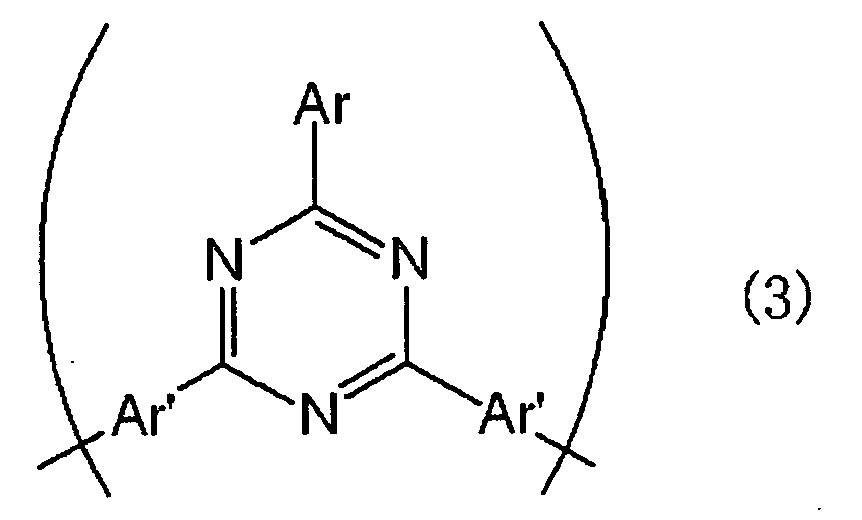
- The polymer compound according to Claim 5, wherein the above-described Ar represents a phenyl group optionally having a substituent and the above-described Ar' represents a 1,4-phenylene group optionally having a substituent.
- The polymer compound according to any one of Claims 1 to 6, wherein the residue of a compound represented by the above-described formula (2) is contained as a repeating unit.
- The polymer compound according to Claim 7, wherein the repeating unit composed of the residue of a compound represented by the above-described formula (2) is a repeating unit represented by the following formula (4):

or a repeating unit represented by the following formula (5):
an arylalkyl group, an arylalkoxy group, an arylalkenyl group, an arylalkynyl group, an amino group, a substituted amino group, a halogen atom, an acyl group, an acyloxy group, a mono-valent heterocyclic group, a carboxyl group, a substituted carboxyl group, a nitro group, or a cyano group, and two R"'s contained in Z1**, Z2**, Z3**, Z4** and Z5** each represent a connecting bond. Z6, Z7, Z8 , Z9 and Z10 each have the same meaning as described above; one or some or all of the hydrogen atoms contained in the group represented by R' and R"' may be substituted by a fluorine atom; four -C(R') = groups may be the same or different. Four -C(R"')= groups may be the same or different; when Z2** and Z3** each represent -C(R"')=, two R"'s contained in Z2** and Z3** may be combined together to form a benzene ring, and when Z3** represents -C(R"')=, two R"'s contained in Z3** and Z4** may be combined together to form a benzene ring and two R"'s contained in Z4** and Z5** may be combined together to form a benzene ring, providing that two or more combinations of Z2** and Z3**, Z3** and Z4**, and Z4** and Z5** do not simultaneously form a benzene ring; when z7 and Z8 each represent -C(R')=, two R's contained in Z7 and z8 may be combined together to form a benzene ring, and when Z8 represents -C(R')=, two R's contained in Z8 and Z9 may be combined together to form a benzene ring and two R's contained in Z9 and Z10 may be combined together to form a benzene ring, providing that two or more combinations of Z7 and Z8, z8 and Z9 , and Z9 and Z10 do not simultaneously form a benzene ring; the benzene ring formed by mutual combination of two R's optionally has a substituent, and the benzene ring formed by mutual combination of two R"'s optionally has a substituent. - The polymer compound according to Claim 8, wherein the repeating unit composed of the residue of a compound represented by the above-described formula (2) is a repeating unit composed of a 2,2'-bipyridine-5,5'-diyl group optionally having a substituent.
- The polymer compound according to any one of Claims 1 to 6, wherein the residue of a compound represented by the above-described formula (2) is a group represented by the following formula (6):

and is present at an end of a molecule chain. - The polymer compound according to Claim 10, wherein the residue of a compound represented by the above-described formula (2) is a 2,2'-bipyridine-5-yl group optionally having a substituent, and is present at an end of a molecule chain.
- The polymer compound according to Claim 8 or 10, wherein R" which is not a connecting bond is a hydrogen atom or an alkyl group.
- The polymer compound according to Claim 8, wherein R"' which is not a connecting bond is a hydrogen atom or an alkyl group.
- The polymer compound according to any one of Claims 10 to 13 having
a repeating unit represented by the above-described formula (3), and
at least one selected from the group consisting of repeating units represented by the above-described formula (4) and repeating units represented by the above-described formula (5), and/or a group represented by the above-described formula (6). - The polymer compound according to any one of Claims 1 to 14, further having at least one repeating unit selected from the group consisting of repeating units represented by the following formula (A), repeating units represented by the following formula (B) and repeating units represented by the following formula (C):


X1 represents -CR3=CR4-Or C=C-; R3 and R4 represent each independently a hydrogen atom, an alkyl group, an aryl group, a mono-valent heterocyclic group, a carboxyl group, a substituted carboxyl group or a cyano group; a represents 0 or 1. - The polymer compound according to Claim 15, wherein the repeating unit represented by the above-described formula (A) is a fluorenediyl group optionally having a substituent, a phenylene group optionally having a substituent, or a combination thereof.
- A composition comprising the polymer compound according to any one of Claims 1 to 16, and at least one material selected from the group consisting of a light emitting material, a hole transporting material and an electron transporting material.
- The composition according to Claim 17, further comprising an organic solvent.
- An organic electroluminescent device obtained by using the polymer compound according to any one of Claims 1 to 16.
- A planar light source comprising the organic electroluminescent device according to Claim 19.
- A display comprising the organic electroluminescent device according to Claim 19.
Applications Claiming Priority (3)
| Application Number | Priority Date | Filing Date | Title |
|---|---|---|---|
| JP2008115200 | 2008-04-25 | ||
| JP2008279740 | 2008-10-30 | ||
| PCT/JP2009/058602 WO2009131255A1 (en) | 2008-04-25 | 2009-04-24 | Polymeric compound having residue of nitrogenated heterocyclic compound |
Publications (2)
| Publication Number | Publication Date |
|---|---|
| EP2275469A1 true EP2275469A1 (en) | 2011-01-19 |
| EP2275469A4 EP2275469A4 (en) | 2012-11-28 |
Family
ID=41216973
Family Applications (1)
| Application Number | Title | Priority Date | Filing Date |
|---|---|---|---|
| EP09734044A Withdrawn EP2275469A4 (en) | 2008-04-25 | 2009-04-24 | POLYMER COMPOUND HAVING A FUNCTIONAL GROUP THAT REMAINS A NITROGENIC HETEROCYCLIC COMPOUND |
Country Status (6)
| Country | Link |
|---|---|
| US (1) | US20110118411A1 (en) |
| EP (1) | EP2275469A4 (en) |
| KR (1) | KR20100135931A (en) |
| CN (1) | CN102015820A (en) |
| TW (1) | TW201000513A (en) |
| WO (1) | WO2009131255A1 (en) |
Families Citing this family (50)
| Publication number | Priority date | Publication date | Assignee | Title |
|---|---|---|---|---|
| JP5515542B2 (en) * | 2008-10-06 | 2014-06-11 | 住友化学株式会社 | Polymer compound containing nitrogen-containing heterocyclic structure |
| JP5691177B2 (en) * | 2009-01-29 | 2015-04-01 | 住友化学株式会社 | Polymer compound and light emitting device using the same |
| WO2011078391A1 (en) | 2009-12-25 | 2011-06-30 | 住友化学株式会社 | Composition and luminescent element obtained using same |
| CN102695707A (en) | 2009-12-28 | 2012-09-26 | 住友化学株式会社 | Compound and organic electroluminescent device using same |
| WO2012008550A1 (en) * | 2010-07-16 | 2012-01-19 | 住友化学株式会社 | Polymer compound, composition containing polymer compound, liquid composition, thin film and element, and surface light source and display device using element |
| US9478744B2 (en) | 2010-11-30 | 2016-10-25 | Sumitomo Chemical Company, Limited | High molecular compound, method for producing same, and light-emitting element |
| WO2012073902A1 (en) * | 2010-11-30 | 2012-06-07 | 住友化学株式会社 | Polymer compound, method for producing same, and light emitting element |
| KR101799137B1 (en) | 2010-12-21 | 2017-11-17 | 스미또모 가가꾸 가부시키가이샤 | High-molecular compound and light-emitting element using same |
| TWI507441B (en) * | 2010-12-21 | 2015-11-11 | Sumitomo Chemical Co | Polymer compound and light-emitting element using the same |
| US9373822B2 (en) | 2011-01-19 | 2016-06-21 | Joled Inc. | Method for producing organic light-emitting element, organic display panel, organic light-emitting device, method for forming functional layer, ink, substrate, organic light-emitting element, organic display device, and inkjet device |
| US9318722B2 (en) | 2011-01-19 | 2016-04-19 | Joled Inc. | Method for producing organic light-emitting element, organic display panel, organic light-emitting device, method for forming functional layer, ink, substrate, organic light-emitting element, organic display device, and inkjet device |
| WO2012098576A1 (en) | 2011-01-19 | 2012-07-26 | パナソニック株式会社 | Method for producing organic light-emitting element, organic display panel, organic light-emitting device, method for forming functional layer, ink, substrate, organic light-emitting element, organic display device, and inkjet device |
| WO2012133465A1 (en) | 2011-03-28 | 2012-10-04 | 住友化学株式会社 | Electronic device, polymer compound, organic compound, and method of producing polymer compound |
| TWI432418B (en) * | 2011-12-19 | 2014-04-01 | Au Optronics Corp | Electron transport material and organic light emitting device |
| WO2013111512A1 (en) * | 2012-01-24 | 2013-08-01 | 株式会社島津製作所 | Analysis method for dye for organic solar cell and purification method therefor |
| US9929347B2 (en) | 2012-03-27 | 2018-03-27 | Sumitomo Chemical Company, Limtied | Polymer compound and light emitting element using same |
| GB201223283D0 (en) * | 2012-12-21 | 2013-02-06 | Cambridge Display Tech Ltd | Polymer and organic electronic device |
| CN104003950A (en) * | 2013-02-21 | 2014-08-27 | 海洋王照明科技股份有限公司 | Organic electroluminescence phosphorescence host material, preparation method thereof and organic electroluminescence device |
| WO2014157016A1 (en) | 2013-03-28 | 2014-10-02 | 住友化学株式会社 | Polymeric compound and light-emitting element manufactured using same |
| US20160233425A1 (en) | 2013-10-01 | 2016-08-11 | Sumitomo Chemical Company, Limited | Light emitting device |
| KR102326217B1 (en) | 2014-01-08 | 2021-11-15 | 스미또모 가가꾸 가부시키가이샤 | Metal complex and light emitting element using same |
| CN106795277B (en) | 2014-08-28 | 2020-04-10 | 住友化学株式会社 | Polymer compound and light-emitting element using same |
| JP6769020B2 (en) * | 2015-09-30 | 2020-10-14 | 日立化成株式会社 | Charge transporting material, ink composition using the material, organic electronics element, organic electroluminescence element, display element, lighting device, and display device. |
| US10810929B2 (en) | 2015-11-04 | 2020-10-20 | Sumitomo Chemical Company, Limited | Method for driving light emitting element and light emitting device |
| JP6943241B2 (en) | 2016-06-24 | 2021-09-29 | 住友化学株式会社 | Light emitting element |
| CN110235266B (en) | 2017-01-27 | 2021-04-02 | 住友化学株式会社 | Composition and light-emitting element obtained using same |
| JP6642743B2 (en) | 2017-04-27 | 2020-02-12 | 住友化学株式会社 | Light emitting element |
| KR102513175B1 (en) | 2017-04-27 | 2023-03-24 | 스미또모 가가꾸 가부시키가이샤 | Composition and light emitting device using the same |
| US20200411773A1 (en) | 2017-04-27 | 2020-12-31 | Sumitomo Chemical Company, Limited | Composition and light emitting device using the same |
| JP6573041B2 (en) | 2017-04-27 | 2019-09-11 | 住友化学株式会社 | Light emitting element |
| WO2018198972A1 (en) | 2017-04-27 | 2018-11-01 | 住友化学株式会社 | Composition and light-emitting element comprising same |
| EP3618134A4 (en) | 2017-04-27 | 2021-01-06 | Sumitomo Chemical Company Limited | ELECTROLUMINESCENT ELEMENT |
| WO2019004248A1 (en) | 2017-06-30 | 2019-01-03 | 住友化学株式会社 | Macromolecular compound and light-emitting element using same |
| WO2019049225A1 (en) | 2017-09-06 | 2019-03-14 | 住友化学株式会社 | Light emitting element |
| US11046886B2 (en) | 2017-09-14 | 2021-06-29 | Sumitomo Chemical Company, Limited | Method for producing liquid composition |
| EP3691416A4 (en) | 2017-09-29 | 2021-04-21 | Sumitomo Chemical Company Limited | LIGHT EMITTING DEVICE |
| EP3689887A4 (en) | 2017-09-29 | 2021-06-09 | Sumitomo Chemical Company Limited | COMPOSITION AND ELECTROLUMINESCENT DEVICE USING THE SAME |
| KR20200074192A (en) | 2017-10-27 | 2020-06-24 | 스미또모 가가꾸 가부시키가이샤 | Light emitting element |
| US11889751B2 (en) | 2018-04-26 | 2024-01-30 | Sumitomo Chemical Company, Limited | Light emitting element |
| JP6545879B1 (en) | 2018-10-10 | 2019-07-17 | 住友化学株式会社 | Film for light emitting element and light emitting element using the same |
| JP7495231B2 (en) | 2019-02-08 | 2024-06-04 | 住友化学株式会社 | Compound and light-emitting device using same |
| JP6934967B2 (en) | 2019-03-29 | 2021-09-15 | 住友化学株式会社 | Light emitting element and composition for light emitting element |
| JP6941711B2 (en) | 2019-07-26 | 2021-09-29 | 住友化学株式会社 | Metal complex and light emitting device containing it |
| JP7216754B2 (en) | 2020-03-31 | 2023-02-01 | 住友化学株式会社 | COMPOSITION AND LIGHT-EMITTING DEVICE CONTAINING THE SAME |
| JP7086259B2 (en) | 2020-09-24 | 2022-06-17 | 住友化学株式会社 | Light emitting device and composition |
| JP7086258B2 (en) | 2020-09-24 | 2022-06-17 | 住友化学株式会社 | Light emitting device and composition |
| JP7079883B2 (en) | 2020-09-24 | 2022-06-02 | 住友化学株式会社 | Light emitting device and composition |
| JP7058792B2 (en) | 2020-09-24 | 2022-04-22 | 住友化学株式会社 | Light emitting device and composition |
| JP7015406B1 (en) | 2020-09-24 | 2022-02-02 | 住友化学株式会社 | Light emitting device and composition |
| CN112979947B (en) * | 2021-05-13 | 2021-08-20 | 陈瑾 | Aromatic polyoxadiazole, aromatic polyoxadiazole film and preparation method of film |
Family Cites Families (19)
| Publication number | Priority date | Publication date | Assignee | Title |
|---|---|---|---|---|
| US4356429A (en) | 1980-07-17 | 1982-10-26 | Eastman Kodak Company | Organic electroluminescent cell |
| US4539507A (en) | 1983-03-25 | 1985-09-03 | Eastman Kodak Company | Organic electroluminescent devices having improved power conversion efficiencies |
| JPS6370257A (en) | 1986-09-12 | 1988-03-30 | Fuji Xerox Co Ltd | Electric charge transfer material for electrophotography |
| JPS63175860A (en) | 1987-01-16 | 1988-07-20 | Fuji Xerox Co Ltd | Electrophotographic sensitive body |
| JP2651237B2 (en) | 1989-02-10 | 1997-09-10 | 出光興産株式会社 | Thin-film electroluminescence device |
| JPH02135359A (en) | 1988-11-16 | 1990-05-24 | Fuji Xerox Co Ltd | Electrophotographic sensitive body |
| JPH02135361A (en) | 1988-11-16 | 1990-05-24 | Fuji Xerox Co Ltd | Electrophotographic sensitive body |
| JPH0337992A (en) | 1989-07-04 | 1991-02-19 | Idemitsu Kosan Co Ltd | Manufacture of organic electroluminescence element |
| JPH03152184A (en) | 1989-11-08 | 1991-06-28 | Nec Corp | El element of organic thin film |
| JPH0826126B2 (en) * | 1993-03-29 | 1996-03-13 | 東京工業大学長 | Poly (2,2'-bipyridine-5,5'-diyl) polymer having alkyl substituents, production method and use thereof |
| EP0925319B1 (en) * | 1996-09-16 | 2001-12-05 | Bayer Ag | Triazine polymers and the application thereof in electroluminescent arrangements |
| EP1366113B1 (en) | 2001-02-20 | 2011-04-13 | Isis Innovation Limited | Metal-containing dendrimers |
| GB0109108D0 (en) | 2001-04-11 | 2001-05-30 | Cambridge Display Tech Ltd | Polymer, its preparation and uses |
| US6730417B2 (en) * | 2002-01-29 | 2004-05-04 | Xerox Corporation | Organic electroluminescent (EL) devices |
| JP4225043B2 (en) * | 2002-12-03 | 2009-02-18 | コニカミノルタホールディングス株式会社 | ORGANIC ELECTROLUMINESCENT DEVICE, ITS MANUFACTURING METHOD, DISPLAY DEVICE, LIGHTING DEVICE, AND LIGHT SOURCE |
| KR20070085976A (en) * | 2004-11-10 | 2007-08-27 | 내셔널 유니버시티 오브 싱가포르 | Multifunctional copolymers comprising rare earth metal complexes and devices comprising them |
| CN101248058B (en) * | 2005-08-26 | 2012-05-09 | 东曹株式会社 | 1, 3, 5-triazine derivative, method for producing the same and organic electroluminescent device comprising the same as constituent |
| JP5019816B2 (en) * | 2005-08-26 | 2012-09-05 | 東ソー株式会社 | 1,3,5-triazine derivative, process for producing the same, and organic electroluminescent device comprising the same |
| JP5604804B2 (en) * | 2008-04-25 | 2014-10-15 | 住友化学株式会社 | Composition comprising a nitrogen-containing heterocyclic compound |
-
2009
- 2009-04-24 CN CN200980114156XA patent/CN102015820A/en active Pending
- 2009-04-24 TW TW098113598A patent/TW201000513A/en unknown
- 2009-04-24 KR KR1020107026062A patent/KR20100135931A/en not_active Withdrawn
- 2009-04-24 WO PCT/JP2009/058602 patent/WO2009131255A1/en not_active Ceased
- 2009-04-24 US US12/989,304 patent/US20110118411A1/en not_active Abandoned
- 2009-04-24 EP EP09734044A patent/EP2275469A4/en not_active Withdrawn
Also Published As
| Publication number | Publication date |
|---|---|
| TW201000513A (en) | 2010-01-01 |
| US20110118411A1 (en) | 2011-05-19 |
| CN102015820A (en) | 2011-04-13 |
| KR20100135931A (en) | 2010-12-27 |
| WO2009131255A1 (en) | 2009-10-29 |
| EP2275469A4 (en) | 2012-11-28 |
Similar Documents
| Publication | Publication Date | Title |
|---|---|---|
| US20110118411A1 (en) | Polymeric compound having residue of nitrogen-containing heterocyclic compound | |
| EP2110400B1 (en) | Block copolymer and polymer light-emitting device | |
| KR101247885B1 (en) | Polymer Material and Device Using Same | |
| KR101827035B1 (en) | Macromolecular compound and organic el element using same | |
| US20110127512A1 (en) | Copolymer and polymer light emitting device using the same | |
| EP2471833B1 (en) | Polymer, composition, liquid composition, and conductive thin film | |
| EP2112184B1 (en) | Block copolymer and polymer light-emitting device | |
| GB2445519A (en) | Copolymer and polymer light emitting devices made by using the same | |
| KR20090055044A (en) | Polymer compound and polymer light emitting device using same | |
| KR101759367B1 (en) | Light-emitting material, ink composition, thin film, light-emitting element, and method for manufacturing a light-emitting element | |
| EP2123691A1 (en) | Polymer compound and composition containing the same | |
| EP2070965A1 (en) | Polymer compound and polymer light-emitting device | |
| EP1724294B1 (en) | Polymer and polymeric luminescent element comprising the same | |
| KR101157681B1 (en) | Luminescent Material and Luminescent Element Comprising the Same | |
| JP6046389B2 (en) | Organic electroluminescence device | |
| EP2159244A1 (en) | Anthracene polymer compound and light-emitting device using the same | |
| JP6064433B2 (en) | Polymer compound and light emitting device using the same | |
| EP1961780A1 (en) | Polymer compound and polymer light-emitting device using same | |
| JP5604804B2 (en) | Composition comprising a nitrogen-containing heterocyclic compound | |
| JP2010260879A (en) | Polymer compound having a residue of nitrogen-containing heterocyclic compound | |
| JP2012146968A (en) | Organic light-emitting element and conjugated polymer compound |
Legal Events
| Date | Code | Title | Description |
|---|---|---|---|
| PUAI | Public reference made under article 153(3) epc to a published international application that has entered the european phase |
Free format text: ORIGINAL CODE: 0009012 |
|
| 17P | Request for examination filed |
Effective date: 20101116 |
|
| AK | Designated contracting states |
Kind code of ref document: A1 Designated state(s): AT BE BG CH CY CZ DE DK EE ES FI FR GB GR HR HU IE IS IT LI LT LU LV MC MK MT NL NO PL PT RO SE SI SK TR |
|
| AX | Request for extension of the european patent |
Extension state: AL BA RS |
|
| DAX | Request for extension of the european patent (deleted) | ||
| RAP1 | Party data changed (applicant data changed or rights of an application transferred) |
Owner name: SUMITOMO CHEMICAL COMPANY, LIMITED |
|
| A4 | Supplementary search report drawn up and despatched |
Effective date: 20121029 |
|
| RIC1 | Information provided on ipc code assigned before grant |
Ipc: C09K 11/06 20060101ALI20121022BHEP Ipc: C07D 251/24 20060101ALI20121022BHEP Ipc: C08G 61/12 20060101AFI20121022BHEP Ipc: C07D 213/22 20060101ALI20121022BHEP Ipc: H01L 51/50 20060101ALI20121022BHEP |
|
| STAA | Information on the status of an ep patent application or granted ep patent |
Free format text: STATUS: THE APPLICATION IS DEEMED TO BE WITHDRAWN |
|
| 18D | Application deemed to be withdrawn |
Effective date: 20130528 |