EP2275424A1 - Doripenem crystallization process - Google Patents
Doripenem crystallization process Download PDFInfo
- Publication number
- EP2275424A1 EP2275424A1 EP10169837A EP10169837A EP2275424A1 EP 2275424 A1 EP2275424 A1 EP 2275424A1 EP 10169837 A EP10169837 A EP 10169837A EP 10169837 A EP10169837 A EP 10169837A EP 2275424 A1 EP2275424 A1 EP 2275424A1
- Authority
- EP
- European Patent Office
- Prior art keywords
- doripenem
- monohydrate
- solution
- crystallization process
- acid
- Prior art date
- Legal status (The legal status is an assumption and is not a legal conclusion. Google has not performed a legal analysis and makes no representation as to the accuracy of the status listed.)
- Withdrawn
Links
- AVAACINZEOAHHE-VFZPANTDSA-N doripenem Chemical compound C=1([C@H](C)[C@@H]2[C@H](C(N2C=1C(O)=O)=O)[C@H](O)C)S[C@@H]1CN[C@H](CNS(N)(=O)=O)C1 AVAACINZEOAHHE-VFZPANTDSA-N 0.000 title claims abstract description 104
- 229960000895 doripenem Drugs 0.000 title claims abstract description 102
- 238000000034 method Methods 0.000 title claims abstract description 47
- 238000002425 crystallisation Methods 0.000 title claims abstract description 45
- 230000008025 crystallization Effects 0.000 title claims abstract description 45
- 230000008569 process Effects 0.000 title claims abstract description 41
- NTUBEBXBDGKBTJ-WGLOMNHJSA-N Doripenem hydrate Chemical compound O.C=1([C@H](C)[C@@H]2[C@H](C(N2C=1C(O)=O)=O)[C@H](O)C)S[C@@H]1CN[C@H](CNS(N)(=O)=O)C1 NTUBEBXBDGKBTJ-WGLOMNHJSA-N 0.000 claims abstract description 39
- XLYOFNOQVPJJNP-UHFFFAOYSA-N water Substances O XLYOFNOQVPJJNP-UHFFFAOYSA-N 0.000 claims abstract description 13
- KFZMGEQAYNKOFK-UHFFFAOYSA-N Isopropanol Chemical group CC(C)O KFZMGEQAYNKOFK-UHFFFAOYSA-N 0.000 claims description 44
- HEMHJVSKTPXQMS-UHFFFAOYSA-M Sodium hydroxide Chemical group [OH-].[Na+] HEMHJVSKTPXQMS-UHFFFAOYSA-M 0.000 claims description 32
- VEXZGXHMUGYJMC-UHFFFAOYSA-N Hydrochloric acid Chemical compound Cl VEXZGXHMUGYJMC-UHFFFAOYSA-N 0.000 claims description 15
- 239000002253 acid Substances 0.000 claims description 12
- 239000013078 crystal Substances 0.000 claims description 10
- 239000002585 base Substances 0.000 claims description 8
- 239000003513 alkali Substances 0.000 claims description 6
- 238000001914 filtration Methods 0.000 claims description 6
- LFQSCWFLJHTTHZ-UHFFFAOYSA-N Ethanol Chemical compound CCO LFQSCWFLJHTTHZ-UHFFFAOYSA-N 0.000 claims description 5
- 238000001035 drying Methods 0.000 claims description 5
- 239000003960 organic solvent Substances 0.000 claims description 5
- 239000012296 anti-solvent Substances 0.000 claims description 4
- 238000004128 high performance liquid chromatography Methods 0.000 claims description 4
- QGZKDVFQNNGYKY-UHFFFAOYSA-O Ammonium Chemical compound [NH4+] QGZKDVFQNNGYKY-UHFFFAOYSA-O 0.000 claims description 2
- BVKZGUZCCUSVTD-UHFFFAOYSA-M Bicarbonate Chemical compound OC([O-])=O BVKZGUZCCUSVTD-UHFFFAOYSA-M 0.000 claims description 2
- BVKZGUZCCUSVTD-UHFFFAOYSA-L Carbonate Chemical compound [O-]C([O-])=O BVKZGUZCCUSVTD-UHFFFAOYSA-L 0.000 claims description 2
- 229910001854 alkali hydroxide Inorganic materials 0.000 claims description 2
- 150000008044 alkali metal hydroxides Chemical class 0.000 claims description 2
- 150000001412 amines Chemical class 0.000 claims description 2
- 150000007524 organic acids Chemical class 0.000 claims description 2
- 229910052500 inorganic mineral Inorganic materials 0.000 claims 1
- 239000011707 mineral Substances 0.000 claims 1
- 238000004519 manufacturing process Methods 0.000 abstract description 7
- 230000000704 physical effect Effects 0.000 abstract description 6
- -1 Doripenem Dihydrate Chemical class 0.000 abstract description 3
- 230000002378 acidificating effect Effects 0.000 abstract description 2
- 239000000243 solution Substances 0.000 description 30
- 239000000725 suspension Substances 0.000 description 30
- 239000007787 solid Substances 0.000 description 15
- 238000003756 stirring Methods 0.000 description 13
- 239000000126 substance Substances 0.000 description 13
- 239000002904 solvent Substances 0.000 description 10
- 239000000203 mixture Substances 0.000 description 9
- 238000000354 decomposition reaction Methods 0.000 description 8
- 239000012088 reference solution Substances 0.000 description 8
- 239000002245 particle Substances 0.000 description 7
- 239000000843 powder Substances 0.000 description 7
- 239000011550 stock solution Substances 0.000 description 7
- OKKJLVBELUTLKV-UHFFFAOYSA-N Methanol Chemical compound OC OKKJLVBELUTLKV-UHFFFAOYSA-N 0.000 description 6
- YZBQHRLRFGPBSL-RXMQYKEDSA-N carbapenem Chemical compound C1C=CN2C(=O)C[C@H]21 YZBQHRLRFGPBSL-RXMQYKEDSA-N 0.000 description 6
- 239000002002 slurry Substances 0.000 description 6
- 239000012085 test solution Substances 0.000 description 6
- 239000007864 aqueous solution Substances 0.000 description 5
- 239000007857 degradation product Substances 0.000 description 5
- ZWEHNKRNPOVVGH-UHFFFAOYSA-N 2-Butanone Chemical compound CCC(C)=O ZWEHNKRNPOVVGH-UHFFFAOYSA-N 0.000 description 4
- CSCPPACGZOOCGX-UHFFFAOYSA-N Acetone Chemical compound CC(C)=O CSCPPACGZOOCGX-UHFFFAOYSA-N 0.000 description 4
- NBIIXXVUZAFLBC-UHFFFAOYSA-N Phosphoric acid Chemical compound OP(O)(O)=O NBIIXXVUZAFLBC-UHFFFAOYSA-N 0.000 description 4
- 238000004364 calculation method Methods 0.000 description 4
- 229910003460 diamond Inorganic materials 0.000 description 4
- 239000010432 diamond Substances 0.000 description 4
- 238000004090 dissolution Methods 0.000 description 4
- 238000011049 filling Methods 0.000 description 4
- 238000010438 heat treatment Methods 0.000 description 4
- 238000000338 in vitro Methods 0.000 description 4
- 239000000463 material Substances 0.000 description 4
- 239000000047 product Substances 0.000 description 4
- 238000001228 spectrum Methods 0.000 description 4
- 239000007858 starting material Substances 0.000 description 4
- QTBSBXVTEAMEQO-UHFFFAOYSA-N Acetic acid Chemical compound CC(O)=O QTBSBXVTEAMEQO-UHFFFAOYSA-N 0.000 description 3
- WMFOQBRAJBCJND-UHFFFAOYSA-M Lithium hydroxide Chemical compound [Li+].[OH-] WMFOQBRAJBCJND-UHFFFAOYSA-M 0.000 description 3
- MUBZPKHOEPUJKR-UHFFFAOYSA-N Oxalic acid Chemical compound OC(=O)C(O)=O MUBZPKHOEPUJKR-UHFFFAOYSA-N 0.000 description 3
- 108700020474 Penicillin-Binding Proteins Proteins 0.000 description 3
- RWRDLPDLKQPQOW-UHFFFAOYSA-N Pyrrolidine Chemical compound C1CCNC1 RWRDLPDLKQPQOW-UHFFFAOYSA-N 0.000 description 3
- ZMANZCXQSJIPKH-UHFFFAOYSA-N Triethylamine Chemical compound CCN(CC)CC ZMANZCXQSJIPKH-UHFFFAOYSA-N 0.000 description 3
- 150000007513 acids Chemical class 0.000 description 3
- 238000004458 analytical method Methods 0.000 description 3
- 230000015572 biosynthetic process Effects 0.000 description 3
- 229940041011 carbapenems Drugs 0.000 description 3
- 230000000052 comparative effect Effects 0.000 description 3
- UAOMVDZJSHZZME-UHFFFAOYSA-N diisopropylamine Chemical compound CC(C)NC(C)C UAOMVDZJSHZZME-UHFFFAOYSA-N 0.000 description 3
- 238000009826 distribution Methods 0.000 description 3
- 230000000694 effects Effects 0.000 description 3
- 150000004682 monohydrates Chemical class 0.000 description 3
- 238000000634 powder X-ray diffraction Methods 0.000 description 3
- 238000002360 preparation method Methods 0.000 description 3
- QGZKDVFQNNGYKY-UHFFFAOYSA-N Ammonia Chemical compound N QGZKDVFQNNGYKY-UHFFFAOYSA-N 0.000 description 2
- VHUUQVKOLVNVRT-UHFFFAOYSA-N Ammonium hydroxide Chemical compound [NH4+].[OH-] VHUUQVKOLVNVRT-UHFFFAOYSA-N 0.000 description 2
- 239000004254 Ammonium phosphate Substances 0.000 description 2
- 241000894006 Bacteria Species 0.000 description 2
- 238000005033 Fourier transform infrared spectroscopy Methods 0.000 description 2
- VZCYOOQTPOCHFL-OWOJBTEDSA-N Fumaric acid Chemical compound OC(=O)\C=C\C(O)=O VZCYOOQTPOCHFL-OWOJBTEDSA-N 0.000 description 2
- DGAQECJNVWCQMB-PUAWFVPOSA-M Ilexoside XXIX Chemical compound C[C@@H]1CC[C@@]2(CC[C@@]3(C(=CC[C@H]4[C@]3(CC[C@@H]5[C@@]4(CC[C@@H](C5(C)C)OS(=O)(=O)[O-])C)C)[C@@H]2[C@]1(C)O)C)C(=O)O[C@H]6[C@@H]([C@H]([C@@H]([C@H](O6)CO)O)O)O.[Na+] DGAQECJNVWCQMB-PUAWFVPOSA-M 0.000 description 2
- WHXSMMKQMYFTQS-UHFFFAOYSA-N Lithium Chemical compound [Li] WHXSMMKQMYFTQS-UHFFFAOYSA-N 0.000 description 2
- AFVFQIVMOAPDHO-UHFFFAOYSA-N Methanesulfonic acid Chemical compound CS(O)(=O)=O AFVFQIVMOAPDHO-UHFFFAOYSA-N 0.000 description 2
- NQRYJNQNLNOLGT-UHFFFAOYSA-N Piperidine Chemical compound C1CCNCC1 NQRYJNQNLNOLGT-UHFFFAOYSA-N 0.000 description 2
- ZLMJMSJWJFRBEC-UHFFFAOYSA-N Potassium Chemical compound [K] ZLMJMSJWJFRBEC-UHFFFAOYSA-N 0.000 description 2
- QAOWNCQODCNURD-UHFFFAOYSA-N Sulfuric acid Chemical compound OS(O)(=O)=O QAOWNCQODCNURD-UHFFFAOYSA-N 0.000 description 2
- 239000008186 active pharmaceutical agent Substances 0.000 description 2
- 241001148470 aerobic bacillus Species 0.000 description 2
- 150000001298 alcohols Chemical class 0.000 description 2
- 229910000147 aluminium phosphate Inorganic materials 0.000 description 2
- 229940010556 ammonium phosphate Drugs 0.000 description 2
- 229910000148 ammonium phosphate Inorganic materials 0.000 description 2
- 235000019289 ammonium phosphates Nutrition 0.000 description 2
- 230000000844 anti-bacterial effect Effects 0.000 description 2
- 238000003556 assay Methods 0.000 description 2
- 239000003782 beta lactam antibiotic agent Substances 0.000 description 2
- 239000000872 buffer Substances 0.000 description 2
- 239000003795 chemical substances by application Substances 0.000 description 2
- 238000001514 detection method Methods 0.000 description 2
- MNNHAPBLZZVQHP-UHFFFAOYSA-N diammonium hydrogen phosphate Chemical compound [NH4+].[NH4+].OP([O-])([O-])=O MNNHAPBLZZVQHP-UHFFFAOYSA-N 0.000 description 2
- 238000010790 dilution Methods 0.000 description 2
- 239000012895 dilution Substances 0.000 description 2
- 229940111539 doribax Drugs 0.000 description 2
- 239000002552 dosage form Substances 0.000 description 2
- 229940079593 drug Drugs 0.000 description 2
- 239000003814 drug Substances 0.000 description 2
- 238000002329 infrared spectrum Methods 0.000 description 2
- 238000001802 infusion Methods 0.000 description 2
- 238000002347 injection Methods 0.000 description 2
- 239000007924 injection Substances 0.000 description 2
- 150000002576 ketones Chemical class 0.000 description 2
- 229910052808 lithium carbonate Inorganic materials 0.000 description 2
- 230000014759 maintenance of location Effects 0.000 description 2
- 238000003801 milling Methods 0.000 description 2
- BWHMMNNQKKPAPP-UHFFFAOYSA-L potassium carbonate Chemical compound [K+].[K+].[O-]C([O-])=O BWHMMNNQKKPAPP-UHFFFAOYSA-L 0.000 description 2
- KWYUFKZDYYNOTN-UHFFFAOYSA-M potassium hydroxide Inorganic materials [OH-].[K+] KWYUFKZDYYNOTN-UHFFFAOYSA-M 0.000 description 2
- BDERNNFJNOPAEC-UHFFFAOYSA-N propan-1-ol Chemical compound CCCO BDERNNFJNOPAEC-UHFFFAOYSA-N 0.000 description 2
- 238000007873 sieving Methods 0.000 description 2
- 238000003786 synthesis reaction Methods 0.000 description 2
- 238000012360 testing method Methods 0.000 description 2
- ATRRKUHOCOJYRX-UHFFFAOYSA-N Ammonium bicarbonate Chemical compound [NH4+].OC([O-])=O ATRRKUHOCOJYRX-UHFFFAOYSA-N 0.000 description 1
- 241000304886 Bacilli Species 0.000 description 1
- 241000606124 Bacteroides fragilis Species 0.000 description 1
- ITYMFDNJVNUEJT-UHFFFAOYSA-N CC(C(C)(C(C1C)N2C(C(O)=O)=C1S(C1)C1(C1)CNC1(C1)C1NS(N)(=O)=O)C2=O)O Chemical compound CC(C(C)(C(C1C)N2C(C(O)=O)=C1S(C1)C1(C1)CNC1(C1)C1NS(N)(=O)=O)C2=O)O ITYMFDNJVNUEJT-UHFFFAOYSA-N 0.000 description 1
- 108090000204 Dipeptidase 1 Proteins 0.000 description 1
- 108090000790 Enzymes Proteins 0.000 description 1
- 102000004190 Enzymes Human genes 0.000 description 1
- 241000588724 Escherichia coli Species 0.000 description 1
- 208000008745 Healthcare-Associated Pneumonia Diseases 0.000 description 1
- 208000036209 Intraabdominal Infections Diseases 0.000 description 1
- JUZNIMUFDBIJCM-ANEDZVCMSA-N Invanz Chemical compound O=C([C@H]1NC[C@H](C1)SC=1[C@H](C)[C@@H]2[C@H](C(N2C=1C(O)=O)=O)[C@H](O)C)NC1=CC=CC(C(O)=O)=C1 JUZNIMUFDBIJCM-ANEDZVCMSA-N 0.000 description 1
- MSFSPUZXLOGKHJ-UHFFFAOYSA-N Muraminsaeure Natural products OC(=O)C(C)OC1C(N)C(O)OC(CO)C1O MSFSPUZXLOGKHJ-UHFFFAOYSA-N 0.000 description 1
- 108010013639 Peptidoglycan Proteins 0.000 description 1
- 206010035664 Pneumonia Diseases 0.000 description 1
- UIIMBOGNXHQVGW-DEQYMQKBSA-M Sodium bicarbonate-14C Chemical compound [Na+].O[14C]([O-])=O UIIMBOGNXHQVGW-DEQYMQKBSA-M 0.000 description 1
- PRXRUNOAOLTIEF-ADSICKODSA-N Sorbitan trioleate Chemical compound CCCCCCCC\C=C/CCCCCCCC(=O)OC[C@@H](OC(=O)CCCCCCC\C=C/CCCCCCCC)[C@H]1OC[C@H](O)[C@H]1OC(=O)CCCCCCC\C=C/CCCCCCCC PRXRUNOAOLTIEF-ADSICKODSA-N 0.000 description 1
- 241000191967 Staphylococcus aureus Species 0.000 description 1
- 239000012670 alkaline solution Substances 0.000 description 1
- 239000001099 ammonium carbonate Substances 0.000 description 1
- 235000012501 ammonium carbonate Nutrition 0.000 description 1
- 239000000908 ammonium hydroxide Substances 0.000 description 1
- 239000003242 anti bacterial agent Substances 0.000 description 1
- 230000000845 anti-microbial effect Effects 0.000 description 1
- 229940088710 antibiotic agent Drugs 0.000 description 1
- 238000005102 attenuated total reflection Methods 0.000 description 1
- 230000001580 bacterial effect Effects 0.000 description 1
- 239000003637 basic solution Substances 0.000 description 1
- SRSXLGNVWSONIS-UHFFFAOYSA-N benzenesulfonic acid Chemical compound OS(=O)(=O)C1=CC=CC=C1 SRSXLGNVWSONIS-UHFFFAOYSA-N 0.000 description 1
- 229940092714 benzenesulfonic acid Drugs 0.000 description 1
- 102000006635 beta-lactamase Human genes 0.000 description 1
- 125000003460 beta-lactamyl group Chemical group 0.000 description 1
- 230000003115 biocidal effect Effects 0.000 description 1
- 210000004027 cell Anatomy 0.000 description 1
- 210000002421 cell wall Anatomy 0.000 description 1
- 238000005119 centrifugation Methods 0.000 description 1
- 230000008859 change Effects 0.000 description 1
- 150000001875 compounds Chemical class 0.000 description 1
- 238000007796 conventional method Methods 0.000 description 1
- 238000004132 cross linking Methods 0.000 description 1
- 239000008367 deionised water Substances 0.000 description 1
- 229910021641 deionized water Inorganic materials 0.000 description 1
- HPNMFZURTQLUMO-UHFFFAOYSA-N diethylamine Chemical compound CCNCC HPNMFZURTQLUMO-UHFFFAOYSA-N 0.000 description 1
- 238000009792 diffusion process Methods 0.000 description 1
- 229940043279 diisopropylamine Drugs 0.000 description 1
- 229940088679 drug related substance Drugs 0.000 description 1
- 239000000428 dust Substances 0.000 description 1
- 239000003480 eluent Substances 0.000 description 1
- 229960002770 ertapenem Drugs 0.000 description 1
- 238000011156 evaluation Methods 0.000 description 1
- 238000001704 evaporation Methods 0.000 description 1
- 230000008020 evaporation Effects 0.000 description 1
- 230000029142 excretion Effects 0.000 description 1
- 238000002474 experimental method Methods 0.000 description 1
- 239000001530 fumaric acid Substances 0.000 description 1
- 239000011521 glass Substances 0.000 description 1
- 230000007062 hydrolysis Effects 0.000 description 1
- 238000006460 hydrolysis reaction Methods 0.000 description 1
- 238000005286 illumination Methods 0.000 description 1
- 238000010191 image analysis Methods 0.000 description 1
- 239000012535 impurity Substances 0.000 description 1
- 208000015181 infectious disease Diseases 0.000 description 1
- 238000001990 intravenous administration Methods 0.000 description 1
- 229960001078 lithium Drugs 0.000 description 1
- 229940008015 lithium carbonate Drugs 0.000 description 1
- 229960002260 meropenem Drugs 0.000 description 1
- DMJNNHOOLUXYBV-PQTSNVLCSA-N meropenem Chemical compound C=1([C@H](C)[C@@H]2[C@H](C(N2C=1C(O)=O)=O)[C@H](O)C)S[C@@H]1CN[C@H](C(=O)N(C)C)C1 DMJNNHOOLUXYBV-PQTSNVLCSA-N 0.000 description 1
- 230000004060 metabolic process Effects 0.000 description 1
- 229940098779 methanesulfonic acid Drugs 0.000 description 1
- 150000007522 mineralic acids Chemical class 0.000 description 1
- 238000012986 modification Methods 0.000 description 1
- 230000004048 modification Effects 0.000 description 1
- 229910000069 nitrogen hydride Inorganic materials 0.000 description 1
- 235000005985 organic acids Nutrition 0.000 description 1
- 235000006408 oxalic acid Nutrition 0.000 description 1
- 244000052769 pathogen Species 0.000 description 1
- 239000000546 pharmaceutical excipient Substances 0.000 description 1
- 229910000028 potassium bicarbonate Inorganic materials 0.000 description 1
- 235000015497 potassium bicarbonate Nutrition 0.000 description 1
- 239000011736 potassium bicarbonate Substances 0.000 description 1
- 229910000027 potassium carbonate Inorganic materials 0.000 description 1
- 229940093956 potassium carbonate Drugs 0.000 description 1
- 235000011181 potassium carbonates Nutrition 0.000 description 1
- 238000003908 quality control method Methods 0.000 description 1
- 238000012552 review Methods 0.000 description 1
- 229910052594 sapphire Inorganic materials 0.000 description 1
- 239000010980 sapphire Substances 0.000 description 1
- 229940083542 sodium Drugs 0.000 description 1
- CDBYLPFSWZWCQE-UHFFFAOYSA-L sodium carbonate Substances [Na+].[Na+].[O-]C([O-])=O CDBYLPFSWZWCQE-UHFFFAOYSA-L 0.000 description 1
- 229910000029 sodium carbonate Inorganic materials 0.000 description 1
- 238000010561 standard procedure Methods 0.000 description 1
- 150000003460 sulfonic acids Chemical class 0.000 description 1
- YBRBMKDOPFTVDT-UHFFFAOYSA-N tert-butylamine Chemical compound CC(C)(C)N YBRBMKDOPFTVDT-UHFFFAOYSA-N 0.000 description 1
- 238000004448 titration Methods 0.000 description 1
- VZCYOOQTPOCHFL-UHFFFAOYSA-N trans-butenedioic acid Natural products OC(=O)C=CC(O)=O VZCYOOQTPOCHFL-UHFFFAOYSA-N 0.000 description 1
- 241001148471 unidentified anaerobic bacterium Species 0.000 description 1
- 208000019206 urinary tract infection Diseases 0.000 description 1
- 210000002700 urine Anatomy 0.000 description 1
- 239000002132 β-lactam antibiotic Substances 0.000 description 1
- 229940124586 β-lactam antibiotics Drugs 0.000 description 1
- 150000003952 β-lactams Chemical class 0.000 description 1
Images

Classifications
-
- C—CHEMISTRY; METALLURGY
- C07—ORGANIC CHEMISTRY
- C07D—HETEROCYCLIC COMPOUNDS
- C07D477/00—Heterocyclic compounds containing 1-azabicyclo [3.2.0] heptane ring systems, i.e. compounds containing a ring system of the formula:, e.g. carbapenicillins, thienamycins; Such ring systems being further condensed, e.g. 2,3-condensed with an oxygen-, nitrogen- or sulphur-containing hetero ring
- C07D477/10—Heterocyclic compounds containing 1-azabicyclo [3.2.0] heptane ring systems, i.e. compounds containing a ring system of the formula:, e.g. carbapenicillins, thienamycins; Such ring systems being further condensed, e.g. 2,3-condensed with an oxygen-, nitrogen- or sulphur-containing hetero ring with hydrogen atoms, hydrocarbon or substituted hydrocarbon radicals, directly attached in position 4, and with a carbon atom having three bonds to hetero atoms with at the most one bond to halogen, e.g. an ester or nitrile radical, directly attached in position 2
- C07D477/12—Heterocyclic compounds containing 1-azabicyclo [3.2.0] heptane ring systems, i.e. compounds containing a ring system of the formula:, e.g. carbapenicillins, thienamycins; Such ring systems being further condensed, e.g. 2,3-condensed with an oxygen-, nitrogen- or sulphur-containing hetero ring with hydrogen atoms, hydrocarbon or substituted hydrocarbon radicals, directly attached in position 4, and with a carbon atom having three bonds to hetero atoms with at the most one bond to halogen, e.g. an ester or nitrile radical, directly attached in position 2 with hydrogen atoms, hydrocarbon or substituted hydrocarbon radicals, attached in position 6
- C07D477/16—Heterocyclic compounds containing 1-azabicyclo [3.2.0] heptane ring systems, i.e. compounds containing a ring system of the formula:, e.g. carbapenicillins, thienamycins; Such ring systems being further condensed, e.g. 2,3-condensed with an oxygen-, nitrogen- or sulphur-containing hetero ring with hydrogen atoms, hydrocarbon or substituted hydrocarbon radicals, directly attached in position 4, and with a carbon atom having three bonds to hetero atoms with at the most one bond to halogen, e.g. an ester or nitrile radical, directly attached in position 2 with hydrogen atoms, hydrocarbon or substituted hydrocarbon radicals, attached in position 6 with hetero atoms or carbon atoms having three bonds to hetero atoms with at the most one bond to halogen, e.g. an ester or nitrile radical, directly attached in position 3
- C07D477/20—Sulfur atoms
-
- A—HUMAN NECESSITIES
- A61—MEDICAL OR VETERINARY SCIENCE; HYGIENE
- A61P—SPECIFIC THERAPEUTIC ACTIVITY OF CHEMICAL COMPOUNDS OR MEDICINAL PREPARATIONS
- A61P31/00—Antiinfectives, i.e. antibiotics, antiseptics, chemotherapeutics
- A61P31/04—Antibacterial agents
Definitions
- the present invention provides an improved crystallization process for Doripenem Monohydrate in high purity and with defined physical properties.
- the crystallization process comprises the steps of dissolving Doripenem in water by adjusting a basic pH followed by adjusting an acidic pH to induce crystallization of Doripenem Dihydrate.
- the present invention is especially suitable for the manufacture of sterile Doripenem Monohydrate (form IV).
- Doripenem, (4R,5S,6S)-3-[[(3S,5S)-5-[[(Aminosulfonyl)amino]methyl]-3-pyrrolidinyl]thio]-6-[(1 R )-1-hydroxyethyl]-4-methyl-7-oxo-1-azabicyclo[3.2.0]hept-2-ene-2-carboxylic acid is a new parenteral carbapenem antibiotic possessing a sulfamoylaminoethyl-pyrrolidinylthin group as side chain at position 2 which enhances its activity against non-fermentative Gram-negative bacilli compared to other carbapenems.
- Doripenem is stable to the enzyme Dehydropeptidase-1 (DHP-1) due to the presence of a 1- ⁇ -methyl moiety on the carbapenem nucleus.
- DHP-1 Dehydropeptidase-1
- the trans- ⁇ -1-hydroxyethyl substituent at position 6 is responsible for the ⁇ -lactamase stability.
- the chemical structure of Doripenem is shown as Formula A.
- All ⁇ -lactam antimicrobial agents including the carbapenems exhibit bactericidal activity by binding to penicillin-binding proteins (PBPs).
- PBPs penicillin-binding proteins
- the binding of the ⁇ -lactam molecule to the PBPs prevents bacteria from completing transpeptidation (cross-linking) of peptidoglycan strands, thus preventing the synthesis of an intact bacterial cell wall.
- Doripenem shows in vitro activity against Gram-positive aerobic bacteria e.g. methicillin-susceptible Staphylococcus aureus, Gram-negative aerobic bacteria e.g. Escherichia coli and against anaerobic bacteria such as Bacteroides fragilis.
- Doripenem is available on the market as powder for solution for infusion, the brand name is Doribax ® and the originator is Shionogi & Co.
- the finished dosage form contains Doripenem Monohydrate and does not contain any excipients.
- Doripenem is indicated for nosocomial pneumonia, complicated intra-abdominal infections and complicated urinary tract infections. It is excreted almost exclusively in urine and predominantly as unchanged drug. [Merck Index 14 th Edition, monograph number 10227, CAS Registry Number 148016-81-3; Zhanel GG et al., Comparative review of the carbapenems.
- Doripenem S-4661
- S-4661 a novel carbapenem: comparative activity against contemporary pathogens including bactericidal action and preliminary in vitro methods evaluations. J. Antimicrob. Chemother. 2004 Jul; 54 (1): 144-154 ; Cirillo I et al. Disposition, metabolism, and excretion of [14C]Doripenem after a single 500-milligramm intravenous infusion in healthy men. Antimicrob. Agents Chemother., 2008 Oct, 52 (10): 3478-3483 ;]
- Doripenem is described in EP 557122 .
- EP 557122 describes only examples in which amorphous Doripenem was isolated.
- EP 758651 describes crystalline forms I and II of Doripenem as well as methods of preparing the same.
- EP 1270575 discloses crystalline forms III and IV of Doripenem and processes of preparing them.
- EP 1886682 relates to a method of preparing an aqueous Doripenem solution by continuous heating.
- WO 2006/117763 discloses processes for the preparation of Doripenem and for the preparation of Doripenem in amorphous form.
- the present invention provides an improved crystallization process for Doripenem Monohydrate in high purity and with defined physical properties.
- the present invention provides an improved crystallization process for Doripenem Monohydrate in high purity and with defined physical properties comprising the steps of:
- the present invention provides an improved crystallization process for Doripenem in high purity and with defined physical properties.
- a crystallization process comprising the steps of:
- step (a) the starting material is suspended in water, optionally in admixture with another solvent.
- suitable other solvents are ketones e.g. acetone or ethylmethylketone or alcohols such as methanol, ethanol, propanol and isopropanol.
- the starting material can be any kind of crystalline forms of Doripenem or mixtures thereof, amorphous Doripenem or mixtures of amorphous and crystalline Doripenem.
- crude Doripenem as obtained from the synthesis procedures may be used.
- the starting material is preferably used in a concentration in the range from about 10 to 200 g/L, more preferably from about 30 to 100 g/L, most preferably in a concentration from about 50 to 60 g/L.
- the temperature of the suspension in step (a) may range from about 0 °C to 30 °C, preferably from about 0 °C to 25 °C.
- step (b) a pH of about 8 - 12, preferably a pH of about 9 - 11, most preferably a pH of about 10 is adjusted in order to obtain a clear solution.
- any suitable base can be used in step (b) in order to adjust the pH.
- an ammonium source e.g. an aqueous NH 3 solution, ammonium carbonate or ammonium hydroxide
- an organic amine e.g. triethylamine, diisopropylamine, tert.-butylamine, diethylamine as examples of primary, secondary or tert.-amines
- cyclic amines e.g. pyrrolidine or piperidine
- an alkali or earth alkali carbonate or bicarbonate e.g. lithium, potassium or sodium bicarbonate, or lithium, sodium or potassium carbonate, an alkali or earth alkali hydroxide, e.g. sodium, potassium or lithium hydroxide.
- sodium hydroxide is used.
- the concentration of the sodium hydroxide solution preferably is in the range from about 5 - 50 %. Most preferably the concentration is 20 %.
- the temperature of the suspension in step (b) is the same as in step (a) and may range from 0 °C to 30 °C, preferably from 0 °C to 25 °C.
- step (d) a pH of about 3 - 6, preferably a pH of about 4 - 6, more preferably a pH of about 4.5 - 5.5, most preferably a pH of about 5 is adjusted in order to initiate crystallization of Doripenem.
- Any suitable acid can be used in step (d) in order to adjust the pH.
- Typical acids include inorganic acids, e.g. hydrochloric acid, sulfuric acid, phosphoric acid and the like.
- Suitable organic acids include sulfonic acids, e.g. methanesulfonic acid or benzenesulfonic acid, organic mono acids, e.g. acetic acid or organic bis acids, e.g. oxalic acid or fumaric acid.
- hydrochloric acid is used.
- the concentration of hydrochloric acid preferably is in the range from about 1 - 37 %. Most preferably the concentration is 10 %.
- the crystallization temperature in step (d) is the same as in steps (a) and (b) and may range from about 0 °C to 30 °C, preferably from about 0 °C to 25 °C.
- the suspension When crystallization took place the suspension may be stirred at the adjusted temperature until the main part of the material crystallized.
- the exact stirring time can vary.
- the stirring time may be in the range from about 0.5 to 24 hours, preferably from about 1 to 3 hours.
- the suspension may be further stirred at about 0 to 5 °C.
- the stirring time at about 0 to 5 °C can vary.
- the stirring time may be in the range from about 0.5 to 24 hours, preferably from about 1 to 3 hours.
- an antisolvent may be added to the suspension.
- Suitable antisolvents are ketones e.g. acetone or ethylmethylketone or alcohols such as methanol, ethanol, propanol and isopropanol. Most preferably isopropanol is used.
- the isopropanol concentration may be in the range from about 20 - 100 % (v/v), preferably from about 30 - 70 % (v/v), most preferably the concentration is about 40 % (v/v) compared to the amount of water used in the initial dissolution/suspension step of Doripenem. Part of the solvent may be already present in the dissolution step.
- Doripenem can be isolated from the mixture by any conventional methods such as filtration, centrifugation or evaporation of the solvent.
- aqueous Doripenem solutions are unstable to heat.
- a prominent degradation product is e.g. ring-opened Doripenem (RO-Doripenem) with a chemical structure as given in Formula B.
- RO-Doripenem ring-opened Doripenem
- Figures 2 - 4 of EP 1886682 show Doripenem decomposition curves at 40 - 60 °C.
- the Doripenem remaining rate after 120 minutes at 40 °C is ⁇ 0.95
- the Doripenem remaining rate at 50 °C after 120 minutes is ⁇ 0.90
- the Doripenem remaining rate at 60 °C after 120 minutes is ⁇ 0.70 according to EP 1886682 .
- Doripenem Monohydrate contains about 0.2 % (weight-%) of the hydrolyzed Doripenem derivative of Formula B (RO-Doripenem).
- the control of this degradation product in the manufacture of the API is therefore crucial to keep levels of this degradation product low in the finished dosage form, as this degradation product is inactive.
- Example 1 of EP 1270575 a Doripenem solution is prepared by heating a suspension of Doripenem in ion-exchanged water to about 50 - 55 °C.
- the crystallization process of the present invention was compared with the process of Example 1 of EP 1270575 concerning RO-Doripenem.
- Table 1 displays that already in a small scale, where the aqueous Doripenem solution is exposed to heat only for a short period, the process of EP 1270575 leads to material with a higher RO-Doripenem content.
- the present invention comprises a fast, easy to perform, time- space- and money-saving crystallization process with no need for special equipment.
- a Doripenem solution is obtained by adjusting a pH of about 10 by the addition of a base.
- the temperature may be in the range from about 0 °C to 30 °C, which means that according to the present crystallization process Doripenem is not exposed to heat. Therefore undesired degradation products that are formed during exposure of an aqueous Doripenem solution to heat are avoided by the present process.
- Crystallization is initiated by adjusting the pH to the isoelectric point of Doripenem being around pH 5.
- the present invention thus provides a process for the manufacture of Doripenem Monohydrate with levels of compound of formula B of about 0.1 % (weight-%) or less. If desirable, the dissolution/crystallization process may be performed in a continuous manner.
- the present invention provides a crystallization process for Doripenem with the freedom to select the temperature of the crystallization.
- the freedom to select the temperature for the crystallization step is due to the option of acidifying the alkaline solution of Doripenem with aid of the appropriate acid.
- the crystal shape and typical powder characteristics are influenced by the crystallization temperature.
- a powder is obtained having a particle size distribution with d 0.1 of about 5 - 6 ⁇ m, d 0.5 of about 15 - 25 ⁇ m, respectively d 0.9 of about 40 - 60 ⁇ m, and a specific surface area of 1.7 - 3.0 m 2 /g suitable for powder filling without the need of additional aseptic handling like milling or sieving of the drug substance due to the presence of small particles and larger crystals. Avoiding any additional aseptic handling after crystallization is advantageously from sterile production point of view due to the limitation of non-sterile risks. However, if desired, a milling/sieving step may be included in the manufacturing. Doripenem Monohydrate with the disclosed particle size distribution shows advantageous filling properties as only a low tendency of dust formation is observed. Additionally an efficient production process by using 1-shot filling is possible.
- the aspect ratio (AR) of the needles obtainable at about 0 °C to 5 °C were determined by image analysis.
- the aspect ratio of a particle is the ratio of its longer dimension to its shorter dimension.
- Samples were prepared by adding a weighted amount ( 30 ⁇ 5 mg ) to a 500 mL glass vial. To this vial was added 2 mL suspending media (1 % SPAN 85). 60 seconds sonification was implemented to break agglomerates. A small volume was then collected via pipette from the suspension to a microscope slide prepared with one droplet Paraffinium liquidum. Both droplets are mixed well using a spatula.
- X-ray powder diffraction patterns were collected on a Unisantis XMD 300 X-ray powder diffractometer with a position sensitive detector in parallel beam optics using the following acquisition conditions: tube anode: Cu , 40 kV, 0,8 mA, 3 - 43° theta/2theta; simultaneous detection of regions of 10° per step with detector resolution 1024, counting time 300 seconds per step.
- the samples were measured at room temperature in a standard sample holder on a rotating sample spinner.
- a typical precision of the 2-theta values is in the range of ⁇ about 0.2° 2-theta.
- a diffraction peak that appears at 5.0° 2-theta can appear between 4.8 and 5.2° 2-theta on most X-ray diffractometers under standard conditions.
- the Infrared spectra were collected on a MKII Golden GateTM Single Reflection Diamond ATR (attenuated total reflection) cell with a Bruker Tensor 27 FTIR spectrometer with 4 cm -1 resolution at ambient conditions.
- To collect a spectrum a spatula tip of the sample was applied to the surface of the diamond in powder form. Then the sample was pressed onto the diamond with a sapphire anvil and the spectrum was recorded. A spectrum of the clean diamond was used as background spectrum.
- a typical precision of the wavenumber values is in the range of about ⁇ 2 cm -1 .
- an infrared peak that appears at 1716 cm -1 can appear between 1714 and 1718 cm -1 on most infrared spectrometers under standard conditions.
- Relative retention times Relative Retention Time RO-DORIPENEM 0.16 Doripenem 1.00
- the slurry was further stirred for 17 hours at 3 °C before the solid was filtered off, washed with 7 mL isopropanol (80 %) and dried at 50 °C under vacuum for 5.5 hours (96.1 w% Doripenem, 0.1 w% RO-Doripenem).
- the slurry was further stirred for 16.5 hours at 3 °C before the solid was filtered off, washed with 8 mL isopropanol (80 %) and dried at 50 °C under vacuum for 23.5 hours (95.8 w% Doripenem, 0.1 % RO-Doripenem).
- the slurry was further stirred for 16 hours at 3 °C before the solid was filtered off, washed with 8 mL isopropanol (80 %) and dried at 50 °C under vacuum for 7 hours (95.6 w% Doripenem, 0,1 w% RO-Doripenem).
- Example 6 Decomposition of Doripenem in aqueous solution at pH 10
- the decomposition of Doripenem in aqueous solution at pH 10 was examined by dissolving 47.71 mg of Doripenem Monohydrate in 10 mL of ammonium phosphate buffer at pH 10 (prepared by dissolving 2.0 mL of 85 % phosphoric acid in 800 mL of water, adjusting the pH with 25 % aqueous ammonia to pH 10, and adding up to a total volume of 1000 mL with water), and repeated injection of 4.0 ⁇ L of this test solution into the H PLC system over a period of 9 hours. Analysis of data was performed according to the method described.
- Figure 1 shows the Doripenem decomposition curve at pH 10.
- Example 7 Crystallization process of Doripenem Monohydrate according to the present invention
- the slurry was further stirred for 18 hours at 3 °C before the solid was filtered off, washed with 4 mL isopropanol (80 %) and dried at 50 °C under vacuum for 7.5 hours (95.5 w% Doripenem, 0.1 w% RO-Doripenem).
- the crystals were then dried under vacuum at 50°C for 8 hours.
- Doripenem Doribax ® lot0045
- the suspension was dissolved at 55 °C. Afterwards the solution was cooled down to 20.0 ⁇ 1.0 °C, whereas at 30 °C a white solid started to crystallize. The solution was stirred at 20.0 ⁇ 1.0 °C for 2 hours. Then the suspension was cooled to 3 °C. After stirring the mixture at the same temperature for 2 hours 20 ml cold isopropanol were added over a period of about 1 hour.
- the slurry was further stirred for 15.5 hours at 3 °C before the solid was filtered off, washed with 4 ml isopropanol (80 %) and dried at 50 °C under vacuum for 15.5 hours (94.3 w% Doripenem, 0.20 w% RO-Doripenem).
Landscapes
- Chemical & Material Sciences (AREA)
- Organic Chemistry (AREA)
- Health & Medical Sciences (AREA)
- Communicable Diseases (AREA)
- Oncology (AREA)
- Chemical Kinetics & Catalysis (AREA)
- General Chemical & Material Sciences (AREA)
- Medicinal Chemistry (AREA)
- Nuclear Medicine, Radiotherapy & Molecular Imaging (AREA)
- Pharmacology & Pharmacy (AREA)
- Life Sciences & Earth Sciences (AREA)
- Animal Behavior & Ethology (AREA)
- General Health & Medical Sciences (AREA)
- Public Health (AREA)
- Veterinary Medicine (AREA)
- Organic Low-Molecular-Weight Compounds And Preparation Thereof (AREA)
Abstract
The present invention provides an improved crystallization process for Doripenem Monohydrate in high purity and with defined physical properties. The crystallization process comprises the steps of dissolving Doripenem in water by adjusting a basic pH followed by adjusting an acidic pH to induce crystallization of Doripenem Dihydrate. The present invention is especially suitable for the manufacture of sterile Doripenem Monohydrate (form IV).
Description
- The present invention provides an improved crystallization process for Doripenem Monohydrate in high purity and with defined physical properties. The crystallization process comprises the steps of dissolving Doripenem in water by adjusting a basic pH followed by adjusting an acidic pH to induce crystallization of Doripenem Dihydrate. The present invention is especially suitable for the manufacture of sterile Doripenem Monohydrate (form IV).
- Doripenem, (4R,5S,6S)-3-[[(3S,5S)-5-[[(Aminosulfonyl)amino]methyl]-3-pyrrolidinyl]thio]-6-[(1R)-1-hydroxyethyl]-4-methyl-7-oxo-1-azabicyclo[3.2.0]hept-2-ene-2-carboxylic acid is a new parenteral carbapenem antibiotic possessing a sulfamoylaminoethyl-pyrrolidinylthin group as side chain at position 2 which enhances its activity against non-fermentative Gram-negative bacilli compared to other carbapenems. Equal to Meropenem and Ertapenem, Doripenem is stable to the enzyme Dehydropeptidase-1 (DHP-1) due to the presence of a 1-β-methyl moiety on the carbapenem nucleus. The trans-α-1-hydroxyethyl substituent at position 6 is responsible for the β-lactamase stability. The chemical structure of Doripenem is shown as Formula A.

- All β-lactam antimicrobial agents including the carbapenems exhibit bactericidal activity by binding to penicillin-binding proteins (PBPs). The binding of the β-lactam molecule to the PBPs prevents bacteria from completing transpeptidation (cross-linking) of peptidoglycan strands, thus preventing the synthesis of an intact bacterial cell wall. Doripenem shows in vitro activity against Gram-positive aerobic bacteria e.g. methicillin-susceptible Staphylococcus aureus, Gram-negative aerobic bacteria e.g. Escherichia coli and against anaerobic bacteria such as Bacteroides fragilis.
- Doripenem is available on the market as powder for solution for infusion, the brand name is Doribax® and the originator is Shionogi & Co. The finished dosage form contains Doripenem Monohydrate and does not contain any excipients. Currently Doripenem is indicated for nosocomial pneumonia, complicated intra-abdominal infections and complicated urinary tract infections. It is excreted almost exclusively in urine and predominantly as unchanged drug. [Merck Index 14th Edition, monograph number 10227, CAS Registry Number 148016-81-3; Zhanel GG et al., Comparative review of the carbapenems. Drugs 2007; 67 (7): 1027-1052; Brown SD, Traczewski MM., Comparative in vitro antimicrobial activity of a new carbapenem, Doripenem: tentative disc diffusion criteria and quality control. J. Antimicrob. Chemother. 2005 Jun; 55 (6): 944-949; Pillar CM et al. In vitro activity of Doripenem, a carbapenem for the treatment of challenging infections caused by gram-negative bacteria, against recent clinical isolates from the United States. Antimicrob. Agents Chemother., 2008 Dec; 52 (12): 4388-4399; Jones RN et al. Doripenem (S-4661), a novel carbapenem: comparative activity against contemporary pathogens including bactericidal action and preliminary in vitro methods evaluations. J. Antimicrob. Chemother. 2004 Jul; 54 (1): 144-154; Cirillo I et al. Disposition, metabolism, and excretion of [14C]Doripenem after a single 500-milligramm intravenous infusion in healthy men. Antimicrob. Agents Chemother., 2008 Oct, 52 (10): 3478-3483;]
- Doripenem is described in
EP 557122 EP 557122 EP 758651 EP 1270575 discloses crystalline forms III and IV of Doripenem and processes of preparing them.EP 1886682 relates to a method of preparing an aqueous Doripenem solution by continuous heating.WO 2006/117763 discloses processes for the preparation of Doripenem and for the preparation of Doripenem in amorphous form. - The present invention provides an improved crystallization process for Doripenem Monohydrate in high purity and with defined physical properties.
- The present invention provides an improved crystallization process for Doripenem Monohydrate in high purity and with defined physical properties comprising the steps of:
- (a) suspending Doripenem in water,
- (b) dissolving Doripenem at about pH 10 by the addition of a base,
- (c) optionally filtering the solution through a micron filter,
- (d) crystallizing Doripenem at about pH 5 by the addition of an acid,
- (e) optionally adding an organic solvent and
- (f) isolating and drying the obtained crystals to obtain Doripenem form IV (Monohydrate).
- Other objects, features, advantages and aspects of the present invention will become apparent to those of skill from the following description. It should be understood, however, that the description and the following specific examples, while indicating preferred embodiments of the invention, are given by way of illustration only. Various changes and modifications within the spirit and scope of the disclosed invention will become readily apparent to those skilled in the art from reading the description and from reading the other parts of the present disclosure.
-
Figure 1 : Doripenem decomposition curve at pH 10 - The present invention provides an improved crystallization process for Doripenem in high purity and with defined physical properties.
- A crystallization process comprising the steps of:
- (a) suspending Doripenem in water,
- (b) dissolving Doripenem at about pH 8 -12 by the addition of a base,
- (c) optionally filtering the solution through a micron filter,
- (d) crystallizing Doripenem at about pH 3 - 6 by the addition of an acid,
- (e) optionally adding an organic solvent and
- (f) isolating and drying the obtained crystals to obtain the Monohydrate of Doripenem
- In step (a) the starting material is suspended in water, optionally in admixture with another solvent. Suitable other solvents are ketones e.g. acetone or ethylmethylketone or alcohols such as methanol, ethanol, propanol and isopropanol. The starting material can be any kind of crystalline forms of Doripenem or mixtures thereof, amorphous Doripenem or mixtures of amorphous and crystalline Doripenem. As starting material for the novel crystallization process of the present invention crude Doripenem as obtained from the synthesis procedures may be used.
- The starting material is preferably used in a concentration in the range from about 10 to 200 g/L, more preferably from about 30 to 100 g/L, most preferably in a concentration from about 50 to 60 g/L.
- The temperature of the suspension in step (a) may range from about 0 °C to 30 °C, preferably from about 0 °C to 25 °C.
- In step (b) a pH of about 8 - 12, preferably a pH of about 9 - 11, most preferably a pH of about 10 is adjusted in order to obtain a clear solution.
- Any suitable base can be used in step (b) in order to adjust the pH. E.g. an ammonium source, e.g. an aqueous NH3 solution, ammonium carbonate or ammonium hydroxide; an organic amine, e.g. triethylamine, diisopropylamine, tert.-butylamine, diethylamine as examples of primary, secondary or tert.-amines; cyclic amines, e.g. pyrrolidine or piperidine; an alkali or earth alkali carbonate or bicarbonate, e.g. lithium, potassium or sodium bicarbonate, or lithium, sodium or potassium carbonate, an alkali or earth alkali hydroxide, e.g. sodium, potassium or lithium hydroxide. In the most preferred embodiment sodium hydroxide is used. The concentration of the sodium hydroxide solution preferably is in the range from about 5 - 50 %. Most preferably the concentration is 20 %.
- The temperature of the suspension in step (b) is the same as in step (a) and may range from 0 °C to 30 °C, preferably from 0 °C to 25 °C.
- In step (d) a pH of about 3 - 6, preferably a pH of about 4 - 6, more preferably a pH of about 4.5 - 5.5, most preferably a pH of about 5 is adjusted in order to initiate crystallization of Doripenem.
- Any suitable acid can be used in step (d) in order to adjust the pH. Typical acids include inorganic acids, e.g. hydrochloric acid, sulfuric acid, phosphoric acid and the like. Suitable organic acids include sulfonic acids, e.g. methanesulfonic acid or benzenesulfonic acid, organic mono acids, e.g. acetic acid or organic bis acids, e.g. oxalic acid or fumaric acid. Most preferably hydrochloric acid is used. The concentration of hydrochloric acid preferably is in the range from about 1 - 37 %. Most preferably the concentration is 10 %.
- The crystallization temperature in step (d) is the same as in steps (a) and (b) and may range from about 0 °C to 30 °C, preferably from about 0 °C to 25 °C.
- Stirring is conducted during crystallization, as long as the stirring is carried out in a manner which is gentle enough, so that it does not interfere with crystallization.
- When crystallization took place the suspension may be stirred at the adjusted temperature until the main part of the material crystallized. The exact stirring time can vary. The stirring time may be in the range from about 0.5 to 24 hours, preferably from about 1 to 3 hours.
- To improve the yield the suspension may be further stirred at about 0 to 5 °C. The stirring time at about 0 to 5 °C can vary. The stirring time may be in the range from about 0.5 to 24 hours, preferably from about 1 to 3 hours.
- To complete crystallization an antisolvent may be added to the suspension. Suitable antisolvents are ketones e.g. acetone or ethylmethylketone or alcohols such as methanol, ethanol, propanol and isopropanol. Most preferably isopropanol is used. The isopropanol concentration may be in the range from about 20 - 100 % (v/v), preferably from about 30 - 70 % (v/v), most preferably the concentration is about 40 % (v/v) compared to the amount of water used in the initial dissolution/suspension step of Doripenem. Part of the solvent may be already present in the dissolution step.
- In step (f) Doripenem can be isolated from the mixture by any conventional methods such as filtration, centrifugation or evaporation of the solvent.
- According to the present crystallization process Doripenem Dihydrate crystallizes. By drying the obtained material at a temperature of about 50 °C under vacuum the desired monohydrate in pure form is obtained. This procedure is described in
EP 1270575 . - The poor stability of β-lactam antibiotics especially carbapenem antibiotics with regard to hydrolysis of the β-lactam ring is a known problem.
- It is known e.g. from
EP 1886682 that aqueous Doripenem solutions are unstable to heat. A prominent degradation product is e.g. ring-opened Doripenem (RO-Doripenem) with a chemical structure as given in Formula B.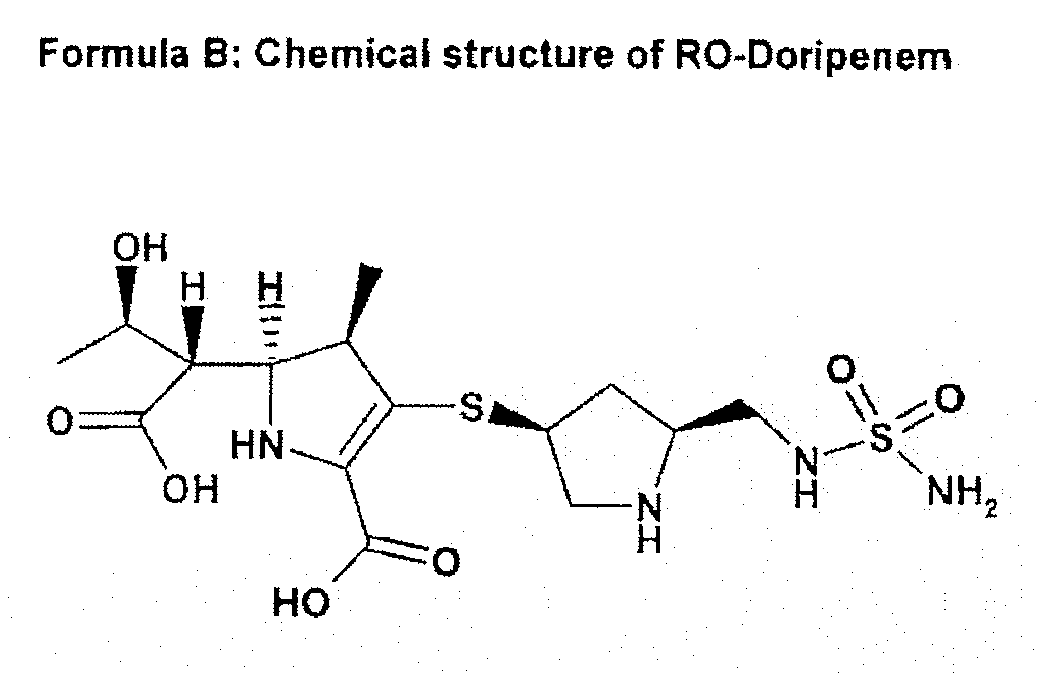
- Figures 2 - 4 of
EP 1886682 show Doripenem decomposition curves at 40 - 60 °C. The Doripenem remaining rate after 120 minutes at 40 °C is < 0.95, the Doripenem remaining rate at 50 °C after 120 minutes is < 0.90 and the Doripenem remaining rate at 60 °C after 120 minutes is < 0.70 according toEP 1886682 . - Commercially available Doripenem Monohydrate contains about 0.2 % (weight-%) of the hydrolyzed Doripenem derivative of Formula B (RO-Doripenem). The control of this degradation product in the manufacture of the API is therefore crucial to keep levels of this degradation product low in the finished dosage form, as this degradation product is inactive.
- The chemical stability of Doripenem:
- Surprisingly the inventors of the present invention found that Doripenem remains stable in basic aqueous solution even at relatively high pH. Decomposition of Doripenem in aqueous basic solution was determined and the Doripenem decomposition curve is displayed in
Figure 1 . After 120 minutes in aqueous solution at pH 10.0 the Doripenem remaining rate did not change and even after 540 minutes at pH 10.0 the Doripenem remaining rate was still the same. - In Example 1 of
EP 1270575 a Doripenem solution is prepared by heating a suspension of Doripenem in ion-exchanged water to about 50 - 55 °C. The crystallization process of the present invention was compared with the process of Example 1 ofEP 1270575 concerning RO-Doripenem. Table 1 displays that already in a small scale, where the aqueous Doripenem solution is exposed to heat only for a short period, the process ofEP 1270575 leads to material with a higher RO-Doripenem content. In contrast the present process leads to highly pure material with only 0.1 % (weight-%) of RO-Doripenem (determined by HPLC at 210 nm against a solution of reference standard of Doripenem representing a content of 1 weight-%, analytical method and calculation see below). The experimental conditions for this comparison are disclosed in Example 7 and Reference Example 1.Table 1: Comparison of impurities following reference Experiment 7 according to the present process Reference example 1 according to Example 1 of EP 1270575 Dissolved at pH 10 50 - 55 °C Doripenem as is [weight-%] 95.5 % 94.3 % RO-Doripenem [weight-%] 0.1% 0.2 % - In
EP 1886682 the problem of decomposition of an aqueous Doripenem solution by heat is solved by continuous heating of a Doripenem suspension. This process asks for a dissolving apparatus consisting of a container for accommodating a suspension, a continuous heating and dissolving equipment and a container for recovering an aqueous solution as described in said patent application. By this process small amounts of the Doripenem suspension are dissolved successively. However, this process has the disadvantage of being time- and space-consuming. Furthermore this process asks for special expensive equipment. - The present invention comprises a fast, easy to perform, time- space- and money-saving crystallization process with no need for special equipment. In the present process a Doripenem solution is obtained by adjusting a pH of about 10 by the addition of a base. The temperature may be in the range from about 0 °C to 30 °C, which means that according to the present crystallization process Doripenem is not exposed to heat. Therefore undesired degradation products that are formed during exposure of an aqueous Doripenem solution to heat are avoided by the present process. Crystallization is initiated by adjusting the pH to the isoelectric point of Doripenem being around pH 5.
- The present invention thus provides a process for the manufacture of Doripenem Monohydrate with levels of compound of formula B of about 0.1 % (weight-%) or less. If desirable, the dissolution/crystallization process may be performed in a continuous manner.
- In another embodiment there is provided an advantageous crystallization process for Doripenem Monohydrate with respect to the control of desired physical properties.
- The present invention provides a crystallization process for Doripenem with the freedom to select the temperature of the crystallization. The freedom to select the temperature for the crystallization step is due to the option of acidifying the alkaline solution of Doripenem with aid of the appropriate acid. Surprisingly it has been found that the crystal shape and typical powder characteristics are influenced by the crystallization temperature.
- At a temperature of about 20 °C a powder is obtained having a particle size distribution with d0.1 of about 5 - 6 µm, d0.5 of about 15 - 25 µm, respectively d0.9 of about 40 - 60 µm, and a specific surface area of 1.7 - 3.0 m2/g suitable for powder filling without the need of additional aseptic handling like milling or sieving of the drug substance due to the presence of small particles and larger crystals. Avoiding any additional aseptic handling after crystallization is advantageously from sterile production point of view due to the limitation of non-sterile risks. However, if desired, a milling/sieving step may be included in the manufacturing. Doripenem Monohydrate with the disclosed particle size distribution shows advantageous filling properties as only a low tendency of dust formation is observed. Additionally an efficient production process by using 1-shot filling is possible.
- Marketed Doripenem is milled. The process disclosed in
EP 1886682 results in big crystals which have to be milled for an efficient powder filling step and a quick dissolution. - Surprisingly when performing the crystallization at a temperature of about 0 °C to 5 °C, very regular needles are formed with d0.1 of about 7 µm, d0.5 of about 24 µm respectively d0.9 of about 82 µm and a specific surface area of 3.2 m2/g . Regular needles of Doripenem Monohydrate are advantageous as regular crystals are easily milled to the desired particle size distribution.
- The aspect ratio (AR) of the needles obtainable at about 0 °C to 5 °C were determined by image analysis. The aspect ratio of a particle is the ratio of its longer dimension to its shorter dimension. The results of aspect ratio AR calculated by the equitation a/b ( a = length, b = breath of the particles of the particles were determined to be typically as follows:
a/b % 1-2 53.2 2-4 37.0 4-6 7.7 6-8 1.4 - The aspect ratio was determined using a Zeiss Axioplan ( D-Oberkochen) equipped with an F-View II camera ( Olympus, Austria, A.-Vienna). The magnification was 200 and a phase contrast illumination was applied. The images (n= 100) are collected by an computer operated using software Cell F (Olympus Austria, A-Venna).
- Samples were prepared by adding a weighted amount ( 30 ± 5 mg ) to a 500 mL glass vial. To this vial was added 2 mL suspending media (1 % SPAN 85). 60 seconds sonification was implemented to break agglomerates. A small volume was then collected via pipette from the suspension to a microscope slide prepared with one droplet Paraffinium liquidum. Both droplets are mixed well using a spatula.
- The present invention is illustrated in the following examples, which should not be construed as limiting.
- The X-ray powder diffraction patterns (XRPD) were collected on a
Unisantis XMD 300 X-ray powder diffractometer with a position sensitive detector in parallel beam optics using the following acquisition conditions: tube anode: Cu , 40 kV, 0,8 mA, 3 - 43° theta/2theta; simultaneous detection of regions of 10° per step with detector resolution 1024, countingtime 300 seconds per step. The samples were measured at room temperature in a standard sample holder on a rotating sample spinner. A typical precision of the 2-theta values is in the range of ± about 0.2° 2-theta. Thus a diffraction peak that appears at 5.0° 2-theta can appear between 4.8 and 5.2° 2-theta on most X-ray diffractometers under standard conditions. - The Infrared spectra (IR) were collected on a MKII Golden Gate™ Single Reflection Diamond ATR (attenuated total reflection) cell with a Bruker Tensor 27 FTIR spectrometer with 4 cm-1 resolution at ambient conditions. To collect a spectrum a spatula tip of the sample was applied to the surface of the diamond in powder form. Then the sample was pressed onto the diamond with a sapphire anvil and the spectrum was recorded. A spectrum of the clean diamond was used as background spectrum. A typical precision of the wavenumber values is in the range of about ± 2 cm -1. Thus, an infrared peak that appears at 1716 cm-1 can appear between 1714 and 1718 cm-1 on most infrared spectrometers under standard conditions.
- HPLC system : e.g. Agilent 1100
Eluent system : Ammoniumphosphate buffer / ACNL (pH 6.9)
Solvent : Deionized water
Column : XBridge C18, 2.5 µm, 4.6 x 50 mm
System : gradient
Flow rate : 1.5 mL/min
Oven temperature : 30 °C
Injection volume : 4 µL
Stop time : 25 min (Post-time 5 min)
Detection ; lambda = 210 nm
(Attenuation 2000 mAU for Agilent 1100 detectors)
Autosampler : 5 °C
Gradient:Min 0 1.5 17 20 %B 0 3 26 100 - Dissolve 30 to 35 mg of the Doripenem Monohydrate working standard, weighed accurately to 0.01 mg, in solvent in a 10-mL volumetric flask. Fill to the mark with solvent and shake well.
- Pipette 1.0 mL of the reference stock solution into a 100-mL volumetric flask, fill to the mark with solvent and shake well.
- Dissolve 30 to 35 mg of the substance to be tested, weighed accurately to 0.01 mg, in solvent in a 10-mL volumetric flask. Fill to the mark with solvent and shake well.
- The content of the related substance ring-opened Doripenem (RO-DORI) was calculated in % by forming the product of measured peak area (mV·min) of RO-DORI in the chromatogram of the test solution, of the initial mass of the Doripenem working standard in the reference solution and the content of Doripenem in the working standard, and dividing it by the product of the initial mass of the test substance, of the peak area of the standard in the reference solution (= 1 %), and the dilution factor.
- Weight-%:

- mT =
- initial mass of the substance to be tested in mg
- mR =
- initial mass of the Doripenem working standard in the reference stock solution in mg
- AT =
- peak area of related substance (RO-DORI) in the chromatogram of the test solution
- AR =
- peak area of Doripenem in the chromatogram of the reference solution (= 1 %)
- C =
- content of Doripenem in the working standard in % (95.7 % as is acc. to declaration)
- 100 =
- dilution factor from reference stock solution to reference solution
- Example for calculation of RO-DORI in Example 7:

- The content of Doripenem was calculated in % by forming the product of measured peak area (mV·min) of DORI in the chromatogram of the test solution, of the initial mass of the Doripenem working standard in the reference solution and the content of Doripenem in the working standard, and dividing it by the product of the initial mass of the test substance and the peak area of the standard in the reference stock solution (= 100 %).
- Weight-%:

- mT =
- initial mass of the substance to be tested in mg
- mR =
- initial mass of the Doripenem working standard in the reference stock solution in mg
- AT =
- peak area of Doripenem in the chromatogram of the test solution
- AR =
- peak area of Doripenem in the chromatogram of the reference stock solution (= 100 %)
- C =
- content of Doripenem in the working standard in % (95.7 % as is acc. to declaration)
- Example for calculation of DORI in Example 7:

- Relative retention times:
Relative Retention
TimeRO-DORIPENEM 0.16 Doripenem 1.00 - 3.514 g Doripenem Monohydrate were suspended in 63 mL H2Odelon at 5 °C. pH 10.0 ± 0.1 was adjusted by the addition of approximately 1.4 mL NaOH (20 %), whereas a clear solution was obtained. The solution was stirred at 5.0 ± 1.0 °C while approximately 2.8 mL HCl (10 %) were added to adjust pH 5.0 ± 0.1. Within about 5 minutes a white solid crystallized and the obtained suspension was stirred for 2 hours at 5.0 ± 1.0 °C. Then the suspension was cooled to 3 °C. After stirring the mixture at the same temperature for 2 hours 35 mL cold isopropanol were added over a period of about 0.5 hours. The slurry was further stirred for 17.5 hours at 3 °C before the solid was filtered off, washed with 7 mL isopropanol (80 %) and dried at 50 °C under vacuum for 24 hours (96.2 w% Doripenem, 0.1 w% RO-Doripenem). Typical water content (exp. KF titration) 4.0 - 4.5 %.
- XRPD [2-theta angles]: 10.8 ± 0.2°, 12.9 ± 0.2°, 14.9 ± 0.2°, 15.8 ± 0.2°, 16.5 ± 0.2°, 19.5, ± 0.2°, 20.4 ± 0.2°, 20.9 ± 0.2°, 22.0 ± 0.2°, 23.8 ± 0.2°, 26.0 ± 0.2°, 28.1 ± 0.2°. 29.0 ± 0.2°, 31.6 ± 0.2°; FTIR: 3526 ± 2 cm -1, 3224 ± 2 cm -1, 1710 ± 2 cm -1, 1631 ± 2 cm -1, 1565 ± 2 cm -1, 1455 ± 2 cm -1, 1385 ± 2 cm-1, 1349 ± 2 cm-1, 1320 ± 2 cm -1, 1263 ± 2 cm -1, 1161 ± 2 cm -1, 1088 ± 2 cm -1, 929 ± 2 cm -1, 763 ± 2 cm -1;
- 3.508 g Doripenem Monohydrate were suspended in 63 mL H2Odelon at 10 °C, pH 10.0 ± 0.1 was adjusted by the addition of approximately 1.4 mL NaOH (20 %), whereas a clear solution was obtained. The solution was stirred at 10.0 ± 1.0 °C while approximately 2.8 mL HCl (10 %) were added to adjust pH 5.0 ± 0.1. Within about 5 minutes a white solid crystallized and the obtained suspension was stirred for 2 hours at 10.0 ± 1.0 °C. Then the suspension was cooled to 3 °C. After stirring the mixture at the same temperature for 2 hours 35 mL cold isopropanol were added over a period of about 1 hour. The slurry was further stirred for 17 hours at 3 °C before the solid was filtered off, washed with 7 mL isopropanol (80 %) and dried at 50 °C under vacuum for 5.5 hours (96.1 w% Doripenem, 0.1 w% RO-Doripenem).
- 4.001 g Doripenem Monohydrate were suspended in 72 mL H2Odelon at 20 °C. pH 10.0 ± 0.1 was adjusted by the addition of approximately 1.6 mL NaOH (20 %), whereas a clear solution was obtained. The solution was stirred at 20.0 ± 1.0 °C while approximately 3.2 mL HCl (10 %) were added to adjust pH 5.0 ± 0.1. Within about 5 minutes a white solid crystallized and the obtained suspension was stirred for 2 hours at 20.0 ± 1.0 °C. Then the suspension was cooled to 3 °C. After stirring the mixture at the same temperature for 2 hours 40 mL cold isopropanol were added over a period of about 1 hour. The slurry was further stirred for 16.5 hours at 3 °C before the solid was filtered off, washed with 8 mL isopropanol (80 %) and dried at 50 °C under vacuum for 23.5 hours (95.8 w% Doripenem, 0.1 % RO-Doripenem).
- 4.012 g Doripenem Monohydrate were suspended in 72 mL H2Odelon at 25 °C. pH 10.0 ± 0.1 was adjusted by the addition of approximately 1.6 mL NaOH (20 %), whereas a clear solution was obtained. The solution was stirred at 25.0 ± 1.0 °C while approximately 3.2 mL HCl (10 %) were added to adjust pH 5.0 ± 0.1. Within about 5 minutes a white solid crystallized and the obtained suspension was stirred for 3 hours at 25.0 ± 1.0 °C. Then the suspension was cooled to 3 °C. After stirring the mixture at the same temperature for 2 hours 40 mL cold isopropanol were added over a period of about 1 hour. The slurry was further stirred for 16 hours at 3 °C before the solid was filtered off, washed with 8 mL isopropanol (80 %) and dried at 50 °C under vacuum for 7 hours (95.6 w% Doripenem, 0,1 w% RO-Doripenem).
- 9.80 g Doripenem Monohydrate were suspended in 180 mL H2Odelon. (pH 5.01, T = 20.1 °C). To the suspension about 4 mL NaOH (20 %) were added, whereas a clear solution was obtained (pH 10.0 T = 20.0 °C). Thereafter about 8 ml HCl (10 %) were added to the solution (pH 5.1, T = 20.0 °C). Within about 10 minutes a white solid crystallized and the suspension was further stirred at 20 °C for 2 hours. Then the suspension was cooled to 3 °C within about one hour and further stirred at this temperature for 2 hours. Afterwards 100 mL isopropanol were slowly added to the suspension over a time period of about 2 hours. After the antisolvent addition the suspension was further stirred at 3 °C for 15.5 hours. Finally the solid was filtered off, washed with isopropanol (80 % by volume) and dried at 50 °C under vacuum for about 8 hours to obtain 8.49 g (87 % yield) of crystalline Doripenem Monohydrate.
- The decomposition of Doripenem in aqueous solution at pH 10 was examined by dissolving 47.71 mg of Doripenem Monohydrate in 10 mL of ammonium phosphate buffer at pH 10 (prepared by dissolving 2.0 mL of 85 % phosphoric acid in 800 mL of water, adjusting the pH with 25 % aqueous ammonia to pH 10, and adding up to a total volume of 1000 mL with water), and repeated injection of 4.0 µL of this test solution into the H PLC system over a period of 9 hours. Analysis of data was performed according to the method described.
- Doripenem was stable over a period of 9 hours.
Figure 1 shows the Doripenem decomposition curve at pH 10. - 1.992 g Doripenem Monohydrate were suspended in 36 mL H2Odelon at 20 °C. pH 10.0 ± 0.1 was adjusted by the addition of approximately 0.8 mL NaOH (20 %), whereas a clear solution was obtained. The solution was stirred at 20.0 ± 1.0 °C while approximately 1.6 mL HCl (10 %) were added to adjust pH 5.0 ± 0.1. Within about 5 minutes a white solid crystallized and the obtained suspension was stirred for 2 hours at 20.0 ± 1.0 °C. Then the suspension was cooled to 3 °C. After stirring the mixture at the same temperature for 2 hours 20 mL cold isopropanol were added over a period of about 0.5 hours. The slurry was further stirred for 18 hours at 3 °C before the solid was filtered off, washed with 4 mL isopropanol (80 %) and dried at 50 °C under vacuum for 7.5 hours (95.5 w% Doripenem, 0.1 w% RO-Doripenem).
- 2.951 g of Doripenem Monohydrate were suspended in 54 ml H2Odelon and 30 ml of isopropanol at 20°C. A pH of 10 ± 0.1 was adjusted by the addition of approximately 1,2 ml of 20% NaOH whereas a clear solution was obtained. The pH was adjusted to pH 5.0 ± 0.1 by addition of 2.4 ml of 10% HCl. Within about 5 minutes a white solid crystallized. The suspension was allowed to stir at 20° C for 3 hours and the suspension was then cooled to 3°C ± 1°C within one hour and stirred for approximately 19 hours at this temperature.
- The crystals were then isolated by filtration and washed with 6 mL isopropanol (80%).
- The crystals were then dried under vacuum at 50°C for 8 hours.
- Yield: 2,45 g of Doripenem Monohydrate (0.1 w% RO-Doripenem).
- 2.005 g Doripenem (Doribax®lot0045) were suspended in 36 ml H2Odelon at 20 °C. The suspension was dissolved at 55 °C. Afterwards the solution was cooled down to 20.0 ± 1.0 °C, whereas at 30 °C a white solid started to crystallize. The solution was stirred at 20.0 ± 1.0 °C for 2 hours. Then the suspension was cooled to 3 °C. After stirring the mixture at the same temperature for 2 hours 20 ml cold isopropanol were added over a period of about 1 hour. The slurry was further stirred for 15.5 hours at 3 °C before the solid was filtered off, washed with 4 ml isopropanol (80 %) and dried at 50 °C under vacuum for 15.5 hours (94.3 w% Doripenem, 0.20 w% RO-Doripenem).
Claims (10)
- Doripenem Monohydrate with a content of not more than 0.1 % (by weight) of ring-opened Doripenem (RO-Doripenem) of formula

- A crystallization process for Doripenem Monohydrate comprising the steps of(a) suspending Doripenem in water,(b) dissolving Doripenem at pH of 8-12 by the addition of a base,(c) optionally filtering the solution through a micron filter,(d) crystallizing Doripenem at pH 3 - 6 by the addition of an acid,(e) optionally adding an organic solvent and(f) isolating and drying the obtained crystals.
- A crystallization process for Doripenem Monohydrate according to claim 2 comprising the steps of(a) suspending Doripenem in water,(b) dissolving Doripenem at pH 10 by the addition of a base,(c) optionally filtering the solution through a micron filter,(d) crystallizing Doripenem at pH 5 by the addition of an acid(e) optionally adding an antisolvent and(f) isolating and drying the obtained crystals.
- Doripenem Monohydrate with a content of not more than 0.1 % of RO-Doripenem (by weight-%) determined by HPLC at 210 nm against a solution of reference standard of Doripenem representing a content of 1 % by weight according to claim 2 or 3.
- A crystallization process for Doripenem Monohydrate according to claim 2 and claim 3, wherein the organic solvent is selected from isopropanol or a C1-C4 alcohol.
- A process according to claim 5 wherein the organic solvent is isopropanol.
- A crystallization process for Doripenem Monohydrate according to claim 2 or 3 wherein the base is selected from an ammonium source, an organic amine, an alkali or earth alkali hydroxide, alkali or earth alkali carbonate or bicarbonate.
- A crystallization process for Doripenem Monohydrate according to claim 7, wherein the base is sodium hydroxide.
- A crystallization process for Doripenem Monohydrate according to claim 2 or 3 wherein the acid is selected from an organic acid or a mineral acid.
- A crystallization process for Doripenem Monohydrate according to claim 9, wherein the acid is hydrochloric acid.
Priority Applications (1)
| Application Number | Priority Date | Filing Date | Title |
|---|---|---|---|
| EP10169837A EP2275424A1 (en) | 2009-07-17 | 2010-07-16 | Doripenem crystallization process |
Applications Claiming Priority (2)
| Application Number | Priority Date | Filing Date | Title |
|---|---|---|---|
| EP09165773 | 2009-07-17 | ||
| EP10169837A EP2275424A1 (en) | 2009-07-17 | 2010-07-16 | Doripenem crystallization process |
Publications (1)
| Publication Number | Publication Date |
|---|---|
| EP2275424A1 true EP2275424A1 (en) | 2011-01-19 |
Family
ID=42671939
Family Applications (1)
| Application Number | Title | Priority Date | Filing Date |
|---|---|---|---|
| EP10169837A Withdrawn EP2275424A1 (en) | 2009-07-17 | 2010-07-16 | Doripenem crystallization process |
Country Status (1)
| Country | Link |
|---|---|
| EP (1) | EP2275424A1 (en) |
Cited By (6)
| Publication number | Priority date | Publication date | Assignee | Title |
|---|---|---|---|---|
| CN102285988A (en) * | 2011-09-08 | 2011-12-21 | 上海希迈医药科技有限公司 | Doripenem hydrate crystal and preparation method thereof |
| CN103389347A (en) * | 2013-07-26 | 2013-11-13 | 深圳市海滨制药有限公司 | Method for measuring Doripenem and/or relevant substances by utilizing high performance liquid chromatography |
| CN103664946A (en) * | 2012-09-03 | 2014-03-26 | 凌沛学 | Industrial synthesis method of doripenem |
| CN103664947A (en) * | 2012-09-05 | 2014-03-26 | 凌沛学 | Novel crystal form of carbapenem antimicrobial medicament and preparation method of novel crystal form |
| CN105061284A (en) * | 2015-08-18 | 2015-11-18 | 齐鲁安替(临邑)制药有限公司 | Method for preparing ring-opening impurity of carbapenems |
| WO2016148439A3 (en) * | 2015-03-13 | 2016-10-27 | Daewoong Pharmaceutical Co., Ltd. | Method of preparing crystalline doripenem |
Citations (2)
| Publication number | Priority date | Publication date | Assignee | Title |
|---|---|---|---|---|
| WO2007031858A2 (en) * | 2005-09-15 | 2007-03-22 | Orchid Chemicals And Pharmaceuticals Limited | An improved process for the preparation of beta-lactam antibiotic |
| WO2009118680A1 (en) * | 2008-03-24 | 2009-10-01 | Ranbaxy Laboratories Limited | Process for the preparation of sterile doripenem |
-
2010
- 2010-07-16 EP EP10169837A patent/EP2275424A1/en not_active Withdrawn
Patent Citations (2)
| Publication number | Priority date | Publication date | Assignee | Title |
|---|---|---|---|---|
| WO2007031858A2 (en) * | 2005-09-15 | 2007-03-22 | Orchid Chemicals And Pharmaceuticals Limited | An improved process for the preparation of beta-lactam antibiotic |
| WO2009118680A1 (en) * | 2008-03-24 | 2009-10-01 | Ranbaxy Laboratories Limited | Process for the preparation of sterile doripenem |
Non-Patent Citations (4)
| Title |
|---|
| D. BLACK: "the d-zone", DRUG THERAPY TODAY, vol. 36, no. sup 3, 31 August 2007 (2007-08-31), XP007914837 * |
| EMEA: "CHMP ASSESSMENT REPORT", 20080101, no. EMEA/309032/2008, 1 January 2008 (2008-01-01), pages 1 - 60, XP007914813 * |
| NISHINO Y ET AL: "Practical Large-scale Synthesis of Doripenem: A Novel 1beta-Methylcrabapenem Antibiotic", ORGANIC PROCESS RESEARCH AND DEVELOPMENT, CAMBRIDGE, GB, vol. 7, 24 September 2003 (2003-09-24), pages 846 - 850, XP002396087 * |
| PSATHAS PETROS A ET AL: "Stability of doripenem in vitro in representative infusion solutions and infusion bags.", CLINICAL THERAPEUTICS NOV 2008 LNKD- PUBMED:19108795, vol. 30, no. 11, November 2008 (2008-11-01), pages 2075 - 2087, XP002600044, ISSN: 0149-2918 * |
Cited By (10)
| Publication number | Priority date | Publication date | Assignee | Title |
|---|---|---|---|---|
| CN102285988A (en) * | 2011-09-08 | 2011-12-21 | 上海希迈医药科技有限公司 | Doripenem hydrate crystal and preparation method thereof |
| CN102285988B (en) * | 2011-09-08 | 2012-09-05 | 上海希迈医药科技有限公司 | Doripenem hydrate crystal and preparation method thereof |
| CN103664946A (en) * | 2012-09-03 | 2014-03-26 | 凌沛学 | Industrial synthesis method of doripenem |
| CN103664946B (en) * | 2012-09-03 | 2015-11-25 | 凌沛学 | The Industrialized synthesis method of a kind of many Li Peinan |
| CN103664947A (en) * | 2012-09-05 | 2014-03-26 | 凌沛学 | Novel crystal form of carbapenem antimicrobial medicament and preparation method of novel crystal form |
| CN103664947B (en) * | 2012-09-05 | 2015-11-25 | 凌沛学 | Crystal formation of a kind of carbapenem antibacterial medicine and preparation method thereof |
| CN103389347A (en) * | 2013-07-26 | 2013-11-13 | 深圳市海滨制药有限公司 | Method for measuring Doripenem and/or relevant substances by utilizing high performance liquid chromatography |
| CN103389347B (en) * | 2013-07-26 | 2015-12-09 | 深圳市海滨制药有限公司 | The method of high effective liquid chromatography for measuring donipenem |
| WO2016148439A3 (en) * | 2015-03-13 | 2016-10-27 | Daewoong Pharmaceutical Co., Ltd. | Method of preparing crystalline doripenem |
| CN105061284A (en) * | 2015-08-18 | 2015-11-18 | 齐鲁安替(临邑)制药有限公司 | Method for preparing ring-opening impurity of carbapenems |
Similar Documents
| Publication | Publication Date | Title |
|---|---|---|
| US9221823B2 (en) | Crystal form of pyrrolidylthiocarbapenem derivative | |
| EP2275424A1 (en) | Doripenem crystallization process | |
| EP0581552B1 (en) | Triazolylthiomethylthio cephalosporin hyrochloride, its crystalline hydrate and the production of the same | |
| EP3189841B1 (en) | Pharmaceutical preparation comprising cephalosporin having catechol groups | |
| EP2870163B1 (en) | Pharmaceutical compositions comprising rifaximin and amino acids, preparation method and use thereof | |
| EP2177522A1 (en) | Novel carbapenem derivatives | |
| CN102268018A (en) | Crystallization method of cefixime | |
| JPWO2001072750A1 (en) | A new type of crystal of pyrrolidylthiocarbapenem derivatives | |
| CA2733145C (en) | Aztreonam l-lysine and method of determining impurities therein | |
| JP3317649B2 (en) | Carbapenem compounds in crystalline form | |
| JPH089630B2 (en) | Improvement of or related to organic compounds | |
| CN104844624A (en) | Cefoperazone sodium-sulbactam sodium eutectic crystal and composition, and preparation methods thereof | |
| KR20090007572A (en) | Improved Crystallization Method of Carbapenem Antibiotic Intermediates | |
| CN103450086B (en) | Ozagrel compound, preparation method and pharmaceutical composition of ozagrel compound | |
| CN106432274A (en) | Crystalline compound of drug ceftriaxone sodium for treating surgical operation infections | |
| CN106432278A (en) | Crystalline compound of drug ceftriaxone sodium for treating surgical operation infections | |
| EP2186814A1 (en) | Sulfonyl-substituted carbapenem compounds | |
| CN114773413B (en) | Method for preparing kanamycin monosulfate single crystal and application thereof | |
| CN115925700B (en) | Crystal form of tyrosine kinase inhibitor and preparation method thereof | |
| CN104402908A (en) | Cefoxitin sodium compound entity and composition and uses thereof | |
| JP2010013356A (en) | Crystalline carbapenem compound | |
| CN113845529A (en) | A kind of cefalexin co-crystal compound and preparation method thereof | |
| CN107778311A (en) | The preparation method of donipenem hydrate crystallization | |
| CN119219662A (en) | Crystal form of cefpiramide sodium and preparation method thereof | |
| CN119320378A (en) | Gatifloxacin dicarboxylic acid eutectic compound and preparation method and application thereof |
Legal Events
| Date | Code | Title | Description |
|---|---|---|---|
| PUAI | Public reference made under article 153(3) epc to a published international application that has entered the european phase |
Free format text: ORIGINAL CODE: 0009012 |
|
| AK | Designated contracting states |
Kind code of ref document: A1 Designated state(s): AL AT BE BG CH CY CZ DE DK EE ES FI FR GB GR HR HU IE IS IT LI LT LU LV MC MK MT NL NO PL PT RO SE SI SK SM TR |
|
| AX | Request for extension of the european patent |
Extension state: BA ME RS |
|
| 17P | Request for examination filed |
Effective date: 20110719 |
|
| STAA | Information on the status of an ep patent application or granted ep patent |
Free format text: STATUS: THE APPLICATION IS DEEMED TO BE WITHDRAWN |
|
| 18D | Application deemed to be withdrawn |
Effective date: 20110720 |